WO2007131679A2 - Mit insektiziden wirkstoffen getränktes papier - Google Patents
Mit insektiziden wirkstoffen getränktes papier Download PDFInfo
- Publication number
- WO2007131679A2 WO2007131679A2 PCT/EP2007/004091 EP2007004091W WO2007131679A2 WO 2007131679 A2 WO2007131679 A2 WO 2007131679A2 EP 2007004091 W EP2007004091 W EP 2007004091W WO 2007131679 A2 WO2007131679 A2 WO 2007131679A2
- Authority
- WO
- WIPO (PCT)
- Prior art keywords
- paper
- carrier
- test
- insects
- active ingredient
- Prior art date
- Legal status (The legal status is an assumption and is not a legal conclusion. Google has not performed a legal analysis and makes no representation as to the accuracy of the status listed.)
- Ceased
Links
Classifications
-
- A—HUMAN NECESSITIES
- A01—AGRICULTURE; FORESTRY; ANIMAL HUSBANDRY; HUNTING; TRAPPING; FISHING
- A01N—PRESERVATION OF BODIES OF HUMANS OR ANIMALS OR PLANTS OR PARTS THEREOF; BIOCIDES, e.g. AS DISINFECTANTS, AS PESTICIDES OR AS HERBICIDES; PEST REPELLANTS OR ATTRACTANTS; PLANT GROWTH REGULATORS
- A01N53/00—Biocides, pest repellants or attractants, or plant growth regulators containing cyclopropane carboxylic acids or derivatives thereof
-
- A—HUMAN NECESSITIES
- A01—AGRICULTURE; FORESTRY; ANIMAL HUSBANDRY; HUNTING; TRAPPING; FISHING
- A01N—PRESERVATION OF BODIES OF HUMANS OR ANIMALS OR PLANTS OR PARTS THEREOF; BIOCIDES, e.g. AS DISINFECTANTS, AS PESTICIDES OR AS HERBICIDES; PEST REPELLANTS OR ATTRACTANTS; PLANT GROWTH REGULATORS
- A01N25/00—Biocides, pest repellants or attractants, or plant growth regulators, characterised by their forms, or by their non-active ingredients or by their methods of application, e.g. seed treatment or sequential application; Substances for reducing the noxious effect of the active ingredients to organisms other than pests
- A01N25/20—Combustible or heat-generating compositions
-
- A—HUMAN NECESSITIES
- A01—AGRICULTURE; FORESTRY; ANIMAL HUSBANDRY; HUNTING; TRAPPING; FISHING
- A01M—CATCHING, TRAPPING OR SCARING OF ANIMALS; APPARATUS FOR THE DESTRUCTION OF NOXIOUS ANIMALS OR NOXIOUS PLANTS
- A01M1/00—Stationary means for catching or killing insects
- A01M1/20—Poisoning, narcotising, or burning insects
- A01M1/2022—Poisoning or narcotising insects by vaporising an insecticide
- A01M1/2027—Poisoning or narcotising insects by vaporising an insecticide without heating
- A01M1/2055—Holders or dispensers for solid, gelified or impregnated insecticide, e.g. volatile blocks or impregnated pads
Definitions
- the present invention relates to a paper impregnated with insecticidal active substances, to a process for its preparation and to its use for controlling insects
- platelet evaporators can be used to kill off or repel insects, for example stinghorns, with the aid of electric heaters.
- suitable substances such as pulp and cotton cardboard, are asbestos, ceramics and / or porous synthetic resins
- Insecticidal active ingredient solutions impregnated to obtain insecticide platelets The insecticides are cursed by the action of a heater which produces a temperature of 120 to 190 0 C, cures
- Evaporator devices for household use have also been known for some time, as described, for example, in GB-B-2 153 227, in which the evaporation of a solution takes place, the active substance z B being dissolved in a mixture of saturated, ahphatic hydrocarbons by means of a electrically heated wick
- EP-B-0 279 325 discloses trans-impregnated natural substances and synthetic substances, for example moth papers
- smoking coils such as Baygon ® spirals (coils) are known, which protect for a period of 6 to 12 hours before mosquitoes, for example, on the terrace, on the balcony, camping or in the room to use the rings they are lit, the Ring rings so that the containing active ingredient is released slowly and continuously outdoors or in the room
- a space of about 20 m 2 a commercially available ring is needed Disadvantageous to these rings, however, is that they tend to break easily in use so that they are only partially used
- insect control aerosols or oil sprays are used to quickly rid of closed spaces of insects. Treated rooms can then be aired again, as long as the access of new insects can be prevented.
- the disadvantage of these systems is that Due to their mass, the aerosol nebula or the oil mist must be distributed sufficiently finely in the rooms
- the solution to this problem is in a first embodiment of an apparatus for insect control, which comprises a glow-capable carrier.
- a first embodiment of the invention provides a device for controlling insecticides which comprises a glow-capable carrier provided with at least one insecticidal active ingredient, for example by impregnation.
- the carrier is designed in such a way that, once it has been lit with a fire, it continues to glow after being extinguished, for example by being blown out or a gust of wind, and is not completely extinguished. Upon annealing, the carrier releases the at least one insecticidal active, thereby controlling insects.
- the carrier is not particularly limited as long as it is capable of releasing the at least one insecticidal active ingredient while glaring
- a carrier for example, a carrier based on Cell ⁇ lose.
- a paper support to call which is further described below in a preferred embodiment
- Further materials based on cellulose for example, wood chips, wood chips or sawdust, rice hulls, spindles of corn on the cob (preferably without grains), pecan shells and peanut shells.
- Thin support plates in particular also come into consideration as support material.
- a corresponding support based on cellulose is described, for example, in German patent application DE 43 223 76 A1, the disclosure of which is incorporated by reference in the present application.
- Such carrier is based on textile materials.
- Such carrier may be partially or wholly synthetic fibers such as polyester or nylon or natural fibers such as cotton, viscose, a linen-viscose blend or a blend of synthetic and natural fibers such as cellulose-polyester (synthetic Paper) or cotton-polyester. Further examples are Woll-Feltine and Trevira-Satrn.
- Another possible carrier is based on glowable plastic substrates, such as polycarbonates, polyesters, polyamides and polyterephthalates.
- the carrier element for the insecticidal active ingredient can be produced from a plastic material into which the plasticizer material is applied
- a plastic material into which the plasticizer material is applied
- the injection molding process is suitable for producing the carrier, with a plastic starting material, such as a polycarbonate, for example, the insecticidal active ingredient, for example, pyrethro id, is added and this mixture is then brought by machining in an injection mold in the final shape shown is alternatively offer itself as a manufacturing process, for example, the extrusion or thermoforming
- the solution of the object underlying the present invention is therefore in a very particularly preferred embodiment of an apparatus for controlling insects, which comprises a glow-able paper carrier
- a device for controlling insecticides comprises a ghostable paper holder provided with at least one insecticidal active ingredient, for example, by impregnation.
- the paper holder is designed, according to the invention, once ignited with fire, after the Extinguish, for example, by blowing or a gust of wind, continues to glow and not completely extinguished. By annealing, the paper carrier releases the at least one insecticidal active ingredient, which causes an insect control
- the erfmdungsgeBOOKe device consists of the carrier, msbesondere the paper carrier, the at least one insecticidal active ingredient and optionally other additives, such as potassium nitrate Other additives are described below Cellulose-based carrier - paper carrier
- the apparatus comprises a paper carrier.
- the paper carrier contains pulp.
- pulp which is produced during chemical pulping of plant fibers mostly wood
- Paper carriers of the type according to the invention have been known for many years, but not in the field of controlling insecticides.
- a paper carrier has been impregnated with the Asian tree resin "Styrax", the resulting product being referred to as “Armenian paper” Paper '”is used to neutralize odors of food and tobacco or other unpleasant odors
- the Frenchman Auguste Poncet had brought the resin, which is also used for the production of frankincense and therefore reminiscent of its odor, from a trip to Armenia
- the paper is When using this paper, a sheet is removed from the booklet, ignited on an ashtray and then erased to make it glow slowly. During the fading process, the paper releases the desired scents and thus provides the environment a pleasant smell On similar Way, the erfmdungsgedorfe paper substrate is used
- the paper carrier used therein is not subject to any particular limitations so long as it is generally suitable for containing at least one corresponding insecticidal active ingredient and, after lighting and extinguishing the paper carrier, releasing the at least one insecticidal active ingredient without substantially causing decomposition
- paper carriers having a paper weight of preferably 25 to 300 g / m 2 , in particular 25 to 270 g / m 2 , more preferably 25 to 250 g / m 2 , most preferably 25 to 230 g / m 2 , more preferably 25 to 215 g / m 2 , especially 25 to 200 g / m 2 , are particularly suitable for the purpose according to the invention
- the thickness of the paper support in a range of 0, 1 to 0.5 mm, more preferably 0.15 to 0.45 mm, most preferably 0, 15 to 0.40, most particularly preferred between 0.15 and 0.34 mm, especially 0.15 to 0.32 mm
- the paper holder according to the invention should, however, be cut to be suitably used by the user, ie to have a size, for example. which makes it possible to smolder the paper holder in a container, such as an ashtray
- the inventive paper carrier to be used may be, for example, a carrier made of cardboard, for example absorbent cardboard, cardboard or corrugated cardboard
- a carrier in particular a paper carrier can be used, which is provided only with an insecticidal active ingredient
- two or more insecticidal active ingredients are provided simultaneously on the carrier, in particular the paper carrier, such as 2, 3 or 4 insecticidal agents
- the selection of suitable insecticides active substance is subject to basically the only limitation that the insecticidal active ingredient in the Glirnmtemperatur of the carrier, in particular the Textiltra- gers, of about 350 to 600 0 C is output substantially without decomposition into the surrounding atmosphere without having his Essentially loses insecticidal mode of action
- the term "substantially without decomposition" in the context of the present invention is understood to mean a decomposition of at most 80%, preferably at most 70%, particularly preferably at most 60%, in particular at most 50%, especially at most 40%
- the paper substrate is provided with at least one insecticidal active ingredient selected from the group consisting of the pyrethroids, in particular selected from the group consisting of Ac ⁇ nathrin, Alleth ⁇ n, d-Alleth ⁇ n, d-trans Allethnn, d -cis-trans Alleth ⁇ n, Alphameth ⁇ n, Bath ⁇ n, Bifenthnn, Bioalleth ⁇ n, S-Bio
- insecticidal active ingredient may be selected from the following active ingredients, the following insecticidal active ingredients being used alone or in any combination thereof. nation can be used with each other and in any combination with the aforementioned insecticidal active ingredients.
- Acetylcholesterol (AChE) inhibitors carbamates, for example alanycarb, aldicarb, aldoxycarb, allyxycarb, aminocarb, bendiocarb, benfuracarb, bufencarb, butacarb, butocarboxime, butoxycarboxim, carbaryl, carbofuran, carbosulfan, cloethocarb, dunetilane, ethiofencarb, fenobucarb, fenothiocarb, formetan te, furathiocarb, isoprocarb, metam-sodium, methiocarb, methomyl, metolcarb, oxamyl, pirimicarb, promecarb, propoxur, thiodicarb, thiofanox, trimethacarb, XMC, xylylcarb, triazamate organophosphates, for example acephates, azamet
- Fenethione flupyrazofos, fonofos, formothion, fosmethilane, fosthiazate, heptenophos, iodophosphphos, ipamplesfos, isazofos, isofenphos, isopropyl o-salicylates, isoxathione, malathion, mecarbam, methacrifos, methamidophos, methidathione, mevinphos, monocrotophos, na- led , Omethoatc, Oxydemeton-methyl, Parathion (-methyl)
- Oxadiazines for example Indoxacarb Semicarbazone, for example Metaflumizone (BAS3201)
- Acetylcholine receptor agonist / antagonist Chloronicotinyls for example acetamide, clothianidin, dinoteflirane, imidaclop ⁇ d, nitenpyram, nithiazme, thiacoptt, thiamethoxam
- Organochlorines for example, camphechlor, chlordane, endosulfan, gamma-HCH, HCH, heptachlor, linandiie, metlioxychlor
- Fiproles for example, acetoprole, ethiprole, fipronil, pyrafluprole, pyriprole, vaniliprole, chlo ⁇ d channel activators
- Mectins for example, abamectin, emamectin, emamectin benzoate, ivermectin, lepimectin, miimycin, juvenile hormone mimetics, for example, diofenolan, epofenonans, fenoxycarb, hydroprene, kinoprenes, methoprenes,
- Diacylhydrazme for example chromafenozide, Halofenozide, Methoxyfenozide, Tebufenozide inhibitors of the Chitinbiosynthese
- Benzoylureas for example bistirflurone, chlorofluazuron, diflubenzuron, fluazuron, flucycloxuron, fenphenoxuron, hexaflumuron, lufenuron, novaluron, noviflumuron, penfluron, teflubenzurron, t ⁇ flumuron
- Organotin compounds for example azocyclotine, cyhexatin, fenbutatin oxide
- Decouplers of oxidative phosphorylation by interruption of the H proton gradient Pyrroles for example Chlorfe ⁇ apyr
- Dinitrophenols for example binapacyrl, dinobutone, dinocap, DNOC side-I electron transport inhibitors
- fenazaquin for example, fenazaquin, fenpyroximate, pyrimidifen, pyridaben, tebufenpyrad, tolfenpyrad
- Tetronic acids for example spirodiclofen, spiromesifen,
- Tetramic acids for example spirotetramat, cis-3- (2,5-dimethylphenyl) -4-hydroxy-8-methoxy-1-azaspiro [4.5] dec-3-en-2-one
- Carboxamides for example flonicamide
- Octopaminergic agonists for example, Amitraz inhibitors of magnesium-stimulated ATPase,
- Nereistoxin analogs for example thiocyclam hydrogen oxalates, thiosultap-sodium agonists of the ryanodine receptor,
- Benzoic acid dicarboxamides for example flubendiamide
- anthranilamides for example, rynaxypyr (3-bromo-N- ⁇ 4-chloro-2-methyl-6-
- Fumigants for example aluminum phosphides, methyl bromides, sulfuryl fluo ⁇ de
- Food inhibitors for example Cryolite, Flonicamid, Pymetrozme
- Mite growth inhibitors for example clofentezme, etoxazole, hexythiazox
- Cyflumetofen Dicyclanil, Fenoxacm, Fentnfanil, Flubenzimine. Flufene ⁇ m, flood point,
- an insecticidal active substance is also understood to mean a repellent active ingredient or synergist
- DEET diethyltoluamide
- picanidine picanidine
- the carrier provided according to the invention in particular paper carriers, is not subject to any special restrictions.
- the content of insecticidal active substance is 0.01 to 100.0 mg / 24 cm 2 paper surface, particularly preferably 0, 05 to 80 mg / 24 cm 2 paper surface, very particularly preferably 0, 1 to 60 mg / 24 cm 2 paper surface, further very particularly preferably 0.15 to 40 mg / 24 cm 2 paper surface, especially 0.20 to 20 mg / 24 cm 2 paper surface amounts to, wherein in each case a carrier, in particular paper carrier, based on which has the above-mentioned paper weight and the above-mentioned paper thickness
- the carrier, in particular paper, in the inventive insect control agent may also contain other ingredients
- An essential component here is KaIi- umnitrat, whereby it is achieved that the carrier, especially the paper mcht completely burned, but glows after lighting and the subsequent erasure
- the amount of Kalmmnitrat, which is located on the erf ⁇ ndungsgedorfer, in particular paper, is subject to no restrictions in principle It has been found to be preferred, however, if the amount of Kahumnitrat 5 to 50 g / m 2 , particularly preferably 7 to 45 g / m 2 , completely more preferably 9 to 40 g / cm 2 , more preferably 10 to 35 g / cm 2 , especially 12 to 30 g / cm 2 , amounts
- the erfmdungsgeEnt to use carriers may also contain natural and / or synthetic fragrances and organic and inorganic dyes
- fragrances may be selected, for example, from the group consisting of musk, civet, amber, castereum and similar fragrances ajawal, almond oil, ambrette seed absol, tartar root oil, anisol basilikumol, laurelol, benzoinresoroid, bergamot essence, birkeneol, rosewood oil, prickly pear absol, cajeputol , Canangaol, Gapiscumol, Kummelol, Cardamolol, Mohrensainenol, Cassiaol, Cedarwood oil, Sellenesamenol, Cinnamonndenol, Citronellol, Muscateller's albumin, Clove oil, Cognacol, Corianderol, Cubebenol, Camphor oil, Dillol, Estralagulum eucalyptus oil, Fenchelol nut, Calbanumresinoid, Garlicol, Geraniumol , Ingwe
- Synthetic fragrances may be added to the support materials according to the invention, in particular paper supports
- the formulation according to the invention may optionally be supplemented with those described in U.S. Pat theWstoffindust ⁇ e conventional additives such as Patchouhol or similar anti-fouling agents such as eugenol or similar viscosity-regulating agents
- the products according to the invention may also contain desodorizing agents, such as, for example, lauryl methacrylate, geranyl crotonate, acetophenone my ⁇ stat, p-methylacetophenone-benzaldehyde, benzyl acetate, benzyl propionate, amyl cinnamaldehyde, anisaldehyde, diphenyloxide, methyl benzoate, ethyl benzoate, methyl phenylacetate, ethyl phenylacetate, neoline, safrol, etc
- desodorizing agents such as, for example, lauryl methacrylate, geranyl crotonate, acetophenone my ⁇ stat, p-methylacetophenone-benzaldehyde, benzyl acetate, benzyl propionate, amyl cinnamaldehyde, anisaldehyde, diphenyloxide,
- the carriers according to the invention may furthermore contain alone or in combination with the aforementioned insecticidal active ingredients synergists, such as octachlorodipropyl ether and piperonyl butoxide
- insecticidal active ingredient can be present in a mattress on the support, in particular paper support.
- a matmix material in which the insecticidal active substance is incorporated it can be achieved that, after the preparation and before the use of the product according to the invention, the insecticidal active substance in the Essentially does not escape and the product according to the invention thereby does not change its nature
- Matrix materials all systems come into question, which erflndungsgelois to use at least an insecticidal active ingredient prevent under normal ambient conditions (23 0 C, 1013 mbar) auis the Tragermatenal, for example, the paper carriers to escape the
- the organic materials which may be considered as matrix materials include polyvinyl alcohol, wheat protein and its derivatives, carbohydrates, starch (from various vegetable sources), amylose and its derivatives, amylopectin and its derivatives, cellulose and derivatives thereof, hydrolyzed starch, modified starch , modified starch derivatives, maltodextrins, hydroxypropylmethylcellulose (HPMC) 5 polyvinylpyrrolidone (PVP), chitin, chitosan, polysaccharide gums and their derivatives, polyethylene glycol, polyesters, hydroxyalkylstarch, polyvinylpyrrolidone cellulose derivatives, casein, gelayers, solubilized proteins, polyacrylamides, Polyamines,
- polyacrylates such as optionally crosslinked maleinated or epoxidized polymers and crosslinked (meth) acrylate polymers may be mentioned.
- Suitable polymers are, for example, reaction products of polydienes, such as polybutadiene, polydecadiene and soybean oil having a molecular weight of more than 400 g / mol with maleic anhydride, and also copolyesters of Olefins, such as ethylene with maleic anhydride, and epoxidized polybutadiene.
- Preferred crosslinkers are polyamine, in particular polyoxypropylenediamine and polyoxypropylenetriamine.
- triethylene glycol, polyethyleneimine and urea are also suitable as crosslinking agents.
- the crosslinking reaction is preferably carried out in alcoholic solution, for example in dipropylene glycol, at elevated temperature.
- the maleic anhydride or epoxide groups or the -NR-CO groups of the crosslinked polymer and the polyoxyalkylene polyamine-derived -CRH-O groups have a hydrophilic effect
- crosslinked polymers are copolymers of monofunctional (meth) acrylate monomers, e.g. Hydroxyethyl acrylate or poly (propylene oxide) (ethylene oxide) monometh- acrylate, with a polyfunctional (meth) acrylate monomers, for example ethylene glycol dimethacrylate or polyethylene glycol-400 dimethacrylate.
- monofunctional (meth) acrylate monomers e.g. Hydroxyethyl acrylate or poly (propylene oxide) (ethylene oxide) monometh- acrylate
- a polyfunctional (meth) acrylate monomers for example ethylene glycol dimethacrylate or polyethylene glycol-400 dimethacrylate.
- the preparation of the crosslinked (meth) acrylate polymers is carried out by free-radical copolymerization of the monomers.
- the crosslinked polymers are capable of absorbing liquids and gases, such as finely divided insecticidal active ingredients, in liquid, dissolved or dispersed form
- matrix formers solid alkanecarboxylic acids and gelatinous metal salts of alkanecarboxylic acids.
- Preferred stearic acid and alkali metal salts of stearic acid such as sodium stearate and also mixtures of stearic acid and palmitic acid or their alkali metal salts, for example mixtures of sodium stearate and sodium palmitate.
- Corresponding matrix formers are described in DE 196 24 819 A1, the relevant disclosure of which is incorporated by reference into the present invention , as further examples, inorganic substances may be mentioned, for example silica, polysaccharates, polyphosphoric acid and their derivatives, polyboronic acids, clay etc.
- microencapsulated insecticidal active substances are also possible. Microencapsulation of the individual insecticidally active compounds makes it possible to avoid unwanted release under standard room conditions. Corresponding systems are described in DE 100 22 989 A1, the disclosure of which is incorporated by reference into the present invention
- the impregnated carrier materials to be used in accordance with the invention can be produced by all common impregnation methods, provided that the carrier, in particular the paper carrier, is not damaged in the impregnation, for example by spraying the carrier with a solution of the insecticide and then drying, For example, in air, or by dipping the carrier in an insecticide solution and then drying, for example in air.
- Further suitable impregnation methods are impregnation by means of a pipette, inkjet method and screen-printing method
- the carriers, in particular paper carriers, insect repellents of the invention can therefore be prepared in one embodiment, for example, by drowning of suitable carrier material, in particular paper, with an appropriate solution or emulsion In this case are preferably used as Ninal carrier, especially paper, the above specifications already
- the carrier, in particular paper carrier is equipped with a glowing synergist. This may, for example, be potassium nitrate or potassium permanganate
- Corresponding solutions or emulsions with the at least one insecticidally active substance can be based on water or on oil.
- they also contain further ingredients, such as potassium nitrate, antioxidants, for example phenol derivatives, in particular butylhydroxytoluene (BHT), butylhydroxyan - sol (BHA), bisphenol denvates, arylamines. such as phenyl- ⁇ -naphthylamine, a condensate of phenetidine and acetone or the like or benzophenones, and emulsifying aids, for example Span 80 or fatty acid esters
- organic and inorganic auxiliaries are Ammomumsalze and natural minerals such as kaolins, clays, talc, chalk, quartz, attapulgite, Montmonllonit or diatomaceous earth and synthetic minerals, such as finely divided silica, Alumimumoxid and silicates; as solid carriers for granules are: for example, broken and fractionated, natural rocks such as calcite, marble, pumice, sepiolite, dolomite and synthetic granules of inorganic and organic meals and granules of organic material such as sawdust, coconut shells, corn cobs and tobacco stalks; suitable emulsifiers and / or foam formers are: for example nonionic and anionic emulsifiers, such as polyoxyethylene fatty acid esters, polyoxyethylene fatty alcohol ethers, for example alkylaryl polyglycol ethers, alkyl sulfonates, alkyl sulfates, arylsulf
- Adhesives such as carboxymethylcellulose, natural and synthetic, powdery, granular or latex-like polymers can be used in the insecticide-containing gel formulations according to the invention, such as gum arabic, polyvinyl alcohol, polyvinyl acetate and natural phospholipids such as cephalins and lecithins and synthetic phospholipids.
- Other additives may be mineral and vegetable oils.
- Dyes such as inorganic pigments, e.g. Iron oxide, titanium oxide, ferrocyan blue and organic dyes such as alizaryn, azo and metal phthalocyanine dyes, and trace nutrients such as salts of iron, manganese, boron, copper, cobalt, molybdenum and zinc.
- inorganic pigments e.g. Iron oxide, titanium oxide, ferrocyan blue and organic dyes such as alizaryn, azo and metal phthalocyanine dyes, and trace nutrients such as salts of iron, manganese, boron, copper, cobalt, molybdenum and zinc.
- a water-based solution or emulsion is preferably used to apply the insecticidal active ingredient to the carrier, especially paper carrier.
- an oil-based solution or emulsion is preferably used to apply the insecticidal active ingredient to the support, particularly paper support, which solution is preferably based on kerosenes such as Isopar and paraffinic solvents such as Isopar® (Exxon) ,
- the insect control agents according to the invention are particularly suitable for controlling flying insects, for example mosquitoes and flies, for example of the genus Musca domestica, for controlling moths, ants, mites, cockroaches and silverfish.
- the carriers in particular paper carriers, are ignited and then extinguished again, and then, for example, smolder in a suitable vessel.
- the duration of the fuming depends on the size of the carrier, in particular paper carrier, and the amount of potassium nitrate which is on the carrier, in particular paper carrier.
- the annealing times are 1 minute to several hours depending on the carrier material, in particular paper type, quality and the type of loading of the paper.
- the insect control agents according to the invention are particularly suitable for use in enclosed spaces, for example in rooms, basement rooms, storerooms, warehouses, silos, stables. However, within the framework of the present invention, outdoor use is also possible, for example on the terrace or during camping
- Test insecticides 1 Aedes aegypti, strain BioGemus 04, sensitive, 3 days old, different sex
- Wire basket length 8.5 cm, 0 8 cm
- Plastic cup 0 9.5 cm, height 4.5 cm
- Test papers with a surface area of 82.2 cm 2 are impregnated with 0.66 mg Transfluthnn.
- paper carriers of the following dimensions are used
- Test insecticides Aedes aegypti, strain BioGenius 04, sensitive, 3 days old with different sex
- transfluthrin 2.0 g corresponds to 0.6 mg transfluorin
- test papers are prepared by impregnation with the following quantities of a solution containing 3 mg of transfluid in 1 ml of acetone
- the floor consists of unglazed tiles.
- a ring is placed in a glass dish, which is mounted in a height of 0.5 m in the middle of the room on a stand
- the ring is fixed to a commercial ring holder and ignited at one end
- a fan (diameter 0.2 m) with Upward flight is below the bowl and rotates at level 1 for the entire test time (Progress (Italy), Type 956 5780-04 W 11, 220 Volt, 25 Watt, 50 Hz)
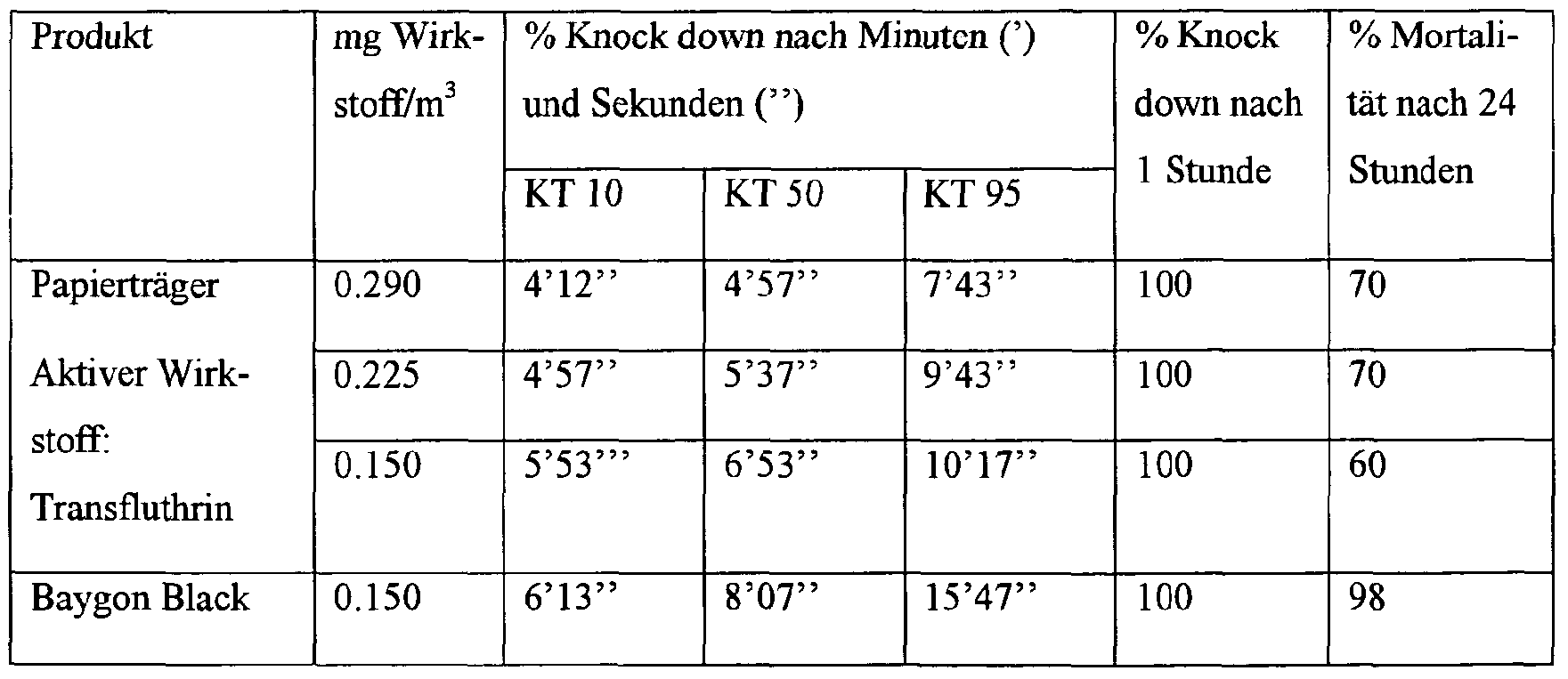
- Aerosol efficiency of impregnated paper supports (according to the invention) to Baygon rings in 1 m 3 chambers of given yellow fever triggers mosquitoes Culex quinquefasciatus strain BioGenius 05, sensitive
- Test insecticides 1. Aedes aegypti, strain BioGenius 04 prone, 3 days old, different sex
- Wire basket length 8.5 cm, 0 8 cm
- Plastic cup 0 9,5 cm, height 4,5 cm
- test papers are prepared by impregnation with the following quantities of a solution containing 3 mg of transfluitn in 1 ml of acetone
- the floor consists of unglazed tiles.
- a ring is placed in a glass bowl, which is mounted on a stand at a height of 0.5 m in the middle of the room.
- the ring is fixed to a commercial ring holder and ignited at one end.
- a fan (diameter 0.2m) with upturned wings is located below the bowl and rotates at level 1 for the entire test time (details: see above).
- Aerosol efficiency of impregnated paper carriers in 20 m 3 rooms against yellow fever triggering mosquitoes Aedes aegypti strain BioGenius 04, sensitive
- Aerosol efficiency of impregnated paper carriers (according to the invention in 1 m 3 chambers against yellow fever triggers mosquito Culex quinquefasciatus strain BioGenius 05, sensitive
- test specimens are inserted into the clamp provided for this purpose. It must be ensured that the test specimen is aligned so that there is no contact with other surfaces, such as the floor or drip trays, which adversely affect the course of the test (annealing of the test specimen)
- test sample is placed in the test chamber (1 m 3 or 20 m 3 ) and positioned so that the test pattern can be observed during the entire test phase.
- a fan can optionally be used to simulate air circulation (positioning V in Figure 3)
- the test specimen is ignited with a lighter until a visible flame is produced. The flame is immediately blown out so that the test specimen can continue to burn independently.
- the stopwatch is switched on to determine the glow duration of the test specimen It is important to check whether
- the measurement is carried out at least three times
- the paper intended for the pretreatment is cut to DIN A 4 size and clearly marked with the corresponding development number.
- the DIN A 4 paper sheet is exactly balanced (net weight)
- aqueous 6% strength KNO 3 solution 500 g are prepared. Care should be taken to use the deionized water for the preparation of the solution.
- the finished solution is marked with the appropriate development number and placed in a V4A dish with a total volume of approx 1 1 transferred
- the paper is immersed in the 6% KNO 3 solution It is important to ensure that the entire DIN A 4 paper sheet is immersed in the solution After 20 minutes, the paper sheet is removed from the solution and pressed directly over a photo roller chair to the excess To print out liquid from the paper
- the paper sheet After pressing, the paper sheet is dried in a drying oven (at about 50 ° C.) to constant mass and again weighed exactly (gross weight)
- the finished pre-treated paper sheet is cut into test pattern strips of 12 x 2 cm and marked accordingly
- test pattern strip With an Eppendorf pipette, a defined volume of the active ingredient solution is added to the test pattern strip. Care should be taken that the total quantity is evenly distributed on the surface.
- the impregnated test strip is marked with the corresponding development number and wrapped in aluminum foil air-tight. After 24 h exposure time It is important that a sufficient quantity per sample strip is produced to carry out the intended tests, such as biological proofs of effects and accompanying analytical tests. Test samples which are used at a later date are kept in the refrigerator
- Sugar water 10% granulated sugar (Pfeiffer & Langen) in tap water Test room 20 m 3 room with equipment, glass bowl with a holding device for a coil, fan
- test insects include (age 3 to 4 days) in the test space, starting from distributed to the ground to a height of 1.80 m and 0.45 m from each side at positions A, B and C (see Figure 1)
- a ring is placed in a glass dish, which is mounted at a height of 0.5 m in the middle of the room on a stand
- the ring is fixed to a commercial ring holder and ignited at one end
- a fan (diameter 0.2 m) with on- warts oriented wings is located below the bowl and rotates at level 1 for the entire trial period.
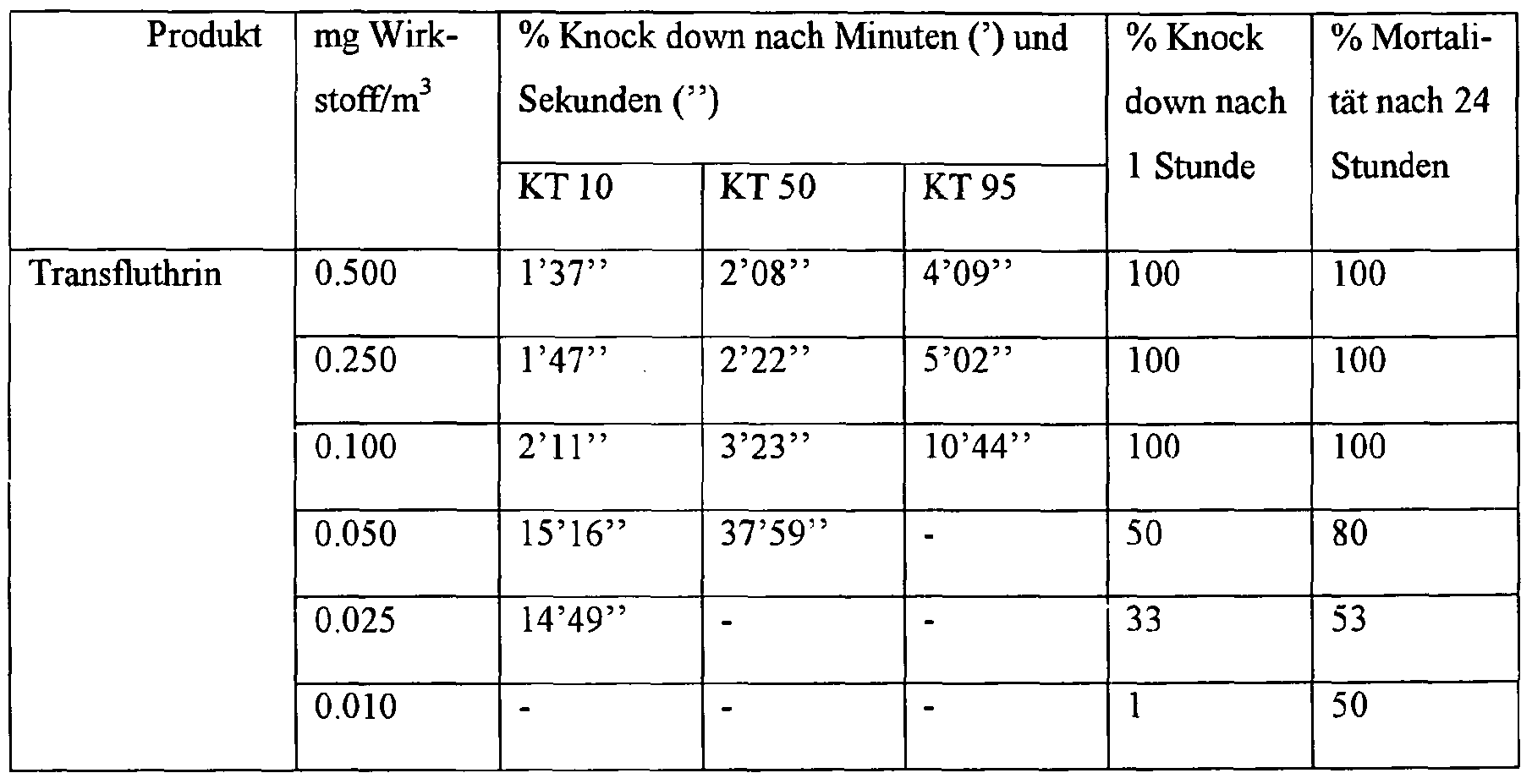
- the time is determined in which 10%, 50% and 95% of the insects are killed (KT 10, KT 50 and KT 95).
- the test insects remained in the room for 60 minutes. Then the final number of insects killed was determined. All insects are removed from the containers and transferred to an insecticide-free transparent plastic container. The cups are sealed with perforated lids and coated with cellulose swabs soaked in 10% sugar solution. After the insects have been kept in this insecticide-free atmosphere for 24 hours, the mortality is determined.
- the mosquitoes are kept in cages (48 x 48 x 39 cm) with gauze inserts on the sides and in the lid
- the lighting (day / night rhythm) is controlled by a timer (12 hours light / 12 hours dark), at a temperature of 26 0 C ⁇ 1 0 C and a relative humidity of 60% ⁇ 10%
- a cotton ball soaked in a 10% dextrose solution is placed in the box.
- Artificial blood feeding is carried out twice a week Bovine blood mixed with a blood glucose inhibitor. is heated by means of a Magnetruhrers to 4O 0 C Ca 50 ml of this blood is filled in a piece of pig's intestine and subsequently The eggs are then stored in the breeding box.
- Ornamental fish dry food eg Vita® fed After about 6 days, the pupal stage is reached These are, with a small amount of water, to slip the mosquitoes, in 10 liter plastic bucket überbowt the resulting slipping Mucken can then be intercepted for examinations or for further breeding
- the mosquitoes are kept in cages (48 x 48 x 39 cm) with gauze inserts on the sides and in the lid.
- the lighting (day / night rhythm) is controlled by a certifier clock (12 hours light / 12 hours dark), at a temperature of 26 ° C ⁇ 1 0 C and a relative humidity of 60% ⁇ 10% for receiving liquid is provided to the Mucken a in 10% dextrose solution soaked cotton wool ball into the box an artificial blood feeding is once a week performed bovine blood, mixed with a Blutge ⁇ nnungshemmungsmitteL is heated by means of a Magnetruhrers to 4O 0 C Ca 50 ml of this blood is filled in a piece of pig intestines, and then placed into the breeding box Thereby the Mucken the Blutaufhahme allows to lay eggs are m-shells (250 ml), the smd half filled with tap water , Placed 10 cm high filter paper rolls After oviposition these rolls are stored in plastic buckets To dry out To prevent the
- Test insecticides Aedes aegypti, strain BioGenius 04 anfalbg, 3 days old, different sex
- Plastic cup 0 9.5 cm, height 4.5 cm
- a certain amount of the active ingredient is dissolved in 2 cm 3 of acetone and sprayed onto the bottom of the chamber It is determined the time in which 10%, 50% and 95% of the insects are killed (KT 10, KT 50 and KT 95) The test insects remained in the chambers for 60 minutes Then the final number of insects killed was determined All insects are removed from the containers and transferred to an insecticide-free transparent plastic container. The cups are closed with perforated lids and coated with cellulose swabs soaked in 10% sugar solution. After 24 hours, the insects are free of insecticide Atmosphere were stored, the mortality is determined
- Aerosol efficiency m 1 m 3 chambers against yellow fever triggers mosquito Aedes aegypti, strain BioGenius 04, sensitive
Landscapes
- Life Sciences & Earth Sciences (AREA)
- Health & Medical Sciences (AREA)
- Pest Control & Pesticides (AREA)
- General Health & Medical Sciences (AREA)
- Wood Science & Technology (AREA)
- Engineering & Computer Science (AREA)
- Zoology (AREA)
- Environmental Sciences (AREA)
- Dentistry (AREA)
- Plant Pathology (AREA)
- Agronomy & Crop Science (AREA)
- Toxicology (AREA)
- Insects & Arthropods (AREA)
- Agricultural Chemicals And Associated Chemicals (AREA)
- Catching Or Destruction (AREA)
- Paper (AREA)
Abstract
Description



Claims
Priority Applications (9)
| Application Number | Priority Date | Filing Date | Title |
|---|---|---|---|
| PH1/2014/500398A PH12014500398B1 (en) | 2006-05-17 | 2007-05-09 | Paper impregnated with insecticidal substances |
| JP2009510323A JP5126752B2 (ja) | 2006-05-17 | 2007-05-09 | 殺虫剤を含浸させた紙 |
| MX2008014470A MX2008014470A (es) | 2006-05-17 | 2007-05-09 | Papel impregnado con principios activos insecticidas. |
| BRPI0712067A BRPI0712067B1 (pt) | 2006-05-17 | 2007-05-09 | dispositivo para combate de insetos que compreende um suporte incandescível de papel, seu uso e seu processo de preparação |
| BR122016001304A BR122016001304B1 (pt) | 2006-05-17 | 2007-05-09 | dispositivo para combate de insetos, que compreende um suporte incandescível, seu uso e seu processo de preparação |
| RU2008149431/13A RU2450517C9 (ru) | 2006-05-17 | 2007-05-09 | Бумага, пропитанная инсектицидными действующими веществами |
| KR1020087030631A KR101395745B1 (ko) | 2006-05-17 | 2007-05-09 | 살충제가 함침된 종이 |
| TNP2008000434A TNSN08434A1 (en) | 2006-05-17 | 2008-10-27 | Paper impregnated with insecticides |
| ZA2008/09648A ZA200809648B (en) | 2006-05-17 | 2008-11-12 | Paper impregnated with insecticides |
Applications Claiming Priority (2)
| Application Number | Priority Date | Filing Date | Title |
|---|---|---|---|
| DE102006023413.8 | 2006-05-17 | ||
| DE102006023413A DE102006023413A1 (de) | 2006-05-17 | 2006-05-17 | Mit insektiziden Wirkstoffen getränktes Papier |
Publications (3)
| Publication Number | Publication Date |
|---|---|
| WO2007131679A2 true WO2007131679A2 (de) | 2007-11-22 |
| WO2007131679A3 WO2007131679A3 (de) | 2008-12-04 |
| WO2007131679A8 WO2007131679A8 (de) | 2009-01-29 |
Family
ID=38606657
Family Applications (1)
| Application Number | Title | Priority Date | Filing Date |
|---|---|---|---|
| PCT/EP2007/004091 Ceased WO2007131679A2 (de) | 2006-05-17 | 2007-05-09 | Mit insektiziden wirkstoffen getränktes papier |
Country Status (18)
| Country | Link |
|---|---|
| JP (2) | JP5126752B2 (de) |
| KR (1) | KR101395745B1 (de) |
| CN (2) | CN104686490B (de) |
| AP (1) | AP2962A (de) |
| BR (2) | BRPI0712067B1 (de) |
| DE (1) | DE102006023413A1 (de) |
| GT (1) | GT200800247A (de) |
| MA (1) | MA31647B1 (de) |
| MX (1) | MX2008014470A (de) |
| MY (1) | MY157994A (de) |
| PH (1) | PH12014500398B1 (de) |
| RU (2) | RU2585849C9 (de) |
| SG (1) | SG171685A1 (de) |
| TN (1) | TNSN08434A1 (de) |
| TR (2) | TR201105731T2 (de) |
| TW (1) | TWI404502B (de) |
| WO (1) | WO2007131679A2 (de) |
| ZA (1) | ZA200809648B (de) |
Cited By (4)
| Publication number | Priority date | Publication date | Assignee | Title |
|---|---|---|---|---|
| WO2013171199A1 (de) | 2012-05-16 | 2013-11-21 | Bayer Cropscience Ag | Insektizide wasser-in-öl (w/o) formulierung |
| WO2013171201A1 (de) | 2012-05-16 | 2013-11-21 | Bayer Cropscience Ag | Insektizide öl-in-wasser (o/w) formulierung |
| WO2015004194A1 (en) | 2013-07-12 | 2015-01-15 | Bayer Cropscience Ag | Improved insecticidal water-in-oil (w/o) formulation |
| EP3014994A4 (de) * | 2013-06-26 | 2016-12-28 | Sumitomo Chemical Co | Mikrokapseln zur thermischen transpiration |
Families Citing this family (10)
| Publication number | Priority date | Publication date | Assignee | Title |
|---|---|---|---|---|
| US9999218B2 (en) | 2011-10-04 | 2018-06-19 | 0903608 B.C. Ltd. | Pest control formulations and methods of making and using same |
| JP6145098B2 (ja) | 2011-10-04 | 2017-06-07 | 0903608 ビー シー リミテッド | 有害生物防除配合物並びにその製造方法及び使用 |
| JP6247540B2 (ja) * | 2013-01-11 | 2017-12-13 | 大日本除蟲菊株式会社 | 蚊取線香 |
| JP5571265B1 (ja) * | 2013-02-28 | 2014-08-13 | 大日本除蟲菊株式会社 | 香り付き防虫剤、香り付き防虫器、及び香り付き防虫剤の製造方法 |
| KR101408930B1 (ko) | 2013-03-19 | 2014-06-18 | 박병문 | 포장용 판지의 제조방법 |
| WO2015071890A1 (en) | 2013-11-18 | 2015-05-21 | 0903608 B.C. Ltd. | Compositions, devices and methods for control of pests using vapor activity |
| JP6469471B2 (ja) * | 2015-02-16 | 2019-02-13 | 株式会社グローバル プロダクト プランニング | 香料含有シート並びにその製造方法 |
| CN108535243B (zh) * | 2018-03-26 | 2020-12-01 | 北京普赞生物技术有限公司 | 一种氰化物快速检测用显色试纸及其制备及检测方法 |
| RU2704443C1 (ru) * | 2019-04-05 | 2019-10-28 | Общество с ограниченной ответственностью "ГЕОАЛСЕР" | Инсектицидная композиция |
| JP2023168004A (ja) * | 2022-05-13 | 2023-11-24 | 株式会社ユポ・コーポレーション | 積層フィルムの製造方法 |
Family Cites Families (18)
| Publication number | Priority date | Publication date | Assignee | Title |
|---|---|---|---|---|
| GB190022207A (en) * | 1900-12-06 | 1901-02-16 | William Edward Darlington | An Improved Fumigating Device for Destroying Insects and the like. |
| GB589285A (en) * | 1944-03-27 | 1947-06-17 | Andrew Guest | Improvements in or relating to methods of fumigation and materials therefor |
| FR992736A (fr) * | 1944-08-18 | 1951-10-22 | Le Fly Tox | Produit fumigène pour la destruction des insectes et de leurs larves |
| ES200432A1 (es) * | 1951-11-06 | 1952-03-16 | Ind Marca S A | PROCEDIMIENTO PARA LA FABRICACIoN DE PAPELES PARA FUMIGACIONES INSECTICIDAS. |
| GB727577A (en) * | 1951-11-14 | 1955-04-06 | Frederick William Sutton | Improvements in or relating to devices for distributing insecticidal compositions |
| ES201814A1 (es) * | 1952-02-08 | 1952-10-16 | Antonio Gaubet S A | PROCEDIMIENTO PARA LA FABRICACIoN DE UNA PASTA PARA DESTRUCCIoN DE INSECTOS POR CONTACTO Y FUMIGACIoN |
| BE644414A (de) * | 1963-02-27 | 1964-06-15 | ||
| CH437904A (de) * | 1964-03-13 | 1967-06-15 | Agripat Sa | Schädlingsbekämpfungsmittel |
| IL52973A (en) * | 1976-10-01 | 1983-10-31 | American Cyanamid Co | Alpha-(haloalkoxy and haloalkyl-thiophenyl)alkanoic acid ester derivatives,their preparation and insecticidal and acaricidal compositions containing them |
| JPS62204756A (ja) * | 1986-03-04 | 1987-09-09 | 大研医工株式会社 | 薬剤揮散方法および装置 |
| JPH05262602A (ja) * | 1992-03-21 | 1993-10-12 | Inoue Denki Kk | 薬剤気化材および薬剤気化材を収納する容器 |
| DE4209921A1 (de) * | 1992-03-27 | 1993-09-30 | Bayer Ag | Moskito-Coil sowie Verfahren zum Herstellen von Moskito-Coils |
| JP3465300B2 (ja) * | 1993-05-18 | 2003-11-10 | カシオ計算機株式会社 | 薬剤カートリッジ及びこれを用いた蒸散装置 |
| MX9701004A (es) * | 1994-08-08 | 1998-05-31 | Earth Chemical Co | Metodo de control de plagas de insectos. |
| ID22612A (id) * | 1998-05-28 | 1999-12-02 | Sumitomo Chemical Co | Metode dan alat untuk mengendalikan hama |
| GB9915085D0 (en) * | 1999-06-29 | 1999-08-25 | Raman Boards Limited | An insect repellant device |
| GB0020622D0 (en) | 2000-08-22 | 2000-10-11 | Reckitt Benckiser Au Pty Ltd | A device |
| US7138130B2 (en) * | 2003-01-30 | 2006-11-21 | S.C. Johnson & Son, Inc. | Substrate for volatile delivery systems |
-
2006
- 2006-05-17 DE DE102006023413A patent/DE102006023413A1/de not_active Ceased
-
2007
- 2007-04-20 TW TW096114162A patent/TWI404502B/zh active
- 2007-05-09 JP JP2009510323A patent/JP5126752B2/ja active Active
- 2007-05-09 WO PCT/EP2007/004091 patent/WO2007131679A2/de not_active Ceased
- 2007-05-09 SG SG201103417-0A patent/SG171685A1/en unknown
- 2007-05-09 MX MX2008014470A patent/MX2008014470A/es active IP Right Grant
- 2007-05-09 RU RU2011147995A patent/RU2585849C9/ru active
- 2007-05-09 CN CN201410567921.6A patent/CN104686490B/zh active Active
- 2007-05-09 TR TR2011/05731T patent/TR201105731T2/xx unknown
- 2007-05-09 AP AP2008004666A patent/AP2962A/xx active
- 2007-05-09 CN CNA2007800006646A patent/CN101448394A/zh active Pending
- 2007-05-09 BR BRPI0712067A patent/BRPI0712067B1/pt active IP Right Grant
- 2007-05-09 PH PH1/2014/500398A patent/PH12014500398B1/en unknown
- 2007-05-09 MY MYPI20084617A patent/MY157994A/en unknown
- 2007-05-09 KR KR1020087030631A patent/KR101395745B1/ko not_active Expired - Fee Related
- 2007-05-09 BR BR122016001304A patent/BR122016001304B1/pt active IP Right Grant
- 2007-05-09 RU RU2008149431/13A patent/RU2450517C9/ru active
- 2007-05-09 TR TR2008/08659T patent/TR200808659T1/xx unknown
-
2008
- 2008-10-27 TN TNP2008000434A patent/TNSN08434A1/en unknown
- 2008-11-12 ZA ZA2008/09648A patent/ZA200809648B/en unknown
- 2008-11-14 GT GT200800247A patent/GT200800247A/es unknown
- 2008-12-05 MA MA31454A patent/MA31647B1/fr unknown
-
2012
- 2012-10-19 JP JP2012231660A patent/JP5373954B2/ja active Active
Cited By (8)
| Publication number | Priority date | Publication date | Assignee | Title |
|---|---|---|---|---|
| WO2013171199A1 (de) | 2012-05-16 | 2013-11-21 | Bayer Cropscience Ag | Insektizide wasser-in-öl (w/o) formulierung |
| WO2013171201A1 (de) | 2012-05-16 | 2013-11-21 | Bayer Cropscience Ag | Insektizide öl-in-wasser (o/w) formulierung |
| US20150098975A1 (en) * | 2012-05-16 | 2015-04-09 | Bayer Cropscience Ag | Insecticidal water-in-oil (w/o) formulation |
| US10104884B2 (en) | 2012-05-16 | 2018-10-23 | Bayer Cropscience Ag | Insecticidal water-in-oil (W/O) formulation |
| EP2849562B1 (de) * | 2012-05-16 | 2019-03-06 | Bayer CropScience AG | Insektizide öl-in-wasser (o/w) formulierung |
| EP2849563B1 (de) * | 2012-05-16 | 2020-01-22 | Bayer CropScience AG | Insektizide wasser-in-öl (w/o) formulierung |
| EP3014994A4 (de) * | 2013-06-26 | 2016-12-28 | Sumitomo Chemical Co | Mikrokapseln zur thermischen transpiration |
| WO2015004194A1 (en) | 2013-07-12 | 2015-01-15 | Bayer Cropscience Ag | Improved insecticidal water-in-oil (w/o) formulation |
Also Published As
Similar Documents
| Publication | Publication Date | Title |
|---|---|---|
| WO2007131679A2 (de) | Mit insektiziden wirkstoffen getränktes papier | |
| JP2009537122A5 (de) | ||
| JP6965394B2 (ja) | 害虫防除製品、及び害虫防除方法 | |
| EP1996015B1 (de) | Köder auf invertzuckersirup basis | |
| CN101686659A (zh) | 保护原木堆防止木材害虫侵袭的方法 | |
| JP2916951B2 (ja) | 農薬含有くん煙剤及びその製造方法 | |
| JP5204399B2 (ja) | 食品害虫忌避剤 | |
| KR960005161B1 (ko) | 약제 서방성수지 성형체 | |
| DE3628091A1 (de) | Mittel, insbesondere zur verbreitung von pheromonen | |
| TW200803725A (en) | Nicotinyls, pyrethroids and ketoenols as gel or foam formulation for perennial crops | |
| AU2016227020A1 (en) | Water-based insecticidal composition to be vaporized and diffused by being heated, and method for vaporizing and diffusing said composition by heating | |
| JP2002020352A (ja) | フルオロベンジルアルコールエステル誘導体、その製造法、及びこれを含有する殺虫、防虫剤。 | |
| JPH0624923A (ja) | クロゴキブリの誘引剤 | |
| JP2000154107A (ja) | 衣料害虫防除剤 | |
| CN121420997A (zh) | 一种具有驱蚊效果的组合物及其制备方法 | |
| JP2008024670A (ja) | 害虫駆除剤 | |
| JPH0751484B2 (ja) | スギノアカネトラカミキリ誘引剤 | |
| DE102007013360A1 (de) | Penetrationsförderer für insektizide Wirkstoffe | |
| JPH08133917A (ja) | ゴキブリ誘引殺虫剤 | |
| JPH10316506A (ja) | 加熱蒸散式害虫駆除剤およびそれを利用した害虫駆除方法 | |
| JPH11322508A (ja) | 加熱蒸散式害虫駆除剤及びそれを利用した害虫駆除方法 | |
| JP2005082559A5 (de) | ||
| GB2256140A (en) | Rodent destroying composition | |
| JPS6318562B2 (de) |
Legal Events
| Date | Code | Title | Description |
|---|---|---|---|
| WWE | Wipo information: entry into national phase |
Ref document number: 200780000664.6 Country of ref document: CN |
|
| 121 | Ep: the epo has been informed by wipo that ep was designated in this application |
Ref document number: 07725014 Country of ref document: EP Kind code of ref document: A2 |
|
| WWE | Wipo information: entry into national phase |
Ref document number: MX/A/2008/014470 Country of ref document: MX |
|
| WWE | Wipo information: entry into national phase |
Ref document number: 12008502525 Country of ref document: PH |
|
| WWE | Wipo information: entry into national phase |
Ref document number: 2009510323 Country of ref document: JP Ref document number: 2008/08659 Country of ref document: TR |
|
| WWE | Wipo information: entry into national phase |
Ref document number: DZP2008000664 Country of ref document: DZ |
|
| NENP | Non-entry into the national phase |
Ref country code: DE |
|
| WWE | Wipo information: entry into national phase |
Ref document number: 08122488A Country of ref document: CO |
|
| WWE | Wipo information: entry into national phase |
Ref document number: 1020087030631 Country of ref document: KR |
|
| WWE | Wipo information: entry into national phase |
Ref document number: 2008149431 Country of ref document: RU |
|
| 122 | Ep: pct application non-entry in european phase |
Ref document number: 07725014 Country of ref document: EP Kind code of ref document: A2 |
|
| WWE | Wipo information: entry into national phase |
Ref document number: 2011/05731 Country of ref document: TR |
|
| ENP | Entry into the national phase |
Ref document number: PI0712067 Country of ref document: BR Kind code of ref document: A2 Effective date: 20081117 |