WO2007135435A2 - Wood preservative formulations - Google Patents
Wood preservative formulations Download PDFInfo
- Publication number
- WO2007135435A2 WO2007135435A2 PCT/GB2007/001919 GB2007001919W WO2007135435A2 WO 2007135435 A2 WO2007135435 A2 WO 2007135435A2 GB 2007001919 W GB2007001919 W GB 2007001919W WO 2007135435 A2 WO2007135435 A2 WO 2007135435A2
- Authority
- WO
- WIPO (PCT)
- Prior art keywords
- formulation
- compound
- carbon atoms
- amine oxide
- formula
- Prior art date
- Legal status (The legal status is an assumption and is not a legal conclusion. Google has not performed a legal analysis and makes no representation as to the accuracy of the status listed.)
- Ceased
Links
Classifications
-
- A—HUMAN NECESSITIES
- A01—AGRICULTURE; FORESTRY; ANIMAL HUSBANDRY; HUNTING; TRAPPING; FISHING
- A01N—PRESERVATION OF BODIES OF HUMANS OR ANIMALS OR PLANTS OR PARTS THEREOF; BIOCIDES, e.g. AS DISINFECTANTS, AS PESTICIDES OR AS HERBICIDES; PEST REPELLANTS OR ATTRACTANTS; PLANT GROWTH REGULATORS
- A01N43/00—Biocides, pest repellants or attractants, or plant growth regulators containing heterocyclic compounds
- A01N43/64—Biocides, pest repellants or attractants, or plant growth regulators containing heterocyclic compounds having rings with three nitrogen atoms as the only ring hetero atoms
- A01N43/647—Triazoles; Hydrogenated triazoles
- A01N43/653—1,2,4-Triazoles; Hydrogenated 1,2,4-triazoles
-
- A—HUMAN NECESSITIES
- A01—AGRICULTURE; FORESTRY; ANIMAL HUSBANDRY; HUNTING; TRAPPING; FISHING
- A01N—PRESERVATION OF BODIES OF HUMANS OR ANIMALS OR PLANTS OR PARTS THEREOF; BIOCIDES, e.g. AS DISINFECTANTS, AS PESTICIDES OR AS HERBICIDES; PEST REPELLANTS OR ATTRACTANTS; PLANT GROWTH REGULATORS
- A01N33/00—Biocides, pest repellants or attractants, or plant growth regulators containing organic nitrogen compounds
- A01N33/02—Amines; Quaternary ammonium compounds
- A01N33/12—Quaternary ammonium compounds
-
- A—HUMAN NECESSITIES
- A01—AGRICULTURE; FORESTRY; ANIMAL HUSBANDRY; HUNTING; TRAPPING; FISHING
- A01N—PRESERVATION OF BODIES OF HUMANS OR ANIMALS OR PLANTS OR PARTS THEREOF; BIOCIDES, e.g. AS DISINFECTANTS, AS PESTICIDES OR AS HERBICIDES; PEST REPELLANTS OR ATTRACTANTS; PLANT GROWTH REGULATORS
- A01N33/00—Biocides, pest repellants or attractants, or plant growth regulators containing organic nitrogen compounds
- A01N33/16—Biocides, pest repellants or attractants, or plant growth regulators containing organic nitrogen compounds containing nitrogen-to-oxygen bonds
- A01N33/24—Biocides, pest repellants or attractants, or plant growth regulators containing organic nitrogen compounds containing nitrogen-to-oxygen bonds only one oxygen atom attached to the nitrogen atom
-
- A—HUMAN NECESSITIES
- A01—AGRICULTURE; FORESTRY; ANIMAL HUSBANDRY; HUNTING; TRAPPING; FISHING
- A01N—PRESERVATION OF BODIES OF HUMANS OR ANIMALS OR PLANTS OR PARTS THEREOF; BIOCIDES, e.g. AS DISINFECTANTS, AS PESTICIDES OR AS HERBICIDES; PEST REPELLANTS OR ATTRACTANTS; PLANT GROWTH REGULATORS
- A01N43/00—Biocides, pest repellants or attractants, or plant growth regulators containing heterocyclic compounds
- A01N43/48—Biocides, pest repellants or attractants, or plant growth regulators containing heterocyclic compounds having rings with two nitrogen atoms as the only ring hetero atoms
- A01N43/50—1,3-Diazoles; Hydrogenated 1,3-diazoles
-
- A—HUMAN NECESSITIES
- A01—AGRICULTURE; FORESTRY; ANIMAL HUSBANDRY; HUNTING; TRAPPING; FISHING
- A01N—PRESERVATION OF BODIES OF HUMANS OR ANIMALS OR PLANTS OR PARTS THEREOF; BIOCIDES, e.g. AS DISINFECTANTS, AS PESTICIDES OR AS HERBICIDES; PEST REPELLANTS OR ATTRACTANTS; PLANT GROWTH REGULATORS
- A01N43/00—Biocides, pest repellants or attractants, or plant growth regulators containing heterocyclic compounds
- A01N43/72—Biocides, pest repellants or attractants, or plant growth regulators containing heterocyclic compounds having rings with nitrogen atoms and oxygen or sulfur atoms as ring hetero atoms
- A01N43/74—Biocides, pest repellants or attractants, or plant growth regulators containing heterocyclic compounds having rings with nitrogen atoms and oxygen or sulfur atoms as ring hetero atoms five-membered rings with one nitrogen atom and either one oxygen atom or one sulfur atom in positions 1,3
- A01N43/76—1,3-Oxazoles; Hydrogenated 1,3-oxazoles
-
- A—HUMAN NECESSITIES
- A01—AGRICULTURE; FORESTRY; ANIMAL HUSBANDRY; HUNTING; TRAPPING; FISHING
- A01N—PRESERVATION OF BODIES OF HUMANS OR ANIMALS OR PLANTS OR PARTS THEREOF; BIOCIDES, e.g. AS DISINFECTANTS, AS PESTICIDES OR AS HERBICIDES; PEST REPELLANTS OR ATTRACTANTS; PLANT GROWTH REGULATORS
- A01N43/00—Biocides, pest repellants or attractants, or plant growth regulators containing heterocyclic compounds
- A01N43/72—Biocides, pest repellants or attractants, or plant growth regulators containing heterocyclic compounds having rings with nitrogen atoms and oxygen or sulfur atoms as ring hetero atoms
- A01N43/74—Biocides, pest repellants or attractants, or plant growth regulators containing heterocyclic compounds having rings with nitrogen atoms and oxygen or sulfur atoms as ring hetero atoms five-membered rings with one nitrogen atom and either one oxygen atom or one sulfur atom in positions 1,3
- A01N43/78—1,3-Thiazoles; Hydrogenated 1,3-thiazoles
-
- A—HUMAN NECESSITIES
- A01—AGRICULTURE; FORESTRY; ANIMAL HUSBANDRY; HUNTING; TRAPPING; FISHING
- A01N—PRESERVATION OF BODIES OF HUMANS OR ANIMALS OR PLANTS OR PARTS THEREOF; BIOCIDES, e.g. AS DISINFECTANTS, AS PESTICIDES OR AS HERBICIDES; PEST REPELLANTS OR ATTRACTANTS; PLANT GROWTH REGULATORS
- A01N47/00—Biocides, pest repellants or attractants, or plant growth regulators containing organic compounds containing a carbon atom not being member of a ring and having no bond to a carbon or hydrogen atom, e.g. derivatives of carbonic acid
- A01N47/08—Biocides, pest repellants or attractants, or plant growth regulators containing organic compounds containing a carbon atom not being member of a ring and having no bond to a carbon or hydrogen atom, e.g. derivatives of carbonic acid the carbon atom having one or more single bonds to nitrogen atoms
- A01N47/10—Carbamic acid derivatives, i.e. containing the group —O—CO—N<; Thio analogues thereof
- A01N47/12—Carbamic acid derivatives, i.e. containing the group —O—CO—N<; Thio analogues thereof containing a —O—CO—N< group, or a thio analogue thereof, neither directly attached to a ring nor the nitrogen atom being a member of a heterocyclic ring
-
- A—HUMAN NECESSITIES
- A01—AGRICULTURE; FORESTRY; ANIMAL HUSBANDRY; HUNTING; TRAPPING; FISHING
- A01N—PRESERVATION OF BODIES OF HUMANS OR ANIMALS OR PLANTS OR PARTS THEREOF; BIOCIDES, e.g. AS DISINFECTANTS, AS PESTICIDES OR AS HERBICIDES; PEST REPELLANTS OR ATTRACTANTS; PLANT GROWTH REGULATORS
- A01N47/00—Biocides, pest repellants or attractants, or plant growth regulators containing organic compounds containing a carbon atom not being member of a ring and having no bond to a carbon or hydrogen atom, e.g. derivatives of carbonic acid
- A01N47/08—Biocides, pest repellants or attractants, or plant growth regulators containing organic compounds containing a carbon atom not being member of a ring and having no bond to a carbon or hydrogen atom, e.g. derivatives of carbonic acid the carbon atom having one or more single bonds to nitrogen atoms
- A01N47/28—Ureas or thioureas containing the groups >N—CO—N< or >N—CS—N<
- A01N47/38—Ureas or thioureas containing the groups >N—CO—N< or >N—CS—N< containing the group >N—CO—N< where at least one nitrogen atom is part of a heterocyclic ring; Thio analogues thereof
-
- B—PERFORMING OPERATIONS; TRANSPORTING
- B27—WORKING OR PRESERVING WOOD OR SIMILAR MATERIAL; NAILING OR STAPLING MACHINES IN GENERAL
- B27K—PROCESSES, APPARATUS OR SELECTION OF SUBSTANCES FOR IMPREGNATING, STAINING, DYEING, BLEACHING OF WOOD OR SIMILAR MATERIALS, OR TREATING OF WOOD OR SIMILAR MATERIALS WITH PERMEANT LIQUIDS, NOT OTHERWISE PROVIDED FOR; CHEMICAL OR PHYSICAL TREATMENT OF CORK, CANE, REED, STRAW OR SIMILAR MATERIALS
- B27K3/00—Impregnating wood, e.g. impregnation pretreatment, for example puncturing; Wood impregnation aids not directly involved in the impregnation process
- B27K3/34—Organic impregnating agents
- B27K3/50—Mixtures of different organic impregnating agents
Definitions
- the present invention relates to formulations for protecting wood and other cellulosic substrates against moulds, staining and other defacing organisms, and in particular to antisapstain applications.
- Antisapstain chemicals are used to protect timber, in particular freshly felled or sawn timber, from attack by moulds, sapstain and decay fungi which would otherwise discolour the timber and so reduce its value.
- IPBC 3-iodo-2-propynyl-butyl-carbamate
- DDAC didecyldimethylammonium chloride
- BAC benzalkonium chloride
- borates such as Borax
- triazoles copper 8-hydroxyquinoline, alkyl amines and their salts, and fenpropimorph.
- an antisapstain composition comprising an amine oxide compound, an azole compound and compound of formula (I)
- the amine oxide is represented by the general formula (II) R 2
- R 1 , R 2 and R 3 are independent and can be hydrogen, optionally substituted poly (oxyalkylene) or a linear, branched, cyclic, aromatic or any combination thereof of a saturated or unsaturated, substituted or unsubstituted C 1 to C 40 group, preferably C 1 to C 20 , or alternatively R 2 and R 3 together form a substituted or unsubstituted cyclic group;
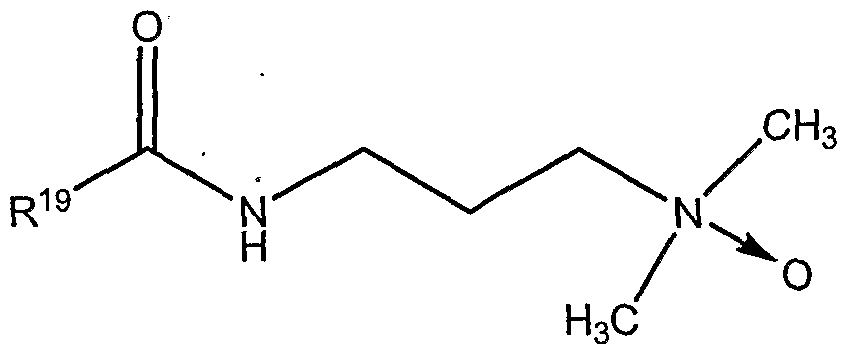
- the amine oxide compound may be a trialiphatic substitured amine oxide, an iV-alkylated cyclicamine oxide, a dialkylpiperazine di-N-oxide, an alkyldi (poly(oxyalkylene) ) amine oxide, a dialkylbenzylamine oxide, a fatty amidopropyldimethyl amine oxide, a diamine oxide, a triamine oxide, or any combination of any of the foregoing.
- the amine oxide includes at least one C 8 -C 18 alkyl moeity.
- Preferred trialiphatic substituted amine oxides are represented by the general formula (III)
- R 4 , R 5 and R 6 are independent and can be linear, branched, cyclic, aromatic or any combination thereof of a saturated or unsaturated C 1 to C 40 group wherein any of the carbon atoms other than those bound to the nitrogen atom shown in formula (III) may be replaced with a hetero atom, particularly oxygen, sulphur or nitrogen.
- R 4 , R 5 and R 6 independently may be alkyl, alkenyl, or alkynyl groups.
- R 4 is a linear, branched, cyclic or any combination thereof C 8 to C 22 saturated or unsaturated group, such as coco, hydrogenated tallow, soya, decyl, hexadecyl, and oleyl; and R 5 and R 6 independently are linear, branched, or any combination thereof C 1 to C 22 saturated or unsaturated groups, such as coco, hydrogenated tallow, soya, decyl, and hexadecyl .
- a preferred trialiphatic substituted amine oxide is dialkylmethylamine oxide having the formula R 4 R 5 CH 3 N-O, where R 4 and R 5 are defined as above.
- Another preferred trialiphatic substituted amine oxide is an alkyldimethylamine oxide having the formula R 4 (CH 3 ) 2 N-O, where R 4 is defined as above.
- More preferred alkyldimethylamine oxides have the formula R 22 (CH 3 ) 2 N--O, where R 22 is a linear or branched C 8 -C 18 alkyl or alkenyl.
- R 22 is a linear or branched C 8 -C 16 alkyl.
- Alkyldimethylamine oxides are non-toxic and non- mutagenic surfactants .
- Suitable alkyldimethylamine oxides include, but are not limited to, a C 10 alkyldimethylamine oxide, a C 10 -C 14 alkyldimethylamine oxide, a C 12 -C 16 alkyldimethylamine oxide, a C 16 -C 18 alkyldimethylamine oxide, and' any combination of any of the foregoing.
- Preferred iV-alkylated cyclicamine oxides have the formula R 7 R 8 R 9 N-O where R 7 is defined as R 4 above, and R 8 and R 9 are linked to form a cyclic group.
- the cyclic group typically contains from 4 to 10 carbon atoms and may optionally contain oxygen, sulphur, nitrogen, or any combination of any of the foregoing.
- More preferred JW- alkylated cyclicamine oxides include, but are not limited to, an alkylmorpholine N-oxide, a dialkylpiperazine di-JV-oxide, and any combination of any of the foregoing.
- Preferred alkylmorpholine JV-oxides have the general formula (IV) :
- R 10 is defined as R 4 above .
- R 10 is a linear or branched C 8 to C 16 alkyl .
- alkylmorpholine i ⁇ 7-oxides include, but are not limited to , cetyl morpholine N- oxide and lauryl morpholine JV-oxide .
- Preferred dialkylpiperazine di- ⁇ V-oxides have the general formula (V) :
- Preferred alkyldi (poly (oxyalkylene) ) amine oxides have the general formula (VI) :
- dialkylbenzylamine oxides have the formula R 16 R 17 R 18 N-O, where R 16 is defined as R 4 above; R 17 is defined as R 5 above; and R 18 is benzyl . More preferred dialkylbenzylamine oxides include, but are not limited to , alkylbenzylmethylamine oxides having the formula R 16 R 17 CH 3 N-O where R 16 and R 17 are defined as above .
- R 16 is a linear or branched C 8 -C 12 alkyl .
- Preferred fatty amidopropyldimethylamine oxides have the general formula (VII) :
- Preferred diamine oxides have the general formula (VIII) :
- Preferred triamine oxides have the general formula (IX) :
- amine oxides are alkyl dimethyl amine oxides such as decyl dimethyl amine oxide, lauryl dimethyl amine oxide, isoalkyl dimethyl amine oxide, myristyl dimethyl ethyl amine oxide, cetyl dimethyl amine oxide, stearyl dimethyl amine oxide and octyl dimethyl amine oxide.
- alkyl dimethyl amine oxides such as decyl dimethyl amine oxide, lauryl dimethyl amine oxide, isoalkyl dimethyl amine oxide, myristyl dimethyl ethyl amine oxide, cetyl dimethyl amine oxide, stearyl dimethyl amine oxide and octyl dimethyl amine oxide.
- a mixture of two or more amine oxides may be used, with a mixture, e.g. an equimolar mixture of C 12 -N,N-dimethylamine oxide and C 16 - N,N-dimethylamine oxide being especially preferred.
- the formulations of the present invention comprise one or more azole compounds, i.e. a compound comprising an azole group.
- the azole compound may be an imidazole or a 1, 2 , 4-triazole and is preferably represented by the general formula (X)
- X denotes C or N
- R 1 denotes hydrogen or a linear, branched, cyclic, aromatic or any combination thereof of a saturated or unsaturated, substituted or unsubstituted C 1 to C 40 group wherein any of the carbon atoms other than those bound to the nitrogen atom shown in formula (X) may be replaced with an optionally substituted hetero atom;
- R 2 denotes hydrogen, C 1 -C 8 alkyl, C 2 -C 8 alkenyl, C 6 -C 10 aromatic, C 5 -C 10 heteroaromatic or C 1 -C 4 alkyl carbamate;
- R 3 denotes hydrogen; or when X is C together with R 4 may provide a benzimidazole group.
- the imidazole compound incorporates a five-membered diunsaturated ring composed of three carbon atoms and two nitrogen atoms at non-adjacent positions.
- the imidazole compound may be a benzimidazole.
- Preferred compounds include thiabendazole, imazalil, carbendazim and prochloraz .
- the 1, 2, 4-triazole compound incorporates a five-membered diunsaturated ring composed of three nitrogen atoms and two carbon atoms at non-adjacent positions.
- Preferred triazole compounds include a triazole compound selected from compounds of formula (XI) :
- C 1-5 alkyl group e.g. t-butyl
- R represents a phenyl group optionally substituted by one or more substituents selected from halogen (e.g. chlorine, fluorine or bromine) atoms or C 1-3 alkyl (e.g. methyl), C 1-3 alkoxy (e.g. methoxy) , phenyl or nitro groups.
- halogen e.g. chlorine, fluorine or bromine
- C 1-3 alkyl e.g. methyl
- C 1-3 alkoxy e.g. methoxy
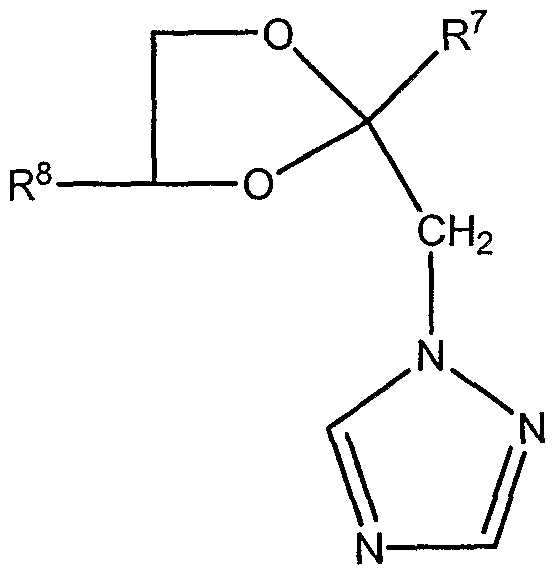
- the triazole compound is advantageously selected from compounds of formula (XII) :
- R 7 is as defined for R 6 above and R 8 represents a hydrogen atom or a branched or straight chain C 1-5 alkyl group (e.g. n-propyl) .
- triazoles include but are not limited to, triadimefon, triadimenol, triazbutil, propiconazole, cyproconazole, difenoconazole, fluquinconazole, tebuconazole, flusilazole, uniconazole, diniconazole, bitertanol, hexaconazole, azaconazole, flutriafol, epoxyconazole, tetraconazole, penconazole, and mixtures thereof.
- triazoles are propiconazole, azaconazole, hexaconazole, tebuconazole, cyproconazole, triadimefon and mixtures thereof .
- the compound of formula (I) may optionally be a quaternary ammonium compound, an amine or amine salt, a betaine or an amphoteric betaine compound.
- the linker group A is absent, the R 1 group is directly bonded to the nitrogen.
- the compound of formula (I) is positively charged, it is accompanied by an anion X " which is chosen to allow ready water solubility.
- suitable anions include chloride, bromide, sulphate, acetate, propionate, lactate, citrate, methosulphate, hydroxide, carbonate and bicarbonate.
- the compound of formula (I) may preferably be a quaternary ammonium compound, i.e. a compound derived from ammonium with all four hydrogen atoms replaced by organic groups and having the general formula (XIII) :
- quaternary ammonium compounds which may be used in the compositions and methods of the present invention, suitable compounds include: 1. Monoalkyltrimethyl ammonium salts of formula (XIV):
- R is an alkyl group having from 6 to 22 carbon atoms, preferably from 12 to 14 carbon atoms
- X " is an anion chosen to allow ready water solubility of the quaternary ammonium salt. Examples being : chloride, bromide, sulphate, acetate, propionate, lactate, citrate, methosulphate, carbonate and bicarbonate.
- Preferred examples include Cocotrimethyl ammonium chloride in which the alkyl group R consists of a mixture of predominantly C 12 and C 14 .
- R 1 and R 2 are alkyl groups which may be the same or different and which contain from 6 to 22 carbon atoms, preferably from 8 to 10 carbon atoms, and X " is an anion of the type previously described.
- Preferred examples include Didecyl dimethyl ammonium chloride, didecyl dimethyl ammonium carbonate, didecyl dimethyl ammonium bicarbonate, dioctyl dimethyl ammonium chloride and octyl decyl dimethyl ammonium chloride either individually or as a mixture containing two or three of these.
- R 1 and R 2 are alkyl groups which can be the same or different and which contain from 6 to 22 carbon atoms, preferably from 8 to 10 carbon atoms in a dialkyl compound and from 10 to 14 carbon atoms in a monoalkyl compound; R 3 is methyl or ethyl; R 4 , R 5 and R 6 are hydrogen or C 1-8 alkyl groups; and X " is an anion of the type previously described.
- Preferred examples include Coco benzyl dimethyl ammonium chloride and dicoco benzyl methyl ammonium chloride in which the alkyl groups are predominantly C 12 '
- R 1 and R 2 are alkyl groups which may be the same or different and which contain from 6 to 22 carbon atoms, preferably from 8 to 10 carbon atoms in a dialkyl compound and from 10 to 14 carbon atoms in a monoalkyl compound, most preferably 10 carbon atoms, .m is a number from 1 to 20 typically from 1 to 8, preferably from 3.to 5.
- X " is an anion of the type previously described, preferably propionate or lactate.
- Preferred examples include N,N-didecyl-N-methyl- poly (oxyethyl) ammonium propionate (Bardap 26) or N, N- didecyl-N-methyl-poly(oxyethyl) ammonium lactate.
- the compound of formula (I) may preferably be a betaine.
- Betaines are advantageous as they are amphoteric and hence remove the need to have a potentially corrosive counterion.
- the betaine is selected from the group consisting of coco amido propyl dimethyl betaine; cetyl betaine ( (carboxylatomethyl) hexadecyldimethylammonium) ; C12 amine dipropionate; and coco amido propyl dimethyl sultaine (cocoamidopropyl-N, N-dimethyl-N-2- hydroxypropyl sulfobetaine) .
- the compound of formula (I) may be a dimethylalkylamine or salt thereof.
- a dimethylalkylamine is an N,N-dimethyl-N-alkylamine where alkyl represents an alkyl chain with 6 to 20 carbon atoms , preferably 12 to 14 carbon atoms .
- alkyl represents an alkyl chain with 6 to 20 carbon atoms , preferably 12 to 14 carbon atoms .
- mixtures for example dimethyl-C 12 -alkylamine and dimethyl-C 14 alkylamine (dimethyl-C 12 /C 14 -alkylamine) .
- compositions typically comprise one or more further active ingredients .
- Halopropynyl compounds are particularly preferred examples of additional active ingredients .
- Preferred halopropynyl compounds are iodopropynyl carbamate compounds .
- the iodopropylnyl carbamate compound is an ester or salt of carbamic acid.
- This class of compounds includes compounds of the general formula (XX) :
- R is selected from the group consisting of hydrogen, substituted and unsubstituted alkyl groups having from 1 to 20 carbon atoms, substituted and unsubstituted aryl, alkyl aryl, and aralkyl groups having from 6 to 20 carbon atoms and from substituted and unsubstituted cycloalkyl and cycloalkenyl groups of 3 to 10 carbon atoms, and m and n are independently integers from 1 to 3, i.e., m and n are not necessarily the same.
- Preferred are compounds where in is 1 and n is 1 having the following formula (XXI) :
- Suitable R substituents include alkyls such as methyl, ethyl, propyl, n-butyl, t-butyl, pentyl, hexyl, heptyl, octyl, nonyl, decyl, dodecyl, octadecyl, cycloalkyls such as cyclohexyl, aryls, alkaryls and aralkyls such as phenyl, benzyl, tolyl, cumyl, halogena.ted alkyls and aryls, such as chlorobutryl and chlorophenyl, and alkoxy aryls such as ethoxyphenyl and the like.
- Compounds of this formula include iodopropargyl carbamates such as 3-iodo-2-propynyl propyl carbamate, 3-iodo-2-propynyl butyl carbamate, 3-iodo-2-propynyl hexyl carbamate, 3-iodo-2-propynyl cyclohexyl carbamate, 3-iodo-2 ⁇ propynyl phenyl carbamate, and mixtures thereof. Most preferred is 3-iodo-2-propynyl butyl carbamate (IPBC) .
- IPBC 3-iodo-2-propynyl butyl carbamate
- compositions comprise, in synergistic proportions, an azole compound, an amine oxide compound and a compound of formula (I) .
- amine oxide azole ratios of 4:1 to 1:20, preferably 4:1 to 1:10, preferably 2:1 to 1:5, more preferably 1.5:1 to 1:2.
- ratios of compound (I) to amine oxide have been identified and include compound (I) .-amine oxide ratios of greater than 2:1, preferably greater than 4:1, more preferably greater than 5:1 or
- 6:1 e.g. greater than 8:1 or 10:1, such as 2:1 to 100:1, or 2:1 to 50:1, or 4:1 to 30:1 preferably 10:1 to 25:1, preferably 15:1 to 25:1.
- compositions are those in which the compound of formula (I) is a quaternary ammonium compound.
- these formulations will have a quaternary ammonium compound: amine oxide ratio of greater than 2:1, preferably greater than 4:1, more preferably greater than 5:1 or 6:1 e.g. greater than 8 : 1 or 10:1, such as 2:1 to 50:1, or 4:1 to 30:1 preferably 10:1 to 25:1, preferably 15:1 to 25:1.
- Particularly effective ratios of compound (I) to azole have been identified and include compound (I) : azole ratios of greater than 2:1, preferably greater than 4:1, such as 2:1 to 20:1, or 3:1 to 15:1, or 4:1 to 12:1, preferably 5:1 to 10:1.
- Preferred formulations contain a mixture of azoles, preferably a mixture of 1, 2, 4-triazoles and imidazoles. Typically these formulations will have a triazole: imidazole ratio of 10:1 to 1:10, preferably
- 10:1 to 1:2 more preferably 10:1 to 1:1, most prefered is 10:1 to 2:1.
- the triazole: imidazole ratio is preferably 2:1 to 1:10, more preferably 1:1 to 1:10, most preferred being 1:2 to 1:10.
- C12 amine oxides are used, or alternatively a mixture of C12 and C16 amine oxides, preferably with a ratio of 3:1 to 1:3, preferably 2:1 to 1:2, most preferred is about 1:1.
- halopropynyl compound typically these formulations will have a halopropynyl : amine oxide ratio of 4:1 to 1:10, preferably 2:1 to 1:5, more preferably 1.5:1 to 1:2.
- the formulations have a preferred compound (I) to halopropynl compound ratio of 20:1 to 4:1, preferably 15:1 to 5:1, most preferably about 10:1. All of the above ratios refer to weight percent as a percentage of the total weight of the composition. Thus, a ratio of 1:1 will refer to two components being present in equal weight percents in a composition.
- especially preferred formulations according to the present invention comprise, an imidazole compound, an amine oxide compound, a triazole compound, a quaternary ammonium compound and a halopropylnyl compound, all as defined above and preferably at the ratios specified above.
- Suitable examples of such formulations include benzalkonium chloride or didecyldimethylammonium chloride or carbonate or bicarbonate, IPBC, propiconazole or tebuconazole, thiabendazole or imazalil and a C 16 and/or ' C 12 dimethyl amine oxide.
- Each of the ingredients are also preferred in their own right and may be combined with other ingredients to form further preferred formulations according to the invention.
- compositions according to the invention may additionally, comprise other active ingredients such as termiticides , insecticides, bacteriocid.es and other fungicides. Suitable additional fungicides would be apparent to one skilled in the art and will vary according to the application. In particular, additional fungicides which extend the spectrum of activity of the formulation may be chosen, such as fungicides active against bluestain fungi, white rots, brown rots, dry rots and moulds .
- Suitable additional fungicides include for example, dichlofluanid, acypetacs, including copper and zinc salts, isothiazolones, tolyfluanid, chlorothanonil , fenpropimorph, sorbic acid and salts thereof, borates, guazatine and salts thereof, benzoic acid and its salts, oxathiazines , TCMTB, MBT, PCP and its salts, N- (3-aminopropyl) -N-dodecylpropane-1, 3- diamine, Dazomet, (E) -1- (2-chloro-l, 3-thiazol-5- ylmethyl-2-nitroguanadine, as well as metal compounds such as copper, Cu-oxide, copper naphthenate, copper carbonate, copper oxine, copper hydroxide, copper dihydroxide, Cu-HDO, potassium-HDO, also iron and- zinc and salts, compounds and soaps thereof.
- Suitable insecticides would also be apparent to the skilled man depending upon the intended application, and include, for example, chlorpyrifos, cypermethrin, fenvalerate, fipronil, farox, tetramethrin, isofenphos, permethrin, silafluofen, deltamethrin, bifenthrin, cyfluthrin, chlorfenapyr, thiachloprid, etofenprox, chlothianidin, thiamethoxam and imidacloprid, and benzoylureas such as lufenuron, hexaflumuron and flufenoxuron and in particular, flurox.
- compositions according to the invention may additionally comprise other components which may act to improve the characteristics of the wood treated with these biocides .
- Such compounds could include water repellents based on waxes, silicones and polysiloxanes, latex, fluorocarbon, organic carboxylate/metals, paper • sizing agents or amine oxides, or combinations thereof; resins or crosslinking agents based on alkyds, acrylics, polyurethanes , formaldehydes, dimethylol, and epichlorohydrin or combinations thereof.
- Oils may also be used as may UV absorbers, corrosion inhibitors, penetrating aids including glycols, bactericides eg PHMB, colouring agents, antioxidants, metal chelators especially iron chelators, optical brightening agents, defoamers, pH buffers or other stabilisers.
- the wood treatment composition will typically comprise as active ingredients 1-20%, preferably 1-10%, e.g. 1-5% w/w amine oxide, 0.5-20%, preferably 1-12%, e.g. 2-10% w/w of azole and 5-70%, preferably 10-60% w/w compound (I) .
- the wood treatment will typically comprise as active ingredient 10-70%, preferably 20-60% w/w quarternary ammonium compound.
- these concentrates will be diluted prior to application to the wood. Dilution will preferably be with water, e.g. at a ratio, water: concentrate v/v of 15:1 to 250:1 e.g. 75:1 to 150:1.
- the appropriate dilution level can be determined by one skilled in the art dependent upon cost, the type of wood to be treated, environmental conditions and the length of time protection is required.
- the invention provides a method of preserving wood or other cellulosic substrates which comprises applying to the wood or other cellulosic substrate a formulation of the invention as described above or applying the individual components to the wood/substrate such that the wood/substrate effectively receives a formulation as described.
- Types of wood which can benefit from treatment with the formulations of the invention include sawn timber, logs, glulam, plywood, laminated veneer lumber, wood based composite products such as oriented strandboard, medium density fibreboard, fibreboard, hardboard and particle board
- compositions of the invention are lignocellulosic substrates, wood plastic composites, cardboard and cardboard faced building products such as plasterboard, and cellulosic material such as cotton. Also, leather, textile materials and even synthetic fibres, hessian, rope and cordage as well as composite wood materials.
- the formulations are applied to unseasoned timber.
- the compositions of the present invention are applied as a liquid composition. They may also be applied as a solid implant or paste.
- the compositions are applied as a liquid composition, e.g.
- emulsions in the form of an emulsion made up of solubilised liquid droplets. These emulsions do not contain any biocides in a solid, particulate form. Preferably, the emulsions are in the form of a micro- emulsion.
- suitable solvents and emulsifying agents are used.
- organic solvents include both aromatic and aliphatic hydrocarbon solvents such as white spirit, petroleum distillate, kerosene, diesel oils and naphthas.
- the application of these compositions may be by one or more of dipping, deluging, spraying, brushing or other surface coating means or by impregnation methods, e.g.
- Impregnation under pressure is particularly advantageous when the substrate is wood or a wood composite material which is made to become wet during its life, for example, wood for window frames, timber used above ground in exposed environments such as decking and timber used in ground contact or fresh water or salt water environments .
- Substrates made of wood or cellulosic material which have been treated with a composition or by a method according to the invention as described herein, comprise further aspects of the present invention.
- compositions are applied to timber components before they are used but they can also be used remedially as a curative action in preventing continued wood defacement .
- Figure 1 is a graph showing the extent of sapstain present on the untreated boards used in Example 1.
- Figure 2 is a graph showing the performance of AT6 applied at 1.35% v/v during the test of Example 1.
- Figure 3 is a graph showing the performance of AT7M (AT6 plus thiabendazole and equal amounts of C12 and C16 amine oxides) applied at 1.15% v/v during the test of Example 1.
- Figure 4 is a graph showing the extent of sapstain present on the untreated Scots pine after 4 months ' exposure, as described in Example 2.
- Figure 5 is a graph showing the performance of AT6A applied at 1.02% v/v during the test of Example 2.
- Figure 6 is a graph showing the performance of AT7M (AT6A plus thiabendazole and mixed C12/C16 amine oxides) applied during the test of Example 2.
- Figure 7 is a graph showing the performance of AT26 (AT6A plus Imazalil) applied during the test of Example 2.
- Figure 8 is a graph showing the performance of AT27M (AT26 plus mixed C12/C16 amine oxides) applied during the test of Example 2.
- Figure 9 is a graph showing the performance of AT15M
- Example 2 (AT ⁇ A plus thiabendazole, prochloraz and mixed C12/C16 amine oxides) applied during the test of Example 2.
- Figure 10 is a graph showing the performance of AT29M (AT ⁇ A plus thiabendazole, imazalil and mixed C12/C16 amine oxides) applied during the test of Example 2.
- Figure 11 is a graph showing the extent of sapstain present on the untreated boards after 4 months exposure, as described in Example 3.
- Figure 12 is a graph showing the performance of AT6 applied at 0.69% applied during the test of Example 3.
- Figure 13 is a graph showing the performance of AT6 applied at 1.03% applied during the test of Example 3.
- Figure 14 is a graph showing the performance of AT9 (AT6 plus C16 amine oxide) applied at 0.62% applied during the test of Example 3.
- Figure 15 is a graph showing the performance of AT9 (AT6 plus C16 amine oxide) applied at 0.93% applied during the test of Example 3.
- Figure 16 is a graph showing the extent of sapstain present on the untreated boards after 2 months ' exposure, as described in Example 4.
- Figure 17 is a graph showing the performance of AT6A applied during the test of Example 4.
- Figure 18 is a graph showing the performance of AT7A (a diluted form of AT6A plus thiabendazole and C12 Amine oxide) applied during the test of Example 4.
- Figure 19 is a graph showing the performance of ATFl (AT7A with DDAC used in place of the BAC, and no thiabendazole) applied during the test of Example 4.
- Figure 20 is a graph showing the performance of ATF2 (ATFl without the IPBC) applied during the test of Example 4.
- Figure 21 is a graph showing the performance of ATF3 applied during the test of Example 4.
- Figure 22 is a graph showing the performance of ATF4 (ATF3 without the IPBC) applied during the test of Example 4.
- Figure 23 is a graph showing the performance of ATF5 applied during the test of Example 4.
- Figure 24 is a graph showing the performance of ATF6 (ATF5 without the imazalil and IPBC) applied during the test of Example 4.
- the following formulations were made by first mixing the azoles and/or imidazoles plus the halopropynyl compound (if present) with the Dowanol DPM® solvent for 30 minutes. After this time, the compound of formula (I) (and ethoxylated caster oil if required) was added and the formulation mixed until all the solids dissolved. Water, amine oxides and defoamer were then added and mixed until a clear homogenous product was obtained.
- Benzalkonium chloride (80% a. i.) 62.5% w/w IPBC (98% a.i. ) 5.1
- Benzalkonium chloride (80% a.i.) 62.5% w/w
- IPBC (98% a.i. ) 5.1
- Both formulations contained the same levels of IPBC, propiconazole and benzalkonium chloride, but AT7M additionally contained thiabendazole and C12 and C16 amine oxides .
- the wood used for the trial was freshly sawn Southern Yellow Pine obtained locally in Florida. For each formulation a total of 25 boards each measuring 25mm x 100mm x 600mm were tested.
- the stacks were stored for the duration of the trial in the open sawmill yard.
- Figure 1 shows the extent of sapstain present on the untreated boards. All 25 boards have achieved either Grade 3 (heavy staining) or Grade 4 (severe staining) indicating a very high fungal activity during the test. Grade 2 or higher is generally accepted as representing a failure to sapstain in commercial terms, hence a 100% failure rate has been achieved.
- Figure 2 shows how AT6 performed at 1.35% v/v during the test. Performance is rather poor in this test as 5 boards have reached a Grade 2 or higher. Hence 25% of the boards treated with AT6 have failed the test.
- Figure 3 shows the effect of incorporating both thiabendazole and equal amounts of C12 and C16 amine oxides into AT6 to give a formulation called AT7M, applied at 1.15% v/v such that the cost in the wood is the same as 1.35% AT6. It is immediately clear that the performance is now much improved over AT6 with only a 4% failure rate as shown by only 1 of the 25 boards reaching a grade 2.
- All formulations contained the same levels of IPBC, propiconazole and benzalkonium chloride but were modified by the addition of other biocides; alone, in combinations and with mixed C12/C16 amine oxides.
- Benzalkonium chloride (80% a.i.) 62.5% w/w
- IPBC (98% a.i. ) 5.1
- Benzalkonium chloride (80% a.i.) 62.5% w/w
- IPBC (98% a.i. ) 5.1
- Benzalkonium chloride (80% a.i.) 62.5% w/w IPBC (98% a.i. ) 5.1
- Benzalkonium chloride (80% a.i.) 62.5% w/w
- IPBC (98% a.i. ) 5.1 Propiconazole (50% a.i.) 10.0
- Benzalkonium chloride (80% a.i.) 62.5% w/w IPBC (98% a.i. ) 5.1
- Benzalkonium chloride (80% a.i.) 62.5% w/w
- IPBC (98% a.i. ) 5.1
- the wood used for the trial was freshly sawn Scots pine obtained locally in Poland with moisture contents between 40 and 60%.- For each formulation a total of 60 boards each were used, each board measuring 22mm x 125mm x 1000mm.
- the boards were treated by dipping in open tanks containing 40 liters of solution. The samples were immersed in the bath for 1 min. Next the treated wood was stored for 10 min in a special stand in order to allow draining of excess product. 60 samples were dipped for each product and concentration. The wood was stored in 48 cm wide stacks (5 samples were stored parallel in a single layer) . 40 samples were stored without stickers (close stacked) while the other 20 pieces were stored with stickers (open stacked) to reflect common commercial practices. The stickers used were 8mm thick and were dipped in the same product as the stack to which they were allocated. Separate stacks were formed for each product in order to prevent any unwanted interactions. A control stack of untreated timber was also included.
- Figure 4 shows the data for untreated Scots pine after 4 months exposure
- Figure 5 shows how AT6A performed at 1.02% v/v during the test. The performance is poor, with 28% of the boards having grade 2 or above.
- Figure 6 shows the effect of including thiabendazole and mixed C12/C16 amine oxides.
- AT7M is AT6A plus both 1% Thiabendazole and 8% mixed amine oxides.
- Figure 7 shows the data for including Imazalil in AT6A.
- AT26 is AT6A plus 2% Imazalil.
- Figure 8 shows the effect of including Imazalil and mixed C12/C16 amine oxides.
- AT27M is AT6A plus both 2% imazalil and 8% mixed C12/C16 amine oxides.
- Figure 9 shows the effect of including thiabendazole, prochloraz and mixed C12/C16 amine oxides.
- AT15M is AT ⁇ A plus thiabendazole, prochloraz and mixed C12/C16 amine oxides.
- Figure 10 shows the effect of including thiabendazole, imazalil and mixed C12/C16 amine oxides.
- AT29M is AT ⁇ A plus thiabendazole, prochloraz and mixed C12/C16 amine oxides.
- AT7M with both 1% Thiabendazole and 8% mixed amine oxides performs better than AT ⁇ A, with only 3% failure rate and 75% of the boards being completely clean (Grade 0) .
- Figure 7 shows the addition of 2% Imazalil to AT ⁇ A to give formulation AT26, has a slightly detrimental effect on anti-sapstain performance with an increase in the number of failing boards from 28% to 30% combined with a reduction in the number of clean (Grade 0) boards.
- the combined addition of 2% Imazalil and 8% mixed C12/C16 amine oxides to give formulation AT27M gives markedly improved anti-sapstain performance over AT ⁇ A.
- the number of failures is reduced to 13% although the number of clean boards is rather similar.
- AT15M with 2% prochloraz, 1% thiabendazole and 8% mixed amine oxides performs better that AT ⁇ A, " with only a 3% failure rate and 58% of the boards being completely clean (Grade 0) .
- AT29M with 2% imazalil, 1% thiabendazole and 8% mixed amine oxides performs better than AT ⁇ A, with only a 5% failure rate.
- This example shows the results of a field trial conducted in Portugal.
- C16 amine oxide was used and incorporated in to the base formulation AT6 as used in Example 1 at 10% such that the add-on cost to the formulation was also around 10%.
- the formulation was labeled as AT9.
- Benzalkonium chloride (80% a.i.) 62.5% w/w IPBC (98% a.i. ) 5.1
- the wood used in the trial was freshly sawn maritime pine (Pinus pinsaster) with moisture content in the region 40-60%.
- Each board used in the trial was 1000mm x 95mm x 18mm and composed predominantly of.sapwood.
- AT6 and AT9 were used at two concentrations each:
- the solution strengths used were confirmed as correct by laboratory analysis .
- the strengths were chosen to match the costs of the solutions as the same for each comparative test.
- the dipping was performed in open tanks containing 40 liters of solution. The samples were immersed in the bath for 1 min. Next, wood was stored fro 10 min in a special stand in order to allow draining of excess product. 30 samples were dipped for each product and concentration. The wood was stored in 48cm wide stacks (5 samples were stored parallel in a single layer) . The samples were stored without stickers (closed stacked) .
- the amount of sapstain present on each board is shown graphically in figures 11 to 15.
- Figures 12 to 15 show that at the solution strengths tested the formulations with the Cl ⁇ amine oxide gave better performance.
- the two tests of AT9 show a 0% failure rate as there were no boards with a sapstain grade of 2 or above.
- the AT6 formulations show a commercial failure rating of 13% and 40% for 1.03% and 0.69% v/v respectively.
- the levels of active ingredients (BAC, propiconazole and IPBC) in the wood are very close for each product at the two solution strengths tested. That is to say that 1.03% AT6 treated timber has rather similar levels of actives to 0.93% AT9 and so on. In fact the levels in the AT9 treated wood are slightly lower that in the AT6 due to the added cost of the Cl ⁇ amine oxide and the desire to compare performance of the two formulations at equivalent cost in the wood.
- Benzalkonium chloride (50% a.i.) 48% w/w
- Dimethyldidecylammonium chloride (80% a.i.) 30% w/w
- IPBC (98% a.i. ) 2.45
- Dimethyldidecylairanonium chloride (80% a.i.) 30% w/w
- IPBC (98% a.i. ) 2.45
- the formulations were tested at solution strengths (diluted with water) chosen such that the cost of product and amount of active components (namely the amine oxide, azole and compound of formula (I) ) in the treated wood was approximately the same.
- AT6A was diluted to 0.58 % v/v, while the other compositions were diluted to 1.2 % v/v.
- the wood used for the trial was freshly sawn Scots pine obtained locally in Poland with moisture contents between 40 and 60%.
- the dipping was performed in open tanks containing 40 liters of solution. The samples were immersed in the bath for 1 minute and then the treated wood stored for 10 min in a special stand in order to allow draining of excess product. 35 samples were dipped for each product at the required concentration. The wood was stored in 63 cm wide stacks (5 samples were stored in parallel in a single layer) . All 35 samples were stored in a five by seven board stack without stickers (close stacked) to reflect common commercial practice.
- Figure 17 shows the performance of the control benzalkonium chloride, propiconazole and IPBC formulation (AT6A) and as such establishes the criteria by which the alternatives are judged. Details of this formulation are given in Example 2. 7 boards out of 35 have reached Grade 2 or above, hence the failure rate is 20%.
- Figure 18 shows the performance of AT7A, which has the same combination of actives as AT6A but includes thiabendazole and C12 amine oxide.
- This formulation is similar to AT7M used in Examples 1 and 2, but does not contain a mixture of amine oxides.
- the A suffix in AT7A denotes a less concentrated version of the formulation, for ease of handling. This less concentrated material is used at a lesser dilution but active levels in the timber are the same.
- AT6A reduces the failure rate to less than 3% with only one board reaching Grade 2. This gives clear confirmation of the synergism of this combination as demonstrated in Examples 1 and 2 as the costs of the product in the wood are the same.
- the failure rate of AT7A is comparable to that of AT7M from Examples 1 and 2, demonstrating that mixed amine oxides are not requiredto provide this synergism.
- Figure 19 shows the effect of changing the benzalkonium chloride in AT7A for an equivalent amount of an alternative quaternary ammonium chloride, in this case dimethyldidecylammonium chloride (DDAC) . Additionally the thiabendazole " is omitted. This is referred to as formulation ATFl.
- DDAC dimethyldidecylammonium chloride
- Figure 20 shows the effect of omitting the IPBC from ATFl to give ATF2. Omission of the IPBC from ATFl has not resulted in an increase in failures over AT6A, in fact a 0% failure rate is observed. This result demonstrates that IPBC is not a required co-formulant of the synergistic mixture.
- Figure 21 shows the effect of changing the benzalkonium chloride in AT7A for an equivalent amount of an alternative quaternary ammonium compound, in this case dimethyldidecylammonium carbonate/bicarbonate. Additionally the propiconazole in AT7A has been substituted by azaconazole, and the thiabendazole has been omitted. This is formulation ATF3.
- Figure 22 shows the effect of omitting the IPBC from ATF3 to give ATF4.
- the failure rate of only 9% clearly shows that omitting the IPBC from ATF3 is not detrimental to the synergistic improvement in performance of the amine oxide containing combination.
- This result demonstrates that IPBC is not a required co- formulant of the synergistic mixture.
- Figure 23 shows the performance of a composition wherein the quaternary ammonium compound, triazole and imidazole of AT7A have been replaced with dimethyldidecylammonium carbonate/bicarbonate, hexaconazole and imazalil respectively.
- This is example ATF5.
- the lack of failures to sapstain clearly shows the suitability of this azole, imidazole and quaternary ammonium compound for the synergistic mixture.
- Figure 24 shows the effect of omitting both the IPBC and imazalil from ATF5 to give formulation ATF6.
- the lack of failures in this example demonstrates that IPBC is not required to provide excellent antisapstain activity.
- IPBC (98% a.i. ) 2.45
- Formulation 8 C12 amine oxide (30% a. i.) 6.0% w/w
- Wocosen 50TK® (50% a.i. Propiconazole) 4.8 C12 amine dipropionate (30% a.i.) 50.0
- IPBC (98% a.i. ) 2.45
- Cocoamidopropyl betaine (30% a.i.) 50.0
- IPBC (98% a.i. ) 2.45
- Cocoamidopropyl betaine (30% a.i.) 50.0
- Benzalkonium chloride (80% a.i.) - 62.5% w/w '
- IPBC (98% a.i. ) 5.1
- Benzalkonium chloride (80% a.i.) 62.5% w/w
- IPBC (98% a.i.) 5.1
- Benzalkonium chloride (80% a.i.) 62.5% w/w
- IPBC (98% a.i. ) 5.1 Propiconazole (50% a.i.) 10.0
- Benzalkonium chloride (80% a. i.) 62.5% w/w
- IPBC (98% a.i.) 5.1
- Benzalkonium chloride (80% a.i.) 62.5% w/w IPBC (98% a.i.) 5.1
- Benzalkonium chloride (80% a.i.) 62.5% w/w
- IPBC (98% a.i. ) 10.2 Propiconazole ' (50% a.i.) 10.0
- Benzalkonium chloride (80% a.i.) 62.5% w/w IPBC (98% a.i. ) 5.1
Landscapes
- Life Sciences & Earth Sciences (AREA)
- Engineering & Computer Science (AREA)
- Wood Science & Technology (AREA)
- General Health & Medical Sciences (AREA)
- Agronomy & Crop Science (AREA)
- Pest Control & Pesticides (AREA)
- Plant Pathology (AREA)
- Health & Medical Sciences (AREA)
- Dentistry (AREA)
- Zoology (AREA)
- Environmental Sciences (AREA)
- Forests & Forestry (AREA)
- Agricultural Chemicals And Associated Chemicals (AREA)
Abstract
Description




Claims



Priority Applications (3)
| Application Number | Priority Date | Filing Date | Title |
|---|---|---|---|
| AU2007253048A AU2007253048B2 (en) | 2006-05-24 | 2007-05-24 | Wood preservative formulations |
| NZ573995A NZ573995A (en) | 2006-05-24 | 2007-05-24 | Wood preservative formulations comprising an amine oxide an azole and an amine compound |
| EP07732940A EP2043433A2 (en) | 2006-05-24 | 2007-05-24 | Wood preservative formulations |
Applications Claiming Priority (2)
| Application Number | Priority Date | Filing Date | Title |
|---|---|---|---|
| GB0610336.0 | 2006-05-24 | ||
| GB0610336A GB2438404A (en) | 2006-05-24 | 2006-05-24 | Preserving wood with an amine oxide, an azole and a specified amine or quaternary ammonium compound, in synergistic proportions |
Publications (2)
| Publication Number | Publication Date |
|---|---|
| WO2007135435A2 true WO2007135435A2 (en) | 2007-11-29 |
| WO2007135435A3 WO2007135435A3 (en) | 2008-05-29 |
Family
ID=36687677
Family Applications (1)
| Application Number | Title | Priority Date | Filing Date |
|---|---|---|---|
| PCT/GB2007/001919 Ceased WO2007135435A2 (en) | 2006-05-24 | 2007-05-24 | Wood preservative formulations |
Country Status (5)
| Country | Link |
|---|---|
| EP (1) | EP2043433A2 (en) |
| AU (1) | AU2007253048B2 (en) |
| GB (1) | GB2438404A (en) |
| NZ (2) | NZ596157A (en) |
| WO (1) | WO2007135435A2 (en) |
Cited By (10)
| Publication number | Priority date | Publication date | Assignee | Title |
|---|---|---|---|---|
| WO2009133374A3 (en) * | 2008-04-30 | 2011-06-23 | Arch Timber Protection Limited | Antisapstain compositions comprising a haloalkynyl compound, an azole and an unsaturated acid |
| WO2011128644A1 (en) | 2010-04-13 | 2011-10-20 | Arch Timber Protection Limited | Wood preservative formulations comprising isothiazolones which provide protectin against surface staining |
| AU2014200779B2 (en) * | 2008-04-30 | 2015-07-09 | Arch Timber Protection Limited | Antisapstain compositions comprising a haloalkynyl compound, an azole and an unsaturated acid |
| US9439429B2 (en) | 2010-06-29 | 2016-09-13 | Zelam Limited | Synergistic fungicidal composition and methods of use |
| EP3285580A4 (en) * | 2015-03-31 | 2018-08-15 | Kop-Coat, Inc. | Solutions for enhancing the effectiveness of insecticides and fungicides on living plants and related methods |
| AU2020202409B2 (en) * | 2016-05-24 | 2021-11-11 | Kop-Coat, Inc. | Method and related solution for protecting wood through enhanced penetration of wood preservatives employing buffered amine oxides and alkoxylated oils |
| CN114206112A (en) * | 2019-08-09 | 2022-03-18 | 特洛伊公司 | Synergistic wood preservative compositions comprising polymeric betaines and carbamates |
| US11779016B2 (en) | 2015-03-31 | 2023-10-10 | Kop-Coat, Inc. | Solutions for enhancing the effectiveness of insecticides and fungicides on living plants and related methods |
| WO2023239303A1 (en) * | 2022-06-07 | 2023-12-14 | Hydroemission Corporation Pte. Ltd. | Plant treatment compositions and preparation thereof |
| US12538921B2 (en) | 2015-03-31 | 2026-02-03 | Kop-Coat, Inc. | Solutions for enhancing the effectiveness of insecticides and fungicides on living plants and related methods |
Families Citing this family (2)
| Publication number | Priority date | Publication date | Assignee | Title |
|---|---|---|---|---|
| US9125398B2 (en) * | 2011-04-05 | 2015-09-08 | Kop-Coat, Inc. | Method of employing enhanced penetration of wood preservatives to protect wood and a related solution |
| EP3234026A1 (en) * | 2014-12-15 | 2017-10-25 | Akzo Nobel Chemicals International B.V. | Weatherproof aqueous wood coatings |
Citations (2)
| Publication number | Priority date | Publication date | Assignee | Title |
|---|---|---|---|---|
| WO2000007131A1 (en) | 1998-07-30 | 2000-02-10 | Arcturus Engineering, Inc. | Medical diagnostic and treatment information system and method |
| WO2001089779A1 (en) | 2000-05-24 | 2001-11-29 | Lonza Inc. | Amine oxide wood preservatives |
Family Cites Families (17)
| Publication number | Priority date | Publication date | Assignee | Title |
|---|---|---|---|---|
| JPH0696243B2 (en) * | 1986-09-05 | 1994-11-30 | 花王株式会社 | Wood preservative |
| JPH0236110A (en) * | 1988-07-22 | 1990-02-06 | Daicel Chem Ind Ltd | Putrefaction and ant-preventing agent for wood |
| US4950685A (en) * | 1988-12-20 | 1990-08-21 | Kop-Coat, Inc. | Wood preservatives |
| US5223178A (en) * | 1990-12-10 | 1993-06-29 | Rohm And Haas Company | Use of certain triazoles to protect materials from fungal attack, articles and compositions |
| DE4131184A1 (en) * | 1991-09-19 | 1993-03-25 | Bayer Ag | WATER-BASED, SOLVENT-FREE AND EMULSIFY-FREE MICROBICIDES ACTIVE SUBSTANCE COMBINATION |
| DE4131205A1 (en) * | 1991-09-19 | 1993-03-25 | Bayer Ag | WATER-BASED, SOLVENT AND EMULSATOR-FREE MICROBICIDAL COMBINATION OF ACTIVE SUBSTANCES |
| US6423732B1 (en) * | 1992-02-04 | 2002-07-23 | Syngenta Participations Ag | Synergistic combinations of cyproconazole |
| DE4203090A1 (en) * | 1992-02-04 | 1993-08-19 | Hoechst Holland Nv | SYNERGISTIC COMBINATIONS OF CYPROCONAZOLE |
| DE19648888A1 (en) * | 1996-11-26 | 1998-05-28 | Remmers Bauchemie Gmbh | Stable, water-dilutable concentrate for protecting wood |
| FR2777422A1 (en) * | 1998-04-17 | 1999-10-22 | Cecil | Treatment of cut timber to prevent fungal and mold attack |
| JPH11322507A (en) * | 1998-05-18 | 1999-11-24 | Dainippon Wood-Preserving Co Ltd | Wood preservatives based on quaternary ammonium salts |
| ATE322361T1 (en) * | 1999-05-24 | 2006-04-15 | Lonza Ag | ISOTHIAZOLONE/AMINE OXIDE WOOD PRESERVATIVE |
| NZ516197A (en) * | 1999-05-24 | 2004-05-28 | Lonza Ag | Amine oxide/iodine containing blends for wood preservation |
| ATE289902T1 (en) * | 1999-05-24 | 2005-03-15 | Lonza Ag | AZOLE/AMINE OXIDE WOOD PRESERVATIVES AND FUNGICIDES |
| EP2345329B1 (en) * | 2003-04-09 | 2019-09-18 | Koppers Performance Chemicals Inc. | Micronized wood preservative formulations |
| NZ529870A (en) * | 2003-11-27 | 2006-10-27 | Osmose New Zealand | Biocidal compositions, their preparation and uses thereof |
| EP1744625A1 (en) * | 2004-04-27 | 2007-01-24 | Osmose, Inc. | Micronized organic preservative formulations |
-
2006
- 2006-05-24 GB GB0610336A patent/GB2438404A/en not_active Withdrawn
-
2007
- 2007-05-24 EP EP07732940A patent/EP2043433A2/en not_active Ceased
- 2007-05-24 NZ NZ596157A patent/NZ596157A/en not_active IP Right Cessation
- 2007-05-24 AU AU2007253048A patent/AU2007253048B2/en not_active Ceased
- 2007-05-24 WO PCT/GB2007/001919 patent/WO2007135435A2/en not_active Ceased
- 2007-05-24 NZ NZ573995A patent/NZ573995A/en not_active IP Right Cessation
Patent Citations (2)
| Publication number | Priority date | Publication date | Assignee | Title |
|---|---|---|---|---|
| WO2000007131A1 (en) | 1998-07-30 | 2000-02-10 | Arcturus Engineering, Inc. | Medical diagnostic and treatment information system and method |
| WO2001089779A1 (en) | 2000-05-24 | 2001-11-29 | Lonza Inc. | Amine oxide wood preservatives |
Non-Patent Citations (1)
| Title |
|---|
| See also references of EP2043433A2 |
Cited By (22)
| Publication number | Priority date | Publication date | Assignee | Title |
|---|---|---|---|---|
| AU2015238817B2 (en) * | 2008-04-30 | 2016-12-15 | Arch Timber Protection Limited | Antisapstain compositions comprising a haloalkynyl compound, an azole and an unsaturated acid |
| US8435643B2 (en) | 2008-04-30 | 2013-05-07 | Arch Timber Protection Limited | Antisapstain compositions comprising a haloalkynl compound, an azole and an unsaturated acid |
| RU2489252C2 (en) * | 2008-04-30 | 2013-08-10 | Арч Тимбер Протекшн Лимитед | Composition for protecting wood from blueing, containing haloalkynyl compound, azole and unsaturated acid |
| AU2009241641B2 (en) * | 2008-04-30 | 2014-03-13 | Arch Timber Protection Limited | Antisapstain compositions comprising a haloalkynyl compound, an azole and an unsaturated acid |
| CN102202510B (en) * | 2008-04-30 | 2015-05-20 | 拱门木材保护有限公司 | Antisapstain compositions comprising a haloalkynyl compound, an azole and an unsaturated acid |
| AU2014200779B2 (en) * | 2008-04-30 | 2015-07-09 | Arch Timber Protection Limited | Antisapstain compositions comprising a haloalkynyl compound, an azole and an unsaturated acid |
| AU2014200779A8 (en) * | 2008-04-30 | 2015-11-19 | Arch Timber Protection Limited | Antisapstain compositions comprising a haloalkynyl compound, an azole and an unsaturated acid |
| WO2009133374A3 (en) * | 2008-04-30 | 2011-06-23 | Arch Timber Protection Limited | Antisapstain compositions comprising a haloalkynyl compound, an azole and an unsaturated acid |
| WO2011128644A1 (en) | 2010-04-13 | 2011-10-20 | Arch Timber Protection Limited | Wood preservative formulations comprising isothiazolones which provide protectin against surface staining |
| US9826740B2 (en) | 2010-06-29 | 2017-11-28 | Zelam Limited | Synergistic fungicidal compositions and methods of use |
| US9439429B2 (en) | 2010-06-29 | 2016-09-13 | Zelam Limited | Synergistic fungicidal composition and methods of use |
| EP3285580A4 (en) * | 2015-03-31 | 2018-08-15 | Kop-Coat, Inc. | Solutions for enhancing the effectiveness of insecticides and fungicides on living plants and related methods |
| EP3895536A1 (en) * | 2015-03-31 | 2021-10-20 | Kop-Coat, Inc. | Solutions for enhancing the effectiveness of insecticides and fungicides on living plants and related methods |
| US11779016B2 (en) | 2015-03-31 | 2023-10-10 | Kop-Coat, Inc. | Solutions for enhancing the effectiveness of insecticides and fungicides on living plants and related methods |
| US12538921B2 (en) | 2015-03-31 | 2026-02-03 | Kop-Coat, Inc. | Solutions for enhancing the effectiveness of insecticides and fungicides on living plants and related methods |
| AU2020202409B2 (en) * | 2016-05-24 | 2021-11-11 | Kop-Coat, Inc. | Method and related solution for protecting wood through enhanced penetration of wood preservatives employing buffered amine oxides and alkoxylated oils |
| AU2020202409C1 (en) * | 2016-05-24 | 2022-10-20 | Kop-Coat, Inc. | Method and related solution for protecting wood through enhanced penetration of wood preservatives employing buffered amine oxides and alkoxylated oils |
| AU2022200223B2 (en) * | 2016-05-24 | 2023-09-21 | Kop-Coat, Inc. | Method and related solution for protecting wood through enhanced penetration of wood preservatives employing buffered amine oxides and alkoxylated oils |
| AU2023237075B2 (en) * | 2016-05-24 | 2025-02-13 | Kop-Coat, Inc. | Method and related solution for protecting wood through enhanced penetration of wood preservatives employing buffered amine oxides and alkoxylated oils |
| CN114206112A (en) * | 2019-08-09 | 2022-03-18 | 特洛伊公司 | Synergistic wood preservative compositions comprising polymeric betaines and carbamates |
| CN114206112B (en) * | 2019-08-09 | 2024-04-12 | 特洛伊公司 | Synergistic wood preservative compositions comprising polymeric betaines and carbamates |
| WO2023239303A1 (en) * | 2022-06-07 | 2023-12-14 | Hydroemission Corporation Pte. Ltd. | Plant treatment compositions and preparation thereof |
Also Published As
| Publication number | Publication date |
|---|---|
| AU2007253048A1 (en) | 2007-11-29 |
| GB2438404A (en) | 2007-11-28 |
| WO2007135435A3 (en) | 2008-05-29 |
| NZ573995A (en) | 2011-11-25 |
| EP2043433A2 (en) | 2009-04-08 |
| GB0610336D0 (en) | 2006-07-05 |
| NZ596157A (en) | 2013-05-31 |
| AU2007253048B2 (en) | 2013-03-21 |
Similar Documents
| Publication | Publication Date | Title |
|---|---|---|
| AU2007253048B2 (en) | Wood preservative formulations | |
| JP4350911B2 (en) | Azole / amine oxide wood preservative | |
| EP0641164B1 (en) | Preservatives for wood and other cellulosic materials | |
| AU2011239731B2 (en) | Wood preservative formulations comprising isothiazolones which provide protection against surface staining | |
| AU2009241641B2 (en) | Antisapstain compositions comprising a haloalkynyl compound, an azole and an unsaturated acid | |
| US20060276468A1 (en) | Wood preservative formulations comprising Imazalil | |
| US20030010956A1 (en) | Wood preservative composition | |
| KR20140098076A (en) | Additives for use in wood preservation | |
| CN107683192A (en) | antifungal synergist | |
| NZ243460A (en) | Synergistic fungicides containing a biocidal metal compound and a triazole derivative; preservatives for wood and other cellulosic materials | |
| EP1135239B1 (en) | Wood preservative formulations | |
| US20060217447A1 (en) | Wood preservative formulations comprising dichlorophen | |
| CN107206618A (en) | Wood Preservative Preparations | |
| AU2013200225B9 (en) | Wood preservative formulations | |
| AU2015238817B2 (en) | Antisapstain compositions comprising a haloalkynyl compound, an azole and an unsaturated acid | |
| AU2006321067B2 (en) | Treatment of wood based on novel formulations of boratranes background of the invention |
Legal Events
| Date | Code | Title | Description |
|---|---|---|---|
| NENP | Non-entry into the national phase |
Ref country code: DE |
|
| REEP | Request for entry into the european phase |
Ref document number: 2007732940 Country of ref document: EP |
|
| WWE | Wipo information: entry into national phase |
Ref document number: 2007732940 Country of ref document: EP |
|
| WWE | Wipo information: entry into national phase |
Ref document number: 2007253048 Country of ref document: AU Ref document number: 573995 Country of ref document: NZ |
|
| ENP | Entry into the national phase |
Ref document number: 2007253048 Country of ref document: AU Date of ref document: 20070524 Kind code of ref document: A |
|
| 121 | Ep: the epo has been informed by wipo that ep was designated in this application |
Ref document number: 07732940 Country of ref document: EP Kind code of ref document: A2 |