WO2007138242A1 - Biphenyl derivatives and their use in treating hepatitis c - Google Patents

Biphenyl derivatives and their use in treating hepatitis c Download PDF

Info

Publication number
WO2007138242A1
WO2007138242A1 PCT/GB2007/001024 GB2007001024W WO2007138242A1 WO 2007138242 A1 WO2007138242 A1 WO 2007138242A1 GB 2007001024 W GB2007001024 W GB 2007001024W WO 2007138242 A1 WO2007138242 A1 WO 2007138242A1
Authority
WO
WIPO (PCT)
Prior art keywords
alkylene
alkyl
different
same
phenyl
Prior art date
Legal status (The legal status is an assumption and is not a legal conclusion. Google has not performed a legal analysis and makes no representation as to the accuracy of the status listed.)
Ceased
Application number
PCT/GB2007/001024
Other languages
French (fr)
Inventor
James Lumley
James Iain Salter
Malcolm Clive Carter
Neil Mathews
Christopher John Pilkington
Alexander James Floyd Thomas
Ian Fraser
Current Assignee (The listed assignees may be inaccurate. Google has not performed a legal analysis and makes no representation or warranty as to the accuracy of the list.)
Arrow Therapeutics Ltd
Original Assignee
Arrow Therapeutics Ltd
Priority date (The priority date is an assumption and is not a legal conclusion. Google has not performed a legal analysis and makes no representation as to the accuracy of the date listed.)
Filing date
Publication date
Priority claimed from GB0610664A external-priority patent/GB0610664D0/en
Priority claimed from GB0610663A external-priority patent/GB0610663D0/en
Priority claimed from PCT/GB2006/003469 external-priority patent/WO2007031791A1/en
Priority to MX2008014990A priority Critical patent/MX2008014990A/en
Priority to EP07712949A priority patent/EP2038253A1/en
Priority to CA002653924A priority patent/CA2653924A1/en
Application filed by Arrow Therapeutics Ltd filed Critical Arrow Therapeutics Ltd
Priority to BRPI0712806-1A priority patent/BRPI0712806A2/en
Priority to AU2007266915A priority patent/AU2007266915A1/en
Priority to JP2009512654A priority patent/JP2009538890A/en
Publication of WO2007138242A1 publication Critical patent/WO2007138242A1/en
Priority to IL195198A priority patent/IL195198A0/en
Anticipated expiration legal-status Critical
Priority to NO20085034A priority patent/NO20085034L/en
Ceased legal-status Critical Current

Links

Classifications

    • CCHEMISTRY; METALLURGY
    • C07ORGANIC CHEMISTRY
    • C07DHETEROCYCLIC COMPOUNDS
    • C07D205/00Heterocyclic compounds containing four-membered rings with one nitrogen atom as the only ring hetero atom
    • C07D205/02Heterocyclic compounds containing four-membered rings with one nitrogen atom as the only ring hetero atom not condensed with other rings
    • C07D205/04Heterocyclic compounds containing four-membered rings with one nitrogen atom as the only ring hetero atom not condensed with other rings having no double bonds between ring members or between ring members and non-ring members
    • AHUMAN NECESSITIES
    • A61MEDICAL OR VETERINARY SCIENCE; HYGIENE
    • A61KPREPARATIONS FOR MEDICAL, DENTAL OR TOILETRY PURPOSES
    • A61K31/00Medicinal preparations containing organic active ingredients
    • A61K31/33Heterocyclic compounds
    • A61K31/38Heterocyclic compounds having sulfur as a ring hetero atom
    • A61K31/381Heterocyclic compounds having sulfur as a ring hetero atom having five-membered rings
    • AHUMAN NECESSITIES
    • A61MEDICAL OR VETERINARY SCIENCE; HYGIENE
    • A61PSPECIFIC THERAPEUTIC ACTIVITY OF CHEMICAL COMPOUNDS OR MEDICINAL PREPARATIONS
    • A61P1/00Drugs for disorders of the alimentary tract or the digestive system
    • A61P1/16Drugs for disorders of the alimentary tract or the digestive system for liver or gallbladder disorders, e.g. hepatoprotective agents, cholagogues, litholytics
    • AHUMAN NECESSITIES
    • A61MEDICAL OR VETERINARY SCIENCE; HYGIENE
    • A61PSPECIFIC THERAPEUTIC ACTIVITY OF CHEMICAL COMPOUNDS OR MEDICINAL PREPARATIONS
    • A61P31/00Antiinfectives, i.e. antibiotics, antiseptics, chemotherapeutics
    • A61P31/12Antivirals
    • CCHEMISTRY; METALLURGY
    • C07ORGANIC CHEMISTRY
    • C07DHETEROCYCLIC COMPOUNDS
    • C07D213/00Heterocyclic compounds containing six-membered rings, not condensed with other rings, with one nitrogen atom as the only ring hetero atom and three or more double bonds between ring members or between ring members and non-ring members
    • C07D213/02Heterocyclic compounds containing six-membered rings, not condensed with other rings, with one nitrogen atom as the only ring hetero atom and three or more double bonds between ring members or between ring members and non-ring members having three double bonds between ring members or between ring members and non-ring members
    • C07D213/04Heterocyclic compounds containing six-membered rings, not condensed with other rings, with one nitrogen atom as the only ring hetero atom and three or more double bonds between ring members or between ring members and non-ring members having three double bonds between ring members or between ring members and non-ring members having no bond between the ring nitrogen atom and a non-ring member or having only hydrogen or carbon atoms directly attached to the ring nitrogen atom
    • C07D213/60Heterocyclic compounds containing six-membered rings, not condensed with other rings, with one nitrogen atom as the only ring hetero atom and three or more double bonds between ring members or between ring members and non-ring members having three double bonds between ring members or between ring members and non-ring members having no bond between the ring nitrogen atom and a non-ring member or having only hydrogen or carbon atoms directly attached to the ring nitrogen atom with hetero atoms or with carbon atoms having three bonds to hetero atoms with at the most one bond to halogen, e.g. ester or nitrile radicals, directly attached to ring carbon atoms
    • C07D213/72Nitrogen atoms
    • C07D213/75Amino or imino radicals, acylated by carboxylic or carbonic acids, or by sulfur or nitrogen analogues thereof, e.g. carbamates
    • CCHEMISTRY; METALLURGY
    • C07ORGANIC CHEMISTRY
    • C07DHETEROCYCLIC COMPOUNDS
    • C07D233/00Heterocyclic compounds containing 1,3-diazole or hydrogenated 1,3-diazole rings, not condensed with other rings
    • C07D233/54Heterocyclic compounds containing 1,3-diazole or hydrogenated 1,3-diazole rings, not condensed with other rings having two double bonds between ring members or between ring members and non-ring members
    • CCHEMISTRY; METALLURGY
    • C07ORGANIC CHEMISTRY
    • C07DHETEROCYCLIC COMPOUNDS
    • C07D237/00Heterocyclic compounds containing 1,2-diazine or hydrogenated 1,2-diazine rings
    • C07D237/26Heterocyclic compounds containing 1,2-diazine or hydrogenated 1,2-diazine rings condensed with carbocyclic rings or ring systems
    • C07D237/28Cinnolines
    • CCHEMISTRY; METALLURGY
    • C07ORGANIC CHEMISTRY
    • C07DHETEROCYCLIC COMPOUNDS
    • C07D279/00Heterocyclic compounds containing six-membered rings having one nitrogen atom and one sulfur atom as the only ring hetero atoms
    • C07D279/101,4-Thiazines; Hydrogenated 1,4-thiazines
    • C07D279/121,4-Thiazines; Hydrogenated 1,4-thiazines not condensed with other rings
    • CCHEMISTRY; METALLURGY
    • C07ORGANIC CHEMISTRY
    • C07DHETEROCYCLIC COMPOUNDS
    • C07D295/00Heterocyclic compounds containing polymethylene-imine rings with at least five ring members, 3-azabicyclo [3.2.2] nonane, piperazine, morpholine or thiomorpholine rings, having only hydrogen atoms directly attached to the ring carbon atoms
    • C07D295/22Heterocyclic compounds containing polymethylene-imine rings with at least five ring members, 3-azabicyclo [3.2.2] nonane, piperazine, morpholine or thiomorpholine rings, having only hydrogen atoms directly attached to the ring carbon atoms with hetero atoms directly attached to ring nitrogen atoms
    • CCHEMISTRY; METALLURGY
    • C07ORGANIC CHEMISTRY
    • C07DHETEROCYCLIC COMPOUNDS
    • C07D307/00Heterocyclic compounds containing five-membered rings having one oxygen atom as the only ring hetero atom
    • C07D307/02Heterocyclic compounds containing five-membered rings having one oxygen atom as the only ring hetero atom not condensed with other rings
    • C07D307/34Heterocyclic compounds containing five-membered rings having one oxygen atom as the only ring hetero atom not condensed with other rings having two or three double bonds between ring members or between ring members and non-ring members
    • C07D307/38Heterocyclic compounds containing five-membered rings having one oxygen atom as the only ring hetero atom not condensed with other rings having two or three double bonds between ring members or between ring members and non-ring members with substituted hydrocarbon radicals attached to ring carbon atoms
    • CCHEMISTRY; METALLURGY
    • C07ORGANIC CHEMISTRY
    • C07DHETEROCYCLIC COMPOUNDS
    • C07D333/00Heterocyclic compounds containing five-membered rings having one sulfur atom as the only ring hetero atom
    • C07D333/02Heterocyclic compounds containing five-membered rings having one sulfur atom as the only ring hetero atom not condensed with other rings
    • C07D333/04Heterocyclic compounds containing five-membered rings having one sulfur atom as the only ring hetero atom not condensed with other rings not substituted on the ring sulphur atom
    • C07D333/06Heterocyclic compounds containing five-membered rings having one sulfur atom as the only ring hetero atom not condensed with other rings not substituted on the ring sulphur atom with only hydrogen atoms, hydrocarbon or substituted hydrocarbon radicals, directly attached to the ring carbon atoms
    • C07D333/14Radicals substituted by singly bound hetero atoms other than halogen
    • C07D333/20Radicals substituted by singly bound hetero atoms other than halogen by nitrogen atoms
    • CCHEMISTRY; METALLURGY
    • C07ORGANIC CHEMISTRY
    • C07DHETEROCYCLIC COMPOUNDS
    • C07D417/00Heterocyclic compounds containing two or more hetero rings, at least one ring having nitrogen and sulfur atoms as the only ring hetero atoms, not provided for by group C07D415/00
    • C07D417/02Heterocyclic compounds containing two or more hetero rings, at least one ring having nitrogen and sulfur atoms as the only ring hetero atoms, not provided for by group C07D415/00 containing two hetero rings
    • C07D417/12Heterocyclic compounds containing two or more hetero rings, at least one ring having nitrogen and sulfur atoms as the only ring hetero atoms, not provided for by group C07D415/00 containing two hetero rings linked by a chain containing hetero atoms as chain links

Definitions

  • the present invention relates to a series of biphenyl derivatives which are useful in treating or preventing a hepatitis C viral (HCV) infection. Similar compounds are disclosed in copending application no. PCT/GB06/003469, from which the present application claims priority.
  • the present invention provides, in a first embodiment, the use of a compound which is a biphenyl derivative of formula (I), or a pharmaceutically acceptable salt thereof, in the manufacture of a medicament for use in treating or alleviating HCV
  • Ri is a moiety -Ai-L 1 -A/, -A 1 -Li-AZ-A/ 7 or -AJ-LI-AZ-YI-A/ 7 ; - A and B are the same or different and each represent a direct bond or a -CO-
  • R 2 and R 3 are the same or different and each represent Ci-C 4 alkyl, Ci-C 4 alkoxy, C 1 -C 4 alkylthio, Ci-C 4 haloalkyl, Ci-C 4 haloalkoxy, halogen, hydroxy, thio, -NR 7 R 77 , -SO 2 -R 777 , -NR 7 -COR 777 or -CO 2 R 777 , wherein R 7 and R 77 are the same or different and represent hydrogen or Ci-C 4 alkyl and R 777 represents Ci-C 4 alkyl; n and m are the same or different and each represent O, 1 or 2; R 4 is a Ci-C 6 alkyl or Cj-C ⁇ haloalkyl group or a moiety -A 4 , -A 4 -A 4 , -L 4 -A 4 , -A 4 -L 4 -A 4 7 , or -L 4 -HeI 4 -L
  • Y 1 represents -CO-NR 7 -, -CO-(Ci-C 4 alkylene)-, -CO-(Ci-C 4 alkylene)-NR 7 -, -NR 7 -CO-, -CO-, -0-CO- or -CO-O-, wherein R 7 is hydrogen or Ci-C 4 alkyl;
  • L 4 7 represents hydrogen or a Ci-C 4 alkyl group
  • Het 4 and Het/ are the same or different and represent -O-, -S- or -NR 7 -, wherein R 7 is hydrogen or a Ci -C 4 alkyl group; the phenyl, heteroaryl, heterocyclyl and carbocyclyl moieties in Ri and R 4 being unsubstituted or substituted by (a) a single unsubstituted substituent selected from -CO 2 R 7 , -SO 2 NRV 7 , -S(O) 2 -R 7 , -CONR 77 R 77 , -COR 777 , -CO-CO-OR 777 , -CO-(CI-C 4 alkylene)-OR 77 , -CO-(Ci-C 4 alkylene)-NR 7/ R 77 , -CO-(Ci-C 4 alkylene)-NR 77 -CO-R 777 , -CO- (C-C 4 alkylene)-CO-NR 77
  • R is -Ai-Li-A, 7 -Ai 77 or -Ai-Li-Ai'-Yi-Ai";
  • Ri is -Ai-Li-Ai 7 and A/ is substituted by a -CO 2 R 7 , -SO 2 NR 77 R 77 , -SO 2 -R 7 , -CONR 77 R 77 , -COR 777 , -CO-CO-OR 777 , -CO-(Ci-C 4 alkylene)-OR 77 , -CO-(C 1 -C 4 alkylene)- NR 77 R 77 , -CO-(Ci-C 4 alkylene)-NR 77 -CO-R 777 , -CO-(C 1 -C 4 alkylene)-CO-NR 77 R 77 , -CO- (Ci-C 4 alkylene)-SO 2 -R 777 , -CO-(Ci-C 4 alkylene)-O-(Ci-C 4 alkylene)-OR 7/ , -CO-(Ci-C 4 alkylene)
  • n is 1 and R 2 is C 1 -C 4 alkylthio, hydroxy, thio, -NR 7 R 77 , -SO 2 -R 777 , -NR 7 - COR 777 or -CO 2 R 777 , wherein R 7 and R 77 are the same or different and represent hydrogen or Ci-C 4 alkyl and R 777 represents Ci-C 4 alkyl; or
  • m is 1 and R 3 is C 1 -C 4 alkylthio, hydroxy, thio, -NR 7 R 77 , -SO 2 -R 777 , -NR 7 - C0R 7// or -CO 2 R //7 , wherein R 7 and R 77 are the same or different and represent hydrogen or Ci-C 4 alkyl and R 777 represents C 1 -C 4 alkyl; or
  • R 4 is -A 4 -HCt 4 -L 4 -HeI 4 -L 4 ' ' .
  • the present invention provides the use of a compound which is a biphenyl derivative of formula (I), as defined above, or a pharmaceutically acceptable salt thereof, in the manufacture of a medicament for use in treating or alleviating HCV, wherein:
  • -Ri is a moiety -Ai-Li-A/, -AJ-LI-AZ-AZ' or -AI-LJ-AZ-YI-AI";
  • a and B are the same or different and each represent a direct bond or a -CO- NR 7 -, -NR 7 -C0-, -NR 7 -CO-NR 77 -, -NR 7 -S(O) 2 -, -S(O) 2 -NR 7 - or -NR 7 - moiety, wherein R 7 and R are the same or different and each represent hydrogen or Ci-C 4 alkyl;
  • R 2 and R 3 are the same or different and each represent Ci-C 4 alkyl, Ci-C 4 alkoxy, Cj-C 4 alkylthio, Ci-C 4 haloalkyl, Ci-C 4 haloalkoxy, halogen, hydroxy, thio, -NR 7 R 77 , -SO 2 -R 777 , or -CO 2 R 777 , wherein R 7 and R 77 are the same or different and represent hydrogen or Ci-C 4 alkyl and R 777 represents Ci-C 4 alkyl; - n and m are the same or different and each represent O, 1 or 2;
  • R 4 is a Ci-C 6 alkyl or Ci-C 6 haloalkyl group or a moiety -A 4 , -A 4 -A 4 7 , -A 4 -L 4 - AA , -A 4 -Het 4 -L 4 -Het 4 / -L 4 7 or -L 4 -Het 4 -L 4 ; , each A 1 , A 4 , Ai 7 , Ai 77 and A 4 7 are the same or different and represent a phenyl, 5- to 10- membered heteroaryl, 5- to 10- membered heterocyclyl or C 3 -C 6 carbocyclyl moiety; each Li and L 4 is the same or different and represents a Cj-C 4 alkylene or a Ci- C 4 hydroxyalkylene group; Yi represents -CO-NR 7 -, -NR 7 -CO-, -0-C0- or -CO-O-, wherein R 7 is hydrogen or Ci-C 4
  • L 4 7 represents hydrogen or a Ci-C 4 alkyl group
  • Het 4 and Het/ are the same or different and represent -0-, -S- or -NR -, wherein R 7 is hydrogen or a C]-C 4 alkyl group; the phenyl, heteroaryl, heterocyclyl and carbocyclyl moieties in Ri and R 4 being unsubstituted or substituted by (a) a single unsubstituted substituent selected from -CO 2 R', -SO 2 NRV, -S(O) 2 -R 7 , -CONR 77 R 77 , -COR 777 and -SO 2 -(Ci-C 4 alkylene)-SO 2 -R / and/or (b) 1, 2 or 3 unsubstituted substituents selected from halogen, Ci-C 4 alkyl, Ci-C 4 alkoxy, Cj-C 4 haloalkyl, Ci-C 4 haloalkoxy, Ci-C 4 hydroxyalkyl, hydroxy, cyano,
  • Ri is -Ai-Li-A/ and A/ is substituted by a -CO 2 R 7 , -SO 2 NR 77 R 77 , -SO 2 -R 7 , -CONR 77 R 77 , -C0R 7// or -SO 2 -(Ci-C 4 alkylene)-SO 2 -R / substituent, wherein each R 7 is the same or different and represents hydrogen, Ci-C 4 alkyl or Ci-C 4 haloalkyl, each R is the same or different and represents hydrogen or Ci-C 4 alkyl and each R 777 is the same or different and represents Ci-C 4 alkyl; or
  • n 1 and R 2 is Ci-C 4 alkylthio, hydroxy, thio, -NR 7 R 77 , -SO 2 -R 777 , or -CO 2 R W , wherein R 7 and R 77 are the same or different and represent hydrogen or Ci-C 4 alkyl and R 777 represents Cj-C 4 alkyl; or
  • m is 1 and R 3 is Ci-C 4 alkylthio, hydroxy, thio, -NR 7 R 77 , -SO 2 -R 777 or -CO 2 R 777 , wherein R 7 and R 77 are the same or different and represent hydrogen or Ci-C 4 alkyl and R 777 represents Ci-C 4 alkyl; or
  • R 4 is -A 4 -HCt 4 -L 4 -HeI./-!!,/.
  • a Ci-C 6 alkyl moiety is a linear or branched alkyl moiety containing from 1 to 6 carbon atoms, such as Ci-C 4 alkyl moiety.
  • Examples of Ci-C 6 alkyl moieties include methyl, ethyl, n-propyl, i-propyl, n-butyl and t-butyl moieties.
  • the alkyl moieties may be the same or different.
  • a Ci-C 4 alkylene group is any divalent linear or branched Ci -C 4 or Ci-C 2 alkyl moiety.
  • Ci-C 4 alkylene groups are methylene, ethylene, n- propylene and n-butylene groups. Methylene and ethylene groups are preferred. Branched Ci-C 4 alkylene groups include -CH(CH 3 )-, -CH(CH 3 )-CH 2 - and -CH 2 - CH(CH 3 )-.
  • a Ci-C 4 hydroxyalkylene group is a said Ci-C 4 alkylene group which is substituted by a single hydroxy group.
  • a halogen is chlorine, fluorine, bromine or iodine.
  • a halogen is typically fluorine, chlorine or bromine.
  • a Ci-C 4 alkoxy moiety is a said Ci-C 4 alkyl moiety attached to an oxygen atom.
  • a preferred Ci-C 4 alkoxy moiety is methoxy.
  • a Ci-C 4 hydroxyalkyl moiety is a said Ci-C 4 alkyl moiety substituted by a single hydroxyl moiety.
  • Preferred hydroxyalkyl moieties are Ci-C 2 hydroxyalkyl moieties, for example -C(OH)-CH 3 and -CH 2 OH.
  • a Ci-C 4 haloalkyl or Ci-C 4 haloalkoxy moiety is typically a said C 1 -C 4 alkyl or
  • Ci-C 4 alkoxy moiety substituted by one or more said halogen atoms. Typically, it is substituted by 1, 2 or 3 said halogen atoms.
  • Preferred haloalkyl and haloalkoxy moieties are perhaloalkyl and perhaloalkoxy moieties such as -CX 3 and -OCX 3 wherein X is a said halogen atom, for example chlorine and fluorine.
  • a particularly preferred haloalkyl moiety is -CF 3 .
  • a particularly preferred haloalkoxy moiety is -OCF 3 .
  • the phenyl, heteroaryl, heterocyclyl and carbocyclyl moieties in R 1 and R 4 are unsubstituted or substituted by (a) a single unsubstituted substituent selected from -CO 2 R 7 , -S(O) 2 -R 7 , -CONRV, -COR ⁇ , -C0-C0-OR /;/ , -CO-(CI-C 4 alkylene)- 0R ;/ , -CO-(Ci-C 4 alkylene)-NRV, -CO-(Ci-C 4 alkylene)-NR // -CO-R /// , -CO-(Ci-C 4 alkylene)-SO 2 -R /// , -CO-(Ci-C 4 alkylene)-O-(Ci-C 4 alkylene)-OR /; , -SO 2 -(Ci-C 4 alkyleneVOR", -NR ⁇ SO 2
  • the phenyl, heteroaryl, heterocyclyl and carbocyclyl moieties in Ri and R 4 are unsubstituted or substituted by (a) a single unsubstituted substituent selected from -CO 2 R 7 , -S(O) 2 -R 7 , -CONR 77 R 77 , -COR 777 and -SO 2 -(C 1 -C 4 alkylene)-SO 2 -R / and/or (b) 1, 2 or 3 unsubstituted substituents selected from halogen, Ci-C 4 alkyl, Ci-C 4 alkoxy, Ci-C 4 haloalkyl and Ci-C 4 haloalkoxy substituents, wherein each R 7 is the same or different and represents hydrogen, Ci -C 4 alkyl or Ci-C 4 haloalkyl, each R 77 is the same or different and represents hydrogen or Ci-C 4 alkyl and each R 777 is the same or
  • the phenyl, heteroaryl, heterocyclyl and carbocyclyl moieties in Ri and R 4 are unsubstituted or substituted by (a) a single unsubstituted substituent selected from -S(O) 2 (Ci-C 4 alkyl), -S(O) 2 -(C 1 -C 4 haloalkyl), -CO-NHR 777 , -COR 7 ", -CO- CO-OR'", -CO-(C-C 2 alkylene)-OR /7 , -CO-(Ci-C 2 alkylene)-NR 7/ R 7/ , -CO-(Ci-C 2 alkylene)-NH-CO-R /7/ , -CO-(Ci-C 2 alkylene)-SO 2 -R 777 , -CO-(C)-C 2 alkylene)-O-(Ci-C 2 alkylene)-OR 77 , -SO 2 -
  • the phenyl, heteroaryl, heterocyclyl and carbocyclyl moieties in Ri and R 4 are unsubstituted or substituted by (a) a single unsubstituted substituent selected from -S(O) 2 -R 7 , -CO-NHR 777 , -COR 777 and -SO 2 -(Ci-C 2 alkylene)-SO 2 -R 777 and/or (b) 1 or 2 unsubstituted substituents selected from halogen, Ci-C 4 alkyl and Ci-C 4 haloalkyl substituents, wherein each R 7 is the same or different and represents Ci-C 4 alkyl or Ci- C 4 haloalkyl and each R 7 is the same or different and represents Ci-C 4 alkyl.
  • a 5- to 10-membered heteroaryl moiety is a 5- to 10-membered aromatic ring, containing at least one heteroatom, for example 1, 2 or 3 heteroatoms, selected from O, S and N.
  • a hyteroaryl moiety is monocyclic.
  • a 5- to 10-membered heteroaryl moiety is a 5- to 6-membered heteroaryl moiety.
  • Examples include imidazolyl, isoxazolyl, pyrrolyl, thienyl, thiazolyl, furanyl, pyridyl, pyrazinyl, pyrimidinyl, pyridazinyl, oxadiazolyl, oxazolyl, isoxazolyl, thiazolyl, isothiazolyl, thiadiazolyl, pyrazolyl and triazolyl moieties. Pyridyl and triazolyl moieties are preferred.
  • a said heteroaryl moiety is unsubstituted or substituted as set out above. Preferably, it is unsubstituted or substituted by 1 or 2 unsubstituted substituents selected from halogen, Ci-C 4 alkyl and Ci-C 2 haloalkyl substituents. More preferably, it is unsubstituted.
  • a 5- to 10-membered heterocyclyl moiety is a non-aromatic, saturated or unsaturated C 5 -C10 carbocyclic ring, in which at least one, for example 1, 2 3 or 4, carbon atoms in the ring are replaced with a moiety selected from O, S, SO, SO 2 , CO and N.
  • it is saturated or contains a single double bond within the ring structure.
  • it is a saturated C 5 -C io ring (preferably a Cs-C 6 ring) in which 1, 2 or 3 of the carbon atoms in the ring are replaced with a moiety selected from O, S, SO 2 , CO and NH.
  • a heterocyclyl moiety is monocyclic.
  • a heterocyclyl moiety contains up to two CO moieties.
  • a heterocyclyl moiety is a 5- to 6- membered ring.
  • examples include pyrazolidinyl, piperidyl, piperidin-2,6-dionyl, piperidin-2-onyl, piperazinyl, morpholinyl, thiomorpholinyl, S-oxothiomorpholinyl, S,S-dioxothiomorpholinyl, 1,3- dioxolanyl, 1 ,4-dioxanyl, pyrrolidinyl, imidazolidinyl, imidazol-2-onyl, pyrrolidin-2- onyl, tetrahydrofuranyl, tetrahydrothienyl, dithiolanyl, thiazolidinyl, oxazolidinyl, tetrahydropyranyl, pyrimidin-2,4 (IH, 3H)-dionyl and pyrazolinyl moieties
  • Piperidyl, piperidin-2,6-dionyl, pyrrolidin-2-onyl, imidazolin-2-onyl, pyrimidine-2,4 (IH, 3H)- dionyl, piperazinyl, morpholinyl, thiomorpholinyl, S,S-dioxothiomorpholinyl and pyrrolidinyl moieties are preferred.
  • a said heterocyclyl moiety is unsubstituted or substituted as set out above.
  • heteroaryl and heterocyclyl groups refer to an "N" moiety which can be present in the ring, as will be evident to a skilled chemist the N atom will be protonated (or will carry a substituent as defined above) if it is attached to each of the adjacent ring atoms via a single bond.
  • a said phenyl group is unsubstituted or substituted as set out above. Preferably, it is unsubstituted or substituted by 1 or 2 unsubstituted substituents selected from halogen, Ci-C 4 alkyl, Ci-C 4 alkoxy and Ci-C 2 haloalkyl substituents. More preferably, it is unsubstituted.
  • a C 3 -C 6 carbocyclic moiety is a non-aromatic saturated or unsaturated hydrocarbon ring having from 3 to 6 carbon atoms. Typically, it is monocyclic. Preferably it is a saturated hydrocarbon ring (i.e. a cycloalkyl moiety) having from 3 to 6 carbon atoms. Examples include cyclopropyl, cycloburyl, cyclopentyl and cyclohexyl. Cyclopropyl and cyclohexyl are preferred.
  • a said carbocyclyl moiety is unsubstituted or substituted as set out above.
  • Ai represents a phenyl group or a 5- to 6- membered heteroaryl group.
  • Ai is a phenyl group.
  • A] is unsubstituted or substituted by 1 or 2 unsubstituted substituents selected from halogen, Ci-C 4 alkyl, Ci-C 4 alkoxy and Ci-C 2 haloalkyl substituents. Typically, these substituents are selected from halogen, Ci-C 4 alkyl and Ci-C 2 haloalkyl substituents. More preferably, A] is unsubstituted.
  • Ai is a phenyl group which is unsubstituted or substituted by one or two unsubstituted halogen, Ci-C 4 alkyl, Ci-C 4 alkoxy and Ci-C 2 haloalkyl substituents.
  • Ai is a phenyl group which is unsubstituted or substituted by a Ci-C 2 alkoxy, for example a methoxy, group. Most preferably, A 1 is an unsubstituted phenyl group.
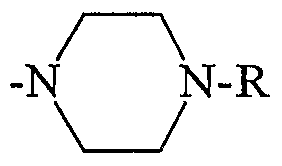
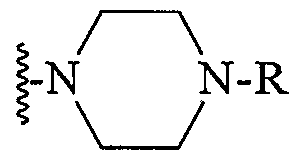
  • the A/ moiety represents a 5- to 6- membered heteroaryl or 5- to 6- membered heterocyclyl group. More preferably, Ai is a 5- to 6- membered heterocyclyl moiety, such as a piperazinyl, pyrrolidinyl or S,S-dioxothiomorpholinyl group, in particular a piperazinyl or S,S-dioxothiomorpholinyl group. Most preferably, A y is a piperazinyl group.
  • A/ represents an unsubstituted S, S- dioxothiomorpholino group, a pyrrolidinyl group substituted with -NR // -S ⁇ 2 -R //y or a moiety
  • R represents -CO 2 R', -SO 2 KRV, -S(O) 2 -R 7 , -CONR 77 R 77 , -COR 777 , -CO- CO-OR 777 , -CO-(Ci-C 4 alkylene)-OR 77 , -CO-(Ci-C 4 alkylene)-NR 77 R /7 , -CO-(C 1 -C 4 alkylene)-NR 77 -CO-R 77/ , -CO-(Ci-C 4 -CO-(Ci-C 4 alkylene)-SO 2 - R 77/ , -CO-(Ci-C 4 alkylene)-O-(Ci-C 4 alkylene)-OR 77 , -CO-(Ci-C 4 alkylene)-O-(Ci-C 4 alkylene)-OR 77 , -CO-(Ci-C 4 alkylene)-O-(Ci-
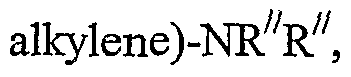
  • R represents -CO 2 R 7 , -S(O) 2 -R 7 , -CONR 77 R 77 , -COR 777 , -CO-CO-OR 777 , -CO-(C 1 -C 4 alkylene)-OR 77 , -CO-(Ci-C 4 alkylene)-NR 77 R 7/ , -CO-(C-C 4 alkylene)- 77 - CO-R 7// , -CO-(Ci-C 4 alkylene)-SO 2 -R 777 , -CO-(Ci-C 4 alkylene)-O-(Ci-C 4 alkylene)-OR 77 , -SO 2 -(CrC 4 alkylene)-OR 77 , -NR 77 -SO 2 -R 777 , -(Ci-C 4 alkylene)-CO-(C r C 4 alkylene)- CO 2 -R 77 ,
  • R represents -S(O) 2 -(Ci-C 4 alkyl), -S(O) 2 -(Ci-C 4 haloalkyl), -CONHR 777 , -COR 777 , -CO-CO-OR 7 ' 7 , -CO-(Ci-C 2 alkylene)-OR 77 , -CO-(Ci-C 2 alkylene)- NR 77 R 77 , -CO-(Ci-C 2 alkylene)-NH-CO-R 777 , -CO-(C 1 -C 2 alkylene)-SO 2 -R 777 , -CO-(Ci-C 2 alkylene)-O-(Ci-C 2 alkylene)-OR 7/ , -SO 2 -(Ci-C 4 ) alkylene)-OH, -NH-SO 2 -R 777 , -(Ci-C 2 alkylene)-CO-(Ci-C 4
  • A/ represents an unsubstituted S,S-dioxothiomorpholino group or a moiety
  • R represents -CO-(CrC 4 alkyl), -SO 2 -(Ci-C 4 alkyl), -SO 2 -(Ci-C 2 haloalkyl) or
  • the Ai 77 moiety is a phenyl, 5- to 6- membered heterocyclyl or C3-C6 carbocyclic group.
  • the A 1 77 moiety is a phenyl, C 3 -C 6 cycloalkyl, morpholino, S,S-dioxothiomorpholino, pyrrolidin-2-onyl, imidazolin-2-onyl or pyrimidin-2,4 (IH, 3H)-dionyl group.
  • the A 1 77 moeity is a C 3 -
  • the A 1 77 moiety is unsubstituted or substituted by 1 or 2 substitutents selected from Ci-C 4 alkyl, halogen and hydroxy substituents.
  • each A 4 moiety is the same or different and is phenyl, 5- to 6- membered heteroaryl, 5- to 6- membered heterocyclyl or C 3 -C 6 cycloalkyl.
  • each A 4 moiety is the same or different and represents a phenyl, piperidinyl, pyridyl, piperazinyl, pyrrolidinyl, cyclopropyl or cyclohexyl moiety.
  • each A 4 moiety is unsubstituted or substituted by 1, 2 or 3 unsubstituted substituents selected from halogen, Ci-C 4 alkyl, Ci-C 4 alkoxy, Ci-C 4 haloalkyl and Ci-C 4 haloalkoxy substituents. More preferably, each A 4 moiety is unsubstituted or substituted by 1 or 2 unsubstituted substituents selected from halogen, Ci -C 4 alkyl and Ci-C 2 haloalkyl substituents. Most preferably, each A 4 moiety is unsubstituted or substituted with a Ci-C 2 alkyl group.
  • each A 4 ' moiety is the same or different and represents a phenyl, 5- to 6- membered heteroaryl or 5- to 6- membered heterocyclyl group.
  • each A ⁇ / moiety is the same or different and represents a morpholinyl, phenyl, 2,6-dioxo- piperidinyl or triazolyl group.
  • each A/ moiety is unsubstituted or substituted by 1 or 2 unsubstituted substituents selected from halogen, C 1 -C 4 alkyl and Ci-C 4 haloalkyl substituents. More preferably, each A 4 * moiety is unsubstituted or substituted by a Ci- C 2 alkyl group.
  • Li is a Ci-C 4 alkylene group. More preferably, L) is a Ci-C 2 alkylene group. Most preferably, Li is a methylene group (-CH 2 -).
  • L 4 is a Ci-C 4 alkylene group. More preferably, L 4 is a Ci-C 2 alkylene group.
  • Yi represents -CO-(Ci-C 2 alkyl)-, -CO-(Ci-C 2 alkyQ-NR.'-, -CO-,
  • Yi represents -CO-CH 2 -, -CO-CH 2 -NH-, -CO-, -CO-NH- or -NH-CO-.
  • Yi represents -CO-NR 7 - or -NR ⁇ CO-, wherein R 7 is hydrogen or Ci-C 4 alkyl.
  • Yi represents -CO-NH- or -NH-CO-.
  • Y] represents -CO-NH-.
  • L/ is a Ci-C 2 alkyl group. More preferably, L_/ is a methyl group.
  • each Het 4 and Het/ are the same or different and represent -O- or -NR 7 - wherein R 7 is hydrogen or Ci-C 2 alkyl.
  • Het 4 represents -NR'-, more preferably -NH- or -N(CH 3 )-.
  • Hefc/ represents -0-.
  • Ri represents -A 1 -L 1 -A/-A 77
  • it is typically a moiety -phenyl-CH 2 -A/-(C3- Ce cycloalkyl), wherein A/ is as defined above.
  • A/ is a piperazinyl group which is attached to the A 77 moiety and to the -Li-At moiety via N atoms. More typically, A] is unsubstituted. More typically, A/ is an unsubstituted piperazinyl group which is attached to the -A 7/ moiety and to the -Li-Ai moiety via N atoms.
  • Ri represents an unsubstituted -phenyl-CH 2 -(l,4-piperazinyl)-(C3- C 6 cycloalkyl) group.
  • Ri When Ri represents -A 1 -Li-A/- Yi-A/ 7 , it is typically a moiety -phenyl-CH 2 -A/- Yi-Aj 77 , wherein A/, YI and A/ 7 are as defined above.
  • A/ is a piperazinyl group which is attached to the A 77 moiety and to the -L]-Ai moiety via N atoms. More typically, A/ is unsubstituted. More typically, A/ is an unsubstituted piperazinyl group which is attached to the -A 7/ moiety and to the -Li-Ai moiety via N atoms.
  • Yi is -CO-, -CO-CH 2 -, -CO-CH 2 -NH- or -CO-NH-.
  • Ri represents a -phenyl-CH 2 -(l,4-pi ⁇ erazinyl)-Yi-A/ / group, wherein Y and Ai 7/ are as defined above. More preferably, Ri represents an unsubstituted -phenyl-CH 2 -(l,4- piperazinyl)-CO-NH-(C3-C6 cycloalkyl) group.
  • Ri represents a moiety -Aj-Li-A/ or -A 1 -L 1 -A/-Y1-A/ 7 wherein Ai,
  • Li, A/, YI and A/ 7 are as defined above.
  • Ri is a moiety -phenyl-CH 2 -A/ wherein A/ is an unsubstituted S,S-dioxothiomorpholino group or a moiety
  • R represents -CO-(Ci-C 4 alkyl), -SO 2 -(Ci-C 4 alkyl), -SO 2 -(Ci-C 2 haloalkyl) or -SO 2 -(Ci-C 2 alkylene)-SO 2 -(Ci-C 4 alkyl).
  • R is -SO 2 - (Ci-C 4 alkyl).
  • A/ is other than S, S- dioxothiomorpholino.
  • R is -SO 2 -(Ci-C 4 alkyl). More preferably, in this embodiment, the compounds of the invention are not compounds of the formula (I), as set out above, wherein Ri is -phenyl-CH 2 -A/ and A ⁇ is a morpholino or piperazinyl group which is unsubstituted or substituted by a -S(O) 2 - (Ci-C 4 alkyl) substituent.
  • the left hand side of the A and B moieties depicted above are attached to the central biphenyl core.
  • the right hand side of the depicted moieties are attached to Ri or R 4 .
  • a and B are the same or different and each represent -NR / -C0-NR // -, -CO-NR'- or -NR'-CO-, wherein R ; and R ;/ are the same or different and represent hydrogen or Ci-C 4 alkyl.
  • A represents -CO-NR 7 - or -NR'-CO-, wherein R ; is hydrogen or Ci-C 4 alkyl.
  • A represents -C0-NR ; -, more preferably -CO-NH-.
  • B represents -NR'-CO-NR"-, -CO-NR / - or -NR ; -C0- wherein R ; and R /(l are the same or different and represent hydrogen or Cj-C 4 alkyl.
  • B represents -NH-CO-NH, -CO-NH- or -NH-CO-.
  • n and m are the same or different and each represent O or 1.
  • n O or 1.
  • m is 1. More preferably, m is 1 and R 3 is present on a carbon atom ortho to the phenyl ring of the central biphenyl moiety.
  • R 2 and R 3 are the same or different and each represent halogen, Ci- C 4 alkyl, Ci-C 4 haloalkyl, Ci-C 4 alkoxy, Ci-C 4 haloalkoxy, Ci-C 4 alkylthio, hydroxy, thio, -NR 7 R", -SO 2 R //; , -NR'-COR'" or -CO 2 R" 7 , wherein each R ; and R ;/ are the same or different and represent hydrogen or Ci-C 4 alkyl and R ;// represents Ci-C 4 alkyl.
  • each R 2 is the same or different and represents -NR'R", -NR'-CO-R ⁇ , -SO 2 R //; , -C0 2 R y// , hydroxy or thio, wherein each R f and R ;/ are the same or different and represent hydrogen or Ci-C 4 alkyl and R /;/ is Ci-C 4 alkyl. More typically, in this embodiment, each R 2 is the same or different and represents -SO 2 R //; , -C0 2 R ;// , hydroxy or thio, wherein R u/ is Ci-C 4 alkyl.
  • each R 2 is the same or different and represents -N(R ;// ) 2 , -NH-CO-R /;/ , -SO 2 R 7 V hydroxy, wherein R //; is Ci-C 4 alkyl, preferably CH 3 . More preferably, in this embodiment, each R 2 is the same or different and represents -SO 2 R 77 , in particular -SO 2 -CH 3 , or hydroxy.
  • each R 3 is the same or different and represents Ci-C 4 alkyl, Ci-C 4 alkoxy, halogen, Ci-C 2 haloalkyl, Ci-C 2 haloalkoxy or -NR 7 R 77 , wherein R 7 and R 77 are the same or different and represent hydrogen or Ci-C 4 alkyl. More preferably, each R 3 is the same or different and represents Ci-C 2 alkyl, Ci-C 2 alkoxy, halogen, Ci-C 2 haloalkoxy, Ci-C 2 haloalkyl or -NR 7 R 77 , wherein R 7 and R /7 are the same or different and each represent Ci-C 2 alkyl.
  • R 4 is a moiety -A 4 , -A 4 -A/, -L 4 -A 4 , -A 4 -L 4 -A/, -A 4 -HCt 4 -L 4 -HCt 4 -L/ or -L 4 -Het 4 -L/, wherein A 4 , A 4 ', L 4 , ReU, Het/ and L/ are as defined above.
  • R 4 is a moiety -A 4 , -A 4 -A 4 7 , -A 4 -L 4 -A 4 7 , -A 4 -Het 4 -L 4 -Het 4 / -L 4 / or -L 4 -HeI 4 - L 4 7 , wherein A 4 , A 4 7 , L 4 , Het 4 , Het/ and L/ are as defined above.
  • R 4 is -A 4
  • it is typically a C 3 -C ⁇ cycloalkyl or 5- to 6- membered heterocyclyl group.
  • it is a cyclopropyl, cyclohexyl, piperidinyl, piperazinyl or pyrrolidinyl group.
  • the A 4 moiety is unsubstituted or substituted with 1 or 2 unsubstituted substituents selected from halogen, Ci-C 4 alkyl and Ci-C 4 haloalkyl substitutents.
  • these substituents are selected from Ci-C 2 alkyl groups.
  • a 4 Is typically a phenyl or 5- to 6- membered heteroaryl moiety.
  • a 4 is a phenyl or pyridyl group.
  • a 4 is unsubstituted or substituted with 1 or 2 unsubstituted substituents selected from halogen, Ci-C 4 alkyl and Ci-C 4 haloalkyl substituents.
  • a 4 is unsubstituted.
  • A/ is typically a 5- to 6- membered heteroaryl or heterocyclyl group.
  • a 4 7 is a morpholinyl, triazolyl or piperidin-2,6-dionyl group.
  • a 4 7 is unsubstituted or substituted with 1 or 2 unsubstituted substituents selected from halogen, Ci-C 4 alkyl and CpC 4 haloalkyl substituents.
  • a 4 7 is unsubstituted or substituted by an unsubstituted Ci-C 2 alkyl group.
  • R 4 when R 4 is -A 4 -A/, it is an unsubstituted -pyridyl-morpholino, -phenyl-triazolyl or -phenyl-morpholino group or is a -phenyl-piperidin-2,6-dionyl group which is unsubstituted or substituted by a Ci-C 2 alkyl group.
  • R 4 is -A 4 -L 4 -A 4 7
  • a 4 is typically a 5- to 6- membered heterocyclyl group, in particular a piperidinyl group.
  • L 4 is typically Ci-C 2 alkylene, more preferably -CH 2 -.
  • a 4 is typically a phenyl group.
  • R 4 when R 4 is -A 4 -L 4 -A 4 7 , A 4 and A 4 7 are unsubstituted.
  • a 4 is typically a 5- to 6- membered heterocyclyl group, in particular a pyrrolidinyl group.
  • L 4 is typically CpC 2 alkylene, more preferably -CH 2 -.
  • R 4 when R 4 is -L 4 -A 4 , A 4 is unsubstituted.
  • L 4 is typically Ci-C 2 alkylene, more preferably methylene.
  • Het is typically -NR / -, wherein R 7 is hydrogen or Ci-C 2 alkyl, and is preferably -NH-.
  • L 4 7 is typically Ci-C 2 alkyl, more preferably methyl.
  • R 4 is typically a phenyl group. Typically, A 4 is unsubstituted.
  • Het 4 is typically -NR 7 -, wherein R 7 is hydrogen or Ci-C 2 alkyl, and is preferably -N(CH 3 )-.
  • L 4 is typically Ci-C 2 alkylene.
  • HeU is typically -O-.
  • L 4 7 is typically Ci-C 2 alkyl.
  • R 4 is -A 4 -Het 4 -L 4 -Het / 4 -L 4 / , it is -phenyl- N(CH 3 )-(Ci-C 2 alkylene)-O-(Ci-C 2 alkyl).
  • R 1 is -A 1 -L 1 -AZ-A/ 7 or -A 1 -L 1 -AZ-Y 1 -A 1 77 ;
  • Ri is -Ai-Li-A/ and A/ is substituted by a -CO 2 R 7 , -SO 2 NR 77 R 77 , -SO 2 -R 7 , -CONR 77 R 77 , -COR 777 , -CO-CO-OR.'", -CO-(C 1 -C 4 alkylene)-OR 7/ , -CO-(C 1 -C 4 alkylene)-
  • m is 1 and R 3 is C 1 -C 4 alkylthio, hydroxy, thio, -NR 7 R 77 , -SO 2 -R 777 , -NR 7 - COR 777 or -CO 2 R 777 , wherein R 7 and R 77 are the same or different and represent hydrogen or C 1 -C 4 alkyl and R //; represents C 1 -C 4 alkyl; or
  • R 4 is -A 4 -Het 4 -L 4 -Het 4 7 -L 4 7 .
  • a 1 7 is substituted by a -CO 2 -(Ci-C 4 haloalkyl), -SO 2 (C 1 -C 4 haloalkyl), -COR 777 , -SO 2 -(C 1 -C 4 alkylene)-SO 2 -(Ci-C 4 haloalkyl), -SO 2 -(Ci-C 4 alkylene)-SO 2 -R 777 , -CO-CO-OR 777 , -CO-(Ci-C 4 alkylene)-OR 77 , -CO-(Ci-C 4 alkylene)-NR // R // , -CO-(Ci-C 4 alkylene)-NR // -CO-R /// , -CO-(Ci-C 4 alkylene)-CO- NEnR.”, -CO-(Ci-C 4 alkylene)-SO 2 -R ;// , -CO-((Ci-C 4 al
  • n is 1 and R 2 is -SO 2 R 777 , -NR 77 R 77 , -NR 77 -COR 7/ , hydroxy, Cj-C 4 alkylthio, thio or -CO 2 R 777 , wherein R 777 is as defined above. More preferably, in option (c), n is 1 and R 2 is -SO 2 R" 7 , -N(R 777 ) 2 , -NH-CO-R 777 or hydroxy.
  • m is 1 and R 3 is -NR 7 R 77 , wherein R 7 and R /7 are as defined above. More preferably, m is 1 and R 3 is -N(CH 3 ) 2 .
  • Ri is -A 1 -L1-A/-A1" or -A 1 -Li-AZ-Y 1 -A 1 77 ; or
  • Ri is -Ai-L 1 -A 7 and A/ is substituted by a -CO 2 -(C 1 -C 4 haloalkyl), -SO 2 -(Ci-C 4 haloalkyl), -COR 777 , -SO 2 -(Ci-C 4 alkylene)-SO 2 -(C,-C 4 haloalkyl), -SO 2 - (Ci-C 4 alkylene)-SO 2 -R /7/ , CO-CO-OR 777 , -CO-(Ci-C 4 alkylene)-OR 77 , -CO-(Ci-C 4 alkylene)-NR /7 R 77 , -CO-(Ci-C 4 alkylene)-NR 77 -CO-R 777 , -CO-(Ci-C 4 alkylene)-CO- NR /7 R /; , -CO-(Ci-C 4 alkylene)-SO—SO
  • n is 1 and R 2 is C 1 -C 4 alkylthio, hydroxy, thio, -NR 7 R 77 , -SO 2 -R 777 , -NR 7 - COR 777 or -CO 2 R 777 , wherein R 7 and R 77 are the same or different and represent hydrogen or Ci-C 4 alkyl and R 777 represents Ci-C 4 alkyl; or
  • m is 1 and R 3 is Ci-C 4 alkylthio, hydroxy, thio, -NR 7 R 77 , -SO 2 -R 777 , -NR 7 - COR 77 Or -CO 2 R 77 ', wherein R 7 and R 77 are the same or different and represent hydrogen or Ci-C 4 alkyl and R 777 represents Ci-C 4 alkyl; or
  • R 4 is -A 4 -Het 4 -L 4 -Het 4 / -L 4 7 .
  • Preferred compounds of formula (I) are those wherein: Ri is -Ai-Li-A/, -AI-LI-AZ-A/ 7 or -AI-LI-AZ-YI-A] 77 ;
  • a and B are the same or different and each represent -NR / -C0-NR // -, -CO-NR 7 - or -NR -CO-, wherein R 7 and R 77 are the same or different and each represent hydrogen or Ci-C 4 alkyl; R 2 and R 3 are the same or different and each represent halogen, Ci-C 4 alkyl, C 1 -
  • each Ai, AA, A ⁇ , AJ 77 and A 4 7 are the same or different and represent a phenyl, 5- to 6- membered heteroaryl, 5- to 6- membered heterocyclyl or C 3 -C 6 cycloalkyl moiety; each Li and L 4 is the same or different and represents a Ci-C 4 alkylene group; - Yi represents -CO-(Ci-C 2 alkyl)-, -CO-(Ci-C 2 alkyl)-NR 7 -, -CO-, -CO-NR 7 - or -
  • R 7 is hydrogen or C]-C 4 alkyl
  • L 4 7 represents a Ci-C 2 alkyl group; and each HeI 4 and Het/ are the same or different and represent -O- or -NR 7 - wherein R 7 is hydrogen or Ci -C 2 alkyl; the phenyl, heteroaryl, heterocyclyl and carbocyclyl moieties in Ri and R 4 being unsubstituted or substituted by (a) a single unsubstituted substituent selected from -S(O) 2 -(Ci-C 4 alkyl), -S(O) 2 -(Ci-C 2 haloalkyl), -CO-NH-R 777 , -CO-R 777 , -CO-CO-OR 777 , -CO-(Ci-C 2 alkylene)-OR 77 , -CO-(Ci-C 2 alkylene)-NR 77 R 77 , -CO-(Ci-C 2 alkylene)-NH- CO-R 777 , -
  • Ri is -A I -L I -AZ-AI 77 or -A 1 -Li-AZ-Yi-Ai 77 ;
  • Ri is -Ai-Li-Ai 7 and AZ is substituted by a -SO 2 -(Ci-C 4 haloalkyl), -COR 777 , -SO 2 -(Ci-C 2 alkylene)-SO 2 -R 777 , -CO-CO-OR 777 , -CO-(Ci-C 4 alkylene)-OR 77 , -CO-(Ci-C 4 alkylene)-NR -,I" I TR, I' I, -CO-(C 1 -C 4 alkylene)-NR -CO-R III , -CO-(C 1 -C 4 alkylene)-S0 2 -R /// , -CO-(C 1 -C 4 alkylene)-O-(Ci-C 4 alkylene)-OR", -SO 2 -(Ci-C 4 alkylene)-OR // , -(Ci-C 4 alkylene)-CO-CO-
  • n 1 and R 2 is Ci-C 4 alkylthio, hydroxy, thio, -NR'R", -S0 2 R ;// -NR'- CO-R" or -CO 2 R'", wherein R ; and R" are the same or different and represent hydrogen or Ci-C 4 alkyl and R'" represents Ci-C 4 alkyl; or
  • m is 1 and R 3 is Ci-C 4 alkylthio, hydroxy, thio, -NR 7 R", -SO 2 R 7 ", -NR ; - CO-R 7 " or -CO 2 R 777 , wherein R 7 and R 77 are the same or different and represent hydrogen or Ci-C 4 alkyl and R 777 represents Ci-C 4 alkyl; or
  • R 4 is -A 4 -HeU-L 4 -I-W-L 4 '
  • A/ is an unsubstituted S,S-dioxothiomorpholino group, a pyrrolidinyl group substituted with -NH-SO 2 -R /// or is, more preferably, a moiety
  • R represents -S(O) 2 -(C 1 -C 4 alkyl), -S(O) 2 -(Ci-C 4 haloalkyl), -CONHR /// , -COR 777 , -CO-CO-OR 777 , -CO-(C 1 -C 2 alkylene)-0R 7/ , -CO-(C 1 -C 2 alkylene)-NR // R // , -CO- (Ci-C 2 alkylene)-NH-CO-R /// , -CO-(Ci-C 2 alkylene)-S0 2 -R /// , -CO-(C]-C 2 alkylene)-0- (C 1 -C 2 alkylene)-OR 77 , -SO 2 -(Ci-C 4 ) alkylene)-0H, -NH-SO 2 -R 777 , -(Ci-C 2 alkylene)- CO-(Ci-C 2
  • R 2 represents hydroxy, -N(R 777 ) 2 , -NH-CO-R 777 or -SO 2 -R 777 , wherein R 777 represents Ci-C 4 alkyl; - R 3 represents Ci-C 2 alkyl, Cj-C 2 alkoxy, halogen, C 1 -C 2 haloalkoxy, Ci-C 2 haloalkyl or -NR 7 R 77 , wherein R 7 and R 77 are the same or different and each represent Ci- C 2 alkyl;
  • B represents -NH-CO-NH-, -CO-NH- or -NH-CO-;
  • R 4 represents -A 4 , -A 4 -A 4 7 , -L 4 -A 4 , -A 4 -L 4 -A 4 , -A 4 -HBt 4 -L 4 -HCt 4 -L 4 or -L 4 -HeI 4 -L 4 7 ;
  • L 4 is a Ci-C 2 alkylene group; - each Het 4 and Het/ are the same or different and represent -O- or -NR -, wherein
  • R 7 represents hydrogen or Ci-C 2 alkyl
  • L 4 7 is a Ci-C 2 alkyl group.
  • R is -SO 2 -(C 1 -C 4 haloalkyl), -CO-R 777 , -CO-CO-OR 7 ", -CO-(C 1 -C 2 alkylene)- OR", -CO-(Ci-C 2 alkylene)-NR 77 R 77 , -CO-(Ci-C 2 alkylene)-NH-CO-R /// , -CO-(C 1 -C 2 alkylene)-SO 2 -R 777 , -CO-(Ci-C 2 alkylene)-O-(Ci-C 2 alkylene)-OR 77 , -SO 2 -(Ci-C 4 ) alkylene)-OH, -(Ci-C 2 alkylene)-CO-(Ci-C 2 alkylene)-CO 2 -R /// or -SO 2 -(Ci-C 2 alkylene)-SO 2 -R /// , where
  • n 1 ;
  • R 3 is -NR 7 R , wherein R 7 and R 77 are the same or different and each represent Ci-C 2 alkyl; or
  • R 4 represents -A 4 -Het 4 -L 4 -Het 4 7 -L 4 7 .
  • preferred compounds of formula (I) are compounds of formula (Ia 1 ), and pharmaceutically acceptable salts thereof,
  • Ai is an unsubstituted S,S-dioxothiomorpholino group, or is a moiety
  • R represents -CO-(Ci-C 4 alkyl), -SO 2 -(Ci-C 4 alkyl), -SO 2 -(C 1 -C 2 haloalkyl) or ⁇ SO 2 -(Ci-C 2 alkylene)-SO 2 -(Ci-C 2 alkyl);
  • n is O or 1 ;
  • R 2 represents hydroxy or -SO 2 -R 777 , wherein R 777 represents Ci-C 4 alkyl;
  • R 3 represents Ci-C 2 alkyl, Ci-C 2 alkoxy, halogen, Ci-C 2 haloalkoxy, CrC 2 haloalkyl or -NR 7 R 7 , wherein R 7 and R 77 are the same or different and each represent C 1 - C 2 alkyl;
  • each A 4 is a phenyl, 5- to 6- membered heteroaryl or C 3 -C 6 cycloalkyl group (preferably a phenyl, piperidinyl, pyridyl, piperazinyl, pyrrolidinyl, cyclopropyl or cyclohexyl group) which is unsubstituted or substituted by a Ci-C 2 alkyl group; each A 4 moiety is a phenyl, 5- to 6- membered heteroaryl or 5- to 6- membered heterocyclyl group (preferably a morpholinyl,
  • L 4 is a Ci-C 2 alkylene group; each Hetj and HeI 4 are the same or different and represent -O- or -NR -, wherein R 7 represents hydrogen or Ci-C 2 alkyl; and - L 4 7 is a Ci-C 2 alkyl group.
  • R is -CO-(Ci-C 4 alkyl), -SO 2 -(Ci-C 2 haloalkyl) or -SO 2 -(Ci-C 2 alkylene)-SO 2 - (Ci-C 2 alkyl),
  • n 1 ;
  • R 3 is -NR 7 R 77 , wherein R 7 and R 77 are the same or different and each represent Ci-C 2 alkyl; or
  • R 4 represents -A 4 -Het 4 -L 4 -Het 4 / -L 4 .
  • R 4 , B, R 3 , n and R 2 are as defined in the formula (I), Yi is -CO-CH 2 -, -CO-CH 2 -NH-, -CO-, -CO-NH- or -NH-CO- and A/ 7 is a phenyl, 5- to 6- memebred heterocyclyl or C 3 -C 6 carbocyclyl group (preferably a phenyl, C 3 -C 6 cycloalkyl, morpholino, S,S-dioxo-thiomorpholino, pyrrolidin-2-onyl, imidazolin-2-onyl or pyrimidin-2,4 (IH, 3H)-dionyl group) which is unsubstituted or substituted by 1 or 2 substituents selected from Ci-C 4 alkyl, halogen and hydroxy substituents.
  • the medicaments of the present invention are for use in treating or preventing a a hepatitis C viral infection in the human or animal body.
  • the medicaments are for use in humans.
  • Compounds of formula (I) containing one or more chiral centre may be used in enantiomerically or diastereoisomerically pure form, or in the form of a mixture of isomers.
  • the compounds of formula (I) can, if desired, be used in the form of solvates. Further, for the avoidance of doubt, the compounds of the invention may be used in any tautomeric form.
  • a pharmaceutically acceptable salt is a salt with a pharmaceutically acceptable acid or base.
  • Pharmaceutically acceptable acids include both inorganic acids such as hydrochloric, sulphuric, phosphoric, diphosphoric, hydrobromic or nitric acid and organic acids such as citric, fumaric, maleic, malic, ascorbic, succinic, tartaric, benzoic, acetic, methanesulphonic, ethanesulphonic, benzenesulphonic or ju-toluenesulphonic acid.
  • Pharmaceutically acceptable bases include alkali metal (e.g. sodium or potassium) and alkali earth metal (e.g.
  • Especially preferred compounds of the invention include: 4-Methyl-piperazine-l-carboxylic acid ⁇ 4'-[4-(4-acetyl-piperazin-l-ylmethyl)- phenylcarbamoyl] -6-methyl-biphenyl-3 -yl ⁇ -amide (S)-Pyrrolidine-2-carboxylic acid ⁇ 4'-[4-(4-acetyl-piperazin-l-ylmethyl)-phenylcarbamoyl]-6- methyl-biphenyl-3 -yl ⁇ -amide (R)-Pyrrolidine-2-carboxylic acid ⁇ 4'-[4-(4-acetyl-piperazm-l-ylmethyl)-phenylcarbamoyl]- 6-methyl-biphenyl-3
  • the compounds of formula (I) may be prepared by analogy with known methods. For example, they can be prepared by the following reactions: scheme (1)
  • R 2 , R 3 , n and m are as defined above, and either X and Y are, respectively, -A-Ri or -B-R 4 , wherein A, B, Ri and R 4 are as defined above, or X and Y represent groups which can be further reacted by standard techniques to yield the moieties -A-Ri or -B-R 4 , for example amino groups or carbocyclic acid groups.
  • schemes (1) and (2) can be effected by known methods, for example cesium carbonate and palladium catalyst in aqueous DMF at reflux.
  • the starting materials used in schemes (1) and (2) are known compounds or can be prepared by analogy with known methods.
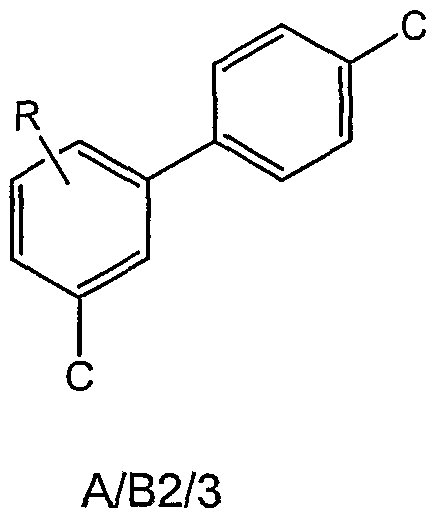
  • aryl bromides and boronic acids/esters can be coupled under standard conditions (cesium carbonate and palladium catalyst in aqueous DME at reflux) to provide a number of diverse biphenyl cores. These may have two carbonyl functionalities, two amino functionalities or one of both types. Some products from these reactions are shown below (for the sake of brevity, a substituent on the aromatic ring is either shown as "C” or "N” and the R 2 and R 3 substituents are simply shown as 'R').
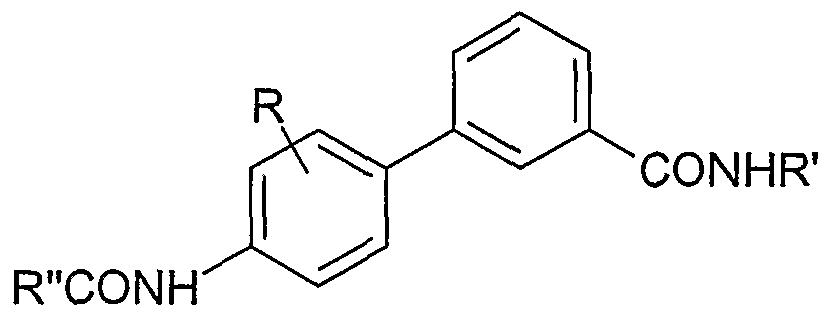
  • amide and reverse amide groups may be placed selectively at either end of the biphenyl core.
  • the initial amide coupling reactions may be carried out by reaction of amines with acid chlorides, or by reaction with carboxylic acids and a suitable coupling reagent e.g. HBTU or EDAC/HOBT.
  • a hydrolysis of an ester, a deprotection of a protected amine, or a hydrogenation of a nitro-group will then furnish intermediates which are readily coupled as described above to give the final compounds shown below.
  • Analogues in which one of the amides has been replaced by a ring structure may be prepared, for example, via dehydration of a primary amide into a nitrile. Suitable adaptation of the nitrile furnishes compounds with heteroaromatic rings, e.g. 1,2,4- oxadiazoles or 1,2,4-triazoles. Replacement of the amide with aryl, carbocyclyl and heterocyclyl groups may be performed by analogy.
  • the compounds of the invention are active against the hepatitis C virus.
  • the present invention therefore provides a method for ameliorating a hepatitis C infection in a patient, which method comprises administering to said patient an effective amount of a biphenyl derivative of formula (I), as defined above, or a pharmaceutically acceptable salt thereof. Also provided is a method for alleviating or reducing the incidence of a hepatitis C infection in a patient, which method comprises administering to said patient an effective amount of a compound of formula (I), as defined above, or a pharmaceutically acceptable salt thereof.
  • the present invention also provides a biphenyl derivative of formula (Ic) or a pharmaceutically acceptable salt thereof, for the treatment of the human or animal body,
  • Ri, R 2 , R 3 , R 4 , A, B, n and m are as defined for formula (I), provided that either (i) when Rj is -Ai-L 1 -A/, the moiety A/ carries a substituent which is other than an alkyl group or (ii) R 3 is other than halogen or alkyl.
  • the substituent on A/ is a single unsubstituted substituent selected from -CO 2 R 7 , -SO 2 NRV, -S(O) 2 -R 7 , -CONR 77 R 77 , -COR 777 , -CO-CO-
  • the substituent on A/ is a single unsubstituted substituent selected from -SO 2 NR 77 R 77 , -S(O) 2 -R', -CONR 77 R 77 , -COR //7 , -CO-CO-OR 777 , - CO-(Ci-C 4 alkylene)-OR 77 , -CO-(Ci-C 4 alkylene)-NR 77 R 77 , -CO-(Ci-C 4 alkylene)-NR 77 - CO-R 777 , -CO-(C 1 -C 4 alkylene)-CO-NR 7/ R 77 , -CO-(Ci-C 4 allcylene)-SO 2 -R 7// , -CO-(Ci-C 4 alkylene)-O-(Ci-C 4 alkylene)-OR 77 , -CO-(Ci-C 4 alkylene)-O-(Ci-C 4 al
  • the present invention therefore also provides a biphenyl derivative of formula (Ic), as defined above, or a pharmaceutically acceptable salt thereof.
  • a and B are the same or different and each represent -NR- CO-NR"-, -CO-NR ; - or -NR'-CO, wherein R ; and R /; are the same or different and each represent hydrogen or C i -C 4 alkyl.
  • the present invention provides a pharmaceutical composition
  • a pharmaceutical composition comprising a biphenyl derivative of formula (Ic) or a pharmaceutically acceptable salt thereof, and a pharmaceutically acceptable diluent or carrier.
  • Said pharmaceutical composition typically contains up to 85 wt% of a compound of the invention. More typically, it contains up to 50 wt% of a compound of the invention.
  • Preferred pharmaceutical compositions are sterile and pyrogen free.
  • the pharmaceutical compositions of the invention typically contain a compound of the invention which is a substantially pure optical isomer.
  • the compounds of the invention may be administered in a variety of dosage forms. Thus, they can be administered orally, for example as tablets, troches, lozenges, aqueous or oily suspensions, dispersible powders or granules.
  • the compounds of the invention may also be administered parenterally, whether subcutaneously, intravenously, intramuscularly, intrasternally, transdermally or by infusion techniques.
  • the compounds may also be administered as suppositories.
  • the compounds of the invention are typically formulated for administration with a pharmaceutically acceptable carrier or diluent.
  • solid oral forms may contain, together with the active compound, diluents, e.g.
  • lactose dextrose, saccharose, cellulose, corn starch or potato starch
  • lubricants e.g. silica, talc, stearic acid, magnesium or calcium stearate, and/or polyethylene glycols
  • binding agents e.g. starches, arabic gums, gelatin, methylcellulose, carboxymethylcellulose or polyvinyl pyrrolidone
  • disaggregating agents e.g.
  • Such pharmaceutical preparations may be manufactured in known manner, for example, by means of mixing, granulating, tableting, sugar coating, or film coating processes.
  • Liquid dispersions for oral administration may be syrups, emulsions and suspensions.
  • the syrups may contain as carriers, for example, saccharose or saccharose with glycerine and/or mannitol and/or sorbitol.
  • Suspensions and emulsions may contain as carrier, for example a natural gum, agar, sodium alginate, pectin, methylcellulose, carboxymethylcellulose, or polyvinyl alcohol.
  • the suspension or solutions for intramuscular injections may contain, together with the active compound, a pharmaceutically acceptable carrier, e.g. sterile water, olive oil, ethyl oleate, glycols, e.g. propylene glycol, and if desired, a suitable amount of lidocaine hydrochloride.
  • Solutions for injection or infusion may contain as carrier, for example, sterile water or preferably they may be in the form of sterile, aqueous, isotonic saline solutions.
  • Compounds of the present invention may be used in conjunction with known anti-viral agents.
  • Preferred known anti-viral agents in this regard are interferon and ribavirin, which are known for the treatment of hepatitis C (Clinical Microbiology Reviews, Jan. 2000, 67-82).
  • the said medicament therefore typically further comprises interferon and/or ribavirin.
  • the present invention provides a pharmaceutical composition comprising:
  • interferon and/or ribavirin for separate, simultaneous or sequential use in the treatment of the human or animal body.
  • a therapeutically effective amount of a compound of the invention is administered to a patient.
  • a typical dose is from about 0.01 to 100 mg per kg of body weight, according to the activity of the specific compound, the age, weight and conditions of the subject to be treated, the type and severity of the disease and the frequency and route of administration.
  • daily dosage levels are from 0.05 to 16 mg per kg of body weight, more preferably, from 0.05 to 1.25 mg per kg of body weight.
  • Example 3 was prepared as described for Example 2 except that (R)- pyrrolidine-1 ,2-dicarboxylic acid 1 tert-butyl ester was used. The title compound was isolated as a colourless foam (22mg)
  • Example 4 2'-Methyl-5'-(2-methylamino-acetylamino)-biphenyl-4-carboxylic acid[4-(4-acetty- piperazin-l-ylmethyl)-phenyl]-amide
  • Example 4 was prepared as described for Example 2 except that (tert- butoxycarbonyl-methyl-amino)-acetic acid was used. The title compound was isolated as a colourless foam (29mg)
  • Example 13 5'-(Cyclopropanecarbonyl-amino)-2'-methyl-biphenyl-4-carboxyIic acid [4-(4- acetyl-piperazin-l-ylmethyl)-phenyl]-amide.
  • 6-methyl-biphenyl-3,4'-dicarboxylic acid 4'-ethyl ester 200mg
  • 6-morpholin-4-ylpyridin-3-ylamine 163mg
  • HOBt 123mg
  • EDAC 174mg
  • N-methylmorpholine 200 ⁇ l
  • 6-Dimethylamino-4' ⁇ 4-[4-(propane-1-sulfonyl)-piperazin-1-ylmethyl]- phenylcarbamoyl ⁇ -biphenyl-3-carboxylic acid methyl ester (167mg) was dissolved in EtOH (2ml) and 2N NaOH (1ml) and stirred at room temperature overnight.
  • 6-Dimethylamino-4'[4-(4-methanesulfonyl-piperazin-1-ylmethyl)- phenylcarbamoyl]-biphenyl-3-carboxylic acid methyl ester (155mg) was dissolved in EtOH (2ml) and 2N NaOH (1ml) and stirred at room temperature overnight.
  • Example 34 This material was prepared as for Example 34 except that 4-chloro-3-oxo-butyric acid ethyl ester (0.015ml) was used. The title compound was obtained as an orange gum (lOmg)
  • This material was prepared as for Example 39 except that phenylamino-acetic acid (13mg) was used.
  • the title compound was obtained as a colourless glass (14mg)
  • This material was prepared as for Example 39 except that (8)-2-dipropylamino- propionic acid (15mg) was used. The title compound was obtained as an orange foam (35mg)
  • Example 49 5'-(Cyclopropanecarbonyl-amino)-2'-methyl-biphenyl-4-carboxylic acid [3-chIoro- 4-(4- methanesulfonyl-piperazin-l-ylmethyl)-phenyl]-amide
  • This material was prepared as described for Example 47 except that 3-chloro-4-(4- methanesulfonyl-piperazin-l-ylmethyl)-phenylamine (22.5mg) was used.
  • the title compound was isolated as an off-white solid (20mg).
  • This material was prepared as for Example 39 except that hydroxy-acetic acid (6.5mg) was used.
  • the title compound was obtained as a colourless solid (3 lmg)
  • the commercially available propane sulfonic acid salt (Ig) was sonicated for 20 min in DMF (20 ml) to ensure dissolution.
  • Triethylamine (0.5ml) was added to the stirred solution under N2, followed by acetyl chloride (1. ImI).
  • the resulting mixture was allowed to stir overnight under N 2 before being evaporated to give an orange slurry.
  • DMF (5r ⁇ l) was added and the mixture then filtered through a pad of celite. The pad was washed with DMF (2 x 10ml) and the filtrate then evaporated to give the title compound as an orange oil which was used in the next stage without further purification.
  • Acetic acid 3-[4-(4- ⁇ [5'-(cyclo ⁇ ropanecarbonyl-amino)-2'-methyl-biphenyl-4- carbonyl]-amino ⁇ -benzyl)-piperazine-l-sulfonyl]-propyl ester (69mg) and potassium carbonate (32mg) were stirred for lhr in 1 : 1 aqueous methanol (5ml). The solution was then acidified to pH 3 via the addition of HCl (cone). The reaction mixture was partitioned between aq ammonium chloride and ethyl acetate. The dried extracts were evaporated and the residue purified by prep HPLC giving the title compound as a colourless solid (17mg).
  • HCV replicon cell line o Ib replicon (Huh.7) described in Science 285, 110-113.
  • o Huh-9B liver cell line with persistent bicistronic HCV genotype Ib coding sequence: [I 389 lucubineo_3-3'_ET] includes firefly luciferase-ubiquitin- neomycin phosphotransferase fusion protein and EMCV-IRES driven nonstructural HCV (NS3 to NS5B) coding sequence including cell culture adaptive mutations E1202G, T1280I and K1846T (Lohmann etal, 2001).
  • This assay is set up using all 96 wells of flat-bottomed 96-well plates. Plates are set up one day before addition of compounds. The assay then runs for 4 days with ELISA development taking place on the 5 th day. Day l
  • Exponentialy growing Huh-9B monolayers are washed with sterile PBS to remove serum and treated with trypsin to detach cells from the flask.
  • Cells are suspended in growth media and counted using a haemocytometer.
  • Duplicate 96 well plates are seeded with Huh-9B at a density of 10 4 cells/well in a total volume of 100 ⁇ l/well of growth medium without antibiotics, as depicted below.
  • One of the plates is an opaque white 96-well plate used for IC50 determination based on the luciferase signal (referred as replicon plate), the other one is a clear 96-well plate used for a parallel determination of drug toxicity by methylene blue staining (referred as tox plate).
  • Wells G12 and H12 of the tox plate are left without cells to use as buffer alone background reading.
  • Doubling dilutions of each compound are generated in a separate 96 high volume capacity round bottom plate to twice their initial concentration in the assay using growth medium without antibiotics.
  • Luciferase detection stage on the replicon plate Media is tapped out from wells into Virkon and plates are washed once in warm PBS and tapped dry gently.
  • Luciferase assay buffer is placed it in the luminometer (Lmax, Molecular Devices).
  • the M injector is primed with 4x 300 ⁇ l of luciferase assay buffer.
  • the plate to be analyzed is placed in the luminometer and 100 ⁇ l of luciferase assay buffer injected automatically into one well followed by 4 seconds integration read out. After one second delay a second well is injected with 100 ⁇ l of luciferase assay buffer followed by 4 seconds integration read out and so forth until all 96 wells are analyzed. Once the reading is finished the luminometer injection system is washed with deionised water.
  • the data is acquired using the SOFTmax for Lmax Pro software package.
  • SOFTmax data files are exported as Excel or text files. A standard four parameters nonlinear regression analysis of the data obtained from each compound is then used to calculate the IC50.

Landscapes

  • Chemical & Material Sciences (AREA)
  • Organic Chemistry (AREA)
  • Health & Medical Sciences (AREA)
  • Life Sciences & Earth Sciences (AREA)
  • Veterinary Medicine (AREA)
  • Public Health (AREA)
  • General Health & Medical Sciences (AREA)
  • Animal Behavior & Ethology (AREA)
  • Medicinal Chemistry (AREA)
  • Pharmacology & Pharmacy (AREA)
  • Chemical Kinetics & Catalysis (AREA)
  • Nuclear Medicine, Radiotherapy & Molecular Imaging (AREA)
  • General Chemical & Material Sciences (AREA)
  • Engineering & Computer Science (AREA)
  • Communicable Diseases (AREA)
  • Virology (AREA)
  • Gastroenterology & Hepatology (AREA)
  • Oncology (AREA)
  • Bioinformatics & Cheminformatics (AREA)
  • Epidemiology (AREA)
  • Pharmaceuticals Containing Other Organic And Inorganic Compounds (AREA)
  • Hydrogenated Pyridines (AREA)
  • Pyridine Compounds (AREA)
  • Pyrrole Compounds (AREA)
  • Medicines That Contain Protein Lipid Enzymes And Other Medicines (AREA)
  • Plural Heterocyclic Compounds (AREA)

Abstract

Compounds of formula (I) are found to be active against HCV. wherein: R1 is a moiety -A1-L1-A1', -A1-L1-A1'-A1' or -A1-L1-A1'-Y1-A1'; A and B are the same or different and each represent a direct bond or a -CO- NR'-, -NR'-CO-, -NR'-CO-NR'-, -NR'-S(O)2-, -S(O)2-NR'- or -NR'- moiety, wherein R' and R' are the same or different and each represent hydrogen or C1-C4 alkyl; R2 and R3 are the same or different and each represent C1-C4 alkyl, C1-C4 alkoxy, C1-C4 alkylthio, C1-C4 haloalkyl, C1-C4 haloalkoxy, halogen, hydroxy, thio, -NR'R', -SO2-R'', -NR'-COR'' or -CO2R'', wherein R' and R' are the same or different and represent hydrogen or C1-C4 alkyl and R'' represents C1-C4 alkyl; n and m are the same or different and each represent 0, 1 or 2; R4 is a C1-C6 alkyl or C1-C6 haloalkyl group or a moiety -A4, -A4-A4', -L4-A4, -A4-L4-A4', -A4-Het4-L4-Het4'-L4' or -L4-Het4-L4', - each A1, A4, A1', A1' and A4' are the same or different and represent a phenyl, 5- to 10- membered heteroaryl, 5- to 10- membered heterocyclyl or C3-C6 carbocyclyl moiety; each L1 and L4 is the same or different and represents a C1-C4 alkylene or a C1-C4 hydroxyalkylene group; - Y1 represents -CO-NR'-, -CO-( C1-C4 alkylene)-, -CO-( C1-C4 alkylene)-NR'-, -NR'-CO-, -CO-, -O-CO- or -CO-O-, wherein R' is hydrogen or C1-C4 alkyl; L4' represents hydrogen or a C1-C4 alkyl group; Het4 and Het4' are the same or different and represent -O-, -S- or -NR'-, wherein R' is hydrogen or a C1-C4 alkyl group; the phenyl, heteroaryl, heterocyclyl and carbocyclyl moieties in R1 and R4 being unsubstituted or substituted by (a) a single unsubstituted substituent selected from -CO2R', -SO2NR'R', -S(O)2-R', -CONR'R', -COR'', -CO-CO-OR''', -CO-( C1-C4 alkylene)-OR', -CO-( C1-C4 alkylene)-NR'R', -CO-( C1-C4 alkylene)-NR'-CO-R''', -CO- (C1-C4 alkylene)-CO-NR'R', -CO-( C1-C4 alkylene)-SO2-R'', -CO-( C1-C4 alkylene)-O- (C1-C4 alkylene)-OR', -CO-( C1-C4 alkylene)-O-( C1-C4 alkylene)-NR'R', -CO-( C1-C4 alkylene)-NR'-( C1-C4 alkylene)-OR', -CO-( C1-C4 alkylene)-NR'-( C1-C4 alkylene)- NR'R', -SO2-( C1-C4 alkylene)-OR', -NR'-SO2-R'', -( C1-C4 alkylene)-CO-( C1-C4 alkylene)-CO2-R'', -( C1-C4 alkylene)-CO-( C1-C4 alkylene)-CO-NR'R' and -SO2-( C1-C4 alkylene)-SO2-R' and/or (b) 1, 2 or 3 unsubstituted substituents selected from halogen, C1-C4 alkyl, C1-C4 alkoxy, C1-C4 haloalkyl, C1-C4 haloalkoxy, C1-C4 hydroxyalkyl, hydroxy, cyano, nitro and -NR'R', wherein each R' is the same or different and represents hydrogen, C1-C4 alkyl or C1-C4 haloalkyl, each R' is the same or different and represents hydrogen or C1-C4 alkyl and each R'' is the same or different and represents C1-C4 a

Description

BIPHENYL DERIVATIVES AND THEIR USE IN TREATING HEPATITIS C
The present invention relates to a series of biphenyl derivatives which are useful in treating or preventing a hepatitis C viral (HCV) infection. Similar compounds are disclosed in copending application no. PCT/GB06/003469, from which the present application claims priority.
The present invention provides, in a first embodiment, the use of a compound which is a biphenyl derivative of formula (I), or a pharmaceutically acceptable salt thereof, in the manufacture of a medicament for use in treating or alleviating HCV
Figure imgf000003_0001
wherein:
Ri is a moiety -Ai-L1-A/, -A1-Li-AZ-A/7 or -AJ-LI-AZ-YI-A/7; - A and B are the same or different and each represent a direct bond or a -CO-
NR7-, -NRZ-CO-, -NR7-CO-NR77-, -NR7-S(O)2-, -S(O)2-NR7- or -NR7- moiety, wherein R7 and R77 are the same or different and each represent hydrogen or Ci-C4 alkyl;
R2 and R3 are the same or different and each represent Ci-C4 alkyl, Ci-C4 alkoxy, C1-C4 alkylthio, Ci-C4 haloalkyl, Ci-C4 haloalkoxy, halogen, hydroxy, thio, -NR7R77, -SO2-R777, -NR7-COR777 or -CO2R777, wherein R7 and R77 are the same or different and represent hydrogen or Ci-C4 alkyl and R777 represents Ci-C4 alkyl; n and m are the same or different and each represent O, 1 or 2; R4 is a Ci-C6 alkyl or Cj-Cβ haloalkyl group or a moiety -A4, -A4-A4 , -L4-A4, -A4-L4-A4 7,
Figure imgf000003_0002
or -L4-HeI4-L4 7, each A1, A4, Ai , Ai and A4 7 are the same or different and represent a phenyl, 5- to 10- membered heteroaryl, 5- to 10- membered heterocyclyl or C3-CO carbocyclyl moiety; each Li and L4 is the same or different and represents a Ci-C4 alkylene or a C1- C4 hydroxyalkylene group;
Y1 represents -CO-NR7-, -CO-(Ci-C4 alkylene)-, -CO-(Ci-C4 alkylene)-NR7-, -NR7-CO-, -CO-, -0-CO- or -CO-O-, wherein R7 is hydrogen or Ci-C4 alkyl;
L4 7 represents hydrogen or a Ci-C4 alkyl group;
Het4 and Het/ are the same or different and represent -O-, -S- or -NR7-, wherein R7 is hydrogen or a Ci -C4 alkyl group; the phenyl, heteroaryl, heterocyclyl and carbocyclyl moieties in Ri and R4 being unsubstituted or substituted by (a) a single unsubstituted substituent selected from -CO2R7, -SO2NRV7, -S(O)2-R7, -CONR77R77, -COR777, -CO-CO-OR777, -CO-(CI-C4 alkylene)-OR77, -CO-(Ci-C4 alkylene)-NR7/R77, -CO-(Ci-C4 alkylene)-NR77-CO-R777, -CO- (C-C4 alkylene)-CO-NR77R7/, -CO-(Ci-C4 alkylene)-SO2-R777, -CO-(Ci-C4 alkylene)-O- (Ci-C4 alkylene)-OR77, -CO-(Ci-C4 alkylene)-O-(Ci-C4 alkylene)-NR7/R77, -CO-(Ci-C4 alkylene)-NR77-(C1-C4 alkylene)-OR77, -CO-(Ci-C4 alkylene)-NR77-(Ci-C4 alkylene)- NR77R77, -SO2-(Ci-C4 alkylene)-OR77, -NR77-SO2-R/7/, -(C1-C4 alkylene)-CO-(Ci-C4 alkylene)-CO2-R77/, -(Ci-C4 alkylene)-CO-(Ci-C4 alkylene)-CO-NR77R77 and -SO2-(Ci-C4 alkylene)-SO2-R7 and/or (b) 1 , 2 or 3 unsubstituted substituents selected from halogen, Ci -C4 alkyl, Ci-C4 alkoxy, Ci-C4 haloalkyl, Ci-C4 haloalkoxy, Ci-C4 hydroxyalkyl, hydroxy, cyano, nitro and -NR77R77, wherein each R7 is the same or different and represents hydrogen, Ci-C4 alkyl or Ci-C4 haloalkyl, each R77 is the same or different and represents hydrogen or Ci-C4 alkyl and each R777 is the same or different and represents C]-C4 alkyl, provided that either:
(a) R, is -Ai-Li-A,7-Ai77 or -Ai-Li-Ai'-Yi-Ai"; or
Qo) Ri is -Ai-Li-Ai7 and A/ is substituted by a -CO2R7, -SO2NR77R77, -SO2-R7, -CONR77R77, -COR777, -CO-CO-OR777, -CO-(Ci-C4 alkylene)-OR77, -CO-(C1-C4 alkylene)- NR77R77, -CO-(Ci-C4 alkylene)-NR77-CO-R777, -CO-(C1-C4 alkylene)-CO-NR77R77, -CO- (Ci-C4 alkylene)-SO2-R777, -CO-(Ci-C4 alkylene)-O-(Ci-C4 alkylene)-OR7/, -CO-(Ci-C4 alkylene)-O-(Ci-C4 alkylene)-NR77R77, -CO-(Ci-C4 alkylene)-NR77-(Ci-C4 alkylene)- OR77, -CO-(Ci-C4 alkylene)-NR77-(Ci-C4 alkylene)-NR/7R7/, -SO2-(Ci-C4 alkylene)-OR7/, -NR//-SO2-R///, -(Ci-C4 alkylene)-CO-(CrC4 alkylene)-CO2-R7//, -(Ci-C4 alkylene)-CO- (CrC4 alkylene)-CO-NR//R// or -SO2-(C]-C4 alkylene)-SO2-R/ substituent, wherein each R7 is the same or different and represents hydrogen, C1-C4 alkyl or Ci-C4 haloalkyl, each R77 is the same or different and represents hydrogen or CrC4 alkyl and each R is the same or different and represents Ci-C4 alkyl; or
(c) n is 1 and R2 is C1-C4 alkylthio, hydroxy, thio, -NR7R77, -SO2-R777, -NR7- COR777 or -CO2R777, wherein R7 and R77 are the same or different and represent hydrogen or Ci-C4 alkyl and R777 represents Ci-C4 alkyl; or
(d) m is 1 and R3 is C1-C4 alkylthio, hydroxy, thio, -NR7R77, -SO2-R777, -NR7- C0R7// or -CO2R//7, wherein R7 and R77 are the same or different and represent hydrogen or Ci-C4 alkyl and R777 represents C1-C4 alkyl; or
(e) R4 is -A4-HCt4-L4-HeI4 -L4' '.
In a further embodiment, the present invention provides the use of a compound which is a biphenyl derivative of formula (I), as defined above, or a pharmaceutically acceptable salt thereof, in the manufacture of a medicament for use in treating or alleviating HCV, wherein:
-Ri is a moiety -Ai-Li-A/, -AJ-LI-AZ-AZ' or -AI-LJ-AZ-YI-AI"; A and B are the same or different and each represent a direct bond or a -CO- NR7-, -NR7-C0-, -NR7-CO-NR77-, -NR7-S(O)2-, -S(O)2-NR7- or -NR7- moiety, wherein R7 and R are the same or different and each represent hydrogen or Ci-C4 alkyl;
R2 and R3 are the same or different and each represent Ci-C4 alkyl, Ci-C4 alkoxy, Cj-C4 alkylthio, Ci-C4 haloalkyl, Ci-C4 haloalkoxy, halogen, hydroxy, thio, -NR7R77, -SO2-R777, or -CO2R777, wherein R7 and R77 are the same or different and represent hydrogen or Ci-C4 alkyl and R777 represents Ci-C4 alkyl; - n and m are the same or different and each represent O, 1 or 2;
R4 is a Ci-C6 alkyl or Ci-C6 haloalkyl group or a moiety -A4, -A4-A4 7, -A4-L4- AA , -A4-Het4-L4-Het4 /-L4 7 or -L4-Het4-L4 ;, each A1, A4, Ai7, Ai77 and A4 7 are the same or different and represent a phenyl, 5- to 10- membered heteroaryl, 5- to 10- membered heterocyclyl or C3-C6 carbocyclyl moiety; each Li and L4 is the same or different and represents a Cj-C4 alkylene or a Ci- C4 hydroxyalkylene group; Yi represents -CO-NR7-, -NR7-CO-, -0-C0- or -CO-O-, wherein R7 is hydrogen or Ci-C4 alkyl;
L4 7 represents hydrogen or a Ci-C4 alkyl group;
Het4 and Het/ are the same or different and represent -0-, -S- or -NR -, wherein R7 is hydrogen or a C]-C4 alkyl group; the phenyl, heteroaryl, heterocyclyl and carbocyclyl moieties in Ri and R4 being unsubstituted or substituted by (a) a single unsubstituted substituent selected from -CO2R', -SO2NRV, -S(O)2-R7, -CONR77R77, -COR777 and -SO2-(Ci-C4 alkylene)-SO2-R/ and/or (b) 1, 2 or 3 unsubstituted substituents selected from halogen, Ci-C4 alkyl, Ci-C4 alkoxy, Cj-C4 haloalkyl, Ci-C4 haloalkoxy, Ci-C4 hydroxyalkyl, hydroxy, cyano, nitro and -NR77R77, wherein each R7 is the same or different and represents hydrogen, Ci-C4 alkyl or Ci-C4 haloalkyl, each R77 is the same or different and represents hydrogen or C1- C4 alkyl and each R777 is the same or different and represents Ci-C4 alkyl, provided that either: (a) Ri is -Ai-Li-Ai'-Ai" or -Ai-Li-Ai'-Yi-Ai"; or
(b) Ri is -Ai-Li-A/ and A/ is substituted by a -CO2R7, -SO2NR77R77, -SO2-R7, -CONR77R77, -C0R7// or -SO2-(Ci-C4 alkylene)-SO2-R/ substituent, wherein each R7 is the same or different and represents hydrogen, Ci-C4 alkyl or Ci-C4 haloalkyl, each R is the same or different and represents hydrogen or Ci-C4 alkyl and each R777 is the same or different and represents Ci-C4 alkyl; or
(c) n is 1 and R2 is Ci-C4 alkylthio, hydroxy, thio, -NR7R77, -SO2-R777, or -CO2RW, wherein R7 and R77 are the same or different and represent hydrogen or Ci-C4 alkyl and R777 represents Cj-C4 alkyl; or
(d) m is 1 and R3 is Ci-C4 alkylthio, hydroxy, thio, -NR7R77, -SO2-R777 or -CO2R777, wherein R7 and R77 are the same or different and represent hydrogen or Ci-C4 alkyl and R777 represents Ci-C4 alkyl; or
(e) R4 is -A4-HCt4-L4-HeI./-!!,/.
As used herein, a Ci-C6 alkyl moiety is a linear or branched alkyl moiety containing from 1 to 6 carbon atoms, such as Ci-C4 alkyl moiety. Examples of Ci-C6 alkyl moieties include methyl, ethyl, n-propyl, i-propyl, n-butyl and t-butyl moieties. For the avoidance of doubt, where two alkyl moieties are present in a substituent, the alkyl moieties may be the same or different. As used herein, a Ci-C4 alkylene group is any divalent linear or branched Ci -C4 or Ci-C2 alkyl moiety. Linear Ci-C4 alkylene groups are methylene, ethylene, n- propylene and n-butylene groups. Methylene and ethylene groups are preferred. Branched Ci-C4 alkylene groups include -CH(CH3)-, -CH(CH3)-CH2- and -CH2- CH(CH3)-.
As used herein, a Ci-C4 hydroxyalkylene group is a said Ci-C4 alkylene group which is substituted by a single hydroxy group.
As used herein, a halogen is chlorine, fluorine, bromine or iodine. A halogen is typically fluorine, chlorine or bromine. As used herein, a Ci-C4 alkoxy moiety is a said Ci-C4 alkyl moiety attached to an oxygen atom. A preferred Ci-C4 alkoxy moiety is methoxy. A Ci-C4hydroxyalkyl moiety is a said Ci-C4 alkyl moiety substituted by a single hydroxyl moiety. Preferred hydroxyalkyl moieties are Ci-C2hydroxyalkyl moieties, for example -C(OH)-CH3 and -CH2OH. A Ci-C4 haloalkyl or Ci-C4haloalkoxy moiety is typically a said C1-C4 alkyl or
Ci-C4 alkoxy moiety substituted by one or more said halogen atoms. Typically, it is substituted by 1, 2 or 3 said halogen atoms. Preferred haloalkyl and haloalkoxy moieties are perhaloalkyl and perhaloalkoxy moieties such as -CX3 and -OCX3 wherein X is a said halogen atom, for example chlorine and fluorine. A particularly preferred haloalkyl moiety is -CF3. A particularly preferred haloalkoxy moiety is -OCF3.
Preferably, the phenyl, heteroaryl, heterocyclyl and carbocyclyl moieties in R1 and R4 are unsubstituted or substituted by (a) a single unsubstituted substituent selected from -CO2R7, -S(O)2-R7, -CONRV, -COR^, -C0-C0-OR/;/, -CO-(CI-C4 alkylene)- 0R;/, -CO-(Ci-C4 alkylene)-NRV, -CO-(Ci-C4 alkylene)-NR//-CO-R///, -CO-(Ci-C4 alkylene)-SO2-R///, -CO-(Ci-C4 alkylene)-O-(Ci-C4 alkylene)-OR/;, -SO2-(Ci-C4 alkyleneVOR", -NR^SO2-R'", -(Ci-C4 alkylene)-CO-(C1-C4 alkyleneJ-CCfe-R"', and -SO2-(Cj-C4 alkylene)-SO2-R/ and/or (b) 1, 2 or 3 unsubstituted substituents selected from halogen, Ci-C4 alkyl, Ci-C4 alkoxy, Ci-C4 haloalkyl and Ci-C4 haloalkoxy substituents, wherein each R7 is the same or different and represents hydrogen, Ci-C4 alkyl or Ci-C4 haloalkyl, each R7 is the same or different and represents hydrogen or Ci- C4 alkyl and each R/;/ is the same or different and represents Ci-C4 alkyl. More typically, in this embodiment, the phenyl, heteroaryl, heterocyclyl and carbocyclyl moieties in Ri and R4 are unsubstituted or substituted by (a) a single unsubstituted substituent selected from -CO2R7, -S(O)2-R7, -CONR77R77, -COR777 and -SO2-(C1-C4 alkylene)-SO2-R/ and/or (b) 1, 2 or 3 unsubstituted substituents selected from halogen, Ci-C4 alkyl, Ci-C4 alkoxy, Ci-C4 haloalkyl and Ci-C4 haloalkoxy substituents, wherein each R7 is the same or different and represents hydrogen, Ci -C4 alkyl or Ci-C4 haloalkyl, each R77 is the same or different and represents hydrogen or Ci-C4 alkyl and each R777 is the same or different and represents Ci-C4 alkyl.
More preferably, the phenyl, heteroaryl, heterocyclyl and carbocyclyl moieties in Ri and R4 are unsubstituted or substituted by (a) a single unsubstituted substituent selected from -S(O)2(Ci-C4 alkyl), -S(O)2-(C1-C4 haloalkyl), -CO-NHR777, -COR7", -CO- CO-OR'", -CO-(C-C2 alkylene)-OR/7, -CO-(Ci-C2 alkylene)-NR7/R7/, -CO-(Ci-C2 alkylene)-NH-CO-R/7/, -CO-(Ci-C2 alkylene)-SO2-R777, -CO-(C)-C2 alkylene)-O-(Ci-C2 alkylene)-OR77, -SO2-(Ci-C4) alkylene)-OH, -NH-SO2-R''', -(Ci-C2 alkylene)-CO-(Ci-C2 alkylene)-CO2-R7//, and -SO2-(Ci-C2 alkylene)-SO2-R777 and/or (b) 1 or 2 unsubstituted substituents selected from halogen, Ci-C4 alkyl and Ci-C4 haloalkyl substituents, wherein, each R ' is the same or different and represents hydrogen or Cj-C4 alkyl and each R77/ is the same or different and represents Ci-C4 alkyl. More typically, in this embodiment, the phenyl, heteroaryl, heterocyclyl and carbocyclyl moieties in Ri and R4 are unsubstituted or substituted by (a) a single unsubstituted substituent selected from -S(O)2-R7, -CO-NHR777, -COR777 and -SO2-(Ci-C2 alkylene)-SO2-R777 and/or (b) 1 or 2 unsubstituted substituents selected from halogen, Ci-C4 alkyl and Ci-C4 haloalkyl substituents, wherein each R7 is the same or different and represents Ci-C4 alkyl or Ci- C4 haloalkyl and each R7 is the same or different and represents Ci-C4 alkyl.
As used herein, a 5- to 10-membered heteroaryl moiety is a 5- to 10-membered aromatic ring, containing at least one heteroatom, for example 1, 2 or 3 heteroatoms, selected from O, S and N. Typically, a hyteroaryl moiety is monocyclic. Typically a 5- to 10-membered heteroaryl moiety is a 5- to 6-membered heteroaryl moiety. Examples include imidazolyl, isoxazolyl, pyrrolyl, thienyl, thiazolyl, furanyl, pyridyl, pyrazinyl, pyrimidinyl, pyridazinyl, oxadiazolyl, oxazolyl, isoxazolyl, thiazolyl, isothiazolyl, thiadiazolyl, pyrazolyl and triazolyl moieties. Pyridyl and triazolyl moieties are preferred.
A said heteroaryl moiety is unsubstituted or substituted as set out above. Preferably, it is unsubstituted or substituted by 1 or 2 unsubstituted substituents selected from halogen, Ci-C4 alkyl and Ci-C2 haloalkyl substituents. More preferably, it is unsubstituted.
As used herein, a 5- to 10-membered heterocyclyl moiety is a non-aromatic, saturated or unsaturated C5-C10 carbocyclic ring, in which at least one, for example 1, 2 3 or 4, carbon atoms in the ring are replaced with a moiety selected from O, S, SO, SO2, CO and N. Typically, it is saturated or contains a single double bond within the ring structure. More typically, it is a saturated C5-C io ring (preferably a Cs-C6 ring) in which 1, 2 or 3 of the carbon atoms in the ring are replaced with a moiety selected from O, S, SO2, CO and NH. Typically, a heterocyclyl moiety is monocyclic. Preferably, a heterocyclyl moiety contains up to two CO moieties.
Preferably, a heterocyclyl moiety is a 5- to 6- membered ring. Examples include pyrazolidinyl, piperidyl, piperidin-2,6-dionyl, piperidin-2-onyl, piperazinyl, morpholinyl, thiomorpholinyl, S-oxothiomorpholinyl, S,S-dioxothiomorpholinyl, 1,3- dioxolanyl, 1 ,4-dioxanyl, pyrrolidinyl, imidazolidinyl, imidazol-2-onyl, pyrrolidin-2- onyl, tetrahydrofuranyl, tetrahydrothienyl, dithiolanyl, thiazolidinyl, oxazolidinyl, tetrahydropyranyl, pyrimidin-2,4 (IH, 3H)-dionyl and pyrazolinyl moieties. Piperidyl, piperidin-2,6-dionyl, pyrrolidin-2-onyl, imidazolin-2-onyl, pyrimidine-2,4 (IH, 3H)- dionyl, piperazinyl, morpholinyl, thiomorpholinyl, S,S-dioxothiomorpholinyl and pyrrolidinyl moieties are preferred. A said heterocyclyl moiety is unsubstituted or substituted as set out above.
For the avoidance of doubt, although the above definitions of heteroaryl and heterocyclyl groups refer to an "N" moiety which can be present in the ring, as will be evident to a skilled chemist the N atom will be protonated (or will carry a substituent as defined above) if it is attached to each of the adjacent ring atoms via a single bond. A said phenyl group is unsubstituted or substituted as set out above. Preferably, it is unsubstituted or substituted by 1 or 2 unsubstituted substituents selected from halogen, Ci-C4 alkyl, Ci-C4 alkoxy and Ci-C2 haloalkyl substituents. More preferably, it is unsubstituted.
As used herein, a C3-C6 carbocyclic moiety is a non-aromatic saturated or unsaturated hydrocarbon ring having from 3 to 6 carbon atoms. Typically, it is monocyclic. Preferably it is a saturated hydrocarbon ring (i.e. a cycloalkyl moiety) having from 3 to 6 carbon atoms. Examples include cyclopropyl, cycloburyl, cyclopentyl and cyclohexyl. Cyclopropyl and cyclohexyl are preferred. A said carbocyclyl moiety is unsubstituted or substituted as set out above. Preferably, it is unsubstituted or substituted by 1 or 2 unsubstituted substituents selected from halogen, Ci-C4 alkyl and Ci-C2 haloalkyl substituents. More preferably, it is unsubstituted. Typically, Ai represents a phenyl group or a 5- to 6- membered heteroaryl group. Preferably, Ai is a phenyl group.
Typically, A] is unsubstituted or substituted by 1 or 2 unsubstituted substituents selected from halogen, Ci-C4 alkyl, Ci-C4 alkoxy and Ci-C2 haloalkyl substituents. Typically, these substituents are selected from halogen, Ci-C4 alkyl and Ci-C2 haloalkyl substituents. More preferably, A] is unsubstituted.
Preferably, Ai is a phenyl group which is unsubstituted or substituted by one or two unsubstituted halogen, Ci-C4 alkyl, Ci-C4 alkoxy and Ci-C2 haloalkyl substituents.
In a preferred embodiment, Ai is a phenyl group which is unsubstituted or substituted by a Ci-C2 alkoxy, for example a methoxy, group. Most preferably, A1 is an unsubstituted phenyl group.
Typically, the A/ moiety represents a 5- to 6- membered heteroaryl or 5- to 6- membered heterocyclyl group. More preferably, Ai is a 5- to 6- membered heterocyclyl moiety, such as a piperazinyl, pyrrolidinyl or S,S-dioxothiomorpholinyl group, in particular a piperazinyl or S,S-dioxothiomorpholinyl group. Most preferably, Ay is a piperazinyl group.
In a preferred embodiment of the invention, A/ represents an unsubstituted S, S- dioxothiomorpholino group, a pyrrolidinyl group substituted with -NR//-Sθ2-R//y or a moiety
Figure imgf000010_0001
wherein R represents -CO2R', -SO2KRV, -S(O)2-R7, -CONR77R77, -COR777, -CO- CO-OR777, -CO-(Ci-C4 alkylene)-OR77, -CO-(Ci-C4 alkylene)-NR77R/7, -CO-(C1-C4 alkylene)-NR77-CO-R77/, -CO-(Ci-C4
Figure imgf000010_0002
-CO-(Ci-C4 alkylene)-SO2- R77/, -CO-(Ci-C4 alkylene)-O-(Ci-C4 alkylene)-OR77, -CO-(Ci-C4 alkylene)-O-(Ci-C4 alkylene)-NR/7R77, -CO-(Ci-C4 alkylene)-NR/7-(Ci-C4 alkylene)-OR77, -CO-(Ci-C4 alkylene)-NR7/-(Ci-C4
Figure imgf000010_0003
-SO2-(C-C4 alkylene)-OR77, -NR/7-SO2-R777, -(Ci-C4 alkylene)-CO-(Ci-C4 alkylene)-CO2-R///, -(Ci-C4 alkylene)-CO-(Ci-C4 alkylene)-CO-NR//R// and -SO2-(Ci-C4 alkylene)-SO2-R7, wherein each R' is the same or different and represents hydrogen, Ci -C4 alkyl or Ci-C4 haloalkyl, each R77 is the same or different and represents hydrogen or C1-C4 alkyl and each R777 is the same or different and represents Ci-C4 alkyl.
Preferably, R represents -CO2R7, -S(O)2-R7, -CONR77R77, -COR777, -CO-CO-OR777, -CO-(C1-C4 alkylene)-OR77, -CO-(Ci-C4 alkylene)-NR77R7/, -CO-(C-C4 alkylene)- 77- CO-R7//, -CO-(Ci-C4 alkylene)-SO2-R777, -CO-(Ci-C4 alkylene)-O-(Ci-C4 alkylene)-OR77, -SO2-(CrC4 alkylene)-OR77, -NR77-SO2-R777, -(Ci-C4 alkylene)-CO-(CrC4 alkylene)- CO2-R77' and -SO2-(Ci-C4 311CyIeHe)-SO2-R7, wherein wherein each R7 is the same or different and represents hydrogen, Ci-C4 alkyl or Ci-C4 haloalkyl, each R77 is the same or different and represents hydrogen or Ci-C4 alkyl and each R7// is the same or different and represents Ci-C4 alkyl.
More preferably, R represents -S(O)2-(Ci-C4 alkyl), -S(O)2-(Ci-C4 haloalkyl), -CONHR777, -COR777, -CO-CO-OR7'7, -CO-(Ci-C2 alkylene)-OR77, -CO-(Ci-C2 alkylene)- NR77R77, -CO-(Ci-C2 alkylene)-NH-CO-R777, -CO-(C1-C2 alkylene)-SO2-R777, -CO-(Ci-C2 alkylene)-O-(Ci-C2 alkylene)-OR7/, -SO2-(Ci-C4) alkylene)-OH, -NH-SO2-R777, -(Ci-C2 alkylene)-CO-(Ci-C2 alkylene)-CO2-R777 and -SO2-(Ci-C2 alkylene)-SO2-R77/, wherein each R77 is the same or different and represents hydrogen or Ci-C4 alkyl and each R777 is the same or different and represents Ci-C4 alkyl.
Most preferably, A/ represents an unsubstituted S,S-dioxothiomorpholino group or a moiety
Figure imgf000011_0001
wherein R represents -CO-(CrC4 alkyl), -SO2-(Ci-C4 alkyl), -SO2-(Ci-C2 haloalkyl) or
-SO2-(Ci-C2 alkylene)-SO2-(Ci-C4 alkyl).
Typically, the Ai77 moiety is a phenyl, 5- to 6- membered heterocyclyl or C3-C6 carbocyclic group. Preferably, the A1 77 moiety is a phenyl, C3-C6 cycloalkyl, morpholino, S,S-dioxothiomorpholino, pyrrolidin-2-onyl, imidazolin-2-onyl or pyrimidin-2,4 (IH, 3H)-dionyl group. In a further embodiment, the A1 77 moeity is a C3-
C6 carbocyclyl group, preferably a C3-C6 cycloalkyl group. Typically, the A1 77 moiety is unsubstituted or substituted by 1 or 2 substitutents selected from Ci-C4 alkyl, halogen and hydroxy substituents.
Typically, each A4 moiety is the same or different and is phenyl, 5- to 6- membered heteroaryl, 5- to 6- membered heterocyclyl or C3-C6 cycloalkyl. Preferably, each A4 moiety is the same or different and represents a phenyl, piperidinyl, pyridyl, piperazinyl, pyrrolidinyl, cyclopropyl or cyclohexyl moiety.
Preferably, each A4 moiety is unsubstituted or substituted by 1, 2 or 3 unsubstituted substituents selected from halogen, Ci-C4 alkyl, Ci-C4 alkoxy, Ci-C4 haloalkyl and Ci-C4 haloalkoxy substituents. More preferably, each A4 moiety is unsubstituted or substituted by 1 or 2 unsubstituted substituents selected from halogen, Ci -C4 alkyl and Ci-C2 haloalkyl substituents. Most preferably, each A4 moiety is unsubstituted or substituted with a Ci-C2 alkyl group.
Typically, each A4' moiety is the same or different and represents a phenyl, 5- to 6- membered heteroaryl or 5- to 6- membered heterocyclyl group. Preferably, each A</ moiety is the same or different and represents a morpholinyl, phenyl, 2,6-dioxo- piperidinyl or triazolyl group.
Preferably, each A/ moiety is unsubstituted or substituted by 1 or 2 unsubstituted substituents selected from halogen, C1-C4 alkyl and Ci-C4 haloalkyl substituents. More preferably, each A4* moiety is unsubstituted or substituted by a Ci- C2 alkyl group.
Preferably, Li is a Ci-C4 alkylene group. More preferably, L) is a Ci-C2 alkylene group. Most preferably, Li is a methylene group (-CH2-).
Preferably, L4 is a Ci-C4 alkylene group. More preferably, L4 is a Ci-C2 alkylene group. Preferably, Yi represents -CO-(Ci-C2 alkyl)-, -CO-(Ci-C2 alkyQ-NR.'-, -CO-,
-CO-NR;- or -NR'-CO-, wherein R; is hydrogen or Ci-C4 alkyl. More preferably, Yi represents -CO-CH2-, -CO-CH2-NH-, -CO-, -CO-NH- or -NH-CO-. In one embodiment, Yi represents -CO-NR7- or -NR^CO-, wherein R7 is hydrogen or Ci-C4 alkyl. In a further embodiment, Yi represents -CO-NH- or -NH-CO-. Most preferably, Y] represents -CO-NH-. For the avoidance of doubt, the left hand side of the Yi moieties depicted above is attached to A/, and the right hand side of the depicted moieties is attached to A\ ' .
Preferably, L/ is a Ci-C2 alkyl group. More preferably, L_/ is a methyl group. Preferably, each Het4 and Het/ are the same or different and represent -O- or -NR7- wherein R7 is hydrogen or Ci-C2 alkyl. Preferably, Het4 represents -NR'-, more preferably -NH- or -N(CH3)-. Preferably, Hefc/ represents -0-.
When Ri represents -A1-L1-A/-A77, it is typically a moiety -phenyl-CH2-A/-(C3- Ce cycloalkyl), wherein A/ is as defined above. Typically, A/ is a piperazinyl group which is attached to the A77 moiety and to the -Li-At moiety via N atoms. More typically, A] is unsubstituted. More typically, A/ is an unsubstituted piperazinyl group which is attached to the -A7/ moiety and to the -Li-Ai moiety via N atoms. Preferably, in this embodiment, Ri represents an unsubstituted -phenyl-CH2-(l,4-piperazinyl)-(C3- C6 cycloalkyl) group.
When Ri represents -A1-Li-A/- Yi-A/7, it is typically a moiety -phenyl-CH2-A/- Yi-Aj77, wherein A/, YI and A/7 are as defined above. Typically, A/ is a piperazinyl group which is attached to the A77 moiety and to the -L]-Ai moiety via N atoms. More typically, A/ is unsubstituted. More typically, A/ is an unsubstituted piperazinyl group which is attached to the -A7/ moiety and to the -Li-Ai moiety via N atoms. Typically, Yi is -CO-, -CO-CH2-, -CO-CH2-NH- or -CO-NH-. Preferably, in this embodiment, Ri represents a -phenyl-CH2-(l,4-piρerazinyl)-Yi-A// group, wherein Y and Ai7/ are as defined above. More preferably, Ri represents an unsubstituted -phenyl-CH2-(l,4- piperazinyl)-CO-NH-(C3-C6 cycloalkyl) group. Preferably, Ri represents a moiety -Aj-Li-A/ or -A1-L1-A/-Y1-A/7 wherein Ai,
Li, A/, YI and A/7 are as defined above.
In a further embodiment of the invention, Ri is a moiety -phenyl-CH2-A/ wherein A/ is an unsubstituted S,S-dioxothiomorpholino group or a moiety
Figure imgf000013_0001
wherein R represents -CO-(Ci-C4 alkyl), -SO2-(Ci-C4 alkyl), -SO2-(Ci-C2 haloalkyl) or -SO2-(Ci-C2 alkylene)-SO2-(Ci-C4 alkyl). Preferably, in this embodiment, R is -SO2- (Ci-C4 alkyl). More preferably, in this embodiment, A/ is other than S, S- dioxothiomorpholino. Although compounds of the invention in which Ri is -phenyl-CH2-A/ are active compounds, it may be necessary to exclude some such compounds from the scope of the invention. Accordingly, in a further embodiment, the compounds of the invention are not compounds of the formula (I), as set out above, wherein Rj is -phenyl-CH2-A/ and A/ is a moiety
Figure imgf000014_0001
wherein R is -SO2-(Ci-C4 alkyl). More preferably, in this embodiment, the compounds of the invention are not compounds of the formula (I), as set out above, wherein Ri is -phenyl-CH2-A/ and A\ is a morpholino or piperazinyl group which is unsubstituted or substituted by a -S(O)2- (Ci-C4 alkyl) substituent.
For the avoidance of doubt, the left hand side of the A and B moieties depicted above are attached to the central biphenyl core. Thus, the right hand side of the depicted moieties are attached to Ri or R4.
Typically, A and B are the same or different and each represent -NR/-C0-NR//-, -CO-NR'- or -NR'-CO-, wherein R; and R;/ are the same or different and represent hydrogen or Ci-C4 alkyl. Typically, A represents -CO-NR7- or -NR'-CO-, wherein R; is hydrogen or Ci-C4 alkyl. Preferably, A represents -C0-NR;-, more preferably -CO-NH-.
Typically, B represents -NR'-CO-NR"-, -CO-NR/- or -NR;-C0- wherein R; and R/(l are the same or different and represent hydrogen or Cj-C4 alkyl. Preferably, B represents -NH-CO-NH, -CO-NH- or -NH-CO-. Typically, n and m are the same or different and each represent O or 1.
Preferably, n is O or 1. Preferably, m is 1. More preferably, m is 1 and R3 is present on a carbon atom ortho to the phenyl ring of the central biphenyl moiety.
Preferably, R2 and R3 are the same or different and each represent halogen, Ci- C4 alkyl, Ci-C4 haloalkyl, Ci-C4 alkoxy, Ci-C4 haloalkoxy, Ci-C4 alkylthio, hydroxy, thio, -NR7R", -SO2R//;, -NR'-COR'" or -CO2R"7, wherein each R; and R;/ are the same or different and represent hydrogen or Ci-C4 alkyl and R;// represents Ci-C4 alkyl.
Preferably, each R2 is the same or different and represents -NR'R", -NR'-CO-R^, -SO2R//;, -C02Ry//, hydroxy or thio, wherein each Rf and R;/ are the same or different and represent hydrogen or Ci-C4 alkyl and R/;/ is Ci-C4 alkyl. More typically, in this embodiment, each R2 is the same or different and represents -SO2R//;, -C02R;//, hydroxy or thio, wherein Ru/ is Ci-C4 alkyl. More preferably, each R2 is the same or different and represents -N(R;//)2, -NH-CO-R/;/, -SO2R7V hydroxy, wherein R//; is Ci-C4 alkyl, preferably CH3. More preferably, in this embodiment, each R2 is the same or different and represents -SO2R77, in particular -SO2-CH3, or hydroxy.
Preferably, each R3 is the same or different and represents Ci-C4 alkyl, Ci-C4 alkoxy, halogen, Ci-C2 haloalkyl, Ci-C2 haloalkoxy or -NR7R77, wherein R7 and R77 are the same or different and represent hydrogen or Ci-C4 alkyl. More preferably, each R3 is the same or different and represents Ci-C2 alkyl, Ci-C2 alkoxy, halogen, Ci-C2 haloalkoxy, Ci-C2 haloalkyl or -NR7R77, wherein R7 and R/7 are the same or different and each represent Ci-C2 alkyl.
Typically, R4 is a moiety -A4, -A4-A/, -L4-A4, -A4-L4-A/, -A4-HCt4-L4-HCt4 -L/ or -L4-Het4-L/, wherein A4, A4', L4, ReU, Het/ and L/ are as defined above. In one embodiment, R4 is a moiety -A4, -A4-A4 7, -A4-L4-A4 7, -A4-Het4-L4-Het4 /-L4 / or -L4-HeI4- L4 7, wherein A4, A4 7, L4, Het4, Het/ and L/ are as defined above.
When R4 is -A4, it is typically a C3-Cβ cycloalkyl or 5- to 6- membered heterocyclyl group. Preferably, it is a cyclopropyl, cyclohexyl, piperidinyl, piperazinyl or pyrrolidinyl group. Typically, the A4 moiety is unsubstituted or substituted with 1 or 2 unsubstituted substituents selected from halogen, Ci-C4 alkyl and Ci-C4 haloalkyl substitutents. Preferably, these substituents are selected from Ci-C2 alkyl groups.
When R4 is -A4-A4 7, A4Is typically a phenyl or 5- to 6- membered heteroaryl moiety. Preferably, A4 is a phenyl or pyridyl group. Typically, A4 is unsubstituted or substituted with 1 or 2 unsubstituted substituents selected from halogen, Ci-C4 alkyl and Ci-C4 haloalkyl substituents. Preferably, A4 is unsubstituted.
When R4 is -A4-A4', A/ is typically a 5- to 6- membered heteroaryl or heterocyclyl group. Preferably, A4 7 is a morpholinyl, triazolyl or piperidin-2,6-dionyl group. Preferably, A4 7 is unsubstituted or substituted with 1 or 2 unsubstituted substituents selected from halogen, Ci-C4 alkyl and CpC4 haloalkyl substituents. Preferably, A4 7 is unsubstituted or substituted by an unsubstituted Ci-C2 alkyl group.
Most preferably, when R4 is -A4-A/, it is an unsubstituted -pyridyl-morpholino, -phenyl-triazolyl or -phenyl-morpholino group or is a -phenyl-piperidin-2,6-dionyl group which is unsubstituted or substituted by a Ci-C2 alkyl group. When R4 is -A4-L4-A4 7, A4 is typically a 5- to 6- membered heterocyclyl group, in particular a piperidinyl group. L4 is typically Ci-C2 alkylene, more preferably -CH2-. A4 is typically a phenyl group. Preferably, when R4 is -A4-L4-A4 7, A4 and A4 7 are unsubstituted. When R4 is -L4-A4, A4 is typically a 5- to 6- membered heterocyclyl group, in particular a pyrrolidinyl group. L4 is typically CpC2 alkylene, more preferably -CH2-. Preferably, when R4 is -L4-A4, A4 is unsubstituted.
When R4 is -L4-HeI4-L/, L4 is typically Ci-C2 alkylene, more preferably methylene. Het; is typically -NR/-, wherein R7 is hydrogen or Ci-C2 alkyl, and is preferably -NH-. L4 7 is typically Ci-C2 alkyl, more preferably methyl.
When R4 is
Figure imgf000016_0001
A4 is typically a phenyl group. Typically, A4 is unsubstituted. Het4 is typically -NR7-, wherein R7 is hydrogen or Ci-C2 alkyl, and is preferably -N(CH3)-. L4 is typically Ci-C2 alkylene. HeU is typically -O-. L4 7 is typically Ci-C2 alkyl. Most preferably, when R4 is -A4-Het4-L4-Het/ 4-L4 /, it is -phenyl- N(CH3)-(Ci-C2 alkylene)-O-(Ci-C2 alkyl).
As explained above, it is necessary that, in the present invention, either:
(a) R1 is -A1-L1-AZ-A/7 or -A1-L1-AZ-Y1-A1 77; or
(b) Ri is -Ai-Li-A/ and A/ is substituted by a -CO2R7, -SO2NR77R77, -SO2-R7, -CONR77R77, -COR777, -CO-CO-OR.'", -CO-(C1-C4 alkylene)-OR7/, -CO-(C1-C4 alkylene)-
NRV, -CO-(CI-C4 alkylene)-NR77-CO-R777, -CO-(Ci-C4 alkylene)-CO-NR77R77, -CO- (Ci-C4 alkylene)-SO2-R777, -CO-(C1-C4 alkylene)-O-(d-C4 alkylene)-OR7/, -CO-(Ci-C4 alkylene)-O-(Ci-C4 alkylene)-NR7/R7/ ; -CO-(Ci-C4 alkylene)-NR77-(C1-C4 alkylene)- OR77, -CO-(Ci-C4 alkylene)-NR77-(Ci-C4 alkylene)-NR77R77, -SO2-(Ci-C4 alkylene)-OR77, -NR77-SO2-R777, -(Ci-C4 alkylene)-CO-(C]-C4 alkylene)-CO2-R7//, -(Ci-C4 alkylene)-CO- (C1-C4 alkylene)-CO-NR/7R77 or -SO2-(Ci-C4 alkylene)-SO2-R7 substituent, wherein each R7 is the same or different and represents hydrogen, Ci-C4 alkyl or C1-C4 haloalkyl, each R/7 is the same or different and represents hydrogen or C1-C4 alkyl and each R777 is the same or different and represents Ci-C4 alkyl; or (c) n is 1 and R2 is C1-C4 alkylthio, hydroxy, thio, -NR7R77, -SO2-R777, -NR7-
COR777 or -CO2R777, wherein R7 and R77 are the same or different and represent hydrogen or C1-C4 alkyl and R777 represents C1-C4 alkyl; or
(d) m is 1 and R3 is C1-C4 alkylthio, hydroxy, thio, -NR7R77, -SO2-R777, -NR7- COR777 or -CO2R777, wherein R7 and R77 are the same or different and represent hydrogen or C1-C4 alkyl and R//; represents C1-C4 alkyl; or
(e) R4 is -A4-Het4-L4-Het4 7-L4 7.
Typically, in option (b), A1 7 is substituted by a -CO2-(Ci-C4 haloalkyl), -SO2(C1-C4 haloalkyl), -COR777, -SO2-(C1-C4 alkylene)-SO2-(Ci-C4 haloalkyl), -SO2-(Ci-C4 alkylene)-SO2-R777, -CO-CO-OR777, -CO-(Ci-C4 alkylene)-OR77, -CO-(Ci-C4 alkylene)-NR//R//, -CO-(Ci-C4 alkylene)-NR//-CO-R///, -CO-(Ci-C4 alkylene)-CO- NEnR.", -CO-(Ci-C4 alkylene)-SO2-R;//, -CO-(Ci-C4 alkylene)-O-(Ci-C4 alkylene)-OR77, -CO-(C-C4 alkylene)-O-(Ci-C4 alkylene)-NRV, -CO-(Ci-C4 alkylene)-NR//-(CrC4 alkylene)-OR77, -CO-(Ci-C4 alkylene)-NR//-(Ci-C4 alkylene)-NR/7R/7, -SO2-(Ci-C4 alkylene)-OR7/, -(Ci-C4 alkylene)-CO-(Ci-C4 alkylene)-CO2-R///, -(Ci-C4 alkylene)-CO- (Ci-C4 alkylene)-CO-NR/R// substituent, wherein each R77 is the same or different and represents hydrogen or Ci-C4 alkyl and R7 is a Ci-C4 alkyl group.
Preferably, in option (c), n is 1 and R2 is -SO2R777, -NR77R77, -NR77-COR7/, hydroxy, Cj-C4 alkylthio, thio or -CO2R777, wherein R777 is as defined above. More preferably, in option (c), n is 1 and R2 is -SO2R"7, -N(R777)2, -NH-CO-R777 or hydroxy.
Preferably, in option (d), m is 1 and R3 is -NR7R77, wherein R7 and R/7 are as defined above. More preferably, m is 1 and R3 is -N(CH3)2.
In a preferred aspect of this embodiment of the invention, either: (a) Ri is -A1-L1-A/-A1" or -A1-Li-AZ-Y1-A1 77; or
(b) Ri is -Ai-L1-A7 and A/ is substituted by a -CO2-(C1-C4 haloalkyl), -SO2-(Ci-C4 haloalkyl), -COR777, -SO2-(Ci-C4 alkylene)-SO2-(C,-C4 haloalkyl), -SO2- (Ci-C4 alkylene)-SO2-R/7/, CO-CO-OR777, -CO-(Ci-C4 alkylene)-OR77, -CO-(Ci-C4 alkylene)-NR/7R77, -CO-(Ci-C4 alkylene)-NR77-CO-R777, -CO-(Ci-C4 alkylene)-CO- NR/7R/;, -CO-(Ci-C4 alkylene)-SO2-R7//, -CO-(Ci-C4 alkylene)-O-(Ci-C4 alkylene)-OR77, -CO-(C1-C4 alkylene)-O-(Ci-C4 alkylene)-NR7/R7/, -CO-(Ci-C4 alkylene)-NR/7-(CrC4 alkylene)-OR77, -CO-(Ci-C4 alkylene)-NR/7-(Ci-C4 8HCyIeDe)-NRV, -SO2-(C]-C4 alkylene)-OR77, -(Ci-C4 alkylene)-CO-(Ci-C4 alkylene)-CO2-R777, -(C1-C4 alkylene)-CO- (C1-C4 alkylene)-CO-NR77R77 substituent, wherein each R77is the same or different and represents hydrogen or Ci-C4 alkyl and R/7/ is a Ci-C4 alkyl group; or
(c) n is 1 and R2 is C1-C4 alkylthio, hydroxy, thio, -NR7R77, -SO2-R777, -NR7- COR777 or -CO2R777, wherein R7 and R77 are the same or different and represent hydrogen or Ci-C4 alkyl and R777 represents Ci-C4 alkyl; or
(d) m is 1 and R3 is Ci-C4 alkylthio, hydroxy, thio, -NR7R77, -SO2-R777, -NR7- COR77Or -CO2R77', wherein R7 and R77 are the same or different and represent hydrogen or Ci-C4 alkyl and R777 represents Ci-C4 alkyl; or
(e) R4 is -A4-Het4-L4-Het4 /-L4 7.
Preferred compounds of formula (I) are those wherein: Ri is -Ai-Li-A/, -AI-LI-AZ-A/7 or -AI-LI-AZ-YI-A]77;
A and B are the same or different and each represent -NR/-C0-NR//-, -CO-NR7- or -NR -CO-, wherein R7 and R77 are the same or different and each represent hydrogen or Ci-C4 alkyl; R2 and R3 are the same or different and each represent halogen, Ci-C4 alkyl, C1-
C4alkoxy, CrC4haloalkyl, Ci-C4 haloalkoxy, Ci-C4 alkylthio, hydroxy, thio, -NR7R77, -SO2R"7, -NR7-COR77/ or -CO2R777, wherein each R7 and R77 are the same or different and represent hydrogen or Ci-C4 alkyl and R777 represents Ci-C4 alkyl; n and m are the same or different and each represent O or 1 ; - R4 is a moiety -A4, -A4-A4 7, -L4-A4, -A4-L4-A4 7, A4-Het4-L4-Het4 7-L4 7 or
-L4-HeI^-L4 ; each Ai, AA, A\ , AJ77 and A4 7 are the same or different and represent a phenyl, 5- to 6- membered heteroaryl, 5- to 6- membered heterocyclyl or C3-C6 cycloalkyl moiety; each Li and L4 is the same or different and represents a Ci-C4 alkylene group; - Yi represents -CO-(Ci-C2 alkyl)-, -CO-(Ci-C2 alkyl)-NR7-, -CO-, -CO-NR7- or -
NR7-C0-, wherein R7 is hydrogen or C]-C4 alkyl;
L4 7 represents a Ci-C2 alkyl group; and each HeI4 and Het/ are the same or different and represent -O- or -NR7- wherein R7 is hydrogen or Ci -C2 alkyl; the phenyl, heteroaryl, heterocyclyl and carbocyclyl moieties in Ri and R4 being unsubstituted or substituted by (a) a single unsubstituted substituent selected from -S(O)2-(Ci-C4 alkyl), -S(O)2-(Ci-C2 haloalkyl), -CO-NH-R777, -CO-R777, -CO-CO-OR777, -CO-(Ci-C2 alkylene)-OR77, -CO-(Ci-C2 alkylene)-NR77R77, -CO-(Ci-C2 alkylene)-NH- CO-R777, -CO-(Ci-C2 alkylene)-SO2-R777, -CO-(Ci-C2 alkylene)-O-(Ci-C2 alkylene)-OR77, -SO2-(Ci-C4) alkylene)-OH, -(Ci-C2 alkylene)-CO-(C,-C2 alkylene)-CO2-R777 and -SO2- (Ci-C2 alkylene)-SO2-R777 and/or (b) 1 or 2 unsubstituted substituents selected from halogen, Ci-C4 alkyl and Ci-C4 haloalkyl substituents, wherein each R77 is the same or different and represents hydrogen or Ci-C4 alkyl and each R777 is the same or different and represents Ci-C4 alkyl. Typically, in these preferred compounds of the invention, either:
(a) Ri is -AI-LI-AZ-AI77 or -A1-Li-AZ-Yi-Ai77; or
(b) Ri is -Ai-Li-Ai7 and AZ is substituted by a -SO2-(Ci-C4 haloalkyl), -COR777, -SO2-(Ci-C2 alkylene)-SO2-R777, -CO-CO-OR777, -CO-(Ci-C4 alkylene)-OR77, -CO-(Ci-C4 alkylene)-NR -,I" I TR, I' I, -CO-(C1-C4 alkylene)-NR -CO-R III , -CO-(C1-C4 alkylene)-S02-R///, -CO-(C1-C4 alkylene)-O-(Ci-C4 alkylene)-OR", -SO2-(Ci-C4 alkylene)-OR//, -(Ci-C4 alkylene)-CO-(Ci-C4 alkylene)-CO2-R/// group, in which each R' is the same or different and represents hydrogen or Ci-C4 alkyl and R'" is Ci-C4 alkyl; or
(c) n is 1 and R2 is Ci-C4 alkylthio, hydroxy, thio, -NR'R", -S02R;// -NR'- CO-R" or -CO2R'", wherein R; and R" are the same or different and represent hydrogen or Ci-C4 alkyl and R'" represents Ci-C4 alkyl; or
(d) m is 1 and R3 is Ci-C4 alkylthio, hydroxy, thio, -NR7R", -SO2R7", -NR;- CO-R7" or -CO2R777, wherein R7 and R77 are the same or different and represent hydrogen or Ci-C4 alkyl and R777 represents Ci-C4 alkyl; or
(e) R4 is -A4-HeU-L4-I-W-L4'
Further preferred compounds of formula (I) are compounds of formula (Ia), and pharmaceutically acceptable salts thereof,
Figure imgf000019_0001
wherein:
A/ is an unsubstituted S,S-dioxothiomorpholino group, a pyrrolidinyl group substituted with -NH-SO2-R /// or is, more preferably, a moiety
Figure imgf000019_0002
wherein R represents -S(O)2-(C1-C4 alkyl), -S(O)2-(Ci-C4 haloalkyl), -CONHR /// , -COR777, -CO-CO-OR777, -CO-(C1-C2 alkylene)-0R7/, -CO-(C1-C2 alkylene)-NR//R//, -CO- (Ci-C2 alkylene)-NH-CO-R///, -CO-(Ci-C2 alkylene)-S02-R///, -CO-(C]-C2 alkylene)-0- (C1-C2 alkylene)-OR77, -SO2-(Ci-C4) alkylene)-0H, -NH-SO2-R777, -(Ci-C2 alkylene)- CO-(Ci-C2 alkylene)-C02-R/// and -SO2(C-C2 alkylene)-SO2-R///, wherein each R77 is the same or different and represents hydrogen or Ci-C4 alkyl and each R777 is the same or different and represents Ci-C4 alkyl; n is O or l;
R2 represents hydroxy, -N(R777)2, -NH-CO-R777 or -SO2-R777, wherein R777 represents Ci-C4 alkyl; - R3 represents Ci-C2 alkyl, Cj-C2 alkoxy, halogen, C1-C2 haloalkoxy, Ci-C2 haloalkyl or -NR7R77, wherein R7 and R77 are the same or different and each represent Ci- C2 alkyl;
B represents -NH-CO-NH-, -CO-NH- or -NH-CO-;
R4 represents -A4, -A4-A4 7, -L4-A4, -A4-L4-A4 , -A4-HBt4-L4-HCt4 -L4 or -L4-HeI4-L4 7;
R5 is Cj-C2 alkoxy, Ci-C2 haloalkyl or halogen; p is O or 1 ; each A4 is a phenyl, 5- to 6- membered heteroaryl or C3-C6 cycloalkyl group (preferably a phenyl, piperidinyl, pyridyl, piperazinyl, pyrrolidinyl, cyclopropyl or cyclohexyl group) which is unsubstituted or substituted by a Ci-C2 alkyl group; each A4 7 moiety is a phenyl, 5- to 6- membered heteroaryl or 5- to 6- membered heterocyclyl group (preferably a morpholinyl, phenyl, 2,6-dioxopiperidinyl or triazolyl group) which is unsubstituted or substituted by a Ci-C2 alkyl group;
L4 is a Ci-C2 alkylene group; - each Het4 and Het/ are the same or different and represent -O- or -NR -, wherein
R7 represents hydrogen or Ci-C2 alkyl; and
L4 7 is a Ci-C2 alkyl group.
Typically, in these further preferred compounds of the invention, either:
(a) A] is a moiety
!-N N-R wherein R is -SO2-(C1-C4 haloalkyl), -CO-R777, -CO-CO-OR7", -CO-(C1-C2 alkylene)- OR", -CO-(Ci-C2 alkylene)-NR77R77, -CO-(Ci-C2 alkylene)-NH-CO-R///, -CO-(C1-C2 alkylene)-SO2-R777, -CO-(Ci-C2 alkylene)-O-(Ci-C2 alkylene)-OR77, -SO2-(Ci-C4) alkylene)-OH, -(Ci-C2 alkylene)-CO-(Ci-C2 alkylene)-CO2-R/// or -SO2-(Ci-C2 alkylene)-SO2-R///, wherein each R77is the same or different and represent hydrogen or Ci-C4 alkyl and each R777 is the same or different and represents Ci-C4 alkyl;
(b) n is 1 ; or
(c) R3 is -NR7R , wherein R7 and R77 are the same or different and each represent Ci-C2 alkyl; or
(d) R4 represents -A4-Het4-L4-Het4 7-L4 7.
In one embodiment, preferred compounds of formula (I) are compounds of formula (Ia1), and pharmaceutically acceptable salts thereof,
Figure imgf000021_0001
wherein:
Ai is an unsubstituted S,S-dioxothiomorpholino group, or is a moiety
Figure imgf000021_0002
wherein R represents -CO-(Ci-C4 alkyl), -SO2-(Ci-C4 alkyl), -SO2-(C1-C2 haloalkyl) or ■ SO2-(Ci-C2 alkylene)-SO2-(Ci-C2 alkyl); n is O or 1 ;
R2 represents hydroxy or -SO2-R777, wherein R777 represents Ci-C4 alkyl; R3 represents Ci-C2 alkyl, Ci-C2 alkoxy, halogen, Ci-C2 haloalkoxy, CrC2 haloalkyl or -NR7R7 , wherein R7 and R77 are the same or different and each represent C1- C2 alkyl;
B represents -NH-CO-NH-, -CO-NH- or -NH-CO-; - R4 represents -A4, -A4-A4', -A4-L4-A4', -A4-Het4-L4-Het4 /-L4 or L4-HCt4-L4 7; each A4 is a phenyl, 5- to 6- membered heteroaryl or C3-C6 cycloalkyl group (preferably a phenyl, piperidinyl, pyridyl, piperazinyl, pyrrolidinyl, cyclopropyl or cyclohexyl group) which is unsubstituted or substituted by a Ci-C2 alkyl group; each A4 moiety is a phenyl, 5- to 6- membered heteroaryl or 5- to 6- membered heterocyclyl group (preferably a morpholinyl, phenyl, 2,6-dioxopiperidinyl or triazolyl group) which is unsubstituted or substituted by a Ci-C2 alkyl group;
L4 is a Ci-C2 alkylene group; each Hetj and HeI4 are the same or different and represent -O- or -NR -, wherein R7 represents hydrogen or Ci-C2 alkyl; and - L4 7 is a Ci-C2 alkyl group.
Typically, in this embodiment, either:
(a) A/ is a moiety
Figure imgf000022_0001
wherein R is -CO-(Ci-C4 alkyl), -SO2-(Ci-C2 haloalkyl) or -SO2-(Ci-C2 alkylene)-SO2- (Ci-C2 alkyl),
(b) n is 1 ; or
(c) R3 is -NR7R77, wherein R7 and R77 are the same or different and each represent Ci-C2 alkyl; or
(d) R4 represents -A4-Het4-L4-Het4 /-L4 .
Further preferred embodiments of formula (I) are compounds of formula (Ib), and pharmaceutically acceptable salts thereof
Figure imgf000023_0001
wherein R4, B, R3, n and R2 are as defined in the formula (I), Yi is -CO-CH2-, -CO-CH2-NH-, -CO-, -CO-NH- or -NH-CO- and A/7 is a phenyl, 5- to 6- memebred heterocyclyl or C3-C6 carbocyclyl group (preferably a phenyl, C3-C6 cycloalkyl, morpholino, S,S-dioxo-thiomorpholino, pyrrolidin-2-onyl, imidazolin-2-onyl or pyrimidin-2,4 (IH, 3H)-dionyl group) which is unsubstituted or substituted by 1 or 2 substituents selected from Ci-C4 alkyl, halogen and hydroxy substituents.
The medicaments of the present invention are for use in treating or preventing a a hepatitis C viral infection in the human or animal body. Preferably, the medicaments are for use in humans.
Compounds of formula (I) containing one or more chiral centre may be used in enantiomerically or diastereoisomerically pure form, or in the form of a mixture of isomers. For the avoidance of doubt, the compounds of formula (I) can, if desired, be used in the form of solvates. Further, for the avoidance of doubt, the compounds of the invention may be used in any tautomeric form.
As used herein, a pharmaceutically acceptable salt is a salt with a pharmaceutically acceptable acid or base. Pharmaceutically acceptable acids include both inorganic acids such as hydrochloric, sulphuric, phosphoric, diphosphoric, hydrobromic or nitric acid and organic acids such as citric, fumaric, maleic, malic, ascorbic, succinic, tartaric, benzoic, acetic, methanesulphonic, ethanesulphonic, benzenesulphonic or ju-toluenesulphonic acid. Pharmaceutically acceptable bases include alkali metal (e.g. sodium or potassium) and alkali earth metal (e.g. calcium or magnesium) hydroxides and organic bases such as alkyl amines, aralkyl amines and heterocyclic amines. Especially preferred compounds of the invention include: 4-Methyl-piperazine-l-carboxylic acid {4'-[4-(4-acetyl-piperazin-l-ylmethyl)- phenylcarbamoyl] -6-methyl-biphenyl-3 -yl } -amide (S)-Pyrrolidine-2-carboxylic acid {4'-[4-(4-acetyl-piperazin-l-ylmethyl)-phenylcarbamoyl]-6- methyl-biphenyl-3 -yl } -amide (R)-Pyrrolidine-2-carboxylic acid {4'-[4-(4-acetyl-piperazm-l-ylmethyl)-phenylcarbamoyl]- 6-methyl-biphenyl-3 -yl } -amide 2'-Methyl-5 '-(2-methylamino-acetylamino)-biphenyl-4-carboxylic acid[4-(4-acetly-piperazin- 1 -ylmethyl)-phenyl] -amide 5'-(Cyclopropanecarbonyl-amino)-2'-methyl-biphenyl-4-carboxylic acid [4-(4- trifluoromethanesulfonyl-piperazin-l-ylmethyl)-phenyl]-amide 5 ' -(Cyclohexanecarbonyl-amino)-2 ' -methyl-biplienyl-4-carboxylic acid [4-(4- trifluoromethanesulfonyl-piperazin- 1 -ylmethyl)-phenyl]-amide 5'-(Cyclopropanecarbonyl-amino)-2'-methyl-biphenyl-4-carboxylic acid [4-(4- methanesulfonylmethanesulfonyl-piperazin- 1 -ylmethyl)-phenyl] -amide 5'-(Cyclohexanecarbonyl-amino)-2'-methyl-biphenyl-4-carboxylic acid [4-(4- methanesulfonylmethanesulfonyl-piperazin-l-ylmethyl)-phenyl]-amide 5'-(Cyclopropanecarbonyl-amino)-2'-methyl-biphenyl-4-carboxylic acid [4-(4-butyryl- piperazin-l-ylmethyl)-phenyl]-amide 5'-(Cyclohexanecarbonyl-amino)-2'-methyl-biphenyl-4-carboxylic acid [4-(4-butyryl- piperazin- 1 -ylmethyl)-phenyl] -amide 5'-(Cyclopropanecarbonyl-amino)-2'-methyl-biphenyl-4-carboxylic acid [4-(4-isobutyryl- piperazin-l-ylmethyl)-phenyl]-amide. 5'-(Cyclohexanecarbonyl-amino)-2'-methyl-biphenyl-4-carboxylic acid [4-(4-isobutyryl- piperazin- 1 -ylmethyl)-phenyl]-amide. 5 ' -(Cyclopropanecarbonyl-amino)^ ' -methyl-biphenyl-4-carboxylic acid [4-(4-acetyl- piperazin- 1 -ylmethyl)-phenyl]-amide. 5'-(Cyclohexanecarbonyl-amino)-2'-methyl-biphenyl-4-carboxylic acid [4-(4-acetyl- piperazin- 1 -ylmethyl)-phenyl]-amide. 5 ' -(Cyclopropanecarbonyl-amino)-2 ' -trifluoromethoxy-biphenyl^-carboxylic acid [4-(4- acetyl-piperazin- 1 -ylmethyl)-phenyl] -amide 5'-(Cyclohexanecarbonyl-ammo)-2'-trifluoromethoxy-biphenyl-4-carboxylic acid [4-(4- acetyl-piperazin-l-ylmethyl)-phenyl]-amide 2'-Methyl-5'-(4-morρholin-4-yl-benzoylamino)-biphenyl-4-carboxylic acid [4-(4-acetyl- piperazin-l-ylmethyl)-phenyl]-amide 5'-(Cyclopropanecarbonyl-amino)-3-methanesulfonyl-2'-methyl-biphenyl-4-carboxylic acid [4-( 1 , 1 -Dioxo- 1 lambda*6 *-thiomorρholin-4-ylmethyl)-phenyl]-amide 5'-(Cyclohexanecarbonyl-amino)-3-methanesulfonyl-2'-methyl-biphenyl-4-carboxylic acid [4-( 1 , 1 -Dioxo- 1 lambda*6*-thiomorpholin-4-ylmethyl)-phenyl]-amide 5'-(Cyclopropanecaτbonyl-amino)-2-hydroxy-2'-methyl-biphenyl-4-carboxylic acid [4-(l,l- Dioxo-llambda*6*-thiomorpholin-4-ylmethyl)-ρhenyl]-amide 6-Trifluoromethoxybiphenyl-3,4'-dicarboxylic acid 4'-{[4-acetylpiperazin-l-yl- methyl)phenyl]amide} 3-[(4-moφholin-4-ylphenyl)amide] δ-Methoxy-biphenyl-S^'-dicarboxylic acid 4'-{[4-(l,l-dioxo-lλ6-thiomorpholin-4- ylmethyl)phenyl] amide} 3-( {4-[(2-methoxyethyl)methylamino]phenyl} -amide) β-Methyl-biphenyl-S^'-dicarboxylic acid 4'-{[4-(4-acetyl-piperazin-l-ylmethyl)-phenyl]- amide} 3-[(6-morpholin-4-yl-pyridin-3-yl)-amide] ό-Methyl-biphenyl-S^'-dicarboxylic acid 4'-{[4-(4-acetyl-piperazin-l-ylmethyl)-phenyl]- amide} 3-[(l -benzyl-piperidin-4-yl)-amide] (S)-6-Chloro-biphenyl-3,4'-dicarboxylic acid 4'-{[4-(4-acetyl-piperazin-l-ylmethyl)-phenyl]- amide} 3- {[4-(3-ethyl-2,6-dioxo-piperidin-3-yl)-phenyl]-amide} (R)-6-Chloro-biphenyl-3,4'-dicarboxylic acid 4'-{[4-(4-acetyl-piperazin-l-ylmethyl)-phenyl]- amide} 3- {[4-(3-ethyl-2,6-dioxo-piperidin-3-yl)-phenyl]-amide} 6-Chloro-biphenyl-3,4'-dicarboxylic acid 4'-{[4-(4-acetyl-piperazin-l-ylmethyl)-phenyl]- amide} 3-[(4-[ 1 ,2,4]triazol- 1 -yl-phenyl)-amide] 6-Fluoro-biphenyl-3,4'-dicarboxylic acid 4'-{[4-(4-acetyl-piperazin-l-ylmethyl)-phenyl]- amide} 3-[(4-morpholin-4-yl-phenyl)-amide] 6-Dimethylamino-biphenyl-3,4'-dicarboxylic acid 3-[(4-morpholin-4-yl-phenyl)-amide 4'- ( {4-[4-(propane- 1 -sulfonyl)-piperazin- 1 -ylmethyl]-phenyl} -amide) 6-Dimethylamino-biphenyl-3,4'-dicarboxylic acid 4'-{[4-(4-methanesulfonyl-piperazin-l- ylmethyl)-phenyl]-amide} 3-[(4-morpholin-4-yl-phenyl)-amide] (R)-Piperidine-2-carboxylic acid (4 ' - {4-[4-(propane- 1 -sulfonyl)-piperazin- 1 -ylmethyl] - phenylcarbamoyl } -6-trifluoromethoxy-biphenyl-3-yl)-amide 5'-(3-Cyclohexyl-ureido)-2'-trifluoromethoxy-biphenyl-4-carboxylic acid [4-(4- methanesulfonyl-piperazin- 1 -ylmethyl)-phenyl]-amide 4-(4-{[5' -Cyclopropanecarbonyl-amino)-2 ' -methyl-biphenyl-4-carbonyl] -amino } -benzyl)- piperazine-1-carboxylic acid tert-butyl amide 4-(4-{[5'-Cyclopropanecarbonyl-amino)-2'-methyl-biphenyl-4-carbonyl]-amino}-benzyl)- piperazine-l-yl]-oxo-acetic acid ethyl ester 5'-(Cyclopropanecarbonyl-amino)-2'-methyl-biphenyl-4-carboxylic acid (4-{4-[2-(2- methoxy-ethoxy)-acetyl]-piperazin- 1 -ylmethyl} -phenyl)-amide 5'-(Cyclopropanecarbonyl-amino)-2'-methyl-biphenyl-4-carboxylic acid {4-[4-(2-methoxy- acetyl)-piperazin-l-ylmethyl]-phenyl}-amide 4-[4-(4-{[5'-(Cyclopropanecarbonyl-amino)-2'-methyl-biphenyl-4-carbonyl]amino}-benzyl)- piperazin-l-yl]-3-oxo-butyric acid ethyl ester 5'-(Cyclopropanecarbonyl-amino)-2'-methyl-biphenyl-4-carboxylic acid {4-[4-(morpholine- 4-carbonyl)-piperazin- 1 -ylmethyl] -phenyl } -amide (S)-5'-(Cyclopropanecarbonyl-amino)-2'-methyl-biphenyl-4-carboxylic acid {4-[4-(5-oxo- pyrrolidin-2-carbonyl)-piperazin- 1 -ylmethyl] -phenyl } -amide 5'-(Cyclopropanecarbonyl-amino)-2'-methyl-biphenyl-4-carboxylic acid 4-{4-[2-(5-methyl- 2,4-dioxo-3,4-dihydro-2H-pyrimidin-l-yl)-acetyl]-piperazin-l-ylmethyl}-phenyl)-amide 5'-(Cyclopropanecarbonyl-amino)-2'-methyl-biphenyl-4-carboxylic acid {4-[4-(2-oxo- imidazolin-4-carbonyl)-piperazin- 1 -ylmethyl] -phenyl} -amide 5'-(Cyclopropanecarbonyl-amino)-2'-methyl-biphenyl-4-carboxylic acid {4-[4-(2- phenylamino-acetyl)-piperazin- 1 -ylmethyl]-phenyl} -amide (S)-5'-(Cyclopropanecarbonyl-amino)-2'-methyl-biphenyl-4-carboxylic acid {4-[4-(2- dipropylamino-propionyl)-piperazin-l-ylmethyl]-phenyl}-amide (S)-5'-(Cyclopropanecarbonyl-amino)-2'-methyl-biphenyl-4-carboxylic acid {4-[4-(2- hydroxy-propionyl)-piperazin- 1 -ylmethyl] -phenyl } -amide 5 '-(Cyclopropanecarbonyl-amino)-2'-methyl-biphenyl-4-carboxylic acid (4- {4-[2-(l , 1 -dioxo- llambda*6*-thiomoφholin-4-yl)-acetyl]-piperazin-l-ylmethyl}-phenyl)-amide 5'-(Cyclohexanecarbonyl-amino)-2'-methyl-biphenyl-4-carboxylic acid [4-(4- methanesulfonyl-piperazin-l-ylmethyl)-3-trifluoromethyl-phenyl]-amide 5'-(Cyclopropanecarbonyl-amino)-2'-methyl-biphenyl-4-carboxylic acid [4-(4- methanesulfonyl-piperazin- 1 -ylmethyl)-3 -trifluoromethyl-phenyl] -amide 5 ' -(Cyclohexanecarbonyl-amino)-2 ' -methyl-biphenyl-4-carboxylic acid [3 -chloro-4-(4- methanesulfonyl-piperazin-l-ylmethyl)-phenyl]-amide 5'-(Cyclopropanecarbonyl-amino)-2'-methyl-biphenyl-4-carboxylic acid [3-chloro-4-(4- methanesulfonyl-piperazin- 1 -ylmethyl)-phenyl] -amide 5'-(Cyclohexanecarbonyl-amino)-2'-methyl-biphenyl-4-carboxylic acid [4-(4- methanesulfonyl-piperazin- 1 -ylmethyl)-3-methoxy-phenyl] -amide 5'-(Cyclopropanecarbonyl-amino)-2'-methyl-biphenyl-4-carboxylic acid [4-(4- methanesulfonyl-piperazin-l-ylmethyl)-3-methoxy-phenyl]-amide 5'-(Cyclohexanecarbonyl-amino)-3-dimethylamino-2'-metliyl-biphenyl-4-carboxylic acid [4- (1,1 -dioxo- 1 lambda*6*-thiomorpholin-4-yl)-phenyl]-amide 3-Acetylamino-5'-(cyclopropanecarbonyl-amino)-2'-methyl-biphenyl-4-carboxylic acid [4- (l,l-dioxo-llambda*6*-thiomorpholin-4-yl)-phenyl]-amide (S)-5'-(2-Pyrrolidin-2-yl-acetylamino)-2'-trifluoromethoxy-biphenyl-4-carboxylic acid [4-(4- methanesulfonyl-piperazin-l-ylmethyl)-phenyl]-amide 5'-(Cyclopropanecarbonyl-amino)-2'-methyl-biphenyl-4-carboxylic acid {4-[4-(2- methanesulfonyl-acetyl)-piperazin-l -ylmethyl]-phenyl} -amide 5'-(Cyclopropanecarbonyl-amino)-2'-methyl-biphenyl-4-carboxylic acid {4-[4-(2-hydroxy- acetyl)-piperazin-l-ylmethyl]-phenyl}-amide 5'-(Cyclopropanecarbonyl-amino)-2'-methyl-biphenyl-4-carboxylic acid {4-[4-(2- acetylamino-acetyl)-piperazin- 1 -ylmethyl]-phenyl} -amide 5'-(3-Cyclohexyl-ureido)-2'-trifluoromethoxy-biphenyl-4-carboxylic acid [4-(4-acetyl- piperazin- 1 -ylmethyl)-phenyl]-amide 5'-(Cyclopropanecarbonyl-amino)-2'-methyl-biphenyl-4-carboxylic acid {4-[4-(3-hydroxy- propane- 1 -sulfonyl)-piperazin- 1 -ylmethyl] -phenyl } -amide (S)-5'-(Cyclopropanecarbonyl-amino)-2'-methyl-biphenyl-4-carboxylic acid {4-[3-(propane- 1 -sulfonylamino)-pyrrolidin- 1 -ylmethyl] -phenyl} -amide and pharmaceutically acceptable salts thereof.
The compounds of formula (I) may be prepared by analogy with known methods. For example, they can be prepared by the following reactions: scheme (1)
Figure imgf000028_0001
scheme (2)
Figure imgf000028_0002
wherein R2, R3, n and m are as defined above, and either X and Y are, respectively, -A-Ri or -B-R4, wherein A, B, Ri and R4 are as defined above, or X and Y represent groups which can be further reacted by standard techniques to yield the moieties -A-Ri or -B-R4, for example amino groups or carbocyclic acid groups.
The coupling reactions shown in schemes (1) and (2) can be effected by known methods, for example cesium carbonate and palladium catalyst in aqueous DMF at reflux. The starting materials used in schemes (1) and (2) are known compounds or can be prepared by analogy with known methods.
Methods for converting the moieties X and Y into moieties -A-Ri and -B-R4, and for converting moieties -A-Ri and -B-R4 into other moieties set out in the definitions of -A-R1 and -B-R4, are known to those of skill in the art. By way of example, some representative techniques are set out below. Examples of Suzuki Coupling reaction.
Figure imgf000029_0001
Figure imgf000029_0002
(1) (2) (3) (4)
The above aryl bromides and boronic acids/esters can be coupled under standard conditions (cesium carbonate and palladium catalyst in aqueous DME at reflux) to provide a number of diverse biphenyl cores. These may have two carbonyl functionalities, two amino functionalities or one of both types. Some products from these reactions are shown below (for the sake of brevity, a substituent on the aromatic ring is either shown as "C" or "N" and the R2 and R3 substituents are simply shown as 'R').
Figure imgf000030_0001
Product of: A/B1
Figure imgf000030_0002
Figure imgf000030_0003
Product of: C/D1
Figure imgf000030_0004
Figure imgf000030_0005
Product of: E4
By careful usage of monomers i.e. esters vs. acids and nitro groups vs. protected amines it can be seen that amide and reverse amide groups may be placed selectively at either end of the biphenyl core. The initial amide coupling reactions may be carried out by reaction of amines with acid chlorides, or by reaction with carboxylic acids and a suitable coupling reagent e.g. HBTU or EDAC/HOBT. Subsequent to this and dependent on the second functionality to be converted to the second amide, a hydrolysis of an ester, a deprotection of a protected amine, or a hydrogenation of a nitro-group will then furnish intermediates which are readily coupled as described above to give the final compounds shown below.
Figure imgf000031_0001
Figure imgf000031_0002
Figure imgf000031_0003
Analogues in which one of the amides has been replaced by a ring structure may be prepared, for example, via dehydration of a primary amide into a nitrile. Suitable adaptation of the nitrile furnishes compounds with heteroaromatic rings, e.g. 1,2,4- oxadiazoles or 1,2,4-triazoles. Replacement of the amide with aryl, carbocyclyl and heterocyclyl groups may be performed by analogy.
Figure imgf000032_0001
As explained above, the compounds of the invention are active against the hepatitis C virus. The present invention therefore provides a method for ameliorating a hepatitis C infection in a patient, which method comprises administering to said patient an effective amount of a biphenyl derivative of formula (I), as defined above, or a pharmaceutically acceptable salt thereof. Also provided is a method for alleviating or reducing the incidence of a hepatitis C infection in a patient, which method comprises administering to said patient an effective amount of a compound of formula (I), as defined above, or a pharmaceutically acceptable salt thereof.
The present invention also provides a biphenyl derivative of formula (Ic) or a pharmaceutically acceptable salt thereof, for the treatment of the human or animal body,
Figure imgf000033_0001
wherein Ri, R2, R3, R4, A, B, n and m are as defined for formula (I), provided that either (i) when Rj is -Ai-L1-A/, the moiety A/ carries a substituent which is other than an alkyl group or (ii) R3 is other than halogen or alkyl. Preferably, in option (i), the substituent on A/ is a single unsubstituted substituent selected from -CO2R7, -SO2NRV, -S(O)2-R7, -CONR77R77, -COR777, -CO-CO-
OR ->/"//, -CO-(Ci-C4 alkylene)-OR", -CO-(Ci-C4 alkylene)-NR I" I -Rni"l, -CO-(Ci-C4 alkylene)- NR7/-CO-R/7/, -CO-(Ci-C4 alkylene)-CO-NR//R//, -CO-(Ci-C4 alkylene)-SO2-R777, -CO- (Ci-C4 alkylene)-O-(Ci-C4 alkylene)-OR77, -CO-(C1-C4 alkylene)-O-(Ci-C4 alkylene)-
NR -,I" I -Rni"l, -CO-(Ci-C4 alkylene)-NR' -(Ci-C4 alkylene)-OR", -CO-(Ci-C4 alkylene)-NR -
(Ci-C4 alkylene)-NR il/l/-Rni/l/, -SO2-(Ci-C4 alkylene)-OR", -NIT-SO2-R /// , -(Ci-C4 alkylene)-
CCOO--((CCi1--CC44 aallkkyylleennee))--CCOO22--RR777777,, - • (Ci-C4 alkylene)-CO-(Ci-C4 alkylene)-CO-NR//R// and -SO2-(C-C4 3UCyIenC)-SO2-R7.
More preferably, in option (i) the substituent on A/ is a single unsubstituted substituent selected from -SO2NR77R77, -S(O)2-R', -CONR77R77, -COR//7, -CO-CO-OR777, - CO-(Ci-C4 alkylene)-OR77, -CO-(Ci-C4 alkylene)-NR77R77, -CO-(Ci-C4 alkylene)-NR77- CO-R777, -CO-(C1-C4 alkylene)-CO-NR7/R77, -CO-(Ci-C4 allcylene)-SO2-R7//, -CO-(Ci-C4 alkylene)-O-(Ci-C4 alkylene)-OR77, -CO-(Ci-C4 alkylene)-O-(Ci-C4 alkylene)-NR77R77, - CO-(Ci-C4 alkylene)-NR77-(Ci-C4 alkylene)-OR77, -CO-(Ci-C4 alkylene)-NR/7-(Ci-C4 alkylene)-NR77R77, -SO2-(C-C4 alkylene)-OR7/, -NR/7-SO2-R7//, -(Ci-C4 alkylene)-CO-
(Ci-C4 alkylene)-CO2-R >//////, -(C]-C4 alkylene)-CO-(d-C4 alkylene)-CO-NR/7R/7 and - SO2-(C1-C4 alkylene)-SO2-R7. Further, in the formula (Ic), A/ is preferably other than cycloalkyl. Other preferred substituent definitions for the formula (Ic) of the invention are those set out above in connection with the definition of the compounds of formula (I) and in particular the substituent definitions in the formula (Ia) and (Ib). Certain compounds of formula (Ic) are also believed to be novel. The present invention therefore also provides a biphenyl derivative of formula (Ic), as defined above, or a pharmaceutically acceptable salt thereof. In one embodiment, in the compounds of formula (Ic) A and B are the same or different and each represent -NR- CO-NR"-, -CO-NR;- or -NR'-CO, wherein R; and R/; are the same or different and each represent hydrogen or C i -C4 alkyl.
Yet further the present invention provides a pharmaceutical composition comprising a biphenyl derivative of formula (Ic) or a pharmaceutically acceptable salt thereof, and a pharmaceutically acceptable diluent or carrier. Said pharmaceutical composition typically contains up to 85 wt% of a compound of the invention. More typically, it contains up to 50 wt% of a compound of the invention. Preferred pharmaceutical compositions are sterile and pyrogen free. Further, the pharmaceutical compositions of the invention typically contain a compound of the invention which is a substantially pure optical isomer.
The compounds of the invention may be administered in a variety of dosage forms. Thus, they can be administered orally, for example as tablets, troches, lozenges, aqueous or oily suspensions, dispersible powders or granules. The compounds of the invention may also be administered parenterally, whether subcutaneously, intravenously, intramuscularly, intrasternally, transdermally or by infusion techniques. The compounds may also be administered as suppositories. The compounds of the invention are typically formulated for administration with a pharmaceutically acceptable carrier or diluent. For example, solid oral forms may contain, together with the active compound, diluents, e.g. lactose, dextrose, saccharose, cellulose, corn starch or potato starch; lubricants, e.g. silica, talc, stearic acid, magnesium or calcium stearate, and/or polyethylene glycols; binding agents; e.g. starches, arabic gums, gelatin, methylcellulose, carboxymethylcellulose or polyvinyl pyrrolidone; disaggregating agents, e.g. starch, alginic acid, alginates or sodium starch glycolate; effervescing mixtures; dyestuffs; sweeteners; wetting agents, such as lecithin, polysorbates, laurylsulphates; and, in general, non toxic and pharmacologically inactive substances used in pharmaceutical formulations. Such pharmaceutical preparations may be manufactured in known manner, for example, by means of mixing, granulating, tableting, sugar coating, or film coating processes.
Liquid dispersions for oral administration may be syrups, emulsions and suspensions. The syrups may contain as carriers, for example, saccharose or saccharose with glycerine and/or mannitol and/or sorbitol.
Suspensions and emulsions may contain as carrier, for example a natural gum, agar, sodium alginate, pectin, methylcellulose, carboxymethylcellulose, or polyvinyl alcohol. The suspension or solutions for intramuscular injections may contain, together with the active compound, a pharmaceutically acceptable carrier, e.g. sterile water, olive oil, ethyl oleate, glycols, e.g. propylene glycol, and if desired, a suitable amount of lidocaine hydrochloride.
Solutions for injection or infusion may contain as carrier, for example, sterile water or preferably they may be in the form of sterile, aqueous, isotonic saline solutions. Compounds of the present invention may be used in conjunction with known anti-viral agents. Preferred known anti-viral agents in this regard are interferon and ribavirin, which are known for the treatment of hepatitis C (Clinical Microbiology Reviews, Jan. 2000, 67-82). The said medicament therefore typically further comprises interferon and/or ribavirin. Further, the present invention provides a pharmaceutical composition comprising:
(a) a biphenyl derivative of the formula (I), as defined above, or a pharmaceutically acceptable salt thereof;
(b) interferon and/or ribavirin; and
(c) a pharmaceutically acceptable carrier or diluent. Also provided is a product comprising:
(a) a biphenyl derivative of the formula (I), as defined above, or a pharmaceutically acceptable salt thereof; and
(b) interferon and/or ribavirin, for separate, simultaneous or sequential use in the treatment of the human or animal body.
A therapeutically effective amount of a compound of the invention is administered to a patient. A typical dose is from about 0.01 to 100 mg per kg of body weight, according to the activity of the specific compound, the age, weight and conditions of the subject to be treated, the type and severity of the disease and the frequency and route of administration. Preferably, daily dosage levels are from 0.05 to 16 mg per kg of body weight, more preferably, from 0.05 to 1.25 mg per kg of body weight. The following Examples illustrate the invention. They do not however, limit the invention in any way. In this regard, it is important to understand that the particular assay used in the Examples section is designed only to provide an indication of anti- hepatitis C activity. There are many assays available to determine such activity, and a negative result in any one particular assay is therefore not determinative.
EXAMPLES
Figure imgf000037_0001
{4'-[4-(4-Acetyl-piperazin-l-ylmethyl)-phenylcarbamoyl]-6-methyl-biphenyl-3-yl}- carbamic acid tert-butyl ester
A mixture of δ'-tert-butoxycarbonylamino-Z'-methyl-biphenyl^-carboxylic acid (350mg), 1-[4-(4-Amino-benzyl)-piperazin-1-yl]-ethanone (236mg), HBTU (608mg) and N-methyl morpholine (0.3ml) in dry DMF (5ml) was stirred at room temperature for 18h. Water (10ml) was then added and the resulting colourless precipitate collected by filtration and dried (576mg).
5'-Amino-2'-methyI-biphenyI-4-carbxylic acid [4-(4-acetyl-piperazin-l-yImethyl)- phenyl]-amide (Intermediate Z) {4'-[4-(4-Acetyl-piperazin-1-ylmethyl)-phenylcarbamoyl]-6-methyl-biphenyl-3-yl}- carbamic acid tert-butyl ester (572mg) in dioxan (10ml) was treated with cone, hydrochloric acid (8ml) and the mixture stirred at room temperature for 1h. The mixture was then basified and extracted with DCM. The dried organic layer was evaporated and the residue purified on a silica gel SPE cartridge. Elution with DCM:EtOH:ammonia; 200:8:1 gave a colourless gum (300mg).
Example 1
4-Methyl-piperazine-l-carboxylic acid (4'-[4-(4-acetyl-piperazin-l-ylmethyI)- phenylcarbamoyl]~6-methyl-biphenyl-3-yl}-amide
Intermediate Z (60mg) and 4-methyl-piperazine-1-carbonyl chloride, hydrochloride (54mg) were stirred at room temperature in dry DMF (3ml) containing N-methyl morpholine (0.1ml) for 18h. Water (10ml) was then added and the mixture was then extracted with DCM. The dried organic layer was evaporated and the residue purified on a silica gel SPE cartridge. Elution with DCM:EtOH:ammonia; 200:8:1 gave a colourless foam (28mg). 1H-NMR (CDCI3, δ) 2.08 (s+m, 4H) 2.22 (s+m, 4H) 2.38-2.48 (m, 5H) 3.02 (s, 7H) 3.44-3.48 (m, 2H) 3.52 (s, 2H) 3.58-3.66 (m, 3H) 6.85 (d, 1H) 6.92 (dd, 1H) 7.18 (d, 1H) 7.33 (d, 2H) 7.44 (d, 2H) 7.56 (s, 1H) 7.67 (d, 2H) 7.92 (d, 2H) 8.33 (s, 1 H)
Example 2
(S)-Pyrrolidine-2-carboxylic acid {4'-[4-(4-acetyl-piperazin-l-ylmethyl)- phenyIcarbamoyl]-6-methyI-biphenyl-3-yl}-amide
Intermediate Z (60mg) and (S)-pyrrolidine-1,2-dicarboxylic acid 1 tert-butyl ester (29mg) were stirred at room temperature in dry DMF (3ml) containing HBTU (76mg) and N-methyl morpholine (0.03ml) for 18h. Water (10ml) was then added and the resulting colourless precipitate collected by filtration and dried (52mg).
This material was dissolved in dioxan (4ml) and was treated with cone. hydrochloric acid (8ml) and the mixture stirred at room temperature for 4h. The mixture was then basified and extracted with DCM. The dried organic layer was evaporated and the residue purified on a silica gel SPE cartridge. Elution with DCM:EtOH:ammonia; 200:8:1 gave a colourless foam (16mg). 1H-NMR (CDCI3, δ) 1.62-1.74 (m, 2H) 1.84-2.01 (m+s, 6H) 2.04-2.18 (m+s, 5H) 2.29-2.38 (m, 4H) 2.84-3.06 (m, 2H) 3.36 (t, 2H) 3.43 (s, 2H) 3.53 (t, 2H) 3.72- 3.80 (m ,1 H) 7.15 (d, 1 H) 7.24 (d, 2H) 7.31 (d, 2H) 7.41-7.47 (m, 2H) 7.59 (d, 2H) 7.82 (d, 2H) 8.22 (s, 1 H) 9.67 (s, 1 H)
Example 3
(R)-Pyrrolidine-2-carboxylic acid {4'-[4-(4-acetyl-piperazin-l-ylmethyl)- phenylcarbamoyl]-6-methyl-biphenyl-3-yI}-amide
Example 3 was prepared as described for Example 2 except that (R)- pyrrolidine-1 ,2-dicarboxylic acid 1 tert-butyl ester was used. The title compound was isolated as a colourless foam (22mg)
1H-NMR (CDCI3, δ) 1.62-1.74 (m, 2H) 1.84-2.01 (m+s, 6H) 2.04-2.18 (m+s, 5H) 2.29-2.38 (m, 4H) 2.84-3.06 (m, 2H) 3.36 (t, 2H) 3.43 (s, 2H) 3.53 (t, 2H) 3.72- 3.80 (m ,1 H) 7.15 (d, 1 H) 7.24 (d, 2H) 7.31 (d, 2H) 7.41-7.47 (m, 2H) 7.59 (d, 2H) 7.82 (d, 2H) 8.28 (s, 1 H) 9.67 (s, 1 H)
Example 4
2'-Methyl-5'-(2-methylamino-acetylamino)-biphenyl-4-carboxylic acid[4-(4-acetty- piperazin-l-ylmethyl)-phenyl]-amide Example 4 was prepared as described for Example 2 except that (tert- butoxycarbonyl-methyl-amino)-acetic acid was used. The title compound was isolated as a colourless foam (29mg)
1H-NMR (CDCI3, δ) 1.98 (s, 3H) 2.13 (s, 3H) 2.30-2.37 (m, 5H) 2.40 (s, 3H) 3.24 (s, 2H) 3.36 (t, 2H) 3.42 (s, 2H) 3.53 (t, 2H) 7.15 (d, 1 H) 7.23 (d, 2H) 7.29 (d, 2H) 7.39-7.46 (m, 2H) 7.60 (d, 2H) 7.82 (d, 2H) 8.35 (s, 1 H) 9.20 (s, 1 H).
Figure imgf000040_0001
5'-(CyclopropanecarbonyI-amino)-2'-methyI-biphenyl-4-carboxylic acid ethyl ester δ'-Amino^'-methyl-biphenyM-carboxylic acid ethyl ester (737mg) and triethylamine (0.81ml) in dry THF (30ml) was treated with cyclopropane carbonyl chloride (0.26ml). The mixture was stirred at room temperature for 18h and then the solvent was evaporated. The residue was partitioned between water and DCM. The dried organic layer was then evaporated giving a beige solid (820mg).
5'-(Cyclopropanecarbonyl-amino)-2'-methyl-biphenyl-4-carboxyIic acid (Intermediate Y)
5'-(Cyclopropanecarbonyl-amino)-2'-methyl-biphenyl-4-carboxylic acid ethyl ester (620mg) in ethanol (30ml) and 2M NaOH (15ml) was stirred at room temperature for 18h. The mixture was then acidified and the ethanol evaporated. The resulting precipitate was collected by filtration and dried (560mg).
5'-(Cyclohexanecarbonyl-amino)-2'-methyl-biphenyl-4-carboxylic acid ethyl ester
5'-Amino-2'-methyl-biphenyl-4-carboxylic acid ethyl ester (737mg) and triethylamine (0.81ml) in dry THF (30ml) was treated with cyclohexane carbonyl chloride (0.46ml). The mixture was stirred at room temperature for 18h and then the solvent was evaporated. The residue was partitioned between aqueous potassium carbonate and DCM. The dried organic layer was then evaporated giving a sticky brown foam (1.1g).
5'-(Cyclohexanecarbonyl-amino)-2'-methyl-biphenyl-4-carboxylic acid (Intermediate X)
5'-(Cyclohexanecarbonyl-amino)-2'-methyl-biphenyl-4-carboxylic acid ethyl ester (crude, 1.1g) in ethanol (30ml) and 2M NaOH (15ml) was stirred at room temperature for 18h. The mixture was then acidified and the ethanol evaporated. The resulting precipitate was collected by filtration and dried (640mg).
Example 5.
5'-(Cyclopropanecarbonyl-amino)-2'-methyl-biphenyl-4-carboxylic acid [4-(4- trifluoromethanesulfonyl-piperazin-l-ylmethyl)-phenyl]-amide
Intermediate Y (50mg) and 4-(4-trifluoromethanesulfonyl-piperazin-1-ylmethyl)- phenylamine (52mg) were stirred at room temperature for 18h in the presence of EDAC (29mg), HOBT (21 mg) and N-methyl morpholine (0.035ml) in dry DMF
(1ml). Water (6ml) was then added and the resulting colourless precipitate collected by filtration. This material was then purified via prep HPLC method A.
Pure fractions combined and reduced in vacuo to yield 50mg of a tan solid.
1H NMR (DMSO, δ) 0.98-1.00 (d,4H) 1.94-1.96 (m,1H) 2.40 (s,3H) 3.55 (m,2H) 3.73-3.84 (m,8H) 7.46-7.52 (m,3H) 7.68-7.75 (m,4H) 7.95-7.99 (d,2H) 8.20-8.23
(d,2H) 10.43 (s,1 H) 10.52 (s,1H)
LCMS- ES+ = 643
Example 6 5'-(CycIohexanecarbonyl-amino)-2'-methyl-biphenyI-4-carboxyIic acid [4-(4- trifluoromethanesulfonyl-piperazin-l-ylmethyl)-phenyl]-amide
This material was prepared as Example 5 except that Intermediate X was used. The title compound was isolated as a tan solid (90mg) 1H NMR (DMSO, δ) 1.24-1.43 (m,5H) 1.65-1.77 (m,5H) 2.20-2.22 (s,3H) 2.32 (t,1 H) 3.37 (s,2H) 3.50-3.53 (m,8H) 7.26-7.33 (m,3H) 7.48-7.59 (m,4H) 7.77- 7.80 (d,2H) 8.01-8.05 (d,2H) 9.85 (s,1 H) 10.34 (s,1H) LCMS- ES+ = 601
Example 7
5'-(CyclopropanecarbonyI-amino)-2'-methyl-biphenyl-4-carboxylic acid [4-(4- methanesulfonylmethanesulfonyl-piperazin-l-ylmethyl)-phenyl]-amide Intermediate Y (50mg) and 4-(4-methanesulfonylmethanesulfonyl-piperazin-1- ylmethyl)-phenylamine (59mg) were stirred at room temperature for 18h in the presence of EDAC (33mg), HOBT (23mg) and N-methyl morpholine (0.040ml) in dry DMF (1ml). Water (6ml) was then added and the resulting colourless precipitate collected by filtration. This material was then purified via prep HPLC method A. Pure fractions combined and reduced in vacuo to yield a yellow solid (17mg).
1H NMR (DMSO, δ) 0.78-0.81 (d,4H) 1.75-1.80 (m,1H) 2.21 (s,1 H) 2.46-2.51 (m,4H) 3.19 (m,4H) 3.28 (m,3H) 3.51 (s,2H) 5.28 (s,2H) 7.27-7.32 (m,3H) 7.54- 7.60 (m,4H) 7.76-7.80 (d,2H) 8.01-8.05 (d,2H) 10.24 (s,1H) 10.33 (s,1 H) LCMS- ES+ = 625
Example 8
5'-(Cyclohexanecarbonyl-amino)-2'-methyl-biphenyl-4-carboxylic acid [4-(4- methanesulfonylmethanesulfonyl-piperazin-l-ylmethyl)-phenyl]-amide
This material was prepared as Example 7 except that Intermediate X was used. The title compound was isolated as a yellow solid (18mg)
1H NMR (DMSO, δ) 1.04-1.74 (m,5H) 1.74-1.82 (m,5H) 2.20-2.22 (s,3H) 2.35 (t,1 H) 2.46-2.51 (m,4H) 2.71 (s,3H) 3.19-3.31 (m,4H) 3.51 (s,2H) 5.28 (s,2H) 7.29-7.32 (m,2H) 7.48-7.59 (m,4H) 7.77-7.80 (d,2H) 8.01-8.05 (d,2H) 8.36 (3,1 ^ 9.88 (3,1^ 10.35 (8,1 H) LCMS- ES+ = 667 Example 9
5'-(Cyclopropanecarbonyl-amino)-2'-methyl-biphenyl-4-carboxylic acid [4-(4- butyryl-piperazin-l-ylmethyl)-phenyl]-amide
Intermediate Y (50mg) and 4-(4-butyryl-piperazin-1-ylmethyl)-phenylamine (45mg) were stirred at room temperature for 18h in the presence of EDAC (35mg), HOBT (23mg) and N-methyl morpholine (0.037ml) in dry DMF (1ml). Water (6ml) was then added and the resulting colourless precipitate collected by filtration. This material was then purified on silica gel. Gradient elution of 0- 20% DCM:EtOH:ammonia;20:8:1 in DCM over 30mins gave the title compound as a tan solid (66mg).
1H NMR (DMSO1 δ) 0.78-0.81 (m,4H) 0.86-0.92 (t,3H) 1.47-1.56 (q,2H) 1.75- 1.78 (m,1 H) 2.21 (s,3H) 2.24-2.27 (m,2H) 2.30-2.36 (m,4H) 3.33 (m,2H) 3.48 (m,4H) 7.23-7.32 (m,3H) 7.48-7.56 (m,4H) 7.75-7.79 (d,2H) 8.02-8.05 (d,2H) 10.21 (s,1 H) 10.30 (s,1 H) LCMS- ES+ = 539
Example 10
5'-(Cyclohexanecarbonyl-amino)-2'-methyl-biphenyl-4-carboxyIic acid [4-(4- butyryl-piperazin-l-ylmethyl)-phenyl]-amide This material was prepared as Example 9 except that Intermediate X was used. The title compound was isolated as a tan solid (80mg) 1H NMR (DMSO, δ) 0.90-0.96 (t,3H) 1.28-1.50 (m,4H) 1.53-1.56 (m,2H) 1.59 (t,1 H) 1.78-1.86 (m,4H) 2.24 (s,3H) 2.28-2.34 (m,2H) 2.36-2.56 (m,4H) 3.37 (s,2H) 3.51 (m,4H) 7.26-7.36 (m,3H) 7.51-7.62 (m,4H) 7.79-7.83 (d,2H) 8.05- 8.08 (d,2H) 9.85 (s,1 H) 10.34 (s,1 H) LCMS- ES+ = 581
Example 11
5 '-(Cyclop ropanecarbonyl-amino)-2 '-methyI-biphenyl-4-carboxyIic acid [4-(4- isobutyryl-piperazin-l-ylmethyl)-phenyl]-amide.
Intermediate Y (50mg) and 4-(4-butyryl-piperazin-1-ylmethyl)-phenylamine (45mg) were stirred at room temperature for 18h in the presence of EDAC (35mg), HOBT (23mg) and N-methyl morpholine (0.037ml) in dry DMF (1ml). Water (6ml) was then added and the resulting colourless precipitate collected by filtration. This material was then purified on silica gel. Gradient elution of 0- 20% DCM:EtOH:ammonia;20:8:1 in DCM over 30mins gave the title compound as an off-white solid (28mg).
1H NMR (DMSO, δ) 0.63-0.66 (m,4H) 0.83-0.85 (d,6H) 1.62 (m,1 H) 2.06 (s,3H) 2.19 (m,4H) 2.70 (rh,1 H) 3.18 (s,2H) 3.33 (m,4H) 7.08-7.17 (m,3H) 7.33-7.41 (m,4H) 7.60-7.64 (d,2H) 7.86-7.90 (d,2H) 10.05 (s,1H) 10.15 (s,1H) LCMS- ES+ = 539
Example 12
5'-(Cyclohexanecarbonyl-amino)-2'-methyl-biphenyl-4-carboxylic acid [4-(4- isobutyryl-piperazin-l-ylmethyl)-phenyl]-amide.
This material was prepared as Example 11 except that Intermediate X was used. The title compound was isolated as an off-white solid (64mg) 1H NMR (DMSO1 δ) 1.02-1.05 (d,6H) 1.29-1.48 (m,6H) 1.79-1.87 (m,5H) 2.25 (s,3H) 2.55-2.57 (m,4H) 2.90 (m,1 H) 2.35-2.38 (s,2H) 3.52 (m,4H) 7.27-7.37 (m,3H) 7.52-7.63 (m,4H) 7.80-7.83 (d,2H) 8.06-8.09 (d,2H) 9.86 (s,1H) 10.35 (s,1H) LCMS- ES+ = 581
Example 13 5'-(Cyclopropanecarbonyl-amino)-2'-methyl-biphenyl-4-carboxyIic acid [4-(4- acetyl-piperazin-l-ylmethyl)-phenyl]-amide.
Intermediate Y (50mg) and 4-(4-acetyl-piperazin-1-ylmethyl)-phenylamine (40mg) were stirred at room temperature for 18h in the presence of HBTU (64mg) and N-methyl morpholine (0.040ml) in dry DMF (1ml). Water (6ml) was then added and the resulting colourless precipitate collected by filtration. This material was then purified via prep HPLC method A. Pure fractions combined and reduced in vacuo to yield 24mg of an off-white solid. 1H NMR (DMSO1 δ) 0.78-0.80 (m,4H) 1.75-1.77 (m,1 H) 1.99 (s,3H) 2.21 (s,3H) 2.31-2.37 (m,4H) 3.18 (s,2H) 3.44 (m,4H) 7.28-7.32 (m,2H) 7.49-7.56 (m,4H) 7.76-7.79 (d,2H) 8.01-8.04 (d,2H) 8.24 (s,1 H) 10.25 (s,1 H) 10.33 (s,1 H) LCMS- ES+ = 511
Example 14
5'-(Cyclohexanecarbonyl-amino)-2 '-methyl-biphenyl-4-carboxylic acid [4-(4- acetyl-piperazin-l-ylmethyl)-phenyl]-amide.
This material was prepared as Example 13 except that Intermediate X was used. The title compound was isolated as an off-white solid (25mg) 1H NMR (DMSO, δ) 1.24-1.43 (m,5H) 1.67-1.82 (m,5H) 1.99 (s,3H) 2.20 (s,3H) 2.31 (t,1 H) 2.32-2.37 (m,4H) 3.43 (m,4H) 3.48 (s,2H) 7.26-7.32 (m,3H) 7.48- 7.58 (m,4H) 7.76-7.79 (d,2H) 8.01-8.05 (d,2H) 9.85 (s,1 H) 10.33 (s,1 H) LCMS- ES+ = 553.
Figure imgf000045_0001
{4'-[4-(4-AcetyI-piperazin-l-ylmethyI)-phenylcarbamoyl]-6-trifluoromethoxy- biphenyl-3-yl}-carbamic acid tert-butyl ester
A mixture of S'-tert-butoxycarbonylamino^'-trifluoromethoxy-biphenyl-^ carboxylic acid (300mg), 1-[4-(4-Amino-benzyl)-piperazin-1-yl]-ethanone (176mg), EDAC (144mg), HOBT (102mg) and N-methyl morpholine (0.016ml) in dry DMF (3ml) was stirred at room temperature for 18h. Water (6ml) was then added and the resulting tan solid collected by filtration (462mg) LCMS- ES+ = 613
5'-Amino-2'-trifluoromethoxy-biphenyl-4-carboxylic acid [4-(4-acetyl-piperazin-l- ylmethyl)-phenyl]-amide
{4'-[4-(4-Acetyl-piperazin-1-ylmethyl)-phenylcarbamoyl]-6-trifluoromethoxy- biphenyl-3-yl}-carbamic acid tert-butyl ester (462mg) was dissolved in DCM (4ml) and trifluoroacetic acid (4ml) and was stirred at room temperature for 2h. The mixture was then evaporated and the residue partitioned between aq sodium bicarbonate and ethyl acetate. The dried extracts were then evaporated giving a beige foam (316mg) LCMS- ES+ = 513
Example 15
5'-(CycIopropanecarbonyI-amino)-2'-trifluoromethoxy-biphenyI-4-carboxylic acid [4-(4-acetyI-piperazin-l-ylmethyl)-phenyl]-amide
5'-Amino-2'-trifluoromethoxy-biphenyl-4-carboxylic acid [4-(4-acetyl-piperazin-l- ylmethyl)-phenyl] -amide (35mg) in dry THF (ImI) was treated with cycpropanecarbonylchloride (0.015ml) and diisopropylethylamine (0.048ml). The mixture was stirred at room temperature for 18h and was then evaporated. The residue was then purified on silica gel. Gradient elution of 0-20% DCM:EtOH:ammonia;20:8:l in DCM over 30mins gave the title compound as an off-white solid (1 lmg).
1H NMR (DMSO, δ) 0.83-0.85 (d,4H) 1.79-1.81 (m,1 H) 1.99 (s,3H) 2.31-2.38 (m,4H) 3.43-3.48 (m,4H) 3.48 (s,2H) 7.29-7.32 (m,2H) 7.46-7.49 (d,1 H) 7.63- 7.71 (m,2H) 7.72-7.79 (m,3H) 7.86-7.87 (d,1 H) 8.05-8.08 (d,2H) 10.35 (s,1 H) 10.53 (s,1 H) LCMS- ES+ = 581
Example 16
5'-(Cyclohexanecarbonyl-amino)-2'-trifluoromethoxy-biphenyl-4-carboxylic acid [4-(4-acetyl-piperazm-l-ylmethyI)-phenyl]-amide
This material was prepared as Example 15 except that cyclohexanecarbonylchloride was used. The title compound was isolated as an off-white solid (28mg)
1H NMR (DMSO, δ) 0.99-1.24 (m,2H) 1.26-1.45 (m,4H) 1.68-1.85 (m,4H) 1.99 (s,3H) 2.31 -2.51 (m,4H) 3.43 (m,4H) 3.48 (s,2H) 7.29-7.32 (d,2H) 7.44-7.45 (d,1H) 7.59-7.63 (d,2H) 7.73-7.79 (m,3H) 7.88-7.89 (d,1H) 8.05-8.08 (d,2H) 10.13 (s,1 H) 10.35 (s,1 H) LCMS- ES+ = 623
2'-Methyl-5'-f4-morpholin-4-yl-benzoγlamino)-biphenyl-4-carboxylic acid ethyl ester 5'-Amino-2'-methyl-biphenyl-4-carboxylic acid ethyl ester (2.15g), 4-morpholin- 4-yl benzoic acid (1.27g), N-methylmorpholine (2.05ml), 1-hydroxybenzotriazole (826mg) and 1-ethyl-3-(3-(dimethylaminopropyl)carbodiimide hydrochloride (1.17g) in dry DMF (30ml) was stirred at 20C for 18h. Then the DMF was evaporated and the residue partitioned between water and dichloromethane. The dried extracts were evaporated and the residue purified on silica gel. Elution with 1-2% methanol in dichloromethane gave a colourless solid (2.4g)
2 '-Methyl-5 '-("4-morpholin-4-yl-benzoylamino')-biphenyl-4-carboxylic acid ("Intermediate W)
2'-Methyl-5'-(4-morpholin-4-yl-benzoylamino)-biphenyl-4-carboxylic acid ethyl ester (2.4g) was stirred in a mixture of THF (25ml) and 1 M sodium hydroxide (50ml) at 10OC for 4h. The mixture was allowed to cool and the THF was evaporated. The residue was acidified and the resultant colourless precipitate collected by filtration and dried (1.98g).
Figure imgf000048_0001
Example 17
2'-Methyl-5'-(4-morpholin-4-yl-benzoylamino)-biphenyl-4-carboxylic acid [4-(4- acetyl-piperazin-l-ylmethyl)-phenyl]-amide
A mixture of Intermediate W (42mg), EDAC (19mg), HOBT (14mg) and N- methyl morpholine (20mg) in dry DMF (2ml) was treated with 1-[4-(4-Amino- benzyl)-piperazin-1-yl]-ethanone (23mg) and was stirred at room temperature for 18h. Water (6ml) was then added and the resulting colourless precipitate collected by filtration. This material was then purified via prep HPLC method A. Pure fractions combined and reduced in vacuo to yield an off-white solid (28mg).
1H NMR (DMSO, δ) 1.99 (s, 3H) 2.25 (s, 3H) 2.31-2.38 (m, 4H) 3.25-3.28 (m, 4H) 3.43-3.48 (m, 6H) 3.74-3.76 (m, 4H) 7.02-7.05 (d, 2H) 7.29-7.32 (d, 3H) 7.52-7.55 (d,2H) 7.74-7.80 (m, 4H) 7.89-7.93 (d, 2H) 8.04-8.07 (d, 2H) 10.01 (s, 1 H) 10.34 (s, 1 H) LCMS- ES+ = 632
Figure imgf000049_0001
[4-Methyl-3-(4,4,5,5-tetramethyl-[l,3,2]dioxaborolan-2-yl)-phenyl]-carbamic acid tert-butyl ester
A solution of (3-bromo-4-methyl-phenyl)-carbamic acid tert-butyl ester (3.4g) and 4,4,5,5,4',4'>5>,5'-octamethyl-[2,2']bi[[1 ,3,2]dioxaboralanyl] (4.5g) in dry DMF (55ml) was treated with potassium acetate (5.8g) and (diphenylphosphinoferrocene) palladium dichloride (650mg) and was heated to 8OC, under nitrogen, for 16h. The mixture was evaporated and the residue purifed on silica.Gradient elution with 1-20% (4EtOAc: I Hexane) in Hexane over 40 mins gave an off-white solid (2.5g). 1H NMR (DMSO, δ) 1.020-1.040 (s,6H) 1.165 (s,9H) 1.330 (s,6H) 2.370-2.377 (s,3H) 6.90 (d,1 H) 7.20 (s,1 H) 7.65 (s,1 H) 9.05 (s,1 H)
5'-tert-ButoxycarbonyIamino-3-methanesulfonyl-2'-methyl-biphenyl-4-carboxylic acid.
[4-Methyl-3-(4,4,5,5-tetramethyl-[1 )3,2]clioxaborolan-2-yl)-phenyl]-carbannic acid tert-butyl ester (200mg), 4-bromo-2-methanesulfonyl-benzoic acid (167mg), cesium carbonate (390mg) and tetrakis(triphenylphosphine)palladium (70mg) in water (2ml) and DME (5ml) was heated to 165C for 25mins in the microwave. The mixture was evaporated and the residue purifed on silica. Gradient elution of 35-100% DCM:EtOH:ammonia;20:8:1 in DCM over 35mins gave a tan foam (180mg). LCMS- ES+ = 406
{4'-[4-(l,l-Dioxo-llambda*6*-thiomorpholin-4-ylmethyI)-phenylcarbamoyl]-3'- methanesulfonyl-6-methyl-biphenyl-3-yl}-carbamic acid tert-butyl ester
A mixture of 5'-tert-butoxycarbonylamino-3-methanesulfonyl-2'-methyl-biphenyl- 4-carboxylic acid (180mg), 4-(1 ,1-dioxo-1 lambda*6*~thiomorpholin-4-ylmethyl)~ phenylamine (120mg), EDAC (90mg), HOBT (62mg) and N-methyl morpholine (0.14ml) in dry DMF (1 ml) was stirred at room temperature for 18h. The mixture was evaporated and the residue purifed on silica. Gradient elution of 0-30% DCM:EtOH:ammonia;20:8:1 in DCM over 35mins gave a tan solid (120mg). LCMS- ES+ = 628
5'-Amino-3-methanesulfonyl-2'-methyI-biphenyl-4-carboxyIic acid [4-(l,l-dioxo- llambda*6*-thiomorpholin-4-yImethyl)-phenyl]-amide
{4'-[4-(1 ,1-Dioxo-1 lambda*6*-thiomorpholin-4-ylmethyl)-phenylcarbamoyl]-3'- methanesulfonyl-6-methyl-biphenyl-3-yl}-carbamic acid tert-butyl ester (120mg) was dissolved in DCM (2ml) and trifluoroacetic acid (2ml) and was stirred at room temperature for 2h. The mixture was then evaporated and the residue partitioned between aq sodium bicarbonate and DCM. The dried extracts were then evaporated giving a yellow oil (95mg) LCMS- ES+ = 528 Example 18
5'-(Cyclopropaaecarbonyl-amiQo)-3-methanesulfonyl-2'-methyl-biphenyI-4- carboxylic acid [4-(l,l-Dioxo-llambda*6*-thiomorpholin-4-ylmethyl)-phenyl]- amide
A mixture of δ'-Amino-S-methanesulfonyl^'-methyl-biphenyW-carboxylic acid 4-(1 ,1-dioxo-1lambda*6*-thiomorpholin-4-ylmethyl)-phenylamine (47mg) and N- methyl morpholine (0.02ml) was treated with cycpropanecarbonylchloride (0.010ml) and was stirred at room temperature for 18h.The mixture was then evaporated and the residue purified via prep HPLC method A. Pure fractions combined and reduced in vacuo to yield a white solid (12mg). 1H NMR (DMSO, δ) 0.79-0.81 (d,4H) 1.76-1.81 (m,1 H) 2.24 (s,3H) 2.88 (m,4H) 3.12 (m,4H) 3.46 (s,3H) 3.65 (s,2H) 7.28-7.35 (m,3H) 7.54-7.61 (m,2H) 7.68- 7.72 (m,2H) 7.78-7.92 (m,4H) 10.31 (s,1H) 10.74 (s,1 H) LCMS- ES+ = 596
Example 19
5'-(Cyclohexanecarbonyl-amino)-3-methanesulfonyl-2'-methyl-biphenyI-4- carboxylic acid [4-(l,l-Dioxo-llambda*6*-thiomorpholin-4-yImethyI)-phenyl]- amide
This material was prepared as for Example 18 except that cychexanecarbonylchloride was used. The title compound was isolated as a pale yellow solid (14mg). 1H NMR (DMSO, δ) 1.12-1.40 (m,6H) 1.64-1.79 (m,4H) 2.20 (s,3H) 2.25-2.30 (m,1 H) 2.86-2.87 (m,4H) 3.09 (m,4H) 3.43 (s,3H) 3.62 (s,2H) 7.24-7.29 (m,3H) 7.51-7.69 (m,4H) 7.75-7.88 (m,3H) 9.88 (s,1 H) 10.71 (s,1H) LCMS- ES+ = 638
4-Methyl-3-(4,4,5,5-tetramethyl-[l,352]dioxaborolan-2-yl)-phenylamine
[4-Mθthyl-3-(4,4,5,5-tetramethyl-[1 ,3,2]dioxaborolan-2-yl)-phenyl]-carbamic acid tert-butyl ester (78mg) was dissolved in DCM (2ml) and trifluoroacetic acid (2ml) and was stirred at room temperature for 2h. The mixture was then evaporated and the crude trifluoroacetate salt used crude in the following step (yellow oil, 81 mg) LCMS- ES+ = 234
Cyclopropanecarboxylic acid [4-methyl-3-(4,4,5,5-tetramethyl-[l,3,2]dioxaborolan- 2-yl)-phenyI] -amide
4-Methyl-3-(4,4,5,5-tetramethyl-[1 ,3,2]dioxaborolan-2-yl)-phenyIamine (80mg) in dry DCM (2ml) was treated with N-methyl morpholine (0.08ml) and cycpropanecarbonylchloride (0.025ml) and was stirred at room temperature for 72h. The mixture was then evaporated and the residue partitioned between aq sodium bicarbonate and ethyl acetate. The dried extracts were then evaporated giving a yellow oil (70mg) which was used crude in the final step. LCMS- ES+ = 302
N-[4-(l,l-Dioxo-llambda*6*-thiomorpholin-4-ylmethyl)-phenyI]-3-hydroxy-4- iodo-benzamide
A mixture of 4-(1 ,1-dioxo-1lambda*6*-thiomorpholin-4-ylmethyl)-phenylamine (90mg), 3-hydroxy-4-iodo-benzoic acid (100mg), EDAC (80mg), HOBT (60mg) and N-methyl morpholine (0.09ml) in dry DMF was stirred at room temperature for 1 δh. The mixture was evaporated and the residue purifed on silica. Gradient elution of 0-30% DCM:EtOH:ammonia;20:8:1 in DCM over 35mins gave a yellow solid (50mg).
Example 20 5'-(Cyclopropanecarbonyl-amino)-2-hydroxy-2'-methyI-biphenyl-4-carboxyIic acid [4-(l,l-Dioxo-llambda*6*-thiomorpholin-4-ylmethyl)-phenyl]-amide
A mixture of cyclopropanecarboxylic acid [4-methyl-3-(4,4,5,5-tetramethyl- [l,3,2]dioxaborolan-2-yl)-phenyl]-amide (70mg), N-[4-(l,l-Dioxo-llambda*6*- thiomorpholin-4-ylmethyl)-phenyl]-3-h.ydroxy-4-iodo-benzamide (50mg), cesium carbonate (33mg) and tetrakis(triphenylphosphine)palladium (lOmg) in water (5ml) and DME (10ml) was heated to reflux for 16h. The mixture was then partitioned between saturated potassium carbonate solution and ethyl acetate. The dried extracts were evaporated and the residue purified on silica. Gradient elution of 0-30% DCM:EtOH:ammonia;20:8:1 in DCM over 35mins gave a tan solid (6mg).
1H NMR (DMSO, δ) 0.82-0.84 (m,4H) 1.79-1.82 (m,1 H) 2.13 (s,3H) 2.93-2.94 (m,4H) 3.15-3.17 (m,4H) 3.70 (s,2H) 7.21-7.24 (d,2H) 7.35-7.38 (d,2H) 7.47- 7.54 (m,4H) 7.80-7.83 (d,2H) 9.82 (s,1 H) 10.18 (s,1 H) 10.29 (s,1 H) LCMS- ES+ = 534
Figure imgf000054_0001
3-Nitro-4-trifluoromethoxybenzoic acid
To a stirred solution of 4-trifluoromethoxybenzoic acid (2.96g) in concentrated sulphuric acid (19ml_) at room temperature was added a mixture of concentrated nitric acid (8.5mL) and concentrated sulphuric acid (8.5mL) drop- wise. After 15 min a white precipitate had formed. The reaction was slowly poured onto ice (approx. 10OmL). Once the ice had melted the resulting suspension was filtered, and the residue washed with water (3 x 1OmL) and then dried in vacuo to give the title compound as a white solid (3.41 g). 1H NMR (DMSO, δ) 7.87 (dd, 1H), 8.36 (dd, 1 H), 8.59 (d, 1H), 14.05 (br. s). LCMS- ES- = 250 3-Amino-4-trifluoromethoxybenzoic acid
A solution of 3-nitro-4-trifluoromethoxybenzoic acid (3g) in methanol (24OmL) was hydrogenated at 500C and 50 bar using H-cube apparatus. The methanol solution was evaporated giving the title compound as a white solid (2.58g). 1H NMR (DMSO1 δ) 5.63 (br. s, 2H), 7.13 (dd, 1H), 7.20 (dd, 1H), 7.42 (d, 1H), 12.85 (br. s).
S-Bromo-^trifluoromethoxybenzoic acid
To a stirred solution of 3-amino-4-trifluoromethoxybenzoic acid (2g) in a mixture of water (16ml_) and 48% HBr (12ml_) at O0C was added a solution of sodium nitrite (0.64g) in water (8mL) drop-wise. After 15 min at O0C the reaction mixture was diluted with water (12ml_) and carefully poured onto a stirred solution of copper (I) bromide (1.32g) in 48% HBr (8ml_) at room temperature.
The resulting suspension was filtered, and the residue washed with water (3 x 5ml_) and dried in vacuo to give the title compound as a beige solid (2.08g).
1H NMR (DMSO, δ) 7.87 (dd, 1H), 8.26 (dd, 1 H), 8.46 (d, 1H), 13.70 (br. s, 1H).
LCMS- ES- = 284.
3-Bromo-N-(4-morpholin-4-ylphenyl)-4-trifluoromethoxy-benzamide A solution of 3-bromo-4-trifluoromethoxybenzoic acid (515mg), N-(4- aminophenyl)morpholine (323mg), EDAC (763mg), HOBT (538mg) and N- methylmorpholine (597DL) in DMF (5mL) was stirred at room temperature. After 1h, water (1OmL) was added and the resulting suspension filtered. The residue was dried in vacuo and then purified by flash column chromatography, eluting with 2 : 1 petroleum ether : ethyl acetate. The title compound was isolated as an off-white solid (532mg).
1H NMR (DMSO, δ) 3.07 (t, 4H), 3.80 (t, 4H), 6.84 (d, 2H), 7.31 (dd, 1H), 7.42 (d, 2H), 7.68 (s, 1 H), 7.76 (dd, 1H), 8.07 (s, 1 H). LCMS- ES+ = 446.
5'-(4-Morpholino-4-ylphenylcarbamoyl)-2'-trifluoromethoxy-biphenyl-4- carboxylic acid A mixture of 3-bromo-/V-(4-morpholin-4-ylphenyl)-4-trifluoromethoxybenzamide (505mg), 4-carboxyphenylboronic acid (207mg) and tetrakis(triphenylphosphine)palladium (65mg) in DME (5mL) and a saturated aqueous solution of Na2CO3 (2.5mL) was heated to reflux. After 16h the reaction was allowed to cool to room temperature and then concentrated to dryness to yield a brown residue. The residue was taken up in water (1 OmL) and treated with a 2M aqueous solution of HCI until no further effervescence occurred. The resulting suspension was filtered and the residue washed with water (3 x 3mL) and dried in vacuo to give the title compound as a light brown solid (565mg).
1H NMR (DMSO, δ) 3.14 (t, 4H), 3.80 (t, 4H), 7.01 (d, 2H), 7.68 (m, 6H), 8.12 (d, 2H), 8.21 (s, 1 H). LCMS- ES+ = 487.
Example 21 θ-Trifluoromethoxybiphenyl-S^'-dicarboxylic acid 4'-{[4-acetylpiperazin-1 - yl-methyl)phenyl]amide} 3-[(4-morpholin-4-ylphenyl)amide]
A solution of 5'-(4-morpholino-4-ylphenylcarbamoyl)-2'-trifluoromethoxy- biphenyl-4-carboxylic acid (100mg), 1-[4-(4-amino-benzyl)-piperazin-1- yl]ethanone (50mg), EDAC (86mg), HOBT (61 mg) and N-methylmorpholine (68DL) in DMF (1 mL) was stirred at room temperature. After 16h, water (5mL) was added and the resulting suspension filtered. The residue was dried in vacuo and then purified by flash column chromatography, eluting with 400 : 8 : 1 CH2CI2 : EtOH : NH3. The title compound was isolated as an off-white solid (73mg).
1H NMR (DMSO, δ) 1.99 (s, 3H), 2.32 (m, 2H), 2.38 (m, 2H), 3.09 (t, 3H), 3.43 (m, 4H), 3.48 (s, 2H), 3.76 (t, 4H), 6.97 (d, 2H), 7.31 (d, 2H), 7.64 (d, 2H), 7.71 (m, 5H), 8.13 (m, 4H), 10.26 (s, 1 H), 10.37 (s, 1 H). LCMS- ES+ = 703.
Figure imgf000057_0001
(2-Methoxyethyl)-(4-nitrophenyl)amine
A mixture of 1-fluoro-4-nitrobenzene (1g), 2-methoxyethylamine (639mg) and potassium carbonate (1.17g) in acetonitrile (5mL) was heated at 8O0C. After 16h the reaction was allowed to cool to room temperature and then filtered. The residue was washed with acetonitrile (3 x 5ml_) and the combined filtrate and washings were concentrated in vacuo to give the title compound as a yellow solid (1.37g).
1H-NMR (CDCI3, δ) 3.40 (t, 2H), 3.44 (s, 3H), 3.66 (t, 2H), 4.88 (br. s, 1 H), 6.58 (d, 2H), 8.12 (d, 2H). LCMS- ES+ = 197.
(2-Methoxy-ethyl)-methyl-(4-nitrophenyl)amine A mixture of (2-methoxy-ethyl)-(4-nitrophenyl)amine (1g), formaldehyde (5ml_), formic acid (5mL) and water (1 OmL) was heated at reflux. After 1h the reaction was allowed to cool to room temperature and then concentrated in vacuo to give an oily yellow residue. The residue was treated with a saturated aqueous solution of Na2Cθ3 until effervescence ceased. The resulting suspension was filtered and the collected solid washed with water (3 x 1 OmL) and dried in vacuo to give the title compound as a yellow solid (0.92g). 1H NMR (DMSO, δ) 3.05 (s, 3H), 3.29 (s, 3H), 3.52 (t, 2H), 3.56 (t, 3H), 6.57 (d, 2H), 8.04 (d, 2H). LCMS- ES+ = 21 1.
N-(2-Methoxy-ethyl)-W-methyl-benzene-1,4-diamine A solution of (2-methoxy-ethyl)-methyl-(4-nitrophenyl)amine (850mg) in methanol (8OmL) was hydrogenated at 250C and 40 bar using H-cube apparatus. The methanol solution was concentrated in vacuo to give the title compound as a viscous deep red oil (658mg). 1H-NMR (CDCI3, δ) 2.90 (s, 3H), 3.40 (m, 7H), 6.69 (m, 4H). LCMS- ES+ = 181.
Example 22
6-Methoxy-biphenyl-3,4'-dicarboxylic acid 4'-{[4-(1,1-dioxo-1λ6- thiomorpholin-4-ylmethyl)phenyl]arnide} 3-({4-[(2- methoxyethyl)methylamϊno]phenyl}-amide)
A solution of 3-bromo-4-methoxybenzoic acid (130mg), N-(2-methoxyethyl)-N- methylbenzene-1 ,4-diamine (101 mg), EDAC (238mg), HOBT (168mg) and N- methylmorpholine (185DL) in DMF (1mL) was stirred at room temperature. After 16h, water (5mL) was added and the resulting suspension filtered to give a tacky brown solid that was used without further manipulation.
The above solid taken up in DME (3mL) and to the resulting solution was added 4-carboxyphenylboronic acid (103mg), tetrakis(triphenylphosphine)-palladium (32mg) and a saturated aqueous solution of sodium carbonate (1.5mL). The mixture was heated to reflux. After 16h the reaction was allowed to cool to room temperature and concentrated to dryness. To the residue was added water (1OmL) followed by the drop-wise addition of a 2M solution of HCI until no further precipitate was formed. Upon filtration the isolated solid became tacky in nature and was used without further manipulation. The above solid was dissolved in DMF (2mL) and to this solution was added 4- (1 ,1-dioxo-1λ6-thiomorpholiπ-4-ylmethyl)phenylamine (167mg), EDAC (215mg), HOBT (151 mg) and N-methylmorpholine (185C3L). The reaction was stirred at room temperature for 16h and then concentrated to dryness. The residue was purified by flash column chromatography, eluting with 400 : 8 : 1 CH2CI2 : EtOH : NH3 to give the title compound as an off-white solid (158mg). 1H NMR (DMSO, δ) 2.91 (m, 5H), 3.13 (m, 4H), 3.27 (m, 2H), 3.49 (m, 4H), 3.67 (s, 2H), 3.89 (S, 3H), 6.72 (d, 2H), 7.34 (d, 2H), 7.61 (m, 4H), 7.74 (d, 2H), 7.77 (d, 2H), 8.01 (m, 2H), 8.06 (s, 1 H), 9.92 (s, 1 H)1 10.31 (s, 1 H). LCMS- ES+ = 658.
Figure imgf000059_0001
2 '-Methyl-5 '-(6-morpholin-4-yI-pyridin-3-yIcarbamoyI)-biphenyl-4-carboxylic acid
To a solution of 6-methyl-biphenyl-3,4'-dicarboxylic acid 4'-ethyl ester (200mg) in DMF (4ml) was added 6-morpholin-4-ylpyridin-3-ylamine (163mg), HOBt (123mg), EDAC (174mg) and N-methylmorpholine (200μl). The mixture was stirred at room temperature overnight and was then poured into water (40ml) and the resulting precipitate filtered under vacuum. Column chromatography (gradient elution with 0-20% 20:8:1 DCM:EtOH:NH4OH in DCM) yielded the ethyl ester of the desired product.
This was dissolved in ethanol (4ml) and 2N NaOH (2ml) and the solution stirred at room temperature overnight.
The mixture was evaporated under vacuum and the residues treated with 2N HCI (10ml). The resulting precipitate was filtered under vacuum and dried giving a yellow solid (173mg).
LCMS- ES+ = 418 Example 23 ό-Methyl-biphenyl-S^'-dicarboxylic acid 4'-{[4-(4-acetyl-piperazin-l-ylmethyl)- phenyl]-amide} 3-[(6-morphoIin-4-yl-pyridin-3-yl)-amide]
To a solution of 2'-Methyl-5'-(6-morpholin-4-yl-pyridin-3-ylcarbamoyl)-biphenyl- 4-carboxylic acid (50mg) in DMF (1ml) was added 1-[4-(4-amino-benzyl)- piperazin-1-yl]ethanone (37mg), HOBt (22mg), EDAC (31 mg) and N- methylmorpholine (35ul). This mixture was stirred at room temperature overnight and was then poured into water (10ml) and the resulting precipitate filtered under vacuum. This material was then purified via prep HPLC method A. Pure fractions combined and reduced in vacuo to yield a yellow solid (32mg). 1H NMR (DMSO, δ) 2.10 (3H, s) 2.47(7H, m) 3.54 (8H, m) 3.83 (4H, m) 5.88 (1 H,s) 7.01 (1 H, d) 7.44 (2H, d) 7.64 (1 H, d) 7.74 (2H, d) 7.88 (2H, d) 8.01 (3H, m) 8.22 (2H, d) 8.35 (1 H, s) 8.61 (1H, d) 10.28 (1 H, s) 10.45 (1 H, s) LCMS- ES+ = 633.
Figure imgf000060_0001
5'-(1-Benzyl-piperidin-4-yl)-3-bromo-4-methyl-benzamide
To a solution of 3-bromo-4-methylbenzoic acid (1g) in DMF (10ml) was added 1-benzyl-piperidin-4-ylamine (1.05ml), HOBT (692mg), EDAC (982mg) and N- methylmorpholine (1.13ml). The mixture was stirred at room temperature overnight and was then poured into water (70ml). The resulting precipitate was filtered under vacuum. The resulting solid was washed with water and dried in vacuo then used without purification (off-white solid, 1.771 g) LCMS- ES+ = 387,389.
5'-(I -Benzyl-piperidin-4-ylcarbamoyr)-2 ' -methyl-biphenyM-carboxylic acid
To a suspension of 5'-(1-Ben2yl-piperidin-4-yl)-3-bromo-4-methyl-benzamide (1g) and 4-carboxyphenylboronic acid (428mg) in DME (20ml) and water (10ml) was added cesium carbonate (841 mg) and tetrakis(triphenylphosphine)- palladium (149mg). The mixture was stirred at 800C overnight and was then evaporated and the residue diluted with water and extracted with ethyl acetate. The aqueous portion was acidified with 2N HCI and the resulting precipitate was filtered under vacuum and the solid washed with water and dried giving an off white solid (935mg) LCMS- ES+ = 429.
Example 24
6-Methyl-biphenyl-3 A ' -dicarboxylic acid 4 ' - ( [4-(4-acetyl-piperazin- 1 -ylmethyl)- ρhenyl]-amidel 3-[Yl -ben2yl-piperidin-4-yl)-amide]
To a solution of 5'-(1-Benzyl-piperidin-4-ylcarbamoyl)-2'-methyl-biphenyl-4- carboxylic acid (50mg) in DMF (1 ml) was added 1-[4-(4-amino-benzyl)- piperazin-1-yrjethanone (28mg), HOBT (22mg), EDAC (31 mg) and N- methylmorpholine (35ul). The mixture was stirred at room temperature overnight and was then poured into water (10ml) and the resulting precipitate was filtered under vacuum This material was then purified via prep HPLC method A. Pure fractions combined and reduced in vacuo to yield a yellow solid (50mg).
1H NMR (DMSO, δ) 1.60 (2H, m) 1.76 (2H, m) 1.99 (6H, m) 2.38 (7H, m) 2.56 (3H, s) 2.81 (2H, d) 3.43 (4H, m) 3.48 (1 H, m) 3.78 (1 H, m) 7.32 (7H m) 7.44 (1 H, d) 7.58 (2H1 d) 7.97 (2H, d) 8.05 (2H, d) 8.36 (3H, m) 10.36 (1 H, s) LCMS- ES+ = 644.
Figure imgf000062_0001
Figure imgf000062_0002
β-Chloro-biphenyl-S^'-dicarboxylic acid 4'-ethyl ester To a suspension of 3-bromo-4-chlorObenzoic acid (1 g) and 4-ethoxycarbonyl- phenylboronic acid (825mg) in DME (20ml) and water (10ml) was added cesium carbonate (2.07g) and tetrakis(triphenylphosphine)-palladium (246mg). The mixture was stirred at 800C overnight and was then evaporated and the residue diluted with water and extracted with ethyl acetate. The aqueous portion was acidified with 2N HCI and the resulting precipitate was filtered under vacuum and the solid washed with water and dried giving an off white solid (1.17g) 1H-NMR (CDCI3, δ) 1.36 (3H1 1) 4.37 (2H, q) 7.19 (1 H, m) 7.48 (3H, m) 8.06 (3H, m) LCMS- ES - = 303
(S)-2'-Chloro-5'-[4-(3-ethyl-2,6-dioxo-piperidin-3-yI)-phenyIcarbamoyl]-biphenyl- 4-carboxylic acid ethyl ester.
To a solution of β-Chloro-biphenyl-S^'-dicarboxylic acid 4'-ethyl ester (300mg) and (S)-3-(4-amino-phenyl)-3-ethyl-piperidin-2,6-dione (250mg) in DMF (3ml) was added HOBT (146mg), EDAC (200mg) and N-methylmorpholine (237ul). The mixture was stirred at room temperature overnight and was poured into water (30ml) and the resulting precipitate filtered under vacuum. Column chromatography (gradient elution with 50-100% EtOAc in pet. Ether) yielded an off-white solid (356mg) LCMS- ES+ = 519, 521
(S)-2'-Chloro-5'-[4-(3-ethyl-2,6-dioxo-piperidin-3-yl)-phenylcarbamoyl]- biphenyl-4-carboxylic acid
(S)-2'-Chloro-5'-[4-(3-ethyl-2,6-dioxo-piperidin-3-yl)-phenylcarbamoyl]-biphenyl- 4-carboxylic acid ethyl ester (356mg) was dissolved in EtOH (2ml) and 2N NaOH (1ml) and stirred at room temperature overnight. The reaction mixture was evaporated under vacuum and the residues treated with 2N HCI. The precipitate was filtered and the resulting tan solid dried and then used without purification (284mg) LCMS- ES+ = 507, 509.
Example 25
(S)-6-ChIoro-biphenyl-3,4'-dicarboxylic acid 4'-{[4-(4-acetyI-piperazin-l- ylmethyl)-phenyl]-amide} 3-{[4-(3-ethyI-2,6-dioxo-piperidϊn-3-yl)-phenyl]-amide} To a solution of (S)-2'-chloro-5'-[4-(3-ethyl-2,6-dioxo-piperidin-3-yl)- phenylcarbamoyl]-biphenyl-4-carboxylic acid (50mg) in DMF (1ml) was added 1-[4-(4-amino-benzyl)-piperazin-1-yl]ethanone (30mg), HOBT (18mg), EDAC (25mg) and N-methylmorpholine (3OuI). The mixture was stirred at room temperature overnight and was poured into water (10ml) and the resulting precipitate was collected by filtration. This material was then purified via prep HPLC method A. Pure fractions combined and reduced in vacuo to yield a tan solid (7mg).
1H NMR (DMSO, δ) 0.79 (3H, t) 1.86 (2H, q) 1.99 (3H, s) 2.19 (2H, m) 2.31 (4H, m) 2.51 (2H, s) 3.41 (4H, m) 3.47 (2H, s) 7.32 (4H, d) 7.78 (7H, m) 8.09 (4H, m) 10.38 (2H, d)
LCMS- ES+ = 706 (R)-2'-ChIoro-5'-[4-(3-ethyl-2,6-dioxo-piperidin-3-yl)-phenylcarbamoyI]-biphenyl- 4-carboxylic acid ethyl ester.
To a solution of β-Chloro-biphenyl-S^'-dicarboxylic acid 4'-ethyl ester (300mg) and (R)-3-(4-amino-phenyl)-3-ethyl-piperidin-2,6-dione (250mg) in DMF (3ml) was added HOBT (146mg), EDAC (200mg) and N-methylmorpholine (237ul). The mixture was stirred at room temperature overnight and was poured into water (30ml) and the resulting precipitate filtered under vacuum. Column chromatography (gradient elution with 50-100% EtOAc in pet. Ether) yielded an off-white solid (320mg) LCMS- ES+ = 519
(R)-2'-Chloro-5'-[4-(3-ethyl-2,6-dioxo-piperidin-3-yl)-phenylcarbamoyl]- biphenyl-4-carboxylic acid
(R)-2'-Chloro-5'-[4-(3-ethyl-2,6-dioxo-piperidin-3-yl)-phenylcarbamoyl]-biphenyl- 4-carboxylic acid ethyl ester (320mg) was dissolved in EtOH (2ml) and 2N NaOH (1ml) and stirred at room temperature overnight. The reaction mixture was evaporated and the residues treated with 2N HCI. The precipitate was filtered and the resulting tan solid dried in vacuo, then used without purification (295mg) LCMS- ES+ = 509
Example 26
(R)-6-Chloro-biphenyl-3,4'-dicarboxylic acid 4'-{[4-(4-acetyl-piperazin-1 - ylmethyl)-phenyl]-amide} 3-{[4-(3-ethyl-2,6-dioxo-piperidin-3-yl)-phenyl]- amide}
To a solution of (R)-2'-chloro-5'-[4-(3-ethyl-2,6-dioxo-piperidin-3-yl)- phenylcarbamoyl]-biphenyl-4-carboxylic acid (50mg) in DMF (1ml) was added 1-[4-(4-amino-benzy!)-piperazin-1-yl]ethanone (30mg), HOBT (18mg), EDAC (25mg) and N-methylmorpholine (3OuI). The mixture was stirred at room temperature overnight and was poured into water (10ml) and the resulting precipitate was collected by filtration. This material was then purified via prep HPLC method A. Pure fractions combined and reduced in vacuo to yield a tan solid (4mg). 1H NMR (DMSO, δ) 0.79 (3H, t) 1.86 (2H, q) 1.99 (3H, s) 2.19 (2H, m) 2.31 (4H, m) 2.51 (2H, s) 3.41 (4H, m) 3.47 (2H, s) 7.32 (4H, d) 7.78 (7H, m) 8.09 (4H, m) 10.38 (2H, d) LCMS- ES+ = 706.
Figure imgf000065_0001
2 '-ChIoro-5 '-(4- [1 ,2,4] triazol-1 -yl-phenylcarbamoy^-biphenyM-carboxylic acid ethyl ester To a solution of 6-chloro-biphenyl-3,4'-dicarboxylic acid 4'-ethyl ester (300mg) and 4-[1,2,4]triazol-1-yl-phenylamine (250mg) in DMF (3ml) was added HOBT (146mg), EDAC (200mg) and N-methylmorpholine (237ul). The mixture was stirred at room temperature overnight and was poured into water (30ml) and the resulting precipitate was collected by filtration Column chromatography (gradient elution with 50-100% EtOAc in pet. Ether) yielded an off-white solid (121mg) LCMS- ES+ = 447
2'-Chloro-5'-(4-[l,2,4]triazol-l-yl-phenylcarbamoyI)-biphenyI-4-carboxyIic acid 2'-Chloro-5'-(4-[1 ,2,4]triazol-1 -yl-phenylcarbamoylJ-biphenyM-carboxylic acid ethyl ester (121mg) was dissolved in EtOH (2ml) and 2N NaOH (1ml) and stirred at room temperature overnight. The reaction mixture was evaporated and the residue treated with 2N HCI. The precipitate was filtered and the resulting tan solid dried in vacuo, then used without purification (106mg) LCMS- ES+ = 419
Example 27
6-Chloro-biphenyl-3,4'-dicarboxylic acid 4'-{[4-(4-acetyI-piperazin-l-ylmethyI)- phenyl]-amide} 3-[(4-[l,2,4]triazol-l-yI-phenyl)-amide]
To a solution of 2'-Chloro-5'~(4-[1 ,2,4]triazol-1-yl-phenylcarbamoyl)-biphenyl-4- carboxylic acid (50mg) in DMF (1ml) was added 1-[4-(4-amino-benzyl)- piperazin-1-yl]ethanone (30mg), HOBT (18mg), EDAC (25mg) and N- methylmorpholine (3OuI). The mixture was stirred at room temperature overnight and was poured into water (1 OmI) and the resulting precipitate was collected by filtration. This material was then purified via prep HPLC method A. Pure fractions combined and reduced in vacuo to yield a tan solid (29mg). 1H NMR (DMSO, δ) 1.97 (3H, s) 2.36 (4H, m) 3.41 (4H, m) 3.47 (2H, s) 7.31 (2H, d) 7.78 (7H1 m) 7.94 (2H, d) 8.08 (4H, m) 8.22 (1H, s) 9.24 (1H, s) 10.36 (1H, s) 10.58 (1H, s) LCMS- ES+ = 634
Figure imgf000066_0001
β-Fluoro-biphenyl-S^'-dicarboxylic acid 4'-ethyl ester
To a suspension of 3-bromo-4-fluorobenzoic acid (500mg) and 4- ethoxycarbonyl-phenylboronic acid (442mg) in DME (10ml) and water (5ml) was added cesium carbonate (743mg) and tetrakis(triphenylphosphine)-palladium (132mg). The mixture was stirred at 800C overnight and was then evaporated and the residue diluted with water and extracted with ethyl acetate. The aqueous portion was acidified with 2N HCI and the resulting precipitate was filtered under vacuum and the solid washed with water and dried giving an off white solid (432mg)
1H-NMR (CDCI3, δ) 1.34 (3H, t) 4.34 (2H1 q) 7.50 (2H1 m) 7.76 (2H1 d) 8.06 (3H, m) 13.25 (1 H, s) LCMS- ES - = 287
2'-Fluoro-5'-(4-morpholin-4-yl-phenylcarbamoyl)-biphenyI-4-carboxylic acid ethyl ester
To a solution of 6-Fluoro-biphenyl-3,4'-dicarboxylic acid 4'-ethyl ester (300mg) and 4-morpholin-4-yl-phenylamine (203mg) in DMF (5ml) was added HOBT (156mg), EDAC (219mg) and N-methylmorpholine (251 ul). The mixture was stirred at room temperature overnight and was poured into water (50ml) and the resulting precipitate filtered under vacuum giving an off-white solid (350mg) LCMS- ES+ = 449
2'-Fluoro-5'-(4-morpholin-4-yI-phenyIcarbamoyl)-biphenyl-4-carboxylic acid 2'-Fluoro-5'-(4-morpholin-4-yl-phenylcarbamoyl)-biphenyl-4-carboxylic acid ethyl ester (350mg) was dissolved in EtOH (20ml) and 2N NaOH (10ml) and stirred at room temperature overnight. The reaction mixture was evaporated under vacuum and the residues treated with 2N HCI. Thr residue was purified by column chromatography. Elution with 50:8 DCM:EtOH followed by DMF gave a tan solid (190mg). LCMS- ES+ = 421 Example 28
6-Fluoro~biphenyI-3,4'-dicarboxylic acid 4'-{[4-(4-acetyl-piperazin-l-ylmethyI)- phenyl]-amide} 3-[(4-morpholin-4-yl-phenyI)-amide]
To a solution of 2'-Fluoro-5'-(4-morpholin-4-yl-phenylcarbamoyl)-biphenyl-4- carboxylic acid (40mg) in DMF (1ml) was added 1-[4-(4-amino-benzyl)- piperazin-1-yl]ethanone (30mg), HOBT (18mg), EDAC (25mg) and N- methylmorpholine (3OuI). The mixture was stirred at room temperature overnight and was poured into water (10ml) and the resulting precipitate was filtered under vacuum This material was then purified via prep HPLC method A. Pure fractions combined and reduced in vacuo to yield a tan solid (14mg). 1H NMR (DMSO, δ) 1.97 (3H, s) 2.36 (4H, m) 3.08 (4H, m) 3.41 (4H, m) 3.47 (2H1 s) 3.74 (4H, m) 6.97 (2H, d) 7.31 (2H, d) 7.61 (3H, m) 7.75 (5H, m) 8.09 (3H, m) 10.19 (1 H, s) 10.34 (1 H1 s) LCMS- ES+ = 636
Figure imgf000069_0001
3-Bromo-4-dimethyIamino-benzolc acid methyl ester
4-Amino-3-bromo-benzoic acid methyl ester (500mg) was dissolved in formic acid (2.5ml), 37% w/v formaldehyde (2.5ml) and water (5ml) and stirred at reflux overnight. The reaction mixture was made basic with sat. aq. Na2CO3 and extracted with DCM. The dried extracts were evaporated and purified by silica gel column chromatography. Elution with pet. ether then 5% EtOAc in pet. Ether gave a yellow oil (416mg)
1H-NMR (CDCI3, δ) 2.90 (6H, s) 3.80 (3H, s) 6.95 (1 H, d) 7.85 (1 H, dd) 8.15 (1 H, d) LCMS- ES+ = 258, 260
θ-Dimethylamino-biphenyl-S^'-dicarboxylic acid 3-methyl ester
To a suspension of 3-Bromo-4-dimethylamino-benzoic acid methyl ester (416mg) and 4-carboxy-phenyl boronic acid (266mg) in DME (10ml) and water (5ml) was added cesium carbonate (521 mg) and tetrakis(triphenylphosphine)- paliadium (92mg). The mixture was stirred at 800C overnight and the solvent was evaporated. Thr residue was then diluted with water and washed with ethyl acetate. The aqueous portion was acidified with 2N HCi and the resulting precipitate was filtered under vacuum and the off-white solid washed with water (273mg). LCMS- ES+ = 300
6-Dimethylamino-4'{4-[4-(propane-l-sulfonyl)-piperazin-l-ylmethyI]- phenylcarbamoyty-biphenyl-S-carboxylic acid methyl ester
To a solution of δ-Dimethylamino-biphenyl-S^'-dicarboxylic acid 3-methyl ester (90mg) and 4-[4-(propane-1-sulfonyl)-piperazin-1-ylmethyl]- phenylamine (134mg) in DMF (2ml) was added HOBT (61 mg), EDAC (86mg) and N- methylmorphoiine (99ul). The mixture was stirred at room temperature overnight and was poured into water (20ml) and the resulting white solid collected by filtration and dried (167mg). LCMS- ES+ = 579
6-Dimethylamino-4'{4-[4-(propane-l-sulfonyl)-piperazin-l-ylmethyI]- phenylcarbamoylj-biphenyl-S-carboxylic acid
6-Dimethylamino-4'{4-[4-(propane-1-sulfonyl)-piperazin-1-ylmethyl]- phenylcarbamoyl}-biphenyl-3-carboxylic acid methyl ester (167mg) was dissolved in EtOH (2ml) and 2N NaOH (1ml) and stirred at room temperature overnight.
Reaction mixture evaporated under vacuum and the residues treated with 2N HCI, then evaporated completely. This material was then purified via prep HPLC method A. Pure fractions combined and reduced in vacuo to yield an off-white solid (38mg). LCMS- ES+ = 565
Example 29
6-Dimethylamino-biphenyl-3,4'-dicarboxylic acid 3-[(4-morpholin-4-yl-phenyl)- amide 4'-({4-[4-(propane-l-sulfonyl)-piperazin-l-ylmethyl]-phenyl}-amide)
To a solution of 6-Dimethylamino-4'{4-[4-(propane-1~sulfonyl)-piperazin-1- ylmethyl]-phenylcarbamoyl}-biphenyl-3-carboxylic acid (38mg) and 4-morpholin- 4-yl-phenylamine (16mg) in DMF (1 ml) was added HOBT (12mg), EDAC
(17mg) and N-methylmorpholine (2OuI). The mixture was stirred at room temperature overnight and was poured into water (10ml) and the resulting tan solid collected by filtration and dried (50mg).
1H NMR (DMSO, δ) 0.98 (3H, t) 1.67 (2H, m) 2.44 (4H, m) 2.60 (6H1 s) 3.04 (6H, m) 3.16 (4H, m) 3.49 (2H1 s) 3.73 (4H, m) 6.90 (2H, d) 7.13 (1H, d) 7.31
(2H, d) 7.59 (2H, d) 7.75 (3H, t) 7.89 (3H, m) 8.04 (2H, d) 9.91 (1H, s) 10.28
(1 H, s)
LCMS- ES+ = 725
6-Dimethylamino~4'[4-(4-methanesulfbnyl-piperazin-l-yImethyl)- phenyIcarbamoyl]-biphenyI-3-carboxyIic acid methyl ester
To a solution of β-dimethylamino-biphenyl-S^'-dicarboxylic acid 3-methyl ester (90mg) and 4-(4-methanesulfonyl-piperazin-1-ylmethyl)- phenylamine (121mg) in DMF (2ml) was added HOBT (61 mg), EDAC (86mg) and N-methylmorpholine (99ul). The mixture was stirred at room temperature overnight and was poured into water (20ml) and the resulting white solid collected by filtration and dried (155mg). LCMS- ES+ = 551
6-Dimethylamino-4'[4-(4-methanesulfonyI-piperazin-l-yImethyl)- phenyIcarbamoyl]-biphenyI-3-carboxy!ic acid
6-Dimethylamino-4'[4-(4-methanesulfonyl-piperazin-1-ylmethyl)- phenylcarbamoyl]-biphenyl-3-carboxylic acid methyl ester (155mg) was dissolved in EtOH (2ml) and 2N NaOH (1ml) and stirred at room temperature overnight.
Reaction mixture evaporated under vacuum and the residues treated with 2N HCI, then evaporated again. This material was then purified via prep HPLC method A. Pure fractions combined and reduced in vacuo to yield an off-white solid (44mg). LCMS- ES+ = 537
Example 30 β-Dimethylamino-biphenyl-S^'-dicarboxylic acid 4'-{[4-(4-methanesulfonyl- piperazin-l-ylmethyl)-phenyl]-amide} 3-[(4-morpholin-4-yl-phenyl)-amide]
To a solution of 6-Dimethylamino-4'[4-(4-methanesulfonyl-piperazin-1-ylmethyl)- phenylcarbamoyl]-biphenyl-3-carboxylic acid (44mg) and 4-morpholin-4-yl- phenylamine (18mg) in DMF (1ml) was added HOBT (14mg), EDAC (19mg) and N-methylmorpholine (22ul). The mixture was stirred at room temperature overnight and was poured into water (10ml) and the resulting tan solid collected by filtration and dried (54mg).
1H NMR (DMSO1 δ) 2.46 (4H, m) 2.60 (6H, s) 2.87 (3H, s) 3.08 (8H, m) 3.80 (2H, s) 3.74 (4H, m) 6.94 (2H, d) 7.13 (1 H, d) 7.31 (2H, d) 7.59 (2H, d) 7.75 (3H, t) 7.84 (3H, m) 8.04 (2H, d) 9.91 (1 H, s) 10.28 (1 H, s) LCMS- ES+ = 697
Figure imgf000072_0001
(4'-{4-[4-(propane-l-suIfonyl)-piperazin-l-yImethyI]-phenyIcarbamoyl}-6- trifluoromethoxy-biphenyl-3-yI)-carbamic acid tert-butyl ester.
A mixture of 5'-tert-butoxycarbonylamino-2'-trifluoromethoxy-biphenyl-4-carboxylic acid (300mg), 4-[4-(propane-l-sulfonyl)-piperazin-l-ylmethyl]-phenylamine (224mg), EDAC (144mg), HOBT (102mg) and N-Methylmorpholine (166ul) in dry DMF (3ml) was stirred for 16hrs.
This mixture was the diluted with water (12ml) and the tan solid produced collected and dried (459mg).
LCMS- ES+ = 677
5'-Amino-2'-trifluoromethoxy-biphenyl-4-carboxylic acid {4-[4-(propane-l- sulfonyl)-piperazin-l-ylmethyl]-phenyl}-amide
(4 '- {4-[4-(propane- 1 -sulfonyl)-piperazin- 1 -ylmethyl]-phenylcarbamoyl} -6- trifluoromethoxy-biphenyl-3-yl)-carbamic acid tert-butyl ester (459mg) in DCM (4ml) andTrifluoroacetic Acid (4ml) was stirred for 2hrs. The mixture was evaporated and the residue partitioned between EtOAc and saturated potassium carbonate. The dried extracts were then evaporated giving the title compound as a tan foam (374mg). LCMS- ES+ = 577
Example 31
(R)-Piperidine-2-carboxyIic acid (4'-{4-[4-(propane-l-sulfonyl)-piperazin-l- ylmethyI]-phenyIcarbamoyI}-6-trifluoromethoxy-biphenyl-3-yl)-amide.
A cold (-10) stirred solution of (R)-N-Boc-2-piperidinecarboxylic acid (39.7mg) in dry THF (4ml) and N,N-Diisopropylethylamine (60.4ul) was treated dropwise with isobutylchloroformate (22.5ul) for 10 minutes. 5'-Amino-2'-trifluoromethoxy-biphenyl- 4-carboxylic acid {4-[4-(propane-l-sulfonyl)-piperazin-l-ylmethyl]-phenyl}-amide (50mg) in dry THF (ImI) was then added and the reaction mixture allowed to warm to room temperature, stirring under nitrogen for 16 hours.
The mixture was then evaporated and the residue purified on silica gel. Gradient elution with 0%-20% 20DCM:8EtOH:lNH3 in DCM over 35 mins gave a tan solid (45mg). LCMS- ES+ = 788
The above material (45mg) was dissolved in DCM (2ml) and was then treated with trifluoroacetic acid (2ml) and the mixture stirred for 2 hours. The mixture was evaporated and the residue partitioned between EtOAc and saturated potassium carbonate. The dried extracts were then evaporated and the residue purified on silica gel. Gradient elution with O%-35% 20DCM:8EtOH:lNH3 in DCM over 30 mins. Gave the title compound as an off-white solid (35mg). LCMS- ES+ = 688
1H NMR (DMSO, δ) 0.97-1.03 (t,3H) 1.38-1.48 (m,4H) 1.66-1.78 (m,4H) 2.45 (m,4H) 2.52-2.63 (m,lH) 2.99-3.01 (m,2H) 3.18 (m,4H) 3.26 (m,2H) 3.51 (m,2H) 7.29-7.32 (d,2H) 7.45-7.49 (d,lH) 7.60-7.64 (d,2H) 7.76-7.87 (m,3H) 7.93-7.94 (m,lH) 8.05-8.08 (d,2H) 9.95 (s,lH) 10.35 (s,lH)
Figure imgf000074_0001
{4'-[4-(4-MethanesulfonyI-piperazin-l-ylmethyI)-phenylcarbamoyl]-6- trifluoromethoxy-biphenyl-3-yI}-carbamic acid tert-butyl ester.
A mixture of 5 '-tert-butoxycarbonylamino-2'-trifluoromethoxy-bipheIlyl-4-carboxylic acid (50mg), 4-(4-methanesulfonyl-piperazin-l-ylmethyl)-phenylamine (35.2mg), HBTU (49.6mg) and N-Methylmorpholine (3OuI) in dry DMF (3ml) was stirred for 16hrs.
The reaction mixture was then diluted with water (6ml) and the resulting solid collected by filtration and dried to giving a tan solid (80mg). LCMS- ES+ = 649
Example 32
5'-(3-Cyclohexyl-ureido)-2'-trifluoromethoxy-biphenyl-4-carboxylic acid [4-(4- methanesulfonyl-piperazin-l-ylmethyl)-phenyl]-amide
{4 '-[4-(4-Methanesulfonyl-piperazin- 1 -ylmethyl)-phenylcarbamoyl]-6- trifluoromethoxy-biphenyl-3-yl}-carbamic acid tert-butyl ester (80mg) in DCM (3ml) and trifluoroacetic acid (3ml) was stirred for 2hrs. The reaction mixture was then evaporated giving a brown oil which was used without further purification in the next step.
LCMS- ES+ = 549
The crude amine (95mg), cylcohexylisocyanate (62mg) and N-Methylmorpholine (6OuI) in dry DMF (3ml) was stirred at room temperature for 48 hours. The reaction mixture was then diluted with water (6ml) and the solid formed collected by filtration. This material was then purified on silica gel. Gradient elution with 0%-30%
20DCM:8EtOH:lNH3 in DCM over 35 mins gave the title compound as an off-white solid (26mg).
LCMS- ES+ = 674 1H NMR (DMSO, δ) 1.16-1.34 (m,6H) 1.55-1.83 (m,5H) 2.47-2.51 (m,4H) 2.89 (s,3H)
3.13 (m,4H) 3.51 (m,2H) 6.21-6.24 (d,lH) 7.29-7.75 (m,4H) 7.59-7.66 (m,3H) 7.76-
7.79 (m,2H) 8.03-8.66 (d,2H) 8.66 (s,lH) 10.37 (s,lH)
Figure imgf000076_0001
4-(4-{[5'-(Cyclopropanecarbonyl-amino)-2'-methyl-biphenyl-4-carbonyl]-amino}- benzyl)-piperazine-l-carboxylic acid tert-butyl ester
A mixture of 5'-(Cyclopropanecarbonyl-amino)-2'-methyl-biphenyl-4-carboxylic acid (1.82g), 4-(4-amino-benzyl)-piperazine-l-carbonyl acid tert-butyl ester (1.8g), HBTU (3.5Ig) and N-methylmorpholine (1.8ml) in dry DMF (50ml) was stirred at room temperature for 18h. The mixture was partitioned between water and DCM. The dried extracts were evaporated and the residue purified on silica gel. Elution with DCM:EtOH:ammonia;400 to 200:8:1 gave the title compound as a beige foam (2.64g)
5 '-(CycIopropanecarbonyl-amino)-2 '-methyl-biphenyl-4-carboxyIic acid (4- piperazin-l-ylmethyl-phenyl)-amide
4-(4-{[5'-(Cyclopropanecarbonyl-amino)-2'-methyl-biphenyl-4-carbonyl]-amino}- benzyl)-piperazine-l-carboxylic acid tert-butyl ester (2.63g) in ethanol (50ml) and cone hydrochloric acid (20ml) was stirred at room temperature for 3h. The mixture was carefully basified with potassium carbonate and then extracted with DCM. The dried extracts were evaporated giving the title compound as a cream foam (2.25g). Example 33
4-(4-{[5'-Cyclopropanecarbonyl-amino)-2'-methyl-biphenyl-4-carbonyl]-amino}- benzyl)-piperazine-l-carboxylic acid tert-butyl amide
A mixture of 5'-(Cyclopropanecarbonyl-amino)-2'-methyl-biphenyl-4-carboxylic acid (4-piperazin-l-ylmethyl-phenyl)-amide (40mg) and 2-isocyanato-2-methyl -propane (0.01 ImI) in dry DMF (3ml) was stirred at room temperature for 18h. The mixture was partitioned between water and DCM. The dried extracts were evaporated and the residue purified on silica gel. Elution with DCM:EtOH:ammonia;150:8:l gave the title compound as a colourless foam (48mg) 1H NMR (CDCl3, δ) 0.72-0.80 (m, 2H) 0.97-1.04 (m, 2H) 1.34 (2x s, 12H) 1.58-1.64 (m, IH) 2.18 (s, 3H) 2.35-2.42 (m, 4H) 3.26-3.33 (m, 4H) 3.48 (s, 2H) 4.41 (s, IH) 7.14-7.30 (m, 5H) 7.40-7.72 (m, 2H) 7.68 (d, 2H) 7.83 (d, 2H) 8.57 (s, IH) 8.77 (s, IH)
Example 34 4-(4-{[5'-CyclopropanecarbonyI-amino)-2'-methyl-biphenyI-4-carbonyI]-amino}- benzyl)-piperazine-l-yl]-oxo-acetic acid ethyl ester
A mixture of 5'-(Cyclopropanecarbonyl-amino)-2'-methyl-biphenyl-4-carboxylic acid (4-piperazin-l-ylmethyl-phenyl)-amide (40mg) and chloro-oxo-acetic acid ethyl ester (0.01 ImI) in dry DMF (3ml) containing N-methylmorpholine (0.01ml) was stirred at room temperature for 18h. The mixture was partitioned between water and DCM. The dried extracts were evaporated and the residue purified on silica gel. Elution with DCM:EtOH:ammonia;150:8:l gave the title compound as a colourless foam (40mg) 1H NMR (CDCl3, δ) 0.73-0.82 (m, 2H) 1.00-1.05 (m, 2H) 1.35 (t, 3H) 1.54-1.61 (m, IH) 2.18 (s, 3H) 3.41-3.45 (m, 4H) 3.51 (s, 2H) 3.61-3.65 (m, 4H) 4.32 (q, 2H) 7.17 (d, IH) 7.27-7.31 (m, 4H) 7.39-7.43 (m, 2H) 7.68 (d, 2H) 7.83 (d, 2H) 8.31 (s, IH) 8.63 (s, IH)
Example 35
5'-(Cyclopropanecarbonyl-amino)-2'-methyl-biphenyl-4-carboxylic acid (4-{4-[2- (2-methoxy-ethoxy)-acetyl]-piperazin-l-ylmethyI}-phenyl)-amide
This material was prepared as for Example 34 except that (2-methoxy-ethoxy)-acetyl chloride (14.3mg) was used. The title compound was obtained as a colourless gummy foam (9mg) 1H NMR (CDCl3, δ) 0.78-0.85 (m, 2H) 1.03-1.09 (m, 2H) 1.47-1.56 (m, IH) 2.20 (s, 3H) 2.39-2.46 (m, 4H) 3.37 (s, 3H) 3.46-3.69 (m, 10H) 4.19 (s, 2H) 7.18-7.44 (m, 7H) 7.64 (d, 2H) 7.68 (s, IH) 7.86 (d, 2H) 8.11 (s, IH)
Example 36
5'-(Cyclopropanecarbonyl-amino)-2'-methyl-biphenyl-4-carboxylic acid {4-[4-(2- methoxy-acetyl)-piperazin-l-ylmethyl]-phenyl}-amide
This material was prepared as for Example 34 except that methoxy-acetyl chloride (0.008ml) was used. The title compound was obtained as a colourless foam (41mg) 1H NMR (CDCl3, δ) 0.67-0.74 (m, 2H) 0.93-0.98 (m, 2H) 1.44-1.54 (m, IH) 2.10 (s, 3H) 2.29-2.38 (m, 4H) 3.32 (s, 3H) 3.36-3.42 (m+s, 4H) 3.50-3.56 (m, 2H) 4.00 (s, 2H) 7.07-7.11 (m, IH) 7.19-7.23 (m, 4H) 7.31-7.34 (m, 2H) 7.58 (d, 2H) 7.74 (d, 2H) 8.05 (s, IH) 8.39 (s, IH)
Example 37
4-[4-(4-{[5'-(Cyclopropanecarbonyl-amino)-2'-methyl-biphenyl-4- carbonyl]amino}-benzyl)-piperazin-l-yl]-3-oxo-butyric acid ethyl ester
This material was prepared as for Example 34 except that 4-chloro-3-oxo-butyric acid ethyl ester (0.015ml) was used. The title compound was obtained as an orange gum (lOmg)
Example 38
5'-(Cyclopropanecarbonyl-amino)-2'-methyI-bipheuyl-4-carboxylic acid {4-[4- (morpholine-4-carbonyl)-piperazin-l-ylmethyl]-phenyl}-amide This material was prepared as for Example 34 except morpholine-4-carbonyl chloride(12.7mg) was used. The title compound was obtained as a yellow gum (43mg) 1H NMR (CDCl3, δ) 0.79-0.86 (m, 2H) 1.04-1.10 (m, 2H) 1.52-1.60 (m, IH) 2.22 (s, 3H) 2.43-2.47 (m, 4H) 3.24-3.33 (m, 8H) 3.52 (s, 2H) 3.67-3.72 (m, 4H) 7.20 (d, IH) 7.31-7.44 (m, 6H) 7.67 (d, 2H) 7.87 (d, 2H) 8.03 (s, IH) 8.33 (s, IH)
Example 39
(S)-5 '-(Cyclopropanecarbonyl-amino)-2 '-methyl-biphenyl-4-carboxylic acid {4- [4-
(5-oxo-pyrroIidin-2-carbonyI)-piperazin-l-yImethyl]-phenyl}-amide A mixture of 5'-(Cyclopropanecarbonyl-amino)-2'-methyl-biphenyl-4-carboxylic acid (4-piperazin-l-ylmethyl-phenyl)-amide (40mg) and (S)-5-oxo-pyrrolidine-2-carboxylic acid (1 lmg) in dry DMF (3ml) containing N-methylmorpholine (0.05ml) and HBTU (49mg) was stirred at room temperature for 18h. The mixture was partitioned between water and DCM. The dried extracts were evaporated and the residue purified on silica gel. Elution with DCM:EtOH:ammonia; 100:8:1 gave the title compound as an off-white solid (27mg)
1H NMR (DMSO, δ) 0.78-0.84 (m, 4H) 1.75-1.84 (m, IH) 2.12 (t, 2H) 2.22 (s, 3H) 2.33-2.43 (m, 2H) 2.52-2.56 (m, 4H) 3.44-3.56 (m, 6H) 4.52-4.60 (m, IH) 7.25-7.35 (m, 3H) 7.50-7.59 (m, 4H) 7.71-7.80 (m, 3H) 8.04 (d, 2H) 10.24 (s, IH) 10.33(s, IH)
Example 40
5'-(Cyclopropanecarbonyl-amino)-2'-methyl-biphenyl-4-carboxylic acid 4-{4-[2-(5- methyl-2,4-dioxo-3,4-dihydro-2H-pyrimidin-l-yl)-acetyI]-piperazin-l-ylmethyl}- phenyl)-amide
This material was prepared as for Example 39 except that (5-methyl-2,4-dioxo-3,4- dihydro-2H-pyrimidin-l-yl)-acetic acid (15.7mg) was used. The title compound was obtained as a pale orange solid (lOmg)
1H NMR (DMSO, δ) 0.77-0.83 (m, 4H) 1.76-1.82 (s+m, 4H) 2.21 (s, 3H) 2.37-2.45 (m, 4H) 3.44-3.53 (m, 6H) 4.57 (s, 2H) 7.23-7.38 (m, 3H) 7.48-7.58 (m, 4H) 7.77 (d, 2H) 8.03 (d, 2H) 10.22 (s, IH) 10.32 (s, IH) 11.29 (s, IH)
Example 41
5'-(Cyclopropanecarbonyl-amino)-2'-methyl-biphenyl-4-carboxylic acid {4-[4-(2- oxo-imidazolin-4-carbonyI)-piperazin-l-yImethyl]-phenyl}-amide
This material was prepared as for Example 39 except that 2-oxo-imidazolin-4- carboxylic acid (1 lmg) was used. The title compound was obtained as a colourless solid
(37mg)
1H NMR (DMSO, δ) 0.55-0.61 (m, 4H) 1.51-1.59 (m, IH) 1.99 (s, 3H) 2.06-2.19 (m, 2H) 2.28-2.32 (m, 4H) 3.18-3.40 (m, 6H) 4.31-4.36 (m, IH) 6.05 (s, IH) 6.14 (s, IH)
7.01-7.11 (m, 3H) 7.27-7.36 (m, 4H) 7.56 (d, 2H) 7.82 (d, 2H) 10.01 (s, IH) 10.11 (s,
IH) Example 42
5'-(CyclopropanecarbonyI-amino)-2'-methyl-biphenyl-4-carboxylic acid {4-[4-(2- phenylamino-acetyl)-piperazin-l-ylmethyl]-phenyl}-amide
This material was prepared as for Example 39 except that phenylamino-acetic acid (13mg) was used. The title compound was obtained as a colourless glass (14mg)
1H NMR (DMSO, δ) 0.76-0.82 (m, 4H) 1.73-1.81 (m, IH) 2.21 (s, 3H) 2.32-2.44 (m, 4H) 3.47-3.56 (m, 6H) 3.89 (d, 2H) 5.53 (t, IH) 6.54-6.67 (m, 3H) 7.04-7.12 (m, 2H) 7.23-7.34 (m, 3H) 7.48-7.58 (m, 4H) 7.78 (d, 2H) 8.03 (d5 2H) 10.21 (s, IH) 10.31 (s, IH)
Example 43
(S)-5'-(Cyclopropanecarbonyl-amino)-2'-methyl-biphenyI-4-carboxylic acid {4-[4-
(2-dipropylamino-propionyl)-piperazin-l-ylmethyl]-phenyl}-amide
This material was prepared as for Example 39 except that (8)-2-dipropylamino- propionic acid (15mg) was used. The title compound was obtained as an orange foam (35mg)
1H NMR (CDCl3, δ) 0.76-0.88 (m, 10H) 1.02-1.05 (m, 2H) 1.12-1.15 (m, 2H) 1.34-1.48 (m, 4H) 2.19 (s, 3H) 2.29-2.49 (m, 7H) 2.81 (s, 2H) 3.50-3.58 (m, 4H) 3.69-3.84 (m, 2H) 7.17 (d, IH) 7.28-7.45 (m, 6H) 7.69 (d, 2H) 7.85 (d, 2H) 8.35 (s, IH) 8.61 (s, IH)
Example 44
(S)-5'-(Cyclopropanecarbonyl-amino)-2'-methyI-biphenyI-4-carboxylic acid {4-[4-
(2-hydroxy-propionyI)-piperazm-l-yImethyl]-phenyl}-amide
This material was prepared as for Example 39 except that (S)-2-hydroxy-propionic acid (9mg of an 85% aqueous solution) was used. The title compound was obtained as a pale yellow foam (25mg)
1H NMR (CDCl3, δ) 0.78-0.85 (m, 2H) 1.03-1.07 (m, 2H) 1.33 (d, 3H) 1.49-1.60 (m, IH) 2.21 (s, 3H) 2.42-2.48 (m, 4H) 3.39-3.45 (m, 2H) 3.53 (s, 3H) 3.60-3.73 (m, IH) 3.88 (brs, IH) 4.44-4.48 (m, IH) 7.20 (d, IH) 7.29-7.44 (m, 6H) 7.68 (d, 2H) 7.97 (d, 2H) 7.97 (s, IH) 8.39 (s, IH) Example 45
5'-(Cyclopropanecarbonyl-amino)-2'-methyI-biphenyI-4-carboxylic acid (4-{4-[2- (l,l-dioxo-llambda*6*-thiomorpholin-4-yl)-acetyl]-piperazin-l-ylmethyI}-phenyI)- amide
This material was prepared as for Example 39 except that (l,l-dioxo-llambda*6*- thiomorpholin-4-yl)-acetic acid (16.5mg) was used. The title compound was obtained as a pale yellow foam (38mg)
1H NMR (CDCl3, δ) 0.72-0.79 (m, 2H) 0.96-1.02 (m, 2H) 1.42-1.51 (m, IH) 2.14 (s, 3H) 2.31-2.39 (m, 4H) 2.96-3.05 (m, 8H) 3.27 (s, 2H) 3.36-3.45 (m, 4H) 3.52-3.59 (m, 2H) 7.11-7.39 (m, 7H) 7.59 (d, 2H) 7.66 (s, IH) 7.79 (d, 2H) 8.14 (s, IH)
Figure imgf000081_0001
Figure imgf000081_0002
(4-Amino-2-trifluoromethyl-phenyl)-(4-methanesulfonyl-piperazin-l-yl)- methanone
A mixture of 4-amino-2-trifluoromethyl-benzoic acid (400mg) and 1 -methanesulfonyl- piperazine (383mg) in dry DMF (3ml) containing N-methylmorpholine (0.51ml) and HBTU (887mg) was stirred at room temperature for 18h. The mixture was evaporated and the residue partitioned between aq. sodium bicarbonate and ethyl acetate. The dried organic layer was evaporated giving a tan solid (600mg). This material was used without purification in the following synthetic step. 4-(4-Methanesulfonyl-piperazin-l-ylmethyI)-3-trifluoromethyI-phenylamine
A mixture of (4-Ammo-2-trifluoromethyl-phenyl)-(4-methanesulfonyl-piperazin-l-yl)- methanone and borane THF complex (10ml) was heated to 8OC for 18h. The mixture was cooled and quenched with methanol. The solvents were then evaporated and the residue partitioned between aq. sodium bicarbonate and ethyl acetate. The dried organic layer was evaporated and the residue was then purified on silica gel. Gradient elution of 0-30% DCM:EtOH:ammonia; 20:8:1 in DCM over 40mins gave the title compound as a white solid (210mg).
Example 46
5'-(Cyclohexanecarbonyl-amino)-2'-methyI-biphenyl-4-carboxylic acid [4-(4- methanesuIfonyI-piperazin-l-ylmethyl)-3-trifluoromethyI-phenyl]-amide
A mixture of 5'-(cyclohexanecarbonyl-amino)-2'-methyl-biphenyl-4-carboxylic acid (50mg) and 4-(4-methanesulfonyl-piperazin-l-ylmethyl)-3-trifluoromethyl-phenylamine (50mg) in dry DMF (ImI) containing N-methylmorpholine (0.033ml) and HBTU (65mg) was stirred at room temperature for 18h. Water was then added and the solid collected by filtration. This material was then purified on silica gel. Gradient elution of 0-20% DCM:EtOH:ammonia; 20:8:1 in DCM over 45mins gave the title compound as a tan solid (43mg).
1H NMR (DMSO, δ) 1.41-1.60 (m,5H) 1.81-1.94 (m,5H) 2.37 (s,3H) 2.49(m,lH) 2.68 (m,4H) 3.07 (s,3H) 3.32 (m,4H) 3.83 (m,2H) 7.39-7.42 (d,lH) 7.67-7.76 (m,4H) 7.89- 7.93 (d,lH) 8.21-8.29 (m,3H) 8.44 (s,lH) 9.99 (s,lH) 10.76 (s,lH) LCMS- ES+ = 658
Example 47
5'-(CyclopropanecarbonyI-amino)-2'-methyl-biphenyl-4-carboxylic acid [4-(4- methanesuIfonyI-piperazin-l-ylmethyl)-3-trifluoromethyI-phenyI]-amide
A mixture of 5'-(cyclopropanecarbonyl-amino)-2'-methyl-biphenyl-4-carboxylic acid (50mg) and 4-(4-methanesulfonyl-piperazin-l-ylmethyl)-3-trifluoromethyl-phenylamine (57mg) in dry DMF (ImI) containing N-methylmorpholine (0.038ml) and HBTU (65mg) was stirred at room temperature for 18h. Water was then added and the solid collected by filtration. This material was then purified on silica gel. Gradient elution of 0-20% DCM:EtOH:ammonia; 20:8:1 in DCM over 45mins gave the title compound as a tan solid (57mg).
1H NMR (DMSO, δ) 0.55-0.57 (d,4H) 1.51-1.53 (m,lH) 1.97 (s,3H) 2.66 (s,3H) 2.28 (m,4H) 2.91 (m,4H) 3.42 (m,2H) 7.00-7.03 (d,lH) 7.27-7.33 (m,4H) 7.49-7.52 (IH) 7.80-7.88 (m,3H) 8.03 (s,lH) 9.98 (s,lH) 10.35 (s,lH) LCMS- ES+ = 616
(4-Amino-2-chloro-phenyl)-(4-methanesuIfonyI-piperaziii-l-yl)-methanone
This material was prepared as described above for the corresponding trifluoromethyl analogue except that 4-amino-2-chloro-benzoic acid was used. The title compound was obtained as a tan solid (638mg) which was used without purification in the following synthetic step.
3-Chloro-4-(4-methanesulfonyl-piperazin-l-ylmethyl)-phenylamine The amide described above was reduced with borane as for the trifluoromethyl analogue. The title compound was isolated as a colourless solid (401mg).
Example 48
5 '-(Cyclohexanecarbonyl-amino)-2 '-methyl-biphenyl-4-carboxylic acid [3-chloro- 4-(4-methanesulfonyl-piperazin-l-ylmethyI)-phenyl]-amide
This material was prepared as described for Example 46 except that 3-chloro-4-(4- methanesulfonyl-piperazin-l-ylmethyl)-phenylamine (22.5mg) was used. The title compound was isolated as an off-white solid (6mg).
1H NMR (DMSO, δ) 1.24-1.43 (m,5H) 1.67-1.82 (m,5H) 2.20 (s,3H) 2.33 (m,lH) 2.52 (m,4H) 2.89 (s,3H) 3.14 (m,4H) 3.61 (m,2H) 3.80 (s,3H) 7.22-7.26 (d,lH) 7.45-7.59 (m,5H) 7.74-7.77 (d,lH) 8.02-8.05 (m,3H) 9.84 (s,lH) 10.48 (s,lH) LCMS- ES+ = 624
Example 49 5'-(Cyclopropanecarbonyl-amino)-2'-methyl-biphenyl-4-carboxylic acid [3-chIoro- 4-(4- methanesulfonyl-piperazin-l-ylmethyl)-phenyl]-amide This material was prepared as described for Example 47 except that 3-chloro-4-(4- methanesulfonyl-piperazin-l-ylmethyl)-phenylamine (22.5mg) was used. The title compound was isolated as an off-white solid (20mg).
1H NMR (DMSO, δ) 0.78-0.81 (d,4H) 1.75-1.77 (m,lH) 2.18-2.21 (s,3H) 2.52 (m,4H) 2.89 (s,3H) 3.14 (m,4H) 3.61 (m,2H) 7.24-7.27 (d,lH) 7.45-7.56 (m,5H) 7.73-7.77 (m,lH) 8.02-8.05 (m,3H) 10.23 (s,lH) 10.47 (s,lH) LCMS- ES+ = 582
(4-Amino-2-methoxy-phenyl)-(4-methanesulfonyl-piperazin-l-yl)-methanone A mixture of 2-methoxy-4-nitro-benzoic acid (500mg) and 1-methanesulfonyl- piperazine (416mg) in dry DMF (3ml) containing N-methylmorpholine (0.56ml) and HBTU (962mg) was stirred at room temperature for 18h. Water (50ml) was then added and the resulting tan solid collected by filtration and dried (747mg). This material (200mg) was then heated to 120C in 4:1 aqueous acetic acid (2.5ml) in the presence of iron powder. The cooled mixture was filtered through celite and the residue partitioned between aq sodium bicarbonate and ethyl acetate. The dried extracts were evaporated giving a white foam which was used in the following step without purification.
4-(4-Methanesulfonyl-piperazin-l-ylmethyl)-3-methoxy-phenylamine The amide described above was reduced with borane as for the trifluoromethyl analogue. The title compound was isolated as a colourless oil (63mg).
Example 50
5'-(Cyclohexanecarbonyl-amino)-2'-methyl-biphenyl-4-carboxylic acid [4-(4- raethanesulfonyl-piperazin-l-ylmethyl)-3-methoxy-phenyl]-amide
This material was prepared as described for Example 46 except that 4-(4- methanesulfonyl-piperazin-l-ylmethyl)-3-methoxy-phenylamine (30mg) was used. The title compound was isolated as a tan solid (19mg).
1H NMR (DMSO, δ) 1.16-1.43 (m,5H) 1.68-1.78 (m,5H) 2.20 (s,3H) 2.32 (m,lH) 2.88 (s,3H) 3.12 (m,4H) 3.33-3.36 (m,4H) 3.51 (m,2H) 3.80 (s,3H) 7.22-7.28 (m,2H) 7.42-
7.59 (m,6H) 8.02-8.05 (d,2H) 9.84 (s,lH) 10.31 (s,lH)
LCMS- ES+ = 620 Example 51
5'-(Cyclopropanecarbonyl-amino)-2'-methyl-biphenyl-4-carboxylic acid [4-(4- methanesulfonyl-piperazin-l-ylmethyI)-3-methoxy-phenyI]-amide
This material was prepared as described for Example 47 except that 4-(4- methanesulfonyl-piperazin-l-ylmethyl)-3-methoxy-phenylamine (30mg) was used. The title compound was isolated as a tan solid (35mg).
1H NMR (DMSO, δ) 0.83-0.86 (d,4H) 1.80-1.82 (m,lH) 2.26 (s,3H) 2.93 (s,3H) 3.17
(m,4H) 3.41 (m,4H) 3.56 (m,2H) 3.85 (s,3H) 7.29-7.32 (m,2H) 7.46-7.62 (m,6H) 8.07-
8.10 (d,2H) 10.28 (s,lH) 10.36 (s,lH)
LCMS- ES+ = 578
Figure imgf000085_0001
4-Bromo-N-[4-(l,l-dioxo-llambda*6*-thiomorphoIin-4-ylmethyl)-phenyl]-2- fluoro-benzamide
A mixture of 4-bromo-2-fluoro-benzoic acid (lOOmg) and 4-(l,l-dioxo-llambda*6*- thiomorpholin-4-ylmethyl)-phenylamine (131mg) in dry DMF (2ml) containing N- methylmorpholine (0.12ml) and HBTU (208mg) was stirred at room temperature for 18h. Water (10ml) was then added and the resulting tan solid collected by filtration and dried (298mg).
4-Bromo-2-dimethylamino-N-[4-(l,l-dioxo-llambda*6*-thiomorpholin-4- ylmethyl)-phenyl]-benzamide
A mixture of 4-Bromo-N-[4-(l , 1 -dioxo- 1 lambda*6*-thiomorpholin-4-ylmethyl)- phenyl]-2-fluoro-benzamide (55mg) and dimethylamine (2M soln in THF, 2ml) was heated in a sealed tube in a microwave at 180C for 30mins. The solvent was then evaporated and the residue used crude in the following step.
Example 52
5'-(Cyclohexanecarbonyl-amino)-3-dimethylamino-2'-methyl-biphenyI-4- carboxylic acid [4-(l,l-dioxo-lIambda*6*-thiomorpholin-4-yI)-phenyl]-amide A mixture of cyclohexanecarboxylic acid [4-methyl-3-(4,4,5,5-tetramethyl- [l,3,2]dioxaborolan-2-yl)-phenyl]-amide (21mg) and 4-bromo-2-dimethylamino-N-[4- (l,l-dioxo-llambda*6*-thiomorpholin-4-ylmethyl)-phenyl]-benzamide (29mg) in 2:1 DME:water (6ml) containing cesium carbonate (20mg) and tetrakis(triphenylphosphine)palladium0 (7mg) was heated to 160C in a microwave for 15mins. The solvents were evaporated and the residue purified on silica gel. Gradient elution of 0-30% DCM:EtOH:ammonia; 20:8: 1 in DCM over 35mins gave the title compound as a tan solid (7mg).
1H NMR (DMSO, δ) 1.24-1.43 (m,5H) 1.78 (m,5H) 2.21 (s,3H) 2.31(m,lH) 2.80 (s,6H) 2.88 (m,4H) 3.12 (m,4H) 3.65 (m,2H) 7.02-7.11 (m,2H) 7.21-7.24 (d,lH) 7.31-7.34 (d,2H) 7.52-7.55 (m,2H) 7.72-7.75 (m,3H) 9.82 (s,lH) 11.28 (s,lH) LCMS- ES+ = 604 2-AcetyIamino-4-bromo~benzoic acid methyl ester
A mixture of 2-amino-4-bromo-benzoic acid methyl ester (514mg), triethylamine (0.23ml) and acetic anhydride (0.35ml) in dry DCM (5ml) was stirred at room temperature for 18h. The mixture was then washed with sodium bicarbonate solution and the dried organic layer evaporated giving the title compound as a grey solid (580mg).
2-Acetylamino-4-bromo-benzoic acid
The above material was then stirred in ethanol (10ml) and 2M sodium hydroxide (5ml) for 2h at room temperature. The ethanol was then evaporated and the residue acidified with 2M HCl. The solid thus formed was collected by filtration and dried yielding a tan solid (475mg).
2-Acetylamino-4-bromo-N-[4-(l,l-dioxo-llambda*6*-thiomorpholin-4-ylmethyI)- phenyl]-benzamide
A mixture of 2-Acetylamino-4-bromo-benzoic acid (lOOmg) and 4-(l,l-dioxo- llambda*6*-thiomorpholin-4-ylmethyl)-phenylamine (93mg) in dry DMF (2ml) containing N-methylmorpholine (0.09ml) and HBTU (147mg) was stirred at room temperature for 18h. Water (10ml) was then added and the resulting tan solid collected by filtration and dried (178mg).
Example 53
3-Acetylamino-5'-(cyclopropaαecarbonyl-amino)-2'-methyl-biphenyl-4-carboxylic acid [4-(l,l-dioxo-llambda*6*-thiomorphoIin-4-yI)-phenyI]-amide A mixture of cyclopropanecarboxylic acid [4-methyl-3-(4,4,5,5-tetramethyl-
[l,3,2]dioxaborolan-2-yl)-phenyl]-amide (32mg) and 2-acetylamino-4-bromo-N-[4- (l,l-dioxo-llambda*6*-thiomoφholin-4-ylmethyl)-phenyl]-benzamide (50mg) in 2:1 DMErwater (6ml) containing cesium carbonate (34mg) and tetrakis(triphenylphosphine)palladium° (12mg) was heated to 140C in a microwave for 15mins. The solvents were evaporated and the residue purified on silica gel. Gradient elution of 0-30% DCM:EtOH: ammonia; 20:8:1 in DCM over 35mins gave the title compound as a white solid (16mg). 1H NMR (DMSO, δ) 0.75-0.77 (d,4H) 1.71-1.74 (m,lH) 2.11 (s,3H) 2.18 (s,3H) 2.91 (m,4H) 3.30 (m,4H) 3.76 (m,2H) 7.22-7.25 (m,lH) 7.39-7.58 (m,9H) 8.10-8.13 (d,lH) 10.22 (s, IH) LCMS- ES+ = 558
5'-Ammo-2'-trifluoromethoxy-biphenyl-4-carboxylic acid [4-(4-methanesulfonyl- piperazin-l-ylmethyl)-phenyl]-amide
Was prepared as described previously.
(S)-2-({4'-[4-(4-MethanesulfonyI-piperazin-l-yImethyI)-phenyIcarbamoyl]-6- trifluoromethoxy-biphenyl-S-ylcarbamoylJ-methy^-pyrroIidine-l-carboxylic acid tert-butyl ester
A mixture of (S)-2-carboxymethyl-pyrrolidin-l-carboxylic acid tert-butyl ester (21mg) and 5'-amino-2'-trifluoromethoxy-biphenyl-4-carboxylic acid [4-(4-methanesulfonyl- piperazin-1 -ylmethyl)-phenyl]-amide (50mg) in dry DMF (ImI) containing N- methylmorpholine (0.02ml) and HBTU (35mg) was stirred at room temperature for 18h.
Water (10ml) was then added and the resulting residue purified on silica gel. Gradient elution of 0-25% DCM:EtOH:ammonia; 20:8:1 in DCM over 35mins gave the title compound as a tan solid (40mg).
Example 54
(S)-5'-(2-PyrroIidin-2-yI-acetylamino)-2'-trifluoromethoxy-biphenyl-4-carboxyIic acid [4-(4- methanesulfonyl-piperazin-l-ylmethyl)-phenyl] -amide
The above Boc-protected amine was stirred in DCM (2ml) and trifluoroacetic acid (2ml) for 3h. The mixture was then evaporated and the residue partitioned between DCM and aq sodium bicarbonate. The dried organic layer was evaporated and the residue purified on silica gel. Gradient elution of 0-30% DCM:EtOH:ammonia; 20:8:1 in DCM over
35mins gave the title compound as a white solid (33mg).
1H NMR (DMSO, δ) 1.22-1.41 (m,lH) 1.66-1.68 (m,2H) 1.81-1.96 (m,lH) 2.48-2.51 (m, 4H) 2.76-2.82 (m, 2H) 2.89 (s,3H) 3.13 (m,4H) 3.33-3.41 (m,2H) 3.51 (m, 2H)
7.29-7.33 (d,2H) 7.46-7.49 (d,lH) 7.60-7.63 (d,2H) 7.70-7.79 (m,3H) 7.85-7.86 (d,lH)
8.05-8.08 (d,2H) 10.36 (s,lH)
LCMS- ES+ = 661 Example 55
5'-(Cyclopropanecarbonyl-amino)-2'-methyI-biphenyI-4-carboxylic acid {4-[4-(2- methanesulfonyl-acetyl)-piperazm-l-ylmethyl]-phenyl}-amide This material was prepared as for Example 39 except that methanesulfonyl-acetic acid (12mg) was used. The title compound was obtained as a colourless solid (33mg) 1H NMR (DMSO, δ) 0.76-0.79 (m, 4H) 1.71-1.80 (m, IH) 2.19 (s, 3H) 2.32-2.41 (m, 4H) 3.09 (s, 3H) 3.46-3.54 (m, 6H) 4.44 (s, 2H) 7.22-7.31 (m, 3H) 7.46-7.55 (m, 4H)
7.76 (d, 2H) 8.02 (d, 2H) 10.19 (s, IH) 10.29 (s, IH)
Example 56
5'-(Cyclopropanecarbonyl-amino)-2'-methyl-biphenyl-4-carboxylic acid {4-[4-(2- hydroxy-acetyl)-piperazin-l-ylmethyl]-phenyl}-amide
This material was prepared as for Example 39 except that hydroxy-acetic acid (6.5mg) was used. The title compound was obtained as a colourless solid (3 lmg)
1H NMR (DMSO, δ) 0.74-0.81 (m, 4H) 1.72-1.82 (m, IH) 2.20 (s, 3H) 2.31-2.42 (m, 4H) 3.39-3.51 (m, 6H) 4.07 (d, 2H) 4.35 (t, IH) 7.21-7.36 (m, 3H) 7.47-7.57 (m, 4H) 7.78 (d, 2H) 8.02 (d, 2H) 10.22 (s, IH) 10.31 (s, IH)
Example 57
5'-(CycIopropanecarbonyl-amino)-2'-methyI-biphenyl-4-carboxylic acid {4-[4-(2- acetylamino-acetyl)-piperazin-l-ylmethyl]-phenyl}-amide
This material was prepared as for Example 39 except that acetylamino-acetic acid (lOmg) was used. The title compound was obtained as an off-white solid (36mg) 1H NMR (DMSO, δ) 0.77-0.82 (m, 4H) 1.74-1.80 (m, IH) 1.87 (s, 3H) 2.21 (s, 3H)
2.32-2.41 (m, 4H) 3.40-3.50 (m, 6H) 3.92 (d, 2H) 7.23-7.32 (m, 3H) 7.47-7.56 (m, 4H)
7.77 (d, 2H) 7.94 (t, IH) 8.03 (d, 2H) 10.20 (s, IH) 10.30 (s, IH)
Figure imgf000090_0001
5'-(3-Cyclohexyl-ureido)-2'-trifluoromethoxy-biphenyl-4-carboxylic acid ethyl ester
A mixture of S'-amino-Z'-trifiuoromethoxy-biphenyM-carboxylic acid ethyl ester (250mg) and isocyanato-cyclohexane (0.29ml) in dry DMF (2ml) was stirred at room temperature for 16h. The mixture was then evaporated and the residue purified on silica gel. Gradient elution of 0-30% DCM:EtOH:ammonia; 20:8: 1 in DCM over 30mins gave the title compound as a white solid (41 lmg).
5'-(3-CyclohexyI-ureido)-2'-trifluoromethoxy-biphenyI-4-carboxylic acid
The material described above was stirred in ethanol (30ml) and 2M sodium hydroxide
(15ml) at room temperature for 3h. The ethanol was then evaporated and the residue acidified with 2M hydrochloric acid. The resulting white solid was collected by filtration and dried (340mg).
Example 58
5'-(3-Cyclohexyl-ureido)-2'-trifluoromethoxy-biphenyl-4-carboxylic acid [4-(4- acetyl-piperazin-l-ylmethyl)-phenyl]-amide
A mixture of 5'-(3-Cyclohexyl-ureido)-2'-trifluoromethoxy-biphenyl-4-carboxylic acid (50mg) l-[4-(4-amino-benzyl)-piperazin-l-yl]-ethanone (28mg), HBTU (45mg) and N- methyl morpholine (0.03ml) in dry DMF (ImI) was stirred at room temperature for 18h. Water (10ml) was then added and the resulting precipitate collected by filtration and dried. The residue was then purified on silica gel. Gradient elution of 0-20% DCM:EtOH:ammonia; 20:8: 1 in DCM over 30mins gave the title compound as a tan solid (15mg).
1H NMR (DMSO, δ) 1.04-1.34 (m,5H) 1.65-1.84 (m,5H) 1.99 (s,3H) 2.31-2.38 (m,4H) 3.43-3.45 (m,4H) 3.48 (s,2H) 6.21-6.24 (d,lH) 7.29-7.49 (m,4H) 7.59-7.66 (m,3H) 7.75-7.79 (d,2H) 8.04-8.07 (d,2H) 8.66 (s,lH) 10.34 (s,lH) LCMS- ES+ = 639
Figure imgf000091_0001
Acetic acid 3-sulfo-propyI ester
The commercially available propane sulfonic acid salt (Ig) was sonicated for 20 min in DMF (20 ml) to ensure dissolution. Triethylamine (0.5ml) was added to the stirred solution under N2, followed by acetyl chloride (1. ImI). The resulting mixture was allowed to stir overnight under N2 before being evaporated to give an orange slurry. DMF (5røl) was added and the mixture then filtered through a pad of celite. The pad was washed with DMF (2 x 10ml) and the filtrate then evaporated to give the title compound as an orange oil which was used in the next stage without further purification. Acetic acid 3-[4-(4-{[5'-(cycIopropanecarbonyI-amino)-2'-methyl-biphenyI-4- carbonyl]-amino}-benzyl)-piperazine-l-sulfonyl]-propyl ester
The material described previously (200mg) was heated in thionyl chloride (2ml) at 5O0C for 12hrs. The resulting orange solution was evaporated to dryness to afford a yellow solid. This material was dissolved in DCM (3ml) and added dropwise to a stirred, cooled (OC) solution of 5'-(cyclopropanecarbonyl-amino)-2'-methyl-biphenyl-4- carboxylic acid (4-piperazin-l-ylmethyl-phenyl)-amide (300mg) and triethylamine (0.1 ImI) in DCM (5ml). The reaction was allowed to warm to room temperature and left to stir for 18hrs, before being quenched via the addition of water (5ml). The organic layer was separated, passed through a hydrophobic frit and evaporated. The crude product was purified on silica gel. Elution with 3:1 EtO Ac/petrol) gave the title compound as a brown solid (69mg).
Example 59
5'-(CycIopropanecarbonyl-amino)-2'-methyl-biphenyl-4-carboxylic acid {4-[4-(3- hydroxy-propane-l-sulfonyl)-piperazin-l-ylmethyl]-phenyl}-amide
Acetic acid 3-[4-(4-{[5'-(cycloρropanecarbonyl-amino)-2'-methyl-biphenyl-4- carbonyl]-amino}-benzyl)-piperazine-l-sulfonyl]-propyl ester (69mg) and potassium carbonate (32mg) were stirred for lhr in 1 : 1 aqueous methanol (5ml). The solution was then acidified to pH 3 via the addition of HCl (cone). The reaction mixture was partitioned between aq ammonium chloride and ethyl acetate. The dried extracts were evaporated and the residue purified by prep HPLC giving the title compound as a colourless solid (17mg). 1H NMR (DMSO, δ) 0.69-0.98 (4H, m), 1.71-1.84 (IH, m), 1.89-2.03 (2H, m), 2.24 (3H, s), 2.46-2.62 (4H, m), 3.02-3.39 (6H, m), 3.57 (2H, s), 3.63-3.74 (2H, m), 7.25 (IH, d), 7.35 (2H, d), 7.51 (2H, d), 7.55-7.69 (2H, m), 7.88 (2H, d), 8.09 (2H, d), 9.45 (IH, s), 9.65 (IH, s).
Figure imgf000093_0001
(S)-[l-(4-Nitro-benzyl)-pyrroIidin-3-yl]-carbamic acid tert-butyl ester
A mixture of 4-nitro-benzyl bromide (391mg), pyrrolidin-3-yl-carbanαic acid tert-butyl ester (337mg) and potassium carbonate (993mg) in DMF (15ml) was stirred at room temperature for 18h. The mixture was then partitioned between water and DCM. The dried organic layer was evaporated giving a yellow oil which crystallised on standing (579mg).
(S)-[l-(4-Amino-benzyI)-pyrrolidin-3-yl]-carbamic acid tert-butyl ester
(S)-[I -(4-Nitro-benzyl)-pyrrolidin-3-yl]-carbamic acid tert-butyl ester (200mg) and platinum (5% on carbon, 70mg) was stirred vigorously under an atmosphere of hydrogen gas for 3h. The catalyst was removed by filtration and the solvent evaporated. The residue was then purified on silica gel. Elution with DCM:EtOH:ammonia; 100:8:1 gave the title compound as a pale yellow oil (67mg) (S)-[l-(4-{[5'-(CyclopropanecarbonyI-amino)-2'-methyl-biphenyl-4-carbonyl]- amino}-benzyI)-pyrrolidin-3-yl]-carbamic acid tert-butyl ester
A mixture of 5'-(Cyclopropanecarbonyl-amino)-2'-methyl-biphenyl-4-carboxylic acid
(68mg), (S)-[I -(4-Amino-benzyl)-pyrrolidin-3-yl]-carbamic acid tert-butyl ester (67mg), HBTU (131mg) and N-methylmoφholine (0.1ml) in dry DMF (3ml) was stirred at room temperature for 18h. The mixture was partitioned between water and
DCM. The dried extracts were evaporated and the residue purified on silica gel. Elution with DCM:EtOH:ammonia;200 to 50:8:1 gave the title compound as a pale yellow gum
(104mg)
(S)-5'-(CyclopropanecarbonyI-amino)-2'-methyI-biphenyI-4-carboxylic acid [4-(3- amino-pyrrolidin-l-ylmethyl)-phenyl]-amide
The above Boc-protected amine was stirred in dioxan (4ml) and cone HCl (2ml) for 3h.
The mixture was carefully basified and then extracted with DCM. The solvent was then evaporated giving a pale yellow gum (94mg)
Example 60
(S)-5'-(CyclopropanecarbonyI-amino)-2'-methyI-biphenyI-4-carboxyIic acid {4-[3- (propane-l-sulfonylamino)-pyrrolidin-l-ylmethyl]-phenyl}-amide A mixture of (S)-5 '-(cyclopropanecarbonyl-amino)^ '-methyl-biphenyl-4-carboxylic acid [4-(3-amino-pyrrolidin-l-ylmethyl)-phenyl]-amide (43mg) and N-methyl morpholine (0.04ml) in dry DMF (2ml) was treated with propane-sulfonyl chloride (0.04ml) and was stirred at room temperature for 18h. The mixture was then partitioned between DCM and water. The dried organic layer was evaporated and the residue purified on silica gel. Elution with DCM:EtOH:ammonia;200:8: 1 gave the title compound as a pale yellow solid (9mg).
Activity Examples
HCV Replicon activity
Materials
HCV replicon cell line o Ib replicon (Huh.7) described in Science 285, 110-113. o Huh-9B: liver cell line with persistent bicistronic HCV genotype Ib coding sequence: [I389lucubineo_3-3'_ET] includes firefly luciferase-ubiquitin- neomycin phosphotransferase fusion protein and EMCV-IRES driven nonstructural HCV (NS3 to NS5B) coding sequence including cell culture adaptive mutations E1202G, T1280I and K1846T (Lohmann etal, 2001).
Method
This assay is set up using all 96 wells of flat-bottomed 96-well plates. Plates are set up one day before addition of compounds. The assay then runs for 4 days with ELISA development taking place on the 5th day. Day l
Set up of Assay Plates
Exponentialy growing Huh-9B monolayers are washed with sterile PBS to remove serum and treated with trypsin to detach cells from the flask.
Cells are suspended in growth media and counted using a haemocytometer. Duplicate 96 well plates are seeded with Huh-9B at a density of 104 cells/well in a total volume of 100 μl/well of growth medium without antibiotics, as depicted below.
One of the plates is an opaque white 96-well plate used for IC50 determination based on the luciferase signal (referred as replicon plate), the other one is a clear 96-well plate used for a parallel determination of drug toxicity by methylene blue staining (referred as tox plate). Wells G12 and H12 of the tox plate are left without cells to use as buffer alone background reading.
Plates are then incubated at 370C in a 5% CO2 environment for 24 h to obtain a 90% confluent cell monolayer. Day 2
Addition of Compound and Compound Dilutions
Doubling dilutions of each compound are generated in a separate 96 high volume capacity round bottom plate to twice their initial concentration in the assay using growth medium without antibiotics.
Five compounds (Cl to C5) are tested on each assay plate as illustrated below plus a control compound that is also included in each plate.
Compounds are tested across an 8 point doubling dilution series. The initial dilution of each compound to be tested is 25 DM and 12.5 DM for the control compound. DMSO only wells (Al and A2) at 1 % provide the signal corresponding to maximal (100%) luciferase detection. Previous optimization experiments showed negligible luciferase signal from non-replicon containing cells and control wells for background (unspecific) level of detection are not routinely included. The signal from the DMSO wells at 1 % (maximal signal) constitutes the assay window. For each compound dilution on the 2x 96-well dilution plate 100 μl are transferred using a multichanel pipette onto the replicon and tox plates mirror wells which contain 100 μl of medium to obtain the desired final concentration.
Day 5
Luciferase detection stage on the replicon plate Media is tapped out from wells into Virkon and plates are washed once in warm PBS and tapped dry gently.
For each well 20μl of lysis buffer is added by multichannel pipette. Lysates are stable at this point for several hours.
Luciferase assay buffer is placed it in the luminometer (Lmax, Molecular Devices). The M injector is primed with 4x 300 μl of luciferase assay buffer. The plate to be analyzed is placed in the luminometer and 100 μl of luciferase assay buffer injected automatically into one well followed by 4 seconds integration read out. After one second delay a second well is injected with 100 μl of luciferase assay buffer followed by 4 seconds integration read out and so forth until all 96 wells are analyzed. Once the reading is finished the luminometer injection system is washed with deionised water.
The data is acquired using the SOFTmax for Lmax Pro software package.
Toxicity determination on the tox plate:
Media is tapped out from wells into Virkon and plates tapped dry gently. To each well 100 μl of 0.5 % solution of methylene blue in 50 % methanol is added to all wells including blanks (G12 and H12). Plates are left at RT for a minimum of 1 h.Plates are then rinsed gently by immersing in a plastic box with water, tapped dry gently and left open until they are fully dry. Dye is solubilized adding 100 μl of 1 % lauroylsarcosine to each well and shaking for 1 h at 37°C. Plates are read on the SpectraMax spectrophotometer at 620 nm wavelength using the SOFTmax Pro software package.
Results
SOFTmax data files are exported as Excel or text files. A standard four parameters nonlinear regression analysis of the data obtained from each compound is then used to calculate the IC50.
In the above analysis all replicate wells are meaned. The % of control is then calculated for each concentration point as a percentage of the DMSO control wells.
Figure imgf000097_0001
Figure imgf000098_0001

Claims

1. Use of a compound which is a biphenyl derivative of formula (I), or a pharmaceutically acceptable salt thereof, in the manufacture of a medicament for use in treating or alleviating HCV
Figure imgf000099_0001
wherein:
Ri is a moiety -Ai-L1-A/, -AI-LI-AZ-A/7 or -AI-LI-AZ-YI-A/7; - A and B are the same or different and each represent a direct bond or a -CO-
NR;-, -NR'-CO-, -NR'-CO-NR"-, -NI^-S(O)2-, -S(O)2-NR;- or -NR7- moiety, wherein R; and R/; are the same or different and each represent hydrogen or C1-C4 alkyl;
R2 and R3 are the same or different and each represent Ci-C4 alkyl, Ci-C4 alkoxy, Cj-C4 alkylthio, Ci-C4 haloalkyl, Ci-C4 haloalkoxy, halogen, hydroxy, thio, -NR7R", -SO2-R;//, -mi! -COR!" or -CO2R/;/, wherein R.' and R/; are the same or different and represent hydrogen or Ci-C4 alkyl and R7// represents Ci-C4 alkyl; n and m are the same or different and each represent 0, 1 or 2; R4 is a Ci-C6 alkyl or Ci-C6 haloalkyl group or a moiety -A4, -A4-A4', -L4-A4, - A4-L4-A4', -A4-Het4-L4-Het4 /-L4 / or -L4-HeT4-L/, - each A], A4, A/, AJ ; and A4 7 are the same or different and represent a phenyl, 5- to 10- membered heteroaryl, 5- to 10- membered heterocyclyl or C3-C6 carbocyclyl moiety; each Li and L4 is the same or different and represents a Ci-C4 alkylene or a Ci- C4 hydroxyalkylene group; - Y1 represents -CO-NR7-, -CO-(Ci-C4 alkylene)-, -CO-(C1-C4 alkylene)-NR/-,
-NR'-CO-, -CO-, -0-CO- or -CO-O-, wherein R; is hydrogen or Ci-C4 alkyl; L4 7 represents hydrogen or a Ci-C4 alkyl group;
Het4 and Het/ are the same or different and represent -O-, -S- or -NR.'-, wherein R7 is hydrogen or a Ci -C4 alkyl group; the phenyl, heteroaryl, heterocyclyl and carbocyclyl moieties in Ri and R4 being unsuhstituted or substituted by (a) a single unsubstituted substituent selected from -CO2R7, -SO2NR77R", -S(O)2-R7, -CONR77R77, -COR777, -CO-CO-OR777, -CO-(Ci-C4 alkylene)-OR7/, -CO-(Ci-C4 alkylene)-NR//R//, -CO-(Ci-C4 alkylene)-NR//-CO-R///, -CO- (Ci-C4 alkylene)-CO-NR77R77, -CO-(Ci-C4 alkylene)-SO2-R777, -CO-(C1-C4 alkylene)-O- (Ci-C4 alkylene)-OR77, -CO-(Ci-C4 alkylene)-O-(Ci-C4 alkylene)-NR7/R77, -CO-(C1-C4 alkylene)-NR7/-(Ci-C4 alkylene)-OR/7, -CO-(Ci-C4 alkylene)-NR77-(CrC4 alkylene)- NR77R77, -SO2-(Ci-C4 alkylene)-OR77, -NR77-SO2-R7//, -(C1-C4 alkylene)-CO-(C1-C4 alkylene)-CO2-R77/, -(C-C4 alkylene)-CO-(CrC4 alkylene)-CO-NR//R// and -SO2-(Ci-C4 alkylene)-SO2-R7 and/or (b) 1, 2 or 3 unsubstituted substituents selected from halogen, Ci-C4 alkyl, C]-C4 alkoxy, Ci-C4 haloalkyl, Ci-C4 haloalkoxy, Ci-C4 hydroxyalkyl, hydroxy, cyano, nitro and -NR77R 7, wherein each R7 is the same or different and represents hydrogen, Ci-C4 alkyl or C]-C4 haloalkyl, each R77 is the same or different and represents hydrogen or C]-C4 alkyl and each R/7/ is the same or different and represents Ci-C4 alkyl, provided that either: (a) Ri is -Ai-Li-Ai'-A/7 or -AI-LJ-AZ-YI-A/7; or
(b) R1 is -A1-L1-A/ and A1 7 is substituted by a -CO2R7, -SO2NR77R77, -SO2-R7, -CONR^, -CORW, -CO-CO-OR7", -CO-(CI-C4 alkylene)-OR7/, -CO-(Ci-C4 alkylene)- NR77R77, -CO-(Ci-C4 alkylene)-NR77-CO-R777, -CO-(Ci-C4 alkylene)-CO-NR77R77, -CO- (Ci-C4 alkylene)-SO2-R7//, -CO-(C1-C4 alkylene)-O-(Ci-C4 alkylene)-OR/7, -CO-(Ci-C4 alkylene)-O-(C1-C4 alkylene)-NR77R77, -CO-(C1-C4 alkylene)-NR77-(Ci-C4 alkylene)-
OR77, -CO-(Ci-C4 alkylene)-NR77-(Ci-C4 alkylene)-NR7/R7/, -SO2-(Ci-C4 alkylene)-OR77, -NR^SO2-R'", -(Ci-C4 alkylene)-CO-(Ci-C4 alkylene)-CO2-R777, -(Ci-C4 alkylene)-CO- (Ci-C4 alkylene)-CO-NR7/R77 or -SO2-(Ci-C4 alkylene)-SO2-R7 substituent, wherein each R is the same or different and represents hydrogen, Ci-C4 alkyl or Ci-C4 haloalkyl, each R77 is the same or different and represents hydrogen or Ci-C4 alkyl and each R777 is the same or different and represents Ci-C4 alkyl; or (c) n is 1 and R2 is Ci-C4 alkylthio, hydroxy, thio, -NR'R", -SO2-R'", -NR;- C0R/;/ or -CO2R ;, wherein R; and R;/ are the same or different and represent hydrogen or Ci-C4 alkyl and R/;/ represents Ci-C4 alkyl; or
(e) m is 1 and R3 is Ci-C4 alkylthio, hydroxy, thio, -NR'R", -SO2-1Bi!", -NR;-
C0R/;/ or -CO2R//;, wherein R; and R;/ are the same or different and represent hydrogen or C]-C4 alkyl and R//; represents Ci-C4 alkyl; or (e) R4 is -A4-Het4-L4-Het4/-L4/.
2. Use according to claim 1, wherein the phenyl, heteroaryl, heterocyclyl and carbocyclyl moieties in Ri and R4 are unsubstituted or substituted by (a) a single unsubstituted substituent selected from -CO2R7, -S(O)2-R', -CONRV', -C0R//;, -CO- CO-OR'", -CO-(Ci-C4 alkylenej-OR" -CO-(Ci-C4 alkylene)-NR//R//, -CO-(Ci-C4 alkylene)-NR//-CO-R///, -CO-(Ci-C4 alkylene)-SO2-R///, -CO-(C]-C4 alkylene)-O-(Ci-C4 alkylene^R", -SO2-(Ci-C4 alkyleneJ-OR", -NR^-SO2-R"7, -(C]-C4 alkylene)-CO-(Ci- C4 alkylene)-CO2-R///, and -SO2-(C]-C4 alkylene)-SO2-R/ and/or (b) I3 2 or 3 unsubstituted substituents selected from halogen, Ci-C4 alkyl, Ci-C4 alkoxy, Ci-C4 haloalkyl and Ci-C4haloalkoxy substituents, wherein each R7 is the same or different and represents hydrogen, Ci-C4 alkyl or Cj-C4 haloalkyl, each R is the same or different and represents hydrogen or Ci-C4 alkyl and each R7 is the same or different and represents C i -C4 alkyl.
3. Use according to claim 2, wherein the phenyl, heteroaryl, heterocyclyl and carbocyclyl moieties in Ri and R4 are unsubstituted or substituted by (a) a single unsubstituted substituent selected from -S(O)2(Ci-C4 alkyl), -S(O)2-(Ci-C4 haloalkyl), - C0-NHR;//, -COR//;, -CO-CO-OR.''', -CO-(Ci-C2 alkylene)-OR", -CO-(C1-C2 alkylene)- NR"R", -CO-(Ci-C2 alkylene)-NH-CO-R///, -CO-(Ci-C2 alkylene)-SO2-R'", -CO-(C1-C2 alkylene)-O-(Ci-C2 alkylene)-OR", -SO2-(C1-C4) alkylene)-OH, -NH-SO2-R7", -(Ci-C2 alkylene)-CO-(Ci-C2 alkylene)-CO2-R///, and -SO2-(Ci-C2 alkylene)-SO2-R;// and/or (b) 1 or 2 unsubstituted substituents selected from halogen, Ci-C4 alkyl and Ci-C4 haloalkyl substituents, wherein, each R" is the same or different and represents hydrogen or C]-C4 alkyl and each R7// is the same or different and represents Ci-C4 alkyl.
4. Use according to any one of the preceding claims, wherein A] is a phenyl group.
5. Use according to any one of the preceding claims, wherein Ai is unsubstituted.
6. Use according to any one of the preceding claims, wherein the A/ moiety represents a 5- to 6- membered heteroaryl or 5- to 6- membered heterocyclyl group.
7. Use according to claim 6, wherein Ai represents an unsubstituted S9S- dioxothiomorpholino group or a moiety
Figure imgf000102_0001
wherein R represents -CO-(Ci-C4 alkyl), -SO2-(Ci-C4 alkyl), -SO2-(Ci-C2 haloalkyl) or -SO2-(C1-C2 alkylene)-SO2-(Ci-C4 alkyl).
8. Use according to claim 7 wherein R represents -SO2-(Ci-C4 alkyl).
9. Use according to any one of claims 1 to 7 wherein the compound of formula (I) is not a compound wherein Ri is -phenyl-CH2-A/ and Ai is a moiety
Figure imgf000102_0002
wherein R is -SO2-(Ci-C4 alkyl).
10. Use according to any one of the preceding claims, wherein Ai is a C3-C6 cycloalkyl group.
11. Use according to claim 10, wherein K\ is unsubstituted.
12. Use according to any one of the preceding claims, wherein each A4 moiety is the same or different and is phenyl, 5- to 6- membered heteroaryl, 5- to 6- membered heterocyclyl or C3-C6 cycloalkyl.
13. Use according to any one of the preceding claims, wherein each A4 moiety is unsubstituted or substituted with a Ci-C2 alkyl group.
14. Use according to any one of the preceding claims, wherein each A_/ moiety is the same or different and represents a phenyl, 5- to 6- membered heteroaryl or 5- to 6- membered heterocyclyl group.
15. Use according to any one of the preceding claims, wherein each A/ moiety is unsubstituted or substituted by a Ci-C2 alkyl group.
16. Use according to any one of the preceding claims, wherein Li and L4 are the same or different and represent a C)-C4 alkylene group.
17. Use according to any one of the preceding claims, wherein Yi represents -CO- NR.'- or -NR;-C0-, wherein R/ is hydrogen or Ci-C4 alkyl.
18. Use according to any one of the preceding claims, wherein each Hett and Het/ are the same or different and represent -O- or -NR'-, wherein Rx is hydrogen or Ci-C2 alkyl.
19. Use according to any one of the preceding claims, wherein Ri is -A1-L1-A1 , wherein A1, Li and A/ are as defined in any one of the preceding claims.
20. Use according to claim 19, wherein Ri is a moiety -phenyl-CH2-A/ wherein A/ is as defined in any one of the preceding claims.
21. Use according to any one of the preceding claims, wherein A and B are the same or different and each represent -NR'-CO-NR"-, -CO-NR'- or -NR'-CO-, wherein R; and R;/ are the same or different and each represent hydrogen or Ci -C4 alkyl.
22. Use according to any one of the preceding claims, wherein n is 0 or 1 and/or m is 1.
23. Use according to any one of the preceding claims, wherein each R2 is the same or different and represents -SO2R777, -CO2R777, hydroxy or thio, wherein R777 is Ci -C4 alkyl.
24. Use according to any one of the preceding claims, wherein each R3 is the same or different and represents Ci-C4 alkyl, Ci-C4 alkoxy, halogen, Ci-C2 haloalkyl, Ci-C2 haloalkoxy or -NR7R77, wherein R7 and R77 are the same or different and represent hydrogen or Ci-C4 alkyl.
25. Use according to any one of the preceding claims, wherein R4 is a moiety -A4, -A4-A4 7, -A4-L4-A4 7, -A4-Het4-L4-Het4 /-L4 / or -L4-HeI4-L4 7.
27. Use according to any one of the preceding claims, wherein either: (a) Ri is -Ai-Li-Ai'-A/' or -A1-L1-A/-Y1-A/7; or (b) Ri is -Ai-Li-A7 and A/ is substituted by a -CO2-(Ci-C4 haloalkyl),
-SO2-(C1-C4 haloalkyl), -COR777, -SO2-(C1-C4 alkylene)-SO2-(C,-C4 haloalkyl), -SO2- (C-C4 alkylene)-SO2-R/7/, CO-CO-OR777, -CO-(Ci-C4 alkylene)-OR77, -CO-(Ci-C4 alkylene)-NR77R77, -CO-(Ci-C4 alkylene)-NR/7-CO-R77/, -CO-(Ci-C4 alkylene)-CO- NR77R77, -CO-(Ci-C4 alkylene)-SO2-R777, -CO-(Ci-C4 alkylene)-O-(d-C4 alkylene)-OR77, -CO-(Ci-C4 alkylene)-O-(Ci-C4 alkylene)-NR/7R7/, -CO-(Ci-C4 alkylene)-NR7/-(C1-C4 alkylene)-OR77, -CO-(Ci-C4 alkylene)-NR77-(Ci-C4 alkylene)-NR7/R77, -SO2-(Cj-C4 alkylene)-OR77, -(Ci-C4 alkylene)-CO-(Ci-C4 alkylene)-CO2-R777, -(C1-C4 alkylene)-CO- (Ci-C4 alkylene)-CO-NR77R77 substituent, wherein each R77is the same or different and represents hydrogen or C]-C4 alkyl and R777 is a Ci-C4 alkyl group; or (c) n is 1 and R2 is Ci-C4 alkylthio, hydroxy, thio, -NR7R77, -SO2-R777, -NR7-
COR777 or -CO2R777, wherein R7 and R77 are the same or different and represent hydrogen or CJ-C4 alkyl and R777 represents Ci-C4 alkyl; or
(d) m is 1 and R3 is Ci-C4 alkylthio, hydroxy, thio, -NR7R77, -SO2-R777, -NR7- COR777Or -CO2R777, wherein R7 and R77 are the same or different and represent hydrogen or C]-C4 alkyl and R777 represents Ci-C4 alkyl; or
(e) R4 is -A4-HeU-L4-IW-L4 7.
28. Use according to any of the preceding claims, wherein the biphenyl derivative of formula (I) is a biphenyl derivative of formula (Ia)
Figure imgf000105_0001
wherein:
A1 is an unsubstituted S,S-dioxothiomorpholino group, a pyrrolidinyl group substituted with -NH-SO2-R777 or a moiety
Figure imgf000105_0002
wherein R represents -S(O)2-(C i -C4 alkyl), -S(O)2-(C i -C4 haloalkyl), -CONHR777,
-COR/7/, -CO-CO-OR777, -CO-(Ci-C2 alkylene)-OR//, -CO-(Ci-C2 311CyIeHe)-NRV, -CO- (C-C2 alkylene)-NH-CO-R777, -CO-(Ci-C2 alkylene)-SO2-R///, -CO-(Ci-C2 alkylene)-O- (Ci-C2 alkylene)-OR77, -NH-SO2-R777, -SO2-(Ci-C4) alkylene)-OH, -(Ci-C2 alkylene)-
CO-(Ci-C2 alkylene)-CO2-R/// and -SO2(Ci-C2 alkylene)-SO2-R777, wherein each R77 is the same or different and represents hydrogen or Ci-C4 alkyl and each R777 is the same or different and represents Ci-C4 alkyl; n is O or l;
R2 represents hydroxy, -N(R777)2, -NH-CO-R777 or -SO2-R777, wherein R777 represents Ci-C4 alkyl; - R3 represents Ci-C2 alkyl, Ci-C2 alkoxy, halogen, C1-C2 haloalkoxy, Ci-C2 haloalkyl or -NR R77, wherein R; and R;/ are the same or different and each represent C1- C2 alkyl;
B represents -NH-CO-NH-, -CO-NH- or -NH-CO-;
R4 represents -A4, -A4-A4 7, -L4-A4, -A4-L4-A4 7,
Figure imgf000105_0003
or -L4-HeVL/; Rs is Ci-C2 alkoxy, Ci-C2 haloalkyl or halogen; p is 0 or 1 ; each A4 is a phenyl, 5- to 6- membered heteroaryl or C3-C6 cycloalkyl group (preferably a phenyl, piperidinyl, pyridyl, piperazinyl, pyrrolidinyl, cyclopropyl or cyclohexyl group) which is unsubstituted or substituted by a Ci-C2 alkyl group; each A4 moiety is a phenyl, 5- to 6- membered heteroaryl or 5- to 6- membered heterocyclyl group (preferably a morpholinyl, phenyl, 2,6-dioxopiperidinyl or triazolyl group) which is unsubstituted or substituted by a Ci-C2 alkyl group;
L4 is a C1-C2 alkylene group; - each Het4 and Het/ are the same or different and represent -O- or -NR.'-, wherein
R7 represents hydrogen or Ci-C2 alkyl; and
L/ is a Ci-C2 alkyl group.
28. Use according to claim 27, wherein either: (a) A/ is a moiety
Figure imgf000106_0001
wherein R is -SO2-(Ci-C4 haloalkyl), -CO-R;//, -CO-CO-OR'", -CO-(Ci-C2 alkylene)- OR/;, -CO-(Ci-C2 alkylene)-NR//R//, -CO-(Ci-C2 alkylene)-NH-CO-R///, -CO-(Ci-C2 alkylene)-SO2-R///, -CO-(Ci-C2 alkylene)-O-(Ci-C2 alkylene)-OR", -SO2-(Ci-C4) alkylene)-OH, -(Ci-C2 alkylene)-CO-(Ci-C2 alkylene)-CO2-R/// or -SO2-(Ci-C2 alkylene^SOz-R^, wherein each R;/is the same or different and represent hydrogen or C1-C4 alkyl and each R;// is the same or different and represents Ci-C4 alkyl; (b) n is i; or
(c) R3 is -NR'R77, wherein R7 and R;/ are the same or different and each represent Ci-C2 alkyl; or
(d) R4 represents
Figure imgf000106_0002
29. A biphenyl derivative of the formula (I), as defined in any preceding claim, or a pharmaceutically acceptable salt thereof, for the treatment of the human or animal body.
30. A biphenyl derivative of the formula (I), as defined in any one of claims 1 to 28, or a pharmaceutically acceptable salt thereof.
31. A pharmaceutical composition comprising a biphenyl derivative of formula (I), as defined in any one of claims 1 to 28, or a pharmaceutically acceptable salt thereof, and a pharmaceutically acceptable diluent or carrier.
32. A pharmaceutical composition according to claim 31, which further comprises interferon and/or ribavirin.
33. A product containing:
(a) biphenyl derivative of formula (I), as defined in any one of claims 1 to 28, or a pharmaceutically acceptable salt thereof:
(b) interferon and/or ribavirin; and (c) a pharmaceutically acceptable carrier or diluent; for simultaneous separate or sequential use in the treatment of the human or animal body.
34. A method for ameliorating a hepatitis C infection in a patient, which method comprises administering to said patient an effective amount of a biphenyl derivative of formula (I), as defined in any one of claims 1 to 28, or a pharmaceutically acceptable salt thereof.
PCT/GB2007/001024 2006-05-30 2007-03-21 Biphenyl derivatives and their use in treating hepatitis c Ceased WO2007138242A1 (en)

Priority Applications (8)

Application Number Priority Date Filing Date Title
JP2009512654A JP2009538890A (en) 2006-05-30 2007-03-21 Biphenyl derivatives and their use in the treatment of hepatitis C
AU2007266915A AU2007266915A1 (en) 2006-05-30 2007-03-21 Biphenyl derivatives and their use in treating hepatitis C
BRPI0712806-1A BRPI0712806A2 (en) 2006-05-30 2007-03-21 use of a compound, biphenyl derivative or a pharmaceutically acceptable salt thereof, pharmaceutical composition, product, and method for ameliorating a hepatitis c infection in a patient
EP07712949A EP2038253A1 (en) 2006-05-30 2007-03-21 Biphenyl derivatives and their use in treating hepatitis c
CA002653924A CA2653924A1 (en) 2006-05-30 2007-03-21 Biphenyl derivatives and their use in treating hepatitis c
MX2008014990A MX2008014990A (en) 2006-05-30 2007-03-21 Biphenyl derivatives and their use in treating hepatitis c.
IL195198A IL195198A0 (en) 2006-05-30 2008-11-10 Biphenyl derivatives and their use in treating hepatitis c
NO20085034A NO20085034L (en) 2006-05-30 2008-12-02 Biphenyl derivatives and their use in the treatment of hepatitis C

Applications Claiming Priority (6)

Application Number Priority Date Filing Date Title
GB0610664A GB0610664D0 (en) 2006-05-30 2006-05-30 Chemical compounds
GB0610663A GB0610663D0 (en) 2006-05-30 2006-05-30 Chemical compounds
GB0610664.5 2006-05-30
GB0610663.7 2006-05-30
GBPCT/GB06/003469 2006-09-18
PCT/GB2006/003469 WO2007031791A1 (en) 2005-09-16 2006-09-18 Biphenyl derivatives and their use in treating hepatitis c

Publications (1)

Publication Number Publication Date
WO2007138242A1 true WO2007138242A1 (en) 2007-12-06

Family

ID=40134112

Family Applications (1)

Application Number Title Priority Date Filing Date
PCT/GB2007/001024 Ceased WO2007138242A1 (en) 2006-05-30 2007-03-21 Biphenyl derivatives and their use in treating hepatitis c

Country Status (10)

Country Link
EP (1) EP2038253A1 (en)
JP (1) JP2009538890A (en)
KR (1) KR20090012345A (en)
AU (1) AU2007266915A1 (en)
BR (1) BRPI0712806A2 (en)
CA (1) CA2653924A1 (en)
IL (1) IL195198A0 (en)
MX (1) MX2008014990A (en)
NO (1) NO20085034L (en)
WO (1) WO2007138242A1 (en)

Cited By (36)

* Cited by examiner, † Cited by third party
Publication number Priority date Publication date Assignee Title
US7659270B2 (en) 2006-08-11 2010-02-09 Bristol-Myers Squibb Company Hepatitis C virus inhibitors
US7704992B2 (en) 2008-02-13 2010-04-27 Bristol-Myers Squibb Company Hepatitis C virus inhibitors
US7728027B2 (en) 2007-08-08 2010-06-01 Bristol-Myers Squibb Company Process for synthesizing compounds useful for treating hepatitis C
US7741347B2 (en) 2007-05-17 2010-06-22 Bristol-Myers Squibb Company Hepatitis C virus inhibitors
US7745636B2 (en) 2006-08-11 2010-06-29 Bristol-Myers Squibb Company Hepatitis C virus inhibitors
US7759495B2 (en) 2006-08-11 2010-07-20 Bristol-Myers Squibb Company Hepatitis C virus inhibitors
WO2010111348A1 (en) * 2009-03-24 2010-09-30 Abbott Laboratories Process for preparing antiviral compound
US7906655B2 (en) 2008-08-07 2011-03-15 Bristol-Myers Squibb Company Hepatitis C virus inhibitors
US8008303B2 (en) 2005-09-16 2011-08-30 Astrazeneca Ab Biphenyl derivatives and their use in treating hepatitis C
US8093243B2 (en) 2008-02-12 2012-01-10 Bristol-Myers Squibb Company Hepatitis C virus inhibitors
US8138215B2 (en) 2009-05-29 2012-03-20 Bristol-Myers Squibb Company Hepatitis C virus inhibitors
US8143414B2 (en) 2009-04-13 2012-03-27 Bristol-Myers Squibb Company Hepatitis C virus inhibitors
US8143301B2 (en) 2009-04-09 2012-03-27 Bristol Myers Squibb Company Hepatitis C virus inhibitors
US8147818B2 (en) 2008-02-13 2012-04-03 Bristol-Myers Squibb Company Hepatitis C virus inhibitors
WO2012058125A1 (en) 2010-10-26 2012-05-03 Presidio Pharmaceuticals, Inc. Inhibitors of hepatitis c virus
US8211928B2 (en) 2009-05-29 2012-07-03 Bristol-Myers Squibb Company Hepatitis C virus inhibitors
US8303944B2 (en) 2006-08-11 2012-11-06 Bristol-Myers Squibb Company Hepatitis C virus inhibitors
US8329159B2 (en) 2006-08-11 2012-12-11 Bristol-Myers Squibb Company Hepatitis C virus inhibitors
US8362020B2 (en) 2009-12-30 2013-01-29 Bristol-Myers Squibb Company Hepatitis C virus inhibitors
US8377980B2 (en) 2009-12-16 2013-02-19 Bristol-Myers Squibb Company Hepatitis C virus inhibitors
US8383094B2 (en) 2008-10-01 2013-02-26 Bristol-Myers Squibb Company Hepatitis C virus inhibitors
US8394968B2 (en) 2009-02-17 2013-03-12 Bristol-Myers Squibb Company Hepatitis C virus inhibitors
US8552047B2 (en) 2011-02-07 2013-10-08 Bristol-Myers Squibb Company Hepatitis C virus inhibitors
US8618153B2 (en) 2009-11-12 2013-12-31 Bristol-Myers Squibb Company Hepatitis C virus inhibitors
US8629171B2 (en) 2007-08-08 2014-01-14 Bristol-Myers Squibb Company Crystalline form of methyl ((1S)-1-((25)-2-(5-(4'-(2-((25)-1((2S)-2-((methoxycarbonyl)amino)-3-methylbutanoyl)-2-pyrrolidinyl)-1H-imidazol-2-yl)-1-pyrrolidinyl)carbonyl)-2-methylpropyl)carbamate dihydrochloride salt
US8796466B2 (en) 2009-03-30 2014-08-05 Bristol-Myers Squibb Company Hepatitis C virus inhibitors
US8809548B2 (en) 2009-02-17 2014-08-19 Bristol-Myers Squibb Company Hepatitis C virus inhibitors
US9006455B2 (en) 2009-11-11 2015-04-14 Bristol-Myers Squibb Company Hepatitis C virus inhibitors
US9216952B2 (en) 2010-03-23 2015-12-22 Abbvie Inc. Process for preparing antiviral compound
US9326973B2 (en) 2012-01-13 2016-05-03 Bristol-Myers Squibb Company Hepatitis C virus inhibitors
US9546160B2 (en) 2011-05-12 2017-01-17 Bristol-Myers Squibb Company Hepatitis C virus inhibitors
US9717712B2 (en) 2013-07-02 2017-08-01 Bristol-Myers Squibb Company Combinations comprising tricyclohexadecahexaene derivatives for use in the treatment of hepatitis C virus
US9770439B2 (en) 2013-07-02 2017-09-26 Bristol-Myers Squibb Company Hepatitis C virus inhibitors
US9776981B2 (en) 2009-11-11 2017-10-03 Bristol-Myers Squibb Company Hepatitis C virus inhibitors
US9775831B2 (en) 2013-07-17 2017-10-03 Bristol-Myers Squibb Company Combinations comprising biphenyl derivatives for use in the treatment of HCV
US10617675B2 (en) 2015-08-06 2020-04-14 Bristol-Myers Squibb Company Hepatitis C virus inhibitors

Families Citing this family (1)

* Cited by examiner, † Cited by third party
Publication number Priority date Publication date Assignee Title
EP2223147B1 (en) * 2007-11-19 2017-01-11 Rx Networks Inc. Distributed orbit modeling and propagation method for a predicted and real-time assisted gps system

Citations (9)

* Cited by examiner, † Cited by third party
Publication number Priority date Publication date Assignee Title
EP1295867A1 (en) * 2000-06-28 2003-03-26 Takeda Chemical Industries, Ltd. Biphenyl compound
WO2003032970A1 (en) * 2001-10-17 2003-04-24 Glaxo Group Limited 5'-carbamoyl-2'-methyl-1,1'-biphenyl-4-carboxamide derivatives and their use as p38 kinase inhibitors
WO2003032980A1 (en) * 2001-10-17 2003-04-24 Glaxo Group Limited 5'-carbamoyl-1,1'-biphenyl-4-carboxamide derivatives and their use as p38 kinase inhibitors
WO2003032972A1 (en) * 2001-10-17 2003-04-24 Glaxo Group Limited 5’-carbamoyl-1,1-biphenyl-4-carboxamide derivatives and their use as p38 kinase inhibitors
WO2004089874A1 (en) * 2003-04-09 2004-10-21 Smithkline Beecham Corporation Biphenyl carboxylic amide p38 kinase inhibitors
WO2004089876A1 (en) * 2003-04-09 2004-10-21 Smithkline Beecham Corporation Biphenylcarboxylic amide derivatives as p38 kinease inhibitors
US20050020590A1 (en) * 2003-07-25 2005-01-27 Hengyuan Lang P-38 kinase inhibitors
WO2006083271A2 (en) * 2004-05-18 2006-08-10 Achillion Pharmaceuticals, Inc. Substituted aryl acylthioureas and related compounds; inhibitors of viral replication
WO2006091858A1 (en) * 2005-02-25 2006-08-31 Rigel Pharmaceuticals, Inc. Benzisothiazoles useful for treating or preventing hcv infection

Patent Citations (9)

* Cited by examiner, † Cited by third party
Publication number Priority date Publication date Assignee Title
EP1295867A1 (en) * 2000-06-28 2003-03-26 Takeda Chemical Industries, Ltd. Biphenyl compound
WO2003032970A1 (en) * 2001-10-17 2003-04-24 Glaxo Group Limited 5'-carbamoyl-2'-methyl-1,1'-biphenyl-4-carboxamide derivatives and their use as p38 kinase inhibitors
WO2003032980A1 (en) * 2001-10-17 2003-04-24 Glaxo Group Limited 5'-carbamoyl-1,1'-biphenyl-4-carboxamide derivatives and their use as p38 kinase inhibitors
WO2003032972A1 (en) * 2001-10-17 2003-04-24 Glaxo Group Limited 5’-carbamoyl-1,1-biphenyl-4-carboxamide derivatives and their use as p38 kinase inhibitors
WO2004089874A1 (en) * 2003-04-09 2004-10-21 Smithkline Beecham Corporation Biphenyl carboxylic amide p38 kinase inhibitors
WO2004089876A1 (en) * 2003-04-09 2004-10-21 Smithkline Beecham Corporation Biphenylcarboxylic amide derivatives as p38 kinease inhibitors
US20050020590A1 (en) * 2003-07-25 2005-01-27 Hengyuan Lang P-38 kinase inhibitors
WO2006083271A2 (en) * 2004-05-18 2006-08-10 Achillion Pharmaceuticals, Inc. Substituted aryl acylthioureas and related compounds; inhibitors of viral replication
WO2006091858A1 (en) * 2005-02-25 2006-08-31 Rigel Pharmaceuticals, Inc. Benzisothiazoles useful for treating or preventing hcv infection

Cited By (52)

* Cited by examiner, † Cited by third party
Publication number Priority date Publication date Assignee Title
US8008303B2 (en) 2005-09-16 2011-08-30 Astrazeneca Ab Biphenyl derivatives and their use in treating hepatitis C
US7659270B2 (en) 2006-08-11 2010-02-09 Bristol-Myers Squibb Company Hepatitis C virus inhibitors
US8303944B2 (en) 2006-08-11 2012-11-06 Bristol-Myers Squibb Company Hepatitis C virus inhibitors
US8288562B2 (en) 2006-08-11 2012-10-16 Bristol-Myers Squibb Company Hepatitis C virus inhibitors
US7745636B2 (en) 2006-08-11 2010-06-29 Bristol-Myers Squibb Company Hepatitis C virus inhibitors
US7759495B2 (en) 2006-08-11 2010-07-20 Bristol-Myers Squibb Company Hepatitis C virus inhibitors
US9018390B2 (en) 2006-08-11 2015-04-28 Bristol-Myers Squibb Company Hepatitis C virus inhibitors
US8900566B2 (en) 2006-08-11 2014-12-02 Bristol-Myers Squibb Company Hepatitis C virus inhibitors
US8846023B2 (en) 2006-08-11 2014-09-30 Bristol-Myers Squibb Company Hepatitis C virus inhibitors
US9421192B2 (en) 2006-08-11 2016-08-23 Bristol-Myers Squibb Company Hepatitis C virus inhibitors
US8642025B2 (en) 2006-08-11 2014-02-04 Bristol-Myers Squibb Company Hepatitis C virus inhibitors
US10047056B2 (en) 2006-08-11 2018-08-14 Bristol-Myers Squibb Company Hepatitis C virus inhibitors
US9227961B2 (en) 2006-08-11 2016-01-05 Bristol-Myers Squibb Company Hepatitis C virus inhibitors
US8492553B2 (en) 2006-08-11 2013-07-23 Bristol-Myers Squibb Company Hepatitis C virus inhibitors
US9758487B2 (en) 2006-08-11 2017-09-12 Bristol-Myers Squibb Company Hepatitis C virus inhibitors
US8329159B2 (en) 2006-08-11 2012-12-11 Bristol-Myers Squibb Company Hepatitis C virus inhibitors
US7741347B2 (en) 2007-05-17 2010-06-22 Bristol-Myers Squibb Company Hepatitis C virus inhibitors
US8629171B2 (en) 2007-08-08 2014-01-14 Bristol-Myers Squibb Company Crystalline form of methyl ((1S)-1-((25)-2-(5-(4'-(2-((25)-1((2S)-2-((methoxycarbonyl)amino)-3-methylbutanoyl)-2-pyrrolidinyl)-1H-imidazol-2-yl)-1-pyrrolidinyl)carbonyl)-2-methylpropyl)carbamate dihydrochloride salt
US7728027B2 (en) 2007-08-08 2010-06-01 Bristol-Myers Squibb Company Process for synthesizing compounds useful for treating hepatitis C
US8093243B2 (en) 2008-02-12 2012-01-10 Bristol-Myers Squibb Company Hepatitis C virus inhibitors
US8147818B2 (en) 2008-02-13 2012-04-03 Bristol-Myers Squibb Company Hepatitis C virus inhibitors
US7704992B2 (en) 2008-02-13 2010-04-27 Bristol-Myers Squibb Company Hepatitis C virus inhibitors
US7906655B2 (en) 2008-08-07 2011-03-15 Bristol-Myers Squibb Company Hepatitis C virus inhibitors
US8383094B2 (en) 2008-10-01 2013-02-26 Bristol-Myers Squibb Company Hepatitis C virus inhibitors
US8809548B2 (en) 2009-02-17 2014-08-19 Bristol-Myers Squibb Company Hepatitis C virus inhibitors
US8394968B2 (en) 2009-02-17 2013-03-12 Bristol-Myers Squibb Company Hepatitis C virus inhibitors
KR101665955B1 (en) 2009-03-24 2016-10-13 애브비 바하마스 리미티드 Process for preparing antiviral compound
CN102361858A (en) * 2009-03-24 2012-02-22 雅培制药有限公司 Process for preparing antiviral compound
KR20110137372A (en) * 2009-03-24 2011-12-22 아보트 러보러터리즈 Method of Making Antiviral Compounds
WO2010111348A1 (en) * 2009-03-24 2010-09-30 Abbott Laboratories Process for preparing antiviral compound
US8796466B2 (en) 2009-03-30 2014-08-05 Bristol-Myers Squibb Company Hepatitis C virus inhibitors
US8143301B2 (en) 2009-04-09 2012-03-27 Bristol Myers Squibb Company Hepatitis C virus inhibitors
US8143414B2 (en) 2009-04-13 2012-03-27 Bristol-Myers Squibb Company Hepatitis C virus inhibitors
US8138215B2 (en) 2009-05-29 2012-03-20 Bristol-Myers Squibb Company Hepatitis C virus inhibitors
US8211928B2 (en) 2009-05-29 2012-07-03 Bristol-Myers Squibb Company Hepatitis C virus inhibitors
US9776981B2 (en) 2009-11-11 2017-10-03 Bristol-Myers Squibb Company Hepatitis C virus inhibitors
US9006455B2 (en) 2009-11-11 2015-04-14 Bristol-Myers Squibb Company Hepatitis C virus inhibitors
US8618153B2 (en) 2009-11-12 2013-12-31 Bristol-Myers Squibb Company Hepatitis C virus inhibitors
US8377980B2 (en) 2009-12-16 2013-02-19 Bristol-Myers Squibb Company Hepatitis C virus inhibitors
US8362020B2 (en) 2009-12-30 2013-01-29 Bristol-Myers Squibb Company Hepatitis C virus inhibitors
US8735398B2 (en) 2009-12-30 2014-05-27 Bristol-Myers Squibb Company Hepatitis C virus inhibitors
US9216952B2 (en) 2010-03-23 2015-12-22 Abbvie Inc. Process for preparing antiviral compound
US9802903B2 (en) 2010-03-23 2017-10-31 Abbvie Inc. Process for preparing antiviral compound
WO2012058125A1 (en) 2010-10-26 2012-05-03 Presidio Pharmaceuticals, Inc. Inhibitors of hepatitis c virus
US9340520B2 (en) 2011-02-07 2016-05-17 Bristol-Myers Squibb Company Hepatitis C virus inhibitors
US8552047B2 (en) 2011-02-07 2013-10-08 Bristol-Myers Squibb Company Hepatitis C virus inhibitors
US9546160B2 (en) 2011-05-12 2017-01-17 Bristol-Myers Squibb Company Hepatitis C virus inhibitors
US9326973B2 (en) 2012-01-13 2016-05-03 Bristol-Myers Squibb Company Hepatitis C virus inhibitors
US9717712B2 (en) 2013-07-02 2017-08-01 Bristol-Myers Squibb Company Combinations comprising tricyclohexadecahexaene derivatives for use in the treatment of hepatitis C virus
US9770439B2 (en) 2013-07-02 2017-09-26 Bristol-Myers Squibb Company Hepatitis C virus inhibitors
US9775831B2 (en) 2013-07-17 2017-10-03 Bristol-Myers Squibb Company Combinations comprising biphenyl derivatives for use in the treatment of HCV
US10617675B2 (en) 2015-08-06 2020-04-14 Bristol-Myers Squibb Company Hepatitis C virus inhibitors

Also Published As

Publication number Publication date
KR20090012345A (en) 2009-02-03
BRPI0712806A2 (en) 2012-10-23
EP2038253A1 (en) 2009-03-25
JP2009538890A (en) 2009-11-12
IL195198A0 (en) 2009-08-03
NO20085034L (en) 2009-02-24
MX2008014990A (en) 2008-12-09
AU2007266915A1 (en) 2007-12-06
CA2653924A1 (en) 2007-12-06

Similar Documents

Publication Publication Date Title
EP2038253A1 (en) Biphenyl derivatives and their use in treating hepatitis c
AU2006290442B2 (en) Biphenyl derivatives and their use in treating hepatitis C
DE69737605T2 (en) Sulphonated Amino Acid Derivatives and Metalloproteinase Inhibitors Containing Them
DE69221290T2 (en) AROMATIC SULPHONAMID-BASED HYDROXAMIC ACID DERIVATIVES
KR100733752B1 (en) NXP antagonist
US6683184B2 (en) Piperazine derivatives and process for the preparation thereof
US4239769A (en) Pharmacologically active compounds
CA2528093A1 (en) Aryl-heteroaromatic products, compositions containing same and use thereof
EP2024350A1 (en) Piperidine derivatives as human papilloma virus inhibitors
KR20040026626A (en) New process for the industrial synthesis of tetraesters of 5-[bis(carboxymethyl)amino]-3-carboxymethyl-4-cyano-2-thiophenecarboxylic acid, and application to the synthesis of bivalent salts of ranelic acid and their hydrates
JP2767321B2 (en) Piperazine derivative and drug containing the same
WO2006063294A2 (en) Novel inhibitors of histone deacetylase for the treatment of disease
RU2282622C2 (en) Bicyclic derivatives of guanidine and their therapeutic using
US6727266B2 (en) Substituted tryptophan derivatives
COSGROVE et al. Tetrazole derivatives I. Tetrazole alkamine ethers
RU2272807C2 (en) New derivatives of amidines, their preparing and using as medicinal agents
JP2008515777A5 (en)
SU751007A1 (en) 2-[n-[4-(3,3-dimethyltriazeno)-benzenesulfonyl]amido]-4,6-dimethypyrimidine displaying anti-inflammatory activity
SK9842001A3 (en) ((aminoiminomethyl)amino) alkanecarboxamides and their applications in therapy
CN101506155A (en) Biphenyl derivatives and their use in the treatment of hepatitis C
JPS61115074A (en) 3,4-diazole derivative, manufacture and medicine
FR2902427A1 (en) PHENYLPENTADIENOYLE DERIVATIVES
HK1135314A (en) New cxcr2 inhibitors

Legal Events

Date Code Title Description
WWE Wipo information: entry into national phase

Ref document number: 200780028782.8

Country of ref document: CN

121 Ep: the epo has been informed by wipo that ep was designated in this application

Ref document number: 07712949

Country of ref document: EP

Kind code of ref document: A1

WWE Wipo information: entry into national phase

Ref document number: 2007266915

Country of ref document: AU

Ref document number: 572757

Country of ref document: NZ

WWE Wipo information: entry into national phase

Ref document number: MX/a/2008/014990

Country of ref document: MX

WWE Wipo information: entry into national phase

Ref document number: 2653924

Country of ref document: CA

Ref document number: 2009512654

Country of ref document: JP

Ref document number: 1020087029271

Country of ref document: KR

NENP Non-entry into the national phase

Ref country code: DE

WWE Wipo information: entry into national phase

Ref document number: 2007712949

Country of ref document: EP

ENP Entry into the national phase

Ref document number: 2007266915

Country of ref document: AU

Date of ref document: 20070321

Kind code of ref document: A

WWE Wipo information: entry into national phase

Ref document number: 10101/DELNP/2008

Country of ref document: IN

ENP Entry into the national phase

Ref document number: PI0712806

Country of ref document: BR

Kind code of ref document: A2

Effective date: 20081127