WO2007139767A2 - Compositions and methods for the delivery of nitric oxide - Google Patents

Compositions and methods for the delivery of nitric oxide Download PDF

Info

Publication number
WO2007139767A2
WO2007139767A2 PCT/US2007/012133 US2007012133W WO2007139767A2 WO 2007139767 A2 WO2007139767 A2 WO 2007139767A2 US 2007012133 W US2007012133 W US 2007012133W WO 2007139767 A2 WO2007139767 A2 WO 2007139767A2
Authority
WO
WIPO (PCT)
Prior art keywords
nox
protein
wild
type
tengcongensis
Prior art date
Legal status (The legal status is an assumption and is not a legal conclusion. Google has not performed a legal analysis and makes no representation as to the accuracy of the status listed.)
Ceased
Application number
PCT/US2007/012133
Other languages
French (fr)
Other versions
WO2007139767A3 (en
Inventor
Stephen P. L. Cary
Elizabeth M. Boon
Jonathan A. Winger
Michael A. Marletta
Current Assignee (The listed assignees may be inaccurate. Google has not performed a legal analysis and makes no representation or warranty as to the accuracy of the list.)
University of California Berkeley
University of California San Diego UCSD
Original Assignee
University of California Berkeley
University of California San Diego UCSD
Priority date (The priority date is an assumption and is not a legal conclusion. Google has not performed a legal analysis and makes no representation as to the accuracy of the date listed.)
Filing date
Publication date
Priority to CA2653101A priority Critical patent/CA2653101C/en
Priority to CN200780027797.2A priority patent/CN101495134B/en
Priority to JP2009512098A priority patent/JP5698905B2/en
Priority to EP07795153.1A priority patent/EP2040740B1/en
Priority to US12/302,004 priority patent/US8404632B2/en
Priority to DK07795153.1T priority patent/DK2040740T3/en
Priority to BRPI0711767A priority patent/BRPI0711767B8/en
Priority to AU2007268028A priority patent/AU2007268028B2/en
Priority to NZ573003A priority patent/NZ573003A/en
Application filed by University of California Berkeley, University of California San Diego UCSD filed Critical University of California Berkeley
Priority to ES07795153.1T priority patent/ES2525226T3/en
Priority to NZ594456A priority patent/NZ594456A/en
Priority to IN600MUN2013 priority patent/IN2013MN00600A/en
Publication of WO2007139767A2 publication Critical patent/WO2007139767A2/en
Publication of WO2007139767A3 publication Critical patent/WO2007139767A3/en
Anticipated expiration legal-status Critical
Priority to US13/772,283 priority patent/US20130289252A1/en
Priority to US14/490,597 priority patent/US9493527B2/en
Ceased legal-status Critical Current

Links

Classifications

    • CCHEMISTRY; METALLURGY
    • C07ORGANIC CHEMISTRY
    • C07KPEPTIDES
    • C07K14/00Peptides having more than 20 amino acids; Gastrins; Somatostatins; Melanotropins; Derivatives thereof
    • C07K14/435Peptides having more than 20 amino acids; Gastrins; Somatostatins; Melanotropins; Derivatives thereof from animals; from humans
    • C07K14/46Peptides having more than 20 amino acids; Gastrins; Somatostatins; Melanotropins; Derivatives thereof from animals; from humans from vertebrates
    • C07K14/47Peptides having more than 20 amino acids; Gastrins; Somatostatins; Melanotropins; Derivatives thereof from animals; from humans from vertebrates from mammals
    • AHUMAN NECESSITIES
    • A61MEDICAL OR VETERINARY SCIENCE; HYGIENE
    • A61KPREPARATIONS FOR MEDICAL, DENTAL OR TOILETRY PURPOSES
    • A61K38/00Medicinal preparations containing peptides
    • A61K38/02Peptides of undefined number of amino acids; Derivatives thereof
    • AHUMAN NECESSITIES
    • A61MEDICAL OR VETERINARY SCIENCE; HYGIENE
    • A61PSPECIFIC THERAPEUTIC ACTIVITY OF CHEMICAL COMPOUNDS OR MEDICINAL PREPARATIONS
    • A61P13/00Drugs for disorders of the urinary system
    • A61P13/12Drugs for disorders of the urinary system of the kidneys
    • AHUMAN NECESSITIES
    • A61MEDICAL OR VETERINARY SCIENCE; HYGIENE
    • A61PSPECIFIC THERAPEUTIC ACTIVITY OF CHEMICAL COMPOUNDS OR MEDICINAL PREPARATIONS
    • A61P17/00Drugs for dermatological disorders
    • A61P17/02Drugs for dermatological disorders for treating wounds, ulcers, burns, scars, keloids, or the like
    • AHUMAN NECESSITIES
    • A61MEDICAL OR VETERINARY SCIENCE; HYGIENE
    • A61PSPECIFIC THERAPEUTIC ACTIVITY OF CHEMICAL COMPOUNDS OR MEDICINAL PREPARATIONS
    • A61P25/00Drugs for disorders of the nervous system
    • AHUMAN NECESSITIES
    • A61MEDICAL OR VETERINARY SCIENCE; HYGIENE
    • A61PSPECIFIC THERAPEUTIC ACTIVITY OF CHEMICAL COMPOUNDS OR MEDICINAL PREPARATIONS
    • A61P43/00Drugs for specific purposes, not provided for in groups A61P1/00-A61P41/00
    • AHUMAN NECESSITIES
    • A61MEDICAL OR VETERINARY SCIENCE; HYGIENE
    • A61PSPECIFIC THERAPEUTIC ACTIVITY OF CHEMICAL COMPOUNDS OR MEDICINAL PREPARATIONS
    • A61P7/00Drugs for disorders of the blood or the extracellular fluid
    • AHUMAN NECESSITIES
    • A61MEDICAL OR VETERINARY SCIENCE; HYGIENE
    • A61PSPECIFIC THERAPEUTIC ACTIVITY OF CHEMICAL COMPOUNDS OR MEDICINAL PREPARATIONS
    • A61P7/00Drugs for disorders of the blood or the extracellular fluid
    • A61P7/04Antihaemorrhagics; Procoagulants; Haemostatic agents; Antifibrinolytic agents
    • AHUMAN NECESSITIES
    • A61MEDICAL OR VETERINARY SCIENCE; HYGIENE
    • A61PSPECIFIC THERAPEUTIC ACTIVITY OF CHEMICAL COMPOUNDS OR MEDICINAL PREPARATIONS
    • A61P7/00Drugs for disorders of the blood or the extracellular fluid
    • A61P7/06Antianaemics
    • AHUMAN NECESSITIES
    • A61MEDICAL OR VETERINARY SCIENCE; HYGIENE
    • A61PSPECIFIC THERAPEUTIC ACTIVITY OF CHEMICAL COMPOUNDS OR MEDICINAL PREPARATIONS
    • A61P7/00Drugs for disorders of the blood or the extracellular fluid
    • A61P7/08Plasma substitutes; Perfusion solutions; Dialytics or haemodialytics; Drugs for electrolytic or acid-base disorders, e.g. hypovolemic shock
    • AHUMAN NECESSITIES
    • A61MEDICAL OR VETERINARY SCIENCE; HYGIENE
    • A61PSPECIFIC THERAPEUTIC ACTIVITY OF CHEMICAL COMPOUNDS OR MEDICINAL PREPARATIONS
    • A61P9/00Drugs for disorders of the cardiovascular system
    • AHUMAN NECESSITIES
    • A61MEDICAL OR VETERINARY SCIENCE; HYGIENE
    • A61PSPECIFIC THERAPEUTIC ACTIVITY OF CHEMICAL COMPOUNDS OR MEDICINAL PREPARATIONS
    • A61P9/00Drugs for disorders of the cardiovascular system
    • A61P9/04Inotropic agents, i.e. stimulants of cardiac contraction; Drugs for heart failure
    • AHUMAN NECESSITIES
    • A61MEDICAL OR VETERINARY SCIENCE; HYGIENE
    • A61PSPECIFIC THERAPEUTIC ACTIVITY OF CHEMICAL COMPOUNDS OR MEDICINAL PREPARATIONS
    • A61P9/00Drugs for disorders of the cardiovascular system
    • A61P9/10Drugs for disorders of the cardiovascular system for treating ischaemic or atherosclerotic diseases, e.g. antianginal drugs, coronary vasodilators, drugs for myocardial infarction, retinopathy, cerebrovascula insufficiency, renal arteriosclerosis
    • AHUMAN NECESSITIES
    • A61MEDICAL OR VETERINARY SCIENCE; HYGIENE
    • A61PSPECIFIC THERAPEUTIC ACTIVITY OF CHEMICAL COMPOUNDS OR MEDICINAL PREPARATIONS
    • A61P9/00Drugs for disorders of the cardiovascular system
    • A61P9/12Antihypertensives
    • CCHEMISTRY; METALLURGY
    • C07ORGANIC CHEMISTRY
    • C07KPEPTIDES
    • C07K14/00Peptides having more than 20 amino acids; Gastrins; Somatostatins; Melanotropins; Derivatives thereof
    • C07K14/195Peptides having more than 20 amino acids; Gastrins; Somatostatins; Melanotropins; Derivatives thereof from bacteria
    • CCHEMISTRY; METALLURGY
    • C07ORGANIC CHEMISTRY
    • C07KPEPTIDES
    • C07K14/00Peptides having more than 20 amino acids; Gastrins; Somatostatins; Melanotropins; Derivatives thereof
    • C07K14/195Peptides having more than 20 amino acids; Gastrins; Somatostatins; Melanotropins; Derivatives thereof from bacteria
    • C07K14/33Peptides having more than 20 amino acids; Gastrins; Somatostatins; Melanotropins; Derivatives thereof from bacteria from Clostridium (G)
    • CCHEMISTRY; METALLURGY
    • C07ORGANIC CHEMISTRY
    • C07KPEPTIDES
    • C07K14/00Peptides having more than 20 amino acids; Gastrins; Somatostatins; Melanotropins; Derivatives thereof
    • C07K14/435Peptides having more than 20 amino acids; Gastrins; Somatostatins; Melanotropins; Derivatives thereof from animals; from humans
    • CCHEMISTRY; METALLURGY
    • C07ORGANIC CHEMISTRY
    • C07KPEPTIDES
    • C07K14/00Peptides having more than 20 amino acids; Gastrins; Somatostatins; Melanotropins; Derivatives thereof
    • C07K14/435Peptides having more than 20 amino acids; Gastrins; Somatostatins; Melanotropins; Derivatives thereof from animals; from humans
    • C07K14/43504Peptides having more than 20 amino acids; Gastrins; Somatostatins; Melanotropins; Derivatives thereof from animals; from humans from invertebrates
    • C07K14/43536Peptides having more than 20 amino acids; Gastrins; Somatostatins; Melanotropins; Derivatives thereof from animals; from humans from invertebrates from worms
    • C07K14/4354Peptides having more than 20 amino acids; Gastrins; Somatostatins; Melanotropins; Derivatives thereof from animals; from humans from invertebrates from worms from nematodes
    • C07K14/43545Peptides having more than 20 amino acids; Gastrins; Somatostatins; Melanotropins; Derivatives thereof from animals; from humans from invertebrates from worms from nematodes from Caenorhabditis
    • CCHEMISTRY; METALLURGY
    • C07ORGANIC CHEMISTRY
    • C07KPEPTIDES
    • C07K14/00Peptides having more than 20 amino acids; Gastrins; Somatostatins; Melanotropins; Derivatives thereof
    • C07K14/435Peptides having more than 20 amino acids; Gastrins; Somatostatins; Melanotropins; Derivatives thereof from animals; from humans
    • C07K14/43504Peptides having more than 20 amino acids; Gastrins; Somatostatins; Melanotropins; Derivatives thereof from animals; from humans from invertebrates
    • C07K14/43563Peptides having more than 20 amino acids; Gastrins; Somatostatins; Melanotropins; Derivatives thereof from animals; from humans from invertebrates from insects
    • CCHEMISTRY; METALLURGY
    • C07ORGANIC CHEMISTRY
    • C07KPEPTIDES
    • C07K14/00Peptides having more than 20 amino acids; Gastrins; Somatostatins; Melanotropins; Derivatives thereof
    • C07K14/435Peptides having more than 20 amino acids; Gastrins; Somatostatins; Melanotropins; Derivatives thereof from animals; from humans
    • C07K14/43504Peptides having more than 20 amino acids; Gastrins; Somatostatins; Melanotropins; Derivatives thereof from animals; from humans from invertebrates
    • C07K14/43563Peptides having more than 20 amino acids; Gastrins; Somatostatins; Melanotropins; Derivatives thereof from animals; from humans from invertebrates from insects
    • C07K14/43577Peptides having more than 20 amino acids; Gastrins; Somatostatins; Melanotropins; Derivatives thereof from animals; from humans from invertebrates from insects from flies
    • C07K14/43581Peptides having more than 20 amino acids; Gastrins; Somatostatins; Melanotropins; Derivatives thereof from animals; from humans from invertebrates from insects from flies from Drosophila
    • AHUMAN NECESSITIES
    • A61MEDICAL OR VETERINARY SCIENCE; HYGIENE
    • A61KPREPARATIONS FOR MEDICAL, DENTAL OR TOILETRY PURPOSES
    • A61K38/00Medicinal preparations containing peptides
    • YGENERAL TAGGING OF NEW TECHNOLOGICAL DEVELOPMENTS; GENERAL TAGGING OF CROSS-SECTIONAL TECHNOLOGIES SPANNING OVER SEVERAL SECTIONS OF THE IPC; TECHNICAL SUBJECTS COVERED BY FORMER USPC CROSS-REFERENCE ART COLLECTIONS [XRACs] AND DIGESTS
    • Y02TECHNOLOGIES OR APPLICATIONS FOR MITIGATION OR ADAPTATION AGAINST CLIMATE CHANGE
    • Y02ATECHNOLOGIES FOR ADAPTATION TO CLIMATE CHANGE
    • Y02A50/00TECHNOLOGIES FOR ADAPTATION TO CLIMATE CHANGE in human health protection, e.g. against extreme weather
    • Y02A50/30Against vector-borne diseases, e.g. mosquito-borne, fly-borne, tick-borne or waterborne diseases whose impact is exacerbated by climate change
    • YGENERAL TAGGING OF NEW TECHNOLOGICAL DEVELOPMENTS; GENERAL TAGGING OF CROSS-SECTIONAL TECHNOLOGIES SPANNING OVER SEVERAL SECTIONS OF THE IPC; TECHNICAL SUBJECTS COVERED BY FORMER USPC CROSS-REFERENCE ART COLLECTIONS [XRACs] AND DIGESTS
    • Y10TECHNICAL SUBJECTS COVERED BY FORMER USPC
    • Y10TTECHNICAL SUBJECTS COVERED BY FORMER US CLASSIFICATION
    • Y10T436/00Chemistry: analytical and immunological testing
    • Y10T436/10Composition for standardization, calibration, simulation, stabilization, preparation or preservation; processes of use in preparation for chemical testing
    • Y10T436/102499Blood gas standard or control

Definitions

  • H-NOX proteins and methods of using them to deliver nitric oxide (NO).
  • H-NOX proteins provide a new therapeutic tool for delivering NO to humans and, for veterinary purposes, to animals.
  • NO acts as a chemical messenger in the control of many important processes in vivo, including vasodilation, neurotransmission, inflammation, platelet aggregation, and regulation of gastrointestinal and vascular smooth muscle tone.
  • GTN nitroglycerin
  • NO which is synthesized in endothelial cells, diffuses to smooth muscle cells and activates soluble guanylate cyclase (sGC) to produce cyclic GMP, and thereby induce vasodilation.
  • sGC soluble guanylate cyclase
  • the clinical mechanism of action of organic nitrates is presumed to require their biotransformation to NO and subsequent activation of sGC.
  • organic nitrates cease to be effective in patients after 24-48 hours, due to a phenomenon called tolerance.
  • compounds such as ⁇ -blockers and ACE inhibitors are used, although they too have limitations and side effects.
  • nitrovasodilators are most useful in treating acute situations where rapid vasodilation is required to alleviate symptoms such as angina and myocardial infarction.
  • Prolonged administration of organic nitrates results in reduced efficacy, and the vasculature becomes non-responsive; this tolerance prevents their further use both in chronic and acute cases.
  • non-continuous nitrovasodilator use is employed with limited effect.
  • other avenues of treatment are employed, typically using a mixed regimen of organic nitrates and NO-independent blood pressure medications, with mixed success.
  • a competing theory posits that the response to NO from organic nitrates becomes dampened in the target tissue, perhaps because the generation of NO and the by-products of the reaction eventually inhibit the response to NO, or because acute activation of the NO pathway has a feedback mechanism that desensitizes it to further stimulation.
  • This theory is known as end-organ tolerance.
  • a unifying theory has been proposed that includes aspects of the biotransformation of organic nitrates as well as end-organ desensitization to NO. Essentially, biotransformation of organic nitrates appears to result in higher levels of superoxide (O 2 " ) in tissues. Superoxide reacts at the rate of diffusion with NO to produce peroxynitrite (OONO).
  • This reaction essentially traps and destroys basal NO, preventing it from activating sGC.
  • Reduced NO levels leads to vasoconstriction, and OONO ' is a powerful oxidant that damages tissues.
  • Prolonged treatment with organic nitrates such as GTN can result in hypertension and tissue damage in patients, and this can be moderated with co-administration of antioxidants such as ascorbate.
  • antioxidants such as ascorbate.
  • NO is also needed to mediate certain inflammatory responses.
  • NO produced by the endothelium inhibits platelet aggregation. Consequently, as NO is bound by cell- free hemoglobin (with or without O 2 bound), platelet aggregation may increase. As platelets aggregate, they release potent vasoconstrictor compounds such as thromboxane A 2 and serotonin. These compounds may act synergistically with the reduced NO levels caused by hemoglobin scavenging to produce significant vasoconstriction. In addition to inhibiting platelet aggregation, NO also inhibits neutrophil attachment to cell walls, which in turn can lead to cell wall damage. Endothelial cell wall damage has been observed with the infusion of certain hemoglobin solutions.
  • Hemoglobin-based NO carriers are also hindered by the rapid clearance of cell-free hemoglobin from plasma due the presence of receptors for hemoglobin that remove cell-free hemoglobin from plasma.
  • Cell-free hemoglobin may also cause kidney toxicity, possibly due to NO depletion in glomeruli, causing constriction and subsequent dysfunction.
  • NO carriers that produce less tolerance are needed.
  • NO carriers with a low rate of inactivation by NO in the presence of O 2 are desired, such as NO carriers that have a low NO reactivity and/or a low affinity for O 2 .
  • NO carriers with NO dissociation constants or NO dissociation rates that are appropriate for particular clinical or industrial applications are also needed.
  • the present invention is based in part on the surprising discovery that wild-type and mutant H-NOX proteins have a much lower NO reactivity than hemoglobin and thus are desirable NO carriers. If desired, mutations can be introduced into H-NOX proteins to alter their binding of NO and O 2 ligands to further optimize the use of H-NOX proteins as NO carriers. In some embodiments, use of an H-NOX protein as an NO carrier produces less tolerance than the use of current vasodilators, such as organic nitrates.
  • the invention features mutant H-NOX proteins. Accordingly, in some embodiments, the invention provides an isolated H-NOX protein comprising at least one mutation that alters the NQ dissociation constant or NO reactivity compared to that of a corresponding wild- type H-NOX protein.
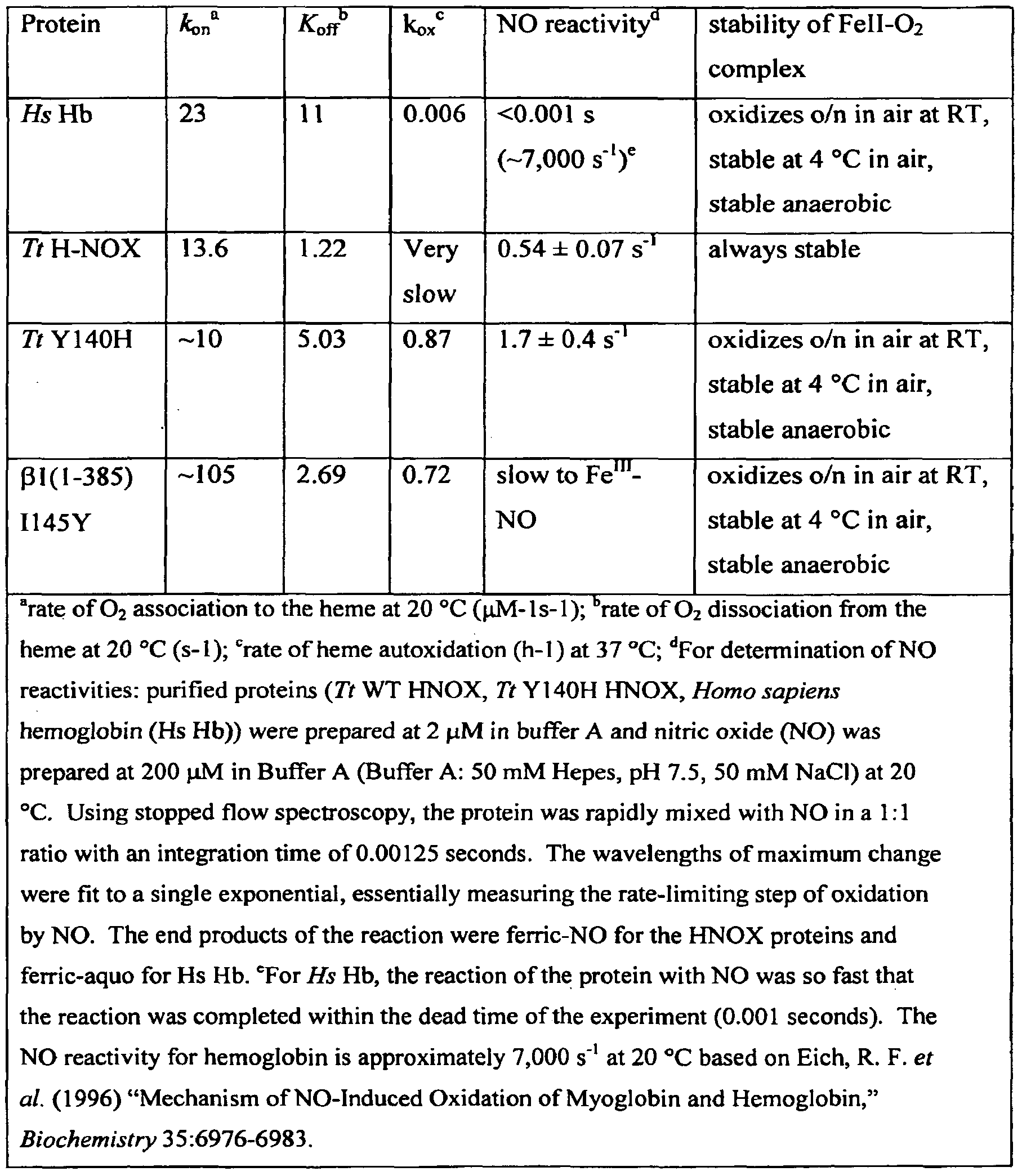
  • the NO dissociation constant of the mutant H-NOX protein is within 2 orders of magnitude of that of hemoglobin, and the NO reactivity of the mutant H-NOX protein is at least 10-fold lower than that of hemoglobin.
  • the NO reactivity of the mutant H-NOX protein is at least 100-fold lower than that of hemoglobin, such as at least 1,000-fold lower than that of hemoglobin.
  • the k ⁇ , k t , or k 2 for NO of the mutant H-NOX protein is between about 1 x 10 " V 1 to about IO s '1 at 37 0 C, such as about 1 . x 10 "4 S 1 to about 0.012 s "1 or about 1 x 10 ⁇ V' to about 1 x 10 ' V 1 at 37 0 C.
  • the O 2 dissociation constant of the mutant H-NOX protein is at least about 1 ⁇ M at 37 °C, such as at least about 10 ⁇ M or at least about 50 ⁇ M at 37 "C.
  • the invention provides an isolated H-NOX protein comprising at least one mutation that alters the kofr, k ⁇ , or k 2 for NO or alters the O 2 dissociation constant compared to that of a corresponding wild-type H-NOX protein.
  • the k o i ⁇ , ki, or k 2 for NO of the mutant H-NOX protein is between about 1 x 10 "4 S 1 to about 10 s "1 at 37 "C, and the O 2 dissociation constant of the mutant H-NOX protein is at least about 1 ⁇ M at 37 0 C.
  • the k off , kj, or k 2 for NO of the mutant H-NOX protein is between about 1 x 10 " V to about 0.012 s "1 or about 1 x 10 "4 S “1 to about 1 x lO ' V 1 at 37 "C.
  • the O 2 dissociation constant of the mutant H-NOX protein is at least about 10 ⁇ M, such as at least about 50 ⁇ M at 37 "C.
  • the NO reactivity of the mutant H-NOX protein is at least 10- fold lower than that of hemoglobin, such as at least 100-fold lower than that of hemoglobin or at least 1, 000-fold lower than that of hemoglobin.
  • the invention provides an isolated H-NOX protein selected from the group consisting of T. tengcongensis H-NOX I5A, T. tengcongensis H-NOX I5L, T. tengcongensis H-NOX I5L-P1 15A, T. tengcongensis H-NOX W9F, T. tengcongensis H-NOX W9F- Y140L, T. tengcongensis H-NOX W9F-Y140Hr. tengcongensis H-NOX W9F-N74A, T. tengcongensis H-NOX W9Y, T.
  • the ⁇ l or ⁇ 2 protein is derived from a R. norvegicus or H. sapiens ⁇ l or ⁇ 2 protein.
  • the invention provides an isolated H-NOX protein selected from the group consisting of T. tengcongensis H-NOX I5A, T. tengcongensis H-NOX 15L, T. tengcongensis H-NOX 15 L-Pl 15 A, T. tengcongensis H-NOX W9F-Y140L, T. tengcongensis H- NOX W9F-Y140H, T. tengcongensis H-NOX W9F-N74A, T. tengcongensis H-NOX W9Y, T.
  • the ⁇ l or ⁇ 2 protein is derived from a R. norvegicus or H. sapiens ⁇ l or ⁇ 2 protein.
  • the NO dissociation constant of the H-NOX protein is between 0.1 to 10-fold of that of hemoglobin, such as between 0.5 to 2-fold of that of hemoglobin. In some embodiments of the isolated H-NOX proteins, the NO dissociation constant of the H-NOX protein is within 2 orders of magnitude of that of Homo sapiens hemoglobin alpha, such as an NO dissociation constant between 0.1 to 10-fold or between 0.5 to 2-fold of that of Homo sapiens hemoglobin alpha.
  • the NO reactivity of the H-NOX protein is at least 10- fold lower than that of Homo sapiens hemoglobin alpha, such as at least 100-fold or 1, 000-fold lower than that of Homo sapiens hemoglobin alpha.
  • the NO reactivity of the H-NOX protein is less than about 700 s "1 at 20 "C, such as less than about 600 s "1 , 500 400 300 200 s ⁇ 100 s " ⁇ 75 s “1 , 50 s 1 , 25 s “1 , 20 s 1 , 10 s “1 , 50 s “1 , 3 s “1 , 2 s “1 , 1.8 s '1 , 1.5 s “1 , 1.2 s “1 , 1.0 s *1 , 0.8 s " ⁇ 0.7 s "1 , or 0.6 s '1 at 20 0 C.
  • the O 2 dissociation constant of the H-NOX protein is at least about 1 ⁇ M at 37 °C, such as at least about 10 ⁇ M or at least about 50 ⁇ M at 37 "C.
  • the k off , k], or k 2 for NO of the H-NOX protein is between about 1 x 10 ⁇ s "1 to about 10 s ⁇ ' at 37 "C, and the O 2 dissociation constant of the H-NOX protein is at least about 1 ⁇ M at 37 "C.
  • the kof f , ki, or k 2 for NO of the H-NOX protein is between about 1 x 10 "4 S ' 1 to about 10 s '1 at 37 “C, and the NO reactivity of the H-NOX protein is less than about 700 s "1 at 20 °C (e.g., less than about 600 s 1 , 500 s ⁇ ⁇ 100 s ⁇ ⁇ 20 s "1 , or 1.8 s 'at 20 °C).
  • the O 2 dissociation constant of the H-NOX protein is at least about 1 ⁇ M at 37 0 C, and the NO reactivity of the H-NOX protein is less than about 700 s "1 at 20 "C (e.g., less than about 600 s ' ⁇ 500 s "1 , 100 s "1 , 20 s ' ⁇ or 1.8 s 'at 20 °C).
  • the rate of heme autoxidation of the H-NOX protein is less than about 1 h ' 'at 37 C C.
  • the k Of ⁇ , ki, or k 2 for NO of the H- NOX protein is between about 1 x 10 "4 S “1 to about 10 s '1 at 37 °C, and the rate of heme autoxidation of the H-NOX protein is less than about 1 h 'at 37 "C.
  • the O 2 dissociation constant of the H-NOX protein is at least about 1 ⁇ M at 37 "C, and the rate of heme autoxidation of the H-NOX protein is less than about 1 h 'at 37 "C.
  • the rate of heme autoxidation of the H-NOX protein is less than about 1 h 'at 37 0 C, and the NO reactivity of the H-NOX protein is less than about 700 s " 1 at 20 "C (e.g., less than about 600 500 s "1 , 100 20 s "1 , or 1.8 s 'at 20 'C).
  • the H-NOX protein contains one or more mutations (e.g., 1, 2, 3, 4, 5, 6, 7, 8, 9, or 10 mutations) compared to the H-NOX protein from which it was derived.
  • the H-NOX protein contains less than 20, 15, 12, 10, 9, 8, 7, 6, 5, 4, 3, or 2 mutations compared to the H-NOX protein from which it was derived.
  • the H-NOX protein has at least one distal pocket mutation.
  • the H-NOX protein has at least one mutation that is not in the distal pocket.
  • the H-NOX protein has at least one mutation in which a residue that corresponds to Tyrl40 of 7! tengcongensis H-NOX or PheI42 of L. pneumophila 2 is replaced by any other amino acid.
  • the H-NOX protein has at least two mutations, wherein at least one mutation is the replacement of a residue that corresponds to Tyrl40 of T. tengcongensis H-NOX or Phel42 of L. pneumophila 2 by any other amino acid.
  • the mutation in the H-NOX protein corresponds to a Y 140F mutation or a Yl 4OL mutation of T. tengcongensis or a F142Y mutation of L. pneumophila 2.
  • the H-NOX protein is a deletion that contains the first 194, 217, or 385 amino acids of an H-NOX protein such as R. norvegicus or H. sapiens ⁇ l or ⁇ 2 protein.
  • the H-NOX protein is derived from a mammalian protein ⁇ e.g., a human protein such as ⁇ l).
  • the H-NOX protein derived from a bacterial protein (e.g., a T. tengcongensis protein).
  • the H-NOX protein is covalently bound to another molecule or moiety, such as polyethylene glycol. Heme may or may not be bound to the H-NOX protein.
  • NO is bound to the H-NOX protein.
  • the H-NOX protein is a fusion protein that includes an H-NOX domain and part or all of another protein, such as albumin (e.g., human serum albumin).
  • the H-NOX protein is not T. tengcongensis H-NOX Y40L, wild-type T. tengcongensis H-NOX, wild-type R. norvegicus sGC, or L. pneumophilia 2 H-NOX F 142 Y. In some embodiments of the isolated H-NOX proteins, the H- NOX protein is not T. tengcongensis H-NOX F78Y/Y140L. In some embodiments of the isolated H-NOX proteins, the H-NOX protein is not wild-type L. pneumophilia 2 H-NOX, wiJd-type H. sapiens ⁇ l H-NOX, R.
  • norvegicus sGC ⁇ l H-NOX (1-385), wild-type R. norvegicus ⁇ l H-NOX, wild-type D. melangaster ⁇ l H-NOX, wild-type D. melangaster CG14885-PA H-NOX, wild-type C. elegans GCY-35 H-NOX, wild-type N. punctiforme H-NOX, wild-type C. crescentus H-NOX, wild-type S. oneidensis H-NOX, or wild-type C. acetobutylicum H-NOX.
  • the H-NOX protein is not T. tengcongensis H-NOX W9F, T.
  • the H- NOX protein is not R. norvegicus ⁇ 2(l-217), R. norvegicus ⁇ l(l -194), R. norvegicus ⁇ l(l-385), or R.
  • the H-NOX protein is not T. tengcongensis H-NOX W9F, T. tengcongensis H-NOX Y 140F, or H. sapiens ⁇ l H- NOX (1-385) I145Y. In some embodiments of the isolated H-NOX proteins, the H-NOX protein is not T. tengcongensis H-NOX Y140H, H. sapiens ⁇ l I140Y, or H. sapiens ⁇ l I145Y. In some embodiments of the isolated H-NOX proteins, the H-NOX protein is not T.
  • norvegicus sGC ⁇ l H-NOX (1-385) I145Y, R. norvegicus sGC ⁇ l H-NOX H105G, R. norvegicus sGC ⁇ l H-NOX H105F, R. norvegicus sGC ⁇ l H-NOX 1145 Y, wild-type R. norvegicus ⁇ l H-NOX, wild-type D. melangaster ⁇ l H-NOX, wild- type D. melangaster CG14885-PA H-NOX, wild-type C. elegans GCY-35 H-NOX 5 wild-type N. punctiforme H-NOX, wild-type C. crescentus H-NOX, wild-type S.
  • the H- NOX protein is not any of the following H-NOX proteins that are listed by their gene name, followed by their species abbreviation and Genbank Identifiers (such as the following protein sequences available as of May 21, 2006; May 22, 2006; May 21, 2007; or May 22, 2007): Npun5905_Npu 23129606, alr2278_Ana 17229770, SO2144_Sone_24373702, Mdeg 1343_Mde_23027521 , VCA0720_Vch_ 15601476, CC2992_Ccr_ 16127222, Rsph2043_Rhsp_22958463 (gi:46l92757), Mmcl0739_Mcsp_22999020, Tar4_Tte_20807169, Ddes2822_Dde_23475919, CAC3243_
  • the H-NOX protein is not any of the following H- NOX proteins that are listed by their organism name and Pfam database accession number (such as the following protein sequences available as of May 21, 2006; May 22, 2006; May 17, 2007; May 21, 2007; or May 22, 2007): Caenorhabditis briggsae Q622M5 CAEBR, Caenorhabditis briggsae Q61P44_CAEBR, Caenorhabditis briggsae Q61 R54 C AEBR 5 Caenorhabditis briggsae Q61V90_CAEBR, Caenorhabditis briggsae Q61A94 CAEBR, Caenorhabditis briggsae Q60TP4 CAEBR, Caenorhabditis briggsae Q60M 1 O CAEBR, Caenorhabditis elegans GCY37_CAEEL, Caenorhabdititis briggsae Q622M
  • the invention features a recombinant nucleic acid encoding any one or more of the mutant H-NOX proteins described herein.
  • the nucleic acid includes a segment of or the entire nucleic acid sequence of any of the nucleic acids shown in FIGS. 2-4D or 8A-8DD.
  • the nucleic acid encodes a fusion protein that includes an H-NOX domain and part or all of another protein, such as albumin (e.g., human serum albumin).
  • the nucleic acid includes at least about any of 50, 100, 150, 200, 300, 400, 500, 600, 700, 800, or more contiguous nucleotides from an H-NOX nucleic acid and contains one or more mutations (e.g., 1, 2, 3, 4, 5, 6, 7, 8, 9, or 10 mutations) compared to the H-NOX nucleic acid from which it was derived.
  • a mutant H-NOX nucleic acid contains less than about any of 20, 15, 12, 10, 9, 8, 7, 6, 5, 4, 3, or 2 mutations compared to the H-NOX nucleic acid from which it was derived.
  • the invention also features degenerate variants of any nucleic acid encoding a mutant H-NOX protein.
  • the invention provides a vector that includes any one or more of the mutant H-NOX nucleic acids described herein. In another aspect, the invention features a cell that includes any one or more of the mutant H-NOX nucleic acids described herein. In one aspect, the invention features a cell that includes any vector described herein.
  • the invention features a method of producing an H-NOX protein. This method involves culturing a cell having a nucleic acid encoding any one or more of the mutant H- NOX proteins described herein under conditions suitable for production of the mutant H-NOX protein. In some embodiments, the invention further includes the step of purifying the mutant H- NOX protein.
  • the invention features pharmaceutical compositions that include one or more H-NOX proteins, such as any of the wild-type or mutant H-NOX proteins described herein.
  • the pharmaceutical composition includes a pharmaceutically acceptable amount of an H-NOX protein described herein and a pharmaceutically acceptable carrier.
  • the k off , ki, or k 2 for NO of the H-NOX protein is between about 1 x 10 ' V 1 to about 10 s "1 at 37 °C, and the O 2 dissociation constant of the H-NOX protein is at least about 1 ⁇ M at 37 °C.
  • the NO dissociation constant of the H-NOX protein is within 2 orders of magnitude of that of hemoglobin, and the NO reactivity of the H-NOX protein is at least 10-fold lower than that of hemoglobin.
  • the NO dissociation constant of the H-NOX protein is within 2 orders of magnitude of that of Homo sapiens hemoglobin alpha, such as an NO dissociation constant between 0.1 to 10-fold or between 0.5 to 2-fold of that of Homo sapiens hemoglobin alpha.
  • the NO reactivity of the H-NOX protein is at least 10-fold lower than that of Homo sapiens hemoglobin alpha, such as at least 100-fold or 1, 000-fold lower than that of Homo sapiens hemoglobin alpha.
  • the H-NOX protein is a wild-type protein.
  • the H-NOX protein is a mutant protein as described herein.
  • the H-NOX protein has at least one mutation that alters the NO dissociation constant, the k ⁇ , f r for NO, the kj for NO, the k 2 for NO, the O 2 dissociation constant, the NO stability, the NO reactivity the rate of heme autoxidation, or any combination of two or more of the foregoing compared to that of a corresponding wild-type protein.
  • the H- NOX protein is a selected from the group consisting of wild-type T. tengcongensis H-NOX, T.
  • tengcongensis H-NOX Y 140H T. tengcongensis H-NOX Y140A, T. tengcongensis I75F-His6, T. tengcongensis I75F, T. tengcongensis L144F-His6, T. tengcongensis L144F, L. pneumophilia 2 H-NOX F 142 Y, wild-type L. pneumophilia 1 H-NOX, wild-type L. pneumophilia 2 H-NOX, L. pneumophilia 2 F9W-F142Y, wild-type D. desulfuricans H-NOX, D.
  • H. sapiens ⁇ l H-NOX H-NOX(728-899)
  • D. desulfuricans H-NOX Y139L wild-type H. sapiens ⁇ l H-NOX, H. sapiens ⁇ l 114OY, H sapiens ⁇ l 1145 Y, H. sapiens ⁇ l( 1-385), H. sapiens ⁇ l(l-385) I145Y, H. sapiens ⁇ l(l-385) I145H, H. sapiens ⁇ l(l-194), H. sapiens ⁇ l(l-194) I145Y, H. sapiens ⁇ l(l-194) L9W-I145Y, H. sapiens ⁇ 2(l-217), H. sapiens ⁇ 2(l-217) 1142Y, H.
  • norvegicus ⁇ 2(l-217) R. norvegicus ⁇ 2(l-217) 1142Y
  • R. norvegicus ⁇ l H-NOX H105G R. norvegicus ⁇ l H-NOX H105F
  • R. norvegicus sGC ⁇ l H-NOX C78S R. norvegicus sGC ⁇ l H-NOX C78E
  • C. botulinum H-NOX(I-175) C. botulinum H- NOX(1-186), wild-type C. acetobutylicum H-NOX, C. acetobutylicum H-NOX(1-197), C.
  • H-NOX Taurus H-NOX, wild-type R. norvegicus; wild-type ⁇ C laevis H-NOX, wild-type O. latipes H-NOX, wild-type O. curivatus H-NOX, wild- type F. rubripes H-NOX, wild-type A. gambiae H-NOX, wild-type M. sexta H-NOX; wild-type C. elegans gcy-31, C. elegans gcy-32, wild-type C. elegans gcy-33, wild-type C. elegans gcy-34, wild- type C. elegans gcy-35, wild-type C.
  • the H-NOX protein is a selected from the group consisting of wild-type R. norvegicus sGC, wild-type R. norvegicus ⁇ 1(1-385), R. norvegicus ⁇ l(l-217), R. norvegicus ⁇ l(l-194), wild-type T. tengcongensis H-NOX, T.
  • the pharmaceutical composition includes one or more liposomes or nanoparticles that include or encapsulate the H-NOX protein.
  • the H-NOX protein is not
  • the H-NOX protein is not T. tengcongensis H-NOX F78Y/Y140L. In some embodiments of the pharmaceutical compositions, the H-NOX protein is not wild-type L. pneumophilia 2 H-NOX, wild- type H. sapiens ⁇ l H-NOX, R. norvegicus sGC ⁇ l H-NOX (1 -385), wild-type R.
  • the H-NOX protein is not T. tengcongensis H- NOX W9F, T. tengcongensis H-NOX Y 140F, R.
  • the H-NOX protein is not R. norvegicus ⁇ 2(l-217), R. norvegicus ⁇ 1(1- 194), R. norvegicus ⁇ l(l-385), or R. norvegicus ⁇ l(l-385) I145Y.
  • the H-NOX protein is not T. tengcongensis H-NOX W9F, T. tengcongensis H-NOX Y 140F, or H. sapiens ⁇ l H-NOX (1-385) 1145 Y. In some embodiments of the pharmaceutical compositions, the H-NOX protein is not T. tengcongensis H-NOX Y 140H, H. sapiens ⁇ l 114OY, or H. sapiens ⁇ l 1145 Y. In some embodiments of the pharmaceutical compositions, the H-NOX protein is not T. tengcongensis H-NOX Y40L, T.
  • norvegicus sGC ⁇ l H-NOX (1-385) I145Y, R. norvegicus sGC ⁇ l H- NOX H105G, R. norvegicus sGC ⁇ l H-NOX H105F, R. norvegicus sGC ⁇ l H-NOX 1145 Y, wild- type R. norvegicus ⁇ l H-NOX, wild-type D. melangaster ⁇ l H-NOX, wild-type D. melangaster CG14885-PA H-NOX, wild-type C. elegans GCY-35 H-NOX, wild-type N. punctiforme H-NOX, wild-type C. crescentus H-NOX, wild-type S.
  • the H-NOX protein is not any of the following H-NOX proteins that are listed by their gene name, followed by their species abbreviation and Genbank Identifiers (such as the following protein sequences available as of May 21, 2006; May 22, 2006; May 21, 2007; or May 22, 2007): Npun5905_Npu_23129606, alr2278_Ana_l 7229770, SO2144_Sone_24373702, Mdegl343_Mde_23027521, VCA0720_Vch_l 5601476, CC2992_Ccr_l 6127222, Rsph2043_Rhsp_22958463 (gi:46192757), Mmc 10739_Mcsp_22999020, Tar4_Tte_20807169, Ddes2822_Dde_23475919, CAC3243_
  • the H-NOX protein is not any of the following H-NOX proteins that are listed by their organism name and Pfam database accession number (such as the following protein sequences available as of May 21, 2006; May 22, 2006; May 17, 2007; May 21, 2007; or May 22, 2007): Caenorhabditis briggsae Q622M5 CAEBR, Caenorhabditis briggsae Q61P44 CAEBR, Caenorhabditis briggsae Q61R54 CAEBR, Caenorhabditis briggsae Q61 V90_CAEBR, Caenorhabditis briggsae Q61A94 CAEBR, Caenorhabditis briggsae Q60TP4 CAEBR, Caenorhabditis briggsae Q60M 1 O CAEBR, Caenorhabditis elegans GCY37 CAEEL, Caenorhabditis elegans G
  • H-NOX proteins described herein may be used in any of the pharmaceutical compositions described herein.
  • the H-NOX protein may or may not have heme and/or NO bound and may or may not be covalently bound to another molecule or moiety, such as polyethylene glycol.
  • the H-NOX protein is a fusion protein that includes an H-NOX domain and part or all of another protein, such as albumin (e.g., human serum albumin).
  • the invention provides methods of delivering NO to an individual (e.g., a mammal, such as a primate (e.g., a human, a monkey, a gorilla, an ape, a lemur, etc), a bovine, an equine, a porcine, a canine, or a feline) using an H-NOX protein.
  • the individual is suffering from or at risk for a cardiovascular condition, hypertension, a condition exacerbated by hypertension, a vasoconstrictive condition, stroke, or a functional NO deficiency.
  • the condition exacerbated by hypertension is heart failure, renal failure, or a stroke.
  • the invention provides a method of delivering
  • the k off , ki, or k 2 for NO of the H-NOX protein is between about 1 x 10 "4 S "1 to about 10 s "1 at 37 "C, and the O 2 dissociation constant of the H-NOX protein is at least about 1 ⁇ M at 37 0 C.
  • the NO dissociation constant of the H-NOX protein is within 2 orders of magnitude of that of hemoglobin, and the NO reactivity of the H-NOX protein is at least 10-fold lower than that of hemoglobin.
  • NO is bound to the H-NOX protein prior to the administration of the H-NOX protein to the individual. In some embodiments of the methods, NO is not bound to the H-NOX protein prior to the administration of the H-NOX protein to the individual, and the H-NOX protein transports NO from one location in the individual to another location in the individual. In some embodiments of the methods, the H-NOX protein is administered orally, rectally, or to the blood of the individual. In particular embodiments of the methods, the H-NOX protein is administered to the blood of the individual. In some embodiments of the methods, the H-NOX protein is administered to the individual at least twice.
  • the NO dissociation constant of the H-NOX protein is within 2 orders of magnitude of that of Homo sapiens hemoglobin alpha, such as an NO dissociation constant between 0.1 to 10-fold or between 0.5 to 2-fold of that of Homo sapiens hemoglobin alpha.
  • the NO reactivity of the H-NOX protein is at least 10-fold lower than that of Homo sapiens hemoglobin alpha, such as at least 100-fold or 1, 000-fold lower than that of Homo sapiens hemoglobin alpha.
  • the H-NOX protein is a wild-type protein.
  • the H- NOX protein is a mutant protein as described herein.
  • the H-NOX protein has at least one mutation that alters the NO dissociation constant, the k ⁇ , f r for NO, the ki for NO, the k 2 for NO, the O 2 dissociation constant, the NO stability, the NO reactivity the rate of heme autoxidation, or any combination of two or more of the foregoing compared to that of a corresponding wild-type protein.
  • the H-NOX protein is a selected from the group consisting of wild-type T. tengcongensis H-NOX, T.
  • tengcongensis H-NOX Y 140H T. tengcongensis H-NOX Y 140A, T. tengcongensis 175F-His6, T. tengcongensis I75F, T. tengcongensis L144F-His6, T. tengcongensis L144F, L. pneumophilia 2 H- NOX F142Y, wild-type L. pneumophilia 1 H-NOX, wild-type L. pneumophilia 2 H-NOX, L. pneumophilia 2 F9W-F142Y, wild-type D. desulfuricans H-NOX, D.
  • H. sapiens ⁇ l H-NOX H. sapiens ⁇ l 1140Y 5 H. sapiens ⁇ l I145Y, H. sapiens ⁇ l(l-385), H. sapiens ⁇ l(l-385) I145Y, H. sapiens ⁇ l(l-385) 1145H, H. sapiens ⁇ l(l-194), H. sapiens ⁇ l(l -194) I 145Y, H. sapiens ⁇ l(l-194) L9W-I 145Y, H. sapiens ⁇ 2(l-217), H.
  • sapiens ⁇ 2(l-217) I142Y, H. sapiens ⁇ l H-NOX H105G, H. sapiens ⁇ l H-NOX H105F, H. sapiens ⁇ l H-NOX C78S, H. sapiens ⁇ l H-NOX C78E, wild-type R. norvegicus ⁇ l H- NOX, R. norvegicus ⁇ l(l-385), R. norvegicus ⁇ l(l-385) I145Y, R. norvegicus ⁇ l(l-385) I145H, R. norvegicus ⁇ l(l-194), R. norvegicus ⁇ l(l-194) I145Y, R.
  • musculus H-NOX wild-type C. familiaris H-NOX, wild-type B. Taurus H-NOX, wild-type R. norvegicus; wild-type X. laevis H-NOX, wild-type O. latipes H-NOX, wild-type O. curivatus H-NOX, wild-type F. rubripes H-NOX, wild-type A. gambiae H-NOX, wild-type M. sexta H-NOX; wild-type C. elegans gcy-31, C. elegans gcy-32, wild-type C. elegans gcy-33, wild-type C.
  • the H-NOX protein is a selected from the group consisting of wild-type R. norvegicus sGC, wild-type R. norvegicus ⁇ l(l - 385), R. norvegicus ⁇ l(l-217), R.
  • one or more liposomes or nanoparticles that include or encapsulate the H-NOX protein are examples of the H-NOX protein.
  • the H-NOX protein is not T. tengcongensis H-
  • H-NOX Y40L wild-type T. tengcongensis H-NOX, wild-type R. norvegicus sGC, or L. pneumophilia 2 H-NOX F 142 Y.
  • the H-NOX protein is not T. tengcongensis H-NOX F78Y/Y140L.
  • the H-NOX protein is not wild-type L. pneumophilia 2 H-NOX, wild-type H. sapiens ⁇ l H-NOX, R. norvegicus sGC ⁇ l H-NOX (1-385), wild-type R. norvegicus ⁇ l H-NOX, wild-type D.
  • the H-NOX protein is not T. tengcongensis H-NOX W9F, T. tengcongensis H-NOX Y 140F, R. norvegicus sGC ⁇ l H-NOX H105G, R.
  • the H-NOX protein is not R. norvegicus ⁇ 2(l-217), R. norvegicus ⁇ 1(1 -194), R. norvegicus ⁇ l(l-385), or R. norvegicus ⁇ l(l-385) I145Y. In some embodiments of the methods, the H-NOX protein is not T.
  • the H-NOX protein is not T. tengcongensis H-NOX Y140H, H. sapiens ⁇ l I140Y, or H. sapiens ⁇ l 1145Y. In some embodiments of the methods, the H-NOX protein is not T. tengcongensis H-NOX Y40L, T. tengcongensis H-NOX F78Y/Y140L, T. tengcongensis H-NOX W9F, T.
  • norvegicus sGC ⁇ l H-NOX H105F R. norvegicus sGC ⁇ l H-NOX 1145 Y
  • wild-type R. norvegicus ⁇ l H-NOX wild-type D. melangaster ⁇ l H-NOX, wild- type D. melangaster CG14885-PA H-NOX, wild-type C. elegans GCY-35 H-NOX, wild-type N. punctiforme H-NOX 5 wild-type C. crescentus H-NOX, wild-type S. oneidensis H-NOX, or wild- type C. acetobutylicum H-NOX.
  • the H-NOX protein is not any of the following H-NOX proteins that are listed by their gene name, followed by their species abbreviation and Genbank Identifiers (such as the following protein sequences available as of May 21, 2006; May 22, 2006; May 21, 2007; or May 22, 2007): Npun5905_Npu_23129606, alr2278_Ana_l 7229770, SO2144_Sone_24373702, Mdegl343_Mde_23027521 , VCA0720_Vch_l 5601476, CC2992_Ccr_l 6127222, Rsph2043_Rhsp_22958463 (gi:46192757), Mmc 10739_Mcsp_22999020, Tar4_Tte_20807169, Ddes2822_Dde_23475919, CAC3243_Cac_l 5896488 , gcy-31_Ce_ 17568389, CG148
  • the H-NOX protein is not any of the following H-NOX proteins that are listed by their organism name and Pfam database accession number (such as the following protein sequences available as of May 21, 2006; May 22, 2006; May 17, 2007; May 21, 2007; or May 22, 2007): Caenorhabditis briggsae Q622M5_CAEBR, Caenorhabditis briggsae Q61P44 CAEBR, Caenorhabditis briggsae Q61R54 CAEBR, Caenorhabditis briggsae Q61V90_CAEBR, Caenorhabditis briggsae Q61A94_CAEBR, Caenorhabditis briggsae Q60TP4 CAEBR, Caenorhabditis briggsae Q60M10 CAEBR, Caenorhabditis elegans GCY37 CAEEL, Caenorhabditis elegans GCY
  • the H-NOX protein does not have a mutation in the Y-S-R motif, which includes Tyrl35, Serl37, and Argl39 of human H-NOX.
  • the H-NOX protein may or may not have heme and/or NO bound and may or may not be covalently bound to another molecule or moiety, such as polyethylene glycol.
  • the H-NOX protein is a fusion protein that includes an H-NOX domain and part or all of another protein, such as albumin (e.g., human serum albumin).
  • the invention features kits that include one or more H-NOX proteins.
  • the invention provides a kit that includes an H-NOX protein and instructions for using the kit to deliver NO to an individual.
  • the kom ki, or k 2 for NO of the H-NOX protein is between about 1 x 10 " V 1 to about 10 s "1 at 37 "C, and the O 2 dissociation constant of the H-NOX protein is at least about 1 ⁇ M at 37 "C.
  • the NO dissociation constant of the H-NOX protein is within 2 orders of magnitude of that of hemoglobin, and the NO reactivity of the H-NOX protein is at least 10- fold lower than that of hemoglobin.
  • the H-NOX protein may or may not have heme and/or NO bound and may or may not be covalently bound to another molecule or moiety, such as polyethylene glycol.
  • the H- NOX protein is a fusion protein that includes an H-NOX domain and part or all of another protein, such as albumin (e.g., human serum albumin).
  • the invention features an H-NOX protein (such as any of the wild-type or mutant proteins described herein) for use as a medicament.
  • the invention features an H-NOX protein for use in a method of delivering NO to an individual.
  • the H-NOX protein is used to treat any condition for which delivery of NO is beneficial, such as a cardiovascular condition, hypertension, a condition exacerbated by hypertension (e.g., heart failure, renal failure, or a stroke) , a vasoconstrictive condition, stroke, or a functional NO deficiency.
  • the invention features the use of an H-NOX protein (such as any of the wild-type or mutant proteins described herein) for the manufacture of a medicament, such as a medicament for delivering NO to an individual.
  • the invention features the use of an H-NOX protein for delivering NO to an individual.
  • the H- NOX protein is used to treat any condition for which delivery of NO is beneficial, such as a cardiovascular condition, hypertension, a condition exacerbated by hypertension (e.g., heart failure, renal failure, or a stroke) , a vasoconstrictive condition, stroke, or a functional NO deficiency.
  • FIG. IA is a picture of the three dimensional structure of distal pocket residues of
  • FIG. 1 A is based on the three-dimensional structure of T. tengcongensis H-NOX reported by Pellicena, P. et al. (August 31, 2004). "Crystal Structure of An Oxygen-Binding Heme Domain Related to Soluble Guanylate Cyclases," Proc Natl. AcadSci USA 101(35):12854-12859. [0036]
  • FIG. 1 B is a stereo side view of the three dimensional structure of T. tengcongensis
  • HNOX illustrating structural features of the H-NOX domain.
  • the protein fold is represented by ribbon diagrams.
  • the heme, dioxygen ligand, and proximal histidine are shown as ball-and-stick models, ⁇ -helices are labeled A-G according to the nomenclature shown in FIG. 5B.
  • ⁇ -strands are labeled 1-4.
  • FlG. IB is from Pellicena, P. et al. (August 31, 2004). "Crystal Structure of An Oxygen-Binding Heme Domain Related to Soluble Guanylate Cyclases," Proc Natl. AcadSci USA 101(35): 12854-12859.
  • FIGS. 1C- IH are pictures of the three dimensional structure of T. tengcongensis
  • FIG. 1C-1H illustrating exemplary distal pocket residues in T. tengcongensis HNOX.
  • the following residues depicted in FIGS. 1C-1H are the main residues comprising the H-NOX distal pocket: Thr4, Ile5, Thr8, Trp9, Trp67, Asn74, Ile75, Phe78, Phe82, Tyrl40, and Leul44, which are contained within helices A, D, E, and G.
  • FIGS. 1C- IH were created using PYMOL (DeLano Scientific, LLP).
  • FIG. 2 is a sequence alignment of the following H-NOX proteins that bind or are predicted to bind O 2 and NO: Majority (SEQ ID NO: I); Ce.
  • H-NOX proteins are predicted to bind O 2 as well as NO because they have a tyrosine at the position corresponding to Y140 of T. tengcongensis H-NOX.
  • FIG. 3A-3D are a sequence alignment of the following H-NOX proteins that bind or are predicted to bind NO but not O 2 : Majority (SEQ ID NO: 10); Dm. sGC betal protein (SEQ ID NO:1 1); sGC betal protein (SEQ ID NO:12); hs. sGC betal protein (SEQ ID NO:13); hs. beta2 protein (SEQ ID NO: 14); Ms. sGC betal protein (SEQ ID NO: 15); Mm. sGCbetal protein (SEQ ID NO: 16); Np. betal HD-like (SEQ ID NO: 17); Tr.
  • Majority SEQ ID NO: 10
  • Dm. sGC betal protein SEQ ID NO:1 1
  • sGC betal protein SEQ ID NO:12
  • hs. sGC betal protein SEQ ID NO:13
  • hs. beta2 protein SEQ ID NO: 14
  • Ms. sGC betal protein SEQ ID NO: 15
  • sGC betal protein (SEQ ID NO: 18); Anopheles_gambiae
  • FIGS. 4A-4D are a sequence alignment of H-NOX proteins from FIGS. 2 and 3A-
  • 3D Majority (SEQ ID NO:27); Dm. sGC betal protein (SEQ ID NO:1 1); sGC betal protein (SEQ ID NO: 12); hs. sGC betal protein (SEQ ID NO: 13); hs. beta2 protein (SEQ ID NO: 14); Mm. sGC betal protein (SEQ ID NO:16); Np. betalHD-like (SEQ ID NO:17); Tr.
  • sGC betal protein (SEQ ID NO: 18); Chlamydomonas_reinhardtii
  • sGc beta 3 protein SEQ ID NO:7; CG 14885 (SEQ ID NO:5); and Dm. sGC short variant (SEQ ID NO:6).
  • the alignment was generated using the default parameters in the program MegAlign.
  • Dm. sGC betal protein denotes Drosophila melanogaster ⁇ l H-NOX
  • sGC betal protein denotes Rattus norvegicus ⁇ l H-NOX
  • hs. sGC betal protein denotes Homo sapiens ⁇ l H-NOX
  • hs. beta2 protein denotes Homo sapiens ⁇ 2 H-NOX
  • sGC betal protein denotes Mus musculus ⁇ l H-NOX
  • Np. betalHD-like denotes Nostoc punctiforme H-NOX
  • Tr. sGC betal protein denotes Takifugu rubripes ⁇ l H-NOX
  • XP_310919 denotes Anopheles gambiae ⁇ l H-NOX
  • NP_001011632 denotes Apis mellifera ⁇ l H-NOX
  • sGC betal protein denotes Bos taurus ⁇ 1 H-NOX
  • AAR02 denotes Chlamydomonas reinhardtii ⁇ l H-NOX
  • BAC98396 denotes Oryzias curvinotus ⁇ l H-NOX
  • BAA76691 denotes Oryzias latipes ⁇ l H-NOX
  • X denotes Strongylocentrotus purpuratus ⁇ l H-NOX
  • NP_001018042+” denotes Sus scrofa ⁇ l H-NOX
  • gcy-31a denotes Caenorhabditis elegans Gcy-31a H-NOX
  • gcy-33 denotes Caenorhab
  • HNOX denotes Clostridium acetobutiylicum H- NOX
  • T. betal HD-like denotes Thermoanaerobacter tengcongensis H-NOX
  • Ms. sGc beta 3 protein denotes Manduca sexta ⁇ 3 H-NOX
  • CG 14885" denotes Drosophila melanogaster CG 14885 H-NOX
  • Dm. sGC short variant denotes Drosophila melanogaster Gcy-88-E-S H- NOX
  • Dm. CG4154 HNOX denotes Drosophila melanogaster CG4154 H-NOX.
  • 5A is a sequence alignment of members of the H-NOX family.
  • the sequence numbering is that of T. tengcongensis H-NOX.
  • Invariant residues are indicated by a "V”, very highly conserved residues are indicated by "s”.
  • H-NOX tengcongensis H-NOX is indicated by a "H.”
  • Predicted distal pocket tyrosine residues that may stabilize an Fe"- ⁇ 2 complex in other H- NOX proteins are: position 70 for Caenorhabditis elegans GCY-35; position 140 in Drosophila melanogaster CG14885-PA; position 138 of Caenorhabditis elegans GCY-35; position 140 of Clostridium acetobutylicum; numbered according to Thermoanaerobacter tengcongensis.
  • Accession numbers are: Homo sapiens ⁇ l [gi:2746083] (SEQ ID NO:28), Rattus norvegicus ⁇ l [gi:27127318] (SEQ ID NO:29), Drosophila melangaster ⁇ l [gi:861203] (SEQ ID NO:30), Drosophila melangaster CG14885-PA [gi:23171476] (SEQ ID NO:31), Caenorhabditis elegans GCY-35 [gi:52782806] (SEQ ID NO:32), Nostoc punctiforme [gi:23129606] (SEQ ID NO:33), Caulobacter crescentus [gi: 16127222] (SEQ ID NO:34), Shewanella oneidensis [gi .24373702] (SEQ ID NO:35), Legionella pneumophila (ORF 2) [CUCGC_272624] (SEQ ID NO:36), Clostridium aceto
  • FlG. 5B is a sequence alignment of exemplary H-NOX domains. The secondary structure annotations and the numbering on top of the alignment correspond to the H-NOX domain from T. tengcongensis. ⁇ -helices are represented by spirals, and ⁇ -strands by arrows. The distal pocket is defined by ⁇ -helices ⁇ A, ⁇ D, ⁇ E, and ⁇ G.
  • Pubmed/NCBI accession numbers are as follows: Ther tengcongensis gi 120807169 I (SEQ ID NO:39), Clos_acetobutylicum gi I 15896488 I (SEQ ID NO:40), Clos tetani Gl:75543266 (SEQ ID NO:41), Desu_desulfuricans gi 123475919 I (SEQ ID NO:42), Vibr vulnificus gi I 27361734
  • FIG. 5 B The alignments were generated using the program MULTALIN (Corpet, F. (1988) Nucleic Acids Res. 16:10881-10890), and FIG. 5B was prepared using the program ESPRIPT (Gouet, P. et al. (1999) Bioinformatics 15: 305-308.)-
  • FIGS. 6A and 6B are pictures of the three dimensional structure of the heme environment of the T. tengcongensis H-NOX domain.
  • FIG.S. 6A and 6B are from Pellicena, P. et al. (August 31, 2004). "Crystal Structure of An Oxygen-Binding Heme Domain Related to Soluble Gua ⁇ ylate Cyclases," Proc Natl. AcadSci USA 101(35):12854-12859.
  • FIGS. 7A-7F are graphs of the UV-visible spectroscopy of H-NOX proteins after anaerobic reduction (Fe" unligated complexes; top line in each graph) before and after being exposed to air (Fe"-O 2 complexes; bottom line in each graph) for Tt H-NOX (FIG. 7A), Tt Y 140L (FIG. 7B), Tt W9F-Y140L (FIG. 7C), Tt F78Y-Y140L (FIG. 7D), L2 H-NOX and L2 F142Y (FIG. 7E), and ⁇ l(l-385) and ⁇ l(l-385) I145Y (FIG. 7F).
  • FIGS. 7A-7F are from Boon, E. M. et al. (2005). "Molecular Basis For NO Selectivity in Soluble Guanylate Cyclase,” Nature Chem. Biol. 1 :53-59. [004S] FIGS.
  • 8A-8DD contain polynucleotide sequences of exemplary nucleic acids that encode H-NOX proteins and the amino acid sequences of the corresponding H-NOX proteins (SEQ ID NOS:53-162). DETAILED DESCRIPTION OF THE INVENTION
  • the present invention is based in part on the surprising discovery that H-NOX proteins have a much lower NO reactivity than hemoglobin. This intrinsic low NO reactivity (and high NO stability) makes wild-type and mutant H-NOX proteins desirable NO carriers because of the lower probability of inactivation of H-NOX proteins by NO in the presence of O 2 . Importantly, the presence of a distal pocket tyrosine in some H-NOX proteins (Pellicena, P. et al. (August 31, 2004). "Crystal Structure of An Oxygen-Binding Heme Domain Related to Soluble Guanylate Cyclases," Proc Natl.
  • AcadSci USA 101 (35): 12854- 12859) is suggestive of undesirable, AfgA NO reactivity, contraindicating use as an NO carrier.
  • a Mycobacterium tuberculosis hemoglobin protein with a structurally analogous distal pocket tyrosine, reacts extremely rapidly with NO, and is used by the Mycobacterium to effectively scavenge and avoid defensive NO produced by an infected host (Ouellet, H. et al. (April 30, 2002).
  • "Truncated Hemoglobin HbN Protects Mycobacterium Bovis From Nitric Oxide” Proc. Natl. Acad. Sci. USA 99(9):5902-5907).
  • H-NOX proteins actually have a much lower NO reactivity than that of hemoglobin making their use as NO carriers possible.
  • the usefulness of H-NOX proteins as NO carriers can be improved by modifying their affinities for NO or O 2 to maximize the amount of NO that is bound to the H-NOX protein and to reduce the amount of H-NOX protein that is oxidized by the reaction of NO with O 2 bound to the H-NOX protein.
  • the affinity of H-NOX proteins for NO or O 2 and the ability of H-NOX proteins to discriminate between NO and O 2 ligands can be altered by the introduction of one or more amino acid mutations, allowing H-NOX proteins to be tailored to bind NO or O 2 with desired affinities.
  • the dissociation constant or dissociation rate for NO or O 2 binding by H-NOX proteins can be altered the introduction of a single amino acid mutation. Additional mutations can be introduced to further alter the affinity for NO and/or O 2 .
  • the H-NOX protein family can therefore be manipulated to exhibit improved or optimal kinetic and thermodynamic properties for NO delivery.
  • mutant H-NOX proteins have been generated with altered dissociation constants and/or dissociation rates for NO binding that improve the usefulness of H-NOX proteins for a variety of clinical and industrial applications.
  • an H-NOX protein with a low affinity for O 2 (such as an O 2 dissociation constant of at least about 1 ⁇ M at 37 "C) is used to minimize the amount of O 2 that binds the H-NOX protein, thereby facilitating the binding of NO to the H-NOX protein and reducing the amount of H-NOX protein that is oxidized due to the reaction of NO with O2 bound to the heme of the H-NOX protein.
  • H-NOX proteins for NO delivery.
  • Organic nitrates are effective for a limited length of time due to tolerance. Since H-NOX proteins delivery NO directly to individuals without requiring the bioconversion of nitrates to NO, the effectiveness of H-NOX proteins as NO carriers is not limited by inhibition of this bioconversion pathway.
  • hemoglobin-based NO carriers Major limitations of hemoglobin-based NO carriers are their high affinity for O 2 and their propensity to be inactivated by NO. As mentioned above, destruction of even low levels of NO by hemoglobin- based carriers can have serious effects on the tonic resting state of the vasculature and organs and leads to hypertension and gastrointestinal distress. Intra- and inter-molecular cross-linking have been used to minimize the toxicity of hemoglobin-based vehicles when used as oxygen carriers ("Blood Substitutes," R. Winslow ed. Academic Press, 2006). While these modifications overcame some of the severe toxicity issues related to extravasation of hemoglobin, the high NO reactivity remained.
  • H-NOX proteins have a much lower NO reactivity than hemoglobin. This lower reactivity leads to less destruction of NO, O 2 , and H-NOX protein since less NO reacts with O 2 bound to the H-NOX protein.
  • the ability to select H-NOX proteins with desired dissociation constants and dissociation rates for NO can also minimize side-effects by preventing too much NO from being released (causing hypotension) and prevent NO from being released at undesired sites ⁇ e.g., sites that are not vasoconstricted).
  • Engineering H-NOX proteins to bind and deliver NO with minimal NO reactivity provides a new blood gas NO carrier where the H-NOX proteins deliver NO without being inactivated by NO.
  • H-NOX proteins represent an important alternative that overcomes the persistent problem of tolerance with current nitrovasodilators.
  • the use of H- NOX proteins as delivery vehicles for NO provides a new therapeutic venue for treating diseases exacerbated by chronic hypertension.
  • H-NOX protein means a protein that has an H-NOX domain (named for Heme-Nitric oxide and OXygen binding domain).
  • An H-NOX protein may or may not contain one or more other domains in addition to the H-NOX domain.
  • H-NOX proteins are members of a highly-conserved, well-characterized family of hemoproteins (Iyer, L. M. et al. (February 3, 2003).
  • H- NOX proteins are also referred to as Pfam 07700 proteins or HNOB proteins (Pfam - A database of protein domain family alignments and Hidden Markov Models, Copyright (C) 1996-2006 The Pfam Consortium; GNU LGPL Free Software Foundation, Inc., 59 Temple Place - Suite 330, Boston, MA 021 11-1307, USA).
  • an H-NOX protein has, or is predicted to have, a secondary structure that includes six alpha-helices, followed by two beta-strands, followed by one alpha-helix, followed by two beta-strands.
  • An H-NOX protein can be an apoprotein that is capable of binding heme or a holoprotein with heme bound.
  • H-NOX protein can covalently or non- covalently bind a heme group. Some H-NOX proteins bind NO but not O 2 , and others bind both NO and O 2 . H-NOX domains from facultative aerobes that have been isolated bind NO but not O 2 . H-NOX proteins from obligate aerobic prokaryotes, C. elegans, and D. melanogaster bind NO and O 2 Mammals have two H-NOX proteins: ⁇ l and ⁇ 2. An alignment of mouse, rat, cow, and human H-NOX sequences shows that these species share >99% identity.
  • the H- NOX domain of an H-NOX protein or the entire H-NOX protein is at least about any of 10, 15, 20, 25, 30, 40, 50, 60, 70, 80, 90, 95, 97, 98, 99, or 99.5% identical to that of the corresponding region of a naturally-occurring Thermoanaerobacter tengcongensis H-NOX protein or a naturally- occurring sGC protein (e.g., a naturally-occurring sGC ⁇ l protein).
  • an H-NOX protein may optionally contain one or more mutations relative to the corresponding naturally-occurring H-NOX protein.
  • the H-NOX protein includes one or more domains in addition to the H-NOX domain.
  • the H-NOX protein includes one or more domains or the entire sequence from another protein.
  • the H- NOX protein may be a fusion protein that includes an H-NOX domain and part or all of another protein, such as albumin (e.g., human serum albumin). In some embodiments, only the H-NOX domain is present.
  • a "protein” includes proteins and fragments of proteins whether isolated from natural sources, produced by recombinant techniques, or chemically synthesized.
  • a protein may have one or more modifications, such as a post-translational modification (e.g., glycosylation, etc) or any other modification (e.g., PEGylation, etc).
  • the protein may contain one or more non -naturally-occurring amino acids (e.g., such as an amino acid with a side chain modification).
  • the H-NOX protein has at least about 50, 100, 150, 181, 200, 250, 300, 350, 400, or more amino acids.
  • the H-NOX proteins may include from about 50 to about 600 amino acids, such as about 100 to about 500 amino acids, about 150 to about 400 amino acids, about 150 to about 300 amino acids, or about 175 to about 200 amino acids.
  • H-NOX proteins from any genus or species can be used in the compositions, kits, and methods described herein.
  • the H-NOX protein is a protein from a mammal (e.g., a primate (e.g., human, monkey, gorilla, ape, lemur, etc), a bovine, an equine, a porcine, a canine, or a feline), an insect, a yeast, or a bacteria or is derived from such a protein.
  • exemplary mammalian H-NOX proteins include wild-type human and rat soluble guanylate cyclase (such as the ⁇ l subunit).
  • H-NOX proteins include wild-type mammalian H-NOX proteins, e.g. H. sapiens, M. musculus, C. familiaris, B. taunts and R. norvegicus; and wild-type non-mammalian vertebrate H-NOX proteins, e.g.. X. laevis, O. latipes, O. curivatus, and F. rubripes.
  • non-mammalian wild-type NO-binding H-NOX proteins include wild-type H-NOX proteins of D. melanogaster, A.
  • examples of non-mammalian wild- type O2-binding H-NOX proteins include wild-type H-NOX proteins of C. elegans gcy-31, gcy-32, gcy-33, gcy-34, gcy-35, gcy-36, and gcy-37; D. melanogaster CG14885, CG14886, and CG4154; and M. sexta beta-3;
  • examples of prokaryotic wild-type H-NOX proteins include T. tengcongensis, V. cholera, V. fischerii, N. punctiforme, D. desulfuricans, L. pneumophila 1, L. pneumophila 2, and C. acetobutylicum.
  • NCBI Accession numbers for exemplary H-NOX proteins include the following:
  • Exemplary H-NOX protein also include the following H-NOX proteins that are listed by their gene name, followed by their species abbreviation and Genbank Identifiers (such as the following protein sequences available as of May 21, 2006; May 22, 2006; May 21, 2007; or May 22, 2007, which are each hereby incorporated by reference in their entireties): Npun5905_Npu_23129606, alr2278_Ana_l 7229770, SO2144_Sone_24373702, Mdegl343_Mde_23027521, VCA0720_Vch_15601476,CC2992_Ccr_16127222, Rsph2043 Rhsp_22958463 (gi:46192757), Mmcl0739_Mcsp_22999020,
  • H-NOX proteins include the following H-NOX proteins that are listed by their organism name and Pfam database accession number (such as the following protein sequences available as of May 21, 2006; May 22, 2006; May 17, 2007; May 21, 2007; or May 22, 2007, which are each hereby incorporated by reference in their entireties): Caenorhabditis briggsae Q622M5_CAEBR, Caenorhabditis briggsae Q61P44_CAEBR, Caenorhabditis briggsae Q61R54 CAEBR, Caenorhabditis briggsae Q61V90 CAEBR, Caenorhabditis briggsae Q61A94 CAEBR, Caenorhabditis briggsae Q60TP4 CAEBR, Caenorhabditis briggsae Q60M10_CAEBR, Caenorhabditis elegans GCY37 CAEEL, Caenorhabditis elegans
  • H-NOX proteins and nucleic acids which may be suitable for use in the pharmaceutical compositions and methods described herein, can be identified using standard methods. For example, standard sequence alignment and/or structure prediction programs can be used to identify additional H-NOX proteins and nucleic acids based on the similarity of their primary and/or predicted protein secondary structure with that of known H-NOX proteins and nucleic acids.
  • the Pfam database uses defined alignment algorithms and Hidden Markov Models (such as Pfam 21.0) to categorize proteins into families, such as the H-NOX protein family (Pfam - A database of protein domain family alignments and Hidden Markov Models, Copyright (C) 1996-2006 The Pfam Consortium; GNU LGPL Free Software Foundation, Inc., 59 Temple Place - Suite 330, Boston, MA 021 1 1-1307, USA).
  • Standard databases such as the swissprot-trembl database (world-wide web at "expasy.org", Swiss Institute of Bioinformatics Swiss-Prot group CMU - 1 rue Michel Servet CH-121 1 Geneva 4 , Switzerland) can also be used to identify members of the H-NOX protein family.
  • the secondary and/or tertiary structure of an H- NOX protein can be predicted using the default settings of standard structure prediction programs, such as PredictProtein (630 West, 168 Street, BB217, New York, N. Y. 10032, USA). Alternatively, the actual secondary and/or tertiary structure of an H-NOX protein can be determined using standard methods.
  • the H-NOX protein has the same amino acid in the corresponding position as any of following distal pocket residues in T. tengcongensis H-NOX: Thr4, Ile5, Thr8, Trp9, Trp67, Asn74, Ile75, Phe78, Phe82, Tyrl40, Leu 144, or any combination of two or more of the foregoing.
  • the H-NOX protein has a proline or an arginine in a position corresponding to that of Prol 15 orArgl35 of T. tengcongensis H-NOX, respectively, based on sequence alignment of their amino acid sequences.
  • the H-NOX protein has a histidine that corresponds to HislO5 of R. norvegicus ⁇ l H-NOX.
  • the H-NOX protein has or is predicted to have a secondary structure that includes six alpha-helices, followed by two beta-strands, followed by one alpha-helix, followed by two beta-strands. This secondary structure has been reported for H-NOX proteins.
  • a newly identified H-NOX protein can be tested to determine whether it binds heme using standard methods.
  • the ability of an H-NOX protein to function as an NO carrier can be tested by determining whether the H-NOX protein binds NO using standard methods, such as those described herein.
  • one or more of the mutations described herein can be introduced into the H-NOX protein to optimize its characteristics as an NO carrier. For example, one or more mutations can be introduced to alter its NO dissociation constant, ko t r for NO, ki for NO, k 2 for NO, O 2 dissociation constant, NO stability, NO reactivity, rate of heme autoxidation, or any combination of two or more of the foregoing. Standard techniques such as those described herein can be used to measure these parameters.
  • mutant H-NOX proteins may be derived by mutagenesis from these or other natural wild-type source sequences (e.g., the sequences listed in FlG. 2-4D or 8A-8DD or any other sequence described herein).
  • derived from refers to the source of the protein into which one or more mutations is introduced.
  • a protein that is "derived from a mammalian protein” refers to protein of interest that results from introducing one or more mutations into the sequence of a wild-type (i.e., a sequence occurring in nature) mammalian protein.
  • an H-NOX protein may contain one or more mutations, such as a mutation that alters the NO dissociation constant, the k ot r for NO, the O 2 dissociation constant, the kofr for O2, the rate of heme autoxidation, the NO reactivity, the NO stability, or any combination of two or more of the foregoing compared to that of the corresponding wild-type protein.
  • Panels of engineered H-NOX proteins may be generated by random mutagenesis followed by empirical screening for requisite or desired dissociation constants, dissociation rates, NO- reactivity, stability, physio-compatibility, or any combination of two or more of the foregoing in view of the teaching provided herein using techniques as described herein and, additionally, as known by the skilled artisan.
  • mutagenesis can be selectively targeted to particular regions or residues such as distal pocket residues apparent from the experimentally determined or predicted three-dimensional structure of an H-NOX protein (FIG. IA herein; and see, for example, Boon, E. M. et al. (2005).
  • a mutant protein means a protein with one or more mutations compared to a protein occurring in nature.
  • the mutant protein has a sequence that differs from that of all proteins occurring in nature.
  • the amino acid sequence of the mutant protein is at least about any of 10, 15, 20, 25, 30, 40, 50, 60, 70, 80, 90, 95, 97, 98, 99, or 99.5% identical to that of the corresponding region of a protein occurring in nature.
  • the mutant protein is a protein fragment that contains at least about any of 25, 50, 75, 100, 150, 200, 300, or 400 contiguous amino acids from a full-length protein.
  • Sequence identity can be measured, for example, using sequence analysis software with the default parameters specified therein (e.g., Sequence Analysis Software Package of the Genetics Computer Group, University of Wisconsin Biotechnology Center, 1710 University Avenue, Madison, WI 53705). This software program matches similar sequences by assigning degrees of homology to various amino acids replacements, deletions, and other modifications.
  • sequence analysis software with the default parameters specified therein (e.g., Sequence Analysis Software Package of the Genetics Computer Group, University of Wisconsin Biotechnology Center, 1710 University Avenue, Madison, WI 53705). This software program matches similar sequences by assigning degrees of homology to various amino acids replacements, deletions, and other modifications.
  • a “mutation” means an alteration in a reference nucleic acid or amino acid sequence occurring in nature.
  • Exemplary nucleic acid mutations include an insertion, deletion, frameshift mutation, silent mutation, nonsense mutation, or missense mutation.
  • the nucleic acid mutation is not a silent mutation.
  • Exemplary protein mutations include the insertion of one or more amino acids (e.g., the insertion of 2, 3, 4, 5, 6, 7, 8, 9, or 10 amino acids), the deletion of one or more amino acids (e.g., a deletion of N-terminal, C-terminal, and/or internal residues, such as the deletion of at least about any of 5, 10, 15, 25, 50, 75, 100, 150, 200, 300, or more amino acids or a deletion of about any of 5, 10, 15, 25, 50, 75, 100, 150, 200, 300, or 400 amino acids), the replacement of one or more amino acids (e.g., the replacement of 2, 3, 4, 5, 6, 7, 8, 9, or 10 amino acids), or combinations of two or more of the foregoing.
  • the deletion of one or more amino acids e.g., the insertion of 2, 3, 4, 5, 6, 7, 8, 9, or 10 amino acids
  • the deletion of one or more amino acids e.g., a deletion of N-terminal, C-terminal, and/or internal residues, such as the deletion of at least about any of 5,
  • An exemplary functional truncation of an H-NOX protein includes residues 1-385 of the ⁇ l sequence.
  • a mutant protein has at least one amino acid alteration compared to a protein occurring in nature.
  • a mutant nucleic acid sequence encodes a protein that has at least one amino acid alteration compared to a protein occurring in nature.
  • the nucleic acid is not a degenerate version of a nucleic acid occurring in nature that encodes a protein with an amino acid sequence identical to a protein occurring in nature. The nomenclature used in referring to a particular amino acid mutation first identifies the wild-type amino acid, followed by the residue number and finally the substitute amino acid.
  • Y 140L means that tyrosine has been replaced by a leucine at residue number 140.
  • An "evolutionary conserved mutation” is the replacement of an amino acid in one protein by an amino acid in the corresponding position of another protein in the same protein family.
  • Exemplary evolutionary conserved mutations are listed in Table IA. In Table 1 A, mutations are numbered/annotated according to the sequence of human ⁇ l H-NOX, but are analogous for all H-NOX sequences. Thus, the corresponding position in any other H-NOX protein can be mutated to the indicated residue.
  • Phe4 of human ⁇ l H-NOX can be mutated to a tyrosine since other H-NOX proteins have a tyrosine in this position.
  • the corresponding phenylalanine residue can be mutated to a tyrosine in any other H-NOX protein.
  • the one or more mutations are confined to evolutionarily conserved residues.
  • the one or more mutations may include at least one evolutionarily conserved mutation and at least one non-evolutionarily conserved mutation. If desired, these mutant H-NOX proteins are subjected to empirical screening for NO/O 2 dissociation constants, NO- reactivity, stability, and physio-compatibility in view of the teaching provided herein.
  • the mutation is a distal pocket mutation, such as mutation of a residue in alpha-helix A, D, E, or G (Pellicena, P. et al. (August 31, 2004). "Crystal Structure of An Oxygen-Binding Heme Domain Related to Soluble Guanylate Cyclases," Proc Natl. Acad Sci USA 101 (35): 12854-12859).
  • Exemplary distal pocket mutations are listed in Table IB. In Table IB, mutations are numbered/annotated according to the sequence of human ⁇ 1 H-NOX, but are analogous for all H-NOX sequences.
  • the residue at each indicated position can be changed to any other naturally or non-naturally-occurring amino acid (denoted "X").
  • Such mutations can produce H-NOX proteins with a variety of desired affinity, stability, and reactivity characteristics.
  • the mutation is a heme distal pocket mutation.
  • a crucial molecular determinant that prevents O 2 binding in NO-binding members of the H-NOX family is the lack of a H-bond donor in the distal pocket of the heme.
  • the mutation alters H-bonding between the H-NOX domain and the ligand within the distal pocket.
  • the mutation disrupts an H-bond donor of the distal pocket and/or imparts reduced O 2 ligand-binding relative to the corresponding wild-type H-NOX domain.
  • Exemplary distal pocket residues include Thr4, Ile5, Thr8, Trp9, Trp67, As ⁇ 74, Ile75, Phe78, Phe82, Tyrl40, and Leul44of T. tengcongensis H-NOX and the corresponding residues in any other H-NOX protein.
  • the H-NOX protein has one or more mutations outside of the distal pocket. Examples of residues that can be mutated but are not in the distal pocket include Prol 15 and Argl35 of T. tengcongensis H-NOX. In some embodiments, the mutation is in the proximal pocket which includes His 105 as a residue that Iigates to the heme iron.
  • the amino acid sequence of the H-NOX protein is not identical to the sequence of a protein that is produced by an organism in nature. In some embodiments, the amino acid sequence of the H-NOX protein is not identical to a sequence found in any database on May 21, 2006 or May 22, 2006 (such as all known sequences predicted or known to be an H-NOX nucleic acid or amino acid sequence). In some embodiments, the amino acid sequence of the H-NOX protein is not identical to a sequence found in any database on May 21, 2007 or May 22, 2007 (such as all known sequences predicted or known to be an H-NOX nucleic acid or amino acid sequence).
  • amino acids in an H-NOX protein can be mutated to the corresponding amino acids in a human H-NOX.
  • one or more amino acids on the surface of the tertiary structure of a non-human H-NOX protein can be mutated to the corresponding amino acid in a human H-NOX proteins.
  • mutation of one or more surface amino acids may be combined with mutation of two or more distal pocket residues, mutation of one or more residues outside of the distal pocket (e.g., a mutation in the proximal pocket), or combinations of two or more of the foregoing.
  • Table 2 can be mutated to any other amino acid.
  • the invention also relates to any combination of mutation described herein, such as double, triple, or higher multiple mutations.
  • combinations of any of the mutations described herein can be made in the same H-NOX protein.
  • mutations in equivalent positions in other mammalian or non-mammalian H-NOX proteins are also encompassed by this invention.
  • residues other than the ones mentioned in Table 2 can also be mutated.
  • Exemplary mutant H-NOX proteins comprise one or more mutations that impart altered NO or O 2 ligand-binding relative to the corresponding wild-type H- NOX domain and are operative as a physiologically compatible mammalian NO blood gas carrier.
  • T. tengcongensis 15A refers to the replacement of isoleucine by alanine at the fifth position in T. tengcongensis H-NOX.
  • the same isoleucine to alanine mutation can be made in the corresponding residue in any other H-NOX protein (this residue may or may not be the fifth residue in the sequence of other H-NOX proteins).
  • the H-NOX protein has at least one mutation in which a residue that corresponds to Ile5, Trp9, Asn74, Prol 15, Argl 35, or Tyrl40 of T. tengcongensis H- NOX, 1145 of ⁇ l(l-385), or Phel42 of L. pneumophila 2 is replaced by any other amino acid.
  • the H-NOX protein has at least two mutations, wherein at least one mutation is the replacement of a residue that corresponds to Ile5, Trp9, Asn74, Prol 15, Argl35, or Tyrl40 of T. tengcongensis H-NOX, 1145 of ⁇ l(l-385), or Phel42 of L.
  • the mutation in the H-NOX protein corresponds to a I5A mutation, a 15L mutation, a W9F mutation, a Y 140F mutation, a Y 140L mutation, a Y 140H mutation, a W9F Y140H double mutation, or a F78Y Y140F double mutation of T. tengcongensis or a I145Y mutation of ⁇ l.
  • the mutation in the H-NOX protein corresponds to a W9Y mutation, a W9H mutation, a W9N mutation, a N74H mutation, a N74E mutation, a N74A mutation, a P1 15A mutation, a R135Q mutation, a I5L Pl 15A double mutant, a N74A Y 140H double mutant, or a W9F N74A double mutant of T. tengcongensis.
  • at least one C-terminal amino acid (such as at least about 50 contiguous C-terminal amino acids or between about 25 to about 200 contiguous C-terminal amino acids) in the H-NOX protein has been removed compared to the corresponding wild-type protein (such as R. norvegicus or H. sapiens ⁇ l).
  • T. tengcongensis T. tengcongensis
  • Lp L. pneumophila
  • Dd D. desulfuricans
  • Vc V. cholera
  • Np N. punctiforme
  • Cb C. botulinium
  • Ca C. acetobutylicum
  • rat human
  • C. elegans Ce
  • any of the wild-type or mutant H-NOX proteins can be modified and/or formulated using standard methods to enhance therapeutic or industrial applications.
  • a variety of methods are known in the art for insulating such agents from immune surveillance, including crosslinking, PEGylation, carbohydrate decoration, etc. (e.g., Rohlfs, R. J. et al. (May 15, 1998). "Arterial Blood Pressure Responses to Cell-Free Hemoglobin Solutions And The Reaction With Nitric Oxide," J. Biol. Chem. 273(20): 12128-12134; Migita, R. et al. (June 1997).
  • H-NOX protein Fusing an H- NOX protein with a human protein such as human serum albumin can increase the serum half-life, viscosity, and colloidal oncotic pressure.
  • an H-NOX protein is modified during or after its synthesis to decrease its immunogenicity and/or to increase its plasma retention time.
  • H-NOX proteins can also be encapsulated (such as encapsulation within liposomes or nanoparticles).
  • an H-NOX protein has a similar or improved NO dissociation constant, O 2 dissociation constant, NO k of r, O 2 k off , NO reactivity, autoxidation rate, plasma retention time, or any combination of two or more of the foregoing compared to any currently used compound for delivering NO, such as any organic nitrate for bioconversion into NO.
  • an H-NOX protein has a low affinity for O 2 (such as an O 2 dissociation constant of at least about 1 ⁇ M at 37 0 C) or no detectable affinity for O 2 . Since little, if any, O 2 is bound to the H-NOX protein, there is minimal oxidation by NO of O 2 bound to the heme of the H-NOX protein. Thus, minimal NO, O 2 , and H-NOX protein is inactivated by this NO oxidation.
  • hemoglobin means a protein or a mutant thereof from the well- characterized family of hemoglobins, which are iron-containing O 2 -transport metalloproteins in red blood cells. Purified, stroma-free, human hemoglobin has a kinetic K D for O 2 of about 200-500 nM. This value is subunit dependent.
  • a 6-coordinate Fe-NO complex is meant a 6-coordinate ferrous-nitrosyl that produces a UV-Vis Soret peak at approximately 416-422 nm, as described, e.g., by Boon, E. M. et al., (August 2006), "Nitric Oxide Binding to Prokaryotic Homologs of the Solube Guanylate Cyclase ⁇ l HONOX Domain,” J. Biol. Chem.
  • a 5-coordinate Fe H -NO complex is meant a 5-coordinate ferrous-nitrosyl that produces a UV-Vis Soret peak at approximately 397-400 nm, as described, e.g., by Boon, E. M.
  • a "k off” means a dissociation rate, such as the rate of release of NO or
  • the k o ff, ki, or k 2 for NO for the H-NOX protein is between about 1 x 10"V 1 to about 10 s 1 at 37 °C, such as between about 1 x 10 "4 S "1 to about 0.012 s "1 , about 1 x 10 ⁇ "1 to about 0.007 s * ⁇ about 0.005 s "1 to about 0.01 1 s "1 , or about 1 x 10 "4 S 1 to about 1 x 10 ' V at 37 0 C.
  • the k o f f for O 2 for an H-NOX protein is between about 1 to about 1,000 s "1 at 37 ⁇ C, such as about 1 to about 50 s ' ⁇ about 50 to about 100 about 100 to about 250 about 500 to about 750 s "1 , or about 750 to about 1 ,000 s "1 at 37 °C.
  • a "Ic 0n " is meant an association rate, such as the rate of binding of NO or O 2 to a protein.
  • a lower numerical lower Ic 0n indicates a slower rate of association.
  • the Ic 0n for O 2 for an H-NOX protein is between about 0.14 to about 60 ⁇ WC's '1 at 20 0 C, such as about 6 to about 60 about 6 to 12 ⁇ M 's '1 , about 15 to about 60 ⁇ M " ⁇ s " ', about 5 to about 18 ⁇ M “ s “1 , or about 6 to about 15 ⁇ M 's "1 .
  • dissociation constant is meant a “kinetic dissociation constant” or a “calculated dissociation constant.”
  • a “kinetic dissociation constant” or “K D” means a ratio of kinetic off-rate (k off ) to kinetic on-rate (Ic 0n ), such as a K D value determined as an absolute value using standard methods (e.g., standard spectroscopic, stopped-flow, or flash-photolysis methods) including methods known to the skilled artisan and/or described herein.
  • Calculated dissociation constant or “calculated K D” refers to an approximation of the kinetic dissociation constant based on a measured k off .
  • the value for the Ic 0n for NO for an H-NOX protein is assumed to be 710 ⁇ M "1 s '1 , which is a reported Ic 0n for ⁇ l(l-385) that was measured at 4 0 C and does not increase significantly at 37 0 C (Zhao, et. ai, (1999). "A Molecular Basis for Nitric Oxide Sensing by Soluble Guanylate Cyclase," PNAS. 96:14753-14758, which is hereby incorporated by reference in its entirety, particularly with respect to the calculation of NO Ic 0n for H-NOX proteins).
  • a value for the Ic 0n is derived via the correlation between kinetic K D and k of r as described herein.
  • the kinetic or calculated K D for NO binding by an H-NOX protein is within about 0.01 to about 100-fold of that of hemoglobin under the same conditions (such as at 20 0 C), such as between about 0.1 to about 10-fold or between about 0.5 to about 2-fold of that of hemoglobin under the same conditions (such as at 20 0 C).
  • the NO dissociation constant of the H-NOX protein is between about 0.1 to about 20 pM at 37 0 C, such as about 0.5 to about 15, about 0.5 to about 12, about 0.7 to about 4, or about 0.7 to about 3 at 37 0 C.
  • the NO dissociation constant of the H-NOX protein is at least about 0.1 pM at 37 0 C, such as at least about any of 0.5, 1, 3, 5, 10, 12, 50, 100, 400, 500, 1000, 2000, 3000, or 4000 pM at 37 0 C. In some embodiments, the NO dissociation constant of the H-NOX protein is less than about 5000 pM at 37 0 C, such as less than about any of 4000 pM, 3000 pM, 2000 pM, 1000 pM, 500 pM, 400 pM, 100 pM, 50 pM, 12 pM, 10 pM, 5 pM, 3 pM, or 1 pM at 37 0 C.
  • the kinetic or calculated KQ for O 2 binding by an H-NOX protein is within about 0.01 to about 100-fold of that of hemoglobin under the same conditions (such as at 20 0 C), such as between about 0.1 to about 10-fold or between about 0.5 to about 2- fold of that of hemoglobin under the same conditions (such as at 20 0 C).
  • the O 2 dissociation constant of the H-NOX protein it at least about 1 ⁇ M at 37 °C, such as at least about any of 5 ⁇ M, 10 ⁇ M, 20 ⁇ M, 30 ⁇ M, 40 ⁇ M, 50 ⁇ M, 60 ⁇ M, 70 ⁇ M, 80 ⁇ M, 90 ⁇ M, or 100 ⁇ M at 37 0 C.
  • NO affinity is a qualitative term that refers to the strength of NO binding to a protein (such as binding to a heme group or to an oxygen bound to a heme group associated with a protein).
  • NO stability refers to the stability or resistance of a protein to oxidation by NO in the presence of oxygen. For example, the ability of the protein to not be oxidized when bound to NO in the presence of oxygen is indicative of the protein's NO stability.
  • NO reactivity refers to the rate at which iron in the heme of a heme-binding protein is oxidized by NO in the presence of oxygen at a concentration of 2 ⁇ M protein. A lower numerical value for NO reactivity in units of s "1 indicates a lower NO reactivity.
  • the NO reactivity of an H-NOX protein is less than about 700 s "1 at 20 "C, such as less than about 600 s "1 , 500 s “1 , 400 s ⁇ 300 s ', 200 s '1 , 100 s “1 , 75 s ', 50 25 10 s “1 , 50 s “1 , 3 s “1 , 2 s '1 , 1.8 s “1 , 1.5 s “1 , 1.2 s 1 , 1.0 s '1 , 0.8 s "1 , 0.7 or 0.6 s "1 at 20 0 C.
  • the NO reactivity of an H-NOX protein is between about 0.1 to about 600 s "1 at 20 °C, such as between about 0.5 to about 400 s "1 , about 0.5 to about 100 about 0.5 to about 50 s "1 , about 0.5 to about 10 s “1 , about I to about 5 s “1 , or about 0.5 to about 2.1 s “1 at 20 “C.
  • the reactivity of an H-NOX protein is at least about 10, 100, 1,000, or 10,000 fold lower than that of hemoglobin under the same conditions, such as at 20 "C.
  • an "autoxidation rate” refers to the rate at which iron in the heme of a heme-binding protein is autoxidized.
  • a lower numerical autoxidation rate in units of s ⁇ ' indicates a lower autoxidation rate.
  • the rate of heme autoxidation of an H-NOX protein is less than about 1.0 h “ 'at 37 0 C, such as less than about any of 0.9 h “1 , 0.8 h “1 , 0.7 h “ ⁇ 0.6 h ' ⁇ 0.5 h “ ⁇ 0.4 h '1 , 0.3 h “1 , 0.2 h “1 , 0.1 h “1 , or 0.05 h "1 at 37 0 C.
  • the rate of heme autoxidation of an H-NOX protein is between about 0.006 to about 5.0 h ⁇ ' at 37 °C, such as about 0.006 to about 1.0 h ⁇ l , 0.006 to about 0.9 h "1 , or about 0.06 to about 0.5 h "1 at 37 0 C.
  • a mutant H-NOX protein has (a) an NO or O 2 dissociation constant, association rate (Ic 0n for NO or O 2 ), or dissociation rate (k off for NO or O 2 ) within 2 orders of magnitude of that of hemoglobin, (b) has an NO affinity weaker (e.g., at least about 10-fold, 100- fold, or 1000-fold weaker) than that of sGC ⁇ l (c) an NO reactivity with bound O 2 at least 1000- fold less than hemoglobin, (d) an in vivo plasma retention time at least 2, 10, 100, or 1000-fold higher than that of hemoglobin, or (e) any combination of two or more of the foregoing.
  • NO affinity weaker e.g., at least about 10-fold, 100- fold, or 1000-fold weaker
  • Exemplary suitable NO carriers provide dissociation constants within two orders of magnitude of that of hemoglobin, i.e. between about 0.01 and 100-fold, such as between about 0.1 and 10-fold, or between about 0.5 and 2-fold of that of hemoglobin.
  • a variety of established techniques may be used to quantify dissociation constants, such as the techniques described herein (Boon, E. M. et al. (2005). "Molecular Basis For NO Selectivity in Soluble Guanylate Cyclase," Nature Chem. Biol. 1 :53-59; Boon, E. M. et al. (October 2005). "Ligand Discrimination in Soluble Guanylate Cyclase and the H-NOX Family of Heme Sensor Proteins," Curr.
  • Exemplary NO carriers provide low or minimized NO reactivity of the H-NOX protein with bound O 2 , such as an NO reactivity lower than that of hemoglobin. In some embodiments, the NO reactivity is much lower, such as at least about 10, 100, 1,000, or 10,000-fold lower than that of hemoglobin.
  • a variety of established techniques may be used to quantify NO reactivity (Boon, E. M. et al. (2005). "Molecular Basis For NO Selectivity in Soluble Guanylate Cyclase," Nature Chem. Biol. 1 :53-59; Boon, E. M. et al. (October 2005). "Ligand Discrimination in Soluble Guanylate Cyclase and the H-NOX Family of Heme Sensor Proteins," Curr.
  • T. tengcongensis H-NOX Y 140H has an NO reactivity similar to that of wild-type T. tengcongensis H-NOX.
  • Exemplary mutants for NO delivery have an NO affinity weaker, preferably at least
  • sGC ⁇ l 10-fold, 100-fold, or 1000-fold weaker than that of sGC ⁇ l .
  • a range of engineered H-NOX proteins with varying affinities are empirically tested for efficacy in particular disease states, with a range in some embodiments of NO affinities of 0.1 to 1000 nM.
  • suitable NO carriers provide high or maximized stability, particularly in vivo stability.
  • stability metrics may be used, such as oxidative stability (e.g., stability to autoxidation or oxidation by NO), temperature stability, and in vivo stability.
  • oxidative stability e.g., stability to autoxidation or oxidation by NO
  • temperature stability e.g., temperature stability
  • in vivo stability e.g., temperature stability
  • a variety of established techniques may be used to quantify stability, such as the techniques described herein (Boon, E. M. et al. (2005). "Molecular Basis For NO Selectivity in Soluble Guanylate Cyclase," Nature Chem. Biol. 1 :53-59; Boon, E. M. et al. (October 2005). "Ligand Discrimination in Soluble Guanylate Cyclase and the H-NOX Family of Heme Sensor Proteins,” Curr. Opin.
  • H-NOX Domains From sGC to Bacterial NO Sensors
  • J. Inorg. Biochem. 99(4): 892-902 exemplary metrics of stability include retention time, rate of clearance, and half-life.
  • H-NOX proteins from thermophilic organisms are expected to be stable at high temperatures.
  • the plasma retention times are at least about 2-, 10-, 100-, or 1000-fold greater than that of hemoglobin (e.g. Bobofchak, K. M. et al. (March 2003).
  • hemoglobin-based carriers are limited by the rapid clearance of cell-free hemoglobin from plasma due the presence of receptors for hemoglobin that remove cell-free hemoglobin from plasma. Since there are no receptors for H- NOX proteins in plasma, wild-type and mutant H-NOX proteins are expected to have a longer plasma retention time than that of hemoglobin. If desired, the plasma retention time can be increased by PEGylating or crosslinking an H-NOX protein or fusing an H-NOX protein with another protein using standard methods (such as those described herein and those known to the skilled artisan).
  • the NO dissociation constant of the H-NOX protein is within 2 orders of magnitude of that of hemoglobin, and the NO reactivity of the H-NOX protein is at least 10-fold lower than that of hemoglobin.
  • the k of r, kj, or k 2 for NO of the H-NOX protein is between about 1 x 10 "4 S 1 to about 10 s "1 at 37 0 C, and the O 2 dissociation constant of the H-NOX protein is at least about 1 ⁇ M at 37 0 C.
  • the k of r, ki, or k 2 for NO of the H-NOX protein is between about 1 x 10 "4 S 1 to about 10 s "1 at 37 °C, and the O 2 dissociation constant of the H-NOX protein is at least about 1 ⁇ M at 37 °C.
  • the k o ff, ki, or k 2 for NO of the H-NOX protein is between about 1 x 10 "4 S 1 to about 10 s "1 at 37 0 C, and the NO reactivity of the H-NOX protein is less than about 700 s "1 at 20 °C (e.g., less than about 600 s "1 , 500 s "1 , 100 s 1 , 20 or 1.8 s 'at 20 “C).
  • the O 2 dissociation constant of the H-NOX protein is at least about 1 ⁇ M at 37 "C, and the NO reactivity of the H-NOX protein is less than about 700 s "1 at 20 “C (e.g., less than about 600 s 1 , 500 s "1 , 100 s "1 , 20 or 1.8 s " 'at 20 “C).
  • the k off , ki, or k 2 for NO of the H-NOX protein is between about 1 x 10 '4 S “1 to about 10 s "1 at 37 “C, and the rate of heme autoxidation of the H-NOX protein is less than about 1 h " 'at 37 “C.
  • the O 2 dissociation constant of the H-NOX protein is at least about 1 ⁇ M at 37 "C, and the rate of heme autoxidation of the H-NOX protein is less than about 1 h " 'at 37 “C. In some embodiments, the rate of heme autoxidation of the H-NOX protein is less than about 1 h ' 'at 37 ⁇ C, and the NO reactivity of the H-NOX protein is less than about 700 s 1 at 20 0 C (e.g., less than about 600 s ⁇ 100 s "1 , 20 or 1.8 s 'at 20 “C). In some embodiments, the viscosity of the H-NOX protein solution is between 1 and 4 centipoise (cP). In some embodiments, the colloid oncotic pressure of the H-NOX protein solution is between 20 and 50 mm Hg.
  • Table 3 lists exemplary sizes, oxygen affinities, autoxidation stabilities, NO reactivity rates, and modifications for wild-type and mutant H-NOX proteins.
  • vehicle size refers to the molecular weight of a modified (e.g., PEGylated) or unmodified H-NOX protein.
  • Tables 4-14 Exemplary data for particular mutants are reported in Tables 4-14.
  • ⁇ l and B2 refer to proteins derived from rat H-NOX proteins. Since the amino acid sequences of mammalian ⁇ l H-NOX domains differ by at most two amino acids, similar results are expected for the corresponding mutations in other mammalian ⁇ l H-NOX proteins, such as human ⁇ l .
  • Table 4 demonstrates that the dissociation constant for NO binding can be significantly changed by mutating one or more residues in H-NOX proteins.
  • the ability of allosteric regulators to dramatically affect the dissociation constant and dissociation rate of NO for sGC supports the ability of mutations that alter the structure of sGC or other H-NOX proteins to alter the dissociation constant and dissociation rate of NO.
  • the dissociation constant for NO binding can be further altered by combining any of the mutations listed in Table 4 or by introducing one or more additional mutations into an H-NOX protein, as described herein. Table 4. K D values for NO binding to H-NOX and other hemoproteins
  • d k values bracket broadest ranges of fits from NO dissociation from 5-coordinate and 6-coordinate, each averaged from 2 — 4 dissociation experiments using saturating CO and 30 mM Na 2 S 2 O 4 as the NO trap and containing 0.88 - 2.2 ⁇ M protein. Data were best fit by a double exponential equation:
  • the k o ff for these exemplary mutant H-NOX proteins range from 0.00013 to 0.011 s "1 at 37 0 C.
  • NO dissociation rates from hemoproteins are derived using chemical traps as indicated in each cited reference.
  • NO dissociation rates from organic nitrates and NONOates are measured using a NO electrode and confirmed using an oxyhemoglobin trap.
  • values are adjusted to 37 0 C using the fact that rates double approximately for every 10 0 C.
  • the k ⁇ , f r for NO binding can be further altered by combining any of the single or double mutations listed in Table 5 or by introducing one or more additional mutations into an H-NOX protein, as described herein.
  • Hemoprotein or Nitrovasodilator kp ff (s ⁇ ) sGC 0.001 to 0.66 a ⁇ 1 ( 1 -385) 0.0023 to 0.0087 a ⁇ 2 (1-217) 0.0069 to 0.011 a ⁇ l (1-194) 0.0009 to 0.0041 a
  • Table 7 illustrates the alteration of the O 2 association rate (k on ), O 2 dissociation rate
  • any of the single or double mutations listed in Table 7 are combined with another mutation (such as another mutation in Table 7 or any other mutation described herein) to further alter the O 2 association rate, O 2 dissociation rate, O 2 dissociation constant, autoxidation rate, or combinations of two or more of the foregoing.
  • Table 8 illustrates that the O 2 association rate, O 2 dissociation rate, O 2 , autoxidation rate, NO reactivity, and stability of Fe 11 O 2 complexes in H-NOX proteins may be altered by the introduction of one or more mutations.
  • any of the single or double mutations listed in Table 8 are combined with another mutation (such as another mutation in Table 8 or any other mutation described herein) to further alter the O 2 association rate, O 2 dissociation rate, O 2 , autoxidation rate, NO reactivity, or stability Of Fe 11 O 2 complexes in an H-NOX protein.
  • introduction of one or more additional mutations, such as those described herein, may be used to further alter these values. Table 8.
  • Table 9 demonstrates that the dissociation constant for O 2 binding can be significantly changed by mutating one or more residues in H-NOX proteins.
  • the kinetic K D values for these exemplary H-NOX proteins range from 21.20 nM to 1000000.00 nM at 20 0 C.
  • the dissociation constant for O 2 binding can be further altered by combining any of the single or double mutations listed in Table 9 or by introducing one or more additional mutations into an H- NOX protein, as described herein.
  • Table 10 demonstrates that the dissociation rates for O 2 binding can be significantly changed by mutating one or more residues in H-NOX proteins.
  • the dissociation rates for these exemplary H-NOX proteins range from 0.21 s "1 to 23.4 s "1 at 20 0 C. If desired, the dissociation rate for O 2 binding can be further altered by combining any of the single or double mutations listed in Table 10 or by introducing one or more additional mutations into an H-NOX protein, as described herein.
  • Table 11 demonstrates that the association rates for O 2 binding can be significantly changed by mutating one or more residues in H-NOX proteins.
  • the association rates for these exemplary H-NOX proteins range from 60 ⁇ M ' V to 0.14 ⁇ M 's "1 at 20 0 C. If desired, the association rate for O 2 binding can be further altered by combining any of the single or double mutations listed in Table 11 or by introducing one or more additional mutations into an H-NOX protein, as described herein.
  • Table 12 illustrates the effect of exemplary H-NOX mutations on NO
  • Each number listed in Table 12 for the Fe-unligated form is for a single peak (which is listed in between the ⁇ and ⁇ columns). When NO or O2 binds, this single peak splits into two peaks, ⁇ and ⁇ (which are listed below the ⁇ and ⁇ columns, respectively). If desired, NO or O 2 -binding can be further altered by combining any of the single or double mutations listed in Table 12 or by introducing one or more additional mutations into an H-NOX protein, as described herein.
  • Table 13 contains U V-visible peak positions for some Fe (II), Fe (III), Fe(I I)-NO, and Fe(II)-O 2 complexes.
  • a hemoglobin or H-NOX protein When a hemoglobin or H-NOX protein is anaerobic, it has a Soret peak at —431 nm, and it is in an unligated state. If the H-NOX protein does not bind NO, then the Soret peak will not change when NO is added. If the H-NOX protein binds NO and forms a 6-coordinate ferrous-nitrosyl complex, then its Soret peak will shift to between 420 nm and 424 nm when NO is added.
  • Soret peak will shift to -399 nm. If the H-NOX protein does not bind O 2 , then the Soret peak will not change when O 2 is added. If the H-NOX protein does bind O 2 , then its Soret peak will shift to between 414 nm and 418 nm when O 2 is added, which is the same shift that occurs in hemoglobin, indicative OfO 2 bound to the heme. Soret peaks for oxidized H-NOX (Fe(III)) may be relevant to the state of the H-NOX protein after storage or use.
  • NO or O 2 -binding can be further altered by combining any of the single or double mutations listed in Table 13 or by introducing one or more additional mutations into an H-NOX protein, as described herein.
  • Table 13 UV-visible peak positions for some Fe (II), Fe (III), Fe(II)-NO, and Fe(II)-O 2 complexes.
  • Table 14 contains autoxidation rates for exemplary T. tengcongensis H-NOX proteins. If desired, the autoxidation rate can be further altered by combining any of the mutations listed in Table 14 or by introducing one or more additional mutations into an H-NOX protein, as described herein.
  • the 2 nm and 3 nm values mean in Table 14 refer to a shift in the UV-Vis Soret peak by 2 to 3 nm over the time period of the observation; this extremely small change may be due to autoxidation.
  • a Stable denotes lack of heme oxidation after at least 24 hours.
  • RT denotes room temperature.
  • nucleic acids encoding any of the mutant H-NOX proteins described herein.
  • a "nucleic acid” refers to two or more deoxyribonucleotides and/or ribonucleotides in either single or double-stranded form, and unless otherwise limited, encompasses known analogs of naturally-occurring nucleotides that hybridize to nucleic acids in a manner similar to nucleotides occurring in nature.
  • the nucleic acid is a recombinant nucleic acid.
  • recombinant nucleic acid means a nucleic acid of interest that is free of one or more nucleic acids ⁇ e.g., genes) which, in the genome occurring in nature of the organism from which the nucleic acid of interest is derived, flank the nucleic acid of interest.
  • an H-NOX nucleic acid is operably linked to another nucleic acid encoding all or a portion of another protein such that the recombinant nucleic acid encodes a fusion protein that includes an H-NOX protein (e.g., an H-NOX domain with or without another domain from an H-NOX protein) and all or part of another protein, such as human serum albumin.
  • the term therefore includes, for example, a recombinant DNA which is incorporated into a vector, into an autonomously replicating plasmid or virus, or into the genomic DNA of a prokaryote or eukaryote, or which exists as a separate molecule (e.g., a cDNA, a genomic DNA fragment, or a cDNA fragment produced by PCR or restriction endonuclease digestion) independent of other sequences.
  • a recombinant DNA which is incorporated into a vector, into an autonomously replicating plasmid or virus, or into the genomic DNA of a prokaryote or eukaryote, or which exists as a separate molecule (e.g., a cDNA, a genomic DNA fragment, or a cDNA fragment produced by PCR or restriction endonuclease digestion) independent of other sequences.
  • the invention also features vectors with one more nucleic acids encoding any of the mutant H-NOX proteins that are described herein.
  • a "vector” means a construct that is capable of delivering, and optionally expressing one or more nucleic acids of interest in a host cell. Examples of vectors include, but are not limited to, plasmids, viral vectors, DNA or RNA expression vectors, cosmids, and phage vectors.
  • the vector contains a nucleic acid under the control of an expression control sequence.
  • An "expression control sequence” means a nucleic acid sequence that directs transcription of a nucleic acid of interest.
  • An expression control sequence can be a promoter, such as a constitutive or an inducible promoter, or an enhancer. The expression control sequence is operably linked to the nucleic acid segment to be transcribed.
  • the nucleic acid includes a segment of or the entire nucleic acid sequence of any of the nucleic acids shown in FIGS. 2-4D or 8A-8DD.
  • the nucleic acid includes at least about 50, 100, 150, 200, 300, 400, 500, 600, 700, 800, or more contiguous nucleotides from a H-NOX nucleic acid and contains one or more mutations (e.g., 1, 2, 3, 4, 5, 6, 7, 8, 9, or 10 mutations) compared to the H-NOX nucleic acid from which it was derived.
  • a mutant H-NOX nucleic acid contains less than about 20, 15, 12, 10, 9, 8, 7, 6, 5, 4, 3, or 2 mutations compared to the H-NOX nucleic acid from which it was derived.
  • the invention also features degenerate variants of any nucleic acid encoding a mutant H-NOX protein.
  • the invention also includes a cell or population of cells containing at least one nucleic acid encoding a mutant H-NOX protein described herein.
  • exemplary cells include insect, plant, yeast, bacterial, and mammalian cells. These cells are useful for the production of mutant H- NOX proteins using standard methods, such as those described herein.
  • Any wild-type or mutant H-NOX protein described herein may be used for the formulation of pharmaceutical or non-pharmaceutical compositions. As discussed further below, these formulations are useful in a variety of therapeutic and industrial applications.
  • the pharmaceutical composition includes one or more wild- type or mutant H-NOX proteins (such as any of the H-NOX wild-type or mutant proteins described herein) and a pharmaceutically acceptable carrier.
  • the H-NOX protein is an isolated or purified protein.
  • pharmaceutically acceptable carrier is meant any material which, when combined with an active ingredient, allows the ingredient to retain biological activity and does not provoke an unacceptable immune response (e.g., a severe allergy or anaphylactic shock) based on the knowledge of a skilled practitioner. Examples include, but are not limited to, any of the standard pharmaceutical carriers such as phosphate buffered saline solutions, water, emulsions such as oil/water emulsion, and various types of wetting agents.
  • Exemplary diluents for aerosol or parenteral administration are phosphate buffered saline or normal (0.9%) saline.
  • Compositions comprising such carriers are formulated by well known conventional methods (see, for example, Remington's Pharmaceutical Sciences, 18th edition, A. Gennaro, ed., Mack Publishing Co., Easton, PA, 1990; and Remington, The Science and Practice of Pharmacy 20th Ed. Mack Publishing, 2000, which are each hereby incorporated by reference in their entireties, particularly with respect to formulations).
  • compositions of this invention can be formulated for any appropriate manner of administration, including, for example, intravenous, intra-arterial, intravesicular, inhalation, intraperitoneal, intrapulmonary, intramuscular, subcutaneous, intra-tracheal, transmucosal, intraocular, intrathecal, or transdermal administration.
  • the carrier may include, e.g., water, saline, alcohol, a fat, a wax, or a buffer.
  • any of the above carriers or a solid carrier such as mannitol, lactose, starch, magnesium stearate, sodium saccharine, talcum, cellulose, glucose, sucrose, or magnesium carbonate, may be employed.
  • Biodegradable microspheres e.g., polylactate polyglycolate
  • the pharmaceutical or non-pharmaceutical compositions include a buffer (e.g., neutral buffered saline, phosphate buffered saline, etc), a carbohydrate (e.g., glucose, mannose, sucrose, dextran, etc), an antioxidant, a chelating agent (e.g., EDTA, glutathione, etc.), a preservative, another compound useful for binding and/or transporting NO, an inactive ingredient (e.g., a stabilizer, filler, etc), or combinations of two or more of the foregoing.
  • the composition is formulated as a lyophilizate.
  • H-NOX proteins may also be encapsulated within liposomes or nanoparticles using well known technology.
  • Other exemplary formulations that can be used for H-NOX proteins are described by, e.g., U.S. Pat. Nos. 6,974,795, and 6,432,918, which are each hereby incorporated by reference in their entireties, particularly with respect to formulations of proteins.
  • compositions described herein may be administered as part of a sustained release formulation (e.g., a formulation such as a capsule or sponge that produces a slow release of compound following administration).
  • a sustained release formulation e.g., a formulation such as a capsule or sponge that produces a slow release of compound following administration.
  • Such formulations may generally be prepared using well known technology and administered by, for example, oral, rectal or subcutaneous implantation, or by implantation at the desired target site.
  • Sustained-release formulations may contain an H-NOX protein dispersed in a carrier matrix and/or contained within a reservoir surrounded by a rate controlling membrane. Carriers for use within such formulations are biocompatible, and may also be biodegradable.
  • the formulation provides a relatively constant level of H- NOX protein release. The amount of H-NOX protein contained within a sustained release formulation depends upon the site of implantation, the rate and expected duration of release, and the nature of the condition to be treated or prevented.
  • the pharmaceutical composition contains an effective amount of a wild-type or mutant H-NOX protein.
  • the term "effective amount" intends such amount of one or more proteins described herein which in combination with its parameters of efficacy and toxicity should be effective in a given therapeutic form based on the knowledge of the practicing specialist.
  • an effective amount can be in one or more doses.
  • an effective dosage of a pharmaceutical composition may or may not be achieved in conjunction with another drug, compound, or pharmaceutical composition.
  • an effective amount can be considered in the context of administering one or more therapeutic agents, and a single agent can be considered to be given in an effective amount if, in conjunction with one or more other agents, a desirable or beneficial result can be or is achieved.
  • An exemplary dose of hemoglobin as a blood substitute is from about 10 mg to about
  • an effective amount of an H-NOX protein for administration to a human is between a few grams to over about 350 grams.
  • Other exemplary doses of an H-NOX protein include about any of 4.4., 5, 10, or 13 G/DL (where G/DL is the concentration of the H-NOX protein solution prior to infusion into the circulation) at an appropriate infusion rate, such as about 0.5 ml/min (see, for example, Winslow, R. Chapter 12 In Blood Substitutes).
  • a dose of less than 10 mg of H-NOX protein is used for temporary vasodilation.
  • the unit content of active ingredients contained in an individual dose of each dosage form need not in itself constitute an effective amount since the necessary effective amount could be reached by the combined effect of a plurality of administrations.
  • the selection of the amount of an H-NOX protein to include in a pharmaceutical composition depends upon the dosage form utilized, the condition being treated, and the particular purpose to be achieved according to the determination of the ordinarily skilled artisan in the field.
  • compositions include genetically engineered, recombinant H-NOX proteins, which may be isolated or purified, comprising one or more mutations that collectively impart altered NO or O 2 ligand-binding relative to the corresponding wild-type H-NOX protein, and operative as a physiologically compatible mammalian blood gas NO carrier.
  • mutant H-NOX proteins as described herein.
  • the invention also provides NO carriers comprising or consisting essentially of one or more wild-type or mutant H-NOX proteins. Suitable buffers and other ingredients for formulating proteins (such as proteins delivered to the blood or gastrointestinal system) are known in the art.
  • human H-NOX proteins either wild-type human proteins or human proteins into which one or more mutations have been introduced
  • other non-antigenic H-NOX proteins ⁇ e.g., mammalian H-NOX proteins
  • amino acids in an H- NOX protein can be mutated to the corresponding amino acids in a human H-NOX.
  • amino acids on the surface of the tertiary structure of a non-human H-NOX protein can be mutated to the corresponding amino acid in a human H-NOX protein.
  • H-NOX proteins e.g. , isolated or purified H-NOX proteins
  • pharmaceutical compositions described herein may be used in therapeutic applications.
  • H-NOX proteins can be selected for such applications based on the desired [0124] NO dissociation constant, O 2 dissociation constant, NO k off , O2 Kn, NO reactivity,
  • H-NOX proteins can be used to treat any condition for which delivery of NO is beneficial.
  • exemplary target indications include diseases of functional NO deficiency, such as where a vasodilator or an NO carrier is indicated, including conditions exacerbated by chronic hypertension, such as heart failure, renal failure, and stroke.
  • the treated condition is a cardiovascular condition (e.g., myocardial infarction or heart surgery), hypertension, a vasoconstrictive condition (e.g., stroke), erectile dysfunction, constipation, or bowel obstruction.
  • H-NOX proteins can be used to deliver NO to treat a sphincter control deficit, thereby relaxing the smooth muscle.
  • H-NOX proteins that function in the digestive system can relax the smooth muscle of the ileum as the H-NOX proteins pass through the digestive system.
  • the methods and compositions are applicable to both acute (providing rapid NO to tissues or a specific site, e.g., acute myocardial infarction or stroke) and chronic situations (e.g., chronic hypertension or post- acute recovery from cardiac infarction or stroke).
  • the invention features a method of delivering NO to an individual (e.g., a mammal, such as a primate (e.g., a human, a monkey, a gorilla, an ape, a lemur, etc), a bovine, an equine, a porcine, a canine, or a feline) by administering to an individual in need thereof a wild-type or mutant H-NOX protein in an amount sufficient to deliver NO to the individual.
  • a mammal such as a primate (e.g., a human, a monkey, a gorilla, an ape, a lemur, etc), a bovine, an equine, a porcine, a canine, or a feline) by administering to an individual in need thereof a wild-type or mutant H-NOX protein in an amount sufficient to deliver NO to the individual.
  • a primate e.g., a human, a monkey, a gorilla, an ape,
  • the invention provides methods of carrying or delivering blood gas to an individual such as a mammal, comprising the step of delivering to the blood of the individual (e.g., a mammal) one or more of H-NOX compositions.
  • Methods for delivering proteins to the blood, digestive system, or tissues are known in the art.
  • the H-NOX protein is an apoprotein that is capable of binding heme or is a holoprotein with heme bound.
  • the H-NOX protein may or may not have heme bound prior to the administration of the H-NOX protein to the individual.
  • NO is bound to the H-NOX protein before it is delivered to the individual.
  • NO is not bound to the H-NOX protein prior to the administration of the protein to the individual, and the H-NOX protein transports NO from one location in the individual to another location in the individual.
  • H-NOX proteins bind NO in the blood stream and only release it where NO concentrations are very low (such as sites of vasoconstriction). This targeted delivery of NO may produce fewer side-effects than conventional vasodilators that release NO independent of local NO concentration and thus function systemically, with side effects such as headaches and peripheral tingling.
  • an individual intends a mammal, including but not limited to, a primate (e.g., a human, monkey, gorilla, ape, lemur, etc.), a bovine, an equine, a porcine, a canine, and a feline.
  • a primate e.g., a human, monkey, gorilla, ape, lemur, etc.
  • bovine e.g., a bovine
  • an equine e.g., a porcine
  • canine e.g., a canine
  • feline e.g., a bovine, an equine, a porcine, a canine, and a feline.
  • the individual may have been diagnosed with, is suspected of having, or is at risk of developing an indication, such as a cardiovascular condition (e.g., myocardial infarction or heart surgery), hypertension, a condition exacerbated by hypertension ⁇ e.g., heart failure, renal failure, or stroke), a vasoconstrictive condition ⁇ e.g., stroke), a functional NO deficiency, erectile dysfunction, constipation, or bowel obstruction.
  • the individual may exhibit one or more symptoms associated with the indication.
  • the individual can be genetically or otherwise predisposed to developing such a condition.
  • a condition or disease ⁇ e.g., as a cardiovascular condition such as myocardial infarction or heart surgery, hypertension, a condition exacerbated by hypertension such as heart failure, renal failure, or stroke, a vasoconstrictive condition such as stroke, a functional NO deficiency, erectile dysfunction, constipation, or bowel obstruction) or are "at risk" for the condition or disease.
  • a condition or disease such as myocardial infarction or heart surgery, hypertension, a condition exacerbated by hypertension such as heart failure, renal failure, or stroke, a vasoconstrictive condition such as stroke, a functional NO deficiency, erectile dysfunction, constipation, or bowel obstruction
  • an "at risk” individual is an individual who is at risk of development of a condition, such as a cardiovascular condition ⁇ e.g., myocardial infarction or heart surgery), hypertension, a condition exacerbated by hypertension ⁇ e.g., heart failure, renal failure, or stroke), a vasoconstrictive condition ⁇ e.g., stroke), a functional NO deficiency, erectile dysfunction, constipation, or bowel obstruction.
  • An individual “at risk” may or may not have a detectable disease or condition, and may or may not have displayed detectable disease prior to the treatment methods described herein.
  • At risk denotes that an individual has one or more so-called risk factors, which are measurable parameters that correlate with development of a disease or condition and are known in the art. An individual having one or more of these risk factors has a higher probability of developing the disease or condition than an individual without these risk factor(s).
  • risk factors include, but are not limited to, age, sex, race, diet, history of previous disease, presence of precursor disease, genetic ⁇ i.e., hereditary) considerations, and environmental exposure.
  • beneficial or desired results include, but are not limited to, alleviation of symptoms associated with a condition (such as, but not limited to, a cardiovascular condition such as myocardial infarction or heart surgery, hypertension, a condition exacerbated by hypertension such as heart failure, renal failure, or stroke, a vasoconstrictive condition such as stroke, a functional NO deficiency, erectile dysfunction, constipation, or bowel obstruction) diminishment of the extent of the symptoms associated with a condition, or prevention of a worsening of the symptoms associated with a condition.
  • a condition such as, but not limited to, a cardiovascular condition such as myocardial infarction or heart surgery, hypertension, a condition exacerbated by hypertension such as heart failure, renal failure, or stroke, a vasoconstrictive condition such as stroke, a functional NO deficiency, erectile dysfunction, constipation, or bowel obstruction
  • treatment with a one or more proteins disclosed herein is accompanied by no or fewer side effects than are associated
  • a disease or condition means to defer, hinder, slow, retard, stabilize and/or postpone development of the disease or condition, such as a cardiovascular condition (e.g., myocardial infarction or heart surgery), hypertension, a condition exacerbated by hypertension (e.g., heart failure, renal failure, or stroke), a vasoconstrictive condition (e.g., stroke), a functional NO deficiency, erectile dysfunction, constipation, or bowel obstruction.
  • This delay can be of varying lengths of time, depending on the history of the disease and/or individual being treated.
  • a sufficient or significant delay can, in effect, encompass prevention, in that the individual does not develop the disease or condition.
  • the method may reduce the probability of disease development in a given time frame and/or reduce the extent of the disease in a given time frame, when compared to not using the method. In some embodiments, such comparisons are based on clinical studies using a statistically significant number of subjects.
  • Disease development can be detectable using standard clinical techniques. Development may also refer to disease progression that can be initially undetectable and includes occurrence, recurrence, and onset.
  • the kofr for NO is more important than the K D because NO is already bound to the protein (making the Ic 0n less important) and NO needs to be released at or near a particular site in the body (at a rate influenced by the k off ).
  • the H-NOX protein has a relatively high k off , ki, or k 2 for NO (such as at least about any of 0.05 s " ', 0.1 s "1 , or 1.0 s "1 ) so that vasodilation occurs rapidly.
  • the H-NOX protein has a relatively low k of r, ki, or k 2 for NO (such as at less than about any of 0.05 s "1 , 0.01 or 0.001 s 1 ) so that NO is not released until the H-NOX protein reaches a site of low NO concentration (e.g., a vasoconstricted site).
  • H-NOX proteins can also be used for imaging. In particular, light imaging (e.g., optical coherence tomography; see, for example, Villard, J. W. (2002).
  • H-NOX proteins and pharmaceutical compositions of the invention can be administered to an individual by any conventional means such as by oral, topical, intraocular, intrathecal, intrapulmonary, intra- tracheal, or aerosol administration; by transdermal or mucus membrane adsorption; or by injection (e.g., subcutaneous, intravenous, intra-arterial, intravesicular, or intramuscular injection).
  • H-NOX proteins may also be included in large volume parenteral solutions for administration to the blood.
  • the H-NOX protein is administered to the blood (e.g., administration to a blood vessel such as a vein, artery, or capillary) of the individual.
  • a sustained continuous release formulation of the composition is used.
  • Administration of an H-NOX protein can occur, e.g., for a period of seconds to hours depending on the purpose of the administration.
  • an exemplary time course of administration is as rapid as possible.
  • Other exemplary time courses include about 10, 20, 30, 40, 60, 90, or 120 minutes.
  • Exemplary infusion rates for H-NOX solutions are from about 30 mL/hour to about 13,260 mL/hour, such as about 100 mL/hour to about 3,000 mL/hour.
  • An exemplary total dose of H-NOX protein is about 900 mg/kg administered over 20 minutes at 13,260 mL/hour.
  • An exemplary total dose of H-NOX protein for a swine is about 18.9 grams.
  • Exemplary dosing frequencies include, but are not limited to, at least 1, 2, 3, 4, 5, 6, or 7 times (i.e., daily) a week.
  • an H-NOX protein is administered at least 2, 3, 4, or 6 times a day.
  • the H-NOX protein can be administered, e.g., over a period of a few days or weeks.
  • the H-NOX protein is administrated for a longer period, such as a few months or years.
  • the dosing frequency of the composition may be adjusted over the course of the treatment based on the judgment of the administering physician.
  • an effective amount of an H-NOX protein for administration to human is between a few grams to over 350 grams.
  • two or more different H-NOX proteins are administered simultaneously, sequentially, or concurrently.
  • another compound or therapy useful for the delivery of NO is administered simultaneously, sequentially, or concurrently with the administration of one or more H-NOX proteins.
  • H-NOX proteins and composition described herein can also be used for a number of in vitro or industrial applications (see, e.g., U.S. Pat. No. 6,455,676, which is hereby incorporated by reference in its entirety, particularly with respect to in vitro or industrial applications).
  • Particular H-NOX proteins can be selected for such applications based on the desired NO dissociation constant, O2 dissociation constant, NO k ⁇ , O 2 k off , NO reactivity, NO stability, autoxidation rate, half-life, or any combination of two or more of the foregoing for the particular application.
  • the H-NOX protein is an apoprotein that is capable of binding heme or is a holoprotein with heme bound.
  • H-NOX proteins can be used to add NO to solutions for which NO is desirable.
  • H-NOX proteins are used to deliver NO delivery to cells.
  • the delivery of NO to mitochondria may limit oxidative phosphorylation and enhance metabolism through the lactate pathway.
  • the H-NOX protein in Clostridium acetobutylicum which is cultured under anaerobic fermentation as a biofuel generator, may naturally serve this function.
  • the H-NOX proteins can be used to remove NO from solutions requiring the removal of NO.
  • H-NOX proteins may be used to absorb or remove NO in bioreactors where NO is an inhibitor of cellular proliferation and/or mitochondrial function. Removing NO may improve mitochondrial function, limit apoptosis, increase per-cell productivity, or any combination of two or more of the foregoing.
  • kits that include any of the H-NOX proteins described herein and suitable packaging.
  • the invention includes a kit with (i) an H-NOX protein (such as a wild-type or mutant H-NOX protein described herein or formulations thereof as described herein) and (ii) instructions for using the kit to deliver NO to an individual.
  • the invention features a kit with (i) an H-NOX protein (such as a wild-type or mutant H-NOX protein described herein or formulations thereof as described herein) and (ii) instructions for using the kit for any of the industrial uses described herein (e.g., addition of NO to a solution or removal of NO from a solution).
  • Suitable packaging for compositions described herein are known in the art, and include, for example, vials (e.g., sealed vials), vessels, ampules, bottles, jars, flexible packaging (e.g., sealed Mylar or plastic bags), and the like. These articles of manufacture may further be sterilized and/or sealed. Also provided are unit dosage forms comprising the compositions described herein. These unit dosage forms can be stored in a suitable packaging in single or multiple unit dosages and may also be further sterilized and sealed.
  • kits of the invention are typically written instructions on a label or package insert (e.g., a paper sheet included in the kit), but machine-readable instructions (e.g., instructions carried on a magnetic or optical storage disk) are also acceptable.
  • the instructions relating to the use of H-NOX proteins generally include information as to dosage, dosing schedule, and route of administration for the intended treatment or industrial use.
  • the kit may further comprise a description of selecting an individual suitable or treatment.
  • kits may be unit doses, bulk packages (e.g., multi-dose packages) or sub- unit doses.
  • kits may also be provided that contain sufficient dosages of H-NOX proteins disclosed herein to provide effective treatment for an individual for an extended period, such as about any of a week, 2 weeks, 3 weeks, 4 weeks, 6 weeks, 8 weeks, 3 months, 4 months, 5 months, 6 months, 7 months, 8 months, 9 months, or more.
  • Kits may also include multiple unit doses of H-NOX proteins and instructions for use and packaged in quantities sufficient for storage and use in pharmacies, for example, hospital pharmacies and compounding pharmacies.
  • the kit includes a dry (e.g., lyophilized) composition that can be reconstituted, resuspended, or rehydrated to form generally a stable aqueous suspension of H-NOX protein.
  • the present invention also provides methods for the production of any of the mutant
  • the method involves culturing a cell that has a nucleic acid encoding a mutant H-NOX protein under conditions suitable for production of the mutant H-NOX protein.
  • the mutant H-NOX is also purified (such as purification of the H-NOX protein from the cells or the culture medium).
  • mutant H-NOX proteins described herein can be generated a number of methods that are known in the art. Mutation can occur at either the amino acid level by chemical modification of an amino acid or at the codon level by alteration of the nucleotide sequence that codes for a given amino acid. Substitution of an amino acid at any given position in a protein can be achieved by altering the codon that codes for that amino acid. This can be accomplished by site- directed mutagenesis using, for example: (i) the Amersham technique (Amersham mutagenesis kit, Amersham, Inc., Cleveland, Ohio) based on the methods of Taylor, J. W. et al. (December 20, 1985).
  • Mutagenesis can also be accomplished by other commercially available or noncommercial means, such as those that utilize site-directed mutagenesis with mutant oligonucleotides.
  • Site-directed mutagenesis can also be accomplished using PCR-based mutagenesis such as that described in Zhengbin et al. (1992). pages 205-207 in PCR Methods and Applications, Cold Spring Harbor Laboratory Press, New York; Jones, D. H. et al. (February 1990). "A Rapid Method For Site-Specific Mutagenesis And Directional Subcloning by Using the Polymerase Chain Reaction to Generate Recombinant Circles," Biotechniques 8(2): 178-183; Jones, D. H. et al. (January 1991).
  • a mutant H-NOX nucleic acid can be incorporated into a vector, such as an expression vector, using standard techniques. For example, restriction enzymes can be used to cleave the mutant H-NOX nucleic acid and the vector.
  • the compatible ends of the cleaved mutant H-NOX nucleic acid and the cleaved vector can be ligated.
  • the resulting vector can be inserted into a cell (e.g., an insect cell, a plant cell, a yeast cell, or a bacterial cell) using standard techniques (e.g., electroporation) for expression of the encoded H-NOX protein.
  • heterologous proteins have been expressed in a number of biological expression systems, such as insect cells, plant cells, yeast cells, and bacterial cells.
  • any suitable biological protein expression system can be utilized to produce large quantities of recombinant H-NOX protein.
  • the H-NOX protein e.g., a mutant or wild- type H-NOX protein
  • an "isolated protein” means a protein separated from one or more components with which the protein is naturally associated in nature, including, for example, nucleic acids, lipids, and other proteins.
  • An isolated protein also does not occur in a library of proteins, such as a library of 2, 5, 10, 20, 50 or more different proteins.
  • An isolated protein can be obtained, for example, by expression of a recombinant nucleic acid encoding the protein or by chemical synthesis of the protein.
  • H-NOX proteins can be purified using standard techniques.
  • a "purified protein” means a protein (e.g., a mutant or wild-type H-NOX protein) that has been separated from one or more components that are present when the protein is produced.
  • the protein is at least about 60%, by weight, free from other components that are present when the protein is produced.
  • the protein is at least about 75%, 90%, or 99%, by weight, pure.
  • a purified protein can be obtained, for example, by purification (e.g., extraction) from a natural source, a recombinant expression system, or a reaction mixture for chemical synthesis.
  • Exemplary methods of purification include immunoprecipitation, column chromatography such as immunoaffinity chromatography, magnetic bead immunoaff ⁇ nity purification, and panning with a plate-bound antibody, as well as other techniques known to the skilled artisan. Purity can be assayed by any appropriate method, e.g., by column chromatography, polyacrylamide gel electrophoresis, or HPLC analysis.
  • the purified protein is incorporated into a pharmaceutical composition of the invention or used in a method of the invention.
  • the pharmaceutical composition of the invention may have additives, carriers, or other components in addition to the purified protein.
  • Wild-type and mutant H-NOX proteins were produced, expressed, and purified using standard methods, essentially as described by Boon, E.M. et al. (2005). "Molecular Basis For NO Selectivity in Soluble Guanylate Cyclase," Nature Chemical Biology 1 :53-59 and Karow, D. S. et al. (August 10, 2004).
  • the value for the Jc 0n for NO for an H-NOX protein is assumed to be 710 ⁇ M ' V 1 , and the dissociation rate for NO (k off for an H-NOX protein with a 6-coordinate Fe"-NO complex or k] or k 2 for an H-NOX protein with a 5-coordinate Fe"-NO complex) is determined as described below.
  • Data were acquired by scanning periodically on a Cary 3E spectrophotometer equipped with a Neslab RTE- 100 constant temperature bath set to varying temperatures (0-70 0 C) using a quartz cuvette with a size of 100 ⁇ L to 1 mL and a path-length of 1 -cm (Cary 3E, Varian, Inc., Palo Alto, CA).
  • the dissociation of NO from the heme was monitored as the formation of the Fe"-CO complex at 423 nm. Difference spectra were calculated by subtracting the first scan from each subsequent scan.
  • a single exponential increase in the concentration of heme-CO due to CO binding from the NO trap can be described by equation 1 :
  • ⁇ A t is the change in signal amplitude at time t
  • ⁇ AT is the total change in signal amplitude
  • ki is the observed reaction rate constant.
  • k/ and 1c2 values for H-NOX proteins with a 5-coordinate Fe 1 -NO complex the k of r for NO is described by the ki for NO and the k 2 for NO, as described by Winger, J. A. et al, (January 2007) "Dissociation of Nitric Oxide from Soluble Guanylate Cyclase and Heme-Nitric Oxide/Oxygen Binding Domain Constructs" J. Biol. Chem.
  • the trapping solution was prepared as follows: a solution of sodium dithionite (Na 2 S 2 O 4 ) in 50 mM HEPES, pH 7.4, 50 mM NaCl was prepared in a Teflon-sealed Reacti-Vial (Pierce) using an anaerobic chamber (Coy Laboratory Products). The solution was removed from the anaerobicchamber and saturated with CO by bubbling the gas through the solution for 10 minutes.
  • H-NOX protein-NO complexes were formed by incubation with excess DEA/NO (in 10 mM NaOH) at 25 0 C in 50 tnM HEPES, pH 7.4, 50 mM NaCl for 10 min. Complete conversion to the nitrosyl species was verified by following the shift in the Soret maximum from 431 to 399 nm.
  • H-NOX proteins were placed in a septum-sealed anaerobic cuvette (a quartz cuvette with a size of 100 ⁇ L to 1 mL and a path-length of 1-cm) and deoxygenated using an oxygen-scavenged gas train.
  • a buffer base line was subtracted from each spectrum, and spectra were corrected for base-line drift by normalization to an isosbestic point at 410 nm. Difference spectra were obtained by subtraction of the time 0 spectrum from all subsequent spectra. Values for the change in absorbance at 423 nm ( ⁇ A 423 ; ⁇ 1(1 -194) and ⁇ l(l- 385)) or 424 nm (AA 424 ; sGC and ⁇ 2(l-217)) were extracted from the difference spectra and plotted versus time to obtain dissociation time courses for each experiment. Dissociation time courses were obtained in duplicate or triplicate, and each experiment was repeated 2—5 times over several days. Generally, because of the relative difficulty in obtaining large amounts of purified sGC, ⁇ A4 2 4 values for full-length sGC, which are proportional to the experimental protein concentrations, were smaller than for the heme domain constructs.
  • Equation 2 Kaleidagraph 3.X (Synergy Software Reading, PA). The data from each dissociation experiment were fit to a double exponentials as shown in Equation 2 below to obtain observed rate constants. In particular, equation 2 describes a two-exponential increase in the concentration of heme-CO (due to CO binding from the NO trap):
  • ⁇ A t is the change in signal amplitude at time t
  • ⁇ Ai and ⁇ A 2 are the contributions of each exponential process to the total change in signal amplitude
  • ki and ki are the observed rate constants for each process.
  • the k o fr for NO is described by the ki for NO and the k 2 for NO.
  • the ki and the k 2 for NO are measured as described above for H-NOX proteins with a 5-coordinate Fe"-NO complex, as described by Winger, J. A. et al, (January 2007) "Dissociation of Nitric Oxide from Soluble
  • the value for the Ic 0n for NO for an H-NOX protein is assumed to be 710 which is a reported Ic 0n for ⁇ l(l-385) that was measured at 4 0 C and does not increase significantly at 37 0 C (Zhao, et. al., (1999). "A Molecular Basis for Nitric Oxide Sensing by Soluble Guanylate Cyclase," PNAS. 96: 14753-14758, which is hereby incorporated by reference in its entirety, particularly with respect to the calculation of NO Ic 0n for H-NOX proteins).
  • the calculated K D for NO is determined by calculating the ratio of either k off , kj, or k 2 (measured as described above) to Ic 0n (assumed to be 710 ⁇ M ' V).
  • the samples were then diluted to 20 ⁇ M heme in 50 mM TEA, 50 mM NaCl, pH 7.5 buffer in a controlled-atmosphere quartz cuvette, with a size of 100 ⁇ L to 1 mL and a path- length of 1-cm.
  • CO gas was flowed over the headspace of this cuvette for 10 minutes to form the Fe 1 '- CO complex, the formation of which was verified by UV-visible spectroscopy (Soret maximum 423 nm).
  • This sample was then either used to measure CO-rebinding kinetics after flash photolysis while still under 1 atmosphere of CO gas, or it was opened and stirred in air for 30 minutes to fully oxygenate the buffer before flash photolysis to watch O 2 -rebinding events.
  • the dissociation of O 2 from the heme was monitored as an increase in the absorbance at 437 nm, a maximum in the Fe" - Fe u -O 2 difference spectrum, or 425 nm, a maximum in the Fe 11 — Fe"-CO difference spectrum.
  • the final traces were fit to a single exponential using the software that is part of the instrument. Each experiment was done a minimum of six times, and the resulting rates were averaged.
  • the dissociation rates measured are independent of dithionite concentration (100, 50, 25, 10, 5 and 2.5 mM dithionite were tested) and independent of saturating CO as a trap for the reduced species, both with and without 10 mM dithionite present.
  • the kinetic K D for O 2 is determined by calculating the ratio of ko ff to Ic 0n using the measurements of k off and Ic 0n described above.
  • HNOX Homo sapiens hemoglobin
  • Hs Hb Homo sapiens hemoglobin
  • Buffer A 50 mM Hepes, pH 7.5, 50 mM NaCl
  • Data were acquired on a HITECH Scientific SF-61 stopped-flow spectrophotometer equipped with a Neslab RTE- 100 constant- temperature bath set to 20 0 C (TGK Scientific LTD., Bradford On Avon, United Kingdom).
  • the protein was rapidly mixed with NO in a 1 : 1 ratio with an integration time of 0.00125 sec.
  • the wavelengths of maximum change were fit to a single exponential using the software that is part of the spectrometer, essentially measuring the rate-limiting step of oxidation by NO.
  • the end products of the reaction were ferric-NO for the HNOX proteins and ferric-aquo for Hs Hb.
  • the p50 value for mutant or wild-type H-NOX proteins can be measured as described by Guarnone, R. et al. (September/October 1995). "Performance Characteristics of Hemox-Analyzer For Assessment of The Hemoglobin Dissociation Curve," Haemalologica 80(5):426-430, which is hereby incorporated by reference in its entirety, particularly with respect to the measurement of p50 values.
  • the p50 value is determined using a HemOx analyzer. The measurement chamber starts at 0% oxygen and slowly is raised, incrementally, towards 100% oxygen. An oxygen probe in the chamber measures the oxygen saturation %.
  • a second probe measures two wavelengths of absorption, tuned to the alpha and beta peaks of the hemoprotein's ⁇ e.g., a protein such as H-NOX complexed with heme) UV-Vis spectra. These absorption peaks increase linearly as hemoprotein binds oxygen. The percent change from unbound to 100% bound is then plotted against the % oxygen values to generate a curve. The p50 is the point on the curve where 50% of the hemoprotein is bound to oxygen.
  • the Hemox-Analyzer determines the oxyhemoprotein dissociation curve (ODC) by exposing 50 ⁇ L of blood or hemoprotein to an increasing partial pressure of oxygen and deoxygenating it with nitrogen gas.
  • ODC oxyhemoprotein dissociation curve
  • a Clark oxygen electrode detects the change in oxygen tension, which is recorded on the x-axis of an x-y recorder.
  • the resulting increase in oxyhemoprotein fraction is simultaneously monitored by dual-wavelength spectrophotometry at 560 nm and 576 nm and displayed on the y-axis. Blood samples are taken from the antemedial vein, anticoagulated with heparin, and kept at 4°C on wet ice until the assay.
  • the p50 values for any of the H-NOX proteins can be compared to that of hemoglobin as an indication of the relative affinity of the H-NOX protein for O 2 compared to that of hemoglobin.
  • Table 15 lists previously reported p50 values for hemoglobin.
  • the viscosity of the H-NOX solutions can be measured using a cone/plate rheometer (model DV-III, Brookfield; Middleboro, MA) with the CPE-40 cone spindle at a shear rate of 200/s. Solutions with viscosities between 1 and 4 centipoise (cP) administered in hemodilution oxygen delivery experiments are reported as safe (Winslow, R. M. et al. (October 2004). "Comparison of PEG-Modified Albumin And Hemoglobin in Extreme Hemodilution in the Rat," JAppl Physiol. 97(4): 1527-1534, U.S. Pat. Nos.
  • the viscosity of the H-NOX protein solution is between 1 and 4 cP. Colloid oncotic pressure measurements
  • the colloid oncotic pressure can be measured using a colloid osmometer according to the manufacturer's instructions (model 4420, Wescor; Logan, UT). Exemplary methods to measure colloid oncotic pressure are described in Vandegriff, K. D. et al. (November 1997). "Colloid Osmotic Properties of Modified Hemoglobins: Chemically Cross-Linked Versus Polyethylene Glycol Surface-Conjugated," Biophys. Chem. 69(l):23-30, in the world-wide web at "anaesthesiamcq.com/FluidBook/fl2_4.php;" U.S. Pat. Nos.
  • colloid oncotic pressure of the H-NOX protein solution is between 20 and 50 mm Hg.
  • Two animal models can be used to compare the efficacy of H-NOX proteins as NO carriers to standard nitrate therapy.
  • the abdominal aorta is constricted (abdominal aorta constriction or "AC" model) via ventral abdominal laparotomy and application of a constriction tie over an inserted 21 -gauge needle, which is then removed to permit uniform vessel constriction.
  • Sham-operated rats undergo similar surgery, but without creation of AC. After surgery, the rats are randomly divided into treatment groups of 14 animals per group (7 on drug and 7 on placebo), and allowed to recover for 7 days.
  • Treatments per group are: (1) AC rats administered oral sr-ISDN or placebo; (2) AC rats administered IV one or more wild-type or mutant H-NOX proteins described herein or placebo ⁇ e.g., an inactivated H-NOX protein); (3) and (4) sham- operated rats treated as in (1) or (2), respectively. Treatments are once a day for 12 weeks, after which the animals are sacrificed, and the hearts are excised for standard histopathological analyses for the determination of cardiomyocyte morphology, fibrosis, collage deposition, ventricular diameter, aortic morphology, and other standard analyses for assessing disease progression or prevention.
  • Polyethylene catheters are inserted in the external jugular vein, internal carotid artery, and left atrium, filled with heparinized saline, and their ends exteriorized behind the neck.
  • a silk ligature is placed around the mid left anterior descending coronary artery, between the first and second diagonal branches, and tied.
  • Metal beads are sutured on the anterior, lateral, and posterior epicardial surfaces in the short- axis plane at the mid left ventricular level for consistent echocardiographic orientation for serial topography.
  • the pericardium and chest are then closed. Penicillin (1 million units) and streptomycin (1 g) are given intramuscularly, and the dogs are returned to their cages.
  • nitrate therapy e.g., one or more wild-type or mutant H-NOX proteins that optionally have been characterized in vitro using any of the assays described herein and optionally have undergone optimization for toxicity and/or pharmacokinetics
  • H-NOX protein therapy e.g., one or more wild-type or mutant H-NOX proteins that optionally have been characterized in vitro using any of the assays described herein and optionally have undergone optimization for toxicity and/or pharmacokinetics
  • subgroup 1 10 control, 10 nitrate
  • subgroup 2 10 control, 10 H-NOX protein
  • the surviving dogs are anesthetized, and the hearts are arrested in diastole with an overdose of intravenous potassium chloride, excised, washed in normal saline solution, and weighed. Blood samples are taken for monitoring blood gases, hemograms, and electrolytes. Using standard procedures, the measurements during healing are made (such as ECG's, hemodynamics, etc.), and post-mortem analyses include those measures described above for chronic heart failure (e.g., collagen accumulation, myocyte morphology, etc.).
  • H-NOX proteins that are as effective or more effective than ISDN (the standard of care for nitrate-based therapies for acute and chronic heart failure) in the myocardial infarction and/or the chronic AC model experiments are particularly useful for the treatment of myocardial infarction and/or chronic AC. Such H-NOX proteins are expected to also be useful to treat other indications for which delivery of NO is beneficial.
  • Reference to "about” a value or parameter herein includes (and describes) embodiments that are directed to that value or parameter per se. For example, description referring to "about X” includes description of "X.”

Landscapes

  • Health & Medical Sciences (AREA)
  • Chemical & Material Sciences (AREA)
  • Life Sciences & Earth Sciences (AREA)
  • Organic Chemistry (AREA)
  • General Health & Medical Sciences (AREA)
  • Medicinal Chemistry (AREA)
  • Engineering & Computer Science (AREA)
  • Bioinformatics & Cheminformatics (AREA)
  • Veterinary Medicine (AREA)
  • Public Health (AREA)
  • Animal Behavior & Ethology (AREA)
  • Pharmacology & Pharmacy (AREA)
  • Proteomics, Peptides & Aminoacids (AREA)
  • General Chemical & Material Sciences (AREA)
  • Chemical Kinetics & Catalysis (AREA)
  • Nuclear Medicine, Radiotherapy & Molecular Imaging (AREA)
  • Genetics & Genomics (AREA)
  • Biochemistry (AREA)
  • Gastroenterology & Hepatology (AREA)
  • Biophysics (AREA)
  • Molecular Biology (AREA)
  • Zoology (AREA)
  • Toxicology (AREA)
  • Cardiology (AREA)
  • Insects & Arthropods (AREA)
  • Tropical Medicine & Parasitology (AREA)
  • Diabetes (AREA)
  • Heart & Thoracic Surgery (AREA)
  • Hematology (AREA)
  • Urology & Nephrology (AREA)
  • Vascular Medicine (AREA)
  • Epidemiology (AREA)
  • Neurology (AREA)
  • Biomedical Technology (AREA)
  • Dermatology (AREA)
  • Hospice & Palliative Care (AREA)
  • Immunology (AREA)
  • Neurosurgery (AREA)
  • Peptides Or Proteins (AREA)
  • Medicines That Contain Protein Lipid Enzymes And Other Medicines (AREA)

Abstract

H-NOX proteins are mutated to exhibit improved or optimal kinetic and thermodynamic properties for blood gas NO delivery. The engineered H-NOX proteins comprise mutations that impart altered NO or O2 ligand-binding relative to the corresponding wild-type H-NOX domain, and are operative as physiologically compatible mammalian blood NO gas carriers. The invention also provides pharmaceutical compositions, kits, and methods that use wild-type or mutant H-NOX proteins for the treatment of any condition for which delivery of NO is beneficial.

Description

COMPOSITIONS AND METHODS FOR THE DELIVERY OF NITRIC OXIDE
CROSS-REFERENCE TO RELATED APPLICATIONS [0001] This application claims the benefit of U.S. provisional application serial number , filed May 22, 2006 by Michael A. Marietta, Stephen P.L. Cary, Elizabeth M. Boon, and
Jonathan A. Winger, entitled "Engineering H-NOX Proteins for Therapeutic Nitric Oxide and Oxygen Delivery" (UC Case No. B06-084). This U.S. provisional application was converted from U.S. utility application serial number 1 1/440,588, filed May 22, 2006, to a provisional application on May 1, 2007, the disclosures of which are each hereby incorporated by reference in their entireties.
STATEMENT REGARDING FEDERALLY SPONSORED
RESEARCH OR DEVELOPMENT
[0002] This work was supported by Grant No. DE-AC03-76SF. The U.S. government may have rights in any patent issuing on this application.
TECHNICAL FIELD
[0003] This application pertains to H-NOX proteins and methods of using them to deliver nitric oxide (NO). H-NOX proteins provide a new therapeutic tool for delivering NO to humans and, for veterinary purposes, to animals.
BACKGROUND OF THE INVENTION
[0004] NO acts as a chemical messenger in the control of many important processes in vivo, including vasodilation, neurotransmission, inflammation, platelet aggregation, and regulation of gastrointestinal and vascular smooth muscle tone. Since the discovery in 1867 by Drs. Lauder Brunton and William Murrell that nitroglycerin (GTN) is capable of treating heart disease conditions such as angina pectoris, organic nitrates have been widely used to treat acute cases of vasoconstriction. Within the last several decades, the mechanism of vasodilation has been elucidated. NO, which is synthesized in endothelial cells, diffuses to smooth muscle cells and activates soluble guanylate cyclase (sGC) to produce cyclic GMP, and thereby induce vasodilation. The clinical mechanism of action of organic nitrates, then, is presumed to require their biotransformation to NO and subsequent activation of sGC. However, organic nitrates cease to be effective in patients after 24-48 hours, due to a phenomenon called tolerance. Thus, for treatment of chronic cases of hypertension, compounds such as β-blockers and ACE inhibitors are used, although they too have limitations and side effects. Thus, nitrovasodilators are most useful in treating acute situations where rapid vasodilation is required to alleviate symptoms such as angina and myocardial infarction. Prolonged administration of organic nitrates results in reduced efficacy, and the vasculature becomes non-responsive; this tolerance prevents their further use both in chronic and acute cases. Thus, for acute treatment, non-continuous nitrovasodilator use is employed with limited effect. For chronic cases of vasoconstriction, other avenues of treatment are employed, typically using a mixed regimen of organic nitrates and NO-independent blood pressure medications, with mixed success.
[0005] Two major competing theories on the mechanism for tolerance run parallel to the search for the mechanism of biotransformation of nitrates that leads to release of NO. Because NO is believed to be the mediator of the vasodilatory effects of organic nitrates, the mechanism of release of NO from organic nitrates may become inhibited, resulting in tolerance. But how organic nitrates metabolically release NO in tissues is not understood. Furthermore, the mechanism-based theory for tolerance is problematic because tolerance also reduces the efficacy of endogenous NO and exogenous NO gas in mediating vasodilation. Thus, the mechanism of biotransformation of organic nitrates appears to be separate from the reason for tolerance. A competing theory posits that the response to NO from organic nitrates becomes dampened in the target tissue, perhaps because the generation of NO and the by-products of the reaction eventually inhibit the response to NO, or because acute activation of the NO pathway has a feedback mechanism that desensitizes it to further stimulation. This theory is known as end-organ tolerance. Recently, a unifying theory has been proposed that includes aspects of the biotransformation of organic nitrates as well as end-organ desensitization to NO. Essentially, biotransformation of organic nitrates appears to result in higher levels of superoxide (O2 ") in tissues. Superoxide reacts at the rate of diffusion with NO to produce peroxynitrite (OONO). This reaction essentially traps and destroys basal NO, preventing it from activating sGC. Reduced NO levels leads to vasoconstriction, and OONO' is a powerful oxidant that damages tissues. Prolonged treatment with organic nitrates such as GTN can result in hypertension and tissue damage in patients, and this can be moderated with co-administration of antioxidants such as ascorbate. Thus, improved therapeutics for delivering NO to organs and tissues to alleviate vasoconstriction is a major therapeutic goal.
[0006] Some research has been conducted on the use of hemoglobin-based carriers to deliver NO. However, hemoglobin-based carriers are limited due to their reactivity with NO in the presence of O2, which leads to the inactivation of hemoglobin-based carriers. NO reacts directly with O2 that is bound to hemoglobin to form methemoglobin and nitrate. Both the heme iron and NO become oxidized by the bound oxygen atoms, and the reaction occurs so rapidly that no replacement of O2 by NO is observed (see, e.g., U.S. Pat. No. 6,455,676). [0007] Since NO is produced and consumed on a continuous basis, there is a natural turnover of NO in vivo. When cell-free hemoglobin is administered, the balance between NO production and consumption is altered by reactions with cell-free hemoglobin. The oxidative reaction between NO and O2 bound to hemoglobin is irreversible, resulting in the destruction of NO, O2, and hemoglobin. NO binding to hemoglobin without O2 bound is effectively irreversible on physiologic timescales since the half-life for dissociation of nitrosylhemoglobin is 5-6 hours, thereby effectively inactivating hemoglobin as a cell-free NO carrier. Once an NO molecule reacts with hemoglobin, it is eliminated from the pool of signal molecules, thereby causing certain adverse conditions. For example, the binding of NO to hemoglobin (with or without O2 bound) can prevent vascular relaxation and potentially lead to hypertension, which is sometimes observed after the administration of certain extracellular hemoglobin solutions.
[0008] NO is also needed to mediate certain inflammatory responses. For example, NO produced by the endothelium inhibits platelet aggregation. Consequently, as NO is bound by cell- free hemoglobin (with or without O2 bound), platelet aggregation may increase. As platelets aggregate, they release potent vasoconstrictor compounds such as thromboxane A2 and serotonin. These compounds may act synergistically with the reduced NO levels caused by hemoglobin scavenging to produce significant vasoconstriction. In addition to inhibiting platelet aggregation, NO also inhibits neutrophil attachment to cell walls, which in turn can lead to cell wall damage. Endothelial cell wall damage has been observed with the infusion of certain hemoglobin solutions. Hemoglobin-based NO carriers are also hindered by the rapid clearance of cell-free hemoglobin from plasma due the presence of receptors for hemoglobin that remove cell-free hemoglobin from plasma. Cell-free hemoglobin may also cause kidney toxicity, possibly due to NO depletion in glomeruli, causing constriction and subsequent dysfunction.
[0009] Due to the limitations of current nitrovasodilator therapies, there remains a significant interest in and need for additional or alternative therapies for delivering NO. In particular, NO carriers that produce less tolerance are needed. Additionally, NO carriers with a low rate of inactivation by NO in the presence of O2 are desired, such as NO carriers that have a low NO reactivity and/or a low affinity for O2. NO carriers with NO dissociation constants or NO dissociation rates that are appropriate for particular clinical or industrial applications are also needed.
BRIEF SUMMARY OF THE INVENTION
[0010] The present invention is based in part on the surprising discovery that wild-type and mutant H-NOX proteins have a much lower NO reactivity than hemoglobin and thus are desirable NO carriers. If desired, mutations can be introduced into H-NOX proteins to alter their binding of NO and O2 ligands to further optimize the use of H-NOX proteins as NO carriers. In some embodiments, use of an H-NOX protein as an NO carrier produces less tolerance than the use of current vasodilators, such as organic nitrates.
[0011] In one aspect, the invention features mutant H-NOX proteins. Accordingly, in some embodiments, the invention provides an isolated H-NOX protein comprising at least one mutation that alters the NQ dissociation constant or NO reactivity compared to that of a corresponding wild- type H-NOX protein. In some embodiments, the NO dissociation constant of the mutant H-NOX protein is within 2 orders of magnitude of that of hemoglobin, and the NO reactivity of the mutant H-NOX protein is at least 10-fold lower than that of hemoglobin. In some embodiments, the NO reactivity of the mutant H-NOX protein is at least 100-fold lower than that of hemoglobin, such as at least 1,000-fold lower than that of hemoglobin. In some embodiments, the k^, kt, or k2 for NO of the mutant H-NOX protein is between about 1 x 10"V1 to about IO s'1 at 370C, such as about 1. x 10"4S 1 to about 0.012 s"1 or about 1 x 10~V' to about 1 x 10'V1 at 37 0C. In some embodiments, the O2 dissociation constant of the mutant H-NOX protein is at least about 1 μM at 37 °C, such as at least about 10 μM or at least about 50 μM at 37 "C. [0012] In some embodiments, the invention provides an isolated H-NOX protein comprising at least one mutation that alters the kofr, k\, or k2 for NO or alters the O2 dissociation constant compared to that of a corresponding wild-type H-NOX protein. In some embodiments, the koiτ, ki, or k2 for NO of the mutant H-NOX protein is between about 1 x 10"4S 1 to about 10 s"1 at 37 "C, and the O2 dissociation constant of the mutant H-NOX protein is at least about 1 μM at 37 0C. In some embodiments, the koff, kj, or k2 for NO of the mutant H-NOX protein is between about 1 x 10" V to about 0.012 s"1 or about 1 x 10"4S"1 to about 1 x lO'V1 at 37 "C. In some embodiments, the O2 dissociation constant of the mutant H-NOX protein is at least about 10 μM, such as at least about 50 μM at 37 "C. In some embodiments, the NO reactivity of the mutant H-NOX protein is at least 10- fold lower than that of hemoglobin, such as at least 100-fold lower than that of hemoglobin or at least 1, 000-fold lower than that of hemoglobin.
[0013] In some embodiments, the invention provides an isolated H-NOX protein selected from the group consisting of T. tengcongensis H-NOX I5A, T. tengcongensis H-NOX I5L, T. tengcongensis H-NOX I5L-P1 15A, T. tengcongensis H-NOX W9F, T. tengcongensis H-NOX W9F- Y140L, T. tengcongensis H-NOX W9F-Y140Hr. tengcongensis H-NOX W9F-N74A, T. tengcongensis H-NOX W9Y, T. tengcongensis H-NOX W9N, T. tengcongensis H-NOX W9H, T. tengcongensis H-NOX N74E, T. tengcongensis H-NOX N74A, T. tengcongensis H-NOX N74H, T. tengcongensis H-NOX N74A-Y140H, T. tengcongensis H-NOX F78Y-Y140F, T. tengcongensis H- NOX P115A, T. tengcongensis H-NOX R135Q, T. tengcongensis H-NOX Y 140F, T. tengcongensis H-NOX Y140H, T. tengcongensis H-NOX Y140A, T. tengcongensis I75F-His6, T. tengcongensis I75F, T. tengcongensis L144F-His6, T. tengcongensis L144F, L2 F9W-F142Y, D. desulfuricans H- NOX(728-899), D. desulfuricans H-NOX Y139L, βl(l-385), βl(l-385) I145Y, βl(I-385) 1145H, βl(l-194), βl(l-194) I145Y, βl(l-194) L9W-I145Y, β2(l-217), β2(l-217) I142Y, C. botulinum H- NOX(1-175), C. botulinum H-NOX(1-186), C. acetobutylicum H-NOX(1-197), C. acetobutylicum H-NOX(I -183), and C. elegans H-NOX GCY-35( 1-252). In some embodiments, the βl or β2 protein is derived from a R. norvegicus or H. sapiens βl or β2 protein.
[0014] In some embodiments, the invention provides an isolated H-NOX protein selected from the group consisting of T. tengcongensis H-NOX I5A, T. tengcongensis H-NOX 15L, T. tengcongensis H-NOX 15 L-Pl 15 A, T. tengcongensis H-NOX W9F-Y140L, T. tengcongensis H- NOX W9F-Y140H, T. tengcongensis H-NOX W9F-N74A, T. tengcongensis H-NOX W9Y, T. tengcongensis H-NOX W9N, T, tengcongensis H-NOX W9H, T. tengcongensis H-NOX N74E, T. tengcongensis H-NOX N74A, T. tengcongensis H-NOX N74H, T. tengcongensis H-NOX N74A- Y 140H, T. tengcongensis H-NOX F78Y-Y140F, T. tengcongensis H-NOX Pl 15 A, T. tengcongensis H-NOX R135Q, T. tengcongensis H-NOX Y 140H, T. tengcongensis H-NOX Y 140A, T. tengcongensis I75F-His6, T. tengcongensis I75F, T. tengcongensis L144F-His6, T. tengcongensis L144F, L. pneumophilia 2 F9W-F142Y, D. desulfuricans H-NOX(728-899), D. desulfuricans H- NOX Y139L, βl(l-385) 1145H, βl(l-194), βl(l-194) I 145Y, βl(l-194) L9W-I145Y, β2(l-217), β2(l-217) I142Y, C. botulinum H-NOX(I -175), C. botulinum H-NOX(I -186), C. acetobutylicum H-NOXO-197), C. acetobutylicum H-NOX(1-183), and C. elegans H-NOX GCY-35(l-252). In some embodiments, the βl or β2 protein is derived from a R. norvegicus or H. sapiens βl or β2 protein.
[0015] In some embodiments of the isolated H-NOX proteins, the NO dissociation constant of the H-NOX protein is between 0.1 to 10-fold of that of hemoglobin, such as between 0.5 to 2-fold of that of hemoglobin. In some embodiments of the isolated H-NOX proteins, the NO dissociation constant of the H-NOX protein is within 2 orders of magnitude of that of Homo sapiens hemoglobin alpha, such as an NO dissociation constant between 0.1 to 10-fold or between 0.5 to 2-fold of that of Homo sapiens hemoglobin alpha. In some embodiments of the isolated H-NOX proteins, the NO reactivity of the H-NOX protein is at least 10- fold lower than that of Homo sapiens hemoglobin alpha, such as at least 100-fold or 1, 000-fold lower than that of Homo sapiens hemoglobin alpha. In some embodiments of the isolated H-NOX proteins, the NO reactivity of the H-NOX protein is less than about 700 s"1 at 20 "C, such as less than about 600 s"1, 500
Figure imgf000007_0001
400 300 200 s \ 100 s"\ 75 s"1, 50 s 1, 25 s"1, 20 s 1, 10 s"1, 50 s"1, 3 s"1, 2 s"1, 1.8 s'1, 1.5 s"1, 1.2 s"1, 1.0 s*1, 0.8 s"\ 0.7 s"1, or 0.6 s'1 at 200C. In some embodiments of the isolated H-NOX proteins, the O2 dissociation constant of the H-NOX protein is at least about 1 μM at 37 °C, such as at least about 10 μM or at least about 50 μM at 37 "C. In some embodiments of the isolated H-NOX proteins, the koff, k], or k2 for NO of the H-NOX protein is between about 1 x 10^s"1 to about 10 s~' at 37 "C, and the O2 dissociation constant of the H-NOX protein is at least about 1 μM at 37 "C. In some embodiments of the isolated H-NOX proteins, the koff, ki, or k2 for NO of the H-NOX protein is between about 1 x 10"4S' 1 to about 10 s'1 at 37 "C, and the NO reactivity of the H-NOX protein is less than about 700 s"1 at 20 °C (e.g., less than about 600 s 1, 500 s~\ 100 s~\ 20 s"1, or 1.8 s 'at 20 °C). In some embodiments of the isolated H-NOX proteins, the O2 dissociation constant of the H-NOX protein is at least about 1 μM at 37 0C, and the NO reactivity of the H-NOX protein is less than about 700 s"1 at 20 "C (e.g., less than about 600 s'\ 500 s"1, 100 s"1, 20 s'\ or 1.8 s 'at 20 °C). In some embodiments of the isolated H-NOX proteins, the rate of heme autoxidation of the H-NOX protein is less than about 1 h' 'at 37 CC. In some embodiments of the isolated H-NOX proteins, the kOfτ, ki, or k2 for NO of the H- NOX protein is between about 1 x 10"4S"1 to about 10 s'1 at 37 °C, and the rate of heme autoxidation of the H-NOX protein is less than about 1 h 'at 37 "C. In some embodiments of the isolated H-NOX proteins, the O2 dissociation constant of the H-NOX protein is at least about 1 μM at 37 "C, and the rate of heme autoxidation of the H-NOX protein is less than about 1 h 'at 37 "C. In some embodiments of the isolated H-NOX proteins, the rate of heme autoxidation of the H-NOX protein is less than about 1 h 'at 37 0C, and the NO reactivity of the H-NOX protein is less than about 700 s" 1 at 20 "C (e.g., less than about 600
Figure imgf000008_0001
500 s"1, 100
Figure imgf000008_0002
20 s"1, or 1.8 s 'at 20 'C). [0016] In some embodiments of the isolated H-NOX proteins, the H-NOX protein contains one or more mutations (e.g., 1, 2, 3, 4, 5, 6, 7, 8, 9, or 10 mutations) compared to the H-NOX protein from which it was derived. In various embodiments, the H-NOX protein contains less than 20, 15, 12, 10, 9, 8, 7, 6, 5, 4, 3, or 2 mutations compared to the H-NOX protein from which it was derived. In some embodiments, the H-NOX protein has at least one distal pocket mutation. In some embodiments, the H-NOX protein has at least one mutation that is not in the distal pocket. In some embodiments, the H-NOX protein has at least one mutation in which a residue that corresponds to Tyrl40 of 7! tengcongensis H-NOX or PheI42 of L. pneumophila 2 is replaced by any other amino acid. In some embodiments, the H-NOX protein has at least two mutations, wherein at least one mutation is the replacement of a residue that corresponds to Tyrl40 of T. tengcongensis H-NOX or Phel42 of L. pneumophila 2 by any other amino acid. In some embodiments, the mutation in the H-NOX protein corresponds to a Y 140F mutation or a Yl 4OL mutation of T. tengcongensis or a F142Y mutation of L. pneumophila 2. In some embodiments of the isolated H-NOX proteins, at least one C-terminal amino acid (such as at least about 50 contiguous C-terminal amino acids or between about 25 to about 200 contiguous C-terminal amino acids) in the H-NOX protein has been removed compared to the corresponding wild-type protein. In some embodiments, the H-NOX protein is a deletion that contains the first 194, 217, or 385 amino acids of an H-NOX protein such as R. norvegicus or H. sapiens βl or β2 protein. [0017] In some embodiments of the isolated H-NOX proteins, the H-NOX protein is derived from a mammalian protein {e.g., a human protein such as βl). In various embodiments of the isolated H-NOX proteins, the H-NOX protein derived from a bacterial protein (e.g., a T. tengcongensis protein). In some embodiments of the isolated H-NOX proteins, the H-NOX protein is covalently bound to another molecule or moiety, such as polyethylene glycol. Heme may or may not be bound to the H-NOX protein. In some embodiments of the isolated H-NOX proteins, NO is bound to the H-NOX protein. In some embodiments of the isolated H-NOX proteins, the H-NOX protein is a fusion protein that includes an H-NOX domain and part or all of another protein, such as albumin (e.g., human serum albumin).
[0018] In some embodiments of the isolated H-NOX proteins, the H-NOX protein is not T. tengcongensis H-NOX Y40L, wild-type T. tengcongensis H-NOX, wild-type R. norvegicus sGC, or L. pneumophilia 2 H-NOX F 142 Y. In some embodiments of the isolated H-NOX proteins, the H- NOX protein is not T. tengcongensis H-NOX F78Y/Y140L. In some embodiments of the isolated H-NOX proteins, the H-NOX protein is not wild-type L. pneumophilia 2 H-NOX, wiJd-type H. sapiens βl H-NOX, R. norvegicus sGC βl H-NOX (1-385), wild-type R. norvegicus βl H-NOX, wild-type D. melangaster βl H-NOX, wild-type D. melangaster CG14885-PA H-NOX, wild-type C. elegans GCY-35 H-NOX, wild-type N. punctiforme H-NOX, wild-type C. crescentus H-NOX, wild-type S. oneidensis H-NOX, or wild-type C. acetobutylicum H-NOX. In some embodiments of the isolated H-NOX proteins, the H-NOX protein is not T. tengcongensis H-NOX W9F, T. tengcongensis H-NOX Y 140F, R. norvegicus sGC βl H-NOX H105G, R. norvegicus sGC βl H- NOX H105F, R. norvegicus sGC βl H-NOX I145Y, R. norvegicus sGC βl H-NOX C78S, or R. norvegicus sGC βl H-NOX C78E. In some embodiments of the isolated H-NOX proteins, the H- NOX protein is not R. norvegicus β2(l-217), R. norvegicus βl(l -194), R. norvegicus βl(l-385), or R. norvegicus βl(I-385) I145Y. In some embodiments of the isolated H-NOX proteins, the H-NOX protein is not T. tengcongensis H-NOX W9F, T. tengcongensis H-NOX Y 140F, or H. sapiens βl H- NOX (1-385) I145Y. In some embodiments of the isolated H-NOX proteins, the H-NOX protein is not T. tengcongensis H-NOX Y140H, H. sapiens βl I140Y, or H. sapiens βl I145Y. In some embodiments of the isolated H-NOX proteins, the H-NOX protein is not T. tengcongensis H-NOX Y40L, T. tengcongensis H-NOX F78Y/Y140L, T. tengcongensis H-NOX W9F, T. tengcongensis H- NOX Y 140F, wild-type T. tengcongensis H-NOX, L. pneumophilia 2 H-NOX F142Y, wild-type L. pneumophilia 2 H-NOX1 H. sapiens βl H-NOX 1140Y, H. sapiens Bl 1145 Y, wild-type H. sapiens βl H-NOX, R. norvegicus sGC βl H-NOX (1-385), R. norvegicus sGC βl H-NOX (1-385) I145Y, R. norvegicus sGC βl H-NOX H105G, R. norvegicus sGC βl H-NOX H105F, R. norvegicus sGC βl H-NOX 1145 Y, wild-type R. norvegicus βl H-NOX, wild-type D. melangaster βl H-NOX, wild- type D. melangaster CG14885-PA H-NOX, wild-type C. elegans GCY-35 H-NOX5 wild-type N. punctiforme H-NOX, wild-type C. crescentus H-NOX, wild-type S. oneidensis H-NOX, or wild- type C. acetobutylicum H-NOX. In some embodiments of the isolated H-NOX proteins, the H- NOX protein is not any of the following H-NOX proteins that are listed by their gene name, followed by their species abbreviation and Genbank Identifiers (such as the following protein sequences available as of May 21, 2006; May 22, 2006; May 21, 2007; or May 22, 2007): Npun5905_Npu 23129606, alr2278_Ana 17229770, SO2144_Sone_24373702, Mdeg 1343_Mde_23027521 , VCA0720_Vch_ 15601476, CC2992_Ccr_ 16127222, Rsph2043_Rhsp_22958463 (gi:46l92757), Mmcl0739_Mcsp_22999020, Tar4_Tte_20807169, Ddes2822_Dde_23475919, CAC3243_Cac_l 5896488 , gcy-3 l_Ce_l 7568389, CG14885_Dm 24647455, GUCYlB3_Hs_4504215, HpGCS-betal_Hpu1_ 14245738, Gycbetal00B_Dm_24651577, CG4154_Dm_24646993 (gi:NP_650424.2, gi:62484298), gcy- 32_Ce_13539160,gcy-36_Ce_l 7568391 (gi:32566352, gi:86564713), gcy-35_Ce-l 7507861 (gi:71990146), gcy-37_Ce_ 17540904 (gi:71985505), GCYlα3_Hs_20535603, GCYlα2- Hs_899477, or GYCα-99B_Dm_729270 (gi:68067738) (Lakshminarayan et al. (2003). "Ancient conserved domains shared by animal soluble guanylyl cyclases and bacterial signaling proteins," BMG Genomics 4:5-13). The species abbreviations used in these names include Ana - Anabaena Sp; Ccr — Caulobacter crescentus; Cac — Clostridium acetobutylicum; Dde — Desulfovibrio desulfuricans; Mcsp — Magnetococcus sp.; Mde — Microbulbifer degradans; Npu — Nostoc punctiforme; Rhsp — Rhodobacter sphaeroides; Sone — Shewanella oneidensis; Tte — Thermoanaerobacter tengcongensis; Vch — Vibrio cholerae; Ce — Caenorhabditis elegans; Dm — Drosophila melanogaster; Hpul - Hemicentrotus pulcherrimus; Hs — Homo sapiens. In some embodiments of the isolated H-NOX proteins, the H-NOX protein is not any of the following H- NOX proteins that are listed by their organism name and Pfam database accession number (such as the following protein sequences available as of May 21, 2006; May 22, 2006; May 17, 2007; May 21, 2007; or May 22, 2007): Caenorhabditis briggsae Q622M5 CAEBR, Caenorhabditis briggsae Q61P44_CAEBR, Caenorhabditis briggsae Q61 R54 C AEBR5 Caenorhabditis briggsae Q61V90_CAEBR, Caenorhabditis briggsae Q61A94 CAEBR, Caenorhabditis briggsae Q60TP4 CAEBR, Caenorhabditis briggsae Q60M 1 O CAEBR, Caenorhabditis elegans GCY37_CAEEL, Caenorhabditis elegans GCY31_CAEEL, Caenorhabditis elegans GCY36_CAEEL, Caenorhabditis elegans GCY32_CAEEL, Caenorhabditis elegans GCY35_CAEEL, Caenorhabditis elegans GC Y34 CAEEL, Caenorhabditis elegans GCY33_CAEEL, Oryzias curvinotus Q7T040_ORYCU, Oryzias curvinotus Q75WF0_ORYCU, Oryzias latipes P79998_ORYLA, Oryzias latipes Q7ZSZ5_ORYLA, Tetraodon nigroviridis . Q4SW38 TETNG, Tetraodon nigroviridis Q4RZ94 TETNG, Tetraodon nigroviridis Q4S6K5 TETNG, Fugu rubripes Q90VY5_FUGRU, Xenopus laevis Q6INK9_XENLA, Homo sapiens Q5T8J7_HUMAN, Homo sapiens GCYA2_HUMAN, Homo sapiens GCYB2_HUMAN, Homo sapiens GCYB1 HUMAN, Gorilla gorilla Q9N193_9PRIM, Pongo pygmaeus Q5RAN8_PONPY, Pan troglodytes Q9N 192 PANTR, Macaco mulatto Q9N194_MACMU, Hylobates lar Q9N191_HYLLA, Mus musculus Q8BXH3_MOUSE, Mus musculus GCYB1_MOUSE, Mus musculus Q3UTI4_MOUSE, Mus musculus Q3UH83_MOUSE, Mus musculus Q6XE41 MOUSE, Mus musculus Q80YP4 MOUSE, Rattus norvegicus Q80WX7_RAT, Rattus norvegicus Q80WX8_RAT, Rattus norvegicus Q92OQ1_RAT, Rattus norvegicus Q54A43_RAT, Rattus norvegicus Q80 WYO-RAT, Rattus norvegicus Q80WY4 RAT, Rattus norvegicus Q8CH85_RAT, Rattus norvegicus Q80WY5 RAT, Rattus norvegicus GCYB 1_RAT, Rattus norvegicus Q8CH90_RAT, Rattus norvegicus Q91XJ7_RAT, Rattus norvegicus Q80WX9 RAT, Rattus norvegicus GCYB2 RAT, Rattus norvegicus GCYA2_RAT, Canis Λ familiaris Q4ZHR9_CANFA, Bos taunts GCYB 1_BOVIN, 5"«* scrofa Q4ZHR7_PIG, Gryllus bimaculatus Q59HN5_GRYB1, Manduca sexto O77106_MANSE, Manduca sexta O76340_MANSE, Apis mellifera Q5UAFO_AP1ME, Apis mellifera Q5FAN0_APIME, Apis mellifera Q6L5L6 APIME, Anopheles gambiae str PEST Q7PYK9_ANOGA, Anopheles gambiae str PEST Q7Q9W6_ANOGA, Anopheles gambiae str PEST Q7QF31_ANOGA, Anopheles gambiae str PEST Q7PS01 ANOGA, Anopheles gambiae str PEST Q7PFY2 ANOGA, Anopheles gambiae Q7KQ93_ANOGA, Drosophila melanogaster Q24086_DROME, Drosophila melanogaster GCYH_DROME, Drosophila melanogaster GCY8E DROME, Drosophila melanogaster GCYDA DROME, Drosophila melanogaster GCYDB DROME, Drosophila melanogaster Q9VA09 DROME, Drosophila pseudoobscura Q29CE1 DROPS, Drosophila pseudoobscura Q296C7_DROPS, Drosophila pseudoobscura Q296C8 DROPS, Drosophila pseudoobscura Q29BU7 DROPS, Aplysia californica Q7YWK7_APLCA, Hemicentrotus pulcherrimus Q95NK5 HEMPU, Chlamydomonas reinhardtii, Q5 YLC2_CHLRE, Anabaena sp Q8YUQ7_ANASP, Flavobacteria bacterium BBFL7 Q26GR8_9BACT, Psychroflexus torquis ATCC 700755 Q1VQE5 9FLAO, marine gamma proteobacterium HTCC2207 Ql YPJ5_9GAMM, marine gamma proteobacterium HTCC2207 Ql YTK4 9GAMM, Caulobacter crescentus Q9A451J3AUCR, Acidiphilium cryptum JF-5 Q2DG60 ACICY, Rhodobacter sphaeroides Q3J0U9_RHOS4, Silicibacter pomeroyi Q5LPV1 SILPO, Paracoccus denitrificans PD1222, Q3PC67_PARDE, Silicibacter sp TMl 040 Q3QNY2_9RHOB, Jannaschia sp Q28ML8_JANSC, Magnetococcus sp MC-I Q3XT27 9PROT, Legionella pneumophila Q5WXP0 LEGPL, Legionella pneumophila Q5WTZ5JLEGPL, Legionella pneumophila Q5X268_LEGPA, Legionella pneumophila Q5X2R2_LEGPA, Legionella pneumophila sub sp pneumophila Q5ZWM9 LEGPH, Legionella pneumophila subsp pneumophila Q5ZSQ8 LEGPH, Colwellia psychrerythraea Q47Y43 COLP3, Pseudoalteromonas atlantica T6c Q3CSZ5_ALTAT, Shewanella oneidensis Q8EF49_SHEON, Saccharophagus degradans Q21 E20 SACD2, Saccharophagus degradans Q21ER7 SACD2, Vibrio angustum Sl 4 Q1ZWE5 9VIBR, Vibrio vulnificus Q8DAE2_VIBVU, Vibrio alginolyticus 12G01 Q 1 VCP6_VIBAL, Vibrio sp DAT722 Q2FA22 9V1BR, Vibrio parahaemolyticus Q87NJ IJVIBPA, Vibrio fischeri Q5E1F5_VIBF1, Vibrio vulnificus Q7MJS8_VIBVY, Photobacterium sp SKA34 Q2C6Z5_9GAMM, Hahella chejuensis Q2SFY7_HAHCH, Oceanospirillum sp MED92 Q2BKV0_9GAMM, Oceanobacter sp RED65 Q1NO35_9GAMM, Desulfovibrio desulfuricans Q310U7 DESDG, Halothermothrix orenii H 168 Q2A1W5 9FIRM, Thermoanaerobacter tengcongensis Q8RBX6_THETN, Caldicellulosiruptor saccharolyticus DSM 8903 Q2ZH 17_CALSA, Clostridium acetobutylicum Q97E73_CLOAB, Alkaliphilus metalliredigenes QYMF Q3C763_9CLOT, Clostridium tetani Q899J9_CLOTE, and Clostridium beijerincki NCIMB 8052 Q2WVN0 CLOBE. In some embodiments of the isolated H- NOX proteins, the H-NOX protein does not have a mutation in the Y-S-R motif, which includes Tyrl35, Serl37, and Argl 39 of human H-NOX.
[0019] In one aspect, the invention features a recombinant nucleic acid encoding any one or more of the mutant H-NOX proteins described herein. In particular embodiments, the nucleic acid includes a segment of or the entire nucleic acid sequence of any of the nucleic acids shown in FIGS. 2-4D or 8A-8DD. In some embodiments, the nucleic acid encodes a fusion protein that includes an H-NOX domain and part or all of another protein, such as albumin (e.g., human serum albumin). In some embodiments, the nucleic acid includes at least about any of 50, 100, 150, 200, 300, 400, 500, 600, 700, 800, or more contiguous nucleotides from an H-NOX nucleic acid and contains one or more mutations (e.g., 1, 2, 3, 4, 5, 6, 7, 8, 9, or 10 mutations) compared to the H-NOX nucleic acid from which it was derived. Tn various embodiments, a mutant H-NOX nucleic acid contains less than about any of 20, 15, 12, 10, 9, 8, 7, 6, 5, 4, 3, or 2 mutations compared to the H-NOX nucleic acid from which it was derived. The invention also features degenerate variants of any nucleic acid encoding a mutant H-NOX protein.
[0020] In yet another aspect, the invention provides a vector that includes any one or more of the mutant H-NOX nucleic acids described herein. In another aspect, the invention features a cell that includes any one or more of the mutant H-NOX nucleic acids described herein. In one aspect, the invention features a cell that includes any vector described herein.
[0021] In one aspect, the invention features a method of producing an H-NOX protein. This method involves culturing a cell having a nucleic acid encoding any one or more of the mutant H- NOX proteins described herein under conditions suitable for production of the mutant H-NOX protein. In some embodiments, the invention further includes the step of purifying the mutant H- NOX protein.
[0022] In one aspect, the invention features pharmaceutical compositions that include one or more H-NOX proteins, such as any of the wild-type or mutant H-NOX proteins described herein. In some embodiments, the pharmaceutical composition includes a pharmaceutically acceptable amount of an H-NOX protein described herein and a pharmaceutically acceptable carrier. In some embodiments, the koff, ki, or k2 for NO of the H-NOX protein is between about 1 x 10'V1 to about 10 s"1 at 37 °C, and the O2 dissociation constant of the H-NOX protein is at least about 1 μM at 37 °C. In some embodiments, the NO dissociation constant of the H-NOX protein is within 2 orders of magnitude of that of hemoglobin, and the NO reactivity of the H-NOX protein is at least 10-fold lower than that of hemoglobin.
[0023] In some embodiments of the pharmaceutical compositions, the NO dissociation constant of the H-NOX protein is within 2 orders of magnitude of that of Homo sapiens hemoglobin alpha, such as an NO dissociation constant between 0.1 to 10-fold or between 0.5 to 2-fold of that of Homo sapiens hemoglobin alpha. In some embodiments of the pharmaceutical compositions, the NO reactivity of the H-NOX protein is at least 10-fold lower than that of Homo sapiens hemoglobin alpha, such as at least 100-fold or 1, 000-fold lower than that of Homo sapiens hemoglobin alpha. In some embodiments of the pharmaceutical compositions, the H-NOX protein is a wild-type protein. In some embodiments of the pharmaceutical compositions, the H-NOX protein is a mutant protein as described herein. In various embodiments of the pharmaceutical compositions, the H-NOX protein has at least one mutation that alters the NO dissociation constant, the k<,fr for NO, the kj for NO, the k2 for NO, the O2 dissociation constant, the NO stability, the NO reactivity the rate of heme autoxidation, or any combination of two or more of the foregoing compared to that of a corresponding wild-type protein. In some embodiments of the pharmaceutical compositions, the H- NOX protein is a selected from the group consisting of wild-type T. tengcongensis H-NOX, T. tengcongensis H-NOX I5A, T. tengcongensis H-NOX I5L, T. tengcongensis H-NOX I5L-P1 15A, T. tengcongensis H-NOX W9F, T. tengcongensis H-NOX W9F-Y140L, T. tengcongensis H-NOX W9F-Y140H7: tengcongensis H-NOX W9F-N74A, T. tengcongensis H-NOX W9Y, T. tengcongensis H-NOX W9N, T. tengcongensis H-NOX W9H, T. tengcongensis H-NOX N74E, T. tengcongensis H-NOX N74A, T. tengcongensis H-NOX N74H, T. tengcongensis H-NOX N74 A- Y140H, T. tengcongensis H-NOX F78Y-Y140F, T. tengcongensis H-NOX F78Y/Y140L, T. tengcongensis H-NOX Pl 15A, T. tengcongensis H-NOX R135Q, T. tengcongensis H-NOX Y 140F, T. tengcongensis H-NOX Y40L, T. tengcongensis H-NOX Y 140H, T. tengcongensis H-NOX Y140A, T. tengcongensis I75F-His6, T. tengcongensis I75F, T. tengcongensis L144F-His6, T. tengcongensis L144F, L. pneumophilia 2 H-NOX F 142 Y, wild-type L. pneumophilia 1 H-NOX, wild-type L. pneumophilia 2 H-NOX, L. pneumophilia 2 F9W-F142Y, wild-type D. desulfuricans H-NOX, D. desulfuricans H-NOX(728-899), D. desulfuricans H-NOX Y139L, wild-type H. sapiens βl H-NOX, H. sapiens βl 114OY, H sapiens βl 1145 Y, H. sapiens βl( 1-385), H. sapiens βl(l-385) I145Y, H. sapiens βl(l-385) I145H, H. sapiens βl(l-194), H. sapiens βl(l-194) I145Y, H. sapiens βl(l-194) L9W-I145Y, H. sapiens β2(l-217), H. sapiens β2(l-217) 1142Y, H. sapiens βl H-NOX H105G, H. sapiens βl H-NOX H105F, H. sapiens βl H-NOX C78S, H. sapiens βl H- NOX C78E, wild-type R. norvegicus βl H-NOX, R. norvegicus βl(l-385), R. norvegicus βl(l- 385) I145Y, R. norvegicus βl(l-385) I145H, R. norvegicus βl(l-194), R. norvegicus βl(l-194) 1145 Y, R. norvegicus βl(l-194) L9W-I145Y, R. norvegicus β2(l-217), R. norvegicus β2(l-217) 1142Y, R. norvegicus βl H-NOX H105G, R. norvegicus βl H-NOX H105F, R. norvegicus sGC βl H-NOX C78S, R. norvegicus sGC βl H-NOX C78E, C. botulinum H-NOX(I-175), C. botulinum H- NOX(1-186), wild-type C. acetobutylicum H-NOX, C. acetobutylicum H-NOX(1-197), C. acetobutylicum H-NOX(I-183), wild-type C. elegans GCY-35 H-NOX, C. elegans H-NOX GCY- 35(1-252), wild-type D. melangaster βl H-NOX, wild-type D. melangaster CG14885-PA, wild- type D. melangaster CG 14886, wild-type D. melangaster CG4154; wild-type N. punctiforme H- NOX, wild-type C. crescentus H-NOX, wild-type S. oneidensis H-NOX, wild-type M. musculus H- NOX , wild-type C.familiaris H-NOX, wild-type B. Taurus H-NOX, wild-type R. norvegicus; wild-type ΛC laevis H-NOX, wild-type O. latipes H-NOX, wild-type O. curivatus H-NOX, wild- type F. rubripes H-NOX, wild-type A. gambiae H-NOX, wild-type M. sexta H-NOX; wild-type C. elegans gcy-31, C. elegans gcy-32, wild-type C. elegans gcy-33, wild-type C. elegans gcy-34, wild- type C. elegans gcy-35, wild-type C. elegans gcy-36, wild-type C. elegans gcy-37; wild-type V. cholera H-NOX, wild-type V.fischeήi H-NOX, and wild-type N. punctiforme H-NOX. In particular embodiments of the pharmaceutical compositions, the H-NOX protein is a selected from the group consisting of wild-type R. norvegicus sGC, wild-type R. norvegicus β 1(1-385), R. norvegicus βl(l-217), R. norvegicus βl(l-194), wild-type T. tengcongensis H-NOX, T. tengcongensis H-NOX Y140L, T. tengcongensis H-NOX Y140F, wild-type L. pneumophilia 1 H- NOX, wild-type L. pneumophilia 2 H-NOX, and L. pneumophilia 2 H-NOX F 142 Y. In some embodiments of the pharmaceutical compositions, the pharmaceutical composition includes one or more liposomes or nanoparticles that include or encapsulate the H-NOX protein. [0024] In some embodiments of the pharmaceutical compositions, the H-NOX protein is not
T. tengcongensis H-NOX Y40L, wild-type T. tengcongensis H-NOX, wild-type R. norvegicus sGC, or L. pneumophilia 2 H-NOX F 142 Y. In some embodiments of the pharmaceutical compositions, the H-NOX protein is not T. tengcongensis H-NOX F78Y/Y140L. In some embodiments of the pharmaceutical compositions, the H-NOX protein is not wild-type L. pneumophilia 2 H-NOX, wild- type H. sapiens βl H-NOX, R. norvegicus sGC βl H-NOX (1 -385), wild-type R. norvegicus βl H- NOX, wild-type D. melangaster βl H-NOX, wild-type D. melangaster CG14885-PA H-NOX, wild- type C. elegans GCY-35 H-NOX, wild-type N. punctiforme H-NOX, wild-type C. crescentus H- NOX, wild-type S. oneidensis H-NOX, or wild-type C. acetobutylicum H-NOX. In some embodiments of the pharmaceutical compositions, the H-NOX protein is not T. tengcongensis H- NOX W9F, T. tengcongensis H-NOX Y 140F, R. norvegicus sGC βl H-NOX H105G, R. norvegicus sGC pi H-NOX H105F, R. norvegicus sGC βl H-NOX I145Y, R. norvegicus sGC βl H-NOX C78S, or R. norvegicus sGC βl H-NOX C78E. In some embodiments of the pharmaceutical compositions, the H-NOX protein is not R. norvegicus β2(l-217), R. norvegicus β 1(1- 194), R. norvegicus βl(l-385), or R. norvegicus βl(l-385) I145Y. In some embodiments of the pharmaceutical compositions, the H-NOX protein is not T. tengcongensis H-NOX W9F, T. tengcongensis H-NOX Y 140F, or H. sapiens βl H-NOX (1-385) 1145 Y. In some embodiments of the pharmaceutical compositions, the H-NOX protein is not T. tengcongensis H-NOX Y 140H, H. sapiens βl 114OY, or H. sapiens βl 1145 Y. In some embodiments of the pharmaceutical compositions, the H-NOX protein is not T. tengcongensis H-NOX Y40L, T. tengcongensis H-NOX F78Y/Y140L, T. tengcongensis H-NOX W9F, T. tengcongensis H-NOX Y 140F, wild-type T. tengcongensis H-NOX, L. pneumophilia 2 H-NOX F 142 Y, wild-type L. pneumophilia 2 H-NOX, H. sapiens βl H-NOX 1140Y, H. sapiens Bl I145Y, wild-type H. sapiens βl H-NOX, R. norvegicus sGC βl H-NOX (1-385), R. norvegicus sGC βl H-NOX (1-385) I145Y, R. norvegicus sGC βl H- NOX H105G, R. norvegicus sGC βl H-NOX H105F, R. norvegicus sGC βl H-NOX 1145 Y, wild- type R. norvegicus βl H-NOX, wild-type D. melangaster βl H-NOX, wild-type D. melangaster CG14885-PA H-NOX, wild-type C. elegans GCY-35 H-NOX, wild-type N. punctiforme H-NOX, wild-type C. crescentus H-NOX, wild-type S. oneidensis H-NOX, or wild-type C. acetobutylicum H-NOX. In some embodiments of the pharmaceutical compositions, the H-NOX protein is not any of the following H-NOX proteins that are listed by their gene name, followed by their species abbreviation and Genbank Identifiers (such as the following protein sequences available as of May 21, 2006; May 22, 2006; May 21, 2007; or May 22, 2007): Npun5905_Npu_23129606, alr2278_Ana_l 7229770, SO2144_Sone_24373702, Mdegl343_Mde_23027521, VCA0720_Vch_l 5601476, CC2992_Ccr_l 6127222, Rsph2043_Rhsp_22958463 (gi:46192757), Mmc 10739_Mcsp_22999020, Tar4_Tte_20807169, Ddes2822_Dde_23475919, CAC3243_Cac_l 5896488 , gcy-31_Ce_17568389, CG14885_Dm_24647455, GUCYl B3_Hs_4504215, HpGCS-betal_Hpul_l 4245738, Gycbetal00B_Dm_24651577, CG4154_Dm_24646993 (gi:NP_650424.2, gi:62484298), gcy-32_Ce_l 3539160,gcy- 36_Ce_ 17568391 (gi:32566352, gi:86564713), gcy-35_Ce-l 7507861 (gi:71990146), gcy- 37_Ce_l 7540904 (gi:71985505), GCYlα3_Hs_20535603, GCYlα2-Hs_899477, or GYCα- 99B_Dm_729270 (gi:68067738) (Lakshminarayan et at. (2003). "Ancient conserved domains shared by animal soluble guanylyl cyclases and bacterial signaling proteins," BMG Genomics 4:5- 13). The species abbreviations used in these names include Ana - Anabaena Sp; Ccr — Caulobacter crescentus; Cac — Clostridium acetobutylicum; Dde — Desulfovibrio desulfuricans; Mcsp — Magnetococcus sp.; Mde - Microbulbifer degradans; Npu — Nostoc punctiforme; Rhsp - Rhodobacter sphaeroides; Sone - Shewanella oneidensis; Tte — Thermoanaerobacter tengcongensis; Vch — Vibrio cholerae; Ce — Caenorhabditis elegans; Dm — Drosophila melanogaster; Hpul — Hemicentrotus pulcherrimus; Hs — Homo sapiens. In some embodiments of the pharmaceutical compositions, the H-NOX protein is not any of the following H-NOX proteins that are listed by their organism name and Pfam database accession number (such as the following protein sequences available as of May 21, 2006; May 22, 2006; May 17, 2007; May 21, 2007; or May 22, 2007): Caenorhabditis briggsae Q622M5 CAEBR, Caenorhabditis briggsae Q61P44 CAEBR, Caenorhabditis briggsae Q61R54 CAEBR, Caenorhabditis briggsae Q61 V90_CAEBR, Caenorhabditis briggsae Q61A94 CAEBR, Caenorhabditis briggsae Q60TP4 CAEBR, Caenorhabditis briggsae Q60M 1 O CAEBR, Caenorhabditis elegans GCY37 CAEEL, Caenorhabditis elegans GCY31_CAEEL, Caenorhabditis elegans GCY36_CAEEL, Caenorhabditis elegans GCY32_CAEEL, Caenorhabditis elegans GCY35_CAEEL, Caenorhabditis elegans GCY34 CAEEL, Caenorhabditis elegans GCY33_CAEEL, Oryzias curvinotus Q7T040 ORYCU, Oryzias curvinotus Q75WF0_ORYCU, Oryzias latipes P79998_ORYLA, Oryzias latipes Q7ZSZ5 jORYLA, Tetraodon nigroviridis Q4SW38 TETNG, Tetraodon nigroviridis Q4RZ94_TETNG, Tetraodon nigroviridis Q4S6K5JTETNG, Fugu rubripes Q90VY5_FUGRU, Xenopus laevis Q61NK9_XENLA, Homo sapiens Q5T8J7 HUMAN, Homo sapiens GCYA2 HUMAN, Homo sapiens GCYB2_HUMAN, Homo sapiens GCYB1_HUMAN, Gorilla gorilla Q9N193_9PRIM, Pongo pygmaeus Q5RAN8_PONPY, Pan troglodytes Q9N 192 PANTR, Macaca mulatto Q9N 194_MACMU, Hylobates lar Q9N191_HYLLA, Mus musculus Q8BXH3 MOUSE, Mus musculus GCYB1_MOUSE, Mus musculus Q3UTI4_MOUSE, Mus musculus Q3UH83_MOUSE, Mus musculus Q6XE41_MOUSE, Mus musculus Q80YP4_MOUSE, Rattus norvegicus Q80WX7 RAT, Rattus norvegicus Q80WX8 RAT, Rattus norvegicus Q920Q1 RAT, Rattus norvegicus Q54A43 RAT, Rattus norvegicus Q80WY0_RAT, Rattus norvegicus Q80WY4_RAT, Rattus norvegicus Q8CH85_RAT, Rattus norvegicus Q80WY5 RAT, Rattus norvegicus GCYB 1_RAT, Rattus norvegicus Q8CH90 RAT, Rattus norvegicus Q91XJ7_RAT, Rattus norvegicus Q80WX9_RAT, Rattus norvegicus GCYB2 RAT, Rattus norvegicus GCYA2_RAT, Canis familiaris Q4ZHR9_CANFA, Bos taurus GCYB 1_BOVIN, Sus scrofa Q4ZHR7_PIG, Gryllus bimaculatus Q59HN5_GRYB1, Manduca sexta O77106_MANSE, Manduca sexla O76340_MANSE, Apis mellifera Q5UAF0_APIME, Apis mellifera Q5FAN0_APIME, Apis mellifera Q6L5L6 APIME, Anopheles gambiae str PEST Q7PYK9_ANOGA, Anopheles gambiae str PEST Q7Q9W6_ANOGA, Anopheles gambiae str PEST Q7QF31_ANOGA, Anopheles gambiae str PEST Q7PS01 ANOGA, Anopheles gambiae str PEST Q7PFY2 ANOGA, Anopheles gambiae Q7KQ93 ANOGA, Drosophila melanogaster Q24086 DROME, Drosophila melanogaster GCYH DROME, Drosophila melanogaster GCY8E DROME, Drosophila melanogaster GCYDA DROME, Drosophila melanogaster GCYDB DROME, Drosophila melanogaster Q9VA09_DROME, Drosophila pseudoobscura Q29CE1 DROPS, Drosophila pseudoobscura Q296C7 DROPS, Drosophila pseudoobscura Q296C8 DROPS, Drosophila pseudoobscura Q29BU7 DROPS, Aplysia californica Q7YWK7_APLCA, Hemicentrotus pulcherrimus Q95NK5_HEMPU, Chlamydomonas reinhardtii, Q5YLC2_CHLRE, Anabaena sp Q8YUQ7 ANASP, Flavobacteria bacterium BBFL7 Q26GR8_9BACT, Psychroflexus torquis ATCC 700755 Q1VQE5 9FLAO, marine gamma proteobacterium HTCC2207 Ql YPJ5_9GAMM, marine gamma proteobacterium HTCC2207 Ql YTK4 9GAMM, Caulobacter crescentus Q9A451_CAUCR, Acidiphilium cryptum JF-5 Q2DG60 ACICY, Rhodobacter sphaeroides Q3J0U9 RHOS4, Silicibacter pomeroyi Q5LPV1 SILPO, Paracoccus denitriflcans PD1222, Q3PC67_PARDE, Silicibacter sp TMl 040 Q3QNY2_9RHOB, Jannaschia sp Q28ML8_JANSC, Magnetococcus sp MC-I Q3XT27_9PROT, Legionella pneumophila Q5WXP0_LEGPL, Legionella pneumophila Q5WTZ5 LEGPL, Legionella pneumophila Q5X268_LEGPA, Legionella pneumophila Q5X2R2_LEGPA, Legionella pneumophila subsp pneumophila Q5ZWM9_LEGPH, Legionella pneumophila subsp pneumophila Q5ZSQ8_LEGPH, Colwellia psychrerythraea Q47Y43 COLP3, Pseudoalteromonas atlantica T6c Q3CSZ5_ALTAT, Shewanella oneidensis Q8EF49 SHEON, Saccharophagus degradans Q21 E20 S ACD2, Saccharophagus degradans Q21ER7_SACD2, Vibrio angustum S14 Q1ZWE5_9VIBR, Vibrio vulnificus Q8DAE2 V1BVU, Vibrio alginolyticus 12G01 Q 1 VCP6_VIBAL, Vibrio sp DAT722 Q2FA22_9VIBR, Vibrio parahaemolyticus Q87NJ1 VIBPA, Vibrio fischeri Q5E\ ¥ '5 VIBFl, Vibrio vulnificus Q7MJS8_VIBVY, Photobacterium sp SKA34 Q2C6Z5_9GAMM, Hahella chejuensis Q2SFY7 HAHCH, Oceanospirillum sp MED92 Q2BKV0 9GAMM, Oceanobacter sp RED65 Q1NO35_9GAMM, Desulfovibrio desulfuricans Q310U7_DESDG, Halothermothrix orenii H 168 Q2AIW5_9FIRM, Thermoanaerobacter tengcongensis Q8RBX6 THETN, Caldicellulosiruptor saccharolyticus DSM 8903 Q2ZH17_CALSA, Clostridium acetobutylicum Q97E73 CLOAB, Alkaliphilus metalliredigenes QYMF Q3C763_9CLOT, Clostridium tetani Q899J9_CLOTE, and Clostridium beijerincki NCIMB 8052 Q2 W VNO CLOBE. In some embodiments of the pharmaceutical compositions, the H-NOX protein does not have a mutation in the Y-S-R motif, which includes Tyrl35, Serl37, and Argl39 of human H-NOX.
[0025] Unless otherwise explicitly noted or dictated by context, all wild-type and mutant H-
NOX proteins described herein may be used in any of the pharmaceutical compositions described herein. The H-NOX protein may or may not have heme and/or NO bound and may or may not be covalently bound to another molecule or moiety, such as polyethylene glycol. In some embodiments, the H-NOX protein is a fusion protein that includes an H-NOX domain and part or all of another protein, such as albumin (e.g., human serum albumin).
[0026] In one aspect, the invention provides methods of delivering NO to an individual (e.g., a mammal, such as a primate (e.g., a human, a monkey, a gorilla, an ape, a lemur, etc), a bovine, an equine, a porcine, a canine, or a feline) using an H-NOX protein. In some embodiments, the individual is suffering from or at risk for a cardiovascular condition, hypertension, a condition exacerbated by hypertension, a vasoconstrictive condition, stroke, or a functional NO deficiency. In particular embodiments, the condition exacerbated by hypertension is heart failure, renal failure, or a stroke.
[0027] Accordingly, in some embodiments, the invention provides a method of delivering
NO to an individual (e.g., a human) by administering to an individual in need thereof an H-NOX protein in an amount sufficient to deliver an effective amount of NO to the individual. In some embodiments, the koff, ki, or k2 for NO of the H-NOX protein is between about 1 x 10"4S"1 to about 10 s"1 at 37 "C, and the O2 dissociation constant of the H-NOX protein is at least about 1 μM at 37 0C. In some embodiments, the NO dissociation constant of the H-NOX protein is within 2 orders of magnitude of that of hemoglobin, and the NO reactivity of the H-NOX protein is at least 10-fold lower than that of hemoglobin.
[0028] In some embodiments of the methods, NO is bound to the H-NOX protein prior to the administration of the H-NOX protein to the individual. In some embodiments of the methods, NO is not bound to the H-NOX protein prior to the administration of the H-NOX protein to the individual, and the H-NOX protein transports NO from one location in the individual to another location in the individual. In some embodiments of the methods, the H-NOX protein is administered orally, rectally, or to the blood of the individual. In particular embodiments of the methods, the H-NOX protein is administered to the blood of the individual. In some embodiments of the methods, the H-NOX protein is administered to the individual at least twice. [0029] In some embodiments of the methods, the NO dissociation constant of the H-NOX protein is within 2 orders of magnitude of that of Homo sapiens hemoglobin alpha, such as an NO dissociation constant between 0.1 to 10-fold or between 0.5 to 2-fold of that of Homo sapiens hemoglobin alpha. In some embodiments of the methods, the NO reactivity of the H-NOX protein is at least 10-fold lower than that of Homo sapiens hemoglobin alpha, such as at least 100-fold or 1, 000-fold lower than that of Homo sapiens hemoglobin alpha. In some embodiments of the methods, the H-NOX protein is a wild-type protein. In some embodiments of the methods, the H- NOX protein is a mutant protein as described herein. In various embodiments of the methods, the H-NOX protein has at least one mutation that alters the NO dissociation constant, the k<,fr for NO, the ki for NO, the k2 for NO, the O2 dissociation constant, the NO stability, the NO reactivity the rate of heme autoxidation, or any combination of two or more of the foregoing compared to that of a corresponding wild-type protein. In some embodiments of the methods, the H-NOX protein is a selected from the group consisting of wild-type T. tengcongensis H-NOX, T. tengcongensis H-NOX I5A, T. tengcongensis H-NOX I5L, T. tengcongensis H-NOX I5L-P115A, T. tengcongensis H-NOX W9F, T. tengcongensis H-NOX W9F-Y140L, T. tengcongensis H-NOX W9F-Y140Hr. tengcongensis H-NOX W9F-N74A, T. tengcongensis H-NOX W9Y, T. tengcongensis H-NOX W9N, T. tengcongensis H-NOX W9H, T. tengcongensis H-NOX N74E, T. tengcongensis H-NOX N74A, T. tengcongensis H-NOX N74H, T. tengcongensis H-NOX N74A-Y140H, T. tengcongensis H-NOX F78Y-Y140F, T. tengcongensis H-NOX F78Y/Y140L, T. tengcongensis H-NOX Pl 15A, T. tengcongensis H-NOX R135Q, T. tengcongensis H-NOX Y140F, T. tengcongensis H-NOX Y40L, T. tengcongensis H-NOX Y 140H, T. tengcongensis H-NOX Y 140A, T. tengcongensis 175F-His6, T. tengcongensis I75F, T. tengcongensis L144F-His6, T. tengcongensis L144F, L. pneumophilia 2 H- NOX F142Y, wild-type L. pneumophilia 1 H-NOX, wild-type L. pneumophilia 2 H-NOX, L. pneumophilia 2 F9W-F142Y, wild-type D. desulfuricans H-NOX, D. desulfuricans H-NOX(728- 899), D. desulfuricans H-NOX Y139L, wild-type H. sapiens βl H-NOX, H. sapiens βl 1140Y5 H. sapiens βl I145Y, H. sapiens βl(l-385), H. sapiens βl(l-385) I145Y, H. sapiens βl(l-385) 1145H, H. sapiens βl(l-194), H. sapiens βl(l -194) I 145Y, H. sapiens βl(l-194) L9W-I 145Y, H. sapiens β2(l-217), H. sapiens β2(l-217) I142Y, H. sapiens βl H-NOX H105G, H. sapiens βl H-NOX H105F, H. sapiens βl H-NOX C78S, H. sapiens βl H-NOX C78E, wild-type R. norvegicus βl H- NOX, R. norvegicus βl(l-385), R. norvegicus βl(l-385) I145Y, R. norvegicus βl(l-385) I145H, R. norvegicus βl(l-194), R. norvegicus βl(l-194) I145Y, R. norvegicus βl(l-194) L9W-I145Y, R. norvegicus β2(l-217), R. norvegicus β2(l-217) 1142 Y, R. norvegicus βl H-NOX H105G, R. norvegicus βl H-NOX H105F, R. norvegicus sGC βl H-NOX C78S, R. norvegicus sGC βl H-NOX C78E, C. botulinum H-NOX(I-175), C. botulinum H-NOX(I -186), wild-type C. acetobutylicum H- NOX, C. acetobutylicum H-NOX(I- 197), C. acetobutylicum H-NOX(I -183), wild-type C. elegans GCY-35 H-NOX, C. elegans H-NOX GCY-35( 1-252), wild-type D. melangaster βl H-NOX, wild- type D. melangaster CG14885-PA, wild-type D. melangaster CGl 4886, wild-type D. melangaster CG4154; wild-type N. punctiforme H-NOX, wild-type C. crescentus H-NOX, wild-type S. oneidensis H-NOX, wild-type M. musculus H-NOX , wild-type C. familiaris H-NOX, wild-type B. Taurus H-NOX, wild-type R. norvegicus; wild-type X. laevis H-NOX, wild-type O. latipes H-NOX, wild-type O. curivatus H-NOX, wild-type F. rubripes H-NOX, wild-type A. gambiae H-NOX, wild-type M. sexta H-NOX; wild-type C. elegans gcy-31, C. elegans gcy-32, wild-type C. elegans gcy-33, wild-type C. elegans gcy-34, wild-type C. elegans gcy-35, wild-type C. elegans gcy-36, wild-type C. elegans gcy-37; wild-type V. cholera H-NOX, wild-type V.fischerii H-NOX, and wild-type N. punctiforme H-NOX. In some embodiments of the methods, the H-NOX protein is a selected from the group consisting of wild-type R. norvegicus sGC, wild-type R. norvegicus βl(l - 385), R. norvegicus βl(l-217), R. norvegicus βl(l-194)5 wild-type T. tengcongensis H-NOX, T. tengcongensis H-NOX Y 140L, T. tengcongensis H-NOX Y 14OF, wild-type L. pneumophilia 1 H- NOX, wild-type L. pneumophilia 2 H-NOX, and L. pneumophilia 2 H-NOX F142Y. In some embodiments of the methods, one or more liposomes or nanoparticles that include or encapsulate the H-NOX protein.
[0030] In some embodiments of the methods, the H-NOX protein is not T. tengcongensis H-
NOX Y40L, wild-type T. tengcongensis H-NOX, wild-type R. norvegicus sGC, or L. pneumophilia 2 H-NOX F 142 Y. In some embodiments of the methods, the H-NOX protein is not T. tengcongensis H-NOX F78Y/Y140L. In some embodiments of the methods, the H-NOX protein is not wild-type L. pneumophilia 2 H-NOX, wild-type H. sapiens βl H-NOX, R. norvegicus sGC βl H-NOX (1-385), wild-type R. norvegicus βl H-NOX, wild-type D. melangaster βl H-NOX, wild- type D. melangaster CG14885-PA H-NOX, wild-type C. elegans GCY-35 H-NOX, wild-type N. punctiforme H-NOX, wild-type C. crescentus H-NOX, wild-type S. oneidensis H-NOX, or wild- type C. acetobutylicum H-NOX. In some embodiments of the methods, the H-NOX protein is not T. tengcongensis H-NOX W9F, T. tengcongensis H-NOX Y 140F, R. norvegicus sGC βl H-NOX H105G, R. norvegicus sGC βl H-NOX H105F, R. norvegicus sGC βl H-NOX 1145 Y, R. norvegicus sGC βl H-NOX C78S, or R. norvegicus sGC βl H-NOX C78E. In some embodiments of the methods, the H-NOX protein is not R. norvegicus β2(l-217), R. norvegicus β 1(1 -194), R. norvegicus βl(l-385), or R. norvegicus βl(l-385) I145Y. In some embodiments of the methods, the H-NOX protein is not T. tengcongensis H-NOX W9F, T. tengcongensis H-NOX Y 14OF, or H. sapiens βl H-NOX (1-385) I145Y. In some embodiments of the methods, the H-NOX protein is not T. tengcongensis H-NOX Y140H, H. sapiens βl I140Y, or H. sapiens βl 1145Y. In some embodiments of the methods, the H-NOX protein is not T. tengcongensis H-NOX Y40L, T. tengcongensis H-NOX F78Y/Y140L, T. tengcongensis H-NOX W9F, T. tengcongensis H-NOX Y140F, wild-type T. tengcongensis H-NOX, L. pneumophilia 2 H-NOX F142Y, wild-type L. pneumophilia 2 H-NOX, H. sapiens βl H-NOX 1140Y, H. sapiens Bl 1145 Y, wild-type H. sapiens βl H-NOX, R. norvegicus sGC βl H-NOX (1-385), R. norvegicus sGC βl H-NOX (1-385) 1145 Y, R. norvegicus sGC βl H-NOX H105G, R. norvegicus sGC βl H-NOX H105F, R. norvegicus sGC βl H-NOX 1145 Y, wild-type R. norvegicus βl H-NOX, wild-type D. melangaster βl H-NOX, wild- type D. melangaster CG14885-PA H-NOX, wild-type C. elegans GCY-35 H-NOX, wild-type N. punctiforme H-NOX5 wild-type C. crescentus H-NOX, wild-type S. oneidensis H-NOX, or wild- type C. acetobutylicum H-NOX. In some embodiments of the methods, the H-NOX protein is not any of the following H-NOX proteins that are listed by their gene name, followed by their species abbreviation and Genbank Identifiers (such as the following protein sequences available as of May 21, 2006; May 22, 2006; May 21, 2007; or May 22, 2007): Npun5905_Npu_23129606, alr2278_Ana_l 7229770, SO2144_Sone_24373702, Mdegl343_Mde_23027521 , VCA0720_Vch_l 5601476, CC2992_Ccr_l 6127222, Rsph2043_Rhsp_22958463 (gi:46192757), Mmc 10739_Mcsp_22999020, Tar4_Tte_20807169, Ddes2822_Dde_23475919, CAC3243_Cac_l 5896488 , gcy-31_Ce_ 17568389, CG14885_Dm_24647455, GUCYlB3_Hs_4504215, HpGCS-betal_Hpul_l 4245738, Gycbetal00B_Dm_24651577, CG4154_Dm_24646993 (gi:NP_650424.2, gi:62484298), gcy-32_Ce_l 3539160,gcy- 36_Ce_l 7568391 (gi:32566352, gi:86564713), gcy-35_Ce-l 7507861 (gi:71990146), gcy- 37_Ce_ 17540904 (gi:71985505), GCYlα3_Hs_20535603, GCYlα2-Hs_899477, or GYCα- 99B_Dm_729270 (gi:68067738) (Lakshminarayan et al. (2003). "Ancient conserved domains shared by animal soluble guanylyl cyclases and bacteria] signaling proteins," BMG Genomics 4:5- 13). The species abbreviations used in these names include Ana — Anabaena Sp; Ccr - Caulobacter crescentus; Cac — Clostridium acetobutylicum; Dde — Desulfovibrio desul/uricans; Mcsp — Magnetococcus sp.; Mde — Microbulbifer degradans; Npu — Nostoc punctiforme; Rhsp — Rhodobacter sphaeroides; Sone - Shewanella oneidensis; Tte - Thermoanaerobacter tengcongensis; Vch — Vibrio cholerae; Ce — Caenorhabditis elegans; Dm — Drosophila melanogaster; Hpul - Hemicentrotus pulcherrimus; Hs — Homo sapiens. In some embodiments of the methods, the H-NOX protein is not any of the following H-NOX proteins that are listed by their organism name and Pfam database accession number (such as the following protein sequences available as of May 21, 2006; May 22, 2006; May 17, 2007; May 21, 2007; or May 22, 2007): Caenorhabditis briggsae Q622M5_CAEBR, Caenorhabditis briggsae Q61P44 CAEBR, Caenorhabditis briggsae Q61R54 CAEBR, Caenorhabditis briggsae Q61V90_CAEBR, Caenorhabditis briggsae Q61A94_CAEBR, Caenorhabditis briggsae Q60TP4 CAEBR, Caenorhabditis briggsae Q60M10 CAEBR, Caenorhabditis elegans GCY37 CAEEL, Caenorhabditis elegans GCY31_CAEEL, Caenorhabditis elegans GCY36_CAEEL, Caenorhabditis elegans GCY32 CAEEL, Caenorhabditis elegans GCY35_CAEEL, Caenorhabditis elegans GCY34 CAEEL, Caenorhabditis elegans GCY33 CAEEL, Oryzias curvinotus Q7T040_ORYCU, Oryzias curvinotus Q75WF0_ORYCU, Oryzias latipes P79998_ORYLA, Oryzias latipes Q7ZSZ5_ORYLA, Tetraodon nigroviridis Q4SW38 TETNG, Tetraodon nigroviridis Q4RZ94 TETNG, Tetraodon nigroviridis Q4S6K5_TETNG, Fugu rubripes Q90VY5 FUGRU, Xenopus laevis Q6INK9_XENLA, Homo sapiens Q5T8J7_HUMAN, Homo sapiens GCYA2_HUMAN, Homo sapiens GCYB2_HUMAN, Homo sapiens GCYB 1_HUMAN, Gorilla gorilla Q9N193 9PRIM, Pongo pygmaeus Q5RAN8_PONPY, Pan troglodytes Q9N192 PANTR, Macaca mulatto Q9N194_MACMU, Hylobates lar Q9N191_HYLLA, Mus musculus Q8BXH3_MOUSE, Mus musculus GCYB1 MOUSE, Mus musculus Q3UTI4_MOUSE, Mus musculus Q3UH83 MOUSE, Mus musculus Q6XE41 MOUSE, Mus musculus Q80YP4 MOUSE, Rattus norvegicus Q80WX7_RAT, Rattus norvegicus Q80WX8_RAT, Rattus norvegicus Q92OQ1_RAT, Rattus norvegicus Q54A43 RAT, Rattus norvegicus Q80WY0 RAT, Rattus norvegicus Q80WY4 RAT, Rattus norvegicus Q8CH85_RAT, Rattus norvegicus Q80WY5 RAT, Rattus norvegicus GCYB1_RAT, Rattus norvegicus Q8CH90 RAT, Rattus norvegicus Q91XJ7_RAT, Rattus norvegicus Q80WX9 RAT, Rattus norvegicus GC YB2_RAT, Rattus norvegicus GCYA2 RAT, Canis familiaris Q4ZHR9_CANFA, Bos taunts GCYB 1_BOVIN, Sus scrofa Q4ZHR7_PIG, Gryllus bimaculatus Q59HN5 GRYBI, Mandυca sexta O77106 MANSE, Manduca sexta O76340 MANSE, Apis mellifera Q5UAF0_APIME, Apis mellifera Q5FANO_AP1ME, Apis mellifera Q6L5L6_APIME, Anopheles gambiae str PEST Q7PYK9_ANOGA, Anopheles gambiae str PEST Q7Q9W6__ANOGA, Anopheles gambiae str PEST Q7QF31_ANOGA, Anopheles gambiae str PEST Q7PS0 I ANOGA, Anopheles gambiae str PEST Q7PFY2_ANOGA, Anopheles gambiae Q7KQ93_ANOGA, Drosophila melanogaster Q24086 DROME, Drosophila melanogaster GCYH DROME, Drosophila melanogaster GCY8E DROME, Drosophila melanogaster GCYDA DROME, Drosophila melanogaster GCYDB DROME, Drosophila melanogaster Q9VA09 DROME, Drosophila pseudoobscura Q29CE1 DROPS, Drosophila pseudoobscura Q296C7 DROPS, Drosophila pseudoobscura Q296C8_DROPS, Drosophila pseudoobscura Q29BU7 DROPS, Aplysia californica Q7YWK7_APLCA, Hemicentrotus pulcherrimus Q95NK5_HEMPU, Chlamydomonas reinhardtii, Q5YLC2_CHLRE, Anabaena sp Q8YUQ7_ANASP, Flavobacteria bacterium BBFL7 Q26GR8 9BACT, Psychroflexus torquis ATCC 700755 Q1VQE5_9FLAO, marine gamma proteobacterium HTCC2207 Q1YPJ5 9GAMM, marine gamma proteobacterium HTCC2207 Q1YTK4_9GAMM, Caulobacter crescentus Q9A451 CAUCR, Acidiphilium cryptum JF-5 Q2DG60 ACICY, Rhodobacter sphaeroides Q3J0U9 RHOS4, Silicibacter pomeroyi Q5LPV1 SILPO, Paracoccus denitrificans PD1222, Q3PC67_PARDE, Silicibacter sp TM1040 Q3QNY2_9RHOB, Jannaschia sp Q28ML8_JANSC, Magnetococcus sp MC-I Q3XT27_9PROT, Legionella pneumophila Q5WXP0JLEGPL, Legionella pneumophila Q5WTZ5 LEGPL, Legionella pneumophila Q5X268 LEGPA, Legionella pneumophila Q5X2R2 LEGPA, Legionella pneumophila subsp pneumophila Q5ZWM9 LEGPH, Legionella pneumophila subsp pneumophila Q5ZSQ8 LEGPH, Colwellia psychrerythraea Q47Y43 COLP3, Pseudoalteromonas atlantica T6c Q3CSZ5 ALTAT, Shewanella oneidensis Q8EF49_SHEON, Saccharophagus degradans Q21E20_SACD2, Saccharophagus degradans Q21 ER7 SACD2, Vibrio angustum S 14 Q1ZWE5_9VIBR, Vibrio vulnificus Q8DAE2_VIBVU, Vibrio alginolyticus 12G01 Q1VCP6 VIBAL, Vibrio sp DAT722 Q2FA22 9VIBR, Vibrio parahaemolyticus Q87NJ1_V1BPA, Vibrio fischeri Q5E1 F5_VIBF1 , Vibrio vulnificus Q7MJS8_VIBVY, Photobacterium sp SKA34 Q2C6Z5_9GAMM, Hahella chejuensis Q2SFY7_HAHCH, Oceanospirillum sp MED92 Q2BKV0 9GAMM, Oceanobacter sp RED65 Q1NO35_9GAMM, Desulfovibrio desuljuricans Q310U7_DESDG, Halothermothrix orenii H 168 Q2AIW5_9FIRM, Thermoanaerobacter tengcongensis Q8RBX6_THETN, Caldicellulosiruptor saccharolyticus DSM 8903 Q2ZH17_CALSA, Clostridium acetobutylicum Q97E73 CLOAB, Alkaliphilus metalliredigenes QYMF Q3C763_9CLOT, Clostridium tetani Q899J9_CLOTE, and Clostridium beijerincki NCIMB 8052 Q2WVN0_CLOBE. In some embodiments of the methods, the H-NOX protein does not have a mutation in the Y-S-R motif, which includes Tyrl35, Serl37, and Argl39 of human H-NOX. [0031] Unless otherwise explicitly noted or dictated by context, all wild-type and mutant proteins and all pharmaceutical compositions described herein may be used in any of the methods of delivering NO described herein. The H-NOX protein may or may not have heme and/or NO bound and may or may not be covalently bound to another molecule or moiety, such as polyethylene glycol. In some embodiments, the H-NOX protein is a fusion protein that includes an H-NOX domain and part or all of another protein, such as albumin (e.g., human serum albumin). 10032] In one aspect, the invention features kits that include one or more H-NOX proteins.
In some embodiments, the invention provides a kit that includes an H-NOX protein and instructions for using the kit to deliver NO to an individual. In some embodiments, the kom ki, or k2 for NO of the H-NOX protein is between about 1 x 10"V1 to about 10 s"1 at 37 "C, and the O2 dissociation constant of the H-NOX protein is at least about 1 μM at 37 "C. In some embodiments, the NO dissociation constant of the H-NOX protein is within 2 orders of magnitude of that of hemoglobin, and the NO reactivity of the H-NOX protein is at least 10- fold lower than that of hemoglobin. Unless otherwise explicitly noted or dictated by context, all wild-type and mutant proteins and all pharmaceutical compositions described herein may be used in any of the kits described herein. The H-NOX protein may or may not have heme and/or NO bound and may or may not be covalently bound to another molecule or moiety, such as polyethylene glycol. In some embodiments, the H- NOX protein is a fusion protein that includes an H-NOX domain and part or all of another protein, such as albumin (e.g., human serum albumin).
[0033] In one aspect, the invention features an H-NOX protein (such as any of the wild-type or mutant proteins described herein) for use as a medicament. In some embodiments, the invention features an H-NOX protein for use in a method of delivering NO to an individual. In some embodiments, the H-NOX protein is used to treat any condition for which delivery of NO is beneficial, such as a cardiovascular condition, hypertension, a condition exacerbated by hypertension (e.g., heart failure, renal failure, or a stroke) , a vasoconstrictive condition, stroke, or a functional NO deficiency.
[0034] In some embodiments, the invention features the use of an H-NOX protein (such as any of the wild-type or mutant proteins described herein) for the manufacture of a medicament, such as a medicament for delivering NO to an individual. In some embodiments, the invention features the use of an H-NOX protein for delivering NO to an individual. In some embodiments, the H- NOX protein is used to treat any condition for which delivery of NO is beneficial, such as a cardiovascular condition, hypertension, a condition exacerbated by hypertension (e.g., heart failure, renal failure, or a stroke) , a vasoconstrictive condition, stroke, or a functional NO deficiency.
BRIEF DESCRIPTION OF THE DRAWINGS
[0035] FIG. IA is a picture of the three dimensional structure of distal pocket residues of
NO-binding and O2-binding H-NOX proteins (above heme). Heme coordination residues of NO- binding and O2-binding H-NOX proteins are also shown (below heme). FIG. 1 A is based on the three-dimensional structure of T. tengcongensis H-NOX reported by Pellicena, P. et al. (August 31, 2004). "Crystal Structure of An Oxygen-Binding Heme Domain Related to Soluble Guanylate Cyclases," Proc Natl. AcadSci USA 101(35):12854-12859. [0036] FIG. 1 B is a stereo side view of the three dimensional structure of T. tengcongensis
HNOX illustrating structural features of the H-NOX domain. The protein fold is represented by ribbon diagrams. The heme, dioxygen ligand, and proximal histidine are shown as ball-and-stick models, α-helices are labeled A-G according to the nomenclature shown in FIG. 5B. β-strands are labeled 1-4. FlG. IB is from Pellicena, P. et al. (August 31, 2004). "Crystal Structure of An Oxygen-Binding Heme Domain Related to Soluble Guanylate Cyclases," Proc Natl. AcadSci USA 101(35): 12854-12859.
[0037] FIGS. 1C- IH are pictures of the three dimensional structure of T. tengcongensis
HNOX illustrating exemplary distal pocket residues in T. tengcongensis HNOX. The following residues depicted in FIGS. 1C-1H are the main residues comprising the H-NOX distal pocket: Thr4, Ile5, Thr8, Trp9, Trp67, Asn74, Ile75, Phe78, Phe82, Tyrl40, and Leul44, which are contained within helices A, D, E, and G. FIGS. 1C- IH were created using PYMOL (DeLano Scientific, LLP). [0038] FIG. 2 is a sequence alignment of the following H-NOX proteins that bind or are predicted to bind O2 and NO: Majority (SEQ ID NO: I); Ce. gcy-31 (SEQ ID NO:2); Ce. gcy-33 (SEQ 1D NO:3); Ce. gcy-35 (SEQ ID NO:4); Dm. CG14885 HNOX (SEQ ID NO:5); Dm. CG4154 HNOX (SEQ ID NO:6); Ms. Beta3 HNOX (SEQ ID NO:7); Tt HNOX (SEQ ID NO:8); and Ca HNOX (SEQ ID NO:9). These H-NOX proteins are predicted to bind O2 as well as NO because they have a tyrosine at the position corresponding to Y140 of T. tengcongensis H-NOX. The amino acid numbering used in FIG. 2 starts with the first amino acid in the H-NOX domain or full-length protein as residue number I. The alignment was generated using the default parameters in the program MegAlign. The abbreviations used in FIG. 2 are described below with respect to FIGS. 4A-4D.
[0039] FIG. 3A-3D are a sequence alignment of the following H-NOX proteins that bind or are predicted to bind NO but not O2: Majority (SEQ ID NO: 10); Dm. sGC betal protein (SEQ ID NO:1 1); sGC betal protein (SEQ ID NO:12); hs. sGC betal protein (SEQ ID NO:13); hs. beta2 protein (SEQ ID NO: 14); Ms. sGC betal protein (SEQ ID NO: 15); Mm. sGCbetal protein (SEQ ID NO: 16); Np. betal HD-like (SEQ ID NO: 17); Tr. sGC betal protein (SEQ ID NO: 18); Anopheles_gambiae|XP_310919 (SEQ ID NO:19); Apis_mellifera|NP_00101 1632 (SEQ ID NO:20); Bt. sGC betal protein (SEQ ID NO:21); Chlamydomonas_reinhardtii|AAR02 (SEQ ID NO:22); Oryzias_curvinotus|BAC98396 (SEQ ID NO:23); Oryzias_latipes|BAA76691 (SEQ ID NO:24); Strongylocentrotus_puφuratus|X (SEQ ID NO:25); and Sus scrofa betal |NP_001018042+ (SEQ ID NO:26). The alignment was generated using the default parameters in the program MegAlign. The abbreviations used in FIGS. 3A-3D are described below with respect to FIG. 4. [0040] FIGS. 4A-4D are a sequence alignment of H-NOX proteins from FIGS. 2 and 3A-
3D: Majority (SEQ ID NO:27); Dm. sGC betal protein (SEQ ID NO:1 1); sGC betal protein (SEQ ID NO: 12); hs. sGC betal protein (SEQ ID NO: 13); hs. beta2 protein (SEQ ID NO: 14); Mm. sGC betal protein (SEQ ID NO:16); Np. betalHD-like (SEQ ID NO:17); Tr. sGC betal protein (SEQ ID NO: 18); Chlamydomonas_reinhardtii|AAR02 (SEQ ID NO:22); Oryzias_curvinotus|BAC98396 (SEQ ID NO:23); Strongylocentrotus_purpuratus|X (SEQ ID NO:25); Sus scrofa betal |NP 001018042 (SEQ ID NO:26); gcy-31a (SEQ ID NO:2); gcy-33 (SEQ ID NO:3); Ca. HNOX (SEQ ID NO:9); T. betal HD-like (SEQ ID NO:8); Ms. sGc beta 3 protein (SEQ ID NO:7); CG 14885 (SEQ ID NO:5); and Dm. sGC short variant (SEQ ID NO:6). The alignment was generated using the default parameters in the program MegAlign. For FIGS. 2-4D, "Dm. sGC betal protein" denotes Drosophila melanogaster βl H-NOX; "sGC betal protein" denotes Rattus norvegicus βl H-NOX; "hs. sGC betal protein" denotes Homo sapiens βl H-NOX; "hs. beta2 protein" denotes Homo sapiens β2 H-NOX; "Mm. sGC betal protein" denotes Mus musculus βl H-NOX; "Np. betalHD-like" denotes Nostoc punctiforme H-NOX; "Tr. sGC betal protein" denotes Takifugu rubripes βl H-NOX; "Anopheles_gambiae|XP_310919" denotes Anopheles gambiae βl H-NOX; "Apis_mellifera|NP_001011632" denotes Apis mellifera βl H-NOX; "Bt. sGC betal protein" denotes Bos taurus β 1 H-NOX; "Chlamydomonas_reinhardtii|AAR02" denotes Chlamydomonas reinhardtii βl H-NOX; "Oryzias_curvinotus|BAC98396 denotes Oryzias curvinotus βl H-NOX; "Oryzias_latipes|BAA76691" denotes Oryzias latipes βl H-NOX; "Strongylocentrotus_purpuratus|X" denotes Strongylocentrotus purpuratus βl H-NOX; "Sus scrofa betal |NP_001018042+" denotes Sus scrofa βl H-NOX; "gcy-31a" denotes Caenorhabditis elegans Gcy-31a H-NOX; "gcy-33" denotes Caenorhabditis elegans Gcy-33 H-NOX; "gcy-35" denotes Caenorhabditis elegans Gcy-35 H-NOX; "Ca. HNOX" denotes Clostridium acetobutiylicum H- NOX; "T. betal HD-like" denotes Thermoanaerobacter tengcongensis H-NOX; "Ms. sGc beta 3 protein" denotes Manduca sexta β3 H-NOX; "CG 14885" denotes Drosophila melanogaster CG 14885 H-NOX; "Dm. sGC short variant" denotes Drosophila melanogaster Gcy-88-E-S H- NOX, and "Dm. CG4154 HNOX" denotes Drosophila melanogaster CG4154 H-NOX. [0041] FIG. 5A is a sequence alignment of members of the H-NOX family. The sequence numbering is that of T. tengcongensis H-NOX. Invariant residues are indicated by a "V", very highly conserved residues are indicated by "s". Y 140 of T. tengcongensis H-NOX is indicated by a "H." Predicted distal pocket tyrosine residues that may stabilize an Fe"-θ2 complex in other H- NOX proteins are: position 70 for Caenorhabditis elegans GCY-35; position 140 in Drosophila melanogaster CG14885-PA; position 138 of Caenorhabditis elegans GCY-35; position 140 of Clostridium acetobutylicum; numbered according to Thermoanaerobacter tengcongensis. Accession numbers are: Homo sapiens βl [gi:2746083] (SEQ ID NO:28), Rattus norvegicus βl [gi:27127318] (SEQ ID NO:29), Drosophila melangaster βl [gi:861203] (SEQ ID NO:30), Drosophila melangaster CG14885-PA [gi:23171476] (SEQ ID NO:31), Caenorhabditis elegans GCY-35 [gi:52782806] (SEQ ID NO:32), Nostoc punctiforme [gi:23129606] (SEQ ID NO:33), Caulobacter crescentus [gi: 16127222] (SEQ ID NO:34), Shewanella oneidensis [gi .24373702] (SEQ ID NO:35), Legionella pneumophila (ORF 2) [CUCGC_272624] (SEQ ID NO:36), Clostridium acetobutylicum [gi: 15896488] (SEQ ID NO:37), and Thermoanaerobacter tengcongensis [gi:20807169] (SEQ ID NO:38). Alignments were generated using the program MegAIign, Lasergene, DNA Star, (see, the world-wide web at "dnastar.com/products/megalign.php"). Clustal-W default parameters were used. [0042] FlG. 5B is a sequence alignment of exemplary H-NOX domains. The secondary structure annotations and the numbering on top of the alignment correspond to the H-NOX domain from T. tengcongensis. α-helices are represented by spirals, and β-strands by arrows. The distal pocket is defined by α-helices αA, αD, αE, and αG. Pubmed/NCBI accession numbers are as follows: Ther tengcongensis gi 120807169 I (SEQ ID NO:39), Clos_acetobutylicum gi I 15896488 I (SEQ ID NO:40), Clos tetani Gl:75543266 (SEQ ID NO:41), Desu_desulfuricans gi 123475919 I (SEQ ID NO:42), Vibr vulnificus gi I 27361734 | (SEQ ID NO:43), Caul_crescentus gi | 16127222 I (SEQ ID NO:44), Micr_degradans gi 123027521 I (SEQ ID NO:45), Vibr_cholerae gi I 15601476 I (SEQ ID NO:46), Shew_oneidensis gi I 24373702 I (SEQ ID NO:47), Rat_beta 1 _sGC gi 127127318 I (SEQ ID NO:48), Rat_beta2_sGC gi I 21956635 I (SEQ ID NO:49), Nost_punctiforme gi 123129606 I (SEQ ID NO:50), and Nost_sp. gi I 17229770 I (SEQ ID NO:51). The consensus sequence is shown a the bottom of FIG. 5 B (SEQ ID NO:52). The alignments were generated using the program MULTALIN (Corpet, F. (1988) Nucleic Acids Res. 16:10881-10890), and FIG. 5B was prepared using the program ESPRIPT (Gouet, P. et al. (1999) Bioinformatics 15: 305-308.)-
[0043] FIGS. 6A and 6B are pictures of the three dimensional structure of the heme environment of the T. tengcongensis H-NOX domain. FIG.S. 6A and 6B are from Pellicena, P. et al. (August 31, 2004). "Crystal Structure of An Oxygen-Binding Heme Domain Related to Soluble Guaπylate Cyclases," Proc Natl. AcadSci USA 101(35):12854-12859.
[0044] FIGS. 7A-7F are graphs of the UV-visible spectroscopy of H-NOX proteins after anaerobic reduction (Fe" unligated complexes; top line in each graph) before and after being exposed to air (Fe"-O2 complexes; bottom line in each graph) for Tt H-NOX (FIG. 7A), Tt Y 140L (FIG. 7B), Tt W9F-Y140L (FIG. 7C), Tt F78Y-Y140L (FIG. 7D), L2 H-NOX and L2 F142Y (FIG. 7E), and βl(l-385) and βl(l-385) I145Y (FIG. 7F). In addition to the Fe" and Fe"-O2 complexes of L2 F142Y and βl(l-385) I145Y, the spectrum of wild-type L2 H-NOX and βl-(l-385) H-NOX after reduction and exposure to air are shown in the middle line in FIG. 7E and 7F, respectively, to demonstrate that these proteins do not bind O2 before the addition of a distal pocket tyrosine. The two or three numbers written in the upper left corner of each panel represent the wavelength for the peak of the lines in the graph. The numbers are written vertically in the order in which the corresponding lines appear vertically in the graph. For example, the 430 nm value in FIG. 7A denotes the peak of the wavelength for the top line in the graph (which represents a Fe" unligated complex), and the 416 nm value in FIG. 7A denotes the peak of the wavelength for the bottom line in the graph (which represents a Fe"-O2 complex). A shift in the wavelength in the presence of air indicates that the protein binds O2. The formation of a double peak between 500 and 600 nm in the presence of air is also indicative of O2 binding. FIGS. 7A-7F are from Boon, E. M. et al. (2005). "Molecular Basis For NO Selectivity in Soluble Guanylate Cyclase," Nature Chem. Biol. 1 :53-59. [004S] FIGS. 8A-8DD contain polynucleotide sequences of exemplary nucleic acids that encode H-NOX proteins and the amino acid sequences of the corresponding H-NOX proteins (SEQ ID NOS:53-162). DETAILED DESCRIPTION OF THE INVENTION
[0046] The present invention is based in part on the surprising discovery that H-NOX proteins have a much lower NO reactivity than hemoglobin. This intrinsic low NO reactivity (and high NO stability) makes wild-type and mutant H-NOX proteins desirable NO carriers because of the lower probability of inactivation of H-NOX proteins by NO in the presence of O2. Importantly, the presence of a distal pocket tyrosine in some H-NOX proteins (Pellicena, P. et al. (August 31, 2004). "Crystal Structure of An Oxygen-Binding Heme Domain Related to Soluble Guanylate Cyclases," Proc Natl. AcadSci USA 101 (35): 12854- 12859) is suggestive of undesirable, AfgA NO reactivity, contraindicating use as an NO carrier. For example, by analogy, a Mycobacterium tuberculosis hemoglobin protein, with a structurally analogous distal pocket tyrosine, reacts extremely rapidly with NO, and is used by the Mycobacterium to effectively scavenge and avoid defensive NO produced by an infected host (Ouellet, H. et al. (April 30, 2002). "Truncated Hemoglobin HbN Protects Mycobacterium Bovis From Nitric Oxide," Proc. Natl. Acad. Sci. USA 99(9):5902-5907). However, we surprisingly discovered that H-NOX proteins actually have a much lower NO reactivity than that of hemoglobin making their use as NO carriers possible. [0047] Additionally, it was discovered that the usefulness of H-NOX proteins as NO carriers can be improved by modifying their affinities for NO or O2 to maximize the amount of NO that is bound to the H-NOX protein and to reduce the amount of H-NOX protein that is oxidized by the reaction of NO with O2 bound to the H-NOX protein. In particular, the affinity of H-NOX proteins for NO or O2 and the ability of H-NOX proteins to discriminate between NO and O2 ligands can be altered by the introduction of one or more amino acid mutations, allowing H-NOX proteins to be tailored to bind NO or O2 with desired affinities. For example, the dissociation constant or dissociation rate for NO or O2 binding by H-NOX proteins can be altered the introduction of a single amino acid mutation. Additional mutations can be introduced to further alter the affinity for NO and/or O2. The H-NOX protein family can therefore be manipulated to exhibit improved or optimal kinetic and thermodynamic properties for NO delivery. For example, mutant H-NOX proteins have been generated with altered dissociation constants and/or dissociation rates for NO binding that improve the usefulness of H-NOX proteins for a variety of clinical and industrial applications. In some embodiments, an H-NOX protein with a low affinity for O2 (such as an O2 dissociation constant of at least about 1 μM at 37 "C) is used to minimize the amount of O2 that binds the H-NOX protein, thereby facilitating the binding of NO to the H-NOX protein and reducing the amount of H-NOX protein that is oxidized due to the reaction of NO with O2 bound to the heme of the H-NOX protein. This reduction in the oxidation of H-NNOX proteins results in less destruction of NO and O2 that can be used by the organs, tissues, and cells of the treated individual. The ability to tune H-NOX proteins to bind and deliver NO is a therapeutic avenue that addresses and overcomes the central shortcomings of current vasodilators. Accordingly,, the present invention provides proteins, compositions, kits, and methods for the delivery of NO. [0048] There are numerous benefits of using H-NOX proteins for NO delivery. Organic nitrates are effective for a limited length of time due to tolerance. Since H-NOX proteins delivery NO directly to individuals without requiring the bioconversion of nitrates to NO, the effectiveness of H-NOX proteins as NO carriers is not limited by inhibition of this bioconversion pathway. Major limitations of hemoglobin-based NO carriers are their high affinity for O2 and their propensity to be inactivated by NO. As mentioned above, destruction of even low levels of NO by hemoglobin- based carriers can have serious effects on the tonic resting state of the vasculature and organs and leads to hypertension and gastrointestinal distress. Intra- and inter-molecular cross-linking have been used to minimize the toxicity of hemoglobin-based vehicles when used as oxygen carriers ("Blood Substitutes," R. Winslow ed. Academic Press, 2006). While these modifications overcame some of the severe toxicity issues related to extravasation of hemoglobin, the high NO reactivity remained. In contrast, H-NOX proteins have a much lower NO reactivity than hemoglobin. This lower reactivity leads to less destruction of NO, O2, and H-NOX protein since less NO reacts with O2 bound to the H-NOX protein. The ability to select H-NOX proteins with desired dissociation constants and dissociation rates for NO can also minimize side-effects by preventing too much NO from being released (causing hypotension) and prevent NO from being released at undesired sites {e.g., sites that are not vasoconstricted). Engineering H-NOX proteins to bind and deliver NO with minimal NO reactivity provides a new blood gas NO carrier where the H-NOX proteins deliver NO without being inactivated by NO. These H-NOX proteins, compositions, kits, and methods are described further herein.
[0049] For delivery of NO, engineered H-NOX proteins represent an important alternative that overcomes the persistent problem of tolerance with current nitrovasodilators. The use of H- NOX proteins as delivery vehicles for NO provides a new therapeutic venue for treating diseases exacerbated by chronic hypertension.
H-NOX Proteins
Overview of H-NOX Protein Family
[0050] Unless otherwise indicated, any wild-type or mutant H-NOX protein can be used in the compositions, kits, and methods as described herein. As used herein, an "H-NOX protein" means a protein that has an H-NOX domain (named for Heme-Nitric oxide and OXygen binding domain). An H-NOX protein may or may not contain one or more other domains in addition to the H-NOX domain. H-NOX proteins are members of a highly-conserved, well-characterized family of hemoproteins (Iyer, L. M. et al. (February 3, 2003). "Ancient Conserved Domains Shared by Animal Soluble Guanylyl Cyclases And Bacterial Signaling Proteins," BMC Genomics 4(1 ):5; Karow, D. S. et al. (August 10, 2004). "Spectroscopic Characterization of the Soluble Guanylate Cyclase-Like Heme Domains From Vibrio Cholerae And Thermoanaerobacter Tengcongensis," Biochemistry 43(31):10203-10211; Boon, E. M. et al (2005). "Molecular Basis For NO Selectivity in Soluble Guanylate Cyclase," Nature Chem. Biol. 1 :53-59; Boon, E. M. et al. (October 2005). "Ligand Discrimination in Soluble Guanylate Cyclase and the H-NOX Family of Heme Sensor Proteins," Curr. Opin. Chem. Biol. 9(5):441-446; Boon, E. M. et al. (2005). "Ligand Specificity of H-NOX Domains: From sGC to Bacterial NO Sensors," J. Inorg. Biochem. 99(4):892-902). H- NOX proteins are also referred to as Pfam 07700 proteins or HNOB proteins (Pfam - A database of protein domain family alignments and Hidden Markov Models, Copyright (C) 1996-2006 The Pfam Consortium; GNU LGPL Free Software Foundation, Inc., 59 Temple Place - Suite 330, Boston, MA 021 11-1307, USA). In some embodiments, an H-NOX protein has, or is predicted to have, a secondary structure that includes six alpha-helices, followed by two beta-strands, followed by one alpha-helix, followed by two beta-strands. An H-NOX protein can be an apoprotein that is capable of binding heme or a holoprotein with heme bound. An H-NOX protein can covalently or non- covalently bind a heme group. Some H-NOX proteins bind NO but not O2, and others bind both NO and O2. H-NOX domains from facultative aerobes that have been isolated bind NO but not O2. H-NOX proteins from obligate aerobic prokaryotes, C. elegans, and D. melanogaster bind NO and O2 Mammals have two H-NOX proteins: βl and β2. An alignment of mouse, rat, cow, and human H-NOX sequences shows that these species share >99% identity. In some embodiments, the H- NOX domain of an H-NOX protein or the entire H-NOX protein is at least about any of 10, 15, 20, 25, 30, 40, 50, 60, 70, 80, 90, 95, 97, 98, 99, or 99.5% identical to that of the corresponding region of a naturally-occurring Thermoanaerobacter tengcongensis H-NOX protein or a naturally- occurring sGC protein (e.g., a naturally-occurring sGC βl protein). As discussed further herein, an H-NOX protein may optionally contain one or more mutations relative to the corresponding naturally-occurring H-NOX protein. In some embodiments, the H-NOX protein includes one or more domains in addition to the H-NOX domain. In particular embodiments, the H-NOX protein includes one or more domains or the entire sequence from another protein. For example, the H- NOX protein may be a fusion protein that includes an H-NOX domain and part or all of another protein, such as albumin (e.g., human serum albumin). In some embodiments, only the H-NOX domain is present.
[0051] A crystal structure of a prokaryotic O2-binding H-NOX from Thermoanaerobacter tengcongensis (Nioche, P. et al. (November 26, 2004). "Femtomolar Sensitivity of a NO Sensor From Clostridium Botulinum," Science 306(5701):1550-1553; Pellicena, P. et al. (August 31, 2004). "Crystal Structure of An Oxygen-Binding Heme Domain Related to Soluble Guanylate Cyclases," ProcNatl. Acad Sd USA 101(35): 12854-12859) shows that a tyrosine side chain hydroxyl group makes a critical H-boπd to the Fe"-O2 moiety. This distal pocket hydrogen-bonding network, involving principally Y 140, stabilizes an Fe^-O2 complex (FIG. 6B). This tyrosine is not present in H-NOX proteins that discriminate against O2 and only bind NO. For example, this hydrogen-bonding network is predicted to be absent in the H-NOX proteins from sGCs and aerobic prokaryotes, suggesting this as a key molecular factor in the remarkable Iigand selectivity against O2 displayed by these heme proteins. FIGS. 7A-7G clearly demonstrate that the addition of a tyrosine in the distal pocket of a wild-type H-NOX protein that binds NO but not O2 can enable the mutant H-NOX protein to bind O2. Thus, a tyrosine in the distal heme pocket of the H-NOX heme fold acts like a switch to turn on or off O2 binding.
[0052] As illustrated in FIGS. 6A and 6B, the structure of the porphyrin is highly distorted.
As illustrated in FIG. 6A, the conserved Y-S-R motif makes hydrogen-bonding interactions with the propionic acid side chains of the heme group. FIG. 6B, the conserved Hl 02 is the proximal Iigand to the heme (FIG. 6B). [0053] As used herein, a "protein" includes proteins and fragments of proteins whether isolated from natural sources, produced by recombinant techniques, or chemically synthesized. A protein may have one or more modifications, such as a post-translational modification (e.g., glycosylation, etc) or any other modification (e.g., PEGylation, etc). The protein may contain one or more non -naturally-occurring amino acids (e.g., such as an amino acid with a side chain modification). In various embodiments, the H-NOX protein has at least about 50, 100, 150, 181, 200, 250, 300, 350, 400, or more amino acids. In some embodiments, the H-NOX proteins may include from about 50 to about 600 amino acids, such as about 100 to about 500 amino acids, about 150 to about 400 amino acids, about 150 to about 300 amino acids, or about 175 to about 200 amino acids.
Sources of H-NOX Proteins
[0054] H-NOX proteins from any genus or species can be used in the compositions, kits, and methods described herein. In various embodiments, the H-NOX protein is a protein from a mammal (e.g., a primate (e.g., human, monkey, gorilla, ape, lemur, etc), a bovine, an equine, a porcine, a canine, or a feline), an insect, a yeast, or a bacteria or is derived from such a protein. Exemplary mammalian H-NOX proteins include wild-type human and rat soluble guanylate cyclase (such as the βl subunit). Examples of H-NOX proteins include wild-type mammalian H-NOX proteins, e.g. H. sapiens, M. musculus, C. familiaris, B. taunts and R. norvegicus; and wild-type non-mammalian vertebrate H-NOX proteins, e.g.. X. laevis, O. latipes, O. curivatus, and F. rubripes. Examples of non-mammalian wild-type NO-binding H-NOX proteins include wild-type H-NOX proteins of D. melanogaster, A. gambiae, and M sexta; examples of non-mammalian wild- type O2-binding H-NOX proteins include wild-type H-NOX proteins of C. elegans gcy-31, gcy-32, gcy-33, gcy-34, gcy-35, gcy-36, and gcy-37; D. melanogaster CG14885, CG14886, and CG4154; and M. sexta beta-3; examples of prokaryotic wild-type H-NOX proteins include T. tengcongensis, V. cholera, V. fischerii, N. punctiforme, D. desulfuricans, L. pneumophila 1, L. pneumophila 2, and C. acetobutylicum.
[0055] NCBI Accession numbers for exemplary H-NOX proteins include the following:
Homo sapiens βl [gi:2746083], Rattus norvegicus βl [gi:27127318], Drosophila melangaster βl [gi:861203], Drosophila melangaster CG14885-PA [gi:23171476], Caenorhabditis elegans GCY- 35 [gϊ.52782S06], Nostoc punctiforme [gi:23129606], Caulobacter crescentits [gi: 16127222], Shewanella oneidensis [gi:24373702], Legionella pneumophila (ORF 2) [CUCGC_272624], Clostridium acetobutylicum [gi: 15896488], and Thermoanaerobacter tengcongensis [gi:20807169]. [0056] Exemplary H-NOX protein also include the following H-NOX proteins that are listed by their gene name, followed by their species abbreviation and Genbank Identifiers (such as the following protein sequences available as of May 21, 2006; May 22, 2006; May 21, 2007; or May 22, 2007, which are each hereby incorporated by reference in their entireties): Npun5905_Npu_23129606, alr2278_Ana_l 7229770, SO2144_Sone_24373702, Mdegl343_Mde_23027521, VCA0720_Vch_15601476,CC2992_Ccr_16127222, Rsph2043 Rhsp_22958463 (gi:46192757), Mmcl0739_Mcsp_22999020,
Tar4_Tte_20807169,Ddes2822_Dde_23475919,CAC3243_Cac_l 5896488 ,gcy-3 l_Ce_l 7568389, CG14885_Dm_24647455,GUCYlB3_Hs_4504215, HpGCS-betal_Hpul_14245738, Gycbetal00B_Dm_24651577, CG4154 Dm 24646993 (gi:NP_650424.2, gi:62484298), gcy- 32_Ce_l 3539160,gcy-36_CeJ 7568391 (gi:32566352, gi:86564713), gcy-35_Ce- 17507861 (gi:71990146), gcy-37_Ce_ 17540904 (gi:71985505), GCYla3_Hs_20535603, GCYla2- Hs_899477, or GYCa-99B_Dm_729270 (gi:68067738) (Lakshminarayan et al. (2003). "Ancient conserved domains shared by animal soluble guanylyl cyclases and bacterial signaling proteins," BMG Genomics 4:5-13). The species abbreviations used in these names include Ana — Anabaena Sp; Ccr — Caulobacter crescentus; Cac — Clostridium acetobutylicum; Dde — Desulfovibrio desulfiiricans; Mcsp — Magnetococcus sp.; Mde — Microbulbifer degradans; Npu — Nostoc punctiforme; Rhsp — Rhodobacter sphaeroides; Sone - Shewanella oneidensis; Tte - Thermoanaerobacter tengcongensis; Vch — Vibrio cholerae; Ce — Caenorhabditis elegans; Dm — Drosophila melanogaster; Hpul — Hemicentrotus pulcherrimus; Hs — Homo sapiens. [0057] Other exemplary H-NOX proteins include the following H-NOX proteins that are listed by their organism name and Pfam database accession number (such as the following protein sequences available as of May 21, 2006; May 22, 2006; May 17, 2007; May 21, 2007; or May 22, 2007, which are each hereby incorporated by reference in their entireties): Caenorhabditis briggsae Q622M5_CAEBR, Caenorhabditis briggsae Q61P44_CAEBR, Caenorhabditis briggsae Q61R54 CAEBR, Caenorhabditis briggsae Q61V90 CAEBR, Caenorhabditis briggsae Q61A94 CAEBR, Caenorhabditis briggsae Q60TP4 CAEBR, Caenorhabditis briggsae Q60M10_CAEBR, Caenorhabditis elegans GCY37 CAEEL, Caenorhabditis elegans GCY31 CAEEL, Caenorhabditis elegans GCY36 CAEEL, Caenorhabditis elegans GCY32_CAEEL, Caenorhabditis elegans GCY35_CAEEL, Caenorhabditis elegans GCY34 CAEEL, Caenorhabditis elegans GCY33_CAEEL, Oryzias curvinotus Q7T040_ORYCU, Orγzias curvinotus Q75WF0_ORYCU, Oryzias latipes P79998_ORYLA, Oryzias latipes Q7ZSZ5_ORYLA, Tetraodon nigroviridis Q4SW38_TETNG, Tetraodon nigroviridis Q4RZ94_TETNG, Tetraodon nigroviridis Q4S6K5 TETNG, Fugu rubripes Q90VY5 FUGRU, Xenopus laevis Q6INK9_XENLA, Homo sapiens Q5T8J7_HUMAN, Homo sapiens GCYA2_HUMAN, Homo sapiens GCYB2_HUMAN, Homo sapiens GCYB1_HUMAN, Gorilla gorilla Q9N193_9PRIM, Pongo pygmaeus Q5RAN8 PONPY, Pan troglodytes Q9N192 PANTR, Macaca mulatto Q9N 194_MACMU, Hylobates lar Q9N191_H YLLA5 Mus musculus Q8BXH3_MOUSE, Mus musculus GCYB1_MOUSE, Mus musculus Q3UTI4_MOUSE, Mus musculus Q3UH83_MOUSE, Mus musculus Q6XE41 MOUSE, Mus musculus Q80YP4_MOUSE, Rattus norvegicus Q80WX7 RAT, Rattus norvegicus Q80WX8_RAT, Rattus norvegicus Q92OQ1_RAT, Rattus norvegicus Q54A43_RAT, Rattus norvegicus Q80 WYO-RAT, Rattus norvegicus Q80WY4_RAT, Rattus norvegicus Q8CH85_RAT, Rattus norvegicus Q80WY5_RAT, Rattus norvegicus GCYBl RAT, Rattus norvegicus Q8CH90_RAT, Rattus norvegicus Q91XJ7_RAT, Rattus norvegicus Q80WX9_RAT, Rattus norvegicus GCYB2 RAT, Rattus norvegicus GCYA2 RAT, Canis familiaris Q4ZHR9_CANFA, Bos taurus GCYB1_BOVIN, Sus scrofa Q4ZHR7_PIG, Gryllus bimaculatus Q59HN5_GRYBI, Manduca sexta O77I06_MANSE, Manduca sexta O76340_MANSE, Apis mellifera Q5UAF0 APIME, Apis mellifera Q5FAN0 APIME, Apis mellifera Q6L5L6_APIME, Anopheles gambiae str PEST Q7PYK9_ANOGA, Anopheles gambiae str PEST Q7Q9W6_ANOGA, Anopheles gambiae str PEST Q7QF31_ANOGA, Anopheles gambiae str PEST Q7PS01 ANOGA, Anopheles gambiae str PEST Q7PFY2_ANOGA, Anopheles gambiae Q7KQ93_ANOGA, Drosophila melanogaster Q24086_DROME, Drosophila melanogaster GCYH_DROME, Drosophila melanogaster GCY8E_DROME, Drosophila melanogaster GCYDA_DROME, Drosophila melanogaster GCYDB_DROME, Drosophila melanogaster Q9VA09 DROME, Drosophila pseudoobscura Q29CE1_DROPS, Drosophila pseudoobscura Q296C7 DROPS, Drosophila pseudoobscura Q296C8 DROPS, Drosophila pseudoobscura Q29BU7 DROPS, Aplysia californica Q7YWK7_APLCA, Hemicentrotus pulcherrimus Q95NK5 HEMPU, Chlamydomonas reinhardtii, Q5YLC2_CHLRE, Anabaena sp Q8YUQ7_ANASP, Flavobacteria bacterium BBFL7 Q26GR8 9BACT, Psychroflexus torquis ATCC 700755 Q1VQE5_9FLAO, marine gamma proteobacterium HTCC2207 Q1YPJ5 9GAMM, marine gamma proteobacterium HTCC2207 Q1YTK4_9GAMM, Caulobacter crescentus Q9A451_CAUCR, Acidiphilium cryptum JF-5 Q2DG60_ACICY, Rhodobacter sphaeroides Q3J0U9_RHOS4, Silicibacter pomeroyi Q5LPV1 SILPO, Paracoccus denitrificans PD1222, Q3PC67 PARDE, Silicibacter sp TMl 040 Q3QNY2 9RHOB, Jannaschia sp Q28ML8 JANSC, Magnetococcus sp MC-I Q3XT27_9PROT, Legionella pneumophila Q5WXP0 LEGPL, Legionella pneumophila Q5WTZ5 LEGPL, Legionella pneumophila Q5X268 LEGPA, Legionella pneumophila Q5X2R2_LEGPA, Legionella pneumophila subsp pneumophila Q5ZWM9 LEGPH, Legionella pneumophila subsp pneumophila Q5ZSQ8 LEGPH, Colwellia psychrerythraea Q47Y43_COLP3, Pseudoalteromonas atlantica T6c Q3CSZ5_ALTAT, Shewanella oneidensis Q8EF49_SHEON, Saccharophagus degradans Q21 E20_SACD2, Saccharophagus degradans Q21 ER7 SACD2, Vibrio angustum S 14 Q1ZWE5_9VIBR, Vibrio vulnificus Q8DAE2_VIB VU, Vibrio alginolyticus 12G01 Q1VCP6_VIBAL, Vibrio sp DAT722 Q2FA22_9VIBR, Vibrio parahaemolyticus Q87NJl_VIBPA, Vibrio fischeri Q5E1F5_VIBF1, Vibrio vulnificus Q7MJS8_VIBVY, Photobacterium sp SKA34 Q2C6Z5 9GAMM, Hahella chejuensis Q2SFY7 HAHCH, Oceanospirillum sp MED92 Q2BKV0_9GAMM, Oceanobacter sp RED65 Q1N035 9GAMM, Desulfovibrio desulfuricans Q310U7_DESDG, Halothermothrix orenii H 168 Q2AIW5 9FIRM, Thermoanaerobacler tengcongensis Q8RBX6 THETN, Caldicellulosiruptor saccharolyticus DSM 8903 Q2ZH 17 CALSA, Clostridium acetobutylicum Q97E73_CLOAB, Alkaliphilus metalliredigenes QYMF Q3C763_9CLOT, Clostridium tetani Q899J9_CLOTE, and Clostridium beijerincki NCIMB 8052 Q2WVN0 CLOBE. These sequences are predicted to encode H-NOX proteins based on the identification of these proteins as belonging to the H-NOX protein family using the Pfam database as described herein.
[0058] Additional H-NOX proteins and nucleic acids, which may be suitable for use in the pharmaceutical compositions and methods described herein, can be identified using standard methods. For example, standard sequence alignment and/or structure prediction programs can be used to identify additional H-NOX proteins and nucleic acids based on the similarity of their primary and/or predicted protein secondary structure with that of known H-NOX proteins and nucleic acids. For example, the Pfam database uses defined alignment algorithms and Hidden Markov Models (such as Pfam 21.0) to categorize proteins into families, such as the H-NOX protein family (Pfam - A database of protein domain family alignments and Hidden Markov Models, Copyright (C) 1996-2006 The Pfam Consortium; GNU LGPL Free Software Foundation, Inc., 59 Temple Place - Suite 330, Boston, MA 021 1 1-1307, USA). Standard databases such as the swissprot-trembl database (world-wide web at "expasy.org", Swiss Institute of Bioinformatics Swiss-Prot group CMU - 1 rue Michel Servet CH-121 1 Geneva 4 , Switzerland) can also be used to identify members of the H-NOX protein family. The secondary and/or tertiary structure of an H- NOX protein can be predicted using the default settings of standard structure prediction programs, such as PredictProtein (630 West, 168 Street, BB217, New York, N. Y. 10032, USA). Alternatively, the actual secondary and/or tertiary structure of an H-NOX protein can be determined using standard methods.
[0059] In some embodiments, the H-NOX protein has the same amino acid in the corresponding position as any of following distal pocket residues in T. tengcongensis H-NOX: Thr4, Ile5, Thr8, Trp9, Trp67, Asn74, Ile75, Phe78, Phe82, Tyrl40, Leu 144, or any combination of two or more of the foregoing. In some embodiments, the H-NOX protein has a proline or an arginine in a position corresponding to that of Prol 15 orArgl35 of T. tengcongensis H-NOX, respectively, based on sequence alignment of their amino acid sequences. In some embodiments, the H-NOX protein has a histidine that corresponds to HislO5 of R. norvegicus βl H-NOX. In some embodiments, the H-NOX protein has or is predicted to have a secondary structure that includes six alpha-helices, followed by two beta-strands, followed by one alpha-helix, followed by two beta-strands. This secondary structure has been reported for H-NOX proteins.
[0060] If desired, a newly identified H-NOX protein can be tested to determine whether it binds heme using standard methods. The ability of an H-NOX protein to function as an NO carrier can be tested by determining whether the H-NOX protein binds NO using standard methods, such as those described herein. If desired, one or more of the mutations described herein can be introduced into the H-NOX protein to optimize its characteristics as an NO carrier. For example, one or more mutations can be introduced to alter its NO dissociation constant, kotr for NO, ki for NO, k2 for NO, O2 dissociation constant, NO stability, NO reactivity, rate of heme autoxidation, or any combination of two or more of the foregoing. Standard techniques such as those described herein can be used to measure these parameters.
[0061] As discussed herein, mutant H-NOX proteins (e.g., class I and class 11 mutants discussed below) may be derived by mutagenesis from these or other natural wild-type source sequences (e.g., the sequences listed in FlG. 2-4D or 8A-8DD or any other sequence described herein). As used herein, "derived from" refers to the source of the protein into which one or more mutations is introduced. For example, a protein that is "derived from a mammalian protein" refers to protein of interest that results from introducing one or more mutations into the sequence of a wild-type (i.e., a sequence occurring in nature) mammalian protein.
Mutant H-NOX Proteins
[0062] As discussed further herein, an H-NOX protein may contain one or more mutations, such as a mutation that alters the NO dissociation constant, the kotr for NO, the O2 dissociation constant, the kofr for O2, the rate of heme autoxidation, the NO reactivity, the NO stability, or any combination of two or more of the foregoing compared to that of the corresponding wild-type protein. Panels of engineered H-NOX proteins may be generated by random mutagenesis followed by empirical screening for requisite or desired dissociation constants, dissociation rates, NO- reactivity, stability, physio-compatibility, or any combination of two or more of the foregoing in view of the teaching provided herein using techniques as described herein and, additionally, as known by the skilled artisan. Alternatively, mutagenesis can be selectively targeted to particular regions or residues such as distal pocket residues apparent from the experimentally determined or predicted three-dimensional structure of an H-NOX protein (FIG. IA herein; and see, for example, Boon, E. M. et al. (2005). "Molecular Basis For NO Selectivity in Soluble Guanylate Cyclase," Nature Chemical Biology 1 : 53-59, which is hereby incorporated by reference in its entirety, particularly with respect to the sequences of wild-type and mutant H-NOX proteins) or evolutionarily conserved residues identified from sequence alignments (FIGS. 2-4D herein; and see, for example, Boon E. M. et al. (2005). "Molecular Basis For NO Selectivity in Soluble .Guanylate Cyclase," Nature Chemical Biology 1 :53-59, which is hereby incorporated by reference in its entirety, particularly with respect to the sequences of wild-type and mutant H-NOX proteins). [0063] As used herein, a "mutant protein" means a protein with one or more mutations compared to a protein occurring in nature. In one embodiment, the mutant protein has a sequence that differs from that of all proteins occurring in nature. In various embodiments, the amino acid sequence of the mutant protein is at least about any of 10, 15, 20, 25, 30, 40, 50, 60, 70, 80, 90, 95, 97, 98, 99, or 99.5% identical to that of the corresponding region of a protein occurring in nature. In some embodiments, the mutant protein is a protein fragment that contains at least about any of 25, 50, 75, 100, 150, 200, 300, or 400 contiguous amino acids from a full-length protein. Sequence identity can be measured, for example, using sequence analysis software with the default parameters specified therein (e.g., Sequence Analysis Software Package of the Genetics Computer Group, University of Wisconsin Biotechnology Center, 1710 University Avenue, Madison, WI 53705). This software program matches similar sequences by assigning degrees of homology to various amino acids replacements, deletions, and other modifications.
[0064] As used herein, a "mutation" means an alteration in a reference nucleic acid or amino acid sequence occurring in nature. Exemplary nucleic acid mutations include an insertion, deletion, frameshift mutation, silent mutation, nonsense mutation, or missense mutation. In some embodiments, the nucleic acid mutation is not a silent mutation. Exemplary protein mutations include the insertion of one or more amino acids (e.g., the insertion of 2, 3, 4, 5, 6, 7, 8, 9, or 10 amino acids), the deletion of one or more amino acids (e.g., a deletion of N-terminal, C-terminal, and/or internal residues, such as the deletion of at least about any of 5, 10, 15, 25, 50, 75, 100, 150, 200, 300, or more amino acids or a deletion of about any of 5, 10, 15, 25, 50, 75, 100, 150, 200, 300, or 400 amino acids), the replacement of one or more amino acids (e.g., the replacement of 2, 3, 4, 5, 6, 7, 8, 9, or 10 amino acids), or combinations of two or more of the foregoing. An exemplary functional truncation of an H-NOX protein includes residues 1-385 of the βl sequence. In some embodiments, a mutant protein has at least one amino acid alteration compared to a protein occurring in nature. In some embodiments, a mutant nucleic acid sequence encodes a protein that has at least one amino acid alteration compared to a protein occurring in nature. In some embodiments, the nucleic acid is not a degenerate version of a nucleic acid occurring in nature that encodes a protein with an amino acid sequence identical to a protein occurring in nature. The nomenclature used in referring to a particular amino acid mutation first identifies the wild-type amino acid, followed by the residue number and finally the substitute amino acid. For example, Y 140L means that tyrosine has been replaced by a leucine at residue number 140. [0065] An "evolutionary conserved mutation" is the replacement of an amino acid in one protein by an amino acid in the corresponding position of another protein in the same protein family. Exemplary evolutionary conserved mutations (also denoted class I mutations) are listed in Table IA. In Table 1 A, mutations are numbered/annotated according to the sequence of human βl H-NOX, but are analogous for all H-NOX sequences. Thus, the corresponding position in any other H-NOX protein can be mutated to the indicated residue. For example, Phe4 of human βl H-NOX can be mutated to a tyrosine since other H-NOX proteins have a tyrosine in this position. The corresponding phenylalanine residue can be mutated to a tyrosine in any other H-NOX protein. In particular embodiments, the one or more mutations are confined to evolutionarily conserved residues. In some embodiments, the one or more mutations may include at least one evolutionarily conserved mutation and at least one non-evolutionarily conserved mutation. If desired, these mutant H-NOX proteins are subjected to empirical screening for NO/O2 dissociation constants, NO- reactivity, stability, and physio-compatibility in view of the teaching provided herein.
Table IA. Exemplary Class I H-NOX mutations targeting evolutionary conserved residues
F4Y Q30G Il 45 Y
F4L E33P I145H
H7G N61G K151E
A8E C78H I157F
L9W A109F E183F
[0066] In some embodiments, the mutation is a distal pocket mutation, such as mutation of a residue in alpha-helix A, D, E, or G (Pellicena, P. et al. (August 31, 2004). "Crystal Structure of An Oxygen-Binding Heme Domain Related to Soluble Guanylate Cyclases," Proc Natl. Acad Sci USA 101 (35): 12854-12859). Exemplary distal pocket mutations (also denoted class II mutations) are listed in Table IB. In Table IB, mutations are numbered/annotated according to the sequence of human β 1 H-NOX, but are analogous for all H-NOX sequences. Because several substitutions provide viable mutations at each recited residue, the residue at each indicated position can be changed to any other naturally or non-naturally-occurring amino acid (denoted "X"). Such mutations can produce H-NOX proteins with a variety of desired affinity, stability, and reactivity characteristics.
Table IB. Exemplary Class II H-NOX mutations targeting distal pocket residues
V8X M73X I145X
L9X F77X I149X
F70X C78X
[0067] In particular embodiments, the mutation is a heme distal pocket mutation. As described herein, a crucial molecular determinant that prevents O2 binding in NO-binding members of the H-NOX family is the lack of a H-bond donor in the distal pocket of the heme. Accordingly, in some embodiments, the mutation alters H-bonding between the H-NOX domain and the ligand within the distal pocket. In some embodiments, the mutation disrupts an H-bond donor of the distal pocket and/or imparts reduced O2 ligand-binding relative to the corresponding wild-type H-NOX domain. Exemplary distal pocket residues include Thr4, Ile5, Thr8, Trp9, Trp67, Asπ74, Ile75, Phe78, Phe82, Tyrl40, and Leul44of T. tengcongensis H-NOX and the corresponding residues in any other H-NOX protein.
[0068] Residues that are not in the distal pocket can also affect the three-dimensional structure of the heme group; this structure in turn affects the binding of O2 and NO to iron in the heme group. Accordingly, in some embodiments, the H-NOX protein has one or more mutations outside of the distal pocket. Examples of residues that can be mutated but are not in the distal pocket include Prol 15 and Argl35 of T. tengcongensis H-NOX. In some embodiments, the mutation is in the proximal pocket which includes His 105 as a residue that Iigates to the heme iron. [0069] In some embodiments when two or more mutations are present; at least one mutation is in the distal pocket, and at least one mutation is outside of the distal pocket (e.g., a mutation in the proximal pocket). In some embodiments, all the mutations are in the distal pocket. [0070] In some embodiments, the amino acid sequence of the H-NOX protein is not identical to the sequence of a protein that is produced by an organism in nature. In some embodiments, the amino acid sequence of the H-NOX protein is not identical to a sequence found in any database on May 21, 2006 or May 22, 2006 (such as all known sequences predicted or known to be an H-NOX nucleic acid or amino acid sequence). In some embodiments, the amino acid sequence of the H-NOX protein is not identical to a sequence found in any database on May 21, 2007 or May 22, 2007 (such as all known sequences predicted or known to be an H-NOX nucleic acid or amino acid sequence).
[0071] To reduce the immunogenicity of H-NOX proteins derived from sources other than humans, amino acids in an H-NOX protein can be mutated to the corresponding amino acids in a human H-NOX. For example, one or more amino acids on the surface of the tertiary structure of a non-human H-NOX protein can be mutated to the corresponding amino acid in a human H-NOX proteins. In some variations, mutation of one or more surface amino acids may be combined with mutation of two or more distal pocket residues, mutation of one or more residues outside of the distal pocket (e.g., a mutation in the proximal pocket), or combinations of two or more of the foregoing.
[0072] Exemplary mutations are shown in Table 2. In addition, any of the residues listed in
Table 2 can be mutated to any other amino acid. The invention also relates to any combination of mutation described herein, such as double, triple, or higher multiple mutations. For example, combinations of any of the mutations described herein can be made in the same H-NOX protein. Note that mutations in equivalent positions in other mammalian or non-mammalian H-NOX proteins are also encompassed by this invention. If desired, residues other than the ones mentioned in Table 2 can also be mutated. Exemplary mutant H-NOX proteins comprise one or more mutations that impart altered NO or O2 ligand-binding relative to the corresponding wild-type H- NOX domain and are operative as a physiologically compatible mammalian NO blood gas carrier. [0073] In Table 2 and all subsequent tables, the residue number for a mutation indicates the position in the sequence of the particular H-NOX protein being described. For example, T. tengcongensis 15A refers to the replacement of isoleucine by alanine at the fifth position in T. tengcongensis H-NOX. The same isoleucine to alanine mutation can be made in the corresponding residue in any other H-NOX protein (this residue may or may not be the fifth residue in the sequence of other H-NOX proteins). Since the amino acid sequences of mammalian βl H-NOX domains differ by at most two amino acids, mutations that produce desirable mutant H-NOX proteins when introduced into wild-type rat βl H-NOX proteins are also expected to produce desirable mutant H-NOX proteins when introduced into wild-type βl H-NOX proteins from other mammals, such as humans.
[0074] In some embodiments, the H-NOX protein has at least one mutation in which a residue that corresponds to Ile5, Trp9, Asn74, Prol 15, Argl 35, or Tyrl40 of T. tengcongensis H- NOX, 1145 of βl(l-385), or Phel42 of L. pneumophila 2 is replaced by any other amino acid. In some embodiments, the H-NOX protein has at least two mutations, wherein at least one mutation is the replacement of a residue that corresponds to Ile5, Trp9, Asn74, Prol 15, Argl35, or Tyrl40 of T. tengcongensis H-NOX, 1145 of βl(l-385), or Phel42 of L. pneumophila 2 by any other amino acid. In some embodiments, the mutation in the H-NOX protein corresponds to a I5A mutation, a 15L mutation, a W9F mutation, a Y 140F mutation, a Y 140L mutation, a Y 140H mutation, a W9F Y140H double mutation, or a F78Y Y140F double mutation of T. tengcongensis or a I145Y mutation of βl. In some embodiments, the mutation in the H-NOX protein corresponds to a W9Y mutation, a W9H mutation, a W9N mutation, a N74H mutation, a N74E mutation, a N74A mutation, a P1 15A mutation, a R135Q mutation, a I5L Pl 15A double mutant, a N74A Y 140H double mutant, or a W9F N74A double mutant of T. tengcongensis. In some embodiments, at least one C-terminal amino acid (such as at least about 50 contiguous C-terminal amino acids or between about 25 to about 200 contiguous C-terminal amino acids) in the H-NOX protein has been removed compared to the corresponding wild-type protein (such as R. norvegicus or H. sapiens βl).
Table 2. Exemplary H-NOX mutants from T. tengcongensis (Tt), L. pneumophila (Lp), D. desulfuricans (Dd), V. cholera (Vc), N. punctiforme (Np), C. botulinium (Cb), C. acetobutylicum, (Ca), rat, human, C. elegans (Ce).
Other
Tt Lp Dd Bacteria Rat Human Worm
Dd H-
NOX(728- Ce GCY-
Tt H-NOX L2 H-NOX 899) Vc H-NOX βl(l-385) PK1-385) 35(1-252)
Tt H-NOX βl(l-385) βl(l-385)
His6 Z2 F142Y Dd Y\39L Np H-NOX I145Y 1145 Y
Cb H-
L2 F9W- NOX(I- βl(l-385) βl(l-385)
7Ϊ I5A F142Y 175) I145H 1145H
Co H-
NOX(I- βl(l-385) βl (l -385)
Tt 15L Ll H-NOX 186) C78Y C78Y
Ca H-
Tt I5L- NOX(I-
P1 15A Ll F142Y 197) βl(l-194) βl(l-194)
Ca H-
NOX(I-
37 W9F 183) βl H105F βl H105F
Tt W9F-
Y 140L βl H105G βl H105G
Tt W9F- βl(l-194) βl(l-194)
Y 140H 1145 Y 1145 Y βl(l-194)
Tt W9F- βl(l-194) L9W-
N74A L9W-I145Y I145Y r/ W9Y β2(l-217) β2(l-217) β2(l-217) β2(l-217)
Tt W9N 1142 Y Il 42 Y
T/ W9H
Tt N74E
Tt N74A Other Tt Lp Dd Bacteria Rat Human Worm
Tt N74H 71rN74A- Y 140H Tt I75F His6 Tt F78Y- Y 140L Tt F78Y- Y 140F
27 P115A
7Ϊ R135Q
His6
Tt Y 140F
Tt Y 140L
Tt Y 140H
TTf Y 140A
71T L144F
His6
Modifications to H-NOX Proteins
[0075] Any of the wild-type or mutant H-NOX proteins can be modified and/or formulated using standard methods to enhance therapeutic or industrial applications. For example, and particularly as applied to heterologous engineered H-NOX proteins, a variety of methods are known in the art for insulating such agents from immune surveillance, including crosslinking, PEGylation, carbohydrate decoration, etc. (e.g., Rohlfs, R. J. et al. (May 15, 1998). "Arterial Blood Pressure Responses to Cell-Free Hemoglobin Solutions And The Reaction With Nitric Oxide," J. Biol. Chem. 273(20): 12128-12134; Migita, R. et al. (June 1997). "Blood Volume And Cardiac Index in Rats After Exchange Transfusion With Hemoglobin-Based Oxygen Carriers," J. Appl. Physiol. 82(6): 1995-2002; Vandegriff, K. D. et al. (August 15, 2004). "Kinetics of NO and O2 Binding to a Maleimide Poly(ethylene glycol)-Conjugated Human Haemoglobin," Biochem J. 382(Pt 1):183- 189, which are each hereby incorporated by reference in their entireties, particularly with respect to the modification of proteins) as well as other techniques known to the skilled artisan. Fusing an H- NOX protein with a human protein such as human serum albumin can increase the serum half-life, viscosity, and colloidal oncotic pressure. In some embodiments, an H-NOX protein is modified during or after its synthesis to decrease its immunogenicity and/or to increase its plasma retention time. H-NOX proteins can also be encapsulated (such as encapsulation within liposomes or nanoparticles).
Characteristics of Wild-type and Mutant H-NOX Proteins
[0076] As described herein, a large number of diverse H-NOX mutant proteins providing ranges of NO dissociation constants, O2 dissociation constants, NO koff, O2 koff, NO reactivity, and stability have been generated. In some embodiments, an H-NOX protein has a similar or improved NO dissociation constant, O2 dissociation constant, NO kofr, O2 koff, NO reactivity, autoxidation rate, plasma retention time, or any combination of two or more of the foregoing compared to any currently used compound for delivering NO, such as any organic nitrate for bioconversion into NO. [0077] As discussed above, the intrinsic low NO reactivity (and high NO stability) makes wild-type and mutant H-NOX proteins desirable NO carriers because of the lower probability of inactivation of H-NOX proteins by NO in the presence Of O2. In some embodiments, an H-NOX protein has a low affinity for O2 (such as an O2 dissociation constant of at least about 1 μM at 37 0C) or no detectable affinity for O2. Since little, if any, O2 is bound to the H-NOX protein, there is minimal oxidation by NO of O2 bound to the heme of the H-NOX protein. Thus, minimal NO, O2, and H-NOX protein is inactivated by this NO oxidation. Thus, more NO can be delivered to desired sites in an individual and less O2 that could be used by the tissues in the individual is destroyed. [0078] As used herein, "hemoglobin" means a protein or a mutant thereof from the well- characterized family of hemoglobins, which are iron-containing O2-transport metalloproteins in red blood cells. Purified, stroma-free, human hemoglobin has a kinetic KD for O2 of about 200-500 nM. This value is subunit dependent.
[0079] By "a 6-coordinate Fe"-NO complex" is meant a 6-coordinate ferrous-nitrosyl that produces a UV-Vis Soret peak at approximately 416-422 nm, as described, e.g., by Boon, E. M. et al., (August 2006), "Nitric Oxide Binding to Prokaryotic Homologs of the Solube Guanylate Cyclase βl HONOX Domain," J. Biol. Chem. 281(31): 21892-21902, which is hereby incorporated by reference in its entirety, particularly with respect to the determination of the percentage of a H- NOX protein sample that contains a 6-coordinate Fe"-NO complex and the percentage of a H-NOX protein sample that contains a 5-coordinate Feπ-NO complex. [0080] By "a 5-coordinate FeH-NO complex" is meant a 5-coordinate ferrous-nitrosyl that produces a UV-Vis Soret peak at approximately 397-400 nm, as described, e.g., by Boon, E. M. et al., (August 2006), "Nitric Oxide Binding to Prokaryotic Homologs of the Solube Guanylate Cyclase βl HONOX Domain," J. Biol. Chem. 281(31): 21892-21902, which is hereby incorporated by reference in its entirety, particularly with respect to the determination of the percentage of a H- NOX protein sample that contains a 6-coordinate Fe"-NO complex and the percentage of a H-NOX protein sample that contains a 5-coordinate Fe"-NO complex.
[0081] As used herein, a "koff" means a dissociation rate, such as the rate of release of NO or
O2 from a protein. A lower numerical lower koff indicates a slower rate of dissociation. For an H- NOX protein with a 6-coordinate Fe"-NO complex, the k^ for NO is calculated as described by Boon, E. M. et al., (August 2006), "Nitric Oxide Binding to Prokaryotic Homologs of the Solube Guanylate Cyclase βl HONOX Domain," J. Biol. Chem. 281(31): 21892-21902 and Boon, E.M. et al. (2005). "Molecular Basis For NO Selectivity in Soluble Guanylate Cyclase," Nature Chemical Biology 1 :53-59, which are each hereby incorporated by reference in their entireties, particularly with respect to the calculation of NO koff for H-NOX proteins. For an H-NOX protein with a 5- coordinate Fe"-NO complex, the koff for NO is described by the ki for NO and the k2 for NO, as described by Winger, J. A. et al., (January 2007) "Dissociation of Nitric Oxide from Soluble Guanylate Cyclase and Heme-Nitric Oxide/Oxygen Binding Domain Constructs"./ Biol. Chem. 282(2): 897-907, which is hereby incorporated by reference in its entirety, particularly with respect to the calculation of NO koff, NO kls and NO k2 for H-NOX proteins. For an H-NOX protein that contains a mixture of 5-coordinate and 6-coordinate Fe"-NO complexes, the koff for NO is described by the ki for NO and the k2 for NO, as described by Winger, J. A. et al., (January 2007) "Dissociation of Nitric Oxide from Soluble Guanylate Cyclase and Heme-Nitric Oxide/Oxygen Binding Domain Constructs" /. Biol. Chem. 282(2): 897-907, which is hereby incorporated by reference in its entirety, particularly with respect to the calculation of NO koff, NO ki, and NO k2 for H-NOX proteins.
[0082] In some embodiments, the koff, ki, or k2 for NO for the H-NOX protein is between about 1 x 10"V1 to about 10 s 1 at 37 °C, such as between about 1 x 10"4S"1 to about 0.012 s"1, about 1 x 10Λ"1 to about 0.007 s*\ about 0.005 s"1 to about 0.01 1 s"1, or about 1 x 10"4S 1 to about 1 x 10'V at 37 0C. In various embodiments, the koff for O2 for an H-NOX protein is between about 1 to about 1,000 s"1 at 37 βC, such as about 1 to about 50 s
Figure imgf000050_0001
'\ about 50 to about 100 about 100 to about 250
Figure imgf000050_0002
about 500 to about 750 s"1, or about 750 to about 1 ,000 s"1 at 37 °C. [0083] By a "Ic0n" is meant an association rate, such as the rate of binding of NO or O2 to a protein. A lower numerical lower Ic0n indicates a slower rate of association. In various embodiments, the Ic0n for O2 for an H-NOX protein is between about 0.14 to about 60 μWC's'1 at 20 0C, such as about 6 to about 60
Figure imgf000050_0003
about 6 to 12 μM 's'1, about 15 to about 60 μMs"', about 5 to about 18μM" s"1, or about 6 to about 15 μM 's"1.
[0084] By "dissociation constant" is meant a "kinetic dissociation constant" or a "calculated dissociation constant." A "kinetic dissociation constant" or "KD" means a ratio of kinetic off-rate (koff) to kinetic on-rate (Ic0n), such as a KD value determined as an absolute value using standard methods (e.g., standard spectroscopic, stopped-flow, or flash-photolysis methods) including methods known to the skilled artisan and/or described herein. "Calculated dissociation constant" or "calculated KD" refers to an approximation of the kinetic dissociation constant based on a measured koff. For the calculated KD for NO, the value for the Ic0n for NO for an H-NOX protein is assumed to be 710 μM"1s'1, which is a reported Ic0n for βl(l-385) that was measured at 4 0C and does not increase significantly at 37 0C (Zhao, et. ai, (1999). "A Molecular Basis for Nitric Oxide Sensing by Soluble Guanylate Cyclase," PNAS. 96:14753-14758, which is hereby incorporated by reference in its entirety, particularly with respect to the calculation of NO Ic0n for H-NOX proteins). For the calculated KD for O2, a value for the Ic0n is derived via the correlation between kinetic KD and kofr as described herein.
[0085] In various embodiments, the kinetic or calculated KD for NO binding by an H-NOX protein is within about 0.01 to about 100-fold of that of hemoglobin under the same conditions (such as at 20 0C), such as between about 0.1 to about 10-fold or between about 0.5 to about 2-fold of that of hemoglobin under the same conditions (such as at 20 0C). In some embodiments, the NO dissociation constant of the H-NOX protein is between about 0.1 to about 20 pM at 37 0C, such as about 0.5 to about 15, about 0.5 to about 12, about 0.7 to about 4, or about 0.7 to about 3 at 37 0C. In some embodiments, the NO dissociation constant of the H-NOX protein is at least about 0.1 pM at 37 0C, such as at least about any of 0.5, 1, 3, 5, 10, 12, 50, 100, 400, 500, 1000, 2000, 3000, or 4000 pM at 37 0C. In some embodiments, the NO dissociation constant of the H-NOX protein is less than about 5000 pM at 37 0C, such as less than about any of 4000 pM, 3000 pM, 2000 pM, 1000 pM, 500 pM, 400 pM, 100 pM, 50 pM, 12 pM, 10 pM, 5 pM, 3 pM, or 1 pM at 37 0C. [0086] In various embodiments, the kinetic or calculated KQ for O2 binding by an H-NOX protein is within about 0.01 to about 100-fold of that of hemoglobin under the same conditions (such as at 20 0C), such as between about 0.1 to about 10-fold or between about 0.5 to about 2- fold of that of hemoglobin under the same conditions (such as at 20 0C). In some embodiments, the O2 dissociation constant of the H-NOX protein it at least about 1 μM at 37 °C, such as at least about any of 5 μM, 10 μM, 20 μM, 30 μM, 40 μM, 50 μM, 60 μM, 70 μM, 80 μM, 90 μM, or 100 μM at 37 0C. In some embodiments, there is no detectable binding to O2 at 37 0C, such as the lack of detectable O2 binding using UV-visible spectroscopy as described herein (e.g., a lack of an observable peak at —418 nm in the presence of O2, such as when the Soret peak remains at ~431 nm as seen in the absence of O2 or when the Soret peak shifts to ~410 nm due to oxidized protein). [0087] As used herein, "NO affinity" is a qualitative term that refers to the strength of NO binding to a protein (such as binding to a heme group or to an oxygen bound to a heme group associated with a protein). This affinity is affected by both the kofr and It0n for NO. A numerically lower NO KD value means a higher affinity. "Oxygen affinity" is a qualitative term that refers to the strength of oxygen binding to the heme moiety of a protein. This affinity is affected by both the koff and Ic0n for oxygen. A numerically lower oxygen KD value means a higher affinity. [0088] As used herein, "NO stability" refers to the stability or resistance of a protein to oxidation by NO in the presence of oxygen. For example, the ability of the protein to not be oxidized when bound to NO in the presence of oxygen is indicative of the protein's NO stability. In some embodiments, less than about any of 50, 40, 30, 10, or 5% of an H-NOX protein is oxidized after incubation for about any of 1, 2, 4, 6, 8, 10, 15, or 20 hours at 20 °C. [0089] As used herein, "NO reactivity" refers to the rate at which iron in the heme of a heme-binding protein is oxidized by NO in the presence of oxygen at a concentration of 2 μM protein. A lower numerical value for NO reactivity in units of s"1 indicates a lower NO reactivity. In various embodiments, the NO reactivity of an H-NOX protein is less than about 700 s"1 at 20 "C, such as less than about 600 s"1, 500 s"1, 400 s \
Figure imgf000051_0001
300 s ', 200 s'1, 100 s"1, 75 s ', 50 25
Figure imgf000051_0002
10 s"1, 50 s"1, 3 s"1, 2 s'1, 1.8 s"1, 1.5 s"1, 1.2 s 1, 1.0 s'1, 0.8 s"1, 0.7
Figure imgf000051_0003
or 0.6 s"1 at 20 0C. In various embodiments, the NO reactivity of an H-NOX protein is between about 0.1 to about 600 s"1 at 20 °C, such as between about 0.5 to about 400 s"1, about 0.5 to about 100
Figure imgf000052_0001
about 0.5 to about 50 s"1, about 0.5 to about 10 s"1, about I to about 5 s"1, or about 0.5 to about 2.1 s"1 at 20 "C. In various embodiments, the reactivity of an H-NOX protein is at least about 10, 100, 1,000, or 10,000 fold lower than that of hemoglobin under the same conditions, such as at 20 "C.
[0090] As used herein, an "autoxidation rate" refers to the rate at which iron in the heme of a heme-binding protein is autoxidized. A lower numerical autoxidation rate in units of s~' indicates a lower autoxidation rate. In various embodiments, the rate of heme autoxidation of an H-NOX protein is less than about 1.0 h" 'at 37 0C, such as less than about any of 0.9 h"1, 0.8 h"1, 0.7 h"\ 0.6 h' \ 0.5 h"\ 0.4 h'1, 0.3 h"1, 0.2 h"1, 0.1 h"1, or 0.05 h"1 at 37 0C. In various embodiments, the rate of heme autoxidation of an H-NOX protein is between about 0.006 to about 5.0 h~ ' at 37 °C, such as about 0.006 to about 1.0 h~l, 0.006 to about 0.9 h"1 , or about 0.06 to about 0.5 h"1 at 37 0C. [0091] In various embodiments, a mutant H-NOX protein has (a) an NO or O2 dissociation constant, association rate (Ic0n for NO or O2), or dissociation rate (koff for NO or O2) within 2 orders of magnitude of that of hemoglobin, (b) has an NO affinity weaker (e.g., at least about 10-fold, 100- fold, or 1000-fold weaker) than that of sGC βl (c) an NO reactivity with bound O2 at least 1000- fold less than hemoglobin, (d) an in vivo plasma retention time at least 2, 10, 100, or 1000-fold higher than that of hemoglobin, or (e) any combination of two or more of the foregoing. [0092] Exemplary suitable NO carriers provide dissociation constants within two orders of magnitude of that of hemoglobin, i.e. between about 0.01 and 100-fold, such as between about 0.1 and 10-fold, or between about 0.5 and 2-fold of that of hemoglobin. A variety of established techniques may be used to quantify dissociation constants, such as the techniques described herein (Boon, E. M. et al. (2005). "Molecular Basis For NO Selectivity in Soluble Guanylate Cyclase," Nature Chem. Biol. 1 :53-59; Boon, E. M. et al. (October 2005). "Ligand Discrimination in Soluble Guanylate Cyclase and the H-NOX Family of Heme Sensor Proteins," Curr. Opin. Chem. Biol. 9(5):441-446; Boon, E. M. et al. (2005). "Ligand Specificity of H-NOX Domains: From sGC to Bacterial NO Sensors," J. Inorg. Biochem. 99(4):892-902), Vandegriff, K. D. et al. (August 15, 2004). "Kinetics of NO and O2 Binding to a Maleimide Poly(ethylene glycol)-Conjugated Human Haemoglobin," Biochem J. 382(Pt 1 ): 183- 189, which are each hereby incorporated by reference in their entireties, particularly with respect to the measurement of dissociation constants), as well as those known to the skilled artisan. Exemplary NO carriers provide low or minimized NO reactivity of the H-NOX protein with bound O2, such as an NO reactivity lower than that of hemoglobin. In some embodiments, the NO reactivity is much lower, such as at least about 10, 100, 1,000, or 10,000-fold lower than that of hemoglobin. A variety of established techniques may be used to quantify NO reactivity (Boon, E. M. et al. (2005). "Molecular Basis For NO Selectivity in Soluble Guanylate Cyclase," Nature Chem. Biol. 1 :53-59; Boon, E. M. et al. (October 2005). "Ligand Discrimination in Soluble Guanylate Cyclase and the H-NOX Family of Heme Sensor Proteins," Curr. Opin. Chem. Biol. 9(5):441-446; Boon, E. M. et al. (2005). "Ligand Specificity of H-NOX Domains: From sGC to Bacterial NO Sensors," J. Inorg. Biochem. 99(4): 892-902), Vandegriff, K. D. et al. (August 15, 2004). "Kinetics of NO and O2 Binding to a Maleimide Polyethylene glycol)- Conjugated Human Haemoglobin," Biochem J. 382(Pt 1):183-189, which are each hereby incorporated by reference in their entireties, particularly with respect to the measurement of NO reactivity) as well as those known to the skilled artisan. Because wild-type T. tengcongensis H- NOX has such a low NO reactivity, other wild-type H-NOX proteins and mutant H-NOX proteins may have a similar low NO reactivity. For example, T. tengcongensis H-NOX Y 140H has an NO reactivity similar to that of wild-type T. tengcongensis H-NOX.
{0093] Exemplary mutants for NO delivery have an NO affinity weaker, preferably at least
10-fold, 100-fold, or 1000-fold weaker than that of sGC βl . For therapeutic NO delivery {e.g., during/following a heart attack, open heart surgery, or stroke) a range of engineered H-NOX proteins with varying affinities are empirically tested for efficacy in particular disease states, with a range in some embodiments of NO affinities of 0.1 to 1000 nM.
[0094] In addition, suitable NO carriers provide high or maximized stability, particularly in vivo stability. A variety of stability metrics may be used, such as oxidative stability (e.g., stability to autoxidation or oxidation by NO), temperature stability, and in vivo stability. A variety of established techniques may be used to quantify stability, such as the techniques described herein (Boon, E. M. et al. (2005). "Molecular Basis For NO Selectivity in Soluble Guanylate Cyclase," Nature Chem. Biol. 1 :53-59; Boon, E. M. et al. (October 2005). "Ligand Discrimination in Soluble Guanylate Cyclase and the H-NOX Family of Heme Sensor Proteins," Curr. Opin. Chem. Biol. 9(5):441-446; Boon, E. M. et al. (2005). "Ligand Specificity of H-NOX Domains: From sGC to Bacterial NO Sensors," J. Inorg. Biochem. 99(4): 892-902), as well as those known to the skilled artisan. For in vivo stability in plasma, blood, or tissue, exemplary metrics of stability include retention time, rate of clearance, and half-life. H-NOX proteins from thermophilic organisms are expected to be stable at high temperatures. In various embodiments, the plasma retention times are at least about 2-, 10-, 100-, or 1000-fold greater than that of hemoglobin (e.g. Bobofchak, K. M. et al. (August 2003). "A Recombinant Polymeric Hemoglobin With Conformational, Functional, And Physiological characteristics of an in vivo O2 transporter," Am. J. Physiol. Heart Circ. Physiol. 285(2):H549-H561). As will be appreciated by the skilled artisan, hemoglobin-based carriers are limited by the rapid clearance of cell-free hemoglobin from plasma due the presence of receptors for hemoglobin that remove cell-free hemoglobin from plasma. Since there are no receptors for H- NOX proteins in plasma, wild-type and mutant H-NOX proteins are expected to have a longer plasma retention time than that of hemoglobin. If desired, the plasma retention time can be increased by PEGylating or crosslinking an H-NOX protein or fusing an H-NOX protein with another protein using standard methods (such as those described herein and those known to the skilled artisan).
[0095] In various embodiments, the NO dissociation constant of the H-NOX protein is within 2 orders of magnitude of that of hemoglobin, and the NO reactivity of the H-NOX protein is at least 10-fold lower than that of hemoglobin. In some embodiments, the kofr, kj, or k2 for NO of the H-NOX protein is between about 1 x 10"4S 1 to about 10 s"1 at 37 0C, and the O2 dissociation constant of the H-NOX protein is at least about 1 μM at 37 0C. In some embodiments, the kofr, ki, or k2 for NO of the H-NOX protein is between about 1 x 10"4S 1 to about 10 s"1 at 37 °C, and the O2 dissociation constant of the H-NOX protein is at least about 1 μM at 37 °C. In some embodiments, the koff, ki, or k2 for NO of the H-NOX protein is between about 1 x 10"4S 1 to about 10 s"1 at 37 0C, and the NO reactivity of the H-NOX protein is less than about 700 s"1 at 20 °C (e.g., less than about 600 s"1, 500 s"1, 100 s 1, 20
Figure imgf000054_0001
or 1.8 s 'at 20 "C). In some embodiments, the O2 dissociation constant of the H-NOX protein is at least about 1 μM at 37 "C, and the NO reactivity of the H-NOX protein is less than about 700 s"1 at 20 "C (e.g., less than about 600 s 1, 500 s"1, 100 s"1, 20
Figure imgf000054_0002
or 1.8 s"'at 20 "C). In some embodiments, the koff, ki, or k2 for NO of the H-NOX protein is between about 1 x 10'4S"1 to about 10 s"1 at 37 "C, and the rate of heme autoxidation of the H-NOX protein is less than about 1 h"'at 37 "C. In some embodiments, the O2 dissociation constant of the H-NOX protein is at least about 1 μM at 37 "C, and the rate of heme autoxidation of the H-NOX protein is less than about 1 h"'at 37 "C. In some embodiments, the rate of heme autoxidation of the H-NOX protein is less than about 1 h''at 37 βC, and the NO reactivity of the H-NOX protein is less than about 700 s 1 at 20 0C (e.g., less than about 600
Figure imgf000055_0001
s \ 100 s"1, 20
Figure imgf000055_0002
or 1.8 s 'at 20 "C). In some embodiments, the viscosity of the H-NOX protein solution is between 1 and 4 centipoise (cP). In some embodiments, the colloid oncotic pressure of the H-NOX protein solution is between 20 and 50 mm Hg.
[0096] Table 3 lists exemplary sizes, oxygen affinities, autoxidation stabilities, NO reactivity rates, and modifications for wild-type and mutant H-NOX proteins. In Table 3, the vehicle size refers to the molecular weight of a modified (e.g., PEGylated) or unmodified H-NOX protein.
Table 3: Exemplary Embodiments for H-NOX proteins
Figure imgf000055_0003
[0097] Exemplary data for particular mutants are reported in Tables 4-14. In Tables 4-14, βl and B2 refer to proteins derived from rat H-NOX proteins. Since the amino acid sequences of mammalian βl H-NOX domains differ by at most two amino acids, similar results are expected for the corresponding mutations in other mammalian βl H-NOX proteins, such as human βl . [0098] Table 4 demonstrates that the dissociation constant for NO binding can be significantly changed by mutating one or more residues in H-NOX proteins. Additionally, the ability of allosteric regulators to dramatically affect the dissociation constant and dissociation rate of NO for sGC supports the ability of mutations that alter the structure of sGC or other H-NOX proteins to alter the dissociation constant and dissociation rate of NO. If desired, the dissociation constant for NO binding can be further altered by combining any of the mutations listed in Table 4 or by introducing one or more additional mutations into an H-NOX protein, as described herein. Table 4. KD values for NO binding to H-NOX and other hemoproteins
Figure imgf000056_0001
Y 140L
Ll H-NOX I 0.00103 to 0.0087 J 1.45 to 12.3
L2 H-NOX I 0.00036 to 0.00218 J 0.51 to 3.1
L2 H-NOX I 0.00051 J 0.72
Fl 42 Y
"calculated from the ratio Ii0^k0n; bZhao, et. ai, (1999). "A Molecular Basis for Nitric Oxide Sensing by Soluble Guanylate Cyclase," PNAS. 96:14753-14758, measured at 40C, rates approach rate of diffusion and do not increase significantly at 37 °C; c Winger, J. A. et αl., (January 2007) "Dissociation of Nitric Oxide from Soluble Guanylate Cyclase and Heme-Nitric Oxide/Oxygen Binding Domain Constructs" J. Biol. Chem. 282(2):897-907; dk values bracket broadest ranges of fits from NO dissociation from 5-coordinate and 6-coordinate, each averaged from 2 — 4 dissociation experiments using saturating CO and 30 mM Na2S2O4 as the NO trap and containing 0.88 - 2.2 μM protein. Data were best fit by a double exponential equation:
ΔA( = ΔA1(l - e~v) + ΔA2(l - e~*J') ; emeasured at 20 °C; f Morris, ef. αl., 1980 J Biol. Chem. 255: 8050-8053; 8Kn calculation, adjusted to 37 0C, assuming rate-doubling every 10 0C, value at 20 0C shown in brackets; hMoore, et. αl., (1976). "Cooperativity in the Dissociation of Nitric Oxide from Hemoglobin," J Biol. Chem. 251 : 2788-2794; "assuming the same Jc0n as βl(l-385) (710 μM'V '); ' Boon, E. M. et αl., (August 2006), "Nitric Oxide Binding to Prokaryotic Homologs of the Solube Guanylate Cyclase βl HONOX Domain,' V. Biol. Chem. 281(31): 21892-21902. [0099] Table 5 demonstrates that the dissociation rate (k<>ff) for NO binding can be significantly changed by mutating one or more residues in H-NOX proteins. The koff for these exemplary mutant H-NOX proteins range from 0.00013 to 0.011 s"1 at 37 0C. For Table 5, NO dissociation rates from hemoproteins are derived using chemical traps as indicated in each cited reference. For comparison, NO dissociation rates from organic nitrates and NONOates are measured using a NO electrode and confirmed using an oxyhemoglobin trap. Where necessary, values are adjusted to 37 0C using the fact that rates double approximately for every 100C. If desired, the k<,fr for NO binding can be further altered by combining any of the single or double mutations listed in Table 5 or by introducing one or more additional mutations into an H-NOX protein, as described herein.
Table 5. Comparison of hemoprotein and nitrovasodilator NO dissociation rates at 37 0C.
Hemoprotein or Nitrovasodilator kpff (s~ ) sGC 0.001 to 0.66 a β 1 ( 1 -385) 0.0023 to 0.0087 a β2 (1-217) 0.0069 to 0.011 a βl (1-194) 0.0009 to 0.0041 a
Tt H-NOX 0.00056 b
Tt H-NOX Y 140L 0.00013 b
Tt H-NOX Y140F 2.O i O^ x IO"4 8
Ll H-NOX 0.00103 to 0.0087 b
L2 H-NOX 0.00036 to 0.00218 b
L2 H-NOX F 142Y 0.00051 b
Hb (T) 0.004 '
Hb (R) 0.00005 C
Mb 0.00012 d
Nitrophorin (pH 5.0) 0.02 to 21 c
Nitrophorin (pH 8.0) 0.6 to 15 e
DEA/NO 0.0083 f nPRONO 0.00012 f
C1CH2CH2ONO 0.000022 f tBuONO 0.000008 f
"Winger, J. A. et al., (January 2007) "Dissociation of Nitric Oxide from Soluble Guanylate
Cyclase and Heme-Nitric Oxide/Oxygen Binding Domain Constructs" J. Biol. Chem. 282(2): 897-907; bBoon, E. M. et al., (August 2006), "Nitric Oxide Binding to Prokaryotic Homologs of the Solube Guanylate Cyclase βl HONOX Domain,"./ Biol. Chem. 281(31): 21892-21902; cMorris, et. al, (1980). "The role of diffusion in limiting the rate of ligand binding to hemoglobin" J Biol. Chem. 255:8050-8053; dMoore, et. al., (1976). "Cooperativity in the dissociation of nitric oxide from hemoglobin," J Biol. Chem. 251: 2788-2794; cMaes, et. al., (2004) "Role of Binding Site Loops in Controlling Nitric Oxide Release: Structure and Kinetics of Mutant Forms of Nitrophorin 4" Biochemistry 43(21 ):6679-90; fArtz, J.D. et. al., (1998) " NO Release from NO Donors and Nitrovasodilators: Comparisons between Oxyhemoglobin and Potentiometric Assays," Chem. Res. Toxicol. 11(12):1393-1397; 15BoOn, E. M et al., (2006) "Sensitive and Selective Detection of Nitric Oxide Using an H-NOX Domain," JACS 128: 10022-10023. [0100] As shown in Table 6, introducing one or more mutations into wild-type H-NOX proteins allows the autoxidation rate and O2 dissociation rate to be altered. If desired, the autoxidation rate or O2 dissociation rate can be further altered by combining any of the single or double mutations listed in Table 6 or by introducing one or more additional mutations into an H- NOX protein, as described herein.
Table 6. Stability to autoxidation, O2-binding properties (such as rate of O2 dissociation) and distal pocket H-bonding residues are listed for wild-type and class II mutant H-NOX proteins
Figure imgf000059_0001
Figure imgf000060_0001
"Not stable construct" means the protein oxidizes immediately under the conditions tested. "'Slightly more stable" means the protein oxidizes over a period of minutes to hours, but does not remain stable beyond 24 hours under the conditions tested.
[0101] Table 7 illustrates the alteration of the O2 association rate (kon), O2 dissociation rate
(Λofr), O2 dissociation constant (KD), and autoxidation rate (A0x) in H-NOX proteins by the introduction of one or more mutations. In some embodiments, any of the single or double mutations listed in Table 7 are combined with another mutation (such as another mutation in Table 7 or any other mutation described herein) to further alter the O2 association rate, O2 dissociation rate, O2 dissociation constant, autoxidation rate, or combinations of two or more of the foregoing.
Figure imgf000062_0001
HemAT-B 720 32 23 0.06 m
"dissociation constant at 20 0C (nM); brate of O2 association to the heme at 20 0C (μM"V); crate of O2 dissociation from the heme at 20 0C (s*1); drate of heme autoxidation (h 1) at 37 0C; 'after 24 hours at 37 0C, still no indication of autoxidation; Only a small portion of the protein forms a complex with O2, although the kinetics for this population could be measured; 'Boon, E.M. et al. (June 2005). "Molecular Basis For NO Selectivity in Soluble Guanylate Cyclase," Nature Chemical Biology l(l):53-59, junpublished data; kSpringer, B. A. et al. (1994) "Family Physicians Key Partners in Preventing Suicide Among Youth," Chem. Rev. 94:699-714; 'Gilles-Gonzalez et al. (1994) "Heme-Based Sensors, Exemplified by the Kinase FixL, are a New Class of Heme Protein with Distinctive Ligand Binding and Autoxidation," Biochemistry 33:8067-8073. mAono, S. et al. (2002) "Resonance Raman and Ligand Binding Studies of the Oxygen-Sensing Signal Transducer Protein HemAT from Bacillus Subtilis.V. Biol. Chem. 277:13528-13538. "Antonini, E. et al. (1971). "Hemoglobin and Myoglobin in Their Reactions with Ligands," North-Holland Publ., Amsterdam.
[0102] Table 8 illustrates that the O2 association rate, O2 dissociation rate, O2, autoxidation rate, NO reactivity, and stability of Fe11O2 complexes in H-NOX proteins may be altered by the introduction of one or more mutations. In some embodiments, any of the single or double mutations listed in Table 8 are combined with another mutation (such as another mutation in Table 8 or any other mutation described herein) to further alter the O2 association rate, O2 dissociation rate, O2, autoxidation rate, NO reactivity, or stability Of Fe11O2 complexes in an H-NOX protein. As will be appreciated by the skilled artisan, introduction of one or more additional mutations, such as those described herein, may be used to further alter these values. Table 8. O2 association rate, O2 dissociation rate, O2, autoxidation rate, NO reactivity, and stability of Fe"-θ2 complexes in H-NOX proteins.
Figure imgf000064_0001
[0103] Table 9 demonstrates that the dissociation constant for O2 binding can be significantly changed by mutating one or more residues in H-NOX proteins. The kinetic KD values for these exemplary H-NOX proteins range from 21.20 nM to 1000000.00 nM at 20 0C. If desired, the dissociation constant for O2 binding can be further altered by combining any of the single or double mutations listed in Table 9 or by introducing one or more additional mutations into an H- NOX protein, as described herein.
Table 9. Wild-type and mutant H-NOX proteins and reference proteins arranged by the value of the dissociation constant for O2 binding
Figure imgf000066_0001
[0104] Table 10 demonstrates that the dissociation rates for O2 binding can be significantly changed by mutating one or more residues in H-NOX proteins. The dissociation rates for these exemplary H-NOX proteins range from 0.21 s"1 to 23.4 s"1 at 20 0C. If desired, the dissociation rate for O2 binding can be further altered by combining any of the single or double mutations listed in Table 10 or by introducing one or more additional mutations into an H-NOX protein, as described herein.
Table 10. Wild-type and mutant H-NOX proteins and reference proteins arranged by the value of the dissociation rate for O2 binding
Figure imgf000068_0001
[0105] Table 11 demonstrates that the association rates for O2 binding can be significantly changed by mutating one or more residues in H-NOX proteins. The association rates for these exemplary H-NOX proteins range from 60 μM'V to 0.14 μM 's"1 at 20 0C. If desired, the association rate for O2 binding can be further altered by combining any of the single or double mutations listed in Table 11 or by introducing one or more additional mutations into an H-NOX protein, as described herein.
Table 11. Wild-type and mutant H-NOX proteins and reference proteins arranged by the value of the association rate for O2 binding
Figure imgf000069_0001
[0106] Table 12 illustrates the effect of exemplary H-NOX mutations on NO and
02-binding. Each number listed in Table 12 for the Fe-unligated form is for a single peak (which is listed in between the β and α columns). When NO or O2 binds, this single peak splits into two peaks, β and α (which are listed below the β and α columns, respectively). If desired, NO or O2-binding can be further altered by combining any of the single or double mutations listed in Table 12 or by introducing one or more additional mutations into an H-NOX protein, as described herein.
Table 12: UV-visible peak positions9 for some histidyl-Iigated Fe" heme protein complexes
Protein Soret β α
Fe unligated complex sGC 431 555 βl(l-385) I145Y 429 549
Tt H-NOX 431 565
Tt W9F-Y140L 430 560
Vc H-NOX 429 568
Np H-NOX 430 555
L2 H-NOX 428 557
Z2 F142Y 428 557
Tt I75F-His6 43 1 569
7> L144F-His6 433 564
Hb 430 555
Fe "-NO complex sGC 398 537 572 βl(l-385) I145Y 399/416 542 574
Tt H-NOX 420 547 575
Tt W9F-Y140L 423 540 573
Vc H-NOX 398 540 573
Np H-NOX 416/400 543 576
12 H-NOX 399/416 544 575
12 F 142 Y 417 544 578
Tt I75F-His6 418 545 574
7Ϊ L144F-His6 416 544 574 Hb 418 545 575
Fe -O2 complex sGC No complex observed βl(l-385) I145Y 416 541 575
Tt H-NOX 416 556 591
Tt W9F-Y140L No complex observed
Vc H-NOX No complex observed
Np H-NOX No complex observed
L2 H-NOX No complex observed
Z2 F142Y 417 542 577
Tt I75F-His6 416 552 589
7Ϊ L144F-His6 416 544 574
Hb 415 541 577 anm (at 200C)
[0107] Table 13 contains U V-visible peak positions for some Fe (II), Fe (III), Fe(I I)-NO, and Fe(II)-O2 complexes. When a hemoglobin or H-NOX protein is anaerobic, it has a Soret peak at —431 nm, and it is in an unligated state. If the H-NOX protein does not bind NO, then the Soret peak will not change when NO is added. If the H-NOX protein binds NO and forms a 6-coordinate ferrous-nitrosyl complex, then its Soret peak will shift to between 420 nm and 424 nm when NO is added. If the H-NOX protein binds NO and forms a 5-coordinate ferrous-nitrosyl complex, the Soret peak will shift to -399 nm. If the H-NOX protein does not bind O2, then the Soret peak will not change when O2 is added. If the H-NOX protein does bind O2, then its Soret peak will shift to between 414 nm and 418 nm when O2 is added, which is the same shift that occurs in hemoglobin, indicative OfO2 bound to the heme. Soret peaks for oxidized H-NOX (Fe(III)) may be relevant to the state of the H-NOX protein after storage or use. If desired, NO or O2-binding can be further altered by combining any of the single or double mutations listed in Table 13 or by introducing one or more additional mutations into an H-NOX protein, as described herein. Table 13. UV-visible peak positions for some Fe (II), Fe (III), Fe(II)-NO, and Fe(II)-O2 complexes.
Figure imgf000072_0001
Figure imgf000073_0001
[0108] Table 14 contains autoxidation rates for exemplary T. tengcongensis H-NOX proteins. If desired, the autoxidation rate can be further altered by combining any of the mutations listed in Table 14 or by introducing one or more additional mutations into an H-NOX protein, as described herein. The 2 nm and 3 nm values mean in Table 14 refer to a shift in the UV-Vis Soret peak by 2 to 3 nm over the time period of the observation; this extremely small change may be due to autoxidation.
Table 14. Autoxidation rates for T. tengcongensis (Tt) H-NOX proteins
Figure imgf000074_0001
a Stable" denotes lack of heme oxidation after at least 24 hours. "RT" denotes room temperature.
H-NOX Nucleic Acids
[0109] The invention also features nucleic acids encoding any of the mutant H-NOX proteins described herein. As used herein, a "nucleic acid" refers to two or more deoxyribonucleotides and/or ribonucleotides in either single or double-stranded form, and unless otherwise limited, encompasses known analogs of naturally-occurring nucleotides that hybridize to nucleic acids in a manner similar to nucleotides occurring in nature. In some embodiments, the nucleic acid is a recombinant nucleic acid. By "recombinant nucleic acid" means a nucleic acid of interest that is free of one or more nucleic acids {e.g., genes) which, in the genome occurring in nature of the organism from which the nucleic acid of interest is derived, flank the nucleic acid of interest. In some embodiments, an H-NOX nucleic acid is operably linked to another nucleic acid encoding all or a portion of another protein such that the recombinant nucleic acid encodes a fusion protein that includes an H-NOX protein (e.g., an H-NOX domain with or without another domain from an H-NOX protein) and all or part of another protein, such as human serum albumin. The term therefore includes, for example, a recombinant DNA which is incorporated into a vector, into an autonomously replicating plasmid or virus, or into the genomic DNA of a prokaryote or eukaryote, or which exists as a separate molecule (e.g., a cDNA, a genomic DNA fragment, or a cDNA fragment produced by PCR or restriction endonuclease digestion) independent of other sequences.
[0110] The invention also features vectors with one more nucleic acids encoding any of the mutant H-NOX proteins that are described herein. As used herein, a "vector" means a construct that is capable of delivering, and optionally expressing one or more nucleic acids of interest in a host cell. Examples of vectors include, but are not limited to, plasmids, viral vectors, DNA or RNA expression vectors, cosmids, and phage vectors. In some embodiments, the vector contains a nucleic acid under the control of an expression control sequence. An "expression control sequence" means a nucleic acid sequence that directs transcription of a nucleic acid of interest. An expression control sequence can be a promoter, such as a constitutive or an inducible promoter, or an enhancer. The expression control sequence is operably linked to the nucleic acid segment to be transcribed.
[0111] In particular embodiments, the nucleic acid includes a segment of or the entire nucleic acid sequence of any of the nucleic acids shown in FIGS. 2-4D or 8A-8DD. In some embodiments, the nucleic acid includes at least about 50, 100, 150, 200, 300, 400, 500, 600, 700, 800, or more contiguous nucleotides from a H-NOX nucleic acid and contains one or more mutations (e.g., 1, 2, 3, 4, 5, 6, 7, 8, 9, or 10 mutations) compared to the H-NOX nucleic acid from which it was derived. In various embodiments, a mutant H-NOX nucleic acid contains less than about 20, 15, 12, 10, 9, 8, 7, 6, 5, 4, 3, or 2 mutations compared to the H-NOX nucleic acid from which it was derived. The invention also features degenerate variants of any nucleic acid encoding a mutant H-NOX protein.
[0112] The invention also includes a cell or population of cells containing at least one nucleic acid encoding a mutant H-NOX protein described herein. Exemplary cells include insect, plant, yeast, bacterial, and mammalian cells. These cells are useful for the production of mutant H- NOX proteins using standard methods, such as those described herein.
Formulations of H-NOX Proteins
[0113] Any wild-type or mutant H-NOX protein described herein may be used for the formulation of pharmaceutical or non-pharmaceutical compositions. As discussed further below, these formulations are useful in a variety of therapeutic and industrial applications.
[0114] In some embodiments, the pharmaceutical composition includes one or more wild- type or mutant H-NOX proteins (such as any of the H-NOX wild-type or mutant proteins described herein) and a pharmaceutically acceptable carrier. In various embodiments, the H-NOX protein is an isolated or purified protein. By "pharmaceutically acceptable carrier" is meant any material which, when combined with an active ingredient, allows the ingredient to retain biological activity and does not provoke an unacceptable immune response (e.g., a severe allergy or anaphylactic shock) based on the knowledge of a skilled practitioner. Examples include, but are not limited to, any of the standard pharmaceutical carriers such as phosphate buffered saline solutions, water, emulsions such as oil/water emulsion, and various types of wetting agents. Exemplary diluents for aerosol or parenteral administration are phosphate buffered saline or normal (0.9%) saline. Compositions comprising such carriers are formulated by well known conventional methods (see, for example, Remington's Pharmaceutical Sciences, 18th edition, A. Gennaro, ed., Mack Publishing Co., Easton, PA, 1990; and Remington, The Science and Practice of Pharmacy 20th Ed. Mack Publishing, 2000, which are each hereby incorporated by reference in their entireties, particularly with respect to formulations).
[0115] While any suitable carrier known to those of ordinary skill in the art may be employed in the pharmaceutical compositions of this invention, the type of carrier will vary depending on the mode of administration. Compositions can be formulated for any appropriate manner of administration, including, for example, intravenous, intra-arterial, intravesicular, inhalation, intraperitoneal, intrapulmonary, intramuscular, subcutaneous, intra-tracheal, transmucosal, intraocular, intrathecal, or transdermal administration. For parenteral administration, such as subcutaneous injection, the carrier may include, e.g., water, saline, alcohol, a fat, a wax, or a buffer. For oral administration, any of the above carriers or a solid carrier, such as mannitol, lactose, starch, magnesium stearate, sodium saccharine, talcum, cellulose, glucose, sucrose, or magnesium carbonate, may be employed. Biodegradable microspheres (e.g., polylactate polyglycolate) may also be used as carriers.
[0116] In some embodiments, the pharmaceutical or non-pharmaceutical compositions include a buffer (e.g., neutral buffered saline, phosphate buffered saline, etc), a carbohydrate (e.g., glucose, mannose, sucrose, dextran, etc), an antioxidant, a chelating agent (e.g., EDTA, glutathione, etc.), a preservative, another compound useful for binding and/or transporting NO, an inactive ingredient (e.g., a stabilizer, filler, etc), or combinations of two or more of the foregoing. In some embodiments, the composition is formulated as a lyophilizate. H-NOX proteins may also be encapsulated within liposomes or nanoparticles using well known technology. Other exemplary formulations that can be used for H-NOX proteins are described by, e.g., U.S. Pat. Nos. 6,974,795, and 6,432,918, which are each hereby incorporated by reference in their entireties, particularly with respect to formulations of proteins.
[0117] The compositions described herein may be administered as part of a sustained release formulation (e.g., a formulation such as a capsule or sponge that produces a slow release of compound following administration). Such formulations may generally be prepared using well known technology and administered by, for example, oral, rectal or subcutaneous implantation, or by implantation at the desired target site. Sustained-release formulations may contain an H-NOX protein dispersed in a carrier matrix and/or contained within a reservoir surrounded by a rate controlling membrane. Carriers for use within such formulations are biocompatible, and may also be biodegradable. In some embodiments, the formulation provides a relatively constant level of H- NOX protein release. The amount of H-NOX protein contained within a sustained release formulation depends upon the site of implantation, the rate and expected duration of release, and the nature of the condition to be treated or prevented.
[0118] In some embodiments, the pharmaceutical composition contains an effective amount of a wild-type or mutant H-NOX protein. The term "effective amount" intends such amount of one or more proteins described herein which in combination with its parameters of efficacy and toxicity should be effective in a given therapeutic form based on the knowledge of the practicing specialist. As is understood in the art, an effective amount can be in one or more doses. As is understood in the clinical context, an effective dosage of a pharmaceutical composition may or may not be achieved in conjunction with another drug, compound, or pharmaceutical composition. Thus, an effective amount can be considered in the context of administering one or more therapeutic agents, and a single agent can be considered to be given in an effective amount if, in conjunction with one or more other agents, a desirable or beneficial result can be or is achieved.
[0119] An exemplary dose of hemoglobin as a blood substitute is from about 10 mg to about
5 grams or more of extracellular hemoglobin per kilogram of patient body weight. Similar doses of H-NOX proteins can be use for the delivery of NO. Thus, in some embodiments, an effective amount of an H-NOX protein for administration to a human is between a few grams to over about 350 grams. Other exemplary doses of an H-NOX protein include about any of 4.4., 5, 10, or 13 G/DL (where G/DL is the concentration of the H-NOX protein solution prior to infusion into the circulation) at an appropriate infusion rate, such as about 0.5 ml/min (see, for example, Winslow, R. Chapter 12 In Blood Substitutes). In some embodiments, a dose of less than 10 mg of H-NOX protein is used for temporary vasodilation. It will be appreciated that the unit content of active ingredients contained in an individual dose of each dosage form need not in itself constitute an effective amount since the necessary effective amount could be reached by the combined effect of a plurality of administrations. The selection of the amount of an H-NOX protein to include in a pharmaceutical composition depends upon the dosage form utilized, the condition being treated, and the particular purpose to be achieved according to the determination of the ordinarily skilled artisan in the field.
[0120] Exemplary compositions include genetically engineered, recombinant H-NOX proteins, which may be isolated or purified, comprising one or more mutations that collectively impart altered NO or O2 ligand-binding relative to the corresponding wild-type H-NOX protein, and operative as a physiologically compatible mammalian blood gas NO carrier. For example, mutant H-NOX proteins as described herein. [0121] The invention also provides NO carriers comprising or consisting essentially of one or more wild-type or mutant H-NOX proteins. Suitable buffers and other ingredients for formulating proteins (such as proteins delivered to the blood or gastrointestinal system) are known in the art.
[0122] To reduce or prevent an immune response in human subjects who are administered a pharmaceutical composition, human H-NOX proteins (either wild-type human proteins or human proteins into which one or more mutations have been introduced) or other non-antigenic H-NOX proteins {e.g., mammalian H-NOX proteins) can be used. To reduce or eliminate the immunogenicity of H-NOX proteins derived from sources other than humans, amino acids in an H- NOX protein can be mutated to the corresponding amino acids in a human H-NOX. For example, one or more amino acids on the surface of the tertiary structure of a non-human H-NOX protein can be mutated to the corresponding amino acid in a human H-NOX protein.
Therapeutic Applications of H-NOX Proteins
[0123] Any of the wild-type or mutant H-NOX proteins (e.g. , isolated or purified H-NOX proteins) or pharmaceutical compositions described herein may be used in therapeutic applications.
Particular H-NOX proteins can be selected for such applications based on the desired [0124] NO dissociation constant, O2 dissociation constant, NO koff, O2 Kn, NO reactivity,
NO stability, autoxidation rate, plasma retention time, half-life, or any combination of two or more of the foregoing for the particular indication being treated. H-NOX proteins can be used to treat any condition for which delivery of NO is beneficial. Exemplary target indications include diseases of functional NO deficiency, such as where a vasodilator or an NO carrier is indicated, including conditions exacerbated by chronic hypertension, such as heart failure, renal failure, and stroke. In various embodiments, the treated condition is a cardiovascular condition (e.g., myocardial infarction or heart surgery), hypertension, a vasoconstrictive condition (e.g., stroke), erectile dysfunction, constipation, or bowel obstruction. For the treatment of constipation or bowel obstruction, H-NOX proteins can be used to deliver NO to treat a sphincter control deficit, thereby relaxing the smooth muscle. For example, H-NOX proteins that function in the digestive system can relax the smooth muscle of the ileum as the H-NOX proteins pass through the digestive system. The methods and compositions are applicable to both acute (providing rapid NO to tissues or a specific site, e.g., acute myocardial infarction or stroke) and chronic situations (e.g., chronic hypertension or post- acute recovery from cardiac infarction or stroke).
[0125] In various embodiments, the invention features a method of delivering NO to an individual (e.g., a mammal, such as a primate (e.g., a human, a monkey, a gorilla, an ape, a lemur, etc), a bovine, an equine, a porcine, a canine, or a feline) by administering to an individual in need thereof a wild-type or mutant H-NOX protein in an amount sufficient to deliver NO to the individual. In some embodiments, the invention provides methods of carrying or delivering blood gas to an individual such as a mammal, comprising the step of delivering to the blood of the individual (e.g., a mammal) one or more of H-NOX compositions. Methods for delivering proteins to the blood, digestive system, or tissues (e.g., mammalian blood or tissues) are known in the art. In various embodiments, the H-NOX protein is an apoprotein that is capable of binding heme or is a holoprotein with heme bound. The H-NOX protein may or may not have heme bound prior to the administration of the H-NOX protein to the individual. In some embodiments, NO is bound to the H-NOX protein before it is delivered to the individual. In other embodiments, NO is not bound to the H-NOX protein prior to the administration of the protein to the individual, and the H-NOX protein transports NO from one location in the individual to another location in the individual. For example, in particular embodiments, H-NOX proteins bind NO in the blood stream and only release it where NO concentrations are very low (such as sites of vasoconstriction). This targeted delivery of NO may produce fewer side-effects than conventional vasodilators that release NO independent of local NO concentration and thus function systemically, with side effects such as headaches and peripheral tingling.
[0126] The methods of the present invention can be used to treat any individual. For use herein, unless clearly indicated otherwise, "an individual" as used herein intends a mammal, including but not limited to, a primate (e.g., a human, monkey, gorilla, ape, lemur, etc.), a bovine, an equine, a porcine, a canine, and a feline. Thus, the invention finds use in both human medicine and in the veterinary context, including use in agricultural animals and domestic pets. The individual may have been diagnosed with, is suspected of having, or is at risk of developing an indication, such as a cardiovascular condition (e.g., myocardial infarction or heart surgery), hypertension, a condition exacerbated by hypertension {e.g., heart failure, renal failure, or stroke), a vasoconstrictive condition {e.g., stroke), a functional NO deficiency, erectile dysfunction, constipation, or bowel obstruction. The individual may exhibit one or more symptoms associated with the indication. The individual can be genetically or otherwise predisposed to developing such a condition.
[0127] As used herein, "in need thereof includes individuals who have a condition or disease {e.g., as a cardiovascular condition such as myocardial infarction or heart surgery, hypertension, a condition exacerbated by hypertension such as heart failure, renal failure, or stroke, a vasoconstrictive condition such as stroke, a functional NO deficiency, erectile dysfunction, constipation, or bowel obstruction) or are "at risk" for the condition or disease. As used herein, an "at risk" individual is an individual who is at risk of development of a condition, such as a cardiovascular condition {e.g., myocardial infarction or heart surgery), hypertension, a condition exacerbated by hypertension {e.g., heart failure, renal failure, or stroke), a vasoconstrictive condition {e.g., stroke), a functional NO deficiency, erectile dysfunction, constipation, or bowel obstruction. An individual "at risk" may or may not have a detectable disease or condition, and may or may not have displayed detectable disease prior to the treatment methods described herein. "At risk" denotes that an individual has one or more so-called risk factors, which are measurable parameters that correlate with development of a disease or condition and are known in the art. An individual having one or more of these risk factors has a higher probability of developing the disease or condition than an individual without these risk factor(s). These risk factors include, but are not limited to, age, sex, race, diet, history of previous disease, presence of precursor disease, genetic {i.e., hereditary) considerations, and environmental exposure.
[0128] These methods can be used to treat or delay any condition for which delivery of NO is beneficial. By "treatment" or "treating" is meant an approach for obtaining a beneficial or desired result, including clinical results. For purposes of this invention, beneficial or desired results include, but are not limited to, alleviation of symptoms associated with a condition (such as, but not limited to, a cardiovascular condition such as myocardial infarction or heart surgery, hypertension, a condition exacerbated by hypertension such as heart failure, renal failure, or stroke, a vasoconstrictive condition such as stroke, a functional NO deficiency, erectile dysfunction, constipation, or bowel obstruction) diminishment of the extent of the symptoms associated with a condition, or prevention of a worsening of the symptoms associated with a condition. In some embodiments, treatment with a one or more proteins disclosed herein is accompanied by no or fewer side effects than are associated with currently available therapies.
[0129] As used herein, "delaying" development of a disease or condition means to defer, hinder, slow, retard, stabilize and/or postpone development of the disease or condition, such as a cardiovascular condition (e.g., myocardial infarction or heart surgery), hypertension, a condition exacerbated by hypertension (e.g., heart failure, renal failure, or stroke), a vasoconstrictive condition (e.g., stroke), a functional NO deficiency, erectile dysfunction, constipation, or bowel obstruction. This delay can be of varying lengths of time, depending on the history of the disease and/or individual being treated. As is evident to one skilled in the art, a sufficient or significant delay can, in effect, encompass prevention, in that the individual does not develop the disease or condition. For example, the method may reduce the probability of disease development in a given time frame and/or reduce the extent of the disease in a given time frame, when compared to not using the method. In some embodiments, such comparisons are based on clinical studies using a statistically significant number of subjects. Disease development can be detectable using standard clinical techniques. Development may also refer to disease progression that can be initially undetectable and includes occurrence, recurrence, and onset.
[0130] In some embodiments for the direct delivery of an H-NOX protein with bound NO to a particular site in the body (such as a tissue or organ), the kofr for NO is more important than the KD because NO is already bound to the protein (making the Ic0n less important) and NO needs to be released at or near a particular site in the body (at a rate influenced by the koff). In some embodiments for the treatment of acute conditions, the H-NOX protein has a relatively high koff, ki, or k2 for NO (such as at least about any of 0.05 s"', 0.1 s"1, or 1.0 s"1) so that vasodilation occurs rapidly. In some embodiments for systemic administration, the H-NOX protein has a relatively low kofr, ki, or k2 for NO (such as at less than about any of 0.05 s"1, 0.01
Figure imgf000082_0001
or 0.001 s 1) so that NO is not released until the H-NOX protein reaches a site of low NO concentration (e.g., a vasoconstricted site). [0131] H-NOX proteins can also be used for imaging. In particular, light imaging (e.g., optical coherence tomography; see, for example, Villard, J. W. (2002). "Use of a Blood Substitute to Determine Instantaneous Murine Right Ventricular Thickening with Optical Coherence Tomography," Circulation 105:1843-1849, which is incorporated by reference in its entirety particularly with respect to optical coherence tomography) is obfuscated by erythrocytes. Perfusion with an H-NOX solution allows for clearer images of the circulation and vessel walls because the H-NOX protein is much smaller than erythrocytes.
[0132] H-NOX proteins and pharmaceutical compositions of the invention can be administered to an individual by any conventional means such as by oral, topical, intraocular, intrathecal, intrapulmonary, intra- tracheal, or aerosol administration; by transdermal or mucus membrane adsorption; or by injection (e.g., subcutaneous, intravenous, intra-arterial, intravesicular, or intramuscular injection). H-NOX proteins may also be included in large volume parenteral solutions for administration to the blood. In exemplary embodiments, the H-NOX protein is administered to the blood (e.g., administration to a blood vessel such as a vein, artery, or capillary) of the individual.
[0133] In some embodiments, a sustained continuous release formulation of the composition is used. Administration of an H-NOX protein can occur, e.g., for a period of seconds to hours depending on the purpose of the administration. For acute conditions, an exemplary time course of administration is as rapid as possible. Other exemplary time courses include about 10, 20, 30, 40, 60, 90, or 120 minutes. Exemplary infusion rates for H-NOX solutions are from about 30 mL/hour to about 13,260 mL/hour, such as about 100 mL/hour to about 3,000 mL/hour. An exemplary total dose of H-NOX protein is about 900 mg/kg administered over 20 minutes at 13,260 mL/hour. An exemplary total dose of H-NOX protein for a swine is about 18.9 grams.
[0134] Exemplary dosing frequencies include, but are not limited to, at least 1, 2, 3, 4, 5, 6, or 7 times (i.e., daily) a week. In some embodiments, an H-NOX protein is administered at least 2, 3, 4, or 6 times a day. The H-NOX protein can be administered, e.g., over a period of a few days or weeks. In some embodiments, the H-NOX protein is administrated for a longer period, such as a few months or years. The dosing frequency of the composition may be adjusted over the course of the treatment based on the judgment of the administering physician.
[0135] As noted above, the selection of dosage amounts for H-NOX proteins depends upon the dosage form utilized, the frequency and number of administrations, the condition being treated, and the particular purpose to be achieved according to the determination of the ordinarily skilled artisan in the field. In some embodiments, an effective amount of an H-NOX protein for administration to human is between a few grams to over 350 grams.
[0136] In some embodiments, two or more different H-NOX proteins are administered simultaneously, sequentially, or concurrently. In some embodiments, another compound or therapy useful for the delivery of NO is administered simultaneously, sequentially, or concurrently with the administration of one or more H-NOX proteins.
Industrial Applications of H-NOX Proteins
[0137] The H-NOX proteins and composition described herein can also be used for a number of in vitro or industrial applications (see, e.g., U.S. Pat. No. 6,455,676, which is hereby incorporated by reference in its entirety, particularly with respect to in vitro or industrial applications). Particular H-NOX proteins can be selected for such applications based on the desired NO dissociation constant, O2 dissociation constant, NO k^, O2 koff, NO reactivity, NO stability, autoxidation rate, half-life, or any combination of two or more of the foregoing for the particular application. In various embodiments of industrial applications, the H-NOX protein is an apoprotein that is capable of binding heme or is a holoprotein with heme bound.
[0138] H-NOX proteins can be used to add NO to solutions for which NO is desirable. In embodiments that use bioreactors that require anaerobic fermentation, H-NOX proteins are used to deliver NO delivery to cells. For example, the delivery of NO to mitochondria may limit oxidative phosphorylation and enhance metabolism through the lactate pathway. The H-NOX protein in Clostridium acetobutylicum, which is cultured under anaerobic fermentation as a biofuel generator, may naturally serve this function. Moreover, the H-NOX proteins can be used to remove NO from solutions requiring the removal of NO. For example, H-NOX proteins may be used to absorb or remove NO in bioreactors where NO is an inhibitor of cellular proliferation and/or mitochondrial function. Removing NO may improve mitochondrial function, limit apoptosis, increase per-cell productivity, or any combination of two or more of the foregoing.
Kits with H-NOX proteins
[0139] Also provided are articles of manufacture and kits that include any of the H-NOX proteins described herein and suitable packaging. In some embodiments, the invention includes a kit with (i) an H-NOX protein (such as a wild-type or mutant H-NOX protein described herein or formulations thereof as described herein) and (ii) instructions for using the kit to deliver NO to an individual. In various embodiments, the invention features a kit with (i) an H-NOX protein (such as a wild-type or mutant H-NOX protein described herein or formulations thereof as described herein) and (ii) instructions for using the kit for any of the industrial uses described herein (e.g., addition of NO to a solution or removal of NO from a solution).
[0140] Suitable packaging for compositions described herein are known in the art, and include, for example, vials (e.g., sealed vials), vessels, ampules, bottles, jars, flexible packaging (e.g., sealed Mylar or plastic bags), and the like. These articles of manufacture may further be sterilized and/or sealed. Also provided are unit dosage forms comprising the compositions described herein. These unit dosage forms can be stored in a suitable packaging in single or multiple unit dosages and may also be further sterilized and sealed. Instructions supplied in the kits of the invention are typically written instructions on a label or package insert (e.g., a paper sheet included in the kit), but machine-readable instructions (e.g., instructions carried on a magnetic or optical storage disk) are also acceptable. The instructions relating to the use of H-NOX proteins generally include information as to dosage, dosing schedule, and route of administration for the intended treatment or industrial use. The kit may further comprise a description of selecting an individual suitable or treatment.
[0141] The containers may be unit doses, bulk packages (e.g., multi-dose packages) or sub- unit doses. For example, kits may also be provided that contain sufficient dosages of H-NOX proteins disclosed herein to provide effective treatment for an individual for an extended period, such as about any of a week, 2 weeks, 3 weeks, 4 weeks, 6 weeks, 8 weeks, 3 months, 4 months, 5 months, 6 months, 7 months, 8 months, 9 months, or more. Kits may also include multiple unit doses of H-NOX proteins and instructions for use and packaged in quantities sufficient for storage and use in pharmacies, for example, hospital pharmacies and compounding pharmacies. In some embodiments, the kit includes a dry (e.g., lyophilized) composition that can be reconstituted, resuspended, or rehydrated to form generally a stable aqueous suspension of H-NOX protein.
Exemplary Methods for Production of H-NOX Proteins
[0142] The present invention also provides methods for the production of any of the mutant
H-NOX proteins described herein. In some embodiments, the method involves culturing a cell that has a nucleic acid encoding a mutant H-NOX protein under conditions suitable for production of the mutant H-NOX protein. In various embodiments, the mutant H-NOX is also purified (such as purification of the H-NOX protein from the cells or the culture medium).
[0143] As noted above, the sequences of several wild-type H-NOX proteins and nucleic acids are known and can be use to generate mutant H-NOX proteins and nucleic acids of the present invention. Techniques for the mutation, expression, and purification of recombinant H-NOX proteins have been described by, e.g., Boon, E. M. et al. (2005). "Molecular Basis For NO Selectivity in Soluble Guanylate Cyclase," Nature Chemical Biology 1 :53-59 and Karow, D. S. et al. (August 10, 2004). "Spectroscopic Characterization of The Soluble Guanylate Cyclase-Like Heme Domains From Vibrio Cholerae And Thermoanaerobacter Tengcongensis," Biochemistry 43(31):10203-I021 1 , which is hereby incorporated by reference in its entirety, particularly with respect to the mutation, expression, and purification of recombinant H-NOX proteins. These techniques or other standard techniques can be used to generate any mutant H-NOX protein.
[0144] In particular, mutant H-NOX proteins described herein can be generated a number of methods that are known in the art. Mutation can occur at either the amino acid level by chemical modification of an amino acid or at the codon level by alteration of the nucleotide sequence that codes for a given amino acid. Substitution of an amino acid at any given position in a protein can be achieved by altering the codon that codes for that amino acid. This can be accomplished by site- directed mutagenesis using, for example: (i) the Amersham technique (Amersham mutagenesis kit, Amersham, Inc., Cleveland, Ohio) based on the methods of Taylor, J. W. et al. (December 20, 1985). "The Use of Phosphorothioate-Modified DNA in Restriction Enzyme Reactions to Prepare Nicked DNA," Nucleic Acids Res. 13(24): 8749-8764; Taylor, J.W. et al. (December 20, 1985). "The Rapid Generation of Oligonucleotide-Directed Mutations at High Frequency Using Phosphorothioate-Modified DNA," Nucleic Acids Res. 13(24):8765-8785; Nakamaye, K. L. et al. (December 22, 1986). "Inhibition of Restriction Endonuclease Nci I Cleavage by Phosphorothioate Groups and its Application to Oligonucleotide-Directed Mutagenesis," Nucleic Acids Res.14(24):9679-9698; and Dente et al. (1985). in DNA Cloning, Glover, Ed., IRL Press, pages 791-802, (ii) the Promega kit (Promega Inc., Madison, Wis.), or (iii) the Biorad kit (Biorad Inc., Richmond, Calif.), based on the methods of Kunkel, T. A. (January 1985). "Rapid And Efficient Site-Specific Mutagenesis Without Phenotypic Selection," Proc. Natl. Acad. Sci. USA 82(2):488- 492; Kunkel, T. A. (1987). "Rapid And Efficient Site-Specific Mutagenesis Without Phenotypic Selection," Methods Enzymol. 154:367-382; Kunkel, U.S. Pat. No. 4,873,192, which are each hereby incorporated by reference in their entireties, particularly with respect to the mutagenesis of proteins. Mutagenesis can also be accomplished by other commercially available or noncommercial means, such as those that utilize site-directed mutagenesis with mutant oligonucleotides.
[0145] Site-directed mutagenesis can also be accomplished using PCR-based mutagenesis such as that described in Zhengbin et al. (1992). pages 205-207 in PCR Methods and Applications, Cold Spring Harbor Laboratory Press, New York; Jones, D. H. et al. (February 1990). "A Rapid Method For Site-Specific Mutagenesis And Directional Subcloning by Using the Polymerase Chain Reaction to Generate Recombinant Circles," Biotechniques 8(2): 178-183; Jones, D. H. et al. (January 1991). "A Rapid Method For Recombination And Site-Specific Mutagenesis by Placing Homologous Ends on DNA Using Polymerase Chain Reaction," Biotechniques 10(l):62-66, which are each hereby incorporated by reference in their entireties, particularly with respect to the mutagenesis of proteins. Site-directed mutagenesis can also be accomplished using cassette mutagenesis with techniques that are known to those of skill in the art. [0146] A mutant H-NOX nucleic acid can be incorporated into a vector, such as an expression vector, using standard techniques. For example, restriction enzymes can be used to cleave the mutant H-NOX nucleic acid and the vector. Then, the compatible ends of the cleaved mutant H-NOX nucleic acid and the cleaved vector can be ligated. The resulting vector can be inserted into a cell (e.g., an insect cell, a plant cell, a yeast cell, or a bacterial cell) using standard techniques (e.g., electroporation) for expression of the encoded H-NOX protein.
[0147] In particular, heterologous proteins have been expressed in a number of biological expression systems, such as insect cells, plant cells, yeast cells, and bacterial cells. Thus, any suitable biological protein expression system can be utilized to produce large quantities of recombinant H-NOX protein. In some embodiments, the H-NOX protein (e.g., a mutant or wild- type H-NOX protein) is an isolated protein. As used herein, an "isolated protein" means a protein separated from one or more components with which the protein is naturally associated in nature, including, for example, nucleic acids, lipids, and other proteins. An isolated protein also does not occur in a library of proteins, such as a library of 2, 5, 10, 20, 50 or more different proteins. An isolated protein can be obtained, for example, by expression of a recombinant nucleic acid encoding the protein or by chemical synthesis of the protein.
[0148] If desired, H-NOX proteins can be purified using standard techniques. As used herein, a "purified protein" means a protein (e.g., a mutant or wild-type H-NOX protein) that has been separated from one or more components that are present when the protein is produced. In some embodiments, the protein is at least about 60%, by weight, free from other components that are present when the protein is produced. In various embodiments, the protein is at least about 75%, 90%, or 99%, by weight, pure. A purified protein can be obtained, for example, by purification (e.g., extraction) from a natural source, a recombinant expression system, or a reaction mixture for chemical synthesis. Exemplary methods of purification include immunoprecipitation, column chromatography such as immunoaffinity chromatography, magnetic bead immunoaffϊnity purification, and panning with a plate-bound antibody, as well as other techniques known to the skilled artisan. Purity can be assayed by any appropriate method, e.g., by column chromatography, polyacrylamide gel electrophoresis, or HPLC analysis. In some embodiments, the purified protein is incorporated into a pharmaceutical composition of the invention or used in a method of the invention. The pharmaceutical composition of the invention may have additives, carriers, or other components in addition to the purified protein.
EXAMPLES
[0149] The examples, which are intended to be purely exemplary of the invention and should therefore not be considered to limit the invention in any way, also describe and detail aspects and embodiments of the invention discussed above. The examples are not intended to represent that the experiments below are all or the only experiments performed. Unless indicated otherwise, temperature is in degrees Centigrade and pressure is at or near atmospheric.
Example 1: Production of Wild-type and Mutant H-NOX proteins
[0150] Wild-type and mutant H-NOX proteins were produced, expressed, and purified using standard methods, essentially as described by Boon, E.M. et al. (2005). "Molecular Basis For NO Selectivity in Soluble Guanylate Cyclase," Nature Chemical Biology 1 :53-59 and Karow, D. S. et al. (August 10, 2004). "Spectroscopic Characterization of The Soluble Guanylate Cyclase-Like Heme Domains From Vibrio Cholerae And Thermoanaerobacter Tengcongensis," Biochemistry 43(31): 10203- 1021 15 which are both hereby incorporated by reference in their entireties, particularly with respect to the mutagenesis, expression, and purification of H-NOX proteins. Mutagenesis was performed using the QuickChange® protocol from Strategene (La Jolla, CA). Expression of the proteins in cell culture and subsequent purification of the proteins was performed as described by Karow, D. S. et al. (August 10, 2004). "Spectroscopic Characterization of The Soluble Guanylate Cyclase-Like Heme Domains From Vibrio Cholerae And Thermoanaerobacter Tengcongensis," Biochemistry 43(31): 10203-10211. Example 2: Characterization of Mutant H-NOX Proteins
Calculated K0 for NO: Ratio of kofr to Ii0n
[0151] To determine the calculated KD for NO, the value for the Jc0n for NO for an H-NOX protein is assumed to be 710 μM'V1, and the dissociation rate for NO (koff for an H-NOX protein with a 6-coordinate Fe"-NO complex or k] or k2 for an H-NOX protein with a 5-coordinate Fe"-NO complex) is determined as described below.
koff, ki, and k2 (NO dissociation rates) koff values for H-NOX proteins with a 6-coordinate Fe '-NO complex
[0152] For an H-NOX protein with a 6-coordinate Fe"-N0 complex, the koff for NO is calculated as described by Boon, E. M. et al, (August 2006), "Nitric Oxide Binding to Prokaryotic Homologs of the Solube Guanylate Cyclase β 1 HONOX Domain," J. Biol. Chem. 281 (31 ): 21892- 21902 and Boon, E.M. et al. (2005). "Molecular Basis For NO Selectivity in Soluble Guanylate Cyclase," iViαfwre Chemical Biology 1 :53-59, which are each hereby incorporated by reference in their entireties, particularly with respect to the calculation of NO koff for H-NOX proteins. Briefly, Fe"-NO complexes of H-NOX protein (5 μM heme final concentration) diluted in anaerobic 50 mM triethanolamine, 50 mM NaCl, pH 7.5, buffer were rapidly mixed with a saturated carbon monoxide and 30 mM (final concentration) dithionite trap (Na2S2O4) in the same buffer (anaerobic) (Kharitonov, V. G. et al. (1997). Biochemistry 36:6814- 6818 and Moore, E. G. et al. (1976). J. Biol. Chem. 251 :2788-2794, which are each hereby incorporated by reference in their entireties, particularly with respect to the calculation of NO dissociation rates). It has been established previously that CO binding is not rate-limiting in these experiments (Kharitonov, V. G. et al. (1997) Biochemistry 36:6814 - 6818); this was confirmed in experiments using only 30 mM Na2S2O4 without CO as a trap. Data were acquired by scanning periodically on a Cary 3E spectrophotometer equipped with a Neslab RTE- 100 constant temperature bath set to varying temperatures (0-70 0C) using a quartz cuvette with a size of 100 μL to 1 mL and a path-length of 1 -cm (Cary 3E, Varian, Inc., Palo Alto, CA). The dissociation of NO from the heme was monitored as the formation of the Fe"-CO complex at 423 nm. Difference spectra were calculated by subtracting the first scan from each subsequent scan. The NO dissociation rate was determined from the increase in absorbance at 423 nm versus time and fit with a single exponential of the form f(x) =A x (1 - e"kx) using Kaleidagraph 3.X (Synergy Software, Reading, PA). In particular, a single exponential increase in the concentration of heme-CO (due to CO binding from the NO trap) can be described by equation 1 :
ΔAt = ΔAT (1 - e k|t) (equation 1)
[0153] where ΔAt is the change in signal amplitude at time t; ΔAT is the total change in signal amplitude, and ki is the observed reaction rate constant. Each experiment was performed a minimum of six times, and the resulting rates were averaged. The dissociation rates measured are independent of CO and dithionite concentration (3, 30, and 300 mM dithionite were tested).
k/ and 1c2 values for H-NOX proteins with a 5-coordinate Fe1 -NO complex [0154] For an H-NOX protein with a 5-coordinate Fe"-NO complex, the kofr for NO is described by the ki for NO and the k2 for NO, as described by Winger, J. A. et al, (January 2007) "Dissociation of Nitric Oxide from Soluble Guanylate Cyclase and Heme-Nitric Oxide/Oxygen Binding Domain Constructs" J. Biol. Chem. 282(2): 897-907, which is hereby incorporated by reference in its entirety, particularly with respect to the calculation of NO koff, NO ki, and NO k2 for H-NOX proteins. Briefly, the dissociation of NO from the heme of H-NOX proteins with a 5-coordinate Fe"-NO complex was measured at 37 and 10 0C using the CO/dithionite trapping method described previously (Cary, S. P. L., et al. (2005) Proc. Natl. Acad. Sci. U. S. A. 102: 13064 -13069 and Kharitonov, V. G. et al. (1997) Biochemistry 36:6814-6818, which are each hereby incorporated by reference in their entireties, particularly with respect to the calculation of NO dissociation rates). The trapping solution was prepared as follows: a solution of sodium dithionite (Na2S2O4) in 50 mM HEPES, pH 7.4, 50 mM NaCl was prepared in a Teflon-sealed Reacti-Vial (Pierce) using an anaerobic chamber (Coy Laboratory Products). The solution was removed from the anaerobicchamber and saturated with CO by bubbling the gas through the solution for 10 minutes. H-NOX protein-NO complexes were formed by incubation with excess DEA/NO (in 10 mM NaOH) at 25 0C in 50 tnM HEPES, pH 7.4, 50 mM NaCl for 10 min. Complete conversion to the nitrosyl species was verified by following the shift in the Soret maximum from 431 to 399 nm. H-NOX proteins were placed in a septum-sealed anaerobic cuvette (a quartz cuvette with a size of 100 μL to 1 mL and a path-length of 1-cm) and deoxygenated using an oxygen-scavenged gas train. A small amount of DEA/NO (~3 eq) was added just before deoxygenation to maintain the nitrosyl species (any remainder was subsequently destroyed by the large excess OfNa2S2O4 in the trapping solution). The head space of the anaerobic cuvette was replaced with CO, and the cuvette and trap solutions were equilibrated at assay temperature for 1 minute. The reaction was initiated by addition of CO/dithionite solution to the anaerobic cuvette with a Hamilton gas-tight syringe and mixing. The final concentration OfNa2S2O4 in the reaction mixture was 30 mM. Final protein concentrations were 1.9 to 2.5 μM for βl(l-194), βl(l— 385), and β2(l-217), and 0.88 to 2.5 μM for sGC. Data collection was initiated 10 seconds after trap addition. The reaction was monitored by electronic absorption spectroscopy using a Cary 3E spectrophotometer equipped with a Neslab RTE-100 temperature controller (Cary 3E, Varian, Inc., Palo Alto, CA). Data were collected over the range of 380 - 450 nm at 909 nm/min with a 1.5-nm data point interval. Spectra were recorded every 18 seconds for 5 minutes, every 1 minute for 10 minutes, and every 2 minutes thereafter for a total of 3 hours, or until the reaction was complete. A buffer base line was subtracted from each spectrum, and spectra were corrected for base-line drift by normalization to an isosbestic point at 410 nm. Difference spectra were obtained by subtraction of the time 0 spectrum from all subsequent spectra. Values for the change in absorbance at 423 nm (ΔA423; β 1(1 -194) and βl(l- 385)) or 424 nm (AA424; sGC and β2(l-217)) were extracted from the difference spectra and plotted versus time to obtain dissociation time courses for each experiment. Dissociation time courses were obtained in duplicate or triplicate, and each experiment was repeated 2—5 times over several days. Generally, because of the relative difficulty in obtaining large amounts of purified sGC, ΔA424 values for full-length sGC, which are proportional to the experimental protein concentrations, were smaller than for the heme domain constructs.
[0155] Curve fitting, data analysis, and figure generation were carried out using
Kaleidagraph 3.X (Synergy Software Reading, PA). The data from each dissociation experiment were fit to a double exponentials as shown in Equation 2 below to obtain observed rate constants. In particular, equation 2 describes a two-exponential increase in the concentration of heme-CO (due to CO binding from the NO trap):
ΔA, = ΔA, (1 - e klt) + ΔA2 (1 - e"2t) (equation 2)
where ΔAt is the change in signal amplitude at time t; ΔAi and ΔA2 are the contributions of each exponential process to the total change in signal amplitude, and ki and ki are the observed rate constants for each process.
[0156] The observed data are consistent with a model where dissociation proceeds from an initial equilibrium mixture of two 5-coordinate heme-NO complexes, as outlined in Scheme 1. Accordingly, ki corresponds to the dissociation of NO from the heme-NOsc conformation, whereas k2 represents the observed rate of reaction, corresponding to Ic0- kc, that is limited by the slower conversion from heme-NO NO*scto heme-NOsc.
Figure imgf000093_0001
Scheme 1
kj and k2 values for H-NOX proteins with mixture of 5-coordinate and 6-coordinate Fe11 -NO complexes
[0157] For an H-NOX protein that contains a mixture of 5-coordinate and 6-coordinate Fe"-
NO complexes, the kofr for NO is described by the ki for NO and the k2 for NO. The ki and the k2 for NO are measured as described above for H-NOX proteins with a 5-coordinate Fe"-NO complex, as described by Winger, J. A. et al, (January 2007) "Dissociation of Nitric Oxide from Soluble
Guanylate Cyclase and Heme-Nitric Oxide/Oxygen Binding Domain Constructs" J. Biol. Chem. 282(2): 897-907, which is hereby incorporated by reference in its entirety, particularly with respect to the calculation of NO koff, NO ki, and NO k2 for H-NOX proteins.
Calculated KD for NO
[0158] For the calculated KD for NO, the value for the Ic0n for NO for an H-NOX protein is assumed to be 710
Figure imgf000094_0001
which is a reported Ic0n for βl(l-385) that was measured at 4 0C and does not increase significantly at 37 0C (Zhao, et. al., (1999). "A Molecular Basis for Nitric Oxide Sensing by Soluble Guanylate Cyclase," PNAS. 96: 14753-14758, which is hereby incorporated by reference in its entirety, particularly with respect to the calculation of NO Ic0n for H-NOX proteins). Thus, the calculated KD for NO is determined by calculating the ratio of either koff, kj, or k2 (measured as described above) to Ic0n (assumed to be 710 μM'V).
Kinetic KD for O2: Ratio of koff to Ii0n
[0159] The kinetic KD value for O2 was determined for wild-type and mutant H-NOX proteins essentially as described by Boon, E.M. et al. (2005). "Molecular Basis For NO Selectivity in Soluble Guanylate Cyclase," Nature Chemical Biology 1 :53-59, which is hereby incorporated by reference in its entirety, particularly with respect to the measurement of O2 association rates, O2 dissociation rates, dissociation constants for O2 binding, autoxidation rates, and NO dissociation rates.
k<m (O 2 Association Rate)
[0160] O2 association to the heme was measured using flash photolysis at 20 0C. It was not possible to flash off the Fe"-O2 complex as a result of the very fast geminate recombination kinetics; thus, the Fe"- CO complex was subjected to flash photolysis with laser light at 560 nm (Hewlett-Packard, Palo Alto, CA), producing the 5-coordinate Fe" intermediate, to which the binding of molecular O2 was followed at various wavelengths. Protein samples were made by anaerobic reduction with 10 mM dithionite, followed by desalting on a PD-I O column (Millipore, Inc., Billerica, MA). The samples were then diluted to 20 μM heme in 50 mM TEA, 50 mM NaCl, pH 7.5 buffer in a controlled-atmosphere quartz cuvette, with a size of 100 μL to 1 mL and a path- length of 1-cm. CO gas was flowed over the headspace of this cuvette for 10 minutes to form the Fe1'- CO complex, the formation of which was verified by UV-visible spectroscopy (Soret maximum 423 nm). This sample was then either used to measure CO-rebinding kinetics after flash photolysis while still under 1 atmosphere of CO gas, or it was opened and stirred in air for 30 minutes to fully oxygenate the buffer before flash photolysis to watch O2-rebinding events. O2 association to the heme was monitored at multiple wavelengths versus time. These traces were fit with a single exponential using Igor Pro software (Wavemetrics, Inc., Oswego, OR; latest 2005 version). This rate was independent of observation wavelength but dependent on O2 concentration. UV-visible spectroscopy was used throughout to confirm all the complexes and intermediates (Cary 3K, Varian, Inc. Palo Alto, CA). Transient absorption data were collected using instruments described in Dmochowski, I. J. et al. (August 31, 2000). "Enantiomeric Discrimination of Ru- Substrates by Cytochrome P450cam," J Inorg Biochem. £1(3):221-228, which is hereby incorporated by reference in its entirety, particularly with respect to instrumentation. The instrument has a response time of 20 ns, and the data are digitized at 200 megasamples s~'.
Kff (O 2 dissociation rate)
[0161] To measure the koft Fe"-O2 complexes of protein (5 μM heme), diluted in anaerobic 50 mM TEA, 50 mM NaCl, pH 7.5 buffer, were rapidly mixed with an equal volume of the same buffer (anaerobic) containing various concentrations of dithionite and/or saturating CO gas. Data were acquired on a HI-TECH Scientific SF-61 stopped-flow spectrophotometer equipped with a Neslab RTE-100 constant-temperature bath set to 20 0C (TGK Scientific LTD., Bradford On Avon, United Kingdom). The dissociation of O2 from the heme was monitored as an increase in the absorbance at 437 nm, a maximum in the Fe" - Feu-O2 difference spectrum, or 425 nm, a maximum in the Fe11 — Fe"-CO difference spectrum. The final traces were fit to a single exponential using the software that is part of the instrument. Each experiment was done a minimum of six times, and the resulting rates were averaged. The dissociation rates measured are independent of dithionite concentration (100, 50, 25, 10, 5 and 2.5 mM dithionite were tested) and independent of saturating CO as a trap for the reduced species, both with and without 10 mM dithionite present. Kinetic Ko for O 2
[0162] The kinetic KD for O2 is determined by calculating the ratio of koff to Ic0n using the measurements of koff and Ic0n described above.
Calculated KD
[0163] To measure the calculated KD, the values for the kofrand kinetic KD that were obtained as described above were graphed. A linear relationship between koff and kinetic KD was defined by the equation (y=mx+b). kofr values were then interpolated along the line to derive the calculated KD using Excel: MAC 2004 (Microsoft, Redmond, WA). In the absence of a measured kon, this interpolation provides a way to relate koff to KD.
Rate of Autoxidation
[0164] To measure the rate of autoxidation, the protein samples were anaerobically reduced, then diluted to 5 μM heme in aerobic 50 mM TEA, 50 mM NaCl, pH 7.5 buffer. These samples were then incubated in a Cary 3E spectrophotometer equipped with a Neslab RTE-100 constant- temperature bath set to 37 0C and scanned periodically (Cary 3E, Varian, Inc., Palo Alto, CA). The rate of autoxidation was determined from the difference between the maximum and minimum in the Fe1'1 — Fe" difference spectrum plotted versus time and fit with a single exponential using Excel: MAC 2004 (Microsoft, Redmond, WA).
Rate of reaction with NO
[0165] NO reactivity was measured using purified proteins (Jt WT HNOX, Tt Y 140H
HNOX, and Homo sapiens hemoglobin (Hs Hb)) prepared at 2 μM in buffer A and NO prepared at 200 μM in Buffer A (Buffer A: 50 mM Hepes, pH 7.5, 50 mM NaCl). Data were acquired on a HITECH Scientific SF-61 stopped-flow spectrophotometer equipped with a Neslab RTE- 100 constant- temperature bath set to 20 0C (TGK Scientific LTD., Bradford On Avon, United Kingdom). The protein was rapidly mixed with NO in a 1 : 1 ratio with an integration time of 0.00125 sec. The wavelengths of maximum change were fit to a single exponential using the software that is part of the spectrometer, essentially measuring the rate-limiting step of oxidation by NO. The end products of the reaction were ferric-NO for the HNOX proteins and ferric-aquo for Hs Hb.
p50 measurements
[0166] If desired, the p50 value for mutant or wild-type H-NOX proteins can be measured as described by Guarnone, R. et al. (September/October 1995). "Performance Characteristics of Hemox-Analyzer For Assessment of The Hemoglobin Dissociation Curve," Haemalologica 80(5):426-430, which is hereby incorporated by reference in its entirety, particularly with respect to the measurement of p50 values. The p50 value is determined using a HemOx analyzer. The measurement chamber starts at 0% oxygen and slowly is raised, incrementally, towards 100% oxygen. An oxygen probe in the chamber measures the oxygen saturation %. A second probe (UV- Vis light) measures two wavelengths of absorption, tuned to the alpha and beta peaks of the hemoprotein's {e.g., a protein such as H-NOX complexed with heme) UV-Vis spectra. These absorption peaks increase linearly as hemoprotein binds oxygen. The percent change from unbound to 100% bound is then plotted against the % oxygen values to generate a curve. The p50 is the point on the curve where 50% of the hemoprotein is bound to oxygen.
[0167] Specifically, the Hemox-Analyzer (TCS Scientific Corporation, New Hope, PA) determines the oxyhemoprotein dissociation curve (ODC) by exposing 50 μL of blood or hemoprotein to an increasing partial pressure of oxygen and deoxygenating it with nitrogen gas. A Clark oxygen electrode detects the change in oxygen tension, which is recorded on the x-axis of an x-y recorder. The resulting increase in oxyhemoprotein fraction is simultaneously monitored by dual-wavelength spectrophotometry at 560 nm and 576 nm and displayed on the y-axis. Blood samples are taken from the antemedial vein, anticoagulated with heparin, and kept at 4°C on wet ice until the assay. Fifty μL of whole blood are diluted in 5 μL of Hemox-solution, a manufacturer- provided buffer that keeps the pH of the solution at a value of 7.4±0.01. The sample-buffer is drawn into a cuvette that is part of the Hemox-Analyzer and the temperature of the mixture is equilibrated and brought to 37°C; the sample is then oxygenated to 100% with air. After adjustment of the pθ2 value the sample is deoxygenated with nitrogen; during the deoxygenation process the curve is recorded on graph paper. The P50 value is extrapolated on the x-axis as the point at which O2 saturation is 50% using the software that is part of the Hemox-Analyzer. The time required for a complete recording is approximately 30 minutes.
[0168] The p50 values for any of the H-NOX proteins can be compared to that of hemoglobin as an indication of the relative affinity of the H-NOX protein for O2 compared to that of hemoglobin. Table 15 lists previously reported p50 values for hemoglobin.
Table 15. Hemoglobin variants and their reported oxygen affinities
Figure imgf000099_0001
Viscosity measurements
[0169] If desired, the viscosity of the H-NOX solutions can be measured using a cone/plate rheometer (model DV-III, Brookfield; Middleboro, MA) with the CPE-40 cone spindle at a shear rate of 200/s. Solutions with viscosities between 1 and 4 centipoise (cP) administered in hemodilution oxygen delivery experiments are reported as safe (Winslow, R. M. et al. (October 2004). "Comparison of PEG-Modified Albumin And Hemoglobin in Extreme Hemodilution in the Rat," JAppl Physiol. 97(4): 1527-1534, U.S. Pat. Nos. 6,974,795, and 6,432,918, which are each hereby incorporated by reference in their entireties, particularly with respect to the measurement of viscosity). Accordingly, in some embodiments, the viscosity of the H-NOX protein solution is between 1 and 4 cP. Colloid oncotic pressure measurements
[0170] If desired, the colloid oncotic pressure can be measured using a colloid osmometer according to the manufacturer's instructions (model 4420, Wescor; Logan, UT). Exemplary methods to measure colloid oncotic pressure are described in Vandegriff, K. D. et al. (November 1997). "Colloid Osmotic Properties of Modified Hemoglobins: Chemically Cross-Linked Versus Polyethylene Glycol Surface-Conjugated," Biophys. Chem. 69(l):23-30, in the world-wide web at "anaesthesiamcq.com/FluidBook/fl2_4.php;" U.S. Pat. Nos. 6,974,795, and 6,432,918, which are each hereby incorporated by reference in their entireties, particularly with respect to measuring colloid oncotic pressure. Solutions with colloid oncotic pressure between 20 and 50 mm Hg administered in hemodilution oxygen delivery experiments are reported as safe (Winslow, R. M. et al. (October 2004). "Comparison of PEG-Modified Albumin And Hemoglobin in Extreme Hemodilution in the Rat," J. Appl. Physiol. 97(4): 1527- 1534). Accordingly, in some embodiments, the colloid oncotic pressure of the H-NOX protein solution is between 20 and 50 mm Hg.
Example 3: Heart disease models for NO carrier H-NOX mutants
[0171] Two animal models can be used to compare the efficacy of H-NOX proteins as NO carriers to standard nitrate therapy. To compare the effects of H-NOX proteins with authentic NO delivery with isosorbide dinitrate (ISDN) in a rat model of chronic cardiovascular disease, an adaptation of an established protocol (Shimamura, S. et al (2006). J Vet MedSci Vol. 68(3):213-7, which is hereby incorporated by reference in its entirety, particularly with respect to models of cardiovascular disease) can be performed using male Wistar rats. To simulate cardiovascular hypertrophy, the abdominal aorta is constricted (abdominal aorta constriction or "AC" model) via ventral abdominal laparotomy and application of a constriction tie over an inserted 21 -gauge needle, which is then removed to permit uniform vessel constriction. Sham-operated rats undergo similar surgery, but without creation of AC. After surgery, the rats are randomly divided into treatment groups of 14 animals per group (7 on drug and 7 on placebo), and allowed to recover for 7 days. Treatments per group (control groups are paired within each test case as placebo) are: (1) AC rats administered oral sr-ISDN or placebo; (2) AC rats administered IV one or more wild-type or mutant H-NOX proteins described herein or placebo {e.g., an inactivated H-NOX protein); (3) and (4) sham- operated rats treated as in (1) or (2), respectively. Treatments are once a day for 12 weeks, after which the animals are sacrificed, and the hearts are excised for standard histopathological analyses for the determination of cardiomyocyte morphology, fibrosis, collage deposition, ventricular diameter, aortic morphology, and other standard analyses for assessing disease progression or prevention.
[0172] To compare the efficacy of H-NOX proteins to that of ISDN in mediating long-term left ventricular remodeling following acute myocardial infarction, a canine model, in which ISDN has shown some efficacy via chronic administration, is performed using a standard protocol (Bodh I. Jugdutt, MBChB, MSc; Mohammad I. Khan, MBBS (1994). Circulation 89(S)). For each experiment, forty healthy mongrel dogs (weight, 16 to 29 kg) of either sex are given a left lateral thoracotomy under general anesthesia (sodium pentobarbital, 30 mg/kg IV). Polyethylene catheters are inserted in the external jugular vein, internal carotid artery, and left atrium, filled with heparinized saline, and their ends exteriorized behind the neck. A silk ligature is placed around the mid left anterior descending coronary artery, between the first and second diagonal branches, and tied. Metal beads are sutured on the anterior, lateral, and posterior epicardial surfaces in the short- axis plane at the mid left ventricular level for consistent echocardiographic orientation for serial topography. The pericardium and chest are then closed. Penicillin (1 million units) and streptomycin (1 g) are given intramuscularly, and the dogs are returned to their cages.
[0173J Two days after coronary artery ligation, the 70 healthy survivors are randomized to nitrate therapy (n=10), H-NOX protein therapy (e.g., one or more wild-type or mutant H-NOX proteins that optionally have been characterized in vitro using any of the assays described herein and optionally have undergone optimization for toxicity and/or pharmacokinetics) (10), and matching control subgroups (no treatment, n=20): subgroup 1 (10 control, 10 nitrate), and subgroup 2 (10 control, 10 H-NOX protein). The dogs are allowed free access to fluids, and no attempt is made to treat heart failure by fluid restriction or pharmacotherapy. At six weeks, the surviving dogs are anesthetized, and the hearts are arrested in diastole with an overdose of intravenous potassium chloride, excised, washed in normal saline solution, and weighed. Blood samples are taken for monitoring blood gases, hemograms, and electrolytes. Using standard procedures, the measurements during healing are made (such as ECG's, hemodynamics, etc.), and post-mortem analyses include those measures described above for chronic heart failure (e.g., collagen accumulation, myocyte morphology, etc.). The H-NOX proteins that are as effective or more effective than ISDN (the standard of care for nitrate-based therapies for acute and chronic heart failure) in the myocardial infarction and/or the chronic AC model experiments are particularly useful for the treatment of myocardial infarction and/or chronic AC. Such H-NOX proteins are expected to also be useful to treat other indications for which delivery of NO is beneficial.
[0174] The foregoing examples and detailed description are offered by way of illustration and not by way of limitation. All publications, patent applications, and patents cited in this specification are herein incorporated by reference as if each individual publication, patent application, or patent were specifically and individually indicated to be incorporated by reference. Although the foregoing invention has been described in some detail by way of illustration and example for purposes of clarity of understanding, it will be readily apparent to those of ordinary skill in the art in light of the teachings of this invention that certain changes and modifications may be made thereto without departing from the spirit or scope of the appended claims.
[0175J Unless defined otherwise, the meanings of all technical and scientific terms used herein are those commonly understood by one of skill in the art to which this invention belongs. One of skill in the art will also appreciate that any methods and materials similar or equivalent to those described herein can also be used to practice or test the invention.
[0176] For use herein, unless clearly indicated otherwise, use of the terms "a", "an," and the like refers to one or more.
[0177] Reference to "about" a value or parameter herein includes (and describes) embodiments that are directed to that value or parameter per se. For example, description referring to "about X" includes description of "X."
[0178] It is understood that aspect and embodiments of the invention described herein include "comprising," "consisting," and "consisting essentially of aspects and embodiments.

Claims

CLAIMSWhat is claimed as new and desired to be protected by Letters Patent of the UnitedStates is:
1. A pharmaceutical composition comprising (i) a pharmaceutically acceptable amount of an H-NOX protein, wherein the NO dissociation constant of the H-NOX protein is within 2 orders of magnitude of that of hemoglobin, and wherein the NO reactivity of the H-NOX protein is at least 10-fold lower than that of hemoglobin, and (ii) a pharmaceutically acceptable carrier.
2. The pharmaceutical composition of claim 1, wherein the NO dissociation constant of the H-NOX protein is between 0.1 to 10-fold of that of hemoglobin.
3. The pharmaceutical composition of claim 2, wherein the NO dissociation constant of the H-NOX protein is between 0.5 to 2-fold of that of hemoglobin.
4. The pharmaceutical composition of any one of claims 1-3, wherein the NO reactivity of the H-NOX protein is at least 100-fold lower than that of hemoglobin.
5. The pharmaceutical composition of claim 4, wherein the NO reactivity of the H-NOX protein is at least 1, 000-fold lower than that of hemoglobin.
6. The pharmaceutical composition of any one of claims 1-5, wherein the NO reactivity of the H-NOX protein is less than about 700 s"1.
7. The pharmaceutical composition of any one of claims 1-6, wherein the Ic0^-, k\, or k2 for NO of the H-NOX protein is between about 1 x 10"4S 1 and about 10 s 1 at 37 βC.
8. The pharmaceutical composition of claim 7, wherein the koir, k|, or k2 for NO of the H- NOX protein is between about 1 x 10"V1 and about 0.012 s"1 at 37 "C.
9. The pharmaceutical composition of claim 8, wherein the kom k|, or k2 for NO of the H- NOX protein is between about 1 x 10"4S"1 and about 1 x 10'3S 1 at 37 βC.
10. The pharmaceutical composition of any one of claims 1 -9, wherein the O2 dissociation constant of the H-NOX protein it at least about 1 μM at 37 βC.
11. The pharmaceutical composition of claim 10, wherein the O2 dissociation constant of the H-NOX protein it at least about 10 μM at 37 0C.
12. The pharmaceutical composition of claim 1 1, wherein the O2 dissociation constant of the H-NOX protein it at least about 50 μM at 37 "C.
13. The pharmaceutical composition of any one of claims 1-12, wherein the kgff, ki, or Ic2 for NO of the H-NOX protein is between about 1 x 10"4S 1 and about 10 s*1 at 37 0C, and wherein the O2 dissociation constant of the H-NOX protein is at least about 1 μM at 37 0C.
14. The pharmaceutical composition of any one of claims 1-13, wherein the koff, ki, or k2 for NO of the H-NOX protein is between about 1 x 10"4S'1 and about 10 s"1 at 37 0C, and wherein the NO reactivity of the H-NOX protein is less than about 700 s'1.
15. The pharmaceutical composition of any one of claims 1-14, wherein the O2 dissociation constant of the H-NOX protein is at least about 1 μM at 37 "C, and wherein the NO reactivity of the H-NOX protein is less than about 700 s"1.
16. The pharmaceutical composition of any one of claims 1-15, wherein the rate of heme autoxidation of the H-NOX protein is less than about 1 h 'at 37 0C.
17. The pharmaceutical composition of any one of claims 1-16, wherein the kofr, ki, or k2 for NO of the H-NOX protein is between about 1 x 10"V1 and about 10 s"1 at 37 0C, and wherein the rate of heme autoxidation of the H-NOX protein is less than about 1 rf'at 37 CC.
18. The pharmaceutical composition of any one of claims 1-17, wherein the O2 dissociation constant of the H-NOX protein is at least about 1 μM at 37 βC, and wherein the rate of heme autoxidation of the H-NOX protein is less than about 1 h 'at 37 0C.
19. The pharmaceutical composition of any one of claims 1-18, wherein the rate of heme autoxidation of the H-NOX protein is less than about 1 h 'at 37 °C, and wherein the NO reactivity of the H-NOX protein is less than about 700 s"1.
20. The pharmaceutical composition of any one of claims 1-19, wherein heme is bound to the H-NOX protein.
21. The pharmaceutical composition of any one of claims 1 -20, wherein the H-NOX protein is a mutant protein.
22. The pharmaceutical composition of claim 21, wherein the H-NOX protein comprises at least one distal pocket mutation.
23. The pharmaceutical composition of any one of claims 20 and 21, wherein the H-NOX protein comprises at least one mutation that is not in the distal pocket.
24. The pharmaceutical composition of any one of claims 1-23, wherein the H-NOX protein comprises at least one mutation that alters the NO dissociation constant, the kofr for NO, the ki for NO, the k2 for NO, the O2 dissociation constant, the NO stability, the rate of heme autoxidation, or any combination of two or more of the foregoing compared to that of a corresponding wild-type protein.
25. The pharmaceutical composition of any one of claims 1-24, wherein the H-NOX protein comprises at least one mutation that alters the NO reactivity compared to that of the corresponding wild-type protein.
26. The pharmaceutical composition of any one of claims 1 -25, wherein the H-NOX protein comprises at least one mutation in which a residue that corresponds to Tyrl40 of T. tengcongensis H-NOX is replaced by any other amino acid.
27. The pharmaceutical composition of any one of claims 1-26, wherein the H-NOX protein comprises at least one mutation in which a residue that corresponds to Phel48 of L. pneumophilia 8 H-NOX is replaced by any other amino acid.
28. The pharmaceutical composition of any one of claims 1-27, wherein at least one C- terminal amino acid in the mutant H-NOX protein has been removed compared to a corresponding wild-type protein.
29. The pharmaceutical composition of claim 28, wherein at least about 50 contiguous C- terminal amino acids in the mutant H-NOX protein have been removed compared to the corresponding wild-type protein.
30. The pharmaceutical composition of any one of claims 28 and 29, wherein between about 25 to about 200 contiguous C-terminal amino acids in the mutant H-NOX protein have been removed compared to the corresponding wild-type protein.
31. The pharmaceutical composition of any one of claims 1-30, wherein the H-NOX protein is a selected from the group consisting of wild-type T. tengcongensis H-NOX, T. tengcongensis H- NOX I5A, T. tengcongensis H-NOX I5L, T. tengcongensis H-NOX 15L-P115A, T. tengcongensis H-NOX W9F, T. tengcongensis H-NOX W9F-Y140L, T. tengcongensis H-NOX W9F-Y140H7: tengcongensis H-NOX W9F-N74A, T. tengcongensis H-NOX W9Y, T. tengcongensis H-NOX W9N, T. tengcongensis H-NOX W9H, T. tengcongensis H-NOX N74E, T. tengcongensis H-NOX N74A, T. tengcongensis H-NOX N74H, T. tengcongensis H-NOX N74 A-Y 140H, T. tengcongensis H-NOX F78Y-Y140F, T. tengcongensis H-NOX F78Y/Y140L, T. tengcongensis H-NOX Pl 15 A, T. tengcongensis H-NOX R135Q, T. tengcongensis H-NOX Y 140F, T. tengcongensis H-NOX Y40L, T. tengcongensis H-NOX Y140H, T. tengcongensis H-NOX Y140A, T. tengcongensis I75F-His6, T. tengcongensis I75F, 71 tengcongensis L144F-His6, T. tengcongensis L144F, L. pneumophilia 2 H- NOX F142Y, wild-type L. pneumophilia 1 H-NOX, wild-type L. pneumophilia 2 H-NOX, L. pneumophilia 2 F9W-F142Y, wild-type D. desulfuricans H-NOX, D. desulfuricans H-NOX(728- 899), D. desulfuricans H-NOX Y139L, wild-type H. sapiens βl H-NOX, H. sapiens βl 114OY, H. sapiens βl I145Y, H. sapiens βl(l-385), H. sapiens βl(l-385) I145Y, H. sapiens βl(l-385) 1145H, H. sapiens βl(l-194), H. sapiens βl(l-194) I145Y, H. sapiens βl(l-194) L9W-I145Y, H. sapiens β2(l-217), H. sapiens β2(l-217) I142Y, H. sapiens βl H-NOX H105G, H. sapiens βl H-NOX H105F, H. sapiens βl H-NOX C78S, H. sapiens βl H-NOX C78E, wild-type R. norvegicus βl H- NOX, R. norvegicus βl(l-385), R. norvegicus βl(1-385) I145Y, R. norvegicus βl(l-385) I145H, R. norvegicus βl(l-194), R. norvegicus βl(l-194) I145Y, R. norvegicus βl(l-194) L9W-1145Y, R. norvegicus β2(l-217), R. norvegicus β2(l-217) I142Y, R. norvegicus βl H-NOX H105G, R. norvegicus βl H-NOX H105F, R. norvegicus sGC βl H-NOX C78S, R. norvegicus sGC βl H-NOX C78E, C. botulinum H-NOX(1-175), C. botulinum H-NOX(1-186), wild-type C. acetobutylicum H- NOX, C. acetobutylicum H-NOX(I -197), C. acetobutylicum H-NOX(I-183), wild-type C elegans GCY-35 H-NOX, C. elegans H-NOX GCY-35(l-252), wild-type D. melangaster βl H-NOX, wild- type D. melangaster CG14885-PA, wild-type D. melangaster CG14886, wild-type D. melangaster CG4154; wild-type N. punctiforme H-NOX, wild-type C. crescentus H-NOX, wild-type S. oneidensis H-NOX, wild-type M. musculus H-NOX , wild-type C.familiaris H-NOX, wild-type B. Taurus H-NOX, wild-type R. norvegicus; wild-type X. laevis H-NOX, wild-type O. latipes H-NOX, wild-type O. curivatus H-NOX, wild-type F. rubripes H-NOX, wild-type A. gambiae H-NOX, wild-type M. sexta H-NOX; wild-type C. elegans gcy-31, C. elegans gcy-32, wild-type C. elegans gcy-33, wild-type C. elegans gcy-34, wild-type C. elegans gcy-35, wild-type C. elegans gcy-36, wild-type C. elegans gcy-37; wild-type V. cholera H-NOX, wild-type V.βscheήi H-NOX, and wild-type N. punctiforme H-NOX.
32. The pharmaceutical composition of claim 31, wherein the H-NOX protein is a selected from the group consisting of wild-type R. norvegicus sGC, wild-type R. norvegicus βl (1-385), R. norvegicus βl(l-217), R. norvegicus βl(l-194), wild-type T. tengcongensis H-NOX, T. tengcongensis H-NOX Y 140L, T. tengcongensis H-NOX Y 140F, wild-type L. pneumophilia 1 H- NOX, wild-type L. pneumophilia 2 H-NOX, and L. pneumophilia 2 H-NOX F142Y.
33. The pharmaceutical composition of any one of claims 1-32, wherein the H-NOX protein is a mammalian protein or is derived from a mammalian protein.
34. The pharmaceutical composition of claim 33, wherein the H-NOX protein is a human protein or is derived from a human protein.
35. The pharmaceutical composition of claim 34, wherein the human protein is βl or is derived from βl .
36. The pharmaceutical composition of any one of claims 1-32, wherein the H-NOX protein is a bacterial protein or is derived from a bacterial protein.
37. The pharmaceutical composition of claim 36, wherein the H-NOX protein is a T. tengcongensis protein or is derived from a T. tengcongensis protein.
38. The pharmaceutical composition of any one of claims 1-37, wherein NO is bound to the H-NOX protein.
39. The pharmaceutical composition of any one of claims 1-38, comprising one or more liposomes or nanoparticles that comprise the H-NOX protein.
40. The pharmaceutical composition of any one of claims 1-38, wherein the H-NOX protein is covalently bound to another molecule or moiety.
41. The pharmaceutical composition of claim 40, wherein the H-NOX protein is covalently bound to polyethylene glycol.
42. The pharmaceutical composition of any one of claims 1-41, wherein the H-NOX protein is a mutant H-NOX protein of any one of claims 245-314.
43. A pharmaceutical composition comprising (i) a pharmaceutically acceptable amount of an H-NOX protein, wherein the kOfr, ki, or k2 for NO of the H-NOX protein is between about 1 x 10" V and about 10 s"1 at 37 °C, and wherein the O2 dissociation constant of the H-NOX protein is at least about 1 μM at 37 "C, and (ii) a pharmaceutically acceptable carrier.
44. The pharmaceutical composition of any one of claims 43, wherein the kofr, ki, or k2 for NO of the H-NOX protein is between about 1 x 10 V and about 0.012 s"1 at 37 0C.
45. The pharmaceutical composition of claim 44, wherein the koff, k\, or k2 for NO of the H- NOX protein is between about 1 x 10"V1 and about 1 x 10"3S*1 at 37 "C.
46. The pharmaceutical composition of any one of claims 43-45, wherein the O2 dissociation constant of the H-NOX protein it at least about 10 μM at 37 "C.
47. The pharmaceutical composition of claim 46, wherein the O2 dissociation constant of the H-NOX protein it at least about 50 μM at 37 °C.
48. The pharmaceutical composition of any one of claims 43-47, wherein the NO reactivity of the H-NOX protein is less than about 700 s'1.
49. The pharmaceutical composition of any one of claims 43-48, wherein the kOff, ki, or k2 for NO of the H-NOX protein is between about 1 x 10"4S 1 and about 10 s"1 at 37 °C, and wherein the O2 dissociation constant of the H-NOX protein is at least about 1 μM at 37 °C.
50. The pharmaceutical composition of any one of claims 43-49, wherein the kofr, k] 5 or k2 for NO of the H-NOX protein is between about 1 x 10^s"1 and about 10 s 1 at 37 "C, and wherein the NO reactivity of the H-NOX protein is less than about 700 s"1.
51. The pharmaceutical composition of any one of claims 43-50, wherein the O2 dissociation constant of the H-NOX protein is at least about 1 μM at 37 °C, and wherein the NO reactivity of the H-NOX protein is less than about 700 s"1.
52. The pharmaceutical composition of any one of claims 43-51 , wherein the rate of heme autoxidation of the H-NOX protein is less than about 1 h 'at 37 "C.
53. The pharmaceutical composition of any one of claims 43-52, wherein the kOfr, ki, or k2 for NO of the H-NOX protein is between about 1 x 10"4S'1 and about 10 s'1 at 37 °C, and wherein the rate of heme autoxidation of the H-NOX protein is less than about 1 h 'at 37 0C.
54. The pharmaceutical composition of any one of claims 43-53, wherein the O2 dissociation constant of the H-NOX protein is at least about 1 μM at 37 0C, and wherein the rate of heme autoxidation of the H-NOX protein is less than about 1 h 'at 37 "C.
55. The pharmaceutical composition of any one of claims 43-54, wherein the rate of heme autoxidation of the H-NOX protein is (ess than about I h 'at 37 "C, and wherein the NO reactivity of the H-NOX protein is less than about 700 s"1.
56. The pharmaceutical composition of any one of claims 43-55, wherein heme is bound to the H-NOX protein.
57. The pharmaceutical composition of any one of claims 43-56, wherein the H-NOX protein is a mutant protein.
58. The pharmaceutical composition of claim 57, wherein the H-NOX protein comprises at least one distal pocket mutation.
59. The pharmaceutical composition of any one of claims 57 and 58, wherein the H-NOX protein comprises at least one mutation that is not in the distal pocket.
60. The pharmaceutical composition of any one of claims 43-59, wherein the H-NOX protein comprises at least one mutation that alters the NO dissociation constant, the kofr for NO, the kj for NO, the k2 for NO, the O2 dissociation constant, the NO stability, the rate of heme autoxidation, or any combination of two or more of the foregoing compared to that of a corresponding wild-type protein.
61. The pharmaceutical composition of any one of claims 43-60, wherein the H-NOX protein comprises at least one mutation that alters the NO reactivity compared to that of the corresponding wild-type protein.
62. The pharmaceutical composition of any one of claims 43-61, wherein the H-NOX protein comprises at least one mutation in which a residue that corresponds to TyrI40 of T. tengcongensis H-NOX is replaced by any other amino acid.
63. The pharmaceutical composition of any one of claims 43-62, wherein the H-NOX protein comprises at least one mutation in which a residue that corresponds to Phel48 of L. pneumophilia 8 H-NOX is replaced by any other amino acid.
64. The pharmaceutical composition of any one of claims 43-63, wherein at least one C- terminal amino acid in the mutant H-NOX protein has been removed compared to a corresponding wild-type protein.
65. The pharmaceutical composition of claim 64, wherein at Jeast about 50 contiguous C- terminal amino acids in the mutant H-NOX protein have been removed compared to the corresponding wild-type protein.
66. The pharmaceutical composition of any one of claims 64 and 65, wherein between about 25 to about 200 contiguous C-terminal amino acids in the mutant H-NOX protein have been removed compared to the corresponding wild-type protein.
67. The pharmaceutical composition of any one of claims 43-66, wherein the H-NOX protein is a selected from the group consisting of wild-type T. tengcongensis H-NOX, T. tengcongensis H-NOX I5A, T. tengcongensis H-NOX I5L, T. tengcongensis H-NOX 15L-P1 15A, T. tengcongensis H-NOX W9F, T. tengcongensis H-NOX W9F-Y140L, T. tengcongensis H-NOX W9F-Y140H7. tengcongensis H-NOX W9F-N74A, T. tengcongensis H-NOX W9Y, T. tengcongensis H-NOX W9N, T. tengcongensis H-NOX W9H, T. tengcongensis H-NOX N74E, T. tengcongensis H-NOX N74A, T. tengcongensis H-NOX N74H, T. tengcongensis H-NOX N74A-
Y 140H, T. tengcongensis H-NOX F78Y-Y140F, T. tengcongensis H-NOX F78Y/Y140L, T. tengcongensis H-NOX Pl 15A, T. tengcongensis H-NOX R135Q, T. tengcongensis H-NOX Y140F, T. tengcongensis H-NOX Y40L, T. tengcongensis H-NOX Y 140H, T. tengcongensis H-NOX Y 140A, T. tengcongensis 175F-His6, T. tengcongensis 175F, T. tengcongensis L144F-His6, T. tengcongensis L144F, L. pneumophilia 2 H-NOX F 142 Y, wild-type L. pneumophilia 1 H-NOX, wild-type L. pneumophilia 2 H-NOX, L. pneumophilia 2 F9W-F142Y, wild-type D. desulfuricans H-NOX, D. desulfuricans H-NOX(728-899), D. desulfuricans H-NOX Y139L, wild-type H. sapiens βl H-NOX, H. sapiens βl I140Y, H. sapiens βl I145Y, H. sapiens βl(l-385), H. sapiens βl(l-385) I145Y, H. sapiens βl(l-385) 1145H, Ii. sapiens βl(l-194), H. sapiens βl(l-194) I145Y, H. sapiens βl(1-194) L9W-I145Y, H. sapiens β2(l-217), H. sapiens β2(l-217) I142Y, H. sapiens βl H-NOX H105G, H. sapiens βl H-NOX H105F, H. sapiens βl H-NOX C78S, H. sapiens βl H- NOX C78E, wild-type R. norvegicus βl H-NOX, R. norvegicus βl(l-385), R. norvegicus βl(l- 385) 1145Y, R. norvegicus βl(l-385) I145H, R. norvegicus βl(l-194), R. norvegicus βl(l-194) I145Y, R. norvegicus βl(l-194) L9W-I145Y, R. norvegicus β2(l-217), R. norvegicus β2(l-217) 1142 Y, R. norvegicus βl H-NOX H105G, R. norvegicus βl H-NOX H 105 F, R. norvegicus sGC βl H-NOX C78S, R. norvegicus sGC βl H-NOX C78E, C. botulinum H-NOX(I -175), C. botulinum H- NOX(I-186), wild-type C. acetobutylicum H-NOX, C. acetobutylicum H-NOX(I -197), C. acetobutylicum H-NOX(I -183), wild-type C elegans GCY-35 H-NOX, C. elegans H-NOX GCY- 35(1-252), wild-type D. melangaster βl H-NOX, wild-type D. melangaster CG14885-PA, wild- type D. melangaster CG14886, wild-type D. melangaster CG4154; wild-type N. punctiforme H- NOX, wild-type C. crescentus H-NOX, wild-type S. oneidensis H-NOX, wild-type M. musculus H- NOX , wild-type C. famϊliaris H-NOX, wild-type B. Taurus H-NOX, wild-type R. norvegicus; wild-type X. laevis H-NOX, wild-type O. latipes H-NOX, wild-type O. curivatus H-NOX, wild- type F. rubripes H-NOX, wild-type A. gambiae H-NOX, wild-type M. sexta H-NOX; wild-type C. elegans gcy-31, C. elegans gcy-32, wild-type C. elegans gcy-33, wild-type C. elegans gcy-34, wild- type C. elegans gcy-35, wild-type C. elegans gcy-36, wild-type C. elegans gcy-37; wild-type V. cholera H-NOX, wild-type V.fischerii H-NOX, and wild-type N. punctiforme H-NOX.
68. The pharmaceutical composition of claim 67, wherein the H-NOX protein is a selected from the group consisting of wild-type R. norvegicus sGC, wild-type R. norvegicus βl(l-385), R. norvegicus βl(l-217), R. norvegicus β 1(1 -194), wild-type T. tengcongensis H-NOX, T. tengcongensis H-NOX Y140L, T. tengcongensis H-NOX Y140F, wild-type L. pneumophilia 1 H- NOX, wild-type L. pneumophilia 2 H-NOX, and L. pneumophilia 2 H-NOX F 142 Y.
69. The pharmaceutical composition of any one of claims 43-68, wherein the H-NOX protein is a mammalian protein or is derived from a mammalian protein.
70. The pharmaceutical composition of claim 69, wherein the H-NOX protein is a human protein or is derived from a human protein.
71. The pharmaceutical composition of claim 70, wherein the human protein is βl or is derived from βl .
72. The pharmaceutical composition of any one of claims 43-68, wherein the H-NOX protein is a bacterial protein or is derived from a bacterial protein.
73. The pharmaceutical composition of claim 72, wherein the H-NOX protein is a T. tengcongensis protein or is derived from a T. tengcongensis protein.
74. The pharmaceutical composition of any one of claims 43-73, wherein NO is bound to the H-NOX protein.
75. The pharmaceutical composition of any one of claims 43-74, comprising one or more liposomes or nanoparticles that comprise the H-NOX protein.
76. The pharmaceutical composition of any one of claims 43-75, wherein the H-NOX protein is covalently bound to another molecule or moiety.
77. The pharmaceutical composition of claim 76, wherein the H-NOX protein is covalently bound to polyethylene glycol.
78. The pharmaceutical composition of any one of claims 43-77, wherein the H-NOX protein is a mutant H-NOX protein of any one of claims 245-314.
79. A method of delivering NO to an individual comprising administering to an individual in need thereof an H-NOX protein in an amount sufficient to deliver an effective amount of NO to the individual, wherein the NO dissociation constant of the H-NOX protein is within 2 orders of magnitude of that of hemoglobin, and wherein the NO reactivity of the H-NOX protein is at least 10-fold lower than that of hemoglobin.
80. The method of claim 79, wherein the NO dissociation constant of the H-NOX protein is between 0.1 to 10-fold of that of hemoglobin.
ill
81. The method of claim 80, wherein the NO dissociation constant of the H-NOX protein is between 0.5 to 2-fold of that of hemoglobin.
82. The method of any one of claims 79-81, wherein the NO reactivity of the H-NOX protein is at least 100-fold lower than that of hemoglobin.
83. The method of claim 82, wherein the NO reactivity of the H-NOX protein is at least 1, 000-fold lower than that of hemoglobin.
84. The method of any one of claims 79-83, wherein the NO reactivity of the H-NOX protein is less than about 700 s"1.
85. The method of any one of claims 79-84, wherein the koff, ki, or Ic2 for NO of the H-NOX protein is between about 1 x 10"4S"1 and about 10 s 1 at 37 "C.
86. The method of claim 85, wherein the kom kι, or k2 for NO of the H-NOX protein is between about 1 x 10"4S'1 and about 0.012 s"1 at 37 "C.
87. The method of claim 86, wherein the koff, ki, or k2 for NO of the H-NOX protein is between about 1 x 10"V1 and about 1 x 10'V at 37 °C.
88. The method of any one of claims 79-87, wherein the O2 dissociation constant of the H- NOX protein it at least about 1 μM at 37 0C.
89. The method of claim 88, wherein the O2 dissociation constant of the H-NOX protein it at least about 10 μM at 37 0C.
90. The method of claim 89, wherein the O2 dissociation constant of the H-NOX protein it at least about 50 uM at 37 °C.
91. The method of any one of claims 79-90, wherein the kofr, ku or k2 for NO of the H-NOX protein is between about 1 x 10"4S"1 and about 10 s"1 at 37 0C, and wherein the O2 dissociation constant of the H-NOX protein is at least about 1 μM at 37 0C.
92. The method of any one of claims 79-91, wherein the k^ ku or k2 for NO of the H-NOX protein is between about 1 x 10"V and about 10 s"1 at 37 "C, and wherein the NO reactivity of the H-NOX protein is less than about 700 s 1.
93. The method of any one of claims 79-92, wherein the O2 dissociation constant of the H- NOX protein is at least about 1 μM at 37 0C, and wherein the NO reactivity of the H-NOX protein is less than about 700 s 1.
94. The method of any one of claims 79-93, wherein the rate of heme autoxidation of the H- NOX protein is less than about 1 h 'at 37 °C.
95. The method of any one of claims 79-94, wherein the koff, ki, or k2 for NO of the H-NOX protein is between about 1 x 10"4S"1 and about 10 s"1 at 37 0C, and wherein the rate of heme autoxidation of the H-NOX protein is less than about 1 h"1 at 37 "C.
96. The method of any one of claims 79-95, wherein the O2 dissociation constant of the H- NOX protein is at least about 1 μM at 37 °C, and wherein the rate of heme autoxidation of the H- NOX protein is less than about 1 h 'at 37 βC.
97. The method of any one of claims 79-96, wherein the rate of heme autoxidation of the H- NOX protein is less than about 1 h 'at 37 βC, and wherein the ^iO reactivity of the H-NOX protein is less than about 700 s"1.
98. The method of any one of claims 79-97, wherein heme is bound to the H-NOX protein.
99. The method of any one of claims 79-98, wherein the H-NOX protein is a mutant protein.
100. The method of claim 99, wherein the H-NOX protein comprises at least one distal pocket mutation.
101. The method of any one of claims 99 and 100, wherein the H-NOX protein comprises at least one mutation that is not in the distal pocket.
102. The method of any one of claims 79-101, wherein the H-NOX protein comprises at least one mutation that alters the NO dissociation constant, the kofr for NO, the ki for NO, the k2 for NO, the O2 dissociation constant, the NO stability, the rate of heme autoxidation, or any combination of two or more of the foregoing compared to that of a corresponding wild-type protein.
103. The method of any one of claims 79-102, wherein the H-NOX protein comprises at least one mutation that alters the NO reactivity compared to that of the corresponding wild-type protein.
104. The method of any one of claims 79-103, wherein the H-NOX protein comprises at least one mutation in which a residue that corresponds to Tyrl40 of T. tengcongensis H-NOX is replaced by any other amino acid.
105. The method of any one of claims 79-104, wherein the H-NOX protein comprises at least one mutation in which a residue that corresponds to Phel410 of L. pneumophilia 10 H-NOX is replaced by any other amino acid.
106. The method of any one of claims 79-105, wherein at least one C-terminal amino acid in the mutant H-NOX protein has been removed compared to a corresponding wild-type protein.
107. The method of claim 106, wherein at least about 50 contiguous C-terminal amino acids in the mutant H-NOX protein have been removed compared to the corresponding wild-type protein.
108. The method of any one of claims 106 and 107, wherein between about 25 to about 200 C-terminal amino acids in the mutant H-NOX protein have been removed compared to the corresponding wild-type protein.
109. The method of any one of claims 79-108, wherein the H-NOX protein is a selected from the group consisting of wild-type T. tengcongensis H-NOX, T. tengcongensis H-NOX I5A, T. tengcongensis H-NOX J5L, T. tengcongensis H-NOX I5L-P1 15A, T. tengcongensis H-NOX WlOF, T. tengcongensis H-NOX Wl OF-Y 140L, T. tengcongensis H-NOX Wl OF-Y 140HJ. tengcongensis H-NOX W10F-N74A, T. tengcongensis H-NOX WlOY, T. tengcongensis H-NOX WlON, T. tengcongensis H-NOX WlOH, T. tengcongensis H-NOX N74E, T. tengcongensis H-NOX N74 A, T. tengcongensis H-NOX N74H, T. tengcongensis H-NOX N74A-Y14OH, T. tengcongensis H-NOX F710Y-Y140F, T. tengcongensis H-NOX F710Y/Y140L, T. tengcongensis H-NOX Pl 15 A, T. tengcongensis H-NOX R135Q, T. tengcongensis H-NOX Y 140F, T. tengcongensis H-NOX Y40L, T. tengcongensis H-NOX Y 140H, T. tengcongensis H-NOX Y 140A, T. tengcongensis I75F-His6, T. tengcongensis 175 F, T. tengcongensis L144F-His6, T. tengcongensis L144F, L. pneumophilia 2 H- NOX F142Y, wild-type L. pneumophilia 1 H-NOX, wild-type L. pneumophilia 2 H-NOX, L. pneumophilae* 2 Fl OW-Fl 42 Y, wild-type D. desulfuricans H-NOX5 D. desulfuricans H-NOX(7210- 101010), D. desulfuricans H-NOX Y1310L, wild-type H. sapiens βl H-NOX, H. sapiens βl I140Y, H. sapiens βl I145Y, H. sapiens βl(l-3105), H. sapiens βl(l-3105) I145Y, H. sapiens βl(l-3105) I145H, H. sapiens βl(l-1104), H. sapiens βl(l-l 104) I145Y, H. sapiens βl(l-l 104) L10W-I145Y, H. sapiens β2(l-217), H. sapiens β2(l-217) I142Y, H. sapiens βl H-NOX H105G, H. sapiens βl H- NOX H105F, H. sapiens βl H-NOX C710S, H. sapiens βl H-NOX C710E, wild-type R. norvegicus βl H-NOX, R. norvegicus β 1(1 -3105), R. norvegicus βl(l-3105) I145Y, R. norvegicus βl(l-3105) I145H, R. norvegicus βl(l-l 104), R. norvegicus βl(l-l 104) I145Y, R. norvegicus βl(l-l 104) Ll OW-1145 Y, R. norvegicus β2(l-217), R. norvegicus β2(l-217) Il 42 Y, R. norvegicus βl H-NOX H105G, R. norvegicus βl H-NOX H105F, R. norvegicus sGC βl H-NOX C710S, R. norvegicus sGC βl H-NOX C710E, C. botulinum H-NOX(1-175), C. botulinum H-NOX(I-1106), wild-type C. acetobutylicum H-NOX, C. acetobutylicum H-NOX(I-1 107), C. acetobutylicum H-NOX(I-1 103), wild-type C. elegans GCY-35 H-NOX, C. elegans H-NOX GCY-35(l-252), wild-type D. melangaster β] H-NOX, wild-type D. melangaster CGl 410105-PA, wild-type D. melanogaster CG1410105, wild-type D. melangaster CG1410106, wild-type D. melangaster CG4154; wild-type N. punctiforme H-NOX, wild-type C. crescentus H-NOX, wild-type S. oneidensis H-NOX, wild- type M. musculus H-NOX , wild-type C.familiaris H-NOX, wild-type B. Taurus H-NOX, wild-type R. norvegicus; wild-type X. laevis H-NOX, wild-type O. latipes H-NOX, wild-type O. curivatus H- NOX, wild-type F. rubripes H-NOX, wild-type A. gambiae H-NOX, wild-type M sexta H-NOX; wild-type C. elegans gcy-31, C. elegans gcy-32, wild-type C. elegans gcy-33, wild-type C. elegans gcy-34, wild-type C. elegans gcy-35, wild-type C. elegans gcy-36, wild-type C. elegans gcy-37; wild-type V. cholera H-NOX, wild-type V.fischerii H-NOX, and wild-type N. punctiforme H-NOX.
110. The method of claim 109, wherein the H-NOX protein is a selected from the group consisting of wild-type R. norvegicus sGC, wild-type R. norvegicus βl(l-3105), R. norvegicus βl(l-217), R. norvegicus β 1(1-1104), wild-type T. tengcongensis H-NOX, T. tengcongensis H-NOX Y140L, T. tengcongensis H-NOX Y140F, wild-type L. pneumophilia 1 H-NOX, wild-type L. pneumophilia 2 H-NOX, and L. pneumophilia 2 H-NOX F 142 Y.
111. The method of any one of claims 79-110, wherein the H-NOX protein is a mammalian protein or is derived from a mammalian protein.
112. The method of claim 111, wherein the H-NOX protein is a human protein or is derived from a human protein.
1 13. The method of claim 112, wherein the human protein is βl or is derived from βl.
114. The method of any one of claims 79-110, wherein the H-NOX protein is a bacterial protein or is derived from a bacterial protein.
115. The method of claim 114, wherein the H-NOX protein is a T. tengcongensis protein or is derived from a T. tengcongensis protein.
1 16. The method of any one of claims 79-1 15, comprising one or more liposomes or nanoparticles that comprise the H-NOX protein.
117. The method of any one of claims 79-1 16, wherein the H-NOX protein is covalently bound to another molecule or moiety.
118. The method of claim 117, wherein the H-NOX protein is covalently bound to polyethylene glycol.
119. The method of any one of claims 79-1 18, wherein NO is bound to the H-NOX protein prior to the administration of the H-NOX protein to the individual.
120. The method of any one of claims 79-1 18, wherein NO is not bound to the H-NOX protein prior to the administration of the H-NOX protein to the individual, and wherein the H-NOX protein transports NO from one location in the individual to another location in the individual.
121. The method of any one of claims 79-120, wherein the H-NOX protein is administered orally, rectally, or to the blood of the individual.
122. The method of any one of claims 79-121, wherein the individual is a human.
123. The method of any one of claims 79-122, wherein the individual is suffering from or at risk for a cardiovascular condition, hypertension, a condition exacerbated by hypertension, or a functional NO deficiency.
124. The method of claim 123, wherein the condition exacerbated by hypertension is heart failure, renal failure, or a stroke.
125. The method of any one of claims 79-124, wherein the H-NOX protein is administered to the individual at least twice.
126. The method of any one of claims 79-125, wherein the H-NOX protein is a mutant H- NOX protein of any one of claims 245-314.
127. A method of delivering NO to an individual comprising administering to an individual in need thereof an H-NOX protein in an amount sufficient to deliver an effective amount of NO to the individual, wherein the koff, ki, or k2 for NO of the H-NOX protein is between about 1 x 10"4S"1 and about 10 s"1 at 37 0C, and wherein the O2 dissociation constant of the H-NOX protein is at least about 1 μM at 37 0C.
128. The method of claim 127, wherein the koff, kt, or k2 for NO of the H-NOX protein is between about 1 x IQr4S'1 and about 0.012 s"1 at 37 0C.
129. The method of claim 128, wherein the koff, ki, or k2 for NO of the H-NOX protein is between about I x 10"V1 and about 1 x IO'V at 37 "C.
130. The method of any one of claims 127-129, wherein the O2 dissociation constant of the H-NOX protein it at least about 10 μM at 37 "C.
131. The method of claim 130, wherein the O2 dissociation constant of the H-NOX protein it at least about 50 μM at 37 0C.
132. The method of any one of claims 127-131, wherein the NO reactivity of the H-NOX protein is less than about 700 s"1.
.
133. The method of any one of claims 127-132, wherein the koff, ki, or k2 for NO of the H- NOX protein is between about 1 x 10"4S"1 and about 10 s"1 at 37 "C, and wherein the O2 dissociation constant of the H-NOX protein is at least about 1 μM at 37 °C.
134. The method of any one of claims 127-133, wherein the koff, ki, or k2 for NO of the H- NOX protein is between about 1 x 10"V1 and about 10 s"1 at 37 "C, and wherein the NO reactivity of the H-NOX protein is less than about 700 s"1.
135. The method of any one of claims 127-134, wherein the O2 dissociation constant of the H-NOX protein is at least about 1 μM at 37 "C, and wherein the NO reactivity of the H-NOX protein is less than about 700 s"1.
136. The method of any one of claims 127-135, wherein the rate of heme autoxidation of the H-NOX protein is less than about 1 h''at 37 βC.
137. The method of any one of claims 127-136, wherein the kofr, ki, or Ic2 for NO of the H- NOX protein is between about 1 x 10^s"1 and about 10 s"1 at 37 °C, and wherein the rate of heme autoxidation of the H-NOX protein is less than about 1 h 'at 37 0C.
138. The method of any one of claims 127-137, wherein the O2 dissociation constant of the H-NOX protein is at least about 1 μM at 37 βC, and wherein the rate of heme autoxidation of the H- NOX protein is less than about 1 h 'at 37 "C.
139. The method of any one of claims 127-138, wherein the rate of heme autoxidation of the H-NOX protein is less than about 1 h 'at 37 "C, and wherein the NO reactivity of the H-NOX protein is less than about 700 s'1.
140. The method of any one of claims 127-139, wherein heme is bound to the H-NOX protein.
141. The method of any one of claims 127-140, wherein the H-NOX protein is a mutant protein.
142. The method of claim 141, wherein the H-NOX protein comprises at least one distal pocket mutation.
143. The method of any one of claims 141 and 142, wherein the H-NOX protein comprises at least one mutation that is not in the distal pocket.
144. The method of any one of claims 127-143, wherein the H-NOX protein comprises at least one mutation that alters the NO dissociation constant, the kOff for NO, the ki for NO, the k2 for NO, the O2 dissociation constant, the NO stability, the rate of heme autoxidation, or any combination of two or more of the foregoing compared to that of a corresponding wild-type protein.
145. The method of any one of claims 127-144, wherein the H-NOX protein comprises at least one mutation that alters the NO reactivity compared to that of the corresponding wild-type protein.
146. The method of any one of claims 127-145, wherein the H-NOX protein comprises at least one mutation in which a residue that corresponds to Tyτl40 of T. tengcongensis H-NOX is replaced by any other amino acid.
147. The method of any one of claims 127-146, wherein the H-NOX protein comprises at least one mutation in which a residue that corresponds to Phel410 of L. pneumophilia 10 H-NOX is replaced by any other amino acid.
148. The method of any one of claims 127-147, wherein at least one C-terminal amino acid in the mutant H-NOX protein has been removed compared to a corresponding wild-type protein.
149. The method of claim 148, wherein at least about 50 contiguous C-terminal amino acids in the mutant H-NOX protein have been removed compared to the corresponding wild-type protein.
150. The method of any one of claims 148 and 149, wherein between about 25 to about 200 contiguous C-terminal amino acids in the mutant H-NOX protein have been removed compared to the corresponding wild-type protein.
151. The method of any one of claims 127-150, wherein the H-NOX protein is a selected from the group consisting of wild-type T. tengcongensis H-NOX, T. tengcongensis H-NOX I5A, T. tengcongensis H-NOX I5L, T. lengcongensis H-NOX I5L-P1 15 A, T. tengcongensis H-NOX W9F, T. tengcongensis H-NOX W9F-Y140L, T. tengcongensis H-NOX W9F-Y140Hr. tengcongensis H- NOX W9F-N74A, T. tengcongensis H-NOX W9Y, T. tengcongensis H-NOX W9N, T. tengcongensis H-NOX W9H, T. tengcongensis H-NOX N74E, T. tengcongensis H-NOX N74A, T. tengcongensis H-NOX N74H, T. tengcongensis H-NOX N74A-Y14OH, T. tengcongensis H-NOX F78Y-Y140F, T. tengcongensis H-NOX F78Y/Y140L, T. tengcongensis H-NOX Pl 15 A, T. tengcongensis H-NOX R135Q, T. tengcongensis H-NOX Y 140F, T. tengcongensis H-NOX Y40L, T. tengcongensis H-NOX Y 14OH, T. tengcongensis H-NOX Y 140A, T. tengcongensis I75F-His6, T. tengcongensis I75F, T. tengcongensis L144F-His6, T. tengcongensis L144F, L. pneumophilia 2 H- NOX F 142 Y, wild-type L. pneumophilia 1 H-NOX, wild-type L. pneumophilia 2 H-NOX, L. pneumophilia 2 F9W-F142Y, wild-type D. desulfuricans H-NOX, D. desul/uricans H-NOX(728- 899), D. desul/uricans H-NOX Y139L, wild-type H. sapiens βl H-NOX, H. sapiens βl I140Y, H. sapiens βl I145Y, H. sapiens βl(l-385), H. sapiens βl(l-385) I145Y, H. sapiens βl(l-385) I145H, H. sapiens βl(l-194), H. sapiens βl(l-194) I145Y, H. sapiens βl(l-194) L9W-I 145Y, H. sapiens β2(l-217), H. sapiens β2(l-217) 1142 Y, H. sapiens βl H-NOX H105G, H. sapiens βl H-NOX H105F, H. sapiens βl H-NOX C78S, H. sapiens βl H-NOX C78E, wild-type R. norvegicus βl H- NOX, R. norvegicus βl(l-385), R. norvegicus βl(l-385) I145Y, R. norvegicus βl(l-385) I145H, R. norvegicus βl(l-194), R. norvegicus βl(l-194) I145Y, R. norvegicus βl(l-194) L9W-I 145Y, R. norvegicus β2(l-217), R. norvegicus β2(l-217) 1142Y5 R. norvegicus βl H-NOX H105G, R. norvegicus βl H-NOX H105F, R. norvegicus sGC βl H-NOX C78S, R. norvegicus sGC βl H-NOX C78E, C. botulinum H-NOX(I- 175), C. botulinum H-NOX(I- 186), wild-type C. acetobutylicum H- NOX, C. acetobutylicum H-NOX(1-197), C. acetobutylicum H-NOX(I -183), wild-type C. elegans GCY-35 H-NOX, C. elegans H-NOX GCY-35( 1-252), wild-type D. melangaster βl H-NOX, wild- type D. melangaster CG14885-PA, wild-type D. melangaster CGl 4886, wild-type D. melangaster CG4154; wild-type N. punctiforme H-NOX, wild-type C. crescentus H-NOX, wild-type S. oneidensis H-NOX, wild-type M. musculus H-NOX , wild-type C.familiaris H-NOX, wild-type B. Taurus H-NOX, wild-type R. norvegicus; wild-type X. laevis H-NOX, wild-type O. latipes H-NOX, wild-type O. curivatus H-NOX, wild-type F. rubripes H-NOX, wild-type A. gambiae H-NOX, wild-type M. sexta H-NOX; wild-type C. elegans gcy-31, C. elegans gcy-32, wild-type C. elegans gcy-33, wild-type C. elegans gcy-34, wild-type C. elegans gcy-35, wild-type C. elegans gcy-36, wild-type C. elegans gcy-37; wild-type V. cholera H-NOX, wild-type V.fischerii H-NOX, and wild-type N. punctiforme H-NOX.
152. The method of claim 151, wherein the H-NOX protein is a selected from the group consisting of wild-type R. norvegicus sGC, wild-type R. norvegicus βl (1-3105), R. norvegicus βl(l-217), R. norvegicus βl(l-l 104), wild-type T. tengcongensis H-NOX, T. tengcongensis H-NOX YI40L, T. tengcongensis H-NOX Y140F, wild-type L. pneumophilia 1 H-NOX, wild-type L. pneumophilia 2 H-NOX, and L. pneumophilia 2 H-NOX F 142 Y.
153. The method of any one of claims 127-152, wherein the H-NOX protein is a mammalian protein or is derived from a mammalian protein.
154. The method of claim 153, wherein the H-NOX protein is a human protein or is derived from a human protein.
155. The method of claim 154, wherein the human protein is βl or is derived from βl .
156. The method of any one of claims 127-152, wherein the H-NOX protein is a bacterial protein or is derived from a bacterial protein.
157. The method of claim 156, wherein the H-NOX protein is a T. tengcongensis protein or is derived from a T. tengcongensis protein.
158. The method of any one of claims 127-157, wherein one or more liposomes or nanoparticles comprise the H-NOX protein.
159. The method of any one of claims 127-158, wherein the H-NOX protein is covalently bound to another molecule or moiety.
160. The method of claim 159, wherein the H-NOX protein is covalently bound to polyethylene glycol.
161. The method of any one of claims 127-160, wherein NO is bound to the H-NOX protein prior to the administration of the H-NOX protein to the individual.
162. The method of any one of claims 127-160, wherein NO is not bound to the H-NOX protein prior to the administration of the H-NOX protein to the individual, and wherein the H-NOX protein transports NO from one location in the individual to another location in the individual.
163. The method of any one of claims 127-162, wherein the H-NOX protein is administered orally, rectally, or to the blood of the individual.
164. The method of any one of claims 127-163, wherein the individual is a human.
165. The method of any one of claims 127-164, wherein the individual is suffering from or at risk for a cardiovascular condition, hypertension, a condition exacerbated by hypertension, a vasoconstrictive condition, stroke, or a functional NO deficiency.
166. The method of claim 165, wherein the condition exacerbated by hypertension is heart failure, renal failure, or a stroke.
167. The method of any one of claims 127-166, wherein the H-NOX protein is administered to the individual at least twice.
168. The method of any one of claims 127-167, wherein the H-NOX protein is a mutant H- NOX protein of any one of claims 245-314.
169. A kit comprising (i) a pharmaceutically acceptable amount of an H-NOX protein, wherein the NO dissociation constant of the H-NOX protein is within 2 orders of magnitude of that of hemoglobin, and wherein the NO reactivity of the H-NOX protein is at least 10-fold lower than that of hemoglobin, and (ii) a pharmaceutically acceptable carrier.
170. The kit of claim 169, wherein the NO dissociation constant of the H-NOX protein is between 0.1 to 10-fold of that of hemoglobin.
171. The kit of claim 170, wherein the NO dissociation constant of the H-NOX protein is between 0.5 to 2-fold of that of hemoglobin.
172. The kit of any one of claims 169-171, wherein the NO reactivity of the H-NOX protein is at least 100-fold lower than that of hemoglobin.
173. The kit of claim 172, wherein the NO reactivity of the H-NOX protein is at least 1 ,000- fold lower than that of hemoglobin.
174. The kit of any one of claims 169-173, wherein the NO reactivity of the H-NOX protein is less than about 700 s"1.
175. The kit of any one of claims 169-174, wherein the koff, kb or k2 for NO of the H-NOX protein is between about 1 x 10"4S"1 and about 10 s"1 at 37 0C.
176. The kit of claim 175, wherein the k^, kl5 or k2 for NO of the H-NOX protein is between about 1 x 10"4S'1 and about 0.012 s"1 at 37 "C.
177. The kit of claim 176, wherein the koff, ki, or k2 for NO of the H-NOX protein is between about 1 x 10"4S"1 and about 1 x 10'3S"1 at 37 0C.
178. The kit of any one of claims 169-177, wherein the O2 dissociation constant of the H- NOX protein it at least about 1 μM at 37 0C.
179. The kit of claim 178, wherein the O2 dissociation constant of the H-NOX protein it at least about 10 μM at 37 "C.
180. The kit of claim 179, wherein the O2 dissociation constant of the H-NOX protein it at least about 50 μM at 37 "C.
181. The kit of any one of claims 169-180, wherein the koff, ki, or k2 for NO of the H-NOX protein is between about 1 x 10~V and about 10 s'1 at 37 "C, and wherein the O2 dissociation constant of the H-NOX protein is at least about 1 μM at 37 0C.
182. The kit of any one of claims 169-181, wherein the koff, kb or k2 for NO of the H-NOX protein is between about 1 x 10"4S"1 and about 10 s"1 at 37 0C, and wherein the NO reactivity of the H-NOX protein is less than about 700 s~'.
183. The kit of any one of claims 169-182, wherein the O2 dissociation constant of the H- NOX protein is at least about 1 μM at 37 0C, and wherein the NO reactivity of the H-NOX protein is less than about 700 s"1.
184. The kit of any one of claims 169-183, wherein the rate of heme autoxidation of the H- NOX protein is less than about 1 h 'at 37 "C.
185. The kit of any one of claims 169-184, wherein the kofr, k,, or k2 for NO of the H-NOX protein is between about 1 x 10"4S'1 and about 10 s~' at 37 "C, and wherein the rate of heme autoxidation of the H-NOX protein is less than about 1 h 'at 37 βC.
186. The kit of any one of claims 169-185, wherein the O2 dissociation constant of the H- NOX protein is at least about 1 μM at 37 0C, and wherein the rate of heme autoxidation of the H- NOX protein is less than about 1 h 'at 37 "C.
187. The kit of any one of claims 169-186, wherein the rate of heme autoxidation of the H- NOX protein is less than about 1 h 'at 37 0C, and wherein the NO reactivity of the H-NOX protein is less than about 700 s"1.
188. The kit of any one of claims 169-187, wherein heme is bound to the H-NOX protein.
189. The kit of any one of claims 169-188, wherein the H-NOX protein is a mutant protein.
190. The kit of claim 189, wherein the H-NOX protein comprises at least one distal pocket mutation.
191. The kit of any one of claims 189 and 190, wherein the H-NOX protein comprises at least one mutation that is not in the distal pocket.
192. The kit of any one of claims 169-191, wherein the H-NOX protein comprises at least one mutation that alters the NO dissociation constant, the koπ- for NO, the ki for NO, the k2 for NO, the O2 dissociation constant, the NO stability, the rate of heme autoxidation, or any combination of two or more of the foregoing compared to that of a corresponding wild-type protein.
193. The kit of any one of claims 169-192, wherein the H-NOX protein comprises at least one mutation that alters the NO reactivity compared to that of the corresponding wild-type protein.
194. The kit of any one of claims 169-193, wherein the H-NOX protein comprises at least one mutation in which a residue that corresponds to Tyrl40 of T. tengcongensis H-NOX is replaced fay any other amino acid.
195. The kit of any one of claims 169-194, wherein the H-NOX protein comprises at least one mutation in which a residue that corresponds to Phel49 of L. pneumophilia 9 H-NOX is replaced by any other amino acid.
196. The kit of any one of claims 169-195, wherein at least one C-terminal amino acid in the mutant H-NOX protein has been removed compared to a corresponding wild-type protein.
197. The kit of claim 196, wherein at least about 50 contiguous C-terminal amino acids or between about 25 to about 200 C-terminal amino acids in the mutant H-NOX protein have been removed compared to the corresponding wild-type protein.
198. The kit of any one of claims 169-197, wherein the H-NOX protein is a selected from the group consisting of wild-type T. tengcongensis H-NOX, T. tengcongensis H-NOX 15 A, T. tengcongensis H-NOX I5L, T. tengcongensis H-NOX I5L-P1 15 A, T. tengcongensis H-NOX W9F, T. tengcongensis H-NOX W9F-Y140L, T. tengcongensis H-NOX W9F-Y140HZ tengcongensis H- NOX W9F-N74A, T. tengcongensis H-NOX W9Y, T. tengcongensis H-NOX W9N, T. tengcongensis H-NOX W9H, T. tengcongensis H-NOX N74E, T. tengcongensis H-NOX N74A, T. tengcongensis H-NOX N74H, T. tengcongensis H-NOX N74A-Y14OH, T. tengcongensis H-NOX F79Y-Y140F, T. tengcongensis H-NOX F79Y/Y140L, T. tengcongensis H-NOX Pl 15 A, T. tengcongensis H-NOX R135Q, T. tengcongensis H-NOX Y 140F, T. tengcongensis H-NOX Y40L, T. tengcongensis H-NOX Y140H, T. tengcongensis H-NOX Y140A, T. tengcongensis I75F-His6, T. tengcongensis I75F, T. tengcongensis L144F-His6, T. tengcongensis L144F, L. pneumophilia 2 H- NOX F 142 Y, wild-type L. pneumophilia 1 H-NOX, wild-type L. pneumophilia 2 H-NOX, L. pneumophilia 2 F9W-F142Y, wild-type D. desulfuricans H-NOX, D. desulfuricans H-NOX(729- 999), D. desulfuricans H-NOX Y139L, wild-type H. sapiens βl H-NOX, H. sapiens βl 1140Y, H. sapiens βl I145Y, H. sapiens βl(l-395), H. sapiens βl(l-395) I145Y, H. sapiens βl(l-395) I145H, H. sapiens βl(l-194), H. sapiens βl (1-194) 1145 Y, H. sapiens βl(l-194) L9W-1145Y, H. sapiens β2(l-217), H. sapiens β2(l-217) I142Y, H. sapiens βl H-NOX H105G, H. sapiens βl H-NOX H105F, H. sapiens βl H-NOX C79S, H. sapiens βl H-NOX C79E, wild-type R. norvegicus βl H- NOX, R. norvegicus βl(l-395), R. norvegicus βl(l-395) I145Y, R. norvegicus βl(l-395) I145H, R. norvegicus βl(l-194), R. norvegicus βl(l -194) I145Y, R. norvegicus βl(l-194) L9W-I 145Y, R. norvegicus β2(I -217), R. norvegicus β2(l -217) U42Y, R. norvegicus βl H-NOX H105G, R. norvegicus βl H-NOX Hl 05F, R. norvegicus sGC βl H-NOX C79S, R. norvegicus sGC βl H-NOX C79E, C. botulinum H-NOX(1-175), C. botulinum H-NOX(I-196), wild-type C. acetobutylicum H- NOX, C. acetobutylicum H-NOX(1-197), C. acetobutylicum H-NOX(1-193), wild-type C. elegans GCY-35 H-NOX5 C. elegans H-NOX GCY-35(l-252), wild-type D. melangaster βl H-NOX, wild- type D. melangaster CG14995-PA, wild-type D. melanogaster CG14995, wild-type D. melangaster CGl 4996, wild-type D. melangaster CG4154; wild-type N. punctiforme H-NOX, wiJd-type C. crescentus H-NOX, wild-type S. oneidensis H-NOX, wild-type M. musculus H-NOX , wild-type C. familiaris H-NOX, wild-type B. Taurus H-NOX, wild-type /?, norvegicus; wild-type X. laevis H- NOX, wild-type O. latipes H-NOX, wild-type O. curivatus H-NOX, wild-type F. rubripes H-NOX, wild-type A. gambiae H-NOX, wild-type M. sexta H-NOX; wild-type C. elegans gcy-31, C. elegans gcy-32, wild-type C. elegans gcy-33, wild-type C. elegans gcy-34, wild-type C. elegans gcy-35, wild-type C. elegans gcy-36, wild-type C. elegans gcy-37; wild-type V. cholera H-NOX, wild-type V.fischerii H-NOX, and wild-type N. punctiforme H-NOX.
199. The kit of claim 198, wherein the H-NOX protein is a selected from the group consisting of wild-type R. norvegicus sGC, wild-type R. norvegicus βl(l-395), R. norvegicus βl(l- 217), R. norvegicus βl(l-194), wild-type T. tengcongensis H-NOX, T. tengcongensis H-NOX Y 140L, T. tengcongensis H-NOX Y 140F, wild-type L. pneumophilia 1 H-NOX, wild-type L. pneumophilia 2 H-NOX, and L. pneumophilia 2 H-NOX F 142 Y.
200. The kit of any one of claims 169-199, wherein the H-NOX protein is a mammalian protein or is derived from a mammalian protein.
201. The kit of claim 200, wherein the H-TMOX protein is a human protein, is derived from a human protein, is human βl, or is derived from human βl .
202. The kit of any one of claims 169-199, wherein the H-NOX protein is a bacterial protein or is derived from a bacterial protein.
203. The kit of claim 202, wherein the H-NOX protein is a T. tengcongensis protein or is derived from a T. tengcongensis protein.
204. The kit of any one of claims 169-203, wherein NO is bound to the H-NOX protein.
205. The kit of any one of claims 169-204, comprising one or more liposomes or nanoparticles that comprise the H-NOX protein.
206. The kit of any one of claims 169-205, wherein the H-NOX protein is covalently bound to another molecule or moiety.
207. The kit of claim 206, wherein the H-NOX protein is covalently bound to polyethylene glycol.
208. The kit of any one of claims 169-207, wherein the H-NOX protein is a mutant H-NOX protein of any one of claims 245-314.
209. A kit comprising (i) an H-NOX protein, wherein the k<,fτ, ki, or k2 for NO of the H- NOX protein is between about 1 x 10"4S'1 and about 10 s"1 at 37 0C, and wherein the O2 dissociation constant of the H-NOX protein is at least about 1 μM at 37 "C, and (ii) instructions for using the kit to deliver NO to an individual.
210. The kit of claim 209, wherein the koff, k|, or k2 for NO of the H-NOX protein is between about 1 x 10^s'1 and about 0.012 s"1 at 37 "C.
21 1. The kit of claim 210, wherein the k^, ki, or k2 for NO of the H-NOX protein is between about 1 x lO^s 1 and about 1 x 10"V at 37 "C.
212. The kit of any one of claims 209-211, wherein the O2 dissociation constant of the H- NOX protein it at least about 10 μM at 37 0C.
213. The kit of claim 212, wherein the O2 dissociation constant of the H-NOX protein it at least about 50 μM at 37 βC.
214. The kit of any one of claims 209-213, wherein the NO reactivity of the H-NOX protein is less than about 700 s"1.
215. The kit of any one of claims 209-214, wherein the k^ ki, or k2 for NO of the H-NOX protein is between about 1 x 10"4S 1 and about 10 s° at 37 0C, and wherein the O2 dissociation constant of the H-NOX protein is at least about 1 μM at 37 "C.
216. The kit of any one of claims 209-215, wherein the koff, ku or k2 for NO of the H-NOX protein is between about 1 x 10^s"1 and about 10 s"1 at 37 0C, and wherein the NO reactivity of the H-NOX protein is less than about 700 s'1.
217. The kit of any one of claims 209-216, wherein the O2 dissociation constant of the H- NOX protein is at least about 1 μM at 37 0C, and wherein the NO reactivity of the H-NOX protein is less than about 700 s"1.
218. The kit of any one of claims 209-217, wherein the rate of heme autoxidation of the H- NOX protein is less than about 1 h 'at 37 0C.
219. The kit of any one of claims 209-218, wherein the koff, ki, or k2 for NO of the H-NOX protein is between about 1 x 10"4S"1 and about 10 s'1 at 37 0C, and wherein the rate of heme autoxidation of the H-NOX protein is less than about 1 h 'at 37 "C.
220. The kit of any one of claims 209-219, wherein the O2 dissociation constant of the H- NOX protein is at least about 1 μM at 37 0C, and wherein the rate of heme autoxidation of the H- NOX protein is less than about 1 h 'at 37 "C.
221. The kit of any one of claims 209-220, wherein the rate of heme autoxidatioπ of the H- NOX protein is less than about 1 h 'at 37 "C, and wherein the NO reactivity of the H-NOX protein is less than about 700 s"1.
222. The kit of any one of claims 209-221, wherein heme is bound to the H-NOX protein.
223. The kit of any one of claims 209-222, wherein the H-NOX protein is a mutant protein.
224. The kit of claim 223, wherein the H-NOX protein comprises at least one distal pocket mutation.
225. The kit of any one of claims 223 and 224, wherein the H-NOX protein comprises at least one mutation that is not in the distal pocket.
226. The kit of any one of claims 209-225, wherein the H-NOX protein comprises at least one mutation that alters the NO dissociation constant, the koff for NO, the ki for NO, or the k2 for NO, the O2 dissociation constant, the NO stability , the rate of heme autoxidation, or any combination of two or more of the foregoing compared to that of a corresponding wild-type protein.
227. The kit of any one of claims 209-226, wherein the H-NOX protein comprises at least one mutation that alters the NO reactivity compared to that of the corresponding wild-type protein.
228. The kit of any one of claims 209-227, wherein the H-NOX protein comprises at least one mutation in which a residue that corresponds to Tyrl40 of T. tengcongensis H-NOX is replaced by any other amino acid.
229. The kit of any one of claims 209-228, wherein the H-NOX protein comprises at least one mutation in which a residue that corresponds to Phel49 of L. pneumophilia 9 H-NOX is replaced by any other amino acid.
230. The kit of any one of claims 209-229, wherein at least one C-terminal amino acid in the mutant H-NOX protein has been removed compared to a corresponding wild-type protein.
231. The kit of claim 230, wherein at least about 50 contiguous C-terminal amino acids in the mutant H-NOX protein have been removed compared to the corresponding wild-type protein.
232. The kit of any one of claims 230 and 231, wherein between about 25 to about 200 contiguous C-terminal amino acids in the mutant H-NOX protein have been removed compared to the corresponding wild-type protein.
233. The kit of any one of claims 209-232, wherein the H-NOX protein is a selected from the group consisting of wild-type T. tengcongensis H-NOX, T. tengcongensis H-NOX I5A, T. tengcongensis H-NOX I5L, T. tengcongensis H-NOX I5L-P1 15A, T. tengcongensis H-NOX W9F, T. tengcongensis H-NOX W9F-Y140L, T. tengcongensis H-NOX W9F-Y140H7: tengcongensis H- NOX W9F-N74A, T. tengcongensis H-NOX W9Y, T. tengcongensis H-NOX W9N, T. tengcongensis H-NOX W9H, T. tengcongensis H-NOX N74E, T. tengcongensis H-NOX N74A, T. tengcongensis H-NOX N74H, T. tengcongensis H-NOX N74A-Y14OH, T. tengcongensis H-NOX F78Y-Y140F, T. tengcongensis H-NOX F78Y/Y140L, T. tengcongensis H-NOX Pl 15A, T. tengcongensis H-NOX R135Q, T. tengcongensis H-NOX Y140F, T. tengcongensis H-NOX Y40L, T. tengcongensis H-NOX Y 140H, T. tengcongensis H-NOX Y 140A, T. tengcongensis I75F-His6, T. tengcongensis 175F, T. tengcongensis L144F-His6, T. tengcongensis L144F, L. pneumophilia 2 H- NOX F 142 Y, wild-type L. pneumophilia 1 H-NOX, wild-type L. pneumophilia 2 H-NOX, L. pneumophilia 2 F9W-F142Y, wild-type D. desulfuricans H-NOX, D. desulfuricans H-NOX(728- 899), D. desulfuricans H-NOX Yl 39L, wild-type H. sapiens βl H-NOX, H. sapiens βl 1140Y, H. sapiens βl I145Y, H. sapiens βl(l-385), H. sapiens βl(l-385) I145Y, H. sapiens βl(l-385) I145H, H. sapiens βl(l-194), H. sapiens βl(l-194) I145Y, H. sapiens βl(l-194) L9W-I 145Y, H. sapiens β2(l-217), H. sapiens β2( 1-217) 1142 Y, H. sapiens βl H-NOX H105G, H. sapiens βl H-NOX H105F, H. sapiens βl H-NOX C78S, H. sapiens βl H-NOX C78E, wild-type R. norvegicus βl H- NOX, R. norvegicus βl(l-385), R. norvegicus βl(l-385) I145Y, R. norvegicus βl(l-385) I145H, R. norvegicus βl(l-l94), R. norvegicus βl(l-194) I145Y, R. norvegicus βl(l -194) L9W-I145Y, R. norvegicus β2(l-217), R. norvegicus β2(l-217) 1142 Y, R. norvegicus βl H-NOX H105G, R. norvegicus βl H-NOX H105F, R. norvegicus sGC βl H-NOX C78S, R. norvegicus sGC βl H-NOX C78E, C. botulinum H-NOX(I -175), C. botulinum H-NOX(I-186), wild-type C. acetobutylicum H- NOX, C. acetobutylicum H-NOX(I -197), C. acetobutylicum H-NOX(I -183), wild-type C. elegans GCY-35 H-NOX, C. elegans H-NOX GCY-35(l-252), wild-type D. melangaster βl H-NOX, wild- type D. melangaster CG14885-PA, wild-type D. melangaster CG14886, wild-type D. melangaster CG4154; wild-type N. punctiforme H-NOX, wild-type C. crescentus H-NOX, wild-type 5. oneidensis H-NOX, wild-type M. musculus H-NOX , wild-type C. familiaris H-NOX, wild-type B. Taurus H-NOX, wild-type R. norvegicus; wild-type X. laevis H-NOX, wild-type O. latipes H-NOX, wild-type O. curivatus H-NOX, wild-type F. rubripes H-NOX, wild-type A. gambiae H-NOX, wild-type M. sexta H-NOX; wild-type C. elegans gcy-31, C. elegans gcy-32, wild-type C. elegans gcy-33, wild-type C. elegans gcy-34, wild-type C. elegans gcy-35, wild-type C. elegans gcy-36, wild-type C. elegans gcy-37; wild-type V. cholera H-NOX, wild-type V.fischerii H-NOX, and wild-type N. punctiforme H-NOX.
234. The kit of claim 233, wherein the H-NOX protein is a selected from the group consisting of wild-type R. norvegicus sGC, wild-type R. norvegicus βl(l-395), R. norvegicus βl(l- 217), R. norvegicus β 1(1 -194), wild-type T. tengcongensis H-NOX, T. tengcongensis H-NOX Y140L, T. tengcongensis H-NOX Y140F, wild-type L. pneumophilia 1 H-NOX, wild-type L. pneumophilia 2 H-NOX, and L. pneumophilia 2 H-NOX F142Y.
235. The kit of any one of claims 209-234, wherein the H-NOX protein is a mammalian protein or is derived from a mammalian protein.
236. The kit of claim 235, wherein the H-NOX protein is a human protein or is derived from a human protein.
237. The kit of claim 236, wherein the human protein is βl or is derived from βl .
238. The kit of any one of claims 209-234, wherein the H-NOX protein is a bacterial protein or is derived from a bacterial protein.
239. The kit of claim 238, wherein the H-NOX protein is a T. tengcongensis protein or is derived from a T. tengcongensis protein.
240. The kit of any one of claims 209-239, wherein NO is bound to the H-NOX protein.
241. The kit of any one of claims 209-240, comprising one or more liposomes or nanoparticles that comprise the H-NOX protein.
242. The kit of any one of claims 209-241, wherein the H-NOX protein is covalently bound to another molecule or moiety.
243. The kit of claim 242, wherein the H-NOX protein is covalently bound to polyethylene glycol.
244. The kit of any one of claims 209-243, wherein the H-NOX protein is a mutant H-NOX protein of any one of claims 245-314.
245. An isolated H-NOX protein comprising at least one mutation that alters the NO dissociation constant or NO reactivity compared to that of a corresponding wild-type H-NOX protein, wherein the NO dissociation constant of the mutant H-NOX protein is within 2 orders of magnitude of that of hemoglobin, wherein the NO reactivity of the mutant H-NOX protein is at least 10-fold lower than that of hemoglobin, and wherein the mutant H-NOX protein is not T. tengcongensis H-NOX Y40L, wild-type T. tengcongensis H-NOX, wild-type R. norvegicus sGC, or L. pneumophilia 2 H-NOX F 142 Y.
246. The isolated H-NOX protein of claim 245, wherein the mutant H-NOX protein is not T. tengcongensis H-NOX F78Y/Y140L.
247. The isolated H-NOX protein of any one of claims 245 and 246, wherein the mutant H- NOX protein is not wild-type L. pneumophilia 2 H-NOX, wild-type H. sapiens βl H-NOX, R. norvegicus sGC βl H-NOX (1-385), wild-type R. norvegicus βl H-NOX, wild-type D. melangaster βl H-NOX, wild-type D. melangaster CG14885-PA H-NOX, wild-type C. elegans GCY-35 H- NOX, wild-type N. punctiforme H-NOX, wild-type C. crescentus H-NOX, wild-type 5". oneidensis H-NOX, or wild-type C. acetobutylicum H-NOX.
248. The isolated H-NOX protein of any one of claims 245-247, wherein the mutant H- NOX protein is not T. tengcongensis H-NOX W9F, T. tengcongensis H-NOX Y 140F, R. norvegicus sGC βl H-NOX (1-385) I145Y, R. norvegicus sGC βl H-NOX H105G, R. norvegicus sGC βl H- NOX H105F, R. norvegicus sGC βl H-NOX I145Y, R. norvegicus sGC βl H-NOX C78S, or R. norvegicus sGC βl H-NOX C78E.
249. The isolated H-NOX protein of any one of claims 245-248, wherein the mutant H- NOX protein is not T. tengcongensis H-NOX Y140H or H. sapiens βl I140Y.
250. The isolated Η-NOX protein of any one of claims 245-249, wherein the NO dissociation constant of the mutant Η-NOX protein is between 0.1 to 10-fold of that of hemoglobin.
251. The isolated H-NOX protein of claim 250, wherein the NO dissociation constant of the mutant H-NOX protein is between 0.5 to 2-fold of that of hemoglobin.
252. The isolated H-NOX protein of any one of claims 245-251, wherein the NO reactivity of the mutant H-NOX protein is at least 100-fold lower than that of hemoglobin.
253. The isolated H-NOX protein of claim 252, wherein the NO reactivity of the mutant H- NOX protein is at least 1, 000-fold lower than that of hemoglobin.
254. The isolated H-NOX protein of any one of claims 245-253, wherein the NO reactivity of the mutant H-NOX protein is less than about 700 s"1.
255. The isolated H-NOX protein of any one of claims 245-254, wherein the k^ ki, or k2 for NO of the mutant H-NOX protein is between about 1 x 10"V1 and about 10 s"1 at 37 "C.
256. The isolated H-NOX protein of any one of claims 245-255, wherein the koff, k|, or k2 for NO of the mutant H-NOX protein is between about 1 x 10"V1 and about 0.012 s"1 at 37 "C.
257. The isolated H-NOX protein of any one of claims 245-256, wherein the koff, ki, or k2 for NO of the mutant H-NOX protein is between about 1 x 10"4S'1 and about 1 x 10"3S 1 at 37 0C.
258. The isolated H-NOX protein of any one of claims 245-257, wherein the O2 dissociation constant of the mutant H-NOX protein it at least about 1 μM at 37 "C.
259. The isolated H-NOX protein of any one of claims 245-258, wherein the O2 dissociation constant of the mutant H-NOX protein it at least about 10 μM at 37 °C.
260. The isolated H-NOX protein of claim 259, wherein the O2 dissociation constant of the mutant H-NOX protein it at least about 50 μM at 37 °C.
261. The isolated H-NOX protein of any one of claims 245-260, wherein the kofτ, k|, or k2 for NO of the mutant H-NOX protein is between about 1 x 10"4S*1 and about 10 s'1 at 37 βC, and wherein the O2 dissociation constant of the mutant H-NOX protein is at least about 1 μM at 37 0C.
262. The isolated H-NOX protein of any one of claims 245-261, wherein the kotr, ki, or k2 for NO of the mutant H-NOX protein is between about 1 x 10"V1 and about 10 s 1 at 37 "C, and wherein the NO reactivity of the mutant H-NOX protein is less than about 700 s'1.
263. The isolated H-NOX protein of any one of claims 245-262, wherein the O2 dissociation constant of the mutant H-NOX protein is at least about 1 μM at 37 0C, and wherein the NO reactivity of the mutant H-NOX protein is less than about 700 s"1.
264. The isolated H-NOX protein of any one of claims 245-263, wherein the rate of heme autoxidation of the mutant H-NOX protein is less than about 1 h 'at 37 "C.
265. The isolated H-NOX protein of any one of claims 245-264, wherein the koff, ki, or k2 for NO of the mutant H-NOX protein is between about 1 x 10"V1 and about 10 s"1 at 37 "C, and wherein the rate of heme autoxidation of the mutant H-NOX protein is less than about 1 h"'at 37 °C.
266. The isolated H-NOX protein of any one of claims 245-265, wherein the O2 dissociation constant of the mutant H-NOX protein is at least about 1 μM at 37 βC, and wherein the rate of heme autoxidation of the mutant H-NOX protein is less than about 1 h 'at 37 "C.
267. The isolated H-NOX protein of any one of claims 245-266, wherein the rate of heme autoxidation of the mutant H-NOX protein is less than about 1 h''at 37 °C, and wherein the NO reactivity of the mutant H-NOX protein is less than about 700 s'1.
268. The isolated H-NOX protein of any one of claims 245-267, comprising at least one distal pocket mutation.
269. The isolated H-NOX protein of any one of claims 245-268, comprising at least one mutation that is not in the distal pocket.
270. The isolated H-NOX protein of any one of claims 245-269, comprising at least one mutation in which a residue that corresponds to Tyrl40 of T. tengcongensis H-NOX is replaced by any other amino acid.
271. The isolated H-NOX protein of any one of claims 245-270, comprising at least one mutation in which a residue that corresponds to Phel42 of L. pneumophilia 2 H-NOX is replaced by any other amino acid.
272. The isolated H-NOX protein of any one of claims 245-271, wherein at least one C- terminal amino acid has been removed compared to the corresponding wild-type protein.
273. The isolated H-NOX protein of claim 272, wherein at least about 50 contiguous C- terminal amino acids have been removed compared to the corresponding wild-type protein.
274. The isolated H-NOX protein of any one of claims 272 and 273, wherein between about 25 to about 200 contiguous C-terminal amino acids have been removed compared to the corresponding wild-type protein.
275. The isolated H-NOX protein of any one of claims 245-274, wherein the corresponding wild-type H-NOX protein is a mammalian protein.
276. The isolated H-NOX protein of claim 275, wherein the corresponding wild-type H- NOX protein is a human protein.
277. The isolated H-NOX protein of claim 276, wherein the corresponding wild-type H- NOX protein is βl.
278. The isolated H-NOX protein of any one of claims 245-274, wherein the corresponding wild-type H-NOX protein is a bacterial protein.
279. The isolated H-NOX protein of claim 278, wherein the corresponding wild-type H- NOX protein is a T. tengcongensis protein.
280. The isolated H-NOX protein of any one of claims 245-279, wherein the mutant H- NOX protein is covalently bound to another molecule or moiety.
281. The isolated H-NOX protein of claim 280, wherein the mutant H-NOX protein is covalently bound to polyethylene glycol.
282. An isolated H-NOX protein comprising at least one mutation that alters the k^ff, k|, or k2 for NO or alters the O2 dissociation constant compared to that of a corresponding wild-type H- NOX protein, wherein the koff, k|, or k2 for NO of the mutant H-NOX protein is between about 1 x 10"4S"1 and about 10 s"1 at 37 "C, wherein the O2 dissociation constant of the mutant H-NOX protein is at least about 1 μM at 37 °C, and wherein the mutant H-NOX protein is not T. tengcongensis H- NOX Y40L, wild-type T. tengcongensis H-NOX, wild-type R. norvegicus sGC, or L. pneumophilia 2 H-NOX F142Y.
283. The isolated H-NOX protein of claim 282, wherein the mutant H-NOX protein is not T. tengcongensis H-NOX F78Y/Y140L.
284. The isolated H-NOX protein of any one of claims 282 and 283, wherein the mutant H- NOX protein is not wild-type L. pneumophilia 2 H-NOX, wild-type H. sapiens βl H-NOX, R. norvegicus sGC βl H-NOX (1-385), wild-type R. norvegicus βl H-NOX, wild-type D. melangaster βl H-NOX, wiid-type D. melangaster CG14885-PA H-NOX, wild-type C. elegans GCY-35 H- NOX, wild-type N. punctiforme H-NOX, wild-type C. crescentus H-NOX, wild-type & oneidensis H-NOX, or wild-type C. acetobutylicum H-NOX.
285. The isolated H-NOX protein of any one of claims 282-284, wherein the mutant H- NOX protein is not T. tengcongensis H-NOX W9F, T. tengcongensis H-NOX Y 14OF, R. norvegicus sGC βl H-NOX (1-385) 1145Y, R. norvegicus sGC βl H-NOX H105G, R. norvegicus sGC βl H- NOX H105F, R. norvegicus sGC βl H-NOX 1145 Y, R. norvegicus sGC βl H-NOX C78S, R. norvegicus sGC βl H-NOX C78E, or H. sapiens βl H-NOX (1-385) I145Y.
286. The isolated H-NOX protein of any one of claims 282-285, wherein the mutant H- NOX protein is not T. tengcongensis H-NOX Y 140H or H. sapiens βl 1140Y.
287. The isolated Η-NOX protein of any one of claims 282-286, wherein the k<,ff, lei, or k2 for NO of the mutant Η-NOX protein is between about 1 x 10"4S 1 and about 0.012 s 1 at 37 "C.
288. The isolated Η-NOX protein of claim 287, wherein the k<,fr, k,, or k2 for NO of the mutant Η-NOX protein is between about 1 x 10"V1 and about 1 x 10"V at 37 0C.
289. The isolated Η-NOX protein of any one of claims 282-288, wherein the O2 dissociation constant of the mutant Η-NOX protein it at least about 10 μM at 37 "C.
290. The isolated Η-NOX protein of claim 289, wherein the O2 dissociation constant of the mutant Η-NOX protein it at least about 50 μM at 37 0C.
291. The isolated Η-NOX protein of any one of claims 282-290, wherein the NO reactivity of the mutant Η-NOX protein is less than about 700 s'1.
292. The isolated H-NOX protein of any one of claims 282-291, wherein the koff, kι, or Ic2 for NO of the mutant H-NOX protein is between about 1 x IOV and about 10 s"1 at 37 0C, and wherein the O2 dissociation constant of the mutant H-NOX protein is at least about 1 μM at 37 βC.
293. The isolated H-NOX protein of any one of claims 282-292, wherein the kofr, ku or Ic2 for NO of the mutant H-NOX protein is between about 1 x 10"V1 and about 10 s'1 at 37 0C, and wherein the NO reactivity of the mutant H-NOX protein is less than about 700 s"1.
294. The isolated H-NOX protein of any one of claims 282-293, wherein the O2 dissociation constant of the mutant H-NOX protein is at least about 1 μM at 37 °C, and wherein the NO reactivity of the mutant H-NOX protein is less than about 700 s 1.
295. The isolated H-NOX protein of any one of claims 282-294, wherein the rate of heme autoxidation of the mutant H-NOX protein is less than about 1 h"'at 37 0C.
296. The isolated H-NOX protein of any one of claims 282-295, wherein the koff, ki, or k2 for NO of the mutant H-NOX protein is between about 1 x 10"4S"' and about 10 s"' at 37 "C, and wherein the rate of heme autoxidation of the mutant H-NOX protein is less than about 1 h"'at 37 0C.
297. The isolated H-NOX protein of any one of claims 282-296, wherein the O2 dissociation constant of the mutant H-NOX protein is at least about 1 μM at 37 "C, and wherein the rate of heme autoxidation of the mutant H-NOX protein is less than about 1 h"'at 37 °C.
298. The isolated H-NOX protein of any one of claims 282-297, wherein the rate of heme autoxidation of the mutant H-NOX protein is less than about 1 h"'at 37 "C, and wherein the NO reactivity of the mutant H-NOX protein is less than about 700 s"1.
299. The isolated H-NOX protein of any one of claims 282-298, comprising at least one distal pocket mutation.
300. The isolated H-NOX protein of any one of claims 282-299, comprising at least one mutation that is not in the distal pocket.
301. The isolated H-NOX protein of any one of claims 282-300, comprising at least one mutation in which a residue that corresponds to Tyrl40 of T. tengcongensis H-NOX is replaced by any other amino acid.
302. The isolated H-NOX protein of any one of claims 282-301, comprising at least one mutation in which a residue that corresponds to Phel42 of Z. pneumophilia 2 H-NOX is replaced by any other amino acid.
303. The isolated H-NOX protein of any one of claims 282-302, wherein at least one C- terminal amino acid has been removed compared to the corresponding wild-type protein.
304. The isolated H-NOX protein of claim 303, wherein at least about 50 contiguous C- terminal amino acids have been removed compared to the corresponding wild-type protein.
305. The isolated H-NOX protein of any one of claims 303 and 304, wherein between about 25 to about 200 contiguous C-terminal amino acids have been removed compared to the corresponding wild-type protein.
306. The isolated H-NOX protein of any one of claims 282-305, wherein the corresponding wild-type H-NOX protein is a mammalian protein.
307. The isolated H-NOX protein of claim 306, wherein the corresponding wild-type H- NOX protein is a human protein.
308. The isolated H-NOX protein of claim 307, wherein the corresponding wild-type H- NOX protein is βl .
309. The isolated H-NOX protein of any one of claims 282-305, wherein the corresponding wild-type H-NOX protein is a bacterial protein.
310. The isolated H-NOX protein of claim 309, wherein the corresponding wild-type H- NOX protein is a T. tengcongensis protein.
311. The isolated H-NOX protein of any one of claims 282-310, wherein the mutant H- NOX protein is covalently bound to another molecule or moiety.
312. The isolated H-NOX protein of claim 311, wherein the mutant H-NOX protein is covalently bound to polyethylene glycol.
313. The isolated H-NOX protein of any one of claims 279-395, wherein the NO dissociation constant of the H-NOX protein is within 2 orders of magnitude of that of Homo sapiens hemoglobin alpha.
314. The isolated H-NOX protein of any one of claims 279-396, wherein the NO reactivity of the H-NOX protein is at least 10-fold lower than that of Homo sapiens hemoglobin alpha.
315. A recombinant nucleic acid encoding an H-NOX protein of any one of claims 245-314.
316. A vector comprising a nucleic acid of claim 315.
317. A cell comprising a nucleic acid of claim 315.
318. A cell comprising a vector of claim 316.
319. A method of producing an H-NOX protein comprising culturing a cell comprising a nucleic acid encoding an H-NOX protein of any one of claims 245-314 under conditions suitable for production of the protein.
320. The method of claim 319, further comprising the step of purifying the H-NOX protein.
PCT/US2007/012133 2006-05-22 2007-05-21 Compositions and methods for the delivery of nitric oxide Ceased WO2007139767A2 (en)

Priority Applications (14)

Application Number Priority Date Filing Date Title
NZ573003A NZ573003A (en) 2006-05-22 2007-05-21 Compositions and methods for the delivery of nitric oxide
JP2009512098A JP5698905B2 (en) 2006-05-22 2007-05-21 Methods for delivery of nitric oxide
ES07795153.1T ES2525226T3 (en) 2006-05-22 2007-05-21 Compositions and methods for the administration of nitric oxide
US12/302,004 US8404632B2 (en) 2006-05-22 2007-05-21 Compositions and methods for the delivery of nitric oxide
DK07795153.1T DK2040740T3 (en) 2006-05-22 2007-05-21 COMPOSITIONS AND PROCEDURES FOR DELIVERING NITROGEN MONOXIDE
BRPI0711767A BRPI0711767B8 (en) 2006-05-22 2007-05-21 pharmaceutical composition of blood gas carrier, use of an h-nox protein, kit, recombinant hnox protein and recombinant nucleic acid
AU2007268028A AU2007268028B2 (en) 2006-05-22 2007-05-21 Compositions and methods for the delivery of nitric oxide
CA2653101A CA2653101C (en) 2006-05-22 2007-05-21 Compositions and methods for the delivery of nitric oxide
EP07795153.1A EP2040740B1 (en) 2006-05-22 2007-05-21 Compositions and methods for the delivery of nitric oxide
CN200780027797.2A CN101495134B (en) 2006-05-22 2007-05-21 Compositions and methods for delivering nitric oxide
NZ594456A NZ594456A (en) 2006-05-22 2007-05-21 Compositions and methods for the delivery of nitric oxide
IN600MUN2013 IN2013MN00600A (en) 2006-05-22 2007-05-21
US13/772,283 US20130289252A1 (en) 2006-05-22 2013-02-20 Compositions and methods for the delivery of nitric oxide
US14/490,597 US9493527B2 (en) 2006-05-22 2014-09-18 Compositions and methods for the delivery of nitric oxide

Applications Claiming Priority (2)

Application Number Priority Date Filing Date Title
US92150506P 2006-05-22 2006-05-22
US60/921,505 2006-05-22

Related Child Applications (2)

Application Number Title Priority Date Filing Date
US12/302,004 A-371-Of-International US8404632B2 (en) 2006-05-22 2007-05-21 Compositions and methods for the delivery of nitric oxide
US13/772,283 Continuation US20130289252A1 (en) 2006-05-22 2013-02-20 Compositions and methods for the delivery of nitric oxide

Publications (2)

Publication Number Publication Date
WO2007139767A2 true WO2007139767A2 (en) 2007-12-06
WO2007139767A3 WO2007139767A3 (en) 2008-02-07

Family

ID=38779160

Family Applications (2)

Application Number Title Priority Date Filing Date
PCT/US2007/012133 Ceased WO2007139767A2 (en) 2006-05-22 2007-05-21 Compositions and methods for the delivery of nitric oxide
PCT/US2007/012184 Ceased WO2007139791A2 (en) 2006-05-22 2007-05-21 Compositions and methods for the delivery of oxygen

Family Applications After (1)

Application Number Title Priority Date Filing Date
PCT/US2007/012184 Ceased WO2007139791A2 (en) 2006-05-22 2007-05-21 Compositions and methods for the delivery of oxygen

Country Status (12)

Country Link
US (7) US8404631B2 (en)
EP (7) EP2474554A3 (en)
JP (5) JP5698905B2 (en)
CN (5) CN101495506B (en)
AU (2) AU2007268052B2 (en)
BR (2) BRPI0711901A2 (en)
CA (2) CA2653101C (en)
DK (4) DK2463297T3 (en)
ES (4) ES2611157T3 (en)
IN (2) IN2013MN00600A (en)
NZ (4) NZ573003A (en)
WO (2) WO2007139767A2 (en)

Cited By (6)

* Cited by examiner, † Cited by third party
Publication number Priority date Publication date Assignee Title
US20110243849A1 (en) * 2010-04-02 2011-10-06 Marletta Michael A Heme-binding photoactive polypeptides and methods of use thereof
US8404631B2 (en) 2006-05-22 2013-03-26 The Regents Of The University Of California Compositions and methods for the delivery of oxygen
EP2941440A4 (en) * 2013-01-07 2016-06-15 Omniox Inc POLYMERIC FORMS OF H-NOX PROTEINS
WO2017143104A1 (en) 2016-02-16 2017-08-24 Omniox, Inc. Modulation hypoxia associated with stroke
WO2020037052A1 (en) 2018-08-15 2020-02-20 Omniox, Inc. H-nox proteins for treating cardiovascular and pulmonary conditions
US12285463B2 (en) 2015-03-17 2025-04-29 Omniox, Inc. Modulation of tumor immunity by protein-mediated O2 delivery

Families Citing this family (38)

* Cited by examiner, † Cited by third party
Publication number Priority date Publication date Assignee Title
JP6467073B2 (en) * 2018-01-04 2019-02-06 オムニオクス, インコーポレイテッド Polymer form of H-NOX protein
MY204234A (en) 2018-08-27 2024-08-16 Regeneron Pharma Use of raman spectroscopy in downstream purification
CR20210687A (en) 2019-06-25 2022-03-03 Gilead Sciences Inc FLT3L-Fc FUSION PROTEINS AND METHODS OF USE
CN114555123B (en) 2019-10-18 2024-04-02 四十七公司 Combination therapy for the treatment of myelodysplastic syndrome and acute myeloid leukemia
KR20220091576A (en) 2019-10-31 2022-06-30 포티 세븐, 인코포레이티드 Anti-CD47 and Anti-CD20 Based Treatment of Hematological Cancers
TWI778443B (en) 2019-11-12 2022-09-21 美商基利科學股份有限公司 Mcl1 inhibitors
LT4081305T (en) 2019-12-24 2024-11-25 Carna Biosciences, Inc. Diacylglycerol kinase modulating compounds
KR20260017503A (en) 2020-02-14 2026-02-05 길리애드 사이언시즈, 인코포레이티드 Antibodies and fusion proteins that bind to ccr8 and uses thereof
JP7564888B2 (en) 2020-05-01 2024-10-09 ギリアード サイエンシーズ, インコーポレイテッド CD73-inhibitory 2,4-dioxopyrimidine compounds
TW202302145A (en) 2021-04-14 2023-01-16 美商基利科學股份有限公司 Co-inhibition of cd47/sirpα binding and nedd8-activating enzyme e1 regulatory subunit for the treatment of cancer
TW202313094A (en) 2021-05-18 2023-04-01 美商基利科學股份有限公司 Methods of using flt3l-fc fusion proteins
CA3222277A1 (en) 2021-06-23 2022-12-29 Gilead Sciences, Inc. Diacylglyercol kinase modulating compounds
WO2022271659A1 (en) 2021-06-23 2022-12-29 Gilead Sciences, Inc. Diacylglyercol kinase modulating compounds
KR20240005901A (en) 2021-06-23 2024-01-12 길리애드 사이언시즈, 인코포레이티드 Diacylglycerol Kinase Modulating Compounds
WO2022271677A1 (en) 2021-06-23 2022-12-29 Gilead Sciences, Inc. Diacylglyercol kinase modulating compounds
US20230183216A1 (en) 2021-10-28 2023-06-15 Gilead Sciences, Inc. Pyridizin-3(2h)-one derivatives
EP4422756A1 (en) 2021-10-29 2024-09-04 Gilead Sciences, Inc. Cd73 compounds
CN118488946A (en) 2021-12-22 2024-08-13 吉利德科学公司 IKAROS zinc finger family degradation agent and application thereof
EP4452415B1 (en) 2021-12-22 2026-02-25 Gilead Sciences, Inc. Ikaros zinc finger family degraders and uses thereof
TW202340168A (en) 2022-01-28 2023-10-16 美商基利科學股份有限公司 Parp7 inhibitors
CA3253296A1 (en) 2022-03-17 2023-09-21 Gilead Sciences, Inc. Ikaros zinc finger family degraders and uses thereof
AU2023240346A1 (en) 2022-03-24 2024-09-19 Gilead Sciences, Inc. Combination therapy for treating trop-2 expressing cancers
TWI876305B (en) 2022-04-05 2025-03-11 美商基利科學股份有限公司 Combination therapy for treating colorectal cancer
WO2023205719A1 (en) 2022-04-21 2023-10-26 Gilead Sciences, Inc. Kras g12d modulating compounds
US20240116928A1 (en) 2022-07-01 2024-04-11 Gilead Sciences, Inc. Cd73 compounds
WO2024064668A1 (en) 2022-09-21 2024-03-28 Gilead Sciences, Inc. FOCAL IONIZING RADIATION AND CD47/SIRPα DISRUPTION ANTICANCER COMBINATION THERAPY
EP4638436A1 (en) 2022-12-22 2025-10-29 Gilead Sciences, Inc. Prmt5 inhibitors and uses thereof
CN120882725A (en) 2023-04-11 2025-10-31 吉利德科学公司 KRAS-regulated compounds
WO2024220917A1 (en) 2023-04-21 2024-10-24 Gilead Sciences, Inc. Prmt5 inhibitors and uses thereof
US20250042922A1 (en) 2023-06-30 2025-02-06 Gilead Sciences, Inc. Kras modulating compounds
US20250066328A1 (en) 2023-07-26 2025-02-27 Gilead Sciences, Inc. Parp7 inhibitors
AU2024297978A1 (en) 2023-07-26 2026-02-05 Gilead Sciences, Inc. Parp7 inhibitors
WO2025054347A1 (en) 2023-09-08 2025-03-13 Gilead Sciences, Inc. Kras g12d modulating compounds
AU2024337913A1 (en) 2023-09-08 2026-03-26 Gilead Sciences, Inc. Pyrimidine-containing polycyclic derivatives as kras g12d modulating compounds
US20250154172A1 (en) 2023-11-03 2025-05-15 Gilead Sciences, Inc. Prmt5 inhibitors and uses thereof
WO2025137640A1 (en) 2023-12-22 2025-06-26 Gilead Sciences, Inc. Azaspiro wrn inhibitors
US20250376484A1 (en) 2024-05-21 2025-12-11 Gilead Sciences, Inc. Prmt5 inhibitors and uses thereof
WO2026039365A1 (en) 2024-08-12 2026-02-19 Gilead Sciences, Inc. Kras modulating compounds

Family Cites Families (16)

* Cited by examiner, † Cited by third party
Publication number Priority date Publication date Assignee Title
US4873192A (en) 1987-02-17 1989-10-10 The United States Of America As Represented By The Department Of Health And Human Services Process for site specific mutagenesis without phenotypic selection
US6022849A (en) 1987-05-16 2000-02-08 Baxter Biotech Technology Saarl Mutant recombinant hemoglobins containing heme pocket mutations
US5731454A (en) * 1990-02-12 1998-03-24 Virginia Commonwealth University Allosteric modifiers of hemoglobin useful for decreasing oxygen affinity and preserving oxygen carrying capability of stored blood
WO1995027040A1 (en) 1994-04-01 1995-10-12 Unisyn Technologies, Inc. Culture media additives for hollow fiber bioreactors
AU735799C (en) * 1997-02-28 2005-04-28 Regents Of The University Of California, The Methods and compositions for optimisation of oxygen transport by cell-free systems
AU750295B2 (en) 1997-05-02 2002-07-11 Baxter Biotech Technology S.A.R.L. Hemoglobin mutants with increased soluble expression and/or reduced nitric oxide scavenging
DE19837015C2 (en) * 1998-08-14 2003-03-20 Vasopharm Biotech Gmbh Isolated and purified human soluble guanylyl cyclase alpha1 / beta1 (hsGCalpha1 / beta1)
US6773613B1 (en) * 1998-10-15 2004-08-10 Sangart, Inc. Method for production of stroma-free hemoglobin
CA2395136A1 (en) * 1999-12-22 2001-06-28 The Scripps Research Institute Angiogenesis and vascular permeability modulators and inhibitors
WO2002002757A2 (en) 2000-06-29 2002-01-10 Incyte Genomics, Inc. Adenylyl and guanylyl cyclases
US20030096240A1 (en) * 2000-09-19 2003-05-22 Ferid Murad Genomic organization of mouse and human sGC
US6780849B2 (en) * 2000-12-21 2004-08-24 Scimed Life Systems, Inc. Lipid-based nitric oxide donors
US20030153491A1 (en) 2002-01-11 2003-08-14 Winslow Robert M. Methods and compositions for oxygen transport comprising a high oxygen affinity modified hemoglobin
EP1545595B1 (en) * 2002-08-30 2010-07-07 Biorexis Pharmaceutical Corporation Modified transferrin fusion proteins comprising duplicate transferrin amino or carboxy terminal domains
CN1660100A (en) * 2002-12-09 2005-08-31 上海倍艺医药科技有限公司 Medication for treating diabetes and complication
DK2463297T3 (en) 2006-05-22 2017-01-09 Univ California Oxygen Compositions and Methods

Non-Patent Citations (10)

* Cited by examiner, † Cited by third party
Title
"Blood Substitutes", 2006, ACADEMIC PRESS
BOBOFCHAK, K. M. ET AL.: "A Recombinant Polymeric Hemoglobin With Conformational, Functional, And Physiological characteristics of an in vivo 02 transporter", AM. J PHYSIOL. HEART CIRC. PHYSIOL., vol. 285, no. 2, August 2003 (2003-08-01), pages H549 - H561
BOON, E. M. ET AL.: "Nitric Oxide Binding to Prokaryotic Homologs of the Solube Guanylate Cyclase ? 1 HONOX Domain", J BIOL. CHEM., vol. 281, no. 31, August 2006 (2006-08-01), pages 21892 - 21902
BOON, E.M. ET AL.: "Molecular Basis For NO Selectivity in Soluble Guanylate Cyclase", NATURE CHEMICAL BIOLOGY, vol. 1, 2005, pages 53 - 59
BOON; MARLETTA, CURRENT OPINION IN CHEMICAL BIOLOGY, vol. 9, 2005, pages 441 - 446
KAROW, D. S. ET AL.: "Spectroscopic Characterization of The Soluble Guanylate Cyclase-Like Heme Domains From Vibrio Cholerae And Thermoanaerobacter Tengcongensis", BIOCHEMISTRY, vol. 43, no. 31, 10 August 2004 (2004-08-10), pages 10203 - 10211, XP055053530, DOI: doi:10.1021/bi049374l
LAKSHMINARAYAN ET AL.: "Ancient conserved domains shared by animal soluble guanylyl cyclases and bacterial signaling proteins", BMG GENOMICS, vol. 4, 2003, pages 5 - 13
PELLICENA, P. ET AL.: "Crystal Structure of An Oxygen-Binding Heme Domain Related to Soluble Guanylate Cyclases", PROC NATL. ACAD SCI USA, vol. 101, no. 35, 31 August 2004 (2004-08-31), pages 12854 - 12859, XP055018589, DOI: doi:10.1073/pnas.0405188101
See also references of EP2040740A4
VILLARD, J. W.: "Use of a Blood Substitute to Determine Instantaneous Murine Right Ventricular Thickening with Optical Coherence Tomography", CIRCULATION, vol. 105, 2002, pages 1843 - 1849

Cited By (15)

* Cited by examiner, † Cited by third party
Publication number Priority date Publication date Assignee Title
US8404631B2 (en) 2006-05-22 2013-03-26 The Regents Of The University Of California Compositions and methods for the delivery of oxygen
US9493527B2 (en) 2006-05-22 2016-11-15 The Regents Of The University Of California Compositions and methods for the delivery of nitric oxide
US9493526B2 (en) 2006-05-22 2016-11-15 The Regents Of The University Of California Compositions and methods for the delivery of oxygen
US10202428B2 (en) 2006-05-22 2019-02-12 The Regents Of The University Of California Compositions and methods for the delivery of oxygen
US20110243849A1 (en) * 2010-04-02 2011-10-06 Marletta Michael A Heme-binding photoactive polypeptides and methods of use thereof
EP3922643A1 (en) 2013-01-07 2021-12-15 Omniox, Inc. Polymeric forms of h-nox proteins
EP2941440A4 (en) * 2013-01-07 2016-06-15 Omniox Inc POLYMERIC FORMS OF H-NOX PROTEINS
US10385116B2 (en) 2013-01-07 2019-08-20 Omniox, Inc. Polymeric forms of H-NOX proteins
US11987614B2 (en) 2013-01-07 2024-05-21 Omniox, Inc. Polymeric forms of H-NOX proteins
US10766947B2 (en) 2013-01-07 2020-09-08 Omniox, Inc. Polymeric forms of H-NOX proteins
US11117952B2 (en) 2013-01-07 2021-09-14 Omniox, Inc. Polymeric forms of H-NOX proteins
US12285463B2 (en) 2015-03-17 2025-04-29 Omniox, Inc. Modulation of tumor immunity by protein-mediated O2 delivery
CN109069582A (en) * 2016-02-16 2018-12-21 欧姆尼奥克斯公司 The adjusting of anoxic related with apoplexy
WO2017143104A1 (en) 2016-02-16 2017-08-24 Omniox, Inc. Modulation hypoxia associated with stroke
WO2020037052A1 (en) 2018-08-15 2020-02-20 Omniox, Inc. H-nox proteins for treating cardiovascular and pulmonary conditions

Also Published As

Publication number Publication date
BRPI0711767A2 (en) 2012-01-10
EP2463295A1 (en) 2012-06-13
NZ573003A (en) 2012-06-29
US9493526B2 (en) 2016-11-15
US8404631B2 (en) 2013-03-26
JP6118296B2 (en) 2017-04-19
JP2014224156A (en) 2014-12-04
US20100266673A1 (en) 2010-10-21
DK2032156T3 (en) 2013-02-18
JP2017137337A (en) 2017-08-10
EP2040740A4 (en) 2009-10-21
JP2009538133A (en) 2009-11-05
JP2015007108A (en) 2015-01-15
CN101495506B (en) 2016-08-10
CN104689300A (en) 2015-06-10
EP2463297A1 (en) 2012-06-13
US20130288970A1 (en) 2013-10-31
US20150376250A1 (en) 2015-12-31
EP2463296A1 (en) 2012-06-13
NZ594457A (en) 2013-06-28
ES2610653T3 (en) 2017-04-28
IN2013MN00600A (en) 2015-06-12
BRPI0711767B8 (en) 2021-05-25
AU2007268028B2 (en) 2013-03-14
AU2007268052B2 (en) 2013-07-04
AU2007268052A1 (en) 2007-12-06
CN106075388B (en) 2021-06-29
EP2032156B1 (en) 2012-11-21
HK1129688A1 (en) 2009-12-04
CA2653080A1 (en) 2007-12-06
CN101495506A (en) 2009-07-29
CA2653101C (en) 2016-12-13
NZ594456A (en) 2013-06-28
WO2007139791A2 (en) 2007-12-06
US20100285104A1 (en) 2010-11-11
DK2040740T3 (en) 2014-12-01
US10202428B2 (en) 2019-02-12
JP5698905B2 (en) 2015-04-08
AU2007268028A1 (en) 2007-12-06
WO2007139767A3 (en) 2008-02-07
ES2399662T3 (en) 2013-04-02
US8404632B2 (en) 2013-03-26
CA2653101A1 (en) 2007-12-06
ES2611157T3 (en) 2017-05-05
CN108273040A (en) 2018-07-13
CN106075388A (en) 2016-11-09
JP6118772B2 (en) 2017-04-19
EP2463294B1 (en) 2016-10-19
CA2653080C (en) 2019-02-12
EP2463294A1 (en) 2012-06-13
US20130289252A1 (en) 2013-10-31
CN101495134B (en) 2016-08-03
EP2474554A3 (en) 2012-10-03
CN104689300B (en) 2018-06-05
CN101495134A (en) 2009-07-29
NZ573004A (en) 2012-06-29
EP2032156A2 (en) 2009-03-11
JP2009538134A (en) 2009-11-05
US9493527B2 (en) 2016-11-15
IN2013MN00601A (en) 2015-06-12
US20150266931A1 (en) 2015-09-24
EP2032156A4 (en) 2009-11-11
JP6458070B2 (en) 2019-01-23
DK2463294T3 (en) 2017-01-16
US20170267732A1 (en) 2017-09-21
BRPI0711901A2 (en) 2012-03-06
BRPI0711767B1 (en) 2018-05-15
DK2463297T3 (en) 2017-01-09
EP2040740B1 (en) 2014-09-03
EP2463297B1 (en) 2016-10-19
EP2040740A2 (en) 2009-04-01
EP2474554A2 (en) 2012-07-11
ES2525226T3 (en) 2014-12-19
WO2007139791A3 (en) 2008-05-02
JP5698906B2 (en) 2015-04-08

Similar Documents

Publication Publication Date Title
US9493527B2 (en) Compositions and methods for the delivery of nitric oxide
AU2013201114B2 (en) Compositions and Methods for the Delivery of Nitric Oxide
HK1172038A (en) Compositions and methods for the delivery of nitric oxide
HK1130265B (en) Compositions and methods for the delivery of nitric oxide
HK1130265A (en) Compositions and methods for the delivery of nitric oxide
AU2013201117A1 (en) Compositions and Methods for the Delivery of Oxygen
HK1137332A (en) Compositions and methods for the delivery of nitric oxide
HK1129688B (en) Compositions and methods for the delivery of oxygen

Legal Events

Date Code Title Description
WWE Wipo information: entry into national phase

Ref document number: 200780027797.2

Country of ref document: CN

121 Ep: the epo has been informed by wipo that ep was designated in this application

Ref document number: 07795153

Country of ref document: EP

Kind code of ref document: A2

WWE Wipo information: entry into national phase

Ref document number: 2007268028

Country of ref document: AU

WWE Wipo information: entry into national phase

Ref document number: 573003

Country of ref document: NZ

Ref document number: 2496/MUMNP/2008

Country of ref document: IN

WWE Wipo information: entry into national phase

Ref document number: 2009512098

Country of ref document: JP

Ref document number: 2653101

Country of ref document: CA

NENP Non-entry into the national phase

Ref country code: DE

ENP Entry into the national phase

Ref document number: 2007268028

Country of ref document: AU

Date of ref document: 20070521

Kind code of ref document: A

WWE Wipo information: entry into national phase

Ref document number: 2007795153

Country of ref document: EP

WWE Wipo information: entry into national phase

Ref document number: 12302004

Country of ref document: US

ENP Entry into the national phase

Ref document number: PI0711767

Country of ref document: BR

Kind code of ref document: A2

Effective date: 20081119