WO2007144089A1 - Wirkstoffkombinationen mit insektiziden und akariziden eigenschaften - Google Patents
Wirkstoffkombinationen mit insektiziden und akariziden eigenschaften Download PDFInfo
- Publication number
- WO2007144089A1 WO2007144089A1 PCT/EP2007/004971 EP2007004971W WO2007144089A1 WO 2007144089 A1 WO2007144089 A1 WO 2007144089A1 EP 2007004971 W EP2007004971 W EP 2007004971W WO 2007144089 A1 WO2007144089 A1 WO 2007144089A1
- Authority
- WO
- WIPO (PCT)
- Prior art keywords
- alkyl
- halogen
- alkoxy
- substituted
- spp
- Prior art date
- Legal status (The legal status is an assumption and is not a legal conclusion. Google has not performed a legal analysis and makes no representation as to the accuracy of the status listed.)
- Ceased
Links
Classifications
-
- A—HUMAN NECESSITIES
- A01—AGRICULTURE; FORESTRY; ANIMAL HUSBANDRY; HUNTING; TRAPPING; FISHING
- A01N—PRESERVATION OF BODIES OF HUMANS OR ANIMALS OR PLANTS OR PARTS THEREOF; BIOCIDES, e.g. AS DISINFECTANTS, AS PESTICIDES OR AS HERBICIDES; PEST REPELLANTS OR ATTRACTANTS; PLANT GROWTH REGULATORS
- A01N63/00—Biocides, pest repellants or attractants, or plant growth regulators containing microorganisms, viruses, microbial fungi, animals or substances produced by, or obtained from, microorganisms, viruses, microbial fungi or animals, e.g. enzymes or fermentates
-
- A—HUMAN NECESSITIES
- A01—AGRICULTURE; FORESTRY; ANIMAL HUSBANDRY; HUNTING; TRAPPING; FISHING
- A01N—PRESERVATION OF BODIES OF HUMANS OR ANIMALS OR PLANTS OR PARTS THEREOF; BIOCIDES, e.g. AS DISINFECTANTS, AS PESTICIDES OR AS HERBICIDES; PEST REPELLANTS OR ATTRACTANTS; PLANT GROWTH REGULATORS
- A01N43/00—Biocides, pest repellants or attractants, or plant growth regulators containing heterocyclic compounds
- A01N43/02—Biocides, pest repellants or attractants, or plant growth regulators containing heterocyclic compounds having rings with one or more oxygen or sulfur atoms as the only ring hetero atoms
- A01N43/04—Biocides, pest repellants or attractants, or plant growth regulators containing heterocyclic compounds having rings with one or more oxygen or sulfur atoms as the only ring hetero atoms with one hetero atom
- A01N43/06—Biocides, pest repellants or attractants, or plant growth regulators containing heterocyclic compounds having rings with one or more oxygen or sulfur atoms as the only ring hetero atoms with one hetero atom five-membered rings
- A01N43/08—Biocides, pest repellants or attractants, or plant growth regulators containing heterocyclic compounds having rings with one or more oxygen or sulfur atoms as the only ring hetero atoms with one hetero atom five-membered rings with oxygen as the ring hetero atom
-
- A—HUMAN NECESSITIES
- A01—AGRICULTURE; FORESTRY; ANIMAL HUSBANDRY; HUNTING; TRAPPING; FISHING
- A01N—PRESERVATION OF BODIES OF HUMANS OR ANIMALS OR PLANTS OR PARTS THEREOF; BIOCIDES, e.g. AS DISINFECTANTS, AS PESTICIDES OR AS HERBICIDES; PEST REPELLANTS OR ATTRACTANTS; PLANT GROWTH REGULATORS
- A01N63/00—Biocides, pest repellants or attractants, or plant growth regulators containing microorganisms, viruses, microbial fungi, animals or substances produced by, or obtained from, microorganisms, viruses, microbial fungi or animals, e.g. enzymes or fermentates
- A01N63/10—Animals; Substances produced thereby or obtained therefrom
- A01N63/14—Insects
-
- C—CHEMISTRY; METALLURGY
- C07—ORGANIC CHEMISTRY
- C07D—HETEROCYCLIC COMPOUNDS
- C07D307/00—Heterocyclic compounds containing five-membered rings having one oxygen atom as the only ring hetero atom
- C07D307/02—Heterocyclic compounds containing five-membered rings having one oxygen atom as the only ring hetero atom not condensed with other rings
- C07D307/34—Heterocyclic compounds containing five-membered rings having one oxygen atom as the only ring hetero atom not condensed with other rings having two or three double bonds between ring members or between ring members and non-ring members
- C07D307/56—Heterocyclic compounds containing five-membered rings having one oxygen atom as the only ring hetero atom not condensed with other rings having two or three double bonds between ring members or between ring members and non-ring members with hetero atoms or with carbon atoms having three bonds to hetero atoms with at the most one bond to halogen, e.g. ester or nitrile radicals, directly attached to ring carbon atoms
- C07D307/58—One oxygen atom, e.g. butenolide
Definitions
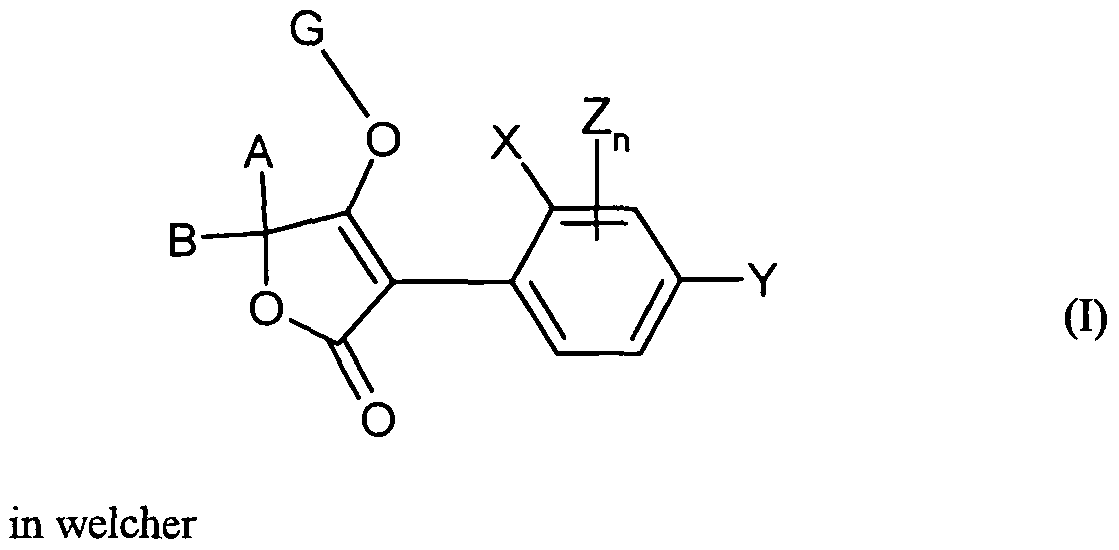
- the present invention relates to novel drug combinations which consist of known cyclic ketoenols on the one hand and uses (natural enemies) on the other hand and are very suitable for controlling animal pests such as insects and / or unwanted acarids.
- X is C 1 -C 6 -alkyl, halogen, C 1 -C 6 -alkoxy or C 1 -C 3 -haloalkyl,
- Y is hydrogen, C 1 -C -alkyl, halogen, C 1 -CG -alkoxy or C 1 -C 3 -haloalkyl,
- Z is C 1 -Cö-alkyl, halogen or C] -CG-alkoxy
- n is a number from 0-3,
- A represents hydrogen or in each case optionally halogen-substituted straight-chain or branched Cj-C ⁇ alkyl, C3-Cg alkenyl, C3-Cg alkynyl, C 1 -Cio-alkoxy-C 2 -C 8 alkyl Ci-Cg J Polyalkoxy ⁇ -Cg-alkyl, Ci-Cio-alkylthio ⁇ -Cg-alkyl or cycloalkyl having 3-8 ring atoms, which may be interrupted by oxygen and / or sulfur and in each case optionally substituted by halogen, Cj-Cg-alkyl, Ci-Cg Haloalkyl, Cj-Cg-AUcoxy, Ci-Cg-
- B is hydrogen, C 1 -C 6 alkyl or C i -Cg alkoxy C 2 -C 4 alkyl
- R! in each case optionally halogen-substituted C 1 -C 20 -alkyl, C 2 -C 20 -alkenyl, C 1 -C 8 -alkoxy-C 2 -C 8 -alkyl, C 1 -C 6 -alkylthio-C 2 -CG-alkyl, C] -Cg-polyalkoxy-C 2 -C -alkyl or cycloalkyl having 3-8 ring atoms which may be interrupted by oxygen and / or sulfur atoms,
- phenyl is optionally substituted by halogen, nitro, C j -Cg-alkyl, Ci-Cg-alkoxy, Ci-Cg-haloalkyl or Ci-Cg-haloalkoxy-substituted phenyl;
- phenyl-C 1 -C 6 -alkyl which is unsubstituted or substituted by halogen, C 1 -C 6 -alkyl, C 1 -C 6 -acidoxy, C 1 -C 9 -halogenoalkyl or C 1 -C 9 -halogenalkoxy, is in each case optionally substituted by halogen and / or C 1 -Cg-AllCyI substituted pyridyl, pyrimidyl, thiazolyl or pyrazolyl,
- Ci-Cg-alkyl optionally substituted by halogen and / or phenoxy-C j -Cg- alkyl is,
- R ⁇ is in each case optionally substituted by halogen C 1 -C 2 O-AllCyI, C 2 -C 2 () alkenyl, C 1 -Cg alkoxy-C 2 -C 8 alkyl or Ci-Cg-polyalkoxy-C 2 -Cg-alkyl,
- R 1 is optionally C 1 -C 6 -alkyl substituted by halogen, in each case optionally by C 1 -C 4 -alkyl, halogen, C 1 -C 4 -haloalkyl,
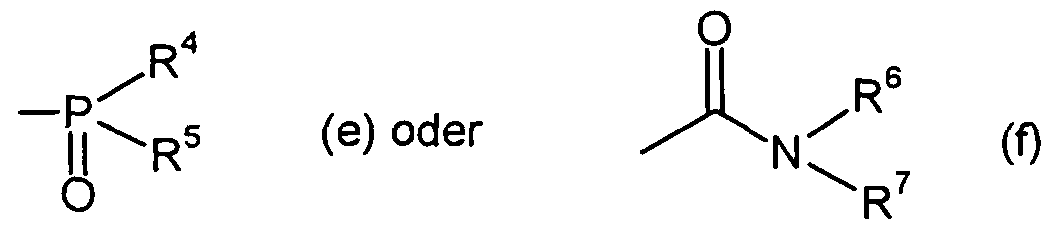
- R 1 and R 2 independently of one another are each C 1 -C -alkyl which is optionally substituted by halogen, C 1 -C 6 -alkoxy, C 1 -C 6 -alkylamino, di- (C 1 -C 6 -alkylamino, C 1 -C 6 -alkylthio, C 2 - C 5 alkenylthio, C 2 -C 5 alkynylthio or C 3 -C 7 cycloalkylthio, each optionally substituted by halogen, nitro, cyano, C 1 -C 4 -haloalkoxy, C 1 -C 4 -alkylthio, C 1 -
- R ⁇ and R ⁇ independently of each other optionally substituted by halogen Cj-C 10 alkyl, C 1 -C 10 -alkoxy, C 3 -Cg alkenyl or optionally substituted by halogen, Ci -Cß-haloalkyl, C 1 -Co-AUCyI or C 1 -Cg-AIkOXy substituted phenyl, optionally substituted by halogen, C 1 -Cg-AUCyI, C ⁇ Cg-haloalkyl or C 1 -Cg- AIkOXy substituted benzyl is or together represent a optionally interrupted by oxygen or sulfur 5- to 6-membered ring, which may optionally be substituted by C 1 -Cg AIlCyI,
- the insecticidal and / or acaricidal activity of the active ingredient-beneficial agent combinations according to the invention is better than the effects of the individual active ingredient and the beneficials alone.
- the active compound / beneficial agent combinations according to the invention it is possible to replace applications of toxicologically and / or ecologically unfavorable active substances while maintaining a comparable effect, which benefits, above all, the safety of the users and / or the environment.
- spray sequences can be saved.
- the active compound-beneficial agent combinations according to the invention contain at least one beneficial insect from the aforementioned orders or suborders.
- X preferably represents C j -C 4 alkyl, halogen, C ⁇ -C ⁇ alkoxy or C ⁇ -C 2 haloalkyl,
- Y preferably represents hydrogen, C j -C 4 alkyl, halogen, Ci-C4-alkoxy or Ci-C2-halo- genalkyl,
- Z is preferably C 1 -C 4 alkyl, halogen or C 1 -C 4 alkoxy,
- n is preferably 0 or 1
- a and B together with the carbon atom to which they are attached preferably form a saturated 5- to 6-membered ring which is optionally substituted by C 1 -C 4 -alkyl or C 1 -C 4 -alkoxy,
- G is preferably hydrogen (a) or the groups
- R! in each case optionally substituted by halogen Ci -C ⁇ g-alkyl, C2-C6-alkenyl, Ci-C6-alkoxy-C2-C6-alkyl or cycloalkyl having 3-7 ring atoms, which by 1 to 2 oxygen and / or Sulfur atoms may be interrupted, is optionally substituted by halogen, nitro, C 1 -C 4 alkyl, C 1 -C 4 alkoxy, C 1 -C 3 haloalkyl or C 1 -C 3 haloalkoxy-substituted phenyl;
- R ⁇ for, C2-C 6 -alkenyl or C 1 -C 6 alkoxy-C2-C6-alkyl represents in each case optionally halogen-substituted Ci -C j g alkyl, in each case optionally substituted by halogen, nitro, C j -C ⁇ alkyl, Ci-C4-alkoxy or C 1 -C 4 haloalkyl-substituted phenyl or benzyl.
- the active ingredient beneficial combinations may also contain other suitable fungicidal, acaricidal or insecticidal admixing components.
- vegetables e.g. Fruit vegetables and inflorescences for vegetables, such as peppers, hot peppers, tomatoes, aubergines, cucumbers, pumpkins, courgettes, field beans, runner beans, bush beans, peas, artichokes;
- leafy vegetables such as lettuce, chicory, endives, kraken, ruffians, lamb's lettuce, iceberg lettuce, leeks, spinach, chard;
- tubers, root and stem vegetables such as celery, beetroot, carrots, radishes, horseradish, salsify, asparagus, turnips, palm sprouts, bamboo shoots, as well as onion vegetables, such as onions, leeks, fennel, garlic; and cabbage, such as cauliflower, broccoli, kohlrabi, red cabbage, cabbage, kale, savoy cabbage, Brussels sprouts, Chinese cabbage.
- citrus such as oranges, grapefruit, tangerines, lemons, limes, bitter oranges, kumquats, satsumas are understood to be among the perennial crops;
- pomaceous fruits such as apples, pears and quinces
- stone fruit such as peaches, nectarines, cherries, plums, plums, apricots
- wine, hops, olives, tea and tropical crops such as mangoes, papayas, figs, pineapples, dates, bananas, durians, kakis, coconuts, cocoa, coffee, avocados, lychees, passion fruits, guavas,
- almonds and nuts such as hazelnuts, walnuts, pistachios, cashews, Brazil nuts, pecans, butternuts, chestnuts, hickory nuts, macadamia nuts, peanuts,
- soft fruits such as currants, gooseberries, raspberries, blackberries, blueberries, strawberries, cranberries, kiwis, cranberries.
- ornamental plants are understood to be annual and perennial plants, e.g. Cut flowers such as roses, carnations, gerberas, lilies, daisies, chrysanthemums, tulips, daffodils, anemones, poppies, amarillis, dahlias, azaleas, mallows,
- Bedding plants potted plants and perennials, such as roses, marigolds, pansies, geraniums, fuchsias, hibiscus, chrysanthemums, hard-bitten lits, cyclamen, southern violets, sunflowers, begonias,
- Shrubs and conifers such as ficus, rhododendron, spruce, fir, pine, yew, juniper, pine, oleander.
- spices one- and perennial plants such as anise, chilli, pepper, pepper, vanilla, marjoram, thyme, cloves, juniper berries, cinnamon, tarragon, Koryander, saffron, ginger.
- the family of the clay wasps (Eumenidae): Eumenes spp., Oplomerus spp., In cultures such as. Pome fruit, stone fruits, vegetables, ornamental plants, conifers and spices.
- Coccophagus spp. Coccophagus spp., Encarsia spp. e.g. Encarsia formosa, Aphytis spp., Aphelinus spp., E.g. Aphelinus mali, Aphelinus abdominalis, Erelmocerus spp., E.g. Erelmocerus erimicus, Erelmocerus mundus, Prospaltella spp., In cultures such as e.g. Pome fruit, stone fruits, vegetables, ornamental plants, conifers and spices.
- Trichogramma spp. E.g. Trichogamma brassicae
- cultures such as e.g. Pome fruit, stone fruits, vegetables, ornamental plants, conifers and spices.
- Enzwrt Encyrtidae: Encytus fuscicollis, Aphidencyrtrus spp., In cultures such. Pome fruit, stone fruit, vegetables, ornamental plants, conifers, spices and forestry.
- Ichneumoidae Coccigomymus spp. Diadegma spp., Glypta spp., Ophion spp., Pimpla spp. in cultures such as e.g. Pome fruit, stone fruits, vegetables, ornamental plants, conifers and spices.
- Dyglyphus spp. E.g. Dyglyphus isaea, Eulophus viridula, Colpoclypeus florus, in cultures such as e.g. Pome fruit, stone fruits, vegetables, ornamentals, conifers, corn and spices.
- Bracken wasp family are particularly preferred: Aphidrus spp., Praon spp., Opius spp., Dacnusa spp. eg Dacnusa sibiria, Apanteles spp., Ascogaster spp., Macrocentrus spp., in crops such as pome fruit, stone fruits, vegetables, ornamental plants, conifers and spices. Particularly preferred are from the family Aphidiidae: Aphidius spp.
- Chrysopa spp. e.g. Chrysopa oculata, Chrysopa perla, Chrysopa carnea, Chrysopa flava, Chrysopa septempunctata, Chrysoperla spp., Chrysopidia spp., E.g. Chrysopidia ciliata, Hypochrysa spp., E.g. Hypochrysa elegans, in cultures such as e.g. Pome fruit, stone fruits, vegetables, ornamental plants, conifers and spices.
- Hemerobiidae family of aphids: Hemerobius spp., E.g. Hemerobius fenestratus, Hemerobius humulinus, Hemerobius micans, Hemerobius nitidulus, Hemerobius pini, Wesmaelius spp., E.g. Wesmaelius nervosus, in cultures such as e.g. Pome fruit, stone fruits, vegetables, ornamental plants, conifers and spices.
- Hemerobiidae family of aphids
- Anthocoris spp. For. Anthocoris nemoralis, Anthocoris nemorum, Orius spp., E.g. Orius majusculus, Orius minutus, Orius laevigatus, Orius insidiosus, Orius niger, Orius vicinus, in crops such as e.g. Pome fruit, stone fruits, vegetables, ornamental plants, conifers and spices.
- Atractotomus spp. E.g. Atractotomus mali, Blepharidopterus spp., E.g. Blepharidopterus angulatus, Camylomma spp., E.g. Camylomma verbasci, Deraeocoris spp., Macrolophus spp., E.g. Macrolophus caliginosus, in cultures such as e.g. Pome fruit, stone fruits, vegetables, ornamental plants, conifers and spices.
- caterpillars (Tachinidae): Bessa fugax, Cyzenius albicans, Compsileura concinnata, Elodia tragica, Exorista larvarum, Lyphia dubia, in cultures such as e.g. Pome fruit, stone fruits, vegetables, ornamental plants, conifers and spices.
- hoverflies Syrphidae: Dasysyrphus spp., Episyrphus balteatus, Melangyna triangulata, Melanostoma spp., Metasyrphus spp., Platycheirus spp., Sy ⁇ hus spp., In cultures such. Pome fruit, stone fruits, vegetables, ornamental plants, conifers and spices.
- Gallmücken Cecidomyiidae
- Aphidoletes aphidimyza Feltiella acarisuga
- in cultures such. Pome fruit, stone fruits, vegetables, ornamental plants, conifers and spices.
- the active compound-beneficial agent combinations according to the invention are suitable for controlling animal pests, preferably arthropods and nematodes, in particular insects and / or arachnids, which occur in viticulture and orchards, in agriculture and horticulture and in forests. They are effective against normally sensitive and resistant species as well as against all or individual stages of development.
- animal pests preferably arthropods and nematodes, in particular insects and / or arachnids, which occur in viticulture and orchards, in agriculture and horticulture and in forests. They are effective against normally sensitive and resistant species as well as against all or individual stages of development.
- the above mentioned pests include:
- Chilopoda e.g. Geophilus carpophagus, Scutigera spp.
- Symphyla e.g. Scutigerella immaculata.
- Thysanura eg Lepisma saccharina.
- Collembola eg Onychiurus armatus.
- Orthoptera e.g. Acheta domesticus, Gryllotalpa spp., Locusta migratoria migratorioides, Melanoplus spp., Schistocerca gregaria.
- Phthiraptera e.g. Pediculus humanus co ⁇ oris, Haematopinus spp., Linognathus spp., Trichodectes spp., Damalinia spp.
- Thysanoptera e.g. Herculothrips femoralis, Thrips tabaci, Thrips palmi, Frankliniella accidentalis.
- Heteroptera e.g. Eurygaster spp., Dysdercus intermedius, Piesma quadrata, Cimex lectularius, Rhodnius prolixus, Triatoma spp.
- Lepidoptera e.g. Pectinophora gossypiella, Bupalus piniarius, Cheimatobia brumata, Lithocolletis blancardella, Hyponomeuta padella, Plutella xylostella, Malacosoma neustria, Euproctis chrysorrhoea, Lymantria spp., Bucculatrix thurberiella, Phyllocnistis citrella, Agrotis spp., Euxoa spp., Feltia spp., Earias insulana, Heliothis spp., Mamestra brassicae, Panolis flammea, Spodoptera spp., Trichoplusia ni, Ca ⁇ ocapsa pomonella, Pieris spp., Chilo spp., Pyrausta nubilalis, Ephestia kuehniella, Galleria
- Hymenoptera e.g. Diprion spp., Hoplocampa spp., Lasius spp., Monomorium pharaonis, Vespa spp.
- Diptera e.g. Aedes spp., Anopheles spp., Culex spp., Drosophila melanogaster, Musca spp., Fannia spp., Calliphora erythrocephala, Lucilia spp., Chrysomyia spp., Cuterebra spp., Gastrophilus spp., Hyppobosca spp., Stomoxys spp.
- Oestrus spp. Hypoderma spp., Tabanus spp., Tannia spp., Bibio hortulanus, Oscinella fht, Phorbia spp., Pegomyia hyoscyami, Ceratitis capitata, Dacus oleae, Tipula paludosa, Hylemyia spp., Liriomyza spp.
- siphonaptera e.g. Xenopsylla cheopis, Ceratophyllus spp.
- arachnids e.g. Scorpio maurus, Latrodectus mactans, Acarus siro, Argas spp., Ornithodoros spp., Dermanyssus gallinae, Eriophyes ribis, Phyllocoptruta oleivora, Boophilus spp., Rhipicephalus spp., Amblyomma spp., Hyalomma spp., Ixodes spp., Psoroptes spp.
- Chorioptes spp. Sarcoptes spp., Tarsonemus spp., Bryobia praetiosa, Panonychus spp., Tetranychus spp., Hemitarsonemus spp., Brevipalpus spp.
- the plant parasitic nematodes include e.g. Pratylenchus spp., Radopholus similis, Ditylenchus dipsaci, Tylenchulus semipenetrans, Heterodera spp., Globodera spp., Meloidogyne spp., Aphelenchoides spp., Longidorus spp., Xiphinema spp., Trichodorus spp., Bursaphelenchus spp.
- the active compound combinations can be converted into the customary formulations, such as solutions, emulsions, wettable powders, suspensions, powders, dusts, pastes, soluble powders, granules, suspension-emulsion concentrates, active-substance-impregnated natural and synthetic substances and superfine encapsulations in polymers substances.
- formulations are prepared in a known manner, for example by mixing the active compounds with extenders, ie liquid solvents and / or solid carriers, optionally with the use of surface-active agents, ie emulsifiers and / or dispersants and / or foam-forming agents.
- extenders ie liquid solvents and / or solid carriers
- surface-active agents ie emulsifiers and / or dispersants and / or foam-forming agents.
- organic solvents can also be used as auxiliary solvents.
- Suitable liquid solvents are essentially: aromatics such as xylene, toluene or Alkyhiaphthaline, chlorinated aromatic and chlorinated aliphatic hydrocarbons such as chlorobenzenes, chloroethylenes or methylene chloride, aliphatic hydrocarbons such as cyclohexane or paraffins, eg petroleum fractions, mineral and vegetable oils , Alcohols such as butanol or glycol and their ethers and esters, ketones such as acetone, methyl ethyl ketone, methyl isobutyl ketone or cyclohexanone, strongly polar solvents such as dimethylformamide and dimethyl sulfoxide, and water.
- aromatics such as xylene, toluene or Alkyhiaphthaline
- chlorinated aromatic and chlorinated aliphatic hydrocarbons such as chlorobenzenes, chloroethylenes or methylene chloride
- aliphatic hydrocarbons such as
- Suitable solid carriers are:
- Ammonium salts and ground natural minerals such as kaolins, clays, talc, chalk, quartz, attapulgite, montmorillonite or diatomaceous earth, and ground synthetic minerals, such as fumed silica, alumina and silicates, as solid carriers for granules are suitable: e.g. crushed and fractionated natural rocks such as calcite, marble, pumice, sepiolite, dolomite and synthetic granules of inorganic and organic flours and granules of organic material such as sawdust, coconut shells, corn cobs and tobacco stalks; suitable emulsifiers and / or foam formers are: e.g.
- nonionic and anionic emulsifiers such as polyoxyethylene fatty acid esters, polyoxyethylene fatty alcohol ethers, e.g. Alkylaryl polyglycol ethers, alkylsulfonates, alkyl sulfates, arylsulfonates and protein hydrolysates; suitable dispersants are: e.g. Lignin-sulphite liquors and methylcellulose.
- Adhesives such as carboxymethylcellulose, natural and synthetic, powdery, granular or latex polymers, such as gum arabic, polyvinyl alcohol, polyvinyl acetate, as well as natural phospholipids such as cephalins and lecithins and synthetic phospholipids may be used in the formulations.
- Other additives may be mineral and vegetable oils.
- Dyes such as inorganic pigments, e.g. Iron oxide, titanium oxide, ferrocyan blue and organic dyes such as alizarin, azo and metal phthalocyanine dyes and trace nutrients such as salts of iron, manganese, boron, copper, cobalt, molybdenum and zinc.
- inorganic pigments e.g. Iron oxide, titanium oxide, ferrocyan blue and organic dyes such as alizarin, azo and metal phthalocyanine dyes and trace nutrients such as salts of iron, manganese, boron, copper, cobalt, molybdenum and zinc.
- the formulations generally contain between 0.1 and 95% by weight of active compound, preferably between 0.5 and 90%.
- the active compound combinations according to the invention can be present in commercially available formulations as well as in the formulations prepared from these formulations in admixture with other active ingredients, such as insecticides, attractants, sterilants, bactericides, acaricides, nematicides, fungicides, growth-regulating substances or herbicides.
- active ingredients such as insecticides, attractants, sterilants, bactericides, acaricides, nematicides, fungicides, growth-regulating substances or herbicides.
- active ingredients such as insecticides, attractants, sterilants, bactericides, acaricides, nematicides, fungicides, growth-regulating substances or herbicides.
- active ingredients such as insecticides, attractants, sterilants, bactericides, acaricides, nematicides, fungicides, growth-regulating substances or herbicides.
- Phosphors ⁇ uxeester carbamates, carboxylic acid esters, chlor
- the active compound combinations according to the invention may also be present when used as insecticides in their commercial formulations as well as in the formulations prepared from these formulations in admixture with synergists.
- Synergists are compounds that increase the effect of the active ingredients without the added synergist itself having to be active.
- the active substance content of the application forms prepared from the commercial formulations can vary within wide ranges.
- the active ingredient concentration of the use forms may be from 0.0000001 to 95% by weight of active ingredient, preferably between 0.0001 and 1% by weight.
- the application is done in a custom forms adapted to the application forms.
- the active compound combinations can be used as such, in the form of concentrates or generally customary formulations such as powders, granules, solutions, suspensions, emulsions or pastes.
- the said formulation can be prepared in a manner known per se, e.g. by mixing the active compounds with at least one solvent or diluent, emulsifier, dispersing and / or binding or fixing agent, water repellent, optionally siccatives and UV stabilizers and optionally dyes and pigments and other processing agents.
- plants and parts of plants can be treated.
- plants are understood as meaning all plants and plant populations, such as desired and undesired wild plants or crop plants (including naturally occurring crop plants).
- Crop plants can be plants that can be obtained by conventional breeding and optimization methods or by biotechnological and genetic engineering methods or combinations of these methods, including transgenic plants and including plant varieties that can be protected or not protected by plant breeders' rights.
- Plant parts are to be understood as meaning all aboveground and underground parts and organs of the plants, such as shoot, leaf, flower and root, by way of example, leaves, needles, stems, stems, flowers, fruiting bodies, fruits and seeds and roots, tubers and rhizomes , To the Plant parts also include crops as well as vegetative and generative propagation material, such as cuttings, tubers, rhiomes, offshoots and seeds.
- the treatment according to the invention of the plants and plant parts with the active ingredients is carried out directly or by acting on their environment, habitat or storage space according to the usual treatment methods, e.g. by dipping, spraying, vaporizing, atomizing, spreading, spreading and in propagation material, in particular in seeds, further by single or multi-layer wrapping.
- plants and their parts can be treated.
- wild-type or plant species obtained by conventional biological breeding methods such as crossing or protoplast fusion
- plant cultivars and their parts are treated.
- transgenic plants and plant cultivars which have been obtained by genetic engineering methods if appropriate in combination with conventional methods (Genetically Modified Organisms), and parts thereof are treated.
- the term "parts” or “parts of plants” or “plant parts” has been explained above.
- over-additive effects may also occur due to the treatment according to the invention.
- over-additive effects may also occur due to the treatment according to the invention.
- reduced application rates and / or extensions of the spectrum of action and / or an increase in the effect of the substances and agents usable in the invention better plant growth, increased tolerance to high or low temperatures, increased tolerance to drought or to water or soil salt content, increased flowering power , facilitated harvesting, acceleration of ripeness, higher crop yields, higher quality and / or higher nutritional value of the harvested products, higher shelf life and / or machinability of the enceary products possible, which go beyond the expected effects.
- the preferred plants or plant varieties to be treated according to the invention to be treated include all plants which, as a result of the genetic engineering modification, obtained genetic material which gives these plants particularly advantageous valuable properties ("traits"). Examples of such properties are better plant growth, increased tolerance to high or low temperatures, increased tolerance to dryness or against water or soil salt content, increased flowering power, easier harvesting, acceleration of ripeness, higher crop yields, higher quality and / or higher nutritional value of the harvested products, higher shelf life and / or machinability of the enceary products.
- transgenic plants include the important crops such as cereals (wheat, rice), corn, soy, potato, cotton, rapeseed and fruit plants (with the fruits apples, pears, citrus fruits and grapes), with corn, soy, potato, cotton and rapeseed should be highlighted.
- Traits which are particularly emphasized are the increased defense of the plants against insects by toxins formed in the plants, in particular those produced by the genetic material from Bacillus thuringiensis (for example by the genes Cry ⁇ A (a), CryIA (b), Cry ⁇ A (c), CryllA, CryllLA, CryIIIB2, Cry9c Cry2Ab, Cry3Bb and CrylF and combinations thereof) are produced in the plants (hereinafter "Bt plants”).
- Bt plants Traits which are furthermore particularly emphasized are the increased tolerance of the plants to certain herbicidally active compounds, for example imidazolinones, sulfonylureas, glyphosate or phosphinotricin (eg "PAT" gene).
- genes which confer the desired properties can also occur in combinations with one another in the transgenic plants.
- “Bt plants” are maize varieties, cotton varieties, soybean varieties and potato varieties which are sold under the trade names YIELD GARD® (eg corn, cotton, soya), KnockOut® (eg maize), StarLink® (eg maize), Bollgard® ( Cotton), Nucotn® (cotton) and NewLeaf® (potato).
- herbicide-tolerant plants are maize varieties, cotton varieties and soybean varieties, which are sold under the trade names Roundup Ready® (tolerance to glyphosate eg corn, cotton, soy), Liberty Link® (tolerance to phosphinotricin, eg rapeseed), IMI® (tolerance to Imidazolinone) and STS® (tolerance to sulfonylureas eg corn).
- Herbicide-resistant (conventionally grown on herbicide tolerance) plants are also the varieties marketed under the name Clearfield® (eg corn) mentioned. Of course, these statements also apply to future or future marketed plant varieties with these or future developed genetic traits.
- the listed plants can be treated particularly advantageously according to the invention with the active compound-beneficial agent combinations according to the invention.
- the preferred ranges given above for the combinations also apply to the treatment of these plants.
- Particularly emphasized is the plant treatment with the drug-Nützljngs combinations specifically listed herein.
- the good insecticidal and / or acaricidal action of the active compound-beneficial agent combinations according to the invention is evident from the examples below. While the individual active ingredients have weaknesses in the effect, the active ingredient / beneficial agent combinations show an effect that goes beyond the simple action of the active ingredient.
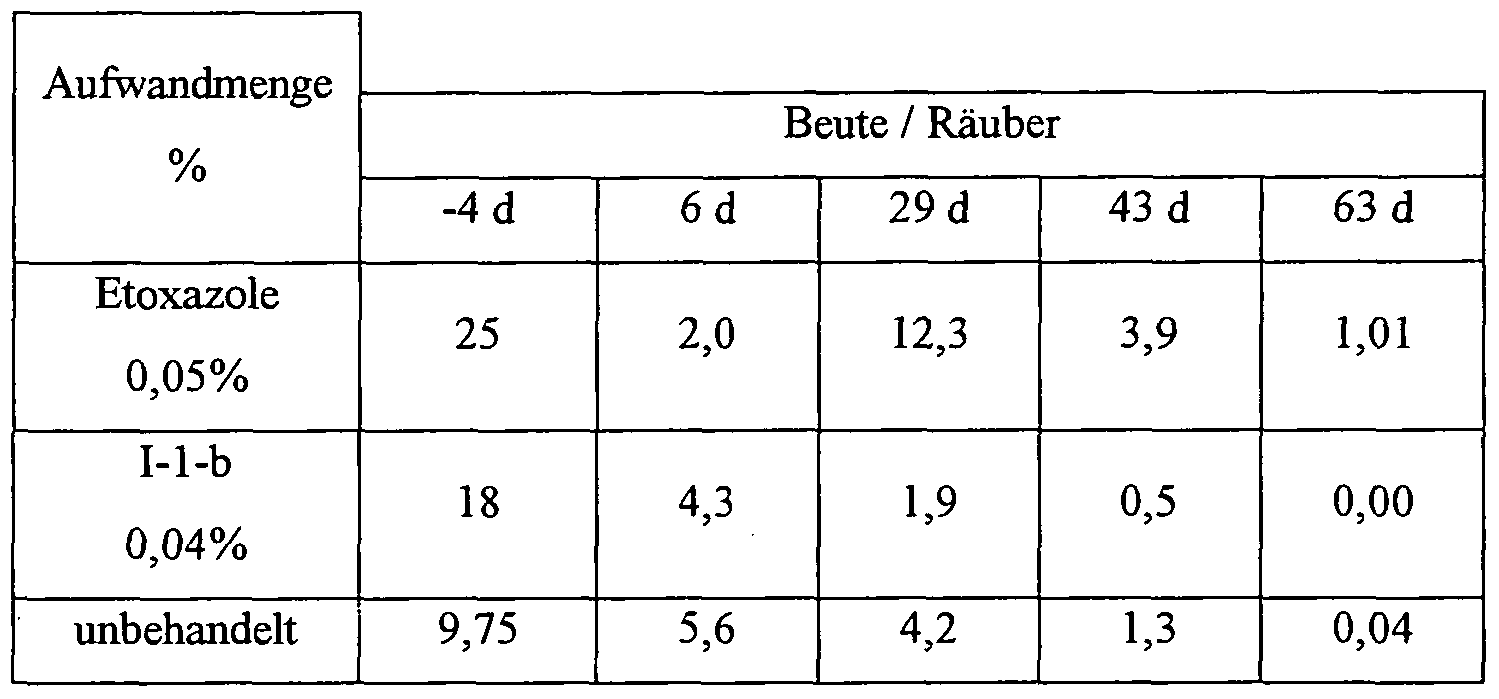
- Each of the five approximately 10-year-old apple trees (about 2.5 m crown height) of the "Braebum” variety are treated in 4 replications against the "red spider" Panonychus ulmi (PANOl) L).
- PANOl Panonychus ulmi
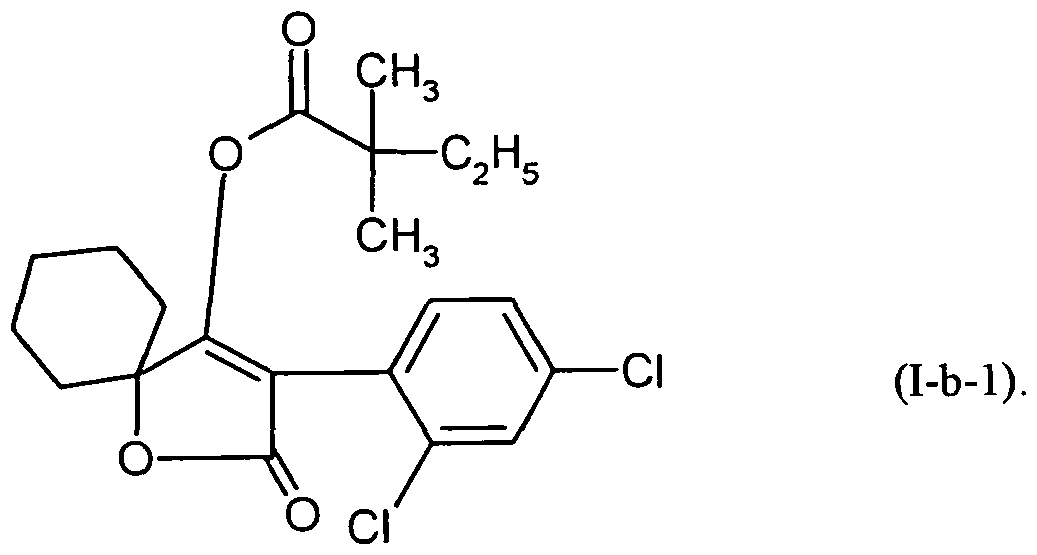
- the active ingredient (I-b-1) (240SC) and the commercial standard Etoxazole (110 SC) in the indicated rates in the presence of the predatory mite Amblyseius andersoni (AMBLAN) are applied with a pressure-driven backpack syringe.
- the amount of water used is 400 l / ha. There are two applications at intervals of 42 days.
- Evaluation is carried out 4 days before, 6, 29, 43 and 63 days after the first treatment by counting the number of adult spider mites and predatory mites on 25 leaves and establishing a prey / predator ratio as a measure of the beneficial effect of the beneficial insect.
- Active ingredient A at a rate of m ppm or g / ha
- the combination is over-additive in its kill, ie, there is a synergistic effect.
- the actually observed kill rate must be greater than the expected kill rate (E) value calculated from the above formula.
- Emulsifier 2 parts by weight of alkylaryl polyglycol ether
- active compound 1 part by weight of active compound is mixed with the indicated amounts of solvent and emulsifier, and the concentrate is diluted with emulsifier-containing water to the desired concentration.
- Plum cuttings (Prunus domesüc ⁇ ) infected with the fruit tree spider mite ⁇ Panonychus ulmi) are treated on the top of the leaves by spraying with the preparation of active compound in the desired concentration.
- the predatory mites (Typhlodromus pyr ⁇ ) are given after the desired time in a defined amount.
- the kill of the pest is determined in%. 100% means that all spider mites have been killed; 0% means that no spider mites have been killed.
- the determined kill values are calculated according to the Colby Fo ⁇ nel.
- Test insect Diabrotica balteata - larvae in soil
- Emulsifier 1 part by weight of alkylaryl polyglycol ether
- the preparation of active compound is poured onto the ground.
- the concentration of the active substance in the preparation plays virtually no role, the only decisive factor is the amount of active ingredient per unit volume of soil, which is stated in ppm (mg / l). Fill the soil in 0.25 1 pots and leave them at 20 0 C.
- Emulsifier 1 part by weight of alkylaryl polyglycol ether
- Soybean shoots (Glycine max) of the variety Roundup Ready (trademark of Monsanto Comp. USA) are treated by being dipped into the preparation of active compound of the desired concentration and are populated with the tobacco budworm Heliothis virescens while the leaves are still moist.
- the kill of the insects is determined.
Landscapes
- Life Sciences & Earth Sciences (AREA)
- General Health & Medical Sciences (AREA)
- Zoology (AREA)
- Health & Medical Sciences (AREA)
- Engineering & Computer Science (AREA)
- Pest Control & Pesticides (AREA)
- Agronomy & Crop Science (AREA)
- Plant Pathology (AREA)
- Dentistry (AREA)
- Wood Science & Technology (AREA)
- Environmental Sciences (AREA)
- Biotechnology (AREA)
- Microbiology (AREA)
- Virology (AREA)
- Chemical & Material Sciences (AREA)
- Organic Chemistry (AREA)
- Insects & Arthropods (AREA)
- Agricultural Chemicals And Associated Chemicals (AREA)
Abstract
Description


Claims






Priority Applications (4)
| Application Number | Priority Date | Filing Date | Title |
|---|---|---|---|
| EP07725839A EP2034843A1 (de) | 2006-06-16 | 2007-06-05 | Wirkstoffkombinationen mit insektiziden und akariziden eigenschaften |
| US12/304,958 US20100056620A1 (en) | 2006-06-16 | 2007-06-05 | Active compound combinations with insecticidal and acaricidal properties |
| JP2009514670A JP2009539900A (ja) | 2006-06-16 | 2007-06-05 | 殺虫及び殺ダニ特性を有する活性剤組合せ |
| MX2008015840A MX2008015840A (es) | 2006-06-16 | 2007-06-05 | Combinaciones de principios activos con propiedades insecticidas y acaracidas. |
Applications Claiming Priority (2)
| Application Number | Priority Date | Filing Date | Title |
|---|---|---|---|
| DE102006027730A DE102006027730A1 (de) | 2006-06-16 | 2006-06-16 | Wirkstoffkombinationen mit insektiziden und akariziden Eigenschaften |
| DE102006027730.9 | 2006-06-16 |
Publications (1)
| Publication Number | Publication Date |
|---|---|
| WO2007144089A1 true WO2007144089A1 (de) | 2007-12-21 |
Family
ID=38651261
Family Applications (1)
| Application Number | Title | Priority Date | Filing Date |
|---|---|---|---|
| PCT/EP2007/004971 Ceased WO2007144089A1 (de) | 2006-06-16 | 2007-06-05 | Wirkstoffkombinationen mit insektiziden und akariziden eigenschaften |
Country Status (9)
| Country | Link |
|---|---|
| US (1) | US20100056620A1 (de) |
| EP (1) | EP2034843A1 (de) |
| JP (1) | JP2009539900A (de) |
| KR (1) | KR20090020699A (de) |
| CN (1) | CN101466267A (de) |
| DE (1) | DE102006027730A1 (de) |
| MX (1) | MX2008015840A (de) |
| TW (1) | TW200814931A (de) |
| WO (1) | WO2007144089A1 (de) |
Cited By (3)
| Publication number | Priority date | Publication date | Assignee | Title |
|---|---|---|---|---|
| WO2010063465A1 (de) * | 2008-12-05 | 2010-06-10 | Bayer Cropscience Aktiengesellschaft | Enaminocarbonylverbindung-nützlings-kombinationen |
| WO2010127787A3 (de) * | 2009-05-07 | 2011-07-07 | Bayer Cropscience Ag | Wirkstoffkombinationen mit insektiziden und akariziden eigenschaften |
| WO2012171914A1 (en) * | 2011-06-14 | 2012-12-20 | Bayer Intellectual Property Gmbh | Use of an enaminocarbonyl compound in combination with a biological control agent |
Families Citing this family (10)
| Publication number | Priority date | Publication date | Assignee | Title |
|---|---|---|---|---|
| DE102004053192A1 (de) * | 2004-11-04 | 2006-05-11 | Bayer Cropscience Ag | 2-Alkoxy-6-alkyl-phenyl substituierte spirocyclische Tetramsäure-Derivate |
| DE102006027731A1 (de) | 2006-06-16 | 2007-12-20 | Bayer Cropscience Ag | Wirkstoffkombinationen mit insektiziden und akariziden Eigenschaften |
| DE102006027732A1 (de) * | 2006-06-16 | 2008-01-10 | Bayer Cropscience Ag | Wirkstoffkombinationen mit insektiziden und akariziden Eigenschaften |
| EP2008517A1 (de) * | 2007-06-29 | 2008-12-31 | Bayer CropScience AG | Akarizide Wirkstoffkombinationen |
| EP2039248A1 (de) * | 2007-09-21 | 2009-03-25 | Bayer CropScience AG | Wirkstoffkombinationen mit insektiziden und akariziden Eigenschaften |
| CN102480946A (zh) * | 2009-06-03 | 2012-05-30 | 拜尔农作物科学股份公司 | 氟虫双酰胺和有益生物的结合物 |
| KR102092754B1 (ko) * | 2012-01-04 | 2020-03-25 | 코퍼트 비.브이. | 포식성 응애 및 진균 감소제와 접촉된 고정화된 먹이를 포함하는 응애 조성물 및 상기 조성물의 사용과 관련된 방법 및 용도 |
| AU2016270813B2 (en) * | 2015-06-02 | 2018-02-15 | Koch Agronomic Services, Llc | Microbial inoculant compositions and uses thereof in agriculture |
| KR20250123229A (ko) * | 2023-01-03 | 2025-08-14 | 티와이케이 메디슨즈, 인코포레이티드 | 신경퇴행성 질환 예방 및/또는 치료를 위한 화합물 |
| CN118480612A (zh) * | 2024-05-31 | 2024-08-13 | 安徽师范大学 | 一种扩增大痣细蜂科白木细蜂属dna的特异性pcr引物及其在鉴定白木细蜂属中的应用 |
Citations (3)
| Publication number | Priority date | Publication date | Assignee | Title |
|---|---|---|---|---|
| DE19939395A1 (de) * | 1998-10-23 | 2000-04-27 | Bayer Ag | Wirkstoffkombinationen mit insektiziden und akariziden Eigenschaften |
| WO2001072125A2 (de) * | 2000-03-28 | 2001-10-04 | Bayer Aktiengesellschaft | Wirkstoffkombinationen mit insektiziden und akariziden eigenschaften |
| WO2006002824A1 (de) * | 2004-07-05 | 2006-01-12 | Bayer Cropscience Ag | Verwendung von 3-(2,4,6-trimethylphenyl)-4-neopentylcarbonyloxy-5,5-tetramethylen ν dihydrofuran-2-on zur bekämpfung von psylliden |
Family Cites Families (39)
| Publication number | Priority date | Publication date | Assignee | Title |
|---|---|---|---|---|
| DE4014420A1 (de) * | 1989-09-23 | 1991-04-04 | Bayer Ag | 5h-furan-2-on-derivate |
| DE4216814A1 (de) * | 1991-07-16 | 1993-01-21 | Bayer Ag | 3-aryl-4-hydroxy-(delta)(pfeil hoch)3(pfeil hoch)-dihydrofuranon- und 3-aryl-4-hydroxy-(delta)(pfeil hoch)3(pfeil hoch)-dihydrothiophenon-derivate |
| WO1995001971A1 (de) * | 1993-07-05 | 1995-01-19 | Bayer Aktiengesellschaft | Substituierte aryl-ketoenolheterocyclen |
| EP0647637B1 (de) * | 1993-09-17 | 1999-01-27 | Bayer Ag | 3-Aryl-4-hydroxy-3-dihydrofuranon-Derivate |
| BR9509793A (pt) * | 1994-11-17 | 1997-09-30 | Bayer Ag | Derivados de tiofeneno |
| AU4715896A (en) * | 1995-02-13 | 1996-09-04 | Bayer Aktiengesellschaft | 2-phenyl-substituted heterocyclic 1,3-ketonols as herbicides and pesticides |
| AU5762696A (en) * | 1995-05-09 | 1996-11-29 | Bayer Aktiengesellschaft | Alkyl dihalogenated phenyl-substituted ketoenols useful as p esticides and herbicides |
| JP4082724B2 (ja) * | 1995-06-28 | 2008-04-30 | バイエル・アクチエンゲゼルシヤフト | 有害生物防除剤及び除草剤として使用される2,4,5−三置換されたフェニルケト−エノール |
| EP0835243B1 (de) * | 1995-06-30 | 2003-01-29 | Bayer CropScience AG | Dialkyl-halogenphenylsubstituierte ketoenole zur verwendung als herbizide und pestizide |
| BR9708425B1 (pt) * | 1996-04-02 | 2012-02-22 | fenilcetoenóis substituìdos, processo para preparação e uso dos mesmos, bem como pesticidas ou herbicidas e método para controle de pragas e ervas daninhas. | |
| JP4306799B2 (ja) * | 1996-05-10 | 2009-08-05 | バイエル アクチェンゲゼルシャフト | 新規な置換ピリジルケトエノール |
| JP4202423B2 (ja) * | 1996-08-05 | 2008-12-24 | バイエル・アクチエンゲゼルシヤフト | 2―および2,5―置換フェニルケトエノール |
| DE19632126A1 (de) * | 1996-08-09 | 1998-02-12 | Bayer Ag | Phenylsubstituierte cyclische Ketoenole |
| DE19808261A1 (de) * | 1998-02-27 | 1999-10-28 | Bayer Ag | Arylphenylsubstituierte cyclische Ketoenole |
| DE19813354A1 (de) * | 1998-03-26 | 1999-09-30 | Bayer Ag | Arylphenylsubstituierte cyclische Ketoenole |
| DE19818732A1 (de) * | 1998-04-27 | 1999-10-28 | Bayer Ag | Arylphenylsubstituierte cyclische Ketoenole |
| DE19901943A1 (de) * | 1999-01-20 | 2000-07-27 | Bayer Ag | Verwendung von 3-/2,4,6-Trimethylphenyl)-4-neopentylcarbonyloxy-5,5-tetramethylen- -dihydrofuran-2-on zur Bekämpfung der Weißen Fliege |
| CN1272324C (zh) * | 1999-09-07 | 2006-08-30 | 辛根塔参与股份公司 | 新颖的除草剂 |
| DE19946625A1 (de) * | 1999-09-29 | 2001-04-05 | Bayer Ag | Trifluormethylsubstituierte spirocyclische Ketoenole |
| US6689976B1 (en) * | 2002-10-08 | 2004-02-10 | Agilent Technologies, Inc. | Electrically isolated liquid metal micro-switches for integrally shielded microcircuits |
| DE10016544A1 (de) * | 2000-04-03 | 2001-10-11 | Bayer Ag | C2-phenylsubstituierte Ketoenole |
| DE10139465A1 (de) * | 2001-08-10 | 2003-02-20 | Bayer Cropscience Ag | Selektive Herbizide auf Basis von substituierten, cayclischen Ketoenolen und Safenern |
| DE10239479A1 (de) * | 2002-08-28 | 2004-03-04 | Bayer Cropscience Ag | Substituierte spirocyclische Ketoenole |
| DE10311300A1 (de) * | 2003-03-14 | 2004-09-23 | Bayer Cropscience Ag | 2,4,6-Phenylsubstituierte cyclische Ketoenole |
| DE10326386A1 (de) * | 2003-06-12 | 2004-12-30 | Bayer Cropscience Ag | N-Heterocyclyl-phenylsubstituierte cyclische Ketoenole |
| DE10330723A1 (de) * | 2003-07-08 | 2005-02-03 | Bayer Cropscience Ag | Wirkstoffkombinationen mit insektiziden und akariziden Eigenschaften |
| DE10353281A1 (de) * | 2003-11-14 | 2005-06-16 | Bayer Cropscience Ag | Wirkstoffkombination mit insektiziden und akariziden Eigenschaften |
| DE102004011006A1 (de) * | 2004-03-06 | 2005-09-22 | Bayer Cropscience Ag | Suspensionskonzentrate auf Ölbasis |
| DE102004014620A1 (de) * | 2004-03-25 | 2005-10-06 | Bayer Cropscience Ag | 2,4,6-phenylsubstituierte cyclische Ketoenole |
| DE102004030753A1 (de) * | 2004-06-25 | 2006-01-19 | Bayer Cropscience Ag | 3'-Alkoxy spirocyclische Tetram- und Tretronsäuren |
| DE102004044827A1 (de) * | 2004-09-16 | 2006-03-23 | Bayer Cropscience Ag | Jod-phenylsubstituierte cyclische Ketoenole |
| DE102005008033A1 (de) * | 2005-02-22 | 2006-08-24 | Bayer Cropscience Ag | Wirkstoffkombinationen mit insektiziden und akariziden Eigenschaften |
| DE102006007882A1 (de) * | 2006-02-21 | 2007-08-30 | Bayer Cropscience Ag | Cycloalkyl-phenylsubstituierte cyclische Ketoenole |
| DE102006025874A1 (de) * | 2006-06-02 | 2007-12-06 | Bayer Cropscience Ag | Alkoxyalkyl-substituierte cyclische Ketoenole |
| DE102006027731A1 (de) * | 2006-06-16 | 2007-12-20 | Bayer Cropscience Ag | Wirkstoffkombinationen mit insektiziden und akariziden Eigenschaften |
| DE102006027732A1 (de) * | 2006-06-16 | 2008-01-10 | Bayer Cropscience Ag | Wirkstoffkombinationen mit insektiziden und akariziden Eigenschaften |
| DE102006033154A1 (de) * | 2006-07-18 | 2008-01-24 | Bayer Cropscience Ag | Wirkstoffkombinationen mit insektiziden und akariziden Eigenschaften |
| DE102007001866A1 (de) * | 2007-01-12 | 2008-07-17 | Bayer Cropscience Ag | Spirocyclische Tetronsäure-Derivate |
| EP2008517A1 (de) * | 2007-06-29 | 2008-12-31 | Bayer CropScience AG | Akarizide Wirkstoffkombinationen |
-
2006
- 2006-06-16 DE DE102006027730A patent/DE102006027730A1/de not_active Withdrawn
-
2007
- 2007-06-05 CN CNA2007800221765A patent/CN101466267A/zh active Pending
- 2007-06-05 MX MX2008015840A patent/MX2008015840A/es not_active Application Discontinuation
- 2007-06-05 WO PCT/EP2007/004971 patent/WO2007144089A1/de not_active Ceased
- 2007-06-05 EP EP07725839A patent/EP2034843A1/de not_active Withdrawn
- 2007-06-05 KR KR1020097000779A patent/KR20090020699A/ko not_active Withdrawn
- 2007-06-05 JP JP2009514670A patent/JP2009539900A/ja not_active Withdrawn
- 2007-06-05 US US12/304,958 patent/US20100056620A1/en not_active Abandoned
- 2007-06-15 TW TW096121633A patent/TW200814931A/zh unknown
Patent Citations (3)
| Publication number | Priority date | Publication date | Assignee | Title |
|---|---|---|---|---|
| DE19939395A1 (de) * | 1998-10-23 | 2000-04-27 | Bayer Ag | Wirkstoffkombinationen mit insektiziden und akariziden Eigenschaften |
| WO2001072125A2 (de) * | 2000-03-28 | 2001-10-04 | Bayer Aktiengesellschaft | Wirkstoffkombinationen mit insektiziden und akariziden eigenschaften |
| WO2006002824A1 (de) * | 2004-07-05 | 2006-01-12 | Bayer Cropscience Ag | Verwendung von 3-(2,4,6-trimethylphenyl)-4-neopentylcarbonyloxy-5,5-tetramethylen ν dihydrofuran-2-on zur bekämpfung von psylliden |
Non-Patent Citations (6)
| Title |
|---|
| A. ELBERT, E. BRÜCK, J. MELGAREJO, H.-J. SCHNORBACH & S. SONE: "Field development of Oberon for whitefly and mite control in vegetables, cotton, corn, strawberries, ornamentals and tea", PFLANZENSCHUTZ-NACHRICHTEN BAYER, vol. 58, no. 3, 2005, pages 441 - 468, XP002456476 * |
| J. IZQUIERDO, V. MANSANET, J. V. SANZ & J. M. PUIGGROS: "Development of Envidor for the control of spider mites in Spanish citrus production", PFLANZENSCHUTZ-NACHRICHTEN BAYER, vol. 55, no. 2-3, 2002, pages 255 - 266, XP002456475 * |
| J. M. HARDMAN, J. L. FRANKLIN, D. L. MOREAU & N. J. BOSTANIAN: "An index for selctive toxicity of miticides to phytophagous mites and their predators based on orchard trials", PEST MANAGEMENT SCIENCE, vol. 59, 2003, pages 1321 - 1332, XP002456477 * |
| L. DE MAEYER, H. W. SCHMIDT & D. PEETERS: "Envidor - a new acaricide for IPM in pomefruit orchards", PFLANZENSCHUTZ-NACHRICHTEN BAYER, vol. 55, no. 2-3, 2002, pages 211 - 236, XP002456474 * |
| LAKSHMI V JHANSI ET AL: "Relative safety of selected acaricides to three hemipteran natural enemies of planthoppers in rice ecosystem", JOURNAL OF BIOLOGICAL CONTROL, INDIAN SOCIETY FOR BIOCONTROL ADVANCEMENT, COIMBATORE, IN, vol. 20, no. 2, 2006, pages 141 - 146, XP009091414, ISSN: 0970-5732 * |
| RAUDONIS L: "Comparative toxicity of spirodiclofen and lambdacihalotrin to Tetranychus urticae, Tarsonemus pallidus and predatory mite Amblyseius andersoni in a strawberry site under field conditions", AGRONOMY RESEARCH, EESTI POLLUMAJANDUSULIKOOL,, EE, vol. 4, no. special issue, September 2006 (2006-09-01), pages 317 - 322, XP009091413, ISSN: 1406-894X * |
Cited By (5)
| Publication number | Priority date | Publication date | Assignee | Title |
|---|---|---|---|---|
| WO2010063465A1 (de) * | 2008-12-05 | 2010-06-10 | Bayer Cropscience Aktiengesellschaft | Enaminocarbonylverbindung-nützlings-kombinationen |
| EP2201838A1 (de) * | 2008-12-05 | 2010-06-30 | Bayer CropScience AG | Wirkstoff-Nützlings-Kombinationen mit insektiziden und akariziden Eigenschaften |
| WO2010127787A3 (de) * | 2009-05-07 | 2011-07-07 | Bayer Cropscience Ag | Wirkstoffkombinationen mit insektiziden und akariziden eigenschaften |
| WO2012171914A1 (en) * | 2011-06-14 | 2012-12-20 | Bayer Intellectual Property Gmbh | Use of an enaminocarbonyl compound in combination with a biological control agent |
| US9241493B2 (en) | 2011-06-14 | 2016-01-26 | Bayer Intellectual Property Gmbh | Use of an enaminocarbonyl compound in combination with a biological control agent |
Also Published As
| Publication number | Publication date |
|---|---|
| US20100056620A1 (en) | 2010-03-04 |
| KR20090020699A (ko) | 2009-02-26 |
| TW200814931A (en) | 2008-04-01 |
| JP2009539900A (ja) | 2009-11-19 |
| DE102006027730A1 (de) | 2007-12-20 |
| CN101466267A (zh) | 2009-06-24 |
| EP2034843A1 (de) | 2009-03-18 |
| MX2008015840A (es) | 2009-01-09 |
Similar Documents
| Publication | Publication Date | Title |
|---|---|---|
| EP3001905B1 (de) | Wirkstoffkombinationen mit insektiziden und akariziden eigenschaften | |
| US8486995B2 (en) | Acaricidal active substance combinations | |
| EP2034843A1 (de) | Wirkstoffkombinationen mit insektiziden und akariziden eigenschaften | |
| WO2008006513A1 (de) | Wirkstoffkombinationen mit insektiziden und akariziden eigenschaften | |
| EP2034842B1 (de) | Kombination von spiromesifen mit weichwanzen (miridae) | |
| EP2040545A1 (de) | Wirkstoffkombinationen mit insektiziden und akariziden eigenschaften | |
| WO2008006515A1 (de) | Wirkstoffkombinationen mit insektiziden und akariziden eigenschaften | |
| WO2009007036A1 (de) | Wirkstoffkombinationen mit insektiziden, akariziden und nematiziden eigenschaften |
Legal Events
| Date | Code | Title | Description |
|---|---|---|---|
| WWE | Wipo information: entry into national phase |
Ref document number: 200780022176.5 Country of ref document: CN |
|
| 121 | Ep: the epo has been informed by wipo that ep was designated in this application |
Ref document number: 07725839 Country of ref document: EP Kind code of ref document: A1 |
|
| WWE | Wipo information: entry into national phase |
Ref document number: 2007725839 Country of ref document: EP |
|
| WWE | Wipo information: entry into national phase |
Ref document number: MX/A/2008/015840 Country of ref document: MX |
|
| WWE | Wipo information: entry into national phase |
Ref document number: 2009514670 Country of ref document: JP |
|
| NENP | Non-entry into the national phase |
Ref country code: DE |
|
| WWE | Wipo information: entry into national phase |
Ref document number: 1020097000779 Country of ref document: KR |
|
| WWE | Wipo information: entry into national phase |
Ref document number: 12304958 Country of ref document: US |
|
| ENP | Entry into the national phase |
Ref document number: PI0713763 Country of ref document: BR Kind code of ref document: A2 Effective date: 20081215 |