WO2008004698A2 - Pyrazolo [1, 5-a] pyrimidine compounds as cb1 receptor antagonist - Google Patents
Pyrazolo [1, 5-a] pyrimidine compounds as cb1 receptor antagonist Download PDFInfo
- Publication number
- WO2008004698A2 WO2008004698A2 PCT/JP2007/063762 JP2007063762W WO2008004698A2 WO 2008004698 A2 WO2008004698 A2 WO 2008004698A2 JP 2007063762 W JP2007063762 W JP 2007063762W WO 2008004698 A2 WO2008004698 A2 WO 2008004698A2
- Authority
- WO
- WIPO (PCT)
- Prior art keywords
- group
- chlorophenyl
- optionally substituted
- carbamoyl
- pyrimidine
- Prior art date
- Legal status (The legal status is an assumption and is not a legal conclusion. Google has not performed a legal analysis and makes no representation as to the accuracy of the status listed.)
- Ceased
Links
- 0 CC(*)CCC(C*(C)*)NC Chemical compound CC(*)CCC(C*(C)*)NC 0.000 description 6
Classifications
-
- C—CHEMISTRY; METALLURGY
- C07—ORGANIC CHEMISTRY
- C07D—HETEROCYCLIC COMPOUNDS
- C07D487/00—Heterocyclic compounds containing nitrogen atoms as the only ring hetero atoms in the condensed system, not provided for by groups C07D451/00 - C07D477/00
- C07D487/02—Heterocyclic compounds containing nitrogen atoms as the only ring hetero atoms in the condensed system, not provided for by groups C07D451/00 - C07D477/00 in which the condensed system contains two hetero rings
- C07D487/04—Ortho-condensed systems
-
- A—HUMAN NECESSITIES
- A61—MEDICAL OR VETERINARY SCIENCE; HYGIENE
- A61P—SPECIFIC THERAPEUTIC ACTIVITY OF CHEMICAL COMPOUNDS OR MEDICINAL PREPARATIONS
- A61P25/00—Drugs for disorders of the nervous system
Definitions
- the present invention relates to a novel pyrazolo [1, 5- a]pyrimidine compound or a pharmaceutically acceptable salt thereof which has potent central cannabinoid receptor (CBl) antagonizing activity and hence is useful as a medicine.
- CBl central cannabinoid receptor
- the compounds generally referred to as “cannabinoid” including delta 9-tetrahydro-cannabinol (delta 9-THC) are responsible fox many of " such reactions.
- Two subtypes of cannabinoid receptors • (CBl and CB2) have been identified and cloned.
- the CBl receptor is distributed in central nervous system (CNS) regions including brain (Nature, Vol. 346, 1990, pp 561- 564) while the CB2 receptor is distributed in immune system including spleen (Nature, Vol. 365, 1993, pp 61-65).
- Substances having affinity to such cannabinoid receptors may produce various pharmacological effects like marijuana.
- substances having affinity to central CBl receptor may be useful for treatment of a CNS disease such as a psychotic disorder, a neurological disorder and the like.
- the object of the present invention is to provide a novel pyrazolo [1, 5-a] -pyrimidine compound which has a potent CBl receptor-antagonizing activity and hence is useful as a_medicine.
- the present invention relates to a novel pyrazolo [1, 5- a] pyrimidine compound of the formula [I]:
- R 1 and R 2 are the same or different and each an optionally substituted aryl group or an Optionally substituted saturated or unsaturated heterocyclic group,
- R 0 is (a) hydrogen atom; (b) an alkyl group optionally substituted by one to three halogen atom(s) ; (c) an alkyloxyalkyl group; (d) a group of the formula: CON(R e ) (R f ) ; (e) an aminoalkyl group, the amino moiety of said group being optionally substituted by one to two alkyl group (s); (f) an amino group optionally substituted by a group selected from an alkyl group, an alkylcarbonyl group and an alkylsulfonyl group; (g) a 4- to 6-membered nitrogen-containing aliphatic heterocyclic group; (h) a group of the formula: -SO 2 N (R 01 ) (R 02 ) ; (i) a group of the formula: -NHCONHR 03 ; (j) an alkyloxy group optionally substituted by hydroxyl group; (k) a hydroxyalkyl group; or (1) carboxy
- R 0 when R 0 is (a) hydrogen atom; (b) an alkyl group optionally substituted by one to three halogen atom(s); (c) an alkyloxyalkyl group; • (e) an aminoalkyl group, the amino moiety of said group being optionally substituted by one to two alkyl group (s); (f) an amino group optionally substituted by a group selected from an alkyl group, an alkylcarbonyl group and an alkylsulfonyl group; (g) a 4- to 6-membered nitrogen-containing aliphatic heterocyclic group; or (j) an alkyloxy group optionally substituted by hydroxyl group and B) (a) an alkyloxy group or (b) a group of the formula: -N(R 5 ) (R 6 ) when R 0 is a group of the formula: -SO 2 N (R 01 ) (R 02 ) ; a group of the formula: -NHCONHR 03 , a group
- Ring B is a 4- to 7-membered aliphatic heterocyclic group, said cyclic group binding via its ring-carbon atom to the adjacent nitrogen atom
- X is sulfur atom, a group of the formula: -SO-, a group of the formula: -SO2-, oxygen atom or a group of the formula: -NR k -
- R k is an alkyl group, an alkylcarbonyl group, an alkyloxycarbonyl group, an alkylsulfonyl group, an aminosulfonyl group optionally substituted by one or two alkyl group (s), or a carbamoyl group optionally substituted by one or two alkyl group (s)
- R 3 is (a) an alkyl group optionally substituted by a group selected from hydroxyl group, amino group, an acylamino group, a dialkylcarbamoyl-amino group, an alkylsulfonyl-amino group
- R a and R b are the same or different and each hydrogen atom, hydroxyl group, cyano group, an alkyl group, a cyanoalkyl group; a trihalogenoalkyl group, a hydroxyalkyl group, an alkyloxyalkyl group, a cycloalkyl group, an acyl group, an alkylsulfonyl group or an aminoalkyl group (the amino moiety of said group being optionally " substituted by one or two alkyl group(s)), or both R a and R b combine each other at their termini together with the adjacent nitrogen atom to form a saturated or unsaturated nitrogen-containing heterocyclic group optionally containing a heteroatom(s) , other than the nitrogen atom, selected from sulfur atom and oxygen atom, R 4 is (a) hydrogen atom; (b) an alkyl group; (c) cyano group; (d) carboxyl group; (e) an alkylcarbony
- R 5 and R 6 is hydrogen atom or an alkyl group and the other is (a) an alkyl group optionally substituted by one to three group (s) selected from a halogen atom, hydroxyl group, cyano group, an alkyloxy group, a cycloalkyl group, an amino group optionally substituted by- one or two alkyl group (s), an alkylthio group, an alkylsulfinyl group, an alkylsulfonyl group, an acyl group, an optionally substituted aryl group and an optionally substituted saturated or unsaturated heterocyclic group; (b) an optionally substituted cycloalkyl group; (c) a group of the formula: -N(R 8 ) (R 9 ); (d) an optionally substituted aryl group; or (e) an optionally substituted saturated or unsaturated heterocyclic group, or
- R 5 and R 6 combine each other at their termini together with the adjacent nitrogen atom to form a saturated or unsaturated nitrogen-containing heterocyclic group
- one of R 8 and R 9 is hydrogen atom or an alkyl group and the other is (a) an alkyl group optionally substituted by one to three groups selected from a halogen atom, cyano group and an aryl group; (b) an optionally substituted cycloalkyl group; (c) an optionally substituted aryl group; (d) an acyl group; or (e) an optionally substituted saturated or unsaturated heterocyclic group, excluding 6- phenyl-7- (4-chlorophenyl) -3- (N-isopropylcarbamoyl) - pyrazolo [1, 5-a] pyrimidine; 6- (2-chlorophenyl) -7- (4-chlorophenyl) -3- (N-isopropylcarbamoyl) pyrazolo [1, 5-
- the present invention includes as one embodiment a compound of the formula [I-I] :
- R 0A is (a) hydrogen atom; (b) an alkyl group optionally substituted by one to three halogen atom(s); (c) an alkyloxyalkyl group; (d) an aminoalkyl group, the amino moiety of said group being optionally substituted by one to two alkyl group (s); (e) an amino group optionally substituted by a group selected from an alkyl group, an alkylcarbonyl group and an alkylsulfonyl group; (f) a 4- to 6-membered nitrogen-containing aliphatic heterocyclic group; or (g) an alkyloxy group optionally substituted by a hydroxy1 group,
- R 1 is a group of the following formula [i] , [ii] or [i ⁇ ] :
- the present invention also includes as •25 another embodiment a compound of the formula [I-II] :
- R 0B is a group of the formula: -SO 2 N (R 01 ) (R 02 ) ; a group of the formula: -NHCONHR 03 ; a group of the formula: CON(R e ) (R f ) ; carboxyl group; or a hydroxyalkyl group
- R 01 and R 02 are the same or different and each hydrogen atom, an alkyl group or a carbamoylalkyl group
- R 03 is hydrogen atom or an alkyl group
- R e and R f are the same or different and each hydrogen atom, an alkyl group or a dialkylamino group
- R" is an alkyloxy group or a group of the formula: - N(R 5 ) (R 6 ), and the other symbols are the same as defined above, excluding 6- (2-chlorophenyl) -7- (4-chloro- phenyl) -3- [N- (1, l-dioxotetrahydrothien-3-yl) -carbamoyl] -2- (hydroxymethyl) pyrazolo [1, 5-a] pyrimidine, or a pharmaceutically acceptable salt thereof.
- R 1 and/or R 2 in the compounds [I] of the present invention is an aryl group
- examples of said aryl group include a 6- to 10-membered monocyclic or bicyclic aryl group such as phenyl group or a naphthyl group, among - them, phenyl- group is preferred.
- R 1 and/or R 2 in the compounds [I] of the present invention is a saturated or unsaturated heterocyclic group
- examples of said heterocyclic group include a saturated or unsaturated 5- to 7-membered heteromonocyclic group containing one to three heteroatom(s) selected from sulfur atom, oxygen atom and nitrogen atom.
- heterocyclic group may be a 5- to 6-membered oxygen-containing heterocyclic group such as a furyl group, a tetrahydrofuranyl group, a pyranyl group or a tetrahydropyranyl group, a 5- to 6-membered sulfur- containing heterocyclic group such as a thienyl group, a tetrahydrothienyl group, a thiopyranyl group or a tetrahydrothiopyranyl group or a 5- to 7-membered nitrogen- containing heterocyclic group such as a pyrrolidinyl group, an imidazolyl group, a pyrazolyl group, an oxazolyl group, an isoxazolyl group, a thiazolyl group, an isothiazolyl group, a pyridyl group, a piperidyl group, a pyrimidinyl group, a pyrazinyl group,
- a 5- to 6-membered sulfur- or nitrogen-containing heteromonocyclic group such as a thienyl group, a pyrrolidinyl group, a piperidyl group or a pyridyl group is preferred.
- the aryl group in R 1 and/or R 2 may be substituted by the same or different one to three group (s) selected from a halogen atom, cyano group, an alkyl group optionally substituted by one to three halogen atom(s), an alkyloxy group optionally substituted by one to three halogen atom(s), an amino group optionally substituted by one to two alkyl group (s), an alkylthio group, an alkylsulfinyl group and an alkylsulfonyl group.
- group (s) selected from a halogen atom, cyano group, an alkyl group optionally substituted by one to three halogen atom(s), an alkyloxy group optionally substituted by one to three halogen atom(s), an amino group optionally substituted by one to two alkyl group (s), an alkylthio group, an alkylsulfinyl group and an alkylsulfonyl group.
- the saturated or unsaturated heterocyclic group in R 1 and/or R 2 may be substituted by the same or different one to three group (s) selected from a halogen atom, cyano group, oxo group, an alkyl group optionally substituted by one to three halogen atom(s), an alkyloxyalkyl group, an alkyloxy group optionally substituted by one to three halogen atom(s), an alkyloxyalkyloxy group, an amino group optionally substituted by one to two alkyl group (s), an alkylthio group, an alkylsulfinyl group and an alkylsulfonyl group.
- group (s) selected from a halogen atom, cyano group, oxo group, an alkyl group optionally substituted by one to three halogen atom(s), an alkyloxyalkyl group, an alkyloxy group optionally substituted by one to three halogen atom(s), an alkyloxy
- R 0 or R 0A in the compound [I] ' of the present invention is a 4- to 6-membered nitrogen-containing aliphatic heterocyclic group
- examples of said aliphatic heterocyclic group include an azetidyl group, a pyrrolidinyl group, an imidazolidinyl group, a piperidyl group, a piperazinyl group and a morpholinyl group.
- Examples of the saturated or unsaturated nitrogen- containing heterocyclic group in R 3 include a saturated or unsaturated 5- to ⁇ -membered nitrogen-containing heteromonocyclic group such as a pyrrolyl group, a pyrrolidinyl group, a piperidino group, a piperazino group, a morpholino group or a thiomorpholino group. Among them, a pyrrolidinyl group or a morpholino group is preferred.
- R A or R B is a heteroaryl group
- heteroaryl group examples include a 5- to 6-membered nitrogen-containing monocyclic heteroaryl group such as a pyridyl group.
- R 5 , R 6 , R 8 or R 9 in the compound [I] is a cycloalkyl group
- said cycloalkyl group may be substituted by one to two group (s) selected from (a) cyano group, (b) an alkyl group, (c) carboxyl group, (d) an alkyloxycarbonyl group, (e) an amino group optionally substituted by one or two alkyl group (s) and (f) -a carbamoyl group optionally substituted by one or two alkyl group (s).
- Examples of the aryl group in R 5 , R 6 , R 8 or R 9 include a 6- to 10-membered monocyclic or bicyclic aryl group such as phenyl group or- a naphthyl group, among them, phenyl group is preferred. Said aryl group may be substituted by one or two halogen atom(s).
- R 5 , R 6 , R 8 or R 9 is a saturated or unsaturated heterocyclic group
- examples of the heterocyclic group include (a) a saturated or unsaturated, 4- to 7-membered heteromonocyclic group, said heteromonocyclic group containing one to four heteroatom (s) selected from oxygen atom, sulfur atom and nitrogen atom; (b) a saturated or unsaturated, 8- to 15-membered nitrogen- containing bicyclic or tricyclic heterocyclic group formed by fusing the aforementioned heteromonocyclic group with one or two other cyclic group (s) selected from a C3-8 cycloalkyl group, a 5- to ⁇ -membered monocyclic aryl group and a saturated or unsaturated, 4- to 7-membered heteromonocyclic group, said heteromonocyclic group containing one to four heteroatom (s) selected from oxygen atom, sulfur atom and nitrogen atom; and (c) a saturated or unsaturated, 8- to
- a ⁇ saturated or unsaturated nitrogen-containing heterocyclic group selected from an azetidyl group, a pyrrolidinyl group, a pyrrolinyl group, an imidazolidinyl group, an imidazolinyl group, a pyrazolidinyl group, a pyrazolinyl group, a pyrrolyl group, a 2H-pyrrolyl group, an -imidazolyl group, a pyrazolyl • group, a dihydropyrazolyl group, a thiazolidinyl group, a thiazolyl group, an isothiazolyl group, an isoxazolyl group, an oxazolidinyl group, a pyridyl group, a dihydropyridyl group, a tetrahydropyridyl group, a piperidyl group, a pyrazinyl group, a piperazin
- R G and R H are the same or different and each a hydrogen atom or an alkyl group, and q and r are an integer of 1 or 2.
- examples ' of the preferred ' heterocyclic! group include a tetrahydrofuranyl group, a pyrrolyl group, a pyrrolidinyl group, a piperidyl group, an azacycloheptyl group, a tetrahydropyranyl group, a piperazinyl group, a morpholinyl group, a thiomorpholinyl group, a thiacyclobutyl group, a tetrahydrothienyl group, a tetrahydrothiopyranyl group, a thiazolyl group, a pyridyl group, a pyrimidinyl group, an indolinyl group, a pyrrolopyridyl group or a tetrahydronaphthyridinyl group.
- Examples of the saturated or unsaturated heterocyclic group formed by combining R 5 with R 6 include (a) a saturated or unsaturated, 4- to 7-membered hetero- monocyclic group, said heteromonocyclic group optionally containing two or more nitrogen atoms and one to two heteroatom (s) other than the nitrogen atom selected from oxygen atom and sulfur atom; (b) a saturated or unsaturated, 8- to 15-membered nitrogen-containing bicyclic or tricyclic heterocyclic group formed by fusing the aforementioned heteromonocyclic group with one or two other cyclic group (s) selected from a C 3 - 8 cycloalkyl group, a 5- to 6- membered monocyclic aryl group and a saturated or unsaturated, 4- to 7-membered heteromonocyclic group, said heteromonocyclic group containing one to four heteroatom(s) selected from oxygen atom, sulfur atom and nitrogen atom; and (c) a saturated or unsaturated, 8- to 11-member
- Examples of the above-mentioned saturated or unsaturated nitrogen-containing heterocyclic group formed by combining R 5 with R 6 is a saturated or unsaturated nitrogen-containing heterocyclic group selected from an azetidyl group, a pyrrolidinyl group, a pyrrolinyl group, an imidazolidinyl group, an imidazolinyl * group, a - pyrazolidinyl group, a pyrazolinyl group, a pyrrolyl group, an imidazolyl group, a pyrazolyl group, a dihydropyrazolyl group, a thiazolidinyl group, an oxazolidinyl group, a dihydropyridyl group, a tetrahydropyridyl group, a piperidyl group, a -piperazinyl group, a tetrahydropyrimidinyl group, a morpholinyl group, an
- R G and R H are the same or different and each a hydrogen atom or an alkyl group, and q and r are an integer of 1 or 2.
- the preferred examples of said saturated or unsaturated nitrogen-containing heterocyclic group include a saturated or unsaturated 5- to 7-membered nitrogen-containing heterocyclic group such as morpholino group, thiomorpholino group, piperidino group, piperazino group or an azacycloheptyl group.
- the saturated or unsaturated heterocyclic group in R 5 , R 6 , R 8 or R 9 or the heterocyclic group formed by combining R 5 with R 6 may be substituted by the same or different one to four group (s) selected from a halogen atom, hydroxyl group, cyano group, oxo group, an alkyl group, an alkyl group substituted by one to three halogen atom(s), an alkyloxyalkyl group, an aminoalkyl group, a cycloalkyl group, an arylalkyl group, an alkyloxy group, an alkyloxy group substituted by one to three halogen atom(s), an acyl groups an amino group optionally substituted by one to two ⁇ alkyl group (s), an acylamino group, an alkylsulfonyl group, an aminosulfonyl group optionally substituted by one to two alkyl group (s), an aryl group optionally substituted by one to two hal
- the acyl group in R 3 , R 4 , R 5 , R 6 , R 8 or R 9 may be an acyl group of the formula: R X CO- which is formed by removing one hydroxyl group from a carboxylic acid of the following formula: R X -COOH [Ac-I] wherein R x is (a) hydrogen atom, (b) an alkyl group optionally substituted by one to three group (s) selected from a halogen atom, cyano group, an alkylsulfonyl group and a pyridyl group, (c) an alkyloxy group optionally substituted by an aryl group, (d) a cycloalkyl group, (e) an aryl group optionally substituted by one to two group (s) selected from a halogen atom, cyano group, an alkyl group, a trihalogenoalkyl group and an alkyloxy group, (f) an amino group optionally substituted by one or
- acyl group examples include (al) formyl group, (bl) a Ci_ 6 alkyl- carbonyl group such as acetyl group or propionyl group, a trihalogeno-Ci- 6 alkyl-carbonyl group such as- trifluoroacetyl group, a cyano-Ci- 6 alkyl-carbonyl group such as cyanoacetyl group or a pyridyl-Ci_ 6 alkyl-carbonyl group such as a pyridylacetyl group, (cl) a Ci_ 6 alkyloxy- carbonyl such as methoxycarbonyl group, ethoxycarbonyl group or tert-butoxycarbonyl group or an aryl-Ci- 6 alkyloxy- carbonyl group such as benzyloxycarbonyl group, (dl) a C 3 -8 cycloalkyl-carbonyl group such as cyclopropylcarbonyl group,
- the present invention includes as a more concrete embodiment a compound of the formula [I-I-A] : wherein
- R 10 and R 20 are the same or different and- each (i) a 6- to 10-membered monocyclic or bicyclic aryl group optionally substituted by one to three group (s) selected from a halogen atom, cyano group, an alkyl group optionally substituted by one to three halogen atom(s), an alkyloxy group optionally substituted by one to three halogen atom(s), an amino group optionally substituted by one to two alkyl group (s), an alkylthio group, an alkylsulfinyl group and an alkylsulfonyl group, or (ii) a 4- to 7- membered saturated or unsaturated, sulfur-, oxygen- or nitrogen-containing hetero-monocyclic ..group optionally substituted by one to three group (s) selected from a halogen atom, cyano group, oxo group, an alkyl group optionally substituted by one to three halogen atom(s), an alkyloxy group
- R s is a group of the following formula [i-a] , [ii-a] or [iii-a] :
- R 30 is (a) an alkyl group optionally substituted by a group selected from hydroxyl group, amino group, an acylamino group, a dialkylcarbamoyl-amino group, an alkylsulfonyl-amino group and a dialkylsulfamoyl-amino group; (b) cyano group; (c) carboxyl group; (d) an alkyloxycarbonyl group; (e) a group of the formula: N(R aa )(R bb ); (f) a group of the formula: -CON (R aa ) (R bb ) ; (g) a group of the formula:
- R aa and R bb are the same or different and each hydrogen atom, hydroxyl group, cyano group, an alkyl group, a cyanoalkyl group, a trihalogenoalkyl group, a hydroxyalkyl group, an alkyloxyalkyl group, a cycloalkyl group, a group of the formula: R xa CO-, an alkylsulfonyl group or an aminoalkyl group optionally substituted by one or two alkyl group (s) at the amino moiety, or both R aa and R bb combine each other at their termini to form a saturated or unsaturated nitrogen-containing heterocyclic group, said heterocyclic, group optionally -further containing other-heter-oatom(s)- than- —the ---nitrogen atom-(s)- s-elected- -from oxygen atom and sulfur atom, R xa is (a) hydrogen atom, (b)
- R 40 is (a) hydrogen atom; (b) an alkyl group; (c) cyano group; (d) carboxyl group; (e) an alkylcarbonyl group; (f) an alkyloxycarbonyl group; (g) a group of the formula: -CON (R cc ) (R dd ) ; (h) phenyl group; (i) benzyl group; or (j) a group of the formula: R xa CONH-, R cc and R dd are the same or different and each hydrogen atom or an alkyl group, one of R Aa and R Bb is (a) an alkyl group optionally substituted by hydroxyl group, an alkyloxy group, amino group, an alkylamino group or a dialkylamino group; (b) a phenyl group optionally substituted by one to two group (s) selected from a halogen atom, an alkyloxy group and a trihalogenoalky
- R 1A is (a) a phenyl group optionally substituted by one to two group (s) selected from a halogen atom, a difluoroalkyl group, a trifluoroalkyl group and a dialkylamino group or (b) a saturated or unsaturated 5- to 6-membered nitrogen-containing hetero-cyclic group optionally substituted by a group selected from an alkyl group, a trifluoro-alkyl group and an alkyloxy group,
- R 2A is a phenyl group optionally substituted by one to two group (s) selected from a halogen atom and cyano group,
- R si is a group of the following formula [i-b] , [ i-c] ,
- Ring A a is (a) a C 3 _ 8 cycloalkyl group or (b) a C 5 - 6 cycloalkyl fused to a benzene ring, Q is a single bond or methylene group,
- Ring B a is 4- to 7-membered aliphatic heteromonocyclic group binding via its ring carbon atom to the adjacent nitrogen atom,
- R 31 is cyano group, an alkyl group, a hydroxyalkyl group, an aminoalkyl group optionally substituted by, at the amino moiety, an alkylcarbonyl group, dialkylsulfamoyl group, an alkylsulfonyl group or a dialkylcarbamoyl group at the amino moiety, a carboxyalkyl group, carboxyl group, an alkyloxycarbonyl group, a carbamoyl group optionally substituted by one to two group (s) selected from an alkyl group and a dialkylaminoalkyl group, or a group of the following formula:
- R 41 is hydrogen atom, amino group or a group of the formula: R xa CONH-,
- R 32 is hydroxyl group, carboxyl group, an alkyloxycarbonyl group, amino group or a group of the -formula: .R xa CONH-, -15--- R 33 is carboxyl -group- or -an-alkyloxycarbonyl -group,-
- R 34 is cyano group, an alkyl group, a hydroxyalkyl group, an aminoalkyl group, a carboxyalkyl group, carboxyl group, an alkyloxycarbonyl group, a carbamoyl group optionally substituted by one to two group (s) selected from 20 an alkyl group, a hydroxyalkyl group, a cyanoalkyl group, a trihalogenoalkyl group, an alkyloxyalkyl group, a cycloalkyl group, an alkylsulfonyl group and a dialkylamino-alkyl group, a group of the formula:
- H Ring J is a saturated or unsaturated nitrogen- containing 4- to 7-meinbered heteromonocyclic group optionally containing oxygen atom(s) as a heteroatom (s) other than the nitrogen atom
- R 35 is a hydroxyalkyl group, carboxyl group, an alkyloxycarbonyl group or a carbamoyl group optionally substituted by one or two alkyl group (s)
- R A1 is an alkyl group, a cycloalkyl group, a phenyl group optionally substituted by one to two group (s) selected from a halogen atom, an alkyloxy group and a trihalogenoalkyl group or benzyl group,
- R B1 is hydrogen atom or an alkyl group
- ⁇ R 36 is an alkyl group or a carbamoyl group, .
- R B2 is hydrogen atom or an alkyl group, and the other symbols are the same as defined above, excluding 6- (2- chlorophenyl) -7- (4-chlorophenyl) -3- [N- (4-cyano-4- tetrahydrothiopyranyl) carbamoyl] pyrazolo [1, 5-a] pyrimidine; 6- (2-chlorophenyl) -7- (4-chlorophenyl) -3- [N- [1- (2-pyridyl) - ethyl] carbamoyl] pyrazolo [1, 5-a] pyrimidine; and 6- (2- chlorophenyl) -7- (4-trifluoromethylphenyl) -3- [N- [1- (2- pyridyl) ethyl] carbamoyl] pyrazolo [1, 5-a] pyrimidine, or a pharmaceutically acceptable salt thereof.
- the present invention includes as another more concrete embodiment (1) a compound of the following formula [I-II-i] :
- R 5A is hydrogen atom or an alkyl group
- (C) a 6- to 10-membered monocyclic or bicyclic aryl group optionally substituted by one to two group (s) selected from cyano group, a trihalogenoalkyl group, an alkyloxy group and carboxyl group; or
- both R 5A and R 6A combine each other together with the adjacent nitrogen atom to form a saturated or unsaturated 4- to 10-membered nitrogen-containing monocyclic or bicyclic heterocyclic group optionally containing one or two heteroatom(s) other than the nitrogen atom selected from sulfur atom and oxygen atom and optionally substituted by one or two group (s) selected from a halogen atom, oxo group, an alkyl group, a group of the formula: R xa CO- and a dialkylaminosulfonyl group, and the other symbols are the same as defined above, excluding 6- (2-chlorophenyl) -7- (4-chlorophenyl) -3- [N- (1, 1- dioxotetrahydrothien-3-yl) carbamoyl-2- (hydroxymethyl) - pyrazolo [1, 5-a] pyrimidine, or a pharmaceutically acceptable salt thereof, and (2) a compound of the following formula [I-II-ii]
- R n is an alkyl group and the other symbols are the same as defined above or a pharmaceutically acceptable salt, thereof.
- the present invention includes as another further concrete embodiment,
- R 10 is (a) a phenyl group optionally substituted by one to two group (s) selected from a halogen atom, an alkyl group, a difluoroalkyl group, a trifluoroalkyl group and a dialkylamino group or (b) a saturated or unsaturated 5- to 6-membered nitrogen-containing heterocyclic group optionally substituted by a group selected from an alkyl group, a trifluoroalkyl group and an alkyloxy group, R 20 is a phenyl group optionally substituted by one to two group (s) selected from a halogen atom and cyano group, R 6A is
- alkyl group optionally substituted by a group selected from one to three halogen atom(s), hydroxyl group, cyano group, carboxyl group and an alkyloxycarbonyl group; or (B) a group of the following formula:
- Ring A b is (a) a C 3 - S cycloalkyl group or (b) a C 3 -8 cycloalkyl group fused to a benzene ring
- R 37 is hydrogen atom, cyano group, an alkyl group, a hydroxyalkyl group, an aminoalkyl group,- a carboxyalkyl group, carboxyl group, an alkyloxycarbonyl group, a carbamoyl group optionally substituted by one to two group (s) selected from an alkyl group and a dialkylamino-alkyl group, or a group of the following formula:
- R 43 is hydrogen atom, amino, group, an alkylo.xycarbonylamino ⁇ -group--or benzyloxy-carbonyl g-roup; ox
- (C) a phenyl group optionally substituted by one to two group (s) selected from a halogen atom, an alkyloxy group, a trihalogenoalkyl group, carboxyl group and an alkyloxycarbonyl group; or
- Ring B b is a 4- to 7-membered aliphatic heteromonocyclic group, said cyclic group binding via its ring-carbon atom to the adjacent nitrogen atom
- Ring B c is a 4- to 7-membered nitrogen-containing aliphatic heteromonocyclic group
- X 1 is sulfur atom, a group of the formula: -SO-, a group of the formula: -SO2-, oxygen atom or a group of the formula: -NR m -
- R m is an alkyl group, an alkylcarbonyl group, an alkyloxycarbonyl group, an alkylsulfonyl group, an aminosulfonyl group optionally substituted by one or two alkyl group (s) or a carbamoyl group optionally substituted by one or two alkyl group (s)
- R 38 is hydrogen atom, cyano group, an alkyl group, a hydroxyalkyl group, an aminoalkyl group,
- (E) a group of the formula: -N(R 8a ) (R 9a ) in which R 8a is hydrogen atom o " r an alkyl group, R 9a is an alkyl group, a trihalogenoalkyl group, a cyanoalkyl group, benzyl group, a cycloalkyl group, a phenyl group optionally substituted by a group selected from a halogen atom, cyano group, an alkyl group, a trihalogenoalkyl group, -an alkyloxy group, a - -trihalogenoalkyloxy - group, - an alky-1-thio- -group-, an alkylsulfonyl group, an alkyloxycarbonyl group and benzyloxycarbonyl group, an alkyloxycarbonyl group, benzyloxycarbonyl group or a 5- to 6-membered nitrogen- containing heteroaryl group; or (F)
- Ring A c is a C 3 - 8 cycloalkyl group optionally fused to a benzene ring
- Ring B d is (a) a phenyl group optionally substituted by a halogen atom, a.
- R sl1 is hydrogen atom or an alkyl group
- R sl2 is hydrogen atom, an alkyl group, carboxyl group, carbamoyl group or a mono- or di-alkylcarbamoyl group
- R 39 is hydrogen atom, a halogen atom, cyano group, an alkyl group, a hydroxyalkyl group, a trihalogenoalkyl group, an aminoalkyl group, an alkyloxy group, a carboxyalkyl group, carboxyl group, a carbamoyl group optionally substituted by one to two group (s) selected from an alkyl group and a dialkylaminoalkyl group, amino group, an alkyloxycarbonylamino group or benzyloxycarbonylamino group, and k is an integer of 0
- R 10 is (a) a phenyl group optionally substituted by one to two group (s) selected from a halogen atom, a difluoroalkyl group, a trifluoroalkyl group and a dialkylamino group or (b) a saturated or unsaturated 5- to 6-membered nitrogen- containing heterocyclic group optionally substituted by a group selected from an alkyl group, a trifluoroalkyl group "and ' an alkyloxy group and R 20 is a phenyl group optionally substituted by one to two group (s) selected from a halogen atom and cyano group.
- examples of the preferred compound include a compound [I-I] in -which R 1 and R 2 are the same or dif-ferent and each (a) a- phenyl group optionally substituted by one to three group (s) selected from a halogen atom, cyano group, an alkyl group optionally substituted by one to three halogen atom(s) and an amino group optionally substituted by one or two alkyl group (s) or (b) a saturated or unsaturated 5- to 7-memebered nitrogen-containing heterocyclic group optionally substituted by a group selected from an alkyl group optionally substituted by one to three halogen atom(s) and an alkyloxy group, and
- R' is a group of the formula [i] ,
- R 3 is (a) an alkyl group optionally substituted by a group selected from hydroxyl group and amino group, (b) cyano group, (c) carboxyl group, (d) an alkyloxycarbonyl group, (e) a group of the formula: -CON(R 8 ) (R f ) or (f) an acylamino group, R e and R f are the same or different and each hydrogen atom, an alkyl group or a dialkylaminoalkyl group, R 4 is hydrogen atom or an acylamino group; or
- R' is a group of the formula [ii] , X is sulfur atom, a group of the formula: -SO 2 -, oxygen atom or a group of the formula: -NR k -, R k is an alkyloxycarbonyl group, an alkylsulfonyl group, an alkylcarbonyl group or a dialkylaminosulfonyl group, R 3 is (a) an alkyl group optionally substituted by hydroxyl group, (b) carboxyl group, (c) an alkyloxycarbonyl group or (d) a group of the formula: -CON(R e ) (R f ) , R e and R f are the same or different and each hydrogen atom, an alkyl group or a trihalogenoalkyl group, R 4 is hydrogen atom; or A3) R' is a group of the formula [iii] , R A is an alkyl group optionally substituted hydroxyl group, a
- R 0A is hydrogen atom, an alkyl group - optionally- substituted by one to three halogen .
- atom (s) an alkyloxy group optionally substituted by hydroxyl group, a hydroxyalkyl group, an amino group optionally substituted by one to two group (s) selected from an alkyl group, an alkylcarbonyl group and an alkylsulfonyl group or a 4- to 6-membered nitrogen-containing aliphatic heterocyclic group.
- examples of the more preferred compound include:
- R 3 is (a) a Ci-6 alkyl group, (b) a hydroxy-Ci_6 alkyl group, (c) an amino-Ci- 6 alkyl group, (d) cyano group, (e) carboxyl group, (f) a Ci_ 6 alkyloxy-carbonyl group, (g) carbamoyl group, (h) a mono- or di (Ci_ 6 alkyl) carbamoyl group, (i) a di (Ci_ 6 alkyl) amino-Ci_ 6 alkyl-carbamoyl group or (j) a Ci_ 6 alkyloxy-carbonylamino group, and R 4 is hydrogen atom or a phenyl-Ci- 6 alkyloxy-carbonylamino group; A2) a compound [I-I] in which R' is a group of the formula [ii] , X
- Ci- 6 alkyloxy-carbonyl group Ci- 6 alkylsulfonyl group, a
- Ci- 6 alkyl-carbonyl group or a di(Ci_6 alkyl) aminosulfonyl group R 3 is (a) carbamoyl group, (b) a mono- or CIi(C 1 - S alkyl) -carbamoyl group, (c) a mono (trihalogeno-C ⁇ -6 alkyl) carbamoyl group, (d) a Ci- 6 alkyloxy-carbonyl group,
- R 4 is hydrogen atom
- R' is a group of the formula [iii]
- R A is a ' Ci- 6 alkyl group, a hydroxy-C ⁇ -6 alkyl group, phenyl group, a halogenophenyl group, a trihalogeno (Ci- 6 alkyl) -phenyl group or a pyridyl group
- R B is 'hydrogen atom or a C ⁇ -6 alkyl group
- R 3 is a Ci_6 alkyl group, carboxyl group, a Ci_ 6 alkyloxy-carbonyl group or carbamoyl group.
- examples of the further preferred compound include those in which R 1 is -a phenyl group substituted by one to two group (s) selected from a halogen atom, a dihalogeno-Ci-6 alkyl group, a trihalogeno-Ci-6 alkyl group and a di (Ci_6 alkyl) amino group, a Ci_ 6 alkyloxy-pyrrolidinyl group, a Ci_ 6 alkyl-piperidyl group or a Ci_ 6 alkyloxy-piperidyl group, R 2 is (a) a phenyl group substituted by one or two halogen atom(s), (b) a cyanophenyl group or (c) a trihalogeno (C ⁇ -6 alkyl) -pyridyl group and R 0A is hydrogen atom, a C ⁇ -6 alkyl group, a dihalogeno-Ci_ 6 alkyl group, a
- the particularly preferred compound may be a compound selected from the group consisting of
- R 1 and R 2 are the same or different and each a phenyl group optionally substituted by one to two group (s) selected from a halogen atom, cyano group, an alkyl group, a dihalogenoalkyl group and a trihalogenoalkyl group,
- R" is a group of the formula: -
- R 5 is hydrogen atom or an alkyl group and R 6 is
- R 1 and R 2 are the same or different and each a phenyl group optionally substituted by one to two group (s) selected from a halogen atom, cyano group, a dihalogenoalkyl group and a trihalogenoalkyl group
- R 0B is a group of the formula: -SO 2 N(R 01 ) (R 02 ) and R" is an alkyloxy group.
- examples of the further preferred compound include:
- R 1 and R 2 are the same or different and each a phenyl group optionally substituted by one to two group (s) -selected from a halogen atom, cyano group, an alkyl group, a dihalogenoalkyl group and a trihalogenoalkyl group
- R 0B is a group of the formula: - NHCONHR 03
- R" is a group of the formula: -N(R 5 ) (R 6 )
- R 5 is hydrogen atom and R 6 is (a) an alkyl group, "(b) a trihalogenoalkyl group, (c) a C 3 _ 8 cycloalkyl group, (d) a dialkylamino group or (e) a saturated or unsaturated 5- to 6-membered sulfur-containing heterocyclic group optionally substituted by one to three group (s) selected from oxo group
- R 1 and R 2 are the same or different and each (i) a phenyl group optionally substituted by one to two group (s) selected from a halogen atom, cyano group, an alkyl group, a dihalogenoalkyl group, a trihalogenoalkyl group and an alkyloxy group or (ii) a saturated or unsaturated 5- to 6-membered nitrogen- containing heteromonocyclic group
- R 1 and R 2 are the same or different and each a phenyl group optionally substituted by one to two group (s) selected from a halogen atom and a trihalogenoalkyl group
- R 0B is a group of the formula: CON(R e ) (R f )
- R e is hydrogen atom or an alkyl group
- R f is hydrogen ' atom, an alkyl group or a dialkylamino group
- R" is a group of the formula: -N(R 5 ) (R 6 )
- R 5 is hydrogen atom
- R 6 is (a) an alkyl group optionally substituted by one to three halogen atom(s) , (b) a C 3 - 8 cycloalkyl group or (c) a saturated or unsaturated 4- to 6-membered sulfur-containing_ heterocyclic group optionally substituted by one to three group
- R 1 is (i) a phenyl group optionally substituted by one to two group (s) selected from a halogen atom, a Ci_ 6 alkyl group, a dihalogeno-Ci-6 alkyl group and a trihalogeno-Ci_ 6 alkyl group or (ii) piperidino group
- R 2 is a phenyl group optionally substituted by one to two group (s) selected from a halogen atom and cyano group
- R 0B is a group of the formula: -SO 2 N (R 01 ) (R 02 ) , R 01 is hydrogen atom or a Ci_ 6 alkyl group, R 02 is hydrogen atom, a Ci- 6 alkyl group or a carbamoyl-Ci- 6 alkyl group, R 5 is hydrogen atom
- R 6 is (a) a Ci_6 alkyl group optionally substituted by one to three group (s) selected from a halogen
- R 1 is a trihalogeno-Ci_ 6 alkyl-phenyl group
- R 2 is a halogenophenyl group
- R 0B is a group of the formula: -C0N(R e ) (R f )
- R e is hydrogen atom or a Ci- 6 alkyl group
- R f is hydrogen atom or a Ci- 6 alkyl group
- R 5 is hydrogen atom
- R 6 is (a) Ci- 6 alkyl group optionally substituted by one to three halogen atom(s) or (b) a saturated or unsaturated 5- to ⁇ -membered sulfur-containing heterocyclic group optionally substituted by one to three group (s) selected from an oxo group and a Ci_ 6 alkyl group; or Bl-c) a compound in which R 1 is a trihalogeno-Ci-6 alkyl-phenyl group, R 2 is a halogenophenyl group, R
- R 1 and R 2 are the same or different and each a halogenophenyl group, R 0B is a Ci_ e alkyl-sulfamoyl group and R" is a Ci- 6 alkyloxy group.
- R 1 and R 2 are the same or different and each a halogenophenyl group
- R 0B is a Ci_ e alkyl-sulfamoyl group
- R" is a Ci- 6 alkyloxy group.
- Examples of the particularly preferred compounds fill] mentioned above include a compound selected from the group consisting of:
- the compound [I] of the present invention When the compound [I] of the present invention has an asymmetric carbon atom(s) in its molecule, it may exist in the form of a stereoisomer thereof (diastereoisomers, optical isomers) owing to said asymmetric carbon atom(s) thereof, and the present invention also includes one of the stereoisomers and a mixture thereof.
- a compound [I] of the present invention shows a high affinity to CBl receptors and hence may be useful as a CBl receptor ligand, particularly as a CBl receptor antagonist.
- the compound may be useful as an agent for prevention and/or treatment of a CBl receptor-mediated diseases such as psychosis including schizophrenia, anxiety disorders, stress, depression, epilepsy, neurodegenerative disorders, spinocerebellar disorders, cognitive disorders, craniocerebral trauma, panic attack, peripheral neuropathy, glaucoma, migraine, Parkinson's disease, Alzheimer's disease, Huntington's disease, Raynaud's syndrome, tremor, obsessive-compulsive disorders, amnesia, geriatric dementia, thymic disorders, Tourette ' s syndrome, tardive dyskinesia, bipolar disorders, cancer, drug-induced dyskinesia, dystonia, septic shock, hemorrhagic " shock, hypotension, insomnia, immunological diseases including inflammations, multiple screlos ' is, emesis, diarrhea, asthma, appetite disorders such as bulimarexia, anorexia and the like, obesity, non insulin- dependent diabetes mellitus (
- a compound [I] of the present invention may be useful as an agent for withdrawal from a chronic treatment, alcohol dependence or drug abuse (e.g., an opioid, barbiturate, marijuana, cocaine, anphethamine, phencyclidine, a hallucinogenic agent, a benzodiazepine compound and the like) .
- a compound [I] of the present invention may be useful as an agent for enhancing analgesic activity of analgesic or narcotic drugs and the like; or an agent for smoking cessation (withdrawal from smoking or nicotine dependence) .
- a compound [I] of the present invention can be useful for treatment of a condition relating to metabolic diseases including obesity, diabetes, impaired glucose tolerance, hyperinsulinemia, hyperlipidemia, hypercholesterolemia, hypertriglyceridemia, lipid metabolism disorder, atherosclerosis, hypertension, cardiovascular disease, coronary heart disease, depression, anxiety, drug addiction, and substance addiction.
- metabolic diseases including obesity, diabetes, impaired glucose tolerance, hyperinsulinemia, hyperlipidemia, hypercholesterolemia, hypertriglyceridemia, lipid metabolism disorder, atherosclerosis, hypertension, cardiovascular disease, coronary heart disease, depression, anxiety, drug addiction, and substance addiction.
- the compound [I] of the present invention can be advantageous as a medicine due to its low toxicity.
- the compounds [I] of the present invention include compounds which may be useful as a selective antagonist to peripheral CBl receptors from a viewpoint of their low brain penetration.
- the compound [I] of the present invention can be clinically used either in the free form or in the form of a pharmaceutically acceptable salt thereof.
- the pharmaceutically acceptable salt of the compound [I] includes a salt with an inorganic acid such as ⁇ hydrochloride, sulfate, phosphate or hydrobromide, or a salt with an organic acid such as acetate, fumarate, oxalate, citrate, methanesulfonate, benzenesulfonate, tosylate or maleate.
- the pharmaceutically acceptable salt include, salts with a base such as alkaline metal (e.g., sodium salt, potassium salt) or alkaline earth metal (e.g., calcium salt).
- a base such as alkaline metal (e.g., sodium salt, potassium salt) or alkaline earth metal (e.g., calcium salt).
- the compound [I] or a pharmaceutically acceptable salt thereof includes either intramolecular salt or an additive thereof, and solvates or hydrates thereof.
- the present compound [I] or a pharmaceutically acceptable salt thereof can be either orally or parenterally, and can be formulated into a conventional pharmaceutical preparation such as tablets, granules, capsules, powders, injections or inhalants.
- the dose of the compound [I] of the present invention or a pharmaceutically acceptable salt thereof may vary in accordance with the administration routes, and the ages, weights and conditions of the patients. For example, when administered in an injection preparation, it is usually in the range of about 0.0001 to 1.0 mg/kg/day, preferably in the range of about 0.001 to 0.1 mg/kg/day. When administered in an oral preparation, it is usually in the range of about 0.001 to 100 mg/kg/day, preferably in the range of 0.01 to 10 mg/kg/day.
- a compound [I] of the present invention may also be useful as adjunctive, add-on or supplementary therapy for the treatment of the above-mentioned diseases or disorders.
- the adjunctive, add-on or supplementary therapy means the concomitant or sequential administration of a compound of the present invention to a patient who has already received administration of, who is receiving administration of, or who will receive administration of one or more additional therapeutic agents for the treatment of the indicated conditions, for example ⁇ one or more known anti-depressant, anti-psychotics or anxiolytic agents.
- the compound [I] of the present invention can be prepared by the following methods but should not be construed to be limited thereto. (Method A)-
- R M is a group of the formula:
- R a is hydrogen atom
- the above-mentioned reaction can be carried out in a solvent in the presence of a condensing agent, and- in the presence or absence of an activating agent and a base.
- the solvent include any solvent which does not disturb the reaction, such as methylene chloride, chloroform, dimethylformaide, dimethylacetamide, tetrahydrofuran, dioxane, toluene, benzene, 1, 2-dichloroethane, 1-methylpyrrolidinone, 1,2- dimethoxyethane and the like.
- the condensing agent may be dicyclohexylcarbodiimide (DCC), l-ethyl-3- (3- dimethylaminopropyl) carbodiimide hydrochloride (WSC HCl), diphenylphosphoryl azide (DPPA) , carbonyldiimidazole (CDI) , diethylcyanophosphonate (DEPC) , diisopropylcarbodiimide (DIPCI) , benzotriazol-1-yloxytrispyrrolidinophosphonium hexafluorophosphate (PyBOP) , carbonylditriazole, N- cyclohexylcarbodiimide-N ' -propyloxymethylpolystyrene (PS- carbodiimide) , N-ethoxycarbonyl-2-ethoxy-l, 2- dihydroquinoline (EEDQ), 2- (7-azabenzotriazol-l-yl)
- activating agent examples include 1-hydroxybenzotriazole (HOBt) , 1-hydroxysuccinimide (HOSu) , dimethylaminopyridine (DMAP) , l-hydroxy-7- azabenzotriazole (HOAt) , hydroxyphthalimide (HOPht) , pentafluorophenol (Pfp-OH) , 1-hydroxybenzotriazole- ⁇ - sulfonamidomethylpolystyrene (PS-HOBt) and the like.
- the base includes, for example, pyridine, triethylamine, diisopropylethylamine, 4-methylmorpholine, 1,8- diazabicyclo [5, 4, 0] -7-undecene (DBU) and the like.
- DBU 1,8- diazabicyclo [5, 4, 0] -7-undecene
- the compound [II-A] can be used in an amount of 0.33 to 1.5 moles, preferably 0..5 to 1.2 moles per one mole of the compound [III].
- the condensing agent can be used in an amount of 1.0 to 3.0 moles, preferably 1.0 to 1.2 moles per one mole of the compound [II-A] or [III] .
- the base can be used in an amount of 1.0 to 3.0 moles, preferably 1.0 to 1.2 moles per one mole of . the compound [II-A] or [III].
- the activating agent can be used in an amount of 0.01 to 2.0 moles, preferably 0.1 to 1.0 moles per one mole of the compound
- reaction can be- carri-ed out at 0 to
- the compound [II-A] can be prepared by converting the compound [II-A] to a corresponding reactive derivative (e.g., an acid halide, a mixed acid anhydride) and then reacting such reactive derivative with the compound [III] in the presence of the base in or without the solvent.
- a corresponding reactive derivative e.g., an acid halide, a mixed acid anhydride
- R a in the compound [II-A] is an alkyl group or benzyl group
- the present process A can be also carried out by converting the ester compound to a corresponding carboxylic acid compound of the following formula [H-Aa] :
- a compound in which E is a group of the formula: -SO2- (compound [I-B] ) can be prepared by, for example, reacting f the formula [II-B] :
- the present reaction can be conducted in a solvent in the presence of a base.
- the solvent include any solvent which,, does not _ disturb the ..reaction, .such as.
- the amine compound [III] can be used in an amount of 0.5 to 5.0 moles, preferably 0.8 to 1.5 moles per one mole of the compound
- the base can be used in an amount of 1.0 to 5.0 moles, preferably 1.0 to 1.5 moles per one mole of the compound [H-B] .
- the reaction can be carried out at -10 to 100 0 C, preferably 0 to 40 0 C. (Method C)
- alkyl isocyanate compound of the following formula: R 03 NCO wherein the symbol is the same as defined above without solvent.
- the alkyl isocyanate compound can be used, allowing for its function as solvent, in excessive moles per one mole of the compound [H-C] .
- the reaction can be carried out at 20 to 120°C, preferably 50 to 90 0 C. Meanwhile, other solvent such as chloroform, dichloromethane, tetrahydrofuran and the like may be used in the reaction.
- the objective compound [-1] of the -present invention - can be also prepared by, for example, converting the substituent (s) in R 1 , R 2 and the like of such a compound [I] as obtained above to the other desired substituent (s) .
- the intramolecular conversion processes can be selected according to the kinds of the objective substituents, and may be carried out, for example, in the following methods (a) to (h) .
- a compound [I] having cyano group (or a cyano-containing group) as a substituent can be obtained by reacting a corresponding compound [I] having a halogen atom or an alkylsulfonyl group (or a halogen- or alkylsulfonyl- containing group) as a substituent with cyanide compound
- a catalyst e.g., zinc cyanide, copper cyanide, trimethylsilyl cyanide, potassium cyanide and the like
- a base include triethylamine, N-methylpiperidine, diisopropylethylamine and the like.
- said catalyst include a palladium catalyst such as palladium acetate, tris (dibenzylidene-acetone) dipalladium, trans- dichlorobis- (tricyclohexylphosphine) palladium, tetrakis-
- a nickel catalyst such as dibromobis- (triphenylphosphine) nickel and the like.
- the additive include a phosphine compound such as 1, 1 ' -bis- (diphenylphosphino) ferrocene, racemic 2, 2 ' -bis- (diphenyl-phosphino) -1, 1 ' -binaphthyl, 2-
- Method (b) A compound [I] having an alkylamino . group or a cycloalkylamino group (or an alkylamino- or cycloalkylamino-containing group) as a substituent can be obtained by reacting a corresponding compound [I] having a halogen atom (or a halogen-containing ' group) as a substituent with a mono- or di-alkylamine or a cycloalkylamine in an appropriate solvent in the presence of a catalyst, an . additive and a base.
- -the- catalyst may be the palladium compounds or copper compounds used in Method (a) .
- the additive may be the phosphine compounds used in Method (a) .
- the base include potassium acetate, potassium carbonate, cesium carbonate, potassium tert-butoxide and the like.
- a compound [I] having an alkyloxy group (or a an alkyloxy-containing group) as a substituent can be obtained by, for example, (i) reacting a corresponding compound [I] having hydroxyl group (or a hydroxy-containing group) as a substituent with an alkyl halide in a solvent, or (ii) reacting a corresponding- compound [I] ⁇ having hydroxyl group (or a hydroxyl-containing group) as a substituent with an alkanol in a solvent in the presence of a base (e.g., potassium carbonate, cesium carbonate, sodium hydride and the like) or an activating agent (e.g., diethyl azodicarboxylate and the like) and in the presence of a tri-substituted phosphine or (iii) reacting a corresponding compound [I] having an alkylsulfonyl group (or an alkylsulfonyl-
- a base
- a compound [I] having an alkylsulfinyl group or an alkylsulfonyl group (or an alkylsulfinyl- or alkylsulfonyl-containing group) as a substituent can be obtained by reacting a corresponding compound [I] having an alkylthio group (or an alkylthio-containing group) as a substituent with an oxidizing agent such as 3- chloroperbenzoic acid in an appropriate solvent.
- a compound [I] having an acylamino group such as an alkylcarbonylamino group (or an acylamino- containing group) as a substituent can be obtained by reacting a corresponding compound [I] having an amino group (or an amino-containing group) as a substituent with a carboxylic acid compound of the following formula: R X -COOH [Ac-I] wherein R x is the same as defined above or a reactive derivative thereof (e.g., a corresponding acid anhydride or. a corresponding acid halide) .
- the present reaction can be carried out in a solvent in the presence of a base such as triethylamine and the like or a condensing agent such as water-soluble carbodiimide and in the presence or absence of an activating agent such as 1-hydroxybenzotriazole .
- a base such as triethylamine and the like or a condensing agent such as water-soluble carbodiimide
- an activating agent such as 1-hydroxybenzotriazole .
- acyl group can be removed, in accordance with the kind of said acyl group, by a conventional manner such as acid treatment or catalytic hydrogenation.
- a compound [I] having a substituted or unsubstituted carbamoyl group of the formula: -CON(R e ) (R f ) (or a substituted or unsubstituted carbamoyl-containing group) as a substituent can be obtained by reacting a corresponding compound [I] having carboxyl group or an alkyloxycarbonyl group (or a carboxyl- or alkyloxycarbonyl- containing group) as a substituent with an amine compound of the formula: HN (R e ) (R f ) such as ammonia, a mono- or di- alkylamine and the like in an appropriate solvent.
- a compound [I] having an alkylcarbamoylamino group (or an alkylcarbamoylamino- containing group) as a substituent can be obtained by reacting a corresponding compound [I] having an amino group (or an amino-containing group) as a substituent with an alkyl isocyanate in an appropriate solvent.
- Ring A 1 is a 5- to 7-membered nitrogen-containing aliphatic heteromonocyclic group as a substituent can be obtained by reacting a corresponding compound [I] having an amino group as a substituent with a compound of the formula: X ⁇ -Alk'-X 02 wherein X 01 and X 02 are a halogen atom and AIk 1 is an alkylene group in a solvent such as acetonitrile in the presence of a base such as potassium carbonate and in the presence or absence of an additive such as sodium iodide.
- nitrogen-containing aliphatic heterocyclic group include 1-pyrrolidinyl group, 1-piperidyl group and the like.
- a compound [I] having carboxyl group (or a carboxy-containing group) as a substituent can be obtained by treating a corresponding compound [I] having hydroxymethyl group (or a hydroxymethyl-containing group) as a substituent with an oxidizing agent such as pyridinium dichromate in an appropriate solvent.
- the compounds [I] of the present invention obtained in the aforementioned Processes can be converted to a pharmaceutically acceptable salt thereof by a conventional manner.
- R 001 is an alkyl group
- R 11 and R 21 are each an optionally substituted - • aryl group
- ' an • optionally • substituted
- R 12 and R 22 are each an optionally substituted aryl group or an optionally substituted heteroaryl group
- R 13 and R 23 are each an optionally substituted nitrogen-containing aliphatic heterocyclic group
- R 002 and R 003 are the same or different and each hydrogen atom or an alkyl group or both of them combine each other to form an alkylene group
- t-Bu is tert- butyl group
- W 01 and W 02 are each a halogen atom and the other symbols are the same as defined above.
- Examples of the aryl group in R 11 , R 12 , R 21 or R 22 include a 6- to 10-membered mono- or bicyclic aryl group such as phenyl group or a naphthyl group. Among them, phenyl group is preferable.
- heteroaryl group in R 11 , R 12 , R 21 or R 22 examples include a 5- to 10-membered mono- or bicyclic heteroaryl group having one to three heteroatom(s) selected from oxygen atom, sulfur atom and nitrogen atom.
- a furyl group, a thienyl group or a pyridyl group is preferable.
- Examples of the nitrogen-containing aliphatic heterocyclic group in R 11 , R 12 , R 21 or R 22 include a 5- to 7- membered aliphatic heteromonocyclic group optionally having further one or two heteroatom (s) selected from oxygen atom, sulfur atom and nitrogen atom.
- a 1- pyrrolidinyl group, 1-piperidyl group, morpholino group or thiomorpholino group is preferable.
- Each of the aryl group, heteroaryl group or nitrogen- containing aliphatic heterocyclic group in R 11 , R 12 , R 21 or R 22 may be substituted by one to three group (s) selected from a halogen atom, cyano group, an alkyl group optionally substituted by one to three halogen atom(s), an alkyloxy group optionally substituted by one to three halogen atom(s) and an alkylsulfonyl group.
- the alkylene group formed by combining R 002 with R 003 may be a straight or branched chain C2- 6 alkylene group such as ethylene group, trimethylene group or 1,1,2,2- tetramethylethylene group.
- Example of the substituent of said alkylene group include an alkyl group such as methyl group.
- [VII] can be carried out in an appropriate solvent under heating.
- the solvent include any solvent which does not disturb the reaction, such as dimethylformamide, dimethylacetamide, dioxane, 1, 2-dichloroethane, toluene, xylene and the like.
- the compound [VII] can be used in an amount of 1.0 to 10 moles, preferably 1.0 to 3.0 moles per one mole of the compound [VI] .
- the reaction can be carried out at 50 to 200 0 C, preferably 80 to 150 0 C.
- Step Al-2 The reaction of the compound [VIII] with the compound [i] can be conducted in an appropriate solvent in the presence or absence of a base.
- the base include piperidine, morpholine, N-methylpiperazine, diethylamine and the like.
- the solvent include any solvent which does not disturb the reaction, such as acetic acid, methanol, ethanol, isopropanol, ethyleneglycol and the like.
- the compound [i] can be. used in an amount of 0.5 to 2.0 moles, preferably 0.8 to 1.2 moles per one mole of the compound [VIII] .
- the base can be used in an amount of 0.01 to 2.0 moles, preferably 0.1 to 1.0 moles per one mole of the compound [VIII] .
- the reaction can be carried out at 50 to 15O 0 C, preferably 70 to 100 0 C.
- the present reaction can be carried out in a solvent in the presence or absence of an acid.
- the acid include hydrobromic acid, hydrochloric acid, acetic acid and the like.
- the solvent include any solvent which .does not. disturb the ..reaction, such as acetic acid, methanol, ethanol, isopropanol, ethyleneglycol and the like.
- the compound [i] can be used in an amount of 0.5 to 2.0 moles, preferably 0.8 to 1.2 moles per one mole of the compound [VIII] .
- the acid can be used in an amount of 0.1 to 3.0 moles, preferably 0.3 to 1.0 moles per one mole of the compound [VIII] .
- the reaction can be carried out at 0 to 150°C, preferably 60 to 100°C.
- Step A2-3 The intramolecular cyclization of the compound [IX-a] can be carried out in a solvent in the presence of a base.
- the solvent include any solvent which does not disturb the reaction, such as ethanol, acetonitrile, chloroform, tetrahydrofuran, dioxane, toluene, N, N- dimethylformamide and the like.
- the base examples include sodium carbonate, cesium carbonate, triethylamine, diisopropylethylamine, dimethylaminopyridine and ⁇ the like.
- the base can be used in an amount of 0.1 to 10.0 moles, preferably 1.2 to 3.0 moles per one mole of the compound [IX-a] .
- the reaction can be carried out at 30 to 150 0 C, preferably 60 to 100 0 C.
- Step A2-4 The conversion of the compound [X-a] to the compound [XII-a] can be carried out in a solvent in the presence of a halogenating agent and in the presence or absence of a base.
- the solvent include any solvent which does not disturb, the .reaction, such as/ acetonitrile/.
- halogenating agent examples include phosphorus oxychloride, thionyl chloride, phosphorus pentachloride, oxalyl chloride and the like.
- base examples include N,N-dimethylaniline, diisopropylethyl- amine, N-methylmorpholine and the like.
- the halogenating agent can be used in an amount of 1.1 to 5.0 moles, preferably 1.2 to 1.5 moles per one mole of the compound [X-a] .
- the base can be used in an- amount of 1.2 to 10.0 moles, preferably 1.5 to 2.0 moles per one mole of the compound [X-a] .
- the reaction can be carried out at 50 to 200 0 C, preferably 80 to 150°C.
- the reaction of the compound [XII-a] with the boronic acid compound [XIII-a] can be carried out in a solvent in the presence of a catalyst and a base.
- the boronic acid compound [XIII-a] include a compound in which R 002 and R 003 are each a hydrogen atom or an alkyl group such as methyl group, ethyl group, isopropyl group and the like, or both R 002 and R 003 combine each other to form an alkylene group such as ethylene group, propylene group , 1 , 1 , 2 , 2-tetramethylethylene group and the like .
- a preferable example includes a compound [XIII- a] in which R 002 and R 003 are each hydrogen atom or a corresponding boroxin compound of the following formula :
- R 12 - B 2 wherein the symbols are the same as defined above.
- the solvent include any solvent which does not disturb the reaction, such as dioxane, toluene, dimethoxyethane, ethanol, N,N ⁇ dimethylformamide, tetrahydrofuran, water and the like.
- the catalyst examples include a palladium catalyst such as _ tetrakls (triphenyl-phosphine) palladium (0) , palladium (II) acetate, bis (dibenzylideneacetone) palladium (0), bis (triphenyl-phosphine) palladium (II) dichloride, bis (tri- o-tolylphosphine) palladium (II) dichloride, bis (tricyclohexylphosphine) palladium (II) dichloride or [1, 1' -bis (diphenylphosphino) ferrocene] palladium (II) dichloride, a nickel catalyst such as 1,3- bis (diphenylphosphino) propane nickel (II) dichloride or bis (triphenylphosphine) nickel (II) dichloride and the like.
- a palladium catalyst such as _ tetrakls (triphenyl-
- the base examples include potassium phosphate, sodium carbonate, cesium carbonate, sodium hydrogencarbonate, potassium fluoride, triethylamine, lithium chloride and the like.
- the compound [XIII-a] can be used in an amount of 1.0 to 5.0 moles, preferably 1.1 to 2.0 moles per one mole of the compound [XII-a] .
- the catalyst can be used in an amount of 0.001 to 0.5 moles, preferably 0.01 to 0.05 moles per one mole of the compound [XII-a] .
- the base can be used in an amount of 1.0 to 10.0 moles, preferably 2.0 to 5.0 moles per one mole of the compound [XII-a] .
- the reaction can be carried out at 20 to 15O 0 C, preferably 60 to 12O 0 C.
- the reaction of the compound [XII-a] with the nitrogen-containing heterocyclic compound [XIII-b] can be carried out in a solvent in the presence of a base.
- a solvent include any solvent which does not disturb the reaction, such as N,N-dimethylformamide, toluene, dioxane, tetrahydrofuran and the like.
- the base include potassium carbonate, sodium carbonate, cesium carbonate, sodium hydrogencarbonate, potassium fluoride, triethylamine, diisopropylethylamine, dimethylaminopyridine and the like.
- the compound [XIII-b] can be used in an amount of 0.8 to 5.0 moles, preferably ⁇ 1.0 -to 1.5 moles per one mole of the compound • [XII-a] .
- the base can be used in an amount of 1.0 to 10.0 moles, preferably 2.0 to 5.0 moles per one mole of the compound [XII-a] .
- the reaction can be carried out at 80 to 200 0 C, preferably 120 to 180°C.
- Step A3-1 The reaction of the compound [VI-b] with the compound [VII-b] can be carried out in a solvent or without any solvent.
- the solvent examples include any solvent which does not disturb the reaction, such as dimethylformamide, toluene, dioxane, tetrahydrofuran, dimethoxyethane and the like.
- the compound [VII-b] can be used in an amount of 0.5 to 5.0 moles, preferably 0.9 to 1.5 moles per one mole of the compound [VI-b] .
- the reaction can be carried out at 0 to 150°C, preferably 50 to 8O 0 C.
- Step A3-2 The halogenation of the compound [VIII-b] can be carried out in a solvent in the presence of a halogenating agent and in the presence or absence of a base.
- Examples of the solvent include any solvent which does not disturb the reaction, such as methylene chloride, carbon tetrachloride, chloroform, acetic acid, tetrahydrofuran and the like.
- Examples of the halogenating agent include bromine, N-bromosuccinimide, N-chlorosuccinimide and the like.
- Examples of the base include triethylamine, diisopropylethylamine, potassium carbonate, sodium carbonate and the like.
- the halogenating agent can be used in an amount of 0.5 to 10.0 moles, preferably 1.0 to 3.0 moles per one mole of the compound [VIII-b] .
- the reaction can be carried out at -40 to 100 0 C, preferably -5 to 2O 0 C.
- reaction of the compound [IX-b] with the compound [i] can be carried out in the same manner as described in Step Al-2.
- reaction of the compound [X-b] with the boronic acid compound [XIII-c] or the -• nitrogen-containing heterocyclic compound [XIII-d] can be carried out in the same manner as described in Step A2-5 (1) or (2), respectively.
- reaction scheme A4 reaction scheme A4
- Step A4-2 The pres " errt ⁇ '- ⁇ reactiorr can "be carried “ out “in- -the” -same manner as described in Step Al-2. Step A4-2:
- the reaction of the compound [II-A5] with sodium chlorite can be carried out in a solvent in the presence of an acid such as concentrated hydrochloric acid.
- an acid such as concentrated hydrochloric acid.
- the solvent include any solvent which does not disturb the reaction, such as methylene chloride, chloroform and the like.
- the sodium chlorite can be used in an amount of
- Step A4-3 0.5 to 10.0 moles, preferably 1.0 to 3.0 moles per one mole of the compound [II-A5] .
- the reaction can be carried out at -40 to 100 0 C, preferably -5 to 20 0 C.
- reaction of the compound [II-A6] with the compound [III-C] can be carried out in the same manner as described in Method B.
- a compound in which R 0 is a hydroxyalkyl group can be prepared by, for example, treating a corresponding compound in which R 0 is an alkyl group with a brominating agent such as N-bromosuccinimide in a solvent such as carbon tetrachloride, and then reacting the thus-obtained product with an acetate compound such as potassium acetate in a solvent such as dimethylformamide, and further treating the reaction product with a base (e.g., an alkali metal alkoxide such as sodium ethoxide) in a solvent such as a mixture of ethanol and tetrahydrofuran.
- a base e.g., an alkali metal alkoxide such as sodium ethoxide
- the above-mentioned intermediate compound [II-B] can be prepared by, for example, reacting a compound of the following formula [U-C] :
- halogen atom means fluorine, chlorine, iodine or bromine atom.
- alkyl group means a straight or branched chain alkyl group having 1 to 8 carbon atoms, preferably 1 to 6 carbon atoms.
- cycloalkyl group means a cycloalkyl group having 3 to 8 carbon atoms, preferably 5 to 7 carbon atoms.
- alkylene group means a straight or branched chain alkylene group having 1 to 8 carbon atoms, preferably 1 to 6 carbon atoms .
- Example Al To a solution of 3-carboxy- ⁇ - (2-chlorophenyl) -7- (4- chlorophenyDpyrazolo- [1, 5-a] pyrimidine (compound obtained in Reference Example l-(4); 58 mg) and 1- cyanocyclohexylamine hydrochloride (25 mg) in chloroform (1.0 mL containing amylene) were added a 0.5 M solution of 1-hydroxybenzotriazole monohydrate in chloroform (0.45 mL containing amylene), a 0.5 M solution of l-(3- dimethylamino-propyl) -3-ethylcarbodiimide hydrochloride in N,N-dimethylformamide (0.45 mL) and triethylamine (63 ⁇ L) , and the mixture was stirred at room temperature overnight.
- Example A4 To a solution of the compound obtained in Reference Example l-(4) (300 mg) and 1- methoxycarbonylcyclohexylamine hydrochloride (181 mg) in dichloromethane (4 itiL) were added 1-hydroxybenzotriazole monohydrate (179 mg) , 1- (3-dimethylaminopropyl) -3- ethylcarbodiimide hydrochloride (224 mg) and triethylamine (328 ⁇ L) , and the mixture was stirred at room temperature overnight. To the reaction mixture were added methylene chloride and an aqueous saturated sodium hydrogencarbonate solution.
- Example A4 To a solution of the compound obtained in Example A4 (50 mg) and methylamine hydrochloride (8 mg) in methylene chloride (1 mL) were added 1-hydroxybenzotriazole monohydrate (23 mg) , 1- (3-dimethylaminopropyl) -3-ethyl- carbodiimide hydrochloride (29 mg) and triethylamine (21 ⁇ L) , and the mixture was stirred at room temperature overnight. To the reaction mixture were added methylene chloride and an aqueous saturated sodium hydrogencarbonate solution. After stirring vigorously for 10 minutes, the organic layer was separated and concentrated in vacuo.
- Example A34- (3) A mixture of the compound obtained in Example A34- (3) (1.0 g) , sodium ethoxide (1.35 g) and ethanol (40 mL) was stirred at 80 °C for 10 minutes. Thereto was added dropwise methyl iodide (2.5 mL) , and the mixture was stirred for 3 days. The reaction mixture was concentrated in vacuo, and to the residue were added water and ethyl acetate. The organic layer was separated, and the aqueous layer was extracted with ethyl acetate. The combined organic layer was dried over magnesium sulfate and filtered.
- Example A39 To a solution of the compound obtained in Example A39 (190 mg) in methanol (2 mL) was added an aqueous 2 N sodium hydroxide solution (0.39 mL) , and the mixture was stirred at 70 0 C for 15 hours. After cooling to room temperature, to the reaction mixture was added an aqueous 2 N hydrochloric acid (400 ⁇ L) , and the mixture was diluted with water.
- Example A107-(l) To a solution of the compound obtained in Example A107-(l) (45 mg) in methylene chloride (2 mL) were added triethylamine (32.5 ⁇ L) and methanesulfonyl chloride (7.8 ⁇ L) and the mixture was stirred at room temperature for 15 hours . To the reaction mixture was added water and the mixture was extracted with chloroform.
- Example A142 The compound obtained in Example A142 (175 mg) was treated in the same manner as described in Example A4-(2) to give 3- [N- (1-carboxycyclohexyl) carbamoyl] -6- (2- chlorophenyl) -7- (4-chlorophenyl) -2- (2-hydroxyethoxy) - pyrazolo [1, 5-a] pyrimidine (131 mg, yield: 77%) as a powder. MS (APCI)m/z; 569/571 [M+H] + Example Al44
- Example Al44 The compound obtained in Example Al44 (100 mg) and ammonium chloride (19 mg) were treated in the same manner as described in Example A5 to give 6- (2-bromophenyl) -3- [N- ( 1-carbamoylcyclohexyl) carbamoyl] -7- (4-chlorophenyl) - pyrazolo [1, 5-a] pyrimidine (84 mg) as a powder.
- Example Al To a solution of the compound obtained in Example Al (106 mg) in toluene (4 mL) and dimethylformamide (1.5 mL) were added sodium azide (86 mg) and triethylamine hydrochloride (183 mg) , and the mixture was stirred at 120 °C for 24 hours. To the reaction mixture were further added sodium azide (90 mg) and triethylamine hydrochloride (183 mg) , and the mixture was stirred for 21 hours. After cooling to room temperature, the reaction mixture was filtered through Celite to remove precipitates, and the filtrate was concentrated in vacuo.
- Example A70 To a solution of the compound obtained in Example A70 (195 mg) in methylene chloride (3 mL) was. added m- chloroperbenzoic acid (75%, 180 mg) , and the mixture was stirred at room temperature for 1 hour. To the reaction mixture were added an aqueous sodium thiosulfate solution and methylene chloride. The organic layer was separated and concentrated in vacuo.
- Example A62 To a solution of the compound obtained in Example A62 (50 mg) in tetrahydrofuran-methanol (1 mL/1 mL) was added Raney nickel, and the mixture was stirred under hydrogen atmosphere at 50 °C for 1.5 hour and at room temperature for 3 days. The reaction mixture was filtered, and the filtrate was concentrated in vacuo.
- Example A71 To a solution of the compound obtained in Example A71 (35 mg) in methylene chloride (0.6 mL) was added trifluoroacetic acid (69 ⁇ L) , and the mixture was stirred at room temperature overnight. To the reaction mixture was added an aqueous saturated sodium hydrogencarbonate solution, and the mixture was stirred for 5 minutes. The mixture was extracted with methylene chloride, and the organic layer was concentrated in vacuo. The resultant crude product was purified by column chromatography on NH- silica gel (Chromatorex NH . silica gel,. .
- Example A152 The compound obtained in Example A152 (51 mg) and dimethylcarbamoyl chloride (11 ⁇ L) were treated in the same manner as described in Example A154 to give 6- (2- chlorophenyl) -7- (4-chlorophenyl) -2-methyl-3- [N- [1- [ (3, 3- dimethylureido) methyl] cyclohexyl] carbamoyl] pyrazolo [1,5- a]pyrimidine (25.3 mg, yield: 44%) as a powder.
- Example A152 The compound obtained in Example A152 (51 mg) and methanesulfonyl chloride (9 ⁇ L) were treated in the same manner as described in Example A154 to give 6- (2- chlorophenyl) -7- (4-chlorophenyl) -3- [N- [1- (mesylaminomethyl) cyclohexyl] carbamoyl] -2- methylpyrazolo [1, 5-a] pyrimidine (39.2 mg, yield: 67%) as a powder.
- Example A157 The compound obtained in Example A152 (51 mg) and dimethylsulfamoyl chloride (13 ⁇ L) were treated in the same manner as described in Example A154 to give 6- (2- chlorophenyl) -7- (4-chlorophenyl) -2-methyl-3- [N- [1- [ [ (dimethylsulfamoyl) amino]methyl] cyclohexyl] carbamoyl] pyra zolo [1, 5-a] pyrimidine (12.3 mg, yield: 20%) as a powder.
- Example Al43 The compound obtained in Example Al43 and the corresponding amine compound were treated in the same manner as described in Example A5 to give compounds as shown in the following Table 20.
- Example Bl To a solution of the compound obtained in Example Bl (524 mg) in ethanol/tetrahydrofuran (7 mL/7 iriL) was added an aqueous 2N sodium hydroxide solution (1.04 itiL) , and the mixture was stirred at room temperature for 2 hours .
- the reaction mixture was weakly acidified with an aqueous 2N hydrochloric acid.
- the mixture was concentrated in vacuo and extracted with chloroform. The organic layer was dried over magnesium sulfate and filtered.
- Example B31 The compound obtained in Example A6-(l) (200 mg) and the compound obtained in Reference Example BIl (137 mg) were treated in the same manner as described in Example Al to give 2-amino-3- [N- (4-carbamoyl-l, 1-dioxo-tetrahydro- thiopyran-4-yl) carbamoyl] -6- (2-chlorophenyl) -7- (4- trifluoromethylphenyl)pyrazolo[l, 5-a]pyrimidine (82 mg, yield: 29%) as a pale yellow powder.
- Example B32 To a solution of the compound obtained in Example B32 (335 mg) in dimethylf ⁇ rmamide (3,5 mL) was added pyridinium dichromate (1.28 g) , and the mixture was stirred at room temperature for 16 hours. The reaction mixture was filtered through a silica gel-pad and washed with chloroform/methanol (9/1) • The mother liquor was
- Example B33 The compound obtained in Example B33 and the corresponding amine compound were treated in the same manner as described in Example A5 to give compounds as shown in the following Table 25.
- Example B6 (5-amino-4-ethoxycarbonyl-3-methylthio-lH- pyrazole; 6.8 g) , 1- (4-chlorophenyl) -2- (2-chlorophenyl) -3-
- Reference Example B23 (1) The compound obtained in Reference Example Bl was treated in the same manner as described in Reference Example A14B, and then the reaction product -was treated in the same manner as described in Reference Example A14-(3) to give 2-benzylthio-7-chloro-6- (2-chlorophenyl) -3- ethoxycarbonylpyrazolo [1, 5-a] pyrimidine as a powder.
- Reference Examples B24 to B25 The corresponding staring materials were treated successively in the same manner as described in Reference Example Bl to B3, Example B4 and Example B2-(l) to give the compounds as shown in the following Table 36.
- Human CBl-expressing cell line hCBl/CHO (#ES-110-C, Euroscreen)
- Medium F-12 (GIBCO#11765-062) , 10% fetal calf serum, 400 ⁇ g/mL of Geneticin (GIBCO#11811-031) , 100 units/mL of Penicillin, 100 ⁇ g/mL of Streptomycin (GIBCO#15140-122)
- Buffer A 50 mM tris-HCl (pH 7.5) containing ethylenediaminetetraacetic acid (2.5 mM) , MgCl 2 (5 mM) and sucrose (200 mM)
- the receptor-expressing cells cultivated in the above medium were washed with phosphate buffer (x 2 times) and thereto was added Buffer A (2 mL) under ice- cooling or 4 0 C (the following procedures were also carried out at the same temperature) .
- the cells were collected by -using a cell-scraper, treated by a microtip-type ultrasonicator for 20 seconds (pulse-on: 2 sec, pulse-off: 1 sec) and centrifuged (500 x g, 15 min) .
- the supernatant was separated and centrifuged (43000 x g, 60 min) .
- the •resultant pellet was* suspended in Buffer A and homogenized with a potter-type homogenizer. To the homogenate was added an equal volume of 80% glycerol and stored at -80 0 C.
- Buffer B 50 mM " tris-HCl " . (p ⁇ H 7.5 “ ) " .containing., ethylenediaminetetraacetic acid (2.5 mM) , MgCl 2 (5 mM) and bovine serum albumine (2 mg/mL, fatty acid-free, SIGMA- A7030)
- Buffer C 50 mM tris-HCl (pH 7.5) containing ethylenediaminetetraacetic acid (2.5 mM) , MgCl 2 (5 mM) and bovine serum albumine (2 mg/mL, SIGMA-A7906) Coating solution: 0.3% ethyleneimine polymer
- Radioligand [ 3 H]-CP55940 (30 nM, 7992 dpm/ ⁇ L, PerkinElmer, #NET-1051) prepared by diluting 8.3 ⁇ M solution of the radioligand with Buffer B
- IC 50 value of each test compound is shown in the following Table 37. Meanwhile, the symbols (++ and +++) are defined as follows: • - -
- the compounds [I] of the present invention are useful for treatment and/or prophylaxis of various CBl receptor- mediated diseases such as psychosis including schizophrenia.
- the compounds [I] of the present invention are also useful for withdrawal from a chronic treatment, alcohol dependence or drug abuse.
- the compounds [I] of the present invention are useful as an agent for enhancing analgesic activity or an agent for smoking cessation.
Landscapes
- Chemical & Material Sciences (AREA)
- Organic Chemistry (AREA)
- Health & Medical Sciences (AREA)
- Engineering & Computer Science (AREA)
- Bioinformatics & Cheminformatics (AREA)
- Biomedical Technology (AREA)
- Neurology (AREA)
- Neurosurgery (AREA)
- Chemical Kinetics & Catalysis (AREA)
- General Chemical & Material Sciences (AREA)
- Medicinal Chemistry (AREA)
- Nuclear Medicine, Radiotherapy & Molecular Imaging (AREA)
- Pharmacology & Pharmacy (AREA)
- Life Sciences & Earth Sciences (AREA)
- Animal Behavior & Ethology (AREA)
- General Health & Medical Sciences (AREA)
- Public Health (AREA)
- Veterinary Medicine (AREA)
- Nitrogen Condensed Heterocyclic Rings (AREA)
- Pharmaceuticals Containing Other Organic And Inorganic Compounds (AREA)
Abstract
The present invention provides a pyrazolo[1,5-a]pyrimidine compound, having CB1 receptor-antagonizing activity, of the following formula [I]: in which R1 and R2 are the same or different and each an optionally substituted aryl group etc, R0 is hydrogen atom, an alkyl group etc, E is a group of the formula: -C(=O)- or -SO2-, R is a group of the following formula [i], [ii] or [iii] etc: Ring A is (a) a C3-8 cycloalkyl group optionally fused to a benzene ring or (b) a benzene ring, Q is a single bond or a methylene group, Ring B is a 4- to 7-membered aliphatic heterocyclic group, said cyclic group binding via its ring-carbon atom to the adjacent nitrogen atom, X is sulfur atom etc, R3 is an alkyl group optionally substituted by an alkylthio group, R4 is hydrogen atom, an alkyl group etc, one of RA and RB is an alkyl group etc, and the other is hydrogen atom, an alkyl group etc, or a pharmaceutically acceptable salt thereof.
Description
DESCRIPTION
A PYRAZOLO [1,5-a] PYRIMIDINE COMPOUND
TECHNICAL FIELD
The present invention relates to a novel pyrazolo [1, 5- a]pyrimidine compound or a pharmaceutically acceptable salt thereof which has potent central cannabinoid receptor (CBl) antagonizing activity and hence is useful as a medicine.
BACKGROUND ART
It is well known that, by intake of marijuana, various psychiatric or neurological reactions such as confusion. of temporal or space sense, • euphoria, alteration of memories, "analgesia, hallucination and the like would be produced.
The compounds generally referred to as "cannabinoid" including delta 9-tetrahydro-cannabinol (delta 9-THC) are responsible fox many of" such reactions. The effect of" "cannabinoid ϊ's""cbhsidere~d "to be ' produced by an interaction between the compound and its endogenous specific/high- affinity receptors. Two subtypes of cannabinoid receptors • (CBl and CB2) have been identified and cloned. The CBl receptor is distributed in central nervous system (CNS) regions including brain (Nature, Vol. 346, 1990, pp 561- 564) while the CB2 receptor is distributed in immune system including spleen (Nature, Vol. 365, 1993, pp 61-65).
Substances having affinity to such cannabinoid receptors (agonists, antagonists or inverse agonists) may produce various pharmacological effects like marijuana. In particular, substances having affinity to central CBl receptor may be useful for treatment of a CNS disease such as a psychotic disorder, a neurological disorder and the like.
There have been known various compounds, including pyrazol-3-carboxamide compounds such as SR141716 (Life Science, Vol. 63, 1998, PL113-117), 4, 5-dihydro-pyrazole
compounds such as SLV-319 (Journal of Medicinal Chemistry,
Vol.47 (3), 2004, p.627-643), dihydropyrazolo [3, 4-c] pyridin-
7-one compounds, 2H-pyrazolo [4, 3-d] -pyrimidin-7 (6H) -one compounds (WO2004/094417) , l-[2- and/or 3- (substituted aryl) -pyrazolo [1, 5-a] pyrimidin-7-yl] piperidine compounds
(WO2004/069838) and the like as the substances having affinity to such cannabinoid receptors. Meanwhile, the present applicant filed a patent application directing' to pyrazolo [1, 5-a] pyrimidine-3-carboxamide or sulfonamide compounds (WO2007/046548) . Among them, at least SR141716 and SLV-319 are under clinical studies on the efficacy thereof as anorexigenics (anti-obesity agent) .
DISCLOSURE OF INVENTION The object of the present invention is to provide a novel pyrazolo [1, 5-a] -pyrimidine compound which has a potent CBl receptor-antagonizing activity and hence is useful as a_medicine.
The present invention relates to a novel pyrazolo [1, 5- a] pyrimidine compound of the formula [I]:

R1 and R2 are the same or different and each an optionally substituted aryl group or an Optionally substituted saturated or unsaturated heterocyclic group,
R0 is (a) hydrogen atom; (b) an alkyl group optionally substituted by one to three halogen atom(s) ; (c) an alkyloxyalkyl group; (d) a group of the formula: CON(Re) (Rf) ; (e) an aminoalkyl group, the amino moiety of said group being optionally substituted by one to two alkyl group (s); (f) an amino group optionally substituted by a
group selected from an alkyl group, an alkylcarbonyl group and an alkylsulfonyl group; (g) a 4- to 6-membered nitrogen-containing aliphatic heterocyclic group; (h) a group of the formula: -SO2N (R01) (R02) ; (i) a group of the formula: -NHCONHR03; (j) an alkyloxy group optionally substituted by hydroxyl group; (k) a hydroxyalkyl group; or (1) carboxyl group, Re and Rf are the same or different and each a hydrogen atom, an alkyl group or a dialkylamino group, R01 and R02 are the same or different and each hydrogen atom, an alkyl group or a carbamoylalkyl group, R03 is a hydrogen atom or an alkyl group,
E is a group of the formula: -C(=0)- or -SO2-, i]' or

Ring B is a 4- to 7-membered aliphatic heterocyclic
group, said cyclic group binding via its ring-carbon atom to the adjacent nitrogen atom, X is sulfur atom, a group of the formula: -SO-, a group of the formula: -SO2-, oxygen atom or a group of the formula: -NRk-, Rk is an alkyl group, an alkylcarbonyl group, an alkyloxycarbonyl group, an alkylsulfonyl group, an aminosulfonyl group optionally substituted by one or two alkyl group (s), or a carbamoyl group optionally substituted by one or two alkyl group (s), R3 is (a) an alkyl group optionally substituted by a group selected from hydroxyl group, amino group, an acylamino group, a dialkylcarbamoyl-amino group, an alkylsulfonyl-amino group and a dialkylsulfamoyl-amino group; (b) cyano group; (c) carboxyl group; (d) an alkyloxycarbonyl group; (e) a group of the formula: N(Ra) (Rb); (f) a group of the formula: -CON (Ra) (Rb) ; (g) a group of the formula:

(h) hydroxyl group, Ra and Rb are the same or different and each hydrogen atom, hydroxyl group, cyano group, an alkyl group, a cyanoalkyl group; a trihalogenoalkyl group, a hydroxyalkyl group, an alkyloxyalkyl group, a cycloalkyl group, an acyl group, an alkylsulfonyl group or an aminoalkyl group (the amino moiety of said group being optionally "substituted by one or two alkyl group(s)), or both Ra and Rb combine each other at their termini together with the adjacent nitrogen atom to form a saturated or unsaturated nitrogen-containing heterocyclic group optionally containing a heteroatom(s) , other than the nitrogen atom, selected from sulfur atom and oxygen atom, R4 is (a) hydrogen atom; (b) an alkyl group; (c) cyano group; (d) carboxyl group; (e) an alkylcarbonyl group; (f) an alkyloxycarbonyl group; (g) a group of the formula: - CON(RC) (Rd) ; (h) phenyl group; (i) benzyl group; or (j) an
acylamino group, Rc and Rd are the same or different and each hydrogen atom or an alkyl group, one of RA and RB is (a) an alkyl group optionally substituted by hydroxyl group, an alkyloxy group, amino group, an alkylamino group or a dialkylamino group; (b) a phenyl group substituted by one to two group (s) selected from a halogen atom, an alkyloxy group and a trihalogenoalkyl group; (c) benzyl group; (d) a heteroaryl group; or (e) a cycloalkyl group and the other is (a) hydrogen atom; or (b) an alkyl group optionally substituted by hydroxyl group, an alkyloxy group, amino group, an alkylamino group or a dialkylamino group, R5 and R6 are as follows:
A) one of R5 and R6 is hydrogen atom or an alkyl group and the other is (a) an alkyl group optionally substituted by one to three group (s) selected from a halogen atom, hydroxyl group, cyano group, an alkyloxy group, a cycloalkyl group, an amino group optionally substituted by- one or two alkyl group (s), an alkylthio group, an alkylsulfinyl group, an alkylsulfonyl group, an acyl group, an optionally substituted aryl group and an optionally substituted saturated or unsaturated heterocyclic group; (b) an optionally substituted cycloalkyl group; (c) a group of the formula: -N(R8) (R9); (d) an optionally substituted aryl group; or (e) an optionally substituted saturated or unsaturated heterocyclic group, or
B) both R5 and R6 combine each other at their termini together with the adjacent nitrogen atom to form a saturated or unsaturated nitrogen-containing heterocyclic group, one of R8 and R9 is hydrogen atom or an alkyl group and the other is (a) an alkyl group optionally substituted by one to three groups selected from a halogen atom, cyano group and an aryl group; (b) an optionally substituted cycloalkyl group; (c) an optionally substituted aryl group; (d) an acyl group; or (e) an optionally substituted
saturated or unsaturated heterocyclic group, excluding 6- phenyl-7- (4-chlorophenyl) -3- (N-isopropylcarbamoyl) - pyrazolo [1, 5-a] pyrimidine; 6- (2-chlorophenyl) -7- (4-chlorophenyl) -3- (N-isopropylcarbamoyl) pyrazolo [1, 5-a] pyrimidine; 6- (2-chlorophenyl) -7- (4-chlorophenyl) -3- [N- (4-cyano-4- tetrahydrothiopyranyl) carbamoyl] pyrazolo [1, 5-a] pyrrolidine; 6- (2-chlorophenyl) -7- (4-chlorophenyl) -3- [N- (α- dimethylbenzyl) carbamoyl] -pyrazolo [1, 5-a] pyrimidine; 6- (2- chlorophenyl) -7- (4-chlorophenyl) -3- [N- (α-methyl-benzyl) - carbamoyl] pyrazolo [1, 5-a] pyrimidine; 6- (2-chlorophenyl) -7- (4-chlorophenyl) -3- [N- [1- (2-pyridyl) ethyl] carbamoyl] - pyrazolo [1, 5-a] pyrimidine; 6- (2-chlorophenyl) -7- (4- trifluoromethylphenyl) -3- [N- [1- (2-pyridyl) ethyl] carbamoyl] - pyrazolo [1, 5-a] pyrimidine; 6- (2-chlorophenyl) -7- (4- chlorophenyl) -3- [N- (4-cyanobenzyl) carbamoyl] pyrazolo [1,5- a] pyrimidine; and 6- (2-chlorophenyl) -7- (4-chlorophenyl) -3- [N- (1, 1-dioxotetrahydro- thien-3-yl) carbamoyl] pyrazolo [1,5- a] pyrimidine, or a pharmaceutically acceptable salt thereof.
BEST MODE TO CARRY OUT INVENTION
The present invention includes as one embodiment a compound of the formula [I-I] :

R1 is a group of the following formula [i] , [ii] or [iϋ] :
[iϋ]
 and the other symbols are the same as defined above, excluding 6-phenyl-7- (4-chlorophenyl) -3- (N- isopropylcarbamoyl) pyrazolo [1, 5-a] pyrimidine; 6- (2- 10 chlorophenyl) -7- (4-chlorophenyl) -3- (N-isopropylcarbamoyl) - pyrazolo [1, 5-a] pyrimidine; 6- (2-chlorophenyl) -7- (4- chlorophenyl) -3- [N- (4-cyano-4-tetrahydrothiopyranyl) - carbamoyl] pyrazolo [1, 5-a] pyrimidine; 6- (2-chlorophenyl) -7- ( 4-chlorophenyl) -3- [N- (α-dimethylbenzyl) carbamoyl] -
-15 - -pyrazolo [-1-, 5-a] pyrimidine; - -6- (2--chlorophenyl.)-7- (4- chlorophenyl) -3- [N- (α-methylbenzyl) carbamoyl] pyrazolo [1,5- a] pyrimidine; 6- (2-chlorophenyl) -7- (4-chlorophenyl) -3- [N- [1- (2-pyridyl) ethyl] carbamoyl] pyrazolo [1, 5-a] pyrimidine; 6- (2-chlorophenyl) -7- (4-trifluoromethylphenyl) -3- [N-[I- (2- 20 pyridyl) ethyl] carbamoyl] pyrazolo [1, 5-a] pyrimidine; and 6- (2-chlorophenyl) -7- (4-chlorophenyl) -3- [N- (4-cyanobenzyl) - carbamoyl] pyrazolo [1, 5-a] pyrimidine, or a pharmaceutically acceptable salt thereof.
Besides, the present invention also includes as •25 another embodiment a compound of the formula [I-II] :

R0B is a group of the formula: -SO2N (R01) (R02) ; a group
of the formula: -NHCONHR03; a group of the formula: CON(Re) (Rf) ; carboxyl group; or a hydroxyalkyl group, R01 and R02 are the same or different and each hydrogen atom, an alkyl group or a carbamoylalkyl group, R03 is hydrogen atom or an alkyl group, Re and Rf are the same or different and each hydrogen atom, an alkyl group or a dialkylamino group,
R" is an alkyloxy group or a group of the formula: - N(R5) (R6), and the other symbols are the same as defined above, excluding 6- (2-chlorophenyl) -7- (4-chloro- phenyl) -3- [N- (1, l-dioxotetrahydrothien-3-yl) -carbamoyl] -2- (hydroxymethyl) pyrazolo [1, 5-a] pyrimidine, or a pharmaceutically acceptable salt thereof. •
In case that R1 and/or R2 in the compounds [I] of the present invention is an aryl group, examples of said aryl group include a 6- to 10-membered monocyclic or bicyclic aryl group such as phenyl group or a naphthyl group, among - them, phenyl- group is preferred.
In case that R1 and/or R2 in the compounds [I] of the present invention is a saturated or unsaturated heterocyclic group, examples of said heterocyclic group include a saturated or unsaturated 5- to 7-membered heteromonocyclic group containing one to three heteroatom(s) selected from sulfur atom, oxygen atom and nitrogen atom. More concrete examples of said heterocyclic group may be a 5- to 6-membered oxygen-containing heterocyclic group such as a furyl group, a tetrahydrofuranyl group, a pyranyl group or a tetrahydropyranyl group, a 5- to 6-membered sulfur- containing heterocyclic group such as a thienyl group, a tetrahydrothienyl group, a thiopyranyl group or a tetrahydrothiopyranyl group or a 5- to 7-membered nitrogen- containing heterocyclic group such as a pyrrolidinyl group, an imidazolyl group, a pyrazolyl group, an oxazolyl group, an isoxazolyl group, a thiazolyl group, an isothiazolyl group, a pyridyl group, a piperidyl group, a pyrimidinyl
group, a pyrazinyl group, a pyridazinyl group, a morpholinyl group, a thiomorpholinyl group or an azacycloheptyl group. Among them, a 5- to 6-membered sulfur- or nitrogen-containing heteromonocyclic group such as a thienyl group, a pyrrolidinyl group, a piperidyl group or a pyridyl group is preferred.
The aryl group in R1 and/or R2 may be substituted by the same or different one to three group (s) selected from a halogen atom, cyano group, an alkyl group optionally substituted by one to three halogen atom(s), an alkyloxy group optionally substituted by one to three halogen atom(s), an amino group optionally substituted by one to two alkyl group (s), an alkylthio group, an alkylsulfinyl group and an alkylsulfonyl group. The saturated or unsaturated heterocyclic group in R1 and/or R2 may be substituted by the same or different one to three group (s) selected from a halogen atom, cyano group, oxo group, an alkyl group optionally substituted by one to three halogen atom(s), an alkyloxyalkyl group, an alkyloxy group optionally substituted by one to three halogen atom(s), an alkyloxyalkyloxy group, an amino group optionally substituted by one to two alkyl group (s), an alkylthio group, an alkylsulfinyl group and an alkylsulfonyl group. In case that R0 or R0A in the compound [I] 'of the present invention is a 4- to 6-membered nitrogen-containing aliphatic heterocyclic group, examples of said aliphatic heterocyclic group include an azetidyl group, a pyrrolidinyl group, an imidazolidinyl group, a piperidyl group, a piperazinyl group and a morpholinyl group.
Examples of the saturated or unsaturated nitrogen- containing heterocyclic group in R3 [a group of the formula: -N(Ra) (Rb) or a group of the formula: -CON (Ra) (Rb) ] include a saturated or unsaturated 5- to β-membered nitrogen-containing heteromonocyclic group such as a pyrrolyl group, a pyrrolidinyl group, a piperidino group, a
piperazino group, a morpholino group or a thiomorpholino group. Among them, a pyrrolidinyl group or a morpholino group is preferred.
In case that RA or RB is a heteroaryl group, examples of such heteroaryl group include a 5- to 6-membered nitrogen-containing monocyclic heteroaryl group such as a pyridyl group.
In case that R5, R6, R8 or R9 in the compound [I] is a cycloalkyl group, said cycloalkyl group may be substituted by one to two group (s) selected from (a) cyano group, (b) an alkyl group, (c) carboxyl group, (d) an alkyloxycarbonyl group, (e) an amino group optionally substituted by one or two alkyl group (s) and (f) -a carbamoyl group optionally substituted by one or two alkyl group (s). Examples of the aryl group in R5, R6, R8 or R9 include a 6- to 10-membered monocyclic or bicyclic aryl group such as phenyl group or- a naphthyl group, among them, phenyl group is preferred. Said aryl group may be substituted by one or two halogen atom(s). In case that R5, R6, R8 or R9 is a saturated or unsaturated heterocyclic group, examples of the heterocyclic group include (a) a saturated or unsaturated, 4- to 7-membered heteromonocyclic group, said heteromonocyclic group containing one to four heteroatom (s) selected from oxygen atom, sulfur atom and nitrogen atom; (b) a saturated or unsaturated, 8- to 15-membered nitrogen- containing bicyclic or tricyclic heterocyclic group formed by fusing the aforementioned heteromonocyclic group with one or two other cyclic group (s) selected from a C3-8 cycloalkyl group, a 5- to β-membered monocyclic aryl group and a saturated or unsaturated, 4- to 7-membered heteromonocyclic group, said heteromonocyclic group containing one to four heteroatom (s) selected from oxygen atom, sulfur atom and nitrogen atom; and (c) a saturated or unsaturated, 8- to 11-membered nitrogen-containing spiro- heterocyclic group.
Examples of the saturated or unsaturated heterocyclic group in R5, R6, R8 or R9 include:
(A) a saturated or unsaturated oxygen- or sulfur- containing heterocyclic group selected from a furyl group, a tetrahydrofuranyl group, a pyranyl group, a tetrahydro- pyranyl group, a thiacyclobutyl group, a thienyl group, a tetrahydrothienyl group, a thiopyranyl group, a tetrahydrothiopyranyl group, a benzofuranyl group, a dihydro- benzofuranyl group, an isobenzofuranyl group, a chromanyl group, an isochromanyl group, a chromenyl group, an isochromenyl group, a benzothienyl group and a dihydro- benzothienyl group; or
(B) a ■ saturated or unsaturated nitrogen-containing heterocyclic group selected from an azetidyl group, a pyrrolidinyl group, a pyrrolinyl group, an imidazolidinyl group, an imidazolinyl group, a pyrazolidinyl group, a pyrazolinyl group, a pyrrolyl group, a 2H-pyrrolyl group, an -imidazolyl group, a pyrazolyl • group, a dihydropyrazolyl group, a thiazolidinyl group, a thiazolyl group, an isothiazolyl group, an isoxazolyl group, an oxazolidinyl group, a pyridyl group, a dihydropyridyl group, a tetrahydropyridyl group, a piperidyl group, a pyrazinyl group, a piperazinyl group, a pyrimidinyl group, a tetrahydropyrimidinyl group, a pyridazinyl group, a morpholinyl group, an azocinyl group, an azacycloheptyl group, an indolizinyl group, a benzimidazolyl group, a benzotriazolyl group, an indolyl group, an isoindolyl group, a 3H-indolyl group, an indolinyl group, an isoindolinyl group, a lH-indazolyl group, a pyrrolopyridyl group, a pyrrolopyrimidinyl group, a tetrazolyl group, a purinyl group, a pteridinyl group, a 4H-quinolizinyl group, a quinolyl group, a dihydroquinolyl group, a tetrahydroquinolyl group, an isoquinolyl group, a dihydroisoquinolyl group, a tetrahydroisoquinolyl group, a phthalazinyl group, a dihydrophthalazinyl group, a naphthyridinyl group, a dihydronaphthyridinyl group, a
tetrahydronaphthyridinyl group, a quinoxalinyl group, a quinazolinyl group, a dihydrobenzothiazinyl group, a dihydrobenzoxazinyl group, a cinnolinyl group, a pteridinyl group, a xanthenyl group, a carbazolyl group, a beta- carbolinyl group, a phenanthridinyl group, an acridinyl group, a 5H-dihydro-dibenzazepinyl group and a spiro- heterocyclic group of the formula:

Among the saturated or unsaturated heterocyclic groupin R5, R6, Rs or R9, examples' of the preferred' heterocyclic! group include a tetrahydrofuranyl group, a pyrrolyl group, a pyrrolidinyl group, a piperidyl group, an azacycloheptyl group, a tetrahydropyranyl group, a piperazinyl group, a morpholinyl group, a thiomorpholinyl group, a thiacyclobutyl group, a tetrahydrothienyl group, a tetrahydrothiopyranyl group, a thiazolyl group, a pyridyl group, a pyrimidinyl group, an indolinyl group, a pyrrolopyridyl group or a tetrahydronaphthyridinyl group.
Examples of the saturated or unsaturated heterocyclic group formed by combining R5 with R6 include (a) a saturated or unsaturated, 4- to 7-membered hetero- monocyclic group, said heteromonocyclic group optionally containing two or more nitrogen atoms and one to two heteroatom (s) other than the nitrogen atom selected from oxygen atom and sulfur atom; (b) a saturated or unsaturated, 8- to 15-membered nitrogen-containing bicyclic or tricyclic heterocyclic group formed by fusing the aforementioned heteromonocyclic group with one or two other cyclic
group (s) selected from a C3-8 cycloalkyl group, a 5- to 6- membered monocyclic aryl group and a saturated or unsaturated, 4- to 7-membered heteromonocyclic group, said heteromonocyclic group containing one to four heteroatom(s) selected from oxygen atom, sulfur atom and nitrogen atom; and (c) a saturated or unsaturated, 8- to 11-membered nitrogen- containing spiro-heterocyclic group.
Examples of the above-mentioned saturated or unsaturated nitrogen-containing heterocyclic group formed by combining R5 with R6 is a saturated or unsaturated nitrogen-containing heterocyclic group selected from an azetidyl group, a pyrrolidinyl group, a pyrrolinyl group, an imidazolidinyl group, an imidazolinyl * group, a - pyrazolidinyl group, a pyrazolinyl group, a pyrrolyl group, an imidazolyl group, a pyrazolyl group, a dihydropyrazolyl group, a thiazolidinyl group, an oxazolidinyl group, a dihydropyridyl group, a tetrahydropyridyl group, a piperidyl group, a -piperazinyl group, a tetrahydropyrimidinyl group, a morpholinyl group, an azacycloheptyl group, a benzimidazolyl group, a benzotriazolyl group, an indolyl group, an isoindolyl group, an indolinyl group, an isoindolinyl group, a lH-indazolyl group, a tetrazolyl group, a purinyl group, a dihydroquinolyl group, a tetrahydroquinolyl group, a dihydro-isoquinolyl group, a tetrahydroisoquinolyl group, a dihydrophthalazinyl group, a dihydroquinazolinyl group, a dihydrobenzothiazinyl group, a dihydrobenzoxazinyl group, a carbazolyl group, a beta-carbolinyl group, a 5H-dihydro- dibenzazepinyl group and a spiro-heterocyclic group of the formula:

Further, the saturated or unsaturated heterocyclic group in R5, R6, R8 or R9 or the heterocyclic group formed by combining R5 with R6 may be substituted by the same or different one to four group (s) selected from a halogen atom, hydroxyl group, cyano group, oxo group, an alkyl group, an alkyl group substituted by one to three halogen atom(s), an alkyloxyalkyl group, an aminoalkyl group, a cycloalkyl group, an arylalkyl group, an alkyloxy group, an alkyloxy group substituted by one to three halogen atom(s), an acyl groups an amino group optionally substituted by one to two ■ alkyl group (s), an acylamino group, an alkylsulfonyl group, an aminosulfonyl group optionally substituted by one to two alkyl group (s), an aryl group optionally substituted by one to two halogen atom(s) and a saturated or unsaturated 5- to 6-membered nitrogen-containing heterocyclic group.
The acyl group in R3, R4, R5, R6, R8 or R9 may be an acyl group of the formula: RXCO- which is formed by removing one hydroxyl group from a carboxylic acid of the following formula: RX-COOH [Ac-I] wherein Rx is (a) hydrogen atom, (b) an alkyl group optionally substituted by one to three group (s) selected from a halogen atom, cyano group, an alkylsulfonyl group and a pyridyl group, (c) an alkyloxy group optionally substituted by an aryl group, (d) a cycloalkyl group, (e) an aryl group optionally substituted by one to two group (s) selected from a halogen atom, cyano group, an alkyl group, a trihalogenoalkyl group and an alkyloxy group, (f) an
amino group optionally substituted by one or two alkyl group (s) or (g) a saturated or unsaturated 5- to 7-membered heterocyclic group optionally substituted by one to two group (s) selected from a halogen atom, cyano group, an alkyl group and a trihalogenoalkyl group. Examples of said acyl group include (al) formyl group, (bl) a Ci_6 alkyl- carbonyl group such as acetyl group or propionyl group, a trihalogeno-Ci-6 alkyl-carbonyl group such as- trifluoroacetyl group, a cyano-Ci-6 alkyl-carbonyl group such as cyanoacetyl group or a pyridyl-Ci_6 alkyl-carbonyl group such as a pyridylacetyl group, (cl) a Ci_6 alkyloxy- carbonyl such as methoxycarbonyl group, ethoxycarbonyl group or tert-butoxycarbonyl group or an aryl-Ci-6 alkyloxy- carbonyl group such as benzyloxycarbonyl group, (dl) a C3-8 cycloalkyl-carbonyl group such as cyclopropylcarbonyl group or cyclopentylcarbonyl group, (el) an aryl-carbonyl group such as benzoyl group, a mono- or di-halogeno-aryl-carbonyl group such as a chlorobenzoyl group, a f-luorobenzoyl group or a difluoro-benzoyl group, a cyanoaryl-carbonyl group such as a cyanobenzoyl group, a trihalogeno-Ci-6 alkyl-aryl- carbonyl group such as a trifluoromethylbenzoyl group or a Ci-6 alkyloxy-aryl-carbonyl group such as a methoxybenzoyl group, (fl) carbamoyl group, a N-Ci_6 alkyl-carbamoyl group, or (gl) a 5- to β-membered heteroaryl-carbonyl group (the heteroaryl moiety of said group being optionally substituted by one to two group (s) selected from a halogen atom, cyano group, an alkyl group and a trihalogenoalkyl group) such as a furoyl group, a thenoyl group, a bromothenoyl group, a cyanothenoyl group, a pyridylcarbonyl group, a chloropyridylcarbonyl group, a cyanopyridylcarbonyl group, a trifluoromethylpyridylcarbonyl group or a pyrazinyl- carbonyl group.
The present invention includes as a more concrete embodiment a compound of the formula [I-I-A] :
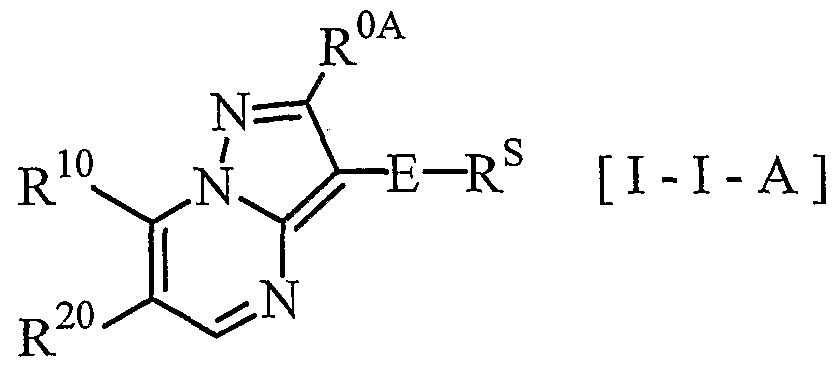 wherein
R10 and R20 are the same or different and- each (i) a 6- to 10-membered monocyclic or bicyclic aryl group optionally substituted by one to three group (s) selected from a halogen atom, cyano group, an alkyl group optionally substituted by one to three halogen atom(s), an alkyloxy group optionally substituted by one to three halogen atom(s), an amino group optionally substituted by one to two alkyl group (s), an alkylthio group, an alkylsulfinyl group and an alkylsulfonyl group, or (ii) a 4- to 7- membered saturated or unsaturated, sulfur-, oxygen- or nitrogen-containing hetero-monocyclic ..group optionally substituted by one to three group (s) selected from a halogen atom, cyano group, oxo group, an alkyl group optionally substituted by one to three halogen atom(s), an alkyloxy group optionally substituted by one to three halogen atom(s), an amino group optionally substituted by one to two alkyl group (s), an alkylthio group, an alkylsulfinyl group and an alkylsulfonyl group,
Rs is a group of the following formula [i-a] , [ii-a] or [iii-a] :
[ii-a] P-a]


R30 is (a) an alkyl group optionally substituted by a group selected from hydroxyl group, amino group, an acylamino group, a dialkylcarbamoyl-amino group, an alkylsulfonyl-amino group and a dialkylsulfamoyl-amino group; (b) cyano group; (c) carboxyl group; (d) an
alkyloxycarbonyl group; (e) a group of the formula: N(Raa)(Rbb); (f) a group of the formula: -CON (Raa) (Rbb) ; (g) a group of the formula:

(e) a 6- to 10-membered monocyclic or bicyclic aryl group optionally substituted by one to two group (s) selected from a halogen atom, cyano group, an alkyl group, a trihalogenoalkyl group and an alkyloxy group, (f) an amino group optionally substituted by one or two alkyl group (s) or (g) a saturated or unsaturated 4- to 7-membered sulfur-, oxygen- or nitrogen-containing heteromonocyclic group optionally substituted by one to two group (s) selected from a halogen atom, cyano group, an alkyl group and a trihalogenoalkyl group,
R40 is (a) hydrogen atom; (b) an alkyl group; (c) cyano group; (d) carboxyl group; (e) an alkylcarbonyl
group; (f) an alkyloxycarbonyl group; (g) a group of the formula: -CON (Rcc) (Rdd) ; (h) phenyl group; (i) benzyl group; or (j) a group of the formula: RxaCONH-, Rcc and Rdd are the same or different and each hydrogen atom or an alkyl group, one of RAa and RBb is (a) an alkyl group optionally substituted by hydroxyl group, an alkyloxy group, amino group, an alkylamino group or a dialkylamino group; (b) a phenyl group optionally substituted by one to two group (s) selected from a halogen atom, an alkyloxy group and a trihalogenoalkyl group; (c) benzyl group; (d) a 5- to 6- membered nitrogen-containing heteroaryl group; or (e) a cycloalkyl group and the other is (a) hydrogen atom or (b) an alkyl group optionally substituted by hydroxyl group, an alkyloxy group, amino group, an alkylamino group or a dialkylamino group and the other symbols are the same as defined above, excluding 6- (2-chlorophenyl) -7- (4-chlorophenyl) -3- [N- (4-cyanobenzyl) -carbamoyl] pyrazolo [1, 5-a] pyrimidine;- 6- (2- chlorophenyl) -7- (4-chlorophenyl) -3- [N- (4-cyano-4- ' tetrahydrothiopyranyl) carbamoyl] pyrazolo [1, 5-a] pyrimidine; 6-phenyl-7- (4-chlorophenyl) -3- (N-isopropylcarbamoyl) - pyrazolo [1, 5-a] pyrimidine; 6- (2-chloro-phenyl) -7- (4- chlorophenyl) -3- (N-isopropylcarbamoyl) pyrazolo [1,5- a] pyrimidine; 6- (2-chlorophenyl) -7- (4-chlorophenyl) -3- [N- (α-dimethylbenzyl) carbamoyl] pyrazolo [1, 5-a] pyrimidine; 6- (2-chlorophenyl) -7- (4-chlorophenyl) -3- [N- (α-methylbenzyl) - carbamoyl] pyrazolo [1, 5-a] pyrimidine; 6- (2-chlorophenyl) -7- (4-chlorophenyl) -3- [N- [1- (2-pyridyl) ethyl] carbamoyl] - pyrazolo [1, 5-a] pyrimidine; 6- (2-chlorophenyl) -7- (4- trifluoromethylphenyl) -3- [N- [1- (2-pyridyl) ethyl] carbamoyl] - pyrazolo [1, 5-a] pyrimidine; and 6- (2-chlorophenyl) -7- (4- chlorophenyl) -3- [N- (4-cyanobenzyl) carbamoyl] pyrazolo [1,5- a] pyrimidine, or a pharmaceutically acceptable salt thereof. The above mentioned compound [I-I-A] of the present invention includes as a further concrete embodiment, a
compound of the following formula [I-I-a] :

R1A is (a) a phenyl group optionally substituted by one to two group (s) selected from a halogen atom, a difluoroalkyl group, a trifluoroalkyl group and a dialkylamino group or (b) a saturated or unsaturated 5- to 6-membered nitrogen-containing hetero-cyclic group optionally substituted by a group selected from an alkyl group, a trifluoro-alkyl group and an alkyloxy group,
R2A is a phenyl group optionally substituted by one to two group (s) selected from a halogen atom and cyano group,
R si is a group of the following formula [i-b] , [ i-c] ,
[ i-d] , [ ii-b] , [ iii-b] or [ iii-c] 2 [i-c]


[iii-c]

Ring Aa is (a) a C3_8 cycloalkyl group or (b) a C5-6 cycloalkyl fused to a benzene ring, Q is a single bond or methylene group,
Ring Ba is 4- to 7-membered aliphatic heteromonocyclic group binding via its ring carbon atom to the adjacent nitrogen atom,
R31 is cyano group, an alkyl group, a hydroxyalkyl
group, an aminoalkyl group optionally substituted by, at the amino moiety, an alkylcarbonyl group, dialkylsulfamoyl group, an alkylsulfonyl group or a dialkylcarbamoyl group at the amino moiety, a carboxyalkyl group, carboxyl group, an alkyloxycarbonyl group, a carbamoyl group optionally substituted by one to two group (s) selected from an alkyl group and a dialkylaminoalkyl group, or a group of the following formula:

10 R41 is hydrogen atom, amino group or a group of the formula: RxaCONH-,
R32 is hydroxyl group, carboxyl group, an alkyloxycarbonyl group, amino group or a group of the -formula: .RxaCONH-, -15--- R33 is carboxyl -group- or -an-alkyloxycarbonyl -group,-
R34 is cyano group, an alkyl group, a hydroxyalkyl group, an aminoalkyl group, a carboxyalkyl group, carboxyl group, an alkyloxycarbonyl group, a carbamoyl group optionally substituted by one to two group (s) selected from 20 an alkyl group, a hydroxyalkyl group, a cyanoalkyl group, a trihalogenoalkyl group, an alkyloxyalkyl group, a cycloalkyl group, an alkylsulfonyl group and a dialkylamino-alkyl group, a group of the formula:

25 or a group of the following formula:

H
Ring J is a saturated or unsaturated nitrogen- containing 4- to 7-meinbered heteromonocyclic group optionally containing oxygen atom(s) as a heteroatom (s) other than the nitrogen atom, R35 is a hydroxyalkyl group, carboxyl group, an alkyloxycarbonyl group or a carbamoyl group optionally substituted by one or two alkyl group (s),
RA1 is an alkyl group, a cycloalkyl group, a phenyl group optionally substituted by one to two group (s) selected from a halogen atom, an alkyloxy group and a trihalogenoalkyl group or benzyl group,
RB1 is hydrogen atom or an alkyl group, ■ R36 is an alkyl group or a carbamoyl group, .
RB2 is hydrogen atom or an alkyl group, and the other symbols are the same as defined above, excluding 6- (2- chlorophenyl) -7- (4-chlorophenyl) -3- [N- (4-cyano-4- tetrahydrothiopyranyl) carbamoyl] pyrazolo [1, 5-a] pyrimidine; 6- (2-chlorophenyl) -7- (4-chlorophenyl) -3- [N- [1- (2-pyridyl) - ethyl] carbamoyl] pyrazolo [1, 5-a] pyrimidine; and 6- (2- chlorophenyl) -7- (4-trifluoromethylphenyl) -3- [N- [1- (2- pyridyl) ethyl] carbamoyl] pyrazolo [1, 5-a] pyrimidine, or a pharmaceutically acceptable salt thereof.
The present invention includes as another more concrete embodiment (1) a compound of the following formula [I-II-i] :

R5A is hydrogen atom or an alkyl group,
(A) an alkyl group optionally substituted by one to three group (s) selected from (a) a halogen atom, (b)
hydroxyl group, (c) cyano group, (d) an alkyloxy group, (e) carboxyl group, (f) a carbamoyl group optionally substituted by one or two alkyl group (s), (g) an alkylthio group, (h) an alkylsulfonyl group, (i) a cycloalkyl group optionally substituted by one to two group (s) selected from an alkyl group and hydroxyl group, (j) an amino group optionally substituted by one or two alkyl group (s) and (k) a saturated or unsaturated 4- to 10-membered monocyclic or bicyclic nitrogen-, sulfur- or oxygen-containing heterocyclic group; or
(B) a cycloalkyl group optionally fused to a benzene ring and optionally substituted by one to two group (s) selected from (a) an alkyl group optionally substituted by hydroxyl group, carboxyl group and amino group; (b) cyano group; (c) carboxyl group; (d) a group of the formula: RxaCO-; (e) a group of the formula: -N(Ral) (Rbl) ; (f) a group of the formula: -CON (Ral) (Rbl) ; (g) a 6- to 10-membered monocyclic or bicyclic aryl group; - (h) an alkyl group substituted by a 6- to 10-membered monocyclic or bicyclic aryl group; and (i) a saturated or unsaturated 4- to 7- membered nitrogen-containing heteromonocyclic group optionally substituted by one or two oxo group (s), Ral and Rbl are the same or different and each hydrogen atom, hydroxyl group, cyano group, an alkyl group, a group of the formula: RxaCO-, an alkylsulfonyl group, an aminoalkyl group, a monoalkylamino-alkyl group or a dialkylamino-alkyl group; or
(C) a 6- to 10-membered monocyclic or bicyclic aryl group optionally substituted by one to two group (s) selected from cyano group, a trihalogenoalkyl group, an alkyloxy group and carboxyl group; or
(D) a saturated or unsaturated 4- to 10-membered nitrogen-containing monocyclic or bicyclic heterocyclic group containing at least one heteroatom selected from sulfur atom, oxygen atom and nitrogen atom and optionally substituted by one to four group (s) selected from (a) a
halogen atom, (b) hydroxyl group, (c) oxo group, (d) cyano group, (e) an alkyl group, (f) a trihalogenoalkyl group, (g) a hydroxyalkyl group, (h) an alkyloxyalkyl group, (i) an alkyloxy group, (j) a group of the formula: RxaCO-, (k) a cycloalkyl group, (1) an alkylsulfonyl group, (m) an aminosulfonyl group optionally substituted by one or two alkyl group (s), (n) phenylsulfonyl group, (o) amino group, (p) a group of the formula: RκaCONH-, (q) a carbamoyl group optionally substituted by one or two alkyl group (s), (r) a 6- to 10-membered monocyclic or bicyclic aryl group optionally substituted by a- halogen atom(s), and (s) a saturated or unsaturated 4- to 7-membered sulfur-, oxygen- or "nitrogen-containing heteromonocyclic group optionally substituted by one to two group (s) selected from an alkyl group and a trihalogenoalkyl group; or
(E) a group of the formula: -N (R81) (R91) , R81 is hydrogen atom or an alkyl group, R91 is (a) an alkyl group optionally substituted by one to three group (s-) selected from a halogen atom, cyano group and a 6- to 10-membered monocyclic or bicyclic aryl group; (b) a cycloalkyl group; (c) a β- to 10-membered monocyclic or bicyclic aryl group optionally substituted by a group selected from a halogen atom, cyano group, an alkyl group, a trihalogenoalkyl group, an alkyloxy group, a trihalogenoalkyloxy group, an alkylthio group, an alkylsulfonyl group and a group of the formula: RxaCO-; (d) a group of the formula: RxaCO-; or (e) a saturated or unsaturated 4- to 7-membered sulfur-, oxygen- or nitrogen-containing heteromonocyclic group optionally substituted by a group selected from a halogen atom, an alkyl group, a trihalogenoalkyl group and an alkyloxy group; or
(F) both R5A and R6A combine each other together with the adjacent nitrogen atom to form a saturated or unsaturated 4- to 10-membered nitrogen-containing monocyclic or bicyclic heterocyclic group optionally containing one or two heteroatom(s) other than the nitrogen
atom selected from sulfur atom and oxygen atom and optionally substituted by one or two group (s) selected from a halogen atom, oxo group, an alkyl group, a group of the formula: RxaCO- and a dialkylaminosulfonyl group, and the other symbols are the same as defined above, excluding 6- (2-chlorophenyl) -7- (4-chlorophenyl) -3- [N- (1, 1- dioxotetrahydrothien-3-yl) carbamoyl-2- (hydroxymethyl) - pyrazolo [1, 5-a] pyrimidine, or a pharmaceutically acceptable salt thereof, and (2) a compound of the following formula [I-II-ii] :

(1) a compound [I-II-i] in which R10 is (a) a phenyl group optionally substituted by one to two group (s) selected from a halogen atom, an alkyl group, a difluoroalkyl group, a trifluoroalkyl group and a dialkylamino group or (b) a saturated or unsaturated 5- to 6-membered nitrogen-containing heterocyclic group optionally substituted by a group selected from an alkyl group, a trifluoroalkyl group and an alkyloxy group, R20 is a phenyl group optionally substituted by one to two group (s) selected from a halogen atom and cyano group, R6A is
(A) an alkyl group optionally substituted by a group selected from one to three halogen atom(s), hydroxyl group, cyano group, carboxyl group and an alkyloxycarbonyl group; or
(B) a group of the following formula:

N-N N-NH
H , and .R43 is hydrogen atom, amino, group, an alkylo.xycarbonylamino^ -group--or benzyloxy-carbonyl g-roup; ox
(C) a phenyl group optionally substituted by one to two group (s) selected from a halogen atom, an alkyloxy group, a trihalogenoalkyl group, carboxyl group and an alkyloxycarbonyl group; or
(D) a cyclic group of the following formula:

N-N N-NH
H ; or
(E) a group of the formula: -N(R8a) (R9a) in which R8a is hydrogen atom o"r an alkyl group, R9a is an alkyl group, a trihalogenoalkyl group, a cyanoalkyl group, benzyl group, a cycloalkyl group, a phenyl group optionally substituted by a group selected from a halogen atom, cyano group, an alkyl group, a trihalogenoalkyl group, -an alkyloxy group, a - -trihalogenoalkyloxy - group, - an alky-1-thio- -group-, an alkylsulfonyl group, an alkyloxycarbonyl group and benzyloxycarbonyl group, an alkyloxycarbonyl group, benzyloxycarbonyl group or a 5- to 6-membered nitrogen- containing heteroaryl group; or (F) a group of the following formula:

(2) a compound [I-II-ii] in which R10 is (a) a phenyl group optionally substituted by one to two group (s) selected from a halogen atom, a difluoroalkyl group, a trifluoroalkyl group and a dialkylamino group or (b) a saturated or unsaturated 5- to 6-membered nitrogen- containing heterocyclic group optionally substituted by a group selected from an alkyl group, a trifluoroalkyl group "and ' an alkyloxy group and R20 is a phenyl group optionally substituted by one to two group (s) selected from a halogen atom and cyano group.
Among the compounds [I] of the present invention, examples of the preferred compound include a compound [I-I] in -which R1 and R2 are the same or dif-ferent and each (a) a- phenyl group optionally substituted by one to three group (s) selected from a halogen atom, cyano group, an alkyl group optionally substituted by one to three halogen atom(s) and an amino group optionally substituted by one or two alkyl group (s) or (b) a saturated or unsaturated 5- to 7-memebered nitrogen-containing heterocyclic group optionally substituted by a group selected from an alkyl group optionally substituted by one to three halogen atom(s) and an alkyloxy group, and
Al) R' is a group of the formula [i] , R3 is (a) an alkyl group optionally substituted by a group selected from hydroxyl group and amino group, (b) cyano group, (c) carboxyl group, (d) an alkyloxycarbonyl group, (e) a group of the formula: -CON(R8) (Rf) or (f) an acylamino group, Re and Rf are the same or different and each hydrogen atom, an alkyl group or a dialkylaminoalkyl group, R4 is hydrogen atom or an acylamino group; or
A2) R' is a group of the formula [ii] , X is sulfur
atom, a group of the formula: -SO2-, oxygen atom or a group of the formula: -NRk-, Rk is an alkyloxycarbonyl group, an alkylsulfonyl group, an alkylcarbonyl group or a dialkylaminosulfonyl group, R3 is (a) an alkyl group optionally substituted by hydroxyl group, (b) carboxyl group, (c) an alkyloxycarbonyl group or (d) a group of the formula: -CON(Re) (Rf) , Re and Rf are the same or different and each hydrogen atom, an alkyl group or a trihalogenoalkyl group, R4 is hydrogen atom; or A3) R' is a group of the formula [iii] , RA is an alkyl group optionally substituted hydroxyl group, a phenyl group optionally substituted by a halogen atom or a trihalogenoalkyl group or a 5- to 6-membered nitrogen- containing heteroaryl group, RB is hydrogen atom or an alkyl group, R3 is an alkyl group, carboxyl group or a group of the formula: -CON(Ra) (Rb) , Ra and Rb are the same or different and each hydrogen atom or an alkyl group; and
R0A is hydrogen atom, an alkyl group - optionally- substituted by one to three halogen . atom (s) , an alkyloxy group optionally substituted by hydroxyl group, a hydroxyalkyl group, an amino group optionally substituted by one to two group (s) selected from an alkyl group, an alkylcarbonyl group and an alkylsulfonyl group or a 4- to 6-membered nitrogen-containing aliphatic heterocyclic group. Among the preferred compounds [I-I] of the present invention, examples of the more preferred compound include:
Al) a compound [I-I] in which R' is a group of the formula [i] , R3 is (a) a Ci-6 alkyl group, (b) a hydroxy-Ci_6 alkyl group, (c) an amino-Ci-6 alkyl group, (d) cyano group, (e) carboxyl group, (f) a Ci_6 alkyloxy-carbonyl group, (g) carbamoyl group, (h) a mono- or di (Ci_6 alkyl) carbamoyl group, (i) a di (Ci_6 alkyl) amino-Ci_6 alkyl-carbamoyl group or (j) a Ci_6 alkyloxy-carbonylamino group, and R4 is hydrogen atom or a phenyl-Ci-6 alkyloxy-carbonylamino group; A2) a compound [I-I] in which R' is a group of the formula [ii] , X is sulfur atom, a group of the formula: -
SO2-, oxygen atom or a group of the formula: -NRk-, Rk is a
Ci-6 alkyloxy-carbonyl group, a Ci_6 alkylsulfonyl group, a
Ci-6 alkyl-carbonyl group or a di(Ci_6 alkyl) aminosulfonyl group, R3 is (a) carbamoyl group, (b) a mono- or CIi(C1-S alkyl) -carbamoyl group, (c) a mono (trihalogeno-Cχ-6 alkyl) carbamoyl group, (d) a Ci-6 alkyloxy-carbonyl group,
(e) a Ci-6 alkyl group or (f) a hydroxy-Ci-6 alkyl group and
R4 is hydrogen atom; or
A3) a compound [I-I] in which R' is a group of the formula [iii] , RA is a ' Ci-6 alkyl group, a hydroxy-Cχ-6 alkyl group, phenyl group, a halogenophenyl group, a trihalogeno (Ci-6 alkyl) -phenyl group or a pyridyl group, RB is 'hydrogen atom or a Cχ-6 alkyl group and R3 is a Ci_6 alkyl group, carboxyl group, a Ci_6 alkyloxy-carbonyl group or carbamoyl group.
Among the compounds [I-I] of the above group Al to A3, examples of the further preferred compound include those in which R1 is -a phenyl group substituted by one to two group (s) selected from a halogen atom, a dihalogeno-Ci-6 alkyl group, a trihalogeno-Ci-6 alkyl group and a di (Ci_6 alkyl) amino group, a Ci_6 alkyloxy-pyrrolidinyl group, a Ci_6 alkyl-piperidyl group or a Ci_6 alkyloxy-piperidyl group, R2 is (a) a phenyl group substituted by one or two halogen atom(s), (b) a cyanophenyl group or (c) a trihalogeno (Cχ-6 alkyl) -pyridyl group and R0A is hydrogen atom, a Cχ-6 alkyl group, a dihalogeno-Ci_6 alkyl group, a trihalogeno-Ci-6 alkyl group, a Ci_6 alkyloxy group, a hydroxy-Ci_6 alkyloxy group, amino group, a Ci_e alkyl-carbonylamino group, a mono(Ci_6 alkyl) carbamoyl group or a 4- to 6-membered nitrogen-containing aliphatic heterocyclic group.
Among the compounds [I-I] , the particularly preferred compound may be a compound selected from the group consisting of
6- (2-chlorophenyl) -7- (4-chlorophenyl) -3- [N- (1- cyanocyclohexyl) carbamoyl] -pyrazolo [1, 5-a] pyrimidine; 6- (2-chlorophenyl) -7- (4-chlorophenyl) -3- [N- (1-
cyanocyclopentyl) carbamoyl] -pyrazolo [1, 5~a] pyrimidine;
6- (2-chlorophenyl) -7- (4-chlorophenyl) -3- [N- (1- methylcyclohexyl) carbamoyl] -pyrazolo [1, 5-a] pyrimidine;
6- (2-chlorophenyl) -7- (4-chlorophenyl) -3- [N- (1- methylcyclopropyl) carbamoyl] pyrazolo [1, 5-a] pyrimidine;
6- (2-chlorophenyl) -3- [N- (1-cyanocyclopentyl) - carbamoyl] -7- (4-trifluoromethylphenyl) -2- methylpyrazolo [1, 5-a] pyrimidine;
6- (2-chlorophenyl) -3- [N- (1-cyanocyclohexyl) carbamoyl] - 7- (4-trifluoromethylphenyl) -2-methylpyrazolo [1,5- a] pyrimidine ;
3- [N- (4-carbamoyl-l, l-dioxo-tetrahydrothiopyran-4- yl) carbamoyl] -6- (2-chlorophenyl) -7- (4-chlorophenyl) - pyrazolo [1, 5-a] pyrimidine; 2-acetylamino-6- (2-chlorophenyl) -7- (4- trifluoromethylphenyl) -3- [N- [1- (2-pyridyl) ethyl] carbamoyl] - pyrazolo [1, 5-a] pyrimidine;
6- (2-chlorophenyl) -7- (4-chloro-2-fluorophenyl) -3- [N- [1- (2-pyridyl) ethyl] carbamoyl] pyrazolo [1, 5-a] pyrimidine; 6- (2-chlorophenyl) -7- (4-trifluoromethylphenyl) -3- [N- [1- (2-pyridyl) ethyl] carbamoyl] -2- (1-pyrrolidinyl) - pyrazolo [1, 5-a] pyrimidine;
3- [N- (1-carbamoylcyclohexyl) carbamoyl] -6- (2- chlorophenyl) -7- (4-chlorophenyl) pyrazolo [I1.5-a] pyrimidine; 6- (2-chlorophenyl) -7- (4-chlorophenyl) -3- [N- [ 1-methyl- 1- (2-pyridyl) ethyl] carbamoyl] pyrazolo [1, 5-a] pyrimidine;
6- (2-chlorophenyl) -7- (4-trifluoromethylphenyl) -3- [N- [1-methyl-l- (2-pyridyl) -ethyl] carbamoyl] pyrazolo [1,5- a] pyrimidine; 3- [N- (4-carbamoyl-l, l-dioxo-tetrahydrothiopyran-4- yl) carbamoyl] -6- (2-chlorophenyl) -7- (4- trifluoromethylphenyl) pyrazolo [1, 5-a] pyrimidine;
3- [N- (1-carboxycyclohexyl) carbamoyl] -6- (2- chlorophenyl) -7- (4-chlorophenyl) pyrazolo [1, 5-a] pyrimidine; 6- (2-chlorophenyl) -7- (4-chlorophenyl) -3- [ [1- [N- [2-
(N,N-dimethylamino) ethyl] carbamoyl] cyclohexyl] carbamoyl] -
pyrazolo [1, 5-a] pyrimidine;
6- (2-chlorophenyl) -7- (4-chlorophenyl) -3- [N- [1- (N- methylcarbamoyl) cyclohexyl] carbamoyl] pyrazolo [1,5- a] pyrimidine; 6- (2-chlorophenyl) -7- (4-chlorophenyl) -3- [N-[I- (N, N- dimethylcarbamoyl) cyclohexyl] carbamoyl] pyrazolo [1,5- a] pyrimidine;
(S) -3- [N- (l-carboxy-2-methylpropyl) carbamoyl] -6- (2- chlorophenyl) -7- (4-chlorophenyl) pyrazolo [1, 5-a] pyrimidine; (S) -3- [N- (l-carboxy-2-phenylethyl) carbamoyl] -6- (2- chlorophenyl) -7- (4-trifluoromethylphenyl )'pyrazolo [1, 5- a] pyrimidine;
(S) -3- [N--(l-carboxy-2-methylpropyl) carbamoyl] -6- (2- chlorophenyl) -7- (4-trifluoromethylphenyl) pyrazolo [1,5- a] pyrimidine;
(S) -3- [N- (α-carboxybenzyl) carbamoyl] -6- (2- chlorophenyl) -7- (4-trifluoromethylphenyl) pyrazolo [1,5- a] pyrimidine;
(S) -3- [N- (l-carboxy-2-methylpropyl) carbamoyl] -6- (2- chlorophenyl) -7- (4-chlorophenyl) -2-methylpyrazolo [1, 5- a] pyrimidine;
3- [N- (1-carboxy-l-methylethyl) carbamoyl] -6- (2- chlorophenyl) -7- (4-chlorophenyl) -2-methylpyrazolo [1,5- a] pyrimidine; 3- [N- (α-carboxybenzyl) carbamoyl] -6- (2-chlorophenyl) -7- ( 4-chlorophenyl) pyrazolo [1, 5-a] pyrimidine;
3- [N- (1-carboxy-l-methylethyl) carbamoyl]--6- (2- chlorophenyl) -7- (4-trifluoromethylphenyl) pyrazolo [1,5- a] pyrimidine; 3- [N- (l-carboxy-2-phenylethyl) carbamoyl] -6- (2- chlorophenyl) -7- (4-chlorophenyl) pyrazolo [1, 5-a] pyrimidine;
3- [N- (4-carboxy-l-cyclohexyl) carbamoyl] -6- (2- chlorophenyl) -7- (4-trifluoromethylphenyl) pyrazolo [1,5- a] pyrimidine; 3- [N- (4-carboxybenzyl) carbamoyl] -6- (2-chlorophenyl) -7- (4-trifluoromethylphenyl) pyrazolo [1, 5-a] pyrimidine;
3- [N- (3-carboxybenzyl) carbamoyl] -6- (2-chlorophenyl) -7- (4-trifluoromethylphenyl) pyrazolo [1, 5-a] pyrimidine;
6- (2-chlorophenyl) -7- (4-chlorophenyl) -3- [N-[I- (2- pyridyl) ethyl] carbamoyl] pyrazolo [1, 5-a] pyrimidine; 6- (2-chlorophenyl) -3- [N- (1-cyanocyclohexyl) carbamoyl] - 7- (4-trifluoromethylphenyl) pyrazolo [1, 5-a] pyrimidine ;
6- (2-chlorophenyl) -7- (4-chlorophenyl) -3- [N- (1- methoxycarbonylcyclohexyl) carbamoyl] pyrazolo [1,5- a] pyrimidine; 6- (2-chlorophenyl) -7- (4-chlorophenyl) -2-
(methylsulfonylamino) -3- [N- [1- (2-pyridyl) ethyl] carbamoyl] - pyrazolo [1, 5-a] pyrimidine;
■ 6- (2-chlorophenyl) -7—(4-chlorophenyl) -2- [N-methyl-N- (methylsulfonyl) amino] -3- [N- [1- (2-pyridyl) ethyl] carbamoyl] - pyrazolo [1, 5-a] pyrimidine;
6- (2-chlorophenyl) -7- (4-methylpiperidin-l-yl) -3- [N- [1- methyl-1- (2-pyridyl) ethyl] carbamoyl] pyrazolo [1,5- a] pyrimidine;
6- (2-chlorophenyl) -7- (4-methoxypiperidin-l-yl) -3- [N- [1-methyl-l- (2-pyridyl) ethyl] carbamoyl] pyrazolo [1, 5- a] pyrimidine;
6- (2-chlorophenyl) -7- (3-methoxypyrrolidin-l-yl) -3- [N- [1-methyl-l- (2-pyridyl) ethyl] carbamoyl] pyrazolo [1,5- a] pyrimidine; 6- (2-chlorophenyl) -7- (4-trifluoromethylphenyl) -3- [N- (1-methoxycarbonylcyclohexyl) sulfamoyl] -2- methylpyrazolo [1, 5-a] pyrimidine;
3- [N- (1-carboxycyclohexyl) sulfamoyl] -6- (2- chlorophenyl) -7- (4-trifluoromethylphenyl) -2- methylpyrazolo [1, 5-a] pyrimidine; β- (2-chlorophenyl) -7- (4-trifluoromethylphenyl) -3- [N- (4-methoxycarbonyl-l, l-dioxo-tetrahydrothiopyran-4- yl) carbamoyl] pyrazolo [1, 5-a] pyrimidine;
6- (2-chlorophenyl) -7- (4-trifluoromethylphenyl) -3- [N- (4-methyl-1, l-dioxo-tetrahydrothiopyran-4-yl) carbamoyl] - pyrazolo [1, 5-a] pyrimidine;
6- (2-chlorophenyl) -7- (4-chlorophenyl) -2-methyl-3- [N- (4-methyl-l, l-dioxo-tetrahydrothiopyran-4-yl) carbamoyl] - pyrazolo [1, 5-a] pyrimidine;
6- (2-chlorophenyl) -7- (4-trifluoromethylphenyl) -2- methyl-3- [N- (4-methyl-l, l-dioxo-tetrahydrothiopyran-4- yl) carbamoyl] pyrazolo [1, 5-a] pyrimidine;
6- (2-chlorophenyl) -7- (4-chlorophenyl) -3- [N- (3-hydroxy- 2-methylprop-2-yl) carbamoyl] -2-methylpyrazolo [1, 5- a] pyrimidine; 6- (2-chlorophenyl) -7- (4-trifluoromethylphenyl) -3- [N- (4-hydroxymethyl-l, l-dioxo-tetrahydrothiopyran-4-yl) - carbamoyl] pyrazolo [1, 5-a] pyrimidine;
6- (2-chlorophenyl) -7- (4-chlorophenyl) —2- trifluoromethyl-3- [N- (4-methyl-l, 1-dioxo- , tetrahydrothiopyran-4-yl) carbamoyl] pyrazolo [1, 5- a] pyrimidine;
6- (2-chlorophenyl) -7- (4-chlorophenyl) -2-ethoxy-3- [N- (4-methyl-l, l-dioxo-tetrahydrothiopyran-4-yl) carbamoyl] - pyrazolo [1, 5-a] pyrimidine; 6- (2-chlorophenyl) -7- (2-fluoro-4- trifluoromethylphenyl) -3- [N- (4-methyl-l, 1-dioxo- tetrahydrothiopyran-4-yl) carbamoyl] pyrazolo [1,5- a] pyrimidine;
6- (2-chlorophenyl) -7- (4-trifluoromethylphenyl) -3- [N- (3-methoxycarbonyl-l, l-dioxothietan-3-yl) carbamoyl] - pyrazolo [1, 5-a] pyrimidine;
6- (2-chlorophenyl) -7- (4-chlorophenyl) -3- [N- (1- cyanocyclohexyl) carbamoyl] -2-methylpyrazolo [1, 5- a] pyrimidine; 6- (2-chlorophenyl) -7- (4-chlorophenyl) -2- (2- hydroxyethoxy) -3- [N- (3-methyl-l, l-dioxo-tetrahydrothien-3- yl) carbamoyl] pyrazolo [1, 5-a] pyrimidine;
6- (2-chlorophenyl) -7- (4-trifluoromethylphenyl) -2- (2- hydroxyethoxy) -3- [N- (3-methyl-l, l-dioxotetrahydrothien-3- yl) carbamoyl] pyrazolo [1, 5-a] pyrimidine;
6- (2-chlorophenyl) -7- (4-trifluoromethylphenyl) -3- [N-
(3-methyl-l, l-dioxotetrahydrothien-3-yl) carbamoyl] - pyrazolo [1, 5-a] pyrimidine;
6- (2-chlorophenyl) -2- (difluoromethyl) -7- (4- trifluoroinethylphenyl) -3- [N- (3-methyl-l, 1- dioxotetrahydrothien-3-yl) carbamoyl] pyrazolo [1,5- a] pyrimidine;
6- (2-chlorophenyl) -7- (4-chlorophenyl) -2-
(trifluoromethyl) -3- [N- (3-methyl-l, l-dioxotetrahydrothien- 3-yl) carbamoyl] pyrazolo [1, 5-a] pyrimidine; 6- (2-chlorophenyl) -7- (4-trifluoromethylphenyl) -3- [N- [4- (N-methylcarbamoyl) -1, l-dioxotetrahydrothiopyran-4-yl] - carbamoyl] pyrazolo [1, 5-a] pyrimidine;
6- (2-chlorophenyl) -3- [N- [4- [N- (2, 2, 2-trifluoroethyl) - carbamoyl] -1, l-dioxotetrahydrothiopyran-4-yl] carbamoyl] -7- (4-trifluoromethylphenyl) pyrazolo [1, 5-a] pyrimidine; and
6- (2-chlorophenyl) -3- [N- [4- [N- (2, 2, 2-trifluoroethyl) - carbamoyl] -1, l-dioxotetrahydrothiopyran-4-yl] carbamoyl] -7- ( 4-trifluoromethylphenyl) -2-methylpyrazolo [1, 5-a] pyrimidine ■ or a pharmaceutically acceptable salt thereof. Examples of another preferred compound of the present invention include:
Bl) a compound [I-II] in which R1 and R2 are the same or different and each a phenyl group optionally substituted by one to two group (s) selected from a halogen atom, cyano group, an alkyl group, a dihalogenoalkyl group and a trihalogenoalkyl group, R" is a group of the formula: -
N(R5) (R6), R5 is hydrogen atom or an alkyl group and R6 is
(a) an alkyl group optionally substituted by one to three group (s) selected from a halogen atom, hydroxyl group, cyano group, an alkyloxy group, a C3-8 cycloalkyl group, a hydroxy-C3_8 cycloalkyl group, an amino-C3-8 cycloalkyl group, a C3_8 cycloalkyl group substituted by one or two halogen atom(s) , a dialkylamino group, carboxyl group, a carbamoyl group optionally substituted by one or two alkyl group (s), a phenyl group optionally substituted by one or two halogen atom(s), a trihalogenoalkyl-phenyl group, an alkyloxyphenyl
group, a carboxyphenyl group and a saturated or unsaturated 5- to 6-membered nitrogen- or oxygen-containing heterocyclic group, (b) a C3-8 cycloalkyl group, said cycloalkyl group being optionally fused to a benzene ring and optionally substituted by one to two group (s) selected from cyano group, an alkyl group, a hydroxyalkyl group, a carboxyalkyl group, an aminoalkyl group, an alkylcarbonylamino-alkyl group, a dialkylcarbamoyl-amino- alkyl group, an alkylsulfonylamino-alkyl group, a dialkylsulfamoylamino-alkyl group, carboxyl group, an alkyloxycarbonyl group, a phenylalkyloxycarbonyl group, a group of the formula: -CON(Ral) (Rbl) and a tetrazolyl group, Ral and Rbl are the same or different and each hydrogen atom, an alkyl group or a dialkylamino-alkyl group, (c) a saturated or unsaturated 4- to 6-membered nitrogen-, sulfur- or oxygen-containing heterocyclic group optionally substituted by one to three group (s) selected from oxo group, hydroxy group, cyano group,- an alkyl group, a- hydroxyalkyl group, carboxyl group, an alkyloxycarbonyl group, an alkylsulfonyl group, a group of the formula: - CON (Ra2) (Rb2) , pyrrolidinylcarbonyl group or morpholinocarbonyl group and Ra2 and Rb2 are the same or different and each hydrogen atom, an alkyl group, a trihalogenoalkyl group, a cyanoalkyl group, a hydroxyalkyl group, an alkyloxyalkyl group, an alkylsulfonyl' group or a
C3-8 cycloalkyl group or (d) an amino group optionally substituted by one to two group (s) selected' from an alkyl group and a pyridyl group, excluding 6- (2-chlorophenyl) -7-
(4-chlorophenyl) -3- [N- (1, l-dioxo-tetrahydrothien-3-yl) - carbamoyl] -2- (hydroxymethyl) pyrazolo [1, 5-a] pyrimidine; and
B2) a compound [I-II] in which R1 and R2 are the same or different and each a phenyl group optionally substituted by one to two group (s) selected from a halogen atom, cyano group, a dihalogenoalkyl group and a trihalogenoalkyl group, R0B is a group of the formula: -SO2N(R01) (R02) and R" is an alkyloxy group.
Among the compounds [I-II] , the more preferred compound may be a compound in which E is a group of the formula: -C(=O)-.
Among the compounds [I-II] , examples of the further preferred compound include:
Bl-I) a compound in which R1 and R2 are the same or different and each a phenyl group optionally substituted by one to two group (s) -selected from a halogen atom, cyano group, an alkyl group, a dihalogenoalkyl group and a trihalogenoalkyl group, R0B is a group of the formula: - NHCONHR03, E is a group of the formula: -C(=O)~, R" is a group of the formula: -N(R5) (R6), R5 is hydrogen atom and R6 is (a) an alkyl group, "(b) a trihalogenoalkyl group, (c) a C3_8 cycloalkyl group, (d) a dialkylamino group or (e) a saturated or unsaturated 5- to 6-membered sulfur-containing heterocyclic group optionally substituted by one to three group (s) selected from oxo group, an alkyl group and carbamoyl group;
Bl-2) a compound in which R1 and R2 are the same or different and each (i) a phenyl group optionally substituted by one to two group (s) selected from a halogen atom, cyano group, an alkyl group, a dihalogenoalkyl group, a trihalogenoalkyl group and an alkyloxy group or (ii) a saturated or unsaturated 5- to 6-membered nitrogen- containing heteromonocyclic group, R0B is a group of the formula: -SO2N (R01) (R02) , R01 is hydrogen atom or an alkyl group, R02 is hydrogen atom, an alkyl • group or a carbamoylalkyl group, E is a group of the formula: -C(=0)-, R" is a group of the formula: -N(R5) (R6), R5 is hydrogen atom or an alkyl group and R6 is (a) an alkyl group optionally substituted by one to three group (s) selected from a halogen atom, hydroxyl group, cyano group, an alkyloxy group, a C3-8 cycloalkyl group optionally substituted by one to two halogen atom(s), an amino group optionally substituted by one to two alkyl group (s) and a pyridyl group, (b) a C3-.8 cycloalkyl group optionally
substituted by a group selected from an alkyl group and carbamoyl group, (c) an amino group optionally substituted by one to two group (s) selected from an alkyl group and a pyridyl group or (d) a saturated or unsaturated 5- to 6- membered nitrogen- or sulfur-containing heterocyclic group optionally substituted by one to three group (s) selected from oxo group, an alkyl group and carbamoyl group;
Bl-3) a compound in which R1 and R2 are the same or different and each a phenyl group optionally substituted by one to two group (s) selected from a halogen atom and a trihalogenoalkyl group, R0B is a group of the formula: CON(Re) (Rf) , Re is hydrogen atom or an alkyl group, Rf is hydrogen ' atom, an alkyl group or a dialkylamino group, E is a group of the formula: -C(=0)-, R" is a group of the formula: -N(R5) (R6), R5 is hydrogen atom and R6 is (a) an alkyl group optionally substituted by one to three halogen atom(s) , (b) a C3-8 cycloalkyl group or (c) a saturated or unsaturated 4- to 6-membered sulfur-containing_ heterocyclic group optionally substituted by one to three group (s) selected from an oxo group and an alkyl group;
Bl-4) a compound in which R1 and R2 are the same or different and each a phenyl group optionally substituted by one to two group (s) selected from a halogen atom and a trihalogenoalkyl group, R0B is a hydroxyalky.l group, E is a group of the formula: -C(=O)-, R" is a group of the formula: -N(R5) (R6), R5 is hydrogen atom and R6 is (a) an alkyl group optionally substituted by one to' three halogen atom(s), (b) an alkyl group substituted by a pyridyl group, (c) a C3-8 cycloalkyl group optionally substituted by a group selected from cyano group and carbamoyl group or (d) a saturated or unsaturated 4- to 6-membered nitrogen- or sulfur-containing heterocyclic group optionally substituted by one to three group (s) selected from oxo group and an alkyl group, excluding 6- (2-chlorophenyl) -7- (4- chlorophenyl) -3- [N- (1, l-dioxotetrahydro-thien-3-yl) - carbamoyl] -2- (hydroxymethyl) pyrazolo [1, 5-a] pyrimidine;
Bl-5) a compound in which R1 and R2 are the same or different and each a phenyl group optionally substituted by one to two group (s) selected from a halogen atom and a trihalogenoalkyl group, R0B is carboxyl group, E is a group of the formula: -C(=0)-, R" is a group of the formula: - N(R5) (R6), R5 is hydrogen atom and R6 is a saturated or unsaturated 5- to β-membered sulfur-containing heterocyclic group optionally substituted by one to three group (s) selected from oxo group and an alkyl group; and B2-1) a compound in which R1 and R2 are the same or different and each a halogenophenyl group, R0B is a sulfamoyl group optionally substituted by one to two alkyl group (s), E is a group of the formula: -C(=0)— and R" is a-n alkyloxy group. Among the above compounds [I-II] , examples of the particularly preferred compound may be:
Bl-a) a compound in which R1 is (i) a phenyl group optionally substituted by one to two group (s) selected from a halogen atom, a Ci_6 alkyl group, a dihalogeno-Ci-6 alkyl group and a trihalogeno-Ci_6 alkyl group or (ii) piperidino group, R2 is a phenyl group optionally substituted by one to two group (s) selected from a halogen atom and cyano group, R0B is a group of the formula: -SO2N (R01) (R02) , R01 is hydrogen atom or a Ci_6 alkyl group, R02 is hydrogen atom, a Ci-6 alkyl group or a carbamoyl-Ci-6 alkyl group, R5 is hydrogen atom, R6 is (a) a Ci_6 alkyl group optionally substituted by one to three group (s) selected from a halogen atom, a Ci_6 alkyloxy group, a C3-8 cycloalkyl group and a pyridyl group, (b) a C3_8 cycloalkyl group optionally substituted by a Ci-6 alkyl group, (c) an amino group optionally substituted by one to two group (s) selected from a Ci_6 alkyl group and a pyridyl group or (d) a saturated or unsaturated 5- to 6-membered nitrogen- or sulfur-containing heterocyclic group optionally substituted by one to two oxo group (s) ; or
Bl-b) a compound in which R1 is a trihalogeno-Ci_6
alkyl-phenyl group, R2 is a halogenophenyl group, R0B is a group of the formula: -C0N(Re) (Rf) , Re is hydrogen atom or a Ci-6 alkyl group, Rf is hydrogen atom or a Ci-6 alkyl group, R5 is hydrogen atom, R6 is (a) Ci-6 alkyl group optionally substituted by one to three halogen atom(s) or (b) a saturated or unsaturated 5- to β-membered sulfur-containing heterocyclic group optionally substituted by one to three group (s) selected from an oxo group and a Ci_6 alkyl group; or Bl-c) a compound in which R1 is a trihalogeno-Ci-6 alkyl-phenyl group, R2 is a halogenophenyl group, R0B is a hydroxy-Ci-6 alkyl group, R5 is hydrogen atom, R6 is (a) a trihalogeno-Ci-6 alkyl group, (b) a pyridyl-Ci-6 alkyl group,
(c) a C5-7 cycloalkyl group substituted by a group selected from cyano group and carbamoyl group or (d) a saturated or unsaturated 5- to 6-membered sulfur-containing heterocyclic group optionally substituted by one to three group (s) selected from an oxo group and a Ci-6 alkyl group, excluding 6- (2-chlorophenyl) -7- (4-chlorophenyl) -3- [N- (1, 1-dioxo- tetrahydrothien-3-yl) carbamoyl] -2- (hydroxymethyl) - pyrazolo [1, 5-a] pyrimidine; or
B2-a) a compound in which R1 and R2 are the same or different and each a halogenophenyl group, R0B is a Ci_e alkyl-sulfamoyl group and R" is a Ci-6 alkyloxy group. Examples of the particularly preferred compounds fill] mentioned above include a compound selected from the group consisting of:
6- (2-chlorophenyl) -7- (4-chlorophenyl) -3- ethoxycarbonyl-2- (N-methylsulfamoyl) pyrazolo [1,5- a] pyrimidine;
6- (2-chlorophenyl) -7- (4-chlorophenyl) -3- ethoxycarbonyl-2- (N, N-dimethylsulfamoyl) pyrazolo [1,5- a] pyrimidine;
(R) -6- (2-chlorophenyl) -7- (4-chlorophenyl) -2- (N- methylsulfamoyl) -3- [N- (1, l-dioxotetrahydrothien-3-yl) - carbamoyl] pyrazolo [1, 5-a] pyrimidine;
6- (2-chlorophenyl) -7- (4-chlorophenyl) -3- [N- (cyclopentyl) carbamoyl] -2- (N-methylsulfamoyl) pyrazolo [1,5- a] pyrimidine;
6- (2-chlorophenyl) -7- (4-chlorophenyl) -3- [ [N' -methyl- N ' - (2-pyridyl) hydrazino] carbonyl] -2- (N-methylsulfamoyl) - pyrazolo [1, 5-a] pyrimidine;
(R) -6- (2-chlorophenyl) -7- (4-chlorophenyl) -2- (N, N- dimethylsulfamoyl) -3- [N- (1, l-dioxotetrahydrothien-3-yl) - carbamoyl] pyrazolo [1, 5-a] pyrimidine; 6- (2-chlorophenyl) -7- (4-chlorophenyl) -3- [N-
(cyclopentyl) carbamoyl] -2- (N, N-dimethylsulfamoyl) - pyrazolo [1, 5-a] pyrimidine;
6- (2-chlorophenyl) -7- (4-chlorophenyl) -2- (N, N- dimethylsulfamoyl) -3- [N- (1-pyrrolidinyl) carbamoyl] - pyrazolo [1, 5-a] pyrimidine;
6- (2-chlorophenyl) -7- (4-chlorophenyl) -3- [ [N ' -methyl- N' - (2-pyridyl) hydrazino] carbonyl] -2- (N, N- dimethylsulfamoyl) pyrazolo [1, 5-a] pyrimidine;
6- (2-chlorophenyl) -7- (4-chlorophenyl) -2- (N- methylsulfamoyl) -3- [N- (1-pyrrolidinyl) carbamoyl] - pyrazolo [1, 5-a] pyrimidine;
(R) -6- (2-chlorophenyl) -7- (4-chlorophenyl) -3- [N- (1,1- dioxotetrahydrothien-3-yl) carbamoyl] -2- sulfamoylpyrazolo [1, 5-a] pyrimidine; 6- (2-chlorophenyl) -7- (4-chlorophenyl) -3- [N- (1- pyrrolidinyl) carbamoyl] -2-sulfamoylpyrazolo [1, 5- a] pyrimidine;
6- (2-chlorophenyl) -7- (4-chlorophenyl) -3- [ [N' -methyl- N ' - (2-pyridyl) hydrazino] carbonyl] -2-sulfamoylpyrazolo [1,5- a] pyrimidine;
(S) -6- (2-chlorophenyl) -7- (4-chlorophenyl) -3- [N-(1, 1- dioxotetrahydrothien-3-yl) carbamoyl] -2- sulfamoylpyrazolo [1, 5-a] pyrimidine;
6- (2-chlorophenyl) -7- (4-chlorophenyl) -3- [N- (cyclopentyl) carbamoyl] -2-sulfamoylpyrazolo [1,5- a] pyrimidine;
6- (2-chlorophenyl) -7- (4-chlorophenyl) -3- [N- (1, 1- dioxotetrahydrothiopyran-4-yl) carbamoyl] -2- sulfamoylpyrazolo [1, 5-a] pyrimidine;
(R) -6- (2-chlorophenyl) -7- (4-trifluoromethylphenyl) -3- [N- (1, l-dioxotetrahydrothien-3-yl) carbamoyl] -2- sulfamoylpyrazolo [1, 5-a] pyrimidine;
(S) -6- (2-chlorophenyl) -7- (4-trifluoromethylphenyl) -3- [N- (1, l-dioxotetrahydrothien-3-yl) carbamoyl] -2- sulfamoylpyrazolo [1, 5-a] pyrimidine; 6- (2-chlorophenyl) -3- [N- (cyclopentyl) carbamoyl] -7- (4- trifluoromethylphenyl) -2-sulfamoylpyrazolo [1,5- a] pyrimidine; ■ (R) -7- (4-chlorophenyl) -6- (2-cyanophenyl) -3- [N- (1,1- - dioxotetrahydrothien-3-yl) carbamoyl] -2- sulfamoylpyrazolo [1, 5-a] pyrimidine;
7- (4-chlorophenyl) -6- (2-cyanophenyl) -3- [N- (cyclopentyl) carbamoyl] -2-sulfamoylpyrazolo [1,5- a] pyrimidine-;
7- (4-chlorophenyl) -6- (2-cyanophenyl) -3- [ [N ' -methyl-N ' - (2-pyridyl) hydrazino] carbonyl] -2-sulfamoylpyrazolo [1,5- a] pyrimidine;
(R) -2- [N- (carbamoylmethyl) sulfamoyl] -6- (2- chlorophenyl) -7- (4-chlorophenyl) -3- [N- (1, 1- dioxotetrahydrothien-3-yl) carbamoyl] pyrazolo [1,5- a] pyrimidine;
2- [N- (carbamoylmethyl) sulfamoyl] -6- (2-chlorophenyl) -7- ( 4-chlorophenyl) -3- [N- (cyclopentyl) carbamoyl]pyrazolo [1, 5- a] pyrimidine;
2- [N- (carbamoylmethyl) sulfamoyl] -6- (2-chlorophenyl) -7- (4-chlorophenyl) -3- [ [N ' -methyl-N1 - (2-pyridyl) hydrazino] - carbonyl] pyrazolo [1, 5-a] pyrimidine;
2- [N- (carbamoylmethyl) sulfamoyl] -6- (2-chlorophenyl) -7- ( 4-chlorophenyl) -3- [N- (1-pyrrolidinyl) carbamoyl] - pyrazolo [1, 5-a] pyrimidine; 3- [N- (1-carboxycyclohexyl) carbamoyl] -6- (2- chlorophenyl) -7- (4-chlorophenyl) -2- (N-methylsulfamoyl) -
pyrazolo [1, 5-a] pyrimidine;
3- [N- (1-carbamoylcyclohexyl) carbamoyl] -6- (2- chlorophenyl) -7- (4-chlorophenyl) -2-sulfamoylpyrazolo [1,5- a] pyrimidine; 6- (2-chlorophenyl) -7- (4-trifluoromethylphenyl) -2- hydroxymethyl-3- [N- [1-methyl-l- (2-pyridyl) ethyl] carbamoyl] - pyrazolo [1, 5-a] pyrimidine;
6- (2-chlorophenyl) -7- (4-trifluoromethylphenyl) -2- hydroxymethyl-3- [N- (3-methyl-l, l-dioxotetrahydrothien-3- yl) carbamoyl] pyrazolo [1, 5-a] pyrimidine;
6- (2-chlorophenyl) -3- [N- (1-cyanocyclohexyl) carbamoyl] - 7- (4-trifluoromethylphenyl) -2- (hydroxymethyl) pyrazolo [1,5- a] pyrimidine;
6- (2-chlorophenyl) -7- (4-trifluoromethylphenyl) -2- hydroxymethyl-3- [N- (4-methyl-l, 1-dioxotetrahydrothiopyran- 4-yl) carbamoyl] pyrazolo [1, 5-a] pyrimidine; 2-carbamoyl-6- (2-chlorophenyl) -7- (4- trifluoromethylphenyl) -3- [N- (4-methyl-l, 1- dioxotetrahydrothiopyran-4-yl) carbamoyl] pyrazolo [1,5- a] pyrimidine;
6- (2-chlorophenyl) -7- (4-trifluoromethylphenyl) -2- (N- methylcarbamoyl) -3- [N- (4-methyl-l, 1- dioxotetrahydrothiopyran-4-yl) carbamoyl] pyrazolo [1,5- a] pyrimidine; 6- (2-chlorophenyl) -7- (4-chlorophenyl) -3- [N- (2,2- dimethylpropyl) carbamoyl] -2-sulfamoylpyrazolo [1,5- a] pyrimidine;
6- (2-chlorophenyl) -7- (4-chlorophenyl) -3- [N- (cyclohexylmethyl) carbamoyl] -2-sulfamoylpyrazolo [1, 5- ■ a] pyrimidine;
6- (2-chlorophenyl) -7- (4-chlorophenyl) -3- [N- (2,2,2- trifluoroethyl) carbamoyl] -2-sulfamoylpyrazolo [1, 5- a] pyrimidine;
6- (2-chlorophenyl) -7- (4-chlorophenyl) -3- [N- (3- methylpropyl) carbamoyl] -2-sulfamoylpyrazolo [1,5- a] pyrimidine;
6- (2-chlorophenyl) -7- (4-chlorophenyl) -3- [N- (2,2- difluoroethyl) carbamoyl] -2-sulfamoylpyrazolo [1,5- a] pyrimidine;
6- (2-chlorophenyl) -7- (4-chlorophenyl) -3- [N- (cyclopropylmethyl) carbamoyl] -2-sulfamoylpyrazolo [1,5- a] pyrimidine;
6- (2-chlorophenyl) -7- (4-chlorophenyl) -3- [N- (1- methylcyclopropyl) carbamoyl] -2-sulfamoylpyrazolo [1, 5- a] pyrimidine; 6- (2-chlorophenyl) -3- [N- (2, 2, 2-trifluoroethyl) - carbamoyl] -7- (4-trifluoromethylphenyl) -2- (hydroxymethyl) - pyrazolo [1, 5-a] pyrimidine;
6- (2-chlorophenyl) -7- ( 4-difluoromethylphenyl) -3- [N- (isobutyl) carbamoyl] -2-sulfamoylpyrazolo [1, 5-a] pyrimidine; 2-carbamoyl-6- (2-chlorophenyl) -3- [N- (2,2,2- trifluoroethyl) carbamoyl] -7- (4-trifluoromethylphenyl) - pyrazolo [1, 5-a] pyrimidine;
6- (2-chlorophenyl) -7- (4-chloro-2-fluorophenyl) —3- [N- ■ (2,2, 2-trifluoroethyl) carbamoyl] -2-sulfamoylpyrazolo [1, 5- a] pyrimidine;
6- (2-chlorophenyl) -7- (4-difluoromethylphenyl) -3- [N- (2,2, 2-trifluoroethyl) carbamoyl] -2-sulfamoylpyrazolo [1,5- a] pyrimidine;
6- (2-chlorophenyl) -7- (4-trifluoromethylphenyl) -3- [N- (n-propyl) carbamoyl] -2-sulfamoylpyrazolo [1, 5-a] pyrimidine;
6- (2-chlorophenyl) -7- (4-trifluoromethylphenyl) -3- [N- (isobutyl) carbamoyl] -2-sulfamoylpyrazolo [1, 5-a] pyrimidine; 6- (2-chlorophenyl) -7- (4-trifluoromethylphenyl) -3- [N- (1-methylpropyl) carbamoyl] -2-sulfamoylpyrazolo [1, 5- a] pyrimidine;
6- (2-chlorophenyl) -7- (4-trifluoromethylphenyl) -3- [N- (3-methoxyprop-2-yl) carbamoyl] -2-sulfamoylpyrazolo [1, 5- a] pyrimidine;
6- (2-chlorophenyl) -7- (4-trifluoromethylphenyl) -3- [N- (1-methylcyclopropyl) carbamoyl] -2-sulfamoylpyrazolo [1,5- a] pyrimidine;
6- (2-chlorophenyl) -3- [N- (2, 2, 2-trifluoroethyl) - carbamoyl] -7- (4-fluorophenyl) -2-sulfamoylpyrazolo [1,5- a]pyrimidine;
6- (2-chlorophenyl) -7- (4-trifluoromethylphenyl) -3- [ [N' - methyl-N ' - (2-pyridyl) hydrazino] carbonyl] -2- sulfamoylpyrazolo [1, 5-a] pyrimidine;
6- (2-chlorophenyl) -7- (4-trifluoromethylphenyl) -3- [N- (2,2, 2-trifluoroethyl) carbamoyl] -2- (dimethylcarbamoyl) - pyrazolo [1, 5-a] pyrimidine; 6- (2-chlorophenyl) -7- (4-trifluoromethylphenyl) -3- [N- [1-methyl-l- (2-pyridyl) ethyl] carbamoyl] -2- sulfamoylpyrazolo [1, 5-a] pyrimidine;
■ 6- (2-chlorophenyl) -3- [N- (3-methoxyprop-2-yl) - carbamoyl] -7- (4-methylphenyl) -2-sulfamoylpyrazolo [1, 5- a] pyrimidine;
6- (2-chlorophenyl) -3- [N- (2 , 2 , 2-trifluoroethyl) - carbamoyl] -7- (4-methylphenyl) -2-sulfamoylpyrazolo [1,5- a] pyrimidine; -
6- (2-chlorophenyl) -3- [N- (isobutyl) carbamoyl] -7- (4- methylphenyl) -2-sulfamoylpyrazolo [1, 5-a] pyrimidine; and
6- (2-chlorophenyl) -3- [N- (cyclopentyl) carbamoyl] -7- (4- methylphenyl) -2-sulfamoylpyrazolo [1, 5-a] pyrimidine; or a pharmaceutically acceptable salt thereof.
When the compound [I] of the present invention has an asymmetric carbon atom(s) in its molecule, it may exist in the form of a stereoisomer thereof (diastereoisomers, optical isomers) owing to said asymmetric carbon atom(s) thereof, and the present invention also includes one of the stereoisomers and a mixture thereof. A compound [I] of the present invention shows a high affinity to CBl receptors and hence may be useful as a CBl receptor ligand, particularly as a CBl receptor antagonist. Based on the antagonistic activity, the compound may be useful as an agent for prevention and/or treatment of a CBl receptor-mediated diseases such as psychosis including schizophrenia, anxiety disorders, stress, depression,
epilepsy, neurodegenerative disorders, spinocerebellar disorders, cognitive disorders, craniocerebral trauma, panic attack, peripheral neuropathy, glaucoma, migraine, Parkinson's disease, Alzheimer's disease, Huntington's disease, Raynaud's syndrome, tremor, obsessive-compulsive disorders, amnesia, geriatric dementia, thymic disorders, Tourette ' s syndrome, tardive dyskinesia, bipolar disorders, cancer, drug-induced dyskinesia, dystonia, septic shock, hemorrhagic" shock, hypotension, insomnia, immunological diseases including inflammations, multiple screlos'is, emesis, diarrhea, asthma, appetite disorders such as bulimarexia, anorexia and the like, obesity, non insulin- dependent diabetes mellitus (NIDDM), memory disorders, urinary disorders, cardiovascular disorders, infertility disorders, infections, demyelination-related diseases, neuroinflammation, viral encephalitis, cerebral vascular incidents, cirrhosis of the liver or gastrointestinal disorders including intestinal transit disorders.
In addition, a compound [I] of the present invention may be useful as an agent for withdrawal from a chronic treatment, alcohol dependence or drug abuse (e.g., an opioid, barbiturate, marijuana, cocaine, anphethamine, phencyclidine, a hallucinogenic agent, a benzodiazepine compound and the like) . Furthermore, a compound [I] of the present invention may be useful as an agent for enhancing analgesic activity of analgesic or narcotic drugs and the like; or an agent for smoking cessation (withdrawal from smoking or nicotine dependence) . Moreover, a compound [I] of the present invention can be useful for treatment of a condition relating to metabolic diseases including obesity, diabetes, impaired glucose tolerance, hyperinsulinemia, hyperlipidemia, hypercholesterolemia, hypertriglyceridemia, lipid metabolism disorder, atherosclerosis, hypertension, cardiovascular disease, coronary heart disease, depression,
anxiety, drug addiction, and substance addiction.
Besides, the compound [I] of the present invention can be advantageous as a medicine due to its low toxicity.
Meanwhile, the compounds [I] of the present invention include compounds which may be useful as a selective antagonist to peripheral CBl receptors from a viewpoint of their low brain penetration.
The compound [I] of the present invention can be clinically used either in the free form or in the form of a pharmaceutically acceptable salt thereof. The pharmaceutically acceptable salt of the compound [I] includes a salt with an inorganic acid such as ■hydrochloride, sulfate, phosphate or hydrobromide, or a salt with an organic acid such as acetate, fumarate, oxalate, citrate, methanesulfonate, benzenesulfonate, tosylate or maleate. Besides, when the compound [I] of the present invention has a carboxyl group (s) and the like in its molecule,- examples of the pharmaceutically acceptable salt include, salts with a base such as alkaline metal (e.g., sodium salt, potassium salt) or alkaline earth metal (e.g., calcium salt).
The compound [I] or a pharmaceutically acceptable salt thereof includes either intramolecular salt or an additive thereof, and solvates or hydrates thereof. The present compound [I] or a pharmaceutically acceptable salt thereof can be either orally or parenterally, and can be formulated into a conventional pharmaceutical preparation such as tablets, granules, capsules, powders, injections or inhalants. The dose of the compound [I] of the present invention or a pharmaceutically acceptable salt thereof may vary in accordance with the administration routes, and the ages, weights and conditions of the patients. For example, when administered in an injection preparation, it is usually in the range of about 0.0001 to 1.0 mg/kg/day, preferably in the range of about 0.001 to 0.1 mg/kg/day. When
administered in an oral preparation, it is usually in the range of about 0.001 to 100 mg/kg/day, preferably in the range of 0.01 to 10 mg/kg/day.
A compound [I] of the present invention may also be useful as adjunctive, add-on or supplementary therapy for the treatment of the above-mentioned diseases or disorders. The adjunctive, add-on or supplementary therapy means the concomitant or sequential administration of a compound of the present invention to a patient who has already received administration of, who is receiving administration of, or who will receive administration of one or more additional therapeutic agents for the treatment of the indicated conditions, for example ■ one or more known anti-depressant, anti-psychotics or anxiolytic agents. The compound [I] of the present invention can be prepared by the following methods but should not be construed to be limited thereto. (Method A)-
Among the compounds [I] of the present invention, a compound having the following formula [I-A] :


When Ra is hydrogen atom, the above-mentioned reaction can be carried out in a solvent in the presence of a condensing agent, and- in the presence or absence of an activating agent and a base. Examples of the solvent include any solvent which does not disturb the reaction, such as methylene chloride, chloroform, dimethylformaide, dimethylacetamide, tetrahydrofuran, dioxane, toluene, benzene, 1, 2-dichloroethane, 1-methylpyrrolidinone, 1,2- dimethoxyethane and the like. The condensing agent may be dicyclohexylcarbodiimide (DCC), l-ethyl-3- (3- dimethylaminopropyl) carbodiimide hydrochloride (WSC HCl), diphenylphosphoryl azide (DPPA) , carbonyldiimidazole (CDI) , diethylcyanophosphonate (DEPC) , diisopropylcarbodiimide (DIPCI) , benzotriazol-1-yloxytrispyrrolidinophosphonium hexafluorophosphate (PyBOP) , carbonylditriazole, N- cyclohexylcarbodiimide-N ' -propyloxymethylpolystyrene (PS- carbodiimide) , N-ethoxycarbonyl-2-ethoxy-l, 2- dihydroquinoline (EEDQ), 2- (7-azabenzotriazol-l-yl) - 1, 1, 3, 3-tetramethyluronium hexafluorophosphate (HATU), 2- (lH-benzotriazol-l-yl-1, 1, 3, 3-tetramethyluronium hexafluorophosphate (HBTU) , bromotrispyrrolidinophosphonium hexafluorophosphate (PyBroP) , 2- (lH-benzotriazol-1-yl) - 1, 1, 3, 3-tetramethyluronium tetrafluoroborate (TBTU), chloro-1, 1, 3, 3-tetramethyl-uronium hexachloroantimonate (ACTU) and the like. Examples of the activating agent include 1-hydroxybenzotriazole (HOBt) , 1-hydroxysuccinimide
(HOSu) , dimethylaminopyridine (DMAP) , l-hydroxy-7- azabenzotriazole (HOAt) , hydroxyphthalimide (HOPht) , pentafluorophenol (Pfp-OH) , 1-hydroxybenzotriazole-β- sulfonamidomethylpolystyrene (PS-HOBt) and the like. The base includes, for example, pyridine, triethylamine, diisopropylethylamine, 4-methylmorpholine, 1,8- diazabicyclo [5, 4, 0] -7-undecene (DBU) and the like.
In the above-mentioned process, the compound [II-A] can be used in an amount of 0.33 to 1.5 moles, preferably 0..5 to 1.2 moles per one mole of the compound [III]. The condensing agent can be used in an amount of 1.0 to 3.0 moles, preferably 1.0 to 1.2 moles per one mole of the compound [II-A] or [III] . The base can be used in an amount of 1.0 to 3.0 moles, preferably 1.0 to 1.2 moles per one mole of . the compound [II-A] or [III]. The activating agent can be used in an amount of 0.01 to 2.0 moles, preferably 0.1 to 1.0 moles per one mole of the compound
[II-A] or [III] . The reaction can be- carri-ed out at 0 to
1500C, preferably 20 to 800C. When Ra in the compound [II-A] is hydrogen atom, the compound [I-A] can be prepared by converting the compound [II-A] to a corresponding reactive derivative (e.g., an acid halide, a mixed acid anhydride) and then reacting such reactive derivative with the compound [III] in the presence of the base in or without the solvent.
When Ra in the compound [II-A] is an alkyl group or benzyl group, the present process A can be also carried out by converting the ester compound to a corresponding carboxylic acid compound of the following formula [H-Aa] :

Among the compounds [I] of the present invention, a compound in which E is a group of the formula: -SO2- (compound [I-B] ) can be prepared by, for example, reacting f the formula [II-B] :

10 wherein W00 is a halogen atom and the other symbols are the same as defined above with the amine compound [III] . The present reaction can be conducted in a solvent in the presence of a base. Examples of the solvent include any solvent which,, does not _ disturb the ..reaction, .such as.
15. -.chl'orαform, -dichloxomethane, tetrahydrαf-uranV.and .the- Like. " Examples of the base include pyridine, triethylamine, diisopropylethylamine and the like. The amine compound [III] can be used in an amount of 0.5 to 5.0 moles, preferably 0.8 to 1.5 moles per one mole of the compound
20 [H-B]. The base can be used in an amount of 1.0 to 5.0 moles, preferably 1.0 to 1.5 moles per one mole of the compound [H-B] . The reaction can be carried out at -10 to 1000C, preferably 0 to 400C. (Method C)
25 Among the compounds [I] of the present invention, a compound of the following formula [I-C] :

wherein the symbols are the same as defined above can be
prepared by, for example, reacting a compound of the formula [H-C] :

Method (a) : A compound [I] having cyano group (or a cyano-containing group) as a substituent can be obtained by reacting a corresponding compound [I] having a halogen atom or an alkylsulfonyl group (or a halogen- or alkylsulfonyl- containing group) as a substituent with cyanide compound
(e.g., zinc cyanide, copper cyanide, trimethylsilyl cyanide, potassium cyanide and the like) in the presence or absence of a catalyst, a base and an additive. Examples of the base include triethylamine, N-methylpiperidine, diisopropylethylamine and the like. Examples of said catalyst include a palladium catalyst such as palladium
acetate, tris (dibenzylidene-acetone) dipalladium, trans- dichlorobis- (tricyclohexylphosphine) palladium, tetrakis-
(triphenylphosphine) palladium and the like, a nickel catalyst such as dibromobis- (triphenylphosphine) nickel and the like. Examples of the additive include a phosphine compound such as 1, 1 ' -bis- (diphenylphosphino) ferrocene, racemic 2, 2 ' -bis- (diphenyl-phosphino) -1, 1 ' -binaphthyl, 2-
(di-tert-butylphosphino) biphenyl, 2- (dicyclohexyl- phosphino)biphenyl, 2-dicyclohexylphosphino-2 ' - (N, N' - dimethylamino) biphenyl, tri-tert-butylphospine and the like.
Method (b) : A compound [I] having an alkylamino . group or a cycloalkylamino group (or an alkylamino- or cycloalkylamino-containing group) as a substituent can be obtained by reacting a corresponding compound [I] having a halogen atom (or a halogen-containing ' group) as a substituent with a mono- or di-alkylamine or a cycloalkylamine in an appropriate solvent in the presence of a catalyst, an . additive and a base... Examples of -the- catalyst may be the palladium compounds or copper compounds used in Method (a) . Examples of the additive may be the phosphine compounds used in Method (a) . Examples of the base include potassium acetate, potassium carbonate, cesium carbonate, potassium tert-butoxide and the like.
Method (c) : A compound [I] having an alkyloxy group (or a an alkyloxy-containing group) as a substituent can be obtained by, for example, (i) reacting a corresponding compound [I] having hydroxyl group (or a hydroxy-containing group) as a substituent with an alkyl halide in a solvent, or (ii) reacting a corresponding- compound [I] ■ having hydroxyl group (or a hydroxyl-containing group) as a substituent with an alkanol in a solvent in the presence of a base (e.g., potassium carbonate, cesium carbonate, sodium hydride and the like) or an activating agent (e.g., diethyl azodicarboxylate and the like) and in the presence of a tri-substituted phosphine or (iii) reacting a corresponding compound [I] having an alkylsulfonyl group (or an
alkylsulfonyl-containing group) as a substituent with an alkali metal alkoxide in an appropriate solvent.
Method (d) : A compound [I] having an alkylsulfinyl group or an alkylsulfonyl group (or an alkylsulfinyl- or alkylsulfonyl-containing group) as a substituent can be obtained by reacting a corresponding compound [I] having an alkylthio group (or an alkylthio-containing group) as a substituent with an oxidizing agent such as 3- chloroperbenzoic acid in an appropriate solvent. Method (e) : A compound [I] having an acylamino group such as an alkylcarbonylamino group (or an acylamino- containing group) as a substituent can be obtained by reacting a corresponding compound [I] having an amino group (or an amino-containing group) as a substituent with a carboxylic acid compound of the following formula: RX-COOH [Ac-I] wherein Rx is the same as defined above or a reactive derivative thereof (e.g., a corresponding acid anhydride or. a corresponding acid halide) . The present reaction can be carried out in a solvent in the presence of a base such as triethylamine and the like or a condensing agent such as water-soluble carbodiimide and in the presence or absence of an activating agent such as 1-hydroxybenzotriazole . Besides, such acyl group can be removed, in accordance with the kind of said acyl group, by a conventional manner such as acid treatment or catalytic hydrogenation.
Method (f) : A compound [I] having a substituted or unsubstituted carbamoyl group of the formula: -CON(Re) (Rf) (or a substituted or unsubstituted carbamoyl-containing group) as a substituent can be obtained by reacting a corresponding compound [I] having carboxyl group or an alkyloxycarbonyl group (or a carboxyl- or alkyloxycarbonyl- containing group) as a substituent with an amine compound of the formula: HN (Re) (Rf) such as ammonia, a mono- or di- alkylamine and the like in an appropriate solvent.
Method (g) : A compound [I] having an
alkylcarbamoylamino group (or an alkylcarbamoylamino- containing group) as a substituent can be obtained by reacting a corresponding compound [I] having an amino group (or an amino-containing group) as a substituent with an alkyl isocyanate in an appropriate solvent.
Method (h) : A compound [I] having a group of the formula :
-NV)
wherein Ring A1 is a 5- to 7-membered nitrogen-containing aliphatic heteromonocyclic group as a substituent can be obtained by reacting a corresponding compound [I] having an amino group as a substituent with a compound of the formula: X^-Alk'-X02 wherein X01 and X02 are a halogen atom and AIk1 is an alkylene group in a solvent such as acetonitrile in the presence of a base such as potassium carbonate and in the presence or absence of an additive such as sodium iodide. Examples of such nitrogen-containing aliphatic heterocyclic group include 1-pyrrolidinyl group, 1-piperidyl group and the like.
Method (i) : A compound [I] having carboxyl group (or a carboxy-containing group) as a substituent can be obtained by treating a corresponding compound [I] having hydroxymethyl group (or a hydroxymethyl-containing group) as a substituent with an oxidizing agent such as pyridinium dichromate in an appropriate solvent.
If necessary, the compounds [I] of the present invention obtained in the aforementioned Processes can be converted to a pharmaceutically acceptable salt thereof by a conventional manner.
[Preparation of Intermediate compound] (i) Among the intermediate compounds [II-A] in the present invention, a compound of the following formula [II- RECTIFIED SHEET (RULE 91) ISA/EP
Al]


"(Reaction Scheme" A2)

[ X-a] [XII-a;


[VII-b]

In the above-mentioned reaction scheme Al to A3, R001 is an alkyl group, R11 and R21 are each an optionally substituted - • aryl group, ' an • optionally • substituted"
"hetefόaryl' "group"" or an optionally "substituted " nitrogen-" containing aliphatic heterocyclic group, R12 and R22 are each an optionally substituted aryl group or an optionally substituted heteroaryl group, R13 and R23 are each an optionally substituted nitrogen-containing aliphatic heterocyclic group, R002 and R003 are the same or different and each hydrogen atom or an alkyl group or both of them combine each other to form an alkylene group, t-Bu is tert- butyl group, W01 and W02 are each a halogen atom and the other symbols are the same as defined above.
Examples of the aryl group in R11, R12, R21 or R22 include a 6- to 10-membered mono- or bicyclic aryl group such as phenyl group or a naphthyl group. Among them, phenyl group is preferable.
Examples of the heteroaryl group in R11, R12, R21 or R22 include a 5- to 10-membered mono- or bicyclic heteroaryl group having one to three heteroatom(s) selected from oxygen atom, sulfur atom and nitrogen atom. Among them, a
furyl group, a thienyl group or a pyridyl group is preferable.
Examples of the nitrogen-containing aliphatic heterocyclic group in R11, R12, R21 or R22 include a 5- to 7- membered aliphatic heteromonocyclic group optionally having further one or two heteroatom (s) selected from oxygen atom, sulfur atom and nitrogen atom. Among them, a 1- pyrrolidinyl group, 1-piperidyl group, morpholino group or thiomorpholino group is preferable. Each of the aryl group, heteroaryl group or nitrogen- containing aliphatic heterocyclic group in R11, R12, R21 or R22 may be substituted by one to three group (s) selected from a halogen atom, cyano group, an alkyl group optionally substituted by one to three halogen atom(s), an alkyloxy group optionally substituted by one to three halogen atom(s) and an alkylsulfonyl group.
The alkylene group formed by combining R002 with R003 may be a straight or branched chain C2-6 alkylene group such as ethylene group, trimethylene group or 1,1,2,2- tetramethylethylene group. Example of the substituent of said alkylene group include an alkyl group such as methyl group.
Each reaction described in the above-mentioned scheme Al to A3 can be carried out, for example, in accordance with the manner as illustrated bellow. Step Al-I:
The reaction of the compound [VI] with the compound
[VII] can be carried out in an appropriate solvent under heating. Examples of the solvent include any solvent which does not disturb the reaction, such as dimethylformamide, dimethylacetamide, dioxane, 1, 2-dichloroethane, toluene, xylene and the like. The compound [VII] can be used in an amount of 1.0 to 10 moles, preferably 1.0 to 3.0 moles per one mole of the compound [VI] . The reaction can be carried out at 50 to 2000C, preferably 80 to 1500C.
Step Al-2:
The reaction of the compound [VIII] with the compound [i] can be conducted in an appropriate solvent in the presence or absence of a base. Examples of the base include piperidine, morpholine, N-methylpiperazine, diethylamine and the like. Examples of the solvent include any solvent which does not disturb the reaction, such as acetic acid, methanol, ethanol, isopropanol, ethyleneglycol and the like. The compound [i] can be. used in an amount of 0.5 to 2.0 moles, preferably 0.8 to 1.2 moles per one mole of the compound [VIII] . The base can be used in an amount of 0.01 to 2.0 moles, preferably 0.1 to 1.0 moles per one mole of the compound [VIII] . The reaction can be carried out at 50 to 15O0C, preferably 70 to 1000C.
Besides, the present reaction can be carried out in a solvent in the presence or absence of an acid. Examples of the acid include hydrobromic acid, hydrochloric acid, acetic acid and the like. Examples of the solvent include any solvent which .does not. disturb the ..reaction,, such as acetic acid, methanol, ethanol, isopropanol, ethyleneglycol and the like. The compound [i] can be used in an amount of 0.5 to 2.0 moles, preferably 0.8 to 1.2 moles per one mole of the compound [VIII] . The acid can be used in an amount of 0.1 to 3.0 moles, preferably 0.3 to 1.0 moles per one mole of the compound [VIII] . The reaction can be carried out at 0 to 150°C, preferably 60 to 100°C. Step A2-1:
The reaction of the compound [VI-a] with the compound [VII] can be carried out in the same manner as described in Step Al-I. Step A2-2:
The reaction of compound [VIII-a] with compound [i] can be carried out in the same manner as described in Step Al-2. Besides, the compound [X-a] can be obtained without conducting the next step A2-3, when the present reaction is conducted in the presence of acetic acid. Step A2-3:
The intramolecular cyclization of the compound [IX-a] can be carried out in a solvent in the presence of a base. Examples of the solvent include any solvent which does not disturb the reaction, such as ethanol, acetonitrile, chloroform, tetrahydrofuran, dioxane, toluene, N, N- dimethylformamide and the like. Examples of the base include sodium carbonate, cesium carbonate, triethylamine, diisopropylethylamine, dimethylaminopyridine and ■ the like. The base can be used in an amount of 0.1 to 10.0 moles, preferably 1.2 to 3.0 moles per one mole of the compound [IX-a] . The reaction can be carried out at 30 to 1500C, preferably 60 to 1000C. Step A2-4: The conversion of the compound [X-a] to the compound [XII-a] can be carried out in a solvent in the presence of a halogenating agent and in the presence or absence of a base. Examples of the solvent include any solvent which does not disturb, the .reaction, such as/ acetonitrile/. chloroform, tetrahydrofuran, dioxane, toluene, N, N- dimethylformamide and the like. Examples of the halogenating agent include phosphorus oxychloride, thionyl chloride, phosphorus pentachloride, oxalyl chloride and the like. Examples of the base include N,N-dimethylaniline, diisopropylethyl- amine, N-methylmorpholine and the like. The halogenating agent can be used in an amount of 1.1 to 5.0 moles, preferably 1.2 to 1.5 moles per one mole of the compound [X-a] . The base can be used in an- amount of 1.2 to 10.0 moles, preferably 1.5 to 2.0 moles per one mole of the compound [X-a] . The reaction can be carried out at 50 to 2000C, preferably 80 to 150°C. Step A2-5:
(1) The reaction of the compound [XII-a] with the boronic acid compound [XIII-a] can be carried out in a solvent in the presence of a catalyst and a base. Examples of the boronic acid compound [XIII-a] include a compound in which R002 and R003 are each a hydrogen atom or an alkyl
group such as methyl group, ethyl group, isopropyl group and the like, or both R002 and R003 combine each other to form an alkylene group such as ethylene group, propylene group , 1 , 1 , 2 , 2-tetramethylethylene group and the like . Among them, a preferable example includes a compound [XIII- a] in which R002 and R003 are each hydrogen atom or a corresponding boroxin compound of the following formula :
R12
R 12-B 2 wherein the symbols are the same as defined above. Examples of the solvent include any solvent which does not disturb the reaction, such as dioxane, toluene, dimethoxyethane, ethanol, N,N~dimethylformamide, tetrahydrofuran, water and the like. Examples of the catalyst include a palladium catalyst such as _ tetrakls (triphenyl-phosphine) palladium (0) , palladium (II) acetate, bis (dibenzylideneacetone) palladium (0), bis (triphenyl-phosphine) palladium (II) dichloride, bis (tri- o-tolylphosphine) palladium (II) dichloride, bis (tricyclohexylphosphine) palladium (II) dichloride or [1, 1' -bis (diphenylphosphino) ferrocene] palladium (II) dichloride, a nickel catalyst such as 1,3- bis (diphenylphosphino) propane nickel (II) dichloride or bis (triphenylphosphine) nickel (II) dichloride and the like. Examples of the base include potassium phosphate, sodium carbonate, cesium carbonate, sodium hydrogencarbonate, potassium fluoride, triethylamine, lithium chloride and the like. The compound [XIII-a] can be used in an amount of 1.0 to 5.0 moles, preferably 1.1 to 2.0 moles per one mole of the compound [XII-a] . The catalyst can be used in an amount of 0.001 to 0.5 moles, preferably 0.01 to 0.05 moles per one mole of the compound [XII-a] . The base can be used in an amount of 1.0 to 10.0 moles, preferably 2.0 to 5.0 moles per one mole of the compound [XII-a] . The reaction
can be carried out at 20 to 15O0C, preferably 60 to 12O0C.
(2) The reaction of the compound [XII-a] with the nitrogen-containing heterocyclic compound [XIII-b] can be carried out in a solvent in the presence of a base. Examples of the solvent include any solvent which does not disturb the reaction, such as N,N-dimethylformamide, toluene, dioxane, tetrahydrofuran and the like. Examples of the base include potassium carbonate, sodium carbonate, cesium carbonate, sodium hydrogencarbonate, potassium fluoride, triethylamine, diisopropylethylamine, dimethylaminopyridine and the like. The compound [XIII-b] can be used in an amount of 0.8 to 5.0 moles, preferably ■1.0 -to 1.5 moles per one mole of the compound • [XII-a] . The base can be used in an amount of 1.0 to 10.0 moles, preferably 2.0 to 5.0 moles per one mole of the compound [XII-a] . The reaction can be carried out at 80 to 2000C, preferably 120 to 180°C. Step A3-1: The reaction of the compound [VI-b] with the compound [VII-b] can be carried out in a solvent or without any solvent. Examples of the solvent include any solvent which does not disturb the reaction, such as dimethylformamide, toluene, dioxane, tetrahydrofuran, dimethoxyethane and the like. The compound [VII-b] can be used in an amount of 0.5 to 5.0 moles, preferably 0.9 to 1.5 moles per one mole of the compound [VI-b] . The reaction can be carried out at 0 to 150°C, preferably 50 to 8O0C. Step A3-2: The halogenation of the compound [VIII-b] can be carried out in a solvent in the presence of a halogenating agent and in the presence or absence of a base. Examples of the solvent include any solvent which does not disturb the reaction, such as methylene chloride, carbon tetrachloride, chloroform, acetic acid, tetrahydrofuran and the like. Examples of the halogenating agent include bromine, N-bromosuccinimide, N-chlorosuccinimide and the
like. Examples of the base include triethylamine, diisopropylethylamine, potassium carbonate, sodium carbonate and the like. The halogenating agent can be used in an amount of 0.5 to 10.0 moles, preferably 1.0 to 3.0 moles per one mole of the compound [VIII-b] . The reaction can be carried out at -40 to 1000C, preferably -5 to 2O0C.
Step A3-3:
The reaction of the compound [IX-b] with the compound [i] can be carried out in the same manner as described in Step Al-2.
Step A3-4:
The reaction of the compound [X-b] with the boronic acid compound [XIII-c] or the -• nitrogen-containing heterocyclic compound [XIII-d] can be carried out in the same manner as described in Step A2-5 (1) or (2), respectively.
(ii) Among the intermediate compounds [II-A] , a compound of the following formula.. [II-A3] :


Compound [II- A3]

In the above reaction scheme, BzI is benzyl group and the other symbols are the same as defined above.
Each reaction described in the above-mentioned scheme A4 can be carried out, for example, in accordance with the manner as illustrated bellow. Step- A4-1:
"The pres"errt~'-~reactiorr can "be carried " out "in- -the" -same manner as described in Step Al-2. Step A4-2:
The reaction of the compound [II-A5] with sodium chlorite can be carried out in a solvent in the presence of an acid such as concentrated hydrochloric acid. Examples of the solvent include any solvent which does not disturb the reaction, such as methylene chloride, chloroform and the like. The sodium chlorite can be used in an amount of
0.5 to 10.0 moles, preferably 1.0 to 3.0 moles per one mole of the compound [II-A5] . The reaction can be carried out at -40 to 1000C, preferably -5 to 200C. Step A4-3:
The reaction of the compound [II-A6] with the compound [III-C] can be carried out in the same manner as described in Method B.
(iii) Among the intermediate compounds [II-A] , a compound in which R0 is a hydroxyalkyl group can be
prepared by, for example, treating a corresponding compound in which R0 is an alkyl group with a brominating agent such as N-bromosuccinimide in a solvent such as carbon tetrachloride, and then reacting the thus-obtained product with an acetate compound such as potassium acetate in a solvent such as dimethylformamide, and further treating the reaction product with a base (e.g., an alkali metal alkoxide such as sodium ethoxide) in a solvent such as a mixture of ethanol and tetrahydrofuran. (iv) The above-mentioned intermediate compound [II-B] can be prepared by, for example, reacting a compound of the following formula [U-C] :

Throughout the present description and claims, the "halogen atom" means fluorine, chlorine, iodine or bromine atom. The "alkyl group" means a straight or branched chain alkyl group having 1 to 8 carbon atoms, preferably 1 to 6 carbon atoms. The "cycloalkyl group" means a cycloalkyl group having 3 to 8 carbon atoms, preferably 5 to 7 carbon atoms. The "alkylene group" means a straight or branched chain alkylene group having 1 to 8 carbon atoms, preferably 1 to 6 carbon atoms .
EXAMPLES
The compounds of the present invention are illustrated in more detail by the following examples but should not be construed to be limited thereto. Example Al To a solution of 3-carboxy-β- (2-chlorophenyl) -7- (4- chlorophenyDpyrazolo- [1, 5-a] pyrimidine (compound obtained in Reference Example l-(4); 58 mg) and 1- cyanocyclohexylamine hydrochloride (25 mg) in chloroform (1.0 mL containing amylene) were added a 0.5 M solution of 1-hydroxybenzotriazole monohydrate in chloroform (0.45 mL containing amylene), a 0.5 M solution of l-(3- dimethylamino-propyl) -3-ethylcarbodiimide hydrochloride in N,N-dimethylformamide (0.45 mL) and triethylamine (63 μL) , and the mixture was stirred at room temperature overnight. To the reaction mixture were added an aqueous saturated sodium hydrogencarbonate solution (2 mL) , water (2 mL) and chloroform (4 mL) , and the mixture was vigorously stirred for 15 minutes. The organic - layer was. separated, and the aqueous layer was extracted with chloroform (3 mL) . The combined organic layer was washed successively with an aqueous saturated sodium hydrogencarbonate solution (3 mL) and brine (3 mL) and concentrated in vacuo. The resultant crude product was purified by liquid chromatograph-mass spectrometer (LCMS, column; XTerra MS C18, solvent; 10 mM ammonium carbonate/methanol = 40/60 to 10/90) and lyophilized to give 6- (2-chlorophenyl) -7- (4-chlorophenyl) - 3- [N- (1-cyanocyclohexyl) carbamoyl] pyrazolo [1,-5-a] pyrimidine (15.6 mg; yield: 21 %) as a powder. MS(ESI)m/z; 490 [M+H]+ Example A2
To a solution of the compound obtained in 'Example Al
(70 mg) in methylene chloride (1.0 mL) were added methanesulfonic acid (84 μL) and a few drops of water, and the mixture was stirred at room temperature overnight and at 350C for 4 hours. To the reaction mixture was added successively an aqueous saturated sodium hydrogencarbonate
solution and methylene chloride. After stirring, the organic layer was separated and concentrated in vacuo. The resultant crude product was purified by column chromatography on silica gel (solvent; chloroform/methanol = 100/0 to 95/5) to give 3- [N-(I- carbamoylcyclohexyl) carbamoyl] -6- (2-chlorophenyl) -7- (4- chlorophenyl) -pyrazolo [1, 5-a] pyrimidine (18 mg; yield: 25 %) as a pale yellow solid. MS(APCI)m/z; 508/510 [M+H]+ Example A3
(1) The compound obtained in Reference Example l-(4) (77 mg) and 4-amino-4-cyanotetrahydrothiopyrane hydrochloride (compound obtained in Reference Example A3- • (1) ; 34 mg) were treated in the same manner as described in Example Al to give 6- (2-chlorophenyl) -7- (4-chlorophenyl) -3- [N- (4-cyanotetrahydrothiopyran-4-yl) -carbamoyl] - pyrazolo [1, 5-a] pyrimidine (50.8 mg; yield: 50 %) as a powder. MS(APCI)m/z; 508/510 [M+H]+ (2) The compound obtained in the above step (1) (47 mg) was dissolved in methylene chloride/methanesulfonic acid (1 m.L/18 μL) , and thereto was added m-chloroperbenzoic acid (75%, 53 mg) . The mixture was stirred at room temperature for 3 hours. To the reaction mixture was added an aqueous saturated sodium hydrogencarbonate solution. After stirring, the organic layer was separated and concentrated in vacuo. The resultant crude product was purified by column chromatography on silica gel (solvent; chloroform/methanol = 98/2 to 95/5) to give 3- [N- (4- carbamoyl-1, l-dioxo-tetrahydrothiopyran-4-yl) carbamoyl] -6- (2-chlorophenyl) -7- (4-chlorophenyl) pyrazolo [1,5- a] pyrimidine (18 mg; yield: 35 %) as a solid. MS(APCI)m/z; 558/560 [M+H]+ Example A4 (1) To a solution of the compound obtained in Reference Example l-(4) (300 mg) and 1-
methoxycarbonylcyclohexylamine hydrochloride (181 mg) in dichloromethane (4 itiL) were added 1-hydroxybenzotriazole monohydrate (179 mg) , 1- (3-dimethylaminopropyl) -3- ethylcarbodiimide hydrochloride (224 mg) and triethylamine (328 μL) , and the mixture was stirred at room temperature overnight. To the reaction mixture were added methylene chloride and an aqueous saturated sodium hydrogencarbonate solution. After stirring vigorously for 10 minutes, the organic layer was separated and concentrated in vacuo. The resultant crude product was purified by column chromatography on NH-silica gel (Chromatorex NH silica gel, Fuji Silicia Chem. , solvent; hexane/ethyl acetate = 70/30 to 50/50) to give 6- (2-chlorophenyl) -7- (4-chlorophenyl) -3- [N- (l-methoxycarbonylcyclohexyl) carbamoyl] pyrazolo [1,5- a]pyrimidine (380 mg; yield: 93 %) . MS(APCI)m/z; 523/525 [M+H]+
(2) To a solution of the compound obtained in the above step (1) (200 mg) in ethanol (2 mL) was added an. aqueous 2 N sodium hydroxide solution (0.38 mL) , and the mixture was stirred at room temperature overnight and at 500C for 5 hours. After cooling to room temperature, to the reaction mixture were added successively an aqueous 2 N hydrochloric acid solution (0.38 mL) , brine and methylene chloride. The organic layer was separated and concentrated in vacuo. The resultant crude product was purified by column chromatography on silica gel (solvent; chloroform/methanol = 99/1 to 92/8) to give 3- [N-(I- carboxycyclohexyl) carbamoyl] -6- (2-chlorophenyl) -7- (4- chlorophenyl) pyrazolo [1, 5-a] pyrimidine (180 mg; yield: 92 %) as a powder.
MS(APCI)m/z; 509/511 [M+H]+ Example A5
To a solution of the compound obtained in Example A4 (50 mg) and methylamine hydrochloride (8 mg) in methylene chloride (1 mL) were added 1-hydroxybenzotriazole monohydrate (23 mg) , 1- (3-dimethylaminopropyl) -3-ethyl-
carbodiimide hydrochloride (29 mg) and triethylamine (21 μL) , and the mixture was stirred at room temperature overnight. To the reaction mixture were added methylene chloride and an aqueous saturated sodium hydrogencarbonate solution. After stirring vigorously for 10 minutes, the organic layer was separated and concentrated in vacuo. The resultant crude product was purified by column chromatography on silica gel (solvent; chloroform/methanol = 100/0 to 95/5) and triturated to give 6- (2-chlorophenyl) - 7- (4-chlorophenyl) -3- [N- [1- (N-methylcarbamoyl) cyclohexyl] - carbamoyl] pyrazolo [1, 5-a] pyrimidine (25 mg; yield: 61 %). MS(APCI)m/z; 522/524 [M+H]+ Example A6 ■ .. . .
(1) The compound obtained in Reference Example A6 (2- amino-6- (2-chloro-phenyl) -3-ethoxycarbonyl) -7- (4- trifluoromethylphenyl) pyrazolo [1, 5-a] pyrimidine, 3.0 g) was treated in the same manner as described in Reference Example Al- (4) to . give 2-amino-3-carboxy-6- (2- chlorophenyl) -7- (4-trifluoromethylphenyl) pyrazolo [1,5- a] pyrimidine as a powder.
(2) The compound obtained in the above step (1) (200 mg) and 1- (2-pyridyl) ethylamine (73 mg) were treated in the same manner as described in Example Al to give 2-amino-6- (2-chlorophenyl) -7- (4-trifluoromethylphenyl) -3- [N- [1- (2- pyridyl) ethyl] carbamoyl] pyrazolo [1, 5-a] pyrimidine (112 mg, yield: 45%) as a powder.
(3) A mixture of the compound obtained in the above step (2) (59 mg) , acetyl chloride (156 μL) , triethylamine (304 μL) and tetrahydrofuran (5 inL) was stirred at 600C overnight. To the reaction mixture was added an aqueous saturated sodium hydrogencarbonate solution at 00C. After stirring, the mixture was extracted with chloroform, and the extract was dried over magnesium sulfate and filtered. The filtrate was concentrated in vacuo, and the resultant crude product was purified by column chromatography on NH- silica gel (Chromatorex NH silica gel, solvent;
hexane/ethyl acetate = 50/50 to 30/70) to give 2- acetylamino-6- (2-chlorophenyl) -7- (4-trifluoromethylphenyl) - 3- [N- [1- (2-pyridyl) ethyl] carbamoyl] pyrazolo [1, 5- a]pyrimidine (50.8 mg; yield: 80 %) as a pale yellow powder. MS(APCI)m/z; 579/581 [M+H]+ Example A7
(1) To a solution of the compound obtained in Reference Example A6 (2.1 g) in water/acetonitrile (21 mL/84 mL) were added 1, 4-dichlorobutane (2.9 g) , potassium carbonate (3.2 g) and sodium iodide (2.7 g) , and the mixture was refluxed for 5 days. After cooling to room temperature, to the reaction mixture were added ethyl acetate and water.- After stirring, the organic- layer was separated, dried over magnesium sulfate and filtered. The filtrate was concentrated in vacuo, and the resultant crude product was purified by column chromatography on silica gel (solvent; hexane/ethyl acetate = 85/15 to 70/30) to give 6- (2-chlorophenyi.) -3-ethoxyca'rbonyr-7- (4-trifluoromethylphenyl) -2- (pyrrolidin-1-yϊ) pyrazolo [1, 5-a] pyrimidine (0.61 g; yield: 26 %) as a yellow oil. MS(APCI)m/z; 515/517 [M+H]+
(2) The compound obtained in the above step (1) (610 mg) was treated in the same manner as described in Reference Example Al- (4) to give 3-carboxy-6- (2-chloro- phenyl) -7- (4-trifluoromethylphenyl) -2- (pyrrolidin-1-yl) - pyrazolo [1, 5-a] pyrimidine (449 mg) , and then the compound (70 mg) was treated in the same manner as described in Example Al to give 6- (2-chlorophenyl) -7- (4- trifluoromethylphenyl) -3- [N- [1- (2-pyridyl) ethyl] carbamoyl] - 2- (pyrrolidin-1-yl) pyrazolo [1, 5-a] pyrimidine (15.2 mg) . MS(APCI)m/z; 591/593 [M+H]+ Example A8
(1) The compound obtained in Reference Example All (3- carboxy-7- (4-chloro-2-fluorophenyl) -6- (2-chlorophenyl) - pyrazolo [1, 5-a] pyrimidine; 39 mg) and methyl 4-amino-l,l- dioxotetrahydrothiopyran-4-carboxylate (20 mg) were treated
in the same manner as described in Example Al to give 7- (4- chloro-2-fluorophenyl) -6- (2-chlorophenyl) -3- [N- (4- methoxycarbonyl-1, l-dioxotetrahydrothiopyran-4-yl) - carbamoyl] pyrazolo [1, 5-a] pyrimidine (45 mg, yield: 79%) as a pale yellow powder. MS (APCI)m/z; 591/593 [M+H]+
(2) The compound obtained in the above step (1) (352 mg) was treated in the same manner as described in Example A4-(2) to give 3- [N- (4-carboxy-l, 1-dioxo- tetrahydrothiopyran-4-yl) carbamoyl] -7- (4-chloro-2- fluorophenyl) -6- (2-chlorophenyl) pyrazolo [1, 5-a] pyrimidine (301 mg, yield: 88%) as a pale yellow powder. ■MS (APCI )m/z; 577/579. [M+H] +
(3) The compound obtained in the above step (2) (70 mg) and ammonium chloride (32 mg) were treated in the same manner as described in Example Al to give 3- [N- (4- carbamoyl-1, l-dioxotetrahydrothiopyran-4-yl) carbamoyl] -7- (4-chloro-2-fiuoro-phenyl) -6- (2-chϊorophenyl) pyrazolo [1,5- a] pyrimidine (40 mg, yield: 57%) as a pale yellow powder. MS(APCI)m/z; 576/578 [M+H]+
Examples A9 to A15
The corresponding starting materials were treated in the same manner as described in Example Al to give compounds as shown in the following Table 1.
Table 1 (Nc > • D..

Ex . Physicochemical Nos . R ' R0 R properties etc . solid
A9 Cl H MS ( ESI ) : 476 [M+H] +
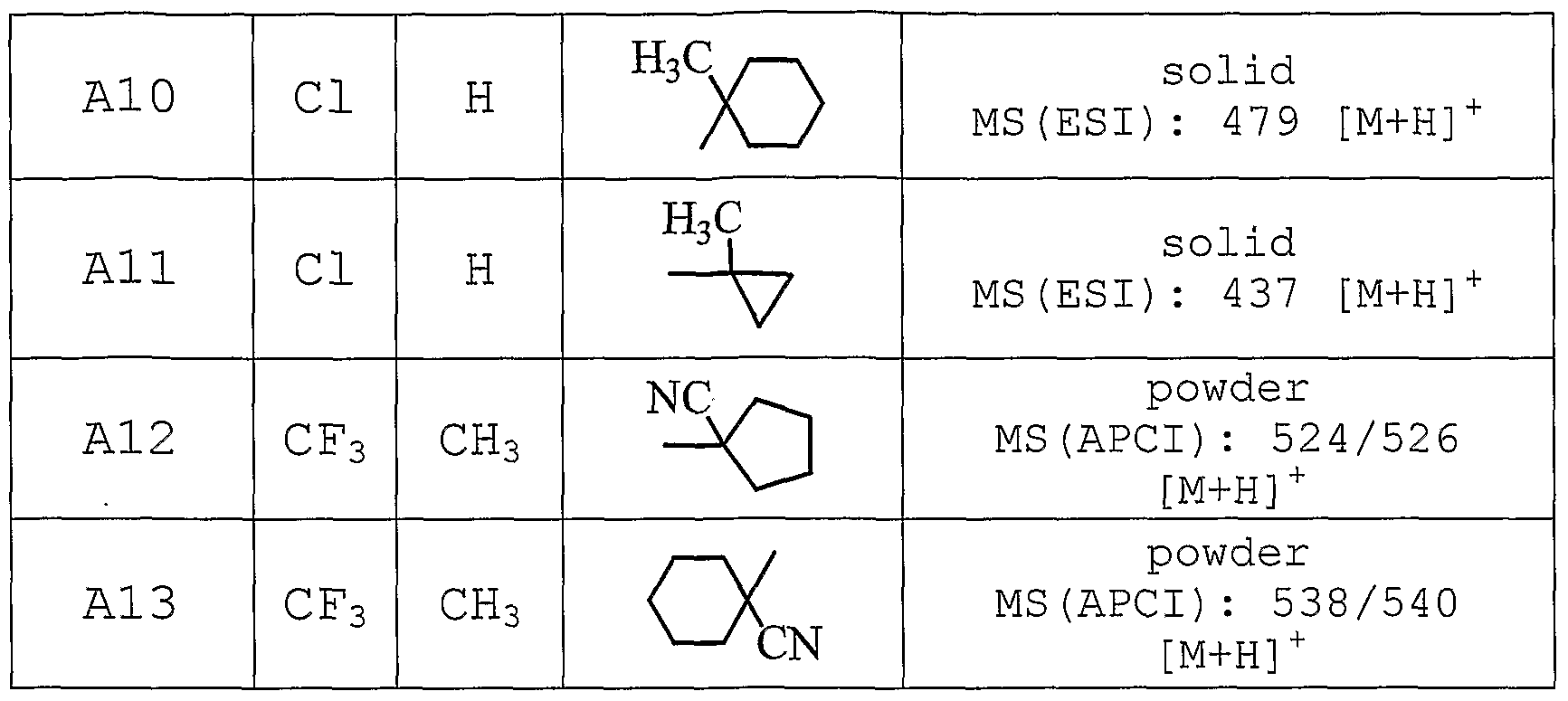
Table 1 (No . 2 \

Examples A16 to A18
The corresponding starting materials were treated in the same manner as described in Example A5 to give compounds as shown in the following Table 2.
Table 2


Examples Al9 to A30
The corresponding starting materials were treated in the same manner as described in Example A4 to give compounds as shown in the following Table 3.
Table 3 (No. 1)
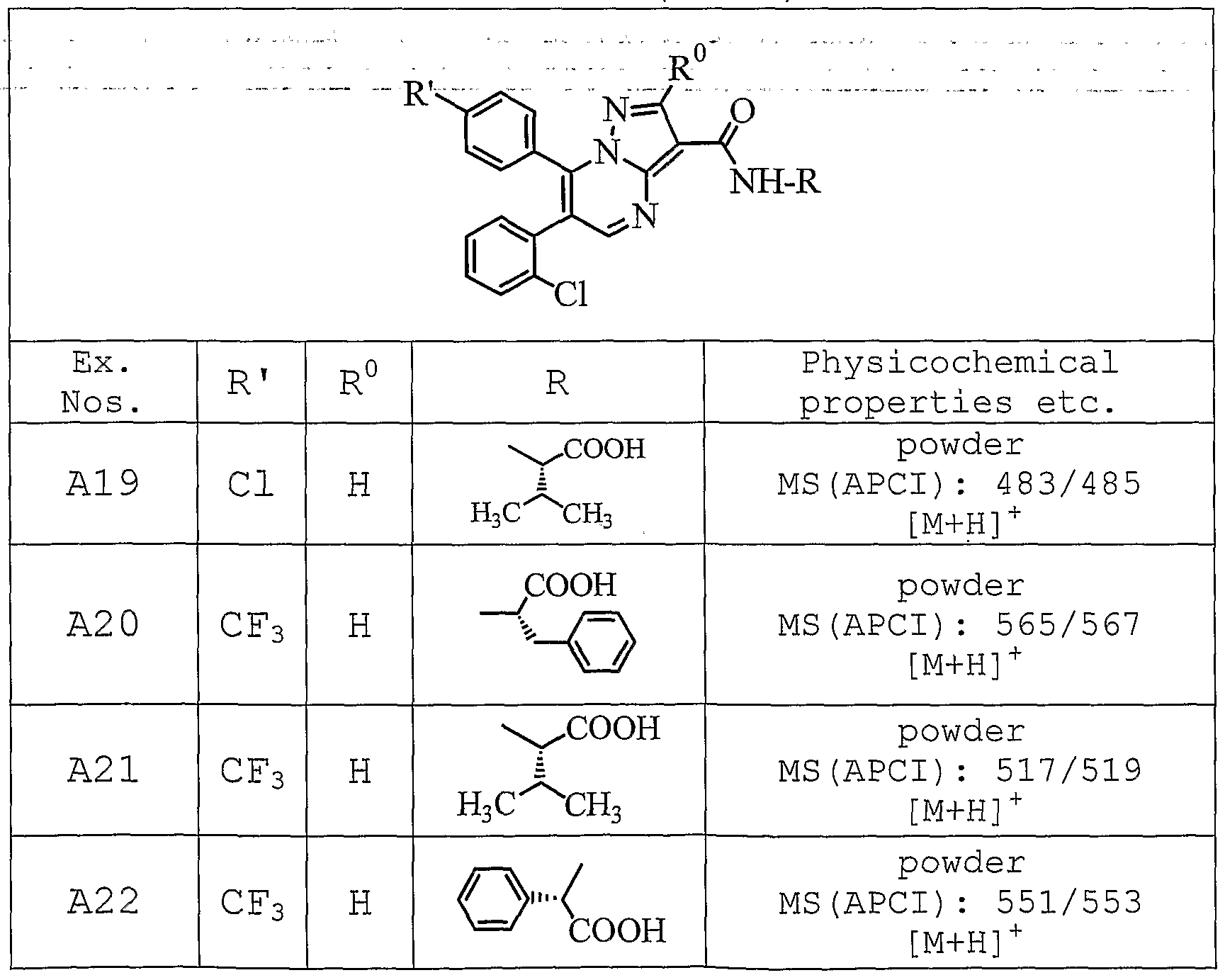


Examples A31 to A32
The corresponding starting materials were treated in the same manner as described in Example Al to give compounds as shown in the following Table 4.
Table 4

Examples A34
(1) The corresponding starting materials were treated in the same manner as described in Reference Example A6 to give 2-amino-6- (2-chlorophenyl) -7- (4-chloro-phenyl) -3- ethoxycarbonylpyrazolo [1, 5-a]-pyrimidine as . a. yellow powder.- ■MS-(APCI)m/z;—427/-429---[-M+H] + -
(2) To a solution of the compound obtained in the above step (1) (2.64 g) in tetrahydrofuran (50 mL) were added triethylamine (5.17 mL) and methanesulfonyl chloride (2.83 g) at O0C, and the mixture was stirred for 5 minutes at the same temperature and at room temperature for 1 hour. The reaction mixture was diluted with ethyl acetate, and thereto was added water at 0°C. After stirring, the organic layer was separated, and the aqueous layer was extracted with ethyl acetate. The combined organic layer was dried over magnesium sulfate and filtered. The filtrate was concentrated in vacuo, and the resultant crude product was purified by column chromatography on NH-silica gel (Chromatorex NH silica gel, solvent; chloroform) to give 6- (2-chlorophenyl) -7- (4-chlorophenyl) -3- ethoxycarbonyl-2- [bis (methylsulfonyl) -amino] pyrazolo [1,5- a]pyrimidine (2.91 g, yield: 81%) as a pale yellow solid. MS(APCI)m/z; 583/585 [M+H]+
(3) To a solution of the compound obtained in the above step (2) (2.91 g) in tetrahydrofuran (60 mL) were added tetrabutylammonium fluoride trihydrate (3.15 g) , and the mixture was stirred at room temperature for 30 minutes. To the reaction mixture was added water, and the mixture was stirred. The organic layer was separated, and the aqueous layer was extracted with chloroform. The combined organic layer was concentrated in vacuo, and the resultant crude product was purified by column chromatography on silica gel (solvent; hexane/ethyl acetate = 70/30 to 50/50) to give 6- (2-chlorophenyl) -7- (4-chlorophenyl) -3- ethoxycarbonyl-2- (methylsulfonyl-amino) pyrazolo [1,5- a]pyrimidine (2.20 g, yield: 87%)- as a pale yellow solid. MS (APCI) m/z; 505/507 [M+H] + (4) To a solution of the compound obtained in the above step (3) (0.8 g) in ethanol/tetrahydrofuran (10 mL/20 mL) was added an aqueous 2 N sodium hydroxide solution (4.8 mL)., and the mixture was stirred at .400C overnight.. The precipitates were collected by filtration to give 3- carboxy-6- (2-chlorophenyl) -7- (4-chlorophenyl) -2-
(methylsulfonylamino) pyrazolo [1, 5-a] pyrimidine (0.86 g) as a crude product . MS(APCI)m/z; 477/479 [M+H]+
(5) The compound obtained in the above step (4) (70 mg) and 1- (2-pyridyl) -ethylamine (23 mg) were treated in the same manner as described in Example Al to give 6- (2- chlorophenyl) -7- (4-chlorophenyl) -2- (methylsulfonylamino) -3- [N- [1- (2-pyridyl) ethyl] carbamoyl] pyrazolo [1, 5-a] pyrimidine (27 mg, yield: 32%) as a colorless powder. MS (APCI)m/z; 581/583 [M+H]+ Example A35
(1) A mixture of the compound obtained in Example A34- (3) (1.0 g) , sodium ethoxide (1.35 g) and ethanol (40 mL) was stirred at 80 °C for 10 minutes. Thereto was added dropwise methyl iodide (2.5 mL) , and the mixture was stirred for 3 days. The reaction mixture was concentrated
in vacuo, and to the residue were added water and ethyl acetate. The organic layer was separated, and the aqueous layer was extracted with ethyl acetate. The combined organic layer was dried over magnesium sulfate and filtered. The filtrate was concentrated in vacuo, and the resultant crude product was purified by column chromatography on NH- silica gel (Chromatorex NH silica gel, solvent; hexane/ethyl acetate = 75/25 to 40/60) to give 6- (2- chlorophenyl) -7- (4-chlorophenyl) -3-ethoxycarbonyl-2- [N- methyl-N- (methylsulfonyl) amino] pyrazolo [1, 5-a] pyrimidine (1.06 g, yield: 100%) as a colorless powder. MS (APCI )m/z; 519/521 [M+H] +
(2) To a- solution of the compound obtained in the ■ above step (1) (1.06 g) in ethanol/tetrahydrofuran (15 mL/15 mL) was added an aqueous 2 N sodium hydroxide solution (4.1 mL) , and the mixture was stirred at 4O0C overnight. The reaction mixture was acidified with an aqueous 2 N hydrochloric acid, concentrated in vacuo and. extracted with chloroform. The organic layer was dried over magnesium sulfate and filtered. The filtrate was concentrated in vacuo, and the residue was triturated with diethylether to give 3-carboxy-6- (2-chlorophenyl) -7- (4- chlorophenyl) -2- [N-methyl-N- (methylsulfonyl) amino] - pyrazolo [1, 5-a] pyrimidine (0.75 g, yield: 75%) as a pale yellow powder.
MS(APCI)m/z; 491/493 [M+H]+
(3) The compound obtained in the above step (2) (60 mg) and 1- (2-pyridyl) -ethylamine (19 mg) were treated in the same manner as described in Example Al to give 6- (2- chlorophenyl) -7- (4-chlorophenyl) -2- [N-methyl-N-
(methylsulfonyl) amino] -3- [N- [1- (2-pyridyl) ethyl] carbamoyl] - pyrazolo [1, 5-a] pyrimidine (57 mg, yield: 79%) as a colorless powder. MS(APCI)m/z; 595/597 [M+H]+ Examples A36 to A38
The corresponding starting materials were treated in
the same manner as described in Example Al to give compounds as shown in the following Table 5.
Table 5

Example A39
To a solution of the compound obtained in Reference Example A9 (159 mg) and pyridine (83 μL) in chloroform (5 mL) was added dropwise a solution of the compound obtained in Reference Example A17 (200 mg) in chloroform (2 mL) under ice-cooling, and the mixture was stirred at room temperature for 17 hours. To the reaction mixture was added water, and the mixture was extracted with chloroform. The organic layer was concentrated in vacuo and the resultant crude product was purified by column chromatography on silica gel (solvent; hexane/ethyl acetate 80/20 to 65/35) to give 6- (2-chlorophenyl) -7- (4- trifluoromethylphenyl) -3- [N- (l-methoxy-carbonylcyclohexyl) - sulfamoyl] -2-methylpyrazolo [1, 5-a] pyrimidine (205 mg, yield: 82%) as a powder. MS(APCI)m/z; 607/609 [M+H]+ Example A40
To a solution of the compound obtained in Example A39
(190 mg) in methanol (2 mL) was added an aqueous 2 N sodium hydroxide solution (0.39 mL) , and the mixture was stirred at 700C for 15 hours. After cooling to room temperature, to the reaction mixture was added an aqueous 2 N hydrochloric acid (400 μL) , and the mixture was diluted with water. The precipitates were collected by filtration to give 3- [N- (1-carboxycyclohexyl) sulfamoyl] -6- (2- chlorophenyl) -7- (4-trifluoromethylphenyl) -2- methylpyrazolo [1, 5-a]pyrimidine (150 mg, yield: 81%) as a powder.
MS(APCI)m/z; 593/595 [M+H]+ Example A41
(1) The compound, -obtained in Reference Example AlO (200 mg) and the compound obtained in Reference Example B15 (63 mg) were treated in the same manner as described in Example Al to give 6- (2-chlorophenyl) -7- (4-trifluoromethylphenyl) -3- [N- (4-methyl-tetrahydrothiopyran-4-yl) carbamoyl] - pyrazolo [1, 5-a]pyrimidine~ '(153 mg, yield: 48%*)' as. a powder . ". " MS (APCI) m/z7""531/533""tM+H]'+ (2) To a solution of the compound obtained in the above step (1) (95 mg) in methylene chloride (5 mL) was added m-chloroperbenzoic acid (75%, 123 mg) under ice- cooling and the mixture was stirred at room temperature for 21 hours. To the reaction mixture was added an aqueous saturated sodium hydrogencarbonate solution and the mixture was extracted with chloroform. The organic layer was concentrated in vacuo and the resultant crude product was purified by column chromatography on silica gel (solvent; hexane/ethyl acetate = 80/20 to 60/40) to give 6-(2- chlorophenyl) -7- (4-trifluoromethylphenyl) -3- [N- (4-methyl- 1, l-dioxotetrahydrothiopyran-4-yl) carbamoyl] -pyrazolo [1, 5- a]pyrimidine (68 mg, yield: 68%) as a powder. MS (APCI) m/z; 563/565 [M+H] + Examples A42 to A49 The corresponding starting materials were treated in the same manner as described in Example A41 to give
compounds as shown in the following Table 6.
Table 6

Examples A50 to A64
The corresponding starting materials were treated in the same manner as described in Example Al to give compounds as shown in the following Table 7.
Table 7 (No. 1)


Examples A65
(1) To a solution of 1- (tert-butoxycarbonylamino) - cyclopentanecarboxylic acid (2.29 g) in methanol (10 mL) was added dropwise 2M trimethylsilyldiazomethane solution in hexane (11.9 mL) under ice-cooling. The reaction mixture was concentrated, and to the residue was added hexane. The precipitated crystals were collected by filtration, and the filtrate was purified by column chromatography on silica gel (solvent; hexane/ethyl acetate
= 9/1 to 7/3) . The product and the crystals obtained above were combined to give methyl 1- (tert-butoxycarbonylamino) - cyclopentane-carboxylate (2.49 g). MS(ESI)m/z; 244 [M+H]+ (2) To a solution of the compound obtained in the above step (1) (2.49 g) in tetrahydrofuran (12 mL) was added dropwise 3M methyl magnesium bromide solution in diethylether (13.3 mL) under ice-cooling and under nitrogen atmosphere. The mixture was stirred at room temperature overnight. To the reaction mixture was added water, and the mixture was extracted with ethyl acetate. The organic layer was dried over magnesium sulfate and purified by column chromatography on silica gel (solvent; hexane/ethyl acetate = 8/1) to give a mixture of tert-butyl [1-(1- hydroxy-1-methyl-ethyl) cyclopentyl] carbamate and methyl 1- (tert-butoxycarbonylamino) cyclopentane-carboxylate (0.57 g) as a powder.
(3) To a solution, of the compound obtained in the. above step (2) (0.56 g) in chloroform (5 mL) was added trifluoroacetic acid (2 mL) , and the mixture was stirred at room temperature for 10 minutes. The reaction mixture was concentrated in vacuo and, the residue was dissolved in methanol (1.0 mL) . Thereto was added concentrated hydrochloric acid (0.6 mL) , and the mixture was stirred for 1 minute. The reaction mixture was concentrated in vacuo, and the residue was dissolved in ethanol . The solution was concentrated, and to the residue • was added ethanol/diethylether. The mixture was stirred overnight and the precipitated crystals were collected by filtration, washed with diethylether and dried to give a mixture of 1- (1-hydroxy-l-methylethyl) -cyclopentylamine hydrochloride and methyl 1-aminocyclopentanecarboxylate hydrochloride (376 mg) as a powder.
(4) The compound obtained in the above step (3) (56 mg) and 3-carboxy-6- (2-chlorophenyl) -7- (4-chlorophenyl) - pyrazolo [1, 5-a] pyrimidine (100 mg) were treated in the same
manner as described in Example A4-(l) and the reaction product was dissolved in ethanol (2 mL) . Thereto was added an aqueous 2 N sodium hydroxide solution (0.2 mL) and the mixture was stirred at 6O0C for 2.5 hours. After cooling to room temperature, the reaction mixture was neutralized with an aqueous 2 N hydrochloric acid and extracted with dichloromethane . The organic layer was concentrated in vacuo and the resultant crude product was purified by column chromatography on silica gel (solvent; hexane/ethyl acetate = 70/30 to 50/50 → chloroform/methanol = 90/10) to give 6- (2-chlorophenyl) -7- (4-chlorophenyl) -3- [N- [1- (1- hydroxy-1-methylethyl) cyclopentyl] carbamoyl] pyrazolo [1,5- a]pyrimidine (65 mg, yield: 49%; compound a)-- as a powde-r and 3- [N- (1-carboxycyclopentyl) -carbamoyl] -6- (2- chlorophenyl) -7- (4-chlorophenyl) pyrazolo [1, 5-a] pyrimidine (24 mg, yield: 19%, compound b) as a powder. Compound a: MS(APCI)m/z; 509/511 [M+H]+ Compound b: MS(APCI)m/z; 495/497 ' [M+H] + ' Examples A66 to A72 The corresponding starting materials were treated in the same manner as described in Example A4-(l) to give compounds as shown in the following Table 8.
Table 8

Examples A73 to A74
The corresponding starting materials were treated in the_ same manner as described in Example A41-(2) to give compounds as shown in the following Table 9.
Table 9

Examples A75 to A78 The corresponding starting materials were treated in
the same manner as described in Example A4-(2) to give compounds as shown in the following Table 10.
Table 10

Examples A79 to AlO 6
The corresponding starting materials were treated in the same manner as described in Example A4-(l) to (2) to give compounds as shown in the following Table 11.


Example A107
(1) To a solution of the compound obtained in Example A64 (805 mg) in dioxane (10 iriL) was added a solution of 4N hydrochloric acid in dioxane (10 iriL) and the mixture was
stirred at room temperature for 4 hours. The reaction mixture was diluted with diisopropylether and the precipitates were collected by filtration to give 4- carbamoyl-4- [6- (2-chlorophenyl) -7- (4- trifluoromethylphenyl) pyrazolo [1, 5-a] pyrimidine-3- carboxamido] piperidine hydrochloride (784 mg, yield: 100%) as a powder.
MS(APCI)m/z; 543/545 [M+H]+
(2) To a solution of the compound obtained in the above step (1) (50 mg) in dimethylformamide (1 mL) were added potassium carbonate (30 mg) and isopropyl iodide (13 μL) and the mixture was stirred at 40 °C for 20 hours. ■After cooling to room temperature, to the • reaction mixture was added water and the mixture was extracted with ethyl acetate. The organic layer was concentrated in vacuo and the resultant crude product was purified by column chromatography on silica gel (solvent; chloroform/methanol = 99/1' to.87/13) to give 4-carbamoyl-4- ['6-'(2-chlorophenyl) -" 7- (4-trifluoromethylphenyl) pyrazolo [1, 5-a] pyrimidine-3- carboxamido] -1-isopropylpiperidine (27 mg, yield: 55%) as a powder.
MS(APCI)m/z; 585/587 [M+H] + Example Al08
To a solution of the compound obtained in Example A107-(l) (45 mg) in methylene chloride (2 mL) were added triethylamine (32.5 μL) and methanesulfonyl chloride (7.8 μL) and the mixture was stirred at room temperature for 15 hours . To the reaction mixture was added water and the mixture was extracted with chloroform. The organic layer was concentrated in vacuo and the resultant crude product was purified by column chromatography on silica gel (solvent; hexane/ethyl acetate = 30/70 to 0/100) to give 4- carbamoyl-4- [6- (2-chlorophenyl) -7- (4- trifluoromethylphenyl ) pyrazolo [ 1 , 5-a] pyrimidine-3- carboxamido] -1-methylsulfonylpiperidine (36 mg, yield: 75%) as a powder.
MS (APCI)m/z; 621/623 [M+H]+ Examples A109 to A121
The corresponding starting materials were treated in the same manner as described in Example A5 to give compounds as shown in the following Table 12.


Examples A122 to A123
The corresponding starting materials were treated in the same manner as described in Example A108 to give compounds as shown in the following Table 13.
Table 13

Ex . R Physicochemical Nos . properties etc .

Examples A124 to A138
The corresponding starting materials were treated in the same manner as described in Example A5 to give compounds as shown in the following Table 14.
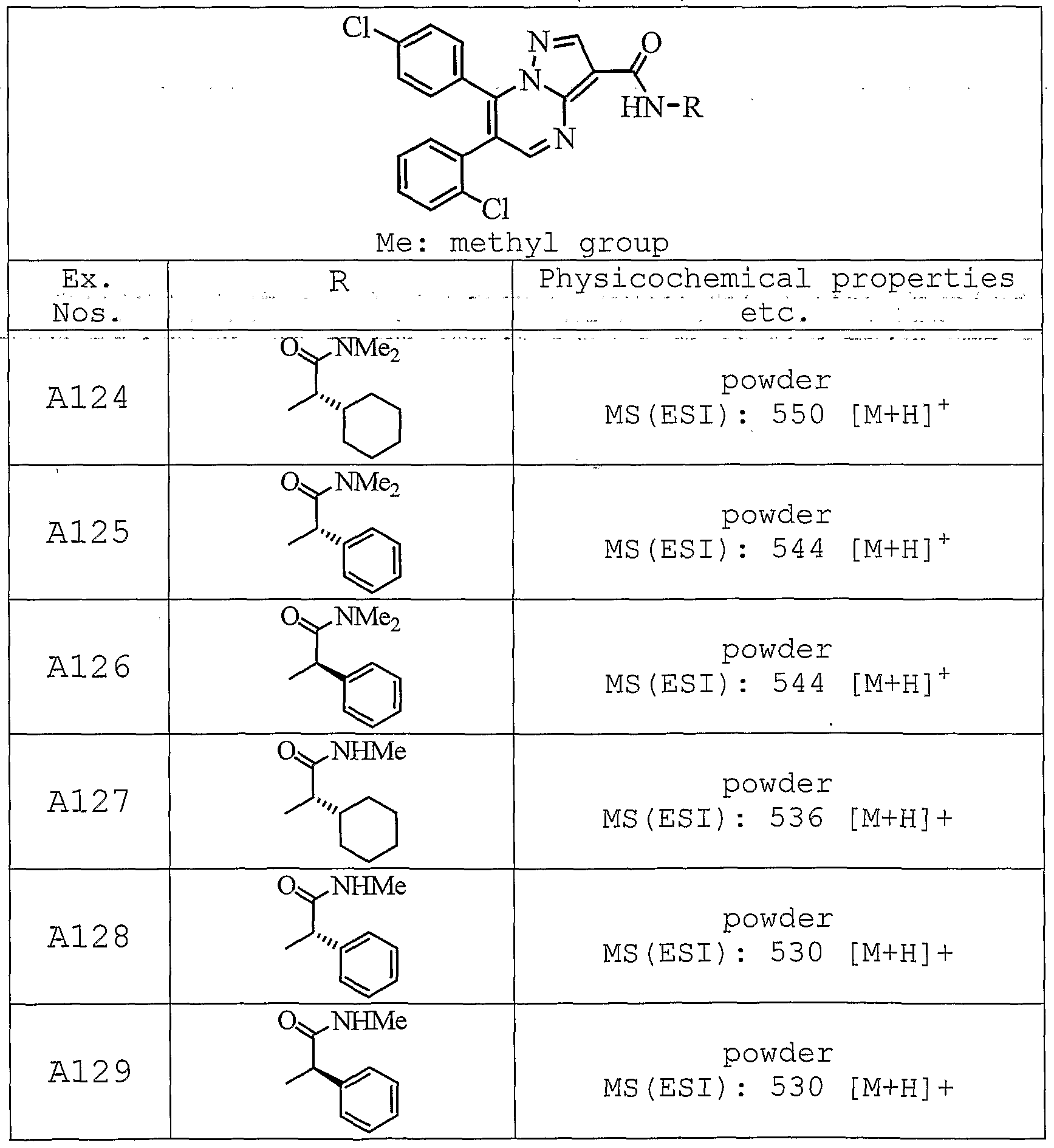


Examples A139 to A142
The corresponding starting materials were treated in
the same manner as described in Example Al to give compounds as shown in the following Table 15.

Examples A143
The compound obtained in Example A142 (175 mg) was treated in the same manner as described in Example A4-(2) to give 3- [N- (1-carboxycyclohexyl) carbamoyl] -6- (2- chlorophenyl) -7- (4-chlorophenyl) -2- (2-hydroxyethoxy) - pyrazolo [1, 5-a] pyrimidine (131 mg, yield: 77%) as a powder. MS (APCI)m/z; 569/571 [M+H] + Example Al44
The compound obtained in Reference Example A18 (6-(2- bromophenyl) -3-carboxy-7~ (4-chlorophenyl) pyrazolo [1,5- a] pyrimidine; 500 mg) and the compound obtained in
Reference Example A9 (293 mg) were treated in the same manner as described in Example Al and then the reaction
product was treated in the same manner as described in Example A4-(2) to give 6- (2-bromophenyl) -3- [N- (1-carboxy- cyclohexyl) carbamoyl] -7- (4-chlorophenyl) pyrazolo [1,5- a]pyrimidine (648 mg) as a powder. MS(APCI)m/z; 553/555 [M+H]+ Example Al45
(1) The compound obtained in Example Al44 (100 mg) and ammonium chloride (19 mg) were treated in the same manner as described in Example A5 to give 6- (2-bromophenyl) -3- [N- ( 1-carbamoylcyclohexyl) carbamoyl] -7- (4-chlorophenyl) - pyrazolo [1, 5-a] pyrimidine (84 mg) as a powder. MS(APCI)m/z; 552/554 [M+H]+
- (2) - A solution of the compound obtained • in the above step . (1) (83 mg) , zinc cyanide (20 mg) and tetrakis (triphenylphosphine) palladium (17 mg) in dimethylformamide (1 mL) was stirred under nitrogen atmosphere at HO0C for 13 hours. After cooling to room temperature, to the reaction mixture . was added water, and the mixture was extracted with ethyl acetate. The organic layer was concentrated in vacuo, and the resultant crude product was purified by column chromatography on silica gel
(solvent; hexane/ethyl acetate = 67/33 to 10/90) to give 3-
[N- (1-carbamoylcyclohexyl) carbamoyl] -7- (4-chlorophenyl) -6-
(2-cyanophenyl) pyrazolo [1, 5-a] pyrimidine (22 mg, yield: 30%) as a powder.
MS(APCI)m/z; 499/501 [M+H]+ Examples A146 to A147
The corresponding starting materials were treated in the same manner as described in Example Al and then the reaction product was treated in the same manner as described in Example A145 to give compounds as shown in the following Table 16.
Table 16

Examples A148 to A149
The corresponding starting materials were treated in the same manner as described in Example A6 to give compounds as shown in the following Table 17.
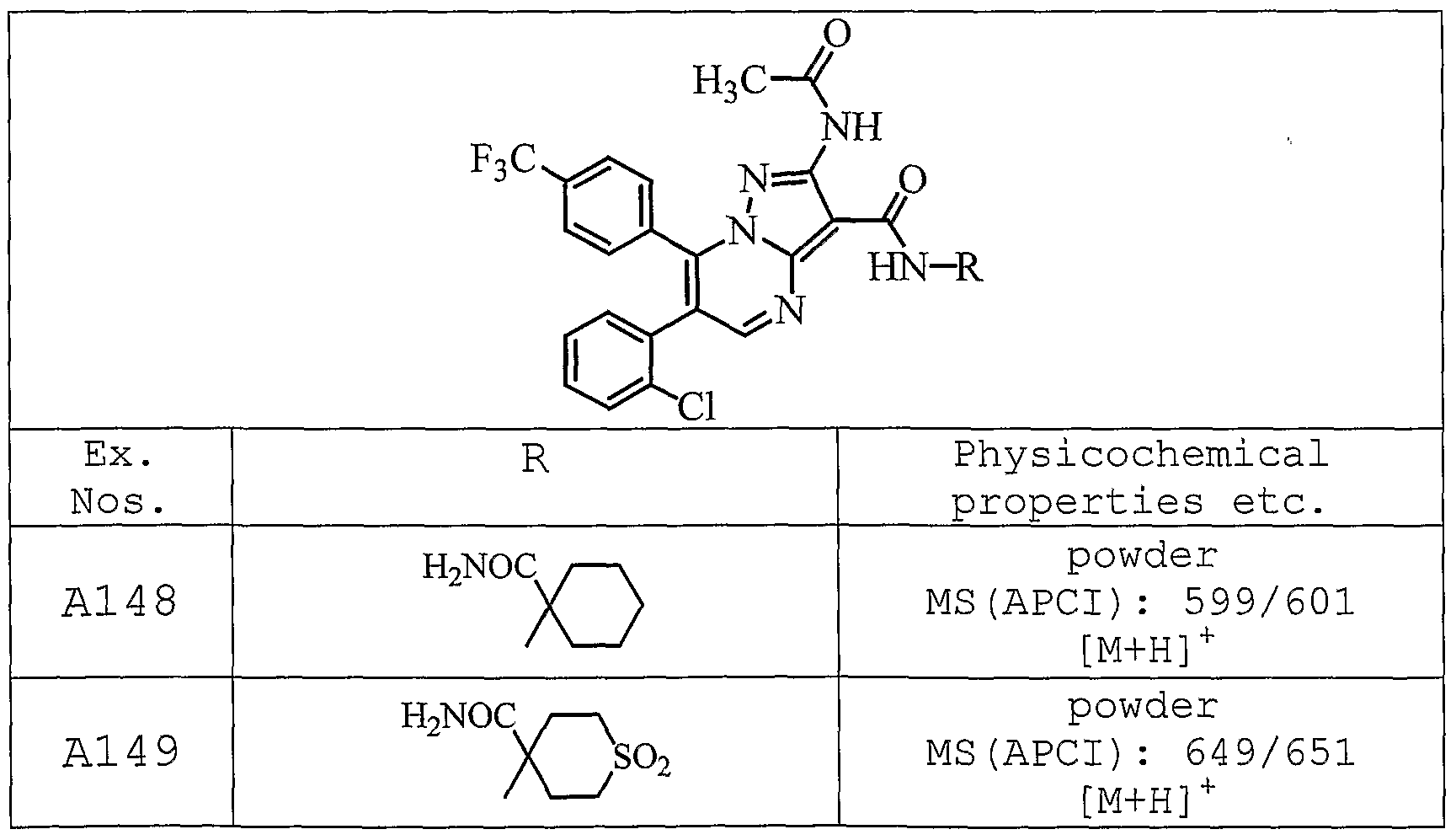
Examples A150
To a solution of the compound obtained in Example Al (106 mg) in toluene (4 mL) and dimethylformamide (1.5 mL)
were added sodium azide (86 mg) and triethylamine hydrochloride (183 mg) , and the mixture was stirred at 120 °C for 24 hours. To the reaction mixture were further added sodium azide (90 mg) and triethylamine hydrochloride (183 mg) , and the mixture was stirred for 21 hours. After cooling to room temperature, the reaction mixture was filtered through Celite to remove precipitates, and the filtrate was concentrated in vacuo. The resultant crude product was purified successively by column chromatography on silica gel (solvent; chloroform/methanol = 100/0 to 95/5) and gel-permeation chromatography (solvent; chloroform) to give 6- (2-chlorophenyl) -7- (4-chlorophenyl) - 3- [N-[I- (1,2,3, 4-tetrazol-5-yl) cyclohexyl] carbamoyl] - pyrazolo [1, 5-a] pyrimidine (95 mg, yield: 83%) as a powder. MS(APCI)m/z; 533/535 [M+H]+ Example Al51
To a solution of the compound obtained in Example A70 (195 mg) in methylene chloride (3 mL) was. added m- chloroperbenzoic acid (75%, 180 mg) , and the mixture was stirred at room temperature for 1 hour. To the reaction mixture were added an aqueous sodium thiosulfate solution and methylene chloride. The organic layer was separated and concentrated in vacuo. The resultant crude product was purified by column chromatography on NH-silica gel (Chromatorex NH silica gel, solvent; hexane/ethyl acetate = 50/50 to 30/70) to give 6- (2-chlorophenyl) -7- (4- trifluoromethylphenyl) -3- [N- (4-hydroxymethyl-l, 1- dioxotetrahydrothiopyran-4-yl) -carbamoyl] pyrazolo [1,5- a]pyrimidine (169 mg, yield: 82%) as a pale yellow powder. MS (APCI)m/z; 579/581 [M+H]+ Example Al52
To a solution of the compound obtained in Example A62 (50 mg) in tetrahydrofuran-methanol (1 mL/1 mL) was added Raney nickel, and the mixture was stirred under hydrogen atmosphere at 50 °C for 1.5 hour and at room temperature for 3 days. The reaction mixture was filtered, and the
filtrate was concentrated in vacuo. The resultant crude product was purified by column chromatography on NH-silica gel (Chromatorex NH silica gel, solvent; chloroform) to give 3- [N- [1- (aminomethyl) -cyclohexyl] carbamoyl] -6- (2- chlorophenyl) -7- (4-chlorophenyl) -2-methylpyrazolo [1,5- a]pyrimidine (35 mg, yield: 69%) as a pale yellow powder. MS(APCI)m/z; 508/510 [M+H]+ Example Al53
To a solution of the compound obtained in Example A71 (35 mg) in methylene chloride (0.6 mL) was added trifluoroacetic acid (69 μL) , and the mixture was stirred at room temperature overnight. To the reaction mixture was added an aqueous saturated sodium hydrogencarbonate solution, and the mixture was stirred for 5 minutes. The mixture was extracted with methylene chloride, and the organic layer was concentrated in vacuo. The resultant crude product was purified by column chromatography on NH- silica gel (Chromatorex NH . silica gel,. . solvent; hexane/ethyl acetate = 60/40 to 30/70) to give 3-[N-[(ϊ- aminocyclopentyl) methyl] carbamoyl] -6- (2-chlorophenyl) -7- (4- chlorophenyl) -2-methylpyrazolo [1, 5-a] pyrimidine (14 mg, yield: 48%) as a powder. MS(APCI)m/z; 494/496 [M+H]+ Example Al54 To a solution of the compound obtained in Example A152
(51 mg) and triethylamine (28 μL) in methylene chloride (4 mL) was added dropwise acetyl chloride (9 μL) at room temperature, and the mixture was stirred for 1 hour. To the reaction mixture were added water and methylene chloride, and the organic layer was separated and concentrated in vacuo. The resultant crude product was purified by column chromatography on silica gel (solvent; chloroform/methanol = 100/0 to 95/5) to give 3- [N-[I-
(acetylaminomethyl) cyclohexyl] carbamoyl] -6- (2- chlorophenyl) -7- (4-chlorophenyl) -2-methylpyrazolo [1, 5- a]pyrimidine (36.5 mg, yield: 66%) as a powder.
MS (APCI )m/z; 550/552 [M+H] +
Example Al55
The compound obtained in Example A152 (51 mg) and dimethylcarbamoyl chloride (11 μL) were treated in the same manner as described in Example A154 to give 6- (2- chlorophenyl) -7- (4-chlorophenyl) -2-methyl-3- [N- [1- [ (3, 3- dimethylureido) methyl] cyclohexyl] carbamoyl] pyrazolo [1,5- a]pyrimidine (25.3 mg, yield: 44%) as a powder.
MS (APCI )m/z; 579/581 [M+H] + Example Al56
The compound obtained in Example A152 (51 mg) and methanesulfonyl chloride (9 μL) were treated in the same manner as described in Example A154 to give 6- (2- chlorophenyl) -7- (4-chlorophenyl) -3- [N- [1- (mesylaminomethyl) cyclohexyl] carbamoyl] -2- methylpyrazolo [1, 5-a] pyrimidine (39.2 mg, yield: 67%) as a powder.
MS (APCI) m/z; 586/588, [M+H] +
Example A157 The compound obtained in Example A152 (51 mg) and dimethylsulfamoyl chloride (13 μL) were treated in the same manner as described in Example A154 to give 6- (2- chlorophenyl) -7- (4-chlorophenyl) -2-methyl-3- [N- [1- [ [ (dimethylsulfamoyl) amino]methyl] cyclohexyl] carbamoyl] pyra zolo [1, 5-a] pyrimidine (12.3 mg, yield: 20%) as a powder.
MS(APCI)m/z; 615/617 [M+H]+
Examples A158 to A159
The corresponding starting materials were treated in the same manner as described in Example Al to give compounds as shown in the following Table 18.
Table 18

Examples A160 to A161
The corresponding starting materials were treated in the same manner as described in Example Al to give compounds as. shown in the. following .Table 19._ "... .. . ... Table..19. '. "..." .. - .' _

Examples A162 to A163
The compound obtained in Example Al43 and the corresponding amine compound were treated in the same manner as described in Example A5 to give compounds as
shown in the following Table 20.
Table 20

Examples Al64 to A174
. -The "COTrTpoOTid" " obtained, " "in Example - A75- - and~ the" corresponding amine compound were treated in the same manner as described in Example A5 to give compounds as shown in the following Table 21.
Table 21


Examples A175 to A184
The corresponding starting materials were treated in the same manner as described in Example Al, the reaction product was treated in the same manner as described in Example A4-(2) and then the reaction product treated in the same manner as described in Example A5 to give compounds as shown in the following Table 22.
Table 22


Examples Bl
To a solution of the compound obtained in Reference Example B3 (70 mg) in tetrahydrofuran (2 mL) was added a solution of 2M methylamine in tetrahydrofuran (0.14 mL) , and the mixture was stirred at room temperature for 10 minutes. The reaction mixture was concentrated in vacuo, and to the residue was added an aqueous saturated sodium hydrogencarbonate solution. The mixture was extracted with chloroform, and the organic layer was concentrated in vacuo. The resultant crude product was purified by column chromatography on NH-silica gel (Chromatorex NH silica gel, solvent; hexane/ethyl acetate = 80/20 to 30/70) to give 6- (2-chlorophenyl) -7- (4-chlorophenyl) -3-ethoxycarbonyl-2~ (N- methylsulfamoyl)pyrazolo [1, 5-a] pyrimidine (75 mg, yield:
100%) as a colorless powder. MS (APCI )m/z; 505/507 [NH-H] + Example B2
(1) To a solution of the compound obtained in Example Bl (524 mg) in ethanol/tetrahydrofuran (7 mL/7 iriL) was added an aqueous 2N sodium hydroxide solution (1.04 itiL) , and the mixture was stirred at room temperature for 2 hours . The reaction mixture was weakly acidified with an aqueous 2N hydrochloric acid. The mixture was concentrated in vacuo and extracted with chloroform. The organic layer was dried over magnesium sulfate and filtered. The filtrate was concentrated in vacuo to give 3-carboxy-6- (2- chlorophenyl) -7- (4-chlorophenyl) -2- (N-methylsulfamoyl) - - pyrazolo [1, 5-a] pyrimidine (543 mg) as a crude product. (2) The compound obtained in the above step (1) was treated ' in the same manner as described in Example Al to give 6- (2-chlorophenyl) -7- (4-chlorophenyl) -2- (N- methylsuϊfamoyl) -3- [N- (1-pyrroϊidinyl).carbamoyl] - pyrazolo [1, 5-a] pyrimidine (29 mg) as a pale yellow powder. MS(APCI)m/z; 545/547 [M+H]+ Example B3
The compound obtained in Reference Example B3 (600 mg) in tetrahydrofuran (12 mL) was added a solution of 2M dimethylamine in tetrahydrofuran (1.17 mL) , and the mixture was stirred at room temperature for 30 minutes. The reaction mixture was concentrated in vacuo, and to the residue was added an aqueous saturated sodium hydrogencarbonate solution. The mixture was extracted with chloroform, and the organic layer was concentrated in vacuo. The resultant crude product was purified by column chromatography on NH-silica gel (Chromatorex NH silica gel, solvent; hexane/ethyl acetate = 80/20 to 0/100) to give 6- (2-chlorophenyl) -7- (4-chlorophenyl) -3-ethoxycarbonyl-2- (N, N-dimethylsulfamoyl) pyrazolo [1, 5-a] pyrimidine (566 mg, yield: 93%) as a colorless powder. MS(APCI)m/z; 519/521 [M+H]+
Example B 4
To a solution of the compound obtained in Reference Example B3 (300 mg) in tetrahydrofuran (10 πiL) was added a solution of 0.5M ammonia in 1,4-dioxane (7 inL) , and the mixture was stirred at room temperature overnight. The reaction mixture was concentrated in vacuo, and to the residue was added tetrahydrofuran and the mixture was filtered to remove precipitates. The filtrate was concentrated in vacuo, and the resultant crude product was purified by column chromatography on silica gel (solvent; hexane/ethyl acetate = 80/20 to 50/50) to give 6-(2- chlorophenyl) -7- (4-chlorophenyl) -3-ethoxycarbonyl-2- sulfamoylpyrazolo [1, 5-a] pyrimidine (242 mg, yield: 84%) as a colorless powder. MS(APCI)m/z; 491/493 [M+H]+ Example B5
To a solution of the compound obtained in Reference Example B7 (40 mg) in chloroform (2 mL) was added ethyl., isocyanate (1 mL) , and the mixture was refluxed under heating overnight. After cooling to room temperature, to the reaction mixture were added an aqueous sodium hydrogencarbonate solution and chloroform. After stirring, the organic layer was separated and concentrated in vacuo. The resultant crude product was purified by column chromatography on silica gel (solvent; hexane/ethyl acetate
80/20 to 60/40) to give 6- (2-chlorophenyl) -7- (4- chlorophenyl) -3- (N-cyclopentylcarbamoyl) -2- (3-ethylureido) - pyrazolo [1, 5-a] pyrimidine (33.3 mg, yield: 72%) as a pale yellow solid. MS(APCI)m/z; 537/539 [M+H]+ Examples B6 to B24
The corresponding starting materials were treated in the same manner as described in Example B2-(2) to give compounds as shown in the following Table 23. Tables 23 (No. 1)

Table 23 (No. 2)

Examples B25 to B28
The corresponding starting materials were treated in the same manner as described in Example B2 to give compounds as shown in the following Table 24.
Table 24

Example B29
(1) The corresponding starting materials were treated in the same manner as described in Example B2-(2) to give 6- (2-chlorophenyl) -7- (4-chlorophenyl) -3- [N- (1- methoxycarbonylcyclohexyl) carbamoyl] -2- (N-methylsulfamoyl) - pyrazolo [1, 5-a] pyrimidine (185 mg) as a pale yellow powder. MS(APCI)m/z; 616/618 [M+H]+
(2) The compound obtained in the above step (1) (182 mg) was treated in the same manner as described in Example
A4-(2) to give 3- [N- (1-carboxycyclohexyl) -carbamoyl] -6- (2- chlorophenyl) -7- (4-chlorophenyl) -2- (N-methylsulfamoyl) - pyrazolo [1, 5-a] pyrimidine (5.6 mg) as a powder. MS(APCI)m/z; 602/604 [M+H]+ Example B30
The compound obtained in Reference Example B5 (35 mg) and the compound obtained in Reference Example BlO (17.5 mg) were treated in the same manner as described in Example Al to give 3- [N- (1-carbamoylcyclohexyl) carbamoyl] -6- (2-
chlorophenyl) -7- (4-chlorophenyl) -2-sulfamoylpyrazolo[l, 5- ajpyrimidine (3.6 mg, yield: 8%) as a colorless powder. MS (APCI )m/z; 587/589 [M+H]+ Example B31 (1) The compound obtained in Example A6-(l) (200 mg) and the compound obtained in Reference Example BIl (137 mg) were treated in the same manner as described in Example Al to give 2-amino-3- [N- (4-carbamoyl-l, 1-dioxo-tetrahydro- thiopyran-4-yl) carbamoyl] -6- (2-chlorophenyl) -7- (4- trifluoromethylphenyl)pyrazolo[l, 5-a]pyrimidine (82 mg, yield: 29%) as a pale yellow powder. MS(APCI)m/z; 607/609 [M+H]+
(2) The compound obtained in the above step (1) (39 mg) was treated in the same manner as described in Example B5 to give 3- [N- (4-carbamoyl-l, 1-dioxo-tetrahydrothiopyran- 4-yl) carbamoyl]-6- (2-chlorophenyl) -Z- (3-ethylureido) -7- (4- trifluoromethylphenyl)pyrazolo[l, 5-a]pyrimidine (15 mg, yield: 34%) as a pale yellow powder. MS(APCI)m/z; 678/680 [MH-H] + Example B32
The compound obtained in Reference Example Bl7 (500 mg) was treated in the same manner as described in Example Al and then the reaction product was treated in the same manner as described in Example A41-(2) to give 6- (2- chlorophenyl) -7- (4-trifluoromethylphenyl) -2-hydroxymethyl- ' 3- [N- (4-methyl-l, l-dioxotetrahydrothiopyran-4-yl) - carbamoyl] pyrazolo [1, 5-a]pyrimidine (498 mg) as a pale yellow powder. MS(APCI)m/z; 593/595 [M+H]+ Example B33
To a solution of the compound obtained in Example B32 (335 mg) in dimethylfσrmamide (3,5 mL) was added pyridinium dichromate (1.28 g) , and the mixture was stirred at room temperature for 16 hours. The reaction mixture was filtered through a silica gel-pad and washed with chloroform/methanol (9/1) • The mother liquor was
RECTIFIED SHEET (RULE 91) ISA/EP
concentrated in vacuo. The residue was diluted with ethyl acetate, and thereto was added water. The organic layer was separated, washed successively with water and brine, dried over magnesium sulfate and filtered. The filtrate was concentrated in vacuo, and the resultant crude product was purified by column chromatography on silica gel (solvent; chloroform/methanol = 100/0 to 85/15) to give 2- carboxy-6- (2-chlorophenyl) -7- (4-trifluoromethylphenyl) -3- [N- (4-methyl-l, l-dioxotetrahydrothiopyran-4-yl) carbamoyl] - pyrazolo [1, 5-a] pyrimidine (245 mg, yield: 71%) as a colorless solid. MS (APCI ) m/z,• 607/609 [M+H] + Example B34
The compound obtained in Reference Example B17 (45 mg) was treated in the same manner as described in Example Al to give 3- [N- (l-carbamoylcyclohexyl) -carbamoyl] -6- (2- chlorophenyl) -7- (4-trifluoromethylphenyl) -2- (hydroxymethyl) pyrazolo [1, 5-a] pyrimidine . (29 mg, yield: 50%) as a colorless powder. MS(APCI)m/z; 572/574 [M+H]+ Examples B35 to B38
The compound obtained in Example B33 and the corresponding amine compound were treated in the same manner as described in Example A5 to give compounds as shown in the following Table 25.
Table 25

Ex. Rfc Physicochemical properties Nos . etc.

Examples B39 to B51
The corresponding starting materials were treated in the same manner as described in Example Al to give compounds as shown in the following Table 26.--


Table 26 (No. 2]

Ex. Ru Physicochemical Nos . properties etc.
CH3 powder
-B4-8- CH3 MS (APCI)": "530/532 "[M+H] +'
-B49 V^CF3 powder MS(APCI) : 556/558 [M+H]
B50 -O SO2 powder MS(APCI) : 592/594 [M+H]+
powder
B51 MS(APCI) : 542/544 [M+H]
Examples B52 to B53
The corresponding starting materials were treated in the same manner as described in Example A41 to give following compounds.
Example B52:
2-carbamoyl-6- (2-chlorophenyl) -7- (4- trifluoromethylphenyl) -3- [N- (1, l-dioxo-thiacyclobutan-3- yl) carbamoyl] pyrazolo [1, 5-a] pyrimidine (powder)
MS (APCI) m/z; 564/566 [M+H] +
Example B53:
6- (2-chlorophenyl) -7- (4-trifluoromethylphenyl) -2- hydroxymethyl-3- [N- (1, l-dioxothiacyclobutan-3-yl) - carbamoyl] pyrazolo [1, 5-a] pyrimidine (powder) MS (APCI) m/z; 551/553 [M+H] + Examples B54 to B120
The corresponding starting materials were treated in the same manner as described in Example Al to give compounds as shown in the following Table 27.
Table 27 (No. 1)


Table 27 (No. 3)
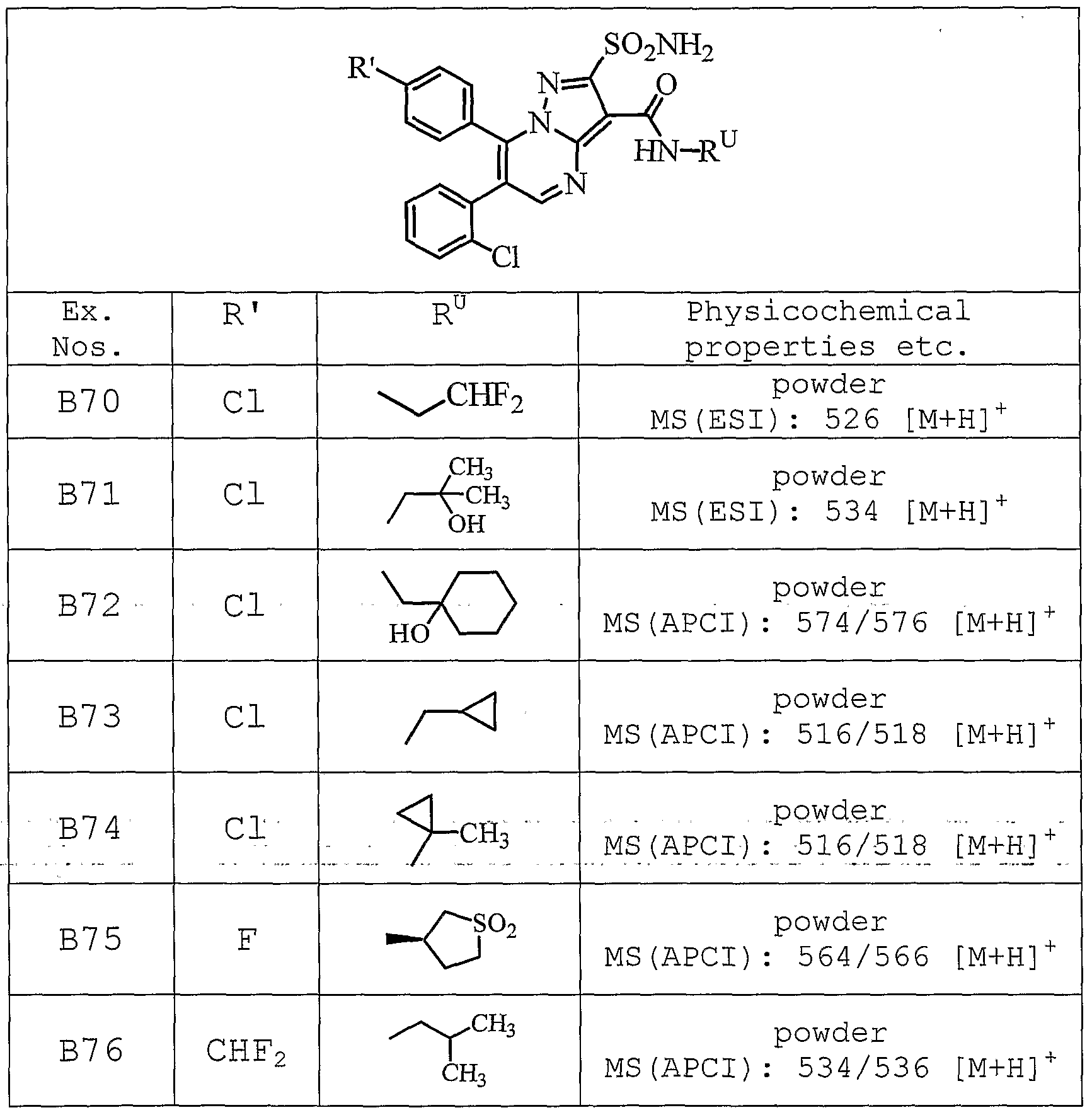
Table 27 (No. 4)

- , Ex . R1 Rϋ Physicocheπiical Nbs. properties etc.
/-γCH3 powder
B77 clτxF MS(APCI) : 536/538 CH3 [M+H] +

-Table -27-- (NG.- 5)

Ex. Ru Physicochemical properties os . etc.
\.CH3 powder
B85 CH3 MS (ESI) : 538 [M+H] + powder
B86 MS(ESI) : 538 [M+H]+ powder
B87 -< MS (ESI) : 536 [M+H] + powder
B88 -O MS (ESI) : 550 [M+H] +


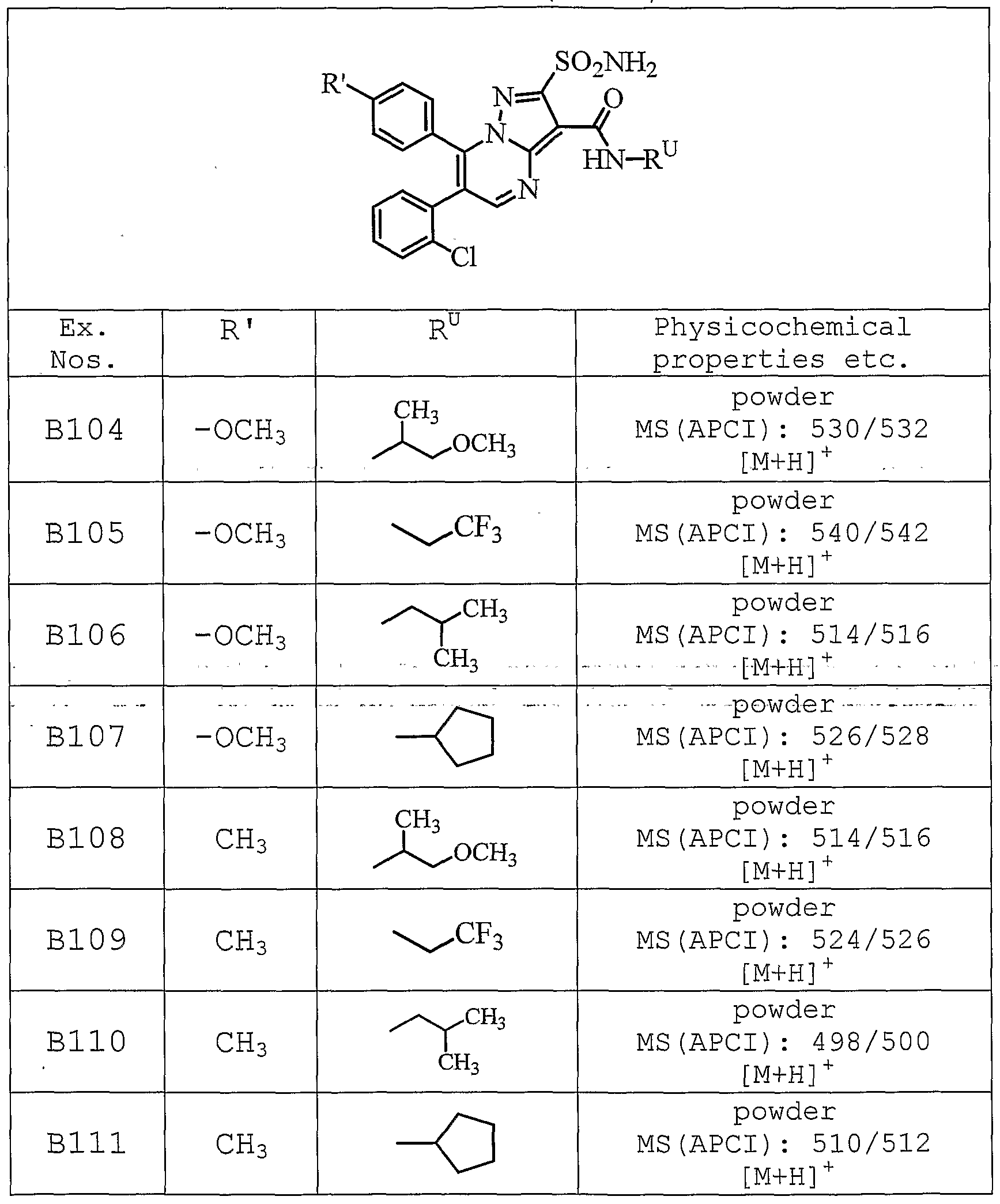

Example B121
Under nitrogen atmosphere, to a solution of cyclopentylamine (30 μL) in toluene (1.5 mL) was added a solution of 2M trimethylaluminum in toluene (0.15 mL) , and
the mixture was stirred at room temperature for 15 minutes. Thereto was added the compound obtained in Reference Example B21 (76 mg) , and the mixture was stirred at room temperature for 1 hour and at 1000C for 17 hours. After cooling to room temperature, the reaction mixture was diluted with ethyl acetate, and thereto was added an aqueous 20% Rochell salt solution. The mixture was extracted with chloroform, and the organic layer was concentrated in vacuo. The resultant crude product was purified by column chromatography on silica gel (solvent; chloroform/methanol = 100/0 to 96/4) to give 6- (2- chlorophenyl) -3- [N- (cyclopentyl) carbamoyl] -7- (4- trifluoromethyl-phe-nyl) -2-ureidopyrazolo [1, 5-a] pyrimidine - (48 mg, yield: 59%) as a powder. MS (APCI)m/z; 543/545 [M+H] + Examples B122 to B125
The corresponding starting materials were treated in the same manner as described in Example - B121 to give compounds as shown in the following Table 28.

(1) To diethylether (250 rtiL) was added magnesium (6.04 g) and a catalytic amount of iodine, and the mixture was stirred. Thereto was gradually added dropwise 2- chlorobenzyl chloride (20.0 g) , and the mixture was stirred for 1 hour from the time when the temperature of such mixture began to rise. Thereto was added a solution of 4- chlorobenzonitrile (18.8 g) in tetrahydrofuran/diethylether
(20 mL/50 itiL) , and the mixture was stirred for 3 hours. To the reaction mixture was added an aqueous 2N hydrochloric acid solution (150 mL) under ice-cooling, and the mixture was stirred at room temperature for 2 hours . The reaction mixture was extracted with ethyl acetate, and the organic layer was washed successively with water and brine, dried over magnesium sulfate and filtered. The filtrate was concentrated in vacuo, and the resultant crude product was purified by column chromatography on silica gel (solvent: hexane/ethyl " acetate =' 40./1 to ' 2071) ' to obtain' (.2-1 chlorobenzyl) (4-chlorophenyl) methanone (24.40 g; yield: 74 %) as a powder.
MS(APCI)m/z; 265/267 [M+H]+
(2) A solution of the compound obtained in the above step (1) (6.4 g) and N,N-dimethylformamide dimethylacetal (6.4 mL) in N, N-dimethylformamide (24 mL) was stirred at 1500C for 4 hours. After cooling the reaction mixture to room temperature, thereto was added water, and the mixture was extracted with a mixture of ethyl acetate and hexane (x 3) . The organic layer was washed with brine, dried over magnesium sulfate and filtered. The filtrate was concentrated in vacuo to obtain 1- (4-chlorophenyl) -2- (2- chlorophenyl) -3- (N,N-dimethylamino) -2-propen-l-one as an oil.
(3) The compound' o'btained in the above step (2) was dissolved in acetic acid (8 mL) , and thereto were added 3- amino-4-ethoxycarbonyl-lH-pyrazole (3.75 g) and piperidine (0.48 mL) . The mixture was heated at 800C for 16 hours.
After cooling to room temperature, to the reaction mixture were added water and ethyl acetate. After stirring, the organic layer was washed with brine, dried over magnesium sulfate and filtered. The filtrate was concentrated in vacuo, and the resultant crude product was purified by column chromatography on silica gel (solvent: hexane/ethyl acetate = 17/3 to 67/33) to give 6- (2-chlorophenyl) -7- (4- chlorophenyl) -3-ethoxycarbonylpyrazolo [1, 5-a]pyrimidine
(5.02 g, yield in combined steps (2) and (3) : 50 %) as a powder.
MS(APCI)m/z; 412/414 [M+H]+
(4) To a solution of the compound obtained in the above step (3) (2.5 g) in ethanol (30 mL) was added an aqueous 2N sodium hydroxide solution (6 mL) , and the mixture was stirred at room temperature for 5 hour. To the reaction mixture was added an aqueous 2N hydrochloric acid solution, and the mixture was stirred and concentrated in vacuo. The residue was extracted with ethyl acetate, and the organic layer was washed with brine, dried over magnesium sulfate and filtered. The filtrate was concentrated in vacuo to obtain 3-carboxy-6- (2- chlorophenyl) -7- (4-chlorophenyl) -pyrazolo [1, 5-a]pyrimidine (2.1 g, yield: 90%) as a powder. MS(APCI)m/z; 384/386 [M+H]+ Reference Example A2
(1) To dimethoxyethane (100 mL) were added 4- chlorobenzyl bromide (4.1 g) , 4-chlorobenzoyl chloride
(2.56 mL) , bis (triphenylphosphine) palladium dichloride (702 mg) and zinc powder (2.6 g) , and the mixture was stirred for 2 hours under nitrogen atmosphere. The reaction mixture was filtered and the filtrate was concentrated in vacuo and extracted with ethyl acetate. The organic layer was washed with brine, dried over magnesium sulfate and filtered. The filtrate was concentrated in vacuo, and the resultant crude product was purified by column, chromatography on silica gel (solvent: hexane/ethyl acetatej
RECTIFIED SHEET (RULE 91) ISA/EP
= 49/1 to 9/1) to give (2-chlorobenzyl) (4-chlorophenyl) - methanone (4.85 g, yield: 91 %) as a powder. MS(GC-EI)m/z; 264 [M]+
(2) The compound obtained in the above step (1) was treated in the same manner as described in Reference Example 1(2) to (4) to give 3-carboxyl-6- (2-chlorophenyl) - 7- (4-chlorophenyl) pyrazolo [1, 5-a]pyrimidine. Reference Example A3
(1) To a solution of potassium cyanide (5.6 g) and ammonium chloride (5.06 g) in water (17 mL) was added a solution of tetrahydro-4H-thiopyran-4-one (10 g) in methanol (22 mL) , and the mixture was refluxed under heating overnight. After cooling to room temperature, to the reaction mixture was added an aqueous IN sodium hydroxide solution, and the mixture was extracted with diethylether . The organic layer was dried over magnesium sulfate and filtered. The filtrate was concentrated in vacuo, and to a solution of the resultant residue in diethylether was added a solution of 4N hydrochloric acid in ethyl acetate. The precipitates were collected by filtration to give 4-amino-tetrahydrothiopyran-4- carbonitrile (13.6 g, yield: 88%) as a colorless solid. MS(APCI)m/z; 143 M+H]+
(2) A solution of the compound obtained in the above step (1) (10.5 g) in an aqueous 6N hydrochloric acid (500 mL) was refluxed under heating overnight. After cooling to room temperature, the reaction mixture was concentrated in vacuo, and the residue was dried to give 4-amino- tetrahydrothiopyran-4-carboxylic acid (10.6 g) as a crude product.
MS(APCI)m/z; 162 [M+H]+
(3) To a solution of the compound obtained in the above step (2) (10.6 g) in methanol (70 mL) was gradually added dropwise thionyl chloride (5.7 mL) , and the mixture was refluxed under heating overnight. After cooling to room temperature, the reaction mixture was concentrated in
RECTIFIED SHEET (RULE 91) ISA/EP
vacuo. The residue was washed with ethyl acetate/diethylether, and thereto was added an aqueous IN sodium hydroxide solution. The mixture was extracted with chloroform, and the organic layer was dried over magnesium sulfate and filtered. The filtrate was concentrated in vacuo to give methyl 4-amino-tetrahydrothiopyran-4- carboxylate (3.83 g, yield: 39%) as a brown oil. MS(APCI)m/z; 176 [M+H] +
(4) To a solution of the compound obtained in the above step (3) (100 mg) in methylene chloride (4 mL) was gradually added m-chloroperbenzoic acid (394 mg) , and the mixture was stirred at room temperature for 30 minutes. To the reaction mixture was added methanol (4 mL) and thereto was gradually added PL-HCO3 MP resin (0.9 g, Polymer Labs.). The mixture was stirred overnight. The reaction mixture was filtered, and the filtrate was concentrated in vacuo. The resultant crude product was purified by column chromatography on silica gel (solvent:, hexane/ethyl acetate. = 30/70 to 0/100) to give methyl 4-amino-l, 1-dioxo- tetrahydrothiopyran-4-carboxylate (38 mg, yield: 32%) as a colorless solid. MS(ESI)m/z; 208 [M+H]+ Reference Example A4
A solution of ethyl 2-cyano-3, 3-bismethylthioacrylate (40.0 g) , hydrazine hydrochloride (12.6 g) and sodium acetate (22.6 g) in ethanol (700 mL) was stirred at 900C for 2 hours. After cooling to room temperature, the reaction mixture was concentrated in vacuo, and to the residue were added water and ethyl acetate. The organic layer was separated, "dried over magnesium sulfate and filtered. The filtrate was concentrated in vacuo, and to the residue was added ethyl acetate and hexane. The precipitates were collected by filtration and dried to give 3-amino- 4-ethoxycarbonyl-5-methylthiopyrazole (17.4 g, yield: 47%) as a colorless solid. MS(APCI)m/z; 202 [M+H]+
Reference Example A5
(1) 2-Chlorobenzyl chloride (50 g) and 4- trifluoromethylbenzonitrile (53.1 g) were treated in the same manner as described in Reference Example Al-(I) to give (2-chlorobenzyl) (4-trifluoromethylphenyl)methanone (42.5 g, yield: 46%) as a powder.
(2) The compound obtained in the above step (1) (15.1 g) and N,N-dimethylformamide dimethylacetal (12.1 g) were treated in the same manner as described in Reference Example Al- (2) to give 2- (2-chlorophenyl) -1- (4-trifluoro- methylphenyl) -3- (N,N-dimethylamino) -2-propen-l-one (17.7 g) as a crude oil.
(3) The compound obtained in the above step (2) (17.7 g) and the compound obtained in Reference Example A4 (10.2 g) were treated in the same manner as described in Reference Example Al- (3) to give 6- (2-chlorophenyl) -3- e£'hόxycarbonyl-7- (4-trifluoromethylphenyl) -2- methylthiopyraz.olo [1, 5-a] pyrimidine (12V2. g, ..yield: 46%) as" a powder. MS(APCI)m/z; 492/494 [M+H]+ Reference Example A6
(1) To a solution of 6- (2-chlorophenyl) -3- ethoxycarbonyl-7- (4-trifluoromethyl-phenyl) -2- methylthiopyrazolo [1, 5-a] pyrimidine (compound obtained in Reference Example A5; 11.0 g) in methylene chloride (400 mL) was added m-chloroperbenzoic acid (16.5 g) at 00C, and the mixture was stirred at room temperature for 3 hours . To the reaction mixture was added dropwise an aqueous sodium thiosulfate solution at 0°C under stirring, and the mixture was extracted with ethyl acetate. The organic layer was dried over magnesium sulfate and filtered. The filtrate was concentrated in vacuo, and the resultant crude product was washed with ethanol to give 6- (2-chlorophenyl) - 3-ethoxycarbonyl-7- (4-trifluoromethylphenyl) -2- methylsulfonylpyrazolo [1, 5-a] pyrimidine (10.7 g, yield: 91%) as a powder.
(2) To a solution of the compound obtained in the above step (1) (10.7 g) in dimethylformamide (120 mL) was added sodium azide (5.3 g) , and the mixture was stirred at HO0C for 3 hours. After cooling to room temperature, to the reaction mixture was added water. After stirring, the mixture was extracted with ethyl acetate, and the organic layer was washed with water and concentrated in vacuo. The resultant crude product was purified by column chromatography on silica gel (solvent: hexane/ethyl acetate = 80/20 to 65/35) to give 2-azido-6- (2-chlorophenyl) -3- ethoxycarbonyl-7- (4-trifluoromethylphenyl) pyrazolo [1,5- a]pyrimidine (9.7 g, yield: 98%) as a pale yellow solid.
- (3) To a solution of the compound obtained in the above step (2) (9.7 g) in tetrahydrofuran (150 mL) was added triphenylphosphine (10.5 g) , and the mixture was stirred at 6O0C for 1 hour. After cooling to room temperature, the reaction mixture was concentrated in vacuo, and the resultant crude^ product was purified by column, chromatography on silica gel (solvent: hexane/ethyl acetate = 90/10 to 0/100) to give 6- (2-chlorophenyl) -3- ethoxycarbonyl-7- (4-trifluoromethylphenyl) -2- (N- triphenylphosphoranylidenamino) pyrazolo [1, 5-a] pyrimidine (11. Ig, yield: 77%) as a yellow solid.
(4) A solution of the compound obtained in the above step (3) (11.1 g) in tetrahydrofuran (28 mL) , acetic acid
(70 mL) and water (42 mL) was stirred at 1000C overnight.
After cooling to room temperature, the reaction mixture was concentrated in vacuo, and the resultant crude product was purified by column chromatography on silica gel (solvent: hexane/ethyl acetate = 85/15 to 60/40) to give 2-amino-6- (2-chlorophenyl) -3-ethoxycarbonyl-7- (4- trifluoromethylphenyl) pyrazolo [1, 5-a] pyrimidine (5.2 g, yield: 73%) as a yellow solid. MS (APCI )m/z; 461/463 [M+H] + Reference Example A7
(1) To a solution of 1-methylcyclopropanecarboxylic
acid (3.52 g) in tert-butanol (50 rtiL) were added diphenylphosphoryl azide (7.58 mL) and triethylamine (4.90 rriL) , and the mixture was stirred at 800C for 15 hours. After cooling to room temperature, the reaction mixture was concentrated in vacuo. To the residue were added water and an aqueous saturated sodium hydrogencarbonate solution, and the mixture was extracted with diethylether . The organic layer was dried over magnesium sulfate and filtered. The filtrate was concentrated in vacuo, and the resultant crude product was purified by column chromatography on silica gel (solvent: hexane/ethyl acetate = 90/10 to 87/13) to give 1- methyl-1- [N- (tert-butoxycarbonyl) amino] -cyclopropane (4.66 g, yield: 77%) as a colorless solid. MS (APCI) m/z; 172 [NH-H] + (2) To a solution of the compound obtained in the above step (1) (4.66 g) in 1,4-dioxane (10 mL) was added a solution of 4N hydrochloric acid in dioxane (10 mL) , and the mixture was stirred at room temperature overnight. To the reaction mixture was added diisopropylether, and the precipitated crystals were collected by filtration to give 1-methylcyclopropylamine hydrochloride (2.69 g, yield: 92%) as a colorless solid. MS (APCI) m/z; 72 [M+H] + Reference Example A8 Under nitrogen atmosphere, a solution of anhydrous cerium chloride (5.0 g) in tetrahydrofuran (40 mL) was stirred at room temperature overnight. To the reaction mixture was added dropwise a solution of 1.04M methyl lithium in diethylether (19 mL) under cooling in a dry ice/acetone bath over a period of 20 minutes. The mixture was stirred at the same temperature for 30 minutes, and to the reaction mixture was added dropwise a solution of 2- cyanopyridine (685 mg) in tetrahydrofuran (1 mL) . After warming to room temperature over a period of 5 hours, to the reaction mixture was added an aqueous 28% ammonia solution (12.5 mL) under ice-cooling. The mixture was
filtered through Celite to remove precipitates. The filtrate was dried over sodium sulfate and filtered. The filtrate was concentrated in vacuo to give 1-methyl-l- (2- pyridyl) ethylamine (863 mg) as a brown oil. MS(APCI)m/z; 137 [M+H]+ Reference Example A9
To a solution of 1-aminocyclohexanecarboxylic acid (600 mg) in tetrahydrofuran-methanol was added dropwise trimethylsilyl diazomethane (4.2 mL) under ice-cooling and stirring, and the mixture was stirred overnight. The reaction mixture was concentrated in vacuo, and to the residue were added successively diethylether-hexane (1/1) and a solution of 4N hydrochloric acid in ethyl acetate (1.05 mL) . The precipitates were collected by filtration and dried to give methyl 1-amino-cyclohexanecarboxylate (423 mg, yield: 52%) as a white powder. MS (ΑPCI)m/z; 158 [M+H]+ Reference Examples .AlO to A13
The corresponding starting materials were treated in the same manner as described in Reference Example Al to give compounds as shown in the following Table 29.


Reference Example Al4
(1) To a solution of methyl 2-chlorophenylacetate (10 g) in dimethylformamide (150 mL) was added N, N- dimethylformamide dimethylacetal (14.4 mL) , and the mixture was stirred at 85°C overnight. After cooling to room temperature, to the reaction mixture was added ethyl acetate and water. After stirring, the organic layer was separated, dried over sodium sulfate and filtered, and the filtrate was concentrated in vacuo. The residue was diluted with acetic acid (18 mL) , and -thereto were added 3— amino-4-ethoxycarbonyl-lH-pyrazole (8.4 g) and piperidine
(1.1 mL) . The mixture was stirred at 800C for 3.5 hours.
After cooling to room temperature, to the reaction mixture were added ethyl acetate and water. The mixture was stirred and filtered, and the resultant -• precipitates were dried to give 3- [2- (2-chlorophenyl) -2-methoxycarbonyl- vinylamino] -4-ethoxycarbonyl-lH-pyrazole (11.8 g, yield: 62%) as a powder. MS(APCI)m/z; 350/352 [M+H]+
(2) To a solution of the compound obtained in the above step (1) (10.7 g) in ethanol (250 mL) was added sodium carbonate (3.24 g) , and the mixture was refluxed under heating for 4 days. After cooling to room temperature, the reaction mixture was filtered and the filtrate was concentrated in vacuo. To the residue was added water, and the mixture was stirred and filtered (said filtration procedure, was repeated in five times) . The resultant precipitates were dried to give 6- (2- chlorophenyl) -3-ethoxycarbonyl-7-oxo-4 , 7- dihydropyrazolo [1, 5-a] pyrimidine (8.5 g, yield: 87%) as a powder.
MS(APCI)m/z; 318/320 [M+H]+
(3) To a solution of the compound obtained in the
above step (2) (300 mg) in acetonitrile (2 mL) were added N,N-dimethylaniline (319 μL) and phosphorus oxychloride
(270 μL) , and the mixture was refluxed under heating for 1 day. After cooling to room temperature, the reaction mixture was poured in ice-water, and the mixture was extracted with methylene chloride. The extract was dried over magnesium sulfate and filtered. The filtrate was concentrated in vacuo, and the resultant crude product was purified by column chromatography on silica gel (solvent: hexane/ethyl acetate = 80/20 to 60/40) to give 7-chloro-6-
(2-chlorophenyl) -3-ethoxycarbonylpyrazolo [1, 5-a] pyrimidine
(108 mg, yield: 34%) as a powder. MS(APCI)m/z; 336/338 [M+H]+ - . . .
(4) To a solution of the compound obtained in the above step (3) (500 mg) in dimethylformamide (6 mL) were added 4-pipecoline (210 μL) and potassium carbonate (412 mg) , and the mixture was stirred at 80°C for 2.5 hours. After cooling to room temperature, to the reaction mixture was added water, and the mixture was extracted with ethyl acetate. The organic layer was washed successively with water and brine, dried over sodium sulfate and filtered. The filtrate was concentrated in vacuo, and the resultant crude product was purified by column chromatography on silica gel (solvent: hexane/ethyl acetate = 80/20 to 50/50) to give 6- (2-chlorophenyl) -3-ethoxycarbonyl-7- (4- methylpiperidin-1-yl) pyrazolo [1, 5-a] pyrimidine (593 mg, yield: 99%) as an oil. MS(APCI)m/z; 399/401 [M+H]+
(5) The compound obtained in the above step (4) (593 mg) was treated in the same manner as described in
Reference Example l-(4) to give 3-carboxy-6- (2- chlorophenyl) -7- (4-methylpiperidin-l-yl) pyrazolo [1,5- a]pyrimidine (500 mg, yield: 91%) as a colorless solid MS (APCI)m/2; 371/373 [M+H] + Reference Example A14B
To a solution of methyl 2-chlorophenylacetate (25 g)
in dimethylformamide (400 itiL) was added N, N- dimethylformamide dirαethylacetal (36 itiL) , and the mixture was stirred at 90 °C overnight. After cooling to room temperature, to the reaction mixture were added ethyl acetate and water. After stirring, the organic layer was separated, dried over magnesium sulfate and filtered, and the filtrate was concentrated in vacuo. The residue was diluted with acetic acid (60 itiL) , and thereto was added 3- amino~4-ethoxycarbonyl-5-methyl-lH-pyrazole (19.7 g) . The mixture was stirred at 1200C overnight. After cooling the reaction mixture to room temperature, the precipitates were collected by filtration, washed with ethyl acetate/diisopropylether (1/1) and dried to give 6- (2- chlorophenyl) -3-ethoxycarbonyl-2-methyl-7-oxo-4 , 7- dihydropyrazolo [1, 5-a] pyrimidine (26.0 g) as a powder. MS(APCI)m/z; 332/334 [M+H]+ Reference Examples A15 to Al6
The corresponding starting materials were treated in the same manner as described in Reference Example A14 or A14B and then each of the reaction product was treated in the same manner as described in Reference Example A14-(3) to (4) to give compounds as shown in the following Table 30.
Table 30

(1) The corresponding starting materials were treated in the same manner as described in Reference Example Al-(I) to give (2-chlorobenzyl) (4-trifluoromethyl-phenyl)methanone .
(2) The compound obtained in the above step (1) (3.0 g) and N,N-dimethylformamide dimethylacetal were treated in the same manner as described in Reference Example Al- (2), and then the reaction product and 3-amino-5-methyl-lH- pyrazole (977 mg) were treated in the same manner as described in Reference Example Al- (3) to give 6- (2- chlorophenyl) -7- (4-trifluoromethylphenyl) -2-methyl- pyrazolo [1, 5-a] pyrimidine (2.63 g, yield: 67%.) as a brown oil. MS(APCI)m/z; 388/390 [M+H]+
(3) To a solution of the compound obtained in the above step (3) (2.27 g) in chloroform (50 mi) was gradually added dropwise chlorosulfonϊ.c acid . (1.35" mL) , and the", mixture was stirred at 700C for 3.5 hours. The reaction mixture was concentrated in vacuo, and to the residue was added thionyl chloride (20 mL) . The mixture was refluxed under heating for 2 hours. The reaction mixture was concentrated in vacuo, and to the residue was added ice- water. The mixture was extracted with chloroform, and the organic layer was dried over sodium sulfate and filtered. The filtrate was concentrated in vacuo, and the resultant crude product was purified by column chromatography on silica gel (solvent: hexane/ethyl acetate = 85/15 to 60/40) to give 6- (2-chlorophenyl) -3-chlorosulfonyl-7- (4- trifluoromethylphenyl) -2-methylpyrazolo [1, 5-a] pyrimidine (2.71 g, yield: 95%) as a pale yellow solid. MS(APCI)m/z;486/488 [M+H]+ Reference Examples Al8 to A20
The corresponding starting materials were treated in the same manner as described in Reference Example Al to give compounds as shown in the following Table 31.

Reference Examples A21 to A22
The corresponding starting materials were treated in the same manner as described in Reference •■ Example -A2 to give compounds as shown in the following Table 32.

Reference Example A23 (1) To a solution of methyl 2-chlorophenylacetate
(7.4 g) in dimethylformamide (110 itiL) was added N, N- dimethylformamide dimethylacetal (10.6 itiL) , and the mixture was stirred at 9O0C overnight. After cooling to room temperature, to the reaction mixture was added water, and the mixture was extracted with ethyl acetate/hexane (4/1, 20 mL x 1 and 100 mL x 2) . The combined organic layer was washed successively with water and brine, dried over magnesium sulfate and filtered. The filtrate was concentrated in vacuo. The residue was diluted with acetic acid (18 mL) , and thereto was added 3-amino-4- ethoxycarbonyl-lH-pyrazole (6.2 g) . The mixture was stirred at 1100C overnight. After cooling the reaction mixture to room temperature, the precipitates were collected by filtration, washed successively with ethyl acetate and diisopropylether and dried to give 6-(2- chlorophenyl) -3-ethoxycarbonyl-7-oxo-4 , 7- dihydropyrazolo [1, 5-a] pyrimidine (9.9 g, yield: 78%) as a powder. MS (APCI) m/z;" 318/320 [M+H] + (2) The compound obtained in the above step (1) (4.8 g) was treated in the same manner as described in Reference Example A14-(3) to give 7-chloro-6- (2-chlorophenyl) -3- ethoxycarbonylpyrazolo [1, 5-a] pyrimidine (4.2 g, yield: 85%) as a powder. MS(APCI)m/z; 336/338 [M+H] +
(3) A solution of the compound obtained in the above step (2) (840 mg) , [1, 1-bis (diphenylphosphino) ferrocene] - dichloropalladium (II) -methylene chloride complex (61 mg) , potassium phosphate (1.6 g) and 2-fluoro-4- formylphenylboronic acid (462 mg) in 1,4-dioxane (25 mL) was stirred at 800C under nitrogen atmosphere overnight. After cooling to room temperature, to the reaction mixture were added ethyl acetate and an aqueous saturated sodium hydrogencarbonate solution. The organic layer was separated, washed successively with water and brine, dried over magnesium sulfate and filtered. The filtrate was
concentrated in vacuo, and the resultant crude product was purified by column chromatography on silica gel (solvent: hexane/ethyl acetate = 70/30 to 50/50) to give 6- (2- chlorophenyl) -3-ethoxycarbonyl-7- (2-fluoro-4-formylphenyl) - pyrazolo [1, 5-a]pyrimidine (665 mg, yield: 63%) as a powder. MS(APCI)m/z; 424/426 [M+H]+
(4) To a solution of the compound obtained in the above step (3) (660 mg) in methylene chloride (0.7 mL) was added bis (2-methoxyethyl) aminosulfur trifluoride (783 μL, Trade Name: Deoxo-Fluor, Scott Inc.), and the mixture was stirred at room temperature for 1 day. To the reaction mixture was added an aqueous saturated sodium hydrogencarbonate • solution . under ice-cooling, and the mixture was stirred for 10 minutes. The mixture was extracted with methylene chloride, and the organic layer was concentrated in vacuo. The resultant crude product was purified by column chromatography on silica gel (solvent: . hexane/ethyl' 'acetate = ~75?2'5 to 60?40) "to' give' 6-(2-' chlorophenyl) -3-ethoxycarbonyl-7- (2-fluoro-4-- * difluoromethylphenyl) pyrazolo [1, 5-a] pyrimidine (295 mg, yield: 42%) as a powder. MS(APCI)m/z; 446/448 [M+H]+
(5) The compound obtained in the above step (4) (290 mg) was treated in the same manner as described in Reference Example Al- (4) to give 3-carboxy-6- (2- chlorophenyl) -7- (2-fluoro-4-difluoromethylphenyl) - pyrazolo [1, 5-a] pyrimidine (208 mg, yield: 77%) as a solid. MS (APCI) m/z; 418/420 [M+H] + Reference Example A24 The corresponding starting materials were treated in the same manner as described in Reference Example A23-(l) to (3) , and then the reaction product was treated in the same manner as described in Reference Example A23-(5) to give 3-carboxy-6- (2-chlorophenyl) -2-methyl-7~ phenylpyrazolo [1, 5-a] pyrimidine (250 mg, yield: 94%) as a solid.
MS(APCI)m/z; 364/366 [M+H]+ Reference Example A25
(1) Under nitrogen atmosphere, to a solution of sodium ethoxide (14.32 g) in ethanol (20 mL) was added dropwise ethyl cyanoacetate (4.7 mL) , and the mixture was stirred at room temperature for 1 hour. To the reaction mixture was added difluoroacetic acid (4.85 mL) , and the mixture was stirred at room temperature for 4 hours and at 600C (external temperature) for 17 hours. The reaction mixture was concentrated in vacuo, and to the residue were added toluene (10 mL) and phosphorus chloride (3.2 g) . The mixture was stirred at 45°C for 1 hour. To the reaction mixture was further added phosphorus chloride- (1.9 g) , and the mixture was stirred at 55 °C for 2 hours. The reaction mixture was cooled in an ice-bath and filtered through Celite, and the filtrate was concentrated in vacuo. To the residue were added ethanol (20 mL) , hydrazine monohydrate (0.8 mL) and triethylamihe (3.0 mL),. and' the mixture .was", stirred at 6O0C for 2 hours. After cooling to room temperature, thereto were added an aqueous saturated sodium hydrogencarbonate solution and water, and the mixture was extracted with chloroform (x 4) . The combined organic layer was dried over sodium sulfate and filtered. The filtrate was concentrated in vacuo, and the resultant crude product was purified by column chromatography on silica gel
(solvent: chloroform/methanol = 100/0 to 94/6) and washed with chloroform to give ■ 3-amino-4-ethoxycarbonyl-5- difluoromethyl-lH-pyrazole (1.26 g, yield: 41%) as a colorless solid. MS (APCI)m/z; 206 [M+H]+
(2) The compound obtained in the above step (1) (400 mg) was treated in the same manner as described in Reference Example Al- (2) to (3) to give 3-carboxy-6- (2- chlorophenyl) -7- (4-chlorophenyl) -2- difluoromethylpyrazolo [1, 5-a] pyrimidine (405 mg, yield: 48%) as a powder.
MS (APCI)m/z; 434/436 [M+H] + Reference Example A26
(1) To a solution of methyl cyanoacetate (14.6 g) in methylene chloride (260 mL) was added trifluoroacetic anhydride (37.2 g) , and the mixture was stirred at room temperature. Thereto was gradually added dropwise triethylamine (51.7 mL) at 00C, and the mixture was stirred at room temperature overnight. To the reaction mixture was added water, and the mixture was extracted with methylene chloride. The organic layer was dried over magnesium sulfate and filtered. The filtrate was concentrated in vacuo to give a mixture (55.3 g) of methyl 2-cyano-2- (2- trifluoroacetyl) acetate (compound 2a)- and methyl 2-cyano- 4,4, 4-trifluoro-3-trifluoromethoxycarbonyl-2-butenoate (compound 2b) .
Compound 2a: MS (APCI) m/z; 196 [M+H] + Compound 2b: MS(APCI)m/z; 292 [M+H]+
(2) To a . mixture of the compound 2a and.."2b obtained in" the above step (1) (27.6 g) in methylene chloride (200 mL) were gradually added dropwise oxalyl chloride (31.6 mL) and a few drops of pyridine, and the mixture was refluxed under heating for 4 hours. The reaction mixture was gradually poured in water, and the mixture was extracted with methylene chloride. The organic layer was dried over magnesium sulfate and filtered. The filtrate was concentrated in vacuo to give methyl 3-chloro-2-cyano- 4 , 4, 4-trifluoro-2-butenoate as a crude product.
(3) To the compound obtained in the above step (2) was added water (20 mL) , and thereto was gradually added dropwise hydrazine monohydrate (80%, 6.74 g) at 00C. To the mixture was added triethylamine (2 mL) at room temperature, and the mixture was stirred for 1 hour. To the reaction mixture was added water, and the mixture was extracted with ethyl acetate. The organic layer was dried over magnesium sulfate and filtered. The filtrate was concentrated in vacuo, and to the residue was added
chloroform. The precipitates were collected by filtration to give 3-amino-5-trifluoromethyl-4-methoxycarbonyl-lH- pyrazole (3.96 g) as an orange solid. MS(APCI)m/z; 210 [M+H]+
(4) The compound obtained in the above step (3) (2.37 g) was treated in the same manner as described in Reference Example Al- (2) to (3) to give 3-carboxy-6- (2-chlorophenyl) - -7- (4-chlorophenyl) -2-trifluoromethylpyrazolo [1,5- a]pyrimidine (1.81 g) as a crude product (powder) . MS (APCI )m/z; 452/454 [M+H] + Reference Examples A27 to A28
The corresponding starting materials were treated in the same manner as described in Reference Example A25 or A26 to give compounds as shown in the following Table 33.

Reference Examples A29 to A30
The corresponding starting materials were treated in the same manner as described in Reference Example A6, and then the reaction product was treated in the same manner as described in Reference Example Al- (4) to give compounds as shown in the following Table 34.
Table 34

Reference Example A31
(1) To a solution of 2-[(cyano) (ethoxycarbonyl) vinyl] - - 1, 3-dioxolane ■• (2.0 g) -in -ethanol (20 inL) ■ were added-
-•5- hydrazine "hydrochloride-- (-748 -mg) and- sodium -acetate- (1.3-4 - g) , and the mixture was stirred at 80°C (external temperature) for 1 hour. After cooling to room temperature, the reaction mixture was filtered through Celite, and the filtrate was concentrated in vacuo. The resultant crude
10 product was purified by column chromatography on silica gel (solvent: chloroform/methanol = 100/0 to 85/15) to give 3- amino-4-ethoxycarbonyl-5- [2- (hydroxy) ethoxy] -lH-pyrazole (2.01 g, yield: 86%) as a pale pink solid. MS(APCI)m/z; 216 [M+H]+
15 (2) The ' compound obtained in the above step (1) (2.65 g) was treated in the same manner as described in Reference Example Al- (2) to (4) to give 3-carboxy-6- (2-chlorophenyl) - 7- (4-chlorophenyl) -2- (2-hydroxyethoxy) pyrazolo [1,5- a]pyrimidine as a powder.
20 MS(ESI)m/z; 444/446 [MH-H] + Reference Example A32
(1) To a solution of methyl 2-pyridylacetate (3.78 g)
in acetic acid (15 πiL) was added dropwise an aqueous solution (5 itiL) of sodium nitrite (1.75 g) under ice- cooling, and the mixture was stirred at room temperature for 30 minutes. The reaction mixture was neutralized with an aqueous sodium hydrogencarbonate solution, and the mixture was extracted with ethyl acetate. The organic layer was washed with brine, dried over magnesium sulfate and filtered. The filtrate was concentrated in vacuo, and the resultant crude product was purified by column chromatography on silica gel (solvent: hexane/ethyl acetate 75/25 to 25/75) to give methyl (hydroxyimino) (2- pyridyl) acetate (3.72 g, yield: 83%) as a colorless solid. MS (APCI) m/z,• 181 [M+H] +
(2) To a solution of the compound obtained in the above step (1) (1.64 g) in methanol (32 mL) was added 10% palladium-carbon (200 mg) , and the mixture was shaken under hydrogen atmosphere/50 Parr for 6 hours. The reaction mixture was filtered, and the filtrate was concentrated in vacuo to give methyl (amino) (2-pyridyϊ) -acetate (1.52 g, yield: 93%) as an oil. MS (APCI )m/z; 167 [M+H] +
(3) To a solution of the compound obtained in the above step (2) (659 mg) in chloroform (10 mL) was added a solution of di-tert-butyl dicarbonate (908 mg) in chloroform (10 mL) , and the mixture was stirred at room temperature for 1.5 hours. To the reaction mixture was added an aqueous saturated sodium hydrogencarbonate solution. The organic layer was separated and concentrated in vacuo, and the resultant crude product was purified by column chromatography on silica gel (solvent: hexane/ethyl acetate = 85/15 to 60/40) to give methyl (tert- butoxycarbonylamino) (2-pyridyl) acetate (123 mg, yield: 12%) as a yellow oil. MS (APCI )m/z; 267 [M+H] + (4) To a solution of the compound obtained in the above step (3) (122 mg) in methanol (3 mL) was added an
aqueous 2N sodium hydroxide solution (460 μL) , and the mixture was stirred at room temperature for 1 hour. The reaction mixture was concentrated in vacuo, and the residue and ammonium chloride (25 mg) were treated in the same manner as described in Example A5. The resultant reaction product was further treated in the same manner as described in Reference Example Rl- {2) to give 2-amino-2- (2- pyridyl) acetamide (92 mg, yield: 89%) as a yellow powder. MS(APCI)m/z; 152 [NH-H] + Reference Example A33
The corresponding starting materials were treated in the same manner as described in Reference Example A23-(l) to (3) , and the reaction product was further treated in the same manner as described in Reference Example A23-(5) to give 3~carboxy-6- (2-chlorophenyl) -7- (4- dimethylaminophenyl) pyrazolo [1, 5-a] pyrimidine (230 mg, yield: 86%) as a solid. MS(APCI)m/z; 393/395 [M+H]+ Reference Example Bl (1) Under nitrogen atmosphere, sodium hydride (60%, 6.77 g) was added to dimethylformamide (75 inL) . Thereto was added dropwise a solution of ethyl cyanoacetate (9.57 g) in dimethylformamide (15 πiL) under cooling (internal temperature: ca. 100C) over a period of 15 minutes, and the mixture was stirred at room temperature for 10 minutes. Thereto was added dropwise a solution of carbon disulfide (5.09 inL) in dimethylformamide (12 mL) under cooling (internal temperature £ 100C) over a period of 20 minutes. The mixture was stirred at room temperature overnight, and thereto was added dropwise a solution of benzyl bromide (20.1 mL) in dimethylformaide (23 mL) under cooling (internal temperature 5 25 °C) . The mixture was stirred at 700C for 7 hours and at room temperature overnight. The reaction mixture was poured in ice-water, and the mixture was stirred. The precipitates were collected by filtration and recrystallized from hot ethanol. The resultant
crystals were washed with cold ethanol to give ethyl 2- cyano-3, 3-bis (benzylthio) acrylate (25.63 g, yield: 82%) as a colorless solid. MS(APCI)m/z; 370 [M+H]+ (2) To a solution of the compound obtained in the above step (1) (15.0 g) in tetrahydrofuran (16 mL) and ethanol (41 mL) was added a solution of hydrazine monohydrate (2.04 g) in ethanol (18 mL) over a period of 5 minutes, and the mixture was stirred at room temperature overnight. The reaction mixture was concentrated in vacuo, and the residue was recrystallized from diisopropylether/hexane. The resultant crystals were washed with he-xane/diisopropylether (4/1) to give 5-amino- 3-benzylthio-4-ethoxycarbonyl-lH-pyrazole (9.45 g, yield: 84%) as a colorless solid. MS(APCI)m/z; 278 [M+H]+ Reference Example B2
The compound obtained in Reference Example Bl. (8.15 g) . and (2-chlorobenzyl) (4-chlorophenyl)methanone (compound obtained in Reference Example Al-(I), 9.78 g) were treated in the same manner as described in Reference Example Al- (3) to give 2-benzylthio-6- (2-chlorophenyl) -7- (4-chlorophenyl) - 3-ethoxycarbonylpyrazolo [1, 5-a] pyrimidine (8.24 g, yield: 51%) as a pale yellow solid. MS(APCI)m/z; 534/536 [M+H]+ Reference Example B3
To a solution of the compound obtained in Reference Example B2 (100 mg) in methylene chloride (1.5 mL) were added water (0.8 mL) and concentrated hydrochloric acid (0.05 mL) under ice-cooling (00C). Thereto was added 4% sodium hypochlorite solution (Antiformine, 0.4 mL) , and the mixture was stirred for 2 hours. The reaction mixture was extracted with methylene chloride. The organic layer was concentrated in vacuo, and the resultant crude product was purified by column chromatography on silica gel (solvent: hexane/ethyl acetate = 80/20 to 65/35) to give 6- (2-
chlorophenyl) -7- (4-chlorophenyl) -2-chlorosulfonyl-3- ethoxycarbonylpyrazolo [1, 5-a] pyrimidine (78 mg, yield: 82%) as a colorless solid. MS(APCI)m/z; 510/512 [M+H]+ Reference Example B4
The compound obtained in Reference Example B3 (546 mg) was treated in the same manner as described in Example B2- (1) to give 3-carboxy-6- (2-chlorophenyl) -7- (4- chlorophenyl) -2- (N,N-dimethylsulfamoyl) pyrazolo [1,5- a] pyrimidine (558 mg) as a crude product. Reference Example B5
The compound obtained in Reference Example B4 (240 mg) was treated in the same manner as described in Example B2-
(1) to give 3-carboxy-6- (2-chlorophenyl) -7- (4- chlorophenyl) -2-sulfamoylpyrazolo [1, 5-a] pyrimidine (239 mg) as a crude product. Reference Example B6
A solution of ethyl 2-cyano-3, 3-bis (methylthio) - . acrylate (40 g) , hydrazine hydrochloride (12.6 g) and sodium acetate (22.6 g) in ethanol was stirred at 900C for 2 hour. After cooling to room temperature, the reaction mixture was concentrated in vacuo, and to the residue were added water and ethyl acetate. The organic layer was separated, dried over magnesium sulfate and filtered. The filtrate was concentrated in vacuo, and to the residue was added ethyl acetate and hexane . The precipitates were collected by filtration and dried to give 5-amino-4- ethoxycarbonyl-3-methylthio-lH-pyrazole (17.4 g, yield: 47%) as a colorless solid. Reference Example B7
(1) A solution of the compound obtained in Reference
Example B6 (5-amino-4-ethoxycarbonyl-3-methylthio-lH- pyrazole; 6.8 g) , 1- (4-chlorophenyl) -2- (2-chlorophenyl) -3-
(dimethylamino) -2-propen-l-one (10.9 g) and piperidine (578 mg) in acetic acid (13 mL) was stirred at 8O0C overnight. After cooling to room temperature, to the reaction mixture
were added water and ethyl acetate. The organic layer was washed with brine, dried over magnesium sulfate and filtered. The filtrate was concentrated in vacuo, and the resultant crude product was purified by column chromatography on silica gel (solvent: hexane/ethyl acetate 85/15 to 70/30) to give 6- (2-chlorophenyl) -7- (4- chlorophenyl) -3-ethoxycarbonyl-2-methylthiopyrazolo [1, 5- a]pyrimidine (5.88 g, yield: 38%) as a pale yellow solid.
(2) The compound obtained in the above step (1) (600 mg) was treated in the same manner as described in Reference Example Al- (4) to give 3-carboxy-6- (2- chlorophenyl) -7- (4-chlorophenyl) -2-methylthiopyrazolo [1, 5- ■a] pyrimidine (502 mg) as a -pale yellow powder. MS (APCI)m/z; 430/432 [M+H]+ (3) To a solution of the compound obtained in the above step (2) (1.0 g) in chloroform (20 iriL) were added cyclopentylamine (260 mg) , water-soluble carbodiimide hydrochloride (620.mg) and i-hydroxybenzotriazole . (540 mg)., . and the mixture was stirred at room temperature overnight. To the reaction mixture were added an aqueous sodium hydrogencarbonate solution and chloroform. After stirring, the organic layer was concentrated in vacuo, and the resultant crude product was purified by column chromatography on silica gel (solvent: hexane/ethyl acetate = 82/18 to 67/33) to give 6- (2-chlorophenyl) -7- (4- chlorophenyl) -3- (N-cyclopentylcarbamoyl) -2- methylthiopyrazolo [1, 5-a] pyrimidine (940 mg, -yield: 81%) as a pale yellow solid. MS(APCI)m/z; 497/499 [M+H]+ (4) To a solution of the compound obtained in the above step (3) (940 mg) in methylene chloride (40 mL) was added m-chloroperbenzoic acid (1.09 g) under ice-cooling, and the mixture was stirred at room temperature for 3 hours. To the reaction mixture was added an aqueous sodium thiosulfate solution. The mixture was stirred and extracted with chloroform, and the organic layer was
concentrated in vacuo. The resultant crude product was purified by column chromatography on NH-silica gel (Chromatorex NH silica gel, solvent: hexane/ethyl acetate = 50/50 to 0/100) to give 6- (2-chlorophenyl) -7- (4- chlorophenyl) -3- (N-cyclopentylcarbamoyl) -2-methylsulfonyl- pyrazolo [1, 5-a] pyrimidine (1.0 g, yield: 100%) as a colorless solid. MS(APCI)m/z; 529/531 [M+H]+
(5) To a solution of the compound obtained in the above step (4) (1.5 g) in dimethylformamide (20 mL) was added sodium azide (1.11 g) , and the mixture was stirred at
HO0C overnight. After cooling to room temperature, to the reaction mixture was added - brine, and the mixture was stirred and extracted with ethyl acetate. The organic layer was washed with water and concentrated in vacuo, and the resultant crude product was purified by column chromatography on silica gel (solvent: hexane/ethyl acetate = .80/20 to 30/70) to give 2-azido-6- (2-chlorophenyl.)>-7- (4- chlorophenyl) -3- (N-cyclopentylcarbamoyl) pyrazolo [1,5- a] pyrimidine (1.15 g) as a yellow solid. To a solution of the compound (870 mg) in tetrahydrofuran (16 mL) was added triphenylphosphine (869 mg),-and the mixture was stirred at 4O0C for 1 hour. After cooling to room temperature, the reaction mixture was concentrated in vacuo, and the resultant crude product was purified by column chromatography on silica gel (solvent: chloroform/methanol 100/0 to 97/3) to give 6- (2-chlorophenyl) -7- (4- chlorophenyl) -3- (N-cyclopentylcarbamoyl) -2- triphenylphosphoranylidenaminopyrazolo [1, 5-a] pyrimidine (942 mg, yield: 58%) as a yellow solid. MS(APCI)m/z; 726/728 [M+H]+
(6) To a solution of the compound obtained in the above step (5) (1.1 g) in tetrahydrofuran-water (2.8 mL/4.2 mL) was added acetic acid (7 mL) , and the mixture was stirred at 1000C for 1 hour in a microwave reactor. After cooling to room temperature, to the reaction mixture was
added an aqueous 2N sodium hydroxide solution, and the mixture was extracted with chloroform. The extract was dried over magnesium sulfate and filtered. The filtrate was concentrated in vacuo, and the resultant crude product was purified by column chromatography on silica gel (solvent: hexane/ethyl acetate = 80/20 to 60/40) to give 2- amino-6- (2-chlorophenyl) -7- (4-chlorophenyl) -3- (N- cyclopentylcarbamoyl) pyrazolo [1, 5-a] pyrimidine (529 mg, yield: 75%) as a yellow solid. MS(APCI)m/z; 466/468 [M+H]+ Reference Example B8
(1) The corresponding starting materials were treated in the same manner as described in Reference Example B2, and the reaction product was further treated in the same manner as described in Reference Example B3 to give 6-(2- chlorophenyl) -2-chlorosulfonyl-3-ethoxycarbonyl-7- (4- trifluoromethylphenyl) pyrazolo [1, 5-a] pyrimidine as a colorless powder. ~MS(APCI)m/z;" 544/546 ~'[M+H] + (2) The compound obtained in the above step (1) (2.2 g) was treated in the same manner as described in Example B4, and the reaction product was further treated in the same manner as described in Example B2-(l) to give 3- carboxy-6- (2-chloro-phenyl) -7- (4-trifluoromethylphenyl) -2- sulfamoylpyrazolo [1, 5-a] pyrimidine (0.45 " g) as a pale yellow powder. MS(APCI)m/z; 497/499 [M+H]+ Reference Example B9
(1) The corresponding starting materials were treated in the same manner as described in Example B2-(l) to give 6- (2-bromophenyl) -3-carboxy-7- (4-chlorophenyl) -2- sulfamoylpyrazolo [1, 5-a] pyrimidine (897 mg) as a pale yellow powder. MS (APCI) m/z; 507/509 [M+H] + (2) The compound obtained in the above step (1) (150 mg) and cyclopentyl- amine (33 mg) were treated in the same
manner as described in Example Al to give 6- (2- bromophenyl) -7- (4-chlorophenyl) -3- (N-cyclopentylcarbamoyl) - 2-sulfamoylpyrazolo [1, 5-a] pyrimidine (170 mg, yield: 100%) as a pale yellow powder. MS (APCI) m/z; 574/576 [M+H] +
(3) The compound obtained in the above step (2) (166 mg) in dimethylformamide (2 mL) was added zinc cyanide (37 mg) and tetrakis (triphenylphosphin) palladium(O) (33 mg) , and the mixture was stirred under nitrogen atmosphere at 1100C overnight. After cooling to room temperature, to the reaction mixture were added water and ethyl acetate. The mixture was stirred, and the organic layer was separated
•and concentrated in vacuo. The resultant crude product was purified by column chromatography on silica gel (solvent: hexane/ethyl acetate = 60/40 to 50/50) to give 7- (4- chlorophenyl) -6- (2-cyanophenyl) -3- (N-cyclopentylcarbamoyl) -2-sulfamoylpyrazolo [1, 5-a] pyrimidine (24 mg, yield: 16%) as a pale yellow powder. "~MS (APCI) m/z ;~~ 521/523 '[M+H] + Reference Example BlO
(1) To a solution of 1-aminocyclohexanecarboxylic acid (5 g) in dioxane (70 mL) was added an aqueous sodium hydroxide solution (4.19 g in 70 mL of water), and thereto was added di-tert-butyl dicarbonate (16.7 g) . The mixture was stirred at room temperature overnight. The reaction mixture was concentrated in vacuo, and to the residue were added water and ethyl acetate. The mixture was weakly acidified with an aqueous 2N hydrochloric acid solution and extracted with ethyl acetate. The combined organic layer was washed successively with water and brine, dried over magnesium sulfate and filtered. The filtrate was concentrated in vacuo, and the collected precipitates were washed with diethylether and dried in vacuo to give 1-
(tert-butoxycarbonylamino) cyclohexanecarboxylic acid (5.8 g, yield: 69%) as a colorless solid. MS (APCI) m/z; 244 [M+H] +
(2) The compound obtained in the above step (1) and ammonium chloride (6.4 g) were treated in the same manner as described in Example Al to give 1- (tert- butoxycarbonylamino) cyclohexan-1-carboxamide (5.4 g, yield: 92%) as a colorless solid. MS (APCI )m/z; 243 [NH-H] +
(3) To the compound obtained in the above step (2) in dioxane (80 mL) was added a solution of 4N hydrochloric acid in dioxane (22.1 mL) , and the mixture was stirred at room temperature overnight. To the reaction mixture was added diethylether, and the mixture was stirred. The precipitates were collected by filtration to give 1- aminocyclohexan-1-carboxamide- (3.35 g, yield: 85%) as a colorless powder. MS(APCI)m/z; 143 [NH-H] + Reference Example BlI
(1) The compound obtained in Reference Example A3- (2) (8 g) was treated in .the same manner as. described in - Reference Example BlO-(I) to give 4- (tert- butoxycarbonylamino) -tetrahydrothiopyran-4-carboxylic acid (10.8 g, yield: 69%) as a pale yellow solid. MS(APCI)m/z; 262 [NH-H] +
(2) The compound obtained in the above step (1) and ammonium chloride (11.1 g) were treated in the same manner as described in Example Al to give 4- (tert- butoxycarbonylamino) -tetrahydrothiopyran-4-carboxamide (3.3 g, yield: 30%) as a colorless solid. MS (APCI )m/z; 261 [M+H] +
(3) To a solution of the compound obtained in the above step (2) (3.3 g) in methylene chloride (100 mL) was added portionwise m-chloroperbenzoic acid (8.7 g) , and the mixture was stirred at room temperature for 3 hours. The reaction mixture was extracted with chloroform, and the organic layer was washed with an aqueous saturated sodium hydrogencarbonate solution. The aqueous layer was extracted with ethyl acetate, and the combined organic
layer was dried over magnesium sulfate and filtered. The filtrate was concentrated in vacuo, and the resultant crude product was purified by column chromatography on silica gel (solvent: chloroform/methanol = 98/2 to 90/10) to give 4- (tert-butoxycarbonylamino) -1, l-dioxotetrahydrothiopyran-4- carboxamide (3.3 g, yield: 90%) as a colorless powder. MS (APCI)m/z; 293 [M+H] +
(4) The compound obtained in the above step (3) (3.3 g) were treated in the same manner as described in Reference Example BlO- (3) to give 4-amino-l, 1-dioxo- tetrahydrothiopyran-4-carboxaπιide (2.0 g, yield: 77%) as. a colorless powder. MS(APCI)m/z; 193 [M+H]+ Reference Example B12 (1) A mixture of (R) -methioninol (4.95 g) , benzonitrile (8.3 inL) and zinc bromide (250 mg) was stirred at 1200C for 90 hours under nitrogen atmosphere. After cooling to room temperature, the- reaction mixture was. filtered, and the filtrate was washed with water and brine, dried over magnesium sulfate and filtered again. The filtrate was concentrated in vacuo, and the resultant crude product was purified by column chromatography on silica gel
(solvent; hexane/ethyl acetate = 5/1 to 3/1) to give (R) -4-
(2-methylthioethyl) -2-phenyl-4, 5-dihydrooxazole (3.94 g, yield: 48.6 %) as a colorless oil. MS(APCI)m/z; 222 [M+H]+
(2) To a solution of the compound obtained in the above step (1) (3.94 g) in acetic acid (65 inL) was added concentrated hydrochloric acid (7.7 TdL), and the mixture was refluxed under heating overnight. After cooling to room temperature, the reaction mixture was concentrated in vacuo. To the residue were added an aqueous sodium hydroxide solution (50 mL) and chloroform (100 mL) , and the mixture was stirred. To the organic layer was added magnesium sulfate and silica gel, and the mixture was stirred and filtered. The filtrate was concentrated in
vacuo, and the resultant crude product was washed with isopropylether and dried to give (R) -N- (tetrahydrothien-3- yl)benzamide (2.80 g, yield: 76 %) as a colorless solid. MS(APCI)m/z; 208 [M+H]+ (3) To a solution of the compound obtained in the above step (2) (3.59 g) in methylene chloride (70 mL) was gradually added m-chloroperbenzoic acid (75 %, 10 g) under ice-cooling, and the mixture was stirred at room temperature overnight. To the reaction mixture were added water (35 mL) , sodium sulfite (3.5 g) and an aqueous saturated sodium hydrogencarbonate solution (100 mL) , and the mixture was stirred for 30 minutes and extracted with chloroform.- The extract- - was - washed with an aqueous saturated sodium hydrogencarbonate solution, and the organic layer was dried over sodium sulfate and filtered. The filtrate was concentrated in vacuo, and the resultant solid materials were washed with ethyl acetate to give (R) - N- (.1, l-dioxo-tetrahydrothien-3-yl).benzamide .(3.5 g, . yield.:. 85 %) as a colorless solid. MS(APCI)m/z; 240 [M+H]+
(4) To a solution of the compound obtained in the above step (3) (3.51 g.) .in ethanol (13 mL) was added an aqueous 6N hydrochloric acid (52 mL) , and the mixture was refluxed under heating for 1 day. After cooling to room temperature, the aqueous layer was washed with ethyl acetate and concentrated in vacuo. The precipitated solid materials were washed with ethanol/diethylether, collected by filtration and further washed with diethylether to give
(R) -N- (1, l-dioxo-tetrahydrothien-3-yl) amine hydrochloride (2.52 g, yield: 100 %) as a colorless solid. MS (APCI )m/z; 136 [M+H] + Reference Example B13
(S) -Methioninol (4.83 g) was treated in the same manner as described in Reference Example B12 to give (S)-N- (1, l-dioxo-tetrahydrothien-3-yl) amine hydrochloride (3.86 g, ) as a colorless solid.
MS (APCI) m/z; 136 [M+H] + Reference Example B14
To a solution of 4-amino-4-carboxy-tetrahydropyrane hydrochloride (2 g) in methanol was added dropwise a solution of 2M trimethylsilyldiazomethane-diethylether (33 mL) under ice-cooling, and the mixture was stirred at room temperature for 4 days. The reaction mixture was concentrated in vacuo, and the resultant crude product was dissolved in hexane-diethylether (1 irιL/1 mL) , and thereto was added an aqueous 4N hydrochloric acid. The precipitates were collected by filtration to give 4-amino- 4-methoxycarbonyl-tetrahydropyrane (2.13 g, yield: 99%) as white -crystals. MS(ESI)m/z; 160 [M+H]+ Reference Example B15
(1) Under argon atmosphere, to a solution of tetrahydro-4H-thiopyran-4-one (25.0 g) in diethylether (500 mL.) was added dropwise a solution of 3M methylmagnesium. bromide in diethylether at 00C, and the mixture was stirred at the same temperature for 30 minutes. To a reaction mixture was added an aqueous saturated ammonium chloride solution (200 mL) , and the mixture was extracted .with ethyl acetate (x 3) . The organic layer was dried over magnesium sulfate and filtered. The filtrate was concentrated in vacuo, and the resultant crude product was purified by a column chromatography on silica gel (solvent; hexane/ethyl acetate = 9/1 to 6/1) to give 4-methyltetrahydrothiopyran- 4-ol (14.7, g, yield: 52%) as a solid.
(2) To a solution of the compound obtained in the above step (1) (13.7 g) in toluene (100 mL) were added trimethylsilyl azide (14.3 g) and boron trifluoride- diethylether complex (17.6 g) , and the mixture was stirred at room temperature overnight. The reaction mixture was poured in water, and the organic layer was separated and washed successively with an aqueous saturated sodium hydrogencarbonate solution, water and brine. The organic
layer was dried over magnesium sulfate and filtered. The filtrate was concentrated in vacuo, and the resultant crude product was purified by a column chromatography on silica gel (solvent; hexane/ethyl acetate = 10/1) to give 4-azido- 4-methyltetrahydrothiopyrane (6.84 g, yield: 42%) as an oil. MS (APCI )m/z; 130 [M+H-N2] +
(3) To a solution of the compound obtained in the above step (2) (370 mg) in diethylether (12 mL) was added lithium aluminum hydride (446 mg) at 00C, and the mixture was stirred at room temperature. To the reaction mixture were added water (442 μL) , an aqueous 15% sodium hydroxide solution (442 μL) and water (884 μL) , and the mixture was stirred. The mixture was filtered through Celite to remove- resultant precipitates. The filtrate was concentrated in vacuo to give l-methyl-tetrahydrothienylamine (221 mg, yield: 72%) as an oil. MS(APCI)m/z; 132 [NB-H] + Reference Example B16. .
(1) To a solution of 1, 3-dibromo-2, 2-dimethoxypropane (26.45 g) in dimethylsulfoxide (200 mL) was added sodium sulfide (9.46 g) , and the. mixture was stirred at 110 to 1400C (external temperature) for 30 minutes. The reaction mixture was diluted with diethylether under ice-cooling, and thereto were added an aqueous saturated sodium hydrogencarbonate solution and water. The mixture was extracted with diethylether (x 2), and the organic layer was washed with brine, dried over sodium sulfate and filtered. The filtrate was concentrated in vacuo, and the resultant crude product was purified by a column chromatography on silica gel (solvent; hexane/diethylether = 100/0 to 15/1) to give 3, 3-dimethoxythiacyclobutane (10.55 g, yield: 78%) as a yellow liquid. MS(APCI)m/z; 103 [M+H-MeOH]+
(2) To a solution of the compound obtained in the above step (1) (9.0 g) in acetone (70 mL) was added ion- exchange resin (Amberlyst 15E, 3.5 g) , and the mixture was
stirred at room temperature for 21 hours. The reaction mixture was filtered through Celite, and the residue was washed with acetone. The filtrate and the washings were combined and concentrated in vacuo. The precipitates were collected by filtration and washed with cold acetone to give 3-oxothiacyclobutane (1.58 g, yield: 27%) as colorless crystals .
(3) To a solution- of potassium cyanide (0.80 g) and ammonium chloride (0.62 g) in water (10 itiL) were added ammonium carbonate (3.59 g) and a solution of the compound obtained in the above step (2) (1.0 g) in methanol (10 mL) , . and the mixture was stirred at 60°C overnight. To the reaction mixture were added ■ an aqueous IN sodium hydroxide solution (5 mL) and water (50 mL) , and the mixture was extracted with ethyl acetate. The organic layer was washed successively with water and brine, dried over sodium sulfate and filtered. The filtrate was concentrated in vacuo, and the resultant crude product was washed with, diisopropylether to give 2-thia-5, 7-diazaspiro [3,4]octan- 6,8-dione (0.79 g, yield: 44%) as a powder. MS(ESI)m/z; 157 [M-H]"
(4) A solution of the compound obtained in the above step (3) (0.75 g) in an aqueous IN sodium hydroxide solution (10 mL) was refluxed under heating for 15 hours. After cooling to room temperature, to the ' reaction mixture was added concentrated hydrochloric acid (3 mL) , and the mixture was concentrated in vacuo to give 3-aminothietan-3~ carboxylic acid (1.54 g) as a solid. MS (APCI) m/z; 134 [M+H] + (5) To a suspension of the compound obtained in the above step (4) (1.54 g) in methanol (20 mL) was added thionyl chloride (0.50 mL) under ice-cooling, and the mixture was refluxed under heating for 5 hours. The reaction mixture was neutralized with ice-water and an aqueous sodium hydrogencarbonate solution, and the mixture was extracted with chloroform. The organic layer was dried
over sodium sulfate and filtered. The filtrate was concentrated in vacuo. To the residue was added a solution of 4N hydrochloric acid in ethyl acetate (2 mL) , and the precipitates were collected by filtration and washed successively with diisopropylether and ethyl acetate to give methyl 3-aminothietan-3-carboxylate (0.53 g, yield: 61%) as a powder. MS (APCI) m/z; 148 [M+H] + Reference Example B17 (1) To a solution of 6- (2-chlorophneyl) -3- ethoxycarbonyl-7- (4-trifluoro-methylphenyl) -2- methylpyrazolo [1, 5-a] pyrimidine (corresponding ethyl ester of the compound obtained -in Reference Example- A12; 5.35- g) in carbon tetrachloride (73 mL) were added N- bromosuccinimide (6.21 g) and 2, 2 ' -azobisisobutylonitrile (96 mg) , and the mixture was stirred at 850C (external temperature) for 18 hours. After cooling to room temperature, the reaction mixture was- filtered, through. Celite, and the filtrate was concentrated in vacuo. The resultant crude product was purified by a column chromatography on silica gel (solvent; hexane/ethyl acetate = 80/20 to 65/35) to give 2-bromomethyl-6- (2-chlorophenyl) - 3-ethoxycarbonyl-7- (4-trifluoromethylphenyl) -pyrazolo [1,5- a] pyrimidine (4.72 g, yield: 75%) as a pale yellow solid. MS(APCI)m/z; 538/540 [M+H]+
(2) To a solution of the compound obtained in the above step (1) (4.72 g) in dimethylformamide (50 mL) was added potassium acetate (2.58 g) , and the mixture was at 6O0C for 1.5 hours. After cooling to room temperature, the reaction mixture was diluted with ethyl acetate, and to the residue was added water. The organic layer was separated and washed successively with water and brine, dried over magnesium sulfate and filtered. The filtrate was concentrated in vacuo, and the resultant crude product was purified by a column chromatography on silica gel (solvent; hexane/ethyl acetate = 80/20 to 60/40) to give 2-
acetoxymethyl-β- (2-chlorophenyl) -3-ethoxycarbonyl-7- (4- trifluoromethylphenyl) pyrazolo [1, 5-a] pyrimidine (1.86 g, yield: 41%) as a colorless powder. MS (APCI)m/z; 518/520 [M+H]+ (3) To a solution of the compound obtained in the above step (2) (1.86 g) in ethanol-tetrahydrofuran (30 mL/30 mL) was added a solution of 21% sodium ethoxide in ethanol (2.5 mL) , and the mixture was stirred at 600C for 30 minutes. After cooling to room temperature, the reaction mixture was diluted with ethyl acetate, and thereto was added an aqueous diluted hydrochloric acid solution. The organic layer was separated and washed with brine, dried over magnesium sulfate and filtered. The- -filtrate was concentrated in vacuo, and the resultant crude product was purified by a column chromatography on silica gel (solvent; hexane/ethyl acetate = 85/15 to 55/45) to give 6- (2- chlorophenyl) -S-ethoxycarbonyl-?- (4-trifluoromethylphenyl) - 2-hydroxymethyi-pyrazolo [ϊ, 5-a] pyrimidine (1.05.. g, yield: . 62%) as a colorless solid. MS(APCI)m/z; 476/478 [M+H]+
(4) The compound obtained in the above step (3) (1.03 g) was treated in the same manner as described in Reference Example Al- (4) to give 3-carboxy-6- (2-chlorophenyl) -7- (4- trifluoromethylphenyl) -2-hydroxymethylpyrazolo [1, 5- a] pyrimidine (894 mg, yield: 92%) as a pale yellow solid. MS(APCI)m/z; 448/450 [M+H]+ Reference Examples B18 to B20
The compound obtained in Reference Example Bl7-(3) was treated in the same manner as described in Example B33, the reaction product and the corresponding amine were treated in the same manner as described in Example A5, and then the reaction product was treated in the same manner as described in Reference Example Al- (4) to give the compounds as shown in the following Table 35. Table 35

Reference Example B21
To a solution of the compound obtained in Reference Example A30 (-1.00 g) and triethylami-ne -(1.33 mL) in methylene chloride (20 mL) was added triphosgene (350 mg) under ice-cooling, and the mixture was stirred at room temperature for 1.5 hours. To the reaction mixture was added a solution of 0.5M ammonia in dioxane (20 mL) , and the mixture was stirred at room temperature for 30 minutes. To the reaction mixture was added water, and the mixture was extracted with chloroform. The organic layer was dried over magnesium sulfate and filtered. The filtrate was concentrated in vacuo, and the resultant crude product was purified by a column chromatography on silica gel (solvent; hexane/ethyl acetate = 65/35 to 20/80) to give 3- ethoxycarbonyl-6- (2-chlorophenyl) -7- (4- trifluoromethylphenyl) -2-ureidopyrazolo [1, 5-a] pyrimidine (0.70 g, yield: 64%) as a colorless powder. MS(APCI)m/z; 504/506 [M+H]+ Reference Example B22
(1) To a solution of the compound obtained in Reference Example Blβ-(2) (100 mg) in ethanol (3 mL) were
added hydroxylamine hydrochloride (236 mg) and sodium carbonate (360 mg) , and the mixture was refluxed under heating for 17 hours. After cooling to room temperature, to the reaction mixture were added an aqueous saturated sodium hydrogencarbonate solution and water, and the mixture was extracted with chloroform. The organic layer was concentrated in vacuo, and the resultant crude product was purified by a column chromatography on silica gel
(solvent; hexane/ethyl acetate = 90/10 to 50/50) to- give 3- hydroxyiminothiacyclobutane (93 mg, yield: 80%) as a colorless solid.
(2) Under nitrogen atmosphere, to a solution of lithium aluminum hydride (58 mg) in tetrahydrofuran (2 mL) was added dropwise a solution of the compound obtained in the above step (1) (93 mg) in tetrahydrofuran (1.5 mL) under ice-cooling, and the mixture was stirred at room temperature for 1 hour. To the reaction mixture were added successively water (60 μL) , an aqueous 15% sodium hydroxide solution (60 μL) and water (120 μL) under ice-cooling, and the mixture was stirred at room temperature. The reaction mixture was filtered through Celite and the filtrate was concentrated in vacuo to give 3-aminothiacyclobutane as a crude product . Reference Example B23 (1) The compound obtained in Reference Example Bl was treated in the same manner as described in Reference Example A14B, and then the reaction product -was treated in the same manner as described in Reference Example A14-(3) to give 2-benzylthio-7-chloro-6- (2-chlorophenyl) -3- ethoxycarbonylpyrazolo [1, 5-a] pyrimidine as a powder. MS(APCI)m/z; 458/460 [M+H]+
(2) A solution of the compound obtained in the above step (1) (1.0 g) , [1, 1 ' -bis (diphenylphosphino) ferrocene] - palladium (II) dichloride-methylene chloride complex (63 mg) , potassium phosphate (1.4 g) and 4-fluorophenylboronic acid (339 mg) in 1,4-dioxane (25 mL) was stirred at 800C for 16
hours. After cooling to room temperature, to the reaction mixture was added water, and the mixture was extracted with ethyl acetate. The organic layer was washed with brine, dried over magnesium sulfate and filtered. The filtrate was concentrated in vacuo, and the resultant crude product was purified by a column chromatography on silica gel
(solvent; hexane/ethyl acetate = 2/1 to 1/1) to give 2- benzylthio-6- (2-chlorophenyl) -3-ethoxycarbonyl-7- (4- fluorophenyl) pyrazolo [1, 5-a] pyrimidine (865 mg, yield: 76%) as a powder.
MS(APCI)m/z; 518/520 [M+H]+
(3) The compound obtained in the above step (2) (854 mg) was- treated in the same manner as -described in Reference Example B3, and then the reaction product was treated in the same manner as described in Example B4 to give 6- (2-chlorophenyl) -3-ethoxycarbonyl-7- (4- fluorophenyl) -2-sulfamoylpyrazolo [1, 5-a] pyrimidine (670 mg, yield: 78%) as a powder.- . MS(APCI)m/z; 475/477 [M+H]+ (4) -The compound obtained in the above step (3) (660 mg) was treated in the same manner as described in Example B2-(l) to give 3-carboxy-6- (2-chlorophenyl) -7- (4- fluorophenyl) -2-sulfamoylpyrazolo [1, 5-a] pyrimidine (318 mg, yield: 56%) as a powder. MS (APCI)m/z; 447/449 [M+H]+
Reference Examples B24 to B28
1) Reference Examples B24 to B25: The corresponding staring materials were treated successively in the same manner as described in Reference Example Bl to B3, Example B4 and Example B2-(l) to give the compounds as shown in the following Table 36.
2) Reference Examples B26 to B27 : The corresponding staring materials were treated in the same manner as described in Reference Example B23 to give the compounds as shown in the following Table 36.
3) Reference Examples B28: The corresponding staring
materials were treated successively in the same manner as described in Reference Example B23-(l) and Reference Example A14-(4) to (5) to give the compounds as shown in the following Table 36.
Table 36

Experiment 1
[Human CBl receptor binding assay]
(1) Preparation of human CBl receptor (membrane fraction) :
Materials)
Human CBl-expressing cell line: hCBl/CHO (#ES-110-C, Euroscreen)
Medium: F-12 (GIBCO#11765-062) , 10% fetal calf serum, 400 μg/mL of Geneticin (GIBCO#11811-031) , 100 units/mL of Penicillin, 100 μg/mL of Streptomycin (GIBCO#15140-122)
Buffer A: 50 mM tris-HCl (pH 7.5) containing ethylenediaminetetraacetic acid (2.5 mM) , MgCl2 (5 mM) and sucrose (200 mM)
Method) The receptor-expressing cells cultivated in the above medium were washed with phosphate buffer (x 2 times) and thereto was added Buffer A (2 mL) under ice- cooling or 40C (the following procedures were also carried out at the same temperature) . The cells were collected by -using a cell-scraper, treated by a microtip-type ultrasonicator for 20 seconds (pulse-on: 2 sec, pulse-off: 1 sec) and centrifuged (500 x g, 15 min) . The supernatant was separated and centrifuged (43000 x g, 60 min) . The •resultant pellet was* suspended in Buffer A and homogenized with a potter-type homogenizer. To the homogenate was added an equal volume of 80% glycerol and stored at -800C. (2) Procedure of CBl receptor binding assay: Materials)
Buffer B: 50 mM " tris-HCl ". (p~H 7.5")" .containing., ethylenediaminetetraacetic acid (2.5 mM) , MgCl2 (5 mM) and bovine serum albumine (2 mg/mL, fatty acid-free, SIGMA- A7030)
Buffer C: 50 mM tris-HCl (pH 7.5) containing ethylenediaminetetraacetic acid (2.5 mM) , MgCl2 (5 mM) and bovine serum albumine (2 mg/mL, SIGMA-A7906) Coating solution: 0.3% ethyleneimine polymer
Radioligand: [3H]-CP55940 (30 nM, 7992 dpm/μL, PerkinElmer, #NET-1051) prepared by diluting 8.3 μM solution of the radioligand with Buffer B
Method) Each well of the assay plate (96-well, Corning Costar Code#3371) was filled with Buffer B (140 μL) , a solution of each test compound in dimethylsulfoxide
(20 μL, final concentration: 0.1%), radioligand (20 μL) and membrane preparation (20 μL, 0.5 to 8.0 μg/20 μL) and the mixture was incubated at room temperature for 90 minutes to proceed the binding reaction. The reaction mixture was filtered through ϋnifilter GF/B (Packard#6005177 ) presoaked
with the above coating solution to collect the membrane fraction. The plate was washed with Buffer C (200 μL x 10 times) and dried at 500C for 1 hour and Microscinti 40 (40 μL/well) was added to each well. The bound radiolabel was quantitated by a scintilation counter (Top Count NXT, Packard) . ICs0 value of each test compound against the radioligand-binding to CBl receptors was calculated on the basis - of the quantitated radiolabel activity by using Microsoft Excel 2000 (Microsoft) . (3) Results:
IC50 value of each test compound is shown in the following Table 37. Meanwhile, the symbols (++ and +++) are defined as follows: • - -
++ : 10 nM < IC50 < 100 nM
+++ : 10 nM > IC50
Table 37

Experiment 2
[Selectivity of the test compound to Human CBl receptors] (1) Materials and Methods a) Human CBl receptor-binding assay: The binding assay was conducted in the same manner as described in Experiment 1.
b) Human CB2 receptor-binding assay: The binding assay was conducted in the same manner as described in Experiment 1, except that human CB2-expressing CHO cell line (hCB2/CHO) was used instead of hCBl cell line. IC50 value of. each test compound against the radioligand-binding to CB2 receptors was calculated in the manner as described in Experiment 1. Besides, selectivity to CBl receptors was evaluated in terms of the ratio of IC50 value for CB2/IC50 value for CBl.
(2) Results: The selectivity of each test compound is shown in the following Table 38. Meanwhile, the symbols (++ and +++) in the Table are the same as defined in Experiment 1. -- -
Table 38 .

INDUSTRIAL APPLICABILITY
The compounds [I] of the present invention are useful for treatment and/or prophylaxis of various CBl receptor- mediated diseases such as psychosis including schizophrenia. The compounds [I] of the present invention are also useful for withdrawal from a chronic treatment, alcohol dependence or drug abuse. Furthermore, the compounds [I] of the present invention are useful as an agent for enhancing analgesic activity or an agent for smoking cessation.
Claims
1. A pyrazolo [1, 5-a] pyrimidine compound of the formula [I] :'

R1 and R2 are the same or different and each an optionally substituted, aryl group or an optionally substituted saturated or unsaturated heterocyclic group, R0 is (a) hydrogen atom; (b) an alkyl group optionally substituted by one to three halogen atom(s); (c) an alkyloxyalkyl group; (d) a group of the formula: CON(Re) (Rf) ; (e) an' aminσalkyl' group', the amino 'moiety of" "said "group being"" optionalIy sύbs'titύted" b'y "one' "to"two" alkyl" group (s); (f) an amino group optionally substituted by a group selected from an alkyl group, an alkylcarbonyl group and an alkylsulfonyl group; (g) a 4- to 6-membered nitrogen-containing aliphatic heterocyclic group; (h) a group of the formula: -SO2N(R01) (R02); (i) a group of the formula: -NHCONHR03; (j) an alkyloxy group optionally substituted by hydroxyl group; (k) a hydroxyalkyl group; or (1) carboxyl group, R01 and R02 are the same or different and each hydrogen atom, an alkyl group or a carbamoylalkyl group, R03 is hydrogen atom or an alkyl group, Re and Rf are the same or different and each hydrogen atom, an alkyl group or a dialkylamino group,
E is a group of the formula: -C(=0)- or -SO2-, R is (A) a group of the following formula [i] , [ii] or [iii] : [iii]  when R0 is (a) hydrogen atom; (b) an alkyl group optionally substituted by one to three halogen atom(s); (c) an alkyloxyalkyl group; (e) an aminoalkyl group, the amino 5 moiety of said group being optionally substituted by one to two alkyl group (s); (f) an amino group optionally substituted by a group selected from an alkyl group, an alkylcarbonyl group and an alkylsulfonyl group; (g) a 4- to 6-membered nitrogen-containing aliphatic heterocyclic0 group; or (j) an alkyloxy group optionally substituted by hydroxyl group and
(B) (a) an alkyloxy group or (b) a group of the formula: -N(R5) (R6) when R0 is a group of the formula:-' - SO2N(R01) (R02) ; a group of the formula: -NHCONHR03, a group '5. _pf._ .the. .. formula: .-CON (Re) (Rf)'; ..'..carboxyl ..jgrόup ...or _.a."_ hydroxyalkyl ' group,
Ring A is (a) a C3-8 cycloalkyl group optionally fused to a benzene ring or (b) a benzene ring, Q is a single bond or methylene group, 0 Ring B is a 4- to 7-membered aliphatic heterocyclic group, said cyclic group binding via its ring-carbon atom to the adjacent nitrogen atom, X is sulfur atom, a group of the formula: -SO-, a group of the formula: -SO2-, oxygen atom or a group of the formula: -NRk-, Rk is an alkyl group,5 an alkylcarbonyl group, an alkyloxycarbonyl group, an alkylsulfonyl group, an aminosulfonyl group optionally substituted by one or two alkyl group (s), or a carbamoyl group optionally substituted by one or two alkyl group (s),
R3 is (a) an alkyl group optionally substituted by a0 group selected from hydroxyl group, amino group, an acylamino group, a dialkylcarbamoyl-amino group, an alkylsulfonyl-amino group and a dialkylsulfamoyl-amino group; (b) cyano group; (c) carboxyl group; (d) an alkyloxycarbonyl group; (e) a group of the formula: N(Ra) (Rb); (f) a group of the formula: -CON (Ra) (Rb) ; (g) a group of the formula:

R4 is (a) a hydrogen atom; (b) an alkyl group; (c) cyano group; (d) carboxyl group; (e) an alkylcarbonyl group; (f) an alkyloxycarbonyl group; (g) a group of the formula: -CON(RC) (Rd) ; (h) phenyl group; (i) benzyl group; or (j) an acylamino group, Rc and Rd are the same or different and each hydrogen atom or an alkyl group, one of RA and RB is (a) an alkyl group optionally substituted by hydroxyl group, an alkyloxy group, amino group, an alkylamino group or a dialkylamino group; (b) a phenyl group optionally substituted by one to two group (s) selected from a halogen atom, an alkyloxy group and a trihalogenoalkyl group; (c) benzyl group; (d) a heteroaryl group; or (e) a cycloalkyl group and the other is (a) hydrogen atom; or (b) an alkyl group optionally substituted by hydroxyl group, an alkyloxy group, amino group, an alkylamino group or a dialkylamino group, R5 and R6 are as follows: (A) one of R5 and R6 is hydrogen atom or an alkyl group and the other is (a) an alkyl group optionally substituted by one to three group (s) selected from a halogen atom, hydroxyl group, cyano group, an alkyloxy group, a cycloalkyl group, an amino group optionally substituted by one or two alkyl group (s), an alkylthio group, an alkylsulfinyl group, an alkylsulfonyl group, an acyl group, an optionally substituted aryl group and an optionally substituted saturated or unsaturated heterocyclic group; (b) an optionally substituted cycloalkyl group; (c) a group of the formula: -N(R8) (R9-); (d) an optionally substituted aryl group; or (e) an optionally substituted .saturated or unsaturated heterocyclic group, or (B) both R5 and R6 combine each other at their termini together with the adjacent nitrogen atom to form a saturated or unsaturated nitrogen-containing heterocyclic group, one of R8 and R9 is hydrogen atom or an alkyl group and the other is (a) an alkyl group optionally substituted by one to three group (s) selected from a halogen atom, cyano group and an aryl group; (b) an optionally substituted cycloalkyl group; (c) an optionally substituted aryl group; (d) an acyl group; or (e) an optionally substituted saturated or unsaturated heterocyclic group, excluding 6-phenyl-7- (4-chlorophenyl) -3- (N- isopropylcarbamoyl) pyrazolo [1, 5-a] pyrimidine; 6- (2- chlorophenyl) -7- (4-chlorophenyl) -3- (N-isopropylcarbamoyl) - pyrazolo [1, 5-a] pyrimidine; 6- (2-chlorophenyl) -7- (4- chlorophenyl) -3- [N- (4-cyano-4-tetrahydrothiopyranyl) - carbamoyl] pyrazolo [1, 5-a] pyrimidine; 6- (2-chlorophenyl) -7- (4-chlorophenyl) -3- [N- (α-dimethylbenzyl) carbamoyl] - pyrazolo [1, 5-a] pyrimidine; 6- (2-chlorophenyl) -7- (4- chlorophenyl) -3- [N- (α-methylbenzyl) carbamoyl] pyrazolo [1,5- a] pyrimidine; 6- (2-chlorophenyl) -7- (4-chlorophenyl) -3- [N- [1- (2-pyridyl) ethyl] -carbamoyl] pyrazolo [1, 5-a] pyrimidine; 6- (2-chlorophenyl) -7- (4-trifluoromethylphenyl) -3- [N-[I- (2- pyridyl) ethyl] carbamoyl] pyrazolo [1, 5-a] pyrimidine; 6- (2- chlorophenyl) -7- (4-chlorophenyl) -3- [N- (4-cyanobenzyl) - carbamoyl] pyrazolo [1, 5-a] pyrimidine; and 6- (2- chlorophenyl) -7- (4-chlorophenyl) -3- [N- (1, 1- dioxotetrahydrothien-3-yl) carbamoyl] pyrazolo [1,5- a] pyrimidine, or a pharmaceutically acceptable salt thereof.
2. A compound of the formula [I-I] :

R1 and R2 are the same or different and each an optionally substituted aryl group "~ or "an optionally substituted saturated or" unsaturated heterocyclic" group, R0A is (a) a hydrogen atom; (b) an alkyl group optionally substituted by one to three halogen atom(s); (c) an alkyloxyalkyl group; (d) an aminoalkyl group, the amino moiety of said group being optionally substituted by one to two alkyl group (s); (e) an amino group optionally substituted by a group selected from an alkyl group, an alkylcarbonyl group and an alkylsulfonyl group; (f) a 4- to 6-membered nitrogen-containing aliphatic heterocyclic group; or (g) an alkyloxy group optionally substituted by a hydroxyl group, E is a group of the formula: -C(=0)- or -SO2-,
R' is a group of the following formula [i] , [ii] or [iii] :
[ϋi]  Ring A is (a) a C3-8 cycloalkyl group optionally fused to a benzene ring or (b) a benzene ring, Q is a single bond or a methylene group,
Ring B is a 4- to 7-membered aliphatic heterocyclic group, said cyclic group binding via its ring-carbon atom to the adjacent nitrogen atom, X is sulfur atom, a group of the formula: -SO-, a group of the formula: -SO2-, oxygen atom or a group of the formula: -NRk-, Rk is an alkyl group, an alkylcarbonyl group, an alkyloxycarbonyl group, an alkylsulfonyl group, an aminosulfonyl group optionally substituted by one or two alkyl group (s), or a carbamoyl group optionally substituted by one or two alkyl group (s),
R3 is .(a) an- alkyl group optionally substituted by a group selected from hydroxyl group, amino group, an acylamino group, a dialkylcarbamoyl-amino group, an alkylsulfonyl-amino group and a dialkylsulfamoyl-amino group; (b) cyano group; (c) carboxyl group; (d) an alkyloxycarbonyl group; (e)' a_ group of the' formula: N(Ra)"(RB"); ' (f)' "a group of" the" formula:'""-CC)N'(Ra')'(Rb") ;"~ (g) "" a " group of the formula:

(h) hydroxyl group, Ra and Rb are the same or different and each hydrogen atom, hydroxyl group, cyano group, an alkyl group, a cyanoalkyl group; a trihalogenoalkyl group, a hydroxyalkyl group, an alkyloxyalkyl group, a cycloalkyl group, an alkylsulfonyl group or an aminoalkyl group (the amino moiety of said group being optionally substituted by one or two alkyl group(s)), or both Ra and Rb combine each other at their termini to form a saturated or unsaturated nitrogen-containing heterocyclic group optionally containing a heteroatom(s) , other than the nitrogen atom, selected from sulfur atom and oxygen atom,
R4 is (a) a hydrogen atom; (b) an alkyl group; (c) 172

R1 and R2 are the same or different and each an optionally substituted aryl group or an optionally substituted saturated or unsaturated heterocyclic group,
R0B is a group of the formula: -SO2N (R01) (R02) ; a group of the formula: -NHCONHR03; a group of the formula: - CON (Re) (Rf) ; carboxyl group; or a hydroxyalkyl group, R01 and R02 are the same or different and each hydrogen atom, an alkyl group or a carbamoylalkyl group, R03 is hydrogen atom or an alkyl group, Re and Rf are the same or different and each hydrogen atom, an alkyl group or a dialkylamino group, ' ■ E" is a"group" of "the formula': -C'(=0)"- " or" -BO2-," R" is an alkyloxy group or a group of the formula: - N(R5) (R6),
R5 and R6 are as follows:
(A) one of R5 and R6 is hydrogen atom or an alkyl group and the other is (a) an alkyl group optionally substituted by one to three group (s) selected from a halogen atom, hydroxyl group, cyano group, an alkyloxy group, a cycloalkyl group, an amino group optionally substituted by one or two alkyl group (s), an alkylthio group, an alkylsulfinyl group, an alkylsulfonyl group, an acyl group, an optionally substituted aryl group and an optionally substituted saturated or unsaturated heterocyclic group; (b) an optionally substituted cycloalkyl group; (c) a group of the formula: -N(R8) (R9);
(d) an optionally substituted aryl group; or (e) an optionally substituted saturated or unsaturated heterocyclic group, or 171
cyano group; (d) carboxyl group; (e) an alkylcarbonyl group; (f) an alkyloxycarbonyl group; (g) a group of the formula: -CON(RC) (Rd) ; (h) phenyl group; (i) benzyl group; or (j) an acylamino group, Rc and Rd are the same or different and each hydrogen atom or an alkyl group, one of RA and RB is (a) an alkyl group optionally substituted by hydroxyl group, an alkyloxy group, amino group, an alkylamino group or a dialkylamino group; (b) ■ a phenyl group optionally substituted by one to two group (s) selected from a halogen atom, an alkyloxy group and a trihalogenoalkyl group; (c) benzyl group; (d) a heteroaryl group; or (e) a cycloalkyl group and the other is (a) hydrogen atom; ■ or (b) an alkyl group optionally substituted by hydroxyl group, an alkyloxy group, amino group, an alkylamino group or a dialkylamino group, excluding 6-phenyl-7- (4-chlorophenyl) -3- (N- isopropylcarbamoyl) pyrazolo [1, 5-a] pyrimidine; 6- (2- chlorophenyl) -7,- (4—.chlorophenyϊ) -3- (N-isopropylcarbamoyl) - pyrazolo [1, 5-a] pyrimidine; 6- (2-chlorophenyl) -7- (4- chlorophenyl) -3- [N- (4-cyano-4-tetrahydrothiopyranyl) - carbamoyl] pyrazolo [1, 5-a] pyrimidine; 6- (2-chlorophenyl) -7- ( 4-chlorophenyl) -3- [N- (α-dimethylbenzyl) carbamoyl] - pyrazolo [1, 5-a] pyrimidine; 6- (2-chlorophenyl) -7- (4- chlorophenyl) -3- [N- (α-methylbenzyl) carbamoyl] pyrazolo [1,5- a] pyrimidine; 6- (2-chlorophenyl) -7- (4-chlorophenyl) -3- [N- [1- (2-pyridyl) ethyl] -carbamoyl] pyrazolo [1, 5-a] pyrimidine; 6- (2-chlorophenyl) -7- (4-trifluoromethylphenyl) -3- [N- [1- (2- pyridyl) ethyl] carbamoyl] pyrazolo [1, 5-a] pyrimidine; and 6- (2-chlorophenyl) -7- (4-chlorophenyl) -3- [N- (4-cyanobenzyl) - carbamoyl] -pyrazolo [1, 5-a] pyrimidine, or a pharmaceutically acceptable salt thereof.
3. A compound of the formula [I-II] : (B) both R5 and R6 combine each other at their termini together with the adjacent nitrogen atom to form saturated or unsaturated nitrogen-containing heterocyclic group, one of R8 and R9 is hydrogen atom or an alkyl group and the other is (a) an alkyl group optionally substituted by one to three groups selected from a halogen atom, cyano group and an aryl group; (b) an optionally substituted cycloalkyl group; (c) an optionally substituted aryl group;
(d) an acyl group; or (e) an optionally substituted saturated or unsaturated heterocyclic group, excluding 6- (2-chlorophenyl) -7- (4-chlorophenyl) -3- [N- (1, 1- dioxotetrahydrothien-3-yl) carbamoyl] -2-
(hydroxymethyl) pyrazolo [1, 5-a] pyrimidine, or . .apharmaceutically acceptable salt thereof.
4. The compound according to Claim 1, 2 or 3 wherein R1 and R2 are the same or different and (i) a 6- to 10- membered monocyclic or bicyclic aryl group optionally substituted" 'by one to 'three' group Cs ) selected "from a" "halogen atom, a cyano group, an alkyl group optionally substituted by one to three halogen atom(s), an alkyloxy group optionally substituted by one to three halogen atom(s), an amino group optionally substituted by one to two alkyl group (s), an alkylthio group, an alkylsulfinyl group and an alkylsulfonyl group, or (ii) a 5- to 7- membered saturated or unsaturated, oxygen-, sulfur- or nitrogen-containing heteromonocyclic group optionally substituted by one to three group (s) selected from a halogen atom, cyano group, oxo group, an alkyl group optionally substituted by one to three halogen atom(s), an alkyloxy group optionally substituted by one to three halogen atom(s), an amino group optionally substituted by one to two alkyl group (s), an alkylthio group, an alkylsulfinyl group and an alkylsulfonyl group.
5. The compound according to Claim 1 or 3 wherein the saturated or unsaturated heterocyclic group in R5, R6, R8 or R9 is (a) a saturated or unsaturated, ' .4- to 7-membered heteromonocyclic group, said heteromonocyclic group containing one to four heteroatom(s) selected from oxygen atom, sulfur atom and nitrogen atom; (b) a saturated or unsaturated, 8- to 15-membered nitrogen-containing bicyclic . or tricyclic heterocyclic group formed by fusing the aforementioned heteromonocyclic group (a) with one or two other cyclic group (s) selected from a C3_8 cycloalkyl group, a 5- to 6-membered monocyclic aryl group and a saturated or unsaturated, 4- to 7-membered heteromonocyclic group, said heteromonocyclic group containing one to four heteroatom (s) selected from oxygen atom, sulfur atom and nitrogen atom; or . ..
(c) a saturated or unsaturated, 8- to 11-membered nitrogen-containing spiro-heterocyclic group.
6. The compound according to Claim 1 or 3 wherein the saturated or unsaturated nitrogen-containing heterocyclic group .formed" by "combining; R5 with" R6 is
(a) a saturated or unsaturated, 4- to 7-membered nitrogen-containing heteromonocyclic group, said heteromonocyclic group optionally containing two or more nitrogen atoms and optionally containing one to two heteroatom (s) other than such nitrogen atom(s) selected from oxygen atom and sulfur atom; (b) a saturated or unsaturated, 8- to 15-membered nitrogen-containing bicyclic or tricyclic heterocyclic group formed by fusing the aforementioned heteromonocyclic group with one or two other cyclic group (s) selected from a C3-8 cycloalkyl group, a 5- to 6-membered monocyclic aryl group and a saturated or unsaturated, 4- to 7-membered heteromonocyclic group, said heteromonocyclic group containing one to four heteroatom (s) selected from oxygen atom, sulfur atom and nitrogen atom; or
(c) a saturated or unsaturated, 8- to 11-membered nitrogen-containing spiro-heterocyclic group.
7. The compound according to Claim 5 wherein the saturated or unsaturated heterocyclic group in R5, R , R or R9 is a saturated or unsaturated heterocyclic group substituted by one to four groups selected from a halogen atom, hydroxyl group, cyano group, oxo group, an alkyl group, an alkyl group substituted by one to three halogen atom(s), an alkyloxyalkyl group, an aminoalkyl group, a cycloalkyl group, an arylalkyl group, an alkyloxy group, an alkyloxy group substituted by one to three halogen atom(s) , an acyl group, an amino group optionally substituted by one to two alkyl group (s), an acylamino group, an alkylsulfonyl group, an aminosulfonyl group optionally substituted by one to two alkyl group (s), an aryl group optionally substituted by one - to two halogen atom(s) and a saturated or unsaturated 5- to 6-membered nitrogen-containing heterocyclic group.
8. The compound according to Claim 6 wherein the saturated or unsaturated nitrogen-containing heterocyclic group formed by combining R5 with R6 is a saturated or unsaturated nitrogen-containing heterocyclic group substituted by one to three group (s) selected from a halogen atom, hydroxyl group, cyano group, oxo group, an alkyl group, an alkyl group substituted by one to three halogen atom(s), an alkyloxyalkyl group, an aminoalkyl group, a cycloalkyl group, an arylalkyl group, an alkyloxy group, an alkyloxy group substituted by one to three halogen atom(s), an acyl group, an amino group optionally substituted by one to two alkyl group (s) ,■ an acylamino group, an alkylsulfonyl group, an aminosulfonyl group optionally substituted by one to two alkyl group (s) and an aryl group.
9. The compound according to Claim 7 wherein the saturated or unsaturated heterocyclic group in R5, R6, R8 or R9 is (A) a saturated or unsaturated oxygen- or sulfur- containing heterocyclic group selected from a furyl group, a tetrahydrofuranyl group, a pyranyl group, a tetrahydropyranyl group, a thiacyclobutyl group, a thienyl group, a tetrahydrothienyl group, a thiopyranyl group, a tetrahydrothiopyranyl group, a benzofuranyl group, a dihydrobenzofuranyl group, an isobenzofuranyl group, a chromanyl group, an isochromanyl group, a chromenyl group, an isochromenyl group, a benzothienyl group and a dihydrobenzothienyl group; or (B) a saturated or unsaturated nitrogen-containing heterocyclic group selected from an azetidyl group, a pyrrolidinyl group, • a pyrrolinyl group, an imidazolidinyl group, an imidazolinyl group, a pyrazolidinyl group, a pyrazolinyl group, a pyrrolyl group, a 2H-pyrrolyl group, an imidazolyl group, a pyrazolyl group, a dihydropyrazolyl group, a thiazolidinyl group, a thiazolyl group, an isothiazolyl group, an isoxazolyl group, an oxazolidinyl group, a pyridyl group, a dihydropyridyl group, a tetrahydropyridyl group, a piperidyl group, a pyrazinyl group, a piperazinyl group, a pyrimidinyl group, a tetrahydropyrimidinyl group, a pyridazinyl group, a morpholinyl group, an a.zocinyl group, an azacycloheptyl . group, an indolizinyl group, a benzimidazolyl group, a benzotriazolyl group, an indolyl group, an isoindolyl group, a 3H-indolyl group, an indolinyl group, an isoindolinyl group, a lH-indazolyl group, a pyrrolopyridyl group, a pyrrolopyrimidinyl group, a tetrazolyl group, a purinyl group, a pteridinyl group, a 4H-quinolizinyl .group, a quinolyl group, a dihydroquinolyl group, a tetrahydroquinolyl group, an isoquinolyl group, a dihydroisoquinolyl group, a tetrahydroisoquinolyl group, a phthalazinyl group, a dihydrophthalazinyl group, a naphthyridinyl group, a dihydro- naphthyridinyl group, a tetrahydronaphthyridinyl group, a quinoxalinyl group, a quinazolinyl group, a dihydrobenzothiazinyl group, a dihydrobenzoxazinyl group, a cinnolinyl group, a pteridinyl group, a xanthenyl group, a carbazolyl group, a beta- carbolinyl group, a phenanthridinyl group, an acridinyl group, a 5H-dihydro- dibenzazepinyl group and a spiro- heterocyclic group of the formula:  wherein RG and RH are the same or different and each a hydrogen atom or an alkyl group, and q and r are an integer of 1 or 2.
10. The compound according to Claim 7 wherein the saturated or unsaturated heterocyclic group in R5, R6, R8 or R9 is a tetrahydrofuranyl group, a pyrrolyl group, a pyrrolidinyl group, a. piperidyl group, an a.zacycloheptyl group, a tetrahydropyranyl group, piperazinyl group, a morpholinyl group, a thiomorpholinyl group, . a thiacyclobutyl group, a tetrahydrothienyl group, a tetrahydrothiopyranyl group, a thiazolyl group, a pyridyl "group, a pyrimidinyl "group, " an indolinyl group, a~ pyrfόl'όpyridyl "group 'of "a" tetfahydrbnaphthyridinyl group."
11. The compound according to Claim 8 wherein the saturated or unsaturated nitrogen-containing heterocyclic group formed by combining R5 with R6 is a saturated or unsaturated nitrogen-containing heterocyclic group selected from an azetidyl group, a pyrrolidinyl group, a pyrrolinyl group, an imidazolidinyl group, an imidazolinyl group, a pyrazolidinyl group, a pyrazolinyl group, a pyrrolyl group, an imidazolyl group, a pyrazolyl group, a dihydropyrazolyl group, a thiazolidinyl group, an oxazolidinyl group, a dihydropyridyl group, a tetrahydropyridyl group, a piperidyl group, a piperazinyl group, a tetrahydropyrimidinyl group, a morpholinyl group, an azacycloheptyl group, a benzimidazolyl group, a benzotriazolyl group, an indolyl group, an isoindolyl group, an indolinyl group, an isoindolinyl group, a lH-indazolyl group, a tetrazolyl group, a purinyl group, a dihydroquinolyl group, a tetrahydroquinolyl group, a dihydroisoquinolyl group, a tetrahydroisoquinolyl group, a dihydrophthalazinyl group, a dihydroquinazolinyl group, a dihydrobenzothiazinyl group, a dihydrobenzoxazinyl group, a carbazolyl group, a beta-carbolinyl group, a 5H-dihydro- dibenzazepinyl group and a spiro-heterocyclic group of the formula:

12. A compound of the formula [I-I-A] :

R10 and R20 are the same or different and each (i) a 6- to 10-membered monocyclic or bicyclic aryl group optionally substituted by one to three group (s) selected from a halogen atom, a cyano group, an alkyl group optionally substituted by one to three halogen atom(s), an alkyloxy group optionally substituted by one to three halogen atom(s), an amino group optionally substituted by one to two alkyl group (s), an alkylthio group, an alkylsulfinyl group and an alkylsulfonyl group, or (ii) a 4- to 7- membered saturated or unsaturated, oxygen-, sulfur- or nitrogen-containing heteromonocyclic group optionally substituted by one to three group (s) selected from a halogen atom, cyano group, oxo group, an alkyl group optionally substituted by one to three halogen atom( s) , an alkyloxy group optionally substituted by one to three halogen atom(s), an amino group optionally substituted by one to two alkyl group (s) , an alkylthio ' group, an alkylsulfinyl group and an alkylsulfonyl group,
R0A is (a) a hydrogen atom; (b) an alkyl group optionally substituted by one to three halogen atom(s); (c) an alkyloxyalkyl group; (d) an aminoalkyl group, the amino moiety of said group being optionally substituted by one to two alkyl group (s); (e) an amino group optionally substituted by a group selected from an alkyl group, an alkylcarbonyl group and an alkylsulfonyl group; (f) a 4- to 6-membered nitrogen-containing aliphatic heterocyclic . group; or (g) an alkyloxy group optionally substituted by hydroxyl group,
E is a group of the formula: -C (=0) - or -SO2-,
Rs is a group of the following formula [i-a] , [ii-a] or [ iii- a] :

Ring B is a 4- to 7-membered aliphatic heterocyclic group, said cyclic group binding via its ring-carbon atom to the adjacent nitrogen atom, X is sulfur atom, a group of the formula: -SO-, a group of the formula: -SO2-, oxygen atom or a group of the formula: -NRk-, Rk is an alkyl group, an alkylcarbonyl group, an alkyloxycarbonyl group, an alkylsulfonyl group, an aminosulfonyl group optionally substituted by one or two alkyl group (s), or a carbamoyl group optionally substituted by one or two alkyl group (s),
R30 is (a) an alkyl group optionally substituted by a group selected from hydroxyl group, amino group, an acylamino group, a dialkylcarbamoyl-amino group, an alkylsulfonyl-amino group and a dialkylsulfamoyl-amino group; (b) cyano group; (c) carboxyl group; (d) an alkyloxycarbonyl group; (e) a group of the formula: N(Raa) (Rbb); (f) a group of the formula: -CON (Raa) (Rbb) ; (g) a group of the formula:

(h) hydroxyl group, Raa and Rbb are the same or different and each hydrogen atom, hydroxyl group, cyano group, an alkyl group, a' cyanoalkyl group, a trihalogenoalkyl group, a hydroxyalkyl group, an alkyloxyalkyl group, a cycloalkyl group, a group of the formula: RxaCO-, an alkylsulfonyl group or an aminoalkyl group optionally substituted by one or two alkyl group (s) at the amino moiety, or both Raa and. Rbb..combine, each other at.. their termini . "to . form.ja saturated; or unsaturated nitrogen-containing heterocyclic group, said heterocyclic group optionally containing another heteroatom (s) than the nitrogen atom(s) selected from oxygen atom and sulfur atom, Rxa is (a) hydrogen atom, (b) an alkyl group optionally substituted by one to three group (s) selected from a halogen atom, cyano group, an alkylsulfonyl group and a pyridyl group, (c) an alkyl oxy group optionally substituted by a 6- to 10-membered monocyclic or bicyclic aryl group, (d) a cycloalkyl group, (e) a 6- to 10-membered monocyclic or bicyclic aryl group optionally substituted by one to two group (s) selected from a halogen atom, cyano group, an alkyl group, a trihalogenoalkyl group and an alkyloxy group, (f) an amino group optionally substituted by one or two alkyl group (s) or (g) a saturated or unsaturated 4- to 7-membered sulfur-, oxygen- or nitrogen-containing heteromonocyclic group optionally substituted by one to two group (s) selected from a' halogen atom, cyano group, an alkyl group and a trihalogenoalkyl group,
R40 is (a) hydrogen atom; (b) an alkyl group; (c) cyano group; (d) carboxyl group; (e) an alkylcarbonyl group; (f) an alkyloxycarbonyl group; (g) a group of the formula: -CON (Rcc) (Rdd) ; (h) phenyl group; (i) benzyl group; or (j) a group of the formula: RxaCONH-, Rcc and Rdd are the same or different and each hydrogen atom or an alkyl group, one of RAa and RBb is (a) an alkyl group optionally substituted by hydroxyl group, an alkyloxy group, amino group, an alkylamino group or a dialkylamino group; (b) a phenyl group optionally substituted by one to two group (s) selected from a halogen atom, an alkyloxy group and a trihalogenoalkyl group;- (c) benzyl group; (d) a 5- to 6- membered nitrogen-containing heteroaryl group; or (e) a cycloalkyl group and the other is (a) hydrogen atom or (b) an alkyl group optionally substituted by hydroxyl group, an alkyloxy group, amino group, an alkylamino group or a dialkylamino group, excluding 6- (2-chlorophenyl) -7- (4-chlorophenyl) -3- [N- (4-cyanobenzyl) -carbamoyl] pyrazolo [1, 5-a] pyrimidine; 6- (2- chlorophenyl) -7- (4-chlorophenyl) -3- [N- (4- cyanotetrahydrothiopyran-4-yl) carbamoyl] pyrazolo [1,5- a] pyrimidine; 6-phenyl-7- (4-chlorophenyl) -3- (N- isopropylcarbamoyl) pyrazolo [1, 5-a] pyrimidine; 6- (2-chloro- phenyl) -7- (4-chlorophenyl) -3- (N- isopropylcarbamoyl) pyrazolo [1, 5-a] pyrimidine; 6- (2- chlorophenyl) -7- (4-chlorophenyl) -3- [N- (α-dimethylbenzyl) - carbamoyl] pyrazolo [1, 5-a] pyrimidine; 6- (2-chlorophenyl) -7- ( 4-chlorophenyl) -3- [N- (α-methylbenzyl) carbamoyl] - pyrazolo [1, 5-a] pyrimidine; 6- (2-chlorophenyl) -7- (4- chlorophenyl) -3- [N- [1- (2-pyridyl) ethyl] carbamoyl] - pyrazolo [1, 5-a] pyrimidine; . 6- (2-chlorophenyl) -7- (4- trifluoromethylphenyl) -3- [N- [1- (2-pyridyl) ethyl] carbamoyl] - pyrazolo [1, 5-a] pyrimidine; and 6- (2-chlorophenyl) -7- (4- chlorophenyl) -3- [N- (4-cyanobenzyl) carbamoyl] pyrazolo [1,5- a] pyrimidine, or a pharmaceutically acceptable salt thereof.
13. A compound of the formula [I-I-a] :

R2A is a phenyl group optionally substituted by one to two' group (s) selected from a "halogen atom and""cyano group,
"ROA"~ is " (a)"" hydrogen "atom;" (b)" an "alkyl group optionally substituted by one to three halogen atom(s); (c) an alkyloxyalkyl group; (d) an aminoalkyl group optionally substituted by one to two alkyl group (s) at the amino moiety; (e) an amino group optionally substituted by a group selected from an alkyl group, an alkylcarbonyl group and an alkylsulfonyl group; (f) a 4- to β-membered nitrogen-containing aliphatic heterocyclic group; or (g) an alkyloxy group optionally substituted by hydr.oxyl group, E is a group of the formula: -C(=0)- or -SO2-, Rsl is a group of the following formula [i-b] , [i-c] , [i-d] , [ii-b] , [iii-b] or [iii-c] : 
Ring Aa is (a) a C3-8 cycloalkyl ,group or (b) a C5-6 cycloalkyl fused to a benzene ring, Q is a single bond or methylene group, Ring Ba is a 4- to 7-membered aliphatic heteromonocyclic group binding via its ring carbon atom to the adjacent nitrogen atom, X is sulfur atom, -SO-, -SO2-, oxygen atom or a group of the formula: -NRk-, Rk is an alkyl group, an alkylcarbonyl group, an alkyloxycarbonyl group, an alkylsulfonyl group, aminosulfonyl group optionally substituted by one or two alkyl group (s) or a carbamoyl group optionally substituted by one or two alkyl group (s) ,
R31 is (a) cyano group, (b) an alkyl group, (c) a hydroxyalkyl group, (d) an aminoalkyl group optionally substituted by, at the amino moiety, an alkylcarbonyl group, dialkylsulfamoyl group, an alkylsulfonyl group or a dialkylcarbamoyl group, (e) a carboxyalkyl group, (f) carboxyl group, (g) an alkyloxycarbonyl group, (h) a carbamoyl group optionally substituted by one to two group (s) selected from an alkyl group and a dialkylaminoalkyl group, (i) or a group of the following formula:
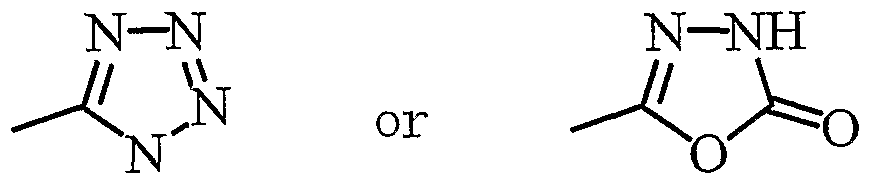
H R41 is hydrogen atom, amino group or a group of the formula: RxaCONH-, Rxa is (a) hydrogen atom, (b) an alkyl group optionally substituted by one to three group (s) selected from a halogen atom, cyano group, an alkylsulfonyl group and a pyridyl group, (c) an alkyloxy group optionally substituted by a 6- to 10-membered monocyclic or bicyclic aryl group, (d) a cycloalkyl group, (e) a 6- to 10-membered monocyclic or bicyclic aryl group optionally substituted by one to two group (s) selected from a halogen atom, cyano group, an alkyl group, a trihalogenoalkyl group and an alkyloxy group, (f) an amino group optionally . substituted by one or two alkyl group (s) or (g) a saturated or unsaturated 4- to ■ 7-membered nitrogen-containing heteromonocyclic group optionally substituted by one to two group (s) selected from a halogen atom, cyano group, an alkyl group and a trihalogenoalkyl group,
R32 is hydroxyl group, carboxyl group, an alkyloxycarbonyl group, amino qroup . or a. group, of the "formula: RkaCONH-,"~ R33 is carboxyl group or an alkyloxycarbonyl group,
R34 is (a) cyano group, (b) an alkyl group, (c) a hydroxyalkyl group, (d) an aminoalkyl group, (e) a carboxyalkyl group, (f) carboxyl group, (g) an alkyloxycarbonyl group, (h) a carbamoyl group optionally substituted by one to two group (s) selected from an alkyl group, a hydroxyalkyl group, a cyanoalkyl group, a trihalogenoalkyl group, an alkyloxyalkyl group, a cycloalkyl group, an alkylsulfonyl group and a dialkylamino-alkyl group, (i) a group of the formula:

or (j) a group of the following formula 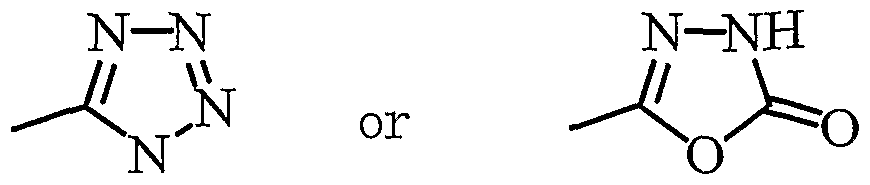
H
Ring J is a saturated or unsaturated nitrogen- containing 4- to 7-πiembered heteromonocyclic group optionally containing oxygen atom(s) as a heteroatom(s) other than the nitrogen atom,
R35 is a hydroxyalkyl group, carboxyl group, an alkyloxycarbonyl group or a carbamoyl group optionally substituted by one or two alkyl group (s),
RA1 is an alkyl group, a cycloalkyl group, a phenyl group optionally substituted by one to two group (s) selected ■ from a halogen atom, an alkyloxy group and a trihalogenoalkyl group or benzyl group,
RB1 is hydrogen atom or an alkyl group, R36 is an, alkyl group or. carbamoyl .group, ' .RB2 is..h_ydr.Q_gen ..atom .or . an alkyl group., . ... excluding 6- (2-chlorophenyl) -7- (4-chlorophenyl) -3- [N- (4-cyano-4-tetrahydro-thiopyranyl) carbamoyl] pyrazolo [1, 5- a] pyrimidine; 6- (2-chlorophenyl) -7-4-chloro-phenyl) -3- [N- [1- (2-pyridyl) ethyl] carbamoyl] pyrazolo [1, 5-a] pyrimidine; and 6- (2-chlorophenyl) -7- (4-trifluoromethylphenyl) -3- [N- [1- (2-pyridyl) ethyl] carbamoyl] -pyrazolo [1, 5-a] pyrimidine, or a pharmaceutically acceptable salt thereof.
14. A compound of the formula [I-II-i] :

R10 and R20 are the same or different and each (i) a 6- to 10-membered monocyclic or bicyclic aryl group optionally substituted by one to three group (s) selected from a halogen atom, cyano group, an alkyl group optionally substituted by one to three halogen atorα(s) , an alkyloxy group optionally substituted by one to three halogen atorα(s) , an amino group optionally substituted by one to two alkyl group (s), an alkylthio group, an alkylsulfinyl group and an alkylsulfonyl group, or (ii) a 4- to 7- membered saturated or unsaturated, oxygen-, sulfur- or nitrogen-containing heteromonocyclic group optionally substituted by one to three group (s) selected from a halogen atom, cyano group, oxo group, an alkyl group optionally substituted by one to three halogen atom(s) , an alkyloxy group optionally substituted by one • to three halogen atom(s), an amino group optionally • substituted by one to two alkyl group (s), an alkylthio group, an alkylsulfinyl group and an alkylsulfonyl group,
R0B is a group of the formula: -SO2N (R01) (R02) , a group of the formula: -NHCONHR03, a group of the formula: - CON(R8) (Rf) , carboxyl group or a . hydroxyalkyl group, R01 and . R02 are the same or different and each hydrogen atom, an alkyl group or a carbamoylalkyl group, R03 is hydrogen atom or an alkyl group, Re and Rf are the same or different and each hydrogen atom, an alkyl group or a dialkylamino group, E is a group of the formula: -C(=0)- or -SO2-, R5A is hydrogen atom or an alkyl group, and R6A is
(A) an alkyl group optionally substituted by one to three group (s) selected from (a) a halogen atom, (b) hydroxyl group, (c) cyano group, (d) an alkyloxy group, (e) carboxyl group, (f) a carbamoyl group optionally substituted by one or two alkyl group (s), (g) an alkylthio group, (h) an alkylsulfonyl group, (i) a cycloalkyl group optionally substituted by one to two group (s) selected from an alkyl group and hydroxyl group, (j) an amino group optionally substituted by one or two alkyl group (s) and (k) a saturated or unsaturated 4- to 10-membered monocyclic or bicyclic nitrogen-, sulfur- or oxygen-containing heterocyclic group; or
(B) a cycloalkyl group optionally fused to a benzene ring and optionally substituted by one to two group (s) selected from (a) an alkyl group optionally substituted by hydroxyl group, carboxyl group and amino group; (b) cyano group; (c) carboxyl group; (d) a group of the formula: RxaCO-; (e) a group of the formula: -N (Ral) (Rbl) ; (g) a 6- to 10-membered monocyclic or bicyclic aryl group; (h) an alkyl group substituted by a 6- to 10-membered monocyclic or bicyclic aryl group; and (i) a saturated or unsaturated 4- to 7-membered nitrogen-containing heteromonocyclic group optionally substituted by one or two oxo group (s), Ral and Rbl are the same ■ or different and each hydrogen atom, hydroxyl group, cyano group, an alkyl group, a group of the formula: RxaCO-, an alkylsulfonyl group, an aminoalkyl group, a monoalkylamino-alkyl group or a dialkylamino-alkyl group; or
(C) a 6- to 10-membered monocyclic, or. bicyclic aryl. group optionally substituted by one to two group (s) selected from cyano group, a trihalogenoalkyl group, an alkyloxy group and carboxyl group; or
(D) a saturated or unsaturated 4- to 10-membered nitrogen-containing monocyclic or bicyclic heterocyclic group containing at least one heteroatom selected from sulfur atom, oxygen atom and nitrogen atom and optionally substituted by one to four group (s) selected from (a) a halogen atom, (b) hydroxyl group, (c) oxo group, (d) cyano group, (e) an alkyl group, (f) a trihalogenoalkyl group,
(g) a hydroxyalkyl group, (h) an alkyloxyalkyl group, (i) an alkyloxy group, (j) a group of the formula: RxaCO-, (k) a cycloalkyl group, (1) an alkylsulfonyl group, (m) an aminosulfonyl group optionally substituted by one or two alkyl group (s), (n) phenylsulfonyl group, (o) amino group, (p) a group of the formula: RxaCONH-, (q) a carbamoyl group optionally substituted by one or two alkyl group (s), (r) a 6- to 10-membered monocyclic or bicyclic aryl group optionally substituted by a halogen atom(s) , and (s) a saturated or unsaturated 4- to 7-membered sulfur-, oxygen- or nitrogen-containing heteromonocyclic group optionally substituted by one to two group (s) selected from an alkyl group and a trihalogenoalkyl group; or
(E) a group of the formula: -N (R81) (R91) , R81 is hydrogen atom or an alkyl group, R91 is (a) an alkyl group optionally substituted by one to three group (s) selected from a halogen atom, cyano group and a 6- to 10-membered monocyclic or bicyclic aryl group; (b) a cycloalkyl group; (c) a 6- to 10-membered monocyclic or bicyclic aryl group optionally substituted by a group selected from a halogen atom, cyano group-, an alkyl group, a. trihalogenoalkyl group, an alkyloxy group, a trihalogenoalkyloxy group, an alkylthio group, an alkylsulfonyl group and a group of the formula: RxaCO-; (d) a group of the formula: RxaCO-; or (e) a saturated or unsaturated 4- to 7-membered sulfur-, oxygen- or nitrogen-containing heteromonocyclic group__ optionally substituted by a group selected from a halogen atom, an alkyl group, a trihalogenoalkyl group and an alkyloxy group; or
(F) both R5A and R6A combine each other together with the adjacent nitrogen atom to form a saturated or unsaturated 4- to 10-membered nitrogen-containing monocyclic or bicyclic heterocyclic group optionally containing one or two heteroatom(s) other than the nitrogen atom selected from sulfur atom and oxygen atom and optionally substituted by one or two group (s) selected from a halogen atom, oxo group, an alkyl group, a group of the formula: RxaCO- and a dialkylaminosulfonyl group,
Rxa is (a) hydrogen atom, (b) an alkyl group optionally substituted by one to three group (s) selected from a halogen atom, cyano group, an alkylsulfonyl group and a pyridyl group, . (c) an alkyloxy group optionally substituted by a 6- to 10-membered monocyclic or bicyclic aryl group, (d) a cycloalkyl group, (e) a 6- to 10-membered monocyclic or bicyclic aryl group optionally substituted by one to two group (s) selected from a halogen atom, cyano group, an alkyl group, a trihalogenoalkyl group and an alkyloxy group, (f) an amino group optionally substituted by one or two alkyl group (s) or (g) a saturated or unsaturated 4- to 7-membered sulfur-, oxygen- or nitrogen- containing heteromonocyclic group optionally substituted by one to two group (s) selected from a halogen atom, cyano group, an alkyl group and a trihalogenoalkyl group, excluding 6- (2-chlorophenyl) -7- (4-chlorophenyl) -3- [N- (1, 1- dioxotetrahydrothien-3-yl) -carbamoyl-2- (hydroxymethyl) - pyrazolo [1, 5-a] pyrimidine, or a pharmaceutically acceptable salt thereof.
15. A compound of the formula [I-II-ii] :

R10 and R20 are the same or different and each (i) a 6- to 10-membered monocyclic or bicyclic aryl group optionally substituted by one to three group (s) selected from a halogen atom, cyano group, an alkyl group optionally substituted by one to three halogen atom(s), an alkyloxy group optionally substituted by one to three halogen atom(s), an amino group optionally substituted by one to two alkyl group (s), an alkylthio group, an alkylsulfinyl group and an alkylsulfonyl group, or (ii) a 4- to 7- membered saturated or unsaturated, oxygen-, sulfur- or nitrogen-containing heteromonocyclic group optionally substituted by one to three group (s) selected from a halogen atom, cyano group, oxo group, an alkyl group optionally substituted by one to three halogen atom(s), an alkyloxy group optionally substituted by one to three halogen atom(s), an amino group optionally substituted by one to two alkyl group (s), an alkylthio group, an alkylsulfinyl group and an alkylsulfonyl group,
R0B is a group of the formula: -SO2N (R01) (R02) , a group of the formula: -NHCONHR03, a group of the formula: -
CON(Re) (Rf) , a carboxyl group or a hydroxyalkyl group, R01 and R02 are the same or different and each hydrogen atom, an alkyl group or a carbamoylalkyl group, R03 is hydrogen atom or an alkyl group, Re and Rf are the same or different and each hydrogen atom, an alkyl group or a dialkylamino group and Rn is an alkyl group or a pharmaceutically acceptable salt thereof.
16. The compound according to Claim 14 in -which R1-0 is (i) a phenyl group optionally substituted by one to two group (s) selected from a halogen atom, an alkyl group, a difluoroalkyl group, a trifluoroalkyl group and a dialkylamino group or (ii) a saturated or unsaturated 5- to
6-membered nitrogen-containing heterocyclic . group optionally substituted by a group selected from an alkyl group, a trifluoroalkyl group and an alkyloxy group, R20 is a phenyl group optionally substituted by one to two group (s) selected from a halogen atom and cyano group,
R6A is
(A) an alkyl group optionally substituted by a group selected from one to three halogen atom(s), hydroxyl group, cyano group, carboxyl group and an alkyloxycarbonyl group; or of the following formula:


H , and
R43 is hydrogen atom, amino group, an alkyloxycarbonylamino group or benzyloxy-carbonylamino group; or
(C) a phenyl group optionally substituted by one to two group (s) selected from a halogen atom, an alkyloxy group, a trihalogenoalkyl group, carboxyl group and an alkyloxycarbonyl group; or he following formula:


(E) a group of the formula: -N(R8a) (R9a) in which R8a is hydrogen atom or an alkyl group, R9a is an alkyl group, a trihalogenoalkyl group, a cyanoalkyl group, benzyl group, a cycloalkyl group, a phenyl group optionally substituted by a group selected from a halogen atom, cyano group, an alkyl φroup, a trihalogenoalkyl group, an alkyloxy group, a trihalogenoalkyloxy group, an alkylthio group, an alkylsulfonyl group, an alkyloxycarbonyl group and benzyloxycarbonyl group, an alkyloxycarbonyl group, a benzyloxycarbonyl group or a 5- to 6-membered nitrogen- containing heteroaryl group; or
(F) a group of the following formula:

17. The compound according to Claim 15 in which R10 is (i) a phenyl group optionally substituted by one to two group (s) selected from a halogen atom, an alkyl group, a difluoroalkyl group, a trifluoroalkyl group and a dialkylamino group or (ii) a saturated or unsaturated 5- to 6-membered nitrogen-containing heterocyclic group optionally substituted by a group selected from an alkyl group, a trifluoroalkyl group and an alkyloxy group and R20 is a phenyl group optionally substituted by one to two group (s) selected from a halogen atom and cyano group.
18. The compound according to Claim 2 in which R1 and R2 are the same or different and each (a) a phenyl group optionally substituted by one to three group (s) selected from a halogen atom, cyano group, an alkyl group optionally •substituted by- one to three halogen atom(s) and an amino group optionally substituted by one or two alkyl group (s) or (b) a saturated or unsaturated 5- to 7-memebered nitrogen-containing heterocyclic group optionally substituted by a group selected from an alkyl group .optionally substituted by one to three halogen atom(s) and. an alkyloxy group, and Al) R' is a group, of the formula [i] , R3 is (a) an alkyl group .optionally substituted by a group selected from hydroxy], group and amino group, (b) cyano group, (c) carboxyl group, (d) an alkyloxycarbonyl group, (e) a group of the formula: -CON(Re) (Rf) or (f) an acylamino group, Re and Rf are the same or different and each hydrogen atom, an alkyl group or a dialkylaminoalkyl group and R4 is hydrogen atom or an acylamino group; or
A2) R' is a group of the formula [ii] , X is sulfur atom, a group of the formula: -SO2-, oxygen atom or a group of the formula: -NRk-, Rk is an alkyloxycarbonyl group, an alkylsulfonyl group, an alkylcarbonyl group or a dialkylaminosulfonyl group, R3 is (a) an alkyl group optionally substituted by hydroxyl group, (b) carboxyl group, (c) an alkyloxycarbonyl group or (d) a group of the formula: -CON (Re) (Rf) , Re and Rf are the same or different and each hydrogen atom, an alkyl group or a trihalogenoalkyl group and R4 is hydrogen atom; or
A3) R' is a group of the formula [iii] , RA is an alkyl group optionally substituted by hydroxyl group, a phenyl group optionally substituted by a halogen atom or a trihalogenoalkyl group or a 5- to β-membered nitrogen- containing heteroaryl group, RB is hydrogen atom or an alkyl group, R3 is an alkyl group, carboxyl group or a group of the formula: -C0N(Ra) (Rb) and Ra and Rb are the same or different and each hydrogen atom or an alkyl group; and
R0A is hydrogen atom, an alkyl group optionally substituted by one to three halogen atom(s), an alkyloxy group optionally substituted by hydroxyl group, ■ a hydroxyalkyl group, an amino group optionally substituted by one to two group (s) selected from an alkyl group, an alkylcarbonyl group and an alkylsulfonyl group or a 4- to 6-membered nitrogen-containing aliphatic heterocyclic group.
19 • T-he . compound according to .Claim 18 in which R' is" a group of the formula [i] , R3 is (a) a Ci_6 alkyl group, (b) a hydroxy-Ci_6 alkyl group, (c) an amino- Ci_6 alkyl group, (d) cyano group, (e) carboxyl group, (f) a Cχ-6 alkyloxy-carbonyl group, (g) carbamoyl group, (h) a mono- or di(Ci-6 alkyl) carbamoyl group, (i) a di (Ci_6 alkyl) amino- Ci-6 alkyl-carbamoyl group or (j) a Ci_6 alkyloxy- carbonylamino group, and R4 is hydrogen atom or a phenyl-Ci- 6 alkyloxy-carbonylamino group.
20. The compound according to Claim 18 -in which R' is a group of the formula [ii] , X is sulfur atom, a group of the formula: -SO2-, oxygen atom or a group of the formula: -NRk-, Rk is a Ci-e alkyloxy-carbonyl group, a Ci_6 alkylsulfonyl group, a Ci_6 alkyl-carbonyl group or a di (Ci-6 alkyl) aminosulfonyl group, R3 is (a) carbamoyl gr.oup, (b) a mono- or di (Cχ-6 alkyl) -carbamoyl group, (c) a mono (trihalogeno-Ci-6 alkyl) carbamoyl group, (d) a Ci_6 alkyloxy-carbonyl group, (e) a Ci_6 alkyl group or (f) a hydroxy-Ci_5 alkyl group and R4 is hydrogen atom.
21. The compound according to Claim 18 in which R' is a group of the formula [iii] , RA is a Ci_6 alkyl group, a hydroxy-Ci_6 alkyl group, phenyl group, a halogenophenyl group, a trihalogeno (Ci-6 alkyl) -phenyl group or a pyridyl group, RB is hydrogen atom or a Ci-6 alkyl group and R3 is a Ci_6 alkyl group, carboxyl group, a Ci-e alkyloxy-carbonyl group or carbamoyl group.
22. The compound according to Claim 19, 20 or 21 in which R1 is a phenyl group substituted by one to two group (s) selected from a halogen atom, a dihalogeno-Ci_6 alkyl group, a trihalogeno-Ci-6 alkyl group and a di (C1-^ alkyl) amino group, a Cχ-6 alkyloxy-pyrrolidinyl group, a Cχ-6 alkyl-piperidyl group or a Ci_6 alkyloxy-piperidyl group, R2 • is a phenyl group substituted by one or two halogen atom(s), a cyanophenyl group or a trihalogeno (Ci-6 alkyl) -pyridyl group, R0A is hydrogen atom, a Cχ-5 alkyl group, a dihalogeno-Ci_6 alkyl group, a trihalogeno-Ci-6 alkyl group, a Ci-6 alkyloxy group, a hydroxy-Ci_6 alkyloxy group, amino, group, a Ci_6 alkyl-carbonylamino group, a mono(Cχ_6 alkyl) carbamoyl group or a 4- to 6-membered nitrogen- containing aliphatic heterocyclic group.
23. A compound selected from the group consisting of 6- (2-chlorophenyl) -7- (4-chlorophenyl) -3- [N- (1- cyanocyclohexyl) carbamoyl] -pyrazolo [1, 5-a] pyrimidine; 6- (2-chlorophenyl) -7- (4-chlorophenyl) -3- [N- (1- cyanocyclopentyl) carbamoyl] -pyrazolo [1, 5-a] pyrimidine;
6- (2-chlorophenyl) -7- (4-chlorophenyl) -3- [N- (1- methylcyclohexyl) carbamoyl] -pyrazolo [1, 5-a] pyrimidine;
6- (2-chlorophenyl) -7- (4-chlorophenyl) -3- [N- (1- methylcyclopropyl) carbamoyl] pyrazolo [1, 5-a] pyrimidine;
6- (2-chlorophenyl) -3- [N- (1-cyanocyclopentyl) - carbamoyl] -7- (4-trifluoromethylphenyl) -2- methylpyrazolo [1, 5-a] pyrimidine;
6- (2-chlorophenyl) -3- [N- (1-cyanocyclohexyl) carbamoyl] - 7- (4-trifluoromethylphenyl) -2-methylpyrazolo [1,5- a] pyrimidine; 3- [N- (4-carbamoyl-l, l-dioxo-tetrahydrothiopyran-4-yl) - carbamoyl] -6- (2-chlorophenyl) -7- (4-chlorophenyl) - pyrazolo [1, 5-a] pyrimidine;
2-acetylamino-6- (2-chlorophenyl) -7- (4- trifluoromethylphenyl) -3- [N- [1- (2-pyridyl) ethyl] carbamoyl] - pyrazolo [1, 5-a] pyrimidine;
6- (2-chlorophenyl) -7- (4-chloro-2-fluorophenyl) -3- [N- [1- (2-pyridyl) ethyl] carbamoyl] pyrazolo [1, 5-a] pyrimidine;
6- (2-chlorophenyl) -7- (4-trifluoromethylphenyl) -3- [N- [1- (2-pyridyl) ethyl] carbamoyl] -2- (1-pyrrolidinyl) - pyrazolo [1, 5-a] pyrimidine;
3- [N- (1-carbamoylcyclohexyl) carbamoyl] -6- (2- chlorophenyl) -7- (4-chlorophenyl) pyrazolo [1, 5-a] pyrimidine; -
6- (2-chlorophenyl) -7- (4-chlorophenyl) -3- [N- [1-methyl- 1- (2-pyridyl) ethyl] carbamoyl] pyrazolo [1, 5-aJpyrimidine;
6- (2-chlorophenyl) -7- (4-trifluoromethylphenyl) -3- [N- [1-methyl-l- (2-pyridyl) -ethyl] carbamoyl] pyrazolo [1, 5- a] pyrimidine;
3- [N- (4-carbamoyl-l, l-dioxo-tetrahydrothiopyran-4-yl) - carbamoyl] -6- (2-chlorophenyl) -7- (4-trifluoromethylphenyl) - pyrazolo [1, 5-a] pyrimidine;
3- [N- (1-carboxycyclohexyl) carbamoyl] -6- (2- chlorophenyl) -7- (4-chlorophenyl) pyrazolo [1, 5-a] pyrimidine;
6- (2-chlorophenyl) -7- (4-chlorophenyl) -3- [ [1- [N- [2- (N, N-dimethylamino) ethyl] carbamoyl] cyclohexyl] carbamoyl] - pyrazolo [1, 5-a] pyrimidine;
6- (2-chlorophenyl) -7- (4-chlorophenyl) -3- [N-[I- (N- methylcarbamoyl) cyclohexyl] carbamoyl] pyrazolo [1,5- a] pyrimidine ; 6- (2-chlorophenyl) -7- (4-chlorophenyl) -3- [N-[I- (N, N- dimethylcarbamoyl) cyclohexyl] carbamoyl] pyrazolo [1,5- a] pyrimidine;
(S) -3- [N- (l-carboxy-2-methylpropyl) carbamoyl] -6- (2- chlorophenyl) -7- (4-chlorophenyl) pyrazolo [1, 5-a] pyrimidine; (S) -3- [N- (l-carboxy-2-phenylethyl) carbamoyl] -6- (2- chlorophenyl) -7- ( 4-trifluoromethylphenyl) pyrazolo [1,5- a] pyrimidine;
(S) -3- [N- (l-carboxy-2-methylpropyl) carbamoyl] -6- (2- chlorophenyl) -7- (4-trifluoromethylphenyl) pyrazolo [1,5- a] pyrimidine; (S) -3- [N- (α-carboxybenzyl) carbamoyl] -6- (2- chlorophenyl) -7- (4-trifluoromethylphenyl) pyrazolo [1, 5- a] pyrimidine;
(S) -3- [N- (l-carboxy-2-methylpropyl) carbamoyl] -6- (2- chlorophenyl) -7- (4-chlorophenyl) -2-methylpyrazolo [1,5- a] pyrimidine;
3- [N- (1-carboxy-l-methylethyl) carbamoyl] -6- (2- chlorophenyl) -7- (4-chlorophenyl) -2-methylpyrazolo [1, 5- a] pyrimidine;
3- [N- (α-carboxybenzyl) carbamoyl] -6- (2-chlorophenyl) -7- (4-chlorophenyl) pyrazolo [1, 5-a] pyrimidine;
3- [N- (1-carboxy-l-methylethyl) carbamoyl] -6- (2- chlorophenyl) -7- (4-trifluoromethylphenyl) pyrazolo [1,5- a] pyrimidine;
3- [N- (l-carboxy-2-phenylethyl) carbamoyl] -6- (2- chlorophenyl) -7- (4-chlorophenyl) pyrazolo [1, 5-a] pyrimidine;
3- [N- (4-carboxy-l-cyclohexyl) carbamoyl] -6- (2- chlorophenyl) -7- (4-trifluoromethylphenyl) pyrazolo [1,5- a] pyrimidine;
3- [N- (4-carboxybenzyl) carbamoyl] -6- (2-chlorophenyl) -7- (4-trifluoromethylphenyl) pyrazolo [1, 5-a] pyrimidine;
3- [N- (3-carboxybenzyl) carbamoyl] -6- (2-chlorophenyl) -7- ( 4-trifluoromethylphenyl) pyrazolo [1, 5-a] pyrimidine;
6- (2-chlorophenyl) -7- (4-chlorophenyl) -3- [N- [1- (2- pyridyl) ethyl] carbamoyl] pyrazolo [1, 5-a] pyrimidine; 6- (2-chlorophenyl) -3- [N- (1-cyanocyclohexyl) carbamoyl] - 7- (4-trifluoromethylphenyl) pyrazolo [1, 5-a] pyrimidine;
6- (2-chlorophenyl) -7- (4-chlorophenyl) -3- [N- (1- methoxycarbonylcyclohexyl) carbamoyl] pyrazolo [1,5- a] pyrimidine; 6- (2-chlorophenyl) -7- (4-chlorophenyl) -2- (methylsulfonylamino) -3- [N- [1- (2- pyridyl) ethyl] carbamoyl] pyrazolo [1, 5-a] pyrimidine;
6- (2-chlorophenyl) -7- (4-chlorophenyl) -2- [N-methyl-N- (methylsulfonyl) amino] -3- [N- [1- (2-pyridyl) ethyl] carbamoyl] - pyrazolo [1, 5-a] pyrimidine; 6- (2-chlorophenyl) -7- (4-methylpiperidin-l-yl) -3- [N-[I- methyl-1- (2-pyridyl) ethyl] carbamoyl] pyrazolo [1, 5- a] pyrimidine;
6- (2-chlorophenyl) -7- (4-methoxypiperidin-l-yl) -3- [N- [1-methyl-l- (2-pyridyl) ethyl] carbamoyl] pyrazolo [1,5- a] pyrimidine;
6- (2-chlorophenyl) -7- (3-methoxypyrrolidin-l-yl) -3- [N- [1-methyl-l- (2-pyridyl) ethyl] carbamoyl] pyrazolo [1,5- a] pyrimidine; - - ••
6- (2-chlorophenyl) -7- (4-trifluoromethylphenyl) -3- [N- (l-methoxycarbonylcyclohexyl) sulfamoyl] -2- methylpyrazolo [1, 5-a] pyrimidine;
3- [N- (1-carboxycyclohexyl) sulfamoyl] -6- (2- chlorophenyl) -7- (4-trifluorometh_ylphenyl) -2- methylpyrazolo [1, 5-a] pyrimidine; 6- (2-chlorophenyl) -7- (4-trifluoromethylphenyl) -3- [N- (4-methoxycarbonyl-l, l-dioxo-tetrahydrothiopyran-4- yl) carbamoyl] pyrazolo [1, 5-a] pyrimidine;
6- (2-chlorophenyl) -7- (4-trifluoromethylphenyl) -3- [N- (4-methyl-l, l-dioxo-tetrahydrothiopyran-4-yl) carbamoyl] - pyrazolo [1, 5-a] pyrimidine;
6- (2-chlorophenyl) -7- (4-chlorophenyl) -2-methyl-3- [N- (4-methyl-l, l-dioxo-tetrahydrothiopyran-4-yl)-carbamoyl] - pyrazolo [1, 5-a] pyrimidine;
6- (2-chlorophenyl) -7- (4-trifluoromethylphenyl) -2- methyl-3- [N- (4-methyl-l, l-dioxo-tetrahydrothiopyran-4- yl) carbamoyl] pyrazolo [1, 5-a] pyrimidine;
6- (2-chlorophenyl) -7- (4-chlorophenyl) -3- [N- (3-hydroxy- 2-methylprop-2-yl) carbamoyl] -2-methylpyrazolo [1, 5- a] pyrimidine; 6- (2-chlorophenyl) -7- (4-trifluoromethylphenyl) -3- [N- (4-hydroxymethyl-l, l-dioxo-tetrahydrothiopyran-4- yl) carbamoyl] pyrazolo [1, 5-a] pyrimidine;
6- (2-chlorophenyl) -7- (4-chlorophenyl) -2- trifluoromethyl-3- [N- (4-methyl-l, 1-dioxo- tetrahydrothiopyran-4-yl) carbamoyl] pyrazolo [1,5- a] pyrimidine;
6- (2-chlorophenyl) -7- (4-chlorophenyl) -2-ethoxy-3- [N- (4-methyl-1, l-dioxo-tetrahydrothiopyran-4-yl) carbamoyl] - pyrazolo [1, 5-a] pyrimidine;
6- (2-chlorophenyl) -7- (2-fluoro-4- trifluoromethylphenyl) -3- [N- (4-methyl-l, 1-dioxo- tetrahydrothiopyran-4-yl) carbamoyl] pyrazolo [1,5- a] pyrimidine;
6- (2-chlorophenyl) -7- (4-trifluoromethylphenyl) -3- [N- (3-methoxycarbonyl-l, l-dioxothietan-3-yl) carbamoyl] - pyrazolo [1, 5-a] pyrimidine;
6- (2-chlorophenyl) -7- (4-chlorophenyl) -3- [N-(I- cyanocyclohexyl) carbamoyl] -2-methylpyrazolo [1, 5- a] pyrimidine;
6- (2-chlorophenyl) -7- (4-chlorophenyl) -2- (2- hydroxyethoxy) -3- [N- (3-methyl-l, l-dioxo-tetrahydrothien-3- yl) carbamoyl] pyrazolo [1, 5-a] pyrimidine;
6- (2-chlorophenyl) -7- (4-trifluoromethylphenyl) -2- (2- hydroxyethoxy) -3- [N- (3-methyl-l, l-dioxotetrahydrothien-3- yl) carbamoyl] pyrazolo [1, 5-a] pyrimidine; 6- (2-chlorophenyl) -7- (4-trifluoromethylphenyl) -3- [N- ( 3-methyl-l, l-dioxotetrahydrothien-3-yl) carbamoyl] - pyrazolo [1, 5-a] pyrimidine;
6- (2-chlorophenyl) -2- (difluoromethyl) -7- (4- trifluoromethylphenyl) -3- [N- (3-methyl-l, 1- dioxotetrahydrothien-3-yl) carbamoyl] pyrazolo [1,5- a] pyrimidine;•
6- (2-chlorophenyl) -7- (4-chlorophenyl) -2-
(trifluoromethyl) -3- [N- (3-methyl-l, l-dioxotetrahydrothien- 3-yl) carbamoyl] pyrazolo [1, 5-a] pyrimidine; 6- (2-chlorophenyl) -7- (4-trifluoromethylphenyl) -3- [N- [4- (N-methylcarbamoyl) -1, l-dioxotetrahydrothiopyran-4- yl] carbamoyl] pyrazolo [1, 5-a] pyrimidine;
6- (2-chlorophenyl) -3- [N- [4- [N- (2,2,2- trifluoroethyl) carbamoyl] -1, l-dioxotetrahydrothiopyran-4- yl] carbamoyl] -7- (4-trifluoromethylphenyl) pyrazolo [1,5- a] pyrimidine; and
6- (2-chlorophenyl) -3- [N- [4-[N- (2, 2, 2-trifluoroethyl) - carbamoyl] -1, l-dioxotetrahydrothiopyran-4-yl] carbamoyl] -7- ( 4-trifluoromethylphenyl) -2-methylpyrazolo [1, 5-a] pyrimidine or a pharmaceutically acceptable salt thereof.
24. The compound according to Claim 3 in which R1 and R2 are the same or different and each a phenyl group optionally substituted by one to two group (s) selected from a halogen atom, cyano group, an alkyl group, a dihalogenoalkyl group and a trihalogenoalkyl group, R" is a group of the formula: -N(R5) (R6), R5 is hydrogen atom or an alkyl group and R6 is (a) an alkyl group optionally substituted by one to three group (s) selected from a halogen atom, hydroxyl group, cyano group, an alkyloxy group, a C3_8 cycloalkyl group, a hydroxy-C3-8 cycloalkyl group, an amino-C3_8 cycloalkyl group, a C3-8 cycloalkyl group substituted by one or two halogen atom(s), a dialkylamino group, carboxyl group, a carbamoyl group optionally substituted by one or two alkyl group (s), a phenyl group optionally substituted by one or two halogen atoπι(s), a trihalogenoalkyl-phenyl group, an alkyloxyphenyl group, a carboxyphenyl group and a saturated or unsaturated 5- to 6-membered nitrogen- or oxygen-containing heterocyclic group, (b) a C3-8 cycloalkyl group, said cycloalkyl group being optionally fused to a benzene ring and optionally substituted by one to two group (s) selected from cyano group, an alkyl group, a hydroxyalkyl group, a carboxyalkyl group, an aminoalkyl group, an alkylcarbonylamino-alkyl group, a dialkylcarbamoyl-amino- alkyl group, an alkylsulfonylamino-alkyl group, a dialkylsulfamoylamino-alkyl group, carboxyl group, an alkyloxycarbonyl group, a phenylalkyloxycarbonyl group, a group of the formula: -CON(Ral) (RB1) and a tetrazolyl group, Ral and Rbl are the same or different and each hydrogen atom, an alkyl group or a dialkylamino-alkyl group, (c) a saturated or unsaturated 4- to 6-membered nitrogen-, sulfur- or oxygen-containing heterocyclic group optionally substituted by one to three group (s) selected from oxo group, hydroxy group, cyano group, an alkyl group, a hydroxyalkyl group, carboxyl group, an alkyloxycarbonyl group, an alkylsulfonyl group, a group of the formula: - CON (Ra2) (Rb2) , a pyrrolidinylcarbonyl group and morpholinocarbonyl group, Ra2 and Rb2 are the same or different and each hydrogen atom, an alkyl group, a trihalogenoalkyl group, a cyanoalkyl group, a hydroxyalkyl group, an alkyloxyalkyl group, an alkylsulfonyl group or a C3-.8 cycloalkyl group or (d) an amino group optionally substituted by one to two group (s) selected from an alkyl group and a pyridyl group, excluding 6- (2-chlorophenyl) -7- (4-.chiorophenyi.) -3-[N- (1, 1-dioxotetrahydrothien-3-yl.) - carbamoyl] -2- (hydroxymethyl) pyrazolo [1, 5-a] pyrimidine. .
25. The compound according to Claim 3 in which R1 and R2 are the same or different and each a phenyl group optionally substituted by one to two group (s) selected from a halogen atom, cyano group, a dihalogenoalkyl group and a trihalogenoalkyl group, R0B is a group of the formula: SO2N(R01) (R02) and R" is an alkyloxy group.
26. The compound according to Claim 24 or 25 in which E is a group of the formula: -C(=0)-.
27. The compound according to Claim 3 in which R1 and R2 are the same or different and each a phenyl group optionally substituted by one to two group (s) selected from a halogen atom, cyano group, an alkyl group, a dihalogenoalkyl group and a trihalogenoalkyl group, R0B is a group of the formula: -NHCONHR03, E is- a group of the formula: -C(=0)-, R" is a group of the formula: -N(R5) (R6), R5 is hydrogen atom, R6 is (a) an alkyl group, (b) a trihalogenoalkyl group, (c) a C3-.8 cycloalkyl group, (d) a dialkylaitiino group or (e) a saturated or unsaturated 5- to 6-membered sulfur-containing heterocyclic group optionally substituted by one to three group (s) selected from oxo group, an alkyl group and carbamoyl group. 28. The compound according to Claim 3 in which R1 and R2 are the same or different and each (i) a phenyl group optionally substituted by one to two group (s) selected from a halogen atom, cyano group, an alkyl group, a dihalogenoalkyl group, a trihalogenoalkyl group and an alkyloxy group or (ii) a saturated or unsaturated 5- to 6- membered nitrogen-containing heteromonocyclic group, R0B is a group of the formula: -SO2N(R01) (R02), R01 is hydrogen atom or an alkyl group, R02 is hydrogen atom, an alkyl group or a carbamoylalkyl group, E is a group of the formula: C(=0)-, R" is a group of the formula: -N(R5) (R6), R5 is hydrogen atom or an alkyl group, R6 is (a) an alkyl group optionally substituted by one to three group (s) selected from a halogen atom, hydroxyl group, cyano group, an alkyloxy group, a C3_8 cycloalkyl group optionally substituted by one to two halogen atom(s), an amino group optionally substituted by one to two alkyl group (s) and a pyridyl group, (b) a C3-8 cycloalkyl group optionally substituted by a group selected from an alkyl group and carbamoyl group, (c) an amino group optionally substituted by one to two group (s) selected from an alkyl group and a pyridyl group or (d) a saturated or unsaturated 5- to 6- membered nitrogen- or sulfur-containing heterocyclic group optionally substituted by one to three group (s) selected from oxo group, an alkyl group and carbamoyl group. 29. The compound according to Claim 3 in which R1 and R2 are the same or different and each a phenyl group optionally substituted by one to two group (s) selected from a halogen atom and a trihalogenoalkyl group, R0B is a group of the formula: -CON(Re) (Rf) , Re is hydrogen atom or an alkyl group, Rf is hydrogen atom, an alkyl group or a dialkylamino group, E is a group of the formula: -C(=0)-, R" is a group of the formula: -N(R5) (R6), R5 is hydrogen atom, R6 is (a) an alkyl group optionally substituted by one to three halogen atom(s), (b) a C3-8 cycloalkyl group or
(c) a saturated or unsaturated 4- to 6-membered sulfur- containing heterocyclic group optionally substituted by one to three group (s) selected from oxo group and an alkyl group.
• 30. •" The compound according to Claim 3 in which R1 and R2 are the same or different and each a phenyl group optionally substituted by one to two group (s) selected from a halogen atom and a trihalogenoalkyl group, R0B is a hydroxyalkyl group, E -is a group of the formula: -C(=0)-,
R" is a - group of the formula: -N(R5) (R6), R5 is hydrogen atom,. R6 is (a) an alkyl group optionally substituted by one to three halogen atom(s), (b) a alkyl group substituted by a pyridyl group, (c) a C3-8 cycloalkyl group optionally substituted by a group selected from cyano group and carbamoyl group or (d) a saturated . or. unsaturated .4- to 6-. membered nitrogen- or sulfur-containing heterocyclic group optionally substituted by one to three group (s) selected from oxo group and an alkyl group, excluding 6- (2- chlorophenyl) -7- (4-chlorophenyl) -3- [N- (1, 1-dioxo- tetrahydrothien-3-yl) carbamoyl] -2- (hydroxymethyl) - pyrazolo [1, 5-a] pyrimidine .
31. The compound according to Claim 3 in which R1 and R2 are the same or different and each a phenyl group optionally substituted by one to two group (s)- selected from a halogen atom and a trihalogenoalkyl . group, R0B is carboxyl group, E is a group of the formula: -C(=0)-, R" is a group of the formula: -N(R5) (R6), R5 is hydrogen atom, R6 is a saturated or unsaturated 5- to 6-membered sulfur- containing heterocyclic group optionally substituted by one to three group (s) selected from oxo group and an alkyl group .
32. The compound according to Claim 3 in which R1 and R2 are the same or different and each a halogenophenyl group, R0B is a sulfamoyl group optionally substituted by one to two alkyl group (s) , E is a group of the formula: - C(=0)-, R" is an alkyloxy group.
33. The compound according to Claim 28 in which R1 is (i) a phenyl group optionally substituted by one to two group (s) selected from a halogen atom, a Ci-6 alkyl group, a dihalogeno-Ci-6 alkyl group and a trihalogeno-Cx-g alkyl group or (ii) piperidino group, R2 is a phenyl group optionally substituted by one to two group (s) selected from a halogen atom and cyano group, R0B is a group of the formula: -SO2N(R01) (R02), R01 is hydrogen atom or a Ci_6 alkyl group, R02 is hydrogen atom, a Ci-g alkyl group or a carbamoyl-Ci-6 alkyl group, R5 is hydrogen atom, R6 is (a) a Ci-6 alkyl group optionally substituted by one to three group (s) selected from a halogen atom, a Cχ-6 alkyloxy group, a C3-8 cycloalkyl group and a pyridyl group, (b) a C3-8 cycloalkyl group optionally substituted by a Ci-6 alkyl group, (c) an amino group optionally substituted by. one to two group (s) selected from a Ci_6 alkyl group and a pyridyl group or (d) a saturated or unsaturated 5- to 6-membered nitrogen- or sulfur-containing heterocyclic group optionally substituted by one to two oxo group (s) .
34. The compound according to Claim 29 in which R1 is a trihalogeno-Ci-6 alkyl-phenyl group, R2 is a halogenόphenyl group, R0B is a group of the formula:
CON(R6) (Rf) , Re is hydrogen atom or a Ci_6 alkyl group, Rf is hydrogen atom or a Ci_6 alkyl group, R5 is hydrogen atom, R6 is (a) Ci_6 alkyl group optionally substituted by one to three halogen atom(s) or (b) a saturated or unsaturated 5- to β-membered sulfur-containing heterocyclic group optionally substituted by one to three group (s) selected from oxo group and a Cχ-6 alkyl group.
35. The compound according to Claim 30 in which R1 is a trihalogeno-Ci_6 alkyl-phenyl group, R2 is a halogenophenyl group, R0B is a hydroxy-Ci-6 alkyl group, R5 is hydrogen atom, R6 is (a) a trihalogeno-Ci_6 alkyl group, (b) a pyridyl-Ci-6 alkyl group, (c) a C5_7 cycloalkyl group substituted by a group selected from cyano group and carbamoyl group or (d) a saturated or unsaturated 5- to 6- membered sulfur-containing heterocyclic group optionally substituted by one to three group (s) selected from oxo group and a Ci-6 alkyl group, excluding 6- (2-chlorophenyl) - 7- (4-chlorophenyl) -3- [N- (1, l-dioxo-tetrahydrothien-3- yl) carbamoyl] -2- (hydroxymethyl) pyrazolo [1, 5-a] pyrimidine .
36. The compound according to Claim 32 in which R1 and R2 are the same or different and each a halogenophenyl group, R0B is a Ci-6 alkyl-sulfamoyl group and R" is a Ci_6 alkyloxy group.
37. A- compound selected from the group consisting of 6- (2-chlorophenyl) -7- (4-chlorophenyl) -3- ethoxycarbonyl-2- (N-methylsulfamoyl) pyrazolo [1,5- a] pyrimidine ;
6- (2-chlorophenyl) -7- (4-chlorophenyl) -3- ethoxycarbonyl-2- (N,N-dimethyϊsuϊfamoyl) pyrazolo [ϊ, 5- a] pyrimidine/ (R) -6- (2-chlorophenyl) -7- (4-chlorophenyl) -2- (N- methylsulfamoyl) -3- [N- (1, l-dioxotetrahydrothien-3-yl) - carbamoyl] pyrazolo [1, 5-a] pyrimidine;
6- (2-chlorophenyl) -7- (4-chlorophenyl) -3- [N- (cyclopentyl) carbamoyl] -2- (N-methylsulfamoyl) pyrazolo [1,5- a] pyrimidine;
6- (2-chlorophenyl) -7- (4-chlorophenyl) -3- [ [N' -methyl- N' - (2-pyridyl) hydrazino] carbonyl] -2- (N-methylsulfamoyl) - pyrazolo [1, 5-a] pyrimidine;
(R) -6- (2-chlorophenyl) -7- (4-chlorophenyl) -2- (N, N- dimethylsulfamoyl) -3- [N- (1, l-dioxotetrahydrothien-3- yl) carbamoyl] pyrazolo [1, 5-a] pyrimidine;
6- (2-chlorophenyl) -7- (4-chlorophenyl) -3- [N-- (cyclopentyl) carbamoyl] -2- (N, N-dimethylsulfamoyl) - pyrazolo [1, 5-a] pyrimidine; 6- (2-chlorophenyl) -7- (4-chlorophenyl) -2- (N, N- dimethylsulfamoyl) -3- [N- (1-pyrrolidinyl) carbamoyl] pyrazolo [1, 5-a] pyrimidine;
6- (2-chlorophenyl) -7- (4-chlorophenyl) -3- [ [N1 -methyl- N1 - (2-pyridyl) hydrazino] carbonyl] -2- (N, N- dimethylsulfamoyl) pyrazolo [1, 5-a] pyrimidine; 6- (2-chlorophenyl) -7- (4-chlorophenyl) -2- (N- methylsulfamoyl) -3- [N- (1-pyrrolidinyl) carbamoyl] - pyrazolo [1, 5-a] pyrimidine;
(R) -6- (2-chlorophenyl) -7- (4-chlorophenyl) -3- [N- (1, 1- dioxotetrahydrothien-3-yl) carbamoyl] -2- sulfamoylpyrazolo [1, 5-a] pyrimidine;
6- (2-chlorophenyl) -7- (4-chlorophenyl) -3- [N- (1- . pyrrolidinyl) carbamoyl] -2-sulfamoylpyrazolo [1,5- a] pyrimidine ; • . . .
6- (2-chlorophenyl) -7- (4-chlorophenyl) -3- [ [N1 -methyl- N' - (2-pyridyl) hydrazino] carbonyl] -2-sulfamoylpyrazolo [1,5- a] pyrimidine;
(S) -6- (2-chlorophenyl) -7- (4-chlorophenyl) -3- [N- (1,1- dioxotetrahydrothien-3-yl) carbamoyl] -2- sulfamoylpyrazolo [1, 5-a] pyrimidine; 6- (2-chlorophenyl) -7- (4-chlorophenyl) -3- [N- (cyclopentyl) carbamoyl] -2-sulfamoylpyrazolo [1, 5- a] pyrimidine;
6- (2-chlorophenyl) -7- (4-chlorophenyl) -3- [N- (1,1- dioxotetrahydrothiopyran-4-yl) carbamoyl] -2- sulfamoylpyrazolo [1, 5-a] pyrimidine;
(R) -6- (2-chlorophenyl) -7- (4-trifluoromethylphenyl) -3- [N- (1, l-dioxotetrahydrothien-3-yl) carbamoyl] -2- sulfamoylpyrazolo [1, 5-a] pyrimidine;
(S) -6- (2-chlorophenyl) -7- (4-trifluoromethylphenyl) -3- [N- (1, l-dioxotetrahydrothien-3-yl) carbamoyl] -2- sulfamoylpyrazolo [1, 5-a] pyrimidine;
6- (2-chlorophenyl) -3- [N- (cyclopentyl) carbamoyl] -7- (4- trifluoromethylphenyl) -2-sulfamoylpyrazolo [1,5- a] pyrimidine; (R) -7- (4-chlorophenyl) -6- (2-cyanophenyl) -3- [N- (1, 1- dioxotetrahydrothien-3-yl) carbamoyl] -2- sulfamoylpyrazolo [1, 5-a] pyrimidine;
7- (4-chlorophenyl) -6- (2-cyanophenyl) -3- [N- (cyclopentyl) carbamoyl] -2-sulfamoylpyrazolo [1,5- a] pyrimidine; 7- (4-chlorophenyl) -6- (2-cyanophenyl) -3- [ [N ' -methyl-N ' - (2-pyridyl) hydrazino] carbonyl] -2-sulfamoylpyrazolo [1, 5- a] pyrimidine;
(R) -2- [N- (carbamoylmethyl) sulfamoyl] -6- (2- chlorophenyl) -7- (4-chlorophenyl) -3- [N- (1, 1- dioxotetrahydrothien-3-yl) carbamoyl] pyrazolo [1,5- a] pyrimidine;
2- [N- (carbamoylmethyl) sulfamoyl] -6- (2-chlorophenyl) -7- (4-chlorophenyl) -3- [N- (cyclopentyl) carbamoyl] pyrazolo [1,5- a] pyrimidine; 2- [N- (carbamoylmethyl) sulfamoyl] -6- (2-chlorophenyl) -7- ( 4-chlorophenyl) -3- [ [N ' -methyl-N ' - (2-pyridyl) hydrazino] - carbonyl] pyrazolo [1, 5-a] pyrimidine;
2- [N- (carbamoylmethyl) sulfamoyl] -6- (2-chlorophenyϊ).-7- ( 4-chlorophenyl) -3- [N- (1-pyrrolidinyl) carbamoyl] - pyrazolo [1, 5-a] pyrimidine;
3- [N- (1-carboxycyclohexyl) carbamoyl] -6- (2- chlorophenyl) -7- (4-chlorophenyl) -2- (N-methylsulfamoyl) - pyrazolo [T, 5-a] pyrimidine; •
3- [N- (1-carbamoylcyclohexyl) carbamoyl] -β- (2- chlorophenyl) -7- (4-chlorophenyl) -2-sulfamoylpyrazolo [1,5- a] pyrimidine;
6- (2-chlorophenyl) -7- (4-trifluoromethylphenyl) -2- hydroxymethyl-3- [N- [1-methyl-l- (2-pyridyl) ethyl] carbamoyl] pyrazolo [1, 5-a] pyrimidine; β- (2-chlorophenyl) -7- (4-trifluoromethylphenyl) -2- hydroxymethyl-3- [N- (3-methyl-l, l-dioxotetrahydrothien-3- yl) carbamoyl] pyrazolo [1, 5-a] pyrimidine;
6- (2-chlorophenyl) -3- [N- (1-cyanocyclohexyl) carbamoyl] - 7- (4-trifluoromethylphenyl) -2- (hydroxymethyl) pyrazolo [1,5- a] pyrimidine;
6- (2-chlorophenyl) -7- (4-trifluoromethylphenyl) -2- hydroxymethyl-3- [N- (4-methy1-1, 1-dioxotetrahydrothiopyran- 4-yl) carbamoyl] pyrazolo [1, 5-a] pyrimidine ; 2-carbamoyl-β- (2-chlorophenyl) -7- (4- trifluoromethylphenyl) -3- [N- (4-methyl-l, 1- dioxotetrahydrothiopyran-4-yl) carbamoyl] pyrazolo [1,5- a] pyrimidine;
6- (2-chlorophenyl) -7- (4-trifluoromethylphenyl) -2- (N- methylcarbamoyl) -3-[N- (4-methyl-l, 1- dioxotetrahydrothiopyran-4-yl) carbamoyl] pyrazolo [1,5- a] pyrimidine;
6- (2-chlorophenyl) -7- (4-chlorophenyl) -3- [N- (2, 2- dimethylpropyl) carbamoyl] -2-sulfamoylpyrazolo [1,5- a] pyrimidine;
6- (2-chlorophenyl) -7- (4-chlorophenyl) -3- [N- (cyclohexylmethyl) carbamoyl] -2-sulfamoylpyrazolo [1, 5- a] pyrimidine;
6- (2-chlorophenyl) -7- (4-chlorophenyl) -3- [N- (2, 2, 2- trifluoroethyi).carbamoyl] -2-sulfamoylpyrazolo [1, 5- a] pyrimidine; 6- (2-chlorophenyl) -7- (4-chlorophenyl) -3- [N- (3- methylpropyl) carbamoyl] -2-sulfamoylpyrazolo [1,5- a] pyrimidine;
6- (2-chlorophenyl) -7- (4-chlorophenyl) -3- [N- (2,2- difluoroethyi) carbamoyl] -2-sulfamoylpyrazolo [1,5- a] pyrimidine;
6- (2-chlorophenyl) -7- (4-chlorophenyl) -3- [N- (cyclopropylmethyl) carbamoyl] -2-sulfamoylpyrazolo [1,5- a] pyrimidine;
6- (2-chlorophenyl) -7- (4-chlorophenyl) -3- [N- (1- methylcyclopropyl) carbamoyl] -2-sulfamoylpyrazolo [1,5- a] pyrimidine;
6- (2-chlorophenyl) -3- [N- (2, 2, 2-trifluoroethyi) - carbamoyl] -7- (4-trifluoromethylphenyl) -2- (hydroxymethyl) - pyrazolo [1, 5-a] pyrimidine; 6- (2-chlorophenyl) -7- (4-difluoromethylphenyl) -3- [N-
(isobutyl) carbamoyl] -2-sulfamoylpyrazolo [1, 5-a] pyrimidine; 2-carbamoyl-β- (2-chlorophenyl) -3- [N- (2,2,2- trifluoroethyl) carbamoyl] -7- (4-trifluoromethylphenyl) - pyrazolo [1, 5-a] pyrimidine;
6- (2-chlorophenyl) -7- (4-chloro-2-fluorophenyl) -3- [N- (2,2, 2-trifluoroethyl) carbamoyl] -2-sulfamoylpyrazolo [1,5- a] pyrimidine ;
6- (2-chlorophenyl) -7- (4-difluoromethylphenyl) -3- [N- (2,2, 2-trifluoroethyl) carbamoyl] -2-sulfamoylpyrazolo [1,5- a] pyrimidine; β- (2-chlorophenyl) -7- (4-trifluoromethylphenyl) -3- [N- (n-propyl) carbamoyl] -2-sulfamoylpyrazolo [1, 5-a] pyrimidine;
6- (2-chlorophenyl) -7- (4-trifluoromethylphenyl) -3- [N- (isobutyl) carbamoyl] -2-sulfamoylpyrazolo [1, 5-a] pyrimidine;
6- (2-chlorophenyl) -7- (4-trifluoromethylphenyl) -3- [N- (1-methylpropyl) carbamoyl] -2-sulfamoylpyrazolo [1,5- a] pyrimidine;
6- (2-chlorophenyl) -7- (.4-trifluoromethylphenyl) -3- [N- (3-methoxyprop-2-yl) carbamoyl] -2-sulfamoylpyrazolo [1., 5- a] pyrimidine ; 6- (2-chlorophenyl) -7- (4-trifluoromethylphenyl) -3- [N- (1-methylcyclopropyl) carbamoyl] -2-sulfamoylpyrazolo [1, 5- a] pyrimidine;
6- (2-chlorophenyl) -3- [N- (2, 2, 2-trifluoroethyl) - carbamoyl] -7- (4-fluorophenyl) -2-sulfamoylpyrazolo [1, 5- a] pyrimidine;
6- (2-chlorophenyl) -7- (4-trifluoromethylphenyl) -3- [ [N1 - methyl-N' - (2-pyridyl) hydrazino] carbonyl] -2- ■ sulfamoylpyrazolo [1, 5-a] pyrimidine;
6- (2-chlorophenyl) -7- (4-trifluoromethylphenyl) -3- [N- (2,2, 2-trifluoroethyl) carbamoyl] -2- (dimethylcarbamoyl) - pyrazolo [1, 5-a] pyrimidine; β- (2-chlorophenyl) -7- (4-trifluoromethylphenyl) -3- [N- [1-methyl-l- (2-pyridyl) ethyl] carbamoyl] -2- sulfamoylpyrazolo [1, 5-a] pyrimidine; 6- (2-chlorophenyl) -3- [N- (3-methoxyprop-2-yl) - carbamoyl] -7- (4-rnethylphenyl) -2-sulfamoylpyrazolo [1, 5- a] pyrimidine;
6- (2-chlorophenyl) -3- [N- (2, 2, 2-trifluoroethyl) - carbamoyl] -7- (4-methylphenyl) -2-sulfamoylpyrazolo [1,5- a] pyrimidine; 6- (2-chlorophenyl) -3- [N- (isobutyl) carbamoyl] -7- (4- methylphenyl) -2-sulfamoylpyrazolo [1, 5-a] pyrimidine; and
6- (2-chlorophenyl) -3- [N- (cyclopentyl) carbamoyl] -7- (4- methylphenyl) -2-sulfamoylpyrazolo [1, 5-a] pyrimidine; or a pharmaceutically acceptable salt thereof.
38. A pharmaceutical composition comprising as an active ingredient a pyrazolo [1, 5-a] pyrimidine compound of the formula [I] :

R0 is (a) hydrogen atom; (b) an alkyl group optionally substituted by one to three halogen atom(s); (c) an alkyloxyalkyl group; (d) a group of the formula:
CON(Re) (Rf) ; (e) an aminoalkyl group, the amino moiety of said group being optionally substituted by one to two alkyl group (s) ; (f) an amino -group optionally substituted by a group selected from an alkyl group, an alkylcarbonyl group and an alkylsulfonyl group; (g) a 4- to β-membered nitrogen-containing aliphatic heterocyclic group; (h) a group of the formula: -SO2N (R01) (R02) ; (i) a group of the formula: -NHCONHR03; (j) an alkyloxy group optionally substituted by hydroxyl group; (k) a hydroxyalkyl group; or (1) carboxyl group, Re and Rf are the same or different and each hydrogen atom, an alkyl group or a dialkylamino group, R01 and R02 are the same or different and each hydrogen atom, an alkyl group or a carbamoylalkyl group, R03 is hydrogen atom or an alkyl group,
E is a group of the formula: -C (=0) - or -SO2-,
R is (A) a group of the following formula [i] , [ii] or
[iϋ] :

Ring A is (a) a CV8 cycloalkyl group optionally fused to a benzene ring or (b) a benzene ring, Q is a single bond or methylene group, Ring B is a 4- to 7-membered aliphatic heterocyclic group, said cyclic group binding via its ring-carbon atom to the adjacent nitrogen atom, X is sulfur atom, a group of the formula: -SO-, a group of the formula: -SO2-, oxygen atom or a group of the formula: -NRk-, Rk is an alkyl group, an alkylcarbonyl group, an alkyloxycarbonyl group, an alkylsulfonyl group, an aminosulfonyl group optionally substituted by one or two alkyl group (s), or a carbamoyl group optionally substituted by one or two alkyl group (s), R3 is (a) an alkyl group optionally substituted by a group selected from hydroxyl group, amino group, an acylamino group, a dialkylcarbamoyl-amino group, an alkylsulfonyl-amino group and a dialkylsulfamoyl-amino group; (b) cyano group; (c) carboxyl group; (d) an alkyloxycarbonyl group; (e) a group of the formula: N(Ra) (Rb); (f) a group of the formula: -CON (Ra) (Rb) ; (g) a group of the formula:

R4 is (a) a hydrogen atom; (b) an alkyl group; (c) cyano group; (d) carboxyl group; (e) an alkylcarbonyl group; (f) an alkyloxycarbonyl group; (g) a group of the formula: -CON (Rc) (Rd) ; (h) phenyl group; (i) benzyl group; or (j) an acylamino group, Rc and Rd are the same or different and each hydrogen atom or an alkyl group, one of RA and RB is (a) an alkyl group optionally substituted by hydroxyl group, an alkyloxy group, amino group, an alkylamino group or a dialkylamino group; (b) a phenyl group substituted by one to two group (s) selected from a halogen atom, an alkyloxy group and a trihalogenoalkyl group; (c) benzyl group; (d) a heteroaryl group; or (e) a cycloalkyl group and the other is (a) hydrogen atom; or (b) an alkyl group optionally substituted by hydroxyl group, an alkyloxy group, amino group, an alkylamino group or a dialkylamino group, R5 and R6 are as follows:
(A) one of R5 and R6 is hydrogen atom or an alkyl group and the other is (a) an alkyl group optionally substituted by one to three group (s) selected from a halogen atom, hydroxyl group, cyano group, an alkyloxy group, a cycloalkyl group, an amino group optionally substituted by one or two alkyl group (s), an alkylthio group, an alkylsulfinyl group, an alkylsulfonyl group, an acyl group,- an optionally substituted aryl group and an optionally substituted saturated or unsaturated heterocyclic group; (b) an optionally substituted cycloalkyl group; (c) a group of the formula: -N(R8) (R9);
(d) an optionally substituted aryl group; or (e) an optionally substituted' "saturated .or unsaturated. heterocyclic group, or (B) both of R5 and R6 combine each other at their termini together with the adjacent nitrogen atom to form saturated or unsaturated nitrogen-containing heterocyclic .group, one of R8 and R9 is hydrogen atom or an alkyl group and the other is (a) an alkyl group optionally substituted by one to three groups selected from a halogen atom, cyano group and an aryl group; (b) an optionally substituted cycloalkyl group; (c) an optionally substituted aryl group; (d) an acyl group; or (e) an optionally substituted saturated or unsaturated heterocyclic group, excluding 6- phenyl-7- (4-chlorophenyl) -3- (N-isopropylcarbamoyl) - pyrazolo [1, 5-a] pyrimidine; 6- (2-chlorophenyl) -7- (4-chlorophenyl) -3- (N-isopropylcarbamoyl) pyrazolo [1, 5-a] pyrimidine; 6- (2-chlorophenyl) -7- (4-chlorophenyl) -3- [N- (4-cyano-4- tetrahydrothiopyranyl) carbamoyl] pyrazolo [1, 5-a] pyrimidine; 6- (2-chlorophenyl) -7- (4-chlorophenyl) -3- [N- (α- dimethylbenzyl) carbamoyl] -pyrazolo [1, 5-a] pyrimidine; 6- (2- chlorophenyl) -7- (4-chlorophenyl) -3- [N- (α-methyl-benzyl) - carbamoyl] pyrazolo [1, 5-a] pyrimidine; 6- (2-chlorophenyl) -7- (4-chlorophenyl) -3- [N- [1- (2-pyridyl) ethyl] carbamoyl] - pyrazolo [1, 5-a] pyrimidine; 6- (2-chlorophenyl) -7- (4- trifluoromethylphenyl) -3- [N- [1- (2-pyridyl) ethyl] carbamoyl] - pyrazolo [1, 5-a] pyrimidine; 6- (2-chlorophenyl) -7- (4- chlorophenyl) -3- [N- (4-cyanobenzyl) carbamoyl] pyrazolo [1,5- a] pyrimidine; and 6- (2-chlorophenyl) -7- (4-chlorophenyl) -3- [N- (1, l-dioxotetrahydro-thien-3-yl) carbamoyl] pyrazolo [1,5- a] pyrimidine, or a pharmaceutically acceptable salt thereof.
39. A pharmaceutical composition comprising as an active ingredient a compound of the formula [I-I] :

Wherein
RR1 aanndd RR2 aarree tthhee ssaammee cor different and each an optionally substituted aryl group or an optionally substituted saturated or unsaturated heterocyclic group,
R0A is (a) a hydrogen atom; (b) an alkyl group optionally substituted by one to three halogen atom(s); (c) an alkyloxyalkyl group; (d) an aminoalkyl group, the amino moiety of said group being optionally substituted by one to two alkyl group (s) ; (e) an amino group optionally substituted by a group selected from an alkyl group, an alkylcarbonyl group and an alkylsulfonyl group; (f) a 4- to 6-membered nitrogen-containing aliphatic heterocyclic group; or (g) an alkyloxy group optionally substituted by a hydroxyl group,
E is a group of the formula: -C(=0)- or -SO2-,
R' is a group of the following formula [i] , [ii] or [iii] : 
Ring A is (a) a C3-.8 cycloalkyl group optionally fused to a benzene ring or (b) a benzene ring, Q is a single bond or a methylene group, Ring B is a 4- to 7-membered aliphatic heterocyclic group, said cyclic group binding via its ring-carbon atom to the adjacent nitrogen atom, X is sulfur atom, a group of the formula: -SO-, a group of the formula: -SO2-, oxygen atom or a group of the formula: -NRk-, Rk is an alkyl group, an alkyicarbonyl group, an alkyloxycarbonyl group, an alkylsulfonyl group, an aminosulfonyl group optionally substituted by one or two alkyl group (s), or a carbamoyl group optionally substituted by one or two alkyl group (s),
R3 is (a) an alkyl group optionally substituted, by a.group. . selected, .fxom "hydroxy1 "group,-... amino ".1.gx.o.up,.. an . acylamino group, a dialkylcarbamoyl-amino group, an alkylsulfonyl-amino group and a dialkylsulfamoyl-amino group; (b) cyano group; (c) carboxyl group; (d) an alkyloxycarbonyl group; (e) a group of the formula: N(Ra) (Rb); (f) a group of the formula: -CON (Ra) (Rb) ; (g) a group of the formula:

(h) hydroxyl group, Ra and Rb are the same or different and each hydrogen atom, hydroxyl group, cyano group, an alkyl group, a cyanoalkyl group; a trihalogenoalkyl group, a hydroxyalkyl group, an alkyloxyalkyl group, a cycloalkyl group, an alkylsulfonyl group or an aminoalkyl group (the amino moiety of said group being optionally substituted by one or two alkyl group(s)), or both Ra and Rb combine each other at their termini to form a saturated or unsaturated nitrogen-containing heterocyclic group optionally containing a heteroatom(s) , other than the nitrogen atom, selected from sulfur atom and oxygen atom, R4 is (a) a hydrogen atom; (b) an alkyl group; (c) cyano group; (d) carboxyl group; (e) an alkylcarbonyl group; (f) an alkyloxycarbonyl group; (g) a group of the formula: -CON(RC) (Rd) ; (h) phenyl group; (i) benzyl group; or (j) an acylamino group, Rc and Rd are the same or different and each hydrogen atom or an alkyl group, one of RA and RB is (a) an alkyl group optionally substituted by hydroxyl group, an alkyloxy group, amino group, an alkylamino group or a dialkylamino - group; (b) -a phenyl group optionally substituted by one to two group (s) selected from a halogen atom, an alkyloxy group and a trihalogenoalkyl group; (c) benzyl group; (d) a heteroaryl group; or (e) a cycloalkyl group and the other is (a) hydrogen atom; or (b) an alky! group optionally .substituted by hydroxyl group, an alkyloxy group, amino group, an alkylamino group or a dialkylamino group, excluding 6- phenyl-7- (4-chlorophenyl) -3- (N-isopropylcarbamoyl) - pyrazolo [1, 5-a] pyrimidine; 6- (2-chlorophenyl) -7- (4-chlorophenyl) -3- (N-isopropylcarbamoyl) pyrazolo [1, 5-a] pyrimidine; 6- (2-chlorophenyl) -7- (4-chlorophenyl) -3- [N- (4-cyano-4- tetrahydrothiopyranyl) carbamoyl] pyrazolo [1, 5-a] pyrimidine; 6- (2-chlorophenyl) -7- (4-chlorophenyl) -3- [N- (α- dimethylbenzyl) carbamoyl] -pyrazolo [1, 5-a] pyrimidine; 6- (2- chlorophenyl) -7- (4-chlorophenyl) -3- [N- (α-methyl-benzyl) - carbamoyl] pyrazolo [1, 5-a] pyrimidine; 6- (2-chlorophenyl) -7- (4-chlorophenyl) -3- [N-[I- (2-pyridyl) ethyl] carbamoyl] - pyrazolo [1, 5-a] pyrimidine; 6- (2-chlorophenyl) -7- (4- trifluoromethylphenyl) -3- [N- [1- (2-pyridyl) ethyl] carbamoyl] - pyrazolo [1, 5-a] pyrimidine; and 6- (2-chlorophenyl) -7- (4- chlorophenyl) -3- [N- (4-cyanobenzyl) carbamoyl] -pyrazolo [1, 5- a] pyrimidine, or a pharmaceutically acceptable salt thereof,
40. A pharmaceutical composition comprising as an active ingredient a compound of the formula [I-II] :

R1 and R2 are the same or different and each an optionally substituted aryl group or an optionally substituted saturated or unsaturated heterocyclic group,
R0B is a group of the formula: -SO2N (R01) (R02) ; a group of the formula: -NHCONHR03; a group of the formula: C0N(Re) (Rf) ; carboxyl group; or a hydroxyalkyl group, R01 and R02 are the same or different and each hydrogen atom, an alkyl group or a carbamoylalkyl group, R03 is hydrogen atom or an alkyl group, Re and Rf are the same or different and each hydrogen atom, "an alkyl group or '_a dialkylamino" group, E is a group of the formula: -C(=0)- or -SO2-,
R" is an alkyloxy group or a group of the formula: - N(R5) (R6),
R5 and R6 are as follows:
(A) one of R5 and R6 is hydrogen atom or an alkyl group and the other is (a) an alkyl group optionally substituted by one to three group (s) selected from a halogen atom, hydroxyl group, cyano group., an alkyloxy group, a- cycloalkyl group, an amino group optionally substituted by one or two alkyl group (s), an alkylthio group, an alkylsulfinyl group, an alkylsulfonyl group, an acyl group, an optionally substituted aryl group and an optionally substituted saturated or unsaturated heterocyclic group; (b) an optionally substituted cycloalkyl group; (c) a group of the formula: -N(R8) (R9); (d) an optionally substituted aryl group; or (e) an optionally substituted saturated or unsaturated heterocyclic group, or (B) both R5 and R6 combine each other at their termini together with the adjacent nitrogen atom to form saturated or unsaturated nitrogen-containing heterocyclic group, one of R8 and R9 is hydrogen atom or an alkyl group and the other is (a) an alkyl group optionally substituted by one to three groups selected from a halogen atom, cyano group and an aryl group; (b) an optionally substituted cycloalkyl group; (c) an optionally substituted aryl group; (d) an acyl group; or (e) an optionally substituted saturated or unsaturated heterocyclic group, excluding 6- (2-chlorophenyl) -7- (4-chlorophenyl) -3- [N- (1,1- dioxotetrahydrothien-3-yl) carbamoyl] -2- (hydroxymethyl) - pyrazolo [1, 5-a] pyrimidine, or a pharmaceutically acceptable salt thereof.
41. The pharmaceutical composition according to Claim 38, 39 or 40 which is an agent for prevention and/or treatment of a CBl receptor-mediated diseases.
42. The pharmaceutical, composition according .to Claim. 41 wherein the CBl receptor-mediated disease is psychosis including schizophrenia, anxiety disorder, stress, depression, epilepsy, neurodegenerative disorders, spinocerebellar disorder, cognitive disorder, craniocerebral trauma, panic attack, peripheral neuropathy, glaucoma, migraine, Parkinson's disease, Alzheimer's disease, Huntington's disease, Raynaud's syndrome, tremor, obsessive-compulsive disorder, amnesia, geriatric dementia, thymic disorder, Tourette's syndrome, tardive dyskinesia, bipolar disorder, cancer, drug-induced dyskinesia, dystonia, septic shock, hemorrhagic shock, hypotension, insomnia, immunological disease including inflammation, multiple screlosis, emesis, diarrhea, asthma, appetite disorder including bulimarexia and anorexia, obesity, non insulin- dependent diabetes mellitus (NIDDM) , memory disorder, urinary disorder, cardiovascular disorder, infertility disorder, infection, demyelination-related disease, neuroinflammation, viral encephalitis, cerebral vascular incident, cirrhosis of the liver or gastrointestinal disorder including intestinal transit disorder.
43. The pharmaceutical composition according to Claim 38, 39 or 40 which is an agent for withdrawal from a chronic treatment, alcohol dependence or drug abuse.
44. The pharmaceutical composition according to Claim 38, 39 or 40 which is an agent for enhancing analgesic activity of an analgesic or narcotic drug.
45. The pharmaceutical composition according to Claim 38, 39 or 40 which is an agent for smoking cessation
(withdrawal from smoking or nicotine dependence) .
46. A method for treating a disease, condition or disorder which is modulated by a CBl receptor-antagonist in mammals comprising the step of administering to a mammal in need of such treatment a therapeutically effective amount of a compound or a pharmaceutically acceptable salt thereof claimed in Claim 1, 2 or 3.
47. The use of any one of the compounds of Claim 1 to _ 3 in the manufacture of a medicament for treating a disease, condition or disorder which is modulated by a CBl receptor- antagonist .
Priority Applications (4)
| Application Number | Priority Date | Filing Date | Title |
|---|---|---|---|
| ES07768378.7T ES2441017T3 (en) | 2006-07-05 | 2007-07-04 | Pyrazolo [1,5-A] pyrimidine compound as CB1 receptor antagonist |
| US12/303,177 US8163759B2 (en) | 2006-07-05 | 2007-07-04 | Pyrazolo[1,5-A] pyrimidine compounds as CB1 receptor antagonist |
| EP07768378.7A EP2035427B1 (en) | 2006-07-05 | 2007-07-04 | Pyrazolo[1,5-a]pyrimidine compounds as cb1 receptor antagonist |
| US13/418,811 US8921380B2 (en) | 2006-07-05 | 2012-03-13 | Pyrazolo[1,5-a] pyrimidine compounds as CB1 receptor antagonist |
Applications Claiming Priority (10)
| Application Number | Priority Date | Filing Date | Title |
|---|---|---|---|
| JP2006-185036 | 2006-07-05 | ||
| JP2006185036 | 2006-07-05 | ||
| US81938806P | 2006-07-10 | 2006-07-10 | |
| US60/819,388 | 2006-07-10 | ||
| JP2007009706 | 2007-01-19 | ||
| JP2007059332 | 2007-03-09 | ||
| JP2007-059332 | 2007-03-09 | ||
| JP2007-009706 | 2007-04-11 | ||
| JP2007111340 | 2007-04-20 | ||
| JP2007-111340 | 2007-04-20 |
Related Child Applications (2)
| Application Number | Title | Priority Date | Filing Date |
|---|---|---|---|
| US12/303,177 A-371-Of-International US8163759B2 (en) | 2006-07-05 | 2007-07-04 | Pyrazolo[1,5-A] pyrimidine compounds as CB1 receptor antagonist |
| US13/418,811 Division US8921380B2 (en) | 2006-07-05 | 2012-03-13 | Pyrazolo[1,5-a] pyrimidine compounds as CB1 receptor antagonist |
Publications (2)
| Publication Number | Publication Date |
|---|---|
| WO2008004698A2 true WO2008004698A2 (en) | 2008-01-10 |
| WO2008004698A3 WO2008004698A3 (en) | 2008-03-20 |
Family
ID=38752423
Family Applications (1)
| Application Number | Title | Priority Date | Filing Date |
|---|---|---|---|
| PCT/JP2007/063762 Ceased WO2008004698A2 (en) | 2006-07-05 | 2007-07-04 | Pyrazolo [1, 5-a] pyrimidine compounds as cb1 receptor antagonist |
Country Status (5)
| Country | Link |
|---|---|
| US (2) | US8163759B2 (en) |
| EP (2) | EP2035427B1 (en) |
| AR (1) | AR061793A1 (en) |
| ES (2) | ES2441075T3 (en) |
| WO (1) | WO2008004698A2 (en) |
Cited By (21)
| Publication number | Priority date | Publication date | Assignee | Title |
|---|---|---|---|---|
| WO2009021740A2 (en) | 2007-08-15 | 2009-02-19 | Sanofis-Aventis | Substituted tetrahydronaphthalenes, process for the preparation thereof and the use thereof as medicaments |
| WO2010051549A1 (en) * | 2008-10-31 | 2010-05-06 | Genentech, Inc. | Pyrazolopyrimidine jak inhibitor compounds and methods |
| EP2277881A4 (en) * | 2008-04-18 | 2011-09-07 | Shionogi & Co | Heterocyclic compound having inhibitory activity on p13k |
| WO2013007582A2 (en) | 2011-07-08 | 2013-01-17 | Syngenta Participations Ag | Processes for the preparation of thietanamine |
| CN103153999A (en) * | 2010-08-31 | 2013-06-12 | 株式会社爱茉莉太平洋 | Novel compounds as cannabinoid receptor-1 inhibitors |
| US8957078B2 (en) | 2013-03-15 | 2015-02-17 | Vertex Pharmaceuticals Incorporated | Compounds useful as inhibitors of ATR kinase |
| US8969360B2 (en) | 2013-03-15 | 2015-03-03 | Vertex Pharmaceuticals Incorporated | Compounds useful as inhibitors of ATR kinase |
| US8999998B2 (en) | 2009-07-02 | 2015-04-07 | Genentech, Inc. | Pyrazolopyrimidine JAK inhibitor compounds and methods |
| US9309250B2 (en) | 2011-06-22 | 2016-04-12 | Vertex Pharmaceuticals Incorporated | Substituted pyrrolo[2,3-b]pyrazines as ATR kinase inhibitors |
| US9340546B2 (en) | 2012-12-07 | 2016-05-17 | Vertex Pharmaceuticals Incorporated | Compounds useful as inhibitors of ATR kinase |
| US9346815B2 (en) | 2014-05-23 | 2016-05-24 | Genentech, Inc. | 5-chloro-2-difluoromethoxyphenyl pyrazolopyrimidine compounds, compositions and methods of use thereof |
| EP3156405A1 (en) * | 2015-10-13 | 2017-04-19 | Boehringer Ingelheim International GmbH | Spirocyclic ether derivatives of pyrazolo[1,5-a]pyrimidine-3-carboxamide |
| US9663519B2 (en) | 2013-03-15 | 2017-05-30 | Vertex Pharmaceuticals Incorporated | Compounds useful as inhibitors of ATR kinase |
| US9670215B2 (en) | 2014-06-05 | 2017-06-06 | Vertex Pharmaceuticals Incorporated | Compounds useful as inhibitors of ATR kinase |
| US10160760B2 (en) | 2013-12-06 | 2018-12-25 | Vertex Pharmaceuticals Incorporated | Compounds useful as inhibitors of ATR kinase |
| CN109311887A (en) * | 2016-04-06 | 2019-02-05 | 溶酶体治疗股份有限公司 | Pyrazolo[1,5-a]pyrimidinylcarboxamide compounds and their use in the treatment of medical conditions |
| US10307426B2 (en) | 2017-05-22 | 2019-06-04 | Genentech, Inc. | Therapeutic compounds and compositions, and methods of use thereof |
| US11179394B2 (en) | 2014-06-17 | 2021-11-23 | Vertex Pharmaceuticals Incorporated | Method for treating cancer using a combination of Chk1 and ATR inhibitors |
| CN115093391A (en) * | 2022-06-28 | 2022-09-23 | 上海毕得医药科技股份有限公司 | Synthetic method of 3-thietanamine hydrochloride |
| US11464774B2 (en) | 2015-09-30 | 2022-10-11 | Vertex Pharmaceuticals Incorporated | Method for treating cancer using a combination of DNA damaging agents and ATR inhibitors |
| US11827640B2 (en) | 2020-10-23 | 2023-11-28 | Ildong Pharmaceutical Co., Ltd. | Substituted pyrazolo[1,5-a]pyrimidines as CFTR modulators |
Families Citing this family (12)
| Publication number | Priority date | Publication date | Assignee | Title |
|---|---|---|---|---|
| HRP20240644T1 (en) | 2014-11-06 | 2024-08-02 | Bial-R&D Investments, S.A. | Substituted pyrazolo(1,5-a)pyrimidines and their use in the treatment of medical disorders |
| WO2016073889A1 (en) | 2014-11-06 | 2016-05-12 | Lysosomal Therapeutics Inc. | Substituted imidazo[1,5-a]pyrimidines and their use in the treatment of medical disorders |
| AU2015342883B2 (en) | 2014-11-06 | 2020-07-02 | Bial - R&D Investments, S.A. | Substituted pyrrolo(1,2-a)pyrimidines and their use in the treatment of medical disorders |
| CA3020305A1 (en) | 2016-04-06 | 2017-10-12 | Lysosomal Therapeutics Inc. | Imidazo [1,5-a]pyrimidinyl carboxamide compounds and their use in the treatment of medical disorders |
| EP3440081A4 (en) | 2016-04-06 | 2019-09-18 | Lysosomal Therapeutics Inc. | PYRROLO [1,2-A] PYRIMIDINYL CARBOXAMIDE COMPOUNDS AND THEIR USE IN THE TREATMENT OF MEDICAL DISORDERS |
| EP3452455A4 (en) | 2016-05-05 | 2019-11-13 | Lysosomal Therapeutics Inc. | Substituted imdazo[1,2- ]pyridines, substituted imidazo[1,2- ]pyrazines, related compounds, and their use in the treatment of medical disorders |
| SG11201809693SA (en) | 2016-05-05 | 2018-11-29 | Lysosomal Therapeutics Inc | SUBSTITUTED IMIDAZO[1,2-b]PYRIDAZINES, SUBSTITUTED IMIDAZO[1,5-b]PYRIDAZINES, RELATED COMPOUNDS, AND THEIR USE IN THE TREATMENT OF MEDICAL DISORDERS |
| CN107759483B (en) * | 2016-08-16 | 2022-03-11 | 浙江瑞博制药有限公司 | A kind of preparation method of methylamino substituted alkyl cyclopentanecarboxylate |
| JP7179161B2 (en) | 2018-09-10 | 2022-11-28 | イーライ リリー アンド カンパニー | Pyrazolo[1,5-A]pyrimidine-3-carboxamide derivatives useful for treating psoriasis and systemic lupus erythematosus |
| TWI800696B (en) | 2018-12-10 | 2023-05-01 | 美商美國禮來大藥廠 | 7-(methylamino)pyrazolo[1,5-a]pyrimidine-3-carboxamide derivatives |
| WO2021162944A1 (en) | 2020-02-12 | 2021-08-19 | Eli Lilly And Company | Substituted 7-(methylamino)pyrazolo[1,5-a]pyrimidine-3-carboxamide derivatives |
| TWI810520B (en) | 2020-02-12 | 2023-08-01 | 美商美國禮來大藥廠 | 7-(methylamino)pyrazolo[1,5-a]pyrimidine-3-carboxamide compounds |
Citations (6)
| Publication number | Priority date | Publication date | Assignee | Title |
|---|---|---|---|---|
| WO2003101993A1 (en) | 2002-06-04 | 2003-12-11 | Neogenesis Pharmaceuticals, Inc. | Pyrazolo` 1,5a! pyrimidine compounds as antiviral agents |
| WO2004069838A1 (en) | 2003-02-10 | 2004-08-19 | Pfizer Products Inc. | Cannabinoid receptor ligands and uses thereof |
| WO2004094417A1 (en) | 2003-04-23 | 2004-11-04 | Pfizer Products Inc. | Cannabinoid receptor ligands and uses thereof |
| WO2005061507A1 (en) | 2003-12-16 | 2005-07-07 | Pfizer Products Inc. | Bicyclic pyrazol-4-one cannabinoid receptor ligands and uses thereof |
| WO2005103052A1 (en) | 2004-04-21 | 2005-11-03 | Pfizer Products Inc. | Pyrazolo [1,5-a] pyrimidin-7-one compounds and uses thereof |
| WO2007046548A1 (en) | 2005-10-21 | 2007-04-26 | Mitsubishi Tanabe Pharma Corporation | Pyrazolo[1,5-a]pyrimidine compounds as cannabinoid receptor antagonists |
Family Cites Families (7)
| Publication number | Priority date | Publication date | Assignee | Title |
|---|---|---|---|---|
| WO2000059908A2 (en) | 1999-04-06 | 2000-10-12 | Du Pont Pharmaceuticals Company | Pyrazolopyrimidines as crf antagonists |
| JP2006526583A (en) | 2003-06-03 | 2006-11-24 | ビーエーエスエフ アクチェンゲゼルシャフト | Substituted pyrazolopyrimidines, methods for their preparation and their use for controlling harmful bacteria, and compositions containing them |
| US20050043327A1 (en) | 2003-08-21 | 2005-02-24 | Pfizer Inc | Pharmaceutical composition for the prevention and treatment of addiction in a mammal |
| DE102004008807A1 (en) | 2004-02-20 | 2005-09-08 | Bayer Cropscience Ag | pyrazolopyrimidine |
| EP1780212A4 (en) | 2004-08-13 | 2008-10-22 | Teijin Pharma Ltd | PYRAZOLO[1,5-a]PYRIMIDINE DERIVATIVE |
| UA86283C2 (en) | 2005-01-07 | 2009-04-10 | Пфайзер Продактс Инк. | Heteroaromatic quinoline compounds and use thereof as pde10 inhibitors |
| JP2006285609A (en) | 2005-03-31 | 2006-10-19 | Canon Inc | Image processing method and image processing apparatus |
-
2007
- 2007-07-02 AR ARP070102957A patent/AR061793A1/en unknown
- 2007-07-04 US US12/303,177 patent/US8163759B2/en not_active Expired - Fee Related
- 2007-07-04 EP EP07768378.7A patent/EP2035427B1/en not_active Not-in-force
- 2007-07-04 ES ES12178980.4T patent/ES2441075T3/en active Active
- 2007-07-04 ES ES07768378.7T patent/ES2441017T3/en active Active
- 2007-07-04 EP EP12178980.4A patent/EP2520577B1/en not_active Not-in-force
- 2007-07-04 WO PCT/JP2007/063762 patent/WO2008004698A2/en not_active Ceased
-
2012
- 2012-03-13 US US13/418,811 patent/US8921380B2/en not_active Expired - Fee Related
Patent Citations (6)
| Publication number | Priority date | Publication date | Assignee | Title |
|---|---|---|---|---|
| WO2003101993A1 (en) | 2002-06-04 | 2003-12-11 | Neogenesis Pharmaceuticals, Inc. | Pyrazolo` 1,5a! pyrimidine compounds as antiviral agents |
| WO2004069838A1 (en) | 2003-02-10 | 2004-08-19 | Pfizer Products Inc. | Cannabinoid receptor ligands and uses thereof |
| WO2004094417A1 (en) | 2003-04-23 | 2004-11-04 | Pfizer Products Inc. | Cannabinoid receptor ligands and uses thereof |
| WO2005061507A1 (en) | 2003-12-16 | 2005-07-07 | Pfizer Products Inc. | Bicyclic pyrazol-4-one cannabinoid receptor ligands and uses thereof |
| WO2005103052A1 (en) | 2004-04-21 | 2005-11-03 | Pfizer Products Inc. | Pyrazolo [1,5-a] pyrimidin-7-one compounds and uses thereof |
| WO2007046548A1 (en) | 2005-10-21 | 2007-04-26 | Mitsubishi Tanabe Pharma Corporation | Pyrazolo[1,5-a]pyrimidine compounds as cannabinoid receptor antagonists |
Non-Patent Citations (1)
| Title |
|---|
| JOURNAL OF MEDICINAL CHEMISTRY, vol. 47, no. 3, 2004, pages 627 - 643 |
Cited By (51)
| Publication number | Priority date | Publication date | Assignee | Title |
|---|---|---|---|---|
| WO2009021740A2 (en) | 2007-08-15 | 2009-02-19 | Sanofis-Aventis | Substituted tetrahydronaphthalenes, process for the preparation thereof and the use thereof as medicaments |
| EP2277881A4 (en) * | 2008-04-18 | 2011-09-07 | Shionogi & Co | Heterocyclic compound having inhibitory activity on p13k |
| WO2010051549A1 (en) * | 2008-10-31 | 2010-05-06 | Genentech, Inc. | Pyrazolopyrimidine jak inhibitor compounds and methods |
| KR20110079887A (en) * | 2008-10-31 | 2011-07-11 | 제넨테크, 인크. | Pyrazolopyrimidine VII inhibitor inhibitor compounds and methods |
| EP2348860A1 (en) | 2008-10-31 | 2011-08-03 | Genentech, Inc. | Pyrazolopyrimidine jak inhibitor compounds and methods |
| EP2962566A1 (en) * | 2008-10-31 | 2016-01-06 | Genentech, Inc. | Pyrazolopyrimidine jak inhibitor compounds and methods |
| US8637526B2 (en) | 2008-10-31 | 2014-01-28 | Genentech, Inc. | Pyrazolopyrimidine JAK inhibitor compounds and methods |
| US8999998B2 (en) | 2009-07-02 | 2015-04-07 | Genentech, Inc. | Pyrazolopyrimidine JAK inhibitor compounds and methods |
| CN103153999A (en) * | 2010-08-31 | 2013-06-12 | 株式会社爱茉莉太平洋 | Novel compounds as cannabinoid receptor-1 inhibitors |
| EP2617723A4 (en) * | 2010-08-31 | 2014-07-02 | Amorepacific Corp | Novel compound acting as a cannabinoid receptor-1 inhibitor |
| US8975264B2 (en) | 2010-08-31 | 2015-03-10 | Amorepacific Corporation | Compound acting as a cannabinoid receptor-1 inhibitor |
| CN103153999B (en) * | 2010-08-31 | 2016-06-01 | 株式会社爱茉莉太平洋 | Compounds as cannabinoid receptor-1 inhibitors |
| US9309250B2 (en) | 2011-06-22 | 2016-04-12 | Vertex Pharmaceuticals Incorporated | Substituted pyrrolo[2,3-b]pyrazines as ATR kinase inhibitors |
| CN105837553A (en) * | 2011-07-08 | 2016-08-10 | 先正达参股股份有限公司 | Processes for the preparation of thietanamine |
| WO2013007582A2 (en) | 2011-07-08 | 2013-01-17 | Syngenta Participations Ag | Processes for the preparation of thietanamine |
| US11370798B2 (en) | 2012-12-07 | 2022-06-28 | Vertex Pharmaceuticals Incorporated | Compounds useful as inhibitors of ATR kinase |
| US11117900B2 (en) | 2012-12-07 | 2021-09-14 | Vertex Pharmaceuticals Incorporated | Compounds useful as inhibitors of ATR kinase |
| US9340546B2 (en) | 2012-12-07 | 2016-05-17 | Vertex Pharmaceuticals Incorporated | Compounds useful as inhibitors of ATR kinase |
| US12187731B2 (en) | 2012-12-07 | 2025-01-07 | Vertex Pharmaceuticals Incorporated | Compounds useful as inhibitors of ATR kinase |
| US10787452B2 (en) | 2012-12-07 | 2020-09-29 | Vertex Pharmaceuticals Incorporated | Compounds useful as inhibitors of ATR kinase |
| US10392391B2 (en) | 2012-12-07 | 2019-08-27 | Vertex Pharmaceuticals Incorporated | Compounds useful as inhibitors of ATR kinase |
| US9718827B2 (en) | 2012-12-07 | 2017-08-01 | Vertex Pharmaceuticals Incorporated | Compounds useful as inhibitors of ATR kinase |
| US9650381B2 (en) | 2012-12-07 | 2017-05-16 | Vertex Pharmaceuticals Incorporated | Compounds useful as inhibitors of ATR kinase |
| US9663519B2 (en) | 2013-03-15 | 2017-05-30 | Vertex Pharmaceuticals Incorporated | Compounds useful as inhibitors of ATR kinase |
| US8957078B2 (en) | 2013-03-15 | 2015-02-17 | Vertex Pharmaceuticals Incorporated | Compounds useful as inhibitors of ATR kinase |
| US8969360B2 (en) | 2013-03-15 | 2015-03-03 | Vertex Pharmaceuticals Incorporated | Compounds useful as inhibitors of ATR kinase |
| US11485739B2 (en) | 2013-12-06 | 2022-11-01 | Vertex Pharmaceuticals Incorporated | Compounds useful as inhibitors of ATR kinase |
| US10160760B2 (en) | 2013-12-06 | 2018-12-25 | Vertex Pharmaceuticals Incorporated | Compounds useful as inhibitors of ATR kinase |
| US10815239B2 (en) | 2013-12-06 | 2020-10-27 | Vertex Pharmaceuticals Incorporated | Compounds useful as inhibitors of ATR kinase |
| US9604984B2 (en) | 2014-05-23 | 2017-03-28 | Genentech, Inc. | 5-chloro-2-difluoromethoxyphenyl pyrazolopyrimidine compounds, compositions and methods of use thereof |
| US9346815B2 (en) | 2014-05-23 | 2016-05-24 | Genentech, Inc. | 5-chloro-2-difluoromethoxyphenyl pyrazolopyrimidine compounds, compositions and methods of use thereof |
| US10800781B2 (en) | 2014-06-05 | 2020-10-13 | Vertex Pharmaceuticals Incorporated | Compounds useful as inhibitors of ATR kinase |
| US9670215B2 (en) | 2014-06-05 | 2017-06-06 | Vertex Pharmaceuticals Incorporated | Compounds useful as inhibitors of ATR kinase |
| US10093676B2 (en) | 2014-06-05 | 2018-10-09 | Vertex Pharmaceuticals Incorporated | Compounds useful as inhibitors of ATR kinase |
| US11179394B2 (en) | 2014-06-17 | 2021-11-23 | Vertex Pharmaceuticals Incorporated | Method for treating cancer using a combination of Chk1 and ATR inhibitors |
| US11464774B2 (en) | 2015-09-30 | 2022-10-11 | Vertex Pharmaceuticals Incorporated | Method for treating cancer using a combination of DNA damaging agents and ATR inhibitors |
| US10875867B2 (en) | 2015-10-13 | 2020-12-29 | Boehringer Ingelheim International Gmbh | Cyclic ether derivatives of pyrazolo[1,5-a]pyrimidine-3-carboxyamide |
| WO2017064082A1 (en) * | 2015-10-13 | 2017-04-20 | Boehringer Ingelheim International Gmbh | Cyclic ether derivatives of pyrazolo[1,5-a]pyrimidine-3-carboxyamide |
| US10479794B2 (en) | 2015-10-13 | 2019-11-19 | Boehringer Ingelheim International Gmbh | Cyclic ether derivatives of pyrazolo[1,5-a]pyrimidine-3-carboxyamide |
| CN114181213A (en) * | 2015-10-13 | 2022-03-15 | 勃林格殷格翰国际有限公司 | Cyclic ether derivatives of pyrazolo [1,5-a ] pyrimidine-3-carboxamides |
| EA035350B1 (en) * | 2015-10-13 | 2020-05-29 | Бёрингер Ингельхайм Интернациональ Гмбх | CYCLIC ETHER DERIVATIVES OF PYRAZOLO[1,5-a]PYRIMIDINE-3-CARBOXYAMIDE |
| US12351584B2 (en) | 2015-10-13 | 2025-07-08 | Boehringer Ingelheim International Gmbh | Cyclic ether derivatives of pyrazolo[1,5-a]pyrimidine-3-carboxyamide |
| AU2016338602B2 (en) * | 2015-10-13 | 2020-07-16 | Boehringer Ingelheim International Gmbh | Cyclic ether derivatives of pyrazolo[1,5-a]pyrimidine-3-carboxyamide |
| US10023575B2 (en) | 2015-10-13 | 2018-07-17 | Boehringer Ingelheim International Gmbh | Cyclic ether derivatives of pyrazolo[1,5-a]pyrimidine-3-carboxyamide |
| US11691977B2 (en) | 2015-10-13 | 2023-07-04 | Boehringer Ingelheim International Gmbh | Cyclic ether derivatives of pyrazolo[1,5-A]pyrimidine-3-carboxyamide |
| EP3156405A1 (en) * | 2015-10-13 | 2017-04-19 | Boehringer Ingelheim International GmbH | Spirocyclic ether derivatives of pyrazolo[1,5-a]pyrimidine-3-carboxamide |
| CN109311887A (en) * | 2016-04-06 | 2019-02-05 | 溶酶体治疗股份有限公司 | Pyrazolo[1,5-a]pyrimidinylcarboxamide compounds and their use in the treatment of medical conditions |
| US10307426B2 (en) | 2017-05-22 | 2019-06-04 | Genentech, Inc. | Therapeutic compounds and compositions, and methods of use thereof |
| US11827640B2 (en) | 2020-10-23 | 2023-11-28 | Ildong Pharmaceutical Co., Ltd. | Substituted pyrazolo[1,5-a]pyrimidines as CFTR modulators |
| CN115093391B (en) * | 2022-06-28 | 2024-05-03 | 上海毕得医药科技股份有限公司 | Synthesis method of 3-thietane hydrochloride |
| CN115093391A (en) * | 2022-06-28 | 2022-09-23 | 上海毕得医药科技股份有限公司 | Synthetic method of 3-thietanamine hydrochloride |
Also Published As
| Publication number | Publication date |
|---|---|
| EP2520577B1 (en) | 2013-12-11 |
| US8921380B2 (en) | 2014-12-30 |
| US20120202992A1 (en) | 2012-08-09 |
| US8163759B2 (en) | 2012-04-24 |
| US20090258867A1 (en) | 2009-10-15 |
| EP2035427A2 (en) | 2009-03-18 |
| EP2520577A1 (en) | 2012-11-07 |
| ES2441017T3 (en) | 2014-01-31 |
| AR061793A1 (en) | 2008-09-24 |
| ES2441075T3 (en) | 2014-01-31 |
| WO2008004698A3 (en) | 2008-03-20 |
| EP2035427B1 (en) | 2013-12-11 |
Similar Documents
| Publication | Publication Date | Title |
|---|---|---|
| WO2008004698A2 (en) | Pyrazolo [1, 5-a] pyrimidine compounds as cb1 receptor antagonist | |
| TWI419889B (en) | A pyrazolo [1,5-a] pyrimidine compound | |
| CA2623982C (en) | Pyrazolo[1,5-a]pyrimidine compounds as cannabinoid receptor antagonists | |
| US9873703B2 (en) | Imidazopyridazine derivatives as modulators of TNF activity | |
| ES2753163T3 (en) | Derivatives of hexahydropyrrolo [3,4-c] pyrrole and related compounds as inhibitors of autotaxin (ATX) and as inhibitors of the production of lysophosphatidic acid (LPA) to treat, for example, kidney diseases | |
| US7872006B2 (en) | Pyrazole compounds having cannabinoid receptor (CB1) antagonizing activity | |
| US9932342B2 (en) | Imidazopyrimidine derivatives as modulators of TNF activity | |
| EP1761542A2 (en) | Octahydropyrrolo[3,4-c]pyrrole derivatives an their use as antiviral agents | |
| US6730681B2 (en) | Triazolo-pyrimidine derivatives as ligands for gaba receptors | |
| JP4837701B2 (en) | Pharmaceutical composition | |
| JP2015537018A (en) | Substituted pyrazolo [3,4-D] pyrimidine compounds, their preparation and use as sigma receptor ligands | |
| JP4847275B2 (en) | Pyrazolo [1,5-a] pyrimidine compounds | |
| BRPI0617659A2 (en) | pyrazolo [1,5-a] pyrimidine compound and pharmaceutical composition containing it | |
| HK1215248B (en) | Substituted pyrazolo[3,4-d]pyrimidine compounds, their preparation and use as sigma receptors ligands |
Legal Events
| Date | Code | Title | Description |
|---|---|---|---|
| 121 | Ep: the epo has been informed by wipo that ep was designated in this application |
Ref document number: 07768378 Country of ref document: EP Kind code of ref document: A2 |
|
| WWE | Wipo information: entry into national phase |
Ref document number: 12303177 Country of ref document: US Ref document number: 2007768378 Country of ref document: EP |
|
| NENP | Non-entry into the national phase |
Ref country code: DE |
|
| NENP | Non-entry into the national phase |
Ref country code: RU |