WO2008005503A2 - Wireless communication method of selecting an enhanced uplink transport format combination by setting a scheduling grant payload to the highest payload that can be transmitted - Google Patents
Wireless communication method of selecting an enhanced uplink transport format combination by setting a scheduling grant payload to the highest payload that can be transmitted Download PDFInfo
- Publication number
- WO2008005503A2 WO2008005503A2 PCT/US2007/015496 US2007015496W WO2008005503A2 WO 2008005503 A2 WO2008005503 A2 WO 2008005503A2 US 2007015496 W US2007015496 W US 2007015496W WO 2008005503 A2 WO2008005503 A2 WO 2008005503A2
- Authority
- WO
- WIPO (PCT)
- Prior art keywords
- mac
- tfc
- flow
- payload
- data
- Prior art date
- Legal status (The legal status is an assumption and is not a legal conclusion. Google has not performed a legal analysis and makes no representation as to the accuracy of the status listed.)
- Ceased
Links
Classifications
-
- H—ELECTRICITY
- H04—ELECTRIC COMMUNICATION TECHNIQUE
- H04L—TRANSMISSION OF DIGITAL INFORMATION, e.g. TELEGRAPHIC COMMUNICATION
- H04L47/00—Traffic control in data switching networks
- H04L47/10—Flow control; Congestion control
- H04L47/36—Flow control; Congestion control by determining packet size, e.g. maximum transfer unit [MTU]
-
- H—ELECTRICITY
- H04—ELECTRIC COMMUNICATION TECHNIQUE
- H04W—WIRELESS COMMUNICATION NETWORKS
- H04W72/00—Local resource management
- H04W72/12—Wireless traffic scheduling
- H04W72/1263—Mapping of traffic onto schedule, e.g. scheduled allocation or multiplexing of flows
- H04W72/1268—Mapping of traffic onto schedule, e.g. scheduled allocation or multiplexing of flows of uplink data flows
-
- H—ELECTRICITY
- H04—ELECTRIC COMMUNICATION TECHNIQUE
- H04L—TRANSMISSION OF DIGITAL INFORMATION, e.g. TELEGRAPHIC COMMUNICATION
- H04L1/00—Arrangements for detecting or preventing errors in the information received
- H04L1/12—Arrangements for detecting or preventing errors in the information received by using return channel
- H04L1/16—Arrangements for detecting or preventing errors in the information received by using return channel in which the return channel carries supervisory signals, e.g. repetition request signals
- H04L1/18—Automatic repetition systems, e.g. Van Duuren systems
- H04L1/1812—Hybrid protocols; Hybrid automatic repeat request [HARQ]
-
- H—ELECTRICITY
- H04—ELECTRIC COMMUNICATION TECHNIQUE
- H04W—WIRELESS COMMUNICATION NETWORKS
- H04W28/00—Network traffic management; Network resource management
- H04W28/02—Traffic management, e.g. flow control or congestion control
-
- H—ELECTRICITY
- H04—ELECTRIC COMMUNICATION TECHNIQUE
- H04W—WIRELESS COMMUNICATION NETWORKS
- H04W52/00—Power management, e.g. Transmission Power Control [TPC] or power classes
- H04W52/04—Transmission power control [TPC]
- H04W52/06—TPC algorithms
- H04W52/14—Separate analysis of uplink or downlink
- H04W52/146—Uplink power control
-
- H—ELECTRICITY
- H04—ELECTRIC COMMUNICATION TECHNIQUE
- H04W—WIRELESS COMMUNICATION NETWORKS
- H04W52/00—Power management, e.g. Transmission Power Control [TPC] or power classes
- H04W52/04—Transmission power control [TPC]
- H04W52/18—TPC being performed according to specific parameters
-
- H—ELECTRICITY
- H04—ELECTRIC COMMUNICATION TECHNIQUE
- H04W—WIRELESS COMMUNICATION NETWORKS
- H04W52/00—Power management, e.g. Transmission Power Control [TPC] or power classes
- H04W52/04—Transmission power control [TPC]
- H04W52/18—TPC being performed according to specific parameters
- H04W52/26—TPC being performed according to specific parameters using transmission rate or quality of service QoS [Quality of Service]
-
- H—ELECTRICITY
- H04—ELECTRIC COMMUNICATION TECHNIQUE
- H04W—WIRELESS COMMUNICATION NETWORKS
- H04W52/00—Power management, e.g. Transmission Power Control [TPC] or power classes
- H04W52/04—Transmission power control [TPC]
- H04W52/18—TPC being performed according to specific parameters
- H04W52/26—TPC being performed according to specific parameters using transmission rate or quality of service QoS [Quality of Service]
- H04W52/265—TPC being performed according to specific parameters using transmission rate or quality of service QoS [Quality of Service] taking into account the quality of service QoS
-
- H—ELECTRICITY
- H04—ELECTRIC COMMUNICATION TECHNIQUE
- H04W—WIRELESS COMMUNICATION NETWORKS
- H04W52/00—Power management, e.g. Transmission Power Control [TPC] or power classes
- H04W52/04—Transmission power control [TPC]
- H04W52/30—Transmission power control [TPC] using constraints in the total amount of available transmission power
- H04W52/36—Transmission power control [TPC] using constraints in the total amount of available transmission power with a discrete range or set of values, e.g. step size, ramping or offsets
-
- H—ELECTRICITY
- H04—ELECTRIC COMMUNICATION TECHNIQUE
- H04W—WIRELESS COMMUNICATION NETWORKS
- H04W72/00—Local resource management
- H04W72/20—Control channels or signalling for resource management
- H04W72/23—Control channels or signalling for resource management in the downlink direction of a wireless link, i.e. towards a terminal
- H04W72/231—Control channels or signalling for resource management in the downlink direction of a wireless link, i.e. towards a terminal the control data signalling from the layers above the physical layer, e.g. RRC or MAC-CE signalling
-
- H—ELECTRICITY
- H04—ELECTRIC COMMUNICATION TECHNIQUE
- H04W—WIRELESS COMMUNICATION NETWORKS
- H04W72/00—Local resource management
- H04W72/50—Allocation or scheduling criteria for wireless resources
- H04W72/535—Allocation or scheduling criteria for wireless resources based on resource usage policies
-
- H—ELECTRICITY
- H04—ELECTRIC COMMUNICATION TECHNIQUE
- H04W—WIRELESS COMMUNICATION NETWORKS
- H04W8/00—Network data management
- H04W8/02—Processing of mobility data, e.g. registration information at HLR [Home Location Register] or VLR [Visitor Location Register]; Transfer of mobility data, e.g. between HLR, VLR or external networks
- H04W8/04—Registration at HLR or HSS [Home Subscriber Server]
-
- H—ELECTRICITY
- H04—ELECTRIC COMMUNICATION TECHNIQUE
- H04L—TRANSMISSION OF DIGITAL INFORMATION, e.g. TELEGRAPHIC COMMUNICATION
- H04L1/00—Arrangements for detecting or preventing errors in the information received
- H04L1/12—Arrangements for detecting or preventing errors in the information received by using return channel
- H04L1/16—Arrangements for detecting or preventing errors in the information received by using return channel in which the return channel carries supervisory signals, e.g. repetition request signals
- H04L1/18—Automatic repetition systems, e.g. Van Duuren systems
- H04L1/1867—Arrangements specially adapted for the transmitter end
-
- H—ELECTRICITY
- H04—ELECTRIC COMMUNICATION TECHNIQUE
- H04W—WIRELESS COMMUNICATION NETWORKS
- H04W72/00—Local resource management
- H04W72/20—Control channels or signalling for resource management
- H04W72/23—Control channels or signalling for resource management in the downlink direction of a wireless link, i.e. towards a terminal
Definitions
- the present invention is related to wireless communication systems.
- the present invention is related to a method of determining a scheduling grant payload (SGP) for a serving grant (SG) and selecting enhanced uplink (EU) transport format combinations (E-TFCs).
- SGP scheduling grant payload
- EU enhanced uplink
- EU provides improvements to uplink (UL) data throughput and transmission latency.
- the system 100 includes a Node-B 102, a radio network controller (RNC) 104 and a wireless transmit/receive unit (WTRU) 106.
- the WTRU 106 includes a protocol architecture 200 which includes higher layers 202 and an EU medium access control (MAC), (MAC-e) 206, used to support EU operation between a dedicated channel MAC, (MAC-d) 204, and a physical layer (PHY) 208.
- MAC-e EU medium access control
- the MAC-e 206 receives data for EU transmission from channels known as MAC-d flows.
- the MAC-e 206 is responsible for multiplexing data from MAC-d flows into MAC-e protocol data units (PDUs) for transmission, and for selecting proper EU transport format combinations (E-TFCs) for EU transmissions.
- PDUs MAC-e protocol data units
- E-TFCs EU transport format combinations
- physical resource grants are allocated to the WTRU 106 by the Node-B 102 and the RNC 104.
- WTRU UL data channels that require fast dynamic channel allocations are provided with fast "scheduled" grants provided by the Node-B 102, and channels that require continuous allocations are provided with "non-scheduled” grants by the RNC 104.
- the MAC-d flows provide data for UL transmission to the MAC-e 206.
- the MAC-d flows are either configured as scheduled or non-scheduled MAC-d flows.
- An SG is the grant for scheduled data, (i.e., a "scheduled grant").
- non-scheduled grant is the grant for non-scheduled data.
- the SG is the power ratio that is converted to a corresponding amount of scheduled data that can be multiplexed, thus resulting in the scheduled data grant.
- the RNC 104 configures non-scheduled grants for each MAC-d flow using radio resource control (RRC) procedures. Multiple non-scheduled MAC-d flows can be configured simultaneously in the WTRU 106. This configuration is typically performed upon radio access bearer (RAB) establishment, but may be reconfigured when necessary.
- RRC radio resource control
- the non-scheduled grant for each MAC-d flow specifies the number of bits that can be multiplexed into a MAC-e PDU.
- the WTRU 106 is then allowed to transmit non-scheduled transmissions up to the sum of non-scheduled grants, if multiplexed in the same transmission time interval (TTI).
- TTI transmission time interval
- the Node-B 102 dynamically generates scheduling grants for scheduled MAC-d flows. Signaling between the WTRU 106 and the Node-B 102 is performed by fast MAC layer signaling.
- the scheduling grant generated by the Node-B 102 specifies the maximum allowed EU dedicated physical data channel (E-DPDCH) / dedicated physical control channel (DPCCH) power ratio.
- E-DPDCH EU dedicated physical data channel
- DPCCH dedicated physical control channel
- Scheduled grants are "on top of and mutually exclusive of non- scheduled grants.
- Scheduled MAC-d flows can not transmit data using a non- scheduled grant, and non-scheduled MAC-d flows can not transmit data using a scheduled grant.
- E-TFCS The EU transport format combination set (E-TFCS) comprising all possible E-TFCs is known to the WTRU 106.
- E-TFCS The EU transport format combination set
- an E- TFC is selected from a set of supported E-TFCs within the E-TFCS.
- the power available for EU data transmission on E-DPDCH is the remaining power after the power required for DPCCH, dedicated physical data channel (DPDCH), high speed dedicated physical control channel (HS-DPCCH) and EU dedicated physical control channel (E-DPCCH) is taken into account. Based on the remaining transmit power for EU transmission, blocked or supported states of E-TFCs within the E-TFCS are continuously determined by the WTRU 106.
- Each E-TFC corresponds to a number of MAC layer data bits that can be transmitted in an EU TTI. Since there is only one MAC-e PDU per E-TFC that is transmitted in each EU TTI, the largest E-TFC that is supported by the remaining power defines the maximum amount of data, (i.e., the number of bits), that can be transmitted within a MAC-e PDU.
- Multiple scheduled and/or non-scheduled MAC-d flows may be multiplexed within each MAC-e PDU based on absolute priority.
- the amount of data multiplexed from each MAC-d flow is the ⁇ mn ⁇ mi ⁇ m of the current scheduled or non-scheduled grant, the available MAC-e PDU payload from the largest supported TFC, and the data available for transmission on the MAC-d flow.
- the WTRU 106 selects the smallest
- E-TFC that maximizes the transmission of data according to the scheduled and non-scheduled grants.
- scheduled and non-scheduled grants are fully utilized, available MAC-e PDU payload is fully utilized, or the WTRU 106 has no more data available and allowed to be transmitted, MAC-e PDUs are padded to match the next largest E-TFC size.
- This multiplexed MAC-e PDU and corresponding TFC are passed to the physical layer for transmission.
- the SGs and non-SGs specify the maximum amount of data that can be multiplexed from specific MAC-d flows into MAC-e PDUs each EU TTI.
- the number of data bits allowed to be multiplexed per MAC-e PDU can not be explicitly controlled only to allow certain sizes which match the limited number of data sizes of the supported E-TFCs within the E-TFCS.
- the remaining transmit power for EU data transmission determines the list of supported E-TFCs within the E-TFCS. Since the supported E-TFCs are determined from a limited number of E-TFCs in the TFCS, the granularity of allowed MAC-e PDU sizes will not allow for all possible MAC-d flow and MAC-e header combinations. Therefore, since the amount of MAC-d flow data allowed by the grants to be multiplexed into a MAC-e PDU will frequently not match the size of one of the supported E-TFGs, padding will be applied to the MAC-e PDU to match the smallest possible E-TFC size within the list of supported E-TFCs.
- the MAC-e PDU multiplexing is frequently limited by the SGs and non- SGs, and not limited by the largest supported E-TFC or the WTRU EU data available for transmission.
- the granularity of specified E-TFCs within the E-TFCS padding required to match the selected E-TFC may exceed the multiplexing block size of MAC-d flow data including associated MAC- e header information.
- the effective data rate is unnecessarily reduced from what is allowed by the selected E-TFC and the physical resources required for its transmission.
- FIG. 3 illustrates a MAC-e PDU 300.
- a MAC-e PDU header 302 and MAC-d flow data 304 allowed by scheduling and non-scheduling grants are multiplexed.
- the WTRU 106 selects the smallest E-TFC from a list of supported E-TFCs that is larger than MAC-e PDU header 302 and MAC-d flow data 304.
- Padding 306 is then applied to the MAC-e PDU to match the selected E-TFC size.
- the padding 306 may exceed the multiplexing block size of MAC-d flow data. In this case, physical resources used in the EU transmission are under utilized and the effective WTRU data rate is unnecessarily reduced.
- MAC-e PDU multiplexing logic provides more efficient data multiplexing and improved radio resource utilization for the cases where MAC-e PDU multiplexing is limited by scheduled and/or non-scheduled grants, and not limited by the largest supported E-TFC or available EU data for transmission.
- the amount of data allowed to be multiplexed from MAC-d flows into MAC-e PDUs according to the scheduled and non-scheduled grants is either increased or decreased to more closely match the next smaller or next larger E-TFC size relative to the amount of data allowed to be multiplexed by the scheduled and non-scheduled grants
- Figure 4 is a flow diagram of a process 400 for generating MAC-e
- a WTRU receives a scheduled data grant from a Node-B and/or non-scheduled grants from an RNC.
- an E-TPC transport block size is selected based on the amount of data allowed to be multiplexed according to the scheduled and non-scheduled grants.
- the maximum amount of scheduled and/or non-scheduled data allowed to be transmitted according to the scheduled and non-scheduled grants is quantized so that the amount of data multiplexed into each MAC-e PDU more closely matches the selected E-TFC transport block size.
- Figure 5 is a flow diagram of a process 500 for generating MAC-e
- a WTRU receives a scheduled data grant from a Node-B and/or non-scheduled grants from an RNC.
- an E-TFC transport block size is selected based on the amount of data allowed to be multiplexed according to the scheduled and non-scheduled grants.
- the amount of buffered WTRU data allowed to be multiplexed by the at least one grant is quantized so that the sum of scheduled and non-scheduled data (including MAC header and control information) multiplexed into each EU MAC-e PDU more closely matches the selected E-TFC transport block size.
- FIG. 6 is a flow diagram of a process 600 for generating a MAC-e
- a largest E-TFC is selected from a set of supported E-TFCs that is smaller than the size of MAC-d flow data and MAC-e control signaling allowed by current grants 602.
- the selected E-TFC permits a decreased amount of data to be multiplexed onto the MAC-e PDU relative to the amount allowed by the grants, to more closely match the largest E-TFC size that is smaller than the amount required by scheduled and non-scheduled grants.
- the MAC-d flow data (scheduled and/or non scheduled) is multiplexed into a MAC-e PDU in accordance with an absolute priority until no more MAC-d flow data blocks can be added within the limit of the selected E-TFC 604.
- the MAC-e PDU is padded to match the selected E-TFC size 606.
- FIG 7 shows conventional uplink spreading and gain factor usage for high speed uplink power access (HSUPA).
- the power of the E-DPCCH and the E-DPDCH(s) is set relative to the DPCCH, such that gain factors are used for scaling the uplink channels relative to each other.
- the gain factors are applied individually for E-DPCCH and each E-DPDCH.
- ⁇ ec is the gain factor for the E-DPCCH
- /?ed,k is the gain factor for the E- DPDCH(s).
- the WTRU derives these gain factors from higher layer signaling.
- ⁇ c is either signaled by higher layers to the WTRU, or is computed.
- the ratio Aec is derived from the parameter ⁇ E- DPCCH signaled by higher layers, (e.g., at call setup). Table 1 shows the meaning of the signaled values for ⁇ E-DPCCH.
- the WTRU will scale the E- DPCCH in relation to the DPCCH according to the quantized amplitude ratio.
- the E-DPCCH gain factor ⁇ ec needs to be scaled. This is performed in. order to avoid that the E-DPCCH power is increased by the offset that is applied to the DPCCH during compressed frames.
- the uplink DPCCH slot formats that have TFCI bits contain fewer pilot bits than the formats for normal (non-compressed) mode. The reason for this is that the number of TFCI bits is always the same during a frame to ensure robust transport format detection. Therefore, in order to keep the same channel quality, the energy of the pilot must be kept equal, and the power of the DPCCH is therefore increased by the following factor:
- ⁇ c, c, j * s a beta factor for DPCCH in compressed frames for the j th transport format combination (TFC) such that ⁇ c C j 1 when no DPDCH is configured, N P ii o t,c is the number of pilot bits per slot on DPCCH in compressed frames, and N p iiot,N is the number of pilot bits per slot in non-compressed frames [0029]
- the E-DPCCH gain factor /?ec is additionally scaled (increased) to take into account that less slots are available for transmission during this frame. In order to get a good transmission quality, the transmitted energy per information bit is the same, independent of whether compressed mode is used in a frame or not. Therefore, /?ec is additionally scaled with the factor 15/N slo ts,c:
- V 7V slots,C ' W pilot,N where N s iots,c is the number of non-discontinuous transmission (non-DTX) slots in this compressed frame.
- E-DPDCH there can be one or more E-DPDCH(s), and each of them is scaled with its own gain factor.
- the gain factors may vary on radio frame basis or sub-frame basis depending on whether the E-DCH TTI is 10 ms or 2 ms, respectively.
- the gain factor ⁇ ed k for the kth E-DPCCH is determined by the transport format combination on E-DCH (E-TFC) carried in this TTI, and depending on the hybrid automatic repeat request (HARQ) profile for the data carried in this TTI.
- E-TFC describes the size of the transport block carried in a TTI. This parameter therefore influences the required transmission power.
- the HARQ profile includes the power offset and maximum number of HARQ retransmissions to use for this MAC-d flow. This can be used to fine-tune operating points for different data flows.
- the WTRU determines the gain factor ⁇ ed k based on parameters signaled by higher layers,
- a "reference E-TFC” needs to be determined in the WTRU for the E-TFC carried in the regarded TTI.
- a list of reference E-TFCs containing up to 8 reference E-TFCs is signaled by higher layers.
- the reference E-TFC is selected as close as possible to the regarded E-TFC.
- a reference gain factor ⁇ ed,re f * s determined for the selected reference E-TFC as follows:
- ⁇ w fie ⁇ A «w J Equation (4)
- ⁇ c the gain factor of the DPCCH.
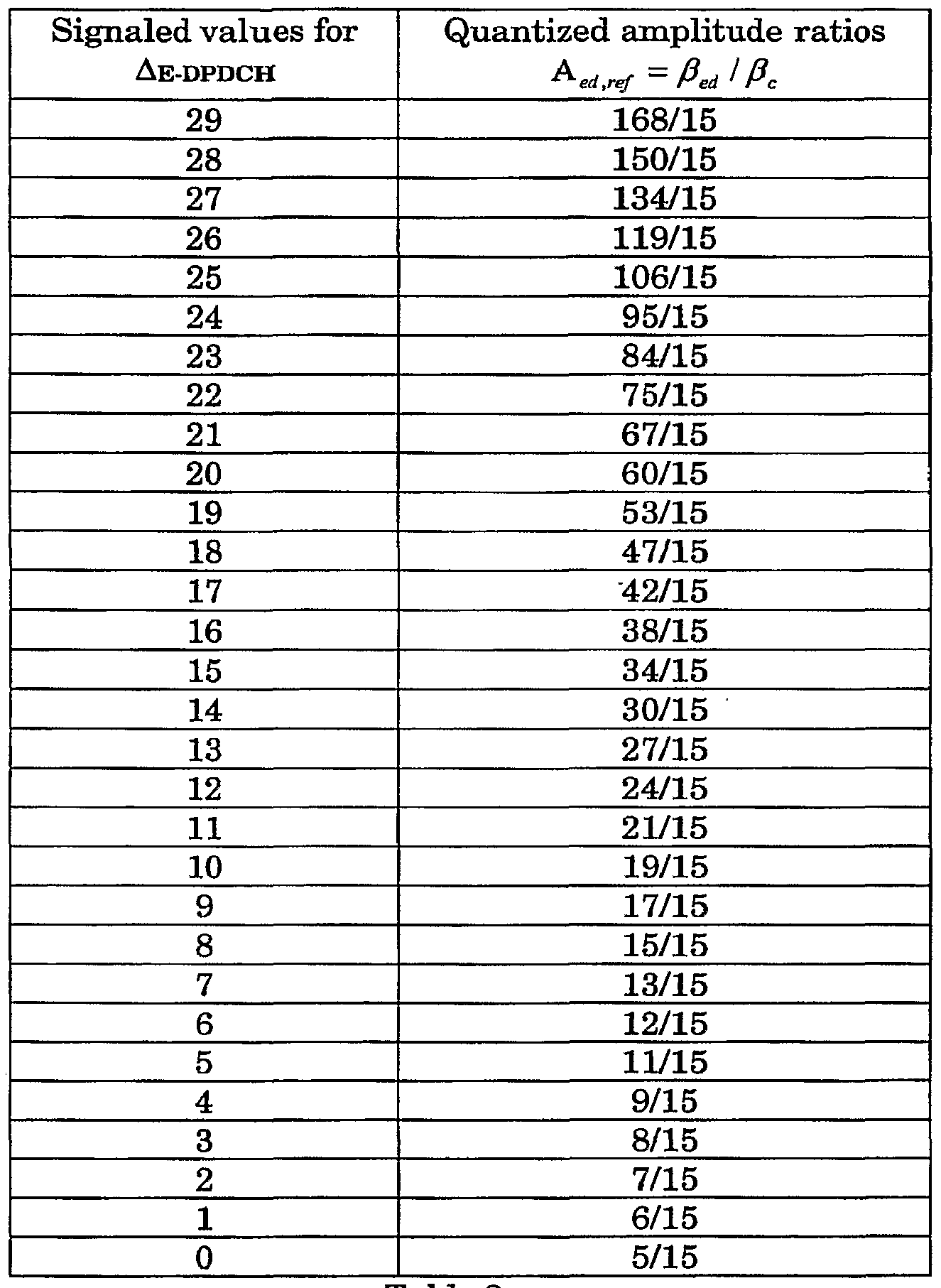
- the ratio Aed,ref is derived from the parameter ⁇ E-DPDCH signaled by Mgher layers for the selected reference E- TFC.
- Table 2 shows the meaning of the signaled values for ⁇ E-DPDCH.
- the reference E-TFC concept is used in order to avoid the signaling overhead which would result from signaling a ⁇ E-DPDCH value for all possible E-TFC values.
- this reference gain factor cannot directly be used for scaling the E-DPDCHs, since the reference E-TFC does not reflect the actual E- TFC in terms of number of data bits contained and number of E-DPDCHs required for transmission. Furthermore, the HARQ profile needs to be considered.
- ⁇ ej j harq is computed as follows: -i QAharg/20.
- a ed,j,harq Equation (5) where L e> ref is the number of E-DPDCHs used for the reference E-TFC, Lejis the number of E-DPDCHs used for the j th E-TFC, Ke, « / is the number of data bits of the reference E-TFC, Kej is the number of data bits of the j th E-TFC, and ⁇ harq is the HARQ offset for the specific data flow to be transmitted (so called "MAC-d flow”) as signaled by higher layers (see Table 3).
- Le.re f and Lej represent "equivalent" number of physical channels. Normally they are equal to number of used E-DPDCHs except for two cases:
- the unquantized gain factor ⁇ ed , k , j ,u q * s set to "v2 x ⁇ e d j , h ⁇ rq ⁇ o ⁇ -®" DPDCHs using spreading factor 2 and equal to ⁇ edjsh ⁇ rq otherwise.
- the ratio ⁇ ed k,j uq l P c ⁇ s now quantized according to Table 4 to obtain the ratio
- the gain factor used for the j th E-TFC in a compressed frame is given by:
- the gain factor used for the j* E-TFC in a compressed frame is given by:
- N p ⁇ ot,c is the number of pilot bits per slot on DPCCH in compressed frames
- N p u o t,N is the number of pilot bits per slot in non-compressed frames
- N s iots,i is the number of non-DTX slots in the first frame used for transmitting the data.
- ⁇ ed,Rj represents the gain factor that shall be applied to the j th E-TFC as follows:
- the present invention is related to a method of selecting an E-TFC.
- An SGP is set to the highest payload that may be transmitted.
- the SGP is calculated as follows:
- Ke,re / is the number of data bits of the reference E-TFC
- ⁇ harq is an HARQ offset for a specific data flow to be transmitted as signaled by higher layers
- Aed,ref is a ratio derived from a parameter ⁇ E-DPDCH signaled by higher layers for the selected reference E-TFC.
- Figure 1 shows a 3G cellular system
- Figure 2 shows an EU protocol architecture in a WTRU
- Figure 3 illustrates a MAC-e PDU generation
- Figure 4 is a flow diagram of a process for generating MAC-e PDUs by quantizing the maximum amount of scheduled and/or non-scheduled data allowed to be transmitted;
- Figure 5 is a block diagram of a process for generating MAC-e PDUs by quantizing the maximum amount of non-scheduled data allowed to be multiplexed;
- Figure 6 is a flow diagram of a process for generating a MAC-e PDU by reducing multiplexed data
- Figure 7 shows conventional uplink spreading and gain factor usage for HSUPA
- Figures 8A-8D taken together, are a flow diagram of a process for data transmission in accordance with the present invention
- Figure 9 is a flow diagram of a process for scheduling information without data in accordance with the present invention.
- WTRU includes but is not limited to a user equipment (UE), a mobile station, a fixed or mobile subscriber unit, a pager, or any other type of device capable of operating in a wireless environment.
- base station includes but is not limited to a Node-B, a site controller, an access point or any other type of interfacing device in a wireless environment.
- the present invention provides a method and apparatus for determining the payload for a specific SG. Furthermore, the present invention chooses a protocol data unit (PDU) size by checking all sizes in order to maximize high priority data transmissions.
- PDU protocol data unit
- the maximum PDU is the maximum supported transport block (TB) size (or EU medium access control (MAC-e) PDU size) in the set of allowed E- TFCs.
- TB transport block
- MAC-e EU medium access control
- the remaining available payload is the remaining amount of data that fits in the maximum PDU.
- the SGP size is the highest payload that may be transmitted according to the SG and a selected power offset (PO).
- the remaining non-scheduled payload is the remaining non- scheduled grant value (per MAC-d flow).
- the non-scheduled payload is the sum, for all non-scheduled dedicated MAC (MAC-d) flows, of MIN ("remaining non-scheduled payload", non- scheduled available payload), (i.e., the smallest one of the remaining non- scheduled payload and the non-scheduled available payload).
- the scheduled payload is the amount of data in 'the radio link control (RLC) buffer of all scheduled MAC-d flows that is allowed to be multiplexed with the highest priority selected MAC-d flow.
- Power offset attribute, in frequency division duplex (FDD)) is signaled to a WTRU.
- FDD frequency division duplex
- the power offset attribute represents the power offset between one or more E-DPDCHs and a reference E-DPDCH power level for a given E-TFC.
- the power offset attribute is set to achieve the required quality of service (QoS) in this MAC-d flow when carried alone in a MAC-e PDU and subsequently in the corresponding coded composite transport channel (CCTrCh) of an EU dedicated channel (E-DCH) type.
- Power offsets must be translated into Beta factors that are used in the base band (BB) to adjust the relative power levels of UL code channels such as DPDCHs and DPCCH in wideband code division multiple access (W-CDMA) FDD before feeding it into the transmitter.
- BB base band
- W-CDMA wideband code division multiple access
- the reference E-DPDCH power offset is signaled to the WTRU for at least one reference E-TFC.
- the SG is simply an indication of the maximum E-DPDCH to DPCCH power ratio that the WTRU is allowed to use for scheduled data in the following transmission.
- the SG is provided to the E-TFC selection function to support the selection of the "best" format for the upcoming transmission.
- FIGS. 8A-8D taken together, are a flow diagram of a data transmission procedure 800 in accordance with the present invention.
- a MAC-d flow with a PO is selected that allows highest-priority data to be transmitted.
- the selection of the MAC-d flow may be performed randomly.
- step 804 based on the MAC-d flow selected, the MAC-d flow(s) that can be multiplexed are identified and the MAC-d flow(s) that cannot be multiplexed are ignored.
- step 806 based on the PO selected, E-TFC restriction is performed and the maximum supported payload, (i.e., maximum MAC-e PDU size), that can be sent in the next transmission timing interval (TTI) is determined.”
- step 808 the "Remaining Available Payload" is set to the maximum supported payload.
- step 810 if the upcoming transmission overlaps with a compressed mode (CM) gap on 10ms TTI, the current SG is scaled down.
- CM compressed mode
- CM is special in that parts of the frame are sent at a higher power, as compared to normal uncompressed frames. Therefore, the SG must be "scaled” to take the presence of CM into account, by serving as a numerical adjustment.
- the DPCCH power assumed for the SG in a compressed frame is the actual DPCCH power in the compressed frame minus the "pilot power”.
- the scheduled grant payload (SGP) is set to the highest payload that can be transmitted according to the SG and the selected PO as follows:
- Equation (10) where TBsize is the maximum supported payload (transport block size) and j is the considered TFC that supports the maximum supported payload.
- the SG MIN(SGP, TBsize).
- Equation (14) SG TBSize ' L eJ
- DPDCHs used for the j th E-TFC as described earlier are used for the j th E-TFC as described earlier.
- Lej 1 in the case of HSUPA WTRU Category 1 where only 1 E-DPDCH with an SF not smaller than 4 is possible. Because Kej is the number of data bits of the j th E-TFC under consideration, the factor that maximizes the throughput as described is when the factor TBSize / Kej is the closest possible quantized value to 1 as a function of the configured E-TFCSs.
- the SGP in Equations (15) and (16) will yield values that do not exceed a transport block size, (i.e., TBSize), that corresponds to a higher reference E-TFC and that is not lower than the specific reference E-TFC used in the computation, unless the specific reference E-TFC is the smallest one.
- TBSize transport block size
- the "Remaining Non-scheduled Payload” is set to the value of the grant.
- the "Non scheduled Payload” is set to the sum of MIN ("Remaining Non-scheduled Payload", non-scheduled available payload) for all non scheduled MAC-d flow(s).
- step 818 If it is determined in step 818 that scheduling information needs to be transmitted, and if in step 820 the "Remaining Available Payload" is determined to be greater than the sum of the "Scheduled Grant Payload", the "Non-scheduled Payload” and the size of the scheduling information, (i.e., the TB size can carry all of the data the WTRU can possibly send), the sum of the "Scheduled Grant Payload” + “Non-scheduled Payload”+ size of the scheduling information is quantized to the next smaller supported E-TFC (step 822). In step 824, the "Scheduled Grant Payload” is set to the quantized sum minus the "Non- scheduled Payload” and the size of the scheduling information. In step 826, the "Remaining Available Payload” is set to the supported payload in the next smaller supported E-TFC. In step 828, the size of the Scheduling Information is subtracted from the "Remaining Available Payload".
- step 818 If it is determined in step 818 that scheduling information does not need to be transmitted, and if the "Remaining Available Payload" is determined in step 830 to be greater than the sum of the "Scheduled Grant Payload" and the "Non-scheduled Payload” (i.e., the TB size can carry all of the data the WTRU can possibly send), the sum of the "Scheduled Grant Payload” and the "Non- scheduled Payload” is quantized to the next smaller supported E-TFC (step 832), the "Scheduled Grant Payload” is set to the quantized sum minus the "Non- scheduled Payload” (step 834) and the "Remaining Available Payload” is set to the supported payload in the next smaller supported E-TFC (step 836).
- one of a plurality of logical channels is selected based on an order of priority (step 838), and then steps 840-850 are performed for the selected logical channel before looping back to step 838 if it is determined in step 852 that there is at least one more logical channel from which to select.
- step 840 a determination is made as to whether the selected logical channel belongs to a MAC-d flow with a non-scheduled grant [0075] If the determination of step 840 is positive, the "Remaining Non- scheduled Payload" corresponding to the MAC-d flow on which this logical channel is mapped is considered (step 842), and an RLC PDU size is chosen from the allowed set in the selected logical channel to fill the MAC-e PDU by choosing the PDU size that gives the most amount of data which is less than MINC'Remaining Non-scheduled Payload", Available Data for this logical channel, "Remaining Available Payload") (step 844). In order to check which PDU size provides the largest amount of data, it is necessary to check for every size allowed. In step 846, the corresponding bits if any are subtracted from the "Remaining Available Payload" and the "Remaining Non-scheduled Payload” (taking into account the MAC-e headers).
- step 840 If the determination of step 840 is negative, an RLC PDU size is chosen from the allowed set in the selected logical channel to fill the MAC-e PDU by choosing the PDU size that gives the most amount of data which is less than MIN ("Scheduled Grant Payload", Available Data for this logical channel, "Remaining Available Payload") (step 848). In order to check which PDU size provides the largest amount of data, it is necessary to check for every size allowed. In step 850, the corresponding bits if any are subtracted from the "Remaining Available Payload" and the "Scheduled Grant Payload" (taking into account the MAC- headers).
- step 852 If it is determined in step 852 that there are no more logical channels to select from, and if it is determined in step 854 that scheduling information needs to be transmitted, scheduling information is added to the MAC-e PDU (step 856) and the smallest E-TFC that can carry the resulting MAC-e PDU is determined (step 858).
- step 854 If it is determined in step 854 that scheduling information does not need to be transmitted, the smallest E-TFC that can carry the resulting MAC-e PDU is determined (step 860) and if the padding allows scheduling information to be sent, it is added to the MAC-e PDU (step 862). Finally, in step 864, the maximum number of hybrid automatic repeat request (HARQ) transmissions is set to the maximum among the maximum number of HARQ transmissions of the HARQ profiles of the MAC-d flows selected for transmissions.
- HARQ hybrid automatic repeat request
- step 905 If in step 905 it is determined that scheduling information is to be transmitted without data, the "control-only" HARQ profile is selected (step 910), the MAC-e PDU is filled with the scheduling information (step 915) and the smallest E-TFC is selected (step 920).
- the scheduling information is sent alone (no data)
- the PO to be used is the one configured by an RRC in the information element (IE) Tower Offset for Scheduling Information" in the "E-DPDCH Info.” This is part of an RRC-layer signaled configuration information for enhanced UL, whereby the RNC signals parameters to the WTRU for setting up and running the e-MAC.
- a method of selecting an enhanced uplink (EU) transport format combination comprising setting a scheduling grant payload (SGP) to the highest payload that can be transmitted.
- EU enhanced uplink
- SGP scheduling grant payload
- SG is a serving grant
- TBsize is a transport block size that provides a maximum supported payload
- ⁇ c is a gain factor of a dedicated physical control channel (DPCCH)
- E-DPDCHs EU dedicated physical data channels
- Lej is the number of E-DPDCHs used for the j th E-TFC
- Ke ref is the number of data bits of the reference E-TFC
- Kej is the number of data bits of the jth E-TFC
- ⁇ harq is a hybrid automatic repeat request (HARQ) offset for a specific data flow to be transmitted as signaled by higher layers.
- HARQ hybrid automatic repeat request
- invention 9 further comprising: performing E-TFC restriction; and deterniining the maximum supported payload that can be sent in a next transmission timing interval (TTI).
- TTI transmission timing interval
- a wireless transmit/receive unit for implementing the method as in any one of embodiments 1-11.
- a method of selecting an enhanced uplink (EU) transport format combination (E-TPC) comprising: setting a scheduling grant payload (SGP) to the highest payload that can be transmitted, wherein the SGP is calculated as follows:
- SGP K e re f , where SG is a serving grant, L e ,ref is the number of EU dedicated physical data channels (E-DPDCHs) used for a selected reference E-TFC, Ke,re / is the number of data bits of the reference E-TFC, ⁇ harq is a hybrid automatic repeat request (HARQ) offset for a specific data flow to be transmitted as signaled by higher layers, and Aed,ref is a ratio derived from a parameter ⁇ E-DPDCH signaled by higher layers for the selected reference E- TFC.
- E-DPDCHs EU dedicated physical data channels
- Ke,re / is the number of data bits of the reference E-TFC
- ⁇ harq is a hybrid automatic repeat request (HARQ) offset for a specific data flow to be transmitted as signaled by higher layers
- Aed,ref is a ratio derived from a parameter ⁇ E-DPDCH signaled by higher layers for the selected reference E- TFC.
- the method of embodiment 15 further comprising: based on the MAC-d flow selected, identifying the MAC-d flow(s) that can be multiplexed; and ignoring the MAC-d flow(s) that cannot be multiplexed.
- the method of embodiment 17 further comprising: performing E-TFC restriction; and determining the maximum supported payload that can be sent in a next transmission timing interval (TTI).
- TTI transmission timing interval
- a wireless transmit/receive unit for implementing the method as in any one of embodiments 13-19.
- a method of selecting an enhanced uplink (EU) transport format combination comprising: setting a scheduling grant payload (SGP) to the highest payload that can be transmitted; and selecting a dedicated channel medium access control (MAC-d) flow with a power offset (PO) that allows highest-priority data to be transmitted.
- SGP scheduling grant payload
- MAC-d dedicated channel medium access control
- PO power offset
- the method of embodiment 21 further comprising: based on the MAC-d flow selected, identifying the MAC-d flow(s) that can be multiplexed; and ignoring the MAC-d flow(s) that cannot be multiplexed.
- the method of embodiment 23 further comprising: performing E-TFC restriction; and determining the maximum supported payload that can be sent in a next transmission timing interval (TTI).
- TTI transmission timing interval
- L e,ref A ed,ref ' l the number of EU dedicated physical data channels (E-DPDCHs) used for a selected reference E-TFC
- Ke, r e / is the number of data bits of the reference E-TFC
- ⁇ harq is a hybrid automatic repeat request (HARQ) offset for a specific data flow to be transmitted as signaled by higher layers
- Aed.ref is a ratio derived from a parameter ⁇ E-DPDCH signaled by higher layers for the selected reference E- TFC.
- a wireless transmit/receive unit for implementing the method as in any one of embodiments 21-27.
- ROM read only memory
- RAM random access memory
- register cache memory
- semiconductor memory devices magnetic media such as internal hard disks and removable disks, magneto- optical media, and optical media such as CD-ROM disks, and digital versatile disks (DVDs).
- Suitable processors include, by way of example, a general purpose processor, a special purpose processor, a conventional processor, a digital signal processor (DSP), a plurality of microprocessors, one or more microprocessors in association with a DSP core, a controller, a microcontroller, Application Specific Integrated Circuits (ASICs), Field Programmable Gate Arrays (FPGAs) circuits, any other type of integrated circuit (IC), and/or a state machine.
- a processor in association with software may be used to implement a radio frequency transceiver for use in a wireless transmit receive unit (WTRU), user equipment (UE), terminal, base station, radio network controller (RNC), or any host computer.
- WTRU wireless transmit receive unit
- UE user equipment
- RNC radio network controller
- the WTRU may be used in conjunction with modules, implemented in hardware and/or software, such as a camera, a video camera module, a videophone, a speakerphone, a vibration device, a speaker, a microphone, a television transceiver, a hands free headset, a keyboard, a Bluetooth ® module, a frequency modulated (FM) radio unit, a liquid crystal display (LCD) display unit, an organic light-emitting diode (OLED) display unit, a digital music player, a media player, a video game player module, an Internet browser, and/or any wireless local area network (WLAN) module.
- modules implemented in hardware and/or software, such as a camera, a video camera module, a videophone, a speakerphone, a vibration device, a speaker, a microphone, a television transceiver, a hands free headset, a keyboard, a Bluetooth ® module, a frequency modulated (FM) radio unit, a liquid crystal display (LCD) display unit, an organic light-
Landscapes
- Engineering & Computer Science (AREA)
- Computer Networks & Wireless Communication (AREA)
- Signal Processing (AREA)
- Quality & Reliability (AREA)
- Databases & Information Systems (AREA)
- Mobile Radio Communication Systems (AREA)
- Detection And Prevention Of Errors In Transmission (AREA)
- Time-Division Multiplex Systems (AREA)
- Communication Control (AREA)
- Toys (AREA)
Abstract
Description




Claims


Priority Applications (13)
| Application Number | Priority Date | Filing Date | Title |
|---|---|---|---|
| EP07796698A EP2039082B1 (en) | 2006-07-06 | 2007-07-05 | Wireless communication method of selecting an enhanced uplink transport format combination by setting a scheduling grant payload to the highest payload that can be transmitted |
| HK10100523.4A HK1133504B (en) | 2006-07-06 | 2007-07-05 | Wireless communication method of selecting an enhanced uplink transport format combination by setting a scheduling grant payload to the highest payload that can be transmitted |
| JP2009518370A JP4913869B2 (en) | 2006-07-06 | 2007-07-05 | Wireless communication method for selecting extended uplink transport format combination by setting scheduling grant payload to maximum transmittable payload |
| CA2657404A CA2657404C (en) | 2006-07-06 | 2007-07-05 | Wireless communication method of selecting an enhanced uplink transport format combination by setting a scheduling grant payload to the highest payload that can be transmitted |
| MX2009000252A MX2009000252A (en) | 2006-07-06 | 2007-07-05 | WIRELESS COMMUNICATION METHOD FOR SELECTING AN IMPROVED LINK TRANSPORTATION FORMAT COMBINATION BY ESTABLISHING USEFUL PROGRAMMING GRANTING INFORMATION TO THE HIGHEST USEFUL INFORMATION THAT CAN BE TRANSMITTED. |
| KR1020097002900A KR101297564B1 (en) | 2006-07-06 | 2007-07-05 | Wireless communication method of selecting an enhanced uplink transport format combination by setting a scheduling grant payload to the highest payload that can be transmitted |
| AT07796698T ATE488933T1 (en) | 2006-07-06 | 2007-07-05 | WIRELESS COMMUNICATIONS METHOD FOR SELECTING AN EXTENDED UPLINK TRANSPORT FORMAT COMBINATION BY SETTING PROCESSOR PAYLOAD TO THE HIGHEST TRANSFERABLE USAGE DATA AMOUNT |
| CN2007800251879A CN101536426B (en) | 2006-07-06 | 2007-07-05 | Wireless Communication Method for Selecting Enhanced Uplink Transport Format Combination by Setting Scheduling Grant Payload to Highest Transmittable Payload |
| BRPI0713224-7A BRPI0713224A2 (en) | 2006-07-06 | 2007-07-05 | method for wireless communication in which a combination of enhanced downlink transport formats is selected by setting a data set permission schedule to the maximum that a data set can be transmitted |
| DE602007010631T DE602007010631D1 (en) | 2006-07-06 | 2007-07-05 | WIRELESS COMMUNICATION METHOD FOR SELECTION OF AN ADVANCED UPLINK TRANSPORT FORMATION COMBINATION BY ADJUSTING EXIT CONTROL UTILITY DATA TO THE HIGHEST TRANSFERABLE USER DATA QUANTITY |
| AU2007269598A AU2007269598C1 (en) | 2006-07-06 | 2007-07-05 | Wireless communication method of selecting an enhanced uplink transport format combination by setting a scheduling grant payload to the highest payload that can be transmitted |
| KR1020097002213A KR101159606B1 (en) | 2006-07-06 | 2007-07-05 | Wireless communication method of selecting an enhanced uplink transport format combination by setting a scheduling grant payload to the highest payload that can be transmitted |
| IL196195A IL196195A (en) | 2006-07-06 | 2008-12-25 | Wireless communication method of selecting an enhanced uplink transport format combination by setting a scheduling grant payload to the highest payload that can be transmitted |
Applications Claiming Priority (2)
| Application Number | Priority Date | Filing Date | Title |
|---|---|---|---|
| US81884806P | 2006-07-06 | 2006-07-06 | |
| US60/818,848 | 2006-07-06 |
Publications (2)
| Publication Number | Publication Date |
|---|---|
| WO2008005503A2 true WO2008005503A2 (en) | 2008-01-10 |
| WO2008005503A3 WO2008005503A3 (en) | 2008-04-17 |
Family
ID=38721453
Family Applications (1)
| Application Number | Title | Priority Date | Filing Date |
|---|---|---|---|
| PCT/US2007/015496 Ceased WO2008005503A2 (en) | 2006-07-06 | 2007-07-05 | Wireless communication method of selecting an enhanced uplink transport format combination by setting a scheduling grant payload to the highest payload that can be transmitted |
Country Status (16)
| Country | Link |
|---|---|
| US (3) | US8000291B2 (en) |
| EP (3) | EP2523406A1 (en) |
| JP (2) | JP4913869B2 (en) |
| KR (2) | KR101297564B1 (en) |
| CN (7) | CN101536426B (en) |
| AT (1) | ATE488933T1 (en) |
| AU (1) | AU2007269598C1 (en) |
| BR (1) | BRPI0713224A2 (en) |
| CA (1) | CA2657404C (en) |
| DE (1) | DE602007010631D1 (en) |
| ES (1) | ES2356692T3 (en) |
| IL (1) | IL196195A (en) |
| MX (1) | MX2009000252A (en) |
| RU (1) | RU2406243C2 (en) |
| TW (2) | TWI437854B (en) |
| WO (1) | WO2008005503A2 (en) |
Cited By (5)
| Publication number | Priority date | Publication date | Assignee | Title |
|---|---|---|---|---|
| CN101860919A (en) * | 2010-05-28 | 2010-10-13 | 中国科学院计算技术研究所 | Transmission Resource Scheduling Method in Wireless Communication System |
| JP2011519244A (en) * | 2008-04-30 | 2011-06-30 | サムスン エレクトロニクス カンパニー リミテッド | Data size adaptation system and method in UE |
| WO2013115690A1 (en) * | 2012-01-30 | 2013-08-08 | Telefonaktiebolaget L M Ericsson (Publ) | Methods and network nodes for scheduling transmission |
| GB2500287A (en) * | 2012-11-02 | 2013-09-18 | Renesas Mobile Corp | Improving transmission resource utilization by populating a transmission data allocation with data equal to a size of any remaining space |
| CN104540210A (en) * | 2008-10-31 | 2015-04-22 | 交互数字专利控股公司 | Method for power distribution of uplink carriers, WTRU, and method implemented in WTRU |
Families Citing this family (26)
| Publication number | Priority date | Publication date | Assignee | Title |
|---|---|---|---|---|
| BRPI0412056A (en) * | 2003-09-26 | 2006-08-15 | Interdigital Tech Corp | determining gain factors for wireless communication power |
| JP4538357B2 (en) * | 2005-03-29 | 2010-09-08 | 株式会社エヌ・ティ・ティ・ドコモ | Transmission rate control method, mobile station, radio base station, and radio network controller |
| GB0511058D0 (en) * | 2005-05-31 | 2005-07-06 | Nokia Corp | A method of controlling power |
| TWI388151B (en) * | 2005-08-10 | 2013-03-01 | Koninkl Philips Electronics Nv | A method of operating a communication device and system, a communication device and a system including the communication device |
| CN101536426B (en) * | 2006-07-06 | 2012-09-26 | 北京新岸线移动通信技术有限公司 | Wireless Communication Method for Selecting Enhanced Uplink Transport Format Combination by Setting Scheduling Grant Payload to Highest Transmittable Payload |
| PT2095529T (en) * | 2006-12-21 | 2018-07-23 | Ericsson Telefon Ab L M | Control channel symbol transmission method and apparatus |
| TW201251496A (en) * | 2006-12-28 | 2012-12-16 | Interdigital Tech Corp | Efficient uplink operation with high instantaneous data rates |
| TWI521927B (en) | 2007-01-09 | 2016-02-11 | 皇家飛利浦電子股份有限公司 | Wireless communication system |
| CN101689982B (en) * | 2007-05-01 | 2013-06-05 | 诺基亚公司 | Uplink transport format selection |
| AR067822A1 (en) * | 2007-08-06 | 2009-10-21 | Interdigital Tech Corp | LTE MEASUREMENT DEFINITIONS FOR INTER-TECHNOLOGY MEASUREMENT RADIO WITH NO-3GPP RADIO ACCESS |
| KR101415201B1 (en) * | 2007-08-28 | 2014-07-04 | 삼성전자주식회사 | Apparatus and method for scheduling high speed video stream service |
| CN103490853B (en) * | 2007-09-28 | 2017-06-27 | 交互数字专利控股公司 | Method and radio transmitting/receiving unit for generating and transmitting RLC PDU |
| TWI514809B (en) * | 2007-09-28 | 2015-12-21 | Interdigital Patent Holdings | Enhanced transmission format combination selection method and device in wireless communication |
| JP4999724B2 (en) * | 2008-02-18 | 2012-08-15 | 株式会社エヌ・ティ・ティ・ドコモ | Mobile communication method, mobile communication system, and radio base station |
| AR073833A1 (en) | 2008-10-20 | 2010-12-01 | Interdigital Patent Holdings | METHODS FOR THE ASCENDING CONTROL OF INFORMATION TRANSMISSION TO ADD CARRIER ONA |
| CN101741431B (en) * | 2008-11-04 | 2012-08-08 | 华为技术有限公司 | Method and device for determining transmitting power |
| CN104902513A (en) | 2009-04-24 | 2015-09-09 | 交互数字专利控股公司 | Method for generating a radio link control protocol data unit for multi-carrier operation |
| PL2908585T3 (en) * | 2009-06-19 | 2017-12-29 | Interdigital Patent Holdings, Inc. | Signaling uplink control information in lte-a |
| WO2011025434A1 (en) * | 2009-08-31 | 2011-03-03 | Telefonaktiebolaget Lm Ericsson (Publ) | Method and arrangement in a wireless communication system |
| EP2484163A2 (en) * | 2009-10-02 | 2012-08-08 | InterDigital Patent Holdings, Inc. | Method and apparatus for transmit power control for multiple antenna transmissions in the uplink |
| US20110250918A1 (en) * | 2010-04-07 | 2011-10-13 | Yu-Chih Jen | Communication device and method thereof |
| JP5147898B2 (en) * | 2010-06-10 | 2013-02-20 | 株式会社エヌ・ティ・ティ・ドコモ | Radio control apparatus and communication control method |
| WO2012162353A1 (en) | 2011-05-23 | 2012-11-29 | Interdigital Patent Holdings, Inc. | Apparatus and methods for group wireless transmit/receive unit (wtru) handover |
| CN102833841A (en) * | 2011-06-13 | 2012-12-19 | 中兴通讯股份有限公司 | Method and UE (user equipment) for determining scheduling authorization and base station |
| US9414407B2 (en) * | 2013-09-27 | 2016-08-09 | Broadcom Corporation | Enhanced scheduling information transmission in a heterogeneous network |
| US10512065B2 (en) * | 2016-05-31 | 2019-12-17 | Qualcomm Incorporated | Flexible control information reporting |
Family Cites Families (40)
| Publication number | Priority date | Publication date | Assignee | Title |
|---|---|---|---|---|
| US6850540B1 (en) * | 1999-10-28 | 2005-02-01 | Telefonaktiebolaget Lm Ericsson (Publ) | Packet scheduling in a communications system |
| IL100213A (en) | 1990-12-07 | 1995-03-30 | Qualcomm Inc | CDMA microcellular telephone system and distributed antenna system therefor |
| EP1058975B1 (en) | 1998-02-27 | 2003-08-20 | Siemens Aktiengesellschaft | Tdd telecommunications systems with wireless telecommunication based on code and time-division multiplex |
| US6625650B2 (en) | 1998-06-27 | 2003-09-23 | Intel Corporation | System for multi-layer broadband provisioning in computer networks |
| KR100382470B1 (en) | 1999-04-08 | 2003-05-01 | 엘지전자 주식회사 | Radio Protocol in IMT-2000 Mobile Communication System |
| AU2001236304A1 (en) | 2000-02-25 | 2001-09-03 | Telefonaktiebolaget Lm Ericsson (Publ) | Overload handling in a communications system |
| US7227851B1 (en) * | 2000-11-17 | 2007-06-05 | Lucent Technologies Inc. | Transport channel multiplexing system and method |
| US6813284B2 (en) | 2001-01-17 | 2004-11-02 | Qualcomm Incorporated | Method and apparatus for allocating data streams given transmission time interval (TTI) constraints |
| KR100842654B1 (en) * | 2002-09-19 | 2008-06-30 | 삼성전자주식회사 | Transmission Method Determination Method for Transmitting Multicast Multimedia Broadcasting Service in Mobile Communication System |
| US7155236B2 (en) | 2003-02-18 | 2006-12-26 | Qualcomm Incorporated | Scheduled and autonomous transmission and acknowledgement |
| US7321780B2 (en) | 2003-04-30 | 2008-01-22 | Motorola, Inc. | Enhanced uplink rate selection by a communication device during soft handoff |
| KR100539930B1 (en) * | 2003-12-22 | 2005-12-28 | 삼성전자주식회사 | Method for selecting transport format for optimization of data-transmission in code division multiple access mobile communication system |
| KR100827105B1 (en) | 2004-02-13 | 2008-05-02 | 삼성전자주식회사 | Method and apparatus for fast handover through high speed ranging in broadband wireless communication system |
| KR100713442B1 (en) | 2004-02-14 | 2007-05-02 | 삼성전자주식회사 | Transmission Method of Scheduling Information through Enhanced Reverse Dedicated Channel in Mobile Communication System |
| KR100819256B1 (en) * | 2004-05-06 | 2008-04-02 | 삼성전자주식회사 | Method and apparatus for setting power for transmitting signaling information through enhanced uplink dedicated channel |
| US8259752B2 (en) | 2004-05-07 | 2012-09-04 | Interdigital Technology Corporation | Medium access control layer architecture for supporting enhanced uplink |
| US7580388B2 (en) | 2004-06-01 | 2009-08-25 | Lg Electronics Inc. | Method and apparatus for providing enhanced messages on common control channel in wireless communication system |
| CN100583718C (en) * | 2004-06-09 | 2010-01-20 | 三星电子株式会社 | Method and device for data transmission in mobile telecommunications system |
| CN1710829A (en) * | 2004-06-18 | 2005-12-21 | 北京三星通信技术研究有限公司 | Method for supporting low data-rate in reinforced upstream special channel of WCDMA system |
| US7885245B2 (en) | 2004-07-19 | 2011-02-08 | Interdigital Technology Corporation | Method and apparatus for enhanced uplink multiplexing |
| US7804850B2 (en) | 2004-10-01 | 2010-09-28 | Nokia Corporation | Slow MAC-e for autonomous transmission in high speed uplink packet access (HSUPA) along with service specific transmission time control |
| EP1643690B1 (en) * | 2004-10-01 | 2008-04-02 | Matsushita Electric Industrial Co., Ltd. | Quality-of-Service (QoS)-aware scheduling for uplink transmissions on dedicated channels |
| KR100651548B1 (en) * | 2004-11-05 | 2006-11-29 | 삼성전자주식회사 | Method and apparatus for scheduling uplink data transmission in mobile telecommunication system using ue-id |
| DE602004015333D1 (en) * | 2004-12-15 | 2008-09-04 | Matsushita Electric Industrial Co Ltd | Support for guaranteed bitrate traffic for uplink transmissions |
| US8189615B2 (en) | 2004-12-23 | 2012-05-29 | Nokia Corporation | Method and apparatus for communicating scheduling information from a UE to a radio access network |
| CN1794623A (en) * | 2004-12-24 | 2006-06-28 | 北京三星通信技术研究有限公司 | Method of setting retransmission power deviation reduction value based on MAC-e PDU of QoS |
| JP2006191320A (en) | 2005-01-05 | 2006-07-20 | Ntt Docomo Inc | Transmission rate control method and mobile station |
| KR100918761B1 (en) * | 2005-01-06 | 2009-09-24 | 삼성전자주식회사 | Gain Factor Setting Method for Uplink Service in Wireless Communication System |
| WO2006082627A1 (en) | 2005-02-01 | 2006-08-10 | Mitsubishi Denki Kabushiki Kaisha | Transmission control method, mobile station and communication system |
| KR100678192B1 (en) * | 2005-02-04 | 2007-02-02 | 삼성전자주식회사 | Method and apparatus for setting gain factors of dedicated physical channels in mobile communication system |
| EP1847074B1 (en) * | 2005-02-07 | 2016-03-30 | Telefonaktiebolaget LM Ericsson (publ) | Methods and arrangements for handling unreliable scheduling grants in a telecommunication network |
| DE602005011101D1 (en) | 2005-04-01 | 2009-01-02 | Panasonic Corp | Scheduling of terminals in a radio communication system |
| CN100544226C (en) * | 2005-04-19 | 2009-09-23 | 华为技术有限公司 | A method for obtaining gain factor of uplink enhanced dedicated physical data channel |
| US7408895B2 (en) | 2005-04-20 | 2008-08-05 | Interdigital Technology Corporation | Method and apparatus for scheduling transmissions via an enhanced dedicated channel |
| US8179836B2 (en) * | 2005-04-20 | 2012-05-15 | Interdigital Technology Corporation | Method and apparatus for controlling transmissions via an enhanced dedicated channel |
| US8116292B2 (en) * | 2005-04-29 | 2012-02-14 | Interdigital Technology Corporation | MAC multiplexing and TFC selection procedure for enhanced uplink |
| FI1929826T7 (en) * | 2005-09-29 | 2024-03-08 | Nokia Technologies Oy | Apparatus, method and computer program product to request a data rate increase based on ability to transmit at least one more selected data unit |
| US7729715B2 (en) * | 2005-12-30 | 2010-06-01 | Motorola, Inc. | Method and apparatus for power reduction for E-TFC selection |
| CN101536426B (en) * | 2006-07-06 | 2012-09-26 | 北京新岸线移动通信技术有限公司 | Wireless Communication Method for Selecting Enhanced Uplink Transport Format Combination by Setting Scheduling Grant Payload to Highest Transmittable Payload |
| US7692638B2 (en) | 2007-01-03 | 2010-04-06 | Apple Inc. | Error compensation for multi-touch surfaces |
-
2007
- 2007-07-05 CN CN2007800251879A patent/CN101536426B/en active Active
- 2007-07-05 CN CN201210276472.0A patent/CN102891729B/en active Active
- 2007-07-05 JP JP2009518370A patent/JP4913869B2/en not_active Expired - Fee Related
- 2007-07-05 MX MX2009000252A patent/MX2009000252A/en active IP Right Grant
- 2007-07-05 DE DE602007010631T patent/DE602007010631D1/en active Active
- 2007-07-05 ES ES07796698T patent/ES2356692T3/en active Active
- 2007-07-05 EP EP12164160A patent/EP2523406A1/en not_active Withdrawn
- 2007-07-05 CN CN201210276172.2A patent/CN102883369B/en active Active
- 2007-07-05 CN CN201210276474XA patent/CN102801510B/en active Active
- 2007-07-05 EP EP07796698A patent/EP2039082B1/en not_active Not-in-force
- 2007-07-05 CA CA2657404A patent/CA2657404C/en not_active Expired - Fee Related
- 2007-07-05 KR KR1020097002900A patent/KR101297564B1/en not_active Expired - Fee Related
- 2007-07-05 US US11/773,579 patent/US8000291B2/en active Active
- 2007-07-05 KR KR1020097002213A patent/KR101159606B1/en not_active Expired - Fee Related
- 2007-07-05 BR BRPI0713224-7A patent/BRPI0713224A2/en not_active Application Discontinuation
- 2007-07-05 RU RU2009103921/09A patent/RU2406243C2/en active
- 2007-07-05 CN CN2012102764792A patent/CN102801512B/en active Active
- 2007-07-05 CN CN2012102764788A patent/CN102801511B/en active Active
- 2007-07-05 EP EP10191419A patent/EP2293499A1/en not_active Withdrawn
- 2007-07-05 WO PCT/US2007/015496 patent/WO2008005503A2/en not_active Ceased
- 2007-07-05 AT AT07796698T patent/ATE488933T1/en not_active IP Right Cessation
- 2007-07-05 AU AU2007269598A patent/AU2007269598C1/en not_active Ceased
- 2007-07-05 CN CN201210276473.5A patent/CN102821451B/en active Active
- 2007-07-06 TW TW097105093A patent/TWI437854B/en not_active IP Right Cessation
- 2007-07-06 TW TW096124829A patent/TWI401929B/en not_active IP Right Cessation
-
2008
- 2008-12-25 IL IL196195A patent/IL196195A/en not_active IP Right Cessation
-
2011
- 2011-08-15 US US13/210,049 patent/US8243676B2/en not_active Expired - Fee Related
-
2012
- 2012-01-19 JP JP2012008997A patent/JP5363597B2/en not_active Expired - Fee Related
- 2012-07-11 US US13/546,849 patent/US20120281660A1/en not_active Abandoned
Cited By (10)
| Publication number | Priority date | Publication date | Assignee | Title |
|---|---|---|---|---|
| JP2011519244A (en) * | 2008-04-30 | 2011-06-30 | サムスン エレクトロニクス カンパニー リミテッド | Data size adaptation system and method in UE |
| US9288714B2 (en) | 2008-04-30 | 2016-03-15 | Samsung Electronics Co., Ltd | System and method for data size adaptation in a UE |
| EP3229521A1 (en) * | 2008-04-30 | 2017-10-11 | Samsung Electronics Co., Ltd | System and method for data size adaptation in a ue |
| CN104540210A (en) * | 2008-10-31 | 2015-04-22 | 交互数字专利控股公司 | Method for power distribution of uplink carriers, WTRU, and method implemented in WTRU |
| CN101860919A (en) * | 2010-05-28 | 2010-10-13 | 中国科学院计算技术研究所 | Transmission Resource Scheduling Method in Wireless Communication System |
| WO2013115690A1 (en) * | 2012-01-30 | 2013-08-08 | Telefonaktiebolaget L M Ericsson (Publ) | Methods and network nodes for scheduling transmission |
| US8971271B2 (en) | 2012-01-30 | 2015-03-03 | Telefonaktiebolaget L M Ericsson (Publ) | Methods and network nodes for scheduling transmission |
| GB2500287A (en) * | 2012-11-02 | 2013-09-18 | Renesas Mobile Corp | Improving transmission resource utilization by populating a transmission data allocation with data equal to a size of any remaining space |
| GB2500287B (en) * | 2012-11-02 | 2014-04-16 | Broadcom Corp | Method and apparatus for improving transmission resource utilization |
| US9210718B2 (en) | 2012-11-02 | 2015-12-08 | Broadcom Corporation | Method and apparatus for improving transmission resource utilization |
Also Published As
Similar Documents
| Publication | Publication Date | Title |
|---|---|---|
| EP2039082B1 (en) | Wireless communication method of selecting an enhanced uplink transport format combination by setting a scheduling grant payload to the highest payload that can be transmitted | |
| CN101080882B (en) | Radio communication system, mobile station, base station, radio communication system control method used for the same, and program of the same | |
| JP2005328525A (en) | Method and apparatus for selecting optimal scheduling cell of soft handover terminal in uplink packet transmission system | |
| US7941168B2 (en) | Mobile communication system, radio base station, mobile station and mobile communication method to control uplink and downlink channel for synchronization | |
| KR101174934B1 (en) | Method and apparatus for transmitting/receiving scheduling grants of uplink data transmission in mobile telecommunications system | |
| HK1155299A (en) | Wireless communication method of selecting an enhanced uplink transport format combination by setting a scheduling grant payload to the highest payload that can be transmitted | |
| HK1133504B (en) | Wireless communication method of selecting an enhanced uplink transport format combination by setting a scheduling grant payload to the highest payload that can be transmitted |
Legal Events
| Date | Code | Title | Description |
|---|---|---|---|
| WWE | Wipo information: entry into national phase |
Ref document number: 200780025187.9 Country of ref document: CN |
|
| 121 | Ep: the epo has been informed by wipo that ep was designated in this application |
Ref document number: 07796698 Country of ref document: EP Kind code of ref document: A2 |
|
| DPE1 | Request for preliminary examination filed after expiration of 19th month from priority date (pct application filed from 20040101) | ||
| WWE | Wipo information: entry into national phase |
Ref document number: 196195 Country of ref document: IL |
|
| WWE | Wipo information: entry into national phase |
Ref document number: 10773/DELNP/2008 Country of ref document: IN |
|
| WWE | Wipo information: entry into national phase |
Ref document number: 2007269598 Country of ref document: AU |
|
| WWE | Wipo information: entry into national phase |
Ref document number: 2657404 Country of ref document: CA Ref document number: 2009518370 Country of ref document: JP |
|
| NENP | Non-entry into the national phase |
Ref country code: DE |
|
| WWE | Wipo information: entry into national phase |
Ref document number: MX/A/2009/000252 Country of ref document: MX |
|
| WWE | Wipo information: entry into national phase |
Ref document number: 2007796698 Country of ref document: EP |
|
| ENP | Entry into the national phase |
Ref document number: 2007269598 Country of ref document: AU Date of ref document: 20070705 Kind code of ref document: A |
|
| WWE | Wipo information: entry into national phase |
Ref document number: 1020097002213 Country of ref document: KR |
|
| ENP | Entry into the national phase |
Ref document number: 2009103921 Country of ref document: RU Kind code of ref document: A |
|
| WWE | Wipo information: entry into national phase |
Ref document number: 1020097002900 Country of ref document: KR |
|
| ENP | Entry into the national phase |
Ref document number: PI0713224 Country of ref document: BR Kind code of ref document: A2 Effective date: 20090106 |