WO2008009708A1 - Poss metal compounds for the manufacture of polycondensation polymers - Google Patents

Poss metal compounds for the manufacture of polycondensation polymers Download PDF

Info

Publication number
WO2008009708A1
WO2008009708A1 PCT/EP2007/057440 EP2007057440W WO2008009708A1 WO 2008009708 A1 WO2008009708 A1 WO 2008009708A1 EP 2007057440 W EP2007057440 W EP 2007057440W WO 2008009708 A1 WO2008009708 A1 WO 2008009708A1
Authority
WO
WIPO (PCT)
Prior art keywords
polycondensation
polycondensation polymer
metal compound
polymer
group
Prior art date
Legal status (The legal status is an assumption and is not a legal conclusion. Google has not performed a legal analysis and makes no representation as to the accuracy of the status listed.)
Ceased
Application number
PCT/EP2007/057440
Other languages
French (fr)
Inventor
Hussain Al Ghatta
Hendrikus Cornelis Louis Abbenhuis
Current Assignee (The listed assignees may be inaccurate. Google has not performed a legal analysis and makes no representation or warranty as to the accuracy of the list.)
Cobarr SpA
Original Assignee
Cobarr SpA
Priority date (The priority date is an assumption and is not a legal conclusion. Google has not performed a legal analysis and makes no representation as to the accuracy of the date listed.)
Filing date
Publication date
Application filed by Cobarr SpA filed Critical Cobarr SpA
Priority to BRPI0713175-5A priority Critical patent/BRPI0713175B1/en
Priority to CN200780034430.3A priority patent/CN101522756B/en
Priority to EP07787698.5A priority patent/EP2052008B1/en
Priority to MX2009000628A priority patent/MX2009000628A/en
Publication of WO2008009708A1 publication Critical patent/WO2008009708A1/en
Anticipated expiration legal-status Critical
Ceased legal-status Critical Current

Links

Classifications

    • CCHEMISTRY; METALLURGY
    • C07ORGANIC CHEMISTRY
    • C07FACYCLIC, CARBOCYCLIC OR HETEROCYCLIC COMPOUNDS CONTAINING ELEMENTS OTHER THAN CARBON, HYDROGEN, HALOGEN, OXYGEN, NITROGEN, SULFUR, SELENIUM OR TELLURIUM
    • C07F7/00Compounds containing elements of Groups 4 or 14 of the Periodic Table
    • C07F7/02Silicon compounds
    • C07F7/21Cyclic compounds having at least one ring containing silicon, but no carbon in the ring
    • CCHEMISTRY; METALLURGY
    • C08ORGANIC MACROMOLECULAR COMPOUNDS; THEIR PREPARATION OR CHEMICAL WORKING-UP; COMPOSITIONS BASED THEREON
    • C08GMACROMOLECULAR COMPOUNDS OBTAINED OTHERWISE THAN BY REACTIONS ONLY INVOLVING UNSATURATED CARBON-TO-CARBON BONDS
    • C08G77/00Macromolecular compounds obtained by reactions forming a linkage containing silicon with or without sulfur, nitrogen, oxygen or carbon in the main chain of the macromolecule
    • C08G77/04Polysiloxanes
    • C08G77/045Polysiloxanes containing less than 25 silicon atoms
    • CCHEMISTRY; METALLURGY
    • C08ORGANIC MACROMOLECULAR COMPOUNDS; THEIR PREPARATION OR CHEMICAL WORKING-UP; COMPOSITIONS BASED THEREON
    • C08GMACROMOLECULAR COMPOUNDS OBTAINED OTHERWISE THAN BY REACTIONS ONLY INVOLVING UNSATURATED CARBON-TO-CARBON BONDS
    • C08G77/00Macromolecular compounds obtained by reactions forming a linkage containing silicon with or without sulfur, nitrogen, oxygen or carbon in the main chain of the macromolecule
    • C08G77/48Macromolecular compounds obtained by reactions forming a linkage containing silicon with or without sulfur, nitrogen, oxygen or carbon in the main chain of the macromolecule in which at least two but not all the silicon atoms are connected by linkages other than oxygen atoms
    • C08G77/58Metal-containing linkages

Definitions

  • This invention relates to the field of organo-metallic compounds and polycondensation polymer catalysis.
  • a shortcoming of the most routes is that relatively large amounts of carefully dried, non-protic solvents are needed.
  • suitable solvents are: pentane, toluene, THF, diethyl ether and dichloromethane.
  • Another shortcoming is that the reaction proceeds with concomitant formation of ammonium salts that have to be removed by a time consuming filtration/extraction step.
  • This specification discloses a process for the manufacture of a POSS metal compound comprising the steps of reacting a solution of R 7 SI 7 OQ(OH) 3 with at least one metal alkoxide and separating the solid reaction product from the solution.
  • R may be selected from the group of substituents making the R 7 SI 7 OQ(OH) 3 soluble in the solution. It is further disclosed that R may be selected from the group consisting of isobutyl (Z-C 4 HQ) and phenyl.
  • the solution of the process comprise a solvent selected from the group of polar, protic and polar aprotic solvents. It is further disclosed that the solvent may be selected from the group consisting of ethanol, isopropanol, acetone, and acetonitrile.
  • the metal alkoxides may be selected from the group consisting of Ti(O-i-Pr) 4 and Al(O-i-Pr) 3 , where i-Pr is iso-propyl.
  • This specification also discloses chemical compounds of the formula R 7 Si 7 Oi 2 TiOH, R 7 Si 7 Oi 2 Al, (R 7 Si 7 On) 2 Zn 4 Me 2 and R is selected from the group consisting Of (I-C 4 Hg) and phenyl.
  • This specification further discloses a polycondensation polymer composition
  • a polycondensation polymer composition comprising a polycondensation polymer and at least one metal compound selected from the group consisting OfR 7 Si 7 Oi 2 Al, R 7 Si 7 Oi 2 TiOH, (R 7 Si 7 O ) 2 Zn 4 Me 2 , R 7 Si 7 Oi 2 Zr(O-I-C 3 H 7 ), and R 7 Si 7 Oi 2 Ge(O-I-C 3 H 7 ) wherein R is selected from the group consisting of (/-C 4 H 9 ) and phenyl.
  • the polycondensation polymer be a naphthalate polyester, a phthalate polyester or a polyamide.
  • the polymer composition further comprise a zinc compound.
  • a process for the polycondensation polymerization of a polycondensation polymer comprising the steps of introducing at least one metal compound selected from the group consisting OfR 7 Si 7 Oi 2 Al, R 7 Si 7 Oi 2 TiOH, (R 7 Si 7 On) 2 Zn 4 Me 2 , R 7 Si 7 Oi 2 Zr(O-I-C 3 H 7 ), and R 7 Si 7 Oi 2 Ge(O-I-C 3 H 7 ) wherein R is selected from the group consisting of (/-C 4 HQ) and phenyl into the polycondensation polymer and exposing the polycondensation polymer to a sufficient temperature and sufficient pressure for a time sufficient to raise the intrinsic viscosity 0.05 dl/g.
  • the metal compound of the polycondensation process be selected from the group consisting OfR 7 Si 7 Oi 2 Al, R 7 Si 7 Oi 2 TiOH, (R 7 Si 7 O ) 2 Zn 4 Me 2 . R 7 Si 7 Oi 2 Zr(O-I-C 3 H 7 ), and R 7 Si 7 Oi 2 Ge(O-I-C 3 H 7 ).
  • polycondensation polymer used in the polycondensation process is selected from the group consisting of a naphthalate, phthalate polyester, and a polyamide.
  • polycondensation process have a step where a zinc compound is introduced into the polycondensation polymer.
  • R 7 Si 7 Og(OH) 3 These POSS trisilanol starting materials are available with a limited number of R groups. Historically, only cycloalkyls were known, i.e. cyclohexyl, cyclopentyl, cycloheptyl. These compounds were reported to be soluble in apolar solvents, e.g. chloroform, hexane, toluene and THF and were reported to be insoluble in acetone, acetonitrile, isopropanol, and alcohol (polar solvents). Commercial POSS trisilanols are now available which also have isobutyl, isooctyl or phenyl as their R group.
  • the isobutyl and phenyl forms are highly soluble in polar, protic and polar aprotic solvents such as ethanol, isopropanol, acetone, and acetonitrile. It is believed that DMSO and NMP will work as well.
  • the solvent For a compound to be highly soluble in the solvent or solvent mixture, which could be a mixture of solvents, the solvent must be capable of containing at least 50 gms of dissolved compound per 1000 gms of solvent at 50 °C. It is more preferable that the solvent be capable of containing at least 100 gms of dissolved compound per 1000 gms of solvent at 50 0 C.
  • the solvent be capable of containing at least 150 gms of dissolved compound per 1000 gms of solvent at 50 0 C.
  • Another preferred solvent is one that is capable of containing at least 200 gms of dissolved compound per 1000 gms of solvent at 50 0 C.
  • solvents capable of containing at least 300 gms of dissolved compound per 1000 gms of solvent at 50 0 C are functional and also suitable.
  • the substituent R of the final compound may also be characterized as an R selected from the group consisting of substituents that allow at least one solvent selected from the NOVEL POSS COMPOUNDS FOR MANUFACTURE OF POLYCONDENSATION
  • the substituent R be selected from the group consisting of substituents that allow at least one solvent selected from the group consisting of ethanol, isopropanol, acetone, THF, and acetonitrile to contain at least 100 gms of R 7 Si 7 O 9 (OH) 3 per 1000 gms of the solvent at 50 °C.
  • the substituent R be selected from the group consisting of substituents that allow at least one solvent selected from the group consisting of ethanol, isopropanol, acetone, THF, and acetonitrile to contain at least 150 gms of R 7 Si 7 O 9 (OH) 3 per 1000 gms of the solvent at 50 °C. It is also preferable that the substituent R be selected from the group consisting of substituents that allow at least one solvent selected from the group consisting of ethanol, isopropanol, acetone, THF, and acetonitrile to contain at least 200 gms OfR 7 Si 7 O 9 (OH) 3 per 1000 gms of the solvent at 50 °C.
  • the substituent R be selected from the group consisting of substituents that allow at least one solvent selected from the group consisting of ethanol, isopropanol, acetone, THF, and acetonitrile to contain at least 250 gms of R 7 Si 7 O 9 (OH) 3 per 1000 gms of the solvent at 50 °C. It is also suitable that the substituent R be selected from the group consisting of substituents that allow at least one solvent selected from the group consisting of ethanol, isopropanol, acetone, THF, and acetonitrile to contain at least 300 gms OfR 7 Si 7 O 9 (OH) 3 per 1000 gms of the solvent at 50 °C.
  • alkyl trialkoxysilane aarryvll ttrriiaallkkooxxyvssiillaannee R alkyl or aryl, e.g. iBu, Ph
  • the yield is quantitative and relatively simple in process.
  • (2-C 4 H 9 ) 7 Si 7 O 9 (OH) 12 TiO-2-Pr was prepared by adding 372 g, (1.31 mol) of Ti(O-Z-Pr) 4 to a heated solution (51 0 C) of 1.00 kg, (1.26 mol) of (z-C 4 H 9 ) 7 Si 7 O 9 (OH) 3 dissolved in 5.0 L of acetone over a period of approximately 2 minutes. The observed reaction was slightly exothermic and precipitation of the solid occurred after 3-15 minutes. The suspension was stirred for another 2 hours and cooled to approximately 16 0 C.
  • Aluminum silsesquioxane, (/-C 4 Hg) 7 Si 7 O 12 Al, (Labeled Al POSSl) was prepared by purifying and converting aluminum isopropoxide to its liquid trimeric form by distillation at 140 0 C, 1.0 mbar.
  • the liquid trimeric form is highly soluble in organic solvents, unlike the solid tetrameric or polymeric forms.
  • the liquid was stored under Argon and slowly solidified. 129 g (0.63 mol) of the liquid trimeric aluminum isopropoxide was added to an approximately 53 °C solution of 500 g (0.63 mol) Of(Z-C 4 Hg) 7 Si 7 O 9 (OH) 3 dissolved in 1.70 L of acetone.
  • the reaction product was separated from the solvent by filtration after cooling the solution and precipitate to 15 °C. After washing with acetone (ca 300 mL) the solid was dried at 50 °C in vacuum. The process yielded 41O g (80%) of a product having a melt point of 271- 273 0 C.
  • the POSS metal compounds made above were evaluated for their ability to be polycondensation catalysts in the melt and solid phase polycondensation reactions.
  • a phthalate polyester is a polycondensation polymer made by reacting at least one phthalate with at least one diol.
  • the starting phthalate is in its acid form, usually a dicarboxylic acid.
  • the dimethyl ester derivative of the acid is well known as well.
  • the term derived from an acid means that the moiety NOVEL POSS COMPOUNDS FOR MANUFACTURE OF POLYCONDENSATION
  • a phthalate polymer having 80 mole percent of its acid units derived terephthalic acid means that it could have been made using terephthalic acid or the dimethyl ester of terephthalic acid or any other equivalent that would place the terephthalate moiety into the polymer chain.
  • the well-known phthalates are terephthalic acid and its dimethyl ester derivative, isophthalic acid and its dimethyl ester derivative, and orthophthalic acid and its dimethyl ester derivatives.
  • Polyethylene terephthalate polytrimethylene terephthalate (made from the 1,3 propane diol; also known as PTT)
  • polyethylene isophthalate polybutylene terephthalate
  • a terephthalate polymer with approximately 35 mole percent of its diols derived from cyclohexane dimethanol and 65 mole percent from ethylene glycol also known as PETG
  • phthalate polymers Eastman Chemical Company, Kingsport Tennessee are examples of such phthalate polymers.
  • the phthalate polymers will be copolymers having multiple phthalates and/or diols present.
  • Polyethylene terephthalate modified with 3 mole percent of isophthalic acid is an example, as is polyethylene terephthalate modified with diethylene glycol, as is polyethylene terephthalate modified with 3 mole percent isophthalic acid and diethylene glycol.
  • the phthalate polymer could also contain naphthalate moieties as well.
  • a 95 mole percent terephthalate with 5 mole percent 2,6 naphthalate is an example of this type of phthalate polymer.
  • a naphthalate polymer is another suitable polycondensation polymer made by reacting at least one naphthalate with at least one diol.
  • the starting naphthalate can be in its acid form, usually a dicarboxylic acid or its ester form.
  • the term derived from an acid is taken to mean therefore that the moiety could be derived from the dimethyl ester as well.
  • a naphthalate polymer having 80 mole percent of its acid units derived from 2,6 naphthalate dicarboxylic acid means that it could have been made using 2,6 naphthalate dicarboxylic acid or 2,6 dimethyl naphthalate or any other equivalent that would place the naphthalate moiety into the polymer chain.
  • naphthalates are 2,6 naphthalate dicarboxylic acid and its dimethyl ester derivative and 2,5 naphthalate dicarboxylic acid and its dimethyl ester derivative.
  • Polytrimethylene naphthalate, polybutylene naphthalate, polyethylene naphthalate, are examples of such naphthalate polymers.
  • the naphthalate polymers include copolymers having NOVEL POSS COMPOUNDS FOR MANUFACTURE OF POLYCONDENSATION
  • polyethylene naphthalate modified with 3 mole percent of terephthalate is an example, as is polyethylene naphthalate modified with diethylene glycol, as is polyethylene naphthalate modified with 3 mole percent terephthalate and diethylene glycol.
  • crystallizable polymer means that the polymer, such as polyethylene terephthalate, polybutylene terephthalate and polyethylene naphthalate, can become semi- crystalline, for example, through orientation, also known as stress induced crystallinity or heat induced crystallinity. It is well known that no plastic is completely crystalline and that the crystalline forms are more accurately described as semi-crystalline.
  • semi-crystalline is well known and is meant to describe a polymer that exhibits X-ray patterns that have sharp features of crystalline regions and diffuse features characteristic of amorphous regions. It is also well known in the art that semi-crystalline should be distinguished from the pure crystalline and amorphous states. It is generally accepted that to keep the polymer crystallizable, the co-monomer content is usually kept below about 15 to 20 mole percent. However, not all polymers behave in this manner. For example PEI, or 100% polyethylene isophthalate is a non-crystallizable polymer.
  • the polyester polymers and copolymers may be prepared, for example, by melt phase polymerization involving the reaction of a diol with a dicarboxylic acid, or its corresponding diester. Various copolymers resulting from use of multiple diols and diacids may also be used. Polymers containing repeating units of only one chemical composition are homopolymers. Polymers with two or more chemically different repeat units in the same macromolecule are termed copolymers. The diversity of the repeat units depends on the number of different types of monomers present in the initial polymerization reaction. In the case of polyesters, copolymers include reacting one or more diols with a diacid or multiple diacids, and are sometimes referred to as terpolymers.
  • the Intrinsic Viscosity of the polyester polycondensation polymer is contemplated to be within the range of approximately 0.2 and approximately 1.2 dl/g.
  • a film forming polyester of at least 0.45 dl/g, an intermediate feed LV. of 0.49 to 0.59 dl/g, more preferably 0.52 to 0.56 dl/g.
  • the typical I. V. ranges from 0.85 to 1.02 dl/g, more preferably from 0.89 to 0.95 dl/g. It is noted that while the measured LV. of a polymer is a single value, that value represents the composite of the various molecule chain lengths.
  • the typical LV. increase during thermal processing is at least 0.1 dl/g, but can be as high as 0.2 dl/g or even as high as 0.4 dl/g. It should also be noted that there is no hard and fast rule as to when would stop the melt polycondensation and start the solid phase polycondensation.
  • melt polycondensation will stop at some point in the range of 0.45 dl/g to 0.65 dl/g.
  • Solid phase polycondensation usually occurs in the presence of a driving force such as an inert gas or vacuum at a temperature range for a time sufficient to raise the intrinsic viscosity at least 0.03 dl/g, with most processes raising the intrinsic viscosity by at least 0.05 dl/g.
  • dicarboxylic acids include those comprising from about 4 to about 40 carbon atoms.
  • Specific dicarboxylic acids include, but are not limited to, terephthalic acid, isophthalic acid, naphthalene 2,6-dicarboxylic acid, cyclohexanedicarboxylic acid, cyclohexanediacetic acid, diphenyl-4,4'-dicarboxylic acid, 1,3- phenylenedioxydiacetic acid, 1,2-phenylenedioxydiacetic acid, 1,4-phenylenedioxydiacetic acid, succinic acid, glutaric acid, adipic acid, azelaic acid, sebacic acid, and the like.
  • Specific esters include, but are not limited to, phthalic esters and naphthalic diesters. These acids or esters and naphthalic diesters.
  • Suitable diols include, but are not limited to, ethylene glycol, 1 ,4-butanediol, trimethylene glycol, 1,6-hexanediol, 1,4-cyclohexanedimethanol, diethyl ene glycol, resorcinol, 1,3-propanediol and hydroquinone.
  • polyesters which would crystallize and have more than 15% comonomer content.
  • Polyfunctional comonomers such as anhydrides (also known as branching agents), can also be used, typically in amounts of from about 0.01 to about 3 mole percent.
  • Suitable comonomers include, but are not limited to, trimellitic anhydride, trimethylolpropane, pyromellitic dianhydride (PMDA), and pentaerythritol.
  • Polyester-forming polyacids or polyols can also be used. Blends of polyesters and copolyesters may also be useful in the present invention.
  • One suitable crystallizable polyester is polyethylene terephthalate (PET) or a copolymer modified with a metal sulfoisophthalate formed from the di-ester or di-carboxylic acid of the metal sulfoisophthalate in the approximately 1 : 1 stoichiometric reaction of acids, or their di- esters, with ethylene glycol.
  • PET polyethylene terephthalate
  • metal sulfoisophthalate formed from the di-ester or di-carboxylic acid of the metal sulfoisophthalate in the approximately 1 : 1 stoichiometric reaction of acids, or their di- esters, with ethylene glycol.
  • the metal are lithium, sodium, and zinc.
  • Copolymers are also suitable.
  • Specific copolymers and terpolymers of interest are crystallizable polyesters modified with lithium sulfoisophthalate in combinations of isophthalic acid or its diester, 2,6 naphthalate dicarboxylic acid or its diester, and/or cyclohexane dimethanol.
  • the optimal levels of lithium sulfoisophthalate are within the range of 0.1 and 2.0 mole percent based upon the acid moiety.
  • the esterification or polycondensation reaction of the carboxylic acids or esters with glycol typically often takes place in the presence of a catalyst.
  • a catalyst typically often takes place in the presence of a catalyst.
  • To make the claimed copolymer composition one adds the metal compounds described above to any of the places where catalysts are added today. The practitioner is not limited to these addition points as other new points could be established through routine experimentation. This could be the beginning of the transesterif ⁇ cation or esterification, prior to polycondensation, during polycondensation or just prior to pelletizing when the metal compound is to be used to catalyze just the solid phase polycondensation reaction.
  • PTT polytrimethylene terephthalate
  • TPA terephthalic acid
  • DMT dimethyl terephthalate
  • the PTT preferably comprises at least about 80 mole percent of either TPA or DMT.
  • Other diols which may be copolymerized in such a polyester include, for example, ethylene glycol, diethylene glycol, 1,4-cyclohexane NOVEL POSS COMPOUNDS FOR MANUFACTURE OF POLYCONDENSATION
  • sulfoisophthalic acid dimethanol, and 1,4-butanediol.
  • other aromatic and aliphatic acids which may be used simultaneously to make a copolymer include, for example, isophthalic acid and sebacic acid.
  • the polycondensation polymers of this invention may also contain small amounts of phosphorous compounds, such as phosphates, and other compounds such as a cobalt compound, that tends to impart a blue hue. Also, small amounts of other polymers such as polyolefins can be tolerated in the continuous matrix.
  • the polymer After completion of the melt phase polymerization, the polymer is either formed into an article such as a film, an injected article or stranded and cut into smaller chips, such as pellets.
  • the polymer is usually then crystallized and subjected to a solid phase (solid state) polymerization (SSP) step to achieve the intrinsic viscosity necessary for the manufacture of certain articles such as bottles.
  • SSP solid state polymerization
  • the crystallization and polymerization can be performed in a tumbler dryer reactor in a batch-type system.
  • the solid phase polymerization can continue in the same tumble dryer where the polymer is subjected to high vacuum to extract the polymerization by-products
  • the crystallization and polymerization can be accomplished in a continuous solid state polymerization process whereby the polymer flows from one vessel to another after its predetermined treatment in each vessel.
  • the crystallization conditions are relative to the polymer's crystallization and sticking tendencies. However, preferable temperatures are from about 100 0 C to about 235 0 C.
  • the solid phase polymerization conditions are generally 10 0 C below the melt point of the polymer.
  • the solid phase polymerization temperature is generally about 10 0 C below temperature where the polymer begins sticking to itself.
  • the solid phase polymerization may be carried out for a time sufficient to raise the intrinsic viscosity to the desired level, which will depend upon the application.
  • the preferred intrinsic viscosity LV.
  • the time required to reach this LV. ranges from about 8 to about 21 hours.
  • Polyamides are another type of polycondensation polymer which could benefit from the metal compounds of this invention. These polyamides can be described as comprising the repeating unit amino caproic acid and/or A-D, wherein A is the residue of a dicarboxylic acid comprising adipic acid, isophthalic acid, terephthalic acid, 1,4-cyclohexanedicarboxylic acid, resorcinol dicarboxylic acid, or naphthalenedicarboxylic acid, or a mixture thereof, and D is a residue of a diamine comprising m-xylylene diamine, p-xylylene diamine, hexamethylene diamine, ethylene diamine, or 1 ,4 cyclohexanedimethylamine, or a mixture thereof.
  • A is the residue of a dicarboxylic acid comprising adipic acid, isophthalic acid, terephthalic acid, 1,4-cyclohexanedicarboxylic
  • polyamides can range in number average molecular weight from 2000 to 60,000 as measured by end-group titration. These polyamides can also be described as the reaction product of amino caproic acid with itself and/or the reaction product of a residue of dicarboxylic acid comprising adipic acid, isophthalic acid, terephthalic acid, 1,4- cyclohexanedicarboxylic acid, resorcinol dicarboxylic acid, or naphthalenedicarboxylic acid, or a mixture thereof with a residue of a diamine comprising m-xylylene diamine, p-xylylene diamine, hexamethylene diamine, ethylene diamine, or 1,4 cyclohexanedimethylamine, or a mixture thereof.
  • the reaction product of the residue of sebacic acid with hexamethylene diamine is nylon 610 and the reaction product of the residue of adipic acid and hexamethylene diamine is nylon 66.
  • Nylon 612 is another nylon which benefits from the invention.
  • Nylon 6 is a special type of polyamide which is made by the opening of caprolactam and then polymerizing the resulting amino caproic acid which has a formula of H 2 N-(CH 2 ) 5 -COOH.
  • One useful polyamide is the reaction product of the residues of adipic acid and m-xylylene diamine, known as poly-m-xylylene adipamide. NOVEL POSS COMPOUNDS FOR MANUFACTURE OF POLYCONDENSATION
  • polyester melt polycondensation reaction used to evaluate the catalytic effect was conducted as follows: 1000 g of terephthalic acid (PTA or TPA) and 485.68 g of ethylene glycol (EG) (molar ratio of 1:1.13) were charged into a 2 L stainless steel reactor and the temperature increased to about 200 0 C within 15 minutes. The reactor valve was then closed and temperature increased to about 240 0 C within 60 minutes and the developed pressure was about 8 bars. The reactor was attached to a separation column which would allow the water to be removed. The column operated at approximately 120 0 C.
  • PTA or TPA terephthalic acid
  • EG ethylene glycol
  • the resulting polymer was measured for Intrinsic Viscosity (LV. dl/g) by dissolving Ig of polymer into 100 ml of a 1:1 mixture of phenol: 1,1,2,2-tetrachlorethane. The LV. was then measured using a Schott Ubbelohde viscometer Ia at 20 0 C. The relative viscosity could then be directly converted using the Huggins equation.
  • LV. dl/g Intrinsic Viscosity
  • the solid phase polymerization was accomplished in a solid state polymerization tube with dimensions of 30 mm ID x 220 mm height.
  • the tube is immersed in heating oil with the nitrogen flowing first through the heating oil and then into the bottom of the tube.
  • the tube is fitted with a frit which supports the polymer and evenly disperses the heated nitrogen.
  • the reactor and nitrogen were preheated by setting the oil heater to 177 0 C. 100 gms (approximately 130 mis) of polymer were added to the reactor and allowed to dry and crystallize at 177 0 C for one hour with a N 2 flow at 7.6 liters/minute
  • the prior art POSS metal compounds were likewise evaluated for their ability to function as polycondensation catalysts.
  • the OH in (/-C 4 Hg) 7 Si 7 Oi 2 TiOH was replaced with an alkoxide group (No. 7, 8 of Table 2) or a phenolate group as taught in the prior art (No. 10, 11, and 9 of Table 2).
  • the unsuitability for a polymerization catalyst of the prior art was demonstrated by heating the samples (No 1, 9, 10, 11 of Table 2) under vacuum at 220 0 C.
  • the (/-C 4 H 9 ) 7 Si 7 Oi 2 TiOH remained a stable colorless liquid while the others degraded to yellow or decomposed altogether.
  • No 7 and 8 yielded a PET with unacceptable color.
  • No. 9, 10, and 11 provided a melt PET with an acceptable color, but suffer from the decomposition issues noted earlier.
  • the compounds No 2 and 5 can be made in a similar manner as the Ti-POSSl. However, synthesis of compound 2, which is derived from a cyclopentyl trisilanol POSS, requires large amounts of solvent.
  • the activities for the melt polycondensation reaction are Ge ⁇ Ti>Zr. Both Ge and Zr produce a colorless PET. For Zr, there may be a synergy in combination with Zn or Al. There was no observed synergy for Ge.

Landscapes

  • Chemical & Material Sciences (AREA)
  • Organic Chemistry (AREA)
  • Health & Medical Sciences (AREA)
  • Chemical Kinetics & Catalysis (AREA)
  • Medicinal Chemistry (AREA)
  • Polymers & Plastics (AREA)
  • Polyesters Or Polycarbonates (AREA)
  • Silicon Polymers (AREA)
  • Polymers With Sulfur, Phosphorus Or Metals In The Main Chain (AREA)
  • Polyamides (AREA)

Abstract

These use of metal silsesquioxanes derived from the reaction product of silsequioxane trisilanols of the formula R7Si7O9(OH)3, where R can be isobutyl or phenyl, with a metal alkoxide for the catalysis of polycondensation polymers, such as polyethylene terephthalate are described herein.

Description

POSS METAL COMPOUNDS FOR THE
MANUFACTURE OF POLYCONDENSATION
POLYMERS
Priority and Cross References
This application claims the benefit of United States Provisional Application Number 60/807,625, filed July 18, 2006, the teachings of which are incorporated herein in their entirety.
Field of Invention
This invention relates to the field of organo-metallic compounds and polycondensation polymer catalysis.
Background
Previously reported Polyhedral OligoSilseSquioxanes (POSS) metal compounds are mainly derived from silsequioxane trisilanols with formula R7Si7Og(OH)3 with the ligand R = cyclopentyl or cyclohexyl. These ligands are generally less soluble than the metal compounds derived thereof.
Routes to the various POSS metal compounds are well described by Feher (Polyhedron 1995, pp. 3239-3253). The amine-assisted metathesis of SiO-H for metal halide bonds is claimed to be an effective method for the synthesis of POSS compounds. Utilizing The amine- assisted metathesis of SiO-H for metal halide bonds, silsequioxane trisilanols with formula R7Si7θ9(OH)3 [R = cyclopentyl, cyclohexyl] have been "capped" with a variety of reagents as, for instance: O=VCl3, Cyclopentadienyl (Cp) or pentamethyl cyclopentadienyl (Cp*) (Cp*) ZrCl3, CpTiCl3, CrCl3(NMe3)2, MeGeCl3, RSnCl3 (R = Me, Ph), PCl3, AsCl3, SbCl3, and GaCl3. This procedure is exemplified in the equation below:
NOVEL POSS COMPOUNDS FORMANUFACTURE OF POLYCONDENSATION
POLYMERS
Figure imgf000003_0001
A shortcoming of the most routes is that relatively large amounts of carefully dried, non-protic solvents are needed. In practice, suitable solvents are: pentane, toluene, THF, diethyl ether and dichloromethane. Another shortcoming is that the reaction proceeds with concomitant formation of ammonium salts that have to be removed by a time consuming filtration/extraction step.
Another shortcoming of previously reported routes to POSS metal compounds relates to the fact that they are prepared from a highly diluted solution. As such, Crocker (United
States Patent No. 5,750, 741) and others, teach that convenient concentrations are in the region of 0.01 to 0.1 M for R7Si7O9(OH)3 with R = cyclohexyl and in the region of 0.001 to 0.005 M with R = cyclopentyl.
The prior art routes to POSS titanium compounds can be described in the following schematic which also shows the use of non-protic solvents and high dilution of employed reagents
NOVEL POSS COMPOUNDS FOR MANUFACTURE OF POLYCONDENSATION
POLYMERS
Figure imgf000004_0001
There exists therefore the need for a process to produce POSS metal compounds which has fewer steps and is more quantitative in its yield.
The use of the prior art POSS metal compounds to catalyze the polycondensation reaction catalysis is deficient. As described in the specification, the types of POSS compounds in the prior art may show catalytic activity, but they produce other deficiencies in the polymer. There exists therefore the need for a polycondensation catalyst which does not unduly yellow the polymer or degrade themselves at polymerization conditions.
Summary
This specification discloses a process for the manufacture of a POSS metal compound comprising the steps of reacting a solution of R7SI7OQ(OH)3 with at least one metal alkoxide and separating the solid reaction product from the solution. The specification further discloses that R may be selected from the group of substituents making the R7SI7OQ(OH)3 soluble in the solution. It is further disclosed that R may be selected from the group consisting of isobutyl (Z-C4HQ) and phenyl. It is also disclosed that the solution of the process comprise a solvent selected from the group of polar, protic and polar aprotic solvents. It is further disclosed that the solvent may be selected from the group consisting of ethanol, isopropanol, acetone, and acetonitrile. NOVEL POSS COMPOUNDS FOR MANUFACTURE OF POLYCONDENSATION
POLYMERS
It is also disclosed that the metal alkoxides may be selected from the group consisting of Ti(O-i-Pr)4 and Al(O-i-Pr)3, where i-Pr is iso-propyl.
This specification also discloses chemical compounds of the formula R7Si7Oi2TiOH, R7Si7Oi2Al, (R7Si7On)2Zn4Me2 and R is selected from the group consisting Of (I-C4Hg) and phenyl.
This specification further discloses a polycondensation polymer composition comprising a polycondensation polymer and at least one metal compound selected from the group consisting OfR7Si7Oi2Al, R7Si7Oi2TiOH, (R7Si7O )2Zn4Me2, R7Si7Oi2Zr(O-I-C3H7), and R7Si7Oi2Ge(O-I-C3H7) wherein R is selected from the group consisting of (/-C4H9) and phenyl.
It is further disclosed that the polycondensation polymer be a naphthalate polyester, a phthalate polyester or a polyamide.
It is further disclosed that the polymer composition further comprise a zinc compound.
A process for the polycondensation polymerization of a polycondensation polymer is disclosed comprising the steps of introducing at least one metal compound selected from the group consisting OfR7Si7Oi2Al, R7Si7Oi2TiOH, (R7Si7On)2Zn4Me2, R7Si7Oi2Zr(O-I-C3H7), and R7Si7Oi2Ge(O-I-C3H7) wherein R is selected from the group consisting of (/-C4HQ) and phenyl into the polycondensation polymer and exposing the polycondensation polymer to a sufficient temperature and sufficient pressure for a time sufficient to raise the intrinsic viscosity 0.05 dl/g.
It is further disclosed that the metal compound of the polycondensation process be selected from the group consisting OfR7Si7Oi2Al, R7Si7Oi2TiOH, (R7Si7O )2Zn4Me2. R7Si7Oi2Zr(O-I-C3H7), and R7Si7Oi2Ge(O-I-C3H7).
It is further disclosed the polycondensation polymer used in the polycondensation process is selected from the group consisting of a naphthalate, phthalate polyester, and a polyamide.
It is further disclosed that polycondensation process have a step where a zinc compound is introduced into the polycondensation polymer. NOVEL POSS COMPOUNDS FOR MANUFACTURE OF POLYCONDENSATION
POLYMERS
Detailed Description
It has been discovered that when the substituent R of various silsequioxane trisilanol reactants (POSS reactants) having a formula OfR7Si7Og(OH)3 is appropriately varied, the solubility of the reactant is greatly affected. For example, when R = isobutyl or phenyl, the POSS reactant exhibits a high solubility (up to 50 wt % in acetone and isopropanol) while the POSS metal derivative does not. This enables the POSS reactant to be reacted with metal alkoxides and the resulting POSS metal derivative to be precipitated from the solution. This class of POSS metal derivatives has been further found to have improved performance as a polycondensation catalyst over other POSS metal derivatives. This enhanced manufacturing process is based upon the use of trisilanol of the form
R7Si7Og(OH)3. These POSS trisilanol starting materials are available with a limited number of R groups. Historically, only cycloalkyls were known, i.e. cyclohexyl, cyclopentyl, cycloheptyl. These compounds were reported to be soluble in apolar solvents, e.g. chloroform, hexane, toluene and THF and were reported to be insoluble in acetone, acetonitrile, isopropanol, and alcohol (polar solvents). Commercial POSS trisilanols are now available which also have isobutyl, isooctyl or phenyl as their R group. What has been discovered is that the isobutyl and phenyl forms are highly soluble in polar, protic and polar aprotic solvents such as ethanol, isopropanol, acetone, and acetonitrile. It is believed that DMSO and NMP will work as well. For a compound to be highly soluble in the solvent or solvent mixture, which could be a mixture of solvents, the solvent must be capable of containing at least 50 gms of dissolved compound per 1000 gms of solvent at 50 °C. It is more preferable that the solvent be capable of containing at least 100 gms of dissolved compound per 1000 gms of solvent at 50 0C. It is even more preferable that the solvent be capable of containing at least 150 gms of dissolved compound per 1000 gms of solvent at 50 0C. Another preferred solvent is one that is capable of containing at least 200 gms of dissolved compound per 1000 gms of solvent at 50 0C. As shown in the experimental section, solvents capable of containing at least 300 gms of dissolved compound per 1000 gms of solvent at 50 0C are functional and also suitable.
The substituent R of the final compound may also be characterized as an R selected from the group consisting of substituents that allow at least one solvent selected from the NOVEL POSS COMPOUNDS FOR MANUFACTURE OF POLYCONDENSATION
POLYMERS
group consisting of ethanol, isopropanol, acetone, THF, and acetonitrile to contain at least 50 gms of R7Si7O9(OH)3 per 1000 gms of the solvent at 50 0C. It is also preferable that the substituent R be selected from the group consisting of substituents that allow at least one solvent selected from the group consisting of ethanol, isopropanol, acetone, THF, and acetonitrile to contain at least 100 gms of R7Si7O9(OH)3 per 1000 gms of the solvent at 50 °C. It is even more preferable that the substituent R be selected from the group consisting of substituents that allow at least one solvent selected from the group consisting of ethanol, isopropanol, acetone, THF, and acetonitrile to contain at least 150 gms of R7Si7O9(OH)3 per 1000 gms of the solvent at 50 °C. It is also preferable that the substituent R be selected from the group consisting of substituents that allow at least one solvent selected from the group consisting of ethanol, isopropanol, acetone, THF, and acetonitrile to contain at least 200 gms OfR7Si7O9(OH)3 per 1000 gms of the solvent at 50 °C. It is also preferable that the substituent R be selected from the group consisting of substituents that allow at least one solvent selected from the group consisting of ethanol, isopropanol, acetone, THF, and acetonitrile to contain at least 250 gms of R7Si7O9(OH)3 per 1000 gms of the solvent at 50 °C. It is also suitable that the substituent R be selected from the group consisting of substituents that allow at least one solvent selected from the group consisting of ethanol, isopropanol, acetone, THF, and acetonitrile to contain at least 300 gms OfR7Si7O9(OH)3 per 1000 gms of the solvent at 50 °C. The synthesis of (1-C4Hg)7Si7O9(OH)3 used in the following preparations is well known and is accomplished by base catalyzed hydrolytic condensation of trialkoxysilanes. The details can be found in United States Patent Number 6,972,312.
alkyl trialkoxysilane aarryvll ttrriiaallkkooxxyvssiillaannee R = alkyl or aryl, e.g. iBu, Ph
Figure imgf000007_0001
The manufacturing routes used in this specification to make the metal compounds are described below and a one step and two step routes are depicted in the following schematic. NOVEL POSS COMPOUNDS FOR MANUFACTURE OF POLYCONDENSATION
POLYMERS
While these routes are embodiments, it will be obvious to one of ordinary skill that variations are possible that are still within the scope of the claimed process.
needed
Figure imgf000008_0001
As can be readily seen, the yield is quantitative and relatively simple in process.
Preparation Of (J-C4Hg)7Si7Oi2TiOH in a two step process
First, (2-C4H9)7Si7O9(OH)12TiO-2-Pr was prepared by adding 372 g, (1.31 mol) of Ti(O-Z-Pr)4 to a heated solution (51 0C) of 1.00 kg, (1.26 mol) of (z-C4H9)7Si7O9(OH)3 dissolved in 5.0 L of acetone over a period of approximately 2 minutes. The observed reaction was slightly exothermic and precipitation of the solid occurred after 3-15 minutes. The suspension was stirred for another 2 hours and cooled to approximately 16 0C. The solid was isolated by filtration and then dried in a vacuum at 50 0C for 2 days to yield 1036 g (92% yield) of a product with a melt point of 200 0C and believed to be (/-C4Hg)7Si7Oi2TiO-Z-Pr based on 1H, 13C and 29Si solution NMR.
The (/-C4H9)7Si7Oi2TiO-2-Pr was then hydrolyzed to
(z-C4H9)7Si7O12TiOH (Labeled as Ti POSSl) by dissolving 418 g (0.47 mol) of the (/-C4H9)7Si7Oi2TiO-/-Pr in 1.1 L of THF containing 16.8 mL (0.93 mol) of water and allowed to stand overnight. After removal of the solvent in vacuum, the obtained product was a colorless oil. Further drying under vacuum at 50 0C for 24 h rendered odorless product as a viscous oil that solidifies in the course of several days at 20 0C (385 g, 0.45 mol, 96% yield). NOVEL POSS COMPOUNDS FOR MANUFACTURE OF POLYCONDENSATION
POLYMERS
Preparation of (/-C4Hg)7Si7O12TiOH in a one step process 358 g, (1.26 mol) of Ti(O-Z-Pr)4 was added to a heated solution (51 °C) of 1.00 kg,
(1.26 mol) Of(Z-C4Hg)7Si7OQ(OH)3 dissolved in 5.0 L of isopropanol over a period of approximately 2 minutes. The observed reaction was slightly exothermic and turbidity occurred after ca. 10 minutes. The reaction mixture was stirred for another hour at approximately 40 °C followed by addition of 22.7 mL (1.26 mol) of water. Stirring at 40 0C for 18 hrs rendered a slightly emulsified product solution. After removal of the solvent in vacuum, a colorless oil was obtained. Further drying under vacuum at 50 °C for 24 h rendered an odorless viscous oil that solidified in the course of several days at 200C (yield 1075 g, 100% yield).
Preparation of (/-C4Hg)7Si7O12Al
Aluminum silsesquioxane, (/-C4Hg)7Si7O12Al, (Labeled Al POSSl) was prepared by purifying and converting aluminum isopropoxide to its liquid trimeric form by distillation at 140 0C, 1.0 mbar. The liquid trimeric form is highly soluble in organic solvents, unlike the solid tetrameric or polymeric forms. The liquid was stored under Argon and slowly solidified. 129 g (0.63 mol) of the liquid trimeric aluminum isopropoxide was added to an approximately 53 °C solution of 500 g (0.63 mol) Of(Z-C4Hg)7Si7O9(OH)3 dissolved in 1.70 L of acetone. The aluminum silsesquioxane, (/-C4Hg)7Si7O12Al precipitated from the yellow solution. The reaction product was separated from the solvent by filtration after cooling the solution and precipitate to 15 °C. After washing with acetone (ca 300 mL) the solid was dried at 50 °C in vacuum. The process yielded 41O g (80%) of a product having a melt point of 271- 273 0C.
Preparation of ((/-C4Hg)7Si7012)2Zn4Me2
((/-C4Hg)7Si70i2)2Zn4Me2 (Labeled as Zn POSSl) was prepared by adding Me2Zn (2.0 M in toluene, 50 mL, 100 mmol) to a cool solution (-20 0C) of (/-C4Hg)7Si7O9(OH)3 (40.0 g, NOVEL POSS COMPOUNDS FOR MANUFACTURE OF POLYCONDENSATION
POLYMERS
50 mmol) in toluene (200 mL). The manner of addition was done slowly so that the evolving methane was liberated gently. For this preparation the addition time was approximately 10 minutes. The reaction mixture was stirred at 50 0C for 1 h, and concentrated to a third of its original volume. The mixture was allowed to crystallize at 7 0C to give pure methylzinc silsesquioxane compound (34 g, 19 mmol, 73 %). A second batch was obtained after concentration of the mother liquor (6.0 g, 3.4 mmol, 13 %); total yield: 86%. Mp 200 0C (decomposition, gas formation, no real melting) and still largely solid at 3000C.
Alternative Preparation Of (Z-C4HQ)7Si7Oi2TiOH.
An alternate route is to react RSi(OR' )3 in the presence of LiOH and TiCl4 for one day for an approximately 80% yield. A suspension OfLiOH-H2O (9.8 g, 0.23 mol) and (/-C4H9Si(OMe3), 54 g, 300 mmol) in EtOH (100 mL) and H2O (3.0 mL, 0.16 mol) was stirred overnight at 650C to produce trisilanol ((C4Hg)7Si7Og(OH)3). A mixture of TiCl4 (11 g, 57 mmol) in precooled (- 2O0C) dry EtOH (50 mL) was prepared and the LithiumPOSS mixture was added dropwise to give an exothermic reaction.
After stirring for 5 minutes, hexane (100 mL) and then H2O (100 mL) were added. The organic layer was separated form the aqueous phase, which was acidic. The organic phase was washed twice with H2O (100 mL) and the water layer discarded. The organic layer was evaporated to dryness giving the titanium catalyst as an amorphous foam (22 g, 80%), Mp = 90-1200C). The synthesis works equally well with (/-C4H9Si(OEt3) providing a means to recover all solvents in pure form.
The POSS metal compounds made above were evaluated for their ability to be polycondensation catalysts in the melt and solid phase polycondensation reactions.
One class of polycondensation polymers suitable for use of these metals are the phthalate polyesters. A phthalate polyester is a polycondensation polymer made by reacting at least one phthalate with at least one diol. Typically, the starting phthalate is in its acid form, usually a dicarboxylic acid. However, it is well known to use the dimethyl ester derivative of the acid as a starting material as well. The term derived from an acid means that the moiety NOVEL POSS COMPOUNDS FOR MANUFACTURE OF POLYCONDENSATION
POLYMERS
could be derived from the dimethyl ester as well. For example, a phthalate polymer having 80 mole percent of its acid units derived terephthalic acid means that it could have been made using terephthalic acid or the dimethyl ester of terephthalic acid or any other equivalent that would place the terephthalate moiety into the polymer chain. The well-known phthalates are terephthalic acid and its dimethyl ester derivative, isophthalic acid and its dimethyl ester derivative, and orthophthalic acid and its dimethyl ester derivatives. Polyethylene terephthalate, polytrimethylene terephthalate (made from the 1,3 propane diol; also known as PTT) , polyethylene isophthalate, polybutylene terephthalate, and a terephthalate polymer with approximately 35 mole percent of its diols derived from cyclohexane dimethanol and 65 mole percent from ethylene glycol (also known as PETG,
Eastman Chemical Company, Kingsport Tennessee) are examples of such phthalate polymers. Typically, the phthalate polymers will be copolymers having multiple phthalates and/or diols present. Polyethylene terephthalate modified with 3 mole percent of isophthalic acid is an example, as is polyethylene terephthalate modified with diethylene glycol, as is polyethylene terephthalate modified with 3 mole percent isophthalic acid and diethylene glycol. The phthalate polymer could also contain naphthalate moieties as well. A 95 mole percent terephthalate with 5 mole percent 2,6 naphthalate is an example of this type of phthalate polymer.
A naphthalate polymer is another suitable polycondensation polymer made by reacting at least one naphthalate with at least one diol. The starting naphthalate can be in its acid form, usually a dicarboxylic acid or its ester form. The term derived from an acid is taken to mean therefore that the moiety could be derived from the dimethyl ester as well. For example, a naphthalate polymer having 80 mole percent of its acid units derived from 2,6 naphthalate dicarboxylic acid means that it could have been made using 2,6 naphthalate dicarboxylic acid or 2,6 dimethyl naphthalate or any other equivalent that would place the naphthalate moiety into the polymer chain.
The well-known naphthalates are 2,6 naphthalate dicarboxylic acid and its dimethyl ester derivative and 2,5 naphthalate dicarboxylic acid and its dimethyl ester derivative. Polytrimethylene naphthalate, polybutylene naphthalate, polyethylene naphthalate, are examples of such naphthalate polymers. The naphthalate polymers include copolymers having NOVEL POSS COMPOUNDS FOR MANUFACTURE OF POLYCONDENSATION
POLYMERS
multiple naphthalates, phthalates and/or diols present. Polyethylene naphthalate modified with 3 mole percent of terephthalate is an example, as is polyethylene naphthalate modified with diethylene glycol, as is polyethylene naphthalate modified with 3 mole percent terephthalate and diethylene glycol. The term crystallizable polymer means that the polymer, such as polyethylene terephthalate, polybutylene terephthalate and polyethylene naphthalate, can become semi- crystalline, for example, through orientation, also known as stress induced crystallinity or heat induced crystallinity. It is well known that no plastic is completely crystalline and that the crystalline forms are more accurately described as semi-crystalline. The term semi-crystalline is well known and is meant to describe a polymer that exhibits X-ray patterns that have sharp features of crystalline regions and diffuse features characteristic of amorphous regions. It is also well known in the art that semi-crystalline should be distinguished from the pure crystalline and amorphous states. It is generally accepted that to keep the polymer crystallizable, the co-monomer content is usually kept below about 15 to 20 mole percent. However, not all polymers behave in this manner. For example PEI, or 100% polyethylene isophthalate is a non-crystallizable polymer.
The polyester polymers and copolymers may be prepared, for example, by melt phase polymerization involving the reaction of a diol with a dicarboxylic acid, or its corresponding diester. Various copolymers resulting from use of multiple diols and diacids may also be used. Polymers containing repeating units of only one chemical composition are homopolymers. Polymers with two or more chemically different repeat units in the same macromolecule are termed copolymers. The diversity of the repeat units depends on the number of different types of monomers present in the initial polymerization reaction. In the case of polyesters, copolymers include reacting one or more diols with a diacid or multiple diacids, and are sometimes referred to as terpolymers.
The Intrinsic Viscosity of the polyester polycondensation polymer is contemplated to be within the range of approximately 0.2 and approximately 1.2 dl/g. For example, one could make a film forming polyester of at least 0.45 dl/g, an intermediate feed LV. of 0.49 to 0.59 dl/g, more preferably 0.52 to 0.56 dl/g. One could also make a polyester bottle resin of feed LV. ranging from 0.59 to 0.69 dl/g, more preferably 0.61 to 0.64 dl/g, with a typical LV. for NOVEL POSS COMPOUNDS FOR MANUFACTURE OF POLYCONDENSATION
POLYMERS
bottles ranging from 0.72 to 0.84 dl/g, more preferably 0.74 to 0.82 dl/g. For packaging trays the typical I. V. ranges from 0.85 to 1.02 dl/g, more preferably from 0.89 to 0.95 dl/g. It is noted that while the measured LV. of a polymer is a single value, that value represents the composite of the various molecule chain lengths. The typical LV. increase during thermal processing is at least 0.1 dl/g, but can be as high as 0.2 dl/g or even as high as 0.4 dl/g. It should also be noted that there is no hard and fast rule as to when would stop the melt polycondensation and start the solid phase polycondensation. Typically, the melt polycondensation will stop at some point in the range of 0.45 dl/g to 0.65 dl/g. Solid phase polycondensation usually occurs in the presence of a driving force such as an inert gas or vacuum at a temperature range for a time sufficient to raise the intrinsic viscosity at least 0.03 dl/g, with most processes raising the intrinsic viscosity by at least 0.05 dl/g.
Other polycondensation polymers can be the reaction product of dicarboxylic acids or esters with di-alcohols, diols, or anhydrides. The dicarboxylic acids include those comprising from about 4 to about 40 carbon atoms. Specific dicarboxylic acids include, but are not limited to, terephthalic acid, isophthalic acid, naphthalene 2,6-dicarboxylic acid, cyclohexanedicarboxylic acid, cyclohexanediacetic acid, diphenyl-4,4'-dicarboxylic acid, 1,3- phenylenedioxydiacetic acid, 1,2-phenylenedioxydiacetic acid, 1,4-phenylenedioxydiacetic acid, succinic acid, glutaric acid, adipic acid, azelaic acid, sebacic acid, and the like. Specific esters include, but are not limited to, phthalic esters and naphthalic diesters. These acids or esters may be reacted with an aliphatic diol preferably having from about
2 to about 24 carbon atoms, a cycloaliphatic diol having from about 7 to about 24 carbon atoms, an aromatic diol having from about 6 to about 24 carbon atoms, or a glycol ether having from 4 to 24 carbon atoms. Suitable diols include, but are not limited to, ethylene glycol, 1 ,4-butanediol, trimethylene glycol, 1,6-hexanediol, 1,4-cyclohexanedimethanol, diethyl ene glycol, resorcinol, 1,3-propanediol and hydroquinone.
One useful polyester is a crystallizable polyester with more than 85% of its acid units being derived from terephthalic acid. It is generally accepted that polyesters with greater than 15% comonomer modification are hard to crystallize. However, this invention includes polyesters which would crystallize and have more than 15% comonomer content. NOVEL POSS COMPOUNDS FOR MANUFACTURE OF POLYCONDENSATION
POLYMERS
Polyfunctional comonomers, such as anhydrides (also known as branching agents), can also be used, typically in amounts of from about 0.01 to about 3 mole percent. Suitable comonomers include, but are not limited to, trimellitic anhydride, trimethylolpropane, pyromellitic dianhydride (PMDA), and pentaerythritol. Polyester-forming polyacids or polyols can also be used. Blends of polyesters and copolyesters may also be useful in the present invention.
One suitable crystallizable polyester is polyethylene terephthalate (PET) or a copolymer modified with a metal sulfoisophthalate formed from the di-ester or di-carboxylic acid of the metal sulfoisophthalate in the approximately 1 : 1 stoichiometric reaction of acids, or their di- esters, with ethylene glycol. Examples of the metal are lithium, sodium, and zinc.
Copolymers are also suitable. Specific copolymers and terpolymers of interest are crystallizable polyesters modified with lithium sulfoisophthalate in combinations of isophthalic acid or its diester, 2,6 naphthalate dicarboxylic acid or its diester, and/or cyclohexane dimethanol. The optimal levels of lithium sulfoisophthalate are within the range of 0.1 and 2.0 mole percent based upon the acid moiety.
The esterification or polycondensation reaction of the carboxylic acids or esters with glycol typically often takes place in the presence of a catalyst. To make the claimed copolymer composition one adds the metal compounds described above to any of the places where catalysts are added today. The practitioner is not limited to these addition points as other new points could be established through routine experimentation. This could be the beginning of the transesterifϊcation or esterification, prior to polycondensation, during polycondensation or just prior to pelletizing when the metal compound is to be used to catalyze just the solid phase polycondensation reaction.
Another preferred polycondensation polymer is polytrimethylene terephthalate (PTT). It can be prepared by, for example, reacting 1,3-propanediol with at least one aromatic diacid or alkyl ester thereof. Preferred diacids and alkyl esters include terephthalic acid (TPA) or dimethyl terephthalate (DMT). Accordingly, the PTT preferably comprises at least about 80 mole percent of either TPA or DMT. Other diols which may be copolymerized in such a polyester include, for example, ethylene glycol, diethylene glycol, 1,4-cyclohexane NOVEL POSS COMPOUNDS FOR MANUFACTURE OF POLYCONDENSATION
POLYMERS
dimethanol, and 1,4-butanediol. In addition to the interfacial tension reducing agent such as sulfoisophthalic acid, other aromatic and aliphatic acids which may be used simultaneously to make a copolymer include, for example, isophthalic acid and sebacic acid.
The polycondensation polymers of this invention may also contain small amounts of phosphorous compounds, such as phosphates, and other compounds such as a cobalt compound, that tends to impart a blue hue. Also, small amounts of other polymers such as polyolefins can be tolerated in the continuous matrix.
After completion of the melt phase polymerization, the polymer is either formed into an article such as a film, an injected article or stranded and cut into smaller chips, such as pellets. The polymer is usually then crystallized and subjected to a solid phase (solid state) polymerization (SSP) step to achieve the intrinsic viscosity necessary for the manufacture of certain articles such as bottles. The crystallization and polymerization can be performed in a tumbler dryer reactor in a batch-type system. The solid phase polymerization can continue in the same tumble dryer where the polymer is subjected to high vacuum to extract the polymerization by-products
Alternatively, the crystallization and polymerization can be accomplished in a continuous solid state polymerization process whereby the polymer flows from one vessel to another after its predetermined treatment in each vessel. The crystallization conditions are relative to the polymer's crystallization and sticking tendencies. However, preferable temperatures are from about 100 0C to about 235 0C. In the case of crystallisable polyesters, the solid phase polymerization conditions are generally 10 0C below the melt point of the polymer. In the case of non-crystallisable polyesters, the solid phase polymerization temperature is generally about 10 0C below temperature where the polymer begins sticking to itself. While traditional solid phase polymerization temperatures for crystallisable polymers range from about 200 0C to about 232 0C, many operations are from about 215 0C to about 232 0C. Those skilled in the art will realize that the optimum solid phase polymerization temperature is polymer specific and depends upon the type and amount of copolymers in the product. However, determination of the optimum solid phase polymerization conditions is frequently done in industry and can be easily done without undue experimentation. NOVEL POSS COMPOUNDS FOR MANUFACTURE OF POLYCONDENSATION
POLYMERS
The solid phase polymerization may be carried out for a time sufficient to raise the intrinsic viscosity to the desired level, which will depend upon the application. For a typical bottle application, the preferred intrinsic viscosity (LV.) is from about 0.65 to about 1.0 deciliter/gram, as determined by the method described in the methods section. The time required to reach this LV. ranges from about 8 to about 21 hours.
Polyamides are another type of polycondensation polymer which could benefit from the metal compounds of this invention. These polyamides can be described as comprising the repeating unit amino caproic acid and/or A-D, wherein A is the residue of a dicarboxylic acid comprising adipic acid, isophthalic acid, terephthalic acid, 1,4-cyclohexanedicarboxylic acid, resorcinol dicarboxylic acid, or naphthalenedicarboxylic acid, or a mixture thereof, and D is a residue of a diamine comprising m-xylylene diamine, p-xylylene diamine, hexamethylene diamine, ethylene diamine, or 1 ,4 cyclohexanedimethylamine, or a mixture thereof.
These polyamides can range in number average molecular weight from 2000 to 60,000 as measured by end-group titration. These polyamides can also be described as the reaction product of amino caproic acid with itself and/or the reaction product of a residue of dicarboxylic acid comprising adipic acid, isophthalic acid, terephthalic acid, 1,4- cyclohexanedicarboxylic acid, resorcinol dicarboxylic acid, or naphthalenedicarboxylic acid, or a mixture thereof with a residue of a diamine comprising m-xylylene diamine, p-xylylene diamine, hexamethylene diamine, ethylene diamine, or 1,4 cyclohexanedimethylamine, or a mixture thereof.
Those skilled in the art will recognize many of the combinations as well known commercially available polyamides. The reaction product of the residue of sebacic acid with hexamethylene diamine is nylon 610 and the reaction product of the residue of adipic acid and hexamethylene diamine is nylon 66. Nylon 612 is another nylon which benefits from the invention. Nylon 6 is a special type of polyamide which is made by the opening of caprolactam and then polymerizing the resulting amino caproic acid which has a formula of H2N-(CH2)5-COOH. One useful polyamide is the reaction product of the residues of adipic acid and m-xylylene diamine, known as poly-m-xylylene adipamide. NOVEL POSS COMPOUNDS FOR MANUFACTURE OF POLYCONDENSATION
POLYMERS
While the polycondensation reactions used to evaluate the catalytic effect of these new metal compounds is done in a batch manner, these metal compounds are believed suitable for catalyzing the reaction done in a continuous manner. The polyester melt polycondensation reaction used to evaluate the catalytic effect was conducted as follows: 1000 g of terephthalic acid (PTA or TPA) and 485.68 g of ethylene glycol (EG) (molar ratio of 1:1.13) were charged into a 2 L stainless steel reactor and the temperature increased to about 200 0C within 15 minutes. The reactor valve was then closed and temperature increased to about 240 0C within 60 minutes and the developed pressure was about 8 bars. The reactor was attached to a separation column which would allow the water to be removed. The column operated at approximately 120 0C. Esterification completed after approximately 2 hours. After esterification, the pressure was reduced to atmospheric pressure in short intervals. Water was collected in the receiver from the column with the desired degree of conversion reached 20 minutes under atmospheric pressure and approximately 260 °C. The experimental catalyst was dissolved or suspended in 30 g of Ethylene Glycol and added to the reactor. The amount and type of each catalyst is listed in table I. Pre-polycondensation was carried out for 20 minutes under vacuum of 5 mbar and temperature of 270 0C. After the temperature was increased to 275 °C (column temperature of 220 0C) polycondensation was carried out under vacuum of 10"2 mbar. The reaction was continued until the Torque reached a constant 15 Nm. The LV. measured showed a very consistent LV. with time being the main dependent variable. The resulting polymer was measured for Intrinsic Viscosity (LV. dl/g) by dissolving Ig of polymer into 100 ml of a 1:1 mixture of phenol: 1,1,2,2-tetrachlorethane. The LV. was then measured using a Schott Ubbelohde viscometer Ia at 20 0C. The relative viscosity could then be directly converted using the Huggins equation.
^V = [-l + (l + 4k' ηspec)]0.5/2k'cj
Where ηspec = ηrei - 1 NOVEL POSS COMPOUNDS FOR MANUFACTURE OF POLYCONDENSATION
POLYMERS
Using the constant k'=0.5 as found in Frind, H.; Faserforsch. Textiltechn., 5, 296 (1954) and where c is the concentration of the polymer in the solvent in grams polymer per 100 ml solvent.
Colour was measured in the CIELAB colour space.
The solid phase polymerization was accomplished in a solid state polymerization tube with dimensions of 30 mm ID x 220 mm height. The tube is immersed in heating oil with the nitrogen flowing first through the heating oil and then into the bottom of the tube. The tube is fitted with a frit which supports the polymer and evenly disperses the heated nitrogen. The reactor and nitrogen were preheated by setting the oil heater to 177 0C. 100 gms (approximately 130 mis) of polymer were added to the reactor and allowed to dry and crystallize at 177 0C for one hour with a N2 flow at 7.6 liters/minute
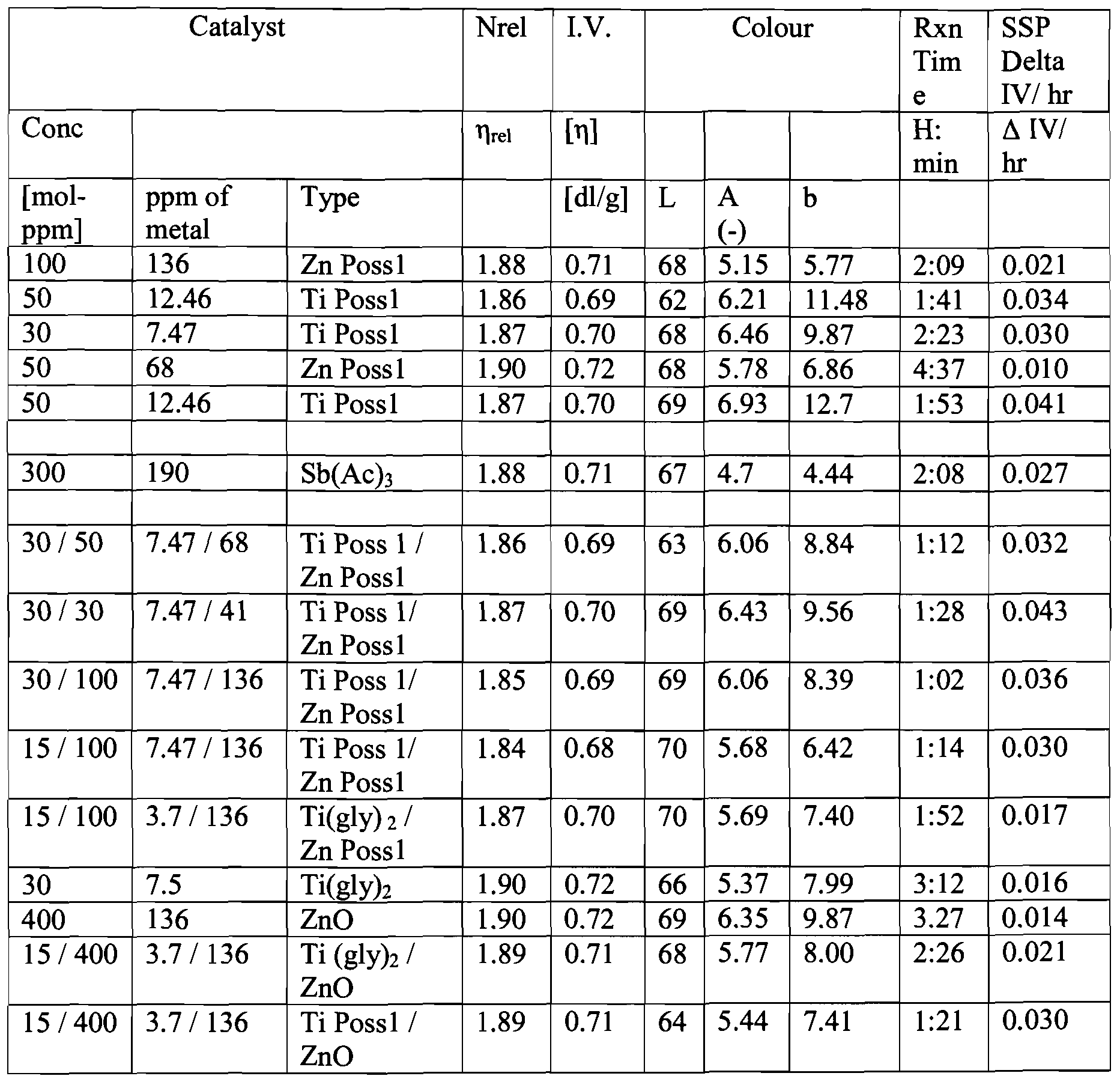
After an hour of exposure, the polymer was removed from the reactor as quickly as possible. The polymer was returned to the reactor as quickly as possible and the oil temperature increased to 210 0C. The polymer was reheated to the desired reaction temperature over a period of approximately ten minutes. At this point a 10 ml sample was taken and designated as the Time = 0 hrs. Additional samples were taken over the cycle. The results are presented in Table I. They demonstrate the remarkable catalytic behaviour and synergy of the catalysts, in particular the synergy of the (J-C4Hg)7Si7O12TiOH with the Zinc metal ion, whether the Zinc ion is in the POSS form, or an oxide.
NOVEL POSS COMPOUNDS FOR MANUFACTURE OF POLYCONDENSATION
POLYMERS
Table I
Figure imgf000019_0001
The prior art POSS metal compounds were likewise evaluated for their ability to function as polycondensation catalysts. The OH in (/-C4Hg)7Si7Oi2TiOH was replaced with an alkoxide group (No. 7, 8 of Table 2) or a phenolate group as taught in the prior art (No. 10, 11, and 9 of Table 2). The unsuitability for a polymerization catalyst of the prior art was demonstrated by heating the samples (No 1, 9, 10, 11 of Table 2) under vacuum at 220 0C. The (/-C4H9)7Si7Oi2TiOH remained a stable colorless liquid while the others degraded to yellow or decomposed altogether. NOVEL POSS COMPOUNDS FOR MANUFACTURE OF POLYCONDENSATION
POLYMERS
Table 2. Overview of Ti, Zr and Ge POSS catalysts
Figure imgf000020_0001
The prior art POSS samples were also evaluated for their catalytic behaviour as well.
No 7 and 8 yielded a PET with unacceptable color. No. 9, 10, and 11 provided a melt PET with an acceptable color, but suffer from the decomposition issues noted earlier.
The compounds No 2 and 5 can be made in a similar manner as the Ti-POSSl. However, synthesis of compound 2, which is derived from a cyclopentyl trisilanol POSS, requires large amounts of solvent. The activities for the melt polycondensation reaction are Ge~Ti>Zr. Both Ge and Zr produce a colorless PET. For Zr, there may be a synergy in combination with Zn or Al. There was no observed synergy for Ge.

Claims

NOVEL POSS COMPOUNDS FOR MANUFACTURE OF POLYCONDENSATIONPOLYMERS ClaimsWhat is claimed is
1. A polycondensation polymer composition comprising a polycondensation polymer and at least one metal compound selected from the group consisting of R7Si7O12Al, R7Si7O12TiOH, (R7Si7On)2Zn4Me2,
R7Si7O12Zr(O-Z-C3H7), and R7Si7O12Ge(O-Z-C3H7) wherein R is selected from the group consisting of substituents that allow at least one solvent selected from the group consisting of ethanol, isopropanol, acetone, THF, and acetonitrile to contain at least 50 gms of R7Si7O9(OH)3 per lOOOgm of the solvent at 50 0C.
2. The polycondensation polymer composition of claim 1 , wherein the metal compound is R7Si7Oi2Al.
3. The polycondensation polymer composition of claim 1 , wherein the metal compound is R7Si7O12TiOH.
4. The polycondensation polymer composition of claim 1 , wherein the metal compound is (R7Si7On)2Zn4Me2.
5. The polycondensation polymer composition of claim 1 , wherein the metal compound is R7Si7Oi2Zr(O-Z-C3H7).
6. The polycondensation polymer composition of claim 1 , wherein the metal compound is R7Si7Oi2Ge(O-Z-C3H7).
7. The polycondensation polymer of any one of claims 1 through 6, wherein the polycondensation polymer is a naphthalate or phthalate polyester.
8. The polycondensation polymer of any one of claims 1 through 6, wherein the polycondensation polymer is a polyamide.
9. The polycondensation polymer composition of claim 1 wherein said composition further comprises a zinc compound.
10. The polycondensation polymer of claim 9, wherein the polycondensation polymer is a naphthalate or phthalate polyester.
11. A process for the polycondensation polymerization of a polycondensation polymer comprising the steps of introducing at least one metal compound selected from the group consisting of
R7Si7O12Al, R7Si7O12TiOH, (R7Si7On)2Zn4Me2,
R7Si7O12Zr(O-Z-C3H7), and R7Si7O12Ge(O-Z-C3H7) wherein R is selected from the group consisting of substituents that allow at least one solvent selected from the group consisting of ethanol, isopropanol, acetone, THF, and acetonitrile to contain at least 50 gms of R7Si7O9(OH)3 per 1000 gms of the solvent at 50 0C. into the polycondensation polymer,
Exposing the polycondensation polymer to a sufficient temperature and a sufficient pressure for a time sufficient to raise the intrinsic viscosity of the polycondensation polymer by at least 0.05 dl/g.
12. The process of claim 11, wherein the metal compound is R7Si7O12Al.
13. The process of claim 11 , wherein the metal compound is R7Si7O12TiOH.
14. The process of claim 11, wherein the metal compound is (R7Si7On)2Zn4Me2.
15. The process of claim 11, wherein the metal compound is R7Si7Oi2Zr(O-Z-C3H7).
16. The process of claim 11, wherein the metal compound is R7Si7Oi2Ge(O-Z-C3H7).
17. The process of any one of claims 11 through 16, wherein the polycondensation polymer is a naphthalate or phthalate polyester.
18. The process of any one of claims 11 through 16, wherein the polycondensation polymer is a polyamide.
19. The process of claim 11 wherein a zinc compound is introduced into the polycondensation polymer.
20. The process of claim 19, wherein the polycondensation polymer is a naphthalate or phthalate polyester.
21. The process of any one of claims 19 and 20, wherein the metal compound is R7Si7O12Al.
22. The process of any one of claims 19 and 20, wherein the metal compound is R7Si7O12TiOH.
23. The process of any one of claims 19 and 20, wherein the metal compound is (R7Si7On)2Zn4Me2.
24. The process of any one of claims 19 and 20, wherein the metal compound is R7Si7O12Zr(O-Z-C3H7).
25. The process of any one of claims 19 and 20, wherein the metal compound is R7Si7O12Ge(O-Z-C3H7).
PCT/EP2007/057440 2006-07-18 2007-07-18 Poss metal compounds for the manufacture of polycondensation polymers Ceased WO2008009708A1 (en)

Priority Applications (4)

Application Number Priority Date Filing Date Title
BRPI0713175-5A BRPI0713175B1 (en) 2006-07-18 2007-07-18 POSS METAL COMPOUNDS FOR THE MANUFACTURE OF POLYCONDENSATION POLYMERS
CN200780034430.3A CN101522756B (en) 2006-07-18 2007-07-18 POSS metal compounds for the manufacture of polycondensation polymers
EP07787698.5A EP2052008B1 (en) 2006-07-18 2007-07-18 Poss metal compounds for the manufacture of polycondensation polymers
MX2009000628A MX2009000628A (en) 2006-07-18 2007-07-18 Poss metal compounds for the manufacture of polycondensation polymers.

Applications Claiming Priority (2)

Application Number Priority Date Filing Date Title
US80762506P 2006-07-18 2006-07-18
US60/807,625 2006-07-18

Publications (1)

Publication Number Publication Date
WO2008009708A1 true WO2008009708A1 (en) 2008-01-24

Family

ID=38515444

Family Applications (2)

Application Number Title Priority Date Filing Date
PCT/EP2007/057439 Ceased WO2008009707A1 (en) 2006-07-18 2007-07-18 Poss metal compounds for the manufature of polycondensation polymers
PCT/EP2007/057440 Ceased WO2008009708A1 (en) 2006-07-18 2007-07-18 Poss metal compounds for the manufacture of polycondensation polymers

Family Applications Before (1)

Application Number Title Priority Date Filing Date
PCT/EP2007/057439 Ceased WO2008009707A1 (en) 2006-07-18 2007-07-18 Poss metal compounds for the manufature of polycondensation polymers

Country Status (6)

Country Link
EP (1) EP2052008B1 (en)
CN (1) CN101522756B (en)
BR (1) BRPI0713175B1 (en)
MX (1) MX2009000628A (en)
RU (1) RU2450030C2 (en)
WO (2) WO2008009707A1 (en)

Cited By (2)

* Cited by examiner, † Cited by third party
Publication number Priority date Publication date Assignee Title
US20130241404A1 (en) * 2012-03-14 2013-09-19 Peter Guschl Encapsulant compositions and methods for lighting devices
US20130241390A1 (en) * 2012-03-14 2013-09-19 Peter Guschl Metal-containing encapsulant compositions and methods

Families Citing this family (8)

* Cited by examiner, † Cited by third party
Publication number Priority date Publication date Assignee Title
WO2011076570A1 (en) * 2009-12-21 2011-06-30 Huntsman International Llc A method to form a polyurethane material
CN101974028B (en) * 2010-09-28 2012-07-18 哈尔滨工业大学 Method for preparing polyhedral oligomeric silsesquioxanes containing titanium phenyl
CN103304999B (en) * 2012-03-16 2015-09-09 北京化工大学 The silsesquioxane composition of cyanate ester resin/containing metal aluminium or titanium
CN102911394A (en) * 2012-10-22 2013-02-06 中国工程物理研究院激光聚变研究中心 Method for preparing polyhedral oligomeric silsesquioxane-zirconium dioxide composite aerogel
CN102872852B (en) * 2012-10-31 2014-11-19 吉林大学 Supported zinc oxide photocatalyst and preparation method thereof
CN108219140B (en) * 2018-01-23 2020-12-29 莆田学院 A kind of metal hybrid POSS and its epoxy acrylate flame retardant coating
CN109320696A (en) * 2018-10-12 2019-02-12 华润化学材料科技有限公司 A kind of polyester composited activator and its preparation and application
CN111349394A (en) * 2020-04-23 2020-06-30 武汉华星光电半导体显示技术有限公司 Flexible display device and method for manufacturing hardened layer

Citations (2)

* Cited by examiner, † Cited by third party
Publication number Priority date Publication date Assignee Title
JP2003040992A (en) * 2001-05-25 2003-02-13 Mitsubishi Chemicals Corp Catalyst for polycondensation reaction and method for producing polyester using the same
JP2004256683A (en) * 2003-02-26 2004-09-16 Mitsubishi Chemicals Corp Catalyst for polycondensation reaction and method for producing polyester using the same

Family Cites Families (4)

* Cited by examiner, † Cited by third party
Publication number Priority date Publication date Assignee Title
EP0967229A1 (en) * 1998-06-26 1999-12-29 Dsm N.V. Metal complex containing one or more silsesquioxane ligands
DE10060776A1 (en) * 2000-12-07 2002-06-13 Creavis Tech & Innovation Gmbh Catalyst system based on polymer compounds containing silase sequioxane-metal complexes
GB0228267D0 (en) * 2002-12-04 2003-01-08 Johnson Matthey Plc Catalyst and process
AU2003303735A1 (en) * 2003-01-09 2004-08-10 Creavis Gesellschaft Fur Technologie Und Innovation Mbh Oligomer silasesquioxanes, method for the production thereof, and use of the same

Patent Citations (2)

* Cited by examiner, † Cited by third party
Publication number Priority date Publication date Assignee Title
JP2003040992A (en) * 2001-05-25 2003-02-13 Mitsubishi Chemicals Corp Catalyst for polycondensation reaction and method for producing polyester using the same
JP2004256683A (en) * 2003-02-26 2004-09-16 Mitsubishi Chemicals Corp Catalyst for polycondensation reaction and method for producing polyester using the same

Non-Patent Citations (3)

* Cited by examiner, † Cited by third party
Title
ABBENHUIS H C L: "ADVANCES IN HOMOGENEOUS AND HETEROGENEOUS CATALYSIS WITH METAL-CONTAINING SILSESQUIOXANES", CHEMISTRY - A EUROPEAN JOURNAL, VCH PUBLISHERS, US, vol. 6, no. 1, 3 January 2000 (2000-01-03), pages 25 - 32, XP001038449, ISSN: 0947-6539 *
DATABASE WPI Week 200365, Derwent World Patents Index; AN 2003-682843, XP002452621 *
DATABASE WPI Week 200467, Derwent World Patents Index; AN 2004-680336, XP002452581 *

Cited By (2)

* Cited by examiner, † Cited by third party
Publication number Priority date Publication date Assignee Title
US20130241404A1 (en) * 2012-03-14 2013-09-19 Peter Guschl Encapsulant compositions and methods for lighting devices
US20130241390A1 (en) * 2012-03-14 2013-09-19 Peter Guschl Metal-containing encapsulant compositions and methods

Also Published As

Publication number Publication date
BRPI0713175A2 (en) 2012-03-20
CN101522756B (en) 2013-09-18
RU2009105502A (en) 2010-08-27
RU2450030C2 (en) 2012-05-10
CN101522756A (en) 2009-09-02
EP2052008A1 (en) 2009-04-29
BRPI0713175B1 (en) 2018-07-10
WO2008009707A1 (en) 2008-01-24
EP2052008B1 (en) 2017-05-10
MX2009000628A (en) 2009-01-28

Similar Documents

Publication Publication Date Title
EP2052008B1 (en) Poss metal compounds for the manufacture of polycondensation polymers
EP1384740B1 (en) Process for preparing copolyesters of terephthalic acid, ethylene glycol, and 1,4-cyclohexanedimethanol exhibiting a neutral hue, high clarity and increased brightness
JP7296427B2 (en) Solvent-free melt polycondensation process to produce furan-based polyamides
EP0699701B1 (en) Process for preparing macrocyclic polyester oligomers
JP2004523637A (en) Method for preparing stabilized polyester
CN102046692A (en) Solid phase polymerization method of polyester using phosphinic acid compound
JPWO2005075539A1 (en) Polyester polymerization catalyst, polyester produced using the same, and method for producing polyester
TWI810394B (en) Copolyester resins, moldings, and heat-shrinkable films
CN101687984A (en) Solid state polymerization process for polyester
US20110003100A1 (en) Polyester composition and polyester molded article comprising the same
US20060205917A1 (en) Catalyst complex for catalysing esterification and trans-esterification reactions and process for esterification/trans-esterification using the same
EP2791202A1 (en) Process for synthesizing a new catalyst complex for the production of polyethylene terephthlate
JP2002249572A (en) Polyester, blow molded product and sheet substance
JP4485645B2 (en) Polyester production method
KR100726560B1 (en) Catalyst complex for catalysing esterification and transesterification reactions and process for esterification/transesterification using the same
EP1989245A1 (en) Polyester solid phase polymerization catalyst for low acetaldehyde generating resins
CN120271803A (en) Phosphorus-titanium polyester catalyst and preparation method and application thereof
KR0122004B1 (en) Method for manufacturing polyester
Pfaendner Catalysis in Solid State Polymerization Processes
JP2005029684A (en) Polyester resin composition and hollow molding comprising the same
JP2003119356A (en) Polyester resin composition and blow molded form comprising the same
MXPA98006719A (en) Process to prepare copolysteres of tereftal acid, ethylenglycol, and 1,4-cyclohexandimethanol that exhibit neutral color, high clarity and brightness increment
JPH07179587A (en) Polyester resin and method for producing the same
TW200414929A (en) Catalyst complex for catalysing esterification and trans-esterification reactions and process for esterification/trans-esterification using the same
JP2007105954A (en) MULTILAYER MOLDED BODY, MULTILAYER EXTENDED MOLDED BODY COMPRISING THE SAME, AND METHOD FOR PRODUCING MULTILAYER MOLDED

Legal Events

Date Code Title Description
WWE Wipo information: entry into national phase

Ref document number: 200780034430.3

Country of ref document: CN

121 Ep: the epo has been informed by wipo that ep was designated in this application

Ref document number: 07787698

Country of ref document: EP

Kind code of ref document: A1

DPE1 Request for preliminary examination filed after expiration of 19th month from priority date (pct application filed from 20040101)
WWE Wipo information: entry into national phase

Ref document number: MX/A/2009/000628

Country of ref document: MX

NENP Non-entry into the national phase

Ref country code: DE

WWE Wipo information: entry into national phase

Ref document number: 871/CHENP/2009

Country of ref document: IN

REEP Request for entry into the european phase

Ref document number: 2007787698

Country of ref document: EP

WWE Wipo information: entry into national phase

Ref document number: 2007787698

Country of ref document: EP

ENP Entry into the national phase

Ref document number: 2009105502

Country of ref document: RU

Kind code of ref document: A

ENP Entry into the national phase

Ref document number: PI0713175

Country of ref document: BR

Kind code of ref document: A2

Effective date: 20090119