WO2008009718A2 - Composition dentaire reticulable/polymerisable par voie cationique - Google Patents
Composition dentaire reticulable/polymerisable par voie cationique Download PDFInfo
- Publication number
- WO2008009718A2 WO2008009718A2 PCT/EP2007/057466 EP2007057466W WO2008009718A2 WO 2008009718 A2 WO2008009718 A2 WO 2008009718A2 EP 2007057466 W EP2007057466 W EP 2007057466W WO 2008009718 A2 WO2008009718 A2 WO 2008009718A2
- Authority
- WO
- WIPO (PCT)
- Prior art keywords
- dental
- load
- charge
- compound
- composition according
- Prior art date
- Legal status (The legal status is an assumption and is not a legal conclusion. Google has not performed a legal analysis and makes no representation as to the accuracy of the status listed.)
- Ceased
Links
Classifications
-
- A—HUMAN NECESSITIES
- A61—MEDICAL OR VETERINARY SCIENCE; HYGIENE
- A61K—PREPARATIONS FOR MEDICAL, DENTAL OR TOILETRY PURPOSES
- A61K6/00—Preparations for dentistry
- A61K6/60—Preparations for dentistry comprising organic or organo-metallic additives
- A61K6/62—Photochemical radical initiators
-
- A—HUMAN NECESSITIES
- A61—MEDICAL OR VETERINARY SCIENCE; HYGIENE
- A61K—PREPARATIONS FOR MEDICAL, DENTAL OR TOILETRY PURPOSES
- A61K6/00—Preparations for dentistry
- A61K6/70—Preparations for dentistry comprising inorganic additives
- A61K6/71—Fillers
- A61K6/76—Fillers comprising silicon-containing compounds
-
- A—HUMAN NECESSITIES
- A61—MEDICAL OR VETERINARY SCIENCE; HYGIENE
- A61K—PREPARATIONS FOR MEDICAL, DENTAL OR TOILETRY PURPOSES
- A61K6/00—Preparations for dentistry
- A61K6/80—Preparations for artificial teeth, for filling teeth or for capping teeth
- A61K6/884—Preparations for artificial teeth, for filling teeth or for capping teeth comprising natural or synthetic resins
- A61K6/891—Compounds obtained otherwise than by reactions only involving carbon-to-carbon unsaturated bonds
- A61K6/896—Polyorganosilicon compounds
-
- A—HUMAN NECESSITIES
- A61—MEDICAL OR VETERINARY SCIENCE; HYGIENE
- A61Q—SPECIFIC USE OF COSMETICS OR SIMILAR TOILETRY PREPARATIONS
- A61Q11/00—Preparations for care of the teeth, of the oral cavity or of dentures; Dentifrices, e.g. toothpastes; Mouth rinses
Definitions
- the field of the invention is that of dental compositions. More specifically, the dental compositions developed in the context of the present invention can be used for producing dental prostheses and for dental restoration.
- These dental compositions are conventionally epoxy resins, or photopolymerizable silicones or radical-polymerizable acrylate resins. These compositions also include particulate reinforcing fillers (e.g. hydrophobized silica), photoinitiators and optionally photosensitizers or even other functional additives such as pigments or stabilizers. Once mixed, these compositions are shaped and photocrosslinked into a mass of structure similar to that of the teeth.
- the filler consists of very fine particles ( ⁇ 0.01 to 5 ⁇ m) and of large specific surface area, is a limiting factor of its incorporation rate into the resin.
- the latter has a limited absorption capacity.
- the charge levels of such compositions seldom reach more than 45% by volume. This therefore penalizes the mechanical reinforcement function assigned to the particulate load
- the dental compositions are fo ⁇ nulé with reinforcing fillers such as mineral glasses or very small particle size combustion silicas whose surface silanols and / or residual water react with the cationic functions that do not allow the storage of the particles. compositions. This is also the case when these glasses or these fumed silicas are pretreated with silanes such as glycidyloxypropyltrimethoxysilane or glycidyloxypropyltriethoxysilane or else methacryloxypropyltrimethoxysilane.
- silanes such as glycidyloxypropyltrimethoxysilane or glycidyloxypropyltriethoxysilane or else methacryloxypropyltrimethoxysilane.
- the reinforcing fillers interact with the reactive functions of the (photo) polymerizable / crosslinkable species and are thus at the origin of problems of instability of the dental composition during its storage which can reach durations of several months. This storage instability phenomenon is accentuated for heavily loaded compositions (e.g. overall loading rate ⁇ 50%),
- US-B-6, 306.926 relates to dental compositions based on epoxy resins (eg UVR ® 6105, EPON ® 828 ® GY281), oxetane, or; vinyl ether, among others, polymerizable / crosslinkable, cationically and under irradiation, and optionally radical-polymerizable (meth) acrylate resins.
- epoxy resins eg UVR ® 6105, EPON ® 828 ® GY281
- vinyl ether among others, polymerizable / crosslinkable, cationically and under irradiation, and optionally radical-polymerizable (meth) acrylate resins.
- these compositions comprise a microparticulate, radioopaque mineral filler, which is selected from the following metal compounds: oxides, halides, borates phosphates, silicates, carbonates, germanates , tetrafluoroborates, hexafluoro-phosphates, having an isoelectric point less than 7.
- This composition is such that its Barcol hardness is at least 10, after 30 min of cationic polymerization at 25 ° C.
- compositions based on polymerizable / crosslinkable silicone resins, cationically and under irradiation followed or not by a thermal post-crosslinking.
- silicone resins have oxirane functionalities (epoxide, oxetane, etc.) or vinyl ether.
- Such compositions comprise: one or more crosslinkable and / or cationically polymerizable polydimethylsiloxanes carrying, at at least one of their ends, reactive functions of formula:
- These dental compositions are intended for the manufacture of prostheses or dental appliances and dental restoration.
- These silicones have the advantage over organic resins crosslinking cationically to be very transparent to UV-visible light and thus to allow the production of very thick materials (several millimeters thick) photocrosslinked in very few cases. time (less than one minute) with a UV lamp emitting in the visible range> 400 nm.
- these silicones are formulated with Lewis or Bronsted acidic reinforcing fillers, such as crushed glasses or very small particle size combustion silicas, whose surface silanols and / or residual water react with them. cationic functions. Such silicone formulations are therefore unstable on storage.
- patent application EP-AI 050 291 discloses highly loaded dental compositions which are presented as having good mechanical properties and comprising from 10 to 70% by volume of filler (eg combustion silica) of granulometry. ( ⁇ m) of between 0.05 and 0.5 ⁇ m (less than 50% by volume of particles with a diameter ⁇ > 0.50 ⁇ m), a radically photopolymerizable acrylic monomer and a phosphoric acid ester-type dispersant of formula :
- the international application WO-A-2005121200 discloses cationic and highly charged dental compositions comprising: at least one cationically reactive compound (A); at least one dental load (B); optionally at least one dispersant (C) comprising at least one organic polymer or copolymer; at least one cationic photoinitiator and optionally at least one photosensitizer (E), said composition being characterized in that at least one dental filler (B) is treated with: at least one organosilicon coupling agent (F) and at least one compound (G), said organosilicon coupling agent (F) comprising at least one reactive function (frA) directly linked to a silicon atony forming, after activation, a chemical bond with the dental charge and at least one reactive function (frB) not directly linked to a silicon atom giving after activation a chemical bond with a reactive function (frC) of the compound (G).
- compositions are an improvement over the prior art, it is however desirable to improve these compositions in storage stability. It therefore appears that the prior art does not provide a satisfactory solution to the storage stability problem of the dental compositions based on units which can be polymerized by cationic means under UV (for example oxiranes).
- One of the essential objectives of the present invention is therefore to remedy this by providing new dental compositions based on cationically polymerizable units under UV (for example oxiranes), not having the disadvantages of the prior art on the storage stability plan.
- UV for example oxiranes
- Another essential objective of the present invention is to provide novel catio ⁇ ic, polymerizable and / or crosslinkable dental compositions in the oral environment, which are not only stable in storage and highly loaded (eg> 50%) but which also have the advantage of be very transparent to UV-visible light and thus allow to obtain very thick materials (several millimeters thick) photocrosslinked in a very short time (less than a minute) with a UV lamp emitting in the visible range > 400 nm.
- Another essential objective of the present invention is to provide new dental compositions cationic, polymerizable and / or crosslinkable oral environment, which are stable, heavily loaded (e.g.> 50%), easy to prepare and economical.
- Another essential objective of the present invention is to provide a new method for treating a dental reinforcing filler, so that it can meet the constraints described above when it is used in particular as reinforcing filler in a composition dental.
- a dental composition comprising: (1) at least one cationically reactive compound (A); (2) at least one dental load (B);
- At least one dispersant (C) comprising at least one organic polymer or copolymer, (5) at least one cationic photoinitiator (D); and
- composition being characterized in that the dental charge (B) is pretreated in a solvent medium by contacting the following ingredients (a), (b) and (c) (a) at least one compound (G) which is:
- an organosiloxane monomer, oligomer or polymer said compound (G) comprising at least one reactive (frc) oxirane, oxetane, alkenyl ether and / or carbonate functional group, (b) at least one organosilicon coupling agent (F) comprising at least one a reactive function (frA) directly linked to a silicon atom capable of reacting with the dental charge (B) and at least one reactive function (frB) not directly linked to a silicon atom capable of reacting with a reactive function (frC) compound (G), and
- the dispersant (H) is an organic polymer or copolymer or a carboxylic acid monodiester.
- the dispersant (H) is chosen from the group consisting of:
- acrylic polymers optionally salified with an alkylammonium, polyesters, polyethers, polyurethanes, modified polyurethanes, polyol-polyacrylates,
- polyurethane / acrylate copolymers optionally salified with an alkylammonium, and - their mixtures.
- dispersant (H) are the following: polyurethane / acrylate copolymers optionally salified with an alkylammonium, acrylic copolymers optionally salified with an alkylammonium, monodiesters of carboxylic acids, polyesters, polyethers, polyurethanes, modified polyurethanes, polyol polyacrylates, copolymers thereof or mixtures thereof.
- the dispersants sold under the mark DISPERBYK ® (from Byk) or SOLSPERSE "" (Ia of Avecia) are particularly suitable for the invention. These include in particular and as examples, commercial products: Disperbyk ® 164, Disperbyk ® 161 ® Disperbyk 166, Disperbyk ® 2070
- Disperbyk ® 9075 Disperbyk ® 9076.
- EP-B-0 403 197 discloses graft polyol-polyacrylate dispersants comprising a polyurethane / polyvinyl / polyacrylate random copolymer and a polyoxyalkylene polyether.
- the reactive function (frA) directly bonded to a silicon atom of the organosilicon coupling agent (F) is an alkoxy, enoxy or hydroxy function
- the reactive function (frB) not directly bonded to a silicon atom of the organosilicon coupling agent (F) is an oxirane, oxetane, hydroxyl, acid, carboxylic acid anhydride or diol function;
- the reactive function (frC) of the compound (G) is an oxirane, oxetane, alkenyl ether or carbonate function.
- the dental composition according to the invention comprises at least one dental filler (B) treated by a process (I) comprising the following steps: a) the dental charge (B) and at least one organosilicon coupling agent (F) as defined above are mixed in a solvent medium; b) the solvent is filtered off to obtain an intermediate dental charge (BI); ) the intermediate dental load (BI) is heat-treated to terminate the coupling reaction between the intermediate dental load (BI) and the coupling agent (F) and thus to obtain an intermediate tooth load (B-2 d) the intermediate dental charge (B-2) is then mixed in a solvent medium with at least one compound (G) as defined above and in the presence of at least one dispersant (H) as defined above.
- a process (I) comprising the following steps: a) the dental charge (B) and at least one organosilicon coupling agent (F) as defined above are mixed in a solvent medium; b) the solvent is filtered off to obtain an intermediate dental charge (BI); ) the intermediate dental load (BI) is heat
- the solvent is removed by filtration to obtain an intermediate dental charge (B-3), and f) the intermediate dental charge (B-3) undergoes a heat treatment so as to terminate the reaction between the intermediate dental charge ( B-3) and the compound (G) and thus to obtain a charge dental (B) treated.
- the dental composition according to the invention comprises at least one dental filler (B) treated by a process (II) comprising the following steps: a) the dental filler (B) is mixed in a solvent medium; ) and at least one organosilicon coupling agent (F) as defined above, b) the solvent is removed by filtration to obtain an intermediate dental charge (BI), c) the intermediate dental charge (BI) undergoes a heat treatment in order to terminate the coupling reaction between the intermediate dental load (BI) and the coupling agent (F) and thus to obtain an intermediate dental load (B-2), d) the intermediate dental load (B-2) ) is then mixed in a solvent medium with at least one compound (G) as defined above, e) the solvent is removed by filtration to obtain an intermediate dental charge (B-3), and f) the intermediate dental charge ( B-3) undergoes heat treatment in order to terminate the reaction between the intermediate dental charge (B-3) and the compound (G) and thus to obtain an intermediate charge (B-5), (s
- the treatment of the dental charge (B) is carried out with up to 20% by weight, preferably between 1 and 15% by weight and even more preferably between 2 and 10% by weight of the compound (G ) relative to the total weight of glass to be treated.
- the treatment of the dental load (B) is carried out with up to 20% by weight, preferably between 0.01 and 10% by weight and even more preferably between 0.1 and 1% by weight. of the compound (H) relative to the total weight of glass to be treated.
- the treatment of the dental charge (B) is carried out with up to 20% by weight, preferably between 1 and 15% by weight and even more preferably between 2 and 10% by weight of the compound (F). ) relative to the total weight of glass to be treated.
- the organosilicon coupling agent (F) preferably has the following chemical formula:
- R is a hydrogen or a linear or branched C 1 -C 4 alkyl or alkenyl radical
- R 1 is a linear or branched alkyl radical, or a phenyl radical
- E and D which are identical or different radicals chosen from linear or branched C1-C12 alkyls, z is equal to 0 or 1; n is 0 or 1; p is 0.1, 2, 3, 4, 5 or 6;
- R 3 , R 3 , R 4 , R 5 , R 6 , R 7 and R 8 are radicals, identical or different, representing a hydrogen atom or a linear or branched C 1 -C 12 alkyl.
- organosilicon coupling agent (F) mention may be made of the following compounds: glycidyloxypropyltrimethoxysilane, the hydrolysis product of glycidyloxypropyltrimethoxysilane; glycidyloxypropyltriethoxysilane, the acid hydrolysis product of glycidyloxypropyltriethoxysilane; glycidyloxypropyldimethoxymethylsilane or its hydrolysis product, the beta- (3,4-epoxycyclohexyl) ethyltriethoxysilane silane or its hydrolysis product, the beta- (3,4-epoxycyclohexyl) ethyltrimethoxysilane silane
- the compound (G) is preferably a compound which is a monomer, an oligomer, an organic polymer or an organosiloxane comprising at least one oxirane, oxetane, alkenyl ether and / or carbonate function and even more preferably comprising at least one oxirane function.
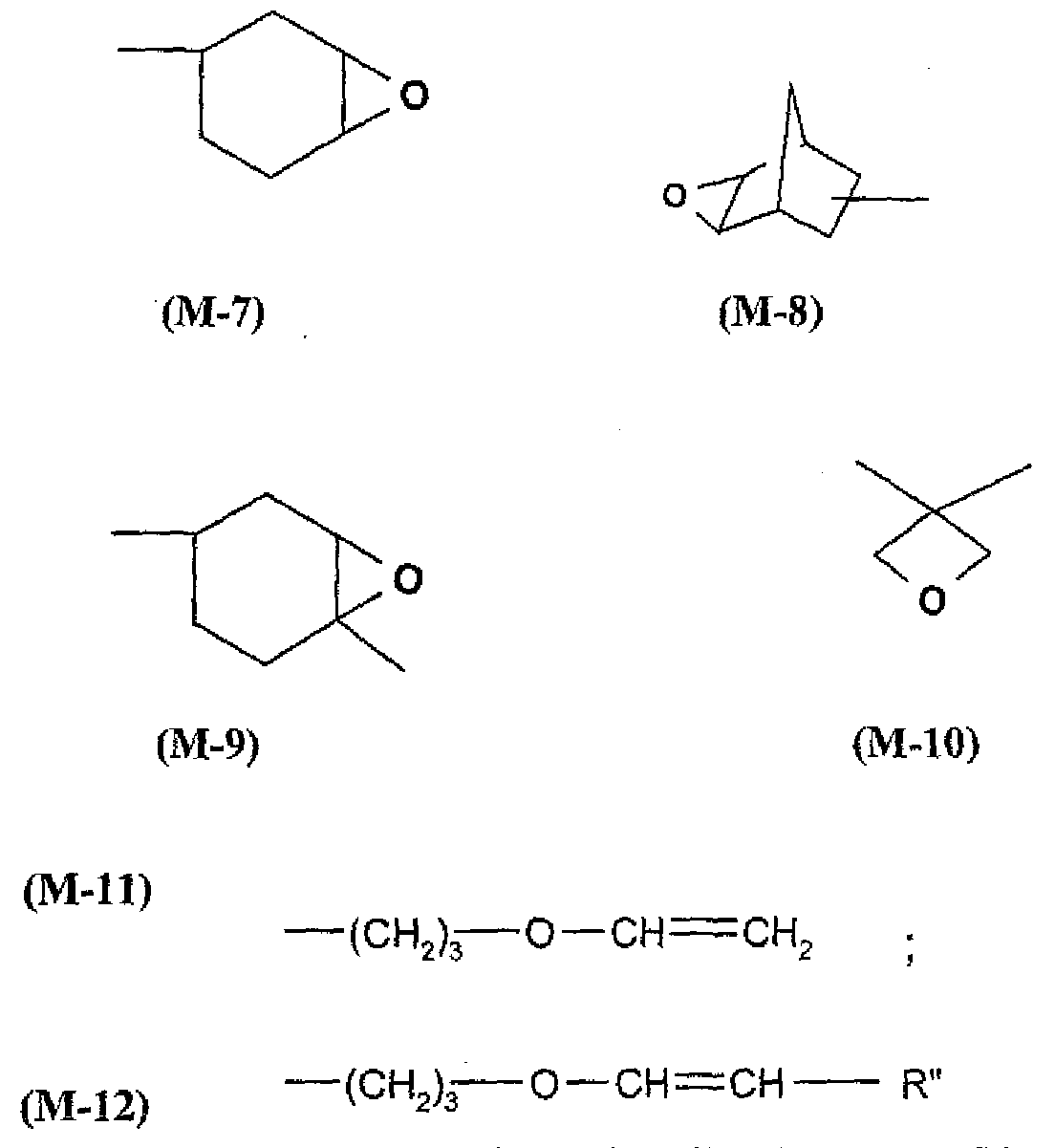
- the compound (G) comprises at least one function selected from the group consisting of the following structures (M-7) to (M-12):
- the compound (G) is a silicone oligomer (GI) or a silicone polymer (G-2).
- the silicone oligomer (GI) and the silicone polymer (G-2) comprise: a) at least one unit of formula:
- R 0 which may be identical or different, represents an alkyl, cycloalkyl, aryl, vinyl, hydrogen or alkoxy radical, preferably a C 1 -C 6 lower alkyl radical,
- Z is an organic substituent comprising at least one oxirane, alkenyl ether, oxetane and / or carbonate function, and b) at least two silicon atonies.
- silicone oligomer (G-I) and silicone polymer (G-2) are chosen from the group consisting of compounds of formulas:
- the compound (G) is a silane (G-3) which is chosen from the group consisting of the molecules (S-93) to (S-95):
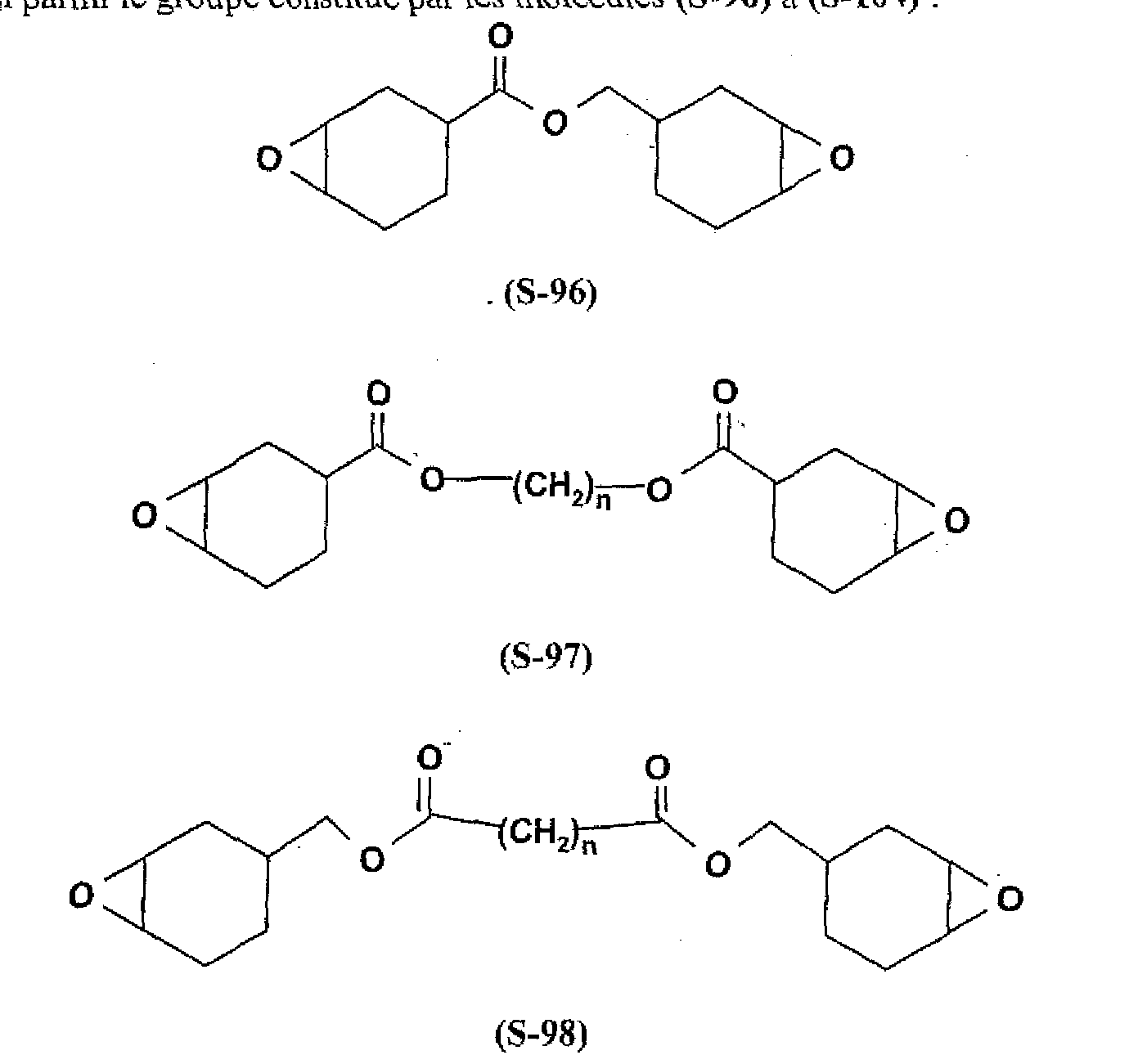
- the compound (G) is an organic compound (G-4) chosen from the group consisting of the molecules (S-96) to (S-104): formulas in which: n is an integer between 1 and 10 (inclusive).
- n ⁇ 100 and D linear or branched C 1 -C 12 alkyl.
- the photochemical activation is carried out under UV radiation. More particularly, UV radiation with a wavelength of the order of 200 to 500 nm is used for producing dental prostheses and visible UV radiation of wavelength. greater than 400 nm for the realization of restoration materials. A wavelength greater than 400 nm allows crosslinking and / or polymerization in an oral environment.
- Actinic (photochemical) activation can be advantageously completed (or even replaced) by thermal activation.
- the cationically reactive compound (A) is selected from the group of monomers and / or (co) polymers comprising: epoxies, vinyl ethers, oxetanes, spiroorthocarbonates, spiroorthoesters and combinations thereof. More preferably still, the cationically reactive compound (A) is a silicone oligomer (GI), a silicone polymer (G-2), a silane (G-3) or an organic compound (G-4) as defined herein. above the pattern (M-13), the molecules (S-1) to (S-101).
- the particularly interesting reactive functional groups Z comprise at least one reactive functional group chosen from the following radicals:
- R represents a linear or branched C 1 -C 6 alkyl radical.
- the cationically reactive compound (A) is associated with an organic epoxy resin or oxetane representing less than 80% by weight of the fraction.
- an organic epoxy resin or oxetane representing less than 80% by weight of the fraction.
- the functional organic resins chosen one will prefer those whose mass percentage of reactive function is less than 20% and preferably less than 15%. The volume shrinkage during the polymerization will decrease accordingly.
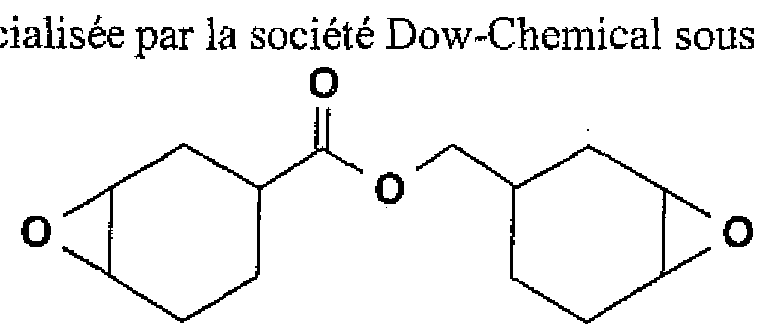
- the resins of formula (S-103) and (S-104) are preferably selected.
- type resins can choose the resin UVR6150 ® marketed by Dow-Chemical company.
- dental fillers (B) and (B ') can be used to prepare the compositions according to the invention.
- the fillers are chosen according to the end use of the dental composition: these affect important properties such as the appearance, the penetration of the UV radiation, as well as the mechanical and physical properties of the material obtained after crosslinking and / or polymerization of the dental composition.
- fumigated silica filler or not, amorphous silica fillers, quartz, glasses or non-vitreous fillers based on silicon oxides, for example of the type described in US Pat. US-6297181 (barium-free), zirconium, barium, strontium, calcium, fluorine, aluminum, titanium, zinc, borosilicates, aluminosilicates, talc, spherosil, yttrium trifluoride powder-based polymers in the form of ground powder such as inert or functionalized polymethyl methacrylates, polyepoxides or polycarbonates, ceramic whiskers (Si-C, Si-OC, Si-N, Si-NC, Si-NCO) or glass fibers.
- silicon oxides for example of the type described in US Pat. US-6297181 (barium-free), zirconium, barium, strontium, calcium, fluorine, aluminum, titanium, zinc, borosilicates, aluminosilicates,
- inert fillers based on polymethyl methacrylate LUXASELF ® from the company UGL that can be used in the dental field and pigmented in rosé fillers of combustion silica treated with hexamethyldisilazane or polydimethylsiloxane with a specific surface area of 200 m 2 / g
- untreated fumed silica fillers Aral-AE200 ® marketed by Degussa
- quartz or glasses based on silicon oxides dental fillers Schott GM27884, G018-066, G018-163 marketed by Schott
- the dental charge (B) is a mineral glass or a combustion silica.
- the dental fillers (B) represent up to 85% by weight, preferably between 50 and 85% by weight, even more preferable! between 60 and 85% by weight, based on the total weight of the dental composition.
- the dispersant (C) is selected from the group comprising: polyurethane / acrylate copolymers optionally salified with an alkylammonium, acrylic copolymers optionally salified with an alkylammonium, monocarboxylic acid esters, polyesters, polyethers, polyurethanes, modified polyurethanes, polyol polyacrylates, copolymers thereof or mixtures thereof.
- the dispersants sold under the mark DISPERBYK ® (from Byk) or SOLSPERSE ® (Avecia) are particularly suitable for the invention.
- Disperbyk ® 164 Disperbyk ® 161
- Disperbyk ® 166 Disperbyk 2070
- Disperbyk ® 9075 Disperbyk ® 9076.
- Another example is the dispersants cited in patents follows-:
- the dispersant (C) may be present in the dental composition at 50 ppm to 1%, preferably at 100 ppm to 5000 ppm.
- the amine number of the dispersant (C) is less than or equal to 60, and more preferably still between 0.1 and 50 mg of potash per gram of dispersant (C).
- the acid number of the dispersant is less than or equal to 200, preferably less than or equal to 100, and more preferably between 1 and 60 mg of potash per gram of dispersant.
- the cationic photoinitiators (D) are chosen from onium borates (taken alone or in mixture with one another) of an element from groups 15 to 17 of the periodic classification [Chem. & Eug. News, vol.63, No. 5, 26 of 4 February 1985] or an organometallic complex of an element from groups 4 to 10 of the Periodic Table [same reference].
- the cationic initiator (D) is of the borate type and is selected from those of which: a) the cationic entity of the borate is selected from:
- A represents an element of groups 15 to 17 such as for example: I, S, Se, P or N,
- R 9 represents a C 6 -C 20 carbocyclic or heterocyclic aryl radical, said heterocyclic radical possibly containing nitrogen or sulfur as heteroelements;
- R 10 represents R 9 or a linear or branched C 1 -C 30 alkyl or alkenyl radical; said radicals R 9 and R 10 being optionally substituted with a C 1 -C 25 alkoxy, C 1 -C 25 alkyl, nitro, chloro, bromo, cyano, carboxy, ester or mercapto group.
- n + m v + 1, where v is the valency of element A,
- X represents a group of formula (1) M fl ( v Yl ' r ⁇ or of formula (2) Q 1 , where:
- M 1 Sb, As, P, B or Cl,
- Y 1 represents a halogen (preferably F or Cl) or O and,
- - r1 is an integer between 4 and 6
- R 8 - Q 1 represents a sulfonic acid R 81 -SO 3 where R 8 'is an alkyl or aryl group, or an alkyl or aryl group substituted by a halogen, preferably F or C1,
- R 101 represents an alkyl or cycloalkyl group, preferably a C 1 -C 20 group , or an aryl group,
- R 21 represents a hydrogen, an alkyl, alkenyl, cycloalkenyl or cycloalkyl group, preferably a C 1 -C 20 , or an aryl group, all the R 21 being independent of one another,
- R 31 represents a hydrogen, an alkyl, alkenyl, cycloalkenyl or cycloalkyl group, preferably C 1 -C 20 , or an aryl group, all R 31 being independent of one another,
- R 41 represents a hydrogen, a halogen, an alkenyl group, for example vinyl, cycloalkenyl, alkyl, or cycloalkyl, preferably C 1 -C 20 , an alkoxy or thioalkoxy group, preferably a C 1 -C 20 group; a poly (alkylene oxide) group with up to 10 hydroxyl terminated alkylenic units or (C 1 -C 12 ) alkyl, aryl, aryloxy or thioaryloxy group,
- R 31 represents a halogen, an alkenyl group, for example vinyl, cycloalkenyl, alkyl, or cycloalkyl, preferably C 1 -C 20 , an alkoxy or thioalkoxy group, preferably C 1 -C 20 , a group poly (alkylene oxide) with up to 10 hydroxyl-terminated alkylenic units or (C 1 -C 12 ) alkyl, aryl, aryloxy or thioaryloxy group
- R 61 represents a hydrogen, an alkyl, alkenyl, cycloalkenyl or cycloalkyl group, preferably a C 1 -C 20 , or an aryl group,
- R 7t represents a hydrogen, an alkyl, alkenyl, cycloalkenyl or cycloalkyl, preferably C 1 -C 20 , or an aryl group;
- organometallic salts of the following formula formula in which: M represents a metal of group 4 to 10, in particular iron, manganese, chromium, cobalt,
- L1 represents 1 ligand bound to the metal M by ⁇ electrons, ligand chosen from the ligands ⁇ 3 - alkyl, ⁇ 5 - cyclopendadienyl and ⁇ 7 - cycloheptratrienyl and the ⁇ 6 - aromatic compounds chosen from ligands ⁇ 6 - optionally substituted benzene and compounds having from 2 to 4 condensed rings, each ring being capable of contributing to the valence layer of the metal M by 3 to 8 ⁇ electrons,
- - L2 represents a ligand bonded to the metal M via ⁇ electrons, which ligand is chosen from the ligands ⁇ 7 - -cycloheptatrienyl and the ⁇ 6 -aroma ticks compounds selected from ligands ⁇ 6 - optionally substituted benzene and the compounds having from 2 to 4 cycles condensed, each cycle being capable of contributing to the valence layer of the metal M by 6 or 7 electrons ⁇
- - L3 represents from 0 to 3 identical or different ligands bound to the metal M by ⁇ electrons, ligand (s) chosen (s) ) among CO and NO2 +; the total electronic charge q of the complex to which L1, L2 and L3 contribute, and the ionic charge of the metal M being positive and equal to 1 or 2; and b) cationic photoinitiators (D), the borate anionic entity of which has the formula: formula in which: formula in which: formula in which: formula in which: formula in which: formula
- a phenyl radical substituted with at least one electron-withdrawing group such as, for example, OCF 3 , CF 3 , NO 2 , CN, and / or by at least 2 halogen atoms (especially fluorine), and this when the cationic entity is an onium of an element of groups 15 to 17,
- a phenyl radical substituted by at least one element or an electron-withdrawing group in particular atonia of halogen (especially fluorine), CF 3 , OCF 3 , NO 2 , CN, and this when the cationic entity is an organometallic complex of a group element 4 to 10, or an aryl radical containing at least two aromatic rings, such as, for example, biphenyl or naphthyl, optionally substituted by at least one element or an electron-withdrawing group, in particular a halogen atom, in particular fluorine, OCF 3 , CF 3 or NO 2; , CN, whatever the cationic entity.
- halogen especially fluorine
- the species of the borate anionic entity which are particularly suitable are the following:
- the onium salts of formula (S-26) that can be used are described in numerous documents, in particular in US Pat. No. 4,026,705, US-A-4,032,673, US Pat. No. 4,069,056, US-A-4,136,102, US-A-4,173,476.
- organometallic salts (3) of formula (S-27) which can be used are described in documents US-A-4 973 722, US-A-4 992 572 and EP-A-203 829, A-323 584 and EP-A-354 181.
- the organometallic salts more readily selected according to the invention are in particular: . ( ⁇ 5 -cyclopentadienyl) ( ⁇ 6-toluene) Fe + '. ( ⁇ 5 -cyclopentadienyl) ( ⁇ 6 -methyl-1-naphthalene) Fe + '. ( ⁇ 5 -cyclopentadienyl) ( ⁇ 6-cumene) Fe + '. bis ( ⁇ 6-mesitylene) Fe + '. bis ( ⁇ ⁇ - benzene) Cr +
- photoinitiators of the borates such as onium the following products: (P-16): [(C 8 H I7) -O-C 6 H 4 - I-C 6 H 5 )] + , [B (C 6 F 5 ) 4 ] -;
- onium salts hexafluorophosphate or hexafluoro-antimonate, such as:
- the photosensitizer contained within the dental composition according to the invention can be very varied in nature. In the context of the invention, it corresponds in particular to one of the following formulas (IV) to (XXIV):
- T-phenylene where T is -O-, -S-, -SO2- or -CH2-,
- X represents a group -OR 1 ⁇ or -OSiR 1 S (R 1 ) or forms, with R 1 1, a group
- - R represents a linear or branched alkyl radical in C j C6 alkyl unsubstituted or bearing a -OH, -OR 13, acylqxy C2-C ⁇ , -CF 3, or -CN, -alkenyl, C3 or C4, a C6-C18 aryl radical, a C7-C10 phenylalkyl radical,
- R12 has one of the meanings given for R 1 1 or represents a radical - or else form with R 1 1 .
- R13 represents a lower alkyl radical containing from 1 to 12 carbon atoms
- R 14 represents a hydrogen atom, a C 1 -C 12 alkyl radical or a C 2 -C 8 alkyl radical carrying an -OH, -OR 13 or CN group.
- alkenyl, C3 ⁇ Cg, cyclohexyl or benzyl radical, a phenyl optionally substituted by chlorine radical or a linear or branched alkyl radical C] -C j 2, or a tétrahydro ⁇ yrannyle-2 radical, - R * 5 and R1 ⁇ > are the same or different and each represents an alkyl radical
- - JU-I represents a hydrogen atom, a C1-C8 alkyl radical or a phenyl radical
- R 18 represents a radical -CONH 2 '-CONHR 13 , -CON (R 13 ) 2 , -P (O) (OR 13 ) 2 or pyridyl-2;
- R ⁇ is a radical selected from the group consisting of Ar ⁇ radical, a linear or branched alkyl radical C ⁇ -C j, a cycloalkyl radical
- Y identical or different, represent X and / or R 1
- n 0 to 8
- - R identical (s) or different substituents on the (s) aromatic ring (s), represent a linear or branched C 1 -C 12 alkyl radical, a cycloalkyl radical, C6-C12, a radical Ar 1 , a halogen atom, a group -OH, -OR 13 , -CN 3 -NO 2, -COOR, -
- n 0 to 8
- the group R has the same definition as for the molecule (VII).
- Other sensitizers are usable.
- the photosetisitizer (E) is chosen from the group consisting of compounds of the class of anthracenes, thioxanthones, camphorquinones, and phenanthrenequinone, and mixtures thereof.
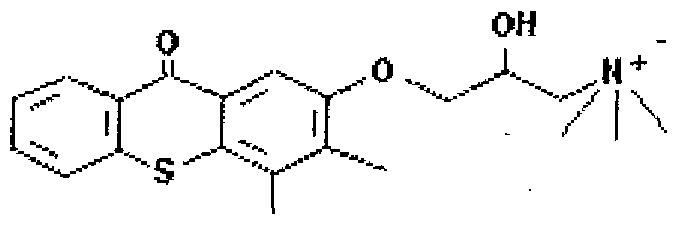
- the dental composition comprises, as photosensitizer (E), a salt of a thioxanthone substituted with at least one group comprising an ammonium function.
- photosensitizer a salt of a thioxanthone substituted with at least one group comprising an ammonium function.
- the anion associated with the salt of thioxanthone substituted with at least one group comprising an ammonium function is chosen from the following anions:
- the photosensitizer (E), optionally in combination with at least one camphorquinone, a phenanthrenequinone and / or a substituted anthracene has the formula:
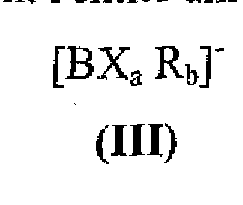
- (X " ) being an anionic entity, preferably a halide; BF 4 ' , PF 6 " ; SbF 6 " ; flag (III) of formula [BX n RJ " defined as above, R, SCV; (R t SO 2 IiC “ or (RiSOs) 3 N " , with R t - being a linear or branched alkyl radical, substituted by at least one halogen atom, preferably a fluorine atom, and even more preferably (X " ) is selected from the borates of following formulas: [B (C 6 H 3 (CF,) 2) 4] - and [B (C 6 F 5) ⁇ ] ".
- the photosensitizer (E), optionally in combination with at least one camphorquinone, a phenanthrenequinone and / or a substituted anthracene has the formula:
- the photosensitizers have a residual absorption of U.V. light of between 200 and 500 ⁇ m, preferably 400 to 500 nm for dental prosthesis preparations.
- a photosensitizer having a residual absorption of U.V light above 400 nm will be preferred.
- the photosensitizers will be chosen from those of families (VII), (X), (XI), (XIII), (XXIII), (XXIV) and (XXV).
- the phosensitizer is selected from the group consisting of the following compounds:
- the material obtained after crosslinking has a significantly improved storage stability.
- thioxanthones of the family described by formula (XXV) are used, there is an additional advantage in using thioxanthones (PS-31) or (PS-32), optionally in combination with at least one camphorquinone, phenanthrenequinone and / or substituted anthracene, which is the absence of residual staining.
- pigments can be used to tint the dental composition according to the intended use and ethnic groups.
- red pigments are used in the presence of microfibers for dental compositions used for the preparation of dental prostheses to simulate blood vessels.
- Pigments based on metal oxides are also used for the dental compositions used for the preparation of restoration material, in order to obtain a material reticulated ivory color.
- Other additives may be incorporated within the dental compositions according to the invention, for example, biocides, stabilizers, flavoring agents, plasticizers and adhesion promoters.
- biocides for example, biocides, stabilizers, flavoring agents, plasticizers and adhesion promoters.
- cross-linkable and / or polymerizable co-reactants of organic type will advantageously be used.
- co-reactants are liquid at room temperature or hot melt at a temperature below 100 ° C.
- each co-reagent comprises at least two reactive functional groups such as oxetane-alkoxy, oxetane-hydroxy, oxetane-alco.xysilyl, carboxy-oxetane, oxetane-oxetane, alkenyl ether-hydroxy, alkenyl ether-alkoxysilyl, epoxy-alkoxy, epoxy-alkoxysilyl, dioxolane-dioxolane-alcohol, etc.
- resins R70 and R71 may be mentioned.
- the dental compositions according to the invention can be used for many dental applications, and in particular in the field of dental prostheses, in the field of dental restoration and in the field of temporary teeth.
- the dental composition according to the invention is preferably in the form of a single product containing the various components ("monocoinposct") which facilitates its implementation, particularly in the field of dental prostheses.
- the stability of this product can be ensured by organic derivatives with amino functions according to the teaching of the document WO 98/07798.
- the product in the form "monocomponent" can be deposited using a syringe directly on the plaster model or in a key. Then, it is polymerized (polymerization possible successive layers) using a UV lamp (visible light spectrum 400 to 500 nm).
- the products obtained from the dental composition according to the invention are non-porous.
- the surface of the dental prostheses obtained is smooth and glossy and therefore does not require the use of varnish.
- the applications in the field of dental prostheses are essentially those of the adjunct prosthesis, which can be divided into two types: - total prosthesis in case of patient completely edentulous; Partial prosthesis due to the absence of several teeth resulting in either a provisional prosthesis or a skeletal device.
- the dental composition according to the invention can be used as a material for sealing the anterior and posterior teeth in different shades (for example, "VITA" shades), quick and easy to implement. .
- the dental composition is non-toxic and polymerizable in thick layers, it is not essential to polymerize the material in successive layers. In general, a single injection of the dental composition is sufficient.
- the tooth may be pretreated with etching agent and then with a primer which may itself be photocurable or the dental composition may be prepared in admixture with a primer. hanging before use.
- the invention also relates to a method (I) for treating a dental charge (B) comprising the following steps: a) the dental charge (B) and at least one organosilicon coupling agent (F), as defined, are mixed in a solvent medium; according to claim 1, b) the solvent is removed by filtration to obtain an intermediate dental load (BI), c) the intermediate dental load (BI) undergoes heat treatment so as to terminate the coupling reaction between the intermediate dental load ( BI) and the coupling agent (F) and thus to obtain an intermediate dental load (B-2), d) the intermediate dental load (B-2) is then mixed in a solvent medium with at least one compound (G ) as defined in claim 1 and in the presence of at least one dispersant (H) as defined in claim 1, 2 or 3, e) the solvent is removed by filtration to obtain an intermediate dental charge (B-3 ), and f) the intermediate dental load (B-3) is heat-treated so as to terminate the reaction between the intermediate dental load (B-3) and the compound (G) and thereby obtain
- the invention relates to a method (II) for treating a dental load (B) comprising the following steps: a) the dental filler (B) and at least one organosilicon coupling agent are mixed in a solvent medium; (F) as defined in claim 1, b) the solvent is removed by filtration to obtain an intermediate dental load (BI), c) the intermediate dental load (BI) undergoes a heat treatment so as to terminate the coupling reaction between the intermediate dental load (BI) and the coupling agent (F) and thus to obtain an intermediate dental load (B-2), d) the intermediate dental load (B-2) is then mixed in a solvent medium with at least one compound (G) as defined in claim 1, e) the solvent is removed by filtration to obtain an intermediate dental charge (B-3), and f) the intermediate dental charge (B-3) undergoes a treatment thermal so as to term iner the reaction between the intermediate dental load (B-3) and the compound (G) and thus to obtain an intermediate load (B-5), g) the intermediate dental load (B
- the heat treatment of steps c) and f) processes (I) and (II) is carried out by heating at a temperature less than or equal to 200 ° C., preferably less than or equal to 160 ° C. and even more preferably between 100 and 165 ° C.
- the organosilicon coupling agent (F), the compound (G), the dispersant (H) and the dental reinforcing filler (B) are as defined in the dental composition according to the invention.
- the invention also relates to a reinforcing filler obtainable by the method according to the invention as well as its use in dental compositions.
- Another subject of the invention relates to the use of a dental composition according to the invention for the production of dental prostheses or for the dental restoration
- Another object of the invention relates to a dental prosthesis that can be obtained by crosslinking a composition according to the invention.
- a final subject of the invention relates to a dental restorative material that can be obtained by crosslinking a composition according to the invention.
- Example 1-1 and 1-2 Treatment of a dental load according to the invention
- Example 1-1 a) 200 g of filler (Bi) are poured into a flask, 200 g of acetone and 7.3 g of glycidyloxypropyltrimethoxysilane silane or GLYMO are added thereto. It is mixed for two hours with stirring at room temperature and under nitrogen. The whole is poured into a Buchner equipped with a filter (0.22 microns). The dental charge is then recovered, which is then ground using a mortar and a pestle and sieved on a 200 micron cloth. The dental charge is then dried in an oven for 16 hours at 110 ° C. At the outlet of the oven, the charge is cooled to room temperature for 30 minutes. An intermediate charge (B-2) is obtained.
- Examples 3 (comparative - Treatment of an office at the international application WO-A-2005121200: a) a vial poured 200 g of filler (Bi), we add '200 g of acetone and 7.3 g silane glycidyloxypropyltrimethoxysilane or GLYMO. It is mixed for two hours with stirring at room temperature and under nitrogen. The whole is poured into a Buchner equipped with a filter (, 22 microns). The dental filler is then recovered, which is then ground using a mortar and a pestle and sieved on a 200 micron cloth. The dental charge is then dried in an oven for 16 hours at 110 ° C. At the outlet of the oven, the charge is cooled to room temperature for 30 minutes.
- filler Bi
- acetone silane glycidyloxypropyltrimethoxysilane or GLYMO
- An intermediate charge (B-2) is obtained.
- 180 g of the filler (B-2) are added to a flask, or 180 g of acetone and then 15.8 g of the oxirane compound (SI) and 15.8 g of the compound (S-96) are added thereto. ). It is mixed for two hours with stirring at room temperature and under nitrogen. The whole is poured into a Buchner equipped with a filter (0.22 microns). The dental filler is then recovered, which is then ground using a mortar and a pestle and sieved on a 200 micron cloth. The dental charge is then dried in an oven for 16 hours at 110 ° C. At the outlet of the oven, the charge is cooled to room temperature for 30 minutes.
- a dental filler treated according to the international application WO-A-2005121200 is obtained.
- This formulation is stirred with a magnetic bar for about 24 hours.
- the acceptable limit of use is about 100 mEE, below this threshold the formulation is in a hardened form and can no longer be used as it is,
- the epoxy levels are more stable, which prevents premature curing of the formulations during long-term storage.
Landscapes
- Health & Medical Sciences (AREA)
- Oral & Maxillofacial Surgery (AREA)
- Life Sciences & Earth Sciences (AREA)
- Public Health (AREA)
- Veterinary Medicine (AREA)
- Animal Behavior & Ethology (AREA)
- General Health & Medical Sciences (AREA)
- Epidemiology (AREA)
- Chemical & Material Sciences (AREA)
- Biophysics (AREA)
- Plastic & Reconstructive Surgery (AREA)
- Inorganic Chemistry (AREA)
- Dental Preparations (AREA)
- Chemical Kinetics & Catalysis (AREA)
- Medicinal Chemistry (AREA)
- Polymers & Plastics (AREA)
- Organic Chemistry (AREA)
Abstract
Description









Claims


Priority Applications (7)
| Application Number | Priority Date | Filing Date | Title |
|---|---|---|---|
| EP07787724A EP2043588B1 (fr) | 2006-07-21 | 2007-07-19 | Composition dentaire reticulable/polymerisable par voie cationique |
| CN2007800336010A CN101588783B (zh) | 2006-07-21 | 2007-07-19 | 通过阳离子途径可交联/可聚合的牙科组合物 |
| KR1020097003579A KR101106519B1 (ko) | 2006-07-21 | 2007-07-19 | 양이온성 방법으로 가교가능한/중합가능한 치과용 조성물 |
| AT07787724T ATE448771T1 (de) | 2006-07-21 | 2007-07-19 | Durch einen kationischen prozess vernetzbare/polymerisierbare dentalzusammensetzung |
| JP2009521232A JP5336367B2 (ja) | 2006-07-21 | 2007-07-19 | カチオン的方法により架橋/重合可能な歯科用組成物 |
| DE602007003372T DE602007003372D1 (de) | 2006-07-21 | 2007-07-19 | Durch einen kationischen prozess vernetzbare/polymerisierbare dentalzusammensetzung |
| US12/765,236 US8916624B2 (en) | 2006-07-21 | 2010-04-22 | Dental compositions crosslinkable/polymerizable by cationic process |
Applications Claiming Priority (2)
| Application Number | Priority Date | Filing Date | Title |
|---|---|---|---|
| FR0606644A FR2903888A1 (fr) | 2006-07-21 | 2006-07-21 | Composition dentaire reticulable/polymerisable par voie cationique stable. |
| FR0606644 | 2006-07-21 |
Related Child Applications (2)
| Application Number | Title | Priority Date | Filing Date |
|---|---|---|---|
| US12374612 A-371-Of-International | 2007-07-19 | ||
| US12/765,236 Continuation US8916624B2 (en) | 2006-07-21 | 2010-04-22 | Dental compositions crosslinkable/polymerizable by cationic process |
Publications (2)
| Publication Number | Publication Date |
|---|---|
| WO2008009718A2 true WO2008009718A2 (fr) | 2008-01-24 |
| WO2008009718A3 WO2008009718A3 (fr) | 2008-12-18 |
Family
ID=37735129
Family Applications (1)
| Application Number | Title | Priority Date | Filing Date |
|---|---|---|---|
| PCT/EP2007/057466 Ceased WO2008009718A2 (fr) | 2006-07-21 | 2007-07-19 | Composition dentaire reticulable/polymerisable par voie cationique |
Country Status (9)
| Country | Link |
|---|---|
| US (1) | US8916624B2 (fr) |
| EP (1) | EP2043588B1 (fr) |
| JP (1) | JP5336367B2 (fr) |
| KR (1) | KR101106519B1 (fr) |
| CN (1) | CN101588783B (fr) |
| AT (1) | ATE448771T1 (fr) |
| DE (1) | DE602007003372D1 (fr) |
| FR (1) | FR2903888A1 (fr) |
| WO (1) | WO2008009718A2 (fr) |
Families Citing this family (5)
| Publication number | Priority date | Publication date | Assignee | Title |
|---|---|---|---|---|
| JP7074842B2 (ja) * | 2018-03-29 | 2022-05-24 | 株式会社ジーシー | 歯科用充填材及び歯科用重合性組成物 |
| JP2021109956A (ja) * | 2020-01-09 | 2021-08-02 | 株式会社トクヤマデンタル | カチオン重合性硬化性組成物 |
| US11760817B2 (en) | 2020-06-08 | 2023-09-19 | Promerus, Llc | Mass polymerizable polycycloolefin compositions containing soluble photoacid generators |
| CN113980245B (zh) * | 2021-12-01 | 2023-12-29 | 福建蓝海黑石新材料科技有限公司 | 一种柠檬烯基含硅脂环族环氧树脂及其制备和应用方法 |
| CN115785448B (zh) * | 2022-11-28 | 2023-10-17 | 江西贝特利新材料有限公司 | 一种增粘剂及其制备方法和硅橡胶组合物 |
Family Cites Families (9)
| Publication number | Priority date | Publication date | Assignee | Title |
|---|---|---|---|---|
| FR2784024B1 (fr) * | 1998-10-02 | 2002-10-31 | Rhodia Chimie Sa | Composition dentaire a base d'une silicone fonctionnalisee reticulable/polymerisable par voie cationique en presence d'un borate d'un complexe organometallique |
| FR2784025B1 (fr) * | 1998-10-02 | 2002-10-31 | Rhodia Chimie Sa | Composition dentaire a base d'une silicone fonctionnalisee reticulable/polymerisable par voie cationique |
| DE10107985C1 (de) * | 2001-02-19 | 2002-04-18 | 3M Espe Ag | Polymerisierbare Zubereitungen auf der Basis von Siliziumverbindungen mit aliphatischen und cycloaliphatischen Epoxidgruppen und deren Verwendung |
| US20050059752A1 (en) * | 2002-07-12 | 2005-03-17 | Rhodia Chimie | Stable, cationically polymerizable/crosslinkable dental compositions having high filler contents |
| JP4723379B2 (ja) * | 2003-09-05 | 2011-07-13 | ロディア・シミ | 高い充填剤含有量を有する安定な陽イオン重合性/架橋性歯科用組成物 |
| WO2005121200A1 (fr) * | 2004-05-13 | 2005-12-22 | Rhodia Chimie | Composition dentaire reticulable/polymerisable par voie cationique stable et a haute teneur en charge |
| US20050261390A1 (en) * | 2004-05-13 | 2005-11-24 | Jean-Marc Frances | Stable cationically crosslinkable/polymerizable dental composition with a high filler content |
| EP1744719B1 (fr) * | 2004-05-13 | 2009-03-25 | Bluestar Silicones France | Composition dentaire photopolymerisable |
| US7893130B2 (en) * | 2004-05-13 | 2011-02-22 | Bluestar Silicones France Sas | Photocurable dental composition |
-
2006
- 2006-07-21 FR FR0606644A patent/FR2903888A1/fr active Pending
-
2007
- 2007-07-19 CN CN2007800336010A patent/CN101588783B/zh not_active Expired - Fee Related
- 2007-07-19 DE DE602007003372T patent/DE602007003372D1/de active Active
- 2007-07-19 AT AT07787724T patent/ATE448771T1/de active
- 2007-07-19 KR KR1020097003579A patent/KR101106519B1/ko not_active Expired - Fee Related
- 2007-07-19 EP EP07787724A patent/EP2043588B1/fr not_active Not-in-force
- 2007-07-19 JP JP2009521232A patent/JP5336367B2/ja not_active Expired - Fee Related
- 2007-07-19 WO PCT/EP2007/057466 patent/WO2008009718A2/fr not_active Ceased
-
2010
- 2010-04-22 US US12/765,236 patent/US8916624B2/en not_active Expired - Fee Related
Also Published As
| Publication number | Publication date |
|---|---|
| EP2043588A2 (fr) | 2009-04-08 |
| DE602007003372D1 (de) | 2009-12-31 |
| KR20090033400A (ko) | 2009-04-02 |
| US8916624B2 (en) | 2014-12-23 |
| CN101588783A (zh) | 2009-11-25 |
| ATE448771T1 (de) | 2009-12-15 |
| US20110189632A1 (en) | 2011-08-04 |
| JP2010514668A (ja) | 2010-05-06 |
| CN101588783B (zh) | 2012-10-10 |
| KR101106519B1 (ko) | 2012-01-20 |
| FR2903888A1 (fr) | 2008-01-25 |
| EP2043588B1 (fr) | 2009-11-18 |
| JP5336367B2 (ja) | 2013-11-06 |
| WO2008009718A3 (fr) | 2008-12-18 |
Similar Documents
| Publication | Publication Date | Title |
|---|---|---|
| EP1117368A1 (fr) | Composition dentaire a base d'une silicone reticulable par voie cationique | |
| EP1745083B1 (fr) | Composition dentaire reticulable/polymerisable par voie cationique stable et a haute teneur en charge | |
| JP7766546B2 (ja) | 歯科用成形体の生成のための透明な破壊靭性重合樹脂 | |
| EP1117367B1 (fr) | Composition dentaire a base d'une silicone reticulable par voie cationique | |
| EP2043588B1 (fr) | Composition dentaire reticulable/polymerisable par voie cationique | |
| US20050261390A1 (en) | Stable cationically crosslinkable/polymerizable dental composition with a high filler content | |
| JP6614998B2 (ja) | 歯科用硬化性組成物 | |
| EP1660019B1 (fr) | Composition dentaire polymerisable et a haute teneur en charge | |
| EP1744719B1 (fr) | Composition dentaire photopolymerisable | |
| JP2007002244A (ja) | 特異なフッ素分布を有する歯科用材料 | |
| CA2469454C (fr) | Composition dentaire a base de solution de silice colloidale en phase continue silicone | |
| FR2842098A1 (fr) | Composition dentaire reticulables/polymerisable par voie cationnique stable et a haute teneur en charge | |
| FR2872408A1 (fr) | Composition dentaire reticulable/polymerisable par voie cationique stable et a haute teneur en charge | |
| US11065182B2 (en) | Resin composite and restoration containing azole-functionalized silica | |
| FR2872409A1 (fr) | Composition dentaire photopolymerisable | |
| WO2023163676A1 (fr) | Production de composites dentaires antibactériens et régénératifs à l'aide de phases de support présentant des propriétés antibactériennes et bioactives améliorées | |
| CN113797100A (zh) | 一种高生物相容性的生物基抗菌牙科修复材料及其制备方法 |
Legal Events
| Date | Code | Title | Description |
|---|---|---|---|
| WWE | Wipo information: entry into national phase |
Ref document number: 200780033601.0 Country of ref document: CN |
|
| 121 | Ep: the epo has been informed by wipo that ep was designated in this application |
Ref document number: 07787724 Country of ref document: EP Kind code of ref document: A2 |
|
| WWE | Wipo information: entry into national phase |
Ref document number: 2009521232 Country of ref document: JP |
|
| NENP | Non-entry into the national phase |
Ref country code: DE |
|
| WWE | Wipo information: entry into national phase |
Ref document number: 2007787724 Country of ref document: EP |
|
| WWE | Wipo information: entry into national phase |
Ref document number: 1020097003579 Country of ref document: KR |
|
| NENP | Non-entry into the national phase |
Ref country code: RU |