WO2008013106A1 - Produit de réaction d'estérification, gélifiant contenant le produit et préparation cosmétique les contenant - Google Patents
Produit de réaction d'estérification, gélifiant contenant le produit et préparation cosmétique les contenant Download PDFInfo
- Publication number
- WO2008013106A1 WO2008013106A1 PCT/JP2007/064319 JP2007064319W WO2008013106A1 WO 2008013106 A1 WO2008013106 A1 WO 2008013106A1 JP 2007064319 W JP2007064319 W JP 2007064319W WO 2008013106 A1 WO2008013106 A1 WO 2008013106A1
- Authority
- WO
- WIPO (PCT)
- Prior art keywords
- component
- esterification reaction
- reaction product
- acid
- oil
- Prior art date
- Legal status (The legal status is an assumption and is not a legal conclusion. Google has not performed a legal analysis and makes no representation as to the accuracy of the status listed.)
- Ceased
Links
Classifications
-
- C—CHEMISTRY; METALLURGY
- C08—ORGANIC MACROMOLECULAR COMPOUNDS; THEIR PREPARATION OR CHEMICAL WORKING-UP; COMPOSITIONS BASED THEREON
- C08G—MACROMOLECULAR COMPOUNDS OBTAINED OTHERWISE THAN BY REACTIONS ONLY INVOLVING UNSATURATED CARBON-TO-CARBON BONDS
- C08G63/00—Macromolecular compounds obtained by reactions forming a carboxylic ester link in the main chain of the macromolecule
- C08G63/02—Polyesters derived from hydroxycarboxylic acids or from polycarboxylic acids and polyhydroxy compounds
- C08G63/12—Polyesters derived from hydroxycarboxylic acids or from polycarboxylic acids and polyhydroxy compounds derived from polycarboxylic acids and polyhydroxy compounds
-
- A—HUMAN NECESSITIES
- A61—MEDICAL OR VETERINARY SCIENCE; HYGIENE
- A61K—PREPARATIONS FOR MEDICAL, DENTAL OR TOILETRY PURPOSES
- A61K8/00—Cosmetics or similar toiletry preparations
- A61K8/18—Cosmetics or similar toiletry preparations characterised by the composition
- A61K8/72—Cosmetics or similar toiletry preparations characterised by the composition containing organic macromolecular compounds
- A61K8/84—Cosmetics or similar toiletry preparations characterised by the composition containing organic macromolecular compounds obtained by reactions otherwise than those involving only carbon-carbon unsaturated bonds
- A61K8/85—Polyesters
-
- A—HUMAN NECESSITIES
- A61—MEDICAL OR VETERINARY SCIENCE; HYGIENE
- A61K—PREPARATIONS FOR MEDICAL, DENTAL OR TOILETRY PURPOSES
- A61K8/00—Cosmetics or similar toiletry preparations
- A61K8/02—Cosmetics or similar toiletry preparations characterised by special physical form
-
- A—HUMAN NECESSITIES
- A61—MEDICAL OR VETERINARY SCIENCE; HYGIENE
- A61K—PREPARATIONS FOR MEDICAL, DENTAL OR TOILETRY PURPOSES
- A61K8/00—Cosmetics or similar toiletry preparations
- A61K8/18—Cosmetics or similar toiletry preparations characterised by the composition
- A61K8/72—Cosmetics or similar toiletry preparations characterised by the composition containing organic macromolecular compounds
- A61K8/84—Cosmetics or similar toiletry preparations characterised by the composition containing organic macromolecular compounds obtained by reactions otherwise than those involving only carbon-carbon unsaturated bonds
- A61K8/89—Polysiloxanes
- A61K8/891—Polysiloxanes saturated, e.g. dimethicone, phenyl trimethicone, C24-C28 methicone or stearyl dimethicone
-
- A—HUMAN NECESSITIES
- A61—MEDICAL OR VETERINARY SCIENCE; HYGIENE
- A61Q—SPECIFIC USE OF COSMETICS OR SIMILAR TOILETRY PREPARATIONS
- A61Q1/00—Make-up preparations; Body powders; Preparations for removing make-up
- A61Q1/02—Preparations containing skin colorants, e.g. pigments
-
- A—HUMAN NECESSITIES
- A61—MEDICAL OR VETERINARY SCIENCE; HYGIENE
- A61Q—SPECIFIC USE OF COSMETICS OR SIMILAR TOILETRY PREPARATIONS
- A61Q1/00—Make-up preparations; Body powders; Preparations for removing make-up
- A61Q1/02—Preparations containing skin colorants, e.g. pigments
- A61Q1/04—Preparations containing skin colorants, e.g. pigments for lips
- A61Q1/06—Lipsticks
-
- A—HUMAN NECESSITIES
- A61—MEDICAL OR VETERINARY SCIENCE; HYGIENE
- A61Q—SPECIFIC USE OF COSMETICS OR SIMILAR TOILETRY PREPARATIONS
- A61Q17/00—Barrier preparations; Preparations brought into direct contact with the skin for affording protection against external influences, e.g. sunlight, X-rays or other harmful rays, corrosive materials, bacteria or insect stings
- A61Q17/04—Topical preparations for affording protection against sunlight or other radiation; Topical sun tanning preparations
-
- A—HUMAN NECESSITIES
- A61—MEDICAL OR VETERINARY SCIENCE; HYGIENE
- A61Q—SPECIFIC USE OF COSMETICS OR SIMILAR TOILETRY PREPARATIONS
- A61Q19/00—Preparations for care of the skin
-
- A—HUMAN NECESSITIES
- A61—MEDICAL OR VETERINARY SCIENCE; HYGIENE
- A61Q—SPECIFIC USE OF COSMETICS OR SIMILAR TOILETRY PREPARATIONS
- A61Q19/00—Preparations for care of the skin
- A61Q19/10—Washing or bathing preparations
-
- C—CHEMISTRY; METALLURGY
- C07—ORGANIC CHEMISTRY
- C07C—ACYCLIC OR CARBOCYCLIC COMPOUNDS
- C07C69/00—Esters of carboxylic acids; Esters of carbonic or haloformic acids
- C07C69/02—Esters of acyclic saturated monocarboxylic acids having the carboxyl group bound to an acyclic carbon atom or to hydrogen
- C07C69/22—Esters of acyclic saturated monocarboxylic acids having the carboxyl group bound to an acyclic carbon atom or to hydrogen having three or more carbon atoms in the acid moiety
- C07C69/30—Esters of acyclic saturated monocarboxylic acids having the carboxyl group bound to an acyclic carbon atom or to hydrogen having three or more carbon atoms in the acid moiety esterified with trihydroxylic compounds
-
- C—CHEMISTRY; METALLURGY
- C08—ORGANIC MACROMOLECULAR COMPOUNDS; THEIR PREPARATION OR CHEMICAL WORKING-UP; COMPOSITIONS BASED THEREON
- C08G—MACROMOLECULAR COMPOUNDS OBTAINED OTHERWISE THAN BY REACTIONS ONLY INVOLVING UNSATURATED CARBON-TO-CARBON BONDS
- C08G63/00—Macromolecular compounds obtained by reactions forming a carboxylic ester link in the main chain of the macromolecule
- C08G63/02—Polyesters derived from hydroxycarboxylic acids or from polycarboxylic acids and polyhydroxy compounds
- C08G63/12—Polyesters derived from hydroxycarboxylic acids or from polycarboxylic acids and polyhydroxy compounds derived from polycarboxylic acids and polyhydroxy compounds
- C08G63/46—Polyesters chemically modified by esterification
- C08G63/48—Polyesters chemically modified by esterification by unsaturated higher fatty oils or their acids; by resin acids
-
- A—HUMAN NECESSITIES
- A61—MEDICAL OR VETERINARY SCIENCE; HYGIENE
- A61Q—SPECIFIC USE OF COSMETICS OR SIMILAR TOILETRY PREPARATIONS
- A61Q5/00—Preparations for care of the hair
Definitions
- the present invention relates to an esterification reaction product, a gelling agent containing the product, and a cosmetic containing them, and in particular, both cyclic silicone or volatile dimethylpolysiloxane, and oil agent, or non-volatile
- the present invention relates to an esterification reaction product capable of gelling both a functional dimethylpolysiloxane and an oil agent, a gelling agent containing the product, and a cosmetic having an excellent feeling of use containing them.
- Cosmetic dosage forms vary from liquid to solid, and gelling agents are used in dosage forms that require gelation or solidification.
- Conventionally used gelling agents include glyceryl behenate, 12-hydroxystearic acid, dextrin fatty acid ester, sucrose fatty acid ester, inulin fatty acid ester, acylated cellobiose, dibenzylidene monosorbitol ( DBMSA), amino acid-based gelling agents, fatty acid metal salts, caustic anhydride, organically modified clay minerals, fumed silica, alumina, cross-linked organopolysiloxane, and the like are known.
- DBMSA dibenzylidene monosorbitol
- Inulin fatty acid esters have been developed as gelling agents for silicone compounds such as cyclic silicones, volatile dimethylpolysiloxanes, and nonvolatile dimethylpolysiloxanes (see, for example, Patent Document 1).
- gelling agents such as alcohol and ester oils Has developed an esterification product of glycerin and the like, a linear saturated fatty acid having 2 to 28 carbon atoms and an aliphatic saturated dibasic acid having 12 to 28 carbon atoms (see, for example, Patent Documents 2 and 3).
- Patent Document 1 JP 2004-300094 A
- Patent Document 2 JP-A-7-126603
- Patent Document 3 Japanese Patent Laid-Open No. 7-126604
- inulin fatty acid esters can be widely gelled for silicone compounds, but there are limitations on the oil agents that can be gelled for oil agents.
- esterification products of glycerin, etc., linear saturated fatty acids having 2 to 28 carbon atoms and aliphatic saturated dibasic acids having 12 to 28 carbon atoms can be widely gelled for oil agents, but silicone compounds Is capable of gelling only a small part of silicone compounds such as methylphenylpolysiloxane used for cosmetics, and it is possible to gel cyclic silicones and volatile dimethylpolysiloxanes widely used in cosmetics. In addition, the solubility in heating to cyclic silicone and volatile dimethylpolysiloxane was poor.
- esterification product of glycerin, etc., a linear saturated fatty acid having 2 to 28 carbon atoms, and an aliphatic saturated dibasic acid having 12 to 28 carbon atoms is a non-volatile dimethylpolysiloxane!
- the gel was also unable to gel, and the solubility in heating to non-volatile dimethylpolysiloxane was poor.
- an object of the present invention is to provide an esterification reaction product capable of gelling both a cyclic silicone or a volatile dimethylpolysiloxane and an oil agent, and a gelling agent containing the product. That is. Moreover, the objective of this invention is providing the esterification reaction product which can gelatinize both non-volatile dimethylpolysiloxane and an oil agent, and the gelatinizer containing this product.
- an object of the present invention is to provide a cosmetic material having an excellent feeling of use, containing the esterification reaction product or the gelling agent.
- An esterification reaction product is provided which is characterized by 20 moles.
- Component A Polyhydric alcohol or its condensate
- Component B C10-28 saturated dibasic acid
- Component C straight chain saturated fatty acid having 16 to 28 carbon atoms
- Component D Branched saturated fatty acid having 8 to 28 carbon atoms
- the present invention also provides a gelling agent comprising the esterification reaction product according to the present invention to achieve the above object.
- the present invention provides a cosmetic containing the esterification reaction product according to the present invention or the gelling agent according to the present invention.
- an esterification reaction product in which both of the cyclic silicone or the volatile dimethylpolysiloxane and the oil agent can be gelled, and a gelling agent containing the product. Further, it is possible to provide an esterification reaction product capable of gelling both nonvolatile dimethylpolysiloxane and an oil agent, and a gelling agent containing the product.
- the esterification reaction product according to the embodiment of the present invention includes an esterification reaction having a hydroxyl value of 30 or less obtained by esterifying the following component A, component B, component C, and component D:
- the product is characterized by the specific force of component A and component B during the esterification reaction.
- Component A Polyhydric alcohol or its condensate
- Component B C10-28 saturated dibasic acid
- Component C straight chain saturated fatty acid having 16 to 28 carbon atoms
- Component D Branched saturated fatty acid having 8 to 28 carbon atoms
- the esterification reaction means that either esterification or oligoesterification in a linear or network structure may be used.
- the polyhydric alcohol as component A preferably has 3 to 30 carbon atoms, more preferably 3 to 6 carbon atoms, and particularly preferably 3 to 5 carbon atoms.
- the number of carbon atoms of the polyhydric alcohol is in the above range, the gelling ability for the cyclic silicone or volatile dimethylpolysiloxane and the oil agent becomes good.
- polyhydric alcohol examples include glycerin, trimethylolpropane, and pentaerythritol.
- glycerin and trimethylolpropane are from the viewpoint of gelling ability with respect to cyclic silicone or volatile dimethylpolysiloxane and oil agent. I like it!
- the polyhydric alcohol condensate of component A is as described above for the polyhydric alcohol, and the degree of polymerization of the condensate is:! ⁇ 10 power S, preferably 1 ⁇ 4 It is particularly preferable that 1 or 2 is more preferable.
- the degree of polymerization of the polyhydric alcohol condensate is within the above range, gelling ability with respect to the cyclic silicone or volatile dimethylpolysiloxane and the oil agent becomes good.
- polyhydric alcohol condensate examples include polyglycerin such as diglycerin, triglycerin, tetraglycerin, decaglycerin, and the like, ditrimethylolpropane, dipentaerythritol, etc., and particularly diglycerin. Is preferable from the viewpoint of gelling ability with respect to cyclic silicone or volatile dimethylpolysiloxane and oil.
- Component B saturated dibasic acid having 10 to 28 carbon atoms
- the saturated dibasic acid of component B has 10 to 28 carbon atoms.
- the carbon number of the saturated dibasic acid is within the above range, the gelling ability to cyclic silicone or volatile dimethylpolysiloxane and oil agent will be good.
- saturated dibasic acid examples include eicosane diacid, octadecanedioic acid, sebacic acid and the like.
- eicosane diacid has a gelling ability for cyclic silicones or volatile dimethylpolysiloxanes and oil agents. It is preferable from the point.
- Component C linear saturated fatty acid having 16 to 28 carbon atoms
- the carbon number is preferably 16 to 28, more preferably 16 to 24, and particularly preferably 18 to 22.
- the gelling ability with respect to the cyclic silicone or volatile dimethylpolysiloxane and the oil agent becomes good.
- linear saturated fatty acid examples include normitic acid, stearic acid, eicosanoic acid, behenic acid, montanic acid, lignoceric acid, and the like, particularly palmitic acid, stearic acid, and behenic acid.
- Henic acid is preferred from the viewpoint of gelling ability with respect to cyclic silicone or volatile dimethylpolysiloxane and oil.
- the branched saturated fatty acid of Component D preferably has 12 to 22 carbon atoms, and more preferably has 16 to 18 carbon atoms.
- As the branched structure of the branched saturated fatty acid either a methyl branched type or a multi-branched type can be used.
- the gelling ability with respect to the cyclic silicone or the volatile dimethylpolysiloxane and the oil agent becomes good. In addition, it feels good when used in cosmetics.
- branched saturated fatty acid examples include isooctylic acid, isopalmitic acid, isostearic acid, isoeicoic acid and the like.
- methyl-branched isostearic acid is preferred from the viewpoint of feel when used in cosmetics.
- the esterification reaction product has a hydroxyl value of 30 or less, preferably 20 or less, particularly preferably 10 or less.
- the hydroxyl value is a value obtained by the general test method hydroxyl value measurement method described in the new edition of the cosmetic raw material standard (makeup base).
- the esterification reaction product according to the embodiment of the present invention includes a polyhydric alcohol of component A or a condensate thereof, a saturated dibasic acid of component B, and a linear saturated fat of component C. It is obtained by esterification reaction of an acid and the branched saturated fatty acid of Component D, and can be produced, for example, by the following method.
- a reaction vessel is charged with the polyhydric alcohol of component A or a condensate thereof, the saturated dibasic acid of component B, the linear saturated fatty acid of component C, and the branched saturated fatty acid of component D.
- the esterification reaction is performed for 5 to 30 hours at 160 to 240 ° C while removing water produced by the reaction. After the esterification reaction is completed, decolorization, deodorization, etc. are performed by conventional methods. By performing the purification treatment, an esterification reaction product can be obtained.
- the end point of the esterification reaction is the charging ratio of the component A polyhydric alcohol or its condensate, the component B saturated dibasic acid, the component C linear saturated fatty acid, and the component D branched saturated fatty acid. And the acid value during the esterification reaction can be easily determined. Further, the obtained esterification reaction product has an odor! / And a little coloring! /.
- the mixing ratio of the polyhydric alcohol of component A or its condensate and the saturated dibasic acid of component B is particularly important, and the polyhydric alcohol of component A or its condensate and component
- the blending ratio of B to saturated dibasic acid is preferably 0.1 to 0.20 monolayer, and 0.12 to 0.18 monolayer with respect to 1.0 mol of component A. More preferably, it is 0.15-0.17 mol.
- gelling ability for cyclic silicone or volatile dimethylpolysiloxane and oil agent and gelling ability for oil agent are good.
- the mixing ratio of the polyhydric alcohol of component A or a condensate thereof and the linear saturated fatty acid of component C is 1.0 mol of component C with respect to 1.0 mol of component A. It is preferable that it is ⁇ 7.5 monole, more preferably 1.3 to 3.0 monole, and particularly preferably 1.5 to 2.5 monole.
- the blending ratio of component A and component C is within the above range, gelling ability for cyclic silicone or volatile dimethylpolysiloxane and oil agent and gelling ability for oil agent will be good.
- the mixing ratio of the polyhydric alcohol of component A or the condensate thereof to the branched saturated fatty acid of component D is such that component D is 0.2 to twenty three It is preferable to be monolithic, more preferably from 0.3 to 1.5; more preferably monolithic, more preferably from 0.5 to 1.0 monole.
- the gelling ability for cyclic silicone or volatile dimethylpolysiloxane and oil agent and the gelation ability for oil agent will be good. In addition, it feels good when used in cosmetics.
- the esterification reaction product according to the above embodiment is heated with respect to cyclic silicone or volatile dimethylpolysiloxane. Solubility is good.
- good solubility by heating means that when the total mass of cyclic silicone or volatile dimethylpolysiloxane is 1 at 70 ° C, the present embodiment
- esterification reaction product according to the present embodiment described above can gel both cyclic silicone or volatile dimethylpolysiloxane and an oil agent, and can be used as these gelling agents. S can. Therefore, it can be used for the formulation which needs to gelatinize both a cyclic silicone or volatile dimethylpolysiloxane and an oil agent.
- esterification reaction product is a specific polyether-modified silicone (for example, KF-6017, KF-6015, GE Toshiba Silicone manufactured by Shin-Etsu Chemical Co., Ltd.) SILSOFT 305) and methyl phenyl polysiloxane used for cosmetics that can be gelled with conventional gelling agents (for example, KF 56 manufactured by Shin-Etsu Chemical Co., Ltd.)! The power to do S.
- a specific polyether-modified silicone for example, KF-6017, KF-6015, GE Toshiba Silicone manufactured by Shin-Etsu Chemical Co., Ltd.
- SILSOFT 305 SILSOFT 305
- methyl phenyl polysiloxane used for cosmetics that can be gelled with conventional gelling agents (for example, KF 56 manufactured by Shin-Etsu Chemical Co., Ltd.)! The power to do S.
- gelation means that cyclic silicone, volatile dimethylpolysiloxane, oil agent, and the like can be gelled or solidified.
- the cyclic silicone means a silicone having a cyclic molecular structure.
- volatile dimethylpolysiloxane means dimethylpolysiloxane that is volatile at room temperature (dimethylpolysiloxane is sometimes referred to as methylpolysiloxane).
- the oil agent means ester oil agent, hydrocarbon, fat, wax and the like.
- the esterification reaction product according to the present embodiment is obtained by independently using the esterification product. It can also be used as a gel composition in combination with other ingredients that can be used as a plastifying agent. This gel composition can be obtained by combining the esterification reaction product according to the present embodiment and other components. Other ingredients include oils and the like. Specific examples include glyceryl tri-2-ethylhexyl hexanoate (common name: trioctanoin), octyl palmitate, cetyl octanoate, isononyl isononanoate, and isononanoate.
- ester oils such as isotridecyl acrylate, neopentyl dallicol didecanoate, polydalysyl triisostearate-2, hydrocarbons such as liquid paraffin, light liquid isoparaffin, heavy liquid isoparaffin.
- This gel composition can be obtained by previously mixing the esterification reaction product according to the present embodiment with another substance by heating, dispersing and dissolving. This gel composition has improved handling properties since the esterification reaction product according to the present embodiment is dispersed and dissolved in advance in the oil.
- the esterification reaction product according to the present embodiment alone has poor solubility in heating to nonvolatile dimethylpolysiloxane
- the esterification reaction product according to the present embodiment and the oil agent are combined. If used, the solubility in non-volatile dimethylpolysiloxane by heating will be good.
- both the non-volatile dimethylpolysiloxane and the oil agent can be gelled and can be used as a gelling agent for them.
- Nonvolatile dimethylpolysiloxane means dimethylpolysiloxane that is non-volatile at room temperature (dimethylpolysiloxane may be called methylpolysiloxane).
- an oil agent that can be used for dissolving the esterification reaction product according to the present embodiment in nonvolatile dimethylpolysiloxane by heating, or for gelling nonvolatile dimethylpolysiloxane
- isononyl isononanoate isotridecyl isononanoate
- glyceryl tri-2-ethylhexylate glyceryl tri-2-ethylhexylate
- the esterification reaction product according to the present embodiment is liquid paraffin, tri-2-ethylene.
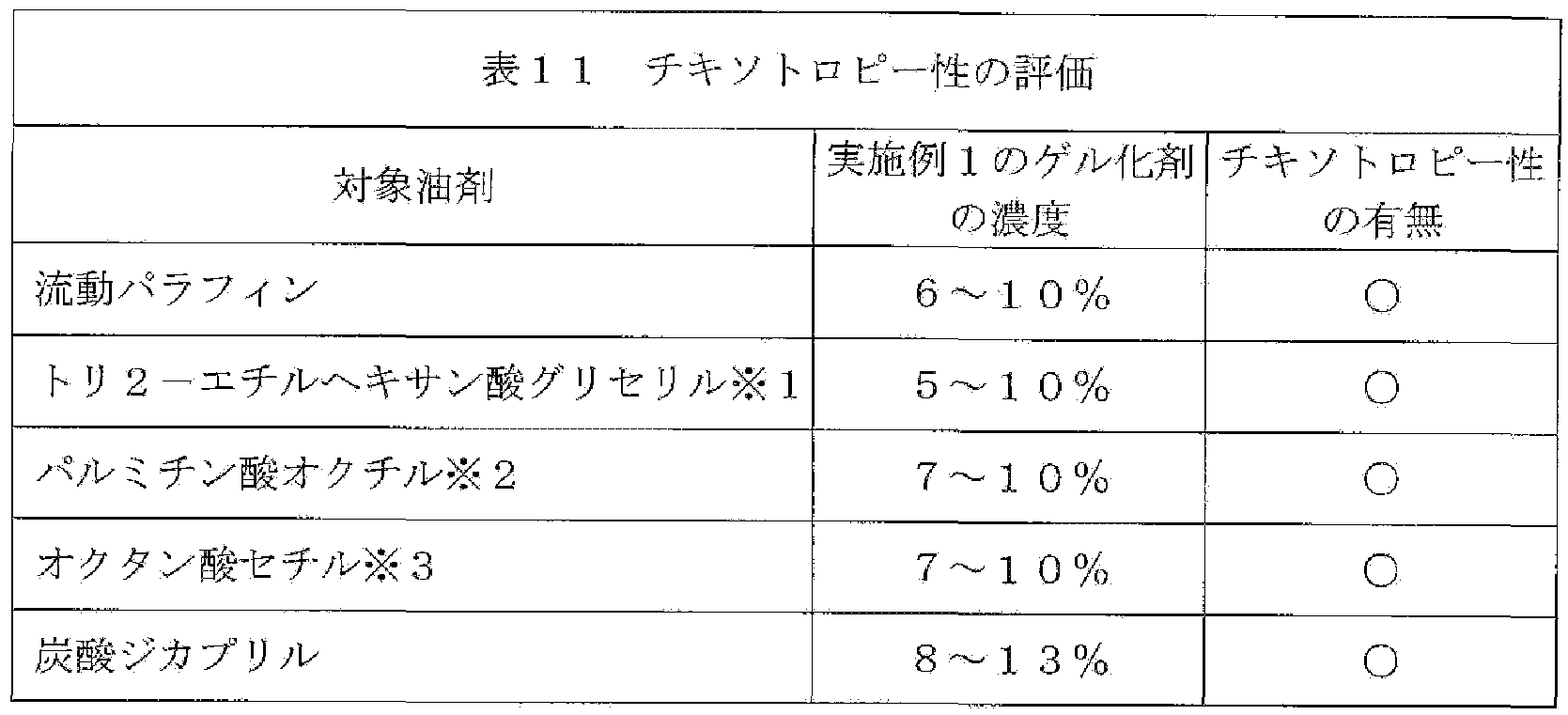
- an oil agent such as glyceryl ruhexaneate, octyl palmitate, cetyl octanoate, dicaprinole carbonate and the like, it imparts thixotropy and can therefore be used as a thixotropic agent.
- Thixotropy is an isothermal reversible sol (liquid) gel (solid) change in which a solid becomes liquid by an external force. In other words, a substance having thixotropic properties is usually a solid, but becomes liquid when force is applied.
- thixotropic properties when thixotropic properties are filled in a plastic container or the like, they usually do not spill out of the container or the like, but can be extruded only when necessary.
- those having thixotropy can be freely spread at the time of use.
- Specific examples of those having thixotropic properties include ketchups, creams, fragrances in the toiletry field, and paints.
- the esterification reaction product according to the present embodiment has an effect of improving the emulsion stability of the water-in-oil (W / O) emulsion, it can be used as an emulsion stabilizer. it can .
- a water-in-oil emulsion having excellent stability over time and good usability can be obtained.
- the content of the esterification reaction product is 100 mass% the total amount of the emulsion, 0.0;! It preferably from to 40% by weight, in 0.05 to 30 weight 0/0 more preferably the force S, 0.; and particularly preferably to 15 carbon mass 0/0!.
- a gelling agent according to an embodiment of the present invention is characterized by containing the esterification reaction product according to the present embodiment. It may contain what was made into said gel-like composition combined with oil etc.,.
- the gelling agent according to the embodiment of the present invention usually uses the esterification reaction product according to the above-described embodiment as a gelling agent as it is (the gelling agent is only from the esterification reaction product).
- the content of the esterification reaction product in the gelling agent is 100%), and as an antioxidant, tocopherol, BHT (dibutylhydroxytoluene) and the like are about 0.01% to 0.1% by mass, You may make it contain.
- examples include lucyclohexasiloxane, and decamethylcyclopentasiloxane can be suitably gelled. The same applies to specific examples that can be dissolved by heating.
- non-volatile dimethylpolysiloxane that can be gelled by combining the gelling agent and the oil according to the present embodiment include dimethylpolysiloxane 5cs, dimethylpolysiloxane 10cs, and dimethylpolysiloxane. You can list lOOcs. The same applies to specific examples that can be dissolved by heating.
- the gelling agent according to the present embodiment is at least heated and dissolved up to 1 in mass ratio.
- the amount of the gelling agent necessary for gelling the cyclic silicone or volatile dimethylpolysiloxane and the oil depends on the total amount of the cyclic silicone or volatile dimethylpolysiloxane and the oil.
- the blending ratio (mass ratio) of the gelling agent with respect to the total mass of the cyclic silicone or volatile dimethylpolysiloxane and the oil agent is 0.01 to the total mass of the cyclic silicone or volatile dimethylpolysiloxane and the oil agent.
- a force of 0.40 ⁇ preferably, a force of 0.015 to 0.25 is more preferred, and a force of 0.02 to 0.15 is particularly preferred.
- the gelling agent according to the present embodiment is not limited to the combined prescription of cyclic silicone or volatile dimethylpolysiloxane and oil, but is cyclic silicone or volatile dimethylpolysiloxane alone or oil alone. It can also be used as a gelling agent.
- the amount of the oil necessary for dissolving in the nonvolatile dimethylpolysiloxane by heating depends on the amount of the nonvolatile dimethylpolysiloxane.
- the compounding ratio (mass ratio) of the oil to the mass of the non-volatile dimethylpolysiloxane is a force of 0 ⁇ 4 to 0 ⁇ 0 when the mass of the non-volatile dimethylpolysiloxane is taken into account. It is particularly preferable that it is 0. 0.6-10.0 is particularly preferable.
- the gelling agent according to this embodiment has a mass ratio of 1 Until at least it dissolves by heating.
- the amount of the gelling agent according to the present embodiment necessary for gelling the nonvolatile dimethylpolysiloxane and the oil depends on the total amount of the nonvolatile dimethylpolysiloxane and the oil.
- the compounding ratio (mass ratio) of the gelling agent according to the present embodiment with respect to the total mass of the non-volatile dimethylpolysiloxane and the oil agent is 0.03-0. It is preferably 40, more preferably 0 ⁇ 05 to 0 ⁇ 30, more preferably force S, and particularly preferably 0 to 10 to 0.20.
- the gelling agent according to the present embodiment is used for cosmetics, oil treatment agents, pigment treatment agents, dye treatment agents, emulsion stabilizers, thixotropy imparting agents, silicone squeezing improvers, and the like. That power S. In particular, it can be used suitably for cosmetics.
- the thixotropic property-imparting agent according to the present embodiment usually uses the esterification reaction product or gelling agent according to the present embodiment as it is as the thixotropic property-imparting agent (the gelling agent is an esterification reaction). It consists only of the product or gelling agent, and the content of the esterification reaction product or gelling agent in the thixotropy imparting agent is 100%).
- the gelling agent is an esterification reaction. It consists only of the product or gelling agent, and the content of the esterification reaction product or gelling agent in the thixotropy imparting agent is 100%).
- As an antioxidant tocopherol, BHT (dibutylhydroxytoluene), etc. 0.01 mass 0 / 0-0.
- the blending ratio of the gelling agent necessary for imparting thixotropy depends on the total amount of oil.
- the blending ratio (mass ratio) of the gelling agent with respect to the total mass of the oil agent is preferably 0 ⁇ 04 to 0 ⁇ 25, and 0 ⁇ 045 to 0 ⁇ 20, where the total mass of the oil agent is 1. S is more preferable, and 0.05 to 0.15 is particularly preferable.
- the cosmetic according to the embodiment of the present invention contains the above-described gelling agent according to the present embodiment (in the following description of the blending amount of the gelling agent! /, The esterification reaction product)
- the gelling agent contains a substance other than the esterification reaction product, it is included! /, Other than the esterification reaction product.
- the preferred blending amount can be calculated from the following blending amount by roughly proportional calculation).
- the blending amount of the gelling agent in the cosmetic is preferably 0.0;! To 40% by mass, more preferably 0.05 to 30% by mass with respect to the total amount of the cosmetic. It is particularly preferable that the content is 0 to 15% by mass.
- the cosmetic according to the present embodiment contains cyclic silicone or volatile dimethylpolysiloxane and / or oil.
- the cyclic silicone, volatile dimethylpolysiloxane, and oil used in the cosmetic according to the present embodiment are the cyclic silicone and volatile dimethylpolysiloxane that can be gelled with the gelling agent according to the present embodiment described above. It is the same as oil.
- the cosmetic according to the present embodiment comprises a non-volatile dimethylpolysiloxane and an oil agent. contains.
- Non-volatile dimethylpolysiloxane can be gelled with the gelling agent according to the present embodiment by combining it with an oil agent.
- the non-volatile dimethylpolysiloxane used in the cosmetic according to the present embodiment and the oil that can be used for gelling the non-volatile dimethylpolysiloxane should be gelled with the above-described gelling agent according to the present embodiment. It is the same as non-volatile dimethylpolysiloxane that can be used, and oil agents that can gel non-volatile dimethylpolysiloxane.
- the total content of the cyclic silicone and the volatile dimethylpolysiloxane in the cosmetic according to the present embodiment is preferably 0.;!-95% by mass. 0.5-60% by mass It is particularly preferred that it is 1 to 30% by mass; most preferred is! To 10% by mass. If the content of cyclic silicone and volatile dimethylpolysiloxane in the cosmetics is within this range, the cosmetics have excellent beauty such as smoothness, feel and gloss.
- the content of the non-volatile dimethylpolysiloxane in the cosmetic according to the present embodiment is preferably 0.;! To 80% by mass in total, and preferably 0.5 to 60% by mass. More preferred;! To 30% by weight is particularly preferred;! To 10% by weight is most preferred. If the content of the non-volatile dimethylpolysiloxane in the cosmetic is in this range, it will be a smooth cosmetic with excellent feel and gloss without touching the silicone.
- the content of the oil agent in the cosmetic according to the present embodiment is preferably 0 .;! To 99% by mass, more preferably 0.5 to 95% by mass; It is particularly preferred that the content is ⁇ 90% by mass.
- the cosmetic is excellent in beauty such as smoothness, feel and gloss.
- the gelling agent according to the present embodiment is suitable for dosage forms that require gelation and solidification in cosmetics formulated with cyclic silicone or volatile dimethylpolysiloxane and / or oil. Can be used for
- the gelling agent according to the present embodiment is preferably used by combining an oil with a dosage form that needs to be gelled or solidified in a cosmetic composition formulated with nonvolatile dimethylpolysiloxane.
- a cosmetic composition formulated with nonvolatile dimethylpolysiloxane can be used for In particular, it can be suitably used for oily cosmetics. wear.
- the gelling agent according to the present embodiment has the effect of improving the emulsion stability of the water-in-oil emulsion, it is suitably used as a water-in-oil emulsion cosmetic as an emulsion stabilizer. be able to.
- the gelling agent according to the present embodiment can impart thixotropic properties, it is preferably used as a thixotropic agent for cosmetics that require thixotropic properties, such as creams. Can do.
- creams such as lipsticks, lip daros, lip balms, hand creams, beauty creams, hair creams, beauty essences, emulsions, lotions, foundations, control lines, sunscreens (sunscreen cosmetics), salmon Crimson, base cosmetics, eye shadow, hairbrow, mascara, shampoo, hair rinse, etc.
- sunscreens unsunscreen cosmetics
- base cosmetics eye shadow, hairbrow, mascara, shampoo, hair rinse, etc.
- the cosmetic according to the present embodiment can be manufactured by a known conventional method for each dosage form.
- the cosmetic according to the present embodiment includes a polyether-modified silicone and an alkyl-modified agent.
- Silicone compounds such as silicone and methylphenylpolysiloxane, alcohols such as cetanol and oleyl alcohol, esters such as higher fatty acids, fatty acid soaps, sterol esters, and sucrose esters, resins, amino acid oils, fluorine oils, Pigments, dyes, pigments, colorants, powders, clay minerals, inorganic ingredients, activators, UV absorbers, moisturizers, fragrances, beauty ingredients, medicinal ingredients, antioxidants, preservatives, water, water-soluble polymers, etc. Ingredients used in normal cosmetics can be blended
- the cosmetic containing the gelling agent according to the present embodiment is excellent in feeling of use such as touch, elongation, stickiness, smoothness, refreshing feeling, coloring, gloss, and longevity. Silicone does not feel squeaky.
- Table 1 shows blending raw materials, preparation amounts, and blending ratios of Examples;! To 16, Comparative Examples;
- the raw materials used were glycerin: concentrated glycerin for cosmetics manufactured by Sakamoto Pharmaceutical Co., Ltd., eicosan diacid: SL-20 manufactured by Okamura Oil Co., Ltd., behenic acid: PRIFRAC2989 manufactured by Unichema, methyl branch Type isostearic acid: Emersol874 from Cognis, multi-branched isostearic acid: isostearic acid from Nissan Chemical Industries, Octadecanedioic acid: Emeroxl 18 from Cognis, isooctylic acid: octylic acid, trimethylol from Chisso Corporation Propane: Trimethylolpropane manufactured by Guangei Chemical Industry Co., Ltd., Stearic acid: PALMAC98_18 manufactured by Acid Chem, Montanoic acid: Hoechest Wax S manufactured by Clariant Japan, Sebacic acid: Sebacin manufactured by Ogura Gosei Kogyo Co., Ltd.
- Example 16 As can be seen from Table 1, the gelation of Examples 1 to 16 which are esterification reaction products obtained by esterifying the components A to D in the specified range at the mixing ratio in the specified range The agent was able to gel the cyclic silicone and was satisfactory. From Example 16, it can be seen that if components A to C are blended within a specified range, gelation is good without using component D.
- the compounding ratio of component A and component B during the esterification reaction is outside the specified range.
- Comparative Examples 1-4, 9, and 10 gelling agent, component B or component having a short carbon number outside the specified range
- the gelling agent of Comparative Examples 5 and 7 using C and the gelling agent of Comparative Example 8 in which the hydroxyl value is out of the specified range cannot gel the cyclic silicone, and are not satisfactory. Tsutsu.
- the evaluation sample was heated in a constant temperature bath at 80 ° C for 1 hour, and then mixed to dissolve the gelling agent uniformly in the oil. After the homogeneously dissolved evaluation sample was stored at 25 ° C for 24 hours, the state of the gelled product was evaluated. The results are shown in Table 2.
- Example 1 and Comparative Example 9 Using Example 1 and Comparative Example 9, the foundations of Example 17 and Comparative Example 11 were prepared and evaluated by the following method.
- sunscreens of Example 18 and Comparative Example 12 were prepared and evaluated by the following method.
- An oil phase was prepared by sufficiently stirring the oil component A shown in Table 4.
- the aqueous component B shown in Table 4 was gradually added to the oil phase, and the homomixer was heated at a temperature of 70 ° C. After being emulsified, the mixture was cooled to obtain a sunscreen.
- Example 1 8 Comparative Example 1 2 Gelling agent of Example 1 4.00-Gelling agent of Comparative Example 9 4.00 Octyl palmitate * 1 15.00 Liquid paraffin
- Polyether-modified silicone 1. 50
- 50 Paramethoxy cinnamate 2 — Ethenolehexyl
- Titanium dioxide 5. 00 5. 00 Zinc oxide 5. 00 5. 00 Dion exchange water 45. 99
- Example 1 and Comparative Example 9 lipsticks of Example 19 and Comparative Example 13 were prepared and evaluated by the following method. [0099] After mixing the components shown in Table 5 below, the mixture was heated to 120 ° C and completely dissolved. Thereafter, the defoamed material was poured into a mold and cooled. It was removed from the mold and set in a lipstick container.
- Table 5 shows the overall evaluation of each lipstick.
- the lipstick of Example 19 containing the gelling agent of Example 1 is a comparative example.
- Example 1 and Comparative Example 9 cosmetic creams of Example 20 and Comparative Example 14 were prepared by the following method and evaluated.
- Example 1 the foundations (oil-based foundations) of Example 21 and Comparative Example 15 were prepared and evaluated by the following method.
- Example 2 Comparative Example 1 5 Talc 5. 50 5. 50 Titanium oxide 40.00 L 40.00
- Example 21 As can be seen from Table 7, the foundation of Example 21 in which the gelling agent of Example 1 was blended was superior to the foundation of Comparative Example 15 in all items.
- Example 1 the sunscreens of Example 22 and Comparative Example 16 (water-in-oil emulsified sunscreen cream) were prepared and evaluated by the following method.
- Example 1 Using Example 1, Examples 23, 24, and 25 and Comparative Examples 17, 18, and 19 were performed as follows.
- Table 10 shows the result of the addition mass of dimethylpolysiloxane lOcs (non-volatile dimethylpolysiloxane) in% relative to the total mass of the gelling agent and oil agent of Example 1 or Comparative Example 9 at the point where this mixture began to become cloudy. Shown in
- Example 1 As can be seen from the results in Table 10, the gelling agent of Example 1 is superior to the gelling agent of Comparative Example 9 in the ability to dissolve dimethylpolysiloxane lOcs (nonvolatile dimethylpolysiloxane). It was. That is, it was found that the solubility in nonvolatile dimethylpolysiloxane was good.
- Og and oil agent 14. Og of Example 1 is 80 ° It melt
- Table 11 shows the types of oils and the amount of gelling agent used in Example 1.
- the evaluation method of thixotropy is to prepare 50g of a 100ml bottle containing the gelling agent of Example 1 mixed with oil at the ratio shown in Table 11, and heat to 80 ° C to make the gelling agent uniform. After dissolution, the mixture was cooled to prepare a gelled product containing the gelling agent of Example 1. Shake the bottle and gel it If the contents of the sol were not allowed to flow when the bottle was turned upside down after the sol was left to stand for 30 minutes, thixotropic properties were assumed.
- Example 1 Using Example 1 or a well-known oil gelling agent, glyceryl behenate, glyceryl behenate or dextrin palmitate, or a combination thereof, according to the following method, Examples 28-35 and Comparative Examples 21-24 Cleansing was made and evaluated.
- Example 1 the lips of Examples 36 to 39 and Comparative Examples 25 and 26 were prepared by the following method. A loss was produced and evaluated.
- Example 1 the hair cream of Example 40 was prepared by the following method.
- the oil component A shown in Table 14 is adjusted to 80 ° C with sufficient stirring. Adjust the aqueous component B shown in the same table to 80 ° C with thorough stirring. While stirring, oily component A was added to aqueous component B and emulsified with a homomixer, and then cooled to prepare a hair cream.
- Example 1 was used to prepare the hair wax of Example 41 by the following method c [0147]
- the oil component A shown in Table 15 was sufficiently stirred at a temperature of 80 ° C, and then cooled to form a hair box.
- Example 1 the hair rinse of Example 42 was prepared and evaluated by the following method.
- Ingredient A shown in Table 16 is sufficiently stirred at a temperature of 70 ° C. After sufficiently stirring Component B at a temperature of 70 ° C., 70 ° C. Component A was added, emulsified with a homomixer and cooled to obtain a hair rinse.
- Example 4 Gelling agent of Example 1 0.50 dimethylpolysiloxane 1 0 0 0 c s (non-volatile)
- A-amino-modified silicone 0.50 V oxychestylene stearinoreethenole 0. 50 Polyglyceryl monoisostearate 1 2 1 0.50 Polydallyseryl diisostearate 2 2 0. 25 Sorbitan sesquioleate *: 0.25 Cetyltrimethylammonium chloride 4.00 Glycerin 0.9.0
- Ion-exchanged water 90.00 Methinole / Kraben 0.10
- the following items were used for * 1 to 3 in Table 16.
Landscapes
- Health & Medical Sciences (AREA)
- Life Sciences & Earth Sciences (AREA)
- Veterinary Medicine (AREA)
- Public Health (AREA)
- General Health & Medical Sciences (AREA)
- Animal Behavior & Ethology (AREA)
- Chemical & Material Sciences (AREA)
- Organic Chemistry (AREA)
- Dermatology (AREA)
- Birds (AREA)
- Epidemiology (AREA)
- Polymers & Plastics (AREA)
- Medicinal Chemistry (AREA)
- Chemical Kinetics & Catalysis (AREA)
- General Chemical & Material Sciences (AREA)
- Oil, Petroleum & Natural Gas (AREA)
- Cosmetics (AREA)
- Organic Low-Molecular-Weight Compounds And Preparation Thereof (AREA)
- Polyesters Or Polycarbonates (AREA)
Description




Claims
Priority Applications (5)
| Application Number | Priority Date | Filing Date | Title |
|---|---|---|---|
| CN2007800280250A CN101495538B (zh) | 2006-07-28 | 2007-07-20 | 酯化反应产物、含有该产物的胶凝剂以及含有它们的化妆品 |
| JP2007555415A JP4664991B2 (ja) | 2006-07-28 | 2007-07-20 | エステル化反応生成物、該生成物を含有するゲル化剤およびこれらを含有する化粧料 |
| US12/309,687 US8039654B2 (en) | 2006-07-28 | 2007-07-20 | Esterification reaction product, gelling agent containing the product, and cosmetic preparation containing them |
| KR1020097001689A KR101359192B1 (ko) | 2006-07-28 | 2007-07-20 | 에스테르화 반응 생성물, 이 생성물을 함유하는 겔화제 및 이들을 함유하는 화장료 |
| EP07791057.8A EP2048178B1 (en) | 2006-07-28 | 2007-07-20 | Esterification reaction products and their use in cosmetic preparations |
Applications Claiming Priority (4)
| Application Number | Priority Date | Filing Date | Title |
|---|---|---|---|
| JP2006206806 | 2006-07-28 | ||
| JP2006-206806 | 2006-07-28 | ||
| JP2006-278686 | 2006-10-12 | ||
| JP2006278686 | 2006-10-12 |
Publications (1)
| Publication Number | Publication Date |
|---|---|
| WO2008013106A1 true WO2008013106A1 (fr) | 2008-01-31 |
Family
ID=38981418
Family Applications (1)
| Application Number | Title | Priority Date | Filing Date |
|---|---|---|---|
| PCT/JP2007/064319 Ceased WO2008013106A1 (fr) | 2006-07-28 | 2007-07-20 | Produit de réaction d'estérification, gélifiant contenant le produit et préparation cosmétique les contenant |
Country Status (6)
| Country | Link |
|---|---|
| US (1) | US8039654B2 (ja) |
| EP (1) | EP2048178B1 (ja) |
| JP (1) | JP4664991B2 (ja) |
| KR (1) | KR101359192B1 (ja) |
| CN (1) | CN101495538B (ja) |
| WO (1) | WO2008013106A1 (ja) |
Cited By (14)
| Publication number | Priority date | Publication date | Assignee | Title |
|---|---|---|---|---|
| JP2010150233A (ja) * | 2008-11-27 | 2010-07-08 | Fancl Corp | 油性液状クレンジング用組成物。 |
| JP2011116873A (ja) * | 2009-12-04 | 2011-06-16 | Konica Minolta Holdings Inc | 活性光線硬化型インクジェット用インクおよびインクジェット記録方法 |
| US20110306679A1 (en) * | 2010-06-09 | 2011-12-15 | L'oreal S.A. | Compositions containing agar and a softening agent |
| JP2012117050A (ja) * | 2010-11-08 | 2012-06-21 | Nisshin Oillio Group Ltd | エステル化反応生成物及び化粧料 |
| JP2012126664A (ja) * | 2010-12-14 | 2012-07-05 | Mikimoto Pharmaceut Co Ltd | 油性洗浄剤 |
| JP2016034923A (ja) * | 2014-08-04 | 2016-03-17 | アサヌマ コーポレーション株式会社 | 皮膚洗浄剤組成物 |
| JP2018111656A (ja) * | 2017-01-11 | 2018-07-19 | 日本メナード化粧品株式会社 | 油性固形化粧料 |
| JP2022107365A (ja) * | 2021-01-08 | 2022-07-21 | ピアス株式会社 | 皮膚外用組成物 |
| WO2022172645A1 (ja) * | 2021-02-10 | 2022-08-18 | 太陽化学株式会社 | ポリグリセリンと脂肪酸及びジカルボン酸をエステル化した化合物 |
| WO2023037976A1 (ja) * | 2021-09-09 | 2023-03-16 | 日清オイリオグループ株式会社 | 液状油性組成物、及び前記組成物を含む化粧料 |
| WO2023163035A1 (ja) * | 2022-02-24 | 2023-08-31 | 日清オイリオグループ株式会社 | オリゴエステル、及び該オリゴエステルを含有する化粧料 |
| JP2024505620A (ja) * | 2020-12-23 | 2024-02-07 | モメンティブ パフォーマンス マテリアルズ インコーポレイテッド | バイオ再生可能なエラストマーゲルおよびその使用 |
| JP2024525546A (ja) * | 2021-07-09 | 2024-07-12 | ビーエーエスエフ ソシエタス・ヨーロピア | ワセリン代替品として使用するためのポリオールエステル混合物 |
| JP7906011B2 (ja) | 2021-07-09 | 2026-08-17 | ビーエーエスエフ ソシエタス・ヨーロピア | ワセリン代替品として使用するためのポリオールエステル混合物 |
Families Citing this family (6)
| Publication number | Priority date | Publication date | Assignee | Title |
|---|---|---|---|---|
| KR101821850B1 (ko) | 2011-05-13 | 2018-01-24 | 마리 케이 인코포레이티드 | 립 스틱 |
| CN103102267B (zh) * | 2011-11-10 | 2015-08-05 | 江西阿尔法高科药业有限公司 | 一种药用辅料级山嵛酸甘油酯的制备方法 |
| JP2013119596A (ja) | 2011-12-07 | 2013-06-17 | Shin-Etsu Chemical Co Ltd | シリコーン変性ワックス、それを含有する組成物、化粧料、及びシリコーン変性ワックスの製造方法 |
| US20160000688A1 (en) * | 2014-07-02 | 2016-01-07 | Mary Kay Inc. | Cosmetic compositions and uses thereof |
| US20240327571A1 (en) * | 2023-03-27 | 2024-10-03 | Momentive Performance Materials Inc. | Crosslinked polymer elastomers, compositions, and methods of preparation thereof |
| WO2026130525A1 (en) * | 2024-12-20 | 2026-06-25 | Momentive Performance Materials Inc. | Emulsifier and emulsion stabilizer comprising crosslinked polyester elastomer |
Citations (8)
| Publication number | Priority date | Publication date | Assignee | Title |
|---|---|---|---|---|
| JPS56104807A (en) * | 1980-01-24 | 1981-08-20 | Shiseido Co Ltd | Cosmetic |
| JPH0693288A (ja) * | 1992-07-27 | 1994-04-05 | Nisshin Oil Mills Ltd:The | ラノリン様合成油剤及びこれを配合してなる化粧品、外用剤 |
| JPH07126604A (ja) | 1993-10-28 | 1995-05-16 | Nisshin Oil Mills Ltd:The | 有機液体のゲル化又は固化剤 |
| JPH07126603A (ja) | 1993-10-28 | 1995-05-16 | Nisshin Oil Mills Ltd:The | アルコールのゲル化又は固化剤 |
| JPH09104613A (ja) * | 1995-10-06 | 1997-04-22 | Nisshin Oil Mills Ltd:The | 油中水型ゲル状乳化組成物およびこれを用いてなる乳化化粧料または外用剤 |
| JP2001247846A (ja) * | 2000-03-03 | 2001-09-14 | Nisshin Oil Mills Ltd:The | 水性ゲル化剤 |
| JP2003238988A (ja) * | 2002-02-19 | 2003-08-27 | Kanebo Ltd | ワックス組成物及び該ワックス組成物を含有する化粧料 |
| JP2004300094A (ja) | 2003-03-31 | 2004-10-28 | Kose Corp | 化粧料 |
Family Cites Families (4)
| Publication number | Priority date | Publication date | Assignee | Title |
|---|---|---|---|---|
| JP2001247847A (ja) * | 2000-03-03 | 2001-09-14 | Nisshin Oil Mills Ltd:The | 水性ゲル化剤 |
| EP1417955B1 (en) * | 2001-08-13 | 2007-09-05 | The Nisshin OilliO Group, Ltd. | Humectant and cosmetics and external preparations containing the same |
| WO2004100917A1 (ja) * | 2003-05-13 | 2004-11-25 | The Nisshin Oillio Group, Ltd. | 水中油型乳化化粧料 |
| EP1645265A4 (en) * | 2003-05-13 | 2008-04-23 | Nisshin Oillio Group Ltd | COSMETIC PREPARATION ON OIL BASIS |
-
2007
- 2007-07-20 CN CN2007800280250A patent/CN101495538B/zh active Active
- 2007-07-20 JP JP2007555415A patent/JP4664991B2/ja active Active
- 2007-07-20 WO PCT/JP2007/064319 patent/WO2008013106A1/ja not_active Ceased
- 2007-07-20 EP EP07791057.8A patent/EP2048178B1/en active Active
- 2007-07-20 US US12/309,687 patent/US8039654B2/en active Active
- 2007-07-20 KR KR1020097001689A patent/KR101359192B1/ko active Active
Patent Citations (8)
| Publication number | Priority date | Publication date | Assignee | Title |
|---|---|---|---|---|
| JPS56104807A (en) * | 1980-01-24 | 1981-08-20 | Shiseido Co Ltd | Cosmetic |
| JPH0693288A (ja) * | 1992-07-27 | 1994-04-05 | Nisshin Oil Mills Ltd:The | ラノリン様合成油剤及びこれを配合してなる化粧品、外用剤 |
| JPH07126604A (ja) | 1993-10-28 | 1995-05-16 | Nisshin Oil Mills Ltd:The | 有機液体のゲル化又は固化剤 |
| JPH07126603A (ja) | 1993-10-28 | 1995-05-16 | Nisshin Oil Mills Ltd:The | アルコールのゲル化又は固化剤 |
| JPH09104613A (ja) * | 1995-10-06 | 1997-04-22 | Nisshin Oil Mills Ltd:The | 油中水型ゲル状乳化組成物およびこれを用いてなる乳化化粧料または外用剤 |
| JP2001247846A (ja) * | 2000-03-03 | 2001-09-14 | Nisshin Oil Mills Ltd:The | 水性ゲル化剤 |
| JP2003238988A (ja) * | 2002-02-19 | 2003-08-27 | Kanebo Ltd | ワックス組成物及び該ワックス組成物を含有する化粧料 |
| JP2004300094A (ja) | 2003-03-31 | 2004-10-28 | Kose Corp | 化粧料 |
Cited By (19)
| Publication number | Priority date | Publication date | Assignee | Title |
|---|---|---|---|---|
| JP2010150233A (ja) * | 2008-11-27 | 2010-07-08 | Fancl Corp | 油性液状クレンジング用組成物。 |
| JP2011116873A (ja) * | 2009-12-04 | 2011-06-16 | Konica Minolta Holdings Inc | 活性光線硬化型インクジェット用インクおよびインクジェット記録方法 |
| US20110306679A1 (en) * | 2010-06-09 | 2011-12-15 | L'oreal S.A. | Compositions containing agar and a softening agent |
| US8933134B2 (en) * | 2010-06-09 | 2015-01-13 | L'oreal | Compositions containing agar and a softening agent |
| JP2012117050A (ja) * | 2010-11-08 | 2012-06-21 | Nisshin Oillio Group Ltd | エステル化反応生成物及び化粧料 |
| JP2012126664A (ja) * | 2010-12-14 | 2012-07-05 | Mikimoto Pharmaceut Co Ltd | 油性洗浄剤 |
| JP2016034923A (ja) * | 2014-08-04 | 2016-03-17 | アサヌマ コーポレーション株式会社 | 皮膚洗浄剤組成物 |
| JP2018111656A (ja) * | 2017-01-11 | 2018-07-19 | 日本メナード化粧品株式会社 | 油性固形化粧料 |
| JP2024505620A (ja) * | 2020-12-23 | 2024-02-07 | モメンティブ パフォーマンス マテリアルズ インコーポレイテッド | バイオ再生可能なエラストマーゲルおよびその使用 |
| JP2022107365A (ja) * | 2021-01-08 | 2022-07-21 | ピアス株式会社 | 皮膚外用組成物 |
| JP7696152B2 (ja) | 2021-01-08 | 2025-06-20 | ピアス株式会社 | 皮膚外用組成物 |
| JPWO2022172645A1 (ja) * | 2021-02-10 | 2022-08-18 | ||
| WO2022172645A1 (ja) * | 2021-02-10 | 2022-08-18 | 太陽化学株式会社 | ポリグリセリンと脂肪酸及びジカルボン酸をエステル化した化合物 |
| JP7588162B2 (ja) | 2021-02-10 | 2024-11-21 | 太陽化学株式会社 | ポリグリセリンと脂肪酸及びジカルボン酸をエステル化した化合物 |
| JP2024525546A (ja) * | 2021-07-09 | 2024-07-12 | ビーエーエスエフ ソシエタス・ヨーロピア | ワセリン代替品として使用するためのポリオールエステル混合物 |
| JP7906011B2 (ja) | 2021-07-09 | 2026-08-17 | ビーエーエスエフ ソシエタス・ヨーロピア | ワセリン代替品として使用するためのポリオールエステル混合物 |
| WO2023037976A1 (ja) * | 2021-09-09 | 2023-03-16 | 日清オイリオグループ株式会社 | 液状油性組成物、及び前記組成物を含む化粧料 |
| JPWO2023037976A1 (ja) * | 2021-09-09 | 2023-03-16 | ||
| WO2023163035A1 (ja) * | 2022-02-24 | 2023-08-31 | 日清オイリオグループ株式会社 | オリゴエステル、及び該オリゴエステルを含有する化粧料 |
Also Published As
| Publication number | Publication date |
|---|---|
| US8039654B2 (en) | 2011-10-18 |
| KR20090038007A (ko) | 2009-04-17 |
| JP4664991B2 (ja) | 2011-04-06 |
| US20090324519A1 (en) | 2009-12-31 |
| EP2048178A1 (en) | 2009-04-15 |
| KR101359192B1 (ko) | 2014-02-05 |
| EP2048178B1 (en) | 2017-09-06 |
| JPWO2008013106A1 (ja) | 2009-12-17 |
| EP2048178A4 (en) | 2015-05-06 |
| CN101495538A (zh) | 2009-07-29 |
| CN101495538B (zh) | 2011-09-07 |
Similar Documents
| Publication | Publication Date | Title |
|---|---|---|
| JP4664991B2 (ja) | エステル化反応生成物、該生成物を含有するゲル化剤およびこれらを含有する化粧料 | |
| JP6114083B2 (ja) | 油中水型固形化粧料 | |
| JP6660885B2 (ja) | 粉体分散剤、これを配合した粉体分散組成物及び化粧料 | |
| JP4317548B2 (ja) | 油性化粧料 | |
| JP2008239550A (ja) | 油中多価アルコール型ゲル状化粧料 | |
| JP6826807B2 (ja) | 油性固形口唇化粧料 | |
| KR101084410B1 (ko) | 유성 화장료 | |
| JP7016672B2 (ja) | 液状油性の毛髪化粧料 | |
| JP6564221B2 (ja) | 油性口唇化粧料 | |
| KR20150067275A (ko) | 케라틴 섬유의 코팅을 위한 화장용 조성물 | |
| CN111032000B (zh) | 油包水型乳化化妆品 | |
| WO2008013107A1 (fr) | Produit de réaction d'estérification, gélifiant contenant le produit et préparation cosmétique contenant le gélifiant | |
| JP5318430B2 (ja) | 化粧品油剤用ゲル化剤及びこれを配合する化粧料 | |
| JP5788697B2 (ja) | 油性固形組成物、その製造方法、及び油性固形製品 | |
| WO2004100918A1 (ja) | 水中油型乳化化粧料 | |
| WO2004100917A1 (ja) | 水中油型乳化化粧料 | |
| CN114306117A (zh) | 化妆品 | |
| JP2004137214A (ja) | 口唇用化粧料 | |
| JP7203641B2 (ja) | 油性固形化粧料 | |
| JP2003095848A (ja) | 固形油性化粧料 | |
| JP4327068B2 (ja) | 化粧料 | |
| JP4786399B2 (ja) | 非固形口唇化粧料 | |
| JP2001279040A (ja) | 油性透明組成物及びこれを含有する化粧料 | |
| JP2001342109A (ja) | 化粧料 | |
| JP7022535B2 (ja) | 油性化粧料 |
Legal Events
| Date | Code | Title | Description |
|---|---|---|---|
| WWE | Wipo information: entry into national phase |
Ref document number: 200780028025.0 Country of ref document: CN |
|
| WWE | Wipo information: entry into national phase |
Ref document number: 2007555415 Country of ref document: JP |
|
| 121 | Ep: the epo has been informed by wipo that ep was designated in this application |
Ref document number: 07791057 Country of ref document: EP Kind code of ref document: A1 |
|
| WWE | Wipo information: entry into national phase |
Ref document number: 1020097001689 Country of ref document: KR |
|
| WWE | Wipo information: entry into national phase |
Ref document number: 12309687 Country of ref document: US |
|
| REEP | Request for entry into the european phase |
Ref document number: 2007791057 Country of ref document: EP |
|
| WWE | Wipo information: entry into national phase |
Ref document number: 2007791057 Country of ref document: EP |
|
| NENP | Non-entry into the national phase |
Ref country code: DE |
|
| NENP | Non-entry into the national phase |
Ref country code: RU |