WO2008017593A1 - Novel polyhedral oligomeric silsesquioxane (poss) based fluorescent colorants - Google Patents

Novel polyhedral oligomeric silsesquioxane (poss) based fluorescent colorants Download PDF

Info

Publication number
WO2008017593A1
WO2008017593A1 PCT/EP2007/057740 EP2007057740W WO2008017593A1 WO 2008017593 A1 WO2008017593 A1 WO 2008017593A1 EP 2007057740 W EP2007057740 W EP 2007057740W WO 2008017593 A1 WO2008017593 A1 WO 2008017593A1
Authority
WO
WIPO (PCT)
Prior art keywords
group
fluorescent colorant
alkyl
colorant according
fluorescent
Prior art date
Legal status (The legal status is an assumption and is not a legal conclusion. Google has not performed a legal analysis and makes no representation as to the accuracy of the status listed.)
Ceased
Application number
PCT/EP2007/057740
Other languages
French (fr)
Inventor
Suruliappa Gowder Jeganathan
David Bramer
Redina Kote
Gajanan J. Maladkar
Current Assignee (The listed assignees may be inaccurate. Google has not performed a legal analysis and makes no representation or warranty as to the accuracy of the list.)
BASF Schweiz AG
Original Assignee
Ciba Spezialitaetenchemie Holding AG
Ciba Holding AG
Ciba SC Holding AG
Priority date (The priority date is an assumption and is not a legal conclusion. Google has not performed a legal analysis and makes no representation as to the accuracy of the date listed.)
Filing date
Publication date
Application filed by Ciba Spezialitaetenchemie Holding AG, Ciba Holding AG, Ciba SC Holding AG filed Critical Ciba Spezialitaetenchemie Holding AG
Priority to AT07787957T priority Critical patent/ATE451429T1/en
Priority to DE602007003740T priority patent/DE602007003740D1/en
Priority to EP07787957A priority patent/EP2049601B1/en
Priority to JP2009523239A priority patent/JP5269786B2/en
Priority to CN200780029297.2A priority patent/CN101501144B/en
Publication of WO2008017593A1 publication Critical patent/WO2008017593A1/en
Anticipated expiration legal-status Critical
Ceased legal-status Critical Current

Links

Classifications

    • CCHEMISTRY; METALLURGY
    • C08ORGANIC MACROMOLECULAR COMPOUNDS; THEIR PREPARATION OR CHEMICAL WORKING-UP; COMPOSITIONS BASED THEREON
    • C08GMACROMOLECULAR COMPOUNDS OBTAINED OTHERWISE THAN BY REACTIONS ONLY INVOLVING UNSATURATED CARBON-TO-CARBON BONDS
    • C08G77/00Macromolecular compounds obtained by reactions forming a linkage containing silicon with or without sulfur, nitrogen, oxygen or carbon in the main chain of the macromolecule
    • C08G77/04Polysiloxanes
    • C08G77/38Polysiloxanes modified by chemical after-treatment
    • CCHEMISTRY; METALLURGY
    • C08ORGANIC MACROMOLECULAR COMPOUNDS; THEIR PREPARATION OR CHEMICAL WORKING-UP; COMPOSITIONS BASED THEREON
    • C08GMACROMOLECULAR COMPOUNDS OBTAINED OTHERWISE THAN BY REACTIONS ONLY INVOLVING UNSATURATED CARBON-TO-CARBON BONDS
    • C08G77/00Macromolecular compounds obtained by reactions forming a linkage containing silicon with or without sulfur, nitrogen, oxygen or carbon in the main chain of the macromolecule
    • C08G77/04Polysiloxanes
    • C08G77/045Polysiloxanes containing less than 25 silicon atoms
    • CCHEMISTRY; METALLURGY
    • C08ORGANIC MACROMOLECULAR COMPOUNDS; THEIR PREPARATION OR CHEMICAL WORKING-UP; COMPOSITIONS BASED THEREON
    • C08LCOMPOSITIONS OF MACROMOLECULAR COMPOUNDS
    • C08L83/00Compositions of macromolecular compounds obtained by reactions forming in the main chain of the macromolecule a linkage containing silicon with or without sulfur, nitrogen, oxygen or carbon only; Compositions of derivatives of such polymers
    • C08L83/04Polysiloxanes
    • CCHEMISTRY; METALLURGY
    • C09DYES; PAINTS; POLISHES; NATURAL RESINS; ADHESIVES; COMPOSITIONS NOT OTHERWISE PROVIDED FOR; APPLICATIONS OF MATERIALS NOT OTHERWISE PROVIDED FOR
    • C09BORGANIC DYES OR CLOSELY-RELATED COMPOUNDS FOR PRODUCING DYES, e.g. PIGMENTS; MORDANTS; LAKES
    • C09B69/00Dyes not provided for by a single group of this subclass
    • C09B69/008Dyes containing a substituent, which contains a silicium atom

Definitions

  • the present invention provides novel fluorescent polyhedral oligomeric silsesquioxane (POSS) colorants.
  • the colorants are strongly fluorescing and long lasting and are useful in a wide variety of applications including printing inks, coatings and the coloration of plastics.
  • Biomedical uses include medical imaging and fluorescent marking.
  • the novel colorants can be prepared from chromophores found in common pigments and provide a simple way to convert an insoluble pigment into a soluble fluorescent colorant.
  • Pigments are differentiated from dyes by their physical characteristics rather than by chemical composition. Dyes, unlike pigments, dissolve during their application and in the process lose their crystal or particulate structure.
  • Fluorescent colorants which generally are based on organic dyes, represent an important class of materials commonly used in coloring printing inks, paints and plastics. Colorants often referred to as industrial fluorescent pigments are obtained by dissolving a fluorescent dye in a suitable media, such as a resin matrix. The resin matrix is then broken to a specific size, typically of several microns, so that it may be used as a pigment.
  • organic pigments exhibit no fluorescence or fluorescence very low intensity. Only a limited number of fluorescent organic pigments are described in the art, as, for example, fluorescent C. I. Pigment Yellow 101 described in W. Herbst and K. Hunger, Industrial Organic Pigments, 2.sup.nd Ed., VCH Verlagsgesellschaft, Weinheim, 1997, 571-572.
  • pigments Compared to dyes, pigments have several advantages, such as good lightfastness properties or weather resistance and freedom from transfer problems.
  • US Pat. 6,946,550 incorporated herein in its entirety by reference, discloses yellow and red azo compounds, and their use as fluorescent compounds, in particular as solid fluorescent compounds, such as for special effect printing, security printing or in the opto-electronic field.
  • EP 0504541.7 discloses functionalized nanoparticles, for example silicon and aluminum oxide nanoparticles, to which dyes are bound and to the use thereof as coloring materials for organic materials.
  • the nanoparticle dyes have many desirable characteristics including increased fluorescence, however, the functionalized nanoparticles are not soluble in many common materials.
  • U S Published Pat. Appl. 20050123760, June 9, 2005, incorporated herein in its entirety by reference discloses a light-emitting nanoparticle prepared by covalently attaching a lumo- phore, i.e a chromophore that emits light when exposed to electromagnetic radiation, to a silsequioxane nanoparticle core.
  • Siliconequioxane is the general name for a family of polycyc- Nc compounds consisting of silicon and oxygen also known as silasesquioxanes and polyhedral oligomeric silsesquioxanes.
  • One particular embodiment of U S Pat. Appl. 20050123760 is a nanoparticle to which various colored lumophores are attached which is therefore capable of emitting white light.
  • the lumophores attached to the silsequioxanes of U S Pat. Appl. 20050123760 include certain known fluorescent dyes and the resulting light-emitting nanoparticles are susceptible to the drawbacks of such dyes, e.g., they are not stable under many conditions of use and lose their color and fluorescence due to chemical degradation initiated by environmental factors such as exposure to heat and light.
  • the present invention discloses highly fluorescent colorants with improved properties such as excellent light stability and solubility or excellent dispersibility in a number of polymer systems.
  • a nanoparticle is a particle having a cross-sectional measurement (e.g., diameter if spherical) of about 100 nm or less.
  • the silsequioxane group of the formula (I) is an example of a nanoparticle.
  • a "chromophore” is a molecule or aggregate of molecules that can absorb electromagnetic radiation.
  • Silequioxane is the general name for a family of polycyclic compounds consisting of silicon and oxygen. Silsequioxanes are also known as silasesquioxanes and polyhedral oligomeric silsesquioxanes, for example from U S Published Pat. Appl. No. 20050123760 and are abbreviated "POSS", - A -
  • the present invention provides novel fluorescent colorants of formula (I)
  • n is 1 or 2; n is 1 -18, for example n is 1 , 2, 3 or 4, for example n is 3;
  • X is a direct bond, -O-, -S-, -NH-, -CO-, or -COO-; for example X is a direct bond, -NH-, or -CO-, for example a direct bond; each R is independently selected from the group consisting of CrC 25 alkyl, C 2 -C 2S alkyl interrupted one or more times by one or more groups selected from -O- and-S-, C 2 -C 24 alkenyl, C 3 -C 24 alkenyl interrupted one or more times by one or more groups selected from -O- and -S-, C 7 -C 9 phenylalkyl, a group -(CH 2 )n-X-(Y)z wherein n is defined as above and z is 1 or V 2 and when more than one z is present each z is independently selected, phenyl and phenyl substituted 1 to 5 times by one or more groups selected from d-C 8 alkyl, d-C
  • Y is a radical of a chromophore selected from the group consisting of azo dyes, benzo[a]xan- thenes, benzo[b]xanthenes, benzo[c]xanthenes, napthalimides, diketopyrrolopyrroles, peryle- nes, quinacridones, benzoxanthenes, diphenylmaleimides, acetoacetamides, perylenmono- imides, perylenes and phthalimides, wherein when more than one Y is present, each Y is selected independently of the others.
  • Y is a radical of a chromophore selected from the group consisting of perylene, benzoxanthene, naphthalimid, quinacridone, diketopyrrolopyrrole and phthalocyanine chro- mophores; for example, Y is a perylene, benzoxanthene, naphthalimide or diketopyrrolopyrrole chromophore.
  • Y is derived from a chromophore which is part of a pigment, or typically found as part of a pigment particle.
  • Y is derived, for example from a xanthene, perylene, benzoxanthene, naphthalimid, diketopyrrolopyrrole, quinacridone or phthalocyani- ne pigment, and in a particular embodiment, Y is derived from a perylene, benzoxanthene, naphthalimid or diketopyrrolopyrrole pigment.
  • Particularly useful radicals for Y are those of formula
  • R and R' together with the residue of formula -N(CO) 2 form the radical of a perylene, benzoxanthene or naphthalimide dye.
  • radicals of formula (2) include the following:
  • rings A and B can be unsubstituted or substituted by C-i-salkyl, d-salkoxy, amino, mono- or di(Ci -8 alkyl)amino, halogen or sulfo.
  • R 1 is Ci -8 alkyl, Ci -8 alkoxy, Ci -8 thioalkyl, amino, mono- or di(Ci.8alkyl)amino, or halogen, and X is -O-, -S-, -NH-, or -N(R 2 )-, wherein R 2 is Ci -8 alkyl, hydroxy-Ci -8 alkyl, or C 6- ioaryl.
  • R 5 is hydrogen; Ci-C 25 alkyl, which can be substituted by halogen, phenyl or naphthyl, whereby the phenyl or naphthyl can in turn be further substituted by Ci-C 8 alkyl or Ci-C 8 alkoxy; allyl which can be substituted one to three times with Ci-C 4 alkyl; a C 5 -C 7 cycloalkyl group; a C 5 -C 7 cycloalkyl group, which can be condensed one or two times by phenyl which can be substituted one to three times with d-C 4 -alkyl, halogen, nitro or cyano; a C 2 -C 25 alkenyl group which can be substituted by halogen; or a C 2 -C 25 alkynyl group which can be substituted by halogen, for example, R 5 is Ci-C 25 alkyl, which can be substituted by halogen, phenyl or naphthyl,
  • R 3 and R 4 are preferably, independently of each other, hydrogen; d-C 8 alkyl; phenyl or naphthyl which can be substituted by Ci-C 8 alkyl, Ci-C 8 alkoxy or halogen; cyano; nitro; halogen; amino; hydroxyl; or -COOR 6 , wherein R 6 is as defined above; for example R 3 and R 4 are hydrogen or -COOR 6 .
  • perylene compounds and theirs preparation are known for example from US Pat. 6,326,494, as well as from "Synthesis of Diazodibenzoperylenes.", F. W ⁇ rthner et al in J. Org. Chem. 2002, 67, pages 3037-3044 and "Hierarchical Self-Organisation of Perylene Bisimide ", F. W ⁇ rthner et at in Chem. Eur., 2000,6, No.21 , pages 3871-3886.
  • radicals useful as Y include the following:
  • R 3 , R 4 and R 5 are as defined above, and
  • R 107 is hydrogen, d-C 24 alkyl or Ci-C 24 cycloalkyl
  • R 108 is unsubstituted or substituted Ci-C 24 alkyl, Ci-C 24 cycloalkyl, phenyl, benzyl, -CO-Ci-C 4 alkyl, -CO-C 6 H 5 or C r C 4 alkylcarboxylic acid (C r C 4 alkyl) ester
  • a 2 is a linkage of formula
  • R 10 and R 11 are independently of each other an organic group, and Ar 1 and Ar 2 are independently of each other an aryl group or a heteroaryl group, which can optionally be substituted.
  • aryl group in the definition of Ar 1 and Ar 2 is typically C 6 -C 3 oaryl, such as phenyl, in- denyl, azulenyl, naphthyl, biphenyl, terphenylyl or quadphenylyl, as-indacenyl, s-indacenyl, acenaphthylenyl, phenanthryl, fluoranthenyl, triphenlenyl, chrysenyl, naphthacen, picenyl, pe- rylenyl, pentaphenyl, hexacenyl, pyrenyl, or anthracenyl, preferably phenyl, 1-naphthyl, 2-naphthyl, 9-phenanthryl, 2- or 9-fluorenyl, 3- or 4-biphenyl, which may be unsubstituted or substituted.
  • heteroaryl group is a ring, wherein nitrogen, oxygen or sulfur are the possible hetero atoms, and is typically an unsaturated heterocyclic radical with five to 18 atoms having at least six conjugated ⁇ -electrons such as thienyl, benzo[b]thie- nyl, dibenzo[b,d]thienyl, thianthrenyl, furyl, furfuryl, 2H-pyranyl, benzofuranyl, isobenzofura- nyl, 2H-chromenyl, xanthenyl, dibenzofuranyl, phenoxythienyl, pyrrolyl, imidazolyl, pyrazolyl, pyridyl, bipyridyl, triazinyl, pyrimidinyl, pyrazinyl, 1 H-pyrrolizinyl, isoindolyl, pyridazin
  • Ar 1 and Ar 2 are phenyl; naphthyl, like 1- or 2-naphthyl; biphenyl, like 3- or 4-biphe- nyl; phenanthryl, like 9-phenanthryl; or flurorenyl, like 2- or 9-fluorenyl, for example Ar 1 and Ar 2 are phenyl or naphthyl, typically phenyl.
  • Ar 1 and Ar 2 can be unsubstituted or substituted by, for example, d-C ⁇ alkyl; d-C ⁇ alkoxy; halogen, like fluorine, chlorine or bromine; cyano; amino; N-mono- or N,N-di-(Ci-Ci 2 al- kyl)amino; phenylamino, N,N-di-phenylamino, naphthylamino or N,N-di-naphthylamino, wherein the phenyl or naphthyl radicals can be further substituted by, for example, Ci-Ci 2 al- kyl, Ci-Ci 2 alkoxy or halogen.
  • Typical substituents are d-C ⁇ alkyl, fro example, Ci-C 4 alkyl; Ci-Ci 2 alkoxy,for example, Ci-C 4 alkyl; and halogen.
  • R 10 and R 11 may be the same or different and are, for example, selected from a Ci-C 2 5alkyl group, which can be substituted by fluorine, chlorine, bromine or hydroxyl, an allyl group, which can be substituted by Ci-C 4 alkyl, a cycloalkyl group, a cycloalkyl group, which can be condensed one or two times by phenyl which can be substituted by CrC 4 -alkyl, halogen, nitro or cyano, an alkenyl group, a cycloalkenyl group, an alkynyl group, a haloalkyl group, a haloalkenyl group, a haloalkynyl group, a ketone or aldehyde group, an ester group, a carbamoyl group, a ketone group, a silyl group, a siloxanyl group,
  • R 10 and R 11 are typically Ci-C 25 alkyl, which is unsubstituted or substituted by fluorine, chlorine, bromine or hydroxyl;
  • R 117 and R 118 are CrC 25 alkyl; or benzyl, which is unsubstituted or substituted in the phenyl ring by Ci-C 8 alkyl, d-C 8 alkoxy or halogen.
  • Y is derived from an azo dye
  • such dyes include the following: n+
  • B 1 and B 2 independently of each other, are phenyl, naphthyl, or a heterocylic group, each of which can be substituted by Ci-C 8 alkyl, d-C 8 alkoxy, phenyl, halogen, or a radical of formula -N(R 13 )R 14 , -N(R 13 )(R 14 )R 15 or -OR 13 , wherein R 13 , R 14 and R 15 are hydrogen, C r C 8 alkyl, C-i-Cshydroxyalkyl or phenyl, which phenyl radical can be further substituted by one of the substituents given above for B 1 and B 2 ,
  • Typical heterocyclic groups are the imidazole and the pyridazine group.
  • each of the Y groups can be derived from a differ- rent class of chromophore or be derived from the same general class of chromophore by bear different substituent groups.
  • all Y groups are the same or derived from the same chromophore class.
  • any number of R groups can be a group -(CH 2 )n-X-(Y)z wherein n is defined as above and z is 1 or Vi and when more than one z is present each z is independently selected.
  • the number of R groups equal to -(CH 2 )n-X-(Y)z can be any number from 0 through 7. That is, none of the R may be equal to -(CH 2 )n-X-(Y)z, or any number of R groups from 1 through 7 may be equal to -(CH 2 )n-X-(Y)z.
  • the number of R groups equal to -(CH 2 )n-X-(Y)z is either 0, 1 , 2 or 3, typically 0 or 1.
  • R groups are -(CH 2 )n-X-(Y)z wherein z is 1/2
  • a series of POSS groups are linked through groups -(CH 2 )n-X-(Y)-X-(CH 2 )n-, in particular, when m is 2.
  • Such a compound containing a series of POSS groups may be linear or branched depending on the number of groups R equal to -(CH 2 )n-X-(Y)z.
  • the present invention binds the colorant to a silsesquioxane core of defined structure.
  • the silsesquioxane core also bears organic substituents, such as alkyl chains etc., and the silsesquioxane colorant of the present invention is soluble in many organic solvents and substrates.
  • the present invention also encompasses compounds wherein a small amount of the silses- quioxane, for example less than 10% of the silsesquioxane groups present, comprises additional silane or siloxy groups which are the result of the preparation of the silsesquioxane core.
  • the R groups of formula (I) may comprise silane or siloxy groups or chains of said groups resulting from side reactions in the preparation of silsesquioxane. It is anticipated that an even smaller amount of the silsesquioxane groups will contain R groups such that dimeric or oligomeric silsesquioxane groups will be formed. In general, the products derived from these minor components will not have a significant effect on the effectiveness of the fluorescent colorants of this invention.
  • the fluorescent colorants of the present invention are prepared via known reactions involving the appropriately functionalized silsesquioxane and chromophore derivative.
  • known methods of preparing ether, ester, amide, imide, urea, thioether or thioester linkages can be readily employed to couple the desired silsesquioxane and chromophore.
  • known methods of preparing ether, ester, amide, imide, urea, thioether or thioester linkages can be readily employed to couple the desired silsesquioxane and chromophore.
  • known methods of preparing ether, ester, amide, imide, urea, thioether or thioester linkages can be readily employed to couple the desired silsesquioxane and chromophore.
  • known methods of preparing ether, ester, amide, imide, urea, thioether or thioester linkages can be readily employed to couple
  • the fluorescent colorants of the present invention can be used in any application wherein pigments and dyes are encountered and are of course valuable in applications where the fluorescence of the colorant provides a useful function as in security marking or bio assays, or imparts a particularly desired color or effect.
  • the colorants are employed in general by methods known per se, for example (a) for mass coloring polymers; (b) for the preparation of paints, paint systems, coating compositions, paper colours, printing colours, inks including ink-jet applications and writing purposes, as well as in electrophotography, e.g.
  • passive display elements notices and traffic signs, such as traffic lights, safety equipment
  • marking with fluorescence in the solid state for marking with fluorescence in the solid state
  • decorative and artistic purposes for modifying inorganic substrates such as aluminium oxide, silicon dioxide, titanium dioxide, tin oxide, magnesium oxide (including "stone wood"), silicates, clay minerals, calcium-, gypsum- or cement-containing surfaces, for example coatings or plaster surfaces
  • silicates for example coatings or plaster surfaces
  • j in optical light collection systems, in fluorescence solar collectors (see Nachr. Chem. Tech. Lab.
  • novel colourants can be linked covalently to the substrates or via secondary valences, such as hydrogen bonds or hydrophobic interactions (adsorption); and (m) in highly sensitive detection processes (see Z. Analyt. Chem. 1985, 320, 361 ), in particular as fluorescent colourants in scintillators.
  • the compounds of the present invention are used as high fluorescent colorants for coatings, plastics and inks application, especially in plastics and security printing inks.
  • Other uses are in the biomedical area, particularly medical imaging.
  • the fluorescent colorants of the present invention are either soluble or readily and evenly dispersed in a wide variety of solvents and polymers providing evenly colored systems which retain their color under aging or weathering conditions longer than commonly encountered dyes.
  • the fluorescence of these colored systems is much higher than systems colored by known pigments comprising similar chromophores and this fluorescence is likewise retained under aging or weathering conditions longer than commonly encountered fluorescent dyes.
  • any composition comprising the present fluorescent colorants, one would naturally expect to find other commonly encountered components including stabilizers, for example antioxidants, UV absorbers, hindered amine or other light stabilizers, phosphites or phosphonites, benzofuran-2-ones, thiosynergists, polyamide stabilizers, metal stearates; also other fluorescent materials, processing aids, solvents etc., nucleating agents, fillers, reinforcing agents, lubricants, emulsifiers, dyes, pigments, dispersents, optical brighteners, flame retardants, antistatic agents, blowing agents and the like.
  • stabilizers for example antioxidants, UV absorbers, hindered amine or other light stabilizers, phosphites or phosphonites, benzofuran-2-ones, thiosynergists, polyamide stabilizers, metal stearates; also other fluorescent materials, processing aids, solvents etc., nucleating agents, fillers, reinforc
  • the amount of the fluorescent colorants of the present invention used in an application will vary greatly depending on the end use and effect desired. Typical load levels are well know to the practitioner or are readily found in the literature and would be adequate starting points for those formulating with the present fluorescent colorants.
  • the fluorescent colorants of the present invention can therefore be used in almost any concentration depending on the end use application.
  • novel fluorescent colorants are used in an amount of 0.01 to 30% by weight, for example 0.1 to 10% by weight, based on the high molecular weight organic material to be pigmented.
  • fluorescent colorants of the present invention are used to color high molecular weight organic compounds which may be in the form plastic materials, melts or of spinning solutions, paint systems, coating materials or printing inks.
  • novel compounds of formula I it may be expedient to use the novel compounds of formula I as toners or in the form of preparations.
  • novel compounds of formula I are particularly suitable for the mass coloration of thermoplastic, thermoset and elastomeric polymers which may also be crosslinked.
  • These polymers may be in the form of, for example, molded articles, extruded workpieces, films, sheets, etc, as well as part of paint systems, powder coating compositions, printing inks and other coating materials.
  • the pigmenting of the high molecular weight organic materials with the novel compounds of formula I is conveniently effected by directly incorporating a compound of formula I by itself or in the form of a masterbatch. Standard incorporation techniques are employed, for example, incorporating the novel colorants into the substrates using roll mills, mixing or milling apparatus.
  • the pigmented material is then brought into the desired final form by methods which are known per se, e.g., by calendering, molding, extruding, coating, casting, melt mixing, blending, dissolution, injection molding etc.
  • the novel compounds of formula I together with optional additives such as fillers, other pigments, siccatives or plasti- cizers, are finely dispersed or dissolved in suitable carrier such as an organic solvent, water or powder.
  • suitable carrier such as an organic solvent, water or powder.
  • Fluorescence emission spectra are recorded with a FLUOROLOG-3 spectrofluorimeter, in a right angle set up.
  • CIE L * A * B * color measurements are taken using a BYK GARDNER TCS Spectrophotometer, Model 8870. The difference in color is reported as ⁇ E, the larger the value the larger the color change.
  • Pigment dispersions in acrylic resin are prepared by processing a mixture of 0.25g pigment, 25g acrylic resin (ROHM & HAAS PARALOID B-66), 6g xylene and 35g glass bead grinding media in a 4 oz. glass jar using a SKANDEX Disperser for 120 minutes.
  • Quartz discs are spin coated with the 0.5 grams pigment dispersions using a HEADWAY RESEARCH PHOTO-RESIST SPINNER, Model #EC1-1 DT-R790, the discs are spun at 1800 rpm for 6 seconds and force-dried for 5 minutes at 6O 0 C.
  • the thus obtained product exhibits strong solid state fluorescence with maxima between 620 and 680 nm whereas the starting N-(2'-ethylhexyl)-3,4:9,10-perylenetetracarboxylic monoimide monoanhydride exhibits very weak solid state fluorescence centered around ⁇ 670 nm.
  • the thus obtained product exhibits strong solid state fluorescence with maxima between 580 and 660 nm whereas the starting 3,4:9, 10-perylene tetracarboxylic dianhydride exhibits extremely weak solid state fluorescence centered around ⁇ 670 nm.
  • the thus obtained product exhibits strong solid state fluorescence with maxima between 630 and 680 nm.
  • a mixture of aminoethyl aminopropyl POSS (10.09g, 1 1.1 mmol), 3,4,9,10-perylene tetracarboxylic dianhydride (1.98g, 5.0 mmol), and N-methyl pyrrolididone (100 ml) is heated to 14O 0 C and stirred under nitrogen for 5 hours.
  • the reaction mixture is cooled, N-methyl pyrrolididone is removed via under reduced pressure, 250 ml of ethanol is added.
  • the resulting mixture is stirred for 30 minutes and subjected to centrifuge at 4000 rpm for 5 minutes and the solid residue is dried at 75 0 C for 4 hours yielding the product as a red powder ( 8.90 g).
  • the product exhibited extremely weak solid state fluorescence with maxima 650 and 680nm.
  • the thus obtained product exhibits strong solid state fluorescence with maxima at 674 nm whereas the starting material exhibits weaker solid state fluorescence between 620 and 680 nm.
  • Example 10 The procedure for Example 10 is repeated except 4-chloro-naphthalic anhydride (7.5Og, 32.24 mmol), octa-ammonium POSS (4.7Og, 4.00 mmol) 75ml N-methyl pyrrolididone and 25g imidazole are used to yield 4.1 Og of a solid product which exhibits fluorescence in an acrylic resin dispersion.
  • a mixture of amino propyl lsobutyl POSS (8.75g,10 mmol), 1 ,6,7,12-tetrachloro-3,4,9, 10-pe- rylene tetracarboxylic dianhydride (2.2g, 4.15 mmol) and propionic acid (15Og) is heated to 14O 0 C and stirred under nitrogen for 16h.
  • the reaction mixture is cooled to 3O 0 C and the solid product is collected by filtration, washed with methanol and dried overnight at 75 0 C under reduced pressure to provide 7.3 grams of the product as a violet solid.
  • a mixture of amino propyl lsobutyl POSS (4.5g, 5 mmol), 1 ,7-di(4'-t-butylphenoxy)-3,4,9,10- Perylene tetracarboxylic dianhydride (1.38g, 2 mmol) in N-methyl-2-pyrrolidine (5Og) is heated to 12O 0 C and stirred under nitrogen for 6 hours.
  • the reaction mixture is cooled to 3O 0 C and the solid product is collected by filtration, washed with methanol and dried overnight at 75 0 C under reduced pressure to provide 3.4 grams of the product as a red violet solid.
  • Quartz discs are individually coated with pigment dispersions in acrylic resin prepared as above using as pigments the product from Example 1 1 (disc A), the product from Example 13 (disc B) , the commercial colorant AURORA PINK GT-11 (disc C1 ) and the commercial colorant CORONA MAGENTA GT-21 (disc C2). All dried samples exhibit fluorescence.
  • the coated quartz discs from Example 17 are exposed in an ATLAS WEATHEROMETER, Model Ci4000 using a single xenon lamp with inner and outer borosilicate glass filters and constant irradiance of 0.55 Watts/m 2 .
  • the discs are rotated around the lamp for 200 hours and then removed.
  • Discs A and B exhibit fluorescence at about 520 nm
  • discs C1 and C2 exhibit a stronger fluorescence, relative to discs A and B, at about 540 nm.
  • Example 2 The product from Example 2, the commercial colorant AURORA PINK GT- 11 and the commercial colorant CORONA MAGENTA GT-21 are each incorporated into individual polyvinyl chloride (PVC) films at 0.2 weight %. Each film exhibits fluorescence.
  • PVC polyvinyl chloride
  • the films are then exposed in an ATLAS WEATHEROMETER as in Example 15 for 200 hours and then removed.
  • the films containing the commercial colorants exhibit a diminished fluorescence at about 550 nm
  • the film containing the product from Example 2 exhibits a stronger fluorescence, relative to the films containing the commercial colorants, at about 530 and 570 nm.
  • Quartz discs are individually coated with pigment dispersions in acrylic resin prepared as above using as pigments the product from Example 2 (disc D), the product from, the commercial colorant AURORA PINK GT- 11 (disc C1 ) and the commercial colorant CORONA MAGENTA GT-21 (disc C2). Color measurements of the dried samples are recorded. All dried samples exhibit fluorescence.
  • the discs are exposed in an ATLAS WEATHEROMETER as in Example 15 for 200 hours, after which time they are removed and color and fluorescence are measured.
  • Disc D exhibits a smaller ⁇ E (less color change) than either disc C1 or C2.
  • Discs C1 and C2 exhibit a diminished fluorescence at about 540 nm
  • disc D exhibits a stronger fluorescence, relative to discs C1 and C2, at about 530 nm.

Landscapes

  • Chemical & Material Sciences (AREA)
  • Organic Chemistry (AREA)
  • Health & Medical Sciences (AREA)
  • Chemical Kinetics & Catalysis (AREA)
  • Medicinal Chemistry (AREA)
  • Polymers & Plastics (AREA)
  • General Chemical & Material Sciences (AREA)
  • Inks, Pencil-Leads, Or Crayons (AREA)
  • Paints Or Removers (AREA)
  • Medicines Containing Antibodies Or Antigens For Use As Internal Diagnostic Agents (AREA)
  • Compositions Of Macromolecular Compounds (AREA)
  • Silicon Polymers (AREA)
  • Luminescent Compositions (AREA)

Abstract

Novel fluorescent polyhedral oligomeric silsesquioxane (POSS) colorants are provided. The colorants are strongly fluorescing and long lasting with excellent light stability. The novel colorants can be prepared from chromophores found in common pigments and provide a simple way to convert an insoluble pigment into a soluble fluorescent colorant.

Description

Novel Polyhedral Oligomeric Silsesquioxane (POSS) based Fluorescent Colorants
This application claims benefit under 35 USC 119(e) of U.S. provisional application No. 60/836,025 filed August 7, 2006 which application is incorporated herein by reference.
The present invention provides novel fluorescent polyhedral oligomeric silsesquioxane (POSS) colorants. The colorants are strongly fluorescing and long lasting and are useful in a wide variety of applications including printing inks, coatings and the coloration of plastics. Biomedical uses include medical imaging and fluorescent marking. The novel colorants can be prepared from chromophores found in common pigments and provide a simple way to convert an insoluble pigment into a soluble fluorescent colorant.
Pigments are differentiated from dyes by their physical characteristics rather than by chemical composition. Dyes, unlike pigments, dissolve during their application and in the process lose their crystal or particulate structure.
Fluorescent colorants, which generally are based on organic dyes, represent an important class of materials commonly used in coloring printing inks, paints and plastics. Colorants often referred to as industrial fluorescent pigments are obtained by dissolving a fluorescent dye in a suitable media, such as a resin matrix. The resin matrix is then broken to a specific size, typically of several microns, so that it may be used as a pigment.
In general, organic pigments exhibit no fluorescence or fluorescence very low intensity. Only a limited number of fluorescent organic pigments are described in the art, as, for example, fluorescent C. I. Pigment Yellow 101 described in W. Herbst and K. Hunger, Industrial Organic Pigments, 2.sup.nd Ed., VCH Verlagsgesellschaft, Weinheim, 1997, 571-572.
Compared to dyes, pigments have several advantages, such as good lightfastness properties or weather resistance and freedom from transfer problems.
It is desirable to impart fluorescence to organic pigments to obtain fluorescent organic colorants with the advantageous properties of pigments and provide an alternative to the fluorescent dyes mentioned above. A particularly interesting commercial application for such colorants is found in security marking of objects, including security printing applications. US Pat. 5,863,459 and 5,904,878, incorporated herein in their entirety by reference, disclose a method of enhancing the fluorescence of yellow and orange diarylide pigments by adding an isolated, dry pigment powder to an organic solvent or water and subjecting the resulting a slurry to a heat treatment under elevated pressure for several hours.
US Pat. 5,874,580, incorporated herein in its entirety by reference, discloses carbamate group-containing soluble chromophores of the quinacridone, anthraquinone, perylene, indigo, quinophthalone, isoindolinone, isoindoline, dioxazine, phthalocyanine or azo series which exhibit strong solid state fluorescence.
US Pat. 6,946,550, incorporated herein in its entirety by reference, discloses yellow and red azo compounds, and their use as fluorescent compounds, in particular as solid fluorescent compounds, such as for special effect printing, security printing or in the opto-electronic field.
US Pat. 6,923,856, incorporated herein in its entirety by reference, discloses a process for the preparation of organic pigments with enhanced fluorescence by treating said pigments with a surfactant.
Despite the above, a need still exists for durable fluorescent organic colorants which can be readily obtained by a straightforward process and which colorants show fluorescence of high intensity.
U S Published Pat. Appl. 20040204521 , October, 2004, incorporated herein in its entirety by reference, discloses the preparation of additive functionalized organophilic nano-scaled fillers.
EP 0504541.7 discloses functionalized nanoparticles, for example silicon and aluminum oxide nanoparticles, to which dyes are bound and to the use thereof as coloring materials for organic materials. The nanoparticle dyes have many desirable characteristics including increased fluorescence, however, the functionalized nanoparticles are not soluble in many common materials. U S Published Pat. Appl. 20050123760, June 9, 2005, incorporated herein in its entirety by reference, discloses a light-emitting nanoparticle prepared by covalently attaching a lumo- phore, i.e a chromophore that emits light when exposed to electromagnetic radiation, to a silsequioxane nanoparticle core. "Silsequioxane" is the general name for a family of polycyc- Nc compounds consisting of silicon and oxygen also known as silasesquioxanes and polyhedral oligomeric silsesquioxanes. One particular embodiment of U S Pat. Appl. 20050123760 is a nanoparticle to which various colored lumophores are attached which is therefore capable of emitting white light.
The lumophores attached to the silsequioxanes of U S Pat. Appl. 20050123760 include certain known fluorescent dyes and the resulting light-emitting nanoparticles are susceptible to the drawbacks of such dyes, e.g., they are not stable under many conditions of use and lose their color and fluorescence due to chemical degradation initiated by environmental factors such as exposure to heat and light.
The present invention discloses highly fluorescent colorants with improved properties such as excellent light stability and solubility or excellent dispersibility in a number of polymer systems.
In the present disclosure:
A nanoparticle is a particle having a cross-sectional measurement (e.g., diameter if spherical) of about 100 nm or less. The silsequioxane group of the formula (I) is an example of a nanoparticle.
A "chromophore" is a molecule or aggregate of molecules that can absorb electromagnetic radiation.
"Silsequioxane" is the general name for a family of polycyclic compounds consisting of silicon and oxygen. Silsequioxanes are also known as silasesquioxanes and polyhedral oligomeric silsesquioxanes, for example from U S Published Pat. Appl. No. 20050123760 and are abbreviated "POSS", - A -
Description of the Invention
The present invention provides novel fluorescent colorants of formula (I)
Figure imgf000005_0001
wherein, m is 1 or 2; n is 1 -18, for example n is 1 , 2, 3 or 4, for example n is 3;
X is a direct bond, -O-, -S-, -NH-, -CO-, or -COO-; for example X is a direct bond, -NH-, or -CO-, for example a direct bond; each R is independently selected from the group consisting of CrC25 alkyl, C2-C2S alkyl interrupted one or more times by one or more groups selected from -O- and-S-, C2-C24 alkenyl, C3-C24 alkenyl interrupted one or more times by one or more groups selected from -O- and -S-, C7-C9 phenylalkyl, a group -(CH2)n-X-(Y)z wherein n is defined as above and z is 1 or V2 and when more than one z is present each z is independently selected, phenyl and phenyl substituted 1 to 5 times by one or more groups selected from d-C8alkyl, d-C8alkyloxy and halogen; for example, R is Ci-C6alkyl, typically isobutyl or cyclohexyl or is a group -(CH2)n-X-(Y)z; and
Y is a radical of a chromophore selected from the group consisting of azo dyes, benzo[a]xan- thenes, benzo[b]xanthenes, benzo[c]xanthenes, napthalimides, diketopyrrolopyrroles, peryle- nes, quinacridones, benzoxanthenes, diphenylmaleimides, acetoacetamides, perylenmono- imides, perylenes and phthalimides, wherein when more than one Y is present, each Y is selected independently of the others.
For example, Y is a radical of a chromophore selected from the group consisting of perylene, benzoxanthene, naphthalimid, quinacridone, diketopyrrolopyrrole and phthalocyanine chro- mophores; for example, Y is a perylene, benzoxanthene, naphthalimide or diketopyrrolopyrrole chromophore. In one particular embodiment of the invention Y is derived from a chromophore which is part of a pigment, or typically found as part of a pigment particle. Thus, an easily handled, fluorescent colorant soluble in a variety of polymers, inks and other vehicles is readily derived from an insoluble solid. In such an embodiment Y is derived, for example from a xanthene, perylene, benzoxanthene, naphthalimid, diketopyrrolopyrrole, quinacridone or phthalocyani- ne pigment, and in a particular embodiment, Y is derived from a perylene, benzoxanthene, naphthalimid or diketopyrrolopyrrole pigment.
Particularly useful radicals for Y are those of formula
Figure imgf000006_0001
wherein R and R' together with the residue of formula -N(CO)2 form the radical of a perylene, benzoxanthene or naphthalimide dye.
Examples of such radicals of formula (2) include the following:
- Radicals derived from naphthalimide and diphenylmaleimide dyes:
Figure imgf000006_0002
wherein the rings A and B can be unsubstituted or substituted by C-i-salkyl, d-salkoxy, amino, mono- or di(Ci-8alkyl)amino, halogen or sulfo.
- Radicals derived from benzoxanthene dyes:
Figure imgf000006_0003
(5), wherein
R1 is Ci-8alkyl, Ci-8alkoxy, Ci-8thioalkyl, amino, mono- or di(Ci.8alkyl)amino, or halogen, and X is -O-, -S-, -NH-, or -N(R2)-, wherein R2 is Ci-8alkyl, hydroxy-Ci-8alkyl, or C6-ioaryl.
- Radicals derived from perylene dyes
Figure imgf000007_0001
wherein
R3 and R4, independently of each other, are hydrogen; Ci-C8alkyl; phenyl or naphthyl which can be substituted by Ci-C8alkyl, Ci-C8alkoxy or halogen; cyano; nitro; halogen; -OR6; -COR6; -COOR6; -OCOR6; -CONR6R7; -OCONR6R7; -NR6R7; -NR6COR7; -NR6COOR7; -NR6SO2R6; -SO2R6; -SO3R7; -SO2NR6R7 or -N=N-R6; and R6 and R7 are each independently of the others hydrogen; Ci-C8alkyl; or phenyl which can in turn be further substituted by Ci-C8alkyl, Ci-C8alkoxy or halogen;
R5 is hydrogen; Ci-C25alkyl, which can be substituted by halogen, phenyl or naphthyl, whereby the phenyl or naphthyl can in turn be further substituted by Ci-C8alkyl or Ci-C8alkoxy; allyl which can be substituted one to three times with Ci-C4alkyl; a C5-C7cycloalkyl group; a C5-C7cycloalkyl group, which can be condensed one or two times by phenyl which can be substituted one to three times with d-C4-alkyl, halogen, nitro or cyano; a C2-C25alkenyl group which can be substituted by halogen; or a C2-C25alkynyl group which can be substituted by halogen, for example, R5 is Ci-C25alkyl, which can be substituted by halogen, phenyl or naphthyl, whereby the phenyl or naphthyl can in turn be further substituted by Ci-C8alkyl or Ci-C8alkoxy, for example R5 is Ci-C25alkyl;
R3 and R4 are preferably, independently of each other, hydrogen; d-C8alkyl; phenyl or naphthyl which can be substituted by Ci-C8alkyl, Ci-C8alkoxy or halogen; cyano; nitro; halogen; amino; hydroxyl; or -COOR6, wherein R6 is as defined above; for example R3 and R4 are hydrogen or -COOR6.
The perylene compounds and theirs preparation are known for example from US Pat. 6,326,494, as well as from "Synthesis of Diazodibenzoperylenes....", F. Wϋrthner et al in J. Org. Chem. 2002, 67, pages 3037-3044 and "Hierarchical Self-Organisation of Perylene Bisimide ", F. Wϋrthner et at in Chem. Eur., 2000,6, No.21 , pages 3871-3886.
Other examples of radicals useful as Y include the following:
Figure imgf000008_0001
(10),
Figure imgf000009_0001
wherein
R3, R4 and R5 are as defined above, and
A1 and A3 are each independently of the other -S-, -S-S-, -CH=CH-,
R8OOC-C(-)=C(-)-COOR8, -N=N- or -N(R9)-, or a linkage selected from the group consisting of the organic radicals of formulae
Figure imgf000009_0002
wherein
R107 is hydrogen, d-C24alkyl or Ci-C24cycloalkyl, R108 is unsubstituted or substituted Ci-C24alkyl, Ci-C24cycloalkyl, phenyl, benzyl, -CO-Ci-C4alkyl, -CO-C6H5 or CrC4alkylcarboxylic acid (CrC4alkyl) ester, and A2 is a linkage of formula
Figure imgf000010_0001
- Radicals derived from diketopyrrolopyrroles of formula :
wherein R10 and R11 are independently of each other an organic group, and Ar1 and Ar2 are independently of each other an aryl group or a heteroaryl group, which can optionally be substituted.
The term "aryl group" in the definition of Ar1 and Ar2 is typically C6-C3oaryl, such as phenyl, in- denyl, azulenyl, naphthyl, biphenyl, terphenylyl or quadphenylyl, as-indacenyl, s-indacenyl, acenaphthylenyl, phenanthryl, fluoranthenyl, triphenlenyl, chrysenyl, naphthacen, picenyl, pe- rylenyl, pentaphenyl, hexacenyl, pyrenyl, or anthracenyl, preferably phenyl, 1-naphthyl, 2-naphthyl, 9-phenanthryl, 2- or 9-fluorenyl, 3- or 4-biphenyl, which may be unsubstituted or substituted.
The term "heteroaryl group", especially C2-C3oheteroaryl, is a ring, wherein nitrogen, oxygen or sulfur are the possible hetero atoms, and is typically an unsaturated heterocyclic radical with five to 18 atoms having at least six conjugated π-electrons such as thienyl, benzo[b]thie- nyl, dibenzo[b,d]thienyl, thianthrenyl, furyl, furfuryl, 2H-pyranyl, benzofuranyl, isobenzofura- nyl, 2H-chromenyl, xanthenyl, dibenzofuranyl, phenoxythienyl, pyrrolyl, imidazolyl, pyrazolyl, pyridyl, bipyridyl, triazinyl, pyrimidinyl, pyrazinyl, 1 H-pyrrolizinyl, isoindolyl, pyridazinyl, indoli- zinyl, isoindolyl, indolyl, 3H- indolyl, phthalazinyl, naphthyridinyl, quinoxalinyl, quinazolinyl, cinnolinyl, indazolyl, purinyl, quinolizinyl, chinolyl, isochinolyl, phthalazinyl, naphthyridinyl, chinoxalinyl, chinazolinyl, cinnolinyl, pteridinyl, carbazolyl, 4aH-carbazolyl, carbolinyl, benzo- triazolyl, benzoxazolyl, phenanthridinyl, acridinyl, perimidinyl, phenanthrolinyl, phenazinyl, isothiazolyl, phenothiazinyl, isoxazolyl, furazanyl or phenoxazinyl, preferably the above-mentioned mono- or bicyclic heterocyclic radicals, which may be unsubstituted or substituted.
Typically Ar1 and Ar2 are phenyl; naphthyl, like 1- or 2-naphthyl; biphenyl, like 3- or 4-biphe- nyl; phenanthryl, like 9-phenanthryl; or flurorenyl, like 2- or 9-fluorenyl, for example Ar1 and Ar2 are phenyl or naphthyl, typically phenyl.
Ar1 and Ar2 can be unsubstituted or substituted by, for example, d-C^alkyl; d-C^alkoxy; halogen, like fluorine, chlorine or bromine; cyano; amino; N-mono- or N,N-di-(Ci-Ci2al- kyl)amino; phenylamino, N,N-di-phenylamino, naphthylamino or N,N-di-naphthylamino, wherein the phenyl or naphthyl radicals can be further substituted by, for example, Ci-Ci2al- kyl, Ci-Ci2alkoxy or halogen. Typical substituents are d-C^alkyl, fro example, Ci-C4alkyl; Ci-Ci2alkoxy,for example, Ci-C4alkyl; and halogen.
R10 and R11 may be the same or different and are, for example, selected from a Ci-C25alkyl group, which can be substituted by fluorine, chlorine, bromine or hydroxyl, an allyl group, which can be substituted by Ci-C4alkyl, a cycloalkyl group, a cycloalkyl group, which can be condensed one or two times by phenyl which can be substituted by CrC4-alkyl, halogen, nitro or cyano, an alkenyl group, a cycloalkenyl group, an alkynyl group, a haloalkyl group, a haloalkenyl group, a haloalkynyl group, a ketone or aldehyde group, an ester group, a carbamoyl group, a ketone group, a silyl group, a siloxanyl group,
R10 and R11 are typically Ci-C25alkyl, which is unsubstituted or substituted by fluorine, chlorine, bromine or hydroxyl;
Typically R117 and R118 are CrC25alkyl; or benzyl, which is unsubstituted or substituted in the phenyl ring by Ci-C8alkyl, d-C8alkoxy or halogen.
When Y is derived from an azo dye, such dyes include the following: n+
B1 -N: IN-
(19) and n+
B1 CH=N B2
(20), wherein
B1 and B2, independently of each other, are phenyl, naphthyl, or a heterocylic group, each of which can be substituted by Ci-C8alkyl, d-C8alkoxy, phenyl, halogen, or a radical of formula -N(R13)R14, -N(R13)(R14)R15 or -OR13, wherein R13, R14 and R15 are hydrogen, CrC8alkyl, C-i-Cshydroxyalkyl or phenyl, which phenyl radical can be further substituted by one of the substituents given above for B1 and B2,
Typical heterocyclic groups are the imidazole and the pyridazine group.
When more than one Y group is present, each of the Y groups can be derived from a differ- rent class of chromophore or be derived from the same general class of chromophore by bear different substituent groups. Typically, when more than one Y is present, all Y groups are the same or derived from the same chromophore class.
In the compounds according to formula (I), any number of R groups can be a group -(CH2)n-X-(Y)z wherein n is defined as above and z is 1 or Vi and when more than one z is present each z is independently selected. For Example, the number of R groups equal to -(CH2)n-X-(Y)z can be any number from 0 through 7. That is, none of the R may be equal to -(CH2)n-X-(Y)z, or any number of R groups from 1 through 7 may be equal to -(CH2)n-X-(Y)z. In general, the number of R groups equal to -(CH2)n-X-(Y)z is either 0, 1 , 2 or 3, typically 0 or 1.
When one or more R groups are -(CH2)n-X-(Y)z wherein z is 1/2, the possibility arises for compounds of formula I wherein a series of POSS groups are linked through groups -(CH2)n-X-(Y)-X-(CH2)n-, in particular, when m is 2. In this instance all groups X, as defined above, need not be the same. Such a compound containing a series of POSS groups may be linear or branched depending on the number of groups R equal to -(CH2)n-X-(Y)z.
In contrast to the dye bearing nanoparticles of EP 0504541.7 wherein colorants are cova- lently bound to colloidal silica, the present invention binds the colorant to a silsesquioxane core of defined structure. The silsesquioxane core also bears organic substituents, such as alkyl chains etc., and the silsesquioxane colorant of the present invention is soluble in many organic solvents and substrates. The present invention also encompasses compounds wherein a small amount of the silses- quioxane, for example less than 10% of the silsesquioxane groups present, comprises additional silane or siloxy groups which are the result of the preparation of the silsesquioxane core. For example, the R groups of formula (I) may comprise silane or siloxy groups or chains of said groups resulting from side reactions in the preparation of silsesquioxane. It is anticipated that an even smaller amount of the silsesquioxane groups will contain R groups such that dimeric or oligomeric silsesquioxane groups will be formed. In general, the products derived from these minor components will not have a significant effect on the effectiveness of the fluorescent colorants of this invention.
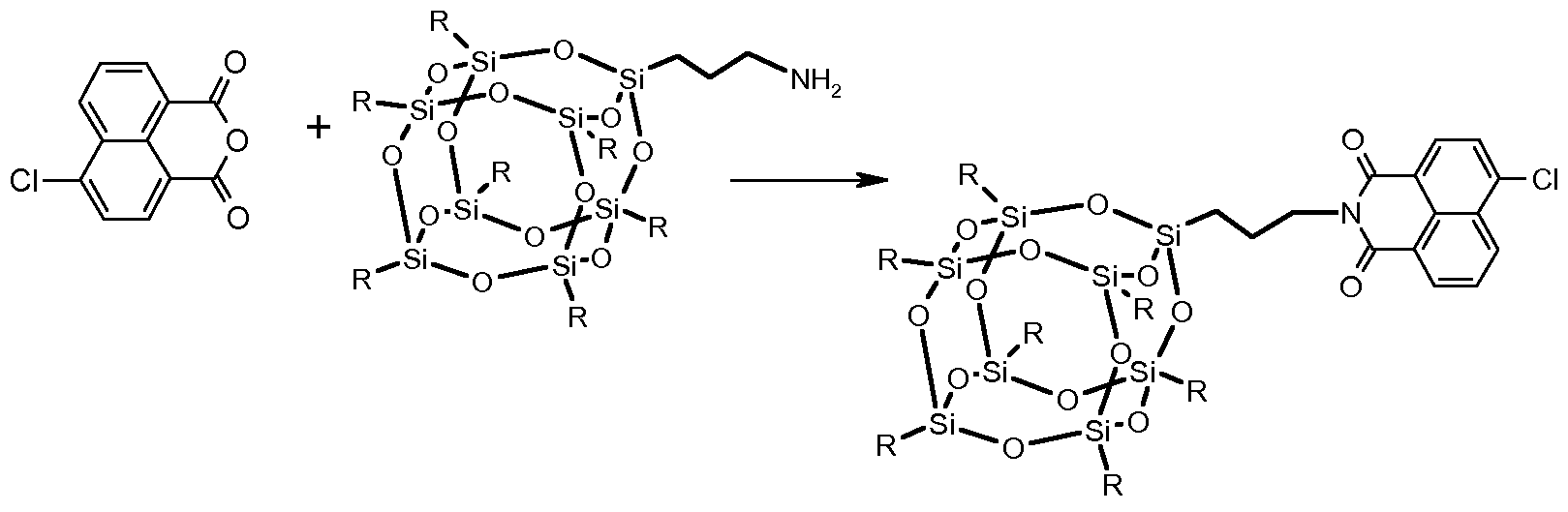
The fluorescent colorants of the present invention are prepared via known reactions involving the appropriately functionalized silsesquioxane and chromophore derivative. For example, known methods of preparing ether, ester, amide, imide, urea, thioether or thioester linkages can be readily employed to couple the desired silsesquioxane and chromophore. For example:
Figure imgf000013_0001
Figure imgf000013_0002
Other useful bond forming reactions are described, for example, in US Published Pat. Appl. 2005/0123760, the references therein and in EP0504541.7, however the exact nature of preparation is not a critical feature of the invention and is therefore not limited to the Examples herein. The fluorescent colorants of the present invention can be used in any application wherein pigments and dyes are encountered and are of course valuable in applications where the fluorescence of the colorant provides a useful function as in security marking or bio assays, or imparts a particularly desired color or effect.
The colorants are employed in general by methods known per se, for example (a) for mass coloring polymers; (b) for the preparation of paints, paint systems, coating compositions, paper colours, printing colours, inks including ink-jet applications and writing purposes, as well as in electrophotography, e.g. for dry copier systems and laser printers; (c) for security marking purposes, such as for cheques, cheque cards, currency notes, coupons, documents, identity papers and the like, where a special unmistakable colour impression is to be achieved; (d) as an additive to colourants, such as pigments and dyes, where a specific colour shade is to be achieved, in particular where luminous shades are desired; (e) for marking objects for machine recognition of these objects via the fluorescence, for example for machine recognition of objects for sorting, examples including the recycling of plastics, alphanu- merical prints or barcodes; (f) for the production of passive display elements for a multitude of display, notice and marking purposes, e.g. passive display elements, notices and traffic signs, such as traffic lights, safety equipment; (g) for marking with fluorescence in the solid state; (h) for decorative and artistic purposes; (i) for modifying inorganic substrates such as aluminium oxide, silicon dioxide, titanium dioxide, tin oxide, magnesium oxide (including "stone wood"), silicates, clay minerals, calcium-, gypsum- or cement-containing surfaces, for example coatings or plaster surfaces; (j) in optical light collection systems, in fluorescence solar collectors (see Nachr. Chem. Tech. Lab. 1980, 28, 716), in fluorescence-activated displays (see Elektronik 1977, 26, 6), in cold light sources used for light-induced polymerisation for the preparation of plastics, for testing of materials, for example in the production of semiconductor circuits, for analysing microstructures of integrated semiconductor components, in photoconductors, in photographic processes, in display, illumination or image converter systems, where excitation is effected by electrons, ions or UV radiation, e.g. in fluorescent displays, Braun tubes or in fluorescent lamps, as part of an integrated semiconductor circuit containing dyes as such or in combination with other semiconductors, for example in the form of an epitaxy, in chemiluminescence systems, e.g. in chemiluminescent flashlights, in luminescence immunoassays or other luminescence detection processes, as signal paints, for marking signs and other objects for which a particular visual colour impression is to be achieved, in dye lasers, preferably as fluorescent dyes for generating laser beams, as optical recording medium and also as Q-switches; (k) for converting the frequency of light, e.g. for turning short-wave light into long-wave visible light or for doubling or tripling the frequency of laser light in non-linear optics; (I) for tracer purposes, e.g. in biochemistry, medicine, technology and natural science, where the novel colourants can be linked covalently to the substrates or via secondary valences, such as hydrogen bonds or hydrophobic interactions (adsorption); and (m) in highly sensitive detection processes (see Z. Analyt. Chem. 1985, 320, 361 ), in particular as fluorescent colourants in scintillators.
For example, the compounds of the present invention are used as high fluorescent colorants for coatings, plastics and inks application, especially in plastics and security printing inks. Other uses are in the biomedical area, particularly medical imaging.
The fluorescent colorants of the present invention are either soluble or readily and evenly dispersed in a wide variety of solvents and polymers providing evenly colored systems which retain their color under aging or weathering conditions longer than commonly encountered dyes. The fluorescence of these colored systems is much higher than systems colored by known pigments comprising similar chromophores and this fluorescence is likewise retained under aging or weathering conditions longer than commonly encountered fluorescent dyes.
The use of the fluorescent colorants of the present invention is not limited by the manner in which they are incorporated into the final application.
In any composition comprising the present fluorescent colorants, one would naturally expect to find other commonly encountered components including stabilizers, for example antioxidants, UV absorbers, hindered amine or other light stabilizers, phosphites or phosphonites, benzofuran-2-ones, thiosynergists, polyamide stabilizers, metal stearates; also other fluorescent materials, processing aids, solvents etc., nucleating agents, fillers, reinforcing agents, lubricants, emulsifiers, dyes, pigments, dispersents, optical brighteners, flame retardants, antistatic agents, blowing agents and the like.
The amount of the fluorescent colorants of the present invention used in an application will vary greatly depending on the end use and effect desired. Typical load levels are well know to the practitioner or are readily found in the literature and would be adequate starting points for those formulating with the present fluorescent colorants. The fluorescent colorants of the present invention can therefore be used in almost any concentration depending on the end use application.
While almost any amount of the novel compounds of formula I can be incorporated into a high molecular weight organic material, typically the novel fluorescent colorants are used in an amount of 0.01 to 30% by weight, for example 0.1 to 10% by weight, based on the high molecular weight organic material to be pigmented.
For example, fluorescent colorants of the present invention are used to color high molecular weight organic compounds which may be in the form plastic materials, melts or of spinning solutions, paint systems, coating materials or printing inks. Depending on the end use requirement, it may be expedient to use the novel compounds of formula I as toners or in the form of preparations.
The novel compounds of formula I are particularly suitable for the mass coloration of thermoplastic, thermoset and elastomeric polymers which may also be crosslinked. These polymers may be in the form of, for example, molded articles, extruded workpieces, films, sheets, etc, as well as part of paint systems, powder coating compositions, printing inks and other coating materials.
The pigmenting of the high molecular weight organic materials with the novel compounds of formula I is conveniently effected by directly incorporating a compound of formula I by itself or in the form of a masterbatch. Standard incorporation techniques are employed, for example, incorporating the novel colorants into the substrates using roll mills, mixing or milling apparatus. The pigmented material is then brought into the desired final form by methods which are known per se, e.g., by calendering, molding, extruding, coating, casting, melt mixing, blending, dissolution, injection molding etc.
For pigmenting paint systems, coating materials and printing inks, the novel compounds of formula I, together with optional additives such as fillers, other pigments, siccatives or plasti- cizers, are finely dispersed or dissolved in suitable carrier such as an organic solvent, water or powder. The procedure may be such that the individual components by themselves, or also several components together, are dispersed or dissolved in the carrier and thereafter all the components are mixed.
Other applications for the compounds of the present invention will be apparent to those skilled in the art and the invention is not limited to the applications disclosed herein.
EXAMPLES
The following Examples serve to illustrate the invention without intending to be restrictive in nature; parts and percentages are by weight, unless otherwise stated.
1H, (300.08 ) spectra are obtained on a VARIAN MODEL GEMINI-300, Chemical shifts are reported in ppm (δ). MS spectra are obtained on a PERSPECTIVE BIOSYSTEM VOYAGER DE-STR matrix assisted laser desorption ionization mass spectrometer (MALDI-TOF) equipped with a 337 nm N2 laser and a time of flight analyzer, operated in negative mode. The samples are deposited directly on the plate without any matrix.
Fluorescence emission spectra are recorded with a FLUOROLOG-3 spectrofluorimeter, in a right angle set up. CIE L*A*B* color measurements are taken using a BYK GARDNER TCS Spectrophotometer, Model 8870. The difference in color is reported as ΔE, the larger the value the larger the color change.
Pigment dispersions in acrylic resin are prepared by processing a mixture of 0.25g pigment, 25g acrylic resin (ROHM & HAAS PARALOID B-66), 6g xylene and 35g glass bead grinding media in a 4 oz. glass jar using a SKANDEX Disperser for 120 minutes.
Quartz discs are spin coated with the 0.5 grams pigment dispersions using a HEADWAY RESEARCH PHOTO-RESIST SPINNER, Model #EC1-1 DT-R790, the discs are spun at 1800 rpm for 6 seconds and force-dried for 5 minutes at 6O0C.
Example 1
Figure imgf000017_0001
R= CH2-CH(CH3)2 A mixture of amino propyl lsobutyl POSS (0.88g, 1 mmol), N-(2'-ethylhexyl)-3,4,9,10-pery- lenetetracarboxylic monoimide monoanhydride (0.5g, 1 mmol) and imidazole (4Og) is heated to 14O0C and stirred under nitrogen for 4 hours. The reaction mixture is cooled to 750C and 150 ml of ethanol is added. The solution is poured onto 500 ml of ice/water, decanted, then centrifuged at 4000 rpm for 5 minutes. The residue is washed with ethanol and the product dried overnight at 750C under reduced pressure to provide 0.88 grams of the product as a red solid. 1H NMR (CDCI3) (300 MHz): δ (ppm) = 8.65 (d, 2H); 8.64 (d, 2H); 8.56 (d, 2H); 8.55 (d, 2H); 4.21 (t, 2H); 4.15(t, 2H); 1.9-1.8 (m, 10H); 1.3-1.4 (m 8H); 09 (m, 48H); 0.7-0.6 (m, 16H);
The thus obtained product exhibits strong solid state fluorescence with maxima between 620 and 680 nm whereas the starting N-(2'-ethylhexyl)-3,4:9,10-perylenetetracarboxylic monoimide monoanhydride exhibits very weak solid state fluorescence centered around ~ 670 nm.
Example 2
Figure imgf000018_0001
The procedure of example 1 , is repeated except amino propyl lsobutyl POSS (9.61 g, 11 mmol), 3,4,9,10-perylene tetracarboxylic dianhydride (1.96g, 5 mmol) and imidazole (9Og) are used to provide 7.6 grams of the product as a red solid. 1H NMR (CDCI3) (300 MHz): δ (ppm) = 8.65 (d, 4H); 8.63 (d, 4H); 4.15(t, 4H); 1.8 (m, 18H); 0.95 (d, 84H); 0.7 (t, 32H);
The thus obtained product exhibits strong solid state fluorescence with maxima between 620 and 680 nm whereas the starting 3,4:9, 10-perylene tetracarboxylic dianhydride exhibits extremely weak solid state fluorescence centered around ~ 670 nm. Example 3
The procedure of example 2, is repeated except that amino propyl lsobutyl POSS (9.61 g,
11 mmol), 3,4:9,10-perylene tetracarboxylic dianhydride (1.96g, 5 mmol) and N-methyl pyrro- lidone (05 ml.) are used to provide 9 grams of product as a red solid.
1H NMR (CDCI3) (300 MHz): δ (ppm) = 8.65 (d, 4H); 8.63 (d, 4H); 4.15(t, 4H); 1.8 (m, 18H);
0.95 (d, 84H); 0.7 (t, 32H);
The thus obtained product exhibits strong solid state fluorescence with maxima between 580 and 660 nm whereas the starting 3,4:9, 10-perylene tetracarboxylic dianhydride exhibits extremely weak solid state fluorescence centered around ~ 670 nm.
Example 4
Figure imgf000019_0001
4.7g (4 mmol) of Octa (aminopropyl) POSS, 12.6g (32 mmol) of perylene tetracarboxylic dianhydride and 75ml of NMP are treated according to the procedure of Example 1 to yield 15.57 grams of the polymer as a red solid.
The thus obtained product exhibits strong solid state fluorescence with maxima between 630 and 680 nm.
Example 5
The procedure of example 4 is repeated using 4.7g (4 mmol) of Octa (aminopropyl) POSS and 6.3g (16 mmol) of perylene tetracarboxylic dianhydride to yield 9.41 grams of the polymer as a red solid. The thus obtained product exhibits strong solid state fluorescence with maxima between 630 and 680 nm.
Example 6
The procedure of example 4 is repeated using, 4.1 g (3.5 mmol) of Octa (aminopropyl) POSS and 2.7g (7 mmol) of perylene tetracarboxylic dianhydride to yield 5.9g of a product which exhibits strong solid state fluorescence.
Example 7
Figure imgf000020_0001
A mixture of aminoethyl aminopropyl POSS (10.09g, 1 1.1 mmol), 3,4,9,10-perylene tetracarboxylic dianhydride (1.98g, 5.0 mmol), and N-methyl pyrrolididone (100 ml) is heated to 14O0C and stirred under nitrogen for 5 hours. The reaction mixture is cooled, N-methyl pyrrolididone is removed via under reduced pressure, 250 ml of ethanol is added. The resulting mixture is stirred for 30 minutes and subjected to centrifuge at 4000 rpm for 5 minutes and the solid residue is dried at 750C for 4 hours yielding the product as a red powder ( 8.90 g).
The product exhibited solid state fluorescence with maxima between 620 and 680 nm whereas the starting 3,4:9,10-perylene tetracarboxylic dianhydride exhibits extremely weak solid state fluorescence centered around 670 nm. Example 8
The procedure of example 7 is repeated except aminoethyl aminopropyl POSS (1 1.08g,
12.07 mmol), 3,4,9,10-perylene tetracarboxylic dianhydride (2.04g, 5.20 mmol) and imidazole
(9Og) are used, 150 ml ethanol added are added after cooling and the product is isolated via filtration to yield, after drying at 750C, a red powder (8.57 g).
The product exhibited extremely weak solid state fluorescence with maxima 650 and 680nm.
Example 9
Figure imgf000021_0001
A mixture of the product from example 7 (3.71 g, 1.68 mmol), dimethylaminopyridine (0.93g, 7.61 mmol), benzoyl chloride (0.53g, 3.77 mmol) and 20ml of methylene chloride is stirred overnight at room temperature. The mixture is then washed twice with 30 ml of water, dried over magnesium chloride, and evaporated to yield 2.41 g of the product.
The thus obtained product exhibits strong solid state fluorescence with maxima at 674 nm whereas the starting material exhibits weaker solid state fluorescence between 620 and 680 nm.
Figure imgf000022_0001
R= CH2-CH(CH3)2
A mixture of naphthalic anhydride (2.03g, 10.24 mmol), amino propyl isobutyl POSS (8,75g, 10.00 mmol) and 100 ml N-methyl pyrrolididone is stirred at 14O0C for 4 hours then cooled and the solvent is removed under reduced pressure. The residue is washed with 25 ml of a 0.5% NaOH solution in water, filtered, the collected solid is rinsed with ethanol and air dried to yield 9.83g of the product which exhibits weak fluorescence in an acrylic resin dispersion.
Example 1 1
Figure imgf000022_0002
R= CH2-CH(CH3).,
The procedure for example 10, is repeated except 4-chloro-naphthalic anhydride (2.33g, 10.01 mmol), amino propyl isobutyl POSS (8.77g, 10.02 mmol) and 100ml N-methyl pyrrolididone are used to yield 10.3Og of the product as a solid which exhibits fluorescence in an acrylic resin dispersion. Example 12
Figure imgf000023_0001
The procedure for example 10, is repeated except naphthalic anhydride (6.37g, 32.14 mmol), octa-ammonium POSS (4.72g, 4.02 mmol) and 75ml N-methyl pyrrolididone, and 25g imidazole are used to yield 8.07g of a solid product which exhibits no appreciable fluorescence in an acrylic resin dispersion.
Example 13
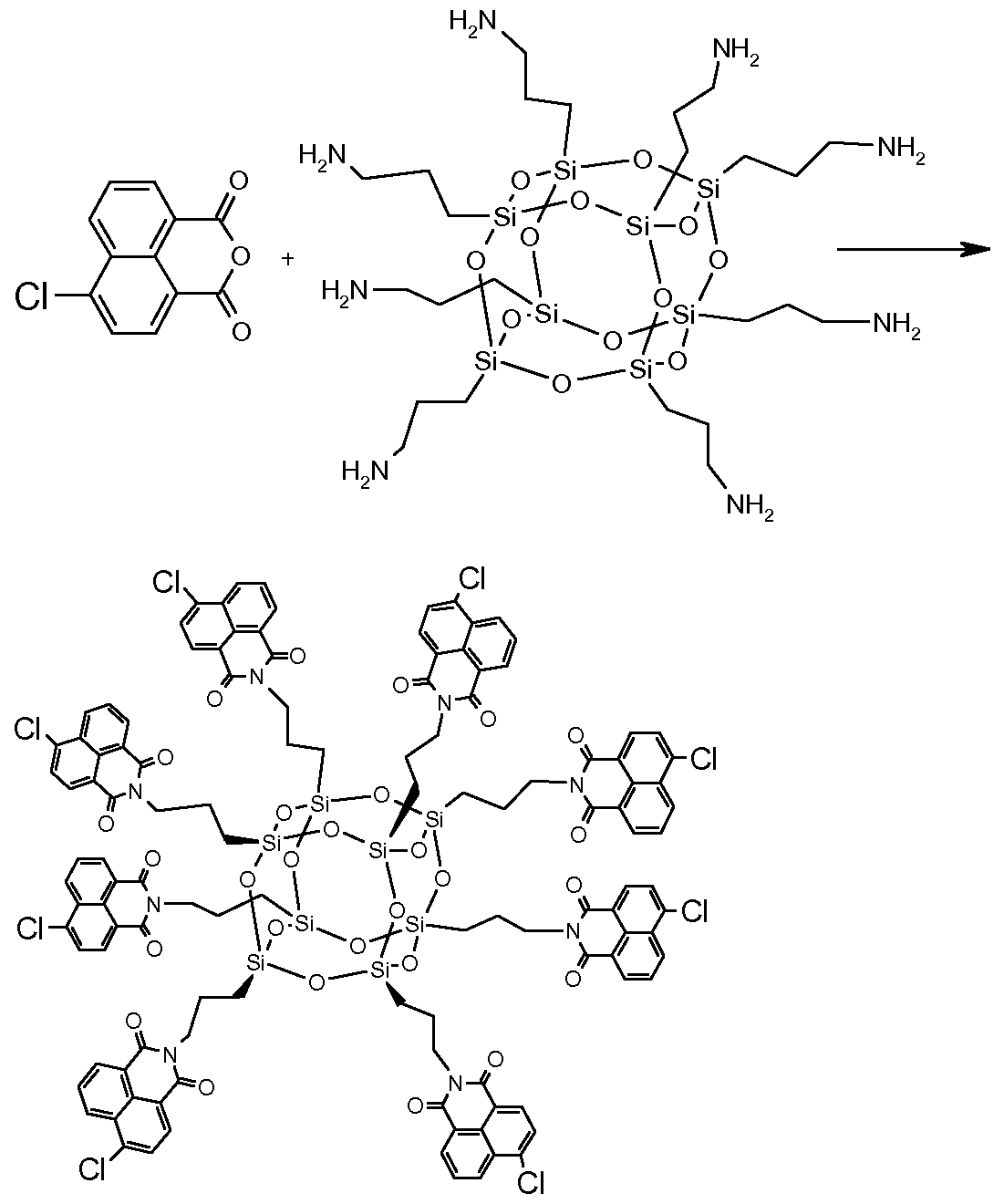
Figure imgf000024_0001
The procedure for Example 10 is repeated except 4-chloro-naphthalic anhydride (7.5Og, 32.24 mmol), octa-ammonium POSS (4.7Og, 4.00 mmol) 75ml N-methyl pyrrolididone and 25g imidazole are used to yield 4.1 Og of a solid product which exhibits fluorescence in an acrylic resin dispersion.
Example 14
Figure imgf000024_0002
A mixture of amino propyl lsobutyl POSS (8.75g,10 mmol), 1 ,6,7,12-tetrachloro-3,4,9, 10-pe- rylene tetracarboxylic dianhydride (2.2g, 4.15 mmol) and propionic acid (15Og) is heated to 14O0C and stirred under nitrogen for 16h. The reaction mixture is cooled to 3O0C and the solid product is collected by filtration, washed with methanol and dried overnight at 750C under reduced pressure to provide 7.3 grams of the product as a violet solid. 1H NMR (CDCI3) (300 MHz): δ (ppm) = 8.46 (s, 4H); 4.12(t, 4H); 1.8 (m, 18H); 0.95 (d, 84H); 0.67 (t, 32H). UVA/IS (CHCI3) : λmax = 517 nm
Example 15
Figure imgf000025_0001
Figure imgf000025_0002
A mixture of n-butylamine (9.8g,134 mmol), 1 ,6,7,12-tetrachloro-3,4,9,10-perylene tetracarboxylic dianhydride (17.7g, 33.4 mmol) and propionic acid (20Og) is heated to 14O0C and stirred under nitrogen for 8 hours. The reaction mixture is cooled to 3O0C and the solid product is collected by filtration, washed with saturated sodium hydrogen carbonate solution followed by water and dried overnight at 1000C under reduced pressure to provide 19.6 grams of the product as a violet solid. 1H NMR (CDCI3) (300 MHz): δ (ppm) = 8.66 (s, 4H); 4.18(t, 4H); 1.8 (m, 4H); 1.48(m, 4H); 1.00 (t, 6H). UVA/IS (CHCI3) : λmax = 519 nm Step b
Figure imgf000026_0001
A mixture of 1 ,6,7,12-tetrachloro-N,N'-di(n-butyl)-3,4,9,10-perylene tetracarboxylic diimide (9.6g, 15.0 mmol) from step a (Wurthner, et.al., J. Org. Chem., 67, 9, 3037 (2002)), 4-tert- butylphenol (9.9g, 66.0 mmol), potassium carbonate (6.3g, 45.0 mmol) and N-methyl-2- pyrrolidine (15Og) is heated to 14O0C and stirred under nitrogen for 8 hours. The reaction mixture is cooled to 3O0C and the solid product is collected by filtration, washed with water followed by methanol and dried overnight at 1000C under reduced pressure to provide 13.3 grams of the product as a violet solid. 1H NMR (CDCI3) (300 MHz): δ (ppm) 8.23 (s, 4H); 7.23 (d, 8H); 6.8 (d, 8H); 4.12(t, 4H); 1.68 (m, 4H); 1.40(m, 4H); 1.23 (s,36H); 0.90 (t, 6H). UVA/IS (CHCI3) : λmax = 584 nm
Figure imgf000026_0002
A mixture of 1 ,6,7,12- tetra(4'-t- butylphenoxy)-N,N'-di(n-butyl)-3,4,9,10-perylene tetracarboxylic diimide (7.Og, 6.4 mmol) from step b, potassium hydroxide (85%) (12.Og, 182.0 mmol) and isopropyl alcohol (20Og) is heated to 8O0C and stirred under nitrogen for 16 hours (Wurthner, Chem. Eur. J., 6, 21 , 3871 (2000)). The reaction mixture is cooled to 4O0C and glacial acetic acid (200 gm) then dilute hydrochloric acid (6%, 400 ml) are added. The solid product is collected by filtration, washed with water and dried overnight at 1000C under reduced pressure to provide 5.5 grams of the product as a violet solid. 1H NMR (CDCI3) (300 MHz): δ (ppm) 8.21 (s, 4H); 7.24 (d, 8H); 6.8 (d,8H); 1.28 (s,36H). UVA/IS (CHCI3) : λmax = 580 nm. )
Figure imgf000027_0001
A mixture of amino propyl lsobutyl POSS (4.5g, 5 mmol) and 1 ,6,7,12-tetra(4'-t- butylphen- oxy)-3,4,9,10-perylene tetracarboxylic dianhydride (1.7g, 2 mmol) from step c in N-methyl-2- pyrrolidine (7Og) is heated to 13O0C and stirred under nitrogen for 6 hours. The reaction mixture is cooled to 3O0C and the solid product is collected by filtration, washed with methanol and dried overnight at 750C under reduced pressure to provide 3.9 grams of the product as a red violet solid. 1H NMR (CDCI3) (300 MHz): δ (ppm) = 8.21 (s, 4H); 7.21 (d, 8H); 6.82 (d, 8H); 4.1 (t, 4H); 1.8 (m, 18H); 1.25 (s, 36H); 0.95 (d, 84H); 0.67 (t, 32H). UVA/IS (CHCI3) : λmax = 578 nm.
Example 16
Figure imgf000027_0002
Figure imgf000028_0001
A mixture of 1 ,7-dibromo-3,4,9,10-Perylene tetracarboxylic dianhydride (5.Og, 9.1 mmol), 4- te/f-butylphenol (7.Og, 46.6 mmol), potassium carbonate (4.2g, 30.4 mmol) and N-methyl-2- pyrrolidine (15Og) is heated to 12O0C and stirred under nitrogen for 6 hours (US Patent 6,326,494). The reaction mixture is cooled to 5O0C. The solid product is collected by filtration and washed with hot N-methyl-2-pyrrolidine (15Og). The solid is then suspended in dilute hydrochloric acid (6%, 400 gm) and heated to 750C for 2 hours, collected by filtration, washed with water and dried overnight at under reduced pressure to provide 4.8 grams of the product as a red violet solid. UVA/IS (CHCI3) : λmax = 544 nm
Figure imgf000028_0002
A mixture of amino propyl lsobutyl POSS (4.5g, 5 mmol), 1 ,7-di(4'-t-butylphenoxy)-3,4,9,10- Perylene tetracarboxylic dianhydride (1.38g, 2 mmol) in N-methyl-2-pyrrolidine (5Og) is heated to 12O0C and stirred under nitrogen for 6 hours. The reaction mixture is cooled to 3O0C and the solid product is collected by filtration, washed with methanol and dried overnight at 750C under reduced pressure to provide 3.4 grams of the product as a red violet solid. 1H NMR (CDCI3) (300 MHz): δ (ppm) = 9.65 (d, 2H); 8.6 (d, 2H); 8.35 (s, 2H); 7.45 (d, 4H); 7.09 (d, 4H); 4.13(t, 4H); 1.78 (m, 18H); 1.35 (s, 18H); 0.92 (d, 84H); 0.65 (t, 32H). UVA/IS (CHCI3): λmax = 545 nm
Example 17
Quartz discs are individually coated with pigment dispersions in acrylic resin prepared as above using as pigments the product from Example 1 1 (disc A), the product from Example 13 (disc B) , the commercial colorant AURORA PINK GT-11 (disc C1 ) and the commercial colorant CORONA MAGENTA GT-21 (disc C2). All dried samples exhibit fluorescence.
Example 18
The coated quartz discs from Example 17 are exposed in an ATLAS WEATHEROMETER, Model Ci4000 using a single xenon lamp with inner and outer borosilicate glass filters and constant irradiance of 0.55 Watts/m2. The discs are rotated around the lamp for 200 hours and then removed. Discs A and B exhibit fluorescence at about 520 nm, discs C1 and C2 exhibit a stronger fluorescence, relative to discs A and B, at about 540 nm.
Example 19
The product from Example 2, the commercial colorant AURORA PINK GT- 11 and the commercial colorant CORONA MAGENTA GT-21 are each incorporated into individual polyvinyl chloride (PVC) films at 0.2 weight %. Each film exhibits fluorescence.
The films are then exposed in an ATLAS WEATHEROMETER as in Example 15 for 200 hours and then removed. The films containing the commercial colorants exhibit a diminished fluorescence at about 550 nm, the film containing the product from Example 2 exhibits a stronger fluorescence, relative to the films containing the commercial colorants, at about 530 and 570 nm.
Example 20
Quartz discs are individually coated with pigment dispersions in acrylic resin prepared as above using as pigments the product from Example 2 (disc D), the product from, the commercial colorant AURORA PINK GT- 11 (disc C1 ) and the commercial colorant CORONA MAGENTA GT-21 (disc C2). Color measurements of the dried samples are recorded. All dried samples exhibit fluorescence.
The discs are exposed in an ATLAS WEATHEROMETER as in Example 15 for 200 hours, after which time they are removed and color and fluorescence are measured.
Disc D exhibits a smaller ΔE (less color change) than either disc C1 or C2.
Discs C1 and C2 exhibit a diminished fluorescence at about 540 nm, disc D exhibits a stronger fluorescence, relative to discs C1 and C2, at about 530 nm.

Claims

What is claimed is:
1 ) A fluorescent colorant of formula (I)
Figure imgf000031_0001
wherein, m is 1 or 2; n is 1-18;
X is a direct bond, -O-, -S-, -NH-, -CO-, or -COO-; each R is independently selected from the group consisting of CrC25 alkyl, C2-C25 alkyl interrupted one or more times by one or more groups selected from -O- and-S-, C2-C24 alkenyl, C3-C24 alkenyl interrupted one or more times by one or more groups selected from -O- and -S-, C7-C9 phenylalkyl, a group -(CH2)n-X-(Y)z wherein n is defined as above and z is 1 or V2 and when more than one z is present each z is independently selected, phenyl and phenyl substituted 1 to 5 times by one or more groups selected from d-C8alkyl, d-C8alkyloxy and halogen;
Y is a radical of a chromophore selected from the group consisting of azo dyes, benzo[a]xan- thenes, benzo[b]xanthenes, benzo[c]xanthenes, napthalimides, diketopyrrolopyrroles, peryle- nes, quinacridones, benzoxanthenes, diphenylmaleimides, acetoacetamides, perylenmono- imides, perylenes and phthalimides, wherein when more than one Y is present, each Y is selected independently of the others.
2) A fluorescent colorant according to claim 1 , wherein n is1 , 2, 3, or 4 and each R is independently selected from the group consisting of CrC25 alkyl, C2-C24 alkenyl, C7-C9 phenylalkyl, phenyl and phenyl substituted 1 to 5 times by one or more groups selected from d-Csal- kyl, Ci-C8alkyloxy and halogen.
3. A fluorescent colorant according to claim 1 , wherein n is 1 , 2, 3 or 4, X is a direct bond, -NH-, or -CO-, each R is independently selected from the group consisting of Ci-C6 alkyl, and a group
-(CH2)n-X-(Y)z and
Y is selected from the group consisting of xanthene, perylene, benzoxanthene, naphthalimid, quinacridone and diketopyrrolopyrrole chromophores.
4. A fluorescent colorant according to claim 3, wherein n is 3 and each R is independently selected from the group consisting of t-butyl, cyclohexyl, and a group -(CH2)n-X-(Y)z.
5. A fluorescent colorant according to claim 1 , wherein Y is selected from the group consisting of perylene, benzoxanthene, naphthalimid and diketopyrrolopyrrole chromophores.
6. A fluorescent colorant according to claim 2, wherein Y is selected from the group consisting of perylene, benzoxanthene, naphthalimid and diketopyrrolopyrrole chromophores.
7. A fluorescent colorant according to claim 1 , wherein any number of R groups from 1 through 7 are a group -(CH2)n-X-(Y)z.
8. A fluorescent colorant according to claim 7, wherein z is 1.
9. A fluorescent colorant according to claim 7, wherein at least one z is 1A
10. A fluorescent colorant according to claim 9, wherein m is 2.
11. A fluorescent colorant according to claim 1 , wherein one of the R groups is a group -(CH2)n-X-(Y)z.
12. A composition comprising
(a) an organic material, and
(b) a fluorescent colorant according to claim 1.
13. A composition according to claim 12, wherein the composition is a coating composition and component (a) is an organic film-forming binder.
14. A composition according to claim 12, wherein component (a) is a thermoplastic, thermo- set, elastomeric or a crosslinked thermoplastic, thermoset, elastomeric polymer.
15. An ink composition comprising a fluorescent colorant according to claim 1.
PCT/EP2007/057740 2006-08-07 2007-07-27 Novel polyhedral oligomeric silsesquioxane (poss) based fluorescent colorants Ceased WO2008017593A1 (en)

Priority Applications (5)

Application Number Priority Date Filing Date Title
AT07787957T ATE451429T1 (en) 2006-08-07 2007-07-27 NEW FLUORESCENT COLORS BASED ON POLYHEDRAL OLIGOMERS SILSESQUIOXANES (POSS)
DE602007003740T DE602007003740D1 (en) 2006-08-07 2007-07-27 NEW FLUORESCENT COLOR ON THE BASIS OF POLYEDRIS
EP07787957A EP2049601B1 (en) 2006-08-07 2007-07-27 Novel polyhedral oligomeric silsesquioxane (poss) based fluorescent colorants
JP2009523239A JP5269786B2 (en) 2006-08-07 2007-07-27 Novel polyhedral oligomeric silsesquioxane (POSS) fluorescent colorant
CN200780029297.2A CN101501144B (en) 2006-08-07 2007-07-27 Polyhedral oligomeric silsesquioxane (POSS) based fluorescent colorants

Applications Claiming Priority (2)

Application Number Priority Date Filing Date Title
US83602506P 2006-08-07 2006-08-07
US60/836,025 2006-08-07

Publications (1)

Publication Number Publication Date
WO2008017593A1 true WO2008017593A1 (en) 2008-02-14

Family

ID=38577481

Family Applications (1)

Application Number Title Priority Date Filing Date
PCT/EP2007/057740 Ceased WO2008017593A1 (en) 2006-08-07 2007-07-27 Novel polyhedral oligomeric silsesquioxane (poss) based fluorescent colorants

Country Status (7)

Country Link
US (1) US7662308B2 (en)
EP (1) EP2049601B1 (en)
JP (1) JP5269786B2 (en)
CN (1) CN101501144B (en)
AT (1) ATE451429T1 (en)
DE (1) DE602007003740D1 (en)
WO (1) WO2008017593A1 (en)

Cited By (8)

* Cited by examiner, † Cited by third party
Publication number Priority date Publication date Assignee Title
FR2927904A1 (en) * 2008-02-26 2009-08-28 Uppa Universite De Pau Et Des NOVEL PHOTOSENSITIZING MOLECULES DERIVED FROM 9,10-DICYANOANTHRACENE, PROCESS FOR PREPARING THEM AND USES THEREOF
JP2009299015A (en) * 2008-05-16 2009-12-24 Nippon Shokubai Co Ltd Thermosetting resin composition, fiber composite resin composition and molded product formed by curing the same
WO2011054731A1 (en) 2009-11-05 2011-05-12 Basf Se Fluorescent materials
US8987044B2 (en) 2011-04-04 2015-03-24 National University Corporation Kagawa University Perylene tetracarboxylic acid bisimide derivative, N-type semiconductor, a method for producing N-type semiconductor, and electronic device
EP2834288A4 (en) * 2012-04-03 2015-12-30 Basf Se Colored charged silsesquioxanes
EP2625246B1 (en) * 2010-10-06 2016-04-20 Koninklijke Philips N.V. Light-emitting arrangement with organic phosphor
EP2986658A4 (en) * 2013-04-19 2017-03-08 Basf Se Colored charged silsesquioxanes
US10711019B2 (en) 2015-08-18 2020-07-14 Agency For Science, Technology And Research Photoinitiators functioned as both initiators and nanofillers

Families Citing this family (24)

* Cited by examiner, † Cited by third party
Publication number Priority date Publication date Assignee Title
WO2007147742A1 (en) * 2006-06-19 2007-12-27 Ciba Holding Inc. Coloured silsesquioxanes
CN101484537B (en) * 2006-07-05 2013-07-17 西巴控股有限公司 Coloured organic electrophoretic particles
US20100019169A1 (en) * 2007-01-29 2010-01-28 Michigan Molecular Institute Remote laser interrogation of threat clouds and surfaces
KR101296551B1 (en) * 2007-02-09 2013-08-13 가부시키가이샤 닛폰 쇼쿠바이 Silane compound, production method thereof, and resin composition containing silane compound
US7777176B2 (en) * 2008-08-14 2010-08-17 Energy Materials Corporation Composition and method to characterize membranes' defects
WO2010019125A1 (en) * 2008-08-15 2010-02-18 Energy Materials Corporation Composition and method to characterize membranes' defects
US20110020413A1 (en) * 2009-01-19 2011-01-27 John Gormley Polysilsesquioxane compositions and process
WO2011040882A2 (en) * 2009-09-29 2011-04-07 National University Of Singapore Water-soluble silsesquioxanes as organic quantum dots for sensing and imaging
CN102834404B (en) * 2010-03-01 2016-03-09 赢创德固赛有限公司 The part of polyhedral oligomeric silsesquioxane (POSS)-connection
WO2012111487A1 (en) * 2011-02-17 2012-08-23 住友化学株式会社 Compound having acceptor groups, and organic thin film and organic thin film element using same
CN102295743A (en) * 2011-06-24 2011-12-28 大连海事大学 Fluorescent conjugated polymer containing polyhedral oligomeric silsesquioxane (POSS), its preparation method and application
CN102746331A (en) * 2012-06-07 2012-10-24 东华大学 High fluorescence emitted POSS substituted perylene diimide crystal and preparation method
CN102690438A (en) * 2012-06-14 2012-09-26 东华大学 Polymer-based fluorescent functional composite material and fusing process method thereof
JP6107240B2 (en) * 2013-03-07 2017-04-05 Dic株式会社 Polymerizable compound, polymer compound using the same, and polymerizable composition
JP6226188B2 (en) * 2014-01-06 2017-11-08 Dic株式会社 Fluorescent substance made of polymerizable compound and fluorescent display material
CN104788467B (en) * 2014-01-22 2018-01-09 昆山市海特塑胶颜料有限公司 A kind of preparation method of the tetracarboxylic acid dianhydride of 1,6,7,12 tetrachloro 3,4,9,10
JP6313137B2 (en) * 2014-06-27 2018-04-18 株式会社日本触媒 Polysiloxane compound, process for producing the same, and polysiloxane-containing inorganic composition
PL411196A1 (en) * 2015-02-11 2015-11-09 Uniwersytet Im. Adama Mickiewicza W Poznaniu New functionalized unsaturated derivatives of (dimethylvinylgermoxy) heptasubstituted silsesquioxanes and method for obtaining them
US10280366B2 (en) 2015-06-23 2019-05-07 Instituto Potosino DE Investigación Cientiffica y Technológica A.C. White light emitting material and method of preparation and uses thereof
CN105017304A (en) * 2015-07-08 2015-11-04 上海大学 Preparation method for multi-color luminous rare earth complex functionalized polyhedral oligomeric silsesquioxane
CN106674526B (en) * 2016-12-16 2019-05-17 天津大学 A kind of imide derivative and preparation method of double sulphur extension aromatic cores
JP6929088B2 (en) * 2017-03-02 2021-09-01 株式会社日本触媒 Polysiloxane compound and its cured product
TWI679234B (en) * 2018-09-20 2019-12-11 財團法人工業技術研究院 Encapsulation material and module structure
CN116726986B (en) * 2023-05-25 2025-11-11 长安大学 Photocatalyst, preparation method and application

Citations (2)

* Cited by examiner, † Cited by third party
Publication number Priority date Publication date Assignee Title
US20030120099A1 (en) * 2000-10-27 2003-06-26 Laine Richard M. Well-defined nanosized building blocks for organic/inorganic nanocomposites
US20050123760A1 (en) * 2003-10-15 2005-06-09 Cammack J. K. Light-emitting nanoparticle compositions

Family Cites Families (12)

* Cited by examiner, † Cited by third party
Publication number Priority date Publication date Assignee Title
DE59408909D1 (en) * 1993-10-13 1999-12-16 Ciba Sc Holding Ag New fluorescent dyes
US5863459A (en) * 1997-05-09 1999-01-26 Sun Chemical Corporation Fluorescent yellow azo pigments
US5904878A (en) * 1997-05-14 1999-05-18 Sun Chemical Corporation Fluorescent orange azo pigments
JP4662601B2 (en) * 2000-03-15 2011-03-30 石原薬品株式会社 Colored transparent film forming composition, coating method and peeling method thereof
JP4615214B2 (en) * 2000-10-27 2011-01-19 ザ リージェンツ オブ ザ ユニバーシティ オブ ミシガン Well-defined nano-sized building blocks for organic / inorganic nanocomposites
EP1334156B1 (en) * 2000-11-17 2006-12-20 Ciba SC Holding AG Method of improving pigment fluorescence
KR100891436B1 (en) * 2001-06-29 2009-04-03 시바 홀딩 인크 Additive functionalized lipophilic nanoscale filler
TWI301846B (en) * 2001-11-28 2008-10-11 Ciba Sc Holding Ag New fluorescent pigments
JP2003335632A (en) * 2002-05-17 2003-11-25 Ge Toshiba Silicones Co Ltd Cosmetics
JP2004067763A (en) * 2002-08-02 2004-03-04 Ge Toshiba Silicones Co Ltd Colored spherical silicone fine particles, method for producing the same, and cosmetics
JP4476930B2 (en) * 2002-11-04 2010-06-09 アドバンスト・ポリメリック・プロプライエタリー・リミテッド Photochromic composition and light transmissive article
WO2007147742A1 (en) * 2006-06-19 2007-12-27 Ciba Holding Inc. Coloured silsesquioxanes

Patent Citations (2)

* Cited by examiner, † Cited by third party
Publication number Priority date Publication date Assignee Title
US20030120099A1 (en) * 2000-10-27 2003-06-26 Laine Richard M. Well-defined nanosized building blocks for organic/inorganic nanocomposites
US20050123760A1 (en) * 2003-10-15 2005-06-09 Cammack J. K. Light-emitting nanoparticle compositions

Cited By (11)

* Cited by examiner, † Cited by third party
Publication number Priority date Publication date Assignee Title
FR2927904A1 (en) * 2008-02-26 2009-08-28 Uppa Universite De Pau Et Des NOVEL PHOTOSENSITIZING MOLECULES DERIVED FROM 9,10-DICYANOANTHRACENE, PROCESS FOR PREPARING THEM AND USES THEREOF
WO2009106779A3 (en) * 2008-02-26 2009-12-23 Uppa - Université De Pau Et Des Pays De L'adour Novel photosensitising molecules derived from 9,10-dicyanoanthracene, method for preparing same and uses thereof
JP2009299015A (en) * 2008-05-16 2009-12-24 Nippon Shokubai Co Ltd Thermosetting resin composition, fiber composite resin composition and molded product formed by curing the same
WO2011054731A1 (en) 2009-11-05 2011-05-12 Basf Se Fluorescent materials
EP2625246B1 (en) * 2010-10-06 2016-04-20 Koninklijke Philips N.V. Light-emitting arrangement with organic phosphor
US8987044B2 (en) 2011-04-04 2015-03-24 National University Corporation Kagawa University Perylene tetracarboxylic acid bisimide derivative, N-type semiconductor, a method for producing N-type semiconductor, and electronic device
EP2834288A4 (en) * 2012-04-03 2015-12-30 Basf Se Colored charged silsesquioxanes
TWI573839B (en) * 2012-04-03 2017-03-11 巴地斯顏料化工廠 Colored charged silsesquioxanes
EP2986658A4 (en) * 2013-04-19 2017-03-08 Basf Se Colored charged silsesquioxanes
US9630982B2 (en) 2013-04-19 2017-04-25 Basf Se Colored charged silsesquioxanes
US10711019B2 (en) 2015-08-18 2020-07-14 Agency For Science, Technology And Research Photoinitiators functioned as both initiators and nanofillers

Also Published As

Publication number Publication date
EP2049601B1 (en) 2009-12-09
US20080029739A1 (en) 2008-02-07
JP5269786B2 (en) 2013-08-21
EP2049601A1 (en) 2009-04-22
CN101501144A (en) 2009-08-05
ATE451429T1 (en) 2009-12-15
CN101501144B (en) 2013-06-19
JP2010500430A (en) 2010-01-07
US7662308B2 (en) 2010-02-16
DE602007003740D1 (en) 2010-01-21

Similar Documents

Publication Publication Date Title
EP2049601B1 (en) Novel polyhedral oligomeric silsesquioxane (poss) based fluorescent colorants
JP3362865B2 (en) Internal salt of perylene compound, production method thereof and use thereof
US7326793B2 (en) Process for the preparation of diketopyrrolopyrroles
JPH10133403A (en) Symmetric perylene dimer
US20090056793A1 (en) Benzoterrylene derivatives
WO2011054731A1 (en) Fluorescent materials
JP3609454B2 (en) Peryleneamidineimide dye, process for its production and use thereof
EP1087005B1 (en) Fluorescent diketopyrrolopyrroles
KR20010030502A (en) Fluorescent diketopyrrolopyrroles
US9346963B2 (en) Surface-modified pigment preparations
US4801702A (en) Process for the preparation and conditioning or organic pigments
US6143890A (en) Naphthalenehydrazamimides and perylenehydrazamimides
DE4018830A1 (en) New perylene dyestuffs synthesised from perylene blue - used as biochemical tracers, dyestuffs and pigments, in optical light gathering systems, in polymerisation reactions, etc.
CA2145375A1 (en) Fluorescent chromophores containing cyanimino groups
CN1104469C (en) Dual fluorophore perylene chromogen
TW202122385A (en) Isoindoline derivatives
US6946550B2 (en) Fluorescent pigments
JPH09143304A (en) Method for coloring polymeric organic material with polycyclic compound
JP2001081350A (en) Coloring material
Norouzbahari Synthesis of a Novel Fluorescent Optical pH Sensor

Legal Events

Date Code Title Description
WWE Wipo information: entry into national phase

Ref document number: 200780029297.2

Country of ref document: CN

121 Ep: the epo has been informed by wipo that ep was designated in this application

Ref document number: 07787957

Country of ref document: EP

Kind code of ref document: A1

WWE Wipo information: entry into national phase

Ref document number: 2007787957

Country of ref document: EP

WWE Wipo information: entry into national phase

Ref document number: 2009523239

Country of ref document: JP

NENP Non-entry into the national phase

Ref country code: DE

NENP Non-entry into the national phase

Ref country code: RU