WO2008020636A1 - Résine de polycarbonate et film optique utilisant celle-ci - Google Patents
Résine de polycarbonate et film optique utilisant celle-ci Download PDFInfo
- Publication number
- WO2008020636A1 WO2008020636A1 PCT/JP2007/066060 JP2007066060W WO2008020636A1 WO 2008020636 A1 WO2008020636 A1 WO 2008020636A1 JP 2007066060 W JP2007066060 W JP 2007066060W WO 2008020636 A1 WO2008020636 A1 WO 2008020636A1
- Authority
- WO
- WIPO (PCT)
- Prior art keywords
- film
- polycarbonate resin
- bis
- optical film
- formula
- Prior art date
- Legal status (The legal status is an assumption and is not a legal conclusion. Google has not performed a legal analysis and makes no representation as to the accuracy of the status listed.)
- Ceased
Links
Classifications
-
- C—CHEMISTRY; METALLURGY
- C08—ORGANIC MACROMOLECULAR COMPOUNDS; THEIR PREPARATION OR CHEMICAL WORKING-UP; COMPOSITIONS BASED THEREON
- C08G—MACROMOLECULAR COMPOUNDS OBTAINED OTHERWISE THAN BY REACTIONS ONLY INVOLVING UNSATURATED CARBON-TO-CARBON BONDS
- C08G64/00—Macromolecular compounds obtained by reactions forming a carbonic ester link in the main chain of the macromolecule
- C08G64/02—Aliphatic polycarbonates
- C08G64/0208—Aliphatic polycarbonates saturated
-
- C—CHEMISTRY; METALLURGY
- C08—ORGANIC MACROMOLECULAR COMPOUNDS; THEIR PREPARATION OR CHEMICAL WORKING-UP; COMPOSITIONS BASED THEREON
- C08G—MACROMOLECULAR COMPOUNDS OBTAINED OTHERWISE THAN BY REACTIONS ONLY INVOLVING UNSATURATED CARBON-TO-CARBON BONDS
- C08G64/00—Macromolecular compounds obtained by reactions forming a carbonic ester link in the main chain of the macromolecule
- C08G64/02—Aliphatic polycarbonates
-
- C—CHEMISTRY; METALLURGY
- C08—ORGANIC MACROMOLECULAR COMPOUNDS; THEIR PREPARATION OR CHEMICAL WORKING-UP; COMPOSITIONS BASED THEREON
- C08G—MACROMOLECULAR COMPOUNDS OBTAINED OTHERWISE THAN BY REACTIONS ONLY INVOLVING UNSATURATED CARBON-TO-CARBON BONDS
- C08G64/00—Macromolecular compounds obtained by reactions forming a carbonic ester link in the main chain of the macromolecule
-
- C—CHEMISTRY; METALLURGY
- C08—ORGANIC MACROMOLECULAR COMPOUNDS; THEIR PREPARATION OR CHEMICAL WORKING-UP; COMPOSITIONS BASED THEREON
- C08L—COMPOSITIONS OF MACROMOLECULAR COMPOUNDS
- C08L69/00—Compositions of polycarbonates; Compositions of derivatives of polycarbonates
-
- G—PHYSICS
- G02—OPTICS
- G02B—OPTICAL ELEMENTS, SYSTEMS OR APPARATUS
- G02B5/00—Optical elements other than lenses
- G02B5/30—Polarising elements
-
- G—PHYSICS
- G02—OPTICS
- G02B—OPTICAL ELEMENTS, SYSTEMS OR APPARATUS
- G02B5/00—Optical elements other than lenses
- G02B5/30—Polarising elements
- G02B5/3025—Polarisers, i.e. arrangements capable of producing a definite output polarisation state from an unpolarised input state
- G02B5/3033—Polarisers, i.e. arrangements capable of producing a definite output polarisation state from an unpolarised input state in the form of a thin sheet or foil, e.g. Polaroid
- G02B5/3041—Polarisers, i.e. arrangements capable of producing a definite output polarisation state from an unpolarised input state in the form of a thin sheet or foil, e.g. Polaroid comprising multiple thin layers, e.g. multilayer stacks
- G02B5/305—Polarisers, i.e. arrangements capable of producing a definite output polarisation state from an unpolarised input state in the form of a thin sheet or foil, e.g. Polaroid comprising multiple thin layers, e.g. multilayer stacks including organic materials, e.g. polymeric layers
-
- G—PHYSICS
- G02—OPTICS
- G02F—OPTICAL DEVICES OR ARRANGEMENTS FOR THE CONTROL OF LIGHT BY MODIFICATION OF THE OPTICAL PROPERTIES OF THE MEDIA OF THE ELEMENTS INVOLVED THEREIN; NON-LINEAR OPTICS; FREQUENCY-CHANGING OF LIGHT; OPTICAL LOGIC ELEMENTS; OPTICAL ANALOGUE/DIGITAL CONVERTERS
- G02F1/00—Devices or arrangements for the control of the intensity, colour, phase, polarisation or direction of light arriving from an independent light source, e.g. switching, gating or modulating; Non-linear optics
- G02F1/01—Devices or arrangements for the control of the intensity, colour, phase, polarisation or direction of light arriving from an independent light source, e.g. switching, gating or modulating; Non-linear optics for the control of the intensity, phase, polarisation or colour
- G02F1/13—Devices or arrangements for the control of the intensity, colour, phase, polarisation or direction of light arriving from an independent light source, e.g. switching, gating or modulating; Non-linear optics for the control of the intensity, phase, polarisation or colour based on liquid crystals, e.g. single liquid crystal display cells
- G02F1/133—Constructional arrangements; Operation of liquid crystal cells; Circuit arrangements
- G02F1/1333—Constructional arrangements; Manufacturing methods
- G02F1/1335—Structural association of cells with optical devices, e.g. polarisers or reflectors
- G02F1/13363—Birefringent elements, e.g. for optical compensation
-
- Y—GENERAL TAGGING OF NEW TECHNOLOGICAL DEVELOPMENTS; GENERAL TAGGING OF CROSS-SECTIONAL TECHNOLOGIES SPANNING OVER SEVERAL SECTIONS OF THE IPC; TECHNICAL SUBJECTS COVERED BY FORMER USPC CROSS-REFERENCE ART COLLECTIONS [XRACs] AND DIGESTS
- Y10—TECHNICAL SUBJECTS COVERED BY FORMER USPC
- Y10T—TECHNICAL SUBJECTS COVERED BY FORMER US CLASSIFICATION
- Y10T428/00—Stock material or miscellaneous articles
- Y10T428/31504—Composite [nonstructural laminate]
- Y10T428/31507—Of polycarbonate
Definitions
- the present invention relates to a polycarbonate resin derived from a specific dihydroxy compound and an optical film, and in particular, a preferred embodiment of the present invention is a polycarbonate resin excellent in transparency, heat resistance, mechanical strength, water vapor permeability and low photoelasticity. It relates to optical films. Background art
- the conventional aromatic polycarbonate resin has heat resistance and mechanical strength, it has a problem that it has a large photoelastic coefficient when used as an optical film.
- the retardation films used in liquid crystal display devices when used with a polarizing plate, the retardation film is stressed due to thermal contraction or thermal expansion of the polarizing plate, resulting in retardation spots.
- uniformity of image quality could not be maintained.
- the conventional aromatic polycarbonate resin has a large wavelength dependence of the phase difference even when the 1 Z 4 wavelength plate and 1 Z 2 wavelength plate are laminated at the optimum angle for the purpose of a broadband circular polarizing plate. There was a problem that the circular polarization over the entire region was insufficient.
- TAC triacetyl cellulose
- a protective film for polarizing plates triacetyl cellulose
- liquid crystal display devices taking advantage of its transparency, smoothness, thickness accuracy, adhesiveness, and high moisture permeability.
- TAC triacetyl cellulose
- a film made of cyclic polyolefin has been proposed as a polarizing protective film, but there is a problem that water vapor permeability is low, bubbles are generated, and the polarizing film is deformed such as curling and warping. It was.
- a method for controlling the wavelength dependence due to the retardation of the polycarbonate resin for example, a method of copolymerizing bisphenols having a fluorene structure in the side chain with other bisphenols (International Publication WO 20). 0 0 2 6 7 0 5 pamphlet).
- the fluorene structure-containing bisphenols are used in a high ratio, and there is a problem that the glass transition point becomes high.
- An object of the present invention is to provide a polycarbonate resin that solves at least one of the above conventional problems and an optical film using the same. Furthermore, the present invention provides, as a preferred embodiment, a polycarbonate resin having a low photoelastic coefficient, excellent water vapor permeability, transparency, heat resistance, mechanical strength, and opto-molding processability, and an optical film using the same. This is the issue.
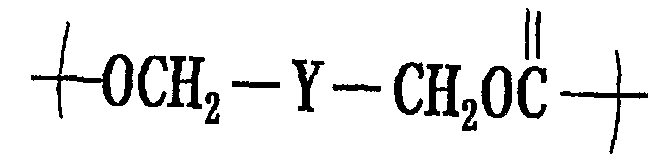
- Y is a cycloalkylene group having 4 to 20 carbon atoms or a structure represented by the following general formula (3).
- R 2 , R 3, and R 4 are each a hydrogen atom or a monovalent alkyl group having 1 to 5 carbon atoms.
- a polycarbonate resin and an optical film having a low photoelastic coefficient and controlled water vapor permeability and water absorption By combining the retardation film of the present invention with a polarizing plate, a viewing angle widening film, a circularly polarizing plate or an elliptically polarizing plate can be formed.
- a viewing angle widening film can be used for a liquid crystal display device, and a circularly polarizing plate can be suitably used as an antireflection film for organic or organic electroluminescent elements, touch panels, plasma displays, CRTs, liquid crystal display devices, and the like.
- the polarizing plate usually has a laminated structure composed of a polarizing layer such as a polyvinyl alcohol (hereinafter referred to as PVA) film and a protective layer of the TAC film.
- PVA polyvinyl alcohol
- the polycarbonate resin can be produced by reacting a dihydroxy compound represented by the following formula (4) and general formula (5) with a carbonate forming compound.
- Y is a cycloalkylene group having 4 to 20 carbon atoms or a structure represented by the following general formula (6).
- R 2 , R 3 and R 4 are each independently a hydrogen atom or a monovalent alkyl group having 1 to 5 carbon atoms.
- Examples of the dihydroxy compound represented by the formula (4) used in the present invention include isosorbide and isomand, and these dihydroxy compounds can be used in combination of two kinds.
- Examples of the dihydroxy compound represented by the general formula (5) used in the present invention include tricyclo (5. 2. 1. 0 2 ' 6 ) decanedi-methanol and pentacyclopentadecane dimethanol, 2,6-decalindi. Methanol, 1,4-Dichlorohexane Hexanediethanol, Norbornanedimethanol, Dicyclopentane-1,3-diethanol, 3,9-bis (2-hydroxy-1,1-dimethylethyl)-2, 4,8, 10-Tetraoxaspiro (5.5) Undecane and the like are exemplified.
- tricyclo 5. 2. 1.
- the molar ratio (AZB) of the structural unit (A) represented by the formula (1) and the structural unit (B) represented by the general formula (2) is 99/1 to 1zo99, More preferably, it is 90Z10 to 20/80, and most preferably 80Z2 0 to 30/70. If the molar ratio (A / B) is higher than 90/10, the water absorption rate increases, so the dimensional change of the film due to humidity is large and it is difficult to maintain a uniform phase difference. When the molar ratio (A / B) force is lower than 20/80, the water vapor permeability decreases and the glass transition temperature is low, resulting in a decrease in heat resistance.
- the water vapor permeability and water absorption can be controlled to the desired performance.
- polycarbonate resin of the present invention in addition to the repeating unit represented by the above formula (1) and the general formula (2), a structure derived from an aromatic didroxy compound within a range that does not hinder the object of the present invention. Units may be introduced to improve mechanical properties, heat resistance, wavelength dispersion characteristics of retardation, and the like.
- aromatic dihydroxy compound examples include 2,2-bis (4-hydroxyphenol) propane (common name: bisphenolanol A), 1,1 bis (4-hydroxy). Cishexane) 1,1 bis (4-hydroxyphenyl) 1,3,5-trimethylolcyclohexane, 1,1 bis (4-hydroxyphenyl) cyclopentane, 1, 1 bis (4-Hydroxyphenenole) 1 1 1 Ferue Lutan, 4, 4, 1 (1, 3—Phenylene 1 bis (1-Methylenoethylidene)) Bisphenol 1, 4, 4 '1 (1, 4 1-phenylene 1 bis (1-methinoreidene)) Bisphenol, 2, 2-bis (4-hydroxyphenyl) 1 4 1 Methylpentane, 1, 1 1 bis Ninole) Ethane, Bis (4-hydroxyphenenole) Methane, Bis (4-Hydroxyphenenole) Phenylenomethane, 2, 2-bis (4-Hydroxy-3-propynole
- the glass transition temperature of the polycarbonate resin of the present invention is preferably 90 ° C or higher and 200 ° C or lower, more preferably 100 ° C or higher and 190 ° C or lower. If the glass transition temperature is lower than 90 ° C, the heat resistance is deteriorated, and the change of the phase difference depending on the use environment becomes large. In addition, if the glass transition temperature is higher than 200 ° C, the moldability deteriorates, and it becomes difficult not only to deteriorate the film appearance but also to control the film thickness and phase difference.
- the polycarbonate resin of the present invention preferably has a polystyrene-equivalent weight average molecular weight of 30,000 to 200,000, more preferably 40,000 to 150,000. If the polystyrene-equivalent weight average molecular weight is 3 ° or less, the film formability and the film strength will be low, and if it is 200,000 or more, the fluidity will be poor and the molding conditions will be severe.
- polycarbonate having a bisphenol A skeleton widely used as an optical film has a problem that it has high transparency, heat resistance and mechanical strength, but has a large photoelastic coefficient.
- retardation films used in liquid crystal display devices there are cases where they are used in combination with polarizing plates.
- stress is applied to the retardation film due to thermal contraction or thermal expansion of the polarizing plate, and as a result, There has been a problem that phase difference spots occur and the uniformity of image quality cannot be maintained.
- the optical film containing the polycarbonate resin of the present invention has a preferable optical elastic constant of 130 ⁇ 10 ′′ 12 m 2 / N or less, more preferably 2 OX 10 1 12 m 2 / N or less.
- the water vapor transmission rate of the optical film of the present invention is preferably 100 g / m 2 / da when used as a polarizing plate protective film in order to prevent the generation of bubbles and the occurrence of K ⁇ /. y / 25 ⁇ m or more, more preferably 1 5 0 ⁇ / ⁇ 2 ⁇ 3 ⁇ / 25 ⁇ m or more.
- the water absorption rate of the optical film of the present invention is preferably 4% or less, more preferably 3% or less in order to avoid the influence of film dimensional change due to humidity.
- the production method of the polycarbonate resin of the present invention can be a known production method, and examples thereof include an interfacial polycondensation method, a pyridine method, and a melt polycondensation method using a transesterification method.
- a known melt polymerization method in which a dihydroxy compound and a carbonic acid diester are reacted in the presence of a basic compound catalyst is preferably used. The melt polymerization method is described below.
- carbonic acid diesters used in the production of polycarbonate by the melt polymerization method include diphenol-lucaponate, ditrilucanebonate, bis (dilute fenorole) forcebonate, m —Creative / Carbonate and other dicarboxylic carbonates; Dimethynole carbonate, Getinole carbonate, Disopropinole carbonate, Dibuty ⁇ “Alphatic carbonate compounds such as carbonate, Dia carbonate, Dioctyl carbonate, etc.
- diphenyl carbonate is particularly preferable, and the addition amount is used in a ratio of 0.97 to 1.10 mol with respect to 1 mol of the total of dihydroxy compounds, preferably The ratio is 0.98 to 1.05 mol.
- Examples of the basic compound catalyst include Al-rich metal compounds and / or Al-rich earth metal compounds, nitrogen-containing compounds, and the like.
- Such compounds include organic acid salts, inorganic salts, oxides, hydroxides, hydrides or alkoxides, quaternary ammonium hydroxides and their salts, such as Al-rich metal and Al-rich earth metal compounds. Amines are preferably used, and these compounds can be used alone or in combination.
- alkali metal compounds include sodium hydroxide, lithium hydroxide, cesium hydroxide, lithium hydroxide, sodium bicarbonate, sodium carbonate, potassium carbonate, cesium carbonate, lithium carbonate, sodium acetate, potassium acetate.
- alkaline earth metal compounds include magnesium hydroxide, calcium hydroxide, strontium hydroxide, barium hydroxide, and magnesium hydrogen carbonate.
- magnesium magnesium phosphate is used.
- nitrogen-containing compound examples include tetramethylammonium hydroxide, tetraethylammonium hydroxide, tetrapropylammonium hydroxide, tetraptylammonium hydroxide, and trimethylbenzylamine hydroxide.
- the transesterification catalyst zinc, tin, zirconium or lead salts are preferably used, and these can be used alone or in combination.
- Specific examples of the transesterification catalyst include zinc acetate, zinc benzoate, zinc 2-ethylhexanoate, tin chloride (11), tin chloride (IV;), tin acetate (II), tin acetate ( IV), dibutyltin dilaurate, dibutyltin oxide, dibutyltin dimethoxide, zirconium acetylacetate, zirconium zirconium acetate, zirconium tetrabutoxide, lead acetate (11), lead acetate (IV), etc. are used.
- the total 1 mol of the dihydric Dorokishi compound is 1 0- 9-1 0- 3 mol ratio, preferably used in a ratio of 1 0 one 7 to 1 0 one 4 mol.
- the melt polycondensation method according to the present invention is a method in which melt polycondensation is performed using the above-described raw materials and catalyst while removing by-products by a transesterification reaction under normal pressure or reduced pressure.
- the reaction is generally carried out in a multistage process of two or more stages. Specifically, the first stage reaction is carried out at a temperature of 120 to 260 ° C, preferably 180 to 240 ° C. For 5 to 5 hours, preferably 0.5 to 3 hours, at normal pressure to 20 torr. Next, over 1 to 3 hours, the temperature is gradually raised to the final temperature of 200 to 300 ° C and the pressure is gradually reduced to the final pressure of 1 Torr or less to continue the reaction. .
- the polycondensation reaction proceeds at a temperature of 0 to 300 ° C., and when a predetermined viscosity is reached, the pressure is restored with nitrogen to complete the reaction.
- the reaction time of 1 Torr or less is 0.1 to 2 hours, and the total reaction time is 1 to 6 hours, usually 2 to 5 hours.
- Such a reaction may be carried out continuously or batchwise.
- the reactor used for carrying out the above reaction may be a paddle blade, lattice blade, glasses blade, etc., even if it is a vertical type equipped with a vertical stirring blade, a Maxplend stirring blade, a helical ribbon stirring blade, etc. It may be an installed horizontal type or an extruder type equipped with a screw, and it is preferable to use a reactor in which these are appropriately combined in consideration of the viscosity of the polymer.
- the polycarbonate resin of the present invention removes or deactivates the catalyst in order to maintain thermal stability and hydrolytic stability.
- a method of deactivating the catalyst by adding a known acidic substance is preferably performed.
- aromatic sulfonic acids such as p-toluenesulfonic acid, aromatic sulfonic acid esters such as p-toluenesulfonic acid butyl, p-toluenesulfonic acid hexyl, and dodecylbenzene.
- Aromatic sulfonates such as tetrabutylphosphonium salt of sulfonic acid, stearic acid chloride, benzoyl chloride, organic halides such as p-toluenesulfonic acid chloride, alkyl sulfuric acid such as dimethylsulfuric acid, benzyl chloride
- a process of removing devolatilized low-boiling compounds in the polymer at a pressure of 0.1 to 1 mmHg and a temperature of 2300 to 35 ° C after deactivation of the catalyst for this purpose, horizontal devices equipped with stirring blades with excellent surface renewability, such as paddle blades, lattice blades, and glasses blades, a thin film evaporator is preferably used for certain trays. That.
- antioxidants in addition to the above heat stabilizer and hydrolysis stabilizer, antioxidants, pigments, dyes, reinforcing agents and fillers, ultraviolet absorbers, lubricants, mold release agents, crystal nucleating agents, plasticizers, It is preferable to add a fluidity improver, an antistatic agent, an antibacterial agent and the like.
- the method for producing the optical film of the present invention a method that is excellent in thickness uniformity, a method that does not cause gel, fisheye, scratches, and the like and a method that contains a small amount of foreign matter are preferable.
- a known solution casting method, melt extrusion method And calendar method As a film stretching method, a known method can be used, and longitudinal uniaxial, lateral uniaxial, multistage stretching simultaneous biaxial stretching, and the like may be used.
- the optical film of the present invention is preferably transparent, preferably has a haze value of 3% or less and a total light transmittance of 85% or more.
- the stretching ratio in the stretching process can be any condition, but is preferably 1.1 to 5 times, more preferably 1.2 to 3 times.
- the stretching temperature is T g—30 ° C to T g with respect to the glass transition temperature (T g).
- the range of + 50 ° C is good, and Tg—20 ° C to Tg + 30 ° C is more preferable.
- the thickness of the optical film is desirably in the range of 1 to 200 ⁇ , preferably 10 to 150 ⁇ m, and more preferably 15 to 100 ⁇ .
- the viewing angle can be improved by controlling the refractive index in the X-axis, ⁇ -axis, and ⁇ -axis directions by uniaxial stretching, biaxial stretching, or the like. . It is also possible to obtain a desired optical characteristic by using a plurality of sheets.
- a quarter-wave film can be formed by fabricating a half-wave plate and a quarter-wave plate and bonding them at an appropriate angle.
- the retardation wavelength dispersion is preferably 0.99 Re (450) / Re (550) ⁇ 1.05 and 0.95 Re (650) / Re (550) 1.10, more preferably Is in the range of 0.99 Re (450) / Re (550) ⁇ 1.03 and 0.98 Re (650) / Re (550) 1.01.
- a broadband half-wave plate can be formed by bonding the half-wave plates at an appropriate angle.
- the optical film of the present invention can be bonded to a polarizing plate through an adhesive layer or an adhesive layer to form a circularly polarizing plate or an elliptically polarizing plate, but is further directly bonded to a PV A film that is a polarizing layer of the polarizing plate. Things are possible.
- a typical polarizing layer is one obtained by adsorbing and fixing iodine or a dichroic dye on a uniaxially stretched PVA film. Because this PVA film is thin and low in strength, both sides are protected by TAC film with good optical properties.
- a water-soluble PVA resin is mainly used, and the polymerization degree of the PV A-based resin is not particularly limited, but a range of 100 to 5000 is usually selected. 500-3500 are preferred.
- the degree of saponification is not limited as long as it is water-soluble, but it is selected from the range of 70 to 100 mol%,
- the polymer when using an adhesive other than a water-soluble adhesive, is polymerized with at least one kind of linking group selected from an amide bond, an ester bond, an urethane bond, and an ether bond.
- a product having an average molecular weight of 600 to 200,000 is suitable, and a number average molecular weight of 5,000 to 100,000 is preferable.
- the optical film of the present invention is used, and a laminated film having a viewing angle and a broadband property in an arrangement as described in 3 ⁇ 4 90 o to 909 of “Society for Information Display 2001 international Symposium Digest of Technical Papers”. Is possible. Also, different from the optical film of the present invention It may be used in a liquid crystal display device together with another retardation film, for example, an optical compensation film made of a polymer liquid crystal or a viewing angle widening film obtained by aligning and curing a discotic liquid crystal.
- optical film of the present invention is not particularly limited as long as it is a field where the characteristics can be utilized.
- a liquid crystal display device an organic or inorganic electroluminescence element, a plasma display, a CRT, a liquid crystal projector, a light It is preferably used in an optical apparatus such as an optical pickup optical system, a touch panel, or an antireflection film in a recording / reproducing apparatus.
- an optical apparatus such as an optical pickup optical system, a touch panel, or an antireflection film in a recording / reproducing apparatus.
- the molecular weight was measured as a weight average molecular weight (Mw) in terms of styrene by GPC (using GPC System 21H manufactured by Showa Denko KK) with chloroform as a solvent.
- the glass transition temperature (T g) was measured with a differential scanning calorimeter (DSC) manufactured by Seiko Instruments Inc.
- the wavelength dispersion characteristic of the phase difference was measured in the wavelength region of 400 to 800 nm for the stretched film using an ellipsometer M220 manufactured by JASCO Corporation.
- the photoelastic coefficient was calculated from a birefringence measurement with a wavelength of 633 nm using a cast film with a thickness of 100 m using an ellipsometer.
- the tensile test was performed according to JIS-K7127 using a cast film having a thickness of 100 Aim.
- Water vapor transmission rate is 40 ° C / 90 ° / using L80-4000L manufactured by LYSSY AG ZLLIK0N.
- the water absorption was measured in accordance with JIS-K7209 A method as a weight change measurement after being immersed in water at 23 ° C until saturation.
- the film in this example was produced by a solution casting method. Specifically, the resin was dissolved in dichloromethane at a concentration of 5% by weight and cast onto a cast plate that was confirmed to be horizontal.
- the solvent was evaporated while adjusting the amount of evaporation of the solvent from the cast solution to obtain a transparent film having a thickness of about 100 ⁇ .
- the obtained film was sufficiently dried at a temperature not higher than the glass transition temperature using a vacuum dryer.
- film stretching a sample of 5 cm x 5 cm was cut out from the film obtained by the solution casting method, and stretched at a constant temperature of 15 mm / min and stretch ratio of 1.5 times with a uniaxial stretching machine. Stretching was performed under the conditions.
- Isosorbide (dihydroxy compound represented by formula (4)) 5.
- TCDDM tricyclodecane dimethanol
- DPC diphenyl carbonate
- the mixture was heated and stirred at C.
- a film having a thickness of about 100 inches was produced.
- a film having a thickness of about 100 ⁇ m was uniaxially stretched at 1 75 ° C. to obtain a stretched film having a thickness of 65 m.
- Table 1 shows the physical property measurement results.
- Example 1 In Example 1, ISB 2.92 2.3 kg (20 mol), tricyclodecane dimethanol (TCDDM) 3.926 kg (20 monole), DP C 8.8 6 9 kg (41.4 mol) A stretched film having a thickness of 68 ⁇ was obtained in the same manner as in Example 1 except that the stretched temperature was changed to 115 ° C. Table 1 shows the physical property measurement results.
- Example 2 3,9-bis (2-hydroxy-1,1-dimethylethyl) -2,4,8,10-te 1, raoxaspiro (5.5) undecane (in place of TCDDM as a copolymerization component of ISB) Stretching temperature is changed at the composition ratio shown in Table 1 using SPG), pentadecane dimethanol (P CPDM), 1,4-sicane hexanedimethanol (CHDM), or isomannide (IMA). The same procedure as in Example 2 was performed except that. Table 1 shows the physical property measurement results.
- Table 1 shows the measurement results of the Arton film manufactured by JSR Co. having a thickness of 100 ⁇ as the cyclic polyolefin in the same manner as in the Examples. ⁇ Example 7>
- the film prepared in Example 2 was bonded to both sides of a 25 m thick polarizing film (stretched PVA film to which iodine was added) to prepare a 20 cm square polarizing plate.
- As the adhesive an aqueous solution having an average polymerization degree of 1700 (completely saponified) PVA and a predetermined concentration was used.
- the obtained polarizing plate had a good appearance with no generation of bubbles, warpage or curling in the polarizing plate. Further, after the obtained polarizing plate was left in an atmosphere of 60 ° C. and humidity of 95% for 50 hours, no change in appearance was observed.
- table 1
- a polycarbonate resin and an optical film having a low photoelastic coefficient and controlled water vapor permeability By combining the optical film of the present invention with a polarizing plate or a polarizing film, a viewing angle is obtained. Enlarging films, circularly polarizing plates and elliptically polarizing plates can be formed.
- the viewing angle expansion film can be used for a liquid crystal display device, and the circularly polarizing plate can be suitably used as an antireflection film for organic or inorganic electroluminescent elements, touch panels, plasma displays, CRTs, liquid crystal display devices, and the like.
Landscapes
- Chemical & Material Sciences (AREA)
- Health & Medical Sciences (AREA)
- Chemical Kinetics & Catalysis (AREA)
- Medicinal Chemistry (AREA)
- Polymers & Plastics (AREA)
- Organic Chemistry (AREA)
- Physics & Mathematics (AREA)
- General Physics & Mathematics (AREA)
- Optics & Photonics (AREA)
- Polyesters Or Polycarbonates (AREA)
- Polarising Elements (AREA)
- Manufacture Of Macromolecular Shaped Articles (AREA)
Description



Claims


Priority Applications (5)
| Application Number | Priority Date | Filing Date | Title |
|---|---|---|---|
| US12/377,679 US8877341B2 (en) | 2006-08-18 | 2007-08-13 | Polycarbonate resin and optical film using the same |
| KR1020097005352A KR101501783B1 (ko) | 2006-08-18 | 2007-08-13 | 폴리카보네이트 수지 및 이것을 사용한 광학필름 |
| CN2007800275498A CN101490130B (zh) | 2006-08-18 | 2007-08-13 | 聚碳酸酯树脂及使用该树脂的光学膜 |
| EP20070792676 EP2053072B1 (en) | 2006-08-18 | 2007-08-13 | Polycarbonate resin and optical film using the same |
| JP2008529894A JP5526545B2 (ja) | 2006-08-18 | 2007-08-13 | ポリカーボネート樹脂およびこれを用いた光学フィルム |
Applications Claiming Priority (2)
| Application Number | Priority Date | Filing Date | Title |
|---|---|---|---|
| JP2006223071 | 2006-08-18 | ||
| JP2006-223071 | 2006-08-18 |
Publications (1)
| Publication Number | Publication Date |
|---|---|
| WO2008020636A1 true WO2008020636A1 (fr) | 2008-02-21 |
Family
ID=39082157
Family Applications (1)
| Application Number | Title | Priority Date | Filing Date |
|---|---|---|---|
| PCT/JP2007/066060 Ceased WO2008020636A1 (fr) | 2006-08-18 | 2007-08-13 | Résine de polycarbonate et film optique utilisant celle-ci |
Country Status (6)
| Country | Link |
|---|---|
| US (1) | US8877341B2 (ja) |
| EP (1) | EP2053072B1 (ja) |
| JP (1) | JP5526545B2 (ja) |
| KR (1) | KR101501783B1 (ja) |
| CN (1) | CN101490130B (ja) |
| WO (1) | WO2008020636A1 (ja) |
Cited By (35)
| Publication number | Priority date | Publication date | Assignee | Title |
|---|---|---|---|---|
| WO2009052463A1 (en) * | 2007-10-18 | 2009-04-23 | Sabic Innovative Plastics I.P. B.V. | Isosorbide-based polycarbonates, method of making, and articles formed therefrom |
| JP2009102536A (ja) * | 2007-10-24 | 2009-05-14 | Teijin Ltd | 共重合ポリカーボネート樹脂およびその製造方法 |
| JP2009144018A (ja) * | 2007-12-12 | 2009-07-02 | Mitsubishi Chemicals Corp | ポリカーボネートからばる電気電子関連部材。 |
| JPWO2008029746A1 (ja) * | 2006-09-01 | 2010-01-21 | 帝人株式会社 | 植物由来成分を有するポリカーボネート及びその製造方法 |
| JP2010043225A (ja) * | 2008-08-18 | 2010-02-25 | Teijin Ltd | 末端変性ポリカーボネートおよびその製造方法 |
| WO2010119574A1 (ja) * | 2009-04-16 | 2010-10-21 | 帝人株式会社 | 共重合ポリカーボネートおよびその製造方法 |
| JP2011500912A (ja) * | 2007-10-18 | 2011-01-06 | サビック・イノベーティブ・プラスチックス・アイピー・ベスローテン・フェンノートシャップ | 脂肪族ジオール系ポリカーボネート、製造方法、及びそれから形成される物品 |
| JP2011026499A (ja) * | 2009-07-28 | 2011-02-10 | Teijin Chem Ltd | 光弾性定数が低いポリカーボネート樹脂を用いたフィルム状物 |
| WO2011062163A1 (ja) * | 2009-11-17 | 2011-05-26 | 三菱化学株式会社 | ポリカーボネート樹脂及びそれよりなる透明フィルム |
| WO2011062239A1 (ja) | 2009-11-19 | 2011-05-26 | 三菱化学株式会社 | ポリカーボネート樹脂フィルム並びに透明フィルム及びその製造方法 |
| JP2011126971A (ja) * | 2009-12-16 | 2011-06-30 | Mitsubishi Chemicals Corp | 熱収縮性成形体 |
| JP2012046624A (ja) * | 2010-08-26 | 2012-03-08 | Mitsubishi Chemicals Corp | 樹脂組成物及び樹脂成形体 |
| JP2012068590A (ja) * | 2010-09-27 | 2012-04-05 | Mitsubishi Chemicals Corp | 電子写真感光体、プロセスカートリッジ及び画像形成装置 |
| JP2012103507A (ja) * | 2010-11-10 | 2012-05-31 | Mitsubishi Gas Chemical Co Inc | フラットパネルディスプレイ用偏光板保護フィルム及びフラットパネルディスプレイ用位相差フィルム、並びに、これらの使用方法 |
| JP2012111794A (ja) * | 2010-11-19 | 2012-06-14 | Mitsubishi Gas Chemical Co Inc | ポリカーボネート樹脂、それを用いた光学フィルム、位相差フィルムおよび偏光板 |
| US8273849B2 (en) | 2009-12-30 | 2012-09-25 | Sabic Innovative Plastics Ip B.V. | Isosorbide-based polycarbonates, method of making, and articles formed therefrom |
| JP2014510180A (ja) * | 2011-04-05 | 2014-04-24 | ロケット・フルーレ | ジアンヒドロヘキシトールジアルキルカーボネートからのポリカーボネートの製造方法 |
| JP2014513172A (ja) * | 2011-04-05 | 2014-05-29 | ロケット・フルーレ | 2つのアルキルカーボネート官能基を有するジアンヒドロヘキシトールの誘導体からのポリカーボネートの製造方法 |
| JP2014118447A (ja) * | 2012-12-14 | 2014-06-30 | Teijin Ltd | ディスプレー用フィルム |
| JP2014167120A (ja) * | 2014-04-02 | 2014-09-11 | Mitsubishi Chemicals Corp | 遮音部材 |
| JP2014237845A (ja) * | 2008-11-28 | 2014-12-18 | 三菱化学株式会社 | ポリカーボネートの製造方法 |
| WO2015119026A1 (ja) * | 2014-02-10 | 2015-08-13 | 帝人株式会社 | 多層体 |
| JP2016007728A (ja) * | 2014-06-23 | 2016-01-18 | 帝人株式会社 | 多層体 |
| JP2016028153A (ja) * | 2008-11-28 | 2016-02-25 | 三菱化学株式会社 | ポリカーボネート樹脂組成物、光学フィルム及びポリカーボネート樹脂成形品 |
| JP2016047930A (ja) * | 2015-10-26 | 2016-04-07 | 三菱化学株式会社 | 遮音部材 |
| JP2016053603A (ja) * | 2014-09-02 | 2016-04-14 | 三菱樹脂株式会社 | 積層熱可塑性樹脂フィルムの製造方法及びそれから得られる偏光板保護フィルム |
| JP2016139104A (ja) * | 2015-01-29 | 2016-08-04 | 三菱樹脂株式会社 | フィルム及び偏光板 |
| JP2016139105A (ja) * | 2015-01-29 | 2016-08-04 | 三菱樹脂株式会社 | フィルム及び偏光板 |
| WO2017057117A1 (ja) * | 2015-10-02 | 2017-04-06 | 帝人株式会社 | 樹脂組成物およびそれから形成されるフィルム |
| WO2020196482A1 (ja) * | 2019-03-27 | 2020-10-01 | 日東電工株式会社 | 位相差フィルムおよび位相差層付偏光板 |
| JPWO2020196146A1 (ja) * | 2019-03-27 | 2021-12-09 | 日東電工株式会社 | 位相差層付偏光板 |
| JP2022041638A (ja) * | 2020-09-01 | 2022-03-11 | 日東電工株式会社 | 位相差フィルムおよび偏光板 |
| JP2023041293A (ja) * | 2021-09-13 | 2023-03-24 | 日東電工株式会社 | 光学積層体およびそれを用いた画像表示装置 |
| WO2023171578A1 (ja) * | 2022-03-09 | 2023-09-14 | 三菱瓦斯化学株式会社 | 熱可塑性樹脂及びその製造方法、熱可塑性樹脂組成物、及び成形体 |
| JP2023129640A (ja) * | 2019-03-12 | 2023-09-14 | 日東電工株式会社 | 位相差フィルムおよび位相差層付偏光板 |
Families Citing this family (7)
| Publication number | Priority date | Publication date | Assignee | Title |
|---|---|---|---|---|
| US9274252B2 (en) | 2009-08-12 | 2016-03-01 | Mitsubishi Gas Chemical Company, Inc. | Polycarbonate resin composition |
| CN103319706A (zh) * | 2009-11-30 | 2013-09-25 | 三菱化学株式会社 | 聚碳酸酯树脂及其制造方法 |
| EP3034302B1 (en) * | 2010-03-03 | 2018-08-22 | Mitsubishi Chemical Corporation | Laminate |
| JP5512624B2 (ja) | 2011-09-21 | 2014-06-04 | 日本写真印刷株式会社 | 静電容量式タッチセンサ及びこれを備えた表示装置 |
| JP6125061B2 (ja) * | 2015-02-13 | 2017-05-10 | 日東電工株式会社 | 偏光フィルム、粘着剤層付偏光フィルム並びに画像表示装置およびその連続製造方法 |
| US10689487B2 (en) | 2016-04-05 | 2020-06-23 | Mitsubishi Gas Chemical Company, Inc. | Polycarbonate copolymer, optical lens and film in which said polycarbonate copolymer is used, and method for producing said copolymer |
| KR102200880B1 (ko) * | 2018-11-30 | 2021-01-11 | 롯데케미칼 주식회사 | 향상된 충격강도와 높은 내열도를 가진 바이오매스 유래 고분자 수지 조성물 및 그 제조방법 |
Citations (9)
| Publication number | Priority date | Publication date | Assignee | Title |
|---|---|---|---|---|
| JPS6466234A (en) | 1987-09-08 | 1989-03-13 | Mitsubishi Gas Chemical Co | Aromatic-aliphatic polycarbonate copolymer |
| JPH0625398A (ja) | 1992-07-07 | 1994-02-01 | Teijin Chem Ltd | 高屈折率低複屈折性ポリカーボネート樹脂 |
| JPH07109342A (ja) | 1993-09-22 | 1995-04-25 | Bayer Ag | 光学製品の製造に対する特殊なポリカーボネートの使用法 |
| WO2000026705A1 (en) | 1998-10-30 | 2000-05-11 | Teijin Limited | Phase difference film and optical device using it |
| JP2003292603A (ja) * | 2002-03-29 | 2003-10-15 | Matsushita Electric Ind Co Ltd | 熱可塑性成形材料 |
| JP2006028441A (ja) * | 2004-07-21 | 2006-02-02 | Teijin Ltd | 脂肪族ポリカーボネートからなる光学用フィルム |
| JP2006036954A (ja) * | 2004-07-28 | 2006-02-09 | Teijin Ltd | ポリカーボネート組成物及びその製造方法 |
| JP2006232897A (ja) * | 2005-02-22 | 2006-09-07 | Mitsubishi Gas Chem Co Inc | コポリカーボネート樹脂 |
| WO2007063823A1 (ja) * | 2005-11-29 | 2007-06-07 | Mitsui Chemicals, Inc. | ポリカーボネート共重合体、その製造方法及びその用途 |
Family Cites Families (17)
| Publication number | Priority date | Publication date | Assignee | Title |
|---|---|---|---|---|
| DE2938464A1 (de) * | 1979-09-22 | 1981-04-09 | Bayer Ag, 5090 Leverkusen | Thermoplastische polycarbonate, ihre herstellung und ihre verwendung als formkoerper und folien |
| TW397928B (en) * | 1993-12-22 | 2000-07-11 | Sumitomo Chemical Co | Process for prodoucing phase retarder film |
| JP4112048B2 (ja) * | 1997-09-16 | 2008-07-02 | 旭化成ケミカルズ株式会社 | 芳香族カーボネート類の製法 |
| EP1065231B1 (en) * | 1999-07-02 | 2004-09-15 | Mitsubishi Gas Chemical Company, Inc. | Cycloaliphatic copolycarbonates, their production and use |
| KR20050013988A (ko) * | 2002-06-27 | 2005-02-05 | 데이진 가부시키가이샤 | 폴리카보네이트계 배향 필름 및 위상차 필름 |
| JP4088878B2 (ja) * | 2002-09-06 | 2008-05-21 | ソニー株式会社 | 立体画像表示装置 |
| WO2004044033A1 (ja) * | 2002-11-14 | 2004-05-27 | Teijin Chemicals, Ltd. | ポリカーボネート共重合体、樹脂組成物および成形品 |
| JP2004346205A (ja) * | 2003-05-22 | 2004-12-09 | Mitsubishi Chemicals Corp | ポリカーボネートフィルム |
| CN100432119C (zh) | 2003-06-16 | 2008-11-12 | 帝人株式会社 | 聚碳酸酯及其制备方法 |
| EP1640400B1 (en) * | 2003-06-16 | 2010-01-20 | Teijin Limited | Polycarbonate and process for producing the same |
| US7288161B2 (en) * | 2004-07-15 | 2007-10-30 | International Business Machines Corporation | Reworkable adhesives containing thermally labile groups |
| WO2006041190A1 (ja) * | 2004-10-14 | 2006-04-20 | Teijin Limited | 光弾性定数の低いポリカーボネート及びそれからなるフィルム |
| TW200643059A (en) * | 2005-04-06 | 2006-12-16 | Showa Denko Kk | Polymer of polycarbonate diol having an alicyclic structure and production process thereof |
| JP2007070391A (ja) * | 2005-09-05 | 2007-03-22 | Teijin Ltd | 植物由来成分を有するポリカーボネート樹脂組成物 |
| JP5032013B2 (ja) * | 2005-09-06 | 2012-09-26 | 帝人株式会社 | 植物由来成分を有するポリカーボネート樹脂組成物 |
| JP5532531B2 (ja) * | 2006-06-19 | 2014-06-25 | 三菱化学株式会社 | ポリカーボネート共重合体及びその製造方法 |
| EP2305734B1 (en) * | 2006-06-19 | 2013-08-28 | Mitsubishi Chemical Corporation | Polycarbonate copolymer and method of producing the same |
-
2007
- 2007-08-13 CN CN2007800275498A patent/CN101490130B/zh active Active
- 2007-08-13 EP EP20070792676 patent/EP2053072B1/en active Active
- 2007-08-13 US US12/377,679 patent/US8877341B2/en active Active
- 2007-08-13 WO PCT/JP2007/066060 patent/WO2008020636A1/ja not_active Ceased
- 2007-08-13 KR KR1020097005352A patent/KR101501783B1/ko active Active
- 2007-08-13 JP JP2008529894A patent/JP5526545B2/ja active Active
Patent Citations (9)
| Publication number | Priority date | Publication date | Assignee | Title |
|---|---|---|---|---|
| JPS6466234A (en) | 1987-09-08 | 1989-03-13 | Mitsubishi Gas Chemical Co | Aromatic-aliphatic polycarbonate copolymer |
| JPH0625398A (ja) | 1992-07-07 | 1994-02-01 | Teijin Chem Ltd | 高屈折率低複屈折性ポリカーボネート樹脂 |
| JPH07109342A (ja) | 1993-09-22 | 1995-04-25 | Bayer Ag | 光学製品の製造に対する特殊なポリカーボネートの使用法 |
| WO2000026705A1 (en) | 1998-10-30 | 2000-05-11 | Teijin Limited | Phase difference film and optical device using it |
| JP2003292603A (ja) * | 2002-03-29 | 2003-10-15 | Matsushita Electric Ind Co Ltd | 熱可塑性成形材料 |
| JP2006028441A (ja) * | 2004-07-21 | 2006-02-02 | Teijin Ltd | 脂肪族ポリカーボネートからなる光学用フィルム |
| JP2006036954A (ja) * | 2004-07-28 | 2006-02-09 | Teijin Ltd | ポリカーボネート組成物及びその製造方法 |
| JP2006232897A (ja) * | 2005-02-22 | 2006-09-07 | Mitsubishi Gas Chem Co Inc | コポリカーボネート樹脂 |
| WO2007063823A1 (ja) * | 2005-11-29 | 2007-06-07 | Mitsui Chemicals, Inc. | ポリカーボネート共重合体、その製造方法及びその用途 |
Non-Patent Citations (2)
| Title |
|---|
| See also references of EP2053072A4 * |
| SOCIETY FOR INFORMATION DISPLAY 2001 INTERNATIONAL SYMPOSIUM DIGEST OF TECHNICAL PAPERS, pages 906 - 909 |
Cited By (61)
| Publication number | Priority date | Publication date | Assignee | Title |
|---|---|---|---|---|
| JPWO2008029746A1 (ja) * | 2006-09-01 | 2010-01-21 | 帝人株式会社 | 植物由来成分を有するポリカーボネート及びその製造方法 |
| WO2009052463A1 (en) * | 2007-10-18 | 2009-04-23 | Sabic Innovative Plastics I.P. B.V. | Isosorbide-based polycarbonates, method of making, and articles formed therefrom |
| JP2011500912A (ja) * | 2007-10-18 | 2011-01-06 | サビック・イノベーティブ・プラスチックス・アイピー・ベスローテン・フェンノートシャップ | 脂肪族ジオール系ポリカーボネート、製造方法、及びそれから形成される物品 |
| JP2011500925A (ja) * | 2007-10-18 | 2011-01-06 | サビック・イノベーティブ・プラスチックス・アイピー・ベスローテン・フェンノートシャップ | イソソルビド系ポリカーボネート、製造方法、及びそれから形成される物品 |
| JP2009102536A (ja) * | 2007-10-24 | 2009-05-14 | Teijin Ltd | 共重合ポリカーボネート樹脂およびその製造方法 |
| JP2009144018A (ja) * | 2007-12-12 | 2009-07-02 | Mitsubishi Chemicals Corp | ポリカーボネートからばる電気電子関連部材。 |
| JP2010043225A (ja) * | 2008-08-18 | 2010-02-25 | Teijin Ltd | 末端変性ポリカーボネートおよびその製造方法 |
| JP2016028153A (ja) * | 2008-11-28 | 2016-02-25 | 三菱化学株式会社 | ポリカーボネート樹脂組成物、光学フィルム及びポリカーボネート樹脂成形品 |
| JP2014237845A (ja) * | 2008-11-28 | 2014-12-18 | 三菱化学株式会社 | ポリカーボネートの製造方法 |
| JP2017066418A (ja) * | 2008-11-28 | 2017-04-06 | 三菱化学株式会社 | ポリカーボネート樹脂組成物、光学フィルム及びポリカーボネート樹脂成形品 |
| WO2010119574A1 (ja) * | 2009-04-16 | 2010-10-21 | 帝人株式会社 | 共重合ポリカーボネートおよびその製造方法 |
| CN102395618B (zh) * | 2009-04-16 | 2014-07-09 | 帝人株式会社 | 共聚聚碳酸酯及其制造方法 |
| JP5417432B2 (ja) * | 2009-04-16 | 2014-02-12 | 帝人株式会社 | 共重合ポリカーボネートおよびその製造方法 |
| US8399598B2 (en) | 2009-04-16 | 2013-03-19 | Teijin Limited | Copolycarbonate and process for producing the same |
| CN102395618A (zh) * | 2009-04-16 | 2012-03-28 | 帝人株式会社 | 共聚聚碳酸酯及其制造方法 |
| JP2011026499A (ja) * | 2009-07-28 | 2011-02-10 | Teijin Chem Ltd | 光弾性定数が低いポリカーボネート樹脂を用いたフィルム状物 |
| WO2011062163A1 (ja) * | 2009-11-17 | 2011-05-26 | 三菱化学株式会社 | ポリカーボネート樹脂及びそれよりなる透明フィルム |
| JP2012031369A (ja) * | 2009-11-17 | 2012-02-16 | Mitsubishi Chemicals Corp | ポリカーボネート樹脂 |
| US8778486B2 (en) | 2009-11-17 | 2014-07-15 | Mitsubishi Chemical Corporation | Polycarbonate resin and transparent film formed therefrom |
| JP2012067300A (ja) * | 2009-11-17 | 2012-04-05 | Mitsubishi Chemicals Corp | ポリカーボネート樹脂及びそれよりなる透明フィルム |
| JP2012031370A (ja) * | 2009-11-19 | 2012-02-16 | Mitsubishi Chemicals Corp | ポリカーボネート樹脂フィルム並びに透明フィルム及びその製造方法 |
| JP2012111964A (ja) * | 2009-11-19 | 2012-06-14 | Mitsubishi Chemicals Corp | ポリカーボネート樹脂フィルム並びに透明フィルム及びその製造方法 |
| US10632696B2 (en) | 2009-11-19 | 2020-04-28 | Mitsubishi Chemical Corporation | Polycarbonate resin film, and transparent film and process for producing the same |
| WO2011062239A1 (ja) | 2009-11-19 | 2011-05-26 | 三菱化学株式会社 | ポリカーボネート樹脂フィルム並びに透明フィルム及びその製造方法 |
| US9709701B2 (en) | 2009-11-19 | 2017-07-18 | Mitsubishi Chemical Corporation | Polycarbonate resin film, and transparent film and process for producing the same |
| KR20180105752A (ko) | 2009-11-19 | 2018-09-28 | 미쯔비시 케미컬 주식회사 | 폴리카보네이트 수지 필름 그리고 투명 필름 및 그 제조 방법 |
| JP2011126971A (ja) * | 2009-12-16 | 2011-06-30 | Mitsubishi Chemicals Corp | 熱収縮性成形体 |
| US8273849B2 (en) | 2009-12-30 | 2012-09-25 | Sabic Innovative Plastics Ip B.V. | Isosorbide-based polycarbonates, method of making, and articles formed therefrom |
| US8389662B2 (en) | 2009-12-30 | 2013-03-05 | Sabic Innovative Plastics Ip B.V. | Isosorbide-based polycarbonates, method of making, and articles formed therefrom |
| US8962770B2 (en) | 2009-12-30 | 2015-02-24 | Sabic Global Technologies B.V. | Blends of isosorbide-based copolycarbonate, method of making, and articles formed therefrom |
| JP2012046624A (ja) * | 2010-08-26 | 2012-03-08 | Mitsubishi Chemicals Corp | 樹脂組成物及び樹脂成形体 |
| JP2012068590A (ja) * | 2010-09-27 | 2012-04-05 | Mitsubishi Chemicals Corp | 電子写真感光体、プロセスカートリッジ及び画像形成装置 |
| JP2012103507A (ja) * | 2010-11-10 | 2012-05-31 | Mitsubishi Gas Chemical Co Inc | フラットパネルディスプレイ用偏光板保護フィルム及びフラットパネルディスプレイ用位相差フィルム、並びに、これらの使用方法 |
| JP2012111794A (ja) * | 2010-11-19 | 2012-06-14 | Mitsubishi Gas Chemical Co Inc | ポリカーボネート樹脂、それを用いた光学フィルム、位相差フィルムおよび偏光板 |
| JP2014513172A (ja) * | 2011-04-05 | 2014-05-29 | ロケット・フルーレ | 2つのアルキルカーボネート官能基を有するジアンヒドロヘキシトールの誘導体からのポリカーボネートの製造方法 |
| JP2014510180A (ja) * | 2011-04-05 | 2014-04-24 | ロケット・フルーレ | ジアンヒドロヘキシトールジアルキルカーボネートからのポリカーボネートの製造方法 |
| JP2014118447A (ja) * | 2012-12-14 | 2014-06-30 | Teijin Ltd | ディスプレー用フィルム |
| WO2015119026A1 (ja) * | 2014-02-10 | 2015-08-13 | 帝人株式会社 | 多層体 |
| US10035336B2 (en) | 2014-02-10 | 2018-07-31 | Teijin Limited | Multilayer body |
| CN105980156A (zh) * | 2014-02-10 | 2016-09-28 | 帝人株式会社 | 多层体 |
| JPWO2015119026A1 (ja) * | 2014-02-10 | 2017-03-23 | 帝人株式会社 | 多層体 |
| JP2014167120A (ja) * | 2014-04-02 | 2014-09-11 | Mitsubishi Chemicals Corp | 遮音部材 |
| JP2016007728A (ja) * | 2014-06-23 | 2016-01-18 | 帝人株式会社 | 多層体 |
| JP2016053603A (ja) * | 2014-09-02 | 2016-04-14 | 三菱樹脂株式会社 | 積層熱可塑性樹脂フィルムの製造方法及びそれから得られる偏光板保護フィルム |
| JP2016139105A (ja) * | 2015-01-29 | 2016-08-04 | 三菱樹脂株式会社 | フィルム及び偏光板 |
| JP2016139104A (ja) * | 2015-01-29 | 2016-08-04 | 三菱樹脂株式会社 | フィルム及び偏光板 |
| JPWO2017057117A1 (ja) * | 2015-10-02 | 2018-07-19 | 帝人株式会社 | 樹脂組成物およびそれから形成されるフィルム |
| US11441030B2 (en) | 2015-10-02 | 2022-09-13 | Teijin Limited | Resin composition and film formed from same |
| WO2017057117A1 (ja) * | 2015-10-02 | 2017-04-06 | 帝人株式会社 | 樹脂組成物およびそれから形成されるフィルム |
| JP2016047930A (ja) * | 2015-10-26 | 2016-04-07 | 三菱化学株式会社 | 遮音部材 |
| JP2023129640A (ja) * | 2019-03-12 | 2023-09-14 | 日東電工株式会社 | 位相差フィルムおよび位相差層付偏光板 |
| JPWO2020196482A1 (ja) * | 2019-03-27 | 2021-12-02 | 日東電工株式会社 | 位相差フィルムおよび位相差層付偏光板 |
| JPWO2020196146A1 (ja) * | 2019-03-27 | 2021-12-09 | 日東電工株式会社 | 位相差層付偏光板 |
| JP7323602B2 (ja) | 2019-03-27 | 2023-08-08 | 日東電工株式会社 | 位相差フィルムおよび位相差層付偏光板 |
| WO2020196482A1 (ja) * | 2019-03-27 | 2020-10-01 | 日東電工株式会社 | 位相差フィルムおよび位相差層付偏光板 |
| JP2023145609A (ja) * | 2019-03-27 | 2023-10-11 | 日東電工株式会社 | 位相差フィルムおよび位相差層付偏光板 |
| JP7592800B2 (ja) | 2019-03-27 | 2024-12-02 | 日東電工株式会社 | 位相差フィルムおよび位相差層付偏光板 |
| JP2022041638A (ja) * | 2020-09-01 | 2022-03-11 | 日東電工株式会社 | 位相差フィルムおよび偏光板 |
| JP7633011B2 (ja) | 2020-09-01 | 2025-02-19 | 日東電工株式会社 | 位相差フィルムおよび偏光板 |
| JP2023041293A (ja) * | 2021-09-13 | 2023-03-24 | 日東電工株式会社 | 光学積層体およびそれを用いた画像表示装置 |
| WO2023171578A1 (ja) * | 2022-03-09 | 2023-09-14 | 三菱瓦斯化学株式会社 | 熱可塑性樹脂及びその製造方法、熱可塑性樹脂組成物、及び成形体 |
Also Published As
| Publication number | Publication date |
|---|---|
| EP2053072A1 (en) | 2009-04-29 |
| KR101501783B1 (ko) | 2015-03-11 |
| JP5526545B2 (ja) | 2014-06-18 |
| CN101490130A (zh) | 2009-07-22 |
| EP2053072A4 (en) | 2010-01-27 |
| EP2053072B1 (en) | 2012-04-04 |
| KR20090045937A (ko) | 2009-05-08 |
| US20100196720A1 (en) | 2010-08-05 |
| JPWO2008020636A1 (ja) | 2010-01-07 |
| US8877341B2 (en) | 2014-11-04 |
| CN101490130B (zh) | 2012-11-07 |
Similar Documents
| Publication | Publication Date | Title |
|---|---|---|
| WO2008020636A1 (fr) | Résine de polycarbonate et film optique utilisant celle-ci | |
| US10732323B2 (en) | Retardation film, circularly-polarizing plate, and image-displaying device | |
| US10754065B2 (en) | Retardation film, circularly-polarizing plate, and image-displaying device | |
| TWI466920B (zh) | Optical film | |
| JP4739571B2 (ja) | 延伸フィルム | |
| US9598546B2 (en) | Optical film | |
| JP5587617B2 (ja) | 光弾性定数の低いポリカーボネート樹脂およびフィルム | |
| CN102695742B (zh) | 聚碳酸酯树脂及其制造方法 | |
| CN102630234A (zh) | 聚碳酸酯树脂及由该聚碳酸酯树脂形成的透明膜 | |
| JP2006028441A (ja) | 脂肪族ポリカーボネートからなる光学用フィルム | |
| US9453951B2 (en) | Retardation film web, circularly polarizing plate and organic EL panel | |
| TW201319119A (zh) | 相位差薄膜、使用其之圓偏光板及影像顯示裝置 | |
| CN103517937B (zh) | 聚碳酸酯树脂和由其形成的透明膜 | |
| JP5079150B2 (ja) | 位相差フィルム | |
| JP2010230832A (ja) | 光学フィルム | |
| JP5583987B2 (ja) | 光弾性定数が低いポリカーボネート樹脂および光学フィルム | |
| JP2011079897A (ja) | 光弾性定数が低いポリカーボネート樹脂および光学フィルム | |
| WO2008023715A1 (en) | Plastic lens | |
| JP5760396B2 (ja) | フラットパネルディスプレイ用偏光板保護フィルム及びフラットパネルディスプレイ用位相差フィルム、並びに、これらの使用方法 | |
| JP2003090917A (ja) | 位相差フィルム | |
| JP6130255B2 (ja) | ポリエステルカーボネート共重合体 | |
| JP2005031611A (ja) | 偏光板 | |
| JP2011079898A (ja) | 光弾性定数が低いポリカーボネート樹脂および光学フィルム | |
| JP2011079899A (ja) | 光弾性定数が低いポリカーボネート樹脂および光学フィルム | |
| JP2012256061A (ja) | 位相差フィルムの製造方法 |
Legal Events
| Date | Code | Title | Description |
|---|---|---|---|
| WWE | Wipo information: entry into national phase |
Ref document number: 200780027549.8 Country of ref document: CN |
|
| 121 | Ep: the epo has been informed by wipo that ep was designated in this application |
Ref document number: 07792676 Country of ref document: EP Kind code of ref document: A1 |
|
| WWE | Wipo information: entry into national phase |
Ref document number: 2008529894 Country of ref document: JP Ref document number: 2007792676 Country of ref document: EP |
|
| NENP | Non-entry into the national phase |
Ref country code: DE |
|
| WWE | Wipo information: entry into national phase |
Ref document number: 1020097005352 Country of ref document: KR |
|
| NENP | Non-entry into the national phase |
Ref country code: RU |
|
| WWE | Wipo information: entry into national phase |
Ref document number: 12377679 Country of ref document: US |