WO2008029266A1 - Stearoyl coa desaturase inhibitors - Google Patents
Stearoyl coa desaturase inhibitors Download PDFInfo
- Publication number
- WO2008029266A1 WO2008029266A1 PCT/IB2007/002580 IB2007002580W WO2008029266A1 WO 2008029266 A1 WO2008029266 A1 WO 2008029266A1 IB 2007002580 W IB2007002580 W IB 2007002580W WO 2008029266 A1 WO2008029266 A1 WO 2008029266A1
- Authority
- WO
- WIPO (PCT)
- Prior art keywords
- substituted
- unsubstituted
- oxazolan
- pyridin
- mmol
- Prior art date
- Legal status (The legal status is an assumption and is not a legal conclusion. Google has not performed a legal analysis and makes no representation as to the accuracy of the status listed.)
- Ceased
Links
- ACQBARJGCZXGPW-UHFFFAOYSA-N CCCCC(C[N-]c(cc1)cnc1N(CC1)CCN1C(OC(C)(C)C)=O)O Chemical compound CCCCC(C[N-]c(cc1)cnc1N(CC1)CCN1C(OC(C)(C)C)=O)O ACQBARJGCZXGPW-UHFFFAOYSA-N 0.000 description 1
- INDQGAQZHKAQIW-MRXNPFEDSA-N OC[C@@H](CN1c2ccc(N(CC3)CCC3Oc(cccc3)c3Cl)nc2)OC1=O Chemical compound OC[C@@H](CN1c2ccc(N(CC3)CCC3Oc(cccc3)c3Cl)nc2)OC1=O INDQGAQZHKAQIW-MRXNPFEDSA-N 0.000 description 1
Classifications
-
- C—CHEMISTRY; METALLURGY
- C07—ORGANIC CHEMISTRY
- C07D—HETEROCYCLIC COMPOUNDS
- C07D413/00—Heterocyclic compounds containing two or more hetero rings, at least one ring having nitrogen and oxygen atoms as the only ring hetero atoms
- C07D413/02—Heterocyclic compounds containing two or more hetero rings, at least one ring having nitrogen and oxygen atoms as the only ring hetero atoms containing two hetero rings
- C07D413/04—Heterocyclic compounds containing two or more hetero rings, at least one ring having nitrogen and oxygen atoms as the only ring hetero atoms containing two hetero rings directly linked by a ring-member-to-ring-member bond
-
- A—HUMAN NECESSITIES
- A61—MEDICAL OR VETERINARY SCIENCE; HYGIENE
- A61P—SPECIFIC THERAPEUTIC ACTIVITY OF CHEMICAL COMPOUNDS OR MEDICINAL PREPARATIONS
- A61P3/00—Drugs for disorders of the metabolism
- A61P3/08—Drugs for disorders of the metabolism for glucose homeostasis
- A61P3/10—Drugs for disorders of the metabolism for glucose homeostasis for hyperglycaemia, e.g. antidiabetics
-
- C—CHEMISTRY; METALLURGY
- C07—ORGANIC CHEMISTRY
- C07D—HETEROCYCLIC COMPOUNDS
- C07D413/00—Heterocyclic compounds containing two or more hetero rings, at least one ring having nitrogen and oxygen atoms as the only ring hetero atoms
- C07D413/14—Heterocyclic compounds containing two or more hetero rings, at least one ring having nitrogen and oxygen atoms as the only ring hetero atoms containing three or more hetero rings
Definitions
- the present invention relates to novel Stearoyl CoA desaturase inhibitors and uses thereof for treating diseases, conditions and/or disorders modulated by a Stearoyl CoA desaturase enzyme.
- Metabolic energy balance is important for well being which is maintained by appropriate adjustment between energy intake and energy expenditure.
- Primary defects in energy balance produce obesity. Over the past few years there has been a sharp increase in obesity in many countries. Obesity is a principal cause of morbidity and mortality mainly because it increases risk for other conditions that shorten life, including diabetes, insulin resistance, coronary artery disease, hypertension and non-alcoholic fatty liver disease collectively known as metabolic syndrome (J. Am. Med. Assoc. 288, (2002), 1723-1727). Obesity has been identified as an independent risk factor for the development of type 2 diabetes. Diabetes affects more than 230 million people worldwide and is expected to affect 350 million by 2025. More than 80% of type 2 diabetic patients are obese. Cardiovascular diseases caused by atherosclerosis (thickening of large blood vessels) account for approximately 25% of the deaths in diabetic patients.
- liver fatty acids accumulate causing an increase in hepatic lipid content or get packaged into the very low density lipoprotein for export to other peripheral tissues.
- Liver steatosis associated with obesity can also result from an enhanced rate of de novo fatty acid synthesis and/or dysregulation of intracellular lipid partitioning in which fatty acid oxidation is impaired and its esterification enhanced.
- Lipid abnormalities in obese subjects are atherogenic.
- the dyslipidemic state initiates a cascade of events including release of proinflammatory adipokines which induces a proinflammatory state that drives pathogenesis of atherosclerosis.
- Increased release of proinflammatory adipokines also increases fibrinogen and plasminogen activator inhibitor levels thereby increasing risk for arterial thrombosis.
- Several studies show that even modest wait gain can precipitate the onset of hypertension (Ann. Rev. Med. 56, (2005), 45-62). Hence obesity alone can drive all aspects of the metabolic syndrome. It is believed that effective treatment of obesity could lead to prevention and control of metabolic syndrome (Obesity Reviews 6, (2005), 169-174).
- SCDl Stearoyl-CoA desaturase 1
- SCDl has two preferred substrates palmitoyl and stearoyl CoA, which are desaturated to palmitoleoyl and oleoyl CoA respectively (J Biol Chem 251, (1976), 5095-5103).
- Oleate is found to be the major monounsaturated fatty acid of membrane phospholipids, triglycerides, cholesterol esters, wax esters and alkyl-1, 2- diacylglycerol.
- the ratio of stearate to oleate is one of the factors influencing membrane fluidity and its alteration is important in diseases like aging, cancer, diabetes, obesity, and neurological, vascular and heart diseases (Biochem. Biophys. Acta 431, (1976) 469-480, J. Biol. Chem.
- CLA Conjugated linoleic acid
- Sterculic acid (8-(2-octylcyclopropenyl) octanoic acid) and malvalic acid (7-(2- octylcyclopropenyl)heptanoic acid) are Cl 8 and Cl 6 derivatives of sterculoyl- and malvaloyl fatty acids, respectively and inhibit SCD enzymatic activity by direct interaction with the enzyme.
- Sterculic acid (8-(2-octylcyclopropenyl) octanoic acid) and malvalic acid (7-(2- octylcyclopropenyl)heptanoic acid) are Cl 8 and Cl 6 derivatives of sterculoyl- and malvaloyl fatty acids, respectively and inhibit SCD enzymatic activity by direct interaction with the enzyme.
- all these agents are weak and non specific inhibitors of SCDl.
- SCDl antisense oligonucleotide inhibitors specifically reduce SCDl expression thereby reducing fatty acid synthesis and secretion, body adiposity, hapatomregaly, steatosis and prevent obesity in mice by improving energy balance (J Clinical Investigation, (2005), F 1-9).
- U.S. Patent Publication Nos. 2006-009459 and International Publication Nos. WO 2005/011653, WO 2005/01164, WO 2005/011655, WO 2005/011656, and WO 2005/011657 disclose certain pyridazine derivatives, pyidyl derivatives, and piperazine derivatives and their use for inhibiting human stearoyl-CoA desaturase (hSCD) activity.
- U.S. Patent Publication No. 2004-072877 is directed to a method for increasing insulin sensitivity by reducing stearoyl-CoA desaturase 1 (SCDl) activity in a subject sufficiently to increase . insulin sensitivity.
- the present invention relates to stearoyl CoA desaturase inhibitors of Formula I:
- R 1 is substituted or unsubstituted alkyl, substituted or unsubstituted aryl, substituted or unsubstituted heteroaryl or substituted or unsubstituted heterocyclyl;
- R 2 , R 3 and R 4 when present, are independently selected from hydrogen, nitro, cyano, formyl, acetyl, halogen, C(R 5 R 6 )OR', C(R 5 R 6 )R', OR', SR', oxo, thio, substituted or unsubstituted alkoxy, substituted or unsubstituted alkyl, substituted or unsubstituted alkenyl, substituted or unsubstituted alkynyl, substituted or unsubstituted cycloalkyl, substituted or unsubstituted cycloalkylalkyl, substituted or unsubstituted cycloalkenyl, substituted or unsubstituted cycloalkenylalkyl, substituted or unsubstituted aryl, substituted or unsubstituted arylalkyl, substituted or unsubstituted heteroaryl, substituted or unsubstitute
- HET is selected from
- X 1 to X 7 are independently N, S, O or CR a ;
- A is a linker group
- B, X, X' and Y are independently selected from C(R a ) or N; m and n are independently an integer from 0, 1 or 2.
- Preferred compounds include those of formula I wherein R 1 is selected from substituted or unsubstituted aryl and substituted or unsubstituted alkyl.
- R 1 is selected from 2-trifluoromethylphenyl, 2-fluoro-5-trifluoromethylphenyl, 2-fluoro-6-trifluoromethylphenyl, 2,5-dichloro ⁇ henyl, 2-ethylbutyl, 2,4-difluorophenyl, 2-fluorophenyl, 2-chlorophenyl and 2- cyanophenyl.
- R and R independently are hydrogen, substituted or unsubstituted alkyl, C(R 5 R 6 )R' or C(R 5 R 6 )OR'.
- R and R are independently hydrogen, CH 2 OH, CH 2 F, CH 2 OCH 3 , COOCH 2 CH 3 , C(CH 3 )(CH 3 )OH, CONHCH(CH 3 )(CH 3 ), (CH 2 ) 3 CH 3 or CH 3 .
- R 3 and R 4 together form an optionally substituted 3 to 7 membered saturated, unsaturated or partially unsaturated monocyclic or bicyclic ring, which can optionally include at least two heteroatoms selected from O, NR' or S.
- the SCDl inhibitor is represented by formula II:
- R 1 is substituted or unsubstituted alkyl, substituted or unsubstituted aryl, substituted or unsubstituted heteroaryl or substituted or unsubstituted heterocyclyl;
- R 2 , R 3 and R 4 when present, are independently selected from hydrogen, nitro, cyano, formyl, acetyl, halogen, C(R 5 R 6 )OR', C(R 5 R 6 )R', OR', SR', oxo, thio, substituted or unsubstituted alkoxy, substituted or unsubstituted alkyl, substituted or unsubstituted alkenyl, substituted or unsubstituted alkynyl, substituted or unsubstituted cycloalkyl, substituted or unsubstituted cycloalkylalkyl, substituted or unsubstituted cycloalkenyl, substituted or unsubstituted cycloalkenylalkyl, substituted or unsubstituted aryl, substituted or unsubstituted arylalkyl, substituted or unsubstituted heteroaryl, substituted or unsubstitute
- X and Y are independently N or CR a ;
- A, B, m and n have the same definition as above .
- compositions comprising at least one compound of the present invention and a pharmaceutically acceptable excipient (such as a pharmaceutically acceptable carrier or diluent).
- a pharmaceutically acceptable excipient such as a pharmaceutically acceptable carrier or diluent.
- the pharmaceutical composition comprises a therapeutically effective amount of the compound(s) of the present invention.
- Yet another aspect of the invention is the method for preventing, ameliorating or treating disease, disorder or syndrome mediated by SCD-I in a subject in need thereof by administering to the subject a therapeutically effective amount of a compound of the present invention.
- diseases, disorders, and syndromes include, but are not limited to, (1) obesity, such as obesity resulting from (i) genetics, (ii) diet, (iii) food intake volume, (iv) a metabolic disorder, (v) a hypothalmic disorder, (vi) age, (vii) abnormal adipose mass distribution, (viii) abnormal adipose compartment distribution, (ix) compulsive eating disorders, (x) motivational disorders which include the desire to consume sugars, carbohydrates, alcohols or drugs or any ingredient with hedonic value, and (xi) reduced activity, (2) overweight conditions, (3) anorexia, (4) bulimia, (5) cachexia, (6) dysregulated appetite, (7) obesity related diseases, disorders, and symptoms.
- Other diseases, disorder, and syndromes mediated by SCD-I include, but are not limited to, (1) diabetes (including Type I and Type II diabetes), (2) diabetic complications, (3) glucose tolerance, (4) hyperinsulinemia, (5) insulin sensitivity or resistance, (6) hepatic steatosis, (7) increased abdominal girth, (8) metabolic syndrome, (9) cardiovascular diseases (such as (i) atherosclerosis, (ii) dyslipidemia, (iii) elevated blood pressure, (iv) microalbuminemia, (v) hyperuricaemia, (vi) hypercholesterolemia, (vii) hyperlipidemias, (viii) atherosclerosis, (ix) hypertriglyceridemias, (x) arteriosclerosis, and (xi) other cardiovascular diseases), (10) osteoarthritis, (11) dermatological diseases, (12) sleep disorders (e.g., disturbances of circadian rhythm, dysomnia, insomnia, sleep apnea and narcolepsy), (13) cholelithiasis, (14) he
- Yet another aspect of the invention is the method of preparing a compound of formula
- the method includes the steps of: (a) reacting a compound of formula (1) with a compound of formula (2) where R , R , A, B, X, Y and n are as defined above and L is a leaving group (includng halogen) to form a compound of formula (3)
- Yet another embodiment is a method of preparing a compound of formula Ha and lib, where the variables are as defined above.
- the method includes the steps of:
- Yet another embodiment is a method of preparing a compound of formula Hc, where the variables are as defined above.
- the method includes the steps of: (b) reducing the compound of formula (10)
- alkyl refers to a straight or branched hydrocarbon chain radical consisting solely of carbon and hydrogen atoms, containing no unsaturation, having from one to eight carbon atoms, and which is attached to the rest of the molecule by a single bond, e.g., methyl, ethyl, n-propyl, 1-methylethyl (isopropyl), n-butyl, n-pentyl, and 1,1-dimethylethyl (t-butyl).
- alkenyl refers to an aliphatic hydrocarbon group containing a carbon- carbon double bond and which may be a straight or branched chain having 2 to about 10 carbon atoms, e.g., ethenyl, 1-propenyl, 2-propenyl (allyl), iso-propenyl, 2-methyl-l- propenyl, 1-butenyl, and 2-butenyl.
- alkynyl refers to a straight or branched chain hydro carbyl radical having at least one carbon-carbon triple bond, and having 2 to about 12 carbon atoms (with radicals having 2 to about 10 carbon atoms being preferred), e.g., ethynyl, propynyl, and butynyl.
- alkoxy denotes an alkyl group attached via an oxygen linkage to the rest of the molecule. Representative examples of such groups are — OCH 3 and -OC 2 H 5 .
- cycloalkyl denotes a non-aromatic mono or multicyclic ring system of 3 to about 12 carbon atoms, such as cyclopropyl, cyclobutyl, cyclopentyl, and cyclohexyl.
- niulticyclic cycloalkyl groups include, but are not limited to, perhydronaphthyl, adamantyl and norbornyl groups, bridged cyclic groups and sprirobicyclic groups, e.g., sprio (4,4) non-2-yl.
- cycloalkylalkyl refers to a cyclic ring-containing radical, having 3 to about 8 carbon atoms, directly attached to an alkyl group.
- the cycloalkylalkyl group may be attached to the main structure at any carbon atom in the alkyl group that results in the creation of a stable structure.
- Non-limiting examples of such groups include cyclopropylmethyl, cyclobutylethyl, and cyclopentylethyl.
- cycloalkenyl refers to a cyclic ring-containing radical having 3 to about 8 carbon atoms with at least one carbon- carbon double bond, such as cyclopropenyl, cyclobutenyl, and cyclopentenyl.
- cycloalkenylalkyl refers to a cyclic ring-containing radical having 3 to about 8 carbon atoms with at least one carbon-carbon double bond (such as cyclopropenyl, cyclobutenyl, and cyclopentenyl) directly attached to an alkyl group.
- the cycloalkenylalkyl group may be attached to the main structure at any carbon atom in the alkyl group that results in the creation of a stable structure.
- heterocyclic ring refers to a stable 3- to 15-membered ring radical which consists of carbon atoms and from one to five heteroatoms selected from nitrogen, phosphorus, oxygen and sulfur.
- the heterocyclic ring radical may be a monocyclic, bicyclic or tricyclic ring system, which may include fused, bridged or spiro ring systems, and the nitrogen, phosphorus, carbon, oxygen or sulfur atoms in the heterocyclic ring radical may be optionally oxidized to various oxidation states.
- the nitrogen atom may be optionally quaternized; and the ring radical may be partially or fully saturated (i.e., heterocyclic or heteroaryl).
- heterocyclic ring radicals include, but are not limited to, azetidinyl, acridinyl, benzodioxolyl, benzodioxanyl, benzofurnyl, carbazolyl, cinnolinyl, dioxolanyl, indolizinyl, naphthyridinyl, perhydroazepinyl, phenazinyl, phenothiazinyl, phenoxazinyl, phthalazinyl, pyridyl, pteridinyl, purinyl, quinazolinyl, quinoxalinyl, quinolinyl, isoquinolinyl, tetrazoyl, imidazolyl, tetrahydroisouinolyl, piperidinyl, piperazinyl, 2-oxopiperazinyl, 2-oxopiperidinyl, 2-oxopyrrolidiny
- heterocyclyl refers to a heterocyclic ring radical as defined above.
- the heterocyclyl ring radical may be attached to the main structure at any heteroatom or carbon atom that results in the creation of a stable structure.
- heterocyclylalkyl refers to a heterocyclic ring radical directly bonded to an alkyl group.
- the heterocyclylalkyl radical may be attached to the main structure at any carbon atom in the alkyl group that results in the creation of a stable structure.
- aryl refers to aromatic radicals having 6 to 14 carbon atoms such as phenyl, naphthyl, tetrahydronaphthyl, indanyl, and biphenyl.
- arylalkyl refers to an aryl group as defined above directly bonded to an alkyl group as defined above, e.g., -CH 2 C 6 H 5 and -C 2 H 5 C 6 H 5 .
- heteroaryl refers to an aromatic heterocyclic ring radical.
- the heteroaryl ring radical may be attached to the main structure at any heteroatom or carbon atom that results in the creation of a stable structure.
- heteroarylalkyl refers to a heteroaryl ring radical directly bonded to an alkyl group.
- the heteroarylalkyl radical may be attached to the main structure at any carbon atom from the alkyl group that results in the creation of a stable structure.
- treating or “treatment” of a state, disorder or condition includes:
- the benefit to a subject to be treated is either statistically significant or at least perceptible to the subject or to the physician.
- subject includes mammals (especially humans) and other animals, such as domestic animals (e.g., household pets including cats and dogs) and non-domestic animals (such as wildlife).
- domestic animals e.g., household pets including cats and dogs
- non-domestic animals such as wildlife.
- a “therapeutically effective amount” > means the amount of a compound that, when administered to a subject for treating a state, disorder or condition, is sufficient to effect such treatment.
- the “therapeutically effective amount” will vary depending on the compound, the disease and its severity and the age, weight, physical condition and responsiveness of the subject to be treated.
- the term “protecting group” refers to a substituent that is employed to block or protect a particular functionality. Other functional groups on the compound may remain reactive.
- an “amino-protecting group” is a substituent attached to an amino group that blocks or protects the amino functionality in the compound.
- Suitable amino- protecting groups include, but are not limited to, acetyl, trifluoroacetyl, t-butoxycarbonyl (BOC), benzyloxycarbonyl (CBz) and 9-fluorenylmethylenoxycarbonyl (Fmoc).
- BOC t-butoxycarbonyl
- CBz benzyloxycarbonyl
- Fmoc 9-fluorenylmethylenoxycarbonyl
- Pharmaceutically acceptable salts forming part of this invention include salts derived from inorganic bases (such as Li, Na, K, Ca, Mg, Fe, Cu, Zn, and Mn), salts of organic bases (such as N,N'-diacetylethylenediamine, glucamine, triethylamine, choline, hydroxide, dicyclohexylamine, metformin, benzylamine, trialkylamine, and thiamine), salts of chiral bases (such as alkylphenylamine, glycinol, and phenyl glycinol), salts of natural amino acids (such as glycine, alanine, valine, leucine, isoleucine, norleucine, tyrosine, cystine, cysteine, methionine, proline, hydroxy proline, histidine, ornithine, lysine, arginine, and serine), salts of non-natural amino acids (such as D-
- salts include acid addition salts (where appropriate) such as sulphates, nitrates, phosphates, perchlorates, borates, hydrohalides, acetates (such as trifluroacetate), tartrates, maleates, citrates, fumarates, succinates, palmoates, methanesulphonates, benzoates, salicylates, benzenesulfonates, ascorbates, glycerophosphates, and ketoglutarates.
- acid addition salts such as sulphates, nitrates, phosphates, perchlorates, borates, hydrohalides, acetates (such as trifluroacetate), tartrates, maleates, citrates, fumarates, succinates, palmoates, methanesulphonates, benzoates, salicylates, benzenesulfonates, ascorbates, glycerophosphates, and ketoglutarates.
- Phannaceutically acceptable solvates includes hydrates and other solvents of crystallization (such as alcohols).
- the compounds of the present invention may form solvates with standard low molecular weight solvents by methods known in the art.
- compositions of the present invention comprises at least one compound of the present invention and a pharmaceutically acceptable excipient (such as a pharmaceutically acceptable carrier or diluent).
- a pharmaceutically acceptable excipient such as a pharmaceutically acceptable carrier or diluent
- the pharmaceutical composition comprises a therapeutically effective amount of the compound(s) of the present invention.
- the compound of the present invention may be associated with a phannaceutically acceptable excipient (such as a carrier or a diluent) or be diluted by a carrier, or enclosed within a carrier which can be in the form of a capsule, sachet, paper or other container.
- suitable carriers include, but are not limited to, water, salt solutions, alcohols, polyethylene glycols, polyhydroxyethoxylated castor oil, peanut oil, olive oil, gelatin, lactose, terra alba, sucrose, dextrin, magnesium carbonate, sugar, cyclodextrin, amylose, magnesium stearate, talc, gelatin, agar, pectin, acacia, stearic acid or lower alkyl ethers of cellulose, silicic acid, fatty acids, fatty acid amines, fatty acid monoglycerides and diglycerides, pentaerythritol fatty acid esters, polyoxyethylene, hydroxymethyl cellulose and polyvinylpyrrolidone.
- the carrier or diluent may include a sustained release material, such as glyceryl monostearate or glyceryl distearate, alone or mixed with a wax.
- the pharmaceutical composition may also include one or more pharmaceutically acceptable auxiliary agents, wetting agents, emulsifying agents, suspending agents, preserving agents, salts for influencing oxmetic pressure, buffers, sweetening agents, flavoring agents, colorants, or any combination of the foregoing.
- the pharmaceutical composition of the invention may be formulated so as to provide quick, sustained, or delayed release of the active ingredient after administration to the subject by employing methods known in the art.
- compositions of the present invention may be prepared by conventional techniques, e.g., as described in Remington: The Science and Practice of Pharmacy, 20 th Ed., 2003 (Lippincott Williams & Wilkins).
- the active compound can be mixed with a carrier, or diluted by a carrier, or enclosed within a carrier, which may be in the form of an ampoule, capsule, sachet, paper, or other container.
- the carrier serves as a diluent, it may be a solid, semi-solid, or liquid material that acts as a vehicle, excipient, or medium for the active compound.
- the active compound can be adsorbed on a granular solid container, for example, in a sachet.
- compositions may be in conventional forms, for example, capsules, tablets, aerosols, solutions, suspensions or products for topical application.
- the route of administration may be any route which effectively transports the active compound of the invention to the appropriate or desired site of action.
- Suitable routes of administration include, but are not limited to, oral, nasal, pulmonary, buccal, subdermal, intradermal, transdermal, parenteral, rectal, depot, subcutaneous, intravenous, intraurethral, intramuscular, intranasal, ophthalmic (such as with an ophthalmic solution) or topical (such as with a topical ointment).
- the oral route is preferred.
- Solid oral formulations include, but are not limited to, tablets, capsules (soft or hard gelatin), dragees (containing the active ingredient in powder or pellet form), troches and lozenges.
- Tablets, dragees, or capsules having talc and/or a carbohydrate carrier or binder or the like are particularly suitable for oral application.
- Preferable carriers for tablets, dragees, or capsules include lactose, cornstarch, and/or potato starch.
- a syrup or elixir can be used in cases where a sweetened vehicle can be employed.
- a typical tablet that may be prepared by conventional tabletting techniques may contain: (1) Core: Active compound (as free compound or salt thereof), 250 mg colloidal silicon dioxide (Aerosil®), 1.5 mg microcrystalline cellulose (Avicel®), 70 mg modified cellulose gum (Ac-Di-Sol®), and 7.5 mg magnesium stearate; (2) Coating: HPMC, approx. 9 mg Mywacett 9-40 T and approx. 0.9 mg acylated monoglyceride
- Liquid formulations include, but are not limited to, syrups, emulsions, soft gelatin and sterile injectable liquids, such as aqueous or non-aqueous liquid suspensions or solutions.
- injectable solutions or suspensions preferably aqueous solutions with the active compound dissolved in polyhydroxylated castor oil.
- the present invention provides compounds and pharmaceutical formulations thereof that are useful in the treatment, amelioration, and prevention of diseases, conditions and disorders modulated by a stearoyl CoA desaturase, especially those modulated by the SCDl.
- the present invention further provides a method of treating a disease, condition or disorder modulated by a stearoyl CoA desaturase, especially those modulated by SCDl, in a subject in need thereof by administering to the subject a therapeutically effective amount of a compound or a pharmaceutical composition of the present invention.
- Diseases, conditions, and disorders that are modulated by a stearoyl CoA desaturase include, but are not limited to, diabetes, diabetes related syndromes, disorders or diseases obesity, obesity related diseases, conditions, and disorders, cardiovascular diseases (such as atherosclerosis), hepatic steatosis and other metabolic syndromes, metabolism related syndromes, disorders and diseases, and non-alcoholic fatty liver disease.
- SCD can be regulated to treat obesity.
- Obesity and overweight are defined as an excess of body fat relative to lean body mass.
- An increase in caloric intake or a decrease in energy expenditure or both can bring about this imbalance leading to surplus energy being stored as fat.
- anorexia and cachexia are characterized by an imbalance in energy intake versus energy expenditure leading to a negative energy balance and weight loss.
- Agents that either increase energy expenditure and/or decrease energy intake, absorption or storage would be useful for treating obesity, overweight, and associated comorbidities.
- Agents that either increase energy intake and/or decrease energy expenditure or increase the amount of lean tissue would be useful for treating cachexia, anorexia, and wasting disorders.
- An SCD gene, translated proteins and agents which modulate the gene or portions of the gene or its products are useful for treating obesity, overweight, anorexia, cachexia, wasting disorders, appetite suppression, appetite enhancement, increases or decreases in satiety, modulation of body weight, and/or other eating disorders such as bulimia.
- diseases, conditions, and disorders that are modulated by a stearoyl CoA desaturase include, but are not limited to, obesity, overweight, anorexia, cachexia, wasting disorders, appetite suppression, appetite enhancement, andr other eating disorders such as bulimia.
- the compounds of the present invention increase or decrease in satiety and modulate body weight.
- Obesity related syndromes, disorders and diseases include, but are not limited to, obesity as a result of (i) genetics, (ii) diet, (iii) food intake volume, (iv) a metabolic disorder, (v) a hypothalmic disorder, (vi) age, (vii) abnormal adipose mass distribution, (viii) abnormal adipose compartment distribution, (ix) compulsive eating disorders, and (x) motivational disorders which include the desire to consume sugars, carbohydrates, alcohols or drugs or any ingredient with hedonic value.
- Symptoms associated with obesity related syndromes, disorders, and diseases include, but are not limited to, reduced activity. Obesity also increases the likelihood of sleep apnea, gallstones, osteoporosis and ceratin cancers.
- Diabetes related syndromes, disorders and diseases include, but are not limited to, glucose dysregulation, insulin resistance, glucose intolerance, hyperinsulinemia, dyslipidemia, hypertension, obesity, and hyperglycemia.
- Cardiovascular diseases include, but are not limited to, (i) coronary artery disease, (ii) atherosclerosis, (iii) heart disease, (iv) hypercholesterolemia, (v) hypertriglyceridemia, (vi) hypertriglyceridemia secondary to another disorder or disease (such as hyperlipoproteinemias), (vii) hyperlipidemia, (viii) disorders of serum levels of triglycerides, VLDL, HDL, and LDL, (ix) cholesterol disorders, (x) cerebrovascular disease (including but not limited to, stroke, ischemic stroke and transient ischemic attack (TIA)), (xi) peripheral vascular disease, and (xii) ischemic retinopathy.
- TIA ischemic stroke and transient ischemic attack
- Metabolism related syndromes, disorders or diseases include, but are not limited to, (i) metabolic syndrome, (ii) dyslipidemia, (iii) elevated blood pressure, (iv) insulin sensitivity or resistance, (v) Type II diabetes, (vi) Type I diabetes, (vii) diabetic complications, (viii) increased abdominal girth, (ix) glucose tolerance, (x) microalbuminemia, (xi) hyperuricaemia, (xii) hyperinsulinemia, (xiii) hypercholesterolemia, (xiv) hyperlipidemias, (xv) atherosclerosis, (xvi) hypertriglyceridemias, (xvii) arteriosclerosis and other cardiovascular diseases, (xviii) osteoarthritis, (xix) dermatological diseases, (xx) sleep disorders (e.g., disturbances of circadian rhythm, dysomnia, insomnia, sleep apnea and narcolepsy), (xxi) cholelithiasis, (xxii) hepatomegaly,
- Non-alcoholic fatty liver disease can manifest as hepatic steatosis (or fatty liver) and can progress to hepatitis, drug-induced hepatitis, hepatoma, fibrosis, hepatic cirrhosis, liver failure, non-alcoholic steatohepatitis, non-alcoholic hepatitis, acute fatty liver, and fatty liver of pregnancy.
- SCD disorders or diseases mediated by SCD include, but are not limited to, skin disorder, inflammation, respiratory diseases or disorders (e.g., sinusitis, asthma, and bronchitis), pancreatitis, osteoarthritis, rheumatoid arthritis, cystic fibrosis, pre-menstrual syndrome., cancer, neoplasia, malignancy, metastases, tumours (benign or malignant), carcinogenesis, hepatomas, neurological diseases, psychiatric disorders, multiple sclerosis, and viral diseases and infections.
- respiratory diseases or disorders e.g., sinusitis, asthma, and bronchitis
- pancreatitis e.g., osteoarthritis, rheumatoid arthritis
- cystic fibrosis e.g., pre-menstrual syndrome.
- cancer neoplasia, malignancy, metastases, tumours (benign or malignant), carcinogenesis, hepatomas,
- compounds of the invention will, in a subject, increase HDL levels and/or decrease triglyceride levels and/or decrease LDL or non-HDL- cholesterol levels.
- compounds of the invention will, in a subject, increase body lean mass and decrease obesity.
- compounds of the invention will, in a subject, decrease hepatitic steatosis.
- Suitable pharmaceutical agents include, but are not limited to, anti-obesity agents such as apolipoprotein-B secretion/microsomal triglyceride transfer protein (apo-B/MTP) inhibitors, l l ⁇ -hydroxy steroid dehydrogenase- 1 (ll ⁇ -HSD type 1) inhibitors, peptide YY 3-36 or analogs thereof, MCR-4 agonists, cholecystokinin-A (CCK-A) agonists, monoamine reuptake inhibitors (such as sibutramine), sympathomimetic agents, ⁇ 3 adrenergic receptor agonists, dopamine receptor agonists (such as bromocriptine), melanocyte-stimulating hormone receptor
- anti-obesity agents such as apolipoprotein-B secretion/microsomal triglyceride transfer protein (apo-B/MTP) inhibitors, l l ⁇ -hydroxy steroid dehydrogenase- 1 (ll ⁇ -
- anorectic agents such as a bombesin agonist
- neuropeptide- Y receptor antagonists such as a bombesin agonist
- thyromimetic agents such as a bombesin agonist
- dehydroepiandrosterone or an analog thereof glucocorticoid receptor agonists or antagonists, orexin receptor antagonists
- glucagon-like peptide-1 (GLP-I) receptor agonists GLP-I
- DPP-IV dipeptidyl peptidase IV
- ciliary neurotrophic factors such as AxokineTM available from Regeneron Pharmaceuticals, Inc., Tarrytown, N. Y.
- anti-obesity agents including the preferred agents set forth herein below, are well known, or will be readily apparent in light of the instant disclosure, to one of ordinary skill in the art.
- anti-obesity agents such as orlistat, sibutramine, bromocriptine, ephedrine, leptin, peptide YY 3-36 or an analog thereof (including the complete peptide YY), and pseudoephedrine.
- compounds of the present invention and combination therapies are administered in conjunction with exercise and a sensible diet.
- Anti-obesity agents for use in the combinations, pharmaceutical compositions, and methods of the invention can be prepared using methods known to one of ordinary skill in the art, for example, sibutramine can be prepared as described in U.S. Pat. No. 4,929,629; bromocriptine can be prepared as described in U.S. Pat. Nos. 3,752,814 and 3,752,888; orlistat can be prepared as described in U.S. Pat. Nos. 5,274,143, 5,420,305, 5,540,917, and 5,643,874; and PYY 3-36 (including its analogs) can be prepared as described in U.S. Patent Publication No. 2002/0141985 and International Publication No. WO 03/027637. All of the above recited references are incorporated herein by reference.
- the compounds of the present invention may be used alone or in combination with other pharmaceutical agents in the manufacture of a medicament for the therapeutic applications described herein.
- a cyclic amine derivative of the general formula (3) can be prepared by a known approach as described in the literature (Hamlin K. et al., J. Am. Chem. Soc, 1949, 71, 2734; Willand, N. et al., Tetrahedron, 2002, 55, 5741).
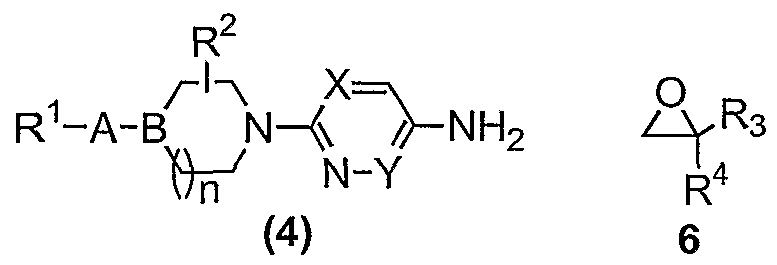
- the amine (1) is reacted with an intermediate of the general formula (2) (wherein L is a leaving group) in presence of a base in a suitable solvent to afford a compound (3) which is converted to an amino compound (4) by reduction of the nitro group.
- the amino compound (4) is converted to a compound of formula I by two approaches as shown in Scheme 1.
- the amine (4) is reacted with various epoxides of the general formula (6) under Lewis acid catalysis (Serrano, P. et al., J. Org. Chem., 2002, 67 (20), 7165) to give the amino alcohol (7).
- the reaction of amino alcohol (7) with l,l'-carbonyldiimidazole (CDI) or a phosgene derivative gives a compound of general formula I.
- the amine (4) is converted to a carbamate derivate such as benzyl carbamate and reacted with the epoxide (6) (preferably when R 3 or R 4 is H) in the presence of a strong base such as n-butyllithium (Brickner, S. J. et al., J. Med. Chem., 1996, 39, 673; Brickner, S. J. et al., J. Med. Chem., 1996, 39, 680) to give a compound of formula I.
- a strong base such as n-butyllithium
- suitable organic and inorganic bases include, but are not limited to, potassium bicarbonate, potassium carbonate, sodium carbonate, sodium bicarbonate, triethylamine, ammonium hydroxide, pyridine, n-butyllithium, sec-butyllithium, tert- butyllithium, methyllithium or lithium diisopropyl amine.
- Suitable solvents include, but are not limited to, dimethylformamide, diethylformamide, dimethylsulfoxide, N- methylpyrrolidone, tetrahydrofuran, methanol, ethanol or isopropanol or ethylacetate.
- Suitable reducing agents include, but are not limited to, hydrogen/palladium-carbon, hydrogen/Raney-Nickel, and hydrogen/Platinum-carbon, Zn/HCl, Sn/HCl or Raney- Ni/formic acid.
- Suitable deprotecting agents include, but are not limited to, hydrochloric acid or trifluoroacetic acid.
- the deprotecting agents include, but are not limited to, hydrochloric or trifluoroacetic acid.
- Suitable solvents include, but are not limited to, methanol, ethanol, tetrahydrofuran, dichloromethane, dichloroethane, dimethylformamide or ethylacetate.
- Suitable reducing agents include, but are not limited, hydrogen/palladium-carbon, hydrogen/raney-nickel, hydrogen/platinum-carbon, zinc/hydrochoride, tin/hydrochloride or raney-Ni/formic acid.
- Suitable cyclizing agents but are not limited to, N 5 N'- carbonyldiimidazole or carbonyl chloride.
- the intermediate of formula (10) is prepared in two steps using a known approach (Salvatore Lepore, et al., J. Org. Chem., 2003, 68 (21), 8261) from an appropriate phenol, a cyclic amino alcohol and a nitro aryl derivative having a suitable leaving group such as a halogen atom.
- Reduction of nitro compound (10) using a suitable reducing agent such as H 2 ZPd-C in an alcoholic solvent gives the amine (11).
- Amine (11) on reaction with epoxides under Lewis acid catalysis gives amino alcohol, which on reaction with a l,l'-carbonyldiimidazole (CDI) gives a compound of Hc.
- Step 1 fert-Butyl 4-(5-nitropyridin-2-yl)piperazine-l-carboxylate: To a stirred solution of 2-chloro-5-nitropyridine (20.00 g, 126.151 mmol) in DMF (200 ml) was added JV- BOC-piperazine (25.81 g, ' 138.766 mmol) and KHCO 3 (18.94 g, 189.226 mmol) and the mixture was stirred at 70 °C for 3 h. The mixture was cooled to room temperature and diluted with ethyl acetate (300 ml) and water (3 x 200 ml). The layers were separated.
- Step 2 4-(5-Nitropyridin-2-yl)piperazine: To a stirred solution of Step 1 intermediate (32 g, 103.896 mmol) in dichloromethane (200 ml) was added trifiuoroacetic acid (96 ml) at 0 °C over 5 min. The reaction mixture was stirred for another 1 h at the same temperature. The residue obtained after evaporation of the solvent was dissolved in ethyl acetate (180 ml) and washed with saturated NaHCO 3 (2 x 100 ml) and dried over anhydrous Na 2 SO 4 . The solvent was evaporated under reduced pressure to afford 19.5 g of the desired salt as a yellow solid.
- Step 3 l-(5-Nitropyridin-2-yl)-4-[2-(trifluoromethyl)benzoyl]piperazine: To a stirred solution of 2-(trifluoromethyl)benzoic acid (16.45 g, 86.538 mmol) in dry dichloromethane (150 ml) was added l-(3-dimethylaminopropyl)3-ethylcarbodiimide hydrochloride (14.61 g, 108.172 mmol), 1-hydroxybenzotriazole (11.04 g, 72.115 mmol) and triethylamine (35.113 ml, 252.40 mmol) at 0 "C.
- Step 2 intermediate (15.00 g, 72.115 mmol) was added and the mixture was slowly allowed to warm to room temperature. The mixture was further stirred overnight at room temperature. The reaction mixture was diluted with dichloromethane (200 ml) and washed with water (2 x 100 ml) and dried over anhydrous Na 2 SO 4 .
- Step 4 6- ⁇ 4-[2-(Trifluoromethyl)benzoyl]piperazin-l-yl ⁇ pyridin-3-yl-amine: Dry ethanol (50 ml) was added to a stirred solution of Intermediate 1 (16 g, 42.105 mmol) over 15 min at room temperature. Then 10 % Pd/C (1.6 g) was added to it and stirred overnight at the same temperature. The reaction mixture was filtered through a celite bed, washed with toluene and concentrated under reduced pressure to afford 13.39 g of the desired amine as an off-white solid which was used as such for the next step without purification.
- Step 5 5-(Benzyloxycarbonyl)aminopyridin-2-ylpiperazino-2-trifluoromethylphenyl- methanone: To a stirred solution of Step 4 Intermediate (10 g, 28.571 mmol) in dry THF (100 ml) was added triethylamine (5.959 ml, 42.857 mmol) and benzyl chloroformate (5.34 g, 31.428 mmol) at 0 °C over 5 min. The reaction mixture was allowed to warm to room temperature and left overnight at the same temperature.
- Step 1 tert-Butyl 4-(5-aminopyridin-2-yl)piperazine-l-carboxylate: To a stirred solution of tert-Butyl 4-(5-nitropyridin-2-yl)piperazine-l-carboxylate (20 g, 64.935 mmol) in EtOAc (200 ml) was added 5 % Pd/C (4 g) and the mixture was maintained under hydrogen pressure (45 psi) for 3 h at room temperature. The catalyst was then filtered off and the filtrate was concentrated under reduced pressure to afford 16.24 g of the amine as a light brown solid which was used as such for the next step.
- Step 2 tert-Bxxtyl 4-(5- ⁇ [(benzyloxy)carbonyl]amino ⁇ pyridin-2-yl)piperazine-l- carboxylate: To a stirred solution of step 1 intermediate (10 g, 35.971 mmol) in dry THF (100 ml) was added triethylamine (7.506 ml, 53.956 mmol) and the mixture was stirred at 0 0 C and benzyl chloroformate (6.75 g, 39.568 mmol) was added over 5 min. The reaction mixture was allowed to warm to room temperature and stirred overnight.
- Step 3 5-(Benzyloxycarbonyl)aminopyridin-2-ylpiperazine hydrochloride: Deprotection of Step 2 intermediate (8.0 g, 0.529 mmol) carried out as described in Step 2 of method A by treatment with 15 % HCl in EtOAc (24 ml) in dichloromethane (10 ml) afforded 5.74 g of the product as a white solid, which was used as such for the next step.
- Step 4 5-(Benzyloxycarbonyl)aminopyridm-2-ylpiperazino-2-trifluoromethylphenyl- methanone: To a stirred mixture of Step 3 intermediate (4.0 g, 12.82 mmol), 2- (trifluoromethyl)benzoic acid (2.92 g, 15.358 mmol), EDCI (2.59 g, 19.23 mmol) and HOBT (1.96 g, 12.82 mmol) in dry dichloromethane (40 ml) was added triethylamine (6.24 ml, 44.87 mmol) and the mixture was stirred overnight at room temperature under nitrogen atmosphere.
- reaction mixture was quenched with saturated ammonium chloride solution (100 ml) and extracted with ethyl acetate (3 x 100 ml). The combined organic extracts were washed with water (3 x 150 ml) and dried over anhydrous Na 2 SO 4 .
- the mixture was diluted with water (150 ml) and the layers were separated.
- the aqueous layer was extracted with dichloromethane (200 ml).
- the combined organic extracts were washed with water (2 x 150 ml) and dried over anhydrous Na 2 SO 4 .
- Step 1 (3i?)-l-(5-Nitropyridin-2-yl)pyrrolidin-3-ol: To a stirred solution of 2-chloro- 5-nitro ⁇ yridine (18.19 g, 114.784 mmol) in dry DMF (180 ml) was added (3 ⁇ )-pyrrolidin-3- ol (10.01 g, 114.784 mmol) and KHCO 3 (11.473 g, 172.004 mmol) at 70 °C and the reaction mixture was stirred at the same temperature for 3 h. The reaction mixture was allowed to cool to room temperature.
- Step 2 2 ⁇ [(3>S)-3-(2-Fluorophenoxy) ⁇ yrrolidin-l-yl]-5-nitropyridine: To a stirred solution of step 1 Intermediate (9.0 g, 43.062 mmol) in dry THF (100 ml) was added 2- fluorophenol (4.82 g, 43. ,062 mmol), triphenylphosphine (16.92 g, 64.593 mmol) followed by addition of diethyl azodicarboxylate (9.74 g, 55.98 mmol) over 10 min at room temperature. The reaction was exothermic. The reaction was allowed to cool to room temperature and the reaction mixture was stirred at this temperature for 3 h.
- Step 3 6-[(36)-3-(2-Fluorophenoxy)pyrrolidin-l-yl]pyridin-3-amine: To a stirred solution of step 2 intermediate (7 g, 23.102 mmol) in 30 % aqueous ethanol (70 ml) was added ammonium chloride (12.35 g, 231.02 mmol) at 85 °C. To this, iron powder (3.87 g, 69.306 g atom) was added in lots over 15 min. The reaction mixture was stirred at the same temperature for 1 h. The catalyst was then filtered off and the filtrate was washed with ethyl acetate and concentrated under reduced pressure.
- Step 4 Benzyl ⁇ 6-[(35)-3-(2-fluorophenoxy)pyrrolidin-l-yl]pyridin-3-yl ⁇ carbamate: To a stirred solution of step 3 intermediate (4 g, 14.638 mmol) in dry THF (50 ml) was added triethylamine (3.93 ml, 29.251 mmol) and benzyl chloroformate (2.99 g, 17.565 mmol) at 0 0 C over 5 min. The reaction mixture was allowed to warm to room temperature and left overnight at the same temperature.
- reaction mixture was quenched with saturated ammonium chloride solution (50 ml) and extracted with ethyl acetate (3 x 50 ml). The combined organic extracts were washed with water (3 x 150 ml) and dried over anhydrous Na 2 SO 4 .
- Step 1 (5i?)-5-Hydroxymethyl-3 -(6-piperazin- 1 -ylpyridin-3 -yl)- 1 ,3-oxazolan-2-one hydrochloride: tert-But ⁇ 4- ⁇ 5-[(5i?)-5-hydroxymethyl-2-oxo-l,3-oxazolan-3-yl] pyridin-3- yl ⁇ piperazin-l-carboxylate, Intermediate 2 (600 mg, 1.587 mmol) was treated with 15 % HCl in EtOAc (10 ml) at 0-5 0 C and stirred at the same temperature for 2 h. Ethyl acetate was evaporated under reduced pressure to give 440 mg of the amine hydrochloride as a white solid, which was used as such for the next step.
- Step 2 Coupling reaction of the above amine hydrochloride (200 mg, 0.635 mmol) with 2-(trifmoromethyl)benzoic acid (145 mg, 0.763 mmol) in the presence of EDCI (128 mg, 0.952 mmol), HOBT (97 mg, 0.635 mmol) and triethylamine (0.4 ml, 2.875 mmol) in dry dichloromethane (10 ml) afforded 248 mg of the desired compound as an off-white solid.
- IR, 1 H NMR and Mass spectra of the product were identical in all respects with the compound obtained from Method A.
- Example 1 To a stirred and cooled (-40 °C) solution of Example 1 (200 mg, 0.44 mmol) in dry DCM (30 ml) was added (diethylamino)sulfur trifluoride (179 mg, 1.11 mmol) over 5 min under a nitrogen atmosphere. The reaction mixture was stirred for another 45 min at the same temperature. The mixture was gradually allowed to warm to room temperature and left overnight at this temperature. The reaction mixture was quenched with saturated solution of sodium bicarbonate (50 ml) and extracted with chloroform (2 x 50 ml). The combined organic layer was washed with water (2 x 50 ml) and dried over anhydrous Na 2 SO 4 .
- Example 1 To a stirred solution of Example 1 (200 mg, 0.444 mmol) and methyliodide (94 mg, 0.666 mmol) in dry THF (10 ml) was added silver oxide (155 mg, 0.666 mmol) at room temperature under nitrogen atmosphere and further stirred for 72 h. The mixture was filtered through a celite bed and the filtrate was evaporated under reduced pressure.
- Example 12 To a stirred solution of Example 12 (150 mg, 0.304 mmol) in dry THF (10 ml) was added 3.0 M methylmagnesium bromide (0.249 ml, 0.761 mmol) at 18 °C. The reaction mixture was allowed to cool to room temperature and stirred at the same temperature for 2 hours. The reaction mixture was quenched by saturated solution of ammonium chloride (50 ml), extracted with ethyl acetate (2 x 50 ml), washed with water (3 x 100 ml), brine (50 ml) and dried over anhydrous Na 2 SO 4 . The residue obtained after evaporation of the solvent was purified by silica gel column chromatography using
- Example 12 To a stirred solution of Example 12 (50 mg, 0.101 mmol) in dry MeOH (1 ml) and dry THF (1 ml) was added isopropylamine (60 mg, 1.015 mmol) at room temperature. The reaction mixture was stirred at the same temperature for 15 hours. The residue obtained after evaporation of the solvent was dissolved in EtOAc, washed with brine (50 ml) and dried (Na 2 SO 4 ).
- Step 1 tert-Butyl 4-[5-(5-Butyl-2-oxo-l,3-oxazolan-3-yl)pyridine-2-yl]piperazine-l- carboxylate: To a stirred solution of Intermediate 5 (600 mg, 1.587 mmol) in dry THF (30 ml) was added CDI (511 mg, 3.173 mmol) and 4-dimethylaminopyridine (DMAP) (20 mg, 0.158 mmol) over 5 min under nitrogen atmosphere and the mixture was stirred at room temperature for 5 days. The excess solvent was removed under reduced pressure. The residue was treated with water and EtOAc.
- CDI 511 mg, 3.173 mmol
- DMAP 4-dimethylaminopyridine
- Step 2 4-[5-(5-Butyl-2-oxo-l ,3-oxazolan-3-yl)pyridme-2-yl]piperazme hydrochloride:
- the Step 1 intermediate 500 mg, 1.237 mmol
- EtOAc 10 ml
- Method B give 375 mg of the product as a white solid, which was used as such for the next step.
- Step 3 Coupling reaction of Step 2 intermediate (300 mg, 0.881 mmol) with 2- (trifluoromethyl)benzoic acid (169 mg, 0.889 mmol) in the presence of EDCI (150 mg, 1.113 mmol), HOBT (113 mg, 0.742 mmol) and triethylamine (0.428 ml, 3.083 mmol) in dry DCM (20 ml) afforded 260 mg of the desired compound as an off-white solid; IR (KBr) 3482, 2958, 2861, 1747, 1496, 1243, 1127, 771 cm “1 ; 1 H NMR (CDCl 3 , 300 MHz) ⁇ 0.62-1.00 (m, 3H), 1.25 (br s, IH), 1.40 (br s, 3H), 1.85 (br s, 2H), 3.29 (br s, 2H), 3.45 (br s, 2H), 3.60 (s, 3H), 3.85-4.00 (m, 2
- Step 2 4-[5-(5,5-dimethyl-2-oxo-l ,3-oxazolan-3-yl)-2-pyridyl]-l -piperazine hydrochloride:
- the Step 1 intermediate (600 mg, 1.595 mmol) was deprotected with 15 % HCl in EtOAc (10 ml) as described in Example 1, Method B gave 440 mg of the product as a white solid, which was used as such for the next step.
- Step 2 4-[5-(2-oxo-l-oxa-3-azaspiro[4.5]dec-3-yl)pyridin-2-yl]piperazine hydrochloride: Deprotection of Step 1 intermediate (650 mg, 1.081 mmol) using 15 % HCl in EtOAc (10 ml) as described in Example 15, Step 3 gave 495 mg of the product as a white solid, which was used as such for the next step.
- the in-vitro activity of the compounds of the present invention against stearoyl coenzyme desaturase was determined by following conversion of radiolabeled stearoyl-CoA to oleoyl-CoA using human SCDl enzyme using a previously published assay procedure with some modifications (Talamo, B. R. and Bloch, K. Analytical Biochemistry, 1969, 29, 300- 304). This assay protocol is only illustrative and is not meant to limit to the scope of the present invention.
- the microsomal SCDl enzyme desaturates its substrate, Stearoyl CoA (purchased from American Radiochemicals Ltd.) which is tritiated at C9 and ClO positions.
- Test compounds were dissolved in dimethylsulfoxide and tested at 10 ⁇ M final concentration. Before substrate addition, the test compound or standard reference compound (conjugated linoleic acid at 100 ⁇ M final concentration) were pre-incubated in reaction buffer with the enzyme for 10 minutes at 30 °C with shaking. Reaction buffer was prepared as described in literature (Obukowicz M. G. et al.
Landscapes
- Chemical & Material Sciences (AREA)
- Organic Chemistry (AREA)
- Health & Medical Sciences (AREA)
- Diabetes (AREA)
- General Chemical & Material Sciences (AREA)
- Emergency Medicine (AREA)
- Hematology (AREA)
- Obesity (AREA)
- Engineering & Computer Science (AREA)
- Chemical Kinetics & Catalysis (AREA)
- Endocrinology (AREA)
- Medicinal Chemistry (AREA)
- Nuclear Medicine, Radiotherapy & Molecular Imaging (AREA)
- Bioinformatics & Cheminformatics (AREA)
- Pharmacology & Pharmacy (AREA)
- Life Sciences & Earth Sciences (AREA)
- Animal Behavior & Ethology (AREA)
- General Health & Medical Sciences (AREA)
- Public Health (AREA)
- Veterinary Medicine (AREA)
- Pharmaceuticals Containing Other Organic And Inorganic Compounds (AREA)
Abstract
The present invention relates to novel Stearoyl CoA desaturase (SCD) inhibitors and uses thereof for treating diseases, conditions and/or disorders modulated by a Stearoyl CoA desaturase enzyme. The SCD inihibitors have the formula (I) or a pharmaceutically acceptable salt thereof, a pharmaceutically acceptable ester thereof, a tautomer thereof, a regioisomer thereof, a stereoisomer thereof, a enantiomer thereof, a diastereomer thereof, a polymorph thereof, or a pharmaceutically acceptable solvate thereof, wherein the variables are as described herein.
Description
STEAROYL COA DESATURASE INHIBITORS
This application claims the benefit of Indian Patent Application No. 1444/MUM/ 2006 filed on September 9, 2006, which is hereby incorporated by reference.
Field of the Invention
The present invention relates to novel Stearoyl CoA desaturase inhibitors and uses thereof for treating diseases, conditions and/or disorders modulated by a Stearoyl CoA desaturase enzyme.
Background
Metabolic energy balance is important for well being which is maintained by appropriate adjustment between energy intake and energy expenditure. Primary defects in energy balance produce obesity. Over the past few years there has been a sharp increase in obesity in many countries. Obesity is a principal cause of morbidity and mortality mainly because it increases risk for other conditions that shorten life, including diabetes, insulin resistance, coronary artery disease, hypertension and non-alcoholic fatty liver disease collectively known as metabolic syndrome (J. Am. Med. Assoc. 288, (2002), 1723-1727). Obesity has been identified as an independent risk factor for the development of type 2 diabetes. Diabetes affects more than 230 million people worldwide and is expected to affect 350 million by 2025. More than 80% of type 2 diabetic patients are obese. Cardiovascular diseases caused by atherosclerosis (thickening of large blood vessels) account for approximately 25% of the deaths in diabetic patients.
Although the exact etiology of many events underlying obesity is not very well known, typically obesity is manifested by increase in plasma free fatty acids and excessive lipid accumulation in some organs. Abnormal lipid metabolism in obese subjects results in accumulation of significant amounts of fat in liver, adipose tissue, muscle and other peripheral tissues which sets in insulin resistance {Obesity Reviews 6, (2005), 169-174). In the liver, fatty acids accumulate causing an increase in hepatic lipid content or get packaged into the very low density lipoprotein for export to other peripheral tissues. Liver steatosis associated with obesity can also result from an enhanced rate of de novo fatty acid synthesis and/or dysregulation of intracellular lipid partitioning in which fatty acid oxidation is impaired and its esterification enhanced. Lipid abnormalities in obese subjects, in particular hypertriglyceridemia, low HDL cholesterol and altered LDL cholesterol particle size, are atherogenic. The dyslipidemic state initiates a cascade of events including release of
proinflammatory adipokines which induces a proinflammatory state that drives pathogenesis of atherosclerosis. Increased release of proinflammatory adipokines also increases fibrinogen and plasminogen activator inhibitor levels thereby increasing risk for arterial thrombosis. Several studies show that even modest wait gain can precipitate the onset of hypertension (Ann. Rev. Med. 56, (2005), 45-62). Hence obesity alone can drive all aspects of the metabolic syndrome. It is believed that effective treatment of obesity could lead to prevention and control of metabolic syndrome (Obesity Reviews 6, (2005), 169-174).
Stearoyl-CoA desaturase 1 (SCDl) is shown to be a key enzyme that plays crucial role in lipid metabolism and body weight control (Science 297, (2002), 240-243, Obesity Reviews 6, (2005), 169-174, J. Clinical Investigation (2005), 1-9). SCDl is a central lipogenic enzyme catalyzing the biosynthesis of monounsaturated fatty acids from saturated fatty acids by addition of a cis double bond between carbon 9 and carbon 10 (PNAS 71, (1974), 4565- 4569, J Biol Chern 251, (1976), 5095-5103). SCDl has two preferred substrates palmitoyl and stearoyl CoA, which are desaturated to palmitoleoyl and oleoyl CoA respectively (J Biol Chem 251, (1976), 5095-5103). Oleate is found to be the major monounsaturated fatty acid of membrane phospholipids, triglycerides, cholesterol esters, wax esters and alkyl-1, 2- diacylglycerol. The ratio of stearate to oleate is one of the factors influencing membrane fluidity and its alteration is important in diseases like aging, cancer, diabetes, obesity, and neurological, vascular and heart diseases (Biochem. Biophys. Acta 431, (1976) 469-480, J. Biol. Chem. 268, (1993), 6823-6826, Diabetes 40, (1991), 280-289, Neurochem Res 26, (1994), 771-782, Arthritis Rheum 43, (2000), 894-900, Cancer Lett, 173, (2001), 139-144).
The role of SCDl in regulation of body weight is well discussed in the literature. Robust up-regulation of SCDl expression and/or activity is observed in obese experimental animals (Science 297, (2002), 240-243), fat chickens (Am Soc Nutri Scie (1997) 249-256) and obese human subjects (Cell Metab 2, (2005), 251-61) compared to their lean counterparts. In chickens, the fat chickens have higher hepatic delta-9 desaturase activity and higher plasma triglyceride compared to lean birds. Inhibition of delta-9 desaturase by a mixture of cyclopropenic fatty acids resulted in reduced triglyceride formation in vitro in hepatocytes isolated from the fat chickens (Am Soc Nutri Scie (1997), 249-256). SCDl over activity leads to weight gain and its deficiency leads to leanness. SCDl deficiency either directly or indirectly induces a signal that partitions fatty acids towards oxidation rather than synthesis. Asebia mice with natural mutation in the SCDl gene manifest defective cholestrerol ester and triglyceride synthesis and are lean and hypermetabolic (J. Biol. Chem. 275, (2000) 30132- 30138, Science 297, (2002), 240-243). Laboratory mice with targeted disruption in the SCDl
gene are resistant to diet-induced obesity and have reduced body adiposity, liver lipid accumulation and postprandial plasma insulin and glucose levels, with concomitant increase in the metabolic rate, thermogenesis and insulin sensitivity (J Nutr 131, (2001), 2260-2268, PNAS 99, (2002), 11482-11486). SCDl is documented as a key enzyme in regulating hepatic lipogenesis and lipid oxidation and therapeutic manipulation of SCD can be of benefit in treatment of obesity and metabolic syndrome (Obesi Reviews 6, (2005), 169-174, Curr Drug Targets Immune Endocr Metabol Disord 3, (2003), 271-280). Several studies report inhibition of SCDl expression and activity by different agents such as thia-fatty acids like 9- thiastearic acid, cyclopropenoid fatty acids like sterculic acid and certain conjugated linoleic acid isomers. Trans-10, cis-12 isomer of conjugated linolenic acid inhibits SCDl expression as well as desaturase activity in vitro (Biochim Biophys Acta 1486 (2-3), (2000), 285-292, Biochem Biophys Res Commun. 284(3), (2001), 689-693). Conjugated linoleic acid (CLA) administration through feed reduces body fat and increases lean body mass in several animal species (Lipids 32, (1997), 853-858, FASEB 12, (1998), A836, Lipids 34, (1999), 243- 248). Sterculic acid (8-(2-octylcyclopropenyl) octanoic acid) and malvalic acid (7-(2- octylcyclopropenyl)heptanoic acid) are Cl 8 and Cl 6 derivatives of sterculoyl- and malvaloyl fatty acids, respectively and inhibit SCD enzymatic activity by direct interaction with the enzyme. However all these agents are weak and non specific inhibitors of SCDl. SCDl antisense oligonucleotide inhibitors specifically reduce SCDl expression thereby reducing fatty acid synthesis and secretion, body adiposity, hapatomregaly, steatosis and prevent obesity in mice by improving energy balance (J Clinical Investigation, (2005), F 1-9).
U.S. Patent Publication Nos. 2006-009459 and International Publication Nos. WO 2005/011653, WO 2005/01164, WO 2005/011655, WO 2005/011656, and WO 2005/011657 disclose certain pyridazine derivatives, pyidyl derivatives, and piperazine derivatives and their use for inhibiting human stearoyl-CoA desaturase (hSCD) activity. U.S. Patent Publication No. 2004-072877 is directed to a method for increasing insulin sensitivity by reducing stearoyl-CoA desaturase 1 (SCDl) activity in a subject sufficiently to increase . insulin sensitivity.
International Publication Nos WO 2005/003087, WO 2004/009587 and WO 2003082864 disclose oxazole derivatives, oxazolidinone derivatives, and 2-oxo-oxazolidinyl derivatives as antibacterial compounds.
Despite the existence of various SCDl inhibitors, there is a continuing need for a more effective and useful SCDl inhibitor.
Summary of the Invention
The present invention relates to stearoyl CoA desaturase inhibitors of Formula I:

R1 is substituted or unsubstituted alkyl, substituted or unsubstituted aryl, substituted or unsubstituted heteroaryl or substituted or unsubstituted heterocyclyl;
R2, R3 and R4 when present, are independently selected from hydrogen, nitro, cyano, formyl, acetyl, halogen, C(R5R6)OR', C(R5R6)R', OR', SR', oxo, thio, substituted or unsubstituted alkoxy, substituted or unsubstituted alkyl, substituted or unsubstituted alkenyl, substituted or unsubstituted alkynyl, substituted or unsubstituted cycloalkyl, substituted or unsubstituted cycloalkylalkyl, substituted or unsubstituted cycloalkenyl, substituted or unsubstituted cycloalkenylalkyl, substituted or unsubstituted aryl, substituted or unsubstituted arylalkyl, substituted or unsubstituted heteroaryl, substituted or unsubstituted heteroarylalkyl, substituted or unsubstituted heterocyclic group, or substituted or unsubstituted heterocyclylalkyl, or R3 and R4 together form oxo or imino, or R3 and R4 together form an optionally substituted 3 to 7 membered saturated, unsaturated or partially unsaturated monocyclic or bicyclic ring, which can optionally include at least two heteroatoms selected from O, NR' or S; each occurrence of R' is independently hydrogen, nitro, halogen, cyano, oxo, thio, substituted or unsubstituted alkyl, substituted or unsubstituted alkenyl, substituted or unsubstituted alkynyl, substituted or unsubstituted cycloalkyl, substituted or unsubstituted cycloalkylalkyl, substituted or unsubstituted cycloalkenyl, substituted or unsubstituted cycloalkenylalkyl, substituted or unsubstituted aryl, substituted or unsubstituted arylalkyl, substituted or unsubstituted heteroaryl, substituted or unsubstituted heteroarylalkyl, substituted or unsubstituted heterocyclic group, substituted or unsubstituted heterocyclylalkyl, C(=J)Ra, C(O)ORa, C(O)NRaRb, S(O)mRa, S(O)mNRaRb, NRaRb, or a protecting group;
each occurrence of Ra and Rb may be same or different and are independently hydrogen, halogen, nitro, cyano, formyl, acetyl, oxo, thio, C(O)RC, C(O)OR0, C(O)NR°Rd , S(O)mRaRc, S(O)mNR°Rd, NR°Rd, OR0, SR0, a protecting group, substituted or unsubstituted alkyl, substituted or unsubstituted alkenyl, substituted or unsubstituted alkynyl, substituted or unsubstituted cycloalkyl, substituted or unsubstituted cycloalkylalkyl, substituted or unsubstituted cycloalkenyl, substituted or unsubstituted cycloalkenylalkyl, substituted or unsubstituted aryl, substituted or unsubstituted arylalkyl, substituted or unsubstituted heteroaryl, substituted or unsubstituted heterocyclic group, substituted or unsubstituted heterocyclylalkyl, or substituted or unsubstituted heteroarylalkyl; each occurrence of R° and Rd may be same or different and are independently hydrogen, halogen, nitro, cyano, formyl, acetyl, oxo, thio, a protecting group, substituted or unsubstituted alkyl, substituted or unsubstituted alkenyl, substituted or unsubstituted alkynyl, substituted or unsubstituted cycloalkyl, substituted or unsubstituted cycloalkylalkyl, substituted or unsubstituted cycloalkenyl, substituted or unsubstituted cycloalkenylalkyl, substituted or unsubstituted aryl, substituted or unsubstituted arylalkyl, substituted or unsubstituted heteroaryl, substituted or unsubstituted heterocyclic group, substituted or unsubstituted heterocyclylalkyl, or substituted or unsubstituted heteroarylalkyl; each occurrence of J is independently O, S or NR';
R5 and R6 are independently selected from hydrogen, hydroxyl, substituted or unsubstituted alkyl, substituted or unsubstituted alkenyl or substituted or unsubstituted alkynyl; or R5 and R6 together form =O, =NR', or =S;
HET is selected from

A is a linker group;
B, X, X' and Y are independently selected from C(Ra) or N; m and n are independently an integer from 0, 1 or 2.
Preferred compounds include those of formula I wherein R1 is selected from substituted or unsubstituted aryl and substituted or unsubstituted alkyl.
Further preferred compounds include those of formula I wherein R1 is selected from 2-trifluoromethylphenyl, 2-fluoro-5-trifluoromethylphenyl, 2-fluoro-6-trifluoromethylphenyl,
2,5-dichloroρhenyl, 2-ethylbutyl, 2,4-difluorophenyl, 2-fluorophenyl, 2-chlorophenyl and 2- cyanophenyl.
Further preferred compounds include those of formula I wherein A is selected from S(O)2, C(O) or O.
Further preferred compounds include those of formula I wherein B, X and Y are selected from -C(Ra) or N.
Further preferred compounds include those of formula I wherein Ra is hydrogen.
Further preferred compounds include those of formula I wherein R and R independently are hydrogen, substituted or unsubstituted alkyl, C(R5R6)R' or C(R5R6)OR'.
Further preferred compounds include those of formula I wherein R and R are independently hydrogen, CH2OH, CH2F, CH2OCH3, COOCH2CH3, C(CH3)(CH3)OH, CONHCH(CH3)(CH3), (CH2)3CH3 or CH3.
Further preferred compounds include those of formula I wherein R3 and R4 together form an optionally substituted 3 to 7 membered saturated, unsaturated or partially unsaturated monocyclic or bicyclic ring, which can optionally include at least two heteroatoms selected from O, NR' or S.
Further preferred compounds include those of formula I wherein R3 and R4 together forms an optionally substituted 3 to 7 membered saturated monocyclic ring.
Further preferred compounds include those of formula I wherein R2 is hydrogen; n is selected from O, 1 or 2.
According to a more preferred embodiment, the SCDl inhibitor is represented by formula II:

R1 is substituted or unsubstituted alkyl, substituted or unsubstituted aryl, substituted or unsubstituted heteroaryl or substituted or unsubstituted heterocyclyl;
R2, R3 and R4 when present, are independently selected from hydrogen, nitro, cyano, formyl, acetyl, halogen, C(R5R6)OR', C(R5R6)R', OR', SR', oxo, thio, substituted or
unsubstituted alkoxy, substituted or unsubstituted alkyl, substituted or unsubstituted alkenyl, substituted or unsubstituted alkynyl, substituted or unsubstituted cycloalkyl, substituted or unsubstituted cycloalkylalkyl, substituted or unsubstituted cycloalkenyl, substituted or unsubstituted cycloalkenylalkyl, substituted or unsubstituted aryl, substituted or unsubstituted arylalkyl, substituted or unsubstituted heteroaryl, substituted or unsubstituted heteroarylalkyl, substituted or unsubstituted heterocyclic group, or substituted or unsubstituted heterocyclylalkyl, or R3 and R4 together form oxo or imino, or R3 and R4 together form an optionally substituted 3 to 7 membered saturated, unsaturated or partially unsaturated monocyclic or bicyclic ring, which can optionally include at least two heteroatoms selected from O, NR' or S; each occurrence of R' is independently hydrogen, nitro, halogen, cyano, oxo, thio, substituted or unsubstituted alkyl, substituted or unsubstituted alkenyl, substituted or unsubstituted alkynyl, substituted or unsubstituted cycloalkyl, substituted or unsubstituted cycloalkylalkyl, substituted or unsubstituted cycloalkenyl, substituted or unsubstituted cycloalkenylalkyl, substituted or unsubstituted aryl, substituted or unsubstituted arylalkyl, substituted or unsubstituted heteroaryl, substituted or unsubstituted heteroarylalkyl, substituted or unsubstituted heterocyclic group, substituted or unsubstituted heterocyclylalkyl, C(=J)Ra, C(O)ORa, C(O)NRaRb, S(O)mRa, S(O)mNRaRb, NRaRb, or a protecting group; each occurrence of Ra and Rb may be same or different and are independently hydrogen, halogen, nitro, cyano, formyl, acetyl, oxo, thio, C(O)R0, C(O)OR0, C(0)NR°Rd , S(O)mRaR°, S(O)mNR°Rd, NR°Rd, OR0, SR0, a protecting group, substituted or unsubstituted alkyl, substituted or unsubstituted alkenyl, substituted or unsubstituted alkynyl, substituted or unsubstituted cycloalkyl, substituted or unsubstituted cycloalkylalkyl, substituted or unsubstituted cycloalkenyl, substituted or unsubstituted cycloalkenylalkyl, substituted or unsubstituted aryl, substituted or unsubstituted arylalkyl, substituted or unsubstituted heteroaryl, substituted or unsubstituted heterocyclic group, substituted or unsubstituted heterocyclylalkyl, or substituted or unsubstituted heteroarylalkyl; each occurrence of R° and Rd may be same or different and are independently hydrogen, halogen, nitro, cyano, formyl, acetyl, oxo, thio, a protecting group, substituted or unsubstituted alkyl, substituted or unsubstituted alkenyl, substituted or unsubstituted alkynyl, substituted or unsubstituted cycloalkyl, substituted or unsubstituted cycloalkylalkyl, substituted or unsubstituted cycloalkenyl, substituted or unsubstituted cycloalkenylalkyl,
substituted or unsubstituted aryl, substituted or unsubstituted arylalkyl, substituted or unsubstituted heteroaryl, substituted or unsubstituted heterocyclic group, substituted or unsubstituted heterocyclylalkyl, or substituted or unsubstituted heteroarylalkyl; each occurrence of J is independently O, S or NR';
R5 and R6 are independently selected from hydrogen, hydroxyl, substituted or unsubstituted alkyl, substituted or unsubstituted alkenyl or substituted or unsubstituted alkynyl; or R5 and R6 together form =0, =NR', =S;
X and Y are independently N or CRa; and
A, B, m and n have the same definition as above .
Representative compounds of the present invention listed below are illustrative in nature only and do not limit to the scope of the invention.
(5R)-5-Hydroxymethyl-3 - {6-[4-(2-trifluoromethylbenzoyl)piperazino] -3 -pyridyl} - l,3-oxazolan-2-one (Compound No. 1),
(5R)-4-[5-(5-Fluoromethyl-2-oxo-l,3-oxazolan-3-yl)-2-pyridyl]piperazino-2- trifluoromethylphenylmethanone (Compound No. 2),
(5R)-5-Methoxymethyl-3-{6-[4-(2-trifluoromethylbenzoyl)piperazino]-3-pyridyl}- l,3-oxazolan-2-one (Compound No. 3),
(5 S)-5 -Hydroxymethyl-3 - {6- [4-(2-trifluoromethylbenzoyl)piρerazino] -3 -pyridyl } - l,3-oxazolan-2-one (Compound No. 4),
(5S)-5-Methoxymethyl-3-{6-[4-(2-trifluoromethylbenzoyl)piperazino]-3-pyridyl}- l,3-oxazolan-2-one (Compound No. 5),
(5R)-3-{6-[4-(2-Fluoro-6-trifluoromethylbenzoyl)piperazino]-3-pyridyl}-5-hydroxy- methyl-l,3-oxazolan-2-one (Compound No. 6),
(5R)-3-{6-[4-(2-Fluoro-5-trifluoromethylbenzoyl)piperazino]-3-pyridyl}-5- hydroxymethyl-l,3-oxazolan-2-one (Compound No. 7),
(5R)-3-{6-[4-(2,5-Dichlorobenzoyl)piperazino]-3-pyridyl}-5-hydroxymethyl-l,3- oxazolan-2-one (Compound No. 8),
(5R)-3-{6-[4-(2-Ethylbutanoyl)piperazino]-3-pyridyl}-5-hydroxymethyl-l,3- oxazolan-2-one (Compound No. 9),
(5R)-3-{6-[4-(2,4-Difluorophenylsulfonyl)piperazino]-3-pyridyl}-5-hydroxymethyl- l,3-oxazolan-2-one (Compound No. 10),
(5R)-3-{6-[4-(2,5-Dichlorophenylsulfonyl)piperazino]-3-pyridyl}-5-hydroxymethyl- l,3-oxazolan-2-one (Compound No. 11),
Ethyl 3-[6-(4-{2-triflouromethylbenzoyl}piperazin-l-yl)pyridin-3-yl]-2-oxo-l,3- oxazolan-2-one-5-carboxylate (Compound No. 12),
(5 S)-3 - [6-(4- {2-Trifluoromethylbenzoyl } piperazin- 1 -yl)pyridin-3 -yl] -5-( 1 -hydroxy- 1 - methylethyl)-l,3-oxazolan-2-one (Compound No. 13),
(5S)-3-[6-(4-{2-Trifluoromethylbenzoyl}piperazin-l-yl)pyridin-3-yl]-(l-methyl)-N- ethyl-2-oxo-l,3-oxazolan-2-one-5-carboxamide (Compound No. 14),
4-[5-(5-Butyl-2-oxo-l,3-oxazolan-3-yl)-2-pyridyl]piperazino-2-trifluoromethyl- phenylmethanone (Compound No. 15),
4-[5-(5,5-Dimethyl-2-oxo-l,3-oxazolan-3-yl)-2-pyridyl]piperazino-2-trifluoromethyl- phenylmethanone (Compound No. 16),
3-[6-(4-{2-Trifluoromethylbenzoyl}piperazin-l-yl]pyridine-3-yl}-l-oxa-3- azaspiro[4.5]decan-2-one (Compound No. 17),
(5R)-3 - {6-[(3 S)-3 -(2-Fluorophenoxy)ρyrrolidin- 1 -yl]pyridin-3 -yl} -5-(hydroxyl- methyi)~l53-oxazolan-2-one (Compound No. 18),
(5 S)-3 - {6-[(3 S)-3 -(2-Fluorophenoxy)pyrrolidin- 1 -yl]pyridin-3 -yl} -5-(hydroxyl- methyl)-l,3-oxazolan-2-one (Compound No. 19),
(5S)-3-{6-[4-(2-Fluorophenoxy)piperidin-l-yl]pyridin-3-yl}-5-hydroxymethyl-l,3- oxazolan-2-one (Compound No. 20),
(5R)-3-{6-[4-(2-Chlorophenoxy)piperidino]-3-pyridyl}-5-hydroxymethyϊ-l,3- oxazolan-2-one (Compound No. 21),
(5 S)-3 - { 6- [4-(2-Chlorophenoxy)piperidino] -3 -pyridyl } -5 -hydroxymethyl- 1,3- oxazolan-2-one (Compound No. 22),
(5S)-3-{6-[4-(2,5-Dichlorophenoxy)piperidin-l-yl]pyridin-3-yl}-5-(hydroxymethyl)- l,3-oxazolan-2-one (Compound No. 23),
(5 S)- 5-Hydroxymethyl -3 - {6- [4-(2-trifluoromethylphenoxy)piperidin- 1 -yl]pyridin-3 - yl}-l,3-oxazolan-2-one (Compound No. 24),
2-[(l-{5-[(5S)-5-Hydroxymethyl-2-oxo-l,3-oxazolan-3-yl]pyridin-2-yl}piperidin-4- yl)oxy]benzonitrile (Compound No. 25), or a pharmaceutically acceptable salt thereof, a pharmaceutically acceptable ester thereof, a tautomer thereof, a regioisomer thereof, a stereoisomer thereof, an enantiomer thereof, a diastereomer thereof, a polymorph thereof or a pharmaceutically acceptable solvate thereof.
Another aspect of the invention is a pharmaceutical composition comprising at least one compound of the present invention and a pharmaceutically acceptable excipient (such as
a pharmaceutically acceptable carrier or diluent). Preferably, the pharmaceutical composition comprises a therapeutically effective amount of the compound(s) of the present invention.
Yet another aspect of the invention is the method for preventing, ameliorating or treating disease, disorder or syndrome mediated by SCD-I in a subject in need thereof by administering to the subject a therapeutically effective amount of a compound of the present invention. Such diseases, disorders, and syndromes include, but are not limited to, (1) obesity, such as obesity resulting from (i) genetics, (ii) diet, (iii) food intake volume, (iv) a metabolic disorder, (v) a hypothalmic disorder, (vi) age, (vii) abnormal adipose mass distribution, (viii) abnormal adipose compartment distribution, (ix) compulsive eating disorders, (x) motivational disorders which include the desire to consume sugars, carbohydrates, alcohols or drugs or any ingredient with hedonic value, and (xi) reduced activity, (2) overweight conditions, (3) anorexia, (4) bulimia, (5) cachexia, (6) dysregulated appetite, (7) obesity related diseases, disorders, and symptoms.
Other diseases, disorder, and syndromes mediated by SCD-I include, but are not limited to, (1) diabetes (including Type I and Type II diabetes), (2) diabetic complications, (3) glucose tolerance, (4) hyperinsulinemia, (5) insulin sensitivity or resistance, (6) hepatic steatosis, (7) increased abdominal girth, (8) metabolic syndrome, (9) cardiovascular diseases (such as (i) atherosclerosis, (ii) dyslipidemia, (iii) elevated blood pressure, (iv) microalbuminemia, (v) hyperuricaemia, (vi) hypercholesterolemia, (vii) hyperlipidemias, (viii) atherosclerosis, (ix) hypertriglyceridemias, (x) arteriosclerosis, and (xi) other cardiovascular diseases), (10) osteoarthritis, (11) dermatological diseases, (12) sleep disorders (e.g., disturbances of circadian rhythm, dysomnia, insomnia, sleep apnea and narcolepsy), (13) cholelithiasis, (14) hepatomegaly, (15) steatosis, (16) syndrome X, (17) abnormal alanine aminotransferase levels, (18) polycystic ovarian disease, (19) inflammation, (20) non-alcoholic fatty liver disease, (21) skin disorder, (22) respiratory diseases or disorders (sinusitis, asthma, bronchitis and the like), (23) pancreatitis, (24) rheumatoid arthritis, (25) cystic fibrosis, (26) pre-menstrual syndrome, (27) cancer, (28) neoplasia, (29) malignancy, metastases, (30) tumours (benign or malignant), (31) hepatomas, (32) neurological diseases, (33) psychiatric disorders, (34) multiple sclerosis, and (35) viral diseases or infections.
Yet another aspect of the invention is the method of preparing a compound of formula
I, wherein A, B, n, R1, R2, R3 and R4 are as defined above and HET is~O~. The method includes the steps of: (a) reacting a compound of formula (1) with a compound of formula (2)
 where R , R , A, B, X, Y and n are as defined above and L is a leaving group (includng halogen) to form a compound of formula (3)

(b) reducing the compound of formula (3) to form a compound of formula (4)

(c) reacting the compound of formula (4) with benzylchloroformate to form a compound of formula (5)

(d) reacting the compound of formula (5) with a compound of formula (6)
 (6) to form a compound of formula I; alternatively,
(e) reacting the compound of formula (4) with a compound of formula (6)

Yet another embodiment is a method of preparing a compound of formula Ha and lib, where the variables are as defined above. The method includes the steps of:
(a) deprotecting a compound of formula (8)


(b) reacting the compound of formula (9) with a compound of formula R1COCl or R1SO2Cl to form a compound of formula Ha or formula lib

Ha lib
Yet another embodiment is a method of preparing a compound of formula Hc, where the variables are as defined above. The method includes the steps of: (b) reducing the compound of formula (10)


(b) reacting the compound of formula (11) with a compound of formula (6)
 (6) to form a compound of formula Hc;

Hc alternatively,
(c) reacting the compound of formula (11) with benzylchloroformate to form a compound of formula (12)

(d) reacting the compound of formula (12) with a compound of formula (6) to form a compound of formula Hc.
Detailed Description of the Invention Definitions
The term "alkyl" refers to a straight or branched hydrocarbon chain radical consisting solely of carbon and hydrogen atoms, containing no unsaturation, having from one to eight carbon atoms, and which is attached to the rest of the molecule by a single bond, e.g., methyl, ethyl, n-propyl, 1-methylethyl (isopropyl), n-butyl, n-pentyl, and 1,1-dimethylethyl (t-butyl).
The term "alkenyl" refers to an aliphatic hydrocarbon group containing a carbon- carbon double bond and which may be a straight or branched chain having 2 to about 10 carbon atoms, e.g., ethenyl, 1-propenyl, 2-propenyl (allyl), iso-propenyl, 2-methyl-l- propenyl, 1-butenyl, and 2-butenyl.
The term "alkynyl" refers to a straight or branched chain hydro carbyl radical having at least one carbon-carbon triple bond, and having 2 to about 12 carbon atoms (with radicals having 2 to about 10 carbon atoms being preferred), e.g., ethynyl, propynyl, and butynyl.
The term "alkoxy" denotes an alkyl group attached via an oxygen linkage to the rest of the molecule. Representative examples of such groups are — OCH3 and -OC2H5.
The term "cycloalkyl" denotes a non-aromatic mono or multicyclic ring system of 3 to about 12 carbon atoms, such as cyclopropyl, cyclobutyl, cyclopentyl, and cyclohexyl.
Examples of niulticyclic cycloalkyl groups include, but are not limited to, perhydronaphthyl, adamantyl and norbornyl groups, bridged cyclic groups and sprirobicyclic groups, e.g., sprio (4,4) non-2-yl.
The terra "cycloalkylalkyl" refers to a cyclic ring-containing radical, having 3 to about 8 carbon atoms, directly attached to an alkyl group. The cycloalkylalkyl group may be attached to the main structure at any carbon atom in the alkyl group that results in the creation of a stable structure. Non-limiting examples of such groups include cyclopropylmethyl, cyclobutylethyl, and cyclopentylethyl.
The term "cycloalkenyl" refers to a cyclic ring-containing radical having 3 to about 8 carbon atoms with at least one carbon- carbon double bond, such as cyclopropenyl, cyclobutenyl, and cyclopentenyl.
The term "cycloalkenylalkyl" refers to a cyclic ring-containing radical having 3 to about 8 carbon atoms with at least one carbon-carbon double bond (such as cyclopropenyl, cyclobutenyl, and cyclopentenyl) directly attached to an alkyl group. The cycloalkenylalkyl group may be attached to the main structure at any carbon atom in the alkyl group that results in the creation of a stable structure.
The term "heterocyclic ring" refers to a stable 3- to 15-membered ring radical which consists of carbon atoms and from one to five heteroatoms selected from nitrogen, phosphorus, oxygen and sulfur. For purposes of this invention, the heterocyclic ring radical may be a monocyclic, bicyclic or tricyclic ring system, which may include fused, bridged or spiro ring systems, and the nitrogen, phosphorus, carbon, oxygen or sulfur atoms in the heterocyclic ring radical may be optionally oxidized to various oxidation states. In addition, the nitrogen atom may be optionally quaternized; and the ring radical may be partially or fully saturated (i.e., heterocyclic or heteroaryl). Examples of such heterocyclic ring radicals include, but are not limited to, azetidinyl, acridinyl, benzodioxolyl, benzodioxanyl, benzofurnyl, carbazolyl, cinnolinyl, dioxolanyl, indolizinyl, naphthyridinyl, perhydroazepinyl, phenazinyl, phenothiazinyl, phenoxazinyl, phthalazinyl, pyridyl, pteridinyl, purinyl, quinazolinyl, quinoxalinyl, quinolinyl, isoquinolinyl, tetrazoyl, imidazolyl, tetrahydroisouinolyl, piperidinyl, piperazinyl, 2-oxopiperazinyl, 2-oxopiperidinyl, 2-oxopyrrolidinyl, 2-oxoazepinyl, azepinyl, pyrrolyl, 4-piperidonyl, pyrrolidinyl, pyrazinyl, pyrimidinyl, pyridazinyl, oxazolyl, oxazolinyl, oxasolidinyl, triazolyl, indanyl, isoxazolyl, isoxasolidinyl, morpholinyl, thiazolyl, thiazolinyl, thiazolidinyl, isothiazolyl, quinuclidinyl, isothiazolidinyl, indolyl, isoindolyl, indolinyl, isoindolinyl, octahydroindolyl, octahydroisoindolyl, quinolyl, isoquinolyl, decahydroisoquinolyl, benzimidazolyl,
thiadiazolyl, benzopyranyl, benzothiazolyl, benzooxazolyl, furyl, tetrahydrofurtyl, tetrahydropyranyl, thienyl, benzothienyl, thiamorpholinyl, thiamoφholinyl sulfoxide, thiamorpholinyl sulfone, dioxaphospholanyl, oxadiazolyl, chromanyl, and isochromanyl. The heterocyclic ring radical may be attached to the main structure at any heteroatom or carbon atom that results in the creation of a stable structure.
The term "heterocyclyl" refers to a heterocyclic ring radical as defined above. The heterocyclyl ring radical may be attached to the main structure at any heteroatom or carbon atom that results in the creation of a stable structure.
The term "heterocyclylalkyl" refers to a heterocyclic ring radical directly bonded to an alkyl group. The heterocyclylalkyl radical may be attached to the main structure at any carbon atom in the alkyl group that results in the creation of a stable structure.
The term "aryl" refers to aromatic radicals having 6 to 14 carbon atoms such as phenyl, naphthyl, tetrahydronaphthyl, indanyl, and biphenyl.
The term "arylalkyl" refers to an aryl group as defined above directly bonded to an alkyl group as defined above, e.g., -CH2C6H5 and -C2H5C6H5.
The term "heteroaryl" refers to an aromatic heterocyclic ring radical. The heteroaryl ring radical may be attached to the main structure at any heteroatom or carbon atom that results in the creation of a stable structure.
The term "heteroarylalkyl" refers to a heteroaryl ring radical directly bonded to an alkyl group. The heteroarylalkyl radical may be attached to the main structure at any carbon atom from the alkyl group that results in the creation of a stable structure.
Unless otherwise specified, the term "substituted" as used herein refers to substitution with any one or any combination of the following substituents: hydroxy, halogen, carboxyl, cyano, nitro, oxo (=0), thio (=S), substituted or unsubstituted alkyl, substituted or unsubstituted alkoxy, substituted or unsubstituted alkenyl, substituted or unsubstituted alkynyl, substituted or unsubstituted aryl, substituted or unsubstituted arylalkyl, substituted or unsubstituted cycloalkyl, substituted or unsubstituted cycloalkenyl, substituted or unsubstituted amino, substituted or unsubstituted aryl, substituted or unsubstituted heteroaryl, substituted or unsubstituted heterocyclylalkyl ring, substituted or unsubstituted heteroarylalkyl, substituted or unsubstituted heterocyclic ring, substituted or unsubstiuted guanidine, -COORx, -C(O)Rx, -C(S)Rx, -C(O)NRxRy, -C(O)ONRxRy, -NRxC0NRyRz, - N(Rx)SORy, -N(Rx)SO2Ry, -C=N-N(Rx)Ry), -NRxC(O)OR5,, -NRxRy, -NRxC(O)Ry, - NRxC(S)Ry, -NRxC(S)NRyRz, -SONRxRy, -SO2NRxRy, -ORx, -ORxC(O)NRyRz, - 0RxC(0)0Ry, -OC(O)Rx, -OC(O)NRxRy, -RxNRyC(0)Rz, -RxORy, -RxC(O)OR7, -
RxC(O)NRyRz, -RxC(O)Ry, -RxOC(O)Ry, -SRx, -SORx, -SO2Rx, and -ONO2, wherein Rx, Ry and R2 are independently selected from hydrogen, substituted or unsubstituted alkyl, substituted or unsubstituted alkoxy, substituted or unsubstituted alkenyl, substituted or unsubstituted alkynyl, substituted or unsubstituted aryl, substituted or unsubstituted arylalkyl, substituted or unsubstituted cycloalkyl, substituted or unsubstituted cycloalkenyl, substituted or unsubstituted amino, substituted or unsubstituted aryl, substituted or unsubstituted heteroaryl, substituted heterocyclylalkyl ring, substituted or unsubstituted heteroarylalkyl, or substituted or unsubstituted heterocyclic ring. The substituents in the aforementioned "substituted" groups cannot be further substituted. For example, when the substituent on "substituted alkyl" is "substituted aryl" the substituent on "substituted aryl" cannot be "substituted alkenyl".
The term "linker group" refers to a covalent bond, or a divalent group having a 1-4 atom backbone, for example, -O-, -S(O)0-2-, -C(O)-, -NR-, -CH2-, -CH=CH-, and cyclopropyl, as well as combinations of any two or more thereof.
The term "treating" or "treatment" of a state, disorder or condition includes:
(1) preventing or delaying the appearance of clinical symptoms of the state, disorder or condition developing in a subject that may be afflicted with or predisposed to the state, disorder or condition but does not yet experience or display clinical or subclinical symptoms of the state, disorder or condition;
(2) inhibiting the state, disorder or condition, i.e., arresting or reducing the development of the disease or at least one clinical or subclinical symptom thereof; or
(3) relieving the disease, i.e., causing regression of the state, disorder or condition or at least one of its clinical or subclinical symptoms.
The benefit to a subject to be treated is either statistically significant or at least perceptible to the subject or to the physician.
The term "subject" includes mammals (especially humans) and other animals, such as domestic animals (e.g., household pets including cats and dogs) and non-domestic animals (such as wildlife).
A "therapeutically effective amount" > means the amount of a compound that, when administered to a subject for treating a state, disorder or condition, is sufficient to effect such treatment. The "therapeutically effective amount" will vary depending on the compound, the disease and its severity and the age, weight, physical condition and responsiveness of the subject to be treated.
The term "protecting group" refers to a substituent that is employed to block or protect a particular functionality. Other functional groups on the compound may remain reactive. For example, an "amino-protecting group" is a substituent attached to an amino group that blocks or protects the amino functionality in the compound. Suitable amino- protecting groups include, but are not limited to, acetyl, trifluoroacetyl, t-butoxycarbonyl (BOC), benzyloxycarbonyl (CBz) and 9-fluorenylmethylenoxycarbonyl (Fmoc). For a general description of protecting groups and their use, see T. W. Greene, Protective Groups in Organic Synthesis, John Wiley & Sons, New York, 1991.
Pharmaceutically acceptable salts forming part of this invention include salts derived from inorganic bases (such as Li, Na, K, Ca, Mg, Fe, Cu, Zn, and Mn), salts of organic bases (such as N,N'-diacetylethylenediamine, glucamine, triethylamine, choline, hydroxide, dicyclohexylamine, metformin, benzylamine, trialkylamine, and thiamine), salts of chiral bases (such as alkylphenylamine, glycinol, and phenyl glycinol), salts of natural amino acids (such as glycine, alanine, valine, leucine, isoleucine, norleucine, tyrosine, cystine, cysteine, methionine, proline, hydroxy proline, histidine, ornithine, lysine, arginine, and serine), salts of non-natural amino acids (such as D-isomers or substituted amino acids), salts of guanidine, salts of substituted guanidine (wherein the substituents are selected from nitro, amino, alkyl, alkenyl, or alkynyl), ammonium salts, substituted ammonium salts, and aluminum salts. Other pharmaceutically acceptable salts include acid addition salts (where appropriate) such as sulphates, nitrates, phosphates, perchlorates, borates, hydrohalides, acetates (such as trifluroacetate), tartrates, maleates, citrates, fumarates, succinates, palmoates, methanesulphonates, benzoates, salicylates, benzenesulfonates, ascorbates, glycerophosphates, and ketoglutarates. Yet other pharmaceutically acceptable salts include, but are not limited to, quaternary ammonium salts of the compounds of invention with alkyl halides or alkyl sulphates (such as MeI or (Me)2SO4).
Phannaceutically acceptable solvates includes hydrates and other solvents of crystallization (such as alcohols). The compounds of the present invention may form solvates with standard low molecular weight solvents by methods known in the art.
Pharmaceutical Composition The pharmaceutical composition of the present invention comprises at least one compound of the present invention and a pharmaceutically acceptable excipient (such as a pharmaceutically acceptable carrier or diluent). Preferably, the pharmaceutical composition comprises a therapeutically effective amount of the compound(s) of the present invention. The compound of the present invention may be associated with a phannaceutically acceptable
excipient (such as a carrier or a diluent) or be diluted by a carrier, or enclosed within a carrier which can be in the form of a capsule, sachet, paper or other container.
Examples of suitable carriers include, but are not limited to, water, salt solutions, alcohols, polyethylene glycols, polyhydroxyethoxylated castor oil, peanut oil, olive oil, gelatin, lactose, terra alba, sucrose, dextrin, magnesium carbonate, sugar, cyclodextrin, amylose, magnesium stearate, talc, gelatin, agar, pectin, acacia, stearic acid or lower alkyl ethers of cellulose, silicic acid, fatty acids, fatty acid amines, fatty acid monoglycerides and diglycerides, pentaerythritol fatty acid esters, polyoxyethylene, hydroxymethyl cellulose and polyvinylpyrrolidone.
The carrier or diluent may include a sustained release material, such as glyceryl monostearate or glyceryl distearate, alone or mixed with a wax.
The pharmaceutical composition may also include one or more pharmaceutically acceptable auxiliary agents, wetting agents, emulsifying agents, suspending agents, preserving agents, salts for influencing oxmetic pressure, buffers, sweetening agents, flavoring agents, colorants, or any combination of the foregoing. The pharmaceutical composition of the invention may be formulated so as to provide quick, sustained, or delayed release of the active ingredient after administration to the subject by employing methods known in the art.
The pharmaceutical compositions of the present invention may be prepared by conventional techniques, e.g., as described in Remington: The Science and Practice of Pharmacy, 20th Ed., 2003 (Lippincott Williams & Wilkins). For example, the active compound can be mixed with a carrier, or diluted by a carrier, or enclosed within a carrier, which may be in the form of an ampoule, capsule, sachet, paper, or other container. When the carrier serves as a diluent, it may be a solid, semi-solid, or liquid material that acts as a vehicle, excipient, or medium for the active compound. The active compound can be adsorbed on a granular solid container, for example, in a sachet.
The pharmaceutical compositions may be in conventional forms, for example, capsules, tablets, aerosols, solutions, suspensions or products for topical application.
The route of administration may be any route which effectively transports the active compound of the invention to the appropriate or desired site of action. Suitable routes of administration include, but are not limited to, oral, nasal, pulmonary, buccal, subdermal, intradermal, transdermal, parenteral, rectal, depot, subcutaneous, intravenous, intraurethral, intramuscular, intranasal, ophthalmic (such as with an ophthalmic solution) or topical (such as with a topical ointment). The oral route is preferred.
Solid oral formulations include, but are not limited to, tablets, capsules (soft or hard gelatin), dragees (containing the active ingredient in powder or pellet form), troches and lozenges. Tablets, dragees, or capsules having talc and/or a carbohydrate carrier or binder or the like are particularly suitable for oral application. Preferable carriers for tablets, dragees, or capsules include lactose, cornstarch, and/or potato starch. A syrup or elixir can be used in cases where a sweetened vehicle can be employed.
A typical tablet that may be prepared by conventional tabletting techniques may contain: (1) Core: Active compound (as free compound or salt thereof), 250 mg colloidal silicon dioxide (Aerosil®), 1.5 mg microcrystalline cellulose (Avicel®), 70 mg modified cellulose gum (Ac-Di-Sol®), and 7.5 mg magnesium stearate; (2) Coating: HPMC, approx. 9 mg Mywacett 9-40 T and approx. 0.9 mg acylated monoglyceride
Liquid formulations include, but are not limited to, syrups, emulsions, soft gelatin and sterile injectable liquids, such as aqueous or non-aqueous liquid suspensions or solutions.
For parenteral application, particularly suitable are injectable solutions or suspensions, preferably aqueous solutions with the active compound dissolved in polyhydroxylated castor oil.
The present invention provides compounds and pharmaceutical formulations thereof that are useful in the treatment, amelioration, and prevention of diseases, conditions and disorders modulated by a stearoyl CoA desaturase, especially those modulated by the SCDl.
Method of Treatment
The present invention further provides a method of treating a disease, condition or disorder modulated by a stearoyl CoA desaturase, especially those modulated by SCDl, in a subject in need thereof by administering to the subject a therapeutically effective amount of a compound or a pharmaceutical composition of the present invention.
Diseases, conditions, and disorders that are modulated by a stearoyl CoA desaturase, include, but are not limited to, diabetes, diabetes related syndromes, disorders or diseases obesity, obesity related diseases, conditions, and disorders, cardiovascular diseases (such as atherosclerosis), hepatic steatosis and other metabolic syndromes, metabolism related syndromes, disorders and diseases, and non-alcoholic fatty liver disease.
SCD, particularly human SCD, can be regulated to treat obesity. Obesity and overweight are defined as an excess of body fat relative to lean body mass. An increase in caloric intake or a decrease in energy expenditure or both can bring about this imbalance leading to surplus energy being stored as fat. In contrast, anorexia and cachexia are
characterized by an imbalance in energy intake versus energy expenditure leading to a negative energy balance and weight loss. Agents that either increase energy expenditure and/or decrease energy intake, absorption or storage would be useful for treating obesity, overweight, and associated comorbidities. Agents that either increase energy intake and/or decrease energy expenditure or increase the amount of lean tissue would be useful for treating cachexia, anorexia, and wasting disorders. An SCD gene, translated proteins and agents which modulate the gene or portions of the gene or its products are useful for treating obesity, overweight, anorexia, cachexia, wasting disorders, appetite suppression, appetite enhancement, increases or decreases in satiety, modulation of body weight, and/or other eating disorders such as bulimia. Accordingly, diseases, conditions, and disorders that are modulated by a stearoyl CoA desaturase, include, but are not limited to, obesity, overweight, anorexia, cachexia, wasting disorders, appetite suppression, appetite enhancement, andr other eating disorders such as bulimia. Furthermore, the compounds of the present invention increase or decrease in satiety and modulate body weight.
Obesity related syndromes, disorders and diseases include, but are not limited to, obesity as a result of (i) genetics, (ii) diet, (iii) food intake volume, (iv) a metabolic disorder, (v) a hypothalmic disorder, (vi) age, (vii) abnormal adipose mass distribution, (viii) abnormal adipose compartment distribution, (ix) compulsive eating disorders, and (x) motivational disorders which include the desire to consume sugars, carbohydrates, alcohols or drugs or any ingredient with hedonic value. Symptoms associated with obesity related syndromes, disorders, and diseases include, but are not limited to, reduced activity. Obesity also increases the likelihood of sleep apnea, gallstones, osteoporosis and ceratin cancers.
Diabetes related syndromes, disorders and diseases include, but are not limited to, glucose dysregulation, insulin resistance, glucose intolerance, hyperinsulinemia, dyslipidemia, hypertension, obesity, and hyperglycemia.
Cardiovascular diseases include, but are not limited to, (i) coronary artery disease, (ii) atherosclerosis, (iii) heart disease, (iv) hypercholesterolemia, (v) hypertriglyceridemia, (vi) hypertriglyceridemia secondary to another disorder or disease (such as hyperlipoproteinemias), (vii) hyperlipidemia, (viii) disorders of serum levels of triglycerides, VLDL, HDL, and LDL, (ix) cholesterol disorders, (x) cerebrovascular disease (including but not limited to, stroke, ischemic stroke and transient ischemic attack (TIA)), (xi) peripheral vascular disease, and (xii) ischemic retinopathy.
Metabolism related syndromes, disorders or diseases include, but are not limited to, (i) metabolic syndrome, (ii) dyslipidemia, (iii) elevated blood pressure, (iv) insulin sensitivity
or resistance, (v) Type II diabetes, (vi) Type I diabetes, (vii) diabetic complications, (viii) increased abdominal girth, (ix) glucose tolerance, (x) microalbuminemia, (xi) hyperuricaemia, (xii) hyperinsulinemia, (xiii) hypercholesterolemia, (xiv) hyperlipidemias, (xv) atherosclerosis, (xvi) hypertriglyceridemias, (xvii) arteriosclerosis and other cardiovascular diseases, (xviii) osteoarthritis, (xix) dermatological diseases, (xx) sleep disorders (e.g., disturbances of circadian rhythm, dysomnia, insomnia, sleep apnea and narcolepsy), (xxi) cholelithiasis, (xxii) hepatomegaly, (xxiiii) steatosis, (xxiv) syndrome X, (xxv) abnormal alanine aminotransferase levels, (xxvi) polycystic ovarian disease, and (xxvii) inflammation.
Non-alcoholic fatty liver disease can manifest as hepatic steatosis (or fatty liver) and can progress to hepatitis, drug-induced hepatitis, hepatoma, fibrosis, hepatic cirrhosis, liver failure, non-alcoholic steatohepatitis, non-alcoholic hepatitis, acute fatty liver, and fatty liver of pregnancy.
Other disorders or diseases mediated by SCD include, but are not limited to, skin disorder, inflammation, respiratory diseases or disorders (e.g., sinusitis, asthma, and bronchitis), pancreatitis, osteoarthritis, rheumatoid arthritis, cystic fibrosis, pre-menstrual syndrome., cancer, neoplasia, malignancy, metastases, tumours (benign or malignant), carcinogenesis, hepatomas, neurological diseases, psychiatric disorders, multiple sclerosis, and viral diseases and infections.
In a preferred embodiment, compounds of the invention will, in a subject, increase HDL levels and/or decrease triglyceride levels and/or decrease LDL or non-HDL- cholesterol levels.
In another embodiment, compounds of the invention will, in a subject, increase body lean mass and decrease obesity.
In another embodiment, compounds of the invention will, in a subject, decrease hepatitic steatosis.
The compounds of this invention may also be used in conjunction with other pharmaceutical agents for the treatment of the diseases, conditions and/or disorders described herein. Therefore, methods of treatment that include administering compounds of the present invention in combination with other pharmaceutical agents are also provided. Suitable pharmaceutical agents that may be used in combination with the compounds of the present invention include, but are not limited to, anti-obesity agents such as apolipoprotein-B secretion/microsomal triglyceride transfer protein (apo-B/MTP) inhibitors, l lβ-hydroxy steroid dehydrogenase- 1 (llβ-HSD type 1) inhibitors, peptide YY3-36 or analogs thereof,
MCR-4 agonists, cholecystokinin-A (CCK-A) agonists, monoamine reuptake inhibitors (such as sibutramine), sympathomimetic agents, β3 adrenergic receptor agonists, dopamine receptor agonists (such as bromocriptine), melanocyte-stimulating hormone receptor analogs, 5HT2c receptor agonists, melanin concentrating hormone antagonists, leptin (the OB protein), leptin analogs, leptin receptor agonists, galanin antagonists, lipase inhibitors (such as tetrahydrolipstatin, i.e. orlistat), anorectic agents (such as a bombesin agonist), neuropeptide- Y receptor antagonists, thyromimetic agents, dehydroepiandrosterone or an analog thereof, glucocorticoid receptor agonists or antagonists, orexin receptor antagonists, glucagon-like peptide-1 (GLP-I) receptor agonists, Protein Tyrosine Phosphatase (PTP-IB) inhibitors, dipeptidyl peptidase IV (DPP-IV) inhibitors, ciliary neurotrophic factors (such as Axokine™ available from Regeneron Pharmaceuticals, Inc., Tarrytown, N. Y. and Procter & Gamble Company, Cincinnati, Ohio), human agouti-related protein (AGRP) inhibitors, ghrelin receptor antagonists, histamine 3 receptor antagonists or inverse agonists, and neuromedin U receptor agonists. Other anti-obesity agents, including the preferred agents set forth herein below, are well known, or will be readily apparent in light of the instant disclosure, to one of ordinary skill in the art.
Especially preferred are anti-obesity agents such as orlistat, sibutramine, bromocriptine, ephedrine, leptin, peptide YY3-36 or an analog thereof (including the complete peptide YY), and pseudoephedrine. Preferably, compounds of the present invention and combination therapies are administered in conjunction with exercise and a sensible diet.
Anti-obesity agents for use in the combinations, pharmaceutical compositions, and methods of the invention can be prepared using methods known to one of ordinary skill in the art, for example, sibutramine can be prepared as described in U.S. Pat. No. 4,929,629; bromocriptine can be prepared as described in U.S. Pat. Nos. 3,752,814 and 3,752,888; orlistat can be prepared as described in U.S. Pat. Nos. 5,274,143, 5,420,305, 5,540,917, and 5,643,874; and PYY3-36 (including its analogs) can be prepared as described in U.S. Patent Publication No. 2002/0141985 and International Publication No. WO 03/027637. All of the above recited references are incorporated herein by reference.
The compounds of the present invention (including the pharmaceutical compositions and processes used therein) may be used alone or in combination with other pharmaceutical agents in the manufacture of a medicament for the therapeutic applications described herein.
General Methods of Preparation
The compounds described herein, including compounds of general formula I, II and specific examples, are prepared using techniques known to one skilled in the art through the reaction sequences depicted in Schemes 1-3. Furthermore, in the following schemes, where specific acids, bases, reagents, coupling agents, solvents, etc. are mentioned, it is understood that other suitable acids, bases, reagents, coupling agents etc. may be used and are included within the scope of the present invention. Modifications to reaction conditions, for example, temperature, duration of the reaction or combinations thereof, are envisioned as part of the present invention. The compounds obtained by using the general reaction sequences may be of insufficient purity. These compounds can be purified by using any of the methods for purification of organic compounds known to persons skilled in the art, for example, crystallization or silica gel or alumina column chromatography using different solvents in suitable ratios. AU possible stereoisomers are envisioned within the scope of this invention.
According to a preferred embodiment, provided herein a process for preparing a compound of formula II (formula I, wherein HET is V/ ) using the reaction sequence as shown in general Scheme 1.
Scheme 1

A cyclic amine derivative of the general formula (3) can be prepared by a known approach as described in the literature (Hamlin K. et al., J. Am. Chem. Soc, 1949, 71, 2734; Willand, N. et al., Tetrahedron, 2002, 55, 5741). Thus, the amine (1) is reacted with an
intermediate of the general formula (2) (wherein L is a leaving group) in presence of a base in a suitable solvent to afford a compound (3) which is converted to an amino compound (4) by reduction of the nitro group. The amino compound (4) is converted to a compound of formula I by two approaches as shown in Scheme 1. In one approach, the amine (4) is reacted with various epoxides of the general formula (6) under Lewis acid catalysis (Serrano, P. et al., J. Org. Chem., 2002, 67 (20), 7165) to give the amino alcohol (7). The reaction of amino alcohol (7) with l,l'-carbonyldiimidazole (CDI) or a phosgene derivative gives a compound of general formula I. Alternatively, the amine (4) is converted to a carbamate derivate such as benzyl carbamate and reacted with the epoxide (6) (preferably when R3 or R4 is H) in the presence of a strong base such as n-butyllithium (Brickner, S. J. et al., J. Med. Chem., 1996, 39, 673; Brickner, S. J. et al., J. Med. Chem., 1996, 39, 680) to give a compound of formula I.
In Scheme I, suitable organic and inorganic bases include, but are not limited to, potassium bicarbonate, potassium carbonate, sodium carbonate, sodium bicarbonate, triethylamine, ammonium hydroxide, pyridine, n-butyllithium, sec-butyllithium, tert- butyllithium, methyllithium or lithium diisopropyl amine. Suitable solvents include, but are not limited to, dimethylformamide, diethylformamide, dimethylsulfoxide, N- methylpyrrolidone, tetrahydrofuran, methanol, ethanol or isopropanol or ethylacetate. Suitable reducing agents include, but are not limited to, hydrogen/palladium-carbon, hydrogen/Raney-Nickel, and hydrogen/Platinum-carbon, Zn/HCl, Sn/HCl or Raney- Ni/formic acid. Suitable deprotecting agents include, but are not limited to, hydrochloric acid or trifluoroacetic acid.
According to another preferred embodiment, provided herein a process for preparing a compound of formula Ha or lib (formula I, wherein A is SO2 or CO, HET is V/ ) using the reaction sequence as shown in general Scheme 2.
Scheme 2

In another approach (Scheme 2), when B is a nitrogen atom, an intermediate of the formula (8) bearing an oxazolidinone ring is prepared prior to introduction of R1 and A groups by following a reaction sequence similar to that described in Scheme 1, by starting from protected piperazine derivative. The intermediate (8) is deprotected to give the free amine or its hydrochloride (9) which is coupled with various acid chlorides in the presence of a suitable base to give a compound of the present invention having the structural formula Ha. Intermediate (9) is also coupled with alkyl and aryl sulfonyl chlorides to give sulfonamide derivatives of the formula Ub.
In Scheme 2, the deprotecting agents include, but are not limited to, hydrochloric or trifluoroacetic acid. Suitable solvents include, but are not limited to, methanol, ethanol, tetrahydrofuran, dichloromethane, dichloroethane, dimethylformamide or ethylacetate. Suitable reducing agents include, but are not limited, hydrogen/palladium-carbon, hydrogen/raney-nickel, hydrogen/platinum-carbon, zinc/hydrochoride, tin/hydrochloride or raney-Ni/formic acid. Suitable cyclizing agents, but are not limited to, N5N'- carbonyldiimidazole or carbonyl chloride.
According to yet another embodiment, provided herein a process for preparing a compound of formula Hc (formula I, wherein A is O, B is CRa, HET is~w~~ ) using the reaction sequence as shown in general Scheme 3.
Scheme 3

According to Scheme 3, the intermediate of formula (10) is prepared in two steps using a known approach (Salvatore Lepore, et al., J. Org. Chem., 2003, 68 (21), 8261) from an appropriate phenol, a cyclic amino alcohol and a nitro aryl derivative having a suitable leaving group such as a halogen atom. Reduction of nitro compound (10) using a suitable reducing agent such as H2ZPd-C in an alcoholic solvent gives the amine (11). Amine (11) on reaction with epoxides under Lewis acid catalysis gives amino alcohol, which on reaction with a l,l'-carbonyldiimidazole (CDI) gives a compound of Hc. Alternatively, the carbamate (12) derived from (11) on reaction with epoxide of the general formula (6), wherein, preferably one of the substitution (R3 or R4) is a H, in the presence of a suitable strong base such as «-butyllithium gives a compound of formula Hc.
Experimental
Intermediate 1 : Preparation of r5-(Benzyloxycarbonyl)aminopyridin-2-yl1piperazmo-2- trifluoromethylphenylmethanone

Method A:
Step 1 : fert-Butyl 4-(5-nitropyridin-2-yl)piperazine-l-carboxylate: To a stirred solution of 2-chloro-5-nitropyridine (20.00 g, 126.151 mmol) in DMF (200 ml) was added JV- BOC-piperazine (25.81 g, '138.766 mmol) and KHCO3 (18.94 g, 189.226 mmol) and the mixture was stirred at 70 °C for 3 h. The mixture was cooled to room temperature and diluted with ethyl acetate (300 ml) and water (3 x 200 ml). The layers were separated. The aqueous layer was extracted with ethyl acetate (300 ml). The combined organic extracts were washed
with water (3 x 200 ml), brine (200 ml) and dried over anhydrous Na2SO4. The residue obtained after evaporation of the solvent was triturated with /ϊ-pentane to give 32.34 g of the product as a yellow solid; IR (KBr) 3430, 2975, 1691, 1512, 1292, 937 cm"1; 1H NMR (CDCl3, 300 MHz) δ 1.49 (s, 9H), 3.57 (br s, 4H), 3.77 (br s, 4H), 6.57 (d, J= 9.0 Hz, IH), 8.24 (d, J= 6.0 Hz, IH), 9.04 (s, IH); MS (ESI) m/z 413.22 (MH)+.
Step 2: 4-(5-Nitropyridin-2-yl)piperazine: To a stirred solution of Step 1 intermediate (32 g, 103.896 mmol) in dichloromethane (200 ml) was added trifiuoroacetic acid (96 ml) at 0 °C over 5 min. The reaction mixture was stirred for another 1 h at the same temperature. The residue obtained after evaporation of the solvent was dissolved in ethyl acetate (180 ml) and washed with saturated NaHCO3 (2 x 100 ml) and dried over anhydrous Na2SO4. The solvent was evaporated under reduced pressure to afford 19.5 g of the desired salt as a yellow solid.
Step 3: l-(5-Nitropyridin-2-yl)-4-[2-(trifluoromethyl)benzoyl]piperazine: To a stirred solution of 2-(trifluoromethyl)benzoic acid (16.45 g, 86.538 mmol) in dry dichloromethane (150 ml) was added l-(3-dimethylaminopropyl)3-ethylcarbodiimide hydrochloride (14.61 g, 108.172 mmol), 1-hydroxybenzotriazole (11.04 g, 72.115 mmol) and triethylamine (35.113 ml, 252.40 mmol) at 0 "C. After 30 minutes at the same temperature, the Step 2 intermediate (15.00 g, 72.115 mmol) was added and the mixture was slowly allowed to warm to room temperature. The mixture was further stirred overnight at room temperature. The reaction mixture was diluted with dichloromethane (200 ml) and washed with water (2 x 100 ml) and dried over anhydrous Na2SO4. The residue after evaporation of the solvent was triturated with n-pentane to afford 23.4 g of the desired product as a pale yellow solid; IR (KBr) 3435, 3117, 2991, 1641, 1250, 774 cm4; 1H NMR (CDCl3, 300 MHz) δ 3.26-3.40 (m, 2H), 3.65-3.98 (m, 5H), 4.00-4.10 (m, IH), 6.60 (d, J= 9.3 Hz, IH), 7.37 (d, J= 7.5 Hz, IH), 7.51-7.70 (m, 2H), 7.75 (d, J- 7.5 Hz, IH), 8.24 (dd, J= 6.9, 2.7 Hz, IH), 9.03 (d, J= 2.7 Hz, IH); MS (ESI) m/z 381.37 (MH)+.
Step 4: 6-{4-[2-(Trifluoromethyl)benzoyl]piperazin-l-yl}pyridin-3-yl-amine: Dry ethanol (50 ml) was added to a stirred solution of Intermediate 1 (16 g, 42.105 mmol) over 15 min at room temperature. Then 10 % Pd/C (1.6 g) was added to it and stirred overnight at the same temperature. The reaction mixture was filtered through a celite bed, washed with toluene and concentrated under reduced pressure to afford 13.39 g of the desired amine as an off-white solid which was used as such for the next step without purification.
Step 5 : 5-(Benzyloxycarbonyl)aminopyridin-2-ylpiperazino-2-trifluoromethylphenyl- methanone: To a stirred solution of Step 4 Intermediate (10 g, 28.571 mmol) in dry THF (100
ml) was added triethylamine (5.959 ml, 42.857 mmol) and benzyl chloroformate (5.34 g, 31.428 mmol) at 0 °C over 5 min. The reaction mixture was allowed to warm to room temperature and left overnight at the same temperature. The reaction mixture was quenched with water, extracted into ethyl acetate (3 x 100 ml), washed with water (2 x 100 ml) and dried over anhydrous Na2SO4. The solvent was evaporated under reduced pressure and residue obtained was purified by silica gel column chromatography using 15 % acetone in chloroform as an eluent to afford 10.91 g of the desired product as an off-white solid; IR (KBr) 3776, 3262, 2993, 1716, 1492, 1058, 744 cm"1; 1H NMR (CDCl3, 300 MHz) δ 3.22- 3.32 (m, 2H), 3.41 (q, J= 4.2 Hz, 2H), 3.52-3.64 (m, 2H), 3.91 (q, J = 6.0 Hz, 2H), 5.17 (s, 2H), 6.52 (br s, IH), 6.62 (d, J= 9.0 Hz, IH), 7.35 (br s, 6H), 7.48-7.64 (m, 2H), 7.70 (d, J= 7.8 Hz, 2H), 8.04 (d, J= 2.4 Hz, IH); MS (ESI) m/z 485.20 (MH)+. Method B:
Step 1: tert-Butyl 4-(5-aminopyridin-2-yl)piperazine-l-carboxylate: To a stirred solution of tert-Butyl 4-(5-nitropyridin-2-yl)piperazine-l-carboxylate (20 g, 64.935 mmol) in EtOAc (200 ml) was added 5 % Pd/C (4 g) and the mixture was maintained under hydrogen pressure (45 psi) for 3 h at room temperature. The catalyst was then filtered off and the filtrate was concentrated under reduced pressure to afford 16.24 g of the amine as a light brown solid which was used as such for the next step.
Step 2: tert-Bxxtyl 4-(5-{[(benzyloxy)carbonyl]amino}pyridin-2-yl)piperazine-l- carboxylate: To a stirred solution of step 1 intermediate (10 g, 35.971 mmol) in dry THF (100 ml) was added triethylamine (7.506 ml, 53.956 mmol) and the mixture was stirred at 0 0C and benzyl chloroformate (6.75 g, 39.568 mmol) was added over 5 min. The reaction mixture was allowed to warm to room temperature and stirred overnight. The reaction mixture was quenched with water and extracted with chloroform (3 x 100 ml), washed with water (3 x 100 ml) and dried over anhydrous Na2SO4. The solvent was evaporated under reduced pressure and the residue obtained was purified by silica gel column chromatography using 25 % ethyl acetate in chloroform as an eluent to afford 11.26 g of the desired compound as an off-white solid; IR (KBr) 3313, 2980, 1699, 1499, 1236, 1067, 934 cm"1; 1H NMR (CDCl3, 300 MHz) δ 1.48 (s, 9H), 3.42-3.80 (m, 4H), 3.50-3.58 (m, 4H), 5.18 (s, 2H), 6.51 (s, IH), 6.63 (d, J= 9.0 Hz, IH), 7.30-7.42 (m, 5H), 7.75 (br s, IH), 8.06 (d, J= 3.0 Hz, IH); MS (ESI) m/z 413.22 (MH)+.
Step 3: 5-(Benzyloxycarbonyl)aminopyridin-2-ylpiperazine hydrochloride: Deprotection of Step 2 intermediate (8.0 g, 0.529 mmol) carried out as described in Step 2 of
method A by treatment with 15 % HCl in EtOAc (24 ml) in dichloromethane (10 ml) afforded 5.74 g of the product as a white solid, which was used as such for the next step.
Step 4: 5-(Benzyloxycarbonyl)aminopyridm-2-ylpiperazino-2-trifluoromethylphenyl- methanone: To a stirred mixture of Step 3 intermediate (4.0 g, 12.82 mmol), 2- (trifluoromethyl)benzoic acid (2.92 g, 15.358 mmol), EDCI (2.59 g, 19.23 mmol) and HOBT (1.96 g, 12.82 mmol) in dry dichloromethane (40 ml) was added triethylamine (6.24 ml, 44.87 mmol) and the mixture was stirred overnight at room temperature under nitrogen atmosphere. The reaction mixture was diluted with water (100 ml) and extracted with ethyl acetate (2 x 100 ml). The combined organic extracts were washed with water (2 x 50 ml) and dried over anhydrous Na2SO4. The residue obtained after evaporation of the solvent was purified by silica gel column chromatography using 3.0 % methanol in chloroform as an eluent to afford 4.96 g of the desired compound as an off-white solid. IR, 1H NMR and Mass spectra of the product were identical in all respects with the intermediate obtained from Method A.

To a stirred solution of tert-Butyl 4-(5-benzyloxycarbonylaminopyridin-2- yl)piperazine-l-carboxylate (10.0 g, 24.271 mmol), prepared as described in Intermediate 1, Method B, in dry THF (100 ml) was added 1.6 M π-butyllithium in hexane (45.507 ml, 72.813 mmol) and the mixture was stirred at -78 "C for 30 min and (i?)-(-)-glycidyl butyrate (5.14 g, 36.407 mmol) was added over 5 min. The reaction mixture was allowed to warm to room temperature and stirred overnight. The reaction mixture was quenched with saturated ammonium chloride solution (100 ml) and extracted with ethyl acetate (3 x 100 ml). The combined organic extracts were washed with water (3 x 150 ml) and dried over anhydrous Na2SO4. The residue obtained after evaporation of the solvent was triturated with 7z-pentane to afford 6.78 g of the desired compound as an off-white solid; IR (KBr) 3415, 2979, 1728, 1691, 1422, 937 cm"1; 1H NMR (CDCl3, 300 MHz) δ 1.48 (s, 9H), 2.30-2.40 (m, IH), 3.45- 3.80 (m, 8H), 3.90-4.05 (m, 4H), 4.76 (br s, IH), 6.67 (d, J= 9.3 Hz, IH), 7.96 (dd, J= 2.7, 6.6 Hz, IH), 8.12 (d, J= 3.0 Hz, IH); MS (ESI) m/z 379.18 (MH)+.
Intermediate 3: Preparation of tert-Butyl 4-{5-r(5^)-5-hvdroxymethyl-2-oxo-L3-oxazolan-3- yllpyridin-2-yl }pipera-zine- 1 -carboxylate

The product was prepared by the reaction of tert-butyl 4-[5- (benzyloxycarbonyl)aminopyridin-2-yl]piperazine-l-carboxylate (10.0 g, 24.271 mmol), prepared as described in Intermediate 1, Step 2 of Method B, in dry THF (100 ml) with (S)- (+)-glycidyl butyrate (5.24 g, 36.407 mmol) in the presence of 1.6 M rø-butyllithium in hexane (45.507 ml, 72.813 mmol) according to procedure described in Intermediate 2 to afford 6.6 g of the desired compound as an off-white solid; IR (KBr) 3415, 2979, 1728, 1422, 1093, 835 cm"1; 1H NMR (CDCl3, 300 MHz) δ 1.48 (s, 9H), 2.35 (s, IH), 3.50 (br s, 8H), 3.99 (m, 4H), 4.76 (br s, IH), 6.67 (d, J= 7.0 Hz, IH), 7.94-7.98 (dd, J- 2.8, 6.6 Hz, IH), 8.12 (d, J= 7.0 Hz, IH); MS (ESI) m/z 379.18 (MH)+.
Intermediate 4: Preparation of Ethyl 3-[6-{[4-(2-triflouromethylbenzoyl)piperazm-l- yl1pyridin-3-yl}amino]-2-hvdroxy-propanoate

A stirred mixture of 6-{4-[2-(trifluoromethyl)benzoyl]piperazin-l-yl}pyridin-3-amine (8.00 g, 22.857 mmol) from Intermediate 1, Step 4 of Method A, ethyl (2i?)-oxirane-2- carboxylate (3.97 g, 34.285 mmol) and lanthanum(III) trifluoromethanesulfonate (20.76 g, 35.428 mmol) in dry acetonitrile (100 ml) was refluxed under nitrogen atmosphere for overnight. The reaction mixture was cooled to room temperature and diluted with ethyl acetate. The mixture was washed with water (3 x 100 ml) and dried over anhydrous Na2SO4. The solvent was evaporated under reduced pressure and the residue was purified by silica gel column chromatography using 4 % MeOH in chloroform as an eluent to afford 8.30 g of the desired product as a viscous residue.
Intermediate 5: Preparation of tert-Butyl 4-{5-[(2-hvdroxyhexyl)amino]pyridin-2- vUpiperazine- 1 -carboxylate:

A mixture of tert-Butyl 4-(5-aminopyridin-2-yl)piperazine-l-carboxylate (9.0 g, 32.374 mmol), from Intermediate 1, Step 1 of Method B, 1,2-epoxyhexane (3.56 g, 35.611 mmol) and lanthanum(III) trifluoromethanesulfonate (9.48 g, 16.187 mmol) in ethanol (100 ml) was refluxed overnight under nitrogen atmosphere. The mixture was cooled to room
temperature and diluted with water (100 ml) and ethyl acetate (50 ml). The layers were separated and the aqueous layer was extracted with ethyl acetate (2 x 50 ml). The combined organic extracts were washed with water (100 ml) and dried over anhydrous Na2SO4. The residue obtained after evaporation of the solvent was purified by silica gel column chromatography using 15 % acetone in petroleum ether as an eluent to afford 7.65 g as an off-white solid; IR (KBr) 3373, 2957, 1694, 1495, 1168, 931 cm"1; 1H NMR (CDCl3, 300 MHz) δ 0.92 (t, J= 8.1 Hz, 3H), 1.25-1.37 (m, 4H), 1.41-1.54 (m, HH), 2.91-2.98 (m, IH), 3.20 (dd, J = 2.6, 6.6 Hz, IH), 3.32-3.35 (m, 4H), 3.53-3.56 (m, 6H), 3.81 (d, J = 3.2 Hz, IH), 6.62 (d, J= 9.0 Hz, IH), 7.01 (dd, J= 2.4, 6.6 Hz, IH), 7.75 (d, J= 3.0 Hz, IH); MS (ESI) m/z 379.27 (MH)+.
Intermediate 6: Preparation of tert-Butyl 4-{5-[(2-hvdroxy-2-methylpropyl)amino1pyridin-2- yl jpiperazine- 1 -carboxylate

Reaction of tert-butyl 4-(5-aminopyridin-2-yl)piperazine-l -carboxylate (8.0 g, 28.776 mmol) with l,2-epoxy-2-methylpropane (4.15 g, 57.553 mniol) in the presence of lanthanum(III) trifluoromethanesulfonate (8.43 g, 14.388 mmol) in ethanol (80 ml) at 60 0C overnight under nitrogen atmosphere as described in Intermediate 5 afforded 8.1 g of the product as a light brown solid; IR (KBr) 3381, 2972, 1691, 1423, 1234, 935 cm"1; 1U NMR (CDCl3, 300 MHz) δ 1.30 (s, 6H), 1.48 (s, 9H), 3.03 (s, 2H), 3.25-3.35 (m, 4H), 3.37 (br s, IH), 3.54 (s, 5H), 6.60 (d, J= 8.4 Hz, IH), 7.00 (d, J= 8.1 Hz, IH), 7.77 (s, IH); MS (ESI) m/z 351.30 (MH)+.
Intermediate 7: Preparation of tert-Butyl 4-(5-(F(I- hvdroxycvclohexyl)methyl1amino|pyridin-2-yl)piperazine-l-carboxylate

Reaction of tert-butyl 4- {5-aminopyridin-2-yl}piperazine-l -carboxylate (6.0 g, 21.582 mmol) with l-oxaspiro[2.5]octane (3.62 g, 32.374 mmol) in the presence of lanthanum(III) trifluoromethanesulfonate (6.32 g, 10.791 mmol) in ethanol (70 ml) at 60 °C as described in Intermediate 5 for overnight afforded 6.64 g of the product as a light brown solid; 1H NMR (CDCl3, 300 MHz) δ 1.48 (s, 9H), 1.52-1.61 (m, 6H), 1.67 (br s, IH, exchangeable with D2O), 1.69-1.75 (m, IH), 1.75-1.86 (m, 2H), 1.92 (br s, 2H), 3.51 (d, J =
11.4 Hz, 8H), 3.66 (s, 2H), 6.67 (d, J= 9.3 Hz, IH), 7.98-8.12 (m, 2H); MS (ESI) m/z 390.30 (M)+.
Intermediate 8: Preparation of Benzyl (6-{4-[(2,5-dichlorophenyl)sulfonyl1piperazin-l- yl I p yridin-3 - vD carbamate
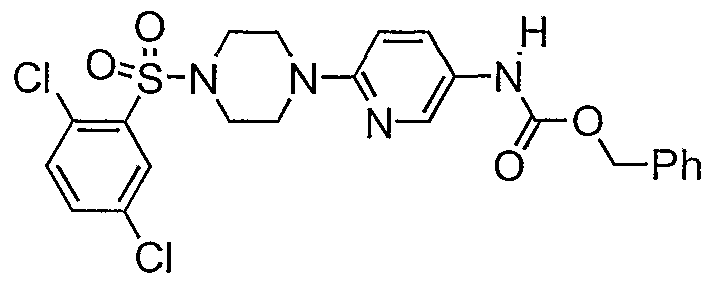
To a suspension of 5-benzyloxycarbonylaminopyridin-2-yl-l-piperazine hydrochloride (7 g, 22.435 mmol), prepared as described in Intermediate 1, Step 3 of method B, in dry dichloromethane (60 ml) was added triethylamine (10.92 ml, 78.522 mmol) and mixture was stirred at room temperature for 20 min. The reaction mixture was allowed to cool to 0 °C and 2,5-dichlorophenylsulfonyl chloride (6.51 g, 26.922 mmol) in dry dichloromethane (40 ml) was added over 10 min. The mixture was allowed to warm to room temperature and left overnight at the same temperature. The mixture was diluted with water (150 ml) and the layers were separated. The aqueous layer was extracted with dichloromethane (200 ml). The combined organic extracts were washed with water (2 x 150 ml) and dried over anhydrous Na2SO4. The residue obtained after evaporation of the solvent was purified by silica gel column chromatography using 12 % acetone in petroleum ether as an eluent to afford 8.06 g of the product as an off-white solid; IR (KBr) 3434, 2921, 1733, 1500, 1164, 958, 819 cm"1; 1H NMR (CDCl3, 300 MHz) δ 3.39-3.43 (m, 4H), 3.55-3.58 (m, 4H), 5.18 (s, 2H), 6.51 (br s, IH), 6.62 (d, J= 9.0 Hz, IH), 7.32-7.40 (m, 5H), 7.46 (s, 2H), 7.76 (br s, IH), 8.06 (s, 2H); MS (ESI) m/z 521.29 (M)+.
Intermediate 9: Preparation of Benzyl {64(35V3-(2-fluorophenoxy)pmolidm-l-yl]pyridin-3- yl} carbamate

Step 1 : (3i?)-l-(5-Nitropyridin-2-yl)pyrrolidin-3-ol: To a stirred solution of 2-chloro- 5-nitroρyridine (18.19 g, 114.784 mmol) in dry DMF (180 ml) was added (3Λ)-pyrrolidin-3- ol (10.01 g, 114.784 mmol) and KHCO3 (11.473 g, 172.004 mmol) at 70 °C and the reaction mixture was stirred at the same temperature for 3 h. The reaction mixture was allowed to cool to room temperature. To this, water was added; the desired compound was extracted with ethyl acetate (3 x 100 ml), washed with water (3 x 100 ml), brine (100 ml) and dried over anhydrous Na2SO4. The solvent was removed under reduced pressure to afford 20.24 g of the
desired compound as an off-white solid; 1H NMR (CDCl3, 300 MHz) δ 2.02 (d, J = 7.8 Hz, IH), 2.17 (s, 2H), 3.70 (br s, 4H), 4.67 (s, IH), 6.31 (d, J= 9.3 Hz, IH), 8.16 (dd, J= 2.7, 6.6 Hz, IH), 9.02 (s, IH); MS (ESI) m/z 210.66 (MH)+.
Step 2: 2~[(3>S)-3-(2-Fluorophenoxy)ρyrrolidin-l-yl]-5-nitropyridine: To a stirred solution of step 1 Intermediate (9.0 g, 43.062 mmol) in dry THF (100 ml) was added 2- fluorophenol (4.82 g, 43. ,062 mmol), triphenylphosphine (16.92 g, 64.593 mmol) followed by addition of diethyl azodicarboxylate (9.74 g, 55.98 mmol) over 10 min at room temperature. The reaction was exothermic. The reaction was allowed to cool to room temperature and the reaction mixture was stirred at this temperature for 3 h. The reaction mixture was quenched by water and the desired compound was extracted with ethyl acetate (3 x 100 ml), washed with water (3 x 100 ml) and dried over anhydrous Na2SO4. The solvent was removed under reduced pressure and the desired compound was purified by using silica gel column chromatography using 3 % ethyl acetate in chloroform as an eluent to afford 10.30 g of the desired compound as a turmeric yellow solid; 1H NMR (CDCl3, 300 MHz) δ 2.29 (br s, IH), 2.44 (br s, IH), 3.62-3.95 (m, 4H), 5.10 (s, IH), 6.34 (d, J= 7.8 Hz, IH), 6.82-7.18 (m, 2H), 7.00-7.18 (m, 2H), 8.17 (d, J= 7.2 Hz, IH), 9.02 (s, IH); MS (ESI) m/z 304.66 (MH)+.
Step 3: 6-[(36)-3-(2-Fluorophenoxy)pyrrolidin-l-yl]pyridin-3-amine: To a stirred solution of step 2 intermediate (7 g, 23.102 mmol) in 30 % aqueous ethanol (70 ml) was added ammonium chloride (12.35 g, 231.02 mmol) at 85 °C. To this, iron powder (3.87 g, 69.306 g atom) was added in lots over 15 min. The reaction mixture was stirred at the same temperature for 1 h. The catalyst was then filtered off and the filtrate was washed with ethyl acetate and concentrated under reduced pressure. To this, water was added and the desired compound was extracted with chloroform (3 x 150 ml) and dried over anhydrous Na2SO4. The solvent was removed under reduced pressure to afford 5.80 g of the desired amine as a black sticky solid which was used as such for the next step.
Step 4: Benzyl {6-[(35)-3-(2-fluorophenoxy)pyrrolidin-l-yl]pyridin-3-yl} carbamate: To a stirred solution of step 3 intermediate (4 g, 14.638 mmol) in dry THF (50 ml) was added triethylamine (3.93 ml, 29.251 mmol) and benzyl chloroformate (2.99 g, 17.565 mmol) at 0 0C over 5 min. The reaction mixture was allowed to warm to room temperature and left overnight at the same temperature. The reaction mixture was quenched with water, extracted into ethyl acetate (3 x 150 ml), washed with water (3 x 100 ml), brine (50 ml) and dried over anhydrous Na2SO4. The solvent was evaporated under reduced pressure and pure compound was isolated by silica gel column chromatography using 15 % acetone in chloroform as an eluent to afford 5.50 g as a black sticky solid, which was used as such for the next step.
Intermediates 10 to 14 were prepared analogously from appropriate phenol, 4- hydroxypiperidine and 2-chloro-5-nitropyridine as described in the preparation of Intermediate 9.
MoL Formula /
Intermediate Name / Structure / Chemical name Mass Spectrum MS (ESI), m/z
10 Benzyl {6-[4-(2-fluoromethylphenoxy]piperidin-l-yl]- pyridin-3-yl} carbamate
1H NMR 2.06 (m, 4.45-4.49
 = 9.0 Hz, IH), 6.88-6.95 (m, IH), 7.01-7.09 (m, 3H), 7.33 (s, 5H), 7.70 (s, IH), 8.02 (s, IH).
11 Benzyl {6-[4-(2-chlorophenoxy)piperidm-l -yl]pyridin-
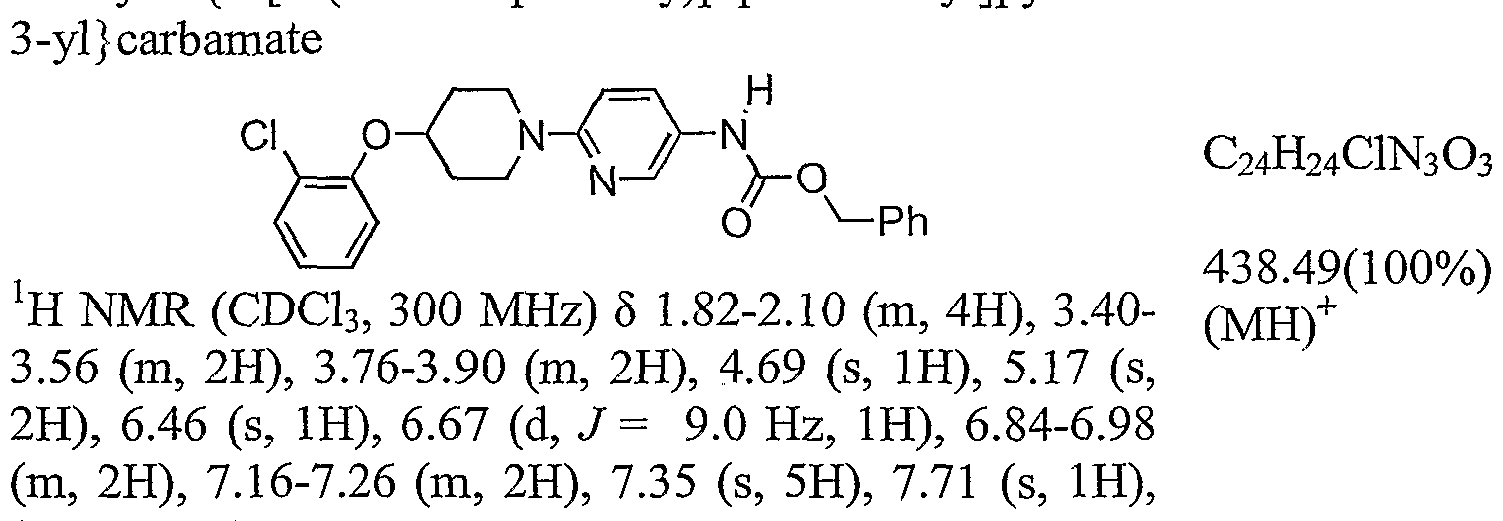
12 Benzyl {6-[4-(2,5-dichlorophenoxy)piperidin- 1 -yl]- pyridin-3 -yl } carbamate

13 Benzyl {6-[4-(2~trifluoromethylphenoxy)piperidin-l - yl]pyridm-3 -yl} carbamate
C25H24F3N3O3
 6.69 (d, J = 9.0 Hz, IH), 6.96-7.04 (m, IH), 7.30-7.50 (m, 7H), 7.58 (d, J= 7.2 Hz, IH), 7.73 (s, IH), 8.06 (s, JH).
14 Benzyl(6-{4-(2-cyanophenoxy)piperidin-l-yl}pyridin-3- yl)carbamate

1H NMR (CDCl3, 300 MHz) δ 1.80-2.10 (m, 4H), 3.44- 3.58 (m, 2H), 3.74-3.84 (m, 2H), 4.66 (br s, IH), 5.17 (s, 2H), 6.48 (br s, IH), 6.65 (d, J = 8.7 Hz, IH), 6.90- 7.02 (m, 2H), 7.34 (br s, 5H), 7.44-7.58 (m, 2H), 7.72 (br s, IH), 8.03 (d, J= 2.1 Hz, IH).
The following examples are illustrated and are preferred embodiments of the present invention. However, this does not limit the scope of the present invention of compound of the general formula I, and it should be understood that there may be other embodiments which fall within the scope and spirit of the present invention.
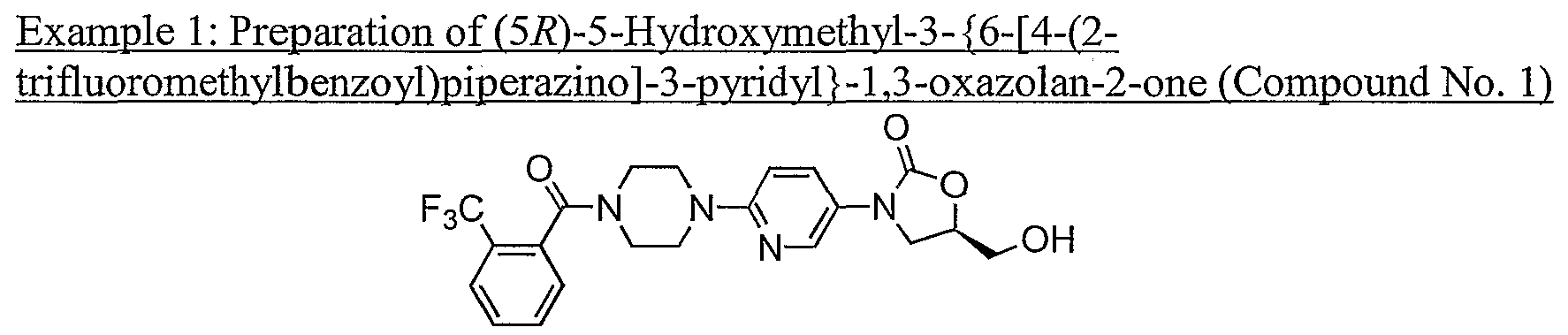
Method A:
To a stirred solution of 5-(Benzyloxycarbonyl)aminopyridin-2~ylpiperazino-2- trifluoromethylphenylmethanone, Intermediate 1 (800 mg, 1.652 mmol) in dry THF (20 ml) was added 1.6 M n-butyllithium in hexane (3.095 ml, 4.958 mmol) and the mixture was stirred at -78 °C for 30 min and (i?)-(-)-glycidyl butyrate (357 mg, 2.479 mmol) was added over 5 min. The reaction mixture was allowed to warm to room temperature and stirred overnight. The reaction mixture was quenched with saturated ammonium chloride solution (50 ml) and extracted with ethyl acetate (3 x 50 ml). The combined organic extracts were washed with water (3 x 150 ml) and dried over anhydrous Na2SO4. The residue obtained after
evaporation of the solvent was triturated with n-pentane to afford 647 mg of the desired compound as an off-white solid; IR (KBr) 3434, 2923, 1745, 1498, 1129, 1010, 772 cm"1; 1H NMR (CDCl3, 300 MHz) δ 2.35 (br s, IH, exchangeable with D2O), 3.29 (s, 2H), 3.45 (s, 2H), 3.61 (s, IH), 3.75 (d, J= 9.0 Hz, 2H), 3.99 (m, J= 9.0 Hz, 5H), 4.76 (s, IH), 6.19 (d, J= 9.0 Hz, IH), 7.36 (d, J= 9.0 Hz, IH), 7.58 (dd, J= 6.0, 6.0 Hz, 2H), 7.73 (d, J= 9.0 Hz, IH), 7.98 (d, J= 9.0 Hz, IH), 8.12 (s, IH); MS (ESI) m/z 451.57 (MH)+.
Method B
Step 1 : (5i?)-5-Hydroxymethyl-3 -(6-piperazin- 1 -ylpyridin-3 -yl)- 1 ,3-oxazolan-2-one hydrochloride: tert-Butγ\ 4-{5-[(5i?)-5-hydroxymethyl-2-oxo-l,3-oxazolan-3-yl] pyridin-3- yl}piperazin-l-carboxylate, Intermediate 2 (600 mg, 1.587 mmol) was treated with 15 % HCl in EtOAc (10 ml) at 0-5 0C and stirred at the same temperature for 2 h. Ethyl acetate was evaporated under reduced pressure to give 440 mg of the amine hydrochloride as a white solid, which was used as such for the next step.
Step 2: Coupling reaction of the above amine hydrochloride (200 mg, 0.635 mmol) with 2-(trifmoromethyl)benzoic acid (145 mg, 0.763 mmol) in the presence of EDCI (128 mg, 0.952 mmol), HOBT (97 mg, 0.635 mmol) and triethylamine (0.4 ml, 2.875 mmol) in dry dichloromethane (10 ml) afforded 248 mg of the desired compound as an off-white solid. IR, 1H NMR and Mass spectra of the product were identical in all respects with the compound obtained from Method A.
Example 2: Preparation of (5i?)-4-[5-(5-Fluoromethyl-2-oxo-l,3-oxazolan-3-yl)-2- ρyridylipiperazino-2-trifluoromethyl-phenylmethanone (Compound No. 2)

To a stirred and cooled (-40 °C) solution of Example 1 (200 mg, 0.44 mmol) in dry DCM (30 ml) was added (diethylamino)sulfur trifluoride (179 mg, 1.11 mmol) over 5 min under a nitrogen atmosphere. The reaction mixture was stirred for another 45 min at the same temperature. The mixture was gradually allowed to warm to room temperature and left overnight at this temperature. The reaction mixture was quenched with saturated solution of sodium bicarbonate (50 ml) and extracted with chloroform (2 x 50 ml). The combined organic layer was washed with water (2 x 50 ml) and dried over anhydrous Na2SO4. The residue obtained after evaporation of the solvent was purified by silica gel column chromatography using 2 % methanol in chloroform as an eluent to afford 150 mg of the desired compound as an off-white solid; IR (KBr) 3468, 2919, 1751, 1498, 1243, 1232, 1128,
1010, 772 cm"1; 1H NMR (CDCl3, 300 MHz) δ 3.29 (s, 2H), 3.46-3.62 (m, 4H), 3.94 (br s, 3H), 4.13 (t, J= 9.0 Hz, IH), 4.50 (d, J= 9.0 Hz, IH), 4.65 (d, J= 12.0 Hz, IH), 4.78 (t, J= 12.0 Hz, IH), 6.70 (d, J= 9.0 Hz, IH), 7.36 (d, J= 9.0 Hz, IH), 7.58 (dd, J= 6.0 Hz, 6.0 Hz, 2H), 7.73 (d, J= 6.0 Hz, IH), 7.98 (d, J= 9.0 Hz, IH), 8.11 (s, IH); MS (ESI) m/z 453.37 (MH)+.
Example 3: Preparation of (5i?)-5-Methoxymethyl-3-{6-[4-(2- trifluoromethylbenzoyl)piperazino]-3-pyridyl)-l,3-oxazolan-2-one (Compound No. 3)

To a stirred solution of Example 1 (200 mg, 0.444 mmol) and methyliodide (94 mg, 0.666 mmol) in dry THF (10 ml) was added silver oxide (155 mg, 0.666 mmol) at room temperature under nitrogen atmosphere and further stirred for 72 h. The mixture was filtered through a celite bed and the filtrate was evaporated under reduced pressure. The residue was purified by silica gel column chromatography using 1.5 % methanol in chloroform as an eluent to afford 156 mg of the desired compound as an off-white solid; IR (KBr) 3467, 2991, 1749, 1642, 1498, 1230, 1057, 938, 773 cm"1; 1H NMR (CDCl3, 300 MHz) δ 3.29 (s, 3H), 3.44 (s, 4H), 3.62 (d, J= 9.0 Hz, 4H), 3.82-4.04 (m, 4H), 4.77 (br s, IH), 6.69 (d, J= 9.0 Hz, IH), 7.36 (d, J= 9.0 Hz, IH), 7.58 (dd, J= 6.0, 6.0 Hz, 2H), 7.73 (d, J= 9.0 Hz, IH), 8.02 (d, J= 6.0 Hz, IH), 8.11 (s, IH); MS (ESI) m/z 465.34 (MH)+.
Example 4: Preparation of (5£V5-Hydroxymemyl-3-{6-["4-(2-

Coupling reaction of amine hydrochloride (200 mg, 0.635 mmol) prepared from Intermediate 2 as described in Example 1, Step 1 of Method B, with 2- (trifluoromethyl)benzoic acid (145 mg, 0.763 mmol) in the presence of EDCI (128 mg, 0.952 mmol), HOBT (97 mg, 0.635 mmol) and triethylamine (0.40 ml, 2.875 mmol) in dry DCM (10 ml) afforded 238 mg of the desired compound as an off-white solid; IR (KBr) 3436, 2920, 2858, 1744, 1637, 1498, 1317, 1129, 771, 751 cm"1; 1H NMR (CDCl3, 300 MHz) δ 2.35 (br s, IH, exchangeable with D2O), 3.26-3.35 (m, IH), 3.42-3.50 (m, 2H), 3.61 (t, J = 5.4 Hz, 2H), 3.74 (dd, J = 6.0 Hz, 2H), 3.86-4.04 (m, 5H), 4.74-4.79 (m, J = 9.0 Hz, IH), 6.69 (d, J = 9.0 Hz, IH), 7.35 (d, J = 6.0 Hz, IH), 7.52-7.65 (m, 2H)5 7.73 (d, J = 9.0 Hz,
IH), 7.97-8.01 (dd, J= 2.7 Hz, 6.6 Hz, IH), 8.13 (d, J= 3.0 Hz, IH); MS (ESI) m/z 451.49 (MH)+.
Example 5: Prepration of (56V5-Methoxymethyl-3-(6-r4-(2- trifluoromethylbenzoyl)piperazino]-3-pyridvU-l,3-oxazolan-2-one (Compound No. 5)

Alkylation of Example 4 (200 mg, 0.800 mmol) in dry DCM with methyliodide (227 mg, 1.590 mmol) in the presence of silver oxide (554 mg 2.400 mmol) as described in Example 3 afforded 164 mg of the desired compound as an off-white solid; IR (KBr) 3436, 2920, 2858, 1744, 1637, 1498, 1317, 1129, 771, 751 cm"1; 1H NMR (CDCl3, 300 MHz) δ 3.30 (s, 3H), 3.45 (s, 3H), 3.45-3.52 (m, 2H), 3.54-3.62 (m, 2H), 3.62-3.74 (m, 2H), 3.84- 4.08 (m, 3H), 4.76 (br s, IH), 6.69 (d, J= 9.0 Hz, IH), 7.36 (d, J= 9.0 Hz, IH), 7.58 (m, J= 9.0 Hz, 2H), 7.73 (d, J = 9.0 Hz, IH), 8.02 (dd, J = 3.0 Hz, 3.0 Hz, IH), 8.11 (d, IH); MS (ESI) m/z 465.34 (MH)+.
Example 6: Prepration of (5ig)-3-{6-[4-(2-Fluoro-6-trifluoromethylbenzoyl)piperazino'j-3- pyridyl}-5-hydroxymethyl-l,3-oxazolan-2~one (Compound No. 6)

Coupling reaction of amine hydrochloride prepared from Intermediate 2 (500 mg, 1.322 mmol) with 2-fluoro-6-(trifluoromethyl)benzoic acid (303 mg, 1.454 mmol) in the presence of EDCI (268 mg, 1.984 mmol), HOBT (203 mg, 1.322 mmol) and triethylamine (0.643 ml, 4.629 mmol) in dry DCM (20 ml) afforded 513 mg of the desired compound as an off-white solid; IR (KBr) 3435, 2924, 2862, 1744, 1643, 1497, 1319, 1242, 1133, 911 cm'1; 1H NMR (CDCl3, 300 MHz) δ 2.28 (br s, IH, exchangeable with D2O), 3.48 (br s, 2H), 3.57 (d, J= 3.0 Hz, 2H), 3.76 (br s, IH), 3.96-4.01 (m, 7H), 4.77 (br s, IH), 6.70 (d, J- 9.0 Hz, IH), 7.35 (br s, IH), 7.54 (s, 2H), 7.99 (d, J= 6.0 Hz, IH), 8.13 (s, IH); MS (ESI) m/z 469.50 (MH)+.
Example 7: Prepration of (5i?)-3-{6-r4-(2-Fluoro-5-trifluoromethylbenzoyl)piperazino]-3- pyridyl}-5-hydroxymethyl-l,3-oxazolan-2-one (Compound No. 7)

Coupling reaction of amine hydrochloride prepared from Intermediate 2 (400 mg, 1.058 mmol) with 2-fluoro-5-(trifluoromethyl)benzoic acid (264 mg, 1.269 mmol) in the presence of EDCI (214 mg, 1.587 mmol), HOBT (162 mg, 1.058 mmol) and triethylamine (0.515 ml, 3.703 mmol) in dry DCM (10 ml) afforded 396 mg of the desired compound as an off-white solid; IR (KBr) 3413, 2916, 2848, 1736, 1643, 1503, 1336, 1232, 1132, 830 cm"1; 1H NMR (CDCl3, 300 MHz) δ 1.26 (s, IH), 2.33 (br s, IH, exchangeable with D2O), 3.55 (br s, 6H), 3.71 (s, IH), 3.93-4.02 (m, 4H), 4.77 (s, IH), 6.71 (d, J= 9.0 Hz, IH), 7.26 (s, IH), 7.73 (s, 2H), 8.00 (d, J= 6.0 Hz, IH), 8.14 (s, IH); MS (ESI) m/z 469.52 (MH)+.
Example 8: Preparation of (5i?)-3-{6-[4-(2,5-Dichlorobenzoyl)piperazinol-3-pyridyl}-5- hydroxymethyl-l,3-oxazolan-2-one (Compound No. 8)

Coupling reaction of amine hydrochloride prepared from Intermediate 2 (500 mg, 1.322 mmol) with 2,5-dichlorobenzoic acid (303 mg, 1.587 mmol) in the presence of EDCI (268 mg, 1.984 mmol), HOBT (202 mg, 1.322 mmol) and triethylamine (0.644 ml, 4.634 mmol) in dry DCM (10 ml) afforded 432 mg of the desired compound as an off-white solid; IR (KBr) 3420, 3086, 2920, 2856, 1743, 1643, 1497, 1239, 1135, 1012, 941 cm"1; 1U NMR (CDCl3, 300 MHz) δ 2.17 (br s, IH, exchangeable with D2O), 3.28-3.42 (m, IH), 3.50-3.68 (m, 5H), 3.75-3.82 (m, IH), 3.90-4.10 (m, 5H), 4.77 (br s, IH), 6.70 (d, J= 9.3 Hz, IH), 7.33 (d, J= 10.5 Hz, 3H), 7.99 (d, J- 6.9 Hz, IH), 8.13 (s, IH); MS (ESI) m/z 451.51 (M)+.
Example 9: Preparation of (5i?)-3-{6-[4-(2-Ethylbutanoyl)piperazino]-3-pyridyl}-5-

Coupling reaction of amine hydrochloride prepared from Intermediate 2 (500 mg, 1.322 mmol) with 2-ethylbutyric acid (184 mg, 1.587 mmol) in the presence of EDCI (268 mg, 1.982 mmol), HOBT (202 mg, 1.322 mmol) and triethylamine (0.643 ml, 4.629 mmol) in
dry DCM (10 ml) afforded 441 mg of the desired compound as an off-white solid; 1H NMR (CDCl3, 300 MHz) δ 0.88 (t, J = 7.2 Hz, 6H), 1.41-1.58 (m, 2H), 1.71 (br s, 3H), 2.56 (br s, IH), 2.69 (br s, IH, exchangeable with D2O), 3.47 (br s, IH), 3.75 (br s, 2H), 3.53-3.80 (m, 5H), 3.82-4.08 (m, 3H), 4.76 (br s, IH), 6.69 (d, J = 9.0 Hz, IH), 7.98 (d, J= 6.0 Hz, IH), 8.14 (s, IH); MS (ESI) m/z 377.37 (MH)+.

To the cold stirring solution of amine hydrochloride prepared from Intermediate 2 (180 mg, 0.514 mmol) in dry DCM (5 ml) was added triethylamine (0.250 ml, 1.799 mmol) at room temperature. The reaction mixture was cooled to 0 "C and 2,4- difluorobenzenesulfonyl chloride (164 mg, 0.771 mmol) in dry DCM was added over 5 min under a nitrogen atmosphere. The reaction mixture was stirred for another 1 h at the same temperature. The reaction mixture was quenched with water. The reaction mixture was extracted with DCM (2 x 50 ml), washed with water (3 x 100 ml), brine (50 ml) and dried over anhydrous Na2SO4. The solvent was evaporated under reduced pressure and the residue obtained was purified by silica gel column chromatography using 2.5 % methanol in chloroform as an eluent to afford 174 mg of the desired compound as an off-white solid; IR (KBr) 3437, 2978, 2845, 1731, 1504, 1164, 973 cm"1; 1H NMR (CDCl3, 300 MHz) δ 2.17 (br s, IH, exchangeable with D2O), 3.28 (s, 4H), 3.63 (s, 5H), 3.77 (br s, IH), 3.97 (m, 2H), 4.76 (s, IH), 6.66 (d, J = 9.0 Hz, IH), 6.99 (m, 2H), 7.92 (dd, J = 9.0 Hz, 6.0 Hz, 2H), 8.10 (s, IH); MS (ESI) m/z 290.94 (M)+.
Example 11 : Preparation of (5R)-3-{6-[4-(2,5-Dichlorophenylsulfonyl)piperazino~|-3- pyridyl}-5-hvdroxymethyl-l,3-oxazolan-2-one (Compound No. 11)
O
Cl
To a stirred solution of Intermediate 8 (500 mg, 0.959 mmol) in THF (10 ml) was added 1.6 M rc-butyllithium in hexane (1.796 ml, 2.878 mmol) at -78 °C over 5 min under a nitrogen atmosphere. The reaction mixture was stirred for another 45 min at the same temperature and (R)-(-)-glycidyl butyrate (208 mg, 1.439 mmol) was added. The reaction
mixture was gradually allowed to warm to room temperature and left overnight at this temperature. The reaction mixture was quenched with saturated solution of ammonium chloride (50 ml). The reaction mixture was extracted with ethyl acetate (2 x 50 ml), washed with water (3 x 100 ml), brine (50 ml) and dried over anhydrous Na2SO4. The solvent was evaporated under reduced pressure and the residue obtained was purified by silica gel column chromatography using 2 % methanol in chloroform as an eluent to afford 378 mg of the desired compound as an off-white solid; IR (KBr) 3434, 2921, 2855, 1733, 1500, 1319, 1164, 958 cm"1; 1H NMR (CDCl3, 300 MHz) δ 2.26 (br s, IH, exchangeable with D2O), 3.42 (s, 4H), 3.61 (s, 4H), 3.78 (br s, IH), 3.98 (t, J = 9.0 Hz, 3H), 4.76 (s, IH), 6.67 (d, J = 9.0 Hz, IH), 7.46 (s, 2H), 7.98 (d, J= 6.0 Hz, IH), 8.08 (d, J= 12.0 Hz, 2H); MS (ESI) m/z 487.28 (M)+.
Example 12: Preparation of Ethyl 3-f6-(4-{2-triflouromemylbenzoyl}piperazm-l-yl)pyridin-

The Intermediate 4 (700 mg, 1.998 mmol) was dissolved in dry acetonitrile (40 ml) and l,r-carbonyldiimidazole (730 mg, 4.495 mmol) was added at room temperature and the reaction mixture stirred at the same temperature for 15 hours. The reaction mixture was diluted with EtOAc and washed with aqueous citric acid (50 ml), brine (100 ml) and dried over anhydrous Na2SO4. The residue obtained after evaporation of the solvent was purified by silica gel column chromatography using 2 % methanol in chloroform as an eluent to afford 578 mg as an off-white solid; IR (KBr) 3481, 2990, 2921, 2854, 1762, 1643, 1498, 1317, 1243, 1125, 1010, 772 cm"1; 1H NMR (CDCl3, 300 MHz) δ 1.35 (t, J= 7.2 Hz, 3H), 3.29 (br s, 2H), 3.47 (br s, 2H), 3.62 (br s, 2H), 3.93 (t, J = 5.4 Hz, 2H), 4.04-4.15 (m, 2H), 4.20-4.40 (m, 2H), 5.00-5.14 (m, IH) 6.69 (d, J = 8.7 Hz, IH), 7.36 (d, J = 6.9 Hz, IH), 7.55-7.62 (m, 2H), 7.72 (d, J= 7.2 Hz, IH), 7.95 (d, J= 7.2 Hz, IH), 8.10 (s, IH); MS (ESI) m/z 493.47 (MH)+.
Example 13: Preparation of (5ty)-3-[6-(4-{2-Trifluoromethylbenzoyl|piperazm-l-yl)pyridin- 3-yl]-5-(l-hydroxy-l-methylethyl)-l,3-oxazolan-2-one (Compound No. 13)

50 % EtOAc in DCM as an eluent to afford 114 mg of the desired compound as a pale yellow solid; IR (KBr) 3434, 2924, 2853, 1634, 1497, 1440, 1316, 1129, 752 cm'1; 1H NMR (CDCl3, 300 MHz) δ 1.38 (s, 6H), 1.67 (br s, IH, exchangeable with D2O), 3.29 (s, 2H), 3.46 (s, 2H), 3.61 (s, 2H), 3.92 (br s, 4H), 4.44 (s, IH), 6.70 (br s, IH), 7.36 (s, IH), 7.46-7.70 (m, 2H), 7.73 (s, IH), 7.98 (br s, IH), 8.14 (s, IH); MS (ESI) m/z 479.55 (MH)+.
Example 14: Preparation of (5^-3-[6-(4-{2-Trifluoromethylbenzoyl}piperazin-l-yl)pyridin-

To a stirred solution of Example 12 (50 mg, 0.101 mmol) in dry MeOH (1 ml) and dry THF (1 ml) was added isopropylamine (60 mg, 1.015 mmol) at room temperature. The reaction mixture was stirred at the same temperature for 15 hours. The residue obtained after evaporation of the solvent was dissolved in EtOAc, washed with brine (50 ml) and dried (Na2SO4). The crude product was purified by silica gel column chromatography using 2 % MeOH in chloroform as an eluent to afford 42 mg of the desired compound as an off-white solid; IR (KBr) 3427, 3080, 2976, 2925, 1757, 1641, 1498, 1317, 1128, 1010, 772 cm"1; 1H NMR (CDCl3, 300 MHz) δ 1.21 (s, 6H), 3.29 (s, 2H), 3.47 (s, 2H), 3.61 (s, 2H), 3.92 (br s, 2H), 4.05-4.34 (m, 3H), 4.95 (br s, IH), 6.43 (br s, IH), 6.69 (d, J- 9.0 Hz, IH), 7.36 (br s, IH), 7.58-7.70 (m, 2H), 7.72 (br s, IH), 7.88 (d, 7.2 Hz, IH), 8.16 (s, IH); MS (ESI) m/z 506.82 (MH)+.
Example 15: Preparation of 4-r5-(5-Butyl-2-oxo-l,3-oxazolan-3-yl)-2-pyridyl]piperazmo-2- trifluoromethylphenyl-methanone (Compound No. 15)

Step 2: 4-[5-(5-Butyl-2-oxo-l ,3-oxazolan-3-yl)pyridme-2-yl]piperazme hydrochloride: The Step 1 intermediate (500 mg, 1.237 mmol) was deprotected using 15 % HCl in EtOAc (10 ml) as described in Example 1, Method B give 375 mg of the product as a white solid, which was used as such for the next step.
Step 3: Coupling reaction of Step 2 intermediate (300 mg, 0.881 mmol) with 2- (trifluoromethyl)benzoic acid (169 mg, 0.889 mmol) in the presence of EDCI (150 mg, 1.113 mmol), HOBT (113 mg, 0.742 mmol) and triethylamine (0.428 ml, 3.083 mmol) in dry DCM (20 ml) afforded 260 mg of the desired compound as an off-white solid; IR (KBr) 3482, 2958, 2861, 1747, 1496, 1243, 1127, 771 cm"1; 1H NMR (CDCl3, 300 MHz) δ 0.62-1.00 (m, 3H), 1.25 (br s, IH), 1.40 (br s, 3H), 1.85 (br s, 2H), 3.29 (br s, 2H), 3.45 (br s, 2H), 3.60 (s, 3H), 3.85-4.00 (m, 2H), 4.03 (t, J= 8.4 Hz, IH), 4.60-4.72 (m, IH), 6.69 (d, J= 9.0 Hz, IH), 7.36 (d, J= 6.0 Hz, IH), 7.55 (dd, J= 9.0, 6.0 Hz, 2H), 7.73 (d, J= 6.0 Hz, IH), 7.96-8.14 (m, 2H); MS (ESI) m/z All Λ0 (MH)+.
Example 16: Preparation of 4-["5-(5,5-Dimethyl-2-oxo-l,,3-oxazolan-3-y^)-2- pyridyl]piperazino-2-trifluoromethylphenyl-methanon^ (Compound No. 16)

Step 1 : tert-Butyl 4-[5-(5,5-dimethyl-2-oxo-l,3~oxazolan-3-yl)-2-pyridyl]-l- piperazine-carboxylate was prepared as described in Example 15, step 1 by the reaction of Intermediate 6 (2.0 g, 5.714 mmol) with CDI (1.84 g, 11.482 mmol) in the presence of
DMAP (0.07 g, 0.571 mmol) in dry THF (40 ml) to afford 1.74 g of the desired compound as a light brown solid; IR (KBr) 3447, 2980, 2933, 2855, 1732, 1692, 1494, 1240, 1118, 939 cm"1; 1H NMR (CDCl3, 300 MHz) δ 1.48 (s, 9H), 1.56 (s, 6H), 3.51 (d, J= 10.5 Hz, 8H), 3.72 (s, 2H), 6.68 (d, J= 9.0 Hz, IH), 7.98-8.10 (m, 2H); MS (ESI) m/z 377.11 (MH)+.
Step 2: 4-[5-(5,5-dimethyl-2-oxo-l ,3-oxazolan-3-yl)-2-pyridyl]-l -piperazine hydrochloride: The Step 1 intermediate (600 mg, 1.595 mmol) was deprotected with 15 % HCl in EtOAc (10 ml) as described in Example 1, Method B gave 440 mg of the product as a white solid, which was used as such for the next step.
Step 3: Coupling reaction of Step 2 intermediate (390 mg, 1.240 mmol) with 2- (trifluoromethyl)benzoic acid (243 mg, 1.276 mmol) in the presence of EDCI (306 mg, 1.595 mmol), HOBT (163 mg, 1.063 mmol) and triethylamine (0.603 ml, 4.340 mmol) in dry DCM (10 ml) as described in Example 15, Step 3 afforded 371 mg of the desired compound as an off-white solid; IR (KBr) 3461, 2981, 2861, 1744, 1497, 1242, 1010, 732 cm"1; 1H NMR (CDCl3, 300 MHz) δ 1.58 (s, 6H), 3.29 (br s, 2H), 3.44 (br s, 2H), 3.60 (t, J= 4.8 Hz, 2H), 3.72 (s, 2H), 3.88-4.02 (m, 2H), 6.69 (d, J= 8.7 Hz, IH), 7.36 (d, J= 7.2 Hz, IH), 7.58 (dd, J = 8.1 Hz, 7.5 Hz, 2H), 7.73 (d, J = 7.8 Hz, IH), 7.89-8.10 (m, 2H); MS (ESI) m/z 449.48 (MH)+.
Example 17: Preparation of 3-[6-r4-{2-Trifluoromethylbenzoyl}piperazin-l-yl]pyridine-3-

Step 1: tert-Bxxtyl 4-[5~(2-oxo-l-oxa-3-azaspiro[4.5]dec-3-yl)pyridin-2-yl]piperazine- 1-carboxylate was prepared as described in Example 15, Step 1 by the reaction of Intermediate 7 (900 mg, 2.22 mmol) with CDI (715 mg, 4.44 mmol) in the presence of DMAP (27 mg, 0.222 mmol) in dry THF (10 ml) to afford 710 mg of the desired compound as a light brown solid; 1H NMR (CDCl3, 300 MHz) δ 1.48 (s, 9H), 1.38-1.44 (m, 2H), 1.44- 1.60 (m, 2H), 1.60-1.76 (m, 2H), 1.77-1.88 (m, 2H), 1.90-2.00 (m, 2H), 3.49 (d, J= 10.5 Hz, 8H), 3.65 (s, 2H), 6.65 (d, J= 8.7 Hz, IH), 7.96-8.10 (m, 2H); MS (ESI) m/z 377.11 (MH)+.
Step 2: 4-[5-(2-oxo-l-oxa-3-azaspiro[4.5]dec-3-yl)pyridin-2-yl]piperazine hydrochloride: Deprotection of Step 1 intermediate (650 mg, 1.081 mmol) using 15 % HCl in EtOAc (10 ml) as described in Example 15, Step 3 gave 495 mg of the product as a white solid, which was used as such for the next step.
Step 3: Coupling reaction of the above amine hydrochloride (490 mg, 1.39 mmol) with 2-(trifluoromethyl)benzoic acid (270 mg, 1.42 mmol) in the presence of EDCI (291 mg, 2.158 mmol), HOBT (218 mg, 1.42 mmol) and triethylamine (0.696 ml, 5.005 mmol) in dry DCM (10 ml) as described in Example 15, Step 3 afforded 371 mg of the desired compound as an off-white solid; 1H NMR (CDCl3, 300 MHz) δ 1.25-1.64 (m, 10H), 3.29 (s, 2H), 3.44 (s, 2H), 3.54-3.76 (m, 4H), 3.93 (d, J = 5.4 Hz, 2H), 6.69 (d, J= 8.7 Hz, IH), 7.36 (d, J= 6.9 Hz, IH), 7.58 (dd, J= 7.8 Hz, 7.8 Hz, 2H), 7.73 (d, J= 7.5 Hz, IH), 7.96-8.16 (m, 2H); MS (ESI) m/z 489.54 (MH)+.
Example 18: Preparation of (5i?)-3-{6-[(35r)-3-(2-Fluorophenoxy)pyrrolidin-l-yl]pyridin-3- yl}-5-(hydroxγmethyl)-l,3-oxazolan-2-one (Compound No. 18)

To a stirred solution of Intermediate 9 (200 mg, 0.491 mmol) in dry THF (10 ml) was added 1.6 M «-butyllithium in hexane (0.917 ml, 1.473 mmol) at -78 °C over 5 min under a nitrogen atmosphere. The reaction mixture was stirred for another 45 min at the same temperature and (R)-(-)-glycidyl butyrate (106 mg, 0.735 mmol) was added. The reaction mixture was slowly allowed to warm to room temperature and left overnight at the temperature. The reaction mixture was quenched with saturated ammonium chloride solution and extracted with ethyl acetate (2 x 50 ml). The combined organic extracts were washed with water (2 x 50 ml), brine (50 ml) and dried over anhydrous Na2SO4. The residue obtained after evaporation of the solvent was purified by silica gel column chromatography using 2.5 % methanol in chloroform as an eluent to afford 189 mg of the desired compound as an off- white solid; IR (KBr) 3436, 3290, 2928, 1724, 1515, 1230, 749 cm"1; 1H NMR (CDCl3, 300 MHz) δ 2.36 (br s, IH, exchangeable with D2O), 2.37-2.42 (m, IH), 3.64 (d, J- 7.8 Hz, 2H), 3.78 (s, 3H), 3.84-4.02 (m, 3H), 4.74 (br s, IH), 5.07(s, IH), 6.41 (d, J= 9.0 Hz, IH), 6.82- 7.10 (m, 5H), 7.89 (d, J= 9.3 Hz, IH), 8.04 (s, IH).
Example 19: Preparation of (5^f)-3-{6-[(3)Sr)-3-(2-Fluorophenoxy)pvrrolidin-l-vl]pyridin-3- yl}-5-(hydroxyl-methyl)-13-oxazolan-2-one (Compound No. 19)

The product was prepared as described in Example 18 from Intermediate 9 (300 mg, 0.737 mmol) and (S)-(+)-glycidyl butyrate (159 mg, 1.098 mmol) in the presence of 1.6 M n- butyllithium in hexane (1.376 ml, 2.210 mmol) to afford 194 mg of the desired compound as an off-white solid; IR (KBr) 3413, 3247, 2928, 1727, 1430, 1229, 754 cm"1; 1H NMR
(CDCl35 300 MHz) δ 2.36 (br s, IH, exchangeable with D2O), 2.37-2.42 (m, IH), 3.64 (d, J= 7.8 Hz, 3H), 3.78 (s, 3H), 3.84-4.02 (m, 3H), 4.74 (br s, IH), 5.06 (br s, IH), 6.41 (d, J= 8.7 Hz, IH), 6.84-7.00 (m, 2H), 7.02-7.10 (m, 2H), 7.88 (d, J= 8.1 Hz, IH), 8.01 (s, IH).
Example 20: Preparation of (5>Sf)-3-{6-['4-f2-Fluorophenoxy)piperidin-l-yl]pyiidin-3-yl|-5-

The product was prepared as described in Example 18 from Intermediate 10 (300 mg, 0.710 rrrmol) and (S)-(+)-glycidyl butyrate (122 mg, 1.066 mmol) in the presence of 1.6 M n- butyllithium in hexane (1.337 ml, 2.138 mmol) to afford 184 mg of the desired compound as a off-white solid; IR (ICBr) 3398, 3247, 2928, 1726, 1430, 1134, 763 cm"1; 1H NMR (CDCl3, 300 MHz) δ 1.89 (br s, 2H), 2.02 (br s, 2H), 2.38 (br s, IH, exchangeable with D2O), 3.41 (t, J= 9.3 Hz, 2H), 3.75 (d, J= 9.9 Hz, IH), 3.69 (m, 5H), 4.49 (s, IH), 4.74 (s, IH), 6.70 (d, J = 9.0 Hz, IH), 6.92 (d, J= 9.0 Hz, IH), 7.55 (m, 3H), 7.91 (d, J= 9.0 Hz, IH), 8.02 (s, IH); MS (ESI) m/z 388.67 (MH)+.
Example 21: Preparation of (5i?)-3-{6-r4-(2-Chlorophenoxy)piperidino1-3-pyridyl)-5- hvdroxymethyl-l,3-oxazolan-2-one (Compound No. 21)

The product was prepared as described in Example 18 from Intermediate 11 (300 mg, 0.686 mmol) and (R)-(-)-glycidyl butyrate (118 mg, 1.028 mmol) in presence of 1.6 M n- butyllithium in hexane (1.289 ml, 2.057 mmol) to afford 190 mg of the desired compound as an off-white solid; IR (KBr) 3397, 2931, 1702, 1228, 1039, 746 cm"1; 1H NMR (CDCl3, 300 MHz) δ 1.92-2.05 (m, 4H), 2.61 (br s, IH, exchangeable with D2O), 3.49-3.57 (m, 2H), 3.72- 3.85 (m, 3H), 3.91-4.02 (m, 3H), 4.58 (br s, IH), 4.74 (br s, IH), 6.70 (d, J = 9.0 Hz, IH), 6.89 (t, J= 7.8 Hz, IH), 6.96 (d, J= 9.0 Hz, IH), 7.19 (t, J= 8.1 Hz, IH), 7.36 (d, J= 9.0 Hz, IH), 7.87 (dd, J= 6.0 Hz, J= 3.0 Hz, IH), 8.08 (s, IH); MS (ESI) m/z 404.75 (MH)+.
Example 22: Preparation of (5^)-3-{6-f4-(2-Chlorophenoxy)piperidmo]-3-pyridyl}-5-

Example 23: Preparation of (5jSr)-3-{6-f4-(2,5-Dichlorophenoxy)piperidin-l-yl]pyridin-3-yl}- 5-(hydroxymethylVl,3-oxazolan-2-one (Compound No. 23)

The product was prepared as described in Example 18 from Intermediate 12 (1.50 g, 3.178 mmol) and (S)-(+)-glycidyl butyrate (0.687 g, 4.767 mmol) in presence of 1.6 M n- butyllithium in hexane (5.957 ml, 9.533 mmol) to afford 1.04 g of the desired compound as an off-white solid; IR (KBr) 3435, 2924, 2856, 1732, 1500, 1321, 1223, 1132 1093, 804 cm"1; 1H NMR (CDCl3, 300 MHz) δ 1.79-1.82 (m, 4H), 2.61 (br s, IH, exchangeable with D2O), 3.59 (br s, 2H), 3.65-3.81 (m, 2H), 3.96-4.00 (m, 3H), 4.57 (br s, IH), 4.74 (br s, IH), 6.71 (d, J= 9.0 Hz, IH), 6.87 (d, J= 8.7 Hz, IH), 6.94 (s, IH), 7.25-7.28 (m, 2H), 7.93 (d, J= 8.4 Hz, IH), 8.80 (s, IH); MS (ESI) m/z 438.20 (M)+.

The product was prepared as described in Example 18 from Intermediate 13 (475 mg, 1.008 mmol) and (S)-(+)-glycidyl butyrate (218 mg, 1.512 mmol) in presence of 1.6 M n- butyllithium in hexane (1.894 ml, 3.025 mmol) to afford 281 mg of the desired compound as an off-white solid; IR (KBr) 3394, 2932, 2857, 1744, 1607, 1493, 1322, 1226, 1128, 1037, 755 cm"1; 1H NMR (CDCl3, 300 MHz) δ 1.98 (br s, 4H), 2.52 (br s, IH, exchangeable with D2O), 3.67-3.79 (m, 5H), 3.97-4.01 (m, 3H), 4.73 (br s, 2H), 6.72 (d, J= 9.0 Hz, IH), 6.97-
7.03 (m, 2H), 7.46 (t, J = 9.0 Hz, IH), 7.58 (d, J = 9.0 Hz, IH), 7.93 (d, J = 9.0 Hz, IH), 8.11 (s, IH); MS (ESI) m/z 438.94 (MH)+.
Example 25: Preparation of 2-f(l-(5-[(5.SV5-Hvdroxymethyl-2-oxo-l,3-oxazolan-3-

0.584 mmol) and (S)-(+)-glycidyl butyrate (100 mg, 0.876 mmol) in presence of 1.6 M n- butyllithium in hexane (1.093 ml, 1.752 mmol) to afford 171 mg of the desired compound as an off-white solid; IR (KBr) 3341, 2954, 2854, 2222, 1711, 1498, 1231, 1033, 763 cm'1; 1H NMR (CDCl3, 300 MHz) δ 1.86-2.18 (m, 4H), 2.24 (br s, IH, exchangeable with D2O), 3.50- 3.62 (m, 2H),' 3.70-3.82 (m, 3H), 3.84-4.08 (m, 3H), 4.62-4.80 (m, 2H), 6.70 (d, J= 8.7 Hz, IH), 6.96-7.04 (m, 2H), 7.42-7.60 (m, 2H), 7.91 (d, J= 8.4 Hz, IH), 8.09 (s, IH); MS (ESI) m/z 395.79 (MH)+.
Example 26: In- vitro assay for SCDl inhibition:
The in-vitro activity of the compounds of the present invention against stearoyl coenzyme desaturase was determined by following conversion of radiolabeled stearoyl-CoA to oleoyl-CoA using human SCDl enzyme using a previously published assay procedure with some modifications (Talamo, B. R. and Bloch, K. Analytical Biochemistry, 1969, 29, 300- 304). This assay protocol is only illustrative and is not meant to limit to the scope of the present invention.
In this assay the microsomal SCDl enzyme desaturates its substrate, Stearoyl CoA (purchased from American Radiochemicals Ltd.) which is tritiated at C9 and ClO positions. Test compounds were dissolved in dimethylsulfoxide and tested at 10 μM final concentration. Before substrate addition, the test compound or standard reference compound (conjugated linoleic acid at 100 μM final concentration) were pre-incubated in reaction buffer with the enzyme for 10 minutes at 30 °C with shaking. Reaction buffer was prepared as described in literature (Obukowicz M. G. et al. JPET, 1998, 287, 157-166) except that the MgCl2, ATP (purchased from Sigma) and CoA (purchased from Sigma) concentrations were changed to 4.9 mM, 7.2 mM and 0.54 mM respectively. The desaturation reaction was initiated by addition of 0.5 μCi of 3H stearoyl CoA and incubated at 37 °C for 30 minutes with shaking. A control reaction was set without any test compound / reference inhibitor to capture maximum
enzymatic activity in the assay. Inhibition of enzyme activity was calculated as a percent of this control reaction giving maximum catalysis and the results are given in Table 1. Table 1: Tritiated water release assay at 10 μM concentration of test compounds


* Conjugated Linoleic acid was used as a reference standard
Although, the invention herein has been described with reference to particular embodiments, it is to be understood that these embodiments are merely illustrative of the principles and applications of the present invention. It is therefore to be understood that numerous modifications may be made to the illustrative embodiments and that other arrangements may be devised without departing from the spirit and scope of the present invention as claimed in the appending calims.
AU publications, patents, and patent applications cited in this application are herein incorporated by reference to the same extent as if each individual publication, patent, or patent application was specifically and individually indicated to be incorporated herein by reference.
Claims
1. A compound of formula I:

R1 is substituted or unsubstituted alkyl, substituted or unsubstituted aryl, substituted or unsubstituted heteroaryl or substituted or unsubstituted heterocyclyl;
R2, R3 and R4 when present, are independently selected from hydrogen, nitro, cyano, formyl, acetyl, halogen, C(R5R6)OR', C(R5R6)R', OR', SR', oxo, thio, substituted or unsubstituted alkoxy, substituted or unsubstituted alkyl, substituted or unsubstituted alkenyl, substituted or unsubstituted alkynyl, substituted or unsubstituted cycloalkyl, substituted or unsubstituted cycloalkylalkyl, substituted or unsubstituted cycloalkenyl, substituted or unsubstituted cycloalkenylalkyl, substituted or unsubstituted aryl, substituted or unsubstituted arylalkyl, substituted or unsubstituted heteroaryl, substituted or unsubstituted heteroarylalkyl, substituted or unsubstituted heterocyclic group, or substituted or unsubstituted heterocyclylalkyl, or R3 and R4 together form oxo or imino, or R3 and R4 together form an optionally substituted 3 to 7 membered saturated, unsaturated or partially unsaturated monocyclic or bicyclic ring, which can optionally include at least two heteroatoms selected from O, NR' or S; each occurrence of R' is independently hydrogen, nitro, halogen, cyano, oxo, thio, substituted or unsubstituted alkyl, substituted or unsubstituted alkenyl, substituted or unsubstituted alkynyl, substituted or unsubstituted cycloalkyl, substituted or unsubstituted cycloalkylalkyl, substituted or unsubstituted cycloalkenyl, substituted or unsubstituted cycloalkenylalkyl, substituted or unsubstituted aryl, substituted or unsubstituted arylalkyl, substituted or unsubstituted heteroaryl, substituted or unsubstituted heteroarylalkyl, substituted or unsubstituted heterocyclic group, substituted or unsubstituted heterocyclylalkyl, C(=J)Ra, C(O)OR3, C(O)NRaRb, S(O)mRa, S(0)mNRaRb, NRaRb, or a protecting group; each occurrence of Ra and Rb may be same or different and are independently hydrogen, halogen, nitro, cyano, formyl, acetyl, oxo, thio, C(O)R0, C(O)OR0, C(0)NRcRd , S(O)mRaR°, S(0)mNRcRd, NR°Rd, OR0, SR0, a protecting group, substituted or unsubstituted alkyl, substituted or unsubstituted alkenyl, substituted or unsubstituted alkynyl, substituted or unsubstituted cycloalkyl, substituted or unsubstituted cycloalkylalkyl, substituted or unsubstituted cycloalkenyl, substituted or unsubstituted cycloalkenylalkyl, substituted or unsubstituted aryl, substituted or unsubstituted arylalkyl, substituted or unsubstituted heteroaryl, substituted or unsubstituted heterocyclic group, substituted or unsubstituted heterocyclylalkyl, or substituted or unsubstituted heteroarylalkyl; each occurrence of R° and R may be same or different and are independently hydrogen, halogen, nitro, cyano, formyl, acetyl, oxo, thio, a protecting group, substituted or unsubstituted alkyl, substituted or unsubstituted alkenyl, substituted or unsubstituted alkynyl, substituted or unsubstituted cycloalkyl, substituted or unsubstituted cycloalkylalkyl, substituted or unsubstituted cycloalkenyl, substituted or unsubstituted cycloalkenylalkyl, substituted or unsubstituted aryl, substituted or unsubstituted arylalkyl, substituted or unsubstituted heteroaryl, substituted or unsubstituted heterocyclic group, substituted or unsubstituted heterocyclylalkyl, or substituted or unsubstituted heteroarylalkyl; each occurrence of J is independently O, S or NR';
R5 and R6 are independently selected from hydrogen, hydroxyl, substituted or unsubstituted alkyl, substituted or unsubstituted alkenyl or substituted or unsubstituted alkynyl; or R5 and R6 together form =0, =NR', =S;
HET is selected from

A is a linker group; B, X, X' and Y are independently selected from C(Ra) or N; n is an integer from O, 1 or 2.
2. The compound according to claim 1, wherein R1 is substituted or unsubstituted alkyl or substituted or unsubstituted aryl;
A is selected from S(O)2, C(O) or O; B is N or CH;
R3 and R4 are independently hydrogen, substituted or unsubstituted alkyl or R3 and R4 together together form an optionally substituted 3 to 7 membered saturated, unsaturated or partially unsaturated monocyclic or bicyclic ring, which optionally include at least two heteroatoms selected from O, NR' or S; R2 is hydrogen; n is selected from O, 1 or 2 and
HET is
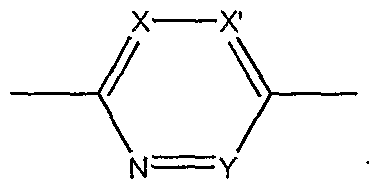
3. The compound according to claim 1, wherein
R1 is selected from 2-trifluoromethylphenyl, 2-fluoro-5-trifluoromethylphenyl, 2-fluoro-6-trifluoromethylphenyl, 2,5-dichlorophenyl, 2-ethylbutyl, 2,4- difluorophenyl, 2-fluorophenyl, 2-chlorophenyl and 2-cyanophenyl;
R3 and R4 independently are selected from hydrogen, -CH2OH, -CH2F, -CH2OCH3, -COOCH2CH3, -C(CH3)(CH3)OH, -CONHCH(CH3)(CH3), -(CH2)3CH3, CH3; R3 and R4 together forms an optionally substituted 3 to 7 membered saturated monocyclic ring.
4. A compound selected from:
(5R)-5-Hydroxymethyl-3-{6-[4-(2-trifluoromethylbenzoyl)piperazino]-3- pyridyl} -1 ,3 -oxazolan-2-one,
(5R)-4-[5-(5-Fluoromethyl-2-oxo-l,3-oxazolan-3-yl)-2-pyridyl]piperazino-2- trifluoromethylphenylmethanone,
(5R)-5-Methoxymethyl-3-{6-[4-(2-trifluoromethylbenzoyl)piperazino]-3- pyridyl}-l ,3-oxazolan-2-one,
(5S)-5-Hydroxymethyl-3-{6-[4-(2-trifluoromethylbenzoyl)piperazino]-3- pyridyl}-l ,3 -oxazolan-2-one,
(5S)-5-Methoxymethyl-3-{6-[4-(2-trifluoromethylbenzoyl)piperazino]-3- pyridyl}-l ,3 -oxazolan-2-one,
(5R)-3-{6-[4-(2-Fluoro-6-trifluoromethylbenzoyl)piperazino]-3-pyridyl}-5- hydroxy-methyl- 1 ,3 -oxazolan-2-one,
(5R)-3-{6-[4-(2-Fluoro-5-trifluoromethylbenzoyl)piperazino]-3-pyridyl}-5- hydroxymethyl-l,3-oxazolan-2-one, (5R)-3-{6-[4-(255-Dichlorobenzoyl)piperazino]-3-pyridyl}-5-hydroxymethyl- 1 ,3-oxazolan-2-one,
5R)-3-{6-[4-(2-Ethylbutanoyl)piperazino]-3-pyridyl}-5-hydroxymethyl-l,3- oxazolan-2-one,
(5R)-3-{6-[4-(2,4-Difluorophenylsulfonyl)piperazino]-3-pyridyl}-5~ hydroxymethyl- 1 ,3 -oxazolan-2-one,
(5R)-3-{6-[4-(2,5-Dichlorophenylsulfonyl)piperazino]-3-pyridyl}-5- hydroxymethyl- 1 ,3 -oxazolan-2-one,
Ethyl 3-[6-(4-{2-triflouromethylbenzoyl}piperazin-l-yl)pyridin-3-yl]-2-oxo- 1 ,3-oxazolan-2-one-5-carboxylate,
(5S)-3-[6-(4-{2-Trifluoromethylbenzoyl}piperazin-l-yl)pyridin-3-yl]-5-(l- hydroxy- 1 -methylethyl)- 1 ,3 -oxazolan-2-one,
(5S)-3-[6-(4-{2-Trifluoromethylbenzoyl}piperazin-l-yl)pyridin-3-yl]-(l- methyl)-N-ethyl-2-oxo- 1 ,3-oxazolan-2-one-5-carboxamide,
4-[5-(5-Butyl -2-oxo-l,3 -oxazolan-3-yl)-2-pyridyl]piperazino-2- trifluoromethyl-phenylmethanone,
4-[5-(5,5-Dimethyl-2-oxo-l,3-oxazolan-3-yl)-2-pyridyl]piperazino-2- trifluoromethyl-phenylmethanone,
3-[6-(4-{2-Trifluoromethylbenzoyl}piperazin-l-yl]pyridine-3-yl}-l-oxa-3- azaspiro[4.5]decan-2-one,
(5R)-3 - {6-[(3 S)-3 -(2-Fluorophenoxy)pyrrolidin- 1 -yl]pyridin-3 -yl} -5- (hydroxyl-methyl)-l,3-oxazolan-2-one,
(5S)-3-{6-[(3S)-3-(2-Fluorophenoxy)pyrrolidin-l-yl]pyridin-3-yl}-5- (hydroxyl-methyl)-l,3-oxazolan-2-one,
(5S)-3-{6-[4-(2-Fluorophenoxy)piperidin-l-yl]pyridin-3-yl}-5- hydroxymethyl- 1 ,3 -oxazolan-2-one,
(5R)-3-{6-[4-(2-Chlorophenoxy)piperidino]-3-pyridyl}-5-hydroxymethyl-l,3- oxazolan-2-one,
(5S)-3-{6-[4-(2-Chlorophenoxy)piperidino]-3-pyridyl}-5-hydroxymethyl-l,3- oxazolan-2-one,
(5 S)-3 - {6- [4-(2,5-Dichlorophenoxy)piperidin- 1 -yl]pyridin-3 -yl } -5- (hydroxymethyl)- 1 ,3 -oxazolan-2-one, (5S)- 5-Hydroxymethyl -3- {6-[4-(2-trifluoromethylphenoxy)piperidin- 1 - yl]pyridin-3 -yl} - 1 ,3-oxazolan-2-one, '
2-[(l-{5-[(5S)-5-Hydroxymethyl-2-oxo-l,3-oxazolan-3-yl]pyridin-2- yl}piperidin-4-yl)oxy]benzonitrile, or a pharmaceutically acceptable salt thereof, a pharmaceutically acceptable ester thereof, a tautomer thereof, a regioisomer thereof, a stereoisomer thereof, a enantiomer thereof, a diastereomer thereof, a polymorph thereof, or a pharmaceutically acceptable solvate thereof.
5. A compound which is:
[5-(Benzyloxycarbonyl)aminopyridin-2-yl]piperazino-2- trifluoromethylphenyl-methanone, tert-Butyl 4-{5-[(5i?)-5-hydroxymethyl-2-oxo-l,3-oxazolan-3-yl]pyridin-2- yl jpiperazine- 1 -carboxylate, tert-ButyM-fS-fCS^-S-hydroxymethyl^-oxo-l^-oxazolan-S-yypyridin^- yl } pipera-zine- 1 -carboxylate,
Ethyl 3 -[6- {[4-(2-triflouromethylbenzoyl)piperazin- 1 -yl]pyridin-3 -yl } amino] - 2-hydroxypropanoate, ter?-Butyl4-{5-[(2-hydroxyhexyl)amino]pyridin-2-yl}piperazine-l- carboxylate, tert-Butyl 4- {5-[(2-hydroxy-2-methylpropyl)amino]pyridin-2-yl}piperazine- 1 - carboxylate, ter/-Butyl 4-(5- {[(1 -hydroxycyclohexyl)methyl]amino}pyridin-2-yl)piperazine-
1 -carboxylate,
Benzyl (6-{4-[(2,5-dichlorophenyl)sulfonyl]piperazin-l-yl}pyridin-3- yl)carbamate,
Benzyl {6-[(3)S)-3-(2-fluorophenoxy)pyrrolidin-l-yl]pyridin-3-yl}carbamate, Benzyl {6-[4-(2-fluoromethylphenoxy]piperidin-l-yl]-pyridin-3-yl}carbamate, Benzyl {6-[4-(2-chlorophenoxy)piperidin-l-yl]pyridin-3-yl}carbamate, Benzyl {6-[4-(2,5-dichlorophenoxy)piperidin-l-yl]-pyridin-3-yl} carbamate, Benzyl {6-[4-(2-trifluoromethylphenoxy)piperidin-l-yl]pyridin-3- yl} carbamate, Benzyl(6-{4-(2-cyanophenoxy)piperidin-l-yl}pyridin-3-yl)carbamate or a pharmaceutically acceptable salt thereof, a pharmaceutically acceptable ester thereof, a tautomer thereof, a regioisomer thereof, a stereoisomer thereof, a enantiomer thereof, a diastereomer thereof, a polymorph thereof, or a pharmaceutically acceptable solvate thereof.
6. A pharmaceutical composition comprising a compound of any one of claims 1-5 and a pharmaceutically acceptable excipient, diluent, carrier or combination thereof.
7. The pharmaceutical composition of claim 6, further comprising one or more therapeutic agents selected from anti-obesity agents, dipeptidyl peptidase IV (DPP- IV) inhibitors, Protein Tyrosine Phosphatase (PTP-IB) inhibitors or anorectic agents.
8. A method for treating a disease, disorder or syndrome mediated by stearoyl CoA desaturase 1 in a subject in need thereof, comprising administering to the subject a therapeutically effective amount of a compound of any one of claims 1-5 or a pharmaceutical composition of claim 7.
9. The method of claim 8, wherein the disease, condition or disorder is selected from obesity, appetite disorder, diabetes, impaired glucose tolerance, insulin resistance, a lipid disorder including dyslipidemia, hyperlipidemia, hypertriglyceridemia, atherosclerosis, hypercholesterolemia, low HDL (high density lipoprotein), and high LDL (Low density lipoprotein) , metabolic syndrome or fatty liver disease.
10. The method of claim 8 or 9, further comprising administering one or more therapeutic agents selected from antiobesity agents, insulin or insulin mimetics, insulin secretagogues, α-glucosidase inhibitors, glucagon receptor antagonists, cholesterol lowering agents, PPARδ agonists, DPP FV inhibitors, dyslipidemic agents, CETP inhibitors, HMG-COA reductase inhibitors, fibrates, guggle lipids or other SCDl inhibitors.
Applications Claiming Priority (2)
| Application Number | Priority Date | Filing Date | Title |
|---|---|---|---|
| IN1444/MUM/2006 | 2006-09-08 | ||
| IN1444MU2006 | 2006-09-09 |
Publications (1)
| Publication Number | Publication Date |
|---|---|
| WO2008029266A1 true WO2008029266A1 (en) | 2008-03-13 |
Family
ID=38969517
Family Applications (1)
| Application Number | Title | Priority Date | Filing Date |
|---|---|---|---|
| PCT/IB2007/002580 Ceased WO2008029266A1 (en) | 2006-09-08 | 2007-09-07 | Stearoyl coa desaturase inhibitors |
Country Status (1)
| Country | Link |
|---|---|
| WO (1) | WO2008029266A1 (en) |
Cited By (14)
| Publication number | Priority date | Publication date | Assignee | Title |
|---|---|---|---|---|
| WO2009012573A1 (en) * | 2007-07-20 | 2009-01-29 | Merck Frosst Canada Ltd. | Bicyclic heteroaromatic compounds as inhibitors of stearoyl-coenzyme a delta-9 desaturase |
| WO2010073011A2 (en) | 2008-12-23 | 2010-07-01 | Betagenon Ab | Compounds useful as medicaments |
| US7842696B2 (en) | 2007-06-21 | 2010-11-30 | Forest Laboratories Holdings Limited | Piperazine derivatives as inhibitors of stearoyl-CoA desaturase |
| US8383643B2 (en) | 2009-07-28 | 2013-02-26 | Merck Canada Inc. | Spiro compounds useful as inhibitors of stearoyl-coenzyme A delta-9 desaturase |
| WO2013056148A2 (en) | 2011-10-15 | 2013-04-18 | Genentech, Inc. | Methods of using scd1 antagonists |
| WO2013108026A1 (en) | 2012-01-17 | 2013-07-25 | Baltic Bio Ab | Thiadiazolone derivatives useful in the treatment of diabetes |
| WO2013175474A2 (en) | 2012-05-22 | 2013-11-28 | Yissum Research Development Company Of The Hebrew University Of Jerusalem Ltd. | Selective inhibitors of undifferentiated cells |
| US9168248B2 (en) | 2009-02-17 | 2015-10-27 | Merck Canada Inc. | Spiro compounds useful as inhibitors of stearoyl-coenzyme A delta-9 desaturase |
| WO2018129403A1 (en) | 2017-01-06 | 2018-07-12 | Yumanity Therapeutics | Methods for the treatment of neurological disorders |
| JP2019533022A (en) * | 2016-10-24 | 2019-11-14 | ユマニティ セラピューティクス,インコーポレーテッド | Compounds and uses thereof |
| US11873298B2 (en) | 2017-10-24 | 2024-01-16 | Janssen Pharmaceutica Nv | Compounds and uses thereof |
| US12098146B2 (en) | 2019-01-24 | 2024-09-24 | Janssen Pharmaceutica Nv | Compounds and uses thereof |
| US12180221B2 (en) | 2018-03-23 | 2024-12-31 | Janssen Pharmaceutica Nv | Compounds and uses thereof |
| US12268687B2 (en) | 2019-11-13 | 2025-04-08 | Janssen Pharmaceutica Nv | Compounds and uses thereof |
Citations (5)
| Publication number | Priority date | Publication date | Assignee | Title |
|---|---|---|---|---|
| WO2005003087A2 (en) * | 2003-07-01 | 2005-01-13 | Orchid Chemicals And Pharmaceuticals Ltd. | Oxazole derivatives as antibacterial agents |
| CN1594298A (en) * | 2003-09-12 | 2005-03-16 | 中国科学院上海药物研究所 | Pyridine ring containing oxazolidinone compounds and preparation process and application thereof |
| WO2006034446A2 (en) * | 2004-09-20 | 2006-03-30 | Xenon Pharmaceuticals Inc. | Pyridine derivatives for inhibiting human stearoyl-coa-desaturase |
| WO2006086447A2 (en) * | 2005-02-09 | 2006-08-17 | Xenon Pharmaceuticals Inc. | Pyridazine derivatives and their use as therapeutic agents |
| WO2007009236A1 (en) * | 2005-07-20 | 2007-01-25 | Merck Frosst Canada Ltd. | Heteroaromatic compounds as inhibitors of stearoyl-coenzyme a delta-9 desaturase |
-
2007
- 2007-09-07 WO PCT/IB2007/002580 patent/WO2008029266A1/en not_active Ceased
Patent Citations (5)
| Publication number | Priority date | Publication date | Assignee | Title |
|---|---|---|---|---|
| WO2005003087A2 (en) * | 2003-07-01 | 2005-01-13 | Orchid Chemicals And Pharmaceuticals Ltd. | Oxazole derivatives as antibacterial agents |
| CN1594298A (en) * | 2003-09-12 | 2005-03-16 | 中国科学院上海药物研究所 | Pyridine ring containing oxazolidinone compounds and preparation process and application thereof |
| WO2006034446A2 (en) * | 2004-09-20 | 2006-03-30 | Xenon Pharmaceuticals Inc. | Pyridine derivatives for inhibiting human stearoyl-coa-desaturase |
| WO2006086447A2 (en) * | 2005-02-09 | 2006-08-17 | Xenon Pharmaceuticals Inc. | Pyridazine derivatives and their use as therapeutic agents |
| WO2007009236A1 (en) * | 2005-07-20 | 2007-01-25 | Merck Frosst Canada Ltd. | Heteroaromatic compounds as inhibitors of stearoyl-coenzyme a delta-9 desaturase |
Non-Patent Citations (1)
| Title |
|---|
| CUI Y ET AL: "Syntheses and antibacterial activity of a series of 3-(pyridine-3-yl)-2-oxazolidinone", EUROPEAN JOURNAL OF MEDICINAL CHEMISTRY, EDITIONS SCIENTIFIQUE ELSEVIER, PARIS, FR, vol. 40, no. 2, February 2005 (2005-02-01), pages 209 - 214, XP004733704, ISSN: 0223-5234 * |
Cited By (23)
| Publication number | Priority date | Publication date | Assignee | Title |
|---|---|---|---|---|
| US7842696B2 (en) | 2007-06-21 | 2010-11-30 | Forest Laboratories Holdings Limited | Piperazine derivatives as inhibitors of stearoyl-CoA desaturase |
| WO2009012573A1 (en) * | 2007-07-20 | 2009-01-29 | Merck Frosst Canada Ltd. | Bicyclic heteroaromatic compounds as inhibitors of stearoyl-coenzyme a delta-9 desaturase |
| WO2010073011A2 (en) | 2008-12-23 | 2010-07-01 | Betagenon Ab | Compounds useful as medicaments |
| US9168248B2 (en) | 2009-02-17 | 2015-10-27 | Merck Canada Inc. | Spiro compounds useful as inhibitors of stearoyl-coenzyme A delta-9 desaturase |
| US8383643B2 (en) | 2009-07-28 | 2013-02-26 | Merck Canada Inc. | Spiro compounds useful as inhibitors of stearoyl-coenzyme A delta-9 desaturase |
| WO2013056148A2 (en) | 2011-10-15 | 2013-04-18 | Genentech, Inc. | Methods of using scd1 antagonists |
| US9358250B2 (en) | 2011-10-15 | 2016-06-07 | Genentech, Inc. | Methods of using SCD1 antagonists |
| WO2013108026A1 (en) | 2012-01-17 | 2013-07-25 | Baltic Bio Ab | Thiadiazolone derivatives useful in the treatment of diabetes |
| WO2013175474A2 (en) | 2012-05-22 | 2013-11-28 | Yissum Research Development Company Of The Hebrew University Of Jerusalem Ltd. | Selective inhibitors of undifferentiated cells |
| US9456998B2 (en) | 2012-05-22 | 2016-10-04 | Yissum Research Development Company Of The Hebrew University Of Jerusalem Ltd. | Selective inhibitors of undifferentiated cells |
| US11970486B2 (en) | 2016-10-24 | 2024-04-30 | Janssen Pharmaceutica Nv | Compounds and uses thereof |
| JP2019533022A (en) * | 2016-10-24 | 2019-11-14 | ユマニティ セラピューティクス,インコーポレーテッド | Compounds and uses thereof |
| JP2023037637A (en) * | 2016-10-24 | 2023-03-15 | ユマニティ セラピューティクス,インコーポレーテッド | Compounds and uses thereof |
| JP7607624B2 (en) | 2016-10-24 | 2024-12-27 | ヤンセン ファーマシューティカ エヌ.ベー. | Compounds and their uses |
| JP2025041715A (en) * | 2016-10-24 | 2025-03-26 | ヤンセン ファーマシューティカ エヌ.ベー. | Compounds and their uses |
| US10973810B2 (en) | 2017-01-06 | 2021-04-13 | Yumanity Therapeutics, Inc. | Methods for the treatment of neurological disorders |
| WO2018129403A1 (en) | 2017-01-06 | 2018-07-12 | Yumanity Therapeutics | Methods for the treatment of neurological disorders |
| US12433880B2 (en) | 2017-01-06 | 2025-10-07 | Janssen Pharmaceutica Nv | Methods for the treatment of neurological disorders |
| US11873298B2 (en) | 2017-10-24 | 2024-01-16 | Janssen Pharmaceutica Nv | Compounds and uses thereof |
| US12275723B2 (en) | 2017-10-24 | 2025-04-15 | Janssen Pharmaceutica Nv | Compounds and uses thereof |
| US12180221B2 (en) | 2018-03-23 | 2024-12-31 | Janssen Pharmaceutica Nv | Compounds and uses thereof |
| US12098146B2 (en) | 2019-01-24 | 2024-09-24 | Janssen Pharmaceutica Nv | Compounds and uses thereof |
| US12268687B2 (en) | 2019-11-13 | 2025-04-08 | Janssen Pharmaceutica Nv | Compounds and uses thereof |
Similar Documents
| Publication | Publication Date | Title |
|---|---|---|
| US12459929B2 (en) | GPCR receptor agonists, pharmaceutical compositions comprising the same, and methods for their use | |
| US12371435B2 (en) | Substituted imidazo[1,2-c]pyrimidines as PRC2 inhibitors | |
| US20080182851A1 (en) | Acetylene derivatives as stearoyl coa desaturase inhibitors | |
| WO2009037542A2 (en) | Spirocyclic compounds as stearoyl coa desaturase inhibitors | |
| TW200826936A (en) | Azacycloalkane derivatives as inhibitors of stearoyl-coenzyme a delta-9 desaturase | |
| CZ20021911A3 (en) | Novel heterocyclic compounds and their salts as well as their employment in medicine | |
| JP2010515744A (en) | 5-pyridinone substituted indazole | |
| WO2010007482A2 (en) | Thiazole derivatives as stearoyl coa desaturase inhibitors | |
| JP7770594B2 (en) | Amide heteroaromatic compounds useful in the treatment of liver diseases | |
| WO2010092342A1 (en) | Organosilicon compounds and their use as the modulators of the trpv1 receptor | |
| US12612384B2 (en) | Heterocyclic CYP4A inhibitor compounds and compositions thereof | |
| KR102963549B1 (en) | Amido heteroaromatic compounds useful for the treatment of liver disease | |
| CN115448978B (en) | TGR5-DPP4 dual-active compound, its preparation method, pharmaceutical composition and uses | |
| KR100848490B1 (en) | 1,2,5-triazane derivatives having betaamino groups, pharmaceutically acceptable salts thereof and methods for preparing the same | |
| HK40117545B (en) | Amido heteroaromatic compounds useful in the treatment of liver diseases | |
| HK40117545A (en) | Amido heteroaromatic compounds useful in the treatment of liver diseases | |
| CN101583600A (en) | Acetylene derivatives as stearoyl-CoA desaturase inhibitors | |
| HK40062310A (en) | 4,4a,5,7,8,8a-hexapyrido[4,3-b][1,4]oxazin-3-one compounds as magl inhibitors |
Legal Events
| Date | Code | Title | Description |
|---|---|---|---|
| 121 | Ep: the epo has been informed by wipo that ep was designated in this application |
Ref document number: 07804891 Country of ref document: EP Kind code of ref document: A1 |
|
| NENP | Non-entry into the national phase |
Ref country code: DE |
|
| 122 | Ep: pct application non-entry in european phase |
Ref document number: 07804891 Country of ref document: EP Kind code of ref document: A1 |