WO2008029370A1 - Pyridin-3-yl derivatives as immunomodulating agents - Google Patents

Pyridin-3-yl derivatives as immunomodulating agents Download PDF

Info

Publication number
WO2008029370A1
WO2008029370A1 PCT/IB2007/053593 IB2007053593W WO2008029370A1 WO 2008029370 A1 WO2008029370 A1 WO 2008029370A1 IB 2007053593 W IB2007053593 W IB 2007053593W WO 2008029370 A1 WO2008029370 A1 WO 2008029370A1
Authority
WO
WIPO (PCT)
Prior art keywords
methyl
hydroxy
ethyl
pyridin
oxadiazol
Prior art date
Legal status (The legal status is an assumption and is not a legal conclusion. Google has not performed a legal analysis and makes no representation as to the accuracy of the status listed.)
Ceased
Application number
PCT/IB2007/053593
Other languages
French (fr)
Inventor
Martin Bolli
David Lehmann
Boris Mathys
Claus Mueller
Oliver Nayler
Beat Steiner
Jörg Velker
Current Assignee (The listed assignees may be inaccurate. Google has not performed a legal analysis and makes no representation or warranty as to the accuracy of the list.)
Actelion Pharmaceuticals Ltd
Original Assignee
Actelion Pharmaceuticals Ltd
Priority date (The priority date is an assumption and is not a legal conclusion. Google has not performed a legal analysis and makes no representation as to the accuracy of the date listed.)
Filing date
Publication date
Priority to JP2009527263A priority Critical patent/JP5253400B2/en
Priority to SI200731184T priority patent/SI2069335T1/en
Priority to KR1020097006863A priority patent/KR101454937B1/en
Priority to CN2007800333351A priority patent/CN101522670B/en
Priority to EP07826286A priority patent/EP2069335B1/en
Priority to PL07826286T priority patent/PL2069335T3/en
Priority to ES07826286T priority patent/ES2400163T3/en
Priority to NZ576059A priority patent/NZ576059A/en
Priority to HRP20130180TT priority patent/HRP20130180T1/en
Priority to HK10102256.3A priority patent/HK1135976B/en
Priority to BRPI0716633-8A2A priority patent/BRPI0716633A2/en
Application filed by Actelion Pharmaceuticals Ltd filed Critical Actelion Pharmaceuticals Ltd
Priority to US12/310,763 priority patent/US8288554B2/en
Priority to CA2661315A priority patent/CA2661315C/en
Priority to MX2009002234A priority patent/MX2009002234A/en
Priority to DK07826286.2T priority patent/DK2069335T3/en
Priority to AU2007292992A priority patent/AU2007292992B2/en
Publication of WO2008029370A1 publication Critical patent/WO2008029370A1/en
Priority to IL197394A priority patent/IL197394A/en
Anticipated expiration legal-status Critical
Priority to NO20091409A priority patent/NO20091409L/en
Ceased legal-status Critical Current

Links

Classifications

    • CCHEMISTRY; METALLURGY
    • C07ORGANIC CHEMISTRY
    • C07DHETEROCYCLIC COMPOUNDS
    • C07D413/00Heterocyclic compounds containing two or more hetero rings, at least one ring having nitrogen and oxygen atoms as the only ring hetero atoms
    • C07D413/02Heterocyclic compounds containing two or more hetero rings, at least one ring having nitrogen and oxygen atoms as the only ring hetero atoms containing two hetero rings
    • C07D413/04Heterocyclic compounds containing two or more hetero rings, at least one ring having nitrogen and oxygen atoms as the only ring hetero atoms containing two hetero rings directly linked by a ring-member-to-ring-member bond
    • CCHEMISTRY; METALLURGY
    • C07ORGANIC CHEMISTRY
    • C07DHETEROCYCLIC COMPOUNDS
    • C07D403/00Heterocyclic compounds containing two or more hetero rings, having nitrogen atoms as the only ring hetero atoms, not provided for by group C07D401/00
    • C07D403/02Heterocyclic compounds containing two or more hetero rings, having nitrogen atoms as the only ring hetero atoms, not provided for by group C07D401/00 containing two hetero rings
    • AHUMAN NECESSITIES
    • A61MEDICAL OR VETERINARY SCIENCE; HYGIENE
    • A61PSPECIFIC THERAPEUTIC ACTIVITY OF CHEMICAL COMPOUNDS OR MEDICINAL PREPARATIONS
    • A61P1/00Drugs for disorders of the alimentary tract or the digestive system
    • A61P1/04Drugs for disorders of the alimentary tract or the digestive system for ulcers, gastritis or reflux esophagitis, e.g. antacids, inhibitors of acid secretion, mucosal protectants
    • AHUMAN NECESSITIES
    • A61MEDICAL OR VETERINARY SCIENCE; HYGIENE
    • A61PSPECIFIC THERAPEUTIC ACTIVITY OF CHEMICAL COMPOUNDS OR MEDICINAL PREPARATIONS
    • A61P11/00Drugs for disorders of the respiratory system
    • A61P11/02Nasal agents, e.g. decongestants
    • AHUMAN NECESSITIES
    • A61MEDICAL OR VETERINARY SCIENCE; HYGIENE
    • A61PSPECIFIC THERAPEUTIC ACTIVITY OF CHEMICAL COMPOUNDS OR MEDICINAL PREPARATIONS
    • A61P11/00Drugs for disorders of the respiratory system
    • A61P11/06Antiasthmatics
    • AHUMAN NECESSITIES
    • A61MEDICAL OR VETERINARY SCIENCE; HYGIENE
    • A61PSPECIFIC THERAPEUTIC ACTIVITY OF CHEMICAL COMPOUNDS OR MEDICINAL PREPARATIONS
    • A61P13/00Drugs for disorders of the urinary system
    • A61P13/12Drugs for disorders of the urinary system of the kidneys
    • AHUMAN NECESSITIES
    • A61MEDICAL OR VETERINARY SCIENCE; HYGIENE
    • A61PSPECIFIC THERAPEUTIC ACTIVITY OF CHEMICAL COMPOUNDS OR MEDICINAL PREPARATIONS
    • A61P17/00Drugs for dermatological disorders
    • AHUMAN NECESSITIES
    • A61MEDICAL OR VETERINARY SCIENCE; HYGIENE
    • A61PSPECIFIC THERAPEUTIC ACTIVITY OF CHEMICAL COMPOUNDS OR MEDICINAL PREPARATIONS
    • A61P17/00Drugs for dermatological disorders
    • A61P17/02Drugs for dermatological disorders for treating wounds, ulcers, burns, scars, keloids, or the like
    • AHUMAN NECESSITIES
    • A61MEDICAL OR VETERINARY SCIENCE; HYGIENE
    • A61PSPECIFIC THERAPEUTIC ACTIVITY OF CHEMICAL COMPOUNDS OR MEDICINAL PREPARATIONS
    • A61P17/00Drugs for dermatological disorders
    • A61P17/06Antipsoriatics
    • AHUMAN NECESSITIES
    • A61MEDICAL OR VETERINARY SCIENCE; HYGIENE
    • A61PSPECIFIC THERAPEUTIC ACTIVITY OF CHEMICAL COMPOUNDS OR MEDICINAL PREPARATIONS
    • A61P19/00Drugs for skeletal disorders
    • AHUMAN NECESSITIES
    • A61MEDICAL OR VETERINARY SCIENCE; HYGIENE
    • A61PSPECIFIC THERAPEUTIC ACTIVITY OF CHEMICAL COMPOUNDS OR MEDICINAL PREPARATIONS
    • A61P19/00Drugs for skeletal disorders
    • A61P19/02Drugs for skeletal disorders for joint disorders, e.g. arthritis, arthrosis
    • AHUMAN NECESSITIES
    • A61MEDICAL OR VETERINARY SCIENCE; HYGIENE
    • A61PSPECIFIC THERAPEUTIC ACTIVITY OF CHEMICAL COMPOUNDS OR MEDICINAL PREPARATIONS
    • A61P19/00Drugs for skeletal disorders
    • A61P19/06Antigout agents, e.g. antihyperuricemic or uricosuric agents
    • AHUMAN NECESSITIES
    • A61MEDICAL OR VETERINARY SCIENCE; HYGIENE
    • A61PSPECIFIC THERAPEUTIC ACTIVITY OF CHEMICAL COMPOUNDS OR MEDICINAL PREPARATIONS
    • A61P25/00Drugs for disorders of the nervous system
    • A61P25/28Drugs for disorders of the nervous system for treating neurodegenerative disorders of the central nervous system, e.g. nootropic agents, cognition enhancers, drugs for treating Alzheimer's disease or other forms of dementia
    • AHUMAN NECESSITIES
    • A61MEDICAL OR VETERINARY SCIENCE; HYGIENE
    • A61PSPECIFIC THERAPEUTIC ACTIVITY OF CHEMICAL COMPOUNDS OR MEDICINAL PREPARATIONS
    • A61P27/00Drugs for disorders of the senses
    • A61P27/02Ophthalmic agents
    • AHUMAN NECESSITIES
    • A61MEDICAL OR VETERINARY SCIENCE; HYGIENE
    • A61PSPECIFIC THERAPEUTIC ACTIVITY OF CHEMICAL COMPOUNDS OR MEDICINAL PREPARATIONS
    • A61P27/00Drugs for disorders of the senses
    • A61P27/16Otologicals
    • AHUMAN NECESSITIES
    • A61MEDICAL OR VETERINARY SCIENCE; HYGIENE
    • A61PSPECIFIC THERAPEUTIC ACTIVITY OF CHEMICAL COMPOUNDS OR MEDICINAL PREPARATIONS
    • A61P29/00Non-central analgesic, antipyretic or antiinflammatory agents, e.g. antirheumatic agents; Non-steroidal antiinflammatory drugs [NSAID]
    • AHUMAN NECESSITIES
    • A61MEDICAL OR VETERINARY SCIENCE; HYGIENE
    • A61PSPECIFIC THERAPEUTIC ACTIVITY OF CHEMICAL COMPOUNDS OR MEDICINAL PREPARATIONS
    • A61P3/00Drugs for disorders of the metabolism
    • A61P3/08Drugs for disorders of the metabolism for glucose homeostasis
    • A61P3/10Drugs for disorders of the metabolism for glucose homeostasis for hyperglycaemia, e.g. antidiabetics
    • AHUMAN NECESSITIES
    • A61MEDICAL OR VETERINARY SCIENCE; HYGIENE
    • A61PSPECIFIC THERAPEUTIC ACTIVITY OF CHEMICAL COMPOUNDS OR MEDICINAL PREPARATIONS
    • A61P35/00Antineoplastic agents
    • AHUMAN NECESSITIES
    • A61MEDICAL OR VETERINARY SCIENCE; HYGIENE
    • A61PSPECIFIC THERAPEUTIC ACTIVITY OF CHEMICAL COMPOUNDS OR MEDICINAL PREPARATIONS
    • A61P35/00Antineoplastic agents
    • A61P35/04Antineoplastic agents specific for metastasis
    • AHUMAN NECESSITIES
    • A61MEDICAL OR VETERINARY SCIENCE; HYGIENE
    • A61PSPECIFIC THERAPEUTIC ACTIVITY OF CHEMICAL COMPOUNDS OR MEDICINAL PREPARATIONS
    • A61P37/00Drugs for immunological or allergic disorders
    • AHUMAN NECESSITIES
    • A61MEDICAL OR VETERINARY SCIENCE; HYGIENE
    • A61PSPECIFIC THERAPEUTIC ACTIVITY OF CHEMICAL COMPOUNDS OR MEDICINAL PREPARATIONS
    • A61P37/00Drugs for immunological or allergic disorders
    • A61P37/02Immunomodulators
    • AHUMAN NECESSITIES
    • A61MEDICAL OR VETERINARY SCIENCE; HYGIENE
    • A61PSPECIFIC THERAPEUTIC ACTIVITY OF CHEMICAL COMPOUNDS OR MEDICINAL PREPARATIONS
    • A61P37/00Drugs for immunological or allergic disorders
    • A61P37/02Immunomodulators
    • A61P37/06Immunosuppressants, e.g. drugs for graft rejection
    • AHUMAN NECESSITIES
    • A61MEDICAL OR VETERINARY SCIENCE; HYGIENE
    • A61PSPECIFIC THERAPEUTIC ACTIVITY OF CHEMICAL COMPOUNDS OR MEDICINAL PREPARATIONS
    • A61P37/00Drugs for immunological or allergic disorders
    • A61P37/08Antiallergic agents
    • AHUMAN NECESSITIES
    • A61MEDICAL OR VETERINARY SCIENCE; HYGIENE
    • A61PSPECIFIC THERAPEUTIC ACTIVITY OF CHEMICAL COMPOUNDS OR MEDICINAL PREPARATIONS
    • A61P43/00Drugs for specific purposes, not provided for in groups A61P1/00-A61P41/00
    • AHUMAN NECESSITIES
    • A61MEDICAL OR VETERINARY SCIENCE; HYGIENE
    • A61PSPECIFIC THERAPEUTIC ACTIVITY OF CHEMICAL COMPOUNDS OR MEDICINAL PREPARATIONS
    • A61P5/00Drugs for disorders of the endocrine system
    • A61P5/14Drugs for disorders of the endocrine system of the thyroid hormones, e.g. T3, T4
    • AHUMAN NECESSITIES
    • A61MEDICAL OR VETERINARY SCIENCE; HYGIENE
    • A61PSPECIFIC THERAPEUTIC ACTIVITY OF CHEMICAL COMPOUNDS OR MEDICINAL PREPARATIONS
    • A61P9/00Drugs for disorders of the cardiovascular system
    • CCHEMISTRY; METALLURGY
    • C07ORGANIC CHEMISTRY
    • C07DHETEROCYCLIC COMPOUNDS
    • C07D403/00Heterocyclic compounds containing two or more hetero rings, having nitrogen atoms as the only ring hetero atoms, not provided for by group C07D401/00
    • C07D403/02Heterocyclic compounds containing two or more hetero rings, having nitrogen atoms as the only ring hetero atoms, not provided for by group C07D401/00 containing two hetero rings
    • C07D403/04Heterocyclic compounds containing two or more hetero rings, having nitrogen atoms as the only ring hetero atoms, not provided for by group C07D401/00 containing two hetero rings directly linked by a ring-member-to-ring-member bond
    • CCHEMISTRY; METALLURGY
    • C07ORGANIC CHEMISTRY
    • C07DHETEROCYCLIC COMPOUNDS
    • C07D417/00Heterocyclic compounds containing two or more hetero rings, at least one ring having nitrogen and sulfur atoms as the only ring hetero atoms, not provided for by group C07D415/00
    • C07D417/02Heterocyclic compounds containing two or more hetero rings, at least one ring having nitrogen and sulfur atoms as the only ring hetero atoms, not provided for by group C07D415/00 containing two hetero rings
    • C07D417/04Heterocyclic compounds containing two or more hetero rings, at least one ring having nitrogen and sulfur atoms as the only ring hetero atoms, not provided for by group C07D415/00 containing two hetero rings directly linked by a ring-member-to-ring-member bond

Definitions

  • the present invention relates to S1 P1/EDG1 receptor agonists of Formula (I) and their use as active ingredients in the preparation of pharmaceutical compositions.
  • the invention also concerns related aspects including processes for the preparation of the compounds, pharmaceutical compositions containing a compound of the Formula (I), and their use as compounds improving vascular function and as immunomodulating agents, either alone or in combination with other active compounds or therapies.
  • a further aspect of the invention relates to novel compounds of Formula (II) that serve as intermediates to prepare compounds of Formula (I).
  • the human immune system is designed to defend the body against foreign microorganisms and substances that cause infection or disease.
  • Complex regulatory mechanisms ensure that the immune response is targeted against the intruding substance or organism and not against the host. In some cases, these control mechanisms are unregulated and autoimmune responses can develop. A consequence of the uncontrolled inflammatory response is severe organ, cell, tissue or joint damage.
  • Typical drugs in this class include azathioprine, chlorambucil, cyclophosphamide, cyclosporin, or methotrexate.
  • Corticosteroids which reduce inflammation and suppress the immune response, may cause side effects when used in long term treatment.
  • Nonsteroidal anti-infammatory drugs NSAIDs
  • Alternative treatments include agents that activate or block cytokine signaling.
  • Orally active compounds with immunomodulating properties, without compromising immune responses and with reduced side effects would significantly improve current treatments of uncontrolled inflammatory disease.
  • Organ transplant recipients can experience some rejection even when they are taking immunosuppressive drugs. Rejection occurs most frequently in the first few weeks after transplantation, but rejection episodes can also happen months or even years after transplantation. Combinations of up to three or four medications are commonly used to give maximum protection against rejection while minimizing side effects. Current standard drugs used to treat the rejection of transplanted organs interfere with discrete intracellular pathways in the activation of T-type or B-type white blood cells.
  • drugs examples include cyclosporin, daclizumab, basiliximab, everolimus, or FK506, which interfere with cytokine release or signaling; azathioprine or leflunomide, which inhibit nucleotide synthesis; or 15-deoxyspergualin, an inhibitor of leukocyte differentiation.
  • the present invention provides novel compounds of Formula (I) that are agonists for the G protein-coupled receptor S1 P1/EDG1 and have a powerful and long-lasting immunomodulating effect which is achieved by reducing the number of circulating and infiltrating T- and B-lymphocytes, without affecting their maturation, memory, or expansion.
  • the reduction of circulating T- / B-lymphocytes as a result of S1 P1/EDG1 agonism possibly in combination with the observed improvement of endothelial cell layer function associated with S1 P1/EDG1 activation, makes such compounds useful to treat uncontrolled inflammatory disease and to improve vascular functionality.
  • the compounds of the present invention can be utilized alone or in combination with standard drugs inhibiting T-cell activation, to provide a new immunomodulating therapy with a reduced propensity for infections when compared to standard immunosuppressive therapy. Furthermore, the compounds of the present invention can be used in combination with reduced dosages of traditional immunosuppressant therapies, to provide on the one hand effective immunomodulating activity, while on the other hand reducing end organ damage associated with higher doses of standard immunosuppressive drugs.
  • the observation of improved endothelial cell layer function associated with S1 P1/EDG1 activation provides additional benefits of compounds to improve vascular function.
  • the nucleotide sequence and the amino acid sequence for the human S1 P1/EDG1 receptor are known in the art and are published in e.g.: HIa, T., and Maciag, T. J. Biol Chem. 265 (1990), 9308-9313; WO 91/15583 published 17 October 1991 ; WO 99/46277 published 16 September 1999.
  • the potency and efficacy of the compounds of Formula (I) are assessed using a GTP ⁇ S assay to determine EC 5 O values and by measuring the circulating lymphocytes in the rat after oral administration, respectively (see in Examples).
  • C-i-s-alkyl alone or in combination with other groups, means saturated, branched or straight chain groups with one to five carbon atoms.
  • Examples of Ci -5 -alkyl groups are methyl, ethyl, n-propyl, /so-propyl, n-butyl, /so-butyl, n-pentyl, and /so-pentyl.
  • Ci -4 -alkyl groups are methyl, ethyl, n-propyl, /so-propyl, n-butyl, and /so-butyl.
  • C- ⁇ - 3 -alkyl alone or in combination with other groups, means saturated, branched or straight chain groups with one to three carbon atoms and represents a methyl, ethyl, n-propyl, or /so-propyl group; preferred are methyl and ethyl.
  • C 2- 5-alkyl alone or in combination with other groups, means saturated, branched or straight chain groups with two to five carbon atoms.
  • C 2 - 4 -alkyl alone or in combination with other groups, means saturated, branched or straight chain groups with two to four carbon atoms.
  • Examples of C 2-4 -alkyl groups are ethyl, n-propyl, /so-propyl, n-butyl, and /so-butyl.
  • the term C- M -alkoxy, alone or in combination with other groups means an R-O group, wherein R is a C- M -alkyl.
  • Examples of C- ⁇ -alkoxy groups are methoxy, ethoxy, propoxy, /so-propoxy, and /so-butoxy, preferred are methoxy, ethoxy, propoxy, and /so-propoxy.
  • C 2- 5-alkoxy alone or in combination with other groups, means an R-O group, wherein R is a C 2- 5-alkyl.
  • Examples of C 2- 5-alkoxy groups are ethoxy, propoxy, /so-propoxy, /so-butoxy, and /so-pentoxy.
  • halogen means fluoro, chloro, bromo or iodo, preferably fluoro or chloro, most preferably chloro.
  • Salts are preferably the pharmaceutically acceptable salts of the compounds of Formula (I).
  • pharmaceutically acceptable salts refers to non-toxic, inorganic or organic acid and/or base addition salts, Lit. e.g. "Salt selection for basic drugs", Int. J. Pharm. (1986), 33, 201-217.
  • the compounds of Formula (I) may thus be present as mixtures of stereoisomers or preferably as pure stereoisomers. Mixtures of stereoisomers may be separated in a manner known to a person skilled in the art.
  • the invention relates to pyridin-3-yl derivatives of the Formula (I),
  • R 1 represents hydrogen, C 1-4 -alkyl, or chloro
  • R 2 represents C 1-5 -alkyl or C 1-4 -alkoxy
  • R 3 represents hydrogen, d- 4 -alkyl, Ci -4 -alkoxy, or halogen
  • R 4 represents hydrogen, C- ⁇ -alkyl, Ci -4 -alkoxy, halogen, trifluoromethyl or trifluoromethoxy;
  • R 5 represents 2,3-dihydroxypropyl, di-(hydroxy-Ci -4 -alkyl)-Ci -4 -alkyl, -CH 2 -(CH 2 ) k - NHSO 2 R 53 , -(CH 2 ) n CH(OH)-CH 2 -NHSO 2 R 53 , -CH 2 -(CH 2 X-NHCOR 54 , -(CH 2 ) n CH(OH)-CH 2 - NHCOR 54 , -CH 2 -(CH 2 ) n -CONR 51 R 52 , -CO-NHR 51 , 1-(3-carboxy-azetidinyl)-2-acetyl, 1-(2- carboxy-pyrrolidinyl)-2-acetyl, 1-(3-carboxy-pyrrolidinyl)-2-acetyl, 1-(3-carboxy-azetidinyl)-3- propionyl, 1-(2-carboxy-
  • R 51 represents hydrogen, d- 3 -alkyl, 2-hydroxyethyl, 2-hydroxy-1-hydroxymethyl-ethyl, 2,3- dihydroxypropyl, carboxymethyl, 1-(Ci -5 -alkylcarboxy)methyl, 2-carboxyethyl, or 2-(Ci -5 - alkylcarboxy)ethyl;
  • R 52 represents hydrogen, methyl, or ethyl
  • R 53 represents C 1-3 -alkyl, methylamino, ethylamino, or dimethylamino;
  • R 54 represents hydroxymethyl, hydroxyethyl, aminomethyl, methylaminomethyl, dimethylaminomethyl, aminoethyl, 2-methylamino-ethyl, or 2-dimethylamino-ethyl;
  • R 6 represents hydrogen, d- 4 -alkyl or halogen.
  • Another embodiment of the invention relates to pyridin-3-yl derivatives according to any one of the embodiments i) to vii), wherein R 1 represents Ci -4 -alkyl or chloro.
  • Another embodiment of the invention relates to pyridin-3-yl derivatives according to any one of the embodiments i) to vii), wherein R 1 represents Ci -4 -alkyl.
  • Another embodiment of the invention relates to pyridin-3-yl derivatives according to any one of the embodiments i) to vi), wherein R 1 represents methyl or ethyl.
  • Another embodiment of the invention relates to pyridin-3-yl derivatives according to any one of the embodiments i) to vi), wherein R 1 represents methyl.
  • xii) Another embodiment of the invention relates to pyridin-3-yl derivatives according to any one of the embodiments i) to xi), wherein R 2 represents Ci -5 -alkyl.
  • xiii) Another embodiment of the invention relates to pyridin-3-yl derivatives according to any one of the embodiments i) to xi), wherein R 2 represents C 2-4 -alkyl.
  • xiv) Another embodiment of the invention relates to pyridin-3-yl derivatives according to any one of the embodiments i) to xi), wherein R 2 represents ethyl, n-propyl, /so-propyl, or iso- butyl.
  • xv) Another embodiment of the invention relates to pyridin-3-yl derivatives according to any one of the embodiments i) to xi), wherein R 2 represents n-propyl, or /so-butyl.
  • Another embodiment of the invention relates to pyridin-3-yl derivatives according to any one of the embodiments i) to xi), wherein R 2 represents d- 4 -alkoxy.
  • xvii) Another embodiment of the invention relates to pyridin-3-yl derivatives according to any one of the embodiments i) to xvi), wherein at least one of R 3 , R 4 and R 6 represents a group other than hydrogen.
  • xviii) Another embodiment of the invention relates to pyridin-3-yl derivatives according to any one of the embodiments i) to xvi), wherein R 3 represents methyl or methoxy (especially methoxy), and R 4 and R 6 represent hydrogen.
  • xix Another embodiment of the invention relates to pyridin-3-yl derivatives according to any one of the embodiments i) to xvi), wherein R 3 represents hydrogen.
  • Another embodiment of the invention relates to pyridin-3-yl derivatives according to any one of the embodiments i) to xvi), wherein R 3 represents hydrogen; and R 4 represents Ci -4 - alkyl, or Ci -4 -alkoxy; and R 6 represents d- 4 -alkyl, or halogen.
  • Another embodiment of the invention relates to pyridin-3-yl derivatives according to any one of the embodiments i) to xvi), wherein R 3 represents hydrogen, R 4 represents Ci_3- alkyl, or methoxy (especially methyl, ethyl, or methoxy), and R 6 represents methyl, ethyl, or halogen (especially chloro).
  • Another embodiment of the invention relates to pyridin-3-yl derivatives according to any one of the embodiments i) to xvi), wherein R 3 represents hydrogen, and R 4 and R 6 represent a methyl group.
  • xxiii) Another embodiment of the invention relates to pyridin-3-yl derivatives according to any one of the embodiments i) to xvi), wherein R 3 represents hydrogen, R 4 represents a methyl group, and R 6 represents an ethyl group.
  • xxiv) Another embodiment of the invention relates to pyridin-3-yl derivatives according to any one of the embodiments i) to xvi), wherein R 3 represents hydrogen, R 4 represents a methoxy group, and R 6 represents chloro.
  • Another embodiment of the invention relates to pyridin-3-yl derivatives according to any one of the embodiments i) to xvi), wherein R 3 represents hydrogen, R 4 represents a methyl group, and R 6 represents chloro.
  • Another embodiment of the invention relates to pyridin-3-yl derivatives according to any one of the embodiments i) to xxv), wherein R 5 represents 2,3-dihydroxypropyl, di-
  • R 5 represents 2,3-dihydroxypropyl, -CH H 22 - (CH 2 X-NR 51 R 52 , -CH 2 -(CH 2 ) K -NHCOR 54 , -(CH 2 ) n CH(OH)-CH 2 -NHCOR 54 , -CH 2 -(CH 2 ) n - CONR 51 R 52 , -CO-NHR 51 , -(CH 2 ) n CH(OH)-CH 2 -NR 51 R 52 , hydroxy-C 2-5 -alkoxy, di-(hydroxy-d.
  • R 5 represents hydroxy-C 2-5 -alkoxy, di- (hydroxy-C 1-4 -alkyl)-C 1-4 -alkoxy, 2,3-dihydroxy-propoxy, -OCH 2 -(CH 2 ) m -NR 51 R 52 , -OCH 2 - CH(OH)-CH 2 -NR 51 R 52 , -OCH 2 -(CH 2 ) m -NHCOR 54 , or -OCH 2 -CH(OH)-CH 2 -NHCOR 54 .
  • Another embodiment of the invention relates to pyridin-3-yl derivatives according to any one of the embodiments i) to xxv), wherein R 5 represents 3-hydroxy-2-hydroxymethyl- propoxy, 2,3-dihydroxy-propoxy, or -OCH 2 -CH(OH)-CH 2 -NHCOR 54 (especially R 5 represents 2,3-dihydroxy-propoxy or -OCH 2 -CH(OH)-CH 2 -NHCOR 54 , wherein R 54 represents hydroxymethyl).
  • Another embodiment of the invention relates to pyridin-3-yl derivatives according to any one of the embodiments i) to xxv), wherein R 5 represents -OCH 2 -CH(OH)-CH 2 - NHCOR 54 , wherein R 54 represents hydroxymethyl.
  • xxxi) Another embodiment of the invention relates to pyridin-3-yl derivatives according to any one of the embodiments i) to xxv), wherein R 5 represents 2,3-dihydroxy-propoxy.
  • R 1 represents methyl, ethyl, or chloro (especially methyl, or ethyl);
  • R 2 represents n-propyl, isobutyl, or isopropoxy (especially n-propyl or isobutyl);
  • R 3 represents hydrogen, methyl, or methoxy (especially hydrogen or methoxy);
  • R 4 represents hydrogen, methyl, ethyl or methoxy;
  • R 5 represents hydroxy-C 2-5 -alkoxy, di-(hydroxy-Ci -4 -alkyl)-Ci.
  • R 1 represents hydrogen, C 1-4 -alkyl, or chloro
  • R 2 represents C 1-5 -alkyl or C 1-4 -alkoxy;
  • R 3 represents hydrogen;
  • R 4 represents Ci -4 -alkyl or Ci -4 -alkoxy
  • R 5 represents hydroxy, hydroxy-C 2- 5-alkoxy, di-(hydroxy-Ci -4 -alkyl)-Ci -4 -alkoxy, 2,3- dihydroxy-propoxy, -OCH 2 -CH(OH)-CH 2 -NR 51 R 52 , Or -OCH 2 -CH(OH)-CH 2 -NHCOR 54 ;
  • R 51 represents hydrogen, 2-hydroxyethyl, or 2-hydroxy-1-hydroxymethyl-ethyl (especially hydrogen);
  • R 52 represents hydrogen
  • R 54 represents hydroxymethyl
  • R 6 represents Ci -4 -alkyl or halogen; wherein for the present embodiment the meanings of one or more of the substituents or groups may be replaced by the meaning(s) given for said substituent(s) or group(s) in any one of embodiments vi) to xvi), xxi) to xxv), and xxix) to xxxi).
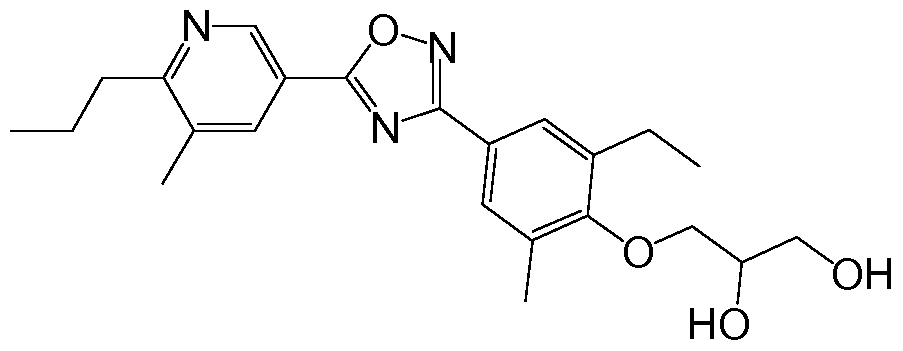
  • pyridin-3-yl derivatives according to Formula (I) are selected from: 3- ⁇ 4-[5-(5-Chloro-6-isopropoxy-pyridin-3-yl)-[1 ,2,4]oxadiazol-3-yl]-2,6-dimethyl-phenoxy ⁇ - propane-1 ,2-diol; N-(3- ⁇ 4-[5-(5-Chloro-6-isopropoxy-pyridin-3-yl)-[1 ,2,4]oxadiazol-3-yl]-2,6-dimethyl- phenoxy ⁇ -2-hydroxy-propyl)-2-hydroxy-acetamide;
  • pyridin-3-yl derivatives according to Formula (I) are selected from:
  • a further aspect of the invention relates to novel pyridin-3-yl derivatives of Formula (H)
  • R 3 represents hydrogen
  • R 4 represents C 1-4 -alkyl, or C 1-4 -alkoxy
  • R 6 represents C 1-4 -alkyl, or halogen.
  • the compounds of Formula (I) and their pharmaceutically acceptable salts can be used as medicaments, e.g. in the form of pharmaceutical compositions for enteral or parental administration.
  • compositions can be effected in a manner which will be familiar to any person skilled in the art (see for example Mark Gibson, Editor, Pharmaceutical Preformulation and Formulation, IHS Health Group, Englewood, CO, USA, 2001 ; Remington, The Science and Practice of Pharmacy, 20th Edition, Philadelphia College of Pharmacy and Science) by bringing the described compounds of Formula (I) or their pharmaceutically acceptable salts, optionally in combination with other therapeutically valuable substances, into a galenical administration form together with suitable, non-toxic, inert, pharmaceutically acceptable solid or liquid carrier materials and, if desired, usual pharmaceutical adjuvants.
  • the pharmaceutical compositions comprising a compound of Formula (I) are useful for the prevention and/or treatment of diseases or disorders associated with an activated immune system.
  • Such diseases or disorders are selected from the group consisting of rejection of transplanted organs, tissue or cells; graft-versus-host diseases brought about by transplantation; autoimmune syndromes including rheumatoid arthritis; systemic lupus erythematosus; antiphospholipid syndrome; Hashimoto's thyroiditis; lymphocytic thyroiditis; multiple sclerosis; myasthenia gravis; type I diabetes; uveitis; episcleritis; scleritis; Kawasaki's disease, uveo-retinitis; posterior uveitis; uveitis associated with Behcet's disease; uveomeningitis syndrome; allergic encephalomyelitis; chronic allograft vasculopathy; post-infectious autoimmune diseases including rheumatic fever and postinfectious glomerulonephritis; inflammatory and hyperproliferative skin diseases; psoriasis; psoriatic arthritis; atopic dermatitis
  • Preferred diseases or disorders to be treated and/or prevented with the compounds of Formula (I) are selected from the group consisting of rejection of transplanted organs such as kidney, liver, heart, lung, pancreas, cornea, and skin; graft-versus-host diseases brought about by stem cell transplantation; autoimmune syndromes including rheumatoid arthritis, multiple sclerosis, inflammatory bowel diseases such as Crohn's disease and ulcerative colitis, psoriasis, psoriatic arthritis, thyroiditis such as Hashimoto's thyroiditis, uveo-retinitis; atopic diseases such as rhinitis, conjunctivitis, dermatitis; asthma; type I diabetes; post- infectious autoimmune diseases including rheumatic fever and post-infectious glomerulonephritis; solid cancers and tumor metastasis.
  • transplanted organs such as kidney, liver, heart, lung, pancreas, cornea, and skin
  • Particularly preferred diseases or disorders to be treated and/or prevented with the compounds of Formula (I) are selected from the group consisting of rejection of transplanted organs selected from kidney, liver, heart and lung; graft-versus-host diseases brought about by stem cell transplantation; autoimmune syndromes selected from rheumatoid arthritis, multiple sclerosis, psoriasis, psoriatic arthritis, Crohn's disease, and Hashimoto's thyroiditis; and atopic dermatitis.
  • the present invention also relates to a method for the prevention or treatment of a disease or disorder mentioned herein comprising administering to a subject a pharmaceutically active amount of a compound of Formula (I).
  • compounds of the Formula (I) are also useful, in combination with one or several immunomodulating agents, for the prevention and/or treatment of the diseases and disorders mentioned herein.
  • said agents are selected from the group consisting of immunosuppressants, corticosteroids, NSAI D's, cytotoxic drugs, adhesion molecule inhibitors, cytokines, cytokine inhibitors, cytokine receptor antagonists and recombinant cytokine receptors.
  • the present invention also relates to the use of a compound of Formula (I) for the preparation of a pharmaceutical composition, optionally for use in combination with one or several immunomodulating agents, for the prevention or treatment of the diseases and disorders mentioned herein.
  • the compounds of Formula (I) can be manufactured by the methods given below, by the methods given in the Examples or by analogous methods. Optimum reaction conditions may vary with the particular reactants or solvents used, but such conditions can be determined by a person skilled in the art by routine optimisation procedures.
  • the compounds of Formula (I) may be prepared by reacting a compound of Structure 1 with a compound of Structure 2 in the presence of a base or an acid.
  • the functional groups present in the residues R 3 to R 6 may require temporary protection or may even be introduced in additional steps that follow the condensation reaction.
  • Compounds of Structure 1 may be prepared by reacting a compound of Structure 3 with a methyl Grignard reagent or by treating a compound of Structure 4 with 2 eq. of methyllithium in a solvent such as ether, THF, etc. at temperatures between -20 and 50 0 C.
  • the Weinreb amide compound of Structure 3 is prepared by treating a compound of
  • Compounds of Formula (I) wherein A represents -CO-NH-CH 2 - may be prepared by coupling a compound of Structure 5 with a compound with Structure 4 by using a coupling reagent such as EDC, DCC, TBTU, PyBOP, etc. or by coupling a compound of Structure 5 with the corresponding acid chloride or bromide of a compound of Structure 4.
  • a coupling reagent such as EDC, DCC, TBTU, PyBOP, etc.
  • Compounds of Formula (I) which represent a 5-pyridin-3-yl-[1 ,2,4]oxadiazole derivative, are prepared by reacting a compound of Structure 6 in a solvent such as dioxane, THF, DME, xylene, toluene, benzene, pyridine, DMF, DCM, acetic acid, TFA, etc. at rt or elevated temperatures in the presence or absence of auxiliaries such as acids (e.g. TFA, acetic acid, HCI, etc.), bases (e.g.
  • a solvent such as dioxane, THF, DME, xylene, toluene, benzene, pyridine, DMF, DCM, acetic acid, TFA, etc.
  • auxiliaries such as acids (e.g. TFA, acetic acid, HCI, etc.), bases (e.g.
  • Compounds of Structure 6 may be prepared by reacting a compound of Structure 4 with a compound of Structure 7 in a solvent such as DMF, THF, DCM, etc. in the presence or absence of one ore more coupling agents such as TBTU, DCC, EDC, HBTU, HOBt, CDI, etc. and in the presence or absence of a base such as NEt 3 , DIPEA, NaH, K 2 CO 3 , etc. (Lit: e.g. A. Hamze, J.-F. Hernandez, P. Fulcrand, J. Martinez, J. Org. Chem. 68 (2003) 7316- 7321 ; and the literature cited above).
  • a solvent such as DMF, THF, DCM, etc.
  • one ore more coupling agents such as TBTU, DCC, EDC, HBTU, HOBt, CDI, etc.
  • a base such as NEt 3 , DIPEA, NaH, K 2 CO 3 , etc.
  • Compounds of Structure 7 and 8 may be prepared by reacting a compound of Structure 10 and 11 , respectively, with hydroxylamine or one of its salts in a solvent such as MeOH,
  • protecting groups are known to a person skilled in the art and include e.g. a benzyl or a trialkylsilyl group to protect an alcohol, a ketal to protect a diol, etc. These protecting groups may be employed according to standard methodology (e.g. T. W. Greene, P. G. M. Wuts, Protective Groups in Organic Synthesis, 3 rd Edition, Wiley New York, 1991 ; P. J. Kocienski, Protecting Groups, Thieme Stuttgart, 1994).
  • the desired residues R 3 to R 6 may also be introduced in later steps that follow the coupling of the pyridine compounds of Structure 1 , 4, 8 or 1 1 with the phenyl derivatives of Stucture 2, 5, 7, 9 or 10 by using a suitable precursor of a compound of Structure 2, 5, 7, 9 and 10.
  • the phenyl compounds of Structure 2, 5, 7, 9 and 10 or their precursors are either commercially available or are prepared according to procedures known to a person skilled in the art.
  • Compounds of Formula (I) which represent a 2-pyridin-3-yl-[1 ,3,4]oxadiazole or a 2-pyridin- 3-yl-[1 ,3,4]thiadiazole derivative are prepared similarly by reacting a compound of Structure 4 with hydrazine (by using a coupling reagent such as TBTU, DCC, EDC, HBTU, PyPOB, HOBt, CDI, etc.) to form a compound of Structure 12 which is then coupled with a compound of Structure 9 to give a compound of Structure 13.
  • a compound of Structure 13 can also be prepared by following the reverse reaction order i.e.
  • Dehydration of a compound of Structure 13 to form the desired 2-pyridin-3-yl-[1 ,3,4]oxadiazole derivative is affected by treating a compound of Structure 13 with a reagent such as POCI 3 , CCI 4 or CBr 4 in combination with PPh 3 , P 2 O 5 , Burgess reagent, etc. in a solvent such as toluene, MeCN, dioxane, THF, CHCI 3 , etc. at temperatures between 20 and 120 0 C in the presence or absence of microwave irradiation. (Lit. e.g. M.
  • 2-pyrid i n-3-yl-[1 , 3, 4]th iad iazole derivatives are obtained by cyclising a compound of Sturcture 13 with Lawesson's reagent optionally in combination with P 2 S 5 in the presence or absence of a solvent such as pyridine, toluene, THF, MeCN, etc. at elevated temperatures with or without microwave irradiation (Lit. e.g. A. A. Kiryanov, P. Sampson, A. J. Seed, J. Org. Chem. 66 (2001 ) 7925-7929).
  • a solvent such as pyridine, toluene, THF, MeCN, etc.
  • Compounds of Formula (I) which represent a 5-pyridin-3-yl-oxazole or a 5-pyridin-3-yl- thiazole derivative are prepared by treating a compound of Structure 14 either with POCI3, PCI 5 , I 2 in combination with PPh 3 and NEt 3 , trifluoroacetic anhydride, Burgess reagent, etc. in a solvent such as toluene, benzene, dioxane, THF, etc. at temperatures between 20 and 120 0 C or with Lawesson's reagent optionally in combination with P 2 S 5 in the presence or absence of a solvent such as pyridine, toluene, THF, MeCN, etc.
  • a solvent such as pyridine, toluene, THF, MeCN, etc.
  • the compounds of Structure 14 are prepared by reacting a compound of Structure 15 with a compound of Structure 9.
  • the aminoketon of Structure 15 can be prepared from a compound of Structure 1 by procedures given in the literature (e.g. J. L. LaMattina, J. Heterocyclic Chem.
  • Structure 15 Structure 16
  • the bonds between the pyridine or the phenylring and the central 5- membered heteroaromatic ring can also be formed by applying palladium catalysed cross coupling reactions.
  • Compounds of the Structure 4 may be prepared by reacting a 5,6-dichloronicotinic acid ester with an alkyl Grignard reagent in the presence of Fe(acac) 3 in a solvent such as THF, dioxane, DMF, NMP, etc., or combinations thereof, at temperatures ranging from -78 to 25°C (F ⁇ rstner conditions, Lit. e.g. A. F ⁇ rstner, A. Leitner, M. Mendez, H. Krause J. Am. Chem. Soc. 124 (2002) 13856-13863; A. F ⁇ rstner, A. Leitner Angew. Chem. 114 (2002) 632-635).
  • a solvent such as THF, dioxane, DMF, NMP, etc.
  • the reaction conditions can be chosen such that either the 5-chloro-6-alkyl- nicotinic acid ester or the 5,6-dialkyl-nicotinic acid ester is obtained as the main product.
  • the two chlorine atoms in a 5,6-dichloronicotinic acid ester may also be substituted either sequentially or in one step by two alk-1-enyl groups, which may be the same or different, by treating 5,6-dichloronicotinic acid ester with the appropriate alkenyl boron derivative under Suzuki coupling conditions known to a person skilled in the art.
  • the obtained 5,6-di- alkenyl-nicotinic acid ester is hydrogenated to the corresponding 5,6-dialkyl-nicotinic acid ester.
  • a procedure in which the F ⁇ rstner and the Suzuki conditions are employed sequentially can be envisaged.
  • the 5,6-dichloronicotinic acid ester may also be treated with an alcohol or an alcoholate at elevated temperatures to furnish the corresponding 5-chloro-6-alkoxy-nicotinic acid esters.
  • cleavage of the ester functionality delivers the compounds of Structure 4.
  • compounds of Structure 4 wherein R 1 represents a methyl group, can be prepared from a compound of Structure 17 via formation of the corresponding 6-chloro-5- methyl-nicotinic acid esters using methods well known in the art, followed by derivatisation using F ⁇ rstner or Suzuki conditions as described above and subsequent cleavage of the ester function.
  • the compound of Structure 17 can be prepared from known 6-chloro-3- formyl-5-methyl-pyridine (Lit. e.g. EP-0702003) by oxidation of the formyl group to the carboxylic acid using oxidation reagents well known in the art such as aq. H 2 O 2 in formic acid, KMnO 4 , etc.
  • the enantiomers can be separated using methods known to one skilled in the art: e.g. by formation and separation of diastereomeric salts or by HPLC over a chiral stationary phase such as a Regis Whelk-O1 (R,R) (10 ⁇ m) column, a Daicel ChiralCel OD- H (5-10 ⁇ m) column, or a Daicel ChiralPak IA (10 ⁇ m) or AD-H (5 ⁇ m) column.
  • a chiral stationary phase such as a Regis Whelk-O1 (R,R) (10 ⁇ m) column, a Daicel ChiralCel OD- H (5-10 ⁇ m) column, or a Daicel ChiralPak IA (10 ⁇ m) or AD-H (5 ⁇ m) column.
  • Typical conditions of chiral HPLC are an isocratic mixture of eluent A (EtOH, in presence or absence of an amine such as NEt 3 , diethylamine) and eluent B (hexane), at a flow rate of 0.8 to 150 mL/min.
  • eluent A EtOH, in presence or absence of an amine such as NEt 3 , diethylamine
  • eluent B hexane
  • the mixture is degassed and flushed with N 2 before Pd(PPh 3 ) 4 (460 mg, 0.4 mmol) is added.
  • the mixture is stirred at 90 0 C for 20 h before it is cooled to rt, diluted with EA (150 mL) and washed with sat. aq. NaHCO 3 (2 x 50 mL).
  • the org. extract is dried over MgSO 4 , filtered and evaporated.
  • the mixture is degassed and put under N 2 before Pd(PPh 3 ) 4 (160 mg, 0.218 mmol) is added.
  • the mixture is stirred at 100 0 C for 1.5 h before another portion of 2,4,6- tris-(2-methyl-propenyl)-cyclotriboroxane pyridine complex (1.01 g, 3.1 1 mmol) is added. Stirring is continued at 10O 0 C for 3 h before the mixture is cooled to rt, diluted with ether, washed with 1 N aq. NaOH solution followed by water, dried over MgSO 4 , filtered and concentrated.
  • the mixture is degassed and put under N 2 before Pd 2 (dba) 3 (200 mg, 0.218 mmol) is added.
  • the mixture is stirred at 100 0 C for 16 h before another portion of 2,4,6-trivinylcyclotriboroxane pyridine complex (1.84 g, 7.63 mmol) and Pd 2 (dba) 3 (200 mg, 0.218 mmol) is added.
  • Stirring is continued at 100 0 C for 24 h before the mixture is diluted with EA, washed with 1 N aq. NaOH solution, dried over MgSO 4 , filtered and concentrated.
  • the crude product is purified by CC on silica gel eluting with heptane:EA 10:1 to give a first portion of 6-(2-methyl-propenyl)-5-vinyl- nicotinic acid ethyl ester.
  • unreacted 5-chloro-6-(2-methyl-propenyl)-nicotinic acid ethyl ester is isolated.
  • This material is again treated with 2,4,6-trivinylcyclotriboroxane pyridine complex as described before.
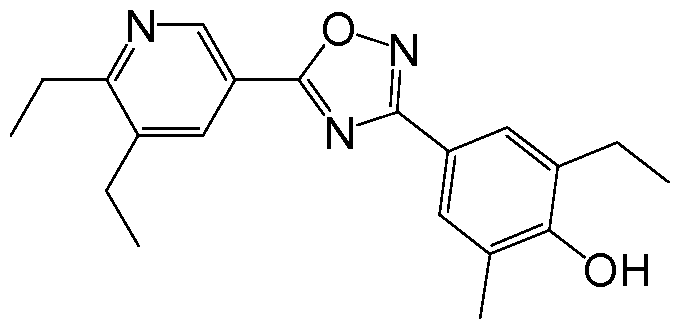
  • the title compound is prepared from commercially available 2-ethyl-6-methyl-phenol following literature procedures (G. Trapani, A. Latrofa, M. Franco, C. Altomare, E. Sanna, M. Usala, G. Biggio, G. Liso, J. Med. Chem. 41 (1998) 1846-1854; A. K. Chakraborti, G. Kaur, Tetrahedron 55 (1999) 13265-13268; E. Meyer, A. C. Joussef, H.
  • the mixture is stirred at 50 0 C for 18 h before it is cooled to rt, diluted with water (250 ml_), and extracted with TBME (2x250 ml_). The org. extracts are washed with water, and then concentrated.
  • the title compound is prepared following the procedures given in B. Xu, A. Stephens, G. Kirschenheuter, A. F. Greslin, X. Cheng, J. Sennelo, M. Cattaneo, M. L. Zighetti, A. Chen, S.-A. Kim, H. S. Kim, N. Bischofberger, G. Cook, K. A. Jacobson, J. Med. Chem. 45 (2002) 5694-5709.
  • the mixture is stirred at 0 0 C for 1 h, then at rt for 16 h before it is diluted with EA (250 ml_), washed with 1 N aq. NaOH solution (3x25 ml_), 1 N aq. KHSO 4 (25 ml.) and brine (25 ml_), dried over Na 2 SO 4 , filtered and concentrated.
  • EA 250 ml_
  • 1 N aq. NaOH solution 3x25 ml_
  • 1 N aq. KHSO 4 25 ml.
  • brine 25 ml_
  • Example 8 The racemic compound of Example 8 is resolved into pure enantiomers by prep. HPLC on a chiral stationary phase (ChiralPak ADH 4.6 x 250 mm, 5 ⁇ m, 20% EtOH containing 0.1 % diethylamine in heptane, 40 min, flow: 0.8 mL/min).
  • Example 47 the following examples are prepared in analogy to previous examples.
  • Example 13 The following examples are prepared in analogy to Example 13 starting from 3-ethyl-4- hydroxy-5-methyl-benzoic acid and N-hydroxy-6-isopropoxy-5-methyl-nicotinamidine.
  • GTP ⁇ S assay to determine EC 50 values GTP ⁇ S binding assays are performed in 96 well microtiter plates (Nunc, 442587) in a final volume of 200 ⁇ l, using membrane preparations of CHO cells expressing recombinant human S1 P1 receptor.
  • Assay conditions are 20 mM Hepes (Fluka, 54461 ), 100 mM NaCI (Fluka, 71378), 5 mM MgCI 2 (Fluka, 63064), 0.1% BSA (Calbiochem, 126609), 1 ⁇ M GDP (Sigma, G-7127), 2.5% DMSO (Fluka, 41644), 50 pM 35 S-GTP ⁇ S (Amersham Biosciences, SJ1320). The pH is 7.4. Test compounds are dissolved and diluted in 100% DMSO and pre-incubated at room temperature for 30 min in 150 ⁇ l of the above assay buffer, in the absence of 35 S-GTPyS.
  • the assay is incubated for 1 h at rt.
  • the assay is terminated by transfer of the reaction mixture to a Multiscreen plate (Millipore, MAHFC1 H60) using a cell harvester from Packard Biosciences, and the plates are washed with ice-cold 10 mM Na 2 HPO 4 ZNaH 2 PO 4 (70%/30%), dried, sealed at the bottom and, after addition of 25 ⁇ l MicroScint20 (Packard Biosciences, order# 6013621 ), sealed on the top.
  • Membrane-bound 35 S-GTPyS is measured with a TopCount from Packard Biosciences.
  • EC 50 is the concentration of agonist inducing 50 % of the maximal specific 35 S-GTPyS binding. Specific binding is determined by subtracting non-specific binding from maximal binding. Maximal binding is the amount of cpm bound to the Multiscreen plate in the presence of 10 ⁇ M of S1 P. Non-specific binding is the amount of binding in the absence of an agonist in the assay.
  • Agonistic activities (EC 50 values) of 62 from 92 exemplified compounds have been measured. Measured ECs 0 values are in the range of 0.1 to 9410 nM with an average of 492 nM. Agonistic activities of selected compounds are displayed in Table 1.
  • the efficacy of the compounds of Formula (I) is assessed by measuring the circulating lymphocytes after oral administration of 3 to 30 mg/kg of a compound of Formula (I) to normotensive male Wistar rats.
  • the animals are housed in climate-controlled conditions with a 12 h-light/dark cycle, and have free access to normal rat chow and drinking water. Blood is collected before and 3, 6 and 24 h after drug administration. Full blood is subjected to hematology using Advia Hematology system (Bayer Diagnostics, Zurich, Switzerland).
  • Table 2 shows the effect on lymphocyte counts 6 h after oral administration of 10 mg/kg of a compound of the present invention to normotensive male Wistar rats as compared to a group of animals treated with vehicle only. Lymphocyte counts 6 h after oral administration have been measured for 6 exemplified compounds and are in the range of -77% to -61% with an average of -68%.

Landscapes

  • Health & Medical Sciences (AREA)
  • Chemical & Material Sciences (AREA)
  • Organic Chemistry (AREA)
  • Animal Behavior & Ethology (AREA)
  • General Health & Medical Sciences (AREA)
  • Chemical Kinetics & Catalysis (AREA)
  • General Chemical & Material Sciences (AREA)
  • Medicinal Chemistry (AREA)
  • Nuclear Medicine, Radiotherapy & Molecular Imaging (AREA)
  • Veterinary Medicine (AREA)
  • Pharmacology & Pharmacy (AREA)
  • Life Sciences & Earth Sciences (AREA)
  • Public Health (AREA)
  • Bioinformatics & Cheminformatics (AREA)
  • Engineering & Computer Science (AREA)
  • Immunology (AREA)
  • Pulmonology (AREA)
  • Diabetes (AREA)
  • Dermatology (AREA)
  • Physical Education & Sports Medicine (AREA)
  • Rheumatology (AREA)
  • Biomedical Technology (AREA)
  • Endocrinology (AREA)
  • Pain & Pain Management (AREA)
  • Neurosurgery (AREA)
  • Neurology (AREA)
  • Hematology (AREA)
  • Transplantation (AREA)
  • Oncology (AREA)
  • Heart & Thoracic Surgery (AREA)
  • Psychiatry (AREA)
  • Ophthalmology & Optometry (AREA)
  • Cardiology (AREA)
  • Hospice & Palliative Care (AREA)
  • Orthopedic Medicine & Surgery (AREA)
  • Obesity (AREA)
  • Emergency Medicine (AREA)
  • Otolaryngology (AREA)
  • Urology & Nephrology (AREA)
  • Pharmaceuticals Containing Other Organic And Inorganic Compounds (AREA)

Abstract

The invention relates to pyridin-3-yl derivatives of Formula (I) wherein R1, R2, R3, R4, R5; R6 and A are as described in the description, their preparation and their use as pharmaceutically active compounds. Said compounds particularly act as immunomodulating agents.

Description

PYRIDIN-3-YL DERIVATIVES AS IMMUNOMODULATING AGENTS
Field of the invention
The present invention relates to S1 P1/EDG1 receptor agonists of Formula (I) and their use as active ingredients in the preparation of pharmaceutical compositions. The invention also concerns related aspects including processes for the preparation of the compounds, pharmaceutical compositions containing a compound of the Formula (I), and their use as compounds improving vascular function and as immunomodulating agents, either alone or in combination with other active compounds or therapies. A further aspect of the invention relates to novel compounds of Formula (II) that serve as intermediates to prepare compounds of Formula (I).
Background of the invention
The human immune system is designed to defend the body against foreign microorganisms and substances that cause infection or disease. Complex regulatory mechanisms ensure that the immune response is targeted against the intruding substance or organism and not against the host. In some cases, these control mechanisms are unregulated and autoimmune responses can develop. A consequence of the uncontrolled inflammatory response is severe organ, cell, tissue or joint damage. With current treatment, the whole immune system is usually suppressed and the body's ability to react to infections is also severely compromised. Typical drugs in this class include azathioprine, chlorambucil, cyclophosphamide, cyclosporin, or methotrexate. Corticosteroids which reduce inflammation and suppress the immune response, may cause side effects when used in long term treatment. Nonsteroidal anti-infammatory drugs (NSAIDs) can reduce pain and inflammation, however, they exhibit considerable side effects. Alternative treatments include agents that activate or block cytokine signaling.
Orally active compounds with immunomodulating properties, without compromising immune responses and with reduced side effects would significantly improve current treatments of uncontrolled inflammatory disease.
In the field of organ transplantation the host immune response must be suppressed to prevent organ rejection. Organ transplant recipients can experience some rejection even when they are taking immunosuppressive drugs. Rejection occurs most frequently in the first few weeks after transplantation, but rejection episodes can also happen months or even years after transplantation. Combinations of up to three or four medications are commonly used to give maximum protection against rejection while minimizing side effects. Current standard drugs used to treat the rejection of transplanted organs interfere with discrete intracellular pathways in the activation of T-type or B-type white blood cells. Examples of such drugs are cyclosporin, daclizumab, basiliximab, everolimus, or FK506, which interfere with cytokine release or signaling; azathioprine or leflunomide, which inhibit nucleotide synthesis; or 15-deoxyspergualin, an inhibitor of leukocyte differentiation.
The beneficial effects of broad immunosuppressive therapies relate to their effects; however, the generalized immunosuppression which these drugs produce diminishes the immune system's defense against infection and malignancies. Furthermore, standard immunosuppressive drugs are often used at high dosages and can cause or accelerate organ damage.
Description of the invention
The present invention provides novel compounds of Formula (I) that are agonists for the G protein-coupled receptor S1 P1/EDG1 and have a powerful and long-lasting immunomodulating effect which is achieved by reducing the number of circulating and infiltrating T- and B-lymphocytes, without affecting their maturation, memory, or expansion. The reduction of circulating T- / B-lymphocytes as a result of S1 P1/EDG1 agonism, possibly in combination with the observed improvement of endothelial cell layer function associated with S1 P1/EDG1 activation, makes such compounds useful to treat uncontrolled inflammatory disease and to improve vascular functionality.
The compounds of the present invention can be utilized alone or in combination with standard drugs inhibiting T-cell activation, to provide a new immunomodulating therapy with a reduced propensity for infections when compared to standard immunosuppressive therapy. Furthermore, the compounds of the present invention can be used in combination with reduced dosages of traditional immunosuppressant therapies, to provide on the one hand effective immunomodulating activity, while on the other hand reducing end organ damage associated with higher doses of standard immunosuppressive drugs. The observation of improved endothelial cell layer function associated with S1 P1/EDG1 activation provides additional benefits of compounds to improve vascular function. The nucleotide sequence and the amino acid sequence for the human S1 P1/EDG1 receptor are known in the art and are published in e.g.: HIa, T., and Maciag, T. J. Biol Chem. 265 (1990), 9308-9313; WO 91/15583 published 17 October 1991 ; WO 99/46277 published 16 September 1999. The potency and efficacy of the compounds of Formula (I) are assessed using a GTPγS assay to determine EC5O values and by measuring the circulating lymphocytes in the rat after oral administration, respectively (see in Examples).
The general terms used hereinbefore and hereinafter preferably have, within this disclosure, the following meanings, unless otherwise indicated:
Where the plural form is used for compounds, salts, pharmaceutical compositions, diseases and the like, this is intended to mean also a single compound, salt, or the like.
Any reference hereinbefore or hereinafter to a compound of Formula (I) is to be understood as referring also to salts, especially pharmaceutically acceptable salts, of a compound of Formula (I), as appropriate and expedient.
The term C-i-s-alkyl, alone or in combination with other groups, means saturated, branched or straight chain groups with one to five carbon atoms. Examples of Ci-5-alkyl groups are methyl, ethyl, n-propyl, /so-propyl, n-butyl, /so-butyl, n-pentyl, and /so-pentyl.
Likewise, the term
Figure imgf000004_0001
alone or in combination with other groups, means saturated, branched or straight chain groups with one to four carbon atoms. Examples of Ci-4-alkyl groups are methyl, ethyl, n-propyl, /so-propyl, n-butyl, and /so-butyl.
Likewise, the term C-ι-3-alkyl, alone or in combination with other groups, means saturated, branched or straight chain groups with one to three carbon atoms and represents a methyl, ethyl, n-propyl, or /so-propyl group; preferred are methyl and ethyl.
Likewise, the term C2-5-alkyl, alone or in combination with other groups, means saturated, branched or straight chain groups with two to five carbon atoms.
Likewise, the term C2-4-alkyl, alone or in combination with other groups, means saturated, branched or straight chain groups with two to four carbon atoms. Examples of C2-4-alkyl groups are ethyl, n-propyl, /so-propyl, n-butyl, and /so-butyl. The term C-M-alkoxy, alone or in combination with other groups, means an R-O group, wherein R is a C-M-alkyl. Examples of C-^-alkoxy groups are methoxy, ethoxy, propoxy, /so-propoxy, and /so-butoxy, preferred are methoxy, ethoxy, propoxy, and /so-propoxy.
The term C2-5-alkoxy, alone or in combination with other groups, means an R-O group, wherein R is a C2-5-alkyl. Examples of C2-5-alkoxy groups are ethoxy, propoxy, /so-propoxy, /so-butoxy, and /so-pentoxy.
The term halogen means fluoro, chloro, bromo or iodo, preferably fluoro or chloro, most preferably chloro.
Salts are preferably the pharmaceutically acceptable salts of the compounds of Formula (I).
The term "pharmaceutically acceptable salts" refers to non-toxic, inorganic or organic acid and/or base addition salts, Lit. e.g. "Salt selection for basic drugs", Int. J. Pharm. (1986), 33, 201-217.
The compounds of Formula (I) may contain one or more stereogenic or asymmetric centers, such as one or more asymmetric carbon atoms. Substituents at a double bond or a ring may be present in cis- (= Z-) or trans (= E-) form unless indicated otherwise. The compounds of Formula (I) may thus be present as mixtures of stereoisomers or preferably as pure stereoisomers. Mixtures of stereoisomers may be separated in a manner known to a person skilled in the art.
i) The invention relates to pyridin-3-yl derivatives of the Formula (I),
Figure imgf000005_0001
Formula (I)
wherein
A represents *-CONH-CH2-, *-CO-CH=CH-, "-CO-CH2CH2-,
Figure imgf000006_0001
wherein the asterisks indicate the bond that is linked to the pyridine group of Formula (I);
R1 represents hydrogen, C1-4-alkyl, or chloro;
R2 represents C1-5-alkyl or C1-4-alkoxy;
R3 represents hydrogen, d-4-alkyl, Ci-4-alkoxy, or halogen;
R4 represents hydrogen, C-^-alkyl, Ci-4-alkoxy, halogen, trifluoromethyl or trifluoromethoxy;
R5 represents 2,3-dihydroxypropyl, di-(hydroxy-Ci-4-alkyl)-Ci-4-alkyl, -CH2-(CH2)k- NHSO2R53, -(CH2)nCH(OH)-CH2-NHSO2R53, -CH2-(CH2X-NHCOR54, -(CH2)nCH(OH)-CH2- NHCOR54, -CH2-(CH2)n-CONR51R52, -CO-NHR51, 1-(3-carboxy-azetidinyl)-2-acetyl, 1-(2- carboxy-pyrrolidinyl)-2-acetyl, 1-(3-carboxy-pyrrolidinyl)-2-acetyl, 1-(3-carboxy-azetidinyl)-3- propionyl, 1-(2-carboxy-pyrrolidinyl)-3-propionyl, 1-(3-carboxy-pyrrolidinyl)-3-propionyl, -(CH2)nCH(OH)-CH2-NR51R52, hydroxy, hydroxy-C2-5-alkoxy, di-(hydroxy-Ci-4-alkyl)-Ci-4- alkoxy, 2,3-dihydroxy-propoxy, 2-hydroxy-3-methoxy-propoxy, -OCH2-(CH2)m-NR51R52, 2- [(azetidine-3-carboxylic acid)-1-yl]-ethoxy, 2-[(azetidine-3-carboxylic acid Ci-5-alkylester)-1- yl]-ethoxy, 2-[(pyrrolidine-3-carboxylic acid)-1-yl]-ethoxy, 2-[(pyrrolidine-3-carboxylic acid C1-5-alkylester)-1-yl]-ethoxy, -OCH2-CH(OH)-CH2-NR51R52, 3-[(azetidine-3-carboxylic acid)- 1-yl]-2-hydroxypropoxy, 3-[(azetidine-3-carboxylic acid C1-5-alkylester)-1-yl]-2- hydroxypropoxy, 2-hydroxy-3-[(pyrrolidine-3-carboxylic acid)-1-yl]-propoxy, 2-hydroxy-3- [(pyrrolidine-3-carboxylic acid C1-5-alkylester)-1-yl]-propoxy, 2-hydroxy-3-[(pyrrolidine-2- carboxylic acid)-1-yl]-propoxy, 2-hydroxy-3-[(pyrrolidine-2-carboxylic acid Ci-5-alkylester)-1- yl]-propoxy, -OCH2-(CH2)m-NHSO2R53, -OCH2-CH(OH)-CH2-NHSO2R53, -OCH2-(CH2)m- NHCOR54, -OCH2-CH(OH)-CH2-NHCOR54;
R51 represents hydrogen, d-3-alkyl, 2-hydroxyethyl, 2-hydroxy-1-hydroxymethyl-ethyl, 2,3- dihydroxypropyl, carboxymethyl, 1-(Ci-5-alkylcarboxy)methyl, 2-carboxyethyl, or 2-(Ci-5- alkylcarboxy)ethyl;
R52 represents hydrogen, methyl, or ethyl;
R53 represents C1-3-alkyl, methylamino, ethylamino, or dimethylamino;
R54 represents hydroxymethyl, hydroxyethyl, aminomethyl, methylaminomethyl, dimethylaminomethyl, aminoethyl, 2-methylamino-ethyl, or 2-dimethylamino-ethyl;
k represents the integer 1 , 2, or 3; m represents the integer 1 or 2; n represents O, 1 , or 2; and
R6 represents hydrogen, d-4-alkyl or halogen.
ii) Another embodiment of the invention relates to pyridin-3-yl derivatives according to embodiment i), wherein A represents
Figure imgf000007_0001
wherein the asterisks indicate the bond that is linked to the pyridine group of Formula (I). iii) Another embodiment of the invention relates to pyridin-3-yl derivatives according to embodiment i), wherein A represents
Figure imgf000008_0001
wherein the asterisks indicate the bond that is linked to the pyridine group of Formula (I).
iv) Another embodiment of the invention relates to pyridin-3-yl derivatives according to embodiment i), wherein A represents
Figure imgf000008_0002
(especially A represents
Figure imgf000008_0003
wherein the asterisks indicate the bond that is linked to the pyridine group of Formula (I).
v) Another embodiment of the invention relates to pyridin-3-yl derivatives according to embodiment i), wherein A represents
Figure imgf000008_0004
wherein the asterisks indicate the bond that is linked to the pyridine group of Formula (I). vi) Another embodiment of the invention relates to pyridin-3-yl derivatives according to embodiment i), wherein A represents
Figure imgf000009_0001
wherein the asterisk indicates the bond that is linked to the pyridine group of Formula (I).
vii) Another embodiment of the invention relates to pyridin-3-yl derivatives according to embodiment i), wherein A represents
Figure imgf000009_0002
viii) Another embodiment of the invention relates to pyridin-3-yl derivatives according to any one of the embodiments i) to vii), wherein R1 represents Ci-4-alkyl or chloro.
ix) Another embodiment of the invention relates to pyridin-3-yl derivatives according to any one of the embodiments i) to vii), wherein R1 represents Ci-4-alkyl.
x) Another embodiment of the invention relates to pyridin-3-yl derivatives according to any one of the embodiments i) to vi), wherein R1 represents methyl or ethyl.
xi) Another embodiment of the invention relates to pyridin-3-yl derivatives according to any one of the embodiments i) to vi), wherein R1 represents methyl.
xii) Another embodiment of the invention relates to pyridin-3-yl derivatives according to any one of the embodiments i) to xi), wherein R2 represents Ci-5-alkyl.
xiii) Another embodiment of the invention relates to pyridin-3-yl derivatives according to any one of the embodiments i) to xi), wherein R2 represents C2-4-alkyl.
xiv) Another embodiment of the invention relates to pyridin-3-yl derivatives according to any one of the embodiments i) to xi), wherein R2 represents ethyl, n-propyl, /so-propyl, or iso- butyl. xv) Another embodiment of the invention relates to pyridin-3-yl derivatives according to any one of the embodiments i) to xi), wherein R2 represents n-propyl, or /so-butyl.
xvi) Another embodiment of the invention relates to pyridin-3-yl derivatives according to any one of the embodiments i) to xi), wherein R2 represents d-4-alkoxy.
xvii) Another embodiment of the invention relates to pyridin-3-yl derivatives according to any one of the embodiments i) to xvi), wherein at least one of R3, R4 and R6 represents a group other than hydrogen.
xviii) Another embodiment of the invention relates to pyridin-3-yl derivatives according to any one of the embodiments i) to xvi), wherein R3 represents methyl or methoxy (especially methoxy), and R4 and R6 represent hydrogen.
xix) Another embodiment of the invention relates to pyridin-3-yl derivatives according to any one of the embodiments i) to xvi), wherein R3 represents hydrogen.
xx) Another embodiment of the invention relates to pyridin-3-yl derivatives according to any one of the embodiments i) to xvi), wherein R3 represents hydrogen; and R4 represents Ci-4- alkyl, or Ci-4-alkoxy; and R6 represents d-4-alkyl, or halogen.
xxi) Another embodiment of the invention relates to pyridin-3-yl derivatives according to any one of the embodiments i) to xvi), wherein R3 represents hydrogen, R4 represents Ci_3- alkyl, or methoxy (especially methyl, ethyl, or methoxy), and R6 represents methyl, ethyl, or halogen (especially chloro).
xxii) Another embodiment of the invention relates to pyridin-3-yl derivatives according to any one of the embodiments i) to xvi), wherein R3 represents hydrogen, and R4 and R6 represent a methyl group.
xxiii) Another embodiment of the invention relates to pyridin-3-yl derivatives according to any one of the embodiments i) to xvi), wherein R3 represents hydrogen, R4 represents a methyl group, and R6 represents an ethyl group. xxiv) Another embodiment of the invention relates to pyridin-3-yl derivatives according to any one of the embodiments i) to xvi), wherein R3 represents hydrogen, R4 represents a methoxy group, and R6 represents chloro.
xxv) Another embodiment of the invention relates to pyridin-3-yl derivatives according to any one of the embodiments i) to xvi), wherein R3 represents hydrogen, R4 represents a methyl group, and R6 represents chloro.
xxvi) Another embodiment of the invention relates to pyridin-3-yl derivatives according to any one of the embodiments i) to xxv), wherein R5 represents 2,3-dihydroxypropyl, di-
(hydroxy-Ci_4-alkyl)-Ci_4-alkyl, -CH2-(CH2)k-NHSO2R53,
Figure imgf000011_0001
-
CH2-(CH2)k-NHCOR54, -(CH^nCHpH^CH^NHCOR54, -CH2-(CH2)n-CONR51R52, -CO-
NHR51, -(CH2)nCH(OH)-CH2-NR51R52, hydroxy, hydroxy-C2-5-alkoxy, di-(hydroxy-C1-4-alkyl)-
C1-4-alkoxy, 2,3-dihydroxy-propoxy, 2-hydroxy-3-methoxy-propoxy, -OCH2-(CH2)m-NR51R52, -OCH2-CH(OH)-CH2-NR51R52, -OCH2-(CH2)m-NHSO2R53, -OCH2-CH(OH)-CH2-NHSO2R53, -
OCH2-(CH2)m-NHCOR54, or -OCH2-CH(OH)-CH2-NHCOR54.
xxvii) Another embodiment of the invention relates to pyridin-3-yl derivatives according to any one of the embodiments i) to xxv), wherein R5 represents 2,3-dihydroxypropyl, -CH H22- (CH2X-NR51R52, -CH2-(CH2)K-NHCOR54, -(CH2)nCH(OH)-CH2-NHCOR54, -CH2-(CH2)n- CONR51R52, -CO-NHR51, -(CH2)nCH(OH)-CH2-NR51R52, hydroxy-C2-5-alkoxy, di-(hydroxy-d. 4-alkyl)-Ci-4-alkoxy, 2,3-dihydroxy-propoxy, 2-hydroxy-3-methoxy-propoxy, -OCH2-(CH2)m- NR51R52, -OCH2-CH(OH)-CH2-NR51R52, -OCHHCH^-NHCOR54, or -OCH2-CH(OH)-CH2- NHCOR54 (especially R5 represents 2,3-dihydroxypropyl, -CH2-(CH2)k-NR51R52, -CH2- (CH2)K-NHCOR54, -(CH2)nCH(OH)-CH2-NHCOR54, -CH2-(CH2)n-CONR51R52,
-(CH2)nCH(OH)-CH2-NR51R52, hydroxy-C2-5-alkoxy, di-(hydroxy-Ci-4-alkyl)-Ci-4-alkoxy, 2,3- dihydroxy-propoxy, 2-hydroxy-3-methoxy-propoxy, -OCH2-(CH2)m-NR51R52, -OCH2-CH(OH)- CH2-NR51R52, -OCH2-(CH2)m-NHCOR54, Or -OCH2-CH(OH)-CH2-NHCOR54).
xxviii) Another embodiment of the invention relates to pyridin-3-yl derivatives according to any one of the embodiments i) to xxv), wherein R5 represents hydroxy-C2-5-alkoxy, di- (hydroxy-C1-4-alkyl)-C1-4-alkoxy, 2,3-dihydroxy-propoxy, -OCH2-(CH2)m-NR51R52, -OCH2- CH(OH)-CH2-NR51R52, -OCH2-(CH2)m-NHCOR54, or -OCH2-CH(OH)-CH2-NHCOR54.
xxix) Another embodiment of the invention relates to pyridin-3-yl derivatives according to any one of the embodiments i) to xxv), wherein R5 represents 3-hydroxy-2-hydroxymethyl- propoxy, 2,3-dihydroxy-propoxy, or -OCH2-CH(OH)-CH2-NHCOR54 (especially R5 represents 2,3-dihydroxy-propoxy or -OCH2-CH(OH)-CH2-NHCOR54, wherein R54 represents hydroxymethyl).
xxx) Another embodiment of the invention relates to pyridin-3-yl derivatives according to any one of the embodiments i) to xxv), wherein R5 represents -OCH2-CH(OH)-CH2- NHCOR54, wherein R54 represents hydroxymethyl.
xxxi) Another embodiment of the invention relates to pyridin-3-yl derivatives according to any one of the embodiments i) to xxv), wherein R5 represents 2,3-dihydroxy-propoxy.
xxxii) Another embodiment of the invention relates to pyridin-3-yl derivatives according to embodiment i), wherein A represents
Figure imgf000012_0001
(especially A represents
Figure imgf000012_0002
wherein the asterisks indicate the bond that is linked to the pyridine group of Formula (I); R1 represents methyl, ethyl, or chloro (especially methyl, or ethyl); R2 represents n-propyl, isobutyl, or isopropoxy (especially n-propyl or isobutyl); R3 represents hydrogen, methyl, or methoxy (especially hydrogen or methoxy); R4 represents hydrogen, methyl, ethyl or methoxy; R5 represents hydroxy-C2-5-alkoxy, di-(hydroxy-Ci-4-alkyl)-Ci.4-alkoxy, 2,3-dihydroxy- propoxy, -OCH2-CH(OH)-CH2-NR51R52, Or -OCH2-CH(OH)-CH2-NHCOR54 (especially R5 represents 2,3-dihydroxy-propoxy, Or -OCH2-CH(OH)-CH2-NHCOR54); R54 represents hydroxymethyl, methylaminomethyl, or 2-methylamino-ethyl; and R6 represents hydrogen, methyl, ethyl or chloro; wherein for the present embodiment the meanings of one or more of the substituents or groups may be replaced by the meaning(s) given for said substituent(s) or group(s) in any one of embodiments v) to vii), x), xi), xv), xvii) to xix), xxii) to xxv), and xxix) to xxxi).
xxxiii) Another embodiment of the invention relates to pyridin-3-yl derivatives according to embodiment i), wherein A represents
Figure imgf000013_0001
(especially A represents
Figure imgf000013_0002
wherein the asterisks indicate the bond that is linked to the pyridine group of Formula (I);
R1 represents hydrogen, C1-4-alkyl, or chloro;
R2 represents C1-5-alkyl or C1-4-alkoxy; R3 represents hydrogen;
R4 represents Ci-4-alkyl or Ci-4-alkoxy;
R5 represents hydroxy, hydroxy-C2-5-alkoxy, di-(hydroxy-Ci-4-alkyl)-Ci-4-alkoxy, 2,3- dihydroxy-propoxy, -OCH2-CH(OH)-CH2-NR51R52, Or -OCH2-CH(OH)-CH2-NHCOR54;
R51 represents hydrogen, 2-hydroxyethyl, or 2-hydroxy-1-hydroxymethyl-ethyl (especially hydrogen);
R52 represents hydrogen;
R54 represents hydroxymethyl; and
R6 represents Ci-4-alkyl or halogen; wherein for the present embodiment the meanings of one or more of the substituents or groups may be replaced by the meaning(s) given for said substituent(s) or group(s) in any one of embodiments vi) to xvi), xxi) to xxv), and xxix) to xxxi).
xxxiv) Examples of pyridin-3-yl derivatives according to Formula (I) are selected from: 3-{4-[5-(5-Chloro-6-isopropoxy-pyridin-3-yl)-[1 ,2,4]oxadiazol-3-yl]-2,6-dimethyl-phenoxy}- propane-1 ,2-diol; N-(3-{4-[5-(5-Chloro-6-isopropoxy-pyridin-3-yl)-[1 ,2,4]oxadiazol-3-yl]-2,6-dimethyl- phenoxy}-2-hydroxy-propyl)-2-hydroxy-acetamide;
3-{4-[5-(6-lsobutyl-5-methyl-pyridin-3-yl)-[1 ,2,4]oxadiazol-3-yl]-2,6-dimethyl-phenoxy}- propane-1 ,2-diol; 2-Hydroxy-N-(2-hydroxy-3-{4-[5-(6-isobutyl-5-methyl-pyridin-3-yl)-[1 ,2,4]oxadiazol-3-yl]-2,6- dimethyl-phenoxy}-propyl)-acetamide;
N-(3-{2-Ethyl-4-[5-(6-isobutyl-5-methyl-pyridin-3-yl)-[1 ,2,4]oxadiazol-3-yl]-6-methyl- phenoxy}-2-hydroxy-propyl)-2-hydroxy-acetamide;
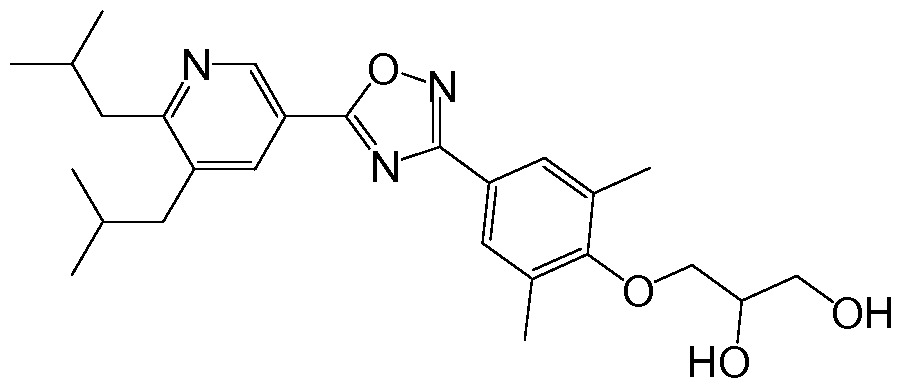
3-{4-[5-(5,6-Diisobutyl-pyridin-3-yl)-[1 ,2,4]oxadiazol-3-yl]-2,6-dimethyl-phenoxy}-propane- 1 ,2-diol;
N-(3-{4-[5-(5,6-Diethyl-pyridin-3-yl)-[1 ,2,4]oxadiazol-3-yl]-2-ethyl-6-methyl-phenoxy}-2- hydroxy-propyl)-2-hydroxy-acetamide;
2-Hydroxy-N-(2-hydroxy-3-{4-[5-(6-isobutyl-5-methyl-pyridin-3-yl)-[1 ,2,4]oxadiazol-3-yl]-3- methyl-phenoxy}-propyl)-acetamide; N-(3-{2-Chloro-4-[5-(6-isobutyl-5-methyl-pyridin-3-yl)-[1 ,2,4]oxadiazol-3-yl]-6-methyl- phenoxy}-2-hydroxy-propyl)-2-hydroxy-acetamide;
N-(3-{2-Chloro-4-[5-(6-isobutyl-5-methyl-pyridin-3-yl)-[1 ,2,4]oxadiazol-3-yl]-6-methoxy- phenoxy}-2-hydroxy-propyl)-2-hydroxy-acetamide;
N-((R)-3-{2-Ethyl-4-[5-(6-isobutyl-5-methyl-pyridin-3-yl)-[1 ,2,4]oxadiazol-3-yl]-6-methyl- phenoxy}-2-hydroxy-propyl)-2-hydroxy-acetamide;
N-((S)-3-{2-Ethyl-4-[3-(6-isobutyl-5-methyl-pyridin-3-yl)-[1 ,2,4]oxadiazol-5-yl]-6-methyl- phenoxy}-2-hydroxy-propyl)-2-hydroxy-acetamide;
N-((S)-3-{2-Ethyl-4-[5-(6-isobutyl-pyridin-3-yl)-[1 ,2,4]oxadiazol-3-yl]-6-methyl-phenoxy}-2- hydroxy-propyl)-2-hydroxy-acetamide; (S)-3-{2-Ethyl-4-[5-(5-ethyl-6-isobutyl-pyridin-3-yl)-[1 ,2,4]oxadiazol-3-yl]-6-methyl-phenoxy}- propane-1 ,2-diol;
N-(3-{2-Ethyl-4-[5-(5-ethyl-6-isobutyl-pyridin-3-yl)-[1 ,2,4]oxadiazol-3-yl]-6-methyl-phenoxy}-
2-hydroxy-propyl)-2-hydroxy-acetamide;
(R)-3-{2-Ethyl-4-[5-(6-isopropoxy-5-methyl-pyridin-3-yl)-[1 ,2,4]oxadiazol-3-yl]-6-methyl- phenoxy}-propane-1 ,2-diol;
(S)-3-{2-Ethyl-4-[5-(6-isopropoxy-5-methyl-pyridin-3-yl)-[1 ,2,4]oxadiazol-3-yl]-6-methyl- phenoxy}-propane-1 ,2-diol;
N-((R)-3-{2-Ethyl-4-[5-(6-isopropoxy-5-methyl-pyridin-3-yl)-[1 ,2,4]oxadiazol-3-yl]-6-methyl- phenoxy}-2-hydroxy-propyl)-2-hydroxy-acetamide; N-((S)-3-{2-Ethyl-4-[5-(6-isopropoxy-5-methyl-pyridin-3-yl)-[1 ,2,4]oxadiazol-3-yl]-6-methyl- phenoxy}-2-hydroxy-propyl)-2-hydroxy-acetamide; 3-{2-Ethyl-4-[5-(6-isopropoxy-5-methyl-pyridin-3-yl)-[1 ,2,4]oxadiazol-3-yl]-6-methyl-phenyl}- N-(2-hydroxy-ethyl)-propionamide;
(R)-3-{2-Ethyl-4-[3-(6-isopropoxy-5-methyl-pyridin-3-yl)-[1 ,2,4]oxadiazol-5-yl]-6-methyl- phenoxy}-propane-1 ,2-diol; (S)-3-{2-Ethyl-4-[3-(6-isopropoxy-5-methyl-pyridin-3-yl)-[1 ,2,4]oxadiazol-5-yl]-6-methyl- phenoxy}-propane-1 ,2-diol; and
3-{2-Ethyl-4-[5-(6-isopropoxy-5-methyl-pyridin-3-yl)-[1 ,2,4]oxadiazol-3-yl]-6-methyl-phenyl}- propionic acid.
xxxv) In another embodiment examples of pyridin-3-yl derivatives according to Formula (I) are selected from:
(R)-3-{4-[5-(5-Chloro-6-isopropoxy-pyridin-3-yl)-[1 ,2,4]oxadiazol-3-yl]-2,6-dimethyl- phenoxy}-propane-1 ,2-diol;
(S)-3-{4-[5-(5-Chloro-6-isopropoxy-pyridin-3-yl)-[1 ,2,4]oxadiazol-3-yl]-2,6-dimethyl- phenoxy}-propane-1 ,2-diol;
N-((R)-3-{4-[5-(5-Chloro-6-isopropoxy-pyridin-3-yl)-[1 ,2,4]oxadiazol-3-yl]-2,6-dimethyl- phenoxy}-2-hydroxy-propyl)-2-hydroxy-acetamide;
N-((S)-3-{4-[5-(5-Chloro-6-isopropoxy-pyridin-3-yl)-[1 ,2,4]oxadiazol-3-yl]-2,6-dimethyl- phenoxy}-2-hydroxy-propyl)-2-hydroxy-acetamide; (R)-3-{4-[5-(6-lsobutyl-5-methyl-pyridin-3-yl)-[1 ,2,4]oxadiazol-3-yl]-2,6-dimethyl-phenoxy}- propane-1 ,2-diol;
(S)-3-{4-[5-(6-lsobutyl-5-methyl-pyridin-3-yl)-[1 ,2,4]oxadiazol-3-yl]-2,6-dimethyl-phenoxy}- propane-1 ,2-diol;
2-Hydroxy-N-((R)-2-hydroxy-3-{4-[5-(6-isobutyl-5-methyl-pyridin-3-yl)-[1 ,2,4]oxadiazol-3-yl]- 2,6-dimethyl-phenoxy}-propyl)-acetamide;
2-Hydroxy-N-((S)-2-hydroxy-3-{4-[5-(6-isobutyl-5-methyl-pyridin-3-yl)-[1 ,2,4]oxadiazol-3-yl]-
2,6-dimethyl-phenoxy}-propyl)-acetamide;
N-((R)-3-{2-Ethyl-4-[5-(6-isobutyl-5-methyl-pyridin-3-yl)-[1 ,2,4]oxadiazol-3-yl]-6-methyl- phenoxy}-2-hydroxy-propyl)-2-hydroxy-acetamide; N-((S)-3-{2-Ethyl-4-[5-(6-isobutyl-5-methyl-pyridin-3-yl)-[1 ,2,4]oxadiazol-3-yl]-6-methyl- phenoxy}-2-hydroxy-propyl)-2-hydroxy-acetamide;
(R)-3-{4-[5-(5,6-Diisobutyl-pyridin-3-yl)-[1 ,2,4]oxadiazol-3-yl]-2,6-dimethyl-phenoxy}- propane-1 ,2-diol;
(S)-3-{4-[5-(5,6-Diisobutyl-pyridin-3-yl)-[1 ,2,4]oxadiazol-3-yl]-2,6-dimethyl-phenoxy}- propane-1 ,2-diol; N-((R)-3-{4-[5-(5,6-Diethyl-pyridin-3-yl)-[1 ,2,4]oxadiazol-3-yl]-2-ethyl-6-methyl-phenoxy}-2- hydroxy-propyl)-2-hydroxy-acetamide;
N-((S)-3-{4-[5-(5,6-Diethyl-pyridin-3-yl)-[1 ,2,4]oxadiazol-3-yl]-2-ethyl-6-methyl-phenoxy}-2- hydroxy-propyl)-2-hydroxy-acetamide; 2-Hydroxy-N-((R)-2-hydroxy-3-{4-[5-(6-isobutyl-5-methyl-pyridin-3-yl)-[1 ,2,4]oxadiazol-3-yl]-
3-methyl-phenoxy}-propyl)-acetamide;
2-Hydroxy-N-((S)-2-hydroxy-3-{4-[5-(6-isobutyl-5-methyl-pyridin-3-yl)-[1 ,2,4]oxadiazol-3-yl]-
3-methyl-phenoxy}-propyl)-acetamide;
N-((R)-3-{2-Chloro-4-[5-(6-isobutyl-5-methyl-pyridin-3-yl)-[1 ,2,4]oxadiazol-3-yl]-6-methyl- phenoxy}-2-hydroxy-propyl)-2-hydroxy-acetamide;
N-((S)-3-{2-Chloro-4-[5-(6-isobutyl-5-methyl-pyridin-3-yl)-[1 ,2,4]oxadiazol-3-yl]-6-methyl- phenoxy}-2-hydroxy-propyl)-2-hydroxy-acetamide;
N-((R)-3-{2-Chloro-4-[5-(6-isobutyl-5-methyl-pyridin-3-yl)-[1 ,2,4]oxadiazol-3-yl]-6-methoxy- phenoxy}-2-hydroxy-propyl)-2-hydroxy-acetamide; N-((S)-3-{2-Chloro-4-[5-(6-isobutyl-5-methyl-pyridin-3-yl)-[1 ,2,4]oxadiazol-3-yl]-6-methoxy- phenoxy}-2-hydroxy-propyl)-2-hydroxy-acetamide;
N-((R)-3-{2-Ethyl-4-[5-(6-isobutyl-5-methyl-pyridin-3-yl)-[1 ,2,4]oxadiazol-3-yl]-6-methyl- phenoxy}-2-hydroxy-propyl)-2-hydroxy-acetamide;
N-((S)-3-{2-Ethyl-4-[3-(6-isobutyl-5-methyl-pyridin-3-yl)-[1 ,2,4]oxadiazol-5-yl]-6-methyl- phenoxy}-2-hydroxy-propyl)-2-hydroxy-acetamide;
N-((S)-3-{2-Ethyl-4-[5-(6-isobutyl-pyridin-3-yl)-[1 ,2,4]oxadiazol-3-yl]-6-methyl-phenoxy}-2- hydroxy-propyl)-2-hydroxy-acetamide;
(S)-3-{2-Ethyl-4-[5-(5-ethyl-6-isobutyl-pyridin-3-yl)-[1 ,2,4]oxadiazol-3-yl]-6-methyl-phenoxy}- propane-1 ,2-diol; N-((R)-3-{2-Ethyl-4-[5-(5-ethyl-6-isobutyl-pyridin-3-yl)-[1 ,2,4]oxadiazol-3-yl]-6-methyl- phenoxy}-2-hydroxy-propyl)-2-hydroxy-acetamide;
N-((S)-3-{2-Ethyl-4-[5-(5-ethyl-6-isobutyl-pyridin-3-yl)-[1 ,2,4]oxadiazol-3-yl]-6-methyl- phenoxy}-2-hydroxy-propyl)-2-hydroxy-acetamide;
(R)-3-{2-Ethyl-4-[5-(6-isopropoxy-5-methyl-pyridin-3-yl)-[1 ,2,4]oxadiazol-3-yl]-6-methyl- phenoxy}-propane-1 ,2-diol;
(S)-3-{2-Ethyl-4-[5-(6-isopropoxy-5-methyl-pyridin-3-yl)-[1 ,2,4]oxadiazol-3-yl]-6-methyl- phenoxy}-propane-1 ,2-diol;
N-((R)-3-{2-Ethyl-4-[5-(6-isopropoxy-5-methyl-pyridin-3-yl)-[1 ,2,4]oxadiazol-3-yl]-6-methyl- phenoxy}-2-hydroxy-propyl)-2-hydroxy-acetamide; N-((S)-3-{2-Ethyl-4-[5-(6-isopropoxy-5-methyl-pyridin-3-yl)-[1 ,2,4]oxadiazol-3-yl]-6-methyl- phenoxy}-2-hydroxy-propyl)-2-hydroxy-acetamide; 3-{2-Ethyl-4-[5-(6-isopropoxy-5-methyl-pyridin-3-yl)-[1 ,2,4]oxadiazol-3-yl]-6-methyl-phenyl}- N-(2-hydroxy-ethyl)-propionamide;
(R)-3-{2-Ethyl-4-[3-(6-isopropoxy-5-methyl-pyridin-3-yl)-[1 ,2,4]oxadiazol-5-yl]-6-methyl- phenoxy}-propane-1 ,2-diol; (S)-3-{2-Ethyl-4-[3-(6-isopropoxy-5-methyl-pyridin-3-yl)-[1 ,2,4]oxadiazol-5-yl]-6-methyl- phenoxy}-propane-1 ,2-diol; and
3-{2-Ethyl-4-[5-(6-isopropoxy-5-methyl-pyridin-3-yl)-[1 ,2,4]oxadiazol-3-yl]-6-methyl-phenyl}- propionic acid.
xxxvi) A further aspect of the invention relates to novel pyridin-3-yl derivatives of Formula (H)
Figure imgf000017_0001
Formula (H)
wherein A, R1, R2, and n are as defined in claim 1 ; R3 represents hydrogen; R4 represents C1-4-alkyl, or C1-4-alkoxy; and R6 represents C1-4-alkyl, or halogen.
The compounds of Formula (I) and their pharmaceutically acceptable salts can be used as medicaments, e.g. in the form of pharmaceutical compositions for enteral or parental administration.
The production of the pharmaceutical compositions can be effected in a manner which will be familiar to any person skilled in the art (see for example Mark Gibson, Editor, Pharmaceutical Preformulation and Formulation, IHS Health Group, Englewood, CO, USA, 2001 ; Remington, The Science and Practice of Pharmacy, 20th Edition, Philadelphia College of Pharmacy and Science) by bringing the described compounds of Formula (I) or their pharmaceutically acceptable salts, optionally in combination with other therapeutically valuable substances, into a galenical administration form together with suitable, non-toxic, inert, pharmaceutically acceptable solid or liquid carrier materials and, if desired, usual pharmaceutical adjuvants. The pharmaceutical compositions comprising a compound of Formula (I) are useful for the prevention and/or treatment of diseases or disorders associated with an activated immune system.
Such diseases or disorders are selected from the group consisting of rejection of transplanted organs, tissue or cells; graft-versus-host diseases brought about by transplantation; autoimmune syndromes including rheumatoid arthritis; systemic lupus erythematosus; antiphospholipid syndrome; Hashimoto's thyroiditis; lymphocytic thyroiditis; multiple sclerosis; myasthenia gravis; type I diabetes; uveitis; episcleritis; scleritis; Kawasaki's disease, uveo-retinitis; posterior uveitis; uveitis associated with Behcet's disease; uveomeningitis syndrome; allergic encephalomyelitis; chronic allograft vasculopathy; post-infectious autoimmune diseases including rheumatic fever and postinfectious glomerulonephritis; inflammatory and hyperproliferative skin diseases; psoriasis; psoriatic arthritis; atopic dermatitis; myopathy; myositis; osteomyelitis; contact dermatitis; eczematous dermatitis; seborrhoeic dermatitis; lichen planus; pemphigus; bullous pemphigoid; epidermolysis bullosa; urticaria; angioedema; vasculitis; erythema; cutaneous eosinophilia; acne; scleroderma; alopecia areata; keratoconjunctivitis; vernal conjunctivitis; keratitis; herpetic keratitis; dystrophia epithelialis corneae; corneal leukoma; ocular pemphigus; Mooren's ulcer; ulcerative keratitis; scleritis; Graves' ophthalmopathy; Vogt- Koyanagi-Harada syndrome; sarcoidosis; pollen allergies; reversible obstructive airway disease; bronchial asthma; allergic asthma; intrinsic asthma; extrinsic asthma; dust asthma; chronic or inveterate asthma; late asthma and airway hyper-responsiveness; bronchiolitis; bronchitis; endometriosis; orchitis; gastric ulcers; ischemic bowel diseases; inflammatory bowel diseases; necrotizing enterocolitis; intestinal lesions associated with thermal burns; coeliac disease; proctitis; eosinophilic gastroenteritis; mastocytosis; Crohn's disease; ulcerative colitis; vascular damage caused by ischemic diseases and thrombosis; atherosclerosis; fatty heart; myocarditis; cardiac infarction; aortitis syndrome; cachexia due to viral disease; vascular thrombosis; migraine; rhinitis; eczema; interstitial nephritis; IgA- induced nephropathy; Goodpasture's syndrome; hemolytic-uremic syndrome; diabetic nephropathy; glomerulosclerosis; glomerulonephritis; tubulointerstitial nephritis; interstitial cystitis; multiple myositis; Guillain-Barre syndrome; Meniere's disease; polyneuritis; multiple neuritis; myelitis; mononeuritis; radiculopathy; hyperthyroidism; Basedow's disease; thyrotoxicosis; pure red cell aplasia; aplastic anemia; hypoplastic anemia; idiopathic thrombocytopenic purpura; autoimmune hemolytic anemia; autoimmune thrombocytopenia; agranulocytosis; pernicious anemia; megaloblastic anemia; anerythroplasia; osteoporosis; fibroid lung; idiopathic interstitial pneumonia; dermatomyositis; leukoderma vulgaris; ichthyosis vulgaris; photoallergy sensitivity; cutaneous T cell lymphoma; polyarteritis nodosa; Huntington's chorea; Sydenham's chorea; myocardosis; myocarditis; scleroderma; Wegener's granuloma; Sjogren's syndrome; adiposis; eosinophilic fascitis; lesions of gingiva, periodontium, alveolar bone, substantia ossea dentis; male pattern alopecia or alopecia senilis; muscular dystrophy; pyoderma; Sezary's syndrome; hypophysitis; chronic adrenal insufficiency; Addison's disease; ischemia-reperfusion injury of organs which occurs upon preservation; endotoxin shock; pseudomembranous colitis; colitis caused by drug or radiation; ischemic acute renal insufficiency; chronic renal insufficiency; lung cancer; malignancy of lymphoid origin; acute or chronic lymphocytic leukemias; lymphoma; pulmonary emphysema; cataracta; siderosis; retinitis pigmentosa; senile macular degeneration; vitreal scarring; corneal alkali burn; dermatitis erythema; ballous dermatitis; cement dermatitis; gingivitis; periodontitis; sepsis; pancreatitis; peripheral artery disease; carcinogenesis; solid cancer tumors; metastasis of carcinoma; hypobaropathy; autoimmune hepatitis; primary biliary cirrhosis; sclerosing cholangitis; partial liver resection; acute liver necrosis; cirrhosis; alcoholic cirrhosis; hepatic failure; fulminant hepatic failure; late-onset hepatic failure; and "acute-on-chronic" liver failure.
Preferred diseases or disorders to be treated and/or prevented with the compounds of Formula (I) are selected from the group consisting of rejection of transplanted organs such as kidney, liver, heart, lung, pancreas, cornea, and skin; graft-versus-host diseases brought about by stem cell transplantation; autoimmune syndromes including rheumatoid arthritis, multiple sclerosis, inflammatory bowel diseases such as Crohn's disease and ulcerative colitis, psoriasis, psoriatic arthritis, thyroiditis such as Hashimoto's thyroiditis, uveo-retinitis; atopic diseases such as rhinitis, conjunctivitis, dermatitis; asthma; type I diabetes; post- infectious autoimmune diseases including rheumatic fever and post-infectious glomerulonephritis; solid cancers and tumor metastasis.
Particularly preferred diseases or disorders to be treated and/or prevented with the compounds of Formula (I) are selected from the group consisting of rejection of transplanted organs selected from kidney, liver, heart and lung; graft-versus-host diseases brought about by stem cell transplantation; autoimmune syndromes selected from rheumatoid arthritis, multiple sclerosis, psoriasis, psoriatic arthritis, Crohn's disease, and Hashimoto's thyroiditis; and atopic dermatitis. The present invention also relates to a method for the prevention or treatment of a disease or disorder mentioned herein comprising administering to a subject a pharmaceutically active amount of a compound of Formula (I).
Furthermore, compounds of the Formula (I) are also useful, in combination with one or several immunomodulating agents, for the prevention and/or treatment of the diseases and disorders mentioned herein. According to a preferred embodiment of the invention, said agents are selected from the group consisting of immunosuppressants, corticosteroids, NSAI D's, cytotoxic drugs, adhesion molecule inhibitors, cytokines, cytokine inhibitors, cytokine receptor antagonists and recombinant cytokine receptors.
The present invention also relates to the use of a compound of Formula (I) for the preparation of a pharmaceutical composition, optionally for use in combination with one or several immunomodulating agents, for the prevention or treatment of the diseases and disorders mentioned herein.
The compounds of Formula (I) can be manufactured by the methods given below, by the methods given in the Examples or by analogous methods. Optimum reaction conditions may vary with the particular reactants or solvents used, but such conditions can be determined by a person skilled in the art by routine optimisation procedures.
Compounds of the Formula (I) of the present invention can be prepared according to the general sequence of reactions outlined below. Only a few of the synthetic possibilities leading to compounds of Formula (I) are described.
Figure imgf000020_0001
Structure 1 Structure 2
In case A represents -CO-CH=CH-, the compounds of Formula (I) may be prepared by reacting a compound of Structure 1 with a compound of Structure 2 in the presence of a base or an acid. The functional groups present in the residues R3 to R6 may require temporary protection or may even be introduced in additional steps that follow the condensation reaction. Compounds of Formula (I) wherein A represents -CO-CH2-CH2- may be prepared by reacting a compound of Formula (I) wherein A represents -CO- CH=CH- with hydrogen in the presence of a catalyst such as Pd/C, Pt/C, PtO2, etc. in a solvent such as EtOH, MeOH, THF, etc. or mixtures thereof.
Figure imgf000021_0001
Structure 3 Structure 4
Compounds of Structure 1 may be prepared by reacting a compound of Structure 3 with a methyl Grignard reagent or by treating a compound of Structure 4 with 2 eq. of methyllithium in a solvent such as ether, THF, etc. at temperatures between -20 and 500C.
The Weinreb amide compound of Structure 3 is prepared by treating a compound of
Structure 4 with N,O-dimethylhydroxylamine hydrochloride in the presence of coupling reagent such as EDC, DCC, etc. (M. Mentzel, H. M. R. Hoffmann, N-Methoxy N-methyl amides (Weinreb amides) in modern organic synthesis, Journal fuer Praktische
Chemie/Chemiker-Zeitung 339 (1997), 517-524; J. Singh, N. Satyamurthi, I. S. Aidhen, The growing synthetic utility of Weinreb's amide, Journal fuer Praktische Chemie (Weinheim,
Germany) 342 (2000) 340-347; V. K. Khlestkin, D. G. Mazhukin, Recent advances in the application of N,O-dialkylhydroxylamines in organic chemistry, Current Organic Chemistry 7 (2003), 967-993).
Figure imgf000021_0002
Structure 5
Compounds of Formula (I) wherein A represents -CO-NH-CH2- may be prepared by coupling a compound of Structure 5 with a compound with Structure 4 by using a coupling reagent such as EDC, DCC, TBTU, PyBOP, etc. or by coupling a compound of Structure 5 with the corresponding acid chloride or bromide of a compound of Structure 4. Compounds of Formula (I) which represent a 5-pyridin-3-yl-[1 ,2,4]oxadiazole derivative, are prepared by reacting a compound of Structure 6 in a solvent such as dioxane, THF, DME, xylene, toluene, benzene, pyridine, DMF, DCM, acetic acid, TFA, etc. at rt or elevated temperatures in the presence or absence of auxiliaries such as acids (e.g. TFA, acetic acid, HCI, etc.), bases (e.g. NaH, NaOAc, Na2CO3, K2CO3, NEt3, etc.), tetraalkylammonium salts, or water removing agents (e.g. oxalyl chloride, a carboxylic acid anhydride, POCI3, PCI5, P4O10, molecular sieves, Burgess reagent, etc.) (Lit: e.g. A. R. Gangloff, J. Litvak, E. J. Shelton, D. Sperandio, V. R. Wang, K. D. Rice, Tetrahedron Lett. 42 (2001 ), 1441-1443; T. Suzuki, K. Iwaoka, N. Imanishi, Y. Nagakura, K. Miyta, H. Nakahara, M. Ohta, T. Mase, Chem. Pharm. Bull. 47 (1999), 120-122; R. F. Poulain, A. L. Tartar, B. P. Deprez, Tetrahedron Lett. 42 (2001 ), 1495-1498; R. M. Srivastava, F. J. S. Oliveira, D. S. Machado, R. M. Souto-Maior, Synthetic Commun. 29 (1999), 1437-1450; E. O. John, J. M. Shreeve, Inorganic Chemistry 27 (1988), 3100-3104; B. Kaboudin, K. Navaee, Heterocycles 60 (2003), 2287-2292).
Figure imgf000022_0001
Compounds of Structure 6 may be prepared by reacting a compound of Structure 4 with a compound of Structure 7 in a solvent such as DMF, THF, DCM, etc. in the presence or absence of one ore more coupling agents such as TBTU, DCC, EDC, HBTU, HOBt, CDI, etc. and in the presence or absence of a base such as NEt3, DIPEA, NaH, K2CO3, etc. (Lit: e.g. A. Hamze, J.-F. Hernandez, P. Fulcrand, J. Martinez, J. Org. Chem. 68 (2003) 7316- 7321 ; and the literature cited above).
Figure imgf000022_0002
Compounds of Formula (I) which represent a 3-pyridin-3-yl-[1 ,2,4]oxadiazole derivative are prepared in an analogous fashion (Lit. e.g. C. T. Brain, J. M. Paul, Y. Loong, P. J. Oakley, Tetrahedron Lett. 40 (1999) 3275-3278) by reacting a compound of Structure 8 with a compound of Structure 9 and subsequent cyclisation of the corresponding hydroxyamidine ester intermediate.
Figure imgf000023_0001
Structure 8 Structure 9
Compounds of Structure 7 and 8 may be prepared by reacting a compound of Structure 10 and 11 , respectively, with hydroxylamine or one of its salts in a solvent such as MeOH,
EtOH, pyridine, etc. in the presence or absence of a base such as Na2CO3, K2CO3, NEt3,
KOtBu, etc. (Lit: e.g. T. Suzuki, K. Iwaoka, N. Imanishi, Y. Nagakura, K. Miyta, H.
Nakahara, M. Ohta, T. Mase, Chem. Pharm. Bull. 47 (1999), 120-122; J. Cui, D. Crich, D.
Wink, M. Lam, A. L. Rheingold, D. A. Case, W. T. Fu, Y. Zhou, M. Rao, A. J. Olson, M. E. Johnson, Bioorg. Med. Chem. 11 (2003), 3379-3392; R. Miller, F. Lang, Z. J. Song, D.
Zewge, WO 2004/035538 (Merck & Co., Inc., USA); B. Kaboudin, K. Navaee, Heterocycles
60 (2003), 2287-2292).
Figure imgf000023_0002
Structure 10 Structure 11
Depending on the nature of the functionalities present in the residues R3 to R6 in Structures 2, 5, 6, 7, 9, and 10, these functionalities may require temporary protection. Appropriate protecting groups are known to a person skilled in the art and include e.g. a benzyl or a trialkylsilyl group to protect an alcohol, a ketal to protect a diol, etc. These protecting groups may be employed according to standard methodology (e.g. T. W. Greene, P. G. M. Wuts, Protective Groups in Organic Synthesis, 3rd Edition, Wiley New York, 1991 ; P. J. Kocienski, Protecting Groups, Thieme Stuttgart, 1994). Alternatively, the desired residues R3 to R6, in particular R5, may also be introduced in later steps that follow the coupling of the pyridine compounds of Structure 1 , 4, 8 or 1 1 with the phenyl derivatives of Stucture 2, 5, 7, 9 or 10 by using a suitable precursor of a compound of Structure 2, 5, 7, 9 and 10. The phenyl compounds of Structure 2, 5, 7, 9 and 10 or their precursors are either commercially available or are prepared according to procedures known to a person skilled in the art.
Figure imgf000024_0001
Compounds of Formula (I) which represent a 2-pyridin-3-yl-[1 ,3,4]oxadiazole or a 2-pyridin- 3-yl-[1 ,3,4]thiadiazole derivative are prepared similarly by reacting a compound of Structure 4 with hydrazine (by using a coupling reagent such as TBTU, DCC, EDC, HBTU, PyPOB, HOBt, CDI, etc.) to form a compound of Structure 12 which is then coupled with a compound of Structure 9 to give a compound of Structure 13. A compound of Structure 13 can also be prepared by following the reverse reaction order i.e. by first coupling a compound of Structure 9 with hydrazine followed by reacting the corresponding hydrazide intermediate with a compound of Structure 4. Dehydration of a compound of Structure 13 to form the desired 2-pyridin-3-yl-[1 ,3,4]oxadiazole derivative is affected by treating a compound of Structure 13 with a reagent such as POCI3, CCI4 or CBr4 in combination with PPh3, P2O5, Burgess reagent, etc. in a solvent such as toluene, MeCN, dioxane, THF, CHCI3, etc. at temperatures between 20 and 1200C in the presence or absence of microwave irradiation. (Lit. e.g. M. A. Garcia, S. Martin-Santamaria, M. Cacho, F. Moreno de Ia Llave, M. Julian, A. Martinez, B. De Pascual-Teresa, A. Ramos, J. Med. Chem. 48 (2005) 4068-4075, C. T. Brain, J. M. Paul, Y. Loong, P. J. Oakley, Tetrahedron Lett. 40 (1999) 3275-3278). Likewise, 2-pyrid i n-3-yl-[1 , 3, 4]th iad iazole derivatives are obtained by cyclising a compound of Sturcture 13 with Lawesson's reagent optionally in combination with P2S5 in the presence or absence of a solvent such as pyridine, toluene, THF, MeCN, etc. at elevated temperatures with or without microwave irradiation (Lit. e.g. A. A. Kiryanov, P. Sampson, A. J. Seed, J. Org. Chem. 66 (2001 ) 7925-7929).
Figure imgf000025_0001
Structure 14
Compounds of Formula (I) which represent a 5-pyridin-3-yl-oxazole or a 5-pyridin-3-yl- thiazole derivative are prepared by treating a compound of Structure 14 either with POCI3, PCI5, I2 in combination with PPh3 and NEt3, trifluoroacetic anhydride, Burgess reagent, etc. in a solvent such as toluene, benzene, dioxane, THF, etc. at temperatures between 20 and 1200C or with Lawesson's reagent optionally in combination with P2S5 in the presence or absence of a solvent such as pyridine, toluene, THF, MeCN, etc. at elevated temperatures with or without microwave irradiation as mentioned above (Lit. e.g. N. Sato, T. Shibata, M. Jitsuoka, T. Ohno, T. Takahashi, T. Hirohashi, T. Kanno, H. Iwaasa, A. Kanatani, T. Fukami, Takehiro Bioorg. & Med. Chem. Lett. 14 (2004) 1761-1764). The compounds of Structure 14 are prepared by reacting a compound of Structure 15 with a compound of Structure 9. The aminoketon of Structure 15 can be prepared from a compound of Structure 1 by procedures given in the literature (e.g. J. L. LaMattina, J. Heterocyclic Chem. 20 (1983) 533-538; M. Pesson, M. Antoine, P. Girard, J. L. Benichon, S. Chabassier, P. De Lajudie, S. Patte, F. Roquet, G. Montay, Eur. J. Med. Chem. 15 (1980) 263-268). Compounds of Formula (I) which represent a 2-pyridin-3-yl-oxazole or a 2-pyridin-3-yl- thiazole derivative are prepared in an analogues fashion from a compound of Structure 16 and a compound of Structure 4.
Figure imgf000025_0002
Structure 15 Structure 16 Alternatively, the bonds between the pyridine or the phenylring and the central 5- membered heteroaromatic ring can also be formed by applying palladium catalysed cross coupling reactions.
Methods that effect the transformation of a compound of Structure 4 into a compound of Structure 11 , or the opposite, are known to a person skilled in the art.
Compounds of the Structure 4 may be prepared by reacting a 5,6-dichloronicotinic acid ester with an alkyl Grignard reagent in the presence of Fe(acac)3 in a solvent such as THF, dioxane, DMF, NMP, etc., or combinations thereof, at temperatures ranging from -78 to 25°C (Fϋrstner conditions, Lit. e.g. A. Fϋrstner, A. Leitner, M. Mendez, H. Krause J. Am. Chem. Soc. 124 (2002) 13856-13863; A. Fϋrstner, A. Leitner Angew. Chem. 114 (2002) 632-635). The reaction conditions can be chosen such that either the 5-chloro-6-alkyl- nicotinic acid ester or the 5,6-dialkyl-nicotinic acid ester is obtained as the main product. The two chlorine atoms in a 5,6-dichloronicotinic acid ester may also be substituted either sequentially or in one step by two alk-1-enyl groups, which may be the same or different, by treating 5,6-dichloronicotinic acid ester with the appropriate alkenyl boron derivative under Suzuki coupling conditions known to a person skilled in the art. The obtained 5,6-di- alkenyl-nicotinic acid ester is hydrogenated to the corresponding 5,6-dialkyl-nicotinic acid ester. In addition, a procedure in which the Fϋrstner and the Suzuki conditions are employed sequentially can be envisaged. The 5,6-dichloronicotinic acid ester may also be treated with an alcohol or an alcoholate at elevated temperatures to furnish the corresponding 5-chloro-6-alkoxy-nicotinic acid esters. Finally, cleavage of the ester functionality delivers the compounds of Structure 4.
Alternatively, compounds of Structure 4, wherein R1 represents a methyl group, can be prepared from a compound of Structure 17 via formation of the corresponding 6-chloro-5- methyl-nicotinic acid esters using methods well known in the art, followed by derivatisation using Fϋrstner or Suzuki conditions as described above and subsequent cleavage of the ester function. The compound of Structure 17 can be prepared from known 6-chloro-3- formyl-5-methyl-pyridine (Lit. e.g. EP-0702003) by oxidation of the formyl group to the carboxylic acid using oxidation reagents well known in the art such as aq. H2O2 in formic acid, KMnO4, etc. in the presence or absence of a solvent such as toluene, THF, MeCN, acetone, etc. at temperatures between 0 and 1200C. Compounds of Structure 11 , wherein R1 represents a methyl group, can alternatively be prepared as described above from compounds of Structure 4, wherein R1 represents a methyl group; or according to literature methods (Lit.: e.g. J. B. Paine III, J. Heterocyclic Chem. 1987, 351-355).
Figure imgf000027_0001
Structure 17
Whenever the compounds of formula (I) are obtained in the form of mixtures of enantiomers, the enantiomers can be separated using methods known to one skilled in the art: e.g. by formation and separation of diastereomeric salts or by HPLC over a chiral stationary phase such as a Regis Whelk-O1 (R,R) (10 μm) column, a Daicel ChiralCel OD- H (5-10 μm) column, or a Daicel ChiralPak IA (10 μm) or AD-H (5 μm) column. Typical conditions of chiral HPLC are an isocratic mixture of eluent A (EtOH, in presence or absence of an amine such as NEt3, diethylamine) and eluent B (hexane), at a flow rate of 0.8 to 150 mL/min.
Experimental part
I) Chemistry
The following examples illustrate the invention but do not at all limit the scope thereof.
All temperatures are stated in 0C. Compounds are characterized by 1H-NMR (300 MHz) or 13C-NMR (75 MHz) (Varian Oxford; chemical shifts are given in ppm relative to the solvent used; multiplicities: s = singlet, d = doublet, t = triplet; p = pentuplet, hex = hexet, hept = heptet, m = multiplet, br = broad, coupling constants are given in Hz); by LC-MS (Finnigan Navigator with HP 1100 Binary Pump and DAD, column: 4.6x50 mm, Zorbax SB-AQ, 5 μm, 120 A, gradient: 5-95% MeCN in water, 1 min, with 0.04% TFA, flow: 4.5 mL/min), tR is given in min, (retention times marked with * or as LC-MS* refer to LC run under basic conditions, i.e. eluting with a gradient of MeCN in water containing 13 mM of ammonium hydroxide, other wise identical conditions); by TLC (TLC-plates from Merck, Silica gel 60 F254); or by melting point. Compounds are purified by preparative HPLC (column: X-terra RP18, 50x19 mm, 5 μm, gradient: 10-95% MeCN in water containing 0.5 % of formic acid) or by MPLC (Labomatic MD-80-100 pump, Linear UVIS-201 detector, column: 350x18 mm, Labogel-RP-18-5s-100, gradient: 10% MeOH in water to 100% MeOH). Racemates can be separated into their enantiomers by preparative HPLC (column: ChiralPaK AD 20x250 mm, 5 μm, 15% EtOH in hexane).
Abbreviations (as used herein): aq. aqueous atm atmosphere
BSA bovine serum albumin
Burgess reagent methoxycarbonylsulfamoyl triethylammonium hydroxide
CC column chromatography
CDI carbonyl diimidazole
DCC dicyclohexyl carbodiimide
DCM dichloromethane
DEAD diethyl-diazodicarboxylate
DIPEA Hϋning's base, diethylisopropylamine
DME 1 ,2-dimethoxyethane
DMF dimethylformamide
DMSO dimethylsulfoxide dppf 1 ,1 '-bis(diphenylphosphino)ferrocene
EA ethyl acetate
EDC N-(3-dimethylaminopropyl)-N'-ethyl-carbodiimide ether diethyl ether
EtOH ethanol
Fe(acac)3 iron(lll) acetylacetone-complex h hour(s)
HBTU O-(benzotriazol-1-yl)-N,N,N',N'-tetramethyluronium hexafluorophosphate
HOBt 1 -hydroxy-benzotriazole
HPLC high performance liquid chromatography
HV high vacuum conditions
Lawesson's reagent 2,4-bis(4-methoxyphenyl)-1 ,3,2,4-dithiadiphosphetane-2,4-disulfide LC-MS liquid chromatography - mass spectrometry
MeCN acetonitrile MeOH methanol min minute(s)
MPLC medium pressure liquid chromatography
NaOAc sodium acetate
NEt3 triethylamine
NMO N-methyl-morpholine-N-oxide
NMP 1 -methyl-2-pyrrolidone
OAc acetate org. organic
Ph phenyl
PPh3 triphenylphosphine
PyBOP benzotriazol-1-yl-oxy-tris-pyrrolidino-phosphonium- hexafluoro-phosphate prep. preparative rac racemic rt room temperature sat. saturated
S1 P sphingosine 1 -phosphate
TBME tert.-butyl methyl ether
TBTU 2-(1 H-benzotriazole-1-yl)-1 ,2,3,3-tetramethyluronium tetrafluoroborate tert. tertiary
TFA trifluoroacetic acid
THF tetrahydrofuran
TLC thin layer chromatography tR retention time
Synthesis of Intermediates
Nicotinic acid 1
Figure imgf000029_0001
5,6-Dichloronicotinic acid (1.95 g, 10 mmol) is added to a solution of KOtBu (2.28 g, 20 mmol) in isopropanol (20 ml_). The mixture is heated at 800C for 15 h. The mixture is diluted with water (60 ml.) and acidified with 1 M aq. HCI. The aq. solution is extracted with ether (5 x 50 ml.) and the combined org. extracts are dried (Na2SO4), filtered and evaporated to provide 5-chloro-6-isopropoxy-nicotinic acid; 1H NMR (d6-DMSO) £ 1.38 (d, J = 6.2 Hz, 7 H), 5.44 (hept, J = 6.2 Hz, 1 H), 8.18 (d, J = 2.1 Hz, 1 H), 8.65 (d, J = 2.1 Hz, 1 H)
Nicotinic acid 2
Figure imgf000030_0001
a) A suspension of 5,6-dichloronicotinic acid (5.25 g, 27.3 mmol) in toluene (200 ml.) is heated to 800C and then slowly treated with N,N-dimethylformamide di-tert. butylacetal (20.0 g, 98.0 mmol). The mixture becomes slightly yellow and clear. Heating and stirring is continued for 3 h before the solution is cooled to rt, diluted with ether and washed with sat. aq. Na2CO3-solution. The org. phase is dried over MgSO4, filtered and the solvent is evaporated. The residue is purified by MPLC (SiO2) to give 5,6-dichloronicotinic acid tert.- butyl ester (5.13 g). 1H NMR (CDCI3): δ 1.62 (s, 9 H), 8.30 (d, J = 2.0 Hz, 1 H), 8.83 (d, J = 2.0 Hz, 1 H).
b) To a solution of 5,6-dichloronicotinic acid tert.-butyl ester (3.37 g, 13.6 mmol), Fe(acac)3 (719 mg, 2.04 mmol) and NMP (1.95 ml_, 20 mmol) in THF (300 ml_), a solution of methylmagnesium chloride in THF (3M, 5.4 ml_, 16.3 mmol) is slowly added at -78°C. The brown solution turns turbid and black. Stirring is continued for 1 h at -75°C before it is warmed to 00C. The reaction is incomplete and the mixture is cooled again at -70°C. A further batch of methylmagnesium bromide in THF (3M, 5.4 ml_, 16.3 mmol) is slowly added at -700C. The dark green mixture is slowly warmed to -20°C and carefully quenched with 0.7 N aq. HCI (150 ml_). The mixture is extracted with ether (5 x 60 ml_). The combined org. extracts are dried over Na2SO4, filtered and evaporated to give crude 5-chloro-6- methyl-nicotinic acid tert.-butyl ester as a yellow oil (4.66 g); LC-MS: tR = 1.03 min, [M+1]+ = 228.22.
c) δ-Chloro-β-methyl-nicotinic acid tert.-butyl ester (3.09 g, 13.5 mmol), Fe(acac)3 (719 mg, 2.04 mmol) and NMP (1.95 mL, 20 mmol) are dissolved in THF (3M, 500 mL) and cooled at -78°C. A solution of isobutylmagnesium bromide in THF (2M, 13.6 mmol) is slowly added at -75°C. The brown solution turns turbid and yellow. Stirring is continued for 1 h at -75°C before it is slowly warmed to rt. The reaction is incomplete, further Fe(acac)3 (719 mg, 2.04 mmol) is added and the mixture is cooled again at -700C. Further methylmagnesium bromide in THF (2M, 13.6 mmol) is slowly added at -700C. The dark green mixture is slowly warmed to rt and stirred for 15 h. The mixture is carefully quenched with 0.7 N aq. HCI (150 ml_). The mixture is extracted with EA (6 x 60 ml_). The combined org. extracts are dried over Na2SO4, filtered and evaporated. The residue is purified by reversed phase MPLC to give 6-methyl-5-isobutyl-nicotinic acid tert. -butyl ester as black oil (0.50 g); LC-MS: tR = 0.84 min, [M+1]+ = 250.14.
d) A solution of 6-methyl-5-isobutyl-nicotinic acid tert. -butyl ester (0.50 g, 2 mmol) is dissolved in dioxane (20 mL) and 4 N HCI in dioxane (30 mL) is added. The mixture is stirred for 3 h. The solvent is evaporated to give 6-methyl-5-isobutyl-nicotinic acid hydrochloride (0.52 g); LC-MS: tR = 0.54 min; [M+1]+ =194.29; 1H NMR (d6-DMSO) δ 0.91 (d, J = 6.5 Hz, 6 H), 1.91 (hept, J = 6.5 Hz), 2.68 (d, J = 7.3 Hz, 2 H), 2.73 (s, 3 H), 8.47 (d, J = 1.8 Hz, 1 H), 8.90 (d, J = 2.0 Hz, 1 H).
Nicotinic acid 3
Figure imgf000031_0001
a) To a solution of 5,6-dichloronicotinic acid tert.-butyl ester (5.00 g, 20.0 mmol), and 2,4,6- trivinylcyclotriboroxane pyridine complex (9.700 mg, 40 mmol) in dioxane (30 mL), a solution of 2 M aq. K2CO3 (6 mL) followed by Pd(PPh3)4 (620 mg, 0.38 mmol) and PPh3 (620 mg, 3.8 mmol) is added. The mixture is stirred at 100°C for 2 h, cooled to rt and diluted with ether (200 mL). The mixture is extracted with 1 M aq. NaOH (2 x 50 mL) and brine (50 mL). The org. phase is dried (Na2SO4), filtered and evaporated. The residue is purified by FC (SiO2, EA-heptane) to give 5-chloro-6-vinyl-nicotinic acid tert.-butyl ester (4.0 g) as a yellow oil; LC-MS: tR = 1.05 min, [M+1 +CH3CN]+ = 281.36.
b) A mixture of 5-chloro-6-vinyl-nicotinic acid tert.-butyl ester (2.0 g), Cs2CO3 (3.4 g), tri(tert.-butyl)phosphine (0.04 eq.), tris(dibenzylidenacetone)dipalladium (0.02 eq.), and 2,4,6-trivinylcyclotriboroxane pyridine complex (2.0 g) in dioxane (30 mL) is degassed and heated at 1000C for 15 h. The mixture is cooled to rt, and diluted with ether (200 mL). The mixture is extracted with 1 M aq. NaOH (2 x 50 mL) and brine (50 ml_). The org. phase is dried (Na2SO4), filtered and evaporated. The residue is purified by FC (SiO2, EA-heptane) to give 5,6-divinyl-nicotinic acid tert.-butyl ester (0.89 g) as an oil. LC-MS: tR = 1.01 min, [M+1]+ = 232.04.
c) To a solution of 5,6-divinyl-nicotinic acid tert-butyl ester (890 mg, 3.8 mmol) in THF (20 mL) containing some MeOH, Pd/C (100 mg, 10% Pd) is added and the mixture is stirred under 1 atm of H2 at rt for 3 h. The catalyst is filtered off and the filtrate is evaporated. The remaining residue is purified by FC (SiO2, EA-heptane) to give 5,6-diethyl-nicotinic acid tert-butyl ester (860 mg) as an oil; LC-MS: tR = 0.79 min, [M+1]+ = 236.14.
d) A solution of 5,6-diethyl-nicotinic acid tert-butyl ester (860 mg, 3.65 mmol) in 6 N aq. HCI (15 mL) is stirred at 65°C for 3 h before the solvent is evaporated. The residue is dried under HV to give 5,6-diethyl-nicotinic acid hydrochloride (923 mg) as an oil; LC-MS: tR = 0.50 min, [M+1]+ = 180.05.
Nicotinic acid 4
Figure imgf000032_0001
β-Ethyl-δ-isobutyl-nicotinic acid is prepared in analogy to Nicotinic acid 3 from 5-chloro-6- vinyl-nicotinic acid tert.-butyl ester and 2,4,6-tri-(2-methyl-propenyl)-cycloboroxane pyridine complex, prepared in analogy to a procedure given by F. Kerins, D. F. O'Shea J. Org. Chem. 67 (2002) 4968-4971 ); LC-MS: tR = 0.64 min, [M+1]+ =207.98.
Nicotinic acid 5
Figure imgf000032_0002
a) A solution of 5,6-dichloronicotinic acid (5.0 g, 26 mmol) in dry EtOH (300 mL) and chlorotrimethylsilane (33 mL, 10 eq.) is stirred at rt for 16 h. The solvent is evaporated, the residue dissolved in ether (200 mL) and washed with a solution of sat. aq. Na2COs (75 mL) and brine (50 ml_). The org. phase is dried over Na2SO4, filtered and evaporated to give 5,6-dichloronicotinic acid ethyl ester (5.8 g) as a solid; LC-MS: tR = 0.96 min, [M+1]+ = 219.93.
b) To a solution of 5,6-dichloronicotinic acid ethyl ester (0.8 g, 3.6 mmol), and 2,4,6-tri-(2- methyl-propenyl)-cycloboroxane pyridine complex (1.78 g, 5.49 mmol) in DME (20 ml_), a solution of 2 M aq. K2CO3 (5 ml.) followed by Pd(PPh3)4 (50 mg, 0.068 mmol) and PPh3 (110 mg, 0.68 mmol) is added. The mixture is stirred at 1000C for 2 days before it is cooled to rt and diluted with ether (100 ml_). The phases are separated and the aq. phase re- extracted with ether (50 ml_). The combined org. extracts are washed with 1 M aq. NaOH (2 x 40 ml.) and brine (40 ml_), dried (Na2SO4), filtered and evaporated. The crude product is purified by FC (SiO2, EA-heptane) to give 5,6-di(2-methyl-propenyl)-nicotinic acid ethyl ester (52 mg) as a colourless oil; LC-MS: tR =1.11 min, [M+1]+ = 260.24.
c) 5,6-di(2-methyl-propenyl)-nicotinic acid ethyl ester (52 mg, 0.3 mmol) is dissolved in THF (10 mL), Pd/C (20 mg, 10% Pd) is added and the mixture is stirred under 1 atm H2 at rt for 15 h. The catalyst is filtered off and the filtrate is evaporated to give 5,6-diisobutyl-nicotinic acid ethyl ester (52 mg) as an oil; LC-MS: tR = 1.12 min, [M+1]+ = 264.19.
d) A solution of 5,6-diisobutyl-nicotinic acid ethyl ester (52 mg, 0.2 mmol) in 6 N aq. HCI (2 mL) is stirred at 65°C for 15 h before it is cooled to rt and extracted with ether (2 x 10 mL). The aq. phase is evaporated and the residue is dried under HV to give 5,6-diisobutyl- nicotinic acid hydrochloride (0.12 g) as a colourless solid; LC-MS: tR = 0.73 min; [M+1]+ = 236.40.
Nicotinic acid 6
Figure imgf000033_0001
a) Phosphoroxychloride (183 mL, 2 mol) is heated at 900C and a mixture of commercially available 2-methyl-2-butennitrile (73 g, 0.9 mol) and DMF (154 mL, 2 mol) is added slowly while keeping the temperature at 100 to 1 100C. The mixture is stirred at 1 10°C for 15 h, cooled to rt and diluted with DCM (500 mL). The mixture is cooled at 00C and carefully quenched with water (500 mL). The phases are separated and the aq. phase extracted with DCM (total of 800 mL). The combined org. extracts are dried (Na2SO4), filtered and evaporated. The residue is crystallised from cyclohexane to provide 6-chloro-3-formyl-5- methyl-pyridine (28.3 g) as slightly yellow crystals; LC-MS: tR = 0.76 min, [M+1]+ = 156.14.
b) A solution of β-chloro-S-formyl-δ-methyl-pyridine (10 g, 64 mmol) in formic acid (200 ml.) is cooled at 00C and an aq. 50% wt solution of H2O2 in water (9.6 ml_, 360 mmol) is added at this temperature. The mixture is stirred at 00C for 15 h, carefully diluted with water (200 ml.) and extracted with DCM (8 x 100 ml_). The combined org. extracts are washed with 1 M aq. HCI (100 ml.) (check for remaining peroxide), dried (MgSO4), filtered and evaporated. The residue is dried to give 6-chloro-5-methyl-nicotinic acid (9.56 g); LC-MS: tR = 0.72 min, [M+1]+ = 172.0.
c) A solution of β-chloro-δ-methyl-nicotinic acid (13.85 g, 80.75 mmol) in dry EtOH (200 mL) containing some drops of concentrated H2SO4 is stirred at reflux for 2 days. The solution is cooled to rt, the solvent evaporated, the residue dissolved in EA (200 mL) and washed with a solution of sat. aq. Na2CO3 (2 x 80 mL), 1 M aq. KHSO4 (2 x 80 mL) and brine (50 mL). The org. phase is dried over MgSO4, filtered and evaporated to give 6- chloro-5-methyl-nicotinic acid ethyl ester (12.65 g) as a solid; LC-MS: tR = 0.92 min; [M+1]+ = 200.10; 1H NMR (CDCI3) δ 1.43 (t, J = 7.0 Hz, 3 H), 2.46 (s, 3 H), 4.43 (q, J = 7.3 Hz, 2 H), 8.16 (m, 1 H), 8.84 (d, J = 2.0 Hz, 1 H).
d) To a solution of 6-chloro-5-methyl-nicotinic acid ethyl ester (4.98 g, 24.9 mmol), 2,4,6-tri- (2-methyl-propenyl)-cycloboroxane pyridine complex (5.74 g, 17.7 mmol, prepared in analogy to a procedure given by F. Kerins, D. F. O'Shea J. Org. Chem. 67 (2002) 4968- 4971 ), and PPh3 (1.15 g, 4.4 mmol) in DME (60 mL), a solution of 2 M aq. K2CO3 (20 mL) is added. The mixture is degassed and flushed with N2 before Pd(PPh3)4 (460 mg, 0.4 mmol) is added. The mixture is stirred at 900C for 20 h before it is cooled to rt, diluted with EA (150 mL) and washed with sat. aq. NaHCO3 (2 x 50 mL). The org. extract is dried over MgSO4, filtered and evaporated. The crude product is purified by FC (SiO2, heptane-EA) to give 5-methyl-6-(2-methyl-propenyl)-nicotinic acid ethyl ester (3.98 g) as an orange oil; LC- MS: tR = 0.72 min, [M+1]+ = 220.15.
e) 5-Methyl-6-(2-methyl-propenyl)-nicotinic acid ethyl ester (3.98 g, 18.2 mmol) is dissolved in THF (100 mL) and MeOH (100 mL), Pd/C (500 mg, 10% Pd) is added and the mixture is stirred under 1 atm H2 at rt for 15 h. The catalyst is filtered off and the filtrate is evaporated to give 6-isobutyl-5-methyl-nicotinic acid ethyl ester (3.76 g) as a colourless oil; LC-MS: tR = 0.75 min; [M+1]+ = 222.15; 1H NMR (CDCI3) δ 0.97 (d, J = 6.8 Hz, 6 H), 1.42 (t, J = 7.3 Hz, 3 H), 2.20 (hept, J = 6.8 Hz, 1 H), 2.38 (s, 3 H), 2.75 (d, J = 7.0 Hz, 2 H), 4.41 (q, J = 7.3 Hz, 2 H), 8.03 (d, J = 1.8 Hz, 1 H), 9.00 (d, J = 2.0 Hz, 1 H).
f) A solution of β-isobutyl-S-methyl-nicotinic acid ethyl ester (3.75 g, 16.95 mmol) in 12.5% aq. HCI (50 mL) is stirred at 65°C for 24 h before the solvent is evaporated. The residue is dried under HV to give 6-isobutyl-5-methyl-nicotinic acid hydrochloride (3.55 g) as a white powder; LC-MS: tR = 0.57 min, [M+1]+ = 194.25.
Nicotinic acid 7
Figure imgf000035_0001
δ-Methyl-θ-propyl-nicotinic acid (1.85 g as hydrochloride) is prepared in analogy to Nicotinic acid 6 from θ-chloro-δ-methyl-nicotinic acid ethyl ester (2.0 g) and commercially available frans-1 -propen-1-yl broronic acid (1.3 g); 1H NMR (d6-DMSO) δ 0.96 (t, J = 7.3 Hz, 3 H), 1.72 (m, 2 H), 3.05 (t, J = 7.5 Hz, 2 H), 8.66 (m, 1 H), 8.86 (d, J = 1.5 Hz, 1 H).
Nicotinic acid 8
Figure imgf000035_0002
6-lsobutyl-nicotinic acid is prepared in analogy to Nicotinic acid 2 from commercially available 6-chloronicotinic acid ethyl ester and isobutylmagnesium chloride; LC-MS: tR = 0.52 min, [M+1]+ = 180.30.
Nicotinic acid 9
Figure imgf000035_0003
a) To a solution of 5,6-dichloronicotinic acid ethly ester (2.40 g, 10.9 mmol) and 2,4,6-tris- (2-methyl-propenyl)-cyclotriboroxane pyridine complex (2.02 g, 6.22 mmol, prepared in analogy to a procedure given by F. Kerins, D. F. O'Shea J. Org. Chem. 67 (2002) 4968- 4971 ) in dioxane (40 mL) and 2 M aq. K2CO3 solution (10 mL), PPh3 (114 mg, 0.436 mmol) is added. The mixture is degassed and put under N2 before Pd(PPh3)4 (160 mg, 0.218 mmol) is added. The mixture is stirred at 1000C for 1.5 h before another portion of 2,4,6- tris-(2-methyl-propenyl)-cyclotriboroxane pyridine complex (1.01 g, 3.1 1 mmol) is added. Stirring is continued at 10O0C for 3 h before the mixture is cooled to rt, diluted with ether, washed with 1 N aq. NaOH solution followed by water, dried over MgSO4, filtered and concentrated. The crude product is purified by CC on silica gel eluting with heptane:EA 9:1 to give 5-chloro-6-(2-methyl-propenyl)-nicotinic acid ethyl ester (2.4 g) as an oil; LC-MS: tR = 1.05 min, [M+1]+ = 240.02. To a solution of this material in dioxane (40 ml_), 2,4,6- trivinylcyclotriboroxane pyridine complex (1.84 g, 7.63 mmol), Cs2CO3 (4.62 g, 14.2 mmol) followed by tri-tert-butylphosphine (88 mg, 0.436 mmol) is added. The mixture is degassed and put under N2 before Pd2(dba)3 (200 mg, 0.218 mmol) is added. The mixture is stirred at 1000C for 16 h before another portion of 2,4,6-trivinylcyclotriboroxane pyridine complex (1.84 g, 7.63 mmol) and Pd2(dba)3 (200 mg, 0.218 mmol) is added. Stirring is continued at 1000C for 24 h before the mixture is diluted with EA, washed with 1 N aq. NaOH solution, dried over MgSO4, filtered and concentrated. The crude product is purified by CC on silica gel eluting with heptane:EA 10:1 to give a first portion of 6-(2-methyl-propenyl)-5-vinyl- nicotinic acid ethyl ester. In addition, unreacted 5-chloro-6-(2-methyl-propenyl)-nicotinic acid ethyl ester is isolated. This material is again treated with 2,4,6-trivinylcyclotriboroxane pyridine complex as described before. Work-up, purification and combining the two portions give 6-(2-methyl-propenyl)-5-vinyl-nicotinic acid ethyl ester (1.37 g) as an oil; LC-MS: tR = 0.87 min, [M+1]+ = 232.13.
b) To solution of 6-(2-methyl-propenyl)-5-vinyl-nicotinic acid ethyl ester (1.37 g, 6.74 mmol) in THF (20 mL), Pd/C (100 mg, 10% Pd) followed by EtOH (20 mL) is added. The mixture is stirred under 1 atm of H2 at rt for 24 h. The catalyst is removed by filtration and the filtrate is concentrated. The crude product is purified by CC on silica gel eluting with heptane:EA 4:1 to give 5-ethyl-6-isobutyl-nicotinic acid ethyl ester (970 mg) as a colourless oil, LC-MS: tR = 0.79 min, [M+1]+ = 236.20; 1H NMR (CDCI3): £0.97 (d, J = 6.8 Hz, 6 H), 1.27 (t, J = 7.5 Hz, 3 H), 1.42 (t, J = 7.0 Hz, 3 H), 2.17-2.28 (m, 1 H), 2.69-2.78 (m, 4 H), 4.42 (q, J = 1.0) Hz, 2 H), 8.07 (s, 1 H), 9.00 (s, 1 H).
c) A solution of 5-ethyl-6-isobutyl-nicotinic acid ethyl ester (970 mg, 4.12 mmol) in 25% aq. HCI is stirred at 95°C for 8 h. The solvent is evaporated and the residue is dried under high vacuum to give 5-ethyl-6-isobutyl-nicotinic acid hydrochloride (1.15 g, presumably as hydrate) as a colourless resin, LC-MS: tR = 0.62 min, [M+1]+ = 208.35.
Nicotinic acid 10
Figure imgf000037_0001
6-(3-Methyl-butyl)-nicotinic acid is prepared by reacting 6-chloro-nicotinic acid tert-butly ester with 3-methyl-butylmagnesium bromide under Fϋrstner conditions as described for Nicotinic acid 2; LC-MS: tR = 0.58 min, [M+1]+ = 194.30.
Nicotinic acid 11
Figure imgf000037_0002
a) To a solution of potassium tert. butylate (1.26 g, 11.3 mmol) in isopropanol (30 ml_), 2,5- dibromo-3-picoline (2.89 g, 11.3 mmol) is added. The mixture is stirred at 800C for 15 h before another portion of potassium tert. -butylate (2.53 g, 27.5 mmol) is added. Stirring is continued at 800C for 24 h before the mixture is diluted with sat. aq. NaHCO3-solution. The mixture is extracted with ether, the org. extract is dried over MgSO4, filtered and concentrated. The crude product is purified by CC on silica gel eluting with heptane:EA 9:1 to give 5-bromo-2-isopropoxy-3-methyl-pyridine (1.24 g) as a colourless oil; LC-MS: tR = 1.06 min; [M+1]+ = 230.00; 1H NMR (CDCI3): £ 1.35 (d, J = 6.3 Hz, 6 H), 2.16 (s, 3 H), 5.27 (hept, J = 6.3 Hz, 1 H), 7.48 (d, J = 1.5 Hz, 1 H), 8.02 (d, J = 2.0 Hz, 1 H).
b) A solution of 5-bromo-2-isopropoxy-3-methyl-pyridine (1.24 g, 5.39 mmol) and 2,4,6- trivinylcyclotriboroxane pyridine complex (1.27 g, 5.26 mmol) in DME (12 mL) and 2 M aq. K2CO3 (5 mL) is degassed and put under argon before Pd(PPh3)4 (112 mg, 0.097 mmol) is added. The mixture is stirred at 800C for 15 h before it is cooled to rt, diluted with ether (50 mL), washed with sat. aq. NaHCO3 solution (2x30 mL), dried over MgSO4, filtered and concentrated. The crude product is purified by CC on silica gel eluting with heptane:EA 9:1 to give 2-isopropoxy-3-methyl-5-vinyl-pyridine (703 mg) as pale yellow oil; LC-MS: tR = 1.01 min; [M+1]+ = 178.11.
c) To a solution of 2-isopropoxy-3-methyl-5-vinyl-pyridine (703 mg, 3.97 mmol) in acetone (80 mL), KMnO4 (1.60 g, 10.1 mmol) is added and the mixture is stirred at rt for 18 h. The dark brown suspension is filtered and the clear, colourless filtrate is evaporated to dryness to give 6-isopropoxy-5-methyl-nicotinic acid (1.06 g, as potassium salt) as an off-white solid; LC-MS: tR = 0.86 min; [M+1]+ = 196.09; 1H NMR (D2O): £ 1.31 (d, J = 6.3 Hz, 6 H), 2.14 (s, 3 H), 5.15 (hept, J = 7.0 Hz, 1 H), 7.91 (s, 1 H), 8.34 (s, 1 H).
N-Hydroxy-θ-isobutyl-S-methyl-nicotinamidine
Figure imgf000038_0001
a) A solution of β-isobutyl-S-methyl-nicotinic acid ethyl ester (2.86 g, 12.9 mmol) in 7 N NH3 in MeOH (80 mL) is stirred at 600C for 20 h before the solvent is removed in vacuo. The residue is dried to give 6-isobutyl-5-methyl-nicotinamide (1.89 g) as a yellow oil; LC-MS: tR = 0.66 min, [M+1]+ = 193.29; 1H NMR (D6-DMSO): £0.91 (d, J = 6.5 Hz, 6 H), 2.08-2.20 (m, 1 H), 2.32 (s, 3 H), 2.65 (d, J = 7.3 Hz, 2 H), 7.43 (s, 1 H), 7.95 (s, 1 H), 8.01 (m, 1 H), 8.78 (s, 1 H).
b) To a solution of β-isobutyl-δ-methyl-nicotinamide (1.89 g, 9.85 mmol) in DCM (40 mL) and pyridine (2.83 g, 39.4 mmol), TFA anhydride (5.17 g, 24.6 mmol) is added portionwise at 00C. The mixture is stirred at rt for 24 h, diluted with DCM and washed with water, 4% aq. citric acid solution followed by sat. aq. NaHCO3 solution. The org. extract is dried over MgSO4, filtered and concentrated. The crude product is purified by CC on silica gel eluting with heptane:EA 9:1 to give 6-isobutyl-5-methyl-nicotinonitrile (1.35 g) as a white solid; LC- MS: tR = 0.89 min, [M+1]+ = 175.1 1.
c) To a solution of potassium tert-butylate (3.04 g, 27.1 mmol) in MeOH (60 mL), hydroxylamine hydrochloride (1.62 g, 23.2 mmol) is added at 0°C. To this suspension, 6- isobutyl-5-methyl-nicotinonitrile (1.35 g, 7.75 mmol) is added. The mixture is refluxed for3 h, cooled to rt, filtered and the filtrate is evaporated to dryness. The residue is suspended in a small amount of water and then extracted with EA. The org. extract is concentrated and dried under high vacuum to give N-hydroxy-6-isobutyl-5-methyl-nicotinamidine (1.53 g) as a pale yellow oil; LC-MS: tR = 0.68 min, [M+1]+ = 208.22; 1H NMR (D6-DMSO): £0.91 (d, J = 6.8 Hz, 6 H), 2.06-2.17 (m, 1 H), 2.29 (s, 3 H), 2.61 (d, J = 7.0 Hz, 2 H), 5.85 (s br, 2 H), 7.76 (s, 1 H), 8.60 (s, 1 H), 9.68 (s, 1 H).
N-Hydroxy-θ-isopropoxy-S-methyl-nicotinamidine
Figure imgf000039_0001
The title compound is prepared in analogy to N-hydroxy-β-isobutyl-δ-methyl-nicotinamidine from Nicotinic acid 1 1 ; LC-MS: tR = 0.64 min, [M+1]+ = 210.08.
4-Allyloxy-N-hydroxy-benzamidine
Figure imgf000039_0002
The title compound is prepared in analogy to 4-allyloxy-N-hydroxy-3,5-dimethyl- benzamidine by allylating commercially available 4-hydroxy-benzonitrile followed by transforming the nitrile to the hydroxyamidine; LC-MS: tR = 0.59 min, [M+1]+ = 193.58.
4-Allyloxy-N-hydroxy-2-methyl-benzamidine
Figure imgf000039_0003
The title compound is prepared in analogy to 4-allyloxy-3-ethyl-N-hydroxy-5-methyl- benzamidine starting from commercially available 4-hydroxy-2-methyl-benzaldehyde; LC- MS: tR = 0.62 min, [M+1]+ = 207.10; 13C NMR (CDCI3): £ 20.72, 68.91 , 104.72, 1 12.75, 1 16.45, 118.32, 1 18.53, 132.25, 134.19, 144.09, 161.71.
4-Allyloxy-N-hydroxy-2-methoxy-benzamidine
Figure imgf000039_0004
The title compound is prepared from commercially available 4-hydroxy-2-methoxy- benzaldehyde following literature procedures (references cited for 3-ethyl-4,N-dihydroxy-5- methyl-benzamidine); LC-MS: tR = 0.64 min; [M+1]+ = 223.24; 1H NMR (D6-DMSO): δ 9.33 (s br, 1 H), 7.30 (d, J =8.2 Hz, 1 H), 6.60 (d, J = 2.3 Hz, 1 H), 6.50 (dd, J = 2.3, 8.2 Hz, 1 H), 6.10-5.94 (m, 1 H), 5.50 (s, 2H), 5.40 (d, J = 17.0 Hz, 1 H), 5.24 (d, J = 10.6 Hz, 1 H), 4.57 (d, J = 4.7 Hz, 2H), 3.76 (s, 3H).
4-Allyloxy-N -hydroxy -3-methoxy-benzamidine
Figure imgf000040_0001
The title compound is prepared in analogy to 4-allyloxy-N-hydroxy-3,5-dimethyl- benzamidine by allylating commercially available 4-hydroxy-3-methoxy-benzonitrile followed by transforming the nitrile to the hydroxyamidine; LC-MS: tR = 0.59 min, [M+1]+ = 223.18.
4-Allyloxy-3-bromo-N-hydroxy-benzamidine
Figure imgf000040_0002
The title compound is prepared in analogy to 4-allyloxy-N-hydroxy-3,5-dimethyl- benzamidine by allylating commercially available 3-brome-4-hydroxy-benzonitrile followed by transforming the nitrile to the hydroxyamidine; LC-MS: tR = 0.68 min, [M+1]+ = 270.96.
4-Allyloxy-3-chloro-N-hydroxy-5-methyl-benzamidine
Figure imgf000040_0003
The title compound is prepared in analogy to 4-allyloxy-3-ethyl-N-hydroxy-5-methyl- benzamidine starting from commercially available 3-chloro-4-hydroxy-5-methyl- benzaldehyde; LC-MS: tR = 0.69 min, [M+1]+ = 241.10.
4-Allyloxy-N-hydroxy-3,5-dimethyl-benzamidine
Figure imgf000040_0004
The title compound is prepared by allylating commercially available 4-hydroxy-3,5-dimethyl- benzonitrile with allylbromide in the presence of NaOH in isopropanol at rt. The nitrile is then transformed to the hydroxyamidine according to literature procedures (e.g. E. Meyer, A. C. Joussef, H. Gallardo, Synthesis 2003, 899-905); 1H NMR (CD3OD): δ 7.27 (s, 2 H), 6.10 (m, 1 H), 5.42 (m, 1 H), 5.26 (m, 1 H), 4.31 (dt, J = 5.6, 1.5 Hz, 2 H), 2.29 (s, 6 H).
4-Allyloxy-3-ethyl-N-hydroxy-5-methyl-benzamidine
Figure imgf000041_0001
The title compound is prepared by allylating 3-ethyl-4-hydroxy-5-methyl-benzaldehyde which is prepared from 2-ethyl-6-methyl-phenol following literature procedures (see 3-ethyl-
4,N-dihydroxy-5-methyl-benzamidine). The aldehyde is then transformed into the corresponding hydroxyamidine according to literature procedures (see 3-ethyl-4,N- dihydroxy-5-methyl-benzamidine); LC-MS: tR = 0.72 min; [M+1]+ = 235.09; 1H
NMR(CD3OD): δ 7.31 (s, 1 H), 7.29 (s, 1 H), 6.10 (m, 1 H), 5.43 (dd, J = 17.0, 1.5 Hz, 1 H), 5.27 (dd, J = 10.3, 1.2 Hz, 1 H), 4.81 (s br, 3H), 4.31 (d, J = 5.6 Hz, 2 H), 2.67 (q, J = 7.6
Hz, 2 H), 2.30 (s, 3 H), 1.23 (t, J = 7.6 Hz, 4 H).
4-Allyloxy-3-chloro-N-hydroxy-5-methoxy-benzamidine
Figure imgf000041_0002
The title compound is prepared by allylating commercially available 3-chloro-4-hydroxy-5- methoxybenzaldehyde (see 4-Allyloxy-3-ethyl-N-hydroxy-5-methyl-benzamidine). The aldehyde is then transformed into the corresponding hydroxyamidine according to literature procedures (see 3-ethyl-4,N-dihydroxy-5-methyl-benzamidine); LC-MS: tR = 0.69 min; [M+1]+ = 257.26.
4,N-Dihydroxy-3,5-dimethyl-benzamidine
Figure imgf000042_0001
The title compound is prepared from commercially available 4-hydroxy-3,5-dimethyl- benzonitrile according to literature procedures (e.g. E. Meyer, A. C. Joussef, H. Gallardo, Synthesis 2003, 899-905); 1H NMR (CD3OD): δ 7.20 (s, 2H), 2.20 (s, 6H).
3-Ethyl-4,N-dihydroxy-5-methyl-benzamidine
Figure imgf000042_0002
The title compound is prepared from commercially available 2-ethyl-6-methyl-phenol following literature procedures (G. Trapani, A. Latrofa, M. Franco, C. Altomare, E. Sanna, M. Usala, G. Biggio, G. Liso, J. Med. Chem. 41 (1998) 1846-1854; A. K. Chakraborti, G. Kaur, Tetrahedron 55 (1999) 13265-13268; E. Meyer, A. C. Joussef, H. Gallardo, Synthesis 2003, 899-905); LC-MS: tR = 0.55 min; 1H NMR (d6-DMSO): δ 9.25 (s br, 1 H), 7.21 (s, 2H), 5.56 (s, 2H), 2.55 (q, J = 7.6 Hz, 2H), 2.15 (s, 3H), 1.10 (t, J = 7.6 Hz, 3H).
3,5-Diethyl-4,N-dihydroxy-benzamidine
Figure imgf000042_0003
The title compound is prepared from commercially available 2,6-diethylaniline following literature procedures (G. G. Ecke, J. P. Napolitano, A. H. Filbey, A. J. Kolka, J. Org. Chem. 22 (1957) 639-642; and literature cited for 3-ethyl-4,N-dihydroxy-5-methyl-benzamidine); LC-MS: tR = 60 min; [M+1]+ = 209.46.
3-Chloro-4,N-dihydroxy-5-methoxy-benzamidine
Figure imgf000043_0001
The title compound is prepared from commercially available 3-chloro-4-hydroxy-5-methoxy- benzaldehyde in analogy to the literature cited for 3-ethyl-4,N-dihydroxy-5-methyl- benzamidine; LC-MS: tR = 0.49 min; [M+1]+ = 216.96; 1H NMR (D6-DMSO): £3.84 (s, 3 H), 5.79 (s, 2 H), 7.22 (d, J = 1.5 Hz, 1 H), 7.27 (d, J = 1.8 Hz, 1 H), 9.52 (s, 1 H), 9.58 (s br, 1 H).
^-(N-HydroxycarbamimidoylJ-phenyll-acetic acid
Figure imgf000043_0002
a) To a solution of methyl (4-cyanophenyl)acetate (4.00 g, 27.8 mmol) in MeOH (20 ml_), hydroxylamine hydrochloride (3.17 g, 45.7 mmol) and NaHCO3 (3.84 g, 45.7 mmol) is added. The suspension is stirred at 600C for 18 h before it is filtered and the filtrate is concentrated. The residue is dissolved in DCM, washed with water followed by brine, dried over MgSO4, filtered, concentrated and dried to give methyl [4-(N-hydroxycarbamimidoyl)- phenyl]-acetate (3.67 g) as a colourless oil; LC-MS: tR = 0.50 min, [M+1]+ = 209.05.
b) A solution of methyl [4-(N-hydroxycarbamimidoyl)-phenyl]-acetate (3.67 g, 17.6 mmol) in 25% aq. HCI (15 mL) is stirred at 65°C for 4 h. The solvent is removed in vacuo and the residue is dried under high vacuum to give [4-(N-hydroxycarbamimidoyl)-phenyl]-acetic acid (3.80 g, presumably as hydrochloride) as a yellow solid; LC-MS: tR = 0.34 min, [M+1]+ = 195.05.
{4-[5-(6-lsobutyl-5-methyl-pyridin-3-yl)-[1,2,4]oxadiazol-3-yl]-phenyl}-acetic acid
Figure imgf000043_0003
The title compound is prepared starting from Nicotinic acid 6 and [4-(N- hydroxycarbamimidoyl)-phenyl]-acetic acid in analogy to Example 13; LC-MS: tR = 0.96 min, [M+1]+ = 352.39.
3-[2-Ethyl-4-(N-hydroxycarbamimidoyl)-6-methylφhenyl]φropionic acid tert-butyl ester
Figure imgf000044_0001
a) To a solution of 3-ethyl-4-hydroxy-5-methyl-benzoic acid (80.3 g, 0.446 mol) is DMF (500 ml_), KHCO3 (53.5 g, 0.535 mol) followed by benzylbromide (1 14.3 g, 0.668 mol) is added.
The mixture is stirred at 500C for 18 h before it is cooled to rt, diluted with water (250 ml_), and extracted with TBME (2x250 ml_). The org. extracts are washed with water, and then concentrated. The crude product is purified by CC on silica gel eluting with heptane:EA 19:1 to 9:1 to give 3-ethyl-4-hydroxy-5-methyl-benzoic acid benzyl ester (108.5 g) as a beige solid; 1H NMR (CDCI3): £ 1.28 (t, J = 7.5 Hz, 3 H), 2.30 (s, 3 H), 2.68 (q, J = 7.8 Hz, 2 H), 5.24 (s, 1 H), 5.37 (s, 2 H), 7.33-7.45 (m, 3 H), 7.45-7.50 (m, 2 H), 7.77 (s, 1 H), 7.79 (s, 1 H).
b) To a solution of 3-ethyl-4-hydroxy-5-methyl-benzoic acid benzyl ester (97.5 g, 0.361 mol) and pyridine (57.1 g, 0.721 mol) in DCM (1000 ml_), a solution of trifluoromethanesulfonic anhydride (122.1 g, 0.433 mol) in DCM (100 ml.) is added dropwise at 00C. After complete addition, the mixture is stirred at rt for 2 h before it is washed with 2 N aq. HCI (500 ml.) followed by water (500 ml_). The org. extract is concentrated and dried to give 3-ethyl-5- methyl-4-trifluoromethanesulfonyloxy-benzoic acid (140.5 g) as an orange oil; 1H NMR δ 1.30 (t, J = 7.5 Hz, 3 H), 2.46 (s, 3 H), 2.83 (q, J = 7.5 Hz, 2 H), 5.39 (s, 2 H), 7.35-7.50 (m, 5 H), 7.87 (s, 1 H), 7.91 (s, 1 H).
c) To a solution of 3-ethyl-5-methyl-4-trifluoromethanesulfonyloxy-benzoic acid (10.0 g, 25 mmol), tert.-butyl acrylate (6.37 g, 50 mmol), NEt3 (5.03 g, 50 mmol), and DPPP (0.82 g, 2 mmol) in DMF (100 ml_), Pd(OAc)2 (0.45 g, 2 mmol) is added under a N2-atmosphere. The mixture is stirred at 1 15°C for 3 h before is cooled to rt, filtered over a celite pad. The pad is washed with TBME (250 ml.) and waer (500 ml.) is added to the filtrate. The layers are separated and the org. layer is washed twice with water (2x500 ml_), dried over MgSO4 and evaporated to dryness. To the crude product is added EtOH (100 ml_). A thick suspension forms. The solid material is collected, washed with ice-cold EtOH (10 ml.) to give 4-(2-tert- butoxycarbonyl-vinyl)-3-ethyl-5-methyl-benzoic acid benzyl ester (3.8 g) as an off-white solid.
d) To a solution of 4-(2-tert-butoxycarbonyl-vinyl)-3-ethyl-5-methyl-benzoic acid benzyl ester (10.0 g, 26 mmol) in THF 100 ml_), Pd/C (0.5 g, 20% Pd) is added under nitrogen. The mixture is stirred at rt for 48 h under 1 bar of H2. The catalyst is filtered off over a celite pad and the filtrate is concentrated to dryness to give 4-(2-tert-butoxycarbonyl-ethyl)-3- ethyl-5-methyl-benzoic acid (7.64 g) as a white solid; 1H NMR J 1.29 (t, J = 7.5 Hz, 3 H), 1.49 (s, 9 H), 2.36-2.41 (m, 2 H), 2.74 (q, J = 7.5 Hz, 2 H), 2.99-3.05 (m, 2 H), 7.77 (s, 1 H), 7.80 (s, 1 H).
e) To a solution of 4-(2-tert-butoxycarbonyl-ethyl)-3-ethyl-5-methyl-benzoic acid (36.0 g, 123 mmol) in isopropanol (400 ml_), HOBT (18.3 g, 135 mmol) followed by EDC HCI (27.1 g, 142 mmol) is added. The mixture is stirred at rt for 1 h before aq. ammonia (69 ml. of 25% solution) is added. Stirring is continued for 1 h before the mixture is diluted with DCM (500 ml.) and washed with half sat. aq. NaHCOs solution (3x400 ml_), followed by water (400 ml_). The org. extract is dried over MgSO4, filtered and concentrated. The crude product is trituated with TBME 8250 ml_). The solid material is collected, washed with additional TBME (50 ml.) and dried under high vacuum to give 3-(4-carbamoyl-2-ethyl-6- methyl-phenyl)-propionic acid tert-butyl ester (31.91 g) as a white solid.
f) To a solution of 3-(4-carbamoyl-2-ethyl-6-methyl-phenyl)-propionic acid tert-butyl ester (30.0 g, 103 mmol) and NEt3 (31.3 g, 309 mmol) in DCM (300 ml_), trifluoroacetic anhydride
(23.8 g, 1 13 mmol) is added slowly. The exothermic reaction is kept below 5°C with cooling. After complete addition, the mixture is stirred at rt for 1 h. The mixture is washed twice with water (2x300 ml.) and the org. extract is evaporated to dryness to give 3-(4- cyano-2-ethyl-6-methyl-phenyl)-propionic acid tert-butyl ester (28.4 g) as a pale yellow oil; 1H NMR £ 1.25 (t, J = 7.5 Hz, 3 H), 1.48 (s, 9 H), 2.32-2.37 (m, 2 H), 2.38 (s, 3 H), 2.70 (q, J = 7.5 Hz, 2 H), 2.95-3.02 (m, 2 H), 7.30 (s, 1 H), 7.34 (s, 1 H).
g) A solution of 3-(4-cyano-2-ethyl-6-methyl-phenyl)-propionic acid tert-butyl ester (37.0 g, 135 mmol), hydroxylamine hydrochloride (14.1 g, 203 mmol) and NEt3 (27.4 g, 271 mmol) in MeOH (400 ml.) is heated to reflux for 7 h before it is cooled to rt. The solvent is evaporated and the residue is taken up in isopropylacetate (500 ml.) and washed twice with water (500 ml_). The org. extract is dried over MgSO4, filtered, evaporated and dried to give 3-[2-ethyl-4-(N-hydroxycarbamimidoyl)-6-methyl-phenyl]-propionic acid tert-butyl ester (40.8 g) as a pale yellow solid; 1H NMR £ 1.26 (t, J = 7.5 Hz, 3 H), 1.49 (s, 9 H), 2.33-2.41 (m, 5 H), 2.66-2.74 (m, 2 H), 2.93-3.01 (m, 2 H), 4.85 (s, 1 H), 7.28 (s, 2 H).
3-[2-Ethyl-4-(N-hydroxycarbamimidoyl)-6-methylφhenyl]-propionic acid
Figure imgf000046_0001
a) 3-(4-Cyano-2-ethyl-6-methyl-phenyl)-propionic acid ethyl ester is prepared in analogy to 3-(4-cyano-2-ethyl-6-methyl-phenyl)-propionic acid tert-butyl ester; 1H NMR (CDCI3): δ 1.21-1.31 (m, 6 H), 2.37 (s, 3 H), 2.41-2.47 (m, 2 H), 2.69 (q, J = 7.5 Hz, 2 H), 2.99-3.05 (m, 2 H), 4.18 (q, J = 7.0 Hz, 2 H), 7.30 (s, 1 H), 7.33 (s, 1 H).
b) A solution of 3-(4-cyano-2-ethyl-6-methyl-phenyl)-propionic acid ethyl ester (55.0 g, 224 mmol) in THF (220 ml.) and 1 N aq. NaOH solution (220 ml.) is stirred at rt for 2 before it is diluted with water (200 ml.) and extracted with DCM (2x200 ml_). The aqeous phase is added to 32 % aq. HCI solution (50 ml.) at 15-300C. A precipitate forms. The solid material is collected, washed with water and dried under high vacuum to give 3-(4-cyano-2-ethyl-6- methyl-phenyl)-propionic acid (40.87 g) as pale brown crystals; 1H NMR (D6-DMSO): £1.17 (t, J = 7.5 Hz, 3 H), 2.30-2.39 (m, 5 H), 2.67 (q, J = 7.3 Hz, 2 H), 2.87-2.94 (m, 2 H), 7.47 (s, 2 H), 12.30 (s, 1 H).
c) To a solution of 3-(4-cyano-2-ethyl-6-methyl-phenyl)-propionic acid (10.0 g, 46.0 mmol) in EtOH (80 ml_), NEt3 (13.97 g, 138.1 mmol) followed by hydroxylamine hydrochloride (6.40 g, 92.1 mmol) is added. The mixure is refluxed for 7 h before it is cooled to rt. The solvent is removed in vacuo. The residue is dissolven in 2 N aq. HCI and the pH is adjusted to 5 by adding 32% aq. NaOH solution. The precipitate that forms is collected, washed with water and dried under high vacum at 400C for 18 h to give 3-[2-ethyl-4-(N- hydroxycarbamimidoyl)-6-methyl-phenyl]-propionic acid (11.7 g) as a beige crystalline powder; LC-MS: tR = 0.60 min, [M+1]+ = 251.09.
3-{2-Ethyl-4-[5-(6-isopropoxy-5-methyl-pyridin-3-yl)-[1,2,4]oxadiazol-3-yl]-6-methyl- phenylj-propionic acid
Figure imgf000047_0001
The title compound is prepared from Nicotinic acid 11 and 3-[2-ethyl-4-(N- hydroxycarbamimidoyl)-6-methyl-phenyl]-propionic acid in analogy to Example 13; LC-MS: tR = 1.15 min, [M+1]+ = 410.10.
3-Ethyl-4-hydroxy-5-methyl-benzoic acid
Figure imgf000047_0002
a) To an ice-cold solution of H2SO4 (150 ml.) in water (250 ml.) 2-ethyl-6-methylaniline (15.0 g, 11 1 mmol) is added. The solution is treated with ice (150 g) before a solution of NaNO2 (10.7 g, 155 mmol) in water (150 ml.) and ice (50 g) is added dropwise. The mixture is stirred at 00C for 1 h. 50% aq. H2SO4 (200 ml.) is added and stirring is continued at rt for 18 h. The mixture is extracted with DCM, the org. extracts are dried over MgSO4 and evaporated. The crude product is purified by CC on silica gel eluting with heptane:EA 9:1 to give 2-ethyl-6-methyl-phenol (8.6 g) as a crimson oil; LC-MS: tR = 0.89 min; 1H NMR (CDCI3): δ 7.03-6.95 (m, 2H), 6.80 (t, J =7.6 Hz, 1 H), 4.60 (s, 1 H), 2.64 (q, J = 7.6 Hz, 2H), 2.25 (s, 3H), 1.24 (t, J = 7.6 Hz, 3H).
b) A solution of 2-ethyl-6-methyl-phenol (8.40 g, 61.7 mmol) and hexamethylene tetraamine (12.97 g, 92.5 mmol) in acetic acid (60 mL) and water (14 mL) is heated to 115°C. The water is distilled off at 1 17°C and collected with a Dean-Stark apparatus. Then the water separator is replaced by a reflux condensor and the mixture is refluxed for 3 h. The mixture is cooled to rt, diluted with water (100 mL) and extracted with EA. The org. extract is washed with sat. aq. NaHCO3, dried over MgSO4 and evaporated. The remaining solid is dissolved in EA and treated with heptane to initialize crystallisation. The solid material is collected and dried to give 3-ethyl-4-hydroxy-5-methyl-benzaldehyde (3.13 g) as a colourless crystalline powder, 1H NMR (CDCI3): δ 9.83 (s, 1 H), 7.58-7.53 (m, 2H), 5.30 (s br, 1 H), 2.69 (q, J = 7.6 Hz, 2H), 2.32 (s, 3H), 1.28 (t, J = 7.6 Hz, 3H). c) To a solution of 3-ethyl-4-hydroxy-5-methyl-benzaldehyde (78.8 g, 0.48 mol) in DMSO (585 ml_), a solution of NaH2PO4 dihydrate (17.3 g, 0.144 mol) in water (160 ml.) is added over a period of 13 min. The mixture is stirred at rt an a solution of NaCIO2 (65.17 g, 0.577 mol) in water (160 ml.) is added while the mixture is cooled with an ice-bath. The mixture is stirred for 1 h before a second portion of NaCIO2 (43.44 g, 0.480 mol) in water (100 ml.) is added while the temperature is kept between 25 and 400C with an ice-bath. Th yellow suspension is stirred at rt for 24 h before it is acidified with 32% aq. HCI to pH 2-3. The mixture is extracted with TBME (250 ml_), the org. extract is washed with water, and the washings are extracted back with TBME. The solvent of the combined org. extracts is evaporated to give crude 3-ethyl-4-hydroxy-5-methyl-benzoic acid (80.3 g) as a yellow solid.
4-Allyloxy-3,5-dimethyl-benzoic acid hydrazide
Figure imgf000048_0001
To a solution of 4-allyloxy-3,5-dimethyl-benzoic acid (Lit.: see US 3,262,946) (5.26 g, 25.5 mmol) in CHCI3 (75 ml.) is added thionylchloride (7.5 ml.) and the mixture is heated at reflux for 2 h. The mixture is evaporated and the residue, dissolved in DCM (50 ml_), added to a cooled (00C) solution of 1 M hydrazine in THF (75 ml.) in DCM (250 ml_). The mixture is slowly warmed to rt during 15 h, diluted with ether (150 ml.) and washed with 1 M aq. HCI (5 x 50 ml_). The aq. extracts are washed with ether (50 ml.) and the org. phases are discarded. The aq. extracts are basified with 33% aq. KOH and extracted with DCM (5 x 50 ml_). The org. extracts are dried (Na2SO4), filtered and evaporated to give the title compound (5.39 g) as a white solid; LC-MS: tR = 0.71 min; [M+1]+ = 221.20.
Methanesulfonic acid 2,2-dimethyl-[1 ,3]dioxan-5-yl methyl ester
O
Figure imgf000048_0002
The title compound is prepared following the procedures given in B. Xu, A. Stephens, G. Kirschenheuter, A. F. Greslin, X. Cheng, J. Sennelo, M. Cattaneo, M. L. Zighetti, A. Chen, S.-A. Kim, H. S. Kim, N. Bischofberger, G. Cook, K. A. Jacobson, J. Med. Chem. 45 (2002) 5694-5709.
Synthesis of Examples
Example 1
Figure imgf000049_0001
a) A solution of δ-chloro-θ-isopropoxy-nicotinic acid (202.9 mg, 0.94 mmol), TBTU (332 mg, 1.04 mmol), Hϋnig's base (607 mg, 4.70 mmol), and 4-allyloxy-N-hydroxy-3,5-dimethyl- benzamidine (230 mg, 1.04 mmol) in DCM (7 ml.) is stirred at rt for 24 h. The mixture is diluted with ether (150 ml_), washed with 1 N aq. HCI (2 x 20 ml_), 1 N aq. KHSO4 solution (20 ml.) and brine (20 ml_), dried over Na2SO4, filtered and concentrated. The crude product is purified by MPLC on silica gel eluting with a gradient of EA in heptane to give 5- chloro-6-isopropoxy-nicotinic acid (4-allyloxy-N-hydroxy-3,5-dimethyl-benzamidine) ester (258 mg) as a white powder; LC-MS: tR = 1.12 min, [M+1]+ = 418.07.
b) A solution of 5-chloro-6-isopropoxy-nicotinic acid (4-allyloxy-N-hydroxy-3,5-dimethyl- benzamidine) ester (200 mg, 0.48 mmol) in dioxane (6 mL) is stirred at 900C for 2 days.
The solvent is evaporated to give crude 3-[3-(4-allyloxy-3,5-dimethyl-phenyl)- [1 ,2,4]oxadiazol-5-yl]-5-chloro-6-isopropoxy-pyridine (279 mg); LC-MS: tR = 1.27 min.
c) To a solution of 3-[3-(4-allyloxy-3,5-dimethyl-phenyl)-[1 ,2,4]oxadiazol-5-yl]-5-chloro-6- isopropoxy-pyridine (191 mg, 0.48 mmol) in acetone (10 mL) and water (1 mL), NMO (97 mg, 0.72 mmol) followed by OsO4 (12 mg, 0.048 mmol) are added. The mixture is stirred at 45°C for 16 h before it is diluted with 1 N aq. KHSO4-solution and extracted with ether (3x50 mL). The combined org. extracts are dried over Na2SO4, filtered and concentrated. A sample (15 mg) of the crude product (299 mg) is purified by chromatography on prep. TLC plates with heptane:EA 1 :2 to give (RS)-3-{4-[5-(5-chloro-6-isopropoxy-pyridin-3-yl)- [1 ,2,4]oxadiazol-3-yl]-2,6-dimethyl-phenoxy}-propane-1 ,2-diol (10.6 mg); LC-MS: tR = 1.06 min, [M+1]+ = 434.06. Example 2
Figure imgf000050_0001
To a solution of crude (RS)-3-{4-[5-(5-chloro-6-isopropoxy-pyridin-3-yl)-[1 ,2,4]oxadiazol-3- yl]-2,6-dimethyl-phenoxy}-propane-1 ,2-diol (265 mg, 0.61 mmol) in THF (5 ml_), Hϋnig's base (158 mg, 1.22 mmol) followed by methanesulfonylchloride (77 mg, 0.67 mmol) are added at 00C. The mixture is stirred at rt for 16 h before 7 M NH3 in MeOH (2 ml.) is added. The mixture is stirred at 65°C for 16 h before the solvent is removed in vacuo to give crude (RS)-1-amino-3-{4-[5-(5-chloro-6-isopropoxy-pyridin-3-yl)-[1 ,2,4]oxadiazol-3-yl]-2,6- dimethyl-phenoxy}-propan-2-ol; LC-MS: tR = 0.92 min, [M+1 +CH3CN]+ = 474.44.
Example 3
Figure imgf000050_0002
To a solution of (RS)-I -amino-3-{4-[5-(5-chloro-6-isopropoxy-pyridin-3-yl)-[1 , 2, 4]oxadiazol- 3-yl]-2,6-dimethyl-phenoxy}-propan-2-ol (313 mg, 0.6 mmol) in DCM (10 ml_), glycolic acid (95 mg, 1.25 mmol) and Hϋnig's base (233 mg, 1.8 mmol) are added. The mixture is cooled to 00C and TBTU (236 mg, 0.74 mmol) is added. The mixture is stirred at 00C for 1 h, then at rt for 16 h before it is diluted with EA (250 ml_), washed with 1 N aq. NaOH solution (3x25 ml_), 1 N aq. KHSO4 (25 ml.) and brine (25 ml_), dried over Na2SO4, filtered and concentrated. The crude product is purified by prep. HPLC to give N-((/?S)-3-{4-[5-(5- chloro-β-isopropoxy-pyridin-S-ylHi ^^oxadiazol-S-yl^β-dimethyl-phenoxy^-hydroxy- propyl)-2-hydroxy-acetamide (42 mg) as a white powder; LC-MS: tR = 1.06 min; [M+1]+ = 491.48; 1H NMR (CD3OD) δ 1.45 (d, J = 6.3 Hz, 6 H), 2.38 (s, 6 H), 3.47 (dd, J = 13.6, 7.3 Hz, 1 H), 3.66 (dd, J = 13.6, 4.5 Hz, 1 H), 3.87 (m, 2 H), 4.04 (s, 2 H), 4.14 (m, 1 H), 5.52 (m, 1 H), 7.78 (s, 2 H), 8.43 (s, 1 H), 8.85 (s, 1 H)
Example 4
Figure imgf000051_0001
(RS)-3-{4-[5-(6-lsobutyl-5-methyl-pyridin-3-yl)-[1 ,2,4]oxadiazol-3-yl]-2,6-dimethyl-phenoxy}- propane-1 ,2-diol is prepared in analogy to Example 1 ; LC-MS: tR = 0.92 min, [M+1]+ = 412.21.
Example 5
Figure imgf000051_0002
2-Hydroxy-N-((/?S)-2-hydroxy-3-{4-[5-(6-isobutyl-5-methyl-pyridin-3-yl)-[1 ,2,4]oxadiazol-3- yl]-2,6-dimethyl-phenoxy}-propyl)-acetamide is prepared in analogy to Example 2 and 3; LC-MS: tR = 0.89 min, [M+1]+ = 469.57.
Example 6
Figure imgf000051_0003
(RS)-3-{2-Ethyl-4-[5-(6-isobutyl-5-methyl-pyridin-3-yl)-[1 ,2,4]oxadiazol-3-yl]-6-methyl- phenoxy}-propane-1 ,2-diol is prepared in analogy to Example 1 ; LC-MS: tR = 0.95 min, [M+1]+ = 426.14.
Example 7
Figure imgf000051_0004
(RS)-1-Amino-3-{2-ethyl-4-[5-(6-isobutyl-5-methyl-pyridin-3-yl)-[1 ,2,4]oxadiazol-3-yl]-6- methyl-phenoxy}-propan-2-ol is prepared in analogy to Example 2; LC-MS: tR = 0.82 min, [M+1]+ = 425.17.
Example 8
Figure imgf000052_0001
N-((RS)-3-{2-Ethyl-4-[5-(6-isobutyl-5-methyl-pyridin-3-yl)-[1 ,2,4]oxadiazol-3-yl]-6-methyl- phenoxy}-2-hydroxy-propyl)-2-hydroxy-acetamide is prepared in analogy to Example 3; LC- MS: tR = 0.91 min, [M+1]+ = 483.21.
Example 9
Figure imgf000052_0002
(RS)-3-{2-Ethyl-4-[5-(5-isobutyl-6-methyl-pyridin-3-yl)-[1 ,2,4]oxadiazol-3-yl]-6-methyl- phenoxy}-propane-1 ,2-diol is prepared in analogy to Example 1 ; LC-MS: tR = 0.96 min, [M+1]+ = 426.12.
Example 10
Figure imgf000052_0003
(RS)-3-{2,6-Dimethyl-4-[5-(5-methyl-6-propyl-pyridin-3-yl)-[1 ,2,4]oxadiazol-3-yl]-phenoxy}- propane-1 ,2-diol is prepared in analogy to Example 1 ; LC-MS: tR = 0.87 min, [M+1]+ 398.54.
Example 11
Figure imgf000053_0001
(RS)-3-{2-Ethyl-6-methyl-4-[5-(5-methyl-6-propyl-pyridin-3-yl)-[1 ,2,4]oxadiazol-3-yl]- phenoxy}-propane-1 ,2-diol is prepared in analogy to Example 1 ; LC-MS: tR = 0.91 min, [M+1]+ = 412.56.
Example 12
Figure imgf000053_0002
(RS)-3-{4-[5-(5,6-Diisobutyl-pyridin-3-yl)-[1 ,2,4]oxadiazol-3-yl]-2,6-dimethyl-phenoxy}- propane-1 ,2-diol is prepared in analogy to Example 1 ; LC-MS: tR = 1.01 min; [M+1]+ 454.56.
Example 13
Figure imgf000053_0003
To a solution of 5,6-diethyl-nicotinic acid hydrochloride (920 mg, 4.3 mmol) and Hϋnig's base (2.76 g, 21 mmol) in DCM (50 mL) is added TBTU (1.785 g, 5.55 mmol) and the mixture is stirred at rt for 5 min. 3-Ethyl-4,N-dihydroxy-5-methyl-benzamidine (1.14 g, 4.7 mmol) is added and the mixture stirred for 0.5 h. The mixture is diluted with DCM, washed with sat. aq. NaHCOs solution, dried over MgSO4, filtered and concentrated. The crude 5,6- diethyl-nicotinic acid (3-ethyl-4,N-dihydroxy-5-methyl-benzamidine) ester (LC-MS: tR = 0.79 min) is dissolved in dioxane (50 mL) and heated to 1000C for 18 h. The solvent is evaporated and the crude product is purified by FC on silica gel eluting with heptane:EA 10:1 to give 4-[5-(5,6-diethyl-pyridin-3-yl)-[1 ,2,4]oxadiazol-3-yl]-2-ethyl-6-methyl-phenol (0.42 g) as a solid; LC-MS: tR = 1.03 min, [M+1]+ =338.09.
Example 14
Figure imgf000054_0001
To a solution of 4-[5-(5,6-diethyl-pyridin-3-yl)-[1 ,2,4]oxadiazol-3-yl]-2-ethyl-6-methyl-phenol (100 mg, 0.296 mmol) in isopropanol (10 ml.) and 3 N aq. NaOH (3 ml_), (S)-3-chloro-1 ,2- propanediol (98 mg, 0.89 mmol) is added. The mixture is stirred at 600C for 24 h before another portion of (S)-3-chloro-1 ,2-propanediol (98 mg, 0.89 mmol) is added. Stirring is continued at 600C for 2 days. The mixture is diluted with EA and washed with sat. aq. NaHCOs solution. The org. extract is dried over MgSO4, filtered and evaporated. The crude product is purified by chromatography on prep. TLC plates with EA-heptane to give (S)-3- {4-[5-(5,6-diethyl-pyridin-3-yl)-[1 ,2,4]oxadiazol-3-yl]-2-ethyl-6-methyl-phenoxy}-propane-1 ,2- diol (14 mg) as a red oil; LC-MS: tR = 0.93 min, [M+1]+ = 412.16.
Example 15
Figure imgf000054_0002
2-{4-[5-(5,6-Diethyl-pyridin-3-yl)-[1 ,2,4]oxadiazol-3-yl]-2-ethyl-6-methyl-phenoxymethyl}- propane-1 ,3-diol is prepared in two steps in analogy to Example 14 using methanesulfonic acid 2,2-dimethyl-[1 ,3]dioxan-5-ylmethyl ester as the alkylating agent. The obtained protected diol (32 mg) is dissolved in THF (5 mL) and water (0.5 mL) and TFA (0.25 mL) are added. The mixture is stirred at rt for 1 h, diluted with EA and washed with sat. aq.
NaHCO3. The org. phase is evaporated and the residue purified by by chromatography on prep. TLC plates with DCM-MeOH to give 2-{4-[5-(5,6-diethyl-pyridin-3-yl)-[1 ,2,4]oxadiazol-
3-yl]-2-ethyl-6-methyl-phenoxymethyl}-propane-1 ,3-diol; LC-MS: tR = 0.95 min, [M+1]+ =
426.09.
Example 16
Figure imgf000054_0003
2-{4-[5-(5,6-Diethyl-pyridin-3-yl)-[1 ,2,4]oxadiazol-3-yl]-2-ethyl-6-methyl-phenoxy}-ethanol is prepared in analogy to Example 14 using bromoethanol as the alkylating agent; LC-MS: tR = 1.01 min; [M+ 1 ]+ = 382.17; 1H NMR (CDCI3) δ 1.22-1.45 (m, 9 H), 2.42 (s, 3 H), 2.72-2.87 (m, 4 H), 2.96 (q, J = 7.5 Hz, 2 H), 4.00 (m, 5 H), 7.89 (s, 1 H), 7.90 (s, 1 H), 8.24 (s, 1 H), 9.21 (s, 1 H).
Example 17
Figure imgf000055_0001
a) To a solution of 4-[5-(5,6-diethyl-pyridin-3-yl)-[1 ,2,4]oxadiazol-3-yl]-2-ethyl-6-methyl- phenol (150 mg, 0.445 mmol) in isopropanol (10 ml.) and 3 N aq. NaOH (3 ml_), epichlorhydrine (164 mg, 1.78 mmol) is added. The mixture is stirred at rt for 20 h. The mixture is diluted with EA and washed with sat. aq. NaHCO3 solution. The org. extract is dried over MgSO4, filtered and evaporated. The crude product is purified by chromatography on prep. TLC plates with EA-heptane to give (RS)-2,3-diethyl-5-[3-(3-ethyl- 5-methyl-4-oxiranylmethoxy-phenyl)-[1 ,2,4]oxadiazol-5-yl]-pyridine (92 mg) as an oil. b) (RS)-2,3-Diethyl-5-[3-(3-ethyl-5-methyl-4-oxiranylmethoxy-phenyl)-[1 ,2,4]oxadiazol-5-yl]- pyridine (92 mg) is dissolved in 7N NH3 in MeOH (20 mL) and heated in a screw cap bottle at 600C for 15 h. The mixture is evaporated to give crude (RS)-I -amino-3-{4-[5-(5, 6-diethyl- pyridin-3-yl)-[1 ,2,4]oxadiazol-3-yl]-2-ethyl-6-methyl-phenoxy}-propan-2-ol (99 mg); LC-MS: tR = 0.80 min, [M+1]+ = 411.09.
Example 18
Figure imgf000055_0002
To a solution of (RS)-I -amino-3-{4-[5-(5,6-diethyl-pyridin-3-yl)-[1 ,2,4]oxadiazol-3-yl]-2-ethyl- 6-methyl-phenoxy}-propan-2-ol (99 mg, 0.24 mmol), glycolic acid (18.5 mg, 0.244 mmol) and Hϋnig's base (78 mg, 0.61 mmol) in DCM (5 mL) is added PyBOP (126.7 mg, 0.24 mmol) and the mixture is stirred at rt for 30 min. The mixture is diluted with EA, washed with sat. aq. NaHCO3 solution, dried over MgSO4, filtered and concentrated. The crude product is purified by chromatography on prep. TLC plates eluting with DCM:MeOH 10:1 to give N-((RS)-3-{4-[5-(5,6-diethyl-pyridin-3-yl)-[1 ,2,4]oxadiazol-3-yl]-2-ethyl-6-methyl- phenoxy}-2-hydroxy-propyl)-2-hydroxy-acetamide (90 mg) as an oil; LC-MS: tR = 0.88 min, [M+1]+ =469.25.
Example 19
Figure imgf000056_0001
2-Ethyl-4-[5-(6-ethyl-5-isobutyl-pyridin-3-yl)-[1 ,2,4]oxadiazol-3-yl]-6-methyl-phenol is prepared in analogy to Example 13; LC-MS: tR = 1.09 min, [M+1]+ = 366.19.
Example 20
Figure imgf000056_0002
(S)-3-{2-Ethyl-4-[5-(6-ethyl-5-isobutyl-pyridin-3-yl)-[1 ,2,4]oxadiazol-3-yl]-6-methyl-phenoxy}- propane-1 ,2-diol is prepared in analogy to Example 14; LC-MS: tR = 1.00 min, [M+1]+ = 440.20.
Example 21
Figure imgf000056_0003
(S)-2-{2-Ethyl-4-[5-(6-ethyl-5-isobutyl-pyridin-3-yl)-[1 ,2,4]oxadiazol-3-yl]-6-methyl-phenoxy}- ethanol is prepared in analogy to Example 16; LC-MS: tR = 1.08 min, [M+1]+ = 410.15.
Example 22
Figure imgf000056_0004
(RS)-1-Amino-3-{2-ethyl-4-[5-(6-ethyl-5-isobutyl-pyridin-3-yl)-[1 ,2,4]oxadiazol-3-yl]-6- methyl-phenoxy}-propan-2-ol is prepared in analogy to Example 17; LC-MS: tR = 0.85 min, [M+1]+ = 439.17.
Example 23
Figure imgf000057_0001
N-((RS)-3-{2-Ethyl-4-[5-(6-ethyl-5-isobutyl-pyridin-3-yl)-[1 ,2,4]oxadiazol-3-yl]-6-methyl- phenoxy}-2-hydroxy-propyl)-2-hydroxy-acetamide is prepared in analogy to Example 18; LC-MS: tR = 0.95 min, [M+1]+ = 497.17.
Example 24
Figure imgf000057_0002
4-[5-(6-lsobutyl-pyridin-3-yl)-[1 ,2,4]oxadiazol-3-yl]-2,6-dimethyl-phenol is prepared in analogy to Example 13; LC-MS: tR = 1.04 min, [M+1]+ = 324.36.
Example 25
Figure imgf000057_0003
(RS)-1-Amino-3-{4-[5-(6-isobutyl-pyridin-3-yl)-[1 ,2,4]oxadiazol-3-yl]-2,6-dimethyl-phenoxy}- propan-2-ol is prepared in analogy to Example 17; LC-MS: tR = 0.8 min.
Example 26
Figure imgf000057_0004
2-Hydroxy-N-((RS)-2-hydroxy-3-{4-[5-(6-isobutyl-pyridin-3-yl)-[1 ,2,4]oxadiazol-3-yl]-2,6- dimethyl-phenoxy}-propyl)-acetamide is prepared in analogy to Example 18; LC-MS: tR 0.89 min, [M+1]+ = 455.48.
Example 27
Figure imgf000058_0001
(RS)-3-{2-Chloro-4-[5-(6-isobutyl-5-methyl-pyridin-3-yl)-[1 ,2,4]oxadiazol-3-yl]-6-methoxy- phenoxy}-propane-1 ,2-diol is prepared in analogy to Example 1 ; LC-MS: tR = 0.94 min, [M+1]+ = 448.21.
Example 28
Figure imgf000058_0002
a) To a solution of θ-isobutyl-δ-methyl-nicotinic acid hydrochloride (50 mg, 0.22 mmol), DIPEA (0.12 mL, 0.7 mmol) and TBTU (97 mg, 0.30 mmol) in DCM (5 mL) is added at 00C 4-allyloxy-3,5-dimethyl-benzoic acid hydrazide (50.6 mg, 0.23 mmol) and the mixture is stirred at 00C for 4 h. The mixture is diluted with EA (15 mL) and washed with 1 M aq. NaH2PO4 (5 mL), 1 M aq. NaOH (5 mL) and water (5 mL). The org. phase is dried (MgSO4), filtered and evaporated to provide 6-isobutyl-5-methyl-nicotinic acid N'-(4-allyloxy-3,5- dimethyl-benzoyl)-hydrazide (85 mg); LC-MS: tR = 0.81 min, [M+1]+ = 396.20.
b) A solution of 6-isobut.yl-5-methyl-nicot.inic acid N'-(4-allyloxy-3,5-dimethyl-benzoyl)- hydrazide (89 mg, 0.224 mmol) and Burgess reagent (162 mg, 0.68 mmol) in THF (4 mL) is heated in a microwave oven at 1100C for 6 min. The mixture is diluted with EA (15 mL) and washed with 1 M aq. NaH2PO4 (5 mL), 1 M aq. NaOH (5 mL) and water (5 mL). The org. phase is dried (MgSO4), filtered and evaporated to provide crude 5-[5-(4-allyloxy-3,5- dimethyl-phenyl)-[1 ,3,4]oxadiazol-2-yl]-2-isobutyl-3-methyl-pyridine (80 mg); LC-MS: tR = 1.07 min, [M+1]+ = 378.3. c) (RS)-3-{4-[5-(6-lsobutyl-5-methyl-pyridin-3-yl)-[1 ,3,4]oxadiazol-2-yl]-2,6-dimethyl- phenoxy}-propane-1 ,2-diol is prepared from 5-[5-(4-allyloxy-3,5-dimethyl-phenyl)- [1 ,3,4]oxadiazol-2-yl]-2-isobutyl-3-methyl-pyridine in analogy to Example 1 ; LC-MS: tR = 0.83 min; [M+1]+ = 412.23; 1H NMR (D6-DMSO) δ 0.94 (d, J = 6.5 Hz, 6 H), 2.19 (hept, J = 6.5 Hz, 1 H), 2.36 (s, 6 H), 2.42 (s, 3 H), 2.73 (d, J = 7.3 Hz, 2 H), 3.50 (t, J = 5.5 Hz, 2 H), 3.76 (m, 1 H), 3.84 (m, 1 H), 3.89 (m, 1 H), 4.65 (t, J = 5.5 Hz, 1 H), 4.97 (d, J = 5.0 Hz, 1 H), 7.84 (s, 2 H), 8.24 (d, J = 1.0 Hz, 1 H), 9.05 (d, J = 1.5 Hz, 1 H).
Example 29
Figure imgf000059_0001
Starting from nicotinic acid 2, (RS)-3-{4-[5-(5-isobutyl-6-methyl-pyridin-3-yl)- [1 ,2,4]oxadiazol-3-yl]-2,6-dimethyl-phenoxy}-propane-1 ,2-diol is prepared in analogy to Example 1 ; LC-MS: tR = 0.93 min; [M+1]+ = 412.18.
Examples 30 to 34
Figure imgf000059_0002
The following examples are prepared in analogy to Example 1 starting from nicotinic acid 6.
Figure imgf000059_0003
Example 34
1H NMR (CDCI3): £ 1.01 (d, J = 6.8 Hz, 6 H), 2.18-2.31 (m, 1 H), 2.45 (s, 3 H), 2.46 (s, 3 H), 2.80 (d, J = 7.3 Hz, 2 H), 3.82-3.96 (m, 2 H), 4.06-4.13 (m, 2 H), 4.15-4.23 (m, 1 H), 7.95 (d, J = 0.8 Hz, 1 H), 8.09 (d, J = 1.5 Hz, 1 H), 8.21 (s, 1 H), 9.19 (s, 1 H).
Examples 35 to 39
Figure imgf000060_0001
The following examples are prepared from previous examples in analogy to Example 2.
Figure imgf000060_0003
Examples 40 to 43
Figure imgf000060_0002
rac The following examples are prepared from previous examples in analogy to Example 3.
Figure imgf000060_0004
Example 40
1H NMR (CDCI3): £ 1.01 (d, J = 6.5 Hz, 6 H), 2.17-2.30 (m, 1 H), 2.46 (s, 3 H), 2.68 (s, 3 H), 2.80 (d, J = 7.3 Hz, 2 H), 3.13-3.19 (m, 1 H), 3.47-3.56 (m, 1 H), 3.72-3.80 (m, 1 H), 3.99- 4.08 (m, 2 H), 4.17-4.24 (m, 3 H), 6.85-6.90 (m, 2 H), 7.08 (t br, J = 5.5 Hz, 1 H), 8.06 (d, J = 8.3 Hz, 1 H), 8.21 (s, 1 H), 9.20 (s, 1 H)
Example 44
Figure imgf000061_0001
(RS)-1-{2-Chloro-4-[5-(6-isobutyl-5-methyl-pyridin-3-yl)-[1 ,2,4]oxadiazol-3-yl]-6-methoxy- phenoxy}-3-(2-hydroxy-ethylamino)-propan-2-ol is prepared from Example 27 in analogy to Example 2 by reacting the methansulfonylated intermediate with ethanolamine, LC-MS: tR = 0.82 min, [M+1]+ = 491.06; 1H NMR (CDCI3): £1.00 (d, J = 6.5 Hz, 6 H), 2.18-2.29 (m, 1 H), 2.46 (s, 3 H), 2.79 (d, J = 7.3 Hz, 2 H), 2.83-2.92 (m, 4 H), 3.68-3.73 (m, 2 H), 4.01 (s, 3 H), 4.04-4.16 (m, 2 H), 4.24-4.31 (m, 1 H), 7.64 (s, 1 H), 7.87 (s, 1 H), 8.21 (s, 1 H), 9.18 (s, 1 H).
Examples 45 and 46
Figure imgf000061_0002
The racemic compound of Example 8 is resolved into pure enantiomers by prep. HPLC on a chiral stationary phase (ChiralPak ADH 4.6 x 250 mm, 5 μm, 20% EtOH containing 0.1 % diethylamine in heptane, 40 min, flow: 0.8 mL/min).
Figure imgf000061_0003
Example 47
Figure imgf000062_0001
2-Ethyl-4-[3-(6-isobutyl-5-methyl-pyridin-3-yl)-[1 ,2,4]oxadiazol-5-yl]-6-methyl-phenol is prepared from N-hydroxy-θ-isobutyl-S-methyl-nicotinamidine and 3-ethyl-4-hydroxy-5- methyl-benzoic acid in analogy to Example 13, LC-MS: tR = 1.02 min, [M+1]+ = 352.09.
Examples 48 to 53
Figure imgf000062_0002
Starting from Example 47, the following examples are prepared in analogy to previous examples.
Figure imgf000062_0003
Example 49
1H NMR (CDCI3): £1.00 (d, J = 6.3 Hz, 6 H), 1.33 (t, J = 7.3 Hz, 3 H), 2.17-2.27 (m, 2 H), 2.43 (s, 6 H), 2.79 (m, 4 H), 2.90 (s br, 1 H), 3.82-4.01 (m, 4 H), 4.15-4.24 (m, 1 H), 7.93 (s, 1 H), 7.94 (s, 1 H), 8.18 (s, 1 H), 9.15 (s, 1 H).
Example 53
1H NMR (CDCI3): £1.01 (d, J = 6.5 Hz, 6 H), 1.33 (t, J = 7.3 Hz, 3 H), 2.16-2.28 (m, 1 H), 2.41 (s, 3 H), 2.44 (s, 3 H), 2.74-2.82 (m, 4 H), 3.39 (s br, 1 H), 3.49-3.58 (m, 1 H), 3.77- 3.95 (m, 3 H), 4.20-4.27 (m, 3 H), 7.01 (s br, 1 H), 7.93 (s, 1 H), 7.94 (s, 1 H), 8.19 (s, 1 H), 9.15 (s, 1 H).
Example 54
Figure imgf000063_0001
a) To a solution of nicotinic acid 6 (50 mg, 0.218 mmol) in DCM (5 ml_), a solution of TBTU (97 mg, 0.301 mmol) followed by DIPEA (90 mg, 0.696 mmol) in DCM (5 ml.) is added. The mixture is stirred and cooled to 00C before 4-allyloxy-3,5-dimethyl-benzoic acid hydrazide
(51 mg, 0.232 mmol) is added. The mixture is stirred at 00C for 16 h before it is diluted with
EA (15 ml_), washed with sat. aq. NaHCO3 solution (5 ml.) and 1 M aq. NaOH (5 ml_), dried over MgSO4, filtered and concentrated and dried under vacuum to give the hydrazide intermediate; LC-MS: tR = 0.81 min, [M+1]+ = 396.37. To a solution of this material in THF
(3 ml_), Lawesson's reagent (129 mg, 0.318 mmol) is added and the mixture is heated in the microwave at 1100C for 5 min. The mixture is diluted with EA (30 ml_), washed with sat. aq. Na2CO3 solution, dried over Na2SO4, filtered and concentrated. The crude product is purified on prep. TLC plates with DCM containing 10% of 7 N NH3 in MeOH to give 5-[5-(4- allyloxy-3,5-dimethyl-phenyl)-[1 ,3,4]thiadiazol-2-yl]-2-isobutyl-3-methyl-pyridine (67 mg) as a yellow solid, LC-MS: tR = 1.04 min, [M+1]+ = 394.10.
b) 5-[5-(4-Allyloxy-3,5-dimethyl-phenyl)-[1 ,3,4]thiadiazol-2-yl]-2-isobutyl-3-methyl-pyridine is treated with OsO4 as described in step c) of Example 1 to give (RS)-3-{4-[5-(6-isobutyl-5- methyl-pyridin-3-yl)-[1 ,3,4]thiadiazol-2-yl]-2,6-dimethyl-phenoxy}-propane-1 ,2-diol; LC-MS: tR = 0.78 min, [M+1]+ = 428.50; 1H NMR (CDCI3): £ 1.01 (d, J = 6.5 Hz, 6 H), 2.17-2.28 (m, 1 H), 2.39 (s, 6 H), 2.43 (s, 3 H), 2.76 (d, J = 7.3 Hz, 2 H), 3.82-3.99 (m, 4 H), 4.14-4.21 (m, 1 H), 7.70 (s, 2 H), 8.13 (s, 1 H), 8.90 (s, 1 H).
Example 55
Figure imgf000064_0001
H
To a solution of {4-[5-(6-isobutyl-5-methyl-pyridin-3-yl)-[1 ,2,4]oxadiazol-3-yl]-phenyl}-acetic acid (50 mg, 142 μmol) in DMF (3 ml_), EDC HCI (33 mg, 171 μmol), HOBt (23 mg, 171 μmol) and DIPEA (28 mg, 213 μmol) is added. The mixture is stirred at rt for 5 min before ethanolamine (10 mg, 157 μmol) is added. Stirring is continued at rt for 72 h. The mixture is diluted with EA, washed with water, and concentrated. The crude product is purified on prep. TLC plates with DCM containing 10% of MeOH to give N-(2-hydroxy-ethyl)-2-{4-[5-(6- isobutyl-5-methyl-pyridin-3-yl)-[1 ,2,4]oxadiazol-3-yl]-phenyl}-acetamide (26 mg) as a white solid; LC-MS: tR = 0.82 min, [M+1]+ = 395.15; 1H NMR (CDCI3): £ 1.01 (d, J = 6.5 Hz, 6 H), 2.19-2.29 (m, 1 H), 2.46 (s, 3 H), 2.53 (s br, 1 H), 2.80 (d, J = 7.3 Hz, 2 H), 3.44 (q, J = 4.8 Hz, 2 H) , 3.69 (s, 2 H), 3.71-3.75 (m, 2 H), 5.96 (s br, 1 H), 7.46 (d, J = 7.5 Hz, 2 H), 8.18 (d, J = 7.8 Hz, 2 H), 8.17 (s), 8.19 (s), 8.22 (s, 1 H), 9.20 (s, 1 H).
Example 56
Figure imgf000064_0002
N-(2-Hydroxy-1-hydroxymethyl-ethyl)-2-{4-[5-(6-isobutyl-5-methyl-pyridin-3-yl)-
[1 ,2,4]oxadiazol-3-yl]-phenyl}-acetamide is prepared in analogy to Example 55 using 2- amino-propane-1 ,3-diol; tR = 0.78 min, [M+1]+ = 425.19.
Example 57
Figure imgf000065_0001
1-(2-{4-[5-(6-lsobutyl-5-methyl-pyridin-3-yl)-[1 ,2,4]oxadiazol-3-yl]-phenyl}-acetyl)-azetidine- 3-carboxylic acid is prepared from {4-[5-(6-lsobutyl-5-methyl-pyridin-3-yl)-[1 ,2,4]oxadiazol- 3-yl]-phenyl}-acetic acid and azetidine-3-carboxylic acid methyl ester in analogy to Example 55; stirring this material in 3 N aq. NaOH/dioxane at rt for 20 h gives the desired compound; LC-MS: tR = 0.60, [M+1]+ = 434.96.
Example 58
Figure imgf000065_0002
(RS)-3-{4-[5-(6-lsobutyl-pyridin-3-yl)-[1 ,3,4]oxadiazol-2-yl]-2,6-dimethyl-phenoxy}-propane- 1 ,2-diol is prepared in analogy to Example 28 starting from Nicotinic acid 8; LC-MS: tR : 0.85, [M+1]+ = 398.36.
Example 59
Figure imgf000065_0003
(RS)-1-Amino-3-{4-[5-(6-isobutyl-pyridin-3-yl)-[1 ,3,4]oxadiazol-2-yl]-2,6-dimethyl-phenoxy}- propan-2-ol is prepared from Example 58 in analogy to Example 2; LC-MS: tR = 0.75, [M+1]+ = 397.29.
Example 60
Figure imgf000066_0001
(RS)-2-Hydroxy-N-(2-hydroxy-3-{4-[5-(6-isobutyl-pyridin-3-yl)-[1 ,3,4]oxadiazol-2-yl]-2,6- dimethyl-phenoxy}-propyl)-acetamide is prepared from Example 59 in analogy to Example 3; LC-MS: tR = 0.80, [M+1]+ = 455.19; 1H NMR (CD3OD): £0.97 (d, J = 6.7 Hz, 6 H), 2.06- 2.20 (m, 1 H), 2.38 (s, 6 H), 2.76 (d, J = 7.0 Hz, 2 H), 3.38-3.57 (m, 1 H), 3.59-3.73 (m, 1 H), 3.78-3.94 (m, 2 H), 4.01 (s, 2 H), 4.05-4.16 (m, 1 H), 7.50 (d, J = 7.9 Hz, 1 H), 7.81 (s, 2 H), 8.41 (dd, J = 8.2, 2.1 Hz, 1 H), 9.16 (d, J = 2.1 Hz, 1 H).
Examples 61 to 70
Figure imgf000066_0002
The following examples are prepared in analogy to previous examples starting from nicotinic acid 8.
Figure imgf000066_0003
Figure imgf000067_0001
Example 66
1H NMR (CDCI3): £0.99 (d, J = 6.5 Hz, 6 H), 1.33 (t, J = 7.5 Hz, 3 H), 2.15-2.26 (m, 1 H), 2.40 (s, 3 H), 2.72-2.83 (m, 4 H), 3.49-3.58 (m, 1 H), 3.78-3.94 (m, 3 H), 4.17-4.26 (m, 3 H), 6.98 (s br, 1 H), 7.34 (d, J = 8.3 Hz, 1 H), 7.88 (s, 1 H), 7.89 (s, 1 H), 8.39 (dd, J = 8.0, 2.0 Hz, 1 H), 9.37 (d, J = 1.3 Hz, 1 H).
Examples 71 to 77
Figure imgf000067_0002
The following examples are prepared from nicotinic acid 9 and 3-ethyl-4,N-dihydroxy-5- methyl-benzamidine in analogy to previous examples.
Figure imgf000067_0003
Figure imgf000068_0002
Example 75
1H NMR (CDCI3): £1.01 (d, J = 6.8 Hz, 6 H), 1.33 (m, 6 H), 2.15 (s br, 1 H), 2.22-2.34 (m, 2 H) , 2.42 (s, 3 H), 2.73-2.85 (m, 4 H), 3.51 (s, 1 H), 3.96-4.09 (m, 5H), 7.89 (s, 1 H), 7.92 (s, 1 H), 8.25 (d, J = 1.8 Hz, 1 H), 9.21 (d, J = 2.0 Hz, 1 H).
Examples 78 to 81
Figure imgf000068_0001
The following examples are prepared from Nicotinic acid 10 and 3-ethyl-4,N-dihydroxy-5- methyl-benzamidine in analogy to previous examples.
Figure imgf000068_0003
Example 81 1H NMR (CDCI3): £1.01 (d, J = 6.0 Hz, 6 H), 1.33 (t, J = 7.8 Hz, 3 H), 1.67-1.77 (m, 2 H), 2.14 (s br, 1 H), 2.27-2.35 (m, 1 H), 2.42 (s, 3 H), 2.77 (q, J = 7.5 Hz, 2 H), 2.93-2.99 (m, 2 H), 3.99-4.09 (m, 5 H), 7.86-7.91 (m, 3 H), 7.94 (s, 1 H), 8.79 (d, J = 5.0 Hz, 1 H).
Examples 82 to 88
Figure imgf000069_0001
The followin examples are prepared in analogy to previous examples starting from Nicotinic acid 1 1 and 3-ethyl-4,N-dihydroxy-5-methyl-benzamidine.
Figure imgf000069_0002
Example 88
1H NMR (CDCI3): £ 1.32 (t, J = 7.5 Hz, 3 H), 1.42 (d, J = 6.0 Hz, 6 H), 2.28 (s, 3 H), 2.39 (s, 3 H), 2.75 (q, J = 7.5 Hz, 2 H), 3.41 (m, 1 H), 3.48-3.58 (m, 1 H), 3.76-3.93 (m, 3 H), 4.17- 4.25 (m, 3 H), 5.43-5.52 (m, 1 H), 7.03 (t br, J = 4.3 Hz, 1 H), 7.85 (s, 1 H), 7.87 (s, 1 H), 8.14 (s, 1 H), 8.84 (s, 1 H). Example 89
Figure imgf000070_0001
3-{2-Ethyl-4-[5-(6-isopropoxy-5-methyl-pyridin-3-yl)-[1 ,2,4]oxadiazol-3-yl]-6-methyl-phenyl}- N-(2-hydroxy-ethyl)-propionamide is prepared from 3-{2-ethyl-4-[5-(6-isopropoxy-5-methyl- pyridin-3-yl)-[1 ,2,4]oxadiazol-3-yl]-6-methyl-phenyl}-propionic acid in analogy to Example 55; LC-MS: tR = 1.07, [M+1]+ = 453.23; 1H NMR (CDCI3): £ 1.31 (t, J = 7.3 Hz, 3 H), 1.42 (d, J = 5.5 Hz, 6 H), 2.28 (s, 3 H), 2.38-2.48 (m, 5 H), 2.53 (s br, 1 H), 2.77 (q, J = 7.3 Hz, 2 H), 3.06-3.14 (m, 2 H), 3.42-3.50 (m, 2 H), 3.71-3.79 (m, 2 H), 5.42-5.52 (m, 1 H), 5.89 (s br, 1 H), 7.82 (s, 1 H), 7.85 (s, 1 H), 8.15 (s, 1 H), 8.85 (s, 1 H).
Examples 90 to 92
Figure imgf000070_0002
The following examples are prepared in analogy to Example 13 starting from 3-ethyl-4- hydroxy-5-methyl-benzoic acid and N-hydroxy-6-isopropoxy-5-methyl-nicotinamidine.
Figure imgf000070_0003
Example 92
1H NMR (CDCI3): £1.34 (t, J = 7.5 Hz, 3 H), 1.41 (d, J = 6.0 Hz, 6 H), 2.03 (t, J = 6.0 Hz, 1 H), 2.27 (s, 3 H), 2.43 (s, 3 H), 2.70 (d, J = 5.0 Hz, 1 H), 2.79 (q, J = 7.3 Hz, 2 H), 3.82-3.99 (m, 4 H), 4.15-4.21 (m, 1 H), 5.41-5.49 (m, 1 H), 7.92 (s, 1 H), 7.96 (s, 1 H), 8.11 (s, 1 H), 8.79 (s, 1 H). II) Biology
GTPγS assay to determine EC50 values GTPγS binding assays are performed in 96 well microtiter plates (Nunc, 442587) in a final volume of 200 μl, using membrane preparations of CHO cells expressing recombinant human S1 P1 receptor. Assay conditions are 20 mM Hepes (Fluka, 54461 ), 100 mM NaCI (Fluka, 71378), 5 mM MgCI2 (Fluka, 63064), 0.1% BSA (Calbiochem, 126609), 1 μM GDP (Sigma, G-7127), 2.5% DMSO (Fluka, 41644), 50 pM 35S-GTPγS (Amersham Biosciences, SJ1320). The pH is 7.4. Test compounds are dissolved and diluted in 100% DMSO and pre-incubated at room temperature for 30 min in 150 μl of the above assay buffer, in the absence of 35S-GTPyS. After addition of 50 μl of 35S-GTPyS, the assay is incubated for 1 h at rt. The assay is terminated by transfer of the reaction mixture to a Multiscreen plate (Millipore, MAHFC1 H60) using a cell harvester from Packard Biosciences, and the plates are washed with ice-cold 10 mM Na2HPO4ZNaH2PO4 (70%/30%), dried, sealed at the bottom and, after addition of 25 μl MicroScint20 (Packard Biosciences, order# 6013621 ), sealed on the top. Membrane-bound 35S-GTPyS is measured with a TopCount from Packard Biosciences.
EC50 is the concentration of agonist inducing 50 % of the maximal specific 35S-GTPyS binding. Specific binding is determined by subtracting non-specific binding from maximal binding. Maximal binding is the amount of cpm bound to the Multiscreen plate in the presence of 10 μM of S1 P. Non-specific binding is the amount of binding in the absence of an agonist in the assay.
Agonistic activities (EC50 values) of 62 from 92 exemplified compounds have been measured. Measured ECs0 values are in the range of 0.1 to 9410 nM with an average of 492 nM. Agonistic activities of selected compounds are displayed in Table 1.
Table 1 :
Figure imgf000071_0001
Figure imgf000072_0001
Assessment of In vivo Efficacy
The efficacy of the compounds of Formula (I) is assessed by measuring the circulating lymphocytes after oral administration of 3 to 30 mg/kg of a compound of Formula (I) to normotensive male Wistar rats. The animals are housed in climate-controlled conditions with a 12 h-light/dark cycle, and have free access to normal rat chow and drinking water. Blood is collected before and 3, 6 and 24 h after drug administration. Full blood is subjected to hematology using Advia Hematology system (Bayer Diagnostics, Zurich, Switzerland).
All data are presented as mean ± SEM. Statistical analyses are performed by analysis of variance (ANOVA) using Statistica (StatSoft) and the Student-Newman-Keuls procedure for multiple comparisons. The null hypothesis is rejected when p < 0.05.
As an example, Table 2 shows the effect on lymphocyte counts 6 h after oral administration of 10 mg/kg of a compound of the present invention to normotensive male Wistar rats as compared to a group of animals treated with vehicle only. Lymphocyte counts 6 h after oral administration have been measured for 6 exemplified compounds and are in the range of -77% to -61% with an average of -68%.
Table 2:
Figure imgf000072_0002

Claims

Claims
1. A compound of the Formula (I),
Figure imgf000073_0001
Formula (I) wherein
A represents *-CONH-CH2-, *-CO-CH=CH-, "-CO-CH2CH2-,
wherein the asterisks indicate the bond that is linked to the pyridine group of Formula (I);
R1 represents hydrogen, d-4-alkyl, or chloro; R2 represents Ci-5-alkyl or Ci-4-alkoxy;
R3 represents hydrogen, d-4-alkyl, Ci-4-alkoxy, or halogen;
R4 represents hydrogen, C1-4-alkyl, C1-4-alkoxy, halogen, trifluoromethyl or trifluoromethoxy; R5 represents 2,3-dihydroxypropyl, di-(hydroxy-Ci-4-alkyl)-Ci.4-alkyl, -CH2-(CH2)k- NHSO2R53, -(CH2)HCH(OH)-CH2-NHSO2R53, -CH2-(CH2X-NHCOR54, -(CH2)nCH(OH)-CH2- NHCOR54, -CH2-(CH2)n-CONR51R52, -CO-NHR51, 1-(3-carboxy-azetidinyl)-2-acetyl, 1-(2- carboxy-pyrrolidinyl)-2-acetyl, 1-(3-carboxy-pyrrolidinyl)-2-acetyl, 1-(3-carboxy-azetidinyl)-3- propionyl, 1-(2-carboxy-pyrrolidinyl)-3-propionyl, 1-(3-carboxy-pyrrolidinyl)-3-propionyl, -(CH2)nCH(OH)-CH2-NR51R52, hydroxy, hydroxy-C2-5-alkoxy, di-(hydroxy-Ci-4-alkyl)-Ci.4- alkoxy, 2,3-dihydroxy-propoxy, 2-hydroxy-3-methoxy-propoxy, -OCH2-(CH2)m-NR51R52, 2- [(azetidine-3-carboxylic acid)-1-yl]-ethoxy, 2-[(azetidine-3-carboxylic acid Ci-5-alkylester)-1- yl]-ethoxy, 2-[(pyrrolidine-3-carboxylic acid)-1-yl]-ethoxy, 2-[(pyrrolidine-3-carboxylic acid C1-5-alkylester)-1-yl]-ethoxy, -OCH2-CH(OH)-CH2-NR51R52, 3-[(azetidine-3-carboxylic acid)- 1-yl]-2-hydroxypropoxy, 3-[(azetidine-3-carboxylic acid C1-5-alkylester)-1-yl]-2- hydroxypropoxy, 2-hydroxy-3-[(pyrrolidine-3-carboxylic acid)-1-yl]-propoxy, 2-hydroxy-3- [(pyrrolidine-3-carboxylic acid C1-5-alkylester)-1-yl]-propoxy, 2-hydroxy-3-[(pyrrolidine-2- carboxylic acid)-1-yl]-propoxy, 2-hydroxy-3-[(pyrrolidine-2-carboxylic acid C1-5-alkylester)-1- yl]-propoxy, -OCH2-(CH2)m-NHSO2R53, -OCH2-CH(OH)-CH2-NHSO2R53, -OCH2-(CH2)m- NHCOR54, -OCH2-CH(OH)-CH2-NHCOR54;
R51 represents hydrogen, d-3-alkyl, 2-hydroxyethyl, 2-hydroxy-1-hydroxymethyl-ethyl, 2,3- dihydroxypropyl, carboxymethyl, 1-(Ci-5-alkylcarboxy)methyl, 2-carboxyethyl, or 2-(Ci-5- alkylcarboxy)ethyl;
R52 represents hydrogen, methyl, or ethyl;
R53 represents Ci-3-alkyl, methylamino, ethylamino, or dimethylamino;
R54 represents hydroxymethyl, hydroxyethyl, aminomethyl, methylaminomethyl, dimethylaminomethyl, aminoethyl, 2-methylamino-ethyl, or 2-dimethylamino-ethyl;
k represents the integer 1 , 2, or 3; m represents the integer 1 or 2; n represents O, 1 , or 2; and
R6 represents hydrogen, d-4-alkyl or halogen;
and a salt of such a compound.
2. A compound according to claim 1 , wherein A represents
Figure imgf000075_0001
wherein the asterisks indicate the bond that is linked to the pyridine group of Formula (I); and a salt of such a compound.
3. A compound according to claim 1 , wherein A represents
Figure imgf000075_0002
wherein the asterisks indicate the bond that is linked to the pyridine group of Formula (I); and a salt of such a compound.
4. A compound according to claim 1 , wherein A represents
Figure imgf000075_0003
and a salt of such a compound.
5. A compound according to any one of claims 1 to 4, wherein R1 represents C-M-alkyl or chloro; and a salt of such a compound.
6. A compound according to any one of claims 1 to 4, wherein R1 represents Ci-4-alkyl; and a salt of such a compound.
7. A compound according to any one of claims 1 to 6, wherein R2 represents Ci_5-alkyl; and a salt of such a compound.
8. A compound according to any one of claims 1 to 6, wherein R2 represents n-propyl, or /so-butyl; and a salt of such a compound.
9. A compound according to any one of claims 1 to 6, wherein R2 represents C1-4-alkoxy; and a salt of such a compound.
10. A compound according to any one of claims 1 to 9, wherein R3 represents hydrogen; and a salt of such a compound.
1 1. A compound according to any one of claims 1 to 9, wherein R3 represents hydrogen; and R4 represents
Figure imgf000076_0001
or Ci-4-alkoxy; and R6 represents Ci-4-alkyl, or halogen; and a salt of such a compound.
12. A compound according to any one of claims 1 to 9, wherein R3 represents hydrogen, R4 represents Ci_3-alkyl, or methoxy, and R6 represents methyl, ethyl, or halogen; and a salt of such a compound.
13. A compound according to any one of claims 1 to 12, wherein R5 represents 2,3- dihydroxypropyl, di-(hydroxy-Ci-4-alkyl)-Ci-4-alkyl, -CH2-(CH2)k-NHSO2R53, -(CH2)nCH(OH)-
CH2-NHSO2R53, -CH2-(CH2)K-NHCOR54, -(CH2)nCH(OH)-CH2-NHCOR54, -CH2-(CH2)n- CONR51R52, -CO-NHR51, -(CH2)nCH(OH)-CH2-NR51R52, hydroxy, hydroxy-C2-5-alkoxy, di- (hydroxy-C1-4-alkyl)-C1-4-alkoxy, 2,3-dihydroxy-propoxy, 2-hydroxy-3-methoxy-propoxy, - OCH2-(CH2)m-NR51R52, -OCH2-CH(OH)-CH2-NR51R52, -OCH2-(CH2)m-NHSO2R53, -OCH2- CH(OH)-CH2-NHSO2R53, -OCH2-(CH2)m-NHCOR54, or -OCH2-CH(OH)-CH2-NHCOR54; and a salt of such a compound.
14. A compound according to any one of claims 1 to 12, wherein R5 represents 2,3- dihydroxypropyl, -CH2-(CH2)k-NR51R52, -CH2-(CH2)k-NHCOR54, -(CH2)nCH(OH)-CH2- NHCOR54, -CH2-(CH2)n-CONR51R52, -CO-NHR51, -(CH2)nCH(OH)-CH2-NR51R52, hydroxy-C2- 5-alkoxy, di-(hydroxy-Ci-4-alkyl)-Ci-4-alkoxy, 2,3-dihydroxy-propoxy, 2-hydroxy-3-methoxy- propoxy, -OCH2-(CH2)m-NR51R52, -OCH2-CH(OH)-CH2-NR51R52, -OCH2-(CH2)m-NHCOR54, or -OCH2-CH(OH)-CH2-NHCOR54; and a salt of such a compound.
15. A compound according to any one of claims 1 to 12, wherein R5 represents hydroxy- C2-5-alkoxy, di-(hydroxy-Ci-4-alkyl)-Ci.4-alkoxy, 2,3-dihydroxy-propoxy, -OCH2-(CH2)m-
NR51R52, -OCH2-CH(OH)-CH2-NR51R52, -OCHHCH^-NHCOR54, or -OCH2-CH(OH)-CH2- NHCOR54; and a salt of such a compound.
16. A compound according to any one of claims 1 to 12, wherein R5 represents 3-hydroxy- 2-hydroxymethyl-propoxy, 2,3-dihydroxy-propoxy, Or -OCH2-CH(OH)-CH2-NHCOR54; and a salt of such a compound.
17. A compound according to claim 1 selected from the group consisting of:
3-{4-[5-(5-Chloro-6-isopropoxy-pyridin-3-yl)-[1 ,2,4]oxadiazol-3-yl]-2,6-dimethyl-phenoxy}- propane-1 ,2-diol;
N-(3-{4-[5-(5-Chloro-6-isopropoxy-pyridin-3-yl)-[1 ,2,4]oxadiazol-3-yl]-2,6-dimethyl- phenoxy}-2-hydroxy-propyl)-2-hydroxy-acetamide;
3-{4-[5-(6-lsobutyl-5-methyl-pyridin-3-yl)-[1 ,2,4]oxadiazol-3-yl]-2,6-dimethyl-phenoxy}- propane-1 ,2-diol; 2-Hydroxy-N-(2-hydroxy-3-{4-[5-(6-isobutyl-5-methyl-pyridin-3-yl)-[1 ,2,4]oxadiazol-3-yl]-2,6- dimethyl-phenoxy}-propyl)-acetamide;
N-(3-{2-Ethyl-4-[5-(6-isobutyl-5-methyl-pyridin-3-yl)-[1 ,2,4]oxadiazol-3-yl]-6-methyl- phenoxy}-2-hydroxy-propyl)-2-hydroxy-acetamide;
3-{4-[5-(5,6-Diisobutyl-pyridin-3-yl)-[1 ,2,4]oxadiazol-3-yl]-2,6-dimethyl-phenoxy}-propane- 1 ,2-diol;
N-(3-{4-[5-(5,6-Diethyl-pyridin-3-yl)-[1 ,2,4]oxadiazol-3-yl]-2-ethyl-6-methyl-phenoxy}-2- hydroxy-propyl)-2-hydroxy-acetamide;
2-Hydroxy-N-(2-hydroxy-3-{4-[5-(6-isobutyl-5-methyl-pyridin-3-yl)-[1 ,2,4]oxadiazol-3-yl]-3- methyl-phenoxy}-propyl)-acetamide; N-(3-{2-Chloro-4-[5-(6-isobutyl-5-methyl-pyridin-3-yl)-[1 ,2,4]oxadiazol-3-yl]-6-methyl- phenoxy}-2-hydroxy-propyl)-2-hydroxy-acetamide;
N-(3-{2-Chloro-4-[5-(6-isobutyl-5-methyl-pyridin-3-yl)-[1 ,2,4]oxadiazol-3-yl]-6-methoxy- phenoxy}-2-hydroxy-propyl)-2-hydroxy-acetamide;
N-((R)-3-{2-Ethyl-4-[5-(6-isobutyl-5-methyl-pyridin-3-yl)-[1 ,2,4]oxadiazol-3-yl]-6-methyl- phenoxy}-2-hydroxy-propyl)-2-hydroxy-acetamide; N-((S)-3-{2-Ethyl-4-[3-(6-isobutyl-5-methyl-pyridin-3-yl)-[1 ,2,4]oxadiazol-5-yl]-6-methyl- phenoxy}-2-hydroxy-propyl)-2-hydroxy-acetamide;
N-((S)-3-{2-Ethyl-4-[5-(6-isobutyl-pyridin-3-yl)-[1 ,2,4]oxadiazol-3-yl]-6-methyl-phenoxy}-2- hydroxy-propyl)-2-hydroxy-acetamide; (S)-3-{2-Ethyl-4-[5-(5-ethyl-6-isobutyl-pyridin-3-yl)-[1 ,2,4]oxadiazol-3-yl]-6-methyl-phenoxy}- propane-1 ,2-diol;
N-(3-{2-Ethyl-4-[5-(5-ethyl-6-isobutyl-pyridin-3-yl)-[1 ,2,4]oxadiazol-3-yl]-6-methyl-phenoxy}-
2-hydroxy-propyl)-2-hydroxy-acetamide;
(R)-3-{2-Ethyl-4-[5-(6-isopropoxy-5-methyl-pyridin-3-yl)-[1 ,2,4]oxadiazol-3-yl]-6-methyl- phenoxy}-propane-1 ,2-diol;
(S)-3-{2-Ethyl-4-[5-(6-isopropoxy-5-methyl-pyridin-3-yl)-[1 ,2,4]oxadiazol-3-yl]-6-methyl- phenoxy}-propane-1 ,2-diol;
N-((R)-3-{2-Ethyl-4-[5-(6-isopropoxy-5-methyl-pyridin-3-yl)-[1 ,2,4]oxadiazol-3-yl]-6-methyl- phenoxy}-2-hydroxy-propyl)-2-hydroxy-acetamide; N-((S)-3-{2-Ethyl-4-[5-(6-isopropoxy-5-methyl-pyridin-3-yl)-[1 ,2,4]oxadiazol-3-yl]-6-methyl- phenoxy}-2-hydroxy-propyl)-2-hydroxy-acetamide;
3-{2-Ethyl-4-[5-(6-isopropoxy-5-methyl-pyridin-3-yl)-[1 ,2,4]oxadiazol-3-yl]-6-methyl-phenyl}-
N-(2-hydroxy-ethyl)-propionamide;
(R)-3-{2-Ethyl-4-[3-(6-isopropoxy-5-methyl-pyridin-3-yl)-[1 ,2,4]oxadiazol-5-yl]-6-methyl- phenoxy}-propane-1 ,2-diol;
(S)-3-{2-Ethyl-4-[3-(6-isopropoxy-5-methyl-pyridin-3-yl)-[1 ,2,4]oxadiazol-5-yl]-6-methyl- phenoxy}-propane-1 ,2-diol; and
3-{2-Ethyl-4-[5-(6-isopropoxy-5-methyl-pyridin-3-yl)-[1 ,2,4]oxadiazol-3-yl]-6-methyl-phenyl}- propionic acid; and a salt of such a compound.
18. A compound of Formula (II)
Figure imgf000078_0001
Formula (") wherein A, R1, R2, and n are as defined in claim 1 ; R3 represents hydrogen; R4 represents d-4-alkyl, or d-4-alkoxy; and R6 represents d-4-alkyl, or halogen.
19. A pharmaceutical composition comprising a compound according to any one of claims 1 to 17, or a pharmaceutically acceptable salt thereof, and a pharmaceutically acceptable carrier.
20. A compound according to any one of claims 1 to 17, or a pharmaceutically acceptable salt thereof, or a pharmaceutical composition according to claim 19, for use as a medicament.
21. Use of a compound according to any one of claims 1 to 17, or a pharmaceutically acceptable salt thereof, for the preparation of a pharmaceutical composition for the prevention or treatment of diseases or disorders associated with an activated immune system.
22. The use according to claim 21 for the prevention or treatment of diseases or disorders selected from the group consisting of rejection of transplanted organs such as kidney, liver, heart, lung, pancreas, cornea, and skin; graft-versus-host diseases brought about by stem cell transplantation; autoimmune syndromes including rheumatoid arthritis, multiple sclerosis, inflammatory bowel diseases such as Crohn's disease and ulcerative colitis, psoriasis, psoriatic arthritis, thyroiditis such as Hashimoto's thyroiditis, uveo-retinitis; atopic diseases such as rhinitis, conjunctivitis, dermatitis; asthma; type I diabetes; post-infectious autoimmune diseases including rheumatic fever and post-infectious glomerulonephritis; solid cancers and tumor metastasis.
23. Use of a compound according to any one of claims 1 to 17, or a pharmaceutically acceptable salt thereof, for the preparation of a pharmaceutical composition for use in combination with one or several agents selected from the group consisting of immunosuppressants, corticosteroids, NSAID's, cytotoxic drugs, adhesion molecule inhibitors, cytokines, cytokine inhibitors, cytokine receptor antagonists and recombinant cytokine receptors, for the prevention or treatment of diseases or disorders associated with an activated immune system.
PCT/IB2007/053593 2006-09-08 2007-09-06 Pyridin-3-yl derivatives as immunomodulating agents Ceased WO2008029370A1 (en)

Priority Applications (18)

Application Number Priority Date Filing Date Title
BRPI0716633-8A2A BRPI0716633A2 (en) 2006-09-08 2007-09-06 pyridin-3-yl derivatives, pharmaceutical composition and use of a compound as an immunomodulatory agent
KR1020097006863A KR101454937B1 (en) 2006-09-08 2007-09-06 Pyridine-3-yl derivatives as immunomodulating agents
CN2007800333351A CN101522670B (en) 2006-09-08 2007-09-06 Pyridin-3-yl derivatives as immunomodulators
EP07826286A EP2069335B1 (en) 2006-09-08 2007-09-06 Pyridin-3-yl derivatives as immunomodulating agents
PL07826286T PL2069335T3 (en) 2006-09-08 2007-09-06 Pyridin-3-yl derivatives as immunomodulating agents
ES07826286T ES2400163T3 (en) 2006-09-08 2007-09-06 Pyridyl-3-yl derivatives as immunomodulation agents
NZ576059A NZ576059A (en) 2006-09-08 2007-09-06 Pyridin-3-yl derivatives as immunomodulating agents
HRP20130180TT HRP20130180T1 (en) 2006-09-08 2007-09-06 Pyridin-3-yl derivatives as immunomodulating agents
US12/310,763 US8288554B2 (en) 2006-09-08 2007-09-06 Pyridin-3-yl derivatives as immunomodulating agents
JP2009527263A JP5253400B2 (en) 2006-09-08 2007-09-06 Pyridin-3-yl derivatives as immunomodulators
SI200731184T SI2069335T1 (en) 2006-09-08 2007-09-06 Pyridin-3-yl derivatives as immunomodulating agents
HK10102256.3A HK1135976B (en) 2006-09-08 2007-09-06 Pyridin-3-yl derivatives as immunomodulating agents
CA2661315A CA2661315C (en) 2006-09-08 2007-09-06 Pyridin-3-yl derivatives as immunomodulating agents
MX2009002234A MX2009002234A (en) 2006-09-08 2007-09-06 Pyridin-3-yl derivatives as immunomodulating agents.
DK07826286.2T DK2069335T3 (en) 2006-09-08 2007-09-06 PYRIDIN-3-YLD DERIVATIVES AS IMMUNO MODULATORS
AU2007292992A AU2007292992B2 (en) 2006-09-08 2007-09-06 Pyridin-3-yl derivatives as immunomodulating agents
IL197394A IL197394A (en) 2006-09-08 2009-03-04 Pyridin-3-yl derivatives, pharmaceutical compositions comprising them and their use in the manufacture of medicaments for treating or preventing diseases or disorders associated with the immune system
NO20091409A NO20091409L (en) 2006-09-08 2009-04-07 Pyridin-3-yl derivatives as immunomodulatory agents

Applications Claiming Priority (2)

Application Number Priority Date Filing Date Title
IBPCT/IB2006/053187 2006-09-08
IB2006053187 2006-09-08

Publications (1)

Publication Number Publication Date
WO2008029370A1 true WO2008029370A1 (en) 2008-03-13

Family

ID=38982768

Family Applications (1)

Application Number Title Priority Date Filing Date
PCT/IB2007/053593 Ceased WO2008029370A1 (en) 2006-09-08 2007-09-06 Pyridin-3-yl derivatives as immunomodulating agents

Country Status (26)

Country Link
US (1) US8288554B2 (en)
EP (1) EP2069335B1 (en)
JP (1) JP5253400B2 (en)
KR (1) KR101454937B1 (en)
CN (1) CN101522670B (en)
AR (1) AR062684A1 (en)
AU (1) AU2007292992B2 (en)
BR (1) BRPI0716633A2 (en)
CA (1) CA2661315C (en)
CL (1) CL2007002594A1 (en)
CY (1) CY1113858T1 (en)
DK (1) DK2069335T3 (en)
ES (1) ES2400163T3 (en)
HR (1) HRP20130180T1 (en)
IL (1) IL197394A (en)
MA (1) MA30717B1 (en)
MX (1) MX2009002234A (en)
MY (1) MY150661A (en)
NO (1) NO20091409L (en)
NZ (1) NZ576059A (en)
PL (1) PL2069335T3 (en)
PT (1) PT2069335E (en)
RU (1) RU2454413C2 (en)
SI (1) SI2069335T1 (en)
TW (1) TWI399371B (en)
WO (1) WO2008029370A1 (en)

Cited By (36)

* Cited by examiner, † Cited by third party
Publication number Priority date Publication date Assignee Title
WO2008114157A1 (en) * 2007-03-16 2008-09-25 Actelion Pharmaceuticals Ltd Amino- pyridine derivatives as s1p1 /edg1 receptor agonists
WO2009109872A1 (en) * 2008-03-07 2009-09-11 Actelion Pharmaceuticals Ltd Pyridin-2-yl derivatives as immunomodulating agents
EP2109364A4 (en) * 2006-12-15 2010-04-14 Abbott Lab Novel oxadiazole compounds
EP2177521A1 (en) * 2008-10-14 2010-04-21 Almirall, S.A. New 2-Amidothiadiazole Derivatives
DE102008063561A1 (en) 2008-12-18 2010-08-19 Bayer Cropscience Ag Hydrazides, process for their preparation and their use as herbicides and insecticides
EP2243764A1 (en) * 2009-04-21 2010-10-27 Evonik Degussa GmbH Method for producing substituted 1,4 chinonmethides
WO2010127440A1 (en) * 2009-05-04 2010-11-11 Prometic Biosciences Inc. Substituted aromatic compounds and pharmaceutical uses thereof
WO2010148650A1 (en) * 2009-06-26 2010-12-29 Glaxo Group Limited 5-membered heteroaryl derivatives used as sphingosine 1-phosphate receptor agonists
WO2010148649A1 (en) * 2009-06-26 2010-12-29 Glaxo Group Limited 5-membered heteroaryl derivatives used as sphingosine 1-phosphate receptor agonists
WO2011017578A1 (en) 2009-08-07 2011-02-10 Bristol-Myers Squibb Company Sphingosine-1-phosphate receptor agonists
JP2011513384A (en) * 2008-03-06 2011-04-28 アクテリオン ファーマシューティカルズ リミテッド Pyridine compounds
JP2011513383A (en) * 2008-03-07 2011-04-28 アクテリオン ファーマシューティカルズ リミテッド Novel aminomethylbenzene derivatives
WO2011059784A1 (en) 2009-10-29 2011-05-19 Bristol-Myers Squibb Company Tricyclic heterocyclic compounds
US8044076B2 (en) 2006-09-21 2011-10-25 Actelion Pharmaceuticals Ltd. Phenyl derivatives and their use as immunomodulators
WO2011133734A1 (en) 2010-04-23 2011-10-27 Bristol-Myers Squibb Company 4 - (5 - isoxazolyl or 5 - pyrrazolyl -1,2,4- oxadiazol - 3 - yl) -mandelic acid amides as sphingosin- 1 - phosphate 1 rreceptor agonists
WO2012012477A1 (en) 2010-07-20 2012-01-26 Bristol-Myers Squibb Company Substituted 3-phenyl-1,2,4-oxadiazole compounds
WO2012040532A1 (en) 2010-09-24 2012-03-29 Bristol-Myers Squibb Company Substituted oxadiazole compounds and their use as s1p1 agonists
WO2012061459A1 (en) 2010-11-03 2012-05-10 Bristol-Myers Squibb Company Heterocyclic compounds as s1p1 agonists for the treatment of autoimmune and vascular diseases
JP2012519204A (en) * 2009-03-03 2012-08-23 メルク セローノ ソシエテ アノニム Oxazole pyridine derivatives useful as S1P1 receptor agonists
US8288554B2 (en) 2006-09-08 2012-10-16 Actelion Pharmaceuticals Ltd. Pyridin-3-yl derivatives as immunomodulating agents
EP2509424A4 (en) * 2009-12-08 2013-09-04 Abbott Lab Novel oxadiazole compounds
US8580824B2 (en) 2006-09-07 2013-11-12 Actelion Pharmaceuticals Ltd. Pyridin-4-yl derivatives as immunomodulating agents
US8658675B2 (en) 2009-07-16 2014-02-25 Actelion Pharmaceuticals Ltd. Pyridin-4-yl derivatives
WO2014071342A1 (en) * 2012-11-05 2014-05-08 Allergan, Inc. 1,3,4-oxadiazoles-2-thio derivatives as sphingosine-1 phosphate receptors modulators
US8785484B2 (en) 2008-03-17 2014-07-22 Actelion Pharmaceuticals Ltd Dosing regimen for a selective S1P1 receptor agonist
WO2014130752A2 (en) 2013-02-21 2014-08-28 Bristol-Myers Squibb Company Bicyclic compounds
WO2015073140A1 (en) * 2013-11-14 2015-05-21 Allergan, Inc. 1,3,4-alkenyl oxadiazole amino acid derivatives as sphingosine-1-phosphate receptors' modulators
WO2015108577A1 (en) * 2014-01-15 2015-07-23 Allergan, Inc. Diphenyl urea derivatives as formyl peptide receptor modulators
KR20150128947A (en) * 2013-03-15 2015-11-18 액테리온 파마슈티칼 리미티드 Pyridin-4-yl derivatives
WO2016028959A1 (en) 2014-08-20 2016-02-25 Bristol-Myers Squibb Company Substituted bicyclic compounds
US9340518B2 (en) 2012-08-17 2016-05-17 Actelion Pharmaceuticals Ltd. Process for the preparation of (2Z,5Z)-5-(3-chloro-4-((R)-2,3-dihydroxypropdxy)benzylidene)-2-(propylimino)-3-(o-tolyl)thiazolidin-4-one and intermediate used in said process
WO2018045149A1 (en) 2016-09-02 2018-03-08 Bristol-Myers Squibb Company Substituted tricyclic heterocyclic compounds
US10111841B2 (en) 2015-06-19 2018-10-30 University Of South Florida Stabilization of alcohol intoxication-induced cardiovascular instability
WO2019032631A1 (en) 2017-08-09 2019-02-14 Bristol-Myers Squibb Company OXIME ETHER COMPOUNDS
WO2019032632A1 (en) 2017-08-09 2019-02-14 Bristol-Myers Squibb Company Alkylphenyl compounds
US10385043B2 (en) 2015-05-20 2019-08-20 Idorsia Pharmaceuticals Ltd Crystalline form of the compound (S)-3-{4-[5-(2-cyclopentyl-6-methoxy-pyridin-4-yl)-[1,2,4]oxadiazol-3-yl]-2-ethyl-6-methyl-phenoxy}-propane-1,2-diol

Families Citing this family (10)

* Cited by examiner, † Cited by third party
Publication number Priority date Publication date Assignee Title
PT2195311E (en) * 2007-08-17 2011-05-25 Actelion Pharmaceuticals Ltd Pyridine derivatives as s1p1/edg1 receptor modulators
KR20100092473A (en) * 2007-11-01 2010-08-20 액테리온 파마슈티칼 리미티드 Novel pyrimidine derivatives
WO2009109907A1 (en) * 2008-03-06 2009-09-11 Actelion Pharmaceuticals Ltd Novel pyrimidine-pyridine derivatives
MA34910B1 (en) 2011-01-19 2014-02-01 Actelion Pharmaceuticals Ltd 2-METHOXY-PYRIDIN-4-YL DERIVATIVES
WO2014176210A1 (en) * 2013-04-26 2014-10-30 Merck Sharp & Dohme Corp. Thiazole-substituted aminoheteroaryls as spleen tyrosine kinase inhibitors
WO2015095444A1 (en) 2013-12-20 2015-06-25 Merck Sharp & Dohme Corp. Thiazole-substituted aminoheteroaryls as spleen tyrosine kinase inhibitors
WO2015094997A1 (en) 2013-12-20 2015-06-25 Merck Sharp & Dohme Corp. Thiazole-substituted aminoheteroaryls as spleen tyrosine kinase inhibitors
US9822107B2 (en) 2013-12-20 2017-11-21 Merck Sharp & Dohme Corp. Thiazole-substituted aminoheteroaryls as spleen tyrosine kinase inhibitors
WO2015138273A1 (en) 2014-03-13 2015-09-17 Merck Sharp & Dohme Corp. 2-pyrazine carboxamides as spleen tyrosine kinase inhibitors
AU2022221336A1 (en) * 2021-02-10 2023-08-24 Icahn School Of Medicine At Mount Sinai OXADIAZOLYL DIHYDROPYRANO[2,3-b]PYRIDINE INHIBITORS OF HIPK2 FOR TREATING KIDNEY FIBROSIS

Citations (4)

* Cited by examiner, † Cited by third party
Publication number Priority date Publication date Assignee Title
DE10237883A1 (en) 2002-08-19 2004-03-04 Merckle Gmbh Chem.-Pharm. Fabrik Substituted isoxazole derivatives and their use in pharmacy
WO2004056789A1 (en) 2002-12-20 2004-07-08 Warner-Lambert Company Llc Mek inhibiting oxa- and thia-diazol-2-yl phenylamine derivates
WO2005058848A1 (en) 2003-12-17 2005-06-30 Merck & Co., Inc. (3,4-disubstituted)propanoic carboxylates as s1p (edg) receptor agonists
WO2006100631A1 (en) * 2005-03-23 2006-09-28 Actelion Pharmaceuticals Ltd Hydrogenated benzo (c) thiophene derivatives as immunomodulators

Family Cites Families (53)

* Cited by examiner, † Cited by third party
Publication number Priority date Publication date Assignee Title
US3647809A (en) 1968-04-26 1972-03-07 Chinoin Gyogyszer Es Vegyeszet Certain pyridyl-1 2 4-oxadiazole derivatives
AU7686891A (en) 1990-04-05 1991-10-30 American National Red Cross, The A protein family related to immediate-early protein expressed by human endothelial cells during differentiation
AU653957B2 (en) 1990-09-20 1994-10-20 Merrell Dow Pharmaceuticals Inc. 1-aryl-3-pyridinyl-2-propene-1-ones
DE4429465A1 (en) 1994-08-19 1996-02-22 Bayer Ag Process for the preparation of 2-halopyridine aldehydes and new 2-halopyridine aldehydes
DE19540027A1 (en) * 1995-10-27 1997-04-30 Gruenenthal Gmbh Substituted imidazolidine-2,4-dione compounds as active pharmaceutical ingredients
US6423508B1 (en) 1998-03-09 2002-07-23 Smithkline Beecham Corporation Polynucleotide sequences of human EDG-1c
DE19904389A1 (en) * 1999-02-04 2000-08-10 Bayer Ag Use of substituted isoxazolecarboxylic acids and derivatives and new substances
KR100875222B1 (en) 1999-08-19 2008-12-19 아스트라제네카 아베 Heteropolycyclic Compounds and Their Uses as Indirect Glutamate Receptor Antagonists
MXPA03007513A (en) 2001-02-21 2004-07-30 Nps Pharma Inc Heteropolycyclic compounds and their use as metabotropic glutamate receptor antagonists.
JP4430941B2 (en) 2002-01-18 2010-03-10 メルク エンド カムパニー インコーポレーテッド Edg receptor agonist
US20040058894A1 (en) 2002-01-18 2004-03-25 Doherty George A. Selective S1P1/Edg1 receptor agonists
ATE448193T1 (en) 2002-01-18 2009-11-15 Merck & Co Inc ßN-(BENZYL)AMINOALKYL CARBOXYLATE, PHOSPHINATES, PHOSPHONATES AND TETRAZOLES AS EDG RECEPTOR AGONISTSß
JP2005533058A (en) 2002-06-17 2005-11-04 メルク エンド カムパニー インコーポレーテッド 1-((5-Aryl-1,2,4-oxadiazol-3-yl) benzyl) azetidine-3-carboxylate and 1-((5-aryl-1,2,4) as EDG receptor agonists -Oxadiazol-3-yl) benzyl) pyrrolidine-3-carboxylate
WO2004035538A1 (en) 2002-10-15 2004-04-29 Merck & Co., Inc. Process for making azetidine-3-carboxylic acid
AU2004240586A1 (en) 2003-05-15 2004-12-02 Merck & Co., Inc. 3-(2-amino-1-azacyclyl)-5-aryl-1,2,4-oxadiazoles as S1P receptor agonists
WO2005014525A2 (en) 2003-08-12 2005-02-17 Mitsubishi Pharma Corporation Bi-aryl compound having immunosuppressive activity
US20070043014A1 (en) 2003-10-01 2007-02-22 Merck & Co., Inc. 3,5-Aryl, heteroaryl or cycloalkyl substituted-1,2,4-oxadiazoles as s1p receptor agonists
EP1758579A1 (en) 2004-05-29 2007-03-07 7TM Pharma A/S Crth2 receptor ligands for medicinal uses
WO2006010379A1 (en) 2004-07-29 2006-02-02 Actelion Pharmaceuticals Ltd. Novel thiophene derivatives as immunosuppressive agents
CA2583681A1 (en) 2004-10-22 2006-05-04 Merck & Co., Inc. 2-(aryl)azacyclylmethyl carboxylates, sulfonates, phosphonates, phosphinates and heterocycles as s1p receptor agonists
BRPI0519012A2 (en) 2004-12-13 2008-12-23 Ono Pharmaceutical Co aminocarboxylic acid derivative and its medicinal use
KR20080002850A (en) 2005-03-23 2008-01-04 액테리온 파마슈티칼 리미티드 Novel Thiophene Derivatives
US7605269B2 (en) 2005-03-23 2009-10-20 Actelion Pharmaceuticals Ltd. Thiophene derivatives as Sphingosine-1-phosphate-1 receptor agonists
WO2006115188A1 (en) 2005-04-22 2006-11-02 Daiichi Sankyo Company, Limited Heterocyclic compound
US8017631B2 (en) 2005-04-26 2011-09-13 Neurosearch A/S Oxadiazole derivatives and their medical use
WO2006131336A1 (en) 2005-06-08 2006-12-14 Novartis Ag POLYCYCLIC OXADIAZOLES OR I SOXAZOLES AND THEIR USE AS SlP RECEPTOR LIGANDS
WO2006135694A2 (en) 2005-06-10 2006-12-21 Acadia Pharmaceuticals Inc. Uii-modulating compounds and their use
US7951794B2 (en) 2005-06-24 2011-05-31 Actelion Pharmaceuticals Ltd. Thiophene derivatives
CN101203220A (en) 2005-06-28 2008-06-18 阿斯利康(瑞典)有限公司 new use
AR057894A1 (en) 2005-11-23 2007-12-26 Actelion Pharmaceuticals Ltd THIOPHEN DERIVATIVES
TWI404706B (en) * 2006-01-11 2013-08-11 Actelion Pharmaceuticals Ltd Novel thiophene derivatives
AU2007209051A1 (en) 2006-01-24 2007-08-02 Actelion Pharmaceuticals Ltd Novel pyridine derivatives
GB0601744D0 (en) 2006-01-27 2006-03-08 Novartis Ag Organic compounds
KR20080096780A (en) 2006-02-21 2008-11-03 유니버시티 오브 버지니아 페이턴트 파운데이션 Phenyl-cycloalkyl and Phenyl-heterocyclic Derivatives as S1P Receptor Agonists
EP2258700A1 (en) 2006-05-09 2010-12-08 Pfizer Products Inc. Cycloalkylamino acid derivatives and pharmaceutical compositions thereof
PT2069336E (en) * 2006-09-07 2013-03-07 Actelion Pharmaceuticals Ltd Pyridin-4-yl derivatives as immunomodulating agents
AR061841A1 (en) 2006-09-07 2008-09-24 Actelion Pharmaceuticals Ltd DERIVATIVES OF THIOFEN-OXADIAZOLS, AGONISTS OF THE S1P1 / EDG1 RECEPTOR, PHARMACEUTICAL COMPOSITIONS CONTAINING THEM AND USES AS IMMUNOMODULATING AGENTS.
PL2069335T3 (en) 2006-09-08 2013-05-31 Actelion Pharmaceuticals Ltd Pyridin-3-yl derivatives as immunomodulating agents
ES2393412T3 (en) 2006-09-21 2012-12-21 Actelion Pharmaceuticals Ltd. Phenyl derivatives and their use as immunomodulators
CN101522646A (en) 2006-09-29 2009-09-02 诺瓦提斯公司 Oxadiazole derivatives having anti-inflammatory and immunosuppressive properties
UA91793C2 (en) 2006-10-07 2010-08-25 Смс Зимаг Акциенгезелльшафт Method for operating of converter
JP2008120794A (en) 2006-10-16 2008-05-29 Daiichi Sankyo Co Ltd Pharmaceutical composition containing a heterocyclic compound
US20080138955A1 (en) * 2006-12-12 2008-06-12 Zhiyuan Ye Formation of epitaxial layer containing silicon
EP2109364A4 (en) 2006-12-15 2010-04-14 Abbott Lab Novel oxadiazole compounds
WO2008091967A1 (en) 2007-01-26 2008-07-31 Smithkline Beecham Corporation Chemical compounds
BRPI0808789A2 (en) 2007-03-16 2014-08-12 Actelion Pharmaceuticals Ltd COMPOUNDS AND PHARMACEUTICAL COMPOSITION OF AMINOPYRIDINE DERIVATIVES AND USE OF THESE
PT2195311E (en) 2007-08-17 2011-05-25 Actelion Pharmaceuticals Ltd Pyridine derivatives as s1p1/edg1 receptor modulators
KR20100092473A (en) 2007-11-01 2010-08-20 액테리온 파마슈티칼 리미티드 Novel pyrimidine derivatives
MX2010005889A (en) 2007-12-10 2010-06-22 Actelion Pharmaceuticals Ltd Novel thiophene derivatives.
EP2262799B1 (en) 2008-03-06 2012-07-04 Actelion Pharmaceuticals Ltd. Pyridine compounds
WO2009109907A1 (en) 2008-03-06 2009-09-11 Actelion Pharmaceuticals Ltd Novel pyrimidine-pyridine derivatives
CA2715317A1 (en) 2008-03-07 2009-09-11 Actelion Pharmaceuticals Ltd Novel aminomethyl benzene derivatives
WO2009109872A1 (en) 2008-03-07 2009-09-11 Actelion Pharmaceuticals Ltd Pyridin-2-yl derivatives as immunomodulating agents

Patent Citations (4)

* Cited by examiner, † Cited by third party
Publication number Priority date Publication date Assignee Title
DE10237883A1 (en) 2002-08-19 2004-03-04 Merckle Gmbh Chem.-Pharm. Fabrik Substituted isoxazole derivatives and their use in pharmacy
WO2004056789A1 (en) 2002-12-20 2004-07-08 Warner-Lambert Company Llc Mek inhibiting oxa- and thia-diazol-2-yl phenylamine derivates
WO2005058848A1 (en) 2003-12-17 2005-06-30 Merck & Co., Inc. (3,4-disubstituted)propanoic carboxylates as s1p (edg) receptor agonists
WO2006100631A1 (en) * 2005-03-23 2006-09-28 Actelion Pharmaceuticals Ltd Hydrogenated benzo (c) thiophene derivatives as immunomodulators

Non-Patent Citations (3)

* Cited by examiner, † Cited by third party
Title
"Pharmaceutical Preformulation and Formulation", 2001, IHS HEALTH GROUP
HLA T ET AL: "ABUNDANT TRANSCRIPT INDUCED IN DIFFERENTIATING HUMAN ENDOTHELIAL CELLS ENCODES A POLYPEPTIDE WITH STRUCTURAL SIMILARITIES TO G-PROTEIN-COUPLED RECEPTORS", JOURNAL OF BIOLOGICAL CHEMISTRY, AMERICAN SOCIETY OF BIOLOCHEMICAL BIOLOGISTS, BIRMINGHAM,, US, vol. 265, no. 6, 5 June 1990 (1990-06-05), pages 9308 - 9313, XP000917723, ISSN: 0021-9258 *
REMINGTON: "The Science and Practice of Pharmacy"

Cited By (82)

* Cited by examiner, † Cited by third party
Publication number Priority date Publication date Assignee Title
US8580824B2 (en) 2006-09-07 2013-11-12 Actelion Pharmaceuticals Ltd. Pyridin-4-yl derivatives as immunomodulating agents
US8288554B2 (en) 2006-09-08 2012-10-16 Actelion Pharmaceuticals Ltd. Pyridin-3-yl derivatives as immunomodulating agents
US8044076B2 (en) 2006-09-21 2011-10-25 Actelion Pharmaceuticals Ltd. Phenyl derivatives and their use as immunomodulators
EP2109364A4 (en) * 2006-12-15 2010-04-14 Abbott Lab Novel oxadiazole compounds
US7834039B2 (en) 2006-12-15 2010-11-16 Abbott Laboratories Oxadiazole compounds
US8592460B2 (en) 2007-03-16 2013-11-26 Actelion Pharmaceuticals Ltd. Amino-pyridine derivatives as S1P1 /EDG1 receptor agonists
WO2008114157A1 (en) * 2007-03-16 2008-09-25 Actelion Pharmaceuticals Ltd Amino- pyridine derivatives as s1p1 /edg1 receptor agonists
JP2011513384A (en) * 2008-03-06 2011-04-28 アクテリオン ファーマシューティカルズ リミテッド Pyridine compounds
WO2009109872A1 (en) * 2008-03-07 2009-09-11 Actelion Pharmaceuticals Ltd Pyridin-2-yl derivatives as immunomodulating agents
JP2011513383A (en) * 2008-03-07 2011-04-28 アクテリオン ファーマシューティカルズ リミテッド Novel aminomethylbenzene derivatives
JP2011513381A (en) * 2008-03-07 2011-04-28 アクテリオン ファーマシューティカルズ リミテッド Pyridin-2-yl derivatives as immunomodulators
US8785484B2 (en) 2008-03-17 2014-07-22 Actelion Pharmaceuticals Ltd Dosing regimen for a selective S1P1 receptor agonist
US10660880B2 (en) 2008-03-17 2020-05-26 Actelion Pharmaceuticals Ltd Dosing regimen for a selective S1P1 agonist
US10251867B2 (en) 2008-03-17 2019-04-09 Actelion Pharmaceuticals Ltd. Dosing regimen for a selective S1P1 receptor agonist
CN102186847A (en) * 2008-10-14 2011-09-14 奥米罗有限公司 New 2-amidothiadiazole derivatives
WO2010043377A1 (en) * 2008-10-14 2010-04-22 Almirall, S.A. New 2-amidothiadiazole derivatives
EP2177521A1 (en) * 2008-10-14 2010-04-21 Almirall, S.A. New 2-Amidothiadiazole Derivatives
DE102008063561A1 (en) 2008-12-18 2010-08-19 Bayer Cropscience Ag Hydrazides, process for their preparation and their use as herbicides and insecticides
JP2012519204A (en) * 2009-03-03 2012-08-23 メルク セローノ ソシエテ アノニム Oxazole pyridine derivatives useful as S1P1 receptor agonists
US8212081B2 (en) 2009-04-21 2012-07-03 Evonik Degussa Gmbh Process for preparing substituted 1,4-quinone methides
TWI471301B (en) * 2009-04-21 2015-02-01 Evonik Degussa Gmbh Process for preparing substituted 1, 4-quinone methides
EP2243764A1 (en) * 2009-04-21 2010-10-27 Evonik Degussa GmbH Method for producing substituted 1,4 chinonmethides
KR101707237B1 (en) 2009-04-21 2017-02-15 에보니크 데구사 게엠베하 Process for preparing substituted 1,4-quinone methides
CN101870642A (en) * 2009-04-21 2010-10-27 赢创德固赛有限责任公司 1 of preparation replacement, the method for 4-quinone methides
KR20100116138A (en) * 2009-04-21 2010-10-29 에보니크 데구사 게엠베하 Process for preparing substituted 1,4-quinone methides
CN101870642B (en) * 2009-04-21 2015-07-29 赢创德固赛有限责任公司 The method of Isosorbide-5-Nitrae-quinone methides that preparation replaces
CN102438975B (en) * 2009-05-04 2015-12-16 普罗米蒂克生物科学公司 Substituted aromatic and its medicinal usage
CN102438975A (en) * 2009-05-04 2012-05-02 普罗米蒂克生物科学公司 Substituted aromatic compounds and pharmaceutical uses thereof
WO2010127440A1 (en) * 2009-05-04 2010-11-11 Prometic Biosciences Inc. Substituted aromatic compounds and pharmaceutical uses thereof
TWI485134B (en) * 2009-05-04 2015-05-21 波麥堤克生化科學公司 Substituted aromatic compounds and pharmaceutical uses thereof
US10815183B2 (en) 2009-05-04 2020-10-27 Prometic Pharma Smt Limited Substituted aromatic compounds and pharmaceutical uses thereof
US8927765B2 (en) 2009-05-04 2015-01-06 Prometic Biosciences Inc. Substituted aromatic compounds and pharmaceutical uses thereof
EA022445B1 (en) * 2009-05-04 2016-01-29 Прометик Байосайенсиз Инк. SUBSTITUTED AROMATIC COMPOUNDS, COMPOSITIONS ON THEIR BASIS AND THEIR PHARMACEUTICAL APPLICATIONS
US9938221B2 (en) 2009-05-04 2018-04-10 Prometic Pharma Smt Limited Substituted aromatic compounds and pharmaceutical uses thereof
WO2010148649A1 (en) * 2009-06-26 2010-12-29 Glaxo Group Limited 5-membered heteroaryl derivatives used as sphingosine 1-phosphate receptor agonists
WO2010148650A1 (en) * 2009-06-26 2010-12-29 Glaxo Group Limited 5-membered heteroaryl derivatives used as sphingosine 1-phosphate receptor agonists
US20120101134A1 (en) * 2009-06-26 2012-04-26 Glaxo Group Limited 5-membered heteroaryl derivatives used as sphingosine 1-phosphate receptor agonists
US8658675B2 (en) 2009-07-16 2014-02-25 Actelion Pharmaceuticals Ltd. Pyridin-4-yl derivatives
WO2011017578A1 (en) 2009-08-07 2011-02-10 Bristol-Myers Squibb Company Sphingosine-1-phosphate receptor agonists
CN102548989A (en) * 2009-08-07 2012-07-04 百时美施贵宝公司 Sphingosine-1-phosphate receptor agonists
US8399451B2 (en) 2009-08-07 2013-03-19 Bristol-Myers Squibb Company Heterocyclic compounds
US20110190255A1 (en) * 2009-08-07 2011-08-04 Bristol-Myers Squibb Company Heterocyclic compounds
JP2013501729A (en) * 2009-08-07 2013-01-17 ブリストル−マイヤーズ スクイブ カンパニー Sphingosine-1-phosphate receptor agonist
WO2011059784A1 (en) 2009-10-29 2011-05-19 Bristol-Myers Squibb Company Tricyclic heterocyclic compounds
EP2597089A1 (en) 2009-10-29 2013-05-29 Bristol-Myers Squibb Company Tricyclic heterocyclic compounds
EP2592071A1 (en) 2009-10-29 2013-05-15 Bristol-Myers Squibb Company Tricyclic heterocyclic compounds
EP2509424A4 (en) * 2009-12-08 2013-09-04 Abbott Lab Novel oxadiazole compounds
WO2011133734A1 (en) 2010-04-23 2011-10-27 Bristol-Myers Squibb Company 4 - (5 - isoxazolyl or 5 - pyrrazolyl -1,2,4- oxadiazol - 3 - yl) -mandelic acid amides as sphingosin- 1 - phosphate 1 rreceptor agonists
US8835470B2 (en) 2010-04-23 2014-09-16 Bristol-Myers Squibb Company Mandelamide heterocyclic compounds
US8822510B2 (en) 2010-07-20 2014-09-02 Bristol-Myers Squibb Company Substituted 3-phenyl-1,2,4-Oxadiazole compounds
WO2012012477A1 (en) 2010-07-20 2012-01-26 Bristol-Myers Squibb Company Substituted 3-phenyl-1,2,4-oxadiazole compounds
US9187437B2 (en) 2010-09-24 2015-11-17 Bristol-Myers Squibb Company Substituted oxadiazole compounds
WO2012040532A1 (en) 2010-09-24 2012-03-29 Bristol-Myers Squibb Company Substituted oxadiazole compounds and their use as s1p1 agonists
WO2012061459A1 (en) 2010-11-03 2012-05-10 Bristol-Myers Squibb Company Heterocyclic compounds as s1p1 agonists for the treatment of autoimmune and vascular diseases
US8629282B2 (en) 2010-11-03 2014-01-14 Bristol-Myers Squibb Company Heterocyclic compounds as S1P1 agonists for the treatment of autoimmune and vascular diseases
US9340518B2 (en) 2012-08-17 2016-05-17 Actelion Pharmaceuticals Ltd. Process for the preparation of (2Z,5Z)-5-(3-chloro-4-((R)-2,3-dihydroxypropdxy)benzylidene)-2-(propylimino)-3-(o-tolyl)thiazolidin-4-one and intermediate used in said process
US9000016B2 (en) 2012-11-05 2015-04-07 Allergan, Inc. 1,3,4-Oxadiazoles-2-thio derivatives as sphingosine-1 phosphate receptors modulators
WO2014071342A1 (en) * 2012-11-05 2014-05-08 Allergan, Inc. 1,3,4-oxadiazoles-2-thio derivatives as sphingosine-1 phosphate receptors modulators
US9487481B2 (en) 2013-02-21 2016-11-08 Bristol-Myers Squibb Company Bicyclic compounds
WO2014130752A2 (en) 2013-02-21 2014-08-28 Bristol-Myers Squibb Company Bicyclic compounds
US9359286B2 (en) 2013-02-21 2016-06-07 Bristol-Myers Squibb Company Bicyclic compounds
US9115054B2 (en) 2013-02-21 2015-08-25 Bristol-Myers Squibb Company Tetrahydronaphthalenyl compounds useful as sipi agonists
KR102212975B1 (en) 2013-03-15 2021-02-05 이도르시아 파마슈티컬스 리미티드 Pyridin-4-yl derivatives
KR20150128947A (en) * 2013-03-15 2015-11-18 액테리온 파마슈티칼 리미티드 Pyridin-4-yl derivatives
US9617250B2 (en) 2013-03-15 2017-04-11 Actelion Pharmaceuticals Ltd. Pyridin-4-yl derivatives
WO2015073140A1 (en) * 2013-11-14 2015-05-21 Allergan, Inc. 1,3,4-alkenyl oxadiazole amino acid derivatives as sphingosine-1-phosphate receptors' modulators
WO2015108577A1 (en) * 2014-01-15 2015-07-23 Allergan, Inc. Diphenyl urea derivatives as formyl peptide receptor modulators
US10709719B2 (en) 2014-08-20 2020-07-14 Bristol-Myers Squibb Company Substituted bicyclic compounds
WO2016028959A1 (en) 2014-08-20 2016-02-25 Bristol-Myers Squibb Company Substituted bicyclic compounds
US11701373B2 (en) 2014-08-20 2023-07-18 Bristol-Myers Squibb Company Substituted bicyclic compounds
US11058696B2 (en) 2014-08-20 2021-07-13 Bristol-Myers Squibb Company Substituted bicyclic compounds
US10166249B2 (en) 2014-08-20 2019-01-01 Bristol-Myers Squibb Company Substituted bicyclic compounds
US9522888B2 (en) 2014-08-20 2016-12-20 Bristol-Myers Squibb Company Substituted bicyclic compounds
US9770459B2 (en) 2014-08-20 2017-09-26 Bristol-Myers Squibb Company Substituted bicyclic compounds
US10385043B2 (en) 2015-05-20 2019-08-20 Idorsia Pharmaceuticals Ltd Crystalline form of the compound (S)-3-{4-[5-(2-cyclopentyl-6-methoxy-pyridin-4-yl)-[1,2,4]oxadiazol-3-yl]-2-ethyl-6-methyl-phenoxy}-propane-1,2-diol
US10836754B2 (en) 2015-05-20 2020-11-17 Idorsia Pharmaceuticals Ltd Crystalline form of the compound (S)-3-{4-[5-(2-cyclopentyl-6-methoxy-pyridin-4-yl)-[1,2,4]oxadiazol-3-yl]-2-ethyl-6-methyl-phenoxy}-propane-1,2-diol
US11390615B2 (en) 2015-05-20 2022-07-19 Idorsia Pharmaceuticals Ltd Crystalline form of the compound (S)-3-{4-[5-(2-cyclopentyl-6-methoxy-pyridin-4-yl)-[1,2,4]oxadiazol-3-yl]-2-ethyl-6-methyl-phenox
US11834443B2 (en) 2015-05-20 2023-12-05 Idorsia Pharmaceuticals Ltd Crystalline form of the compound (s)-3-{4-[5-(2-cyclopentyl-6-methoxy-pyridin-4-yl)-[1,2,4]oxadiazol-3-yl]-2-ethyl-6-methyl-phenoxy}-propane-1,2-diol
US10111841B2 (en) 2015-06-19 2018-10-30 University Of South Florida Stabilization of alcohol intoxication-induced cardiovascular instability
WO2018045149A1 (en) 2016-09-02 2018-03-08 Bristol-Myers Squibb Company Substituted tricyclic heterocyclic compounds
WO2019032632A1 (en) 2017-08-09 2019-02-14 Bristol-Myers Squibb Company Alkylphenyl compounds
WO2019032631A1 (en) 2017-08-09 2019-02-14 Bristol-Myers Squibb Company OXIME ETHER COMPOUNDS

Also Published As

Publication number Publication date
MY150661A (en) 2014-02-14
BRPI0716633A2 (en) 2013-09-24
KR20090060327A (en) 2009-06-11
CA2661315A1 (en) 2008-03-13
MX2009002234A (en) 2009-03-16
EP2069335B1 (en) 2012-12-26
CN101522670B (en) 2012-05-23
NO20091409L (en) 2009-04-07
CY1113858T1 (en) 2016-07-27
RU2009112726A (en) 2010-10-20
CN101522670A (en) 2009-09-02
EP2069335A1 (en) 2009-06-17
US8288554B2 (en) 2012-10-16
DK2069335T3 (en) 2013-02-18
JP2010502694A (en) 2010-01-28
ES2400163T3 (en) 2013-04-08
RU2454413C2 (en) 2012-06-27
PL2069335T3 (en) 2013-05-31
MA30717B1 (en) 2009-09-01
CL2007002594A1 (en) 2008-06-06
SI2069335T1 (en) 2013-04-30
JP5253400B2 (en) 2013-07-31
HK1135976A1 (en) 2010-06-18
TW200817358A (en) 2008-04-16
HRP20130180T1 (en) 2013-03-31
AU2007292992B2 (en) 2013-01-10
AU2007292992A1 (en) 2008-03-13
TWI399371B (en) 2013-06-21
PT2069335E (en) 2013-03-04
KR101454937B1 (en) 2014-10-27
IL197394A0 (en) 2009-12-24
IL197394A (en) 2013-08-29
US20100168005A1 (en) 2010-07-01
AR062684A1 (en) 2008-11-26
CA2661315C (en) 2015-11-24
NZ576059A (en) 2012-03-30

Similar Documents

Publication Publication Date Title
EP2069335B1 (en) Pyridin-3-yl derivatives as immunomodulating agents
EP2069336B1 (en) Pyridin-4-yl derivatives as immunomodulating agents
EP2217594B1 (en) Novel pyrimidine derivatives
EP2069322B1 (en) Thiophene derivatives as s1p1/edg1 receptor agonists
EP2125797A1 (en) Amino- pyridine derivatives as s1p1 /edg1 receptor agonists
CA2715437C (en) Pyridin-2-yl derivatives as immunomodulating agents
WO2009109906A1 (en) Pyridine compounds
HK1135976B (en) Pyridin-3-yl derivatives as immunomodulating agents

Legal Events

Date Code Title Description
WWE Wipo information: entry into national phase

Ref document number: 200780033335.1

Country of ref document: CN

121 Ep: the epo has been informed by wipo that ep was designated in this application

Ref document number: 07826286

Country of ref document: EP

Kind code of ref document: A1

WWE Wipo information: entry into national phase

Ref document number: 2007826286

Country of ref document: EP

WWE Wipo information: entry into national phase

Ref document number: 2661315

Country of ref document: CA

WWE Wipo information: entry into national phase

Ref document number: 12009500360

Country of ref document: PH

WWE Wipo information: entry into national phase

Ref document number: MX/A/2009/002234

Country of ref document: MX

WWE Wipo information: entry into national phase

Ref document number: 2009030289

Country of ref document: EG

ENP Entry into the national phase

Ref document number: 2009527263

Country of ref document: JP

Kind code of ref document: A

NENP Non-entry into the national phase

Ref country code: DE

WWE Wipo information: entry into national phase

Ref document number: 1020097006863

Country of ref document: KR

WWE Wipo information: entry into national phase

Ref document number: 576059

Country of ref document: NZ

Ref document number: 2007292992

Country of ref document: AU

Ref document number: 1907/CHENP/2009

Country of ref document: IN

ENP Entry into the national phase

Ref document number: 2009112726

Country of ref document: RU

Kind code of ref document: A

ENP Entry into the national phase

Ref document number: 2007292992

Country of ref document: AU

Date of ref document: 20070906

Kind code of ref document: A

WWE Wipo information: entry into national phase

Ref document number: 12310763

Country of ref document: US

ENP Entry into the national phase

Ref document number: PI0716633

Country of ref document: BR

Kind code of ref document: A2

Effective date: 20090309