WO2008032330A2 - Improved process for rimonabant - Google Patents
Improved process for rimonabant Download PDFInfo
- Publication number
- WO2008032330A2 WO2008032330A2 PCT/IN2006/000345 IN2006000345W WO2008032330A2 WO 2008032330 A2 WO2008032330 A2 WO 2008032330A2 IN 2006000345 W IN2006000345 W IN 2006000345W WO 2008032330 A2 WO2008032330 A2 WO 2008032330A2
- Authority
- WO
- WIPO (PCT)
- Prior art keywords
- rimonabant
- chloride
- tetra
- butylammonium
- bromide
- Prior art date
- Legal status (The legal status is an assumption and is not a legal conclusion. Google has not performed a legal analysis and makes no representation as to the accuracy of the status listed.)
- Ceased
Links
Classifications
-
- C—CHEMISTRY; METALLURGY
- C07—ORGANIC CHEMISTRY
- C07D—HETEROCYCLIC COMPOUNDS
- C07D231/00—Heterocyclic compounds containing 1,2-diazole or hydrogenated 1,2-diazole rings
- C07D231/02—Heterocyclic compounds containing 1,2-diazole or hydrogenated 1,2-diazole rings not condensed with other rings
- C07D231/10—Heterocyclic compounds containing 1,2-diazole or hydrogenated 1,2-diazole rings not condensed with other rings having two or three double bonds between ring members or between ring members and non-ring members
- C07D231/14—Heterocyclic compounds containing 1,2-diazole or hydrogenated 1,2-diazole rings not condensed with other rings having two or three double bonds between ring members or between ring members and non-ring members with hetero atoms or with carbon atoms having three bonds to hetero atoms with at the most one bond to halogen, e.g. ester or nitrile radicals, directly attached to ring carbon atoms
Definitions
- the present invention provides an improved and commercially viable process for preparation of rimonabant substantially free of amide impurity, namely 5-(4-chlorophenyl)-1 -(2,4-dichlorophenyl-4-methyl-pyrazole-3-carboxam- ide and its pharmaceutically acceptable acid addition salts thereof.
- U. S. Patent Nos. 5,624,941 and 5,462,960 disclosed pyrazole-3- carboxamide derivatives, process for their preparation, pharmaceutical compositions in which they are present and use thereof. These compounds possess a very good affinity to the cannabinoid receptor and are useful in the therapeutic areas in which cannabis is known to be involved.
- the therapeutic indications of cannabinoids concern a variety of areas such as the immune system, the central nervous system and the cardiovascular or endocrine system. Among them, rimonabant, chemically 5-(4-chlorophenyl)-1-(2,4-dichlorophenyl)-
- rimonabant can be prepared, either by (i) reacting 5-(4-chlorophenyl)-1-(2,4-dichlorophenyl-4- methyl-pyrazole-3-carboxylic acid chloride, obtained by reaction of thionyl chloride with 5-(4-chlorophenyl)-1 -(2,4-dichlorophenyl-4-methyl-pyrazole-3- carboxylic acid, with 1-aminopiperidine in a solvent such as dichloromethane in an inert atmosphere, at a temperature between O 0 C and room temperature, in the presence of a base such as triethylamine; or (ii) reacting the mixed anhydride of 5-(4-chlorophenyl)-1-(2,4
- rimonabant is prepared by reacting 5-(4-chlorophenyl)-1-(2,4-dichlorophenyl)-4-methyl- pyr.azole-3-carbohydrazide, obtained by reaction of 5-(4-chlorophenyl)-1-(2,4- dichlorophenyl ⁇ -methyl-pyrazole-S-carboxylic acid chloride with hydrazine hydrate, with 1 ,5-dihalogenopentane compound in presence of an organic base, such as an tertiary amine, for example the triethylamine, or of a mineral base, such as NaOH, KOH, K 2 CO 3 , Na 2 CO 3 , CS 2 CO 3 , in a solvent selected from the group consisting of an aromatic solvent, an ether solvent, dioxane and a nitriie solvent.
- an organic base such as an tertiary amine, for example the triethylamine
- a mineral base such as Na
- rimonabant as described in the PCT Publication No. 2006/021652 A1 involves a lengthy process, the reaction requires longer time about 45 hours to complete and the yield obtained is not satisfactory.
- the process described in this publication also involves column chromatographic purifications. Methods involving column chromatographic purifications cannot be used for large-scale operations, thereby making the process commercially not viable.
- the U. S. Patent Appl. No. 2005/0043356 A1 teaches a crystalline polymorph of rimonabant, its method of preparation and the pharmaceutical compositions containing this polymorph.
- Rimonabant obtained by the processes described in the art is not satisfactory from purity point of view.
- the amide impurity, namely 5-(4- chlorophenyl)-1 -(2,4-dichlorophenyl-4-methyl-pyrazole-3-carboxamide is main concern and rimonabant obtained by the prior art is contaminated with this impurity.
- amide impurity namely 5-(4-chlorophenyl)-1-(2,4- dichlorophenyl-4-methyl-pyrazole-3-carboxamide or a pharmaceutically acceptable salt thereof; which comprises reacting the acid chloride compound of formula II: with 1 -aminopiperidine in a biphasic reaction medium comprising water and a water-immiscible solvent in the presence of a water-soluble base and optionally using a phase transfer catalyst to give pure rimonabant of formula I substantially free of amide impurity and optionally converting rimonabant formed into a pharmaceutically acceptable acid addition salts of rimonabant.
- rimonabant substantially free of amide impurity refers to the rimonabant containing the content of amide impurity in less than about 0.1% by weight, preferably less than about 0.05% by weight and still more preferably containing no amide impurity.
- the reaction may be carried out between O 0 C and reflux temperature of the solvent used, preferably carried out at about 0 - 35 0 C, more preferably at about 10 - 30 0 C and still more preferably at about 10 - 25 0 C.
- the phase transfer catalyst used in the reaction is selected from the group consisting of ammonium salts such as tetra-n-butylammonium bromide, tetra-n-butylammonium chloride, tetra-n-butylammonium hydroxide, tetra-n- butylammonium iodide, tetraethylammonium chloride, tricaprylylmethyl ammonium chloride, benzyltributylammonium bromide, benzyltriethylammonium bromide, tetramethylammonium chloride, cetyltrimethylammonium bromide, cetylpyridinium bromide, N-benzylquininium chloride, hexadecyltrimethyl ammonium chloride, and octyltrimethylammonium chloride.
- ammonium salts such as tetra-n-butylammonium bromide, t
- phase transfer catalyst used in the reaction is selected from the group consisting of tetra-n-butylammonium bromide, tetra-n-butylammonium chloride, tetra-n- butylammonium hydroxide, tetra-n-butylammonium iodide, and more preferable phase transfer catalyst is tetra-n-butylammonium bromide.
- the phase transfer catalyst may be used in a stochiometric or substochiometric amount, preferably from about 0.03 to about 0.25 mol equivalents with respect to the acid chloride compound of formula II.
- the base used in the reaction may be an inorganic base selected from the group consisting of sodium hydroxide, potassium hydroxide, sodium carbonate, sodium bicarbonate, potassium carbonate, potassium bicarbonate, and combinations thereof. More preferable base is sodium hydroxide.
- a solution of inorganic base in water may be used in the reaction.
- At least 1 molar equivalent of base per 1 mole of acid chloride compound of formula Il is used, and more preferably between 5 and 15 molar equivalents of base per 1 mole of acid chloride compound of formula Il is used.
- the water-immiscible solvent used in the reaction is selected from the group consisting of chlorinated hydrocarbon solvents such as methylene chloride, ethylene dichloride and chloroform; hydrocarbon solvents such as toluene, benzene, n-hexane, n-heptane, xylene and cyclohexane; ester solvents sucu as ethyl acetate, methyl acetate and isobutyl acetate; and ether solvents such as dimethyl ether, diethyl ether and diisopropyl ether. More preferable solvent is selected from the group consisting of methylene chloride, toluene, ethyl acetate and diisopropyl ether.
- the reaction is normally completed within 1 hour 30 minutes and usually within 30 minutes.
- reaction mass may then be subjected to acid base treatment followed by usual work up such as washings, extractions etc.
- the novel process provides rimonabant in high yield and purity, thus obviating the need to use column chromatography to purify the material.
- Preferable pharmaceutically acceptable acid addition salt of formula I are the salts of rimonabant obtained from hydrochloric acid, hydrobromic acid, hydroiodic acid, methanesulfonic acid and benzenesulfonic acid, and more preferable salt being rimonabant hydrochloride.
- step-a The solid obtained in step-a is added to ethanol (2500 ml) at 25 - 30 0 C, cooled the mass to 10 0 C and then 2,4-dichlorophenylhydrazine hydrochloride is added at 10 - 15 0 C.
- the reaction mass is stirred for 2 hours at 10 - 15 0 C, filtered the solid, washed with ethanol (300 ml) and then dried the material to give 475 gm of (Z)-ethyl 2-[2-(2,4-dichlorophenyl)hydrazono]-4-(4-chlorophenyl)- 3-methyl-4-oxobutanoate.
- step-b and toluene (3206 ml) are added to p- toluenesulfonic acid (41.5 gm) under stirring at 25 - 30 0 C, the contents are refluxed for 6 hours 30 minutes at 110 - 112 0 C under azeotropic conditions (collected volume of water: 25 ml) and then cooled to 85 0 C.
- To the reaction mass added carbon (12 gm), cooled to 30 0 C, filtered on celite bed and then washed the bed with toluene (1300 ml).
- Benzyl trimethylammonium chloride (25 gm) is added to the solution of NaOH (147.2 gm) in water (250 ml) under stirring at 25 - 30 0 C and then the organic layer resulted in step-c is added at 25 - 30 0 C (pH should be between: 9 - 10).
- the reaction mass is heated to 70 0 C, stirred for 3 hours 30 minutes at 68 - 70 0 C and then cooled to 10 0 C.
- Toluene (700 ml) and dimethylformamide (4 ml) are added to 5-(4- chlorophenyl)-1 -(2,4-dichlorophenyl-4-methyl-pyrazole-3-carboxylic acid (100 gm, obtained in step-d of reference example) under stirring at 25 - 30 0 C, the solution of thionyl chloride (33 ml) in toluene (100 ml) is slowly added for 30 - 45 minutes at 25 - 30 0 C and then the contents are stirred for 3 hours at 80 - 85 0 C.
- the celite bed is washed with methylene chloride (200 ml), the resulting organic layer is dried on Na 2 SO 4 , distilled under vacuum at 40 0 C and then co-distilled with acetone (100 ml). The residue is dissolved in acetone (725 ml), pH of the mass is adjusted to 2.0 with cone. HCI (25 ml) and then stirred for 30 minutes at 20 - 25 0 C.
- Rimonabant hydrochloride salt 120 gm, obtained in step-ll
- water 300 ml
- pH of the mass is adjusted to 10.0 with 1 :1 NH 3 : H 2 O (60 ml) solution at 20 - 25 0 C and then stirred for 10 minutes at 20 - 25 0 C.
- the organic layer is subjected to carbon treatment at 25 - 30 0 C, filtered on celite bed and then washed the bed with methylene chloride (100 ml).
- the organic layer is dried on Na 2 SO 4 , distilled under vacuum at 40 0 C and then co-distilled with cyclohexane (100 ml).
Landscapes
- Chemical & Material Sciences (AREA)
- Organic Chemistry (AREA)
- Pharmaceuticals Containing Other Organic And Inorganic Compounds (AREA)
- Plural Heterocyclic Compounds (AREA)
Abstract
The present invention provides an improved and commercially viable process for the preparation of rimonabant substantially free of amide impurity, namely 5-(4-chlorophenyl)-1-(2,4-dichlorophenyl-4-methyl-pyrazole-3-carboxamide and its pharmaceutically acceptable acid addition salts thereof. Thus, for example, 5-(4-chlorophenyl)-1-(2,4-dichlorophenyl-4-methyl-pyrazole-3-carboxylic acid chloride is reacted with 1-minopiperidine in the presence of a base and optionally using a phase transfer catalyst such as tetra-butylammonium bromide in a biphasic reaction medium containing water and a water-immiscible solvent to obtain pure rimonabant.
Description
IMPROVED PROCESS FOR RIMONABANT
FIELD OF THE INVENTION
The present invention provides an improved and commercially viable process for preparation of rimonabant substantially free of amide impurity, namely 5-(4-chlorophenyl)-1 -(2,4-dichlorophenyl-4-methyl-pyrazole-3-carboxam- ide and its pharmaceutically acceptable acid addition salts thereof.
BACKGROUND OF THE INVENTION
U. S. Patent Nos. 5,624,941 and 5,462,960 disclosed pyrazole-3- carboxamide derivatives, process for their preparation, pharmaceutical compositions in which they are present and use thereof. These compounds possess a very good affinity to the cannabinoid receptor and are useful in the therapeutic areas in which cannabis is known to be involved. The therapeutic indications of cannabinoids concern a variety of areas such as the immune system, the central nervous system and the cardiovascular or endocrine system. Among them, rimonabant, chemically 5-(4-chlorophenyl)-1-(2,4-dichlorophenyl)-
4-methyl-N-(piperidin-1-yl)-pyrazole-3-carboxamide is a promising CB1 receptor antagonist with potent and selective activity in binding and functional assays, and which has been shown to inhibit motivational and consummatory aspects of feeding and reduce alcohol and nicotine intake in animal models. Rimonabant is represented by the following structure:

Processes for the preparations of rimonabant and related compounds were disclosed in U. S. Patent No. 5,624,941 and PCT Publication No. 2006/021652 Al According to the U. S. Patent No. 5,624,941 , rimonabant can be prepared, either by (i) reacting 5-(4-chlorophenyl)-1-(2,4-dichlorophenyl-4- methyl-pyrazole-3-carboxylic acid chloride, obtained by reaction of thionyl chloride with 5-(4-chlorophenyl)-1 -(2,4-dichlorophenyl-4-methyl-pyrazole-3- carboxylic acid, with 1-aminopiperidine in a solvent such as dichloromethane in
an inert atmosphere, at a temperature between O0C and room temperature, in the presence of a base such as triethylamine; or (ii) reacting the mixed anhydride of 5-(4-chlorophenyl)-1-(2,4-dichlorophenyl-4-methyl-pyrazo!e-3- carboxylic acid, obtained by reaction of ethylchloroformate with the said acid in the presence of a base such as triethylamine, with 1-aminopiperidine in a solvent such as dichloromethane in an inert atmosphere, at a temperature between O0C and room temperature, in the presence of a base such as triethylamine.
The yields of rimonabant obtained according to the processes described in the U. S. Patent No. 5,624,941 are very poor and the processes involve column chromatographic purifications. Methods involving column chromatographic purifications cannot be used for large-scale operations, thereby making the process commercially not viable.
According to the PCT Publication No. 2006/021652 A1 , rimonabant is prepared by reacting 5-(4-chlorophenyl)-1-(2,4-dichlorophenyl)-4-methyl- pyr.azole-3-carbohydrazide, obtained by reaction of 5-(4-chlorophenyl)-1-(2,4- dichlorophenyl^-methyl-pyrazole-S-carboxylic acid chloride with hydrazine hydrate, with 1 ,5-dihalogenopentane compound in presence of an organic base, such as an tertiary amine, for example the triethylamine, or of a mineral base, such as NaOH, KOH, K2CO3, Na2CO3, CS2CO3, in a solvent selected from the group consisting of an aromatic solvent, an ether solvent, dioxane and a nitriie solvent.
The preparation of rimonabant as described in the PCT Publication No. 2006/021652 A1 involves a lengthy process, the reaction requires longer time about 45 hours to complete and the yield obtained is not satisfactory. The process described in this publication also involves column chromatographic purifications. Methods involving column chromatographic purifications cannot be used for large-scale operations, thereby making the process commercially not viable. The U. S. Patent Appl. No. 2005/0043356 A1 teaches a crystalline polymorph of rimonabant, its method of preparation and the pharmaceutical compositions containing this polymorph.
Rimonabant obtained by the processes described in the art is not satisfactory from purity point of view. The amide impurity, namely 5-(4-
chlorophenyl)-1 -(2,4-dichlorophenyl-4-methyl-pyrazole-3-carboxamide is main concern and rimonabant obtained by the prior art is contaminated with this impurity.
However, a need still remains for an improved and commercially viable process of preparing pure rimonabant that solving the aforesaid problems associated with processes described in the prior art, which will be suitable for large-scale preparation, in terms of simplicity, chemical yield and purity of the product.
Extensive experimentation is carried out by the present inventors to find the way to eliminate this amide impurity. As a result, it has been found that when 5-(4-chlorophenyl)-1-(2,4-dichlorophenyl-4-methyl-pyrazole-3-carboxylic acid chloride is reacted with 1-aminopiperidine in a Diphasic reaction medium containing water and a water-immiscible solvent in the presence of a water- soluble base and optionally using a phase transfer catalyst to obtain rimonabant in high purity and in high yield.
According to the novel process, no chromatographic separations are required for isolating pure rimonabant there by making the process commercially viable.
DETAILED DESCRIPTION OF THE INVENTION
In accordance with the present invention, there is provided a process for preparing rimonabant of formula I:

substantially free of amide impurity, namely 5-(4-chlorophenyl)-1-(2,4- dichlorophenyl-4-methyl-pyrazole-3-carboxamide or a pharmaceutically acceptable salt thereof; which comprises reacting the acid chloride compound of formula II:
 with 1 -aminopiperidine in a biphasic reaction medium comprising water and a water-immiscible solvent in the presence of a water-soluble base and optionally using a phase transfer catalyst to give pure rimonabant of formula I substantially free of amide impurity and optionally converting rimonabant formed into a pharmaceutically acceptable acid addition salts of rimonabant.
The term "rimonabant substantially free of amide impurity" refers to the rimonabant containing the content of amide impurity in less than about 0.1% by weight, preferably less than about 0.05% by weight and still more preferably containing no amide impurity.
The reaction may be carried out between O0C and reflux temperature of the solvent used, preferably carried out at about 0 - 350C, more preferably at about 10 - 300C and still more preferably at about 10 - 250C.
The phase transfer catalyst used in the reaction is selected from the group consisting of ammonium salts such as tetra-n-butylammonium bromide, tetra-n-butylammonium chloride, tetra-n-butylammonium hydroxide, tetra-n- butylammonium iodide, tetraethylammonium chloride, tricaprylylmethyl ammonium chloride, benzyltributylammonium bromide, benzyltriethylammonium bromide, tetramethylammonium chloride, cetyltrimethylammonium bromide, cetylpyridinium bromide, N-benzylquininium chloride, hexadecyltrimethyl ammonium chloride, and octyltrimethylammonium chloride. Preferable phase transfer catalyst used in the reaction is selected from the group consisting of tetra-n-butylammonium bromide, tetra-n-butylammonium chloride, tetra-n- butylammonium hydroxide, tetra-n-butylammonium iodide, and more preferable phase transfer catalyst is tetra-n-butylammonium bromide.
The phase transfer catalyst may be used in a stochiometric or substochiometric amount, preferably from about 0.03 to about 0.25 mol equivalents with respect to the acid chloride compound of formula II.
The base used in the reaction may be an inorganic base selected from the group consisting of sodium hydroxide, potassium hydroxide, sodium carbonate, sodium bicarbonate, potassium carbonate, potassium bicarbonate, and combinations thereof. More preferable base is sodium hydroxide. Preferably a solution of inorganic base in water may be used in the reaction.
Preferably, at least 1 molar equivalent of base per 1 mole of acid chloride compound of formula Il is used, and more preferably between 5 and 15 molar equivalents of base per 1 mole of acid chloride compound of formula Il is used.
The water-immiscible solvent used in the reaction is selected from the group consisting of chlorinated hydrocarbon solvents such as methylene chloride, ethylene dichloride and chloroform; hydrocarbon solvents such as toluene, benzene, n-hexane, n-heptane, xylene and cyclohexane; ester solvents sucu as ethyl acetate, methyl acetate and isobutyl acetate; and ether solvents such as dimethyl ether, diethyl ether and diisopropyl ether. More preferable solvent is selected from the group consisting of methylene chloride, toluene, ethyl acetate and diisopropyl ether.
The reaction is normally completed within 1 hour 30 minutes and usually within 30 minutes.
After the reaction is completed, the reaction mass may then be subjected to acid base treatment followed by usual work up such as washings, extractions etc.
The novel process provides rimonabant in high yield and purity, thus obviating the need to use column chromatography to purify the material.
Preferable pharmaceutically acceptable acid addition salt of formula I, but not limited to, are the salts of rimonabant obtained from hydrochloric acid, hydrobromic acid, hydroiodic acid, methanesulfonic acid and benzenesulfonic acid, and more preferable salt being rimonabant hydrochloride.
The following examples are given for the purpose of illustrating the present invention and should not be considered as limitation on the scope or spirit of the invention.
Reference Example Step-a:
1.5M Lithium hexamethyl disilazane in tetrahydrofuran (2000 ml) is stirred with cyclohexane (2400 ml) at 25 - 300C under N2 atmosphere, cooled
the mass to 150C and then the solution of 4-chloropropiophenone (400 gm) in cyclohexane (960 ml) is added for 30 minutes at 15 - 200C. The reaction mass is stirred for 5 hours at 15 - 200C under N2 atmosphere, diethyl oxalate (364 ml) is added to the mass for 20 minutes at 25 - 300C and then stirred for 14 hours at 25 - 300C. Filtered the solid, washed with 1000 ml of cyclohexane and then dried to give 400 gm of lithium salt of ethyl 4-(4-chlorophenyl)-3-methyl-4-oxydo- 2-oxobuten-3-oate. Step-b:
The solid obtained in step-a is added to ethanol (2500 ml) at 25 - 300C, cooled the mass to 100C and then 2,4-dichlorophenylhydrazine hydrochloride is added at 10 - 150C. The reaction mass is stirred for 2 hours at 10 - 150C, filtered the solid, washed with ethanol (300 ml) and then dried the material to give 475 gm of (Z)-ethyl 2-[2-(2,4-dichlorophenyl)hydrazono]-4-(4-chlorophenyl)- 3-methyl-4-oxobutanoate. Step-c:
The solid obtained in step-b and toluene (3206 ml) are added to p- toluenesulfonic acid (41.5 gm) under stirring at 25 - 300C, the contents are refluxed for 6 hours 30 minutes at 110 - 1120C under azeotropic conditions (collected volume of water: 25 ml) and then cooled to 850C. To the reaction mass added carbon (12 gm), cooled to 300C, filtered on celite bed and then washed the bed with toluene (1300 ml). The resulting filtrate is washed with 350 ml of saturated sodium chloride solution to obtain ethyl 5-(4-chlorophenyl)-1- (2,4-dichlorophenyl)-4-methyl-pyrazole-3-carboxylate (organic layer volume: 4.75 Lt). Steo-d:
Benzyl trimethylammonium chloride (25 gm) is added to the solution of NaOH (147.2 gm) in water (250 ml) under stirring at 25 - 300C and then the organic layer resulted in step-c is added at 25 - 300C (pH should be between: 9 - 10). The reaction mass is heated to 700C, stirred for 3 hours 30 minutes at 68 - 700C and then cooled to 100C. To the reaction mass added the solution of cone. HCI (475 ml) in water (1583 mi) for 30 minutes at 10 - 150C (pH = 1.0) and stirred for 1 hour at 10 - 150C. Filtered the solid, washed with 300 ml of toluene followed by 500 ml of water and then dried to give 380 gm of 5-(4- chlorophenyl)-1-(2,4-dichlorophenyl-4-methyl-pyrazole-3-carboxylic acid.
EXAMPLE Step-I:
Toluene (700 ml) and dimethylformamide (4 ml) are added to 5-(4- chlorophenyl)-1 -(2,4-dichlorophenyl-4-methyl-pyrazole-3-carboxylic acid (100 gm, obtained in step-d of reference example) under stirring at 25 - 300C, the solution of thionyl chloride (33 ml) in toluene (100 ml) is slowly added for 30 - 45 minutes at 25 - 300C and then the contents are stirred for 3 hours at 80 - 850C. Distilled the reaction mass under vacuum at below 700C, to the residue added toluene (200 ml) and again distilled to give 5-(4-chlorophenyl)-1-(2,4- dichlorophenyl^-methyl-pyrazole-S-carboxylic acid chloride. The residue is cooled to 300C and dissolved in methylene chloride (700 ml) and kept aside. Step-li:
1-Aminopiperidine (33 gm), 30% NaOH solution (333 ml) and tetra-n- butylammonium bromide (5 gm) are added to methylene chloride (1115 ml) under stirring at 25 - 300C, the contents are cooled to 100C and then the solution resulted in the step-l is slowly added for 1 hour to 1 hour 30 minutes at 10 - 150C. The reaction mass temperature is raised to 250C, stirred for 1 - 2 hours and separated the layers. The resulting organic layer is washed with 10% NaCI solution (300 ml) and then subjected to carbon treatment at 25 - 300C. The celite bed is washed with methylene chloride (200 ml), the resulting organic layer is dried on Na2SO4, distilled under vacuum at 400C and then co-distilled with acetone (100 ml). The residue is dissolved in acetone (725 ml), pH of the mass is adjusted to 2.0 with cone. HCI (25 ml) and then stirred for 30 minutes at 20 - 250C. Filtered the solid, washed with 50 ml of acetone and then dried to give 120 gm of 5-(4-chlorophenyl)-1-(2,4-dichlorophenyl)-4-methyl-N-(piperidin- 1-yl)-pyrazole-3-carboxamide hydrochloride (rimonabant hydrochloride, HPLC purity: 99.7%). Step-lll:
Rimonabant hydrochloride salt (120 gm, obtained in step-ll) and water (300 ml) are added to methylene chloride under stirring at 25 - 300C, pH of the mass is adjusted to 10.0 with 1 :1 NH3 : H2O (60 ml) solution at 20 - 250C and then stirred for 10 minutes at 20 - 250C. Separated the layers, the organic layer is subjected to carbon treatment at 25 - 300C, filtered on celite bed and then washed the bed with methylene chloride (100 ml). The organic layer is dried on
Na2SO4, distilled under vacuum at 400C and then co-distilled with cyclohexane (100 ml). To the residue added cyclohexane (480 ml) and stirred for 1 hour at 25 - 300C. Filtered the solid, washed with 50 ml of cyclohexane and then dried to give 105 gm of rimonabant (HPLC purity: 99.9%, Content of amide impurity: Not detected).
Claims
1. A process for preparation of rimonabant of formula I:

substantially free of amide impurity, namely 5-(4-chlorophenyl)-1-(2,4- dichlorophenyM-methyl-pyrazole-S-carboxamide or a pharmaceutically acceptable salt thereof; which comprises reacting the acid chloride compound of formula II:
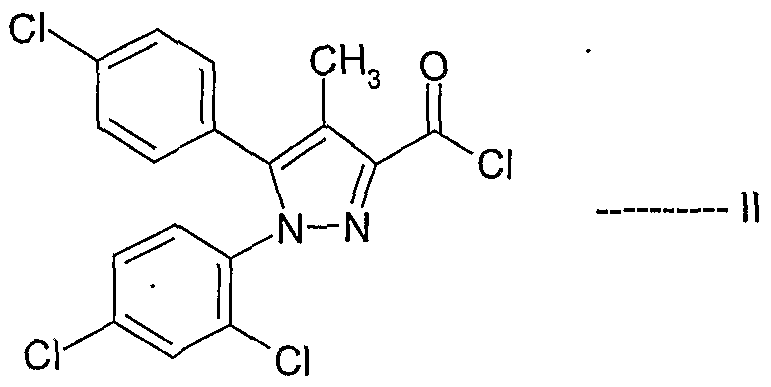
2. The process as claimed in claim 1 , wherein the rimonabant obtained is containing the content of amide impurity in less than about 0.1 % by weight.
3. The process as claimed in claim 2, wherein the rimonabant containing the content of amide impurity in less than about 0.05% by weight.
4. The process as claimed in claim 3, wherein the rimonabant containing no amide impurity. 5. The process as claimed in claim 1 , wherein the reaction is carried out between O0C and reflux temperature of the solvent used. 6. The process as claimed in claim 5, wherein the reaction is carried out at about 0 - 350C.
7. The process as claimed in claim 6, wherein the reaction is carried out at about 10 - 300C.
8. The process as claimed in claim 7, wherein the reaction is carried out at about 10 - 250C. 9. The process as claimed in claim 1, wherein the phase transfer catalyst is selected from the group consisting of ammonium salts such as tetra-n- butylammonium bromide, tetra-n-butylammonium chloride, tetra-n- butylammonium hydroxide, tetra-n-butylammonium iodide, tetraethylammonium chloride, tricaprylylmethylammonium chloride, benzyltributylammonium bromide, benzyltriethylammonium bromide, tetramethylammonium chloride, cetyltrimethylammonium bromide, cetylpyridinium bromide, N-benzylquininium chloride, hexadecyltrimethyl ammonium chloride, and octyltrimethylammonium chloride.
10. The process as claimed in claim 9, wherein the phase transfer catalyst is selected from tetra-n-butylammonium bromide, tetra-n-butylammonium chloride, tetra-n-butylammonium hydroxide and tetra-n-butylammonium iodide.
11. The process as claimed in claim 10, wherein the phase transfer catalyst is tetra-n-butylammonium bromide. 12. The process as claimed in claim 1, wherein the base is an inorganic base selected from the group consisting of sodium hydroxide, potassium hydroxide, sodium carbonate, sodium bicarbonate, potassium carbonate, potassium bicarbonate, and combinations thereof. 13. The process as claimed in claim 12, wherein the base is sodium hydroxide. 14. The process as claimed in claim 1 , wherein the solution of inorganic base in water is used.
15. The process as claimed in claim 1 , wherein the water-immiscible solvent is selected from the group consisting of chlorinated hydrocarbon solvents such as methylene chloride, ethylene dichloride and chloroform; hydrocarbon solvents such as toluene, benzene, n-hexane, n-heptane, xylene and cyclohexane; ester solvents sucu as ethyl acetate, methyl acetate and isobutyl acetate; and ether solvents such as dimethyl ether, diethyl ether and diisopropyl ether.
6. The process as claimed in claim 15, wherein the solvent is selected from the group consisting of methylene chloride, toluene, ethyl acetate and diisopropyl ether.
Priority Applications (3)
| Application Number | Priority Date | Filing Date | Title |
|---|---|---|---|
| US11/993,544 US20100076197A1 (en) | 2006-09-11 | 2006-09-11 | Process for rimonabant |
| EP06809944A EP2061783A2 (en) | 2006-09-11 | 2006-09-11 | Improved process for rimonabant |
| PCT/IN2006/000345 WO2008032330A2 (en) | 2006-09-11 | 2006-09-11 | Improved process for rimonabant |
Applications Claiming Priority (1)
| Application Number | Priority Date | Filing Date | Title |
|---|---|---|---|
| PCT/IN2006/000345 WO2008032330A2 (en) | 2006-09-11 | 2006-09-11 | Improved process for rimonabant |
Publications (2)
| Publication Number | Publication Date |
|---|---|
| WO2008032330A2 true WO2008032330A2 (en) | 2008-03-20 |
| WO2008032330A3 WO2008032330A3 (en) | 2009-05-07 |
Family
ID=39184214
Family Applications (1)
| Application Number | Title | Priority Date | Filing Date |
|---|---|---|---|
| PCT/IN2006/000345 Ceased WO2008032330A2 (en) | 2006-09-11 | 2006-09-11 | Improved process for rimonabant |
Country Status (3)
| Country | Link |
|---|---|
| US (1) | US20100076197A1 (en) |
| EP (1) | EP2061783A2 (en) |
| WO (1) | WO2008032330A2 (en) |
Cited By (3)
| Publication number | Priority date | Publication date | Assignee | Title |
|---|---|---|---|---|
| WO2008088900A3 (en) * | 2007-01-18 | 2008-10-30 | Teva Pharma | Polymorphic forms of rimonabant base and processes for preparation thereof |
| WO2008062480A3 (en) * | 2006-11-24 | 2009-10-22 | Ind-Swift Laboratories Limited | An improved process for the preparation of rimonabant |
| CN101585810B (en) * | 2008-05-23 | 2011-12-14 | 华东理工大学 | Preparation method of 5-(4-chlorphenyl)-1-(2, 4-dichlorophenyl) 4- methylpyrazole-3-formic ether |
Family Cites Families (5)
| Publication number | Priority date | Publication date | Assignee | Title |
|---|---|---|---|---|
| FR2692575B1 (en) * | 1992-06-23 | 1995-06-30 | Sanofi Elf | NOVEL PYRAZOLE DERIVATIVES, PROCESS FOR THEIR PREPARATION AND PHARMACEUTICAL COMPOSITIONS CONTAINING THEM. |
| FR2714057B1 (en) * | 1993-12-17 | 1996-03-08 | Sanofi Elf | New derivatives of 3-pyrazolecarboxamide, process for their preparation and pharmaceutical compositions containing them. |
| FR2789079B3 (en) * | 1999-02-01 | 2001-03-02 | Sanofi Synthelabo | PYRAZOLECARBOXYLIC ACID DERIVATIVE, ITS PREPARATION, PHARMACEUTICAL COMPOSITIONS CONTAINING SAME |
| FR2831883B1 (en) * | 2001-11-08 | 2004-07-23 | Sanofi Synthelabo | POLYMORPHIC FORM OF RIMONABANT, PROCESS FOR PREPARING THE SAME AND PHARMACEUTICAL COMPOSITIONS CONTAINING THE SAME |
| FR2873372B1 (en) * | 2004-07-22 | 2006-09-08 | Sanofi Synthelabo | PROCESS FOR THE PREPARATION OF N-PIPERIDINO-1,5-DIPHENYLPYRAZOLE-3-CARBOXAMIDE DERIVATIVES |
-
2006
- 2006-09-11 EP EP06809944A patent/EP2061783A2/en not_active Withdrawn
- 2006-09-11 US US11/993,544 patent/US20100076197A1/en not_active Abandoned
- 2006-09-11 WO PCT/IN2006/000345 patent/WO2008032330A2/en not_active Ceased
Cited By (3)
| Publication number | Priority date | Publication date | Assignee | Title |
|---|---|---|---|---|
| WO2008062480A3 (en) * | 2006-11-24 | 2009-10-22 | Ind-Swift Laboratories Limited | An improved process for the preparation of rimonabant |
| WO2008088900A3 (en) * | 2007-01-18 | 2008-10-30 | Teva Pharma | Polymorphic forms of rimonabant base and processes for preparation thereof |
| CN101585810B (en) * | 2008-05-23 | 2011-12-14 | 华东理工大学 | Preparation method of 5-(4-chlorphenyl)-1-(2, 4-dichlorophenyl) 4- methylpyrazole-3-formic ether |
Also Published As
| Publication number | Publication date |
|---|---|
| WO2008032330A3 (en) | 2009-05-07 |
| US20100076197A1 (en) | 2010-03-25 |
| EP2061783A2 (en) | 2009-05-27 |
Similar Documents
| Publication | Publication Date | Title |
|---|---|---|
| CN102753532B (en) | Process for preparation of medetomidine | |
| IE84467B1 (en) | Therapeutic heterocyclic compounds | |
| CA2129146A1 (en) | Imidazole, triazole and tetrazole derivatives | |
| KR20110034020A (en) | Alkyl thiazole carbamate derivatives, their preparation, and their use as FAH enzyme inhibitors | |
| AU2010247212A1 (en) | 5-membered heterocyclic compound cyclopenta[c]pyrrolylalkylcarbamate derivatives, preparation thereof, and therapeutic use thereof | |
| US5416221A (en) | Carbazolone derivatives | |
| NZ228721A (en) | Substituted indoles and indazoles and pharmaceutical compositions | |
| CN102046610A (en) | Phenyl piperazine compounds, pharmaceutical composition including the same, and use thereof | |
| WO2008032330A2 (en) | Improved process for rimonabant | |
| US20090253746A1 (en) | Synthesis and Preparations of Intermediates and New Polymorphs Thereof Useful For The Preparation Of Donepezil Hydrochlcoride | |
| AU3895693A (en) | Imidazole, triazole and tetrazole derivatives | |
| WO2014083571A1 (en) | A process for the preparation of alcaftadine | |
| EP1675833B1 (en) | 1h-imidazole derivatives as cannabinoid receptor modulators | |
| AU2008247136B2 (en) | Process for preparing valsartan | |
| EP0741722B1 (en) | Triazole derivatives | |
| WO2008007391A2 (en) | An improved process for the preparation of valsartan | |
| US20100076022A1 (en) | Novel polymorphs of rimonabant | |
| EP1756066B1 (en) | Tetrasubstituted imidazole derivatives as cannabinoid cb1 receptor modulators with a high cb1/cb2 receptor subtype selectivity | |
| US11434256B2 (en) | Process for the preparation of 3α,7α-dihydroxy-6α-ethyl-5β-cholan-24-oic acid | |
| CN102906073B (en) | The preparation method of 1-alkyl-3-difluoromethyl-5-hydroxypyrazole | |
| AU652002B2 (en) | Process for producing 3-alkylated indoles from N-(2-nitro-styryl)enamines | |
| US8946433B2 (en) | Process for the preparation of sufentanil base and related compounds | |
| WO2008062480A2 (en) | An improved process for the preparation of rimonabant | |
| US9533949B2 (en) | Processes for the preparation of 3-alkyl indoles | |
| JPWO2002076958A1 (en) | Method for producing 5-substituted oxazole compound and 5-substituted imidazole compound |
Legal Events
| Date | Code | Title | Description |
|---|---|---|---|
| WWE | Wipo information: entry into national phase |
Ref document number: 5416/CHENP/2007 Country of ref document: IN |
|
| WWE | Wipo information: entry into national phase |
Ref document number: 2006809944 Country of ref document: EP |
|
| WWE | Wipo information: entry into national phase |
Ref document number: 11993544 Country of ref document: US |
|
| 121 | Ep: the epo has been informed by wipo that ep was designated in this application |
Ref document number: 06809944 Country of ref document: EP Kind code of ref document: A2 |
|
| NENP | Non-entry into the national phase |
Ref country code: DE |