WO2008033455A2 - Biphenyl and heteroaryl phenyl derivatives as protein tyrosine phosphatases inhibitors - Google Patents
Biphenyl and heteroaryl phenyl derivatives as protein tyrosine phosphatases inhibitors Download PDFInfo
- Publication number
- WO2008033455A2 WO2008033455A2 PCT/US2007/019915 US2007019915W WO2008033455A2 WO 2008033455 A2 WO2008033455 A2 WO 2008033455A2 US 2007019915 W US2007019915 W US 2007019915W WO 2008033455 A2 WO2008033455 A2 WO 2008033455A2
- Authority
- WO
- WIPO (PCT)
- Prior art keywords
- alkyl
- methyl
- phenyl
- compound according
- biphenyl
- Prior art date
- Legal status (The legal status is an assumption and is not a legal conclusion. Google has not performed a legal analysis and makes no representation as to the accuracy of the status listed.)
- Ceased
Links
- 0 **Pc(cc1)ccc1-c1ccccc1 Chemical compound **Pc(cc1)ccc1-c1ccccc1 0.000 description 4
- UHOVQNZJYSORNB-UHFFFAOYSA-N c1ccccc1 Chemical compound c1ccccc1 UHOVQNZJYSORNB-UHFFFAOYSA-N 0.000 description 2
- LLYJIBUWSQWTLZ-UHFFFAOYSA-N CCN(C(C)C)c1ccc(C(F)(F)F)cn1 Chemical compound CCN(C(C)C)c1ccc(C(F)(F)F)cn1 LLYJIBUWSQWTLZ-UHFFFAOYSA-N 0.000 description 1
- CYGFONSXJDNFML-UHFFFAOYSA-N CCN(C(C)C)c1ccc(C)cc1 Chemical compound CCN(C(C)C)c1ccc(C)cc1 CYGFONSXJDNFML-UHFFFAOYSA-N 0.000 description 1
- CIZAGFZTOGKOBA-UHFFFAOYSA-N CCN(CC)c1ccc(C(F)(F)F)cn1 Chemical compound CCN(CC)c1ccc(C(F)(F)F)cn1 CIZAGFZTOGKOBA-UHFFFAOYSA-N 0.000 description 1
- LNOLDINBEIDFQN-UHFFFAOYSA-N CCN1c2cc(C(F)(F)F)ccc2CC1 Chemical compound CCN1c2cc(C(F)(F)F)ccc2CC1 LNOLDINBEIDFQN-UHFFFAOYSA-N 0.000 description 1
- TWSCQBNDVJRENY-UHFFFAOYSA-N C[N](C)(C)COCO Chemical compound C[N](C)(C)COCO TWSCQBNDVJRENY-UHFFFAOYSA-N 0.000 description 1
Classifications
-
- C—CHEMISTRY; METALLURGY
- C07—ORGANIC CHEMISTRY
- C07D—HETEROCYCLIC COMPOUNDS
- C07D417/00—Heterocyclic compounds containing two or more hetero rings, at least one ring having nitrogen and sulfur atoms as the only ring hetero atoms, not provided for by group C07D415/00
- C07D417/02—Heterocyclic compounds containing two or more hetero rings, at least one ring having nitrogen and sulfur atoms as the only ring hetero atoms, not provided for by group C07D415/00 containing two hetero rings
- C07D417/12—Heterocyclic compounds containing two or more hetero rings, at least one ring having nitrogen and sulfur atoms as the only ring hetero atoms, not provided for by group C07D415/00 containing two hetero rings linked by a chain containing hetero atoms as chain links
-
- C—CHEMISTRY; METALLURGY
- C07—ORGANIC CHEMISTRY
- C07C—ACYCLIC OR CARBOCYCLIC COMPOUNDS
- C07C217/00—Compounds containing amino and etherified hydroxy groups bound to the same carbon skeleton
- C07C217/02—Compounds containing amino and etherified hydroxy groups bound to the same carbon skeleton having etherified hydroxy groups and amino groups bound to acyclic carbon atoms of the same carbon skeleton
- C07C217/48—Compounds containing amino and etherified hydroxy groups bound to the same carbon skeleton having etherified hydroxy groups and amino groups bound to acyclic carbon atoms of the same carbon skeleton the carbon skeleton being unsaturated and containing rings
-
- C—CHEMISTRY; METALLURGY
- C07—ORGANIC CHEMISTRY
- C07C—ACYCLIC OR CARBOCYCLIC COMPOUNDS
- C07C217/00—Compounds containing amino and etherified hydroxy groups bound to the same carbon skeleton
- C07C217/54—Compounds containing amino and etherified hydroxy groups bound to the same carbon skeleton having etherified hydroxy groups bound to carbon atoms of at least one six-membered aromatic ring and amino groups bound to acyclic carbon atoms or to carbon atoms of rings other than six-membered aromatic rings of the same carbon skeleton
- C07C217/56—Compounds containing amino and etherified hydroxy groups bound to the same carbon skeleton having etherified hydroxy groups bound to carbon atoms of at least one six-membered aromatic ring and amino groups bound to acyclic carbon atoms or to carbon atoms of rings other than six-membered aromatic rings of the same carbon skeleton with amino groups linked to the six-membered aromatic ring, or to the condensed ring system containing that ring, by carbon chains not further substituted by singly-bound oxygen atoms
-
- C—CHEMISTRY; METALLURGY
- C07—ORGANIC CHEMISTRY
- C07C—ACYCLIC OR CARBOCYCLIC COMPOUNDS
- C07C229/00—Compounds containing amino and carboxyl groups bound to the same carbon skeleton
- C07C229/02—Compounds containing amino and carboxyl groups bound to the same carbon skeleton having amino and carboxyl groups bound to acyclic carbon atoms of the same carbon skeleton
- C07C229/04—Compounds containing amino and carboxyl groups bound to the same carbon skeleton having amino and carboxyl groups bound to acyclic carbon atoms of the same carbon skeleton the carbon skeleton being acyclic and saturated
- C07C229/06—Compounds containing amino and carboxyl groups bound to the same carbon skeleton having amino and carboxyl groups bound to acyclic carbon atoms of the same carbon skeleton the carbon skeleton being acyclic and saturated having only one amino and one carboxyl group bound to the carbon skeleton
- C07C229/10—Compounds containing amino and carboxyl groups bound to the same carbon skeleton having amino and carboxyl groups bound to acyclic carbon atoms of the same carbon skeleton the carbon skeleton being acyclic and saturated having only one amino and one carboxyl group bound to the carbon skeleton the nitrogen atom of the amino group being further bound to acyclic carbon atoms or to carbon atoms of rings other than six-membered aromatic rings
- C07C229/16—Compounds containing amino and carboxyl groups bound to the same carbon skeleton having amino and carboxyl groups bound to acyclic carbon atoms of the same carbon skeleton the carbon skeleton being acyclic and saturated having only one amino and one carboxyl group bound to the carbon skeleton the nitrogen atom of the amino group being further bound to acyclic carbon atoms or to carbon atoms of rings other than six-membered aromatic rings to carbon atoms of hydrocarbon radicals substituted by amino or carboxyl groups, e.g. ethylenediamine-tetra-acetic acid, iminodiacetic acids
-
- C—CHEMISTRY; METALLURGY
- C07—ORGANIC CHEMISTRY
- C07C—ACYCLIC OR CARBOCYCLIC COMPOUNDS
- C07C233/00—Carboxylic acid amides
- C07C233/01—Carboxylic acid amides having carbon atoms of carboxamide groups bound to hydrogen atoms or to acyclic carbon atoms
- C07C233/45—Carboxylic acid amides having carbon atoms of carboxamide groups bound to hydrogen atoms or to acyclic carbon atoms having the nitrogen atom of at least one of the carboxamide groups bound to a carbon atom of a hydrocarbon radical substituted by carboxyl groups
- C07C233/46—Carboxylic acid amides having carbon atoms of carboxamide groups bound to hydrogen atoms or to acyclic carbon atoms having the nitrogen atom of at least one of the carboxamide groups bound to a carbon atom of a hydrocarbon radical substituted by carboxyl groups with the substituted hydrocarbon radical bound to the nitrogen atom of the carboxamide group by an acyclic carbon atom
- C07C233/47—Carboxylic acid amides having carbon atoms of carboxamide groups bound to hydrogen atoms or to acyclic carbon atoms having the nitrogen atom of at least one of the carboxamide groups bound to a carbon atom of a hydrocarbon radical substituted by carboxyl groups with the substituted hydrocarbon radical bound to the nitrogen atom of the carboxamide group by an acyclic carbon atom having the carbon atom of the carboxamide group bound to a hydrogen atom or to a carbon atom of an acyclic saturated carbon skeleton
-
- C—CHEMISTRY; METALLURGY
- C07—ORGANIC CHEMISTRY
- C07C—ACYCLIC OR CARBOCYCLIC COMPOUNDS
- C07C255/00—Carboxylic acid nitriles
- C07C255/49—Carboxylic acid nitriles having cyano groups bound to carbon atoms of six-membered aromatic rings of a carbon skeleton
- C07C255/57—Carboxylic acid nitriles having cyano groups bound to carbon atoms of six-membered aromatic rings of a carbon skeleton containing cyano groups and carboxyl groups, other than cyano groups, bound to the carbon skeleton
-
- C—CHEMISTRY; METALLURGY
- C07—ORGANIC CHEMISTRY
- C07C—ACYCLIC OR CARBOCYCLIC COMPOUNDS
- C07C323/00—Thiols, sulfides, hydropolysulfides or polysulfides substituted by halogen, oxygen or nitrogen atoms, or by sulfur atoms not being part of thio groups
- C07C323/50—Thiols, sulfides, hydropolysulfides or polysulfides substituted by halogen, oxygen or nitrogen atoms, or by sulfur atoms not being part of thio groups containing thio groups and carboxyl groups bound to the same carbon skeleton
- C07C323/51—Thiols, sulfides, hydropolysulfides or polysulfides substituted by halogen, oxygen or nitrogen atoms, or by sulfur atoms not being part of thio groups containing thio groups and carboxyl groups bound to the same carbon skeleton having the sulfur atoms of the thio groups bound to acyclic carbon atoms of the carbon skeleton
- C07C323/52—Thiols, sulfides, hydropolysulfides or polysulfides substituted by halogen, oxygen or nitrogen atoms, or by sulfur atoms not being part of thio groups containing thio groups and carboxyl groups bound to the same carbon skeleton having the sulfur atoms of the thio groups bound to acyclic carbon atoms of the carbon skeleton the carbon skeleton being acyclic and saturated
-
- C—CHEMISTRY; METALLURGY
- C07—ORGANIC CHEMISTRY
- C07C—ACYCLIC OR CARBOCYCLIC COMPOUNDS
- C07C323/00—Thiols, sulfides, hydropolysulfides or polysulfides substituted by halogen, oxygen or nitrogen atoms, or by sulfur atoms not being part of thio groups
- C07C323/50—Thiols, sulfides, hydropolysulfides or polysulfides substituted by halogen, oxygen or nitrogen atoms, or by sulfur atoms not being part of thio groups containing thio groups and carboxyl groups bound to the same carbon skeleton
- C07C323/51—Thiols, sulfides, hydropolysulfides or polysulfides substituted by halogen, oxygen or nitrogen atoms, or by sulfur atoms not being part of thio groups containing thio groups and carboxyl groups bound to the same carbon skeleton having the sulfur atoms of the thio groups bound to acyclic carbon atoms of the carbon skeleton
- C07C323/57—Thiols, sulfides, hydropolysulfides or polysulfides substituted by halogen, oxygen or nitrogen atoms, or by sulfur atoms not being part of thio groups containing thio groups and carboxyl groups bound to the same carbon skeleton having the sulfur atoms of the thio groups bound to acyclic carbon atoms of the carbon skeleton the carbon skeleton being further substituted by nitrogen atoms, not being part of nitro or nitroso groups
- C07C323/58—Thiols, sulfides, hydropolysulfides or polysulfides substituted by halogen, oxygen or nitrogen atoms, or by sulfur atoms not being part of thio groups containing thio groups and carboxyl groups bound to the same carbon skeleton having the sulfur atoms of the thio groups bound to acyclic carbon atoms of the carbon skeleton the carbon skeleton being further substituted by nitrogen atoms, not being part of nitro or nitroso groups with amino groups bound to the carbon skeleton
- C07C323/59—Thiols, sulfides, hydropolysulfides or polysulfides substituted by halogen, oxygen or nitrogen atoms, or by sulfur atoms not being part of thio groups containing thio groups and carboxyl groups bound to the same carbon skeleton having the sulfur atoms of the thio groups bound to acyclic carbon atoms of the carbon skeleton the carbon skeleton being further substituted by nitrogen atoms, not being part of nitro or nitroso groups with amino groups bound to the carbon skeleton with acylated amino groups bound to the carbon skeleton
-
- C—CHEMISTRY; METALLURGY
- C07—ORGANIC CHEMISTRY
- C07C—ACYCLIC OR CARBOCYCLIC COMPOUNDS
- C07C323/00—Thiols, sulfides, hydropolysulfides or polysulfides substituted by halogen, oxygen or nitrogen atoms, or by sulfur atoms not being part of thio groups
- C07C323/50—Thiols, sulfides, hydropolysulfides or polysulfides substituted by halogen, oxygen or nitrogen atoms, or by sulfur atoms not being part of thio groups containing thio groups and carboxyl groups bound to the same carbon skeleton
- C07C323/62—Thiols, sulfides, hydropolysulfides or polysulfides substituted by halogen, oxygen or nitrogen atoms, or by sulfur atoms not being part of thio groups containing thio groups and carboxyl groups bound to the same carbon skeleton having the sulfur atom of at least one of the thio groups bound to a carbon atom of a six-membered aromatic ring of the carbon skeleton
-
- C—CHEMISTRY; METALLURGY
- C07—ORGANIC CHEMISTRY
- C07D—HETEROCYCLIC COMPOUNDS
- C07D207/00—Heterocyclic compounds containing five-membered rings not condensed with other rings, with one nitrogen atom as the only ring hetero atom
- C07D207/02—Heterocyclic compounds containing five-membered rings not condensed with other rings, with one nitrogen atom as the only ring hetero atom with only hydrogen or carbon atoms directly attached to the ring nitrogen atom
- C07D207/30—Heterocyclic compounds containing five-membered rings not condensed with other rings, with one nitrogen atom as the only ring hetero atom with only hydrogen or carbon atoms directly attached to the ring nitrogen atom having two double bonds between ring members or between ring members and non-ring members
- C07D207/32—Heterocyclic compounds containing five-membered rings not condensed with other rings, with one nitrogen atom as the only ring hetero atom with only hydrogen or carbon atoms directly attached to the ring nitrogen atom having two double bonds between ring members or between ring members and non-ring members with only hydrogen atoms, hydrocarbon or substituted hydrocarbon radicals, directly attached to ring carbon atoms
- C07D207/325—Heterocyclic compounds containing five-membered rings not condensed with other rings, with one nitrogen atom as the only ring hetero atom with only hydrogen or carbon atoms directly attached to the ring nitrogen atom having two double bonds between ring members or between ring members and non-ring members with only hydrogen atoms, hydrocarbon or substituted hydrocarbon radicals, directly attached to ring carbon atoms with substituted hydrocarbon radicals directly attached to the ring nitrogen atom
- C07D207/327—Radicals substituted by carbon atoms having three bonds to hetero atoms with at the most one bond to halogen, e.g. ester or nitrile radicals
-
- C—CHEMISTRY; METALLURGY
- C07—ORGANIC CHEMISTRY
- C07D—HETEROCYCLIC COMPOUNDS
- C07D213/00—Heterocyclic compounds containing six-membered rings, not condensed with other rings, with one nitrogen atom as the only ring hetero atom and three or more double bonds between ring members or between ring members and non-ring members
- C07D213/02—Heterocyclic compounds containing six-membered rings, not condensed with other rings, with one nitrogen atom as the only ring hetero atom and three or more double bonds between ring members or between ring members and non-ring members having three double bonds between ring members or between ring members and non-ring members
- C07D213/04—Heterocyclic compounds containing six-membered rings, not condensed with other rings, with one nitrogen atom as the only ring hetero atom and three or more double bonds between ring members or between ring members and non-ring members having three double bonds between ring members or between ring members and non-ring members having no bond between the ring nitrogen atom and a non-ring member or having only hydrogen or carbon atoms directly attached to the ring nitrogen atom
- C07D213/24—Heterocyclic compounds containing six-membered rings, not condensed with other rings, with one nitrogen atom as the only ring hetero atom and three or more double bonds between ring members or between ring members and non-ring members having three double bonds between ring members or between ring members and non-ring members having no bond between the ring nitrogen atom and a non-ring member or having only hydrogen or carbon atoms directly attached to the ring nitrogen atom with substituted hydrocarbon radicals attached to ring carbon atoms
- C07D213/28—Radicals substituted by singly-bound oxygen or sulphur atoms
- C07D213/32—Sulfur atoms
-
- C—CHEMISTRY; METALLURGY
- C07—ORGANIC CHEMISTRY
- C07D—HETEROCYCLIC COMPOUNDS
- C07D213/00—Heterocyclic compounds containing six-membered rings, not condensed with other rings, with one nitrogen atom as the only ring hetero atom and three or more double bonds between ring members or between ring members and non-ring members
- C07D213/02—Heterocyclic compounds containing six-membered rings, not condensed with other rings, with one nitrogen atom as the only ring hetero atom and three or more double bonds between ring members or between ring members and non-ring members having three double bonds between ring members or between ring members and non-ring members
- C07D213/04—Heterocyclic compounds containing six-membered rings, not condensed with other rings, with one nitrogen atom as the only ring hetero atom and three or more double bonds between ring members or between ring members and non-ring members having three double bonds between ring members or between ring members and non-ring members having no bond between the ring nitrogen atom and a non-ring member or having only hydrogen or carbon atoms directly attached to the ring nitrogen atom
- C07D213/60—Heterocyclic compounds containing six-membered rings, not condensed with other rings, with one nitrogen atom as the only ring hetero atom and three or more double bonds between ring members or between ring members and non-ring members having three double bonds between ring members or between ring members and non-ring members having no bond between the ring nitrogen atom and a non-ring member or having only hydrogen or carbon atoms directly attached to the ring nitrogen atom with hetero atoms or with carbon atoms having three bonds to hetero atoms with at the most one bond to halogen, e.g. ester or nitrile radicals, directly attached to ring carbon atoms
- C07D213/72—Nitrogen atoms
- C07D213/74—Amino or imino radicals substituted by hydrocarbon or substituted hydrocarbon radicals
-
- C—CHEMISTRY; METALLURGY
- C07—ORGANIC CHEMISTRY
- C07D—HETEROCYCLIC COMPOUNDS
- C07D213/00—Heterocyclic compounds containing six-membered rings, not condensed with other rings, with one nitrogen atom as the only ring hetero atom and three or more double bonds between ring members or between ring members and non-ring members
- C07D213/02—Heterocyclic compounds containing six-membered rings, not condensed with other rings, with one nitrogen atom as the only ring hetero atom and three or more double bonds between ring members or between ring members and non-ring members having three double bonds between ring members or between ring members and non-ring members
- C07D213/04—Heterocyclic compounds containing six-membered rings, not condensed with other rings, with one nitrogen atom as the only ring hetero atom and three or more double bonds between ring members or between ring members and non-ring members having three double bonds between ring members or between ring members and non-ring members having no bond between the ring nitrogen atom and a non-ring member or having only hydrogen or carbon atoms directly attached to the ring nitrogen atom
- C07D213/60—Heterocyclic compounds containing six-membered rings, not condensed with other rings, with one nitrogen atom as the only ring hetero atom and three or more double bonds between ring members or between ring members and non-ring members having three double bonds between ring members or between ring members and non-ring members having no bond between the ring nitrogen atom and a non-ring member or having only hydrogen or carbon atoms directly attached to the ring nitrogen atom with hetero atoms or with carbon atoms having three bonds to hetero atoms with at the most one bond to halogen, e.g. ester or nitrile radicals, directly attached to ring carbon atoms
- C07D213/78—Carbon atoms having three bonds to hetero atoms, with at the most one bond to halogen, e.g. ester or nitrile radicals
- C07D213/79—Acids; Esters
-
- C—CHEMISTRY; METALLURGY
- C07—ORGANIC CHEMISTRY
- C07D—HETEROCYCLIC COMPOUNDS
- C07D213/00—Heterocyclic compounds containing six-membered rings, not condensed with other rings, with one nitrogen atom as the only ring hetero atom and three or more double bonds between ring members or between ring members and non-ring members
- C07D213/02—Heterocyclic compounds containing six-membered rings, not condensed with other rings, with one nitrogen atom as the only ring hetero atom and three or more double bonds between ring members or between ring members and non-ring members having three double bonds between ring members or between ring members and non-ring members
- C07D213/04—Heterocyclic compounds containing six-membered rings, not condensed with other rings, with one nitrogen atom as the only ring hetero atom and three or more double bonds between ring members or between ring members and non-ring members having three double bonds between ring members or between ring members and non-ring members having no bond between the ring nitrogen atom and a non-ring member or having only hydrogen or carbon atoms directly attached to the ring nitrogen atom
- C07D213/60—Heterocyclic compounds containing six-membered rings, not condensed with other rings, with one nitrogen atom as the only ring hetero atom and three or more double bonds between ring members or between ring members and non-ring members having three double bonds between ring members or between ring members and non-ring members having no bond between the ring nitrogen atom and a non-ring member or having only hydrogen or carbon atoms directly attached to the ring nitrogen atom with hetero atoms or with carbon atoms having three bonds to hetero atoms with at the most one bond to halogen, e.g. ester or nitrile radicals, directly attached to ring carbon atoms
- C07D213/78—Carbon atoms having three bonds to hetero atoms, with at the most one bond to halogen, e.g. ester or nitrile radicals
- C07D213/79—Acids; Esters
- C07D213/80—Acids; Esters in position 3
-
- C—CHEMISTRY; METALLURGY
- C07—ORGANIC CHEMISTRY
- C07D—HETEROCYCLIC COMPOUNDS
- C07D215/00—Heterocyclic compounds containing quinoline or hydrogenated quinoline ring systems
- C07D215/02—Heterocyclic compounds containing quinoline or hydrogenated quinoline ring systems having no bond between the ring nitrogen atom and a non-ring member or having only hydrogen atoms or carbon atoms directly attached to the ring nitrogen atom
- C07D215/16—Heterocyclic compounds containing quinoline or hydrogenated quinoline ring systems having no bond between the ring nitrogen atom and a non-ring member or having only hydrogen atoms or carbon atoms directly attached to the ring nitrogen atom with hetero atoms or with carbon atoms having three bonds to hetero atoms with at the most one bond to halogen, e.g. ester or nitrile radicals, directly attached to ring carbon atoms
-
- C—CHEMISTRY; METALLURGY
- C07—ORGANIC CHEMISTRY
- C07D—HETEROCYCLIC COMPOUNDS
- C07D231/00—Heterocyclic compounds containing 1,2-diazole or hydrogenated 1,2-diazole rings
- C07D231/02—Heterocyclic compounds containing 1,2-diazole or hydrogenated 1,2-diazole rings not condensed with other rings
- C07D231/10—Heterocyclic compounds containing 1,2-diazole or hydrogenated 1,2-diazole rings not condensed with other rings having two or three double bonds between ring members or between ring members and non-ring members
- C07D231/14—Heterocyclic compounds containing 1,2-diazole or hydrogenated 1,2-diazole rings not condensed with other rings having two or three double bonds between ring members or between ring members and non-ring members with hetero atoms or with carbon atoms having three bonds to hetero atoms with at the most one bond to halogen, e.g. ester or nitrile radicals, directly attached to ring carbon atoms
-
- C—CHEMISTRY; METALLURGY
- C07—ORGANIC CHEMISTRY
- C07D—HETEROCYCLIC COMPOUNDS
- C07D233/00—Heterocyclic compounds containing 1,3-diazole or hydrogenated 1,3-diazole rings, not condensed with other rings
- C07D233/54—Heterocyclic compounds containing 1,3-diazole or hydrogenated 1,3-diazole rings, not condensed with other rings having two double bonds between ring members or between ring members and non-ring members
- C07D233/66—Heterocyclic compounds containing 1,3-diazole or hydrogenated 1,3-diazole rings, not condensed with other rings having two double bonds between ring members or between ring members and non-ring members with hetero atoms or with carbon atoms having three bonds to hetero atoms with at the most one bond to halogen, e.g. ester or nitrile radicals, directly attached to ring carbon atoms
- C07D233/90—Carbon atoms having three bonds to hetero atoms with at the most one bond to halogen, e.g. ester or nitrile radicals
-
- C—CHEMISTRY; METALLURGY
- C07—ORGANIC CHEMISTRY
- C07D—HETEROCYCLIC COMPOUNDS
- C07D277/00—Heterocyclic compounds containing 1,3-thiazole or hydrogenated 1,3-thiazole rings
- C07D277/02—Heterocyclic compounds containing 1,3-thiazole or hydrogenated 1,3-thiazole rings not condensed with other rings
- C07D277/20—Heterocyclic compounds containing 1,3-thiazole or hydrogenated 1,3-thiazole rings not condensed with other rings having two or three double bonds between ring members or between ring members and non-ring members
- C07D277/22—Heterocyclic compounds containing 1,3-thiazole or hydrogenated 1,3-thiazole rings not condensed with other rings having two or three double bonds between ring members or between ring members and non-ring members with only hydrogen atoms, hydrocarbon or substituted hydrocarbon radicals, directly attached to ring carbon atoms
- C07D277/28—Radicals substituted by nitrogen atoms
-
- C—CHEMISTRY; METALLURGY
- C07—ORGANIC CHEMISTRY
- C07D—HETEROCYCLIC COMPOUNDS
- C07D277/00—Heterocyclic compounds containing 1,3-thiazole or hydrogenated 1,3-thiazole rings
- C07D277/60—Heterocyclic compounds containing 1,3-thiazole or hydrogenated 1,3-thiazole rings condensed with carbocyclic rings or ring systems
- C07D277/62—Benzothiazoles
- C07D277/64—Benzothiazoles with only hydrocarbon or substituted hydrocarbon radicals attached in position 2
-
- C—CHEMISTRY; METALLURGY
- C07—ORGANIC CHEMISTRY
- C07D—HETEROCYCLIC COMPOUNDS
- C07D285/00—Heterocyclic compounds containing rings having nitrogen and sulfur atoms as the only ring hetero atoms, not provided for by groups C07D275/00 - C07D283/00
- C07D285/01—Five-membered rings
- C07D285/02—Thiadiazoles; Hydrogenated thiadiazoles
- C07D285/04—Thiadiazoles; Hydrogenated thiadiazoles not condensed with other rings
- C07D285/06—1,2,3-Thiadiazoles; Hydrogenated 1,2,3-thiadiazoles
-
- C—CHEMISTRY; METALLURGY
- C07—ORGANIC CHEMISTRY
- C07D—HETEROCYCLIC COMPOUNDS
- C07D401/00—Heterocyclic compounds containing two or more hetero rings, having nitrogen atoms as the only ring hetero atoms, at least one ring being a six-membered ring with only one nitrogen atom
- C07D401/02—Heterocyclic compounds containing two or more hetero rings, having nitrogen atoms as the only ring hetero atoms, at least one ring being a six-membered ring with only one nitrogen atom containing two hetero rings
- C07D401/10—Heterocyclic compounds containing two or more hetero rings, having nitrogen atoms as the only ring hetero atoms, at least one ring being a six-membered ring with only one nitrogen atom containing two hetero rings linked by a carbon chain containing aromatic rings
-
- C—CHEMISTRY; METALLURGY
- C07—ORGANIC CHEMISTRY
- C07D—HETEROCYCLIC COMPOUNDS
- C07D401/00—Heterocyclic compounds containing two or more hetero rings, having nitrogen atoms as the only ring hetero atoms, at least one ring being a six-membered ring with only one nitrogen atom
- C07D401/02—Heterocyclic compounds containing two or more hetero rings, having nitrogen atoms as the only ring hetero atoms, at least one ring being a six-membered ring with only one nitrogen atom containing two hetero rings
- C07D401/12—Heterocyclic compounds containing two or more hetero rings, having nitrogen atoms as the only ring hetero atoms, at least one ring being a six-membered ring with only one nitrogen atom containing two hetero rings linked by a chain containing hetero atoms as chain links
-
- C—CHEMISTRY; METALLURGY
- C07—ORGANIC CHEMISTRY
- C07D—HETEROCYCLIC COMPOUNDS
- C07D403/00—Heterocyclic compounds containing two or more hetero rings, having nitrogen atoms as the only ring hetero atoms, not provided for by group C07D401/00
- C07D403/02—Heterocyclic compounds containing two or more hetero rings, having nitrogen atoms as the only ring hetero atoms, not provided for by group C07D401/00 containing two hetero rings
- C07D403/10—Heterocyclic compounds containing two or more hetero rings, having nitrogen atoms as the only ring hetero atoms, not provided for by group C07D401/00 containing two hetero rings linked by a carbon chain containing aromatic rings
-
- C—CHEMISTRY; METALLURGY
- C07—ORGANIC CHEMISTRY
- C07D—HETEROCYCLIC COMPOUNDS
- C07D417/00—Heterocyclic compounds containing two or more hetero rings, at least one ring having nitrogen and sulfur atoms as the only ring hetero atoms, not provided for by group C07D415/00
- C07D417/02—Heterocyclic compounds containing two or more hetero rings, at least one ring having nitrogen and sulfur atoms as the only ring hetero atoms, not provided for by group C07D415/00 containing two hetero rings
- C07D417/06—Heterocyclic compounds containing two or more hetero rings, at least one ring having nitrogen and sulfur atoms as the only ring hetero atoms, not provided for by group C07D415/00 containing two hetero rings linked by a carbon chain containing only aliphatic carbon atoms
-
- C—CHEMISTRY; METALLURGY
- C07—ORGANIC CHEMISTRY
- C07D—HETEROCYCLIC COMPOUNDS
- C07D417/00—Heterocyclic compounds containing two or more hetero rings, at least one ring having nitrogen and sulfur atoms as the only ring hetero atoms, not provided for by group C07D415/00
- C07D417/02—Heterocyclic compounds containing two or more hetero rings, at least one ring having nitrogen and sulfur atoms as the only ring hetero atoms, not provided for by group C07D415/00 containing two hetero rings
- C07D417/10—Heterocyclic compounds containing two or more hetero rings, at least one ring having nitrogen and sulfur atoms as the only ring hetero atoms, not provided for by group C07D415/00 containing two hetero rings linked by a carbon chain containing aromatic rings
Definitions
- the invention relates to aryl and heteroaryl substituted carboxylic acids and more specifically to such compounds that are useful in the treatment of syndrome X (consisting of such abnormalities as obesity, dyslipidemia, hypercoagulation, hypertension, insulin resistance leading to heart disease and diabetes) , obesity, diabetes, neurodegenerative disease, immunological disease, bleeding disorders, and/or cancer. More specifically, it relates to such compounds that are capable of inhibiting Protein tyrosine phosphatases (PTPs) , in particular Protein tyrosine phosphatase-lB (PTP-IB) which is a negative regulator of the insulin and leptin signaling pathway and improves insulin-sensitivity.
- PTPs Protein tyrosine phosphatases
- PTP-IB Protein tyrosine phosphatase-lB
- This invention relates to a class of aryl and heteroaryl substituted carboxylic acids that are inhibitors of various PTPs, in particular PTP-IB.
- Protein tyrosine phosphatases are a large family of transmembrane or intracellular enzymes that dephosphorylate substrates involved in a variety of regulatory processes (Fischer et al . , 1991, Science 253:401-406).
- Protein tyrosine phosphatase-lB (PTP-IB) is an approximately 50 kd intracellular protein, which is present in abundant amounts in various human tissues (Charbonneau et al., 1989, Proc. Natl. Acad. Sci. USA 86:5252-5256; Goldstein, 1993, Receptor 3:1- 15) .
- insulin receptor One substrate which has aroused special interest is the insulin receptor.
- the binding of insulin to its receptor results in autophosphorylation of the domain. This causes activation of the insulin receptor tyrosine kinase, which phosphorylates the various insulin receptor substrate (IRS) proteins that propagate the insulin signaling event further downstream to mediate insulin's various biological effects.
- IRS insulin receptor substrate
- GST glutathione S-transferase
- Ahmad et al . , 1995, J. Biol. Chem. 270:20503-20508 used osmotic loading to introduce PTP-IB neutralizing antibodies into rat KRC-7 hepatoma cells.
- the presence of the antibody in the cells resulted in an increase of 42% and 38%, respectively, in insulin stimulated DNA synthesis and phosphatidyinositol 3' kinase activity.
- Insulin receptor autophosphorylation and insulin receptor substrate-1 tyrosine phosphorylation are increased 2.2 and 2.0-fold, respectively, in the antibody-loaded cells.
- the antibody-loaded cells also showed a 57% increase in insulin stimulated insulin receptor kinase activity toward exogenous peptide substrates.
- PTP-IB is a negative regulator of leptin signaling (Kaszua et al . MoI. Cell. Endocrinology, 195:109-118, 2002). PTP-IB deficient mice show enhanced potency for exogenous leptin to suppress food intake (Cheng, et al. Developmental Cell 2:497-503, 2002). Thus, inhibitors of PTP-IB augment the beneficial effects of leptin on food intake, body weight regulation and metabolism, in normal individuals and leptin resistant individuals.
- inhibitors of PTPs are useful in controlling or treating obesity, syndrome X, Type 2 diabetes, in improving glucose tolerance, and in improving insulin sensitivity in patients in need thereof.
- Such compounds are also useful in treating or controlling other PTP mediated diseases, such as the treatment of cancer, neurodegenerative diseases, immunological disorders, bleeding and cardiovascular disorders, and the like.
- the invention provides compounds of formula (I), shown below, pharmaceutically-acceptable salts of the compounds, pharmaceutical compositions containing the compounds or salts, and methods employing such compounds, salts or compositions in the treatment of diabetes and/or cancer.
- one aspect of the invention provides compounds of formula (I) :
- A is -aryl- or -heteroaryl-; B is aryl- or heteroaryl-; D is
- R is -H, -OH, -(Ci-C ⁇ Jalkyl, - (Ci-C 6 ) alkoxy, -aryl, - heteroaryl, - (C 3 -C 8 ) cycloalkyl, heterocycloalkyl, -C(O) (Ci-C 6 ) alkoxy, -C (0) (Ci-C 6 ) alkyl, -C (0) (Ci-C 6 ) alkyl- aryl, or -C (O) aryl;
- R' is -H, -halogen, -amino, -NO 2 , -CN, -COOH, -C(O) (Ci-C 6 )alkoxy, - (Ci-C ⁇ ) alkyl, -aryl, -heteroaryl, - (C 3 -Cs) cycloalkyl, -heterocycloalkyl;
- Q is CH or N
- Ri is -H, - (C 1 -C 6 ) alkyl, - (C 1 -C 6 ) alkyl-phenyl, or - (C 3 -C 6 ) alkenyl; and Y is a bond, -aryl-, -heteroaryl-, -cycloalkyl-, heterocycloalkyl-, -aryl- (Ci-C 6 alkyl) -, or -heteroaryl- (Ci- C 6 alkyl)-, wherein each of the previous is optionally substituted with at least one substituent that is independently Ry, wherein Ry is -(C 1 -C 6 JaIkOXy, - (C 1 -C 6 ) alkyl, - (C 2 -C 6 ) alkenyl,
- R N1 and R N2 are each independently -H, -(Ci-C 6 ) alkyl, - (C 2 -C 6 ) alkenyl, -(C 2 - C 6 ) alkynyl, -C (0) (Ci-C 6 ) alkoxy, -C(O) (Ci-C 6 )alkyl, or -C(O)H;
- Li is -(Ci-C 6 ) alkyl-, -Z-, - (Ci-C 6 ) alkyl-Z-, -Z- (Ci-C 6 ) alkyl -, or - (Ci-C 6 ) alkyl-Z- (Ci-C 6 ) alkyl-, wherein the alkyl portion of each of the above is optionally substituted with at least one substituent that are each independently Ry or -oxo;
- Z is -O-, -S-, -S(O) 2 -, -N(R N3 )-, -C(O)O-, -OC(O)-, - C(O)S-, -SC(O)-, -N(R N3 )C(0)-, -C (0) N (R N3 ) -, -S (0) 2 N (R N3 ) -, -N(R N3 )S(O) 2 -, -aryl-, -heteroaryl-, -cycloalkyl-, or - heterocycloalkyl-, wherein the -aryl-, -heteroaryl-, -cycloalkyl-, or heterocycloalkyl is optionally substituted with at least one substituent that are each independently R ⁇ or -oxo; R N3 is -H, - (Ci-C 6 ) alkyl, aryl, - (Ci-
- L 2 is -(Ci-C 6 ) alkyl-, - (Ci-C 6 ) alkyl-N (R N io) -/
- R N6 and R N7 are each independently -H, -(Ci-C 6 ) alkyl, - (C 2 -C 6 ) alkenyl,
- n, and p are each independently 0, 1, 2, 3, or 4.
- the invention also provides synthetic intermediates that are useful in making the compounds of the invention.
- the invention also provides methods of preparing the compounds of the invention and the intermediates used in those methods .
- the invention also provides pharmaceutical compositions comprising a compound of formula (I) or a pharmaceutically acceptable salt thereof and at least one pharmaceutically acceptable carrier, solvent, adjuvant or diluent.
- the compounds of formula (I) bind to PTPs, and in particular to PTP-IB.
- the interaction with the enzyme, specifically PTP-IB, preferably results in inhibition of the enzyme .
- the invention provides methods for inhibiting protein tyrosine phosphatases, preferably PTP-IB, comprising administering a therapeutically effective amount of a compound of formula (I) or a pharmaceutically acceptable salt thereof, or a pharmaceutical composition comprising a compound of formula (I) or a pharmaceutically acceptable salt thereof.
- the invention further provides methods of treating diseases such as Type I and Type II diabetes, syndrome X, obesity, cancer, neurodegenerative disease, immunological disease, bleeding disorders, and cardiovascular disease in a patient in need of such treatment, comprising administering to the patient a compound of formula (I) or a pharmaceutically acceptable salt thereof, or a pharmaceutical composition comprising a compound of formula (I) or a pharmaceutically acceptable salt thereof.
- diseases such as Type I and Type II diabetes, syndrome X, obesity, cancer, neurodegenerative disease, immunological disease, bleeding disorders, and cardiovascular disease
- the invention provides methods for treating metabolic disorders related to insulin resistance or hyperglycemia, comprising administering to a patient in need of such treatment a therapeutically effective amount of a compound of formula (I) or a pharmaceutically acceptable salt thereof, or a pharmaceutical composition comprising a compound of formula (I) or a pharmaceutically acceptable salt thereof.
- the invention provides formulations and pharmaceutical compositions, as well as methods for combination therapy for treating Type I diabetes, Type II diabetes, and Syndrome X with the compounds of formula (I) plus therapeutically- effective amounts additional compounds and medicaments.
- Treatment methods of the invention for Type I diabetes, Type II diabetes, and Syndrome X comprise administration of the inventive compounds of formula (I) as disclosed herein concomitantly, simultaneously or together with a therapeutically-effective amount of said additional compounds and medicaments.
- the invention also provides the use of a compound according to formula (I) or a pharmaceutically acceptable salt thereof for the manufacture of a medicament for use in treating diabetes or cancer or other diseases related to PTPs.
- One aspect of the present invention provides compounds of formula (I), and the pharmaceutically acceptable salts thereof, wherein A is phenyl, furanyl, thienyl, pyridyl, pyrazolyl, pyrimidyl, imidazolyl, thiazolyl, isoxazolyl, oxadiazolyl, isothiazolyl, triazolyl, pyrrolyl, or pyrazolyl; and
- Another aspect of the invention provides compounds of formula (I) and the pharmaceutically acceptable salts thereof, wherein
- B is phenyl, furanyl, thienyl, pyridyl, pyrazolyl, pyrimidyl, imidazolyl, thiazolyl, isoxazolyl, oxadiazolyl, isothiazolyl, triazolyl, pyrrolyl, pyrazolyl, naphthyl, dihydronapthalenyl, 1, 2, 3, 4-tetrahydronaphthalenyl, quinolinyl, 3,4- dihydroquinolin-1 (2H) -yl, indoyl, indolinyl, benzimidazolyl, 2, 3-dihydrobenzimidazoyl, or benzothiadiazoyl-2, 2-dioxide; and
- A, Li, L 2 , Ri, R2, RA, RB, X, Y, m, n, and p are as defined in formula ( I) .
- Another aspect of the invention provides compounds of formula (I) and the pharmaceutically acceptable salts thereof, wherein
- ⁇ Li is -O-, -S-, -(Ci-C 6 )alkyl-,
- Another aspect of the invention provides compounds of formula (I) and the pharmaceutically acceptable salts thereof, wherein
- Y is a bond, -phenyl-, -pyridyl-, -pyrimidyl-, pyrazinyl-, -furyl-, -thienyl-, -pyrrolyl-, -pyrazolyl-, -imidazolyl-, -thiazolyl-, -isoxazolyl-, -oxazoyl-, oxadiazolyl-, -isothiazolyl-, -triazolyl-, -phenyl (Ci-C 6 ) alkyl-, -pyridyl (Ci-C 6 ) alkyl-, wherein any of the previous are optionally substituted with 1, 2, 3, or 4 substituents that are independently
- A, B, Li, L 2 , Ri, R 2 , R A , R B , X, m, n, and p are as defined in formula (I) .
- Particular compounds of Formula I include those where the group -B- (Re) p is a benzothiazole substituted in the 5 position with chloro or fluoro or a 4 , 5, 7-trifluorobenzothiazole .
- Other particular compounds of Formula I include those where L 2 is a -(Ci-C 6 )- alkyl group and the group -B- (Rs) p is a benzothiazole substituted in the 5 position with chloro or fluoro or a 4, 5, 7-trifluorobenzothiazole .
- Still other particular compounds of Formula I include those where L 2 is a - (Ci-C 2 )- alkyl group and the group -B- (R 8 ) p is a benzothiazole substituted in the 5 position with chloro or fluoro or a 4,5, 7-trifluorobenzothiazole .
- Another aspect of the present invention provides compounds of formula (I) and the pharmaceutically acceptable
- each R N6 and R N7 is independently -H, -(Ci-C 6 ) alkyl, - (C 2 -C 6 ) alkenyl, - (C 2 -C 6 ) alkynyl, -C(O) (Ci-C 6 ) alkoxy, -C (0) (Ci-C 6 ) alkyl, or -C(O)H, each R pi i and R ap i is independently -H, (Ci-C 7 ) alkyl
- Another aspect of the present invention provides compounds of formula (I) and the pharmaceutically acceptable
- each Rbi,px, bpy, R,ppx, R ⁇ ppy ⁇ •tpx and Rtpy IS independently - (Ci-C 6 ) alkoxy, - (Ci-C 6 ) alkyl, - (C 2 ⁇ C 6 ) alkenyl,
- each R N6 and R N 7 is independently -H, -(Ci-C 6 ) alkyl, - (C 2 -C 6 ) alkenyl, - (C 2 -C 6 ) alkynyl, -C(O) (Ci-C 6 ) alkoxy, -C (0) (Ci-C 6 ) alkyl, or -C(O)H, each tc is independently 0, 1, 2, or 3, and each fc is independently 0, 1, 2, 3, or 4.
- Another aspect of the present invention provides compounds of formula (I) and the pharmaceutically acceptable salts thereof, in which is selected
- the may be attached at the o, m, or
- TPA TPA
- the moiety is TPA; and the may be attached at the o, m, or p position of the Y ring when the
- Another aspect of the present invention provides compounds of formula (I) and the pharmaceutically acceptable salts thereof, in which the iety is is selected from the group consisting of
- each Rbal ⁇ Rbel / Rial / Rpal / Rpa2 f Rnal j and Rpgi is independently - (Ci-C 6 ) alkoxy, - (Ci-C 6 ) alkyl, - (C 2 -C 6 ) alkenyl, - (C 2 -C 6 ) alkynyl, -C (O) (Ci-C 6 ) alkoxy, -C (O) (Ci-C 6 ) alkyl, -C(O)OH,
- each Ri a2 is independently H, (Ci-C 6 ) alkyl or C(O) (Ci- C 6 ) alkoxy, each Rasi, Ran, R pz i, Rtei, Rtfif Rtf2 and R kp i is independently (Ci-C 6 ) alkyl, (Ci-C 6 ) alkoxy, -C (0) (Ci-C 6 ) alkoxy, - C(O) (Ci-C 6 ) alkyl, - (Ci-C 6 ) haloalkyl, -halogen or -N(R N4 R N
- Another aspect of the present invention provides compounds of formula ( II ) ,
- R 3 is -H, - (Ci-C 6 ) alkyl, -C (0) (C 1 -C 6 ) alkoxy, or -C(O) (Ci-C 6 ) alkyl;
- A is phenyl, furanyl, thienyl, pyridyl, pyrazolyl, pyrimidyl, imidazolyl, thiazolyl, isoxazolyl, oxadiazolyl isothiazolyl, triazolyl, pyrrolyl, or pyrazolyl;
- B is phenyl or pyridyl; Li is -0-, -S-, - (Ci-Ce)alkyl-,
- Ri/ R2/ RA Z RB/ X/ m, n, and p are as defined in formula (I) .
- Another aspect of the invention provides compounds of formula (II) and the pharmaceutically acceptable salts thereof, wherein
- Li is -(Ci-C 6 ) alkyl-, - (Ci-C 6 ) alkyl-0-, -0- (Ci-C 6 ) alkyl-,
- Another aspect of the invention provides compounds of formula (II) and the pharmaceutically acceptable salts thereof, wherein Y is a bond, -phenyl-, -pyridyl-, -furyl-, -thienyl-, pyrrolyl-, -pyrazolyl-, -imidazolyl-, or -phenyl (Ci-C 6 ) alkyl, wherein any of the previous are optionally substituted with 1, 2, 3, or 4 substituents that are independently -(Ci-C 6 ) alkoxy, - (Ci-C 6 ) alkyl, -CN, - (Ci-C 6 ) haloalkyl,
- RiA R2? R A / R B/ X ? ⁇ , n, and p are as defined in formula (I); and R 3 , A, B, and L x are as defined in formula (II) .
- Another aspect of the invention provides compounds of formula (II) and the pharmaceutically acceptable salts thereof, wherein
- Ri is -H, - (Ci-C 6 ) alkyl, benyl, or allyl;
- R2/ R A / R B / X / m, n, and p are as defined in formula (I); and R3, A, B, Li, and Y are as defined in formula (II) .
- Another aspect of the invention provides compounds of formula (II) and the pharmaceutically acceptable salts thereof, wherein
- A is phenyl or thiazolyl
- Ri / 1* 2/ R A/ R B/ X / m, n, and p are as defined in formula (I); and R 3 , B, Li, and Y are as defined in formula (II) .
- Another aspect of the invention provides compounds of formula (III) ,
- Ri is -H or - (Ci-C 6 ) alkyl
- R2, R A , R B/ m, and p are as defined in formula (I); and
- R3, Li, and Y are as defined in formula (II) .
- Another aspect of the invention provides compounds of formula (IV),
- R (IV) and the pharmaceutically acceptable salts thereof wherein R2, R A , R B , and m are as defined in formula (I); R 3 , Li, and Y are as defined in formula (II); and Ri is as defined in formula (III) • Another aspect of the invention provides compounds of formula (IV) and the pharmaceutically acceptable salts thereof, wherein Y is a bond;
- Li is - (Ci-C 6 ) alkyl-S- (Ci-C 6 ) alkyl-, wherein either alkyl portion is optionally substituted with 1, 2, 3, or 4 substituents that are independently
- R 2 , R A , R B , and m are as defined in formula (I); R 3 is as defined in formula (II); and Ri is as defined in formula (III) .
- Another aspect of the invention provides compounds of formula (IV) and the pharmaceutically acceptable salts thereof, wherein Ri is -H;
- Li is - (Ci-C 6 ) alkyl-S- (Ci-C 6 ) alkyl-, wherein either alkyl portion is optionally substituted with 1, 2, 3, or 4 substituents that are independently
- R2, R A , R B , and m are as defined in formula (I);
- R 3 is as defined in formula (II) .
- Another aspect of the invention provides compounds of formula (IV) and the pharmaceutically acceptable salts thereof, wherein
- Y is -phenyl- or -pyridyl-
- Li is - (Ci-C 6 ) alkyl-O- or - (Ci-C 6 ) alkyl-S-;
- R 2 , R A , R B , and m are as defined in formula (I);
- R3 is as defined in formula (II);
- Ri is as defined in formula (III) .
- Another aspect of the invention provides compounds of formula (IV) and the pharmaceutically acceptable salts thereof (IV) , wherein
- Ri is -H;
- Y is -phenyl- or -pyridyl-;
- Li is - (Ci-C 6 ) alkyl-O- or - (Ci-C 6 ) alkyl-S- .
- R 2 , R A/ R B? and m are as defined in formula (I); and R 3 is as defined in formula (II) .
- Another aspect of the invention provides compounds of formula (V) ,
- Ri is -H or - (Ci-C 6 ) alkyl
- R2? RA? RB? X/ m, n, and p are as defined in formula (I); and R 3 , B, Li, and Y are as defined in formula (II) .
- Another aspect of the invention provides compounds of formula (VI),
- Another aspect of the invention provides compounds of formula (VI) and the pharmaceutically acceptable salts thereof, wherein
- X is CH
- R2 ? RA? RB, m, n, and p are as defined in formula (I); R3, Li, and Y are as defined in formula (II); and Ri is as defined in formula (V) .
- Another aspect of the invention provides compounds of formula (VII),
- Li is - (Ci-C 6 ) alkyl-S- (Ci-C 6 ) alkyl-, wherein the alkyl portion of each of the above are optionally substituted with 1, 2, 3, or 4 substituents that are independently - (Ci-C 6 ) alkoxy, - (Ci-C 6 ) alkyl, -C (O) (C x -C 6 ) alkoxy, -C(O) (Ci-C 6 ) alkyl, - (Ci-C 6 ) haloalkyl, -halogen, -N(RN 4 RN 5 ), wherein R N4 and R N s are each independently -H, -(Ci-C 6 ) alkyl, -C (0) (Ci-C 6 ) alkoxy, or -C (0) (Ci-C 6 ) alkyl; R2, R A , R B , m, n, and p are as defined in formula (I); R 3
- Y is a bond; Li is - ( Ci-C 6 ) alkyl-S- (Ci-C 6 ) alkyl- , wherein the alkyl portion of each of the above are optionally substituted with 1, 2, 3, or 4 substituents that are independently - (Ci-C 6 ) alkoxy, - (Ci-C 6 ) alkyl, -C (0) (Ci-C 6 ) alkoxy,
- R N4 and R N s are each independently -H, -(Ci-C 6 ) alkyl, -C (0) (Ci-C 6 ) alkoxy, or -C (0) (Ci-C 6 ) alkyl;
- R 2 , R A1 R EW m, n, and p are as defined in formula (I); and R3 is defined in formula (II) .
- Another aspect of the invention provides compounds of formula (VII) and the pharmaceutically acceptable salts thereof, wherein Li is - (C 1 -C 6 ) alkyl-O-;
- Y is a -phenyl-, -pyridyl-, or -phenyl (Ci-C 6 ) alkyl-, wherein any of the previous are optionally substituted with 1, 2, 3, or 4 substituents that are independently -(Ci-C 6 ) alkoxy, - (Ci-C 6 ) alkyl, -C (0) (Ci-C 6 ) alkoxy,
- RN I and R N 2 are each independently
- R2, R A , R B/ m, n, and p are as defined in formula (I); R3 is defined in formula (II); and Ri is as defined in formula (V) .
- Another aspect of the present invention provides compounds of formula (VII) and the pharmaceutically acceptable salts thereof, wherein Ri is -H; Li is -(Ci-C 6 ) alkyl-O-; Y is a -phenyl-, -pyridyl-, or -phenyl (Ci-C 6 ) alkyl-, wherein any of the previous are optionally substituted with 1, 2, 3, or 4 substituents that are independently -(C 1 -C 6 JaIkOXy, - (Ci-C 6 ) alkyl, -C (0) (Ci-C 6 ) alkoxy,
- R 2 , R A , R B , m, n, and p are as defined in formula (I); and R 3 is defined in formula (II).
- Another aspect of the present invention provides compounds of formula (VII) and the pharmaceutically acceptable salts thereof, wherein
- Li is -0- (Ci-C 6 ) alkyl-, wherein the alkyl portion is substituted with 1, 2, 3, or 4 substituents that are independently
- R N4 and R N5 are each independently -H, -C(O) (Ci-C 6 ) alkoxy, or -C (0) (Ci-C 6 ) alkyl;
- R 2 , R A , R B , m, n, and p are as defined in formula (I); R3 is defined in formula (II); and Ri is as defined in formula (V).
- Another aspect of the invention provides compounds of formula (VII) and the pharmaceutically acceptable salts thereof, wherein Ri is -H;
- Li is -0- (Ci-C 6 ) alkyl-, wherein the alkyl portion is substituted with 1, 2, 3, or 4 substituents that are independently
- R N 4 and R N s are each independently -H, -C(O) (Ci-C 6 ) alkoxy, or -C (0) (Ci-C 6 ) alkyl;
- R2, R A , R B , m, n, and p are as defined in formula (I); and R3 is defined in formula (II) .
- Another aspect of the invention provides compounds of formula (VII) and the pharmaceutically acceptable salts thereof, wherein
- Li is -0- (Ci-C 6 ) alkyl-, wherein the alkyl portion isoptionally substituted with 1, 2, 3, or 4 substituents that are independently -(Ci-C 6 ) alkyl, -C(O) (Ci-C 6 ) alkoxy,
- Y is a -phenyl-, -pyridyl-, -furyl-, -thienyl-, or - pyrrolyl-, any of the previous are optionally substituted with 1, 2, 3, or 4 substituents that are independently -(C x -C 6 ) alkyl, , -CN, - (C x -C 6 ) haloalkyl,
- R2, R A , R B , in, n, and p are as defined in formula (I); R 3 is defined in formula (II); and Ri is as defined in formula (V).
- Another aspect of the invention provides compounds of formula (VII) and the pharmaceutically acceptable salts thereof, wherein Ri is -H; Li is -0- (Ci-C 6 ) alkyl-, wherein the alkyl portion isoptionally substituted with 1, 2, 3, or 4 substituents that are independently -(C 1 -C 6 ) alkyl, -C(O) (Ci-C 6 ) alkoxy, -C (0) (Ci-C 6 ) alkyl, - (Ci-C 6 ) haloalkyl, -halogen,
- R N4 and R N5 are each independently -H, -C(O) (Ci-C 6 ) alkoxy, or -C(O) (Ci-C 6 ) alkyl;
- Y is a -phenyl-, -pyridyl-, -furyl-, -thienyl-, or - pyrrolyl-, any of the previous are optionally substituted with 1, 2, 3, or 4 substituents that are independently - (Ci-C 6 ) alkyl, , -CN, - (Ci-C 6 ) haloalkyl, -halogen, -OH, or -NO 2 ;
- R 2 , R A/ R B/ m, n, and p are as defined in formula (I); and R 3 is defined in formula (II) .
- Another aspect of the invention provides compounds of formula (VII) and the pharmaceutically acceptable salts thereof, wherein
- Li is -(Ci-C 6 ) alkyl-;
- Y is a -furyl-, -thienyl-, -pyrrolyl-, -pyrazolyl-, imidazolyl-, -thiazolyl-, -isoxazolyl-, -oxadiazolyl-, isothiazolyl-, or -triazolyl-, wherein any of the previous are optionally substituted with 1, 2, 3, or 4 substituents that are independently -(Ci-C 6 ) alkyl, -CN, - (Ci-C 6 ) haloalkyl,
- R 2 , RA/ RB/ m, n, and p are as defined in formula (I); R3 is defined in formula (II); and Ri is as defined in formula (V).
- Another aspect of the invention provides compounds of formula (VII) and the pharmaceutically acceptable salts thereof, wherein Ri is -H; Li is -(Ci-C 6 ) alkyl-; Y is a -furyl-, -thienyl-, -pyrrolyl-, -pyrazolyl-, imidazolyl-, -thiazolyl-, -isoxazolyl-, -oxadiazolyl-, isothiazolyl-, or -triazolyl-, wherein any of the previous are optionally substituted with 1, 2, 3, or 4 substituents that are independently
- R 21 R A/ R B ⁇ iti, n, and p are as defined in formula (I); and R3 is defined in formula (II).
- Another aspect of the invention provides compounds of formula (VII) and the pharmaceutically acceptable salts thereof, wherein
- L 1 is - (Ci-C 6 ) alkyl-S-;
- Y is a -phenyl-, -pyridyl-, -imidazolyl-, -oxazoyl-, thiazolyl-, or -phenyl (Ci-C 6 ) alkyl-, wherein any of the previous are optionally substituted with 1, 2, 3, or 4 substituents that are independently
- R 2 , R A / R B/ m, n, and p are as defined in formula (I); R3 is defined in formula (II); and Ri is as defined in formula (V) .
- Another aspect of the invention provides compounds of formula (VII) and the pharmaceutically acceptable salts thereof, wherein Ri is -H; Li is - (Ci-C 6 ) alkyl-S-; and
- Y is a -phenyl-, -pyridyl-, -imidazolyl-, -oxazoyl-, thiazolyl-, or -phenyl (Ci-C 6 ) alkyl-, wherein any of the previous are optionally substituted with 1, 2, 3, or 4 substituents that are independently
- R 2 , R A , R B , in, n, and p are as defined in formula (I); and R3 is defined in formula (II).
- Another aspect of the invention provides compounds of formula (VII) and the pharmaceutically acceptable salts thereof, wherein
- Li is - (Ci-C 6 ) alkyl-N(R N3 )- (Ci-C 6 ) alkyl-, wherein R N3 is -H, - (Ci-C 6 ) alkyl, aryl, or - (Ci-C 6 ) alkyl- aryl; R 2 , R A , R B , m, n, and p are as defined in formula (I); R 3 is defined in formula (II); and Ri is as defined in formula (V) .
- Another aspect of the invention provides compounds of formula (VII) and the pharmaceutically acceptable salts thereof, wherein Ri is -H;
- Li is - (Ci-C 6 ) alkyl-N(R N3 ) -(Ci-C 6 ) alkyl-, wherein R N3 is -H, - (Ci-C 6 ) alkyl, aryl, or - (Ci-C 6 ) alkyl- aryl; R 2 , RA, R B / m, n, and p are as defined in formula (I); and R 3 is defined in formula (II) .
- Another aspect of the invention provides compounds of formula (VIII),
- Another aspect of the invention provides compounds of formula (VIII) and the pharmaceutically acceptable salts thereof, wherein Y is a bond; Li is - (Ci-C 6 ) alkyl-S- (Ci-C 6 ) alkyl-, wherein the alkyl portion of each of the above are optionally substituted with 1, 2, 3, or 4 substituents that are independently - (Ci-C 6 ) alkoxy, - (Ci-C 6 ) alkyl, -C (O) (Ci-C 6 ) alkoxy, -C(O) (Ci-C 6 ) alkyl, - (Ci-C 6 ) haloalkyl, -halogen,
- R N4 and R N5 are each independently -H, -(Ci-C 6 ) alkyl, -C (O) (Ci-C 6 ) alkoxy, or -C (0) (Ci-C 6 ) alkyl; f* 2/ R A/ R B/ m, n, and p are as defined in formula (I) ; R3 is as defined in formula (II); and Ri is as defined in formula (V).
- Another aspect of the invention provides compounds of formula (VIII) and the pharmaceutically acceptable salts thereof, wherein
- Li is -(Ci-C 6 ) alkyl-S- (Ci-C 6 ) alkyl-, wherein the alkyl portion of each of the above is optionally substituted with 1, 2, 3, or 4 substituents that are independently -(Ci-C 6 ) alkoxy, - (Ci-C 6 ) alkyl, -C (0) (Ci-C 6 ) alkoxy,
- R N4 and R N 5 are each independently -H, -(Ci-C 6 ) alkyl, -C (0) (Ci-C 6 ) alkoxy, or -C (0) (Ci-C 6 ) alkyl; R2, Rhi R Bt m, n, and p are as defined in formula (I); and R3 is as defined in formula (II) .
- Another aspect of the invention provides compounds of formula (VIII) and the pharmaceutically acceptable salts thereof, wherein Y is a -phenyl - or -pyridyl- ;
- Li is - ( Ci-C 6 ) al kyl -O- or - ( Ci-C 6 ) al kyl-S- ;
- R 2 , R A/ R B ; m, n, and p are as defined in formula (I); R3 is as defined in formula (II); and Ri is as defined in formula (V) .
- Another aspect of the invention provides compounds of formula (VIII) and the pharmaceutically acceptable salts thereof, wherein
- Ri is -H
- Y is a -phenyl- or -pyridyl-;
- Li is -(Ci-C 6 ) alkyl-O- or - (Ci-C 6 ) alkyl-S-;
- R2, R A , R B * ⁇ , n, and p are as defined in formula (I); and R3 is as defined in formula (II).
- Another aspect of the invention provides compounds of formula (IX) ,
- R 3 is -H or, - (Ci-C 6 ) alkyl
- R ⁇ f R A ⁇ R B/ m, n, and p are as defined in formula (I); Li and Y are as defined in formula (II); and Ri is as defined in formula (V) .
- Another aspect of the invention provides compounds of formula (IX) and the pharmaceutically acceptable salts thereof, wherein Y is a bond;
- Li is -(C x -C 6 ) alkyl-S- (Ci-C 6 ) alkyl-, wherein either alkyl portion is optionally substituted with 1, 2, 3, or 4 substituents that are independently - (Ci-C 6 ) alkoxy, - (Ci-C 6 ) alkyl, -C (0) (Ci-C 6 ) alkoxy, -C(O) (Ci-C 6 ) alkyl, - (Ci-C 6 ) haloalkyl, -halogen, or -N(R N4 R N5 ) , wherein R N4 and R N5 are each independently -H, -(Ci-C 6 ) alkyl, -C (0) (Ci-C 6 ) alkoxy, or -C (0) (Ci-C 6 ) alkyl;
- R 2 , R A , R B/ m, n, and p are as defined in formula (I) ; Ri is as defined in formula (V) ; and R 3 is as defined in formula (IX) .
- Another aspect of the invention provides compounds of formula (IX) and the pharmaceutically acceptable salts thereof, wherein
- Li is - (Ci-C 6 ) alkyl-S- (Ci-C 6 ) alkyl-, wherein either alkyl portion is optionally substituted with 1, 2, 3, or 4 substituents that are independently
- R N4 and R N5 are each independently -H
- R 2 , R A , R EW in, n, and p are as defined in formula (I); and R3 is as defined in formula (IX) .
- Another aspect of the invention provides compounds of formula (IX) and the pharmaceutically acceptable salts thereof, wherein
- Y is a -phenyl-, -pyridyl-, -pyrimidyl-, -pyrazinyl-, furyl-, -thienyl-, -pyrrolyl-, -pyrazolyl-, -imidazolyl-, -thiazolyl-, -isoxazolyl-, -oxadiazolyl-, -isothiazolyl-, -triazolyl-, -phenyl (Ci-C 6 ) alkyl-, -pyridyl (Ci-C 6 ) alkyl-, wherein any of the previous are optionally substituted with 1, 2, 3, or 4 substituents that are independently - (Ci-C 6 ) alkoxy, -(C 1 -C 6 JaI)CyI, -CN, - (Ci-C 6 ) haloalkyl, -halogen, -OH, or -NO 2 ; and
- Li is - (Ci-C 6 ) alkyl-, - (Ci-C 6 ) alkyl-O-, -0- (Ci-C 6 ) alkyl-, or - (Ci-C 6 ) alkyl-S-;
- R 2 , R A/ R B/ m, n, and p are as defined in formula (I);
- Ri is as defined in formula (V) ; and
- R 3 is as defined in formula (IX) .
- Another aspect of the invention provides compounds of formula (IX) and the pharmaceutically acceptable salts thereof, wherein Ri is -H;
- Y is a -phenyl-, -pyridyl-, -pyrimidyl-, -pyrazinyl-, furyl-, -thienyl-, -pyrrolyl-, -pyrazolyl-, -imidazolyl-, -thiazolyl-, -isoxazolyl-, -oxadiazolyl-, -isothiazolyl-, -triazolyl-, -phenyl (Ci-C 6 ) alkyl-, -pyridyl (Ci-C 6 ) alkyl-, wherein any of the previous are optionally substituted with 1, 2, 3, or 4 substituents that are independently
- Li is -(Ci-C 6 ) alkyl-, - (Ci-C 6 ) alkyl-O-, -O- (Ci-C 6 ) alkyl-, or
- R 2/ R A? R B/ m, n, and p are as defined in formula (I); and R3 is as defined in formula (IX) .
- Another aspect of the invention provides compounds of formula (VI) and the pharmaceutically acceptable salts thereof, wherein
- X is N
- R2, R A / R B/ m, n, and p are as defined in formula (I); R3, Li, and Y are as defined in formula (II); and Ri is as defined in formula (V) .
- Another aspect of the invention provides compounds of formula (X) ,
- Another aspect of the invention provides compounds of formula (X) and the pharmaceutically acceptable salts thereof, wherein Y is a bond;
- Li is - (Ci-C 6 ) alkyl-S- (Ci-C 6 ) alkyl-, wherein either alkyl portion is optionally substituted with 1, 2, 3, or 4 substituents that are independently - (Ci-C 6 ) alkyl, - (Ci-C 6 ) haloalkyl, -halogen, -N(R N4 R N5 ), wherein R N4 and R N5 are each independently -H, -(Ci-C 6 ) alkyl, -C (0) (Ci-C 6 ) alkoxy, or -C (0) (Ci-C 6 ) alkyl; R2, R A , R B , m, n, and p are as defined in formula (I); R3 is as defined in formula (II); and Ri is as defined in formula (V).
- Another aspect of the invention provides compounds of formula (X) and the pharmaceutically acceptable salts thereof, wherein
- Y is -phenyl- or -pyridyl-
- Li is - (Ci-C 6 ) alkyl-O- or - (Ci-C 6 ) alkyl-S-;
- R2, R A ⁇ R B / ⁇ , n, and p are as defined in formula (I);
- R3 is as defined in formula (II);
- Ri is as defined in formula (V) .
- Another aspect of the invention provides compounds of formula (X) and the pharmaceutically acceptable salts thereof, wherein Ri is -H;
- Y is -phenyl- or -pyridyl-
- Li is - (Ci-C 6 ) alkyl-O- or - (Ci-C 6 ) alkyl-S-;
- R2, RA, R B / m, n, and p are as defined in formula (I); and R3 is as defined in formula (II).
- Another aspect of the invention provides compounds of formula (XI) ,
- Another aspect of the invention provides compounds of formula (XI) and pharmaceutically acceptable salts thereof, wherein Y is a bond;
- Li is - ( Ci-C 6 ) al kyl-S- ( Ci-C 6 ) al kyl- , wherein either alkyl portion is optionally substituted with 1, 2, 3, or 4 substituents that are independently
- R N4 and R N5 are each independently -H, -(Ci-C 6 ) alkyl, -C (0) (Ci-C 6 ) alkoxy, or -C (0) (Ci-C 6 ) alkyl;
- R 2 , R A , R B , m, n, and p are as defined in formula (I);
- R3 is as defined in formula (II); and
- Ri is as defined in formula (V).
- Another aspect of the invention provides compounds of formula (XI) and pharmaceutically acceptable salts thereof, wherein
- Li is -(Ci-C 6 ) alkyl-S- (Ci-C 6 ) alkyl-, wherein either alkyl portion is optionally substituted with 1, 2, 3, or 4 substituents that are independently - (Ci-C 6 ) alkyl, - (Ci-C 6 ) haloalkyl, -halogen, -N(R N4 R N5 ), wherein R N4 and R N5 are each independently -H, -(Ci-C 6 ) alkyl, -C (O) (Ci-C 6 ) alkoxy, or -C (O) (Ci-C 6 ) alkyl; R2/ R A , R B , m, n, and p are as defined in formula (I); and R3 is as defined in formula (II).
- Another aspect of the invention provides compounds of formula (XI) and pharmaceutically acceptable salts thereof, wherein
- Y is -phenyl- or -pyridyl-
- Li is - (Ci-C 6 ) alkyl-O- or - (Ci-C 6 ) alkyl-S-;
- R 2 , R A , R B , m, n, and p are as defined in formula (I);
- R 3 is as defined in formula (II);
- Ri is as defined in formula (V) .
- Another aspect of the invention provides compounds of formula (XI) and pharmaceutically acceptable salts thereof, wherein Ri is -H ;
- Y is -phenyl- or -pyridyl- ;
- Li is - ( Ci-C 6 ) al kyl-O- or - ( C 1 -C 6 ) al kyl -S- ;
- R 2 , R A , R B , m, n, and p are as defined in formula (I); and R3 is as defined in formula (II) .
- Another aspect of the invention provides compounds of formula (XII),
- B furanyl, thienyl, pyridyl, pyrazolyl, pyrimidyl, imidazolyl, thiazolyl, isoxazolyl, oxadiazolyl, isothiazolyl, triazolyl, pyrrolyl, pyrazolyl, quinolinyl, 3,4- dihydroquinolin-1 (2H) -yl, indoyl, indolinyl, benzimidazolyl, 2, 3-dihydrobenzimidazoyl, or benzothiadiazoyl-2, 2-dioxide; Li is -0-, -S-, - (Ci-C 6 ) alkyl-, -(Ci-C 6 ) alkyl-O-, -0- (Ci-C 6 ) alkyl-,
- Y is a bond, -phenyl-, -pyridyl-, -pyrimidyl-, pyrazinyl-, -furyl-, -thienyl-, -pyrrolyl-, -pyrazolyl-, -imidazolyl-, -thiazolyl-, -isoxazolyl-, -oxadiazolyl-, - isothiazolyl-, -triazolyl-, -phenyl (Ci-C 6 ) alkyl-, -pyridyl (Ci-C 6 ) alkyl-, wherein any of the previous are optionally substituted with 1, 2, 3, or 4 substituents that are independently
- Another aspect of the invention provides compounds of formula (XII) and the pharmaceutically acceptable salts thereof, wherein
- X is CH
- Ri/ R ⁇ z R A / R B / ⁇ i/ n, and p are as defined in formula (I); and B, Li, and Y are as defined in formula (XII).
- Another aspect of the invention provides compounds of formula (XII) and the pharmaceutically acceptable salts thereof, wherein
- B is 3, 4-dihydroquinolin-l (2H) -yl;
- Ri/ R2/ R A / R B / m, n, and p are as defined in formula (I); and Li, and Y are as defined in formula (XII) .
- Another aspect of the invention provides compounds of formula (XII) and the pharmaceutically acceptable salts thereof, wherein
- R B is 3, 4-dihydroquinolin-l (2H) -yl; R B is - (Ci-C 6 ) haloalkyl; Ri / R 2/ R A/ in, n, and p are as defined in formula (I); and Li, and Y are as defined in formula (XII).
- Another aspect of the invention provides compounds of formula (XII) and the pharmaceutically acceptable salts thereof, wherein
- B is 3, 4-dihydroquinolin-l (2H) -yl;
- R B is -CF 3 or -CCl 3 ;
- Ri* R 2/ R A/ ⁇ i / and n are as defined in formula (I); and Li, and Y are as defined in formula (XII) .
- Another aspect of the invention provides compounds of formula (XIII)
- Ri/ R ⁇ z RA/ RB/ m, n, and p are as defined in formula (I); and B, Li, and Y are as defined in formula (XII) .
- Another aspect of the invention provides compounds of formula (XIII) and the pharmaceutically acceptable salts thereof, wherein
- B is quinolinyl, 3, 4-dihydroquinolin-l (2H) -yl, indoyl, indolinyl, benzimidazolyl, 2, 3-dihydrobenzimidazoyl, or benzothiadiazoyl-2, 2-dioxide;
- Ri/ R2/ RA/ RB Z m, n, and p are as defined in formula (I); and Li and Y are as defined in formula (XII) .
- Another aspect of the invention provides compounds of formula (XIII) and the pharmaceutically acceptable salts thereof, wherein
- B is quinolinyl, 3, 4-dihydroquinolin-l (2H) -yl, indoyl, indolinyl, benzimidazolyl, 2, 3-dihydrobenzimidazoyl, or benzothiadiazoyl-2, 2-dioxide;
- Y is a bond;
- Li is - ( Ci-C 6 ) al kyl-S- ( Ci-C 6 ) al kyl- , wherein either alkyl portion is optionally substituted with 1, 2, 3, or 4 substituents that are independently
- R N4 and R N s are each independently -H, -(Ci-C 6 ) alkyl, -C (O) (Ci-C 6 ) alkoxy, or -C (0) (Ci-C 6 ) alkyl and Ri, R 2 , R A/ R B/ m, n, and p are as defined in formula (I) .
- Another aspect of the invention provides compounds of formula (XIII) and the pharmaceutically acceptable salts thereof, wherein Ri is -H;
- B is quinolinyl, 3, 4-dihydroquinolin-l (2H) -yl, indoyl, indolinyl, benzimidazolyl, 2, 3-dihydrobenzimidazoyl, or benzothiadiazoyl-2, 2-dioxide;
- Li is -(Ci-C 6 )alkyl-S-(Ci-C 6 )alkyl-, wherein either alkyl portion is optionally substituted with 1, 2, 3, or 4 substituents that are independently
- Another aspect of the invention provides compounds of formula (XIII) and the pharmaceutically acceptable salts thereof, wherein
- B is quinolinyl, 3, 4-dihydroquinolin-l (2H) -yl, indoyl, indolinyl, benzimidazolyl, 2, 3-dihydrobenzimidazoyl, or benzothiadiazoyl-2, 2-dioxide;
- Y is -phenyl- or -pyridyl-
- Li is - (Ci-C 6 ) alkyl-O- or - (Ci-C 6 ) alkyl-S-; and Ri, R ⁇ , RA? RB? m? n, and p are as defined in formula (I) .
- Another aspect of the invention provides compounds of formula (XIII) and the pharmaceutically acceptable salts thereof, wherein
- Ri is -H
- B is quinolinyl, 3, 4-dihydroquinolin-l (2H) -yl, indoyl, indolinyl, benzimidazolyl, 2, 3-dihydrobenzimidazoyl, or benzothiadiazoyl-2, 2-dioxide;
- Y is -phenyl- or -pyridyl-
- Li is - (Ci-C 6 ) alkyl-O- or - (Ci-C 6 ) alkyl-S-; and R 2 , R A , R B , ⁇ , n, and p are as defined in formula (I).
- Another aspect of the invention provides compounds of formula (XIII) and the pharmaceutically acceptable salts thereof, wherein
- Another aspect of the invention provides compounds of formula (XIII) and the pharmaceutically acceptable salts thereof, wherein B is 3, 4-dihydroquinolin-l (2H) -yl;
- R B is - (Ci-C 6 ) haloalkyl
- R A , m, n, and p are as defined in formula (I); and Li, and Y are as defined in formula (XIII) .
- Another aspect of the invention provides compounds of formula (XIII) and the pharmaceutically acceptable salts thereof, wherein
- B is 3, 4-dihydroquinolin-l (2H) -yl;
- R B is -CF 3 or -CCI3
- P is 1; Ri, R 2 , R A , m, and n are as defined in formula (I); and Li, and Y are as defined in formula (XIII).
- Another aspect of the invention provides compounds of formula (XIV) ,
- Ri is -H, - (Ci-C 6 ) alkyl, - (Ci-C 6 ) alkyl-phenyl, or
- Y is a bond, -phenyl-, -pyridyl-, or -phenyl- (Ci-C 6 alkyl) -, wherein each of Y is optionally substituted with at least one substituent that is independently Ry, wherein
- R ⁇ is - (Ci-C 6 ) alkoxy, - (Ci-C 6 ) alkyl, - (C 2 -C 6 ) alkenyl,
- R N i and R N2 are each independently -H, -(Ci-C 6 ) alkyl, -C (0) (Ci-C 6 ) alkoxy, or -C(O) (Ci-C 6 ) alkyl;
- Li is - (Ci-C 6 ) alkyl-Z-, -Z- (Ci-C 6 ) alkyl -, or - (Ci-C 6 ) alkyl-Z- (Ci-C 6 ) alkyl-, wherein the alkyl portion of each of the above is optionally substituted with at least one substituent that are each independently R ⁇ or -oxo; and Z is -O-, -S-, -S(O) 2 -, -N(R N3 )-, -C(O)O-, -OC(O)-, - C(O)S-, -SC(O)-, -N(R N3 )C(0)-, -C (0) N (R 113 ) -, -S(O) 2 N(RN 3 ) ", -N(R N3 ) S (O) 2 -, wherein
- R N3 is -H, - (Ci-C 6 ) alkyl, aryl, - (Ci-C 6 ) alkyl- heteroaryl , or - (Ci-C 6 ) alkyl-aryl;
- L 2 is - (Ci-C 6 ) alkyl-, if B is heteroaryl, or if B is phenyl, then L 2 is - (Ci-C 6 ) alkyl-N (R N io) -/ wherein
- RN I O is -H, - (Ci-C 6 ) alkyl, - (C 2 -C 6 ) alkenyl, - (C 2 -C 6 ) alkynyl,
- each R B is • independently
- L 2 is - (Ci-C 6 ) alkyl-
- B is indolinyl or dihydroquinolyl .
- Another aspect of the invention provides compounds of formula (XIV) , wherein
- L 2 is - (Ci-C 6 ) alkyl-
- Another aspect of the invention provides compounds of formula (XIV) , wherein L 2 is -(Ci-C 6 ) alkyl-;
- R B is - (Ci-C 6 ) alkyl or - (Ci-C 6 ) haloalkyl .
- Another aspect of the invention provides compounds of formula (XIV) , wherein B is phenyl; and
- L 2 is - (Ci-C 6 ) alkyl-N(R N io)-/ wherein
- R NIO is -H, - (Ci-C 6 ) alkyl
- Another aspect of the invention provides compounds of formula (XIV) , wherein B is phenyl;
- L 2 is - (Ci-C 6 ) alkyl-N (RNIO)-, wherein
- R N io is - (Ci-C 6 ) alkyl.
- Another aspect of the invention provides compounds of formula (XIV) , wherein B is phenyl;
- L 2 is -(Ci-C 6 ) alkyl-N (RNIO)-, wherein
- RN IO is - (Ci-C 6 ) alkyl
- R B is - (Ci-C 6 ) alkyl or - (Ci-C 6 ) haloalkyl .
- Another aspect of the invention provides compounds of formula (XIV) , wherein
- Y is a bond; and Li is - (Ci-C 6 ) alkyl-Z-, -Z- (Ci-C 6 ) alkyl -, or
- Another aspect of the invention provides compounds of formula (XIV) , wherein
- Y is -phenyl-, -pyridyl-, or -phenyl- (Ci-C 6 ) alkyl-; and Li is - (Ci-C 6 ) alkyl-Z-, -Z- (Ci-C 6 ) alkyl -, or
- Z is -O- or -S-.
- Another aspect of the invention provides compounds having formula (XV) :
- each Rbpx, Rbpy/ R PP x, R ppy R tp ⁇ and R tpy is independently
- each R N6 and R N7 is independently -H, - (Ci-C 6 ) alkyl, - (C 2 -C 6 ) alkenyl, -(C 2 -C 6 ) alkynyl, -C(O) (Ci-C 6 ) alkoxy, -C(O) (Ci-C 6 )alkyl, or -C(O)H, each tc is independently 0, 1, 2, or 3, and each fc is independently 0, 1, 2, 3, or 4; DS is selected from the group consisting of
- each R N6 and R N 7 is independently -H, -(Ci-C 6 ) alkyl, - (C 2 -C 6 ) alkenyl, -(C 2 -C 6 ) alkynyl, -C(O) (Ci-C 6 ) alkoxy,
- each R p1I and R ap i is independently -H, (Ci-C 7 ) alkyl, or C(O) (Ci-C 7 ) alkoxy
- each R iq i and R d ii is independently - (Ci-C 6 ) alkyl, -(Ci- C 6 ) alkoxy, -C (0) (Ci-C 6 ) alkoxy, -C (0) (Ci-C 6 ) alkyl, (Ci-C 6 ) haloalkyl, -halogen or -N(R N4 R N5 ) in which R N4 and R N5 each is are each independently -H, - (Ci-C 6 ) alkyl, -C (0) (Ci-C 6 ) alkoxy, or -C(O) (Ci-C 6 ) alkyl, each R
- each R N 6 and R N7 is independently -H, - (Ci-C 6 ) alkyl, - (C 2 -C 6 ) alkenyl, - (C 2 -C 6 ) alkynyl, -C(O) (Ci-C 6 ) alkoxy,
- each R ia2 is independently H, (Ci-C 6 ) alkyl or C(O)(Ci-
- each Rasi, R ar i, Rpzi, Rtei, Rtn, Rtf2 and R kp i is independently (Ci-C 6 ) alkyl, (Ci-C 6 ) alkoxy, -C(O) (Ci- C 6 )alkoxy, -C (0) (Ci-C 6 ) alkyl, - (Ci-C 6 ) haloalkyl, halogen or -N(R N ⁇ R N S) in which each R N4 and R N s is independently -H, - (Ci-C 6 ) alkyl, -C (0) (Ci-C 6 ) alkoxy, or -C(O) (Ci-C 6 )alkyl, each R a s2r Rarlf Rba2/ Rbe2 r Ria3/ Rhp2> Rpa3/ Rpz2/ Rte2/ Rtf 3 > Rna2/ Rpg2
- Rpg3; Rpqir Raal/ Raa2/ Raa3f Raa4 and R)cp2 IS independently (Ci-C 6 ) alkyl, (Ci-C 6 ) alkoxy, -C(O)(Ci-
- each R N4 and R N5 is independently -H, - (Ci-C 6 ) alkyl, -C (0) (Ci-C 6 ) alkoxy, or -C(O) (Ci-C 6 ) alkyl, each dp is independently 0, 1, or 2, each tp is independently 0, 1, 2, or 3, each fp is independently 0, 1, 2, 3, or 4, and y denotes the position of attachment of the PH moiety to the
- Y ring of the CR moiety is o, m or p when CR is BP or TP and PH is not AR, o, m, p, or m' when CR is PP and PH is not AR, (yi f Y ⁇ ) when CR is BP or TP and PH is AR, in which yi denotes the position of attachment of the nitrogen of the AR moiety, and y 2 denotes the position of attachment of the methylene of the AR moiety, and in which (yi, y 2 ) is (p, m) , (m, p) , (m, o) , or (o, m) , and
- Another aspect of the invention provides compounds of formula (XV) as described above and the pharmaceutically acceptable salts thereof, wherein CR is PP.
- Another aspect of the invention provides compounds of formula (XV) as described above and the pharmaceutically acceptable salts thereof, wherein CR is TP.
- Another aspect of the invention provides compounds of formula (XV) as described above and the pharmaceutically acceptable salts thereof, wherein each Rb px , Rb Py , R PP x, R ppy R t P ⁇ and R t py is independently - (Ci-C ⁇ ) alkoxy, - (Ci-C ⁇ ) alkyl,
- Another aspect of the invention provides compounds of formula (XV) as described above and the pharmaceutically acceptable salts thereof, wherein each fc is independently 0, 1, or 2.
- Another aspect of the invention provides compounds of formula (XV) as described above and the pharmaceutically acceptable salts thereof, wherein DS is IQ.
- Another aspect of the invention provides compounds of formula (XV) as described above and the pharmaceutically acceptable salts thereof, wherein DS is PI.
- Another aspect of the invention provides compounds of formula (XV) as described above and the pharmaceutically acceptable salts thereof, wherein DS is AP.
- Another aspect of the invention provides compounds of formula (XV) as described above and the pharmaceutically acceptable salts thereof, wherein each R pii and R ap i is H.
- Another aspect of the invention provides compounds of formula (XV) as described above and the pharmaceutically acceptable salts thereof, wherein each R iq i and Rdii is independently - (Ci-C ⁇ ) alkyl Or - (Ci-C ⁇ ) alkoxy .
- Another aspect of the invention provides compounds of formula (XV) as described above and the pharmaceutically acceptable salts thereof, wherein each R iq3 , R P i 3 , R ap3 and R d i 3 is independently - (Ci-C ⁇ ) alkyl or - (Ci-C ⁇ ) alkoxy .
- Another aspect of the invention provides compounds of formula (XV) as described above and the pharmaceutically acceptable salts thereof, wherein each dd is independently 0 or 1.
- Another aspect of the invention provides compounds of formula (XV) as described above and the pharmaceutically acceptable salts thereof, wherein each fd and vd is independently 0, 1, or 2.
- Another aspect of the invention provides compounds of formula (XV) as described above and the pharmaceutically acceptable salts thereof, wherein CR is BP or PP and x is m.
- Another aspect of the invention provides compounds of formula (XV) as described above and the pharmaceutically acceptable salts thereof, wherein CR is BP or PP and x is p.
- Another aspect of the invention provides compounds of formula (XV) as described above and the pharmaceutically acceptable salts thereof, wherein CR is TP and x is ⁇ .
- Another aspect of the invention provides compounds of formula (XV) as described above and the pharmaceutically acceptable salts thereof, wherein PH is AS or AR.
- Another aspect of the invention provides compounds of formula (XV) as described above and the pharmaceutically acceptable salts thereof, wherein PH is BA or BE.
- Another aspect of the invention provides compounds of formula (XV) as described above and the pharmaceutically acceptable salts thereof, wherein PH is PZ or KP.
- Another aspect of the invention provides compounds of formula (XV) as described above and the pharmaceutically acceptable salts thereof, wherein PH is TE, TF or AA.
- Another aspect of the invention provides compounds of formula (XV) as described above and the pharmaceutically acceptable salts thereof, wherein PH is PG.
- each Rbai/ Rbei/ Rpair R P a2/ Rnai/ and Rpgi is independently - (Ci-C ⁇ ) alkoxy, - (Ci-C ⁇ ) alkyl, - (Ci-C ⁇ ) haloalkoxy, - (Ci-C ⁇ ) haloalkyl, or halogen.
- Another aspect of the invention provides compounds of formula (XV) as described above and the pharmaceutically acceptable salts thereof, wherein R ia2 is H.
- Another aspect of the invention provides compounds of formula (XV) as described above and the pharmaceutically acceptable salts thereof, wherein each R as i, Rari? Rpzi ? Rtei r R t fi / R t f2 and R kp i is independently - (Ci-C ⁇ ) alkyl or -(Ci- Ce) alkoxy .
- Another aspect of the invention provides compounds of formula (XV) as described above and the pharmaceutically acceptable salts thereof, wherein each B. a3 2 ⁇ R a ri > Rba2, Rbe2/
- Raa3 ⁇ Raa4 and R kp 2 is independently - (Ci-C ⁇ ) alkyl or -(Ci- Cs) alkoxy.
- Another aspect of the invention provides compounds of formula (XV) as described above and the pharmaceutically acceptable salts thereof, wherein each dp and tp is independently 0 or 1.
- Another aspect of the invention provides compounds of formula (XV) as described above and the pharmaceutically acceptable salts thereof, wherein each fp and vp is independently 0, 1 or 2.
- Another aspect of the invention provides compounds of formula (XV) as described above and the pharmaceutically acceptable salts thereof, wherein PH is not AR and y is p.
- Another aspect of the invention provides compounds of formula (XV) as described above and the pharmaceutically acceptable salts thereof, wherein CR is BP or TP, PH is not AR, and y is m.
- Another aspect of the invention provides compounds of formula (XV) as described above and the pharmaceutically acceptable salts thereof, wherein CR is PP, PH is not AR, and y is m' .
- Another aspect of the invention provides compounds of formula (XV) as described above and the pharmaceutically acceptable salts thereof, wherein PH is AR and (yi, y ⁇ ) is (p, m) or (p, in' ) .
- Another aspect of the invention provides compounds of formula (XV) as described above and the pharmaceutically acceptable salts thereof, wherein x is m and y is p; or x is p and y is m or m' .
- Another aspect of the invention provides compounds of formula (XV) , and the pharmaceutically acceptable salts thereof, having the following structures:
- Another aspect of the invention provides compounds of formula (XV) as described above and the pharmaceutically acceptable salts thereof, having structures such as PI-m-BP-p- TE; IQ-m-BP-p-NA; IQ-m-BP-p-NA; PI-m-BP-p-PA; PI-m-BP-p-PG; PI-p-PP-m' -NA; PI-p-PP-m' -TE; PI-m-PP-p-NA; PI-m-PP-p-TE; PI- m-BP-p-NA; DI-m-BP-p-NA; IQ-m-BP-p-AS; IQ-m-BP-p-BA; IQ-m-BP- p-AA; PI-m-BP-p-PA; IQ-m-BP-p-HP; PI-m-BP-p-HP; IQ-m-BP-p-PA; IQ-m-BP-p-PG; IQ-m-BP-KP
- Another aspect of the invention provides compounds having formula (XVI) :
- x denotes the position of attachment of the DIS moiety to the X ring of the COR moiety, and is o, m or p when COR is BPA or PPA, and ⁇ or ⁇ when COR is TPA;
- PHM is selected from the group consisting of
- y denotes the position of attachment of the PHM moiety to the Y ring of the COR moiety, and is o, m, or p when COR is BPA or TPA and PHM is not ARA, o, m, p, or m' when COR is PPA and PHM is not ARA, (yi / Yz) when COR is BPA or TPA and PHM is ARA, in which yi denotes the position of attachment of the nitrogen of the ARA moiety, and Yz denotes the position of attachment of the methylene of the ARA moiety, and in which (yi, y 2 ) is (p,m), (m,p), (m,o), or (o,m) , and
- Another aspect of the invention provides compounds of formula (XVI) as described above and the pharmaceutically acceptable salts thereof, wherein COR is PPA.
- Another aspect of the invention provides compounds of formula (XVI) as described above and the pharmaceutically acceptable salts thereof, wherein COR is TPA.
- Another aspect of the invention provides compounds of formula (XVI) as described above and the pharmaceutically acceptable salts thereof, wherein DIS is IQA, IQB, IQC, or IQD.
- Another aspect of the invention provides compounds of formula (XVI) as described above and the pharmaceutically acceptable salts thereof, wherein DIS is IPA, IPB or IPC.
- Another aspect of the invention provides compounds of formula (XVI) as described above and the pharmaceutically acceptable salts thereof, wherein DIS is APA or APB.
- Another aspect of the invention provides compounds of formula (XVI) as described above and the pharmaceutically acceptable salts thereof, wherein DIS is DIA.
- Another aspect of the invention provides compounds of formula (XVI) as described above and the pharmaceutically acceptable salts thereof, wherein COR is PZA or PPA and x is m.
- Another aspect of the invention provides compounds of formula (XVI) as described above and the pharmaceutically acceptable salts thereof, wherein COR is BPA or PPA and x is
- P- Another aspect of the invention provides compounds of formula (XVI) as described above and the pharmaceutically acceptable salts thereof, wherein COR is TPA and x is ⁇ .
- Another aspect of the invention provides compounds of formula (XVI) as described above and the pharmaceutically acceptable salts thereof, wherein PHM is ASA or ARA.
- Another aspect of the invention provides compounds of formula (XVI) as described above and the pharmaceutically acceptable salts thereof, wherein PHM is BAA, BAB, BEA or BEB.
- Another aspect of the invention provides compounds of formula (XVI) as described above and the pharmaceutically acceptable salts thereof, wherein PHM is IAA or PAA.
- Another aspect of the invention provides compounds of formula (XVI) as described above and the pharmaceutically acceptable salts thereof, wherein PHM is HPA, HPB or NAA.
- Another aspect of the invention provides compounds of formula (XVI) as described above and the pharmaceutically acceptable salts thereof, wherein PHM is BPA or KPA.
- Another aspect of the invention provides compounds of formula (XVI) as described above and the pharmaceutically acceptable salts thereof, wherein PHM is TEA, TEB, TFA or AAA.
- Another aspect of the invention provides compounds of formula (XVI) as described above and the pharmaceutically acceptable salts thereof, wherein PHM is PGA.
- Another aspect of the invention provides compounds of formula (XVI) as described above and the pharmaceutically acceptable salts thereof, wherein PHM is not ARA and y is p.
- Another aspect of the invention provides compounds of formula (XVI) as described above and the pharmaceutically acceptable salts thereof, wherein COR is BPA or TPA, PHM is not ARA, and y is m.
- Another aspect of the invention provides compounds of formula (XVI) as described above and the pharmaceutically acceptable salts thereof, wherein COR is PPA, PHM is not ARA, and y is m' .
- Another aspect of the invention provides compounds of formula (XVI) as described above and the pharmaceutically acceptable salts thereof, wherein PHM is ARA and (yi, yz) is (p, m) or (p,m' ) .
- Another aspect of the invention provides compounds of formula (XVI) as described above and the pharmaceutically acceptable salts thereof, wherein x is m and y is p; or x is p and y is m or m' .
- Another aspect of the invention provides compounds of formula (XVI) as described above and the pharmaceutically acceptable salts thereof, having structures such as IPA-m-BPA- p-TEB; IQA-m-BPA-p-NAA; IQB-m-BPA-p-NAA; IPA-m-BPA-p-PAA; IPA- m-BPA-p-PGA; IPA-p-PPA-m' -NAA; IPA-p-PPA-m' -TEA; IPA-m-PPA-p- NAA; IPA-m-PPA-p-TEB; IPC-m-BPA-p-NAA; DIA-m-BPA-p-NAA; IQD-m- BPA-p-ASA; IQC-m
- Another aspect of the invention provides synthetic intermediates that are useful in making the compounds of the invention.
- Another aspect of the invention provides methods of preparing the compounds of the invention and the intermediates used in those methods.
- Another aspect of the invention provides a pharmaceutical composition
- a pharmaceutical composition comprising a compound of any of formulae (I)-
- Another aspect of the invention provides methods of treating Type I diabetes, Type II diabetes, and Syndrome X (consisting of such abnormalities as obesity, dyslipidemia, hypercoagulation, hypertension, insulin resistance and leading to heart disease and diabetes), comprising administering either a pharmaceutically acceptable amount of a compound of any of formulae (I)-(XVI) as described above, or a pharmaceutically acceptable salt thereof, or a pharmaceutical composition comprising a compound of any of formulae (I)- (XVI) as described above, or a pharmaceutically acceptable salt thereof to a patient in need of such treatment.
- the compounds of the present invention inhibit PTP-IB, and therefore are useful in treating or controlling other PTP-
- IB mediated diseases including controlling or treating Type 2 diabetes, improving glucose tolerance, and improving insulin sensitivity in patients in need thereof.
- Another aspect of the invention provides a method of inhibiting PTP-IB comprising administering to a patient in need thereof either a pharmaceutically acceptable amount of a compound of any of formulae (I)-(XVI) as described above, or a pharmaceutically acceptable salt thereof, or a pharmaceutical composition comprising a compound of any of formulae (I)-(XVI) or a pharmaceutically acceptable salt thereof.
- Another aspect of the invention provides a method of treating cancer comprising administering to a patient in need thereof either a pharmaceutically acceptable amount of a compound of any of formulae (I)-(XVI) or a pharmaceutically acceptable salt thereof, or a pharmaceutical composition comprising a compound of any of formulae (I)-(XVI) or a pharmaceutically acceptable salt thereof.
- Another aspect of the invention provides a method of treating neurodegenerative diseases comprising administering to a patient in need thereof either a pharmaceutically acceptable amount of a compound of any of formulae (I)-(XVI) or a pharmaceutically acceptable salt thereof, or a pharmaceutical composition comprising a compound of any of formulae (I)-(XVI) or a pharmaceutically acceptable salt thereof.
- Another aspect of the invention provides a method of treating immunological disease comprising administering either a pharmaceutically acceptable amount of a compound of any of formulae (I)-(XVI) or a pharmaceutically acceptable salt thereof, or a pharmaceutical composition comprising a compound of any of formulae (I)-(XVI) or a pharmaceutically acceptable salt thereof to a patient in need of such treatment.
- Another aspect of the invention provides a method of treating bleeding disorders comprising administering either a pharmaceutically acceptable amount of a compound of any of formulae (I)-(XVI) or a pharmaceutically acceptable salt thereof, or a pharmaceutical composition comprising a compound of any of formulae (I)-(XVI) or a pharmaceutically acceptable salt thereof to a patient in need of such treatment.
- Another aspect of the invention provides methods of using PTP-IB inhibitors of any of formulae (I)-(XVI) for improving the cardiovascular or cerebrovascular risk profile in patients experiencing or subject to type II diabetes (non- insulin-dependent diabetes mellitus) or Syndrome X, preferably in patients experiencing or subject to human type II diabetes. These methods may also be characterized as the reduction of risk factors for heart disease, stroke, or heart attack in patients experiencing or subject to type II diabetes or Syndrome X.
- Vide ante another aspect invention also provides methods and compositions for combination therapy of Type I diabetes, Type II diabetes, and Syndrome X.
- Table 1 methods for using a pharmacological combination of one or more PTP-IB inhibitor and one or more combination agent are described for the treatment of Type II diabetes or Syndrome X in a patient in need of such treatment.
- such treatments comprise administration of the inventive compounds of any of formulae (I)-(XVI) as disclosed herein either concomitantly, simultaneously, or together with a therapeutically-effective amount of said additional compounds and medicaments.
- combination therapy methods involving insulins as the associated agent the methods are for the treatment of Type I or Type II diabetes in a patient in need of such treatment.
- Insulins useful with the methods and combinations of this invention include rapid acting insulins, intermediate acting insulins, long acting insulins and combinations of intermediate and rapid acting insulins.
- Rapid acting commercially available insulin products include HUMALOG ® Brand Lispro Injection (rDNA origin); HUMULIN ® Regular Human Injection, USP [rDNA origin]; HUMULIN ® Regular U- 500 Concentrated Human Injection, USP [rDNA origin]; REGULAR ILETIN ® II (insulin injection, USP, purified pork) available from Eli Lilly and Co.; and the NOVALIN ® Human Insulin Injection and VENOSULIN ® BR Buffered Regular Human Injection, each available from Novo Nordisk Pharmaceuticals.
- intermediate acting insulins useful with this invention include, but are not limited to, the HUMULIN ® L brand LENTE ® human insulin [rDNA origin] zinc suspension, HUMULIN ® N NPH human insulin [rDNA origin] isophane suspension, LENTE ® ILETIN. RTM. II insulin zinc suspension, USP, purified pork, and NPH ILETIN ® II isophane insulin suspension, USP, purified pork, available from Eli Lilly and Company,
- N NPH human insulin isophane suspension (recombinant DNA origin) products available from Novo Nordisk Pharmaceuticals,
- Also useful with the methods and formulations of this invention are intermediate and rapid acting insulin combinations, such as the HUMALOG ® Mix 75/25 (75% Insulin Lispro Protamine Suspension and 25% Insulin Lispro Injection) , HUMULIN ® 50/50 (50% Human Insulin Isophane Suspension and 50% Human Insulin Injection) and HUMULIN ® 70/30 (70% Human Insulin Isophane Suspension and 30% Human Insulin Injection) , each available from Eli Lilly and Company. Also useful are the NOVALIN ® 70/30 (70% NPH, Human Insulin Isophane Suspension and 30% Regular, Human Insulin Injection) line of combination products available from Novo Nordisk Pharmaceuticals.
- a commercially available long acting insulin for use with this invention is the HUMULIN ® U Ultralente ® human insulin [rDNA origin] extended zinc suspension, available from Eli Lilly and Company. Also useful in the methods of this invention are inhaled insulin products, such as the EXUBERA ® inhaled insulin product developed by Pfizer Inc. and Aventis SA.
- Each of these insulin products can be administered as directed by a medical professional using administrations, dosages and regimens known in the art, such as those published for each product in the Physicians' Desk Reference, 55 Edition, 2001, published by Medical Economics Company, Inc. at Montvale, N.J., the relevant sections of which are incorporated herein by reference.
- the compounds of general Formulae (I)-(XVI) may be administered orally, topically, parenterally, by inhalation or spray or rectally in dosage unit formulations containing conventional non-toxic pharmaceutically acceptable carriers, adjuvants and vehicles.
- parenteral as used herein includes percutaneous, subcutaneous, intravascular (e.g., intravenous), intramuscular, or intrathecal injection or infusion techniques and the like.
- a pharmaceutical formulation comprising a compound of general Formulae (I)-(XVI) and a pharmaceutically acceptable carrier.
- One or more compounds of general Formulae (I)-(XVI) may be present in association with one or more non-toxic pharmaceutically acceptable carriers and/or diluents and/or adjuvants, and if desired other active ingredients.
- the pharmaceutical compositions containing compounds of general Formulae (I)-(XVI) may be in a form suitable for oral use, for example, as tablets, troches, lozenges, aqueous or oily suspensions, dispersible powders or granules, emulsion, hard or soft capsules, or syrups or elixirs.
- compositions intended for oral use may be prepared according to any method known to the art for the manufacture of pharmaceutical compositions and such compositions may contain one or more agents selected from the group consisting of sweetening agents, flavoring agents, coloring agents and preservative agents in order to provide pharmaceutically elegant and palatable preparations.
- Tablets contain the active ingredient in admixture with non-toxic pharmaceutically acceptable excipients that are suitable for the manufacture of tablets.
- excipients may be for example, inert diluents, such as calcium carbonate, sodium carbonate, lactose, calcium phosphate or sodium phosphate; granulating and disintegrating agents, for example, corn starch, or alginic acid; binding agents, for example starch, gelatin or acacia, and lubricating agents, for example magnesium stearate, stearic acid or talc.
- the tablets may be uncoated or they may be coated by known techniques. In some cases such coatings may be prepared by known techniques to delay disintegration and absorption in the gastrointestinal tract and thereby provide a sustained action over a longer period.
- a time delay material such as glyceryl monosterate or glyceryl distearate may be employed.
- Formulations for oral use may also be presented as hard gelatin capsules, wherein the active ingredient is mixed with an inert solid diluent, for example, calcium carbonate, calcium phosphate or kaolin, or as soft gelatin capsules wherein the active ingredient is mixed with water or an oil medium, for example peanut oil, liquid paraffin or olive oil.
- Formulations for oral use may also be presented as lozenges .
- Aqueous suspensions contain the active materials in admixture with excipients suitable for the manufacture of aqueous suspensions.
- excipients are suspending agents, for example sodium carboxymethylcellulose, methylcellulose, hydropropylmethylcellulose, sodium alginate, polyvinylpyrrolidone, gum tragacanth and gum acacia; dispersing or wetting agents may be a naturally-occurring phosphatide, for example, lecithin, or condensation products of an alkylene oxide with fatty acids, for example polyoxyethylene stearate, or condensation products of ethylene oxide with long chain aliphatic alcohols, for example heptadecaethyleneoxycetanol, or condensation products of ethylene oxide with partial esters derived from fatty acids and a hexitol such as polyoxyethylene sorbitol monooleate, or condensation products of ethylene oxide with partial esters derived from fatty acids and hexitol anhydrides, for example polyethylene sorbitan monooleate
- the aqueous suspensions may also contain one or more preservatives, for example ethyl, or n-propyl p-hydroxybenzoate, one or more coloring agents, one or more flavoring agents, and one or more sweetening agents, such as sucrose or saccharin.
- Oily suspensions may be formulated by suspending the active ingredients in a vegetable oil, for example arachis oil, olive oil, sesame oil or coconut oil, or in a mineral oil such as liquid paraffin.
- the oily suspensions may contain a thickening agent, for example beeswax, hard paraffin or cetyl alcohol. Sweetening agents and flavoring agents may be added to provide palatable oral preparations. These compositions may be preserved by the addition of an anti-oxidant such as ascorbic acid.
- Dispersible powders and granules suitable for preparation of an aqueous suspension by the addition of water provide the active ingredient in admixture with a dispersing or wetting agent, suspending agent and one or more preservatives.
- a dispersing or wetting agent e.g., glycerol, glycerol, glycerol, glycerol, glycerol, glycerol, glycerin, glycerin, glycerin, glycerin, glycerin, sorbitol, sorbitol, sorbitol, sorbitol, sorbitol, sorbitol, sorbitol, sorbitol, sorbitol, sorbitol, glycerol, glycerol, glycerol, glycerol, glycerol, glycerol, glycerol, glycerol, glycerol
- compositions of the invention may also be in the form of oil-in-water emulsions.
- the oily phase may be a vegetable oil or a mineral oil or mixtures of these.
- Suitable emulsifying agents may be naturally-occurring gums, for example gum acacia or gum tragacanth, naturally-occurring phosphatides, for example soy bean, lecithin, and esters or partial esters derived from fatty acids and hexitol, anhydrides, for example sorbitan monooleate, and condensation products of the said partial esters with ethylene oxide, for example polyoxyethylene sorbitan monooleate.
- the emulsions may also contain sweetening and flavoring agents.
- Syrups and elixirs may be formulated with sweetening agents, for example glycerol, propylene glycol, sorbitol, glucose or sucrose. Such formulations may also contain a demulcent, a preservative, flavoring, and coloring agents.
- the pharmaceutical compositions may be in the form of a sterile injectable aqueous or oleaginous suspension. This suspension may be formulated according to the known art using those suitable dispersing or wetting agents and suspending agents that have been mentioned above.
- the sterile injectable preparation may also be a sterile injectable solution or suspension in a non-toxic parentally acceptable diluent or solvent, for example as a solution in 1, 3-butanediol .
- Suitable vehicles and solvents that may be employed are water, Ringer's solution and isotonic sodium chloride solution.
- sterile, fixed oils are conventionally employed as a solvent or suspending medium.
- any bland fixed oil may be employed including synthetic mono- or diglycerides .
- fatty acids such as oleic acid find use in the preparation of injectables.
- the compounds of the present invention may also be administered in the form of suppositories, e.g., for rectal administration of the drug.
- suppositories e.g., for rectal administration of the drug.
- These compositions can be prepared by mixing the drug with a suitable non-irritating excipient that is solid at ordinary temperatures but liquid at the rectal temperature and will therefore melt in the rectum to release the drug.
- suitable non-irritating excipient that is solid at ordinary temperatures but liquid at the rectal temperature and will therefore melt in the rectum to release the drug.
- Such materials include cocoa butter and polyethylene glycols.
- Compounds of the present invention may be administered parenterally in a sterile medium.
- the drug depending on the vehicle and concentration used, can either be suspended or dissolved in the vehicle.
- adjuvants such as local anesthetics, preservatives and buffering agents can be dissolved in the vehicle.
- the formulations are preferably applied as a topical gel, spray, ointment or cream, or as a suppository, containing the active ingredients in a total amount of, for example, 0.075 to 30% w/w, preferably 0.2 to 20% w/w and most preferably 0.4 to 15% w/w.
- the active ingredients may be employed with either paraffinic or a water-miscible ointment base.
- the active ingredients may be formulated in a cream with an oil-in-water cream base.
- the aqueous phase of the cream base may include, for example, at least 30% w/w of a polyhydric alcohol such as propylene glycol, butane-1, 3-diol, mannitol, sorbitol, glycerol, polyethylene glycol and mixtures thereof.
- the topical formulation may desirably include a compound which enhances absorption or penetration of the active ingredient through the skin or other affected areas. Examples of such dermal penetration enhancers include dimethylsulfoxide and related analogs.
- the compounds of this invention can also be administered by a transdermal device.
- topical administration will be accomplished using a patch either of the reservoir and porous membrane type or of a solid matrix variety.
- the active agent is delivered continuously from the reservoir or microcapsules through a membrane into the active agent permeable adhesive, which is in contact with the skin or mucosa of the recipient. If the active agent is absorbed through the skin, a controlled and predetermined flow of the active agent is administered to the recipient.
- the encapsulating agent may also function as the membrane.
- the transdermal patch may include the compound in a suitable solvent system with an adhesive system, such as an acrylic emulsion, and a polyester patch.
- the oily phase of the emulsions of this invention may be constituted from known ingredients in a known manner.
- the phase may comprise merely an emulsifier, it may comprise a mixture of at least one emulsifier with a fat or an oil or with both a fat and an oil.
- a hydrophilic emulsifier is included together with a lipophilic emulsifier which acts as a stabilizer. It is also preferred to include both an oil and a fat.
- the emulsifier (s) with or without stabilizer (s) make-up the so-called emulsifying wax, and the wax together with the oil and fat make up the so- called emulsifying ointment base which forms the oily dispersed phase of the cream formulations.
- Emulsifiers and emulsion stabilizers suitable for use in the formulation of the present invention include Tween 60, Span 80, cetostearyl alcohol, myristyl alcohol, glyceryl monostearate, and sodium lauryl sulfate, among others.
- the choice of suitable oils or fats for the formulation is based on achieving the desired cosmetic properties, since the solubility of the active compound in most oils likely to be used in pharmaceutical emulsion formulations is very low.
- the cream should preferably be a non-greasy, non-staining and washable product with suitable consistency to avoid leakage from tubes or other containers.
- Straight or branched chain, mono- or dibasic alkyl esters such as di-isoadipate, isocetyl stearate, propylene glycol diester of coconut fatty acids, isopropyl myristate, decyl oleate, isopropyl palmitate, butyl stearate, 2- ethylhexyl palmitate or a blend of branched chain esters may be used. These may be used alone or in combination depending on the properties required. Alternatively, high melting point lipids such as white soft paraffin and/or liquid paraffin or other mineral oils can be used.
- Formulations suitable for topical administration to the eye also include eye drops wherein the active ingredients are dissolved or suspended in suitable carrier, especially an aqueous solvent for the active ingredients.
- suitable carrier especially an aqueous solvent for the active ingredients.
- the antiinflammatory active ingredients are preferably present in such formulations in a concentration of 0.5 to 20%, advantageously 0.5 to 10% and particularly about 1.5% w/w.
- the active compounds of this combination invention are ordinarily combined with one or more adjuvants appropriate to the indicated route of administration.
- the compounds may be admixed with lactose, sucrose, starch powder, cellulose esters of alkanoic acids, cellulose alkyl esters, talc, stearic acid, magnesium stearate, magnesium oxide, sodium and calcium salts of phosphoric and sulfuric acids, gelatin, acacia gum, sodium alginate, polyvinylpyrrolidone, and/or polyvinyl alcohol, and then tableted or encapsulated for convenient administration.
- Such capsules or tablets may contain a controlled-release formulation as may be provided in a dispersion of active compound in hydroxypropylmethyl cellulose.
- Formulations for parenteral administration may be in the form of aqueous or non-aqueous isotonic sterile injection solutions or suspensions. These solutions and suspensions may be prepared from sterile powders or granules having one or more of the carriers or diluents mentioned for use in the formulations for oral administration.
- the compounds may be dissolved in water, polyethylene glycol, propylene glycol, ethanol, corn oil, cottonseed oil, peanut oil, sesame oil, benzyl alcohol, sodium chloride, and/or various buffers.
- Other adjuvants and modes of administration are well and widely known in the pharmaceutical art.
- Dosage levels of the order of from about 0.1 mg to about 140 mg per kilogram of body weight per day are useful in the treatment of the above-indicated conditions (about 0.5 mg to about 7 g per patient per day) .
- the amount of active ingredient that may be combined with the carrier materials to produce a single dosage form will vary depending upon the host treated and the particular mode of administration. Dosage unit forms will generally contain between from about 1 mg to about 500 mg of an active ingredient.
- the daily dose can be administered in one to four doses per day. In the case of skin conditions, it may be preferable to apply a topical preparation of compounds of this invention to the affected area two to four times a day.
- the composition may also be added to the animal feed or drinking water. It may be convenient to formulate the animal feed and drinking water compositions so that the animal takes in a therapeutically appropriate quantity of the composition along with its diet. It may also be convenient to present the composition as a premix for addition to the feed or drinking water.
- Preferred non-human animals include domesticated animals.
- alkoxy represents an alkyl group of indicated number of carbon atoms attached to the parent molecular moiety through an oxygen bridge. Examples of alkoxy groups include, for example, methoxy, ethoxy, propoxy and isopropoxy.
- alkyl as used herein, means a straight or branched chain hydrocarbon containing from 1 to 10 carbon atoms.
- alkyl include, but are not limited to, methyl, ethyl, n-propyl, iso-propyl, n-butyl, sec- butyl, iso-butyl, tert-butyl, n-pentyl, isopentyl, neopentyl, n-hexyl, 3-methylhexyl, 2, 2-dimethylpentyl, 2,3- dimethylpentyl, n-heptyl, n-octyl, n-nonyl, and n-decyl .
- alkenyl as used herein, means a straight or branched chain hydrocarbon containing the designated number of carbon atoms and containing at least one carbon-carbon double bond.
- Representative examples of alkenyl include, but are not limited to, ethenyl, 2-propenyl, 2-methyl-2-propenyl, 3- butenyl, 4-pentenyl, 5-hexenyl, 2-heptenyl, 2-methyl-l- heptenyl, and 3-decenyl.
- alkynyl as used herein, means a straight or branched chain hydrocarbon group containing the designated number of carbon atoms and containing at least one carbon- carbon triple bond.
- Representative examples of alkynyl include, but are not limited, to acetylenyl, 1-propynyl, 2- propynyl, 3-butynyl, 2-pentynyl, and 1-butynyl.
- aryl refers to a hydrocarbon ring system containing at least one aromatic ring. The aromatic ring may optionally be fused or otherwise attached to other aromatic hydrocarbon rings or non-aromatic hydrocarbon rings.
- aryl groups include, for example, phenyl, naphthyl, 1, 2, 3, 4-tetrahydronaphthalene and biphenyl .
- Preferred examples of aryl groups include phenyl, naphthyl, and anthracenyl . More preferred aryl groups are phenyl and naphthyl. Most preferred is phenyl.
- cycloalkyl refers to a cyclic hydrocarbon, containing no heteroatoms . Examples of cycloalkyl include cyclopropyl, cyclobutyl, cyclopentyl, cyclohexyl, cycloheptyl, and cyclooctyl.
- haloalkoxy means at least one halogen, as defined herein, appended to the parent molecular moiety through an alkoxy group, as defined herein.
- Representative examples of haloalkoxy include, but are not limited to, chloromethoxy, 2-fluoroethoxy, trifluoromethoxy, and pentafluoroethoxy.
- haloalkyl as used herein, means at least one halogen, as defined herein, appended to the parent molecular moiety through an alkyl group, as defined herein.
- Representative examples of haloalkyl include, but are not limited to, chloromethyl, 2-fluoroethyl, trifluoromethyl, pentafluoroethyl, and 2-chloro-3-fluoropentyl .
- heteroaryl refers to an monocyclic or fused cyclic ring system containing at least one heteroatom selected from nitrogen, oxygen, and sulfur, and at least one aromatic ring.
- the heteroaryl ring may be fused or otherwise attached to one or more heteroaryl rings, aromatic or non-aromatic hydrocarbon rings or heterocycloalkyl rings. If the heteroaryl contains more than one fused ring, the heteroatom may be part of one or more of the aromatic rings and/or part of one or more of the non-aromatic rings, provided that at least one of the fused rings is aromatic.
- heteroaryl ring contains aromatic and non-aromatic portions
- the point of attachment to the parent structure may be on either the aromatic portion or the non-aromatic portion of the heteroaryl ring.
- heteroaryl groups include, for example, pyridine, furan, thienyl, 5,6,7,8- tetrahydroisoquinoline and pyrimidine.
- heteroaryl groups include thienyl, benzothienyl, pyridyl, quinolyl, pyrazolyl, pyrimidyl, imidazolyl, benzimidazolyl, furanyl, benzofuranyl, dibenzofuranyl, thiazolyl, benzothiazolyl, isoxazolyl, oxadiazolyl, isothiazolyl, benzisothiazolyl, triazolyl, pyrrolyl, indolyl, pyrazolyl, benzopyrazolyl, indolinyl, and 3, 4-dihydroquinolin-l (2H) -yl .
- heterocycloalkyl as used herein, means a monocyclic, 3, 4, 5, 6 or 7 membered non-aromatic ring containing at least one heteroatom independently selected from the group consisting of O, N, and S.
- the 3 or 4 membered ring contains 1 heteroatom selected from the group consisting of 0, N and S.
- the 5 membered ring contains zero or one double bond and one, two or three heteroatoms selected from the group consisting of 0, N and S.
- the 6 or 7 membered ring contains zero, one or two double bonds and one, two or three heteroatoms selected from the group consisting of O, N and S.
- the heterocycloalkyl is connected to the parent molecular moiety through any carbon atom or any nitrogen atom contained within.
- heterocycloalkyls include, but are not limited to, azetidinyl, azepanyl, aziridinyl, diazepanyl, 1, 3-dioxanyl, 1, 3-dioxolanyl, 1, 3-dithiolanyl, 1, 3-dithianyl, imidazolinyl, imidazolidinyl, isothiazolinyl, isothiazolidinyl, isoxazolinyl, isoxazolidinyl, morpholinyl, oxadiazolinyl, oxadiazolidinyl, oxazolinyl, oxazolidinyl, piperazinyl, piperidinyl, pyranyl, pyrazolinyl, pyrazolidinyl, pyrrolinyl, pyrrolidinyl, tetrahydrofuranyl, tetrahydrothienyl, thiadiazoliny
- the compounds of this invention may contain one or more asymmetric carbon atoms, so that the compounds can exist in different stereoisomeric forms. These compounds can be, for example, racemates, chiral non-racemic or diastereomers . In these situations, the single enantiomers, i.e., optically active forms, can be obtained by asymmetric synthesis or by resolution of the racemates.
- Resolution of the racemates can be accomplished, for example, by conventional methods such as crystallization in the presence of a resolving agent; chromatography, using, for example a chiral HPLC column; or derivatizing the racemic mixture with a resolving reagent to generate diastereomers, separating the diastereomers via chromatography, and removing the resolving agent to generate the original compound in enantiomerically enriched form. Any of the above procedures can be repeated to increase the enantiomeric purity of a compound.
- Amination of A2 with a primary amine to yield the secondary amine, A3, may be performed under palladium- catalyzed conditions according to Buchwald-Hartwig methodology, with Pd 2 (dba)3, a ligand, and a base.
- Representative primary amines include, but are not limited to, alkyl and cyclic amines such as, methylamine, ethylamine, propylamine, isopropylamine, butylamine, isoamylamine, cyclopropylamine, cyclobutylamine, cyclopentylamine, cyclohexylamine, and aniline, any of which are readily commercially available or prepared by those skilled in the art.
- the primary amine may be functionalized with any group which does not interefere with the catalytic amination reaction.
- the palladium source may be, for example, Pd(PPh 3 ),], Pd 2 (dba) 3 , Pd(OAc) 2 , PdCl 2 (PPh 3 ) 2, PdCl 2 (MeCN) 2 , PdCl 2 (PhCN) 2 , PdCl 2 (dppf), PdCl 2 (dppp), PdCl 2 (dppe), PdCl 2 (COD), Pd (PCy 3 ) 2 , or Pd(tBu 3 P)2, all of which are available commercially from either Aldrich Chemical (Milwaukee, WI) or Strem Chemical (Newburyport, MA) .
- Appropriate ligands include tBu 3 P, BINAP, P (tBu 3 ) 2 (biphenyl) , P(2-furyl) 3 , dppe, dppp, dppf, and N- heterocyclic carbenes, such as Arduengo's carbene, N, N' - bis (2, 6-diisopropylphenyl) imidazol-2-ylidene, or N, N'- bis (2, 4, 6-trimethylphenyl) imidazolidin-2-ylidene, and the like.
- Bases that may be utilized, include NaOtBu, K 3 PO 4 , Cs 2 CO 3 , Na 2 CO 3 , K 2 CO 3 , NaOAc, CsOAc, NaOMe, KOMe, KOH, NaOH, and the like.
- amination of a haloarene, such as A2 with a primary amine may be achieved through copper catalysis, utilizing a copper (I) source, such as CuI or CuOAc, in the presence of K 3 PO 4 and a ligand.
- ligands include, for example, N, N-diethylsalicylamide or ethylene glycol.
- Alkylation of A3 is accomplished by reaction with a halomethyl arene, A4, in the presence of a base to yield the tertiary benzyl amine of structure A5.
- bases include, but are not limited to, Na 2 C ⁇ 3 , K 2 CO 3 , CS 2 CO 3 , triethylamine, diethylisopropylamine, NaOH, and KOH.
- Catalysts may be added to facilitate the reaction, including KI, n-Bu 4 NI, and the like.
- Appropriate compounds of structure A4 include, 1-bromo- 4- (bromomethyl) benzene, l-bromo-3- (bromomethyl) benzene, 1- bromo-2- (bromomethyl) benzene, l-iodo-4- (bromomethyl) benzene, l-iodo-3- (bromomethyl) benzene, l-iodo-2- (bromomethyl) benzene, l-chloro-4- (bromomethyl) benzene, l-chloro-3-
- haloarene derivative, A5 may be cross-coupled according to standard Suzuki conditions with a ( (hydroxymethyl) phenyl) boronic acid to give a common intermediate, A6 for the compounds of the present invention.
- boronic esters may be used as they are converted to the corresponding boronic acid under the basic conditions of the coupling reaction.
- Appropriate boronic acids for preparation of compounds of the present invention include, (4-
- A5 to A6 may also be performed via palladium catalysis utilizing organozinc (Negishi) , organomagnesium (Kumada) , or organotin (Stille) reactants with aryl halides with suitably protected starting materials if chemical incompatibilities would exist otherwise.
- the haloarene may be an iodo- , bromo-, or chloroarene.
- the palladium source may be, for example, Pd (PPh 3 ) 4 , Pd 2 (dba) 3 , Pd(OAc) 2 , PdCl 2 (PPh 3 J 2 , PdCl 2 (MeCN) 2 , PdCl 2 (PhCN) 2 , PdCl 2 (dppf), PdCl 2 (dppp), PdCl 2 (dppe), PdCl 2 (COD), Pd (PCy 3 ) 2 , or Pd(tBu 3 P) 2 , all of which are available commercially from either Aldrich Chemical (Milwaukee, WI) or Strem Chemical (Newburyport, MA) .
- palladium catalysts may be prepared from Pd 2 (dba) 3 in situ by the addition of a ligand source, such as dppf, dppe, dppp, PCy 3 , P(o-tol) 3 , P(2-furyl) 3 , BINAP, P (tBu 3 ) 2 (biphenyl) , and N-heterocyclic carbenes, such as Arduengo' s carbene, N, N' -bis (2, 6-diisopropylphenyl) imidazol- 2-ylidene, or N, N' -bis (2, 4, 6-trimethylphenyl) imidazolidin- 2-ylidene, and the like.
- a ligand source such as dppf, dppe, dppp, PCy 3 , P(o-tol) 3 , P(2-furyl) 3 , BINAP, P (tBu 3 ) 2 (biphenyl)
- compound A6 serves as a common intermediate for the preparations of compounds of structures Bl and B2.
- diethyl azodicarboxylate and triphenylphosphine, or 1, 1'- (azodicarbonyl) dipiperidine and a trialkylphosphine benzyl alcohol A6, imidazole or another base, such as triethylamine, and an aryl alcohol, for example, ethyl 5-hydroxynicotinate, yields aryl benzyl ethers of structure Bl after hydrolysis of the ester under basic conditions.
- benzyl alcohol A6 imidazole or another base, such as triethylamine
- an aryl alcohol for example, ethyl 5-hydroxynicotinate
- Appropriate groups include, but are not limited to, benzylic (CBZ), trityl, 2-nitrobenzyl, t-butyl, tetrahydropyranyl (THP), trimethylsilyl (TMS), triisopropylsilyl (TIPS), t- butyldimethylsilane (TBDMS), and the like.
- CBZ benzylic
- THP tetrahydropyranyl
- TMS trimethylsilyl
- TIPS triisopropylsilyl
- TDMS t- butyldimethylsilane
- An authoritative account describing the many alternatives to the trained practitioner is Greene and Wuts (Protective Groups In Organic Synthesis, Wiley and Sons, 1999) .
- Each protecting group requires specialized reaction conditions to expose the carboxylic acid groups that those skilled in the art will recognize may be different from the basic conditions used in the examples herein.
- Compounds of structure B2 may be prepared from A6 according to the following steps.
- L represents a linker
- Z represents 0, S, or NR, where R is H or any functionality which does not interefer with the required reactivity outlined below.
- the benzyl alcohol is converted to the corresponding benzyl halide, most commonly, benzyl bromide, through treatment with a nucleophilic activation and reaction agent such as PPh 3 Br 2 , PBr 3 , POBr 3 , or PPh 3 and CBr 4 .
- a nucleophilic activation and reaction agent such as PPh 3 Br 2 , PBr 3 , POBr 3 , or PPh 3 and CBr 4 .
- the benzyl chloride may be prepared anagously with PPh 3 Cl 2 , POCl 3 , PCl 5 , SOCl 2 , or PPh 3 and CCl 4 .
- the benzyl iodide may be prepared using PPh 3 I 2 and imidazole.
- the benzyl halide may alkylate a thiol, alcohol, or amine under Williamson ether synthesis conditions, involving an appropriate base.
- the thiol, alcohol, or amine necessarily includes an appropriately protected carboxylic acid.
- Such bases include, but are not limited to, Na 2 CO 3 , K 2 CO 3 , Cs 2 CO 3 , triethylamine, diethylisopropylamine, NaOH, and KOH.
- Catalysts may be added to facilitate the reaction, including KI, n-Bu 4 NI, and the like.
- deprotection of the carboxylic acid reveals compounds of structure B2, wherein Z may consist of S, 0, or NR, where R is H or any substitution with does not interfere with the preceding alkylation reaction.
- an ester protecting group may be hydrolyzed under basic conditions to yield the carboxylic acid.
- thiols, alcohols, and amines for preparation of compounds of the present invention include, but are not limited to, BOC- protected amino acid esters, such as, alkyl N-BOC-Cys, alkyl N-BOC-Ser, alkyl N-BOC-Thr, alkyl N-BOC-His, alkyl N-BOC-Lys, alkyl N-BOC-Tyr, alkyl N-BOC Homoserine, alkyl N-BOC Homocysteine; straight and branched alkyl thiols, alcohols, and amines such as alkyl mercaptoacetates, alkyl 2- mercaptopropanoates, alkyl 3-mercaptopropanoates, alkyl hydroxyacetates, alkyl 2-hydroxypropanoates, alkyl 3- hydroxypropanoates, alkyl glycinates, alkyl beta-alaninates, alkyl alinates, alkyl
- Scheme C Alternatively, compounds of a common intermediate, A6, can be prepared according to methods as illustrated in Schemes C and D.
- Scheme C an alternate preparation of A6, where A is phenyl is described.
- a palladium catalyzed Suzuki coupling, as described earlier, of a halobenzene with a hydroxymethyl precursor, designated Q, and a (hydroxymethyl) phenylboronic acid yield the biphenyls of structure Cl.
- Q for example, can include esters or silyl- protected hydroxymethyls .
- conversion of Cl to C2 requires an agent such as PPh 3 Br 2 .
- Scheme D In Scheme D, an alternate preparation of A6, where A is thiazole is described.
- condensation of 4- (bromoacetyl) benzoic acid with, for example, 2,2- dimethylpropionic acid thiocarbamoylmethyl ester yields a thiazole of structure Dl, where R' is t-butyl .
- R' may be any group which will not interfere with the subsequently required reactivity, such as phenyl, n-alkyl, s-alkyl, t-alkyl, and the like.
- the carboxylic acid may be reduced to the alcohol, by activation with benzotriazol-1- yloxytris (dimethylamino) phosphonium hexafluorophosphate (BOP) in the presence of diisopropylamine (DIPA) followed by treatment with sodium borohydride.
- benzotriazol-1- yloxytris (dimethylamino) phosphonium hexafluorophosphate (BOP) in the presence of diisopropylamine (DIPA) followed by treatment with sodium borohydride.
- DIPA diisopropylamine
- methods for the reduction of the carboxylic acid in the presence of an ester include addition of 1, 1' -carbonyldiimidazole or a dicarbonate, such as di-t-butyl dicarbonate, diallyl dicarbonate, di-t-amyl dicarbonate, diethyl dicarbonate, dibenzyl dicarbonate, or dimethyl dicarbonate, followed by treatment with sodium borohydride; preparation of the N- succinimidyl ester, with N-hydroxysuccinimide and a coupling agent such as dicyclohexylcarbodiimide (DCC), diisopropylcarbodiimide (DIC), N- (3-dimethylaminopropyl) -AT - ethylcarbodiimide (EDC), diethylazodicarboxylate (DEAD) and triphenylphosphine, or the like, followed by reduction with sodium borohydride; and reduction with borane.
- a dicarbonate such as di-
- the resulting alcohol, D2 can be protected with TBDMS-Cl, to give D3.
- the ester may then be removed by hydrolysis under basic conditions with NaOH, to give D4.
- the hydroxymethyl- of D4 is next converted to the corresponding iodomethyl-, D5, with triphenylphosphine and iodine in the presence of imidazole.
- the tertiary amine can be introduced by reaction of D5 and A3 (Scheme A) under basic conditions with potassium carbonate, as discussed previously, to yield D6.
- the silyl protecting group is removed with TBAF to give the alcohol, A6, where A is thiazole.
- reaction Schemes A, C and D can be modified to yield phenol or hydroxypyridine compounds instead of the benzyl alcohols and hydroxymethylpyridines represented by structure A6.
- A5 may be cross-coupled with with a suitably protected (hydroxyphenyl) boronic acid, then deprotected to provide a phenol analogue to A6.
- a protected phenolic analogue of Cl may be prepared by using a protected (hydroxyphenyl) boronic acid in the first step then following the reaction sequence to yield a phenol or hydroxypyridine analogue of A6.
- a protected phenol may be used as the starting material instead of the benzoic acid shown.
- Phenolic and hydroxypridine analogs of A6 may be used in Scheme B to yield phenyl ethers and pyridyl ethers of the present invention.
- phenyl or pyridyl ethers analogous to structure Bl may be prepared by reacting the phenolic A6 analog with the appropriate hydroxypyridine under Mitsunobu conditions.
- Catalyst NaY zeolite (9.0 g, Aldrich 33,444-8, calcined at 55O 0 C for 24h) is added to dichloromethane (85 mL, 0.2 M) in a round bottom flask. A 10% solution of (1-ethyl-propyl) - benzene (2.0 g, 13.5 mmol) in dichloromethane is then added.
- a teflon sealed tube is charged with tris (dibenzylideneacetone) -dipalladium(O) (Pd 2 (dba) 3 ) (0.25 g, 0.28 iranol), 2- (di-t-butylphosphino) biphenyl (0.16 g, 0.55 ⁇ unol) and sodium tert-butoxide (1.5 g, 15.4 mmol) .
- the tube is then evacuated and filled with N 2 several times.
- N,N-diisopropylamine (1.3 g, 9.9 mmol) is added to a stirred suspension of 4- [2- (2, 2-dimethyl-propionyloxymethyl) -thiazol- 4-yl] -benzoic acid (2.6 g, 8.3 mmol) and benzotriazol-1- yloxytris (dimethylamino) phosphonium hexafluorophosphate (BOP reagent) (4.0 g, 9.1 mmol) in THF (40 mL, 0.2 M) at room temperature. The solution is stirred for 5 minutes, then sodium borohydride (NaBH 4 ) (0.68 g, 16.6 mmol) is added.
- NaBH 4 sodium borohydride
- Example 2 The compound of Example 2 is prepared in a manner analogous to that set forth in Example 1, except methyl N- ( tert- butoxycarbonyl) cysteinate is used instead of 5-hydroxy- nicotinic acid methyl ester in Example Ik and methyl N- (tert- butoxycarbonyl) -S- ⁇ 4- [2- ( ⁇ [4- (1- ethylpropyl) phenyl] (isopropyl) amino ⁇ methyl) -1, 3-thiazol-4- yl]benzyl ⁇ cysteinate is used intead of methyl 5- ( ⁇ 4- [2- ( ⁇ [4- (1-ethylpropyl) phenyl] (isopropyl) amino ⁇ methyl) -1, 3-thiazol-4- yl] benzyl ⁇ oxy) nicotinate in Example 11 to provide N-(tert- butoxycarbonyl) -S- ⁇ 4- [2- ( ⁇ [4-(l- eth
- N- ( tert-butoxycarbonyl) cysteine (0.12 g, 0.55 ⁇ unol) in acetone (4 mL, 0.1 M) is added 2M Na 2 CO 3 (0.73 mL, 1.5 iranol) .
- Trimethylphosphine (IM in toluene; 0.49 mL, 0.49 mmol) is added dropwise to a stirring solution of [3' -( ⁇ [4- (1-ethyl- propyl) -phenyl] -isopropyl-amino ⁇ -methyl) -biphenyl-4-yl] - methanol (0.10 g, 0.24 mmol), 5-Hydroxy-nicotinic acid methyl ester (0.04 g, 0.29 mmol), 1, 1' - (azodicarbonyl) dipiperidine (0.12 g, 0.49 mmol), and imidazole (0.03 g, 0.49 mmol) in THF (5 mL, 0.05 M) at room temperature.
- Example 4b 5- ⁇ [3 ' - ( ⁇ [4 - (l - ethylpropyl)phenyl] (isopropyl) amino ⁇ methyl) bipheny1-4- yl]methoxy ⁇ nicotinic acid
- the solution is diluted H 2 O (50 mL) and extracted with ethyl acetate (2 x 100 mL) .
- the organics are combined, washed with saturated aq LiCl (30 mL) , dried over MgSO 4 , and concentrated.
- Trimethylphosphine (1 M in toluene,- 1.0 mL, 1.0 mmol) is added to a stirring solution of 3 ' ( ⁇ [4- (1-ethyl-propyl) -phenyl] - isopropyl-amino ⁇ -methyl) -biphenyl-3-yl] -methanol (0.20 g, 0.50 mmol), methyl N- ( tert-butoxycarbonyl) cysteinate (0.18 g, 0.75 mmol), 1, 1' - (azodicarbonyl) dipiperidine (0.23 g, 0.90 mmol), and imidazole (0.06 g, 0.95 mmol) in dichloromethane (6 mL, 0.1 M) at room temperature.
- Methyl W- ( tert-butoxycarbonyl) -S- ⁇ [3 '-( ⁇ [4- (1- ethylpropyl ) phenyl] (isopropyl ) amino ⁇ methyl ) biphenyl -3 - yl] methyl ⁇ cysteinate (0.24 g, 0.39 mmol) is dissolved in 5 mL of THF and 2 mL of methanol (0.05 M) at 0 0 C. The solution is treated with 2N NaOH (1.2 mL, 2.3 mmol). The reaction is stirred for 3 hours and then acidified with 2N HCl to a pH of 3.
- Example 7e mercapto-acetic acid methyl ester is used instead of methyl N- ( tert-butoxycarbonyl) cysteinate in Example 7e and methyl ( ⁇ [3 •- ( ⁇ [4- (1- ethylpropyl ) phenyl ] (isopropyl ) amino ⁇ methyl ) biphenyl-3- yl]methyl ⁇ thio) acetate is used instead of methyl N- ( tert- butoxycarbonyl) -S- ⁇ [3'-( ⁇ [4-U- ethylpropyl ) phenyl ] (isopropyl ) amino ⁇ methyl ) biphenyl-3- yl ] methyl ⁇ cysteinate in Example 7f to provide ( ⁇ [3 ' - ( ⁇ [4- ( 1- ethylpropyl) phenyl] (isopropyl) amino ⁇ methyl) biphenyl-3- yl ] methyl
- test compounds are evaluated for their in vitro inhibitory activity against recombinant human PTP-IB with phosphotyrosyl dodecapeptide TRDI(P)YETD(P)Y(P)YRK.
- TRDI(P)YETD(P)Y(P)YRK phosphotyrosyl dodecapeptide
- This corresponds to the 1142-1153 insulin receptor kinase regulatory domain, phosphorylated on the 1146, 1150 and 1151 tyrosine residues; IR-triphosphopeptide as a source of substrate.
- Enzyme reaction progression is monitored via the release of inorganic phosphate as detected by the malachite green - ammonium molybdate method for the phosphopeptide.
- Preferred compounds of the invention exhibit IC 50 values of less than 10 ⁇ M; more preferred compounds of the invention exhibit IC 50 values of less than 1 ⁇ M. Particularly preferred compounds exhibit IC 5 0 values of less than 300 nM.
Landscapes
- Chemical & Material Sciences (AREA)
- Organic Chemistry (AREA)
- Pharmaceuticals Containing Other Organic And Inorganic Compounds (AREA)
- Plural Heterocyclic Compounds (AREA)
- Organic Low-Molecular-Weight Compounds And Preparation Thereof (AREA)
Abstract
Disclosed are compounds and pharmaceutically acceptable salts of formula (I) : wherein A, B, D, L1 L2, R2, RA, RB, X, m, n, and p are as defined herein, which are useful in the treatment of metabolic disorders related to insulin resistance, leptin resistance, or hyperglycemia. Compounds of the invention include inhibitors of Protein tyrosine phosphatases, in particular Protein tyrosine phosphatase-1B (PTP-1B), that are useful in the treatment of diabetes and other PTP mediated diseases, such as cancer, neurodegenerative diseases and the like. Also disclosed are pharmaceutical compositions comprising compounds of the invention and methods of treating the aforementioned conditions using such compounds.
Description
Biphenyl and Heteroarylphenyl Derivatives
BACKGROUND OF THE INVENTION
This application claims the benefit of Provisional Application No. 60/825514, filed September 13, 2006, and
Provisional Application No. 60/947158, filed June 29, 2007, the dislosure of each of which in incorporated herein in its entirety.
Field of the Invention
The invention relates to aryl and heteroaryl substituted carboxylic acids and more specifically to such compounds that are useful in the treatment of syndrome X (consisting of such abnormalities as obesity, dyslipidemia, hypercoagulation, hypertension, insulin resistance leading to heart disease and diabetes) , obesity, diabetes, neurodegenerative disease, immunological disease, bleeding disorders, and/or cancer. More specifically, it relates to such compounds that are capable of inhibiting Protein tyrosine phosphatases (PTPs) , in particular Protein tyrosine phosphatase-lB (PTP-IB) which is a negative regulator of the insulin and leptin signaling pathway and improves insulin-sensitivity.
Description of Related Art This invention relates to a class of aryl and heteroaryl substituted carboxylic acids that are inhibitors of various PTPs, in particular PTP-IB.
Protein tyrosine phosphatases are a large family of transmembrane or intracellular enzymes that dephosphorylate substrates involved in a variety of regulatory processes (Fischer et al . , 1991, Science 253:401-406). Protein tyrosine phosphatase-lB (PTP-IB) is an approximately 50 kd intracellular protein, which is present in abundant amounts in various human tissues (Charbonneau et al., 1989, Proc. Natl.
Acad. Sci. USA 86:5252-5256; Goldstein, 1993, Receptor 3:1- 15) .
Determining which proteins are substrates of PTP-IB has been of considerable interest. One substrate which has aroused special interest is the insulin receptor. The binding of insulin to its receptor results in autophosphorylation of the domain. This causes activation of the insulin receptor tyrosine kinase, which phosphorylates the various insulin receptor substrate (IRS) proteins that propagate the insulin signaling event further downstream to mediate insulin's various biological effects.
Seely et al . , 1996, Diabetes 45:1379-1385 ("Seely") studied the relationship of PTP-IB and the insulin receptor in vitro. Seely constructed a glutathione S-transferase (GST) fusion protein of PTP-IB that had a point mutation in the PTP- IB catalytic domain. Although catalytically inactive, this fusion protein is able to bind to the insulin receptor, as demonstrated by its ability to precipitate the insulin receptor from purified receptor preparations and from whole cell lysates derived from cells expressing the insulin receptor.
Ahmad et al . , 1995, J. Biol. Chem. 270:20503-20508 used osmotic loading to introduce PTP-IB neutralizing antibodies into rat KRC-7 hepatoma cells. The presence of the antibody in the cells resulted in an increase of 42% and 38%, respectively, in insulin stimulated DNA synthesis and phosphatidyinositol 3' kinase activity. Insulin receptor autophosphorylation and insulin receptor substrate-1 tyrosine phosphorylation are increased 2.2 and 2.0-fold, respectively, in the antibody-loaded cells. The antibody-loaded cells also showed a 57% increase in insulin stimulated insulin receptor kinase activity toward exogenous peptide substrates.
Kennedy et al., 1999, Science 283: 1544-1548 showed that protein tyrosine phosphatase PTP-IB is a negative regulator of
the insulin signaling pathway, indicating that inhibitors of this enzyme are beneficial in the treatment of Type 2 diabetes, which appears to involve a defect in an early process in insulin signal transduction rather than a structural defect in the insulin receptor itself. (J. M. Olefsky, W. T. Garvey, R. R. Henry, D. Brillon, S. Matthai and G. R. Freidenberg, G. R. (1988).) Cellular mechanisms of insulin resistance in non-insulin-dependent (Type II) diabetes. (Am. J. Med. 85: Suppl . 5A, 86-105.) A drug that improved insulin sensitivity would have several advantages over traditional therapy of NIDDM using sulfonylureas, which do not alleviate insulin resistance but instead compensate by increasing insulin secretion.
Ragab et al. (2003, J. Biol. Chem 278(42), 40923-32) showed that PTP-IB is involved in regulating platelet aggregation. Hence, inhibition of PTP-IB can be predicted to have an effect on bleeding disorder, and cardiovascular disease .
Romsicki et al . (2003, Arch Biochem. Biophys 414(1), 40- 50) showed that TC PTP is structurally and functionally very similar. A PTP-IB inhibitor is very likely to also inhibit TC PTP. A knockout of the TC PTP gene produces a phenotype with impaired immune function. (You-Ten et al . , 1997, J. Exp. Med. 186(5), 683-93). Hence, inhibitors of PTP IB can be predicted to inhibit TC PTP and modulate immune response.
It has also been demonstrated that PTP-IB is a negative regulator of leptin signaling (Kaszua et al . MoI. Cell. Endocrinology, 195:109-118, 2002). PTP-IB deficient mice show enhanced potency for exogenous leptin to suppress food intake (Cheng, et al. Developmental Cell 2:497-503, 2002). Thus, inhibitors of PTP-IB augment the beneficial effects of leptin on food intake, body weight regulation and metabolism, in normal individuals and leptin resistant individuals.
Therefore, inhibitors of PTPs, and inhibitors of PTP-IB in particular, are useful in controlling or treating obesity, syndrome X, Type 2 diabetes, in improving glucose tolerance, and in improving insulin sensitivity in patients in need thereof. Such compounds are also useful in treating or controlling other PTP mediated diseases, such as the treatment of cancer, neurodegenerative diseases, immunological disorders, bleeding and cardiovascular disorders, and the like.
SUMMARY OF THE INVENTION
In a broad aspect, the invention provides compounds of formula (I), shown below, pharmaceutically-acceptable salts of the compounds, pharmaceutical compositions containing the compounds or salts, and methods employing such compounds, salts or compositions in the treatment of diabetes and/or cancer.
Thus, one aspect of the invention provides compounds of formula (I) :

(D and the pharmaceutically acceptable salts thereof, wherein X is C or N;
A is -aryl- or -heteroaryl-; B is aryl- or heteroaryl-; D is

-Y-C(O)ORi wherein
R is -H, -OH, -(Ci-CβJalkyl, - (Ci-C6) alkoxy, -aryl, - heteroaryl, - (C3-C8) cycloalkyl, heterocycloalkyl, -C(O) (Ci-C6) alkoxy, -C (0) (Ci-C6) alkyl, -C (0) (Ci-C6) alkyl- aryl, or -C (O) aryl;
R' is -H, -halogen, -amino, -NO2, -CN, -COOH, -C(O) (Ci-C6)alkoxy, - (Ci-Cβ) alkyl, -aryl, -heteroaryl, - (C3-Cs) cycloalkyl, -heterocycloalkyl; Q is CH or N; X1 is 0, S, or N(R) ; X2 is S(0)t/ wherein t is 0, I1 or 2;
Ri is -H, - (C1-C6) alkyl, - (C1-C6) alkyl-phenyl, or - (C3-C6) alkenyl; and Y is a bond, -aryl-, -heteroaryl-, -cycloalkyl-, heterocycloalkyl-, -aryl- (Ci-C6alkyl) -, or -heteroaryl- (Ci- C6alkyl)-, wherein each of the previous is optionally substituted with at least one substituent that is independently Ry, wherein Ry is -(C1-C6JaIkOXy, - (C1-C6) alkyl, - (C2-C6) alkenyl,
- (C2-C6) alkynyl, -C(O) (C1-C6JaIkOXy, -C(O) (C1-C6) alkyl, -C(O)OH, -CN, - (C1-C6) alkyl-C (0) OH,
- (C1-C6) haloalkoxy, - (C1-C6) haloalkyl, -halogen, -OH,
- (C1-C6) alkyl-OH, -NO2, -N(RN1RN2), -(Ci-C6) alkyl-N (RHIRH2), -C (0) N (RN1RN2) , -aryl, heteroaryl, - (C3-C8) cycloalkyl, or -heterocycloalkyl, wherein RN1 and RN2 are each independently -H, -(Ci-C6) alkyl, - (C2-C6) alkenyl, -(C2- C6) alkynyl, -C (0) (Ci-C6) alkoxy, -C(O) (Ci-C6)alkyl, or -C(O)H;
Li is -(Ci-C6) alkyl-, -Z-, - (Ci-C6) alkyl-Z-, -Z- (Ci-C6) alkyl -, or - (Ci-C6) alkyl-Z- (Ci-C6) alkyl-, wherein the alkyl portion of each of the above is optionally substituted with at least one substituent that are each independently Ry or -oxo;
Z is -O-, -S-, -S(O)2-, -N(RN3)-, -C(O)O-, -OC(O)-, - C(O)S-, -SC(O)-, -N(RN3)C(0)-, -C (0) N (RN3) -, -S (0) 2N (RN3) -, -N(RN3)S(O)2-, -aryl-, -heteroaryl-, -cycloalkyl-, or - heterocycloalkyl-, wherein
the -aryl-, -heteroaryl-, -cycloalkyl-, or heterocycloalkyl is optionally substituted with at least one substituent that are each independently Rγ or -oxo; RN3 is -H, - (Ci-C6) alkyl, aryl, - (Ci-C6) alkyl- heteroaryl , or - (Ci-C6) alkyl-aryl; and
L2 is -(Ci-C6) alkyl-, - (Ci-C6) alkyl-N (RNio) -/
-N (RNIO)-(CI-C6) alkyl-, or - (Ci-C6) alkyl-N (Rm0) - (Ci-C6) alkyl-, wherein RNio is -H, - (Ci-C6) alkyl,
- (C2-C6) alkenyl, - (C2-C6) alkynyl, -C(O) (Ci-C6) alkoxy, -C(O) (Ci-C6) alkyl,
-C(O) (Ci-C6) alkyl- (C3-C8) cycloalkyl, or -C(O)H, provided that L2 is - (Ci-C6) alkyl- only when B is heteroaryl; each RA/ RB, and R2 are each independently
- (Ci-C6) alkoxy, - (Ci-C6) alkyl,
- (C2-C6) alkenyl,' - (C2-C6) alkynyl,
-C(O) (Ci-C6) alkoxy, -C(O) (Ci-C6) alkyl, -C(O)OH, -CN, - (Ci-C6) haloalkoxy, - (Ci-C6) haloalkyl,
-halogen, -OH, - (Ci-C6) alkyl-OH, -NO2,
-N(RN6RN7), - (Ci-C6) alkyl-N (RN6RN7) , or
-C(O)N(RN6RN7) wherein RN6 and RN7 are each independently -H, -(Ci-C6) alkyl, - (C2-C6) alkenyl,
- (C2-C6) alkynyl, -C(O) (Ci-C6) alkoxy, -C(O) (Ci-C6) alkyl, or -C(O)H; and m, n, and p are each independently 0, 1, 2, 3, or 4.
The invention also provides synthetic intermediates that are useful in making the compounds of the invention.
The invention also provides methods of preparing the compounds of the invention and the intermediates used in those methods .
The invention also provides pharmaceutical compositions comprising a compound of formula (I) or a pharmaceutically acceptable salt thereof and at least one pharmaceutically acceptable carrier, solvent, adjuvant or diluent. The compounds of formula (I) bind to PTPs, and in particular to PTP-IB. The interaction with the enzyme, specifically PTP-IB, preferably results in inhibition of the enzyme .
In another aspect, the invention provides methods for inhibiting protein tyrosine phosphatases, preferably PTP-IB, comprising administering a therapeutically effective amount of a compound of formula (I) or a pharmaceutically acceptable salt thereof, or a pharmaceutical composition comprising a compound of formula (I) or a pharmaceutically acceptable salt thereof.
The invention further provides methods of treating diseases such as Type I and Type II diabetes, syndrome X, obesity, cancer, neurodegenerative disease, immunological disease, bleeding disorders, and cardiovascular disease in a patient in need of such treatment, comprising administering to the patient a compound of formula (I) or a pharmaceutically acceptable salt thereof, or a pharmaceutical composition comprising a compound of formula (I) or a pharmaceutically acceptable salt thereof. In another aspect, the invention provides methods for treating metabolic disorders related to insulin resistance or hyperglycemia, comprising administering to a patient in need of such treatment a therapeutically effective amount of a compound of formula (I) or a pharmaceutically acceptable salt thereof, or a pharmaceutical composition comprising a compound of formula (I) or a pharmaceutically acceptable salt thereof.
The invention provides formulations and pharmaceutical compositions, as well as methods for combination therapy for treating Type I diabetes, Type II diabetes, and Syndrome X
with the compounds of formula (I) plus therapeutically- effective amounts additional compounds and medicaments. Treatment methods of the invention for Type I diabetes, Type II diabetes, and Syndrome X comprise administration of the inventive compounds of formula (I) as disclosed herein concomitantly, simultaneously or together with a therapeutically-effective amount of said additional compounds and medicaments.
The invention also provides the use of a compound according to formula (I) or a pharmaceutically acceptable salt thereof for the manufacture of a medicament for use in treating diabetes or cancer or other diseases related to PTPs.
DETAILED DESCRIPTION OF THE INVENTION
One aspect of the present invention provides compounds of formula (I), and the pharmaceutically acceptable salts thereof, wherein A is phenyl, furanyl, thienyl, pyridyl, pyrazolyl, pyrimidyl, imidazolyl, thiazolyl, isoxazolyl, oxadiazolyl, isothiazolyl, triazolyl, pyrrolyl, or pyrazolyl; and
B, Li, L2, Ri, R2, RA, RB, X, Y, m, n, and p are as defined in formula (I) .
Another aspect of the invention provides compounds of formula (I) and the pharmaceutically acceptable salts thereof, wherein
B is phenyl, furanyl, thienyl, pyridyl, pyrazolyl, pyrimidyl, imidazolyl, thiazolyl, isoxazolyl, oxadiazolyl, isothiazolyl, triazolyl, pyrrolyl, pyrazolyl, naphthyl, dihydronapthalenyl, 1, 2, 3, 4-tetrahydronaphthalenyl, quinolinyl, 3,4- dihydroquinolin-1 (2H) -yl, indoyl, indolinyl, benzimidazolyl, 2, 3-dihydrobenzimidazoyl, or benzothiadiazoyl-2, 2-dioxide; and
A, Li, L2, Ri, R2, RA, RB, X, Y, m, n, and p are as defined in formula ( I) .
Another aspect of the invention provides compounds of formula (I) and the pharmaceutically acceptable salts thereof, wherein
■ Li is -O-, -S-, -(Ci-C6)alkyl-,
- (Ci-C6) alkyl-O-, -O- (Ci-C6) alkyl-,
- (Ci-C6) alkyl-O- (Ci-C6) alkyl-, - (Ci-C6) alkyl-S-, -S- (Ci-C6) alkyl-, - (Ci-C6) alkyl-S- (C1-C6) alkyl-,
- (Ci-C6) alkyl-N (RN3) -, -N (R113) - (Ci-C6) alkyl-,
- (Ci-C6) alkyl-N (RN3) -(Ci-C6) alkyl-, wherein the alkyl portion of each of the above are optionally substituted with 1, 2, 3, or 4
substituents that are independently - (Ci-C6) alkoxy, - (Ci-C6) alkyl, -C (O) (Ci-C6) alkoxy, -C(O) (Ci-C6) alkyl, - (Ci-C6) haloalkyl, -halogen, -N(RN4RN5), -aryl, or -oxo, wherein RN3 is -H, - (Ci-C6) alkyl, aryl, or - (Ci-C6) alkyl- aryl, wherein RN4 and RN5 are each independently -H, -(Ci-C6) alkyl, -C (0) (Ci-C6) alkoxy, or -C (0) (Ci-C6) alkyl; and A, B, L2, Ri, R2, RA/ RB, X/ Y, m, n, and p are as defined in formula (I) .
Another aspect of the invention provides compounds of formula (I) and the pharmaceutically acceptable salts thereof, wherein
Y is a bond, -phenyl-, -pyridyl-, -pyrimidyl-, pyrazinyl-, -furyl-, -thienyl-, -pyrrolyl-, -pyrazolyl-, -imidazolyl-, -thiazolyl-, -isoxazolyl-, -oxazoyl-, oxadiazolyl-, -isothiazolyl-, -triazolyl-, -phenyl (Ci-C6) alkyl-, -pyridyl (Ci-C6) alkyl-, wherein any of the previous are optionally substituted with 1, 2, 3, or 4 substituents that are independently
-(Ci-C6) alkoxy, - (Ci-C6) alkyl, -C (0) (Ci-C6) alkoxy, -C(O) (Ci-C6) alkyl, -CN, - (Ci-C6) haloalkyl, -halogen, -OH, -NO2, -N(RNiRN2), -phenyl, -pyridyl, - pyrimidyl, -pyrazinyl, -furyl, -thienyl, or pyrrolyl, wherein RNi and RN2 are each independently -H, -(Cx-C6) alkyl, -C (0) (Ci-C6) alkoxy, or -C(O) (Ci-C6) alkyl; and
A, B, Li, L2, Ri, R2, RA, RB, X, m, n, and p are as defined in formula (I) .
Particular compounds of Formula I include those where the group -B- (Re) p is a benzothiazole substituted in the 5 position with chloro or fluoro or a 4 , 5, 7-trifluorobenzothiazole . Other particular compounds of Formula I include those where L2
is a -(Ci-C6)- alkyl group and the group -B- (Rs) p is a benzothiazole substituted in the 5 position with chloro or fluoro or a 4, 5, 7-trifluorobenzothiazole . Still other particular compounds of Formula I include those where L2 is a - (Ci-C2)- alkyl group and the group -B- (R8) p is a benzothiazole substituted in the 5 position with chloro or fluoro or a 4,5, 7-trifluorobenzothiazole .
Another aspect of the present invention provides compounds of formula (I) and the pharmaceutically acceptable
salts thereof, in which the
 moiety is selected from the group consisting of

- (Ci-C6) alkoxy, - (Ci-C6) alkyl, - (C2-C6) alkenyl, - (C2-C6) alkynyl, -C(O) (Ci-C6) alkoxy, -C (O) (Ci-C6) alkyl, -C(O)OH, -CN,
- (Ci-C6) haloalkoxy, - (Ci-C6) haloalkyl, -halogen, -OH, -(Ci-C6) alkyl-OH, -NO2, -N(RN6RN7), - (Ci-C6) alkyl-N (RN6RN7) , or -C (0) N (RN6RN7) in which each RN6 and RN7 is independently -H, -(Ci-C6) alkyl, - (C2-C6) alkenyl, - (C2-C6) alkynyl, -C(O) (Ci-C6) alkoxy, -C (0) (Ci-C6) alkyl, or -C(O)H, each Rpii and Rapi is independently -H, (Ci-C7) alkyl, or C(O) (Ci-C7) alkoxy, each Riqi and Rdii is independently - (Ci-C6) alkyl, (Ci-C6) alkoxy, -C(O) (Ci-C6) alkoxy, -C(O) (Ci-C6) alkyl, -(Ci-
C6) haloalkyl, -halogen or -N(RN4RNs) in which RN4 and RNs each is are each independently -H, - (Ci-C6) alkyl, -C (O) (Ci-C6) alkoxy, or -C(O) (Ci-C6)alkyl, each Riq3, Rpi3, Rap3 and Rdi3 is independently -(Ci- C6)alkyl, - (Ci-C6) alkoxy, -C(O) (Ci-C6) alkoxy, -C(O) (Ci-C6) alkyl, - (Ci-C6) haloalkyl, -halogen or -N(RN4RNS) in which RN4 and RN5 each is are each independently -H, - (Ci-C6) alkyl, -C(O) (Ci-C6) alkoxy, or -C (0) (Ci-C6) alkyl, each dd is independently 0, 1, or 2, each fd is independently 0, 1, 2, 3, or 4, and each vd is independently 0, 1, 2, 3, 4, or 5. Another aspect of the present invention provides compounds of formula (I) and the pharmaceutically acceptable


Another aspect of the present invention provides compounds of formula (I) and the pharmaceutically acceptable
salts thereof, in which the
 is is selected from the group consisting of

(TP) wherein each Rbi,px, bpy, R,ppx, R ■ppy ^•tpx and Rtpy IS independently - (Ci-C6) alkoxy, - (Ci-C6) alkyl, - (C2~C6) alkenyl,
- (C2-C6) alkynyl, -C (O) (Ci-C6) alkoxy, -C (O) (Ci-C6) alkyl, -C(O)OH, -CN, - (Ci-C6) haloalkoxy, - (Ci-C6) haloalkyl, -halogen, -OH,
- (Ci-C6) alkyl-OH, -NO2, -N(RN6RN7), - (Ci-C6) alkyl-N (RN6RN?) , or -C (O)N (RN6RN7) wherein each RN6 and RN7 is independently -H, -(Ci-C6) alkyl, - (C2-C6) alkenyl, - (C2-C6) alkynyl, -C(O) (Ci-C6) alkoxy, -C (0) (Ci-C6) alkyl, or -C(O)H, each tc is independently 0, 1, 2, or 3, and each fc is independently 0, 1, 2, 3, or 4.
Another aspect of the present invention provides compounds of formula (I) and the pharmaceutically acceptable
salts thereof, in which is selected
from the group consisting


(PPA) and
 (TPA) . According to this aspect of the
invention, the
 may be attached at the o, m, or
p position of the X ring when the
 moiety is BPA or PPA, and to the α or β position of the X ring when the


position of the Y ring when the
 is TPA.
Another aspect of the present invention provides compounds of formula (I) and the pharmaceutically acceptable
salts thereof, in which the
 iety is is selected from the group consisting of


-CN, - (Ci-C6) haloalkoxy, - (Ci-C6) haloalkyl, -halogen, -OH,
- (Ci-C6) alkyl-OH, -NO2, -N(RN6RN7), - (Ci-C6) alkyl-N (RN6RN7) , or
-C (O)N (RN6RN7) in which each RN6 and RN7 is independently -H,
-(Ci-C6) alkyl, - (C2-C6) alkenyl, - (C2-C6) alkynyl, -C(O) (Ci-C6) alkoxy, -C (0) (Cx-C6) alkyl, or -C(O)H,
each Ria2 is independently H, (Ci-C6) alkyl or C(O) (Ci- C6) alkoxy, each Rasi, Ran, Rpzi, Rtei, Rtfif Rtf2 and Rkpi is independently (Ci-C6) alkyl, (Ci-C6) alkoxy, -C (0) (Ci-C6) alkoxy, - C(O) (Ci-C6) alkyl, - (Ci-C6) haloalkyl, -halogen or -N(RN4RN5) in which each RN4 and RN5 is independently -H, - (Ci-C6) alkyl, -C(O) (Ci-C6) alkoxy, or -C (0) (Ci-C6) alkyl, each Ras2 ι Rarl / Rba2 / Rbe2 r Ria3 f Rhp2 1 Rpa3 / Rpz2 > Rte2 / Rtf3 / Rna2 / Rpg2 / Rpg3 f Rpg4 / Raal j Raa2 / Raa3 / Raa4 and Rkp2 Ϊ S independently (Ci-C6) alkyl, (Ci-C6) alkoxy, -C (0) (Ci-C6) alkoxy, - C (0) (Ci-C6) alkyl, - (Ci-C6) haloalkyl, -halogen or -N(RN4RNS) in which each RN4 and RN5 is independently -H, - (Ci-C6) alkyl, -C(O) (Ci-C6) alkoxy, or -C (0) (Ci-C6) alkyl, each dp is independently 0, 1, or 2, each tp is independently 0, 1, 2, or 3, each fp is independently 0, 1, 2, 3, or 4, and each vp is independently 0, 1, 2, 3, 4, or 5. Another aspect of the present invention provides compounds of formula (I) and the pharmaceutically acceptable
salts thereof, in which the
 is is selected from the group consisting of


Another aspect of the present invention provides compounds of formula ( II ) ,

: II :
and the pharmaceutically acceptable salts thereof, wherein,
R3 is -H, - (Ci-C6) alkyl, -C (0) (C1-C6) alkoxy, or -C(O) (Ci-C6) alkyl; A is phenyl, furanyl, thienyl, pyridyl, pyrazolyl, pyrimidyl, imidazolyl, thiazolyl, isoxazolyl, oxadiazolyl isothiazolyl, triazolyl, pyrrolyl, or pyrazolyl; B is phenyl or pyridyl; Li is -0-, -S-, - (Ci-Ce)alkyl-,
- (Ci-C6) alkyl-O-, -0- (Ci-C6) alkyl-,
- (Ci-C6) alkyl-O- (Ci-C6) alkyl-, - (Ci-C6) alkyl-S-, -S-(Ci-C6) alkyl-, - (Ci-C6) alkyl-S- (Ci-C6) alkyl-,
- (Ci-C6) alkyl-N (RN3) -, -N (R113) - (Ci-C6) alkyl-,
- (Ci-C6) alkyl-N (R113) - (Cx-C6) alkyl-, wherein the alkyl portion of each of the above is optionally substituted with 1, 2, 3, or 4 substituents that are independently
- (Ci-C6) alkoxy, - (Ci-C6) alkyl, -C (O) (Ci-C6) alkoxy, -C(O) (Ci-C6) alkyl, - (Ci-C6) haloalkyl, -halogen, -N(RN4RN5), -aryl, or -oxo, wherein RN3 is -H, - (Ci-C6) alkyl, aryl, or - (Ci-C6) alkyl- aryl, wherein RN4 and RNs are each independently -H, -(Ci-C6) alkyl, -C (O) (Ci-C6) alkoxy, or -C (0) (Cx-C6) alkyl; Y is a bond, -phenyl-, -pyridyl-, -pyrimidyl-, pyrazinyl-, -furyl-, -thienyl-, -pyrrolyl-, -pyrazolyl-, -imidazolyl-, -thiazolyl-, -isoxazolyl-, -oxazoyl-, oxadiazolyl-, -isothiazolyl-, -triazolyl-, -phenyl (Ci-C6) alkyl-, -pyridyl (Ci-C6) alkyl-, wherein any of the previous are optionally substituted with 1, 2, 3, or 4 substituents that are independently -(Ci-C6) alkoxy, - (Ci-C6) alkyl, -C (O) (Ci-C6) alkoxy,
-C(O) (Ci-C6)alkyl, -CN, - (Cx-C6) haloalkyl, -halogen, -OH, -NO2, -N(RNXRN2), -phenyl, -pyridyl, - pyrimidyl, -pyrazinyl, -furyl, -thienyl, or pyrrolyl, wherein RNX and RN2 are each independently
-H, -(Ci-C6) alkyl, -C (0) (Ci-C6) alkoxy, or -C(O) (Ci-C6) alkyl; and Ri/ R2/ RAZ RB/ X/ m, n, and p are as defined in formula (I) .
Another aspect of the invention provides compounds of formula (II) and the pharmaceutically acceptable salts thereof, wherein
Li is -(Ci-C6) alkyl-, - (Ci-C6) alkyl-0-, -0- (Ci-C6) alkyl-,
- (Ci-C6) alkyl-S-, -S- (Ci-C6) alkyl-, - (Ci-C6) alkyl-S- (Cx- C6) alkyl-, - (Cx-C6) alkyl-N (RN3) - (Cx-C6) alkyl-,
wherein the alkyl portion of each of the above are optionally substituted with 1, 2, 3, or 4 substituents that are independently
- (Ci-C6) alkyl, - (Ci-C6) haloalkyl, -halogen, -N(RN4RN5), -aryl, or -oxo, wherein RN3 is -H, - (Ci-C6) alkyl, aryl, or - (Ci-C6) alkyl- aryl, wherein RN4 and RNs are each independently -H, - (Ci-C6) alkyl, -C (O) (Ci-C6) alkoxy, or -C (0) (Ci-C6) alkyl; Ri, R2, RAA RB/ X/ m, n, and p are as defined in formula (I); and R3, A, B, and Y are as defined in formula (II) .
Another aspect of the invention provides compounds of formula (II) and the pharmaceutically acceptable salts thereof, wherein Y is a bond, -phenyl-, -pyridyl-, -furyl-, -thienyl-, pyrrolyl-, -pyrazolyl-, -imidazolyl-, or -phenyl (Ci-C6) alkyl, wherein any of the previous are optionally substituted with 1, 2, 3, or 4 substituents that are independently -(Ci-C6) alkoxy, - (Ci-C6) alkyl, -CN, - (Ci-C6) haloalkyl,
-halogen, -NO2, -phenyl, -furyl, -thienyl, or pyrrolyl;
RiA R2? RA/ RB/ X? πι, n, and p are as defined in formula (I); and R3, A, B, and Lx are as defined in formula (II) . Another aspect of the invention provides compounds of formula (II) and the pharmaceutically acceptable salts thereof, wherein
Ri is -H, - (Ci-C6) alkyl, benyl, or allyl;
R2/ RA/ RB/ X/ m, n, and p are as defined in formula (I); and R3, A, B, Li, and Y are as defined in formula (II) .
Another aspect of the invention provides compounds of formula (II) and the pharmaceutically acceptable salts thereof, wherein
A is phenyl or thiazolyl;
Ri/ 1*2/ RA/ RB/ X/ m, n, and p are as defined in formula (I); and R3, B, Li, and Y are as defined in formula (II) .
Another aspect of the invention provides compounds of formula (III) ,

(III) and the pharmaceutically acceptable salt thereof, wherein
Ri is -H or - (Ci-C6) alkyl; R2, RA, RB/ m, and p are as defined in formula (I); and R3, Li, and Y are as defined in formula (II) .
Another aspect of the invention provides compounds of formula (IV),
R
 (IV) and the pharmaceutically acceptable salts thereof, wherein R2, RA, RB, and m are as defined in formula (I); R3, Li, and Y are as defined in formula (II); and Ri is as defined in formula (III) • Another aspect of the invention provides compounds of formula (IV) and the pharmaceutically acceptable salts thereof, wherein Y is a bond;
Li is - (Ci-C6) alkyl-S- (Ci-C6) alkyl-, wherein either alkyl portion is optionally substituted with 1, 2, 3, or 4
substituents that are independently
- (Ci-C6) alkyl, - (Ci-C6) haloalkyl, -halogen, -N(RN4RNs), wherein RN4 and RNs are each independently -H, -(Ci-C6) alkyl, -C (0) (Ci-C6) alkoxy, or -C (O) (Ci-C6) alkyl; and
R2, RA, RB, and m are as defined in formula (I); R3 is as defined in formula (II); and Ri is as defined in formula (III) .
Another aspect of the invention provides compounds of formula (IV) and the pharmaceutically acceptable salts thereof, wherein Ri is -H;
Y is a bond;
Li is - (Ci-C6) alkyl-S- (Ci-C6) alkyl-, wherein either alkyl portion is optionally substituted with 1, 2, 3, or 4 substituents that are independently
- (Ci-C6) alkyl, - (Ci-C6) haloalkyl, -halogen, -N(RN4RN5), wherein RN4 and RN5 are each independently -H, - (Ci-C6) alkyl, -C(O) (Ci-C6) alkoxy, or -C(O) (Ci-C6) alkyl;
R2, RA, RB, and m are as defined in formula (I); and
R3 is as defined in formula (II) .
Another aspect of the invention provides compounds of formula (IV) and the pharmaceutically acceptable salts thereof, wherein
Y is -phenyl- or -pyridyl-;
Li is - (Ci-C6) alkyl-O- or - (Ci-C6) alkyl-S-; R2, RA, RB, and m are as defined in formula (I); R3 is as defined in formula (II); and Ri is as defined in formula (III) .
Another aspect of the invention provides compounds of formula (IV) and the pharmaceutically acceptable salts thereof (IV) , wherein
Ri is -H;
Y is -phenyl- or -pyridyl-;
Li is - (Ci-C6) alkyl-O- or - (Ci-C6) alkyl-S- .
R2, RA/ RB? and m are as defined in formula (I); and R3 is as defined in formula (II) .
Another aspect of the invention provides compounds of formula (V) ,

(V) and the pharmaceutically acceptable salts thereof, wherein
Ri is -H or - (Ci-C6) alkyl;
R2? RA? RB? X/ m, n, and p are as defined in formula (I); and R3, B, Li, and Y are as defined in formula (II) .
Another aspect of the invention provides compounds of formula (VI),

(vi; and the pharmaceutically acceptable salts thereof, wherein R2, RA? RB, X, m, n, and p are as defined in formula (I); R3, Li, and Y are as defined in formula (II); and Ri is as defined in formula (V) .
Another aspect of the invention provides compounds of formula (VI) and the pharmaceutically acceptable salts thereof, wherein
X is CH;
R2? RA? RB, m, n, and p are as defined in formula (I); R3, Li, and Y are as defined in formula (II); and Ri is as defined in formula (V) .
Another aspect of the invention provides compounds of formula (VII),

Y is a bond;
Li is - (Ci-C6) alkyl-S- (Ci-C6) alkyl-, wherein the alkyl portion of each of the above are optionally substituted with 1, 2, 3, or 4 substituents that are independently - (Ci-C6) alkoxy, - (Ci-C6) alkyl, -C (O) (Cx-C6) alkoxy, -C(O) (Ci-C6) alkyl, - (Ci-C6) haloalkyl, -halogen, -N(RN4RN5), wherein RN4 and RNs are each independently -H, -(Ci-C6) alkyl, -C (0) (Ci-C6) alkoxy, or -C (0) (Ci-C6) alkyl; R2, RA, RB, m, n, and p are as defined in formula (I); R3 is defined in formula (II); and Ri is as defined in formula (V) . Another aspect of the invention provides compounds of formula (VII) and the pharmaceutically acceptable salts thereof, wherein Ri is -H;
Y is a bond;
Li is - ( Ci-C6) alkyl-S- (Ci-C6) alkyl- , wherein the alkyl portion of each of the above are optionally substituted with 1, 2, 3, or 4 substituents that are independently - (Ci-C6) alkoxy, - (Ci-C6) alkyl, -C (0) (Ci-C6) alkoxy,
-C(O) (Ci-C6) alkyl, - (Ci-C6) haloalkyl, -halogen, -N(RN4RN5) , wherein RN4 and RNs are each independently -H, -(Ci-C6) alkyl, -C (0) (Ci-C6) alkoxy, or -C (0) (Ci-C6) alkyl; R2, RA1 REW m, n, and p are as defined in formula (I); and R3 is defined in formula (II) .
Another aspect of the invention provides compounds of formula (VII) and the pharmaceutically acceptable salts thereof, wherein Li is - (C1-C6) alkyl-O-;
Y is a -phenyl-, -pyridyl-, or -phenyl (Ci-C6) alkyl-, wherein any of the previous are optionally substituted with 1, 2, 3, or 4 substituents that are independently -(Ci-C6) alkoxy, - (Ci-C6) alkyl, -C (0) (Ci-C6) alkoxy,
-C(O) (Ci-C6)alkyl, -CN, - (Ci-C6) haloalkyl, -halogen, -OH, -NO2, -N(RNiRN2), -phenyl, -pyridyl, - pyrimidyl, -pyrazinyl, -furyl, -thienyl, or pyrrolyl, wherein RNI and RN2 are each independently
-H, -C(O) (Ci-C6) alkoxy, or -C (0) (Ci-C6) alkyl;
R2, RA, RB/ m, n, and p are as defined in formula (I); R3 is defined in formula (II); and Ri is as defined in formula (V) .
Another aspect of the present invention provides compounds of formula (VII) and the pharmaceutically acceptable salts thereof, wherein Ri is -H; Li is -(Ci-C6) alkyl-O-;
Y is a -phenyl-, -pyridyl-, or -phenyl (Ci-C6) alkyl-, wherein any of the previous are optionally substituted with 1, 2, 3, or 4 substituents that are independently -(C1-C6JaIkOXy, - (Ci-C6) alkyl, -C (0) (Ci-C6) alkoxy,
-C(O) (Ci-C6) alkyl, -CN, - (Ci-C6) haloalkyl, -halogen, -OH, -NO2, -N(RNiRN2), -phenyl, -pyridyl, - pyrimidyl, -pyrazinyl, -furyl, -thienyl, or pyrrolyl, wherein RNi and RN2 are each independently
-H, -C(O) (Ci-C6) alkoxy, or -C (0) (Ci-C6) alkyl;
R2, RA, RB, m, n, and p are as defined in formula (I); and R3 is defined in formula (II).
Another aspect of the present invention provides compounds of formula (VII) and the pharmaceutically acceptable salts thereof, wherein
Y is a bond;
Li is -0- (Ci-C6) alkyl-, wherein the alkyl portion is substituted with 1, 2, 3, or 4 substituents that are independently
- (Ci-C6) alkyl, - (Ci-C6) haloalkyl, -halogen, -N(RN4RN5), or oxo, wherein RN4 and RN5 are each independently -H, -C(O) (Ci-C6) alkoxy, or -C (0) (Ci-C6) alkyl;
R2, RA, RB, m, n, and p are as defined in formula (I); R3 is defined in formula (II); and Ri is as defined in formula (V).
Another aspect of the invention provides compounds of formula (VII) and the pharmaceutically acceptable salts thereof, wherein Ri is -H;
Y is a bond;
Li is -0- (Ci-C6) alkyl-,
wherein the alkyl portion is substituted with 1, 2, 3, or 4 substituents that are independently
- (Ci-C6) alkyl, - (Ci-C6) haloalkyl, -halogen, -N(RN4RN5), or oxo, wherein RN4 and RNs are each independently -H, -C(O) (Ci-C6) alkoxy, or -C (0) (Ci-C6) alkyl;
R2, RA, RB, m, n, and p are as defined in formula (I); and R3 is defined in formula (II) . Another aspect of the invention provides compounds of formula (VII) and the pharmaceutically acceptable salts thereof, wherein
Li is -0- (Ci-C6) alkyl-, wherein the alkyl portion isoptionally substituted with 1, 2, 3, or 4 substituents that are independently -(Ci-C6) alkyl, -C(O) (Ci-C6) alkoxy,
-C (0) (Ci-C6) alkyl, - (Ci-C6) haloalkyl, -halogen, -N(RN4RN5), -aryl, or -oxo, wherein RN4 and RN5 are each independently -H,
-C(O) (Ci-C6) alkoxy, or -C(O) (Ci-C6) alkyl;
Y is a -phenyl-, -pyridyl-, -furyl-, -thienyl-, or - pyrrolyl-, any of the previous are optionally substituted with 1, 2, 3, or 4 substituents that are independently -(Cx-C6) alkyl, , -CN, - (Cx-C6) haloalkyl,
-halogen, -OH, or -NO2;
R2, RA, RB, in, n, and p are as defined in formula (I); R3 is defined in formula (II); and Ri is as defined in formula (V).
Another aspect of the invention provides compounds of formula (VII) and the pharmaceutically acceptable salts thereof, wherein Ri is -H; Li is -0- (Ci-C6) alkyl-,
wherein the alkyl portion isoptionally substituted with 1, 2, 3, or 4 substituents that are independently -(C1-C6) alkyl, -C(O) (Ci-C6) alkoxy, -C (0) (Ci-C6) alkyl, - (Ci-C6) haloalkyl, -halogen,
-N(RN4RN5), -aryl, or -oxo, wherein RN4 and RN5 are each independently -H, -C(O) (Ci-C6) alkoxy, or -C(O) (Ci-C6) alkyl;
Y is a -phenyl-, -pyridyl-, -furyl-, -thienyl-, or - pyrrolyl-, any of the previous are optionally substituted with 1, 2, 3, or 4 substituents that are independently - (Ci-C6) alkyl, , -CN, - (Ci-C6) haloalkyl, -halogen, -OH, or -NO2;
R2, RA/ RB/ m, n, and p are as defined in formula (I); and R3 is defined in formula (II) .
Another aspect of the invention provides compounds of formula (VII) and the pharmaceutically acceptable salts thereof, wherein
Li is -(Ci-C6) alkyl-; Y is a -furyl-, -thienyl-, -pyrrolyl-, -pyrazolyl-, imidazolyl-, -thiazolyl-, -isoxazolyl-, -oxadiazolyl-, isothiazolyl-, or -triazolyl-, wherein any of the previous are optionally substituted with 1, 2, 3, or 4 substituents that are independently -(Ci-C6) alkyl, -CN, - (Ci-C6) haloalkyl,
-halogen, -OH, or -NO2;
R2, RA/ RB/ m, n, and p are as defined in formula (I); R3 is defined in formula (II); and Ri is as defined in formula (V).
Another aspect of the invention provides compounds of formula (VII) and the pharmaceutically acceptable salts thereof, wherein Ri is -H; Li is -(Ci-C6) alkyl-;
Y is a -furyl-, -thienyl-, -pyrrolyl-, -pyrazolyl-, imidazolyl-, -thiazolyl-, -isoxazolyl-, -oxadiazolyl-, isothiazolyl-, or -triazolyl-, wherein any of the previous are optionally substituted with 1, 2, 3, or 4 substituents that are independently
- (Ci-C6) alkyl, -CN, - (Ci-C6) haloalkyl, -halogen, -OH, or -NO2;
R21 RA/ RB^ iti, n, and p are as defined in formula (I); and R3 is defined in formula (II). Another aspect of the invention provides compounds of formula (VII) and the pharmaceutically acceptable salts thereof, wherein
L1 is - (Ci-C6) alkyl-S-;
Y is a -phenyl-, -pyridyl-, -imidazolyl-, -oxazoyl-, thiazolyl-, or -phenyl (Ci-C6) alkyl-, wherein any of the previous are optionally substituted with 1, 2, 3, or 4 substituents that are independently
-(Ci-C6) alkyl, -CN, - (Ci-C6) haloalkyl, -halogen, -OH, or -NO2;
R2, RA/ RB/ m, n, and p are as defined in formula (I); R3 is defined in formula (II); and Ri is as defined in formula (V) .
Another aspect of the invention provides compounds of formula (VII) and the pharmaceutically acceptable salts thereof, wherein Ri is -H; Li is - (Ci-C6) alkyl-S-; and
Y is a -phenyl-, -pyridyl-, -imidazolyl-, -oxazoyl-, thiazolyl-, or -phenyl (Ci-C6) alkyl-, wherein any of the previous are optionally substituted with 1, 2, 3, or 4 substituents that are independently
-(Ci-C6) alkyl, -CN, - (Cx-C6) haloalkyl, -halogen, -OH, or -NO2;
R2, RA, RB, in, n, and p are as defined in formula (I); and R3 is defined in formula (II).
Another aspect of the invention provides compounds of formula (VII) and the pharmaceutically acceptable salts thereof, wherein
Y is a bond;
Li is - (Ci-C6) alkyl-N(RN3)- (Ci-C6) alkyl-, wherein RN3 is -H, - (Ci-C6) alkyl, aryl, or - (Ci-C6) alkyl- aryl; R2, RA, RB, m, n, and p are as defined in formula (I); R3 is defined in formula (II); and Ri is as defined in formula (V) .
Another aspect of the invention provides compounds of formula (VII) and the pharmaceutically acceptable salts thereof, wherein Ri is -H;
Y is a bond; and
Li is - (Ci-C6) alkyl-N(RN3) -(Ci-C6) alkyl-, wherein RN3 is -H, - (Ci-C6) alkyl, aryl, or - (Ci-C6) alkyl- aryl; R2, RA, RB/ m, n, and p are as defined in formula (I); and R3 is defined in formula (II) .
Another aspect of the invention provides compounds of formula (VIII),

-N(RN4RN5) , wherein RN4 and RN5 are each independently -H, -(Ci-C6) alkyl, -C (O) (Ci-C6) alkoxy, or -C (0) (Ci-C6) alkyl; f*2/ RA/ RB/ m, n, and p are as defined in formula (I) ; R3 is as defined in formula (II); and Ri is as defined in formula (V).
Another aspect of the invention provides compounds of formula (VIII) and the pharmaceutically acceptable salts thereof, wherein
Ri is -H; Y is a bond;
Li is -(Ci-C6) alkyl-S- (Ci-C6) alkyl-, wherein the alkyl portion of each of the above is optionally substituted with 1, 2, 3, or 4 substituents that are independently -(Ci-C6) alkoxy, - (Ci-C6) alkyl, -C (0) (Ci-C6) alkoxy,
-C(O) (Ci-C6) alkyl, - (Ci-C6) haloalkyl, -halogen, -N(RN4RN5) , wherein RN4 and RN5 are each independently -H, -(Ci-C6) alkyl, -C (0) (Ci-C6) alkoxy, or -C (0) (Ci-C6) alkyl; R2, Rhi RBt m, n, and p are as defined in formula (I); and R3 is as defined in formula (II) .
Another aspect of the invention provides compounds of formula (VIII) and the pharmaceutically acceptable salts thereof, wherein
Y is a -phenyl - or -pyridyl- ;
Li is - ( Ci-C6 ) al kyl -O- or - ( Ci-C6) al kyl-S- ;
R2, RA/ RB; m, n, and p are as defined in formula (I); R3 is as defined in formula (II); and Ri is as defined in formula (V) . Another aspect of the invention provides compounds of formula (VIII) and the pharmaceutically acceptable salts thereof, wherein
Ri is -H;
Y is a -phenyl- or -pyridyl-; Li is -(Ci-C6) alkyl-O- or - (Ci-C6) alkyl-S-;
R2, RA, RB* πι, n, and p are as defined in formula (I); and R3 is as defined in formula (II).
Another aspect of the invention provides compounds of formula (IX) ,

(IX) and the pharmaceutically acceptable salts thereof, wherein
R3 is -H or, - (Ci-C6) alkyl;
R∑f RA^ RB/ m, n, and p are as defined in formula (I); Li and Y are as defined in formula (II); and Ri is as defined in formula (V) .
Another aspect of the invention provides compounds of formula (IX) and the pharmaceutically acceptable salts thereof, wherein Y is a bond;
Li is -(Cx-C6) alkyl-S- (Ci-C6) alkyl-, wherein either alkyl portion is optionally substituted with 1, 2, 3, or 4 substituents that are independently
- (Ci-C6) alkoxy, - (Ci-C6) alkyl, -C (0) (Ci-C6) alkoxy, -C(O) (Ci-C6) alkyl, - (Ci-C6) haloalkyl, -halogen, or -N(RN4RN5) , wherein RN4 and RN5 are each independently -H, -(Ci-C6) alkyl, -C (0) (Ci-C6) alkoxy, or -C (0) (Ci-C6) alkyl;
R2, RA, RB/ m, n, and p are as defined in formula (I) ; Ri is as defined in formula (V) ; and R3 is as defined in formula (IX) .
Another aspect of the invention provides compounds of formula (IX) and the pharmaceutically acceptable salts thereof, wherein
Ri is -H; Y is a bond;
Li is - (Ci-C6) alkyl-S- (Ci-C6) alkyl-, wherein either alkyl portion is optionally substituted with 1, 2, 3, or 4 substituents that are independently
- (Ci-C6) alkoxy, - (Ci-C6) alkyl, -C (0) (Ci-C6) alkoxy, -C(O) (Ci-C6) alkyl, - (Ci-C6) haloalkyl, -halogen, or
-N(RN4RN5) , wherein RN4 and RN5 are each independently -H,
-(Ci-C6) alkyl, -C (0) (Ci-C6) alkoxy, or -C (0) (Ci-C6) alkyl; R2, RA, REW in, n, and p are as defined in formula (I); and R3 is as defined in formula (IX) .
Another aspect of the invention provides compounds of formula (IX) and the pharmaceutically acceptable salts thereof, wherein
Y is a -phenyl-, -pyridyl-, -pyrimidyl-, -pyrazinyl-, furyl-, -thienyl-, -pyrrolyl-, -pyrazolyl-, -imidazolyl-, -thiazolyl-, -isoxazolyl-, -oxadiazolyl-, -isothiazolyl-, -triazolyl-, -phenyl (Ci-C6) alkyl-, -pyridyl (Ci-C6) alkyl-, wherein any of the previous are optionally substituted with 1, 2, 3, or 4 substituents that are independently
- (Ci-C6) alkoxy, -(C1-C6JaI)CyI, -CN, - (Ci-C6) haloalkyl, -halogen, -OH, or -NO2; and
Li is - (Ci-C6) alkyl-, - (Ci-C6) alkyl-O-, -0- (Ci-C6) alkyl-, or - (Ci-C6) alkyl-S-; R2, RA/ RB/ m, n, and p are as defined in formula (I); Ri is as defined in formula (V) ; and R3 is as defined in formula (IX) .
Another aspect of the invention provides compounds of formula (IX) and the pharmaceutically acceptable salts thereof, wherein Ri is -H;
Y is a -phenyl-, -pyridyl-, -pyrimidyl-, -pyrazinyl-, furyl-, -thienyl-, -pyrrolyl-, -pyrazolyl-, -imidazolyl-, -thiazolyl-, -isoxazolyl-, -oxadiazolyl-, -isothiazolyl-, -triazolyl-, -phenyl (Ci-C6) alkyl-, -pyridyl (Ci-C6) alkyl-, wherein any of the previous are optionally substituted with 1, 2, 3, or 4 substituents that are independently
- (Ci-C6) alkoxy, - (Ci-C6) alkyl, -CN, - (Ci-C6) haloalkyl, -halogen, -OH, or -NO2; and Li is -(Ci-C6) alkyl-, - (Ci-C6) alkyl-O-, -O- (Ci-C6) alkyl-, or
-(Ci-C6) alkyl-S-;
R2/ RA? RB/ m, n, and p are as defined in formula (I); and R3 is as defined in formula (IX) .
Another aspect of the invention provides compounds of formula (VI) and the pharmaceutically acceptable salts thereof, wherein
X is N;
R2, RA/ RB/ m, n, and p are as defined in formula (I); R3, Li, and Y are as defined in formula (II); and Ri is as defined in formula (V) .
Another aspect of the invention provides compounds of formula (X) ,

(X) and the pharmaceutically acceptable salts thereof, wherein R2/ R A, RB/ in, n, and p are as defined in formula (I); R3, Li, and Y are as defined in formula (II); and Ri is as defined in formula (V) .
Another aspect of the invention provides compounds of formula (X) and the pharmaceutically acceptable salts thereof, wherein Y is a bond;
Li is - (Ci-C6) alkyl-S- (Ci-C6) alkyl-, wherein either alkyl portion is optionally substituted with 1, 2, 3, or 4 substituents that are independently - (Ci-C6) alkyl, - (Ci-C6) haloalkyl, -halogen, -N(RN4RN5), wherein RN4 and RN5 are each independently -H, -(Ci-C6) alkyl, -C (0) (Ci-C6) alkoxy, or -C (0) (Ci-C6) alkyl; R2, RA, RB, m, n, and p are as defined in formula (I); R3 is as defined in formula (II); and Ri is as defined in formula (V). Another aspect of the invention provides compounds of formula (X) and the pharmaceutically acceptable salts thereof, wherein
Ri is -H; Y is a bond; Li is -(Ci-C6) alkyl-S- (Ci-C6) alkyl-, wherein either alkyl portion is optionally substituted with 1, 2, 3, or 4 substituents that are independently
- (Ci-C6) alkyl, - (Ci-C6) haloalkyl, -halogen, -N(RN4RN5),
wherein RN4 and RNs are each independently -H, - (Ci-C6) alkyl, -C(O) (Ci-C6) alkoxy, or -C (0) (Ci-C6) alkyl; ' &2r RA/ RBA ΠI, n, and p are as defined in formula (I); and R3 is as defined in formula (II) . Another aspect of the invention provides compounds of formula (X) and the pharmaceutically acceptable salts thereof, wherein
Y is -phenyl- or -pyridyl-;
Li is - (Ci-C6) alkyl-O- or - (Ci-C6) alkyl-S-; R2, RA^ RB/ πι, n, and p are as defined in formula (I); R3 is as defined in formula (II); and Ri is as defined in formula (V) .
Another aspect of the invention provides compounds of formula (X) and the pharmaceutically acceptable salts thereof, wherein Ri is -H;
Y is -phenyl- or -pyridyl-;
Li is - (Ci-C6) alkyl-O- or - (Ci-C6) alkyl-S-;
R2, RA, RB/ m, n, and p are as defined in formula (I); and R3 is as defined in formula (II). Another aspect of the invention provides compounds of formula (XI) ,

(XI) and the pharmaceutically acceptable salts thereof, wherein R2, RA, RB/ πι, n, and p are as defined in formula (I); R3, Li, and Y are as defined in formula (II); and Ri is as defined in formula (V) .
Another aspect of the invention provides compounds of formula (XI) and pharmaceutically acceptable salts thereof, wherein
Y is a bond;
Li is - ( Ci-C6 ) al kyl-S- ( Ci-C6) al kyl- , wherein either alkyl portion is optionally substituted with 1, 2, 3, or 4 substituents that are independently
- (Ci-C6) alkyl, - (Ci-C6) haloalkyl, -halogen, -N(RN4RN5), wherein RN4 and RN5 are each independently -H, -(Ci-C6) alkyl, -C (0) (Ci-C6) alkoxy, or -C (0) (Ci-C6) alkyl; R2, RA, RB, m, n, and p are as defined in formula (I); R3 is as defined in formula (II); and Ri is as defined in formula (V).
Another aspect of the invention provides compounds of formula (XI) and pharmaceutically acceptable salts thereof, wherein
Ri is -H; Y is a bond;
Li is -(Ci-C6) alkyl-S- (Ci-C6) alkyl-, wherein either alkyl portion is optionally substituted with 1, 2, 3, or 4 substituents that are independently - (Ci-C6) alkyl, - (Ci-C6) haloalkyl, -halogen, -N(RN4RN5), wherein RN4 and RN5 are each independently -H, -(Ci-C6) alkyl, -C (O) (Ci-C6) alkoxy, or -C (O) (Ci-C6) alkyl; R2/ RA, RB, m, n, and p are as defined in formula (I); and R3 is as defined in formula (II). Another aspect of the invention provides compounds of formula (XI) and pharmaceutically acceptable salts thereof, wherein
Y is -phenyl- or -pyridyl-;
Li is - (Ci-C6) alkyl-O- or - (Ci-C6) alkyl-S-; R2, RA, RB, m, n, and p are as defined in formula (I); R3 is as defined in formula (II); and Ri is as defined in formula (V) .
Another aspect of the invention provides compounds of formula (XI) and pharmaceutically acceptable salts thereof, wherein
Ri is -H ;
Y is -phenyl- or -pyridyl- ;
Li is - ( Ci-C6) al kyl-O- or - ( C1-C6) al kyl -S- ;
R2, RA, RB, m, n, and p are as defined in formula (I); and R3 is as defined in formula (II) .
Another aspect of the invention provides compounds of formula (XII),

- (Ci-C6) alkyl-O- (C1-C6) alkyl-, - (Ci-C6) alkyl-S-, -S- (Ci-C6) alkyl-, - (Ci-C6) alkyl-S- (C1-C6) alkyl-,
- (Ci-C6) alkyl-N (RN3) -, -N (R113) - (C1-C6) alkyl-,
- (Ci-C6) alkyl-N (R113) - (Ci-C6) alkyl-, wherein the alkyl portion of each of the above are optionally substituted with 1, 2, 3, or 4 substituents that are independently - (Ci-C6) alkoxy, - (Ci-C6) alkyl, -C (O) (Ci-C6) alkoxy, -C (O) (Ci-C6) alkyl, - (Ci-C6) haloalkyl, -halogen, -N(RN4RN5), -aryl, or -oxo,
wherein RN3 is -H, - (Ci-C6) alkyl, aryl, or - (Ci-C6) alkyl- aryl, wherein RN4 and RN5 are each independently -H, - (Ci-C6) alkyl, -C(O) (Ci-C6) alkoxy, or -C (0) (Ci-C6) alkyl; and
Y is a bond, -phenyl-, -pyridyl-, -pyrimidyl-, pyrazinyl-, -furyl-, -thienyl-, -pyrrolyl-, -pyrazolyl-, -imidazolyl-, -thiazolyl-, -isoxazolyl-, -oxadiazolyl-, - isothiazolyl-, -triazolyl-, -phenyl (Ci-C6) alkyl-, -pyridyl (Ci-C6) alkyl-, wherein any of the previous are optionally substituted with 1, 2, 3, or 4 substituents that are independently
- (Ci-C6) alkoxy, - (Ci-C6) alkyl, -C (0) (Ci-C6) alkoxy, -C(O) (Ci-C6) alkyl, -CN, - (Ci-C6) haloalkyl, -halogen, -OH, -NO2, -phenyl, -pyridyl, -pyrimidyl, - pyrazinyl, -furyl, -thienyl, or -pyrrolyl; and Ri^ R2, RA, RB, X, m, n, and p are as defined in formula (I) .
Another aspect of the invention provides compounds of formula (XII) and the pharmaceutically acceptable salts thereof, wherein
X is CH;
Ri/ R∑z RA/ RB/ πi/ n, and p are as defined in formula (I); and B, Li, and Y are as defined in formula (XII).
Another aspect of the invention provides compounds of formula (XII) and the pharmaceutically acceptable salts thereof, wherein
B is 3, 4-dihydroquinolin-l (2H) -yl;
Ri/ R2/ RA/ RB/ m, n, and p are as defined in formula (I); and Li, and Y are as defined in formula (XII) . Another aspect of the invention provides compounds of formula (XII) and the pharmaceutically acceptable salts thereof, wherein
B is 3, 4-dihydroquinolin-l (2H) -yl; RB is - (Ci-C6) haloalkyl;
Ri/ R2/ RA/ in, n, and p are as defined in formula (I); and Li, and Y are as defined in formula (XII).
Another aspect of the invention provides compounds of formula (XII) and the pharmaceutically acceptable salts thereof, wherein
B is 3, 4-dihydroquinolin-l (2H) -yl;
RB is -CF3 or -CCl3;
P is 1;
Ri* R2/ RA/ πi/ and n are as defined in formula (I); and Li, and Y are as defined in formula (XII) .
Another aspect of the invention provides compounds of formula (XIII)

(XIII) and the pharmaceutically acceptable salts thereof, wherein
Ri/ R∑z RA/ RB/ m, n, and p are as defined in formula (I); and B, Li, and Y are as defined in formula (XII) .
Another aspect of the invention provides compounds of formula (XIII) and the pharmaceutically acceptable salts thereof, wherein
B is quinolinyl, 3, 4-dihydroquinolin-l (2H) -yl, indoyl, indolinyl, benzimidazolyl, 2, 3-dihydrobenzimidazoyl, or benzothiadiazoyl-2, 2-dioxide;
Ri/ R2/ RA/ RBZ m, n, and p are as defined in formula (I); and Li and Y are as defined in formula (XII) .
Another aspect of the invention provides compounds of formula (XIII) and the pharmaceutically acceptable salts thereof, wherein
B is quinolinyl, 3, 4-dihydroquinolin-l (2H) -yl, indoyl, indolinyl, benzimidazolyl, 2, 3-dihydrobenzimidazoyl, or benzothiadiazoyl-2, 2-dioxide;
Y is a bond;
Li is - ( Ci-C6 ) al kyl-S- ( Ci-C6 ) al kyl- , wherein either alkyl portion is optionally substituted with 1, 2, 3, or 4 substituents that are independently
- (Ci-C6) alkyl, - (Ci-C6) haloalkyl, -halogen, -N(RN4RN5)> wherein RN4 and RNs are each independently -H, -(Ci-C6) alkyl, -C (O) (Ci-C6) alkoxy, or -C (0) (Ci-C6) alkyl and Ri, R2, RA/ RB/ m, n, and p are as defined in formula (I) . Another aspect of the invention provides compounds of formula (XIII) and the pharmaceutically acceptable salts thereof, wherein Ri is -H;
B is quinolinyl, 3, 4-dihydroquinolin-l (2H) -yl, indoyl, indolinyl, benzimidazolyl, 2, 3-dihydrobenzimidazoyl, or benzothiadiazoyl-2, 2-dioxide;
Y is a bond;
Li is -(Ci-C6)alkyl-S-(Ci-C6)alkyl-, wherein either alkyl portion is optionally substituted with 1, 2, 3, or 4 substituents that are independently
- (Ci-C6) alkyl, - (Ci-C6) haloalkyl, -halogen, -N(RN4RN5), wherein RN4 and RNs are each independently -H, -(Ci-C6) alkyl, -C (0) (Ci-C6) alkoxy, or -C (0) (Ci-C6) alkyl and R2, RA? RB? ΠW n/ and p are as defined in formula (I) .
Another aspect of the invention provides compounds of formula (XIII) and the pharmaceutically acceptable salts thereof, wherein
B is quinolinyl, 3, 4-dihydroquinolin-l (2H) -yl, indoyl, indolinyl, benzimidazolyl, 2, 3-dihydrobenzimidazoyl, or benzothiadiazoyl-2, 2-dioxide;
Y is -phenyl- or -pyridyl-;
Li is - (Ci-C6) alkyl-O- or - (Ci-C6) alkyl-S-; and Ri, R∑, RA? RB? m? n, and p are as defined in formula (I) .
Another aspect of the invention provides compounds of formula (XIII) and the pharmaceutically acceptable salts thereof, wherein
Ri is -H; B is quinolinyl, 3, 4-dihydroquinolin-l (2H) -yl, indoyl, indolinyl, benzimidazolyl, 2, 3-dihydrobenzimidazoyl, or benzothiadiazoyl-2, 2-dioxide;
Y is -phenyl- or -pyridyl-;
Li is - (Ci-C6) alkyl-O- or - (Ci-C6) alkyl-S-; and R2, RA, RB, πι, n, and p are as defined in formula (I).
Another aspect of the invention provides compounds of formula (XIII) and the pharmaceutically acceptable salts thereof, wherein
B is 3, 4-dihydroquinolin-l (2H) -yl; Ri, R2, RA, RB* m, n, and p are as defined in formula (I); and Li, and Y are as defined in formula (XIII) .
Another aspect of the invention provides compounds of formula (XIII) and the pharmaceutically acceptable salts thereof, wherein B is 3, 4-dihydroquinolin-l (2H) -yl;
RB is - (Ci-C6) haloalkyl;
Ri, R2> RA, m, n, and p are as defined in formula (I); and Li, and Y are as defined in formula (XIII) .
Another aspect of the invention provides compounds of formula (XIII) and the pharmaceutically acceptable salts thereof, wherein
B is 3, 4-dihydroquinolin-l (2H) -yl;
RB is -CF3 or -CCI3;
P is 1; Ri, R2, RA, m, and n are as defined in formula (I); and Li, and Y are as defined in formula (XIII).
Another aspect of the invention provides compounds of formula (XIV) ,
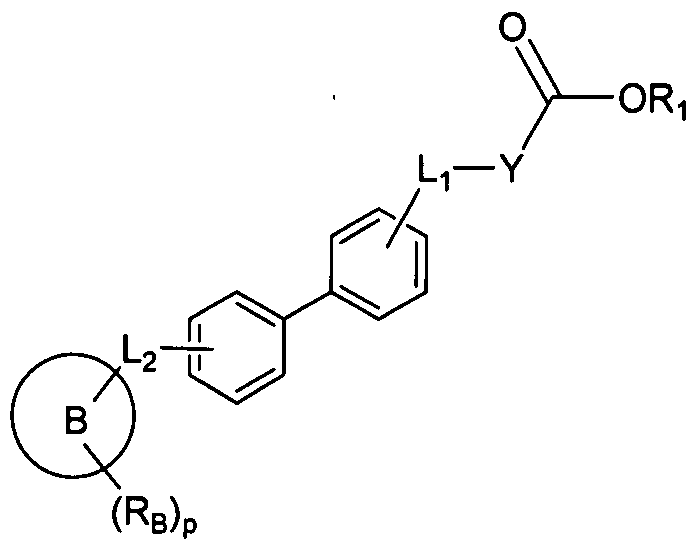
(XIV) and the pharmaceutically acceptable salts thereof, wherein B is phenyl, indolinyl, or dihydroquinolyl,
Ri is -H, - (Ci-C6) alkyl, - (Ci-C6) alkyl-phenyl, or
- (C3-C6) alkenyl;
Y is a bond, -phenyl-, -pyridyl-, or -phenyl- (Ci-C6alkyl) -, wherein each of Y is optionally substituted with at least one substituent that is independently Ry, wherein
Rγ is - (Ci-C6) alkoxy, - (Ci-C6) alkyl, - (C2-C6) alkenyl,
- (C2-C6) alkynyl, -C(O) (Ci-C6) alkoxy, -C(O) (Ci-C6) alkyl, -C(O)OH, -CN, - (Ci-C6) alkyl-C (0) OH, - (Ci-C6) haloalkoxy, - (Ci-C6) haloalkyl, -halogen, -OH,
- (Ci-C6) alkyl-OH, -NO2, -N(RNiRN2),
- (Ci-C6) alkyl-N (RN1RN2) , -C (0) N (RNiRN2) , wherein RNi and RN2 are each independently -H, -(Ci-C6) alkyl, -C (0) (Ci-C6) alkoxy, or -C(O) (Ci-C6) alkyl;
Li is - (Ci-C6) alkyl-Z-, -Z- (Ci-C6) alkyl -, or - (Ci-C6) alkyl-Z- (Ci-C6) alkyl-, wherein the alkyl portion of each of the above is optionally substituted with at least one substituent that are each independently Rγ or -oxo; and
Z is -O-, -S-, -S(O)2-, -N(RN3)-, -C(O)O-, -OC(O)-, - C(O)S-, -SC(O)-, -N(RN3)C(0)-, -C (0) N (R113) -, -S(O)2N(RN3) ", -N(RN3) S (O)2-, wherein
RN3 is -H, - (Ci-C6) alkyl, aryl, - (Ci-C6) alkyl- heteroaryl , or - (Ci-C6) alkyl-aryl;
L2 is - (Ci-C6) alkyl-, if B is heteroaryl, or if B is phenyl, then L2 is - (Ci-C6) alkyl-N (RNio) -/ wherein
RNIO is -H, - (Ci-C6) alkyl, - (C2-C6) alkenyl, - (C2-C6) alkynyl,
-C(O) (Ci-C6) alkoxy, -C(O) (Ci-C6) alkyl, -C(O) (C1-C6JaIkYl-(C3-C8)CyClOaIkYl, or -C(O)H; each RB is • independently
- (Ci-C6) alkoxy, - (Ci-C6) alkyl, - (C2-C6) alkenyl, - (C2-C6) alkynyl,
- (Ci-C6) haloalkoxy, - (Ci-C6) haloalkyl, -halogen, -OH; and p is 0, 1, 2, 3, or 4. Another aspect of the invention provides compounds of formula (XIV) , wherein
L2 is - (Ci-C6) alkyl-; and
B is indolinyl or dihydroquinolyl .
Another aspect of the invention provides compounds of formula (XIV) , wherein
L2 is - (Ci-C6) alkyl-; and
B is dihydroquinolyl.
Another aspect of the invention provides compounds of formula (XIV) , wherein L2 is -(Ci-C6) alkyl-;
B is dihydroquinolyl; and
RB is - (Ci-C6) alkyl or - (Ci-C6) haloalkyl .
Another aspect of the invention provides compounds of formula (XIV) , wherein B is phenyl; and
L2 is - (Ci-C6) alkyl-N(RNio)-/ wherein
RNIO is -H, - (Ci-C6) alkyl,
-C(O) (Ci-C6) alkoxy, or -C(O) (Ci-C6) alkyl .
Another aspect of the invention provides compounds of formula (XIV) , wherein B is phenyl; and
L2 is - (Ci-C6) alkyl-N (RNIO)-, wherein
RNio is - (Ci-C6) alkyl.
Another aspect of the invention provides compounds of formula (XIV) , wherein B is phenyl;
L2 is -(Ci-C6) alkyl-N (RNIO)-, wherein
RNIO is - (Ci-C6) alkyl; and
RB is - (Ci-C6) alkyl or - (Ci-C6) haloalkyl .
Another aspect of the invention provides compounds of formula (XIV) , wherein
Y is a bond; and Li is - (Ci-C6) alkyl-Z-, -Z- (Ci-C6) alkyl -, or
(Ci-C6) alkyl-Z- (Ci-C6) alkyl-, wherein the alkyl portion of each of the above is optionally substituted with at least one substituent that are each independently Ry or -oxo; and Z is -0-, -S-, -C(O)O-, -OC(O)-, -C(O)S-, or -SC(O).
Another aspect of the invention provides compounds of formula (XIV) , wherein
Y is -phenyl-, -pyridyl-, or -phenyl- (Ci-C6) alkyl-; and
Li is - (Ci-C6) alkyl-Z-, -Z- (Ci-C6) alkyl -, or
(Ci-C6) alkyl-Z- (Ci-C6) alkyl-, wherein the alkyl portion of each of the above is optionally substituted with at least one substituent that are each independently Rγ or -oxo; and
Z is -O- or -S-.
Another aspect of the invention provides compounds having formula (XV) :
DS-x-CR-y-PH (XV) , and pharmaceutically acceptable salts thereof, wherein CR is selected from the group consisting of

- (Ci-C6) alkoxy, - (Ci-C6) alkyl, - (C2-C6) alkenyl,
- (C2-C6) alkynyl, -C(O) (Ci-C6) alkoxy, -C(O) (Ci-C6) alkyl, -C(O)OH, -CN, - (Ci-C6) haloalkoxy,
- (Ci-C6) haloalkyl, -halogen, -OH, - (Ci-C6) alkyl-OH, -NO2, -N(RN6RN7), - (Ci-C6) alkyl-N (RN6RN7) , or -C (0) N (RN6RN7) wherein each RN6 and RN7 is independently -H, - (Ci-C6) alkyl, - (C2-C6) alkenyl, -(C2-C6) alkynyl, -C(O) (Ci-C6) alkoxy, -C(O) (Ci-C6)alkyl, or -C(O)H, each tc is independently 0, 1, 2, or 3, and each fc is independently 0, 1, 2, 3, or 4; DS is selected from the group consisting of


- (Ci-C6) alkoxy, - (Ci-C6) alkyl, - (C2-C6) alkenyl,
- (C2-C6) alkynyl, -C(O) (Ci-C6) alkoxy, -C(O) (Ci-C6) alkyl, -C(O)OH, -CN, - (Ci-C6) haloalkoxy,
- (Ci-C6) haloalkyl, -halogen, -OH, - (Ci-C6) alkyl-OH, -NO2, -N(RN6RN7) - (Ci-C6) alkyl-N (RN6RN7) , or -C(O)N(RN6RN7) in which each RN6 and RN7 is independently -H, -(Ci-C6) alkyl, - (C2-C6) alkenyl, -(C2-C6) alkynyl, -C(O) (Ci-C6) alkoxy,
-C(O) (Ci-C6)alkyl, or -C(O)H, each Rp1I and Rapi is independently -H, (Ci-C7) alkyl, or C(O) (Ci-C7) alkoxy, each Riqi and Rdii is independently - (Ci-C6) alkyl, -(Ci- C6) alkoxy, -C (0) (Ci-C6) alkoxy, -C (0) (Ci-C6) alkyl, (Ci-C6) haloalkyl, -halogen or -N(RN4RN5) in which RN4 and RN5 each is are each independently -H, - (Ci-C6) alkyl, -C (0) (Ci-C6) alkoxy, or -C(O) (Ci-C6) alkyl, each Riq3, RPi3, Rap3 and Rdi3 is independently -(Ci- C6) alkyl, - (Ci-C6) alkoxy, -C (0) (Ci-C6) alkoxy, C (0) (Ci-C6) alkyl, - (Ci-C6) haloalkyl, -halogen or -N(RN4RN5) in which RN4 and RNs each is are each independently -H, - (Ci-C6) alkyl, -C (0) (Ci-C6) alkoxy, or -C(O) (Ci-C6) alkyl, each dd is independently 0, 1, or 2,
each fd is independently 0, 1, 2, 3, or 4, and each vd is independently 0, 1, 2, 3, 4, or 5; x denotes the position of attachment of the DIS moiety to the X ring of the CR moiety, and is o, m, or p when CR is BP or PP, and α or β when CR is TP; PH is selected from the group consisting of


- (C2-C6) alkenyl, - (C2-C6) alkynyl, -C (0) (Ci-C6) alkoxy, -C(O) (Ci-C6) alkyl, -C(O)OH, -CN, - (Ci-C6) haloalkoxy,
- (Ci-C6) haloalkyl, -halogen, -OH, - (Ci-C6) alkyl-OH, -NO2, -N(RN6RN7) , - (CI-C6) alkyl-N (RN6RN7) , or
-C(O)N(RN6RN7) in which each RN6 and RN7 is independently -H, - (Ci-C6) alkyl, - (C2-C6) alkenyl, - (C2-C6) alkynyl, -C(O) (Ci-C6) alkoxy,
-C(O) (Ci-C6) alkyl, or -C(O)H, each Ria2 is independently H, (Ci-C6) alkyl or C(O)(Ci-
C6) alkoxy, each Rasi, Rari, Rpzi, Rtei, Rtn, Rtf2 and Rkpi is independently (Ci-C6) alkyl, (Ci-C6) alkoxy, -C(O) (Ci- C6)alkoxy, -C (0) (Ci-C6) alkyl, - (Ci-C6) haloalkyl, halogen or -N(RN^RNS) in which each RN4 and RNs is independently -H, - (Ci-C6) alkyl, -C (0) (Ci-C6) alkoxy, or -C(O) (Ci-C6)alkyl, each Ras2r Rarlf Rba2/ Rbe2 r Ria3/ Rhp2> Rpa3/ Rpz2/ Rte2/ Rtf 3 > Rna2/ Rpg2? Rpg3; Rpqir Raal/ Raa2/ Raa3f Raa4 and R)cp2 IS independently (Ci-C6) alkyl, (Ci-C6) alkoxy, -C(O)(Ci-
C6)alkoxy, -C (0) (Ci-C6) alkyl, - (Ci-C6) haloalkyl, halogen or -N(RK4RN5) in which each RN4 and RN5 is independently -H, - (Ci-C6) alkyl, -C (0) (Ci-C6) alkoxy, or -C(O) (Ci-C6) alkyl, each dp is independently 0, 1, or 2, each tp is independently 0, 1, 2, or 3, each fp is independently 0, 1, 2, 3, or 4, and y denotes the position of attachment of the PH moiety to the
Y ring of the CR moiety, and is o, m or p when CR is BP or TP and PH is not AR, o, m, p, or m' when CR is PP and PH is not AR, (yif YΪ) when CR is BP or TP and PH is AR, in which yi denotes the position of attachment of the nitrogen of the AR moiety, and y2 denotes the position of attachment of the methylene of the AR moiety, and in which (yi, y2) is (p, m) , (m, p) , (m, o) , or (o, m) , and
(yi, Y2) when CR is PP and PH is AR, in which yi denotes the position of attachment of the nitrogen of the AR
moiety, and y∑ denotes the position of attachment of the methylene of the AR moiety, and in which (yi, Y2) is (p, m) , (m, p) , (m, o) , (o, m) , (m' , p) , or (p, m') . Another aspect of the invention provides compounds of formula (XV) as described above and the pharmaceutically acceptable salts thereof, wherein CR is BP.
Another aspect of the invention provides compounds of formula (XV) as described above and the pharmaceutically acceptable salts thereof, wherein CR is PP.
Another aspect of the invention provides compounds of formula (XV) as described above and the pharmaceutically acceptable salts thereof, wherein CR is TP.
Another aspect of the invention provides compounds of formula (XV) as described above and the pharmaceutically acceptable salts thereof, wherein each Rbpx, RbPy, RPPx, Rppy RtPχ and Rtpy is independently - (Ci-Cβ) alkoxy, - (Ci-Cε) alkyl,
- (Ci-Cβ) haloalkoxy, - (Ci-Cβ) haloalkyl, or -halogen.
Another aspect of the invention provides compounds of formula (XV) as described above and the pharmaceutically acceptable salts thereof, wherein each fc is independently 0, 1, or 2.
Another aspect of the invention provides compounds of formula (XV) as described above and the pharmaceutically acceptable salts thereof, wherein DS is IQ.
Another aspect of the invention provides compounds of formula (XV) as described above and the pharmaceutically acceptable salts thereof, wherein DS is PI.
Another aspect of the invention provides compounds of formula (XV) as described above and the pharmaceutically acceptable salts thereof, wherein DS is AP.
Another aspect of the invention provides compounds of formula (XV) as described above and the pharmaceutically acceptable salts thereof, wherein DS is DI.
Another aspect of the invention provides compounds of formula (XV) as described above and the pharmaceutically acceptable salts thereof, wherein each Riq2, RPi2, RaP2, and Rdi2 is independently - (Ci-Cε) alkoxy, - (Ci-Cε) alkyl, - (Ci-Cβ) haloalkoxy, - (Ci-C6) haloalkyl, or -halogen.
Another aspect of the invention provides compounds of formula (XV) as described above and the pharmaceutically acceptable salts thereof, wherein each Rpii and Rapi is H.
Another aspect of the invention provides compounds of formula (XV) as described above and the pharmaceutically acceptable salts thereof, wherein each Riqi and Rdii is independently - (Ci-Cδ) alkyl Or - (Ci-Cβ) alkoxy .
Another aspect of the invention provides compounds of formula (XV) as described above and the pharmaceutically acceptable salts thereof, wherein each Riq3, RPi3, Rap3 and Rdi3 is independently - (Ci-Cβ) alkyl or - (Ci-Cε) alkoxy .
Another aspect of the invention provides compounds of formula (XV) as described above and the pharmaceutically acceptable salts thereof, wherein each dd is independently 0 or 1.
Another aspect of the invention provides compounds of formula (XV) as described above and the pharmaceutically acceptable salts thereof, wherein each fd and vd is independently 0, 1, or 2. Another aspect of the invention provides compounds of formula (XV) as described above and the pharmaceutically acceptable salts thereof, wherein CR is BP or PP and x is m.
Another aspect of the invention provides compounds of formula (XV) as described above and the pharmaceutically acceptable salts thereof, wherein CR is BP or PP and x is p.
Another aspect of the invention provides compounds of formula (XV) as described above and the pharmaceutically acceptable salts thereof, wherein CR is TP and x is β.
Another aspect of the invention provides compounds of formula (XV) as described above and the pharmaceutically acceptable salts thereof, wherein PH is AS or AR.
Another aspect of the invention provides compounds of formula (XV) as described above and the pharmaceutically acceptable salts thereof, wherein PH is BA or BE.
Another aspect of the invention provides compounds of formula (XV) as described above and the pharmaceutically acceptable salts thereof, wherein PH is IA or PA. Another aspect of the invention provides compounds of formula (XV) as described above and the pharmaceutically acceptable salts thereof, wherein PH is HP or NA.
Another aspect of the invention provides compounds of formula (XV) as described above and the pharmaceutically acceptable salts thereof, wherein PH is PZ or KP.
Another aspect of the invention provides compounds of formula (XV) as described above and the pharmaceutically acceptable salts thereof, wherein PH is TE, TF or AA.
Another aspect of the invention provides compounds of formula (XV) as described above and the pharmaceutically acceptable salts thereof, wherein PH is PG.
Another aspect of the invention provides compounds of formula (XV) as described above and the pharmaceutically acceptable salts thereof, wherein each Rbai/ Rbei/
 Rpair RPa2/ Rnai/ and Rpgi is independently - (Ci-Cε) alkoxy, - (Ci-Cβ) alkyl, - (Ci-Cβ) haloalkoxy, - (Ci-Cβ) haloalkyl, or halogen.
Another aspect of the invention provides compounds of formula (XV) as described above and the pharmaceutically acceptable salts thereof, wherein Ria2 is H.
Another aspect of the invention provides compounds of formula (XV) as described above and the pharmaceutically acceptable salts thereof, wherein each Rasi, Rari? Rpzi? Rteir
Rtfi/ Rtf2 and Rkpi is independently - (Ci-Cβ) alkyl or -(Ci- Ce) alkoxy .
Another aspect of the invention provides compounds of formula (XV) as described above and the pharmaceutically acceptable salts thereof, wherein each B.a32ι Rari> Rba2, Rbe2/
Ria3 f Rhp2 / Rpa3 / Rpz2 j Rte2 / Rtf3 / Rna2 / Rpg2 / Rpg3 f Rpg4 ? Raal / Raa2 /
Raa3Λ Raa4 and Rkp2 is independently - (Ci-Cβ) alkyl or -(Ci- Cs) alkoxy.
Another aspect of the invention provides compounds of formula (XV) as described above and the pharmaceutically acceptable salts thereof, wherein each dp and tp is independently 0 or 1.
Another aspect of the invention provides compounds of formula (XV) as described above and the pharmaceutically acceptable salts thereof, wherein each fp and vp is independently 0, 1 or 2.
Another aspect of the invention provides compounds of formula (XV) as described above and the pharmaceutically acceptable salts thereof, wherein PH is not AR and y is p. Another aspect of the invention provides compounds of formula (XV) as described above and the pharmaceutically acceptable salts thereof, wherein CR is BP or TP, PH is not AR, and y is m.
Another aspect of the invention provides compounds of formula (XV) as described above and the pharmaceutically acceptable salts thereof, wherein CR is PP, PH is not AR, and y is m' .
Another aspect of the invention provides compounds of formula (XV) as described above and the pharmaceutically acceptable salts thereof, wherein PH is AR and (yi, y∑) is (p, m) or (p, in' ) .
Another aspect of the invention provides compounds of formula (XV) as described above and the pharmaceutically
acceptable salts thereof, wherein x is m and y is p; or x is p and y is m or m' .
Another aspect of the invention provides compounds of formula (XV) , and the pharmaceutically acceptable salts thereof, having the following structures:


Another aspect of the invention provides compounds of formula (XV) as described above and the pharmaceutically acceptable salts thereof, having structures such as PI-m-BP-p- TE; IQ-m-BP-p-NA; IQ-m-BP-p-NA; PI-m-BP-p-PA; PI-m-BP-p-PG; PI-p-PP-m' -NA; PI-p-PP-m' -TE; PI-m-PP-p-NA; PI-m-PP-p-TE; PI- m-BP-p-NA; DI-m-BP-p-NA; IQ-m-BP-p-AS; IQ-m-BP-p-BA; IQ-m-BP- p-AA; PI-m-BP-p-PA; IQ-m-BP-p-HP; PI-m-BP-p-HP; IQ-m-BP-p-PA; IQ-m-BP-p-PG; IQ-m-BP-p-KP; PI-m-BP-p-BA; IQ-m-BP- (p,m) -AR; PI-m-PP-p-BE; IQ-m-BP-p-IA; AP-m-BP-p-BA; AP-m-BP-p-HP; IQ-m- BP-p-AS; PI-m-PP-p-AS; PI-m-PP-m-AS; IQ-β-TP-p-BA; IQ-m-BP-p- BE; AP-m-BP-p-HP; PI-m-BP-p-HP; AP-m-BP-p-BA; IQ-m-BP-p-HP; DI-m-BP-p-PA; and DI-m-BP-p-PZ .
Another aspect of the invention provides compounds having formula (XVI) :
) DIS-x-COR-y-PHM (XVI), and pharmaceutically acceptable salts thereof, wherein COR is selected from the group consisting of

(TPA); DIS


?
 (PAA)
(PAA)
 [PZA)
[PZA)
 -COOH (TFA)

(yl, y2) when COR is PPA and PHM is ARA, in which yi denotes the position of attachment of the nitrogen of the ARA moiety, and y2 denotes the position of attachment of the methylene of the ARA moiety, and in which (yi, y2) is (p,m), (m,p), (m,o), (o,m) , (m' ,p) or (p, m' ) . Another aspect of the invention provides compounds of formula (XVI) as described above and the pharmaceutically acceptable salts thereof, wherein COR is BPA.
Another aspect of the invention provides compounds of formula (XVI) as described above and the pharmaceutically acceptable salts thereof, wherein COR is PPA.
Another aspect of the invention provides compounds of formula (XVI) as described above and the pharmaceutically acceptable salts thereof, wherein COR is TPA.
Another aspect of the invention provides compounds of formula (XVI) as described above and the pharmaceutically acceptable salts thereof, wherein DIS is IQA, IQB, IQC, or IQD.
Another aspect of the invention provides compounds of formula (XVI) as described above and the pharmaceutically acceptable salts thereof, wherein DIS is IPA, IPB or IPC.
Another aspect of the invention provides compounds of formula (XVI) as described above and the pharmaceutically acceptable salts thereof, wherein DIS is APA or APB.
Another aspect of the invention provides compounds of formula (XVI) as described above and the pharmaceutically acceptable salts thereof, wherein DIS is DIA.
Another aspect of the invention provides compounds of formula (XVI) as described above and the pharmaceutically acceptable salts thereof, wherein COR is PZA or PPA and x is m.
Another aspect of the invention provides compounds of formula (XVI) as described above and the pharmaceutically acceptable salts thereof, wherein COR is BPA or PPA and x is
P- Another aspect of the invention provides compounds of formula (XVI) as described above and the pharmaceutically acceptable salts thereof, wherein COR is TPA and x is β.
Another aspect of the invention provides compounds of formula (XVI) as described above and the pharmaceutically acceptable salts thereof, wherein PHM is ASA or ARA.
Another aspect of the invention provides compounds of formula (XVI) as described above and the pharmaceutically acceptable salts thereof, wherein PHM is BAA, BAB, BEA or BEB.
Another aspect of the invention provides compounds of formula (XVI) as described above and the pharmaceutically acceptable salts thereof, wherein PHM is IAA or PAA.
Another aspect of the invention provides compounds of formula (XVI) as described above and the pharmaceutically acceptable salts thereof, wherein PHM is HPA, HPB or NAA.
Another aspect of the invention provides compounds of formula (XVI) as described above and the pharmaceutically acceptable salts thereof, wherein PHM is BPA or KPA. Another aspect of the invention provides compounds of formula (XVI) as described above and the pharmaceutically acceptable salts thereof, wherein PHM is TEA, TEB, TFA or AAA.
Another aspect of the invention provides compounds of formula (XVI) as described above and the pharmaceutically acceptable salts thereof, wherein PHM is PGA.
Another aspect of the invention provides compounds of formula (XVI) as described above and the pharmaceutically acceptable salts thereof, wherein PHM is not ARA and y is p.
Another aspect of the invention provides compounds of formula (XVI) as described above and the pharmaceutically acceptable salts thereof, wherein COR is BPA or TPA, PHM is not ARA, and y is m.
Another aspect of the invention provides compounds of formula (XVI) as described above and the pharmaceutically acceptable salts thereof, wherein COR is PPA, PHM is not ARA, and y is m' .
Another aspect of the invention provides compounds of formula (XVI) as described above and the pharmaceutically acceptable salts thereof, wherein PHM is ARA and (yi, yz) is (p, m) or (p,m' ) .
Another aspect of the invention provides compounds of formula (XVI) as described above and the pharmaceutically acceptable salts thereof, wherein x is m and y is p; or x is p and y is m or m' .
Another aspect of the invention provides compounds of formula (XVI) as described above and the pharmaceutically acceptable salts thereof, having structures such as IPA-m-BPA- p-TEB; IQA-m-BPA-p-NAA; IQB-m-BPA-p-NAA; IPA-m-BPA-p-PAA; IPA- m-BPA-p-PGA; IPA-p-PPA-m' -NAA; IPA-p-PPA-m' -TEA; IPA-m-PPA-p- NAA; IPA-m-PPA-p-TEB; IPC-m-BPA-p-NAA; DIA-m-BPA-p-NAA; IQD-m- BPA-p-ASA; IQC-m-BPA-p-BAA; IQB-m-BPA-p-BAA; IQB-m-BPA-p-AAA; IPB-m-BPA-p-PAA; IQB-m-BPA-p-HPA; IQC-m-BPA-p-HPA; IPB-m-BPA- p-HPA; IPC-m-BPA-p-HPA; IQB-m-BPA-p-PAA; IQC-m-BPA-p-PAA; IQB- m-BPA-p-PGA; IQB-m-BPA-p-KPA; IPC-m-BPA-p-BAA; IQB-m-BPA-
(p, m) -ARA; IPA-m-PPA-p-BEB; IQB-m-BPA-p-IAA; APA-m-BPA-p-BAA; APA-m-BPA-p-HPA; IQA-m-BPA-p-ASA; IPA-m-PPA-p-ASA; IPA-m-PPA- m-ASA; IQB-β-TPA-p-BAA; IQB-m-BPA-p-BEA; APA-m-BPA-p-HPA; IPC- m-BPA-p-HPB; APB-m-BPA-p-BAA; IQB-m-BPA-p-HPB; DIA-m-BPA-p- PAA; and DIA-m-BPA-p-PZA.
Another aspect of the invention provides synthetic intermediates that are useful in making the compounds of the invention.
Another aspect of the invention provides methods of preparing the compounds of the invention and the intermediates used in those methods.
Another aspect of the invention provides a pharmaceutical composition comprising a compound of any of formulae (I)-
(XVI) as described above, or a pharmaceutically acceptable salt thereof and at least one pharmaceutically acceptable solvent, carrier, adjuvant, or excipient.
Another aspect of the invention provides methods of treating Type I diabetes, Type II diabetes, and Syndrome X (consisting of such abnormalities as obesity, dyslipidemia, hypercoagulation, hypertension, insulin resistance and leading to heart disease and diabetes), comprising administering either a pharmaceutically acceptable amount of a compound of any of formulae (I)-(XVI) as described above, or a pharmaceutically acceptable salt thereof, or a pharmaceutical
composition comprising a compound of any of formulae (I)- (XVI) as described above, or a pharmaceutically acceptable salt thereof to a patient in need of such treatment.
The compounds of the present invention inhibit PTP-IB, and therefore are useful in treating or controlling other PTP-
IB mediated diseases, including controlling or treating Type 2 diabetes, improving glucose tolerance, and improving insulin sensitivity in patients in need thereof.
Another aspect of the invention provides a method of inhibiting PTP-IB comprising administering to a patient in need thereof either a pharmaceutically acceptable amount of a compound of any of formulae (I)-(XVI) as described above, or a pharmaceutically acceptable salt thereof, or a pharmaceutical composition comprising a compound of any of formulae (I)-(XVI) or a pharmaceutically acceptable salt thereof.
Another aspect of the invention provides a method of treating cancer comprising administering to a patient in need thereof either a pharmaceutically acceptable amount of a compound of any of formulae (I)-(XVI) or a pharmaceutically acceptable salt thereof, or a pharmaceutical composition comprising a compound of any of formulae (I)-(XVI) or a pharmaceutically acceptable salt thereof.
Another aspect of the invention provides a method of treating neurodegenerative diseases comprising administering to a patient in need thereof either a pharmaceutically acceptable amount of a compound of any of formulae (I)-(XVI) or a pharmaceutically acceptable salt thereof, or a pharmaceutical composition comprising a compound of any of formulae (I)-(XVI) or a pharmaceutically acceptable salt thereof.
Another aspect of the invention provides a method of treating immunological disease comprising administering either a pharmaceutically acceptable amount of a compound of any of formulae (I)-(XVI) or a pharmaceutically acceptable salt
thereof, or a pharmaceutical composition comprising a compound of any of formulae (I)-(XVI) or a pharmaceutically acceptable salt thereof to a patient in need of such treatment.
Another aspect of the invention provides a method of treating bleeding disorders comprising administering either a pharmaceutically acceptable amount of a compound of any of formulae (I)-(XVI) or a pharmaceutically acceptable salt thereof, or a pharmaceutical composition comprising a compound of any of formulae (I)-(XVI) or a pharmaceutically acceptable salt thereof to a patient in need of such treatment.
Another aspect of the invention provides methods of using PTP-IB inhibitors of any of formulae (I)-(XVI) for improving the cardiovascular or cerebrovascular risk profile in patients experiencing or subject to type II diabetes (non- insulin-dependent diabetes mellitus) or Syndrome X, preferably in patients experiencing or subject to human type II diabetes. These methods may also be characterized as the reduction of risk factors for heart disease, stroke, or heart attack in patients experiencing or subject to type II diabetes or Syndrome X.
Vide ante, another aspect invention also provides methods and compositions for combination therapy of Type I diabetes, Type II diabetes, and Syndrome X. In the following table, Table 1, methods for using a pharmacological combination of one or more PTP-IB inhibitor and one or more combination agent are described for the treatment of Type II diabetes or Syndrome X in a patient in need of such treatment. In the following embodiments, such treatments comprise administration of the inventive compounds of any of formulae (I)-(XVI) as disclosed herein either concomitantly, simultaneously, or together with a therapeutically-effective amount of said additional compounds and medicaments. In the case of combination therapy methods involving insulins as the
associated agent, the methods are for the treatment of Type I or Type II diabetes in a patient in need of such treatment.
Table 1


Insulins useful with the methods and combinations of this invention include rapid acting insulins, intermediate acting insulins, long acting insulins and combinations of intermediate and rapid acting insulins.
Rapid acting commercially available insulin products include HUMALOG® Brand Lispro Injection (rDNA origin); HUMULIN® Regular Human Injection, USP [rDNA origin]; HUMULIN® Regular U- 500 Concentrated Human Injection, USP [rDNA origin]; REGULAR ILETIN® II (insulin injection, USP, purified pork) available from Eli Lilly and Co.; and the NOVALIN® Human Insulin Injection and VENOSULIN® BR Buffered Regular Human Injection, each available from Novo Nordisk Pharmaceuticals.
Commercially available intermediate acting insulins useful with this invention include, but are not limited to, the HUMULIN® L brand LENTE® human insulin [rDNA origin] zinc suspension, HUMULIN® N NPH human insulin [rDNA origin] isophane suspension, LENTE® ILETIN. RTM. II insulin zinc suspension, USP, purified pork, and NPH ILETIN® II isophane insulin suspension, USP, purified pork, available from Eli Lilly and Company,
LANTUS® insulin glargine [rDNA origin] injection, available from Aventis Pharmaceuticals, and the NOVOLIN L Lente® human insulin zinc suspension (recombinant DNA origin) , and NOVOLIN®
N NPH human insulin isophane suspension (recombinant DNA origin) products available from Novo Nordisk Pharmaceuticals,
Inc, Princeton N.J.
Also useful with the methods and formulations of this invention are intermediate and rapid acting insulin combinations, such as the HUMALOG® Mix 75/25 (75% Insulin Lispro Protamine Suspension and 25% Insulin Lispro Injection) , HUMULIN® 50/50 (50% Human Insulin Isophane Suspension and 50% Human Insulin Injection) and HUMULIN® 70/30 (70% Human Insulin Isophane Suspension and 30% Human Insulin Injection) , each available from Eli Lilly and Company. Also useful are the NOVALIN® 70/30 (70% NPH, Human Insulin Isophane Suspension and 30% Regular, Human Insulin Injection) line of combination products available from Novo Nordisk Pharmaceuticals.
A commercially available long acting insulin for use with this invention is the HUMULIN® U Ultralente® human insulin [rDNA origin] extended zinc suspension, available from Eli Lilly and Company. Also useful in the methods of this invention are inhaled insulin products, such as the EXUBERA® inhaled insulin product developed by Pfizer Inc. and Aventis SA.
Each of these insulin products can be administered as directed by a medical professional using administrations, dosages and regimens known in the art, such as those published for each product in the Physicians' Desk Reference, 55 Edition, 2001, published by Medical Economics Company, Inc. at Montvale, N.J., the relevant sections of which are incorporated herein by reference.
Pharmaceutical Formulations
The compounds of general Formulae (I)-(XVI) may be administered orally, topically, parenterally, by inhalation or spray or rectally in dosage unit formulations containing conventional non-toxic pharmaceutically acceptable carriers, adjuvants and vehicles. The term parenteral as used herein includes percutaneous, subcutaneous, intravascular (e.g., intravenous), intramuscular, or intrathecal injection or infusion techniques and the like. In addition, there is provided a pharmaceutical formulation comprising a compound of general Formulae (I)-(XVI) and a pharmaceutically acceptable carrier. One or more compounds of general Formulae (I)-(XVI) may be present in association with one or more non-toxic pharmaceutically acceptable carriers and/or diluents and/or adjuvants, and if desired other active ingredients. The pharmaceutical compositions containing compounds of general Formulae (I)-(XVI) may be in a form suitable for oral use, for example, as tablets, troches, lozenges, aqueous or oily
suspensions, dispersible powders or granules, emulsion, hard or soft capsules, or syrups or elixirs.
Compositions intended for oral use may be prepared according to any method known to the art for the manufacture of pharmaceutical compositions and such compositions may contain one or more agents selected from the group consisting of sweetening agents, flavoring agents, coloring agents and preservative agents in order to provide pharmaceutically elegant and palatable preparations. Tablets contain the active ingredient in admixture with non-toxic pharmaceutically acceptable excipients that are suitable for the manufacture of tablets. These excipients may be for example, inert diluents, such as calcium carbonate, sodium carbonate, lactose, calcium phosphate or sodium phosphate; granulating and disintegrating agents, for example, corn starch, or alginic acid; binding agents, for example starch, gelatin or acacia, and lubricating agents, for example magnesium stearate, stearic acid or talc. The tablets may be uncoated or they may be coated by known techniques. In some cases such coatings may be prepared by known techniques to delay disintegration and absorption in the gastrointestinal tract and thereby provide a sustained action over a longer period. For example, a time delay material such as glyceryl monosterate or glyceryl distearate may be employed. Formulations for oral use may also be presented as hard gelatin capsules, wherein the active ingredient is mixed with an inert solid diluent, for example, calcium carbonate, calcium phosphate or kaolin, or as soft gelatin capsules wherein the active ingredient is mixed with water or an oil medium, for example peanut oil, liquid paraffin or olive oil.
Formulations for oral use may also be presented as lozenges .
Aqueous suspensions contain the active materials in admixture with excipients suitable for the manufacture of
aqueous suspensions. Such excipients are suspending agents, for example sodium carboxymethylcellulose, methylcellulose, hydropropylmethylcellulose, sodium alginate, polyvinylpyrrolidone, gum tragacanth and gum acacia; dispersing or wetting agents may be a naturally-occurring phosphatide, for example, lecithin, or condensation products of an alkylene oxide with fatty acids, for example polyoxyethylene stearate, or condensation products of ethylene oxide with long chain aliphatic alcohols, for example heptadecaethyleneoxycetanol, or condensation products of ethylene oxide with partial esters derived from fatty acids and a hexitol such as polyoxyethylene sorbitol monooleate, or condensation products of ethylene oxide with partial esters derived from fatty acids and hexitol anhydrides, for example polyethylene sorbitan monooleate. The aqueous suspensions may also contain one or more preservatives, for example ethyl, or n-propyl p-hydroxybenzoate, one or more coloring agents, one or more flavoring agents, and one or more sweetening agents, such as sucrose or saccharin. Oily suspensions may be formulated by suspending the active ingredients in a vegetable oil, for example arachis oil, olive oil, sesame oil or coconut oil, or in a mineral oil such as liquid paraffin. The oily suspensions may contain a thickening agent, for example beeswax, hard paraffin or cetyl alcohol. Sweetening agents and flavoring agents may be added to provide palatable oral preparations. These compositions may be preserved by the addition of an anti-oxidant such as ascorbic acid.
Dispersible powders and granules suitable for preparation of an aqueous suspension by the addition of water provide the active ingredient in admixture with a dispersing or wetting agent, suspending agent and one or more preservatives. Suitable dispersing or wetting agents or suspending agents are exemplified by those already mentioned above. Additional
excipients, for example sweetening, flavoring and coloring agents, may also be present.
Pharmaceutical compositions of the invention may also be in the form of oil-in-water emulsions. The oily phase may be a vegetable oil or a mineral oil or mixtures of these. Suitable emulsifying agents may be naturally-occurring gums, for example gum acacia or gum tragacanth, naturally-occurring phosphatides, for example soy bean, lecithin, and esters or partial esters derived from fatty acids and hexitol, anhydrides, for example sorbitan monooleate, and condensation products of the said partial esters with ethylene oxide, for example polyoxyethylene sorbitan monooleate. The emulsions may also contain sweetening and flavoring agents.
Syrups and elixirs may be formulated with sweetening agents, for example glycerol, propylene glycol, sorbitol, glucose or sucrose. Such formulations may also contain a demulcent, a preservative, flavoring, and coloring agents. The pharmaceutical compositions may be in the form of a sterile injectable aqueous or oleaginous suspension. This suspension may be formulated according to the known art using those suitable dispersing or wetting agents and suspending agents that have been mentioned above. The sterile injectable preparation may also be a sterile injectable solution or suspension in a non-toxic parentally acceptable diluent or solvent, for example as a solution in 1, 3-butanediol . Among the acceptable vehicles and solvents that may be employed are water, Ringer's solution and isotonic sodium chloride solution. In addition, sterile, fixed oils are conventionally employed as a solvent or suspending medium. For this purpose any bland fixed oil may be employed including synthetic mono- or diglycerides . In addition, fatty acids such as oleic acid find use in the preparation of injectables.
The compounds of the present invention may also be administered in the form of suppositories, e.g., for rectal
administration of the drug. These compositions can be prepared by mixing the drug with a suitable non-irritating excipient that is solid at ordinary temperatures but liquid at the rectal temperature and will therefore melt in the rectum to release the drug. Such materials include cocoa butter and polyethylene glycols.
Compounds of the present invention may be administered parenterally in a sterile medium. The drug, depending on the vehicle and concentration used, can either be suspended or dissolved in the vehicle. Advantageously, adjuvants such as local anesthetics, preservatives and buffering agents can be dissolved in the vehicle.
For disorders of the eye or other external tissues, e.g., mouth and skin, the formulations are preferably applied as a topical gel, spray, ointment or cream, or as a suppository, containing the active ingredients in a total amount of, for example, 0.075 to 30% w/w, preferably 0.2 to 20% w/w and most preferably 0.4 to 15% w/w. When formulated in an ointment, the active ingredients may be employed with either paraffinic or a water-miscible ointment base.
Alternatively, the active ingredients may be formulated in a cream with an oil-in-water cream base. If desired, the aqueous phase of the cream base may include, for example, at least 30% w/w of a polyhydric alcohol such as propylene glycol, butane-1, 3-diol, mannitol, sorbitol, glycerol, polyethylene glycol and mixtures thereof. The topical formulation may desirably include a compound which enhances absorption or penetration of the active ingredient through the skin or other affected areas. Examples of such dermal penetration enhancers include dimethylsulfoxide and related analogs. The compounds of this invention can also be administered by a transdermal device. Preferably topical administration will be accomplished using a patch either of the reservoir and porous membrane type or of a solid matrix
variety. In either case, the active agent is delivered continuously from the reservoir or microcapsules through a membrane into the active agent permeable adhesive, which is in contact with the skin or mucosa of the recipient. If the active agent is absorbed through the skin, a controlled and predetermined flow of the active agent is administered to the recipient. In the case of microcapsules, the encapsulating agent may also function as the membrane. The transdermal patch may include the compound in a suitable solvent system with an adhesive system, such as an acrylic emulsion, and a polyester patch. The oily phase of the emulsions of this invention may be constituted from known ingredients in a known manner. While the phase may comprise merely an emulsifier, it may comprise a mixture of at least one emulsifier with a fat or an oil or with both a fat and an oil. Preferably, a hydrophilic emulsifier is included together with a lipophilic emulsifier which acts as a stabilizer. It is also preferred to include both an oil and a fat. Together, the emulsifier (s) with or without stabilizer (s) make-up the so-called emulsifying wax, and the wax together with the oil and fat make up the so- called emulsifying ointment base which forms the oily dispersed phase of the cream formulations. Emulsifiers and emulsion stabilizers suitable for use in the formulation of the present invention include Tween 60, Span 80, cetostearyl alcohol, myristyl alcohol, glyceryl monostearate, and sodium lauryl sulfate, among others. The choice of suitable oils or fats for the formulation is based on achieving the desired cosmetic properties, since the solubility of the active compound in most oils likely to be used in pharmaceutical emulsion formulations is very low. Thus, the cream should preferably be a non-greasy, non-staining and washable product with suitable consistency to avoid leakage from tubes or other containers. Straight or branched chain, mono- or dibasic alkyl esters such as di-isoadipate, isocetyl stearate, propylene
glycol diester of coconut fatty acids, isopropyl myristate, decyl oleate, isopropyl palmitate, butyl stearate, 2- ethylhexyl palmitate or a blend of branched chain esters may be used. These may be used alone or in combination depending on the properties required. Alternatively, high melting point lipids such as white soft paraffin and/or liquid paraffin or other mineral oils can be used.
Formulations suitable for topical administration to the eye also include eye drops wherein the active ingredients are dissolved or suspended in suitable carrier, especially an aqueous solvent for the active ingredients. The antiinflammatory active ingredients are preferably present in such formulations in a concentration of 0.5 to 20%, advantageously 0.5 to 10% and particularly about 1.5% w/w. For therapeutic purposes, the active compounds of this combination invention are ordinarily combined with one or more adjuvants appropriate to the indicated route of administration. If administered per os, the compounds may be admixed with lactose, sucrose, starch powder, cellulose esters of alkanoic acids, cellulose alkyl esters, talc, stearic acid, magnesium stearate, magnesium oxide, sodium and calcium salts of phosphoric and sulfuric acids, gelatin, acacia gum, sodium alginate, polyvinylpyrrolidone, and/or polyvinyl alcohol, and then tableted or encapsulated for convenient administration. Such capsules or tablets may contain a controlled-release formulation as may be provided in a dispersion of active compound in hydroxypropylmethyl cellulose. Formulations for parenteral administration may be in the form of aqueous or non-aqueous isotonic sterile injection solutions or suspensions. These solutions and suspensions may be prepared from sterile powders or granules having one or more of the carriers or diluents mentioned for use in the formulations for oral administration. The compounds may be dissolved in water, polyethylene glycol, propylene glycol, ethanol, corn oil,
cottonseed oil, peanut oil, sesame oil, benzyl alcohol, sodium chloride, and/or various buffers. Other adjuvants and modes of administration are well and widely known in the pharmaceutical art. Dosage levels of the order of from about 0.1 mg to about 140 mg per kilogram of body weight per day are useful in the treatment of the above-indicated conditions (about 0.5 mg to about 7 g per patient per day) . The amount of active ingredient that may be combined with the carrier materials to produce a single dosage form will vary depending upon the host treated and the particular mode of administration. Dosage unit forms will generally contain between from about 1 mg to about 500 mg of an active ingredient. The daily dose can be administered in one to four doses per day. In the case of skin conditions, it may be preferable to apply a topical preparation of compounds of this invention to the affected area two to four times a day.
It will be understood, however, that the specific dose level for any particular patient will depend upon a variety of factors including the activity of the specific compound employed, the age, body weight, general health, sex, diet, time of administration, route of administration, and rate of excretion, drug combination and the severity of the particular disease undergoing therapy. For administration to non-human animals, the composition may also be added to the animal feed or drinking water. It may be convenient to formulate the animal feed and drinking water compositions so that the animal takes in a therapeutically appropriate quantity of the composition along with its diet. It may also be convenient to present the composition as a premix for addition to the feed or drinking water. Preferred non-human animals include domesticated animals.
Definitions
The term "alkoxy" represents an alkyl group of indicated number of carbon atoms attached to the parent molecular moiety through an oxygen bridge. Examples of alkoxy groups include, for example, methoxy, ethoxy, propoxy and isopropoxy. The term "alkyl" as used herein, means a straight or branched chain hydrocarbon containing from 1 to 10 carbon atoms. Representative examples of alkyl include, but are not limited to, methyl, ethyl, n-propyl, iso-propyl, n-butyl, sec- butyl, iso-butyl, tert-butyl, n-pentyl, isopentyl, neopentyl, n-hexyl, 3-methylhexyl, 2, 2-dimethylpentyl, 2,3- dimethylpentyl, n-heptyl, n-octyl, n-nonyl, and n-decyl .
The term "alkenyl" as used herein, means a straight or branched chain hydrocarbon containing the designated number of carbon atoms and containing at least one carbon-carbon double bond. Representative examples of alkenyl include, but are not limited to, ethenyl, 2-propenyl, 2-methyl-2-propenyl, 3- butenyl, 4-pentenyl, 5-hexenyl, 2-heptenyl, 2-methyl-l- heptenyl, and 3-decenyl.
The term "alkynyl" as used herein, means a straight or branched chain hydrocarbon group containing the designated number of carbon atoms and containing at least one carbon- carbon triple bond. Representative examples of alkynyl include, but are not limited, to acetylenyl, 1-propynyl, 2- propynyl, 3-butynyl, 2-pentynyl, and 1-butynyl. The term "aryl" refers to a hydrocarbon ring system containing at least one aromatic ring. The aromatic ring may optionally be fused or otherwise attached to other aromatic hydrocarbon rings or non-aromatic hydrocarbon rings. Examples of aryl groups include, for example, phenyl, naphthyl, 1, 2, 3, 4-tetrahydronaphthalene and biphenyl . Preferred examples of aryl groups include phenyl, naphthyl, and anthracenyl . More preferred aryl groups are phenyl and naphthyl. Most preferred is phenyl.
The term "cycloalkyl" refers to a cyclic hydrocarbon, containing no heteroatoms . Examples of cycloalkyl include cyclopropyl, cyclobutyl, cyclopentyl, cyclohexyl, cycloheptyl, and cyclooctyl. The terms "halogen" or "halo" indicate fluorine, chlorine, bromine, and iodine.
The term "haloalkoxy" as used herein, means at least one halogen, as defined herein, appended to the parent molecular moiety through an alkoxy group, as defined herein. Representative examples of haloalkoxy include, but are not limited to, chloromethoxy, 2-fluoroethoxy, trifluoromethoxy, and pentafluoroethoxy.
The term "haloalkyl" as used herein, means at least one halogen, as defined herein, appended to the parent molecular moiety through an alkyl group, as defined herein. Representative examples of haloalkyl include, but are not limited to, chloromethyl, 2-fluoroethyl, trifluoromethyl, pentafluoroethyl, and 2-chloro-3-fluoropentyl .
The term "heteroaryl" refers to an monocyclic or fused cyclic ring system containing at least one heteroatom selected from nitrogen, oxygen, and sulfur, and at least one aromatic ring. The heteroaryl ring may be fused or otherwise attached to one or more heteroaryl rings, aromatic or non-aromatic hydrocarbon rings or heterocycloalkyl rings. If the heteroaryl contains more than one fused ring, the heteroatom may be part of one or more of the aromatic rings and/or part of one or more of the non-aromatic rings, provided that at least one of the fused rings is aromatic. Where the heteroaryl ring contains aromatic and non-aromatic portions, the point of attachment to the parent structure may be on either the aromatic portion or the non-aromatic portion of the heteroaryl ring. Examples of heteroaryl groups include, for example, pyridine, furan, thienyl, 5,6,7,8- tetrahydroisoquinoline and pyrimidine. Preferred examples of
heteroaryl groups include thienyl, benzothienyl, pyridyl, quinolyl, pyrazolyl, pyrimidyl, imidazolyl, benzimidazolyl, furanyl, benzofuranyl, dibenzofuranyl, thiazolyl, benzothiazolyl, isoxazolyl, oxadiazolyl, isothiazolyl, benzisothiazolyl, triazolyl, pyrrolyl, indolyl, pyrazolyl, benzopyrazolyl, indolinyl, and 3, 4-dihydroquinolin-l (2H) -yl .
The term "heterocycloalkyl" as used herein, means a monocyclic, 3, 4, 5, 6 or 7 membered non-aromatic ring containing at least one heteroatom independently selected from the group consisting of O, N, and S. The 3 or 4 membered ring contains 1 heteroatom selected from the group consisting of 0, N and S. The 5 membered ring contains zero or one double bond and one, two or three heteroatoms selected from the group consisting of 0, N and S. The 6 or 7 membered ring contains zero, one or two double bonds and one, two or three heteroatoms selected from the group consisting of O, N and S. The heterocycloalkyl is connected to the parent molecular moiety through any carbon atom or any nitrogen atom contained within. Representative examples of heterocycloalkyls include, but are not limited to, azetidinyl, azepanyl, aziridinyl, diazepanyl, 1, 3-dioxanyl, 1, 3-dioxolanyl, 1, 3-dithiolanyl, 1, 3-dithianyl, imidazolinyl, imidazolidinyl, isothiazolinyl, isothiazolidinyl, isoxazolinyl, isoxazolidinyl, morpholinyl, oxadiazolinyl, oxadiazolidinyl, oxazolinyl, oxazolidinyl, piperazinyl, piperidinyl, pyranyl, pyrazolinyl, pyrazolidinyl, pyrrolinyl, pyrrolidinyl, tetrahydrofuranyl, tetrahydrothienyl, thiadiazolinyl, thiadiazolidinyl, thiazolinyl, thiazolidinyl, thiomorpholinyl, 1,1- dioxidothiomorpholinyl (thiomorpholine sulfone) , thiopyranyl, and trithianyl.
The term "oxo" as used herein, means a =0 moiety. The compounds of this invention may contain one or more asymmetric carbon atoms, so that the compounds can exist in different stereoisomeric forms. These compounds can be, for
example, racemates, chiral non-racemic or diastereomers . In these situations, the single enantiomers, i.e., optically active forms, can be obtained by asymmetric synthesis or by resolution of the racemates. Resolution of the racemates can be accomplished, for example, by conventional methods such as crystallization in the presence of a resolving agent; chromatography, using, for example a chiral HPLC column; or derivatizing the racemic mixture with a resolving reagent to generate diastereomers, separating the diastereomers via chromatography, and removing the resolving agent to generate the original compound in enantiomerically enriched form. Any of the above procedures can be repeated to increase the enantiomeric purity of a compound.
When the compounds described herein contain olefinic double bonds or other centers of geometric asymmetry, and unless otherwise specified, it is intended that the compounds include the cis, trans, Z- and E- configurations. Likewise, all tautomeric forms are also intended to be included.
Compounds of the present invention are named according to IUPAC conventions by ACD/ChemSketch version 8.17 (developed by Advanced Chemistry Development, Inc., Toronto, ON, Canada).
Methods of Preparation
The compounds and processes of the present invention will be better understood in connection with the following synthetic schemes which illustrate the methods by which the compounds of the invention may be prepared. Starting materials can be obtained from commercial sources or prepared by well-established literature methods known to those of ordinary skill in the art.
The reactions are performed in a solvent appropriate to the reagents and materials employed and suitable for the transformations being effected. It will be understood by those
skilled in the art of organic synthesis that the functionality present on the molecule should be consistent with the transformations proposed. This will sometimes require a judgment to modify the order of the synthetic steps or to select one particular process scheme over another in order to obtain a desired compound of the invention.
It will also be recognized that another major consideration in the planning of any synthetic route in this field is the judicious choice of the protecting group used for protection of the reactive functional groups present in the compounds described in this invention. An authoritative account describing the many alternatives to the trained practitioner is Greene and Wuts (Protective Groups In Organic Synthesis, Wiley and Sons, 1999) . Compounds of the present invention can be generally prepared according to the methods outlined in Schemes A through D below. In the following schemes, variables A, RA, RB, R2, X/ m and n are as defined in formula (I) and R3 is as defined in formula (II) . In schemes A and C, X' and X' ' independently represent halogens or leaving groups such as tosylate, triflate and the like, which are familiar to those skilled in the art. In scheme B, protecting groups are designated by P.

Scheme A
In this method, starting with a benzene substituted with a para-directing group, as known to those skilled in the art, as in compound Al, generally alkyl, alkoxy, aryloxy, amino, alkylamino, or dialkylamino, and the like, can be brominated to give the bromobenzene compound as in structure A2. Appropriate brominating agents include elemental bromine, N- bromosuccinimide, DBU complex with hydrogen tribromide, or 2,4,4, 6-tetrabromo-2 , 5-cyclohexadienone .
Amination of A2 with a primary amine to yield the secondary amine, A3, may be performed under palladium- catalyzed conditions according to Buchwald-Hartwig methodology, with Pd2(dba)3, a ligand, and a base. Representative primary amines include, but are not limited to, alkyl and cyclic amines such as, methylamine, ethylamine, propylamine, isopropylamine, butylamine, isoamylamine, cyclopropylamine, cyclobutylamine, cyclopentylamine, cyclohexylamine, and aniline, any of which are readily commercially available or prepared by those skilled in the art. The primary amine may be functionalized with any group which does not interefere with the catalytic amination reaction. The palladium source may be, for example, Pd(PPh3),], Pd2(dba)3, Pd(OAc)2, PdCl2 (PPh3) 2, PdCl2(MeCN)2, PdCl2(PhCN)2, PdCl2 (dppf), PdCl2 (dppp), PdCl2 (dppe), PdCl2(COD), Pd (PCy3) 2, or Pd(tBu3P)2, all of which are available commercially from either Aldrich Chemical (Milwaukee, WI) or Strem Chemical (Newburyport, MA) . Appropriate ligands include tBu3P, BINAP, P (tBu3) 2 (biphenyl) , P(2-furyl)3, dppe, dppp, dppf, and N- heterocyclic carbenes, such as Arduengo's carbene, N, N' - bis (2, 6-diisopropylphenyl) imidazol-2-ylidene, or N, N'- bis (2, 4, 6-trimethylphenyl) imidazolidin-2-ylidene, and the like. Bases that may be utilized, include NaOtBu, K3PO4, Cs2CO3, Na2CO3, K2CO3, NaOAc, CsOAc, NaOMe, KOMe, KOH, NaOH, and the like.
Alternately, amination of a haloarene, such as A2, with a primary amine may be achieved through copper catalysis, utilizing a copper (I) source, such as CuI or CuOAc, in the presence of K3PO4 and a ligand. Appropriate ligands include, for example, N, N-diethylsalicylamide or ethylene glycol.
Alkylation of A3 is accomplished by reaction with a halomethyl arene, A4, in the presence of a base to yield the tertiary benzyl amine of structure A5. Such bases include, but are not limited to, Na2Cθ3, K2CO3, CS2CO3, triethylamine, diethylisopropylamine, NaOH, and KOH. Catalysts may be added to facilitate the reaction, including KI, n-Bu4NI, and the like. Appropriate compounds of structure A4 include, 1-bromo- 4- (bromomethyl) benzene, l-bromo-3- (bromomethyl) benzene, 1- bromo-2- (bromomethyl) benzene, l-iodo-4- (bromomethyl) benzene, l-iodo-3- (bromomethyl) benzene, l-iodo-2- (bromomethyl) benzene, l-chloro-4- (bromomethyl) benzene, l-chloro-3-
(bromomethyl) benzene, l-chloro-2- (bromomethyl) benzene, 4- bromo-2- (bromomethyl) -1, 3-thiazole, 5-bromo-2- (bromomethyl) - 1, 3-thiazole, 4-bromo-2- (bromomethyl) -1-alkyl-lH-imidazole, 5-bromo-2- (bromomethyl) -1-alkyl-lH-imidazole, 4-bromo-2- (bromomethyl) oxazole, 5-bromo-2- (bromomethyl) oxazole, 4-bromo- 2- (bromomethyl) thiophene, 4-bromo-2- (bromomethyl) furan, 4- bromo-2- (bromomethyl) -1-alkyl-ltf-pyrrole, 2-bromo-5-
(bromomethyl) thiophene, 2-bromo-5- (bromomethyl) furan, 2-bromo- 5- (bromomethyl) -1-alkyl-ltf-pyrrole, which are commercially available or readily prepared by those skilled in the art.
The haloarene derivative, A5, may be cross-coupled according to standard Suzuki conditions with a ( (hydroxymethyl) phenyl) boronic acid to give a common intermediate, A6 for the compounds of the present invention. Those skilled in the art will also recognize that boronic esters may be used as they are converted to the corresponding boronic acid under the basic conditions of the coupling reaction. Appropriate boronic acids for preparation of
compounds of the present invention include, (4-
(hydroxymethyl) phenyl) boronic acid, (3-
(hydroxymethyl) phenyl) boronic acid, and (2- (hydroxymethyl) phenyl) boronic acid. Conversion of A5 to A6 may also be performed via palladium catalysis utilizing organozinc (Negishi) , organomagnesium (Kumada) , or organotin (Stille) reactants with aryl halides with suitably protected starting materials if chemical incompatibilities would exist otherwise. The haloarene may be an iodo- , bromo-, or chloroarene. The palladium source may be, for example, Pd (PPh3) 4, Pd2(dba)3, Pd(OAc)2, PdCl2(PPh3J2, PdCl2(MeCN)2, PdCl2(PhCN)2, PdCl2 (dppf), PdCl2 (dppp), PdCl2 (dppe), PdCl2(COD), Pd (PCy3) 2, or Pd(tBu3P)2, all of which are available commercially from either Aldrich Chemical (Milwaukee, WI) or Strem Chemical (Newburyport, MA) . In particular, those skilled in the art will recognize that alternative palladium catalysts may be prepared from Pd2(dba)3 in situ by the addition of a ligand source, such as dppf, dppe, dppp, PCy3, P(o-tol)3, P(2-furyl)3, BINAP, P (tBu3) 2 (biphenyl) , and N-heterocyclic carbenes, such as Arduengo' s carbene, N, N' -bis (2, 6-diisopropylphenyl) imidazol- 2-ylidene, or N, N' -bis (2, 4, 6-trimethylphenyl) imidazolidin- 2-ylidene, and the like.

Scheme B
As illustrated in Scheme B, compound A6 serves as a common intermediate for the preparations of compounds of structures Bl and B2. Under Mitsunobu conditions, diethyl azodicarboxylate and triphenylphosphine, or 1, 1'- (azodicarbonyl) dipiperidine and a trialkylphosphine, benzyl alcohol A6, imidazole or another base, such as triethylamine, and an aryl alcohol, for example, ethyl 5-hydroxynicotinate, yields aryl benzyl ethers of structure Bl after hydrolysis of the ester under basic conditions. Those skilled in the art will recognize that any of a number of protecting groups may be used for protection of the carboxylic acid. Appropriate groups include, but are not limited to, benzylic (CBZ), trityl, 2-nitrobenzyl, t-butyl, tetrahydropyranyl (THP), trimethylsilyl (TMS), triisopropylsilyl (TIPS), t- butyldimethylsilane (TBDMS), and the like. An authoritative account describing the many alternatives to the trained practitioner is Greene and Wuts (Protective Groups In Organic Synthesis, Wiley and Sons, 1999) . Each protecting group requires specialized reaction conditions to expose the carboxylic acid groups that those skilled in the art will
recognize may be different from the basic conditions used in the examples herein.
Compounds of structure B2 may be prepared from A6 according to the following steps. In structure B2, L represents a linker, and Z represents 0, S, or NR, where R is H or any functionality which does not interefer with the required reactivity outlined below. First, the benzyl alcohol is converted to the corresponding benzyl halide, most commonly, benzyl bromide, through treatment with a nucleophilic activation and reaction agent such as PPh3Br2, PBr3, POBr3, or PPh3 and CBr4. The benzyl chloride may be prepared anagously with PPh3Cl2, POCl3, PCl5, SOCl2, or PPh3 and CCl4. Likewise, the benzyl iodide may be prepared using PPh3I2 and imidazole. Second, the benzyl halide may alkylate a thiol, alcohol, or amine under Williamson ether synthesis conditions, involving an appropriate base. For the purposes of the present invention, the thiol, alcohol, or amine necessarily includes an appropriately protected carboxylic acid. Such bases include, but are not limited to, Na2CO3, K2CO3, Cs2CO3, triethylamine, diethylisopropylamine, NaOH, and KOH. Catalysts may be added to facilitate the reaction, including KI, n-Bu4NI, and the like. Finally, deprotection of the carboxylic acid reveals compounds of structure B2, wherein Z may consist of S, 0, or NR, where R is H or any substitution with does not interfere with the preceding alkylation reaction. For example, an ester protecting group may be hydrolyzed under basic conditions to yield the carboxylic acid. Appropriate thiols, alcohols, and amines for preparation of compounds of the present invention include, but are not limited to, BOC- protected amino acid esters, such as, alkyl N-BOC-Cys, alkyl N-BOC-Ser, alkyl N-BOC-Thr, alkyl N-BOC-His, alkyl N-BOC-Lys, alkyl N-BOC-Tyr, alkyl N-BOC Homoserine, alkyl N-BOC Homocysteine; straight and branched alkyl thiols, alcohols,
and amines such as alkyl mercaptoacetates, alkyl 2- mercaptopropanoates, alkyl 3-mercaptopropanoates, alkyl hydroxyacetates, alkyl 2-hydroxypropanoates, alkyl 3- hydroxypropanoates, alkyl glycinates, alkyl beta-alaninates, alkyl alinates, alkyl ω-aminoalkanoates, alkyl ω- mercaptoalkanoates, alkyl ω-hydroxyalkanoates, alkyl hydroxynicotinates, alkyl hydroxybenzoates and the like.

Scheme C Alternatively, compounds of a common intermediate, A6, can be prepared according to methods as illustrated in Schemes C and D. In Scheme C, an alternate preparation of A6, where A is phenyl is described. To begin, a palladium catalyzed Suzuki coupling, as described earlier, of a halobenzene with a hydroxymethyl precursor, designated Q, and a (hydroxymethyl) phenylboronic acid, yield the biphenyls of structure Cl. Q, for example, can include esters or silyl- protected hydroxymethyls . As previously discussed, conversion of Cl to C2 requires an agent such as PPh3Br2. Alkylation of A3 (Scheme A) with C2 under basic conditions, yields C3, where R3 is as defined in formula (II). Finally, the Q group unveils a hydroxymethyl groups, as shown in C5. For example, if Q is an ester, then reduction of the ester to the alcohol with LiAlH^, yields compounds of structure A5, where A is phenyl. If Q is a silyl-protected hydroxymethyl-, such as t-butyldimethylsilyl (TBDMS) , then treatment with a fluoride source, such as
tetrabutylammonium fluoride (TBAF) , will yield A5, where A is phenyl .

Scheme D In Scheme D, an alternate preparation of A6, where A is thiazole is described. First, condensation of 4- (bromoacetyl) benzoic acid with, for example, 2,2- dimethylpropionic acid thiocarbamoylmethyl ester yields a thiazole of structure Dl, where R' is t-butyl . R' may be any group which will not interfere with the subsequently required reactivity, such as phenyl, n-alkyl, s-alkyl, t-alkyl, and the like. The carboxylic acid may be reduced to the alcohol, by activation with benzotriazol-1- yloxytris (dimethylamino) phosphonium hexafluorophosphate (BOP) in the presence of diisopropylamine (DIPA) followed by treatment with sodium borohydride. Alternatively, methods for the reduction of the carboxylic acid in the presence of an ester include addition of 1, 1' -carbonyldiimidazole or a dicarbonate, such as di-t-butyl dicarbonate, diallyl dicarbonate, di-t-amyl dicarbonate, diethyl dicarbonate, dibenzyl dicarbonate, or dimethyl dicarbonate, followed by
treatment with sodium borohydride; preparation of the N- succinimidyl ester, with N-hydroxysuccinimide and a coupling agent such as dicyclohexylcarbodiimide (DCC), diisopropylcarbodiimide (DIC), N- (3-dimethylaminopropyl) -AT - ethylcarbodiimide (EDC), diethylazodicarboxylate (DEAD) and triphenylphosphine, or the like, followed by reduction with sodium borohydride; and reduction with borane. The resulting alcohol, D2, can be protected with TBDMS-Cl, to give D3. The ester may then be removed by hydrolysis under basic conditions with NaOH, to give D4. The hydroxymethyl- of D4 is next converted to the corresponding iodomethyl-, D5, with triphenylphosphine and iodine in the presence of imidazole. The tertiary amine can be introduced by reaction of D5 and A3 (Scheme A) under basic conditions with potassium carbonate, as discussed previously, to yield D6. Finally, the silyl protecting group is removed with TBAF to give the alcohol, A6, where A is thiazole.
As the skilled artisan will appreciate, reaction Schemes A, C and D can be modified to yield phenol or hydroxypyridine compounds instead of the benzyl alcohols and hydroxymethylpyridines represented by structure A6. For example, in Scheme A, A5 may be cross-coupled with with a suitably protected (hydroxyphenyl) boronic acid, then deprotected to provide a phenol analogue to A6. Similarly, in Scheme C, a protected phenolic analogue of Cl may be prepared by using a protected (hydroxyphenyl) boronic acid in the first step then following the reaction sequence to yield a phenol or hydroxypyridine analogue of A6. In Scheme D, a protected phenol may be used as the starting material instead of the benzoic acid shown. Phenolic and hydroxypridine analogs of A6 may be used in Scheme B to yield phenyl ethers and pyridyl ethers of the present invention. For example, phenyl or pyridyl ethers analogous to structure Bl may be prepared by reacting the phenolic A6 analog with the appropriate
hydroxypyridine under Mitsunobu conditions. Similiarly, phenyl or pyridyl ethers analogous to structure
In each of the preceding cases of Schemes C and D, the synthesis of compounds of the present invention can be completed according to the methods previously discussed in Scheme B for compounds Bl and B2.
Experimental Procedures

Example 1
5- ( { 4- [2- ( { [4- (1 -ethylpropyl)phenyl] (isopropyl) amino}methyl) 1 , 3-thiazo1-4-yl]benzyl }oκy) nicotinic acid
Example Ia l-bromo-4- (1-ethyl-propyl) -benzene
Catalyst NaY zeolite (9.0 g, Aldrich 33,444-8, calcined at 55O0C for 24h) is added to dichloromethane (85 mL, 0.2 M) in a round bottom flask. A 10% solution of (1-ethyl-propyl) - benzene (2.0 g, 13.5 mmol) in dichloromethane is then added.
The mixture is protected from light and stirred for a few minutes. A 10% solution of bromine (2.4 g, 15.0 mmol) in dichloromethane is added dropwise with rapid stirring in the dark. The mixture is stirred for 5 h in the dark and then filtered. The solid is washed with dichloromethane (3 x 100 mL) and the washings are combined with the filtrate. The solution is concentrated to give l-bromo-4- (1-ethyl-propyl) - benzene (2.8 g, 98%) as a light yellow liquid. 1H NMR (CDCl3,
300 MHz) δ 7.39 (d, J = 8.4 Hz, 2 H), 7.00 (d, J = 8.4 Hz, 2
H), 2.31-2.26 (m, 1 H), 1.73-1.64 (m, 2 H), 1.57-1.45 (m, 2
H) , .760 (t, J = 7.4 Hz, 6 H) .

Example Ib
[4- (1 -Ethyl -propyl) -phenyl] -isopropyl-amine
A teflon sealed tube is charged with tris (dibenzylideneacetone) -dipalladium(O) (Pd2(dba)3) (0.25 g, 0.28 iranol), 2- (di-t-butylphosphino) biphenyl (0.16 g, 0.55 πunol) and sodium tert-butoxide (1.5 g, 15.4 mmol) . The tube is then evacuated and filled with N2 several times. Isopropylamine (0.98 g, 16.5 mmol), l-bromo-4- (1-ethyl- propyl) -benzene (2.5 g, 11.8 mmol), and dioxane (22 mL, 0.5 M) are added via syringe through a septum. The solution is heated to 85 0C for 20 minutes, filtered, and the solids are washed with ethyl acetate. The filtrate is diluted with H2O
(100 mL) and the organics are extracted with ethyl acetate (2 x 100 mL) . After the solution is concentrated, the residue is purified by flash chromatography (2% ethyl acetate in heptane) to afford [4- (1-ethyl-propyl) -phenyl] -isopropyl-amine (2.10 g, 93%) as a yellow liquid. 1H NMR (CDCl3, 300 MHz) δ 6.91 (d, J = 8.4 Hz, 2 H), 6.52 (d, J = 8.4 Hz, 2 H), 3.65-3.55 (m, 1 H), 3.24 (br s, 1 H), 2.22-2.12 (m, 1 H), 1.67-1.56 (m, 2 H), 1.52-1.39 (m, 2 H) 1.20 (d, J = 6.2 Hz, 6 H), .76 (t, J = 7.4 Hz, 6 H) .

4- (2-bromo-acetyl) -benzoic acid (4.5 g, 18.5 mmol) and 2,2- dimethyl-propionic acid thiocarbamoylmethyl ester (3.2 g, 18.5 mmol) are refluxed for 1 hour in methanol (80 mL, 0.2 M).
After evaporation of the solvent, the residue is recrystallized in dichloromethane along with a minimal amount of methanol to afford 4- [2- (2, 2-dimethyl-propionyloxymethyl) - thiazol-4-yl] -benzoic acid (4.1 g, 70%) as a white crystalline solid. 1H NMR (DMSO, 300 MHz) δ 12.98 (s, 1 H), 8.31 (s, 1
H), 8.05 (d, J= 8.6 Hz, 2 H), 7.98 (d, J = 8.6 Hz, 2 H), 5.44
(s, 2 H) , 1.21 (s, 9 H) .

Example Id
2,2-dimethyl-propionic acid 4- (4-hydroxymethyl-phenyl) - thiazol-2-ylmethyl ester
N,N-diisopropylamine (1.3 g, 9.9 mmol) is added to a stirred suspension of 4- [2- (2, 2-dimethyl-propionyloxymethyl) -thiazol- 4-yl] -benzoic acid (2.6 g, 8.3 mmol) and benzotriazol-1- yloxytris (dimethylamino) phosphonium hexafluorophosphate (BOP reagent) (4.0 g, 9.1 mmol) in THF (40 mL, 0.2 M) at room temperature. The solution is stirred for 5 minutes, then sodium borohydride (NaBH4) (0.68 g, 16.6 mmol) is added. After stirring for 20 minutes, the solvent is evaporated and the residue is taken up in diethyl ether (50 mL) and washed with 5% HCl (2 x 50 mL) , saturated aq. NaHCO3 (2 x 50 mL) , saturated aq NaCl (2 x 50 mL) , then dried over Na2SO,j. Purification by flash chromatography (30-40% ethyl acetate in heptane) affords 2, 2-dimethyl-propionic acid 4- (4-hydroxymethyl-phenyl) -
thiazol-2-ylmethyl ester (2.4 g, 95%) as a white solid. 1H NMR
(CDCl3, 300 MHz) δ 7.88 (d, J = 8.2 Hz, 2 H), 7.48 (s, 1 H),
7.42 (d, J = 8.2 Hz, 2 H), 5.45 (s, 2 H), 4.74 (s, 2 H), 1.29 (s, 9 H) .

Example Ie
2,2-dimethyl-propionic acid 4- [4- (tert-butyl-dimethyl- silanyloxymethyl) -phenyl] -thiazol-2-ylmethyl ester
A solution of 2, 2-dimethyl-propionic acid 4- (4-hydroxymethyl- phenyl) -thiazol-2-ylmethyl ester (0.93 g, 3.0 iranol) and imidazole (0.47 g, 7.6 mmol) in DMF (10 mL, 0.3 M) is treated with tert-butyldimethylsilyl chloride (0.55 g, 3.7 mmol). After 20 minutes, the reaction is diluted with ethyl acetate (50 mL) and washed with saturated aq NH4Cl (2 x 50 mL) , saturated aq LiCl (2 x 50 mL) , dried over MgSO4 and concentrated. Purification by flash chromatography (5% ethyl acetate in heptane) affords 2, 2-dimethyl-propionic acid 4- [4- ( tert-butyl-dimethyl-silanyloxymethyl) -phenyl] -thiazol-2- ylmethyl ester (1.3 g, 99%) as a white solid. 1H NMR (CDCl3, 300 MHz) δ 7.83 (d, J= 8.2 Hz, 2 H), 7.43 (s, 1 H), 7.35 (d, J = 8.2 Hz, 2 H), 5.45 (s, 2 H), 4.46 (s, 2 H), 1.28 (s, 9 H), 0.94 (s, 9 H) , 0.11 (s, 6 H) .

{ 4- [4- (tert-butyl -dimethyl -silanyloxymethyl) -phenyl] -thiazol- 2-yl} -methanol
2, 2-dimethyl-propionic acid 4- [4- ( tert-butyl-dimethyl- silanyloxymethyl) -phenyl] -thiazol-2-ylmethyl ester (1.2 g, 2.9 mmol) is dissolved in 10 mL of THF and 10 mL of methanol (0.1 M). The solution is treated with 2N NaOH (5.8 mL, 11.6 mmol). The reaction is stirred at room temperature for 2 hours and then acidified with 2N HCl to a pH of 3. The organics are extracted with ethyl acetate (2 x 75 mL) and dried over MgSO4. The residue is purified by flash chromatography (20% ethyl acetate in heptane) to afford {4- [4- ( tert-butyl-dimethyl- silanyloxymethyl) -phenyl] -thiazol-2-yl} -methanol (0.88 g, 92%) as a clear oil. 1H NMR (CDCl3, 300 MHz) δ 7.82 (d, J = 8.2 Hz, 2 H), 7.44 (s, 1 H), 7.35 (d, J = 8.2 Hz, 2 H), 5.01 (d, J = 5.8 Hz, 2 H), 4.72 (s, 2 H), 0.93 (s, 9 H), 0.11 (s, 6 H)

Example Ig
4- [4- (tert-butyl-dimethyl-silanyloxymethyl) -phenyl] -2- iodomethyl-thiazole
To a stirring solution of {4- [4- ( tert-butyl-dimethyl- silanyloxymethyl) -phenyl] -thiazol-2-yl} -methanol (0.28 g, 0.83 mmol) in dichloromethane (8 mL, 0.1 M) is added imidazole
(0.16 g, 2.5 mmol) and triphenyl phosphine (0.39 g, 1.3 mmol) successively. The solution is then protected from light and iodine (0.32 g, 1.3 mmol) is added. After 30 minutes, the solvent is evaporated and the residue is purified by flash chromatography (5% ethyl acetate in heptane) to give 4- [4- ( tert-butyl-dimethyl-silanyloxymethyl) -phenyl] -2-iodomethyl- thiazole (0.31 g, 84%) as a light yellow solid. 1H NMR (CDCl3, 300 MHz) δ 7.81 (d, J= 8.5 Hz, 2 H), 7.45 (s, 1 H), 7.36 (d, J = 8.5 Hz, 2 H), 4.78 (s, 2 H), 4.76 (s, 2 H), 0.94 (s, 9 H), 0.10 (s, 6H)

Example Ih
{4- [4- (tert-butyl-dimethyl-silanyloxymethyl) -phenyl] -thiazol- 2-ylmethyl } - [4- (1 -ethyl -propyl) -phenyl] -isopropyl-amine
To a stirring solution of [4- (1-ethyl-propyl) -phenyl] - isopropyl-amine (.14 g, .70 mmol) in acetonitrile (5 mL, 0.1 M) is added K2CO3 (.15 g, 1.0 mmol). After 10 minutes, 4-[4- ( tert-butyl-dimethyl-silanyloxymethyl ) -phenyl] -2-iodomethyl- thiazole (.3I g, .70 mmol) is added and the solution is heated to 80 0C for 3 hours. The solution is diluted with ethyl acetate (50 mL) and washed with saturated LiCl (2 x 50 mL) . Purification by flash chromatography (2% ethyl acetate in heptane) affords {4- [4- ( tert-butyl-dimethyl-silanyloxymethyl) - phenyl] -thiazol-2-ylmethyl }- [4- ( 1-ethyl-propyl) -phenyl] - isopropyl-amine (.33 g, 90%) as a light yellow oil. 1H NMR (CDCl3, 300 MHz) δ 7.84 (d, J-= 8.3 Hz, 2 H), 7.35 (d, J = 8.3 Hz, 2 H), 7.30 (s, 1 H), 6.94 (d, J = 8.8 Hz, 2 H), 6.75 (d, J = 8.8 Hz, 2 H), 4.78 (s, 2 H), 4.63 (s, 2 H), 4.24-4.15 (m, 1 H), 2.21-2.16 (m, 1 H), 1.68-1.53 (m, 2 H), 1.49-1.41 (m, 2 H), 1.25 (d, J= 6.4 Hz, 6 H), 0.95 (s, 9 H), 0.75 (t, J = 7.3 Hz, 6 H) , 0.11 (s, 6 H)

{ 4- [2- ( { [4- (1-ethyl-propyl) -phenyl] -isopropyl-amino} -methyl) - thiazol-4-yl] -phenyl } -methanol
{ 4- [4- ( tert-butyl-dimethyl-silanyloxymethyl) -phenyl] -thiazol- 2-ylmethyl}- [4- (1-ethyl-propyl) -phenyl] -isopropyl-amine (0.33
g, 0.63 iranol) is dissolved in THF (5 mL, 0.1 M) and treated with tetrabutylammonium fluoride (IM in THF; 0.63 mL, 0.63 iranol) The reaction is stirred at room temperature for 30 minutes and then saturated aq NH4Cl (50 mL) is added. The organics are extracted with ethyl acetate (2 x 50 mL) and dried over MgSO4. The residue is purified by flash chromatography (20% ethyl acetate in heptane) to afford {4- [2-
( { [4- (1-ethyl-propyl) -phenyl] -isopropyl-amino} -methyl) - thiazol-4-yl] -phenyl} -methanol (0.19 g, 76%) as a clear oil. 1H NMR (CDCl3, 300 MHz) δ 7.84 (d, J = 8.0 Hz, 2 H), 7.37 (d, J = 8.0 Hz, 2 H), 7.31 (s, 1 H), 6.96 (d, J = 8.2 Hz, 2 H), 6.76 (d, J = 8.2 Hz, 2 H), 4.70 (s, 2 H), 4.63 (s, 2 H), 4.24-4.15 (m, 1 H), 2.22-2.17 (m, 1 H), 1.67-1.56 (m, 2 H), 1.52-1.42 (m, 2 H), 1.25 (d, J = 6.4 Hz, 6 H), 0.76 (t, J = 7.3 Hz, 6 H) .

Example Ij [4- (4-bromomethyl -phenyl) -thiazol-2-ylmethyl] - [4- (1 -ethyl - propyl) -phenyl] -isopropyl-amine
To a solution of { 4- [2- ({ [4- (1-ethyl-propyl) -phenyl] - isopropyl-amino} -methyl) -thiazol-4-yl] -phenyl} -methanol . (0.19 g, 0.47 mmol) in dichloromethane (5 mL, 0.1 M) is added dibromotriphenyl phosphorane (0.39 g, 0.93 mmol). After 30 minutes at room temperature, the reaction is diluted with H2O
(50 mL) and extracted with ethyl acetate (2 x 50 mL) .
Purification by flash chromatography (5% ethyl acetate in heptane) affords 4- (4-bromomethyl-phenyl) -thiazol-2-ylmethyl] - [4- (1-ethyl-propyl) -phenyl] -isopropyl-amine (0.21 g, 96%) as a
light yellow oil. 1H NMR (CDCl3, 300 MHz) δ 7.83 (d, J = 8.1 Hz, 2 H), 7.37 (d, J = 8.1 Hz, 2 H) 7.29 (s, 1 H), 6.98 (d, J = 8.3 Hz, 2 H), 6.75 (d, J = 8.3 Hz, 2 H), 4.69 (s, 2 H), 4.55 (s, 2 H), 4.23-4.14 (m, 1 H), 2.24-2.18 (m, 1 H), 1.67-1.56 (m, 2 H), 1.53-1.41 (m, 2 H), 1.24 (d, J = 6.4 Hz, 6 H) , 0.75 (t, J = 7.3 Hz, 6 H) .

5-{4- [2- ({ [4- (1-ethyl-propyl) -phenyl] -isopropyl-amino} - methyl) -thiazol-4-yl] -benzyloxy} -nicotinic acid methyl ester
To a stirring solution of 5-hydroxy-nicotinic acid methyl ester (0.04 g, 0.25 iranol) in DMF (5 mL, 0.05 M) is added Cs2CO3 (0.14 , 0.42 mmol) . After 10 minutes, 4- (4-bromomethyl- phenyl) -thiazol-2-ylmethyl] - [4- (1-ethyl-propyl) -phenyl] - isopropyl-amine (0.10 g, 0.21 mmol) is added and the solution is stirred at room temperature for 3 hours. The solution is diluted with ethyl acetate (50 mL) and washed with saturated aq LiCl (2 x 50 mL) . Purification by flash chromatography (20-30% ethyl acetate in heptane) affords 5-{4- [2- ( { [4- (1- ethy1-propyl) -phenyl] -isopropyl-amino} -methyl) -thiazol-4-yl] - benzyloxy} -nicotinic acid methyl ester (0.09g, 78%) as a white solid. 1H NMR (CDCl3, 300 MHz) δ 8.82 (s, 1 H), 8.53 (d, J = 2.6 Hz, 1 H), 7.91 (d, J= 8.2 Hz, 2 H), 7.84 (dd, J1 = 2.6, J2 = 1.7 Hz, 1 H) 7.47 (d, J = 8.2 Hz, 2 H) 7.36 (s, 1 H), 6.95 (d, J = 8.5 Hz, 2 H), 6.76 (d, J= 8.5 Hz, 2 H) 5.17 (s, 2 H), 4.64 (s, 2 H), 4.24-4.15 (m, 1 H), 3.94 (s, 3 H), 2.22-2.14 (m, 1 H), 1.66-1.57 (m, 2 H), 1.51-1.41 (m, 2 H), 1.25 (d, J = 6.4 Hz, 6 H), 0.75 (t, J= 7.3 Hz, 6 H)
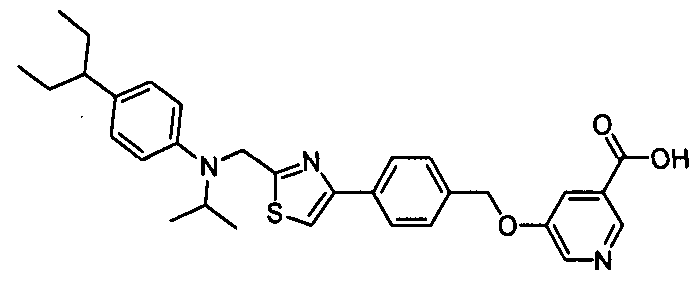
Example 11
5- ( { 4- [2- C { [4- (1 -ethylpropyl)phenyl] (isopropyl) amino}methyl) - 1, 3-thiazol-4-yl]benzyl }oxy) nicotinic acid
5-{4-[2-({[4- (1-ethyl-propyl) -phenyl] -isopropyl-amino}- methyl) -thiazol-4-yl] -benzyloxy} -nicotinic acid methyl ester (0.09 g, 0.17 mmol) is dissolved in 5 mL of THF and 1 mL of methanol (0.03M). The solution is treated with 2N NaOH (0.34 mL, 0.68 mmol). The reaction is stirred at room temperature for 4 hours and then acidified with 2N HCl to a pH of 3. The organics are extracted with ethyl acetate (2 x 50 mL) and dried over MgSO4. The residue is purified by flash chromatography (5% methanol in dichloromethane) to afford 5- {4- [2- ( { [4- (1-ethyl-propyl) -phenyl] -isopropyl-amino} -methyl) - thiazol-4-yl] -benzyloxy}-nicotinic acid (0.08 g, 92%) as a white solid Rf .21 (10% methanol in dichloromethane) 1H NMR (DMSO, 300 MHz) δ 8.65 (d, J = 1.8 Hz, IH), 8.57 (d, J = 2.8 Hz, 1 H), 7.98-7.95 (m, 3 H), 7.82 (dd, J1 = 2.8, J2 = 1.8 Hz, 1 H), 7.52 (d, J = 8.2 Hz, 2 H), 6.91 (d, J = 8.5 Hz, 2 H), 6.72 (d, J = 8.5 Hz, 2 H), 5.29 (s, 2 H) 4.62 (s, 2 H), 4.22-4.16 (m, 1 H), 2.17-2.11 (m, 1 H), 1.60-1.51 (m, 2 H), 1.44-1.34 (m, 2 H), 1.20 (d, J = 6.4 Hz, 6 H), 0.67 (t, J = 7 . 3 Hz , 6 H ) ESI -LCMS m/z calcd for C31H35N3O3S : 529 . 7 ; found 530 . 3 (M+ l ) + .

N- (tert-butoxycarbonyl) -S- {4- [2- ({ [4- (1- ethylpropyl)phenyl] (isopropyl) amino)methyl) -1 ,3-thiazol-4- yl]benzyl } cysteine
The compound of Example 2 is prepared in a manner analogous to that set forth in Example 1, except methyl N- ( tert- butoxycarbonyl) cysteinate is used instead of 5-hydroxy- nicotinic acid methyl ester in Example Ik and methyl N- (tert- butoxycarbonyl) -S-{4- [2- ( { [4- (1- ethylpropyl) phenyl] (isopropyl) amino}methyl) -1, 3-thiazol-4- yl]benzyl}cysteinate is used intead of methyl 5- ( {4- [2- ( { [4- (1-ethylpropyl) phenyl] (isopropyl) amino}methyl) -1, 3-thiazol-4- yl] benzyl }oxy) nicotinate in Example 11 to provide N-(tert- butoxycarbonyl) -S- {4- [2- ({ [4-(l- ethylpropyl) phenyl] (isopropyl) amino}methyl) -1, 3-thiazol-4- yl] benzyl } cysteine as a white foam. Rf .44 (10% methanol in dichloromethane) 1H NMR (DMSO, 300 MHz) δ 7.90 (s, 1 H) , 7.86 (d, J = 8.0 Hz, 2 H), 7.34 (d, J = 8.0 Hz, 2 H), 6.91 (d, J= 8.5 Hz, 2 H), 6.72 (d, J = 8.5 Hz, 2 H), 4.61 (s, 2 H), 4.24- 4.15 (m, 1 H), 4.04-4.10 (br s, 1 H), 3.76 (s, 2 H), 2.78 (dd, J1 = 13.4 Hz, J2 = 4.5 Hz, 1 H) , 2.64 (dd, J1 = 13.4 Hz, J2 = 8.7 Hz, 1 H), 2.16-2.10 (m, 1 H), 1.60-1.51 (m, 2 H), 1.44- 1.34 (m, 11 H), 1.19 (d, J = 6.4 Hz, 6 H), 0.67 (t, J = 7.3 Hz , 6 H) ESI -LCMS m/z calcd for C33H45N3O4S2 : 611 . 8 ; found 612 . 4 (M+l ) \

N- (tert -butoxycarbonyl ) -S- { [3 ' - ( { [4 - (1 - ethylpropyl ) phenyl ] (isopropyl ) amino }methyl ) biphenyl -4 - yl ] methyl } cysteine

' Example 3a
3' -hydroxymethyl-biphenyl-4-carboxylic acid ethyl ester
A solution of 4-bromo-benzoic acid ethyl ester (7.0 g, 30.5 mmol), 3- (hydroxymethyl) phenyl boronic acid (5.1 g, 33.6 iranol), and tetrakistriphenylphosphine palladium (Pd (PPh3) 4)
(1.1 g, 0.91 mmol) in 75 mL of toluene and 75 mL ethanol (0.2
M) is treated with 2M Na2CO3 (45.8 mL, 91.7 mmol). The reaction mixture is heated to 80 0C for 2 hours, cooled to room temperature, and diluted with ethyl acetate (200 mL) . The organic layer is extracted, dried over MgSO4, and concentrated. Purification by flash chromatography (20-30% ethyl acetate in heptane) affords 3' -hydroxymethyl-biphenyl-4-carboxylic acid ethyl ester (7.7 g, 98%) as a light yellow solid. 1H NMR (CDCl3, 300 MHz) δ 8.08 (d, J = 8.3 Hz, 2 H), 7.64 (d, J = 8.3 Hz, 2 H), 7.61 (s, 1 H), 7.53 (d, J = 7.4 Hz, 1 H), 7.44 (t, J = 7.4 Hz, 1 H), 7.38 (d, J = 7.4 Hz, 1 H) 4.77 (s, 2 H), 4.38 (q, J= 7.1 Hz, 2 H), 1.41 (t, J= 7.1 Hz, 3 H)

Example 3b
3' -bromomethyl-biphenyl-4-carboxylic acid ethyl ester
To a solution of 3' -hydroxymethyl-biphenyl-4-carboxylic acid ethyl ester (7.4 g, 28.8 mmol) in dichloromethane (80 mL, 0.4
M) is added dibromotriphenyl phosphorane (18.1 g, 43.0 mmol) .
After 30 minutes at room temperature, the reaction is diluted with H2O (100 mL) and extracted with ethyl acetate (3 x 100 mL) . Purification by flash chromatography (5% ethyl acetate in heptane) affords 3' -bromomethyl-biphenyl-4-carboxylic acid ethyl ester (9.1 g, 98%) as a light yellow solid. 1H NMR
(CDCl3, 300 MHz) δ 8.10 (d, J = 8.5 Hz, 2 H), 7.64-7.61 (m, 3
H), 7.56-7.52 (m, 1 H), 7.45-7.41 (m, 2 H), 4.55 (s, 2 H),
4.39 (q, J = 7.1 Hz, 2 H), 1.42 (t, J = 7.1 Hz, 3 H)

Example 3c
3' - ( { [4- (1-ethyl-propyl) -phenyl] -isopropyl-amino} -methyl) - biphenyl-4-carboxylic acid ethyl ester
To a solution of [4- (1-ethyl-propyl) -phenyl] -isopropyl-amine (1.9 g, 9.3 mmol) in DMF (30 mL, 0.3 M) is added Cs2CO3 (6.0 g, 18.5 mmol). After stirring for 10 minutes at room temperature, 3' -bromomethyl-biphenyl-4-carboxylic acid ethyl ester (2.9 g, 9.3 mmol) is added and the solution is heated to 80 0C for 1 hour. The solution is diluted with ethyl acetate (75 mL) and washed with saturated aq LiCl (3 x 100 mL) . Purification by flash chromatography (2% ethyl acetate in heptane) affords 3' -({ [4- (1-ethyl-propyl) -phenyl] -isopropyl- amino } -methyl ) -biphenyl-4-carboxylic acid ethyl ester (3.7 g, 91%) as a light yellow oil. 1H NMR (CDCl3, 300 MHz) δ 8.06 (d, J = 8.3 Hz, 2 H), 7.60 (d, J = 8.3 Hz, 2 H), 7.54 (s, 1 H), 7.45 (d, J = 7.3 Hz, 1 H), 7.38 (t, J = 7.3 Hz, 1 H), 7.33 (d, J = 7.3 Hz, 1 H), 6.92 (d, J = 8.8 Hz, 2 H), 6.64 (d, J = 8.8 Hz, 2 H), 4.44 (s, 2 H), 4.40 (q, J = 7.1 Hz, 2 H) 4.29-4.20
(m, 1 H) , 2.24-2.13 (m, 1 H) , 1.64-1.57 (m, 2 H) , 1.51-1.44
(m, 2 H) 1.41 (t, J = 7.1 Hz, 3 H) , 1.21 (d, J = 6.4 Hz, 6 H) , 0.76 (t, J = 7.3 Hz, 6 H)

Example 3d
[3r - ( { [4- (1-ethyl-propyl) -phenyl] -isopropyl-amino} -methyl) - biphenyl-4-yl] -methanol
A solution of 3' -({ [4- (1-ethyl-propyl) -phenyl] -isopropyl- amino} -methyl) -biphenyl-4-carboxylic acid ethyl ester (3.6 g, 8.2 mmol) in THF (30 πiL, 0.3 M) is cooled to 0 0C. Lithium aluminum hydride (LiAlH4) (1 M in THF; 8.2 mL, 8.2 mmol) is added dropwise. After 30 minutes the reaction is quenched with methanol then H2O and diluted with ethyl acetate (50 mL) . The organic layer is extracted, dried over MgSO4, and concentrated. Purification by flash chromatography (10-20% ethyl acetate in heptane) affords [3' -({ [4- (1-ethyl-propyl) - phenyl] -isopropyl-amino} -methyl) -biphenyl-4-yl] -methanol (2.9 g, 92%) as a colorless oil. 1H NMR (CDCl3, 300 MHz) δ 7.56 (d, J = 8.2 Hz, 2 H), 7.52 (s, 1 H), 7.45-7.27 (m, 5 H), 6.92 (d, J = 8.7 Hz, 2 H), 6.65 (d, J = 8.7 Hz, 2 H), 4.72 (d, J = 5.8 Hz, 2 H), 4.43 (s, 2 H), 4.28-4.19 (m, 1 H), 2.20-2.14 (m, 1 H), 1.67-1.56 (m, 2 H), 1.51-1.41 (m, 2 H), 1.21 (d, J = 6.4 Hz, 6 H), .76 (t, J= 7.3 Hz, 6 H)

Example 3e
(4' -bromomethyl-biphenyl-3-ylmethyl) - [4- (1-ethyl-propyl) - phenyl] -isopropyl-amine
To a solution of [3' -({ [4- (1-ethyl-propyl) -phenyl] -isopropyl- amino} -methyl) -biphenyl-4-yl] -methanol (1.9 g, 4.7 mmol) in dichloromethane (15 mL, 0.3 M) is added dibromotriphenyl phosphorane (3.9 g, 9.5 mmol). After 30 minutes at room temperature, the reaction is diluted with H2O (50 mL) , extracted with ethyl acetate (2 x 75 mL) , dried over MgSC>4, and concentrated. Purification by flash chromatography (5% ethyl acetate in heptane) affords (4' -bromomethyl-biphenyl-3- ylmethyl) - [4- (1-ethyl-propyl) -phenyl] -isopropyl-amine (1.9 g, 87%) as a white solid. 1H NMR (CDCl3, 300 MHz) δ 7.52-7.49 (m, 3 H), 7.40 (d, J = 8.3 Hz, 2 H), 7.38-7.28 (m, 3 H), 6.90 (d, J = 8.7 Hz, 2 H), 6.63 (d, J = 8.7 Hz, 2 H), 4.53 (s, 2 H), 4.43 (s, 2 H), 4.26-4.21 (m, 1 H), 2.19-2.15 (m, 1 H), 1.66- 1.55 (m, 2 H), 1.51-1.41 (m, 2 H), 1.21 (d, J = 6.4 Hz, 6 H), .76 (t, J = 7.3 Hz, 6 H)

Example 3f
N- (tert -butoxycarbonyl ) -S- { [3 ' - ( { [4 - (1 - ethylpropyl ) phenyl ] (isopropyl ) amino } methyl ) biphenyl -4 - yl]methyl } cysteine
To a solution of N- ( tert-butoxycarbonyl) cysteine (0.12 g, 0.55 πunol) in acetone (4 mL, 0.1 M) is added 2M Na2CO3 (0.73 mL, 1.5 iranol) . After stirring for 5 minutes, (4' -bromomethyl-biphenyl- 3-ylmethyl) - [4- (1-ethyl-propyl) -phenyl] -isopropyl-amine (0.17 g, 0.37 mmol) is added and the solution stirred at room temperature for 5 hours. The reaction is acidified with 2N HCl to a pH of 3 and the organics are extracted with ethyl acetate (3 x 50 mL) . Purification by flash chromatography (2-10% methanol in dichloromethane) affords N- (tert-butoxycarbonyl) - S-{[3'-({[4-(l- ethylpropyl) phenyl] (isopropyl) amino}methyl )biphenyl-4- yl]methyl}cysteine (0.15 g, 68%) as a white foam. Rf .10 (10% methanol in dichloromethane) 1H NMR (DMSO, 300 MHz) δ 7.51- 7.43 (m, 4 H), 7.38-7.32 (m, 3 H), 7.23 (d, J = 7.8 Hz, 1 H) 6.85 (d, J = 8.5 Hz, 2 H), 6.60 (d, J = 8.5 Hz, 2 H), 4.40 (s, 2 H), 4.27-4.18 (m, 1 H), 4.03-3.98 (br s, 1 H), 3.75 (s, 2 H), 2.78 (dd, J1 = 13.4 Hz, J2 = 4.6 Hz, 1 H) , 2.64 (dd, J1 = 13.4 Hz, J2 = 8.2 Hz, 1 H), 2.12-2.08 (m, 1 H), 1.59-1.50 (m, 2 H), 1.43-1.30 (m, 11 H), 1.16 (d, J = 6.4 Hz, 6 H), 0.67 (t, J = 7.3 Hz, 6 H) ESI-LCMS m/z calcd for C36H48N2O4S : 604.8; found 605.3 (M+l)+.

5-{[3'-({[4-(l- ethylpropyl)phenyl] (isopropyl) aminojmethyl) biphenyl-4- yljmethoxy}nicotinic acid

Example 4a
5- [3' - ( { [4- (1 -ethyl-propyl) -phenyl] -isopropyl-amino } -methyl) - biphenyl-4-ylmethoxy] -nicotinic acid methyl ester
Trimethylphosphine (IM in toluene; 0.49 mL, 0.49 mmol) is added dropwise to a stirring solution of [3' -({ [4- (1-ethyl- propyl) -phenyl] -isopropyl-amino} -methyl) -biphenyl-4-yl] - methanol (0.10 g, 0.24 mmol), 5-Hydroxy-nicotinic acid methyl ester (0.04 g, 0.29 mmol), 1, 1' - (azodicarbonyl) dipiperidine (0.12 g, 0.49 mmol), and imidazole (0.03 g, 0.49 mmol) in THF (5 mL, 0.05 M) at room temperature. After stirring for 1 hour, an equal amount of heptane is added and the resulting precipitate is removed by filtration. The filtrate is concentrated and purified by flash chromatography (20% ethyl acetate in heptane) to give 5- [3' -({ [4- (1-ethyl-propyl) - phenyl] -isopropyl-amino} -methyl) -biphenyl-4-ylmethoxy] - nicotinic acid methyl ester (0.09 g, 68%) as a white solid. 1H NMR (CDCl3, 300 MHz) δ 8.83 (s, 1 H), 8.54 (s, 1 H), 7.85 (s, 1 H), 7.58 (d, J = 8.2 Hz, 2 H), 7.47 (s, 1 H), 7.46 (d, J = 8.2 Hz, 2 H), 7.42-7.29 (m, 3 H), 6.91 (d, J = 8.7 Hz, 2 H), 6.64 (d, J = 8.7 Hz, 2 H), 5.16 (s, 2 H), 4.44 (s, 2 H), 4.28-4.20 (m, 1 H), 3.95 (s, 3 H), 2.21-2.13 (m, 1 H), 1.66-1.57 (m, 2 H), 1.51-1.42 (m, 2 H), 1.21 (d, J = 6.4 Hz, 6 H), 0.77 (t, J = 7.3 Hz, 6 H) .

Example 4b
5- { [3 ' - ( { [4 - (l - ethylpropyl)phenyl] (isopropyl) amino}methyl) bipheny1-4- yl]methoxy}nicotinic acid
5-[3'-({[4- (1-ethyl-propyl) -phenyl] -isopropyl-amino} -methyl) - biphenyl-4-ylmethoxy] -nicotinic acid methyl ester (0.09 g, 0.16 mmol) is dissolved in 3 mL of THF and 3 mL of methanol
(0.03 M). The solution is treated with 2N NaOH (0.33 mL, 0.66 mmol) . The reaction is stirred at room temperature for 3 hours and then acidified with 2N HCl to a pH of 3. The organics are extracted with ethyl acetate (2 x 50 mL) and dried over MgSO4. The residue is purified by flash chromatography (5% methanol in dichloromethane) to afford 5-
[3' - ( { [4- (1-ethyl-propyl) -phenyl] -isopropyl-amino} -methyl) - biphenyl-4-ylmethoxy] -nicotinic acid (0.81 g, 92%) Rf .23
(10% methanol in dichloromethane) 1H NMR (DMSO, 300 MHz) δ 8.66 (s, 1 H), 8.57 (d, J = 2.6 Hz, 1 H), 7.82 (s, 1 H), 7.60
(d, J = 8.1 Hz, 2 H), 7.53-7.46 (m, 4 H), 7.37 (t, J = 7.6 Hz, 1 H), 7.25 (d, J= 7.6 Hz, 1 H), 6.85 (d, J = 8.5 Hz, 2 H), 6.60 (d, J = 8.5 Hz, 2 H), 5.28 (s, 2 H), 4.41 (s, 2 H), 4.23- 4.20 (m, 1 H), 2.21-2.15 (m, 1 H) 1.59-1.50 (m, 2 H), 1.43- 1.34 (m, 2 H), 1.16 (d, J = 6.4 Hz, 6 H), 0.67 (t, J = 7.3 Hz, 6 H) ESI-LCMS m/z calcd for C34H38N2O3: 522.6; found 523.3
(M+l)+.

Example 5
2-({[3'-({[4-(l- e thy lpropyl) phenyl ] (isopropyl ) amino jmethyl ) biphenyl -4 - yl ] methyl f thio) propanoi c a cid
Is prepared in a manner analogous to that set forth in Example 4, except 2-mercapto-propionic acid ethyl ester is used instead of 5-hydroxy-nicotinic acid methyl ester in Example 4a and ethyl 2- ( { [3 ' - ( { [4- (1- ethylpropyl ) phenyl] ( isopropyl ) amino }methyl ) biphenyl-4- yl] methyl }thio)propanoate is used instead of methyl 5-{[3'- ( { [4- ( 1-ethylpropyl) phenyl] (isopropyl) amino}methyl) biphenyl-4- yl]methoxy}nicotinate in Example 4b to provide 2- ( { [3 ' - ( { [4- (1-ethylpropyl) phenyl] (isopropyl) amino}methyl) biphenyl-4- yl] methyl } thio) propanoic acid as a white foam. Rf .38 (10% methanol in dichloromethane) 1H NMR (DMSO, 300 MHz) δ 7.53- 7.50 (m, 3 H), 7.45 (d, J = 7.6 Hz, IH), 7.38-7.33 (m, 3 H), 7.23 (d, J = 7.6 Hz, 1 H), 6.86 (d, J = 8.7 Hz, 2 H), 6.60 (d, J = 8.7 Hz, 2 H), 4.40 (s, 2 H), 4.26-4.18 (m, 1 H), 3.85 (s, 2 H), 3.27 (q, J = 7.0 Hz, 1 H), 2.14-2.08 (m, 1 H), 1.58-1.49 (m, 2 H), 1.43-1.33 (m, 2 H), 1.27 (d, J = 7.0 Hz, 3 H), 1.15 (d, J = 6.4 Hz, 6 H), .66 (t, J = 7.3 Hz, 6 H) ESI-LCMS m/z calcd for C31H39NO2S: 489.7; found 490.3 (M+l) + .

Example 6
3-({[3'-({[4-(l- ethylpropyl)phenyl] (isopropyl) amino)methyl) biphenyl-4- yl]methyl) thio)propanoic acid
Is prepared in a manner analogous to that set forth in Example
4, except 3-mercaptopropionic acid methyl ester is used instead of 5-hydroxy-nicotinic acid methyl ester in Example 4a and methyl 3- ( { [3 ' - ( { [4- ( 1-
ethylpropyl) phenyl] (isopropyl) amino}methyl) biphenyl-4- yl] methyl }thio)propanoate is used instead of methyl 5-{[3'- ( { [4- (1-ethylpropyl) phenyl] (isopropyl) amino}methyl )biphenyl-4- yl]methoxy}nicotinate in Example 4b to provide 3- ( { [3 ' - ( { [4- (1-ethylpropyl) phenyl] (isopropyl) amino }methyl) biphenyl-4- yl]methyl} thio) propanoic acid as a white foam. Rf .37 (10% methanol in dichloromethane) 1H NMR (DMSO, 300 MHz) δ 7.52- 7.50 (m, 3 H), 7.45 (d, J = 7.6 Hz, 1 H), 7.38-7.31 (m, 3 H), 7.23 (d, J = 7.6 Hz, 1 H), 6.85 (d, J = 8.5 Hz, 2 H), 6.60 (d, J = 8.5 Hz, 2 H), 4.40 (s, 2 H), 4.27-4.18 (m, 1 H), 3.77 (s, 2 H), 2.59-2.46 (m, 4 H), 2.14-2.08 (m, 1 H), 1.60-1.51 (m, 2 H), 1.44-1.34 (m, 2 H), 1.16 (d, J = 6.4 Hz, 6 H), 0.67 (t, J = 7.3 Hz, 6 H) ESI-LCMS m/z calcd for C3IH39NO2S: 489.7; found 490.3 (M+l)+.

Example 7
N- (tert-butoxycarbonyl) -S-{ [3 ' - ( { [4- (1- ethylpropyl)phenyl] (isopropyl) aminoJmethyl) blphenyl-3- yl]methyl } cysteine

To a solution of (3-bromo-phenyl) -methanol (14.0 g, 75.1 mmol) and imidazole (5.6 g, 90.2 mmol) in DMF (100 mL, 0.7 M) is added tert-butyldimethylsilyl chloride (11.8 g, 78.0 mmol). After 2 hours the solution is diluted with H2O (300 mL) and
extracted with ethyl acetate (2 x 100 mL) . The combined organics are washed with saturated LiCl (50 mL) , dried over MgSO4, and concentrated. Purification by flash chromatography (10% ethyl acetate in heptane) affords (3-bromo-benzyloxy) - tert-butyl-dimethyl-silane (21.1 g, 93%) as a clear oil. 1H NMR (CDCl3, 300 MHz) δ 7.80 (s, 1 H), 7.71 (d, J = 7.6 Hz, 1 H), 7.46 (d, J = 7.6 Hz, 1 H), 7.35 (t, J = 7.6 Hz, 1 H), 4.77 (s, 2 H), 0.94 (s, 9 H), 0.11 (s, 6 H)

Example 7b
(3' - (tert-butyl-dimethyl-silanyloxymethyl) -biphenyl-3-yl] - methanol
A solution of (3-bromo-benzyloxy) -tert-butyl-dimethyl-silane (10.0 g, 33.2 mmol) , 3- (hydroxymethyl) phenyl boronic acid (5.5 g, 36.5 mmol), and tetrakistriphenylphosphine palladium (Pd(Ph3J4) (1.0 g, 0.87 mmol) in DME (80 mL, 0.4M) is treated with 2M Na2CO3 (20 mL, 40 mmol) . The reaction mixture is heated to 90 0C for 8 hours, cooled to room temperature, and the organics are extracted with ethyl acetate (2 x 75 mL) . Purification by flash chromatography (25% ethyl acetate in heptane) affords (3' - ( tert-butyl-dimethyl-silanyloxymethyl) - biphenyl-3-yl] -methanol (9.5 g, 87%) as an orange oil. 1H NMR (CDCl3, 300 MHz) δ 7.58-7.29 (m, 8 H), 4.80 (s, 2 H), 4.76 (s, 2 H) , 0.96 (s, 9 H) , 0.12 (s, 6 H)

(3' -bromomethyl-biphenyl-3-ylmethoxy) -tert-butyl-dimethyl- silane
A solution of (3' - ( tert-butyl-dimethyl-silanyloxymethyl) - biphenyl-3-yl] -methanol (6.0 g, 18.3 mmol) and triethylamine
(2.8 mL, 20.1 mmol) in dichloromethane (60 mL, 0.3 M) is cooled to 0 0C then dibromotriphenyl phosphorane (8.1 g, 19.1 mmol) is added After 5 hours, ethyl acetate (150 mL) is added and the reaction is washed with 50% aq NH4Cl (100 mL) and saturated aq NaCl (100 mL) . Purification by flash chromatography (5% ethyl acetate in heptane) affords (3'- bromomethyl-biphenyl-3-ylmethoxy) -tert-butyl-dimethyl-silane (6.5 g, 90%) as a yellow oil. 1H NMR (CDCl3, 300 MHz) δ 7.59- 7.30 (m, 8 H), 4.80 (s, 2 H), 4.55 (s, 2 H), 0.96 (s, 9 H), 0.13 (s, 6 H)

Example 7d [3r ({ [4-1-ethyl-propyl) -phenyl] -isopropyl-amino) -methyl) - biphenyl-3-yl] -methanol
To a solution of (3' -bromomethyl-biphenyl-3-ylmethoxy) -tert- butyl-dimethyl-silane (2.0 g, 5.1 mmol) and [4-(l-ethyl- propyl) -phenyl] -isopropyl amine (1.1 g, 5.4 mmol) in DMF (15 mL, 0.3M) is added K2CO3 (1.4 g, 10.2 mmol). After the mixture stirred for 18 hours at 75 0C, the reaction is cooled to room temperature. Tetrabutylammonium fluoride (1 M in THF; 5.1 mL, 5.1 mmol) is added and the mixture stirred for 2 hours. The solution is diluted H2O (50 mL) and extracted with ethyl
acetate (2 x 100 mL) . The organics are combined, washed with saturated aq LiCl (30 mL) , dried over MgSO4, and concentrated.
Purification by flash chromatography (30% ethyl acetate in heptane) affords 3 '({ [4 -1-ethyl-propyl ) -phenyl] -isopropyl- amino} -methyl) -biphenyl -3 -yl] -methanol (1.8 g, 88%) as a yellow oil. 1H NMR (CDCl3, 300 MHz) δ 7.54-7.28 (m, 8 H), 6.90
(d, J = 8.6 Hz, 2 H), 6.64 (d, J = 8.6 Hz, 2 H), 4.73 (d, J =
5.8 Hz, 2 H), 4.43 (s, 2 H), 4.28-4.19 (m, 1 H), 2.22-2.12 (m,
1 H), 1.70-1.55 (m, 2 H), 1.51-1.41 (m, 2 H), 1.21 (d, J = 6.4 Hz, 6 H), 0.75 (t, J = 7.3 Hz, 6 H)

Example 7e
2-tert-butoxycarbonylamino-3- [3' - ( { [4- (1-ethyl-propyl) - phenyl] -isopropyl-amino} -methyl) -biphenyl-3-ylmethylsulfanyl] - propionic acid methyl ester
Trimethylphosphine (1 M in toluene,- 1.0 mL, 1.0 mmol) is added to a stirring solution of 3 ' ({ [4- (1-ethyl-propyl) -phenyl] - isopropyl-amino} -methyl) -biphenyl-3-yl] -methanol (0.20 g, 0.50 mmol), methyl N- ( tert-butoxycarbonyl) cysteinate (0.18 g, 0.75 mmol), 1, 1' - (azodicarbonyl) dipiperidine (0.23 g, 0.90 mmol), and imidazole (0.06 g, 0.95 mmol) in dichloromethane (6 mL, 0.1 M) at room temperature. After stirring for 18 hours, an equal amount of heptane is added and the resulting precipitate is removed by filtration. The filtrate is concentrated and purified by flash -chromatography (20% ethyl acetate in heptane) to afford methyl N- ( tert-butoxycarbonyl) -S- { [3 '-({ [4 - (1-ethylpropyl) phenyl] (isopropyl) amino Jmethyl) biphenyl-3 - yl] methyl} cysteinate (0.24 g, 77%) as a clear oil. 1H NMR
(CDCl3, 300 MHz) δ 7.50-7.26 (m, 8 H), 6.90 (d, J = 8.6 Hz, 2
H), 6.64 (d, J = 8.6 Hz, 2 H), 4.57-4.51 (m, 1 H), 4.43 (s, 2 H), 4.28-4.19 (m, 1 H), 3.76 (s, 2 H), 3.69 (s, 3 H), 2.90 (dd, J1 = 13.9 Hz, J2 = 4.7 Hz, 1 H) , 2.81 (dd, Ji = 13.9 Hz, J2 = 5.8 Hz, 1 H), 2.21-2.14 (m, 1 H), 1.64-1.56 (m, 2 H), 1.48- 1.43 (m, 11 H), 1.21 (d, J = 6.4 Hz, 6 H), 0.76 (t, J = 7.3 Hz, 6 H)

N- (tert-butoxycarbonyl) -S- { [3' - ({ [4- (1- ethylpropyl)phenyl] (isopropyl) amino}methyl) biphenyl-3- yl]methyl } cysteine
Methyl W- ( tert-butoxycarbonyl) -S- { [3 '-({ [4- (1- ethylpropyl ) phenyl] (isopropyl ) amino}methyl ) biphenyl -3 - yl] methyl }cysteinate (0.24 g, 0.39 mmol) is dissolved in 5 mL of THF and 2 mL of methanol (0.05 M) at 0 0C. The solution is treated with 2N NaOH (1.2 mL, 2.3 mmol). The reaction is stirred for 3 hours and then acidified with 2N HCl to a pH of 3. The organics are extracted with ethyl acetate (2 x 25 mL) and dried over MgSO4. The residue is purified by flash chromatography (5% methanol in dichloromethane) to afford N- ( tert-butoxycarbonyl) -S- { [3 ' - ({ [4- (1- ethylpropyl) phenyl] (isopropyl) amino}methyl) biphenyl -3- yl] methyl} cysteine (0.15 g, 62%) mp 70-75 0C; Rf 0.32 (10% methanol in dichloromethane) 1H NMR (DMSO, 300 MHz) δ 7.54-7.50
(m, 2 H), 7.45-7.40 (m, 2 H), 7.37-7.32 (m, 2 H), 7.27-7.22
(m, 2 H), 7.06 (d, J = 7.8 Hz, 1 H), 6.85 (d, J = 8.8 Hz, 2
H), 6.61 (d, J = 8.8 Hz, 2 H) 4.40 (s, 2 H), 4.24-4.19 (m, 1 H), 4.12-4.08 (m, 1 H), 3.79 (s, 2 H), 2.78 (dd, Ji = 13.8 Hz, J2 = 4.7 Hz, 1 H), 2.64 (dd, Ji = 13.8 Hz, J2 = 9.0 Hz, 1 H), 2.12-2.07 (m, 1 H), 1.57-1.50 (m, 2 H), 1.43-1.37 (m, 11 H), j 1.16 (d, J = 6.4 Hz, 6 H), 0.67 (t, J = 7.2 Hz, 6 H) ESI-LCMS m/z calcd for C3SH48N2O4S : 604.8; found 605.3 (MH-I)+.

({[3'-({[4-(l- ethylpropyl)phenyl] (isopropyl) amino}methyl)biphenyl-3- yl]methyl }thio) acetic acid
Is prepared in a manner analogous to that set forth in Example 7, except mercapto-acetic acid methyl ester is used instead of methyl N- ( tert-butoxycarbonyl) cysteinate in Example 7e and methyl ( { [3 •- ( { [4- (1- ethylpropyl ) phenyl ] (isopropyl ) amino }methyl ) biphenyl-3- yl]methyl }thio) acetate is used instead of methyl N- ( tert- butoxycarbonyl) -S- { [3'-({ [4-U- ethylpropyl ) phenyl ] (isopropyl ) amino }methyl ) biphenyl-3- yl ] methyl } cysteinate in Example 7f to provide ( { [3 ' - ( { [4- ( 1- ethylpropyl) phenyl] (isopropyl) amino}methyl) biphenyl-3- yl] methyl }thio) acetic acid, mp 60-65 0C; Rf 0.42 (10% methanol in dichloromethane) 1H NMR (DMSO, 300 MHz) δ 7.54-7.51
(m, 2 H), 7.44-7.41 (m, 2 H), 7.37-7.32 (m, 2 H), 7.27-7.22
(m, 2 H), 6.85 (d, J = 8.5 Hz, 2 H), 6.60 (d, J = 8.5 Hz, 2
H), 4.40 (s, 2 H), 4.26-4.19 (m, 1 H), 3.83 (s, 2 H), 3.07 (s, 2 H), 2.12-2.08 (m, 1 H) 1.58-1.50 (m, 2 H), 1.43-1.33 (m, 2
H), 1.16 (d, J = 6.5 Hz, 6 H), 0.67 (t, J = 7.3 Hz, 6 H) ESI- LCMS m/z calcd for C30H37NO2S : 475.7; found 476.3 (M+l)+.

Example 9
5-{[3'-({[4-(l- ethylpropyl)phenyl] (isopropyl) aminofmethyl) biphenyl-3- yljmethoxy}nicotinic acid
Is prepared in a manner analogous to that set forth in Example 7, except 5-hydroxy-nicotinic acid methyl ester is used instead of methyl N- ( tert-butoxycarbonyl) cysteinate in Example 7e and methyl 5-{ [3 • - ( { [4- (1- ethylpropyl) phenyl] (isopropyl) amino}methyl) biphenyl-3- yl]methoxy}nicotinate is used instead of methyl W- (tert- butoxycarbonyl) -S- { [3?-({ [4-(l- ethylpropyl) phenyl] (isopropyl) amino}methyl) biρhenyl-3- yl] methyl} cysteinate in Example 7f to provide 5- [3' - ( { [4- (1- ethyl-propyl) -phenyl] -isopropyl-amino} -methyl) -biphenyl-3- ylmethoxy] -nicotinic acid, mp 107-115 °C; Rf 0.17 (15% methanol in dichloromethane) 1H NMR (DMSO, 300 MHz) δ 8.66 (s, 1 H), 8.42 (d, J = 2.9 Hz, 1 H), 7.84 (s, 1 H), 7.66 (s, 1 H), 7.53-7.51 (m, 2 H), 7.46-7.33 (m, 4 H), 7.25 (d, J = 7.8 Hz, 1 H), 6.84 (d, J = 8.5 Hz, 2 H), 6.60 (d, J = 8.5 Hz, 2 H), 5.24 (s, 2 H), 4.40 (s, 2 H), 4.25-4.17 (m, 1 H), 2.11-2.05 (m, 1 H), 1.57-1.48 (m, 2 H), 1.44-1.35 (m, 2 H), 1.15 (d, J = 6.4 Hz, 6 H), 0.66 (t, J = 7.32 Hz, 6 H) ESI-LCMS m/z calcd for C34H38N2O3 : 522.6; found 523.3 (M+l) + .

Example 10
3-({[3'-({[4-(l- ethylpropyl)phenyl] (isopropyl) amino)methyl)biphenyl-3- yl]methyl }thio)propanoic acid
Is prepared in a manner analogous to that set forth in Example 7, except 3-mercapto-propionic acid methyl ester is used instead of instead of methyl N- ( tert-butoxycarbonyl) cysteinate in Example 7e and methyl 3- ( { [3 ' - ( { [4- (1- ethylpropyl) phenyl] (isopropyl) amino}methyl) biphenyl-3- yl ] methyl } thio) propanoate is used instead of methyl N- ( tert- butoxycarbonyl) -S- { [3'-({ [4-(l- ethylpropyl ) phenyl ] (isopropyl ) amino }methyl ) biphenyl-3- yl] methyl} cysteinate in Example 7f to provide 3- ( { [3 ' - ( { [4- (1- ethylpropyl) phenyl] (isopropyl) amino}methyl) biphenyl-3- yl] methyl} thio) propanoic acid. Rf 0.60 (10% methanol in dichloromethane) 1H NMR (CDCl3, 300 MHz) δ 7.52-7.48 (m, 2 H), 7.43-7.40 (m, 2 H), 7.36-7.31 (m, 2 H), 7.26-7.23 (m, 2 H), 6.91 (d, J = 8.4 Hz, 2 H), 6.66 (d, J = 8.4 Hz, 2 H), 4.43 (s, 2 H), 4.26-4.20 (m, 1 H), 3.77 (s, 2 H), 2.70 (t, J = 6.6 Hz, 2 H), 2.59 (t, J = 6.6 Hz, 2 H), 2.20-2.14 (m, 1 H), 1.65-1.54 (m, 2 H), 1.50-1.40 (m, 2 H), 1.21 (d, J = 6.4 Hz, 6 H), 0.75 (t, J = 7.2 Hz, 6 H) ESI-LCMS m/z calcd for C31H39NO2S : 489.7; found 490.3 (M+l)+.

Example 11
2-({[3'-({[4-(l- ethylpropyl)phenyl] (isopropyl) aminojmethyl)biphenyl-3- yl]methyl }thio)propanoic acid
Is prepared in a manner analogous to that set forth in Example 7, except 2-mercapto-propionic acid ethyl ester is used instead of methyl N- ( tert-butoxycarbonyl) cysteinate in Example 7e and ethyl 2- ( { [3 ' - ( { [4- (1- ethylpropyl) phenyl] (isopropyl) amino}methyl) biphenyl-3- yl]methyl } thio) propanoate is used instead of methyl N- (tert- butoxycarbonyl) -S- { [3'-({ [4-(l- ethylpropyl) phenyl] (isopropyl) amino}methyl)biphenyl-3- yl]methyl } cysteinate in Example 7f to provide 2- ( { [3 ' - ( { [4- (1- ethylpropyl) phenyl] (isopropyl) amino}methyl)bipheny1-3- yl] methyl} thio) propanoic acid, mp 58-62 0C; Rf 0.53 (10% methanol in dichloromethane) 1H NMR (CDCl3, 300 MHz) δ 7.54- 7.51 (m, 2 H), 7.44-7.40 (m, 2 H), 7.36-7.26 (m, 4 H), 6.91 (d, J = 8.8 Hz, 2 H), 6.65 (d, J = 8.8 Hz, 2 H), 4.43 (s, 2 H), 4.25-4.19 (m, 1 H), 3.96 (d, J = 13.3 Hz, 1 H), 3.85 (d , J = 13.3 Hz, 1 H), 3.30 (q, J = 7.2 Hz, 1 H), 2.19-2.10 (m, 1 H), 1.65-1.56 (m, 2 H), 1.50-1.43 (m, 2 H), 1.39 (d, J = 7.2 Hz, 3 H), 1.21 (d, J = 6.5 Hz, 6 H), 0.75 (t, J = 7.3 Hz, 6 H) ES I -LCMS m/z calcd for C3IH39NO2S : 489 . 7 ; found 4 90 . 3 (M+ l ) + .
Example 12
The following compounds are prepared essentially as outlined above in Schemes A-D and the above examples.


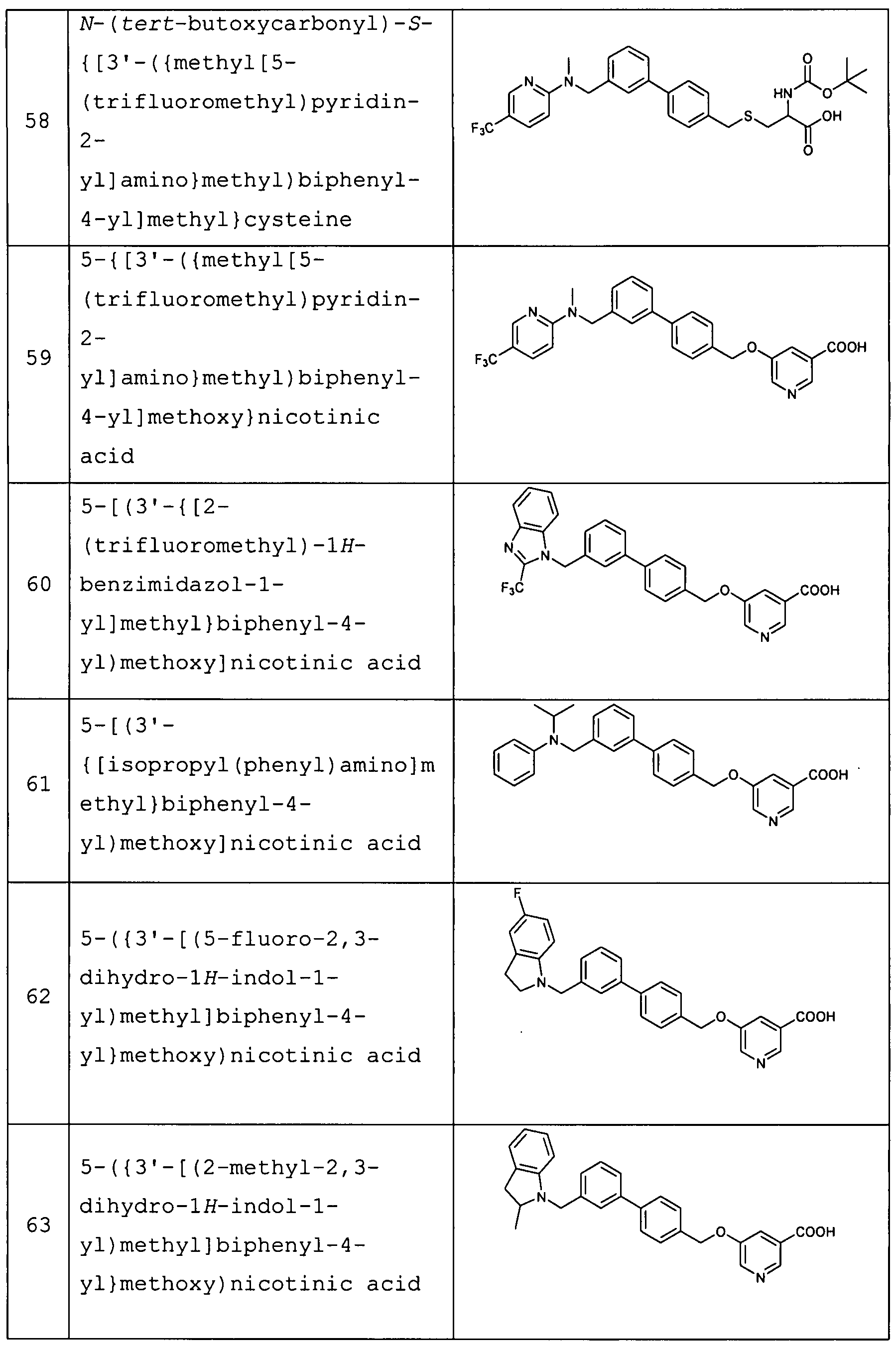


Example 13
The following compounds are prepared essentially as outlined above in Schemes A-D and the above examples.


Example 14
The following compounds according to formula (XVI) are prepared essentially as outlined above in Schemes A-D and the above examples.
IQA-o-BPA-o-ASA IQA-o-BPA-m-ASA IQA-o-BPA-p-ASA IQA-m-BPA-o-ASA
IQA-m-BPA-m-ASA IQA-m-BPA-p-ASA IQA-p-BPA-o-ASA IQA-p-BPA-m-ASA
IQA-p-BPA-p-ASA IQA-o-BPA- (p,m)- IQA-o-BPA- (m,p) ■ IQA-o-BPA- (o,m)- ARA ARA ARA
IQA-o-BPA- (m,o)- IQA-m-BPA- (p,m) IQA-m-BPA- (m,p) ■ IQA-m-BPA- (o,m) • ARA ARA ARA ARA
IQA-m-BPA- (m, o) ■ IQA-p-BPA- (p, m) IQA-p-BPA- (m,p) ■ IQA-p-BPA- (o,m) • ARA ARA ARA ARA
IQA-p-BPA- (m, o)- IQA-o-BPA-o-BAA IQA-o-BPA-m-BAA IQA-o-BPA-p-BAA ARA
IQA-m-BPA-o-BAA IQA-m-BPA-m-BAA IQA-m-BPA-p-BAA IQA-p-BPA-o-BAA
IQA-p-BPA-m-BAA IQA-p-BPA-p-BAA IQA-o-BPA-o-BAB IQA-o-BPA-m-BAB
IQA-o-BPA-p-BAB IQA-m-BPA-o-BAB IQA-m-BPA-m-BAB IQA-m-BPA-p-BAB

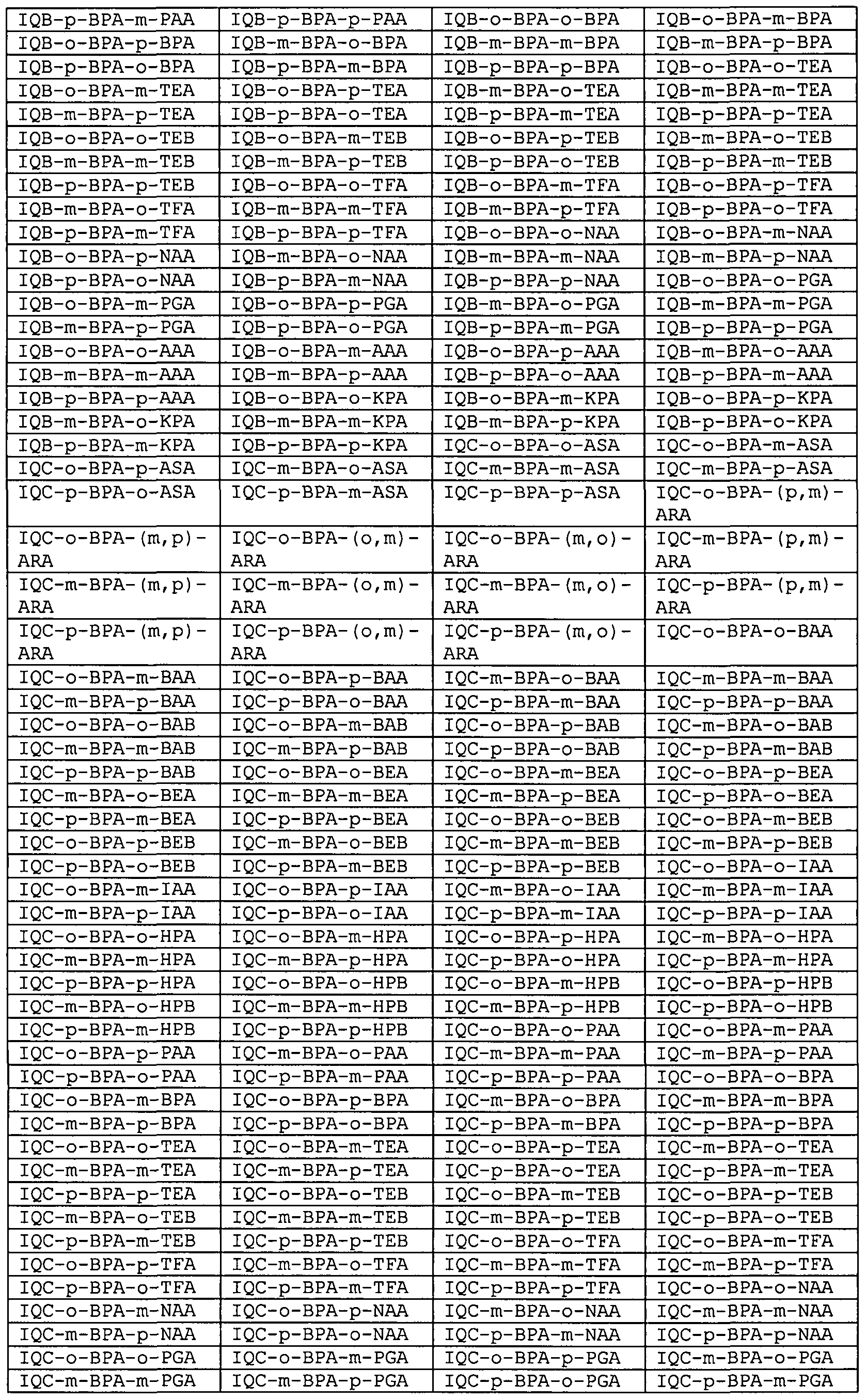


BIOLOGY EXAMPLES Example 15
Method for measuring PTP-IB activity
The test compounds are evaluated for their in vitro inhibitory activity against recombinant human PTP-IB with phosphotyrosyl dodecapeptide TRDI(P)YETD(P)Y(P)YRK. This corresponds to the 1142-1153 insulin receptor kinase regulatory domain, phosphorylated on the 1146, 1150 and 1151 tyrosine residues; IR-triphosphopeptide as a source of substrate. Enzyme reaction progression is monitored via the
release of inorganic phosphate as detected by the malachite green - ammonium molybdate method for the phosphopeptide.
Preferred compounds of the invention exhibit IC50 values of less than 10 μM; more preferred compounds of the invention exhibit IC50 values of less than 1 μM. Particularly preferred compounds exhibit IC50 values of less than 300 nM.
Example 16
Results of PTP-IB activity testing


It is understood that the foregoing detailed description and accompanying Examples are merely illustrative and are not to be taken as limitations upon the scope of the invention, which is defined by the appended claims. Various changes and modifications to the disclosed embodiments will be apparent to those skilled in the art. Such changes and modifications, including without limitation those relating to the chemical structures, substituents, derivatives, intermediates, syntheses, formulations and/or methods of use of the invention, may be made without departing from the spirit and scope thereof.
Claims
1. A compound of the formula:

or a pharmaceutically acceptable salt thereof, wherein
X is C or N;
A is -aryl- or -heteroaryl-;
B is aryl- or heteroaryl-;
D is

-Y-C(O)ORi wherein
R is -H, -OH, - (C1-C6) alkyl, - (Ci-C6) alkoxy, -aryl, - heteroaryl, - (C3-C8) cycloalkyl, heterocycloalkyl,
-C(O) (Ci-C6) alkoxy, -C (0) (Ci-C6) alkyl, -C (0) (Ci-C6) alkyl- aryl, or -C(O) aryl;
R' is -H, -halogen, -amino, -NO2, -CN, -COOH,
-C(O) (Ci-C6) alkoxy, - (Ci-C6) alkyl, -aryl, -heteroaryl, - (C3-C8) cycloalkyl, -heterocycloalkyl;
Q is CH or N;
Xi is 0, S, or N(R) ;
X2 is S(0)t, wherein t is 0, 1, or 2; Ri is -H, - (Ci-C6) alkyl, - (Ci-C6) alkyl-phenyl, or
- (C3~C6) alkenyl; and
Y is a bond, -aryl-, -heteroaryl-, -cycloalkyl-, - heterocycloalkyl-, -aryl- (Ci-C6alkyl) -, or -heteroaryl- (Ci- C6alkyl)-, wherein each of the previous is optionally substituted with at least one substituent that is independently Rγ, wherein
RY is - (Ci-C6)alkoxy, - (Ci-C6) alkyl, - (C2-C6) alkenyl,
- (C2-C6) alkynyl, -C(O) (Ci-C6) alkoxy, -C(O) (Ci-C6) alkyl, -C(O)OH, -CN, - (Ci-C6) alkyl-C (0) OH,
- (Ci-C6) haloalkoxy, - (Ci-C6) haloalkyl, -halogen, -OH, - (Ci-C6) alkyl-OH, -NO2, -N(RNiRN2),
-(Ci-C6) alkyl-N (RNIRN2), -C (0) N (RNiRN2) , -aryl, heteroaryl, - (C3-C8) cycloalkyl, or -heterocycloalkyl, wherein RNi and RN2 are each independently -H, -(Ci-C6) alkyl, - (C2-C6) alkenyl, -(C2- C6) alkynyl, -C(O) (Ci-C6) alkoxy,
-C(O) (Ci-C6) alkyl, or -C(O)H;
Li is -(Ci-C6) alkyl-, -Z-, - (Ci-C6) alkyl-Z-, -Z- (C1-C6) alkyl -, or - (Ci-C6) alkyl-Z- (Ci-C6) alkyl-, wherein the alkyl portion of each of the above is optionally substituted with at least one substituent that are each independently Rγ or -oxo;
Z is -0-, -S-, -S(O)2-, -N(RN3)-, -C(O)O-, -OC(O)-, - C(O)S-, -SC(O)-, -N(RN3)C(O)-, -C(O)N(R113)-, -S(O)2N(R113)-, -N(RN3)S(O)2-, -aryl-, -heteroaryl-, -cycloalkyl-, or - heterocycloalkyl-wherein the -aryl-, -heteroaryl-, -cycloalkyl-, or heterocycloalkyl is optionally substituted with at least one substituent that are each independently Rγ or -oxo; RN3 is -H, -(Ci-C6) alkyl, aryl, - (Ci-C6) alkyl- heteroaryl , or - (Ci-C6) alkyl-aryl; and L2 is -(Ci-C6) alkyl-, - (Ci-C6) alkyl-N (RNio) -,
-N (RNIO)-(CI-C6) alkyl-, or - (Ci-C6) alkyl-N (RNio) - (Ci-C6) alkyl-, wherein RNio is -H, - (Ci-C6) alkyl,
- (C2-C6) alkenyl, - (C2-C6) alkynyl, -C(O) (Ci-C6) alkoxy, -C(O) (Ci-C6) alkyl,
-C(O) (Ci-C6) alkyl- (C3-C8) cycloalkyl, or -C(O)H, provided that L2 is - (Ci-C6) alkyl- only when B is heteroaryl; each RA, RB, and R2 are each independently
- (Ci-C6) alkoxy, - (Ci-C6) alkyl,
- (C2-C6) alkenyl, - (C2-C6) alkynyl,
-C(O) (Ci-C6) alkoxy, -C (0) (Ci-C6) alkyl, -C(O)OH, -CN, - (Ci-C6) haloalkoxy, - (Ci-C6) haloalkyl, -halogen, -OH, - (Ci-C6) alkyl-OH, -NO2, -N(RN6RN7), - (Ci-C6) alkyl-N (RN6RN7) , or -C(O)N(RN6RN7) wherein RN6 and RN7 are each independently -H,
-(Ci-C6) alkyl, - (C2-C6) alkenyl,
- (C2-C6) alkynyl, -C(O) (Ci-C6) alkoxy, -C(O) (Ci-C6)alkyl, or -C(O)H, wherein one RA and one R' together optionally represent - (CH2) z-, where z is 1, 2, 3 or 4; and m,, n, and p are each independently 0, 1, 2, 3, or 4.
2. A compound according to claim 1, wherein A is phenyl, furanyl, thienyl, pyridyl, pyrazolyl, pyrimidyl, imidazolyl, thiazolyl, isoxazolyl, oxadiazolyl, isothiazolyl, triazolyl, pyrrolyl, or pyrazolyl.
3. A compound according to claim 1, wherein B is phenyl, furanyl, thienyl, pyridyl, pyrazolyl, pyrimidyl, imidazolyl, thiazolyl, isoxazolyl, oxadiazolyl, isothiazolyl, triazolyl, pyrrolyl, pyrazolyl, naphthyl, dihydronapthalenyl, 1, 2, 3, 4-tetrahydronaphthalenyl, quinolinyl, 3,4- dihydroquinolin-1 (2H) -yl, indoyl, indolinyl,
benzimidazolyl, 2, 3-dihydrobenzimidazoyl, or benzothiadiazoyl-2, 2-dioxide .
4. A compound according to claim 1, wherein Li is -0-, -S-, - (Ci-C6) alkyl-,
- (Ci-C6) alkyl-0-, -0- (Ci-C6) alkyl-,
- (Ci-C6) alkyl-O- (Ci-C6) alkyl-, - (Ci-C6) alkyl-S-, -S- (Ci-C6) alkyl-, - (Ci-C6) alkyl-S- (Ci-C6) alkyl-,
- (Ci-C6) alkyl-N (RH3) -, -N (R113) -(Ci-C6) alkyl-, - (Ci-C6) alkyl-N (RN3) - (Ci-C6) alkyl-, wherein the alkyl portion of each of the above are optionally substituted with 1, 2, 3, or 4 substituents that are independently - (Ci-C6) alkoxy, - (Ci-C6) alkyl, -C (0) (Ci-C6) alkoxy, -C(O) (Ci-C6) alkyl, - (Ci-C6) haloalkyl, -halogen,
-N(RN4RN5), -aryl, or -oxo, wherein RN3 is -H, - (Ci-C6) alkyl, aryl, or - (Ci-C6) alkyl- aryl, wherein RN4 and RNS are each independently -H, -(Ci-C6) alkyl, -C (O) (Ci-C6) alkoxy, or -C (0) (Ci-C6) alkyl .
5. A compound according to claim 1, wherein
Y is a bond, -phenyl-, -pyridyl-, -pyrimidyl-, pyrazinyl-, -furyl-, -thienyl-, -pyrrolyl-, -pyrazolyl-, -imidazolyl-, -thiazolyl-, -isoxazolyl-, -oxazoyl-, oxadiazolyl-, -isothiazolyl-, -triazolyl-, -phenyl (Ci-C6) alkyl-, -pyridyl (Ci-C6) alkyl-, wherein any of the previous are optionally substituted with 1, 2, 3, or 4 substituents that are independently -(Ci-C6) alkoxy, - (Ci-C6) alkyl, -C (0) (Ci-C6) alkoxy,
-C(O) (Ci-C6) alkyl, -CN, - (Ci-C6) haloalkyl, -halogen, -OH, -NO2, -N(RNiRN2), -phenyl, -pyridyl, - pyrimidyl, -pyrazinyl, -furyl, -thienyl, or pyrrolyl,
wherein RNi and RN2 are each independently -H, - (Ci-C6) alkyl, -C (O) (Ci-C6) alkoxy, or -C(O) (Ci-C6) alkyl.
6. A compound according to claim 1 having the formula

or a pharmaceutically acceptable salt thereof, wherein,
R3 is -H, - (Ci-C6) alkyl, -C (0) (Ci-C6) alkoxy, or
-C(O) (Ci-C6) alkyl;
A is phenyl, furanyl, thienyl, pyridyl, pyrazolyl, pyrimidyl, imidazolyl, thiazolyl, isoxazolyl, oxadiazolyl, isothiazolyl, triazolyl, pyrrolyl, or pyrazolyl; B is phenyl or pyridyl; Li is -0-, -S-, -(Ci-C6) alkyl-,
- (Ci-C6) alkyl-0-, -0- (Ci-C6) alkyl-,
- (Ci-C6) alkyl-O- (Ci-C6) alkyl-, - (Ci-C6) alkyl-S-, -S-(Ci-C6) alkyl-, - (Ci-C6) alkyl-S- (Ci-C6) alkyl-,
- (Ci-C6) alkyl-N (R113) -, -N (R113) - (Ci-C6) alkyl-,
- (Ci-C6) alkyl-N (R113) -(Ci-C6) alkyl-, wherein the alkyl portion of each of the above is optionally substituted with 1, 2, 3, or 4 substituents that are independently
- (Ci-C6) alkoxy, - (Ci-C6) alkyl, -C (0) (Ci-C6) alkoxy,
-C(O) (Ci-C6) alkyl, - (Ci-C6) haloalkyl, -halogen,
-N(RN4RN5), -aryl, or -oxo,
wherein RN3 is -H, - (Ci-C6) alkyl, aryl, or - (Cx-C6) alkyl- aryl, wherein RN4 and RN5 are each independently -H, -(Ci-C6) alkyl, -C (O) (Cx-C6) alkoxy, or -C (O) (Ci-C6) alkyl; and
Y is a bond, -phenyl-, -pyridyl-, -pyrimidyl-, pyrazinyl-, -furyl-, -thienyl-, -pyrrolyl-, -pyrazolyl-, -imidazolyl-, -thiazolyl-, -isoxazolyl-, -oxazoyl-, oxadiazolyl-, -isothiazolyl-, -triazolyl-, -phenyl (Ci-C6) alkyl-, -pyridyl (Ci-C6) alkyl-, wherein any of the previous are optionally substituted with 1, 2, 3, or 4 substituents that are independently
- (Ci-C6) alkoxy, - (Cx-C6) alkyl, -C (0) (Ci-C6) alkoxy, -C(O) (Ci-C6) alkyl, -CN, - (C1-C6) haloalkyl, -halogen, -OH, -NO2, -N(RNXRN2), -phenyl, -pyridyl, - pyrimidyl, -pyrazinyl, -furyl, -thienyl, or pyrrolyl, wherein RNX and RN2 are each independently -H, -(Ci-C6) alkyl, -C (0) (C1-C6) alkoxy, or -C(O) (Cx-C6)alkyl.
7. A compound according to claim 6, wherein
L1 is -(Cx-C6) alkyl-, - (Ci-C6) alkyl-O-, -0- (Ci-C6) alkyl-, - (Ci-C6) alkyl-S-, -S- (Ci-C6) alkyl-, - (Ci-C6) alkyl-S- (C1- C6) alkyl-, - (Ci-C6) alkyl-N (RN3) - (Ci-C6) alkyl-, wherein the alkyl portion of each of the above are optionally substituted with 1, 2, 3, or 4 substituents that are independently
- (Ci-C6) alkyl, - (Ci-C6) haloalkyl, -halogen, -N(RN4RN5), -aryl, or -oxo, wherein RN3 is -H, - (Ci-C6) alkyl, aryl, or - (C1-C6) alkyl- aryl, wherein RN4 and RNs are each independently -H,
-(Ci-C6) alkyl, -C (O) (Ci-C6) alkoxy, or -C (0) (Ci-C6) alkyl .
8. A compound according to claim 6, wherein
Y is a bond, -phenyl-, -pyridyl-, -furyl-, -thienyl-, - pyrrolyl-, -pyrazolyl-, -imidazolyl-, or -phenyl (Ci-C6) alkyl, wherein any of the previous are optionally substituted with 1, 2, 3, or 4 substituents that are independently
- (Ci-C6)alkoxy, - (Ci-Cβ) alkyl, -CN, - (Ci-Cε) haloalkyl, -halogen, -NO2, -phenyl, -furyl, -thienyl, or pyrrolyl.
9. A compound according to claim 6, wherein
R1 is -H, - (Ci-C6) alkyl, benyl, or allyl.
10. A compound according to claim 6, wherein A is phenyl or thiazolyl.
11. A compound according to claim 6, having the formula

12. A compound according to claim 11, having the formula

13. A compound according to claim 12, wherein
Y is a bond; and
Li is - (Ci-C6) alkyl-S- (Ci-C6) alkyl-, wherein either alkyl portion is optionally substituted with 1, 2, 3, or 4 substituents that are independently
- (Ci-C6) alkyl, - (Ci-C6) haloalkyl, -halogen, -N(RN4RN5), wherein RN4 and RN5 are each independently -H, -(Ci-C6) alkyl, -C (O) (Ci-C6) alkoxy, or -C (0) (Ci-C6) alkyl .
14. A compound according to claim 13, wherein Ri is -H.
15. A compound according to claim 12, wherein
Y is -phenyl- or -pyridyl-; and
Li is - (Ci-C6) alkyl-O- or - (Ci-C6) alkyl-S- .
16. The compound according to claim 15, wherein Ri is -H.
17. A compound according to claim 6, having the formula

18 . A compound according to claim 17 , having the formula

19. A compound according to claim 18, wherein X is CH.
20. A compound according to claim 19, having the formula
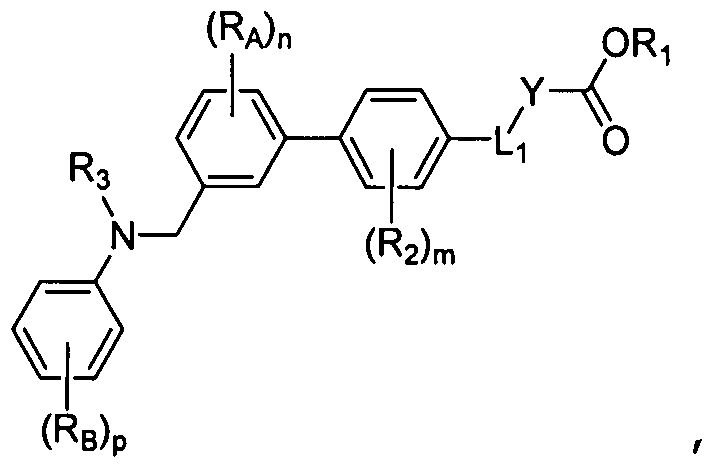 or a pharmaceutically acceptable salt thereof.
21. A compound according to claim 20, wherein
Y is a bond; and L1 is - (C1-C6) alkyl-S- (Ci-C6) alkyl-, wherein the alkyl portion of each of the above are optionally substituted with 1, 2, 3, or 4 substituents that are independently
- (Ci-C6) alkoxy, - (Ci-C6) alkyl, -C (O) (Ci-C6) alkoxy, -C(O) (Ci-C6) alkyl, - (Ci-C6) haloalkyl, -halogen,
-N(RN4RN5) , wherein RN4 and RN5 are each independently -H, -(Ci-C6) alkyl, -C (O) (Ci-C6) alkoxy, or -C (0) (Ci-C6) alkyl .
22. A compound according to claim 21, wherein Ri is -H.
23. A compound according to claim 20, wherein Li is - (Ci-C6) alkyl-O-; and
Y is a -phenyl-, -pyridyl-, or -phenyl (Ci-C6) alkyl-, wherein any of the previous are optionally substituted with 1, 2, 3, or 4 substituents that are independently
- (Ci-C6) alkoxy, - (Cx-C6) alkyl, -C (0) (Ci-C6) alkoxy, -C(O) (Ci-C6)alkyl, -CN, - (Cx-C6) haloalkyl,
-halogen, -OH, -NO2, -N(RNiRN2), -phenyl, -pyridyl, - pyrimidyl, -pyrazinyl, -furyl, -thienyl, or pyrrolyl, wherein Rm and RN2 are each independently -H, -C(O) (Ci-C6) alkoxy, or -C (0) (Ci-C6) alkyl .
24. A compound according to claim 23, wherein Ri is -H.
25. A compound according to claim 20, wherein Y is a bond; and
Li is -0- (Ci-C6) alkyl-, wherein the alkyl portion is substituted with 1, 2, 3, or 4 substituents that are independently - (Ci-C6) alkyl, - (Ci-C6) haloalkyl, -halogen, -N(RN4RN5), or oxo, wherein RN4 and RNS are each independently -H, -C(O) (Ci-C6) alkoxy, or -C (0) (Ci-C6) alkyl .
26. A compound according to claim 25, wherein Ri is -H.
27. A compound according to claim 20, wherein Li is -0-(Ci-C6) alkyl-, wherein the alkyl portion is optionally substituted with 1, 2, 3, or 4 substituents that are independently -(Ci-C6) alkyl, -C (0) (Ci-C6) alkoxy,
-C(O) (Ci-C6) alkyl, - (Ci-C6) haloalkyl, -halogen, -N(RN4RN5)/ -aryl, or -oxo, wherein RN4 and RN5 are each independently -H,
-C(O) (Ci-C6) alkoxy, or -C(O) (Ci-C6) alkyl; and
Y is a -phenyl-, -pyridyl-, -furyl-, -thienyl-, or - pyrrolyl-, any of the previous are optionally substituted with 1, 2, 3, or 4 substituents that are independently
- (Ci-C6) alkyl, , -CN, - (Ci-C6) haloalkyl, -halogen, -OH, or -NO2.
28. A compound according to claim 27, wherein Ri is -H.
29. A compound according to claim 20, wherein Li is - (Ci-C6) alkyl-; and
Y is a -furyl-, -thienyl-, -pyrrolyl-, -pyrazolyl-, imidazolyl-, -thiazolyl-, -isoxazolyl-, -oxadiazolyl-, - isothiazolyl-, or -triazolyl-, wherein any of the previous are optionally substituted with 1, 2, 3, or 4 substituents that are independently
-(Ci-C6) alkyl, -CN, - (Ci-C6) haloalkyl, -halogen, -OH, or -NO2.
30. A compound according to claim 29, wherein Ri is -H.
31. A compound according to claim 20, wherein
Li is - (Ci-C6) alkyl-S-; and
Y is a -phenyl-, -pyridyl-, -imidazolyl-, -oxazoyl-, thiazolyl-, or -phenyl (Ci-C6) alkyl-, wherein any of the previous are optionally substituted with 1, 2, 3, or 4 substituents that are independently
-(Ci-C6) alkyl, -CN, - (Ci-C6) haloalkyl,
-halogen, -OH, or -NO2.
32. A compound according to claim 31, wherein Ri is -H.
33. A compound according to claim 20,
Y is a bond; and
Li is - (C1-C6) alkyl-N (RN3) - (Ci-C6) alkyl- , wherein RN3 is -H, - (Ci-C6) alkyl, aryl, or - (Ci-C6) alkyl- aryl .
34. A compound according to claim 33, wherein Ri is -H.
35. A compound according to claim 19, having the formula

36. A compound according to claim 35, wherein
Y is a bond; and
Li is - (Ci-C6) alkyl-S- (Ci-C6) alkyl-, wherein the alkyl portion of each of the above are optionally substituted with 1, 2, 3, or 4 substituents that are independently - (Ci-C6) alkoxy, - (Ci-C6) alkyl, -C (0) (Ci-C6) alkoxy, -C(O) (Ci-C6) alkyl, - (Ci-C6) haloalkyl, -halogen, -N(RN4RN5), wherein RN4 and RN5 are each independently -H,
-(Ci-C6) alkyl, -C (0) (Ci-C6) alkoxy, or -C (0) (Ci-C6) alkyl .
37. A compound according to claim 36, wherein Ri is -H.
38. A compound according to claim 35, wherein
Y is a -phenyl- or -pyridyl-; and
Li is - (Ci-C6) alkyl-O- or - (Ci-C6) alkyl-S- .
39. A compound according to claim 38, wherein Ri is -H.
40. The compound according to claim 17, having the formula

41. A compound according to claim 40, wherein
Y is a bond; and Li is - (Ci-C6) alkyl-S- (Ci-C6) alkyl-, wherein either alkyl portion is optionally substituted with 1, 2, 3, or 4 substituents that are independently
- (Ci-C6) alkoxy, - (Ci-C6) alkyl, -C (O) (Ci-C6) alkoxy, -C(O) (Ci-C6) alkyl, - (Ci-C6) haloalkyl, -halogen, or
-N(RN4RN5) , wherein RN4 and RNs are each independently -H, -(Ci-C6) alkyl, -C (O) (Ci-C6) alkoxy, or -C (0) (Ci-C6) alkyl .
42. A compound according to claim 41, wherein Ri is -H.
43. A compound according to claim 40, wherein
Y is a -phenyl-, -pyridyl-, -pyrimidyl-, -pyrazinyl-, furyl-, -thienyl-, -pyrrolyl-, -pyrazolyl-, -imidazolyl-, -thiazolyl-, -isoxazolyl-, -oxadiazolyl-, -isothiazolyl-, -triazolyl-, -phenyl (Ci-C6) alkyl-, -pyridyl (Ci-C6) alkyl-, wherein any of the previous are optionally substituted with 1, 2, 3, or 4 substituents that are independently
- (Ci-C6) alkoxy, - (Ci-C6) alkyl, -CN, - (Ci-C6) haloalkyl, -halogen, -OH, or -NO2; and
Li is -(Ci-C6) alkyl-, - (Ci-C6) alkyl-O-, -0- (Ci-C6) alkyl-, or - (Ci-C6) alkyl-S-.
44. A compound according to claim 43, wherein Ri is -H.
45. A compound according to claim 18, wherein X is N.
46. A compound according to claim 45, having the formula

47. A compound according to claim 46, wherein
Y is a bond; and
Li is -(Ci-C6) alkyl-S- (Cx-C6) alkyl-, wherein either alkyl portion is optionally substituted with 1, 2, 3, or 4 substituents that are independently
- (Ci-C6) alkyl, - (Ci-C6) haloalkyl, -halogen, -N(RN4RN5), wherein RN4 and RNs are each independently -H, -(Ci-C6) alkyl, -C (0) (Ci-C6) alkoxy, or -C (0) (Ci-C6) alkyl .
48. A compound according to claim 47, wherein Ri is -H.
49. A compound according to claim 46, wherein
Y is -phenyl- or -pyridyl-; and
Li is -(Ci-C6) alkyl-O- or - (Ci-C6) alkyl-S- .
50. A compound according to claim 49, wherein Ri is -H.
51. A compound according to claim 45, having the formula

52. A compound according to claim 51, wherein
Y is a bond; and Li is - (Ci-C6) alkyl-S- (C1-C6) alkyl-, wherein either alkyl portion is optionally substituted with 1, 2, 3, or 4 substituents that are independently
- (Ci-C6) alkyl, - (Ci-C6) haloalkyl, -halogen, -N(RN4RN5), wherein RN4 and RN5 are each independently -H, -(C1-C6) alkyl, -C (O) (Ci-C6) alkoxy, or -C (0) (Ci-C6) alkyl .
53. A compound according to claim 52, wherein Ri is -H.
54. A compound according to claim 51, wherein
Y is -phenyl- or -pyridyl-; and
Li is - (C1-C6) alkyl-O- or - (Ci-C6) alkyl-S- .
55. A compound according to claim 54, wherein Ri is -H.
56. A compound according to claim 1, having the formula

- (Ci-C6) alkyl-O- (Ci-C6) alkyl-, - (Ci-C6) alkyl-S-, -S-(Ci-C6) alkyl-, - (Ci-C6) alkyl-S- (Ci-C6) alkyl-,
- (C1-C6) alkyl-N (R113) -, -N (RN3) - (Ci-C6) alkyl-,
- (Ci-C6) alkyl-N (R113) -(Ci-C6) alkyl-, wherein the alkyl portion of each of the above is optionally substituted with 1, 2, 3, or 4 substituents that are independently
- (Ci-C6) alkoxy, - (Ci-C6) alkyl, -C (O) (Ci-C6) alkoxy, -C(O) (Ci-C6) alkyl, - (Ci-C6) haloalkyl, -halogen, -N(RN4RN5), -aryl, or -oxo, wherein RN3 is -H, - (Ci-C6) alkyl, aryl, or - (Ci-C6) alkyl- aryl, wherein RN4 and RN5 are each independently -H,
-(Ci-C6) alkyl, -C (O) (Ci-C6) alkoxy, or -C (0) (Ci-C6) alkyl; and
Y is a bond, -phenyl-, -pyridyl-, -pyrimidyl-, pyrazinyl-, -furyl-, -thienyl-, -pyrrolyl-, -pyrazolyl-, -imidazolyl-, -thiazolyl-, -isoxazolyl-, -oxadiazolyl-, - isothiazolyl-, -triazolyl-, -phenyl (Ci-C6) alkyl-, -pyridyl (Ci-C6) alkyl-, wherein any of the previous are optionally substituted with 1, 2, 3, or 4 substituents that are independently
- (Ci-C6) alkoxy, - (Ci-C6) alkyl, -C (0) (Ci-C6) alkoxy, -C(O) (Ci-Ce)alkyl, -CN, - (Ci-C6) haloalkyl,
-halogen, -OH, -NO2, -phenyl, -pyridyl, -pyrimidyl, - pyrazinyl, -furyl, -thienyl, or -pyrrolyl.
57. A compound according to claim 56, wherein X is CH.
58. A compound according to claim 56, wherein
B is 3, 4-dihydroquinolin-l (2H) -yl .
59. A compound according to claim 58, wherein
RB is - (Ci-C6) haloalkyl .
60. A compound according to claim 59, wherein
RB is -CF3 or -CCl3 and p is 1.
61. A compound according to claim 57, having the formula

62. A compound according to claim 61, wherein B is quinolinyl, 3, 4-dihydroquinolin-l (2H) -yl, indoyl, indolinyl, benzimidazolyl, 2, 3-dihydrobenzimidazoyl, or benzothiadiazoyl-2, 2-dioxide .
63. A compound according to claim 62, wherein Y is a bond; and
Li is - (Ci-C6) alkyl-S- (Ci-C6) alkyl-, wherein either alkyl portion is optionally substituted with 1, 2, 3, or 4 substituents that are independently - (Ci-C6) alkyl, - (Ci-C6) haloalkyl, -halogen, -N(RN4RN5),
wherein RN4 and RNs are each independently -H, - (Ci-C6) alkyl, -C (O) (Ci-C6) alkoxy, or -C (0) (Ci-C6) alkyl.
64. A compound according to claim 63, wherein Ri is -H.
65. A compound according to claim 62, wherein
Y is -phenyl- or -pyridyl-; and
Li is - (Ci-C6) alkyl-O- or - (Ci-C6) alkyl-S- .
66. A compound according to claim 65, wherein Ri is -H.
67. A compound according to claim 61, wherein B is 3, 4-dihydroquinolin-l (2H) -yl .
68. A compound according to claim 67, wherein RB is - (Ci-C6) haloalkyl.
69. A compound according to claim 68, wherein
RB is -CF3 or -CCl3 and p is 1.
70. A compound according to claim 1, having the formula
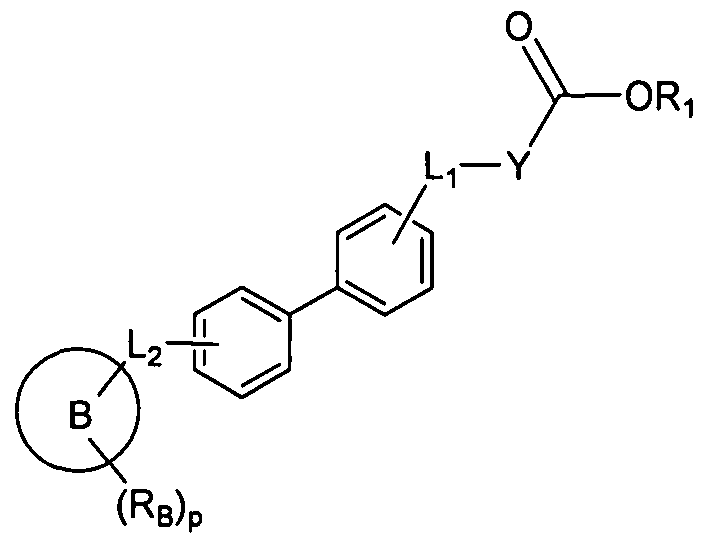
or a pharmaceutically acceptable salt thereof, wherein B is phenyl, indolinyl, or dihydroquinolyl,
Ri is -H, - (Ci-C6) alkyl, - (Ci-C6) alkyl-phenyl, or
- (C3-C6) alkenyl;
Y is a bond, -phenyl-, -pyridyl-, or -phenyl- (Ci-C6alkyl) -, wherein each of Y is optionally substituted with at least one substituent that is independently Rγ, wherein
Rγ is - (Ci-C6) alkoxy, - (Ci-C6) alkyl, - (C2-C6) alkenyl,
- (C2-C6) alkynyl, -C(O) (Ci-C6) alkoxy, -C(O) (Ci-C6)alkyl, -C(O)OH, -CN, - (Ci-C6) alkyl-C (0) OH, - (Ci-C6) haloalkoxy, - (Ci-C6) haloalkyl, -halogen, -OH,
- (Ci-C6) alkyl-OH, -NO2, -N(RNiRN2),
- (C1-C6JaIkYl-N(RNiRN2) , "C (0) N (RNiRN2) , wherein RNi and RN2 are each independently -H, -(Ci-C6) alkyl, -C (0) (Ci-C6) alkoxy, or -C(O) (Ci-C6) alkyl;
Li is - (Ci-C6) alkyl-Z-, -Z- (Ci-C6) alkyl -, or - (Ci-C6) alkyl-Z- (Ci-C6) alkyl-, wherein the alkyl portion of each of the above is optionally substituted with at least one substituent that are each independently Rγ or -oxo; and
Z is -O-, -S-, -S(O)2-, -N(RN3)-, -C(O)O-, -OC(O)-, - C(O)S-, -SC(O)-, -N(RN3)C(O)-, -C(O)N(RH3)-, -S(O)2N(RN3)", -N(RN3)S(O)2-, wherein
RN3 is -H, - (Ci-C6) alkyl, aryl, - (Ci-C6) alkyl- heteroaryl , or - (Ci-C6) alkyl-aryl,
L2 is - (Ci-C6) alkyl-, if B is heteroaryl, or if B is phenyl, then L2 is - (Ci-C6) alkyl-N (RNIO) ~, wherein
RNIO is -H, - (Ci-C6) alkyl, -(C2-C6) alkenyl, - (C2-C6) alkynyl,
-C(O) (Ci-C6) alkoxy, -C(O) (Ci-C6) alkyl, -C(O) (Ci-C6) alkyl- (C3-C8) cycloalkyl, or -C(O)H; each RB is independently
-(Ci-C6) alkoxy, - (Ci-C6) alkyl,
- (C2-C6) alkenyl, - (C2-C6) alkynyl,
- (Ci-C6) haloalkoxy, - (Ci-C6) haloalkyl, -halogen, -OH; and p is 0, 1, 2, 3, or 4.
71. A compound according to claim 1, having the formula
DS-x-CR-y-PH, or a pharmaceutically acceptable salt thereof, wherein CR is selected from the group consisting of

- (Ci-C6) alkoxy, - (Cx-C6) alkyl, - (C2-C6) alkenyl, -(C2-C6) alkynyl, -C(O) (Ci-C6) alkoxy, -C(O) (Ci-C6) alkyl, -C(O)OH, -CN, -(Ci-C6) haloalkoxy,
- (Ci-C6) haloalkyl, -halogen, -OH, - (Ci-C6) alkyl-OH, -NO2, -N(RN6RN7), - (Ci-C6) alkyl-N (RN6RN7) , or -C(O)N(RN6RN7) wherein each RN6 and RN^ is independently -H, -(Ci-C6) alkyl, - (C2-C6) alkenyl,
-(C2-C6) alkynyl, -C(O) (Ci-C6) alkoxy,
-C(O) (Ci-C6) alkyl, or -C(O)H, each tc is independently 0, 1, 2, or 3, and each fc is independently 0, 1, 2, 3, or 4; DS is selected from the group consisting of
 (DI) , wherein each Riq2, Rpi2, Rap2, and Rdl2 is independently -(Ci-C6) alkoxy, - (Ci-C6) alkyl, - (C2-C6) alkenyl,
- (C2-C6) alkynyl, -C(O) (Ci-C6) alkoxy, -C(O) (Ci-C6) alkyl, -C(O)OH, -CN, - (Ci-C6) haloalkoxy,
- (Ci-C6) haloalkyl, -halogen, -OH, - (Ci-C6) alkyl-OH, -NO2, -N(RN6RN?) - (Ci-C6) alkyl-N (RN6RN7) , or -C(O)N(RN6RN7) in which each RN6 and RN7 is independently -H - (Ci-C6) alkyl, - (C2-C6) alkenyl, -(C2-C6) alkynyl, -C(O) (Ci-C6) alkoxy,
-C(O) (Ci-C6)alkyl, or -C(O)H, each Rp1I and Rapi is independently -H (Ci-C7) alkyl, or C(O) (Ci-C7) alkoxy, each Riqi and Rdii is independently - (Ci-C6) alkyl, -(Ci- C6) alkoxy, -C (O) (Ci-C6) alkoxy, -C (0) (Ci-C6) alkyl, (Ci-C6) haloalkyl, -halogen or -N(RN4RNs) in which RN4 and RN5 each is are each independently -H,
- (Ci-C6) alkyl, -C (0) (Ci-C6) alkoxy, or -C(O) (Ci-C6) alkyl, each Riq3, Rpi3, Rap3 and Rdl3 is independently -(Ci- C6) alkyl, - (Ci-C6) alkoxy, -C (0) (Ci-C6) alkoxy, C(O) (Ci-C6)alkyl, - (Ci-C6) haloalkyl, -halogen or -N(RN4RN5) in which RN4 and RN5 each is are each independently -H, - (Ci-C6) alkyl, -C (0) (Ci-C6) alkoxy, or -C(O) (Ci-C6)alkyl, each dd is independently 0, 1, or 2,
each fd is independently 0, 1, 2, 3, or 4, and each vd is independently 0, 1, 2, 3, 4, or 5; x denotes the position of attachment of the DIS moiety to the X ring of the CR moiety, and is o, m, or p when CR is BP or PP, and α or β when CR is TP; PH is selected from the group consisting of


- (C2-C6) alkenyl, - (C2-C6) alkynyl, -C (0) (Ci-C6) alkoxy, -C(O) (Ci-C6) alkyl, -C(O)OH, -CN, - (Ci-C6) haloalkoxy,
- (Ci-C6) haloalkyl, -halogen, -OH, - (Ci-C6) alkyl-OH, -NO2, -N(RN6RN7), - (Ci-C6) alkyl-N (RN6RN7) , or
-C (O)N (RN6RN7) in which each RN6 and RN7 is independently -H, - (Ci-C6) alkyl, - (C2-C6) alkenyl, - (C2-C6) alkynyl, -C(O) (Ci-C6) alkoxy,
-C(O) (Ci-C6) alkyl, or -C(O)H, each Ria2 is independently H, (Ci-C6) alkyl or C(O) (Ci-
C6) alkoxy, each Rasi, Rari/ Rpzi, Rtei, Rtfi/ Rtf2 and Rkpi is independently (Ci-C6) alkyl, (Ci-C6) alkoxy, -C(O) (Ci- C6) alkoxy, -C (0) (Ci-C6) alkyl, - (Ci-C6) haloalkyl, halogen or -N(RN4RNs) in which each RN4 and RNs is independently -H, - (Ci-C6) alkyl, -C (0) (Ci-C6) alkoxy, or -C(O) (Ci-C6) alkyl, each Ras2ι Rarl/ Rba2/ Rbe2/ Ria3f Rhp2/ Rpa3/ Rpz2/ Rte21 Rtf3/ Rna2f Rpg2Λ Rpg3/ Rpg4/ Raal/ Raa2? Raa3f Raa4 and Rkp2 IS independently (Ci-C6) alkyl, (Ci-C6) alkoxy, -C(O)(Ci-
C6) alkoxy, -C (0) (Ci-C6) alkyl, - (Ci-C6) haloalkyl, halogen or -N(RN4RNs) in which each RN4 and RNs is independently -H, - (Ci-C6) alkyl, -C (0) (Ci-C6) alkoxy, or -C(O) (Ci-C6)alkyl, each dp is independently 0, 1, or 2, each tp is independently 0, 1, 2, or 3, each fp is independently 0, 1, 2, 3, or 4, and y denotes the position of attachment of the PH moiety to the
Y ring of the CR moiety, and is o, m or p when CR is BP or TP and PH is not AR, o, m, p, or m' when CR is PP and PH is not AR, (Yi, i/2) when CR is BP or TP and PH is AR, in which yi denotes the position of attachment of the nitrogen of the AR moiety, and y2 denotes the position of attachment of the methylene of the AR moiety, and in which (yi, y2) is (p, m) , (m, p) , (m, o) , or (o, m) , and
(yi/ y2) when CR is PP and PH is AR, in which yi denotes the position of attachment of the nitrogen of the AR
moiety, and Y2 denotes the position of attachment of the methylene of the AR moiety, and in which (yi, Y2) is (p, m) , (m, p) , (m, o) , (o, m) , (m' , p) , or (p, m') .
72. A compound according to claim 71, wherein CR is BP.
73. A compound according to claim 71, wherein CR is PP.
74. A compound according to claim 71, wherein CR is TP.
75. A compound according to any one of claims 71-74, wherein each Rbpx/ RbPy/ RPPxr Rppy Rtpχ and Rtpy is independently - (Ci-C6) alkoxy, - (Ci-C6) alkyl, - (Ci-C6) haloalkoxy, - (Ci-C6) haloalkyl, or -halogen.
76. A compound according to any one of claims 71-75, wherein each fc is independently 0, 1, or 2.
77. A compound according to any one of claims 71-76, wherein DS is IQ.
78. A compound according to any one of claims 71-76, wherein DS is PI.
79. A compound according to any one of claims 71-76, wherein DS is AP.
80. A compound according to any one of claims 71-76, wherein DS is DI.
81. A compound according to any one of claims 71-80, wherein each Riq2, RPI2A RaP2, and Rdi2 is independently - (Ci-C6) alkoxy,
- (Ci-C6) alkyl, - (Ci-C6) haloalkoxy, - (Ci-C6) haloalkyl, or halogen.
82. A compound according to any one of claims 71-76, 78-79 and 81, wherein each Rpii and Rapi is H.
83. A compound according to any one of claims 71-77 and 80- 81, wherein each Riqi and Rdli is independently - (Ci-C6) alkyl or
- (Ci-C6) alkoxy .
84. A compound according to any one of claims 71-83, wherein each Riq3, Rpi3, Rap3 and Rdl3 is independently - (Ci-C6) alkyl or - (Ci-C6) alkoxy.
85. A compound according to any one of claims 71-84, wherein each dd is independently 0 or 1.
86. A compound according to any one of claims 71-85, wherein each fd and vd is independently 0, 1, or 2.
87. A compound according to any one of claims 71-73 and 75- 86, wherein CR is BP or PP and x is m.
88. A compound according to any one of claims 71-73 and 75- 86, wherein CR is BP or PP and x is p.
89. A compound according to any one of claims 71 and 74-86, wherein CR is TP and x is β.
90. A compound according to any one of claims 71-89, wherein PH is AS or AR.
91. A compound according to any one of claims 71-89, wherein PH is BA or BE.
92. A compound according to any one of claims 71-89, wherein PH is IA or PA.
93. A compound according to any one of claims 71-89, wherein PH is HP or NA.
94. A compound according to any one of claims 71-89, wherein PH is PZ or KP.
95. A compound according to any one of claims 71-89, wherein PH is TE, TF or AA.
96. A compound according to any one of claims 71-89, wherein PH is PG.
97. A compound according to any one of claims 71-89, 91-93 and 96, wherein each Rbai/ Rbei/ Rial/ Rpai/ RPa2/ Rnai/ and Rpgi is independently - (Ci-C6) alkoxy, - (Ci-C6) alkyl, - (Ci-C6) haloalkoxy, - (Ci-C6) haloalkyl, or -halogen.
98. A compound according to any one of claims 71-89 and 92, wherein Ria2 is H.
99. A compound according to any one of claims 71-90, 94 and 95, wherein each Ra3i, Rari, Rp2i, Rtei, Rtm Rtf2 and Rkpi is independently - (Ci-C6) alkyl or - (Ci-C6) alkoxy .
100. A compound according to any one of claims 71-99, wherein each Ras2 , Rarl , Rba2 , Rbe2 , Ria3 / Rhp2 , Rpa3 , Rpz2 f Rte2 , Rtf3 r Rna2 /
RPg2/ RPg3 , Rpg4 , Raai / Raa2 / Raa3. Raa4 and Rkp2 is independently - ( Ci-C6) alkyl or - (Ci-C6) alkoxy .
101. A compound according to any one of claims 71-100, wherein each dp and tp is independently 0 or 1.
102. A compound according to any one of claims 71-91, 94, 96, 100 and 101, wherein each fp and vp is independently 0, 1 or
2.
103. A compound according to any one of claims 71-102, wherein PH is not AR and y is p.
104. A compound according to any one of claims 71-73 and 75- 102, wherein CR is BP or TP, PH is not AR, and y is m.
105. A compound according to any one of claims 71, 73 and 75- 102, wherein CR is PP, PH is not AR, and y is m' .
106. A compound according to claim 71-90 and 99-102, wherein PH is AR and (yi, yz) is (p,m) or (p,m' ) .
107. A compound according to any one of claims 71-73 and 75- 105, wherein x is m and y is p; or x is p and y is m or m' .
108. A compound according to claim 71, wherein the compound has the structure
PI-m-BP-p-TE;
IQ-m-BP-p-NA;
IQ-m-BP-p-NA; PI-m-BP-p-PA;
PI-m-BP-p-PG;
PI-p-PP-m'-NA;
PI-p-PP-m'-TE;
PI-m-PP-p-NA;
PI-m-PP-p-TE;
PI-m-BP-p-NA;
DI-m-BP-p-NA;
IQ-m-BP-p-AS; IQ-m-BP-p-BA;
IQ-m-BP-p-AA;
PI-m-BP-p-PA;
IQ-m-BP-p-HP;
PI-m-BP-p-HP; IQ-m-BP-p-PA;
IQ-m-BP-p-PG;
IQ-m-BP-p-KP;
PI-m-BP-p-BA;
IQ-m-BP- (p, m) -AR; PI-m-PP-p-BE;
IQ-m-BP-p-IA;
AP-m-BP-p-BA;
AP-m-BP-p-HP;
IQ-m-BP-p-AS ; PI-m-PP-p-AS;
P I -m- PP -m- AS ;
IQ-β-TP-p-BA;
IQ-m-BP-p-BE;
AP-m-BP-p-HP; PI-m-BP-p-HP;
AP-m-BP-p-BA;
IQ-m-BP-p-HP;
DI-m-BP-p-PA; or
DI-m-BP-p-PZ .
109. A compound according to claim 1, having the formula
DIS-x-COR-y-PHM, or a pharmaceutically acceptable salt thereof, wherein
COR is selected from the group consisting of

(TPA) ;
DIS is selected from the group consisting of


?
 (PAA)
(PAA)
 (PZA)
(PZA)

(m' ,p) or (p, m' ) .
110. A compound according to claim 109, wherein COR is BPA.
111. A compound according to claim 109, wherein COR is PPA.
112. A compound according to claim 109, wherein COR is TPA.
113. A compound according to any one of claims 109-112, wherein DIS is IQA, IQB, IQC, or IQD.
114. A compound according to any one of claims 109-112, wherein DIS is IPA, IPB or IPC.
115. A compound according to any one of claims 109-112, wherein DIS is APA or APB.
116. A compound according to any one of claims 109-112, wherein DIS is DIA.
117. A compound according to any one of claims 109-111 and 113-116, wherein COR is PZA or PPA and x is m.
118. A compound according to any one of claims 109-111 and 113-116, wherein COR is BPA or PPA and x is p.
119. A compound according to any one of claims 109 and 112- 116, wherein COR is TPA and x is β.
120. A compound according to any one of claims 109-119, wherein PHM is ASA or ARA.
121. A compound according to any one of claims 109-119, wherein PHM is BAA, BAB, BEA or BEB.
122. A compound according to any one of claims 109-119, wherein PHM is IAA or PAA.
123. A compound according to any one of claims 109-119, wherein PHM is HPA, HPB or NAA.
124. A compound according to any one of claims 109-119, wherein PHM is BPA or KPA.
125. A compound according to any one of claims 109-119, wherein PHM is TEA, TEB, TFA or AAA.
126. A compound according to any one of claims 109-119, wherein PHM is PGA.
127. A compound according to any one of claims 109-126, wherein PHM is not ARA and y is p.
128. A compound according to any one of claims 109-111 and 113-126, wherein COR is BPA or TPA, PHM is not ARA, and y is m.
129. A compound according to any one of claims 109, 111 and 113-126, wherein COR is PPA, PHM is not ARA, and y is m' .
130. A compound according to any one of claims 109-120, wherein PHM is ARA and (yi, y2) is (p,m) or (p,m' ) .
131. A compound according to any one of claims 109-111 and 113-129, wherein x is m and y is p; or x is p and y is m or m' .
132. A compound according to claim 108, wherein the compound has the structure
IPA-m-BPA-p-TEB;
IQA-m-BPA-p-NAA; IQB-m-BPA-p-NAA;
IPA-m-BPA-p-PAA;
IPA-m-BPA-p-PGA;
IPA-p-PPA-m' -NAA;
IPA-p-PPA-m' -TEA; IPA-m-PPA-p-NAA;
IPA-m-PPA-p-TEB;
IPC-m-BPA-p-NAA;
DIA-m-BPA-p-NAA;
IQD-m-BPA-p-ASA; IQC-m-BPA-p-BAA;
IQB-m-BPA-p-BAA;
IQB-m-BPA-p-AAA;
IPB-m-BPA-p-PAA;
IQB-m-BPA-p-HPA; IQC-m-BPA-p-HPA;
IPB-m-BPA-p-HPA;
IPC-m-BPA-p-HPA;
IQB-m-BPA-p-PAA;
IQC-m-BPA-p-PAA; IQB-m-BPA-p-PGA;
IQB-m-BPA-p-KPA;
IPC-m-BPA-p-BAA;
IQB-m-BPA- (p,m) -ARA;
IPA-m-PPA-p-BEB;
IQB-m-BPA-p-IAA; APA-m-BPA-p-BAA; APA-m-BPA-p-HPA; IQA-m-BPA-p-ASA; I PA-m-PPA-p-ASA;
I PA-m- P PA-m- AS A ; IQB-β-TPA-p-BAA; IQB-m-BPA-p-BEA; APA-m-BPA-p-HPA; IPC-m-BPA-p-HPB;
APB-m-BPA-p-BAA; IQB-m-BPA-p-HPB; DIA-m-BPA-p-PAA; or DIA-m-BPA-p-PZA.
133. A compound according to claim 1 which is N- ( tert-butoxycarbonyl ) -S- { 4- [2- ( { [ 4- ( 1- ethylpropyl) phenyl] (isopropyl) amino}methyl) -1,3- thiazol-4-yl] benzyl } cysteine; 5-({4-[2-({[4-(l- ethylpropyl) phenyl] (isopropyl) amino}methyl) -1,3- thiazol-4-yl] benzyl }oxy) nicotinic acid; 5-({6-[4-({[4-(l- ethylpropyl ) phenyl] (isopropyl ) amino }methyl ) phenyl] pyrid in-2-yl}methoxy) nicotinic acid;
N- ( tert-butoxycarbonyl) -S- ( { 6- [ 4- ( { [4- ( 1- ethylpropyl ) phenyl] (isopropyl ) amino }methyl ) phenyl] pyrid in-2-yl }methyl) -L-cysteine; 5-({6-[3-({[4-(l- ethylpropyl) phenyl] (isopropyl) amino }methyl) phenyl ] pyrid in-3-yl}methoxy) nicotinic acid; N- (tert-butoxycarbonyl) -S- ({ 6- [ 3- ( { [4-(l- ethylpropyl ) phenyl] ( isopropyl ) amino}methyl ) phenyl] pyrid in-3-yl }methyl ) -L-cysteine;
[ ( { 6- [ 3- ( { [ 4- ( l- ethylpropyl) phenyl] (isopropyl) amino}methyl) phenyl] pyrid in-3-yl}methyl) thio] acetic acid; 2-[({6-[3-({[4-(l- ethylpropyl) phenyl] (isopropyl) amino }methyl) phenyl] pyrid in-3-yl}methyl) thio] propanoic acid; N- ( tert-butoxycarbonyl ) -S- { [3 ' - ( { [5-
(trifluoromethyl) pyridin-2-yl] amino }methyl )biphenyl-4- yl] methyl} cysteine; N- (tert-butoxycarbonyl) -S- { [3 ' - ( {methyl [5-
(trifluoromethyl) pyridin-2-yl] amino }methyl )biphenyl-4- yl] methyl } cysteine; 5-fluoro-2- ( { [3 ' - ( { [5- (trifluoromethyl) pyridin-2- yl] amino}methyl) biphenyl-4-yl] methyl } thio) benzoic acid; 3- (trifluoromethyl )-l-{ [3'-({ [5- (trifluoromethyl) pyridin- 2-yl] amino}methyl) biphenyl-4-yl] methyl }-lH-pyrazole-4- carboxylic acid; 5-{ [3'- ({methyl [5- (trifluoromethyl) pyridin-2- yl] amino}methyl) biphenyl-4-yl] methoxy} nicotinic acid; N- (tert-butoxycarbonyl) -S- [ (3?-{ [7- (trifluoromethyl) -3, 4- dihydroquinolin-1 (2H) -yl]methyl}biphenyl-4- yl ) methyl ] cysteine; 5- ( { 3 ' - [ ( 6-methyl-3, 4-dihydroquinolin-l (2H) - yl) methyl] biphenyl-4-yl }methoxy) nicotinic acid; 5-[ (3'-{ [7- (trifluoromethyl) -3, 4-dihydroquinolin-l (2H)- yl]methyl}biphenyl-4-yl)methoxy] nicotinic acid; 5- { [ 3 ' - (2 , 3-dihydro-lH-indol-l-ylmethyl ) biphenyl-4- yl]methoxy}nicotinic acid;
5-{ [31- (3, 4-dihydroquinolin-l (2H) -ylmethyl) biphenyl-4- yl]methoxy}nicotinic acid;
5-[ (3'-{ [2- (trifluoromethyl) -lH-benzimidazol-1- yl] methyl }biphenyl-4-yl) methoxy] nicotinic acid; 5-({3'-[ ( 5-fluoro-2, 3-dihydro-ltf-indol-l- yl) methyl] biphenyl-4-yl}methoxy) nicotinic acid;
5- ( { 3 ' - [ ( 2 -methyl-2 , 3-dihydro-ltf-indol-l- yl) methyl ]biphenyl-4-yl}methoxy) nicotinic acid; 5- [ ( 3 ' - { [ 6- (trifluoromethyl ) -2 , 3-dihydro-ltf-indol-1- yl] methyl }biphenyl-4-yl)methoxy] nicotinic acid; 5- [ (3 ' -{ [4-chloro-6- (trifluoromethyl) -ltf-benzimidazol-1- yl] methyl }biphenyl-4-yl)methoxy] nicotinic acid; 5- ( { 3 ' - [ (2-methyl-3, 4-dihydroquinolin-l [2H) - yl)methyl]biphenyl-4-yl}methoxy) nicotinic acid; 5- ( {3 ' - [ (3-methyl-2, 2-dioxido-2, 1, 3-benzothiadiazol- 1 (3H) -yl)methyl]biphenyl-4-yl}methoxy) nicotinic acid; 5- ( {3 •- [ (5, 6-difluoro-ltf-benzimidazol-l- yl) methyl] biphenyl-4-yl}methoxy) nicotinic acid; 5-{[3'-({[4-(l- ethylpropyl ) phenyl ] ( isopropyl ) amino }methyl ) biphenyl-3- yl]methoxy}nicotinic acid;
N-(tert-butoxycarbonyl)-S-{ [3'-({ [4-(l- ethylpropyl ) phenyl] (isopropyl ) amino }methyl ) biphenyl-3- yl] methyl } cysteine; ({ [3'-({ [4-(l- ethylpropyl) phenyl] (isopropyl) amino }methyl) biphenyl-3- yl]methyl} thio) acetic acid; 2-({[3'-({[4-(l- ethylpropyl) phenyl] (isopropyl) amino}methyl) biphenyl-3- yl] methyl} thio) propanoic acid; 3-({[3'-({[4-(l- ethylpropyl ) phenyl] (isopropyl ) amino }methyl ) biphenyl-3- yl] methyl} thio) propanoic acid; N-(tert-butoxycarbonyl)-S-{ [3'-({ [4-(l- ethylpropyl ) phenyl] (isopropyl) amino}methyl) biphenyl-4- yl]methyl} cysteine; 3-({[3'-({[4-(l- ethylpropyl) phenyl] (isopropyl) amino}methyl) biphenyl-4- yl] methyl } thio) propanoic acid;
2 - ( { [ 3 ' - ( { [ 4 - ( l- ethylpropyl) phenyl] (isopropyl) amino}methyl) biphenyl-4- yl]methyl } thio) propanoic acid; ({[3'-({[4-(l- ethylpropyl) phenyl] (isopropyl) amino }methyl) biphenyl-4- yl] methyl} thio) acetic acid; W-acetyl-5-{ [3 ' - ( { [4- (1- ethylpropyl ) phenyl ] ( isopropyl ) amino }methyl ) biphenyl-4- yl] methyl } -L-cysteine; 2-({[3'-({[4-(l- ethylpropyl) phenyl] (isopropyl) amino}methyl) biphenyl-4- yl]methyl} thio) propanoic acid; 5-{[3'-({[4-(l- ethylpropyl ) phenyl ] (isopropyl ) amino }methyl ) biphenyl-4- yl]methoxy}nicotinic acid; 3-{[3'-({[4-(l- ethylpropyl) phenyl] (isopropyl) amino }methyl) biphenyl-4- yl]methoxy}pyridine-2-carboxylic acid; 4-{[3'-({[4-(l- ethylpropyl) phenyl] (isopropyl) amino }methyl) biphenyl-4- yl]methoxy}benzoic acid; (4-{[3'-({[4-(l- ethylpropyl ) phenyl] (isopropyl ) amino }methyl ) biphenyl-4- yl]methoxy}phenyl) acetic acid; 3-(4-{[3'-({[4-(l- ethylpropyl) phenyl] (isopropyl) amino}methyl) biphenyl-4- yl]methoxy}phenyl) propanoic acid; 2-{[3'-({[4-(l- ethylpropyl) phenyl] (isopropyl) amino}methyl) biphenyl-4- yl]methoxy} -5-fluorobenzoic acid; 3-chloro-4-{ [3'-({[4-(l- ethylpropyl) phenyl] (isopropyl) amino }methyl) biphenyl-4- yl]methoxy}benzoic acid;
2- { [ 3 ' - ( { [ 4- ( l- ethylpropyl) phenyl] (isopropyl) amino}methyl) biphenyl-4- yl] methoxy} -4-fluorobenzoic acid; 5-chloro-2-{ [3'-({ [4-(l- ethylpropyl) phenyl] (isopropyl) amino }methyl) biphenyl-4- yl]methoxy}benzoic acid; 2-{[3'-({[4-(l- ethylpropyl ) phenyl ] (isopropyl ) amino }methyl ) biphenyl-4- yl] methoxy} -5-methoxybenzoic acid; 2-{[3'-({[4-(l- ethylpropyl) phenyl] (isopropyl) amino }methyl) biphenyl-4- yl] methoxy} -6-fluorobenzoic acid; 3-{[3'-({[4-(l- ethylpropyl) phenyl] (isopropyl) amino}methyl) biphenyl-4- yl] methoxy} -2, 5-difluoro-4-methoxybenzoic acid; 5-cyano-2-{ [3'-({[4-(l- ethylpropyl) phenyl] (isopropyl) amino }methyl) biphenyl-4- yl]methoxy}benzoic acid; 4-{[3'-({[4-(l- ethylpropyl) phenyl] (isopropyl) amino }methyl) biphenyl-4- yl] methoxy} -3-methoxybenzoic acid; 4-{[3'-({[4-(l- ethylpropyl) phenyl] (isopropyl) amino }methyl) biphenyl-4- yl]methoxy} -3-nitrobenzoic acid; N-acetyl-0-{ [3'-({ [4-(l- ethylpropyl ) phenyl] (isopropyl) amino}methyl ) biphenyl-4- yl] methyl } -L-tyrosine; 2-{ [3'-({ [4-(l- ethylpropyl) phenyl] (isopropyl) amino}methyl) biphenyl-4- yl]methoxy} -5-methylbenzoic acid; 2-{[3'-({[4-(l- ethylpropyl ) phenyl] (isopropyl ) amino }methyl ) biphenyl-4- yl] methoxy} -4- (lH-pyrrol-1-yl) benzoic acid;
2- { [ 3 ' - ( { [ 4- ( l- ethylpropyl) phenyl] (isopropyl) amino}methyl) biphenyl-4- yl] methoxy} -3-methylbenzoic acid;
5- [ (3 ' -{ [isopropyl (phenyl) amino] methyl }biphenyl-4- yl)methoxy] nicotinic acid; 6-({[3'-({[4-(l- ethylpropyl ) phenyl] (isopropyl ) amino }methyl ) biphenyl-4- yl] oxy}methyl)pyridine-2-carboxylic acid; 3-({ [3'-({ [4-(l- ethylpropyl) phenyl] (isopropyl) amino}methyl)biphenyl-4- yl] oxy}methyl) benzoic acid; 4-({[3\-({[4-(l- ethylpropyl ) phenyl] (isopropyl ) amino }methyl ) biphenyl-4- yl] oxy}methyl) benzoic acid; 2-({ [3'-({ [4-(l- ethylpropyl) phenyl] (isopropyl) amino}methyl) biphenyl-4- yl] oxy}methyl) -3-furoic acid; 3-({[3'-({[4-(l- ethylpropyl) phenyl] (isopropyl) amino}methyl )biphenyl-4- yl] oxy}methyl) -5-methoxybenzoic acid; { [3'-({ [4-(l- ethylpropyl) phenyl] (isopropyl) amino}methyl) biphenyl-4- yl] oxy} (phenyl) acetic acid; 2-({[3'-({[4-(l- ethylpropyl) phenyl] (isopropyl) amino}methyl) biphenyl-4- yl] oxy}methyl ) -6-fluorobenzoic acid; 4-{[3'-({[4-(l- ethylpropyl) phenyl] (isopropyl) amino}methyl ) biphenyl-4- yl] oxy}butanoic acid; {[3'-({[4-(l- ethylpropyl) phenyl] (isopropyl) amino}methyl) biphenyl-4- yl] oxy} acetic acid;
5- { [ 3 ' - ( { [ 4- ( l- ethylpropyl) phenyl] (isopropyl) amino}methyl) biphenyl-4- yl] oxy} -3, 3-dimethyl-4-oxopentanoic acid; 5-{[3'-({[4-(l- ethylpropyl) phenyl] (isopropyl) amino }methyl) biphenyl-4- yl] oxy} -2, 2-dimethyl-4-oxopentanoic acid; l-{[3'-({[4-(l- ethylpropyl) phenyl] (isopropyl) amino}methyl) biphenyl-4- yl] methyl} -3- (trifluoromethyl) -lH-pyrazole-4-carboxylic acid;
2-({[3'-({[4-(l- ethylpropyl ) phenyl] (isopropyl ) amino }methyl ) biphenyl-4- yl] methyl }thio) benzoic acid; 4-({[3'-({[4-(l- ethylpropyl) phenyl] (isopropyl) amino}methyl)biphenyl-4- yl]methyl} thio)benzoic acid; 3-({[3'-({[4-(l- ethylpropyl ) phenyl] (isopropyl ) amino }methyl ) biphenyl-4- yl]methyl} thio)benzoic acid; 3-[4-({[3'-({[4-(l- ethylpropyl ) phenyl] (isopropyl ) amino }methyl ) biphenyl-4- yl] methyl } thio) phenyl] -2, 2-dimethylpropanoic acid; 2-({[3'-({[4-(l- ethylpropyl ) phenyl] (isopropyl ) amino }methyl ) biphenyl-4- yl]methyl} thio) -5-fluorobenzoic acid; 2-({[3'-({[4-(l- ethylpropyl) phenyl] (isopropyl) amino}methyl) biphenyl-4- yl] methyl} thio) -l-methyl-ltf-imidazole-S-carboxylic acid; N-benzyl-W-{ [3'-({ [4-(l- ethylpropyl ) phenyl ] (isopropyl ) amino }methyl ) biphenyl-4- yl] methyl} -β-alanine;
5- { [ 3 ' - ( { [ 4 - ( l- ethylpropyl) phenyl] (isopropyl) amino}methyl) biphenyl-4- yl] methyl }-l, 2, 5-thiadiazolidin-3-one 1, 1-dioxide; 2-( ( (3'-( (isopropyl (4- (pentan-3- yl)phenyl) amino)methyl)biphenyl-4-yl)methyl) (pyridin-2- ylmethyl) amino) acetic acid; 5- ( (6- (4- ( (isopropyl (4- (pentan-3- yl) phenyl) amino)methyl) phenyl )pyridin-2- yl)methoxy) nicotinic acid; 2- ( (6- (4- ( (isopropyl (4- (pentan-3- yl) phenyl) amino) methyl) phenyl) pyridin-2- yl)methylthio) acetic acid; 2- ( (6- (4- ( (isopropyl (4- (pentan-3- yl) phenyl) amino) methyl) phenyl) pyridin-2- yl)methylthio) propanoic acid;
5- ( (3 ' - ( (6- (trifluoromethyl) -3, 4-dihydroquinolin-l (2H) - yl)methyl) biphenyl-4-yl)methyl) -1,2, 5-thiadiazolidin-3- one;
5-fluoro-2- ( (3'-( (2-methyl-3, 4-dihydroquinolin-l (2H)- yl) methyl ) biphenyl-4-yloxy) methyl) benzoic acid; 5-fluoro-2-( (3'-( (7- (trifluoromethyl) -3, 4- dihydroquinolin-1 (2H) -yl ) methyl ) bipheny1-4- yloxy) methyl) benzoic acid;
3, 3-dimethyl-4-oxo-5-(3'-( (7- (trifluoromethyl) -3, 4- dihydroquinolin-1 (2H) -yl ) methyl ) biphenyl-4- yloxy) pentanoic acid; 5-fluoro-2- ( (3 ' - ( (isopropyl (p- tolyl) amino) methyl) biphenyl-4-yloxy) methyl) benzoic acid; 6-( (3'-( (7- (trifluoromethyl) -3, 4-dihydroquinolin-l (2H)- yl) methyl) biphenyl-4-yloxy) methyl) picolinic acid; 6-( (3'-( (2-methyl-3, 4-dihydroquinolin-l (2H)- yl)methyl) biphenyl-4-yloxy)methyl) picolinic acid;
6- ( (3 ' - ( (isopropyl (phenyl) amino) methyl )biphenyl-4- yloxy) methyl) picolinic acid; 6- ( (3 ' - ( (isopropyl (p-tolyl) amino) methyl) biphenyl-4- yloxy)methyl) picolinic acid; 3-(trifluoromethyl)-l-( (3'-( (7- (trifluoromethyl) -3, 4- dihydroquinolin-1 (2H) -yl ) methyl ) biphenyl-4-yl) methyl) - lH-pyrazole-4-carboxylic acid; l-( (3'-( (2-methyl-3,4-dihydroquinolin-l (2H)- yl) methyl) biphenyl-4-yl) methyl) -3- (trifluoromethyl) -IH- pyrazole-4-carboxylic acid;
2-( (pyridin-2-ylmethyl) ( (3'-( (7- (trifluoromethyl) -3, 4- dihydroquinolin-1 (2H) -yl) methyl) biphenyl-4- yl)methyl) amino) acetic acid; 2-(3-oxo-l-( (3'-( (7- (trifluoromethyl) -3, 4- dihydroquinolin-1 (2H) -yl ) methyl ) biphenyl-4- yl) methyl )piperazin-2-yl) acetic acid; 5-fluoro-2- ( (3 ' - ( (isopropyl (phenyl) amino) methyl) biphenyl-
4-yloxy)methyl) benzoic acid;
7-(3-( (7- (trifluoromethyl) -3, 4-dihydroquinolin-l (2H)- yl) methyl) phenyl) -4, 5-dihydro-2H-
[1, 2, 5] thiadiazolo [2, 3-a] quinolin-3 (3aH) -one-S, S- dioxide; l-methyl-2-( (3'-( (7- (trifluoromethyl) -3, 4- dihydroquinolin-1 (2H) -yl)methyl) biphenyl-4- yl)methylthio) -lH-imidazole-5-carboxylic acid; 2-( (3'-( (ethyl (5- (trifluoromethyl )pyridin-2- yl) amino) methyl) biphenyl-4-yloxy) methyl) -5- fluorobenzoic acid;
6-( (3'-( (ethyl(5-(trifluoromethyl)pyridin-2- yl) amino)methyl)biphenyl-4-yloxy)methyl) nicotinic acid; 5-( (3'-( (6-methyl-3, 4-dihydroquinolin-l (2H) - yl) methyl) biphenyl-4-yl) methyl) -1,2, 5-thiadiazolidin-3- one-S, S-dioxide;
5- ( ( 6- ( 3- ( ( isopropyl ( 4 - (pentan-3- yl) phenyl) amino) methyl) phenyl) pyridin-3-yl) methyl) -
1,2, 5-thiadiazolidin-3-one-S, S-dioxide; 5- ( (6- (3- ( (isopropyl (4- (pentan-3- yl) phenyl) amino) methyl) phenyl )pyridin-2-yl) methyl) -
1,2, 5-thiadiazolidin-3-one-S, S-dioxide; 5-fluoro-2-( (4-(2-( (7- (trifluoromethyl) -3, 4- dihydroquinolin-1 (2H) -yl) methyl) thiazol-4- yl)phenoxy) methyl) benzoic acid; 4-fluoro-2-( (3'-( (7- (trifluoromethyl) -3, 4- dihydroquinolin-1 (2H) -yl) methyl )biphenyl-4- yl)methoxy) benzoic acid; 6-( (31- ( (ethyl (5- (trifluoromethyl )pyridin-2- yl) amino) methyl )biphenyl-4-yloxy) methyl )picolinic acid; 6- ( (3 ' - ( (isopropyl (phenyl) amino) methyl )biphenyl-4- yloxy)methyl) nicotinic acid; 5-fluoro-2- ( (3 ' - ( (isopropyl (5- (trifluoromethyl) pyridin-2- yl) amino) methyl) biphenyl-4-yloxy) methyl) benzoic acid; 6- ( (3 ' - ( (7- (trifluoromethyl) -3, 4-dihydroquinolin-l (2H) - yl)methyl) biphenyl-4-yloxy)methyl) nicotinic acid;
3- (trifluoromethyl) -1- ( (3 ' - ( (6- (trifluoromethyl) indolin-
1-yl ) methyl ) biphenyl-4-yl ) methyl ) -lH-pyrazole-4- carboxylic acid;
1- (tert-butoxycarbonyl) -4- ( (31- ( (6- (trifluoromethyl) indolin-1-yl ) methyl ) biphenyl-4- yl)methyl)piperazine-2-carboxylic acid; 5- ( (31 - ( ( (3-fluorophenyl) (methyl) amino) methyl ) biphenyl-4- yl)methoxy) nicotinic acid;
5-{4-[2-(7-Trifluoromethyl-3, 4-dihydro-2H-quinolin-l- ylmethyl) -thiazol-4-yl] -phenoxymethyl} -nicotinic acid; 5-{4- [2- (2-Methyl-3, 4-dihydro-2H-quinolin-l-ylmethyl) - thiazol-4-yl] -phenoxymethyl } -nicotinic acid; 5- ( ( 3 ' - ( ( 5-methylindolin-l-yl ) methyl ) biphenyl-4- yl)methoxy) nicotinic acid;
5- ( (3 ' - ( (isopropyl (4-methoxyphenyl) amino) methyl) biphenyl-
4-yl)methoxy) nicotinic acid; 5- [3 ' - (4, 5, 7-Trifluoro-benzothiazol-2-ylmethyl) -biphenyl-
4-ylmethoxy] -nicotinic acid; 5- ( (6- (3- ( (5-bromoindolin-l-yl) methyl) phenyl )pyridin-2- yl)methoxy) nicotinic acid; 5-( (6-(4-( (β-(trifluoromethyl)indolin-l- yl) methyl) phenyl) pyridin-2-yl)methoxy) nicotinic acid; 5- ( (6- (3- ( (6- (trifluoromethyl) indolin-1- yl) methyl) phenyl) pyridin-2-yl)methoxy) nicotinic acid; 5-{6-[3-(7-Trifluoromethyl-3, 4-dihydro-2H-quinolin-l- ylmethyl) -phenyl] -pyridin-2-ylmethoxy} -nicotinic acid; 5-( (6-(3-( (ethyl (4-
(trifluoromethoxy) phenyl ) amino) methyl ) phenyl ) pyridin-2- yl)methoxy) nicotinic acid;
5- ( ( 6- (3- ( (propyl (m-tolyl) amino) methyl) phenyl )pyridin-2- yl)methoxy) nicotinic acid; 5-{6-[3-(6-Fluoro-2-methyl-3, 4-dihydro-2H-quinolin-l- ylmethyl) -phenyl] -pyridin-2-ylmethoxy} -nicotinic acid; 5- ( (6- (3- ( (5, 6, 7, 8-tetrahydronaphthalen-2- yloxy) methyl) phenyl) pyridin-2-yl)methoxy) nicotinic acid; 5- [3 ' - (6-Fluoro-benzothiazol-2-ylmethyl) -biphenyl-4- ylmethoxy] -nicotinic acid; 5- [3 ' - (7-Fluoro-benzothiazol-2-ylmethyl) -biphenyl-4- ylmethoxy] -nicotinic acid; 2- (tert-butoxycarbonylamino) -3- ( (3 ' - ( (5- fluorobenzo [d] thiazol-2-yl ) methyl ) biphenyl-4- yl) methylthio) propanoic acid; 2- (tert-butoxycarbonylamino) -3- ( (3'-( (7- fluorobenzo [d] thiazol-2-yl) methyl) biphenyl-4- yl)methylthio) propanoic acid;
( S ) -2- ( tert-butoxycarbonylamino ) -3- ( ( 4 ' - ( ( 4 , 5 , 7- trifluorobenzo [d] thiazol-2-yl) methyl) biphenyl-4- yl)methylthio) propanoic acid;
(S) -2- (tert-butoxycarbonylamino) -3- ( (3 ' - ( (4, 5, 7- trifluorobenzo [d] thiazol-2-yl) methyl) biphenyl-4- yl)methylthio) propanoic acid; l-((3'-((4,5, 7-trifluorobenzo [d] thiazol-2- yl) methyl )biphenyl-4-yl) methyl) -3- (trifluoromethyl) -IH- pyrazole-4-carboxylic acid; l-( (3'-( (6-fluoroindolin-l-yl)methyl)biphenyl-4- yl) methyl) -3- (trifluoromethyl) -lH-pyrazole-4-carboxylic acid; 5- [4 ' - (7-Trifluoromethyl-3, 4-dihydro-2H-quinolin-l- ylmethyl) -biphenyl-2-ylmethoxy] -nicotinic acid; 5- ( (4 ' - ( (6- (trifluoromethyl) indolin-1-yl) methyl )biphenyl-
2-yl)methoxy) nicotinic acid; 5-( (4'-( (ethyl (4-
(trifluoromethoxy) phenyl) amino) methyl )biphenyl-2- yl)methoxy) nicotinic acid; 5- [4 ' - (5-Chloro-benzothiazol-2-ylmethyl) -biphenyl-2- ylmethoxy] -nicotinic acid; 5-( (6-(4-( (ethyl (4-
(trifluoromethoxy) phenyl) amino) methyl) phenyl) pyridin-2- yl)methoxy) nicotinic acid; 5- ( (4 ' - ( (5-fluorobenzo [d] thiazol-2-yl ) methyl ) biphenyl-4- yl)methoxy) nicotinic acid; 5-( (41- ( (5- (trifluoromethyl )benzo[d] thiazol-2- yl) methyl ) biphenyl-4-yl)methoxy) nicotinic acid; 5-( {3'-[ (6-fluoro-2,3-dihydro-lff-indol-l- yl) methyl ]biphenyl-4-yl}methyl) -1,2, 5-thiadiazolidin-3- one 1,1-dioxide; 5-[ (3'-{ [5- (trifluoromethyl) -1, 3-benzothiazol-2- yl] methyl }bipheny1-4-yl) methyl] -1,2, 5-thiadiazolidin-3- one 1,1-dioxide; or
5- ( (3 ' - ( ( 6-fluoroindolin-l-yl) methyl )biphenyl-4- yl)methoxy) nicotinic acid.
134. A pharmaceutical composition comprising a compound of any one of claims 1-133 and at least one pharmaceutically acceptable solvent, carrier, adjuvant or excipient.
135. A method of treating diabetes, syndrome X, obesity, immunological disease, bleeding disorders, or cancer comprising administering a pharmaceutical composition of claim 134 to a patient in need of such treatment.
136. A method of treating diabetes, syndrome X, obesity, immunological disease, bleeding disorders, or cancer comprising administering a pharmaceutically acceptable amount of a compound of any one of claims 1-133 to a patient in need of such treatment.
137. A method of treating Type II diabetes comprising administering a pharmaceutically acceptable amount of a compound of any one of claims 1-133 to a patient in need of such treatment .
Abstract of the Disclosure
Disclosed are compounds and pharmaceutically acceptable salts of formula (I) :

:D
wherein A, B, D, Li, L2, R2, RA, RB, X, m, n, and p are as defined herein, which are useful in the treatment of metabolic disorders related to insulin resistance, leptin resistance, or hyperglycemia. Compounds of the invention include inhibitors of Protein tyrosine phosphatases, in particular Protein tyrosine phosphatase-lB (PTP-IB), that are useful in the treatment of diabetes and other PTP mediated diseases, such as cancer, neurodegenerative diseases and the like. Also disclosed are pharmaceutical compositions comprising compounds of the invention and methods of treating the aforementioned conditions using such compounds.
Applications Claiming Priority (2)
| Application Number | Priority Date | Filing Date | Title |
|---|---|---|---|
| US82551406P | 2006-09-13 | 2006-09-13 | |
| US60/825,514 | 2006-09-13 |
Publications (2)
| Publication Number | Publication Date |
|---|---|
| WO2008033455A2 true WO2008033455A2 (en) | 2008-03-20 |
| WO2008033455A3 WO2008033455A3 (en) | 2008-12-24 |
Family
ID=39092737
Family Applications (1)
| Application Number | Title | Priority Date | Filing Date |
|---|---|---|---|
| PCT/US2007/019915 Ceased WO2008033455A2 (en) | 2006-09-13 | 2007-09-13 | Biphenyl and heteroaryl phenyl derivatives as protein tyrosine phosphatases inhibitors |
Country Status (1)
| Country | Link |
|---|---|
| WO (1) | WO2008033455A2 (en) |
Cited By (32)
| Publication number | Priority date | Publication date | Assignee | Title |
|---|---|---|---|---|
| WO2009021740A2 (en) | 2007-08-15 | 2009-02-19 | Sanofis-Aventis | Substituted tetrahydronaphthalenes, process for the preparation thereof and the use thereof as medicaments |
| WO2009158467A3 (en) * | 2008-06-25 | 2010-07-29 | Envivo Pharmaceuticals, Inc. | Di-substituted phenyl compounds as phosphodiesterase 10 inhibitors |
| WO2010046780A3 (en) * | 2008-10-22 | 2011-01-13 | Institut Pasteur Korea | Anti viral compounds |
| WO2011057956A1 (en) | 2009-11-11 | 2011-05-19 | F. Hoffmann-La Roche Ag | Benzisoxazole analogs as glycogen synthase activators |
| WO2011057993A1 (en) | 2009-11-11 | 2011-05-19 | F. Hoffmann-La Roche Ag | Indazolone derivatives as glycogen synthase activators |
| WO2011058154A1 (en) | 2009-11-16 | 2011-05-19 | F. Hoffmann-La Roche Ag | Biphenyl carboxylic acids and bioisosteres as glycogen synthase activators |
| WO2011057959A1 (en) | 2009-11-11 | 2011-05-19 | F. Hoffmann-La Roche Ag | Indole and indazole derivatives as glycogen synthase activators |
| WO2011058122A1 (en) | 2009-11-16 | 2011-05-19 | F. Hoffmann-La Roche Ag | Piperidine analogs as glycogen synthase activators |
| WO2011067174A1 (en) | 2009-12-01 | 2011-06-09 | F. Hoffmann-La Roche Ag | Aniline analogs as glycogen synthase activators |
| WO2011067266A1 (en) | 2009-12-04 | 2011-06-09 | F. Hoffmann-La Roche Ag | Carboxylic acid analogs as glycogen synthase activators |
| WO2011107494A1 (en) | 2010-03-03 | 2011-09-09 | Sanofi | Novel aromatic glycoside derivatives, medicaments containing said compounds, and the use thereof |
| US8049015B2 (en) | 2008-09-29 | 2011-11-01 | Panmira Pharmaceuticals, Llc | Heteroaryl antagonists of prostaglandin D2 receptors |
| US8071595B2 (en) | 2008-06-25 | 2011-12-06 | Envivo Pharmaceuticals, Inc. | 1,2-disubstituted heterocyclic compounds |
| WO2011157827A1 (en) | 2010-06-18 | 2011-12-22 | Sanofi | Azolopyridin-3-one derivatives as inhibitors of lipases and phospholipases |
| JP2011530545A (en) * | 2008-08-14 | 2011-12-22 | メルク パテント ゲゼルシャフト ミット ベシュレンクテル ハフツング | Bicyclic triazole derivatives for the treatment of tumors |
| WO2011161030A1 (en) | 2010-06-21 | 2011-12-29 | Sanofi | Heterocyclic substituted methoxyphenyl derivatives having an oxo group, method for producing same, and use thereof as gpr40 receptor modulators |
| WO2012004270A1 (en) | 2010-07-05 | 2012-01-12 | Sanofi | Spirocyclically substituted 1,3-propane dioxide derivatives, methods for the production thereof and use of the same as medicament |
| WO2012004269A1 (en) | 2010-07-05 | 2012-01-12 | Sanofi | (2-aryloxy-acetylamino)-phenyl-propionic acid derivatives, method for producing same and use thereof as pharmaceuticals |
| WO2012010413A1 (en) | 2010-07-05 | 2012-01-26 | Sanofi | Aryloxy-alkylene substituted hydroxyphenyl hexynoic acids, methods for the production thereof and use of the same as medicament |
| US8343973B2 (en) | 2009-05-07 | 2013-01-01 | Envivo Pharmaceuticals, Inc. | Phenoxymethyl heterocyclic compounds |
| WO2013037390A1 (en) | 2011-09-12 | 2013-03-21 | Sanofi | 6-(4-hydroxy-phenyl)-3-styryl-1h-pyrazolo[3,4-b]pyridine-4-carboxylic acid amide derivatives as kinase inhibitors |
| WO2013045413A1 (en) | 2011-09-27 | 2013-04-04 | Sanofi | 6-(4-hydroxy-phenyl)-3-alkyl-1h-pyrazolo[3,4-b]pyridine-4-carboxylic acid amide derivatives as kinase inhibitors |
| WO2013101598A1 (en) * | 2011-12-27 | 2013-07-04 | Allergan, Inc. | Compounds acting at multiple prostaglandin receptors giving a general anti-inflammatory response |
| CN108003074A (en) * | 2017-12-21 | 2018-05-08 | 四川大学华西医院 | Biphenyl carboxylic acid compound and its preparation method and use |
| JP2019511561A (en) * | 2016-01-28 | 2019-04-25 | アカテコール・インコーポレイテッドACatechol, Inc. | Photocleavable primer compositions and methods of use |
| US10450273B2 (en) | 2016-08-29 | 2019-10-22 | Novartis Ag | N-(pyridin-2-yl)pyridine-sulfonamide derivatives and their use in the treatment of disease |
| US11702404B2 (en) | 2019-10-25 | 2023-07-18 | Gilead Sciences, Inc. | GLP-1R modulating compounds |
| US11851419B2 (en) | 2020-11-20 | 2023-12-26 | Gilead Sciences, Inc. | GLP-1R modulating compounds |
| US11858918B2 (en) | 2021-04-21 | 2024-01-02 | Gilead Sciences, Inc. | GLP-1R modulating compounds |
| US12091404B2 (en) | 2021-03-11 | 2024-09-17 | Gilead Sciences, Inc. | GLP-1R modulating compounds |
| US12121511B2 (en) | 2020-01-29 | 2024-10-22 | Gilead Sciences, Inc. | GLP-1R modulating compounds |
| US12180197B2 (en) | 2021-03-11 | 2024-12-31 | Gilead Sciences, Inc. | GLP-1R modulating compounds |
Family Cites Families (6)
| Publication number | Priority date | Publication date | Assignee | Title |
|---|---|---|---|---|
| US7358248B2 (en) * | 2003-04-30 | 2008-04-15 | The Institute For Pharmaceutical Discovery Llc | Substituted amino carboxylic acids |
| EP1805159A1 (en) * | 2004-10-28 | 2007-07-11 | The Institutes for Pharmaceutical Discovery, LLC | Substituted carboxylic acids |
| JP2008518926A (en) * | 2004-10-28 | 2008-06-05 | ジ インスティチューツ フォー ファーマシューティカル ディスカバリー、エルエルシー | Substituted phenylalkanoic acid |
| CA2588776A1 (en) * | 2004-11-18 | 2006-05-26 | The Institutes For Pharmaceutical Discovery, Llc | Substituted amino carboxylic acids |
| CA2587566A1 (en) * | 2004-11-18 | 2006-05-26 | The Institutes For Pharmaceutical Discovery, Llc | Heterocyclylbiphenyl derivates as protein tyrosine phosphatase inhibitors |
| AU2005307718A1 (en) * | 2004-11-18 | 2006-05-26 | The Institutes For Pharmaceutical Discovery, Llc | Heterocycle substituted carboxylic acids for the treatment of diabetes |
-
2007
- 2007-09-13 WO PCT/US2007/019915 patent/WO2008033455A2/en not_active Ceased
Cited By (49)
| Publication number | Priority date | Publication date | Assignee | Title |
|---|---|---|---|---|
| WO2009021740A2 (en) | 2007-08-15 | 2009-02-19 | Sanofis-Aventis | Substituted tetrahydronaphthalenes, process for the preparation thereof and the use thereof as medicaments |
| US8466148B2 (en) | 2008-06-25 | 2013-06-18 | Envivo Pharmaceuticals, Inc. | 1,2-disubstituted heterocyclic compounds |
| US8481534B2 (en) | 2008-06-25 | 2013-07-09 | Envivo Pharmaceuticals, Inc. | 5- and 6-membered heterocyclic compounds |
| US8071595B2 (en) | 2008-06-25 | 2011-12-06 | Envivo Pharmaceuticals, Inc. | 1,2-disubstituted heterocyclic compounds |
| US8933074B2 (en) | 2008-06-25 | 2015-01-13 | Forum Pharmaceuticals Inc. | 1,2-disubstituted heterocyclic compounds |
| US9265767B2 (en) | 2008-06-25 | 2016-02-23 | Forum Pharmaceuticals Inc. | 1,2-disubstituted heterocyclic compounds |
| CN102131798A (en) * | 2008-06-25 | 2011-07-20 | 英维沃医药有限公司 | Di-substituted phenyl compounds used as inhibitors of phosphodiesterase 10 |
| WO2009158467A3 (en) * | 2008-06-25 | 2010-07-29 | Envivo Pharmaceuticals, Inc. | Di-substituted phenyl compounds as phosphodiesterase 10 inhibitors |
| JP2011526294A (en) * | 2008-06-25 | 2011-10-06 | エンビボ ファーマシューティカルズ インコーポレイテッド | Disubstituted phenyl compounds as phosphodiesterase 10 inhibitors |
| JP2011530545A (en) * | 2008-08-14 | 2011-12-22 | メルク パテント ゲゼルシャフト ミット ベシュレンクテル ハフツング | Bicyclic triazole derivatives for the treatment of tumors |
| US8049015B2 (en) | 2008-09-29 | 2011-11-01 | Panmira Pharmaceuticals, Llc | Heteroaryl antagonists of prostaglandin D2 receptors |
| WO2010046780A3 (en) * | 2008-10-22 | 2011-01-13 | Institut Pasteur Korea | Anti viral compounds |
| US8343973B2 (en) | 2009-05-07 | 2013-01-01 | Envivo Pharmaceuticals, Inc. | Phenoxymethyl heterocyclic compounds |
| US8946222B2 (en) | 2009-05-07 | 2015-02-03 | Forum Pharmaceuticals Inc. | Phenoxymethyl heterocyclic compounds |
| WO2011057993A1 (en) | 2009-11-11 | 2011-05-19 | F. Hoffmann-La Roche Ag | Indazolone derivatives as glycogen synthase activators |
| US7947728B1 (en) | 2009-11-11 | 2011-05-24 | Hoffmann-La Roche Inc. | Indole and indazole analogs as glycogen synthase activators |
| WO2011057959A1 (en) | 2009-11-11 | 2011-05-19 | F. Hoffmann-La Roche Ag | Indole and indazole derivatives as glycogen synthase activators |
| WO2011057956A1 (en) | 2009-11-11 | 2011-05-19 | F. Hoffmann-La Roche Ag | Benzisoxazole analogs as glycogen synthase activators |
| US8039495B2 (en) | 2009-11-16 | 2011-10-18 | Hoffman-La Roche Inc. | Biphenyl carboxylic acids and bioisosteres as glycogen synthase activators |
| WO2011058122A1 (en) | 2009-11-16 | 2011-05-19 | F. Hoffmann-La Roche Ag | Piperidine analogs as glycogen synthase activators |
| WO2011058154A1 (en) | 2009-11-16 | 2011-05-19 | F. Hoffmann-La Roche Ag | Biphenyl carboxylic acids and bioisosteres as glycogen synthase activators |
| WO2011067174A1 (en) | 2009-12-01 | 2011-06-09 | F. Hoffmann-La Roche Ag | Aniline analogs as glycogen synthase activators |
| WO2011067266A1 (en) | 2009-12-04 | 2011-06-09 | F. Hoffmann-La Roche Ag | Carboxylic acid analogs as glycogen synthase activators |
| WO2011107494A1 (en) | 2010-03-03 | 2011-09-09 | Sanofi | Novel aromatic glycoside derivatives, medicaments containing said compounds, and the use thereof |
| WO2011157827A1 (en) | 2010-06-18 | 2011-12-22 | Sanofi | Azolopyridin-3-one derivatives as inhibitors of lipases and phospholipases |
| WO2011161030A1 (en) | 2010-06-21 | 2011-12-29 | Sanofi | Heterocyclic substituted methoxyphenyl derivatives having an oxo group, method for producing same, and use thereof as gpr40 receptor modulators |
| WO2012004270A1 (en) | 2010-07-05 | 2012-01-12 | Sanofi | Spirocyclically substituted 1,3-propane dioxide derivatives, methods for the production thereof and use of the same as medicament |
| WO2012004269A1 (en) | 2010-07-05 | 2012-01-12 | Sanofi | (2-aryloxy-acetylamino)-phenyl-propionic acid derivatives, method for producing same and use thereof as pharmaceuticals |
| WO2012010413A1 (en) | 2010-07-05 | 2012-01-26 | Sanofi | Aryloxy-alkylene substituted hydroxyphenyl hexynoic acids, methods for the production thereof and use of the same as medicament |
| WO2013037390A1 (en) | 2011-09-12 | 2013-03-21 | Sanofi | 6-(4-hydroxy-phenyl)-3-styryl-1h-pyrazolo[3,4-b]pyridine-4-carboxylic acid amide derivatives as kinase inhibitors |
| WO2013045413A1 (en) | 2011-09-27 | 2013-04-04 | Sanofi | 6-(4-hydroxy-phenyl)-3-alkyl-1h-pyrazolo[3,4-b]pyridine-4-carboxylic acid amide derivatives as kinase inhibitors |
| WO2013101598A1 (en) * | 2011-12-27 | 2013-07-04 | Allergan, Inc. | Compounds acting at multiple prostaglandin receptors giving a general anti-inflammatory response |
| US9035071B2 (en) | 2011-12-27 | 2015-05-19 | Allergan, Inc. | Compounds acting at multiple prostaglandin receptors giving a general anti-inflammatory response |
| US11453790B2 (en) | 2016-01-28 | 2022-09-27 | Envista | Photo-cleavable primer compositions and methods of use |
| JP2019511561A (en) * | 2016-01-28 | 2019-04-25 | アカテコール・インコーポレイテッドACatechol, Inc. | Photocleavable primer compositions and methods of use |
| US11976219B2 (en) | 2016-01-28 | 2024-05-07 | Ormco Corporation | Photo-cleavable primer compositions and methods of use |
| US10450273B2 (en) | 2016-08-29 | 2019-10-22 | Novartis Ag | N-(pyridin-2-yl)pyridine-sulfonamide derivatives and their use in the treatment of disease |
| US11066369B2 (en) | 2016-08-29 | 2021-07-20 | Novartis Ag | N-(pyridin-2-yl)pyridine-sulfonamide derivatives and their use in the treatment of disease |
| CN108003074B (en) * | 2017-12-21 | 2019-07-05 | 四川大学华西医院 | Biphenyl carboxylic acid compound and preparation method and application thereof |
| CN108003074A (en) * | 2017-12-21 | 2018-05-08 | 四川大学华西医院 | Biphenyl carboxylic acid compound and its preparation method and use |
| US11702404B2 (en) | 2019-10-25 | 2023-07-18 | Gilead Sciences, Inc. | GLP-1R modulating compounds |
| US12497382B2 (en) | 2019-10-25 | 2025-12-16 | Gilead Sciences, Inc. | GLP-1R modulating compounds |
| US12121511B2 (en) | 2020-01-29 | 2024-10-22 | Gilead Sciences, Inc. | GLP-1R modulating compounds |
| US11851419B2 (en) | 2020-11-20 | 2023-12-26 | Gilead Sciences, Inc. | GLP-1R modulating compounds |
| US12473271B2 (en) | 2020-11-20 | 2025-11-18 | Gilead Sciences, Inc. | GLP-1R modulating compounds |
| US12091404B2 (en) | 2021-03-11 | 2024-09-17 | Gilead Sciences, Inc. | GLP-1R modulating compounds |
| US12180197B2 (en) | 2021-03-11 | 2024-12-31 | Gilead Sciences, Inc. | GLP-1R modulating compounds |
| US11858918B2 (en) | 2021-04-21 | 2024-01-02 | Gilead Sciences, Inc. | GLP-1R modulating compounds |
| US12570642B2 (en) | 2021-04-21 | 2026-03-10 | Gilead Sciences, Inc. | GLP-IR modulating compounds |
Also Published As
| Publication number | Publication date |
|---|---|
| WO2008033455A3 (en) | 2008-12-24 |
Similar Documents
| Publication | Publication Date | Title |
|---|---|---|
| WO2008033932A2 (en) | Biarylthiazole carboxylic acid derivatives as protein tyrosine phosphatase-ib inhibitors | |
| WO2008033931A1 (en) | Para-xylylene carboxylic acids and isothiazolones useful as protein tyrosine phosphatases (ptps) in particular ptp-ib | |
| US7358248B2 (en) | Substituted amino carboxylic acids | |
| US7524878B2 (en) | Phenyl substituted carboxylic acids | |
| EP1392665B1 (en) | Thiazole or oxazole derivatives which are useful in the treatment of cardiovascular and related diseases | |
| WO2008033934A1 (en) | Substituted heteroaryl carboxylic acid derivatives as ptb-1b inhibitors | |
| US7465825B2 (en) | Phenyl substituted carboxylic acids | |
| EP3478677B1 (en) | 1h-pyrazol-1-yl-thiazoles as inhibitors of lactate dehydrogenase and methods of use thereof | |
| US20060100251A1 (en) | Substituted phenylalkanoic acids | |
| KR20060006953A (en) | Substituted carboxylic acids | |
| KR20050121732A (en) | N-(((((1,3-thiazol-2-yl)amino)carbonyl)phenyl)sulfonyl)phenylalanine derivatives and related compounds for the treatment of diabetes | |
| JP2003508389A (en) | Biaryl-oxa (thia) zole derivatives and their use as PPAR modulators | |
| WO2002059098A1 (en) | Thiazole and oxazole derivatives as activators of human peroxisome proliferator activated receptors | |
| US7498356B2 (en) | Substituted amino carboxylic acids | |
| CA2393190A1 (en) | Substituted oxazoles and thiazoles derivatives as hppar alpha activators | |
| KR102390605B1 (en) | Sulfonamides as GPR40- and GPR120-agonists | |
| EP1343772A1 (en) | Thia- and oxazoles and their use as ppars activators | |
| TW201534593A (en) | Substituted alkyl carboxylic acid derivatives as GPR agonists | |
| JP2004517100A (en) | Substituted oxazoles and thiazoles as hPPARalpha agonists | |
| EP1513796A2 (en) | Phenyloxyalkanoic acid derivatives as hppar activators | |
| JP2010527344A (en) | Bicyclosulfonyl acid (BCSA) compounds and their use as therapeutics | |
| JP2004532267A (en) | Oxazole / thiazole derivative activator of hPPARα receptor | |
| US20060094747A1 (en) | Substituted carboxylic acids | |
| CN108003074A (en) | Biphenyl carboxylic acid compound and its preparation method and use | |
| ZA200204241B (en) | Substituted oxazoles and thiazoles derivatives as HPPAR Alpha Activators. |
Legal Events
| Date | Code | Title | Description |
|---|---|---|---|
| 121 | Ep: the epo has been informed by wipo that ep was designated in this application |
Ref document number: 07838170 Country of ref document: EP Kind code of ref document: A2 |
|
| NENP | Non-entry into the national phase |
Ref country code: DE |
|
| 122 | Ep: pct application non-entry in european phase |
Ref document number: 07838170 Country of ref document: EP Kind code of ref document: A2 |