WO2008035404A1 - Linear (meth)acryloyl-containing compound, star (meth)acryloyl-containing compound and process for producing them - Google Patents

Linear (meth)acryloyl-containing compound, star (meth)acryloyl-containing compound and process for producing them Download PDF

Info

Publication number
WO2008035404A1
WO2008035404A1 PCT/JP2006/318579 JP2006318579W WO2008035404A1 WO 2008035404 A1 WO2008035404 A1 WO 2008035404A1 JP 2006318579 W JP2006318579 W JP 2006318579W WO 2008035404 A1 WO2008035404 A1 WO 2008035404A1
Authority
WO
WIPO (PCT)
Prior art keywords
group
meth
epoxy resin
formula
general formula
Prior art date
Legal status (The legal status is an assumption and is not a legal conclusion. Google has not performed a legal analysis and makes no representation as to the accuracy of the status listed.)
Ceased
Application number
PCT/JP2006/318579
Other languages
English (en)
French (fr)
Inventor
Seungtaeg Lee
Ren-Hua Jin
Jing Yu
Hongwei He
Dou Luo
Current Assignee (The listed assignees may be inaccurate. Google has not performed a legal analysis and makes no representation or warranty as to the accuracy of the list.)
DIC Corp
Original Assignee
DIC Corp
Dainippon Ink and Chemicals Co Ltd
Priority date (The priority date is an assumption and is not a legal conclusion. Google has not performed a legal analysis and makes no representation as to the accuracy of the date listed.)
Filing date
Publication date
Application filed by DIC Corp, Dainippon Ink and Chemicals Co Ltd filed Critical DIC Corp
Priority to KR1020087031716A priority Critical patent/KR101066132B1/ko
Priority to PCT/JP2006/318579 priority patent/WO2008035404A1/ja
Priority to CNA2006800558596A priority patent/CN101511899A/zh
Priority to EP06798139A priority patent/EP2065419A4/en
Priority to US12/311,013 priority patent/US20100087618A1/en
Publication of WO2008035404A1 publication Critical patent/WO2008035404A1/ja
Anticipated expiration legal-status Critical
Ceased legal-status Critical Current

Links

Classifications

    • CCHEMISTRY; METALLURGY
    • C08ORGANIC MACROMOLECULAR COMPOUNDS; THEIR PREPARATION OR CHEMICAL WORKING-UP; COMPOSITIONS BASED THEREON
    • C08FMACROMOLECULAR COMPOUNDS OBTAINED BY REACTIONS ONLY INVOLVING CARBON-TO-CARBON UNSATURATED BONDS
    • C08F220/00Copolymers of compounds having one or more unsaturated aliphatic radicals, each having only one carbon-to-carbon double bond, and only one being terminated by only one carboxyl radical or a salt, anhydride ester, amide, imide or nitrile thereof
    • C08F220/02Monocarboxylic acids having less than ten carbon atoms; Derivatives thereof
    • C08F220/10Esters
    • C08F220/12Esters of monohydric alcohols or phenols
    • C08F220/16Esters of monohydric alcohols or phenols of phenols or of alcohols containing two or more carbon atoms
    • C08F220/18Esters of monohydric alcohols or phenols of phenols or of alcohols containing two or more carbon atoms with acrylic or methacrylic acids
    • CCHEMISTRY; METALLURGY
    • C08ORGANIC MACROMOLECULAR COMPOUNDS; THEIR PREPARATION OR CHEMICAL WORKING-UP; COMPOSITIONS BASED THEREON
    • C08FMACROMOLECULAR COMPOUNDS OBTAINED BY REACTIONS ONLY INVOLVING CARBON-TO-CARBON UNSATURATED BONDS
    • C08F283/00Macromolecular compounds obtained by polymerising monomers on to polymers provided for in subclass C08G
    • C08F283/10Macromolecular compounds obtained by polymerising monomers on to polymers provided for in subclass C08G on to polymers containing more than one epoxy radical per molecule
    • CCHEMISTRY; METALLURGY
    • C08ORGANIC MACROMOLECULAR COMPOUNDS; THEIR PREPARATION OR CHEMICAL WORKING-UP; COMPOSITIONS BASED THEREON
    • C08FMACROMOLECULAR COMPOUNDS OBTAINED BY REACTIONS ONLY INVOLVING CARBON-TO-CARBON UNSATURATED BONDS
    • C08F220/00Copolymers of compounds having one or more unsaturated aliphatic radicals, each having only one carbon-to-carbon double bond, and only one being terminated by only one carboxyl radical or a salt, anhydride ester, amide, imide or nitrile thereof
    • C08F220/02Monocarboxylic acids having less than ten carbon atoms; Derivatives thereof
    • C08F220/10Esters
    • C08F220/12Esters of monohydric alcohols or phenols
    • CCHEMISTRY; METALLURGY
    • C08ORGANIC MACROMOLECULAR COMPOUNDS; THEIR PREPARATION OR CHEMICAL WORKING-UP; COMPOSITIONS BASED THEREON
    • C08FMACROMOLECULAR COMPOUNDS OBTAINED BY REACTIONS ONLY INVOLVING CARBON-TO-CARBON UNSATURATED BONDS
    • C08F220/00Copolymers of compounds having one or more unsaturated aliphatic radicals, each having only one carbon-to-carbon double bond, and only one being terminated by only one carboxyl radical or a salt, anhydride ester, amide, imide or nitrile thereof
    • C08F220/02Monocarboxylic acids having less than ten carbon atoms; Derivatives thereof
    • C08F220/10Esters
    • C08F220/26Esters containing oxygen in addition to the carboxy oxygen
    • C08F220/32Esters containing oxygen in addition to the carboxy oxygen containing epoxy radicals
    • C08F220/325Esters containing oxygen in addition to the carboxy oxygen containing epoxy radicals containing glycidyl radical, e.g. glycidyl (meth)acrylate
    • CCHEMISTRY; METALLURGY
    • C08ORGANIC MACROMOLECULAR COMPOUNDS; THEIR PREPARATION OR CHEMICAL WORKING-UP; COMPOSITIONS BASED THEREON
    • C08FMACROMOLECULAR COMPOUNDS OBTAINED BY REACTIONS ONLY INVOLVING CARBON-TO-CARBON UNSATURATED BONDS
    • C08F4/00Polymerisation catalysts
    • C08F4/42Metals; Metal hydrides; Metallo-organic compounds; Use thereof as catalyst precursors
    • C08F4/44Metals; Metal hydrides; Metallo-organic compounds; Use thereof as catalyst precursors selected from light metals, zinc, cadmium, mercury, copper, silver, gold, boron, gallium, indium, thallium, rare earths or actinides
    • C08F4/58Metals; Metal hydrides; Metallo-organic compounds; Use thereof as catalyst precursors selected from light metals, zinc, cadmium, mercury, copper, silver, gold, boron, gallium, indium, thallium, rare earths or actinides together with silicon, germanium, tin, lead, antimony, bismuth or compounds thereof
    • CCHEMISTRY; METALLURGY
    • C08ORGANIC MACROMOLECULAR COMPOUNDS; THEIR PREPARATION OR CHEMICAL WORKING-UP; COMPOSITIONS BASED THEREON
    • C08GMACROMOLECULAR COMPOUNDS OBTAINED OTHERWISE THAN BY REACTIONS ONLY INVOLVING UNSATURATED CARBON-TO-CARBON BONDS
    • C08G59/00Polycondensates containing more than one epoxy group per molecule; Macromolecules obtained by polymerising compounds containing more than one epoxy group per molecule using curing agents or catalysts which react with the epoxy groups
    • C08G59/14Polycondensates modified by chemical after-treatment
    • C08G59/1433Polycondensates modified by chemical after-treatment with organic low-molecular-weight compounds
    • C08G59/1438Polycondensates modified by chemical after-treatment with organic low-molecular-weight compounds containing oxygen

Definitions

  • the present invention has a good curability and can be widely used as a material for a curable rosin composition, and has an average of three or more (meth) atallyloyl groups in one molecule.
  • the present invention relates to a group-containing compound and a production method thereof.
  • a compound having a (meth) atalyloyl group is a compound that is widely used as a material for a curable resin composition or a thermosetting resin composition with active energy rays or radicals, or as a raw material for a polymer compound. It is.
  • epoxy (meth) acrylates have a cured product that has heat resistance, chemical resistance, water resistance, adhesion, mechanical properties, etc. that are compared with cured products obtained using other (meth) acrylates. It is widely used as a coating resin, printing ink, UV curable resin, molding resin, film, adhesive, structural material, wiring board solder resist, etc.
  • epoxy (meth) acrylate is bifunctional with bisphenol type epoxy resin as a raw material, and polyfunctional type with novolac type epoxy resin as a raw material. Depending on the performance level of the cured product, etc. Bifunctional epoxy (meth) acrylate is flowable even at room temperature and is easy to handle, but (meth) attalyloyl groups are present only at both ends of the epoxy resin used as a raw material. In terms of curability and curing sensitivity, it is inferior to polyfunctional epoxy (meth) acrylate, and in order to further increase the crosslinking density of the cured product, a polyfunctional acrylic monomer is used in combination. Complicated preparation of the composition is necessary.
  • the acid pendant type epoxy (meth) acrylate basically, the above-mentioned bifunctional epoxy (meth) acrylate or multifunctional epoxy (meth) acrylate is used. Since it is a raw material, it was difficult to adjust the lance between the curability and the performance depending on the crosslinking density of the cured product.
  • the acid pendant type epoxy (meth) acrylate is obtained by reacting an epoxy resin with an unsaturated monobasic acid and then further reacting with a polybasic acid anhydride or the like. ) At least two steps of reaction are required to introduce other functional groups into attalylate.
  • (Meth) attalyloyl group and other functional group (epoxy group) are obtained in one molecule, which is obtained by using an insufficient amount of unsaturated monobasic acid with respect to the epoxy group in epoxy resin.
  • the existing compound, V the power of the existence of a half-ester type epoxy (meth) acrylate.
  • This type of epoxy (meth) acrylate is very low in storage stability and has a high molecular weight (gelation). Sui is widely known. This is thought to be because the hydroxyl group produced by the reaction between the epoxy group and the unsaturated monobasic acid has a high activity, so that the reaction with the remaining epoxy group proceeds even at room temperature! RU
  • Patent Document 1 Japanese Patent Laid-Open No. 9 87346
  • Patent Document 2 Japanese Patent Laid-Open No. 11-181050
  • the problem to be solved by the present invention is that the molecule has an average of 3 or more (meth) attaroyl groups, has good curability, and further obtains the cured It is easy to adjust the cross-linking density of the product.
  • (Meth) Atalyloyl group-containing compound, especially (Meth) Atalyloyl group-containing It is an object of the present invention to provide a compound and a method for producing the (meth) atallyloyl group-containing compound, which is easy to industrially produce.
  • the present inventor has added (meth) atallyloyl groups to secondary hydroxyl groups that are present in large numbers in linear or star-shaped epoxy resin.
  • a compound obtained by introducing 3 or more compounds on average in the molecule has good curability and is easy in structure to adjust the crosslink density of the cured product, and also with a specific catalyst, the 2 A polyfunctional (meth) atalyloyl group-containing compound that does not cause side reactions such as high molecular weight (gelation) by carrying out a reaction of introducing a (meth) atalyloyl group into a primary hydroxyl group
  • the epoxy group in the epoxy resin used as a raw material can be left in the reaction product without ring-opening. Therefore, the epoxy group and ( A compound having a (meth) atallyloyl group It found that can also be obtained, and have completed the present onset Akira.
  • the first aspect of the present invention is the following general formula (1)
  • R is a hydrogen atom or a methyl group.
  • the molecular terminal is an epoxy group, or the following general formula (4)
  • R is a hydrogen atom or a methyl group
  • B is a monovalent hydrocarbon group.
  • the total number of structural units represented by the general formula (3) or the general formula (4) is 3 or more on average in one molecule, and the number average molecular weight is 500 to 10,000.
  • the present invention provides a compound containing a linear (meth) atalyloyl group characterized by the above.
  • the second aspect of the present invention is the following general formula (5)
  • R is a hydrogen atom or a methyl group
  • B is a monovalent hydrocarbon group
  • Y has an average of n epoxy groups (where n is 3 or more).
  • a residue obtained by removing an epoxy group from a polyfunctional epoxy resin, and m is an integer of 3 or more (where n ⁇ m).
  • the compound having a number average molecular weight of 800 to: LO, 000 represented by the formula (1) is provided.
  • an epoxy resin (I) having 3 or more structural units represented by the formula (II) and an alkyl (meth) acrylate ester (II) a transesterification reaction is carried out in the presence of a polystanoxane catalyst ( ⁇ ).
  • a compound containing an average of 3 or more (meth) atallyloyl groups in one molecule is obtained by introducing a (meth) atalyloyl group into the hydroxyl group in the general formula (6).
  • the present invention provides a method for producing a (meth) atalyloyl group-containing compound.
  • the straight-chain (meth) atalyloyl group-containing compound of the present invention has an average of three or more (meth) atalyloyl groups in one molecule, and is a conventional bifunctional straight-chain epoxy (meth) ) High curability and high sensitivity compared to attalylate.
  • the epoxy resin used as a raw material the molecular weight per (meth) atalyloyl group (that is, the concentration of (meth) atalyloyl group) can be easily prepared.
  • the crosslink density of the cured product can be adjusted.
  • the star-shaped (meth) attalyloyl group-containing compound of the present invention is multifunctional and therefore has excellent curability and sensitivity. Furthermore, in comparison with the multifunctional epoxy (meth) acrylate which is obtained from novolac-type epoxy resin, one (meth) attalyloyl group is added to one side chain extending from the center of the star shape. Because of having a regularity! / ⁇ Easy to create a cross-linked structure ⁇ . Furthermore, since the molecular weight per one (meth) atallyloyl group is large, it is possible to obtain a cured product that is not too hard and has appropriate toughness. In addition, since it is possible to leave no hydroxyl group in the molecule, it can also be used as a material for precision electrical applications.
  • the (meth) atalyloyl group-containing compound of the present invention can provide a cured product having excellent heat resistance, corrosion resistance, mechanical properties, and the like, and also excellent electrical properties.
  • the method for producing a (meth) atalyloyl group-containing compound of the present invention does not cause a high molecular weight (gelation) reaction due to a side reaction such as a Michael addition reaction of the introduced (meth) atalyloyl group.
  • a compound having an epoxy group and a (meth) attalyloyl group can be obtained by a one-step reaction, which is highly useful as an industrial production method.
  • the (meth) atalyloyl group is a generic term for an atalyloyl group and a methacryloyl group, and as a (meth) atalyloyl group-containing compound, both of them are contained in one molecule. Group It may be included.
  • the straight-chain (meth) atalyloyl group-containing compound has a plurality of structural units represented by the general formula (1) in the portion having the longest bond length in one molecule, and both ends thereof.
  • the star-shaped (meth) atalyloyl group-containing compound has two or more parts having the longest bond length in one molecule, and both ends of each part have a molecular terminal structure. This represents an epoxy group or a group represented by the general formula (4).
  • linear (meth) atalyloyl group-containing compound which is the first embodiment of the present invention is represented by the following general formula (1):
  • A is a divalent hydrocarbon group which may contain a hetero atom.
  • R is a hydrogen atom or a methyl group.
  • the molecular terminal is an epoxy group, or the following general formula (4)
  • R is a hydrogen atom or a methyl group
  • B is a monovalent hydrocarbon group.
  • the total number of structural units represented by the general formula (3) or the general formula (4) is 3 or more on average in one molecule, and the number average molecular weight is 500 to 10,000. It is characterized by this.
  • the (meth) atalyloyl group is present in the side chain portion with respect to the molecular chain having the longest bond length in one molecule. From the viewpoint of good curability, it is essential to contain 3 or more on average in one molecule.
  • the structural unit that constitutes the straight chain portion of the (meth) atalyloyl group it is possible to easily adjust the concentration in one molecule, that is, the molecular weight per one (meth) atalyloyl group. It is.
  • a in the general formula (1) is a residue obtained by removing two hydroxyl groups from bisphenols as described later, a conventional bifunctional epoxy (meta)
  • concentration can be almost the same as that of attalylate, and a cured product having both toughness and strength can be obtained by setting the crosslinking density to an appropriate range while being multifunctional.
  • the presence of (meth) atalyloyl groups dispersed in the molecule results in gentle shrinkage at the time of curing, so that the adhesion to the substrate is good and there are cracks in the cured product. It does not occur.
  • the number average molecular weight of the linear (meth) attalyloyl group-containing compound of the present invention is 500 to: L0 , 000 is required. If the number average molecular weight is less than 500, the resulting cured product lacks heat resistance and corrosion resistance. If it exceeds 10,000, the epoxy resin that is a raw material for production using the production method of the present invention described later is used. Because it is not easy to obtain industrially, the softening point becomes too high, and compatibility with the other raw material (meth) acrylic acid alkyl ester cannot be maintained, and the transesterification reaction is difficult to occur. It is inappropriate.
  • a particularly preferred number average molecular weight is 1,500 to 5,000.
  • the number average molecular weight is determined by using GPC (gel permeation chromatography), dissolving 0.1 lg of sample in 10 ml of THF (tetrahydrofuran), and pouring this sample solution 501 into the column. It is a conversion value using polystyrene having a known molecular weight as a standard substance.
  • a in the general formula (1) is V including a heteroatom such as a nitrogen atom, an oxygen atom, or a phosphorus atom, or a divalent hydrocarbon group.
  • a heteroatom such as a nitrogen atom, an oxygen atom, or a phosphorus atom, or a divalent hydrocarbon group.
  • those having an aromatic ring are preferred, and those having an aliphatic cyclic structure are preferred in applications where coloring of a cured product is a problem.
  • an alkylene chain or an oxyalkylene chain can be selected.
  • the linear (meth) atalyloyl group-containing compound of the present invention a plurality of compounds having the same A in the general formula (1) are linked, but those having different structures are linked. However, it can be appropriately selected and used depending on the intended use and the level of performance of the obtained cured product.
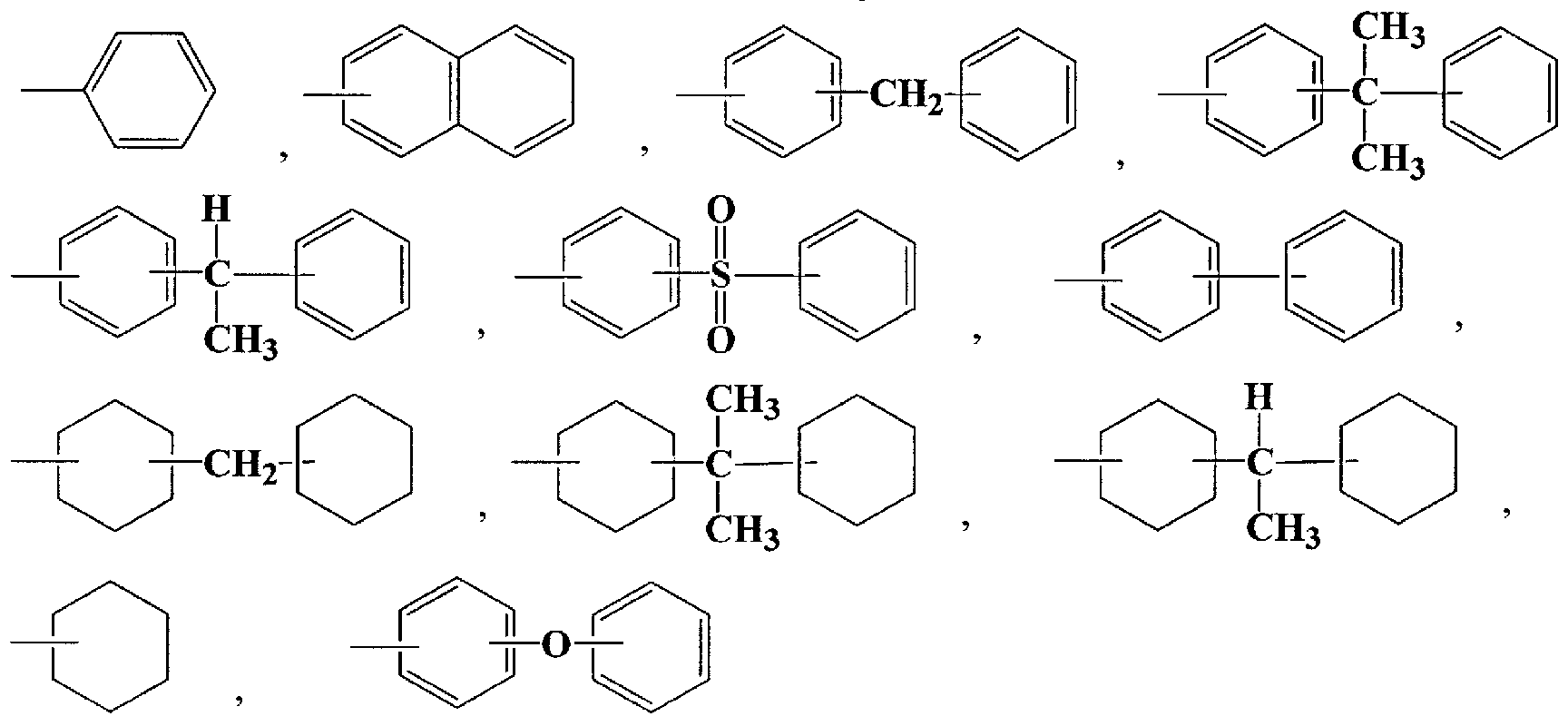
  • a variety of compounds can be used as A in the general formula (1), and examples thereof include, but are not limited to, those represented by the following structural formula.
  • p and q are integers of 1 to 6. However, an alkyl group having 1 to 4 carbon atoms may be substituted on the ring.
  • the epoxy resin as a raw material is easily industrially available, and the obtained cured product has good mechanical properties. From a certain point, it is preferable to remove two hydroxyl groups from bisphenols and biphenols, and to be a residual group. From the point of excellent heat resistance and flame retardancy of cured products, it has a xanthene skeleton. Preferred to be a group.
  • R in the general formulas (3) and (4) is preferably a hydrogen atom from the viewpoint of good curability with active energy rays.
  • R acetyl group in the general formulas (3) and (4) it is preferable to use the R acetyl group in the general formulas (3) and (4).
  • thermosetting system it is preferable to select according to the intended use and the type of curing system to be used.
  • the molecular end of the linear (meth) atalyloyl group-containing compound of the present invention is an epoxy group or a group represented by the general formula (4), and both ends of the molecule are epoxy groups. Or only one of them may be an epoxy group, or both ends may have a structure represented by the general formula (4).
  • the epoxy group at the molecular end and the group represented by the general formula (4) are the same as those in the general formula (2 ) Or (3) indicates that it is bonded to the general formula (1).
  • the molecular terminal is an epoxy group
  • one molecule has a (meth) atallyloyl group and an epoxy group!
  • a functional group having different reactivity and an active energy ray curing system
  • cationic curing systems and curing systems that use curing reactions with functional groups that can react with epoxy groups such as amino groups can be applied.
  • Various selections can be made according to the intended use, the performance level of the cured product, the curing device, and the shape of the cured product.
  • B in the general formula (4) indicating a molecular end is not particularly limited as long as it is a monovalent hydrocarbon group.
  • B represented by the following structural formula is exemplified. be able to
  • p and q are integers of 1 to 6. However, an alkyl group having 1 to 4 carbon atoms may be substituted on the ring.
  • a structure having an aromatic ring is preferable from the viewpoint of excellent heat resistance and corrosion resistance of the obtained cured product.
  • the star-shaped (meth) atalyloyl group-containing compound according to the second embodiment of the present invention has the following general formula (5):
  • R is a hydrogen atom or a methyl group
  • B is a monovalent hydrocarbon group
  • Y is an average of n epoxy groups (where n is 3 or more). It is a residue obtained by removing an epoxy group from a polyfunctional epoxy resin having m, and m is an integer of 3 or more (however, n ⁇ m).
  • the number average molecular weight is 800 to 10,000.
  • the number of (meth) atalyloyl groups contained in one molecule of the star-shaped (meth) atalyloyl group-containing compound is 3 or more on average. Therefore, if the epoxy resin is trifunctional, it will be a compound with no epoxy group in one molecule.
  • the molecular weight per (meth) atallyloyl group can be prepared by selecting the structure of Y and B in the general formula (5), and is a multifunctional product obtained from a novolac-type epoxy resin. It is possible to combine the hardness and toughness of the cured product, which can only be achieved with epoxy (meth) acrylate.
  • those having no hydroxyl group in the structure can be obtained, and can also be used as materials for precise electrical applications. Therefore, in the same way as the above-mentioned linear (meth) attalyloyl group-containing compound, in order to adjust the performance balance of the cured product, a complicated study such as selecting and blending other acrylic monomers to be used together is performed. It can be used without it and has a wide industrial application range.
  • the number average molecular weight of the compound of the present invention containing a star-shaped (meth) attalyloyl group is 800 to 10,000. If the molecular weight is less than 800, the resulting cured product has insufficient heat resistance, corrosion resistance and mechanical strength. If it exceeds 10,000, the production method of the present invention described later is used. It is not easy to obtain industrially available epoxy resin, which is a raw material when manufacturing using the process, and the soft spot becomes too high, which is in phase with the other raw material (alkyl) (meth) acrylate. It is not suitable because the solubility cannot be maintained and the transesterification reaction is difficult to occur. A particularly preferred number average molecular weight is 1,500 to 5,000. The number average molecular weight is obtained in the same manner as the above-mentioned linear (meth) attalyloyl group-containing compound.
  • Examples of Y in the general formula (5) include those represented by the following structural formula.
  • R in the general formula (5) is preferably a hydrogen atom from the viewpoint of good curability with active energy rays. However, when importance is attached to the heat resistance of the cured product, it is preferable to use the R acetyl group in the general formula (5). At this time, it is preferable to use a thermosetting system. It is preferable to select according to the application to be used and the type of curing system used.
  • B in the general formula (5) is not particularly limited as long as it is a monovalent hydrocarbon group, and examples thereof include those represented by the following structural formula.
  • p and q are integers of 1 to 6. However, an alkyl group having 1 to 4 carbon atoms may be substituted on the ring.
  • a structure having an aromatic ring is preferable because the cured product obtained is excellent in heat resistance and corrosion resistance.
  • the method for producing a (meth) attalyloyl group-containing compound of the present invention comprises the following structural formula (
  • an epoxy resin (I) having 3 or more structural units represented by the formula (II) and an alkyl (meth) acrylate ester (II) a transesterification reaction is carried out in the presence of a polystanoxane catalyst ( ⁇ ).
  • a compound containing an average of 3 or more (meth) atallyloyl groups in one molecule is obtained by introducing a (meth) atalyloyl group into the hydroxyl group in the general formula (6).
  • a compound having a hydroxyl group and a (meth) acrylic acid alkyl ester can introduce a (meth) ataryloyl group into the hydroxyl group by an ester exchange reaction.
  • the presence of the hydroxyl group to be introduced in the present invention is unique. That is, since the carbon atom to which the hydroxyl group is bonded is bonded to two oxygen atoms having a free electron pair through the methylene group, the electron density is high around the hydroxyl group. It is easily guessed. This indicates that the hydrogen atom in the hydroxyl group has a positive charge and is difficult to desorb.
  • secondary hydroxyl groups in epoxy resins are known to be very inactive. That is, in a linear epoxy resin, an increase in the epoxy equivalent during storage due to the reaction of the hydroxyl group with a terminal epoxy group having many secondary hydroxyl groups is usually observed.
  • the hydroxyl group and isocyanate group are capable of reacting even at room temperature. The combination of epoxy resin and isocyanate compound requires heat curing, and so on. Low reactivity can be expected.
  • the epoxy resin (I) used in the present invention may be a commercially available product as long as it has 3 or more of the above structural formula (6) in one molecule. It may be a compound that has undergone an extension reaction with a compound or the like, or may be a modified epoxy resin in which an epoxy group is ring-opened using a hydroxy compound. .
  • epoxy resin that can be used as a commercially available product
  • linear (meth) atallyloyl is used.
  • bisphenol A type epoxy resin bisphenol F type epoxy resin, bisphenol S type epoxy resin, bisphenol ACP type epoxy resin, bisphenol AD type epoxy Bisphenol-type epoxy resin such as resin, biphenol-type epoxy resin, hydrogenated bisphenol A-type epoxy resin, etc. having a structure represented by the above structural formula (6) in 3 molecules per molecule Is mentioned.
  • Examples of the epoxy resin that can be used as a raw material to give a (meth) acryloyl group-containing compound include, for example, neopentyldarlicol diglycidyl ether, 1 , 4 Diglycidinoleateolene having an alkylene chain such as butanediol diglycidyl ether, polyethylene glycol diglycidyl ether, polypropylene glycol diglycidyl ether, 2, 7 diglycidinole dioxyxanthene, 3, 6 diglycidinoleoxyxanthene Substituted xanthene-type diglycidinoreethenole, 3,6-diglycidinoreoxy 9,9-dimethinolexa , 2, 7 diglycidyloxy 1, 3, 4,
  • the dihydroxy compound that can be used in the extension reaction is not particularly limited, and examples thereof include divalent phenols such as resorcin, hydroquinone, and catechol, which may have a substituent, bis Bisphenols such as phenol A, bisphenol F, bisphenol AD, tetrabromobisphenol A, biphenyls such as biphenol, tetramethylbiphenol, 1, 4 butanediol, ethylene glycol, propylene glycol, polyethylene glycol , Dihydric alcohols such as polypropylene glycol, 2, 7- Unsubstituted xanthene type dihydroxy compounds such as dihydroxyxanthene, 3,6-dihydroxyxanthene, 3,6 dihydroxy-9,9-dimethylxanthene, 2,7 dihydroxy 1, 3, 4, 5, 6, 8 hexamethyl-9 Substituted xanthene-type dihydroxy compounds such as phenol-xanthene, dibenzoxanthene-type dihydroxy compounds such as 2,
  • the commercially available epoxy resin and the epoxy resin obtained by performing an elongation reaction have an epoxy group at the terminal, and a part or all of this epoxy group is further opened using a hydroxy compound. It is good also as a raw material of the transesterification mentioned later after making it into the ring-modified epoxy resin.
  • a cationic curing system cannot be used to obtain a cured product, but the mechanical strength of the resulting cured product is excellent, so it is appropriately selected according to the application and the physical properties of the cured product. It is preferable to use it.
  • the hydroxy compound that can be used at this time is not particularly limited.
  • Examples include monohydric phenols such as phenol, butylphenol, norphenol, phenolphenol, and cumylphenol, monohydric alcohols such as ethyl alcohol and cyclohexyl alcohol, hydroxynaphthalenes, and hydroxyanthracenes. These may be used alone or in combination of two or more. Among these, it is preferable to use a compound having an aromatic ring from the viewpoint that the obtained cured product is excellent in heat resistance and corrosion resistance.
  • monohydric phenols such as phenol, butylphenol, norphenol, phenolphenol, and cumylphenol
  • monohydric alcohols such as ethyl alcohol and cyclohexyl alcohol
  • hydroxynaphthalenes hydroxyanthracenes
  • the star-shaped (meth) attalyloyl group-containing compound is composed of, for example, naphthalene-type tetrafunctional epoxy resin, tetrakisphenol-type epoxy resin, etc. It is obtained by reacting the above-mentioned hydroxy compound with a group, opening the epoxy group to obtain a compound having three or more secondary hydroxyl groups, and then performing a transesterification reaction described later. be able to.
  • the commercially available tetrakisphenol type epoxy resin includes those in which two or more molecules are linked, in use, the monomer may be taken out with a column or the like and used as a raw material of the present invention. However, commercial products can be used as they are depending on the desired performance.
  • a method of performing an extension reaction with a commercially available epoxy resin using a dihydroxy compound, or a method of opening an epoxy group with a hydroxy compound is not particularly limited.
  • Various methods can be used. For example, a method of heating and stirring at 120 to 20 ° C. in the presence of a catalyst can be mentioned.
  • the catalyst is not particularly limited, and examples thereof include onium salts, phosphines, alkali metal hydroxides, and the like.
  • the proportion of the epoxy resin and dihydroxy compound or hydroxy compound used includes the epoxy equivalent of the target epoxy resin, the molecular weight of the modified epoxy equivalent, and the number of (meth) atallyloyl groups introduced. It is preferable to choose as appropriate.
  • the (meth) acrylic acid alkyl ester (II) used in the transesterification reaction is not particularly limited, but has an excellent alkyl group having 1 to 6 carbon atoms and good reactivity.
  • Preferred examples of the ester include methyl acrylate, ethyl acrylate, propyl acrylate, methyl methacrylate, ethyl methacrylate, and propyl methacrylate. It is preferable to use an alkyl acrylate ester from the viewpoint of good curability of the resulting (meth) atalyloyl group-containing compound, but for applications that place importance on the heat resistance of the cured product, the alkyl methacrylate is preferred.
  • I ⁇ to R 4 are each independently a methyl group or an ethyl group, and X 1 and X 2 are Each is an electron-withdrawing group having a lone pair of electrons on an atom that independently binds to a tin atom.
  • R is an integer of 1-8.
  • the catalyst represented by the formula is excellent in catalytic activity, has a high yield in the transesterification reaction, and has a strong point.
  • the electron-withdrawing group having a lone electron pair on the atom bonded to the tin atom includes a halogen atom such as a chlorine atom, a bromine atom or a fluorine atom, and a carbon atom number of 1 ⁇ 4 acyloxy group, hydroxyl group, thiol group, thiocyanate group, etc.
  • polystannoxane-based catalysts represented by the general formula (7) those in which r is 1 or 2 in the general formula (7) are used during purification after the transesterification reaction. It is preferable from the viewpoint of good solubility in water during the extraction operation, and is also preferably an I ⁇ to R 4 force S methyl group from the viewpoint of excellent solubility in water.
  • X 1 and X 2 are preferably a halogen atom, an acyloxy group, or a thiocyanic acid group from the viewpoint of excellent catalytic activity! /.
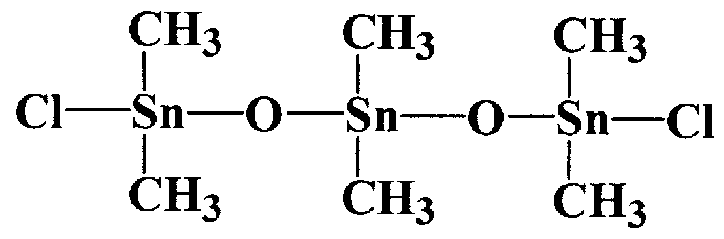
  • distanoxane compounds examples include C1 (CH) SnOSn (CH) Cl, C1 (CH)
  • Xanthane compounds include Cl (Sn (CH) O) Sn (CH) Cl, Cl (Sn (CH) O) Sn (C
  • the tristannoxane compound is preferable in that it has good stability in water and is hardly hydrolyzed in water, and can reduce the amount of residual organotin compound in the product.
  • the following general formula (8) In the transesterification reaction of the present invention, the following general formula (8)
  • R 5 and R 6 are each independently a methyl group or an ethyl group, and X 3 and X 4 are each independently an electron-withdrawing group having a lone pair of electrons on an atom bonded to a tin atom. It is. ]
  • Examples of the tin compound represented by the general formula (8) include CI Sn (CH), Br Sn (C), and CI Sn (CH), Br Sn (C
  • Alkaline compounds include alkali metals or alkaline earth metals such as sodium hydroxide, potassium hydroxide, and calcium hydroxide. Examples thereof include hydroxides, alkali metals such as sodium methoxide, potassium methoxide, calcium methoxide or alkoxides of alkali earth metals, carbonates such as sodium carbonate and calcium carbonate.
  • the proportion of the tristanoxane catalyst (soot) used is from 0.01 to LO mass% based on the mass of the epoxy resin (I) used as a normal raw material.
  • the range of 0.1 to 2.0% by mass is more preferable.
  • the transesterification reaction which is the production method of the present invention, can be carried out in the presence or absence of a solvent. In the transesterification reaction, it is desirable to remove alcohol generated due to a reversible reaction out of the system.
  • the molecular weight is increased. It is preferable to use a polymerization inhibitor in combination in order to further suppress the polymerization of the (meth) atalyloyl group.
  • Examples of the polymerization inhibitor include benzoquinone, hydroquinone, catechol, diphenylbenzoquinone, hydroquinone monomethyl ether, naphthoquinone, tert-butylcatenole, tert-butylphenol, dimethyl-tert-butylphenol, tert-butylphenol, phenothiazine and the like. It is done.
  • the amount of the polymerization inhibitor used depends on the reaction product and the amount of the raw material components, the amount of the polymerization inhibitor is usually on a mass basis with respect to the reaction product (meth) atalyloyl group-containing compound. 5 ⁇ : LOOO Oppm, especially 20 ⁇ 7000ppm.
  • the transesterification reaction can be performed at atmospheric pressure.
  • the reaction temperature condition can be appropriately selected depending on the raw materials and reaction solvent used, but is preferably 20 to 150 ° C. That is, the reaction rate in the transesterification reaction is dramatically improved under a temperature condition of 20 ° C or higher, and side reactions can be suppressed under a temperature condition of 150 ° C or lower. It is preferable to be 70 to 120 ° C from the viewpoint of suppressing the temperature! /.
  • the transesterification reaction is carried out in an oxygen-containing gas atmosphere or while introducing oxygen-containing gas continuously on the reaction liquid surface or in the reaction liquid.
  • Point power capable of satisfactorily suppressing the combination is preferable.
  • the oxygen-containing gas may be air, but if the oxygen content increases on a volume basis, there is a higher possibility of a flammable explosion, and the product is more likely to be colored.
  • the gas is preferably a gas having a rate of 5 to 13% by volume.
  • Such a gas having an oxygen content of 5 to 13% by volume can be adjusted, for example, by mixing air or oxygen and an inert gas at a ratio that satisfies the condition.
  • nitrogen, argon, etc. are mentioned as an inert gas.
  • the flow rate when the oxygen-containing gas is continuously introduced into the reaction liquid surface or into the reaction liquid is 0.1 to 30 mLZ for 1 mole of (meth) acrylic acid alkyl ester ( ⁇ ). Is preferred.
  • epoxy resin (I) and alkyl (meth) acrylate are used.
  • the ratio of use with steal ( ⁇ ) is not particularly limited, but (meth) acrylic acid alkyls are introduced when (meth) atallyloyl groups are introduced into all secondary hydroxyl groups in epoxy resin.
  • the molar ratio of the ester ( ⁇ ) to the secondary hydroxyl group is usually 1 or more, and above all, it is preferably in the range of 1.1 to LOO (molar ratio). It is also possible to control the amount of (meth) atallyloyl group introduced by adjusting the amount of (meth) acrylic acid alkyl ester (II) used at this time.
  • the transesterification reaction in the present invention can be specifically performed by the following method. That is, first, a predetermined amount of epoxy resin (I) and (meth) acrylic acid alkyl ester (soot) are charged into a reactor equipped with a thermometer, a stirrer, a fractionation pipe and a dry air introduction pipe, and then, Appropriate amount of polystanoxane catalyst (ii), polymerization inhibitor, etc. is added to the reaction mixture, and the reaction mixture is stirred and heated to the above-mentioned appropriate temperature range, usually to the reflux temperature of the reaction system. The method of doing is mentioned.
  • the alcohol produced by the transesterification reaction during the reaction is used as an azeotrope with an excess of (meth) allylic acid alkyl ester ( ⁇ ) or the reaction solvent. It is desirable to remove it with a fractionating tube.
  • the reaction solution may be subjected to water extraction as the next step as a crude reaction product, or an excess of raw material (meth) acrylic acid alkyl ester ( ⁇ ) or reaction solvent may be reacted. After distilling out from the vessel, the residue may be used as a crude reaction product. Alternatively, excess raw material (meth) acrylic acid alkyl ester (II) or reaction solvent is distilled off from the reactor, and a small amount of inert solvent such as toluene or heptane is added to obtain a crude reaction product. .
  • the crude reaction product obtained above is extracted with water, the organic layer is taken out, and the (meth) attalyloyl group-containing compound, which is a product, is isolated from the organic layer to obtain the target compound. Can be obtained.
  • a method for isolation a method of distilling off the organic solvent is preferable.
  • the above-mentioned inert gas having an oxygen content of 5 to 13% by volume is preferable. It is preferable to carry out under an atmosphere.
  • any of those described above can be used, but there is no modification coloring, and in this respect, methoquinone is particularly preferably used.
  • the amount of addition is usually 5 to 5000 ppm, preferably 50 to 2500 ppm on a mass basis with respect to the solution constituting the organic layer, although it depends on the kind of the obtained (meth) atalyloyl group-containing compound.
  • a reaction vessel equipped with a stirrer, a thermometer and a dropping funnel was charged with 16.48 g (75 mmol) of disodium dimethyltin, 120 ml of water, and 45 ml of ethanol, and stirred to dissolve uniformly. Then, dropping funnel force was also added dropwise under stirring with 10.lg (lOOmmol) of triethylamine. At this time, the reaction vessel was bathed in ice and the contents were kept at around 20 ° C. After completion of the dropwise addition, the reaction was continued with stirring at the same temperature for 3 hours. After completion of the reaction, the white precipitate was filtered, washed with 100 ml of water and then with 200 ml of ethanol, and dried under reduced pressure at 105 ° C.
  • Example 1 In the same manner as the above, the main structural skeleton is the target bisphenol A.
  • the precipitated white block precipitate was filtered by suction and washed with ice water, and then the block precipitate was boiled in 2 L of water for 30 minutes with vigorous stirring. After cooling, the solid material obtained by decantation was pulverized and powdered. Further, after washing with methanol, it was dried under reduced pressure at 60 ° C. to obtain a xanthen biphenylene copolymer epoxy resin.
  • the yield of the obtained xanthene biphenyl diene copolymer epoxy resin was 23.3 g, and the yield was 95%.
  • Example 2 Transesterification reaction of xanthene-biphenol-copolymerized epoxy resin
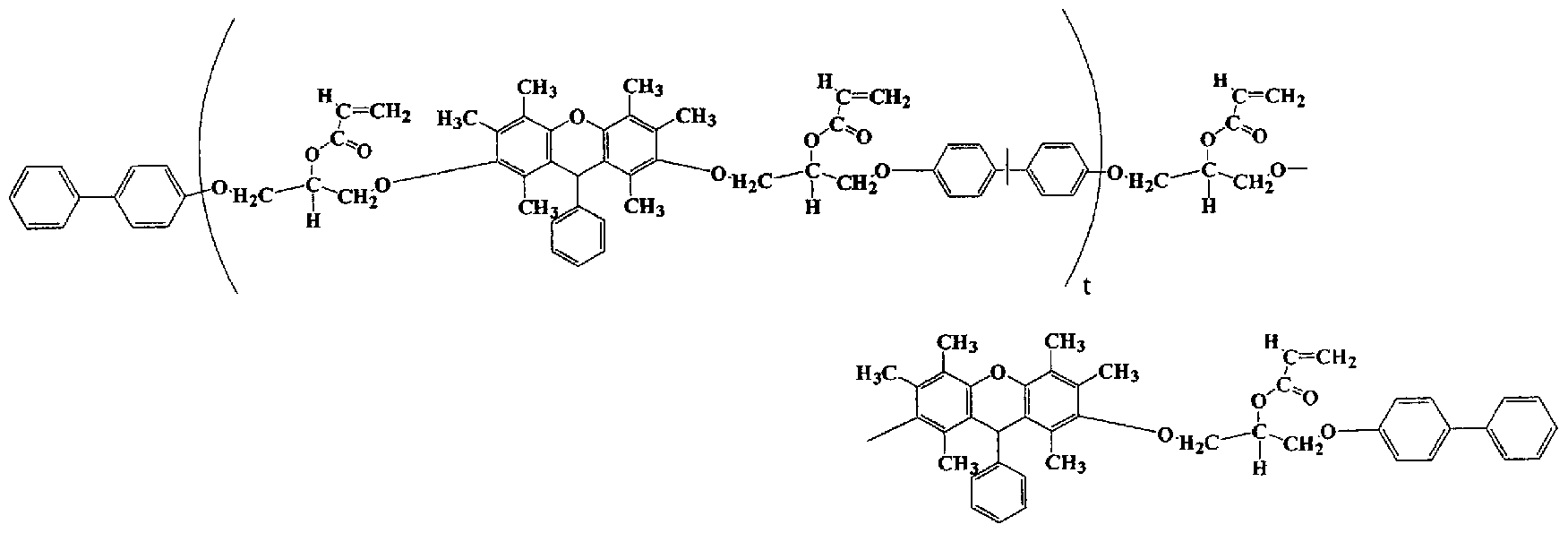
  • Example 1 instead of EPICLON AM-040- P10. Og, xanthene-biphenol- obtained above was used. Rene copolymerization type epoxy resin 14. Except for using Og, the transesterification reaction was carried out in the same manner as in Example 1, and the target xanthene-bi-phenylene copolymer type epoxy resin was used as the main skeleton. Introduced the following structural formula
  • the above structural formula indicates that the xanthene skeleton and the biphenyl skeleton are connected by a structural unit having an attailoyl group, and both ends of the structural unit are connected to the same skeleton!
  • the glycidyloxy group at the end of the molecule may be linked to either the xanthene skeleton or the biphenyl skeleton, and both ends may be the same or different.
  • the xanthene skeleton-containing epoxy resin used as a raw material has a repeating unit, there is also a part in which the xanthene skeletons are linked by an epichlorohydrin residue. The force at which the allyloyl group is also introduced into the secondary hydroxyl group of this part is omitted in this structural formula.
  • the 1 H-NMR measurement of the obtained compound was carried out in the same manner as in Example 1.
  • the introduction rate of the attalyloyl group into the secondary hydroxyl group of the epoxy resin was 99 mol% or more and the residual rate of the terminal epoxy group was about 87 mol%.
  • the number average molecular weight of the obtained compound is 3400.
  • the number of allyloyl groups is 8.
  • Xanthene skeleton-containing epoxy resin 10.2 g, 4, 4, monodihydroxybiphenyl 2.6 g (14 mmol), triphenylphosphine 26.2 mg, synthesized according to Examples 3 and 4 of JP-A-2003-201333 (0. 1 mmol) and 13.4 g of N, N-dimethylacetamide were reacted at 130 ° C. for 6 hours under a nitrogen atmosphere. After allowing to cool, the reaction solution was diluted with N, N-dimethylacetamide to a nonvolatile content of 15% and then added dropwise to 1 L of water, and the resulting cloudy dispersion was stirred at room temperature for 1 hour.
  • the precipitate obtained by suction filtration was washed with methanol, and then dried under reduced pressure at 60 ° C. to obtain a xanthene-biphenylene copolymer type linear epoxy resin.
  • the yield of the obtained xanthene-biphenylene copolymer type linear epoxy resin was 10.33 g, and the yield was 81%.
  • Example 2 Transesterification reaction of xanthene-biphenol-copolymerized epoxy resin
  • EPICLON AM- 040- P 10. Og the xanthene-biphenol synthesized above was used.
  • the target xanthene-biethylene copolymer epoxy resin is the main skeleton in the same manner as in the transesterification of the epoxy resin of Example 1 except that 9.7 g of the -len copolymer copolymer epoxy resin is used.
  • Example 3-1 xanthene skeleton-containing epoxy resin synthesized in accordance with Examples 3 and 4 of JP-A-2003-201333, 15.55 g, 4,4′-diglycidyloxybiphenyl 2.
  • 38 g (8 mmol), 4, 4, 1-dihydroxybiphenyl 6.0 g (32 mmol) was changed to 19.44 g of xanthene skeleton-containing epoxy resin and 7.3 g (32 mmol) of bisphenol A
  • xanthene monobisphenol A copolymer epoxy resin was obtained.
  • the yield of the obtained xanthene bisphenol A copolymer type epoxy resin was 25.9 g, and the yield was 97%.
  • Example 3-1 Synthesis of xanthene-biphenyl neopentylene copolymer type epoxy resin
  • 4-diglycidyloxybiphenyl 2.38 g (8 mmol) was added to neopentyl.
  • Glycoldiglycidyl ether 1 Except for changing to 73 g (8 mmol), xanthene-biphenylene-neopentyrene copolymerized epoxy resin was obtained in the same manner as the synthesis of epoxy resin of Example 3-1. .
  • the yield of the obtained xanthene-biphenylene-neopentylene copolymer epoxy resin was 22.8 g, and the yield was 95%.
  • Example 1 the ester of the epoxy resin of Example 1 except that 8.6 g of the xanthene biphenylene-neopentylene copolymerized epoxy resin synthesized above was used instead of EPICLON AM-040-P 10. Og.
  • the target xanthene biphenylene-neopentylene copolymer type epoxy resin is used as the main skeleton, and the following structural formula is introduced.
  • the above structural formula indicates that the xanthene skeleton and the neopentylene skeleton are connected by a structural unit having an attalyloyl group, and both ends of the structural unit may be connected to the same skeleton.
  • the glycidyloxy group at the end of the molecule is connected to either the xanthene skeleton or the neopentylene skeleton, and both ends may be the same or different, and the xanthene skeleton used as a raw material Epoxy resin is repetitive Therefore, some of the xanthene skeletons are linked by an epichlorohydrin residue, and an allyloyl group is also introduced into the secondary hydroxyl group of the epichlorohydrin residue. However, this part is omitted in this structural formula. ) -Containing linear attalyloyl group-containing compound was obtained.
  • Example 3-1 4,4, -diglycidyloxybiphenyl 2.38 g (8 mmol) was added to hydrogenated carbphenol A (hereinafter abbreviated as hydrogenated BPA) diglycidyl ether 2.82 g Except for changing to (8 mmol), xanthene biphenylene-hydrogenated BPA copolymer type epoxy resin was obtained in the same manner as the synthesis of the epoxy resin in Example 3-1.
  • the yield of the xanthene bif ⁇ -len monohydrogenated BPA copolymer epoxy resin was 24.2 g and the yield was 96%.
  • Example 1 in place of EPICLON AM-040-P 10. Og, xanthene-biphenylene-hydrogenated BPA copolymerized epoxy resin 9.8 g synthesized above was used, except that 9.8 g was used. Similar to the transesterification reaction of epoxy resin, the following structural formula, in which the target xanthene-biphenylene-hydrogenated BPA copolymer type epoxy resin is used as the main skeleton and the atalyloyl group is introduced
  • the above structural formula indicates that the xanthene skeleton and the hydrogenated BPA skeleton are connected by a structural unit having an attalyloyl group, and both ends of the structural unit are connected to the same skeleton!
  • the glycidyloxy group at the end of the molecule may be connected to either the xanthene skeleton or the hydrogenated BP A skeleton, and both ends may be the same or different.
  • the xanthene skeleton-containing epoxy resin used as a raw material has a repeating unit, there is also a portion in which the xanthene skeletons are connected by an epichlorohydrin residue. (Atariloyl group is also introduced into the secondary hydroxyl group, but this part is omitted in this structural formula.)
  • Og Tristanoxane compound obtained in Synthesis Example 1 as catalyst, 0.5 g, Polymerization inhibitor p —Methoxyphenol was charged with 1. Og, and the reaction was started while introducing air. Ethanol produced using a fractionation column was refluxed with a mixed solution of ethyl acrylate at a reaction temperature of 95 to 98 ° C., and the reaction was carried out while confirming the amount of deethanol. During the reaction for about 6 hours, the amount of deethanol was 0.76 g, and the reaction was completed.
  • Example 10 Partial ring-opening of epoxy group and partial introduction of attalyloyl group
  • the reaction mixture subjected to the above-mentioned vacuum distillation was added to 300 ml of methanol solution, and the produced white solid was separated.
  • the white solid was dissolved using a small amount of black form, and again added to 300 ml of methanol solution to separate the reprecipitated white solid.
  • the target structural formula of biphenylene-modified bisphenol A type epoxy resin is introduced, and the atalyloyl group is introduced.
  • Example 11-2 instead of 0.6 g of the tristanoxane compound obtained in Synthesis Example 1 In the same manner as in the transesterification reaction of biphenol-modified bisphenol A type epoxy resin in Example (11-2) except that 0.6 g of dimethyldichloride and 0.3 g of sodium methoxide were used. As a result, a linear attalyloyl group-containing compound represented by the above structural formula, in which biphenylene-modified bisphenol A type epoxy resin was used as a main skeleton and an acryloyl group was introduced, was obtained.
  • Example 3-1 Xanthene monobiphenylene copolymer epoxy resin obtained in 1. 9.72 g, 4 phenolphenol 4. lg (24 mmol), triphenylphosphine 26.2 mg (0. lm mol) and N , N Dimethylacetamide (50 ml) was reacted at 130 ° C for 6 hours in a nitrogen atmosphere. After allowing to cool, the reaction mixture was dropped into 100 ml of water, and the resulting precipitate was washed twice with methanol and then dried under reduced pressure at 60 ° C. to obtain a biphenylene-xanthene skeleton-containing epoxy resin. The yield was 13.2 g and the yield was 99%.
  • Example 13 instead of 9.72 g of xanthene-biphenol-copolymerized epoxy resin synthesized according to Example 3-1, xanthene-bisphenol A copolymerized epoxy synthesized according to Example 5-1.
  • a bisphenol A-biphenol-modified xanthene skeleton-containing epoxy resin was obtained in the same manner as the synthesis of the epoxy resin of Example 13-1, except that 9.8 g of resin was used. The yield was 13.3 g and the yield was 97%.
  • Example 10 instead of biphenol-modified bisphenol A type epoxy resin 12. Og, the bisphenol A-biphenol-modified xanthene skeleton-containing epoxy resin 10. Og synthesized in (14-1) above was added. Except for the change, in the same manner as in the ester exchange reaction of the epoxy resin of Example 10, the target bisphenol A-biphenol-modified xanthene skeleton epoxy resin was used as the main skeleton, and the attalyloyl group was introduced.
  • Example 1 instead of EPICLON AM-040-P 10. Og, Example 1 was used except that 10.7 g of biphenol-modified tetrakisphenol alcohol type epoxy resin synthesized in (15-1) above was used. Similar to the transesterification reaction of epoxy resin of 1
  • Example 16 Transesterification of Tetrakisphenol-Rethane Ethane Epoxy Resin (Synthesis of Metatalylate)
  • the epoxy resin was changed to 10.7 g of the tetrakis-phenol-type epoxy resin obtained in Example 15-1, and methyl methacrylate 135. Og instead of ethyl acrylate 120. Og.
  • the following structural formula is obtained in the same manner as in Example 1 except that the reflux is removed with a mixed solution of ethanol and ethyl methacrylate produced at a reaction temperature of 100 to 110 ° C.
  • a reaction flask equipped with a stirrer, thermometer and dropping funnel is charged with 5.0 g of EPICLON AM-040-P, 40 ml of black mouth form, 3.3 g of pyridine, and 1.2 g of p-methoxyphenol as a polymerization inhibitor.
  • the reaction mixture was dissolved.
  • 1.92 g (21.2 mmol) of acrylic acid chloride was added dropwise with stirring while stirring.
  • the solution was added dropwise using an ice bath and then stirred at 40 ° C. for another 8 hours to complete the reaction.
  • the reaction solution was diluted by adding 4 ml of black mouth form.
  • Test Example 1 and Comparative Test Example 1 Comparison of curability in radical polymerization
  • the above composition was formed on a glass slope using a bar coater # 5.
  • a high-pressure mercury lamp 120 watts was used to conduct a polymerization reaction at an irradiation intensity of 50 mjZ, and the number of irradiations until the coating surface became turk-free and cured was measured.
  • UVI— 6990 Cationic polymerization catalyst, manufactured by Ciba Geigy
  • the above composition was formed on a glass slope using a bar coater # 5. Under the influence of Cordomira, a polymerization reaction was performed at 50 mjZ irradiation intensity using methalno and ride lamps (80 watts), and the number of irradiations until the coating surface became turk-free and cured was measured.
  • the linear (meth) atalyloyl group-containing compound of the present invention has an average of 3 or more (meth) atalyloyl groups in one molecule and is a conventional bifunctional linear chain. Compared with epoxy (meth) acrylate, it has high curability and high sensitivity.
  • the epoxy resin used as a raw material in terms of its structure, the molecular weight per (meth) atalyloyl group [ie, The concentration of the taloyl group] can be easily prepared, and the crosslinking density of the cured product can be adjusted without using other acrylic monomers.
  • it since it is possible to leave a hydroxyl group in the molecule, it can also be used as a material for precision electrical applications.
  • the compound containing a star-shaped (meth) atalyloyl group of the present invention since the compound containing a star-shaped (meth) atalyloyl group of the present invention is multifunctional, it has excellent curability and sensitivity, and has a large molecular weight per (meth) atalyloyl group. It is possible to obtain a cured product that does not become too hard and also has appropriate toughness. In addition, since it is possible to leave a hydroxyl group in the molecule, it can also be used as a material for precision electrical applications. Furthermore, in the case of having an aromatic ring at the center of the star structure, ⁇ - ⁇ stacking ability can be imparted between the molecules, and the heat resistance, corrosion resistance, mechanical strength, etc. of the cured product can be improved. It has great industrial significance.

Landscapes

  • Chemical & Material Sciences (AREA)
  • Health & Medical Sciences (AREA)
  • Chemical Kinetics & Catalysis (AREA)
  • Medicinal Chemistry (AREA)
  • Polymers & Plastics (AREA)
  • Organic Chemistry (AREA)
  • Emergency Medicine (AREA)
  • General Chemical & Material Sciences (AREA)
  • Engineering & Computer Science (AREA)
  • Materials Engineering (AREA)
  • Epoxy Resins (AREA)
  • Macromonomer-Based Addition Polymer (AREA)

Description

明 細 書
直鎖状 (メタ)アタリロイル基含有化合物、星型 (メタ)アタリロイル基含有化 合物、及びそれらの製造方法
技術分野
[0001] 本発明は、硬化性が良好であり、硬化性榭脂組成物の材料として広く用いることが できる、 1分子中に (メタ)アタリロイル基を平均して 3個以上有する (メタ)アタリロイル 基含有化合物、及びその製造方法に関する。
背景技術
[0002] (メタ)アタリロイル基を有する化合物は、活性エネルギー線やラジカルでの硬化性 榭脂組成物、又は熱硬化性榭脂組成物の材料や、高分子化合物の原料として汎用 に用いられる化合物である。特に、エポキシ (メタ)アタリレートは、得られる硬化物の 耐熱性、耐薬品性、耐水性、密着性、機械特性などが、他の (メタ)アタリレートを用い て得られる硬化物と比較して優れているため、塗料用榭脂、印刷インキ、 UV硬化性 榭脂、成形用榭脂、フィルム、接着剤、構造材料、配線基盤のソルダーレジスト用等 として広く使用されている。
[0003] 従来、エポキシ (メタ)アタリレートは、ビスフエノール型エポキシ榭脂を原料とした 2 官能性のものと、ノボラック型エポキシ榭脂を原料とした多官能性のものがあり、用途 や目的とする硬化物の性能レベル等により使 、分けがなされて!/、る。 2官能性のェポ キシ (メタ)アタリレートは、室温でも流動性を有し、取り扱いが良好であるものの、(メ タ)アタリロイル基は原料として用いるエポキシ榭脂の両末端にのみ存在するもので あり、硬化性や硬化感度においては、多官能性のエポキシ (メタ)アタリレートよりも劣 り、更に硬化物の架橋密度を上げるためは多官能性のアクリル系モノマーを併用す るなどの、煩雑な組成物の調製が必要である。又、分子末端にのみ (メタ)アタリロイ ル基を有することから、硬化時の収縮が大きぐ基材との密着性等を重要視する用途 には使用しにくいものであった。一方、多官能性のエポキシ (メタ)アタリレートは固形 であり、硬化性組成物を調製する際に取り扱いにくい。また、ノボラック型エポキシ榭 脂を原料としていることから、 1個の芳香環あたりに 1個の (メタ)アタリロイル基を有し、 得られる硬化物の架橋密度が高ぐ耐食性等には優れるものの、硬すぎて靭性に欠 け、脆くなる傾向がある。さらに、該ノボラック型エポキシ (メタ)アタリレート中に存在す る多数のヒドロキシル基は、精密な電気用途に使用する場合には悪影響を及ぼすこ とがある。
[0004] 即ち、従来のエポキシ (メタ)アタリレートは、架橋密度を調整するためには他のモノ マー類等を併用する手法しかなぐ取り扱い性と硬化性、更には得られる硬化物の電 気特性等とをバランスよく兼備させる (メタ)アタリロイル基含有ィ匕合物は存在して ヽな かった。
[0005] また、エポキシ (メタ)アタリレートに、現像性などの他の性能を付与するためには、( メタ)アタリロイル基以外の官能基を導入する必要があり、例えば、エポキシ (メタ)ァク リレート中に存在する 2級のヒドロキシル基に酸無水物などを反応させてカルボキシ ル基を導入した酸ペンダント型エポキシ (メタ)アタリレート(例えば、特許文献 1、 2参 照。)が開示されている。
[0006] し力しながら、酸ペンダント型エポキシ (メタ)アタリレートにおいても、基本的には上 記した 2官能性のエポキシ (メタ)アタリレート又は多官能性のエポキシ (メタ)アタリレ ートを原料とするものであるため、硬化性と、硬化物の架橋密度に依存する性能との ノ《ランスを調整することが困難であった。また、酸ペンダント型エポキシ (メタ)アタリレ ートは、エポキシ榭脂と不飽和一塩基酸とを反応させた後、更に多塩基酸無水物等 を反応させて得られるものであり、エポキシ (メタ)アタリレートにその他の官能基を導 入するには最低でも 2段階の反応が必要である。
[0007] エポキシ榭脂中のエポキシ基に対して不飽和一塩基酸を不足量使用することによ り得られる、 1分子中に (メタ)アタリロイル基とその他の官能基 (エポキシ基)とを有す る化合物、 V、わゆるハーフエステルタイプのエポキシ (メタ)アタリレートも存在する力 このタイプのエポキシ (メタ)アタリレートは保存安定性が非常に悪ぐ高分子量化 (ゲ ル化)しゃすいことが広く知られている。これは、エポキシ基と不飽和一塩基酸との反 応で生じるヒドロキシル基の活性が高 、ため、室温でも残存して!/ヽるエポキシ基との 反応が進行するためであると考えられて 、る。
[0008] 即ち、従来、活性エネルギー線、ラジカル等による硬化性や熱硬化性に富む (メタ) アタリロイル基を 1分子中に平均して 3個以上有し、且つ、カチオン硬化が可能なェ ポキシ基をも有する化合物を 1段の反応で得られる製造方法はなかった。
[0009] 特許文献 1 :特開平 9 87346号公報
特許文献 2:特開平 11― 181050号公報
発明の開示
発明が解決しょうとする課題
[0010] 上記実状に鑑み、本発明が解決しょうとする課題は、 1分子中に平均して 3個以上 の (メタ)アタリロイル基を有し、硬化性が良好で、さらには、得られる硬化物の架橋密 度の調整が容易である (メタ)アタリロイル基含有ィ匕合物、特にはカチオン硬化系をも 応用することができる榭脂組成物の材料として有用な (メタ)アタリロイル基含有ィ匕合 物、及び工業的製法が容易である該 (メタ)アタリロイル基含有化合物の製造方法を 提供することにある。
課題を解決するための手段
[0011] 本発明者は前記課題を解決すべく鋭意検討を重ねた結果、直鎖状又は星型のェ ポキシ榭脂中に多数存在する 2級のヒドロキシル基に、(メタ)アタリロイル基を 1分子 中平均して 3個以上導入して得られる化合物は、硬化性が良好であるとともに、硬化 物の架橋密度の調整が構造上容易であること、また、特定の触媒を用いて、該 2級の ヒドロキシル基に (メタ)アタリロイル基を導入する反応を行うことにより、高分子量化 ( ゲル化)等の副反応を起こすことがなぐ多官能性の (メタ)アタリロイル基含有ィ匕合物 が得られ、更には原料として用いたエポキシ榭脂中のエポキシ基が開環することなく 反応生成物中に残存させることも可能であり、従って、 1段階の反応によって 1分子中 にエポキシ基と (メタ)アタリロイル基とを有する化合物をも得られることを見出し、本発 明を完成した。
[0012] 即ち、本発明の第一の態様は、下記一般式(1)
[0013] [化 1]
Figure imgf000005_0001
(1) 〔式(1)中、 Aはへテロ原子を含んでいてもよい 2価の炭化水素基である。〕 で表される構造単位が、下記一般式 (2)又は (3)
[0014] [化 2]
Figure imgf000006_0001
〔式(3)中、 Rは水素原子又はメチル基である。〕
で連結された構造を有し〔但し前記一般式(1)中の Αが同一のものが連結されていて も、異なるものが連結されていても良い。〕、
分子末端がエポキシ基、又は下記一般式 (4)
[0015] [化 3]
Figure imgf000006_0002
〔式 (4)中、 Rは水素原子又はメチル基であり、 Bは 1価の炭化水素基である。〕 で表される化合物であって、
前記一般式 (3)又は前記一般式 (4)で表される構造単位の合計が 1分子中に平均し て 3個以上含まれており、且つ、数平均分子量が 500〜10, 000であることを特徴と する直鎖状 (メタ)アタリロイル基含有ィ匕合物を提供するものである。
[0016] 更に、本発明の第二の態様は、下記一般式 (5)
[0017] [化 4] =CH2
Figure imgf000007_0001
〔式(5)中、 Rは水素原子又はメチル基であり、 Bは 1価の炭化水素基であり、 Yはェ ポキシ基を平均して n個(但し、 nは 3以上である)有する多官能エポキシ榭脂からェ ポキシ基を除いた残基であり、 mは 3以上の整数 (但し、 n≥mである)である。〕 で表される、数平均分子量が 800〜: LO, 000であることを特徴とする星型 (メタ)アタリ ロイル基含有ィ匕合物を提供するものである。
[0018] 更にまた、本発明の第三の態様は、 1分子中に下記構造式 (6)
[0019] [化 5]
Figure imgf000007_0002
で表される構造単位を 3個以上有するエポキシ榭脂 (I)と、(メタ)アクリル酸アルキル エステル (II)とを用いて、ポリスタノキサン系触媒 (ΠΙ)の存在下でエステル交換反応 を行い、前記一般式 (6)中のヒドロキシル基に (メタ)アタリロイル基を導入することに より、 1分子中に (メタ)アタリロイル基を平均して 3個以上含有する化合物を得ることを 特徴とする (メタ)アタリロイル基含有ィ匕合物の製造方法を提供するものである。
発明の効果
[0020] 本発明の直鎖状 (メタ)アタリロイル基含有化合物は、 1分子中に平均して 3個以上 の (メタ)アタリロイル基を有し、従来の 2官能性の直鎖状エポキシ (メタ)アタリレートと 比較して、高い硬化性、高い感度を有する。又、その構造上、原料として用いるェポ キシ榭脂を選択することによって、(メタ)アタリロイル基 1個あたりの分子量〔即ち、(メ タ)アタリロイル基の濃度〕を容易に調製することができ、他のアクリルモノマー等を併 用しなくても硬化物の架橋密度を調整することが出来る。また、分子中にはヒドロキシ ル基を残さな ヽことも可能であるため、精密な電気用途等の材料としても使用するこ とがでさる。
[0021] 又、本発明の星型 (メタ)アタリロイル基含有ィ匕合物は、多官能性であるため、硬化 性や感度に優れている。さらに、ノボラック型エポキシ榭脂を原料として得られる多官 能性のエポキシ (メタ)アタリレートと比較して、星型の中心部より伸びた側鎖 1本に 1 個の (メタ)アタリロイル基を有することに起因し、規則正し!/ヽ架橋構造を作りやす ヽ。 更に又、(メタ)アタリロイル基 1個あたりの分子量も大きいことから、硬くなりすぎず、適 度な靭性をも有する硬化物を得ることが出来る。また、分子中にはヒドロキシル基を残 さないことも可能であるため、精密な電気用途等の材料としても使用することができる
。更に、星型構造の中心部分に芳香環を有する場合には、分子間に π— πスタツキ ング能力を付与することもでき、硬化物の耐熱性'耐食性や機械的強度等を向上さ せうる。
[0022] 以上より、本発明の (メタ)アタリロイル基含有化合物は、耐熱性、耐食性、機械特性 等に優れ、更には電気特性をも良好である硬化物を与えることが出来る。又、 1分子 中に (メタ)アタリロイル基とエポキシ基とを存在させることも可能であり、このとき、ェポ キシ基と反応しうるヒドロキシル基を存在させな 、ことも可能であるため、保存安定性 に優れ、種々の硬化系の榭脂組成物、特には反応性が良好なカチオン硬化系榭脂 組成物の材料としても用いる事ができる。従って、塗料用榭脂、印刷インキ、 UV硬化 性榭脂、カチオン硬化性榭脂、成形榭脂、接着剤、配線基盤のソルダーレジスト用な どの広い用途で用いる事ができる。
[0023] 又、本発明の (メタ)アタリロイル基含有化合物の製造方法は、導入した (メタ)アタリ ロイル基のマイケル付加反応などの副反応による高分子量化 (ゲル化)反応を起こす ことがなぐ更には、 1段階の反応でエポキシ基と (メタ)アタリロイル基とを有する化合 物を得ることも出来、工業的製法として有用性が高いものである。
発明を実施するための最良の形態
[0024] 本発明にお 、て、(メタ)アタリロイル基とは、アタリロイル基とメタクリロイル基とを総 称するものであり、(メタ)アタリロイル基含有ィ匕合物としては、 1分子中に両方の基が 含まれていても良い。又、本発明において直鎖状 (メタ)アタリロイル基含有化合物と は、 1分子中最も長い結合長を有する部分に前記一般式(1)で表される構造単位を 複数有し、かつその両末端に、分子末端構造であるエポキシ基又は前記一般式 (4) で表される基を有するものであって、例えば、炭化水素基中に枝分かれ部分 (即ち、 3級又は 4級の炭素原子が含まれていること)があっても、また窒素原子やりん原子な どの 3価以上のへテロ原子を含有する炭化水素基中にぉ 、て、該ヘテロ原子部分で 枝分かれ構造を有していても良い。更に又、本発明において星型 (メタ)アタリロイル 基含有化合物とは、 1分子中最も長い結合長を有する部分が 2本以上存在し、それ ぞれの部分の両末端が、分子末端構造であるエポキシ基又は前記一般式 (4)で表 される基であることを示すものである。
[0025] 本発明の第一の態様である直鎖状 (メタ)アタリロイル基含有ィ匕合物は、下記一般 式 (1)
[0026] [化 6] (1)
Figure imgf000009_0001
〔式(1)中、 Aはへテロ原子を含んでいてもよい 2価の炭化水素基である。〕 で表される構造単位が、下記一般式 (2)又は (3)
[0027] [化 7]
Figure imgf000009_0002
〔式(3)中、 Rは水素原子又はメチル基である。〕
で連結された構造を有し〔但し前記一般式(1)中の Aが同一のものが連結されていて も、異なるものが連結されていても良い。〕、
分子末端がエポキシ基、又は下記一般式 (4)
[0028] [化 8] R oへ
†\CH2 0、B (4)
H
〔式 (4)中、 Rは水素原子又はメチル基であり、 Bは 1価の炭化水素基である。〕 で表される化合物であって、
前記一般式 (3)又は前記一般式 (4)で表される構造単位の合計が 1分子中に平均し て 3個以上含まれており、且つ、数平均分子量が 500〜10, 000であることを特徴と する。
[0029] 本発明の直鎖状 (メタ)アタリロイル基含有ィ匕合物中の (メタ)アタリロイル基は、 1分 子中の最も長い結合長を有する分子鎖に対して側鎖の部分に存在し、硬化性ゃ感 度が良好である点から 1分子中に平均して 3個以上含有することを必須とする。該 (メ タ)アタリロイル基は、直鎖部分を構成する構造単位を選択することによって、 1分子 中の濃度、即ち 1個の (メタ)アタリロイル基あたりの分子量を容易に調整することが可 能である。例えば、前記一般式(1)中の Aとして、後述するようなビスフ ノール類か ら 2個のヒドロキシル基を除 、た残基とする場合には、従来の 2官能性のエポキシ (メ タ)アタリレートとほぼ同じ濃度にすることが出来、多官能性でありながら、架橋密度を 適正な範囲にすることで、靭性と強度とを兼備する硬化物が得られる。又、分子中に (メタ)アタリロイル基が分散して存在していることにより、硬化時の収縮が穏やかであ るため、基材との密着性も良好であり、硬化物中に亀裂等が発生することもない。こ れは従来のエポキシ (メタ)アタリレートにはない大きな特徴であり、硬化物の性能バラ ンスの調整や亀裂等の発生を防止するために、併用するその他のアクリルモノマーを 選択し配合するというような煩雑な検討を行わなくても使用することができ、工業的な 応用範囲が広い。更に、前記一般式 (2)中のヒドロキシル基はその活性が低ぐ一般 的なエポキシ榭脂中の 2級ヒドロキシル基と同様、末端のエポキシ基とは室温で反応 することがな 、ため、化合物の保存安定性も良好である。
[0030] 又、本発明の直鎖状 (メタ)アタリロイル基含有ィ匕合物の数平均分子量は 500〜: L0 , 000であることを必須とする。数平均分子量が 500未満では、得られる硬化物の耐 熱性や耐食性が不足し、 10, 000を超える場合は、後述する本発明の製造方法を用 いて製造する場合の原料であるエポキシ榭脂の工業的入手が容易ではなぐ更に軟 化点が高くなりすぎて、もう一方の原料である (メタ)アクリル酸アルキルエステルとの 相溶性を維持することが出来ず、エステル交換反応がおこりにくくなるため、不適で ある。特に好ましい数平均分子量としては、 1, 500-5, 000である。尚、本発明に おいて、数平均分子量は、 GPC (ゲルパーミエーシヨンクロマトグラフィー)を使用し、 試料 0. lgを THF (テトラヒドロフラン) 10mlに溶解し、この試料液 50 1をカラムに注 入して測定した、分子量既知のポリスチレンを標準物質とした換算値である。
[0031] 前記一般式(1)中の Aは、窒素原子、酸素原子、りん原子等のへテロ原子を含んで V、てもよ 、2価の炭化水素基であり、得られる硬化物の耐食性や耐熱性に優れる点 から、芳香環を有するものであることが好ましぐ又、硬化物の着色が問題になる用途 等においては、脂肪族環状構造を有するものが好ましい。更に又、硬化物の柔軟性 を重視する場合には、アルキレン鎖やォキシアルキレン鎖を選択することも出来る。 本発明の直鎖状 (メタ)アタリロイル基含有化合物としては、前記一般式(1)中の Aが 同一のものが複数連結されて 、るものであっても、異なる構造を有するものが連結さ れているものであっても良ぐ目的とする用途や得られる硬化物の性能のレベル等に より、適宜選択して用いる事ができる。
[0032] 前記一般式(1)中の Aとしては、種々の物を用いることができ、特に限定されるもの ではないが、例えば、下記構造式で表されるものを挙げることができる。
[0033] [化 9]
CH3 CH3
-CH2 o)-CH2-CH2- c¾-CH-o)-CH2-CH—
Figure imgf000012_0001
(式中、 p及び qは 1〜6の整数である。但し、環上には炭素数 1〜4のアルキル基を置 換基として有していてもよい。 )
[0034] これらの中でも、後述する本発明の製造方法で合成する場合の、原料であるェポキ シ榭脂の工業的入手が容易である点、又、得られる硬化物の機械的物性が良好で ある点から、ビスフエノール類ゃビフエノール類から 2個のヒドロキシル基を除 、た残 基であることが好ましぐ特に硬化物の耐熱性や難燃性に優れる点からは、キサンテ ン骨格を有する基であることが好まし 、。
[0035] 又、前記一般式(3)及び (4)中の Rとしては、活性エネルギー線での硬化性が良好 である点からは水素原子であることが好ましい。但し、硬化物の耐熱性を重視する場 合においては、前記一般式(3)及び (4)中の Rカ チル基であることが好ましぐこの 時は熱硬化系を用いた方が好ましいため、 目的とする用途や用いる硬化系のタイプ に応じて選択することが好ま 、。
[0036] 本発明の直鎖状 (メタ)アタリロイル基含有ィ匕合物の分子末端は、エポキシ基又は、 前記一般式 (4)で表される基であり、分子の両末端がエポキシ基であっても、片方の みエポキシ基であっても、又、両末端が前記一般式 (4)で表される構造であっても良 い。尚、分子末端であるエポキシ基や前記一般式 (4)で表される基は前記一般式 (2 )又は(3)と直接結合することはなぐ前記一般式(1)に対して結合していることを示 す。分子末端がエポキシ基である場合には、 1分子中に (メタ)アタリロイル基とェポキ シ基と!/、う性質の異なる反応性を有する官能基を有するものであり、活性エネルギー 線硬化系、ラジカル重合系、熱硬化系に加え、カチオン硬化系や、アミノ基等のェポ キシ基と反応することが出来る官能基を有する化合物との硬化反応を用いる硬化系 等を応用することが出来、目的とする用途や硬化物の性能レベル、硬化装置、硬化 物の形状などに応じて種々選択できる。
[0037] 又、分子末端を示す前記一般式 (4)中の Bとしては、 1価の炭化水素基であれば特 に限定されるものではなぐ例えば、下記構造式で表されるものを挙げることができる
[0038] [化 10]
CH3
■ - CH2- O CH2- CH3 -(cH2-CH-o)-CH2-CH3
Figure imgf000013_0001
(式中、 p及び qは 1〜6の整数である。但し、環上には炭素数 1〜4のアルキル基を置 換基として有していてもよい。 )
[0039] これらの中でも、得られる硬化物の耐熱性や耐食性に優れる点から、芳香環を有す る構造であることが好まし ヽ。
[0040] 本発明の第二の態様である星型 (メタ)アタリロイル基含有ィ匕合物は、下記一般式( 5)
[0041] [化 11]
Figure imgf000014_0001
〔式(5)中、 Rは水素原子又はメチル基であり、 Bは 1価の炭化水素基であり、 Yはェ ポキシ基を平均して n個(但し、 nは 3以上である。)有する多官能エポキシ榭脂からェ ポキシ基を除いた残基であり、 mは 3以上の整数 (但し、 n≥mである)である。〕 で表され、数平均分子量が 800〜10, 000であることを特徴とする。
[0042] 前記星型 (メタ)アタリロイル基含有化合物 1分子中に含まれる (メタ)アタリロイル基 は、硬化性が良好である点から平均して 3個以上であることを必須とする。従って用 V、るエポキシ榭脂が 3官能性である場合には、 1分子中にエポキシ基を有さな 、ィ匕合 物となる。
[0043] 前記一般式(5)で表される構造を有することによって、ノボラック型エポキシ榭脂を 原料として得られる多官能性のエポキシ (メタ)アタリレートと比較して、星型の中心部 より伸びた側鎖 1本に 1個の (メタ)アタリロイル基を有することに起因し、規則正しい架 橋構造を作りやすい。更に又、(メタ)アタリロイル基 1個あたりの分子量は前記一般式 (5)中の Y及び Bの構造を選択することによって調製可能であり、ノボラック型ェポキ シ榭脂から得られる多官能性のエポキシ (メタ)アタリレート単独ではなしえな力つた、 硬化物の硬度と靭性とを兼備させることが出来る。また、構造中にヒドロキシル基を有 さないものも得られ、精密な電気用途等の材料として使用することも可能である。従つ て、前述の直鎖状 (メタ)アタリロイル基含有化合物と同様に、硬化物の性能バランス を調製するために、併用するその他のアクリルモノマーを選択し配合するというような 煩雑な検討を行なわなくても使用することができ、工業的な応用範囲が広い。
[0044] 本発明の星型 (メタ)アタリロイル基含有ィ匕合物の数平均分子量は 800〜10, 000 であることを必須とする。該分子量が 800未満では、得られる硬化物の耐熱性'耐食 性及び機械的強度が不足し、 10, 000を超える場合は、後述する本発明の製造方 法を用いて製造する場合の原料であるエポキシ榭脂の工業的入手が容易ではなぐ 更に軟ィ匕点が高くなりすぎて、もう一方の原料である (メタ)アクリル酸アルキルエステ ルとの相溶性を維持することが出来ず、エステル交換反応がおこりにくくなるため、不 適である。特に好ましい数平均分子量としては、 1, 500-5, 000である。尚、数平 均分子量は、前述の直鎖状 (メタ)アタリロイル基含有ィ匕合物と同様にして求めたもの である。
[0045] 前記一般式(5)中の Yとしては、例えば、下記構造式で表されるものを挙げることが できる。
[0046] [化 12]
Figure imgf000015_0001
(但し、環上には炭素数 1〜4のアルキル基を置換基として有していてもよい。 ) [0047] このような、星型構造の中心部分に芳香環を有する場合には、分子間に π— πス タツキング能力を付与することもでき、硬化物の耐熱性'耐食性や機械的強度等を更 に向上させることができる。
[0048] 又、前記一般式(5)中の Rとしては、活性エネルギー線での硬化性が良好である点 からは水素原子であることが好ましい。但し、硬化物の耐熱性を重視する場合におい ては、前記一般式(5)中の Rカ チル基であることが好ましぐこの時は熱硬化系を用 いた方が好ましいため、 目的とする用途や用いる硬化系のタイプに応じて選択するこ とが好ましい。 [0049] 又、前記一般式(5)中の Bとしては、 1価の炭化水素基であれば特に限定されるも のではなぐ例えば、下記構造式で表されるものを挙げることができる。
[0050] [化 13]
Figure imgf000016_0001
(式中、 p及び qは 1〜6の整数である。但し、環上には炭素数 1〜4のアルキル基を置 換基として有していてもよい。 )
[0051] これらの中でも、得られる硬化物の耐熱性や耐食性に優れる点から、芳香環を有す る構造であることが好まし ヽ。
[0052] 本発明の (メタ)アタリロイル基含有化合物の製造方法は、 1分子中に下記構造式(
6)
[0053] [化 14]
OH
I
、CH T\C 0 --(6)
H
で表される構造単位を 3個以上有するエポキシ榭脂 (I)と、(メタ)アクリル酸アルキル エステル (II)とを用いて、ポリスタノキサン系触媒 (ΠΙ)の存在下でエステル交換反応 を行い、前記一般式 (6)中のヒドロキシル基に (メタ)アタリロイル基を導入することに より、 1分子中に (メタ)アタリロイル基を平均して 3個以上含有する化合物を得ることを 特徴とする。 [0054] 従来、ヒドロキシル基を有する化合物と、(メタ)アクリル酸アルキエステルとは、エス テル交換反応によって、ヒドロキシル基に (メタ)アタリロイル基を導入することが出来 ることは広く知られている。し力しながら、本発明で導入しょうとするヒドロキシル基は その存在箇所が特異である。即ち、該ヒドロキシル基が結合している炭素原子はメチ レン基を介してフリーの電子対を有する酸素原子 2個に結合していることから、該ヒド 口キシル基の周辺は電子密度が高くなつていることが容易に推測される。このことは、 該ヒドロキシル基中の水素原子が +の電荷を持って脱離しにくいことを示す。従来、 エポキシ榭脂中の 2級ヒドロキシル基は非常に反応性が乏しいことが知られている。 即ち、直鎖状のエポキシ榭脂には、多数の 2級ヒドロキシル基が存在している力 末 端のエポキシ基と該ヒドロキシル基が反応することによる保存中のエポキシ当量の上 昇は通常観測されておらず、又、例えば、一般的にはヒドロキシル基とイソシァネート 基とは室温でも反応が進行する力 エポキシ榭脂とイソシァネートイ匕合物の組み合わ せでは、加熱硬化が必要である点などから、その反応性の低さを窺うことが出来る。
[0055] 更に、前記一般式 (6)中の主鎖の酸素原子が芳香環に結合して!/、る場合には、連 結された芳香環が形成する電子雲の間の深い谷の部分にヒドロキシル基が結合して いる炭素原子が存在するため、外からの攻撃を受けにくぐヒドロキシル基の反応性 は更に低くなる。故に、一般的なヒドロキシル基含有ィ匕合物中のヒドロキシル基で達 成される反応を、エポキシ榭脂中のヒドロキシル基に応用することは非常に困難であ るというの力 一般的な考えである。特に反応性に富む (メタ)アタリロイル基を、副反 応をほとんど起こさずにエポキシ榭脂中のヒドロキシル基に導入しょうとする試み、更 には、エポキシ榭脂中の非常に反応性が高いエポキシ基を残存させたまま、反応性 の低いヒドロキシル基に (メタ)アタリロイル基を導入しょうとする試みは、全く行なわれ ていなかった。
[0056] 本発明で用いるエポキシ榭脂 (I)としては、前記構造式 (6)を 1分子中に 3個以上 有するものであればよぐ市販品であっても、市販品を更にジヒドロキシィ匕合物等で 伸長反応を行ったものであってもよぐまた、これらのエポキシ榭脂をヒドロキシィ匕合 物を用いてエポキシ基を開環させた変性エポキシ榭脂であっても良 、。
[0057] 市販品として用いることができるエポキシ榭脂としては、直鎖状の (メタ)アタリロイル 基含有ィ匕合物を与えるものとして、例えば、ビスフエノール A型エポキシ榭脂、ビスフ ェノール F型エポキシ榭脂、ビスフエノール S型エポキシ榭脂、ビスフエノール ACP型 エポキシ榭脂、ビスフエノール AD型エポキシ榭脂等のビスフエノール型エポキシ榭 脂、ビフエノール型エポキシ榭脂、水添ビスフエノール A型エポキシ榭脂等で 1分子 中に 3個以上の前記構造式 (6)で表される構造を有するものが挙げられる。
[0058] また、ジヒドロキシィ匕合物等で後述する伸長反応を行って、前記構造式 (6)で表さ れる構造を 1分子中に 3個以上含有させる方法を用いる場合に、直鎖状の (メタ)ァク リロイル基含有ィ匕合物を与える原料として用いることができるエポキシ榭脂としては、 例えば、前述のエポキシ榭脂に加え、更に、ネオペンチルダリコールジグリシジルェ 一テル、 1, 4 ブタンジオールジグリシジルエーテル、ポリエチレングリコールジグリ シジルエーテル、ポリプロピレングリコールジグリシジルエーテル等のアルキレン鎖を 有するジグリシジノレエーテノレ、 2, 7 ジグリシジノレ才キシキサンテン、 3, 6 ジグリシ ジノレオキシキサンテンなどの無置換キサンテン型ジグリシジノレエーテノレ、 3, 6—ジグ リシジノレォキシ 9, 9ージメチノレキサンテン、 2, 7 ジグリシジルォキシー 1, 3, 4, 5, 6, 8—へキサメチルー 9 フエ-ルキサンテンなどの置換キサンテン型ジグリシジ ルエーテル、 2, 11ージグリシジルォキシ 13 ビフエニルジベンゾキサンテンなど のジベンゾキサンテン型ジグリシジノレエーテノレ等のキサンテン格を有するエポキシ榭 脂等が挙げられ、単独でも、 2種以上を併用して用いても良い。
[0059] これらの中でも、工業的入手が容易である点、得られる硬化物の機械的物性等に 優れる点からはビスフエノール型エポキシ榭脂を用いることが好ましぐ耐熱性にカロえ 難燃性にも優れる硬化物が得られる点からはキサンテン骨格を有するエポキシ榭脂 を用いることが好ましい。
[0060] 前記伸長反応を行う際に用いうるジヒドロキシィ匕合物としては、特に限定されるもの ではなぐ例えば、置換基を有していても良いレゾルシン、ハイドロキノン、カテコール 等の 2価フエノール、ビスフエノール A、ビスフエノール F、ビスフエノール AD、テトラブ ロモビスフエノール A等のビスフエノール類、ビフエノール、テトラメチルビフエノール 等のビフ工ノール類、 1, 4 ブタンジオール、エチレングリコール、プロピレングリコー ル、ポリエチレングリコール、ポリプロピレングリコール等の 2価アルコール類、 2, 7- ジヒドロキシキサンテン、 3, 6—ジヒドロキシキサンテンなどの無置換キサンテン型ジヒ ドロキシ化合物、 3, 6 ジヒドロキシ—9, 9ージメチルキサンテン、 2, 7 ジヒドロキ シ 1, 3, 4, 5, 6, 8 へキサメチルー 9 フエ-ルキサンテンなどの置換キサンテ ン型ジヒドロキシ化合物、 2, 11—ジヒドロキシ 13 ビフエ-ルジベンゾキサンテン などのジベンゾキサンテン型ジヒドロキシ化合物、ジヒドロキシナフタレン、ジヒドロキシ アントラセン等を挙げることができ、単独でも、 2種以上を併用しても良い。
[0061] 前記市販のエポキシ榭脂や、伸長反応を行って得られるエポキシ榭脂は、末端に エポキシ基を有するものであるが、このエポキシ基の一部又は全てを更にヒドロキシ 化合物を用いて開環した変性エポキシ榭脂としてから、後述するエステル交換反応 の原料としても良い。エポキシ基が存在しない場合には、硬化物を得る際にカチオン 硬化系を用いる事ができないものの、得られる硬化物の機械的強度等に優れるため 、用途や硬化物の物性に応じて、適宜選択して用いる事が好ましい。
[0062] このとき用いることができるヒドロキシィ匕合物としては、特に限定されるものではない
1S 例えば、フエノール、ブチルフエノール、ノ-ルフエノール、フエ-ルフエノール、ク ミルフエノール等の 1価フエノール類、エチルアルコール、シクロへキシルアルコール 等の 1価アルコール類、ヒドロキシナフタレン類、ヒドロキシアントラセン類等が挙げら れ、単独でも 2種以上を併用しても良い。これらの中でも、得られる硬化物の耐熱性 や耐食性に優れる点から、芳香環を有する化合物を用いることが好ましい。
[0063] また、星型の (メタ)アタリロイル基含有ィ匕合物は、例えば、ナフタレン型 4官能ェポ キシ榭脂や、テトラキスフエノールェタン型エポキシ榭脂等を原料として用い、末端の エポキシ基に対して、前述のヒドロキシィ匕合物を反応させ、該エポキシ基を開環し、 2 級のヒドロキシル基を 3個以上有する化合物とした後、後述のエステル交換反応を行 う方法で得ることができる。尚、市販されているテトラキスフエノールェタン型エポキシ 榭脂は 2分子以上が連結されているものも含まれているが、使用に際しては、カラム 等でモノマーを取り出して力 本発明の原料としてもよいが、 目的とする性能等に応 じて、市販品をそのまま使用することも可能である。
[0064] 末端のエポキシ基に対する、前述のヒドロキシ化合物の反応比率を調整すること〖こ よって、得られる化合物中のエポキシ基と (メタ)アタリロイル基の数を調整することも 可能であり、 1分子中に反応性の異なる 2種の官能基を任意の割合で導入することが できる点においても、本発明の製造方法は工業的に有用性が高いものである。
[0065] 市販のエポキシ榭脂に対して、ジヒドロキシィ匕合物を用いて伸長反応を行う方法、 又はヒドロキシィ匕合物を用いてエポキシ基を開環させる方法としては、特に限定され るものではなぐ様々な方法を用いることができる。例えば、触媒存在下で、 120〜2 20°Cで加熱攪拌する方法が挙げられる。前記触媒としては、特に限定されるもので はないが、例えば、ォ -ゥム塩、ホスフィン類、アルカリ金属水酸ィ匕物等が挙げられる 。エポキシ榭脂とジヒドロキシィ匕合物又はヒドロキシィ匕合物の使用割合としては、 目的 とするエポキシ榭脂のエポキシ当量や変性エポキシ当量の分子量、又、導入する (メ タ)アタリロイル基の数等によって適宜選択することが好まし 、。
[0066] エステル交換反応に用いる(メタ)アクリル酸アルキルエステル (II)としては、特に限 定されるものではないが、反応性が良好である点力 炭素数 1〜6のアルキル基を有 するエステルであることが好ましぐ例えば、メチルアタリレート、ェチルアタリレート、 プロピルアタリレート、メチルメタタリレート、ェチルメタタリレート、プロピルメタタリレー ト等が挙げられる。得られる (メタ)アタリロイル基含有ィ匕合物の硬化性が良好である 点からは、アクリル酸アルキルエステルを用いることが好ましいが、硬化物の耐熱性 等を重視する用途用では、メタクリル酸アルキルエステルであることが好ましぐ得ら れる化合物の使用方法や用途等によって、適宜選択することが好ましい。本発明の 製造工程においては、これらの (メタ)アクリル酸アルキルエステル (Π)を用いても、ェ ステル交換反応時にぉ 、て該 (メタ)アタリロイル基同士の重合が殆ど生じることがな く、高分子量化 (ゲル化)が起こらな 、と 、う特徴を有する。
[0067] 本発明で用いるエステル交換触媒であるポリスタノキサン系触媒 (ΠΙ)としては、下 記一般式 (7)
[0068] [化 15]
Figure imgf000020_0001
〔式(7)中、 I^〜R4はそれぞれ独立にメチル基又はェチル基であり、 X1及び X2はそ れぞれ独立に錫原子と結合する原子上に孤立電子対を有する電子吸引性基であり
、 rは 1〜8の整数である。〕
で表される触媒であることが、優れた触媒活性を発現し、エステル交換反応における 収率が高!、点力 好ま 、ものである。
[0069] 前記一般式 (7)中の、錫原子と結合する原子上に孤立電子対を有す電子吸引性 基としては、塩素原子、臭素原子又はフッ素原子等のハロゲン原子、炭素原子数 1 〜4のァシルォキシ基、ヒドロキシル基、チオール基、チォシアン酸基等が挙げられる
[0070] このような前記一般式(7)で示されるポリスタノキサン系触媒の中でも、特に前記一 般式 (7)中の rが 1又は 2のものが、エステル交換反応後の精製時に行う抽出操作時 に水への溶解性が良好となる点から好ましぐまた、同様に水への溶解性に優れる点 から I^〜R4力 Sメチル基であることが好まし 、。
[0071] 更に、前記一般式(7)中、触媒活性に優れる点から、 X1及び X2は、ハロゲン原子、 ァシルォキシ基、又はチォシアン酸基であることが好まし!/、。
[0072] 従って、本発明で用いるポリスタノキサン系触媒としては、前記一般式(7)中の R1 〜R4がメチル基であり、かつ、 X1及び X2がハロゲン原子、ァシルォキシ基、又はチォ シアン酸基であるジスタノキサン化合物 (r= 1)、又はトリスタノキサンィ匕合物 (r = 2) が好ましい。
[0073] ジスタノキサン化合物としては、例えば、 C1 (CH ) SnOSn(CH ) Cl、 C1(CH )
3 2 3 2 3 2
SnOSn (CH ) OCOCH、 C1 (CH ) SnOSn(CH ) OCH、 CH OCO (CH ) S
3 2 3 3 2 3 2 3 3 3 2 nOSn、 (CH ) OCOCH、 C1(CH ) SnOSn(CH ) OCOCH CH C1 (CH ) S
3 2 3 3 2 3 2 2 3 3 2 nOSn (CH ) SCN、 NCS (CH ) SnOSn(CH ) SCNなどが挙げられ、トリスタノ
3 2 3 2 3 2
キサン化合物としては、 Cl (Sn (CH ) O) Sn (CH ) Cl、 Cl (Sn (CH ) O) Sn (C
3 2 2 3 2 3 2 2
H ) OCOCH、 Cl (Sn (CH ) O) Sn (CH ) OCH、 CH OCO (Sn(CH ) O)
3 2 3 3 2 2 3 2 3 3 3 2 2
Sn(CH ) OCOCH、 Cl (Sn (CH ) O) Sn (CH ) OCOCH CH Cl(Sn(CH )
3 2 3 3 2 2 3 2 2 3 3 2
O) Sn(CH ) SCN、 NCS (Sn (CH ) O) Sn (CH ) SCNなどが挙げられる。
2 3 2 3 2 2 3 2
[0074] また、トリスタノキサンィ匕合物は、水中での安定性が良好であり水中で加水分解され 難くなる他、生成物中の残存有機錫化合物量を低減できる点から好ましい。 [0075] また、本発明のエステル交換反応時に、下記一般式 (8)
[0076] [化 16]
R5
XJ― Sn— X4 - -(8)
R6
〔式 (8)中、 R5及び R6はそれぞれ独立にメチル基又はェチル基であり、 X3及び X4は それぞれ独立に錫原子と結合する原子上に孤立電子対を有する電子吸引性基であ る。〕
で示される錫化合物と、アルカリ性ィ匕合物とを反応系に仕込み、系内でポリスタノキ サン系触媒 (III)を形成させてエステル交換反応を行うことも可能である。この場合に は、用いるエポキシ榭脂 (I)中にエポキシ基が存在している場合には、アルカリ性ィ匕 合物とエポキシ基とが反応してしまうため、前述のように、エポキシ基をあら力じめヒド 口キシィ匕合物で開環した変性エポキシ榭脂を用いることが好まし 、。
[0077] 前記一般式(8)で示される錫化合物としては、例えば、 CI Sn (CH ) 、 Br Sn (C
2 3 2 2
H ) 、 I Sn (CH ) 、 ClSn (CH ) OH、 ClSn (CH ) SH、 CI Sn (C H ) 、 C1(C
3 2 2 3 2 3 2 3 2 2 2 5 2
H OCO) Sn (CH ) 、 C1 (CH CH OCO) Sn(CH ) 、 Cl(NCS) Sn (CH ) 、で示
3 3 2 3 3 3 2 3 2 されるものが好ましぐまた、アルカリ性ィ匕合物としては、水酸化ナトリウム、水酸化カリ ゥム、水酸ィ匕カルシウム等のアルカリ金属若しくはアルカリ土類金属の水酸ィ匕物、ナ トリウムメトキシド、カリウムメトキシド、カルシウムメトキシド等のアルカリ金属若しくはァ ルカリ土類金属のアルコキシド、炭酸ナトリウム、炭酸カルシウム等の炭酸塩が挙げら れる。
[0078] 本発明の製造方法において、上記トリスタノキサン系触媒 (ΠΙ)を使用する割合とし ては、通常原料として用いるエポキシ榭脂 (I)の質量に対して 0. 01〜: LO質量%の 範囲であり、 0. 1〜2. 0質量%の範囲が更に好ましい。
[0079] 本発明の製造方法であるエステル交換反応は、溶媒の存在下或いは非存在下で 行うことができる力 エステル交換反応は、可逆反応ゆえに生成したアルコールを系 外に除去することが望ましい。
[0080] 本発明の製造方法であるエステル交換反応においては、前記した通り高分子量化 (ゲル化)が生じ難いという特徴を有するものである力 尚一層(メタ)アタリロイル基の 重合を抑制するために重合禁止剤を併用することが好まし 、。
[0081] 前記重合禁止剤としては、例えば、ベンゾキノン、ハイドロキノン、カテコール、ジフ ェニルベンゾキノン、ハイドロキノンモノメチルエーテル、ナフトキノン、 tーブチルカテ コーノレ、 t ブチルフエノール、ジメチルー t ブチルフエノール、 tーブチノレクレゾ一 ル、フエノチアジン等が挙げられる。
[0082] 重合禁止剤の使用量としては、反応生成物や、原料成分の量に依存するが、反応 生成物である (メタ)アタリロイル基含有ィ匕合物に対して、通常、質量基準で 5〜: LOOO Oppm、特に 20〜7000ppmの範囲であること力 子まし!/、。
[0083] 上記エステル交換反応は、大気圧で行うことができる。また、反応温度条件は用い る原料や反応溶媒によって適宜選択できるが、 20〜150°Cであることが好ましい。即 ち、 20°C以上の温度条件下ではエステル交換反応における反応速度が飛躍的に向 上し、また、 150°C以下の温度条件下では副反応を抑制でき、(メタ)アタリロイル基 の重合を抑制する点からは 70〜 120°Cであることが好まし!/、。
[0084] また、エステル交換反応を、酸素含有気体雰囲気下で、或!、は反応液面又は反応 液中に酸素含有気体を連続的に導入しながら行う方法は、(メタ)アタリロイル基の重 合を良好に抑制できる点力 好ましい。ここで、酸素含有気体は、空気であっても構 わないが、容積基準で酸素含有率が高くなると引火爆発が生じる可能性が高くなる 他、生成物の着色を招きやすくなるため、酸素含有率が 5〜 13体積%の気体である ことが好ましい。このような酸素含有率 5〜13体積%の気体は、例えば、空気又は酸 素と、不活性ガスとを当該条件を満たすような割合で混合することにより調整できる。 ここで、不活性ガスとしては窒素、アルゴン等が挙げられる。
[0085] 反応液面又は反応液中に酸素含有気体を連続的に導入する際の流量としては、 ( メタ)アクリル酸アルキルエステル (Π) 1モルに対して 0. l〜30mLZ分であることが 好ましい。
[0086] また、反応液中に酸素含有気体を連続的に導入する場合は、反応液中になるベく 微細な気泡となるように吹き込むと重合防止効果の効率が高くなる点で好ま 、。
[0087] また、エステル交換反応にぉ 、て、エポキシ榭脂 (I)と (メタ)アクリル酸アルキルェ ステル (Π)との使用割合は、特に制限されるものではないが、エポキシ榭脂中の全て の 2級ヒドロキシル基に (メタ)アタリロイル基を導入する場合には、(メタ)アクリル酸ァ ルキルエステル (Π)の 2級ヒドロキシル基に対するモル比として、通常 1以上であり、 なかでも、 1. 1〜: LOO (モル比)の範囲であることが好ましい。なお、このときの(メタ) アクリル酸アルキルエステル (II)の使用量を調整することにより、(メタ)アタリロイル基 の導入量を制御することも可能である。
[0088] 本発明におけるエステル交換反応は、具体的には以下の方法により行うことができ る。即ち、先ず所定量のエポキシ榭脂 (I)と (メタ)アクリル酸アルキルエステル (Π)と を温度計、攪拌機、分留管及び乾燥空気の導入管を備えた反応器に仕込み、次に 、適切な量のポリスタノキサン系触媒 (ΠΙ)、重合禁止剤等を反応混合物中に添加し 、反応混合物を攪拌しながら、上記した適切な温度範囲で、通常は反応系の還流温 度まで加熱する方法が挙げられる。ここで、反応混合物を攪拌しながら、反応を完結 させる為に、反応中にエステル交換反応により生じるアルコールを過剰の (メタ)アタリ ル酸アルキルエステル (Π)又は反応溶媒との共沸物として、分留管により除去するこ とが望ましい。
[0089] また、前記 (メタ)アクリル酸アルキルエステル (II)を系内にカ卩えながら反応を行うこ とが重合防止の点力も好まし 、。
[0090] 反応終了後、該反応液を粗反応生成物として次の工程である水抽出に供してもよ いし、また、過剰の原料 (メタ)アクリル酸アルキルエステル (Π)又は反応溶媒を反応 器内から留去後、その残渣を粗反応生成物としてもよい。或いは、過剰の原料 (メタ) アクリル酸アルキルエステル (II)又は反応溶媒を反応器内から留去した後、少量の 不活性な溶剤、例えばトルエンやヘプタンを加えて粗反応生成物としてもょ 、。
[0091] 上記で得られた粗反応生成物を水で抽出し、有機層を取り出し、該有機層から生 成物である (メタ)アタリロイル基含有化合物を単離することにより、 目的とする化合物 を得ることができる。単離する方法としては、有機溶媒を留去する方法が好ましい。こ のとき、生成物の重合反応を抑制するため、通常減圧下、重合防止剤を添加して実 施することが好ましぐこの際、前述した酸素含有率 5〜13体積%の不活性ガス雰囲 気下で行うことが好ましい。 [0092] ここで用いる重合防止剤は、前記したものが何れも使用できるが、変性着色が無!、 点においてメトキノンが特に好ましく用いられる。その添加量は、得られた (メタ)アタリ ロイル基含有化合物の種類にもよるが、通常有機層を構成する溶液に対して質量基 準で 5〜5000ppm、好ましくは 50〜2500ppmである。
[0093] 以上のとおり、本願発明の製造方法によれば、 2級ヒドロキシル基を有するエポキシ 榭脂の該ヒドロキシル基に効率よぐ容易に (メタ)アタリロイル基を導入することが可 能である。このとき、エポキシ基を有するエポキシ榭脂を原料としたときには、ェポキ シ基と (メタ)アタリロイル基とを有する化合物を 1段の反応によって得ることができるも のであり、工業的有用性が高い。
実施例
[0094] 以下、実施例により本発明をさらに詳しく説明する。ただし、本発明は以下の各実 施例に限定されるものではなぐ例えばこれら実施例の構成要素同士を適宜組み合 わせてもよい。なお、特に断わりがない限り、「%」は「質量%」を表わす。
[0095] 合成例 1 (触媒のトリスタノキサン化合物の合成)
攪拌機、温度計、滴下漏斗を備えた反応容器に、二塩ィ匕ジメチル錫 16. 48g (75 mmol)、水 120ml、エタノール 45mlを仕込み、攪拌して均一に溶解させた。次いで 、トリェチルァミン 10. lg (lOOmmol)を攪拌下で、滴下漏斗力も滴下した。この時、 反応容器を氷浴し、内容物が 20°C前後になる様に保った。滴下終了後、さらに 3時 間同温度で攪拌して反応を行った。反応終了後、白い沈殿物をろ過し、 100mlの水 、次いで 200mlのエタノールで洗浄した後、 105°Cにて減圧乾燥することにより、 12 . 6gの白色粉末を得た。元素分析 (エレメンタール社製バリオ ELを使用)の結果、錫 は 64. 9%、塩素は 13. 0%であり、下記構造式で表されるへキサメチルー 1. 5—ジ クロロトリスタノキサンの理論値 (錫 64. 8%、塩素 12. 9%)と測定誤差範囲(0. 3%) 以内で一致した。
[0096] [化 17]
Figure imgf000025_0001
[0097] 実施例 1 ビスフエノール A型エポキシ榭脂のエステル交換反応 (アタリレートの合 成)
攪拌機、空気導入管、温度計、分留カラムを備えた反応フラスコに、ビスフエノール A型エポキシ榭脂 EPICLON AM— 040— P (大日本インキ化学工業株式会社製 、数平均分子量 Mn= 2000、 GPCによるポリスチレン換算値)を 10. 0g、アクリル酸 ェチルを 120. 0g、触媒として前記合成例で得られたトリスタノキサンィ匕合物 0. 6g、 重合禁止剤として p—メトキシフエノールを 1. 2g仕込み、空気を導入しながら反応を 開始した。 95〜98°Cの反応温度で生成したエタノールを、アクリル酸ェチルとの混 合溶液として還流除去しながら 24時間反応を行った。
[0098] 反応終了後、過剰なアクリル酸ェチルを減圧蒸留により除去し、残查に少量のトル ェンを加えた後、さらに減圧蒸留を行 、過剰なアクリル酸ェチルを除去した。
[0099] 減圧蒸留によって残った反応混合物を、 300mlのメタノール溶液に加え、生成され た白い固形物を分離した。その白い固形物を少量のクロ口ホルムに溶解した後、再 び 300mlのメタノール溶液に加えて再沈した白い固形物を分離した。次 、で 40°Cに て減圧乾燥することにより、 目的とするビスフエノール Aを主骨格とする、下記構造式
[0100] [化 18]
Figure imgf000026_0001
で表される直鎖状のアタリロイル基含有ィ匕合物 11. 6gを得た。
[0101] 得られた化合物について、ェ!! NMR (日本電子株式会社製、 AL300、 300MH z、溶媒 CDC1 )測定を行った結果、エステル交換反応前後のエポキシ榭脂原料と生
3
成物での、 6. 80〜7. 18ppmの芳香族水素、 5. 83〜6. 44ppmのアタリロイル基 水素、及び 2. 74、 2. 90、 3. 33ppmのエポキシ基水素の積分比の比較により、ェ ポキシ榭脂の 2級ヒドロキシル基へのアタリロイル基の導入率は 99モル0 /0以上であり 、末端エポキシ基の残存率は約 90モル%であることを確認した。尚、前記構造式中 の繰り返し数である tは平均値として約 5. 7であり、得られた化合物の数平均分子量 は 2300であり、 1分子あたりのアタリロイル基の数は 5. 7である。
[0102] 実施例 2 ビスフエノール A型エポキシ榭脂のエステル交換反応 (メタタリレートの合 成)
実施例 1において、アクリル酸ェチル 120. Ogをメタクリル酸メチル 135. Ogとし、反 応温度 100〜 110°Cで生成したエタノールとメタクリル酸ェチルとの混合溶液で環流 除去する以外は、実施例 1と同様にして目的とするビスフエノール Aを主骨格とする、 下記構造式
[0103] [化 19]
Figure imgf000027_0001
で表される直鎖状のメタクリロイル基含有化合物を得た。
[0104] 得られたィ匕合物について、実施例 1と同様にして1 H— NMR測定を行った結果、ェ ステル交換反応前後のエポキシ榭脂原料と生成物での、積分比の比較により、ェポ キシ榭脂の 2級ヒドロキシル基へのメタクリロイル基の導入率は 99モル%以上であり、 末端エポキシ基の残存率は約 87モル%であることを確認した。尚、前記構造式中の 繰り返し数である tは平均値として約 5. 7であり、得られた化合物の数平均分子量は 2380であり、 1分子あたりのメタクリロイル基の数は 5. 7である。
[0105] 実施例 3
(3- 1) キサンテンービフエ-レン共重合型エポキシ榭脂の合成 1
特開 2003— 201333号の実施例 3及び 4に従って合成した、キサンテン骨格含有 エポキシ榭脂 15. 55g、 4, 4,―ジグリシジルォキシビフエ-ル 2. 38g (8mmol)、4 , 4,―ジヒドロキシビフエ-ル 6. 0g (32mmol)及びェチルトリフエ-ルホスホ -ゥム アセテートの 70%メタノール溶液 0. 106g (0. 2mmol)を、 N, N—ジメチルァセトァ ミド 24. 63g中、窒素雰囲気下、 130°Cに加熱攪拌して、 4時間反応させた。放冷後 、淡黄色透明の半固形反応液を N, N—ジメチルァセトアミド 114. 95gで希釈し、氷 に滴下した。析出した白色塊状沈澱を吸引濾過し、氷水で洗浄した後、塊状の沈澱 を水 2L中、強力攪拌しながら 30分間沸煮した。放冷後、デカンテーシヨンして得られ た固形物を粉砕し、粉末化した。更にメタノールで洗浄後、 60°Cで減圧乾燥して、キ サンテン ビフエ-レン共重合型エポキシ榭脂を得た。得られたキサンテン ビフエ 二レン共重合型エポキシ榭脂の収量は 23. 3g、収率は 95%であった。
[0106] (3- 2) キサンテンービフエ-レン共重合型エポキシ榭脂のエステル交換反応 実施例 1において、 EPICLON AM— 040— P10. Ogの代わりに、前記で得られ たキサンテン—ビフエ-レン共重合型エポキシ榭脂 14. Ogを用いる以外は、実施例 1のエステル交換反応と同様に行い、 目的とするキサンテンービフエ-レン共重合型 エポキシ榭脂を主骨格とし、アタリロイル基が導入された、下記構造式
[0107] [化 20]
Figure imgf000028_0001
(但し、上記構造式は、キサンテン骨格とビフエ二ル骨格とを、アタリロイル基を有する 構造単位で連結していることを示すものであって、該構造単位の両端が同一骨格に 連結して!/ヽても良!ヽ。分子末端のグリシジルォキシ基はキサンテン骨格又はビフエ- ル骨格のいずれか〖こ連結している力 両末端が同一であっても、異なっていても良 い。又、原料として用いたキサンテン骨格含有エポキシ榭脂は繰り返し単位を有する ものであるため、キサンテン骨格同士がェピクロルヒドリン残基によって連結された部 分もあり、該ェピクロルヒドリン残基部分の 2級ヒドロキシル基にもアタリロイル基が導 入されている力 本構造式においてはその部分は省略している。 )
で表される直鎖状のアタリロイル基含有化合物を得た。
[0108] 得られたィ匕合物の1 H— NMR測定を実施例 1と同様にして行い、エステル交換反 応前後のエポキシ榭脂原料と生成物での芳香族水素とアタリロイル基水素とェポキ シ基水素の積分比の比較により、エポキシ榭脂の 2級ヒドロキシル基へのアタリロイル 基の導入率は 99モル%以上であり、末端エポキシ基の残存率は約 87モル%である ことを確認した。尚、得られたィ匕合物の数平均分子量は 3400であり、 1分子あたりの アタリロイル基の数は 8である。
[0109] 実施例 4
(4- 1) キサンテンービフエ-レン共重合型エポキシ榭脂の合成 2
特開 2003— 201333号の実施例 3及び 4に従って合成した、キサンテン骨格含有 エポキシ榭脂 10. 2g、 4, 4, 一ジヒドロキシビフエ-ル 2. 6g (14mmol)、トリフエ-ル フォスフィン 26. 2mg (0. lmmol)及び N, N—ジメチルァセトアミド 13. 4gを、窒素 雰囲気下、 130°Cで 6時間反応させた。放冷後、 N, N—ジメチルァセトアミドで反応 液を不揮発分 15%に希釈した後、水 1L中に滴下し、得られた白濁分散液を室温で 1時間撹拌した。遠心分離後、吸引濾過して得られた沈殿をメタノールで洗浄した後 、 60°Cで減圧乾燥して、キサンテン—ビフエ-レン共重合型線状エポキシ榭脂を得 た。得られたキサンテン—ビフエ-レン共重合型線状エポキシ榭脂の収量は 10. 33 g、収率は 81%であった。
[0110] (4— 2) キサンテンービフエ-レン共重合型エポキシ榭脂のエステル交換反応 実施例 1において、 EPICLON AM— 040— P 10. Ogの代わりに前記で合成し たキサンテンービフエ-レン共重合型エポキシ榭脂 9. 7gを用いる以外は、実施例 1 のエポキシ榭脂のエステル交換反応と同様にして、 目的とするキサンテンービフエ- レン共重合型エポキシ榭脂を主骨格とし、アタリロイル基が導入された、下記構造式
[0111] [化 21]
Figure imgf000029_0001
(但し、原料として用いたキサンテン骨格含有エポキシ榭脂は繰り返し単位を有する ものであるため、キサンテン骨格同士がェピクロルヒドリン残基によって連結された部 分もあり、該ェピクロルヒドリン残基部分の 2級ヒドロキシル基にもアタリロイル基が導 入されている力 本構造式においてはその部分は省略している。 )
で表される直鎖状のアタリロイル基含有化合物を得た。
[0112] 得られたィ匕合物の1 H— NMR測定を実施例 1と同様にして行い、エステル交換反 応前後のエポキシ榭脂原料と生成物での芳香族水素とアタリロイル基水素の積分比 の比較により、エポキシ榭脂の 2級ヒドロキシル基へのアタリロイル基の導入率は 99モ ル%以上であることを確認した。尚、得られたィ匕合物の数平均分子量は 2050であり 、 1分子あたりのアタリロイル基の数は 4である。
[0113] 実施例 5
(5- 1) キサンテン ビスフエノール A共重合型エポキシ榭脂の合成
実施例 3— 1にお 、て、特開 2003 - 201333号の実施例 3及び 4に従って合成し た、キサンテン骨格含有エポキシ榭脂 15. 55g、 4, 4'ージグリシジルォキシビフエ- ル 2. 38g (8mmol)、 4, 4, 一ジヒドロキシビフエ-ル 6. 0g (32mmol)を、キサンテン 骨格含有エポキシ榭脂 19. 44g、ビスフエノール A7. 3g (32mmol)に変えた以外は 、実施例 3—1のエポキシ榭脂の合成と同様にして、キサンテン一ビスフエノール A共 重合型エポキシ榭脂を得た。得られたキサンテン ビスフエノール A共重合型ェポキ シ榭脂の収量は 25. 9g、収率は 97%であった。
[0114] (5- 2) キサンテン ビスフエノール A共重合型エポキシ榭脂のエステル交換反応 実施例 1において、 EPICLON AM-040-P 10. Ogの代わりに前記で合成し たキサンテン—ビスフエノール A共重合型エポキシ榭脂 10. 3gを用いる以外は、実 施例 1のエポキシ榭脂のエステル交換反応と同様にして、 目的とするキサンテンービ スフェノール A共重合型エポキシ榭脂を主骨格とし、アタリロイル基が導入された、下 記構造式
[0115] [化 22]
Figure imgf000030_0001
(但し、原料として用いたキサンテン骨格含有エポキシ榭脂は繰り返し単位を有する ものであるため、キサンテン骨格同士がェピクロルヒドリン残基によって連結された部 分もあり、該ェピクロルヒドリン残基部分の 2級ヒドロキシル基にもアタリロイル基が導 入されている力 本構造式においてはその部分は省略している。 )
で表される直鎖状のアタリロイル基含有化合物を得た。
[0116] 得られたィ匕合物の1 H— NMR測定を実施例 1と同様にして行い、エステル交換反 応前後のエポキシ榭脂原料と生成物での芳香族水素とアタリロイル基水素の積分比 の比較により、エポキシ榭脂の 2級ヒドロキシル基へのアタリロイル基の導入率は 99モ ル%以上であり、末端エポキシ基の残存率は約 85モル%であることを確認した。尚、 得られたィ匕合物の数平均分子量は 3750であり、 1分子あたりのアタリロイル基の数は 8である。
[0117] 実施例 6
(6- 1) キサンテンービフエ-レン ネオペンチレン共重合型エポキシ榭脂の合成 実施例 3—1において、 4, 4,ージグリシジルォキシビフエ-ル 2. 38g (8mmol)を、 ネオペンチルグリコールジグリシジルエーテル 1. 73g (8mmol)に変えた以外は、実 施例 3— 1のエポキシ榭脂の合成と同様にして、キサンテン一ビフエ-レン一ネオペ ンチレン共重合型エポキシ榭脂を得た。得られたキサンテンービフエ-レンーネオペ ンチレン共重合型エポキシ榭脂の収量は 22. 8g、収率は 95%であった。
[0118] (6— 2)キサンテンービフエ-レン ネオペンチレン共重合型エポキシ榭脂のエステ ル交換反応
実施例 1において、 EPICLON AM— 040— P 10. Ogの代わりに前記で合成し たキサンテン ビフエ-レン ネオペンチレン共重合型エポキシ榭脂 8. 6gを用いる 以外は、実施例 1のエポキシ榭脂のエステル交換反応と同様にして、 目的とするキサ ンテンービフエ-レン ネオペンチレン共重合型エポキシ榭脂を主骨格とし、アタリ口 ィル基が導入された、下記構造式
[0119] [化 23]
Figure imgf000031_0001
(但し、上記構造式は、キサンテン骨格とネオペンチレン骨格とを、アタリロイル基を 有する構造単位で連結していることを示すものであって、該構造単位の両端が同一 骨格に連結して ヽても良 ヽ。分子末端のグリシジルォキシ基はキサンテン骨格又は ネオペンチレン骨格のいずれかに連結している力 両末端が同一であっても、異なつ ていても良い。又、原料として用いたキサンテン骨格含有エポキシ榭脂は繰り返し単 位を有するものであるため、キサンテン骨格同士がェピクロルヒドリン残基によって連 結された部分もあり、該ェピクロルヒドリン残基部分の 2級ヒドロキシル基にもアタリロイ ル基が導入されているが、本構造式においてはその部分は省略している。 ) で表される直鎖状のアタリロイル基含有化合物を得た。
[0120] 得られたィ匕合物の1 H— NMR測定を実施例 1と同様にして行い、エステル交換反 応前後のエポキシ榭脂原料と生成物での芳香族水素とアタリロイル基水素とェポキ シ基水素の積分比の比較により、エポキシ榭脂の 2級ヒドロキシル基へのアタリロイル 基の導入率は 99モル%以上であり、末端エポキシ基の残存率は約 90モル%である ことを確認した。尚、得られたィ匕合物の数平均分子量は 3340であり、 1分子あたりの アタリロイル基の数は 8である。
[0121] 実施例 7
(7— 1)キサンテンービフエ-レン一水素添加ビスフエノール A共重合型エポキシ榭 脂の合成
実施例 3—1において、 4, 4,ージグリシジルォキシビフエ-ル 2. 38g (8mmol)を、 水素添カ卩ビスフエノール A (以下水添 BPAと略す。)ジグリシジルエーテル 2. 82g (8 mmol)に変えた以外は、実施例 3—1のエポキシ榭脂の合成と同様にして、キサンテ ン ビフエ-レン一水添 BPA共重合型エポキシ榭脂を得た。得られたキサンテン ビフヱ-レン一水添 BPA共重合型エポキシ榭脂の収量は 24. 2g、収率は 96%であ つた o
[0122] (7— 2)キサンテンービフエ-レン一水素添加ビスフエノール A共重合型エポキシ榭 脂のエステル交換反応
実施例 1において、 EPICLON AM— 040— P 10. Ogの代わりに前記で合成し たキサンテンービフエ-レン一水添 BPA共重合型エポキシ榭脂 9. 8gを用いる以外 は、実施例 1のエポキシ榭脂のエステル交換反応と同様にして、 目的とするキサンテ ン―ビフエ-レン—水添 BPA共重合型エポキシ榭脂を主骨格とし、アタリロイル基が 導入された、下記構造式
[0123] [化 24]
Figure imgf000033_0001
(但し、上記構造式は、キサンテン骨格と水添 BPA骨格とを、アタリロイル基を有する 構造単位で連結していることを示すものであって、該構造単位の両端が同一骨格に 連結して!/、ても良!ヽ。分子末端のグリシジルォキシ基はキサンテン骨格又は水添 BP A骨格のいずれか〖こ連結している力 両末端が同一であっても、異なっていても良い 。又、原料として用いたキサンテン骨格含有エポキシ榭脂は繰り返し単位を有するも のであるため、キサンテン骨格同士がェピクロルヒドリン残基によって連結された部分 もあり、該ェピクロルヒドリン残基部分の 2級ヒドロキシル基にもアタリロイル基が導入さ れているが、本構造式においてはその部分は省略している。 )
で表される直鎖状のアタリロイル基含有化合物を得た。
[0124] 得られたィ匕合物の1 H— NMR測定を実施例 1と同様にして行い、エステル交換反 応前後のエポキシ榭脂原料と生成物での芳香族水素とアタリロイル基水素とェポキ シ基水素の積分比の比較により、エポキシ榭脂の 2級ヒドロキシル基へのアタリロイル 基の導入率は 99モル%以上であり、末端エポキシ基の残存率は約 89モル%である ことを確認した。尚、得られたィ匕合物の数平均分子量は 3450であり、 1分子あたりの アタリロイル基の数は 8である。
[0125] 実施例 8 エポキシ基の部分開環
(8 1)ビフエ-レン変性ビスフエノール A型エポキシ榭脂の合成
EPICLON AM— 040— P 18. 7g (20m当量;)、 4 フエ-ルフエノール 1. 28g (7. 5mmol)、 65%酢酸ェチルトリフエ-ルホスホ -ゥムエタノール溶液 0. 26ml (0 . 12mol%)及び N, N ジメチルァセトアミド 50mlを、窒素雰囲気下、 120°Cで 6時 間反応させた。放冷後、水 150ml中に滴下し、得られた沈殿物をメタノールで 2回洗 浄した後、 60°Cで減圧乾燥して、ビフエ-レン変性ビスフエノール A型エポキシ榭脂 を得た。 ^—NMR測定を行い、反応前後のエポキシ榭脂原料と生成物でのビスフ ェノール Aの芳香族水素及びメチル水素とエポキシ基水素の積分比の比較より、末 端エポキシ基の残存率は約 54%であった。得られた生成物の収量は 19. 9g、収率 は 100%であった。
[0126] 得られたビスフエノール A型ービフエ-レン変性エポキシ榭脂の1 H— NMR (日本 電子株式会社製、 AL300、 300MHz)の測定結果を以下に示す。
1H— NMR(CDC1 )測定結果:
3
δ (ppm) : 7. 55〜6. 75 (m) , 4. 40〜3. 90 (m) , 3. 33 (m) , 2. 89 (m) , 2. 73 ( m) , 1. 62 (s)
[0127] (8 2)ビフエ-レン変性ビスフエノール A型エポキシ榭脂のエステル交換反応
攪拌機、空気導入管、温度計、分留カラムを備えた反応フラスコに、上記 (8— 1)で 合成したビフエ-レン変性ビスフエノール A型エポキシ榭脂を 12. 0g、アクリル酸ェ チルを 120. 0g、触媒として合成例 1で得られたトリスタノキサンィ匕合物を 0. 6g、重合 禁止剤として p—メトキシフェノールを 1. 2g仕込み、空気を導入しながら反応を開始 した。 95〜98°Cの反応温度で、分留カラムを用いて生成したエタノールをアクリル酸 ェチルとの混合溶液として還流し、エタノールを除去しながら 24時間反応させた。
[0128] 反応終了後、過剰なアクリル酸ェチルを減圧蒸留により除去し、残查に少量のトル ェンを加えた後、さらに減圧蒸留を行 、過剰なアクリル酸ェチルを除去した。
[0129] 上記の減圧蒸留を行った反応混合物を 300mlのメタノール溶液にカ卩え、生成した 白い固形物を分離した。その白い固形物を少量のクロ口ホルムを用いて溶解した後、 再び 300mlのメタノール溶液に加えて再沈した白い固形物を分離した。次 、で 40°C にて減圧乾燥することにより、 目的とする一部のエポキシ基が開環したビスフエノール A型エポキシ榭脂を主骨格とし、アタリロイル基が導入された、下記構造式
[0130] [化 25]
Figure imgf000034_0001
で表される直鎖状のアタリロイル基含有ィ匕合物 12. lgを得た。
[0131] 実施例 1と同様に1 H— NMR測定を行った結果、エステル交換反応前後のェポキ シ榭脂原料と生成物での、 6. 80〜7. 18ppmの芳香族水素、 5. 83〜6. 44ppmの アタリロイル基水素及び 2. 74、 2. 90、 3. 33ppmのエポキシ基水素の積分比の比 較により、エポキシ榭脂の 2級ヒドロキシル基へのアタリロイル基の導入率は 99モル %以上であり、末端エポキシ基の残存率は約 52モル%であることを確認した。尚、得 られた化合物の数平均分子量は 2500であり、 1分子あたりのアタリロイル基の数は 6 . 7である。
[0132] 実施例 9 アタリロイル基の一部導入
(エポキシ榭脂のエステル交換反応)
EPICLON AM— 040— P 9. 3g (10m当量;)、アクリル酸ェチルを 100. Og、触 媒として合成例 1で得られたトリスタノキサンィ匕合物を 0. 5g、重合禁止剤として p—メ トキシフエノールを 1. Og仕込み、空気を導入しながら反応を開始した。 95〜98°Cの 反応温度で、分留カラムを用いて生成したエタノールをアクリル酸ェチルとの混合溶 液で還流し、脱エタノールの量を確認しながら反応を行った。約 6時間反応の時、脱 エタノールの量は 0. 76gであり、反応を終了した。
[0133] 反応終了後、過剰なアクリル酸ェチルを減圧蒸留により除去し、残查に少量のトル ェンを加えた後、さらに減圧蒸留を行 、過剰なアクリル酸ェチルを除去した。
[0134] 上記の減圧蒸留を行った反応混合物を 300mlのメタノール溶液にカ卩え、生成した 白い固形物を分離した。その白い固形物を少量のクロ口ホルムを用いて溶解した後、 再び 300mlのメタノール溶液に加えて再沈した白い固形物を分離した。次 、で 40°C にて減圧乾燥することにより、ビスフエノール A型エポキシ榭脂の一部のヒドロキシル 基にアタリロイル基が導入されている、下記構造式
[0135] [化 26]
Figure imgf000035_0001
(但し、前記構造式中のアタリロイル基を有する構造単位と、ヒドロキシル基を有する 構造単位とは、ランダムに結合していることを示す。 )
で表される直鎖状のアタリロイル基含有ィ匕合物 11. lgを得た。
[0136] 実施例 1と同様に1 H— NMR測定を行った結果、エステル交換反応前後のェポキ シ榭脂原料と生成物での、 6. 80〜7. 18ppmの芳香族水素、 5. 83〜6. 44ppmの アタリロイル基水素及び 2. 74、 2. 90、 3. 33ppmのエポキシ基水素の積分比の比 較により、エポキシ榭脂の 2級ヒドロキシル基へのアタリロイル基の導入率は 55モル %であり、末端エポキシ基の残存率は約 95モル%であることを確認した。尚、得られ た化合物の数平均分子量は 2150であり、 1分子あたりのアタリロイル基の数は 3. 1 である。
[0137] 実施例 10:エポキシ基の部分開環、及びアタリロイル基の一部導入
(エポキシ榭脂のエステル交換反応)
攪拌機、空気導入管、温度計、分留カラムを備えた反応フラスコに、上記の実施例 8で合成した側鎖にビフエ-レン変性ビスフエノール A型エポキシ榭脂を 12. 0g、ァ クリル酸ェチルを 100. 0g、触媒として合成例 1で得られたトリスタノキサンィ匕合物を 0 . 5g、重合禁止剤として p—メトキシフエノールを 1. 0g仕込み、空気を導入しながら 反応を開始した。 95〜98°Cの反応温度で、分留カラムを用いて生成したエタノール をアクリル酸ェチルとの混合溶液で還流し、脱エタノールの量を確認しながら反応を 行った。約 6時間反応の時、脱エタノールの量は 0. 76gであり、反応を終了した。
[0138] 反応終了後、過剰なアクリル酸ェチルを減圧蒸留により除去し、残查に少量のトル ェンを加えた後、さらに減圧蒸留を行 、過剰なアクリル酸ェチルを除去した。
[0139] 上記の減圧蒸留を行った反応混合物を 300mlのメタノール溶液にカ卩え、生成した 白い固形物を分離した。その白い固形物を少量のクロ口ホルムを用いて溶解した後、 再び 300mlのメタノール溶液に加えて再沈した白い固形物を分離した。次 、で 40°C にて減圧乾燥することにより、ビフエ-レン変性ビスフエノール A型エポキシ榭脂の一 部のヒドロキシル基にアタリロイル基が導入されている、下記構造式
[0140] [化 27]
Figure imgf000037_0001
(但し、前記構造式中のアタリロイル基を有する構造単位と、ヒドロキシル基を有する 構造単位とは、ランダムに結合していることを示す。 )
で表される直鎖状のアタリロイル基含有化合物 13. 7gを得た。
[0141] 実施例 1と同様に、 ¾— NMR測定を行った結果、エステル交換反応前後のェポ キシ榭脂原料と生成物での、 6. 80〜7. 18ppmの芳香族水素、 5. 83〜6. 44ppm のアタリロイル基水素及び 2. 74、 2. 90、 3. 33ppmのエポキシ基水素の積分比の 比較により、エポキシ榭脂の 2級ヒドロキシル基へのアタリロイル基の導入率は 57モ ル%であり、末端エポキシ基の残存率は 51モル%であることを確認した。尚、得られ た化合物の数平均分子量は 2300であり、 1分子あたりのアタリロイル基の数は 3. 1 である。
[0142] 実施例 11
(11 - 1) ビフエ-レン変性ビスフエノール A型エポキシ榭脂の合成
EPICLON AM— 040— P 18. 7g (20m当量)、 4—フエ-ルフエノール 4. lg ( 24mmol)、 65%酢酸ェチルトリフエ-ルホスホ -ゥムエタノール溶液 0. 26ml (0. 1 2mol%)及び N, N—ジメチルァセトアミド 50mlを、窒素雰囲気下、 120°Cで 6時間 反応させた。放冷後、水 150ml中に滴下し、得られた沈殿物をメタノールで 2回洗浄 した後、 60°Cで減圧乾燥して、ビフエ-レン変性ビスフエノール A型エポキシ榭脂を 得た。得られた生成物の収量は 22. lg、収率は 100%であった。
[0143] 得られたビフエ-レン変性ビスフエノール A型エポキシ榭脂の1 H— NMR (日本電 子株式会社製、 AL300、 300MHz)の測定結果を以下に示す。
1H—NMR(CDC1 )測定結果: δ (ppm) : 7. 55〜6. 75 (m) , 4. 40〜3. 90 (m) , 1. 62 (s)
[0144] (11 - 2)ビフエ-レン変性ビスフエノール A型エポキシ榭脂のエステル交換反応 攪拌機、空気導入管、温度計、分留カラムを備えた反応フラスコに、上記(11— 1) で合成したビフエ-レン変性ビスフエノール A型エポキシ榭脂を 12. 0g、アクリル酸ェ チルを 120. 0g、触媒として合成例 1で得られたトリスタノキサンィ匕合物を 0. 6g、重合 禁止剤として p—メトキシフェノールを 1. 2g仕込み、空気を導入しながら反応を開始 した。 95〜98°Cの反応温度で生成したエタノールをアクリル酸ェチルとの混合溶液 で還流除去しながら 24時間反応させた。
[0145] 反応終了後、過剰なアクリル酸ェチルを減圧蒸留により除去し、残查に少量のトル ェンを加えた後、さらに減圧蒸留を行 、過剰なアクリル酸ェチルを除去した。
[0146] 上記の減圧蒸留を行った反応混合物を 300mlのメタノール溶液にカ卩え、生成した 白い固形物を分離した。その白い固形物を少量のクロ口ホルムを用いて溶解した後、 再び 300mlのメタノール溶液に加えて再沈した白い固形物を分離した。次 、で 40°C にて減圧乾燥することにより、 目的とする、ビフエ-レン変性ビスフエノール A型ェポキ シ榭脂を主骨格とし、アタリロイル基が導入された、下記構造式
[0147] [化 28]
Figure imgf000038_0001
で表される直鎖状のアタリロイル基含有化合物 13. 6gを得た。
[0148] 実施例 1と同様に、 ¾— NMR測定を行った結果、エステル交換反応前後のェポ キシ榭脂原料と生成物での、 6. 80〜7. 18ppmの芳香族水素、 5. 83〜6. 44ppm のアタリロイル基水素の積分比の比較により、エポキシ榭脂の 2級ヒドロキシル基への アタリロイル基の導入率は 99モル%であった。尚、得られた化合物の数平均分子量 は 2750であり、 1分子あたりのアタリロイル基の数は 7. 7である。
[0149] 実施例 12 系内ポリスタノキサン触媒形成でのエステル交換反応
実施例 11— 2において、合成例 1で得られたトリスタノキサン化合物 0. 6gの代わり に、ジメチルジ塩化スズ 0. 6gとソジゥムメトキシド 0. 3gを用いる以外は、前記実施例 (11 - 2)のビフエ-レン変性ビスフエノール A型エポキシ榭脂のエステル交換反応と 同様に実行し、ビフエ-レン変性ビスフエノール A型エポキシ榭脂を主骨格とし、ァク リロイル基が導入された、上記構造式で表される直鎖状のアタリロイル基含有化合物 を得た。
[0150] 実施例 1と同様に、 ¾ NMR測定を行った結果、エステル交換反応前後のェポ キシ榭脂原料と生成物での、 6. 80〜7. 18ppmの芳香族水素、 5. 83〜6. 44ppm のアタリロイル基水素の積分比の比較により、前記実施例(11 2)で得られた化合 物と同様であることを確認した。
[0151] 実施例 13
(13— 1)ビフエ-レン変性キサンテン骨格含有エポキシ榭脂の合成
実施例 3— 1で得られたキサンテン一ビフエ-レン共重合型エポキシ榭脂 9. 72g、 4 フエ-ルフエノール 4. lg (24mmol)、トリフエ-ルフォスフィン 26. 2mg (0. lm mol)及び、 N, N ジメチルァセトアミド 50mlを、窒素雰囲気下、 130°Cで 6時間反 応させた。放冷後、水 100ml中に滴下し、得られた沈殿物をメタノールで 2回洗浄し た後、 60°Cで減圧乾燥して、ビフエ-レン変性キサンテン骨格含有エポキシ榭脂を 得た。収量は 13. 2g、収率は 99%であった。
[0152] 得られたビフエ-レン変性キサンテン骨格含有エポキシ榭脂の1 H— NMR(日本電 子株式会社製、 AL300、 300MHz)の測定結果を以下に示す。
1H— NMR(CDC1 )測定結果:
3
δ (ppm) : 7. 54〜7. 00 (m) , 5. 21 (s) , 4. 35〜3. 80 (m) , 2. 40〜2. 08 (m) [0153] (13 - 2)ビフエ-レン変性キサンテン骨格含有エポキシ榭脂のエステル交換反応 実施例 11 2において、ビフエ-レン変性ビスフエノール A型エポキシ榭脂 12. Og の代わりに、前記(13— 1)で合成したビフエ-レン変性キサンテン骨格含有エポキシ 榭脂 9. 7gを用いる以外は、実施例 11のエポキシ榭脂のエステル交換反応と同様に して、 目的とする、ビフエ-レン変性キサンテン骨格エポキシ榭脂を主骨格とし、ァク リロイル基が導入された、下記構造式
[0154] [化 29]
Figure imgf000040_0001
(但し、原料として用いたキサンテン骨格含有エポキシ榭脂は繰り返し単位を有する ものであるため、キサンテン骨格同士がェピクロルヒドリン残基によって連結された部 分もあり、該ェピクロルヒドリン残基部分の 2級ヒドロキシル基にもアタリロイル基が導 入されている力 本構造式においてはその部分は省略している。 )
で表される直鎖状のアタリロイル基含有化合物を得た。
[0155] 実施例 1と同様に、 ¾— NMR測定を行った結果、エステル交換反応前後のェポ キシ榭脂原料と生成物での芳香族水素とアタリロイル基水素の積分比の比較により、 エポキシ榭脂の 2級ヒドロキシル基へのアタリロイル基の導入率は 99モル0 /。であった 。尚、得られた化合物の数平均分子量は 2500であり、 1分子あたりのアタリロイル基 の数は 6である。
[0156] 実施例 14
(14- 1)ビスフエノール A—ビフエ-レン変性キサンテン骨格含有エポキシ榭脂の合 成
実施例 13において、実施例 3—1に従って合成した、キサンテン一ビフエ-レン共 重合型エポキシ榭脂 9. 72gの代わりに、実施例 5—1に従って合成した、キサンテン —ビスフエノール A共重合型エポキシ榭脂 9. 8gを用いる以外は、実施例 13— 1のェ ポキシ榭脂の合成と同様にして、ビスフエノール A—ビフエ-レン変性キサンテン骨 格含有エポキシ榭脂を得た。収量は 13. 3g、収率は 97%であった。
[0157] 得られたビスフエノール A—ビフエ-レン変性キサンテン骨格含有エポキシ榭脂の1 H— NMR (日本電子株式会社製、 AL300、 300MHz)の測定結果を以下に示す。
1H— NMR(CDC1 )測定結果:
3
δ (ppm) : 7. 54〜6. 60 (m) , 5. 21 (s) , 4. 35〜3. 80 (m) , 2. 40〜2. 08 (m) , 1. 62 (s)
[0158] (14 2)ビスフエノール A—ビフエ-レン変性キサンテン骨格含有エポキシ榭脂のェ ステル交換反応
実施例 10において、ビフエ-レン変性ビスフエノール A型エポキシ榭脂 12. Ogの 代わりに、前記(14— 1)で合成したビスフエノール A—ビフエ-レン変性キサンテン 骨格含有エポキシ榭脂 10. Ogに変えた以外は、実施例 10のエポキシ榭脂のエステ ル交換反応と同様にして、 目的とする、ビスフエノール A—ビフエ-レン変性キサンテ ン骨格エポキシ榭脂を主骨格とし、アタリロイル基が導入された、下記構造式
[0159] [化 30]
Figure imgf000041_0001
(但し、原料として用いたキサンテン骨格含有エポキシ榭脂は繰り返し単位を有する ものであるため、キサンテン骨格同士がェピクロルヒドリン残基によって連結された部 分もあり、該ェピクロルヒドリン残基部分の 2級ヒドロキシル基にもアタリロイル基が導 入されている力 本構造式においてはその部分は省略している。 )
で表される直鎖状のアタリロイル基含有化合物を得た。
[0160] 実施例 1と同様に1 H— NMR測定を行った結果、エステル交換反応前後のェポキ シ榭脂原料と生成物での芳香族水素とアタリロイル基水素の積分比の比較により、ェ ポキシ榭脂の 2級のヒドロキシル基へのアタリロイル基の導入率は 99モル0 /。であった 。尚、得られた化合物の数平均分子量は 4200であり、 1分子あたりのアタリロイル基 の数は 10である。
[0161] 実施例 15
(15— 1)ビフエ-レン変性テトラキスフエノールェタン型エポキシ榭脂の合成 ジャパンエポキシレジン株式会社の商品名 jER1031S [テトラキスフエノールェタン 型エポキシ榭脂] 9. 8g (50m当量、エポキシ当量 196)、 4—フエ-ルフエノール 11 . 9g (70mmol)、 65%酢酸ェチルトリフエ-ルホスホ -ゥムエタノール溶液 0. 21ml (0. lmol%)及び N, N—ジメチルァセトアミド 40mlを、窒素雰囲気下、 160°Cで 4 時間反応させた。放冷後、水 100ml中に滴下し、得られた沈殿物をメタノールで 2回 洗浄した後、 70°Cで減圧乾燥して、ビフエ-レン変性テトラキスフエノールエタン型ェ ポキシ榭脂を得た。得られた生成物の収量は 17. 6g、収率は 96%であった。
[0162] (15 - 2)ビフエ-レン変性テトラキスフエノールェタン型エポキシ榭脂のエステル交 換反応 (アタリレートの合成)
実施例 1において、 EPICLON AM— 040— P 10. Ogの代わりに、前記(15— 1 )で合成したビフエ-レン変性テトラキスフエノールェタン型エポキシ榭脂 10. 7gを用 いる以外は、実施例 1のエポキシ榭脂のエステル交換反応と同様にして、 目的とする 下記構造式
[0163] [化 31]
Figure imgf000042_0001
[0164] 実施例 1と同様に Ή— NMR測定を行った結果、エステル交換反応前後のェポキ シ榭脂原料と生成物での芳香族水素とアタリロイル基水素の積分比の比較により、ェ ポキシ榭脂の 2級ヒドロキシル基へのアタリロイル基の導入率は 99モル0 /0以上であつ た。尚、前記構造式中の繰り返し数である tは平均値として約 2. 0であり、得られた化 合物の数平均分子量は 2300であり、 1分子あたりのアタリロイル基の数は 5. 5である
[0165] 実施例 16 テトラキスフエ-ロールエタン型エポキシ榭脂のエステル交換反応 (メタ タリレートの合成) 実施例 1において、エポキシ榭脂を、実施例 15—1で得られたテトラキスフエ-ロー ルェタン型エポキシ榭脂 10. 7gとし、アクリル酸ェチル 120. Ogの代わりにメタクリル 酸メチル 135. Ogとし、反応温度 100〜110°Cで生成したエタノールとメタクリル酸ェ チルとの混合溶液で環流除去する以外は、実施例 1と同様にして、 目的とする下記 構造式
[0166] [化 32]
Figure imgf000043_0001
で表される星型のメタクリロイル基含有化合物を得た。
[0167] 実施例 1と同様にして1 H— NMR測定を行い、エステル交換反応前後のエポキシ 榭脂原料と生成物での芳香族水素とメタクリロイル基水素の積分比の比較により、ェ ポキシ榭脂の 2級ヒドロキシル基へのメタクリロイル基の導入率は 99モル0 /0以上であ ることを確認した。尚、前記構造式中の繰り返し数である tは平均値として約 2. 0であ り、得られたィ匕合物の数平均分子量は 2380であり、 1分子あたりのメタクリロイル基の 数は 5. 5である。
[0168] 比較例
攪拌機、温度計、滴下漏斗を備えた反応フラスコに、 EPICLON AM— 040— P を 5. 0g、クロ口ホルム 40ml、ピリジン 3. 3g、重合禁止剤として p—メトキシフエノール を 1. 2g仕込み、攪拌して反応混合液を溶解させた。次いで、攪拌しながらアクリル 酸クロリド 1. 92g (21. 2mmol)を滴下漏斗力も滴下した。この時氷浴を用いて滴下 した後、 40°Cでさらに 8時間攪拌して反応を終了させた。反応終了後、クロ口ホルム 4 Omlをカ卩えて反応液を希釈した。引き続き、 5%塩酸水溶液 100ml、飽和炭酸水素 ナトリウム水溶液、そして飽和食塩水溶液で順次に洗浄した後、硫酸マグネシウムで 乾燥し、濾過、減圧濃縮した。得られた固形物をメタノールで数回洗浄した後、濾過 、 40°Cで減圧乾燥して、固形物を 5. 5g得た。
[0169] 実施例と同様にして1 H— NMR測定を行った結果、 2. 74、 2. 90、 3. 33ppm付 近のエポキシ基水素のピークは少量確認された力 5. 83〜6. 44ppm付近のアタリ ロイル基水素は、確認されなかった。このことより、ヒドロキシル基にアタリロイル基は 導入されて 、な 、ことがわ力つた。
[0170] 試験例 1及び比較試験例 1:ラジカル重合での硬化性の比較
実施例 1で合成したビスフエノール Aを主骨格とし、末端がエポキシ基である直鎖状 のアタリロイル基含有ィ匕合物(以下、化合物 1と略記する)のラジカル重合での硬化性 を、ビスフエノール A型プロピレンォキシド変性エポキシ榭脂のジアタリレート BP4PA
(共栄社ィ匕学株式会社製)と比較した。
[0171] [表 1] ラジカル重合性組成物の調製 (配合比/質量部)
Figure imgf000044_0001
[0172] 表 1の脚注:
1— 651 :ラジカル重合触媒、チバガイギ一社製
[0173] 試験方法:
ガラス坂にバーコ一ター # 5を用いて上記の組成物を製膜した。コルドミラ一下、高 圧水銀ランプ(120ワット)を用いて 50mjZ回の照射強度で重合反応を行い、塗膜 表面がタークフリーになり硬化するまでの照射回数を測定した。
[0174] [表 2]
表 2 硬化テスト
組成物 試験例 1 比較試験例 1 タークフリーまでの回数 (回) 1 7 [0175] 試験例 2及び比較試験例 2:カチオン重合での硬化性の比較
試験例 1及び比較試験例 1と同様にして、ビスフエノール Aを主骨格とする 2種のァ クリロイル基含有ィ匕合物を用いたカチオン重合での硬化性の比較を行った。
[0176] [表 3]
表 3 カチオン重合性組成物の調製 (配合比 Z質量部)
Figure imgf000045_0001
[0177] 表 3の脚注:
UVI— 6990 :カチオン重合触媒、チバガイギ一社製
[0178] 試験方法:
ガラス坂にバーコ一ター # 5を用いて上記の組成物を製膜した。コルドミラ一下、メ タルノ、ライドランプ(80ワット)を用いて 50mjZ回の照射強度で重合反応を行い、塗 膜表面がタークフリーになり硬化するまでの照射回数を測定した。
[0179] [表 4]
硬化テスト
Figure imgf000045_0002
[0180] 以上の結果より本発明の(メタ)アタリロイル基含有化合物は優れたラジカル硬化性 及びカチオン硬化性を示すことが確認できた。
産業上の利用可能性
[0181] 本発明の直鎖状 (メタ)アタリロイル基含有ィ匕合物は、 1分子中に平均して 3個以上 の (メタ)アタリロイル基を有し、従来の 2官能性の直鎖状エポキシ (メタ)アタリレートと 比較して、高い硬化性、高い感度を有する。又、その構造上、原料として用いるェポ キシ榭脂を選択することによって、(メタ)アタリロイル基 1個あたりの分子量〔即ち、(メ タ)アタリロイル基の濃度〕を容易に調製することができ、他のアクリルモノマー等を併 用しなくても硬化物の架橋密度を調整することが出来る。また、分子中にはヒドロキシ ル基を残さな ヽことも可能であるため、精密な電気用途等の材料としても使用するこ とがでさる。
又、本発明の星型 (メタ)アタリロイル基含有ィ匕合物は、多官能性であるため、硬化 性や感度に優れており、また (メタ)アタリロイル基 1個あたりの分子量も大きいことから 、硬くなりすぎず、適度な靭性をも有する硬化物を得ることが出来る。また、分子中に はヒドロキシル基を残さな ヽことも可能であるため、精密な電気用途等の材料としても 使用することができる。更に、星型構造の中心部分に芳香環を有する場合には、分 子間に π— πスタツキング能力を付与することもでき、硬化物の耐熱性'耐食性や機 械的強度等を向上させることができるので、産業上大きな意義を有する。

Claims

請求の範囲 [1] 下記一般式 (1)
[化 1] H2\0zA\0zCH2ヽ (1)
〔式(1)中、 Aはへテロ原子を含んでいてもよい 2価の炭化水素基である。〕 で表される構造単位が、下記一般式 (2)又は (3)
[化 2]
R
C=CH2
I
O
…― (2) -(3)
ς
Η Η
〔式(3)中、 Rは水素原子又はメチル基である。〕
で連結された構造を有し〔但し前記一般式(1)中の Aが同一のものが連結されていて も、異なるものが連結されていても良い。〕、
分子末端がエポキシ基、又は下記一般式 (4)
[化 3] 2
(4)
Figure imgf000047_0001
〔式 (4)中、 Rは水素原子又はメチル基であり、 Bは 1価の炭化水素基である。〕 で表される化合物であって、
前記一般式 (3)又は前記一般式 (4)で表される構造単位の合計が 1分子中に平均し て 3個以上含まれており、且つ、数平均分子量が 500〜10, 000であることを特徴と する直鎖状 (メタ)アタリロイル基含有化合物。
[2] 前記一般式(1)中の Aが、 [化 4]
Figure imgf000048_0001
(式中、 p及び qは 1〜6の整数である。但し、環上には炭素数 1〜4のアルキル基を置 換基として有していてもよい。 )
から選ばれる基である請求項 1記載の直鎖状 (メタ)アタリロイル基含有化合物。
[3] 前記一般式 (4)中の Bが、
[化 5]
CH3
^CH2-CH2-O^CH2-CH3 ¾- CH— o)~CH2- CH3
Figure imgf000048_0002
(式中、 p及び qは 1〜6の整数である。但し、環上には炭素数 1〜4のアルキル基を置 換基として有していてもよい。 )
から選ばれる基である請求項 1記載の直鎖状 (メタ)アタリロイル基含有化合物。
[4] 分子末端がエポキシ基である請求項 1記載の直鎖状 (メタ)アタリロイル基含有化合 物。
[5] 前記一般式(3)及び (4)中の Rが水素原子である請求項 1〜4の何れか 1項記載の 直鎖状 (メタ)アタリロイル基含有化合物。
[6] 下記一般式 (5)
[化 6]
Figure imgf000049_0001
〔式(5)中、 Rは水素原子又はメチル基であり、 Bは 1価の炭化水素基であり、 Yはェ ポキシ基を平均して n個(但し、 nは 3以上である。)有する多官能エポキシ榭脂からェ ポキシ基を除いた残基であり、 mは 3以上の整数 (但し n≥mである。)である。〕 で表される、数平均分子量が 800〜: L0, 000であることを特徴とする星型 (メタ)アタリ ロイル基含有化合物。
前記一般式 (5)中の Bが、
[化 7]
Figure imgf000050_0001
H H一
(式中、 p及び qは 1〜6の整数である。但し、環上には炭素数 1〜4のアルキル基を置 換基として有していてもよい。 )
から選ばれる基である請求項 6記載の星型 (メタ)アタリロイル基含有化合物。
[8] 前記一般式 (5)中の Yが
[化 8]
Figure imgf000050_0002
(但し、環上には炭素数 1〜4のアルキル基を置換基として有していてもよい。 ) から選ばれる基である請求項 6記載の星型 (メタ)ァクリロイル基含有化合物。
[9] 前記一般式(5)中の Rが水素原子である請求項 6〜8の何れか 1項記載の星型 (メタ )アタリロイル基含有化合物。
[10] 1分子中に下記構造式 (6)
[化 9]
OH
0、CHr^\CH O、 -----(6)
H
で表される構造単位を 3個以上有するエポキシ榭脂 (I)と、(メタ)アクリル酸アルキル エステル (II)とを用いて、ポリスタノキサン系触媒 (ΠΙ)の存在下でエステル交換反応 を行い、前記一般式 (6)中のヒドロキシル基に (メタ)アタリロイル基を導入することに より、 1分子中に (メタ)アタリロイル基を平均して 3個以上含有する化合物を得ることを 特徴とする (メタ)アタリロイル基含有化合物の製造方法。
[11] エポキシ榭脂 (I)がビスフエノール型エポキシ榭脂、テトラキスフエノールエタン型ェ ポキシ榭脂、キサンテン骨格を有するエポキシ榭脂、又はこれらのエポキシ榭脂を、 ジヒドロキシィ匕合物で伸長反応させて得られるエポキシ榭脂である請求項 10記載の( メタ)アタリロイル基含有化合物の製造方法。
[12] エポキシ榭脂 (I)力 ビスフエノール型エポキシ榭脂、テトラキスフエノールエタン型ェ ポキシ榭脂、キサンテン骨格を有するエポキシ榭脂、又はこれらのエポキシ榭脂をジ ヒドロキシィ匕合物で伸長反応させて得られるエポキシ榭脂を、更にヒドロキシィ匕合物 でエポキシ基を開環させた変性エポキシ榭脂である請求項 10記載の (メタ)アタリロイ ル基含有化合物の製造方法。
[13] (メタ)アクリル酸アルキルエステル (Π)中のアルキル基が炭素数 1〜6のアルキル基 であり、(メタ)アタリロイル基がアタリロイル基である請求項 10記載の (メタ)アタリロイ ル基含有化合物の製造方法。
[14] ポリスタノキサン系触媒 (ΠΙ)が下記一般式 (7)
[化 10]
Figure imgf000051_0001
〔式(7)中、 I^〜R4はそれぞれ独立にメチル基又はェチル基であり、 X1及び X2はそ れぞれ独立に錫原子と結合する原子上に孤立電子対を有する電子吸引性基であり 、 rは 1〜8の整数である。〕
で表される触媒である請求項 10〜13の何れか 1項記載の (メタ)アタリロイル基含有 化合物の製造方法。
エステル交換反応時に、下記一般式 (8)
[化 11]
Figure imgf000052_0001
〔式 (8)中、 R5及び R6はそれぞれ独立にメチル基又はェチル基であり、 X3及び X4は それぞれ独立に錫原子と結合する原子上に孤立電子対を有する電子吸引性基であ る。〕
で示される錫化合物と、アルカリ性ィ匕合物とを反応系に仕込み、系内でポリスタノキ サン系触媒 (III)を形成させてエステル交換反応を行う請求項 12記載の (メタ)アタリ ロイル基含有化合物の製造方法。
PCT/JP2006/318579 2006-09-20 2006-09-20 Linear (meth)acryloyl-containing compound, star (meth)acryloyl-containing compound and process for producing them Ceased WO2008035404A1 (en)

Priority Applications (5)

Application Number Priority Date Filing Date Title
KR1020087031716A KR101066132B1 (ko) 2006-09-20 2006-09-20 직쇄상 (메타)아크릴로일기 함유 화합물, 성형 (메타)아크릴로일기 함유 화합물, 및 그들의 제조 방법
PCT/JP2006/318579 WO2008035404A1 (en) 2006-09-20 2006-09-20 Linear (meth)acryloyl-containing compound, star (meth)acryloyl-containing compound and process for producing them
CNA2006800558596A CN101511899A (zh) 2006-09-20 2006-09-20 直链形含(甲基)丙烯酰基化合物、星形含(甲基)丙烯酰基化合物、以及它们的制造方法
EP06798139A EP2065419A4 (en) 2006-09-20 2006-09-20 LINEAR (METH) ACRYLOYL COMPOSITE, STARRY (METH) ACRYLOYL COMPOSITE COMPOUND AND METHOD OF MANUFACTURING THEREOF
US12/311,013 US20100087618A1 (en) 2006-09-20 2006-09-20 Linear (meth)acryloyl-containing compound, star (meth) acryloyl- containing compound, and method of manufacture

Applications Claiming Priority (1)

Application Number Priority Date Filing Date Title
PCT/JP2006/318579 WO2008035404A1 (en) 2006-09-20 2006-09-20 Linear (meth)acryloyl-containing compound, star (meth)acryloyl-containing compound and process for producing them

Publications (1)

Publication Number Publication Date
WO2008035404A1 true WO2008035404A1 (en) 2008-03-27

Family

ID=39200237

Family Applications (1)

Application Number Title Priority Date Filing Date
PCT/JP2006/318579 Ceased WO2008035404A1 (en) 2006-09-20 2006-09-20 Linear (meth)acryloyl-containing compound, star (meth)acryloyl-containing compound and process for producing them

Country Status (5)

Country Link
US (1) US20100087618A1 (ja)
EP (1) EP2065419A4 (ja)
KR (1) KR101066132B1 (ja)
CN (1) CN101511899A (ja)
WO (1) WO2008035404A1 (ja)

Cited By (1)

* Cited by examiner, † Cited by third party
Publication number Priority date Publication date Assignee Title
JP2022019614A (ja) * 2020-07-16 2022-01-27 Jnc株式会社 液晶性ポリマー、およびこれを用いた放熱部材用組成物、電子部品用材料

Citations (7)

* Cited by examiner, † Cited by third party
Publication number Priority date Publication date Assignee Title
JPS61157518A (ja) * 1984-12-28 1986-07-17 Dainippon Ink & Chem Inc エポキシ基を持つたエポキシエステル樹脂の製造法
JPH0559148A (ja) * 1991-08-31 1993-03-09 Dainippon Ink & Chem Inc 酸変性エポキシ樹脂の製造方法
JPH0987346A (ja) 1995-09-19 1997-03-31 Dainippon Ink & Chem Inc エネルギ−線硬化型エポキシアクリレ−ト樹脂組成物
JPH11181050A (ja) 1997-09-02 1999-07-06 Fuji Film Olin Kk 酸ペンダント型臭素化エポキシアクリレート及びそれを用いたアルカリ現像型感光性樹脂組成物
JP2003190819A (ja) * 2001-09-28 2003-07-08 Dainippon Ink & Chem Inc エステル交換触媒の回収方法
JP2003201333A (ja) 2001-07-12 2003-07-18 Dainippon Ink & Chem Inc エポキシ樹脂組成物、その硬化物、新規エポキシ樹脂、新規フェノール化合物およびその製造方法
JP2006257138A (ja) * 2005-03-15 2006-09-28 Dainippon Ink & Chem Inc 側鎖アクリロイル基含有エポキシ樹脂及びその製造方法

Family Cites Families (6)

* Cited by examiner, † Cited by third party
Publication number Priority date Publication date Assignee Title
FR1549956A (ja) * 1967-03-02 1968-12-13
US3876432A (en) * 1972-09-11 1975-04-08 Sun Chemical Corp Fatty ester modified epoxy resin photopolymerizable compositions
JPS5315871B2 (ja) * 1974-07-31 1978-05-27
DE3071155D1 (en) * 1979-12-22 1985-11-07 Ciba Geigy Ag Compositions containing acrylate and their polymerisation
JPS5821416A (ja) * 1981-07-31 1983-02-08 Daicel Chem Ind Ltd 新規コ−テイング用樹脂の製造法
US6784228B2 (en) * 2001-07-12 2004-08-31 Dainippon Ink And Chemicals, Inc. Epoxy resin composition, cured article thereof, novel epoxy resin, novel phenol compound, and process for preparing the same

Patent Citations (7)

* Cited by examiner, † Cited by third party
Publication number Priority date Publication date Assignee Title
JPS61157518A (ja) * 1984-12-28 1986-07-17 Dainippon Ink & Chem Inc エポキシ基を持つたエポキシエステル樹脂の製造法
JPH0559148A (ja) * 1991-08-31 1993-03-09 Dainippon Ink & Chem Inc 酸変性エポキシ樹脂の製造方法
JPH0987346A (ja) 1995-09-19 1997-03-31 Dainippon Ink & Chem Inc エネルギ−線硬化型エポキシアクリレ−ト樹脂組成物
JPH11181050A (ja) 1997-09-02 1999-07-06 Fuji Film Olin Kk 酸ペンダント型臭素化エポキシアクリレート及びそれを用いたアルカリ現像型感光性樹脂組成物
JP2003201333A (ja) 2001-07-12 2003-07-18 Dainippon Ink & Chem Inc エポキシ樹脂組成物、その硬化物、新規エポキシ樹脂、新規フェノール化合物およびその製造方法
JP2003190819A (ja) * 2001-09-28 2003-07-08 Dainippon Ink & Chem Inc エステル交換触媒の回収方法
JP2006257138A (ja) * 2005-03-15 2006-09-28 Dainippon Ink & Chem Inc 側鎖アクリロイル基含有エポキシ樹脂及びその製造方法

Non-Patent Citations (1)

* Cited by examiner, † Cited by third party
Title
See also references of EP2065419A4 *

Cited By (2)

* Cited by examiner, † Cited by third party
Publication number Priority date Publication date Assignee Title
JP2022019614A (ja) * 2020-07-16 2022-01-27 Jnc株式会社 液晶性ポリマー、およびこれを用いた放熱部材用組成物、電子部品用材料
JP7651988B2 (ja) 2020-07-16 2025-03-27 Jnc株式会社 液晶性ポリマー、およびこれを用いた放熱部材用組成物、電子部品用材料

Also Published As

Publication number Publication date
KR20090031524A (ko) 2009-03-26
EP2065419A4 (en) 2012-10-17
KR101066132B1 (ko) 2011-09-20
EP2065419A1 (en) 2009-06-03
CN101511899A (zh) 2009-08-19
US20100087618A1 (en) 2010-04-08

Similar Documents

Publication Publication Date Title
CN101663335B (zh) 光和/或热固化性共聚物、固化性树脂组合物以及固化物
US20210403620A1 (en) Functionalized poly(2,6-dimethyl phenylene oxide) oligomers containing dicyclopentadiene, method of producing the same and use thereof
JP5000299B2 (ja) ポリブタジエン(メタ)アクリレート組成物および方法
JP6331242B1 (ja) 樹脂、ワニス組成物、オフセット印刷インキ及び印刷物
KR20210031726A (ko) 에폭시 변성 아크릴 수지, 이의 제조 방법, 에폭시 변성 아크릴 수지를 함유하는 에너지 경화성 조성물 및 응용
CN115190894B (zh) 固化性树脂、固化性树脂组合物、固化物、电子器件、层叠板材料、电子部件密封材料及固化性树脂的制造方法
WO2019220996A1 (ja) 酸基含有(メタ)アクリレート樹脂組成物、硬化性樹脂組成物、硬化物、絶縁材料、ソルダーレジスト用樹脂材料及びレジスト部材
JP7251449B2 (ja) エポキシ(メタ)アクリレート樹脂組成物、硬化性樹脂組成物、硬化物及び物品
JP2009185116A (ja) カルボキシル基含有エポキシアクリレート樹脂、それを含有するアルカリ現像可能な光硬化性・熱硬化性樹脂組成物およびその硬化物
JP2003506507A (ja) ヒドロキシ脂肪族官能性エポキシ樹脂
JP7172555B2 (ja) 酸基含有(メタ)アクリレート樹脂組成物、硬化性樹脂組成物、硬化物、絶縁材料、ソルダーレジスト用樹脂材料及びレジスト部材
CN113330050A (zh) 脂肪族聚碳酸酯
JP2023037522A (ja) 重合性不飽和基を有する樹脂組成物、硬化性樹脂組成物、硬化物、及び物品
WO2008035404A1 (en) Linear (meth)acryloyl-containing compound, star (meth)acryloyl-containing compound and process for producing them
CN120283002A (zh) 可光固化的组合物、底涂层、层压体和显示装置
TW200813107A (en) Linear (meth) acryloyl group-containing compound, star-shaped (meth) acryloyl group-containing compound and production processes thereof
JP7484460B2 (ja) 酸基含有エポキシ(メタ)アクリレート樹脂、硬化性樹脂組成物、ソルダーレジスト用樹脂材料、硬化物、絶縁材料及びレジスト部材
JP7484459B2 (ja) エポキシ(メタ)アクリレート樹脂、硬化性樹脂組成物、硬化物及び物品
JP2015505891A (ja) ヒドロキシエステル樹脂
JP3307260B2 (ja) オキセタニル基を有する化合物およびその製造方法
JP5292683B2 (ja) (メタ)アクリレート変性エポキシ樹脂の製造方法
JP7228104B2 (ja) エポキシ(メタ)アクリレート樹脂組成物、硬化性樹脂組成物、硬化物及び物品
JP4744286B2 (ja) 硬化性樹脂組成物および層間絶縁膜
KR100188182B1 (ko) 감광성 에폭시 아크릴레이트의 제조방법
JP2004292776A (ja) エポキシ樹脂組成物

Legal Events

Date Code Title Description
WWE Wipo information: entry into national phase

Ref document number: 200680055859.6

Country of ref document: CN

121 Ep: the epo has been informed by wipo that ep was designated in this application

Ref document number: 06798139

Country of ref document: EP

Kind code of ref document: A1

WWE Wipo information: entry into national phase

Ref document number: 1020087031716

Country of ref document: KR

NENP Non-entry into the national phase

Ref country code: DE

WWE Wipo information: entry into national phase

Ref document number: 2006798139

Country of ref document: EP

NENP Non-entry into the national phase

Ref country code: JP