WO2008056257A2 - Novel triazinedione derivatives as gaba-b receptor modulators - Google Patents

Novel triazinedione derivatives as gaba-b receptor modulators Download PDF

Info

Publication number
WO2008056257A2
WO2008056257A2 PCT/IB2007/003660 IB2007003660W WO2008056257A2 WO 2008056257 A2 WO2008056257 A2 WO 2008056257A2 IB 2007003660 W IB2007003660 W IB 2007003660W WO 2008056257 A2 WO2008056257 A2 WO 2008056257A2
Authority
WO
WIPO (PCT)
Prior art keywords
alkyl
dioxo
dihydro
triazin
phenyl
Prior art date
Legal status (The legal status is an assumption and is not a legal conclusion. Google has not performed a legal analysis and makes no representation as to the accuracy of the status listed.)
Ceased
Application number
PCT/IB2007/003660
Other languages
French (fr)
Other versions
WO2008056257A3 (en
Inventor
Eric Riguet
Brice Campo
Antoine Gibelin
Karim Mhalla
Current Assignee (The listed assignees may be inaccurate. Google has not performed a legal analysis and makes no representation or warranty as to the accuracy of the list.)
Addex Pharmaceuticals SA
Original Assignee
Addex Pharmaceuticals SA
Priority date (The priority date is an assumption and is not a legal conclusion. Google has not performed a legal analysis and makes no representation as to the accuracy of the date listed.)
Filing date
Publication date
Priority to SI200731767A priority Critical patent/SI2104670T1/en
Priority to US12/514,241 priority patent/US8344138B2/en
Priority to DK07825747.4T priority patent/DK2104670T6/en
Priority to EA200970451A priority patent/EA020132B1/en
Priority to JP2009535830A priority patent/JP5373617B2/en
Priority to AU2007319000A priority patent/AU2007319000B8/en
Priority to CA2668853A priority patent/CA2668853C/en
Priority to NZ577238A priority patent/NZ577238A/en
Priority to KR20157008210A priority patent/KR20150041184A/en
Priority to ES07825747.4T priority patent/ES2572610T7/en
Priority to EP07825747.4A priority patent/EP2104670B3/en
Application filed by Addex Pharmaceuticals SA filed Critical Addex Pharmaceuticals SA
Priority to PL07825747T priority patent/PL2104670T6/en
Priority to BRPI0718691-6A priority patent/BRPI0718691A2/en
Priority to CN2007800488884A priority patent/CN101679354B/en
Publication of WO2008056257A2 publication Critical patent/WO2008056257A2/en
Publication of WO2008056257A3 publication Critical patent/WO2008056257A3/en
Priority to IL198648A priority patent/IL198648A/en
Anticipated expiration legal-status Critical
Priority to NO20092198A priority patent/NO344044B1/en
Priority to US13/716,058 priority patent/US8779129B2/en
Priority to US14/306,215 priority patent/US20140371223A1/en
Ceased legal-status Critical Current

Links

Classifications

    • C—CHEMISTRY; METALLURGY
    • C07—ORGANIC CHEMISTRY
    • C07D—HETEROCYCLIC COMPOUNDS
    • C07D253/00—Heterocyclic compounds containing six-membered rings having three nitrogen atoms as the only ring hetero atoms, not provided for by group C07D251/00
    • C07D253/02—Heterocyclic compounds containing six-membered rings having three nitrogen atoms as the only ring hetero atoms, not provided for by group C07D251/00 not condensed with other rings
    • C07D253/06—1,2,4-Triazines
    • C07D253/065—1,2,4-Triazines having three double bonds between ring members or between ring members and non-ring members
    • C07D253/07—1,2,4-Triazines having three double bonds between ring members or between ring members and non-ring members with hetero atoms, or with carbon atoms having three bonds to hetero atoms with at the most one bond to halogen, e.g. ester or nitrile radicals, directly attached to ring carbon atoms
    • C07D253/075—Two hetero atoms, in positions 3 and 5
    • A—HUMAN NECESSITIES
    • A61—MEDICAL OR VETERINARY SCIENCE; HYGIENE
    • A61K—PREPARATIONS FOR MEDICAL, DENTAL OR TOILETRY PURPOSES
    • A61K31/00—Medicinal preparations containing organic active ingredients
    • A61K31/33—Heterocyclic compounds
    • A61K31/395—Heterocyclic compounds having nitrogen as a ring hetero atom, e.g. guanethidine or rifamycins
    • A61K31/53—Heterocyclic compounds having nitrogen as a ring hetero atom, e.g. guanethidine or rifamycins having six-membered rings with three nitrogens as the only ring hetero atoms, e.g. chlorazanil, melamine
    • A—HUMAN NECESSITIES
    • A61—MEDICAL OR VETERINARY SCIENCE; HYGIENE
    • A61P—SPECIFIC THERAPEUTIC ACTIVITY OF CHEMICAL COMPOUNDS OR MEDICINAL PREPARATIONS
    • A61P1/00—Drugs for disorders of the alimentary tract or the digestive system
    • A—HUMAN NECESSITIES
    • A61—MEDICAL OR VETERINARY SCIENCE; HYGIENE
    • A61P—SPECIFIC THERAPEUTIC ACTIVITY OF CHEMICAL COMPOUNDS OR MEDICINAL PREPARATIONS
    • A61P1/00—Drugs for disorders of the alimentary tract or the digestive system
    • A61P1/04—Drugs for disorders of the alimentary tract or the digestive system for ulcers, gastritis or reflux esophagitis, e.g. antacids, inhibitors of acid secretion, mucosal protectants
    • A—HUMAN NECESSITIES
    • A61—MEDICAL OR VETERINARY SCIENCE; HYGIENE
    • A61P—SPECIFIC THERAPEUTIC ACTIVITY OF CHEMICAL COMPOUNDS OR MEDICINAL PREPARATIONS
    • A61P1/00—Drugs for disorders of the alimentary tract or the digestive system
    • A61P1/14—Prodigestives, e.g. acids, enzymes, appetite stimulants, antidyspeptics, tonics, antiflatulents
    • A—HUMAN NECESSITIES
    • A61—MEDICAL OR VETERINARY SCIENCE; HYGIENE
    • A61P—SPECIFIC THERAPEUTIC ACTIVITY OF CHEMICAL COMPOUNDS OR MEDICINAL PREPARATIONS
    • A61P13/00—Drugs for disorders of the urinary system
    • A61P13/10—Drugs for disorders of the urinary system of the bladder
    • A—HUMAN NECESSITIES
    • A61—MEDICAL OR VETERINARY SCIENCE; HYGIENE
    • A61P—SPECIFIC THERAPEUTIC ACTIVITY OF CHEMICAL COMPOUNDS OR MEDICINAL PREPARATIONS
    • A61P19/00—Drugs for skeletal disorders
    • A—HUMAN NECESSITIES
    • A61—MEDICAL OR VETERINARY SCIENCE; HYGIENE
    • A61P—SPECIFIC THERAPEUTIC ACTIVITY OF CHEMICAL COMPOUNDS OR MEDICINAL PREPARATIONS
    • A61P21/00—Drugs for disorders of the muscular or neuromuscular system
    • A61P21/04—Drugs for disorders of the muscular or neuromuscular system for myasthenia gravis
    • A—HUMAN NECESSITIES
    • A61—MEDICAL OR VETERINARY SCIENCE; HYGIENE
    • A61P—SPECIFIC THERAPEUTIC ACTIVITY OF CHEMICAL COMPOUNDS OR MEDICINAL PREPARATIONS
    • A61P25/00—Drugs for disorders of the nervous system
    • A—HUMAN NECESSITIES
    • A61—MEDICAL OR VETERINARY SCIENCE; HYGIENE
    • A61P—SPECIFIC THERAPEUTIC ACTIVITY OF CHEMICAL COMPOUNDS OR MEDICINAL PREPARATIONS
    • A61P25/00—Drugs for disorders of the nervous system
    • A61P25/02—Drugs for disorders of the nervous system for peripheral neuropathies
    • A—HUMAN NECESSITIES
    • A61—MEDICAL OR VETERINARY SCIENCE; HYGIENE
    • A61P—SPECIFIC THERAPEUTIC ACTIVITY OF CHEMICAL COMPOUNDS OR MEDICINAL PREPARATIONS
    • A61P25/00—Drugs for disorders of the nervous system
    • A61P25/04—Centrally acting analgesics, e.g. opioids
    • A—HUMAN NECESSITIES
    • A61—MEDICAL OR VETERINARY SCIENCE; HYGIENE
    • A61P—SPECIFIC THERAPEUTIC ACTIVITY OF CHEMICAL COMPOUNDS OR MEDICINAL PREPARATIONS
    • A61P25/00—Drugs for disorders of the nervous system
    • A61P25/08—Antiepileptics; Anticonvulsants
    • A—HUMAN NECESSITIES
    • A61—MEDICAL OR VETERINARY SCIENCE; HYGIENE
    • A61P—SPECIFIC THERAPEUTIC ACTIVITY OF CHEMICAL COMPOUNDS OR MEDICINAL PREPARATIONS
    • A61P25/00—Drugs for disorders of the nervous system
    • A61P25/08—Antiepileptics; Anticonvulsants
    • A61P25/12—Antiepileptics; Anticonvulsants for grand-mal
    • A—HUMAN NECESSITIES
    • A61—MEDICAL OR VETERINARY SCIENCE; HYGIENE
    • A61P—SPECIFIC THERAPEUTIC ACTIVITY OF CHEMICAL COMPOUNDS OR MEDICINAL PREPARATIONS
    • A61P25/00—Drugs for disorders of the nervous system
    • A61P25/14—Drugs for disorders of the nervous system for treating abnormal movements, e.g. chorea, dyskinesia
    • A61P25/16—Anti-Parkinson drugs
    • A—HUMAN NECESSITIES
    • A61—MEDICAL OR VETERINARY SCIENCE; HYGIENE
    • A61P—SPECIFIC THERAPEUTIC ACTIVITY OF CHEMICAL COMPOUNDS OR MEDICINAL PREPARATIONS
    • A61P25/00—Drugs for disorders of the nervous system
    • A61P25/18—Antipsychotics, i.e. neuroleptics; Drugs for mania or schizophrenia
    • A—HUMAN NECESSITIES
    • A61—MEDICAL OR VETERINARY SCIENCE; HYGIENE
    • A61P—SPECIFIC THERAPEUTIC ACTIVITY OF CHEMICAL COMPOUNDS OR MEDICINAL PREPARATIONS
    • A61P25/00—Drugs for disorders of the nervous system
    • A61P25/22—Anxiolytics
    • A—HUMAN NECESSITIES
    • A61—MEDICAL OR VETERINARY SCIENCE; HYGIENE
    • A61P—SPECIFIC THERAPEUTIC ACTIVITY OF CHEMICAL COMPOUNDS OR MEDICINAL PREPARATIONS
    • A61P25/00—Drugs for disorders of the nervous system
    • A61P25/24—Antidepressants
    • A—HUMAN NECESSITIES
    • A61—MEDICAL OR VETERINARY SCIENCE; HYGIENE
    • A61P—SPECIFIC THERAPEUTIC ACTIVITY OF CHEMICAL COMPOUNDS OR MEDICINAL PREPARATIONS
    • A61P25/00—Drugs for disorders of the nervous system
    • A61P25/28—Drugs for disorders of the nervous system for treating neurodegenerative disorders of the central nervous system, e.g. nootropic agents, cognition enhancers, drugs for treating Alzheimer's disease or other forms of dementia
    • A—HUMAN NECESSITIES
    • A61—MEDICAL OR VETERINARY SCIENCE; HYGIENE
    • A61P—SPECIFIC THERAPEUTIC ACTIVITY OF CHEMICAL COMPOUNDS OR MEDICINAL PREPARATIONS
    • A61P25/00—Drugs for disorders of the nervous system
    • A61P25/30—Drugs for disorders of the nervous system for treating abuse or dependence
    • A61P25/32—Alcohol-abuse
    • A—HUMAN NECESSITIES
    • A61—MEDICAL OR VETERINARY SCIENCE; HYGIENE
    • A61P—SPECIFIC THERAPEUTIC ACTIVITY OF CHEMICAL COMPOUNDS OR MEDICINAL PREPARATIONS
    • A61P25/00—Drugs for disorders of the nervous system
    • A61P25/30—Drugs for disorders of the nervous system for treating abuse or dependence
    • A61P25/34—Tobacco-abuse
    • A—HUMAN NECESSITIES
    • A61—MEDICAL OR VETERINARY SCIENCE; HYGIENE
    • A61P—SPECIFIC THERAPEUTIC ACTIVITY OF CHEMICAL COMPOUNDS OR MEDICINAL PREPARATIONS
    • A61P25/00—Drugs for disorders of the nervous system
    • A61P25/30—Drugs for disorders of the nervous system for treating abuse or dependence
    • A61P25/36—Opioid-abuse
    • A—HUMAN NECESSITIES
    • A61—MEDICAL OR VETERINARY SCIENCE; HYGIENE
    • A61P—SPECIFIC THERAPEUTIC ACTIVITY OF CHEMICAL COMPOUNDS OR MEDICINAL PREPARATIONS
    • A61P29/00—Non-central analgesic, antipyretic or antiinflammatory agents, e.g. antirheumatic agents; Non-steroidal antiinflammatory drugs [NSAID]
    • A—HUMAN NECESSITIES
    • A61—MEDICAL OR VETERINARY SCIENCE; HYGIENE
    • A61P—SPECIFIC THERAPEUTIC ACTIVITY OF CHEMICAL COMPOUNDS OR MEDICINAL PREPARATIONS
    • A61P3/00—Drugs for disorders of the metabolism
    • A61P3/04—Anorexiants; Antiobesity agents
    • A—HUMAN NECESSITIES
    • A61—MEDICAL OR VETERINARY SCIENCE; HYGIENE
    • A61P—SPECIFIC THERAPEUTIC ACTIVITY OF CHEMICAL COMPOUNDS OR MEDICINAL PREPARATIONS
    • A61P35/00—Antineoplastic agents
    • A—HUMAN NECESSITIES
    • A61—MEDICAL OR VETERINARY SCIENCE; HYGIENE
    • A61P—SPECIFIC THERAPEUTIC ACTIVITY OF CHEMICAL COMPOUNDS OR MEDICINAL PREPARATIONS
    • A61P37/00—Drugs for immunological or allergic disorders
    • A61P37/08—Antiallergic agents
    • A—HUMAN NECESSITIES
    • A61—MEDICAL OR VETERINARY SCIENCE; HYGIENE
    • A61P—SPECIFIC THERAPEUTIC ACTIVITY OF CHEMICAL COMPOUNDS OR MEDICINAL PREPARATIONS
    • A61P43/00—Drugs for specific purposes, not provided for in groups A61P1/00-A61P41/00
    • C—CHEMISTRY; METALLURGY
    • C07—ORGANIC CHEMISTRY
    • C07D—HETEROCYCLIC COMPOUNDS
    • C07D401/00—Heterocyclic compounds containing two or more hetero rings, having nitrogen atoms as the only ring hetero atoms, at least one ring being a six-membered ring with only one nitrogen atom
    • C07D401/02—Heterocyclic compounds containing two or more hetero rings, having nitrogen atoms as the only ring hetero atoms, at least one ring being a six-membered ring with only one nitrogen atom containing two hetero rings
    • C07D401/06—Heterocyclic compounds containing two or more hetero rings, having nitrogen atoms as the only ring hetero atoms, at least one ring being a six-membered ring with only one nitrogen atom containing two hetero rings linked by a carbon chain containing only aliphatic carbon atoms
    • C—CHEMISTRY; METALLURGY
    • C07—ORGANIC CHEMISTRY
    • C07D—HETEROCYCLIC COMPOUNDS
    • C07D403/00—Heterocyclic compounds containing two or more hetero rings, having nitrogen atoms as the only ring hetero atoms, not provided for by group C07D401/00
    • C07D403/02—Heterocyclic compounds containing two or more hetero rings, having nitrogen atoms as the only ring hetero atoms, not provided for by group C07D401/00 containing two hetero rings
    • C07D403/06—Heterocyclic compounds containing two or more hetero rings, having nitrogen atoms as the only ring hetero atoms, not provided for by group C07D401/00 containing two hetero rings linked by a carbon chain containing only aliphatic carbon atoms
    • C—CHEMISTRY; METALLURGY
    • C07—ORGANIC CHEMISTRY
    • C07D—HETEROCYCLIC COMPOUNDS
    • C07D403/00—Heterocyclic compounds containing two or more hetero rings, having nitrogen atoms as the only ring hetero atoms, not provided for by group C07D401/00
    • C07D403/02—Heterocyclic compounds containing two or more hetero rings, having nitrogen atoms as the only ring hetero atoms, not provided for by group C07D401/00 containing two hetero rings
    • C07D403/10—Heterocyclic compounds containing two or more hetero rings, having nitrogen atoms as the only ring hetero atoms, not provided for by group C07D401/00 containing two hetero rings linked by a carbon chain containing aromatic rings
    • C—CHEMISTRY; METALLURGY
    • C07—ORGANIC CHEMISTRY
    • C07D—HETEROCYCLIC COMPOUNDS
    • C07D405/00—Heterocyclic compounds containing both one or more hetero rings having oxygen atoms as the only ring hetero atoms, and one or more rings having nitrogen as the only ring hetero atom
    • C07D405/02—Heterocyclic compounds containing both one or more hetero rings having oxygen atoms as the only ring hetero atoms, and one or more rings having nitrogen as the only ring hetero atom containing two hetero rings
    • C07D405/06—Heterocyclic compounds containing both one or more hetero rings having oxygen atoms as the only ring hetero atoms, and one or more rings having nitrogen as the only ring hetero atom containing two hetero rings linked by a carbon chain containing only aliphatic carbon atoms
    • C—CHEMISTRY; METALLURGY
    • C07—ORGANIC CHEMISTRY
    • C07D—HETEROCYCLIC COMPOUNDS
    • C07D405/00—Heterocyclic compounds containing both one or more hetero rings having oxygen atoms as the only ring hetero atoms, and one or more rings having nitrogen as the only ring hetero atom
    • C07D405/02—Heterocyclic compounds containing both one or more hetero rings having oxygen atoms as the only ring hetero atoms, and one or more rings having nitrogen as the only ring hetero atom containing two hetero rings
    • C07D405/10—Heterocyclic compounds containing both one or more hetero rings having oxygen atoms as the only ring hetero atoms, and one or more rings having nitrogen as the only ring hetero atom containing two hetero rings linked by a carbon chain containing aromatic rings
    • C—CHEMISTRY; METALLURGY
    • C07—ORGANIC CHEMISTRY
    • C07D—HETEROCYCLIC COMPOUNDS
    • C07D409/00—Heterocyclic compounds containing two or more hetero rings, at least one ring having sulfur atoms as the only ring hetero atoms
    • C07D409/02—Heterocyclic compounds containing two or more hetero rings, at least one ring having sulfur atoms as the only ring hetero atoms containing two hetero rings
    • C07D409/06—Heterocyclic compounds containing two or more hetero rings, at least one ring having sulfur atoms as the only ring hetero atoms containing two hetero rings linked by a carbon chain containing only aliphatic carbon atoms
    • C—CHEMISTRY; METALLURGY
    • C07—ORGANIC CHEMISTRY
    • C07D—HETEROCYCLIC COMPOUNDS
    • C07D413/00—Heterocyclic compounds containing two or more hetero rings, at least one ring having nitrogen and oxygen atoms as the only ring hetero atoms
    • C07D413/02—Heterocyclic compounds containing two or more hetero rings, at least one ring having nitrogen and oxygen atoms as the only ring hetero atoms containing two hetero rings
    • C07D413/06—Heterocyclic compounds containing two or more hetero rings, at least one ring having nitrogen and oxygen atoms as the only ring hetero atoms containing two hetero rings linked by a carbon chain containing only aliphatic carbon atoms
    • C—CHEMISTRY; METALLURGY
    • C07—ORGANIC CHEMISTRY
    • C07D—HETEROCYCLIC COMPOUNDS
    • C07D413/00—Heterocyclic compounds containing two or more hetero rings, at least one ring having nitrogen and oxygen atoms as the only ring hetero atoms
    • C07D413/02—Heterocyclic compounds containing two or more hetero rings, at least one ring having nitrogen and oxygen atoms as the only ring hetero atoms containing two hetero rings
    • C07D413/10—Heterocyclic compounds containing two or more hetero rings, at least one ring having nitrogen and oxygen atoms as the only ring hetero atoms containing two hetero rings linked by a carbon chain containing aromatic rings
    • C—CHEMISTRY; METALLURGY
    • C07—ORGANIC CHEMISTRY
    • C07D—HETEROCYCLIC COMPOUNDS
    • C07D417/00—Heterocyclic compounds containing two or more hetero rings, at least one ring having nitrogen and sulfur atoms as the only ring hetero atoms, not provided for by group C07D415/00
    • C07D417/02—Heterocyclic compounds containing two or more hetero rings, at least one ring having nitrogen and sulfur atoms as the only ring hetero atoms, not provided for by group C07D415/00 containing two hetero rings
    • C07D417/06—Heterocyclic compounds containing two or more hetero rings, at least one ring having nitrogen and sulfur atoms as the only ring hetero atoms, not provided for by group C07D415/00 containing two hetero rings linked by a carbon chain containing only aliphatic carbon atoms
    • C—CHEMISTRY; METALLURGY
    • C07—ORGANIC CHEMISTRY
    • C07D—HETEROCYCLIC COMPOUNDS
    • C07D417/00—Heterocyclic compounds containing two or more hetero rings, at least one ring having nitrogen and sulfur atoms as the only ring hetero atoms, not provided for by group C07D415/00
    • C07D417/02—Heterocyclic compounds containing two or more hetero rings, at least one ring having nitrogen and sulfur atoms as the only ring hetero atoms, not provided for by group C07D415/00 containing two hetero rings
    • C07D417/12—Heterocyclic compounds containing two or more hetero rings, at least one ring having nitrogen and sulfur atoms as the only ring hetero atoms, not provided for by group C07D415/00 containing two hetero rings linked by a chain containing hetero atoms as chain links
    • C—CHEMISTRY; METALLURGY
    • C07—ORGANIC CHEMISTRY
    • C07D—HETEROCYCLIC COMPOUNDS
    • C07D491/00—Heterocyclic compounds containing in the condensed ring system both one or more rings having oxygen atoms as the only ring hetero atoms and one or more rings having nitrogen atoms as the only ring hetero atoms, not provided for by groups C07D451/00 - C07D459/00, C07D463/00, C07D477/00 or C07D489/00
    • C07D491/02—Heterocyclic compounds containing in the condensed ring system both one or more rings having oxygen atoms as the only ring hetero atoms and one or more rings having nitrogen atoms as the only ring hetero atoms, not provided for by groups C07D451/00 - C07D459/00, C07D463/00, C07D477/00 or C07D489/00 in which the condensed system contains two hetero rings
    • C07D491/04—Ortho-condensed systems
    • C07D491/044—Ortho-condensed systems with only one oxygen atom as ring hetero atom in the oxygen-containing ring
    • C07D491/048—Ortho-condensed systems with only one oxygen atom as ring hetero atom in the oxygen-containing ring the oxygen-containing ring being five-membered

Definitions

  • invention compounds are gamma amino butyric acid receptor-subtype B ("GABAB"), positive allosteric modulators (enhancers), which are useful to provide methods of treating or preventing diseases or disorders, including treatment of anxiety, depression, epilepsy, schizophrenia, cognitive disorders, spasticity and skeletal muscle rigidity, spinal cord injury, multiple sclerosis, amyotrophic lateral sclerosis, cerebral palsy, neuropathic pain and craving associated with cocaine and nicotine, panic disorder, posttraumatic stress disorders, urge urinary incontinence, gastroesophageal reflux disease, transient lower oesophageal sphincter relaxations, functional gastrointestinal disorders and irritable bowel syndrome.
  • GABAB gamma amino butyric acid receptor-subtype B
  • enhancers positive allosteric modulators
  • GABA The amino acid GABA ( ⁇ -aminobutyric acid) is the main inhibitory neurotransmitter in the adult mammalian brain and regulates many physiological and psychological processes. GABA acts through two major classes of receptors: ionotropic GABAA (including GABAc) receptors and metabotropic GABAB receptors (Hill and Bowery, Nature 1981, 290, 149-152; Bormann, J., Trends Pharmacol. ScL 2000, 21, 16-19). GABAB receptors are present in most regions of the mammalian brain on presynaptic terminals and postsynaptic neurons, and are involved in the fine-tuning of inhibitory synaptic transmission.
  • GABAB receptors are present in most regions of the mammalian brain on presynaptic terminals and postsynaptic neurons, and are involved in the fine-tuning of inhibitory synaptic transmission.
  • GABAB receptors are a target of choice for pharmacological agents intended to treat central and peripheral nervous systems disorders (Bettler et al., Physiol Rev. 2004, 84, 835-867; Cryan and Kaupmann, Trends Pharmacol Sci. 2005, 26, 36-43).
  • the GABAB receptor belongs to the Class-Ill family of G protein-coupled receptors (GPCRs), as are the receptors for glutamate, Ca 2+ , pheromones and putative taste compounds (Pin et al., Pharmaco. Ther. 2003, 98, 325-354). All members of this family share the characteristic of a large extracellular amino-terminal domain that contains a so-called "Venus Flytrap" orthosteric ligand binding site and seven transmembrane (7TM) helical segments plus an intracellular carboxyl-terminal domain that are involved in receptor activation and G-protein coupling (Bockaert and Pin, EMBO J. 1999, 18, 1723; Galvez et al, J. Biol.Chem.
  • GPCRs G protein-coupled receptors
  • GABAB receptor operates as a heterodimer of at least two homologous subunits termed GABAB i and GABAB2 (Kaupman et al, Nature 1997, 386, 239-246; Gordon et al, J. Biol.Chem. 1999, 12, 7607-7610; Margeta- Mitrovic et al, PNAS 2001, 98, 14649-14654; Bettler et al, Physiol Rev. 2004, 84, 835- 867).
  • Orthosteric GABAB receptor ligands bind only at the N-terminal Venus flytrap region of the GABAB i subunit, which in turn activates the associated GABAB2 subunit of the heterodimer. It is this later subunit that is responsible for coupling and activation of G-protein (Galvez et al, EMBO J. 2001, 20, 2152-2159; Duthey et al, J. Biol. Chem. 2002, 277, 3236-3241 ; Pin et al, Biochem. Pharmacol. 2004, 68, 1565-1572). The resulting effect is an inhibition of the adenylyl cyclase activity and subsequent cyclic AMP formation and the modulation of activity of inwardly rectifying potassium channels and voltage-sensitive calcium channels.
  • KO mice knock-out mice
  • Mice lacking the GABAB i subunit exhibit spontaneous seizures and hyperalgesia (Schuler et al, Neuron 2001, 31, 47-58). These behavioral characteristics are paralleled by a loss of all biochemical and electrophysiological GABAB responses in these KO mice.
  • a clear impairment of passive avoidance performance was also observed indicating impaired memory processes.
  • GABAB i deficient mice were also found to be more anxious than their wild-type counterparts (Mombereau et al, Neuropsychopharmacology 2004, 29, 1050-1062).
  • Baclofen is a potent and selective agonist at the GABAB receptor and is presently a frequently and only used clinical drug in the treatment of spasticity and rigidity (Montane et al, Neurology 2004, 63, 1357-1363). Moreover, all effective pharmacological agents used to treat panic disorder increase GABA synaptic transmission and anxiolytics and antidepressants that lack GABA activity are not effective in panic disorders. Baclofen was shown to be significantly effective in reducing the number of panic attacks and symptoms of anxiety as assessed with the Hamilton anxiety scale, Zung Scale, and Katz-R nervousness subscale (Breslow et al, Am. J. Psychiatry 1989, 146, 353-356).
  • baclofen would be an effective treatment in the symptomatic management of veterans with chronic posttraumatic stress disorder (PTSD).
  • PTSD chronic posttraumatic stress disorder
  • PPI prepulse inhibition
  • ASR acoustic startle response
  • GABAB receptors proposed GABAB receptors as putative new targets in the pharmacological therapy of psychotic disorders (Bortalo et al, Psychopharmacology 2004, 171, 322-330).
  • baclofen As being a potential therapeutic tool for the treatment of disorders such as anxiety and spasticity, its use has been limited due to its poor blood-brain-barrier penetration, very short duration of action, muscle relaxing property, hypothermic and sedative side effects, as well as patients' increasing tolerance (Hefferan et al, Neuroscience Letters 2006, 403, 195- 200).
  • a new avenue for developing selective compounds acting at GPCRs is to identify molecules that act through allosteric mechanisms, modulating the receptor by binding to a site different from the highly conserved orthosteric binding site.
  • This concept has assumed a greater importance in the pharmacology of family III receptors in general.
  • allosteric modulators have been described for Ca 2+ -sensing receptors (Nemeth et al, USP 6,031,003), for metabotropic glutamate receptors (reviewed in Mutel, Expert Opin. Ther. Patents 12:1-8, 2002; Ritzen, Mathiesen and Thomsen, Basic Clin. Pharmacol.
  • Toxicol 97:202-13, 2005 Toxicol 97:202-13, 2005
  • GABAB receptors Urwyler et al, MoI. Pharmacol. 2001, 60, 963-971; WO 2005/094828; WO 2006/001750; WO 2006/063732; WO 2006/048146; WO 2006/07486; WO 2006/136442; WO 2007/014843; US 2007/027204; WO 2007/073297; WO 2007/073298; WO 2007/073299; WO 2007/073300).
  • orthosteric modulators are expected to have several advantages over compounds acting as orthosteric agonists, because they are only effective in the presence of the endogenous ligand and therefore act in line with physiological neurotransmission in its temporal and spatial organization.
  • Orthosteric agonists on the other hand, activate receptors independently of synaptic activity, possibly leading to unwanted side effects.
  • GS39783 N,N'- Dicyclopentyl-2-methylsulfanyl-5-nitro-pyrimidine-4,6-diamine
  • a positive modulation of GABAB receptors may serve as a novel therapeutic strategy for the development of anxiolytics with a better side effect profile as compared to baclofen.
  • GS39783 is active in models of anxiety such as elevated plus maze (rat), elevated zero maze (mice and rats), and the stress-induced hyperthermia (mice) tests.
  • Patent Publications DE 10255416 and WO9730980 describe triazinediones derivatives having herbicidal properties. These triazinediones are also described in the field of fungicide (EP0438717), growth of protozoa (EP0232932, WO00006172), binding to PPAR- ⁇ and - ⁇ (FR02866339), P2X7 inhibitors (US25288288, WO04058270) and IL-5 production inhibitors (WO09902505).
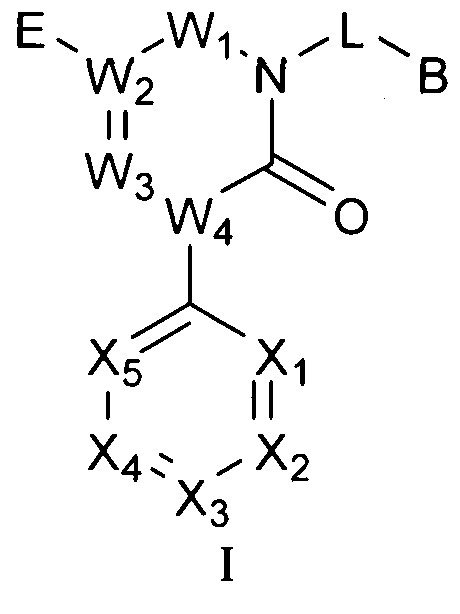
  • the present invention relates to a method of treating or preventing a condition in a mammal, including a human, the treatment or prevention of which is affected or facilitated by the neuromodulatory effect of GAB AB modulators.
  • Figure A represents the ability of 10 ⁇ M of the Compound 4.02 to increase the [GTPy 35 S] binding in rat brain membranes induced by 15 ⁇ M of Baclofen, a GABAB receptor agonist, without having an effect on its own.
  • B is selected from C 6 -Ci 0 aryl optionally substituted with one to 5 Y, C 5 -
  • R 5 are selected from -(Ci-C 6 )alkyl, and -(C 6 -C io)aryl;
  • R 2 , R 3 and R 4 each independently is hydrogen, -(Ci-C 6 )alkyl, -(C 3 - C 6 )cycloalkyl, -(C 2 -C 6 )alkenyl, -(C 2 -C 6 )alkynyl, -(C r C 6 )alkyl
  • R 11 are selected from -(C,-C 6 )alkyl, -(C 3 -C 7 )cycloalkyl and -(C 6 - Cio)aryl;
  • R 8 , R 9 and R 10 each independently is hydrogen, -(Ci-C 6 )alkyl, -(C 3 - C 6 )cycloalkyl, -(C 2 -C 6 )alkenyl, -(C 2 -C 6 )alkynyl, -(C,-C 6 )alkylhalo, heterocycloalkyl, heteroaryl, heteroarylalkyl, arylalkyl or aryl; any of which is optionally substituted with 1 to 5 independent halogen, -CN, - (C,-C 6 )alkyl , -O(C 0 -C 6 )alkyl, -O(C 3 -C 7 )cycloalkylalkyl, -O(aryl), - O(aryl)-(C 0 -C 3 )alkyl, -O(heteroaryl), -O(heteroaryl)-(C 0 -C
  • R 16 are selected from hydrogen, -(Cj-C 6 )alkyl, -(C 3 -C 7 )cycloalkyl and - (C 6 -C,o)aryl;
  • R 13 , R 14 and R 15 each independently is hydrogen, -(d-C 6 )alkyl, -(C 3 - C 6 )cycloalkyl, -(C 2 -C 6 )alkenyl, -(C 2 -C 6 )alkynyl, -(Ci-C 6 )alkylhalo, heterocycloalkyl, heteroaryl, heteroarylalkyl, alkylheteroaryl, arylalkyl, alkylaryl or aryl; any of which is optionally substituted with 1 to 5 independent halogen, -CN, -(C,-C 6 )alkyl ; -O(C 0 -C 6 )alkyl, -0(C 3 - C 7 )cycloalkylalkyl, -O(aryl), -O(aryl)-(C 0 -C 3 )alkyl, -O(heteroaryl), - O(he
  • L is independently selected from a -((Ci-C 5 )alkyl-Q m )- substituted with 1-
  • R 21 is selected from hydrogen, -(Ci-C 6 )alkyl, -(C 3 -C 7 )cycloalkyl , and - (C 6 -C, 0 )aryl;
  • R 18 , R 19 and R 20 each independently is hydrogen, -(Ci-C 6 )alkyl, -(C 3 - C 6 )cycloalkyl, -(C 2 -C 6 )alkenyl, -(C 2 -C 6 )alkynyl, -(Ci-C 6 )alkylhalo, heterocycloalkyl, heteroaryl, heteroarylalkyl, arylalkyl alkylaryl, alkylheteroaryl, aryl; any of which is optionally substituted with 1 to 5 independent halogen, -CN, -(Ci-C 6 )alkyl , -O(C 0 -C 6 )alkyl, -0(C 3 - C 7 )cycloalkylalkyl, -O(aryl), -O(aryl)-(C 0 -C 3 )alkyl, -O(heteroaryl), - O(he
  • R 22 is selected from -(d-C 6 )alkyl, and -(C 6 -C io)aryl;
  • B is selected from C 6 -Ci 0 aryl optionally substituted with one to 5 Y, C 5 -
  • R 5 are selected from hydrogen, -(Ci-C 6 )alkyl, and -(C 6 -C io)aryl;
  • R 2 , R 3 and R 4 each independently is hydrogen, -(Ci-C 6 )alkyl, -(C 3 - C 6 )cycloalkyl, -(C 2 -C 6 )alkenyl, -(C 2 -C 6 )alkynyl, -(Ci-C 6 )alkylhalo, heterocycloalkyl, heteroaryl, heteroarylalkyl, arylalkyl or aryl; any of which is optionally substituted with 1 to 5 independent halogen, -CN, - (C,-C 6 )alkyl , -O(C 0 -C 6 )alkyl, -O(C 3 -C 7 )cycloalkylalkyl, -O(aryl), - O(heteroaryl), -N((C 0 -C 6 )alkyl) 2 , -N((C 0 -C 6 )alkyl)(
  • X 3 , X 4 and X 5 are each independently selected from the group consisting of -
  • R 1 1 are selected from -(Ci-C 6 )alkyl, -(C 3 -C 7 )cycloalkyl and -(C 6 - Cio)aryl;
  • R 8 , R 9 and R 10 each independently is hydrogen, -(C,-C 6 )alkyl, -(C 3 - C 6 )cycloalkyl, -(C 2 -C 6 )alkenyl, -(C 2 -C 6 )alkynyl, -(Ci-C 6 )alkylhalo, heterocycloalkyl, heteroaryl, heteroarylalkyl, arylalkyl or aryl; any of which is optionally substituted with 1 to 5 independent halogen, -CN, - (C,-C 6 )alkyl , -O(C 0 -C 6 )alkyl, -O(C 3 -C 7 )cycloalkylalkyl, -O(aryl), - O(aryl)-(C 0 -C 3 )alkyl, -O(heteroaryl), -O(heteroaryl)-(C 0 -C
  • E is selected from the group consisting of hydrogen, halogen, -OCF 3 , -
  • R 16 are selected from hydrogen, -(Ci-C 6 )alkyl, -(C 3 -C 7 )cycloalkyl and - (C 6 -C 10 )aryl;
  • R 13 , R 14 and R 15 each independently is hydrogen, -(C,-C 6 )alkyl, -(C 3 - C 6 )cycloalkyl, -(C 2 -C 6 )alkenyl, -(C 2 -C 6 )alkynyl, -(C,-C 6 )alkylhalo, heterocycloalkyl, heteroaryl, heteroarylalkyl, alkylheteroaryl, arylalkyl, alkylaryl or aryl; any of which is optionally substituted with 1 to 5 independent halogen, -CN, -(Ci-C ⁇ alkyl , -O(C 0 -C 6 )alkyl, -0(C 3 - C 7 )cycloalkylalkyl, -O(aryl), -O(aryl)-(C 0 -C 3 )alkyl, -O(heteroaryl), - O(heter
  • L is independently selected from a -((Ci-C 5 )alkyl-Q m )- substituted with 1-
  • R 21 is selected from hydrogen, -(Ci-C 6 )alkyl, -(C 3 -C 7 )cycloalkyl , and - (C 6 -C 10 )aryl;
  • R 18 , R 19 and R 20 each independently is hydrogen, -(C,-C 6 )alkyl, -(C 3 - C 6 )cycloalkyl, -(C 2 -C 6 )alkenyl, -(C 2 -C 6 )alkynyl, -(Ci-C 6 )alkylhalo, heterocycloalkyl, heteroaryl, heteroarylalkyl, arylalkyl alkylaryl, alkylheteroaryl, aryl; any of which is optionally substituted with 1 to 5 independent halogen, -CN, -(Ci-C 6 )alkyl , -O(C 0 -C 6 )alkyl, -0(C 3 - C 7 )cycloalkylalkyl, -O(aryl), -O(aryl)-(C 0 -C 3 )alkyl, -O(heteroaryl), - O(he
  • Any N may be an N-oxide.
  • B is selected from C 6 -Ci 0 aryl optionally substituted with one to 5 Y, C 5 -
  • R 5 are selected from hydrogen, -(Ci-C 6 )alkyl, and -(C 6 -C io)aryl;
  • R 2 , R 3 and R 4 each independently is hydrogen, -(C[-C 6 )alkyl, -(C 3 - C 6 )cycloalkyl, -(C 2 -C 6 )alkenyl, -(C 2 -C 6 )alkynyl, -(C,-C 6 )alkylhalo, heterocycloalkyl, heteroaryl, heteroarylalkyl, arylalkyl or aryl; any of which is optionally substituted with 1 to 5 independent halogen, -CN, - (Ci-C 6 )alkyl , -O(C 0 -C 6 )alkyl, -O(C 3 -C 7 )cycloalkylalkyl, -O(aryl), - O(heteroaryl), -N((C 0 -C 6 )alkyl) 2 , -N((C 0 -C 6 )alkyl)(
  • R 7 at each occurence is selected from hydrogen, -(Ci-C 6 )alkyl, -(C 2 - C 6 )alkenyl, -(C 3 -C 7 )cycloalkyl, 3 to 7 membered heterocycloalkyl, -(C 6 - Ci O )aryl, 5 or 6 membered heteroaryl, -(C 7 -C
  • 0 )arylalkyl, -C( 0)R ⁇ ;
  • R 1 1 are selected from -(C,-C 6 )alkyl, -(C 3 -C 7 )cycloalkyl and -(C 6 - Cio)aryl;
  • R 8 , R 9 and R 10 each independently is hydrogen, -(C,-C 6 )alkyl, -(C 3 - C 6 )cycloalkyl, -(C 2 -C 6 )alkenyl, -(C 2 -C 6 )alkynyl, -(C,-C 6 )alkylhalo, heterocycloalkyl, heteroaryl, heteroarylalkyl, arylalkyl or aryl; any of which is optionally substituted with 1 to 5 independent halogen, -CN, - (C r C 6 )alkyl , -O(C 0 -C 6 )alkyl, -O(C 3 -C 7 )cycloalkylalkyl, -O(aryl), - O(aryl)-(C 0 -C 3 )alkyl, -O(heteroaryl), -O(heteroaryl)-(C 0 -C
  • E is selected from the group consisting of hydrogen, halogen, -OCF 3 , -
  • R 16 are selected from hydrogen, -(Ci-C 6 )alkyl, -(C 3 -C 7 )cycloalkyl and - (C 6 -C 10 )aryl;
  • R 13 , R 14 and R 15 each independently is hydrogen, -(Ci-C 6 )alkyl, -(C 3 - C 6 )cycloalkyl, -(C 2 -C 6 )alkenyl, -(C 2 -C 6 )alkynyl, -(C,-C 6 )alkylhalo, heterocycloalkyl, heteroaryl, heteroarylalkyl, alkylheteroaryl, arylalkyl, alkylaryl or aryl; any of which is optionally substituted with 1 to 5 independent halogen, -CN, -(C,-C 6 )alkyl , -O(C 0 -C 6 )alkyl, -0(C 3 - C 7 )cycloalkylalkyl, -O(aryl), -O(aryl)-(C 0 -C 3 )alkyl, -O(heteroaryl), - O(
  • L is independently selected from a -((C]-C 5 )alkyl-Q m )- substituted with 1-
  • R 21 is selected from hydrogen, -(Ci-C 6 )alkyl, -(C 3 -C 7 )cycloalkyl , and - (C 6 -C 10 )aryl;
  • R 18 , R 19 and R 20 each independently is hydrogen, -(Ci-C 6 )alkyl, -(C 3 - C 6 )cycloalkyl, -(C 2 -C 6 )alkenyl, -(C 2 -C 6 )alkynyl, -(C,-C 6 )alkylhalo, heterocycloalkyl, heteroaryl, heteroarylalkyl, arylalkyl alkylaryl, alkylheteroaryl, aryl; any of which is optionally substituted with 1 to 5 independent halogen, -CN, -(Ci-QJalkyl , -O(C 0 -C 6 )alkyl, -0(C 3 - C 7 )cycloalkylalkyl, -O(aryl), -O(aryl)-(C 0 -C 3 )alkyl, -O(heteroaryl), - 0(heter
  • Any N may be an N-oxde.
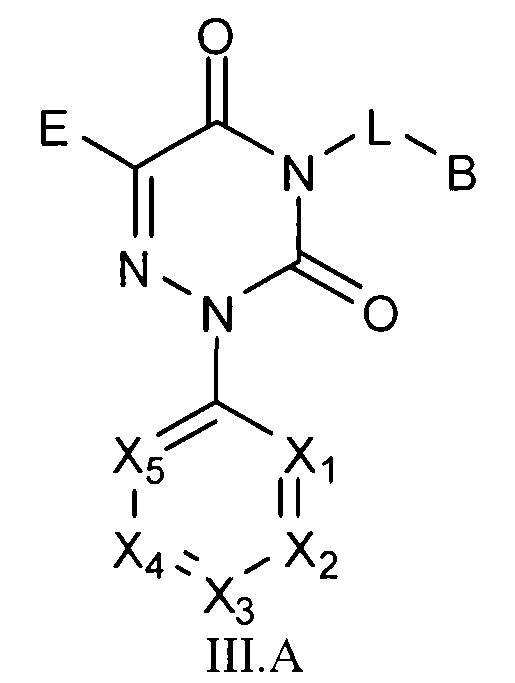
  • More preferred compounds of the present invention from Formula III are compounds of Formula III.
  • B is selected from C 6 -Ci 0 aryl optionally substituted with one to 5 Y, C 5 -
  • R 5 are selected from hydrogen, -(Ci-C 6 )alkyl, and -(C 6 -Ci 0 )aryl;
  • R 2 , R 3 and R 4 each independently is hydrogen, -(Ci-C 6 )alkyl, -(C 3 - C 6 )cycloalkyl, -(C 2 -C 6 )alkenyl, -(C 2 -C 6 )alkynyl, -(Ci-C 6 )alkylhalo, heterocycloalkyl, heteroaryl, heteroarylalkyl, arylalkyl or aryl; any of which is optionally substituted with 1 to 5 independent halogen, -CN, - (Ci-C 6 )alkyl ; -O(C 0 -C 6 )alkyl, -O(C 3 -C 7 )cycloalkylalkyl, -O(aryl), - O(heteroaryl), -N((C 0 -C 6 )alkyl) 2 , -N((C 0 -C 6 )alkyl)(
  • R 11 are selected from -(Ci-C 6 )alkyl, -(C 3 -C 7 )cycloalkyl and -(C 6 - Cio)aryl;
  • R 8 , R 9 and R 10 each independently is hydrogen, -(d-C 6 )alkyl, -(C 3 - C 6 )cycloalkyl, -(C 2 -C 6 )alkenyl, -(C 2 -C 6 )alkynyl,
  • E is selected from the group consisting of hydrogen, halogen, -OCF 3 , -
  • R 16 are selected from hydrogen, -(Ci-C 6 )alkyl, -(C 3 -C 7 )cycloalkyl and - (C 6 -C 10 )aryl;
  • R 13 , R 14 and R 15 each independently is hydrogen, -(Ci-C 6 )alkyl, -(C 3 - C 6 )cycloalkyl, -(C 2 -C 6 )alkenyl, -(C 2 -C 6 )alkynyl, -(Ci-C 6 )alkylhalo, heterocycloalkyl, heteroaryl, heteroarylalkyl, alkylheteroaryl, arylalkyl, alkylaryl or aryl; any of which is optionally substituted with 1 to 5 independent halogen, -CN, -(Ci-C 6 )alkyl , -O(C 0 -C 6 )alkyl, -0(C 3 - C 7 )cycloalkylalkyl, -O(aryl), -O(aryl)-(C 0 -C 3 )alkyl, -O(heteroaryl), - O(
  • L is independently selected from a -((Ci-C 5 )alkyl-Q m )- substituted with 1-
  • T is 1 to 6 substiruents independently selected from the group consisting of hydrogen, fluorine, -OCF 3 , -NO 2 , -CN, -CF 3 , -(Ci-C 6 )alkyl, -(C 3 - C 6 )cycloalkyl, -(C 2 -C 6 )alkenyl, -(C 2 -C 6 )alkynyl, halo-(C
  • R 21 is selected from hydrogen, -(Ci-C 6 )alkyl, -(C 3 -C 7 )cycloalkyl , and - (C 6 -C 10 )aryl;
  • R 18 , R 19 and R 20 each independently is hydrogen, -(d-C 6 )alkyl, -(C 3 - C 6 )cycloalkyl, -(C 2 -C 6 )alkenyl, -(C 2 -C 6 )alkynyl, -(C
  • Any N may be an N-oxide.
  • More preferred compounds of the present invention from Formula III are compounds of Formula III.
  • B is selected from C 6 -Ci 0 aryl optionally substituted with one to 5 Y, C 5 -
  • R 5 are selected from hydrogen, -(Ci-C 6 )alkyl, and -(C 6 -C 10 )aryl;
  • R 2 , R 3 and R 4 each independently is hydrogen, -(Ci-C 6 )alkyl, -(C 3 - C 6 )cycloalkyl, -(C 2 -C 6 )alkenyl, -(C 2 -C 6 )alkynyl, -(C,-C 6 )alkylhalo, heterocycloalkyl, heteroaryl, heteroarylalkyl, arylalkyl or aryl; any of which is optionally substituted with 1 to 5 independent halogen, -CN, - (C,-C 6 )alkyl, -O(C 0 -C 6 )alkyl, -O(C 3 -C 7 )cycloalkylalkyl, -O(aryl), - O(heteroaryl), -N((C 0 -C 6 )alkyl) 2 , -N((C 0 -C 6 )alkyl)((
  • X ⁇ , X 2 , X 3 , X 4 and X 5 are each independently selected from the group consisting of -
  • R 7 at each occurence is selected from hydrogen, -(Ci-C 6 )alkyl, -(C 2 - C 6 )alkenyl, -(C 3 -C 7 )cycloalkyl, 3 to 7 membered heterocycloalkyl, -(C 6 - Cio)aryl, 5 or 6 membered heteroaryl, -(C 7 -C
  • 0 )arylalkyl, -C( 0)R ⁇ ;
  • R 11 are selected from -(Ci-C 6 )alkyl, -(C 3 -C 7 )cycloalkyl and -(C 6 -
  • R 8 , R 9 and R 10 each independently is hydrogen, -(C r C 6 )alkyl, -(C 3 - C 6 )cycloalkyl, -(C 2 -C 6 )alkenyl, -(C 2 -C 6 )alkynyl, -(C,-C 6 )alkylhalo, heterocycloalkyl, heteroaryl, heteroarylalkyl, arylalkyl or aryl; any of which is optionally substituted with 1 to 5 independent halogen, -CN, - (d-C 6 )alkyl , -O(C 0 -C 6 )alkyl, -O(C 3 -C 7 )cycloalkylalkyl, -O(aryl), - 0(aryl)-(Co-C 3 )alkyl, -O(heteroaryl), -O(heteroaryl)-(C 0 -C 3 )
  • E is selected from the group consisting of hydrogen, halogen, -OCF 3 , -CN,
  • R 16 are selected from hydrogen, -(Ci-C 6 )alkyl, -(C 3 -C 7 )cycloalkyl and - (C 6 -C,o)aryl;
  • R 13 and R 14 each independently is hydrogen, -(C)-C 6 )alkyl, -(C 3 -C 6 )cycloalkyl, - (C 2 -C 6 )alkenyl, -(C 2 -C 6 )alkynyl, -(Ci-C 6 )alkylhalo, heterocycloalkyl, heteroaryl, heteroarylalkyl, alkylheteroaryl, arylalkyl, alkylaryl or aryl; any of which is optionally substituted with 1 to 5 independent halogen, - CN, -(Ci-C f Oalkyl , -O(C 0 -C 6 )alkyl, -O(C 3 -C 7 )cycloalkylalkyl, -O(aryl), - O(aryl)-(C 0 -C 3 )alkyl, -O(heteroaryl), -O(hetero
  • L is independently selected from a -((Ci-C 5 )alkyl-Q m )- substituted with 1-
  • T is 1 to 6 substituents independently selected from the group consisting of hydrogen, -(Ci-C 6 )alkyl;
  • R 22 is selected from -(Ci-C 6 )alkyl, and -(C 6 -C io)aryl;
  • Any N may be an N-oxide.
  • the present invention relates to the pharmaceutically acceptable acid addition salts of compounds of the Formula I and compositions of the compounds with pharmaceutically acceptable carriers or excipients.
  • the present invention relates to a method of treating or preventing a condition in a mammal, including a human, the treatment or prevention of which is affected or facilitated by the neuromodulatory effect of GABAB positive allosteric modulators.
  • the present invention relates to a method useful for treating or preventing peripheral and central nervous system disorders selected from the group consisting of: anxiety, depression, epilepsy, schizophrenia, cognitive disorders, spasticity and skeletal muscle rigidity, spinal cord injury, multiple sclerosis, amyotrophic lateral sclerosis, cerebral palsy, neuropathic pain and craving associated with cocaine and nicotine, panic disorder, posttraumatic stress disorders, urge urinary incontinence or gastro-intestinal disorders.
  • peripheral and central nervous system disorders selected from the group consisting of: anxiety, depression, epilepsy, schizophrenia, cognitive disorders, spasticity and skeletal muscle rigidity, spinal cord injury, multiple sclerosis, amyotrophic lateral sclerosis, cerebral palsy, neuropathic pain and craving associated with cocaine and nicotine, panic disorder, posttraumatic stress disorders, urge urinary incontinence or gastro-intestinal disorders.
  • compositions which provide from about 0.01 to 1000 mg of the active ingredient per unit dose.
  • the compositions may be administered by any suitable route.
  • parenterally in the form of solutions for injection topically in the form of onguents or lotions, ocularly in the form of eye-drops, rectally in the form of suppositories, intranasally or transcutaneously in the form of delivery system like patches.
  • the pharmaceutical formulations of the invention may be prepared by conventional methods in the art; the nature of the pharmaceutical composition employed will depend on the desired route of administration.
  • the total daily dose usually ranges from about 0.05 - 2000 mg.
  • the term "about” refers to a range of value from ⁇ 10% of a specified value.
  • the phrase “about 30 mg” include ⁇ 10% of 30, or form 27 to 33 mg.
  • a range of values in the form "x-y” or “x to y” or “x through y”, include integers x, y and the integers there between.
  • the phrase “1-6” or “1 to 6” or “1 through 6” are intended to include the integers 1, 2, 3, 4, 5 and 6.
  • Preferred structures include each individual integer in the range, as well as any subcombination of integers.
  • preferred integers for "1-6" can include 1, 2,
  • stable compound or “stable structure” refers to a compound that is sufficiently robust to survive isolation to a useful degree of purity from a reaction mixture and preferably capable of formulation into an efficacious therapeutic agent.
  • C means 1 carbon atom.
  • the group to which the subscript refers to indicates that the group is absent, i.e. there is a direct bond between the groups.
  • Halogen includes atoms such as fluorine, bromine, chlorine and iodine.
  • alkyl refers to a straight-chain or branched alkyl group having 1 to 6 carbon atoms, such as methyl, ethyl, propyl, isopropyl, butyl, isobutyl, sec-butyl, tert-butyl, pentyl, isopentyl, neopentyl, l-ethylpropyl,3- methylpenthyl, 2,2-dimethylbutyl, 2,3-dimethylbutyl, hexyl, etc.
  • alkyl moiety of alkyl-containing groups such as alkoxy, alkoxycarbonyl and alkylaminocarbonyl groups, has the same meaning as alkyl defined above.
  • alkenyl refers to a straight-chain or branched hydrocarbon group of 2 to 6 carbon atoms having at least one carbon-carbon double bond.
  • a designation "C 2 -C 6 alkenyl” refers to an alkenyl radical containing from 2 to 6 carbon atoms. Examples of alkenyl groups include, but are not limited to, ethenyl, propenyl, isopropenyl, allyl, butenyl, pentenyl, 2,4-pentanedienyl, etc.
  • alkynyl refers to a straight-chain or branched hydrocarbon group of 2 to 6 carbon atoms having at least one carbon-carbon triple bond.
  • a designation "C 2 -C 6 alkynyl” refers to an alkenyl radical containing from 2 to 6 carbon atoms. Examples include, but are not limitated to, ethynyl, propynyl, butynyl, pentynyl, etc.
  • Aryl refers to an optionally substituted monocyclic or bicyclic hydrocarbon ring system containing at least one unsaturated aromatic ring.
  • aryl examples and suitable values of the term “aryl” are phenyl, naphthyl, 1,2,3,4,-tetrahydronaphthyl, indyl, indenyl and the like.
  • Arylalkyl includes (C 6 -C io)ary 1-(C
  • Alkylaryl includes (Ci-C 3 )alkyl-(C 6 -C
  • alkylhalo means an alkyl group as defined above, substituted with one or more halogen.
  • Ci-C 6 - alkylhalo may include, but not limited to fluoroethyl, difluoromethyl, trifluoromethyl, fluoroethyl, difluoroethyl, bromoethyl and the like.
  • O-Ci-C 6 -alkylhalo may include, but is not limited to fluoromethoxy, difluoromethoxy, trifluoromethoxy, fluoroethoxy and the like.
  • Heteroatom includes atoms such as nitrogen, oxygen and sulphur.
  • Heteroaryl refer to an optionally substituted monocyclic or bicyclic unsaturated, aromatic ring system containing at least one heteroatom selected independently from O, N or S to form a ring such as furyl (furan ring), benzofuranyl (benzofuran ring), thienyl (thiophene ring), benzothiophenyl (benzothiophene ring), pyrrolyl (pyrrole ring), imidazolyl (imidazole ring), pyrazolyl (pyrazole ring), thiazolyl (thiazole ring), isothiazolyl (isothiazole ring), triazolyl (triazole ring), tetrazolyl (tetrazole ring), pyridil (pyridine ring), pyrazynyl (pyrazine ring), pyrimidinyl (pyrimidine ring), pyridazinyl (pyri
  • Heteroarylalkyl includes heteroaryl-(Ci-C 3 )alkyl group, wherein examples of heteroaryl are the same as those illustrated in the above definition, such as 2-methyl- furyl group, 3 -methyl-fury 1 group, 2-methyl-thienyl group, 3-methyl-thienyl group, 1- methyl-imidazolyl group, 2-methyl-imidazolyl group, 2-methyl-thiazolyl group, 2- methyl-pyridyl group, 3-methyl-pyridyl group, 1 -methyl-quinolyl group or the like.
  • Alkylheteroaryl includes (Ci-C 3 )alkyl-heteroaryl group, wherein examples of heteroaryl are the same as those illustrated in the above definition, such as 2- furylmethyl group, 3-furylmethyl group, 2-thienylmethyl group, 3-thienylmethyl group, 1 -imidazolylmethyl group, 2-imidazolylmethyl group, 2-thiazolylmethyl group, 2- pyridylmethyl group, 3-pyridylmethyl group, 1 -quinolylmethyl group or the like.
  • heterocyclic means a 5- or 6- membered ring containing one or more atoms independently selected from N, O, or S, includes monocyclic or bicyclic rings as well which may be saturated or unsaturated.
  • Heterocycloalkyl includes heterocycloalkyl-C
  • cycloalkyl means carbocycles containing no heteroatoms, includes mono-, bi-, and tricyclic saturated carbocycles, as well as fused ring systems.
  • fused ring systems can include on ring that is partially or fully unsaturated such as a benzene ring to form fused ring systems such as benzo fused carbocycles.
  • Cycloalkyl includes such fused ring systems as spirofused ring systems.
  • cycloalkyl examples include cyclopropyl, cyclobutyl, cyclopentyl, cyclohexyl, decahydronaphthalene, adamantane, indanyl, fluorenyl, 1,2,3,4-tetrahydronaphthalene and the like.
  • cycloalkenyl refers to a carbocycles includes mono- and bi- carbocycles, as well as fused ring, having at least one carbon-carbon double bond.
  • Examples of cycloalkenyl includes l,2,3,4,4a,5,6,7-octahydronaphthalene, 2,3,5,6,7,7a- hexahydro-lH-indene, 2,3,4,5,6,7-hexahydro-lH-indene and the like.
  • solute refers to a complex of variable stoichiometry formed by a solute (e.g. a compound of formula I) and a solvent.
  • the solvent is a pharmaceutically acceptable solvent as water preferably; such solvent may not interfere with the biological activity of the solute.
  • substituted refers to substitution with the named substituent or substituents, multiple degrees of substitution being allowed unless otherwise stated.
  • the compound of formula I may be represented as a mixture of enantiomers, which may be resolved into the individual pure R- or S-enantiomers. If for instance, a particular enantiomer of the compound of formula I is desired, it may be prepared by asymmetric synthesis, or by derivation with a chiral auxiliary, where the resulting diastereomeric mixture is separated and the auxiliary group cleaved to provide the pure desired enantiomers. Alternatively, where the molecule contains a basic functional group such as amino, or an acidic functional group such as carboxyl, this resolution may be conveniently performed by fractional crystallization from various solvents, of the salts of the compounds of formula I with optical active acid or by other methods known in the literature, e.g.
  • the compounds of Formula I may be prepared by general route of synthesis as disclosed in the following methods.
  • the compounds of Formula HI wherein B, L, X 1 , X 2 , X 3 , X 4 , X 5 and -E are as described above may be prepared following a cyclisation reaction key step presented in Scheme 1.
  • the amine 1.1 react with the corresponding carboxylic 1.2 acid in a classic peptidic coupling condition (Piskunova, I. P. & al. Tetrahedron 1993, 49(21), 4671-4676) where -E can be different electroattractive substituants, i.e -CN to generate 1.3.
  • 1.3 can react with the diazonium salt already obtained by mixing the aniline 1.4 with NaNO 2 to generate 1.5 (Bilek, P.; Slouka, J. Heterocycl. Commun. 2004, 10(1), 67-70).
  • the final compound 1.6 is obtained by reaction of the intermediate 1.5 with ethylchloroformiate in a presence of pyridine.
  • the E substituent can be introduced at a late stage in the synthesis, to provide the compounds of Formula III (Scheme 2).
  • the uracyl derivative is brominated to lead to the intermediates 2.1 (Dudfield, P.J. & al. J. Chem. Soc. Perkin Trans. 1, 1999, 20, 2929-2936).
  • decyanation was achieved via a two step procedure known in the art such as hydrolysis to the acid and decarboxylation of the acid bearing intermediate (Falco & al. J. Am. Chem. Soc. 1956, 78, 1938-1939).
  • further transformation of the R 5 group can be also performed such as transformation of the nitro group to an acetamido group.
  • the target coumpound is then obtained by introduction of the L-B group in a manner similar as that reported in previous to afford the compound 5.7.
  • the commercially available aniline 7.1 is able to react with sodium nitrite in acidic media to generate a diazo intermediate which is able to react with the commercialy available compound 7.2 to form the compound 7.3.
  • the cyclisation of 7.3 can occur to form the disubstiruted azauracil 7.4.
  • the nitrile function is transformed into a carboxylic acid function and in a same time the deacetylation of the acetamido is realised.
  • the compound 7.6 can be obtained after acetylation of the aniline.
  • the carboxylic acid function can be transformed in ester function (Colletti, S. L. & al. Tetrahedron Lett. 2000, 41(41), 7825-7830) and can be reduce in a presence of sodium borohydride to get the alcohol. This alcohol can then react with the phosphorus(III)bromide (Rastelli, G. Bioorg. Med. Chem. Lett.
  • the nitrile function can be easly transformed into precursor of heterocycles, i.e N-((dimethylamino)methylene)acetamide (two steps : tranformation to acylamide and reaction with DMF-DMA) or N-hydroxyformimidamide (in direct reaction with suitable hydroxylamine).
  • the amine function can itself be the starting for the formation of several amide by acylation reaction, secondary or tertiary amine by alkylation reaction and substituted heterocycloalkyl groups in manner known to the skilled in the art and are supported in literature in books (Katrizky A. R. and. Rees CW. (1984) Comprehensive Heterocyclic Chemistry, Pergamon Press)., but not limited to.
  • derivative 9.1 with R 6 is NR 8 R can be reduce or deprotected to give the corresponding primary amine, secondery amine which can react as describe before.
  • R 6 is -OR 7
  • the deprotection reaction can occur, i.e with BBr 3 to give the alcohol.
  • R is CN the reactions already describe in the Scheme 8 can be realised to finally conduct to heteroaryl.
  • reagents and starting materials are commercially available and/or, using well- known techniques, can be readily synthesized by one of ordinary skill in the art. Unless otherwise noted, all commercially starting materials were used without further purification.
  • the microwave oven used is an apparatus from Biotage (OptimizerTM) equipped with an internal probe that monitors reaction temperature and pressure, and maintains the desired temperature by computer control.
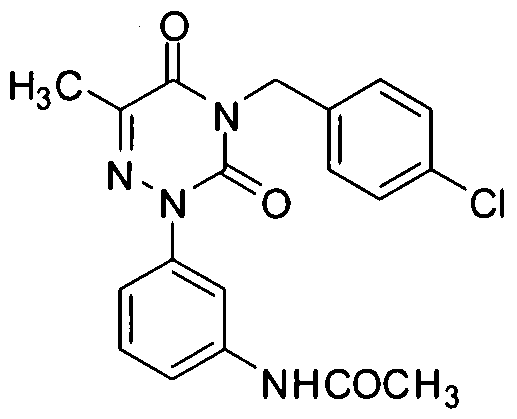
  • Example 1 N-(3-(4-(4-chlorobenzyl)-6-cyano-3,5-dioxo-4,5-dihydro-l,2,4-triazin- 2(3H)-yl)phenyl)acetamide (Final Compound 1.01).
  • Step 1 A mixture of 4-chlorobenzylamine (10. Og, 71mmol), cyanoacetic acid (6.13g, 72mmol), HOBt (Hg, 72mmol), EDCI.HC1 (2Og, lO ⁇ mmol) in 10OmL of dioxane was stirred for 3h at room temperature. The solvent was removed under vacuum and 30OmL of DCM was added. The organic layer was successively washed with 2x10OmL of water, 2x50mL of a solution IN of NaOH, 4x10OmL of water until neutral pH. The organic layer was dried over Na 2 SO 4 , filtered and concentrated to afford N-(4-chlorobenzyl)-2-cyanoacetamide l(A) (13.12g, 89%) as a brown solid.
  • Step 2 To a suspension of N-(3-aminophenyl)acetamide (1.5g, lOmmol) in concentrated HCl (2.9mL) at 0 0 C. was added dropwise a solution of sodium nitrite (661mg, lOmmol in 1OmL of water); the obtained diazonium salt solution was added under vigorous stirring to a suspension of compound l(A) (l.Og, 5mmol) and sodium acetate (3.0g) in ethanol (25mL). The reaction mixture was allowed to rest at 0°C for 2h. The mixture was filtered, washed with cooled ethanol and dried to afford the hydrazone 1(B) (1.2g, 68%) as yellow crystals.
  • Step 3 A mixture of the compound l(B) (500mg, 1.4mmol) and 3mL of pyridine was cooled at 0°C. Onto this suspension was added dropwise 293mg (2.7mmol) of ethylchloroformiate, with a syringe. The reaction mixture was heated at 120°C for 6h and concentrated under vacuum. The residue was successively dissolved in 3mL of DCM, washed twice with a solution of 5N HCl (ImL), dried over sodium sulfate, filtrated and concentrated to dryness.
  • 5N HCl 5N HCl
  • Example 2 N-(3-(4-(4-chIorobenzyl)-6-(dimethyIamino)-3,5-dioxo-4,5-dihydro- l,2,4-triazin-2(3H)-yl)phenyl)acetamide (Final Compound 5.13).
  • Step 2 to a solution of of 4-chlorobenzyl bromide (Ig, 5.2mmol) and 2(A) (l.lg, 5.2mmol) in DMSO (1OmL) was added portionwise NaH(55%) (230mg, 5.2mmol). After 15min at room temperature the reaction mixture was quenched with water and extracted with ethyl acetate (x3). The combined organic layers were successively washed with water (x2), with brine, dried over MgSO 4 , filtered and concentrated.
  • Step 3 To a stirred solution of 4-(4-chlorobenzyl)-6-bromo- l,2,4-triazine-3,5(2H,4H)-dione (0.40Og) and 2(B) (411mg, 1.3mmol) in DMF (5mL) were successively added of the 3-acetamidophenylboronic acid (0.34g, 1.9mmol), copper(II) acetate (0.23g,1.3mmol) and 0.2Og of pyridine (2.5mmol). The mixture was stirred overnight at 60 0 C. The reaction mixture was quenched with a saturated sodium bicarbonate solution and extracted with ethyl acetate (x3).
  • Step 4 To a solution of 2(C) (lOOmg, 0.22mmol) in 0.5mL of DMF was added dimethylamine 2M solution in methanol (0.56mL, l.l lmmol). The reaction was heated 5h at 150°C under microwave irradiation. The reaction mixture was quenched with water and extracted with ethyl acetate (x3). The combined organic layers were washed successively with water, with brine, dried over MgSO 4 , filtered and concentrated. The crude product was purified by flash chromatography, 5g column (Eluant: DCM/MeOH 98/2).
  • Example 3 N-(3-(4-(4-chlorobenzyl)-6-methoxy-3,5-dioxo-4,5-dihydro-l,2,4- triazin-2(3H)-yl)phenyl)acetamide (Final Compound 4.01).
  • Step 4 A mixture of N-(3-(4-(4-chlorobenzyl)-6-bromo-3,5- dioxo-4,5-dihydro-l,2,4-triazin-2(3H)-yl)phenyl)acetamide 2(C) (lOOmg, 0.22mmol), THF (2mL), dimethoxyethane (69 ⁇ l, 0.67mmol) and PdCl 2 (dppf) (8mg, O.Ol lmmol) was stirred under nitrogen atmosphere at 50 0 C.
  • Step 3 A mixture of 6-bromo-4-((2,2- difluorobenzo[d][l,3]dioxol-5-yl)methyl)-l,2,4-triazine-3,5(2H,4H)-dione (300mg, 0.83mmol), DMF (5mL), 3-acetamidophenylboronic acid (222mg, 1.24mmol), copper acetate (150mg, 0.83mmol) and pyridine (135 ⁇ l, 1.66mmol) was stirred at 65°C for 15 hours under room atmosphere. A saturated solution of NaHCO 3 (20OmL) was added and the aqueous layer was extracted thrice with 20OmL of DCM.
  • Step 4 A mixture of N-(3-(6-bromo-4-((2,2- difluorobenzo[d][l,3]dioxol-5-yl)methyl)-3,5-dioxo-4,5-dihydro-l,2,4-triazin-2(3H)- yl)phenyl)acetamide (250mg, 0.51mmol), DMF (6mL) was stirred at 0 0 C under nitrogen atmosphere. A sodium methoxide solution 2M (303 ⁇ L, O. ⁇ lmmol) was added dropwise and the mixture was stirred at 0 0 C during 15min.
  • the reaction mixture was diluted with 10OmL of a saturated solution of NH 4 Cl and the aqueous layer was • extracted twice with 10OmL of CH 2 Cl 2 .
  • the organic layers werecombined and successively dried over MgSO 4 , filtered and concentrated under reduced pressure to afford a brown solid.
  • the crude solid was purified by flash chromatography with silica gel (Merck Flashmart prepacked column 15g SiO 2 ) using CH 2 Cl 2 /Me0H 98/2 as eluant to afford a beige solid.
  • Step 1 To a solution of 6-bromoazauracil (2.0Og, 10.4mmol) and allyl bromide (1.26g, 10.4mmol) in DMSO (25mL) was added portionwise NaH (55%) (0.45g, 10.4mmol) at room temperature,. The reaction mixture was stirred during Ih. 10OmL of water were added and the aqueous layer was extracted thrice with ethyl acetate. The combined organic layers were successively washed twice with water, saturated brine, dried over MgSO 4 , filtered and concentrated under reduce pressure.
  • Step 2 A mixture of compound 6(A) (l.lOg, 4.74mmol), 3- acetamidophenylboronic acid (1.2Og, 6.64mmol), copper acetate (258mg, 1.42mmol) and pyridine (229 ⁇ L, 2.84mmol) in DMF (3OmL) was stirred at 65°C during 15h under room atmosphere. The mixture was diluted with 5OmL of a saturated solution of
  • Step 3 To a solution of compound 6(B) (800mg, 2.19mmol) in MeOH (1OmL) was added, a solution of sodium methoxyde 2M in methanol (1.ImL, 2.19mol). After Ih of stirring at room temperature, the mixture was quenched with water and extracted with ethyl acetate (x3). The combined organic layers were successively washed with water, brine, dried over MgSO 4 , filtered and concentrated under reduced pressure.
  • Step 4 To a solution of compound 6(C) (600mg, 1.90mmol) in dioxane (5mL) was added dichlorotris(triphenylphospine)ruthenium (91mg, O.lOmmol) and formic acid (87mg, 1.90mmol). The reaction mixture was heated at 200°C under microwave irradiation for 30min and filtered over celite. The filtrate was concentrated under reduced pressure. The crude product was then dissolved with AcOEt, washed twice with water and once with brine.
  • Step 5 A suspension of compound 6(D) (60mg, 0.22mmol), 4- isopropylbenzyl bromide (41 ⁇ L, 0.24mmol) and potassium carbonate (90mg, 0.65mmol) was stirred at 60 0 C for 15h in acetonitrile (2mL). The mixture was diluted with AcOEt and water. The organic layer was washed twice with water and once with brine. The resulting organic layer was dried over MgSO 4 and concentrated under reduced pressure.
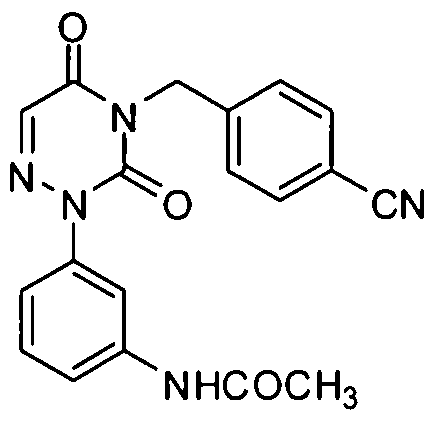
  • Example 7 N-(3-(4-(4-chlorobenzyl)-3,5-dioxo-4,5-dihydro-l,2,4-triazin-2(3H)- yl)phenyl)acetamide (Final Compound 2.01).
  • Step 1 To a solution of 6-Azauracyl (5 g, 44.2mmol) and 4- chlorobenzyl bromide (9.09 g, 44.2mmol) in DMSO (19OmL) under nitrogen atmosphere was added portionwise NaH (55%) (1.93g, 44.2mmol) at room temperature. The reaction mixture was stirred during 15min. 30OmL of water was added and the aqueous layer was extracted thrice with ethyl acetate (30OmL). The combined organic layers were washed twice with water (20OmL), dried over MgSO 4 , filtered and concentrated under reduce pressure to afford a yellow solid.
  • Step 1 To a solution of Azathymine (300mg, 2.36mmol) and 4-chlorobenzyl bromide (485mg, 2.36mmol) in DMSO (1OmL) was added portionwise NaH (55%) (103mg, 2.36mmol) at room temperature under nitrogen atmosphere. The mixture was stirred for 15min at room temperature. Ethyl Acetate was then added (15OmL) and the organic layer was extracted thrice with water (10OmL).
  • Step 2 A mixture of compound 8(A) (lOOmg, 0.39mmol), 3- acetamidophenylboronic acid (107mg, 0.59mmol), copper acetate (79mg, 0.44mmol) and pyridine (65 ⁇ l, 0.79mmol) in DMF (3mL) was stirred at 65°C during 15 hours.
  • reaction mixture was diluted with 10OmL of a saturated solution Of NaHCO 3 and the aqueous layer was extracted twice with DCM (10OmL). The organic layers were combined and successively dried over MgSO 4 , filtered and concentrated under reduce pressure to afford a brown solid.
  • Step 1 To a suspension of nitoaniline (5g, 36.2mmol) in concentrated HCl (9mL) and water (5OmL) at 0°C was added dropwise over 30minutes a solution of sodium nitrite (5g, 72.4mmol in 20OmL water) the crude orange suspension was filtered at 0 0 C and the obtained diazonium salt was added portionwise over lhour under vigorous stirring to a suspension of ethyl 2-cyanoacetate (6.22g, 39.8mmol) and sodium acetate (21.Og, 257mmol) in ethanol (20OmL). The reaction mixture was allowed to rest at 0°C for Ih.
  • Step 2 The crude compound 9(A) (11. Og, 75% of purity) was stirred with NaOH 1 M (65mL) and 20OmL of water. The corresponding heterogeneous mixture was stirred at room temperature. After Ih, two additional set of NaOH IM (20mL+20mL) was added. After complete conversion, the mixture was diluted with EtOAc and the aqueous layers were successively decanted and acidified.
  • Step 3 2-(3-nitrophenyl)-3,5-dioxo-2,3,4,5-tetrahydro- 1,2,4- triazine-6-carbonitrile (3.8g ) was successively splitted over 8 microwave flasks, diluted with an aqueous solution of HCl (6N, 1OmL) and were irradiated under
  • Step 4 To a mixture of compound 9(C) (2g, 8.54mmol) and 6OmL of H 2 O/EtOH 50/50 and acetic acid (0.488mL, 8.54mmol) was added iron (2.24 g, 40.1mmol). The reaction mixture was heated at 8O 0 C. A solution of NaOH IM was added until neutral pH. The mixture was filtered over celite. The aqueous layers where diluted with EtOAc and decanted.
  • Step 1 N-(3-(5-methoxy-3-oxo-l,2,4-triazin-2(3H)-yl)phenyl)acetamide.
  • Step 1 To a stirred solution of 5-methoxy-l,2,4-triazin-3(2H)- one (Ig, 7.9mmol) in DMF (5mL) were successively added the 3- acetamidophenylboronic acid (1.4g, 7.9mmol), copper(II) acetate (1.4g, 7.9mmol) and pyridine (1.2g, 7.9mmol). The mixture was stirred overnight at 60 0 C.
  • Step 2 To a stirred solution of N-(3-(5-methoxy-3-oxo- 1,2,4- triazin-2(3H)-yl)phenyl)acetamide (40mg, 0.15mmol) in acetonitrile (3mL) were added l-(bromomethyl)-4-chloro-2-fluorobenzene (52mg, 0.23mmol) and sodium iodide
  • ll(B) N-(3-(6-cyano-3,5-dioxo-4,5-dihydro-l,2,4-triazin-2(3H)-yl)phenyl)acetamide.
  • Step 2 A mixture of compound ll(A) (3.18g, 9.9mmol) in water (1OmL) and sodium hydroxide (0.4Og, 9.9mmol) was stirred during 30min at room temperature. The mixture was filtered.
  • Step 3 A suspension of 11 (B) (500mg, l . ⁇ mmol), 4- chlorobenzyl bromide (455mg, 2.2mmol) and potassium carbonate (510mg, 3.7mmol) in CH 3 CN (1OmL) was stirred 12h under reflux. The mixture was cooled at room temperature and 10OmL of water were added. The aqueous layer was extracted thrice with DCM (10OmL). The organic layers were mixed, dried over MgSO 4 , filtered and concentrated under reduced pressure to afford a brown solid.
  • Step 5 To a solution of ll(D) (380mg, 0.92mmol),) and diisopropylethylamine (189 ⁇ L, l .lmmol) in THF (1OmL) at 0°C under nitrogen atmosphere was added ethyl chloro formate (lOl ⁇ L, l .O ⁇ mmol) dropwise. The reaction mixture was stirred for 1 h then treated dropwise with a solution of sodium borohydride
  • Example 12 Methyl 4-(4-chlorobenzyl)-2-(3-acetamidophenyl)-3,5-dioxo-2,3 » 4,5- tetrahydro-l,2,4-triazine-6-carboxylate (Final Compound 5.17).
  • Step 5 To a solution of 2-(3-acetamidophenyl)-4-(4- chlorobenzy ⁇ -S ⁇ -dioxo ⁇ jS-tetrahydro-l ⁇ -triazine- ⁇ -carboxylic acid H(D) (80mg, 0.19mmol) in MeOH (3mL) was added dropwise at 0°C a solution of trimethylsilyldiazomethane 2M (1.3mL, 2.70mmol). The mixture was stirred at room temperature for 18h. The mixture was diluted with 10OmL of a saturated solution of NaHCO 3 and the aqueous layer was extracted twice with 10OmL of DCM.
  • Example 13 N-(3-(4-(4-chlorobenzyl)-6-((dimethylamino)methyl)-3,5-dioxo-4,5- dihydro-l,2,4-triazin-2(3H)-yl)phenyl)acetamide hydrochloride (Final Compound 5.15).
  • Step 7 A solution of 13(A) (60mg, 0.13mmol), (ImL), and dimethylamine 2M (in methanol ,23 ⁇ L, 0.65mmol) in DMF (ImI) was irradiated at 8O 0 C under microwave irradiation for 5min. The mixture was diluted with 5OmL of a saturated solution OfNaHCO 3 , and the aqueous layer was extracted twice with 5OmL of DCM. The organic layers were combined and successively dried over MgSO 4 , filtered and concentrated under reduced pressure to afford a brown solid.
  • Example 14 N-(3-(4-(4-chlorobenzyI)-6-(methoxymethyl)-3,5-dioxo-4,5-dihydro- l,2,4-triazin-2(3H)-yl)phenyl)acetamide (Final Compound 5.16).
  • Step 7 To a cooled solution of 14(A) (220mg, 0.43mmol) in DMF (2mL) under nitrogen atmosphere was added dropwise at 0°C sodium methoxide 2M (in methanol, 215 ⁇ L, 0.43mmol). The mixture was stirred at O 0 C for Ih. The reaction mixture was diluted with with water (10OmL) and the aqueous layer was extracted twice with DCM (10OmL). The organic layers were combined and successively dried over MgSO 4 , filtered and concentrated under reduced pressure to afford a brown solid.
  • Example 15 Isopropyl 2-(3-acetamidophenyl)-4-(4-chIorobenzyl)-3,5-dioxo- 2,3 5 4,5-tetrahydro-l,2,4-triazine-6-carboxylate (Final Compound 5.18).
  • Step 5 A mixture of 4-(4-chlorobenzyl)-2-(3- acetamidophenyl)-3,5-dioxo-2,3,4,5-tetrahydro-l ,2,4-triazine-6-carboxylic acid 7.6 (lOOmg, 0.24mmol), isopropylalcohol (3mL) and sulfuric acid (2drops) was heated at 8O 0 C for 20 hours. The reaction mixture was diluted with a saturated solution of NaHCO 3 (5OmL) and the aqueous layer was extracted twice with DCM (5OmL). The organic layers were combined and selectively dried over MgSO 4 , filtered and concentrated under reduced pressure to afford a brown solid.
  • Example 16 N-(3-(4-(4-chlorobenzyl)-6-methoxy-3,5-dioxo-4,5-dihydro-l,2,4- triazin-2(3H)-yl)phenyl)-N-methylacetamide (Final Compound 4.133).
  • Step 1 To a solution of N-(3-(4-(4-chlorobenzyl)-6-methoxy- 3,5-dioxo-4,5-dihydro-l,2,4-triazin-2(3H)-yl)phenyl)acetamide (70mg, 0.17mmol) in THF (3mL) was added portionwise at 0°C sodium hydride (55%) l lmg, 0.26mmol). The suspension was stirred 10 minutes at room temperature. Then, methyl iodide (87 ⁇ l, 1.40mmol) was added dropwise and the reaction mixture was stirred at room temperature under nitrogen atmosphere overnight.
  • Example 17 4-(4-chlorobenzyl)-2-(2-hydroxyphenyl)-6-methoxy-l,2,4-triazine- 3,5(2H,4H)-dione (Final Compound 4.143).
  • Step 1 To a solution of 4-(4-chlorobenzyl)-6-bromo-2-(2- methoxyphenyl)-l,2,4-triazine-3,5(2H,4H)-dione (150 mg, 0.35 mmol) in DCM (2 ml) cooled at -78°C was added dropwise BBr 3 (0.71OmL, 0.710 mmol). The reaction mixture was stirred Ih at -78°C and was quenched with MeOH. The mixture was allowed to reach room temperature. Water was added and the aqueous layer was extracted with DCM (x3). The combined organic layers were successively washed with water, brine, dried over MgSO4, filtered and concentrated.
  • Example 18 4-(4-chlorobenzyl)-6-methoxy-2-(3-(thiazol-2-ylam-no)phenyl)-l,2,4- triazine-3,5(2H,4H)-dione (Final Compound 4.144).
  • Step 1 A mixture of N-(3-(4-(4-chlorobenzyl)-6-methoxy-3,5- dioxo-4,5-dihydro-l,2,4-triazin-2(3H) yl)phenyl)acetamide (500mg, 1.24mmol) in a solution 6N of HCl (1OmL) and THF (1OmL) was stirred at reflux for 3hours. The THF was evaporated and the aqueous layer was basified with saturated solution Of NaHCO 3 until neutral pH. The aqueous layer was then extracted with ethyl acetate (x3).
  • Step 2 To a Solution of 2-(3-Aminophenyl)-4-(4- chlorobenzyl)-6-methoxy-l,2,4-triazine-3,5(2H,4H)-dione (125mg, 0.34mmol) in ethanol (10ml) was added bromothiazole (124 ⁇ L, 1.4mmol) and 5 mL of concentrated hydrochloric acid. The reaction mixture was heated to 100°C for 48 hours. The reaction mixture was quenched and neutralised with sat NaHCO 3 and extracted in ethyl acetate
  • Example 19 4-(4-chlorobenzyl)-6-methoxy-2-(3-(2-oxopyrrolidin-l-yl)phenyl)- l,2,4-triazine-3,5(2H,4H)-dione (Final Compound 4.145).
  • Example 20 N-(3-(4-(4-chlorobenzyl)-6-methoxy-3,5-dioxo-4,5-dihydro-l,2,4- triazin-2(3H)-yl)phenyl)-2-methoxyacetamide (Final Compound 4.141).
  • Step 2 A mixture of 2-(3-aminophenyl)-4-(4-chlorobenzyl)-6- methoxy-l,2,4-triazine-3,5(2H,4H)-dione (lOOmg, 0.28mmol), DMF (4mL), diisopropylethylamine (95 ⁇ l, 0.56mmol) and methoxyacetyl chloride (30 ⁇ l, 0.33mmol) was stirred under nitrogen at room temperature during lhour. The mixture was diluted with 5OmL of a saturated solution of sodium carbonate and the aqueous layer was extracted twice with 5OmL of DCM.
  • Example 21 4-(4-chlorobenzyl)-6-methoxy-2-(3-(5-methyl-l,2,4-oxadiazol-3- yl)phenyl)-l,2,4-triazine-3,5(2H,4H)-dione (Final Compound 4.146).
  • Step 3 To a solution of 6-bromo-4-(4-chlorobenzyl)- 1,2,4- triazine-3,5(2H,4H)-dione (0.600 g, 1.9 mmol) in DCM (8 ml) were added 3- cyanophenylboronic acid (0.42g, 2.8 mmol), copper(II) acetate (0.069g, 0.38 mmol), pyridine (0.3g, 3.8 mmol) and pyridine N-oxide (0.2g, 2.1 mmol) and the mixture was stirred overnight at room temperature. The reaction mixture was quenched with a saturated sodium bicarbonate solution and extracted with ethyl acetate (x3).
  • 3- cyanophenylboronic acid (0.42g, 2.8 mmol
  • copper(II) acetate 0.069g, 0.38 mmol
  • pyridine 0.3g, 3.8 mmol
  • pyridine N-oxide 0.2g, 2.1 m
  • Step 4 To a stirred solution of 3-(4-(4-chlorobenzyl)-6-bromo- 3,5-dioxo-4,5-dihydro-l,2,4-triazin-2(3H)-yl)benzonitrile (0.300g, 0.72 mmol) in DMF (5 ml) was added, dropwise, at 0°C, 2M solution of sodium methoxide (0.72 mmol, 0.359 ml). The mixture was stirred 1 hour at 0 0 C then quenched with water and extracted with ethyl acetate (x3). The combined organic layers were successively washed with water then with brine, dried over MgSO 4 , filtered and concentrated.
  • Step 1 To a stirred solution of 3-(4-(4-chlorobenzyl)-6- methoxy-3,5-dioxo-4,5-dihydro- 1 ,2,4-triazin-2(3H)-yl)benzonitrile ( 150mg, 0.41 mmol) in ethanol (5ml) was added hydroxylamine (0.100ml of a 50% solution in water, 1.2 mmol) and the mixture was heated at 80°C overnight. The reaction mixture was quenched with a saturated ammonium chloride solution and extracted with ethyl acetate (x3).
  • Step 2 A mixture of (Z)-3-(4-(4-chlorobenzyl)-6-methoxy-3,5- dioxo-4,5-dihydro- 1 ,2,4-triazin-2(3H)-yl)-N'-hydroxybenzamidine ( 150mg, 0.4mmol), triethyl orthoacetate (2mL) and of sulfuric acid (1 drop) was stirred at 100°C 4 hours.
  • reaction mixture was quenched with water and extracted with ethyl acetate (x3).
  • Example 22 2-(2-(4-(4-chlorobenzyI)-6-methoxy-3,5-dioxo-4,5-dihydro-l,2,4- triazin-2(3H)-yl)phenyl)acetonitrile (Final Compound 4.167).
  • Step 3 To a solution of 6-bromo-4-(4-chlorobenzyl)- 1,2,4- triazine-3,5(2H,4H)-dione (0.40Og, 1.3mmol) in DMF (8mL) were added 2- (hydroxymethyl)phenylboronic acid (0.29g, 1.9mmol), copper(II) acetate (0.23g, 1.3 mmol) and pyridine (0.2Og, 2.5mmol) and the mixture was left stirring overnight at 60 0 C. The reaction mixture was quenched with a saturated sodium bicarbonate solution. The precipitate formed was filtered, washed first with water and then with diethyl ether.
  • E is not H, CN, CH 3 or OCH 3
  • the compounds provided in this invention are positive allosteric modulators of metabotropic GABA receptors; in particular they are positive allosteric modulators of GABAB receptors.
  • the compounds of the present invention do not appear to bind to the GABA recognition site, the orthosteric ligand site, but instead to an allosteric site within the seven transmembrane region of the receptor. In the presence of GABA or an agonist of GABAB receptor, the compounds of this invention increase the GABAB response.
  • the present invention relates to a compound or a pharmaceutical composition for the manufacture of a medicament for treating or preventing a condition in a mammal, including a human, the treatment or prevention of which is affected or facilitated by the neuromodulatory effect of GABAB allosteric modulators, in particular positive GABAB allosteric modulators.
  • the [ 35 S]GTPyS binding is a functional membrane-based assay used to study G- protein coupled receptor (GPCR) function.
  • GPCR G- protein coupled receptor
  • This method consists of using a binding assay to assess the initial step in receptor-mediated G protein activation in membranes prepared from cells expressing recombinant GPCR or using membranes from discrete areas of the rat brain.
  • the assay measures the activation of G proteins by catalyzing the exchange of guanosine 5 '-diphosphate (GDP) by guanosine 5'- triphosphate (GTP) at the ⁇ subunit.
  • GDP guanosine 5 '-diphosphate
  • GTP guanosine 5'- triphosphate
  • GTP is rapidly hydrolysed by the G ⁇ -subunit (GTPases) and the G protein is deactivated and ready for a new GTP exchange cycle (Harper, Curr. Protoc. Pharmacol. 1998, 2.6, 1-10, John Wiley & Sons, Inc.).
  • GTPases G ⁇ -subunits
  • [ 35 S]GTPyS a non-hydrolyzed analogue of GTP, is used for this purpose.
  • GABAB receptors are expressed in the rat brain cortex (Odagaki and Yamauchi, Basic Clin. Pharmacol. Toxicol. 2004, 94, 89-98) and are coupled to G ⁇ o/i-protein, a preferential coupling for this method.
  • the supernatant was centrifuged at 40,00Og for 20 min (4°C). The supernatant was discarded and the pellet washed twice by resuspension in 10 volumes 5 mM HEPES-KOH, pH 7.4. The homogenate was frozen and thawed twice and centrifuged at 40,00Og for 20 min. The final pellet was resuspended in 5 mM HEPES-KOH, pH 7.4 and stored at -8O 0 C before its use. Protein concentration was determined by the Bradford method (Bio-Rad protein assay, Reinach, Switzerland) with bovine serum albumin as standard.
  • rat cortical membrane 1.5 ⁇ g were incubated in 96-well microplates for 15 min at 30°C in assay buffer (50 mM HEPES pH 7.4, 100 mM NaCl, 5 mM MgCl 2 , 10 ⁇ M GDP, 10 ⁇ g/ml saponin, 1 mM CaCl 2 ) with increasing concentrations of positive allosteric modulator (from 1 nM to 60 ⁇ M) and a minimal concentration of GABA or Baclofen, a selective GABAB receptor agonist, that has been determined in previous experiments to correspond to the ECs 0 , a concentration that gives 50 % of the maximal response of the agonist, and is in accordance with published data (Olianas et al, Neurochemistry Intern.
  • microplates were shaken for 1 min and further incubated at 30°C for 30 min. The incubation was stopped by rapid vacuum filtration over glass-fiber filter plates (Unifilter 96-well GF/C filter plates, Perkin-Elmer, Schwerzenbach, Switzerland) using a 96-well plate cell harvester (Filtermate, Perkin-Elmer, Downers Grove, USA). The Unifilter plate was washed three times with 300 ⁇ l of ice-cold wash buffer (20 mM HEPES pH 7.4, 100 mM NaCl).
  • Data presented in Figure A represent the ability of 10 ⁇ M of the Compound 4.02 to increase the [GTPy 35 S] binding induced by 15 ⁇ M of Baclofen, a GABAB receptor agonist.
  • Said example has no statistically significant agonistic activity when tested in the absence of 15 ⁇ M Baclofen (1% of maximal response, as a comparison, buffer is 0% of maximal response). Instead, when compounds are added together with a GABAB receptors agonist like Baclofen, the effect measured is significantly potentiated compared to the effect of the agonist alone at the same concentration.
  • Each bar graph is the mean and S.E.M. of duplicate data points and is representative of at least two independent experiments.
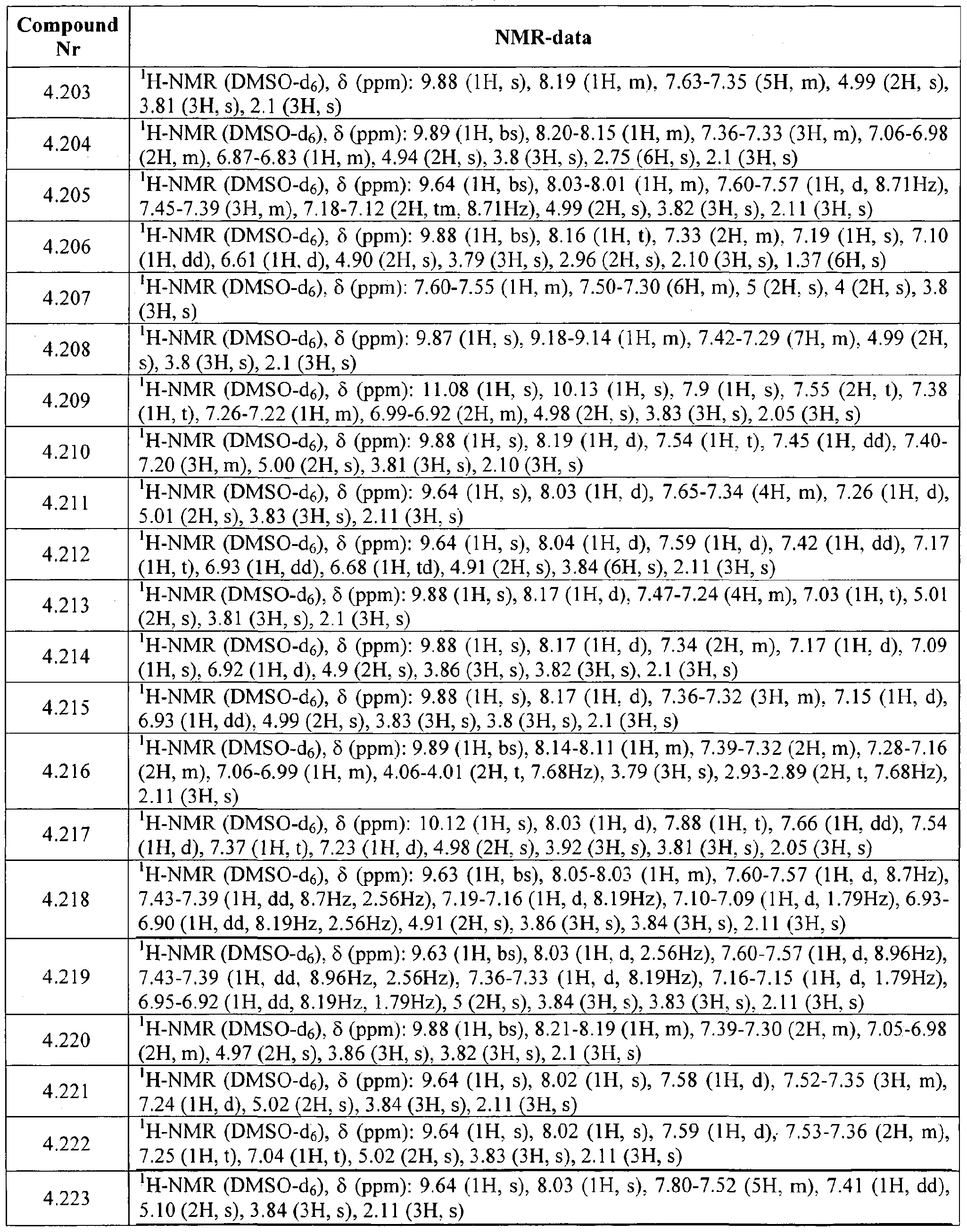
  • Table 8 shows representative compounds of the present invention that were clustered into four classes according to their ability (EC 50 ) to potentiate an EC 50 of GABAB receptor agonist such as Baclofen.
  • Class A EC 50 ⁇ 100 nM
  • Class B 100 nM ⁇ EC 50 ⁇ 500 nM
  • Class C 500 nM ⁇ EC 50 ⁇ 1000 nM
  • Class D EC 50 >1000 nM.
  • the positive allosteric modulators provided in the present invention are expected to increase the effectiveness of GABA or GABAB receptor agonists at GABAB receptors, and therefore, these positive allosteric modulators are expected to be useful for treatment of various neurological and psychiatric disorders associated with GABA dysfunction described to be treated herein and others that can be treated by such positive allosteric modulators.
  • mice Male C57BL6/J mice (20-30 g), were group housed in a temperature and humidity controlled facility on a 12 hour light /dark cycle for at least 5 days before use. Mice had access to food and water ad libitum except during marble burying experiments.
  • Test compounds were dissolved in a solution of 1% CMC. Test compounds were administered 60 minutes before testing by oral gavage (p.o.) in a volume of 10 mL/kg. In each assay, a vehicle and reference positive control groups were tested.
  • Statistical analyses were performed using GraphPad PRISM version 4.01 statistical software (GraphPad, San Diego, CA, USA). Data were analyzed using a non-parametric Kruskal-Wallis test followed by a Dunn's multiple comparisons test. The significance level was set at p ⁇ 0.05 when compared to the vehicle group.
  • the Vogel conflict drinking model involves the conflict between thirsts and receiving mild shocks for drinking water (punished drinking). Water-deprived rats are placed in a chamber and they receive mild electric shocks every time they drink. The shocks suppress drinking and anxiolytics reverse this shock-induced suppression of drinking.
  • the Vogel conflict drinking model was first proposed as a screening model for anxiolytics (Vogel, J. R. et al., Psychopharmacologia 1971, 21 : 1-7) and is widely accepted as a robust model for testing the anxiolytic-like properties of compounds (Millan, MJ. and Brocco M., Eur. J. Pharm. 2003, 463:67-96).
  • Test chambers are housed in sound- attenuating boxes and each chamber contains a stainless steel drinking spout and a steel grid floor (MedAssociates, Georgia, Vermont, USA). Forty-eight hours prior to the test session, rats were habituated to the test chambers for 10 minutes. Water was removed from the rats immediately after the habituation session. Twenty-four hours before the test session, rats were again placed into the test chambers and allowed to drink for 4 minutes. Rats were then allowed 1 hour of access to water and then water was removed. On the test day, rats were brought to the test room at least 30 minutes before the test session. Rats were placed individually into the test chamber for a 5 minute session.
  • the number of punished drinks was counted automatically by the computer interface.
  • the number of punished drinks was compared between treatment groups. An increase in the number of punished drinks in rats treated with a compound is interpreted as an anxiolytic-like effect.
  • Test compounds were suspended in 1% CMC. Test compounds were administered by oral gavage (p.o.) in a volume of 3 ml/kg 1 or 2 hours before testing. In each assay, a vehicle and reference positive control groups were tested.
  • Statistical analyses were performed using GraphPad PRISM version 4.01 statistical software (GraphPad, San Diego, CA, USA). Data were analyzed using one-way analysis of variance (ANOVA) followed by Bonferroni's multiple comparisons. The significance level was set at p ⁇ 0.05 when compared to the vehicle group.
  • Anxiety models in rodents are used as standard tests to demonstrate anxiolytic-like properties of novel compounds.
  • the elevated plus maze is an animal model of anxiety, which has been validated behaviourally, physiologically, and pharmacologically (Pellow et al., J. Newosci. Methods 1985, 14: 149-167). Following placement on the maze, untreated animals (mice or rats) tend to avoid the open arms and spend most of their time in the closed arms.
  • Anxiolytic drugs such as benzodiazepines increase open arm exploration. Anxiety in the elevated plus maze is measured by examining the time spent on the open arms as well as open arm entries. In addition, closed arm entries are measured and used as a general activity score.
  • mice Male Sprague-Dawley rats (200 - 300 g) or male C57/B16J mice (20-30g) were housed in a temperature and humidity controlled facility on a 12 hours light /dark cycle for at least 5 days before use. Animals had access to food ad libitum excepted during elevated plus maze experiments.
  • the elevated plus-maze consists of four plastic arms connected by a central square, the arms are all horizontal and at 90° angle from each other making the shape of a plus sign.
  • the maze is raised to a height of 50 cm from the ground.
  • Two of the opposite arms have high plastic walls whereas the other two opposite arms do not. These arms are therefore referred to as the enclosed and open arms, respectively.
  • the central square is not enclosed and the animal is initially placed in this area facing an enclosed arm.
  • the animals had free access to all 4 arms for a 5 minute period. During this time, the number of entries into, and the time spent on each type of arm were recorded.
  • Test compounds were dissolved in a solution of 1% CMC. Test compounds were administered 60 minutes before testing by oral gavage (p.o.) in a volume of 10 mL/kg. In each assay, a vehicle and reference positive control groups were tested.
  • Statistical analyses were performed using GraphPad PRISM version 4.01 statistical software (GraphPad, San Diego, CA, USA). Data were analyzed using one-way analysis of variance (ANOVA) followed by Bonferroni's multiple comparisons test. The significance level was set at p ⁇ 0.05 when compared to the vehicle group.
  • the positive allosteric modulators provided in the present invention are expected to increase the effectiveness of GABA or ⁇ IGABAB agonists at GABAB receptor. Therefore, these positive allosteric modulators are expected to be useful for treating, or preventing, ameliorating, controlling or reducing the risk of various central nervous system disorders as well as other disorders associated with GABAB dysfunction in a mammal, including a human, the treatment or prevention of which is affected or facilitated by the neuromodulator effect of GABAB positive allosteric modulators
  • the neurological and psychiatric disorders associated with GABAB receptor dysfunction include one or more of the following conditions or diseases: anxiety, depression, epilepsy, schizophrenia, cognitive disorders, spasticity and skeletal muscle rigidity, spinal cord injury, multiple sclerosis, neuropathic pain and craving associated with cocaine and nicotine, amyotrophic lateral sclerosis, cerebral palsy, posttraumatic stress disorders or gastro-intestinal disorders, cerebral palsy, psychosis, panic disorder
  • DSM-IV Diagnostic & Statistical Manual of Mental Disorders
  • the invention is said to relate to the use of a compound or composition according to the invention for the manufacture of a medicament for e.g. the treatment of a mammal, it is understood that such use is to be interpreted in certain jurisdictions as a method of e.g. treatment of a mammal, comprising administering to a mammal in need of such a treatment, an effective amount of a compound or composition according to the invention.
  • positive allosteric modulators of GABAB receptors including compounds of Formula I
  • the present invention extends to the treatment of neurological and psychiatric disorders associated with GABA dysfunction by administering an effective amount of a positive allosteric modulator of GABAB receptors, including compounds of Formula I, in combination with a GABAB agonist.
  • the compounds of the present invention may be utilized in combination with one or more other drugs in the treatment, prevention, control, amelioration, or reduction of risk of diseases or conditions for which compounds of Formula (I) or the other drugs may have utility, where the combination of the drugs together are safer or more effective than either drug alone.
  • An aqueous suspension is prepared for oral administration so that each 1 milliliter contains 1 to 5 mg of one of the described example, 50 mg of sodium carboxymethyl cellulose, 1 mg of sodium benzoate, 500 mg of sorbitol and water ad 1 ml.
  • a parenteral composition is prepared by stirring 1.5 % by weight of active ingredient of the invention in 10% by volume propylene glycol and water.
  • the compound 4.02 can be replaced by the same amount of any of the described examples.

Landscapes

  • Chemical & Material Sciences (AREA)
  • Organic Chemistry (AREA)
  • Health & Medical Sciences (AREA)
  • Veterinary Medicine (AREA)
  • General Health & Medical Sciences (AREA)
  • Medicinal Chemistry (AREA)
  • Public Health (AREA)
  • Pharmacology & Pharmacy (AREA)
  • Life Sciences & Earth Sciences (AREA)
  • Animal Behavior & Ethology (AREA)
  • Bioinformatics & Cheminformatics (AREA)
  • Engineering & Computer Science (AREA)
  • Chemical Kinetics & Catalysis (AREA)
  • Nuclear Medicine, Radiotherapy & Molecular Imaging (AREA)
  • General Chemical & Material Sciences (AREA)
  • Neurology (AREA)
  • Neurosurgery (AREA)
  • Biomedical Technology (AREA)
  • Addiction (AREA)
  • Psychiatry (AREA)
  • Pain & Pain Management (AREA)
  • Epidemiology (AREA)
  • Physical Education & Sports Medicine (AREA)
  • Psychology (AREA)
  • Immunology (AREA)
  • Orthopedic Medicine & Surgery (AREA)
  • Obesity (AREA)
  • Hematology (AREA)
  • Hospice & Palliative Care (AREA)
  • Rheumatology (AREA)
  • Urology & Nephrology (AREA)
  • Nutrition Science (AREA)
  • Diabetes (AREA)
  • Pulmonology (AREA)
  • Child & Adolescent Psychology (AREA)
  • Pharmaceuticals Containing Other Organic And Inorganic Compounds (AREA)
  • Plural Heterocyclic Compounds (AREA)
  • Agricultural Chemicals And Associated Chemicals (AREA)
  • Low-Molecular Organic Synthesis Reactions Using Catalysts (AREA)
  • Nitrogen Condensed Heterocyclic Rings (AREA)

Abstract

The present invention provides novel compounds of formula (I) wherein W1, W2, W3, W4, W5, B, X1, X2, X3, X4, X5, E and L are as defined herein; invention compounds are gamma amino butyrique acid receptor-subtype B ('GABAB') positive allosteric modulators (enhancers), which are useful to provide methods of treating or preventing diseases or disorders, including treatment of anxiety, depression, epilepsy, schizophrenia, cognitive disorders, spasticity and skeletal muscle rigidity, spinal cord injury, multiple sclerosis, amyotrophic lateral sclerosis, cerebral palsy, neuropathic pain and craving associated with cocaine and nicotine, panic disorder, posttraumatic stress disorders, urge urinary incontinence, gastroesophageal reflux disease, transient lower oesophageal sphincter relaxations, functional gastrointestinal disorders and irritable bowel syndrome.

Description

NOVEL TRIAZINEDIONE DERIVATIVES AS GABA8 RECEPTOR
MODULATORS
SUMMARY OF THE INVENTION
Figure imgf000002_0001
The present invention provides novel compounds of formula I wherein Wi, W2, W3, W4, W5, B, Xi, X2, X3, X4, X5, E and L are as defined herein; invention compounds are gamma amino butyric acid receptor-subtype B ("GABAB"), positive allosteric modulators (enhancers), which are useful to provide methods of treating or preventing diseases or disorders, including treatment of anxiety, depression, epilepsy, schizophrenia, cognitive disorders, spasticity and skeletal muscle rigidity, spinal cord injury, multiple sclerosis, amyotrophic lateral sclerosis, cerebral palsy, neuropathic pain and craving associated with cocaine and nicotine, panic disorder, posttraumatic stress disorders, urge urinary incontinence, gastroesophageal reflux disease, transient lower oesophageal sphincter relaxations, functional gastrointestinal disorders and irritable bowel syndrome.
BACKGROUND OF THE INVENTION
The amino acid GABA (γ-aminobutyric acid) is the main inhibitory neurotransmitter in the adult mammalian brain and regulates many physiological and psychological processes. GABA acts through two major classes of receptors: ionotropic GABAA (including GABAc) receptors and metabotropic GABAB receptors (Hill and Bowery, Nature 1981, 290, 149-152; Bormann, J., Trends Pharmacol. ScL 2000, 21, 16-19). GABAB receptors are present in most regions of the mammalian brain on presynaptic terminals and postsynaptic neurons, and are involved in the fine-tuning of inhibitory synaptic transmission. Due to their strategic position in neuronal networks to modulate the activity of the various neurotransmitter systems, GABAB receptors are a target of choice for pharmacological agents intended to treat central and peripheral nervous systems disorders (Bettler et al., Physiol Rev. 2004, 84, 835-867; Cryan and Kaupmann, Trends Pharmacol Sci. 2005, 26, 36-43).
The GABAB receptor belongs to the Class-Ill family of G protein-coupled receptors (GPCRs), as are the receptors for glutamate, Ca2+, pheromones and putative taste compounds (Pin et al., Pharmaco. Ther. 2003, 98, 325-354). All members of this family share the characteristic of a large extracellular amino-terminal domain that contains a so-called "Venus Flytrap" orthosteric ligand binding site and seven transmembrane (7TM) helical segments plus an intracellular carboxyl-terminal domain that are involved in receptor activation and G-protein coupling (Bockaert and Pin, EMBO J. 1999, 18, 1723; Galvez et al, J. Biol.Chem. 1999, 274, 13362-13369). A distinct feature, however, of the GABAB receptor is that it operates as a heterodimer of at least two homologous subunits termed GABAB i and GABAB2 (Kaupman et al, Nature 1997, 386, 239-246; Gordon et al, J. Biol.Chem. 1999, 12, 7607-7610; Margeta- Mitrovic et al, PNAS 2001, 98, 14649-14654; Bettler et al, Physiol Rev. 2004, 84, 835- 867). Orthosteric GABAB receptor ligands bind only at the N-terminal Venus flytrap region of the GABAB i subunit, which in turn activates the associated GABAB2 subunit of the heterodimer. It is this later subunit that is responsible for coupling and activation of G-protein (Galvez et al, EMBO J. 2001, 20, 2152-2159; Duthey et al, J. Biol. Chem. 2002, 277, 3236-3241 ; Pin et al, Biochem. Pharmacol. 2004, 68, 1565-1572). The resulting effect is an inhibition of the adenylyl cyclase activity and subsequent cyclic AMP formation and the modulation of activity of inwardly rectifying potassium channels and voltage-sensitive calcium channels.
Several studies using knock-out (KO) mice have demonstrated the role of the heterodimeric GABAB IB2 receptor in several CNS disorders. Mice lacking the GABAB i subunit exhibit spontaneous seizures and hyperalgesia (Schuler et al, Neuron 2001, 31, 47-58). These behavioral characteristics are paralleled by a loss of all biochemical and electrophysiological GABAB responses in these KO mice. In these studies, a clear impairment of passive avoidance performance was also observed indicating impaired memory processes. GABAB i deficient mice were also found to be more anxious than their wild-type counterparts (Mombereau et al, Neuropsychopharmacology 2004, 29, 1050-1062). Analogous results were obtained with GABAB2 KO mice, which presented all the same behavioural characteristics than the one observed for the GABAB i KO mice (Gassman et al, J. Neurosci. 2004, 24, 6086-6097). Moreover, it has also been shown that a hypoactivity of the GABA system was linked to spasticity, epilepsy, anxiety, stress, sleep disorders, depression, addiction, and pain (Dalvi and Rodgers, Psychopharmacology 1996, 128, 380-397; for a recent review Ong and Kerr, CTViS Drug Dev. 2005, 11, 317-334); while on the contrary, a hyperactivity of the GABAergic system was associated with schizophrenia (Blum and Mann, Int. J. Neuropsychopharmacol . 2002, 5, 159-179).
Baclofen is a potent and selective agonist at the GABAB receptor and is presently a frequently and only used clinical drug in the treatment of spasticity and rigidity (Montane et al, Neurology 2004, 63, 1357-1363). Moreover, all effective pharmacological agents used to treat panic disorder increase GABA synaptic transmission and anxiolytics and antidepressants that lack GABA activity are not effective in panic disorders. Baclofen was shown to be significantly effective in reducing the number of panic attacks and symptoms of anxiety as assessed with the Hamilton anxiety scale, Zung Scale, and Katz-R nervousness subscale (Breslow et al, Am. J. Psychiatry 1989, 146, 353-356). Drake and co-workers, hypothesized that baclofen would be an effective treatment in the symptomatic management of veterans with chronic posttraumatic stress disorder (PTSD). Their results demonstrated that the therapy, well tolerated, resulted in significant improvements of the overall symptoms of PTSD and co-morbide depression and anxiety in patients with chronic PTSD due to combat (Drake et al, Ann. Pharmacother. 2003, 37, 1177-1 181). More recently, a study looking at the effect of baclofen on the prepulse inhibition (PPI) of the acoustic startle response (ASR), proposed GABAB receptors as putative new targets in the pharmacological therapy of psychotic disorders (Bortalo et al, Psychopharmacology 2004, 171, 322-330). Despite the demonstration of baclofen as being a potential therapeutic tool for the treatment of disorders such as anxiety and spasticity, its use has been limited due to its poor blood-brain-barrier penetration, very short duration of action, muscle relaxing property, hypothermic and sedative side effects, as well as patients' increasing tolerance (Hefferan et al, Neuroscience Letters 2006, 403, 195- 200).
A new avenue for developing selective compounds acting at GPCRs is to identify molecules that act through allosteric mechanisms, modulating the receptor by binding to a site different from the highly conserved orthosteric binding site. This concept has assumed a greater importance in the pharmacology of family III receptors in general. For example, allosteric modulators have been described for Ca2+-sensing receptors (Nemeth et al, USP 6,031,003), for metabotropic glutamate receptors (reviewed in Mutel, Expert Opin. Ther. Patents 12:1-8, 2002; Ritzen, Mathiesen and Thomsen, Basic Clin. Pharmacol. Toxicol 97:202-13, 2005), and most recently for GABAB receptors (Urwyler et al, MoI. Pharmacol. 2001, 60, 963-971; WO 2005/094828; WO 2006/001750; WO 2006/063732; WO 2006/048146; WO 2006/07486; WO 2006/136442; WO 2007/014843; US 2007/027204; WO 2007/073297; WO 2007/073298; WO 2007/073299; WO 2007/073300). These ligands do not activate the receptor by themselves, but, for example in the case of the GABAB receptor, increase the potency of GABA in the presence of this endogenous agonist (Pin et al, MoI. Pharmacol. 2001, 60, 881-884; Urwyler et al, Neuropharmacol. 2005, 48, 343-353). Mutational analyses have demonstrated unequivocally that the binding of known GABAB receptor positive allosteric modulators does not occur at the orthosteric site, but instead at an allosteric site within the seven transmembrane region of the GABAB2 subunit at least for CGP7930 (Binet et al, J Biol. Chem. 2004, 279, 29085- 29901).
As a therapeutic principle, positive allosteric modulators are expected to have several advantages over compounds acting as orthosteric agonists, because they are only effective in the presence of the endogenous ligand and therefore act in line with physiological neurotransmission in its temporal and spatial organization. Orthosteric agonists, on the other hand, activate receptors independently of synaptic activity, possibly leading to unwanted side effects.
Cryan and co-workers suggested in a recent study, using GS39783 (N,N'- Dicyclopentyl-2-methylsulfanyl-5-nitro-pyrimidine-4,6-diamine), that a positive modulation of GABAB receptors may serve as a novel therapeutic strategy for the development of anxiolytics with a better side effect profile as compared to baclofen (Cryan et al, J. Pharm. Exp. Therap. 2004, 310, 952-963). They showed that GS39783 is active in models of anxiety such as elevated plus maze (rat), elevated zero maze (mice and rats), and the stress-induced hyperthermia (mice) tests. Moreover, as expected for a positive allosteric modulator that do not have any effect on receptor activity in absence of GABA, but do enhance allosterically the affinity of the GABAB receptor for the endogenous GABA, no side effect on locomotor activity, rotarod, body temperature and traction test was observed for doses ranging from 0.1 to 200 mg/kg, p.o. In comparison baclofen presented those side effects even at efficacious doses in anxiety models. In conclusion, those data suggest that GS39783, and positive allosteric modulators of GABAB receptors in general, are useful and innovative anxiolytics without side-effects associated with baclofen. An interesting example of the use of such compounds in preclinical studies have been done for CGP7930 and GS39783 for the treatment of Gastro-Esophageal Reflux Disease (GERD) and cocain self-administration in rats, where those compounds were found active (Smith et al, Psychopharmacology 2004, 173, 105-1 U; WO 03/090731).
Recently the 3,3'-diarylpropyl-l-arylethylamines and 3-aryl propyl-1- arylethylamine have been reported as a new class of GABAB receptor modulators as they potentiate baclofen-induced responses in the brain (Kerr et al, Aust. J. Chem. 2006, 59, 445-456) and they modulate both pre- and postsynaptic GABAB receptors in rat brain slices (Ong et al, Eur. J. Pharm. 2005, 507, 35-42).
Patent Publications DE 10255416 and WO9730980 describe triazinediones derivatives having herbicidal properties. These triazinediones are also described in the field of fungicide (EP0438717), growth of protozoa (EP0232932, WO00006172), binding to PPAR-α and -γ (FR02866339), P2X7 inhibitors (US25288288, WO04058270) and IL-5 production inhibitors (WO09902505).
None of) the specifically disclosed compounds are structurally related to the compounds of the present invention. It has now surprisingly been found that the compounds of general Formula I show potent activity and selectivity on GABAB receptor.
The present invention relates to a method of treating or preventing a condition in a mammal, including a human, the treatment or prevention of which is affected or facilitated by the neuromodulatory effect of GAB AB modulators.
FIGURE
Figure A represents the ability of 10 μM of the Compound 4.02 to increase the [GTPy35S] binding in rat brain membranes induced by 15 μM of Baclofen, a GABAB receptor agonist, without having an effect on its own.
DETAILED DESCRIPTION OF THE INVENTION
According to the present invention, there are provided new compounds of the general Formula I:
Figure imgf000006_0001
and stereoisomeric forms, mixtures of stereoisomeric forms or pharmaceutically acceptable salts, hydrates or solvates of such compounds,
wherein:
B is selected from C6-Ci0 aryl optionally substituted with one to 5 Y, C5-
Ci0 cycloalkenyl optionally substituted with one to 7 Y, 5 to 14 membered heteroaryl group optionally substituted by one to 8 Y, wherein said heteroaryl group comprises one, two or three heteroatoms selected from N, O, S;
Y is 1 to 5 substituents independently selected from the group consisting of hydrogen, halogen, -OCF3, -NO2, -CN, -CF3, an optionnally substituted - (C,-C6)alkyl, -(C3-C6)cycloalkyl, -(C2-C6)alkenyl, -(C2-C6)alkynyl, halo- (C,-C6)alkyl, -(C0-C6)alkylORΛ -(C0-C6)alkylNR2R3, -(C0-C6)alkyl- C(=NR4)NR2R3, -(C0-C6)alkylSR2, -(C0-C6)alkylNR2C(=O)R3, -(C0- C6)alkylNR2C(=O)2R3, -(C0-C6)alkylNR2S(=O)2R3, -(C0-
C6)alkylNR4C(=O)NR2R3, -(C0-C6)alkylS(=O)R2, -(C0-
C6)alkylS(=O)2R2, -(C0-C6)alkylS(=O)2NR2R3, -(C0-C6)alkylC(=O)R2, - (C0-C6)alkylC(=O)OR', -(C0-C6)alkylC(=O)NR2R3, -(C0-
C6)alkylC(=NR2)R3, or -(Co-C6)alkylC(=NOR')R3, heteroaryl, heteroarylalkyl, arylalkyl, aryl alkylaryl, alkylheteroaryl, heterocycloalkyl; wherein optionally two substituents are combined to the intervening atoms to form a bicyclic heterocycloalkyl, aryl or heteroaryl ring; wherein each ring is optionally further substituted with 1-5 independent halogen, -CN, -(d-C6)alkyl, -O(C0-C6)alkyl, -0(C3- C7)cycloalkyl, -O(aryl), -O(aryl)-(C0-C3)alkyl, -O(heteroaryl), - O(heteroaryl)-(C0-C3)alkyl, -O(Ci-C3)alkylaryl, -0(C r
C3)alkylheteroaryl, -N((C0-C6)alkyl)2, -N((Co-C6)alkyl))((Co-
C3)alkylaryl)) or -N((Co-C6)alkyl)((C0-C3)alkylheteroaryl)) groups;
R1 at each occurence is selected from hydrogen, -(Ci-C6)alkyl, -(C2- C6)alkenyl, -(C3-C7)cycloalkyl, 3 to 7 membered heterocycloalkyl, -(C6- Cio)aryl, 5 or 6 membered heteroaryl, -(C7-C iO)arylalkyl, -C(=0)R5; R5 are selected from -(Ci-C6)alkyl, and -(C6-C io)aryl; R2, R3 and R4 each independently is hydrogen, -(Ci-C6)alkyl, -(C3- C6)cycloalkyl, -(C2-C6)alkenyl, -(C2-C6)alkynyl, -(CrC6)alkylhalo, heterocycloalkyl, heteroaryl, heteroarylalkyl, arylalkyl or aryl; any of which is optionally substituted with 1 to 5 independent halogen, -CN, - (C,-C6)alkyl> -O(C0-C6)alkyl, -O(C3-C7)cycloalkylalkyl, -O(aryl), - O(heteroaryl), -N((C0-C6)alkyl)2, -N((C0-C6)alkyl)((C3-C7)cycloalkyl) or -N((C0-C6)alkyl)(aryl) substituents; wherein optionally R2, R , R4 substituents are combined to the intervening atoms to form a bicyclic heterocycloalkyl; X3, X4 and X5 are each independently selected from the group consisting of -
CR6=, -N=;
R6 is 1 to 5 substituents independently selected from the group consisting of hydrogen, halogen, -OCF3, -CN, -CF3, -NO2, an optionnally substituted - (Ci-C6)alkyl, -(C3-C6)cycloalkyl, -(C2-C6)alkenyl, -(C2-C6)alkynyl, halo- (C,-C6)alkyl, -(C0-C6)alkylOR7, -(C0-C6)alkylNR8R9, -(C0-C6)alkyl- C(=NR10)NR8R9, -(C0-C6)alkylSR8, -(C0-C6)alkylNR8C(=O)R9, -(C0- C6)alkylNR8C(=O)2R9, -(C0-C6)alkylNR8S(=O)2R9, -(C0-
C6)alkylNR10C(=O)NR8R9, -(C0-C6)alkylS(=O)R8, -(C0-
C6)alkylS(=O)2R8, -(C0-C6)alkylS(=O)2NR8R9, -(C0-C6)alkylC(=O)R8, - (C0-C6)alkylC(=O)OR7, -(C,-C6)alkylC(=O)NR8R9, -(C0-
C6)alkylC(=NR8)R9, or -(C0-C6)alkylC(=NOR7)R9, heteroaryl, heteroarylalkyl, arylalkyl, aryl, a 3 to 6 heterocycloalkyl; wherein optionally two substituents are combined to the intervening atoms to form a bicyclic heterocycloalkyl, aryl or heteroaryl ring; wherein each ring is optionally further substituted with 1 to 5 independent halogen, - CN, -(d-C6)alkyl, -O(C0-C6)alkyl, -O(C3-C7)cycloalkyl, -O(aryl), - O(aryl)-(C0-C3)alkyl, -O(heteroaryl), -O(heteroaryl)-(C0-C3)alkyl, - O(C,-C3)alkylaryl, -O(Ci-C3)alkylheteroaryl, -N((C0-C6)alkyl)2, -N((C0- C6)alkyl))((Co-C3)alkylaryl)) or -N((C0-C6)alkyl)((C0-
C3)alkylheteroaryl)) groups;
R7 at each occurence is selected from hydrogen, -(Ci-C6)alkyl, -(C2- C6)alkenyl, -(C3-C7)cycloalkyl, 3 to 7 membered heterocycloalkyl, -(C6- Cio)aryl, 5 or 6 membered heteroaryl, -(C7-Ci0)arylalkyl, -C(=O)RU; R11 are selected from -(C,-C6)alkyl, -(C3-C7)cycloalkyl and -(C6- Cio)aryl;
R8, R9 and R10 each independently is hydrogen, -(Ci-C6)alkyl, -(C3- C6)cycloalkyl, -(C2-C6)alkenyl, -(C2-C6)alkynyl, -(C,-C6)alkylhalo, heterocycloalkyl, heteroaryl, heteroarylalkyl, arylalkyl or aryl; any of which is optionally substituted with 1 to 5 independent halogen, -CN, - (C,-C6)alkyl, -O(C0-C6)alkyl, -O(C3-C7)cycloalkylalkyl, -O(aryl), - O(aryl)-(C0-C3)alkyl, -O(heteroaryl), -O(heteroaryl)-(C0-C3)alkyl, - N((C0-C6)alkyl)2, -N((C0-C6)alkyl)((C3-C7)cycloalkyl) or -N((C0- C6)alkyl)(aryl) substituents; is selected from the group consisting of hydrogen, halogen, -OCF3, -
NO2, -CN, -CF3, -(C,-C6)alkyl, -(C3-C6)cycloalkyl, -(C2-C6)alkenyl, - (C2-C6)alkynyl, halo-(C,-C6)alkyl, -(C0-C6)alkylOR12, -(C0- C6)alkylNR13R14, -(C0-C6)alkyl-C(=NR15)NR13R14, -(C0-C6)alkylSR12, - (Co-C6)alkylNR13C(=0)R14, -(C0-C6)alkylNR13C(=O)2R14, -(C0- C6)alkylNRl3S(=O)2R14, -(C0-C6)alkylNR15C(O)NR13R14, -(C0- C6)alkylS(=O)R13, -(C0-C6)alkylS(=O)2R13, -(C0-
C6)alkylS(=O)2NR13R14, -(C0-C6)alkylC(=O)R13, -(C0-
C6)alkylC(=O)OR13, -(C0-C6)alkylC(=O)NR13R14, -(C0-
C6)alkylC(=NR13)R14, or -(C0-C6)alkylC(=NOR13)R14; wherein optionally two substituents are combined to the intervening atoms to form a bicyclic heterocycloalkyl, aryl or heteroaryl ring; wherein each ring is optionally further substituted with 1 to 5 independent halogen, - CN, an optionnally substituted -(Ci-C6)alkyl, -O(C0-C6)alkyl, -0(C3- C7)cycloalkyl, -O(aryl), -O(aryl)-(C0-C3)alkyl, -O(heteroaryl), - 0(heteroaryl)-(Co-C3)alkyl, -O(C]-C3)alkylaryl, -0(Ci-
C3)alkylheteroaryl, -N((C0-C6)alkyl)2, -N((C0-C6)alkyl))((C0-
C3)alkylaryl)) or -N((C0-C6)alkyl)((C0-C3)alkylheteroaryl)) groups;
R12 at each occurence is selected from hydrogen, -(Ci-C6)alkyl, -(C2-C6)alkenyl, -(C3-C7)cycloalkyl, -C(=O)R16;
R16 are selected from hydrogen, -(Cj-C6)alkyl, -(C3-C7)cycloalkyl and - (C6-C,o)aryl;
R13, R14 and R15 each independently is hydrogen, -(d-C6)alkyl, -(C3- C6)cycloalkyl, -(C2-C6)alkenyl, -(C2-C6)alkynyl, -(Ci-C6)alkylhalo, heterocycloalkyl, heteroaryl, heteroarylalkyl, alkylheteroaryl, arylalkyl, alkylaryl or aryl; any of which is optionally substituted with 1 to 5 independent halogen, -CN, -(C,-C6)alkyl; -O(C0-C6)alkyl, -0(C3- C7)cycloalkylalkyl, -O(aryl), -O(aryl)-(C0-C3)alkyl, -O(heteroaryl), - O(heteroaryl)-(C0-C3)alkyl, -N((C0-C6)alkyl)2, -N((C0-C6)alkyl)((C3- C7)cycloalkyl) or -N((C0-C6)alkyl)(aryl) substituents;
When E is -H the compounds for which X3 is not CH= or -CF= are excluded from the invention;
When E is -CN the compounds of the following list are excluded from the invention:
4-(4-(trifluoromethyl)benzyl)-2-(4-fluorophenyl)-3,5-dioxo-2,3,4,5-tetrahydro-l,2,4- triazine-6-carbonitrile,
4-(4-nitrobenzyl)-2-(4-fluorophenyl)-3,5-dioxo-2,3,4,5-tetrahydro-l,2,4-triazine-6- carbonitrile,
4-(4-chlorobenzyl)-2-(4-fluorophenyl)-3,5-dioxo-2,3,4,5-tetrahydro-l,2,4-triazine-6- carbonitrile,
4-(4-chlorobenzyl)-2-(2,6-difluorophenyl)-3,5-dioxo-2,3,4,5-tetrahydro-l,2,4-triazine-
6-carbonitrile,
4-(4-chlorobenzyl)-3,5-dioxo-2-phenyl-2,3,4,5-tetrahydro-l,2,4-triazine-6-carbonitrile,
4-(3-cyanobenzyl)-3,5-dioxo-2-phenyl-2,3,4,5-tetrahydro-l,2,4-triazine-6-carbonitrile,
4-benzyl-3,5-dioxo-2-phenyl-2,3,4,5-tetrahydro-l ,2,4-triazine-6-carbonitrile,
4-(2,4-dichlorobenzyl)-3,5-dioxo-2-phenyl-2,3,4,5-tetrahydro-l,2,4-triazine-6- carbonitrile,
4-((3-chloro-5-(trifluoromethyl)pyridin-2-yl)methyl)-2-(4-fluorophenyl)-3,5-dioxo-
2,3 ,4,5-tetrahydro- 1 ,2,4-triazine-6-carbonitrile; Wi and W3 are each independently selected from -N= or -C(=O); W2 and W4 are each independently selected from -C= or -N-;
L is independently selected from a -((Ci-C5)alkyl-Qm)- substituted with 1-
6 T; m is 0 or 1 ;
T is 1 to 6 substituents independently selected from the group consisting of hydrogen, fluorine, -OCF3, -NO2, -CN, -CF3, -(C,-C6)alkyl, -(C3- C6)cycloalkyl, -(C2-C6)alkenyl, -(C2-C6)alkynyl, halo-(Ci-C6)alkyl, -(C0- C6)alkyl0R17 -(C0-C6)alkylNR18R19, -(C0-C6)alkyl-C(=NR20)NR18R19, - (C0-C6)alkylSR18, -(C0-C6)alkylNR18C(=O)R19, -(C0-
C6)alkylNR18C(=O)2R19, -(C0-C6)alkylNRI8S(=O)2R19, -(C0-
C6)alkylNR20C(=O)NR18R19, -(C0-C6)alkylS(=O)R18, -(C0-
C6)alkylS(=O)2R18, -(C0-C6)alkylS(=O)2NR18R19, -(C0-
C6)alkylC(=O)R18, -(C0-C6)alkylC(=O)OR17, -(C0-
C6)alkylC(=O)NR18R19, -(C0-C6)alkylC(=NRl8)R19, or -(C0- C6)alkylC(=NOR17)R19, heteroaryl, heteroarylalkyl, arylalkyl, alkylaryl, alkylheteroaryl, aryl; wherein optionally two substituents are combined to the intervening atoms to form a bicyclic heterocycloalkyl, aryl or heteroaryl ring; wherein each ring is optionally further substituted with 1 to 5 independent halogen, -CN, -(C,-C6)alkyl, -O(C0-C6)alkyl, -0(C3- C7)cycloalkyl, -O(aryl), -O(aryl)-(C0-C3)alkyl, -O(heteroaryl), - 0(heteroaryl)-(Co-C3)alkyl, -O(Ci-C3)alkylaryl, -0(C1-
C3)alkylheteroaryl, -N((C0-C6)alkyl))((C0-C3)alkylaryl)) or -N((C0- C6)alkyl)((C0-C3)alkylheteroaryl)) groups;
R17 at each occurence is selected from hydrogen, -(Ci-C6)alkyl, -(C2- C6)alkenyl, -(C3-C7)cycloalkyl, 3 to 7 membered heterocycloalkyl, -(C6- Cio)aryl, 5 or 6 membered heteroaryl, -(C7-Ci0)arylalkyl, -C(=0)R21; R21 is selected from hydrogen, -(Ci-C6)alkyl, -(C3-C7)cycloalkyl , and - (C6-C,0)aryl;
R18, R19 and R20 each independently is hydrogen, -(Ci-C6)alkyl, -(C3- C6)cycloalkyl, -(C2-C6)alkenyl, -(C2-C6)alkynyl, -(Ci-C6)alkylhalo, heterocycloalkyl, heteroaryl, heteroarylalkyl, arylalkyl alkylaryl, alkylheteroaryl, aryl; any of which is optionally substituted with 1 to 5 independent halogen, -CN, -(Ci-C6)alkyl, -O(C0-C6)alkyl, -0(C3- C7)cycloalkylalkyl, -O(aryl), -O(aryl)-(C0-C3)alkyl, -O(heteroaryl), - O(heteroaryl)-(C0-C3)alkyl, -N((C0-C6)alkyl)2, -N((C0-C6)alkyl)((C3- C7)cycloalkyl) or -N((C0-C6)alkyl)(aryl) substituents;
Q is -C(=0)-, -C(=0)0-, -C(=O)NR22-, -OC(=O)-, -OC(=O)NR22-, -NR22-, - NR22C(=O)-, -NR22C(=O)2-, -NR22C(=S)-, -S-, -S(O)-, or -S(=O)2-; R22 is selected from -(d-C6)alkyl, and -(C6-C io)aryl;
Any N may be an N-oxide. Restricted compounds of the present invention from Formula I are compounds of Formula II depicted below
Figure imgf000010_0001
and stereoisomer^ forms, mixtures of stereoisomeric forms or pharmaceutically acceptable salts, hydrates or solvates of such compounds,
wherein:
B is selected from C6-Ci0 aryl optionally substituted with one to 5 Y, C5-
Ci0 cycloalkenyl optionally substituted with one to 7 Y, 5 to 14 membered heteroaryl group optionally substituted by one to 8 Y, wherein said heteroaryl group comprises one, two or three heteroatoms selected from N, O, S;
Y is 1 to 5 substituents independently selected from the group consisting of hydrogen, halogen, -OCF3, -NO2, -CN, -CF3, an optionnally substituted - (C,-C6)alkyl, -(C3-C6)cycloalkyl, -(C2-C6)alkenyl, -(C2-C6)alkynyl, halo- (C,-C6)alkyl, -(C0-C6)alkylOR', -(C0-C6)alkylNR2R3, -(C0-C6)alkyl- C(=NR4)NR2R3, -(C0-C6)alkylSR2, -(C0-C6)alkylNR2C(=O)R3, -(C0- C6)alkylNR2C(=O)2R3, -(C0-C6)alkylNR2S(=O)2R3, -(C0-
C6)alkylNR4C(=O)NR2R3, -(C0-C6)alkylS(=O)R2, -(C0-
C6)alkylS(=O)2R2, -(C0-C6)alkylS(=O)2NR2R3, -(C0-C6)alkylC(=O)R2, - (Co-C6)alkylC(=0)OR1, -(C0-C6)alkylC(=O)NR2R3, -(C0-
C6)alkylC(=NR2)R3, or -(C0-C6)alkylC(=NOR1)R3, heteroaryl, heteroarylalkyl, arylalkyl, aryl alkylaryl, alkylheteroaryl ; wherein optionally two substituents are combined to the intervening atoms to form a bicyclic heterocycloalkyl, aryl or heteroaryl ring; wherein each ring is optionally further substituted with 1 to 5 independent halogen, - CN, -(C,-C6)alkyl, -O(C0-C6)alkyl, -O(C3-C7)cycloalkyl, -O(aryl), - O(aryl)-(C0-C3)alkyl, -O(heteroaryl), -O(heteroaryl)-(C0-C3)alkyl, - O(C,-C3)alkylaryl, -O(d-C3)alkylheteroaryl, -N((C0-C6)alkyl)2, -N((C0- C6)alkyl))((C0-C3)alkylaryl)) or -N((C0-C6)alkyl)((C0-
C3)alkylheteroaryl)) groups; R1 at each occurence is selected from hydrogen, -(Ci-C6)alkyl, -(C2- C6)alkenyl, -(C3-C7)cycloalkyl, 3 to 7 membered heterocycloalkyl, -(C6- Cio)aryl, 5 or 6 membered heteroaryl, -(C7-Ci0)arylalkyl, -C(=O)R5; R5 are selected from hydrogen, -(Ci-C6)alkyl, and -(C6-C io)aryl;
R2, R3 and R4 each independently is hydrogen, -(Ci-C6)alkyl, -(C3- C6)cycloalkyl, -(C2-C6)alkenyl, -(C2-C6)alkynyl, -(Ci-C6)alkylhalo, heterocycloalkyl, heteroaryl, heteroarylalkyl, arylalkyl or aryl; any of which is optionally substituted with 1 to 5 independent halogen, -CN, - (C,-C6)alkyl, -O(C0-C6)alkyl, -O(C3-C7)cycloalkylalkyl, -O(aryl), - O(heteroaryl), -N((C0-C6)alkyl)2, -N((C0-C6)alkyl)((C3-C7)cycloalkyl) or -N((C0-C6)alkyl)(aryl) substituents; wherein optionally R2, R , R4 substituents are combined to the intervening atoms to form a bicyclic heterocycloalkyl;
X3, X4 and X5 are each independently selected from the group consisting of -
CR6=, -N=;
R6 is 1 to 5 substituents independently selected from the group consisting of hydrogen, halogen, -OCF3, -CN, -CF3, -NO2, an optionnally substituted - (Ci-C6)alkyl, -(C3-C6)cycloalkyl, -(C2-C6)alkenyl, -(C2-C6)alkynyl, halo- (C,-C6)alkyl, -(C0-C6)alkylOR7, -(C0-C6)alky INR8R9, -(C0-C6)alkyl- C(=NR10)NR8R9, -(C0-C6)alkylSR8, -(C0-C6)alkylNR8C(=O)R9, -(C0- C6)alkylNR8C(=O)2R9, -(C0-C6)alkylNR8S(=O)2R9, -(C0-
C6)alkylNRl0C(=O)NR8R9, -(C0-C6)alkylS(=O)R8, -(C0-
C6)alkylS(=O)2R8, -(C0-C6)alkylS(=O)2NR8R9, -(C0-C6)alkylC(=O)R8, - (C0-C6)alkylC(=O)OR7, -(C,-C6)alkylC(=O)NR8R9, -(C0-
C6)alkylC(=NR8)R9, or -(C0-C6)alkylC(=NOR7)R9, heteroaryl, heteroarylalkyl, arylalkyl, aryl, a 3 to 6 heterocycloalkyl; wherein optionally two substituents are combined to the intervening atoms to form a bicyclic heterocycloalkyl, aryl or heteroaryl ring; wherein each ring is optionally further substituted with 1 to 5 independent halogen, - CN, -(C,-C6)alkyl, -O(C0-C6)alkyl, -O(C3-C7)cycloalkyl, -O(aryl), - 0(aryl)-(Co-C3)alkyl, -O(heteroaryl), -O(heteroaryl)-(C0-C3)alkyl, - O(CrC3)alkylaryl, -O(C,-C3)alkylheteroaryl, -N((C0-C6)alkyl)2, -N((C0- C6)alkyl))((C0-C3)alkylaryl)) or -N((C0-C6)alkyl)((C0-
C3)alkylheteroaryl)) groups;
R7 at each occurence is selected from hydrogen, -(Ci-C6)alkyl, -(C2- C6)alkenyl, -(C3-C7)cycloalkyl, 3 to 7 membered heterocycloalkyl, -(C6- Cio)aryl, 5 or 6 membered heteroaryl, -(C7-Ci0)arylalkyl, -C(=0)Rπ; R1 1 are selected from -(Ci-C6)alkyl, -(C3-C7)cycloalkyl and -(C6- Cio)aryl;
R8, R9 and R10 each independently is hydrogen, -(C,-C6)alkyl, -(C3- C6)cycloalkyl, -(C2-C6)alkenyl, -(C2-C6)alkynyl, -(Ci-C6)alkylhalo, heterocycloalkyl, heteroaryl, heteroarylalkyl, arylalkyl or aryl; any of which is optionally substituted with 1 to 5 independent halogen, -CN, - (C,-C6)alkyl, -O(C0-C6)alkyl, -O(C3-C7)cycloalkylalkyl, -O(aryl), - O(aryl)-(C0-C3)alkyl, -O(heteroaryl), -O(heteroaryl)-(C0-C3)alkyl, - N((C0-C6)alkyl)2, -N((C0-C6)alkyl)((C3-C7)cycloalkyl) or -N((C0- C6)alkyl)(aryl) substituents;
E is selected from the group consisting of hydrogen, halogen, -OCF3, -
NO2, -CN, -CF3, -(C,-C6)alkyl, -(C3-C6)cycloalkyl, -(C2-C6)alkenyl, - (C2-C6)alkynyl, halo-(C,-C6)alkyl, -(C0-C6)alkylOR12, -(C0- C6)alkylNR13R14, -(C0-C6)alkyl-C(=NR15)NR13R14, -(C0-C6)alkylSR12, - (Co-C6)alkylNR13C(-0)R14, -(C0-C6)alkylNR13C(=O)2R14, -(C0- C6)alkylNR13S(=O)2R14, -(C0-C6)alkylNR15C(=O)NR13R14, -(C0- C6)alkylS(=O)R13, -(C0-C6)alkylS(=O)2R13, -(C0-
C6)alkylS(=O)2NR13R14, -(C0-C6)alkylC(=O)R13, -(C0-
C6)alkylC(=O)OR13, -(C0-C6)alkylC(=O)NR13R14, -(C0-
C6)alkylC(=NR13)R14, or -(C0-C6)alkylC(=NOR13)R14; wherein optionally two substituents are combined to the intervening atoms to form a bicyclic heterocycloalkyl, aryl or heteroaryl ring; wherein each ring is optionally further substituted with 1 to 5 independent halogen, - CN, an optionnally substituted -(Ci-C6)alkyl, -O(C0-C6)alkyl, -0(C3- C7)cycloalkyl, -O(aryl), -O(aryl)-(C0-C3)alkyl, -O(heteroaryl), - 0(heteroaryl)-(Co-C3)alkyl, -O(Ci-C3)alkylaryl, -0(C r
C3)alkylheteroaryl, -N((C0-C6)alkyl)2, -N((C0-C6)alkyl))((C0-
C3)alkylaryl)) or -N((C0-C6)alkyl)((Co-C3)alkylheteroaryl)) groups;
R12 at each occurence is selected from hydrogen, -(Ci-C6)alkyl, -(C2-C6)alkenyl, -(C3-C7)cycloalkyl, -C(=O)R16;
R16 are selected from hydrogen, -(Ci-C6)alkyl, -(C3-C7)cycloalkyl and - (C6-C 10)aryl;
R13, R14 and R15 each independently is hydrogen, -(C,-C6)alkyl, -(C3- C6)cycloalkyl, -(C2-C6)alkenyl, -(C2-C6)alkynyl, -(C,-C6)alkylhalo, heterocycloalkyl, heteroaryl, heteroarylalkyl, alkylheteroaryl, arylalkyl, alkylaryl or aryl; any of which is optionally substituted with 1 to 5 independent halogen, -CN, -(Ci-C^alkyl, -O(C0-C6)alkyl, -0(C3- C7)cycloalkylalkyl, -O(aryl), -O(aryl)-(C0-C3)alkyl, -O(heteroaryl), - O(heteroaryl)-(C0-C3)alkyl, -N((C0-C6)alkyl)2, -N((C0-C6)alkyl)((C3- C7)cycloalkyl) or -N((C0-C6)alkyl)(aryl) substituents;
When E is -H the compounds for which X3 is not CH= or -CF= are excluded from the invention;
When E is -CN the compounds of the following list are excluded from the invention:
4-(4-(trifluoromethyl)benzyl)-2-(4-fluorophenyl)-3,5-dioxo-2,3,4,5-tetrahydro- 1,2,4- triazine-6-carbonitrile,
4-(4-nitrobenzyl)-2-(4-fluorophenyl)-3,5-dioxo-2,3,4,5-tetrahydro-l,2,4-triazine-6- carbonitrile,
4-(4-chlorobenzyl)-2-(4-fluorophenyl)-3,5-dioxo-2,3,4,5-tetrahydro-l,2,4-triazine-6- carbonitrile,
4-(4-chlorobenzyl)-2-(2,6-difluorophenyl)-3,5-dioxo-2,3,4,5-tetrahydro-l,2,4-triazine-
6-carbonitrile,
4-(4-chlorobenzyl)-3,5-dioxo-2-phenyl-2,3,4,5-tetrahydro-l,2,4-triazine-6-carbonitrile, 4-(3-cyanobenzyl)-3,5-dioxo-2-phenyl-2,3,4,5-tetrahydro-l,2,4-triazine-6-carbonitrile, 4-benzyl-3,5-dioxo-2-phenyl-2,3,4,5-tetrahydro-l,2,4-triazine-6-carbonitrile, 4-(2,4-dichlorobenzyl)-3,5-dioxo-2-phenyl-2,3,4,5-tetrahydro-l,2,4-triazine-6- carbonitrile,
4-((3-chloro-5-(trifluoromethyl)pyridin-2-yl)methyl)-2-(4-fluorophenyl)-3,5-dioxo- 2,3,4, 5-tetrahydro-l,2,4-triazine-6-carbonitrile;
W3 is selected from -N= or -C(=O);
W2 and W4 are each independently selected from -C= or -N=;
L is independently selected from a -((Ci-C5)alkyl-Qm)- substituted with 1-
6 T; m is 0 or 1;
T is 1 to 6 substituents independently selected from the group consisting of hydrogen, fluorine, -OCF3, -NO2, -CN, -CF3, -(C,-C6)alkyl, -(C3- C6)cycloalkyl, -(C2-C6)alkenyl, -(C2-C6)alkynyl, halo-(d-C6)alkyl, -(C0- C6)alkyl017, -(C0-C6)alkylNR18R19, -(C0-C6)alkyl-C(=NR20)NR18R19 ! - (C0-C6)alkylSR18, -(C0-C6)alkylNRI8C(=O)R19, -(C0-
C6)alkylNR18C(=O)2R19, -(C0-C6)alkylNR18S(=O)2R19, -(C0-
C6)alkylNR20C(=O)NR18R19, -(C0-C6)alkylS(=O)R18, -(C0-
C6)alkylS(=O)2R18, -(C0-C6)alkylS(=O)2NR18R19, -(C0-
C6)alkylC(=O)R18, -(C0-C6)alkylC(=O)OR17, -(C0-
C6)alkylC(=O)NR18R19, -(C0-C6)alkylC(=NR18)R19, or -(C0- C6)alkylC(=NOR17)R19, heteroaryl, heteroarylalkyl, arylalkyl, alkylaryl, alkylheteroaryl, aryl; wherein optionally two substituents are combined to the intervening atoms to form a bicyclic heterocycloalkyl, aryl or heteroaryl ring; wherein each ring is optionally further substituted with 1 to 5 independent halogen, -CN, -(C]-C6)alkyl, -O(C0-C6)alkyl, -0(C3- C7)cycloalkyl, -O(aryl), -O(aryl)-(C0-C3)alkyl, -O(heteroaryl), - 0(heteroaryl)-(Co-C3)alkyl, -O(Ci-C3)alkylaryl, -0(C r
C3)alkylheteroaryl, -N((Co-C6)alkyl))((Co-C3)alkylaryl)) or -N((C0- C6)alkyl)((Co-C3)alkylheteroaryl)) groups;
R17 at each occurence is selected from hydrogen, -(Ci-C6)alkyl, -(C2- C6)alkenyl, -(C3-C7)cycloalkyl, 3 to 7 membered heterocycloalkyl, -(C6- Cio)aryl, 5 or 6 membered heteroaryl, -(C7-C iO)arylalkyl, -C(=O)R21; R21 is selected from hydrogen, -(Ci-C6)alkyl, -(C3-C7)cycloalkyl , and - (C6-C 10)aryl;
R18, R19 and R20 each independently is hydrogen, -(C,-C6)alkyl, -(C3- C6)cycloalkyl, -(C2-C6)alkenyl, -(C2-C6)alkynyl, -(Ci-C6)alkylhalo, heterocycloalkyl, heteroaryl, heteroarylalkyl, arylalkyl alkylaryl, alkylheteroaryl, aryl; any of which is optionally substituted with 1 to 5 independent halogen, -CN, -(Ci-C6)alkyl, -O(C0-C6)alkyl, -0(C3- C7)cycloalkylalkyl, -O(aryl), -O(aryl)-(C0-C3)alkyl, -O(heteroaryl), - O(heteroaryl)-(C0-C3)alkyl, -N((C0-C6)alkyl)2, -N((C0-C6)alkyl)((C3- C7)cycloalkyl) or -N((C0-C6)alkyl)(aryl) substituents; Q is -C(O)-, -C(O)O-, -C(O)NR22-, -OC(O)-, -OC(=O)NR22-, -NR22-, - NR22C(=O)-, -NR22C(O)2-, -NR22C(=S)-, -S-, -S(O)-, or -S(O)2-; R22 is selected from -(Ci-C6)alkyl, and -(C6-C io)aryl;
Any N may be an N-oxide.
Restricted compounds of the present invention from Formula II are compounds of Formula III depicted below
Figure imgf000014_0001
and stereoisomeric forms, mixtures of stereoisomeric forms or pharmaceutically acceptable salts, hydrates or solvates of such compound, wherein:
B is selected from C6-Ci0 aryl optionally substituted with one to 5 Y, C5-
Cio cycloalkenyl optionally substituted with one to 7 Y, 5 to 14 membered heteroaryl group optionally substituted by one to 8 Y, wherein said heteroaryl group comprises one, two or three heteroatoms selected from N, O, S;
Y is 1 to 5 substituents independently selected from the group consisting of hydrogen, halogen, -OCF3, -NO2, -CN, -CF3, an optionnally substituted - (Ci-C6)alkyl, -(C3-C6)cycloalkyl, -(C2-C6)alkenyl, -(C2-C6)alkynyl, halo- (Ci-C6)alkyl, -(C0-C6)alkylOR1, -(C0-C6)alkylNR2R3, -(C0-C6)alkyl- C(=NR4)NR2R3, -(C0-C6)alkylSR2, -(C0-C6)alkylNR2C(O)R3, -(C0- C6)alkylNR2C(=O)2R3, -(C0-C6)alkylNR2S(O)2R3, -(C0-
C6)alkylNR4C(O)NR2R3, -(C0-C6)alkylS(O)R2, -(C0-
C6)alkylS(O)2R2, -(C0-C6)alkylS(O)2NR2R3, -(C0-C6)alkylC(O)R2, - (C0-C6)alkylC(=O)OR', -(C0-C6)alkylC(=O)NR2R3, -(C0-
C6)alkylC(=NR2)R3, or -(C0-C6)alkylC(=NOR1)R3, heteroaryl, heteroarylalkyl, arylalkyl, aryl alkylaryl, alkylheteroaryl ; wherein optionally two substituents are combined to the intervening atoms to form a bicyclic heterocycloalkyl, aryl or heteroaryl ring; wherein each ring is optionally further substituted with 1 to 5 independent halogen, - CN, -(C|-C6)alkyl, -O(C0-C6)alkyl, -O(C3-C7)cycloalkyl, -O(aryl), - 0(aryl)-(Co-C3)alkyl, -O(heteroaryl), -O(heteroaryl)-(C0-C3)alkyl, - O(C,-C3)alkylaryl, -O(Ci-C3)alkylheteroaryl, -N((C0-C6)alkyl)2, -N((C0- C6)alkyl))((Co-C3)alkylaryl)) or -N((Co-C6)alkyl)((Co-
C3)alkylheteroaryl)) groups;
R1 at each occurence is selected from hydrogen, -(Ci-C6)alkyl, -(C2- C6)alkenyl, -(C3-C7)cycloalkyl, 3 to 7 membered heterocycloalkyl, -(C6- Cio)aryl, 5 or 6 membered heteroaryl, -(C7-C iO)arylalkyl, -C(=O)R5; R5 are selected from hydrogen, -(Ci-C6)alkyl, and -(C6-C io)aryl;
R2, R3 and R4 each independently is hydrogen, -(C[-C6)alkyl, -(C3- C6)cycloalkyl, -(C2-C6)alkenyl, -(C2-C6)alkynyl, -(C,-C6)alkylhalo, heterocycloalkyl, heteroaryl, heteroarylalkyl, arylalkyl or aryl; any of which is optionally substituted with 1 to 5 independent halogen, -CN, - (Ci-C6)alkyl, -O(C0-C6)alkyl, -O(C3-C7)cycloalkylalkyl, -O(aryl), - O(heteroaryl), -N((C0-C6)alkyl)2, -N((C0-C6)alkyl)((C3-C7)cycloalkyl) or -N((C0-C6)alkyl)(aryl) substituents; wherein optionally R2, R , R4 substituents are combined to the intervening atoms to form a bicyclic heterocycloalkyl; X3, X4 and X5 are each independently selected from the group consisting of -
CR6=, -N=;
R6 is 1 to 5 substituents independently selected from the group consisting of hydrogen, halogen, -OCF3, -CN, -CF3, -NO2, an optionnally substituted - (C,-C6)alkyl, -(C3-C6)cycloalkyl, -(C2-C6)alkenyl, -(C2-C6)alkynyl, halo- (C,-C6)alkyl, -(C0-C6)alkylOR7, -(C0-C6)alkylNR8R9, -(C0-C6)alkyl- C(=NR10)NR8R9, -(C0-C6)alkylSR8, -(C0-C6)alkylNR8C(=O)R9, -(C0- C6)alkylNR8C(=O)2R9, -(C0-C6)alkylNR8S(=O)2R9, -(C0-
C6)alkylNR10C(=O)NR8R9, -(C0-C6)alkylS(=O)R8, -(C0-
C6)alkylS(=O)2R8, -(C0-C6)alkylS(=O)2NR8R9, -(C0-C6)alkylC(=O)R8, - (C0-C6)alkylC(=O)OR7, -(CrC6)alkylC(=O)NR8R9, -(C0-
C6)alkylC(=NR8)R9, or -(C0-C6)alkylC(=NOR7)R9, heteroaryl, heteroarylalkyl, arylalkyl, aryl, a 3 to 6 heterocycloalkyl; wherein optionally two substituents are combined to the intervening atoms to form a bicyclic heterocycloalkyl, aryl or heteroaryl ring; wherein each ring is optionally further substituted with 1 to 5 independent halogen, - CN, -(Ci-C6)alkyl, -O(C0-C6)alkyl, -O(C3-C7)cycloalkyl, -O(aryl), - O(aryl)-(C0-C3)alkyl, -O(heteroaryl), -O(heteroaryl)-(C0-C3)alkyl, - O(Ci-C3)alkylaryl, -O(Ci-C3)alkylheteroaryl, -N((C0-C6)alkyl)2, -N((C0- C6)alkyl))((C0-C3)alkylaryl)) or -N((C0-C6)alkyl)((C0-
C3)alkylheteroaryl)) groups;
R7 at each occurence is selected from hydrogen, -(Ci-C6)alkyl, -(C2- C6)alkenyl, -(C3-C7)cycloalkyl, 3 to 7 membered heterocycloalkyl, -(C6- CiO)aryl, 5 or 6 membered heteroaryl, -(C7-C |0)arylalkyl, -C(=0)Rπ; R1 1 are selected from -(C,-C6)alkyl, -(C3-C7)cycloalkyl and -(C6- Cio)aryl;
R8, R9 and R10 each independently is hydrogen, -(C,-C6)alkyl, -(C3- C6)cycloalkyl, -(C2-C6)alkenyl, -(C2-C6)alkynyl, -(C,-C6)alkylhalo, heterocycloalkyl, heteroaryl, heteroarylalkyl, arylalkyl or aryl; any of which is optionally substituted with 1 to 5 independent halogen, -CN, - (CrC6)alkyl, -O(C0-C6)alkyl, -O(C3-C7)cycloalkylalkyl, -O(aryl), - O(aryl)-(C0-C3)alkyl, -O(heteroaryl), -O(heteroaryl)-(C0-C3)alkyl, - N((C0-C6)alkyl)2, -N((C0-C6)alkyl)((C3-C7)cycloalkyl) or -N((C0- C6)alkyl)(aryl) substituents;
E is selected from the group consisting of hydrogen, halogen, -OCF3, -
NO2, -CN, -CF3, -(C,-C6)alkyl, -(C3-C6)cycloalkyl, -(C2-C6)alkenyl, - (C2-C6)alkynyl, halo-(C,-C6)alkyl, -(C0-C6)alkylOR12, -(C0- C6)alkylNR13R14, -(C0-C6)alkyl-C(=NR15)NR13R14, -(C0-C6)alkylSR12, - (C0-C6)alkylNR13C(=O)R14, -(C0-C6)alkylNR13C(=O)2R14, -(C0- C6)alkylNR13S(=O)2R14, -(C0-C6)alkylNR15C(=O)NR13R14, -(C0- C6)alkylS(=O)R13, -(C0-C6)alkylS(=O)2R13, -(C0-
C6)alkylS(=O)2NRI3R14, -(C0-C6)alkylC(=O)R13, -(C0-
C6)alkylC(=O)OR13, -(C0-C6)alkylC(=O)NR13R14, -(C0-
C6)alkylC(=NR13)R14, or -(C0-C6)alkylC(=NOR13)R14; wherein optionally two substituents are combined to the intervening atoms to form a bicyclic heterocycloalkyl, aryl or heteroaryl ring; wherein each ring is optionally further substituted with 1 to 5 independent halogen, - CN, an optionnally substituted -(Ci-C6)alkyl, -O(C0-C6)alkyl, -0(C3- C7)cycloalkyl, -O(aryl), -O(aryl)-(C0-C3)alkyl, -O(heteroaryl), - 0(heteroaryl)-(Co-C3)alkyl, -O(C,-C3)alkylaryl, -O(Cr
C3)alkylheteroaryl, -N((C0-C6)alkyl)2, -N((C0-C6)alkyl))((C0- C3)alkylaryl)) or -N((Co-C6)alkyl)((C0-C3)alkylheteroaryl)) groups;
R12 at each occurence is selected from hydrogen, -(Ci-C6)alkyl, -(C2-C6)alkenyl, -(C3-C7)cycloalkyl, -C(=O)R16;
R16 are selected from hydrogen, -(Ci-C6)alkyl, -(C3-C7)cycloalkyl and - (C6-C10)aryl;
R13, R14 and R15 each independently is hydrogen, -(Ci-C6)alkyl, -(C3- C6)cycloalkyl, -(C2-C6)alkenyl, -(C2-C6)alkynyl, -(C,-C6)alkylhalo, heterocycloalkyl, heteroaryl, heteroarylalkyl, alkylheteroaryl, arylalkyl, alkylaryl or aryl; any of which is optionally substituted with 1 to 5 independent halogen, -CN, -(C,-C6)alkyl, -O(C0-C6)alkyl, -0(C3- C7)cycloalkylalkyl, -O(aryl), -O(aryl)-(C0-C3)alkyl, -O(heteroaryl), - O(heteroaryl)-(C0-C3)alkyl, -N((C0-C6)alkyl)2, -N((C0-C6)alkyl)((C3- C7)cycloalkyl) or -N((C0-C6)alkyl)(aryl) substituents;
When E is -H the compounds for which X3 is not CH= or -CF= are excluded from the invention;
When E is -CN the compounds of the following list are excluded from the invention:
4-(4-(trifluoromethyl)benzyl)-2-(4-fluorophenyl)-3,5-dioxo-2,3,4,5-tetrahydro-l,2,4- triazine-6-carbonitrile,
4-(4-nitrobenzyl)-2-(4-fiuorophenyl)-3,5-dioxo-2,3,4,5-tetrahydro-l,2,4-triazine-6- carbonitrile,
4-(4-chlorobenzyl)-2-(4-fluorophenyl)-3,5-dioxo-2,3,4,5-tetrahydro-l,2,4-triazine-6- carbonitrile, 4-(4-chlorobenzyl)-2-(2,6-difluorophenyl)-3,5-dioxo-2,3,4,5-tetrahydro-l,2,4-triazine- 6-carbonitrile,
4-(4-chlorobenzyl)-3,5-dioxo-2-phenyl-2,3,4,5-tetrahydro-l,2,4-triazine-6-carbonitrile, 4-(3-cyanobenzyl)-3,5-dioxo-2-phenyl-2,3,4,5-tetrahydro-l,2,4-triazine-6-carbonitrile, 4-benzyl-3,5-dioxo-2-phenyl-2,3,4,5-tetrahydro-l,2,4-triazine-6-carbonitrile, 4-(2,4-dichlorobenzyl)-3,5-dioxo-2-phenyl-2,3,4,5-tetrahydro-l,2,4-triazine-6- carbonitrile,
4-((3-chloro-5-(trifluoromethyl)pyridin-2-yl)methyl)-2-(4-fluorophenyl)-3,5-dioxo- 2,3,4,5-tetrahydro-l,2,4-triazine-6-carbonitrile;
L is independently selected from a -((C]-C5)alkyl-Qm)- substituted with 1-
6 T; m is O or 1;
T is 1 to 6 substituents independently selected from the group consisting of hydrogen, fluorine, -OCF3, -NO2, -CN, -CF3, -(Ci-C6)alkyl, -(C3- C6)cycloalkyl, -(C2-C6)alkenyl, -(C2-C6)alkynyl, halo-(CrC6ϊalkyl, -(C0- C6)alkyl0R17, -(C0-C6)alkylNR18R19, -(C0-C6)alkyl-C(=NR2°)NR18R19, - (Co-C6)alkylSR18, -(C0-C6)alkylNR18C(=O)R19, -(C0-
C6)alkylNR18C(=O)2R19, -(C0-C6)alkylNR18S(=O)2R19, -(C0-
C6)alkylNR20C(=O)NR18R19, -(C0-C6)alkylS(=O)R18, -(C0-
C6)alkylS(=O)2R18, -(C0-C6)alkylS(=O)2NR18R19, -(C0-
C6)alkylC(=O)R18, -(C0-C6)alkylC(=O)OR17, -(C0-
C6)alkylC(=O)NR18R19, -(C0-C6)alkylC(=NR18)R19, or -(C0- C6)alkylC(=NOR17)R19, heteroaryl, heteroarylalkyl, arylalkyl, alkylaryl, alkylheteroaryl, aryl; wherein optionally two substituents are combined to the intervening atoms to form a bicyclic heterocycloalkyl, aryl or heteroaryl ring; wherein each ring is optionally further substituted with 1 to 5 independent halogen, -CN, -(Ci-C6)alkyl, -O(C0-C6)alkyl, -0(C3- C7)cycloalkyl, -O(aryl), -O(aryl)-(C0-C3)alkyl, -O(heteroaryl), - 0(heteroaryl)-(Co-C3)alkyl, -O(Ci-C3)alkylaryl, -O(C,-
C3)alkylheteroaryl, -N((C0-C6)alkyl))((C0-C3)alkylaryl)) or -N((C0- C6)alkyl)((C0-C3)alkylheteroaryl)) groups;
R17 at each occurence is selected from hydrogen, -(Ci-C6)alkyl, -(C2- C6)alkenyl, -(C3-C7)cycloalkyl, 3 to 7 membered heterocycloalkyl, -(C6- Cio)aryl, 5 or 6 membered heteroaryl, -(C7-C iO)arylalkyl, -C(=O)R21; R21 is selected from hydrogen, -(Ci-C6)alkyl, -(C3-C7)cycloalkyl , and - (C6-C 10)aryl;
R18, R19 and R20 each independently is hydrogen, -(Ci-C6)alkyl, -(C3- C6)cycloalkyl, -(C2-C6)alkenyl, -(C2-C6)alkynyl, -(C,-C6)alkylhalo, heterocycloalkyl, heteroaryl, heteroarylalkyl, arylalkyl alkylaryl, alkylheteroaryl, aryl; any of which is optionally substituted with 1 to 5 independent halogen, -CN, -(Ci-QJalkyl, -O(C0-C6)alkyl, -0(C3- C7)cycloalkylalkyl, -O(aryl), -O(aryl)-(C0-C3)alkyl, -O(heteroaryl), - 0(heteroaryl)-(Co-C3)alkyl, -N((C0-C6)alkyl)2, -N((C0-C6)alkyl)((C3- C7)cycloalkyl) or -N((C0-C6)alkyl)(aryl) substituents; Q is -C(=O)-, -C(=O)O-, -C(=O)NR22-, -OC(=O)-, -OC(=O)NR22-, -NR22-, - NR22C(=O)-, -NR22C(=O)2-, -NR22C(=S)-, -S-, -S(=O)-, or -S(=O)2-; R22 is selected from -(Ci-C6)alkyl, and -(C6-C io)aryl;
Any N may be an N-oxde.
More preferred compounds of the present invention from Formula III are compounds of Formula III. A
Figure imgf000018_0001
and stereoisomeric forms, mixtures of stereoisomeric forms or pharmaceutically acceptable salts, hydrates or solvates of such compounds,
wherein:
B is selected from C6-Ci0 aryl optionally substituted with one to 5 Y, C5-
Ci0 cycloalkenyl optionally substituted with one to 7 Y, 5 to 14 membered heteroaryl group optionally substituted by one to 8 Y, wherein said heteroaryl group comprises one, two or three heteroatoms selected from N, O, S;
Y is 1 to 5 substituents independently selected from the group consisting of hydrogen, halogen, -OCF3, -NO2, -CN, -CF3, an optionnally substituted - (Ci-C6)alkyl, -(C3-C6)cycloalkyl, -(C2-C6)alkenyl, -(C2-C6)alkynyl, halo- (C,-C6)alkyl, -(C0-C6)alkylOR', -(C0-C6)alkylNR2R3, -(C0-C6)alkyl- C(=NR4)NR2R3, -(C0-C6)alkylSR2, -(C0-C6)alkylNR2C(=O)R3, -(C0- C6)alkylNR2C(=O)2R3, -(C0-C6)alkylNR2S(=O)2R3, -(C0-
C6)alkylNR4C(=O)NR2R3, -(C0-C6)alkylS(=O)R2, -(C0-
C6)alkylS(=O)2R2, -(C0-C6)alkylS(=O)2NR2R3, -(C0-C6)alkylC(=O)R2, - (C0-C6)alkylC(=O)OR', -(C0-C6)alkylC(=O)NR2R3, -(C0-
C6)alkylC(=NR2)R3, or -(C0-C6)alkylC(=NOR')R3, heteroaryl, heteroarylalkyl, arylalkyl, aryl alkylaryl, alkylheteroaryl ; wherein optionally two substituents are combined to the intervening atoms to form a bicyclic heterocycloalkyl, aryl or heteroaryl ring; wherein each ring is optionally further substituted with 1 to 5 independent halogen, - CN, -(C,-C6)alkyl, -O(C0-C6)alkyl, -O(C3-C7)cycloalkyl, -O(aryl), - O(aryl)-(C0-C3)alkyl, -O(heteroaryl), -O(heteroaryl)-(C0-C3)alkyl, - O(C,-C3)alkylaryl, -O(Ci-C3)alkylheteroaryl, -N((C0-C6)alkyl)2, -N((C0- C6)alkyl))((C0-C3)alkylaryl)) or -N((C0-C6)alkyl)((C0-
C3)alkylheteroaryl)) groups;
R1 at each occurence is selected from hydrogen, -(Ci-C6)alkyl, -(C2- C6)alkenyl, -(C3-C7)cycloalkyl, 3 to 7 membered heterocycloalkyl, -(C6- C10)aryl, 5 or 6 membered heteroaryl, -(C7-C iO)arylalkyl, -C(=O)R5; R5 are selected from hydrogen, -(Ci-C6)alkyl, and -(C6-Ci0)aryl;
R2, R3 and R4 each independently is hydrogen, -(Ci-C6)alkyl, -(C3- C6)cycloalkyl, -(C2-C6)alkenyl, -(C2-C6)alkynyl, -(Ci-C6)alkylhalo, heterocycloalkyl, heteroaryl, heteroarylalkyl, arylalkyl or aryl; any of which is optionally substituted with 1 to 5 independent halogen, -CN, - (Ci-C6)alkyl; -O(C0-C6)alkyl, -O(C3-C7)cycloalkylalkyl, -O(aryl), - O(heteroaryl), -N((C0-C6)alkyl)2, -N((C0-C6)alkyl)((C3-C7)cycloalkyl) or -N((C0-C6)alkyl)(aryl) substituents; wherein optionally R2, R , R4 substituents are combined to the intervening atoms to form a bicyclic heterocycloalkyl; X3, X4 and X5 are each independently selected from the group consisting of -
CR6=, -N=;
R6 is 1 to 5 substituents independently selected from the group consisting of hydrogen, halogen, -OCF3, -CN, -CF3, -NO2, an optionnally substituted - (Ci-C6)alkyl, -(C3-C6)cycloalkyl, -(C2-C6)alkenyl, -(C2-C6)alkynyl, halo- (C,-C6)alkyl, -(C0-C6)alkylOR7, -(C0-C6)alkylNR8R9, -(C0-C6)alkyl- C(=NR10)NR8R9, -(C0-C6)alkylSR8, -(C0-C6)alkylNR8C(=O)R9, -(C0- C6)alkylNR8C(=O)2R9, -(C0-C6)alkylNR8S(=O)2R9, -(C0-
C6)alkylNR10C(=O)NR8R9, -(C0-C6)alkylS(=O)R8, -(C0-
C6)alkylS(=O)2R8, -(C0-C6)alkylS(=O)2NR8R9, -(C0-C6)alkylC(=O)R8, - (C0-C6)alkylC(=O)OR7, -(Ci-C6)alkylC(=O)NR8R9, -(C0-
C6)alkylC(=NR8)R9, or -(C0-C6)alkylC(=NOR7)R9, heteroaryl, heteroarylalkyl, arylalkyl, aryl, a 3 to 6 heterocycloalkyl; wherein optionally two substituents are combined to the intervening atoms to form a bicyclic heterocycloalkyl, aryl or heteroaryl ring; wherein each ring is optionally further substituted with 1 to 5 independent halogen, - CN, -(C,-C6)alkyl, -O(C0-C6)alkyl, -O(C3-C7)cycloalkyl, -O(aryl), - O(aryl)-(C0-C3)alkyl, -O(heteroaryl), -O(heteroaryl)-(C0-C3)alkyl, - O(C,-C3)alkylaryl, -O(Ci-C3)alkylheteroaryl, -N((C0-C6)alkyl)2, -N((C0- C6)alkyl))((C0-C3)alkylaryl)) or -N((Co-C6)alkyl)((Co-
C3)alkylheteroaryl)) groups;
R7 at each occurence is selected from hydrogen, -(Ci-C6)alkyl, -(C2- C6)alkenyl, -(C3-C7)cycloalkyl, 3 to 7 membered heterocycloalkyl, -(C6- Cio)aryl, 5 or 6 membered heteroaryl, -(C7-C iO)arylalkyl, -C(=0)Rπ R11 are selected from -(Ci-C6)alkyl, -(C3-C7)cycloalkyl and -(C6- Cio)aryl; R8, R9and R10 each independently is hydrogen, -(d-C6)alkyl, -(C3- C6)cycloalkyl, -(C2-C6)alkenyl, -(C2-C6)alkynyl, -(Ci-C6)alkylhalo, heterocycloalkyl, heteroaryl, heteroarylalkyl, arylalkyl or aryl; any of which is optionally substituted with 1 to 5 independent halogen, -CN, - (Ci-C6)alkyl, -O(C0-C6)alkyl, -O(C3-C7)cycloalkylalkyl, -O(aryl), - O(aryl)-(C0-C3)alkyl, -O(heteroaryl), -O(heteroaryl)-(C0-C3)alkyl, - N((C0-C6)alkyl)2, -N((C0-C6)alkyl)((C3-C7)cycloalkyl) or -N((C0- C6)alkyl)(aryl) substituents;
E is selected from the group consisting of hydrogen, halogen, -OCF3, -
NO2, -CN, -CF3, -(C,-C6)alkyl, -(C3-C6)cycloalkyl, halo-(C,-C6)alkyl, - (Co-C6)alkylOR12, -(C0-C6)alkylNRl3R14, -(C0-C6)alkylSR12, -(C0- C6)alkylNRI3C(=O)R14, -(C0-C6)alkylNRl 3C(=O)2R14, -(C0-
C6)alkylNRl3S(=O)2R14, -(C0-C6)alkylNR15C(=O)NR13R14, -(C0- C6)alkylS(=O)R13, -(C0-C6)alkylS(=O)2R13, -(Co-
C6)alkylS(=O)2NR13R14, -(C0-C6)alkylC(=O)R13, -(C0-
C6)alkylC(=O)OR13, -(C0-C6)alkylC(=O)NR13R14; wherein optionally two substituents are combined to the intervening atoms to form a bicyclic heterocycloalkyl, aryl or heteroaryl ring; wherein each ring is optionally further substituted with 1 to 5 independent halogen, -CN, an optionnally substituted -(CrC6)alkyl, -O(C0-C6)alkyl, -0(C3- C7)cycloalkyl, -O(aryl), -O(aryl)-(C0-C3)alkyl, -O(heteroaryl), - 0(heteroaryl)-(Co-C3)alkyl, -O(Ci-C3)alkylaryl, -0(C t-
C3)alkylheteroaryl, -N((C0-C6)alkyl)2, -N((C0-C6)alkyl))((C0-
C3)alkylaryl)) or -N((C0-C6)alkyl)((Co-C3)alkylheteroaryl)) groups;
R12 at each occurence is selected from hydrogen, -(Ci-C6)alkyl, -(C2-C6)alkenyl, -(C3-C7)cycloalkyl, -C(=O)R16;
R16 are selected from hydrogen, -(Ci-C6)alkyl, -(C3-C7)cycloalkyl and - (C6-C 10)aryl;
R13, R14and R15 each independently is hydrogen, -(Ci-C6)alkyl, -(C3- C6)cycloalkyl, -(C2-C6)alkenyl, -(C2-C6)alkynyl, -(Ci-C6)alkylhalo, heterocycloalkyl, heteroaryl, heteroarylalkyl, alkylheteroaryl, arylalkyl, alkylaryl or aryl; any of which is optionally substituted with 1 to 5 independent halogen, -CN, -(Ci-C6)alkyl, -O(C0-C6)alkyl, -0(C3- C7)cycloalkylalkyl, -O(aryl), -O(aryl)-(C0-C3)alkyl, -O(heteroaryl), - O(heteroaryl)-(C0-C3)alkyl, -N((C0-C6)alkyl)2, -N((C0-C6)alkyl)((C3- C7)cycloalkyl) or -N((C0-C6)alkyl)(aryl) substituents;
When E is -H the compounds for which X3 is not CH= or -CF= are excluded from the invention;
When E is -CN the compounds of the following list are excluded from the invention:
4-(4-(trifluoromethyl)benzyl)-2-(4-fluorophenyl)-3,5-dioxo-2,3,4,5-tetrahydro-l,2,4- triazine-6-carbonitrile,
4-(4-nitrobenzyl)-2-(4-fluorophenyl)-3,5-dioxo-2,3,4,5-tetrahydro-l,2,4-triazine-6- carbonitrile, 4-(4-chlorobenzyl)-2-(4-fluorophenyI)-3,5-dioxo-2,3,4,5-tetrahydro-l,2,4-triazine-6- carbonitrile,
4-(4-chlorobenzyl)-2-(2,6-difluorophenyl)-3,5-dioxo-2,3,4,5-tetrahydro-l,2,4-triazine- 6-carbonitrile,
4-(4-chlorobenzyl)-3,5-dioxo-2-phenyl-2,3,4,5-tetrahydro-l,2,4-triazine-6-carbonitrile, 4-(3-cyanobenzyl)-3,5-dioxo-2-phenyl-2,3,4,5-tetrahydro-l,2,4-triazine-6-carbonitrile, 4-benzyl-3,5-dioxo-2-phenyl-2,3,4,5-tetrahydro-l,2,4-triazine-6-carbonitrile, 4-(2,4-dichlorobenzyl)-3,5-dioxo-2-phenyl-2,3,4,5-tetrahydro-l,2,4-triazine-6- carbonitrile,
4-((3-chloro-5-(trifluoromethyl)pyridin-2-yl)methyl)-2-(4-fluorophenyl)-3,5-dioxo- 2,3,4,5-tetrahydro-l,2,4-triazine-6-carbonitrile;
L is independently selected from a -((Ci-C5)alkyl-Qm)- substituted with 1-
6 T; m is 0 or 1 ;
T is 1 to 6 substiruents independently selected from the group consisting of hydrogen, fluorine, -OCF3, -NO2, -CN, -CF3, -(Ci-C6)alkyl, -(C3- C6)cycloalkyl, -(C2-C6)alkenyl, -(C2-C6)alkynyl, halo-(C|-C6]alkyl, -(C0- C6)alkyl0R17, -(C0-C6)alkylNR18R19, -(C0-C6)alkyl-C(=NR2d)NR18R19, - (C0-C6)alkylSR18, -(C0-C6)alkylNR18C(=O)R19, -(C0-
C6)alkylNRI8C(=O)2R19, -(C0-C6)alkylNR18S(=O)2R19, -(C0-
C6)alkylNR20C(=O)NRI8R19, -(C0-C6)alkylS(=O)R18, -(C0-
C6)alkylS(=O)2R18, -(C0-C6)alkylS(=O)2NR18R19, -(C0-
C6)alkylC(=O)R18, -(C0-C6)alkylC(=O)OR17, -(C0-
C6)alkylC(=O)NR18R19, -(C0-C6)alkylC(=NR18)R19, or -(C0- C6)alkylC(=NORI7)R19, heteroaryl, heteroarylalkyl, arylalkyl, alkylaryl, alkylheteroaryl, aryl; wherein optionally two substiruents are combined to the intervening atoms to form a bicyclic heterocycloalkyl, aryl or heteroaryl ring; wherein each ring is optionally further substituted with 1 to 5 independent halogen, -CN, -(C,-C6)alkyl, -O(C0-C6)alkyl, -0(C3- C7)cycloalkyl, -O(aryl), -O(aryl)-(C0-C3)alkyl, -O(heteroaryl), - O(heteroaryl)-(C0-C3)alkyl, -O(C,-C3)alkylaryl, -0(C,-
C3)alkylheteroaryl, -N((Co-C6)alkyl))((Co-C3)alkylaryl)) or -N((C0- C6)alkyl)((Co-C3)alkylheteroaryl)) groups;
R17 at each occurence is selected from hydrogen, -(Ci-C6)alkyl, -(C2- C6)alkenyl, -(C3-C7)cycloalkyl, 3 to 7 membered heterocycloalkyl, -(C6- CiO)aryl, 5 or 6 membered heteroaryl, -(C7-Ci0)arylalkyl, -C(=O)R21; R21 is selected from hydrogen, -(Ci-C6)alkyl, -(C3-C7)cycloalkyl , and - (C6-C10)aryl;
R18, R19 and R20 each independently is hydrogen, -(d-C6)alkyl, -(C3- C6)cycloalkyl, -(C2-C6)alkenyl, -(C2-C6)alkynyl, -(C|-C6)alkylhalo, heterocycloalkyl, heteroaryl, heteroarylalkyl, arylalkyl alkylaryl, alkylheteroaryl, aryl; any of which is optionally substituted with 1 to 5 independent halogen, -CN, -(Ci-C6)alkyl, -O(C0-C6)alkyl, -0(C3- C7)cycloalkylalkyl, -O(aryl), -O(aryl)-(C0-C3)alkyl, -O(heteroaryl), - O(heteroaryl)-(C0-C3)alkyl, -N((C0-C6)alkyl)2, -N((C0-C6)alkyl)((C3- C7)cycloalkyl) or -N((C0-C6)alkyl)(aryl) substituents; Q is -C(=O)-, -C(=O)O-, -C(=O)NR22-, -OC(=O)-, -OC(=O)NR22-, -NR22-, - NR22C(=O)-, -NR22C(=O)2-, -NR22C(=S)-, -S-, -S(O)-, or -S(=O)2-; R22 is selected from -(CrC6)alkyl, and -(C6-C io)aryl;
Any N may be an N-oxide.
More preferred compounds of the present invention from Formula III are compounds of Formula III. B
Figure imgf000022_0001
and stereoisomeric forms, mixtures of stereoisomeric forms or pharmaceutically acceptable salts, hydrates or solvates of such compounds, wherein:
B is selected from C6-Ci0 aryl optionally substituted with one to 5 Y, C5-
C]0 cycloalkenyl optionally substituted with one to 7 Y, 5 to 14 membered heteroaryl group optionally substituted by one to 8 Y, wherein said heteroaryl group comprises one, two or three heteroatoms selected from N, O, S;
Y is 1 to 5 substituents independently selected from the group consisting of hydrogen, halogen, -OCF3, -NO2, -CN, -CF3, an optionnally substituted - (Ci-C6)alkyl, -(C3-C6)cycloalkyl, -(C2-C6)alkenyl, -(C2-C6)alkynyl, halo- (d-C6)alkyl, -(Co-C^alkylOR1, -(C0-C6)alkylNR2R3, -(C0-C6)alkyl- C(=NR4)NR2R3, -(C0-C6)alkylSR2, -(C0-C6)alkylNR2C(=O)R3, -(C0- C6)alkylNR2C(=O)2R3, -(C0-C6)alkylNR2S(=O)2R3, -(C0-
C6)alkylNR4C(=O)NR2R3, -(C0-C6)alkylS(=O)R2, -(C0-
C6)alkylS(=O)2R2, -(C0-C6)alkylS(=O)2NR2R3, -(C0-C6)alkylC(=O)R2, - (Co-C6)alkylC(=0)OR1, -(C0-C6)alkylC(=O)NR2R3, -(C0-
C6)alkylC(=NR2)R3, or -(C0-C6)alkylC(=NOR1)R3, heteroaryl, heteroarylalkyl, arylalkyl, aryl alkylaryl, alkylheteroaryl ; wherein optionally two substituents are combined to the intervening atoms to form a bicyclic heterocycloalkyl, aryl or heteroaryl ring; wherein each ring is optionally further substituted with 1 to 5 independent halogen, - CN, -(Ci-C6)alkyl, -O(C0-C6)alkyl, -O(C3-C7)cycloalkyl, -O(aryl), - O(aryl)-(C0-C3)alkyl, -O(heteroaryl), -O(heteroaryl)-(C0-C3)alkyl, - O(C,-C3)alkylaryl, -O(C,-C3)alkylheteroaryl, -N((C0-C6)alkyl)2, -N((C0- C6)alkyl))((Co-C3)alkylaryl)) or -N((Co-C6)alkyl)((Co-
C3)alkylheteroaryl)) groups;
R1 at each occurence is selected from hydrogen, -(Ci-C6)alkyl, -(C2- C6)alkenyl, -(C3-C7)cycloalkyl, 3 to 7 membered heterocycloalkyl, -(C6- Cio)aryl, 5 or 6 membered heteroaryl, -(C7-C io)arylalkyl, -C(=O)R5; R5 are selected from hydrogen, -(Ci-C6)alkyl, and -(C6-C10)aryl;
R2, R3 and R4 each independently is hydrogen, -(Ci-C6)alkyl, -(C3- C6)cycloalkyl, -(C2-C6)alkenyl, -(C2-C6)alkynyl, -(C,-C6)alkylhalo, heterocycloalkyl, heteroaryl, heteroarylalkyl, arylalkyl or aryl; any of which is optionally substituted with 1 to 5 independent halogen, -CN, - (C,-C6)alkyl, -O(C0-C6)alkyl, -O(C3-C7)cycloalkylalkyl, -O(aryl), - O(heteroaryl), -N((C0-C6)alkyl)2, -N((C0-C6)alkyl)((C3-C7)cycloalkyl) or -N((C0-C6)alkyl)(aryl) substituents; wherein optionally R2, R , R4 substituents are combined to the intervening atoms to form a bicyclic heterocycloalkyl;
Xι, X2, X3, X4 and X5 are each independently selected from the group consisting of -
CR6=, -N=;
R6 is 1 to 5 substituents independently selected from the group consisting of hydrogen, halogen, -OCF3, -CN, -CF3, -NO2, an optionnally substituted - (Ci-C6)alkyl, -(C3-C6)cycloalkyl, -(C2-C6)alkenyl, -(C2-C6)alkynyl, halo- (C,-C6)alkyl, -(C0-C6)alkylOR7, -(C0-C6)alkylNR8R9, -(C0-C6)alkylSR8, -(C0-C6)alkylNR8C(=O)R9, -(C0-C6)alkylNR8C(=O)2R9, -(C0-
C6)alkylNR8S(=O)2R9, -(C0-C6)alkylNR10C(=O)NR8R9, -(C0-
C6)alkylS(=O)R8, -(C0-C6)alkylS(=O)2R8, -(C0-C6)alkylS(=O)2NR8R9, - (C0-C6)alkylC(=O)R8, -(C0-C6)alkylC(=O)OR7, -(C1-
C6)alkylC(=O)NR8R9, heteroaryl, heteroarylalkyl, arylalkyl, aryl, a 3 to 6 heterocycloalkyl; wherein optionally two substituents are combined to the intervening atoms to form a bicyclic heterocycloalkyl, aryl or heteroaryl ring; wherein each ring is optionally further substituted with 1 to 5 independent halogen, -CN, -(CrC6)alkyl, -O(C0-C6)alkyl, -0(C3- C7)cycloalkyl, -O(aryl), -O(aryl)-(C0-C3)alkyl, -O(heteroaryl), - O(heteroaryl)-(C0-C3)alkyl, -O(C,-C3)alkylaryl, -0(C,-
C3)alkylheteroaryl, -N((C0-C6)alkyl)2, -N((C0-C6)alkyl))((C0-
C3)alkylaryl)) or -N((C0-C6)alkyl)((C0-C3)alkylheteroaryl)) groups;
R7 at each occurence is selected from hydrogen, -(Ci-C6)alkyl, -(C2- C6)alkenyl, -(C3-C7)cycloalkyl, 3 to 7 membered heterocycloalkyl, -(C6- Cio)aryl, 5 or 6 membered heteroaryl, -(C7-C |0)arylalkyl, -C(=0)Rπ; R11 are selected from -(Ci-C6)alkyl, -(C3-C7)cycloalkyl and -(C6-
Figure imgf000023_0001
R8, R9 and R10 each independently is hydrogen, -(CrC6)alkyl, -(C3- C6)cycloalkyl, -(C2-C6)alkenyl, -(C2-C6)alkynyl, -(C,-C6)alkylhalo, heterocycloalkyl, heteroaryl, heteroarylalkyl, arylalkyl or aryl; any of which is optionally substituted with 1 to 5 independent halogen, -CN, - (d-C6)alkyl, -O(C0-C6)alkyl, -O(C3-C7)cycloalkylalkyl, -O(aryl), - 0(aryl)-(Co-C3)alkyl, -O(heteroaryl), -O(heteroaryl)-(C0-C3)alkyl, - N((C0-C6)alkyl)2, -N((C0-C6)alkyl)((C3-C7)cycloalkyl) or -N((C0- C6)alkyl)(aryl) substituents;
E is selected from the group consisting of hydrogen, halogen, -OCF3, -CN,
-CF3, -(C,-C6)alkyl, -(C3-C6)cycloalkyl, -(C0-C6)alkylOR12, -(C0- C6)alkylNRl3R14, -(C0-C6)alkylS(=O)R13, -(C0-C6)alkvlS(=O)2R13, -(C0- C6)alkylC(=O)R13, -(C0-C6)alkylC(=O)ORr3, -(C0-
C6)alkylC(=O)NR13R14; wherein optionally two substituents are combined to the intervening atoms to form a bicyclic heterocycloalkyl, aryl or heteroaryl ring; wherein each ring is optionally further substituted with 1 to 5 independent halogen, -CN, an optionnally substituted -(Ci-C6)alkyl, -O(C0-C6)alkyl, -O(C3-C7)cycloalkyl, -O(aryl), -0(aryl)-(Co-C3)alkyl, -O(heteroaryl), -O(heteroaryl)-(C0-C3)alkyl, - O(C,-C3)alkylaryl, -O(Ci-C3)alkylheteroaryl, -N((C0-C6)alkyl)2, -N((C0- C6)alkyl))((C0-C3)alkylaryl)) or -N((C0-C6)alkyl)((C0-
C3)alkylheteroaryl)) groups;
R12 at each occurence is selected from hydrogen, -(Ci-C6)alkyl, -(C2-C6)alkenyl, -(C3-C7)cycloalkyl, -C(=O)R16;
R16 are selected from hydrogen, -(Ci-C6)alkyl, -(C3-C7)cycloalkyl and - (C6-C,o)aryl;
R13 and R14 each independently is hydrogen, -(C)-C6)alkyl, -(C3-C6)cycloalkyl, - (C2-C6)alkenyl, -(C2-C6)alkynyl, -(Ci-C6)alkylhalo, heterocycloalkyl, heteroaryl, heteroarylalkyl, alkylheteroaryl, arylalkyl, alkylaryl or aryl; any of which is optionally substituted with 1 to 5 independent halogen, - CN, -(Ci-CfOalkyl, -O(C0-C6)alkyl, -O(C3-C7)cycloalkylalkyl, -O(aryl), - O(aryl)-(C0-C3)alkyl, -O(heteroaryl), -O(heteroaryl)-(C0-C3)alkyl, - N((C0-C6)alkyl)2, -N((C0-C6)alkyl)((C3-C7)cycloalkyl) or -N((C0- C6)alkyl)(aryl) substituents;
When E is -H the compounds for which X3 is not CH= or -CF= are excluded from the invention;
When E is -H the compounds for which X3 is not -CH= or -CF= are excluded from the invention;
When E is -CN the compounds of the following list are excluded from the invention:
4-(4-(trifluoromethyl)benzyl)-2-(4-fluorophenyl)-3,5-dioxo-2,3,4,5-tetrahydro- 1,2,4- triazine-6-carbonitrile,
4-(4-nitrobenzyl)-2-(4-fluorophenyl)-3,5-dioxo-2,3,4,5-tetrahydro-l,2,4-triazine-6- carbonitrile,
4-(4-chlorobenzyl)-2-(4-fluorophenyl)-3,5-dioxo-2,3,4,5-tetrahydro-l,2,4-triazine-6- carbonitrile,
4-(4-chlorobenzyl)-2-(2,6-difluorophenyl)-3,5-dioxo-2,3,4,5-tetrahydro-l,2,4-triazine-
6-carbonitrile,
4-(4-chlorobenzyl)-3,5-dioxo-2-phenyl-2,3,4,5-tetrahydro-l,2,4-triazine-6-carbonitrile, ^(S-cyanobenzyO-S^-dioxo^-phenyl^^^^-tetrahydro-l^^-triazine-ό-carbonitrile, 4-benzyl-3,5-dioxo-2-phenyl-2,3,4,5-tetrahydro-l,2,4-triazine-6-carbonitrile, 4-(2,4-dichlorobenzyl)-3,5-dioxo-2-phenyl-2,3,4,5-tetrahydro-l,2,4-triazine-6- carbonitrile,
4-((3-chloro-5-(trifluoromethyl)pyridin-2-yl)methyl)-2-(4-fluorophenyl)-3,5-dioxo- 2,3,4,5-tetrahydro-l,2,4-triazine-6-carbonitrile;
L is independently selected from a -((Ci-C5)alkyl-Qm)- substituted with 1-
6 T; m is 0 or 1 ;
T is 1 to 6 substituents independently selected from the group consisting of hydrogen, -(Ci-C6)alkyl; Q is -C(O)-, -C(=0)O, -C(=O)NR22-, -OC(O)-, -OC(=O)NR22-, -NR22-, -
NR22C(O)-, -NR22C(=O)2-, -NR22C(=S)-, -S-, -S(O)-, Or -S(O)2-;
R22 is selected from -(Ci-C6)alkyl, and -(C6-C io)aryl;
Any N may be an N-oxide.
Further preferred compounds of the present invention are compounds of Formula I selected from the following examples:
N-(3-(4-(4-chlorobenzyl)-6-cyano-3,5-dioxo-4,5-dihydro-l,2,4-triazin-2(3H)- yl)phenyl)acetamide, N-(5-(4-(4-chlorobenzyl)-6-cyano-3,5-dioxo-4,5-dihydro- 1 ,2,4- triazin-2(3H)-yl)-2-fluorophenyl)acetamide, N-(3-(4-benzhydryl-6-cyano-3,5-dioxo- 4,5-dihydro- 1 ,2,4-triazin-2(3H)-yl)phenyl)acetamide, N-(5-(4-(4-nitrobenzyl)-6-cyano- 3,5-dioxo-4,5-dihydro-l,2,4-triazin-2(3H)-yl)-2-fluorophenyl)acetamide, N-(5-(4-(3,4- dichlorobenzyl)-6-cyano-3,5-dioxo-4,5-dihydro-l,2,4-triazin-2(3H)-yl)-2- fluorophenyl)acetamide, N-(5-(4-(4-chloro-2-fluorobenzyl)-6-cyano-3,5-dioxo-4,5- dihydro-l,2,4-triazin-2(3H)-yl)-2-fluorophenyl)acetamide, 4-((2,3-dihydrobenzofuran- 5-yl)methyl)-2-(4-fluorophenyl)-3,5-dioxo-2,3,4,5-tetrahydro-l,2,4-triazine-6- carbonitrile, N-(3-(4-(4-chlorobenzyl)-3,5-dioxo-4,5-dihydro-l,2,4-triazin-2(3H)- yl)phenyl)acetamide, N-(3-(4-(4-chlorobenzyl)-3,5-dioxo-4,5-dihydro-l,2,4-triazin- 2(3H)-yl)phenyl)methanesulfonamide, 4-(4-chlorobenzyl)-2-(2-methoxyphenyl)- 1,2,4- triazine-3,5(2H,4H)-dione, N-(3-(4-(4-nitrobenzyl)-3,5-dioxo-4,5-dihydro-l,2,4-triazin- 2(3H)-yl)phenyl)acetamide, N-(3-(4-(4-cyanobenzyl)-3,5-dioxo-4,5-dihydro-l,2,4- triazin-2(3H)-yl)phenyl)acetamide, N-(3-(4-(naphthalen-2-ylmethyl)-3,5-dioxo-4,5- dihydro-l,2,4-triazin-2(3H)-yl)phenyl)acetamide, N-(3-(4-(benzo[c][l,2,5]oxadiazol-5- ylmethyl)-3,5-dioxo-4,5-dihydro- 1 ,2,4-triazin-2(3H)-yl)phenyl)acetamide, N-(3-(4-(4- fluorobenzyl)-3,5-dioxo-4,5-dihydro-l,2,4-triazin-2(3H)-yl)phenyl)acetamide, N-(3-(4- benzyl-3,5-dioxo-4,5-dihydro-l,2,4-triazin-2(3H)-yl)phenyl)acetamide, N-(3-(3,5- dioxo-4-(4-(trifluoromethyl)benzyl)-4,5-dihydro-l,2,4-triazin-2(3H)- yl)phenyl)acetamide, methyl 4-((2-(3-acetamidophenyl)-3,5-dioxo-2,3-dihydro-l ,2,4- triazin-4(5H)-yl)methyl)benzoate, N-(3-(4-(naphthalen-l-ylmethyl)-3,5-dioxo-4,5- dihydro-l,2,4-triazin-2(3H)-yl)phenyl)acetamide, N-(3-(4-(4-methoxybenzyl)-3,5- dioxo-4,5-dihydro-l,2,4-triazin-2(3H)-yl)phenyl)acetamide, N-(3-(4-(4-bromobenzyl)- 3,5-dioxo-4,5-dihydro-l,2,4-triazin-2(3H)-yl)phenyl)acetamide, N-(3-(4-(3- chlorobenzyl)-3,5-dioxo-4,5-dihydro-l,2,4-triazin-2(3H)-yl)phenyl)acetamide, N-(3-(4- (4-methylbenzyl)-3,5-dioxo-4,5-dihydro-l,2,4-triazin-2(3H)-yl)phenyl)acetamide, N- (3-(4-(4-isopropylbenzyl)-3,5-dioxo-4,5-dihydro-l,2,4-triazin-2(3H)- yl)phenyl)acetamide, N-(3-(4-(3,4-dimethylbenzyl)-3,5-dioxo-4,5-dihydro- 1,2,4- triazin-2(3H)-yl)phenyl)acetamide, N-(3-(4-((6-chloropyridin-3-yl)methyl)-3,5-dioxo- 4,5-dihydro-l,2,4-triazin-2(3H)-yl)phenyl)acetamide, N-(3-(4-(4-chloro-2- fluorobenzyl)-3,5-dioxo-4,5-dihydro-l,2,4-triazin-2(3H)-yl)phenyl)acetamide, N-(3-(4- (4-chlorobenzyl)-6-methyl-3,5-dioxo-4,5-dihydro-l,2,4-triazin-2(3H)- yl)phenyl)acetamide, N-(3-(4-benzyl-6-methyl-3,5-dioxo-4,5-dihydro- 1 ,2,4-triazin- 2(3H)-yl)phenyl)acetamide, N-(3-(4-(4-chloro-3-fluorobenzyl)-6-methyl-3,5-dioxo-4,5- dihydro-l,2,4-triazin-2(3H)-yl)phenyl)acetamide, N-(3-(4-((6-fluoropyridin-3- yl)methyl)-6-methyl-3,5-dioxo-4,5-dihydro-l,2,4-triazin-2(3H)-yl)phenyl)acetamide, N-(3-(4-((6-isopropylpyridin-3-yl)methyl)-6-methyl-3,5-dioxo-4,5-dihydro-l,2,4- triazin-2(3H)-yl)phenyl)acetamide, N-(3-(4-(4-fluorobenzyl)-6-methyl-3,5-dioxo-4,5- dihydro- 1 ,2,4-triazin-2(3H)-yl)phenyl)acetamide, N-(2-fluoro-5-(4-(4-fluorobenzyl)-6- methyl-3,5-dioxo-4,5-dihydro-l,2,4-triazin-2(3H)-yl)phenyl)acetamide, N-(3-(4-(4- methoxybenzyl)-6-methyl-3,5-dioxo-4,5-dihydro-l,2,4-triazin-2(3H)- yl)phenyl)acetamide, N-(3-(4-(4-isopropylbenzyl)-6-methyl-3,5-dioxo-4,5-dihydro- 1 ,2,4-triazin-2(3H)-yl)phenyl)acetamide, 4-(4-chlorobenzyl)-6-methyl-2-phenyl- 1 ,2,4- triazine-3,5(2H,4H)-dione, N-(3-(6-methyl-4-(naphthalen-2-ylmethyl)-3,5-dioxo-4,5- dihydro- 1 ,2,4-triazin-2(3H)-yl)phenyl)acetamide, N-(3-(4-((6-cyclopentylpyridin-3- yl)methyl)-6-methyl-3,5-dioxo-4,5-dihydro-l,2,4-triazin-2(3H)-yl)phenyl)acetamide, N-(3-(4-(3,4-difluorobenzyl)-6-methyl-3,5-dioxo-4,5-dihydro-l,2,4-triazin-2(3H)- yl)phenyl)acetamide, N-(3-(4-(3,4-dimethoxybenzyl)-6-methyl-3,5-dioxo-4,5-dihydro- l,2,4-triazin-2(3H)-yl)phenyl)acetamide, N-(3-(4-(2,4-difluorobenzyl)-6-methyl-3,5- dioxo-4,5-dihydro-l,2,4-triazin-2(3H)-yl)phenyl)acetamide, N-(3-(4-(4- isopropoxybenzyl)-6-methyl-3,5-dioxo-4,5-dihydro-l,2,4-triazin-2(3H)- yl)phenyl)acetamide, N-(3-(6-methyl-4-(naphthalen-l-ylmethyl)-3,5-dioxo-4,5- dihydro- 1 ,2,4-triazin-2(3H)-yl)phenyl)acetamide, N-(3-(6-methyl-4-(4-methylbenzyl)- 3,5-dioxo-4,5-dihydro-l,2,4-triazin-2(3H)-yl)phenyl)acetamide, N-(2-fluoro-5-(6- methyl-4-(4-methylbenzyl)-3,5-dioxo-4,5-dihydro-l,2,4-triazin-2(3H)- yl)phenyl)acetamide, N-(2-fluoro-5-(4-(3-methoxybenzyl)-6-methyl-3,5-dioxo-4,5- dihydro-l,2,4-triazin-2(3H)-yl)phenyl)acetamide, 3-(4-(4-fluorobenzyl)-6-methyl-3,5- dioxo-4,5-dihydro-l,2,4-triazin-2(3H)-yl)-N-methylbenzamide, N-(3-(4-(4- fluorobenzyl)-6-methoxy-3,5-dioxo-4,5-dihydro-l ,2,4-triazin-2(3H)- yl)phenyl)acetamide, N-(3-(6-methoxy-4-(4-nitrobenzyl)-3,5-dioxo-4,5-dihydro- 1,2,4- triazin-2(3H)-yl)phenyl)acetamide, N-(3-(6-methoxy-4-(4-methylbenzyl)-3,5-dioxo- 4,5-dihydro-l,2,4-triazin-2(3H)-yl)phenyl)acetamide, N-(3-(6-methoxy-3,5-dioxo-4-(4- (trifluoromethyl)benzyl)-4,5-dihydro- 1 ,2,4-triazin-2(3H)-yl)phenyl)acetamide, N-(3-(4- (4-chloro-3-fluorobenzyl)-6-methoxy-3,5-dioxo-4,5-dihydro-l,2,4-triazin-2(3H)- yl)phenyl)acetamide, 4-(4-chloro-3-fluorobenzyl)-6-methoxy-2-(2-methoxyphenyl)- l,2,4-triazine-3,5(2H,4H)-dione, N-(3-(4-(4-chlorobenzyl)-6-methoxy-3,5-dioxo-4,5- dihydro-l,2,4-triazin-2(3H)-yl)phenyl)methanesulfonamide, 4-(4-chlorobenzyl)-6- methoxy-2-(2-methoxyphenyl)-l,2,4-triazine-3,5(2H,4H)-dione, l-(3-(4-(4- chlorobenzyl)-6-methoxy-3,5-dioxo-4,5-dihydro-l,2,4-triazin-2(3H)-yl)phenyl)-3- methylurea, N-(3-(4-((6-chloropyridin-3-yl)methyl)-6-methoxy-3,5-dioxo-4,5-dihydro- l,2,4-triazin-2(3H)-yl)phenyl)acetamide, N-(2-fluoro-5-(6-methoxy-4-(4- methylbenzyl)-3,5-dioxo-4,5-dihydro-l,2,4-triazin-2(3H)-yl)phenyl)acetamide, N-(5- (4-(4-chlorobenzyl)-6-methoxy-3,5-dioxo-4,5-dihydro-l,2,4-triazin-2(3H)-yl)pyridin-3- yl)acetamide, N-(3-(6-methoxy-4-((6-methylpyridin-3-yl)methyl)-3,5-dioxo-4,5- dihydro- 1 ,2,4-triazin-2(3H)-yl)phenyl)acetamide, N-(5-(4-(4-chloro-3-fluorobenzyl)-6- methoxy-3,5-dioxo-4,5-dihydro-l,2,4-triazin-2(3H)-yl)pyridin-3-yl)acetamide, 4-(4- chlorobenzyl)-2-(4-fluoro-2-methoxyphenyl)-6-methoxy- 1 ,2,4-triazine-3 ,5(2H,4H)- dione, 4-(4-chlorobenzyl)-6-methoxy-2-(2-(methoxymethyl)phenyl)- 1 ,2,4-triazine- 3,5(2H,4H)-dione, 4-(4-chlorobenzyl)-6-methoxy-2-(3-(methoxymethyl)phenyl)-l,2,4- triazine-3,5(2H,4H)-dione, 4-(4-chlorobenzyl)-6-methoxy-2-(3-(2- methoxyethyl)phenyl)- 1 ,2,4-triazine-3 ,5(2H,4H)-dione, 4-(4-chlorobenzyl)-6-methoxy- 2-(2-(trifluoromethoxy)phenyl)- 1 ,2,4-triazine-3 ,5(2H,4H)-dione, 4-(4-chlorobenzyl)-2- (2,3-dimethoxyphenyl)-6-methoxy-l,2,4-triazine-3,5(2H,4H)-dione, 4-(4- chlorobenzyl)-6-methoxy-2-(2-(moφholinomethyl)phenyl)-l,2,4-triazine-3,5(2H,4H)- dione, 4-(4-chlorobenzyl)-6-methoxy-2-(2-(2-methoxyethyl)phenyl)- 1 ,2,4-triazine- 3,5(2H,4H)-dione, 4-(4-chlorobenzyl)-6-methoxy-2-(3-((2-methyl-l,3-dioxolan-2- yl)methy l)phenyl)- 1 ,2,4-triazine-3 ,5(2H,4H)-dione, 4-(4-chlorobenzyl)-6-methoxy-2- (3-(2-oxopropyl)phenyl)- 1 ,2,4-triazine-3,5(2H,4H)-dione, 4-(4-fluoroobenzyl)-2-(2- ((dimethylamino)methyl)phenyl)-6-methoxy-l,2,4-triazine-3,5(2H,4H)-dione, 4-(4- fluorobenzyl)-6-methoxy-2-(2-(pyrrolidin- 1 -ylmethyl)phenyl)- 1 ,2,4-triazine- 3,5(2H,4H)-dione, N-(2-fluoro-5-(6-methoxy-4-(4-methoxybenzyl)-3,5-dioxo-4,5- dihydro- 1 ,2,4-triazin-2(3H)-yl)phenyl)acetamide, 4-(4-fluorobenzyl)-2-(4- fluorophenyl)-6-methoxy- 1 ,2,4-triazine-3,5(2H,4H)-dione, 4-(4-fluorobenzyl)-6- methoxy-2-(2-(piperidin-l-ylmethyl)phenyl)-l,2,4-triazine-3,5(2H,4H)-dione, 4-(4- chlorobenzyl)-6-methoxy-2-(2-(((2-methoxyethyl)(methyl)amino)methyl)phenyl)- l,2,4-triazine-3,5(2H,4H)-dione, N-(2-fluoro-5-(4-(3-fluoro-4-methoxybenzyl)-6- methoxy-3,5-dioxo-4,5-dihydro-l,2,4-triazin-2(3H)-yl)phenyl)acetamide, 2-(4-(4- chlorobenzyl)-6-methoxy-3,5-dioxo-4,5-dihydro- 1 ,2,4-triazin-2(3H)-yl)benzonitrile, 4- (4-chlorobenzyl)-2-(4-fluoro-2-(hydroxymethyl)phenyl)-6-methoxy-l,2,4-triazine- 3,5(2H,4H)-dione, 4-(2,4-dichlorobenzyl)-6-methoxy-2-phenyl-l,2,4-triazine-
3,5(2H,4H)-dione, 4-benzyl-6-methoxy-2-phenyl- 1 ,2,4-triazine-3,5(2H,4H)-dione, N- (3-(4-(4-isopropylbenzyl)-6-methoxy-3,5-dioxo-4,5-dihydro-l,2,4-triazin-2(3H)- yl)phenyl)acetamide, N-(3-(4-(biphenyl-3-ylmethyl)-6-methoxy-3,5-dioxo-4,5-dihydro- l,2,4-triazin-2(3H)-yl)phenyl)acetamide, N-(3-(6-methoxy-3,5-dioxo-4-(4-
(trifluoromethoxy)benzyl)-4,5-dihydro- 1 ,2,4-triazin-2(3H)-yl)phenyl)acetamide, N-(3- (4-(4-(dimethylamino)benzyl)-6-methoxy-3,5-dioxo-4,5-dihydro-l,2,4-triazin-2(3H)- yl)phenyl)acetamide, N-(3-(4-(biphenyl-4-ylmethyl)-6-methoxy-3,5-dioxo-4,5-dihydro- l,2,4-triazin-2(3H)-yl)phenyl)acetamide, N-(3-(4-benzyl-6-methoxy-3,5-dioxo-4,5- dihydro- 1 ,2,4-triazin-2(3H)-yl)phenyl)acetamide, N-(3-(6-methoxy-4-(naphthalen-2- ylmethyl)-3,5-dioxo-4,5-dihydro-l,2,4-triazin-2(3H)-yl)phenyl)acetamide, N-(3-(4-((6- isopropylpyridin-3-yl)methyl)-6-methoxy-3,5-dioxo-4,5-dihydro-l,2,4-triazin-2(3H)- yl)phenyl)acetamide, N-(3-(4-(4-fluorobenzyl)-6-methoxy-3,5-dioxo-4,5-dihydro- l,2,4-triazin-2(3H)-yl)phenyl)acetamide, N-(3-(6-methoxy-4-(4-methoxybenzyl)-3,5- dioxo-4,5-dihydro-l,2,4-triazin-2(3H)-yl)phenyl)acetamide, N-(3-(6-methoxy-3,5- dioxo-4-(quinolin-6-ylmethyl)-4,5-dihydro-l,2,4-triazin-2(3H)-yl)phenyl)acetamide, N-(3-(4-(4-isopropoxybenzyl)-6-methoxy-3,5-dioxo-4,5-dihydro-l,2,4-triazin-2(3H)- yl)phenyl)acetamide, N-(3-(4-(3,4-dimethoxybenzyl)-6-methoxy-3,5-dioxo-4,5- dihydro-l,2,4-triazin-2(3H)-yl)phenyl)acetamide, N-(3-(4-((6-cyclopentylpyridin-3- yl)methyl)-6-methoxy-3,5-dioxo-4,5-dihydro-l,2,4-triazin-2(3H)-yl)phenyl)acetamide, 4-(4-chlorobenzyl)-6-methoxy-2-phenyl-l,2,4-triazine-3,5(2H,4H)-dione, N-(3-(4-((6- fluoropyridin-3-yl)methyl)-6-methoxy-3,5-dioxo-4,5-dihydro-l,2,4-triazin-2(3H)- yl)phenyl)acetamide, N-(3-(4-((6-chloro-5-fluoropyridin-3-yl)methyl)-6-methoxy-3,5- dioxo-4,5-dihydro- 1 ,2,4-triazin-2(3H)-yl)phenyl)acetamide, N-(3-(4-((6-
(dimethylamino)pyridin-3-yl)methyl)-6-methoxy-3,5-dioxo-4,5-dihydro-l,2,4-triazin- 2(3H)-yl)phenyl)acetamide, N-(3-(4-((2,3-dihydrobenzofuran-5-yl)methyl)-6-methoxy- 3,5-dioxo-4,5-dihydro-l,2,4-triazin-2(3H)-yl)phenyl)acetamide, N-(3-(4-(3,4- difluorobenzyl)-6-methoxy-3,5-dioxo-4,5-dihydro-l,2,4-triazin-2(3H)- yl)phenyl)acetamide, N-(3-(4-(2,4-difluorobenzyl)-6-methoxy-3,5-dioxo-4,5-dihydro- l ,2,4-triazin-2(3H)-yl)phenyl)acetamide, N-(3-(6-methoxy-4-((6-methoxypyridin-3- yl)methyl)-3,5-dioxo-4,5-dihydro-l,2,4-triazin-2(3H)-yl)phenyl)acetamide, N-(3-(6- methoxy-3,5-dioxo-4-(pyridin-3-ylmethyl)-4,5-dihydro-l,2,4-triazin-2(3H)- yl)phenyl)acetamide, N-(3-(4-(4-(lH-pyrazol-l-yl)benzyl)-6-methoxy-3,5-dioxo-4,5- dihydro- 1 ,2,4-triazin-2(3H)-yl)phenyl)acetamide, N-(3-(4-(2,6-difluoro-4- methoxybenzyl)-6-methoxy-3,5-dioxo-4,5-dihydro-l,2,4-triazin-2(3H)- yl)phenyl)acetamide, N-(3-(6-methoxy-3,5-dioxo-4-(quinolin-3-ylmethyl)-4,5-dihydro- l,2,4-triazin-2(3H)-yl)phenyl)acetamide, N-(3-(4-(3-fluoro-4-methoxybenzyl)-6- methoxy-3,5-dioxo-4,5-dihydro-l,2,4-triazin-2(3H)-yl)phenyl)acetamide, N-(3-(4-(3,5- difluoro-4-methoxybenzyl)-6-methoxy-3,5-dioxo-4,5-dihydro-l,2,4-triazin-2(3H)- yl)phenyl)acetamide, N-(3-(4-(2,3-difluoro-4-methoxybenzyl)-6-methoxy-3,5-dioxo- 4,5-dihydro- 1 ,2,4-triazin-2(3H)-yl)phenyl)acetamide, N-(3-(6-methoxy-4-(( 1 -methyl- lH-indol-5-yl)methyl)-3,5-dioxo-4,5-dihydro-l,2,4-triazin-2(3H)-yl)phenyl)acetamide, N-(3-(4-(2-fluoro-4-methoxybenzyl)-6-methoxy-3,5-dioxo-4,5-dihydro-l,2,4-triazin- 2(3H)-yl)phenyl)acetaniide, 4-(3 ,4-difluorobenzyl)-6-methoxy-2-phenyl- 1 ,2,4-triazine- 3,5(2H,4H)-dione, 4-(2-chloro-4-fluorobenzyl)-6-methoxy-2-phenyl- 1 ,2,4-triazine- 3,5(2H,4H)-dione, 4-(4-chloro-2-fluorobenzyl)-6-methoxy-2-phenyl- 1 ,2,4-triazine- 3,5(2H,4H)-dione, N-(3-(6-methoxy-4-(3-methoxybenzyl)-3,5-dioxo-4,5-dihydro- l,2,4-triazin-2(3H)-yl)phenyl)acetamide, 4-((2,3-dihydrobenzo[b][l,4]dioxin-2- yl)methyl)-6-methoxy-2-phenyl- 1 ,2,4-triazine-3,5(2H,4H)-dione, 6-methoxy-2-phenyl- 4-((2-phenylthiazol-4-yl)methyl)- 1 ,2,4-triazine-3,5(2H,4H)-dione, N-(3-(4-(4-chloro-2- fluorobenzyl)-6-methoxy-3,5-dioxo-4,5-dihydro-l,2,4-triazin-2(3H)- yl)phenyl)acetamide, 6-methoxy-2-phenyl-4-(3-(trifluoromethoxy)benzyl)- 1 ,2,4- triazine-3,5(2H,4H)-dione, 4-(2,5-difluorobenzyl)-6-methoxy-2-phenyl- 1 ,2,4-triazine- 3,5(2H,4H)-dione, 4-(4-chloro-3-(trifluoromethoxy)benzyl)-6-methoxy-2-phenyl- 1 ,2,4- triazine-3,5(2H,4H)-dione, N-(3-(4-(2,4-difluoro-3-methoxybenzyl)-6-methoxy-3,5- dioxo-4,5-dihydro-l,2,4-triazin-2(3H)-yl)phenyl)acetamide, N-(3-(4-((6-fluoro-2,3- dihydrobenzofuran-5-yl)methyl)-6-methoxy-3,5-dioxo-4,5-dihydro-l,2,4-triazin-2(3H)- yl)phenyl)acetamide, 4-(4-fluoro-3-(trifluoromethyl)benzyl)-6-methoxy-2-phenyl- 1 ,2,4-triazine-3,5(2H,4H)-dione, 4-(4-benzoylbenzyl)-6-methoxy-2-phenyl- 1 ,2,4- triazine-3,5(2H,4H)-dione, N-(4-((6-methoxy-3,5-dioxo-2-phenyl-2,3-dihydro- 1,2,4- triazin-4(5H)-yl)methyl)thiazol-2-yl)acetamide, N-(3-(4-(furo[2,3-b]pyridin-5- ylmethyl)-6-methoxy-3,5-dioxo-4,5-dihydro-l,2,4-triazin-2(3H)-yl)phenyl)acetamide, N-(3-(4-(benzo[d]oxazol-6-ylmethyl)-6-methoxy-3,5-dioxo-4,5-dihydro-l,2,4-triazin- 2(3H)-yl)phenyl)acetamide, N-(3-(4-(4-fluoro-3-methoxybenzyl)-6-methoxy-3,5- dioxo-4,5-dihydro-l,2,4-triazin-2(3H)-yl)phenyl)acetamide, 3-((6-methoxy-3,5-dioxo- 2-phenyl-2,3-dihydro-l,2,4-triazin-4(5H)-yl)methyl)benzonitrile, 4-((6-methoxy-3,5- dioxo-2-phenyl-2,3-dihydro- 1 ,2,4-triazin-4(5H)-yl)methyl)benzonitrile, N-(3-(4-((7- fluoro-2,3-dihydrobenzofuran-5-yl)methyl)-6-methoxy-3,5-dioxo-4,5-dihydro- 1,2,4- triazin-2(3H)-yl)phenyl)acetamide, 4-(4-(hydroxymethyl)benzyl)-6-methoxy-2-phenyl- l,2,4-triazine-3,5(2H,4H)-dione, 4-((6-chloro-4H-benzo[d][l,3]dioxin-8-yl)methyl)-6- methoxy-2-phenyl- 1 ,2,4-triazine-3,5(2H,4H)-dione, 6-methoxy-2-phenyl-4-((5-
(trifluoromethyl)furan-2-yl)methyl)- 1 ,2,4-triazine-3,5(2H,4H)-dione, 6-methoxy-4-(( 1 - methyl- lH-imidazol-2-yl)methyl)-2-phenyl-l,2,4-triazine-3,5(2H,4H)-dione, N-(3-(4- (2,4-dichlorobenzyl)-6-methoxy-3,5-dioxo-4,5-dihydro-l,2,4-triazin-2(3H)- yl)phenyl)acetamide, N-(3-(4-((6-(diethylamino)pyridin-3-yl)methyl)-6-methoxy-3,5- dioxo-4,5-dihydro- 1 ,2,4-triazin-2(3H)-yl)phenyl)acetamide, 4-((5-chlorothiophen-2- yl)methyl)-6-methoxy-2-phenyl-l,2,4-triazine-3,5(2H,4H)-dione, 4-((5- chlorobenzo[b]thiophen-3-yl)methyl)-6-methoxy-2-phenyl-l,2,4-triazine-3,5(2H,4H)- dione, 4-(2,4-difluorobenzyl)-6-methoxy-2-phenyl- 1 ,2,4-triazine-3,5(2H,4H)-dione, N- (3-(4-((2,3-dihydrofuro[2,3-b]pyridin-5-yl)methyl)-6-methoxy-3,5-dioxo-4,5-dihydro- l,2,4-triazin-2(3H)-yl)phenyl)acetamide, N-(3-(4-((4-fluoro-2,3-dihydrobenzofuran-5- yl)methyl)-6-methoxy-3,5-dioxo-4,5-dihydro-l,2,4-triazin-2(3H)-yl)phenyl)acetamide, N-(3-(4-(4-fluoro-3-(trifluoromethyl)benzyl)-6-methoxy-3,5-dioxo-4,5-dihydro-l,2,4- triazin-2(3H)-yl)phenyl)acetamide, N-(3-(4-((2-ethylbenzo[d]oxazol-6-yl)methyl)-6- methoxy-3,5-dioxo-4,5-dihydro-l,2,4-triazin-2(3H)-yl)phenyl)acetamide, N-(3-(4-(4- cyanobenzyl)-6-methoxy-3,5-dioxo-4,5-dihydro-l,2,4-triazin-2(3H)- yl)phenyl)acetamide, N-(3-(6-methoxy-4-((2-methylbenzo[d]oxazol-6-yl)methyl)-3,5- dioxo-4,5-dihydro- 1 ,2,4-triazin-2(3H)-yl)phenyl)acetamide, N-(3-(4-((6-
(dimethylamino)-5-fluoropyridin-3-yl)methyl)-6-methoxy-3,5-dioxo-4,5-dihydro-l,2,4- triazin-2(3H)-yl)phenyl)acetamide, N-(3-(4-(4-(dimethylamino)-3-fluorobenzyl)-6- methoxy-3,5-dioxo-4,5-dihydro-l,2,4-triazin-2(3H)-yl)phenyl)acetamide, N-(3-(6- methoxy-4-((l-methylindolin-5-yl)methyl)-3,5-dioxo-4,5-dihydro-l,2,4-triazin-2(3H)- yl)phenyl)acetamide, N-(3-(4-(2-fluoro-3-methoxybenzyl)-6-methoxy-3,5-dioxo-4,5- dihydro- 1 ,2,4-triazin-2(3H)-yl)phenyl)acetamide, N-(3-(4-((4-fluoro-2,3- dihydrobenzofuran-7-yl)methyl)-6-methoxy-3,5-dioxo-4,5-dihydro-l,2,4-triazin-2(3H)- yl)phenyl)acetamide, N-(3-(4-((2,2-difluorobenzo[d] [ 1 ,3]dioxol-5-yl)methyl)-6- methoxy-3,5-dioxo-4,5-dihydro-l,2,4-triazin-2(3H)-yl)phenyl)acetamide, N-(3-(4-((5- chloropyridin-2-yl)methyl)-6-methoxy-3,5-dioxo-4,5-dihydro-l,2,4-triazin-2(3H)- yl)phenyl)acetamide, N-(3-(4-((5-isopropylpyridin-2-yl)methyl)-6-methoxy-3,5-dioxo- 4,5-dihydro-l,2,4-triazin-2(3H)-yl)phenyl)acetamide, N-(5-(4-(3,5-difluoro-4- methoxybenzyl)-6-methoxy-3,5-dioxo-4,5-dihydro-l,2,4-triazin-2(3H)-yl)-2- fluorophenyl)acetamide, N-(2-fluoro-5-(4-(4-fluoro-3-(trifluoromethoxy)benzyl)-6- methoxy-3,5-dioxo-4,5-dihydro-l,2,4-triazin-2(3H)-yl)phenyl)acetamide, N-(2-fluoro- 5-(4-(3-fluoro-4-(trifluoromethoxy)benzyl)-6-methoxy-3,5-dioxo-4,5-dihydro- 1,2,4- triazin-2(3H)-yl)phenyl)acetamide, N-(3-(4-(4-chlorobenzyl)-6-methoxy-3,5-dioxo-4,5- dihydro- 1 ,2,4-triazin-2(3H)-yl)phenyl)-N-methylacetamide, N-(3-(6-methoxy-4-(4- nitrobenzyl)-3,5-dioxo-4,5-dihydro-l,2,4-triazin-2(3H)-yl)phenyl)-N-methylacetamide, N-(5-(4-((2,3-dihydrobenzofuran-5-yl)methyl)-6-methoxy-3,5-dioxo-4,5-dihydro-l,2,4- triazin-2(3H)-yl)-2-fluorophenyl)acetamide, N-(3-(6-methoxy-4-(4-methoxybenzyl)- 3,5-dioxo-4,5-dihydro-l,2,4-triazin-2(3H)-yl)phenyl)-N-methylacetamide, N-(3-(4- ((2,3-dihydrobenzofuran-5-yl)methyl)-6-methoxy-3,5-dioxo-4,5-dihydro-l,2,4-triazin- 2(3H)-yl)phenyl)-N-methylacetamide, N-(3-(4-(4-fluoro-3-methoxybenzyl)-6- methoxy-3,5-dioxo-4,5-dihydro-l,2,4-triazin-2(3H)-yl)phenyl)-N-methylacetamide, N- (3-(4-(2,4-difluoro-3-methoxybenzyl)-6-methoxy-3,5-dioxo-4,5-dihydro-l,2,4-triazin- 2(3H)-yl)phenyl)-N-methylacetamide, 6-methoxy-4-phenethyl-2-phenyl- 1 ,2,4-triazine- 3,5(2H,4H)-dione, N-(3-(4-(4-chlorobenzyl)-6-methoxy-3,5-dioxo-4,5-dihydro-l,2,4- triazin-2(3H)-yl)phenyl)-2-methoxyacetamide, N-(3-(4-(4-chlorobenzyl)-6-methoxy- 3,5-dioxo-4,5-dihydro-l,2,4-triazin-2(3H)-yl)phenyl)-3-methoxypropanamide, 4-(4- chlorobenzyl)-2-(2-hydroxyphenyl)-6-methoxy- 1 ,2,4-triazine-3,5(2H,4H)-dione, 4-(4- chlorobenzyl)-6-methoxy-2-(3-(thiazol-2-ylamino)phenyl)-l,2,4-triazine-3,5(2H,4H)- dione, 4-(4-chlorobenzyl)-6-methoxy-2-(3-(2-oxopyrrolidin- 1 -yl)phenyl)- 1 ,2,4- triazine-3,5(2H,4H)-dione, 4-(4-chlorobenzyl)-6-methoxy-2-(3-(5-methyl- 1,2,4- oxadiazol-3-yl)phenyl)-l,2,4-triazine-3,5(2H,4H)-dione, 6-methoxy-4-(4- methoxyphenethyl)-2-phenyl- 1 ,2,4-triazine-3 ,5(2H,4H)-dione, 4-(4-fluorophenethyl)-6- methoxy-2-phenyl- 1 ,2,4-triazine-3 ,5(2H,4H)-dione, 4-(3 ,4-dimethoxyphenethyl)-6- methoxy-2-phenyl-l,2,4-triazine-3,5(2H,4H)-dione, 6-methoxy-4-(3- methoxyphenethyl)-2-phenyl- 1 ,2,4-triazine-3 ,5(2H,4H)-dione, 6-methoxy-4-(4- methoxyphenethyl)-2-phenyl- 1 ,2,4-triazine-3,5(2H,4H)-dione, 4-(4-fluorophenethyl)-6- methoxy-2-phenyl-l,2,4-triazine-3,5(2H,4H)-dione N-(3-(6-methoxy-4-(3- methoxyphenethyl)-3,5-dioxo-4,5-dihydro-l,2,4-triazin-2(3H)-yl)phenyl)acetamide, N- (5-(4-benzyl-6-methoxy-3,5-dioxo-4,5-dihydro-l,2,4-triazin-2(3H)-yl)-2- fluorophenyl)acetamide, N-(2-fluoro-5-(4-(4-fluoro-3-methoxybenzyl)-6-methoxy-3,5- dioxo-4,5-dihydro-l,2,4-triazin-2(3H)-yl)phenyl)acetamide, N-(5-(4-(2,4-difluoro-3- methoxybenzyl)-6-methoxy-3,5-dioxo-4,5-dihydro-l,2,4-triazin-2(3H)-yl)-2- fluorophenyl)acetamide, N-(5-(4-(4,5-difluoro-2-methoxybenzyl)-6-methoxy-3,5- dioxo-4,5-dihydro- 1 ,2,4-triazin-2(3H)-yl)-2-fluorophenyl)acetamide N-(2-fluoro-5-(6- methoxy-3,5-dioxo-4-phenethyl-4,5-dihydro-l,2,4-triazin-2(3H)-yl)phenyl)acetamide, N-(5-(4-((6-chloro-5-fluoropyridin-3-yl)methyl)-6-methoxy-3,5-dioxo-4,5-dihydro- l,2,4-triazin-2(3H)-yl)-2-fluorophenyl)acetamide, N-(2-fluoro-5-(6-methoxy-4-(3- methoxybenzyl)-3,5-dioxo-4,5-dihydro-l,2,4-triazin-2(3H)-yl)phenyl)acetamide, N-(3- (4-(2,4-difluoro-3-methoxybenzyl)-6-methoxy-3,5-dioxo-4,5-dihydro-l,2,4-triazin- 2(3H)-yl)-4-fluorophenyl)acetamide, N-(2-fluoro-5-(6-methoxy-4-((l-methylindolin-5- yl)methyl)-3,5-dioxo-4,5-dihydro- 1 ,2,4-triazin-2(3H)-yl)phenyl)acetamide, N-(2- fluoro-5-(4-((6-fluoro-2,3-dihydrobenzofuran-5-yl)methyl)-6-methoxy-3,5-dioxo-4,5- dihydro-l,2,4-triazin-2(3H)-yl)phenyl)acetamide, N-(5-(4-(4-(dimethylamino)-3- fluorobenzyl)-6-methoxy-3,5-dioxo-4,5-dihydro-l,2,4-triazin-2(3H)-yl)-2- fluoropheny l)acetamide, N-(5 -(4-(3 ,4-difluoro-2-methoxybenzyl)-6-methoxy-3 ,5 - dioxo-4,5-dihydro- 1 ,2,4-triazin-2(3H)-yl)-2-fluorophenyl)acetamide, 6-methoxy-2- phenyl-4-(3-phenylpropyl)- 1 ,2,4-triazine-3,5(2H,4H)-dione, 2-(2-(4-(4-chlorobenzyl)- 6-methoxy-3,5-dioxo-4,5-dihydro- 1 ,2,4-triazin-2(3H)-yl)phenyl)acetonitrile, N-(5-(4- (4-cyanobenzyl)-6-methoxy-3,5-dioxo-4,5-dihydro-l,2,4-triazin-2(3H)-yl)-2- fluorophenyl)acetamide, N-(2-fluoro-5-(6-methoxy-4-(2-methoxybenzyl)-3,5-dioxo- 4,5-dihydro-l,2,4-triazin-2(3H)-yl)phenyl)acetamide, N-(5-(4-(4-cyano-3- fluorobenzyl)-6-methoxy-3,5-dioxo-4,5-dihydro-l,2,4-triazin-2(3H)-yl)-2- fluorophenyl)acetamide, N-(5-(4-((6-cyanopyridin-3-yl)methyl)-6-methoxy-3,5-dioxo- 4,5-dihydro- 1 ,2,4-triazin-2(3H)-yl)-2-fluorophenyl)acetamide, N-(2-fluoro-5-(4-((6- isopropylpyridin-3-yl)methyl)-6-methoxy-3,5-dioxo-4,5-dihydro-l,2,4-triazin-2(3H)- yl)phenyl)acetamide, N-(2-fluoro-5-(6-methoxy-4-((6-methoxypyridin-3-yl)methyl)- 3,5-dioxo-4,5-dihydro-l,2,4-triazin-2(3H)-yl)phenyl)acetamide, N-(2-fluoro-5-(6- methoxy-3,5-dioxo-4-(quinolin-6-ylmethyl)-4,5-dihydro-l,2,4-triazin-2(3H)- yl)phenyl)acetamide, N-(5-(4-(benzofuran-5-ylmethyl)-6-methoxy-3,5-dioxo-4,5- dihydro- 1 ,2,4-triazin-2(3 H)-yl)-2-fluorophenyl)acetamide, N-(2-fluoro-5-(4-(4- fluorophenethyl)-6-methoxy-3,5-dioxo-4,5-dihydro-l,2,4-triazin-2(3H)- yl)phenyl)acetamide, N-(5-(4-(3-chloro-4-methoxybenzyl)-6-methoxy-3,5-dioxo-4,5- dihydro- 1 ,2,4-triazin-2(3H)-yl)-2-fluorophenyl)acetamide, N-(2-fluoro-5-(4-(3-fluoro- 4-(pyrrolidin-l-yl)benzyl)-6-methoxy-3,5-dioxo-4,5-dihydro-l,2,4-triazin-2(3H)- yl)phenyl)acetamide, N-(3-(4-(3-fluoro-4-moφholinobenzyl)-6-methoxy-3,5-dioxo- 4,5-dihydro-l,2,4-triazin-2(3H)-yl)phenyl)acetamide, N-(5-(4-(2,6-difluoro-3- methoxybenzyl)-6-methoxy-3,5-dioxo-4,5-dihydro-l,2,4-triazin-2(3H)-yl)-2- fluorophenyl)acetamide, N-(2-fluoro-5-(6-methoxy-3,5-dioxo-4-(4-
(trifluoromethyl)benzyl)-4,5-dihydro- 1 ,2,4-triazin-2(3H)-yl)phenyl)acetamide, N-(2- fluoro-5-(6-methoxy-4-(3-(methoxymethyl)benzyl)-3,5-dioxo-4,5-dihydro- 1,2,4- triazin-2(3H)-yl)phenyl)acetamide, N-(2-fluoro-5-(4-(furo[2,3-b]pyridin-5-ylmethyl)-6- methoxy-3,5-dioxo-4,5-dihydro-l,2,4-triazin-2(3H)-yl)phenyl)acetamide, N-(2-fluoro- 5-(4-(2-fluoro-5-(methoxymethyl)benzyl)-6-methoxy-3,5-dioxo-4,5-dihydro-l,2,4- triazin-2(3H)-yl)phenyl)acetamide, N-(2-fluoro-5-(4-(4-fluorobenzyl)-6-methoxy-3,5- dioxo-4,5-dihydro- 1 ,2,4-triazin-2(3H)-yl)phenyl)acetamide, N-(2-fluoro-5-(6-methoxy- 4-(4-nitrobenzyl)-3,5-dioxo-4,5-dihydro-l,2,4-triazin-2(3H)-yl)phenyl)acetamide, N- (5-(4-(4-( 1 H-pyrazol- 1 -yl)benzyl)-6-methoxy-3,5-dioxo-4,5-dihydro- 1 ,2,4-triazin- 2(3H)-yl)-2-fluorophenyl)acetamide, N-(2-fluoro-5-(4-(3-fluoro-5-methoxybenzyl)-6- methoxy-3,5-dioxo-4,5-dihydro-l,2,4-triazin-2(3H)-yl)phenyl)acetamide, N-(5-(4-(3- (dimethylamino)benzyl)-6-methoxy-3,5-dioxo-4,5-dihydro-l,2,4-triazin-2(3H)-yl)-2- fluorophenyl)acetamide, N-(3-(6-methoxy-4-((l-methyl-lH-indazol-6-yl)methyl)-3,5- dioxo-4,5-dihydro- 1 ,2,4-triazin-2(3H)-yl)phenyl)acetamide, N-(3-(6-methoxy-4-((4- methyl-3,4-dihydro-2H-benzo[b][l,4]oxazin-7-yl)methyl)-3,5-dioxo-4,5-dihydro-l,2,4- triazin-2(3H)-yl)phenyl)acetamide, N-(5-(4-((2,3-dihydrobenzo[b][l,4]dioxin-6- yl)methyl)-6-methoxy-3,5-dioxo-4,5-dihydro-l,2,4-triazin-2(3H)-yl)-2- fluorophenyl)acetamide, N-(3-(6-methoxy-4-((l-methyl-lH-indazol-5-yl)methyl)-3,5- dioxo-4,5-dihydro- 1 ,2,4-triazin-2(3H)-yl)phenyl)acetamide, N-(3-(6-methoxy-4-((2- methyl-2H-indazol-5-yl)methyl)-3,5-dioxo-4,5-dihydro-l,2,4-triazin-2(3H)- yl)phenyl)acetamide, N-(5-(4-((2,3-dihydrobenzofuran-6-yl)methyl)-6-methoxy-3,5- dioxo-4,5-dihydro-l,2,4-triazin-2(3H)-yl)-2-fluorophenyl)acetamide, N-(5-(4-((2,3- dihydrobenzofuran-4-yl)methyl)-6-methoxy-3,5-dioxo-4,5-dihydro-l,2,4-triazin-2(3H)- yl)-2-fluorophenyl)acetamide, N-(3-(6-methoxy-4-((5-methoxypyridin-3-yl)methyl)- 3,5-dioxo-4,5-dihydro-l,2,4-triazin-2(3H)-yl)phenyl)acetamide, N-(3-(4-(4-cyano-3- methoxybenzyl)-6-methoxy-3,5-dioxo-4,5-dihydro-l,2,4-triazin-2(3H)- yl)phenyl)acetamide, N-(3-(6-methoxy-3,5-dioxo-4-phenethyl-4,5-dihydro-l,2,4- triazin-2(3H)-yl)phenyl)acetamide, N-(2-fluoro-5-(4-(4-fluoro-2-methoxybenzyl)-6- methoxy-3,5-dioxo-4,5-dihydro-l,2,4-triazin-2(3H)-yl)phenyl)acetamide, N-(5-(4-(4- ( 1 H-pyrazol- 1 -yl)benzyl)-6-methoxy-3,5-dioxo-4,5-dihydro- 1 ,2,4-triazin-2(3H)-yl)-2- fluorophenyl)acetamide, N-(5-(4-(3,4-difluorobenzyl)-6-methoxy-3,5-dioxo-4,5- dihydro-l,2,4-triazin-2(3H)-yl)-2-fluorophenyl)acetamide, N-(2-fluoro-5-(6-methoxy- 4-(( 1 -methyl- 1 H-indazol-6-yl)methyl)-3,5-dioxo-4,5-dihydro- 1 ,2,4-triazin-2(3H)- yl)phenyl)acetamide, N-(5-(4-(3,4-dichlorobenzyl)-6-methoxy-3,5-dioxo-4,5-dihydro- l,2,4-triazin-2(3H)-yl)-2-fluorophenyl)acetamide, N-(5-(4-(3-(dimethylamino)-4- fluorobenzyl)-6-methoxy-3,5-dioxo-4,5-dihydro-l,2,4-triazin-2(3H)-yl)-2- fluorophenyl)acetamide, N-(2-chloro-5-(4-(4-fluorobenzyl)-6-methoxy-3,5-dioxo-4,5- dihydro-l,2,4-triazin-2(3H)-yl)phenyl)acetamide, N-(5-(4-((2,2-dimethyl-2,3- dihydrobenzofuran-5-yl)methyl)-6-methoxy-3,5-dioxo-4,5-dihydro-l,2,4-triazin-2(3H)- yl)-2-fluorophenyl)acetamide, 4-(4-chlorobenzyl)-2-(4-fluorophenyl)-6-methoxy- 1 ,2,4- triazine-3,5(2H,4H)-dione, N-(5-(4-(4-chlorobenzyl)-6-methoxy-3,5-dioxo-4,5- dihydro-l,2,4-triazin-2(3H)-yl)-2-fluorophenyl)acetamide, N-(3-(4-(benzo[d]isoxazol- 6-ylmethyl)-6-methoxy-3,5-dioxo-4,5-dihydro-l,2,4-triazin-2(3H)- yl)phenyl)acetamide, N-(5-(4-(4-chloro-3-fluorobenzyl)-6-methoxy-3,5-dioxo-4,5- dihydro- 1 ,2,4-triazin-2(3H)-yl)-2-fluorophenyl)acetamide, N-(2-chloro-5-(4-(4-chloro- 3-fluorobenzyl)-6-methoxy-3,5-dioxo-4,5-dihydro-l,2,4-triazin-2(3H)- yl)phenyl)acetamide, N-(2-chloro-5-(4-(4-fluoro-2-methoxybenzyl)-6-methoxy-3,5- dioxo-4,5-dihydro-l,2,4-triazin-2(3H)-yl)phenyl)acetamide, N-(5-(4-(2,4- difluorobenzyl)-6-methoxy-3,5-dioxo-4,5-dihydro-l,2,4-triazin-2(3H)-yl)-2- fluorophenyl)acetamide, N-(5-(4-(4-chloro-2-methoxybenzyl)-6-methoxy-3,5-dioxo- 4,5-dihydro-l,2,4-triazin-2(3H)-yl)-2-fluorophenyl)acetamide, N-(5-(4-(4-chloro-3- methoxybenzyl)-6-methoxy-3,5-dioxo-4,5-dihydro-l,2,4-triazin-2(3H)-yl)-2- fluorophenyl)acetamide, N-(5-(4-(2,4-difluorophenethyl)-6-methoxy-3,5-dioxo-4,5- dihydro- 1 ,2,4-triazin-2(3H)-yl)-2-fluorophenyl)acetamide, N-(3-(4-((5-fluoro-6- methoxypyridin-3-yl)methyl)-6-methoxy-3,5-dioxo-4,5-dihydro-l,2,4-triazin-2(3H)- yl)phenyl)acetamide, N-(2-chloro-5-(4-(4-chloro-2-methoxybenzyl)-6-methoxy-3,5- dioxo-4,5-dihydro-l,2,4-triazin-2(3H)-yl)phenyl)acetamide, N-(2-chloro-5-(4-(4- chloro-3-methoxybenzyl)-6-methoxy-3,5-dioxo-4,5-dihydro-l,2,4-triazin-2(3H)- yl)phenyl)acetamide, N-(5-(4-(3,4-difluoro-5-methoxybenzyl)-6-methoxy-3,5-dioxo- 4,5-dihydro-l,2,4-triazin-2(3H)-yl)-2-fluorophenyl)acetamide, N-(2-chloro-5-(4-(4- chloro-2-fluorobenzy l)-6-methoxy-3 ,5 -dioxo-4,5 -dihydro- 1 ,2,4-triazin-2(3 H)- yl)phenyl)acetamide, N-(2-chloro-5-(4-(2,4-difluorobenzyl)-6-methoxy-3,5-dioxo-4,5- dihydro-l,2,4-triazin-2(3H)-yl)phenyl)acetamide, N-(2-chloro-5-(4-(4-chlorobenzyl)-6- methoxy-3,5-dioxo-4,5-dihydro-l,2,4-triazin-2(3H)-yl)phenyl)acetamide, N-(5-(4-(4- chloro-2-(dimethylamino)benzyl)-6-methoxy-3,5-dioxo-4,5-dihydro-l,2,4-triazin- 2(3H)-yl)-2-fluorophenyl)acetamide, N-(2-chloro-5-(4-(4-chloro-2-
(dimethylamino)benzyl)-6-methoxy-3,5-dioxo-4,5-dihydro-l,2,4-triazin-2(3H)- yl)phenyl)acetamide, N-(2-chloro-5-(4-(3-(dimethylamino)-4-fluorobenzyl)-6- methoxy-3,5-dioxo-4,5-dihydro-l,2,4-triazin-2(3H)-yl)phenyl)acetamide, N-(5-(4- benzyl-6-methoxy-3,5-dioxo-4,5-dihydro- 1 ,2,4-triazin-2(3H)-yl)-2- chlorophenyl)acetamide, N-(5-(4-(2-(dimethylamino)-4-fluorobenzyl)-6-methoxy-3,5- dioxo-4,5-dihydro- 1 ,2,4-triazin-2(3H)-yl)-2-fluorophenyl)acetamide, N-(2-chloro-5-(4- (4-fluoro-3-methoxybenzyl)-6-methoxy-3,5-dioxo-4,5-dihydro-l,2,4-triazin-2(3H)- yl)phenyl)acetamide, N-(2-fluoro-5-(4-(3-fluoro-4-(trifluoromethyl)benzyl)-6- methoxy-3,5-dioxo-4,5-dihydro-l,2,4-triazin-2(3H)-yl)phenyl)acetamide, N-(5-(4-(4- chloro-3-(dimethylamino)benzyl)-6-methoxy-3,5-dioxo-4,5-dihydro-l,2,4-triazin- 2(3H)-yl)-2-fluorophenyl)acetamide, N-(2-chloro-5-(4-(4-chloro-3-
(dimethylamino)benzyl)-6-methoxy-3,5-dioxo-4,5-dihydro-l,2,4-triazin-2(3H)- yl)phenyl)acetamide, N-(5-(4-(3,4-dichlorobenzyl)-6-methoxy-3,5-dioxo-4,5-dihydro- l,2,4-triazin-2(3H)-yl)-2-fluorophenyl)acetamide, N-(2-chloro-5-(4-((6-
(dimethylamino)pyridin-3-yl)methyl)-6-methoxy-3,5-dioxo-4,5-dihydro-l,2,4-triazin- 2(3H)-yl)phenyl)acetamide, N-(5-(4-(4-chloro-3-(trifluoromethoxy)benzyl)-6-methoxy- 3,5-dioxo-4,5-dihydro-l,2,4-triazin-2(3H)-yl)-2-fluorophenyl)acetamide, N-(2-chloro- 5-(6-methoxy-4-(3-methoxybenzyl)-3,5-dioxo-4,5-dihydro-l,2,4-triazin-2(3H)- yl)phenyl)acetamide, N-(2-chloro-5-(4-((2,3-dihydrobenzofiiran-5-yl)methyl)-6- methoxy-3,5-dioxo-4,5-dihydro-l,2,4-triazin-2(3H)-yl)phenyl)acetamide, N-(2-chloro- 5-(4-(3,4-difluoro-2-methoxybenzyl)-6-methoxy-3,5-dioxo-4,5-dihydro-l,2,4-triazin- 2(3H)-yl)phenyl)acetamide, 4-(4-chlorobenzyl)-2-(4-fluorophenyl)-6-methoxy- 1 ,2,4- triazine-3,5(2H,4H)-dione, N-(2-chloro-5-(4-(4-chloro-3-(trifluoromethyl)benzyl)-6- methoxy-3,5-dioxo-4,5-dihydro-l,2,4-triazin-2(3H)-yl)phenyl)acetamide, N-(5-(4-(4- chloro-3-isopropoxybenzyl)-6-methoxy-3,5-dioxo-4,5-dihydro-l,2,4-triazin-2(3H)-yl)- 2-fluorophenyl)acetamide, N-(2-chloro-5-(6-methoxy-4-(( 1 -methyl- 1 H-indazol-6- yl)methyl)-3,5-dioxo-4,5-dihydro-l,2,4-triazin-2(3H)-yl)phenyl)acetamide, N-(5-(4-(4- chloro-3-isopropylbenzyl)-6-methoxy-3,5-dioxo-4,5-dihydro-l,2,4-triazin-2(3H)-yl)-2- fluorophenyl)acetamide, N-(2-fluoro-5-(4-(3-fluoro-4-moφholinobenzyl)-6-methoxy- 3,5-dioxo-4,5-dihydro- 1 ,2,4-triazin-2(3H)-yl)phenyl)acetamide, N-(5-(4-(4-chloro-3- hydroxybenzyl)-6-methoxy-3,5-dioxo-4,5-dihydro-l,2,4-triazin-2(3H)-yl)-2- fluorophenyl)acetamide, N-(5-(4-((3,3-dimethyl-2,3-dihydrobenzofuran-5-yl)methyl)- 6-methoxy-3,5-dioxo-4,5-dihydro-l,2,4-triazin-2(3H)-yl)-2-fluorophenyl)acetamide, N- (5-(4-((3,3-dimethyl-2,3-dihydrobenzofuran-6-yl)methyl)-6-methoxy-3,5-dioxo-4,5- dihydro- l,2,4-triazin-2(3H)-yl)-2-fluorophenyl)acetamide, N-(2-fluoro-5-(4-(3-fluoro- 4-isopropylbenzyl)-6-methoxy-3,5-dioxo-4,5-dihydro-l,2,4-triazin-2(3H)- yl)phenyl)acetamide, N-(3-(4-(4-chloro-3-(dimethylamino)benzyl)-6-methoxy-3,5- dioxo-4,5-dihydro- 1 ,2,4-triazin-2(3H)-yl)-4-fluorophenyl)acetamide, N-(5-(4-(4-cyano- 3-methoxybenzyl)-6-methoxy-3,5-dioxo-4,5-dihydro-l,2,4-triazin-2(3H)-yl)-2- fluorophenyl)acetamide, 4-(3,4-dichlorobenzyl)-2-(4-fluorophenyl)-6-methoxy- 1 ,2,4- triazine-3,5(2H,4H)-dione, N-(5-(4-(4-chloro-2-fluoro-3-methoxybenzyl)-6-methoxy- 3,5-dioxo-4,5-dihydro- 1 ,2,4-triazin-2(3H)-yl)-2-fluorophenyl)acetamide, 4-(4-chloro-2- fluoro-3-methoxybenzyl)-2-(4-fluorophenyl)-6-methoxy-l,2,4-triazine-3,5(2H,4H)- dione, N-(5-(4-(4-bromo-3-methoxybenzyl)-6-methoxy-3,5-dioxo-4,5-dihydro- 1,2,4- triazin-2(3H)-yl)-2-fluorophenyl)acetamide, N-(2-fluoro-5-(4-(4-isopropyl-3- methoxybenzyl)-6-methoxy-3,5-dioxo-4,5-dihydro-l,2,4-triazin-2(3H)- yl)phenyl)acetamide, 2-(4-fluorophenyl)-4-(4-isopropyl-3-methoxybenzyl)-6-methoxy- l,2,4-triazine-3,5(2H,4H)-dione, N-(5-(4-(4-chloro-3-(pyrrolidin-l-yl)benzyl)-6- methoxy-3,5-dioxo-4,5-dihydro-l,2,4-triazin-2(3H)-yl)-2-fluorophenyl)acetamide, N- (2-fluoro-5-(4-(4-fluoro-3-(trifluoromethyl)benzyl)-6-methoxy-3,5-dioxo-4,5-dihydro- l,2,4-triazin-2(3H)-yl)phenyl)acetamide, N-(5-(4-(2,4-difluoro-3-isopropoxybenzyl)-6- methoxy-3,5-dioxo-4,5-dihydro-l,2,4-triazin-2(3H)-yl)-2-fluorophenyl)acetamide, N- (5-(4-((5,6-dichloropyridin-3-yl)methyl)-6-methoxy-3,5-dioxo-4,5-dihydro- 1,2,4- triazin-2(3H)-yl)-2-fluorophenyl)acetamide, N-(5-(4-(4-cyano-2-fluoro-3- methoxybenzyl)-6-methoxy-3,5-dioxo-4,5-dihydro-l,2,4-triazin-2(3H)-yl)-2- fluorophenyl)acetamide, 4-((5,6-dichloropyridin-3-yl)methyl)-2-(4-fluorophenyl)-6- methoxy-l,2,4-triazine-3,5(2H,4H)-dione, N-(5-(4-(4-chloro-3-moφholinobenzyl)-6- methoxy-3,5-dioxo-4,5-dihydro-l,2,4-triazin-2(3H)-yl)-2-fluorophenyl)acetamide, N- (5-(4-(3-(dimethylamino)-4-(trifluoromethyl)benzyl)-6-methoxy-3,5-dioxo-4,5- dihydro- 1 ,2,4-triazin-2(3H)-yl)-2-fluorophenyl)acetamide, 4-(4-chloro-3- methoxybenzyl)-2-(4-fluorophenyl)-6-methoxy- 1 ,2,4-triazine-3,5(2H,4H)-dione, N-(2- fluoro-5-(4-(3-fluoro-4-(trifluoromethyl)benzyl)-6-methoxy-3,5-dioxo-4,5-dihydro- l,2,4-triazin-2(3H)-yl)phenyl)-N-methylacetamide, N-(5-(4-(4-chloro-3-
(methoxymethyl)benzyl)-6-methoxy-3,5-dioxo-4,5-dihydro-l,2,4-triazin-2(3H)-yl)-2- fluorophenyl)acetamide, N-(2-fluoro-5-(4-(4-fluoro-3-moφholinobenzyl)-6-methoxy- 3,5-dioxo-4,5-dihydro-l,2,4-triazin-2(3H)-yl)phenyl)acetamide, N-(5-(4-((6-chloro-5- isopropylpyridin-3-yl)methyl)-6-methoxy-3,5-dioxo-4,5-dihydro-l,2,4-triazin-2(3H)- yl)-2-fluorophenyl)acetamide, N-(3-(4-(4-chlorobenzyl)-6-isopropyl-3,5-dioxo-4,5- dihydro-l,2,4-triazin-2(3H)-yl)phenyl)acetamide, N-(3-(4-(4-chlorobenzyl)-6-ethyl- 3,5-dioxo-4,5-dihydro-l,2,4-triazin-2(3H)-yl)phenyl)acetamide, N-(3-(6-butyl-4-(4- chlorobenzyl)-3,5-dioxo-4,5-dihydro-l,2,4-triazin-2(3H)-yl)phenyl)acetamide, 2-(6- bromo-4-(4-fluorobenzyl)-3,5-dioxo-4,5-dihydro-l,2,4-triazin-2(3H)-yl)benzonitrile, N-(3-(4-(4-chlorobenzyl)-6-(2-(dimethylamino)ethoxy)-3,5-dioxo-4,5-dihydro-l,2,4- triazin-2(3H)-yl)phenyl)acetamide, N-(3-(6-(2-methoxyethoxy)-4-(4-nitrobenzyl)-3,5- dioxo-4,5-dihydro-l,2,4-triazin-2(3H)-yl)phenyl)acetamide, N-(3-(4-(4-chlorobenzyl)- 6-(2-methoxyethoxy)-3,5-dioxo-4,5-dihydro-l,2,4-triazin-2(3H)-yl)phenyl)acetamide, N-(3-(4-(4-chlorobenzyl)-6-(methylamino)-3,5-dioxo-4,5-dihydro-l,2,4-triazin-2(3H)- yl)phenyl)acetamide, N-(3-(4-(4-chlorobenzyl)-6-ethoxy-3,5-dioxo-4,5-dihydro-l,2,4- triazin-2(3H)-yl)phenyl)acetamide, N-(3-(6-bromo-4-(4-methylbenzyl)-3,5-dioxo-4,5- dihydro-l,2,4-triazin-2(3H)-yl)phenyl)acetamide, N-(3-(4-(4-chlorobenzyl)-6- isopropoxy-3,5-dioxo-4,5-dihydro-l,2,4-triazin-2(3H)-yl)phenyl)acetamide, N-(3-(6- bromo-4-(4-chlorobenzyl)-3,5-dioxo-4,5-dihydro-l,2,4-triazin-2(3H)- yl)phenyl)acetamide, N-(3-(4-(4-chlorobenzyl)-6-(dimethylamino)-3,5-dioxo-4,5- dihydro- 1 ,2,4-triazin-2(3H)-yl)phenyl)acetamide, N-(3-(4-(4-chlorobenzyl)-6-
(hydroxymethyl)-3,5-dioxo-4,5-dihydro-l,2,4-triazin-2(3H)-yl)phenyl)acetamide, N-(3- (4-(4-chlorobenzyl)-6-((dimethylamino)methyl)-3 ,5-dioxo-4,5-dihydro- 1 ,2,4-triazin- 2(3H)-yl)phenyl)acetamide, N-(3-(6-((lH-pyrazol-l-yl)methyl)-4-(4-chlorobenzyl)-3,5- dioxo-4,5-dihydro-l,2,4-triazin-2(3H)-yl)phenyl)acetamide, N-(3-(4-(4-chlorobenzyl)- 6-(methoxymethyl)-3,5-dioxo-4,5-dihydro-l,2,4-triazin-2(3H)-yl)phenyl)acetamide, methyl 2-(3-acetamidophenyl)-4-(4-chlorobenzyl)-3,5-dioxo-2,3,4,5-tetrahydro-l,2,4- triazine-6-carboxylate, isopropyl 2-(3-acetamidophenyl)-4-(4-chlorobenzyl)-3,5-dioxo- 2,3,4,5-tetrahydro-l,2,4-triazine-6-carboxylate, N-(3-(4-(4-chlorobenzyl)-6-(3-methyl- l,2,4-oxadiazol-5-yl)-3,5-dioxo-4,5-dihydro-l,2,4-triazin-2(3H)-yl)phenyl)acetamide, N-(3-(4-(4-chlorobenzyl)-6-(5-methyl-l,2,4-oxadiazol-3-yl)-3,5-dioxo-4,5-dihydro- 1 ,2,4-triazin-2(3H)-yl)phenyl)acetamide, N-(3-(4-(4-chlorobenzyl)-6-( 1 ,2,4-oxadiazol- 5-yl)-3,5-dioxo-4,5-dihydro-l,2,4-triazin-2(3H)-yl)phenyl)acetamide, N-(2-fluoro-5-(4- (4-fluorobenzyl)-6-(2-methoxyethoxy)-3,5-dioxo-4,5-dihydro-l,2,4-triazin-2(3H)- yl)phenyl)acetamide.
The present invention relates to the pharmaceutically acceptable acid addition salts of compounds of the Formula I and compositions of the compounds with pharmaceutically acceptable carriers or excipients.
The present invention relates to a method of treating or preventing a condition in a mammal, including a human, the treatment or prevention of which is affected or facilitated by the neuromodulatory effect of GABAB positive allosteric modulators.
The present invention relates to a method useful for treating or preventing peripheral and central nervous system disorders selected from the group consisting of: anxiety, depression, epilepsy, schizophrenia, cognitive disorders, spasticity and skeletal muscle rigidity, spinal cord injury, multiple sclerosis, amyotrophic lateral sclerosis, cerebral palsy, neuropathic pain and craving associated with cocaine and nicotine, panic disorder, posttraumatic stress disorders, urge urinary incontinence or gastro-intestinal disorders.
The present invention relates to pharmaceutical compositions which provide from about 0.01 to 1000 mg of the active ingredient per unit dose. The compositions may be administered by any suitable route. For example orally in the form of capsules, etc., parenterally in the form of solutions for injection, topically in the form of onguents or lotions, ocularly in the form of eye-drops, rectally in the form of suppositories, intranasally or transcutaneously in the form of delivery system like patches.
The pharmaceutical formulations of the invention may be prepared by conventional methods in the art; the nature of the pharmaceutical composition employed will depend on the desired route of administration. The total daily dose usually ranges from about 0.05 - 2000 mg.
Definitions
The following terms and expressions contained herein are defined as follows:
As used herein, the term "about" refers to a range of value from ± 10% of a specified value. For example, the phrase "about 30 mg" include ±10% of 30, or form 27 to 33 mg.
As used herein, a range of values in the form "x-y" or "x to y" or "x through y", include integers x, y and the integers there between. For example, the phrase "1-6" or "1 to 6" or "1 through 6" are intended to include the integers 1, 2, 3, 4, 5 and 6. Preferred structures include each individual integer in the range, as well as any subcombination of integers. For example, preferred integers for "1-6" can include 1, 2,
3, 4, 5, 6, 1-2, 1-3, 1-4, 1-5, 2-3, 2-4, 2-5 or 2-6, etc.
As used herein, "stable compound" or "stable structure" refers to a compound that is sufficiently robust to survive isolation to a useful degree of purity from a reaction mixture and preferably capable of formulation into an efficacious therapeutic agent.
As used herein, the specification "C" means 1 carbon atom.
As used herein, in the case where a subscript is the integer "0" (zero), the group to which the subscript refers to indicates that the group is absent, i.e. there is a direct bond between the groups.
"Halogen" includes atoms such as fluorine, bromine, chlorine and iodine.
As used herein, the term "alkyl" refers to a straight-chain or branched alkyl group having 1 to 6 carbon atoms, such as methyl, ethyl, propyl, isopropyl, butyl, isobutyl, sec-butyl, tert-butyl, pentyl, isopentyl, neopentyl, l-ethylpropyl,3- methylpenthyl, 2,2-dimethylbutyl, 2,3-dimethylbutyl, hexyl, etc. The alkyl moiety of alkyl-containing groups, such as alkoxy, alkoxycarbonyl and alkylaminocarbonyl groups, has the same meaning as alkyl defined above.
As used herein, the term "alkenyl" refers to a straight-chain or branched hydrocarbon group of 2 to 6 carbon atoms having at least one carbon-carbon double bond. A designation "C2-C6 alkenyl" refers to an alkenyl radical containing from 2 to 6 carbon atoms. Examples of alkenyl groups include, but are not limited to, ethenyl, propenyl, isopropenyl, allyl, butenyl, pentenyl, 2,4-pentanedienyl, etc.
As used herein, the term "alkynyl" refers to a straight-chain or branched hydrocarbon group of 2 to 6 carbon atoms having at least one carbon-carbon triple bond. A designation "C2-C6 alkynyl" refers to an alkenyl radical containing from 2 to 6 carbon atoms. Examples include, but are not limitated to, ethynyl, propynyl, butynyl, pentynyl, etc.
The term "Aryl" refers to an optionally substituted monocyclic or bicyclic hydrocarbon ring system containing at least one unsaturated aromatic ring. Examples and suitable values of the term "aryl" are phenyl, naphthyl, 1,2,3,4,-tetrahydronaphthyl, indyl, indenyl and the like.
"Arylalkyl" includes (C6-C io)ary 1-(C |-C3)alkyl group such as 2-ethyl-phenyl group, 3-ethyl-phenyl group, 4-propyl-phenyl group, 2-propyl-phenyl group, 3-propyl- phenyl group, 2-methyl-naphtyl group, 4-methyl-naphtyl group or the like.
"Alkylaryl" includes (Ci-C3)alkyl-(C6-C|0)aryl group such as benzyl group, as phenyl-ethyl group, phenyl-propyl, naphtyl-2-methyl group or the like.
In this specification, unless stated otherwise, the term "alkylhalo" means an alkyl group as defined above, substituted with one or more halogen. The term "Ci-C6- alkylhalo" may include, but not limited to fluoroethyl, difluoromethyl, trifluoromethyl, fluoroethyl, difluoroethyl, bromoethyl and the like. The term "O-Ci-C6-alkylhalo" may include, but is not limited to fluoromethoxy, difluoromethoxy, trifluoromethoxy, fluoroethoxy and the like.
"Heteroatom" includes atoms such as nitrogen, oxygen and sulphur.
In the specification, unless stated otherwise, the term "Heteroaryl" refer to an optionally substituted monocyclic or bicyclic unsaturated, aromatic ring system containing at least one heteroatom selected independently from O, N or S to form a ring such as furyl (furan ring), benzofuranyl (benzofuran ring), thienyl (thiophene ring), benzothiophenyl (benzothiophene ring), pyrrolyl (pyrrole ring), imidazolyl (imidazole ring), pyrazolyl (pyrazole ring), thiazolyl (thiazole ring), isothiazolyl (isothiazole ring), triazolyl (triazole ring), tetrazolyl (tetrazole ring), pyridil (pyridine ring), pyrazynyl (pyrazine ring), pyrimidinyl (pyrimidine ring), pyridazinyl (pyridazine ring), indolyl (indole ring), isoindolyl (isoindole ring), benzoimidazolyl (benzimidazole ring), purinyl group (purine ring), quinolyl (quinoline ring), phtalazinyl (phtalazine ring), naphtyridinyl (naphtyridine ring), quinoxalinyl (quinoxaline ring), cinnolyl (cinnoline ring), pteridinyl (pteridine ring), oxazolyl (oxazole ring), isoxazolyl (isoxazole ring), benzoxazolyl (benzoxazole ring), benzothiazoly (benzothiaziole ring), furazanyl (furazan ring), benzotriazolyl (benzotriazol ring), imidazopyridinyl (imidazopyridine ring), pyrazolopyridinyl (pyrazolopyridine ring), 2,3-dihydrobenzofuranyl (2,3- dihydrobenzofuran ring) and the like.
"Heteroarylalkyl" includes heteroaryl-(Ci-C3)alkyl group, wherein examples of heteroaryl are the same as those illustrated in the above definition, such as 2-methyl- furyl group, 3 -methyl-fury 1 group, 2-methyl-thienyl group, 3-methyl-thienyl group, 1- methyl-imidazolyl group, 2-methyl-imidazolyl group, 2-methyl-thiazolyl group, 2- methyl-pyridyl group, 3-methyl-pyridyl group, 1 -methyl-quinolyl group or the like.
"Alkylheteroaryl" includes (Ci-C3)alkyl-heteroaryl group, wherein examples of heteroaryl are the same as those illustrated in the above definition, such as 2- furylmethyl group, 3-furylmethyl group, 2-thienylmethyl group, 3-thienylmethyl group, 1 -imidazolylmethyl group, 2-imidazolylmethyl group, 2-thiazolylmethyl group, 2- pyridylmethyl group, 3-pyridylmethyl group, 1 -quinolylmethyl group or the like.
In this specification, unless stated otherwise, the term "heterocyclic" (or "heterocyclo") means a 5- or 6- membered ring containing one or more atoms independently selected from N, O, or S, includes monocyclic or bicyclic rings as well which may be saturated or unsaturated.
"Heterocycloalkyl" includes heterocycloalkyl-C|-C3-alkyl group, wherein examples of heterocyclo are the same as those illustrated in the above definition such as morpholine, piperazine, methylpiperazine, piperidine, dioxane and the like.
The term "cycloalkyl" means carbocycles containing no heteroatoms, includes mono-, bi-, and tricyclic saturated carbocycles, as well as fused ring systems. Such fused ring systems can include on ring that is partially or fully unsaturated such as a benzene ring to form fused ring systems such as benzo fused carbocycles. Cycloalkyl includes such fused ring systems as spirofused ring systems. Examples of cycloalkyl include cyclopropyl, cyclobutyl, cyclopentyl, cyclohexyl, decahydronaphthalene, adamantane, indanyl, fluorenyl, 1,2,3,4-tetrahydronaphthalene and the like.
The term "cycloalkenyl" refers to a carbocycles includes mono- and bi- carbocycles, as well as fused ring, having at least one carbon-carbon double bond. Examples of cycloalkenyl includes l,2,3,4,4a,5,6,7-octahydronaphthalene, 2,3,5,6,7,7a- hexahydro-lH-indene, 2,3,4,5,6,7-hexahydro-lH-indene and the like.
"Solvate" refers to a complex of variable stoichiometry formed by a solute (e.g. a compound of formula I) and a solvent. The solvent is a pharmaceutically acceptable solvent as water preferably; such solvent may not interfere with the biological activity of the solute.
"Optionally" means that the subsequently described event(s) may or may not occur, and includes both event(s), which occur, and events that do not occur.
The term "substituted" refers to substitution with the named substituent or substituents, multiple degrees of substitution being allowed unless otherwise stated.
SYNTHESIS
Compounds of general formula I may be prepared by methods known in the art of organic synthesis as set forth in part by the following synthesis schemes. In all of the schemes described below, it is well understood that protecting groups for sensitive or reactive groups are employed where necessary in accordance with general principles of chemistry. Protecting groups are manipulated according to standard methods of organic synthesis (T.W. Green and P. G. M. Wuts (1991) Protecting Groups in Organic Synthesis, John Wiley et Sons). These groups are removed at a convenient stage of the compound synthesis using methods that are readily apparent to those skilled in the art. The selection of process as well as the reaction conditions and order of their execution shall be consistent with the preparation of compounds of formula I.
The compound of formula I may be represented as a mixture of enantiomers, which may be resolved into the individual pure R- or S-enantiomers. If for instance, a particular enantiomer of the compound of formula I is desired, it may be prepared by asymmetric synthesis, or by derivation with a chiral auxiliary, where the resulting diastereomeric mixture is separated and the auxiliary group cleaved to provide the pure desired enantiomers. Alternatively, where the molecule contains a basic functional group such as amino, or an acidic functional group such as carboxyl, this resolution may be conveniently performed by fractional crystallization from various solvents, of the salts of the compounds of formula I with optical active acid or by other methods known in the literature, e.g. chiral column chromatography. Resolution of the final product, an intermediate or a starting material may be performed by any suitable method known in the art as described by E. L. Eliel, S. H. Wilen and L.N. Mander (1984) Stereochemistry of Organic Compounds, Wiley- Interscience. AIl the products generated from the following reactions can be isolated and purified employing standard techniques, such as extraction, chromatography, crystallization, distillation, and the like.
General routes to prepare the Examples of the present invention are shown in the Schemes and Examples that follow.
All substituants in the synthetic Schemes unless otherwise indicated, are as previously defined.
The compounds of Formula I may be prepared by general route of synthesis as disclosed in the following methods.
The compounds of Formula HI wherein B, L, X1, X2, X3, X4, X5 and -E are as described above may be prepared following a cyclisation reaction key step presented in Scheme 1. The amine 1.1 react with the corresponding carboxylic 1.2 acid in a classic peptidic coupling condition (Piskunova, I. P. & al. Tetrahedron 1993, 49(21), 4671-4676) where -E can be different electroattractive substituants, i.e -CN to generate 1.3. Then 1.3 can react with the diazonium salt already obtained by mixing the aniline 1.4 with NaNO2 to generate 1.5 (Bilek, P.; Slouka, J. Heterocycl. Commun. 2004, 10(1), 67-70). The final compound 1.6 is obtained by reaction of the intermediate 1.5 with ethylchloroformiate in a presence of pyridine.
Scheme 1
Figure imgf000038_0001
Alternatively the E substituent can be introduced at a late stage in the synthesis, to provide the compounds of Formula III (Scheme 2). Thus the uracyl derivative is brominated to lead to the intermediates 2.1 (Dudfield, P.J. & al. J. Chem. Soc. Perkin Trans. 1, 1999, 20, 2929-2936). The introduction of the L-B group can be achieved through alkylation of 2.2 with Z-L-B (Z= Br, Cl, I, Mesylate, Tosylate, Triflate,OH) in presence of a suitable base such as K2CO3, NaH or using a Mitsonobu condition (Z= OH) (Pontillo, J. & al. Bioorg Med Chem. Lett. 2005, 15(19), 4363-4366) to afford the intermediate 2.3. Introduction of the suitable substituted aryl/heteroaryl boronic acid is achieved in a presence of copper salt (Lam, P. Y. S. & al. Tetrahedron Lett. 2001, 42, 3415-3418) to afford the compound 2.4. Displacement of the bromoderivative 2.4 by suitable nucleophiles such as amine alcohol in conditions known to the skilled in the art and exemplified in this document lead to compound of formula 2.5 where E=(OR12, NR13R14), G=(H or a counterion). Additionally reaction of 2.4 with organometallics such as organozinc organoboron, organotin reagent in a presence of palladium catalyst and a co-solvent (M is a metal, zinc or boron or tin or silicon) afford 2.5 whereas E= (alkylaryl, alkyl, heteroaryl, aryl and the like).
Scheme 2
Figure imgf000039_0001
Yet another approach to the cpds of Formula III can be represented with the introduction of the L-B group at the final stage of the synthesis (Scheme 3). To achieve such procedure bromouracyl is protected using a suitable protecting group (P.G.) such as benzyl or allyl by reaction of 2.2 with benzyl bromide to afford the intermediate 3.1. The introduction of the suitable substituted aryl/heteroaryl boronic acid is the same as reported in previous scheme to afford 3.2. The displacement of the bromoderivative was done as reported in Scheme 2 to afford 3.3. Deprotection of the amide moiety can be achieved with palladium or ruthenium catalyst in presence of nucleophile such as acetate in a manner well known to those skilled in the art. The introduction of the L-B group proceeds in a similar manner described in Scheme 2 to afford the compound of Formula III (ie 3.5). Scheme 3
Figure imgf000040_0001
A similar procedure as those described in Scheme 2 and 3 can be used starting from commercially available uracyl 4.1 (E = H or CH3). The introduction of the L-B group can be achieved through alkylation of 4.1 with Z-L-B (Z= Br, Cl, I, Mesylate, Tosylate, Triflate,OH) in presence of a suitable base such as K2CO3, NaH or using a Mitsonobu condition (Z= OH) (Pontillo, J. & al. Bioorg. Med. Chem. Lett. 2005, 15(19), 4363-4366) to afford the intermediate 4.2. The introduction of the suitable substituted aryl/heteroaryl boronic acid is the same as reported in a Scheme 2 to afford compound of Formula III (i.e 4.3).
Scheme 4
Figure imgf000040_0002
Yet another approach to the compound of Formula III is described in Scheme 5 in particular for those compounds of Formula III for which the introduction of the aryl or heteroaryl through Cham Lam coupling is difficult. In those cases the azalactam ring already was bearing the aryl substituent. 5.4 is built from the open intermediate 5.3 which is cyclised in basic medium. The intermediate 5.3 was obtained by condensation of a diazonium salt of suitably substituted aniline (in this case R6= NO2) with ethyl 2- cyanoacetylcarbamate Further transformation of the E substituent when E= CN in compound of Formula III can be performed (see also Scheme 7 & 8). Thus decyanation was achieved via a two step procedure known in the art such as hydrolysis to the acid and decarboxylation of the acid bearing intermediate (Falco & al. J. Am. Chem. Soc. 1956, 78, 1938-1939). By extention further transformation of the R5 group can be also performed such as transformation of the nitro group to an acetamido group. The target coumpound is then obtained by introduction of the L-B group in a manner similar as that reported in previous to afford the compound 5.7.
Scheme 5
Figure imgf000041_0001
Additional possibility of introducing the L-B group at a final stage of the synthesis of compound of Formula III, proceed through clivative alkylation procedure (Scheme 6). Thus 6.1 (described in Collect. C∑echoslov. Chem. Commun. 1961, 26, 986-997; Collect. Czechoslov. Chem. Commun. 1975, 40, 2326-2339) is subjected to the Cham Lam coupling in order to indroduce the aryl or heteroaylboronic acid in a manner similar to that described in previous schemes to afford 6.2. The clivative alkylation procedure can be performed with a Z-L-B (Z= Br, Cl, I, Mesylate, Tosylate, Triflate,) in presence of sodium iodide (NaI) under microwave irradiation to afford compounds of Formula III (i.e 6.3). Scheme 6
Figure imgf000042_0001
The compounds of Formula HI wherein B, L, X], X2, X3, X4, X5 are as described above and E= COOH is an important intermediate may be prepared following one variation presented Scheme 7. The commercially available aniline 7.1 is able to react with sodium nitrite in acidic media to generate a diazo intermediate which is able to react with the commercialy available compound 7.2 to form the compound 7.3. In a basic condition, the cyclisation of 7.3 can occur to form the disubstiruted azauracil 7.4. This intermediate can react with different halogenalkylaryl (Z= Br, Cl, I, Mesylate, Tosylate, Triflate) in a presence of base to obtain the compound 7.5. After refluxing the compound 7.5 in a presence of HCl 6N the nitrile function is transformed into a carboxylic acid function and in a same time the deacetylation of the acetamido is realised. The compound 7.6 can be obtained after acetylation of the aniline. The carboxylic acid function can be transformed in ester function (Colletti, S. L. & al. Tetrahedron Lett. 2000, 41(41), 7825-7830) and can be reduce in a presence of sodium borohydride to get the alcohol. This alcohol can then react with the phosphorus(III)bromide (Rastelli, G. Bioorg. Med. Chem. Lett. 1997, 7(14), 1897- 1902) or with sodium iodide (Baldwin, J.E. Tetrahedron 1991, 47(24), 4089-4100) to afford the bromo or iodo derivative. These halo derivatives could then react with different nucleophile (Nu-H) to obtain the compound 7.12.
Scheme 7
Figure imgf000043_0001
The compounds of Formula III wherein B, L, X1, X2, X3, X4, X5 are as described above and E= CN is an important intermediate for further reactions. Some transformations of the nitrile organic function are presented in Scheme 8. Thus, derivative 8.1 obtained following the Scheme 1 can be hydrolised into the corresponding carboxylic acid in conditions described in previous schemes. The acid function can itself be the starting for the formation of several heteoaryl groups in manner known to the skilled in the art and are supported in literature in books (Katrizky A. R. and. Rees CW. (1984) Comprehensive Heterocyclic Chemistry, Pergamon Press), but not limited to. In particular treatment of the acid with hydroxyacetamidine followed by cyclisation of the intermediate acylamidoxine will lead to the the suitable substituted oxadiazole. Alternatively, the nitrile function can be easly transformed into precursor of heterocycles, i.e N-((dimethylamino)methylene)acetamide (two steps : tranformation to acylamide and reaction with DMF-DMA) or N-hydroxyformimidamide (in direct reaction with suitable hydroxylamine).
Scheme 8
Figure imgf000044_0001
The compounds of Formula HI wherein B, L, Xi, X2, X3, X4, X5, E are as described above and R6 is NO2, NR8R9, OR7 or CN could give coumpounds of Formula III where R was transformed into -NR R , substitutedheteroaryl or substitutedheterocycloalkyl are presented in Scheme 9. Thus, derivative 9.1, with R6 is -NO2 can be reduced in primary amine function. The amine function can itself be the starting for the formation of several amide by acylation reaction, secondary or tertiary amine by alkylation reaction and substituted heterocycloalkyl groups in manner known to the skilled in the art and are supported in literature in books (Katrizky A. R. and. Rees CW. (1984) Comprehensive Heterocyclic Chemistry, Pergamon Press)., but not limited to. When derivative 9.1, with R6 is NR8R can be reduce or deprotected to give the corresponding primary amine, secondery amine which can react as describe before. With R6 is -OR7, the deprotection reaction can occur, i.e with BBr3 to give the alcohol. Then when R is CN the reactions already describe in the Scheme 8 can be realised to finally conduct to heteroaryl. Scheme 9
Figure imgf000045_0001
The reagents and starting materials are commercially available and/or, using well- known techniques, can be readily synthesized by one of ordinary skill in the art. Unless otherwise noted, all commercially starting materials were used without further purification.
Specifically, the following abbreviations may be used in the examples and throughout the specification.
Figure imgf000045_0002
Figure imgf000046_0002
All references to brine refer to a saturated aqueous solution of NaCl unless otherwise indicated. All temperatures are expressed in 0C. All reactions are not conducted under an inert atmosphere at room temperature unless otherwise noted.
The microwave oven used is an apparatus from Biotage (OptimizerTM) equipped with an internal probe that monitors reaction temperature and pressure, and maintains the desired temperature by computer control.
Example 1: N-(3-(4-(4-chlorobenzyl)-6-cyano-3,5-dioxo-4,5-dihydro-l,2,4-triazin- 2(3H)-yl)phenyl)acetamide (Final Compound 1.01).
Figure imgf000046_0001
l(A): N-(4-chlorobenzyl)-2-cyanoacetamide.
According to the Scheme 1 Step 1 : A mixture of 4-chlorobenzylamine (10. Og, 71mmol), cyanoacetic acid (6.13g, 72mmol), HOBt (Hg, 72mmol), EDCI.HC1 (2Og, lOόmmol) in 10OmL of dioxane was stirred for 3h at room temperature. The solvent was removed under vacuum and 30OmL of DCM was added. The organic layer was successively washed with 2x10OmL of water, 2x50mL of a solution IN of NaOH, 4x10OmL of water until neutral pH. The organic layer was dried over Na2SO4, filtered and concentrated to afford N-(4-chlorobenzyl)-2-cyanoacetamide l(A) (13.12g, 89%) as a brown solid.
l(B):(Z)-N-(4-chlorobenzyl)-2-cyano-2-(2-(3-aminophenyl) acetamide)hydrazono)acetamide
According to the Scheme 1 Step 2: To a suspension of N-(3-aminophenyl)acetamide (1.5g, lOmmol) in concentrated HCl (2.9mL) at 00C. was added dropwise a solution of sodium nitrite (661mg, lOmmol in 1OmL of water); the obtained diazonium salt solution was added under vigorous stirring to a suspension of compound l(A) (l.Og, 5mmol) and sodium acetate (3.0g) in ethanol (25mL). The reaction mixture was allowed to rest at 0°C for 2h. The mixture was filtered, washed with cooled ethanol and dried to afford the hydrazone 1(B) (1.2g, 68%) as yellow crystals.
l(C): N-(3-(4-(4-chlorobenzyl)-6-cyano-3,5-dioxo-4,5-dihydro-l,2,4-triazin-2(3H)- yl)phenyl)acetamide.
According to the Scheme 1 Step 3: A mixture of the compound l(B) (500mg, 1.4mmol) and 3mL of pyridine was cooled at 0°C. Onto this suspension was added dropwise 293mg (2.7mmol) of ethylchloroformiate, with a syringe. The reaction mixture was heated at 120°C for 6h and concentrated under vacuum. The residue was successively dissolved in 3mL of DCM, washed twice with a solution of 5N HCl (ImL), dried over sodium sulfate, filtrated and concentrated to dryness. The crude oil was purified by flash chromatography over Silica gel (AIT Flashmart prepacked column 1Og SiO2) using DCM/MeOH 98/2 as eluant to afford a yellow solid. The solid was washed with diethylether, filtered and dried to afford N-(3-(4-(4-chlorobenzyl)-6- cyano-3,5-dioxo-4,5-dihydro-l,2,4-triazin-2(3H)-yl)phenyl)acetamide l(C) (192mg, 36%) as a yellow solid, mp : 196°C LC,: Rt= 4.35 MS m/z (ES) [M-H]" = 394
1H-NMR (DMSO-d6), δ (ppm): 10.21 (IH, bs), 7.89-7.88 (IH, m), 7.60-7.57 (IH, m), 7.47-7.39 (5H, m), 7.16-7.13 (IH, m), 4.99 (2H, m), 2.05 (3H, s).
Example 2: N-(3-(4-(4-chIorobenzyl)-6-(dimethyIamino)-3,5-dioxo-4,5-dihydro- l,2,4-triazin-2(3H)-yl)phenyl)acetamide (Final Compound 5.13).
Figure imgf000047_0001
2(A): 6-bromo-l,2,4-triazine-3,5(2H,4H)-dione. According to Scheme 2 Step 1 : To a stirred suspension of 2g of 6-azauracyl (17.7mmol) and water (15mL) was added 2mL of bromine (38.9mmol) at room temperature. The mixture was stirred for 48h at room temperature and filtered. The crude solid was washed with water and dried to afford 2(A) as a white powder (2.3g, 1 1% yield). LCi : Rt= 0.69-1.53 MS m/z (ES) [M-H] = 189.9, 191.9
2(B): 4-(4-chlorobenzyl)-6-bromo- 1 ,2,4-triazine-3,5(2H,4H)-dione.
According to Scheme 2 Step 2: to a solution of of 4-chlorobenzyl bromide (Ig, 5.2mmol) and 2(A) (l.lg, 5.2mmol) in DMSO (1OmL) was added portionwise NaH(55%) (230mg, 5.2mmol). After 15min at room temperature the reaction mixture was quenched with water and extracted with ethyl acetate (x3). The combined organic layers were successively washed with water (x2), with brine, dried over MgSO4, filtered and concentrated. The crude product was purified by flash chromatography, 50gr column, (Eluant: DCM/MeOH 98/2) to obtain 0.856g of 4-(4-chlorobenzyl)-6- bromo-l,2,4-triazine-3,5(2H,4H)-dione 2(B). LC1 : Rt= 3.93 MS m/z (ES) [M-H]- = 315.8
2(C): N-(3-(4-(4-chlorobenzyl)-6-bromo-3,5-dioxo-4,5-dihydro-l,2,4-triazin-2(3H)- yl)phenyl)acetamide.
According to Scheme 2 Step 3: To a stirred solution of 4-(4-chlorobenzyl)-6-bromo- l,2,4-triazine-3,5(2H,4H)-dione (0.40Og) and 2(B) (411mg, 1.3mmol) in DMF (5mL) were successively added of the 3-acetamidophenylboronic acid (0.34g, 1.9mmol), copper(II) acetate (0.23g,1.3mmol) and 0.2Og of pyridine (2.5mmol). The mixture was stirred overnight at 600C. The reaction mixture was quenched with a saturated sodium bicarbonate solution and extracted with ethyl acetate (x3). The combined organic layers were washed successively with water, brine, dried over MgSO4, filtered and concentrated. The crude product was purified by Ci8 reverse phase column, 65g column: 20% CH3CN gradient 20 to 60% to afford 0.35Og (yield= 62%) of N-(3-(4-(4- chlorobenzyl)-6-bromo-3,5-dioxo-4,5-dihydro-l,2,4-triazin-2(3H)-yl)phenyl)acetamide 2(C).
TLC (DCM/MeOH 95/5): rf= 0.35
LCi: Rt= 4.30
MS m/z (ES) [M+H]+= 450.7 mp= 202°C
RMN IH (300MHz,DMSO-d6), δ (ppm): 10.17 (IH, s), 7.83 (IH, s), 7.60-7.54 (IH, s),
7.46-7.37 (5H, m), 5.0 (2H, s), 2.05 (3H, s).
2(D): N-(3-(4-(4-chlorobenzyl)-6-(dimethylamino)-3,5-dioxo-4,5-dihydro- 1 ,2,4- triazin-2(3H)-yl)phenyl) acetamide.
According to Scheme 2 Step 4: To a solution of 2(C) (lOOmg, 0.22mmol) in 0.5mL of DMF was added dimethylamine 2M solution in methanol (0.56mL, l.l lmmol). The reaction was heated 5h at 150°C under microwave irradiation. The reaction mixture was quenched with water and extracted with ethyl acetate (x3). The combined organic layers were washed successively with water, with brine, dried over MgSO4, filtered and concentrated. The crude product was purified by flash chromatography, 5g column (Eluant: DCM/MeOH 98/2). lOmg, (11% yield) of N-(3-(4-(4-chlorobenzyl)-6- (dimethylamino)-3,5-dioxo-4,5-dihydro-l,2,4-triazin-2(3H)-yl)phenyl)acetamide 2(D) were obtained.
TLC (DCM/MeOH 95/5): rf= 0.44 LC1: Rt= 4.39
MS m/z (ES) [M+H]+= 414.0 mp= 189-19O0C
RMN IH (300MHz, DMSO-d6), δ (ppm): 10.07 (IH, s), 7.87 (IH, s), 7.53-7.49 (IH, m), 7.38-7.23 (6H, m), 5 (2H, s), 2.95 (6H, s), 2.04 (3H, s).
Example 3: N-(3-(4-(4-chlorobenzyl)-6-methoxy-3,5-dioxo-4,5-dihydro-l,2,4- triazin-2(3H)-yl)phenyl)acetamide (Final Compound 4.01).
Figure imgf000049_0001
According to Scheme 2 Step 4: To a cooled solution of N-(3-(4-(4-chlorobenzyl)-6- bromo-3,5-dioxo-4,5-dihydro-l,2,4-triazin-2(3H)-yl)phenyl)acetamide 2(C)
(80mg,0.18mmol) in 0.5mL of methanol (0.5mL) at 0°C,was added a solution of sodium methoxide (2M) in Methanol (85μL 0.18mmol). After Ih at 0°C the reaction mixture was allowed to reach room temperature. After Ih the reaction mixture was quenched with water and extracted with ethyl acetate (x3). The combined organic layers were washed successively with water, with brine, dried over MgSO4, filtered and concentrated. The crude product was purified by flash chromatography, 5g column,
(Eluant: DCM/AcOEt/MeOH 80/18/2). 25mg (35% yield) of N-(3-(4-(4-chlorobenzyl)-
6-methoxy-3,5-dioxo-4,5-dihydro-l,2,4-triazin-2(3H)-yl)phenyl)acetamide were recovered.
TLC (DCM/MeOH 95/5): rf= 0.36
LC1: Rt= 3.98
MS m/z (ES) [M+H]+= 400.9 mp= 190-1910C
RMN IH (300MHz, DMSO-d6), δ (ppm): 10.1 1 (IH, s), 7.87 (IH, s), 7.56-7.53 (IH, m), 7.43-7.34 (5H, m), 7.25-7.21 (IH, m), 5 (2H, s), 3.82 (3H, s), 2.05 (3H, s). Example 4: N-(3-(4-(4-chlorobenzyl)-6-isopropyl-3,5-dioxo-4,5-dihydro-l,2,4- triazin-2(3H)-yl)phenyl)acetamide (Final Compound 5.01).
Figure imgf000050_0001
According to Scheme 2 Step 4: A mixture of N-(3-(4-(4-chlorobenzyl)-6-bromo-3,5- dioxo-4,5-dihydro-l,2,4-triazin-2(3H)-yl)phenyl)acetamide 2(C) (lOOmg, 0.22mmol), THF (2mL), dimethoxyethane (69μl, 0.67mmol) and PdCl2(dppf) (8mg, O.Ol lmmol) was stirred under nitrogen atmosphere at 500C. Isopropylzinc(II) chloride solution 0.58M (1.15mL, 0.67mmol) was added dropwise and the mixture was stirred at 50°C during lhour. The reaction mixture was diluted with 10OmL of water and extracted twice with 10OmL Of CH2Cl2. The combined organic layers were dried over MgSO4, filtered and concentrated under reduced pressure to afford a brown solid. The crude solid was purified by flash chromatography with silica gel (Merck Flashmart prepacked column 15g SiO2) using AcOEt/cyclohexane 4/6 as eluant to afford a brown solid. The solid was washed with diisopropylether and was filtered to afford N-(3-(4-(4- chlorobenzyl)-6-isopropyl-3,5-dioxo-4,5-dihydro-l,2,4-triazin-2(3H)- yl)phenyl)acetamide (53mg, 58%) as a white solid. LC2: Rt= 2.82
MS m/z (ES) [M+H]+= 413.0 mp= 178°C
1H-NMR (DMSO-d6), δ (ppm): 10.2 (IH, bs), 7.93 (IH, s), 7.67 (IH, dt), 7.5 (5H, m), 7.3 (IH, dt), 5.11 (2H, s), 3.26 (IH, m), 2.16 (3H, s), 1.27 (6H, d).
Example 5: N-(3-(4-((2,2-difluorobenzo [d] [ 1 ,3] dioxol-5-y l)methyl)-6-methoxy-3,5- dioxo-4,5-dihydro-l,2,4-triazin-2(3H)-yl)phenyl)acetamide (Final Compound
4.127).
Figure imgf000050_0002
5(A): 6-Bromo-4-((2,2-difluorobenzo[d][l,3]dioxol-5-yl)methyl)-l,2,4-triazine-
3,5(2H,4H)-dione.
According to Scheme 2 Step 2: A mixture of 6-bromo-l,2,4-triazine-3,5(2H,4H)-dione
2(A) (943mg, 4.91mmol), CH2Cl2 (4OmL), triphenylphosphine (1.76g, 6.69mmol),
(2,2-difluorobenzo[d][l,3]dioxol-5-yl)methanol (840mg, 4.46mmol) was stirred at 0°C under nirogen atmosphere. Di-tertbutyl azodicarboxylate (2.05g, 8.93mmol) was added portionwise and the mixture was stirred for lόhours at room temperature. 20OmL of water were added and the aqueous layer was extracted thrice with 20OmL of DCM. The organic layers were combined and were successively dried over MgSO4, filtered and concentrated under reduce pressure to afford a brown solid. The crude solid was purified by flash chromatography with silica gel (Merck Flashmart prepacked column SiO2) using AcOEt/cyclohexane 3/7 as eluant to afford 6-bromo-4-((2,2- difluorobenzo[d][l,3]dioxol-5-yl)methyl)-l,2,4-triazine-3,5(2H,4H)-dione 5(A)
(330mg, 20%) as a white solid. LC,: Rt= 2.44 MS m/z (ES) [M-H]"= 362
5(B): N-(3-(6-bromo-4-((2,2-difluorobenzo[d][l,3]dioxol-5-yl)methyl)-3,5-dioxo-4,5- dihydro- 1 ,2,4-triazin-2(3H)-yl)phenyl)acetamide.
According to Scheme 2 Step 3: A mixture of 6-bromo-4-((2,2- difluorobenzo[d][l,3]dioxol-5-yl)methyl)-l,2,4-triazine-3,5(2H,4H)-dione (300mg, 0.83mmol), DMF (5mL), 3-acetamidophenylboronic acid (222mg, 1.24mmol), copper acetate (150mg, 0.83mmol) and pyridine (135μl, 1.66mmol) was stirred at 65°C for 15 hours under room atmosphere. A saturated solution of NaHCO3 (20OmL) was added and the aqueous layer was extracted thrice with 20OmL of DCM. The organic layers were combined to be dried over MgSO4, filtered and concentrated under reduced pressure to afford a brown solid. The crude solid was purified by flash chromatography with silica gel (AIT Flashmart 25g prepacked column Ci8) using water/acetonitrile 6/4 as eluant to afford N-(3-(6-bromo-4-((2,2-difluorobenzo[d][l,3]dioxol-5-yl)methyl)- 3,5-dioxo-4,5-dihydro-l,2,4-triazin-2(3H)-yl)phenyl)acetamide (250mg, 61%) as a white solid. LC,: Rt= 2.68 MS m/z (ES) [M-H]- = 495
5(C): N-(3-(4-((2,2-difluorobenzo[d][l,3]dioxol-5-yl)methyl)-6-methoxy-3,5-dioxo- 4,5-dihydro-l,2,4-triazin-2(3H)-yl)phenyl)acetamide.
According to Scheme 2 Step 4: A mixture of N-(3-(6-bromo-4-((2,2- difluorobenzo[d][l,3]dioxol-5-yl)methyl)-3,5-dioxo-4,5-dihydro-l,2,4-triazin-2(3H)- yl)phenyl)acetamide (250mg, 0.51mmol), DMF (6mL) was stirred at 00C under nitrogen atmosphere. A sodium methoxide solution 2M (303μL, O.όlmmol) was added dropwise and the mixture was stirred at 00C during 15min. The reaction mixture was diluted with 10OmL of a saturated solution of NH4Cl and the aqueous layer was • extracted twice with 10OmL of CH2Cl2. The organic layers werecombined and successively dried over MgSO4, filtered and concentrated under reduced pressure to afford a brown solid. The crude solid was purified by flash chromatography with silica gel (Merck Flashmart prepacked column 15g SiO2) using CH2Cl2/Me0H 98/2 as eluant to afford a beige solid. The solid was washed with diethylether and filtered to afford N- (3-(4-((2,2-difluorobenzo[d][l,3]dioxol-5-yl)methyl)-6-methoxy-3,5-dioxo-4,5- dihydro-l,2,4-triazin-2(3H)-yl)phenyl)acetamide 5(C) (141mg, 63%) as a white solid. mp= 184°C LC2: Rt= 2.47 MS m/z (ES) [M+H]+ = 447
RMN IH (300MHz, DMSO-d6), δ (ppm): 10.12 (IH, bs), 7.89 (IH, t), 7.54 (IH, d), 7.39 (3H, m), 7.24 (IH, d), 5.03 (2H, s), 3.83 (3H, s), 2.06 (3H, s). Example 6: N-(3-(4-(4-isopropylbenzyl)-6-methoxy-3,5-dioxo-4,5-dihydro-l,2,4- triazin-2(3H)-yl)phenyl)acetamide (Final Compound 4.36).
Figure imgf000052_0001
6(A): 4-allyl-6-bromo- 1 ,2,4-triazine-3,5(2H,4H)-dione.
According to Scheme 3 Step 1 : To a solution of 6-bromoazauracil (2.0Og, 10.4mmol) and allyl bromide (1.26g, 10.4mmol) in DMSO (25mL) was added portionwise NaH (55%) (0.45g, 10.4mmol) at room temperature,. The reaction mixture was stirred during Ih. 10OmL of water were added and the aqueous layer was extracted thrice with ethyl acetate. The combined organic layers were successively washed twice with water, saturated brine, dried over MgSO4, filtered and concentrated under reduce pressure. The crude solid was purified by flash chromatography with silica gel using CH2Cl2/Me0H 98/2 as eluant to afford 4-allyl-6-bromo-l,2,4-triazine-3,5(2H,4H)- dione 6(A) (1.1 Og, 45%) with a purity of 90% (containing 10% of starting material) as a colorless oil. LC2: Rt= 1.40 MS m/z (ES) [M-H]- = 230
6(B):N-(3-(4-allyl-6-bromo-3,5-dioxo-4,5-dihydro-l,2,4-triazin-2(3H)- yl)phenyl)acetamide.
According to Scheme 3 Step 2: A mixture of compound 6(A) (l.lOg, 4.74mmol), 3- acetamidophenylboronic acid (1.2Og, 6.64mmol), copper acetate (258mg, 1.42mmol) and pyridine (229μL, 2.84mmol) in DMF (3OmL) was stirred at 65°C during 15h under room atmosphere. The mixture was diluted with 5OmL of a saturated solution of
NaHCO3 and the aqueous layer was extracted twice with 6OmL of DCM. The organic layers were combined dried over MgSO4, filtered filtrated and concentrated under reduce pressure to afford a brown solid. The crude solid was purified by flash chromatography with silica gel (Merck Flashmart prepacked column 1Og SiO2) (Eluant:
CH2Cl2/Me0H 98/2) to afford N-(3-(4-allyl-6-bromo-3,5-dioxo-4,5-dihydro-l,2,4- triazin-2(3H)-yl)phenyl)acetamide 6(B) (800mg, 46%) as a colorless oil.
LC2: Rt= 2.01
MS m/z (ES) [M-H]" = 363.
6(C):N-(3-(4-allyl-6-methoxy-3,5-dioxo-4,5-dihydro-l,2,4-triazin-2(3H)- y 1 )pheny 1 )acetamide .
According to Scheme 3 Step 3: To a solution of compound 6(B) (800mg, 2.19mmol) in MeOH (1OmL) was added, a solution of sodium methoxyde 2M in methanol (1.ImL, 2.19mol). After Ih of stirring at room temperature, the mixture was quenched with water and extracted with ethyl acetate (x3). The combined organic layers were successively washed with water, brine, dried over MgSO4, filtered and concentrated under reduced pressure. The crude solid was purified by flash chromatography with silica gel (Merck Flashmart prepacked column 1Og SiO2) using CH2Cl2ZMeOH 98/2 as eluant to afford N-(3-(4-allyl-6-methoxy-3,5-dioxo-4,5-dihydro-l,2,4-triazin-2(3H)- yl)phenyl)acetamide 6(C) (600mg, 86%) as a white solid. mp= 72-73 °C LC2 : Rt =1.71
MS m/z (ES) [M+H]+ = 317 and (ES) [M-H]"= 315.
RMN IH (DMSO-d6), δ (ppm): 10.12 (IH, s), 7.88-7.87 (IH, m), 7.56-7.36 (IH, m), 7.40-7.35 (IH, t), 7.25-7.22 (IH, m), 5.89-5.80 (IH, m), 5.26-5.14 (2H, m), 4.45-4.43 (2H, m), 3.82 (3H, s), 2.09 (3H, s), 2.05 (3H, s).
6(D):N-(3-(4-allyl-6-methoxy-3,5-dioxo-4,5-dihydro-l,2,4-triazin-2(3H)- yl)phenyl)acetamide.
According to Scheme 3 Step 4: To a solution of compound 6(C) (600mg, 1.90mmol) in dioxane (5mL) was added dichlorotris(triphenylphospine)ruthenium (91mg, O.lOmmol) and formic acid (87mg, 1.90mmol). The reaction mixture was heated at 200°C under microwave irradiation for 30min and filtered over celite. The filtrate was concentrated under reduced pressure. The crude product was then dissolved with AcOEt, washed twice with water and once with brine. The organic layer was dried, concentrated until dryness and the crude was then purified by flash chromatography with silica gel (Merck Flashmart prepacked column 1Og SiO2) using CH2Cl2ZMeOH 98Z2 as eluant to afford N-(3-(4-allyl-6-methoxy-3,5-dioxo-4,5-dihydro-l,2,4-triazin-2(3H)- yl)phenyl)acetamide 6(D) (250mg, 50%) as a purple solid. LC2: Rt = 1.19
MS m/z (ES) [M+H]+= 277 and (ES) [M-H]"= 275.
6(E): N-(3-(4-(4-isopropylbenzyl)-6-methoxy-3,5-dioxo-4,5-dihydro-l ,2,4-triazin- 2(3H)-yl)phenyl)acetamide.
According to Scheme 3 Step 5: A suspension of compound 6(D) (60mg, 0.22mmol), 4- isopropylbenzyl bromide (41 μL, 0.24mmol) and potassium carbonate (90mg, 0.65mmol) was stirred at 600C for 15h in acetonitrile (2mL). The mixture was diluted with AcOEt and water. The organic layer was washed twice with water and once with brine. The resulting organic layer was dried over MgSO4 and concentrated under reduced pressure. The crude product was purified by flash chromatography over silica gel (Merck Flashmart prepacked column 1Og SiO2) using CH2Cl2ZMeOH 98Z2 as eluent to afford N-(3-(4-(4-isopropylbenzyl)-6-methoxy-3,5-dioxo-4,5-dihydro-l ,2,4-triazin- 2(3H)-yl)phenyl)acetamide 6(E) (lOmg, 1 1%) as a yellow solid. LC2: Rt = 2.62
MS mZz (ES) [M+H η] + = 409.0 and (ES) [M-H]"= 407.0. 11HH--NNMMRR ((DDMMSSOO--dd66)),, δ (ppm): 10.12 (IH, bs), 7.87 (IH, s), 7.57-7.54 (IH, m), 7.40- 77..3344 ((IIHH,, tt)),, 77..3300--77..I1Ϊ8 (5H, m), 4.98 (2H, s), 3.81 (3H, s), 2.9-2.81 (IH, q), 2.05 (3H, s), 1.18-1.16 (6H, m). Example 7: N-(3-(4-(4-chlorobenzyl)-3,5-dioxo-4,5-dihydro-l,2,4-triazin-2(3H)- yl)phenyl)acetamide (Final Compound 2.01).
Figure imgf000054_0001
7(A): 4-(4-Chlorobenzyl)-l,2,4-triazine-3,5(2H,4H)-dione.
According to Scheme 4 Step 1 : To a solution of 6-Azauracyl (5 g, 44.2mmol) and 4- chlorobenzyl bromide (9.09 g, 44.2mmol) in DMSO (19OmL) under nitrogen atmosphere was added portionwise NaH (55%) (1.93g, 44.2mmol) at room temperature. The reaction mixture was stirred during 15min. 30OmL of water was added and the aqueous layer was extracted thrice with ethyl acetate (30OmL). The combined organic layers were washed twice with water (20OmL), dried over MgSO4, filtered and concentrated under reduce pressure to afford a yellow solid. The crude solid was purified by flash chromatography with silica gel using CH2Cl2ZMeOH 98/2 as eluant to afford 4-(4-chlorobenzyl)-l,2,4-triazine-3,5(2H,4H)-dione 7(A) (6.4g, 61%) as a white solid. LC, : Rt= 3.48 MS nVz (ES) [M-H]"= 236
7(B):N-(3-(4-(4-chlorobenzyl)-3,5-dioxo-4,5-dihydro-l,2,4-triazin-2(3H)- yl)phenyl)acetamide.
According to Scheme 4 Step 2: To a stirred solution of 4-(4-chlorobenzyl)- 1,2,4- triazine-3,5(2H,4H)-dione (0.25Og, l .lmmol) in DMF (5mL) were added 3- acetamidophenylboronic acid (0.28g, l.όmmol), copper(II) acetate (0.19g, lmmol) and pyridine (0.17g, 2. lmmol) and the mixture was stirred overnight at 6O0C. The reaction was quenched with a saturated sodium bicarbonate solution and extracted with ethyl acetate (x3). The combined organic layers were successively washed with water then with brine, dried over MgSO4, filtered and concentrated. The crude product was purified by Ci8 reverse phase column, 15g column: starting from 20% CH3CN and gradually increasing the percentage of CH3CN (10% each 300 ml) the product came out at 60% of CH3CN. 0.16Og (39%) of N-(3-(4-(4-chlorobenzyl)-3,5-dioxo-4,5- dihydro-l,2,4-triazin-2(3H)-yl)phenyl)acetamide 7(B) were obtained.
LC,: Rt= 3.92
MS m/z (ES) [M+H]+= 371.0
1H-NMR (CDCl3), δ (ppm): 7.81 (IH, bs), 7.57-7.54 (IH, m), 7.49-7.18 (9H, m), 5.1
(2H, s). Example 8: N-(3-(4-(4-chlorobenzyl)-6-methyl-3,5-dioxo-4,5-dihydro-l,2,4-triazin- 2(3H)-yl)phenyl)acetamide (Final Compound 3.01).
Figure imgf000055_0001
8(A): 4-(4-chlorobenzyl)-6-methyl-l,2,4-triazine-3,5(2H,4H)-dione. According to Scheme 4 Step 1 : To a solution of Azathymine (300mg, 2.36mmol) and 4-chlorobenzyl bromide (485mg, 2.36mmol) in DMSO (1OmL) was added portionwise NaH (55%) (103mg, 2.36mmol) at room temperature under nitrogen atmosphere. The mixture was stirred for 15min at room temperature. Ethyl Acetate was then added (15OmL) and the organic layer was extracted thrice with water (10OmL). The organic layer was dried over MgSO4, filtered and concentrated under reduced pressure to afford a yellow solid. The crude solid was purified by flash chromatography with silica gel using CH2Cl2/Me0H 98/2 as eluant to afford 4-(4-chlorobenzyl)-6-methyl- 1,2,4- triazine-3,5(2H,4H)-dione 8(A) (500mg, 84%) as a white solid. LC1: Rt= 3.66 MS nVz (ES) [M-H]- = 249
8(B): N-(3-(4-(4-chlorobenzyl)-6-methyl-3,5-dioxo-4,5-dihydro-l,2,4-triazin-2(3H)- yl)phenyl)acetamide.
According to Scheme 4 Step 2: A mixture of compound 8(A) (lOOmg, 0.39mmol), 3- acetamidophenylboronic acid (107mg, 0.59mmol), copper acetate (79mg, 0.44mmol) and pyridine (65μl, 0.79mmol) in DMF (3mL) was stirred at 65°C during 15 hours.
The reaction mixture was diluted with 10OmL of a saturated solution Of NaHCO3 and the aqueous layer was extracted twice with DCM (10OmL). The organic layers were combined and successively dried over MgSO4, filtered and concentrated under reduce pressure to afford a brown solid. The crude solid was purified by flash chromatography with silica gel (Merck Flashmart prepacked column 2Og, C 18) using Water/CH3CN 6/4 as eluant to afford N-(3-(4-(4-chlorobenzyl)-6-methyl-3,5-dioxo-4,5-dihydro- 1,2,4- triazin-2(3H)-yl)phenyl)acetamide 8(B) (97mg, 63%) as a white solid.
LC1: Rt= 4.08
MS m/z (ES) [M+H]+ = 384
1H-NMR (DMSO-d6), δ (ppm): 10.12 (IH, bs), 7.8 (IH, t), 7.55 (IH, d), 7.37 (5H, m),
7.15 (IH, dd), 5 (2H, s), 2.19 (3H, s), 2.05 (3H, s). Example 9: N-(3-(4-(4-cyanobenzyl)-3,5-dioxo-4,5-dihydro-l,2,4-triazin-2(3H)- yl)phenyl)acetamide (Final Compound 2.05).
Figure imgf000056_0001
9(A): Ethyl (Z)-2-cyano-2-(2-(3-nitrophenyl)hydrazono)acetylcarbamate.
According to Scheme 5 Step 1 : To a suspension of nitoaniline (5g, 36.2mmol) in concentrated HCl (9mL) and water (5OmL) at 0°C was added dropwise over 30minutes a solution of sodium nitrite (5g, 72.4mmol in 20OmL water) the crude orange suspension was filtered at 00C and the obtained diazonium salt was added portionwise over lhour under vigorous stirring to a suspension of ethyl 2-cyanoacetate (6.22g, 39.8mmol) and sodium acetate (21.Og, 257mmol) in ethanol (20OmL). The reaction mixture was allowed to rest at 0°C for Ih. The mixture was filtered, washed with water then cooled ethanol and dried to afford (Z)-2-cyano-2-(2-(3- nitrophenyl)hydrazono)acetylcarbamate 9(A) (1 1. Og, 100%, 75% of purity) as an orange solid. The crude solid was used in the next step without firther purification.
Rf= 0.32 CH2Cl2/Me0H (95/5)
LC1: Rt= 3.65
MS m/z (ES) [M+H]+= 306
9(B): 2-(3-nitrophenyl)-3,5-dioxo-2,3,4,5-tetrahydro-l,2,4-triazine-6-carbonitrile. According to Scheme 5 Step 2: The crude compound 9(A) (11. Og, 75% of purity) was stirred with NaOH 1 M (65mL) and 20OmL of water. The corresponding heterogeneous mixture was stirred at room temperature. After Ih, two additional set of NaOH IM (20mL+20mL) was added. After complete conversion, the mixture was diluted with EtOAc and the aqueous layers were successively decanted and acidified. The acidified aqueous layers were extracted with EtOAc and the organic layers were combined and successively washed with brine, dried over MgSO4 fitered and concentrated to afford the 9(B) (8g , 47%) as a crude yellow solid. 9B was used in the next step without further purification. LC,: Rt= 3.46 MS m/z (ES) [M-H]-= 258
9(C): 2-(3-nitrophenyl)-l ,2,4-triazine-3,5(2H,4H)-dione 5.5.
According to Scheme 5 Step 3: 2-(3-nitrophenyl)-3,5-dioxo-2,3,4,5-tetrahydro- 1,2,4- triazine-6-carbonitrile (3.8g ) was successively splitted over 8 microwave flasks, diluted with an aqueous solution of HCl (6N, 1OmL) and were irradiated under
Microwave at 1500C for 1 hour. The clear brown solids were combined filtered and dried to afford the corresponding acid (6.5g, 76% yield).
LC1 : Rt= 2.08
A solution of 2-(3-nitrophenyl)-3,5-dioxo-2,3,4,5-tetrahydro-l,2,4-triazine-6- carboxylic acid (3g) in diphenylether (3OmL) was refluxed for lhour and cooled to room temperature. The mixture was quenched with IM NaOH solution. The basic aqueous layer was then acidified and extracted with ethyl acetate (x3). The organic layers were successively washed with brine, dried over MgSO4, filtered and concentrated. Ig (40% yield) of 2-(3-nitrophenyl)-l,2,4-triazine-3,5(2H,4H)-dione 9(C) was recovered and used in next step without any further purification. LC1: Rt= 2.95
9(D): N-(3-(3,5-dioxo-4,5-dihydro-l,2,4-triazin-2(3H)-yl)phenyl)acetamide 5.6.
According to Scheme 5 Step 4: To a mixture of compound 9(C) (2g, 8.54mmol) and 6OmL of H2O/EtOH 50/50 and acetic acid (0.488mL, 8.54mmol) was added iron (2.24 g, 40.1mmol). The reaction mixture was heated at 8O0C. A solution of NaOH IM was added until neutral pH. The mixture was filtered over celite. The aqueous layers where diluted with EtOAc and decanted. The combined organic layers were acidified till pH=2 and extracted with EtOAc The combined organic layers were successively washed with brine, dried over MgSO4, filtered and concentrated to afford 1.2g (69% yield) of the crude compound 2-(3-aminophenyl)-l,2,4-triazine-3,5(2H,4H)-dione which is used in next step without any further purification LC,: Rt= 1.74
MS m/z (ES) [M+H]+= 205.2
To a stirred solution of 2-(3-aminophenyl)-l,2,4-triazine-3,5(2H,4H)-dione (1.2g, 5.88mmol) in THF (2OmL) was added acetic anhydride (1.2 g, 1 1.8mmol) and the mixture was heated at 50 0C. After 2h the mixture was cooled at room temperature, quenched with water and extracted with ethyl acetate (x3).The organic layers were washed with brine, dried over MgSO4, filtered and concentrated to afford the 900mg, 62% yield, of N-(3-(3,5-dioxo-4,5-dihydro-l,2,4-triazin-2(3H)-yl)phenyl)acetamide 9(D) (900mg, 62%) which is used in next step without any further purification. LC, : Rt= 2.23 MS m/z (ES) [M+H]+= 247.1
9(E):N-(3-(4-(4-cyanobenzyl)-3,5-dioxo-4,5-dihydro-l,2,4-triazin-2(3H)- yl)phenyl)acetamide.
According to Scheme 5 Step 5: A suspension of N-(3-(3,5-dioxo-4,5-dihydro- 1,2,4- triazin-2(3H)-yl)phenyl)acetamide (50mg, 0.203mmol), 4-cyanobenzylbromide (40mg,
0.203mmol) and potassium carbonate (31mg, 0.223mmol) in acetonitrile (2mL) was stirred at 60°C for 15h The reaction mixture was then partitioned between AcOEt and water The organic layer was washed twice with water and once with brine. The organic layer was dried over MgSO4 and evaporated under reduced pressure. The crude product was purified by flash chromatography over silica gel (Merck Flashmart prepacked column 1Og SiO2) using DCM/MeOH 98/2 as eluent to afford N-(3-(4-(4- cyanobenzyl)-3,5-dioxo-4,5-dihydro-l,2,4-triazin-2(3H)-yl)phenyl)acetamide 9(E)
(26mg, 35%) as a white solid.
LCi: Rt = 3.47
MS m/z (ES) [M+H]+= 362 and (ES) [M-H]'= 360.
1H-NMR (DMSO-d6), δ (ppm): 10.14 (IH, bs), 7.85-7.80 (4H, m), 7.60-7.55 (3H, m),
7.41-7.36 (IH, t), 7.18-7.16 (IH, m), 5.07 (2H, s), 2.05 (3H, s). Example 10: N-(3-(4-(4-chloro-2-fluorobenzyl)-3,5-dioxo-4,5-dihydro-l,2,4- triazin-2(3H)-yl)phenyl)acetamide (Final Compound 2.20).
Figure imgf000058_0001
10(A): N-(3-(5-methoxy-3-oxo-l,2,4-triazin-2(3H)-yl)phenyl)acetamide. According to Scheme 6 Step 1 : To a stirred solution of 5-methoxy-l,2,4-triazin-3(2H)- one (Ig, 7.9mmol) in DMF (5mL) were successively added the 3- acetamidophenylboronic acid (1.4g, 7.9mmol), copper(II) acetate (1.4g, 7.9mmol) and pyridine (1.2g, 7.9mmol). The mixture was stirred overnight at 600C. The reaction mixture was quenched with a saturated sodium bicarbonate solution and extracted with ethyl acetate (x3). The combined organic layers were washed successively with water, brine, dried over MgSO4, filtered and concentrated. The crude product was purified by flash chromatography, 7Og column, CH2Cl2/Me0H 98/2 to afford(0.493g, 24%) of N- (3-(5-methoxy-3-oxo- 1 ,2,4-triazin-2(3H)-yl)phenyl)acetamide LC, : Rt= 2.46 MS m/z (ES) [M+H]+= 261.2
10(B): N-(3-(4-(4-chloro-2-fluorobenzyl)-3,5-dioxo-4,5-dihydro-l ,2,4-triazin-2(3H)- yl)phenyl)acetamide.
According to Scheme 6 Step 2: To a stirred solution of N-(3-(5-methoxy-3-oxo- 1,2,4- triazin-2(3H)-yl)phenyl)acetamide (40mg, 0.15mmol) in acetonitrile (3mL) were added l-(bromomethyl)-4-chloro-2-fluorobenzene (52mg, 0.23mmol) and sodium iodide
(46mg, 0.31mmol). The mixture was heated irradiated at 1600C under microwave irradiation. The reaction mixture was quenched with water and extracted with ethyl acetate (x3). The combined organic layers were successively washed with water then with brine, dried over MgSO4, filtered and concentrated. The crude product was purified by flash chromatography, 5g column, CH2Cl2ZMeOH 98/2 to afford the N-(3-
(4-(4-chloro-2-fluorobenzyl)-3,5-dioxo-4,5-dihydro-l,2,4-triazin-2(3H)- yl)phenyl)acetamide 10(B) as a yellow solid (13mg, 22%).
LCi : Rt= 3.98
MS m/z (ES) [M+H]+= 389.2 mp= 184°C
1H-NMR (DMSO-d6), δ (ppm): 10.14 (IH, s), 7.85-7.81 (2H, m), 7.57-7.13 (6H, m), 5
(2H, s), 2.06-2.03 (3H, m). Example 11 : N-(3-(4-(4-chlorobenzyl)-6-(hydroxymethyI)-3,5-dioxo-4,5-dihydro- l,2,4-triazin-2(3H)-yl)phenyI)acetamide (Final Compound 5.14).
Figure imgf000059_0001
H(A): (Z)-ethyl 2-(2-(3-acetamidophenyl)hydrazono)-2-cyanoacetylcarbamate. According to Scheme 7 Step 1 : To a suspension of 3-aminophenylacetamide (1.5Og, 9.9mmol), in concentrated HCl (2.5mL) and water (1 ImL) at O0C was added dropwise over 30min a solution of sodium nitrite (1.38g, 19.9mmol) in water (2OmL). The crude orange suspension was stirred at 0°C and the obtained diazonium salt was added portionwise over lhour under vigorous stirring to a suspension made of compound N- cyanoacetylurethane (1.7Ig, 10.9mmol) and sodium acetate (5.82g, 70.9mmol) in ethanol (37mL). The reaction mixture was stirred at 0°C for 2h. The brown resulting mixture was successively filtered, washed with water, cooled ethanol, Et2O and dried to afford the hydrazone Ethyl (Z)-2-cyano-2-(2-(3- acetamidophenyl)hydrazono)acetylcarbamate ll(A) (3.18g, 99%). ll(B): N-(3-(6-cyano-3,5-dioxo-4,5-dihydro-l,2,4-triazin-2(3H)-yl)phenyl)acetamide. According to Scheme 7 Step 2: A mixture of compound ll(A) (3.18g, 9.9mmol) in water (1OmL) and sodium hydroxide (0.4Og, 9.9mmol) was stirred during 30min at room temperature. The mixture was filtered. The precipitate was dried under vacuum to afford N-(3-(6-cyano-3,5-dioxo-4,5-dihydro-l,2,4-triazin-2(3H)-yl)phenyl)acetamide H(B) (1.9g, 69%) as an orange solid. LC,: Rt= 2.75 MS m/z (ES) [M-H]-= 270 ll(C): N-(3-(4-(4-chlorobenzyl)-6-cyano-3,5-dioxo-4,5-dihydro-l,2,4-triazin-2(3H)- yl)phenyl)acetamide.
According to Scheme 7 Step 3: A suspension of 11 (B) (500mg, l .δmmol), 4- chlorobenzyl bromide (455mg, 2.2mmol) and potassium carbonate (510mg, 3.7mmol) in CH3CN (1OmL) was stirred 12h under reflux. The mixture was cooled at room temperature and 10OmL of water were added. The aqueous layer was extracted thrice with DCM (10OmL). The organic layers were mixed, dried over MgSO4, filtered and concentrated under reduced pressure to afford a brown solid. The crude solid was purified by flash chromatography with silica gel (AIT Flashmart prepacked column 50g SiO2) using CH2Cl2/Me0H (98/2) as eluant to afford N-(3-(4-(4-chlorobenzyl)-6- cyano-3,5-dioxo-4,5-dihydro-l,2,4-triazin-2(3H)-yl)phenyl)acetamide ll(C) (460mg, 63%) as a beige solid.
U(D): 2-(3-acetamidophenyl)-4-(4-chlorobenzyl)-3,5-dioxo-2,3,4,5-tetrahydro- 1,2,4- triazine-6-carboxylic acid.
According to Scheme 7 Step 4: A mixture of compound ll(C) (2.0Og, 5.1mmol) and hydrochloric acid 33% (3OmL) was stirred at reflux during 3h. The solvent was removed concentrated under reduce pressure and then the crude residue was treated with a saturated solution of Na2CO3 (50ml). The aqueous layer was acidified (pH=4) with acetic acid (pH=4) and the reaction mixture was filtered to afford 4-(4- chlorobenzyl)-2-(3-aminophenyl)-3,5-dioxo-2,3,4,5-tetrahydro-l,2,4-triazine-6- carboxylic acid (1.65g, 88%) as a beige solid.
To a solution of the crude chlorobenzyl)-2-(3-aminophenyl)-3,5-dioxo-2,3,4,5- tetrahydro-l,2,4-triazine-6-carboxylic acid (1.65g) in THF (5OmL) was added the acetyl chloride (751μL, 10.4mmol) dropwise. The mixture was stirred for lhour. The reaction mixture was quenched with water (2mL) and the resulting mixture was concentrated under reduced pressure to afford 4-(4-chlorobenzyl)-2-(3- acetamidophenyl)-3,5-dioxo-2,3,4,5-tetrahydro-l,2,4-triazine-6-carboxylic acid H(D) (1.7Og, 98%) as a beige solid. ll(E): N-(3-(4-(4-chlorobenzyl)-6-(hydroxymethyl)-3,5-dioxo-4,5-dihydro- 1,2,4- triazin-2(3H)-yl)phenyl)acetamide.
According to Scheme 7 Step 5: To a solution of ll(D) (380mg, 0.92mmol),) and diisopropylethylamine (189μL, l .lmmol) in THF (1OmL) at 0°C under nitrogen atmospherewas added ethyl chloro formate (lOlμL, l .Oόmmol) dropwise. The reaction mixture was stirred for 1 h then treated dropwise with a solution of sodium borohydride
(90mg, 2.38mmol) in water (2mL). The mixture was stirred overnight at room temperature and quenched slowly with a saturated solution Of NaHCO3 (10OmL). The aqueous layer was extracted thrice with CH2Cl2 (10OmL). The organic layers were combined, dried over MgSO4, filtered and concentrated under reduced pressure to afford a yellow solid. The crude solid was purified by flash chromatography with silica gel (Merck Flashmart prepacked column 2Og SiO2) using CH2Cl2ZMeOH 97/3 as eluant to afford N-(3-(4-(4-chlorobenzyl)-6-(hydroxymethyl)-3,5-dioxo-4,5-dihydro-l ,2,4- triazin-2(3H)-yl)phenyl)acetamide H(E) (32mg, 9%) as a white solid.
LC2: Rt= 2.07
MS m/z (ES) [M+H]+ = 400.8
RMN IH (300MHz, DMSO-d6), δ (ppm): 10.14 (IH, bs), 7.82 (IH, t), 7.56 (IH, dd),
7.4 (5H, m), 7.17 (IH, dd), 5 (2H, s), 5.31 (IH, t, 6Hz), 4.4 (2H, d, 6Hz), 2.05 (3H, s).
Example 12: Methyl 4-(4-chlorobenzyl)-2-(3-acetamidophenyl)-3,5-dioxo-2,3»4,5- tetrahydro-l,2,4-triazine-6-carboxylate (Final Compound 5.17).
Figure imgf000060_0001
According to Scheme 7 Step 5: To a solution of 2-(3-acetamidophenyl)-4-(4- chlorobenzy^-S^-dioxo^^^jS-tetrahydro-l^^-triazine-ό-carboxylic acid H(D) (80mg, 0.19mmol) in MeOH (3mL) was added dropwise at 0°C a solution of trimethylsilyldiazomethane 2M (1.3mL, 2.70mmol). The mixture was stirred at room temperature for 18h. The mixture was diluted with 10OmL of a saturated solution of NaHCO3 and the aqueous layer was extracted twice with 10OmL of DCM. The organic layers were combined, dried over MgSO4, filtered and concentrated under reduced pressure to afford a yellow solid. The crude solid was purified by flash chromatography with silica gel (AIT Flashmart prepacked column 7g SiO2) using CH2Cl2/Me0H 98/2 as eluant to afford a yellow solid. The solid was further triturated with diisopropylether and filtered to afford methyl 4-(4-chlorobenzyl)-2-(3-acetamidophenyl)-3,5-dioxo- 2,3,4,5-tetrahydro-l,2,4-triazine-6-carboxylate (35mg, 42%) as a beige solid. LC, : Rt= 3.95
MS m/z (ES) [M+H]+= 428.0 mp= 193°C
1H-NMR (DMSO-d6), δ (ppm): 7.84 (IH, bs), 7.45 (5H, m), 7.3 (3H, m), 5.15 (2H, s), 3.97 (3H, s), 2.2 (3H, s).
Example 13: N-(3-(4-(4-chlorobenzyl)-6-((dimethylamino)methyl)-3,5-dioxo-4,5- dihydro-l,2,4-triazin-2(3H)-yl)phenyl)acetamide hydrochloride (Final Compound 5.15).
Figure imgf000061_0001
13(A): N-(3-(6-(bromomethyl)-4-(4-chlorobenzyl)-3,5-dioxo-4,5-dihydro-l,2,4-triazin- 2(3H)-yl)phenyl)acetamide.
According to Scheme 7 Step 6: To a solution of N-(3-(4-(4-chlorobenzyl)-6- (hydroxymethyl)-3,5-dioxo-4,5-dihydro-l,2,4-triazin-2(3H)-yl)phenyl)acetamide (500mg, 1.25mmol) in acetonitrile (2OmL) under nitrogen atmosphere was added phosphorus tribromide (176μL, 1.87mmol) dropwise and the mixture was refluxed for 90min. The reaction mixture was diluted with 20OmL a saturated solution of NaHCO3 (20OmL) and the aqueous layer was extracted twice with DCM (20OmL). The organic layers were combined to be dried over MgSO4, filtered and concentrated under reduced pressure to afford N-(3-(4-(4-chlorobenzyl)-6-(bromomethyl)-3,5-dioxo-4,5-dihydro- l,2,4-triazin-2(3H)-yl)phenyl)acetamide 13(A) (540mg, 93%) as a yellow solid.
13(B): N-(3-(4-(4-chlorobenzyl)-6-((dimethylamino)methyl)-3,5-dioxo-4,5-dihydro- 1 ,2,4-triazin-2(3H)-yl)phenyl)acetamide hydrochloride.
According to Scheme 7 Step 7: A solution of 13(A) (60mg, 0.13mmol), (ImL), and dimethylamine 2M (in methanol ,23 μL, 0.65mmol) in DMF (ImI) was irradiated at 8O0C under microwave irradiation for 5min. The mixture was diluted with 5OmL of a saturated solution OfNaHCO3, and the aqueous layer was extracted twice with 5OmL of DCM. The organic layers were combined and successively dried over MgSO4, filtered and concentrated under reduced pressure to afford a brown solid. The crude solid was purified by flash chromatography with silica gel (Merck Flashmart prepacked column 5g SiO2) using CH2Cl2/Me0H 95/5 as eluant to afford a white solid. The solid was dissolved in DCM (3mL) and hydrogen chloride IN (2mL) was added. The solution was concentrated under reduced pressure to afford the HCl salt N-(3-(4-(4- chlorobenzyl)-6-((dimethylamino)methyl)-3,5-dioxo-4,5-dihydro-l,2,4-triazin-2(3H)- yl)phenyl)acetamide hydrochloride 13(B) (17mg, 28%) as a beige solid. LC2 : Rt= 1.74
MS m/z (ES) [M+H]+= 427.9 mp= 1430C
1H-NMR (DMSOd6), δ (ppm): 10.27 (IH, bs), 10.09 (IH, bs), 7.98 (IH, t), 7.47 (6H, m), 7.21 (IH, dq), 5.02 (2H, s), 4.3 (2H, s), 2.87 (6H, s), 2.06 (3H, s).
Example 14: N-(3-(4-(4-chlorobenzyI)-6-(methoxymethyl)-3,5-dioxo-4,5-dihydro- l,2,4-triazin-2(3H)-yl)phenyl)acetamide (Final Compound 5.16).
Figure imgf000062_0001
14(A): N-(3-(4-(4-chlorobenzyl)-6-(iodomethyl)-3,5-dioxo-4,5-dihydro-l,2,4-triazin-
2(3H)-yl)phenyl)acetamide.
According to Scheme 7 Step 6: A mixture of N-(3-(4-(4-chlorobenzyl)-6-
(bromomethyl)-3,5-dioxo-4,5-dihydro-l,2,4-triazin-2(3H)-yl)phenyl)acetamide
(200mg, 0.43mmol) and sodium iodide (97mg, 0.65mmol) in acetone (1OmL) was stirred overnight at room temperature. The mixture was diluted with water (10OmL) and the aqueous layer was extracted twice with 10OmL of DCM. The organic layer were combined and successively dried over MgSO4, filtered and concentrated under reduced pressure to afford N-(3-(4-(4-chlorobenzyl)-6-(iodomethyl)-3,5-dioxo-4,5- dihydro-l,2,4-triazin-2(3H)-yl)phenyl)acetamide 14(A) (220mg) as a white solid. The tittle product was used in the next reaction without any further purification.
LC2: Rt= 2.69
MS m/z (ES) [M+H]+ = 510.7
14(B): N-(3-(4-(4-chlorobenzyl)-6-(methoxymethyl)-3,5-dioxo-4,5-dihydro- 1,2,4- triazin-2(3H)-yl)phenyl)acetamide.
According to Scheme 7 Step 7: To a cooled solution of 14(A) (220mg, 0.43mmol) in DMF (2mL) under nitrogen atmosphere was added dropwise at 0°C sodium methoxide 2M (in methanol, 215μL, 0.43mmol). The mixture was stirred at O0C for Ih. The reaction mixture was diluted with with water (10OmL) and the aqueous layer was extracted twice with DCM (10OmL). The organic layers were combined and successively dried over MgSO4, filtered and concentrated under reduced pressure to afford a brown solid. The crude solid was purified by flash chromatography with silica gel (Merck Flashmart prepacked column 25g Ci8) using water/CH3CN 6/4 as eluant to afford N-(3-(4-(4-chlorobenzyl)-6-(methoxymethyl)-3,5-dioxo-4,5-dihydro-l,2,4- triazin-2(3H)-yl)phenyl)acetamide 14(B) (16mg, 9%) as a yellow solid. LC2 : Rt= 2.36 MS m/z (ES) [M+H]+= 414.8 mp= 97°C
Η-NMR (DMSO-d6), δ (ppm): 10.15 (IH, bs), 7.82 (IH, t), 7.57 (IH, dd), 7.4 (5H, m),
7.17 (IH, dd), 5 (2H, s), 4.34 (2H, s), 2.05 (3H, s).
Example 15: Isopropyl 2-(3-acetamidophenyl)-4-(4-chIorobenzyl)-3,5-dioxo- 2,354,5-tetrahydro-l,2,4-triazine-6-carboxylate (Final Compound 5.18).
Figure imgf000063_0001
According to Scheme 7 Step 5: A mixture of 4-(4-chlorobenzyl)-2-(3- acetamidophenyl)-3,5-dioxo-2,3,4,5-tetrahydro-l ,2,4-triazine-6-carboxylic acid 7.6 (lOOmg, 0.24mmol), isopropylalcohol (3mL) and sulfuric acid (2drops) was heated at 8O0C for 20 hours. The reaction mixture was diluted with a saturated solution of NaHCO3 (5OmL) and the aqueous layer was extracted twice with DCM (5OmL). The organic layers were combined and selectively dried over MgSO4, filtered and concentrated under reduced pressure to afford a brown solid. The crude solid was purified by flash chromatography with silica gel (Merck Flashmart prepacked column 7g SiO2) using CH2Cl2/Me0H 98/2 as eluant to afford isopropyl 4-(4-chlorobenzyl)-2- (3-acetamidophenyl)-3,5-dioxo-2,3,4,5-tetrahydro-l,2,4-triazine-6-carboxylate (33mg, 30%) as a beige solid. LC2 : Rt= 2.65 MS m/z (ES) [M+H]+= 457.0 mp= 183°C
1H-NMR (DMSO-d6), δ (ppm): 10.19 (IH, bs), 7.84 (IH, s), 7.59 (IH, d), 7.41 (5H, m), 7.16 (IH, dd), 5.13 (IH, m), 4.97 (2H, s), 2.05 (3H, s), 1.27 (6H, d).
Example 16: N-(3-(4-(4-chlorobenzyl)-6-methoxy-3,5-dioxo-4,5-dihydro-l,2,4- triazin-2(3H)-yl)phenyl)-N-methylacetamide (Final Compound 4.133).
Figure imgf000063_0002
According to Scheme 9 Step 1 : To a solution of N-(3-(4-(4-chlorobenzyl)-6-methoxy- 3,5-dioxo-4,5-dihydro-l,2,4-triazin-2(3H)-yl)phenyl)acetamide (70mg, 0.17mmol) in THF (3mL) was added portionwise at 0°C sodium hydride (55%) l lmg, 0.26mmol). The suspension was stirred 10 minutes at room temperature. Then, methyl iodide (87μl, 1.40mmol) was added dropwise and the reaction mixture was stirred at room temperature under nitrogen atmosphere overnight. The mixture was diluted with 10OmL of a saturated solution of ammonium chloride and the aqueous layer was extracted twice with 10OmL of DCM. The organic layers were combined to be successively dried over MgSO2, filtered and concentrated under reduced pressure to afford a brown solid. The crude solid was purified by flash chromatography with silica gel (Merck Flashmart prepacked column 1Og SiO2) using CH2Cl2ZMeOH 99/1 as eluant to afford N-(3-(4-(4-chlorobenzyl)-6-methoxy-3,5-dioxo-4,5-dihydro-l,2,4-triazin- 2(3H)-yl)phenyl)-N-methylacetamide (54mg, 75%) as a white solid. LC1 : Rt= 4.09
MS m/z (ES) [M+H]+= 414.0 mp= 1570C
1H-NMR (DMSO-d6), δ (ppm): 7.5 (8H, m), 5.01 (2H, s), 3.85 (3H, s), 3.18 (3H, s), 2.5 (3H, s).
Example 17: 4-(4-chlorobenzyl)-2-(2-hydroxyphenyl)-6-methoxy-l,2,4-triazine- 3,5(2H,4H)-dione (Final Compound 4.143).
Figure imgf000064_0001
17(A): 4-(4-chloroben2yl)-6-bromo-2-(2-hydroxyphenyl)- 1 ,2,4-triazine-3,5(2H,4H)- dione.
According to Scheme 9 Step 1 : To a solution of 4-(4-chlorobenzyl)-6-bromo-2-(2- methoxyphenyl)-l,2,4-triazine-3,5(2H,4H)-dione (150 mg, 0.35 mmol) in DCM (2 ml) cooled at -78°C was added dropwise BBr3 (0.71OmL, 0.710 mmol). The reaction mixture was stirred Ih at -78°C and was quenched with MeOH. The mixture was allowed to reach room temperature. Water was added and the aqueous layer was extracted with DCM (x3). The combined organic layers were successively washed with water, brine, dried over MgSO4, filtered and concentrated. 131 mg (yield=90%) of 4- (4-chlorobenzyl)-6-bromo-2-(2-hydroxyphenyl)- 1 ,2,4-triazine-3 ,5(2H,4H)-dione were recovered as a beige solid which was used in the next step without any purification.
17(B): 4-(4-chlorobenzyl)-2-(2-hydroxyphenyl)-6-methoxy-l,2,4-triazine-3,5(2H,4H)- dione.
According to Scheme 9 Step 2: To a solution of 4-(4-chlorobenzyl)-6-bromo-2-(2- hydroxyphenyl)-l,2,4-triazine-3,5(2H,4H)-dione (0.13Og, 0.32 mmol) in DMF (3 ml) was added, dropwise, at 0°C a solution 2M of sodium methoxide (0.32 mmol, 0.160 ml). The mixture was stirred Ih at 0°C. 1 more equivalent of a solution 2M of sodium methoxide was necessary to complete the conversion.Then the reaction mixture was quenched with water. The aqueous layers was neutralised till pH=7 and extracted with ethyl acetate (x3). The organic layer were combined and successively washed with water then, brine, dried over MgSO4, filtered and concentrated. The crude product was purified by flash chromatography, 10 g prepacked column, DCM/MeOH 98/2 to afford (30mg, Yield= 26%) 30 mg (Yield= 26%) of 4-(4-chlorobenzyl)-2-(2-hydroxyphenyl)- 6-methoxy-l,2,4-triazine-3,5(2H,4H)-dione 4.143 were recovered as a white solid. LC2 : Rt= 2.45 mp= 164-165°C
1H-NMR (DMSO-d6), δ (ppm): 7.4 (4H, s), 7.30-7.23 (2H, m), 6.95-6.82 (2H, m), 5 (2H, s), 3.74 (3H, s).
Example 18: 4-(4-chlorobenzyl)-6-methoxy-2-(3-(thiazol-2-ylam-no)phenyl)-l,2,4- triazine-3,5(2H,4H)-dione (Final Compound 4.144).
Figure imgf000065_0001
18(A): 2-(3-aminophenyl)-4-(4-chlorobenzyl)-6-methoxy-l,2,4-triazine-3,5(2H,4H)- dione.
According to Scheme 9 Step 1 : A mixture of N-(3-(4-(4-chlorobenzyl)-6-methoxy-3,5- dioxo-4,5-dihydro-l,2,4-triazin-2(3H) yl)phenyl)acetamide (500mg, 1.24mmol) in a solution 6N of HCl (1OmL) and THF (1OmL) was stirred at reflux for 3hours. The THF was evaporated and the aqueous layer was basified with saturated solution Of NaHCO3 until neutral pH. The aqueous layer was then extracted with ethyl acetate (x3). The organic layers were combined to be successively washed with water then with brine, dried over MgSO4, filtered and concentrated. The crude product was azeotroped with acetonitrile to afford 2-(3-aminophenyl)-4-(4-chlorobenzyl)-6-methoxy-l ,2,4-triazine- 3,5(2H,4H)-dione as a beige solid (423mg, 94.5%).
18(B): 4-(4-chlorobenzyl)-6-methoxy-2-(3-(thiazol-2-ylamino)phenyl)-l,2,4-triazine-
3,5(2H,4H)-dione.
According to Scheme 9 Step 2: To a Solution of 2-(3-Aminophenyl)-4-(4- chlorobenzyl)-6-methoxy-l,2,4-triazine-3,5(2H,4H)-dione (125mg, 0.34mmol) in ethanol (10ml) was added bromothiazole (124μL, 1.4mmol) and 5 mL of concentrated hydrochloric acid. The reaction mixture was heated to 100°C for 48 hours. The reaction mixture was quenched and neutralised with sat NaHCO3 and extracted in ethyl acetate
(x3). The organic layers were combined and successively washed with water, brine, dried over MgSO4, filtered and concentrated. The crude oily solid was purified by flash chromatography, 10 g prepacked column, cyclohexane/ ethyl acetate 70/30 to afford 4-
(4-chlorobenzyl)-6-methoxy-2-(3-(thiazol-2-ylamino)phenyl)-l,2,4-triazine-
3,5(2H,4H)-dione 4.144 (lOmg (Yield= 6.5%) as a white solid.
LC2 : Rt= 2.82 mp= 176-178°C
1H-NMR (CDCl3), δ (ppm): 10.4 (IH, s), 8.0 (lH,s), 7.6-6.9 (9H, m), 5.0 (2H,s), 3.8
(3H,s). Example 19: 4-(4-chlorobenzyl)-6-methoxy-2-(3-(2-oxopyrrolidin-l-yl)phenyl)- l,2,4-triazine-3,5(2H,4H)-dione (Final Compound 4.145).
Figure imgf000066_0001
According to Scheme 9 Step 2: To a solution of 2-(3-aminophenyl)-4-(4-chlorobenzyl)-
6-methoxy-l,2,4-triazine-3,5(2H,4H)-dione (lOOmg, 0.27mmol) (ImL) and NEt3
(78μL, 0.55mmol) in DMF was added bromobutyryl chloride (36μL, OJOmmol). The reaction mixture was heated at 800C for 4 hours then quenched with water and extracted with ethyl acetate. The organic layers were combined and successively washed with water, brine, dried over MgSO4, filtered and concentrated. The crude product was purified on a prepacked silica column (1Og) 8:2 cyclohexane/Ethyl acetate
80/20 to afford 4-(4-chlorobenzyl)-6-methoxy-2-(3-(2-oxopyrrolidin-l-yl)phenyl)- l,2,4-triazine-3,5(2H,4H)-dione 4.145 as a white solid (6mg, 5%).
LC2 : Rt= 2.64
MS m/z (ES) [M+H]+= 427.0 mp= 91-93°C
1H-NMR (CDCl3), δ (ppm): 7.9 (IH, s), 7.6-7.3 (7H, m), 5.2 (2H, s), 3.9 (3H, s), 1.5-
0.9 (6H, m).
Example 20: N-(3-(4-(4-chlorobenzyl)-6-methoxy-3,5-dioxo-4,5-dihydro-l,2,4- triazin-2(3H)-yl)phenyl)-2-methoxyacetamide (Final Compound 4.141).
Figure imgf000066_0002
According to Scheme 9 Step 2: A mixture of 2-(3-aminophenyl)-4-(4-chlorobenzyl)-6- methoxy-l,2,4-triazine-3,5(2H,4H)-dione (lOOmg, 0.28mmol), DMF (4mL), diisopropylethylamine (95μl, 0.56mmol) and methoxyacetyl chloride (30μl, 0.33mmol) was stirred under nitrogen at room temperature during lhour. The mixture was diluted with 5OmL of a saturated solution of sodium carbonate and the aqueous layer was extracted twice with 5OmL of DCM. The organic layers were combined to be dried over MgSO4, filtered and concentrated under reduced pressure to afford a brown solid. The crude solid was purified by flash chromatography with silica gel (Merck Flashmart prepacked column 15g SiO2) using AcOEt/cyclohexane 4/6 as eluant to afford a beige solid. The solid was washed with diethylether to afford N-(3-(4-(4-chlorobenzyl)-6- methoxy-3,5-dioxo-4,5-dihydro-l,2,4-triazin-2(3H)-yl)phenyl)-2-methoxyacetamide 4.141 (84mg, 70%) as a white solid. LC2 : Rt= 2.48
MS m/z (ES) [M+H]+= 431.0 mp= 143°C
1H-NMR (CDCl3), δ (ppm): 10.1 (IH, bs), 8.01 (IH, t), 7.65 (IH, d), 7.4 (5H, m), 7.33 (IH, dd), 5.01 (2H, s), 4.02 (2H, s), 3.81 (3H, s), 3.38 (3H, s)
Example 21: 4-(4-chlorobenzyl)-6-methoxy-2-(3-(5-methyl-l,2,4-oxadiazol-3- yl)phenyl)-l,2,4-triazine-3,5(2H,4H)-dione (Final Compound 4.146).
Figure imgf000067_0001
21(A): 3-(4-(4-chlorobenzyl)-6-bromo-3,5-dioxo-4,5-dihydro-l,2,4-triazin-2(3H)- yl)benzonitrile.
According to Scheme 2 Step 3: To a solution of 6-bromo-4-(4-chlorobenzyl)- 1,2,4- triazine-3,5(2H,4H)-dione (0.600 g, 1.9 mmol) in DCM (8 ml) were added 3- cyanophenylboronic acid (0.42g, 2.8 mmol), copper(II) acetate (0.069g, 0.38 mmol), pyridine (0.3g, 3.8 mmol) and pyridine N-oxide (0.2g, 2.1 mmol) and the mixture was stirred overnight at room temperature. The reaction mixture was quenched with a saturated sodium bicarbonate solution and extracted with ethyl acetate (x3). The combined organic layers were washed with water then with brine, dried over MgSO4, filtered and concentrated. The crude product was purified by flash chromatography, 30 g prepacked column, cycloexane/ethyl acetate 85/15 to afford 3-(4-(4-chlorobenzyl)-6- bromo-3,5-dioxo-4,5-dihydro-l,2,4-triazin-2(3H)-yl)benzonitrile (300mg, 38%) which was used in the next step without any purification
21(B): 3-(4-(4-chlorobenzyl)-6-methoxy-3,5-dioxo-4,5-dihydro-l,2,4-triazin-2(3H)- yl)benzonitrile.
According to Scheme 2 Step 4: To a stirred solution of 3-(4-(4-chlorobenzyl)-6-bromo- 3,5-dioxo-4,5-dihydro-l,2,4-triazin-2(3H)-yl)benzonitrile (0.300g, 0.72 mmol) in DMF (5 ml) was added, dropwise, at 0°C, 2M solution of sodium methoxide (0.72 mmol, 0.359 ml). The mixture was stirred 1 hour at 00C then quenched with water and extracted with ethyl acetate (x3). The combined organic layers were successively washed with water then with brine, dried over MgSO4, filtered and concentrated. The crude product was purified by flash chromatography, 10 g prepacked column, DCM 100%. 150 mg (Yield=57%) of 3-(4-(4-chlorobenzyl)-6-methoxy-3,5-dioxo-4,5- dihydro-l,2,4-triazin-2(3H)-yl)benzonitrile were recovered and used for the next step. 21(C): (Z)-3-(4-(4-chlorobenzyl)-6-methoxy-3,5-dioxo-4,5-dihydro-l,2,4-triazin-
2(3H)-yl)-N'-hydroxybenzamidine.
According to Scheme 9 Step 1 : To a stirred solution of 3-(4-(4-chlorobenzyl)-6- methoxy-3,5-dioxo-4,5-dihydro- 1 ,2,4-triazin-2(3H)-yl)benzonitrile ( 150mg, 0.41 mmol) in ethanol (5ml) was added hydroxylamine (0.100ml of a 50% solution in water, 1.2 mmol) and the mixture was heated at 80°C overnight. The reaction mixture was quenched with a saturated ammonium chloride solution and extracted with ethyl acetate (x3). The combined organic layers were successively washed with water, with brine,dried over MgSO4, filtered and concentrated to afford (Z)-3-(4-(4-chlorobenzyl)- 6-methoxy-3,5-dioxo-4,5-dihydro-l,2,4-triazin-2(3H)-yl)-N'-hydroxybenzamidine (150 mg, 99%) which was used in the next step without any further purification.
21(D): 4-(4-chlorobenzyl)-6-methoxy-2-(3-(5-methyl-l,2,4-oxadiazol-3-yl)phenyl)-
1 ,2,4-triazine-3,5(2H,4H)-dione.
According to Scheme 9 Step 2: A mixture of (Z)-3-(4-(4-chlorobenzyl)-6-methoxy-3,5- dioxo-4,5-dihydro- 1 ,2,4-triazin-2(3H)-yl)-N'-hydroxybenzamidine ( 150mg, 0.4mmol), triethyl orthoacetate (2mL) and of sulfuric acid (1 drop) was stirred at 100°C 4 hours.
The reaction mixture was quenched with water and extracted with ethyl acetate (x3).
The combined organic layers were successively washed with water, brine, dried over
MgSO4, filtered and concentrated. The crude product was purified by flash chromatography, 10 g prepacked column, cycloexane/ethyl acetate 80/20 to afford 4-
(4-chlorobenzyl)-6-methoxy-2-(3-(5-methyl- 1 ,2,4-oxadiazol-3-yl)phenyl)- 1 ,2,4- triazine-3,5(2H,4H)-dione 4.146 (40mg, Yield= 25%) as a white solid.
LC2 : Rt= 2.88
MS m/z (ES) [M+H]+= 426.0 mp= 163-1650C
1H-NMR (CDCl3), δ (ppm): 8.27 (IH, bs), 7.98 (IH, d), 7.82-7.78 (IH, m), 7.68 (IH, t), 7.44-7.36 (4H, m), 5.03 (2H, s), 3.85 (3H, s), 2.68 (3H, s)
Example 22: 2-(2-(4-(4-chlorobenzyI)-6-methoxy-3,5-dioxo-4,5-dihydro-l,2,4- triazin-2(3H)-yl)phenyl)acetonitrile (Final Compound 4.167).
Figure imgf000068_0001
22(A): 6-bromo-4-(4-chlorobenzyl)-2-(2-(hydroxymethyl)phenyl)- 1 ,2,4-triazine-
3,5(2H,4H)-dione.
According to Scheme 2 Step 3: To a solution of 6-bromo-4-(4-chlorobenzyl)- 1,2,4- triazine-3,5(2H,4H)-dione (0.40Og, 1.3mmol) in DMF (8mL) were added 2- (hydroxymethyl)phenylboronic acid (0.29g, 1.9mmol), copper(II) acetate (0.23g, 1.3 mmol) and pyridine (0.2Og, 2.5mmol) and the mixture was left stirring overnight at 600C. The reaction mixture was quenched with a saturated sodium bicarbonate solution. The precipitate formed was filtered, washed first with water and then with diethyl ether. 330 mg (Yield=62%) of 6-bromo-4-(4-chlorobenzyl)-2-(2- (hydroxymethyl)phenyl)-l,2,4-triazine-3,5(2H,4H)-dione were recovered. The product was pure enough to be used without any purification.
22(B): 4-(4-chlorobenzyl)-2-(2-(hydroxymethyl)phenyl)-6-methoxy-l ,2,4-triazine- 3,5(2H,4H)-dione.
According to Scheme 2 Step 4: To a stirred solution of 6-bromo-4-(4-chlorobenzyl)-2-
(2-(hydroxymethyl)phenyl)-l,2,4-triazine-3,5(2H,4H)-dione (0.33Og, 0.79mmol) in DMF (10 ml) was added, dropwise, at O0C, 2M solution of sodium methoxide
(0.79mmol, 0.40ml). The mixture was stirred 1 hour at 00C then quenched with water and extracted with ethyl acetate (x3). The combined organic layers were successively washed with water then with brine, dried over MgSO4, filtered and concentrated.
270mg (Yield=92.5%) of 4-(4-chlorobenzyl)-2-(2-(hydroxymethyl)phenyl)-6-methoxy- l,2,4-triazine-3,5(2H,4H)-dione were recovered. The product was pure enough to be used in the next step without any purification.
22(C): 2-(2-(bromomethyl)phenyl)-4-(4-chlorobenzyl)-6-methoxy- 1 ,2,4-triazine-
3,5(2H,4H)-dione.
According to Scheme 9 Step 1 : To a stirred solution of 4-(4-chlorobenzyl)-2-(2-
(hydroxymethyl)phenyl)-6-methoxy- 1 ,2,4-triazine-3,5(2H,4H)-dione (70mg,
0.19mmol) in CH3CN (1OmL) was added phosphorus tribromide (76 mg, 0.28mmol) and the mixture was heated at 6O0C during two hours. The reaction mixture was diluted with 10OmL of water and the aqueous layer was extracted with DCM (x2). The combined organic layers were successively washed with water, with brine, dried over MgSO4, filtered and concentrated to afford 70mg (Yield=86%) of 2-(2- (bromomethyl)phenyl)-4-(4-chlorobenzyl)-6-methoxy- 1 ,2,4-triazine-3 ,5(2H,4H)-dione. The product was pure enough to be used in the next step without any purification
22(D): 2-(2-(4-(4-chlorobenzyl)-6-methoxy-3,5-dioxo-4,5-dihydro- 1 ,2,4-triazin-2(3H)- yl)phenyl)acetonitrile.
According to Scheme 9 Step 2: A mixture of 4-(4-chlorobenzyl)-2-(2-
(bromomethyl)phenyl)-6-methoxy- 1 ,2,4-triazine-3,5(2H,4H)-dione (70mg, 0.16mmol) in DMF (2mL) and potassium cyanide (31mg, 0.13 mmol) was stirred at 200C 12 hours. The reaction mixture was quenched with water and extracted with ethyl acetate
(x3). The combined organic layers were successively washed with water, brine, dried over MgSO4, filtered and concentrated. The crude product was purified by flash chromatography, 10 g prepacked column, DCM/MeOH 99/1 to afford 2-(2-(4-(4- chlorobenzyl)-6-methoxy-3,5-dioxo-4,5-dihydro-l,2,4-triazin-2(3H)- yl)phenyl)acetonitrile 4.167 (50mg, Yield= 81%) as a white oil.
LC2 : Rt= 2.63
MS m/z (ES) [M+H]+= 383.0
1H-NMR (DMSO-d6), δ (ppm): 7.58-7.36 (4H, m), 7.44-7.36 (4H, m), 5 (2H, s), 4.02
(2H, s), 3.8 (3H, s)
The compounds in the following Tables have been synthezised according to the previous examples, as denoted in the column as "Exp. Nr". The compounds denoted with the asterisk have been exemplified in the Examples.
Figure imgf000070_0001
Table 2:
Figure imgf000071_0001
Figure imgf000072_0001
Table 3:
Figure imgf000073_0001
Figure imgf000074_0001
Table 4:
Figure imgf000075_0001
Figure imgf000076_0001
Figure imgf000077_0001
Figure imgf000078_0001
Figure imgf000079_0001
Figure imgf000080_0001
Figure imgf000081_0001
Figure imgf000082_0001
Figure imgf000083_0001
Figure imgf000084_0001
Figure imgf000085_0001
Figure imgf000086_0001
Figure imgf000087_0001
Figure imgf000088_0001
Figure imgf000089_0001
Figure imgf000090_0001
Figure imgf000091_0001
Figure imgf000092_0001
Figure imgf000093_0001
Figure imgf000094_0001
Figure imgf000095_0001
Figure imgf000096_0002
Table 5:
Figure imgf000096_0001
E is not H, CN, CH3 or OCH3
Figure imgf000096_0003
Figure imgf000097_0001
PHYSICOCHEMICAL DATA
H NMR spectra were recorded on a Brucker 500MHz. Chemical shifts are expressed in parts of million (ppm, δ units). Coupling constants are in units of hertz (Hz) Splitting patterns describe apparent multiplicities and are designated as s (singlet), d (doublet), t (triplet), q (quadruplet), quint (quintuplet), m (multiplet).
LCMS were recorded on a Waters Micromass ZQ 2996 system by the following conditions.
Method LC,:
Column 3.0*50mm stainless steel packed with 3.5μm XTerra RP C-18; flow rate lmL/min; mobile phase: A phase = 0.1% formic acid in water, B phase = 0.07% formic acid in acetonitrile. 0-0.5min (A: 95%, B: 5%), 0.5-6.0min (A: 0%, B: 100%), 6.0-
6.5min (A: 95%, B: 5%), 6.5-7min (A: 95%, B: 5%); UV detection Diode Array: 200-
400nm; Injection volume: lOμL.
Method LC2:
Column 4.6*30mm stainless steel packed with 1.8μm Zorbax SB C-18; flow rate
1.5mL/min; mobile phase: A phase = 0.05% formic acid in water, B phase = 0.05% formic acid in acetonitrile. 0-3.5min (A: 0%, B: 10%), 3.5-3.7min (A: 0%, B: 100%),
3.8-4.5min (A: 90%, B: 10%); Oven temperature: 3O0C ±1 °C; UV detection Diode
Array: 200-400nm; Injection volume: lOμL.
All mass spectra were taken under electrospray ionisation (ESI) methods.
MS :
Source - Voltage * capillarity= 3.31 (kV)
* cone= 30 (V)
* extraction= 6 (V)
* RF lens= 0.9 (V)
- Temperature * source temperature= 1400C
* desolvation temperature= 3000C Gas flow (N2): - Desolvation= 250 (L/hour)
- Cone= 50 (L/hour)
Most of the reactions were monitored by thin-layer chromatography on 0.25mm Macherey-Nagel silica gel plates (60F-2254), visualized with UV light. Flash column chromatography was performed on silica gel (220-440 mesh, Fluka).
Melting point determination was performed on a Buchi B-540 apparatus.
Table 6:
Figure imgf000098_0001
Figure imgf000099_0001
Figure imgf000100_0001
Figure imgf000101_0001
Figure imgf000102_0001
Figure imgf000103_0001
Figure imgf000104_0001
Figure imgf000105_0001
Figure imgf000106_0001
Table 7: NMR-data
Figure imgf000106_0002
Figure imgf000107_0001
Figure imgf000108_0001
Figure imgf000109_0001
Figure imgf000110_0001
Figure imgf000111_0001
- Ill -
Figure imgf000112_0001
Figure imgf000113_0001
Figure imgf000114_0001
Figure imgf000115_0001
Figure imgf000116_0001
Figure imgf000117_0001
Figure imgf000118_0001
Figure imgf000119_0001
Figure imgf000120_0001
Figure imgf000121_0001
PHARMACOLOGY
The compounds provided in this invention are positive allosteric modulators of metabotropic GABA receptors; in particular they are positive allosteric modulators of GABAB receptors. The compounds of the present invention do not appear to bind to the GABA recognition site, the orthosteric ligand site, but instead to an allosteric site within the seven transmembrane region of the receptor. In the presence of GABA or an agonist of GABAB receptor, the compounds of this invention increase the GABAB response.
Hence, the present invention relates to a compound or a pharmaceutical composition for the manufacture of a medicament for treating or preventing a condition in a mammal, including a human, the treatment or prevention of which is affected or facilitated by the neuromodulatory effect of GABAB allosteric modulators, in particular positive GABAB allosteric modulators.
The pharmacological activity of positive allosteric modulators, such as the ones described in Formula I, at GABAB receptors is demonstrated in the following paragraphs.
EXAMPLE A
[35SIGTPYS binding assay
The [35S]GTPyS binding is a functional membrane-based assay used to study G- protein coupled receptor (GPCR) function. This method consists of using a binding assay to assess the initial step in receptor-mediated G protein activation in membranes prepared from cells expressing recombinant GPCR or using membranes from discrete areas of the rat brain. In brief, the assay measures the activation of G proteins by catalyzing the exchange of guanosine 5 '-diphosphate (GDP) by guanosine 5'- triphosphate (GTP) at the α subunit. The GTP-bound G proteins dissociate into two subunits, Gα-GTP and Gβγ, which in turn regulate intracellular enzymes and ion channels. GTP is rapidly hydrolysed by the Gα-subunit (GTPases) and the G protein is deactivated and ready for a new GTP exchange cycle (Harper, Curr. Protoc. Pharmacol. 1998, 2.6, 1-10, John Wiley & Sons, Inc.). [35S]GTPyS, a non-hydrolyzed analogue of GTP, is used for this purpose.
This method is widely used to study receptor activation of G protein in membranes prepared from rat brain tissue, including GABAB receptors (Urwyler et al, The Journal of Pharmacol, and Exp Ther. 2003, 307, 322-330; Olianas et al, Neurochemistry Intern. 2005, 46, 149-158). GABAB receptors are expressed in the rat brain cortex (Odagaki and Yamauchi, Basic Clin. Pharmacol. Toxicol. 2004, 94, 89-98) and are coupled to Gαo/i-protein, a preferential coupling for this method.
[35S]GTPyS binding assay using cortical rat brain membranes preparation was used and adapted from Olianas et al {Neurochemistry Intern. 2005, 46, 149-158) for the detection of the positive allosteric modulator properties of the compounds of this invention on native rat GABAB receptors.
Membrane preparation. Cortices were dissected out from brains of 200-300 g Sprague-Dawley rats (Charles River Laboratories, L'Arbresle, France). Tissues were homogenized in 6 volumes (vol/wt) of 10% sucrose at 4°C using a glass-teflon homogenizer. The homogenate was centrifuged at l,250g for 10 min, and the supernatant was centrifuged at 40,00Og for 20 min (4°C). The pellet was resuspended in 25 ml water using a Polytron disrupter (Kinematica AG, Luzern, Switzerland) and centrifuged for 10 min at 3000 g. (4°C). The supernatant was centrifuged at 40,00Og for 20 min (4°C). The supernatant was discarded and the pellet washed twice by resuspension in 10 volumes 5 mM HEPES-KOH, pH 7.4. The homogenate was frozen and thawed twice and centrifuged at 40,00Og for 20 min. The final pellet was resuspended in 5 mM HEPES-KOH, pH 7.4 and stored at -8O0C before its use. Protein concentration was determined by the Bradford method (Bio-Rad protein assay, Reinach, Switzerland) with bovine serum albumin as standard.
[35S]GTPyS binding assay. Measurement of GABAB receptor positive allosteric modulator properties in rat cortical membranes was performed as follows: rat cortical membrane (1.5 μg) were incubated in 96-well microplates for 15 min at 30°C in assay buffer (50 mM HEPES pH 7.4, 100 mM NaCl, 5 mM MgCl2, 10 μM GDP, 10 μg/ml saponin, 1 mM CaCl2) with increasing concentrations of positive allosteric modulator (from 1 nM to 60 μM) and a minimal concentration of GABA or Baclofen, a selective GABAB receptor agonist, that has been determined in previous experiments to correspond to the ECs0, a concentration that gives 50 % of the maximal response of the agonist, and is in accordance with published data (Olianas et al, Neurochemistry Intern. 2005, 46, 149-158). After addition of 0.1 nM [35S]GTPyS to achieve a total reaction volume of 200 μl, microplates were shaken for 1 min and further incubated at 30°C for 30 min. The incubation was stopped by rapid vacuum filtration over glass-fiber filter plates (Unifilter 96-well GF/C filter plates, Perkin-Elmer, Schwerzenbach, Switzerland) using a 96-well plate cell harvester (Filtermate, Perkin-Elmer, Downers Grove, USA). The Unifilter plate was washed three times with 300 μl of ice-cold wash buffer (20 mM HEPES pH 7.4, 100 mM NaCl). When filters were dry, 40 μl of liquid scintillation cocktail (Microscint 20) was added to each well. The amount of membrane-bound [35S]GTPyS was measured using a 96-well plate reader (Top-Count, Perkin-Elmer, Downers Grove, USA). Non specific [35S]GTPyS binding is determined in the presence of 10 μM of GTP. Data analysis. The concentration-response curves of representative compounds of the present invention in the presence of EC50 of GABAB receptor agonist were generated using the Prism Graph-Pad program (Graph Pad Software Inc, San Diego, USA). The curves were fitted to a four-parameter logistic equation (Y=Bottom + (Top- Bottom)/(l+10Λ((LogEC50-X)*Hill Slope) allowing determination Of EC50 values. Each curve was performed using duplicate sample per data point and 10 concentrations. The concentration-response curves of a selective GABAB receptor agonist in the absence or in the presence of representative compounds of the present invention were also generated using Prism Graph-Pad program (Graph Pad Software Inc, San Diego, USA). The curves were fitted to a four-parameter logistic equation (Y=Bottom + (Top- Bottom)/(l+10Λ((LogEC5o-X)*Hill Slope) allowing determination of EC50 values of the selective GABAB receptor agonist. Each curve was performed using duplicate sample per data point and 10 concentrations.
Data presented in Figure A represent the ability of 10 μM of the Compound 4.02 to increase the [GTPy35S] binding induced by 15 μM of Baclofen, a GABAB receptor agonist. Said example has no statistically significant agonistic activity when tested in the absence of 15 μM Baclofen (1% of maximal response, as a comparison, buffer is 0% of maximal response). Instead, when compounds are added together with a GABAB receptors agonist like Baclofen, the effect measured is significantly potentiated compared to the effect of the agonist alone at the same concentration. Each bar graph is the mean and S.E.M. of duplicate data points and is representative of at least two independent experiments.
Table 8 shows representative compounds of the present invention that were clustered into four classes according to their ability (EC50) to potentiate an EC50 of GABAB receptor agonist such as Baclofen. Class A: EC50 <100 nM; Class B: 100 nM< EC50 < 500 nM; Class C: 500 nM < EC50 < 1000 nM; Class D: EC50>1000 nM.
Table 8: Summary of activity-data
Figure imgf000123_0001
Figure imgf000124_0001
Figure imgf000125_0001
Thus, the positive allosteric modulators provided in the present invention are expected to increase the effectiveness of GABA or GABAB receptor agonists at GABAB receptors, and therefore, these positive allosteric modulators are expected to be useful for treatment of various neurological and psychiatric disorders associated with GABA dysfunction described to be treated herein and others that can be treated by such positive allosteric modulators.
EXAMPLE B
Marble Burying test, model of anxiety in mice
Anxiety models in rodents are used as standard tests to demonstrate anxiolytic-like properties of novel compounds. Mice exhibit a tendency to bury harmless novel objects when encountered in a test cage. Marble burying behavior in mice is reduced by compounds which are efficacious anxiolytics in humans. Thus, marble burying in mice has been used as a model for the prediction of anxiolytic-like effects of compounds (Millan, M.J. et al., Neuropharmacology 2002, 42, 677-684).
Subjects: The present studies were performed in accordance with the animal care and use policies of Addex Pharmaceuticals and the EEC directives on the protection of animals used for experimental and other scientific purposes (86/609/EEC and subsequent revisions). Male C57BL6/J mice (20-30 g), were group housed in a temperature and humidity controlled facility on a 12 hour light /dark cycle for at least 5 days before use. Mice had access to food and water ad libitum except during marble burying experiments.
Assessment of marble burying: The effect of compounds on marble burying behaviour in mice was tested. On the day of the test, animals were marked on their tails and weighed in a separate preparation room, 1 hour before drug administration. Test compound or vehicle was administered p.o. 60 minutes prior to the test session. Marble burying behaviour was tested in a separate experimental room. For the test, mice were placed individually into clear plastic cages (16 x 22 x 14 cm) with 5 cm of sawdust and 10 marbles evenly spaced against the walls of the cage. The mice were left undisturbed in the cages for 30 minutes. After removal of the mice from the test cages, the number of marbles buried was counted. A marble was considered buried if it was 2/3 or more covered.
Compound administration: Test compounds were dissolved in a solution of 1% CMC. Test compounds were administered 60 minutes before testing by oral gavage (p.o.) in a volume of 10 mL/kg. In each assay, a vehicle and reference positive control groups were tested.
Statistical analyses: Statistical analyses were performed using GraphPad PRISM version 4.01 statistical software (GraphPad, San Diego, CA, USA). Data were analyzed using a non-parametric Kruskal-Wallis test followed by a Dunn's multiple comparisons test. The significance level was set at p<0.05 when compared to the vehicle group.
Effect of compounds in the marble burying test in mice: At the doses of about 3 to 30 mg/kg, selected compounds of the invention significantly attenuate the marble burying behavior in mice.
EXAMPLE C
Vogel conflict drinking test, model of anxiety in rats
Anxiety models in rodents are used as standard tests to demonstrate anxiolytic-like properties of novel compounds. The Vogel conflict drinking model involves the conflict between thirsts and receiving mild shocks for drinking water (punished drinking). Water-deprived rats are placed in a chamber and they receive mild electric shocks every time they drink. The shocks suppress drinking and anxiolytics reverse this shock-induced suppression of drinking. The Vogel conflict drinking model was first proposed as a screening model for anxiolytics (Vogel, J. R. et al., Psychopharmacologia 1971, 21 : 1-7) and is widely accepted as a robust model for testing the anxiolytic-like properties of compounds (Millan, MJ. and Brocco M., Eur. J. Pharm. 2003, 463:67-96).
Subjects: The present studies were performed in accordance with the animal care and use policies of Addex Pharmaceuticals and the EEC directives on the protection of animals used for experimental and other scientific purposes (86/609/EEC and subsequent revisions). Male Sprague-Dawley rats (320 - 420 g) were housed in a temperature and humidity controlled facility on a 12 hours light /dark cycle for at least 5 days before use. Rats had access to food ad libitum except during Vogel conflict drinking model experiments. Rats had access to water ad libitum until 48 hours prior to the test session.
Assessment of Vogel conflict drinking: The effect of compounds on drinking in the Vogel conflict drinking model in rats was tested. Test chambers are housed in sound- attenuating boxes and each chamber contains a stainless steel drinking spout and a steel grid floor (MedAssociates, Georgia, Vermont, USA). Forty-eight hours prior to the test session, rats were habituated to the test chambers for 10 minutes. Water was removed from the rats immediately after the habituation session. Twenty-four hours before the test session, rats were again placed into the test chambers and allowed to drink for 4 minutes. Rats were then allowed 1 hour of access to water and then water was removed. On the test day, rats were brought to the test room at least 30 minutes before the test session. Rats were placed individually into the test chamber for a 5 minute session. Rats received a shock every 20th lick on the drinking spout. The number of punished drinks was counted automatically by the computer interface. The number of punished drinks was compared between treatment groups. An increase in the number of punished drinks in rats treated with a compound is interpreted as an anxiolytic-like effect.
Compound administration: Test compounds were suspended in 1% CMC. Test compounds were administered by oral gavage (p.o.) in a volume of 3 ml/kg 1 or 2 hours before testing. In each assay, a vehicle and reference positive control groups were tested.
Statistical analyses: Statistical analyses were performed using GraphPad PRISM version 4.01 statistical software (GraphPad, San Diego, CA, USA). Data were analyzed using one-way analysis of variance (ANOVA) followed by Bonferroni's multiple comparisons. The significance level was set at p<0.05 when compared to the vehicle group.
Effect of compounds on the Vogel conflict test in rats: At the doses of about 0.3 to 3 mg/kg, selected compounds of the invention increase the number of punished licks in the Vogel conflict test in rats.
EXAMPLE D
Elevated plus maze test, model of anxiety in mice or rats
Anxiety models in rodents are used as standard tests to demonstrate anxiolytic-like properties of novel compounds. The elevated plus maze is an animal model of anxiety, which has been validated behaviourally, physiologically, and pharmacologically (Pellow et al., J. Newosci. Methods 1985, 14: 149-167). Following placement on the maze, untreated animals (mice or rats) tend to avoid the open arms and spend most of their time in the closed arms. Anxiolytic drugs such as benzodiazepines increase open arm exploration. Anxiety in the elevated plus maze is measured by examining the time spent on the open arms as well as open arm entries. In addition, closed arm entries are measured and used as a general activity score.
Subjects: The present studies were performed in accordance with the animal care and use policies of Addex Pharmaceuticals and the EEC directives on the protection of animals used for experimental and other scientific purposes (86/609/EEC and subsequent revisions). Male Sprague-Dawley rats (200 - 300 g) or male C57/B16J mice (20-30g) were housed in a temperature and humidity controlled facility on a 12 hours light /dark cycle for at least 5 days before use. Animals had access to food ad libitum excepted during elevated plus maze experiments.
Assessment of the elevated plus-maze test: The elevated plus-maze consists of four plastic arms connected by a central square, the arms are all horizontal and at 90° angle from each other making the shape of a plus sign. The maze is raised to a height of 50 cm from the ground. Two of the opposite arms have high plastic walls whereas the other two opposite arms do not. These arms are therefore referred to as the enclosed and open arms, respectively. The central square is not enclosed and the animal is initially placed in this area facing an enclosed arm.
The animals had free access to all 4 arms for a 5 minute period. During this time, the number of entries into, and the time spent on each type of arm were recorded.
The results were presented as:
• Percentage of total number of entries onto open arms.
• Percentage of time spent on the open arms. Total number of entries into all arms. On the day of the test, animals were marked on their tails and weighed in a separate preparation room before drug administration. Test compound or vehicle was administered p.o. 60 minutes prior to the test session.
Compound administration: Test compounds were dissolved in a solution of 1% CMC. Test compounds were administered 60 minutes before testing by oral gavage (p.o.) in a volume of 10 mL/kg. In each assay, a vehicle and reference positive control groups were tested.
Statistical analyses: Statistical analyses were performed using GraphPad PRISM version 4.01 statistical software (GraphPad, San Diego, CA, USA). Data were analyzed using one-way analysis of variance (ANOVA) followed by Bonferroni's multiple comparisons test. The significance level was set at p<0.05 when compared to the vehicle group.
Effect of compounds in the elevated plus maze test: At the doses of about 0.3 to 3 mg/kg, selected compounds of the invention increase both the number of entries and the time spent on the open arms.
Thus, the positive allosteric modulators provided in the present invention are expected to increase the effectiveness of GABA or ΠIGABAB agonists at GABAB receptor. Therefore, these positive allosteric modulators are expected to be useful for treating, or preventing, ameliorating, controlling or reducing the risk of various central nervous system disorders as well as other disorders associated with GABAB dysfunction in a mammal, including a human, the treatment or prevention of which is affected or facilitated by the neuromodulator effect of GABAB positive allosteric modulators
In particular, the neurological and psychiatric disorders associated with GABAB receptor dysfunction, include one or more of the following conditions or diseases: anxiety, depression, epilepsy, schizophrenia, cognitive disorders, spasticity and skeletal muscle rigidity, spinal cord injury, multiple sclerosis, neuropathic pain and craving associated with cocaine and nicotine, amyotrophic lateral sclerosis, cerebral palsy, posttraumatic stress disorders or gastro-intestinal disorders, cerebral palsy, psychosis, panic disorder At present, the fourth edition of the Diagnostic & Statistical Manual of Mental Disorders (DSM-IV) of the American Psychiatric Association provides a diagnostic tool for the identification of the disorders described herein. The person skilled in the art will recognize that alternative nomenclatures, nosologies, and classification systems for neurological and psychiatric disorders described herein exist, and that these evolve with medical and scientific progress.
Where the invention is said to relate to the use of a compound or composition according to the invention for the manufacture of a medicament for e.g. the treatment of a mammal, it is understood that such use is to be interpreted in certain jurisdictions as a method of e.g. treatment of a mammal, comprising administering to a mammal in need of such a treatment, an effective amount of a compound or composition according to the invention.
Because such positive allosteric modulators of GABAB receptors, including compounds of Formula I, enhance the response of GABAB receptors to GABA, it is an advantage that the present methods utilize endogenous GABA.
Because positive allosteric modulators of GABAB receptors, including compounds of Formula I, enhance the response of GABAB receptors to agonists, it is understood that the present invention extends to the treatment of neurological and psychiatric disorders associated with GABA dysfunction by administering an effective amount of a positive allosteric modulator of GABAB receptors, including compounds of Formula I, in combination with a GABAB agonist.
The compounds of the present invention may be utilized in combination with one or more other drugs in the treatment, prevention, control, amelioration, or reduction of risk of diseases or conditions for which compounds of Formula (I) or the other drugs may have utility, where the combination of the drugs together are safer or more effective than either drug alone.
FORMULATION EXAMPLES
Typical examples of recipes for the formulation of the invention are as follows: 1) Tablets
Compound 4.02 5 to 50 mg
Di-calcium phosphate 20 mg
Lactose 30 mg
Talcum 10 mg
Magnesium stearate 5 mg
Potato starch ad 200 mg
In this example, the Compound 4.02 can be replaced by the same amount of any of the described examples. 2) Suspension
An aqueous suspension is prepared for oral administration so that each 1 milliliter contains 1 to 5 mg of one of the described example, 50 mg of sodium carboxymethyl cellulose, 1 mg of sodium benzoate, 500 mg of sorbitol and water ad 1 ml.
3) Injectable
A parenteral composition is prepared by stirring 1.5 % by weight of active ingredient of the invention in 10% by volume propylene glycol and water.
4) Ointment
Compound 4.02 5 to 1000 mg
Stearyl alcohol 3 g
Lanoline 5 g
White petroleum 15 g
Water ad 100 g
In this example, the compound 4.02 can be replaced by the same amount of any of the described examples.
Reasonable variations are not to be regarded as a departure from the scope of the invention. It will be obvious that the thus described invention may be varied in many ways by those skilled in the art.

Claims

1. A compound of Formula I
Figure imgf000131_0001
and stereoisomeric forms, mixtures of stereoisomeric forms or pharmaceutically acceptable salts, hydrates or solvates of such compounds,
wherein:
B is selected from C6-CiO aryl optionally substituted with one to 5 Y, C5-
Cio cycloalkenyl optionally substituted with one to 7 Y, 5 to 14 membered heteroaryl group optionally substituted by one to 8 Y, wherein said heteroaryl group comprises one, two or three heteroatoms selected from N, O, S;
Y is 1 to 5 substituents independently selected from the group consisting of hydrogen, halogen, -OCF3, -NO2, -CN, -CF3, an optionnally substituted - (C,-C6)alkyl, -(C3-C6)cycloalkyl, -(C2-C6)alkenyl, -(C2-C6)alkynyl, halo- (C,-C6)alkyl, -(C0-C6)alkylOR', -(C0-C6)alkylNR2R3, -(C0-C6)alkyl- C(=NR4)NR2R3, -(C0-C6)alkylSR2, -(C0-C6)alkylNR2C(=O)R3, -(C0- C6)alkylNR2C(=O)2R3, -(C0-C6)alkylNR2S(=O)2R3, -(C0-
C6)alkylNR4C(=O)NR2R3, -(C0-C6)alkylS(=O)R2, -(C0-
C6)alkylS(=O)2R2, -(C0-C6)alkylS(=O)2NR2R3, -(C0-C6)alkylC(=O)R2, - (Co-C6)alkylC(=0)OR1, -(C0-C6)alkylC(=O)NR2R3, -(C0-
C6)alkylC(=NR2)R3, or -(C0-C6)alkylC(=NOR')R3, heteroaryl, heteroarylalkyl, arylalkyl, aryl alkylaryl, alkylheteroaryl, heterocycloalkyl; wherein optionally two substituents are combined to the intervening atoms to form a bicyclic heterocycloalkyl, aryl or heteroaryl ring; wherein each ring is optionally further substituted with 1-5 independent halogen, -CN, -(C,-C6)alkyl, -O(C0-C6)alkyl, -0(C3- C7)cycloalkyl, -O(aryl), -O(aryl)-(C0-C3)alkyl, -O(heteroaryl), - 0(heteroaryl)-(Co-C3)alkyl, -O(C,-C3)alkylaryl, -O(C,-
C3)alkylheteroaryl, -N((C0-C6)alkyl)2, -N((C0-C6)alkyl))((C0- C3)alkylaryl)) or -N((C0-C6)alkyl)((C0-C3)alkylheteroaryl)) groups; R1 at each occurence is selected from hydrogen, -(Ci-C6)alkyl, -(C2- C6)alkenyl, -(C3-C7)cycloalkyl, 3 to 7 membered heterocycloalkyl, -(C6- Cio)aryl, 5 or 6 membered heteroaryl, -(C7-C iO)arylalkyl, -C(=O)R5; R5 are selected from -(Ci-C6)alkyl, and -(C6-C io)aryl;
R2, R3 and R4 each independently is hydrogen, -(Ci-C6)alkyl, -(C3- C6)cycloalkyl, -(C2-C6)alkenyl, -(C2-C6)alkynyl, -(Ci-C6)alkylhalo, heterocycloalkyl, heteroaryl, heteroarylalkyl, arylalkyl or aryl; any of which is optionally substituted with 1 to 5 independent halogen, -CN, - (Ci-C6)alkyl, -O(C0-C6)alkyl, -O(C3-C7)cycloalkylalkyl, -O(aryl), - O(heteroaryl), -N((C0-C6)alkyl)2, -N((C0-C6)alkyl)((C3-C7)cycloalkyl) or -N((C0-C6)alkyl)(aryl) substituents; wherein optionally R2, R3, R4 substituents are combined to the intervening atoms to form a bicyclic heterocycloalkyl; X3, X4 and X5 are each independently selected from the group consisting of -
CR6=, -N=;
R6 is 1 to 5 substituents independently selected from the group consisting of hydrogen, halogen, -OCF3, -CN, -CF3, -NO2, an optionnally substituted - (Ci-C6)alkyl, -(C3-C6)cycloalkyl, -(C2-C6)alkenyl, -(C2-C6)alkynyl, halo- (Ci-C6)alkyl, -(C0-C6)alkylOR7, -(C0-C6)alkylNR8R9, -(C0-C6)alkyl- C(=NR10)NR8R9, -(C0-C6)alkylSR8, -(C0-C6)alkylNR8C(=O)R9, -(C0- C6)alkylNR8C(=O)2R9, -(C0-C6)alkylNR8S(=O)2R9, -(C0-
C6)alkylNR10C(=O)NR8R9, -(C0-C6)alkylS(=O)R8, -(C0-
C6)alkylS(=O)2R8, -(C0-C6)alkylS(=O)2NR8R9, -(C0-C6)alkylC(=O)R8, - (C0-C6)alkylC(=O)OR7, -(C,-C6)alkylC(=O)NR8R9, -(C0-
C6)alkylC(=NR8)R9, or -(C0-C6)alkylC(=NOR7)R9, heteroaryl, heteroarylalkyl, arylalkyl, aryl, a 3 to 6 heterocycloalkyl; wherein optionally two substituents are combined to the intervening atoms to form a bicyclic heterocycloalkyl, aryl or heteroaryl ring; wherein each ring is optionally further substituted with 1 to 5 independent halogen, - CN, -(C,-C6)alkyl, -O(C0-C6)alkyl, -O(C3-C7)cycloalkyl, -O(aryl), - 0(aryl)-(Co-C3)alkyl, -O(heteroaryl), . -O(heteroaryl)-(C0-C3)alkyl, - O(C,-C3)alkylaryl, -O(Ci-C3)alkylheteroaryl, -N((C0-C6)alkyl)2, -N((C0- C6)alkyl))((C0-C3)alkylaryl)) or -N((C0-C6)alkyl)((C0-
C3)alkylheteroaryl)) groups;
R7 at each occurence is selected from hydrogen, -(Ci-C6)alkyl, -(C2- C6)alkenyl, -(C3-C7)cycloalkyl, 3 to 7 membered heterocycloalkyl, -(C6- Cio)aryl, 5 or 6 membered heteroaryl, -(C7-C io)arylalkyl, -Q=O)R1 1; R11 are selected from -(Ci-C6)alkyl, -(C3-C7)cycloalkyl and -(C6- Cio)aryl;
R8, R9 and R10 each independently is hydrogen, -(d-C6)alkyl, -(C3- C6)cycloalkyl, -(C2-C6)alkenyl, -(C2-C6)alkynyl, -(C,-C6)alkylhalo, heterocycloalkyl, heteroaryl, heteroarylalkyl, arylalkyl or aryl; any of which is optionally substituted with 1 to 5 independent halogen, -CN, - (d-C6)alkyl, -O(C0-C6)alkyl, -O(C3-C7)cycloalkylalkyl, -O(aryl), - 0(aryl)-(Co-C3)alkyl, -O(heteroaryl), -O(heteroaryl)-(C0-C3)alkyl, - N((C0-C6)alkyl)2, -N((C0-C6)alkyl)((C3-C7)cycloalkyl) or -N((C0- C6)alkyl)(aryl) substituents;
E is selected from the group consisting of hydrogen, halogen, -OCF3, -
NO2, -CN, -CF3, -(C,-C6)alkyl, -(C3-C6)cycloalkyl, -(C2-C6)alkenyl, - (C2-C6)alkynyl, halo-(Ci-C6)alkyl, -(C0-C6)alkylOR12, -(C0- C6)alkylNRl 3R14, -(C0-C6)alkyl-C(=NR15)NR13R14, -(C0-C6)alkylSR12, - (C0-C6)alkylNR13C(=O)R14, -(C0-C6)alkylNR13C(=O)2R14, -(C0- C6)alkylNR13S(=O)2R14, -(C0-C6)alkylNRl5C(=O)NR13R14, -(C0- C6)alkylS(=O)R13, -(C0-C6)alkylS(=O)2R13, -(C0-
C6)alkylS(=O)2NR13R14, -(C0-C6)alkylC(=O)R13, -(C0-
C6)alkylC(=O)OR13, -(C0-C6)alkylC(=O)NRl3R14, -(C0-
C6)alkylC(=NR13)R14, or -(C0-C6)alkylC(=NORl3)R14; wherein optionally two substituents are combined to the intervening atoms to form a bicyclic heterocycloalkyl, aryl or heteroaryl ring; wherein each ring is optionally further substituted with 1 to 5 independent halogen, - CN, an optionnally substituted -(Ci-C6)alkyl, -O(C0-C6)alkyl, -0(C3- C7)cycloalkyl, -O(aryl), -O(aryl)-(C0-C3)alkyl, -O(heteroaryl), - 0(heteroaryl)-(Co-C3)alkyl, -O(C,-C3)alkylaryl, -O(C,-
C3)alkylheteroaryl, -N((C0-C6)alkyl)2, -N((Co-C6)alkyl))((Co-
C3)alkylaryl)) or -N((Co-C6)alkyl)((Co-C3)alkylheteroaryl)) groups;
R12 at each occurence is selected from hydrogen, -(Ci-C6)alkyl, -(C2-C6)alkenyl, -(C3-C7)cycloalkyl, -C(=O)R16;
R16 are selected from hydrogen, -(Ci-C6)alkyl, -(C3-C7)cycloalkyl and - (C6-C10)aryl;
R13, R14 and R15 each independently is hydrogen, -(Ci-C6)alkyl, -(C3- C6)cycloalkyl, -(C2-C6)alkenyl, -(C2-C6)alkynyl, -(CrC6)alkylhalo, heterocycloalkyl, heteroaryl, heteroarylalkyl, alkylheteroaryl, arylalkyl, alkylaryl or aryl; any of which is optionally substituted with 1 to 5 independent halogen, -CN, -(Ci-C6)alkyl> -O(C0-C6)alkyl, -0(C3- C7)cycloalkylalkyl, -O(aryl), -O(aryl)-(C0-C3)alkyl, -O(heteroaryl), - O(heteroaryl)-(C0-C3)alkyl, -N((C0-C6)alkyl)2, -N((C0-C6)alkyl)((C3- C7)cycloalkyl) or -N((C0-C6)alkyl)(aryl) substituents;
When E is -H the compounds for which X3 is not CH= or -CF= are excluded from the invention;
When E is -CN the compounds of the following list are excluded from the invention:
4-(4-(trifluoromethyl)benzyl)-2-(4-fluorophenyl)-3,5-dioxo-2,3,4,5-tetrahydro-l,2,4- triazine-6-carbonitrile,
4-(4-nitrobenzyl)-2-(4-fluorophenyl)-3,5-dioxo-2,3,4,5-tetrahydro-l,2,4-triazine-6- carbonitrile,
4-(4-chlorobenzyl)-2-(4-fluorophenyl)-3,5-dioxo-2,3,4,5-tetrahydro-l,2,4-triazine-6- carbonitrile,
4-(4-chlorobenzyl)-2-(2,6-difluorophenyl)-3,5-dioxo-2,3,4,5-tetrahydro-l,2,4-triazine-
6-carbonitrile,
4-(4-chlorobenzyl)-3,5-dioxo-2-phenyl-2,3,4,5-tetrahydro-l,2,4-triazine-6-carbonitrile, 4-(3-cyanobenzyl)-3,5-dioxo-2-phenyl-2,3,4,5-tetrahydro-l,2,4-triazine-6-carbonitrile,
4-benzyl-3,5-dioxo-2-phenyl-2,3,4,5-tetrahydro-l,2,4-triazine-6-carbonitrile,
4-(2,4-dichlorobenzyl)-3,5-dioxo-2-phenyl-2,3,4,5-tetrahydro-l,2,4-triazine-6- carbonitrile,
4-((3-chloro-5-(trifluoromethyl)pyridin-2-yl)methyl)-2-(4-fluorophenyl)-3,5-dioxo-
2,3,4,5-tetrahydro- 1 ,2,4-triazine-6-carbonitrile;
Wi and W3 are each independently selected from -N= or -C(=O); W2 and W4 are each independently selected from -C= or -N-;
L is independently selected from a -((Ci-C5)alkyl-Qm)- substituted with 1-
6 T; m is 0 or 1 ;
T is 1 to 6 substituents independently selected from the group consisting of hydrogen, fluorine, -OCF3, -NO2, -CN, -CF3, -(C!-C6)alkyl, -(C3- C6)cycloalkyl, -(C2-C6)alkenyl, -(C2-C6)alkynyl, halo-(C,-C6)alkyl, -(C0- C6)alkyl0R17 -(C0-C6)alkylNR18R19, -(C0-C6)alkyl-C(=NR20)NR18R19, - (Co-C6)alkylSR18, -(C0-C6)alkylNR18C(=O)R19, -(C0-
C6)alkylNR18C(=O)2R19, -(C0-C6)alkylNR18S(=O)2R19, -(C0-
C6)alkylNR20C(=O)NR18R19, -(C0-C6)alkylS(=O)R18, -(C0-
C6)alkylS(=O)2R18, -(C0-C6)alkylS(=O)2NR18R19, -(C0-
C6)alkylC(=O)R18, -(C0-C6)alkylC(=O)OR17, -(C0-
C6)alkylC(=O)NR18R19, -(C0-C6)alkylC(=NRl8)R19, or -(C0- C6)alkylC(=NOR17)R19, heteroaryl, heteroarylalkyl, arylalkyl, alkylaryl, alkylheteroaryl, aryl; wherein optionally two substituents are combined to the intervening atoms to form a bicyclic heterocycloalkyl, aryl or heteroaryl ring; wherein each ring is optionally further substituted with 1 to 5 independent halogen, -CN, -(C,-C6)alkyl, -O(C0-C6)alkyl, -0(C3- C7)cycloalkyl, -O(aryl), -O(aryl)-(C0-C3)alkyl, -O(heteroaryl), - 0(heteroaryl)-(Co-C3)alkyl, -O(Ci-C3)alkylaryl, -O(Ci-
C3)alkylheteroaryl, -N((C0-C6)alkyl))((Co-C3)alkylaryl)) or -N((C0- C6)alkyl)((Co-C3)alkylheteroaryl)) groups;
R17 at each occurence is selected from hydrogen, -(Ci-C6)alkyl, -(C2- C6)alkenyl, -(C3-C7)cycloalkyl, 3 to 7 membered heterocycloalkyl, -(C6- Cio)aryl, 5 or 6 membered heteroaryl, -(C7-C iO)arylalkyl, -C(=O)R21; R21 is selected from hydrogen, -(Ci-C6)alkyl, -(C3-C7)cycloalkyl , and - (C6-Cio)aryl;
R18, R19 and R20 each independently is hydrogen, -(Ci-C6)alkyl, -(C3- C6)cycloalkyl, -(C2-C6)alkenyl, -(C2-C6)alkynyl, -(C,-C6)alkylhalo, heterocycloalkyl, heteroaryl, heteroarylalkyl, arylalkyl alkylaryl, alkylheteroaryl, aryl; any of which is optionally substituted with 1 to 5 independent halogen, -CN, -(Ci-Cejalkyl, -O(C0-C6)alkyl, -0(C3- C7)cycloalkylalkyl, -O(aryl), -O(aryl)-(C0-C3)alkyl, -O(heteroaryl), - O(heteroaryl)-(C0-C3)alkyl, -N((C0-C6)alkyl)2, -N((C0-C6)alkyl)((C3- C7)cycloalkyl) or -N((C0-C6)alkyl)(aryl) substituents; Q is -C(O)-, -C(O)O-, -C(O)NR22-, -OC(O)-, -OC(O)NR22-, -NR22-, - NR22C(O)-, -NR22C(O)2-, -NR22C(=S)-, -S-, -S(O)-, Or -S(O)2-; R22 is selected from -(Ci-C6)alkyl, and -(C6-C io)aryl;
Any N may be an N-oxide.
2. A compound according to claim 1 having the Formula II
Figure imgf000135_0001
and stereoisomer^ forms, mixtures of stereoisomeric forms or pharmaceutically acceptable salts, hydrates or solvates of such compound,
wherein:
B is selected from C6-Ci0 aryl optionally substituted with one to 5 Y, C5-
Cio cycloalkenyl optionally substituted with one to 7 Y, 5 to 14 membered heteroaryl group optionally substituted by one to 8 Y, wherein said heteroaryl group comprises one, two or three heteroatoms selected from N, O, S;
Y is 1 to 5 substituents independently selected from the group consisting of hydrogen, halogen, -OCF3, -NO2, -CN, -CF3, an optionnally substituted - (d-C6)alkyl, -(C3-C6)cycloalkyl, -(C2-C6)alkenyl, -(C2-C6)alkynyl, halo- (C,-C6)alkyl, -(C0-C6)alkylOR', -(C0-C6)alkylNR2R3, -(C0-C6)alkyl- C(=NR4)NR2R3, -(C0-C6)alkylSR2, -(C0-C6)alkylNR2C(O)R3, -(C0- C6)alkylNR2C(O)2R3, -(C0-C6)alkylNR2S(O)2R3, -(C0-
C6)alkylNR4C(O)NR2R3, -(C0-C6)alkylS(O)R2, -(C0-
C6)alkylS(O)2R2, -(C0-C6)alkylS(O)2NR2R3, -(C0-C6)alkylC(O)R2, - (Co-C6)alkylC(0)OR1, -(C0-C6)alkylC(O)NR2R3, -(C0-
C6)alkylC(=NR2)R3, or -(C0-C6)alkylC(=NOR')R3, heteroaryl, heteroarylalkyl, arylalkyl, aryl alkylaryl, alkylheteroaryl ; wherein optionally two substituents are combined to the intervening atoms to form a bicyclic heterocycloalkyl, aryl or heteroaryl ring; wherein each ring is optionally further substituted with 1 to 5 independent halogen, - CN, -(C,-C6)alkyl, -O(C0-C6)alkyl, -O(C3-C7)cycloalkyl, -O(aryl), - O(aryl)-(C0-C3)alkyl, -O(heteroaryl), -O(heteroaryl)-(C0-C3)alkyl, - O(C,-C3)alkylaryl, -O(Ci-C3)alkylheteroaryl, -N((C0-C6)alkyl)2, -N((C0- C6)alkyl))((C0-C3)alkylaryl)) or -N((C0-C6)alkyl)((C0-
C3)alkylheteroaryl)) groups;
R1 at each occurence is selected from hydrogen, -(Ci-C6)alkyl, -(C2- C6)alkenyl, -(C3-C7)cycloalkyl, 3 to 7 membered heterocycloalkyl, -(C6- Cio)aryl, 5 or 6 membered heteroaryl, -(C7-C iO)arylalkyl, -C(=O)R5; R5 are selected from hydrogen, -(Ci-C6)alkyl, and -(C6-C io)aryl;
R2, R3 and R4 each independently is hydrogen, -(Ci-C6)alkyl, -(C3- C6)cycloalkyl, -(C2-C6)alkenyl, -(C2-C6)alkynyl, -(C,-C6)alkylhalo, heterocycloalkyl, heteroaryl, heteroarylalkyl, arylalkyl or aryl; any of which is optionally substituted with 1 to 5 independent halogen, -CN, - (C,-C6)alkyl; -O(C0-C6)alkyl, -O(C3-C7)cycloalkylalkyl, -O(aryl), - O(heteroaryl), -N((C0-C6)alkyl)2, -N((C0-C6)alkyl)((C3-C7)cycloalkyl) or -N((C0-C6)alkyl)(aryl) substituents; wherein optionally R2, R3, R4 substituents are combined to the intervening atoms to form a bicyclic heterocycloalkyl; X3, X4 and X5 are each independently selected from the group consisting of -
CR6=, -N=;
R is 1 to 5 substituents independently selected from the group consisting of hydrogen, halogen, -OCF3, -CN, -CF3, -NO2, an optionnally substituted - (C|-C6)alkyl, -(C3-C6)cycloalkyl, -(C2-C6)alkenyl, -(C2-C6)alkynyl, halo- (C1-C6)alkyl, -(C0-C6)alkylOR7, -(C0-C6)alkylNR8R9, -(C0-C6)alkyl- C(=NR10)NR8R9, -(C0-C6)alkylSR8, -(C0-C6)alkylNR8C(=O)R9, -(C0- C6)alkylNR8C(=O)2R9, -(C0-C6)alkylNR8S(=O)2R9, -(C0-
C6)alkylNR10C(=O)NR8R9, -(C0-C6)alkylS(=O)R8, -(C0-
C6)alkylS(=O)2R8, -(C0-C6)alkylS(=O)2NR8R9, -(C0-C6)alkylC(=O)R8, - (C0-C6)alkylC(=O)OR7, -(C!-C6)alkylC(=O)NR8R9, -(C0-
C6)alkylC(=NR8)R9, or -(C0-C6)alkylC(=NOR7)R9, heteroaryl, heteroarylalkyl, arylalkyl, aryl, a 3 to 6 heterocycloalkyl; wherein optionally two substituents are combined to the intervening atoms to form a bicyclic heterocycloalkyl, aryl or heteroaryl ring; wherein each ring is optionally further substituted with 1 to 5 independent halogen, - CN, -(C,-C6)alkyl, -O(C0-C6)alkyl, -O(C3-C7)cycloalkyl, -O(aryl), - O(aryl)-(C0-C3)alkyl, -O(heteroaryl), -O(heteroaryl)-(C0-C3)alkyl, - O(C,-C3)alkylaryl, -O(Ci-C3)alkylheteroaryl, -N((C0-C6)alkyl)2, -N((C0- C6)alkyl))((C0-C3)alkylaryl)) or -N((C0-C6)alkyl)((C0-
C3)alkylheteroaryl)) groups;
R7 at each occurence is selected from hydrogen, -(Ci-C6)alkyl, -(C2- C6)alkenyl, -(C3-C7)cycloalkyl, 3 to 7 membered heterocycloalkyl, -(C6- Cio)aryl, 5 or 6 membered heteroaryl, -(C7-C io)arylalkyl, -C(=0)Rπ; R1 1 are selected from -(C,-C6)alkyl, -(C3-C7)cycloalkyl and -(C6- Cio)aryl;
R8, R9 and R10 each independently is hydrogen, -(CrC6)alkyl, -(C3- C6)cycloalkyl, -(C2-C6)alkenyl, -(C2-C6)alkynyl, -(Ci-C6)alkylhalo, heterocycloalkyl, heteroaryl, heteroarylalkyl, arylalkyl or aryl; any of which is optionally substituted with 1 to 5 independent halogen, -CN, - (Ci-C6)alkyl, -O(C0-C6)alkyl, -O(C3-C7)cycloalkylalkyl, -O(aryl), - 0(aryl)-(Co-C3)alkyl, -O(heteroaryl), -O(heteroaryl)-(C0-C3)alkyl, - N((C0-C6)alkyl)2, -N((Co-C6)alkyl)((C3-C7)cycloalkyl) or -N((C0- C6)alkyl)(aryl) substituents;
E is selected from the group consisting of hydrogen, halogen, -OCF3, -
NO2, -CN, -CF3, -(C,-C6)alkyl, -(C3-C6)cycloalkyl, -(C2-C6)alkenyl, - (C2-C6)alkynyl, halo-(C,-C6)alkyl, -(C0-C6)alkylOR12, -(C0- C6)alkylNR13R14, -(C0-C6)alkyl-C(=NR15)NR13R14, -(C0-C6)alkylSR12, - (Co-C6)alkylNR13C(=0)R14, -(C0-C6)alkylNR13C(=O)2R14, -(C0- C6)alkylNR13S(=O)2R14, -(C0-C6)alkylNR15C(=O)NR13R14, -(C0- C6)alkylS(=O)R13, -(C0-C6)alkylS(=O)2R13, -(C0-
C6)alkylS(=O)2NR13R14, -(C0-C6)alkylC(=O)R13, -(C0-
C6)alkylC(=O)OR13, -(C0-C6)alkylC(=O)NR13R14, -(C0-
C6)alkylC(=NR13)R14, or -(C0-C6)alkylC(=NOR13)R14; wherein optionally two substituents are combined to the intervening atoms to form a bicyclic heterocycloalkyl, aryl or heteroaryl ring; wherein each ring is optionally further substituted with 1 to 5 independent halogen, - CN, an optionnally substituted -(CrC6)alkyl, -O(C0-C6)alkyl, -0(C3- C7)cycloalkyl, -O(aryl), -O(aryl)-(C0-C3)alkyl, -O(heteroaryl), - O(heteroaryl)-(C0-C3)alkyl, -O(Ci-C3)alkylaryl, -O(C,-
C3)alkylheteroaryl, -N((C0-C6)alkyl)2, -N((C0-C6)alkyl))((Co-
C3)alkylaryl)) or -N((C0-C6)alkyl)((C0-C3)alkylheteroaryl)) groups;
R12 at each occurence is selected from hydrogen, -(Ci-C6)alkyl, -(C2-C6)alkenyl, -(C3-C7)cycloalkyl, -C(=O)R16;
R16 are selected from hydrogen, -(Ci-C6)alkyl, -(C3-C7)cycloalkyl and - (C6-C,o)aryl;
R13, R14 and R15 each independently is hydrogen, -(Ci-C6)alkyl, -(C3- C6)cycloalkyl, -(C2-C6)alkenyl, -(C2-C6)alkynyl, -(d-C6)alkylhalo, heterocycloalkyl, heteroaryl, heteroarylalkyl, alkylheteroaryl, arylalkyl, alkylaryl or aryl; any of which is optionally substituted with 1 to 5 independent halogen, -CN, -(Ci-C6)alkyl> -O(C0-C6)alkyl, -0(C3- C7)cycloalkylalkyl, -O(aryl), -O(aryl)-(C0-C3)alkyl, -O(heteroaryl), - O(heteroaryl)-(C0-C3)alkyl, -N((C0-C6)alkyl)2, -N((C0-C6)alkyl)((C3- C7)cycloalkyl) or -N((C0-C6)alkyl)(aryl) substituents;
When E is -H the compounds for which X3 is not CH= or -CF= are excluded from the invention;
When E is -CN the compounds of the following list are excluded from the invention:
4-(4-(trifluoromethyl)benzyl)-2-(4-fluorophenyl)-3,5-dioxo-2,3,4,5-tetrahydro- 1,2,4- triazine-6-carbonitrile,
4-(4-nitrobenzyl)-2-(4-fluorophenyl)-3,5-dioxo-2,3,4,5-tetrahydro-l,2,4-triazine-6- carbonitrile,
4-(4-chlorobenzyl)-2-(4-fluorophenyl)-3 ,5-dioxo-2,3 ,4,5-tetrahydro- 1 ,2,4-triazine-6- carbonitrile, 4-(4-chlorobenzyl)-2-(2,6-difluorophenyl)-3,5-dioxo-2,3,4,5-tetrahydro-l,2,4-triazine-
6-carbonitrile,
4-(4-chlorobenzyl)-3,5-dioxo-2-phenyl-2,3,4,5-tetrahydro-l,2,4-triazine-6-carbonitrile,
4-(3-cyanobenzyl)-3,5-dioxo-2-phenyl-2,3,4,5-tetrahydro-l,2,4-triazine-6-carbonitrile,
4-benzyl-3,5-dioxo-2-phenyl-2,3,4,5-tetrahydro-l,2,4-triazine-6-carbonitrile,
4-(2,4-dichlorobenzyl)-3,5-dioxo-2-phenyl-2,3,4,5-tetrahydro-l,2,4-triazine-6- carbonitrile,
4-((3-chloro-5-(trifluoromethyl)pyridin-2-yl)methyl)-2-(4-fluorophenyl)-3,5-dioxo-
2,3,4,5-tetrahydro-l ,2,4-triazine-6-carbonitrile;
W3 is selected from -N= or -C(=O);
W2 and W4 are each independently selected from -C= or -N=;
L is independently selected from a -((Ci-C5)alkyl-Qm)- substituted with 1-
6 T; m is O or 1 ;
T is 1 to 6 substituents independently selected from the group consisting of hydrogen, fluorine, -OCF3, -NO2, -CN, -CF3, -(C,-C6)alkyl, -(C3- C6)cycloalkyl, -(C2-C6)alkenyl, -(C2-C6)alkynyl, halo-(d-C6)alkyl, -(C0- C6)alkyl017, -(C0-C6)alkylNR18R19, -(C0-C6)alkyl-C(=NR20)NR18R19, - (C0-C6)alkylSR18, -(C0-C6)alkylNR18C(=O)R19, -(C0-
C6)alkylNRl 8C(=O)2R19, -(C0-C6)alkylNR18S(=O)2R19, -(C0-
C6)alkylNR20C(=O)NR18R19, -(C0-C6)alkylS(=O)R18, -(C0-
C6)alkylS(=O)2R18, -(C0-C6)alkylS(=O)2NR18R19, -(C0-
C6)alkylC(=O)R18, -(C0-C6)alkylC(=O)OR17, -(C0-
C6)alkylC(=O)NR18R19, -(C0-C6)alkylC(=NR18)R19, or -(C0- C6)alkylC(=NOR17)R19, heteroaryl, heteroarylalkyl, arylalkyl, alkylaryl, alkylheteroaryl, aryl; wherein optionally two substituents are combined to the intervening atoms to form a bicyclic heterocycloalkyl, aryl or heteroaryl ring; wherein each ring is optionally further substituted with 1 to 5 independent halogen, -CN, -(Ci-C6)alkyl, -O(C0-C6)alkyl, -0(C3- C7)cycloalkyl, -O(aryl), -O(aryl)-(C0-C3)alkyl, -O(heteroaryl), - O(heteroaryl)-(C0-C3)alkyl, -O(C,-C3)alkylaryl, -0(Ci-
C3)alkylheteroaryl, -N((C0-C6)alkyl))((C0-C3)alkylaryl)) or -N((C0- C6)alkyl)((C0-C3)alkylheteroaryl)) groups;
R17 at each occurence is selected from hydrogen, -(Ci-C6)alkyl, -(C2- C6)alkenyl, -(C3-C7)cycloalkyl, 3 to 7 membered heterocycloalkyl, -(C6- Cio)aryl, 5 or 6 membered heteroaryl, -(C7-C iO)arylalkyl, -C(=0)R21; R21 is selected from hydrogen, -(Ci-C6)alkyl, -(C3-C7)cycloalkyl , and - (C6-C 10)aryl;
R18, R19 and R20 each independently is hydrogen, -(C,-C6)alkyl, -(C3- C6)cycloalkyl, -(C2-C6)alkenyl, -(C2-C6)alkynyl, -(Ci-C6)alkylhalo, heterocycloalkyl, heteroaryl, heteroarylalkyl, arylalkyl alkylaryl, alkylheteroaryl, aryl; any of which is optionally substituted with 1 to 5 independent halogen, -CN, -(Ci-C6)alkyl, -O(C0-C6)alkyl, -0(C3- C7)cycloalkylalkyl, -O(aryl), -O(aryl)-(C0-C3)alkyl, -O(heteroaryl), - O(heteroaryl)-(C0-C3)alkyl, -N((C0-C6)alkyl)2, -N((C0-C6)alkyl)((C3- C7)cycloalkyl) or -N((C0-C6)alkyl)(aryl) substituents;
Q is -C(=O)-, -C(=O)O-, -C(=O)NR22-, -OC(=O)-, -OC(=O)NR22-, -NR22-, -
NRZZC(=O)-, -NRZZC(=O)2-, -NRZZC(=S)-, -S-, -S(=O)-, or -S(=O)2-;
RR2222 iiss sseelleecctteedd ffrroomm --((dCI--CC6G)alkyl, and -(C6-C io)aryl;
Any N may be an N-oxide.
3. A compound according to claim 2 having the Formula III
Figure imgf000139_0001
and stereoisomeric forms, mixtures of stereoisomeric forms or pharmaceutically acceptable salts, hydrates or solvates of such compounds, wherein:
B is selected from C6-C]0 aryl optionally substituted with one to 5 Y, C5-
Cio cycloalkenyl optionally substituted with one to 7 Y, 5 to 14 membered heteroaryl group optionally substituted by one to 8 Y, wherein said heteroaryl group comprises one, two or three heteroatoms selected from N, O, S;
Y is 1 to 5 substituents independently selected from the group consisting of hydrogen, halogen, -OCF3, -NO2, -CN, -CF3, an optionnally substituted - (C,-C6)alkyl, -(C3-C6)cycloalkyl, -(C2-C6)alkenyl, -(C2-C6)alkynyl, halo- (C,-C6)alkyl, -(C0-C6)alkylOR', -(C0-C6)alkylNR2R3, -(C0-C6)alkyl- C(=NR4)NR2R3, -(C0-C6)alkylSR2, -(C0-C6)alkylNR2C(=O)R3, -(C0- C6)alkylNR2C(=O)2R3, -(C0-C6)alkylNR2S(=O)2R3, -(C0-
C6)alkylNR4C(=O)NR2R3, -(C0-C6)alkylS(=O)R2, -(C0-
C6)alkylS(=O)2R2, -(C0-C6)alkylS(=O)2NR2R3, -(C0-C6)alkylC(=O)R2, - (C0-C6)alkylC(=O)OR\ -(C0-C6)alkylC(=O)NR2R3, -(C0-
C6)alkylC(=NR2)R3, or -(C0-C6)alkylC(=NOR')R3, heteroaryl, heteroarylalkyl, arylalkyl, aryl alkylaryl, alkylheteroaryl ; wherein optionally two substituents are combined to the intervening atoms to form a bicyclic heterocycloalkyl, aryl or heteroaryl ring; wherein each ring is optionally further substituted with 1 to 5 independent halogen, - CN, -(d-C6)alkyl, -O(C0-C6)alkyl, -O(C3-C7)cycloalkyl, -O(aryl), - O(aryl)-(C0-C3)alkyl, -O(heteroaryl), -O(heteroaryl)-(C0-C3)alkyl, - O(C,-C3)alkylaryl, -O(Ci-C3)alkylheteroaryl, -N((C0-C6)alkyl)2, -N((C0- C6)alkyl))((Co-C3)alkylaryl)) or -N((C0-C6)alkyl)((C0-
C3)alkylheteroaryl)) groups;
R1 at each occurence is selected from hydrogen, -(Ci-C6)alkyl, -(C2- C6)alkenyl, -(C3-C7)cycloalkyl, 3 to 7 membered heterocycloalkyl, -(C6- Cio)aryl, 5 or 6 membered heteroaryl, -(C7-C iO)arylalkyl, -C(=O)R5; R5 are selected from hydrogen, -(Ci-C6)alkyl, and -(C6-C io)aryl;
R2, R3 and R4 each independently is hydrogen, -(CrC6)alkyl, -(C3- C6)cycloalkyl, -(C2-C6)alkenyl, -(C2-C6)alkynyl, -(Ci-C6)alkylhalo, heterocycloalkyl, heteroaryl, heteroarylalkyl, arylalkyl or aryl; any of which is optionally substituted with 1 to 5 independent halogen, -CN, - (C,-C6)alkyl, -O(C0-C6)alkyl, -O(C3-C7)cycloalkylalkyl, -O(aryl), - O(heteroaryl), -N((C0-C6)alkyl)2, -N((C0-C6)alkyl)((C3-C7)cycloalkyl) or -N((C0-C6)alkyl)(aryl) substituents; wherein optionally R2, R3, R 4 substituents are combined to the intervening atoms to form a bicyclic heterocycloalkyl; X3, X4 and X5 are each independently selected from the group consisting of -
CR6=, -N=;
R6 is 1 to 5 substituents independently selected from the group consisting of hydrogen, halogen, -OCF3, -CN, -CF3, -NO2, an optionnally substituted - (Ci-C6)alkyl, -(C3-C6)cycloalkyl, -(C2-C6)alkenyl, -(C2-C6)alkynyl, halo- (C,-C6)alkyl, -(C0-C6)alkylOR7, -(C0-C6)alkylNR8R9, -(C0-C6)alkyl- C(=NR10)NR8R9, -(C0-C6)alkylSR8, -(C0-C6)alkylNR8C(=O)R9, -(C0- C6)alkylNR8C(=O)2R9, -(C0-C6)alkylNR8S(=O)2R9, -(C0-
C6)alkylNRl 0C(=O)NR8R9, -(C0-C6)alkylS(=O)R8, -(C0-
C6)alkylS(=O)2R8, -(C0-C6)alkylS(=O)2NR8R9, -(C0-C6)alkylC(=O)R8, - (C0-C6)alkylC(=O)OR7, -(C0-C6)alkylC(=O)NR8R9, -(C,-
C6)alkylC(=O)NR8R9, or -(C0-C6)alkylC(=NOR7)R9, heteroaryl, heteroarylalkyl, arylalkyl, aryl, a 3 to 6 heterocycloalkyl; wherein optionally two substituents are combined to the intervening atoms to form a bicyclic heterocycloalkyl, aryl or heteroaryl ring; wherein each ring is optionally further substituted with 1 to 5 independent halogen, - CN, -(d-C6)alkyl, -O(C0-C6)alkyl, -O(C3-C7)cycloalkyl, -O(aryl), - O(aryl)-(C0-C3)alkyl, -O(heteroaryl), -O(heteroaryl)-(C0-C3)alkyl, - O(C,-C3)alkylaryl, -O(C,-C3)alkylheteroaryl, -N((C0-C6)alkyl)2, -N((C0- C6)alkyl))((C0-C3)alkylaryl)) or -N((C0-C6)alkyl)((C0-
C3)alkylheteroaryl)) groups;
R7 at each occurence is selected from hydrogen, -(Ci-C6)alkyl, -(C2- C6)alkenyl, -(C3-C7)cycloalkyl, 3 to 7 membered heterocycloalkyl, -(C6- Cio)aryl, 5 or 6 membered heteroaryl, -(C7-C iO)arylalkyl, -C(=O)Rπ; R" are selected from -(C,-C6)alkyl, -(C3-C7)cycloalkyl and -(C6- C,o)aryl; R8, R9 and R10 each independently is hydrogen, -(Ci-C6)alkyl, -(C3- C6)cycloalkyl, -(C2-C6)alkenyl, -(C2-C6)alkynyl, -(Ci-C6)alkylhalo, heterocycloalkyl, heteroaryl, heteroarylalkyl, arylalkyl or aryl; any of which is optionally substituted with 1 to 5 independent halogen, -CN, - (C,-C6)alkyl, -O(C0-C6)alkyl, -O(C3-C7)cycloalkylalkyl, -O(aryl), - O(aryl)-(C0-C3)alkyl, -O(heteroaryl), -O(heteroaryl)-(C0-C3)alkyl, - N((C0-C6)alkyl)2, -N((C0-C6)alkyl)((C3-C7)cycloalkyl) or -N((C0- C6)alkyl)(aryl) substituents;
E is selected from the group consisting of hydrogen, halogen, -OCF3, -
NO2, -CN, -CF3, -(CrC6)alkyl, -(C3-C6)cycloalkyl, -(C2-C6)alkenyl, - (C2-C6)alkynyl, halo-(C,-C6)alkyl, -(C0-C6)alkylOR12, -(C0- C6)alkylNR13R14, -(C0-C6)alkyl-C(=NR15)NR13R14, -(C0-C6)alkylSR12, - (Co-C6)alkylNR13C(=0)R14, -(C0-C6)alkylNR13C(=O)2R14, -(C0- C6)alkylNR13S(=O)2R14, -(C0-C6)alkylNR15C(=O)NR13R14, -(C0- C6)alkylS(=O)R13, -(C0-C6)alkylS(=O)2R13, -(C0-
C6)alkylS(=O)2NR13R14, -(C0-C6)alkylC(=O)R13, -(C0-
C6)alkylC(=O)OR13, -(C0-C6)alkylC(=O)NR13R14, -(C0-
C6)alkylC(=NR13)R14, or -(C0-C6)alkylC(=NOR13)R14; wherein optionally two substituents are combined to the intervening atoms to form a bicyclic heterocycloalkyl, aryl or heteroaryl ring; wherein each ring is optionally further substituted with 1 to 5 independent halogen, - CN, an optionnally substituted -(CrC6)alkyl, -O(C0-C6)alkyl, -0(C3- C7)cycloalkyl, -O(aryl), -O(aryl)-(C0-C3)alkyl, -O(heteroaryl), - O(heteroaryl)-(C0-C3)alkyl, -O(Ci-C3)alkylaryl, -O(C,-
C3)alkylheteroaryl, -N((C0-C6)alkyl)2, -N((C0-C6)alkyl))((C0- C3)alkylaryl)) or -N((C0-C6)alkyl)((C0-C3)alkylheteroaryl)) groups;
R12 at each occurence is selected from hydrogen, -(Ci-C6)alkyl, -(C2-C6)alkenyl, -(C3-C7)cycloalkyl, -C(=O)R16;
R16 are selected from hydrogen, -(Ci-C6)alkyl, -(C3-C7)cycloalkyl and - (C6-C ,o)aryl;
R13, R14 and R15 each independently is hydrogen, -(CrC6)alkyl, -(C3- C6)cycloalkyl, -(C2-C6)alkenyl, -(C2-C6)alkynyl, -(C,-C6)alkylhalo, heterocycloalkyl, heteroaryl, heteroarylalkyl, alkylheteroaryl, arylalkyl, alkylaryl or aryl; any of which is optionally substituted with 1 to 5 independent halogen, -CN, -(C]-C6)alkyl> -O(C0-C6)alkyl, -0(C3- C7)cycloalkylalkyl, -O(aryl), -O(aryl)-(C0-C3)alkyl, -O(heteroaryl), - O(heteroaryl)-(C0-C3)alkyl, -N((C0-C6)alkyl)2, -N((C0-C6)alkyl)((C3- C7)cycloalkyl) or -N((C0-C6)alkyl)(aryl) substituents;
When E is -H the compounds for which X3 is not CH= or -CF= are excluded from the invention;
When E is -CN the compounds of the following list are excluded from the invention:
4-(4-(trifluoromethyl)benzyl)-2-(4-fluorophenyl)-3,5-dioxo-2,3,4,5-tetrahydro-l,2,4- triazine-6-carbonitrile, 4-(4-nitrobenzyl)-2-(4-fluorophenyl)-3,5-dioxo-2,3,4,5-tetrahydro-l,2,4-triazine-6- carbonitrile,
4-(4-chlorobenzyl)-2-(4-fluorophenyl)-3,5-dioxo-2,3,4,5-tetrahydro-l,2,4-triazine-6- carbonitrile,
4-(4-chlorobenzyl)-2-(2,6-difluorophenyl)-3,5-dioxo-2,3,4,5-tetrahydro-l,2,4-triazine- 6-carbonitrile,
4-(4-chlorobenzyl)-3,5-dioxo-2-phenyl-2,3,4,5-tetrahydro-l,2,4-triazine-6-carbonitrile, 4-(3-cyanobenzyl)-3,5-dioxo-2-phenyl-2,3,4,5-tetrahydro-l,2,4-triazine-6-carbonitrile, 4-benzyl-3,5-dioxo-2-phenyl-2,3,4,5-tetrahydro-l,2,4-triazine-6-carbonitrile, 4-(2,4-dichlorobenzyl)-3,5-dioxo-2-phenyl-2,3,4,5-tetrahydro-l,2,4-triazine-6- carbonitrile,
4-((3-chloro-5-(trifluoromethyl)pyridin-2-yl)methyl)-2-(4-fluorophenyl)-3,5-dioxo- 2,3,4,5-tetrahydro-l,2,4-triazine-6-carbonitrile;
L is independently selected from a -((Ci-C5)alkyl-Qm)- substituted with 1-
6 T; m is 0 or 1 ;
T is 1 to 6 substituents independently selected from the group consisting of hydrogen, fluorine, -OCF3, -NO2, -CN, -CF3, -(C,-C6)alkyl, -(C3- C6)cycloalkyl, -(C2-C6)alkenyl, -(C2-C6)alkynyl, halo-(Ci-C6ϊalkyl, -(C0- C6)alkyl0R17, -(C0-C6)alkylNR18R19, -(C0-C6)alkyl-C(=NR2(5)NR18R19, - (Co-C6)alkylSR18, -(C0-C6)alkylNR18C(=O)R19, -(C0-
C6)alkylNR18C(=O)2R19, -(C0-C6)alkylNR18S(=O)2R19, -(C0-
C6)alkylNR20C(=O)NR18R19, -(C0-C6)alkylS(=O)R18, -(C0-
C6)alkylS(=O)2R18, -(C0-C6)alkylS(=O)2NR18R19, -(C0-
C6)alkylC(=O)R18, -(C0-C6)alkylC(=O)OR17, -(C0-
C6)alkylC(=O)NR18R19, -(C0-C6)alkylC(=NR18)R19, or -(C0- C6)alkylC(=NOR17)R19, heteroaryl, heteroarylalkyl, arylalkyl, alkylaryl, alkylheteroaryl, aryl; wherein optionally two substituents are combined to the intervening atoms to form a bicyclic heterocycloalkyl, aryl or heteroaryl ring; wherein each ring is optionally further substituted with 1 to 5 independent halogen, -CN, -(Ci-C6)alkyl, -O(C0-C6)alkyl, -0(C3- C7)cycloalkyl, -O(aryl), -O(aryl)-(C0-C3)alkyl, -O(heteroaryl), - O(heteroaryl)-(C0-C3)alkyl, -O(C,-C3)alkylaryl, -0(C,-
C3)alkylheteroaryl, -N((C0-C6)alkyl))((C0-C3)alkylaryl)) or -N((C0- C6)alkyl)((Co-C3)alkylheteroaryl)) groups;
R17 at each occurence is selected from hydrogen, -(Ci-C6)alkyl, -(C2- C6)alkenyl, -(C3-C7)cycloalkyl, 3 to 7 membered heterocycloalkyl, -(C6- Cio)aryl, 5 or 6 membered heteroaryl, -(C7-C iO)arylalkyl, -C(=0)R21; R21 is selected from hydrogen, -(Ci-C6)alkyl, -(C3-C7)cycloalkyl , and - (C6-C 10)aryl;
R18, R19 and R20 each independently is hydrogen, -(C,-C6)alkyl, -(C3- C6)cycloalkyl, -(C2-C6)alkenyl, -(C2-C6)alkynyl, -(C|-C6)alkylhalo, heterocycloalkyl, heteroaryl, heteroarylalkyl, arylalkyl alkylaryl, alkylheteroaryl, aryl; any of which is optionally substituted with 1 to 5 independent halogen, -CN, -(C,-C6)alkyl, -O(C0-C6)alkyl, -0(C3- C7)cycloalkylalkyl, -O(aryl), -O(aryl)-(C0-C3)alkyl, -O(heteroaryl), - O(heteroaryl)-(C0-C3)alkyl, -N((C0-C6)alkyl)2, -N((C0-C6)alkyl)((C3- C7)cycloalkyl) or -N((C0-C6)alkyl)(aryl) substituents;
Q is -C(=O)-, -C(=O)O-, -C(=O)NR22-, -OC(=O)-, -OC(=O)NR22-, -NR22-, - NR22C(=O)-, -NR22CC=O)2-, -NR22C(=S)-, -S-, -S(=0)-, or -S(=O)2-; R22 is selected from -(CrC6)alkyl, and -(C6-C )0)aryl;
Any N may be an N-oxide.
4. A compound according to claim 3 having the Formula III. A
Figure imgf000143_0001
and stereoisomeric forms, mixtures of stereoisomeric forms or pharmaceutically acceptable salts, hydrates or solvates of such compounds,
wherein:
B is selected from C6-CiO aryl optionally substituted with one to 5 Y, C5-
Cio cycloalkenyl optionally substituted with one to 7 Y, 5 to 14 membered heteroaryl group optionally substituted by one to 8 Y, wherein said heteroaryl group comprises one, two or three heteroatoms selected from N, O, S;
Y is 1 to 5 substituents independently selected from the group consisting of hydrogen, halogen, -OCF3, -NO2, -CN, -CF3, an optionnally substituted - (Ci-C6)alkyl, -(C3-C6)cycloalkyl, -(C2-C6)alkenyl, -(C2-C6)alkynyl, halo- (Ci-C6)alkyl, -(C0-C6)alkylOR1, -(C0-C6)alkylNR2R3, -(C0-C6)alkyl- C(=NR4)NR2R3, -(C0-C6)alkylSR2, -(C0-C6)alkylNR2C(=O)R3, -(C0- C6)alkylNR2C(=O)2R3, -(C0-C6)alkylNR2S(=O)2R3, -(C0-
C6)alkylNR4C(=O)NR2R3, -(C0-C6)alkylS(=O)R2, -(C0-
C6)alkylS(=O)2R2, -(C0-C6)alkylS(=O)2NR2R3, -(C0-C6)alkylC(=O)R2, - (C0-C6)alkylC(=O)OR', -(C0-C6)alkylC(=O)NR2R3, -(C0-
C6)alkylC(=NR2)R3, or -(C0-C6)alkylC(=NOR')R3, heteroaryl, heteroarylalkyl, arylalkyl, aryl alkylaryl, alkylheteroaryl ; wherein optionally two substituents are combined to the intervening atoms to form a bicyclic heterocycloalkyl, aryl or heteroaryl ring; wherein each ring is optionally further substituted with 1 to 5 independent halogen, - CN, -(Ci-C6)alkyl, -O(C0-C6)alkyl, -O(C3-C7)cycloalkyl, -O(aryl), - O(aryl)-(C0-C3)alkyl, -O(heteroaryl), -O(heteroaryl)-(C0-C3)alkyl, - O(C1-C3)alkylaryl, -O(C,-C3)alkylheteroaryl, -N((C0-C6)alkyl)2, -N((C0- C6)alkyl))((C0-C3)alkylaryl)) or -N((C0-C6)alkyl)((C0-
C3)alkylheteroaryl)) groups;
R1 at each occurence is selected from hydrogen, -(Ci-C6)alkyl, -(C2- C6)alkenyl, -(C3-C7)cycloalkyl, 3 to 7 membered heterocycloalkyl, -(C6- CiO)aryl, 5 or 6 membered heteroaryl, -(C7-C iO)arylalkyl, -C(=O)R5; R5 are selected from hydrogen, -(Ci-C6)alkyl, and -(C6-C io)aryl;
R2, R3 and R4 each independently is hydrogen, -(Ci-C6)alkyl, -(C3- C6)cycloalkyl, -(C2-C6)alkenyl, -(C2-C6)alkynyl, -(C,-C6)alkylhalo, heterocycloalkyl, heteroaryl, heteroarylalkyl, arylalkyl or aryl; any of which is optionally substituted with 1 to 5 independent halogen, -CN, - (C,-C6)alkyl; -O(C0-C6)alkyl, -O(C3-C7)cycloalkylalkyl, -O(aryl), - O(heteroaryl), -N((C0-C6)alkyl)2, -N((C0-C6)alkyl)((C3-C7)cycloalkyl) or -N((C0-C6)alkyl)(aryl) substituents; wherein optionally R2, R , R4 substituents are combined to the intervening atoms to form a bicyclic heterocycloalkyl; X3, X4 and X5 are each independently selected from the group consisting of -
CR6=, -N=;
R6 is 1 to 5 substituents independently selected from the group consisting of hydrogen, halogen, -OCF3, -CN, -CF3, -NO2, an optionnally substituted - (Ci-C6)alkyl, -(C3-C6)cycloalkyl, -(C2-C6)alkenyl, -(C2-C6)alkynyl, halo- (C,-C6)alkyl, -(C0-C6)alkylOR7, -(C0-C6)alkylNR8R9, -(C0-C6)alkyl- C(=NR10)NR8R9, -(C0-C6)alkylSR8, -(C0-C6)alkylNR8C(=O)R9, -(C0- C6)alkylNR8C(=O)2R9, -(C0-C6)alkylNR8S(=O)2R9, -(C0-
C6)alkylNR10C(=O)NR8R9, -(C0-C6)alkylS(=O)R8, -(C0-
C6)alkylS(=O)2R8, -(C0-C6)alkylS(=O)2NR8R9, -(C0-C6)alkylC(=O)R8, - (C0-C6)alkylC(=O)OR7, -(C0-C6)alkylC(=O)NR8R9, -(C,-
C6)alkylC(=O)NR8R9, or -(C0-C6)alkylC(=NOR7)R9, heteroaryl, heteroarylalkyl, arylalkyl, aryl, a 3 to 6 heterocycloalkyl; wherein optionally two substituents are combined to the intervening atoms to form a bicyclic heterocycloalkyl, aryl or heteroaryl ring; wherein each ring is optionally further substituted with 1 to 5 independent halogen, - CN, -(C,-C6)alkyl, -O(C0-C6)alkyl, -O(C3-C7)cycloalkyl, -O(aryl), - O(aryl)-(C0-C3)alkyl, -O(heteroaryl), -O(heteroaryl)-(C0-C3)alkyl, - O(C,-C3)alkylaryl, -O(Ci-C3)alkylheteroaryl, -N((C0-C6)alkyl)2, -N((C0- C6)alkyl))((Co-C3)alkylaryl)) or -N((C0-C6)alkyl)((C0-
C3)alkylheteroaryl)) groups;
R7 at each occurence is selected from hydrogen, -(Ci-C6)alkyl, -(C2- C6)alkenyl, -(C3-C7)cycloalkyl, 3 to 7 membered heterocycloalkyl, -(C6- Cio)aryl, 5 or 6 membered heteroaryl, -(C7-C io)arylalkyl, -C(=O)Rπ R11 are selected from -(CrC6)alkyl, -(C3-C7)cycloalkyl and -(C6- Cio)aryl; R8, R9and R10 each independently is hydrogen, -(C|-C6)alkyl, -(C3- C6)cycloalkyl, -(C2-C6)alkenyl, -(C2-C6)alkynyl, -(C,-C6)alkylhalo, heterocycloalkyl, heteroaryl, heteroarylalkyl, arylalkyl or aryl; any of which is optionally substituted with 1 to 5 independent halogen, -CN, - (C,-C6)alkyl, -O(C0-C6)alkyl, -O(C3-C7)cycloalkylalkyl, -O(aryl), - O(aryl)-(C0-C3)alkyl, -O(heteroaryl), -O(heteroaryl)-(C0-C3)alkyl, - N((C0-C6)alkyl)2, -N((C0-C6)alkyl)((C3-C7)cycloalkyl) or -N((C0- C6)alkyl)(aryl) substituents;
E is selected from the group consisting of hydrogen, halogen, -OCF3, -
NO2, -CN, -CF3, -(d-C6)alkyl, -(C3-C6)cycloalkyl, halo-(C,-C6)alkyl, - (C0-C6)alkylOR12, -(C0-C6)alkylNR13R14, -(C0-C6)alkylSR12, -(C0- C6)alkylNR13C(=O)R14, -(C0-C6)alkylNR13C(=O)2R14, -(C0-
C6)alkylNR13S(=O)2R14, -(C0-C6)alkylNR15C(=O)NRl 3R14, -(C0- C6)alkylS(=O)R13, -(C0-C6)alkylS(=O)2R13, -(C0-
C6)alkylS(=O)2NR13R14, -(C0-C6)alkylC(=O)R13, -(C0-
C6)alkylC(=O)OR13, -(C0-C6)alkylC(=O)NR13R14; wherein optionally two substituents are combined to the intervening atoms to form a bicyclic heterocycloalkyl, aryl or heteroaryl ring; wherein each ring is optionally further substituted with 1 to 5 independent halogen, -CN, an optionnally substituted -(Ci-C6)alkyl, -O(C0-C6)alkyl, -0(C3- C7)cycloalkyl, -O(aryl), -O(aryl)-(C0-C3)alkyl, -O(heteroaryl), - O(heteroaryl)-(C0-C3)alkyl> -O(C,-C3)alkylaryl, -0(C1-
C3)alkylheteroaryl, -N((C0-C6)alkyl)2, -N((C0-C6)alkyl))((C0-
C3)alkylaryl)) or -N((C0-C6)alkyl)((C0-C3)alkylheteroaryl)) groups;
R12 at each occurence is selected from hydrogen, -(Ci-C6)alkyl, -(C2-C6)alkenyl, -(C3-C7)cycloalkyl, -C(=O)R16;
R16 are selected from hydrogen, -(Ci-C6)alkyl, -(C3-C7)cycloalkyl and - (C6-C ,o)aryl;
R13, R14and R15 each independently is hydrogen, -(Ci-C6)alkyl, -(C3- C6)cycloalkyl, -(C2-C6)alkenyl, -(C2-C6)alkynyl, -(C,-C6)alkylhalo, heterocycloalkyl, heteroaryl, heteroarylalkyl, alkylheteroaryl, arylalkyl, alkylaryl or aryl; any of which is optionally substituted with 1 to 5 independent halogen, -CN, -(Ci-C6)alkyl, -O(C0-C6)alkyl, -0(C3- C7)cycloalkylalkyl, -O(aryl), -O(aryl)-(C0-C3)alkyl, -O(heteroaryl), - O(heteroaryl)-(C0-C3)alkyl, -N((C0-C6)alkyl)2, -N((C0-C6)alkyl)((C3- C7)cycloalkyl) or -N((C0-C6)alkyl)(aryl) substituents;
When E is -H the compounds for which X3 is not CH= or -CF= are excluded from the invention;
When E is -CN the compounds of the following list are excluded from the invention:
4-(4-(trifluoromethyl)benzyl)-2-(4-fluorophenyl)-3,5-dioxo-2,3,4,5-tetrahydro- 1,2,4- triazine-6-carbonitrile,
4-(4-nitrobenzyl)-2-(4-fluorophenyl)-3,5-dioxo-2,3,4,5-tetrahydro-l,2,4-triazine-6- carbonitrile, 4-(4-chlorobenzyl)-2-(4-fluorophenyl)-3,5-dioxo-2,3,4,5-tetrahydro-l,2,4-triazine-6- carbonitrile,
4-(4-chlorobenzyl)-2-(2,6-difluorophenyl)-3,5-dioxo-2,3,4,5-tetrahydro-l,2,4-triazine- 6-carbonitrile,
4-(4-chlorobenzyl)-3,5-dioxo-2-phenyl-2,3,4,5-tetrahydro-l,2,4-triazine-6-carbonitrile, 4-(3-cyanobenzyl)-3,5-dioxo-2-phenyl-2,3,4,5-tetrahydro-l,2,4-triazine-6-carbonitrile, 4-benzyl-3,5-dioxo-2-phenyl-2,3,4,5-tetrahydro-l ,2,4-triazine-6-carbonitrile, 4-(2,4-dichlorobenzyl)-3,5-dioxo-2-phenyl-2,3,4,5-tetrahydro-l,2,4-triazine-6- carbonitrile,
4-((3-ctøoro-5-(trifluoromethyl)pyridin-2-yl)methyl)-2-(4-fluorophenyl)-3,5-dioxo- 2,3,4,5-tetrahydro-l,2,4-triazine-6-carbonitrile;
L is independently selected from a -((Ci-C5)alkyl-Qm)- substituted with 1-
6 T; m is 0 or 1;
T is 1 to 6 substituents independently selected from the group consisting of hydrogen, fluorine, -OCF3, -NO2, -CN, -CF3, -(Ci-C6)alkyl, -(C3- C6)cycloalkyl, -(C2-C6)alkenyl, -(C2-C6)alkynyl, ImIo-(C1 -C6)alkyl, -(C0- C6)alkyl0R17, -(C0-C6)alkylNR18R19, -(C0-C6)alkyl-C(=NR20)NRl8R19, - (Co-C6)alkylSR18, -(C0-C6)alkylNR18C(=O)R19, -(C0-
C6)alkylNRl8C(=O)2R19, -(C0-C6)alkylNR18S(=O)2R19, -(C0-
C6)alkylNR20C(=O)NR18R19, -(C0-C6)alkylS(=O)R18, -(C0-
C6)alkylS(=O)2R18, -(C0-C6)alkylS(=O)2NR18R19, -(C0-
C6)alkylC(=O)R18, -(C0-C6)alkylC(=O)OR17, -(C0-
C6)alkylC(=O)NR18R19, -(C0-C6)alkylC(=NR18)R19, or -(C0- C6)alkylC(=NORl 7)R19, heteroaryl, heteroarylalkyl, arylalkyl, alkylaryl, alkylheteroaryl, aryl; wherein optionally two substituents are combined to the intervening atoms to form a bicyclic heterocycloalkyl, aryl or heteroaryl ring; wherein each ring is optionally further substituted with 1 to 5 independent halogen, -CN, -(CrC6)alkyl, -O(C0-C6)alkyl, -0(C3- C7)cycloalkyl, -O(aryl), -O(aryl)-(C0-C3)alkyl, -O(heteroaryl), - O(heteroaryl)-(C0-C3)alkyl, -O(CrC3)alkylaryl, -0(Ci-
C3)alkylheteroaryl, -N((C0-C6)alkyl))((C0-C3)alkylaryl)) or -N((C0- C6)alkyl)((Co-C3)alkylheteroaryl)) groups;
R17 at each occurence is selected from hydrogen, -(Ci-C6)alkyl, -(C2- C6)alkenyl, -(C3-C7)cycloalkyl, 3 to 7 membered heterocycloalkyl, -(C6- Cio)aryl, 5 or 6 membered heteroaryl, -(C7-C iO)arylalkyl, -C(=O)R21; R21 is selected from hydrogen, -(Ci-C6)alkyl, -(C3-Cv)cycloalkyl , and - (C6-C 10)aryl;
R18, R19 and R20 each independently is hydrogen, -(Ci-C6)alkyl, -(C3- C6)cycloalkyl, -(C2-C6)alkenyl, -(C2-C6)alkynyl, -(C,-C6)alkylhalo, heterocycloalkyl, heteroaryl, heteroarylalkyl, arylalkyl alkylaryl, alkylheteroaryl, aryl; any of which is optionally substituted with 1 to 5 independent halogen, -CN, -(Ci-C6)alkyl, -O(C0-C6)alkyl, -0(C3- C7)cycloalkylalkyl, -O(aryl), -O(aryl)-(C0-C3)alkyl, -O(heteroaryl), - O(heteroaryl)-(C0-C3)alkyl, -N((C0-C6)alkyl)2, -N((C0-C6)alkyl)((C3- C7)cycloalkyl) or -N((C0-C6)alkyl)(aryl) substituents; Q is -C(=O)-, -C(O)O-, -C(=O)NR22-, -OC(O)-, -OC(O)NR22-, -NR22-, NR22C(O)-, -NR22C(O)2-, -NR22C(=S)-, -S-, -S(O)-, Or -S(O)2-; R22 is selected from -(Ci-C6)alkyl, and -(C6-C ,o)aryl;
Any N may be an N-oxide.
5. A compound according to claim 4 having the Formula III. B
Figure imgf000147_0001
and stereoisomeric forms, mixtures of stereoisomeric forms or pharmaceutically acceptable salts, hydrates or solvates of such compounds,
wherein:
B is selected from C6-Ci0 aryl optionally substituted with one to 5 Y, C5-
Cio cycloalkenyl optionally substituted with one to 7 Y, 5 to 14 membered heteroaryl group optionally substituted by one to 8 Y, wherein said heteroaryl group comprises one, two or three heteroatoms selected from N, O, S;
Y is 1 to 5 substituents independently selected from the group consisting of hydrogen, halogen, -OCF3, -NO2, -CN, -CF3, an optionnally substituted - (Ci-C6)alkyl, -(C3-C6)cycloalkyl, -(C2-C6)alkenyl, -(C2-C6)alkynyl, halo- (C,-C6)alkyl, -(C0-C6)alkylOR', -(C0-C6)alkylNR2R3, -(C0-C6)alkyl- C(=NR4)NR2R3, -(C0-C6)alkylSR2, -(C0-C6)alkylNR2C(O)R3, -(C0- C6)alkylNR2C(O)2R3, -(C0-C6)alkylNR2S(O)2R3, -(C0-
C6)alkylNR4C(O)NR2R3, -(C0-C6)alkylS(O)R2, -(C0-
C6)alkylS(O)2R2, -(C0-C6)alkylS(O)2NR2R3, -(C0-C6)alkylC(=O)R2, - (Co-C6)alkylC(0)OR', -(C0-C6)alkylC(O)NR2R3, -(C0-
C6)alkylC(=NR2)R3, or -(C0-C6)alkylC(=NOR')R3, heteroaryl, heteroarylalkyl, arylalkyl, aryl alkylaryl, alkylheteroaryl ; wherein optionally two substituents are combined to the intervening atoms to form a bicyclic heterocycloalkyl, aryl or heteroaryl ring; wherein each ring is optionally further substituted with 1 to 5 independent halogen, - CN, -(Ci-C6)alkyl, -O(C0-C6)alkyl, -O(C3-C7)cycloalkyl, -O(aryl), - O(aryl)-(C0-C3)alkyl, -O(heteroaryl), -O(heteroaryl)-(C0-C3)alkyl, - O(C,-C3)alkylaryl, -O(C,-C3)alkylheteroaryl, -N((C0-C6)alkyl)2, -N((C0- C6)alkyl))((C0-C3)alkylaryl)) or -N((C0-C6)alkyl)((C0-
C3)alkylheteroaryl)) groups;
R1 at each occurence is selected from hydrogen, -(Ci-C6)alkyl, -(C2- C6)alkenyl, -(C3-C7)cycloalkyl, 3 to 7 membered heterocycloalkyl, -(C6- Cio)aryl, 5 or 6 membered heteroaryl, -(C7-C iO)arylalkyl, -C(=O)R5; R5 are selected from hydrogen, -(Ci-C6)alkyl, and -(C6-C io)aryl;
R2, R3 and R4 each independently is hydrogen, -(Ci-C6)alkyl, -(C3- C6)cycloalkyl, -(C2-C6)alkenyl, -(C2-C6)alkynyl, -(C,-C6)alkylhalo, heterocycloalkyl, heteroaryl, heteroarylalkyl, arylalkyl or aryl; any of which is optionally substituted with 1 to 5 independent halogen, -CN, - (C,-C6)alkyl> -O(C0-C6)alkyl, -O(C3-C7)cycloalkylalkyl, -O(aryl), - O(heteroaryl), -N((C0-C6)alkyl)2, -N((C0-C6)alkyl)((C3-C7)cycloalkyl) or -N((C0-C6)alkyl)(aryl) substituents; wherein optionally R2, R , R4 substituents are combined to the intervening atoms to form a bicyclic heterocycloalkyl; X3, X4 and X5 are each independently selected from the group consisting of -
CR6=, -N=;
R6 is 1 to 5 substituents independently selected from the group consisting of hydrogen, halogen, -OCF3, -CN, -CF3, -NO2, an optionnally substituted - (Ci-C6)alkyl, -(C3-C6)cycloalkyl, -(C2-C6)alkenyl, -(C2-C6)alkynyl, halo- (C,-C6)alkyl, -(C0-C6)alkylOR7, -(C0-C6)alkylNR8R9, -(C0-C6)alkylSR8, -(C0-C6)alkylNR8C(=O)R9, -(C0-C6)alkylNR8C(=O)2R9, -(C0-
C6)alkylNR8S(=O)2R9, -(C0-C6)alkylNR10C(=O)NR8R9, -(C0-
C6)alkylS(=O)R8, -(C0-C6)alkylS(=O)2R8, -(C0-C6)alkylS(=O)2NR8R9, - (C0-C6)alkylC(=O)R8, -(C0-C6)alkylC(=O)OR7, -(C1-
C6)alkylC(=O)NR8R9, heteroaryl, heteroarylalkyl, arylalkyl, aryl, a 3 to 6 heterocycloalkyl; wherein optionally two substituents are combined to the intervening atoms to form a bicyclic heterocycloalkyl, aryl or heteroaryl ring; wherein each ring is optionally further substituted with 1 to 5 independent halogen, -CN, -(Ci-C6)alkyl, -O(C0-C6)alkyl, -O(C3- C7)cycloalkyl, -O(aryl), -O(aryl)-(C0-C3)alkyl, -O(heteroaryl), - O(heteroaryl)-(C0-C3)alkyl, -O(C,-C3)alkylaryl, -0(C,-
C3)alkylheteroaryl, -N((C0-C6)alkyl)2, -N((C0-C6)alkyl))((C0-
C3)alkylaryl)) or -N((C0-C6)alkyl)((C0-C3)alkylheteroaryl)) groups;
R7 at each occurence is selected from hydrogen, -(Ci-C6)alkyl, -(C2- C6)alkenyl, -(C3-C7)cycloalkyl, 3 to 7 membered heterocycloalkyl, -(C6- Cio)aryl, 5 or 6 membered heteroaryl, -(C7-C iO)arylalkyl, -C(=0)Ru; R11 are selected from -(d-C6)alkyl, -(C3-C7)cycloalkyl and -(C6- Cio)aryl;
R8, R9 and R10 each independently is hydrogen, -(Ci-C6)alkyl, -(C3- C6)cycloalkyl, -(C2-C6)alkenyl, -(C2-C6)alkynyl, -(Ci-C6)alkylhalo, heterocycloalkyl, heteroaryl, heteroarylalkyl, arylalkyl or aryl; any of which is optionally substituted with 1 to 5 independent halogen, -CN, - (C,-C6)alkyl, -O(C0-C6)alkyl, -O(C3-C7)cycloalkylalkyl, -O(aryl), - O(aryl)-(C0-C3)alkyl, -O(heteroaryl), -O(heteroaryl)-(C0-C3)alkyl, - N((C0-C6)alkyl)2, -N((C0-C6)alkyl)((C3-C7)cycloalkyl) or -N((C0- C6)alkyl)(aryl) substituents;
E is selected from the group consisting of hydrogen, halogen, -OCF3, -CN,
-CF3, -(d-C6)alkyl, -(C3-C6)cycloalkyl, -(C0-C6)alkylOR12, -(C0- C6)alkylNR13R14, -(C0-C6)alkylS(=O)R13, -(C0-C6)alkylS(=O)2R13, -(C0- C6)alkylC(=O)R13, -(C0-C6)alkylC(=O)OR13, -(C0-
C6)alkylC(=O)NR13R14; wherein optionally two substituents are combined to the intervening atoms to form a bicyclic heterocycloalkyl, aryl or heteroaryl ring; wherein each ring is optionally further substituted with 1 to 5 independent halogen, -CN, an optionnally substituted -(C,-C6)alkyl, -O(C0-C6)alkyl, -O(C3-C7)cycloalkyl, -O(aryl), -O(aryl)-(C0-C3)alkyl, -O(heteroaryl), -O(heteroaryl)-(C0-C3)alkyl, - O(C,-C3)alkylaryl, -O(C,-C3)alkylheteroaryl, -N((C0-C6)alkyl)2, -N((C0- C6)alkyl))((C0-C3)alkylaryl)) or -N((C0-C6)alkyl)((C0-
C3)alkylheteroaryl)) groups;
R12 at each occurence is selected from hydrogen, -(Ci-C6)alkyl, -(C2-C6)alkenyl, -(C3-C7)cycloalkyl, -C(=O)R16;
R16 are selected from hydrogen, -(Ci-C6)alkyl, -(C3-C7)cycloalkyl and - (C6-C,o)aryl;
R13 and R14 each independently is hydrogen, -(Ci-C6)alkyl, -(C3-C6)cycloalkyl, - (C2-C6)alkenyl, -(C2-C6)alkynyl, -(Ci-C6)alkylhalo, heterocycloalkyl, heteroaryl, heteroarylalkyl, alkylheteroaryl, arylalkyl, alkylaryl or aryl; any of which is optionally substituted with 1 to 5 independent halogen, - CN, -(d-C6)alkyl; -O(C0-C6)alkyl, -0(C3-C7)cycloalkylalkyl, -O(aryl), - O(aryl)-(C0-C3)alkyl, -O(heteroaryl), -O(heteroaryl)-(C0-C3)alkyl, - N((C0-C6)alkyl)2, -N((C0-C6)alkyl)((C3-C7)cycloalkyl) or -N((C0- C6)alkyl)(aryl) substituents;
When E is -H the compounds for which X3 is not CH= or -CF= are excluded from the invention;
When E is -CN the compounds of the following list are excluded from the invention:
4-(4-(trifluoromethyl)benzyl)-2-(4-fluorophenyl)-3,5-dioxo-2,3,4,5-tetrahydro- 1,2,4- triazine-6-carbonitrile,
4-(4-nitrobenzyl)-2-(4-fluorophenyl)-3,5-dioxo-2,3,4,5-tetrahydro-l,2,4-triazine-6- carbonitrile,
4-(4-chlorobenzyl)-2-(4-fluorophenyl)-3,5-dioxo-2,3,4,5-tetrahydro-l,2,4-triazine-6- carbonitrile,
4-(4-chlorobenzyl)-2-(2,6-difluorophenyl)-3,5-dioxo-2,3,4,5-tetrahydro-l,2,4-triazine-
6-carbonitrile,
4-(4-chlorobenzyl)-3,5-dioxo-2-phenyl-2,3,4,5-tetrahydro-l,2,4-triazine-6-carbonitrile,
4-(3-cyanobenzyl)-3,5-dioxo-2-phenyl-2,3,4,5-tetrahydro-l,2,4-triazine-6-carbonitrile,
4-benzyl-3,5-dioxo-2-phenyl-2,3,4,5-tetrahydro-l,2,4-triazine-6-carbonitrile, 4-(2,4-dichlorobenzyl)-3 ,5-dioxo-2-phenyl-2,3 ,4,5 -tetrahydro- 1 ,2,4-triazine-6- carbonitrile,
4-((3-chloro-5-(trifluoromethyl)pyridin-2-yl)methyl)-2-(4-fluorophenyl)-3,5-dioxo- 2,3,4,5-tetrahydro-l,2,4-triazine-6-carbonitrile;
L is independently selected from a -((Ci-C5)alkyl-Qm)- substituted with 1-
6 T; m is 0 or 1 ;
T is 1 to 6 substituents independently selected from the group consisting of hydrogen, -(Ci-C6)alkyl; Q is -C(=O)-, -C(=O)O-, -C(=O)NR22-, -OC(=O)-, -OC(=O)NR22-, -NR22-, -
NR22C(=O)-, -NR22C(=O)2-, -NR22C(=S)-, -S-, -S(=O)-, or -S(=O)2-;
R22 is selected from -(Ci-C6)alkyl, and -(C6-C io)aryl;
Any N may be an N-oxide.
6. A compound according to claims 1 to 5, which can exist as optical isomers, wherein said compound is either the racemic mixture or an individual optical isomer.
7. A compound according to claims 1 to 6, wherein said compounds are selected from:
N-(3-(4-(4-chlorobenzyl)-6-cyano-3,5-dioxo-4,5-dihydro-l,2,4-triazin-2(3H)- yl)phenyl)acetamide, N-(5-(4-(4-chlorobenzyl)-6-cyano-3,5-dioxo-4,5-dihydro- 1,2,4- triazin-2(3H)-yl)-2-fluorophenyl)acetamide, N-(3-(4-benzhydryl-6-cyano-3,5-dioxo- 4,5-dihydro- 1 ,2,4-triazin-2(3H)-yl)phenyl)acetamide, N-(5-(4-(4-nitrobenzyl)-6-cyano- 3,5-dioxo-4,5-dihydro-l,2,4-triazin-2(3H)-yl)-2-fluorophenyl)acetamide, N-(5-(4-(3,4- dichlorobenzyl)-6-cyano-3,5-dioxo-4,5-dihydro-l,2,4-triazin-2(3H)-yl)-2- fluorophenyl)acetamide, N-(5-(4-(4-chloro-2-fluorobenzyl)-6-cyano-3,5-dioxo-4,5- dihydro- 1 ,2,4-triazin-2(3H)-yl)-2-fluorophenyl)acetamide, 4-((2,3-dihydrobenzofuran- 5-yl)methyl)-2-(4-fluorophenyl)-3,5-dioxo-2,3,4,5-tetrahydro-l,2,4-triazine-6- carbonitrile, N-(3-(4-(4-chlorobenzyl)-3,5-dioxo-4,5-dihydro-l,2,4-triazin-2(3H)- yl)phenyl)acetamide, N-(3-(4-(4-chlorobenzyl)-3,5-dioxo-4,5-dihydro- 1 ,2,4-triazin- 2(3H)-yl)phenyl)methanesulfonamide, 4-(4-chlorobenzyl)-2-(2-methoxyphenyl)- 1,2,4- triazine-3,5(2H,4H)-dione, N-(3-(4-(4-nitrobenzyl)-3,5-dioxo-4,5-dihydro-l,2,4-triazin- 2(3H)-yl)phenyl)acetamide, N-(3-(4-(4-cyanobenzyl)-3,5-dioxo-4,5-dihydro- 1,2,4- triazin-2(3H)-yl)phenyl)acetamide, N-(3-(4-(naphthalen-2-ylmethyl)-3,5-dioxo-4,5- dihydro-l,2,4-triazin-2(3H)-yl)phenyl)acetamide, N-(3-(4-(benzo[c][l,2,5]oxadiazol-5- ylmethyl)-3,5-dioxo-4,5-dihydro-l,2,4-triazin-2(3H)-yl)phenyl)acetamide, N-(3-(4-(4- fluorobenzyl)-3,5-dioxo-4,5-dihydro-l,2,4-triazin-2(3H)-yl)phenyl)acetamide, N-(3-(4- benzyl-3,5-dioxo-4,5-dihydro-l,2,4-triazin-2(3H)-yl)phenyl)acetamide, N-(3-(3,5- dioxo-4-(4-(trifluoromethyl)benzyl)-4,5-dihydro-l,2,4-triazin-2(3H)- yl)phenyl)acetamide, methyl 4-((2-(3-acetamidophenyl)-3,5-dioxo-2,3-dihydro- 1,2,4- triazin-4(5H)-yl)methyl)benzoate, N-(3-(4-(naphthalen- 1 -ylmethyl)-3,5-dioxo-4,5- dihydro- 1 ,2,4-triazin-2(3H)-yl)phenyl)acetamide, N-(3-(4-(4-methoxybenzyl)-3,5- dioxo-4,5-dihydro-l,2,4-triazin-2(3H)-yl)phenyl)acetamide, N-(3-(4-(4-bromobenzyl)- 3,5-dioxo-4,5-dihydro-l,2,4-triazin-2(3H)-yl)phenyl)acetamide, N-(3-(4-(3- chlorobenzyl)-3,5-dioxo-4,5-dihydro-l,2,4-triazin-2(3H)-yl)phenyl)acetamide, N-(3-(4- (4-methylbenzyl)-3,5-dioxo-4,5-dihydro-l,2,4-triazin-2(3H)-yl)phenyl)acetamide, N- (3-(4-(4-isopropylbenzyl)-3,5-dioxo-4,5-dihydro-l,2,4-triazin-2(3H)- yl)phenyl)acetamide, N-(3-(4-(3,4-dimethylbenzyl)-3,5-dioxo-4,5-dihydro- 1 ,2,4- triazin-2(3H)-yl)phenyl)acetamide, N-(3-(4-((6-chloropyridin-3-yl)methyl)-3,5-dioxo- 4,5-dihydro-l,2,4-triazin-2(3H)-yl)phenyl)acetamide, N-(3-(4-(4-chloro-2- fluorobenzyl)-3,5-dioxo-4,5-dihydro-l,2,4-triazin-2(3H)-yl)phenyl)acetamide, N-(3-(4- (4-chlorobenzyl)-6-methyl-3,5-dioxo-4,5-dihydro-l,2,4-triazin-2(3H)- yl)phenyl)acetamide, N-(3-(4-benzyl-6-methyl-3,5-dioxo-4,5-dihydro-l,2,4-triazin- 2(3H)-yl)phenyl)acetamide, N-(3-(4-(4-chloro-3-fluorobenzyl)-6-methyl-3,5-dioxo-4,5- dihydro-l,2,4-triazin-2(3H)-yl)phenyl)acetamide, N-(3-(4-((6-fluoropyridin-3- yl)methyl)-6-methyl-3,5-dioxo-4,5-dihydro-l,2,4-triazin-2(3H)-yl)phenyl)acetamide, N-(3-(4-((6-isopropylpyridin-3-yl)methyl)-6-methyl-3,5-dioxo-4,5-dihydro- 1,2,4- triazin-2(3H)-yl)phenyl)acetamide, N-(3-(4-(4-fluorobenzyl)-6-methyl-3,5-dioxo-4,5- dihydro- 1 ,2,4-triazin-2(3H)-yl)phenyl)acetamide, N-(2-fluoro-5-(4-(4-fluorobenzyl)-6- methyl-3,5-dioxo-4,5-dihydro-l,2,4-triazin-2(3H)-yl)phenyl)acetamide, N-(3-(4-(4- methoxybenzyl)-6-methyl-3,5-dioxo-4,5-dihydro-l,2,4-triazin-2(3H)- yl)phenyl)acetamide, N-(3-(4-(4-isopropylbenzyl)-6-methyl-3,5-dioxo-4,5-dihydro- 1 ,2,4-triazin-2(3H)-yl)phenyl)acetamide, 4-(4-chlorobenzyl)-6-methyl-2-phenyl- 1 ,2,4- triazine-3,5(2H,4H)-dione, N-(3-(6-methyl-4-(naphthalen-2-ylmethyl)-3,5-dioxo-4,5- dihydro- 1 ,2,4-triazin-2(3H)-yl)phenyl)acetamide, N-(3-(4-((6-cyclopentylpyridin-3- yl)methyl)-6-methyl-3,5-dioxo-4,5-dihydro-l,2,4-triazin-2(3H)-yl)phenyl)acetamide, N-(3-(4-(3,4-difluorobenzyl)-6-methyl-3,5-dioxo-4,5-dihydro-l,2,4-triazin-2(3H)- yl)phenyl)acetamide, N-(3-(4-(3,4-dimethoxybenzyl)-6-methyl-3,5-dioxo-4,5-dihydro- l,2,4-triazin-2(3H)-yl)phenyl)acetamide, N-(3-(4-(2,4-difluorobenzyl)-6-methyl-3,5- dioxo-4,5-dihydro- 1 ,2,4-triazin-2(3H)-yl)phenyl)acetamide, N-(3-(4-(4- isopropoxybenzyl)-6-methyl-3,5-dioxo-4,5-dihydro-l,2,4-triazin-2(3H)- yl)phenyl)acetamide, N-(3-(6-methyl-4-(naphthalen-l-ylmethyl)-3,5-dioxo-4,5- dihydro- 1 ,2,4-triazin-2(3H)-yl)phenyl)acetamide, N-(3-(6-methyl-4-(4-methylbenzyl)- 3,5-dioxo-4,5-dihydro- 1 ,2,4-triazin-2(3H)-yl)phenyl)acetamide, N-(2-fluoro-5-(6- methyl-4-(4-methylbenzyl)-3,5-dioxo-4,5-dihydro-l,2,4-triazin-2(3H)- yl)phenyl)acetamide, N-(2-fluoro-5-(4-(3-methoxybenzyl)-6-methyl-3,5-dioxo-4,5- dihydro-l,2,4-triazin-2(3H)-yl)phenyl)acetamide, 3-(4-(4-fluorobenzyl)-6-methyl-3,5- dioxo-4,5-dihydro-l,2,4-triazin-2(3H)-yl)-N-methylbenzamide, N-(3-(4-(4- fluorobenzyl)-6-methoxy-3,5-dioxo-4,5-dihydro-l ,2,4-triazin-2(3H)- yl)phenyl)acetamide, N-(3-(6-methoxy-4-(4-nitrobenzyl)-3,5-dioxo-4,5-dihydro-l,2,4- triazin-2(3H)-yl)phenyl)acetamide, N-(3-(6-methoxy-4-(4-methylbenzyl)-3,5-dioxo- 4,5-dihydro-l,2,4-triazin-2(3H)-yl)phenyl)acetamide, N-(3-(6-methoxy-3,5-dioxo-4-(4- (trifluoromethyl)benzyl)-4,5-dihydro-l,2,4-triazin-2(3H)-yl)phenyl)acetamide, N-(3-(4- (4-chloro-3-fluorobenzyl)-6-methoxy-3,5-dioxo-4,5-dihydro-l,2,4-triazin-2(3H)- yl)phenyl)acetamide, 4-(4-chloro-3-fluorobenzyl)-6-methoxy-2-(2-methoxyphenyl)- l,2,4-triazine-3,5(2H,4H)-dione, N-(3-(4-(4-chlorobenzyl)-6-methoxy-3,5-dioxo-4,5- dihydro- 1 ,2,4-triazin-2(3H)-yl)phenyl)methanesulfonamide, 4-(4-chlorobenzyl)-6- methoxy-2-(2-methoxyphenyl)-l,2,4-triazine-3,5(2H,4H)-dione, l-(3-(4-(4- chlorobenzyl)-6-methoxy-3,5-dioxo-4,5-dihydro-l,2,4-triazin-2(3H)-yl)phenyl)-3- methylurea, N-(3-(4-((6-chloropyridin-3-yl)methyl)-6-methoxy-3,5-dioxo-4,5-dihydro- l,2,4-triazin-2(3H)-yl)phenyl)acetamide, N-(2-fluoro-5-(6-methoxy-4-(4- methylbenzyl)-3,5-dioxo-4,5-dihydro-l,2,4-triazin-2(3H)-yl)phenyl)acetamide, N-(5- (4-(4-chlorobenzyl)-6-methoxy-3,5-dioxo-4,5-dihydro-l,2,4-triazin-2(3H)-yl)pyridin-3- yl)acetamide, N-(3-(6-methoxy-4-((6-methylpyridin-3-yl)methyl)-3,5-dioxo-4,5- dihydro- 1 ,2,4-triazin-2(3H)-yl)phenyl)acetamide, N-(5-(4-(4-chloro-3-fluorobenzyl)-6- methoxy-3,5-dioxo-4,5-dihydro-l,2,4-triazin-2(3H)-yl)pyridin-3-yl)acetamide, 4-(4- chlorobenzyl)-2-(4-fluoro-2-methoxyphenyl)-6-methoxy-l,2,4-triazine-3,5(2H,4H)- dione, 4-(4-chlorobenzyl)-6-methoxy-2-(2-(methoxymethyl)phenyl)- 1 ,2,4-triazine- 3,5(2H,4H)-dione, 4-(4-chlorobenzyl)-6-methoxy-2-(3-(methoxymethyl)phenyl)- 1 ,2,4- triazine-3,5(2H,4H)-dione, 4-(4-chlorobenzyl)-6-methoxy-2-(3-(2- methoxyethyl)phenyl)-l,2,4-triazine-3,5(2H,4H)-dione, 4-(4-chlorobenzyl)-6-methoxy- 2-(2-(trifluoromethoxy)phenyl)-l ,2,4-triazine-3,5(2H,4H)-dione, 4-(4-chlorobenzyl)-2- (2,3-dimethoxyphenyl)-6-methoxy-l,2,4-triazine-3,5(2H,4H)-dione, 4-(4- chlorobenzyl)-6-methoxy-2-(2-(moφholinomethyl)phenyl)-l,2,4-triazine-3,5(2H,4H)- dione, 4-(4-chlorobenzyl)-6-methoxy-2-(2-(2-methoxyethyl)phenyl)- 1 ,2,4-triazine- 3,5(2H,4H)-dione, 4-(4-chlorobenzyl)-6-methoxy-2-(3-((2-methyl-l,3-dioxolan-2- yl)methyl)phenyl)- 1 ,2,4-triazine-3 ,5(2H,4H)-dione, 4-(4-chlorobenzyl)-6-methoxy-2- (3-(2-oxopropyl)phenyl)-l,2,4-triazine-3,5(2H,4H)-dione, 4-(4-fluoroobenzyl)-2-(2- ((dimethylamino)methyl)phenyl)-6-methoxy- 1 ,2,4-triazine-3,5(2H,4H)-dione, 4-(4- fluorobenzyl)-6-methoxy-2-(2-(pyrrolidin- 1 -ylmethyl)phenyl)- 1 ,2,4-triazine- 3,5(2H,4H)-dione, N-(2-fluoro-5-(6-methoxy-4-(4-methoxybenzyl)-3,5-dioxo-4,5- dihydro- 1 ,2,4-triazin-2(3H)-yl)phenyl)acetamide, 4-(4-fluorobenzyl)-2-(4- fluorophenyl)-6-methoxy- 1 ,2,4-triazine-3 ,5(2H,4H)-dione, 4-(4-fluorobenzyl)-6- methoxy-2-(2-(piperidin- 1 -ylmethyl)phenyl)- 1 ,2,4-triazine-3 ,5(2H,4H)-dione, 4-(4- chlorobenzyl)-6-methoxy-2-(2-(((2-methoxyethyl)(methyl)amino)methyl)phenyl)- l,2,4-triazine-3,5(2H,4H)-dione, N-(2-fluoro-5-(4-(3-fluoro-4-methoxybenzyl)-6- methoxy-3,5-dioxo-4,5-dihydro-l,2,4-triazin-2(3H)-yl)phenyl)acetamide, 2-(4-(4- chlorobenzyl)-6-methoxy-3,5-dioxo-4,5-dihydro-l,2,4-triazin-2(3H)-yl)benzonitrile, 4- (4-chlorobenzyl)-2-(4-fluoro-2-(hydroxymethyl)phenyl)-6-methoxy-l,2,4-triazine- 3,5(2H,4H)-dione, 4-(2,4-dichlorobenzyl)-6-methoxy-2-phenyl-l,2,4-triazine-
3 ,5(2H,4H)-dione, 4-benzyl-6-methoxy-2-phenyl- 1 ,2,4-triazine-3 ,5(2H,4H)-dione, N- (3-(4-(4-isopropylbenzyl)-6-methoxy-3,5-dioxo-4,5-dihydro-l,2,4-triazin-2(3H)- yl)phenyl)acetamide, N-(3-(4-(biphenyl-3-ylmethyl)-6-methoxy-3,5-dioxo-4,5-dihydro- l,2,4-triazin-2(3H)-yl)phenyl)acetamide, N-(3-(6-methoxy-3,5-dioxo-4-(4-
(trifluoromethoxy)benzyl)-4,5-dihydro- 1 ,2,4-triazin-2(3H)-yl)phenyl)acetamide, N-(3- (4-(4-(dimethylamino)benzyl)-6-methoxy-3,5-dioxo-4,5-dihydro-l,2,4-triazin-2(3H)- yl)phenyl)acetamide, N-(3-(4-(biphenyl-4-ylmethyl)-6-methoxy-3,5-dioxo-4,5-dihydro- l,2,4-triazin-2(3H)-yl)phenyl)acetamide, N-(3-(4-benzyl-6-methoxy-3,5-dioxo-4,5- dihydro- 1 ,2,4-triazin-2(3 H)-yl)phenyl)acetamide, N-(3-(6-methoxy-4-(naphthalen-2- ylmethyl)-3,5-dioxo-4,5-dihydro-l,2,4-triazin-2(3H)-yl)phenyl)acetamide, N-(3-(4-((6- isopropylpyridin-3-yl)methyl)-6-methoxy-3,5-dioxo-4,5-dihydro-l,2,4-triazin-2(3H)- yl)phenyl)acetamide, N-(3-(4-(4-fluorobenzyl)-6-methoxy-3,5-dioxo-4,5-dihydro- l,2,4-triazin-2(3H)-yl)phenyl)acetamide, N-(3-(6-methoxy-4-(4-methoxybenzyl)-3,5- dioxo-4,5-dihydro-l,2,4-triazin-2(3H)-yl)phenyl)acetamide, N-(3-(6-methoxy-3,5- dioxo-4-(quinolin-6-ylmethyl)-4,5-dihydro-l,2,4-triazin-2(3H)-yl)phenyl)acetamide, N-(3-(4-(4-isopropoxybenzyl)-6-methoxy-3,5-dioxo-4,5-dihydro-l,2,4-triazin-2(3H)- yl)phenyl)acetamide, N-(3-(4-(3,4-dimethoxybenzyl)-6-methoxy-3,5-dioxo-4,5- dihydro- 1 ,2,4-triazin-2(3H)-yl)phenyl)acetamide, N-(3-(4-((6-cyclopentylpyridin-3- yl)methyl)-6-methoxy-3,5-dioxo-4,5-dihydro-l,2,4-triazin-2(3H)-yl)phenyl)acetamide, 4-(4-chlorobenzyl)-6-methoxy-2-phenyl- 1 ,2,4-triazine-3 ,5(2H,4H)-dione, N-(3 -(4-((6- fluoropyridin-3-yl)methyl)-6-methoxy-3,5-dioxo-4,5-dihydro-l,2,4-triazin-2(3H)- yl)phenyl)acetamide, N-(3-(4-((6-chloro-5-fluoropyridin-3-yl)methyl)-6-methoxy-3,5- dioxo-4,5-dihydro-l,2,4-triazin-2(3H)-yl)phenyl)acetamide, N-(3-(4-((6-
(dimethylamino)pyridin-3-yl)methyl)-6-methoxy-3,5-dioxo-4,5-dihydro-l,2,4-triazin- 2(3H)-yl)phenyl)acetamide, N-(3-(4-((2,3-dihydrobenzofuran-5-yl)methyl)-6-methoxy- 3,5-dioxo-4,5-dihydro-l,2,4-triazin-2(3H)-yl)phenyl)acetamide, N-(3-(4-(3,4- difluorobenzyl)-6-methoxy-3,5-dioxo-4,5-dihydro-l,2,4-triazin-2(3H)- yl)phenyl)acetamide, N-(3-(4-(2,4-difluorobenzyl)-6-methoxy-3,5-dioxo-4,5-dihydro- l,2,4-triazin-2(3H)-yl)phenyl)acetamide, N-(3-(6-methoxy-4-((6-methoxypyridin-3- yl)methyl)-3,5-dioxo-4,5-dihydro-l,2,4-triazin-2(3H)-yl)phenyl)acetamide, N-(3-(6- methoxy-3,5-dioxo-4-(pyridin-3-ylmethyl)-4,5-dihydro-l,2,4-triazin-2(3H)- yl)phenyl)acetamide, N-(3-(4-(4-( 1 H-pyrazol- 1 -yl)benzyl)-6-methoxy-3,5-dioxo-4,5- dihydro- 1 ,2,4-triazin-2(3 H)-yl)phenyl)acetamide, N-(3-(4-(2,6-difluoro-4- methoxybenzyl)-6-methoxy-3,5-dioxo-4,5-dihydro-l,2,4-triazin-2(3H)- yl)phenyl)acetamide, N-(3-(6-methoxy-3,5-dioxo-4-(quinolin-3-ylmethyl)-4,5-dihydro- l,2,4-triazin-2(3H)-yl)phenyl)acetamide, N-(3-(4-(3-fluoro-4-methoxybenzyl)-6- methoxy-3,5-dioxo-4,5-dihydro-l,2,4-triazin-2(3H)-yl)phenyl)acetamide, N-(3-(4-(3,5- difluoro-4-methoxybenzyl)-6-methoxy-3,5-dioxo-4,5-dihydro-l,2,4-triazin-2(3H)- yl)phenyl)acetamide, N-(3-(4-(2,3-difluoro-4-methoxybenzyl)-6-methoxy-3,5-dioxo- 4,5-dihydro-l,2,4-triazin-2(3H)-yl)phenyl)acetamide, N-(3-(6-methoxy-4-((l-methyl- lH-indol-5-yl)methyl)-3,5-dioxo-4,5-dihydro-l,2,4-triazin-2(3H)-yl)phenyl)acetamide, N-(3-(4-(2-fluoro-4-methoxybenzyl)-6-methoxy-3,5-dioxo-4,5-dihydro-l,2,4-triazin- 2(3H)-yl)phenyl)acetamide, 4-(3 ,4-difluorobenzy l)-6-methoxy-2-phenyl- 1 ,2,4-triazine- 3,5(2H,4H)-dione, 4-(2-chloro-4-fluorobenzyl)-6-methoxy-2-phenyl- 1 ,2,4-triazine- 3,5(2H,4H)-dione, 4-(4-chloro-2-fluorobenzyl)-6-methoxy-2-phenyl- 1 ,2,4-triazine- 3,5(2H,4H)-dione, N-(3-(6-methoxy-4-(3-methoxybenzyl)-3,5-dioxo-4,5-dihydro- l,2,4-triazin-2(3H)-yl)phenyl)acetamide, 4-((2,3-dihydrobenzo[b][l,4]dioxin-2- yl)methyl)-6-methoxy-2-phenyl- 1 ,2,4-triazine-3 ,5(2H,4H)-dione, 6-methoxy-2-pheny 1- 4-((2-phenylthiazol-4-yl)methyl)-l,2,4-triazine-3,5(2H,4H)-dione, N-(3-(4-(4-chloro-2- fluorobenzyl)-6-methoxy-3,5-dioxo-4,5-dihydro-l,2,4-triazin-2(3H)- yl)phenyl)acetamide, 6-methoxy-2-phenyl-4-(3-(trifluoromethoxy)benzyl)- 1 ,2,4- triazine-3,5(2H,4H)-dione, 4-(2,5-difluorobenzyl)-6-methoxy-2-phenyl-l ,2,4-triazine- 3,5(2H,4H)-dione, 4-(4-chloro-3-(trifluoromethoxy)benzyl)-6-methoxy-2-phenyl-l,2,4- triazine-3,5(2H,4H)-dione, N-(3-(4-(2,4-difluoro-3-methoxybenzyl)-6-methoxy-3,5- dioxo-4,5-dihydro-l,2,4-triazin-2(3H)-yl)phenyl)acetamide, N-(3-(4-((6-fluoro-2,3- dihydrobenzofuran-5-yl)methyl)-6-methoxy-3,5-dioxo-4,5-dihydro-l,2,4-triazin-2(3H)- yl)phenyl)acetamide, 4-(4-fluoro-3-(trifluoromethyl)benzyl)-6-methoxy-2-phenyl- 1 ,2,4-triazine-3,5(2H,4H)-dione, 4-(4-benzoylbenzyl)-6-methoxy-2-phenyl- 1 ,2,4- triazine-3,5(2H,4H)-dione, N-(4-((6-methoxy-3,5-dioxo-2-phenyl-2,3-dihydro- 1,2,4- triazin-4(5H)-yl)methyl)thiazol-2-yl)acetamide, N-(3-(4-(furo[2,3-b]pyridin-5- ylmethyl)-6-methoxy-3,5-dioxo-4,5-dihydro-l,2,4-triazin-2(3H)-yl)phenyl)acetamide, N-(3-(4-(benzo[d]oxazol-6-ylmethyl)-6-methoxy-3,5-dioxo-4,5-dihydro-l,2,4-triazin- 2(3H)-yl)phenyl)acetamide, N-(3-(4-(4-fluoro-3-methoxybenzyl)-6-methoxy-3,5- dioxo-4,5-dihydro-l,2,4-triazin-2(3H)-yl)phenyl)acetamide, 3-((6-methoxy-3,5-dioxo- 2-phenyl-2,3-dihydro-l,2,4-triazin-4(5H)-yl)methyl)benzonitrile, 4-((6-methoxy-3,5- dioxo-2-phenyl-2,3-dihydro- 1 ,2,4-triazin-4(5H)-yl)methyl)benzonitrile, N-(3-(4-((7- fluoro-2,3-dihydrobenzofuran-5-yl)methyl)-6-methoxy-3,5-dioxo-4,5-dihydro- 1,2,4- triazin-2(3H)-yl)phenyl)acetamide, 4-(4-(hydroxymethyl)benzyl)-6-methoxy-2-phenyl- l,2,4-triazine-3,5(2H,4H)-dione, 4-((6-chloro-4H-benzo[d][l,3]dioxin-8-yl)methyl)-6- methoxy-2-phenyl-l,2,4-triazine-3,5(2H,4H)-dione, 6-methoxy-2-phenyl-4-((5-
(trifluoromethyl)furan-2-yl)methyl)-l,2,4-triazine-3,5(2H,4H)-dione, 6-methoxy-4-((l- methyl-lH-imidazol-2-yl)methyl)-2-phenyl-l,2,4-triazine-3,5(2H,4H)-dione, N-(3-(4- (2,4-dichlorobenzyl)-6-methoxy-3,5-dioxo-4,5-dihydro-l,2,4-triazin-2(3H)- yl)phenyl)acetamide, N-(3-(4-((6-(diethylamino)pyridin-3-yl)methyl)-6-methoxy-3,5- dioxo-4,5-dihydro-l,2,4-triazin-2(3H)-yl)phenyl)acetamide, 4-((5-chlorothiophen-2- yl)methyl)-6-methoxy-2-phenyl-l,2,4-triazine-3,5(2H,4H)-dione, 4-((5- chlorobenzo[b]thiophen-3-yl)methyl)-6-methoxy-2-phenyl-l,2,4-triazine-3,5(2H,4H)- dione, 4-(2,4-difluorobenzyl)-6-methoxy-2-phenyl-l,2,4-triazine-3,5(2H,4H)-dione, N- (3-(4-((2,3-dihydrofxiro[2,3-b]pyridin-5-yl)methyl)-6-methoxy-3,5-dioxo-4,5-dihydro- l,2,4-triazin-2(3H)-yl)phenyl)acetamide, N-(3-(4-((4-fluoro-2,3-dihydrobenzofuran-5- yl)methyl)-6-methoxy-3,5-dioxo-4,5-dihydro-l,2,4-triazin-2(3H)-yl)phenyl)acetamide, N-(3-(4-(4-fluoro-3-(trifluoromethyl)benzyl)-6-methoxy-3,5-dioxo-4,5-dihydro-l,2,4- triazin-2(3H)-yl)phenyl)acetamide, N-(3-(4-((2-ethylbenzo[d]oxazol-6-yl)methyl)-6- methoxy-3,5-dioxo-4,5-dihydro- 1 ,2,4-triazin-2(3H)-yl)phenyl)acetamide, N-(3-(4-(4- cyanobenzyl)-6-methoxy-3,5-dioxo-4,5-dihydro-l,2,4-triazin-2(3H)- yl)phenyl)acetamide, N-(3-(6-methoxy-4-((2-methylbenzo[d]oxazol-6-yl)methyl)-3,5- dioxo-4,5-dihydro-l,2,4-triazin-2(3H)-yl)phenyl)acetamide, N-(3-(4-((6-
(dimethylamino)-5-fluoropyridin-3-yl)methyl)-6-methoxy-3,5-dioxo-4,5-dihydro- 1,2,4- triazin-2(3H)-yl)phenyl)acetamide, N-(3-(4-(4-(dimethylamino)-3-fluorobenzyl)-6- methoxy-3,5-dioxo-4,5-dihydro- 1 ,2,4-triazin-2(3H)-yl)phenyl)acetamide, N-(3-(6- methoxy-4-(( 1 -methylindolin-5-yl)methyl)-3,5-dioxo-4,5-dihydro- 1 ,2,4-triazin-2(3H)- yl)phenyl)acetamide, N-(3-(4-(2-fluoro-3-methoxybenzyl)-6-methoxy-3,5-dioxo-4,5- dihydro-l,2,4-triazin-2(3H)-yl)phenyl)acetamide, N-(3-(4-((4-fluoro-2,3- dihydrobenzofuran-7-yl)methyl)-6-methoxy-3,5-dioxo-4,5-dihydro-l,2,4-triazin-2(3H)- yl)phenyl)acetamide, N-(3-(4-((2,2-difluorobenzo[d][l,3]dioxol-5-yl)methyl)-6- methoxy-3,5-dioxo-4,5-dihydro-l,2,4-triazin-2(3H)-yl)phenyl)acetamide, N-(3-(4-((5- chloropyridin-2-yl)methyl)-6-methoxy-3,5-dioxo-4,5-dihydro-l,2,4-triazin-2(3H)- yl)phenyl)acetamide, N-(3-(4-((5-isopropylpyridin-2-yl)methyl)-6-methoxy-3,5-dioxo- 4,5-dihydro- 1 ,2,4-triazin-2(3H)-yl)phenyl)acetamide, N-(5-(4-(3,5-difluoro-4- methoxybenzyl)-6-methoxy-3,5-dioxo-4,5-dihydro-l,2,4-triazin-2(3H)-yl)-2- fluorophenyl)acetamide, N-(2-fluoro-5-(4-(4-fluoro-3-(trifluoromethoxy)benzyl)-6- methoxy-3,5-dioxo-4,5-dihydro-l,2,4-triazin-2(3H)-yl)phenyl)acetamide, N-(2-fluoro- 5-(4-(3-fluoro-4-(trifluoromethoxy)benzyl)-6-methoxy-3,5-dioxo-4,5-dihydro-l,2,4- triazin-2(3H)-yl)phenyl)acetamide, N-(3-(4-(4-chlorobenzyl)-6-methoxy-3,5-dioxo-4,5- dihydro- 1 ,2,4-triazin-2(3H)-yl)phenyl)-N-methylacetamide, N-(3-(6-methoxy-4-(4- nitrobenzyl)-3,5-dioxo-4,5-dihydro-l,2,4-triazin-2(3H)-yl)phenyl)-N-methylacetamide, N-(5-(4-((2,3-dihydrobenzofuran-5-yl)methyl)-6-methoxy-3,5-dioxo-4,5-dihydro- 1,2,4- triazin-2(3H)-yl)-2-fluorophenyl)acetamide, N-(3-(6-methoxy-4-(4-methoxybenzyl)- 3,5-dioxo-4,5-dihydro-l,2,4-triazin-2(3H)-yl)phenyl)-N-methylacetamide, N-(3-(4- ((2,3-dihydrobenzofuran-5-yl)methyl)-6-methoxy-3,5-dioxo-4,5-dihydro-l,2,4-triazin- 2(3H)-yl)phenyl)-N-methylacetamide, N-(3-(4-(4-fluoro-3-methoxybenzyl)-6- methoxy-3,5-dioxo-4,5-dihydro-l,2,4-triazin-2(3H)-yl)phenyl)-N-methylacetamide, N- (3-(4-(2,4-difluoro-3-methoxybenzyl)-6-methoxy-3,5-dioxo-4,5-dihydro-l,2,4-triazin- 2(3H)-yl)phenyl)-N-methylacetamide, 6-methoxy-4-phenethyl-2-phenyl- 1 ,2,4-triazine- 3,5(2H,4H)-dione, N-(3-(4-(4-chlorobenzyl)-6-methoxy-3,5-dioxo-4,5-dihydro-l ,2,4- triazin-2(3H)-yl)phenyl)-2-methoxyacetamide, N-(3-(4-(4-chlorobenzyl)-6-methoxy- 3,5-dioxo-4,5-dihydro-l,2,4-triazin-2(3H)-yl)phenyl)-3-methoxypropanamide, 4-(4- chlorobenzyl)-2-(2-hydroxyphenyl)-6-methoxy- 1 ,2,4-triazine-3 ,5(2H,4H)-dione, 4-(4- chlorobenzyl)-6-methoxy-2-(3-(thiazol-2-ylamino)phenyl)-l,2,4-triazine-3,5(2H,4H)- dione, 4-(4-chlorobenzyl)-6-methoxy-2-(3-(2-oxopyrrolidin-l-yl)phenyl)- 1,2,4- triazine-3,5(2H,4H)-dione, 4-(4-chlorobenzyl)-6-methoxy-2-(3-(5-methyl- 1,2,4- oxadiazol-3-yl)phenyl)-l ,2,4-triazine-3,5(2H,4H)-dione, 6-methoxy-4-(4- methoxyphenethyl)-2-phenyl- 1 ,2,4-triazine-3 ,5(2H,4H)-dione, 4-(4-fluorophenethyl)-6- methoxy-2-phenyl- 1 ,2,4-triazine-3,5(2H,4H)-dione, 4-(3,4-dimethoxyphenethyl)-6- methoxy-2-phenyl-l,2,4-triazine-3,5(2H,4H)-dione, 6-methoxy-4-(3- methoxyphenethyl)-2-phenyl- 1 ,2,4-triazine-3,5(2H,4H)-dione, 6-methoxy-4-(4- methoxyphenethyl)-2-phenyl- 1 ,2,4-triazine-3 ,5(2H,4H)-dione, 4-(4-fluorophenethyl)-6- methoxy-2-phenyl-l,2,4-triazine-3,5(2H,4H)-dione N-(3-(6-methoxy-4-(3- methoxyphenethyl)-3,5-dioxo-4,5-dihydro- 1 ,2,4-triazin-2(3H)-yl)phenyl)acetamide, N- (5-(4-benzyl-6-methoxy-3,5-dioxo-4,5-dihydro-l,2,4-triazin-2(3H)-yl)-2- fluorophenyl)acetamide, N-(2-fluoro-5-(4-(4-fluoro-3-methoxybenzyl)-6-methoxy-3,5- dioxo-4,5-dihydro-l,2,4-triazin-2(3H)-yl)phenyl)acetamide, N-(5-(4-(2,4-difluoro-3- methoxybenzyl)-6-methoxy-3,5-dioxo-4,5-dihydro-l,2,4-triazin-2(3H)-yl)-2- fluorophenyl)acetamide, N-(5-(4-(4,5-difluoro-2-methoxybenzyl)-6-methoxy-3,5- dioxo-4,5-dihydro- 1 ,2,4-triazin-2(3H)-yl)-2-fluorophenyl)acetamide N-(2-fluoro-5-(6- methoxy-3,5-dioxo-4-phenethyl-4,5-dihydro-l,2,4-triazin-2(3H)-yl)phenyl)acetamide, N-(5-(4-((6-chloro-5-fluoropyridin-3-yl)methyl)-6-methoxy-3,5-dioxo-4,5-dihydro- l,2,4-triazin-2(3H)-yl)-2-fluorophenyl)acetamide, N-(2-fluoro-5-(6-methoxy-4-(3- methoxybenzyl)-3,5-dioxo-4,5-dihydro-l,2,4-triazin-2(3H)-yl)phenyl)acetamide, N-(3- (4-(2,4-difluoro-3-methoxybenzyl)-6-methoxy-3,5-dioxo-4,5-dihydro-l,2,4-triazin- 2(3H)-yl)-4-fluorophenyl)acetamide, N-(2-fluoro-5-(6-methoxy-4-(( 1 -methylindolin-5- yl)methyl)-3,5-dioxo-4,5-dihydro-l,2,4-triazin-2(3H)-yl)phenyl)acetamide, N-(2- fluoro-5-(4-((6-fluoro-2,3-dihydrobenzofuran-5-yl)methyl)-6-methoxy-3,5-dioxo-4,5- dihydro-l,2,4-triazin-2(3H)-yl)phenyl)acetamide, N-(5-(4-(4-(dimethylamino)-3- fluorobenzyl)-6-methoxy-3,5-dioxo-4,5-dihydro-l,2,4-triazin-2(3H)-yl)-2- fluorophenyl)acetamide, N-(5-(4-(3,4-difluoro-2-methoxybenzyl)-6-methoxy-3,5- dioxo-4,5-dihydro- 1 ,2,4-triazin-2(3H)-yl)-2-fluorophenyl)acetamide, 6-methoxy-2- phenyl-4-(3-phenylpropyl)-l,2,4-triazine-3,5(2H,4H)-dione, 2-(2-(4-(4-chlorobenzyl)- 6-methoxy-3,5-dioxo-4,5-dihydro-l,2,4-triazin-2(3H)-yl)phenyl)acetonitrile, N-(5-(4- (4-cyanobenzyl)-6-methoxy-3,5-dioxo-4,5-dihydro-l,2,4-triazin-2(3H)-yl)-2- fluorophenyl)acetamide, N-(2-fluoro-5-(6-methoxy-4-(2-methoxybenzyl)-3,5-dioxo- 4,5-dihydro-l,2,4-triazin-2(3H)-yl)phenyl)acetamide, N-(5-(4-(4-cyano-3- fluorobenzyl)-6-methoxy-3,5-dioxo-4,5-dihydro-l,2,4-triazin-2(3H)-yl)-2- fluorophenyl)acetamide, N-(5-(4-((6-cyanopyridin-3-yl)methyl)-6-methoxy-3,5-dioxo- 4,5-dihydro- 1 ,2,4-triazin-2(3H)-yl)-2-fluorophenyl)acetamide, N-(2-fluoro-5-(4-((6- isopropylpyridin-3-yl)methyl)-6-methoxy-3,5-dioxo-4,5-dihydro-l,2,4-triazin-2(3H)- yl)phenyl)acetamide, N-(2-fluoro-5-(6-methoxy-4-((6-methoxypyridin-3-yl)methyl)- 3,5-dioxo-4,5-dihydro-l,2,4-triazin-2(3H)-yl)phenyl)acetamide, N-(2-fluoro-5-(6- methoxy-3,5-dioxo-4-(quinolin-6-ylmethyl)-4,5-dihydro-l,2,4-triazin-2(3H)- yl)phenyl)acetamide, N-(5-(4-(benzofuran-5-ylmethyl)-6-methoxy-3,5-dioxo-4,5- dihydro- 1 ,2,4-triazin-2(3H)-yl)-2-fluorophenyl)acetamide, N-(2-fluoro-5-(4-(4- fluorophenethyl)-6-methoxy-3,5-dioxo-4,5-dihydro-l,2,4-triazin-2(3H)- yl)phenyl)acetamide, N-(5-(4-(3-chloro-4-methoxybenzyl)-6-methoxy-3,5-dioxo-4,5- dihydro-l,2,4-triazin-2(3H)-yl)-2-fluorophenyl)acetamide, N-(2-fluoro-5-(4-(3-fluoro- 4-(pyrrolidin-l-yl)benzyl)-6-methoxy-3,5-dioxo-4,5-dihydro-l,2,4-triazin-2(3H)- yl)phenyl)acetamide, N-(3-(4-(3-fluoro-4-moφholinobenzyl)-6-methoxy-3,5-dioxo- 4,5-dihydro-l,2,4-triazin-2(3H)-yl)phenyl)acetamide, N-(5-(4-(2,6-difluoro-3- methoxybenzyl)-6-methoxy-3,5-dioxo-4,5-dihydro-l,2,4-triazin-2(3H)-yl)-2- fluorophenyl)acetamide, N-(2-fluoro-5-(6-methoxy-3,5-dioxo-4-(4-
(trifluoromethyl)benzyl)-4,5-dihydro- 1 ,2,4-triazin-2(3 H)-yl)phenyl)acetamide, N-(2- fluoro-5-(6-methoxy-4-(3-(methoxymethyl)benzyl)-3,5-dioxo-4,5-dihydro- 1,2,4- triazin-2(3H)-yl)phenyl)acetamide, N-(2-fluoro-5-(4-(furo[2,3-b]pyridin-5-ylmethyl)-6- methoxy-3 ,5-dioxo-4,5-dihydro- 1 ,2,4-triazin-2(3H)-yl)phenyl)acetamide, N-(2-fluoro- 5-(4-(2-fluoro-5-(methoxymethyl)benzyl)-6-methoxy-3,5-dioxo-4,5-dihydro- 1,2,4- triazin-2(3H)-yl)phenyl)acetamide, N-(2-fluoro-5-(4-(4-fluorobenzyl)-6-methoxy-3,5- dioxo-4,5-dihydro-l,2,4-triazin-2(3H)-yl)phenyl)acetamide, N-(2-fluoro-5-(6-methoxy- 4-(4-nitrobenzyl)-3,5-dioxo-4,5-dihydro-l,2,4-triazin-2(3H)-yl)phenyl)acetamide, N- (5-(4-(4-( 1 H-pyrazol- 1 -yl)benzyl)-6-methoxy-3,5-dioxo-4,5-dihydro- 1 ,2,4-triazin- 2(3H)-yl)-2-fluorophenyl)acetamide, N-(2-fluoro-5-(4-(3-fluoro-5-methoxybenzyl)-6- methoxy-3,5-dioxo-4,5-dihydro-l ,2,4-triazin-2(3H)-yl)phenyl)acetamide, N-(5-(4-(3- (dimethylamino)benzyl)-6-methoxy-3,5-dioxo-4,5-dihydro-l,2,4-triazin-2(3H)-yl)-2- fluorophenyl)acetamide, N-(3-(6-methoxy-4-((l -methyl- lH-indazol-6-yl)methyl)-3, 5- dioxo-4,5-dihydro- 1 ,2,4-triazin-2(3H)-yl)phenyl)acetamide, N-(3-(6-methoxy-4-((4- methyl-3,4-dihydro-2H-benzo[b][l,4]oxazin-7-yl)methyl)-3,5-dioxo-4,5-dihydro-l,2,4- triazin-2(3H)-yl)phenyl)acetamide, N-(5-(4-((2,3-dihydrobenzo[b][l,4]dioxin-6- yl)methyl)-6-methoxy-3,5-dioxo-4,5-dihydro-l,2,4-triazin-2(3H)-yl)-2- fluorophenyl)acetamide, N-(3-(6-methoxy-4-((l -methyl- lH-indazol-5-yl)methyl)-3, 5- dioxo-4,5-dihydro- 1 ,2,4-triazin-2(3H)-yl)phenyl)acetamide, N-(3-(6-methoxy-4-((2- methyl-2H-indazol-5-yl)methyl)-3,5-dioxo-4,5-dihydro-l,2,4-triazin-2(3H)- yl)phenyl)acetamide, N-(5-(4-((2,3-dihydrobenzofuran-6-yl)methyl)-6-methoxy-3,5- dioxo-4,5-dihydro- 1 ,2,4-triazin-2(3H)-yl)-2-fluorophenyl)acetamide, N-(5-(4-((2,3- dihydrobenzofuran-4-yl)methyl)-6-methoxy-3,5-dioxo-4,5-dihydro-l,2,4-triazin-2(3H)- yl)-2-fluorophenyl)acetamide, N-(3-(6-methoxy-4-((5-methoxypyridin-3-yl)methyl)- 3,5-dioxo-4,5-dihydro-l,2,4-triazin-2(3H)-yl)phenyl)acetamide, N-(3-(4-(4-cyano-3- methoxybenzyl)-6-methoxy-3,5-dioxo-4,5-dihydro-l,2,4-triazin-2(3H)- yl)phenyl)acetamide, N-(3-(6-methoxy-3,5-dioxo-4-phenethyl-4,5-dihydro-l,2,4- triazin-2(3H)-yl)phenyl)acetamide, N-(2-fluoro-5-(4-(4-fluoro-2-methoxybenzyl)-6- methoxy-3,5-dioxo-4,5-dihydro-l,2,4-triazin-2(3H)-yl)phenyl)acetamide, N-(5-(4-(4- ( 1 H-pyrazol- 1 -yl)benzyl)-6-methoxy-3,5-dioxo-4,5-dihydro- 1 ,2,4-triazin-2(3H)-yl)-2- fluorophenyl)acetamide, N-(5-(4-(3,4-difluorobenzyl)-6-methoxy-3,5-dioxo-4,5- dihydro- 1 ,2,4-triazin-2(3H)-yl)-2-fluorophenyl)acetamide, N-(2-fluoro-5-(6-methoxy- 4-(( 1 -methyl- 1 H-indazol-6-yl)methyl)-3,5-dioxo-4,5-dihydro- 1 ,2,4-triazin-2(3H)- yl)phenyl)acetamide, N-(5-(4-(3,4-dichlorobenzyl)-6-methoxy-3,5-dioxo-4,5-dihydro- l,2,4-triazin-2(3H)-yl)-2-fluorophenyl)acetamide, N-(5-(4-(3-(dimethylamino)-4- fluorobenzyl)-6-methoxy-3,5-dioxo-4,5-dihydro-l,2,4-triazin-2(3H)-yl)-2- fluorophenyl)acetamide, N-(2-chloro-5-(4-(4-fluorobenzyl)-6-methoxy-3,5-dioxo-4,5- dihydro-l,2,4-triazin-2(3H)-yl)phenyl)acetamide, N-(5-(4-((2,2-dimethyl-2,3- dihydrobenzofuran-5-yl)methyl)-6-methoxy-3,5-dioxo-4,5-dihydro-l,2,4-triazin-2(3H)- yl)-2-fluorophenyl)acetamide, 4-(4-chlorobenzyl)-2-(4-fluorophenyl)-6-methoxy- 1 ,2,4- triazine-3,5(2H,4H)-dione, N-(5-(4-(4-chlorobenzyl)-6-methoxy-3,5-dioxo-4,5- dihydro- 1 ,2,4-triazin-2(3H)-yl)-2-fluorophenyl)acetamide, N-(3-(4-(benzo[d]isoxazol- 6-ylmethyl)-6-methoxy-3,5-dioxo-4,5-dihydro-l,2,4-triazin-2(3H)- yl)phenyl)acetamide, N-(5-(4-(4-chloro-3-fluorobenzyl)-6-methoxy-3,5-dioxo-4,5- dihydro- 1 ,2,4-triazin-2(3H)-yl)-2-fluorophenyl)acetamide, N-(2-chloro-5-(4-(4-chloro- 3-fluorobenzyl)-6-methoxy-3,5-dioxo-4,5-dihydro-l,2,4-triazin-2(3H)- yl)phenyl)acetamide, N-(2-chloro-5-(4-(4-fluoro-2-methoxybenzyl)-6-methoxy-3,5- dioxo-4,5-dihydro- 1 ,2,4-triazin-2(3H)-yl)phenyl)acetamide, N-(5-(4-(2,4- difluorobenzyl)-6-methoxy-3,5-dioxo-4,5-dihydro-l,2,4-triazin-2(3H)-yl)-2- fluorophenyl)acetamide, N-(5-(4-(4-chloro-2-methoxybenzyl)-6-methoxy-3,5-dioxo- 4,5-dihydro-l ,2,4-triazin-2(3H)-yl)-2-fluorophenyl)acetamide, N-(5-(4-(4-chloro-3- methoxybenzyl)-6-methoxy-3,5-dioxo-4,5-dihydro-l,2,4-triazin-2(3H)-yl)-2- fluorophenyl)acetamide, N-(5-(4-(2,4-difluorophenethyl)-6-methoxy-3,5-dioxo-4,5- dihydro- 1 ,2,4-triazin-2(3H)-yl)-2-fluorophenyl)acetamide, N-(3-(4-((5-fluoro-6- methoxypyridin-3-yl)methyl)-6-methoxy-3,5-dioxo-4,5-dihydro-l,2,4-triazin-2(3H)- yl)phenyl)acetamide, N-(2-chloro-5-(4-(4-chloro-2-methoxybenzyl)-6-methoxy-3,5- dioxo-4,5-dihydro-l,2,4-triazin-2(3H)-yl)phenyl)acetamide, N-(2-chloro-5-(4-(4- chloro-3-methoxybenzyl)-6-methoxy-3,5-dioxo-4,5-dihydro-l,2,4-triazin-2(3H)- yl)phenyl)acetamide, N-(5-(4-(3,4-difluoro-5-methoxybenzyl)-6-methoxy-3,5-dioxo- 4,5-dihydro-l,2,4-triazin-2(3H)-yl)-2-fluorophenyl)acetamide, N-(2-chloro-5-(4-(4- chloro-2-fluorobenzyl)-6-methoxy-3,5-dioxo-4,5-dihydro-l,2,4-triazin-2(3H)- yl)phenyl)acetamide, N-(2-chloro-5-(4-(2,4-difluorobenzyl)-6-methoxy-3,5-dioxo-4,5- dihydro-l,2,4-triazin-2(3H)-yl)phenyl)acetamide, N-(2-chloro-5-(4-(4-chlorobenzyl)-6- methoxy-3,5-dioxo-4,5-dihydro-l ,2,4-triazin-2(3H)-yl)phenyl)acetamide, N-(5-(4-(4- chloro-2-(dimethylamino)benzyl)-6-methoxy-3,5-dioxo-4,5-dihydro-l,2,4-triazin- 2(3H)-yl)-2-fluorophenyl)acetamide, N-(2-chloro-5-(4-(4-chloro-2-
(dimethylamino)benzyl)-6-methoxy-3,5-dioxo-4,5-dihydro-l,2,4-triazin-2(3H)- yl)phenyl)acetamide, N-(2-chloro-5-(4-(3-(dimethylamino)-4-fluorobenzyl)-6- methoxy-3,5-dioxo-4,5-dihydro-l,2,4-triazin-2(3H)-yl)phenyl)acetamide, N-(5-(4- benzyl-6-methoxy-3,5-dioxo-4,5-dihydro-l,2,4-triazin-2(3H)-yl)-2- chlorophenyl)acetamide, N-(5-(4-(2-(dimethylamino)-4-fluorobenzyl)-6-methoxy-3,5- dioxo-4,5-dihydro- 1 ,2,4-triazin-2(3H)-yl)-2-fluorophenyl)acetamide, N-(2-chloro-5-(4- (4-fluoro-3-methoxybenzyl)-6-methoxy-3,5-dioxo-4,5-dihydro-l,2,4-triazin-2(3H)- yl)phenyl)acetamide, N-(2-fluoro-5-(4-(3-fluoro-4-(trifluoromethyl)benzyl)-6- methoxy-3,5-dioxo-4,5-dihydro- 1 ,2,4-triazin-2(3H)-yl)phenyl)acetamide, N-(5-(4-(4- chloro-3-(dimethylamino)benzyl)-6-methoxy-3,5-dioxo-4,5-dihydro-l,2,4-triazin- 2(3H)-yl)-2-fluorophenyl)acetamide, N-(2-chloro-5-(4-(4-chloro-3-
(dimethylamino)benzyl)-6-methoxy-3,5-dioxo-4,5-dihydro-l,2,4-triazin-2(3H)- yl)phenyl)acetamide, N-(5-(4-(3 ,4-dichlorobenzyl)-6-methoxy-3 ,5-dioxo-4,5-dihydro- l,2,4-triazin-2(3H)-yl)-2-fluorophenyl)acetamide, N-(2-chloro-5-(4-((6-
(dimethylamino)pyridin-3-yl)methyl)-6-methoxy-3,5-dioxo-4,5-dihydro-l ,2,4-triazin- 2(3H)-yl)phenyl)acetamide, N-(5-(4-(4-chloro-3-(trifluoromethoxy)benzyl)-6-methoxy- 3,5-dioxo-4,5-dihydro-l,2,4-triazin-2(3H)-yl)-2-fluorophenyl)acetamide, N-(2-chloro- 5-(6-methoxy-4-(3-methoxybenzyl)-3,5-dioxo-4,5-dihydro-l,2,4-triazin-2(3H)- yl)phenyl)acetamide, N-(2-chloro-5-(4-((2,3-dihydrobenzofuran-5-yl)methyl)-6- methoxy-3,5-dioxo-4,5-dihydro-l,2,4-triazin-2(3H)-yl)phenyl)acetamide, N-(2-chloro- 5-(4-(3,4-difluoro-2-methoxybenzyl)-6-methoxy-3,5-dioxo-4,5-dihydro-l,2,4-triazin- 2(3H)-yl)phenyl)acetamide, 4-(4-chlorobenzyl)-2-(4-fluorophenyl)-6-methoxy- 1 ,2,4- triazine-3,5(2H,4H)-dione, N-(2-chloro-5-(4-(4-chloro-3-(trifluoromethyl)benzyl)-6- methoxy-3,5-dioxo-4,5-dihydro-l,2,4-triazin-2(3H)-yl)phenyl)acetamide, N-(5-(4-(4- chloro-3-isopropoxybenzyl)-6-methoxy-3,5-dioxo-4,5-dihydro-l,2,4-triazin-2(3H)-yl)- 2-fluorophenyl)acetamide, N-(2-chloro-5-(6-methoxy-4-(( 1 -methyl- 1 H-indazol-6- yl)methyl)-3,5-dioxo-4,5-dihydro-l,2,4-triazin-2(3H)-yl)phenyl)acetamide, N-(5-(4-(4- chloro-3-isopropylbenzyl)-6-methoxy-3,5-dioxo-4,5-dihydro-l,2,4-triazin-2(3H)-yl)-2- fluorophenyl)acetamide, N-(2-fluoro-5-(4-(3-fluoro-4-moφholinobenzyl)-6-methoxy- 3,5-dioxo-4,5-dihydro-l,2,4-triazin-2(3H)-yl)phenyl)acetamide, N-(5-(4-(4-chloro-3- hydroxybenzyl)-6-methoxy-3,5-dioxo-4,5-dihydro-l,2,4-triazin-2(3H)-yl)-2- fluorophenyl)acetamide, N-(5-(4-((3,3-dimethyl-2,3-dihydrobenzofuran-5-yl)methyl)- 6-methoxy-3,5-dioxo-4,5-dihydro-l,2,4-triazin-2(3H)-yl)-2-fluorophenyl)acetamide, N- (5-(4-((3,3-dimethyl-2,3-dihydrobenzofuran-6-yl)methyl)-6-methoxy-3,5-dioxo-4,5- dihydro-l,2,4-triazin-2(3H)-yl)-2-fluorophenyl)acetamide, N-(2-fluoro-5-(4-(3-fluoro- 4-isopropylbenzyl)-6-methoxy-3,5-dioxo-4,5-dihydro-l,2,4-triazin-2(3H)- yl)phenyl)acetamide, N-(3-(4-(4-chloro-3-(dimethylamino)benzyl)-6-methoxy-3,5- dioxo-4,5-dihydro- 1 ,2,4-triazin-2(3H)-yl)-4-fluorophenyl)acetamide, N-(5-(4-(4-cyano- 3-methoxybenzyl)-6-methoxy-3,5-dioxo-4,5-dihydro-l,2,4-triazin-2(3H)-yl)-2- fluorophenyl)acetamide, 4-(3,4-dichlorobenzyl)-2-(4-fluorophenyl)-6-methoxy- 1 ,2,4- triazine-3,5(2H,4H)-dione, N-(5-(4-(4-chloro-2-fluoro-3-methoxybenzyl)-6-methoxy- 3,5-dioxo-4,5-dihydro-l,2,4-triazin-2(3H)-yl)-2-fluorophenyl)acetamide, 4-(4-chloro-2- fluoro-3-methoxybenzyl)-2-(4-fluorophenyl)-6-methoxy-l ,2,4-triazine-3,5(2H,4H)- dione, N-(5-(4-(4-bromo-3-methoxybenzyl)-6-methoxy-3,5-dioxo-4,5-dihydro- 1,2,4- triazin-2(3H)-yl)-2-fluorophenyl)acetamide, N-(2-fluoro-5-(4-(4-isopropyl-3- methoxybenzyl)-6-methoxy-3,5-dioxo-4,5-dihydro-l,2,4-triazin-2(3H)- yl)phenyl)acetamide, 2-(4-fluorophenyl)-4-(4-isopropyl-3-methoxybenzyl)-6-methoxy- 1 ,2,4-triazine-3,5(2H,4H)-dione, N-(5-(4-(4-chloro-3-(pyrrolidin- 1 -yl)benzyl)-6- methoxy-3,5-dioxo-4,5-dihydro-l,2,4-triazin-2(3H)-yl)-2-fluorophenyl)acetamide, N- (2-fluoro-5-(4-(4-fluoro-3-(trifluoromethyl)benzyl)-6-methoxy-3,5-dioxo-4,5-dihydro- l,2,4-triazin-2(3H)-yl)phenyl)acetamide, N-(5-(4-(2,4-difluoro-3-isopropoxybenzyl)-6- methoxy-3,5-dioxo-4,5-dihydro-l,2,4-triazin-2(3H)-yl)-2-fluorophenyl)acetamide, N- (5-(4-((5,6-dichloropyridin-3-yl)methyl)-6-methoxy-3,5-dioxo-4,5-dihydro- 1,2,4- triazin-2(3H)-yl)-2-fluorophenyl)acetamide, N-(5-(4-(4-cyano-2-fluoro-3- methoxybenzyl)-6-methoxy-3,5-dioxo-4,5-dihydro-l,2,4-triazin-2(3H)-yl)-2- fluorophenyl)acetamide, 4-((5,6-dichloropyridin-3-yl)methyl)-2-(4-fluorophenyl)-6- methoxy-l,2,4-triazine-3,5(2H,4H)-dione, N-(5-(4-(4-chloro-3-moφholinobenzyl)-6- methoxy-3,5-dioxo-4,5-dihydro-l,2,4-triazin-2(3H)-yl)-2-fluorophenyl)acetamide, N- (5-(4-(3-(dimethylamino)-4-(trifluoromethyl)benzyl)-6-methoxy-3,5-dioxo-4,5- dihydro-l,2,4-triazin-2(3H)-yl)-2-fluorophenyl)acetamide, 4-(4-chloro-3- methoxybenzyl)-2-(4-fluorophenyl)-6-methoxy- 1 ,2,4-triazine-3,5(2H,4H)-dione, N-(2- fluoro-5-(4-(3-fluoro-4-(trifluoromethyl)benzyl)-6-methoxy-3,5-dioxo-4,5-dihydro- l,2,4-triazin-2(3H)-yl)phenyl)-N-methylacetamide, N-(5-(4-(4-chloro-3-
(methoxymethyl)benzyl)-6-methoxy-3,5-dioxo-4,5-dihydro-l,2,4-triazin-2(3H)-yl)-2- fluorophenyl)acetamide, N-(2-fluoro-5-(4-(4-fluoro-3-moφholinobenzyl)-6-methoxy- 3,5-dioxo-4,5-dihydro-l,2,4-triazin-2(3H)-yl)phenyl)acetamide, N-(5-(4-((6-chloro-5- isopropylpyridin-3-yl)methyl)-6-methoxy-3,5-dioxo-4,5-dihydro-l,2,4-triazin-2(3H)- yl)-2-fluorophenyl)acetamide, N-(3-(4-(4-chlorobenzyl)-6-isopropyl-3,5-dioxo-4,5- dihydro- 1 ,2,4-triazin-2(3H)-yl)phenyl)acetamide, N-(3-(4-(4-chlorobenzyl)-6-ethyl- 3,5-dioxo-4,5-dihydro-l,2,4-triazin-2(3H)-yl)phenyl)acetamide, N-(3-(6-butyl-4-(4- chlorobenzyl)-3,5-dioxo-4,5-dihydro-l,2,4-triazin-2(3H)-yl)phenyl)acetamide, 2-(6- bromo-4-(4-fluorobenzyl)-3,5-dioxo-4,5-dihydro-l,2,4-triazin-2(3H)-yl)benzonitrile, N-(3-(4-(4-chlorobenzyl)-6-(2-(dimethylamino)ethoxy)-3,5-dioxo-4,5-dihydro- 1,2,4- triazin-2(3H)-yl)phenyl)acetamide, N-(3-(6-(2-methoxyethoxy)-4-(4-nitrobenzyl)-3,5- dioxo-4,5-dihydro- 1 ,2,4-triazin-2(3H)-yl)phenyl)acetamide, N-(3-(4-(4-chlorobenzyl)- 6-(2-methoxyethoxy)-3,5-dioxo-4,5-dihydro-l,2,4-triazin-2(3H)-yl)phenyl)acetamide, N-(3-(4-(4-chlorobenzyl)-6-(methylamino)-3,5-dioxo-4,5-dihydro-l,2,4-triazin-2(3H)- yl)phenyl)acetamide, N-(3-(4-(4-chlorobenzyl)-6-ethoxy-3,5-dioxo-4,5-dihydro- 1,2,4- triazin-2(3H)-yl)phenyl)acetamide, N-(3-(6-bromo-4-(4-methylbenzyl)-3,5-dioxo-4,5- dihydro-l,2,4-triazin-2(3H)-yl)phenyl)acetamide, N-(3-(4-(4-chlorobenzyl)-6- isopropoxy-3,5-dioxo-4,5-dihydro-l,2,4-triazin-2(3H)-yl)phenyl)acetamide, N-(3-(6- bromo-4-(4-chlorobenzyl)-3,5-dioxo-4,5-dihydro-l,2,4-triazin-2(3H)- yl)phenyl)acetamide, N-(3-(4-(4-chlorobenzyl)-6-(dimethylamino)-3,5-dioxo-4,5- dihydro- 1 ,2,4-triazin-2(3H)-yl)phenyl)acetamide, N-(3-(4-(4-chlorobenzyl)-6-
(hydroxymethyl)-3,5-dioxo-4,5-dihydro-l,2,4-triazin-2(3H)-yl)phenyl)acetamide, N-(3- (4-(4-chlorobenzyl)-6-((dimethylamino)methyl)-3,5-dioxo-4,5-dihydro-l,2,4-triazin- 2(3 H)-yl)phenyl)acetamide, N-(3 -(6-(( 1 H-pyrazol- 1 -yl)methyl)-4-(4-chlorobenzyl)-3 ,5- dioxo-4,5-dihydro-l,2,4-triazin-2(3H)-yl)phenyl)acetamide, N-(3-(4-(4-chlorobenzyl)- 6-(methoxymethyl)-3,5-dioxo-4,5-dihydro-l,2,4-triazin-2(3H)-yl)phenyl)acetamide, methyl 2-(3-acetamidophenyl)-4-(4-chlorobenzyl)-3,5-dioxo-2,3,4,5-tetrahydro- 1,2,4- triazine-6-carboxylate, isopropyl 2-(3-acetamidophenyl)-4-(4-chlorobenzyl)-3,5-dioxo- 2,3,4,5-tetrahydro-l,2,4-triazine-6-carboxylate, N-(3-(4-(4-chlorobenzyl)-6-(3-methyl- l ,2,4-oxadiazol-5-yl)-3,5-dioxo-4,5-dihydro-l,2,4-triazin-2(3H)-yl)phenyl)acetamide, N-(3-(4-(4-chlorobenzyl)-6-(5-methyl-l,2,4-oxadiazol-3-yl)-3,5-dioxo-4,5-dihydro- 1 ,2,4-triazin-2(3H)-yl)phenyl)acetamide, N-(3-(4-(4-chlorobenzyl)-6-( 1 ,2,4-oxadiazol- 5-yl)-3,5-dioxo-4,5-dihydro-l,2,4-triazin-2(3H)-yl)phenyl)acetaniide, N-(2-fluoro-5-(4- (4-fluorobenzyl)-6-(2-methoxyethoxy)-3,5-dioxo-4,5-dihydro-l,2,4-triazin-2(3H)- yl)phenyl)acetamide.
8. A pharmaceutical composition comprising a therapeutically effective amount of a compound according to claims 1 to 7 and a pharmaceutically acceptable carrier and/or excipient.
9. A method for treating or preventing a condition in a mammal, including a human, the treatment or prevention of which is affected or facilitated by the neuromodulatory effect of a GABAB positive allosteric modulator (enhancer), comprising administering to a mammal in need of such treatment or prevention, an effective amount of a compound/composition according to claims 1 to 8.
10. A method useful for treating or preventing central nervous system disorders selected from the group consisting of anxiety disorders: Agoraphobia, Generalized Anxiety Disorder (GAD), Obsessive-Compulsive Disorder (OCD), Panic Disorder, Posttraumatic Stress Disorder (PTSD), Social Phobia, Other Phobias, Substance-Induced Anxiety Disorder, comprising administering an effective amount of a compound/composition according to claims 1 to 8.
1 1. A method useful for treating or preventing central nervous system disorders selected from the group consisting of childhood disorders: Attention- Deficit/Hyperactivity Disorder), comprising administering an effective amount of a compound/composition according to claims 1 to 8.
12. A method useful for treating or preventing central nervous system disorders selected from the group consisting of eating Disorders (Anorexia Nervosa, Bulimia Nervosa), comprising administering an effective amount of a compound/composition according to claims 1 to 8.
13. A method useful for treating or preventing central nervous system disorders selected from the group consisting of mood disorders: Bipolar Disorders (I & II), Cyclothymic Disorder, Depression, Dysthymic Disorder, Major Depressive Disorder, Substance-Induced Mood Disorder, comprising administering an effective amount of a compound/composition according to claims 1 to 8.
14. A method useful for treating or preventing central nervous system disorders selected from the group consisting of psychotic disorders: Schizophrenia, Delusional Disorder, Schizoaffective Disorder, Schizophreniform Disorder, Substance-Induced Psychotic Disorder, comprising administering an effective amount of a compound/composition according to claims 1 to 8.
15. A method useful for treating or preventing central nervous system disorders selected from the group consisting of cognitive disorders: Delirium, Substance-Induced Persisting Delirium, Dementia, Dementia Due to HIV Disease, Dementia Due to Huntington's Disease, Dementia Due to Parkinson's Disease, Dementia of the Alzheimer's Type, Substance-Induced Persisting Dementia, Mild Cognitive Impairment, comprising administering an effective amount of a compound/composition according to claims 1 to 8.
16. A method useful for treating or preventing central nervous system disorders selected from the group consisting of personality disorders: Obsessive-Compulsive Personality Disorder, Schizoid, Schizotypal disorder, comprising administering an effective amount of a compound/composition according to claims 1 to 8.
17. A method useful for treating or preventing central nervous system disorders selected from the group consisting of substance-related disorders: Alcohol abuse, Alcohol dependence, Alcohol withdrawal, Alcohol withdrawal delirium, Alcohol- induced psychotic disorder, Amphetamine dependence, Amphetamine withdrawal, Cocaine dependence, Cocaine withdrawal, Nicotine dependence, Nicotine withdrawal, Opioid dependence, Opioid withdrawal, comprising administering an effective amount of a compound/composition according to claims 1 to 8.
18. A method useful for treating or preventing inflammatory central nervous system disorders selected from multiple sclerosis form such as benign multiple sclerosis, amyotrophic lateral sclerosis, relapsing-remitting multiple sclerosis, secondary progressive multiple sclerosis, primary progressive multiple sclerosis, progressive-relapsing multiple sclerosis, comprising administering an effective amount of a compound/composition according to claims 1 to 8.
19. A method useful for treating or preventing inflammatory or neuropathic pain, post-operative pain comprising administering to a mammalian patient in need of such treatment an effective amount of a compound/composition according to claims 1 to 8.
20. A method useful for treating or preventing epilepsy and tremor comprising administering to a mammal in need of such treatment or prevention, an effective amount of a compound/composition according to claims 1 to 8.
21. A method useful for treating or preventing urge urinary incontinence comprising administering to a mammal in need of such treatment or prevention, an effective amount of a compound/composition according to claims 1 to 8.
22. A method useful for treating or preventing gastrointestinal disorders selected from the group of gastroesophageal reflux disease, transient lower oesophageal sphincter relaxations, dyspepsia, functional gastrointestinal disorders and irritable bowel syndrome comprising administering to a mammal in need of such treatment or prevention, an effective amount of a compound/composition according to claims 1 to 8.
23. A method useful for treating or preventing spasticity and skeletal muscle rigidity, spinal cord injury, cerebral palsy comprising administering to a mammal in need of such treatment or prevention, an effective amount of a compound/composition according to claims 1 to 8.
24. Use of a compound/composition according to claims 1 to 8 in the manufacture of a medicament for a treatment or prevention as defined in any of claims 9 to 23.
25. Use of a compound according to claims 1 to 7 to prepare a tracer for imaging GABAB receptors.
26. Use of a compound/composition according to any one of claims 1 to 8 in combination with an agonist of GABAB receptor for the manufacture of a medicament for treating or preventing a condition as defined in any one of claims 9 to 23, in a mammal, including a human, the treatment or prevention of which is affected or facilitated by the neuromodulatory effect of GABAB positive allosteric modulators.
27. A process for producing a compound according to claim 5 having the formula III.B
Figure imgf000161_0001
and stereoisomeric forms, mixtures of stereoisomeric forms or pharmaceutically acceptable salts, hydrates or solvates of such compounds, wherein:
B is selected from C6-Ci0 aryl optionally substituted with one to 5 Y, 5 to
14 membered heteroaryl group optionally substituted by one to 8 Y, wherein said heteroaryl group comprises one, two or three heteroatoms selected from N, O, S;
Y is 1 to 5 substituents independently selected from the group consisting of hydrogen, halogen, -OCF3, -NO2, -CN, -CF3, an optionnally substituted - (C|-C6)alkyl, -(C3-C6)cycloalkyl, halo-(C,-C6)alkyl, -(C0-C6)alkylOR', - (C0-C6)alkylNR2R3, -(C0-C6)alkylSR2;
R1 at each occurence is selected from hydrogen, -(C|-C6)alkyl; R2 and R3 each independently is -(Ci-C6)alkyl, -(C3-C6)cycloalkyl;
Xi, X2, X3, X4 and X5 are each independently selected from the group consisting of - CR6=, -N=; R6 is 1 to 5 substituents independently selected from the group consisting of hydrogen, halogen, -OCF3, -CN, -CF3, -NO2, an optionnally substituted - (C,-C6)alkyl, -(C3-C6)cycloalkyl, -(C0-C6)alkylOR7, -(C0- C6)alkylNR8R9, -(C0-C6)alkylSR8, -(C0-C6)alkylNR8C(=O)R9, -(C0- C6)alkylNR8C(=O)2R9, -(C0-C6)alkylNR8S(=O)2R9, -(C0-
C6)alkylNR10C(=O)NR8R9, -(C0-C6)alkylS(=O)2R8, -(C0-
C6)alkylS(=O)2NR8R9, -(C0-C6)alkylC(=O)R8, -(C0-C6)alkylC(=O)OR7, -(C , -C6)alkylC(=O)NR8R9;
R , R and R at each independently is selected from hydrogen, -(Ci- C6)alkyl, -(C3-C7)cycloalkyl;
E is selected from the group consisting of -CN, -(Ci-C6)alkyl, -(C3-
C6)cycloalkyl, -(C0-C6)alkylOR12, -(C0-C6)alkylNR13R14;
R12, R13 and R14 each independently is selected from hydrogen, -(Ci-C6)alkyl, - (C2-C6)alkenyl, -(C3-C7)cycloalkyl;
is independently selected from a -(CrC5)alkyl- substituted with 1-6 T;
T is 1 to 6 substituents independently selected from the group consisting of hydrogen, -(Ci-C6)alkyl;
which comprises allowing a compound of formula 2.3
Figure imgf000162_0001
to react with the aryl or heteroary boronic acid or ester of formula A in a presence of catalytic copper systems and a base
Figure imgf000162_0002
wherein:
G is a boronic acid, boronate (e.g. dimethyl boronate, pinacol boronate and the like)
And the resulting reaction product is then submitted to nucleophilic displacement of the bromine by various groups to provide the compound of formula III. B.
28. A compound according to any one of claims 1 to 7 for use as a medicament for treatment or prevention of any condition in a mammal, including a human, the treatment or prevention of which is affected or facilitated by the neuromodulator/ effect of a GABAB positive allosteric modulator (enhancer).
PCT/IB2007/003660 2006-11-10 2007-11-09 Novel triazinedione derivatives as gaba-b receptor modulators Ceased WO2008056257A2 (en)

Priority Applications (18)

Application Number Priority Date Filing Date Title
EP07825747.4A EP2104670B3 (en) 2006-11-10 2007-11-09 Novel triazinedione derivatives as gaba-b receptor modulators
DK07825747.4T DK2104670T6 (en) 2006-11-10 2007-11-09 NEW TRIAZINDION DERIVATIVES AS GABAB RECEPTOR MODULATORS
EA200970451A EA020132B1 (en) 2006-11-10 2007-11-09 Novel triazinedione derivatives as gaba-b receptor modulators
JP2009535830A JP5373617B2 (en) 2006-11-10 2007-11-09 Novel triazinedione derivatives as GABAB receptor modulators
AU2007319000A AU2007319000B8 (en) 2006-11-10 2007-11-09 Novel triazinedione derivatives as GABA-B receptor modulators
CA2668853A CA2668853C (en) 2006-11-10 2007-11-09 Novel triazinedione derivatives as gaba-b receptor modulators
PL07825747T PL2104670T6 (en) 2006-11-10 2007-11-09 Novel triazinedione derivatives as gaba-b receptor modulators
US12/514,241 US8344138B2 (en) 2006-11-10 2007-11-09 Triazinedione derivatives as GABAB receptor modulators
ES07825747.4T ES2572610T7 (en) 2006-11-10 2007-11-09 Novel triazinodione derivatives as modulators of the GABA-B receptor
SI200731767A SI2104670T1 (en) 2006-11-10 2007-11-09 Novel triazinedione derivatives as gaba-b receptor modulators
KR20157008210A KR20150041184A (en) 2006-11-10 2007-11-09 Novel triazinedione derivatives as gaba-b receptor modulators
NZ577238A NZ577238A (en) 2006-11-10 2007-11-09 Novel triazinedione derivatives as gaba-b receptor modulators
BRPI0718691-6A BRPI0718691A2 (en) 2006-11-10 2007-11-09 Triazination derivatives as GABA8 receptor modulators.
CN2007800488884A CN101679354B (en) 2006-11-10 2007-11-09 Triazinedione Derivatives as GABAB Receptor Modulators
IL198648A IL198648A (en) 2006-11-10 2009-05-07 Triazinedione derivatives as gaba-b receptor modulators, pharmaceutical compositions comprising them and their uses
NO20092198A NO344044B1 (en) 2006-11-10 2009-06-08 Novel triazine dione derivatives as GABA-B receptor modulators
US13/716,058 US8779129B2 (en) 2006-11-10 2012-12-14 Triazinedione derivatives as GABAB receptor modulators
US14/306,215 US20140371223A1 (en) 2006-11-10 2014-06-16 Novel triazinedione derivatives as gabab receptor modulators

Applications Claiming Priority (2)

Application Number Priority Date Filing Date Title
GBGB0622472.9A GB0622472D0 (en) 2006-11-10 2006-11-10 Novel heterocyclic derivatives
GB0622472.9 2006-11-10

Related Child Applications (2)

Application Number Title Priority Date Filing Date
US12/514,241 A-371-Of-International US8344138B2 (en) 2006-11-10 2007-11-09 Triazinedione derivatives as GABAB receptor modulators
US13/716,058 Continuation US8779129B2 (en) 2006-11-10 2012-12-14 Triazinedione derivatives as GABAB receptor modulators

Publications (2)

Publication Number Publication Date
WO2008056257A2 true WO2008056257A2 (en) 2008-05-15
WO2008056257A3 WO2008056257A3 (en) 2008-07-17

Family

ID=37594721

Family Applications (1)

Application Number Title Priority Date Filing Date
PCT/IB2007/003660 Ceased WO2008056257A2 (en) 2006-11-10 2007-11-09 Novel triazinedione derivatives as gaba-b receptor modulators

Country Status (22)

Country Link
US (3) US8344138B2 (en)
EP (2) EP2104670B3 (en)
JP (1) JP5373617B2 (en)
KR (2) KR20150041184A (en)
CN (2) CN101679354B (en)
AU (1) AU2007319000B8 (en)
BR (1) BRPI0718691A2 (en)
CA (1) CA2668853C (en)
CY (1) CY1117498T1 (en)
DK (1) DK2104670T6 (en)
EA (1) EA020132B1 (en)
ES (1) ES2572610T7 (en)
GB (1) GB0622472D0 (en)
HU (1) HUE028274T2 (en)
IL (1) IL198648A (en)
NO (1) NO344044B1 (en)
NZ (1) NZ577238A (en)
PL (1) PL2104670T6 (en)
SI (1) SI2104670T1 (en)
UA (1) UA99907C2 (en)
WO (1) WO2008056257A2 (en)
ZA (1) ZA200903235B (en)

Cited By (11)

* Cited by examiner, † Cited by third party
Publication number Priority date Publication date Assignee Title
WO2010120370A3 (en) * 2009-04-17 2011-01-20 Xenoport, Inc. Gamma-amino-butyric acid derivatives as gabab receptor ligands
WO2013167495A1 (en) 2012-05-09 2013-11-14 Bayer Pharma Aktiengesellschaft Bicyclically substituted uracils and the use thereof
US8969554B2 (en) 2010-06-29 2015-03-03 Kumiai Chemical Industry Co., Ltd. 6-acyl-1,2,4-triazine-3,5-dione derivative and herbicides
WO2015169999A1 (en) 2014-05-09 2015-11-12 Orion Corporation Pharmacologically active quinazolinedione derivatives
US9695131B2 (en) 2013-11-08 2017-07-04 Bayer Pharma Aktiengesellschaft Substituted uracils as chymase inhibitors
US9751843B2 (en) 2013-11-08 2017-09-05 Bayer Pharma Aktiengesellschaft Substituted uracils and use thereof
WO2026068771A1 (en) 2024-09-27 2026-04-02 Addex Pharma S.A. Novel modulators of gabab receptor
WO2026068748A1 (en) * 2024-09-27 2026-04-02 Addex Pharma S.A. Novel pyrimidinedione derivatives as gaba b positive allosteric modulators
WO2026068765A1 (en) 2024-09-27 2026-04-02 Addex Pharma S.A. Novel 6-membered ring heterocyclic compounds as gabab positive allosteric modulators
WO2026068766A1 (en) 2024-09-27 2026-04-02 Addex Pharma S.A. New gabab modulators
WO2026068756A1 (en) * 2024-09-27 2026-04-02 Addex Pharma S.A. Novel uracil derivatives as gabab positive allosteric modulators

Families Citing this family (5)

* Cited by examiner, † Cited by third party
Publication number Priority date Publication date Assignee Title
GB0622472D0 (en) * 2006-11-10 2006-12-20 Addex Pharmaceuticals Sa Novel heterocyclic derivatives
CN115583919B (en) * 2022-04-27 2024-04-19 河北工业大学 Preparation method of 6-oxyalkyl 1,2, 4-triazine-3, 5 (2H, 4H) -diketone derivative
CN118994100A (en) * 2023-05-22 2024-11-22 苏州大学 Diketone compound and preparation method and application thereof
CN119019341B (en) * 2023-05-23 2025-11-18 苏州大学 A nitrile compound, its preparation method and application
US20250375429A1 (en) 2024-05-29 2025-12-11 Smarter Not Harder, Inc. Obligate pairing of orthosteric and non-orthosteric gaba ligands in pharmaceutical formulations

Family Cites Families (19)

* Cited by examiner, † Cited by third party
Publication number Priority date Publication date Assignee Title
GB8602342D0 (en) * 1986-01-30 1986-03-05 Janssen Pharmaceutica Nv 5 6-dihydro-2-(substituted phenyl)-1 2 4-triazine-3 5(2h 4h)-diones
DE3618662A1 (en) * 1986-06-03 1987-12-10 Bayer Ag TRISUBSTITUTED 1,3,5-TRIAZINE-2,4,6-TRIONE
AU4458696A (en) * 1995-01-20 1996-08-07 Kaken Pharmaceutical Co., Ltd. 1,2,4-triazine derivatives, process for producing the same, and herbicide comprising the same as active ingredient
JP2002544263A (en) * 1999-05-19 2002-12-24 ファルマシア・コーポレイション Substituted polycyclic aryl and heteroaryl uracils as anticoagulants
US7015230B1 (en) * 1999-05-19 2006-03-21 Pharmacia Corporation Substituted polycyclic aryl and heteroaryl uracils useful for selective inhibition of the coagulation cascade
GB9919957D0 (en) * 1999-08-23 1999-10-27 Merck Sharp & Dohme Therapeutic agents
AU2002324586B2 (en) * 2001-08-02 2008-04-24 Neurocrine Biosciences, Inc. 1,3,5-triazine-2,4,6-triones, preparation and use as gonadotropin-releasing hormone receptor antagonists
EP1412363A1 (en) * 2001-08-02 2004-04-28 Neurocrine Biosciences, Inc. Gonadotropin-releasing hormone receptor antagonists
EP1414808A1 (en) 2001-08-02 2004-05-06 Neurocrine Biosciences, Inc. 1,2,4-triazin-3,5-diones as gonadotropin-releasing hormone receptor (gnrh) antagonists
US6861523B2 (en) * 2002-02-08 2005-03-01 Torrey Pines Institute For Molecular Studies 1,3,5- trisubstituted-1,3,5-triazine-2,4,6-trione compounds and libraries
WO2004011429A1 (en) * 2002-07-26 2004-02-05 Nihon Nohyaku Co., Ltd. Novel haloalkylsulfonanilide derivatives, herbicides and usage thereof
JP2004161716A (en) * 2002-11-15 2004-06-10 Takeda Chem Ind Ltd Jnk inhibitor
PA8591801A1 (en) * 2002-12-31 2004-07-26 Pfizer Prod Inc BENZAMID INHIBITORS OF THE P2X7 RECEIVER.
US6969716B2 (en) * 2003-02-07 2005-11-29 Merck Sharp & Dohme Ltd. 5-phenyl[1,2,4]triazines as ligands for GABA-A α2/α3 receptors for treating anxiety or depression
EP1677786A1 (en) * 2003-10-18 2006-07-12 Bayer HealthCare AG 5-substituted 2-(phenylmethyl)thio-4-phenyl-4h-1,2,4-triazole derivatives and related compounds as gaba-agonists for the treatment of urinary incontinence and related diseases
BRPI0512915A (en) 2004-06-29 2008-04-15 Warner Lambert Co combination therapies using p2x7 receptor benzamide inhibitors
ES2324231T3 (en) * 2004-12-17 2009-08-03 F. Hoffmann-La Roche Ag DERIVATIVES OF TIENO-PIRIDINA AS ALLOSTERIC INTENSIFIERS OF GABA-B.
TWI394747B (en) * 2006-06-23 2013-05-01 Smithkline Beecham Corp Prolyl hydroxylase inhibitors
GB0622472D0 (en) * 2006-11-10 2006-12-20 Addex Pharmaceuticals Sa Novel heterocyclic derivatives

Cited By (20)

* Cited by examiner, † Cited by third party
Publication number Priority date Publication date Assignee Title
US8344028B2 (en) 2009-04-17 2013-01-01 Xenoport, Inc. Gamma-amino-butyric acid derivatives as GABAB receptor ligands
WO2010120370A3 (en) * 2009-04-17 2011-01-20 Xenoport, Inc. Gamma-amino-butyric acid derivatives as gabab receptor ligands
US8969554B2 (en) 2010-06-29 2015-03-03 Kumiai Chemical Industry Co., Ltd. 6-acyl-1,2,4-triazine-3,5-dione derivative and herbicides
EP2542538B1 (en) * 2010-06-29 2015-12-30 Fmc Corporation 6-acyl-1,2,4-triazine-3,5-dione derivative and herbicides
US9573909B2 (en) 2010-06-29 2017-02-21 Fmc Corporation 6-acyl-1,2,4-triazine-3,5-dione derivative and herbicides
US10081608B2 (en) 2010-06-29 2018-09-25 Fmc Corporation 6-acyl-1,2,4-triazine-3,5-dione derivative and herbicides
US9949978B2 (en) 2012-05-09 2018-04-24 Bayer Pharma Aktiengesellschaft Bicyclically substituted uracils and the use thereof
WO2013167495A1 (en) 2012-05-09 2013-11-14 Bayer Pharma Aktiengesellschaft Bicyclically substituted uracils and the use thereof
US10300062B2 (en) 2012-05-09 2019-05-28 Bayer Pharma Aktiengesellschaft Bicyclically substituted uracils and the use thereof
EP3045456A1 (en) 2012-05-09 2016-07-20 Bayer Pharma Aktiengesellschaft Bicyclic substituted uracils and their use
US9481672B2 (en) 2012-05-09 2016-11-01 Bayer Pharma Aktiengesellschaft Bicyclically substituted uracils and the use thereof
US9949977B2 (en) 2012-05-09 2018-04-24 Bayer Pharma Aktiengesellschaft Bicyclically substituted uracils and the use thereof
US9751843B2 (en) 2013-11-08 2017-09-05 Bayer Pharma Aktiengesellschaft Substituted uracils and use thereof
US9695131B2 (en) 2013-11-08 2017-07-04 Bayer Pharma Aktiengesellschaft Substituted uracils as chymase inhibitors
WO2015169999A1 (en) 2014-05-09 2015-11-12 Orion Corporation Pharmacologically active quinazolinedione derivatives
WO2026068771A1 (en) 2024-09-27 2026-04-02 Addex Pharma S.A. Novel modulators of gabab receptor
WO2026068748A1 (en) * 2024-09-27 2026-04-02 Addex Pharma S.A. Novel pyrimidinedione derivatives as gaba b positive allosteric modulators
WO2026068765A1 (en) 2024-09-27 2026-04-02 Addex Pharma S.A. Novel 6-membered ring heterocyclic compounds as gabab positive allosteric modulators
WO2026068766A1 (en) 2024-09-27 2026-04-02 Addex Pharma S.A. New gabab modulators
WO2026068756A1 (en) * 2024-09-27 2026-04-02 Addex Pharma S.A. Novel uracil derivatives as gabab positive allosteric modulators

Also Published As

Publication number Publication date
CY1117498T1 (en) 2017-04-26
US20130123262A1 (en) 2013-05-16
CN103588718A (en) 2014-02-19
DK2104670T6 (en) 2017-01-16
CN101679354A (en) 2010-03-24
BRPI0718691A2 (en) 2013-12-31
EA020132B1 (en) 2014-08-29
CA2668853C (en) 2017-01-03
ES2572610T3 (en) 2016-06-01
UA99907C2 (en) 2012-10-25
CN101679354B (en) 2013-12-18
JP5373617B2 (en) 2013-12-18
NO344044B1 (en) 2019-08-19
NZ577238A (en) 2011-09-30
SI2104670T1 (en) 2016-08-31
PL2104670T6 (en) 2017-10-31
EP2662366A1 (en) 2013-11-13
AU2007319000A8 (en) 2013-09-12
WO2008056257A3 (en) 2008-07-17
AU2007319000B2 (en) 2013-05-23
AU2007319000B8 (en) 2013-09-12
ZA200903235B (en) 2010-05-26
ES2572610T7 (en) 2017-02-20
NO20092198L (en) 2009-07-17
EP2104670A2 (en) 2009-09-30
KR20090080550A (en) 2009-07-24
US20140371223A1 (en) 2014-12-18
GB0622472D0 (en) 2006-12-20
EP2104670B1 (en) 2016-02-17
KR20150041184A (en) 2015-04-15
IL198648A0 (en) 2010-02-17
JP2010509312A (en) 2010-03-25
US20100004246A1 (en) 2010-01-07
DK2104670T3 (en) 2016-05-30
EA200970451A1 (en) 2009-12-30
EP2104670B3 (en) 2016-09-21
PL2104670T3 (en) 2016-08-31
US8344138B2 (en) 2013-01-01
AU2007319000A1 (en) 2008-05-15
IL198648A (en) 2015-07-30
HUE028274T2 (en) 2016-12-28
CA2668853A1 (en) 2008-05-15
US8779129B2 (en) 2014-07-15

Similar Documents

Publication Publication Date Title
DK2104670T6 (en) NEW TRIAZINDION DERIVATIVES AS GABAB RECEPTOR MODULATORS
JP5758630B2 (en) Pyridazinone derivatives as PARP inhibitors
JP3940430B2 (en) Hepatitis C virus RNA-dependent RNA polymerase inhibitor and compositions and treatments using the same
US20110105509A1 (en) Indole based receptor crth2 antagonists
JP5567268B2 (en) Tricyclic spiro derivatives as regulators of CRTH2
NO343950B1 (en) Pyridinone and pyridazinone derivatives as inhibitors of poly (ADP-ribose) polymerase (PARP), as well as pharmaceutical composition, and pharmaceutical combination thereof for use in therapy
CN101111489A (en) Amino-pyridines as inhibitors of β-secretase
KR20090101376A (en) N-substituted glycine derivatives: hydroxylase inhibitors
US5840895A (en) Triazole intermediates for tricyclic benzazepine and benzothiazepine derivatives
AU2008291905A1 (en) Quinolin-4-one and 4-oxodihydrocinnoline derivatives as inhibitors of poly(ADP-ribose)polymerase (PARP)
JP2010509312A5 (en)
KR20030062235A (en) 1-Aryl-4-Oxo-1,4-Dihydro-3-Quinolinecarboxamides as Antiviral Agents
JP5723600B2 (en) Treatment of pain syndrome and other disorders
HK1191325A (en) Novel triazinedione derivatives as gaba-b receptor modulators
JP2004536078A (en) Imidazotriazinone derivatives and their use against inflammatory processes and / or immune diseases
KR20020081480A (en) 4-Hydroxycinnoline-3-Carboxyamides as Antiviral Agents
SK12102002A3 (en) 4-oxo-1,4-dihydro-3-cinnolinecarboxamides as antiviral agents

Legal Events

Date Code Title Description
WWE Wipo information: entry into national phase

Ref document number: 200780048888.4

Country of ref document: CN

WWE Wipo information: entry into national phase

Ref document number: 2668853

Country of ref document: CA

WWE Wipo information: entry into national phase

Ref document number: 198648

Country of ref document: IL

ENP Entry into the national phase

Ref document number: 2009535830

Country of ref document: JP

Kind code of ref document: A

WWE Wipo information: entry into national phase

Ref document number: 12514241

Country of ref document: US

NENP Non-entry into the national phase

Ref country code: DE

WWE Wipo information: entry into national phase

Ref document number: 2007319000

Country of ref document: AU

WWE Wipo information: entry into national phase

Ref document number: 577238

Country of ref document: NZ

WWE Wipo information: entry into national phase

Ref document number: 3671/DELNP/2009

Country of ref document: IN

Ref document number: 2007825747

Country of ref document: EP

Ref document number: 200970451

Country of ref document: EA

WWE Wipo information: entry into national phase

Ref document number: 1020097011821

Country of ref document: KR

WWE Wipo information: entry into national phase

Ref document number: A200905984

Country of ref document: UA

ENP Entry into the national phase

Ref document number: 2007319000

Country of ref document: AU

Date of ref document: 20071109

Kind code of ref document: A

ENP Entry into the national phase

Ref document number: PI0718691

Country of ref document: BR

Kind code of ref document: A2

Effective date: 20090511

WWE Wipo information: entry into national phase

Ref document number: 1020157008210

Country of ref document: KR

WWW Wipo information: withdrawn in national office

Ref document number: 577238

Country of ref document: NZ