WO2008056981A2 - Metal processing lubricant composition - Google Patents
Metal processing lubricant composition Download PDFInfo
- Publication number
- WO2008056981A2 WO2008056981A2 PCT/NL2007/050546 NL2007050546W WO2008056981A2 WO 2008056981 A2 WO2008056981 A2 WO 2008056981A2 NL 2007050546 W NL2007050546 W NL 2007050546W WO 2008056981 A2 WO2008056981 A2 WO 2008056981A2
- Authority
- WO
- WIPO (PCT)
- Prior art keywords
- ester
- metal processing
- polyhydrocarbyl
- lubricant composition
- carbon atoms
- Prior art date
- Legal status (The legal status is an assumption and is not a legal conclusion. Google has not performed a legal analysis and makes no representation as to the accuracy of the status listed.)
- Ceased
Links
Classifications
-
- C—CHEMISTRY; METALLURGY
- C10—PETROLEUM, GAS OR COKE INDUSTRIES; TECHNICAL GASES CONTAINING CARBON MONOXIDE; FUELS; LUBRICANTS; PEAT
- C10M—LUBRICATING COMPOSITIONS; USE OF CHEMICAL SUBSTANCES EITHER ALONE OR AS LUBRICATING INGREDIENTS IN A LUBRICATING COMPOSITION
- C10M105/00—Lubricating compositions characterised by the base-material being a non-macromolecular organic compound
- C10M105/08—Lubricating compositions characterised by the base-material being a non-macromolecular organic compound containing oxygen
- C10M105/32—Esters
- C10M105/38—Esters of polyhydroxy compounds
-
- C—CHEMISTRY; METALLURGY
- C10—PETROLEUM, GAS OR COKE INDUSTRIES; TECHNICAL GASES CONTAINING CARBON MONOXIDE; FUELS; LUBRICANTS; PEAT
- C10M—LUBRICATING COMPOSITIONS; USE OF CHEMICAL SUBSTANCES EITHER ALONE OR AS LUBRICATING INGREDIENTS IN A LUBRICATING COMPOSITION
- C10M173/00—Lubricating compositions containing more than 10% water
- C10M173/02—Lubricating compositions containing more than 10% water not containing mineral or fatty oils
-
- C—CHEMISTRY; METALLURGY
- C10—PETROLEUM, GAS OR COKE INDUSTRIES; TECHNICAL GASES CONTAINING CARBON MONOXIDE; FUELS; LUBRICANTS; PEAT
- C10M—LUBRICATING COMPOSITIONS; USE OF CHEMICAL SUBSTANCES EITHER ALONE OR AS LUBRICATING INGREDIENTS IN A LUBRICATING COMPOSITION
- C10M2207/00—Organic non-macromolecular hydrocarbon compounds containing hydrogen, carbon and oxygen as ingredients in lubricant compositions
- C10M2207/28—Esters
- C10M2207/283—Esters of polyhydroxy compounds
- C10M2207/2835—Esters of polyhydroxy compounds used as base material
-
- C—CHEMISTRY; METALLURGY
- C10—PETROLEUM, GAS OR COKE INDUSTRIES; TECHNICAL GASES CONTAINING CARBON MONOXIDE; FUELS; LUBRICANTS; PEAT
- C10N—INDEXING SCHEME ASSOCIATED WITH SUBCLASS C10M RELATING TO LUBRICATING COMPOSITIONS
- C10N2040/00—Specified use or application for which the lubricating composition is intended
- C10N2040/20—Metal working
- C10N2040/22—Metal working with essential removal of material, e.g. cutting, grinding or drilling
-
- C—CHEMISTRY; METALLURGY
- C10—PETROLEUM, GAS OR COKE INDUSTRIES; TECHNICAL GASES CONTAINING CARBON MONOXIDE; FUELS; LUBRICANTS; PEAT
- C10N—INDEXING SCHEME ASSOCIATED WITH SUBCLASS C10M RELATING TO LUBRICATING COMPOSITIONS
- C10N2040/00—Specified use or application for which the lubricating composition is intended
- C10N2040/20—Metal working
- C10N2040/24—Metal working without essential removal of material, e.g. forming, gorging, drawing, pressing, stamping, rolling or extruding; Punching metal
-
- C—CHEMISTRY; METALLURGY
- C10—PETROLEUM, GAS OR COKE INDUSTRIES; TECHNICAL GASES CONTAINING CARBON MONOXIDE; FUELS; LUBRICANTS; PEAT
- C10N—INDEXING SCHEME ASSOCIATED WITH SUBCLASS C10M RELATING TO LUBRICATING COMPOSITIONS
- C10N2040/00—Specified use or application for which the lubricating composition is intended
- C10N2040/20—Metal working
- C10N2040/242—Hot working
-
- C—CHEMISTRY; METALLURGY
- C10—PETROLEUM, GAS OR COKE INDUSTRIES; TECHNICAL GASES CONTAINING CARBON MONOXIDE; FUELS; LUBRICANTS; PEAT
- C10N—INDEXING SCHEME ASSOCIATED WITH SUBCLASS C10M RELATING TO LUBRICATING COMPOSITIONS
- C10N2040/00—Specified use or application for which the lubricating composition is intended
- C10N2040/20—Metal working
- C10N2040/243—Cold working
-
- C—CHEMISTRY; METALLURGY
- C10—PETROLEUM, GAS OR COKE INDUSTRIES; TECHNICAL GASES CONTAINING CARBON MONOXIDE; FUELS; LUBRICANTS; PEAT
- C10N—INDEXING SCHEME ASSOCIATED WITH SUBCLASS C10M RELATING TO LUBRICATING COMPOSITIONS
- C10N2050/00—Form in which the lubricant is applied to the material being lubricated
- C10N2050/01—Emulsions, colloids, or micelles
Definitions
- the present invention relates to metal processing lubricant compositions that are based on particular polyhydrocarbylesters of aliphatic polyols, in particular tetrahydrocarbyl esters of pentaerythritol, wherein at least one hydrocarbyl group of the polyhydrocarbyl ester and of the tetrahydrocarbyl ester comprises 6 - 14 carbon atoms and the other hydrocarbyl groups comprise 6 - 20 carbon atoms.
- Tetrahydrocarbyl esters of pentaerythritol are known in the art and are for example used as lubricant component in e.g. turbine oils and compressor lubricants.
- US 3.526.596 of Quaker Chemical Corporation incorporated by reference, discloses a lubricant for to be used at very high temperatures in the process of shaping and working metals while they are heated to temperatures at which they are malleable such as hot rolling.
- the metal can be steel, copper, brass, aluminum, magnesium and titanium.
- the lubricant is a pentaerythritol ester of C12-C22 fatty acids.
- Example 2 of US 3.526.596 discloses the tetrahydrocarbyl ester obtained from reacting oleic acid (9-octadecenoic acid) and pentaerythritol.
- lubricants for hot and cold rolling of steel and aluminum and for casting of metals, in particular aluminum.
- the lubricants are said to have improved roll anti-wear and friction properties.
- the preferred lubricants are a mixture of (i) the tetrahydrocarbyl esters of pentaerythritol and C16-C20 aliphatic monocarboxylic acids and (ii) orthophosphoric acid.
- Example 5 discloses pentaerythritol tetracaproate (the tetrahydrocarbyl ester of pentaerythritol and hexanoic acid; it is not explicitly disclosed that caproic acid is n-hexanoic acid) and compared to pentaerythritol tetraoleate, it shows a higher coefficient of friction thereby teaching the person skilled in the art that the tetrahydrocarbyl ester of pentaerythritol and caproic acid is less suitable for rolling and casting applications.
- US 4.362.634 of Stauffer Chemical Company discloses metal working lubricants comprising about 60 to about 90 weight percent of a polyol ester derived from the esterification of an aliphatic polyol with an aliphatic carboxylic acid.
- the polyol has 3 to 15 carbon atoms and 3 to 8 hydroxy groups and is preferably trimethylolpropane, pentaerythritol, dipentaerythritol, tripentaerythritol and mixtures thereof.
- the carboxylic acid is selected from the group consisting of aliphatic monocarboxylic acids and mixtures of aliphatic monocarboxylic acids and aliphatic dicarboxylic acids.
- the aliphatic monocarboxylic acid contains 4 to 18 carbon atoms and suitable examples include hexanoic acid, heptanoic acid, nonanoic acid and mixtures thereof.
- a mixture of aliphatic monocarboxylic acids and aliphatic dicarboxylic acids is used when increased viscosities are desired.
- Basestock 810TM which according to US 4.530.772 is a pentaerythritol ester OfC 7 acid crosslinked with azelaic acid.
- the lubricant composition may further comprise a component (c), said component (c) being selected from the group consisting of (1) oils and fats, (2) esters of a polyol and a C12-C24 fatty acid and (3) esters having a M w of 750 to 7500 which are obtained by reacting a C12-C24 alcohol or a C12-C24 fatty acid with residual carboxy groups or hydroxy groups, respectively, of an ester of a dimeric acid or polymeric acid of a C 16 - C20 fatty acid and a polyol.
- a component (c) being selected from the group consisting of (1) oils and fats, (2) esters of a polyol and a C12-C24 fatty acid and (3) esters having a M w of 750 to 7500 which are obtained by reacting a C12-C24 alcohol or a C12-C24 fatty acid with residual carboxy groups or hydroxy groups, respectively, of an ester of a dimeric acid or polymeric acid of a C 16
- Example 1 discloses an Ester E which is a tetra-ester of pentaerythritol and hydrogenated coconut oil fatty acid which consists for the major part of C 12 - Ci 8 acids and an ester D which is obtained by condensing an ester of dimeric oleic acid and ethylene glycol with stearyl alcohol.
- oils for cutting and grinding comprising an ester which may be derived from monohydric or polyhydric alcohols and monobasic and polybasic acids.
- esters from polyhydric alcohols and monobasic acids e.g.
- JP 2000073079 discloses a metal working fluid comprising a triester of glycerol and Cs - C 12 acids.
- complex esters which may be used for metal working and metal rolling applications.
- the complex esters are made by condensing polyfunctional alcohols, polyfunctional acids and a chain stopper, the chain stopper being either a mono fatty acid or a mono fatty alcohol.
- EP 1.529.828 of Malaysian Palm Oil Board discloses the tetraester of pentaerythritol and caprylic acid and the tetraester of capric acid.
- JP A 4117494, JP A 4117495 and JP A 4118101 of Nihon Kueeka Kemikaru KK disclose a rolling oil additive comprising a lubricating component, e.g. a polyhydric alcohol ester of a higher fatty acid, which has a viscosity of 80 cSt or more at 40°C.
- a lubricating component e.g. a polyhydric alcohol ester of a higher fatty acid, which has a viscosity of 80 cSt or more at 40°C.
- RU 2.163.625 C2 discloses a lubricant for hot rolling comprising an ester of "pentaerythrite” (this term is an equivalent of pentaerythritol) and synthetic C 5 - C 9 fatty acids.
- ester of "pentaerythrite” this term is an equivalent of pentaerythritol
- synthetic C 5 - C 9 fatty acids synthetic C 5 - C 9 fatty acids.
- the structure of either the esters or the fatty acids is not disclosed.
- WO 2005/017078 of ICI, Ltd. relates to a water soluble rolling oil composition for use in cold steel rolling applications comprising a partial polyol ester having a OH- value of 20 - 50 mg KOH/g and a level of unsaturation of 0.01 - 8 % by weight.
- the partial polyol ester is derived from the reaction between a polyhydric alcohol, e.g. pentaerythritol, and monocarboxylic acids, wherein part of these monocarboxylic acids is unsaturated. Tetrahydrocarbyl esters of pentaerythritol are, however, not disclosed.
- metal processing lubricant compositions have to meet many requirements including good friction properties over a wide range of film thicknesses, good compatibility with other lubricating additives, excellent compatibility with aqueous systems, good evaporation and annealing characteristics, a high corrosive and oxidation stability, in particular at elevated temperatures, a relatively low pour point, low foam formation, iron fines handling, sheet- and mill cleanliness and the like: see for example US 4.746.448, US 4.885.104 and US 4.889.648, all incorporated by reference.
- many metal processing lubricant compositions are disclosed in the prior art and are even commercialized, there remains a need within the art to provide metal processing lubricant compositions that meet those performance requirements in an improved manner and that are applicable under a wide range of operating conditions.
- the present invention relates to a metal processing lubricant composition
- a metal processing lubricant composition comprising a metal processing lubricant composition comprising a polyhydrocarbyl ester of an aliphatic polyol, wherein at least one hydrocarbyl group of the polyhydrocarbyl ester comprises 6 - 14 carbon atoms and wherein the aliphatic polyol comprises 2 - 12 OH groups
- a polyhydrocarbyl ester of an aliphatic polyol in metal processing operations wherein at least one hydrocarbyl group of the polyhydrocarbyl ester comprises 6 - 14 carbon atoms and wherein the aliphatic polyol comprises 2 - 12 OH groups.
- the aliphatic polyol used in the present invention for preparing the polyhydrocarbyl esters preferably comprises 2 - 12 carbon atoms.
- the aliphatic polyol further preferably comprises 2 - 8 OH groups, more preferably 2 - 6 OH groups, even more preferably 2 - 4 OH groups, yet even more preferably 3 - 4 OH groups and in particular 4 OH groups. Consequently, the aliphatic polyol comprises diols, triols tetraols and the like.
- one or more OH groups may be substituted by a masked OH group, e.g. an epoxide or oxiranyl group.
- the aliphatic polyol may have exclusively primary OH groups, exclusively secondary OH groups or both primary and secondary OH groups.
- the diols may also have a branched structure.
- unbranched and branched diols are dimethylolpropane, neopentyl glycol, 2-propyl-2-methyl-l,3-propanediol, 2-butyl-2-ethyl-l,3-propanediol, 2,2-diethyl-l,3- propanediol, 1,2-propanediol, 1,3-butanediol, 2,2,4-trimethylpentane-l,3-diol, trimethylhexane-l,6-diol, 2-methyl-l,3-propanediol, diethylene glycol, triethylene glycol, dipropylene glycol and tripropylene glycol.
- the diols may also have a cyclic structure (i.e. cycloaliphatic diols), e.g. cyclohexane dimethanol and l,3-dioxane-5,5- dimethanol.
- the triols can have the general formula R-C(CH 2 OH) 3 , wherein R is a linear or branched alkyl group having 1 - 12 carbon atoms.
- suitable triols include trimethylolpropane, trimethylolethane, trimethylolbutane and 3,5,5-trimethyl-2,2- dihydroxymethylhexane-1-ol.
- a further type of suitable triols are those having two types of hydroxyl groups, i.e. primary as well as secondary hydroxyl groups, e.g. glycerol and 1,2,6-hexanetriol.
- the triol may have a cycloaliphatic structure.
- the aliphatic polyol may also be a tetraol, e.g. pentaerythritol, ditrimethylolpropane, diglycerol and ditrimethylolethane.
- the aliphatic polyol is most preferably pentaerythritol.
- the aliphatic polyol used in the present invention for preparing the polyhydrocarbyl esters may also be the reaction product of a dimeric fatty acid comprising 18 - 54 carbon atoms, preferably dimeric oleic acid and/or a, preferably saturated, preferably aliphatic, dicarboxylic acid, e.g. oxalic acid, adipic acid, azelaic acid and sebacic acid, comprising 2 - 50, preferably 2 - 12 carbon atoms and a polyol, wherein essentially each carboxylic acid group is esterified with one OH group of the polyol.
- This polyol is preferably aliphatic and is preferably selected from the group consisting of polyols comprising 2 - 12 carbon atoms, more preferably of polyols comprising 2 - 8 OH groups, more preferably 2 - 6 OH groups, even more preferably 2 - 4 OH groups, yet even more preferably 3 - 4 OH groups and in particular 4 OH groups. Consequently, this polyol may be a diol, a triol, a tetraol and the like as disclosed above. In particular, this polyol is pentaerythritol. The dimeric fatty acids and/or the dicarboxylic acids are used if higher viscosities are desired. Obviously, the polyol may also be a mixture of the aliphatic polyol molecules described above. Additionally, the dimeric carboxylic acid or the dicarboxylic acid may be used in the form of an anhydride, acid halide and the like.
- the polyhydrocarbyl ester of the aliphatic polyol is a tetrahydrocarbyl ester of pentaerythritol, wherein at least one hydrocarbyl group of the tetrahydrocarbyl ester comprises 6 - 14 carbon atoms.
- pentaerythritol tetracaproate is excluded from the group of tetrahydrocarbyl esters of pentaerythritol according to the invention if all hydrocarbyl groups of the tetrahydrocarbyl ester comprise 6 - 14 carbon atoms and are all identical, and if these esters are used in the working of metals, especially hot rolling and cold rolling of metals, and in the casting of metals.
- metal processing operation involves "metal working", i.e. a process wherein metals are shaped and formed. Examples of such processes include drawing, cold rolling and hot rolling.
- metal processing operation involves "metal removing”, i.e. a process wherein metal is removed from a metal work piece. Examples of such processes include milling, cutting, turning, grinding and honing.
- metal processing is intended to encompass both “metal working” and “metal removing”.
- the metal processing lubricant composition is a metal working lubricant composition comprising a tetrahydrocarbyl ester of pentaerythritol, wherein at least one hydrocarbyl group comprises 6 - 14 carbon atoms, provided that the tetrahydrocarbyl ester of pentaerythritol is not pentaerythritol tetracaproate.
- the metal processing lubricant composition is a metal removing lubricant composition comprising a tetrahydrocarbyl ester of pentaerythritol, wherein at least one hydrocarbyl group comprises 6 - 14 carbon atoms.
- the at least one hydrocarbyl group comprises 6 - 12 carbon atoms, more preferably 6 - 10 carbon atoms.
- the at least one hydrocarbyl group comprises at least 8 carbon atoms.
- the hydrocarbyl groups other than the hydrocarbyl group comprising 6 - 14 carbon atoms may be selected from a wide variety of hydrocarbyl groups, e.g. saturated, mono- unsaturated and poly-unsaturated. If unsaturated hydrocarbyl groups are present, they may contain one ore more ethenylene and/or ethynylene moieties.
- the majority of the hydrocarbyl groups are saturated hydrocarbyl groups, wherein the term "majority" means that at least 60% of the hydrocarbyl groups, based on the total weight of the tetrahydrocarbyl ester of pentaerythritol, are saturated hydrocarbyl groups. More preferably, at least 85 wt% and most preferably at least 90 wt% of the hydrocarbyl groups are saturated hydrocarbyl groups.
- the degree of saturation of the tetrahydrocarbyl esters according to the present invention is, as is common in the art, expressed by the iodine value as is discussed below.
- a high degree of saturation is beneficial since it provides a high oxidation and corrosion stability to the tetrahydrocarbyl ester of pentaerythritol according to the present invention.
- the hydrocarbyl groups may obviously be linear or branched. Examples of saturated hydrocarbyl groups include n-hexyl, n-heptyl, n-octyl, n-nonyl, n-decyl, n-undecyl, n-dodecyl, n-tridecyl, n-tetradecyl, n-pentadecyl, n-hexadecyl, n- heptadecyl, n-octadecyl, n-nonadecyl, n-eicosyl, i-hexyl, i-heptyl, i-octyl, i-nonyl, i-
- the polyhydrocarbyl esters according to the invention and the tetrahydrocarbyl esters of pentaerythritol according to the preferred embodiment of the present invention are prepared by methods well known in the art, i.e. by an esterification of pentaerythritol with a fatty acid composition comprising at least 25 mol% of a C 6 - C H fatty acid, based on the total weight of the fatty acid composition, optionally in the presence of a suitable catalyst.
- the fatty acid composition comprises 25 - 100 mol% of a C 6 - Ci 4 fatty acid and 0 - 75 mol% of a C 6 - C 20 fatty acid, based on the total weight of the fatty acid composition.
- polyhydrocarbyl esters according to the invention and the tetrahydrocarbyl esters of pentaerythritol according to the preferred embodiment of the present invention may also be prepared by transesterification, wherein a (partial) ester of the polyol or pentaerythritol is reacted with a fatty acid composition comprising at least 25 mol% of a C 6 - C H fatty acid, based on the total weight of the fatty acid composition, optionally in the presence of a suitable catalyst.
- dimeric fatty acids and/or the dicarboxylic acids may be used as additional reagents if higher viscosities are desired, preferably in an amount of 0.01 - 0.25 mol per mol polyol.
- the polyhydrocarbyl ester of the aliphatic polyol and the tetrahydrocarbyl ester of pentaerythritol comprise more than one hydrocarbyl groups comprising 6 - 14 carbon atoms. More in particular, it is preferred that the molar equivalent of hydrocarbyl groups having 6 - 14 carbon atoms per mol pentaerythritol in the tetrahydrocarbyl ester is between 1.5 to 4.0, more preferably 1.6 to 4.0, even more preferably 1.7 to 4.0.
- the polyhydrocarbyl esters of the aliphatic polyol and the tetrahydrocarbyl esters of pentaerythritol according to the present invention may be prepared from the polyol and pentaerythritol, respectively, and a fatty acid composition comprising a blend of fatty acid feed stocks.
- the polyhydrocarbyl esters and the tetrahydrocarbyl esters may be prepared from a single source of fatty acids, e.g. coconut oil, or even from a single fatty acid, e.g. tetradecanoic, dodecanoic or decanoic acid.
- the other hydrocarbyl groups i.e. the hydrocarbyl groups that are not a hydrocarbyl groups having 6 - 14 carbon atoms, comprise 6 - 20 carbon atoms, preferably 6 - 18 carbon atoms. Also in this case it is preferred that the majority of these other hydrocarbyl groups are saturated, i.e. at least 70 wt.% of these hydrocarbyl groups, based on the total weight of the polyhydrocarbyl ester of the polyol or of the tetrahydrocarbyl ester of pentaerythritol, more preferably at least 85 wt% and most preferably at least 90 wt%.
- the tetrahydrocarbyl ester according to the present invention may comprise molecules having the general formula C[CH 2 -O-C(O)-C8Hi7][CH2-O-C(O)-Ci6H 3 3]3.
- These other hydrocarbyl groups comprise most preferably at least 8 carbon atoms.
- the metal processing lubricant composition according to the present invention may comprise a blend of two or more different polyhydrocarbyl esters of the polyol and/or the tetrahydrocarbyl esters of pentaerythritol.
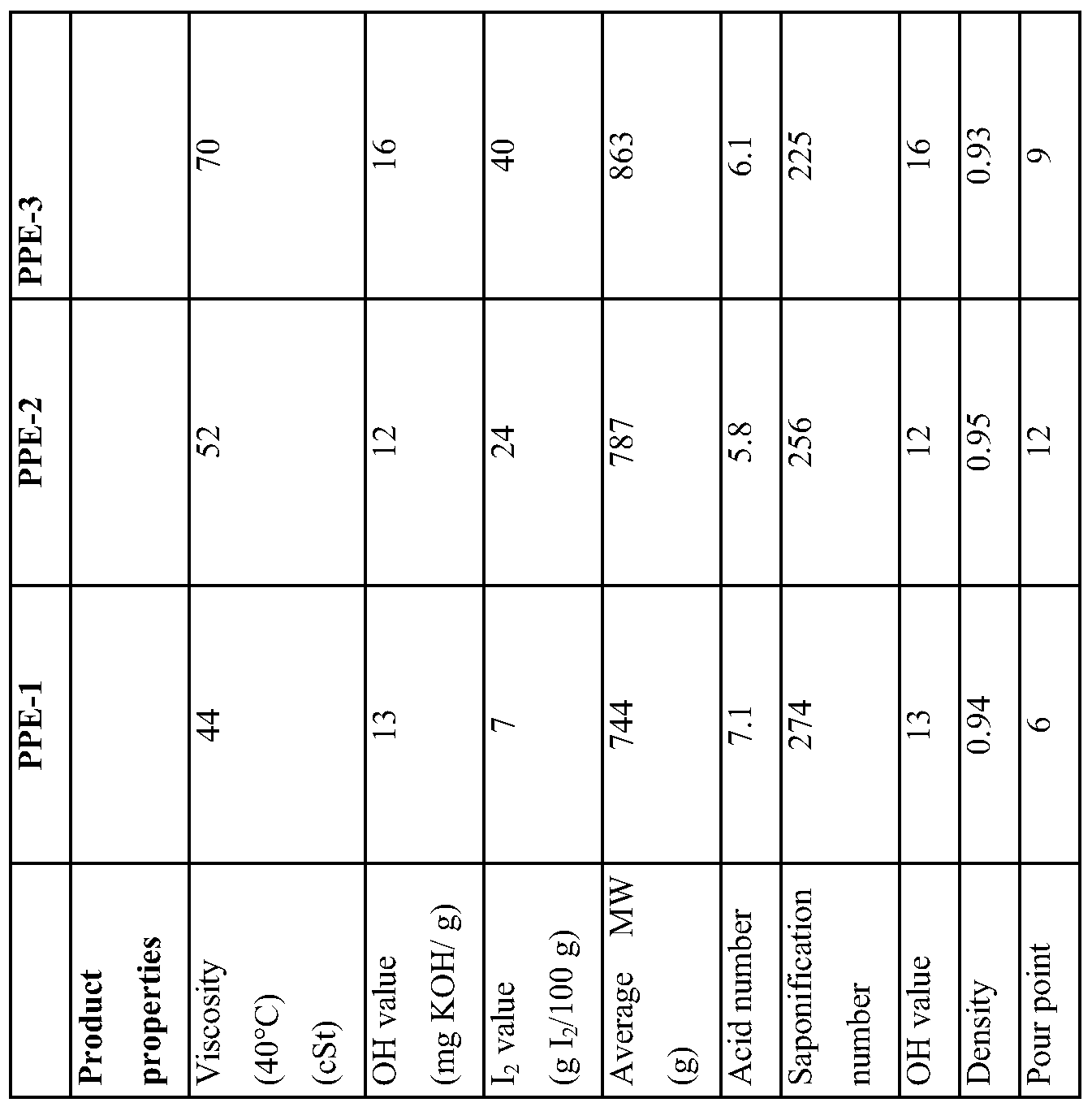
- the metal processing lubricant composition according to the present invention preferably comprises polyhydrocarbyl esters of the aliphatic polyol, preferably tetrahydrocarbyl esters of pentaerythritol, having a kinematic viscosity (40 0 C) according to ASTM D 445 of 20 to 100 cSt, more preferably of 25 to 80 cSt. and most preferably of 35 to 55 cSt.
- polyhydrocarbyl esters of the aliphatic polyol preferably the tetrahydrocarbyl esters of pentaerythritol, have a pour point according to test method ASTM D 97 below 30 0 C, more preferably below 15 0 C and most preferably below 10 0 C.
- the tetrahydrocarbyl esters of pentaerythritol have an iodine value according to test method APAG FA-015- 1992 of less than 60 g I 2 / 100 g tetrahydrocarbyl ester, more preferably less than 30 g I 2 / 100 g tetrahydrocarbyl ester and most preferably less than 1O g I2/IOO g tetrahydrocarbyl ester.
- the metal processing lubricant composition may comprise the polyhydrocarbyl ester of the aliphatic polyol and/or the tetrahydrocarbyl ester of pentaerythritol as the major component, i.e. in an amount of 50 - 100 wt%, preferably 70 to 100 wt%, more preferably 80 to 100 wt%, based on the total weight of the metal processing lubricant composition, wherein the remainder of the metal processing lubricant composition comprises additives such as extreme pressure additives, anti-wear additives, pour point depressants, anti-oxidants, other lubricating components and the like.
- the metal processing lubricant composition may be in the form of an emulsion or an aqueous dispersion, wherein said emulsion or aqueous dispersion comprises the tetrahydrocarbyl ester of pentaerythritol according to the present invention in an amount of 0.025 - 30 wt%, preferably 0.1 to 10 wt%, more preferably 0.5 to 5 wt%, based on the total weight of the emulsion or aqueous dispersion.
- the metal processing lubricant composition according to the present invention preferably comprises one or more additives, in particular an extreme pressure additive and/or an anti-wear additive.
- the present invention further relates to the use of a polyhydrocarbyl ester of the aliphatic polyol, preferably the tetrahydrocarbyl ester of pentaerythritol, in metal processing operations, wherein at least one hydrocarbyl group of the tetrahydrocarbyl ester comprises 6 - 14 carbon atoms.
- pentaerythritol tetracaproate is excluded from the group of tetrahydrocarbyl esters of pentaerythritol according to the invention if all hydrocarbyl groups of the tetrahydrocarbyl ester comprise 6 - 14 carbon atoms and are all identical, and if these esters are used in the working of metals, especially hot rolling and cold rolling of metals, and in the casting of metals.
- the metal processing operation comprises a metal forming operation, a metal removing operation or both. Additionally, it is preferred that the metal forming operation comprises a cold rolling operation, a hot rolling operation or a drawing operation. Furthermore, it is preferred that the metal removing operation is selected from the group consisting of grinding, milling, cutting, turning and honing.
Landscapes
- Chemical & Material Sciences (AREA)
- Chemical Kinetics & Catalysis (AREA)
- General Chemical & Material Sciences (AREA)
- Oil, Petroleum & Natural Gas (AREA)
- Organic Chemistry (AREA)
- Health & Medical Sciences (AREA)
- Emergency Medicine (AREA)
- Lubricants (AREA)
Abstract
Description

Claims
Priority Applications (2)
| Application Number | Priority Date | Filing Date | Title |
|---|---|---|---|
| US12/312,419 US8293691B2 (en) | 2006-11-10 | 2007-11-08 | Metal processing lubricant composition |
| EP07834676A EP2082015A2 (en) | 2006-11-10 | 2007-11-08 | Metal processing lubricant composition |
Applications Claiming Priority (2)
| Application Number | Priority Date | Filing Date | Title |
|---|---|---|---|
| EP06123843 | 2006-11-10 | ||
| EP06123843.2 | 2006-11-10 |
Publications (2)
| Publication Number | Publication Date |
|---|---|
| WO2008056981A2 true WO2008056981A2 (en) | 2008-05-15 |
| WO2008056981A3 WO2008056981A3 (en) | 2008-07-10 |
Family
ID=38042909
Family Applications (1)
| Application Number | Title | Priority Date | Filing Date |
|---|---|---|---|
| PCT/NL2007/050546 Ceased WO2008056981A2 (en) | 2006-11-10 | 2007-11-08 | Metal processing lubricant composition |
Country Status (4)
| Country | Link |
|---|---|
| US (1) | US8293691B2 (en) |
| EP (1) | EP2082015A2 (en) |
| RU (1) | RU2451059C2 (en) |
| WO (1) | WO2008056981A2 (en) |
Cited By (1)
| Publication number | Priority date | Publication date | Assignee | Title |
|---|---|---|---|---|
| US8293691B2 (en) | 2006-11-10 | 2012-10-23 | Quaker Chemical Corporation | Metal processing lubricant composition |
Families Citing this family (2)
| Publication number | Priority date | Publication date | Assignee | Title |
|---|---|---|---|---|
| CN103045335A (en) * | 2012-12-26 | 2013-04-17 | 奎克化学(中国)有限公司 | Water-based metal cutting fluid suitable for soft water |
| EP3061804A1 (en) * | 2015-02-28 | 2016-08-31 | Indian Oil Corporation Limited | A hot rolling oil for steel |
Family Cites Families (15)
| Publication number | Priority date | Publication date | Assignee | Title |
|---|---|---|---|---|
| US3526596A (en) * | 1968-06-05 | 1970-09-01 | Quaker Chem Corp | Lubricants for metalworking operations |
| US4178260A (en) * | 1974-10-31 | 1979-12-11 | Exxon Research & Engineering Co. | Ester based metal working lubricants |
| US4362634A (en) * | 1980-03-19 | 1982-12-07 | Stauffer Chemical Company | Metal working lubricant and lubricant emulsion |
| US4530772A (en) * | 1984-02-22 | 1985-07-23 | Stauffer Chemical Company | Method of electrical contact lubrication |
| JPH03134094A (en) | 1989-10-20 | 1991-06-07 | Sky Alum Co Ltd | Lubricated aluminum alloy plate and its preparation |
| JPH0633082A (en) | 1992-07-15 | 1994-02-08 | Nippon Oil & Fats Co Ltd | Ester lubricant base |
| JP3134094B2 (en) | 1994-04-01 | 2001-02-13 | 金尾 茂樹 | Cleaner hose |
| JP3354024B2 (en) * | 1994-12-22 | 2002-12-09 | 株式会社神戸製鋼所 | Lubricants for low-temperature forming of aluminum and aluminum alloy sheets |
| JP4020341B2 (en) | 1997-02-19 | 2007-12-12 | 出光興産株式会社 | Metalworking oil composition |
| WO1999016849A1 (en) * | 1997-10-01 | 1999-04-08 | Unichema Chemie B.V. | Complex esters, formulations comprising these esters and use thereof |
| JP2000073079A (en) | 1998-08-31 | 2000-03-07 | New Japan Chem Co Ltd | Metalworking oil composition |
| TWI250204B (en) * | 2001-04-06 | 2006-03-01 | Nippon Mitsubishi Oil Corp | Oil for very small amount oil supply type cutting-grinding operation and sliding face, and very small amount oil supply type cutting-grinding method using it |
| RU2230777C1 (en) * | 2002-12-09 | 2004-06-20 | Открытое акционерное общество "Чепецкий механический завод" | Concentrate of lubricating-cooling technological mediums |
| EP1529828A1 (en) * | 2003-10-31 | 2005-05-11 | Malaysian Palm Oil Board | Lubricant base oil of palm fatty acid origin |
| EP2082015A2 (en) | 2006-11-10 | 2009-07-29 | Quaker Chemical (Holland) B.V. | Metal processing lubricant composition |
-
2007
- 2007-11-08 EP EP07834676A patent/EP2082015A2/en not_active Withdrawn
- 2007-11-08 WO PCT/NL2007/050546 patent/WO2008056981A2/en not_active Ceased
- 2007-11-08 RU RU2009122181/04A patent/RU2451059C2/en not_active IP Right Cessation
- 2007-11-08 US US12/312,419 patent/US8293691B2/en not_active Expired - Fee Related
Cited By (1)
| Publication number | Priority date | Publication date | Assignee | Title |
|---|---|---|---|---|
| US8293691B2 (en) | 2006-11-10 | 2012-10-23 | Quaker Chemical Corporation | Metal processing lubricant composition |
Also Published As
| Publication number | Publication date |
|---|---|
| EP2082015A2 (en) | 2009-07-29 |
| US20100160199A1 (en) | 2010-06-24 |
| RU2451059C2 (en) | 2012-05-20 |
| WO2008056981A3 (en) | 2008-07-10 |
| RU2009122181A (en) | 2010-12-20 |
| US8293691B2 (en) | 2012-10-23 |
Similar Documents
| Publication | Publication Date | Title |
|---|---|---|
| JP3354024B2 (en) | Lubricants for low-temperature forming of aluminum and aluminum alloy sheets | |
| WO2010073939A1 (en) | Lubricating oil for hot rolling oil and process for manufacturing hot-rolled sheet | |
| CN102782104A (en) | Oil composition, and trace amount oil supply type cutting/grinding processing method | |
| JP7774680B2 (en) | Base oil for metalworking oil and water-insoluble metalworking oil composition | |
| US8293691B2 (en) | Metal processing lubricant composition | |
| JP2990021B2 (en) | Hot rolling oil for aluminum and method for hot rolling aluminum using the rolling oil | |
| US4632770A (en) | Polycarboxylic acid ester drawing and ironing lubricant emulsions and concentrates | |
| WO2006101019A1 (en) | Lubricating oil composition for metal working | |
| JP2005213377A (en) | Grease base oil | |
| JPS62290795A (en) | Cold rolling oil for steel plate | |
| JP7082918B2 (en) | Cutting fluid composition | |
| JPH07305079A (en) | Lubricant | |
| JP5351428B2 (en) | Rolling oil composition | |
| JPH08183987A (en) | Hot rolling oil for aluminum and method for hot rolling aluminum using the rolling oil | |
| JP3386915B2 (en) | Rolling oil stock solution composition and rolling oil composition | |
| JP5357603B2 (en) | Rolling oil composition | |
| JP2580008B2 (en) | Lubricant | |
| TW539743B (en) | A metal working lubricant composition | |
| JPS5828320B2 (en) | Jiyunkatsuzaisoseibutsu | |
| JP2791723B2 (en) | Water soluble cold rolling oil composition | |
| JP2002241777A (en) | Synthetic lubricating oil | |
| JP5010212B2 (en) | Aluminum pipe drawing lubricating oil and aluminum pipe drawing method using the same. | |
| JP4221527B2 (en) | Water-soluble metalworking oil composition | |
| JP2635376B2 (en) | Lubricant | |
| JP2001354983A (en) | Metalworking oil composition |
Legal Events
| Date | Code | Title | Description |
|---|---|---|---|
| 121 | Ep: the epo has been informed by wipo that ep was designated in this application |
Ref document number: 07834676 Country of ref document: EP Kind code of ref document: A2 |
|
| REEP | Request for entry into the european phase |
Ref document number: 2007834676 Country of ref document: EP |
|
| WWE | Wipo information: entry into national phase |
Ref document number: 2007834676 Country of ref document: EP |
|
| NENP | Non-entry into the national phase |
Ref country code: DE |
|
| ENP | Entry into the national phase |
Ref document number: 2009122181 Country of ref document: RU Kind code of ref document: A |
|
| WWE | Wipo information: entry into national phase |
Ref document number: 12312419 Country of ref document: US |