WO2008072850A1 - Triazine derivatives having inhibitory activity against acetyl-coa carboxylase - Google Patents
Triazine derivatives having inhibitory activity against acetyl-coa carboxylase Download PDFInfo
- Publication number
- WO2008072850A1 WO2008072850A1 PCT/KR2007/006192 KR2007006192W WO2008072850A1 WO 2008072850 A1 WO2008072850 A1 WO 2008072850A1 KR 2007006192 W KR2007006192 W KR 2007006192W WO 2008072850 A1 WO2008072850 A1 WO 2008072850A1
- Authority
- WO
- WIPO (PCT)
- Prior art keywords
- triazin
- isoquinolin
- dihydro
- phenol
- hydroxymethyl
- Prior art date
- Legal status (The legal status is an assumption and is not a legal conclusion. Google has not performed a legal analysis and makes no representation as to the accuracy of the status listed.)
- Ceased
Links
- HPOFUUPIANIUQK-UHFFFAOYSA-N CN(CC1)CCN1c1nc(N2C(CO)Cc3ccccc3C2)nc(-c2cc(C(F)(F)F)ccc2)n1 Chemical compound CN(CC1)CCN1c1nc(N2C(CO)Cc3ccccc3C2)nc(-c2cc(C(F)(F)F)ccc2)n1 HPOFUUPIANIUQK-UHFFFAOYSA-N 0.000 description 1
- PKTMVQBALLJEPU-HXUWFJFHSA-N CN(CC1)CCN1c1nc(N2[C@@H](CO)Cc3ccccc3C2)nc(-c2cccc(O)c2)n1 Chemical compound CN(CC1)CCN1c1nc(N2[C@@H](CO)Cc3ccccc3C2)nc(-c2cccc(O)c2)n1 PKTMVQBALLJEPU-HXUWFJFHSA-N 0.000 description 1
- ORBCISHXAHAICW-OQHSHRKDSA-N C[C@H](C(F)(F)F)N(CC1)CCN1c1nc(N(C2)C(CO)Cc3c2cccc3)nc(-c2cc(O)ccc2)n1 Chemical compound C[C@H](C(F)(F)F)N(CC1)CCN1c1nc(N(C2)C(CO)Cc3c2cccc3)nc(-c2cc(O)ccc2)n1 ORBCISHXAHAICW-OQHSHRKDSA-N 0.000 description 1
- RWKBQIGXFGEFRN-FQEVSTJZSA-N Nc1cccc(-c2nc(N3CCOCC3)nc(N3[C@H](CO)Cc4ccccc4C3)n2)c1 Chemical compound Nc1cccc(-c2nc(N3CCOCC3)nc(N3[C@H](CO)Cc4ccccc4C3)n2)c1 RWKBQIGXFGEFRN-FQEVSTJZSA-N 0.000 description 1
- DEQWZKRJZBHKID-UHFFFAOYSA-N OCC(Cc1ccccc1C1)N1c1nc(Cl)nc(Cl)n1 Chemical compound OCC(Cc1ccccc1C1)N1c1nc(Cl)nc(Cl)n1 DEQWZKRJZBHKID-UHFFFAOYSA-N 0.000 description 1
- IOWGCNKTFYXITN-HXUWFJFHSA-N OC[C@@H](Cc1ccccc1C1)N1c1nc(-c2cc(O)ccc2)nc(OCCN(CCC2)C2=O)n1 Chemical compound OC[C@@H](Cc1ccccc1C1)N1c1nc(-c2cc(O)ccc2)nc(OCCN(CCC2)C2=O)n1 IOWGCNKTFYXITN-HXUWFJFHSA-N 0.000 description 1
- GPEWWXOXYLUYHO-JOCHJYFZSA-N OC[C@@H](Cc1ccccc1C1)N1c1nc(Cl)nc(NC2CCN(Cc3ccccc3)CC2)n1 Chemical compound OC[C@@H](Cc1ccccc1C1)N1c1nc(Cl)nc(NC2CCN(Cc3ccccc3)CC2)n1 GPEWWXOXYLUYHO-JOCHJYFZSA-N 0.000 description 1
Classifications
-
- C—CHEMISTRY; METALLURGY
- C07—ORGANIC CHEMISTRY
- C07D—HETEROCYCLIC COMPOUNDS
- C07D405/00—Heterocyclic compounds containing both one or more hetero rings having oxygen atoms as the only ring hetero atoms, and one or more rings having nitrogen as the only ring hetero atom
- C07D405/14—Heterocyclic compounds containing both one or more hetero rings having oxygen atoms as the only ring hetero atoms, and one or more rings having nitrogen as the only ring hetero atom containing three or more hetero rings
-
- A—HUMAN NECESSITIES
- A61—MEDICAL OR VETERINARY SCIENCE; HYGIENE
- A61P—SPECIFIC THERAPEUTIC ACTIVITY OF CHEMICAL COMPOUNDS OR MEDICINAL PREPARATIONS
- A61P7/00—Drugs for disorders of the blood or the extracellular fluid
-
- C—CHEMISTRY; METALLURGY
- C07—ORGANIC CHEMISTRY
- C07D—HETEROCYCLIC COMPOUNDS
- C07D401/00—Heterocyclic compounds containing two or more hetero rings, having nitrogen atoms as the only ring hetero atoms, at least one ring being a six-membered ring with only one nitrogen atom
- C07D401/02—Heterocyclic compounds containing two or more hetero rings, having nitrogen atoms as the only ring hetero atoms, at least one ring being a six-membered ring with only one nitrogen atom containing two hetero rings
- C07D401/04—Heterocyclic compounds containing two or more hetero rings, having nitrogen atoms as the only ring hetero atoms, at least one ring being a six-membered ring with only one nitrogen atom containing two hetero rings directly linked by a ring-member-to-ring-member bond
-
- C—CHEMISTRY; METALLURGY
- C07—ORGANIC CHEMISTRY
- C07D—HETEROCYCLIC COMPOUNDS
- C07D401/00—Heterocyclic compounds containing two or more hetero rings, having nitrogen atoms as the only ring hetero atoms, at least one ring being a six-membered ring with only one nitrogen atom
- C07D401/14—Heterocyclic compounds containing two or more hetero rings, having nitrogen atoms as the only ring hetero atoms, at least one ring being a six-membered ring with only one nitrogen atom containing three or more hetero rings
-
- C—CHEMISTRY; METALLURGY
- C07—ORGANIC CHEMISTRY
- C07D—HETEROCYCLIC COMPOUNDS
- C07D413/00—Heterocyclic compounds containing two or more hetero rings, at least one ring having nitrogen and oxygen atoms as the only ring hetero atoms
- C07D413/14—Heterocyclic compounds containing two or more hetero rings, at least one ring having nitrogen and oxygen atoms as the only ring hetero atoms containing three or more hetero rings
-
- C—CHEMISTRY; METALLURGY
- C07—ORGANIC CHEMISTRY
- C07D—HETEROCYCLIC COMPOUNDS
- C07D417/00—Heterocyclic compounds containing two or more hetero rings, at least one ring having nitrogen and sulfur atoms as the only ring hetero atoms, not provided for by group C07D415/00
- C07D417/14—Heterocyclic compounds containing two or more hetero rings, at least one ring having nitrogen and sulfur atoms as the only ring hetero atoms, not provided for by group C07D415/00 containing three or more hetero rings
Definitions
- the present invention relates to a novel triazine derivative or a pharmaceutically acceptable salt thereof, and an Acetyl-CoA Carboxylase
- ACC activity inhibitor
- a pharmaceutical composition for preventing and treating obesity, diabetes, dyslipidemia and diseases related to metabolic syndrome comprising same as an active ingredient.
- ACC is an enzyme involved in the synthesis and oxidation of a fatty acid, and composed of three distinct proteins-the biotin carboxylase (BC), the biotin carboxyl carrier protein (BCCP) and the carboxyltransferase (CT). It converts acetyl-CoA to malonyl-CoA, a precursor of the fatty acid synthesis. The formation of the malonyl-CoA is the committed rate-determining step of the fatty acid synthesis.
- ACC exists as two tissue specific isozymes ACCl and ACC2. ACCl
- ACCl 265 IcDa present in lipogenic tissues (liver and adipose tissue) is subjected to long-term regulation at the transcription stage, and short-term regulation by the allosteric effect brought about by serine phosphoration/dephosphoration or citrate. Further, the concentration and activity of ACCl are affected by food intake or hormone changes. ACCl is present in cytosol, and involved in a long chain fatty acid biosynthesis.
- ACC2 (280 kDa) present in oxidative tissues (heart and muscle) is also regulated by the allosteric effect brought about by phosphorylation/dephosphorylation or citrate.
- ACC2 is localized in the mitochondrial membrane, and the malonyl-CoA formed therefrom inhibits carboxylpalmitoyltransferase-I (CPT-I), one of mitochondria enzymes, by the allosteric effect.
- CPT-I transfers a long chain acyl-CoA from cytosol to mitochondria to make it possible for the fatty acid to undergo oxidation.
- ACC is an isozyme involved in the synthesis and oxidation of a fatty acid, and it is reported that the inhibition of ACCl lowers the fatty acid synthesis, while the inhibition of ACC2 enhances the fatty acid oxidation.
- a cyclohexanedione herbicide derivative which functions as a competitive inhibitor of the rat heart ACC may be used as an anti- obesity agent (Thomas W. Seng et al., Bioorg. Med. Chem. Lett. 13, 3237, 2003); and a bipiperidine compound, a non-selective ACC inhibitor, may be used to treat metabolic syndrome including obesity, diabetes and arteriosclerosis by inhibiting both the ACC2 activity in oxidative tissues such as the skeletal muscle and the ACCl activity in tissues for the fatty acid synthesis such as liver and adipose tissues (US20030187254, and H. James Harwood, JR et al, J.Biol.Chem. 278(39), 30799, 2003). Further, the thiazole derivative developed by Abbott Lab. shows a high
- ACC2 selectivity (more than 1,000 times than normal), and in an in vivo experiment, it reduced the malonyl-CoA level in rodent muscle tissues.
- the reduction of the malonyl-CoA level by inhibiting ACC2 is reported to enhance the fatty acid oxidation, leading to increased total energy consumption through decreased inhibition of CPT-I on the mitochondrial membrane, and as a result, the insulin sensitivity of a type 2 diabetes or obesity patient can be enhanced (Yu Gui Gu et al, J.Med.Chem, 49, 3770, 2006).
- ACC Acetyl-CoA Carboxylase
- X is phenyl, naphthyl, thienyl, pyridinyl or indolyl which is unsubstituted or substituted with 1 to 3 substituents selected from the group consisting of hydroxy, amino, halo, aminocarbonyl, carboxyl, C 1 -C 2 alkoxycarbonyl, methylsulfonylamino, methylsulfonyl, methylthio and trifluoromethyl, or the group consisting of C 1 -C 6 alkyl, C 1 -C 6 alkoxy, C 1 -C 6
- V M -Rd in which M is oxygen, NH, or
- Y is (R)-hydroxymemyltetrahydroisoquinolinyl or (S)- hydroxymethyltetrahydroisoquinolinyl;
- Ra is hydrogen, C 1 -C 6 alkyl, hydroxy C 1 -C 3 alkyl, C 1 -C 6 alkylcarbonyl, hydroxy C 1 -C 2 alkoxy C 1 -C 2 alkyl, C 4 -C 6 cycloalkyl, halo, trifhioromethyl, amino C 1 -C 3 alkyl, phenyl, halophenyl, C 1 -C 4 alkoxyphenyl, morpholino Co-C 2 alkyl, N-(C r C 4 )alkylpiperazinyl, tetrahydropyranyl, N-methylpiperidinyl, amino, hydroxy, benzyl, -CORb (in which Rb is morpholino, amino, tetrahydrofuranyl, pyrrolidinyl, hydroxypiperinyl or hydroxypropylamino), trifluoroacetylamino or N-methylpiperidinylmethyl;
- G is oxygen, NH, NMe, -O(CH 2 )p-, -NH(CH 2 )q- or a bond that directly
- J is nitrogen or CH
- D is -(CH 2 )m- or -CH 2 CH(CH 3 )-, m being an integer in the range from 1 to 4;
- L is oxygen, NH or a bond that directly links Rc to 1 V ' V ' l v v ' "; and Rc is hydrogen, cyano, pyrrolidinoethyl, amino C 1 -C 4 alkyl, hydroxy C 1 - C 4 alkyl, trifluoro C 1 -C 4 alkyl, imidazolyl, triazolyl, pyridinyl, dihydroxyphenethyl, or octahydro ⁇ yrrolo[l,2-a]pyrazinyl.
- an ACC activity inhibitor comprising the triazine derivative of formula (I) or the pharmaceutically acceptable salt thereof as an active ingredient.
- a pharmaceutical composition for preventing or treating obesity, diabetes, dyslipidemia and diseases related to metabolic syndrome comprising the triazine derivative of formula (I) or the pharmaceutically acceptable salt thereof as an active ingredient.
- the preferred triazine derivatives of formula (I) of the present invention are those wherein X is phenyl, thienyl, pyridinyl or indolyl which is unsubstituted or substituted with 1 to 3 substituents selected from the group consisting of hydroxy, amino, halo, carboxyl, C 1 -C 2 alkoxycarbonyl, methylthio and trifluoromethyl, or the group consisting Of C 1 -C 6 alkyl, C 1 -C 6 alkoxy, C 1 -C 6
- V c M -Rd in which M is oxygen, NH or
- Rd is morpholino, piperidinyl, pyrrolidinyl, cyclohexyl or phenyl optionally substituted with hydroxy or hydroxyethyl;
- Y is (R)-hydroxymethyltetrahydroisoquinolinyl or (S)- hydroxymethyltetrahydroisoquinolinyl;
- Ra is hydrogen, C 1 -C 6 alkyl, hydroxymethyl, hydroxyethyl, acetyl, propionyl, hydroxyethoxyethyl, cyclopentyl, cyclohexyl, fluoro, trifluoromethyl, aminomethyl, aminoethyl, morpholino, morpholinoethyl, N-methylpiperazinyl, tetrahydropyranyl, N-methylpiperidinyl, amino, hydroxy, benzyl, -CORb (in which Rb is morpholino, amino, tetrahydrofuranyl, pyrrolidinyl, hydroxypiperidinyl or hydroxypropylamino), trifluoroacetylamino or N- methylpiperidinylmethyl; A is nitrogen or CH; or
- G is oxygen, NH, NMe, -O(CH 2 ) ⁇ -, -NH(CH 2 )q- or a bond that directly
- D is -(CH 2 )m- or -CH 2 CH(CH 3 )-, m being an integer ranging from 1 to 4;
- E is -(CH 2 )Ii-, -CH 2 CH(CH 3 )- or -CH 2 C(O)-, n being an integer ranging from 0 to 2;
- L is oxygen, NH or a bond that directly links Rc to ' J v v ' ";
- Rc is hydrogen, pyrrolidinoethyl, aminopropyl, aminoethyl, hydroxypropyl, hydroxyethyl, trifhioroethyl, trifluoromethyl, imidazolyl, triazolyl, dihydroxyphenethyl, Boc-piperazinylpyridyl or octahydropyrrolo[l,2- a]pyrazinyl.
- the more preferred compounds of formula (I) of the present invention are those wherein X is phenyl, pyridinyl or indolyl which is unsubstituted or substituted with 1 to 3 subsituents selected from the group consisting of hydroxy, amino, halo, carboxyl, C 1 -C 2 alkoxycarbonyl, methylthio and trifluoromethyl, or the group consisting of C 1 -C 6 alkyl, C 1 -C 6 alkoxy, C 1 -C 6
- alkylcarbonyl hydroxymethyl; or in which M is oxygen, NH or a
- Rd is cyclohexyl or phenyl
- Y is (R)-hydroxymethyltetrahydroisoquinolinyl or (S)- hydroxymethyltetrahydroisoquinolinyl; in which,
- Ra is hydrogen, methyl, ethyl, isopropyl, butyl, hexyl, hydroxymethyl, hydroxyethyl, acetyl, hydroxyethoxyethyl, cyclopentyl, cyclohexyl, fluoro, trifluoromethyl, aminomethyl, aminoethyl, niorpholino, morpholinoethyl, N- methylpiperazinyl, tetrahydropyranyl, N-methylpiperidinyl, amino, hydroxy, benzyl, -CORb (in which Rb is morpholino, amino, tetrahydrofuranyl, pyrrolidinyl, hydroxypiperidinyl or hydroxypropylamino), trifluoroacetylamino or N-methylpiperidinylmethyl; A is nitrogen or CH; or
- G is oxygen, NH, NMe, -O(CH 2 )p-, -NH(CH 2 )q- or a bond that directly
- D is -(CH 2 )m- or -CH 2 CH(CH 3 )-, m being an integer ranging from 1 to 4;
- L is oxygen, NH or a bond that directly links Rc to ⁇ y v v " ";
- Rc is hydrogen, pyrrolidinoethyl, aminopropyl, aminoethyl, hydroxypropyl, hydroxyethyl, trifluoroethyl, trifluoromethyl, imidazolyl, dihydroxyphenethyl, Boc-piperazinylpyridyl or octahydropyrrolo[l,2- ajpyrazinyl.
- the more preferred compounds of formula (I) according to the present invention are the following examples or the pharmaceutically acceptable salts thereof: [2-(4-Cyclohexyloxy-6-morpholin-4-yl-[l,3,5]triazin-2-yl)-l,2,3,4- tetrahydroisoquinolin-(3S)-yl]-methanol;
- the compound of formula (I) of the present invention may be used in the form of a pharmaceutically acceptable salt derived using an inorganic or organic acid
- the preferred salt may be an inorganic acid salt such as hydrochloric acid, hydrobromic acid, sulfuric acid, phosphoric acid, nitric acid and acetic acid
- an organic acid salt such as glycolic acid, lactic acid, pyruvic acid, malonic acid, succinic acid, glutaric acid, fumaric acid, malic acid, mandelic acid, tartaric acid, citric acid, ascorbic acid, palmitic acid, maleic acid, hydroxymaleic acid, benzoic acid, hydroxybenzoic acid, phenylacetic acid, cinnamic acid, salicylic acid, methanesulfonic acid, benzenesulfonic acid, and toluenesulfonic acid.
- the compound of the present invention may be chemically synthesized by the procedure shown in Reaction Schemes (A) to (E), but these are not intended to limit the scope of the invention in any way.
- R 1 is alkyl or aryl
- R 2 and R 3 are fused to each other together with the nitrogen atom they are attached to, to form a heterocyclic ring containing nitrogen and oxygen atoms, or fused to each other together with the nitrogen atom they are attached to, to form a 3- to 6- membered heterocyclic ring having an optional hydroxylmethyl substituent
- R 4 and R 5 are fused to each other together with the nitrogen atom they are attached to, to form a 3- to 6-membered heterocyclic ring having an optional hydroxyalkyl or amido substituent, said heterocyclic ring having a heteroaryl group attached or fused thereto.
- Ri and R 2 are fused to each other together with the nitrogen atom they are attached to, to form a 3- to 6- membered heterocyclic ring containing an optional oxygen atom; and R 3 and R 4 are fused to each other together with the nitrogen atom they are attached to, to form a 3- to 6-membered heterocyclic ring.
- an aryl group is introduced into 2,4,6-trichloro-[l,3,5]triazine of formula (I-A) by Grignard reaction using arylmagnesium bromide to obtain the triazine derivative of formula (HI-A) 5 and ii) the compound of formula (III- A) is allowed to successively via two steps with R 1 R 2 NH and R 3 R 4 NH, to obtain 6-aryl-2,4-dialkylamino-[l,3,5]triazine of formula (III-C) (corresponding to the synthesis of the compounds of Examples III-l to III-61, V ⁇ -3, VI-4, and VI- 5).
- R 1 and R 2 are fused to each other together with the nitrogen atom they are attached to, to form a 3- to 6- membered heterocyclic ring; and R 3 and R 4 are fused to each other together with the nitrogen atom they are attached to, to form a 3- to 6-membered heterocyclic ring.
- Ri is tetrahydropyranyl, tetrahydrofuranyl, trifluoroalkyl, pyrrolidinone ethyl; and R 2 and R 3 are fused to each other together with the nitrogen atom they are attached to, to form a 3- to 6-membered heterocyclic ring having an optional hydroxymethyl and/or aryl substituent.
- Reaction Scheme (E)
- an aryl group is introduced into 2,4,6-trichloro-[l,3,5]triazine of formula (I-A) by Grignard reaction using arylmagnesium bromide to obtain the triazine derivative of formula (HI-A)
- the compound of formula (III- A) is reacted with R 1 R 2 NH to obtain 2- alkylamino-4-aryl-6-chloro-[l,3,5]triazine of formula (III-B)
- the resulting compound is reacted with an appropriate alkoxide (R 3 OH) to obtain 2- alkoxy-4-alkylamino-6-aryl-[l,3,5]triazine of formula (V-A) (corresponding to the synthesis of the compounds of Examples V-I to V-4).
- R 1 and R 2 are fused to each other together with the nitrogen atom they are attached to, to form a 3- to 6- membered heterocyclic ring; and R 3 is morpholinoethyl, hydroxyethyl, or methylpyrrolidinyl .
- the inventive triazine derivative of formula (I) effectively inhibits the activity of ACC.
- the present invention provides a pharmaceutical composition for inhibiting the activity of ACC comprising the compound of formula (I) or the pharmaceutically acceptable salt thereof as an active ingredient.
- the inventive triazine derivative of formula (I) inhibiting the activity of ACC may prevent or treat obesity, diabetes, dyslipidemia (e.g., hypercholesterolemia, hyperlipemia) and diseases related to metabolic syndrome (e.g., arteriosclerosis, hypertension, hyperlipemia) by increasing the fatty acids oxidation.
- the compound of formula (I) as an active ingredient may be employed in an amount of 0.01 to 10 weight%, preferably 0.1 to 5 weight% based on the total weight of the inventive pharmaceutical composition.
- the pharmaceutical composition of the present invention may be formulated for administration orally or parenterally.
- the formulation for oral administration may include tablets, powder, soft and hard gelatin capsules, aqueous solutions, suspensions, emulsions, syrups and granules, and additionally include conventional additives such as a diluent (e.g., lactose, dextrose, sucrose, mannitol, sorbitol, cellulose glycine), lubricant (e.g., silica, talc, stearic acid or magnesium or calcium salt thereof, and polyethyleneglycol) and the like.
- a diluent e.g., lactose, dextrose, sucrose, mannitol, sorbitol, cellulose glycine
- lubricant e.g., silica, talc, stearic acid or magnesium or calcium salt thereof, and polyethyleneglycol
- the composition may further comprise a binder such as magnesium aluminum silicate, starch paste, gelatin, tragacanth, methylcellulose, sodium carboxymethylcellulose and/or polyvinylpyrrolidine, and optionally include a disintegrant such as starch, agar, alginic acid or a sodium salt thereof, boiling mixture, absorbent, colorant, flavoring agent, and sweetener.
- a binder such as magnesium aluminum silicate, starch paste, gelatin, tragacanth, methylcellulose, sodium carboxymethylcellulose and/or polyvinylpyrrolidine
- a disintegrant such as starch, agar, alginic acid or a sodium salt thereof, boiling mixture, absorbent, colorant, flavoring agent, and sweetener.
- the preferred formulation for parenteral administration may include injection formulations such as isotonic aqueous solutions and suspensions.
- composition may be sterilized and/or contain an adjuvant such as a preservative, stabilizer, wetting agent, emulsifier, a salt for controlling an osmotic pressure and/or a buffer solution, and other pharmaceutically effective materials, and formulated in accordance with conventional mixing, granulating or coating methods.
- an adjuvant such as a preservative, stabilizer, wetting agent, emulsifier, a salt for controlling an osmotic pressure and/or a buffer solution, and other pharmaceutically effective materials, and formulated in accordance with conventional mixing, granulating or coating methods.
- inventive compound of formula (I) may be administered orally or parenterally as an active ingredient in an effective amount ranging from about 0.01 to 500 mg/kg, preferably from about 0.5 to 100 mg/kg body weight per day in case of mammals including human in a single dose or in divided doses.
- Example 1-1 [2-(4-Cyclohexyloxy-6-morpholin-4-yI-[l,3,5]triazin-2-yl)- l,2,3,4-tetrahydroisoquinolin-(35)-yI]-methanol
- 2,4,6-Trichloro-[l,3,5]triazine (5.0 g, 27.1 mmol) dissolved in dichloromethane (30 ml) was added dropwise at 0 ° C to a mixture of cyclohexanol (2.7 g, 27.0 mmol), tetrabutylammonium bromide (TBAB) (874 mg, 2.7 mmol), 50% aqueous sodium hydroxide (27 ml) and dichloromethane (30 ml) and stirred for 10 min. The resulting mixture was washed with 30 ml of water, and the separated organic layer was washed with saturated NaCl.
- TBAB tetrabutylammonium bromide
- Step 2 [2-(4-Cyclohexyloxy-6-morpholin-4-yl-[ 1 ,3 ,5]triazin-2-yl)- 1 ,2,3 ,A- tetrahydroisoquinolin-(3S)-yl]-methanol oquinolyl- 'l
- Step 1) [2-(4-Chloro-6-morpholin-4-yl-[l,3 5 5]triazin-2-yl)-l,2,3,4- tetrahydroisoquinolin-(3.S)-yl]-methanol
- 2,4,6-Trichloro-[l,3,5]triazine (10.0 g, 54.2 mmol) was dissolved in acetonitrile (300 ml), and diisopropylethylamine (7.0 g, 54.2 mmol) was added thereto. Morpholine (4.7 mg, 54.2 mmol) was added dropwise thereto at 0 °C , and stirred for 1 hour. The resulting mixture was diluted with ethyl acetate, and washed successively with water and saturated NaCl. The resulting organic layer was dried over anhydrous magnesium sulfate, and concentrated under a reduced pressure.
- Step 2) 3-[4-((3S)-Hydroxymethyl-3,4-dihydro- lH-isoquinorin-2-yl)-6- morpholin-4-yl- [1,3 , 5]triazin-2-yl] -phenol
- Example II- 1 The procedure of Example II- 1 was repeated except for reacting [2-(4- chloro-6-morpholin-4-yl- [1,3 ,5]triazin-2-yl)- 1 ,2,3 ,4-tetrahydroisoquinolin-3 (S)- yl]-methanol with a suitable boronic acid to obtain the compounds of Examples II-2 to II-4 shown in Table 1.
- Example II-5 ⁇ 2-[4-(3-Aminophenyl)-6-morphoIin-4-yl-[l,3,5]triazin-2-yI]- l,2,3,4-tetrahydroisoquinolin-(35)-yl ⁇ -methanol
- Example II- 1 The procedure of Example II- 1 was repeated except for reacting [2-(4- chloro-6-mo ⁇ holin-4-yl-[l,3,5]triazin-2-yl)-l,2,3,4-tetrahydroisoquinolin-3(S)- yl]-methanol with 3-nitrophenylboronic acid, and the resulting cross coupled compound (200 mg) was dissolved in methanol (10 ml). A small amount of 10% Pd-C was added thereto, and stirred for 24 hours under a hydrogen atmosphere. The resulting mixture was filtered using celite to remove the catalyst, and concentrated under a reduced pressure. The resulting residue was purified by column chromatography to obtain the title compound (157 mg).
- Example III- 1 The procedure of Example III- 1 was repeated except for reacting [2-(4- chloro-6-morpholin-4-yl-[ 1 ,3 ,5]triazm-2-yl)- 1 ,2,3 ,4-tetrahydroisoquinolin-3 (R)- yl]-methanol or [2-(4-chloro-6-morpholin-4-yl-[l ,3,5]triazin-2-yl)- 1 ,2,3,4- tetrahydroisoquinolin-3(S)-yl]-methanol with a suitable boronic acid (or boronate ester) to obtain the compounds of Examples II-6 to II-9 as shown in Table 2.
- Table 2 Table 2
- Example 11-10 3 ⁇ [4-((3 ⁇ -HydroxymethyI-3,4-dihydro-l#-isoquiiioliii-2- yl)-6-(4-methyl-piperazin-l-yl)-[l,3,5]triazin-2-yl]-benzoic acid methyl ester
- Example 11-11 ⁇ 2-H-(4-Methylpiperazin-l-yl)-6-(3-trifluoromethyIphenyl)- [l,3,5]triazin-2-yl]-l,2,3,4-tetrahydroisoquinolin-3(i?)-yl ⁇ -methanol
- Example II- 1 The procedure of Example II- 1 was repeated except for reacting ⁇ 2- [4- chloro-6-(4-methyl-piperazin- 1 -yl)- [ 1 ,3 ,5-]triazin-2-yl]- 1 ,2,3 ,4-tetrahydro- isoquinolin-3(R)-yl ⁇ -methanol with 3-trifluorophenylboronic acid to obtain the title compound. m.p 82-84°C ;
- Example 11-12 ⁇ 2-[4-(3-Fluoro-phenyI)-6-(4-methyl-piperazin-l-yl)- [l,3,5]triazin-2-yl]-l,2,3,4-tetrahydro-isoquinolin-(3i?)-yl ⁇ -methanol
- Example II- 1 The procedure of Example II- 1 was repeated except for reacting ⁇ 2-[4- chloro-6-(4-methyl-piperazin-l-yl)-[l,3,5-]triazin-2-yl]-l,2,3,4-tetrahydro- isoquinolin-3(R)-yl ⁇ -methanol with 3-fluorophenylboronic acid to obtain the title compound (86%). m.p 88-90°C;
- Example 11-13 ⁇ 2-[4-[4-(2-Amino-ethyl)-piperazin-l-yl]-6-(3-fluoro- phenyl)-[l,3,5]triazin-2-yl]-l,2,3,4-tetrahydro-isoquinolin-(3if)-yl ⁇ - niethanol
- Example II- 1 The procedure of Example II- 1 was repeated except for reacting [2-(4,6- dicliloro-[l,3,5]triazin-2-yl)-l,2,3 5 4-tetrahydro-isoquinolin-3(R)-yl]-methanol with 3-fluorophenylboronic acid to obtain (2-[4-Chloro-6-(3-fluoro-phenyl)- [1 5 3 5 5]triazin-2-yl]- 1 ,2 5 3,4-tetrahydro-isoquinolin-3-yl ⁇ -methanol (60%).
- Example 11-14 4-[4-((35)-Hydroxymethyl-3,4-dihydro-li7-isoquinoIin-2- yl)-6-morpholin-4-yl-[l,3,5]triazin-2-yl]-2,6-dimethoxyphenol
- Example 11-15 5-[4-((35)-Hydroxymethyl-3,4-dihydro-l J H r -isoquinolin-2- yl)-6-morpholin-4-yl-[l,3,5]triazin-2-yl]-benzene-l,2,3-triol
- Example 11-16 3-[4-(4-Cyclopentylpiperazin-l-yl)-6-((3iR)-hydroxymethyl- 3,4-dihydro-l J H r -isoquinolin-2-yl)-[l,3,5]triazin-2-yI]-phenoI
- Example II- 1 The procedure of Example II- 1 was repeated except for using ⁇ 2-[4- chloro-6-(4-cyclo ⁇ entylpiperazin- 1 -yl)-[ 1 ,3,5]triazin-2-yl]- 1 ,2,3,4- tetrahydroisoquinolin-3-yl ⁇ -methanol, the intermediate compound of Example 11-10, as a starting material to obtain the title compound.
- Example 11-17 3-[4-(4-CycIohexylpiperazin-l-yl)-6-((3i?)-hydroxymethyl- 3,4-dihydro-l//-isoquinolin-2-yl)-[13,5]triazm-2-yl]-phenoI
- Example 11-16 The procedure of Example 11-16 was repeated except for using ⁇ 2-[4- chloro-6-(4-cyclohexylpiperazin-l-yl)-[l,3,5]triazin-2-yl]-l,2,3,4- tetrahydroisoquinolin-(3R)-yl ⁇ -methanol as a starting material to obtain the title compound.
- Example 11-18 3-[4-((32?)-Hydroxymethyl-3,4-dihydro-l#-isoquinolin-2- yl)-6-(4-methylpiperazin-l-yl)-[l,3,5]triazin-2-yl]-phenol
- Example II- 1 The procedure of Example II- 1 was repeated except for reacting ⁇ 2-[4- chloro-6-(4-methyl- ⁇ i ⁇ erazin- 1 -yl)-[ 1 ,3 ,5-]triazin-2-yl]- 1 ,2,3 ,4-tetrahydro- isoquinolin-3(R)-yl ⁇ -methanol with 3-hydroxyphenylboronic acid to obtain the title compound as a white powder (60 mg).
- Example 11-19 3- ⁇ 4-((3 J R)-Hydroxymethyl-3,4-dihydro-lJ ⁇ -isoquinolin-2- yl)-6-[4-(tetrahydropyran4-yl)-piperazin-l-yl]-[l,3,5]triazin-2-yl ⁇ -phenol
- Step 2) (2- ⁇ 4-Chloro-6-[4-(tetrahydropyran4-yl)-piperazin-l-yl]-[l,3,5]triazin- 2-yl ⁇ - 1 ,2,3 ,4-tetxahydroisoquinolin-3(R)-yl)-methanol
- step 2 (2- ⁇ 4-Chloro-6-[4-(tetrahydropyran4-yl)-piperazin-l-yl]-[l,3,5]triazin- 2-yl ⁇ -l,2,3,4-tetrahydroisoquinolin-3(R)-yl)-methanol (110 mg) obtained in step 2) was dissolved in toluene (8 ml), and 3-hydroxyphenylboronic acid (50 mg), tetrakistriphenylphosphine palladium (6 mg), 2N aqueous sodium carbonate (4 ml) and ethanol (4 ml) was sequentially added thereto. The resulting mixture was stirred for 12 hours while heating to 90 0 C , and cooled to room temperature.
- Example III-l 3-[4-(Hexahydropyrrolo[l,2, «]pyrazin-2-yl)-6-((3i?)- hydroxymethyl-S ⁇ -dihydro-li ⁇ -isoquinolin ⁇ -y ⁇ -tl ⁇ ltriazin-l-yll-phenol
- Step 1) 3-[4-Chloro-6-((3R)-hydroxymethyl-3,4-dihydro-lH-isoquinolin-2-yl)- [ 1 ,3 ,5]triazin-2-yl]-phenol
- Step 2) 3-[4-(Hexahydropyrrolo[l ,2, ⁇ ]pyrazin-2-yl)-6-((3R)-hydroxymethyl- 3,4-dihydro-lH-isoquinolin-2-yl)-[ 1 ,3,5]triazin-2-yl]-phenol
- [l,3,5]triazin-2-yl)-phenol (120 mg, 0.3 mmol) thus obtained in step 1) was dissolved in acetonitrile (7 ml), mixed with diisopropylethylamine (84 mg, 0.6 mmol) and octahydropyrrolo[l,2,a] ⁇ yrazine (62 mg, 0.5 mmol), and refluxed for 24 hours.
- the resulting mixture was diluted with ethyl acetate, and washed successively with water and saturated NaCl.
- the resulting organic layer was dried over anhydrous magnesium sulfate, and concentrated under a reduced pressure.
- the resulting residue was purified by column chromatography to obtain the title compound (81 mg, 54%).
- step 2) of Example III-l was repeated except for reacting 3-[4-chloro-6-(3(R)-hydroxymethyl-3,4-dihydro-lH-isoquinolin-2-yl-
- Example 111-32 3-[4-((3i?)-Hydroxymethyl-3,4-dihydro-l J H r -isoquinoIin-2- yl)-6-(4-methylpiperazin-l-yl)-[l,3,5]triazine methyl iodonium salt
- Methyl iodide (18 mg, 0.12 mmol) was added to 3-[4-((3R)- hydroxymethyl-3 ,4-dihydro- lH-isoquinolin-2-yl)-6-(4-methylpiperazin- 1 -yl)- [l,3,5]triazin-2-yl]-phenol (17 mg, 0.04 mmol) dissolved in dichloromethane, and stirred for 3 hours. When a white solid was precipitated, the resulting mixture was filtered to the title compound as a white solid (18 mg, 82%).
- Example 111-33 3-[4-((3 ⁇ -Hydroxymethyl-3,4-dihydro-l#-isoquinolin-2- yl)-6-(4-methylpiperazin-l-yl)-[l,3j5]triazine-oxonium salt
- Example III-34 3-[4-((3 J R)-Hydroxymethyl-3,4-dihydro-li7-isoquinolin-2- yl)-6-imidazol-l-yl-[l,3,5]triazin-2-yl)-phenol
- step 2) of Example IH-I was repeated except for reacting 3-[4-chloro-6-(3(R)-hydroxymethyl-3,4-dihydro-lH-isoquinolin-2-yl- [l,3,5]triazin-2-yl)-phenol] or 3-[4-chloro-6-(3(iS)-hydroxymethyl-3,4-dihydro- lH-isoquinolin-2-yl-[l,3,5]triazin-2-yl)-phenol] with a suitable amine to obtain the compounds of Examples 111-35 to 111-42 as shown in Table 4.
- step 2) of Example III-l was repeated except for reacting 3-[4-chloro-6-(3(R)-hydroxymethyl-3,4-dihydro-lH-isoquinolin-2-yl- [1 ,3,5]triazin-2-yl)-phenol] or 3-[4-chloro-6-(3(5)-hydroxymethyl-3,4-dihydro- lH-isoquinolin-2-yl-[l,3,5]triazin-2-yl)-phenol] with a suitable amine to obtain the compounds of Examples 111-43 to 111-61 as shown in Table 5.
- Example IV-I ⁇ l-[4-((3 J R)-HydroxymethyI-3,4-dihydro-l J fiT-isoquinolin-2- yl)-6-(3-hydroxyphenyl)-[l,3,5]triazin-2-yI]-piperidin-3-yl ⁇ -pyrrolidin-l-yI- methanone
- Example IV-2 3-[4-((3i?)-Hydroxymethyl-3,4-dihydro-l J- 7-isoquinolin-2- yl)-6-(tetrahydrofuran-(3i ⁇ )-yloxy)-[l,3,5]triazm-2-yl]-phenol
- Example IV-3 3-[4-((3i?)-Hydroxymethyl-3,4-dihydro-lH-isoquinolin-2- yl)-6-(2,2,2-trifluoroethoxy)- [1 ,3,5] triazin-2-yl] -phenol
- Example IV-4 l- ⁇ 2-[4-((3i?)-Hydroxymethyl-3,4-dihydro-lfl-isoquinoIin-2- yl)-6-(3-hydroxyphenyl)-[l,3,5]triazin-2-yIoxy]-ethyl ⁇ -pyrrolidin-2-one
- Example V-1 3-[4-((3i?)-Hydroxymethyl-3,4-dihydro-l J H-isoquinolin-2-yl)- 6-(2-morpholin-4-ylethoxy)-[l,3,5]triazin-2-yl]-phenol
- Example V-2 3- [4-(2-Hy droxyethoxy)-6-((32?)-hy droxy methyl-3 ,4-dihydro- lJ ⁇ -isoqumolin-2-yl)-[l,3,5]triazin-2-yl]-phenoI
- Example V-3 3-[4-((3i?)-Hydroxymethyl-3,4-dihydro-l J fir-isoquinolin-2-yl)- 6-(l-methyl-pyrroIidin-3(5)-yloxy)-[l,3,5]triazin-2-yl]-phenol
- Example V-4 ⁇ 2-[4-(3-Fluoro-phenyl)-6-(tetrahydro-pyran-4-yIoxy)- [l,3,5]triazin-2-yl]-l,2,3,4-tetrahydro-isoquinolin-(3if)-yl ⁇ -methanol
- Example VI-I ⁇ 2-[4-(3-FIuoro-phenyl)-6-(piperidin-4-ylamino)- [l,3,5]triazin-2-yl]-l,2,3,4-tetrahydro-isoquinolin-(3i?)-yl ⁇ -methanol
- Step 1) ⁇ 2-[4-(l-Benzyl-piperidin-4-ylamino)-6-chloro-[l,3,5]triazin-2-yl]- 1 ,2,3 ,4-tetrahydro-isoquinolin-(3i?)-yl ⁇ -methanol
- Step 2) ⁇ 2-[4-(3-Fluoro- ⁇ henyl)-6-( ⁇ iperidin-4-ylamino)-[l,3,5]triazin-2-yl]- 1,2, 3, 4-tetrahydro-isoquinolin-(3R)-yl ⁇ -methanol
- step 1 ⁇ 2-[4-(l-Benzyl-piperidin-4-ylamino)-6-chloro-[l,3,5]triazin-2-yl]- 1, 2,3, 4-tetrahydro-isoquinolin-(3R)-yl ⁇ -methanol (120 mg, 0.25 mmol) thus obtained in step 1) was dissolved in a mixture of toluene (6 ml) and EtOH (2 ml), and a mixture of Pd(PPh 3 ) 4 (60 mg, 0.2eq.) and 3-fluorobenzeneboronic acid (54 mg, 1.5eq.) was added thereto. Then, 2M Na 2 CO 3 (2 ml) was added to the resulting mixture, and refluxed for 12 hours.
- Pd(PPh 3 ) 4 60 mg, 0.2eq.
- 3-fluorobenzeneboronic acid 54 mg, 1.5eq.
- Example VI-2 ⁇ 2-[4-(l J ff-Indol-6-yl)-6-(piperidin-4-ylamino)-[l,3,5]triazin- 2-yI]-l,2,3,4-tetrahydro-isoquinolin-(3if)-yl ⁇ -methanol
- Example VI-I The procedure of Example VI-I was repeated except for reacting ⁇ 2-[4- (l-benzyl-piperidin-4-ylamino)-6-chloro-[l,3,5]triazin-2-yl]-l,2,3,4-tetrahydro- isoquinolin-3-yl ⁇ -methanol obtained in Example VI-I with 6-indole-boronic acid to obtain the title compound.
- Example VI-3 ⁇ 2-[4-(3-Fluoro-phenyl)-6-(4-morpholin-4-yl-piperidin-l- yl)-[l,3,5]triazm-2-yI]-l,2,3,4-tetrahydro-isoquinolin-(3i?)-yl ⁇ -methanoI
- Step 2) ⁇ 2-[4-(3-Fluoro-phenyl)-6-(4-morpholin-4-yl-piperidin-l-yl)- [ 1 ,3,5]triazin-2-yl]- 1 ,2,3,4-tetrahydro-isoquinolin-(3R)-yl ⁇ -methanol
- Example VI-4 4- [4-(3-FIuoro-phenyl)-6-((3/?)-hydroxymethyl-3,4-dihy dro- ljff-isoquinolm-l-y ⁇ -Jl ⁇ jSltriazin-l-ylaminol-piperidine-l-carboxylic acid methyl ester
- Step 1) 4-[4-Chloro-6-(3-fluoro-phenyl)-[ 1 ,3 ,5]triazin-2-ylamino]-piperidine- 1 - carboxylic acid methyl ester DIPEA (583 mg, 1.1 eq) and 4-amino-piperidine-l -carboxylic acid methyl ester (713 mg, 1.1 eq) were sequentially added to 2,4-Dichloro-6-(3- fluoro-phenyl)-[l,3,5]triazine (1.Og) dissolved in CH 3 CN (20 ml), and stirred for 3 hours.
- Step 2) 4-[4-(3-Fluoro- ⁇ henyl)-6-((3R)-hydroxymethyl-3,4-dihydro-lH- isoquinolin-2-yl)- [ 1 ,3 ,5 ]triazin-2-ylamino] -piperidine- 1 -carboxylic acid methyl ester
- Example VI-5 4-[4-(3-Fluoro-phenyl)-6-((3i?)-hydroxymethyl-3,4-dihydro- l-Er-isoquinolin-l-y ⁇ -ll ⁇ ltriazin-l-ylaminoJ-piperidine-l-carboxylic acid amide
- Step 1) 4- [4-Chloro-6-(3 -fluoro-phenyl)- [ 1 ,3 , 5]triazin-2-ylamino] -piperidine- 1 - carboxylic acid amide
- Step 2) 4-[4-(3-Fluoro- ⁇ henyl)-6-(3-hydroxymethyl-3,4-dihydro-lH- isoquinolin-2-yl)-[l,3,5]triazm-2-ylamino]-piperidine-l-carboxylic acid amide
- Diisopropylethylamine (111 mg, 2.0eq) and ( 1,2,3, 4-Tetrahydro- isoquinolin-(3R)-yl)-methanol (105 mg, 1.5eq.) were sequentially added to 4- [4-chloro-6-(3-fluoro-phenyl)-[l,3,5]triazin-2-ylamino]-piperidine-l-carboxylic acid amide (150 mg, 0.43 mmol) thus obtained in step 1) dissolved in acetonitrile (7 ml), and refluxed for 4 hours.
- Test Example 1 Assay for the degree of inhibiting the activity of human ACC2
- Step 1) Cloning and expression of ACC2 gene cDNA cloning of human ACC2 (hACC2) without N-terminus, and the expression thereof in HEK293 cell (ATCC, #CRL-1573) were carried out as follows.
- Human ACC2 gene was cloned by PCR using cDNA library of human skeletal muscle (Clontech) as a template, and primers of SEQ ID NO.: 1 (hACC2F; AATTGCTAGCATGGTCTTGCTTCTTTGTCTATCTTGTC) and SEQ ID NO.: 2 (hACC2B; AATTCTCGAGTCAGGTGGAGGCCGGGCTGTCCATGG).
- the primers were prepared from a sequence of human ACC2 (hACC2; GenBank accession No.: BC028417) by adding Nhel/Xhol restriction site.
- PCR was carried out using BD Advantage2 PCR Enzyme System (Clontech, #S1798), and the expression and activity was confirmed by inserting the amplified DNA fragment into Nhe 1 /Xho 1 restriction site of pcDNA3.1 -Flag vector (Invitrogen, #V790-20) and transforming thereof into 293T (ATCC) cell.
- the Flp-In-293 cell lines stably expressing hACC2 was cultured in a 150mm culture dish with DMEM (Delbecco's modified eagle medium) containing 10% FBS (fetal bovine serum), 1% Antibiotic-Antimycotic (Invitrogen, #15240-062) and 100 ⁇ g/ml hygromycin at 37 °C , 5% CO 2 for about 7 days.
- DMEM Delbecco's modified eagle medium
- FBS fetal bovine serum
- Antibiotic-Antimycotic Invitrogen, #15240-062
- 100 ⁇ g/ml hygromycin 100 ⁇ g/ml hygromycin at 37 °C , 5% CO 2 for about 7 days.
- the culture solution was centrifuged at 1,000 X g for 5 min to obtain the hACC2 expressing cell.
- the cell was washed with PBS (CGXINC), centrifuged under a same condition as described above, and cryopreserved at - 70°C .
- the cell was melted at 4 °C, and Complete Protease Inhibitor (Roche, #1873580) was suspended in 50 mM HEPES (2-[4-(2-hydroxyethyl)-l- piperazinyl] ethanesulfonic acid) buffer (pH 7.5) containing 250 mM sucrose, 2 mM EDTA, 5% glycerol and 2 mM dithiothreitol (DTT) per 50 ml cell. The suspension was subjected to a sonicator (Fisher Scientific), centrifuged at 30,000 X g for 60 min, and filtered with a 0.45 ⁇ m filer.
- HEPES 4-[4-(2-hydroxyethyl)-l- piperazinyl] ethanesulfonic acid
- DTT dithiothreitol
- the supernatant was fractioned 3%, 5% and 10% concentration (w/v) using PEG8000 (Polyethylene glycol 8000), and centrifuged at 30,000 X g, 4 0 C for 60 min to obtain a supernatant and precipitate.
- the precipitate was dissolved in salt free buffer (5OmM HEPES, pH7.5, 2mM DTT, 2mM EDTA, 5% glycerine, and protease inhibitor), and the samples expressing the enzyme activity were separated by the protein size using Superdex 200 (Pharmarcia, #17-1069-01) column.
- a buffer containing 5OmM HEPES, pH 7.5, 2mM DTT, 5% glycerol, protease inhibitor and 125 mM NaCl was used, and the separated hACC2 protein was cryopreserved at -70 ° C .
- Step 3 Determination of ACC2 (hACC2) inhibitory activity hACC2 protein thus obtained was melted, and preincubated in a buffer containing 50 mM Tris (pH7.5), 10 mM potassium citrate, 8 mM MgSO 4 , 1 mM DTT and fatty acid-free BSA at ) at 37 °C for 20 min.
- the compounds prepared in Examples were dissolved in DMSO to the final concentration of 3 mM, 1 ⁇ l of each compounds was added to the polypropylene tube with 79 ⁇ l of the preincubated hACC2 solution.
- the control group contained only 1 ⁇ l of DMSO (the final concentration of DMSO was 1%).
- a substrate mixture containing 0.25 mM ATP, 0.2 mM acetyl-CoA and 0.5 mM NaHCO 3 (2.4 ⁇ Ci) was put into a test tube of the test group and control group to the final volume of 100 ⁇ l, and reacted at 37 ° C for 15 min.
- % Inhibition ⁇ l-(cpm of the compound treated sample - cpm of Blank)/(cpm of Control - cpm of Blank) ⁇ xl00 wherein, Blank is treated with an equal amount of buffer instead of hACC2 protein, and Control is only treated with an equal amount of DMSO instead of the compound.
Landscapes
- Chemical & Material Sciences (AREA)
- Organic Chemistry (AREA)
- Health & Medical Sciences (AREA)
- Medicinal Chemistry (AREA)
- Engineering & Computer Science (AREA)
- Diabetes (AREA)
- Chemical Kinetics & Catalysis (AREA)
- General Chemical & Material Sciences (AREA)
- Bioinformatics & Cheminformatics (AREA)
- Nuclear Medicine, Radiotherapy & Molecular Imaging (AREA)
- Hematology (AREA)
- Pharmacology & Pharmacy (AREA)
- Life Sciences & Earth Sciences (AREA)
- Animal Behavior & Ethology (AREA)
- General Health & Medical Sciences (AREA)
- Public Health (AREA)
- Veterinary Medicine (AREA)
- Plural Heterocyclic Compounds (AREA)
- Pharmaceuticals Containing Other Organic And Inorganic Compounds (AREA)
Abstract
The present invention relates to a novel triazine derivative or a pharmaceutically acceptable salt thereof, and an Acetyl-CoA Carboxylase (ACC) comprising same as an active ingredient. The triazine derivative of the present invention effectively inhibits the activity of ACC and it may be used for preventing or treating obesity, diabetes, dyslipidemia and diseases related to metabolic syndrome.
Description
TRIAZINE DERIVATIVES HAVING INHIBITORY ACTIVITY AGAINST
ACETYL-COA CARBOXYLASE
Field of the Invention
The present invention relates to a novel triazine derivative or a pharmaceutically acceptable salt thereof, and an Acetyl-CoA Carboxylase
(ACC) activity inhibitor and a pharmaceutical composition for preventing and treating obesity, diabetes, dyslipidemia and diseases related to metabolic syndrome comprising same as an active ingredient.
Background of the Invention
ACC is an enzyme involved in the synthesis and oxidation of a fatty acid, and composed of three distinct proteins-the biotin carboxylase (BC), the biotin carboxyl carrier protein (BCCP) and the carboxyltransferase (CT). It converts acetyl-CoA to malonyl-CoA, a precursor of the fatty acid synthesis. The formation of the malonyl-CoA is the committed rate-determining step of the fatty acid synthesis. ACC exists as two tissue specific isozymes ACCl and ACC2. ACCl
(265 IcDa) present in lipogenic tissues (liver and adipose tissue) is subjected to long-term regulation at the transcription stage, and short-term regulation by the allosteric effect brought about by serine phosphoration/dephosphoration or citrate. Further, the concentration and activity of ACCl are affected by food intake or hormone changes. ACCl is present in cytosol, and involved in a long chain fatty acid biosynthesis.
Further, ACC2 (280 kDa) present in oxidative tissues (heart and muscle) is also regulated by the allosteric effect brought about by phosphorylation/dephosphorylation or citrate. Unlike ACCl, ACC2 is localized in the mitochondrial membrane, and
the malonyl-CoA formed therefrom inhibits carboxylpalmitoyltransferase-I (CPT-I), one of mitochondria enzymes, by the allosteric effect. CPT-I transfers a long chain acyl-CoA from cytosol to mitochondria to make it possible for the fatty acid to undergo oxidation. As described above, ACC is an isozyme involved in the synthesis and oxidation of a fatty acid, and it is reported that the inhibition of ACCl lowers the fatty acid synthesis, while the inhibition of ACC2 enhances the fatty acid oxidation.
Wakil et al. (Science, 291, 2613-2616, 2001) reported that ACC2- knockout mice showed normal longevity and fertility, and inspite of intake of a large amount of food, the mice showed a reduced body fat mass and increased fatty acid oxidation. It implies that the inhibition of ACC2 increases the fatty acid oxidation to consume the body fat, and enhances the biochemical index such as weight loss. Therefore, there have been continued studies to develop an effective ACC2 inhibitor.
It is reported that a cyclohexanedione herbicide derivative which functions as a competitive inhibitor of the rat heart ACC may be used as an anti- obesity agent (Thomas W. Seng et al., Bioorg. Med. Chem. Lett. 13, 3237, 2003); and a bipiperidine compound, a non-selective ACC inhibitor, may be used to treat metabolic syndrome including obesity, diabetes and arteriosclerosis by inhibiting both the ACC2 activity in oxidative tissues such as the skeletal muscle and the ACCl activity in tissues for the fatty acid synthesis such as liver and adipose tissues (US20030187254, and H. James Harwood, JR et al, J.Biol.Chem. 278(39), 30799, 2003). Further, the thiazole derivative developed by Abbott Lab. shows a high
ACC2 selectivity (more than 1,000 times than normal), and in an in vivo experiment, it reduced the malonyl-CoA level in rodent muscle tissues. Thus, the reduction of the malonyl-CoA level by inhibiting ACC2 is reported to enhance the fatty acid oxidation, leading to increased total energy consumption through decreased inhibition of CPT-I on the mitochondrial membrane, and as a
result, the insulin sensitivity of a type 2 diabetes or obesity patient can be enhanced (Yu Gui Gu et al, J.Med.Chem, 49, 3770, 2006).
Summary of the Invention
Accordingly, it is an object of the present invention to provide a novel triazine derivative or a pharmaceutically acceptable salt thereof, which effectively inhibits Acetyl-CoA Carboxylase (ACC) activity.
It is another object of the present invention to provide an ACC activity inhibitor comprising the compound as an active ingredient.
It is further another object of the present invention to provide a pharmaceutical composition for preventing or treating obesity, diabetes, dyslipidemia and diseases related to metabolic syndrome comprising the compound as an active ingredient. In accordance with one aspect of the present invention, there is provided a triazine derivative of formula (I) or a pharmaceutically acceptable salt thereof:

X is phenyl, naphthyl, thienyl, pyridinyl or indolyl which is unsubstituted or substituted with 1 to 3 substituents selected from the group consisting of hydroxy, amino, halo, aminocarbonyl, carboxyl, C1-C2 alkoxycarbonyl, methylsulfonylamino, methylsulfonyl, methylthio and trifluoromethyl, or the group consisting of C1-C6 alkyl, C1-C6 alkoxy, C1-C6
alkylcarbonyl and hydroxymethyl; or VM-Rd in which M is oxygen, NH, or
a bond that directly links Rd to v v >-"^^} an(j ^ js rnorpholino, piperidinyl, pyrrolidinyl, C4-C7 cycloalkyl or phenyl optionally substituted with hydroxy or
hydroxy C1-C4 alkyl;
Y is (R)-hydroxymemyltetrahydroisoquinolinyl or (S)- hydroxymethyltetrahydroisoquinolinyl;

Ra is hydrogen, C1-C6 alkyl, hydroxy C1-C3 alkyl, C1-C6 alkylcarbonyl, hydroxy C1-C2 alkoxy C1-C2 alkyl, C4-C6 cycloalkyl, halo, trifhioromethyl, amino C1-C3 alkyl, phenyl, halophenyl, C1-C4 alkoxyphenyl, morpholino Co-C2 alkyl, N-(CrC4)alkylpiperazinyl, tetrahydropyranyl, N-methylpiperidinyl, amino, hydroxy, benzyl, -CORb (in which Rb is morpholino, amino, tetrahydrofuranyl, pyrrolidinyl, hydroxypiperinyl or hydroxypropylamino), trifluoroacetylamino or N-methylpiperidinylmethyl; A is nitrogen or CH; or
A-Ra is oxygen, sulfur, SO2, carbonyl, NOH, difluoromethylene, =C(CONH2)(piperidinyl), =N+(Me)O", or =N+(Me2)I";
G is oxygen, NH, NMe, -O(CH2)p-, -NH(CH2)q- or a bond that directly
links J to ' v v vVv, in which ρ=2,3,4 and q=2,3,4;
J is nitrogen or CH;
D is -(CH2)m- or -CH2CH(CH3)-, m being an integer in the range from 1 to 4;
E is -(CH2)n-, -CH2CH(CH3)- or -CH2C(=O)-, n being an integer in the range from 0 to 2;
L is oxygen, NH or a bond that directly links Rc to 1 V ' V ' l v v '"; and Rc is hydrogen, cyano, pyrrolidinoethyl, amino C1-C4 alkyl, hydroxy C1- C4 alkyl, trifluoro C1-C4 alkyl, imidazolyl, triazolyl, pyridinyl, dihydroxyphenethyl, or octahydroρyrrolo[l,2-a]pyrazinyl.
In accordance with another aspect of the present invention, there is
provided an ACC activity inhibitor comprising the triazine derivative of formula (I) or the pharmaceutically acceptable salt thereof as an active ingredient.
In accordance with further another aspect of the present invention, there is provided a pharmaceutical composition for preventing or treating obesity, diabetes, dyslipidemia and diseases related to metabolic syndrome comprising the triazine derivative of formula (I) or the pharmaceutically acceptable salt thereof as an active ingredient.
Detailed Description of the Invention
The preferred triazine derivatives of formula (I) of the present invention are those wherein X is phenyl, thienyl, pyridinyl or indolyl which is unsubstituted or substituted with 1 to 3 substituents selected from the group consisting of hydroxy, amino, halo, carboxyl, C1-C2 alkoxycarbonyl, methylthio and trifluoromethyl, or the group consisting Of C1-C6 alkyl, C1-C6 alkoxy, C1-C6
alkylcarbonyl and hydroxymethyl; or V c M-Rd in which M is oxygen, NH or
a bond that directly links Rd to • VV WV v y^, l>'j an(j Rd is morpholino, piperidinyl, pyrrolidinyl, cyclohexyl or phenyl optionally substituted with hydroxy or hydroxyethyl; Y is (R)-hydroxymethyltetrahydroisoquinolinyl or (S)- hydroxymethyltetrahydroisoquinolinyl;

Ra is hydrogen, C1-C6 alkyl, hydroxymethyl, hydroxyethyl, acetyl, propionyl, hydroxyethoxyethyl, cyclopentyl, cyclohexyl, fluoro, trifluoromethyl, aminomethyl, aminoethyl, morpholino, morpholinoethyl, N-methylpiperazinyl,
tetrahydropyranyl, N-methylpiperidinyl, amino, hydroxy, benzyl, -CORb (in which Rb is morpholino, amino, tetrahydrofuranyl, pyrrolidinyl, hydroxypiperidinyl or hydroxypropylamino), trifluoroacetylamino or N- methylpiperidinylmethyl; A is nitrogen or CH; or
A-Ra is oxygen, sulfur, SO2, carbonyl, NOH5 =C(CONH2)(piperidinyl), =N+(Me)O', or ^N+(Me2)F;
G is oxygen, NH, NMe, -O(CH2)ρ-, -NH(CH2)q- or a bond that directly
links J to v v vV'v, in which ρ=2,3,4 and q=2,3,4; J is nitrogen or CH;
D is -(CH2)m- or -CH2CH(CH3)-, m being an integer ranging from 1 to 4;
E is -(CH2)Ii-, -CH2CH(CH3)- or -CH2C(O)-, n being an integer ranging from 0 to 2;
L is oxygen, NH or a bond that directly links Rc to ' J v v '"; and
Rc is hydrogen, pyrrolidinoethyl, aminopropyl, aminoethyl, hydroxypropyl, hydroxyethyl, trifhioroethyl, trifluoromethyl, imidazolyl, triazolyl, dihydroxyphenethyl, Boc-piperazinylpyridyl or octahydropyrrolo[l,2- a]pyrazinyl. The more preferred compounds of formula (I) of the present invention are those wherein X is phenyl, pyridinyl or indolyl which is unsubstituted or substituted with 1 to 3 subsituents selected from the group consisting of hydroxy, amino, halo, carboxyl, C1-C2 alkoxycarbonyl, methylthio and trifluoromethyl, or the group consisting of C1-C6 alkyl, C1-C6 alkoxy, C1-C6
alkylcarbonyl, hydroxymethyl; or
 in which M is oxygen, NH or a
bond that directly links Rd to v v v v ''~, and Rd is cyclohexyl or phenyl;
Y is (R)-hydroxymethyltetrahydroisoquinolinyl or (S)- hydroxymethyltetrahydroisoquinolinyl;
 in which,
Ra is hydrogen, methyl, ethyl, isopropyl, butyl, hexyl, hydroxymethyl, hydroxyethyl, acetyl, hydroxyethoxyethyl, cyclopentyl, cyclohexyl, fluoro, trifluoromethyl, aminomethyl, aminoethyl, niorpholino, morpholinoethyl, N- methylpiperazinyl, tetrahydropyranyl, N-methylpiperidinyl, amino, hydroxy, benzyl, -CORb (in which Rb is morpholino, amino, tetrahydrofuranyl, pyrrolidinyl, hydroxypiperidinyl or hydroxypropylamino), trifluoroacetylamino or N-methylpiperidinylmethyl; A is nitrogen or CH; or
A-Ra is oxygen, sulfur, SO2, carbonyl, NOH, =C(CONH2)(piρeridinyl), =N+(Me)O\ or =N+(Me2)I";
G is oxygen, NH, NMe, -O(CH2)p-, -NH(CH2)q- or a bond that directly
links J to y y v v "", in which p=2 and q=2; J is nitrogen or CH;
D is -(CH2)m- or -CH2CH(CH3)-, m being an integer ranging from 1 to 4;
E is -(CH2)Ii-, -CH2CH(CH3)- or -CH2C(=O)-, n being an integer ranging from 0 to 2;
L is oxygen, NH or a bond that directly links Rc to ^ y v v ""; and
Rc is hydrogen, pyrrolidinoethyl, aminopropyl, aminoethyl, hydroxypropyl, hydroxyethyl, trifluoroethyl, trifluoromethyl, imidazolyl, dihydroxyphenethyl, Boc-piperazinylpyridyl or octahydropyrrolo[l,2- ajpyrazinyl. The more preferred compounds of formula (I) according to the present invention are the following examples or the pharmaceutically acceptable salts thereof:
[2-(4-Cyclohexyloxy-6-morpholin-4-yl-[l,3,5]triazin-2-yl)-l,2,3,4- tetrahydroisoquinolin-(3S)-yl]-methanol;
3 -[4-((3S)-Hydroxymethyl-3 ,4-dihydro- lH-isoquinolin-2-yl)-6- morpholin-4-yl-[ 1 ,3 ,5]triazin-2-yl]-phenol; l-{3-[4-((35)-Ηydroxymethyl-3,4-dihydro-l/f→soqιώioliii-2-yl)-6- morpholin-4-yl-[l,3,5]triazin-2-yl]-phenyl}-ethanone;
2-[4-(lH-Indol-5-yl)-6-morpholin-4-yl-[l,3,5]triazin-2-yl]-l,2,3,4- tetrahydroisoquinolin-(3S)-yl}-metrianol;
[2-(4-Morpholin-4-yl-6-pyridin-3-yl-[l,3,5]triazin-2-yl)-l,2,3,4- tetrahydroisoquinolin-(3>5)-yl]-methanol;
2-[4-((36)-Hydroxymethyl-3,4-dihydro-lH-isoquinolin-2-yl)-6- morpholin-4-yl-[l,3,5]triazin-2-yl]-phenol;
4-[4-((35)-Ηydroxymethyl-3,4-dihydro-lH-isoquinolin-2-yl)-6- morpholin-4-yl-[l,3,5]triazin-2-yl]-phenol; {2-[4-(4-Methylpiperazin-l-yl)-6-(3-trifluoromethylphenyl)-
[l,3,5]triazin-2-yl]-l,2,3,4-tetraliydroisoquinolin-(3R)-yl}-methanol;
3-[4-((3R)-Ηydroxymethyl-3,4-dihydro-lH-isoquinolin-2-yl)-6-(4- methyl-ρiperazin-l-yl)-[l,3,5]triazin-2-yl]-benzoic acid methyl ester;
3-[4-((3R)-Hydroxymethyl-3,4-dihydro-lH-isoquinolin-2-yl)-6- morpholin-4-yl-[ 1 ,3 ,5]triazin-2-yl]-phenol;
3-[4-((3R)-Hydroxymethyl-3,4-dihydro-lH-isoquinolin-2-yl)-6-(4- methylpiperazin- 1 -yl)-[ 1 ,3,5]triazin-2-yl]-phenol;
3- {4-((3R)-Ηydroxymethyl-3 ,4-dihydro- lH-isoquinolin-2-yl)-6- [4- (tetrahydropyran-4-yl)-piperazin-l-yl]-[l,3,5]triazin-2-yl}-phenol; 3-[4-(4-Cyclopentylpiperazin-l-yl)-6-((3R)-hydroxymethyl-3,4-dihydro- lH-isoquinolin-2-yl)-[l,3,5]triazin-2-yl]-phenol;
3-[4-(4-Cyclohexylpiperazin-l-yl)-6-((3R)-hydroxymethyl-3,4-dihydro- lH-isoquinolin-2-yl)-[l,3,5]triazin-2-yl]-phenol;
3-[4-((3R)-Hydroxymethyl-3,4-dihydro-lH-isoquinolin-2-yl)-6-(4- methylpiperazin- 1 -yl)- [ 1 ,3 ,5]triazin-2-yl] -phenol;
{2-[4-(6-Methylsulfanylρhenyl)-6-morpholin-4-yl-[l,3,5]triazin-2-yl]- 1 ,2,3 ,4-tetrahydroisoquinolin-(3R)-yl} -methanol;
3-[4-((3S)-Hydroxymethyl-3,4-dihydro-lH-isoquinolin-2-yl)-6-(4- methylpiperazin- 1 -yl)- [ 1 ,3 ,5]triazin-2-yl]-phenol; 3-[4-(Hexahydropyrrolo[l,2,<3]pyrazin-2-yl)-6-((3R)-hydroxymethyl-
3,4-dihydro-lH-isoquinolm-2-yl)-[l,3,5]triazin-2-yl]-phenol; l-[4-((3R)-Ηydroxymethyl-3,4-dihydro-lH-isoquinolin-2-yl)-6-(3- hydroxyphenyl)-[l,3,5]triazin-2-yl]-ρyrrolidin-3-ol;
3-[4-(2-ΗydiOxyethylamino)-6-((3R)-hydroxymethyl-3,4-dihydro-lH- isoquinolin-2-yl)-[l,3,5]triazin-2-yl]-phenol;
3-[4-((3R)-Ηydroxymethyl-3,4-dihydro-lH-isoqumolin-2-yl)-6-(4- morpholin-4-yl-piperidin- 1 -yl)- [ 1 ,3 ,5]triazin-2-yl]-phenol;
3-[4-((3R)-Ηydroxymethyl-3,4-dihydro-lH-isoquinolin-2-yl)-6-(4- hydroxymethylpiperidin- 1 -yl)-[ 1 ,3 ,5]triazin-2-yl] -phenol; 3-[4-((3R)-Hydroxymethyl-3,4-dihydro-lH-isoquinolin-2-yl)-6-(l- methyl-ρiperidin-4-yloxy)-[ 1 ,3 ,5]triazin-2-yl] -phenol;
3-[4-((3R)-Ηydroxymethyl-3,4-dihydro-lH-isoquinolin-2-yl)-6-(l- methylpiperidin-3-yloxy)-[l,3,5]triazin-2-yl]-phenol;
3-[4-[4-(2-Ηydroxyethyl)-piρerazin-l-yl]-6-((3R)-hydroxymethyl-3,4- dihydro- lH-isoquinolin-2-yl)-[ 1 ,3 ,5]tiϊazin-2-yl]-phenol;
3-[4-((3R)-Ηydroxymethyl-3,4-dihydro-lH-isoquinolin-2-yl)-6-(4- methyl-[ 1 ,4]diazepan- 1 -yl)-[ 1 ,3 ,5]triazin-2-yl]-phenol; l-[4-((3R)-Ηydroxymethyl-3,4-dihydro-lH-isoquinolin-2-yl)-6-(3- hydroxyphenyl)-[l,3,5]triazin-2-yl]-piperidin-4-one; l-[4-((3R)-Ηydroxymethyl-3,4-dihydro-lH-isoquinolin-2-yl)-6-(3- hydroxyphenyl)-[l53,5]triazin-2-yl]-piperidin-3-carboxylic acid amide;
2,2,2-Trifluoro-N- { 1 - [4-((3R)-hydroxymethyl-3 ,4-dihydro- IH- isoquinolin-2-yl)-6-(3-hydroxyphenyl)-[l,3,5]triazin-2-yl]-pyπOlidin-3-yl}- acetamide; l-{4-[4-((3R)-Hydroxymethyl-3,4-dihydro-lH-isoquinolin-2-yl)-6-(3-
hydroxyphenyl)- [ 1 ,3 ,5]triazin-2-yl]-pipeazin- 1 -yl} -ethanone;
3-[4-[4-(2-Hydroxyethyl)-ρiperidin-l-yl]-6-((3R)-hydroxymethyl-3,4- dihydro-l/-/-isoquinolin-2-yl)-[l,3,5]triazin-2-yl]-phenol; l-^-CCS^-Hydroxymethyl-S^-dihydro-lH-isoquinolin^-yO-ό-CS- hydroxyphenyl)-[l,3,5]triazin-2-yl]-piperidin-3-carboxylic acid (3- hydroxypropyl)-amide;
3-[4-((3R)-Hydroxymethyl-3,4-dihydro-lH-isoquinolin-2-yl)-6- thiazolidin-3-yl-[l,3,5]triazin-2-yl]-phenol;
3-[4-((3R)-Hydroxymethyl-3,4-dihydro-lH-isoquinolin-2-yl)-6-(2- morpholin-4-ylethylamino)- [ 1 ,3 ,5]triazin-2-yl] -phenol;
3 - [4-(3 , 5 -Dimethylpiperazin- 1 -yl)-6-((3R)-hydroxymethyl-3 ,4-dihydro- lH-isoquinolin-2-yl)-[l,3,5]triazine-2-yl]-phenol;
3-[4-(2,6-Dimethylmorpholin-4-yl)-6-((3R)-hydroxymethyl-3,4- dihydro- lH-isoquinolin-2-yl)-[l ,3,5]triazin-2-yl]-ρhenol; {4-[4-((3R)-Hydroxymethyl-3,4-dihydro- lH-isoquinolin-2-yl)-6-(3- hydroxyphenyl)-[l,3,5]triazin-2-yl]-piperazin-l-yl}-(tetrahydrofuran-2-yl)- methanone;
{ 1 -[4-((3R)-Ηydroxymethyl-3,4-dihydro- lH-isoquinolin-2-yl)-6-(3- hydroxyphenyl)-[l,3,5]triazin-2-yl]-ρiperidin-3-yl]-(4-hydroxy-piperidin-l-yl)- methanone;
3-[4-(l,l-Dioxo-lλ6-thiomorpholin-4-yl)-6-((3R)-hydiOxymethyl-3,4- dihydro- 1 H-isoquinolin-2-yl)- [1,3,5 [triazin-2-yl] -phenol;
3-[4-(4-Fluoropiρeridin-l-yl)-6-((3R)-hydroxymethyl-3,4-dihydiO-lH- isoquinolin-2-yl)-[l,3,5]triazin-2-yl]-phenol; 3- {4-((3R)-Ηydroxymethyl-3,4-dihydro- lH-isoquinolin-2-yl)-6-
[methyl-(tetrahydropyran-4-yl)-amino]-[l,3,5]triazin-2-yl}-phenol;
{l-[4-((3R)-Hydroxymethyl-3,4-dihydro-lH-isoquinolin-2-yl)-6-(3- hydroxyphenyl)-[l,3,5]triazin-2-yl]-piperidm-4-yl}-morpholin-4-ylmethanone;
{ 1 -[4-((3R)-Ηydroxymethyl-3,4-dihydro- lH-isoquinolin-2-yl)-6-(3- hydroxyphenyl)-[l,3,5]triazin-2-yl]-piperidin-3-yl}-morpholin-4-ylmethanone;
l-[4-((3R)-Hydroxymethyl-3,4-dihydro-lH-isoquinolin-2-yl)-6-(3- hydroxyphenyl)- [ 1 ,3 ,5]triazin-2-yl]-pyrrolidin-(3R)-ol; l-[4-((3R)-Ηydroxymethyl-354-dihydro-lH-isoquinolin-2-yl)-6-(3- hydroxyphenyl)-[l,3,5]triazin-2-yl]-pyrrolidin-(3S)-ol; 3-[4-{4-[2-(2-Ηydroxyethoxy)-ethyl]-ρiperazin-l-yl-[l,3,5]triazin-2- yl} -6-((3R)-hydroxymethyl-3 ,4-dihydro- lH-isoquinolin-2-yl)-phenol;
3 - {4-((3R)-Hydroxymethyl-3 ,4-dihydro- lH-isoquinolin-2-yl)-6- [4-(2- morpholin-4-ylethyl)-piperazin- 1 -yl- [ 1 ,3 ,5]triazin-2-yl]-phenol;
3-{4-((3R)-Ηydroxymethyl-3,4-dihydro-lH-isoquinolin-2-yl)-6-[4-(4- methylpiperazin- 1 -yl)-piperidin- 1 -yl-[ 1 ,3 ,5]triazin-2-yl]-phenol;
3-{4-((3R)-Ηydroxymethyl-3,4-dihydro-lH-isoquinolin-2-yl)-6-[4-(l- methylpiperidin-4-yl)-piperazin- 1 -triazin-2-yl] -phenol;
3-{4-((3R)-Ηydroxymethyl-3,4-dihydro-lH-isoquinolin-2-yl)-6-[4-(l- methylpiperidin-4-ylmethyl)-piperazin- 1 -yl]-[ 1 ,3 ,5]triazin-2-yl} -phenol; 3-[4-((3R)-Ηydroxymethyl-3,4-dihydro-lH-isoquinolin-2-yl)-6-(4- methylpiperazin-l-yl)-[l,3,5]triazine methyl iodonium salt;
3-[4-(3-AminopyriOlidin-l-yl)-6-((3R)-hydroxymethyl-3,4-dihydro-lH- isoquinolin-2-yl)-[l,3,5]triazin-2-yl]-phenol;
3-[4-((3R)-Ηydroxymethyl-3,4-dihydro-lH-isoquinolin-2-yl)-6-(4- methylpiperazin-l-yl)-[l,3,5]triazine oxonium salt;
{ 1 -[4-((3R)-Ηydroxymethyl-3,4-dihydro- lH-isoquinolin-2-yl)-6-(3- hydroxyphenyl)-[ 1 ,3,5]triazin-2-yl]-piperidin-3-yl} -pyrrolidin- 1 -yl-methanone;
3-[4-((3R)-Hydroxymethyl-3,4-dihydro-lH-isoquinolin-2-yl)-6-((2S)- hydroxymethylpyrrolidin- 1 -yl)-[ 1 ,3,5]triazin-2-yl]-phenol; 3-[4-((3R)-Ηydroxymethyl-3,4-dihydro-lH-isoquinolin-2-yl)-6-((2R)- hydroxymethylpyrrolidin- 1 -yl)-[l ,3,5]triazin-2-yl]-phenol; l-[4-((3R)-Ηydroxymethyl-3,4-dihydro-lH-isoquinolin-2-yl)-6-(3- hydroxyphenyl)-[ 1 ,3,5]triazin-2-yl]-piperidin-4-one-oxime;
3-[4-((3R)-Hydroxymethyl-3,4-dihydro-lH-isoquinolin-2-yl)-6- (tetrahydrofuran-(3R)-yloxy)-[ 1 ,3 ,5]triazin-2-yl]-ρhenol;
l-[4-((3R)-Hydroxymethyl-3,4-dihydro-lH-isoquinolin-2-yl)-6-(3- hydroxyphenyl)- [ 1 ,3 , 5]triazin-2-yl] -phenol;
3-[4-((3Λ)-ΗydroxymethylO,4-(^ycfco-l//'-isoquinolin-2-yl)-6- imidazol-l-yl-[l,3,5]triazin-2-yl]-phenol; 3-[4-(2-Hydroxyethoxy)-6-((3R)-hydroxymethyl-3,4-dihydro-lH- isoquinolin-2-yl)-[l,3,5]triazin-2-yl]-phenol;
3-[4-(2-Aminoethylamino)-6-((3R)-hydroxymethyl-3,4-dihydro-lH- isoquinolin-2-yl)-[l,3,5]triazin-2-yl]-phenol;
3-[4-((3R)-Ηydroxymethyl-3,4-dihydro-lH-isoquinolin-2-yl)-6-(2- morpholin-4-ylethoxy)-[ 1 ,3 ,5]triazin-2-yl]-phenol;
3-[4-((3R)-Ηydroxymethyl-3,4-dihydro-lH-isoqumolin-2-yl)-6-(2,2,2- trifluoroethoxy)-[l,3,5]triazin-2-yl]-phenol; l-{2-[4-((3R)-Hydroxymethyl-3,4-dihydro-lH-isoquinolin-2-yl)-6-(3- hydroxyphenyl)-[l,3,5]triazin-2-yloxy]-ethyl}-pyrrolidin-2-one; 3-[4-((3R)-Aminopyrrolidin- 1 -yl)-6-((3R)-hydroxymethyl-3,4-dihydro- lH-isoquinolin-2-yl)-[l,3,5]triazin-2-yl]-phenol;
3-[4-(4-Aminopiperidin-l-yl)-6-((3R)-hydroxymethyl-3,4-dihydro-lH- isoquinolin-2-yl)-[l,3,5]triazin-2-yl]-phenol;
3 - [4-(4- Aminomethylpiperidin- 1 -yl)-6-((3R)-hydroxymethyl-3 ,A- dihydro- lH-isoquinolin-2-yl)-[ 1 ,3,5]triazin-2-yl]-phenol;
3-[4-((3R)-Ηydroxymethyl-3,4-dihydro-lH-isoquinolin-2-yl)-6- (piperidin-4-ylamino)-[l,3,5]triazin-2-yl]-phenol;
3-[4-((3S)-Aminopyrrolidin-l-yl)-6-((3R)-hydroxymethyl-3,4-dihydro- lH-isoquinolin-2-yl)-[l,3,5]triazin-2-yl]-phenol; 3-[4-(2-Ηydroxycyclopentylamino)-6-((3i?)-hydroxymethyl-3,4- dihydro-lH-isoquinolin-2-yl)-[l,3,5]triazin-2-yl]-phenol;
{2-[4-(3-Fluoro-phenyl)-6-(4-methyl-piperazin-l-yl)-[l,355]triazin-2- yl]- 1 ,2,3 ,4-tetrahydro-isoquinolin-3(R)-yl} -methanol;
{2-[4-[4-(2-Amino-ethyl)-piperazin-l-yl]-6-(3-fluoro-phenyl)- [1 ,3,5]triazin-2-yl]- 1 ,2,3,4-tetrahydro-isoquinolin-3(R)-yl} -methanol;
4- [4-((3S>Hydroxymethyl-3 ,4-dihydro- lH-isoquinolin-2-yl)-6- moφholin-4-yl-[l,3,5]triazin-2-yl]-2,6-dimethoxy-phenol;
5-[4-((36)-Hydroxymethyl-3,4-dihydro-lH-isoquinolin-2-yl)-6- morpholin-4-yl- [ 1 ,3 ,5]triazin-2-yl]-benzene- 1 ,2,3-triol; 3-[4-((3R)-Hydroxymethyl-3,4-dihydro-lH-isoquinolin-2-yl)-6-(2- hydroxy-( 1 <S)-methyl-ethylamino)- [ 1 ,3 ,5]triazin-2-yl] -phenol;
3-[4-((3R)-Hydroxymethyl-3,4-dihydro-lH-isoquinolin-2-yl)-6-((2S)- hydroxy-propylamino)-[l,3,5]triazin-2-yl]-phenol;
3-[4-(3-Amino-ρiperidin-l-yl)-6-((3R)-hydroxymethyl-3,4-dihydro-lH- isoquinolin-2-yl)-[ 1 ,3,5]triazin-2-yl]-phenol;
3-[4-(l-Benzyl-ρyrrolidin-(35)-ylamino)-6-((3R)-liydroxymethyl-3,4- dihydiO-lH-isoquinolin-2-yl)-[l,3,5]triazin-2-yl]-ρhenol;
N-{l-[4-((3R)-Ηydroxymethyl-3,4-dihydro-lH-isoquinolin-2-yl)-6-(3- hydroxy-phenyl)-[l ,3,5]triazin-2-yl]-piperidin-4-yl} -acetamide; 3-[4-((3R)-Hydroxymethyl-3,4-dihydro- lH-isoquinolin-2-yl)-6-
(pyriOlidin-(3jS)-ylamino)-[l,3,5]triazin-2-yl]-phenol;
3 - [4-((3R)-Hydroxymethyl-3 ,4-dihydro- lH-isoqumolin-2-yl)-6- (pyrrolidin-(3R)-ylamino)-[l,3,5]triazm-2-yl]-phenol;
4-[4-((3R)-Hydroxymethyl-3,4-dihydro-lH-isoquinolin-2-yl)-6-(3- hydroxy-phenyl)-[l,3,5]triazin-2-yl]-piρerazin-l-ol;
3-[4-((2S)-Aminomethyl-pyrrolidin-l-yl)-6-((3R)-hydroxymethyl-3,4- dihydro-lH-isoquinolin-2-yl)-[l,3,5]triazin-2-yl]-phenol;
3-[4-[(2-Ηydroxy-ethyl)-methyl-amino]-6-((3R)-hydroxymethyl-3,4- dihydro- lH-isoquinolin-2-yl)-[ 1 ,3,5]triazin-2-yl]-phenol; 3-[4-[4-(2-Ammo-ethyl)-ρiperazin-l-yl]-6-((3R)-hydroxymethyl-354- dihydro-lH-isoquinolin-2-yl)-[l,3,5]triazin-2-yl]-phenol;
2-[4-((3R)-Hydroxymethyl-3,4-dihydro-lH-isoquinolin-2-yl)-6-(3- hydroxy-phenyl)-[l ,3,5]triazin-2-ylamino]-propane- 1 ,3-diol;
3-[4-((3R)-Hydroxymethyl-3,4-dihydro-lH-isoquinolin-2-yl)-6-(l- methyl-pyrrolidin-3(»S)-yloxy)-[ 1 ,3 ,5]triazin-2-yl] -phenol;
{2-[4-(3-Fluoro-phenyl)-6-(tetrahydro-pyran-4-yloxy)-[l,3,5]triazin-2- yl]- 1 ,2,3,4-tetrahydro-isoquinolin-(3R)-yl} -methanol;
{2-[4-(3-Fluoro-ρhenyl)-6-(piperidin-4-ylamino)-[l,3,5]triazin-2-yl]- 1 ,2,3 ,4-tetrahydro-isoquinolin-(3R)-yl} -methanol; {2-[4-(lH-Indol-6-yl)-6-(ρiperidin-4-ylamino)-[l,3,5]triazin-2-yl]-
1 ,2,3 ,4-tetrahydro-isoquinolin-(3R)-yl} -methanol;
{2-[4-(3-Fluoro-phenyl)-6-(4-morpholin-4-yl-piperidin- 1 -yl)- [1, 3, 5]triazin-2-yl]-l,2,3,4-tetrahydro-isoquinolin-(3R)-yl} -methanol;
4- [4-(3 -Fluoro-phenyl)-6-((3R)-hydroxymethyl-3 ,4-dihydro- IH- isoquinolin-2-yl)-[l,3,5]triazin-2-ylamino]-piperidine-l-carboxylic acid methyl ester; and
4-[4-(3-Fluoro-phenyl)-6-((3i?)-hydroxymethyl-3,4-dihydro-lH- isoquinolin-2-yl)-[l,3,5]triazin-2-ylamino]-piperidine-l-carboxylic acid amide.
The most preferred compounds of formula (I) of the present invention are the following examples or pharmaceutically acceptable salts thereof:
[2-(4-Cyclohexyloxy-6-morpholin-4-yl-[l,3,5]triazin-2-yl)-l,2,3,4- tetrahydiOisoquinolin-(3iS)-yl]-methanol;
3-[4-((3S)-Ηydroxymethyl-3,4-dihydro-lH-isoquinolin-2-yl)-6- morpholin-4-yl-[ 1 ,3,5]triazin-2-yl]-phenol;
3-[4-((3R)-Ηydroxymethyl-3,4-dihydro-lH-isoquinolin-2-yl)-6- morpholin-4-yl-[ 1 ,3 ,5]triazin-2-yl]-phenol;
3-[4-((3R)-Ηydroxymethyl-3,4-dihydro-lH-isoquinolin-2-yl)-6-(4- methylpiperazin- 1 -yl)- [ 1 ,3 , 5] triazin-2-yl] -phenol; 3- {4-((3R)-Ηydroxymethyl-3,4-dihydro- lH-isoquinolin-2-yl)-6-[4-
(tetrahydropyτan-4-yl)-piperazin-l-yl]-[l,3,5]triazin-2-yl}-phenol;
3-[4-(4-Cyclopentylpiperazin-l-yl)-6-((3R)-hydroxymethyl-3,4-dihydiO- lH-isoquinolin-2-yl)-[l,3,5]triazin-2-yl]-phenol;
3-[4-(4-Cyclohexylpiρerazin-l-yl)-6-((3R)-hydroxymethyl-3,4-dihydro- lH-isoquinolin-2-yl)-[l,3,5]triazin-2-yl]-phenol;
3-[4-((3R)-Hydroxymethyl-3,4-dihydro-lH-isoquinolin-2-yl)-6- piperazin- 1 -yl-[ 1 ,3, 5]triazin-2-yl] -phenol;
^^-((S^-Hydroxymethyl-S^-dihydro-lH-isoquinolin^-y^-ό-CS- hydroxyphenyl)-[ 1 ,3,5]triazin-2-yl]-pyrrolidin-3-ol; 3-[4-(2-Hydroxyethylamino)-6-((3R)-hydroxymethyl-3,4-dihydro-lH- isoqumolin-2-yl)-[l,3,5]triazin-2-yl]-phenol;
3-[4-((3R)-Ηydroxymethyl-3,4-dihydro-lH-isoquinolin-2-yl)-6-(4- morpholin-4-yl-piperidin- 1 -yl)-[ 1 ,3 ,5]triazin-2-yl] -phenol;
3-[4-((3R)-Hydroxymethyl-3,4-dihydro-lH-isoquinolin-2-yl)-6-(4- hydroxymethylpiperidin- 1 -yl)-[ 1 ,3 , 5]triazin-2-yl] -phenol ;
3-[4-((3R)-Hydroxymethyl-3,4-dihydro-lH-isoquinolin-2-yl)-6-(l- " methylpiperidin-3-yloxy)-[l,3,5]triazin-2-yl]-phenol;
3-[4-[4-(2-Ηydroxyethyl)-piperazin-l-yl]-6-((3R)-hydroxymethyl-3,4- dihydro-lH-isoquinolin-2-yl)-[l,3,5]triazin-2-yl]-phenol; 3-[4-((3R)-Hydroxymethyl-3,4-dihydro- lH-isoquinolinr2-yl)-6-(4- methyl-[ 1 ,4]diazepan- 1 -yl)-[l ,3,5]triazin-2-yl]-phenol;
{4-[4-((3R)-ΗydiOxymethyl-3,4-dihydro-lH-isoquinolin-2-yl)-6-(3- hydroxyphenyl)-[l,3,5]triazin-2-yl]-piperazin-l-yl}-(tetrahydrofuran-2-yl)- methanone; {l-[4-((3R)-Hydroxymethyl-3,4-dihydro-lH-isoquinolin-2-yl)-6-(3- hydroxyphenyl)- [ 1 ,3 ,5]triazin-2-yl] -ρiperidin-3-yl]-(4-hydroxy-piperidin- 1 -yl)- methanone;
3-[4-(I5I -Dioxo- 1 λ6-thiomorpholin-4-yl)-6-((3R)-hydroxymethyl-3 ,4- dihydro- lH-isoquinolin-2-yl)-[ 1 ,3,5]triazin-2-yl]-phenol; { 1 -[4-((3R)-Ηydroxymethyl-3,4-dihydro- lH-isoquinolin-2-yl)-6-(3- hydroxyphenyl)-[l,3,5]triazin-2-yl]-piperidin-3-yl}-morpholin-4-ylmethanone; l-[4-((3R)-Ηydroxymethyl-354-dihydro-lH-isoquinolin-2-yl)-6-(3- hydroxyphenyl)-[l,3,5]triazin-2-yl]-pyrrolidin-(3i?)-ol; l-[4-((3R)-Ηydroxymethyl-3,4-dihydro-lH-isoquinolin-2-yl)-6-(3- hydroxyphenyl)-[l ,3,5]triazin-2-yl]-pyrrolidin-(3)S)-ol;
3-{4-((3R)-Hydroxymethyl-3,4-dihydro-lH-isoquinolin-2-yl)-6-[4-(2- morpholin-4-ylethyl)-piperazin-l-yl-[l,3,5]triazin-2-yl]-phenol;
3 - [4-(3 - Aminopyrrolidin- 1 -yl)-6-((3R)-hydroxymethyl-3 ,4-dihydro- IH- isoquinolin-2-yl)-[l,3,5]triazin-2-yl]-phenol; 3-[4-((3R)-Hydroxymethyl-3,4-dihydro-lH-isoquinolin-2-yl)-6-((2S)- hydroxymethylpyrrolidin- 1 -yl)-[ 1 ,3,5]triazin-2-yl]-phenol;
3-[4-((3R)-Ηydroxymethyl-3,4-dihydro-lH-isoquinolin-2-yl)-6-((2R)- hydroxymethylpyrrolidin- 1 -yl)- [ 1 ,3 ,5]triazin-2-yl] -phenol;
3-[4-((3R)-Ηydroxymethyl-3,4-dihydro-lH-isoquinolin-2-yl)-6- (tetrahydrofuran-(3R)-yloxy)- [ 1 ,3 ,5]triazin-2-yl]-phenol; l-[4-((3R)-Ηydroxymethyl-3,4-dihydro-lH-isoquinolm-2-yl)-6-(3- hy droxyphenyl)- [ 1,3,5] tiϊazin-2-yl] -phenol;
3-[4-((3R)-ΗydiOxymethyl-3,4-dihydro-lH-isoquinolin-2-yl)-6- imidazol- 1 -yl- [ 1 ,3 , 5] triazin-2-yl] -phenol; 3 - [4-(2- Aminoethylamino)-6-((3R)-hydroxymethyl-3 ,4-dihydro- IH- isoquinolin-2-yl)-[l,3,5]triazin-2-yl]-phenol;
3 - [4-((3R)- Aminopyrrolidin- 1 -yl)-6-((3R)-hydiOxymethyl-3 ,4-dihydro- lH-isoquinolin-2-yl)-[l,3,5]triazin-2-yl]-phenol;
3-[4-(4-Aminopiperidin-l-yl)-6-((3R)-hydroxymethyl-3,4-dihydro-lH- isoquinolin-2-yl)-[l,3,5]tiϊazm-2-yl]-phenol;
3 - [4-(4- Amnomethylpiperidin- 1 -yl)-6-((3R)-hydroxymethyl-3 ,4- dihydro- lH-isoquinolin-2-yl)-[l ,3,5]triazin-2-yl]-phenol;
3-[4-((3R)-Ηydroxymethyl-354-dihydro-lH-isoquinolin-2-yl)-6- (piperidin-4-ylamino)- [ 1 ,3 ,5]triazin-2-yl]-phenol; 3-[4-((3S)-Aminopyrrolidin-l-yl)-6-((3R)-hydroxymethyl-3,4-dihydro- lH-isoquinolin-2-yl)-[l,3,5]triazin-2-yl]-phenol;
{2-[4-(3-Fluoro-phenyl)-6-(4-methyl-piperazin-l-yl)-[l,3,5]triazin-2- yl]-l ,2,334-tetrahydro-isoquinolin-3(R)-yl} -methanol;
{2-[4-[4-(2-Amino-ethyl)-piperazin-l-yl]-6-(3-fluoro-phenyl)- [l,3,5]triazin-2-yl]-l,2,3,4-tetrahydiO-isoquinolin-3(i?)-yl}-methanol;
4-[4-((3S)-Hydroxymethyl-3,4-dihydro-lH-isoquinolin-2-yl)-6- morpholin-4-yl-[l,3,5]triazin-2-yl]-2,6-dimethoxy-phenol;
5- [4-((3S)-Hydroxymethyl-3 ,4-dihydro- lH-isoquinolin-2-yl)-6- morpholin-4-yl-[ 1 ,3,5]triazin-2-yl]-benzene- 1 ,2,3-triol; l-[4-((3R)-Hydroxymethyl-3,4-dihydro-lH-isoquinolin-2-yl)-6-(3- hydroxyphenyl)-[l,3,5[triazin-2-yl]-piperidin-3-carboxylic acid (3- hydroxypropyl)-amide;
3-[4-((3R)-Hydroxymethyl-3,4-dihydro-lH-isoquinolin-2-yl)-6-(2- hydroxy-(lS)-methyl-ethylamino)-[l,3,5]triazin-2-yl]-phenol; 3-[4-((3R)-Ηydroxymethyl-3,4-dihydro-lH-isoquinolin-2-yl)-6-((2«S)- hydroxy-propylamino)- [ 1 ,3 , 5]triazin-2-yl] -phenol;
3-[4-(l-Benzyl-ρyrrolidin-(3S)-ylamino)-6-((3R)-hydroxymethyl-3,4- dihydro-lH-isoquinolin-2-yl)-[l,3,5]triazin-2-yl]-phenol;
N-{l-[4-((3R)-ΗydiOxymethyl-3,4-dihydro-lH-isoquinolin-2-yl)-6-(3- hydroxy-phenyl)-[l,3,5]triazin-2-yl]-piperidin-4-yl}-acetamide;
3-[4-((3R)-Hydroxymethyl-3,4-dihydro-lH-isoquinolin-2-yl)-6- (pyrrolidin-(3R)-ylamino)-[l,3,5]triazin-2-yl]-phenol;
4-[4-((3R)-Ηydroxymethyl-3,4-dihydro-lH-isoquinolin-2-yl)-6-(3- hydroxy-phenyl)-[ 1 ,3 ,5]triazin-2-yl]-piperazin- 1 -ol; 3-[4-((26)-Aminomethyl-pyrrolidin-l-yl)-6-((3R)-hydroxymethyl-3,4- dihydro- lH-isoquinolin-2-yl)-[ 1 ,3,5]triazin-2-yl]-phenol;
3-[4-[(2-Ηydroxy-ethyl)-methyl-amino]-6-((3R)-hydroxymethyl-3,4- dihydro- lH-isoquinolin-2-yl)-[ 1 ,3,5]triazin-2-yl]-phenol;
3-[4-[4-(2-Amino-ethyl)-piperazin-l-yl]-6-((3R)-hydroxymethyl-3,4- dihydro-lH-isoquinolin-2-yl)-[l,3,5]triazin-2-yl]-phenol;
2-[4-((3R)-HydiOxymethyl-3,4-dihydro-lH-isoquinolin-2-yl)-6-(3- hydroxy-phenyl)-[l,3,5]triazin-2-ylamino]-propane-l,3-diol;
{l-[4-((3R)-Ηydroxymethyl-354-dihydro-lH-isoquinolin-2-yl)-6-(3- hydroxyphenyl)-[ 1 ,3,5]triazin-2-yl]-piperidin-3-yl} -pyrrolidin- 1 -yl-methanone; 3-[4-((3R)-Hydroxymethyl-3,4-dihydro-lH-isoquinolin-2-yl-6-
(tetrahydrafuran-(3R)-yloxy)-[l,3,5]1riazm-2-yl]-phenol;
3-[4-((3R)-Hydroxymethyl-3,4-dihydro-lH-isoquinolin-2-yl)-6-(2- morpholin-4-ylethoxy)-[ 1 ,3,5]triazin-2-yl]-phenol;
3-[4-(2-Ηydroxyethoxy)-6-((3R)-hydroxymethyl-3,4-dihydro-lH- isoquinolin-2-yl)-[l,3,5]triazine-2-yl]-phenol;
3-[4-((3R)-Ηydroxymethyl-3,4-dihydro-lH-isoquinolin-2-yl)-6-(l- methyl-pyrrolidin-3(6)-yloxy)-[l,3,5]triazin-2-yl]-phenol;
{2-[4-(3-Fluoro-phenyl)-6-(tetrahydro-pyran-4-yloxy)-[l,3,5]triazin-2- yl]-l ,2,3 ,4-tetrahydro-isoquinolin-(3R)-yl} -methanol; {2-[4-(3-Fluoro-phenyl)-6-(piperidin-4-ylamino)-[l ,3,5]triazin-2-yl]-
1 ,2,3,4-tetrahydro-isoquinolin-(3i?)-yl} -methanol;
4-[4-(3-Fluoro-ρhenyl)-6-((3R)-hydroxymethyl-3,4-dihydro-lH- isoquinolin-2-yl)-[ 1 ,3,5]triazin-2-ylammo]-piperidine- 1 -carboxylic acid methyl ester; and 4-[4-(3-Fluoro-ρhenyl)-6-((3R)-hydroxymethyl-3,4-dihydro-lH- isoquinolin-2-yl)-[ 1 ,3,5]triazm-2-ylamino]-piperidine- 1 -carboxylic acid amide.
The compound of formula (I) of the present invention may be used in the form of a pharmaceutically acceptable salt derived using an inorganic or organic acid, and the preferred salt may be an inorganic acid salt such as hydrochloric acid, hydrobromic acid, sulfuric acid, phosphoric acid, nitric acid and acetic acid, and an organic acid salt such as glycolic acid, lactic acid, pyruvic acid, malonic acid, succinic acid, glutaric acid, fumaric acid, malic acid, mandelic acid, tartaric acid, citric acid, ascorbic acid, palmitic acid, maleic acid, hydroxymaleic acid, benzoic acid, hydroxybenzoic acid, phenylacetic acid, cinnamic acid, salicylic acid, methanesulfonic acid, benzenesulfonic acid, and toluenesulfonic acid.
The compound of the present invention may be chemically synthesized by the procedure shown in Reaction Schemes (A) to (E), but these are not
intended to limit the scope of the invention in any way.
Reaction Scheme (A)

I-D I-E As shown in Reaction Scheme (A), i) 2,4-dichloro-6-alkoxy-[l,3,5] triazine of formula (I-C) is synthesized from 2,4,6-trichloro-[l,3,5]triazine of formula (I-A) and R1OH of formula (I-B) (see [V. Bojinov, I. Grebchev, J of Photochemistry and Photobiology A: Chemistry, 2002, 146, 199-205]), and ii) the compound of formula (I-C) is allowed to react successively via two steps with R2R3NH and R4R5NH, to obtain 2-alkoxy-4,6-dialkylamino-[l,3,5] triazine of formula (I-E) (corresponding to the synthesis of the compound of Example I-
1).
In the compounds of Reaction Scheme (A), R1 is alkyl or aryl; R2 and R3 are fused to each other together with the nitrogen atom they are attached to, to form a heterocyclic ring containing nitrogen and oxygen atoms, or fused to each other together with the nitrogen atom they are attached to, to form a 3- to 6- membered heterocyclic ring having an optional hydroxylmethyl substituent; and
R4 and R5 are fused to each other together with the nitrogen atom they are attached to, to form a 3- to 6-membered heterocyclic ring having an optional hydroxyalkyl or amido substituent, said heterocyclic ring having a heteroaryl group attached or fused thereto.
Reaction Scheme (B)

As shown in Reaction Scheme (B), i) 2,4,6-trichloro-[l,3,5]triazine of formula (I-A) is allowed to react successively via two steps with R1R2NH and R3R4NH, to obtain 2-chloro-4,6-dialkylamino-[l,3,5]triazine of formula (II-B), and ii) the compound of formula (II-B) is subjected to a cross coupling reaction with an arylboronic acid according to the Suzuki reaction conditions, to obtain 6-aryl-2,4-dialkylamino-[l,3,5]triazine of formula (H-C) (corresponding to the synthesis of the compounds of Examples II- 1 to 11-19, VI-I and VI-2). In the compounds of Reaction Scheme (B), Ri and R2 are fused to each other together with the nitrogen atom they are attached to, to form a 3- to 6- membered heterocyclic ring containing an optional oxygen atom; and R3 and R4 are fused to each other together with the nitrogen atom they are attached to, to form a 3- to 6-membered heterocyclic ring.
Reaction Scheme (C) R4
As shown in Reaction Scheme (C), i) an aryl group is introduced into 2,4,6-trichloro-[l,3,5]triazine of formula (I-A) by Grignard reaction using arylmagnesium bromide to obtain the triazine derivative of formula (HI-A)5 and ii) the compound of formula (III- A) is allowed to successively via two steps with R1R2NH and R3R4NH, to obtain 6-aryl-2,4-dialkylamino-[l,3,5]triazine of formula (III-C) (corresponding to the synthesis of the compounds of Examples
III-l to III-61, VΪ-3, VI-4, and VI- 5).
In the compounds of Reaction Scheme (C), R1 and R2 are fused to each other together with the nitrogen atom they are attached to, to form a 3- to 6- membered heterocyclic ring; and R3 and R4 are fused to each other together with the nitrogen atom they are attached to, to form a 3- to 6-membered heterocyclic ring.
Reaction Scheme (D)

As shown in Reaction Scheme (D), i) 2,4-dichloro-6-alkoxy-[l,3,5] triazine of formula (I-C) is synthesized from 2,4,6-trichloro-[l,3,5]rriazine of formula (I-A) and RiOH of formula (I-B), ii) the compound of formula (I-C) is allowed to react with R2R3NH to obtain 2-alkoxy-4,6-dialkylamino-[l,3,5] triazine of formula (I-D), and iii) the resulting compound is subjected to a cross coupling reaction with an arylboronic acid under Suzuki reaction conditions, to obtain 2-alkoxy-4-alkylamino-6-aryl-[l,3,5]triazine of formula (IV-A) (corresponding to the synthesis of the compounds of Examples IV-I to IV-4).
In the compounds of Reaction Scheme (D), Ri is tetrahydropyranyl, tetrahydrofuranyl, trifluoroalkyl, pyrrolidinone ethyl; and R2 and R3 are fused to each other together with the nitrogen atom they are attached to, to form a 3- to 6-membered heterocyclic ring having an optional hydroxymethyl and/or aryl substituent.
Reaction Scheme (E)
As shown in Reaction Scheme (E), i) an aryl group is introduced into 2,4,6-trichloro-[l,3,5]triazine of formula (I-A) by Grignard reaction using arylmagnesium bromide to obtain the triazine derivative of formula (HI-A), ii) the compound of formula (III- A) is reacted with R1R2NH to obtain 2- alkylamino-4-aryl-6-chloro-[l,3,5]triazine of formula (III-B), and iii) the resulting compound is reacted with an appropriate alkoxide (R3OH) to obtain 2- alkoxy-4-alkylamino-6-aryl-[l,3,5]triazine of formula (V-A) (corresponding to the synthesis of the compounds of Examples V-I to V-4).
In the compounds of Reaction Scheme (E), R1 and R2 are fused to each other together with the nitrogen atom they are attached to, to form a 3- to 6- membered heterocyclic ring; and R3 is morpholinoethyl, hydroxyethyl, or methylpyrrolidinyl .
The inventive triazine derivative of formula (I) effectively inhibits the activity of ACC.
Further, the present invention provides a pharmaceutical composition for inhibiting the activity of ACC comprising the compound of formula (I) or the pharmaceutically acceptable salt thereof as an active ingredient.
Therefore, the inventive triazine derivative of formula (I) inhibiting the activity of ACC may prevent or treat obesity, diabetes, dyslipidemia (e.g., hypercholesterolemia, hyperlipemia) and diseases related to metabolic syndrome (e.g., arteriosclerosis, hypertension, hyperlipemia) by increasing the fatty acids oxidation.
The compound of formula (I) as an active ingredient may be employed in an amount of 0.01 to 10 weight%, preferably 0.1 to 5 weight% based on the total weight of the inventive pharmaceutical composition.
The pharmaceutical composition of the present invention may be formulated for administration orally or parenterally. The formulation for oral administration may include tablets, powder, soft and hard gelatin capsules, aqueous solutions, suspensions, emulsions, syrups and granules, and additionally include conventional additives such as a diluent (e.g., lactose, dextrose, sucrose, mannitol, sorbitol, cellulose glycine), lubricant (e.g., silica, talc, stearic acid or magnesium or calcium salt thereof, and polyethyleneglycol) and the like. In the case of the tablet form, the composition may further comprise a binder such as magnesium aluminum silicate, starch paste, gelatin, tragacanth, methylcellulose, sodium carboxymethylcellulose and/or polyvinylpyrrolidine, and optionally include a disintegrant such as starch, agar, alginic acid or a sodium salt thereof, boiling mixture, absorbent, colorant, flavoring agent, and sweetener. Further, the preferred formulation for parenteral administration may include injection formulations such as isotonic aqueous solutions and suspensions.
The composition may be sterilized and/or contain an adjuvant such as a preservative, stabilizer, wetting agent, emulsifier, a salt for controlling an osmotic pressure and/or a buffer solution, and other pharmaceutically effective materials, and formulated in accordance with conventional mixing, granulating or coating methods.
The inventive compound of formula (I) may be administered orally or parenterally as an active ingredient in an effective amount ranging from about 0.01 to 500 mg/kg, preferably from about 0.5 to 100 mg/kg body weight per day in case of mammals including human in a single dose or in divided doses.
The following Examples are intended to further illustrate the present invention without limiting its scope.
Example 1-1 : [2-(4-Cyclohexyloxy-6-morpholin-4-yI-[l,3,5]triazin-2-yl)- l,2,3,4-tetrahydroisoquinolin-(35)-yI]-methanol
Step 1) 2-Cycloliexyloxy-4-morpholin-4-yl-6-chloro-[l,3,5]triazine

1A
2,4,6-Trichloro-[l,3,5]triazine (5.0 g, 27.1 mmol) dissolved in dichloromethane (30 ml) was added dropwise at 0°C to a mixture of cyclohexanol (2.7 g, 27.0 mmol), tetrabutylammonium bromide (TBAB) (874 mg, 2.7 mmol), 50% aqueous sodium hydroxide (27 ml) and dichloromethane (30 ml) and stirred for 10 min. The resulting mixture was washed with 30 ml of water, and the separated organic layer was washed with saturated NaCl. The resulting organic layer was dried over anhydrous magnesium sulfate, and concentrated under a reduced pressure. The resulting residue was purified by column chromatography to obtain 2-cyclohexyloxy-4,6-dichloro-[l,3,5]triazine (6.0 g, 89%).
1H NMR (100MHz, CDCl3) δ 5.35(1H, m), 4.05-3.45(4H, m), 1.70- 2.20(4H, m).
2-Cyclohexyloxy-4,6-dichloro-[l,3,5]triazine (1.84 g, 7.4 mmol) thus obtained was dissolved in acetonitrile (25 ml), and diisopropylethylamine (DIPEA) (958 mg, 7.4 mmol) was added thereto. Then, morpholine (646 mg, 7.4 mmol) was added dropwise thereto at room temperature, and stirred for 30 min. The resulting mixture was diluted with ethyl acetate, and washed successively with water and saturated NaCl. The resulting organic layer was dried over anhydrous magnesium sulfate, and concentrated under a reduced
pressure. The resulting residue was purified by column chromatography to obtain the title compound (1.9 g, 86%).
MW 298.77;
C13H19ClN4O2; LCMS m/z 299.2 [M+H]+;
1H NMR (300 MHz, CDCl3) δ: 5.05-4.95 (IH, m), 3.91-3.70 (8H5 m), 2.00-1.94 (2H, m), 1.85-1.75 (2H5 m), 1.64-1.50 (3H, m), 1.46-1.24 (3H, m).
Step 2) [2-(4-Cyclohexyloxy-6-morpholin-4-yl-[ 1 ,3 ,5]triazin-2-yl)- 1 ,2,3 ,A- tetrahydroisoquinolin-(3S)-yl]-methanol oquinolyl- 'l

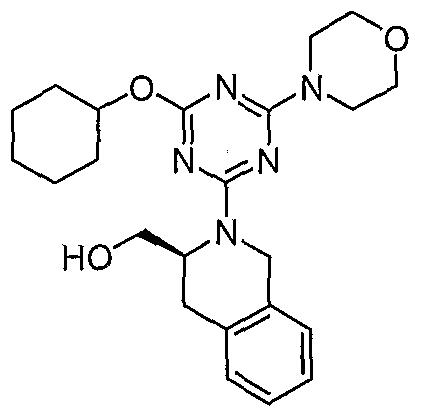
2-Chloro-4-cyclohexyloxy-6-morpholin-4-yl-[l,3,5]triazine (110 mg, 0.37 mmol) obtained in step 1) was dissolved in acetonitrile (10 ml), mixed with diisopropylethylamine (57 mg, 0.44 mmol) and (<S)-l,2,3,4-tetrahydro-3- isoquinolinemethanol (72 mg, 0.44 mmol), and refluxed for 24 hours. The resulting mixture was diluted with ethyl acetate, and washed successively with water and saturated NaCl. The resulting organic layer was dried over anhydrous magnesium sulfate, and concentrated under a reduced pressure. The resulting residue was purified by column chromatography to obtain the title compound (137 mg, 87%).
1H NMR (300 MHz, CDCl3) δ: 7.30-7.15 (4H, m), 5.20-4.82 (3H, m), 4.58-4.46 (IH, m), 3.90-3.50 (1OH, m), 3.07 (IH, dd, J=15.6, 6.3Hz), 2.81 (IH5 dd, J=15.6, 6.3Hz)5 2.70-1.20 (10H,m); [α]23 D +54.3(c=0.1745 MeOH).
Example EH: 3-[4-((35)-Hydroxymethyl-3,4-dihydro-liϊ-isoquinolin-2-yl)- 6-morpholin-4-yl-[l,3,5]triazin-2-yl]-phenol

Step 1) [2-(4-Chloro-6-morpholin-4-yl-[l,355]triazin-2-yl)-l,2,3,4- tetrahydroisoquinolin-(3.S)-yl]-methanol

2,4,6-Trichloro-[l,3,5]triazine (10.0 g, 54.2 mmol) was dissolved in acetonitrile (300 ml), and diisopropylethylamine (7.0 g, 54.2 mmol) was added thereto. Morpholine (4.7 mg, 54.2 mmol) was added dropwise thereto at 0 °C , and stirred for 1 hour. The resulting mixture was diluted with ethyl acetate, and washed successively with water and saturated NaCl. The resulting organic layer was dried over anhydrous magnesium sulfate, and concentrated under a reduced pressure. The resulting residue was recrystalized (n-hexane: ethyl acetate=2:l) to obtain 2,4-dichloro-6-moφholin-4-yl-[l,3,5]triazme (7.2 g, 56%). Then, 2,4-dichloro-6-moφholin-4-yl-[l,3,5]triazine (3.0 g, 12.8 mmol) thus obtained was dissolved in acetonitrile (50 ml), mixed with diisopropylethylamine (71.7 g, 12.8 mmol) and (_S)-l,2,3,4-tetrahydro-3- isoquinolinemethanol (2.1 g, 12.8 mmol) at room temperature, and stirred for 24 hours. The resulting mixture was diluted with ethyl acetate, and washed successively with water and saturated NaCl. The resulting organic layer was dried over anhydrous magnesium sulfate, and concentrated under a reduced pressure. The resulting residue was purified by column chromatography to
obtain [2-(4-chloro-6-morpholin-4-yl-[l,3,5]triazin-2-yl)-l,2,3,4- tetrahydroisoqumolin-(35)-yl]-methanol (4.4 g, 95%).
1H NMR (300 MHz, CDCl3) δ: 7.25-7.15 (4H, m), 5.13-5.01 (2H, m), 4.52 (IH, t, J=17.7Hz), 3.85 (4H, br), 3.73 (4H, br), 3.65-3.50 (2H, m), 3.09 (IH, dd, J=15.9Hz, 6.0Hz), 2.89 (IH, dt, J=13.1Hz 3.3Hz), 2.55 (IH, br).
Step 2) 3-[4-((3S)-Hydroxymethyl-3,4-dihydro- lH-isoquinorin-2-yl)-6- morpholin-4-yl- [1,3 , 5]triazin-2-yl] -phenol

1H NMR (300 MHz, CDCl3) : 8.00-7.78 (2H, m), 7.36-7.16 (5H, m), 7.02-6.94 (IH, m), 6.34 (IH, bs), 5.40-4.94 (3H, m), 4.70-4.54 (IH, m), 4.06-3.60 (1OH, m), 3.12 (IH, dd, J=15.3, 5.7Hz), 2.86 (IH, dd, J=15.3, 5.7Hz); [α]23 D +61.6(c=0.031, MeOH).
The procedure of Example II- 1 was repeated except for reacting [2-(4-
chloro-6-morpholin-4-yl- [1,3 ,5]triazin-2-yl)- 1 ,2,3 ,4-tetrahydroisoquinolin-3 (S)- yl]-methanol with a suitable boronic acid to obtain the compounds of Examples II-2 to II-4 shown in Table 1.
Table 1


The procedure of Example II- 1 was repeated except for reacting [2-(4- chloro-6-moφholin-4-yl-[l,3,5]triazin-2-yl)-l,2,3,4-tetrahydroisoquinolin-3(S)- yl]-methanol with 3-nitrophenylboronic acid, and the resulting cross coupled compound (200 mg) was dissolved in methanol (10 ml). A small amount of 10% Pd-C was added thereto, and stirred for 24 hours under a hydrogen atmosphere. The resulting mixture was filtered using celite to remove the catalyst, and concentrated under a reduced pressure. The resulting residue was purified by column chromatography to obtain the title compound (157 mg).
1H NMR (300 MHz, CDCl3) δ: 8.15-7.75 (4H, m), 7.47-7.38 (IH, m), 7.25-7.14 (4H, m), 5.20-5.07 (IH, m), 4.96-4.84 (IH, m), 4.65-4.50 (IH, m), 4.00 (5H, br), 3.81 (4H, br), 3.62-3.44 (IH, m), 3.20-3.05 (IH, m), 2.99-2.80 (IH, m).
The procedure of Example III- 1 was repeated except for reacting [2-(4- chloro-6-morpholin-4-yl-[ 1 ,3 ,5]triazm-2-yl)- 1 ,2,3 ,4-tetrahydroisoquinolin-3 (R)- yl]-methanol or [2-(4-chloro-6-morpholin-4-yl-[l ,3,5]triazin-2-yl)- 1 ,2,3,4- tetrahydroisoquinolin-3(S)-yl]-methanol with a suitable boronic acid (or boronate ester) to obtain the compounds of Examples II-6 to II-9 as shown in Table 2.
Table 2


Example 11-10: 3~[4-((3φ-HydroxymethyI-3,4-dihydro-l#-isoquiiioliii-2- yl)-6-(4-methyl-piperazin-l-yl)-[l,3,5]triazin-2-yl]-benzoic acid methyl ester
DIPEA1 CH3CN1O 0C,
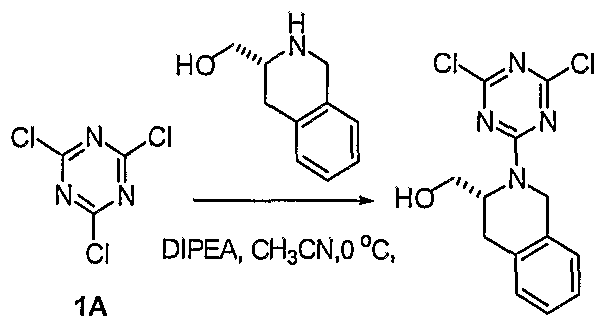
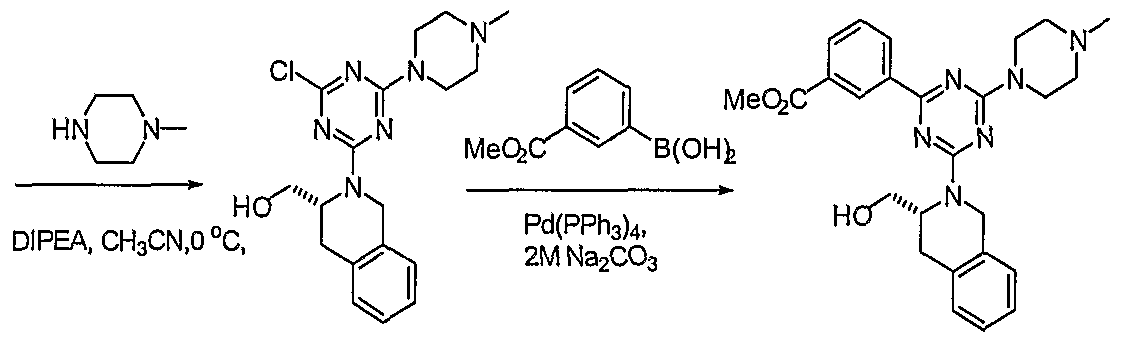
2,4,6-Trichloro-[l,3,5]triazine (1.0 g, 6.1 mmol) dissolved in acetonitrile (20 ml) was slowly mixed with diisopropylethylamine (475 mg, 3.67 mmol) and (R)-l,2,3,4-tetrahydro-3-isoquinolinemethanol (500 mg, 3.1 mmol) at 0 °C for 3 hours. The resulting mixture was diluted with ethyl acetate, and washed successively with water and saturated NaCl. The resulting organic layer was dried over anhydrous magnesium sulfate, and concentrated under a reduced pressure. The resulting residue was purified by column chromatography to obtain [2-(4,6-dichloro-[l,3,5]triazin-2-yl)-l,2,3,4-tetrahydroisoquinolin-3(S)- yl]-methanol (470 mg) [1H NMR (300 MHz, CDCl3) δ 7.25 (m, 4H)5 5.16 (d, IH, J=17.2), 5.14 (m, IH), 4.58 (d, IH, J=17.2), 3.63 (d, 2H, J=6.9), 3.13 (dd, IH, J=16.2, 6.0), 2.98 (dd, IH, J=16.2, 3.0)].
The compound (473 mg, 1.5 mmol) thus obtained was dissolved in
acetonitrile (5 ml), mixed with diisopropylethylamine (197 mg, 1.5 mmol) and 1-methylpiperazine (152 mg, 1.5 mmol), and stirred for 30 min. The resulting mixture was diluted with ethyl acetate, and washed successively with water and saturated NaCl. The resulting organic layer was dried over anhydrous magnesium sulfate, and concentrated under a reduced pressure. The resulting residue was purified by column chromatography to obtain {2-[4-chloro-6-(4- methyl-piperazin- 1 -yl)-[ 1 ,3 ,5-]triazin-2-yl]- 1 ,2,3 ,4-tetrahydro-isoquinolin-3 (R)- yl} -methanol as colorless solid (280 mg, 49%) [1H NMR (300 MHz, CDCl3) δ 7.22 (m, 4H), 5.06 (m, 2H), 4.52 (t, IH, J=17.4), 3.89 (m, 4H), 3.60 (m, 2H), 3.09 (dd, IH, J=15.3, 5.7), 2.88 (m, IH), 2.47 (m, 4H), 2.36 (d, 3H, J=6.0)].
The product (100 mg, 0.267 mmol) and 3-methoxycarbonyl- phenylboronic acid (58 mg, 0.33 mmol) was dissolved in toluene (1.5 ml)/ethanol (0.5 ml). 1 ml of 2M aqueous sodium carbonate and tetrakistriphenylphosphine palladium (15 mg, 0.013 mmol) was added thereto, and refluxed at 100 °C for 24 hours. The resulting mixture was diluted with water (10 ml), and extracted three times with dichloromethane. Then, the dichloromethane was removed therefrom, and the resulting residue was purified by column chromatography (dichloromethane :methanol=20: l) to obtain the title compound as colorless solid (65 mg, 51%). m.p 86-88 °C ; MS(ESI)[M+H+]475;
1H NMR (250 MHz, CDCl3) δ 9.03-8.97(1H, m), 8.61-8.53(1H, m), 8.16(1H, d, J=7.5 Hz), 7.56-7.50(1H, m), 7.27-7.22(4H, m), 5.41-5.3O(1H, m), 5.12-5.O6(1H, m), 4.68-4.53(1H, m), 4.15(4H, bs), 3.96(3H, s), 3.67(3H, bs), 3.18-3.O9(1H, m), 2.93-2.86(1H, m), 2.71(4H, s), 2.51(3H, s).
Example 11-11 : {2-H-(4-Methylpiperazin-l-yl)-6-(3-trifluoromethyIphenyl)- [l,3,5]triazin-2-yl]-l,2,3,4-tetrahydroisoquinolin-3(i?)-yl}-methanol

The procedure of Example II- 1 was repeated except for reacting {2- [4- chloro-6-(4-methyl-piperazin- 1 -yl)- [ 1 ,3 ,5-]triazin-2-yl]- 1 ,2,3 ,4-tetrahydro- isoquinolin-3(R)-yl} -methanol with 3-trifluorophenylboronic acid to obtain the title compound. m.p 82-84°C ;
MS(ESI)[M+H+]485;
1H NMR (250 MHz, CDCl3) δ 8.60-8.53(2H, m), 7.75(1H, d, J=7.5 Hz), 7.61-7.55(1H, m), 7.27-7.18(4H5 m), 5.31-5.08(2H. m), 4.68-4.53(1H, m), 4.10(4H, bs), 3.67(3H, bs), 3.18-3.10(1H, m), 2.94-2.86(1H, m), 2.66(4H, s), 2.47(3H, s).
Example 11-12: {2-[4-(3-Fluoro-phenyI)-6-(4-methyl-piperazin-l-yl)- [l,3,5]triazin-2-yl]-l,2,3,4-tetrahydro-isoquinolin-(3i?)-yl}-methanol

The procedure of Example II- 1 was repeated except for reacting {2-[4- chloro-6-(4-methyl-piperazin-l-yl)-[l,3,5-]triazin-2-yl]-l,2,3,4-tetrahydro- isoquinolin-3(R)-yl} -methanol with 3-fluorophenylboronic acid to obtain the title compound (86%). m.p 88-90°C;
MS(ESI)[M+H+]435;
1H NMR (250 MHz5 CDCl3) δ 8.24-8.02(2H, m), 7.42-7.18(6H, m), 5.36-5.04(2H, m), 4.67-4.52(1H5 m), 4.20-3.80(4H, m), 3.70-3.55(2H5 m), 3.17- 3.08(1H, m), 2.92-2.84(1H5 m), 2.66(3H, s), 2.47(3H5 s).
Example 11-13: {2-[4-[4-(2-Amino-ethyl)-piperazin-l-yl]-6-(3-fluoro- phenyl)-[l,3,5]triazin-2-yl]-l,2,3,4-tetrahydro-isoquinolin-(3if)-yl}- niethanol

The compound was reacted with l-(2-aminoethyl)ρiperazine to obtain the title compound (78%). m.p 95-97 °C; MS(ESI)[M+H+]464;
1H NMR (250 MHz, CDCl3) δ 8.21-8.03(2H5 m), 7.42-7.19(6H, m), 5.36-5.05(2H5 m), 4.67-4.54QH, m), 4.20-3.80(4H, m), 3.75-3.60(2H5 m), 3.17- 3.08(1H5 m), 2.91-2.83(3H5 m), 2.53(6H5 s), 2.30-2.02(3H, m).
Example 11-14: 4-[4-((35)-Hydroxymethyl-3,4-dihydro-li7-isoquinoIin-2- yl)-6-morpholin-4-yl-[l,3,5]triazin-2-yl]-2,6-dimethoxyphenol

{2-[4-Mθφholin-4-yl-6-(3,4,5-trimethoxyphenyl)-[l,3,5]triazin-2-yl]- (S)-1, 2, 3,4-tetrahydroisoquinolin-3-yl} -methanol (100 mg, 0.203 mmol) synthesized from {2-[6-chloro-4-moφholin-4-yl-[l,3,5]triazin-2-yl]-0S)-l,2,3,4- tetrahydroisoquinolin-3-yl} -methanol under Suzuki reaction condition was refluxed with a mixture of zinc iodide (776 mg, 2.43 mmol) and trimethylsilane iodide (244 mg, 1.22 mmol) in chloroform (2 ml) at 70 "C for 24 hours. The resulting mixture was diluted with water (1 ml), and extracted three times with ethyl acetate. The ethyl acetate was removed therefrom, and the resulting residue was purified by column chromatography (hexane: ethyl acetate = 2: 1) to obtain the title compound as a white solid (30 mg, 31%).
1H NMR (300 MHz, DMSO-d6) δ 7.54(2H, s), 7.21-7.19(4H, m), 5.07- 5.01(2H, m), 4.53(1H, d, J=16.5 Hz), 3.93(9H, s), 3.87(3H, s), 3.76(6H, s), 3.1O(1H, dd, J=15.0, 4.2 Hz).
Example 11-15: 5-[4-((35)-Hydroxymethyl-3,4-dihydro-lJHr-isoquinolin-2- yl)-6-morpholin-4-yl-[l,3,5]triazin-2-yl]-benzene-l,2,3-triol

(5)-l,2,3,4-tetrahydroisoquinolin-3-yl}-methanol (140 mg, 0.284 mmol)
synthesized according to the method described in Example 11-14 was dissolved in dichloromethane (2 ml). Then, tribromoborone (84 mg, 0.851 mmol) was added thereto at 0 °C , and stirred for 15 min. The reaction was completed by adding IN aqueous HCl (2 ml) and IN aqueous sodium hydroxide, and the resulting mixture was extracted three times with dichloromethane. The dichloromethane was removed therefrom, and the resulting residue was purified by column chromatography (hexane: ethyl acetate = 2:1) to obtain the title compound as a white solid (20 mg, 17%).
1H NMR (300 MHz, DMSO-d6) δ 7.28(2H, s), 7.23-7.13(4H, m), 4.85(1H, d, J=15.6 Hz), 4.5O(1H, d, J=15.6 Hz), 4.48-4.38(1H, m), 3.98(4H, s), 3.76(6H, s), 3.13(1H, dd, J=18.3, 5.4 Hz), 2.87(1H, dd, J=18.3, 5.4 Hz).
Example 11-16: 3-[4-(4-Cyclopentylpiperazin-l-yl)-6-((3iR)-hydroxymethyl- 3,4-dihydro-lJHr-isoquinolin-2-yl)-[l,3,5]triazin-2-yI]-phenoI

The procedure of Example II- 1 was repeated except for using {2-[4- chloro-6-(4-cycloρentylpiperazin- 1 -yl)-[ 1 ,3,5]triazin-2-yl]- 1 ,2,3,4- tetrahydroisoquinolin-3-yl} -methanol, the intermediate compound of Example 11-10, as a starting material to obtain the title compound.
1H NMR (300 MHz, CDCl3) δ 8.00(1H5 bs), 7.85(1H, d, J=13.3 Hz),
7.40(5H, m), 7.00(1H, d, J=10.6 Hz), 5.36(1H, bs), 5.20-4.90(2H, m),
4.65(0.5H3 bs), 4.58(0.5H, d, J=18.8 Hz), 4.02(4H, bs), 3.78-3.55(3H, m),
3.10(1H, dd, J=13.3, 6.6 Hz), 2.82(1H, dd, J=13.3, 6.6 Hz), 2.62(4H, bs), 1.95(2H, bs), 1.75(2H, bs), 1.60(3H, bs).
Example 11-17: 3-[4-(4-CycIohexylpiperazin-l-yl)-6-((3i?)-hydroxymethyl- 3,4-dihydro-l//-isoquinolin-2-yl)-[13,5]triazm-2-yl]-phenoI

1H NMR (300 MHz, CDCl3) δ 7.95(1H, bs), 7.21 (4H, s), 7.17(1H, d, J=5.4 Hz), 6.95(1H, d, J=7.2 Hz), 5.04(1H, bs), 4.95(1H, d, J=16.2 Hz), 4.65-
4.50(1H, m), 4.53(1H, d, J=15.9 Hz), 4.00(4H, bs), 3.64-3.57(1H, m), 3.06(1H, dd, J=15.3, 5.7 Hz), 2.82(1H, dd, J=15.3, 3.15 Hz), 2.70(4H, bs), 2.37(1H, bs),
1.92(2H, bs), 1.78(2H, bs), 1.6O(1H, d, J=5.4 Hz), 1.33-0.90(4H, m).
Example 11-18: 3-[4-((32?)-Hydroxymethyl-3,4-dihydro-l#-isoquinolin-2- yl)-6-(4-methylpiperazin-l-yl)-[l,3,5]triazin-2-yl]-phenol
The procedure of Example II- 1 was repeated except for reacting {2-[4- chloro-6-(4-methyl-ρiρerazin- 1 -yl)-[ 1 ,3 ,5-]triazin-2-yl]- 1 ,2,3 ,4-tetrahydro- isoquinolin-3(R)-yl} -methanol with 3-hydroxyphenylboronic acid to obtain the title compound as a white powder (60 mg). MS(ESI)[M+H]+433 ;
1R NMR (300 MHz5 CDCl3) δ 8.00-7.80 (m, 2H), 7.24 (m, 5H), 6.99 (m, IH), 5.04 (m, 2H), 4.60 (m, IH), 4.56 (m, 4H), 3.65 (m, 2H), 3.11 (dd, IH, J=I 5.6, 6.0), 2.85 (dd, IH, J=15.6, 3.9), 2.59 (bs, 4H), 2.39 (bs, 3H).
Example 11-19: 3-{4-((3JR)-Hydroxymethyl-3,4-dihydro-lJΪ-isoquinolin-2- yl)-6-[4-(tetrahydropyran4-yl)-piperazin-l-yl]-[l,3,5]triazin-2-yl}-phenol
Step 1) l-(Tetrahydropyran4-yl)-piperazme

Sodium triacetoxyborohydride (2.8g) was added to a solution obtained by dissolving benzylpiperazine (1.8g) and tetrahydro-4H-pyran-4-one (1.1 ml) in dichloromethane, and stirred for 2 hours. Aqueous ammonium chloride was added thereto, and the resulting mixture was extracted with ethyl acetate. The resulting organic layer was dried over anhydrous magnesium sulfate, filtered, and concentrated. The resulting residue was purified by column chromatography (hexane: ethyl acetate= 3: 1) to obtain l-benzyl-4- (tetrahydropyran4-yl)-piperazine (460 mg). The compound thus obtained was dissolved in methanol, mixed with palladium carbon (50 mg), and stirred for 6 hours under a hydrogen atmosphere. The solid was filtered, concentrated, and recrystalized with ethyl acetate/hexane to obtain l-(tetrahydropyran4-yl)- piperazine as a brown solid (250 mg).
1H NMR (300 MHz, CDCl3) δ 4.02 (m, 2H), 3.36 (m, 2H), 3.24 (m, 4H), 2.88 (m, 4H), 2.56 (m, IH), 1.73 (m, 2H), 1.56 (m, 2H).
Step 2) (2-{4-Chloro-6-[4-(tetrahydropyran4-yl)-piperazin-l-yl]-[l,3,5]triazin-
2-yl} - 1 ,2,3 ,4-tetxahydroisoquinolin-3(R)-yl)-methanol

[2-(4,6-Dichloro-[l,3,5]triazin-2-yl)-l,2,3,4-tetrahydro-isoquinolin- 3 (i?)-yl] -methanol (250 mg) was dissolved in acetonitrile (10 ml), and 1- (tetrahydropyran4-yl)-piperazine (150 mg) obtained in step 1) and diisopropylamine (160 βl) was sequentially added thereto. The resulting mixture was stirred at room temperature for 2 hours, and concentrated under a reduced pressure. Sodium bicarbonate solution was added thereto, and the resulting solution was extracted with ethyl acetate. The resulting organic layer was dried over anhydrous magnesium sulfate, filtered, and concentrated. The resulting residue was purified by column chromatography (10% methanol/dichloromethane) to obtain the title compound as a white powder (230 mg). 1H NMR (300 MHz, CDCl3) δ 7.21 (m, 4H), 5.07 (m, 2H), 4.51 (t, IH,
J=16.3), 4.04 (d, 2H, J=I 1.4), 3.85 (m, 4H), 3.57 (m, 2H), 3.38 (t, 2H, J=Il.4), 3.08 (dd, IH5 J=15.8, 5.9), 2.89 (m, IH), 2.59 (m, 4H), 2.49 (m, IH), 1.76 (m, 2H), 1.61 (m, 2H).
Step 3) 3-{4-((3R)-Hydroxymemyl-3,4-dihydro-lH-isoquinolin-2-yl)-6-[4- (tetrahydropyran4-yl)-piperazin-l-yl]-[l,3,5]triazin-2-yl}-phenol

(2-{4-Chloro-6-[4-(tetrahydropyran4-yl)-piperazin-l-yl]-[l,3,5]triazin- 2-yl}-l,2,3,4-tetrahydroisoquinolin-3(R)-yl)-methanol (110 mg) obtained in step 2) was dissolved in toluene (8 ml), and 3-hydroxyphenylboronic acid (50 mg), tetrakistriphenylphosphine palladium (6 mg), 2N aqueous sodium carbonate (4 ml) and ethanol (4 ml) was sequentially added thereto. The resulting mixture was stirred for 12 hours while heating to 900C , and cooled to room temperature. Salt solution was added thereto, and extracted with ethyl acetate. The resulting organic layer was dried over anhydrous magnesium sulfate, filtered, and concentrated. The resulting residue was purified by column chromatography (10% methanol/dichloromethane), and recrystalized with ethyl acetate/hexane to obtain the title compound as a white powder (30 mg)-
MS(ESI) [M+H]+ 503;
1R NMR (300 MHz, CDCl3) δ 7.98-7.81 (m, 2H), 7.24 (m, 5H), 6.97 (m, IH), 5.07 (m, 2H), 4.61 (m, IH), 4.03 (m, 6H), 3.66 (m, 2H), 3.40 (m, 2H), 3.09 (dd, IH, J=15.3, 5.7), 2.85 (dd, IH, J=15.3, 3.9), 2.68 (m, 4H), 2.53 (m, IH), 1.79 (m, 2H), 1.63 (m, 2H).
Example III-l: 3-[4-(Hexahydropyrrolo[l,2,«]pyrazin-2-yl)-6-((3i?)- hydroxymethyl-S^-dihydro-liϊ-isoquinolin^-y^-tl^^ltriazin-l-yll-phenol
Step 1) 3-[4-Chloro-6-((3R)-hydroxymethyl-3,4-dihydro-lH-isoquinolin-2-yl)- [ 1 ,3 ,5]triazin-2-yl]-phenol

(3-Bromophenoxy)-tert-butyldimethylsilane (14 g, 48.7 mmol) dissolved in tetrahydrofuran (30 ml) was added dropwise at room temperature to a mixture of magnesium (3.6 g, 146 mmol), iodine (catalytic amount) and tetrahydrofuran (2 ml), and refluxed for 2 hour followed by cooling to room temperature. The resulting mixture was added dropwise at 0°C to 2,4,6- trichloro-[l,3,5]triazine (8.99 g, 48.7 mmol) dissolved in tetrahydrofuran (20 ml), and stirred at room temperature for 3 hours. Then, the resulting solution was added to aqueous ammonium chloride, and extracted twice with diethyl ether. The separated organic layer was washed successively with water and saturated NaCl, dried over anhydrous magnesium sulfate, and concentrated under a reduced pressure. The resulting residue was purified by column chromatography to obtain 2-[3-(tert-butyldimethylsilanyloxy)-phenyl]-4,6- dichloro-[l,3,5]triazine (5.3g). 2-[3-(tert-butyldimethylsilanyloxy)-phenyl]-4,6-dichloro-[l,3,5]triazine
(5.3 g, 14.9 mmol) thus obtained was dissolved in acetonitrile (150 ml), and diisopropylethylamine (1.9 mg, 14.9 mmol) was added thereto. (R)-l,2,3,4- tetrahydro-3-isoquinolinemethanol (2.4 g, 14.9 mmol) was added to the resulting solution at room temperature, and stirred for 3 hours. The resulting mixture was diluted with ethyl acetate, and washed successively with water and saturated NaCl. The resulting organic layer was dried over anhydrous magnesium sulfate, and concentrated under a reduced pressure. The resulting
residue was purified by column chromatography to obtain 3-[4-chloro-6-(3-t- butyldimethylsilanyloxymethyl-3 ,4-dihydro- lH-isoquinolin-2-yl)-[ 1 ,3 ,5]triazin- 2-yl]-phenol (6.2 g, 86%).
Then, tetrabutylammonium fluoride (1.0 M THF solution 14 ml, 14.1 mmol) was added dropwise at -78 °C to the compound (6.2 g, 12.8 mmol) thus obtained dissolved in tetrahydrofuran (200 ml), and stirred at 0 °C for 2 hours. The resulting mixture was washed successively with water and saturated NaCl. The resulting organic layer was dried over anhydrous magnesium sulfate, and concentrated under a reduced pressure. The resulting residue was purified by column chromatography to obtain the title compound (4.4 g, 93%).
1H NMR (300 MHz, CDCl3) 7.92-7.45 (3H, m), 7.35-7.10 (4H, m), 6.99-6.90 (IH, m), 5.19-5.09 (IH, m), 4.75 (2H, dd, 126Hz, 17.1Hz), 3.70-3.50 (2H, m), 3.11 (IH, dt, J=15.6Hz, 3.9Hz), 2.90 (IH, dd, 15.6Hz, 3.3Hz).
Step 2) 3-[4-(Hexahydropyrrolo[l ,2,α]pyrazin-2-yl)-6-((3R)-hydroxymethyl- 3,4-dihydro-lH-isoquinolin-2-yl)-[ 1 ,3,5]triazin-2-yl]-phenol

[l,3,5]triazin-2-yl)-phenol (120 mg, 0.3 mmol) thus obtained in step 1) was dissolved in acetonitrile (7 ml), mixed with diisopropylethylamine (84 mg, 0.6 mmol) and octahydropyrrolo[l,2,a]ρyrazine (62 mg, 0.5 mmol), and refluxed for 24 hours. The resulting mixture was diluted with ethyl acetate, and washed successively with water and saturated NaCl. The resulting organic layer was
dried over anhydrous magnesium sulfate, and concentrated under a reduced pressure. The resulting residue was purified by column chromatography to obtain the title compound (81 mg, 54%).
MS(ESI)[M+H+]459 ; 1H NMR (SOO MHZ5 CDCI3) 7.92-7.80 (3H, m), 7.35-7.15 (4H, m),
6.98 (IH, d, J=7.8Hz), 5.20-4.80 (4H, m), 4.70-4.50 (IH5 m), 3.75-3.55 (2H5 m), 3.25-3.05 (5H5 m), 2.85 (2H5 dd, 15.6Hz5 3.9Hz), 2.40-1.50 (8H5 m).
The procedure of step 2) of Example III-l was repeated except for reacting 3-[4-chloro-6-(3(R)-hydroxymethyl-3,4-dihydro-lH-isoquinolin-2-yl-
[l,355]triazin-2-yl)-phenol] or 3-[4-chloro-6-(3(S)-hydroxymemyl-354-dihydro- lH-isoquinolin-2-yl-[l53,5]triazin-2-yl)-phenol] with a suitable amine to obtain the compounds of Examples 111-2 to 111-31 as shown in Table 3.
Table 3


Example 111-32: 3-[4-((3i?)-Hydroxymethyl-3,4-dihydro-lJHr-isoquinoIin-2- yl)-6-(4-methylpiperazin-l-yl)-[l,3,5]triazine methyl iodonium salt

Methyl iodide (18 mg, 0.12 mmol) was added to 3-[4-((3R)- hydroxymethyl-3 ,4-dihydro- lH-isoquinolin-2-yl)-6-(4-methylpiperazin- 1 -yl)- [l,3,5]triazin-2-yl]-phenol (17 mg, 0.04 mmol) dissolved in dichloromethane, and stirred for 3 hours. When a white solid was precipitated, the resulting mixture was filtered to the title compound as a white solid (18 mg, 82%).
1H NMR (300 MHz, DMSO-d6) δ 7.81(1H, d, J=7.5 Hz), 7.75(1H, d, 1=9.6 Hz), 7.26-7.25(2H, m), 7.16(3H, s), 6.89(1H, d, J=7.8 Hz)5 5.23(1H, dd, J=33.3, 16.8 Hz), 5.14(1H, s), 4.8O(1H, td, J=15.6, 5.7 Hz), 4.42(1H, dd, J=33.3, 16.8 Hz), 4.16(5H, s), 3.44 (6H, s), 3.16(6H, s).
Example 111-33 : 3-[4-((3φ-Hydroxymethyl-3,4-dihydro-l#-isoquinolin-2- yl)-6-(4-methylpiperazin-l-yl)-[l,3j5]triazine-oxonium salt

3-[4-(3-Hydroxymethyl-3,4-dihydiO-lH-isoquinolin-2-yl)-6-(4- methylpiperazin-l-yl)-[l,3,5]triazin-2-yl]-phenol (50 mg, 0.116 mmol) and 4- chloroperbenzoic acid (100 mg, 0.578 mmol) was added to dichloromethane (2 ml) at 0 °C for 3 hours. The resulting mixture was diluted with water (1 ml), and extracted three times with dichloromethane. The dichloromethane was removed therefrom, and the resulting residue was purified by column chromatography (ethyl acetate:methanol = 1 :2) to obtain the title compound as a white solid (20 mg, 39%).
1H NMR (300 MHz, DMSO-d6) δ 7.81(1H, d, J=7.5 Hz), 7.75(1H, d, J=9.6 Hz), 7.26-7.25(2H, m), 7.16(3H, s), 6.89(1H, d, J=7.8 Hz), 5.23(1H, dd, J=33.3, 16.8 Hz), 5.14(1H, s), 4.8O(1H, td, J=15.6, 5.7 Hz), 4.42(1H, dd, J=33.3, 16.8 Hz), 3.69(5H, s), 3.44 (6H, s), 3.11(3H, s).
Example III-34: 3-[4-((3JR)-Hydroxymethyl-3,4-dihydro-li7-isoquinolin-2- yl)-6-imidazol-l-yl-[l,3,5]triazin-2-yl)-phenol

1H NMR (300 MHz, DMSO-d6) δ 9.69(OH), 8.74(1H, d, J=13.8 Hz), 8.04(1H, d, J=12.0 Hz), 7.96-7.85(2H, m), 7.30-7.12(5H, m), 6.98(1H, d, J=8.7 Hz), 5.30(1H, dd, J=17.7, 10.8 Hz), 5.22(1H, bs), 4.9O(1H, dd, J=17.7, 5.1 Hz), 4.57(1H5 dd, J=31.8, 16.8 Hz), 3.02(2H, s), 2.82(1H, s), 2.66(1H5 s).
The procedure of step 2) of Example IH-I was repeated except for reacting 3-[4-chloro-6-(3(R)-hydroxymethyl-3,4-dihydro-lH-isoquinolin-2-yl- [l,3,5]triazin-2-yl)-phenol] or 3-[4-chloro-6-(3(iS)-hydroxymethyl-3,4-dihydro- lH-isoquinolin-2-yl-[l,3,5]triazin-2-yl)-phenol] with a suitable amine to obtain the compounds of Examples 111-35 to 111-42 as shown in Table 4.
Table 4


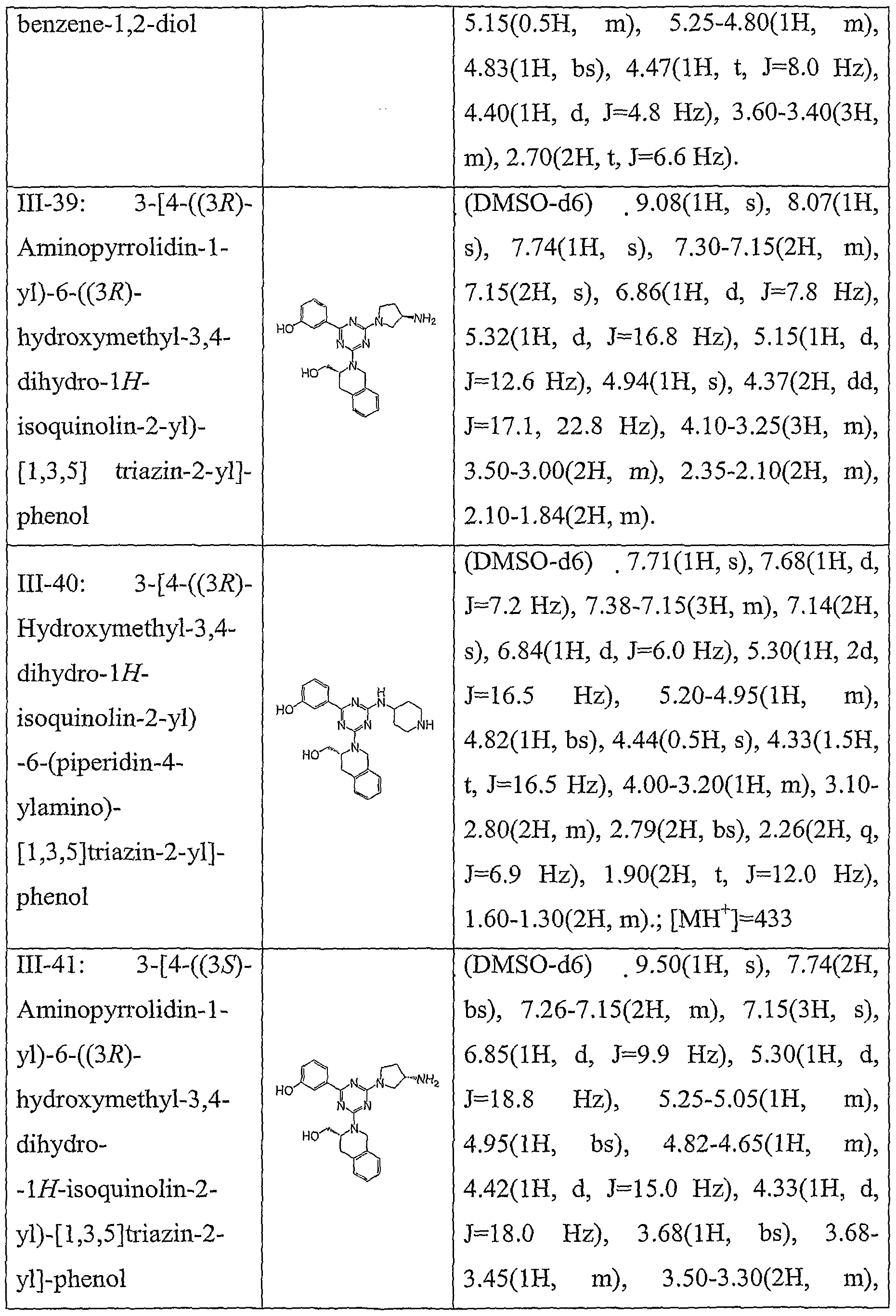

The procedure of step 2) of Example III-l was repeated except for reacting 3-[4-chloro-6-(3(R)-hydroxymethyl-3,4-dihydro-lH-isoquinolin-2-yl- [1 ,3,5]triazin-2-yl)-phenol] or 3-[4-chloro-6-(3(5)-hydroxymethyl-3,4-dihydro- lH-isoquinolin-2-yl-[l,3,5]triazin-2-yl)-phenol] with a suitable amine to obtain the compounds of Examples 111-43 to 111-61 as shown in Table 5.
Table 5


Hydroxymethyl-3 ,A- dihydro- lH-isoquinolin-
[M+Η]+ 447 2-yl)-6-(2-ρyrrolidin- 1 - yl-ethylamino)- X) [l,3,5]triazin-2-yl]- phenol
III-49: 3-[4-((3R)-
Hydroxymethyl-3 ,4- (in CDCl3) δ 7.90-7.40 (2H5 m), dihydro- lH-isoquinolin- 7.28-6.90 (6H, m), 5.80-5.50 (IH,
2-yl)-6-(2-hydroxy-(lS)- m), 5.35-4.20 (6H, m), 3.90-3.37 methyl-ethylamino)-
 (5H, m), 3.15-2.70(2H, m), 1.30-
[l,3,5]triazin-2-yl]- 1.10(3H, m). phenol
πi-50: 3-[4-((3R)-
Hydroxymethyl-3 ,A- (in CDCl3) δ 7.94-7.50 (2H, m), dihydro- lH-isoquinolin- 7.34-6.90 (6H, m), 6.20-5.90 (IH,
2-yl)-6-((2S)-hydroxy- m), 5.45-4.80 (3H, m), 4.70-4.30 propylamino)-
 (2H, m), 4.11-3.20(6H, m), 3.15-
[l,3,5]triazin-2-yl]- 2.74(2H,m),1.30-1.10(3H, m). phenol πi-51: (4-[4-((3R)-
(in DMSO-d6) δ : 9.51(lH,s),
Hydroxymethyl-3 ,A- 7.77-7.70 (2H, m), 7.25-7.11 (5H, dihydro- lH-isoquinolin- m), 6.88-6.85 (IH, m), 5.31-4.32 2-yl)-6-(3 -hydroxy- (3H, m), 3.95-3.60 (4H, m), phenyl)- [ 1 ,3 ,5]triazin-2-
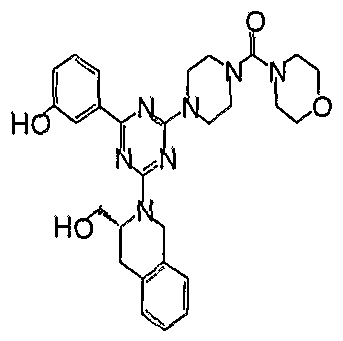 3.60-3.38 (6H, m), 3.28-2.84 (HH, yl] -piperazin- 1 -yl} - m). morpholin-4-yl- methanone

 III-59: 3-[4-[(2-
(in CDCl3) δ 7.88-7.75 (m, 2H)5 7.41
Hydroxy-ethyl)-methyl- (s, IH), 7.23 (m, 4H), 6.95 (m, IH), amino]-6-((3R)- 5.32 (m, IH), 5.23 (m, IH), 4.99 (d, hydroxymethyl- 3,4-
 IH, J-16.5), 4.62 (m, IH), 4.49 (d, dihydro- lH-isoquinolin- IH, J=16.8), 3.98 (m, 2H), 3.74-3.48
2-yl)-[l,3,5]triazin-2-yl]- (m, 3H), 3.11 (s, 3H), 2.78 (m, IH). phenol
III-60: 3-[4-[4-(2-
Amino-ethyl)-piperazin- (in CDCl3) δ 8.00-7.80 (m, 2H), 7.24 l-yl]-6-((3R> il I (m, 5H), 6.97 (m, IH), 5.05 (m, 2H), hydroxymethyl-3 ,4- 4.59 (m, IH), 3.97 (bs, 4H), 3.67 (m, dihydro- lH-isoquinolin- 2H), 3.11 (dd, IH, J=15.3, 5.7), 2.86
2-yl)-[l,3,5]triazin-2-yl]- (m, 3H)5 2.51 (bs, 6H). phenol
IH-61 : 2-[4-((3R)-
Hydroxymethyl-3 ,4- (in DMSO-d6) δ 8.59 (s, IH), 7.80 dihydro- lH-isoquinolin- (m, 2H), 7.24 (m, 4H), 6.95-6.80 (m, 2-yl)-6-(3-hydroxy- 2H), 5.40 (m, IH), 5.21 (m, 2H), phenyl)-[ 1 ,3,5]triazin-2-
 4.88 (m, IH), 4.67 (m, 2H), 4.40 (m, ylamino] -propane- 1,3- IH), 4.15 (m, IH)5 3.55 (bs, 4H). diol
Example IV-I : {l-[4-((3JR)-HydroxymethyI-3,4-dihydro-lJfiT-isoquinolin-2- yl)-6-(3-hydroxyphenyl)-[l,3,5]triazin-2-yI]-piperidin-3-yl}-pyrrolidin-l-yI- methanone

2,4,6-Trichloro-[l,3,5]triazine (1.5 g, 8.1 mmol)tetrahydro-4-pyranol (831 mg, 8.1 mmol) dissolved in dichloromethane (25 ml) was added dropwise at 0°C to a mixture of tetrabutylammonium bromide (260 mg, 0.8 mmol), 50% aqueous sodium hydroxide (8 ml) and dichloromethane (10 ml), and stirred for 10 min. The water layer was removed, and the separated organic layer was washed with saturated NaCl. The resulting organic layer was dried over anhydrous magnesium sulfate, and concentrated under a reduced pressure.
Without purification, the resulting residue (400 mg) was dissolved in acetonitrile (20 ml), and diisopropylethylamine (207 mg) was added thereto.
Then, (R)-l,2,3,4-tetrahydro-3-isoquinolinemethanol (261 mg) was added thereto at room temperature, and stirred for 30 min. The resulting mixture was diluted with ethyl acetate, and washed successively with water and saturated
NaCl. The resulting organic layer was dried over anhydrous magnesium sulfate, and concentrated under a reduced pressure.
Without purification, the resulting residue (250 mg) was dissolved in a mixture of toluene (9 ml) and ethanol (3 ml). A mixture of tetrakistriphenylphosphine palladium (153 mg), 3-hydroxyphenylboronic acid (137 mg) and 2M aqueous sodium carbonate (3 ml) was added thereto, and refmxed with Ar for 24 hour. The resulting mixture was diluted with ethyl acetate, and washed successively with water and saturated NaCl. The resulting organic layer was dried over anhydrous magnesium sulfate, and concentrated under a reduced pressure. The resulting residue was purified by
column chromatography to obtain the title compound (224 mg).
1H NMR (300 MHz, DMSO-d6) δ: 0.76 (IH5 s), 7.86-7.79 (IH, m),
7.64-7.53 (IH, m), 7.34-7.19 (3H, m), 6.97 (IH, d, 7.8Hz), 5.24 (2H, dd,
J=64.2Hz, 17.1Hz), 5.32-5.21 (IH, m), 4.50 (IH, dd, J=34.2Hz, 17.4Hz), 3.90-3.86 (2H, m), 3.58-3.42 (3H, m), 3.37-3.21 (2H, m), 3.03-3.00 (2H, m),
2.09-1.98 (2H, m), 1.75-1.67 (2H, m).
Example IV-2: 3-[4-((3i?)-Hydroxymethyl-3,4-dihydro-lJ-7-isoquinolin-2- yl)-6-(tetrahydrofuran-(3iϊ)-yloxy)-[l,3,5]triazm-2-yl]-phenol

A mixture of (R)-3-hydroxytetrahydrofuran (717 mg, 8.1 mmol), tetrabutylammonium bromide (260 mg, 0.8 mmol), 50% aqueous sodium hydroxide (8 ml) and dichloromethane (10 ml) was added dropwise at 0°C to a solution obtained by dissolving 2,4,6-trichloro-[l,3,5]triazine (1.5 g, 8.1 mmol) in dichloromethane (25 ml). Then, the procedure of Example IV-I was repeated to obtain the title compound (224 mg).
1H NMR (300 MHz, CDCl3) δ: 7.99-7.87 (IH, m), 7.70-7.42 (2H, m), 7.33-7.18 (4H, m), 7.05-6.99 (IH, m), 5.67-5.55 (IH, m), 5.40-5.13 (IH, m), 4.81 (2H, dd, J=120Hz, 16.5Hz), 4.21-3.83 (4H, m), 3.73-3.56 (2H, m), 3.10 (IH, dd, J=I 5.3Hz, 5.7Hz), 2.31-2.11 (2H, m).
Example IV-3: 3-[4-((3i?)-Hydroxymethyl-3,4-dihydro-lH-isoquinolin-2- yl)-6-(2,2,2-trifluoroethoxy)- [1 ,3,5] triazin-2-yl] -phenol

A mixture of 2,2,2-trifluoroethanol (814 mg, 8.1 mmol), tetrabutylammonium bromide (260 mg, 0.8 mmol), 50% aqueous sodium hydroxide (8 ml) and dichloromethane (10 ml) was added dropwise at 0°C to a solution obtained by dissolving 2,4,6-trichloro-[l,3,5]triazine (1.5 g, 8.1 mmol) in dichloromethane (25 ml). Then, the procedure of Example IV-I was repeated to obtain the title compound (55 mg).
1H NMR (300 MHz, CDCl3) δ : 8.02-7.88 (IH, m), 7.80-7.73 (IH, m), 7.31-7.19 (3H, m), 7.05-6.96 (IH, m), 5.29-5.21 (IH, m), 4.83 (2H, dd, J=125Hz, 16.5Hz), 4.85-4.70 (2H, m), 3.75-3.65 (2H, m), 3.14 (IH, dd, J=I 6.2Hz, 6.3Hz), 2.93 (IH, d, J=I 5.6Hz), 2.4-1.6 (2H, br).
Example IV-4: l-{2-[4-((3i?)-Hydroxymethyl-3,4-dihydro-lfl-isoquinoIin-2- yl)-6-(3-hydroxyphenyl)-[l,3,5]triazin-2-yIoxy]-ethyl}-pyrrolidin-2-one

A mixture of l-(2-hydroxyethyl)-2-pyrrolidinone (700 mg, 8.1 mmol), tetrabutylammonium bromide (260 mg, 0.8 mmol), 50% aqueous sodium hydroxide (8 ml) and dichloromethane (10 ml) was added dropwise at 0°C to a solution obtained by dissolving 2,4,6-trichloro-[l,3,5]triazine (1.5 g, 8.1 mmol) in dichloromethane (25 ml). Then, the procedure of Example IV-I was repeated to obtain the title compound (106 mg).
1H NMR (300 MHz, CDCl3) δ: 7.97-7.43 (3H, m), 7.33-7.18 (3H, m), 7.06-6.99 (IH5 m), 5.43-5.23 (2H, m), 5.07 (IH5 d, J=16.7Hz), 4.73-4.27 (3H5 m), 3.81-3.36 (5H, m), 3.12 (IH, dd, J=16.2Hz, 6.0Hz), 3.00-2.85 (IH, m), 2.41-1.93 (6H, m).
Example V-1 : 3-[4-((3i?)-Hydroxymethyl-3,4-dihydro-lJH-isoquinolin-2-yl)- 6-(2-morpholin-4-ylethoxy)-[l,3,5]triazin-2-yl]-phenol

C25H29N5O4;
LCMS m/z 464.5 [M+H]+;
1H NMR (300 MHz, CDCl3) δ : 7.88-7.51 (3H, m), 7.27-7.11 (4H, m), 7.03-6.97 (IH, m), 5.13 (IH, br), 4.70-4.58 (IH, m), 4.57 (2H5 dd, J=128Hz, 16.5Hz), 4.54-4.44 (IH, m), 3.84-3.69 (4H, m), 3.61-3.47 (3H, m), 3.09-2.99 (IH, m), 2.96-2.89 (2H5 m), 2.86-2.61 (5H, m).
Example V-2 : 3- [4-(2-Hy droxyethoxy)-6-((32?)-hy droxy methyl-3 ,4-dihydro- lJϊ-isoqumolin-2-yl)-[l,3,5]triazin-2-yl]-phenoI

3-[4-Chloro-6-((3R)-hydroxymethyl-3,4-dihydro-lH-isoquinolin-2-yl)- [l,3,5]triazin-2-yl]phenol (50 mg, 0.136 mmol), ethylene glycol (10 mg, 0.163 mmol) and lN-aqueous sodium hydroxide (272 μi, 0.272 mmol) were refluxed at 85 0C for 24 hours in acetonitrile (2 ml). The resulting mixture was neutralized with IN HCl, and extracted twice with dichloromethane. The dichloromethane was removed therefrom, and the resulting residue was purified by column chromatography (ethyl acetate:methanol = 20:1) to obtain the title compound as a white solid (32 mg, 60%).
1H NMR (300 MHz, DMSO-d6) δ 9.62(OH), 7.82-7.77(2H, m), 7.25- 7.15(5H, m), 6.92(1H, d, J=7.5 Hz), 5.20(1H3 dd, J=60.9, 17.1 Hz), 5.17(1H, s), 4.90-4.87(2H, m), 4.45(1H, dd, J=31.8, 17.1 Hz), 4.26-4.35(2H, m), 3.70(2H, s), 2.96(2H, s).
Example V-3: 3-[4-((3i?)-Hydroxymethyl-3,4-dihydro-lJfir-isoquinolin-2-yl)- 6-(l-methyl-pyrroIidin-3(5)-yloxy)-[l,3,5]triazin-2-yl]-phenol

7.55-7.11 (6H, m), 5.70-5.05 (4H, m), 4.80-4.55 (2H, m), 3.75-3.00 (4H, m), 3.00-2.80 (2H, m), 2.65 (2H, bs), 2.50 (4H, s).
Example V-4: {2-[4-(3-Fluoro-phenyl)-6-(tetrahydro-pyran-4-yIoxy)- [l,3,5]triazin-2-yl]-l,2,3,4-tetrahydro-isoquinolin-(3if)-yl}-methanol

50% Sodium hydroxide (10 ml) was added to a solution obtained by dissolving 2,4-Dichloro-6-(3-fluoro-phenyl)-[l,3,5]triazine (2.Ig), A- hydroxytetrahydrofuran (900 mg) and tetrabutylammonium bromide (280 mg) in dichloromethane (50 ml), and stirred at room temperature for 2 hours. Salt solution was added thereto, and the resulting mixture was extracted with ethyl acetate. The resulting organic layer was dried over anhydrous magnesium sulfate, filtered, and concentrated under a reduced pressure. The resulting residue was purified by column chromatography (hexane:ethyl acetate= 5:1) to obtain 2-chloro-4-(3-fluoro-phenyl)-6-(tetrahydro-pyran-4-yloxy)-
[l,3,5]triaziτie (1.3g) [1H NMR (300 MHz, CDCl3) δ 8.28 (m, IH), 8.15 (m,lH), 7.49 (dt, IH, 1=5.6, 8.0), 7.31 (m, IH), 5.43 (m, IH), 4.05 (m, 2H), 3.66 (m, 2H), 2.17 (m, 2H), 1.96 (m, 2H)].
Tetrahydroisoquinolinemethanol (63 mg) and diisopropylethylamine
(100 μi) were sequentially added to chloro-4-(3-fluoro-ρhenyl)-6-(tetrahydro- ρyran-4~yloxy)-[l,3,5]triazine (120 mg) thus obtained dissolved in acetonitrile (10 ml), and stirred at room temperature for 4 hours. Salt solution was added thereto, and the resulting mixture was extracted with ethyl acetate. The resulting organic layer was dried over anhydrous magnesium sulfate, filtered, and concentrated. The resulting residue was purified by column chromatography (hexane: ethyl acetate= 1:1) to obtain the title compound (150 mg).
1H NMR (300 MHz, CDCl3) δ 8.28-8.18 (m, IH), 8.18-8.07 (m, IH), 7.45 (m, IH), 7.24 (m, 5H), 5.39 (d, IH, J=16.5), 5.36 (m, IH), 5.15 (d, IH, J=16.5), 4.65 (t, IH, J=17.0), 4.05 (m, 2H), 3.67 (m, 4H), 3.15 (m, IH), 2.96 (m, IH), 2.14 (m, 2H), 1.96 (m, 2H).
Example VI-I: {2-[4-(3-FIuoro-phenyl)-6-(piperidin-4-ylamino)- [l,3,5]triazin-2-yl]-l,2,3,4-tetrahydro-isoquinolin-(3i?)-yl}-methanol

Step 1) {2-[4-(l-Benzyl-piperidin-4-ylamino)-6-chloro-[l,3,5]triazin-2-yl]- 1 ,2,3 ,4-tetrahydro-isoquinolin-(3i?)-yl} -methanol

A mixture of diisopropylethylamine (460 mg, l.Oeq) and 4-amino-l- benzylpiperidine (672 mg, l .Oeq.) was added to [2-(4,6-Dichloro-[l,3,5]triazm-
2-yl)-l,2,3,4-tetrahydro-isoquinolin-(3R)-yl]-methanol (1.1 g, 3.5 mmol) dissolved in acetonitrile (50 ml) at 0°C, and stirred for 3 hours. The resulting mixture was diluted with ethyl acetate, and washed successively with water and saturated NaCl. The resulting organic layer was dried over anhydrous magnesium sulfate, and concentrated under a reduced pressure. The resulting residue was purified by column chromatography to obtain the title compound (456 mg).
1H NMR (300 MHz, CDCl3) δ 7.36-7.15 (m, 9H), 5.30-4.90 (m, 3H), 4.60-4.44 (m, IH), 4.00-3.50 (m, 6H), 3.10-2.75 (m, 4H), 2.35-1.90 (m, 4H), 1.70-1.50 (m, 2H).
Step 2) {2-[4-(3-Fluoro-ρhenyl)-6-(ρiperidin-4-ylamino)-[l,3,5]triazin-2-yl]- 1,2, 3, 4-tetrahydro-isoquinolin-(3R)-yl} -methanol

{2-[4-(l-Benzyl-piperidin-4-ylamino)-6-chloro-[l,3,5]triazin-2-yl]- 1, 2,3, 4-tetrahydro-isoquinolin-(3R)-yl} -methanol (120 mg, 0.25 mmol) thus obtained in step 1) was dissolved in a mixture of toluene (6 ml) and EtOH (2 ml), and a mixture of Pd(PPh3)4 (60 mg, 0.2eq.) and 3-fluorobenzeneboronic acid (54 mg, 1.5eq.) was added thereto. Then, 2M Na2CO3 (2 ml) was added
to the resulting mixture, and refluxed for 12 hours. The resulting mixture was diluted with ethyl acetate, and washed successively with water and saturated NaCl. The resulting organic layer was dried over anhydrous magnesium sulfate, and concentrated under a reduced pressure. The resulting residue was purified by column chromatography to obtain {2-[4-(l-benzyl-piperidin-4- ylamino)-6-(3-fluoro-phenyl)-[l,3,5]rriazin-2-yl]-l,2,3,4-tetrahydro- isoquinolin-(3R)-yl} -methanol (86 mg). The compound thus obtained was dissolved in MeOH (7 ml), and subjected to hydrogenolysis with 10% Pd/C to obtain the title compound (65 mg). 1H NMR (300 MHz, CDCl3) δ 8.20-7.85 (m, 2H), 7.40-7.05 (m,
6H), 5.30-4.84 (m, 3H), 4.65-4.40 (m, IH), 4.05-3.20 (m, 3H), 3.10-2.70 (m, 4H), 2.40-1.90(m, 6H), 1.80-1.50 (m, 2H).
Example VI-2: {2-[4-(lJff-Indol-6-yl)-6-(piperidin-4-ylamino)-[l,3,5]triazin- 2-yI]-l,2,3,4-tetrahydro-isoquinolin-(3if)-yl}-methanol

The procedure of Example VI-I was repeated except for reacting {2-[4- (l-benzyl-piperidin-4-ylamino)-6-chloro-[l,3,5]triazin-2-yl]-l,2,3,4-tetrahydro- isoquinolin-3-yl} -methanol obtained in Example VI-I with 6-indole-boronic acid to obtain the title compound.
1H NMR (300 MHz5 CDCl3) δ 8.90-8.70 (m, IH), 8.60-8.35 (m, IH), 8.25-8.00 (m, IH), 7.85-7.55 (m, IH), 7.35-7.00 (m, 5H), 6.55 (bs, IH), 5.45- 4.75 (m, 3H), 4.70-4.40 (m, IH), 4.20-3.40 (m, 3H), 3.20-2.70 (m, 4H), 2.45- 1.95(m, 6H), 1.90-1.55 (m, 2H).
Example VI-3: {2-[4-(3-Fluoro-phenyl)-6-(4-morpholin-4-yl-piperidin-l- yl)-[l,3,5]triazm-2-yI]-l,2,3,4-tetrahydro-isoquinolin-(3i?)-yl}-methanoI

DIPEA (408 mg, 1.1 eq) and 4-morρholinopiperidine (537 mg, 1.1 eq) were sequentially added to 2,4-Dichloro-6-(3-fluoro-phenyl)-[l,3,5]triazine (700 mg) dissolved in CH3CN (15 ml), and stirred for 3 hours. The resulting mixture was diluted with ethyl acetate, and washed successively with water and saturated NaCl. The resulting organic layer was dried over anhydrous magnesium sulfate, and concentrated under a reduced pressure. The resulting residue was purified by column chromatography to obtain the title compound (786 mg). 1R NMR (300 MHz, CDCl3) δ 8.22-8.05 (m, 2H), 7.47-7.20 (m, 2H),
5.00-4.78 (m, 2H), 3.74-3.71 (m, 4H), 3.13-2.97 (m, 2H), 2.59-2.48 (m, 5H), 2.02-1.95(m, 2H), 1.59-1.47 (m, 2H).
Step 2) {2-[4-(3-Fluoro-phenyl)-6-(4-morpholin-4-yl-piperidin-l-yl)- [ 1 ,3,5]triazin-2-yl]- 1 ,2,3,4-tetrahydro-isoquinolin-(3R)-yl} -methanol
Diisopropylethylamine (92 mg, 2.0eq) and (1,2,3,4-Tetrahydro- isoquinolin-(3R)-yl)-methanol (76 mg, 1.3eq.) were sequentially added to 2- chloro-4-(3-fluoro-phenyl)-6-(4-morpholin-4-yl-piperidin-l-yl)-[l,3,5]triazine (135 mg, 0.36 mmol) thus obtained in step 1) dissolved in acetonitrile (7 ml), and refluxed for 4 hours. The resulting mixture was diluted with ethyl acetate, and washed successively with water and saturated NaCl. The resulting organic
layer was dried over anhydrous magnesium sulfate, and concentrated under a reduced pressure. The resulting residue was purified by column chromatography to obtain the title compound (162 mg).
1H NMR (300 MHz, CDCl3) δ 8.30-8.05 (m, 2H), 7.47-7.25 (m, 2H), 5.40-4.90 (m, 3H), 4.70-4.50 (m, IH), 3.95 (bs, IH), 3.80-3.55 (m, 6H), 3.20- 2.80(m, 4H), 2.58(bs, 5H), 2.04-1.90(m,2H), 1.65-1.40 (m, 2H).
Example VI-4 : 4- [4-(3-FIuoro-phenyl)-6-((3/?)-hydroxymethyl-3,4-dihy dro- ljff-isoquinolm-l-y^-Jl^jSltriazin-l-ylaminol-piperidine-l-carboxylic acid methyl ester

Step 1) 4-[4-Chloro-6-(3-fluoro-phenyl)-[ 1 ,3 ,5]triazin-2-ylamino]-piperidine- 1 - carboxylic acid methyl ester DIPEA (583 mg, 1.1 eq) and 4-amino-piperidine-l -carboxylic acid methyl ester (713 mg, 1.1 eq) were sequentially added to 2,4-Dichloro-6-(3- fluoro-phenyl)-[l,3,5]triazine (1.Og) dissolved in CH3CN (20 ml), and stirred for 3 hours. The resulting mixture was diluted with ethyl acetate, and washed successively with water and saturated NaCl. The resulting organic layer was dried over anhydrous magnesium sulfate, and concentrated under a reduced pressure. The resulting residue was purified by column chromatography to obtain the title compound (657 mg).
1H NMR (300 MHz, CDCl3) δ 8.22-8.03 (m, 2H), 7.50-7.22 (m, 2H), 5.63-5.58 (m, IH), 4.60-4.10 (m, 3H), 3.72 (s, 3H), 3.12-2.98 (m, 2H), 2.15- 2.04(m, 2H), 1.53-1.40 (m, 2H).
Step 2) 4-[4-(3-Fluoro-ρhenyl)-6-((3R)-hydroxymethyl-3,4-dihydro-lH-
isoquinolin-2-yl)- [ 1 ,3 ,5 ]triazin-2-ylamino] -piperidine- 1 -carboxylic acid methyl ester
Diisopropylethylamine (85 mg, 2.0eq) and (1,2,3,4-Tetrahydro- isoquinolin-(3R)-yl)-methanol (80 mg, 1.5eq.) were sequentially added to 4-[4- Chloro-6-(3-fluoro-phenyl)-[l,3,5]triazin-2-ylamino]-piperidine-l-carboxylic acid methyl ester (120 mg, 0.33 mmol) thus obtained in step 1) dissolved in acetonitrile (7 ml), and refluxed for 4 hours. The resulting mixture was diluted with ethyl acetate, and washed successively with water and saturated NaCl.
The resulting organic layer was dried over anhydrous magnesium sulfate, and concentrated under a reduced pressure. The resulting residue was purified by column chromatography to obtain the title compound (148 mg).
1H NMR (300 MHz, CDCl3) δ 8.22-7.94 (m, 2H), 7.46-7.15 (m, 6H),
5.35-4.90 (m, 3H), 4.67-4.50 (m, IH), 4.30-3.80 (m, 4H), 3.72 (s, 3H), 3.72-
3.48 (m, 2H), 3.15-2.80(m, 4H), 2.08(bs, 2H), 1.47 (bs, 2H).
Example VI-5: 4-[4-(3-Fluoro-phenyl)-6-((3i?)-hydroxymethyl-3,4-dihydro- l-Er-isoquinolin-l-y^-ll^^ltriazin-l-ylaminoJ-piperidine-l-carboxylic acid amide

Step 1) 4- [4-Chloro-6-(3 -fluoro-phenyl)- [ 1 ,3 , 5]triazin-2-ylamino] -piperidine- 1 - carboxylic acid amide
DIPEA (794 mg, 3eq) and 4-amino-piperidine-l -carboxylic acid amide
(527 mg, l.Oeq) were sequentially added to 2,4-dichloro-6-(3-fluoro-phenyl)- [I33,5]triazine (500 mg) dissolved in CH3CN (15 ml), and stirred for 4 hours.
The resulting mixture was diluted with ethyl acetate, and washed successively with water and saturated NaCl. The resulting organic layer was dried over
anhydrous magnesium sulfate, and concentrated under a reduced pressure. The resulting residue was purified by column chromatography to obtain the title compound (486 mg).
1H NMR (300 MHz, CDCl3) δ 8.78-8.74 (m, IH)5 8.20-7.91 (m, 2H), 7.64-7.45 (m, 2H), 5.95(bs, 2H), 4.25-3.88 (m, 3H), 2.90-2.78 (m, 2H), 1.84-1.75 (m, 2H), 1.45-1.30(m, 2H).
Step 2) 4-[4-(3-Fluoro-ρhenyl)-6-(3-hydroxymethyl-3,4-dihydro-lH- isoquinolin-2-yl)-[l,3,5]triazm-2-ylamino]-piperidine-l-carboxylic acid amide Diisopropylethylamine (111 mg, 2.0eq) and ( 1,2,3, 4-Tetrahydro- isoquinolin-(3R)-yl)-methanol (105 mg, 1.5eq.) were sequentially added to 4- [4-chloro-6-(3-fluoro-phenyl)-[l,3,5]triazin-2-ylamino]-piperidine-l-carboxylic acid amide (150 mg, 0.43 mmol) thus obtained in step 1) dissolved in acetonitrile (7 ml), and refluxed for 4 hours. The resulting mixture was diluted with ethyl acetate, and washed successively with water and saturated NaCl. The resulting organic layer was dried over anhydrous magnesium sulfate, and concentrated under a reduced pressure. The resulting residue was purified by column chromatography to obtain the title compound (169 mg).
1H NMR (300 MHz, CDCl3) δ 8.26-7.96 (m, 2H), 7.58-7.14 (m, 7H), 5.92 (bs, 2H), 5.22-5.06 (m, IH), 4.89-4.80 (m, IH), 4.54-4.36 (m, IH), 4.15-3.90(m, 3H), 3.54-3.15(m, 3H), 3.05-2.78 (m, 4H), 1.90-1.75(m, 2H), 1.50-1.30(m, 2H).
Test Example 1: Assay for the degree of inhibiting the activity of human ACC2
Step 1) Cloning and expression of ACC2 gene cDNA cloning of human ACC2 (hACC2) without N-terminus, and the expression thereof in HEK293 cell (ATCC, #CRL-1573) were carried out as follows.
Human ACC2 gene was cloned by PCR using cDNA library of human skeletal muscle (Clontech) as a template, and primers of SEQ ID NO.: 1 (hACC2F; AATTGCTAGCATGGTCTTGCTTCTTTGTCTATCTTGTC) and SEQ ID NO.: 2 (hACC2B; AATTCTCGAGTCAGGTGGAGGCCGGGCTGTCCATGG). The primers were prepared from a sequence of human ACC2 (hACC2; GenBank accession No.: BC028417) by adding Nhel/Xhol restriction site.
PCR was carried out using BD Advantage2 PCR Enzyme System (Clontech, #S1798), and the expression and activity was confirmed by inserting the amplified DNA fragment into Nhe 1 /Xho 1 restriction site of pcDNA3.1 -Flag vector (Invitrogen, #V790-20) and transforming thereof into 293T (ATCC) cell.
The hACC2 confirmed its activity was treated with Nhel/Xhol restriction enzyme, and subcloned into Flp-In™-293 cell with pcDNA5/FRT vector (Invitrogen, #D6020-01) and pOG44 vector (Flp-restriction enzyme expression plasmid, Invitrogen, #V6005-20) to prepare a stable cell line continuously and stably expressing hACC2.
In this test, 100 //g/ml of hygromycin (Invitrogen, #10687-010) as an antibiotics for selection.
Step 2) Isolation of hACC2 protein
The Flp-In-293 cell lines stably expressing hACC2 was cultured in a 150mm culture dish with DMEM (Delbecco's modified eagle medium) containing 10% FBS (fetal bovine serum), 1% Antibiotic-Antimycotic (Invitrogen, #15240-062) and 100 μg/ml hygromycin at 37 °C , 5% CO2 for about 7 days.
The culture solution was centrifuged at 1,000 X g for 5 min to obtain the hACC2 expressing cell. The cell was washed with PBS (CGXINC), centrifuged under a same condition as described above, and cryopreserved at - 70°C .
The cell was melted at 4 °C, and Complete Protease Inhibitor (Roche, #1873580) was suspended in 50 mM HEPES (2-[4-(2-hydroxyethyl)-l- piperazinyl] ethanesulfonic acid) buffer (pH 7.5) containing 250 mM sucrose, 2 mM EDTA, 5% glycerol and 2 mM dithiothreitol (DTT) per 50 ml cell. The suspension was subjected to a sonicator (Fisher Scientific), centrifuged at 30,000 X g for 60 min, and filtered with a 0.45 μm filer. The supernatant was fractioned 3%, 5% and 10% concentration (w/v) using PEG8000 (Polyethylene glycol 8000), and centrifuged at 30,000 X g, 4 0C for 60 min to obtain a supernatant and precipitate. The precipitate was dissolved in salt free buffer (5OmM HEPES, pH7.5, 2mM DTT, 2mM EDTA, 5% glycerine, and protease inhibitor), and the samples expressing the enzyme activity were separated by the protein size using Superdex 200 (Pharmarcia, #17-1069-01) column. In this step, a buffer containing 5OmM HEPES, pH 7.5, 2mM DTT, 5% glycerol, protease inhibitor and 125 mM NaCl was used, and the separated hACC2 protein was cryopreserved at -70 °C .
Step 3) Determination of ACC2 (hACC2) inhibitory activity hACC2 protein thus obtained was melted, and preincubated in a buffer containing 50 mM Tris (pH7.5), 10 mM potassium citrate, 8 mM MgSO4, 1 mM DTT and fatty acid-free BSA at ) at 37 °C for 20 min.
The compounds prepared in Examples were dissolved in DMSO to the final concentration of 3 mM, 1 μl of each compounds was added to the polypropylene tube with 79 μl of the preincubated hACC2 solution. In this step, the control group contained only 1 μl of DMSO (the final concentration of DMSO was 1%). A substrate mixture containing 0.25 mM ATP, 0.2 mM acetyl-CoA and 0.5 mM NaHCO3 (2.4 μ Ci) was put into a test tube of the test group and control group to the final volume of 100 μl, and reacted at 37 °C for 15 min. 50 μl of 6N HCl was added thereto to complete the reaction, and the
resulting mixture was centrifuged at 1,000 X g for 2 min. The supernatant was dried by evaporation on GF/C filter for more than 1 hour, the dried filter was put in a bial, and 2 ml of a liquid scintillation fluid was added thereto. Then, the radioactivity was measured by using a liquid scintillation counter, and the inhibition rate (%) of hACC2 was calculated according to the Formula 1. The results are shown in Table 9.
Formula 1
% Inhibition = {l-(cpm of the compound treated sample - cpm of Blank)/(cpm of Control - cpm of Blank)}xl00 wherein, Blank is treated with an equal amount of buffer instead of hACC2 protein, and Control is only treated with an equal amount of DMSO instead of the compound.
Table 6


As shown in Table 6, the triazine derivatives of formula (I) have excellent inhibitory activity against hACC2.
While the invention has been described with respect to the above specific embodiments, it should be recognized that various modifications and
changes may be made and also fall within the scope of the invention as defined by the claims that follow.
Claims
1. A triazine derivative of formula (I) or a pharmaceutically acceptable salt thereof:

X is phenyl, naphthyl, thienyl, pyridinyl or indolyl which is unsubstituted or substituted with 1 to 3 substituents selected from the group consisting of hydroxy, amino, halo, aminocarbonyl, carboxyl, C1-C2 alkoxycarbonyl, methylsulfonylamino, methylsulfonyl, methylthio and trifluoromethyl, or the group consisting of C1-C6 alkyl, C1-C6 alkoxy, C1-C6
alkylcarbonyl and hydroxymethyl; or V c 1^Rd in which M is oxygen, NH,
or a bond that directly links Rd to v v v v v, and Rd is moφholino, piperidinyl, pyrrolidinyl, C4-C7 cycloalkyl or phenyl optionally substituted with hydroxy or hydroxy C1-C4 alkyl;
Y is (R)-hydroxymethyltetrahydroisoquinolinyl or (S)- hydroxymethyltetrahydroisoquinolinyl;
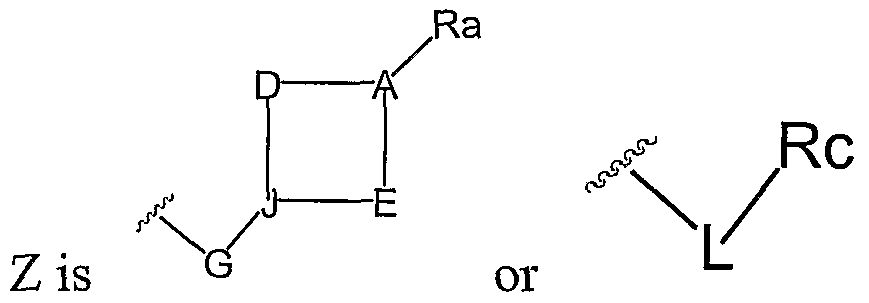
A is nitrogen or CH; or
A-Ra is oxygen, sulfur, SO2, carbonyl, NOH, difluoromethylene, =C(CONH2)(ρiρeridinyl), =N+(Me)O', or ^=N+(Me2)F;
G is oxygen, NH, NMe, -O(CH2)p-, -NH(CH2)q- or a bond that directly
links J to ' v v vVv, in which p=2,3 ,4 and q=2,3 ,4; J is nitrogen or CH;
D is -(CH2)m- or -CH2CH(CH3)-, m being an integer in the range from 1 to 4;
E is -(CH2)n-, -CH2CH(CH3)- or -CH2C(=O)-, n being an integer in the range from 0 to 2;
.* Λ Λ /, ^1 L is oxygen, NH or a bond that directly links Rc to v v v V v; and
Rc is hydrogen, cyano, pyrrolidinoethyl, amino C1-C4 alkyl, hydroxy C1- C4 alkyl, trifluoro C1-C4 alkyl, imidazolyl, triazolyl, pyridinyl, dihydroxyphenethyl or octahydropyrrolo[l,2-a]pyrazinyl.
2. The derivative or salt of claim 1, wherein X is phenyl, thienyl, pyridinyl or indolyl which is unsubstituted or substituted with 1 to 3 substituents selected from the group consisting of hydroxy, amino, halo, carboxyl, Q-C2 alkoxycarbonyl, methylthio and trifluoromethyl, or the group consisting of C1-C6 alkyl, C1-C6 alkoxy, C1-C6 alkylcarbonyl and
hydroxymethyl; or V 5 MsRd in which M is oxygen, NH or a bond that
directly links Rd to V V V v '-} and Rd is morpholino, piperidinyl, pyrrolidinyl, cyclohexyl or phenyl optionally substituted with hydroxy or hydroxyethyl;
Y is (R)-hydroxymemyltetrahydroisoquinolinyl or (S)- hydroxymethyltetrahydroisoquinolinyl; 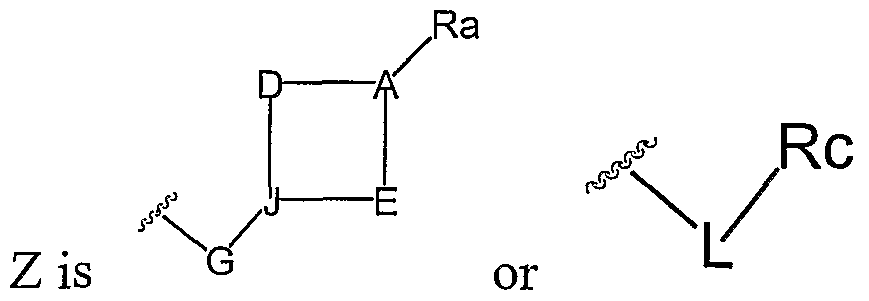 in which,
Ra is hydrogen, C1-C6 alkyl, hydroxymethyl, hydroxyethyl, acetyl, propionyl, hydroxyethoxyethyl, cyclopentyl, cyclohexyl, fluoro, trifluoromethyl, aminomethyl, aminoethyl, morpholino, morpholinoethyl, N-methylpiperazinyl, tetrahydropyranyl, N-methylpiperidinyl, amino, hydroxy, benzyl, -CORb (in which Rb is morpholino, amino, tetrahydrofuranyl, pyrrolidinyl, hydroxypiperidinyl or hydroxypropylamino), trifluoroacetylamino or N- methylpiperidinylmethyl; A is nitrogen or CH; or
A-Ra is oxygen, sulfur, SO2, carbonyl, NOH, =C(CONH2)(piperidinyl), =Nf(Me)0\ or =N+(Me2)r;
G is oxygen, NH, NMe, -O(CH2)p-, -NH(CH2)q- or a bond that directly
links J to ' V "V : v •" ■- 9 in which ρ=2,3 ,4 and q=2,3 ,4; J is nitrogen or CH;
D is -(CH2)m- or -CH2CH(CH3)-, m being an integer ranging from 1 to 4;
E is -(CH2)Ii-, -CH2CH(CH3)- or -CH2C(O)-, n being an integer ranging from O to 2;
L is oxygen, NH or a bond that directly links Rc to ' v J v J W v v'- v. ; and
Rc is hydrogen, pyrrolidinoethyl, aminopropyl, aminoethyl, hydroxypropyl, hydroxyethyl, trifluoroethyl, trifluoromethyl, imidazolyl, triazolyl, dihydroxyphenethyl, Boc-piperazinylpyridyl or octahydropyτrolo[l,2- a]pyrazinyl.
3. The derivative or salt of claim 2, wherein X is phenyl, pyridinyl or indolyl which is unsubstituted or substituted with 1 to 3 subsituents selected from the group consisting of hydroxy, amino, halo, carboxyl, C1-C2 alkoxycarbonyl, methylthio and trifluoromethyl, or the group consisting of C1-
C6 alkyl, Ci-C6 alkoxy, C1-C6 alkylcarbonyl, hydroxymethyl; or yM-Rd in
which M is oxygen, NH or a bond that directly links Rd to v v v V v, and Rd is cyclohexyl or phenyl;
Y is (R)-hydroxymethyltetrahydroisoquinolinyl or (S)- hydroxymethyltetrahydroisoquinolinyl;

A-Ra is oxygen, sulfur, SO2, carbonyl, NOH, =C(CONH2)(piperidinyl), =N+(Me)0", or ^=N+(Me2)F; G is oxygen, NH, NMe, -O(CH2)ρ-, -NH(CH2)q- or a bond that directly
links J to v v "", in which p=2 and q=2;
J is nitrogen or CH;
D is -(CH2)m- or -CH2CH(CH3)-, m being an integer ranging from 1 to
4; E is -(CH2)Ii-, -CH2CH(CH3)- or -CH2C(O)-, n being an integer ranging from O to 2; L is oxygen, NH or a bond that directly links Rc to v v v v '■"; and Rc is hydrogen, pyrrolidinoethyl, aminopropyl, aminoethyl, hydroxypropyl, hydroxyethyl, trifluoroethyl, trifluoromethyl, imidazolyl, dihydroxyphenethyl, Boc-piperazinylpyridyl or octahydropyrrolo[l,2- ajpyrazinyl.
4. The derivative or salt of claim 3, which is selected from the group consisting of:
[2-(4-Cyclohexyloxy-6-morpholin-4-yl-[ 1 ,3 ,5]triazin-2-yl)- 1 ,2,3 ,4- tetrahydroisoquinolin-(3)S)-yl]-methanol;
3- [4-((3S>Hydroxymethyl-3 ,4-dihydro- lH-isoquinolin-2-yl)-6- morpholin-4-yl-[l,3,5]triazin-2-yl]-phenol; l-{3-[4-((35)-Hydroxymethyl-3,4-dihydro-lH-isoquinolin-2-yl)-6- morpholin-4-yl-[l,3,5]triazin-2-yl]-phenyl}-ethanone; 2-[4-(lH-Indol-5-yl)-6-morpholin-4-yl-[l,3,5]triazin-2-yl]-l,2,3,4- tetrahydroisoquinolin-(35)-yl}-methanol;
[2-(4-Moipholin-4-yl-6-pyridin-3-yl-[l,3,5]triazin-2-yl)-l,2,3,4- tetrahydroisoquinolin-(3iS)-yl]-methanol;
2- [4-((3£)-Ηydroxymethyl-3 ,4-dihydro- lH-isoquinolin-2-yl)-6- morpholin-4-yl-[l,3,5]triazin-2-yl]-phenol;
4-[4-((3)S)-Hydroxymethyl-3,4-dihydro-lH-isoqmnolin-2-yl)-6- morpholin-4-yl- [ 1 ,3 ,5]triazin-2-yl]-phenol;
{2-[4-(4-Methylpiperazin- 1 -yl)-6-(3-trifluoromethylphenyl)- [l,3,5]triazin-2-yl]-l,2,3,4-tetrahydroisoquinolin-(3R)-yl}-methanol; 3-[4-((3R)-Hydroxymethyl-3,4-dihydro-lH-isoquinolin-2-yl)-6-(4- methyl-piperazm-l-yl)-[l,3,5]triazin-2-yl]-benzoic acid methyl ester;
3-[4-((3R)-Hydroxymethyl-3,4-dihydro-lH-isoquinolin-2-yl)-6- morpholin-4-yl-[l,3,5]triazin-2-yl]-phenol;
3-[4-((3R)-Hydroxymethyl-3,4-dihydiO-lH-isoquinolin-2-yl)-6-(4- methylpiperazin- 1 -yl)-[ 1 ,3 ,5]triazin-2-yl]-phenol;
3-{4-((3R)-Hydroxymethyl-3,4-dihydro-lH-isoquinolin-2-yl)-6-[4- (tetrahydropyran-4-yl)-piperazin-l-yl]-[l,3,5]triazin-2-yl}-phenol;
3- [4-(4-Cyclopentylpiperazin- 1 -yl)-6-((3R)-hydroxymethyl-3 ,4-dihydro- lH-isoquinolm-2-yl)-[l,3,5]triazin-2-yl]-phenol;
3-[4-(4-Cyclohexylρiperazin-l-yl)-6-((3R)-hydroxymethyl-3,4-dihydro- lH-isoquinolin-2-yl)-[l,3,5]triazin-2-yl]-phenol;
3-[4-((3R)-Ηydroxymethyl-3,4-dihydro-lH-isoquinolin-2-yl)-6-(4- methylpiperazin- 1 -yl)-[ 1 ,3 ,5]triazin-2-yl]-phenol; {2- [4-(6-Methylsulfanylphenyl)-6-morpholin-4-yl- [ 1 ,3 ,5]triazin-2-yl]-
1 ,2,3,4-tetrahydroisoquinolin-(3R)-yl} -methanol;
3-[4-((3S)-Hydroxymethyl-3,4-dihydro-lH'-isoqumolm-2-yl)-6-(4- methylpiperazin- 1 -yl)- [ 1 ,3 ,5]triazin-2-yl]-phenol;
3-[4-(Hexahydropyrrolo[l,2,fl]pyrazin-2-yl)-6-((3R)-hydroxymethyl- 3 ,4-dihydro- lH-isoquinolin-2-yl)- [ 1 ,3 ,5]triazin-2-yl]-phenol; l-[4-((3R)-Hydroxymethyl-3,4-dihydro-lH-isoquinolin-2-yl)-6-(3- hydroxyphenyl)-[l,3,5]triazin-2-yl]-pyrrolidin-3-ol;
3 - [4-(2-ΗydiOxyethylamino)-6-((3R)-hydroxymethyl-3 ,4-dihydro- IH- isoquinolin-2-yl)-[l,3,5]triazin-2-yl]-phenol; 3 - [4-((3R)-Ηydroxymethyl-3 ,4-dihydro- lH-isoquinolin-2-yl)-6-(4- moφholin-4-yl-piperidin- 1 -yl)-[ 1 ,3 ,5]triazin-2-yl]-phenol;
3-[4-((3R)-Ηydroxymethyl-3,4-dihydro-lH-isoquinolin-2-yl)-6-(4- hydroxymethylpiperidin- 1 -yl)- [ 1 ,3 ,5]triazin-2-yl] -phenol;
3-[4-((3R)-Ηydroxymethyl-3,4-dihydro- lH-isoquinolin-2-yl)-6-( 1 - methyl-piρeridin-4-yloxy)- [ 1 ,3 , 5]triazin-2-yl] -phenol;
3-[4-((3R)-Ηydroxymethyl-3,4-dihydro-lH-isoquinolin-2-yl)-6-(l- methylpiperidin-3-yloxy)-[l,3,5]triazin-2-yl]-phenol;
3-[4-[4-(2-Ηydroxyethyl)-ρiρerazin-l-yl]-6-((3R)-hydroxymethyl-3,4- dihydro-lH-isoquinolm-2-yl)-[l,3,5]triazm-2-yl]-phenol; 3-[4-((3R)-Hydroxymethyl-3,4-dihydro-lH-isoquinolin-2-yl)-6-(4- methyl-[ 1 ,4] diazepan- 1 -yl)-[ 1 ,3 ,5]triazin-2-yl] -phenol;
1 - [4-((3R)-Hydroxymethyl-3 ,4-dihydro- lH-isoquinolin-2-yl)-6-(3- hydroxyphenyl)-[l,3,5]triazin-2-yl]-piperidin-4-one; l-[4-((3R)-Hydroxymethyl-3,4-dihydro-lH-isoquinolin-2-yl)-6-(3- hydroxyphenyl)-[l53,5]triazin-2-yl]-piperidin-3-carboxylic acid amide;
2,2,2-Trifluoro-N- { 1 -[4-((3R)-hydroxymethyl-3 ,4-dihydro- IH- isoquinolin-2-yl)-6-(3-hydroxyphenyl)-[l,3,5]triazin-2-yl]-pyrrolidin-3-yl}- acetamide; l-{4-[4-((3R)-Ηydroxymethyl-3,4-dihydro-lH-isoquinolin-2-yl)-6-(3- hydroxyphenyl)-[ 1 ,3,5]triazin-2-yl]-pipeazin- 1 -yl} -ethanone;
3-[4-[4-(2-Ηydroxyethyl)-ρiperidin-l-yl]-6-((3R)-hydroxymethyl-3,4- dihydro- lH-isoquinolin-2-yl)-[ 1 ,3 ,5]triazin-2-yl] -phenol;
1 -[4-((3R)-Ηydroxymethyl-3 ,4-dihydro- lH-isoquinolin-2-yl)-6-(3- hydroxyphenyl)-[l ,3,5]triazin-2-yl]-piperidin-3-carboxylic acid (3- hydroxypropyl)-amide;
3-[4-((3R)-Ηydroxymethyl-3,4-dihydro-lH-isoquinolin-2-yl)-6- thiazolidin-3 -yl- [1,3 , 5]triazin-2-yl] -phenol;
3-[4-((3R)-Ηydroxymethyl-3,4-dihydro-lH-isoquinolin-2-yl)-6-(2- morpholin-4-ylethylamino)-[ 1 ,3,5]triazin-2-yl]-phenol; 3 - [4-(3 ,5-Dimethylρiρerazin- 1 -yl)-6-((3R)-hydroxymethyl-3 ,4-dihydro- lH-isoquinolin-2-yl)-[l,3,5]triazine-2-yl]-phenol;
3-[4-(2,6-Dimethylmorpholin-4-yl)-6-((3R)-hydroxymethyl-3,4- dihydro- lH-isoquinolin-2-yl)- [ 1 ,3 ,5]triazin-2-yl] -phenol;
{4-[4-((3R)-Ηydroxymethyl-3;4-dihydro-lH-isoquinolin-2-yl)-6-(3- hydroxyphenyl)-[l,3,5]triazin-2-yl]-piperazin-l-yl}-(tetrahydroruran-2-yl)- methanone;
{l-[4-((3R)-Hydroxymethyl-3,4-dihydro-lH-isoquinolin-2-yl)-6-(3- hydroxyphenyl)-[l,3,5]txiazin-2-yl]-piperidin-3-yl]-(4-hydroxy-piperidin-l-yl)- methanone; 3-[4-(l,l-Dioxo-lλ6-thiomorpholin-4-yl)-6-((3R)-hydroxymethyl-3,4- dihydro-lH-isoquinolm-2-yl)-[ 1 ,3,5 [triazin-2-yl]-phenol;
3-[4-(4-Fluoropiperidin-l-yl)-6-((3R)-hydroxymethyl-3,4-dihydiO-lH- isoqumolin-2-yl)-[l,3,5]triazm-2-yl]-phenol;
3-{4-((3R)-Ηydroxymethyl-3,4-dihydro-lH-isoquinolin-2-yl)-6- [methyl-(tetrahydropyτan-4-yl)-amino]-[l,3,5]triazin-2-yl}-phenol;
{ 1 -[4-((3R)-Ηydroxymethyl-3,4-dihydro- lH-isoquinolin-2-yl)-6-(3- hydroxyphenyl)- [ 1 ,3 ,5]triazin-2-yl] -piperidin-4-yl } -morpholin-4-ylmethanone;
{ l-[4-((3R)-Hydroxymethyl-3,4-dihydro-lH-isoquinolin-2-yl)-6-(3- hydroxyphenyl)-[l, 3, 5]triazin-2-yl]-piperidin-3-yl} -morpholin-4-ylmethanone; 1 - [4-((3R)-Ηydroxymethyl-3 ,4-dihydro- lH-isoquinolin-2-yl)-6-(3- hydroxyphenyl)-[l,3,5]triazin-2-yl]-pyrrolidin-(3R)-ol; l-[4-((3R)-Hydroxymethyl-3,4-dihydro-lH-isoquinolin-2-yl)-6-(3- hydroxyphenyl)-[l,3,5]triazin-2-yl]-pyrrolidin-(35)-ol;
3-[4- {4-[2-(2-Hydroxyethoxy)-ethyl]-piρerazin-l-yl-[l,3,5]triazin-2- yl } -6-((3R)-hydroxymethyl-3 ,4-dihydro- lH-isoquinolin-2-yl)-ρhenol;
3-{4-((3R)-Ηydroxymethyl-3,4-dihydro-lH-isoquinolin-2-yl)-6-[4-(2- morpholin-4-ylethyl)-piperazin-l-yl-[l,3,5]triazin-2-yl]-phenol;
3-{4-((3R)-Ηydroxymethyl-3,4-dihydro-lH-isoquinolin-2-yl)-6-[4-(4- methylpiperazin-1 -yl)-piperidin- 1 -yl-[ 1 ,3,5]triazin-2-yl]-phenol; 3-{4-((3R)-Ηydroxymethyl-3,4-dihydro-lH-isoquinolin-2-yl)-6-[4-(l- methylpiperidin-4-yl)-piperazin- 1 -triazin-2-yl]-phenol;
3-{4-((3R)-ΗydiOxymethyl-3,4-dihydro-lH-isoquinolin-2-yl)-6-[4-(l- methylpiperidin-4-ylmethyl)-piperazin- l-yl]-[ 1 ,3 ,5]triazin-2-yl} -phenol;
3-[4-((3R)-Hydroxymethyl-3,4-dihydro-l//-isoquinolin-2-yl)-6-(4- methylpiperazin-l-yl)-[l,3,5]triazine methyl iodonium salt;
3-[4-(3-AminoρyriOlidin-l-yl)-6-((3R)-hydroxymethyl-3,4-dihydiO-lH- isoquinolin-2-yl)-[l,355]triazin-2-yl]-phenol;
3-[4-((3R)-Ηydroxymethyl-3,4-dihydro-lH-isoquinolin-2-yl)-6-(4- methylpiperazm-l-yl)-[l,3,5]triazine oxonium salt; {l-[4-((3R)-Ηydroxymethyl-3,4-dihydro-lH-isoquinolin-2-yl)-6-(3- hydroxyphenyl)- [ 1 ,3 , 5] triazin-2-yl] -piperidin-3 -yl} -pyrrolidin- 1 -yl-methanone;
3-[4-((3i?)-Hydroxymethyl-3,4-dihydro-lH-isoquinolin-2-yl)-6-((2,S)- hydroxymethylpyrrolidin- 1 -yl)-[ 1 ,3,5]triazin-2-yl]-phenol;
3-[4-((3i?)-Hydroxymethyl-3,4-dihydro-lH-isoquinolin-2-yl)-6-((2i?)- hydroxymethylpyrrolidin- 1 -yl)-[l ,3 ,5]triazin-2-yl] -phenol; l-[4-((3R)-Ηydroxymethyl-3,4-dihydro-lH-isoquinolin-2-yl)-6-(3- hydiOxyphenyl)-[l,3,5]triazin-2-yl]-piperidm-4-oiie-oxime;
3-[4-((3R)-Hydroxymethyl-3,4-dihydro-lH-isoquinolin-2-yl)-6- (tetrahydrofuran-(3R)-yloxy)-[l,3,5]triazin-2-yl]-ρhenol; l-[4-((3R)-Hydroxymethyl-3,4-dihydro-lH-isoquinolin-2-yl)-6-(3- hydroxyphenyl)-[ 1 ,3,5]triazin-2-yl]-ρhenol;
3-[4-((3R)-Hydroxymethyl-3,4-dihydro-lH-isoquinolin-2-yl)-6- imidazol- 1 -yl- [ 1 ,3 ,5]triazin-2-yl]-phenol;
3-[4-(2-Hydroxyethoxy)-6-((3R)-hydroxymethyl-3,4-dihydro-lH- isoquinolin-2-yl)- [ 1 ,3 ,5]triazin-2-yl]-phenol;
3-[4-(2-Aminoethylamino)-6-((3R)-hydroxymethyl-3,4-dihydro-lH- isoquinolin-2-yl)-[l,3,5]triazin-2-yl]-phenol;
3-[4-((3R)-Ηydroxymethyl-3,4-dihydro-lH-isoquinolin-2-yl)-6-(2- moφholin-4-ylethoxy)-[l,3,5]triazin-2-yl]-phenol; 3-[4-((3R)-Ηydroxymethyl-3,4-dihydro-lH-isoquinolin-2-yl)-6-(2,2,2- trifluoroethoxy)- [ 1 ,3 , 5 ]triazin-2-yl] -phenol ; l-{2-[4-((3R)-Ηydroxymethyl-3,4-dihydro-lH-isoquinolin-2-yl)-6-(3- hydroxyphenyl)- [ 1 ,3 ,5]triazin-2-yloxy]-ethyl} -pyrrolidin-2-one;
3 - [4-((3R)- Aminopyrrolidin- 1 -yl)-6-((3R)-hydroxymethyl-3 ,4-dihydro- lH-isoquinolin-2-yl)-[l,3,5]triazin-2-yl]-phenol;
3- [4-(4- Aminopiperidin- 1 -yl)-6-((3R)-hydroxymethyl-3 ,4-dihydro- IH- isoquinolin-2-yl)-[l,3,5]triazin-2-yl]-phenol;
3-[4-(4-Aminomethylpiperidin-l-yl)-6-((3R)-hydroxymethyl-3,4- dihydro-lH-isoquinolin-2-yl)-[l,3,5]triazin-2-yl]-phenol; 3-[4-((3R)-Ηydroxymethyl-3 ,4-dihydro- lH-isoquinolin-2-yl)-6- (piperidin-4-ylamino)-[l,3,5]triazin-2-yl]-phenol;
3-[4-((3S)-Aminopyrrolidin-l-yl)-6-((3R)-hydroxymethyl-3,4-dihydro- lH-isoquinolin-2-yl)-[l,355]triazin-2-yl]-phenol;
3-[4-(2-Ηydroxycyclopentylamino)-6-((3R)-hydroxymethyl-3,4- dihydro-lH-isoquinolin-2-yl)-[l,3,5]triazin-2-yl]-phenol;
{2-[4-(3-Fluoro-phenyl)-6-(4-methyl-piperazin- 1 -yl)-[ 1 ,3,5]triazin-2- yl]- 1 ,2,3,4-tetrahydro-isoquinolin-3(R)-yl} -methanol;
{2- [4- [4-(2- Amino-ethyl)-piperazin- 1 -yl] - 6-(3 -fluoro-phenyl)- [l,3,5]triazin-2-yl]-l,2,3,4-tetraliydro-isoquinolin-3(R)-yl}-methanol; 4- [4-((3S)-ΗydroxyiΗethyl-3 ,4-dihydro- lH-isoquinolin-2-yl)-6- morpholin-4-yl-[l,3,5]triazin-2-yl]-2,6-dimethoxy-phenol;
S-^-CCS^-Ηydroxymethyl-S^-dihydro-lH-isoquinolin^-yO-ό- morpholin-4-yl-[l ,3,5]triazin-2-yl]-benzene- 1 ,2,3-triol;
3-[4-((3R)-Ηydroxymethyl-3,4-dihydro-lH-isoquinolin-2-yl)-6-(2- hydiOxy-(lS)-methyl-ethylamino)-[l,3,5]triazin-2-yl]-phenol;
3-[4-((3R)-Ηydroxymethyl-3,4-dihydro-lH-isoquinolm-2-yl)-6-((2S)- hydroxy-propylammo)-[l,3,5]triazin-2-yl]-phenol;
3 - [4-(3 - Amino-piperidin- 1 -yl)-6-((3R)-hydroxymethyl-3 ,4-dihydro- IH- isoquinolin-2-yl)-[l,3,5]triazin-2-yl]-phenol; 3-[4-(l-Benzyl-ρyrrolidin-(3S)-ylamino)-6-((3R)-hydroxymethyl-3,4- dihydro- lH-isoquinolin-2-yl)-[ 1 ,3,5]triazin-2-yl]-phenol;
N-{l-[4-((3R)-Ηydroxymethyl-3,4-dihydro-lH-isoquinolin-2-yl)-6-(3- hydroxy-phenyl)-[l,3,5]triazin-2-yl]-piperidin-4-yl}-acetamide;
3-[4-((3R)-Ηydroxymethyl-3,4-dihydro-lH-isoquinolin-2-yl)-6- (pyrrolidin-(36)-ylamino)-[l,3,5]triazin-2-yl]-phenol;
3-[4-((3R)-Ηydroxymethyl-3,4-dihydro-lH-isoqmnolin-2-yl)-6- (pyrrolidin-(3R)-ylamino)-[l,3,5]triazin-2-yl]-phenol;
4-[4-((3R)-Ηydroxymethyl-3 ,4-dihydro- lH-isoquinolin-2-yl)-6-(3 - hydroxy-phenyl)- [ 1 ,3,5]triazin-2-yl]-piperazm- 1 -ol; 3-[4-((2S)-Aminomethyl-ρyrrolidin-l-yl)-6-((3R)-hydroxyniethyl-3,4- dihydro-lH-isoquinolin-2-yl)-[l,3,5]triazin-2-yl]-phenol;
3-[4-[(2-Hydroxy-ethyl)-methyl-amino]-6-((3R)-hydroxymethyl-3,4- dihydro- lH-isoquinolin-2-yl)-[ 1 ,3,5]triazin-2-yl]-phenol;
3-[4-[4-(2-Amino-ethyl)-piperazin-l-yl]-6-((3R)-hydroxymethyl-3,4- dihydro-lH-isoquinolin-2-yl)-[l,3,5]triazin-2-yl]-phenol;
2-[4-((3R)-Ηydroxymethyl-3,4-dihydro-lH-isoquinolin-2-yl)-6-(3- hydroxy-phenyl)-[ 1 ,3,5]triazin-2-ylamino]-propane- 1 ,3-diol;
3- [4-((3R)-Ηydroxymethyl-3 ,4-dihydro- lH-isoquinolin-2-yl)-6-( 1 - methyl-pyrrolidin-3(S)-yloxy)-[l,3,5]triazin-2-yl]-phenol; {2-[4-(3-Fluoro-phenyl)-6-(tetrahydro-pyran-4-yloxy)-[l,3,5]triazin-2- yl]- 1,2, 3,4-tetrahydro-isoquinolin-(3R)-yl} -methanol;
{2-[4-(3-Fluoro-phenyl)-6-(piperidin-4-ylamino)-[l,3,5]triazin-2-yl]- 1 ,2,3,4-tetrahydro-isoquinolin-(3R)-yl} -methanol;
{2-[4-(lH-Indol-6-yl)-6-(ρiρeridin-4-ylamino)-[l,3,5]triazin-2-yl]- 1,2, 3, 4-tetrahydro-isoquinolin-(3R)-yl} -methanol;
{2-[4-(3-Fluoro-phenyl)-6-(4-moφholin-4-yl-piperidin-l-yl)- [l,3,5]triazin-2-yl]-l,2,3,4-tetrahydiO-isoquinolin-(3R)-yl}-methanol;
4-[4-(3-Fluoro-ρhenyl)-6-((3R)-hydroxymethyl-3,4-dihydro-lH- isoquinolin-2-yl)-[ 1 ,3,5]triazin-2-ylamino]-piperidine- 1 -carboxylic acid methyl ester; and
4-[4-(3-Fluoro-phenyl)-6-((3R)-hydroxymethyl-3,4-dihydro-lH- isoquinolin-2-yl)-[l,3,5]triazin-2-ylamino]-piperidine-l-carboxylic acid amide.
5. The derivative or salt of claim 4, which is selected from the group consisting of:
[2-(4-Cyclohexyloxy-6-moφholin-4-yl-[l,3,5]triazin-2-yl)-l,2,3,4- tetrahydroisoquinolin-(3)S)-yl]-methanol;
3-[4-((3S)-Ηydroxymethyl-3,4-dihydro-lH-isoquinolin-2-yl)-6- moφholin-4-yl-[l,3,5]triazin-2-yl]-phenol; 3- [4-((3R)-Ηydroxymethyl-3 ,4-dihydro- lH-isoquinolin-2-yl)-6- moφholin-4-yl-[l,3,5]triazin-2-yl]-phenol;
3-[4-((3R)-Hydroxymethyl-3,4-dihydro-lH-isoquinolm-2-yl)-6-(4- methylpiperazin- 1 -yl)-[ 1 ,3,5]triazin-2-yl]-phenol;
3-{4-((3R)-Hydroxymethyl-3,4-dihydro-lH-isoquinolin-2-yl)-6-[4- (tetrahydropyran-4-yl)-ρiperazin- l-ylJ-[ 1 ,3 ,5]triazin-2-yl} -phenol;
3-[4-(4-Cyclopentylpiperazin-l-yl)-6-((3R)-hydroxymethyl-3,4-dihydro- lH-isoquinolin-2-yl)-[l,3,5]triazin-2-yl]-phenol;
3 - [4-(4-Cyclohexylpiperazin- 1 -yl)- 6-((3R)-hydroxymethyl-3 ,4-dihydro- lH-isoquinolin-2-yl)-[l,3,5]triazin-2-yl]-phenol; 3-[4-((3R)-Hydroxymethyl-3,4-dihydro-lH-isoquinolin-2-yl)-6- ρiperazin-1 -yl-[ 1 ,3,5]triazin-2-yl]-phenol; l-[4-((3i?)-Hydroxymethyl-3,4-dihydro-lH-isoquinolin-2-yl)-6-(3- hydroxyphenyl)- [ 1 ,3 , 5] triazin-2-yl] -pyrrolidin-3 -ol;
3-[4-(2-Hydroxyethylamino)-6-((3R)-hydroxymethyl-3,4-dihydro-lH- isoquinolin-2-yl)-[l,3,5]triazm-2-yl]-phenol;
3-[4-((3R)-Hydroxymethyl-3,4-dihydro-lH-isoquinolin-2-yl)-6-(4- morpliolin-4-yl-piperidin-l-yl)-[l,3,5]triazin-2-yl]-phenol;
3-[4-((3R)-Ηydroxymethyl-3,4-dihydro-lH-isoquinolin-2-yl)-6-(4- hydroxymethylpiperidin-l-yl)-[l,3,5]triazin-2-yl]-phenol; 3-[4-((3R)-Hydroxymethyl-3,4-dihydro-lH-isoqumolin-2-yl)-6-(l- methylρiperidin-3-yloxy)-[l,3,5]triazin-2-yl]-phenol;
3-[4-[4-(2-Hydroxyethyl)-piperazin-l-yl]-6-((3R)-hydroxymethyl-3,4- dihydro- lH-isoquinolin-2-yl)-[ 1 ,3,5]triazin-2-yl]-phenol;
3-[4-((3R)-Hydroxymethyl-3,4-dihydro-lH-isoquinolin-2-yl)-6-(4- methyl-[l,4]diazepan-l-yl)-[l53,5]triazin-2-yl]-phenol;
{4-[4-((3R)-Hydroxymethyl-3,4-dihydro-lH-isoquinolin-2-yl)-6-(3- hydroxyphenyl)-[ 1 ,3,5]triazm-2-yl]-piperazin- 1 -yl} -(tetrahydrofuran-2-yl)- methanone;
{l-[4-((3i?)-Hydroxymethyl-3,4-dihydro-lH-isoquinolin-2-yl)-6-(3- hydroxyphenyl)-[l,3,5]triazin-2-yl]-piperidin-3-yl]-(4-hydroxy-piperidin-l-yl)- methanone;
3-[4-(I9I -Dioxo- 1 λ6-thiomorρholin-4-yl)-6-((3R)-hydroxymethyl-3 ,4- dihydro-lH-isoquinolin-2-yl)-[l,3,5]triazin-2-yl]-ρhenol;
{ 1 ~[4-((3R)-Ηydroxymethyl-3,4-dihydro- lH-isoquinolin-2-yl)-6-(3- hydroxyphenyl)-[ 1 ,3 ,5]triazin-2-yl]-ρiperidin-3-yl} -morpholin-4-ylrnethanone;
1 - [4-((3R)-Ηydroxymethyl-3 ,4-dihydro- lH-isoquinolin-2-yl)-6-(3 - hydroxyphenyl)-[l33,5]triazin-2-yl]-pyrrolidin-(3i?)-ol; l-[4-((3R)-Ηydroxymethyl-354-dihydro-lH-isoquinolin-2-yl)-6-(3- hydroxyphenyl)-[l,3,5]triazin-2-yl]-pyrrolidin-(3»S)-ol; 3-{4-((3R)-Ηydroxymethyl-3,4-dihydro-lH-isoquinolin-2-yl)-6-[4-(2- morpholin-4-ylethyl)-piperazm-l-yl-[l,3,5]triazin-2-yl]-phenol;
3-[4-(3-Aminoρyrrolidin-l-yl)-6-((3R)-hydroxymethyl-3,4-dihydro-lH- isoquinolin-2-yl)- [1,3 ,5]triazin-2-yl]-phenol;
3-[4-((3R)-Ηydroxymethyl-3,4-dihydro-lH-isoquinolin-2-yl)-6-((2S)- hydroxymethylpyrrolidin-l-yl)-[l,3,5]triazin-2-yl]-phenol;
3-[4-((3R)-Ηydroxymethyl-3,4-dihydro-lH-isoquinolin-2-yl)-6-((2R)- hydroxymethylpyrrolidin- 1 -yl)-[ 1 ,3 ,5]triazin-2-yl] -phenol;
3-[4-((3R)-Ηydroxymethyl-3,4-dihydro-lH-isoquinolin-2-yl)-6- (tetrahydrofuran-(3i?)-yloxy)- [ 1 ,3 ,5]triazin-2-yl]-phenol; l-[4-((3R)-Hydroxymethyl-3,4-dihydro-lH-isoquinolm-2-yl)-6-(3- hydiOxyphenyl)-[l,3,5]triazin-2-yl]-phenol;
3 - [4-((3R)-Hydroxymethyl-3 ,4-dihydro- lH-isoquinolin-2-yl)-6- imidazol- 1 -yl- [1,3 , 5]triazin-2-yl] -phenol;
3-[4-(2-Aminoethylamino)-6-((3R)-hydroxymethyl-3 ,4-dihydro- IH- isoquinolin-2-yl)-[l,3,5]triazin-2-yl]-phenol;
3 - [4-((3R)- Aminopyrrolidin- 1 -yl)-6-((3R)-hydroxymethyl-3 ,4-dihydro- lH-isoquinolin-2-yl)-[l,3,5]triazin-2-yl]-phenol;
3 -[4-(4-Aminoρiρeridin- 1 -yl)-6-((3R)-hydroxymethyl-3 ,4-dihydro- IH- isoquinolin-2-yl)- [ 1 ,3 ,5]triazin-2-yl]-phenol; 3 - [4-(4- Amnomethylpiperidin- 1 -yl)-6-((3R)-hydroxymethyl-3 ,4- dihydro-lH-isoquinolin-2-yl)-[l,3,5]triazin-2-yl]-phenol;
3-[4-((3i?)-Hydroxymethyl-3,4-dihydro-lH-isoquinolin-2-yl)-6- (piperidin-4-ylamino)-[l,3,5]triazin-2-yl]-phenol;
3-[4-((3S)-Aminopyrrolidin-l-yl)-6-((3R)-hydroxymethyl-3,4-dihydro- lH-isoquinolin-2-yl)-[l,3,5]triazin-2-yl]-phenol;
{2-[4-(3-Fluoro-phenyl)-6-(4-methyl-piperazin-l-yl)-[l,3,5]triazin-2- yl]- 1,2, 3,4-tetrahydro-isoquinolin-3(R)-yl} -methanol;
{2-[4-[4-(2-Amino-ethyl)-piperazin-l-yl]-6-(3-fluoro-phenyl)- [l,3,5]triazin-2-yl]-l,2,3,4-tetrahydro-isoquinolin-3(R)-yl}-methanol; 4-[4-((3S)-Ηydroxymethyl-3,4-dihydro- lH-isoquinolin-2-yl)-6- morpholin-4-yl-[l,3,5]triazin-2-yl]-2,6-diniethoxy-ρhenol;
5-[4-((3£)-Hydroxymethyl-3,4-dihydro-lH-isoqumolin-2-yl)-6- morpholin-4-yl-[l,3,5]triazin-2-yl]-benzene-l,2,3-triol; l-[4-((3R)-Ηydroxymethyl-3,4-dihydro-lH-isoquinolin-2-yl)-6-(3- hydroxyphenyl)-[l,3,5[triazin-2-yl]-piρeridin-3-carboxylic acid (3- hydroxypropyl)-amide;
3-[4-((3R)-Ηydroxymethyl-3,4-dihydro-lH-isoquinolin-2-yl)-6-(2- hydroxy-( 16)-methyl-ethylamino)- [ 1 ,3 , 5] triazin-2-yl] -phenol;
3-[4-((3R)-Ηydroxymethyl-3,4-dihydro-lH-isoquinolin-2-yl)-6-((2S)- hydroxy-propylamino)-[l,3,5]triazin-2-yl]-phenol;
3 - [4-( 1 -Benzyl-ρyrrolidin-(3S)-ylamino)-6-((3R)-hydroxymethyl-3 ,4- dihydro-lH-isoquinolin-2-yl)-[l,3,5]triazin-2-yl]-phenol;
N-{l-[4-((3Λ)-Ηydroxyme%l-3,4-dihydro^//'-isoqιώioliii-2-yl)-6-(3- hydroxy-phenyl)-[l,3,5]triazin-2-yl]-piperidin-4-yl}-acetamide; 3-[4-((3R)-Hydroxymethyl-3,4-dihydiO-lH-isoquinolin-2-yl)-6-
(pyrrolidin-(3R)-ylamino)-[l,3,5]triazin-2-yl]-phenol;
4-[4-((3R)-Ηydroxymethyl-3,4-dihydro-lH-isoquinolin-2-yl)-6-(3- hydroxy-phenyl)-[ 1 ,3 ,5]triazin-2-yl]-piperazin- 1 -ol;
3-[4-((2S)-Ammomethyl-ρyrrolidin-l-yl)-6-((3R)-hydroxymethyl-3,4- dihydro-lH-isoquinolin-2-yl)-[l,3,5]triazin-2-yl]-phenol; 3 - [4- [(2-Hydroxy-ethyl)-methyl-amino] -6-((3R)-hydroxymethyl-3 ,4- dihydro-lH-isoquinolin-2-yl)-[l,3,5]triazin-2-yl]-phenol;
3-[4-[4-(2-Amino-ethyl)-piρerazin-l-yl]-6-((3R)-hydroxymethyl-3,4- dihydro- lH-isoquinolin-2-yl)-[ 1 ,3 ,5]triazin-2-yl] -phenol; 2-[4-((3R)-Ηydroxymethyl-3,4-dihydro-lH-isoquinolin-2-yl)-6-(3- hydroxy-phenyl)-[ 1 ,355]triazin-2-ylamino]-propane- 1 ,3-diol;
{l-[4-((3R)-HydiOxymethyl-3,4-dihydro-lH-isoqumolin-2-yl)-6-(3- hydroxyphenyl)- [ 1 ,3 , 5] triazin-2-yl] -piperidin-3 -yl } -pyrrolidin- 1 -yl-methanone ;
3-[4-((3R)-Ηydroxymemyl-3,4-dihydro-lH-isoquinolin-2-yl-6- (tetrahydrofuran-(3R)-yloxy)- [ 1 ,3 ,5]triazin-2-yl]-ρhenol;
3-[4-((3R)-Ηydroxymethyl-3,4-dihydro-lH-isoquinolin-2-yl)-6-(2- morpholin-4-ylethoxy)- [ 1 ,3 , 5]triazin-2-yl] -phenol;
3-[4-(2-Ηydroxyethoxy)-6-((3R)-hydroxymemyl-3,4-dihydro-lH- isoquinolin-2-yl)-[l,3,5]triazine-2-yl]-phenol; 3-[4-((3R)-Ηydroxymethyl-3,4-dihydro- lH-isoquinolin-2-yl)-6-( 1 - methyl-pyrrolidin-3()S)-yloxy)-[l,3,5]triazin-2-yl]-phenol;
{2-[4-(3-Fluoro-phenyl)-6-(tetrahydro-pyran-4-yloxy)-[l,3,5]triazin-2- yl]- 1 ,2,3 ,4-tetrahydro-isoquinolin-(3R)-yl} -methanol;
{2-[4-(3-Fluoro-phenyl)-6-(piperidin-4-ylamino)-[l,3,5]triazin-2-yl]- 1 ,2,3 ,4-tetrahydro-isoquinolin-(3R)-yl} -methanol;
4- [4-(3 -Fluoro-ρhenyl)-6-((3R)-hydroxymethyl-3 ,4-dihydro- IH- isoquinolin-2-yl)-[l,3,5]triazin-2-ylamino]-piperidine-l-carboxylic acid methyl ester; and
4-[4-(3-Fluoro-phenyl)-6-((3R)-hydroxymethyl-3,4-dihydro-lH- isoquinolin-2-yl)-[l,3,5]triazin-2-ylamino]-piperidine-l-carboxylic acid amide.
6. An Acetyl-CoA Carboxylase (ACC) activity inhibitor comprising the triazine derivative or salt of claim 1 as an active ingredient.
7. A pharmaceutical composition for preventing or treating obesity, diabetes, dyslipidemia and diseases related to metabolic syndrome comprising the triazine derivative or salt of claim 1 as an active ingredient.
Applications Claiming Priority (2)
| Application Number | Priority Date | Filing Date | Title |
|---|---|---|---|
| KR10-2006-0125860 | 2006-12-11 | ||
| KR20060125860 | 2006-12-11 |
Publications (1)
| Publication Number | Publication Date |
|---|---|
| WO2008072850A1 true WO2008072850A1 (en) | 2008-06-19 |
Family
ID=39511837
Family Applications (1)
| Application Number | Title | Priority Date | Filing Date |
|---|---|---|---|
| PCT/KR2007/006192 Ceased WO2008072850A1 (en) | 2006-12-11 | 2007-12-03 | Triazine derivatives having inhibitory activity against acetyl-coa carboxylase |
Country Status (1)
| Country | Link |
|---|---|
| WO (1) | WO2008072850A1 (en) |
Cited By (9)
| Publication number | Priority date | Publication date | Assignee | Title |
|---|---|---|---|---|
| WO2009120094A3 (en) * | 2008-03-27 | 2010-01-28 | Auckland Uniservices Limited | Substituted pyrimidines and triazines and their use in cancer therapy |
| GB2465405A (en) * | 2008-11-10 | 2010-05-19 | Univ Basel | Triazine, pyrimidine and pyridine analogues and their use in therapy |
| WO2011157827A1 (en) | 2010-06-18 | 2011-12-22 | Sanofi | Azolopyridin-3-one derivatives as inhibitors of lipases and phospholipases |
| US8889730B2 (en) | 2012-04-10 | 2014-11-18 | Pfizer Inc. | Indole and indazole compounds that activate AMPK |
| WO2015036892A1 (en) | 2013-09-12 | 2015-03-19 | Pfizer Inc. | Use of acetyl-coa carboxylase inhibitors for treating acne vulgaris |
| US9394285B2 (en) | 2013-03-15 | 2016-07-19 | Pfizer Inc. | Indole and indazole compounds that activate AMPK |
| JP2017160144A (en) * | 2016-03-08 | 2017-09-14 | 東ソー株式会社 | 4,6-dichlorotriazine compound and method of producing the same |
| WO2023023942A1 (en) * | 2021-08-24 | 2023-03-02 | Biofront Ltd (Cayman) | Hpk1 inhibitors, compositions comprising hpk1 inhibitor, and methods of using the same |
| WO2025040767A1 (en) * | 2023-08-22 | 2025-02-27 | Sanofi | 2-(3,8-diazabicyclo[3.2.1]octan-3-yl)-1,3,5-triazine derivatives as kras g12d inhibitors for the treatment of cancer |
Citations (6)
| Publication number | Priority date | Publication date | Assignee | Title |
|---|---|---|---|---|
| WO2000043369A1 (en) * | 1999-01-22 | 2000-07-27 | Elan Pharmaceuticals, Inc. | Compounds which inhibit leukocyte adhesion mediated by vla-4 |
| EP1247809A2 (en) * | 2001-03-30 | 2002-10-09 | Pfizer Products Inc. | Triazine compounds useful as sorbitol dehydrogenase inhibitors |
| WO2004099159A1 (en) * | 2003-04-30 | 2004-11-18 | The Institutes For Pharmaceutical Discovery, Llc | Substituted heteroaryls as inhibitors of protein tyrosine phosphatases |
| WO2004099192A2 (en) * | 2003-04-30 | 2004-11-18 | The Institutes Of Pharmaceutical Discovery, Llc | Heterocycle substituted carboxylic acids as inhibitors of protein tyrosine phosphatase-1b |
| WO2005009980A1 (en) * | 2003-07-22 | 2005-02-03 | Neurogen Corporation | Substituted pyridin-2-ylamine analogues |
| WO2005030735A1 (en) * | 2003-09-25 | 2005-04-07 | Ranbaxy Laboratories Limited | Triazines derivatives as cell adhesion inhibitors |
-
2007
- 2007-12-03 WO PCT/KR2007/006192 patent/WO2008072850A1/en not_active Ceased
Patent Citations (6)
| Publication number | Priority date | Publication date | Assignee | Title |
|---|---|---|---|---|
| WO2000043369A1 (en) * | 1999-01-22 | 2000-07-27 | Elan Pharmaceuticals, Inc. | Compounds which inhibit leukocyte adhesion mediated by vla-4 |
| EP1247809A2 (en) * | 2001-03-30 | 2002-10-09 | Pfizer Products Inc. | Triazine compounds useful as sorbitol dehydrogenase inhibitors |
| WO2004099159A1 (en) * | 2003-04-30 | 2004-11-18 | The Institutes For Pharmaceutical Discovery, Llc | Substituted heteroaryls as inhibitors of protein tyrosine phosphatases |
| WO2004099192A2 (en) * | 2003-04-30 | 2004-11-18 | The Institutes Of Pharmaceutical Discovery, Llc | Heterocycle substituted carboxylic acids as inhibitors of protein tyrosine phosphatase-1b |
| WO2005009980A1 (en) * | 2003-07-22 | 2005-02-03 | Neurogen Corporation | Substituted pyridin-2-ylamine analogues |
| WO2005030735A1 (en) * | 2003-09-25 | 2005-04-07 | Ranbaxy Laboratories Limited | Triazines derivatives as cell adhesion inhibitors |
Non-Patent Citations (1)
| Title |
|---|
| WALKER K.A. ET AL.: "A New Class of Herbicide Which Inhibits Acetyl-CoA Carboxylase in Sensitive Plant Species", PHYTOCHEMISTRY, vol. 29, no. 12, 1990, pages 3743 - 3747, XP026647288, DOI: doi:10.1016/0031-9422(90)85324-9 * |
Cited By (10)
| Publication number | Priority date | Publication date | Assignee | Title |
|---|---|---|---|---|
| WO2009120094A3 (en) * | 2008-03-27 | 2010-01-28 | Auckland Uniservices Limited | Substituted pyrimidines and triazines and their use in cancer therapy |
| GB2465405A (en) * | 2008-11-10 | 2010-05-19 | Univ Basel | Triazine, pyrimidine and pyridine analogues and their use in therapy |
| JP2012508223A (en) * | 2008-11-10 | 2012-04-05 | ユニバーシティ オブ バーゼル | Triazines, pyrimidines, and pyridine analogs, and their use as therapeutics and diagnostic probes |
| WO2011157827A1 (en) | 2010-06-18 | 2011-12-22 | Sanofi | Azolopyridin-3-one derivatives as inhibitors of lipases and phospholipases |
| US8889730B2 (en) | 2012-04-10 | 2014-11-18 | Pfizer Inc. | Indole and indazole compounds that activate AMPK |
| US9394285B2 (en) | 2013-03-15 | 2016-07-19 | Pfizer Inc. | Indole and indazole compounds that activate AMPK |
| WO2015036892A1 (en) | 2013-09-12 | 2015-03-19 | Pfizer Inc. | Use of acetyl-coa carboxylase inhibitors for treating acne vulgaris |
| JP2017160144A (en) * | 2016-03-08 | 2017-09-14 | 東ソー株式会社 | 4,6-dichlorotriazine compound and method of producing the same |
| WO2023023942A1 (en) * | 2021-08-24 | 2023-03-02 | Biofront Ltd (Cayman) | Hpk1 inhibitors, compositions comprising hpk1 inhibitor, and methods of using the same |
| WO2025040767A1 (en) * | 2023-08-22 | 2025-02-27 | Sanofi | 2-(3,8-diazabicyclo[3.2.1]octan-3-yl)-1,3,5-triazine derivatives as kras g12d inhibitors for the treatment of cancer |
Similar Documents
| Publication | Publication Date | Title |
|---|---|---|
| EP2257541B1 (en) | Modulators for amyloid beta | |
| EP2872504B1 (en) | ARYL SULTAM DERIVATIVES AS RORc MODULATORS | |
| CA2584666C (en) | Pyrimidine derivative condensed with a non-aromatic ring | |
| JP6180426B2 (en) | 2- (Phenyl or pyrid-3-yl) aminopyrimidine derivatives as kinase LRRK2 modulators for the treatment of Parkinson's disease | |
| AU2006211583B2 (en) | Substituted pyridinyl and pyrimidinyl derivatives as modulators of metabolism and the treatment of disorders related thereto | |
| US10005792B2 (en) | Aminoindane-, aminotetrahydronaphthalene- and aminobenzocyclobutane-derived PRMT5-inhibitors | |
| KR101921404B1 (en) | Novel disubstituted 1,2,4-triazine compound | |
| NL1028968C2 (en) | 3- or 4-monosubstituted phenol and thiophenol derivatives useful as H3 ligands. | |
| US8912219B2 (en) | Aryl sulfamide and sulfamate derivatives as RORc modulators | |
| AU2020273302A1 (en) | Heterocyclic inhibitors of ERK1 and ERK2 and their use in the treatment of cancer | |
| EP2763533B1 (en) | Triazolyl pde10 inhibitors | |
| CA3160577A1 (en) | Novel aurora kinase inhibitors and use thereof | |
| EP2274288A2 (en) | Macrocyclic compounds and their use as kinase inhibitors | |
| CA2736281C (en) | Tri-substituted pyrimidine compounds and their use as pde10 inhibitors | |
| PT1633726E (en) | Pyrimidine derivatives useful for the treatment of diseases mediated by crth2 | |
| AU2006236387A1 (en) | Subtituted heteroaryl CB1 antagonists | |
| MX2013001715A (en) | Inhibitors of bruton's tyrosine kinase. | |
| WO2009122180A1 (en) | Pyrimidine derivatives capable of inhibiting one or more kinases | |
| AU2011260323A1 (en) | Aminopyrimidine derivatives as LRRK2 modulators | |
| MXPA01009871A (en) | Aminopyrimidines as sorbitol dehydrogenase inhibitors. | |
| AU2014248763A1 (en) | Substituted piperidine compounds and their use as orexin receptor modulators | |
| WO2011030139A1 (en) | 4- (pyrimidin-2-yl) -piperazine and 4- (pyrimidin-2-yl) -piperidine derivatives as gpr119 modulators | |
| MX2014005110A (en) | Imidazopyridazine compounds. | |
| MX2009000771A (en) | Compounds and compositions as itpkb inhibitors. | |
| WO2015152367A1 (en) | Oxo-heterocyclic ring derivative |
Legal Events
| Date | Code | Title | Description |
|---|---|---|---|
| 121 | Ep: the epo has been informed by wipo that ep was designated in this application |
Ref document number: 07851183 Country of ref document: EP Kind code of ref document: A1 |
|
| NENP | Non-entry into the national phase |
Ref country code: DE |
|
| 122 | Ep: pct application non-entry in european phase |
Ref document number: 07851183 Country of ref document: EP Kind code of ref document: A1 |