WO2008078570A1 - ポリアセタール樹脂組成物 - Google Patents
ポリアセタール樹脂組成物 Download PDFInfo
- Publication number
- WO2008078570A1 WO2008078570A1 PCT/JP2007/074068 JP2007074068W WO2008078570A1 WO 2008078570 A1 WO2008078570 A1 WO 2008078570A1 JP 2007074068 W JP2007074068 W JP 2007074068W WO 2008078570 A1 WO2008078570 A1 WO 2008078570A1
- Authority
- WO
- WIPO (PCT)
- Prior art keywords
- polyacetal resin
- weight
- parts
- polyacetal
- compound
- Prior art date
- Legal status (The legal status is an assumption and is not a legal conclusion. Google has not performed a legal analysis and makes no representation as to the accuracy of the status listed.)
- Ceased
Links
Classifications
-
- C—CHEMISTRY; METALLURGY
- C08—ORGANIC MACROMOLECULAR COMPOUNDS; THEIR PREPARATION OR CHEMICAL WORKING-UP; COMPOSITIONS BASED THEREON
- C08G—MACROMOLECULAR COMPOUNDS OBTAINED OTHERWISE THAN BY REACTIONS ONLY INVOLVING UNSATURATED CARBON-TO-CARBON BONDS
- C08G8/00—Condensation polymers of aldehydes or ketones with phenols only
- C08G8/04—Condensation polymers of aldehydes or ketones with phenols only of aldehydes
- C08G8/08—Condensation polymers of aldehydes or ketones with phenols only of aldehydes of formaldehyde, e.g. of formaldehyde formed in situ
- C08G8/20—Condensation polymers of aldehydes or ketones with phenols only of aldehydes of formaldehyde, e.g. of formaldehyde formed in situ with polyhydric phenols
-
- C—CHEMISTRY; METALLURGY
- C08—ORGANIC MACROMOLECULAR COMPOUNDS; THEIR PREPARATION OR CHEMICAL WORKING-UP; COMPOSITIONS BASED THEREON
- C08K—Use of inorganic or non-macromolecular organic substances as compounding ingredients
- C08K5/00—Use of organic ingredients
- C08K5/04—Oxygen-containing compounds
- C08K5/13—Phenols; Phenolates
- C08K5/134—Phenols containing ester groups
- C08K5/1345—Carboxylic esters of phenolcarboxylic acids
-
- C—CHEMISTRY; METALLURGY
- C08—ORGANIC MACROMOLECULAR COMPOUNDS; THEIR PREPARATION OR CHEMICAL WORKING-UP; COMPOSITIONS BASED THEREON
- C08K—Use of inorganic or non-macromolecular organic substances as compounding ingredients
- C08K5/00—Use of organic ingredients
- C08K5/16—Nitrogen-containing compounds
- C08K5/22—Compounds containing nitrogen bound to another nitrogen atom
- C08K5/24—Derivatives of hydrazine
- C08K5/25—Carboxylic acid hydrazides
-
- C—CHEMISTRY; METALLURGY
- C08—ORGANIC MACROMOLECULAR COMPOUNDS; THEIR PREPARATION OR CHEMICAL WORKING-UP; COMPOSITIONS BASED THEREON
- C08L—COMPOSITIONS OF MACROMOLECULAR COMPOUNDS
- C08L59/00—Compositions of polyacetals; Compositions of derivatives of polyacetals
-
- C—CHEMISTRY; METALLURGY
- C08—ORGANIC MACROMOLECULAR COMPOUNDS; THEIR PREPARATION OR CHEMICAL WORKING-UP; COMPOSITIONS BASED THEREON
- C08L—COMPOSITIONS OF MACROMOLECULAR COMPOUNDS
- C08L2205/00—Polymer mixtures characterised by other features
- C08L2205/02—Polymer mixtures characterised by other features containing two or more polymers of the same C08L -group
Definitions
- the present invention relates to a polyacetal resin composition having excellent mechanical properties, processability and stability, and having a markedly reduced amount of formaldehyde and the like.
- Polyacetal resin has excellent mechanical properties, slidability, processability, surface properties, etc., and its molded products are used in a wide range of fields.
- polyacetal resin inherently possesses excellent mechanical properties such as mechanical properties, strength, surface properties, etc. It was difficult to obtain a polyacetal resin material that reduced the generation of gas to the limit.
- An object of the present invention is to solve such problems and to provide a resin material having these characteristics.
- the present inventor has found that the object can be achieved by selecting the composition of the polyacetal resin as the substrate and the selection of the blending components. I got it.
- the present invention relates to a polyacetal resin (A2) having a branched or crosslinked structure with respect to 100 parts by weight of a polyacetal resin having a substantially linear molecular structure (A1), 0.01 to 20.0 parts by weight, hindered phenol
- the present invention relates to a polyacetal resin yarn and composition comprising 0.01 to 5.0 parts by weight of an antioxidant (B) and 0.01 to 5.0 parts by weight of a hydrazide compound (C).
- the polyacetal resin (A1) having a substantially linear molecular structure used in the present invention is a polymer compound having an oxymethylene group (—CH 2 0-) as a main structural unit, It does not have a branched structure or a crosslinked structure introduced intentionally in Such a polyacetal resin (A1) includes a polyacetal photopolymer substantially consisting only of repeating oxymethylene groups.
- Moporima other configuration units which do not form branched-crosslinked structure mainly composed of Okishimechiren group polyacetal copolymer having especially Okishiarukiren units c 2 _ 6, a small amount (including a block copolymer) can be mentioned as a typical example .
- any of these polyacetal resins can be used as the polyacetal resin (A1), and two or more types of polyacetal resins having different characteristics can be blended as required. From the viewpoint of thermal stability, it is preferable to use a polyacetal copolymer.
- Such polyacetal copolymers include trioxane (a) 99.95 to 80.0% by weight and compounds selected from cyclic ether compounds and cyclic formal compounds having no substituents (b) 0.05 to 20 ⁇ 0% by weight / And a compound obtained by copolymerizing 0 with trioxane (a) 99.9 to 90.0% by weight and the above compound.
- (b)) includes, for example, ethylene oxide, 1,3-dioxolan, jetylene glycol enore lemenore, 1,4-butanediol enore enore manolole, 1,3-di-xane, propylene oxide, etc.
- one or more selected from ethylene oxide, 1,3-dioxolan, 1,4-butanediol formal and diethylene glycol formal are preferred.
- the method for preparing the polyacetal resin (A1) is not particularly limited and can be prepared by a known method, but industrially a continuous bulk polymerization method is preferred.
- the polyacetal copolymer used in the present invention preferably has a melt index (190 ° (measured at a load of 2160 g) of 1 to 50 g / min.)
- the melt index is a chain transfer agent used for polymerization
- the polyacetal copolymer used in the present invention has a hemi-formal terminal group amount of 1.0 mmol / kg or less, and a formyl terminal group amount of 2.0 mmol / kg or less.
- the amount of unstable terminal groups is 0.5% by weight or less, more preferably, the amount of hemiformal terminal groups is 0.6 ⁇ ol / kg or less, and the amount of formyl terminal groups is 0.5 mmol / kg or less.
- the amount of unstable terminal groups is 0.3 wt% or less It is.
- the present invention is effective for the preparation of a polyacetal resin composition in which the amount of formaldehyde generated is reduced to + minutes. It will contribute to
- the hemiformal end group is represented by 10 CH 2 OH, and is also referred to as a hydroxy methoxy group or a hemiacetal end group.
- the formyl end group is indicated by one CHO.
- the amount of the hemiformal end group opiformyl end group can be determined by 1 H-NMR measurement, and the specific measurement method is described in JP-A No. 2 0 0 1-1 1 1 4 3 Can be referred to.
- the unstable terminal group amount is the amount of a portion which is present at the terminal portion of the polyacetal copolymer and is unstable to heat or base and easily decomposes.
- the amount of such unstable terminal groups is as follows: 1 g of polyacetal copolymer is placed in a pressure-resistant airtight container together with 50% (volume%) aqueous methanol solution containing 100% (volume%) ammonium hydroxide. The solution was heated at 180 ° C for 45 minutes, then cooled and opened. The amount of formaldehyde dissolved and dissolved in the resulting solution was quantified to determine the weight of the polyacetal copolymer. /. It is represented by.
- Polyacetal copolymers with terminal properties as described above can be obtained by adjusting the polymerization process, adjusting the catalyst deactivation process, adjusting the stabilization process by decomposing and removing unstable terminals, and combining these adjustment methods. it can.
- the monomer used for the polymerization is a method in which impurities such as moisture, methanol, formic acid and the like that cause unstable terminals are reduced, and the polymerization is performed using the monomer having few impurities.
- heat treatment is performed in a non-uniform state in a high-temperature liquid (for example, in water), and a polyacetal copolymer having an unstable end after polymerization is dissolved by heating in a solvent containing a basic compound and heated in a solution state.
- a polyacetal copolymer having more preferable terminal characteristics can be prepared by a combination of these methods depending on the treatment method and the like.
- a polyacetal resin having a branched or cross-linked structure used in the present invention (A3 ⁇ 4 is copolymerizable with formaldehyde or trioxane in the production of a polyacetal homopolymer or polyacetal copolymer as described above, and branched by force copolymerization.
- the unit or label is obtained by further adding a compound capable of forming a crosslinking unit and copolymerizing, for example, selected from trioxane (a) and a cyclic ether compound having no substituent and a cyclic formal compound.
- a monofunctional glycidyl ig compound having a substituent for example, phenylglycidyl ether, petit / gricidyl ether, etc.
- a monofunctional glycidyl ig compound having a substituent for example, phenylglycidyl ether, petit / gricidyl ether, etc.
- Polyacetal resin is obtained, and multifunctional glyce Polyacetal resin having a cross-linking structure by copolymerizing by adding ether compound.
- a polyacetal resin (A2) having a crosslinked structure In the present invention, it is preferable to use a polyacetal resin (A2) having a crosslinked structure.
- Examples of the compound (b) include the same compounds as those described above, and one or more selected from ethylene oxide, 1,3-dioxolane, 1,4-butanedionorenoremalal and diethylene glycol formal are preferred.
- Polyfunctional glycidyl ether compounds (C) include ethylene glycol diglycidinole ether, propylene glycolenoresiglicinole ether, 1,4-butanediol diglycidyl ether, hexamethylene glycol diglycidyl ether, resorcinol diglycidyl ether.
- those having 3 to 4 daricidyl ether groups in one molecule are particularly preferable, and specific examples include trimethylolpropane triglycidyl ether, glyceryl triglycidyl ether, and pentaerythritol tetraglycidyl ether.
- the polyacetal resin (A2) a polyacetal copolymer in which a cross-linked structure is formed using such a dalicidyl ether compound having 3 to 4 dalicidyl ether groups in one molecule, the machine is further improved.
- a polyacetal resin composition having excellent mechanical properties.
- the method for preparing the polyacetal resin (A2) having the branched or crosslinked structure as described above is not particularly limited, and it is prepared by a known method in the same manner as the linear polyacetal resin (A1). be able to.
- the polyacetal resin (A2) having a strong branched or cross-linked structure acts as a crystal nucleating agent even in a small amount of compound, and improves the mechanical properties by highly crystallizing the linear polyacetal resin (A1).
- the branched or cross-linked structure of the polyacetal resin (A2) causes an effect that is presumed to be a kind of anchor effect in the linear polyacetal resin (A1), It also has the function of improving mechanical properties.
- the blending amount of the polyacetal resin (A2) having the branched or crosslinked structure as described above is 0.01 to 20 times 4 parts per 100 parts by weight of the linear polyacetal resin (A1). Has an effect in range.
- the compounding amount of the polyacetal resin (A2) for expressing the function as a crystal nucleating agent is about 0.01 to 5 parts by weight with respect to 100 parts by weight of the linear polyacetal resin (A1). Preferably it is 0.01-2 weight part.
- the blending amount of the polyacetal resin (A2) for realizing the mechanical property improving function by the anchor effect is about 1 to 20 parts by weight with respect to 100 parts by weight of the linear polyacetal resin (A1). The amount is preferably 2 to 20 parts by weight.
- the polyacetal resin (A2) having a branched or crosslinked structure has properties similar to those of the linear polyacetal resin (A1) in order to have an oxymethylene group as a main structural unit, and has a branched or crosslinked structure. By having it, it has completely different properties from the linear polyacetal resin (A1).
- the effects of the present invention are combined with the action of other components. It was difficult to expect that the effects could be achieved selectively.
- the hindered phenol antioxidant (B) used in the present invention includes a monocyclic hindered phenol compound, a hydrocarbon group or a polycyclic hindered group connected with a group containing a thio atom.
- examples thereof include phenolic compounds, hindered phenolic compounds having an ester group or an amide group.
- hindered phenolic antioxidants (B) can be used alone or in combination of two or more.
- the amount of the hindered phenolic antioxidant (B) added is 0.01 to 5.0 parts by weight, preferably 0 to 100 parts by weight of the polyacetal resin (A1) having a substantially linear molecular structure. 03 to 3.0 parts by weight. If the added amount is small, the effect is insufficient, and if it is large, problems such as coloring and bleeding may be caused.
- hydrazide compound (C) used in the present invention any aliphatic or aromatic hydrazide can be used.
- aliphatic hydrazides include monohydrazides such as propionic acid hydrazide and thiocarbohydrazide; carbodihydrazide, oxalic acid dihydrazide, malonic acid dihydrazide, succinic acid dihydrazide, dartaric acid dihydrazide, adipic acid dihydride Azelaic acid dihydrazide, sebacic acid dihydrazide, 1, 1 2—dodecanedicarbohydrazide, 1,18—octadecanedicarbohydrazide, maleic acid dihydrazide, fumaric acid dihydrazide, 7, 1 1 Otata decadiene 1, 1 Examples include 8-dicarbohydrazide.
- monohydrazides such as propionic acid hydrazide and thiocarbohydrazide
- carbodihydrazide oxalic acid dihydrazide, malonic acid dihydrazide
- Aromatic hydrazides include salicylic acid hydrazide, 1-naphthoic acid hydrazide, 2-naphthoic acid hydrazide, 3-hydroxy 2-naphthoic acid hydrazide, p-toluenesulfonyl hydrazide, aminobens hydrazide, 4- Monohydrazides such as pyridine carboxylic acid hydrazide; isophthalic acid dihydrazide, terephthalic acid dihydrazide, 1,5-naphthalenedicarbohydrazide, 18-naphthalenedianolohydrazide, 2,6-naphthalenedianolohydrazide 4, And dihydrazides such as 4,1-oxybisbenzenesulfonyl hydrazide and 1,5-diphenylalkanohydrazide.
- Polyhydrazides such as aminopolyacrylamide, 1,3,5-tris (2-hydrazinocarboxyl) isocyanurate can also be used. wear.
- (C) hydrazide compounds used in the present invention include stearic acid hydrazide, terephthalic acid dihydrazide, sebacic acid dihydrazide, 1, 1 2-dodecanedicarbohydrazide, 1 Particularly preferred are naphthoic acid hydrazide, 1,5-naphthalenedihydride, 1,8-naphthalenedihydride, 2,6-naphthalenedihydride and the like.
- the hydrazide compounds as described above may be used alone or in combination of two or more.
- the amount of the hydrazide compound (C) is 0.01 to 5 parts by weight, preferably 0.03 to 3 parts by weight, per 100 parts by weight of the linear polyacetal resin (A1).
- the amount of the hydrazide compound (C) is small, the polyacetal resin composition is inferior in thermal stability, and the amount of gas such as formaldehyde increases.
- the blending amount of (C) is excessive, the mechanical properties are deteriorated, the molding processability is deteriorated, and the surface property of the molded product is also deteriorated. Also, hydrazide compound (C) oozes out.
- the polyacetal resin composition of the present invention can be further reinforced by adding various known stabilizers.
- the stabilizer one or more of nitrogen-containing compounds such as melamine, guanamine, urea, and polyamide, hydroxides of inorganic or alkaline metals, inorganic salts, carboxylates, etc. Can be mentioned.
- additives can be further blended in order to improve the physical properties according to the intended use.
- additives include various colorants, lubricants, mold release agents, nucleating agents, antistatic agents, surfactants, heterogeneous polymers, fibrous, plate-like, and powdery inorganic fillers.
- the blending of an aliphatic bisamide compound is preferable because it contributes to the improvement of molding processability, thereby maintaining the mechanical properties and reducing the generation of formaldehyde.
- the blending amount of the aliphatic bisamide compound blended for this purpose is preferably 0.01 to 2.0 parts by weight with respect to 100 parts by weight of the polyacetal resin (A1). this If the amount is too large or too small, moldability will be impaired.
- the present invention is a particularly preferred embodiment in which 0.01 to 2.0 parts by weight of a colorant is blended with 100 parts by weight of the polyacetal resin (A1), and is colored and exerts a great effect in the polyacetal resin composition. is there. That is, most of the colorants are active and often have a favorable effect on the stability of the polyacetal resin and the generation of formaldehyde, but the composition of the present invention functions effectively to suppress it. For this reason, the effect is remarkable in a colored molded product that is particularly required to have excellent surface properties.
- a composition having a more balanced characteristic is preferable in the case where reinforcement is not substantially performed by blending an inorganic fibrous filler.
- the powerful composition improves the mechanical properties of the polyacetal resin while maintaining the excellent properties such as processability, surface properties, and slidability inherent in the polyacetal resin, and generates gas such as formaldehyde.
- gas such as formaldehyde.
- the resin composition of the present invention can be easily prepared by a known method that has been conventionally used as a method for preparing a resin composition.
- i) All the components constituting the yarn composition are mixed and supplied to the main supply port of a single or twin screw extruder, melt kneaded and extruded, and this is cut to form a pellet-shaped resin composition
- Ii) A pellet-shaped resin composition is obtained in the same manner as in the above preparation method i) except that a part of the composition or a part of the component is supplied from the middle of the extruder.
- a composition (master patch) containing a high concentration is prepared by melt kneading with an extruder, etc., mixed with the remaining components, and if necessary, further melt kneaded to obtain the desired composition
- V) A mixture or all of the components constituting the composition is the master batch. The mixture of the remaining ingredients fed into the molding machine, by molding, either a method in which obtaining the desired composition as a molded article can be used.
- a part or all of the polyacetal resin as the substrate is used. It is a preferable method to improve the dispersibility of the additive by crushing the part and mixing it with other components and then performing extrusion or the like.
- the resin composition according to the present invention can be molded by any of extrusion molding, injection molding, compression molding, vacuum molding, blow molding, and foam molding.
- the measurement / evaluation method was as follows.
- a flat test piece (100 mm x 40 mm x 2 mm: weight approximately 11.2 g) is hung on the lid of a polyethylene bottle (capacity 100 ml) containing distilled water 5 O m 1 After lowering and sealing, it was left in a thermostat at 60 ° C. for 3 hours, and then allowed to stand at room temperature for 1 hour.
- the amount of formaldehyde generated from a flat plate specimen and absorbed in distilled water in a polyethylene bottle was weighed according to JISKOI 0 2.29 (formaldehyde term) and measured per unit weight of the specimen. The amount of formaldehyde generated was calculated.
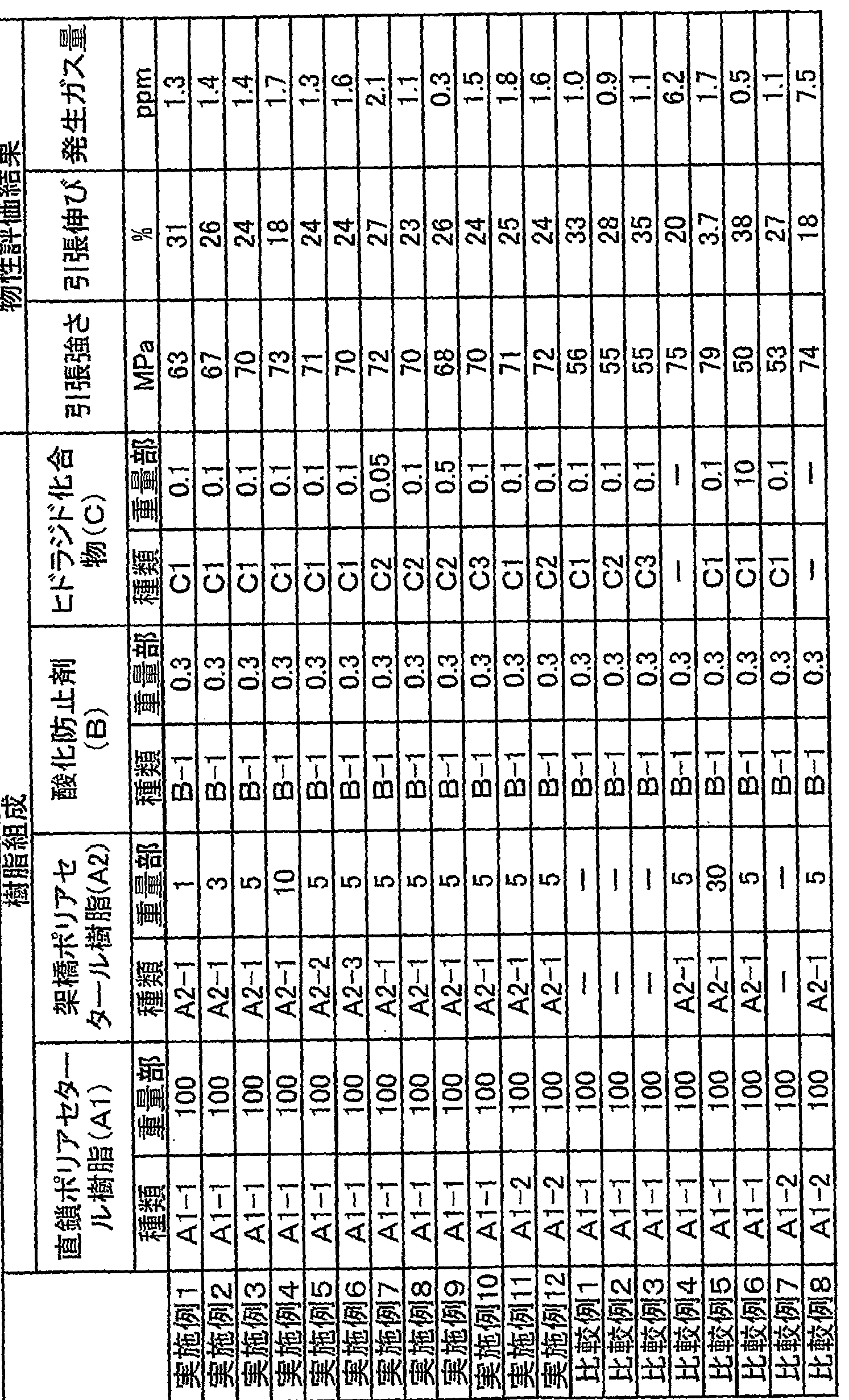
- a linear polyacetal resin (A1) is blended with a branched and cross-linked polyacetal resin (A2), a hindered phenolic antioxidant (B), and a hydrazide compound (C) in the proportions shown in Table 1, and a cylinder temperature of 200 °
- a pellet-like composition was prepared by melt-kneading with a C extruder.
- a test piece was molded from the pellet-shaped composition using an injection molding machine, and the physical properties were evaluated by the evaluation method described above. The results are shown in Table 1.
- the linear polyacetal resins A1-1 and A1-2 were prepared as follows.
- trioxane and 1,3-dioxolane used for the polymerization is 0.03 wt% pentaerythritol-tetrakis [3— (3, 5_di-tert-butyl 4-hydroxyphenyl) Pionate].
- the mixture of trioxane and 1,3-dioxolane used for polymerization contained 6 ppm of water, 3.5 ppm of methanol, and 5 ppm of formic acid as impurities.
- the polymer discharged from the discharge port of the polymerizer is immediately added with an aqueous solution containing 1000 ppm of triethylamine to carry out pulverization and stirring treatment to deactivate the catalyst, and then centrifuged and dried to obtain crude polyoxy A methylene copolymer was obtained.
- this crude polyoxymethylene copolymer is supplied to a twin-screw extruder having a vent port, and the unstable end portion is separated by melt-kneading at a resin temperature of about 220 ° C.
- the volatile components including the decomposition products were devolatilized from the vent port under reduced pressure.
- the polymer taken out from the die of the extruder was cooled and chopped to obtain a pellet-like polyacetal resin A1-2 from which the unstable terminal portion had been removed.
- the above pellet-like polymer is continuously supplied from the upper part, and a 135 ° C aqueous solution containing 500 ppm of triethylamine is supplied from the lower part. After 8 hours, centrifugation and drying were carried out to obtain polyacetal resin A1-1 having further reduced hemiformal end groups, formyl end groups, and unstable end portions.
- the amounts of hemi-formal and formyl groups of polyacetal resins A1-1 and A1-2 were measured using AV AN CE 400 FT-NMR equipment manufactured by Bruker, Inc. This is a value (mmo 1 / kg) obtained by performing a measurement according to the method described in Japanese Unexamined Patent Publication No. 2001-1 1 143. Further, the melt index is a value (gZi 0 min) obtained under the conditions of 190 ° C and 2160 g in accordance with AS TM-D 1238.
- trioxane (a) a compound selected from cyclic ether compounds and cyclic formal compounds (b) and polyfunctional glycidyl ether compounds (c) in the proportions shown in Table 2, and continuously feeding them to the polymerizer.
- a compound selected from cyclic ether compounds and cyclic formal compounds (b) and polyfunctional glycidyl ether compounds (c) in the proportions shown in Table 2, and continuously feeding them to the polymerizer.
- Table 2 shows the melt index of the obtained cross-linked polyacetal resins A2-1 to A2_3.
- DO indicated by abbreviation DO is 1,3-dioxolan
- BF is 1,4-pentanediol formal
- TMPTGE is trimethylolpropane triglycidinoatenore.
Landscapes
- Chemical & Material Sciences (AREA)
- Health & Medical Sciences (AREA)
- Chemical Kinetics & Catalysis (AREA)
- Medicinal Chemistry (AREA)
- Polymers & Plastics (AREA)
- Organic Chemistry (AREA)
- Compositions Of Macromolecular Compounds (AREA)
- Polyoxymethylene Polymers And Polymers With Carbon-To-Carbon Bonds (AREA)
Abstract
本発明は、ポリアセタール樹脂が本来有する機械的特性、加工性、表面特性等の優れた特性を維持し更にはその向上を図りながら、ホルムアルデヒド等のガスの発生を極限まで低減したポリアセタール樹脂材料を提供する。詳しくは、実質的に直鎖の分子構造を有するポリアセタール樹脂(A1)100重量部に対し、分岐又は架橋構造を有するポリアセタール樹脂(A2)0.01~20.0重量部、ヒンダードフェノール系酸化防止剤(B)0.01~5.0重量部およびヒドラジド化合物(C)0.01~5.0重量部を配合してなるポリアセタール樹脂組成物である。
Description
明細書 ポリアセタール樹脂組成物 技術分野
本発明は、 優れた機械的特性、 加工性及び安定性を有すると共に、 ホルムァ ルデヒド等の発生量が著しく抑制されたポリアセタール樹脂組成物に関するも のである。 背景技術
ポリアセタール樹脂は優れた機械的特性、 摺動性、 加工性、 表面特性等を有 し、 その成形品は広汎な分野に利用されている。
このようなポリアセタール樹脂に対し、 近年は、 その優れた機械的特性、 加 ェ性、 表面特性等を維持し更にはその向上を図りながら、 ホルムアルデヒド等 のガスの発生を極限まで低減することが強く要求される傾向にある。 しかしな がら、 従来から知られた方法によってこれらの特性をすベて満足するポリアセ タール樹脂材料を得ることは極めて難しい。
例えば、 ポリアセタール樹脂の熱安定性を高め、 樹脂の分解によるホルムァ ルデヒド等の発生を抑制するために各種の安定剤を配合することは従来より行 われており、 安定剤としてヒドラジド化合物を添加することも古くから知られ ている (特開平 4ー 3 4 5 6 4 8号公報) 。 しかしながら、 ヒ ドラジド化合物 の添加によって高度の熱安定性を達成し、 ホルムアルデヒド等のガスの発生を 著しく減少させようとしてその配合量等の調整を行った場合、 ポリアセタール 樹脂が本来有する優れた機械的特性や加工性等を損なうことがあり、 また、 配 合成分の染み出しが生じる要因になるものであった。
—方、 ポリアセタール樹脂の機械的特性を向上させるためにガラス繊維等の 無機充填材を配合することが従来から知られているが、 かかる樹脂材料を調製 する際の溶融混練による剪断によってポリアセタール樹脂の分解が生じ易くな
り、 ホルムアルデヒド等のガスの発生を低いレベルに維持することは困難であ る。 また、 無機充填材の存在により、 ポリアセタール樹脂が本来有していた摺 動性、 加工性、 表面特性等の優れた特性が著しく損なわれたものとなる。 発明の開示
上記のように、 従来から知られた技術によっては、 ポリアセタール樹脂が本 来有する機械的特性、 力 tlェ性、 表面特性等の優れた特性を維持し更にはその向 上を図りながら、 ホルムアルデヒド等のガスの発生を極限まで低減したポリア セタール樹脂材料を得ることは困難であつた。
本発明は、 かかる課題を解決し、 これらの特性を兼備した樹脂材料を提供す ることを目的とする。
本発明者は、 力かる要求に応え得るポリアセタール樹脂組成物を得るため鋭 意検討を重ねた結果、 基体とするポリァセタール樹脂の構成と配合成分の選択 によって目的が達成できることを見出し、 本発明に至つた。
即ち本発明は、 実質的に直鎖の分子構造を有するポリアセタール樹脂 (A1) 100重量部に対し、 分岐又は架橋構造を有するポリアセタール樹脂 (A2) 0. 01 〜20. 0重量部、 ヒンダードフエノール系酸化防止剤 (B) 0. 01〜5. 0重量部お よびヒドラジド化合物 (C) 0. 01〜5. 0重量部を配合してなるポリアセタール榭 脂糸且成物に関するものである。
本発明によれば、 優れた機械的特性等を有し、 かつ、 ホルムアルデヒド等の ガス発生量の少ないポリアセタール樹脂組成物を提供することができる。 発明の詳細な説明
以下、 本発明を詳細に説明する。 まず、 本発明で用いられる実質的に直鎖の 分子構造を有するポリアセタール樹脂 (A1)とは、 ォキシメチレン基 (- CH20- ) を主たる構成単位とする高分子化合物であって、 分子鎖中に意図的に導入され た分岐構造や架橋構造を有しないものを指す。 かかるポリァセタール樹脂 (A1) としては、 実質的にォキシメチレン基の繰返しのみからなるポリアセタールホ
モポリマー、 ォキシメチレン基を主体とし分岐 ·架橋構造を形成しない他の構 成単位、 特に c 2_6のォキシアルキレン単位、 を少量有するポリアセタールコ ポリマー (ブロックコポリマーを含む) がその代表例として挙げられる。 本発 明においては、 ポリアセタール樹脂 (A1)としてこれらのポリアセタール樹脂の 何れも使用でき、 また、 必要に応じて二種以上の特性の異なるポリアセタール 樹脂をブレンドして使用することも出来るが、 成形性、 熱安定性等の観点から ポリアセタールコポリマーを用いるのが好ましい。
かかるポリアセタールコポリマーとしては、 トリオキサン (a ) 99. 95〜 80. 0重量%と置換基を持たない環状エーテル化合物及び環状ホルマール化合物 から選ばれた化合物 (b ) 0. 05〜20· 0重量 °/0とを共重合して得られるものが好 ましく、 更に好ましくはトリオキサン (a ) 99. 9〜90. 0重量%と上記化合物
( b ) 0. 1〜10. 0重量%とを共重合して得られるものである。
ポリアセタールコポリマーの製造に用いるコモノマー成分 (上記化合物
( b ) ) としては、 例えばエチレンォキシド、 1, 3—ジォキソラン、 ジェチ レングリコーノレホノレマーノレ、 1 , 4ーブタンジォ一ノレホノレマーノレ、 1 , 3—ジ 才キサン、 プロピレンォキシド等が挙げられ、 特にエチレンォキシド、 1 , 3 ージォキソラン、 1, 4一ブタンジオールホルマール及びジエチレングリコー ルホルマールから選ばれる 1 種又は 2 種以上が好ましい。 ポリアセタール樹 脂 (A1)の調製法は特に限定されるものではなく、 公知の方法で調製することが できるが、 工業的には連続塊状重合法が好ましい。
本発明において用いるポリアセタールコポリマーは、 そのメルトインデック ス (190° (:、 荷重 2160 gで測定) は 1〜50 g/min. であるものが好ましい。 メ ルトインデックスは、 重合に用いる連鎖移動剤、 例えばメチラールの添加量を 増減することにより調整できる。 また、 本発明において用いるポリアセタール コポリマーとしては、 へミホルマール末端基量が 1. 0 mmol/kg以下、 ホルミル 末端基量が 2. 0 mmol/kg以下、 不安定末端基量が 0. 5重量%以下であるものが 好ましく、 より好ましくは、 へミホルマール末端基量が 0. 6 讓 ol/kg以下、 ホ ルミル末端基量が 0. 5mmol/kg以下、 不安定末端基量が 0. 3重量%以下のもの
である。 このような末端特性を有するポリアセタールコポリマーをポリアセタ ール樹脂 (A1)として使用することにより、 本発明が目的の 1つとするホルムァ ルデヒド発生量の +分に低減されたポリアセタール樹脂組成物の調製に有効に 寄与するものとなる。
ここでへミホルマール末端基は一〇C H 2 O Hで示されるものであり、 ヒ ド 口キシメトキシ基あるいはへミアセタール末端基とも称される。 また、 ホルミ ル末端基は一 C H Oで示される。 かかるへミホルマール末端基おょぴホルミル 末端基の量は1 H— NMR測定により求めることができ、 その具体的な測定方 法は、 特開 2 0 0 1— 1 1 1 4 3号公報に記載された方法を参照できる。 また、 不安定末端基量とは、 ポリアセタール共重合体の末端部分に存在し、 熱や塩基 に対して不安定で分解し易い部分の量を示す。 かかる不安定末端基量は、 ポリ ァセタール共重合体 1 gを、 0 . 5 % (体積%) の水酸化アンモニゥムを含む 5 0 % (体積%) メタノール水溶液 1 0 0 m 1とともに耐圧密閉容器に入れ、 1 8 0 °Cで 4 5分間加熱処理した後、 冷却し、 開封して得られる溶液中に分解 溶出したホルムアルデヒド量を定量し、 ポリアセタール共重合体に対する重 量。 /。で表したものである。
上記のような末端特性のポリァセタールコポリマーは、 重合工程の調整、 触 媒失活化工程の調整、 不安定末端の分解除去による安定化工程の調整、 それら の調整法の組合せによって得ることができる。 例えば、 重合工程においては、 重合に用いるモノマーゃコモノマーに含まれる水分、 メタノール、 ギ酸などの 不安定末端を生じさせる不純物を減少させ、 これらの不純物の少ないモノマー ゃコモノマーを用いて重合を行う方法、 モノマー中の不純物の減少に伴い或い は高活性の触媒の使用により触媒使用量を少量に調整する方法、 ヒンダードフ ェノール系酸化防止剤の共存下で重合を行う方法、 触媒失活化工程においては、 重合によって得られた固体状の重合体を効率的に微細粒子状に粉碎して触媒の 失活を行う方法、 不安定末端の分解除去による安定化工程においては、 重合後 の不安定末端部を有するポリァセタールコポリマーを塩基性化合物の存在下で 押出機等により溶融処理して不安定末端部の分解除去を行い、 冷却固化後に、
さらに高温液体中(例えば水中)で不均一状態を保って加熱処理する方法、 重合 後の不安定末端部を有するポリアセタールコポリマーを塩基性化合物を含有す る溶媒中に加熱溶解させ、 溶液状態で加熱処理する方法等により、 更にはこれ らの方法を組み合わせることにより、 より好ましい末端特性のポリアセタール コポリマーを調製することができる。
次に、 本発明に用いる分岐又は架橋構造を有するポリアセタール樹脂 (A¾は、 上記の如きポリアセタールホモポリマー或いはポリアセタールコポリマーの製 造において、 ホルムアルデヒド或いはトリオキサン等と共重合可能であり、 力 つ共重合によって分岐単位或レ、は架橋単位を形成し得る化合物を更に添加して 共重合することによって得られるものである。 例えば、 トリオキサン (a ) と 置換基を持たない環状エーテル化合物及び環状ホルマール化合物から選ばれた 化合物 (b ) を共重合させるにあたり、 置換基を有する単官能グリシジルイヒ合 物 (例えば、 フエ二ルグリシジルエーテル、 プチ/レグリシジルエーテル等) を 更に加えて共重合することにより分岐構造を有するポリアセタール樹脂が得ら れ、 また、 多官能グリシジルエーテル化合物を加えて共重合することにより架 橋構造を有するポリアセタール樹脂が得られる。
本発明においては、 ポリアセタール樹脂 (A2)として架橋構造を有するものを 使用するのが好ましく、 中でも、 トリオキサン (a ) 99. 89〜88. 0重量%、 置 換基を持たない単官能環状エーテル化合物及ぴ単官能環状ホルマール化合物か ら選ばれた化合物 ( b ) 0. 1〜10. 0重量%及び多官能グリシジルエーテル化合 ( c ) 0. 01〜2. 0重量%を共重合して得られるものが好ましく、 特に好ましく はトリオキサン (a ) 99. 28〜96. 50重量%、 化合物 (b ) 0. 7〜3. 0重量0 /0及 ぴ多官能グリシジルエーテル化合物 ( c ) 0. 02〜0. 5重量%を共重合して得ら れるものである。 また、 そのメルトインデックスが 0. 1〜10 g/min. の架橋ポ リァセタール樹脂が好ましい。
化合物 ( b ) としては、 前記と同じものが挙げられ、 特にエチレンォキシド、 1, 3—ジォキソラン、 1 , 4ーブタンジォ一ノレホノレマール及びジエチレング リコールホルマールから選ばれる 1種又は 2種以上が好ましい。
また、 多官能グリシジルエーテル化合物 ( C ) としてはエチレングリコール ジグリシジノレエーテル、 プロピレングリコーノレジグリシジノレエーテル、 1, 4- ブタンジオールジグリシジルエーテル、 へキサメチレングリコールジグリシジ ルエーテル、 レゾルシノールジグリシジルエーテル、 ビスフエノール Aジグリ シジノレエーテノレ、 ポリエチレングリ コールジグリシジノレエーテノレ、 ポリプロピ レングリコーノレジグリシジノレエーテノレ、 ポリブチレングリコ一/レジグリシジノレ エーテル、 グリセロールトリグリシジルエーテル、 トリメチロールプロパント リグリシジルエーテル、 ペンタエリスリ トールテトラグリシジルエーテル、 ソ ルビト一ルポリグリシジルエーテル、 ソルビタンポリグリシジルエーテル、 ポ リグリセ口一/レポリグリシジノレエーテ^ ジグリセ口一/レポリグリシジノレエー テル等が挙げられる。 これらのィ匕合物は単独で又は 2種以上を併用して使用す ることができる。
中でも、 1分子中に 3乃至 4個のダリシジルエーテル基を有するものが特に 好ましく、 具体的にはトリメチロールプロパントリグリシジルエーテル、 グリ セ口ールトリグリシジルエーテル及びペンタエリスリ トールテトラグリシジル エーテルが挙げられる。 かかる 3乃至 4個のダリシジルエーテル基を 1分子中 に有するダリシジルエーテル化合物を用いて架橋構造を形成させたポリアセタ ール共重合体をポリァセタール樹脂 (A2)として使用することにより、 より一層 機械的特性の優れたポリアセタ一ル榭脂組成物となる。
上記の如き分岐又は架橋構造を有するポリアセタ一ル榭脂 (A2)の調製法も特 に限定されるものではなく、 直鎖のポリアセタール樹脂 (A1)の調製と同様に、 公知の方法で調製することができる。
力かる分岐又は架橋構造を有するポリアセタール樹脂 (A2)は、 少量の配合に おいても結晶核剤として作用し、 直鎖のポリアセタール樹脂 (A1)を高結晶化さ せて機械的特性を向上させる機能を有すると共に、 その配合量の増加に伴い、 ポリアセタール樹脂 (A2)が有する分岐或いは架橋構造によって直鎖のポリアセ タール樹脂 (A1)中に一種のァンカ一効果と推測される効果を生じさせ、 機械的 特性を向上させる機能も有する。
本発明において、 上記の如き分岐又は架橋構造を有するポリアセタール樹脂 (A2)の配合量は、 直鎖のポリァセタール樹脂 (A1) 100重量部に対して 0. 01〜20 重 4部であり、 かかる広い範囲で効果を生じる。 ポリアセタール樹脂 (A2)の配 合量が少ないと何れの機能も生じず、 機械的特性の改善が不十分なものとなり、 その配合量が過大の場合もポリアセタール樹脂組成物の成形加工性を損ねるこ とになり、 結果として機械的特性も不十分なものとなる。 なお、 結晶核剤とし ての機能を発現させるためのポリアセタール樹脂 (A2)の配合量は、 直鎖のポリ ァセタール樹脂 (A1) 100重量部に対して 0. 01〜 5重量部程度であり、 好ましく は 0. 01〜2重量部である。 また、 アンカー効果による機械的特性向上機能を発 現させるためのポリアセタール樹脂 (A2)の配合量は、 直鎖のポリアセタール樹 脂 (A1) 100重量部に対して 1〜20重量部程度であり、 好ましくは 2〜20重量部 である。
上記の如く、 分岐又は架橋構造を有するポリァセタール樹脂 (A2)は、 ォキシ メチレン基を主たる構成単位とするために直鎖のポリアセタール樹脂 (A1)と類 似した性質を有すると共に、 分岐又は架橋構造を有することによって、 直鎖の ポリアセタール樹脂 (A1)とは全く異質の性質も有する。 このような分岐又は架 橋構造を有するポリアセタール樹脂 (A2)を直鎖のポリアセタール樹脂 (A1)に配 合することによって、 他の構成成分との作用とも相俟って、 本発明の目的とす る効果が選択的に達成できることは予期し難いものであった。
次に、 本発明において使用するヒンダードフエノール系酸化防止剤 (B ) と しては、 単環式ヒンダードフエノール化合物、 炭化水素基又はィォゥ原子を含 む基で連結された多環式ヒンダードフエノールイヒ合物、 エステル基又はアミ ド 基を有するヒンダ一ドフエノール化合物などが挙げられる。 これらの具体的化 合物としては、 2, 6—ジー t _ブチル一 p—クレゾール、 2 , 2 ' —メチレ ンビス (4ーメチルー 6— t一ブチルフエノール) 、 4 , 4, 一メチレンビス ( 2 , 6—ジー t一ブチルフエノール) 、 1, 1, 3—トリス (2—メチル一 4ーヒ ドロキシ一 5— t—プチノレフエニル) ブタン、 4 , 4 ' ーブチリデンビ ス (3—メチル一 6— t _ブチルフエノール) 、 1, 3 , 5—トリメチル一2,
4, 6—トリス (3, 5一ジー t一ブチノレー 4—ヒ ドロキシベンジノレ) ベンゼ ン、 4, 4, ーチォビス (3—メチルー 6— tーブチノレフエノール) 、 nーォ クタデシノレ一 3— (4, 一ヒ ドロキシー 3' , 5 ' ージー t一ブチルフエ二 ル) プロピオネート、 n—ォクタデシルー 2— (4, 一ヒ ドロキシー 3 ' , 5, ージー t—ブチノレフエ二ノレ) プロピオネート、 1, 6一へキサンジォ一ノレ 一ビス [3— (3, 5—ジー t一プチノレ一 4—ヒ ドロキシフエ-ル) プロピオ ネート] 、 エチレンビス(ォキシエチレン)ビス [3_ (5— tert—ブチルー 4ーヒ ドロキシー m—トリル) プロピオネート] 、 ペンタエリスリ ト一ルテト ラキス [3— (3, 5—ジ一 t一プチルー 4ーヒ ドロキシフエ-ル) プロピオ ネート] 、 3, 9—ビス [2— { 3 - (3— tーブチノレー 4—ヒ ドロキシー 5 —メチ /レフェニノレ) プロピオ二/レオキシ } 一 1, 1ージメチノレエチル] -2, 4, 8, 1 0—テトラオキサスピロ [5. 5] ゥンデカン、 2— t一プチルー 6— (3, 一 t—プチルー 5, ーメチノレー 2, ーヒ ドロキシベンジル) 一4— メチルフエニルアタリ レート、 2 - [1 - (2—ヒ ドロキシー 3, 5—ジー t 一ペンチノレフエ二ノレ) ェチノレ] 一 4, 6ージー t—ペンチノレフエニノレアクリ レ ート、 ジー n—ォクタデシルー 3, 5—ジー t—ブチノレー 4ーヒ ドロキシベン ジノレホスホネート、 N, N' —へキサメチレンビス (3, 5—ジー t一プチノレ 一 4ーヒ ドロキシージヒ ドロシンナムアミ ド、 N, N' —エチレンビス [3—
(3, 5—ジー t一プチルー 4ーヒ ドロキシフエニル) プロピオンアミ ド] 、 N, N' —テトラメチレンビス [3— (3, 5—ジー t一プチルー 4ーヒ ドロ キシフエ二ノレ) プロピオンアミ ド] 、 N, N' —へキサメチレンビス [3—
(3, 5—ジー t一プチルー 4ーヒ ドロキシフエニル) プロピオンアミ ド] 、 N, N' —エチレンビス [3— (3— t—ブチルー 5—メチルー 4ーヒ ドロキ シフエ-ル) プロピオンァミ ド] 、 N, N, 一へキサメチレンビス [3— (3 一 t一プチルー 5—メチルー 4ーヒ ドロキシフエ-ル) プロピオンアミ ド] 、 N, N' 一ビス [3— (3, 5一ジ一 t一ブチノレ一 4ーヒ ドロキシフエニル) プロピオニル] ヒ ドラジン、 N, N' 一ビス [3— (3— t一プチルー 5—メ チルー 4ーヒ ドロキシフエ-ル) プロピオニル] ヒ ドラジン、 1, 3, 5—ト
リス (3 , 5—ジー tーブチルー 4ーヒ ドロキシベンジル) イソシァヌレート 1, 3 , 5—トリス (4一 tーブチノレー 3—ヒ ドロキシー 2, 6—ジメチノレべ ンジル) ィソシァヌレートなどを例示することができる。
これらのヒンダードフエノール系酸化防止剤 (B ) は、 単独で又は二種以上 組み合わせて使用できる。 ヒンダードフエノール系酸化防止剤 (B ) の添加量 は、 実質的に直鎖の分子構造を有するポリアセタール樹脂 (A1) 100重量部に 対し 0. 01〜5. 0重量部であり、 好ましくは 0. 03〜3. 0重量部である。 添加量が 少ない場合は効果が不十分なものとなり、 多い場合は、 着色、 染み出し等の問 題を引き起こす可能性がある。
次に、 本発明で用いられるヒドラジド化合物 (C) としては、 脂肪族或いは 芳香族の何れのヒ ドラジドでも使用することができる。
脂肪族ヒ ドラジド類としては、 プロピオン酸ヒ ドラジド、 チォカルボヒドラ ジド等のモノヒドラジド類;カルボジヒドラジド、 シュゥ酸ジヒ ドラジド、 マ ロン酸ジヒ ドラジド、 コハク酸ジヒ ドラジド、 ダルタル酸ジヒドラジド、 アジ ピン酸ジヒ ドラジド、 ァゼライン酸ジヒドラジド、 セバシン酸ジヒ ドラジド、 1、 1 2—ドデカンジカルボヒドラジド、 1, 1 8—ォクタデカンジカルボヒ ドラジド、 マレイン酸ジヒ ドラジド、 フマル酸ジヒドラジド、 7, 1 1一オタ タデカジエンー 1 , 1 8—ジカルボヒ ドラジド等が挙げられる。
芳香族ヒ ドラジド類としては、 サリチル酸ヒ ドラジド、 1一ナフトェ酸ヒ ド ラジド、 2—ナフトェ酸ヒドラジド、 3—ヒ ドロキシー 2—ナフトェ酸ヒドラ ジド、 p—トルエンスルホニルヒドラジド、 ァミノべンズヒドラジド、 4ーピ リジンカルボン酸ヒドラジド等のモノヒドラジド類;イソフタル酸ジヒドラジ ド、 テレフタル酸ジヒ ドラジド、 1, 5—ナフタレンジカルボヒ ドラジド、 1 8—ナフタレンジカノレボヒ ドラジド、 2 , 6—ナフタレンジカノレボヒ ドラジド 4 , 4,一ォキシビスベンゼンスルホニルヒ ドラジド、 1 , 5—ジフエ二ルカ ルポノヒ ドラジド等のジヒ ドラジド類が挙げられる。
また、 ァミノポリアクリルアミ ド、 1 , 3, 5—トリス (2—ヒ ドラジノカ ルポ-ルェチル) イソシァヌレート等のポリヒ ドラジド類も使用することがで
きる。
これらのヒ ドラジド化合物の中で、 本発明に使用する (C ) ヒドラジド化合 物としては、 ステアリン酸ヒ ドラジド、 テレフタル酸ジヒ ドラジド、 セバシン 酸ジヒ ドラジド、 1 , 1 2—ドデカンジカルボヒ ドラジド、 1一ナフトェ酸ヒ ドラジド、 1 , 5—ナフタレンジヒドラジド、 1 , 8—ナフタレンジヒ ドラジ ド、 2, 6—ナフタレンジヒ ドラジド等が特に好ましい。
本発明において、 上記の如きヒドラジド化合物は単独で使用してもよく、 ま た、 2種以上を混合して用いても良い。
本発明において、 ヒドラジド化合物 (C) の配合量は直鎖のポリアセタール 樹脂 (A1) 100重量部に対し 0. 01〜5重量部であり、 好ましくは 0. 03〜3重量 部である。 ヒ ドラジド化合物 (C) の配合量が少ない場合はポリアセタール樹 脂組成物が熱安定性の劣るものとなり、 ホルムアルデヒ ド等のガスの発生量が 増加する。 (C ) の配合量が過大の場合は、 機械的特性が低下すると共に、 成 形加工性も劣るものとなり、 成形品の表面性も損ねることになる。 また、 ヒド ラジド化合物 (C) の染み出しも生じる。
本発明のポリアセタール樹脂組成物には、 さらに公知の各種安定剤を添カロし て安定性を補強することができる。 安定剤としては、 メラミン、 グアナミン、 尿素、 ポリアミ ド等の窒素含有化合物、 アル力リ或いはアル力リ土類金属の水 酸化物、 無機塩、 カルボン酸塩等のいずれか 1種または 2種以上を挙げること ができる。
また、 目的とする用途に応じてその物性を改善するため、 更に公知の各種の 添加物を配合し得る。 添加物の例を示せば、 各種の着色剤、 滑剤、 離型剤、 核 剤、 帯電防止剤、 界面活性剤、 異種ポリマーや、 繊維状、 板状、 粉粒状の無機 充填剤等である。
中でも、 脂肪族系ビスアミ ド化合物の配合は、 成形加工性の改善に寄与し、 それによつて機械的特性の保持やホルムアルデヒド発生の低減にも寄与するた め好ましい。 かかる目的で配合する脂肪族系ビスアミ ド化合物の配合量は、 ポ リアセタール樹脂 (A1) 100重量部に対し 0. 01〜2. 0重量部が好ましい。 この
配合量は、 多くても少なくても成形加工性を損ねることになる。
また、 本発明は、 ポリアセタール樹脂 (A1) 100重量部に対し 0. 01〜2. 0重 量部の着色剤が配合され、 着色されポリアセタール樹脂組成物において大きな 効果が発揮され、 特に好ましい態様である。 すなわち、 着色剤の多くは活性を 有し、 ポリアセタール樹脂の安定性やホルムアルデヒド発生に対して好ましく なレ、作用を生じる場合が多 、が、 本発明の組成はその抑制に有効に機能する。 このため、 表面性に優れていることが特に必要とされる着色成形品においては、 その効果が顕著である。
また、 本発明においては、 実質的に無機繊維状充填材の配合による補強を行 わない場合に一層バランスのとれた特性を有する組成物となり好ましい。 すな わち、 力かる組成物によりポリアセタール樹脂が本来有する加工性、 表面特性、 摺動性等の優れた特性を維持しながらその機械的特性を向上させ、 更に、 ホル ムアルデヒド等のガスの発生を極限まで低減したポリアセタール樹脂材料を得 ることができる。
本発明の樹脂組成物は、 従来から樹脂組成物の調製法として一般に用いられ る公知の方法により容易に調製することができる。 例えば、 i)糸且成物を構成す る全成分を混合して 1軸又は 2軸の押出機の主供給口に供給し、 溶融混練して 押出し、 これをカッティングしてペレット状の樹脂組成物を得る方法、 i i)組 成物を構成する一部の成分又は成分の一部量を押出機の途中から供給する以外 は前記調製法 i)と同様にしてペレツト状の樹脂組成物を得る方法、 i i i)押出機 による溶融混練等により組成の異なる複数の組成物を調製し、 これを混合し、 必要なら更に溶融混練して目的とする組成物を得る方法、 iv)—部の成分を高 濃度に含む組成物 (マスターパッチ) を押出機による溶融混練等によって調製 しておき、 これを残余成分と混合し、 必要なら更に溶融混練して目的とする組 成物を得る方法、 V)組成物を構成する全成分の混合物或レ、は前記マスターバッ チと残余成分の混合物を成形機に供給し、 成形することによって、 目的組成物 を成形品として得る方法等が何れも使用できる。
斯かる組成物の調製において、 基体であるポリアセタール樹脂の一部又は全
部を粉砕し、 これとその他の成分を混合した後、 押出等を行うことは添加物の 分散性を良くする上で好ましい方法である。
本発明に係る樹脂組成物は、 押出成形、 射出成形、 圧縮成形、 真空成形、 吹 込成形、 発泡成形の何れによっても成形可能である。 実施例
以下本発明を実施例により説明するが、 本発明はこれらの実施例に限定され るものではない。
測定 ·評価方法は次の方法で行なった。
<引張強度及び伸ぴ>
I S O 3 1 6 7に準じた引張り試験片を温度 2 3 °C、 湿度 5 0 %の条件下 に 4 8時間放置し、 I S O 5 2 7に準じて測定した。
<発生ガス量 >
平板状試験片 (1 0 0 mm X 4 0 mm X 2 mm:重量約 1 1 . 2 g ) を、 蒸 留水 5 O m 1含むポリエチレン製瓶 (容量 1 0 0 0 m l ) の蓋に吊り下げて密 閉し、 恒温槽内に温度 6 0 で 3時間放置した後、 室温で 1時間静置した。 平 板状試験片から発生してポリエチレン製瓶中の蒸留水に吸収されたホルムアル デヒ ドの量を J I S K O I 0 2 . 2 9 (ホルムアルデヒドの項) に従って定 量し、 試験片の単位重量当たりのホルムアルデヒド発生量を算出した。
実施例 1〜 1 2、 比較例:!〜 8
直鎖のポリアセタール樹脂 (A1) に、 分岐'架橋ポリアセタール樹脂 (A 2) 、 ヒンダードフエノール系酸化防止剤 ( B ) およびヒドラジド化合物(C ) を表 1に示す割合で配合し、 シリンダー温度 200°C の押出機で溶融混練してぺ レット状の組成物を調製した。 次いで、 このペレット状の組成物から射出成形 機を用いて試験片を成形し、 前記の評価法にて物性評価を行った。 結果を表 1 に示す。
一方、 比較のため、 分岐'架橋ポリアセタールを添加しない場合、 ヒ ドラジ ド化合物を添加しない場合、 各成分の配合量が本発明規定外の場合等について
も同様にしてペレット状の組成物を調製し、 物性評価を行った。 結果を表 1示 す。
尚、 実施例 ·比較例で使用した各成分は以下のものである。
•直鎖のポリアセタール樹脂 (A1)
A1-1:ポリアセタール共重合体 [へミホルマール末端基量 =0. 38mmo l/k g、 ホルミル末端基量 =0. 03mmo 1 Zk g、 不安定末端基量 =0 15重量%、 メルトインデックス =9 gZl 0分]
A1-2:ポリァセタール共重合体 [へミホルマール末端基量 = 1. 20 mm o lZk g、 ホルミル末端基量 =0. 6 Ommo 1 /k g、 不安定末端基量 =0 6重量0 /。、 メルトインデックス =9 g/10分]
なお、 直鎖ポリアセタール樹脂 A1— 1及び A1— 2は、 次のようにして調製 した。
ニ軸パドルタイプの連続式重合機を用い、 パドル付回転軸を 150rpmで回転 させながらトリオキサン 96. 7重量%と 1, 3—ジォキソラン 3. 3重量% の混合物を連続的に供給し、 更に分子量調整剤としてメチラールを連続的に供 給し、 触媒として三フッ化ホウ素を全モノマーに対して 1 5 p pmの割合で連 続的に添加し塊状重合を行った。 重合に供するトリォキサンと 1, 3—ジォキ ソランの混合物には、 その全量に対し 0. 03重量%のペンタエリスリ トール ーテトラキス 〔3— (3, 5_ジ一 t—プチルー 4—ヒドロキシフエニル) プ 口ピオネート〕 を含有させた。 また、 重合に供するトリオキサンと 1, 3—ジ ォキソランの混合物は、 不純物として水 6 p pm、 メタノール 3. 5 p pm、 ギ酸 5 p pmを含有するものであった。
重合機吐出口より排出された重合体は、 直ちにトリェチルァミン 1000 p pm含有水溶液を加えて粉碎、 攪拌処理を行うことにより触媒の失活を行い、 次いで、 遠心分離、 乾燥を行うことにより粗ポリオキシメチレン共重合体を得 た。
次いで、 この粗ポリオキシメチレン共重合体を、 ベント口を有する二軸押出 機に供給し、 樹脂温度約 220 °Cで溶融混練することにより不安定末端部を分
解すると共に、 分解生成物を含む揮発分をベント口から減圧脱揮した。 押出機 のダイから取り出した重合体を冷却、 細断することにより、 不安定末端部の除 去されたペレツト状のポリアセタール樹脂 A1— 2を得た。
次いで、 保温可能な円筒状の耐圧容器を用い、 その上部より上記のペレッ ト 状の重合体を連続的に供給し、 下部より トリェチルァミン 500 p p mを含有 する 1 35 °Cの水溶液を供給する処理を 8時間行った後、 遠心分離、 乾燥を行 うことにより、 へミホルマール末端基、 ホルミル末端基、 不安定末端部がより 一層低減されたポリアセタール樹脂 A1— 1を得た。
なお、 ポリアセタール樹脂 A1— 1及ぴ A1— 2のへミホルマール末端基量及 びホルミル基末端基量は、 B r uk e r (株) 製の AV AN C E 400型 F T — NMR装置を用いて、 特開 2001— 1 1 143号公報に記載の方法に準じ て測定を行って得られた値 (mmo 1 /k g) である。 また、 上記メルトイン デッタスは、 AS TM— D 1238に準じ、 190°C、 21 60 gの条件下で 求めた値 (gZi 0分) である。
'架橋ポリアセタール樹脂 (A2)
トリオキサン (a) 、 環状エーテル化合物及ぴ環状ホルマール化合物から選 ばれた化合物 ( b ) 及ぴ多官能グリシジルエーテル化合物 ( c ) を表 2に示す 割合で混合して連続的に重合機に供給する以外はほぼ直鎖ポリァセタール樹脂 A1-2 と同様の操作を行い、 架橋ポリアセタール樹脂 Α2_1〜Α2— 3 を得た。 得られた架橋ポリアセタール樹脂 A2— 1〜A2_3のメルトインデックスを表 2 に示す。
尚、 表中に略号で示した DOは 1, 3—ジォキソラン、 BFは 1, 4—プタ ンジオールホルマール、 TMPTGEはトリメチロールプロパントリグリシジ ノレエーテノレを示す。
• ヒンダードフエノール系酸化防止剤 ( B )
B— 1:ペンタエリスリ トールテトラキス [3 - (3, 5—ジ一 tーブチルー 4 —ヒ ドロキシフエニル) プロピオネート]
• ヒドラジド化合物(C)
C - 1 :ステアリン酸ヒドラジド C-2 :セバシン酸ジヒ ドラジド C-3 : 1一ナフトェ酸ヒドラジド
架橋ホ°リア トリ才キサン (a) 化合物 (b) 化合物 (c) メルトイン Tックス (MI) セタール樹脂
(wt%) 種類 (wt ) 種類 (wt%) (g/10m'in)
A2-1 98.2 DO 1.7 TMPTGE 0.1 1.5
A2- 2 98.2 BF 1.7 TMPTGE 0.3 0.9
A2-3 98.0 DO 1.7 TMPTGE 0.3 0.9
Claims
1 . 実質的に直鎖の分子構造を有するポリアセタール樹脂 (A1) 100重量部 に対し、 分岐又は架橋構造を有するポリアセタール樹脂 (A2) 0. 01〜20. 0重量 部、 ヒンダードフエノール系酸化防止剤 (B) 0. 01〜5. 0重量部おょぴヒ ドラジ ド化合物 (C) 0. 01〜5. 0重量部を配合してなるポリァセタール樹脂組成物。
2 . ポリアセタール樹脂 (A1) 、 トリオキサン (a) 99. 9〜90. 0重量0 /0と 置換基を持たない環状エーテル化合物及び環状ホルマール化合物から選ばれた 化合物 (b) 0. 1〜10. 0重量%とを共重合して得られ、 そのメルトインデックス
(190°C、 荷重 2160g) が 1〜50g/min. 、 へミホルマール末端基量が 1. 0 ramol/kg以下、 ホルミル末端基量が 2. 0 mmol/kg以下、 不安定末端基量が 0. 5 重量%以下のポリアセタール共重合体である請求項 1に記載のポリアセタール 樹脂組成物。
3 . ポリアセタール樹脂 (A2) ί トリオキサン (a) 99. 89〜88· 0重量0 /0、 置換基を持たない環状エーテル化合物及び環状ホルマール化合物から選ばれた 化合物 (b) 0. 1〜10. 0重量%及び多官能グリシジルェーテル化合物 (c) 0. 01 〜2. 0重量%を共重合して得られ、 メルトインデックス (190°C、 荷重 2160g) が 0. 1〜10 g/min.の架橋ポリァセタール共重合体である請求項 1または 2に記 載のポリアセタ一ル榭脂組成物。
4 . 多官能グリシジルエーテル化合物 (c) 、 3官能グリシジルエーテル 化合物及ぴ 4官能グリシジルエーテルィヒ合物から選ばれたものである請求項 4 記載のポリアセタール樹脂組成物。
5 . 分岐又は架橋構造を有するポリアセタール樹脂 (A2) の配合量が、 ポリ ァセタール樹脂 (A1) 100重量部に対し 0. 01〜2. 0重量部である請求項 1〜4 の何れか 1項に記載のポリァセタール樹脂組成物。
6 . 分岐又は架橋構造を有するポリアセタール樹脂 (A2) の配合量が、 ポリ ァセタール樹脂 (A1) 100重量部に対し 2. 0〜20. 0重量部である請求項 1〜4 の何れか 1項に記載のポリァセタール樹脂組成物。
7 . 更に脂肪族系ビスアミド化合物をポリアセタール樹脂 (A1) 100重量部 に対し 0. 01〜2. 0重量部配合してなる請求項 1〜 6のいずれか 1項に記載のポ リアセタール樹脂組成物。
8 . 更に着色剤をポリアセタール樹脂 (A1) 100重量部に対し 0. 01〜2. 0重 量部配合してなる請求項 1〜 7のいずれか 1項に記載のポリァセタール樹脂組 成物。
Priority Applications (2)
| Application Number | Priority Date | Filing Date | Title |
|---|---|---|---|
| US12/521,087 US20100087575A1 (en) | 2006-12-25 | 2007-12-07 | Polyacetal resin composition |
| EP07850584A EP2123709A4 (en) | 2006-12-25 | 2007-12-07 | polyacetal resin |
Applications Claiming Priority (2)
| Application Number | Priority Date | Filing Date | Title |
|---|---|---|---|
| JP2006-347834 | 2006-12-25 | ||
| JP2006347834A JP2008156505A (ja) | 2006-12-25 | 2006-12-25 | ポリアセタール樹脂組成物 |
Publications (1)
| Publication Number | Publication Date |
|---|---|
| WO2008078570A1 true WO2008078570A1 (ja) | 2008-07-03 |
Family
ID=39562364
Family Applications (1)
| Application Number | Title | Priority Date | Filing Date |
|---|---|---|---|
| PCT/JP2007/074068 Ceased WO2008078570A1 (ja) | 2006-12-25 | 2007-12-07 | ポリアセタール樹脂組成物 |
Country Status (5)
| Country | Link |
|---|---|
| US (1) | US20100087575A1 (ja) |
| EP (1) | EP2123709A4 (ja) |
| JP (1) | JP2008156505A (ja) |
| CN (1) | CN101583666A (ja) |
| WO (1) | WO2008078570A1 (ja) |
Cited By (7)
| Publication number | Priority date | Publication date | Assignee | Title |
|---|---|---|---|---|
| WO2010050187A1 (ja) * | 2008-10-28 | 2010-05-06 | 旭化成ケミカルズ株式会社 | ポリアセタール樹脂組成物及びその製造方法 |
| JP2010132885A (ja) * | 2008-10-28 | 2010-06-17 | Asahi Kasei Chemicals Corp | ポリアセタール樹脂組成物 |
| JP2010155972A (ja) * | 2008-12-03 | 2010-07-15 | Asahi Kasei Chemicals Corp | ポリアセタール樹脂組成物 |
| JP2010222558A (ja) * | 2009-02-25 | 2010-10-07 | Asahi Kasei Chemicals Corp | ポリアセタール樹脂組成物の製造方法 |
| WO2012049926A1 (ja) * | 2010-10-15 | 2012-04-19 | ポリプラスチックス株式会社 | ポリアセタール樹脂組成物及びその製造方法 |
| WO2022064924A1 (ja) * | 2020-09-28 | 2022-03-31 | ポリプラスチックス株式会社 | ポリアセタール共重合体及びその製造方法 |
| WO2022137859A1 (ja) * | 2020-12-21 | 2022-06-30 | ポリプラスチックス株式会社 | ポリアセタール共重合体及びその製造方法 |
Families Citing this family (8)
| Publication number | Priority date | Publication date | Assignee | Title |
|---|---|---|---|---|
| JP5936335B2 (ja) * | 2011-11-28 | 2016-06-22 | ポリプラスチックス株式会社 | ポリアセタール樹脂組成物 |
| JP5908735B2 (ja) * | 2012-01-30 | 2016-04-26 | 旭化成ケミカルズ株式会社 | ポリアセタール樹脂組成物 |
| KR101795125B1 (ko) * | 2012-05-14 | 2017-11-07 | 미츠비시 가스 가가쿠 가부시키가이샤 | 옥시메틸렌 공중합체의 제조 방법 |
| JP2014148626A (ja) * | 2013-02-01 | 2014-08-21 | Polyplastics Co | ポリアセタール樹脂組成物、及びこのポリアセタール樹脂組成物の成形品を備える硫黄燃料接触体 |
| JP5955424B1 (ja) * | 2015-02-06 | 2016-07-20 | ポリプラスチックス株式会社 | ポリアセタール樹脂組成物の製造方法 |
| CN109071917B (zh) * | 2016-05-19 | 2021-08-17 | 三菱瓦斯化学株式会社 | 聚缩醛树脂组合物及其制造方法 |
| JP6951938B2 (ja) * | 2017-10-24 | 2021-10-20 | 旭化成株式会社 | ポリアセタール樹脂組成物 |
| JP6951939B2 (ja) * | 2017-10-24 | 2021-10-20 | 旭化成株式会社 | ポリアセタール樹脂組成物 |
Citations (5)
| Publication number | Priority date | Publication date | Assignee | Title |
|---|---|---|---|---|
| JPH04345648A (ja) | 1991-05-15 | 1992-12-01 | Du Pont Japan Ltd | ポリアセタール樹脂組成物 |
| JP2001011143A (ja) | 1999-06-30 | 2001-01-16 | Polyplastics Co | ポリオキシメチレン共重合体、その製造方法及び分析方法 |
| JP2001131252A (ja) * | 1999-11-04 | 2001-05-15 | Asahi Kasei Corp | ポリオキシメチレン樹脂改質剤及びこれを用いたポリオキシメチレン樹脂組成物 |
| JP2003342442A (ja) * | 2002-05-30 | 2003-12-03 | Polyplastics Co | ポリアセタール樹脂組成物 |
| JP2005112995A (ja) * | 2003-10-07 | 2005-04-28 | Polyplastics Co | ポリアセタール樹脂組成物及びその成形品 |
Family Cites Families (3)
| Publication number | Priority date | Publication date | Assignee | Title |
|---|---|---|---|---|
| JP2005029714A (ja) * | 2003-07-08 | 2005-02-03 | Polyplastics Co | ポリアセタール樹脂組成物 |
| KR20060130034A (ko) * | 2003-11-07 | 2006-12-18 | 폴리플라스틱스 가부시키가이샤 | 폴리아세탈 수지 조성물 및 그의 성형품 |
| KR20060129215A (ko) * | 2003-11-10 | 2006-12-15 | 폴리플라스틱스 가부시키가이샤 | 폴리아세탈 수지 조성물 |
-
2006
- 2006-12-25 JP JP2006347834A patent/JP2008156505A/ja active Pending
-
2007
- 2007-12-07 EP EP07850584A patent/EP2123709A4/en not_active Withdrawn
- 2007-12-07 CN CNA2007800481673A patent/CN101583666A/zh active Pending
- 2007-12-07 US US12/521,087 patent/US20100087575A1/en not_active Abandoned
- 2007-12-07 WO PCT/JP2007/074068 patent/WO2008078570A1/ja not_active Ceased
Patent Citations (5)
| Publication number | Priority date | Publication date | Assignee | Title |
|---|---|---|---|---|
| JPH04345648A (ja) | 1991-05-15 | 1992-12-01 | Du Pont Japan Ltd | ポリアセタール樹脂組成物 |
| JP2001011143A (ja) | 1999-06-30 | 2001-01-16 | Polyplastics Co | ポリオキシメチレン共重合体、その製造方法及び分析方法 |
| JP2001131252A (ja) * | 1999-11-04 | 2001-05-15 | Asahi Kasei Corp | ポリオキシメチレン樹脂改質剤及びこれを用いたポリオキシメチレン樹脂組成物 |
| JP2003342442A (ja) * | 2002-05-30 | 2003-12-03 | Polyplastics Co | ポリアセタール樹脂組成物 |
| JP2005112995A (ja) * | 2003-10-07 | 2005-04-28 | Polyplastics Co | ポリアセタール樹脂組成物及びその成形品 |
Non-Patent Citations (1)
| Title |
|---|
| See also references of EP2123709A4 |
Cited By (13)
| Publication number | Priority date | Publication date | Assignee | Title |
|---|---|---|---|---|
| US8765850B2 (en) | 2008-10-28 | 2014-07-01 | Asahi Kasei Chemicals Corporation | Polyacetal resin composition and preparation process thereof |
| JP2010132885A (ja) * | 2008-10-28 | 2010-06-17 | Asahi Kasei Chemicals Corp | ポリアセタール樹脂組成物 |
| WO2010050187A1 (ja) * | 2008-10-28 | 2010-05-06 | 旭化成ケミカルズ株式会社 | ポリアセタール樹脂組成物及びその製造方法 |
| JP2010155972A (ja) * | 2008-12-03 | 2010-07-15 | Asahi Kasei Chemicals Corp | ポリアセタール樹脂組成物 |
| JP2010222558A (ja) * | 2009-02-25 | 2010-10-07 | Asahi Kasei Chemicals Corp | ポリアセタール樹脂組成物の製造方法 |
| JP2012087157A (ja) * | 2010-10-15 | 2012-05-10 | Polyplastics Co | ポリアセタール樹脂組成物及びその製造方法 |
| WO2012049926A1 (ja) * | 2010-10-15 | 2012-04-19 | ポリプラスチックス株式会社 | ポリアセタール樹脂組成物及びその製造方法 |
| WO2022064924A1 (ja) * | 2020-09-28 | 2022-03-31 | ポリプラスチックス株式会社 | ポリアセタール共重合体及びその製造方法 |
| JP2022054852A (ja) * | 2020-09-28 | 2022-04-07 | ポリプラスチックス株式会社 | ポリアセタール共重合体及びその製造方法 |
| JP2023054839A (ja) * | 2020-09-28 | 2023-04-14 | ポリプラスチックス株式会社 | ポリアセタール共重合体及びその製造方法 |
| WO2022137859A1 (ja) * | 2020-12-21 | 2022-06-30 | ポリプラスチックス株式会社 | ポリアセタール共重合体及びその製造方法 |
| JP2022097987A (ja) * | 2020-12-21 | 2022-07-01 | ポリプラスチックス株式会社 | ポリアセタール共重合体及びその製造方法 |
| JP7179046B2 (ja) | 2020-12-21 | 2022-11-28 | ポリプラスチックス株式会社 | ポリアセタール共重合体及びその製造方法 |
Also Published As
| Publication number | Publication date |
|---|---|
| EP2123709A1 (en) | 2009-11-25 |
| JP2008156505A (ja) | 2008-07-10 |
| US20100087575A1 (en) | 2010-04-08 |
| EP2123709A4 (en) | 2011-11-09 |
| CN101583666A (zh) | 2009-11-18 |
Similar Documents
| Publication | Publication Date | Title |
|---|---|---|
| WO2008078570A1 (ja) | ポリアセタール樹脂組成物 | |
| CN101568595B (zh) | 聚缩醛树脂组合物及其成型品 | |
| WO2008066053A1 (en) | Polyacetal resin composition and molded article thereof | |
| JP5085061B2 (ja) | ポリアセタール樹脂組成物 | |
| JP2009286874A (ja) | ポリアセタール樹脂組成物及びその成形品 | |
| KR101795125B1 (ko) | 옥시메틸렌 공중합체의 제조 방법 | |
| CN105339401B (zh) | 氧亚甲基共聚物的制造方法 | |
| JP2010037445A (ja) | ポリアセタール樹脂組成物及びその成形品 | |
| CN1749311B (zh) | 聚缩醛树脂组合物 | |
| CN110387106B (zh) | 聚甲醛树脂组合物和成型体 | |
| JP2006257166A (ja) | 不安定末端基分解処理剤、それを用いた安定化ポリアセタール樹脂、製造方法、組成物及び成形体 | |
| CN115702205B (zh) | 氧亚甲基共聚物树脂组合物及其制造方法 | |
| WO2008078571A1 (ja) | ポリアセタール樹脂組成物 | |
| JP2007084714A (ja) | ポリアセタール樹脂組成物及びリサイクル加工品 | |
| JP5955424B1 (ja) | ポリアセタール樹脂組成物の製造方法 | |
| CN107108825B (zh) | 氧亚甲基共聚物的制造方法 | |
| JP2007051205A (ja) | ポリアセタール樹脂組成物及び樹脂成形体 | |
| JP2016145278A (ja) | ポリアセタール樹脂組成物 | |
| CN117858912A (zh) | 氧亚甲基共聚物的制造方法和成型品的制造方法 | |
| JP6802317B2 (ja) | ポリアセタール樹脂組成物の製造方法 | |
| JP3933925B2 (ja) | 変性ポリアセタール樹脂及びその製造方法 | |
| AU646756B2 (en) | A composition comprising a polymer of carbon monoxide and ethylenically unsaturated compounds | |
| JP2002309063A (ja) | ポリオキシメチレン樹脂組成物 | |
| JP2021006597A (ja) | ポリアセタール樹脂組成物およびポリアセタール樹脂組成物の製造方法 |
Legal Events
| Date | Code | Title | Description |
|---|---|---|---|
| WWE | Wipo information: entry into national phase |
Ref document number: 200780048167.3 Country of ref document: CN |
|
| 121 | Ep: the epo has been informed by wipo that ep was designated in this application |
Ref document number: 07850584 Country of ref document: EP Kind code of ref document: A1 |
|
| WWE | Wipo information: entry into national phase |
Ref document number: 2007850584 Country of ref document: EP |
|
| NENP | Non-entry into the national phase |
Ref country code: DE |