WO2008087611A2 - Pyrrolidine- and piperidine- bis-amide derivatives - Google Patents
Pyrrolidine- and piperidine- bis-amide derivatives Download PDFInfo
- Publication number
- WO2008087611A2 WO2008087611A2 PCT/IB2008/050192 IB2008050192W WO2008087611A2 WO 2008087611 A2 WO2008087611 A2 WO 2008087611A2 IB 2008050192 W IB2008050192 W IB 2008050192W WO 2008087611 A2 WO2008087611 A2 WO 2008087611A2
- Authority
- WO
- WIPO (PCT)
- Prior art keywords
- thiazole
- methyl
- carboxylic acid
- imidazo
- phenyl
- Prior art date
- Legal status (The legal status is an assumption and is not a legal conclusion. Google has not performed a legal analysis and makes no representation as to the accuracy of the status listed.)
- Ceased
Links
- 0 *C(NC[C@](C*CC1)N1C(*)=O)=O Chemical compound *C(NC[C@](C*CC1)N1C(*)=O)=O 0.000 description 1
- BCHUIQRCIHMTQD-UHFFFAOYSA-N Cc1c(C)nc2[s]cc[n]12 Chemical compound Cc1c(C)nc2[s]cc[n]12 BCHUIQRCIHMTQD-UHFFFAOYSA-N 0.000 description 1
- SRKXHZIHBUMESK-UHFFFAOYSA-N Cc1cnc2[s]c(C)c[n]12 Chemical compound Cc1cnc2[s]c(C)c[n]12 SRKXHZIHBUMESK-UHFFFAOYSA-N 0.000 description 1
- DSMGIIYQJWEEJG-UHFFFAOYSA-N Cc1cnc2[s]cc(C)[n]12 Chemical compound Cc1cnc2[s]cc(C)[n]12 DSMGIIYQJWEEJG-UHFFFAOYSA-N 0.000 description 1
- AIKXYYBTHCBEAY-UHFFFAOYSA-N Cc1cnc2[s]cc[n]12 Chemical compound Cc1cnc2[s]cc[n]12 AIKXYYBTHCBEAY-UHFFFAOYSA-N 0.000 description 1
Classifications
-
- C—CHEMISTRY; METALLURGY
- C07—ORGANIC CHEMISTRY
- C07D—HETEROCYCLIC COMPOUNDS
- C07D513/00—Heterocyclic compounds containing in the condensed system at least one hetero ring having nitrogen and sulfur atoms as the only ring hetero atoms, not provided for in groups C07D463/00, C07D477/00 or C07D499/00 - C07D507/00
- C07D513/02—Heterocyclic compounds containing in the condensed system at least one hetero ring having nitrogen and sulfur atoms as the only ring hetero atoms, not provided for in groups C07D463/00, C07D477/00 or C07D499/00 - C07D507/00 in which the condensed system contains two hetero rings
- C07D513/04—Ortho-condensed systems
Definitions
- the present invention relates to selected pyrrolidine- and piperidine-derivatives of formula (I), generically covered but not specifically exemplified by WOO 1/96302 and WO03/051368 and their use as pharmaceuticals.
- the invention also concerns related aspects including processes for the preparation of the compounds, pharmaceutical compositions containing one or more compounds of formula (I), and especially their use as orexin receptor antagonists.
- Orexins orexin A or OX-A and orexin B or OX-B
- Orexins are novel neuropeptides found in 1998 by two research groups, orexin A is a 33 amino acid peptide and orexin B is a 28 amino acid peptide (Sakurai T. et al., Cell, 1998, 92, 573-585).
- Orexins are produced in discrete neurons of the lateral hypothalamus and bind to G-protein-coupled receptors (OXi and OX 2 receptors).
- the orexin- 1 receptor (OXi) is selective for OX-A
- the orexin-2 receptor (OX 2 ) is capable to bind OX-A as well as OX-B.
- Orexins are found to stimulate food consumption in rats suggesting a physiological role for these peptides as mediators in the central feedback mechanism that regulates feeding behaviour (Sakurai T. et al., Cell, 1998, 92, 573-585).
- Orexin receptors are found in the mammalian brain and may have numerous implications in pathologies as known from the literature.
- the present invention provides pyrrolidine- and piperidine-derivatives, which are non- peptide antagonists of human orexin receptors. These compounds are in particular of potential use in the treatment of e.g. eating disorders, drinking disorders, sleep disorders, or cognitive dysfunctions in psychiatric and neurologic disorders.
- pyrrolidine- and piperidine-derivatives which are non- peptide antagonists of human orexin receptors. These compounds are in particular of potential use in the treatment of e.g. eating disorders, drinking disorders, sleep disorders, or cognitive dysfunctions in psychiatric and neurologic disorders.
- Piperidine derivatives useful as orexin receptor antagonists are disclosed in WO01/96302 and WO03/051368.
- the present invention describes for the first time the exemplification of superior selected compounds not exemplified but generically disclosed and described in WOO 1/96302 and WO03/051368 as orexin receptor antagonists. i) In a first embodiment the invention relates to pyrrolidine- and piperidine-derivatives of formula (I)
- Y represents (CH 2 ) n ; nrepresents 0 or 1;
- R 1 represents an imidazothiazole-group selected from:
- R 2 represents (C 1-4 )alkyl, bromine or -NH 2 ; and R 3 represents hydrogen or (d_ 4 )alkyl.
- a dotted line shows the point of attachment of the radical drawn.
- halogen means fluorine, chlorine, or bromine; preferably it means fluorine or chlorine.
- (Ci_ 4 )alkyl alone or in combination, means a straight-chain or branched- chain alkyl group with 1 to 4 carbon atoms.
- Examples of (Ci_ 4 )alkyl groups are methyl, ethyl, propyl, isopropyl, n-butyl, isobutyl, sec. -butyl or tert.-butyl. Preferred are methyl and ethyl.
- (Ci_ 4 )alkyl has the above meaning; preferably it means methyl.
- (Ci_ 4 )alkyl has the above meaning; preferably it means methyl.
- (Ci_ 4 )alkyl has the above meaning; preferably it means methyl and ethyl, especially methyl.
- (Ci_4)alkoxy alone or in combination, means a group of the formula
- (Ci_4)alkyl-O- in which the term "(Ci_4)alkyl” has the previously given significance, such as methoxy, ethoxy, n-propoxy, isopropoxy, n-butoxy, isobutoxy, sec.-butoxy or tert.-butoxy. Preferred are methoxy and ethoxy, most preferred is methoxy.
- the combination “A-B” preferably means a biphenyl group which is unsubstituted or substituted with (Ci_4)alkyl for "A” (preferred: unsubstituted for "A”) and unsubstituted or mono-, di- or trisubstituted for "B", wherein the substituents are independently selected from the group consisting of (Ci_ 4 )alkyl, (Ci_ 4 )alkoxy, trifluoromethyl, cyano and halogen.
- the biphenyl group is unsubstituted or mono- or disubstituted for "B", wherein the substituents are independently selected from the group consisting of (Ci_ 4 )alkyl, (Ci_ 4 )alkoxy, trifluoromethyl and halogen.
- a biphenyl group which is unsubstituted or mono- or disubstituted for "B", wherein the substituents are independently selected from the group consisting of (Ci_ 4 )alkyl, (Ci_ 4 )alkoxy, and halogen.
- biphenyl group which is unsubstituted or mono- or disubstituted for "B", wherein the substituents are independently from each other (Ci_ 4 )alkyl.
- a biphenyl group which is unsubstituted or mono- or disubstituted for "B", wherein the substituents are methyl.
- the biphenyl group is preferably unsubstituted or mono-substituted for "B”, wherein the substituent is selected from methyl, trifluoromethyl and halogen. Examples of the combination "A-B", wherein "A" and “B” both represent a "phenyl"-group are:
- preferred examples are:
- B as substituent for the above thiazolyl-group (wherein “B” is attached in position 5) represents phenyl, wherein the phenyl-ring is unsubstituted or mono- or di- or tri-substituted (preferably unsubstituted or mono- or di-substituted), wherein the substituents are independently selected from the group consisting of (Ci_ 4 )alkyl,
- B as substituent for the above thiazolyl-group (wherein “B” is attached in position 4) represents phenyl, wherein the phenyl-ring is unsubstituted or mono- or di- or tri- substituted (preferably unsubstituted or mono- or di-substituted), wherein the substituents are independently selected from the group consisting of (Ci_ 4 )alkyl, (Ci_ 4 )alkoxy, trifluoromethyl, cyano, and halogen.
- Preferred substituents are (Ci_ 4 )alkyl, (Ci_ 4 )alkoxy, trifluoromethyl and halogen, especially (Ci_ 4 )alkyl, (Ci_ 4 )alkoxy and halogen. Most preferred substituents are selected from halogen.
- group "A” may be unsubstituted or monosubstituted, wherein the substituent is (Ci_4)alkyl.
- the oxazolyl-group is monosubstituted, wherein the substituent is (Ci_ 4 )alkyl (preferred: methyl).
- "B" as substituent for the oxazolyl- group represents phenyl, wherein the phenyl-ring is unsubstituted or mono- or di- or tri- substituted, wherein the substituents are independently selected from the group consisting of (Ci_ 4 )alkyl, (Ci_ 4 )alkoxy, trifluoromethyl, cyano, and halogen.
- Preferred substituents are (Ci_ 4 )alkyl and halogen.
- a further embodiment of the invention comprises compounds of formula (I) according to embodiment i), which are also compounds of formula (Ia), wherein the stereogenic center is in (S)-configuration
- a further embodiment of the invention comprises compounds of formula (I) according to embodiments i) or ii), wherein B represents phenyl, wherein the phenyl- ring is unsubstituted or mono- or disubstituted, wherein the substituents are independently selected from the group consisting of (Ci_ 4 )alkyl, (d_ 4 )alkoxy, trifluoromethyl, and halogen.
- a further embodiment of the invention comprises compounds of formula (I) according to embodiments i) or ii), wherein B represents phenyl, wherein the phenyl- ring is unsubstituted or mono- or disubstituted, wherein the substituents are independently selected from the group consisting of (Ci_ 4 )alkyl and halogen, v)
- a further embodiment of the invention comprises compounds of formula (I) according to any one of embodiments i) to iv), wherein n represents 0.
- a further embodiment of the invention comprises compounds of formula (I) according to any one of embodiments i) to iv), wherein n represents 1.
- a further embodiment of the invention comprises compounds of formula (I) according to any one of embodiments i) to vi), wherein A represents a thiazolyl group selected from
- a further embodiment of the invention comprises compounds of formula (I) according to any one of embodiments i) to vii), wherein A represents
- a further embodiment of the invention comprises compounds of formula (I) according to any one of embodiments i) to vii), wherein A represents
- a further embodiment of the invention comprises compounds of formula (I) according to any one of embodiments i) to vi), wherein A represents xi)
- a further embodiment of the invention comprises compounds of formula (I) according to any one of embodiments i) to vi), wherein A represents xii)
- a further embodiment of the invention comprises compounds of formula (I) according to any one of embodiments i) to xi), wherein R 1 represents an imidazothiazole-group selected from:
- a further embodiment of the invention comprises compounds of formula (I) according to any one of embodiments i) to xii), wherein R 1 represents
- a further embodiment of the invention comprises compounds of formula (I) according to any one of embodiments i) to xii), wherein R 1 represents
- a further embodiment of the invention comprises compounds of formula (I) according to any one of embodiments i) to xi), wherein R 1 represents
- a further embodiment of the invention comprises compounds of formula (I) according to any one of embodiments i) to xi), wherein R 1 represents
- a further embodiment of the invention comprises compounds of formula (I) according to any one of embodiments i) to viii) and xii) to xvi), wherein R 2 represents (Ci_ 4 )alkyl.
- a further embodiment of the invention comprises compounds of formula (I) according to any one of embodiments i) to viii) or xii) to xvi), wherein R 2 represents methyl.
- a further embodiment of the invention comprises compounds of formula (I) according to any one of embodiments i) to viii) or xii) to xvi), wherein R 2 represents bromine.
- a further embodiment of the invention comprises compounds of formula (I) according to any one of embodiments i) to viii) or xii) to xvi), wherein R 2 represents -NH 2 .
- a further embodiment of the invention comprises compounds of formula (I) according to any one of embodiments i) to vii) or ix) to xvi), wherein R 3 represents (Ci_4)alkyl, preferably methyl.
- R represents hydrogen.
- the compounds of formula (I) and/or (Ia) may contain one or more stereogenic or asymmetric centers, such as one or more asymmetric carbon atoms.
- the compounds of formula (I) and/or (Ia) may thus be present as mixtures of stereoisomers or preferably as pure stereoisomers. Mixtures of stereoisomers may be separated in a manner known to a person skilled in the art.
- a further embodiment of the invention relates to compounds according to embodiment i) or ii), which are selected from the group consisting of:
- 6-Methyl-imidazo[2,l-b]thiazole-5-carboxylic acid ((S)-I -[5-(3 ,4-dimethyl-phenyl)-2- methyl-thiazole-4-carbonyl]-piperidin-2-ylmethyl ⁇ -amide; 6-Methyl-imidazo[2,l-b]thiazole-5-carboxylic acid ((S)-l-[5-(3-bromo-4-fluoro- phenyl)-2-methyl-thiazole-4-carbonyl]-piperidin-2-ylmethyl ⁇ -amide;
- 6-Methyl-imidazo[2,l-b]thiazole-5-carboxylic acid ((S)-I -[5-(2-chloro-phenyl)-2- methyl-thiazole-4-carbonyl]-piperidin-2-ylmethyl ⁇ -amide; 6-Methyl-imidazo[2,l-b]thiazole-5-carboxylic acid [(S)-l-(2-methyl-5-p-tolyl-thiazole-
- 6-Methyl-imidazo[2,l-b]thiazole-5-carboxylic acid ((S)-I -[5-(2-methoxy-phenyl)-2- methyl-thiazole-4-carbonyl]-piperidin-2-ylmethyl ⁇ -amide; 6-Methyl-imidazo[2,l-b]thiazole-5-carboxylic acid ⁇ (S)-l-[5-(3-chloro-phenyl)-2- methyl-thiazole-4-carbonyl]-pyrrolidin-2-ylmethyl ⁇ -amide;
- Imidazo[2, 1 -b]thiazole-5-carboxylic acid ((S)- 1 -[5-(3-fluoro-phenyl)-2-methyl- thiazole-4-carbonyl]-pyrrolidin-2-ylmethyl ⁇ -amide; Imidazo[2,l-b]thiazole-5-carboxylic acid [(S)-l-(2-methyl-5-phenyl-thiazole-4- carbonyl)-pyrrolidin-2-ylmethyl]-amide;
- 6-Methyl-imidazo[2, 1 -b]thiazole-5-carboxylic acid ((S)- 1 -[2-methyl-5-(3- trifluoromethyl-phenyl)-thiazole-4-carbonyl]-piperidin-2-ylmethyl ⁇ -amide; 6-Methyl-imidazo[2,l-b]thiazole-5-carboxylic acid ((S)-l-[5-(4-fluoro-phenyl)-2- methyl-thiazole-4-carbonyl]-piperidin-2-ylmethyl ⁇ -amide;
- 6-Methyl-imidazo[2,l-b]thiazole-5-carboxylic acid [(S)-l-(biphenyl-2-carbonyl)- piperidin-2-ylmethyl] -amide
- 6-Methyl-imidazo[2, 1 -b]thiazole-5-carboxylic acid ((S)- 1 -[4-(3-fluoro-phenyl)-2- methyl-thiazole-5-carbonyl]-piperidin-2-ylmethyl ⁇ -amide;
- 6-Methyl-imidazo[2, 1 -b]thiazole-5-carboxylic acid ((S)- 1 -[4-(4-fluoro-phenyl)-2- methyl-thiazole-5-carbonyl]-piperidin-2-ylmethyl ⁇ -amide; 6-Methyl-imidazo[2,l-b]thiazole-5-carboxylic acid [(S)-l-(4'-chloro-biphenyl-2- carbonyl)-pyrrolidin-2-ylmethyl]-amide;
- 6-Methyl-imidazo[2,l-b]thiazole-5-carboxylic acid ((S)-I -[4-(4-chloro-phenyl)-2- methyl-thiazole-5-carbonyl]-pyrrolidin-2-ylmethyl ⁇ -amide; 6-Methyl-imidazo[2,l-b]thiazole-5-carboxylic acid ((S)-l-[4-(3-chloro-phenyl)-2- methyl-thiazole-5-carbonyl]-pyrrolidin-2-ylmethyl ⁇ -amide; and
- 6-Methyl-imidazo[2, 1 -b]thiazole-5-carboxylic acid ((S)- 1 -[4-(3-fluoro-phenyl)-2- methyl-thiazole-5-carbonyl]-pyrrolidin-2-ylmethyl ⁇ -amide; wherein the first 15 compounds, in another embodiment the first 24 compounds, of the above list are especially preferred.
- a further embodiment of the invention relates to compounds according to embodiment i) or ii), which are selected from the group consisting of:
- any reference to a compound of formula (I) and/or (Ia) is to be understood as referring also to salts (especially pharmaceutically acceptable salts) of a compound of formula (I) and/or (Ia), respectively, as appropriate and expedient.
- pharmaceutically acceptable salts refers to non-toxic, inorganic or organic acid and/or base addition salts. Reference can be made to "Salt selection for basic drugs", Int. J. Pharm. (1986), 33, 201-217.
- the compounds of formula (I) and/or (Ia) and their pharmaceutically acceptable salts can be used as medicaments, e.g. in the form of pharmaceutical compositions for enteral or parenteral administration.
- a further aspect of the invention is a pharmaceutical composition containing at least one compound according to formula (I) and/or (Ia), or a pharmaceutically acceptable salt thereof, and a pharmaceutically acceptable carrier material.
- compositions can be effected in a manner which will be familiar to any person skilled in the art (see for example Mark Gibson, Editor, Pharmaceutical Preformulation and Formulation, IHS Health Group, Englewood, CO, USA, 2001; Remington, The Science and Practice of Pharmacy, 20th Edition, Philadelphia College of Pharmacy and Science) by bringing the described compounds of formula (I) and/or (Ia) and their pharmaceutically acceptable salts, optionally in combination with other therapeutically valuable substances, into a galenical administration form together with suitable, non-toxic, inert, therapeutically compatible solid or liquid carrier materials and, if desired, usual pharmaceutical adjuvants.
- the compounds according to formula (I) and/or (Ia) may be used for the preparation of a medicament and are suitable for the prevention or treatment of diseases selected from the group consisting of dysthymic disorders including major depression and cyclothymia, affective neurosis, all types of manic depressive disorders, delirium, psychotic disorders, schizophrenia, catatonic schizophrenia, delusional paranoia, adjustment disorders and all clusters of personality disorders; schizoaffective disorders; anxiety disorders including generalized anxiety, obsessive compulsive disorder, posttraumatic stress disorder, panic attacks, all types of phobic anxiety and avoidance; separation anxiety; all psychoactive substance use, abuse, seeking and reinstatement; all types of psychological or physical addictions, dissociative disorders including multiple personality syndromes and psychogenic amnesias; sexual and reproductive dysfunction; psychosexual dysfunction and addiction; tolerance to narcotics or withdrawal from narcotics; increased anaesthetic risk, anaesthetic responsiveness; hypothalamic-adrenal dysfunctions; disturbed biological and circa
- Compounds of formula (I) and/or (Ia) are particularly suitable for use in the treatment of diseases or disorders selected from the group consisting of dysthymic, mood, psychotic and anxiety disorders; diabetes and appetite, taste, eating, or drinking disorders; hypothalamic diseases; disturbed biological and circadian rhythms; all types of sleep disorders; sleep disturbances associated with diseases such as neurological disorders including neuropathic pain and restless leg syndrome; insomnias related to psychiatric disorders; sleep apnea; narcolepsy; idiopathic insomnias; parasomnias; stress-related syndromes; benign prostatic hypertrophy; all types of psychoactive substance use and abuse; all dementias and cognitive dysfunctions in the healthy population and in psychiatric and neurologic disorders; and other diseases related to general orexin system dysfunctions.
- diseases or disorders selected from the group consisting of dysthymic, mood, psychotic and anxiety disorders; diabetes and appetite, taste, eating, or drinking disorders; hypothalamic diseases; disturbed biological and circadian rhythms; all types of
- Compounds of formula (I) and/or (Ia) are particularly suitable for use in the treatment of diseases or disorders selected from the group consisting of all types of sleep disorders, of stress-related syndromes, of psychoactive substance use and abuse, of cognitive dysfunctions in the healthy population and in psychiatric and neurologic disorders, of eating or drinking disorders.
- Eating disorders may be defined as comprising metabolic dysfunction; dysregulated appetite control; compulsive obesities; emeto-bulimia or anorexia nervosa.
- Pathologically modified food intake may result from disturbed appetite (attraction or aversion for food); altered energy balance (intake vs.
- Drinking disorders include polydipsias in psychiatric disorders and all other types of excessive fluid intake.
- Sleep disorders include all types of parasomnias, insomnias, narcolepsy and other disorders of excessive sleepiness, sleep-related dystonias; restless leg syndrome; sleep apneas; jet- lag syndrome; shift-work syndrome, delayed or advanced sleep phase syndrome or insomnias related to psychiatric disorders.
- Insomnias are defined as comprising sleep disorders associated with aging; intermittent treatment of chronic insomnia; situational transient insomnia (new environment, noise) or short-term insomnia due to stress; grief; pain or illness.
- Insomnia also include stress-related syndromes including post-traumatic stress disorders as well as other types and subtypes of anxiety disorders such as generalized anxiety, obsessive compulsive disorder, panic attacks and all types of phobic anxiety and avoidance; psychoactive substance use, abuse, seeking and reinstatement are defined as all types of psychological or physical addictions and their related tolerance and dependence components.
- Cognitive dysfunctions include deficits in all types of attention, learning and memory functions occurring transiently or chronically in the normal, healthy, young, adult or aging population, and also occurring transiently or chronically in psychiatric, neurologic, cardiovascular and immune disorders.
- compounds of formula (I) and/or (Ia) are particularly suitable for use in the treatment of diseases or disorders selected from the group consisting of sleep disorders that comprises all types of insomnias, narcolepsy and other disorders of excessive sleepiness, sleep-related dystonias, restless leg syndrome, sleep apneas, jet-lag syndrome, shift-work syndrome, delayed or advanced sleep phase syndrome or insomnias related to psychiatric disorders.
- sleep disorders that comprises all types of insomnias, narcolepsy and other disorders of excessive sleepiness, sleep-related dystonias, restless leg syndrome, sleep apneas, jet-lag syndrome, shift-work syndrome, delayed or advanced sleep phase syndrome or insomnias related to psychiatric disorders.
- compounds of formula (I) and/or (Ia) are particularly suitable for use in the treatment of diseases or disorders selected from the group consisting of cognitive dysfunctions that comprise deficits in all types of attention, learning and memory functions occurring transiently or chronically in the normal, healthy, young, adult or aging population, and also occurring transiently or chronically in psychiatric, neurologic, cardiovascular and immune disorders.
- compounds of formula (I) and/or (Ia) are particularly suitable for use in the treatment of diseases or disorders selected from the group consisting of eating disorders that comprise metabolic dysfunction; dysregulated appetite control; compulsive obesities; emeto-bulimia or anorexia nervosa.
- compounds of formula (I) and/or (Ia) are particularly suitable for use in the treatment of diseases or disorders selected from the group consisting of psychoactive substance use and abuse that comprise all types of psychological or physical addictions and their related tolerance and dependence components.
- the present invention also relates to a method for the prevention or treatment of a disease or disorder mentioned herein comprising administering to a subject a pharmaceutically active amount of a compound of formula (I) and/or (Ia).
- X plus 10% of X and preferably to an interval extending from X minus 5% of X to X plus 5% of X.
- the term "about” placed before a temperature "Y” refers in the current application to an interval extending from the temperature Y minus 1O 0 C to Y plus 1O 0 C, and preferably to an interval extending from Y minus 5 0 C to Y plus 5 0 C.
- a further aspect of the invention is a process for the preparation of compounds of formula (I).
- Compounds according to formula (I) of the present invention can be prepared according to the general sequence of reactions outlined in the schemes below wherein A, B, Y, R 1 , R 2 and R 3 are as defined in the description of formula (I).
- the compounds obtained may also be converted into pharmaceutically acceptable salts thereof in a manner known per se.
- Scheme I Synthesis of compounds of formula (I) wherein A, Y and R 1 are as defined above.
- Pathway 1 The synthesis of the final compounds started from N-Boc-protected-2- aminomethylazacycloalkane derivatives 1 (commercially available in racemic or enatiomerically pure form), which were coupled with carboxylic acid derivatives 2 (either commercially available or prepared as described in scheme 5 below, and in I-Chemistry, Section A.1.9.1 to A.1.9.4) under standard peptide coupling reaction conditions in the presence of an activating reagent (e.g. TBTU) and a base (e.g. DIPEA) to give the mono-amide intermediates 3.
- an activating reagent e.g. TBTU
- DIPEA e.g. DIPEA
- the bis-amide final compounds 6 were prepared by a second amide bond formation reaction under comparable conditions as described above by using the carboxylic acid derivatives 5 (either commercially available or prepared as described in Schemes 2 to 4 and in I-Chemistry, Section A.1.1 to A.1.8).
- Pathway 2 The sequence can be inverted by starting from the template 7 (commercially available in racemic or enatiomerically pure form), Boc-protected at the exocyclic N- atom by first introducing the substituent at the endocyclic N-atom in a standard peptide bond forming reaction with the carboxylic acid derivatives 5 (either commercially available or prepared as described in Schemes 2 to 4 and in I-Chemistry, Section A.1.1 to A.1.8) to give compound 8 which after deprotection to 9 led in a final amide bond forming step with carboxylic acid derivatives 2 to the final compounds 6.
- the template 7 commercially available in racemic or enatiomerically pure form
- Boc-protected at the exocyclic N- atom by first introducing the substituent at the endocyclic N-atom in a standard peptide bond forming reaction with the carboxylic acid derivatives 5 (either commercially available or prepared as described in Schemes 2 to 4 and in I-Chemistry, Section A.1.1 to
- Carboxylic acid derivatives A-COOH if not commercially available, were for example synthesized according to scheme 2 to scheme 4.
- Cyclization to the oxazole was achieved under dehydrating conditions (e.g. SOCl 2 in chloroform) to give the oxazole-derivative 23, which was transformed to the 5-aryl-oxazole-4-carboxylic acid derivative 24 by esterhydrolyis under basic conditions with e.g. NaOH in EtOH/water-mixtures.
- dehydrating conditions e.g. SOCl 2 in chloroform
- Biphenyl-carboxylic acid derivatives such as the following examples used to prepare final compounds:
- the enantiomers can be separated using methods known to one skilled in the art: e.g. by formation and separation of diastereomeric salts or by HPLC over a chiral stationary phase such as a Regis Whelk-O1(R,R) (10 ⁇ m) column, a Daicel ChiralCel OD-H (5-10 ⁇ m) column, or a Daicel ChiralPak IA (10 ⁇ m) or AD-H (5 ⁇ m) column.
- a chiral stationary phase such as a Regis Whelk-O1(R,R) (10 ⁇ m) column, a Daicel ChiralCel OD-H (5-10 ⁇ m) column, or a Daicel ChiralPak IA (10 ⁇ m) or AD-H (5 ⁇ m) column.
- Typical conditions of chiral HPLC are an isocratic mixture of eluent A (EtOH, in presence or absence of an amine such as triethylamine, diethylamine) and eluent B (hexane), at a flow rate of 0.8 to 150 mL/min.
- 3-chloro-3-(4-ethyl-phenyl)-2-oxo-propionic acid methyl ester prepared by reaction of 4-ethyl-benzaldehyde with methyl dichloroacetate.
- 3-chloro-3-(3-fluoro-phenyl)-2-oxo-propionic acid methyl ester prepared by reaction of 3-fluoro-benzaldehyde with methyl dichloroacetate.
- 3-chloro-3-(4-fluoro-phenyl)-2-oxo-propionic acid methyl ester prepared by reaction of 4-fluoro-benzaldehyde with methyl dichloroacetate.
- 3-chloro-3-(4-trifluoromethyl-phenyl)-2-oxo-propionic acid methyl ester prepared by reaction of 4-trifluoromethyl-benzaldehyde with methyl dichloro-acetate.
- 3-chloro-3-(2-fluoro-phenyl)-2-oxo-propionic acid methyl ester prepared by reaction of 2-fluoro-benzaldehyde with methyl dichloro-acetate.
- 3-chloro-3-(2-chloro-phenyl)-2-oxo-propionic acid methyl ester prepared by reaction of 2-chloro-benzaldehyde with methyl dichloro-acetate.
- 3-chloro-3-(3-chloro-phenyl)-2-oxo-propionic acid methyl ester prepared by reaction of 3-chloro-benzaldehyde with methyl dichloro-acetate.
- 3-chloro-2-oxo-3-o-tolyl-propionic acid methyl ester prepared by reaction of 2-methyl-benzaldehyde with methyl dichloro-acetate.
- 3-chloro-3-(2-methoxy-phenyl)-2-oxo-propionic acid methyl ester prepared by reaction of 2-methoxy-benzaldehyde with methyl dichloro-acetate.
- 3-chloro-3-(3-methoxy-phenyl)-2-oxo-propionic acid methyl ester prepared by reaction of 3-methoxy-benzaldehyde with methyl dichloro-acetate.
- 3-chloro-2-oxo-3-(2-trifluoromethyl-phenyl)-propionic acid methyl ester prepared by reaction of 2-trifluoromethyl-benzaldehyde with methyl dichloro-acetate.
- 3-chloro-2-oxo-3-(3-trifluoromethyl-phenyl)-propionic acid methyl ester prepared by reaction of 3-trifluoromethyl-benzaldehyde with methyl dichloro-acetate.
- 2-amino-5-m-tolyl-thiazole-4-carboxylic acid prepared by saponification of 2-amino-5-m-tolyl-thiazole-4-carboxylic acid methyl ester.
- 2-amino-5-(3-fluoro-phenyl)-thiazole-4-carboxylic acid prepared by saponification of 2-amino-5-(3-fluoro-phenyl)-thiazole-4-carboxylic acid methyl ester.
- 2-methyl-4-aryl-thiazole-5-carboxylic acid ethyl ester derivative (0.42 mmol, 1 eq) was dissolved in EtOH (1 ml) and water (0.26 ml) followed by the addition of KOH (0.84 mmol, 2 eq). The mixture was stirred at reflux temperature for 3 h, concentrated under reduced pressure followed by the addition of ice/water. The solution was acidified to pH ca. 3 by the addition of aq. HCl (1 M). The product precipitated and was filtered off, washed with water and dried under high vacuum.
- STEP 2 The oxime derivative (4.36 mmol, 1 eq) prepared in STEP 1 was dissolved in a mixture of acetic anhydride (1.25 ml) and acetic acid (1.65 ml) followed by the addition of sodium acetate (0.266 mmol, 0.061 eq), mercury(II)chloride (0.009 mmol, 0.002 eq) and zinc powder (13.1 mmol, 3 eq). The resulting reaction mixture was refluxed for 1 h, cooled again to rt and filtered. The cake was washed with ether. The organic filtrate was washed with water and 1 M K2CO3 solution and dried over magnesium sulphate, filtered and concentrated under reduced pressure. The product was purified by FC (heptane / EtOAc 9/1 to 2/3).
- STEP 3 The acetamide derivative (1.84 mmol, 1 eq) prepared in STEP 2 was dissolved in chloroform (1.1 ml) and cooled to 0 0 C, followed by the addition of thionyl chloride (2.21 mmol, 1.2 eq). Stirring at 0 0 C was continued for 30 min. Then the reaction mixture was heated to reflux for 1 h, cooled again to rt and 1 M K2CO3 solution (5 ml) was added. The product was extracted with ether (2x 5 ml). The combined organic layers were washed with water, dried over magnesium sulphate, filtered and concentrated under reduced pressure. The oxazole-ethylester derivatives were used in STEP 4 without further purification.
- the oxazole-ethylester derivative (0.975 mmol, 1 eq) prepared in STEP 3 was dissolved in EtOH (1.1 ml) followed by the addition of 2 N NaOH solution (1.1 ml). Stirring at rt was continued for 2 h followed by the addition of water to the reaction mixture and extraction with ether. The aq. phase was then acidified to pH 2 to 3 by the addition of cone, hydrochloric acid and extracted with ether. The combined organic layers were dried over magenisum sulphate, filtered and concentrated under reduced pressure to give the oxazole-carboxylic acid as solid material.
- 6-Methyl-imidazo[2,l-b]thiazole-5-carboxylic acid (2.0 g, 10.975 mmol) was dissolved in MeCN (35 ml), TBTU (3.52 g, 10.975 mmol) was added followed by the addition of DIPEA (2.82 ml, 16.462 mmol) and a solution of (S)-2-aminomethyl-piperidine-l- carboxylic acid tert-butyl ester (2.35 g, 10.975 mmol) in MeCN (20 ml). Stirring at rt was continued for 20 h. The reaction mixture was concentrated under reduced pressure, again diluted with EtOAc and subsequently washed with a sat.
- Example 2 By applying the same reaction sequence and varying the substituents, Examples 2 to 19 could be prepared:
- 6-Methyl-imidazo[2,l-b]thiazole-5-carboxylic acid (1.73 g, 9.5 mmol) were dissolved in DMF (20 ml) followed by the addition of PyBOP (4.94 g, 9.5 mmol) and DIPEA (2.82 g, 22 mmol). Stirring was continued for 30 min at rt.
- (S)-2-Aminomethyl- pyrrolidine- 1-carboxylic acid tert-butyl ester (1.94 g, 9.5 mmol) was added and stirring was continued at rt for 20 h.
- the reaction mixture was diluted with EtOAc (110 ml) and subsequently extracted with 1 M hydrochloric acid (30 ml), sat.
- 6-Methyl-imidazo[2,l-b]thiazole-5-carboxylic acid 29 mg, 0.159 mmol was dissolved in DMF (0.5 ml).
- TBTU 56 mg, 0.175 mmol
- DIPEA 31 mg, 0.239 mmol
- a solution of (S)-(2-aminomethyl- pyrrolidin-l-yl)-(2-methyl-5-phenyl-thiazol-4-yl)-methanone 48 mg, 0.159 mmol
- DMF 0.5 ml
- the mixture was concentrated under reduced pressure.
- Examples 21 to 65 could be prepared:
- the orexin receptor antagonistic activity of the compounds of formula (I) is determined in accordance with the following experimental method.
- Chinese hamster ovary (CHO) cells expressing the human orexin- 1 receptor and the human orexin-2 receptor, respectively, are grown in culture medium (Ham F- 12 with L- Glutamine) containing 300 ⁇ g/ml G418, 100 U/ml penicillin, 100 ⁇ g/ml streptomycin and 10 % inactivated fetal calf serum (FCS).
- FCS fetal calf serum
- the cells are seeded at 80O00 cells / well into 96-well black clear bottom sterile plates (Costar) which have been precoated with 1% gelatine in Hanks' Balanced Salt Solution (HBSS). All reagents are from Gibco BRL.
- the seeded plates are incubated overnight at 37°C in 5% CO 2 .
- Human orexin- A as an agonist is prepared as 1 mM stock solution in MeOH: water (1 :1), diluted in HBSS containing 0.1 % bovine serum albumin (BSA) and 2 mM HEPES for use in the assay at a final concentration of 10 nM.
- BSA bovine serum albumin
- Antagonists are prepared as 10 mM stock solution in DMSO, then diluted in 96-well plates, first in DMSO, then in HBSS containing 0.1 % bovine serum albumin (BSA) and
- BSA bovine serum albumin
- the 96-well plates are incubated for 60 min at 37° C in 5% CO 2 .
- the loading solution is then aspirated and cells are washed 3 times with 200 ⁇ l HBSS containing 2.5 mM probenecid, 0.1% BSA, 2 mM HEPES. 100 ⁇ l of that same buffer is left in each well.
- antagonists are added to the plate in a volume of 50 ⁇ l, incubated for 20 min and finally 100 ⁇ l of agonist is added. Fluorescence is measured for each well at 1 second intervals, and the height of each fluorescence peak is compared to the height of the fluorescence peak induced by 10 nM orexin-A with buffer in place of antagonist. For each antagonist, IC 50 value (the concentration of compound needed to inhibit 50 % of the agonistic response) is determined.
- Antagonistic activities (IC 50 values) of all exemplified compounds are in the range of 1.0-682 nM with an average of 22 nM with respect to the OXl receptor and in the range of 1.5-343 nM with an average of 21 nM with respect to the OX2 receptor. Antagonistic activities of selected compounds are displayed in Table 1.
Landscapes
- Chemical & Material Sciences (AREA)
- Organic Chemistry (AREA)
- Pharmaceuticals Containing Other Organic And Inorganic Compounds (AREA)
- Nitrogen And Oxygen Or Sulfur-Condensed Heterocyclic Ring Systems (AREA)
Abstract
The invention relates to pyrrolidine- and piperidine-derivatives of formula (I), wherein Y represents (CH2)n; n represents 0 or 1; A represents B represents phenyl, wherein the phenyl-ring is unsubstituted or mono- or di- or tri- substituted, wherein the substituents are independently selected from the group consisting of (C1-4)alkyl, (C1-4)alkoxy, trifluoromethyl, cyano, and halogen; R1 represents an imidazothiazole-group selected from: R2 represents (C1-4)alkyl, bromine or -NH2; and R3 represents hydrogen or (C1-4)alkyl; and to the use of such compounds, or of pharmaceutically acceptable salts of such compounds, as medicaments, especially as orexin receptor antagonists.
Description
Pyrrolidine- and piperidine-derivatives
The present invention relates to selected pyrrolidine- and piperidine-derivatives of formula (I), generically covered but not specifically exemplified by WOO 1/96302 and WO03/051368 and their use as pharmaceuticals. The invention also concerns related aspects including processes for the preparation of the compounds, pharmaceutical compositions containing one or more compounds of formula (I), and especially their use as orexin receptor antagonists. Orexins (orexin A or OX-A and orexin B or OX-B) are novel neuropeptides found in 1998 by two research groups, orexin A is a 33 amino acid peptide and orexin B is a 28 amino acid peptide (Sakurai T. et al., Cell, 1998, 92, 573-585). Orexins are produced in discrete neurons of the lateral hypothalamus and bind to G-protein-coupled receptors (OXi and OX2 receptors). The orexin- 1 receptor (OXi) is selective for OX-A, and the orexin-2 receptor (OX2) is capable to bind OX-A as well as OX-B. Orexins are found to stimulate food consumption in rats suggesting a physiological role for these peptides as mediators in the central feedback mechanism that regulates feeding behaviour (Sakurai T. et al., Cell, 1998, 92, 573-585). On the other hand, it was also observed that orexins regulate states of sleep and wakefulness opening potentially novel therapeutic approaches to narcolepsy as well as insomnia and other sleep disorders (Chemelli R.M. et al, Cell, 1999, 98, 437-451).
Orexin receptors are found in the mammalian brain and may have numerous implications in pathologies as known from the literature.
The present invention provides pyrrolidine- and piperidine-derivatives, which are non- peptide antagonists of human orexin receptors. These compounds are in particular of potential use in the treatment of e.g. eating disorders, drinking disorders, sleep disorders, or cognitive dysfunctions in psychiatric and neurologic disorders. Up to now, several low molecular weight compounds are known having a potential to antagonise either specifically OXi or OX2, or both receptors at the same time. Piperidine derivatives useful as orexin receptor antagonists are disclosed in WO01/96302 and WO03/051368.
The present invention describes for the first time the exemplification of superior selected compounds not exemplified but generically disclosed and described in WOO 1/96302 and WO03/051368 as orexin receptor antagonists.
i) In a first embodiment the invention relates to pyrrolidine- and piperidine-derivatives of formula (I)

(i) wherein
Y represents (CH2)n; nrepresents 0 or 1;
Arepresents

B represents phenyl, wherein the phenyl-ring is unsubstituted or mono- or di- or tri- substituted, wherein the substituents are independently selected from the group consisting of (Ci_4)alkyl, (Ci_4)alkoxy, trifluoromethyl, cyano, and halogen; R1 represents an imidazothiazole-group selected from:

R2 represents (C1-4)alkyl, bromine or -NH2; and R3 represents hydrogen or (d_4)alkyl.
Also part of the invention are compounds of formula (I) (and Ia; see below) and pharmaceutically acceptable salts thereof.
In this patent application, a dotted line shows the point of attachment of the radical drawn. For example, the radical drawn below

The term "(Ci_4)alkyl", alone or in combination, means a straight-chain or branched- chain alkyl group with 1 to 4 carbon atoms. Examples of (Ci_4)alkyl groups are methyl, ethyl, propyl, isopropyl, n-butyl, isobutyl, sec. -butyl or tert.-butyl. Preferred are methyl and ethyl.
For R2 the term "(Ci_4)alkyl" has the above meaning; preferably it means methyl.
For R3 the term "(Ci_4)alkyl" has the above meaning; preferably it means methyl. For B the term "(Ci_4)alkyl" has the above meaning; preferably it means methyl and ethyl, especially methyl.
The term "(Ci_4)alkoxy", alone or in combination, means a group of the formula
(Ci_4)alkyl-O- in which the term "(Ci_4)alkyl" has the previously given significance, such as methoxy, ethoxy, n-propoxy, isopropoxy, n-butoxy, isobutoxy, sec.-butoxy or tert.-butoxy. Preferred are methoxy and ethoxy, most preferred is methoxy.
In case "A" and "B" both represent a "phenyl"-group, the combination "A-B" preferably means a biphenyl group which is unsubstituted or substituted with (Ci_4)alkyl for "A" (preferred: unsubstituted for "A") and unsubstituted or mono-, di- or trisubstituted for "B", wherein the substituents are independently selected from the group consisting of (Ci_4)alkyl, (Ci_4)alkoxy, trifluoromethyl, cyano and halogen. Preferably, the biphenyl group is unsubstituted or mono- or disubstituted for "B", wherein the substituents are independently selected from the group consisting of (Ci_4)alkyl, (Ci_4)alkoxy, trifluoromethyl and halogen. Further preferred is a biphenyl group which is unsubstituted or mono- or disubstituted for "B", wherein the substituents are independently selected from the group consisting of (Ci_4)alkyl, (Ci_4)alkoxy, and halogen. Further preferred is a biphenyl group which is unsubstituted or mono- or disubstituted for "B", wherein the substituents are independently from each other (Ci_4)alkyl. Further preferred is a biphenyl group which is unsubstituted or mono- or disubstituted for "B", wherein the substituents are methyl. In another embodiment the biphenyl group is preferably unsubstituted or mono-substituted for "B", wherein the substituent is selected from methyl, trifluoromethyl and halogen. Examples of the combination "A-B", wherein "A" and "B" both represent a "phenyl"-group are:

Preferred examples are:

In another embodiment, preferred examples are:

The thiazolyl-group

(wherein "B" is attached in position 5) as defined for group "A", may be unsubstituted or monosubstituted, wherein the substituent is (Ci_4)alkyl, bromine or -NH2. Preferably, the thiazolyl-group is monosubstituted, wherein the substituent is (Ci_4)alkyl (preferred: methyl). "B" as substituent for the above thiazolyl-group (wherein "B" is attached in position 5) represents phenyl, wherein the phenyl-ring is unsubstituted or mono- or di- or tri-substituted (preferably unsubstituted or mono- or di-substituted), wherein the substituents are independently selected from the group consisting of (Ci_4)alkyl,
(Ci_4)alkoxy, trifluoromethyl, cyano, and halogen. Preferred substituents for the phenyl group are selected from (Ci_4)alkyl, (Ci_4)alkoxy, trifluoromethyl, and halogen.
The thiazolyl-group

(wherein "B" is attached in position 4) as defined for group "A", may be unsubstituted or monosubstituted, wherein the substituents is (Ci_4)alkyl. Preferably, the thiazolyl- group is monosubstituted, wherein the substituent is (Ci_4)alkyl (preferred: methyl). "B" as substituent for the above thiazolyl-group (wherein "B" is attached in position 4) represents phenyl, wherein the phenyl-ring is unsubstituted or mono- or di- or tri- substituted (preferably unsubstituted or mono- or di-substituted), wherein the substituents are independently selected from the group consisting of (Ci_4)alkyl, (Ci_4)alkoxy, trifluoromethyl, cyano, and halogen. Preferred substituents are (Ci_4)alkyl, (Ci_4)alkoxy, trifluoromethyl and halogen, especially (Ci_4)alkyl, (Ci_4)alkoxy and halogen. Most preferred substituents are selected from halogen.
Examples of the combination "A-B", wherein "A" represents a thiazolyl-group and "B" represents a phenyl-group are:


In another embodiment, preferred examples of the combination "A-B", wherein "A" represents a thiazolyl-group and "B" represents a phenyl-group are:
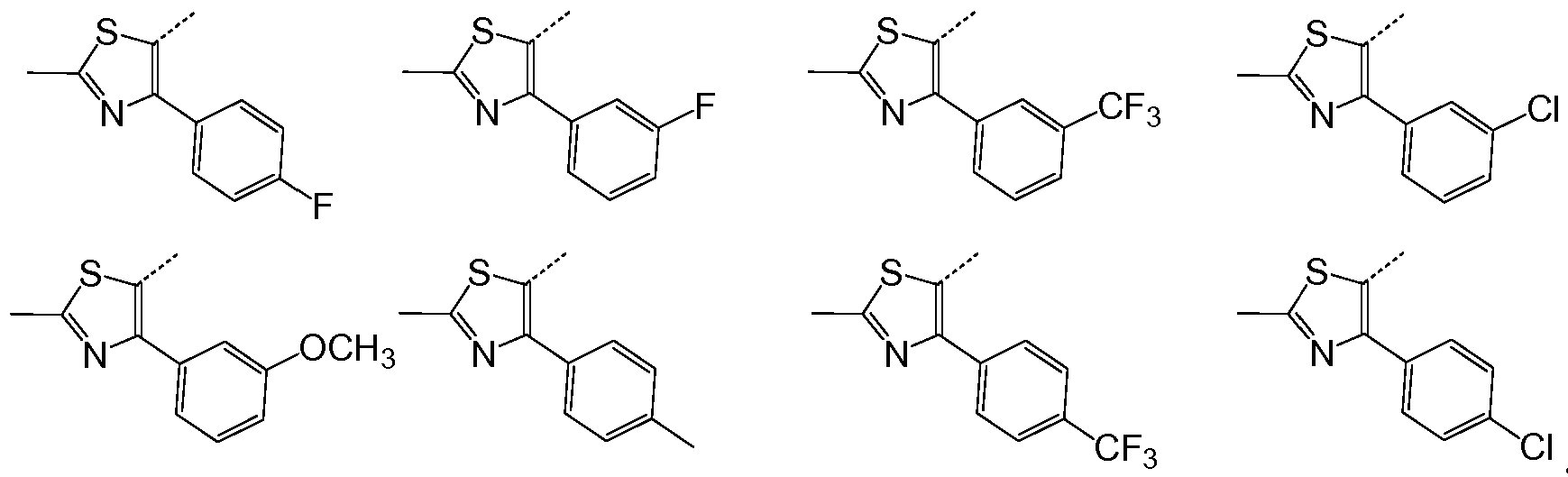


ii) A further embodiment of the invention comprises compounds of formula (I) according to embodiment i), which are also compounds of formula (Ia), wherein the stereogenic center is in (S)-configuration

(Ia). iii) A further embodiment of the invention comprises compounds of formula (I) according to embodiments i) or ii), wherein B represents phenyl, wherein the phenyl-
ring is unsubstituted or mono- or disubstituted, wherein the substituents are independently selected from the group consisting of (Ci_4)alkyl, (d_4)alkoxy, trifluoromethyl, and halogen. iv) A further embodiment of the invention comprises compounds of formula (I) according to embodiments i) or ii), wherein B represents phenyl, wherein the phenyl- ring is unsubstituted or mono- or disubstituted, wherein the substituents are independently selected from the group consisting of (Ci_4)alkyl and halogen, v) A further embodiment of the invention comprises compounds of formula (I) according to any one of embodiments i) to iv), wherein n represents 0. vi) A further embodiment of the invention comprises compounds of formula (I) according to any one of embodiments i) to iv), wherein n represents 1. vii) A further embodiment of the invention comprises compounds of formula (I) according to any one of embodiments i) to vi), wherein A represents a thiazolyl group selected from

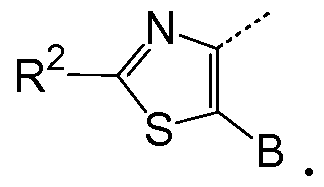


xvi)o A further embodiment of the invention comprises compounds of formula (I) according to any one of embodiments i) to xi), wherein R1 represents

The compounds of formula (I) and/or (Ia) may contain one or more stereogenic or asymmetric centers, such as one or more asymmetric carbon atoms. The compounds of formula (I) and/or (Ia) may thus be present as mixtures of stereoisomers or preferably as pure stereoisomers. Mixtures of stereoisomers may be separated in a manner known to a person skilled in the art.
xxiii) A further embodiment of the invention relates to compounds according to embodiment i) or ii), which are selected from the group consisting of:
6-Methyl-imidazo[2, 1 -b]thiazole-5-carboxylic acid ((S)- 1 -[5-(2-fluoro-phenyl)-2- methyl-thiazole-4-carbonyl]-piperidin-2-ylmethyl} -amide;
6-Methyl-imidazo[2,l-b]thiazole-5-carboxylic acid ((S)-I -[5-(3-methoxy-phenyl)-2- methyl-thiazole-4-carbonyl]-piperidin-2-ylmethyl} -amide;
6-Methyl-imidazo[2, 1 -b]thiazole-5-carboxylic acid [(S)- 1 -(2-methyl-5-m-tolyl-thiazole-
4-carbonyl)-piperidin-2-ylmethyl]-amide;
6-Methyl-imidazo[2,l-b]thiazole-5-carboxylic acid ((S)-I -[5-(3 ,4-dimethyl-phenyl)-2- methyl-thiazole-4-carbonyl]-piperidin-2-ylmethyl} -amide; 6-Methyl-imidazo[2,l-b]thiazole-5-carboxylic acid ((S)-l-[5-(3-bromo-4-fluoro- phenyl)-2-methyl-thiazole-4-carbonyl]-piperidin-2-ylmethyl} -amide;
6-Methyl-imidazo[2,l-b]thiazole-5-carboxylic acid ((S)-I -[5-(2-chloro-phenyl)-2- methyl-thiazole-4-carbonyl]-piperidin-2-ylmethyl} -amide;
6-Methyl-imidazo[2,l-b]thiazole-5-carboxylic acid [(S)-l-(2-methyl-5-p-tolyl-thiazole-
4-carbonyl)-piperidin-2-ylmethyl]-amide;
6-Methyl-imidazo[2,l-b]thiazole-5-carboxylic acid ((S)-I -[5-(2-methoxy-phenyl)-2- methyl-thiazole-4-carbonyl]-piperidin-2-ylmethyl} -amide; 6-Methyl-imidazo[2,l-b]thiazole-5-carboxylic acid {(S)-l-[5-(3-chloro-phenyl)-2- methyl-thiazole-4-carbonyl]-pyrrolidin-2-ylmethyl} -amide;
6-Methyl-imidazo[2, 1 -b]thiazole-5-carboxylic acid [(S)- 1 -(2-methyl-5-phenyl-thiazole-
4-carbonyl)-pyrrolidin-2-ylmethyl]-amide;
6-Methyl-imidazo[2, 1 -b]thiazole-5-carboxylic acid [(S)- 1 -(2-methyl-5-m-tolyl-thiazole- 4-carbonyl)-pyrrolidin-2-ylmethyl]-amide;
6-Methyl-imidazo[2, 1 -b]thiazole-5-carboxylic acid ((S)- 1 -[5-(3-fluoro-phenyl)-2- methyl-thiazole-4-carbonyl]-pyrrolidin-2-ylmethyl} -amide;
Imidazo[2, 1 -b]thiazole-5-carboxylic acid ((S)- 1 -[5-(3-fluoro-phenyl)-2-methyl- thiazole-4-carbonyl]-pyrrolidin-2-ylmethyl} -amide; Imidazo[2,l-b]thiazole-5-carboxylic acid [(S)-l-(2-methyl-5-phenyl-thiazole-4- carbonyl)-pyrrolidin-2-ylmethyl]-amide;
6-Methyl-imidazo[2,l-b]thiazole-5-carboxylic acid [(S)-l-(3'-methyl-biphenyl-2- carbonyl)-pyrrolidin-2-ylmethyl]-amide;
6-Methyl-imidazo[2, 1 -b]thiazole-5-carboxylic acid [(S)- 1 -(2-methyl-5-o-tolyl-thiazole- 4-carbonyl)-piperidin-2-ylmethyl] -amide;
6-Methyl-imidazo[2,l-b]thiazole-5-carboxylic acid ((S)-I -[5-(3-chloro-phenyl)-2- methyl-thiazole-4-carbonyl]-piperidin-2-ylmethyl} -amide;
6-Methyl-imidazo[2, 1 -b]thiazole-5-carboxylic acid ((S)- 1 -[2-methyl-5-(3- trifluoromethyl-phenyl)-thiazole-4-carbonyl]-piperidin-2-ylmethyl} -amide; 6-Methyl-imidazo[2,l-b]thiazole-5-carboxylic acid ((S)-l-[5-(4-fluoro-phenyl)-2- methyl-thiazole-4-carbonyl]-piperidin-2-ylmethyl} -amide;
3-Methyl-imidazo[2, 1 -b]thiazole-5-carboxylic acid [(S)- 1 -(2-methyl-5-phenyl-thiazole-
4-carbonyl)-pyrrolidin-2-ylmethyl]-amide;
3-Methyl-imidazo[2, 1 -b]thiazole-5-carboxylic acid ((S)- 1 -[5-(3-fluoro-phenyl)-2- methyl-thiazole-4-carbonyl]-pyrrolidin-2-ylmethyl} -amide;
6-Methyl-imidazo[2,l-b]thiazole-5-carboxylic acid [(S)-l-(biphenyl-2-carbonyl)- piperidin-2-ylmethyl] -amide;
6-Methyl-imidazo[2, 1 -b]thiazole-5-carboxylic acid ((S)- 1 -[4-(3-fluoro-phenyl)-2- methyl-thiazole-5-carbonyl]-piperidin-2-ylmethyl}-amide;
6-Methyl-imidazo[2, 1 -b]thiazole-5-carboxylic acid ((S)- 1 -[4-(4-fluoro-phenyl)-2- methyl-thiazole-5-carbonyl]-piperidin-2-ylmethyl} -amide; 6-Methyl-imidazo[2,l-b]thiazole-5-carboxylic acid [(S)-l-(4'-chloro-biphenyl-2- carbonyl)-pyrrolidin-2-ylmethyl]-amide;
6-Methyl-imidazo[2, 1 -b]thiazole-5-carboxylic acid [(S)- 1 -(3'-trifTuoromethyl-biphenyl-
2-carbonyl)-pyrrolidin-2-ylmethyl]-amide;
6-Methyl-imidazo[2, 1 -b]thiazole-5-carboxylic acid [(S)- 1 -(4'-trifTuoromethyl-biphenyl- 2-carbonyl)-pyrrolidin-2-ylmethyl]-amide;
6-Methyl-imidazo[2,l-b]thiazole-5-carboxylic acid [(S)-l-(3'-chloro-biphenyl-2- carbonyl)-pyrrolidin-2-ylmethyl]-amide;
6-Methyl-imidazo[2,l-b]thiazole-5-carboxylic acid ((S)-I -[4-(4-chloro-phenyl)-2- methyl-thiazole-5-carbonyl]-pyrrolidin-2-ylmethyl} -amide; 6-Methyl-imidazo[2,l-b]thiazole-5-carboxylic acid ((S)-l-[4-(3-chloro-phenyl)-2- methyl-thiazole-5-carbonyl]-pyrrolidin-2-ylmethyl} -amide; and
6-Methyl-imidazo[2, 1 -b]thiazole-5-carboxylic acid ((S)- 1 -[4-(3-fluoro-phenyl)-2- methyl-thiazole-5-carbonyl]-pyrrolidin-2-ylmethyl}-amide; wherein the first 15 compounds, in another embodiment the first 24 compounds, of the above list are especially preferred.
xxiv) A further embodiment of the invention relates to compounds according to embodiment i) or ii), which are selected from the group consisting of:
(S)-6-Methyl-imidazo[2, 1 -b]thiazole-5-carboxylic acid [ 1 -(2-bromo-5-m-tolyl-thiazole- 4-carbonyl)-piperidin-2-ylmethyl] -amide;
(S)-6-Methyl-imidazo[2, 1 -b]thiazole-5-carboxylic acid ( 1 -[2-bromo-5-(3-fluoro- phenyl)-thiazole-4-carbonyl]-piperidin-2-ylmethyl}-amide;
(S)-6-Methyl-imidazo[2, 1 -b]thiazole-5-carboxylic acid ( 1 -[2-amino-5-(3-fluoro- phenyl)-thiazole-4-carbonyl]-piperidin-2-ylmethyl} -amide; (S)-6-Methyl-imidazo[2,l-b]thiazole-5-carboxylic acid [l-(2-amino-5-m-tolyl-thiazole-
4-carbonyl)-piperidin-2-ylmethyl]-amide;
(S)-6-Methyl-imidazo[2, 1 -b]thiazole-5-carboxylic acid [ 1 -(2-bromo-5-m-tolyl-thiazole-
4-carbonyl)-pyrrolidin-2-ylmethyl]-amide;
(S)-6-Methyl-imidazo[2, 1 -b]thiazole-5-carboxylic acid { 1 -[2-bromo-5-(3-fluoro- phenyl)-thiazole-4-carbonyl]-pyrrolidin-2-ylmethyl} -amide;
(S)-6-Methyl-imidazo[2, 1 -b]thiazole-5-carboxylic acid { 1 -[2-amino-5-(3-fluoro- phenyl)-thiazole-4-carbonyl]-pyrrolidin-2-ylmethyl} -amide; and (S)-6-Methyl-imidazo[2,l-b]thiazole-5-carboxylic acid [l-(2-amino-5-m-tolyl-thiazole- 4-carbonyl)-pyrrolidin-2-ylmethyl] -amide .
Where the plural form is used for compounds, salts, pharmaceutical compositions, diseases or the like, this is intended to mean also a single compound, salt, disease or the like.
Any reference to a compound of formula (I) and/or (Ia) is to be understood as referring also to salts (especially pharmaceutically acceptable salts) of a compound of formula (I) and/or (Ia), respectively, as appropriate and expedient.
The term "pharmaceutically acceptable salts" refers to non-toxic, inorganic or organic acid and/or base addition salts. Reference can be made to "Salt selection for basic drugs", Int. J. Pharm. (1986), 33, 201-217.
The compounds of formula (I) and/or (Ia) and their pharmaceutically acceptable salts can be used as medicaments, e.g. in the form of pharmaceutical compositions for enteral or parenteral administration.
A further aspect of the invention is a pharmaceutical composition containing at least one compound according to formula (I) and/or (Ia), or a pharmaceutically acceptable salt thereof, and a pharmaceutically acceptable carrier material.
The production of the pharmaceutical compositions can be effected in a manner which will be familiar to any person skilled in the art (see for example Mark Gibson, Editor, Pharmaceutical Preformulation and Formulation, IHS Health Group, Englewood, CO, USA, 2001; Remington, The Science and Practice of Pharmacy, 20th Edition, Philadelphia College of Pharmacy and Science) by bringing the described compounds of formula (I) and/or (Ia) and their pharmaceutically acceptable salts, optionally in
combination with other therapeutically valuable substances, into a galenical administration form together with suitable, non-toxic, inert, therapeutically compatible solid or liquid carrier materials and, if desired, usual pharmaceutical adjuvants.
The compounds according to formula (I) and/or (Ia) may be used for the preparation of a medicament and are suitable for the prevention or treatment of diseases selected from the group consisting of dysthymic disorders including major depression and cyclothymia, affective neurosis, all types of manic depressive disorders, delirium, psychotic disorders, schizophrenia, catatonic schizophrenia, delusional paranoia, adjustment disorders and all clusters of personality disorders; schizoaffective disorders; anxiety disorders including generalized anxiety, obsessive compulsive disorder, posttraumatic stress disorder, panic attacks, all types of phobic anxiety and avoidance; separation anxiety; all psychoactive substance use, abuse, seeking and reinstatement; all types of psychological or physical addictions, dissociative disorders including multiple personality syndromes and psychogenic amnesias; sexual and reproductive dysfunction; psychosexual dysfunction and addiction; tolerance to narcotics or withdrawal from narcotics; increased anaesthetic risk, anaesthetic responsiveness; hypothalamic-adrenal dysfunctions; disturbed biological and circadian rhythms; sleep disturbances associated with diseases such as neurological disorders including neuropathic pain and restless leg syndrome; sleep apnea; narcolepsy; chronic fatigue syndrome; insomnias related to psychiatric disorders; all types of idiopathic insomnias and parasomnias; sleep-wake schedule disorders including jet-lag; all dementias and cognitive dysfunctions in the healthy population and in psychiatric and neurological disorders; mental dysfunctions of aging; all types of amnesia; severe mental retardation; dyskinesias and muscular diseases; muscle spasticity, tremors, movement disorders; spontaneous and medication- induced dyskinesias; neurodegenerative disorders including Huntington's, Creutzfeld- Jacob's, Alzheimer's diseases and Tourette syndrome; Amyotrophic lateral sclerosis; Parkinson's disease; Cushing's syndrome; traumatic lesions; spinal cord trauma; head trauma; perinatal hypoxia; hearing loss; tinnitus; demyelinating diseases; spinal and cranial nerve diseases; ocular damage; retinopathy; epilepsy; seizure disorders; absence seizures, complex partial and generalized seizures; Lennox-Gastaut syndrome; migraine and headache; pain disorders; anaesthesia and analgesia; enhanced or exaggerated sensitivity to pain such as hyperalgesia, causalgia, and allodynia; acute pain; burn pain;
atypical facial pain; neuropathic pain; back pain; complex regional pain syndrome I and II; arthritic pain; sports injury pain; dental pain; pain related to infection e.g. by HIV; post-chemotherapy pain; post-stroke pain; post-operative pain; neuralgia; osteoarthritis; conditions associated with visceral pain such as irritable bowel syndrome; eating disorders; diabetes; toxic and dysmetabolic disorders including cerebral anoxia, diabetic neuropathies and alcoholism; appetite, taste, eating, or drinking disorders; somatoform disorders including hypochondriasis; vomiting/nausea; emesis; gastric dyskinesia; gastric ulcers; Kallman's syndrome (anosmia); impaired glucose tolerance; intestinal motility dyskinesias; hypothalamic diseases; hypophysis diseases; hyperthermia syndromes, pyrexia, febrile seizures, idiopathic growth deficiency; dwarfism; gigantism; acromegaly; basophil adenoma; prolactinoma; hyperprolactinemia; brain tumors, adenomas; benign prostatic hypertrophy, prostate cancer; endometrial, breast, colon cancer; all types of testicular dysfunctions, fertility control; reproductive hormone abnormalities; hot flashes; hypothalamic hypogonadism, functional or psychogenic amenorrhea; urinary bladder incontinence; asthma; allergies; all types of dermatitis, acne and cysts, sebaceous gland dysfunctions; cardiovascular disorders; heart and lung diseases, acute and congestive heart failure; hypotension; hypertension; dyslipidemias, hyperlipidemias, insulin resistance; urinary retention; osteoporosis; angina pectoris; myocardial infarction; arrhythmias, coronary diseases, left ventricular hypertrophy; ischemic or haemorrhagic stroke; all types of cerebrovascular disorders including subarachnoid haemorrhage, ischemic and hemorrhagic stroke and vascular dementia; chronic renal failure and other renal diseases; gout; kidney cancer; urinary incontinence; and other diseases related to general orexin system dysfunctions.
Compounds of formula (I) and/or (Ia) are particularly suitable for use in the treatment of diseases or disorders selected from the group consisting of dysthymic, mood, psychotic and anxiety disorders; diabetes and appetite, taste, eating, or drinking disorders; hypothalamic diseases; disturbed biological and circadian rhythms; all types of sleep disorders; sleep disturbances associated with diseases such as neurological disorders including neuropathic pain and restless leg syndrome; insomnias related to psychiatric disorders; sleep apnea; narcolepsy; idiopathic insomnias; parasomnias; stress-related syndromes; benign prostatic hypertrophy; all types of psychoactive substance use and abuse; all dementias and cognitive dysfunctions in the healthy population and in
psychiatric and neurologic disorders; and other diseases related to general orexin system dysfunctions.
Compounds of formula (I) and/or (Ia) are particularly suitable for use in the treatment of diseases or disorders selected from the group consisting of all types of sleep disorders, of stress-related syndromes, of psychoactive substance use and abuse, of cognitive dysfunctions in the healthy population and in psychiatric and neurologic disorders, of eating or drinking disorders. Eating disorders may be defined as comprising metabolic dysfunction; dysregulated appetite control; compulsive obesities; emeto-bulimia or anorexia nervosa. Pathologically modified food intake may result from disturbed appetite (attraction or aversion for food); altered energy balance (intake vs. expenditure); disturbed perception of food quality (high fat or carbohydrates, high palatability); disturbed food availability (unrestricted diet or deprivation) or disrupted water balance. Drinking disorders include polydipsias in psychiatric disorders and all other types of excessive fluid intake. Sleep disorders include all types of parasomnias, insomnias, narcolepsy and other disorders of excessive sleepiness, sleep-related dystonias; restless leg syndrome; sleep apneas; jet- lag syndrome; shift-work syndrome, delayed or advanced sleep phase syndrome or insomnias related to psychiatric disorders. Insomnias are defined as comprising sleep disorders associated with aging; intermittent treatment of chronic insomnia; situational transient insomnia (new environment, noise) or short-term insomnia due to stress; grief; pain or illness. Insomnia also include stress-related syndromes including post-traumatic stress disorders as well as other types and subtypes of anxiety disorders such as generalized anxiety, obsessive compulsive disorder, panic attacks and all types of phobic anxiety and avoidance; psychoactive substance use, abuse, seeking and reinstatement are defined as all types of psychological or physical addictions and their related tolerance and dependence components. Cognitive dysfunctions include deficits in all types of attention, learning and memory functions occurring transiently or chronically in the normal, healthy, young, adult or aging population, and also occurring transiently or chronically in psychiatric, neurologic, cardiovascular and immune disorders.
In a further preferred embodiment of the invention compounds of formula (I) and/or (Ia) are particularly suitable for use in the treatment of diseases or disorders selected from
the group consisting of sleep disorders that comprises all types of insomnias, narcolepsy and other disorders of excessive sleepiness, sleep-related dystonias, restless leg syndrome, sleep apneas, jet-lag syndrome, shift-work syndrome, delayed or advanced sleep phase syndrome or insomnias related to psychiatric disorders. In another preferred embodiment of the invention compounds of formula (I) and/or (Ia) are particularly suitable for use in the treatment of diseases or disorders selected from the group consisting of cognitive dysfunctions that comprise deficits in all types of attention, learning and memory functions occurring transiently or chronically in the normal, healthy, young, adult or aging population, and also occurring transiently or chronically in psychiatric, neurologic, cardiovascular and immune disorders.
In another preferred embodiment of the invention compounds of formula (I) and/or (Ia) are particularly suitable for use in the treatment of diseases or disorders selected from the group consisting of eating disorders that comprise metabolic dysfunction; dysregulated appetite control; compulsive obesities; emeto-bulimia or anorexia nervosa. In another preferred embodiment of the invention compounds of formula (I) and/or (Ia) are particularly suitable for use in the treatment of diseases or disorders selected from the group consisting of psychoactive substance use and abuse that comprise all types of psychological or physical addictions and their related tolerance and dependence components. The present invention also relates to a method for the prevention or treatment of a disease or disorder mentioned herein comprising administering to a subject a pharmaceutically active amount of a compound of formula (I) and/or (Ia).
Unless used regarding temperatures, the term "about" placed before a numerical value "X" refers in the current application to an interval extending from X minus 10% of X to
X plus 10% of X, and preferably to an interval extending from X minus 5% of X to X plus 5% of X. In the particular case of temperatures, the term "about" placed before a temperature "Y" refers in the current application to an interval extending from the temperature Y minus 1O 0C to Y plus 1O 0C, and preferably to an interval extending from Y minus 5 0C to Y plus 5 0C.
A further aspect of the invention is a process for the preparation of compounds of formula (I). Compounds according to formula (I) of the present invention can be
prepared according to the general sequence of reactions outlined in the schemes below wherein A, B, Y, R1, R2 and R3 are as defined in the description of formula (I). The compounds obtained may also be converted into pharmaceutically acceptable salts thereof in a manner known per se.
In general, all chemical transformations can be performed according to well-known standard methodologies as described in the literature or as described in the procedures below.
Preparation of compounds of formula (I):
Pathway 1 :


Scheme I : Synthesis of compounds of formula (I) wherein A, Y and R1 are as defined above. Pathway 1 : The synthesis of the final compounds started from N-Boc-protected-2- aminomethylazacycloalkane derivatives 1 (commercially available in racemic or enatiomerically pure form), which were coupled with carboxylic acid derivatives 2
(either commercially available or prepared as described in scheme 5 below, and in I-Chemistry, Section A.1.9.1 to A.1.9.4) under standard peptide coupling reaction conditions in the presence of an activating reagent (e.g. TBTU) and a base (e.g. DIPEA) to give the mono-amide intermediates 3. Deprotection under standard conditions with a 4M solution of HCl in dioxane resulted in the amine intermediates 4 as hydrochloride salts. The bis-amide final compounds 6 were prepared by a second amide bond formation reaction under comparable conditions as described above by using the carboxylic acid derivatives 5 (either commercially available or prepared as described in Schemes 2 to 4 and in I-Chemistry, Section A.1.1 to A.1.8). Pathway 2: The sequence can be inverted by starting from the template 7 (commercially available in racemic or enatiomerically pure form), Boc-protected at the exocyclic N- atom by first introducing the substituent at the endocyclic N-atom in a standard peptide bond forming reaction with the carboxylic acid derivatives 5 (either commercially available or prepared as described in Schemes 2 to 4 and in I-Chemistry, Section A.1.1 to A.1.8) to give compound 8 which after deprotection to 9 led in a final amide bond forming step with carboxylic acid derivatives 2 to the final compounds 6.
Carboxylic acid derivatives A-COOH, if not commercially available, were for example synthesized according to scheme 2 to scheme 4.

Scheme 2: Synthesis of thiazole-4-carboxylic acid derivatives, wherein B and R2 are as defined above. In case R2 is an NH2-group, this can be transformed into bromine via a Sandmeyer reaction.
By reaction of methyl dichloroacetate (10) (commercially available) with an aldehyde B-CHO (11) (commercially available) in the presence of a base like KOtBu the α-oxo- ester derivatives (12) were obtained which were transformed in a reaction with thio- amides (13) (commercially available) to thiazole derivatives (14). Hydrolysis of the ester function with an aq. solution of e.g. NaOH in a solvent like MeOH resulted in the formation of the desired carboxylic acids (15).

16 17 19

20
Scheme 3: Synthesis of thiazole-5-carboxylic acid derivatives, wherein B is as defined above.
As B represents a phenyl-ring which can be unsubstituted or mono-, di- or tri- substituted, the synthetic sequence was usually started with a substituted ethyl- (benzoyl)acetate derivative (16) (commercially available) which was chlorinated by the reaction with sulfurylchloride in chloroform at reflux to give intermediate 17. Reaction of 17 with thioacetamide (18) (commercially available) under Hantzsch cyclization conditions resulted in the 2-methyl-4-aryl-thiazole-5-carboxylic esters 19, which after hydrolysis with a base like KOH in EtOH/water mixtures gave the thiazole-5-carboxylic acid derivatives 20.

23 24
Scheme 4: Synthesis of oxazole-4-carboxylic acid derivatives, wherein B is as defined above.
As B represents a phenyl-ring which can be unsubstituted or mono-, di- or tri- substituted, the synthetic sequence was usually started with a substituted ethyl- (benzoyl)acetate derivative (16) (commercially available) which was converted into the oxime intermediate 21 in glacial acetic acid by the addition of sodium nitrite in water. Reaction of 21 with acetic anhydride in acetic acid in the presence of catalytic amounts of sodium acetate, mercury chloride and zinc powder resulted in the cyclization- precursor 22. Cyclization to the oxazole was achieved under dehydrating conditions (e.g. SOCl2 in chloroform) to give the oxazole-derivative 23, which was transformed to the 5-aryl-oxazole-4-carboxylic acid derivative 24 by esterhydrolyis under basic conditions with e.g. NaOH in EtOH/water-mixtures.
Biphenyl-carboxylic acid derivatives, such as the following examples used to prepare final compounds:

Derivatives of formula R^COOH wherein R1 is imidazo[2,l-b]thiazole were for instance synthesised according to scheme 5.
The respective amino-thiazole (25; commercially available) was converted to the formamidine derivative (26) by heating (25) with Λ/,Λ/-dimethylformamide dimethylacetale in a solvent like toluene. After alkylation with ethyl bromoacetate the respective thiazolium bromide (27) was cyclised with DBU in a solvent like DMF to yield the ester (28) which was saponified to the desired acid (29) with for instance NaOH in solvents like THF and MeOH.


28 29
Scheme 5: Synthesis of imidazo[2,l-b]thiazole-carboxylic acid derivatives, wherein Ra is hydrogen or methyl, Rb is hydrogen or methyl
Whenever the compounds of formula (I) are obtained in the form of mixtures of enantiomers, the enantiomers can be separated using methods known to one skilled in the art: e.g. by formation and separation of diastereomeric salts or by HPLC over a chiral stationary phase such as a Regis Whelk-O1(R,R) (10 μm) column, a Daicel ChiralCel OD-H (5-10 μm) column, or a Daicel ChiralPak IA (10 μm) or AD-H (5 μm) column. Typical conditions of chiral HPLC are an isocratic mixture of eluent A (EtOH, in presence or absence of an amine such as triethylamine, diethylamine) and eluent B (hexane), at a flow rate of 0.8 to 150 mL/min.
Experimental Section
Abbrevations (as used herein and in the description before): aq. aqueous
Boc te/t-Butoxycarbonyl
BSA Bovine serum albumine
CHO Chinese hamster ovary cone Concentrated d Day(s)
DCM Dichloromethane
DIPEA Diisopropylethylamine
DMF JV,iV-Dimethylformamide eq Equivalent(s)
ES Electron spray
Ether Diethylether
EtOAc Ethyl acetate
EtOH Ethanol
FC Flash column chromatography on silica gel
FCS Featal calf serum
FLIPR Fluorescent imaging plate reader h Hour(s)
HBSS Hank's balanced salt solution
HEPES 4-(2-hydroxyethyl)-piperazine- 1 -ethanesulfonic acid
HPLC High performance liquid chromatography
HV high vacuum
KOtBu Potassium tert. butoxide
LC Liquid chromatography
M Molar(ity)
MeCN Acetonitrile
MeOH Methanol min Minute(s)
MS Mass spectroscopy
Pd/C palladium on charcoal
PyBOP Benzotriazole- 1 -yl-oxy-tris-pyrrolidino-phosphonium hexafluorophosphate quant. quantitative rt room temperature RT Room temperature sat. Saturated tR Retention time
TBTU O-Benzotriazol- 1 -yl-N,N,N',N'-tetramethyluronium tetrafluoroborate
THF Tetrahydrofuran
I-Chemistry
The following examples illustrate the preparation of pharmacologically active compounds of the invention.
All temperatures are stated in 0C. All the analytical HPLC investigations on non-chiral phases are performed using RP-
Ci8 based columns. Analytical HPLC investigations are performed on an instrument with cycle-times of ~2.5 min. NMR measurements are done with a Bruker Avance 400
Instrument.
A. Preparation of precursors and intermediates:
A.1 Synthesis of thiazole-4-carboxylic acid derivatives
A.1.1 Synthesis of S-chloro-l-oxo-propionic ester derivatives (general procedure)
A solution of the respective aldehyde (338 mmol, 1.0 eq) and methyl dichloroacetate (338 mmol, 1.0 eq) in THF (100 mL) is added dropwise to a cold (-600C) suspension of KOtBu (335 mmol, 1.0 eq) in THF (420 mL). After 4 h the mixture is allowed to reach RT, stirred over night and concentrated in vacuo. DCM and ice-cold water are added, the layers are separated and the aq. layer is extracted twice with DCM. The combined organic layers are washed with ice-cold water and brine, dried over MgSO4 and concentrated in vacuo to give the desired α-oxo-ester which is used without further purification.
S-chloro-l-oxo-S-m-tolyl-propionic acid methyl ester prepared by reaction of 3-methyl-benzaldehyde with methyl dichloroacetate. S-chloro-l-oxo-S-p-tolyl-propionic acid methyl ester prepared by reaction of 4-methyl-benzaldehyde with methyl dichloroacetate. 3-chloro-3-(4-ethyl-phenyl)-2-oxo-propionic acid methyl ester prepared by reaction of 4-ethyl-benzaldehyde with methyl dichloroacetate. 3-chloro-3-(3-fluoro-phenyl)-2-oxo-propionic acid methyl ester prepared by reaction of 3-fluoro-benzaldehyde with methyl dichloroacetate. 3-chloro-3-(4-fluoro-phenyl)-2-oxo-propionic acid methyl ester prepared by reaction of 4-fluoro-benzaldehyde with methyl dichloroacetate. 3-chloro-3-(4-trifluoromethyl-phenyl)-2-oxo-propionic acid methyl ester prepared by reaction of 4-trifluoromethyl-benzaldehyde with methyl dichloro-acetate. 3-chloro-3-(2-fluoro-phenyl)-2-oxo-propionic acid methyl ester prepared by reaction of 2-fluoro-benzaldehyde with methyl dichloro-acetate. 3-chloro-3-(2-chloro-phenyl)-2-oxo-propionic acid methyl ester prepared by reaction of 2-chloro-benzaldehyde with methyl dichloro-acetate. 3-chloro-3-(3-chloro-phenyl)-2-oxo-propionic acid methyl ester prepared by reaction of 3-chloro-benzaldehyde with methyl dichloro-acetate. 3-chloro-2-oxo-3-o-tolyl-propionic acid methyl ester prepared by reaction of 2-methyl-benzaldehyde with methyl dichloro-acetate. 3-chloro-3-(2-methoxy-phenyl)-2-oxo-propionic acid methyl ester prepared by reaction of 2-methoxy-benzaldehyde with methyl dichloro-acetate. 3-chloro-3-(3-methoxy-phenyl)-2-oxo-propionic acid methyl ester prepared by reaction of 3-methoxy-benzaldehyde with methyl dichloro-acetate. 3-chloro-2-oxo-3-(2-trifluoromethyl-phenyl)-propionic acid methyl ester prepared by reaction of 2-trifluoromethyl-benzaldehyde with methyl dichloro-acetate. 3-chloro-2-oxo-3-(3-trifluoromethyl-phenyl)-propionic acid methyl ester prepared by reaction of 3-trifluoromethyl-benzaldehyde with methyl dichloro-acetate. 3-chloro-3-(3,4-dimethyl-phenyl)-2-oxo-propionic acid methyl ester prepared by reaction of 3,4-dimethyl-benzaldehyde with methyl dichloro-acetate.
A.1.2 Synthesis of thiazole-4-carboxylic acid methyl ester derivatives (general procedure)
A solution of thioacetamide (132 mmol, 1.0 eq) in MeCN (250 niL) is added to a mixture of the respective α-oxo-ester (132 mmol, 1.0 eq) and molecular sieves (4A, 12 g) in MeCN (60 mL). After stirring for 5 h the mixture is cooled in an ice-bath and the obtained precipitate is filtered off. The residue is washed with cold MeCN, dried, dissolved in MeOH (280 mL) and stirred at 500C for 6 h. The solvents are removed in vacuo to give the desired thiazole derivatives as a white solid.
2-methyl-5-m-tolyl-thiazole-4-carboxylic acid methyl ester prepared by reaction of 3-chloro-2-oxo-3-m-tolyl-propionic acid methyl ester with thioacetamide. LC-MS: tR = 0.94 min; [M+H]+ = 248.0.
2-methyl-5-p-tolyl-thiazole-4-carboxylic acid methyl ester prepared by reaction of 3-chloro-2-oxo-3-p-tolyl-propionic acid methyl ester with thioacetamide. LC-MS: tR = 0.92 min; [M+H]+ = 248.2.
5-(4-ethyl-phenyl)-2-methyl-thiazole-4-carboxylic acid methyl ester prepared by reaction of 3-chloro-3-(4-ethyl-phenyl)-2-oxo-propionic acid methyl ester with thioacetamide. LC-MS: tR = 0.98 min; [M+H]+ = 262.1.
5-(3-fluoro-phenyl)-2-methyl-thiazole-4-carboxylic acid methyl ester prepared by reaction of 3-chloro-3-(3-fluoro-phenyl)-2-oxo-propionic acid methyl ester with thioacetamide. LC-MS: tR = 0.91 min; [M+H]+ = 252.1.
5-(4-fluoro-phenyl)-2-methyl-thiazole-4-carboxylic acid methyl ester prepared by reaction of 3-chloro-3-(4-fluoro-phenyl)-2-oxo-propionic acid methyl ester with thioacetamide. 1H-NMR (CDCl3): δ = 2.75 (s, 3H); 3.84 (s, 3H); 7.10 (m, 2H); 7.47 (m, 2H).
2-methyl-5-(4-trifluoromethyl-phenyl)-thiazole-4-carboxylic acid methyl ester prepared by reaction of 3-chloro-3-(4-trifluoromethyl-phenyl)-2-oxo-propionic acid methyl ester with thioacetamide. LC-MS: tR = 0.98 min; [M+H]+ = 302.0.
2-methyl-5-(3-trifluoromethyl-phenyl)-thiazole-4-carboxylic acid methyl ester prepared by reaction of 3-chloro-3-(3-trifluoromethyl-phenyl)-2-oxo-propionic acid methyl ester with thioacetamide. LC-MS: tR = 0.98 min; [M+H]+ = 302.2.
2-methyl-5-(2-trifluoromethyl-phenyl)-thiazole-4-carboxylic acid methyl ester prepared by reaction of 3-chloro-3-(2-trifluoromethyl-phenyl)-2-oxo-propionic acid methyl ester with thioacetamide. LC-MS: tR = 0.94 min; [M+H]+ = 302.3.
5-(2-fluoro-phenyl)-2-methyl-thiazole-4-carboxylic acid methyl ester prepared by reaction of 3-chloro-3-(2-fluoro-phenyl)-2-oxo-propionic acid methyl ester with thioacetamide. LC-MS: tR = 0.89 min; [M+H]+ = 252.0.
5-(2-chloro-phenyl)-2-methyl-thiazole-4-carboxylic acid methyl ester prepared by reaction of 3-chloro-3-(2-chloro-phenyl)-2-oxo-propionic acid methyl ester with thioacetamide. LC-MS: tR = 0.92 min; [M+H]+ = 268.0. 5-(3-chloro-phenyl)-2-methyl-thiazole-4-carboxylic acid methyl ester prepared by reaction of 3-chloro-3-(3-chloro-phenyl)-2-oxo-propionic acid methyl ester with thioacetamide. LC-MS: tR = 0.95 min; [M+H]+ = 268.0.
2-methyl-5-o-tolyl-thiazole-4-carboxylic acid methyl ester prepared by reaction of 3-chloro-2-oxo-3-o-tolyl-propionic acid methyl ester with thioacetamide. LC-MS: tR = 0.92 min; [M+H]+ = 248.1.
5-(2-methoxy-phenyl)-2-methyl-thiazole-4-carboxylic acid methyl ester prepared by reaction of 3-chloro-3-(2-methoxy-phenyl)-2-oxo-propionic acid methyl ester with thioacetamide. LC-MS: tR = 0.88 min; [M+H]+ = 264.1.
5-(3-methoxy-phenyl)-2-methyl-thiazole-4-carboxylic acid methyl ester prepared by reaction of 3-chloro-3-(3-methoxy-phenyl)-2-oxo-propionic acid methyl ester with thioacetamide. LC-MS: tR = 0.90 min; [M+H]+ = 263.9.
5-(3,4-dimethyl-phenyl)-2-methyl-thiazole-4-carboxylic acid methyl ester prepared by reaction of 3-chloro-3-(3,4-dimethyl-phenyl)-2-oxo-propionic acid methyl ester with thioacetamide. LC-MS: tR = 0.96 min; [M+H]+ = 262.3.
A.1.3 Synthesis of 2-amino-thiazole-4-carboxylic acid methyl ester derivatives (general procedure)
A solution of the respective α-oxo-ester (22.1 mmol, 1.0 eq) in acetone (25 mL) is added to a suspension of thiourea (22.1 mmol, 1.0 eq) in acetone (45 mL). The mixture is heated to 57°C (bath temperature), stirred for 24h and concentrated to half of the volume. The obtained suspension is filtered and the residue is washed with acetone. After drying the desired amino-thiazole derivative is obtained as a solid.
2-amino-5-m-tolyl-thiazole-4-carboxylic acid methyl ester prepared by reaction of S-chloro-l-oxo-S-m-tolyl-propionic acid methyl ester with thiourea. LC-MS: tR = 0.78 min; [M+H]+ = 249.0. 2-amino-5-(3-fluoro-phenyl)-thiazole-4-carboxylic acid methyl ester prepared by reaction of 3-chloro-3-(3-fluoro-phenyl)-2-oxo-propionic acid methyl ester with thiourea. LC-MS: tR = 0.78 min; [M+H]+ = 252.9.
A.1.4 Synthesis of thiazole-4-carboxylic acid derivatives (general procedure)
A solution of the respective ester (96.2 mmol) in a mixture of THF (150 mL) and MeOH (50 mL) is treated with an aq. NaOH solution (1.0 M, 192 mL). After stirring for
3 h a white suspension is formed and the organic volatiles are removed in vacuo. The remaining mixture is diluted with water (100 mL), cooled in an ice-bath and made acidic (pH = 3-4) by addition of aq. HCl solution (1.0 M). The suspension is filtered and the residue is washed with cold water. After drying the desired acid is obtained as a white solid.
2-methyl-5-m-tolyl-thiazole-4-carboxylic acid prepared by saponification of 2-methyl-5-m-tolyl-thiazole-4-carboxylic acid methyl ester. LC-MS: tR = 0.83 min; [M+H]+ = 234.0. 2-methyl-5-p-tolyl-thiazole-4-carboxylic acid prepared by saponification of 2-methyl-5-p-tolyl-thiazole-4-carboxylic acid methyl ester. LC-MS: tR = 0.83 min; [M+H]+ = 234.0.
5-(4-ethyl-phenyl)-2-methyl-thiazole-4-carboxylic acid prepared by saponification of 5-(4-ethyl-phenyl)-2-methyl-thiazole-4-carboxylic acid methyl ester. LC-MS: tR = 0.88 min; [M+H]+ = 248.0.
5-(3-fluoro-phenyl)-2-methyl-thiazole-4-carboxylic acid prepared by saponification of 5-(3-fluoro-phenyl)-2-methyl-thiazole-4-carboxylic acid methyl ester. LC-MS: tR = 0.82 min; [M+H]+ = 238.1.
5-(4-fluoro-phenyl)-2-methyl-thiazole-4-carboxylic acid prepared by saponification of 5-(4-fluoro-phenyl)-2-methyl-thiazole-4-carboxylic acid methyl ester. 1H-NMR (DMSO-d6): δ = 2.67 (s, 3H); 7.27 (m, 2H); 7.53 (m, 2H); 12.89
(br.s, IH).
2-methyl-5-(4-trifluoromethyl-phenyl)-thiazole-4-carboxylic acid prepared by saponification of 2-methyl-5-(4-trifluoromethyl-phenyl)-thiazole-4- carboxylic acid methyl ester. LC-MS: tR = 0.90 min; [M+H]+ = 288.0.
2-methyl-5-(3-trifluoromethyl-phenyl)-thiazole-4-carboxylic acid prepared by saponification of 2-methyl-5-(3-trifluoromethyl-phenyl)-thiazole-4- carboxylic acid methyl ester. LC-MS: tR = 0.88 min; [M+H]+ = 288.0.
2-methyl-5-(2-trifluoromethyl-phenyl)-thiazole-4-carboxylic acid prepared by saponification of 2-methyl-5-(2-trifluoromethyl-phenyl)-thiazole-4- carboxylic acid methyl ester. LC-MS: tR = 0.84 min; [M+H]+ = 288.3. 5-(2-fluoro-phenyl)-2-methyl-thiazole-4-carboxylic acid prepared by saponification of 5-(2-fluoro-phenyl)-2-methyl-thiazole-4-carboxylic acid methyl ester. LC-MS: tR = 0.78 min; [M+H]+ = 238.3.
5-(2-chloro-phenyl)-2-methyl-thiazole-4-carboxylic acid prepared by saponification of 5-(2-chloro-phenyl)-2-methyl-thiazole-4-carboxylic acid methyl ester. LC-MS: tR = 0.82 min; [M+H]+ = 253.9.
5-(3-chloro-phenyl)-2-methyl-thiazole-4-carboxylic acid prepared by saponification of 5-(3-chloro-phenyl)-2-methyl-thiazole-4-carboxylic acid methyl ester. LC-MS: tR = 0.84 min; [M+H]+ = 254.0.
2-methyl-5-o-tolyl-thiazole-4-carboxylic acid prepared by saponification of 2-methyl-5-o-tolyl-thiazole-4-carboxylic acid methyl ester. LC-MS: tR = 0.80 min; [M+H]+ = 234.3.
5-(3-methoxy-phenyl)-2-methyl-thiazole-4-carboxylic acid prepared by saponification of 5-(3-methoxy-phenyl)-2-methyl-thiazole-4-carboxylic acid methyl ester. LC-MS: tR = 0.80 min; [M+H]+ = 250.0. 5-(2-methoxy-phenyl)-2-methyl-thiazole-4-carboxylic acid prepared by saponification of 5-(2-methoxy-phenyl)-2-methyl-thiazole-4-carboxylic acid methyl ester. LC-MS: tR = 0.78 min; [M+H]+ = 250.0.
5-(3,4-dimethyl-phenyl)-2-methyl-thiazole-4-carboxylic acid prepared by saponification of 5-(3,4-dimethyl-phenyl)-2-methyl-thiazole-4-carboxylic acid methyl ester. LC-MS: tR = 0.86 min; [M+H]+ = 248.3.
2-amino-5-m-tolyl-thiazole-4-carboxylic acid prepared by saponification of 2-amino-5-m-tolyl-thiazole-4-carboxylic acid methyl ester. LC-MS: tR = 0.65 min; [M+H]+ = 235.0.
2-amino-5-(3-fluoro-phenyl)-thiazole-4-carboxylic acid prepared by saponification of 2-amino-5-(3-fluoro-phenyl)-thiazole-4-carboxylic acid methyl ester. LC-MS: tR = 0.62 min; [M+H]+ = 239.1.
A.1.5 Synthesis of 2-bromo-thiazole-4-carboxylic acid methyl ester derivatives (general procedure)
In an inert atmosphere, copper(II)bromide (47.3 mmol, 1.0 eq) was suspended in acetonitril (200 ml) and cooled to 5-100C followed by the addition of 3- methylbutylnitrite (71 mmol, 1.45 eq) over 15 min. To this reaction mixture the respective 2-aminothiazole derivative (47.3 mmol, 1 eq) was added in portions over 35 min. at 5-100C. The reaction mixture was then carefully heated to 65°C and stirring continued for 2 h. The volatiles were removed under reduced pressure and the black residue was purified by FC (heptan / EtOAc, as the appropriate mixture) to give the products as slightly yellow oils or solids. Sandmeyer-reaction; prepared as described in A.1.3.
2-Bromo-5-m-tolyl-thiazole-4-carboxylic acid methyl ester
LC-MS: tR = 1.01 min; [M+H]+ = 311.79/313.94. 2-Bromo-5-(3-fluoro-phenyl)-thiazole-4-carboxylic acid methyl ester LC-MS: tR = 0.97 min; [M+H]+ = 318.17.
A.1.6 Synthesis of 2-bromo-thiazole-4-carboxylic acid derivatives
(general procedure)
To a solution of the respective 2-bromo-5-arylthiazole-2-carboxylic acid methylester derivative (3.2 mmol, 1 eq) in THF (5 ml) and MeOH (1 ml) was added NaOH solution (6 ml, IM). Stirring at room temperature was continued for 14 h. The volatiles were removed under reduced pressure followed by the addition of water (10 ml) to the residue. The pH of the solution was adjusted to 3-4 by the addition of aq HCl. The product precipitated and was isolated by filtration as a colorless solid.
2-Bromo-5-m-tolyl-thiazole-4-carboxylic acid LC-MS: tR = 0.89 min; [M+H]+ = 298.20.
2-Bromo-5-(3-fluoro-phenyl)-thiazole-4-carboxylic acid
LC-MS: tR = 0.87 min; [M+H]+ = 304.16.
A.1.7 Synthesis of l-methyM-aryl-thiazole-S-carboxylic acid derivatives (general procedure)
STEP 1 :
3-Oxo-aryl-propionic acid ethyl ester derivative (5.52 mmol, 1 eq) was dissolved in chloroform (3.3 ml) and sulfuryl chloride (5.52 mmol, 1 eq) was added. The reaction mixture was stirred at reflux over night, washed with brine, dried over magnesium sulphate and concentrated under reduced pressure. The product was used for the next step without further purification.
STEP 2: 2-Chloro-3-oxo-aryl-propionic acid ethyl ester derivative (5.52 mmol, 1 eq) was dissolved in THF (12 ml), thioacetamide (6.75 mmol, 1.22 eq) and NaHCO3 (6.07 mmol, 1.1 eq) was added and the reaction mixture was heated to reflux for 6 h, filtered and the product was purified by FC (heptane / EtOAc = 3/2).
STEP 3:
2-methyl-4-aryl-thiazole-5-carboxylic acid ethyl ester derivative (0.42 mmol, 1 eq) was dissolved in EtOH (1 ml) and water (0.26 ml) followed by the addition of KOH (0.84 mmol, 2 eq). The mixture was stirred at reflux temperature for 3 h, concentrated under reduced pressure followed by the addition of ice/water. The solution was acidified to pH ca. 3 by the addition of aq. HCl (1 M). The product precipitated and was filtered off, washed with water and dried under high vacuum.
Products after STEP 2:
2-Methyl-4-m-tolyl-thiazole-5-carboxylic acid ethyl ester LC-MS: tR = 1.02 min; [M+H]+ = 262.14.
4-(3-Fluoro-phenyl)-2-methyl-thiazole-5-carboxylic acid ethyl ester
LC-MS: tR = 0.95 min; [M+H]+ = 266.10.
2-Methyl-4-(3-trifluoromethyl-phenyl)-thiazole-5-carboxylic acid ethyl ester
LC-MS: tR = 1.02 min; [M+H]+ = 316.07.
4-(3-Chloro-phenyl)-2-methyl-thiazole-5-carboxylic acid ethyl ester
LC-MS: tR = 1.00 min; [M+H]+ = 282.08. 4-(3-Methoxy-phenyl)-2-methyl-thiazole-5-carboxylic acid ethyl ester
LC-MS: tR = 0.92 min; [M+H]+ = 278.11.
2-Methyl-4-p-tolyl-thiazole-5-carboxylic acid ethyl ester
LC-MS: tR = 0.97 min; [M+H]+ = 262.16.
4-(4-Fluoro-phenyl)-2-methyl-thiazole-5-carboxylic acid ethyl ester LC-MS: tR = 0.95 min; [M+H]+ = 266.10.
2-Methyl-4-(4-trifluoromethyl-phenyl)-thiazole-5-carboxylic acid ethyl ester
LC-MS: tR = 1.01 min; [M+H]+ = 316.15.
4-(4-Chloro-phenyl)-2-methyl-thiazole-5-carboxylic acid ethyl ester
LC-MS: tR = 1.00 min; [M+H]+ = 281.92. 4-(4-Methoxy-phenyl)-2-methyl-thiazole-5-carboxylic acid ethyl ester
LC-MS: tR = 0.88 min; [M+H]+ = 264.13.
Products after STEP 3:
2-Methyl-4-m-tolyl-thiazole-5-carboxylic acid LC-MS: tR = 0.82 min; [M+H]+ = 234.29.
4-(3-Fluoro-phenyl)-2-methyl-thiazole-5-carboxylic acid
LC-MS: tR = 0.80 min; [M+H]+ = 238.27.
2-Methyl-4-(3-trifluoromethyl-phenyl)-thiazole-5-carboxylic acid
LC-MS: tR = 0.90 min; [M+H]+ = 288.29. 4-(3-Chloro-phenyl)-2-methyl-thiazole-5-carboxylic acid
LC-MS: tR = 0.85 min; [M+H]+ = 254.22.
4-(3-Methoxy-phenyl)-2-methyl-thiazole-5-carboxylic acid
LC-MS: tR = 0.79 min; [M+H]+ = 250.28.
2-Methyl-4-p-tolyl-thiazole-5-carboxylic acid LC-MS: tR = 0.82 min; [M+H]+ = 234.02.
4-(4-Fluoro-phenyl)-2-methyl-thiazole-5-carboxylic acid
LC-MS: tR = 0.81 min; [M+H]+ = 237.99.
2-Methyl-4-(4-trifluoromethyl-phenyl)-thiazole-5-carboxylic acid
LC-MS: tR = 0.91 min; [M+H]+ = 287.94. 4-(4-Chloro-phenyl)-2-methyl-thiazole-5-carboxylic acid LC-MS: tR = 0.86 min; [M+H]+ = 253.94. 4-(4-Methoxy-phenyl)-2-methyl-thiazole-5-carboxylic acid LC-MS: tR = 0.80 min; [M+H]+ = 250.01.
A.1.8 Synthesis of 2-methyl-5-aryl-oxazole-4-carboxylic acid derivatives (general procedure)
STEP 1 :
The ethyl-aroyl-acetate derivative (4.85 mmol, 1 eq) was dissolved in glacial acetic acid (1.9 ml) and cooled to 10-120C followed by slow addition (over 15 min) of a solution of sodium nitrite (5.63 mmol, 1.16 eq) in water (0.7 ml) followed by stirring at rt for 2 h. Upon pouring the reaction mixture onto water (10 ml), the product started to crystallize and was collected by filtration, washed with cold water and dried by azeotropic distillation with toluene.
STEP 2: The oxime derivative (4.36 mmol, 1 eq) prepared in STEP 1 was dissolved in a mixture of acetic anhydride (1.25 ml) and acetic acid (1.65 ml) followed by the addition of sodium acetate (0.266 mmol, 0.061 eq), mercury(II)chloride (0.009 mmol, 0.002 eq) and zinc powder (13.1 mmol, 3 eq). The resulting reaction mixture was refluxed for 1 h, cooled again to rt and filtered. The cake was washed with ether. The organic filtrate was washed with water and 1 M K2CO3 solution and dried over magnesium sulphate, filtered and concentrated under reduced pressure. The product was purified by FC (heptane / EtOAc 9/1 to 2/3).
STEP 3: The acetamide derivative (1.84 mmol, 1 eq) prepared in STEP 2 was dissolved in chloroform (1.1 ml) and cooled to 00C, followed by the addition of thionyl chloride (2.21 mmol, 1.2 eq). Stirring at 00C was continued for 30 min. Then the reaction mixture was heated to reflux for 1 h, cooled again to rt and 1 M K2CO3 solution (5 ml)
was added. The product was extracted with ether (2x 5 ml). The combined organic layers were washed with water, dried over magnesium sulphate, filtered and concentrated under reduced pressure. The oxazole-ethylester derivatives were used in STEP 4 without further purification.
STEP 4:
The oxazole-ethylester derivative (0.975 mmol, 1 eq) prepared in STEP 3 was dissolved in EtOH (1.1 ml) followed by the addition of 2 N NaOH solution (1.1 ml). Stirring at rt was continued for 2 h followed by the addition of water to the reaction mixture and extraction with ether. The aq. phase was then acidified to pH 2 to 3 by the addition of cone, hydrochloric acid and extracted with ether. The combined organic layers were dried over magenisum sulphate, filtered and concentrated under reduced pressure to give the oxazole-carboxylic acid as solid material.
Products STEP 3:
5-(3-Fluoro-phenyl)-2-methyl-oxazole-4-carboxylic acid ethyl ester
LC-MS: tR = 0.93 min; [M+H]+ = 250.22.
2-Methyl-5-(3-trifluoromethyl-phenyl)-oxazole-4-carboxylic acid ethyl ester
LC-MS: tR = 0.99 min; [M+H]+ = 300.33. 5-(3-Methoxy-phenyl)-2-methyl-oxazole-4-carboxylic acid ethyl ester
LC-MS: tR = 0.92 min; [M+H]+ = 262.34.
2-Methyl-5-p-tolyl-oxazole-4-carboxylic acid ethyl ester
LC-MS: tR = 0.94 min; [M+H]+ = 246.34.
5-(4-Fluoro-phenyl)-2-methyl-oxazole-4-carboxylic acid ethyl ester LC-MS: tR = 0.93 min; [M+H]+ = 250.02.
2-Methyl-5-(4-trifluoromethyl-phenyl)-oxazole-4-carboxylic acid ethyl ester
LC-MS: tR = 1.01 min; [M+H]+ = 300.02.
5-(3-Chloro-phenyl)-2-methyl-oxazole-4-carboxylic acid ethyl ester
LC-MS: tR = 0.97 min; [M+H]+ = 266.01. 5-(4-Chloro-phenyl)-2-methyl-oxazole-4-carboxylic acid ethyl ester
LC-MS: tR = 0.97 min; [M+H]+ = 266.30.
2-Methyl-5-m-tolyl-oxazole-4-carboxylic acid ethyl ester
LC-MS: tR = 0.96 min; [M+H]+ = 246.00.
Products STEP 4:
5-(3-Fluoro-phenyl)-2-methyl-oxazole-4-carboxylic acid
LC-MS: tR = 0.49 min; [M-H]" = 220.31. 2-Methyl-5-(3-trifluoromethyl-phenyl)-oxazole-4-carboxylic acid
LC-MS: tR = 0.55 min; [M-H]" = 270.24.
5-(3-Methoxy-phenyl)-2-methyl-oxazole-4-carboxylic acid
LC-MS: tR = 0.49 min; [M-H]" = 232.31.
2-Methyl-5-p-tolyl-oxazole-4-carboxylic acid LC-MS: tR = 0.51 min; [M-H]" = 216.33.
5-(4-Fluoro-phenyl)-2-methyl-oxazole-4-carboxylic acid
LC-MS: tR = 0.49 min; [M-H]" = 220.30.
2-Methyl-5-(4-trifluoromethyl-phenyl)-oxazole-4-carboxylic acid
LC-MS: tR = 0.55 min; [M-H]" = 270.29. 5-(3-Chloro-phenyl)-2-methyl-oxazole-4-carboxylic acid
LC-MS: tR = 0.53 min; [M-H]" = 236.26.
5-(4-C hloro-phenyl)-2-methyl-oxazole-4-carboxylic acid
LC-MS: tR = 0.53 min; [M-H]" = 236.26.
2-Methyl-5-m-tolyl-oxazole-4-carboxylic acid LC-MS: tR = 0.51 min; [M-H]" = 216.33.
A.1.9 Synthesis of imidazo[2,l-b]thiazole-5-carboxylic acid derivatives:
A.l.9.1 Synthesis of 7V,7V-dimethyl-7V-thiazol-2-yl-formamidine derivatives (general procedure) To a solution of 2-aminothiazole derivative (4 g) in dry toluene (30 mL), was added dropwise Λ/,Λ/-dimethylformamide-dimethylacetal (2 eq). The reaction mixture was stirred at reflux under nitrogen for 2Oh. After cooling to rt, the mixture was concentrated in vacuo and the residue was triturated with n-hexane to yield the formamidine intermediate as crystals.
7V,7V-Dimethyl-7V-thiazol-2-yl-formamidine Reaction with 2-aminothiazole LC-MS: tR = 0.56 min; [M+H]+ = 184.
7V,7V-Dimethyl-7V'-(4-methylthiazol-2-yl)-formamidine
Reaction with 2-amino-4-methylthiazole
LC-MS: tR = 0.51 min; [M+H]+ = 170.
7V,7V-Dimethyl-7V'-(5-methyl-thiazol-2-yl-formamidine Reaction with 2-amino-5-methylthiazole LC-MS: tR = 0.52 min; [M+H]+ = 170.
A.l.9.2 Synthesis of 2-(dimethylamino-methyleneamino)-3-ethoxycarbonyl methyl- thiazol-3-ium bromide derivatives (general procedure) To a solution of Λ/,Λ/-dimethyl-ΛMMazol-2-yl-formamidine derivative (5 g) in dry toluene (9 rnL) was added drowise ethyl bromoacetate (5 eq). The reaction mixture was stirred at rt under nitrogen for 20 h
The resulting precipitate was filtered off and recrystallised over MeCN to give the desired thiazolinium bromide salt.
2-(Dimethylamino-methyleneamino)-3-ethoxycarbonylmethyl-thiazol-3-ium bromide
Reaction with Λ/,Λ/-dimethyl-ΛMMazol-2-yl-formamidine
LC-MS: tR = 0.58 min; [M]+ = 242. 2-(Dimethylamino-methyleneamino)-3-ethoxycarbonyl-4-methyl-thiazol-3-ium bromide
Reaction with Λ/,Λ/-dimethyl-N'-(4-methylthiazol-2-yl)-formamidine
LC-MS: tR = 0.62 min; [M]+ = 256.
2-(Dimethylamino-methyleneamino)-3-ethoxycarbonyl-5-methyl-thiazol-3-ium bromide
Reaction with Λ/,Λ/-dimethyl-N'-(5-methylthiazol-2-yl)-formamidine
LC-MS: tR = 0.63 min; [M]+ = 256.
A.l.9.3 Synthesis of imidazo [2,1-6] thiazole-5-carboxylic ethyl ester derivatives (general procedure)
To a suspension of 2-(dimethylamino-methyleneamino)-3-ethoxycarbonylmethyl- thiazol-3-ium bromide derivative (10 g) in dry DMF (40 mL) was added DBU (1.6 eq). The resulting solution was stirred at rt under nitrogen for 20 h. The solution was poured
into ice-water, the resulting precipitate was filtered, washed with cold water and dried in vacuo to give the desired imidazo[2,l-δ]thiazole-5-carboxylic ethyl ester derivative as a solid.
Imidazo[2,l-6]thiazole-5-carboxylic acid ethyl ester
Reaction with 2-(dimethylamino-methyleneamino)-3 -ethoxycarbonylmethyl-thiazol-3 - ium bromide
LC-MS: tR = 0.76 min; [M+H]+ = 197.
3-Methyl-imidazo[2,l-6]thiazole-5-carboxylic acid ethyl ester Reaction with 2-(dimethylamino-methyleneamino)-3-ethoxycarbonyl-4-methyl-thiazol-
3 -ium bromide
LC-MS: tR = 0.83 min; [M+H]+ = 211.
2-Methyl-imidazo[2,l-6]thiazole-5-carboxylic acid ethyl ester
Reaction with 2-(dimethylamino-methyleneamino)-3 -ethoxycarbonyl-5 -methyl-thiazol- 3 -ium bromide
LC-MS: tR = 0.83 min; [M+H]+ = 211.
A.l.9.4 Synthesis of imidazo[2,l-6]thiazole-5-carboxylic acid derivatives
(general procedure) To a solution of imidazo[2,l-δ]thiazole-5-carboxylic ethyl ester derivative (1 g) in a mixture of THF/ MeOH (3/1) (7.5 mL) was added dropwise NaOH IN (2 eq). The reaction mixture was stirred at rt for 20 h. The mixture was then concentrated in vacuo, the residue was diluted with water (2.5 mL) and cooled to 00C. The pH was adjusted to 3-4 by addition of HCl IN. The resulting white precipitate was filtered off, the solid was rinsed sparingly with cold water. After drying in vacuo, the desired imidazo[2,l- δjthiazole-carboxylic acid derivative was obtained as a white solid.
Imidazo [2,1-b] thiazole-5-carboxylic acid
Reaction with imidazo[2,l-δ]thiazole-5-carboxylic ethyl ester LC-MS: tR = 0.39 min; [M+H]+ = 169.
3-Methyl-imidazo[2,l-6]thiazole-5-carboxylic acid
Reaction with 3-methyl-imidazo[2,l-δ]thiazole-5-carboxylic ethyl ester LC-MS: tR = 0.52 min; [M+H]+ = 183.
2-Methyl-imidazo[2,l-6]thiazole-5-carboxylic acid
Reaction with 2-methyl-imidazo[2,l-δ]thiazole-5-carboxylic ethyl ester LC-MS: tR = 0.51 min; [M+H]+ = 183. 6-Methyl-imidazo[2,l-b]thiazole-5-carboxylic acid is commercially available from Apollo Scientific as OR25897.
B. Preparation of the Examples
B.1.1 Synthesis of (S)-6-Methyl-imidazo[2,l-b]thiazole-5-carboxylic acid {l-[5-(2- fluoro-phenyl)-2-methyl-thiazole-4-carbonyl]-piperidin-2-ylmethyl}-amide (Example 1):
STEP 1 :
6-Methyl-imidazo[2,l-b]thiazole-5-carboxylic acid (2.0 g, 10.975 mmol) was dissolved in MeCN (35 ml), TBTU (3.52 g, 10.975 mmol) was added followed by the addition of DIPEA (2.82 ml, 16.462 mmol) and a solution of (S)-2-aminomethyl-piperidine-l- carboxylic acid tert-butyl ester (2.35 g, 10.975 mmol) in MeCN (20 ml). Stirring at rt was continued for 20 h. The reaction mixture was concentrated under reduced pressure, again diluted with EtOAc and subsequently washed with a sat. citric acid solution, a sat. NaHCO3 solution and brine. The organic layer was dried over magnesium sulphate, filtered and concentrated under reduced pressure to give 3.98 g (95%) of (S)-2-{[(6- methyl-imidazo[2, 1 -b]thiazole-5-carbonyl)-amino]-methyl} -piperidine- 1 -carboxylic acid tert-butyl ester as a slightly orange foam which was used without further purification. LC-MS: tR = 0.80 min; [M+H]+ = 379.46.
STEP 2:
(S)-2-{[(6-Methyl-imidazo[2,l-b]thiazole-5-carbonyl)-amino]-methyl}-piperidine-l- carboxylic acid tert-butyl ester (3.88 g, 10.251 mmol) was dissolved in dioxane (25 ml) followed by the addition of a 4 M solution of HCl in dioxane (25 ml). Stirring at rt was continued for 1 h. The reaction mixture was concentrated under reduced pressure and the residue was dried under HV to give 3.22 g (quant yield) of (S)-6-methyl- imidazo[2,l-b]thiazole-5-carboxylic acid (piperidin-2-ylmethyl)-amide hydrochloride which was used without further purification. LC-MS: tR = 0.49 min; [M+H]+ = 279.41.
STEP 3:
5-(2-Fluoro-phenyl)-2-methyl-thiazole-4-carboxylic acid (52 mg, 0.22 mmol) was dissolved in DMF (1 ml), followed by the addition of TBTU (77.1 mg, 0.24 mmol) and DIPEA (0.086 ml, 0.5 mmol). Stirring was continued for 30 min at rt. (S)-6-Methyl- imidazo[2,l-b]thiazole-5-carboxylic acid (piperidin-2-ylmethyl)-amide hydrochloride (63 mg, 0.20 mmol) dissolved in DMF (0.5 ml) was added and stirring continued for 20 h at rt. The reaction mixture was concentrated under reduced pressure, dissolved in MeCN (0.8 ml) and the product was isolated by preparative HPLC purification to give 55.7 mg (55%) of (S)-6-methyl-imidazo[2,l-b]thiazole-5-carboxylic acid {l-[5-(2- fluoro-phenyl)-2-methyl-thiazole-4-carbonyl]-piperidin-2-ylmethyl} -amide (Example 1). LC-MS: tR = 0.81 min; [M+H]+ = 498.01.
By applying the same reaction sequence and varying the substituents, Examples 2 to 19 could be prepared: Example 2:
(S)-6-Methyl-imidazo[2, 1 -b]thiazole-5-carboxylic acid { 1 -[5-(3-methoxy-phenyl)-2- methyl-thiazole-4-carbonyl]-piperidin-2-ylmethyl}-amide. LC-MS: tR = 0.80 min; [M+H]+ = 510.49.
Example 3: (S)-6-Methyl-imidazo[2,l-b]thiazole-5-carboxylic acid [l-(2-methyl-5-m-tolyl-thiazole- 4-carbonyl)-piperidin-2-ylmethyl]-amide. LC-MS: tR = 0.84 min; [M+H]+ = 494.15.
Example 4:
(S)-6-Methyl-imidazo[2,l-b]thiazole-5-carboxylic acid {l-[5-(3,4-dimethyl-phenyl)-2- methyl-thiazole-4-carbonyl]-piperidin-2-ylmethyl}-amide. LC-MS: tR = 0.85 min; [M+H]+ = 508.51.
Example 5:
(S)-6-Methyl-imidazo[2, 1 -b]thiazole-5-carboxylic acid { 1 -[5-(3-bromo-4-fluoro- phenyl)-2-methyl-thiazole-4-carbonyl]-piperidin-2-ylmethyl}-amide. LC-MS: tR = 0.86 min; [M+H]+ = 578.36.
Example 6:
(S)-6-Methyl-imidazo[2, 1 -b]thiazole-5-carboxylic acid { 1 -[5-(2-chloro-phenyl)-2- methyl-thiazole-4-carbonyl]-piperidin-2-ylmethyl}-amide. LC-MS: tR = 0.83 min; [M+H]+ = 514.47. Example 7:
(S)-6-Methyl-imidazo[2,l-b]thiazole-5-carboxylic acid [l-(2-methyl-5-p-tolyl-thiazole- 4-carbonyl)-piperidin-2-ylmethyl]-amide. LC-MS: tR = 0.83 min; [M+H]+ = 494.52.
Example 8:
(S)-6-Methyl-imidazo[2, 1 -b]thiazole-5-carboxylic acid { 1 -[5-(2-methoxy-phenyl)-2- methyl-thiazole-4-carbonyl]-piperidin-2-ylmethyl}-amide. LC-MS: tR = 0.80 min; [M+H]+ = 510.51.
Example 9:
(S)-6-Methyl-imidazo[2,l-b]thiazole-5-carboxylic acid [l-(2-methyl-5-o-tolyl-thiazole- 4-carbonyl)-piperidin-2-ylmethyl]-amide. LC-MS: tR = 0.82 min; [M+H]+ = 494.52. Example 10:
(S)-6-Methyl-imidazo[2, 1 -b]thiazole-5-carboxylic acid { 1 -[5-(3-chloro-phenyl)-2- methyl-thiazole-4-carbonyl]-piperidin-2-ylmethyl}-amide. LC-MS: tR = 0.84 min; [M+H]+ = 514.43.
Example 11: (S)-6-Methyl-imidazo[2,l-b]thiazole-5-carboxylic acid {l-[2-methyl-5-(3-trifluoro- methyl-phenyl)-thiazole-4-carbonyl]-piperidin-2-ylmethyl} -amide. LC-MS: tR = 0.88 min; [M+H]+ = 548.47.
Example 12:
(S)-6-Methyl-imidazo[2, 1 -b]thiazole-5-carboxylic acid { 1 -[5-(4-fluoro-phenyl)-2- methyl-thiazole-4-carbonyl]-piperidin-2-ylmethyl}-amide. LC-MS: tR = 0.81 min; [M+H]+ = 498.49.
Example 13:
(S)-6-Methyl-imidazo[2, 1 -b]thiazole-5-carboxylic acid { 1 -[5-(3,4-difluoro-phenyl)-2- methyl-thiazole-4-carbonyl]-piperidin-2-ylmethyl}-amide. LC-MS: tR = 0.83 min; [M+H]+ = 516.47.
Example 14:
(S)-6-Methyl-imidazo[2, 1 -b]thiazole-5-carboxylic acid { 1 -[5-(4-ethyl-phenyl)-2- methyl-thiazole-4-carbonyl]-piperidin-2-ylmethyl}-amide. LC-MS: tR = 0.87 min; [M+H]+ = 508.52. Example 15:
(S)-6-Methyl-imidazo[2, 1 -b]thiazole-5-carboxylic acid { 1 -[5-(3-fluoro-phenyl)-2- methyl-thiazole-4-carbonyl]-piperidin-2-ylmethyl}-amide. LC-MS: tR = 0.81 min; [M+H]+ = 498.50.
Example 16: (S)-6-Methyl-imidazo[2,l-b]thiazole-5-carboxylic acid {l-[2-methyl-5-(4-trifluoro- methyl-phenyl)-thiazole-4-carbonyl]-piperidin-2-ylmethyl} -amide. LC-MS: tR = 0.88 min; [M+H]+ = 548.49.
Example 17:
(S)-6-Methyl-imidazo[2, 1 -b]thiazole-5-carboxylic acid { 1 -[5-(3,5-difluoro-phenyl)-2- methyl-thiazole-4-carbonyl]-piperidin-2-ylmethyl}-amide. LC-MS: tR = 0.83 min; [M+H]+ = 516.47.
Example 18:
(S)-6-Methyl-imidazo[2, 1 -b]thiazole-5-carboxylic acid { 1 -[2-methyl-5-(2-trifluoro- methyl-phenyl)-thiazole-4-carbonyl]-piperidin-2-ylmethyl} -amide. LC-MS: tR = 0.86 min; [M+H]+ = 548.48.
B.1.1 Synthesis of (S)-6-Methyl-imidazo[2,l-b]thiazole-5-carboxylic acid{l-[5-(3- chloro-phenyl)-2-methyl-thiazole-4-carbonyl]-pyrrolidin-2-ylmethyl}-amide (Example 19):
STEP 1 :
6-Methyl-imidazo[2,l-b]thiazole-5-carboxylic acid (1.73 g, 9.5 mmol) were dissolved in DMF (20 ml) followed by the addition of PyBOP (4.94 g, 9.5 mmol) and DIPEA (2.82 g, 22 mmol). Stirring was continued for 30 min at rt. (S)-2-Aminomethyl- pyrrolidine- 1-carboxylic acid tert-butyl ester (1.94 g, 9.5 mmol) was added and stirring was continued at rt for 20 h. The reaction mixture was diluted with EtOAc (110 ml) and subsequently extracted with 1 M hydrochloric acid (30 ml), sat. NaHCθ3 solution (30
ml) and brine (2x 30 ml). The organic layer was dried over magnesium sulfate, filtered and concentrated under reduced pressure. The residue was purified by FC (DCM / MeOH = 19 / 1) to give 2.96 g (85 %) of (S)-2-{[(6-methyl-imidazo[2,l-b]thiazole-5- carbonyl)-amino]-methyl}-pyrrolidine-l-carboxylic acid tert-butyl ester. LC-MS: tR = 0.79 min; [M+H]+ = 365.54.
STEP 2:
(S)-2- {[(6-Methyl-imidazo[2, 1 -b]thiazole-5-carbonyl)-amino]-methyl} -pyrrolidine- 1 - carboxylic acid tert-butyl ester (2.96 g, 8.12 mmol) was dissolved in dioxane (20 ml) followed by the addition of a 4 M solution of HCl in dioxane (20 ml). Stirring at rt was continued for 30 min. The solvent was removed under reduced pressure to give 2.62 g (quant, yield) of (S)-6-methyl-imidazo[2,l-b]thiazole-5-carboxylic acid (pyrrolidin-2- ylmethyl)-amide hydrochloride. LC-MS: tR = 0.45 min; [M+H]+ = 265.38.
STEP 3:
5-(3-Chloro-phenyl)-2-methyl-thiazole-4-carboxylic acid (56 mg, 0.219 mmol) was dissolved in DMF (1 ml). TBTU (77 mg, 0.239 mmol) and DIPEA (64.5 mg, 0.5 mmol) were added and stirring continued at rt for 15 min. (S)-6-methyl-imidazo[2,l-b]thiazole- 5-carboxylic acid (pyrrolidin-2-ylmethyl)-amide hydrochloride (60 mg, 0.2 mmol) was added and stirring at rt was continued for 18 h. The solvent was evaporated under reduced pressure. The residue was dissolved in MeCN (0.8 ml) and the product was isolated by preparative HPLC to give 24 mg (24 %) of (S)-6-methyl-imidazo[2,l- b]thiazole-5 -carboxylic acid{l-[5-(3-chloro-phenyl)-2-methyl-thiazole-4-carbonyl]- pyrrolidin-2-ylmethyl} -amide. LC-MS: tR = 0.84 min; [M+H]+ = 500.29.
B.1.2 Synthesis of (S)-6-Methyl-imidazo[2,l-b]thiazole-5-carboxylic acid[l-(2- methyl-5-phenyl-thiazole-4-carbonyl)-pyrrolidin-2-ylmethyl] -amide (Example 20):
STEP 1 : Benzyl chloroformiate (5.88 g, 32.75 mmol) was dissolved in a mixture of water (20 ml) and ether (20 ml). To this mixture it was added in parallel from two different addition funnels at rt over a period of 10 min. a solution of (S)-2-aminomethyl- pyrrolidine-1 -carboxylic acid tert-butyl ester (5 g, 25 mmol) in ether (20 ml) and a
solution Of K2COs (6.96 g, 50.4 mmol) in water (20 ml). Stirring was continued for 45 min. at rt. The reaction mixture was diluted with water (100 ml) and the product was extracted with EtOAc (2x 100 ml). The combined organic layers were washed with brine (100 ml), dried over magnesium sulphate, filtered and concentrated under reduced pressure to give 8.35 g (quant, yield) of (S)-2-(benzyloxycarbonylamino-methyl)- pyrrolidine-1-carboxylic acid tert-butyl ester. LC-MS: tR = 1.00 min; [M+H]+ = 335.12.
STEP 2:
(S)-2-(Benzyloxycarbonylamino-methyl)-pyrrolidine-l-carboxylic acid tert-butyl ester (8.35 g, 25 mmol) was dissolved in dioxane (50 ml) followed by the addition of a 4 M solution of HCl in dioxane (50 ml). Stirring at rt was continued for 1 h. The solvent was evaporated under reduced pressure. Ether (100 ml) was added to the residue. The product formed as a white powder and was filtered off and dried in HV to give 6.27 g (78 %) of (S)-pyrrolidin-2-ylmethyl-carbamic acid benzyl ester hydrochloride. LC-MS: tR = 0.61 min; [M+H]+ = 235.43.
STEP 3:
2-Methyl-5-phenyl-thiazole-4-carboxylic acid (810 mg, 3.69 mmol) was dissolved in DMF (20 ml). TBTU (1.3 g, 4.06 mmol) and DIPEA (1.2 g, 9.2 mmol) was added and stirring continued at rt for 15 min. (S)-pyrrolidin-2-ylmethyl-carbamic acid benzyl ester hydrochloride (1.0 g, 3.69 mmol), dissolved in DMF (5 ml) was added to the reaction mixture and stirring continued at rt for 2 h. The reaction mixture was concentrated under reduced pressure. The residue was dissolved in DCM (50 ml) and subsequently washed with 1 M aq. hydrochloric acid and sat. NaHCO3, dried over MgSO4, filtered and concentrated under reduced pressure to give 1.6 g (quant, yield) of [l-(2-methyl-5- phenyl-thiazole-4-carbonyl)-pyrrolidin-2-ylmethyl]-carbamic acid benzyl ester. LC-MS: tR = 0.96 min; [M+H]+ = 436.41.
STEP 4: In an inert atmosphere Pd/C 10 % was suspended in MeOH (10 ml). A solution of (S)- [ 1 -(2-methyl-5 -phenyl-thiazole-4-carbonyl)-pyrrolidin-2-ylmethyl] -carbamic acid benzyl ester (1.6 g, 3.68 mmol) in MeOH (10 ml) was added and the reaction mixture was put under an atmosphere of hydrogen (1 bar) and vigourously stirred for 48 h. The
catalyst was filtered off over celite and the solvent was evaporated under reduced pressure to give 1.07 g (96 %) of (S)-(2-aminomethyl-pyrrolidin-l-yl)-(2-methyl-5- phenyl-thiazol-4-yl)-methanone. LC-MS: tR = 0.67 min; [M+H]+ = 302.42.
STEP 5:
6-Methyl-imidazo[2,l-b]thiazole-5-carboxylic acid (29 mg, 0.159 mmol) was dissolved in DMF (0.5 ml). TBTU (56 mg, 0.175 mmol) and DIPEA (31 mg, 0.239 mmol) was added and stirring continued at rt for 15 min. A solution of (S)-(2-aminomethyl- pyrrolidin-l-yl)-(2-methyl-5-phenyl-thiazol-4-yl)-methanone (48 mg, 0.159 mmol) in DMF (0.5 ml) was added and stirring continued at rt for 16 h. The mixture was concentrated under reduced pressure. The residue was dissolved in MeCN and the product was isolated by preparative HPLC to give 18.3 mg (24 %) of (S)-6-methyl- imidazo[2, 1 -b]thiazole-5-carboxylic acid [ 1 -(2-methyl-5-phenyl-thiazole-4-carbonyl)- pyrrolidin-2-ylmethyl] -amide. LC-MS: tR = 0.79 min; [M+H]+ = 466.26.
By applying either of the reaction sequences described for the preparation of Example 1, Example 19 and Example 20 and varying the substituents and templates accordingly, Examples 21 to 65 could be prepared:
Example 21: (S)-6-Methyl-imidazo[2,l-b]thiazole-5-carboxylic acid [l-(2-methyl-5-m-tolyl-thiazole- 4-carbonyl)-pyrrolidin-2-ylmethyl]-amide. LC-MS: tR = 0.83 min; [M+H]+ = 480.37.
Example 22:
(S)-6-Methyl-imidazo[2,l-b]thiazole-5-carboxylic acid{l-[5-(3-fluoro-phenyl)-2- methyl-thiazole-4-carbonyl]-pyrrolidin-2-ylmethyl} -amide. LC-MS: tR = 0.81 min; [M+H]+ = 484.25.
Example 23:
(S)-Imidazo[2, 1 -b]thiazole-5-carboxylic acid { 1 -[5-(3-fluoro-phenyl)-2-methyl- thiazole-4-carbonyl]-pyrrolidin-2-ylmethyl} -amide. LC-MS: tR = 0.82 min; [M+H]+ = 470.24. Example 24:
(S)-Imidazo[2, 1 -b]thiazole-5-carboxylic acid [ 1 -(2-methyl-5-phenyl-thiazole-4- carbonyl)-pyrrolidin-2-ylmethyl]-amide. LC-MS: tR = 0.79 min; [M+H]+ = 452.25.
Example 25:
(S)-3-Methyl-imidazo[2,l-b]thiazole-5-carboxylic acid [l-(2-methyl-5-phenyl-thiazole- 4-carbonyl)-pyrrolidin-2-ylmethyl]-amide. LC-MS: tR = 0.81 min; [M+H]+ = 466.24.
Example 26: (S)-3-Methyl-imidazo[2,l-b]thiazole-5-carboxylic acid {l-[5-(3-fluoro-phenyl)-2- methyl-thiazole-4-carbonyl]-pyrrolidin-2-ylmethyl} -amide. LC-MS: tR = 0.83 min; [M+H]+ = 484.24.
Example 27:
(S)-2-Methyl-imidazo[2,l-b]thiazole-5-carboxylic acid [l-(2-methyl-5-phenyl-thiazole- 4-carbonyl)-pyrrolidin-2-ylmethyl]-amide. LC-MS: tR = 0.85 min; [M+H]+ = 466.25.
Example 28:
(S)-2-Methyl-imidazo[2, 1 -b]thiazole-5-carboxylic acid { 1 -[5-(3-fluoro-phenyl)-2- methyl-thiazole-4-carbonyl]-pyrrolidin-2-ylmethyl} -amide. LC-MS: tR = 0.85 min; [M+H]+ = 484.24. Example 29:
(S)-6-Methyl-imidazo[2, 1 -b]thiazole-5-carboxylic acid [ 1 -(biphenyl-2-carbonyl)- piperidin-2-ylmethyl]-amide. LC-MS: tR = 0.86 min; [M+H]+ = 459.49.
Example 30:
(S)-6-Methyl-imidazo[2, 1 -b]thiazole-5-carboxylic acid [ 1 -(3',4'-dimethyl-biphenyl-2- carbonyl)-piperidin-2-ylmethyl]-amide. LC-MS: tR = 0.92 min; [M+H]+ = 487.58.
Example 31:
(S)-6-Methyl-imidazo[2, 1 -b]thiazole-5-carboxylic acid[ 1 -(3'-methyl-biphenyl-2- carbonyl)-pyrrolidin-2-ylmethyl]-amide. LC-MS: tR = 0.88 min; [M+H]+ = 459.38.
Example 332: (S)-6-Methyl-imidazo[2,l-b]thiazole-5-carboxylic acid [l-(2-bromo-5-m-tolyl-thiazole- 4-carbonyl)-piperidin-2-ylmethyl]-amide. LC-MS: tR = 0.85 min; [M+H]+ = 558.11.
Example 33:
(S)-6-Methyl-imidazo[2, 1 -b]thiazole-5-carboxylic acid { 1 -[2-bromo-5-(3-fluoro- phenyl)-thiazole-4-carbonyl]-piperidin-2-ylmethyl}-amide. LC-MS: tR = 0.84 min; [M+H]+ = 562.10.
Example 34:
(S)-6-Methyl-imidazo[2, 1 -b]thiazole-5-carboxylic acid { 1 -[2-amino-5-(3-fluoro- phenyl)-thiazole-4-carbonyl]-piperidin-2-ylmethyl}-amide. LC-MS: tR = 0.74 min; [M+H]+ = 499.22. Example 35:
(S)-6-Methyl-imidazo[2,l-b]thiazole-5-carboxylic acid [l-(2-amino-5-m-tolyl-thiazole- 4-carbonyl)-piperidin-2-ylmethyl]-amide. LC-MS: tR = 0.75 min; [M+H]+ = 495.24.
Example 36:
(S)-6-Methyl-imidazo[2, 1 -b]thiazole-5-carboxylic acid { 1 -[4-(3-fluoro-phenyl)-2- methyl-thiazole-5-carbonyl]-piperidin-2-ylmethyl}-amide. LC-MS: tR = 0.81 min; [M+H]+ = 498.29.
Example 37:
(S)-6-Methyl-imidazo[2, 1 -b]thiazole-5-carboxylic acid { 1 -[4-(4-fluoro-phenyl)-2- methyl-thiazole-5-carbonyl]-piperidin-2-ylmethyl}-amide. LC-MS: tR = 0.80 min; [M+H]+ = 498.29.
Example 38:
(S)-6-Methyl-imidazo[2, 1 -b]thiazole-5-carboxylic acid { 1 -[4-(3-methoxy-phenyl)-2- methyl-thiazole-5-carbonyl]-piperidin-2-ylmethyl} -amide. LC-MS: tR = 0.79 min; [M+H]+ = 510.32. Example 39:
(S)-6-Methyl-imidazo[2,l-b]thiazole-5-carboxylic acid [l-(2-methyl-4-p-tolyl-thiazole- 5-carbonyl)-piperidin-2-ylmethyl]-amide. LC-MS: tR = 0.82 min; [M+H]+ = 494.30.
Example 40:
(S)-6-Methyl-imidazo[2, 1 -b]thiazole-5-carboxylic acid { 1 -[5-(3-fluoro-phenyl)-2- methyl-oxazole-4-carbonyl]-piperidin-2-ylmethyl}-amide. LC-MS: tR = 0.76 min; [M+H]+ = 482.29.
Example 41:
(S)-6-Methyl-imidazo[2,l-b]thiazole-5-carboxylic acid [l-(2-methyl-5-m-tolyl-oxazole- 4-carbonyl)-piperidin-2-ylmethyl]-amide. LC-MS: tR = 0.77 min; [M+H]+ = 478.24.
Example 42:
(S)-6-Methyl-imidazo[2, 1 -b]thiazole-5-carboxylic acid { 1 -[5-(4-fluoro-phenyl)-2- methyl-oxazole-4-carbonyl]-piperidin-2-ylmethyl}-amide. LC-MS: tR = 0.76 min; [M+H]+ = 482.21. Example 43:
(S)-6-Methyl-imidazo[2, 1 -b]thiazole-5-carboxylic acid [ 1 -(2-methyl-5-p-tolyl-oxazole- 4-carbonyl)-piperidin-2-ylmethyl]-amide. LC-MS: tR = 0.76 min; [M+H]+ = 478.32.
Example 44:
(S)-6-Methyl-imidazo[2, 1 -b]thiazole-5-carboxylic acid [ 1 -(2-bromo-5-m-tolyl-thiazole- 4-carbonyl)-pyrrolidin-2-ylmethyl]-amide. LC-MS : tR = 0.90 min; [M+H]+ = 546.19.
Example 45:
(S)-6-Methyl-imidazo[2, 1 -b]thiazole-5-carboxylic acid { 1 -[2-bromo-5-(3-fluoro- phenyl)-thiazole-4-carbonyl]-pyrrolidin-2-ylmethyl} -amide. LC-MS: tR = 0.89 min; [M+H]+ = 549.38. Example 46:
(S)-6-Methyl-imidazo[2, 1 -b]thiazole-5-carboxylic acid { 1 -[2-amino-5-(3-fluoro- phenyl)-thiazole-4-carbonyl]-pyrrolidin-2-ylmethyl} -amide. LC-MS: tR = 0.74 min; [M+H]+ = 485.24.
Example 47: (S)-6-Methyl-imidazo[2,l-b]thiazole-5-carboxylic acid [l-(2-amino-5-m-tolyl-thiazole- 4-carbonyl)-pyrrolidin-2-ylmethyl]-amide. LC-MS: tR = 0.73 min; [M+H]+ = 481.66.
Example 48:
(S)-6-Methyl-imidazo[2, 1 -b]thiazole-5-carboxylic acid [ 1 -(4'-chloro-biphenyl-2- carbonyl)-pyrrolidin-2-ylmethyl]-amide. LC-MS: tR = 0.90 min; [M+H]+ = 479.13. Example 49:
(S)-6-Methyl-imidazo[2,l-b]thiazole-5-carboxylic acid [l-(3'-trifluoromethyl-biphenyl- 2-carbonyl)-pyrrolidin-2-ylmethyl]-amide. LC-MS: tR = 0.93 min; [M+H]+ = 513.17.
Example 50:
(S)-6-Methyl-imidazo[2,l-b]thiazole-5-carboxylic acid [l-(4'-trifluoromethyl-biphenyl- 2-carbonyl)-pyrrolidin-2-ylmethyl]-amide. LC-MS : tR = 0.94 min; [M+H]+ = 513.13.
Example 51:
(S)-6-Methyl-imidazo[2, 1 -b]thiazole-5-carboxylic acid [ 1 -(2'-methoxy-biphenyl-2- carbonyl)-pyrrolidin-2-ylmethyl]-amide. LC-MS: tR = 0.85 min; [M+H]+ = 475.13.
Example 52: (S)-6-Methyl-imidazo[2,l-b]thiazole-5-carboxylic acid [l-(3'-chloro-biphenyl-2- carbonyl)-pyrrolidin-2-ylmethyl]-amide. LC-MS: tR = 0.90 min; [M+H]+ = 479.16.
Example 53:
(S)-6-Methyl-imidazo[2, 1 -b]thiazole-5-carboxylic acid [ 1 -(2'-fluoro-biphenyl-2- carbonyl)-pyrrolidin-2-ylmethyl]-amide. LC-MS: tR = 0.87 min; [M+H]+ = 462.15. Example 54:
(S)-6-Methyl-imidazo[2, 1 -b]thiazole-5-carboxylic acid [ 1 -(2'-chloro-biphenyl-2- carbonyl)-pyrrolidin-2-ylmethyl]-amide. LC-MS: tR = 0.88 min; [M+H]+ = 479.13.
Example 55:
(S)-6-Methyl-imidazo[2, 1 -b]thiazole-5-carboxylic acid { 1 -[5-(3-chloro-phenyl)-2- methyl-oxazole-4-carbonyl]-pyrrolidin-2-ylmethyl} -amide. LC-MS: tR = 0.88 min; [M+H]+ = 479.13.
Example 56:
(S)-6-Methyl-imidazo[2, 1 -b]thiazole-5-carboxylic acid { 1 -[5-(4-chloro-phenyl)-2- methyl-oxazole-4-carbonyl]-pyrrolidin-2-ylmethyl} -amide. LC-MS: tR = 0.82 min; [M+H]+ = 479.14.
Example 57:
(S)-6-Methyl-imidazo[2, 1 -b]thiazole-5-carboxylic acid { 1 -[5-(3-methoxy-phenyl)-2- methyl-oxazole-4-carbonyl]-pyrrolidin-2-ylmethyl} -amide. LC-MS: tR = 0.77 min; [M+H]+ = 480.19. Example 58:
(S)-6-Methyl-imidazo[2, 1 -b]thiazole-5-carboxylic acid { 1 -[2-methyl-5-(4- trifluoromethyl-phenyl)-oxazole-4-carbonyl]-pyrrolidin-2-ylmethyl} -amide. LC-MS : tR = 0.87 min; [M+H]+ = 518.15.
Example 59:
(S)-6-Methyl-imidazo[2, 1 -b]thiazole-5-carboxylic acid { 1 -[4-(4-chloro-phenyl)-2- methyl-thiazole-5-carbonyl]-pyrrolidin-2-ylmethyl}-amide. LC-MS: tR = 0.85 min; [M+H]+ = 500.10. Example 60:
(S)-6-Methyl-imidazo[2, 1 -b]thiazole-5-carboxylic acid { 1 -[4-(3-chloro-phenyl)-2- methyl-thiazole-5-carbonyl]-pyrrolidin-2-ylmethyl}-amide. LC-MS: tR = 0.86 min; [M+H]+ = 500.10.
Example 61: (S)-6-Methyl-imidazo[2,l-b]thiazole-5-carboxylic acid {l-[4-(4-fluoro-phenyl)-2- methyl-thiazole-5-carbonyl]-pyrrolidin-2-ylmethyl}-amide. LC-MS: tR = 0.82 min; [M+H]+ = 484.14.
Example 62:
(S)-6-Methyl-imidazo[2, 1 -b]thiazole-5-carboxylic acid { 1 -[4-(3-fluoro-phenyl)-2- methyl-thiazole-5-carbonyl]-pyrrolidin-2-ylmethyl}-amide. LC-MS: tR = 0.82 min; [M+H]+ = 484.15.
Example 63:
(S)-6-Methyl-imidazo[2, 1 -b]thiazole-5-carboxylic acid { 1 -[4-(3-methoxy-phenyl)-2- methyl-thiazole-5-carbonyl]-pyrrolidin-2-ylmethyl}-amide. LC-MS: tR = 0.80 min; [M+H]+ = 496.14.
Example 64:
(S)-6-Methyl-imidazo[2, 1 -b]thiazole-5-carboxylic acid { 1 -[2-methyl-4-(3- trifluoromethyl-phenyl)-thiazole-5-carbonyl]-pyrrolidin-2-ylmethyl} -amide. LC-MS : tR = 0.90 min; [M+H]+ = 534.10. Example 65:
(S)-6-Methyl-imidazo[2, 1 -b]thiazole-5-carboxylic acid { 1 -[2-methyl-4-(4- trifluoromethyl-phenyl)-thiazole-5-carbonyl]-pyrrolidin-2-ylmethyl} -amide. LC-MS : tR = 0.90 min; [M+H]+ = 534.11.
II. Biological assays In vitro assay
The orexin receptor antagonistic activity of the compounds of formula (I) is determined in accordance with the following experimental method.
Experimental method:
Intracellular calcium measurements:
Chinese hamster ovary (CHO) cells expressing the human orexin- 1 receptor and the human orexin-2 receptor, respectively, are grown in culture medium (Ham F- 12 with L- Glutamine) containing 300 μg/ml G418, 100 U/ml penicillin, 100 μg/ml streptomycin and 10 % inactivated fetal calf serum (FCS). The cells are seeded at 80O00 cells / well into 96-well black clear bottom sterile plates (Costar) which have been precoated with 1% gelatine in Hanks' Balanced Salt Solution (HBSS). All reagents are from Gibco BRL. The seeded plates are incubated overnight at 37°C in 5% CO2.
Human orexin- A as an agonist is prepared as 1 mM stock solution in MeOH: water (1 :1), diluted in HBSS containing 0.1 % bovine serum albumin (BSA) and 2 mM HEPES for use in the assay at a final concentration of 10 nM.
Antagonists are prepared as 10 mM stock solution in DMSO, then diluted in 96-well plates, first in DMSO, then in HBSS containing 0.1 % bovine serum albumin (BSA) and
2 mM HEPES. On the day of the assay, 100 μl of loading medium (HBSS containing 1% FCS, 2 mM HEPES, 5 mM probenecid (Sigma) and 3 μM of the fluorescent calcium indicator fluo-
3 AM (1 mM stock solution in DMSO with 10% pluronic acid) (Molecular Probes) is added to each well.
The 96-well plates are incubated for 60 min at 37° C in 5% CO2. The loading solution is then aspirated and cells are washed 3 times with 200 μl HBSS containing 2.5 mM probenecid, 0.1% BSA, 2 mM HEPES. 100 μl of that same buffer is left in each well.
Within the Fluorescent Imaging Plate Reader (FLIPR, Molecular Devices), antagonists are added to the plate in a volume of 50 μl, incubated for 20 min and finally 100 μl of agonist is added. Fluorescence is measured for each well at 1 second intervals, and the
height of each fluorescence peak is compared to the height of the fluorescence peak induced by 10 nM orexin-A with buffer in place of antagonist. For each antagonist, IC50 value (the concentration of compound needed to inhibit 50 % of the agonistic response) is determined.
Antagonistic activities (IC50 values) of all exemplified compounds are in the range of 1.0-682 nM with an average of 22 nM with respect to the OXl receptor and in the range of 1.5-343 nM with an average of 21 nM with respect to the OX2 receptor. Antagonistic activities of selected compounds are displayed in Table 1.

Table 1
Claims
1. A compound of formula (I)

(I) wherein
Y represents (CH2)n; nrepresents 0 or 1;
Arepresents


2. A compound of formula (I) according to claim 1, which is also a compound of formula (Ia), wherein the stereogenic center is in (S)-confϊguration

(Ia); or a pharmaceutically acceptable salt of such a compound.
3. A compound according to claims 1 or 2, wherein B represents phenyl, wherein the phenyl-ring is unsubstituted or mono- or disubstituted, wherein the substituents are independently selected from the group consisting of (Ci_4)alkyl, (Ci_4)alkoxy, trifluoromethyl, and halogen; or a pharmaceutically acceptable salt of such a compound.
4. A compound according to any one of claims 1 to 3, wherein A represents a thiazolyl group selected from

5. A compound according to any one of claims 1 to 4, wherein A represents

6. A compound according to any one of claims 1 to 5, wherein R1 represents an imidazothiazole-group selected from:

7. A compound according to any one of claims 1 to 6, wherein R1 represents

8. A compound according to any one of claims 1 to 7, wherein R2 represents (Ci_4)alkyl; or a pharmaceutically acceptable salt of such a compound.
9. A compound according to any one of claims 1 to 8 selected from the group consisting of:
6-Methyl-imidazo[2, 1 -b]thiazole-5-carboxylic acid ((S)- 1 -[5-(2-fluoro-phenyl)-2- methyl-thiazole-4-carbonyl]-piperidin-2-ylmethyl} -amide;
6-Methyl-imidazo[2,l-b]thiazole-5-carboxylic acid ((S)-I -[5-(3-methoxy-phenyl)-2- methyl-thiazole-4-carbonyl]-piperidin-2-ylmethyl} -amide; 6-Methyl-imidazo[2,l-b]thiazole-5-carboxylic acid [(S)-l-(2-methyl-5-m-tolyl-thiazole-
4-carbonyl)-piperidin-2-ylmethyl]-amide;
6-Methyl-imidazo[2,l-b]thiazole-5-carboxylic acid ((S)-I -[5-(3,4-dimethyl-phenyl)-2- methyl-thiazole-4-carbonyl]-piperidin-2-ylmethyl} -amide;
6-Methyl-imidazo[2,l-b]thiazole-5-carboxylic acid ((S)-I -[5-(3-bromo-4-fluoro- phenyl)-2-methyl-thiazole-4-carbonyl]-piperidin-2-ylmethyl} -amide;
6-Methyl-imidazo[2,l-b]thiazole-5-carboxylic acid ((S)-I -[5-(2-chloro-phenyl)-2- methyl-thiazole-4-carbonyl]-piperidin-2-ylmethyl} -amide;
6-Methyl-imidazo[2,l-b]thiazole-5-carboxylic acid [(S)-l-(2-methyl-5-p-tolyl-thiazole-
4-carbonyl)-piperidin-2-ylmethyl]-amide; 6-Methyl-imidazo[2,l-b]thiazole-5-carboxylic acid {(S)-l-[5-(2-methoxy-phenyl)-2- methyl-thiazole-4-carbonyl]-piperidin-2-ylmethyl} -amide;
6-Methyl-imidazo[2,l-b]thiazole-5-carboxylic acid ((S)-I -[5-(3-chloro-phenyl)-2- methyl-thiazole-4-carbonyl]-pyrrolidin-2-ylmethyl} -amide;
6-Methyl-imidazo[2, 1 -b]thiazole-5-carboxylic acid [(S)- 1 -(2-methyl-5-phenyl-thiazole- 4-carbonyl)-pyrrolidin-2-ylmethyl]-amide;
6-Methyl-imidazo[2, 1 -b]thiazole-5-carboxylic acid [(S)- 1 -(2-methyl-5-m-tolyl-thiazole-
4-carbonyl)-pyrrolidin-2-ylmethyl]-amide;
6-Methyl-imidazo[2, 1 -b]thiazole-5-carboxylic acid ((S)- 1 -[5-(3-fluoro-phenyl)-2- methyl-thiazole-4-carbonyl]-pyrrolidin-2-ylmethyl} -amide; Imidazo[2,l-b]thiazole-5-carboxylic acid ((S)-l-[5-(3-fluoro-phenyl)-2-methyl- thiazole-4-carbonyl]-pyrrolidin-2-ylmethyl} -amide;
Imidazo[2, 1 -b]thiazole-5-carboxylic acid [(S)- 1 -(2-methyl-5-phenyl-thiazole-4- carbonyl)-pyrrolidin-2-ylmethyl]-amide; 6-Methyl-imidazo[2,l-b]thiazole-5-carboxylic acid [(S)-l-(3'-methyl-biphenyl-2- carbonyl)-pyrrolidin-2-ylmethyl]-amide;
6-Methyl-imidazo[2, 1 -b]thiazole-5-carboxylic acid [(S)- 1 -(2-methyl-5-o-tolyl-thiazole-
4-carbonyl)-piperidin-2-ylmethyl]-amide; 6-Methyl-imidazo[2,l-b]thiazole-5-carboxylic acid {(S)-l-[5-(3-chloro-phenyl)-2- methyl-thiazole-4-carbonyl]-piperidin-2-ylmethyl} -amide;
6-Methyl-imidazo[2, 1 -b]thiazole-5-carboxylic acid ((S)- 1 -[2-methyl-5-(3- trifluoromethyl-phenyl)-thiazole-4-carbonyl]-piperidin-2-ylmethyl}-amide;
6-Methyl-imidazo[2, 1 -b]thiazole-5-carboxylic acid ((S)- 1 -[5-(4-fluoro-phenyl)-2- methyl-thiazole-4-carbonyl]-piperidin-2-ylmethyl} -amide;
3-Methyl-imidazo[2, 1 -b]thiazole-5-carboxylic acid [(S)- 1 -(2-methyl-5-phenyl-thiazole-
4-carbonyl)-pyrrolidin-2-ylmethyl]-amide;
3-Methyl-imidazo[2, 1 -b]thiazole-5-carboxylic acid ((S)- 1 -[5-(3-fluoro-phenyl)-2- methyl-thiazole-4-carbonyl]-pyrrolidin-2-ylmethyl} -amide; 6-Methyl-imidazo[2,l-b]thiazole-5-carboxylic acid [(S)-l-(biphenyl-2-carbonyl)- piperidin-2-ylmethyl] -amide;
6-Methyl-imidazo[2, 1 -b]thiazole-5-carboxylic acid ((S)- 1 -[4-(3-fluoro-phenyl)-2- methyl-thiazole-5-carbonyl]-piperidin-2-ylmethyl}-amide;
6-Methyl-imidazo[2, 1 -b]thiazole-5-carboxylic acid ((S)- 1 -[4-(4-fluoro-phenyl)-2- methyl-thiazole-5-carbonyl]-piperidin-2-ylmethyl} -amide;
6-Methyl-imidazo[2,l-b]thiazole-5-carboxylic acid [(S)-l-(4'-chloro-biphenyl-2- carbonyl)-pyrrolidin-2-ylmethyl]-amide;
6-Methyl-imidazo[2, 1 -b]thiazole-5-carboxylic acid [(S)- 1 -(3'-trifluoromethyl-biphenyl-
2-carbonyl)-pyrrolidin-2-ylmethyl]-amide; 6-Methyl-imidazo[2,l-b]thiazole-5-carboxylic acid [(S)-l-(4'-trifluoromethyl-biphenyl-
2-carbonyl)-pyrrolidin-2-ylmethyl]-amide;
6-Methyl-imidazo[2,l-b]thiazole-5-carboxylic acid [(S)-l-(3'-chloro-biphenyl-2- carbonyl)-pyrrolidin-2-ylmethyl]-amide;
6-Methyl-imidazo[2,l-b]thiazole-5-carboxylic acid ((S)-I -[4-(4-chloro-phenyl)-2- methyl-thiazole-5-carbonyl]-pyrrolidin-2-ylmethyl} -amide;
6-Methyl-imidazo[2,l-b]thiazole-5-carboxylic acid ((S)-I -[4-(3-chloro-phenyl)-2- methyl-thiazole-5-carbonyl]-pyrrolidin-2-ylmethyl}-amide; 6-Methyl-imidazo[2, 1 -b]thiazole-5-carboxylic acid ((S)- 1 -[4-(3-fluoro-phenyl)-2- methyl-thiazole-5-carbonyl]-pyrrolidin-2-ylmethyl} -amide;
(S)-6-Methyl-imidazo[2, 1 -b]thiazole-5-carboxylic acid [ 1 -(2-bromo-5-m-tolyl-thiazole-
4-carbonyl)-piperidin-2-ylmethyl]-amide; (S)-6-Methyl-imidazo[2,l-b]thiazole-5-carboxylic acid {l-[2-bromo-5-(3-fluoro- phenyl)-thiazole-4-carbonyl]-piperidin-2-ylmethyl} -amide;
(S)-6-Methyl-imidazo[2, 1 -b]thiazole-5-carboxylic acid { 1 -[2-amino-5-(3-fluoro- phenyl)-thiazole-4-carbonyl]-piperidin-2-ylmethyl} -amide;
(S)-6-Methyl-imidazo[2,l-b]thiazole-5-carboxylic acid [l-(2-amino-5-m-tolyl-thiazole- 4-carbonyl)-piperidin-2-ylmethyl] -amide;
(S)-6-Methyl-imidazo[2, 1 -b]thiazole-5-carboxylic acid [ 1 -(2-bromo-5-m-tolyl-thiazole-
4-carbonyl)-pyrrolidin-2-ylmethyl]-amide;
(S)-6-Methyl-imidazo[2, 1 -b]thiazole-5-carboxylic acid { 1 -[2-bromo-5-(3-fluoro- phenyl)-thiazole-4-carbonyl]-pyrrolidin-2-ylmethyl} -amide; (S)-6-Methyl-imidazo[2,l-b]thiazole-5-carboxylic acid {l-[2-amino-5-(3-fluoro- phenyl)-thiazole-4-carbonyl]-pyrrolidin-2-ylmethyl} -amide; and
(S)-6-Methyl-imidazo[2,l-b]thiazole-5-carboxylic acid [l-(2-amino-5-m-tolyl-thiazole-
4-carbonyl)-pyrrolidin-2-ylmethyl]-amide; or a pharmaceutically acceptable salt of such a compound.
10. A compound of any one of claims 1 to 9, or a pharmaceutically acceptable salt of such a compound, for use as medicament.
11. Use of a compound according to any of claims 1 to 9, or of a pharmaceutically acceptable salt of such a compound, for the preparation of a medicament for the prevention or treatment of diseases selected from the group consisting of all types of sleep disorders, of stress-related syndromes, of psychoactive substance use and abuse, of cognitive dysfunctions in the healthy population and in psychiatric and neurologic disorders, of eating or drinking disorders.
Applications Claiming Priority (2)
| Application Number | Priority Date | Filing Date | Title |
|---|---|---|---|
| IBPCT/IB2007/050180 | 2007-01-19 | ||
| IB2007050180 | 2007-01-19 |
Publications (2)
| Publication Number | Publication Date |
|---|---|
| WO2008087611A2 true WO2008087611A2 (en) | 2008-07-24 |
| WO2008087611A3 WO2008087611A3 (en) | 2009-06-04 |
Family
ID=39636451
Family Applications (1)
| Application Number | Title | Priority Date | Filing Date |
|---|---|---|---|
| PCT/IB2008/050192 Ceased WO2008087611A2 (en) | 2007-01-19 | 2008-01-18 | Pyrrolidine- and piperidine- bis-amide derivatives |
Country Status (1)
| Country | Link |
|---|---|
| WO (1) | WO2008087611A2 (en) |
Cited By (16)
| Publication number | Priority date | Publication date | Assignee | Title |
|---|---|---|---|---|
| WO2011073316A1 (en) * | 2009-12-18 | 2011-06-23 | Novartis Ag | 4-aryl-butane-1,3-diamides |
| WO2013182972A1 (en) | 2012-06-04 | 2013-12-12 | Actelion Pharmaceuticals Ltd | Benzimidazole-proline derivatives |
| WO2014057435A1 (en) | 2012-10-10 | 2014-04-17 | Actelion Pharmaceuticals Ltd | Orexin receptor antagonists which are [ortho bi (hetero )aryl]-[2-(meta bi (hetero )aryl)-pyrrolidin-1-yl]-methanone derivatives |
| WO2014141065A1 (en) | 2013-03-12 | 2014-09-18 | Actelion Pharmaceuticals Ltd | Azetidine amide derivatives as orexin receptor antagonists |
| JP2015506382A (en) * | 2012-02-07 | 2015-03-02 | エオラス セラピューティクス, インコーポレイテッド | Substituted proline / piperidine as an orexin receptor antagonist |
| WO2015083094A1 (en) | 2013-12-04 | 2015-06-11 | Actelion Pharmaceuticals Ltd | Use of benzimidazole-proline derivatives |
| WO2015083071A1 (en) | 2013-12-03 | 2015-06-11 | Actelion Pharmaceuticals Ltd | Crystalline salt form of (s)-(2-(6-chloro-7-methyl-1 h-benzo[d]imidazol-2-yl)-2-methylpyrrolidin-1 -yl)(5-methoxy-2-(2h-1,2,3-triazol-2-yl)phenyl)methanone as orexin receptor antagonist |
| WO2015083070A1 (en) | 2013-12-03 | 2015-06-11 | Actelion Pharmaceuticals Ltd | Crystalline form of (s)-(2-(6-chloro-7-methyl-1h-benzo[d]imidazol-2-yl)-2-methylpyrrolidin-1 -yl)(5-methoxy-2-(2h-1,2,3-triazol-2-yl)phenyl)methanone and its use as orexin receptor antagonists |
| JP2015522622A (en) * | 2012-07-18 | 2015-08-06 | モラスキ,ギャレット | 5,5-heteroaromatic anti-infective compound |
| US9440982B2 (en) | 2012-02-07 | 2016-09-13 | Eolas Therapeutics, Inc. | Substituted prolines/piperidines as orexin receptor antagonists |
| US10221170B2 (en) | 2014-08-13 | 2019-03-05 | Eolas Therapeutics, Inc. | Difluoropyrrolidines as orexin receptor modulators |
| WO2020007964A1 (en) | 2018-07-05 | 2020-01-09 | Idorsia Pharmaceuticals Ltd | 2-(2-azabicyclo[3.1.0]hexan-1-yl)-1h-benzimidazole derivatives |
| WO2020099511A1 (en) | 2018-11-14 | 2020-05-22 | Idorsia Pharmaceuticals Ltd | Benzimidazole-2-methyl-morpholine derivatives |
| US10894789B2 (en) | 2016-02-12 | 2021-01-19 | Astrazeneca Ab | Halo-substituted piperidines as orexin receptor modulators |
| WO2023218023A1 (en) | 2022-05-13 | 2023-11-16 | Idorsia Pharmaceuticals Ltd | Thiazoloaryl-methyl substituted cyclic hydrazine-n-carboxamide derivatives |
| WO2025224168A1 (en) | 2024-04-24 | 2025-10-30 | Idorsia Pharmaceuticals Ltd | Aryl sulfone and sulfanone derivatives as orexin receptor modulators |
Family Cites Families (4)
| Publication number | Priority date | Publication date | Assignee | Title |
|---|---|---|---|---|
| AU2001272476A1 (en) * | 2000-06-16 | 2001-12-24 | Smithkline Beecham Plc | Piperidines for use as orexin receptor antagonists |
| GB0127145D0 (en) * | 2001-11-10 | 2002-01-02 | Smithkline Beecham | Compounds |
| GB0130335D0 (en) * | 2001-12-19 | 2002-02-06 | Smithkline Beecham Plc | Compounds |
| GB0225944D0 (en) * | 2002-11-06 | 2002-12-11 | Glaxo Group Ltd | Novel compounds |
-
2008
- 2008-01-18 WO PCT/IB2008/050192 patent/WO2008087611A2/en not_active Ceased
Cited By (32)
| Publication number | Priority date | Publication date | Assignee | Title |
|---|---|---|---|---|
| WO2011073316A1 (en) * | 2009-12-18 | 2011-06-23 | Novartis Ag | 4-aryl-butane-1,3-diamides |
| EP2811997A4 (en) * | 2012-02-07 | 2015-07-22 | Eolas Therapeutics Inc | PIPERIDINES / PROLINES SUBSTITUTED AS OREXIN RECEPTOR ANTAGONISTS |
| US9896452B2 (en) | 2012-02-07 | 2018-02-20 | Eolas Therapeutics, Inc. | Substituted prolines/piperidines as orexin receptor antagonists |
| US9499517B2 (en) | 2012-02-07 | 2016-11-22 | Eolas Therapeutics, Inc. | Substituted prolines / piperidines as orexin receptor antagonists |
| JP2015506382A (en) * | 2012-02-07 | 2015-03-02 | エオラス セラピューティクス, インコーポレイテッド | Substituted proline / piperidine as an orexin receptor antagonist |
| US9440982B2 (en) | 2012-02-07 | 2016-09-13 | Eolas Therapeutics, Inc. | Substituted prolines/piperidines as orexin receptor antagonists |
| US9732075B2 (en) | 2012-06-04 | 2017-08-15 | Idorsia Pharmaceuticals Ltd | Benzimidazole-proline derivatives |
| US10329287B2 (en) | 2012-06-04 | 2019-06-25 | Idorsia Pharmaceuticals Ltd | Benzimidazole-proline derivatives |
| WO2013182972A1 (en) | 2012-06-04 | 2013-12-12 | Actelion Pharmaceuticals Ltd | Benzimidazole-proline derivatives |
| US11040966B2 (en) | 2012-06-04 | 2021-06-22 | Idorsia Pharmaceuticals Ltd | Benzimidazole-proline derivatives |
| JP2015522622A (en) * | 2012-07-18 | 2015-08-06 | モラスキ,ギャレット | 5,5-heteroaromatic anti-infective compound |
| EP2875029A4 (en) * | 2012-07-18 | 2016-03-02 | Garrett Moraski | ANTI-INFECTIOUS 5,5-HETEROAROMATIC COMPOUNDS |
| US9605002B2 (en) | 2012-07-18 | 2017-03-28 | University Of Notre Dame Du Lac | 5,5-heteroaromatic anti-infective compounds |
| US9493446B2 (en) | 2012-10-10 | 2016-11-15 | Actelion Pharmaceuticals Ltd. | Orexin receptor antagonists which are [ortho bi-(hetero-)aryl]-[2-(meta bi-(hetero-)aryl)-pyrrolidin-1-yl]-methanone derivatives |
| WO2014057435A1 (en) | 2012-10-10 | 2014-04-17 | Actelion Pharmaceuticals Ltd | Orexin receptor antagonists which are [ortho bi (hetero )aryl]-[2-(meta bi (hetero )aryl)-pyrrolidin-1-yl]-methanone derivatives |
| WO2014141065A1 (en) | 2013-03-12 | 2014-09-18 | Actelion Pharmaceuticals Ltd | Azetidine amide derivatives as orexin receptor antagonists |
| US9403813B2 (en) | 2013-03-12 | 2016-08-02 | Actelion Pharmaceuticals Ltd. | Azetidine amide derivatives as orexin receptor antagonists |
| US9790208B2 (en) | 2013-12-03 | 2017-10-17 | Idorsia Pharmaceuticals Ltd | Crystalline salt form of (S)-(2-(6-chloro-7-methyl-1H-benzo[d]imidazol-2-yl)-2-methylpyrrolidin-1-yl)(5-methoxy-2-(2H-1,2,3-triazol-2-yl)phenyl)methanone as orexin receptor antagonist |
| WO2015083071A1 (en) | 2013-12-03 | 2015-06-11 | Actelion Pharmaceuticals Ltd | Crystalline salt form of (s)-(2-(6-chloro-7-methyl-1 h-benzo[d]imidazol-2-yl)-2-methylpyrrolidin-1 -yl)(5-methoxy-2-(2h-1,2,3-triazol-2-yl)phenyl)methanone as orexin receptor antagonist |
| WO2015083070A1 (en) | 2013-12-03 | 2015-06-11 | Actelion Pharmaceuticals Ltd | Crystalline form of (s)-(2-(6-chloro-7-methyl-1h-benzo[d]imidazol-2-yl)-2-methylpyrrolidin-1 -yl)(5-methoxy-2-(2h-1,2,3-triazol-2-yl)phenyl)methanone and its use as orexin receptor antagonists |
| US9914720B2 (en) | 2013-12-03 | 2018-03-13 | Idorsia Pharmaceuticals Ltd | Crystalline form of (S)-(2-(6-chloro-7-methyl-1H-benzo[D]imidazol-2-yl)-2-methylpyrrolidin-1-yl)(5-methoxy-2-(2H-1,2,3-triazol-2-yl)phenyl)methanone and its use as orexin receptor antagonists |
| US10023560B2 (en) | 2013-12-03 | 2018-07-17 | Idorsia Pharmaceuticals Ltd | Crystalline salt form of (S)-(2-(6 chloro-7-methyl-1H-benzo[d]imidazol-2-yl)-2-methylpyrrolidin-1-yl)(5-methoxy-2-(2H-1,2,3-triazol-2-yl)phenyl)methanone as orexin receptor antagonist |
| US9914721B2 (en) | 2013-12-04 | 2018-03-13 | Idorsia Pharmaceuticals Ltd | Use of benzimidazole-proline derivatives |
| WO2015083094A1 (en) | 2013-12-04 | 2015-06-11 | Actelion Pharmaceuticals Ltd | Use of benzimidazole-proline derivatives |
| US10221170B2 (en) | 2014-08-13 | 2019-03-05 | Eolas Therapeutics, Inc. | Difluoropyrrolidines as orexin receptor modulators |
| US10894789B2 (en) | 2016-02-12 | 2021-01-19 | Astrazeneca Ab | Halo-substituted piperidines as orexin receptor modulators |
| US11434236B2 (en) | 2016-02-12 | 2022-09-06 | Astrazeneca Ab | Halo-substituted piperidines as orexin receptor modulators |
| US12084437B2 (en) | 2016-02-12 | 2024-09-10 | Astrazeneca Ab | Halo-substituted piperidines as orexin receptor modulators |
| WO2020007964A1 (en) | 2018-07-05 | 2020-01-09 | Idorsia Pharmaceuticals Ltd | 2-(2-azabicyclo[3.1.0]hexan-1-yl)-1h-benzimidazole derivatives |
| WO2020099511A1 (en) | 2018-11-14 | 2020-05-22 | Idorsia Pharmaceuticals Ltd | Benzimidazole-2-methyl-morpholine derivatives |
| WO2023218023A1 (en) | 2022-05-13 | 2023-11-16 | Idorsia Pharmaceuticals Ltd | Thiazoloaryl-methyl substituted cyclic hydrazine-n-carboxamide derivatives |
| WO2025224168A1 (en) | 2024-04-24 | 2025-10-30 | Idorsia Pharmaceuticals Ltd | Aryl sulfone and sulfanone derivatives as orexin receptor modulators |
Also Published As
| Publication number | Publication date |
|---|---|
| WO2008087611A3 (en) | 2009-06-04 |
Similar Documents
| Publication | Publication Date | Title |
|---|---|---|
| EP2155739B1 (en) | 2-cyclopropyl-thiazole derivatives | |
| US8133901B2 (en) | 3-heteroaryl (amino or amido)-1-(biphenyl or phenylthiazolyl) carbonylpiperidine derivatives as orexin receptor inhibitors | |
| EP2318367B1 (en) | Piperidine and pyrrolidine compounds | |
| EP2164847B1 (en) | 3-aza-bicyclo[3.3.0]octane compounds | |
| US8288411B2 (en) | Pyrrolidines and piperidines as orexin receptor antagonists | |
| US8288429B2 (en) | 2-aza-bicyclo[3.3.0]octane derivatives | |
| US8236964B2 (en) | Thiazolidine derivatives as orexin receptor antagonists | |
| EP2185512B1 (en) | Trans-3-aza-bicyclo[3.1.0]hexane derivatives | |
| EP2188282B1 (en) | 1,2-diamido-ethylene derivatives as orexin antagonists | |
| CA2669821A1 (en) | 2-aza-bicyclo[3.1.0]hexane derivatives | |
| EP2247586A1 (en) | 2-aza-bicyclo[2.2.1]heptane derivatives | |
| EP2069332A2 (en) | Azetidine compounds as orexin receptor antagonists | |
| WO2004041791A1 (en) | N-aryl acetyl cyclic amine derivatives as orexin antagonists |
Legal Events
| Date | Code | Title | Description |
|---|---|---|---|
| NENP | Non-entry into the national phase |
Ref country code: DE |
|
| 122 | Ep: pct application non-entry in european phase |
Ref document number: 08702467 Country of ref document: EP Kind code of ref document: A2 |