WO2008097415A2 - Peel-coat compositions - Google Patents
Peel-coat compositions Download PDFInfo
- Publication number
- WO2008097415A2 WO2008097415A2 PCT/US2008/000494 US2008000494W WO2008097415A2 WO 2008097415 A2 WO2008097415 A2 WO 2008097415A2 US 2008000494 W US2008000494 W US 2008000494W WO 2008097415 A2 WO2008097415 A2 WO 2008097415A2
- Authority
- WO
- WIPO (PCT)
- Prior art keywords
- composition
- weight
- peel
- polyvinyl butyral
- substrate
- Prior art date
- Legal status (The legal status is an assumption and is not a legal conclusion. Google has not performed a legal analysis and makes no representation as to the accuracy of the status listed.)
- Ceased
Links
Classifications
-
- C—CHEMISTRY; METALLURGY
- C09—DYES; PAINTS; POLISHES; NATURAL RESINS; ADHESIVES; COMPOSITIONS NOT OTHERWISE PROVIDED FOR; APPLICATIONS OF MATERIALS NOT OTHERWISE PROVIDED FOR
- C09D—COATING COMPOSITIONS, e.g. PAINTS, VARNISHES OR LACQUERS; FILLING PASTES; CHEMICAL PAINT OR INK REMOVERS; INKS; CORRECTING FLUIDS; WOODSTAINS; PASTES OR SOLIDS FOR COLOURING OR PRINTING; USE OF MATERIALS THEREFOR
- C09D5/00—Coating compositions, e.g. paints, varnishes or lacquers, characterised by their physical nature or the effects produced; Filling pastes
- C09D5/20—Coating compositions, e.g. paints, varnishes or lacquers, characterised by their physical nature or the effects produced; Filling pastes for coatings strippable as coherent films, e.g. temporary coatings strippable as coherent films
-
- C—CHEMISTRY; METALLURGY
- C09—DYES; PAINTS; POLISHES; NATURAL RESINS; ADHESIVES; COMPOSITIONS NOT OTHERWISE PROVIDED FOR; APPLICATIONS OF MATERIALS NOT OTHERWISE PROVIDED FOR
- C09D—COATING COMPOSITIONS, e.g. PAINTS, VARNISHES OR LACQUERS; FILLING PASTES; CHEMICAL PAINT OR INK REMOVERS; INKS; CORRECTING FLUIDS; WOODSTAINS; PASTES OR SOLIDS FOR COLOURING OR PRINTING; USE OF MATERIALS THEREFOR
- C09D129/00—Coating compositions based on homopolymers or copolymers of compounds having one or more unsaturated aliphatic radicals, each having only one carbon-to-carbon double bond, and at least one being terminated by an alcohol, ether, aldehydo, ketonic, acetal, or ketal radical; Coating compositions based on hydrolysed polymers of esters of unsaturated alcohols with saturated carboxylic acids; Coating compositions based on derivatives of such polymers
- C09D129/14—Homopolymers or copolymers of acetals or ketals obtained by polymerisation of unsaturated acetals or ketals or by after-treatment of polymers of unsaturated alcohols
-
- C—CHEMISTRY; METALLURGY
- C08—ORGANIC MACROMOLECULAR COMPOUNDS; THEIR PREPARATION OR CHEMICAL WORKING-UP; COMPOSITIONS BASED THEREON
- C08L—COMPOSITIONS OF MACROMOLECULAR COMPOUNDS
- C08L33/00—Compositions of homopolymers or copolymers of compounds having one or more unsaturated aliphatic radicals, each having only one carbon-to-carbon double bond, and only one being terminated by only one carboxyl radical, or of salts, anhydrides, esters, amides, imides or nitriles thereof; Compositions of derivatives of such polymers
- C08L33/04—Homopolymers or copolymers of esters
- C08L33/06—Homopolymers or copolymers of esters of esters containing only carbon, hydrogen and oxygen, which oxygen atoms are present only as part of the carboxyl radical
Definitions
- the present invention relates to compositions for forming protective coatings.
- the present invention relates to compositions for forming peelable coatings that protect underlying substrate surfaces.
- a variety of manufactured products include metal surfaces that are painted for aesthetic qualities.
- the manufactured products are often subjected to one or more potentially damaging conditions, such as chemical and abrasive conditions. Without protection, the painted surfaces of the manufactured products may be chipped, scratched, or otherwise damaged during storage and transportation.
- the elements of nature such as rain and dust, may also render the manufactured products dirty, thereby requiring subsequent cleaning steps.
- PVC polyvinyl chloride
- the present invention relates to a peel-coat composition and a peel coat formed from the composition.
- the composition includes an aqueous carrier, a polyvinyl butyral, and an acrylic latex compound.
- FIG. 1 is a sectional view of a coated article, where the coated article includes a coating formed from a peel-coat composition of the present invention.
- FIG. 2 is a flow diagram of a method for forming a coated article containing the coating formed from the peel-coat composition.
- FIG. 1 is a sectional view of one embodiment of coated article 10, which preferably includes substrate 12, primer coating 14, topcoat 16, and peel coat 18, where peel coat 18 is a removable coating formed from a peel-coat composition of the present invention.
- substrate 12 is a structure (e.g., a metal structure) that is coated with a coating that decorates or protects (or both decorates and protects) the substrate.
- the coating comprises a two-composition system comprising primer coating 14 and topcoat 16.
- Primer coating 14 and topcoat 16 are preferably surface-treatment coatings that provide protective and/or other aesthetic qualities (e.g., color) to coated article 10.
- peel coat 18 is suitable for use with a variety of coatings.
- primer coating 14 and topcoat 16 may be formed from a variety of different compositions (e.g., fiuoropolymers and urethanes).
- primer coating 14 and topcoat 16 may comprise a single layer (e.g., a paint that functions as both a primer and a topcoat), or additional compositions or additional layers of the compositions may be used.
- the peel-coat composition used to form peel coat 18 preferably includes an aqueous carrier, polyvinyl butyral, and an acrylic latex compound.
- This combination provides a coating that preferably has an adhesive strength that prevents the coating from delaminating from the adhered-to surface (e.g., topcoat 16) during normal transportation and storage, while also preferably allowing the coating to be removed without excessive removal strengths.
- the adhesive strength desirably allows the coating to be removed without damaging the coating (e.g., the required removal strength is less than the tensile strength of the coating).
- the peel-coat composition is substantially free of PVC-containing compounds (i.e., less than about 100 parts-per-million by weight).
- the peel-coat composition does not exhibit the above-discussed environmental concerns that are prevalent with PVC emissions.
- the peel-coat composition may be prepared by mixing (e.g., at high speeds) the aqueous carrier, the polyvinyl butyral, the acrylic latex compound, and any additional optional additives, until the polyvinyl butyral is at least substantially dispersed, solubilized, emulsified, or otherwise suspended in the aqueous carrier and the acrylic latex compound is at least substantially dispersed, solubilized, emulsified, or otherwise suspended in the aqueous carrier.
- the peel-coat composition desirably has a percentage of non-volatile materials by weight (%NVM) that provides suitable dry film thicknesses for peel coat 18. Examples of suitable %NVMs for the peel-coat composition prior to coating include at least about 40% by weight, based on the entire weight of the peel-coat composition, and as measured pursuant to ASTM D2369-98.
- FIG. 2 is a flow diagram of method 20, which is a suitable method for forming coated article 10 (shown in FIG. 1) with the peel-coat composition.
- Method 20 preferably includes steps 22, 24 and 26, and initially involves applying a coating (e.g., primer coating 14 and topcoat 16) onto substrate 12 (step 22). This may be performed in a variety of manners using standard coating techniques.
- primer coating 14 may be applied by coating a primer composition onto substrate 12 and then baking or otherwise curing the composition to form primer coating 14.
- Topcoat 16 may be applied on primer coating 14 in the same manner.
- primer coating 14 and topcoat 16 may comprise a single layer of a coating composition.
- the peel-coat composition is then preferably coated onto topcoat 16 (step 24). This may be performed using a variety of coating techniques, such as sheet coating, coil coating, roll coating, spray coating, and the like.
- the peel-coat composition is then preferably baked to at least substantially remove the aqueous carrier and to cure the remaining composition, thereby forming peel coat 18 on topcoat 16 (step 26).
- the baking may be performed by passing the coated substrate 12 through an oven maintained at a temperature suitable for volatilizing the aqueous carrier. Suitable baking temperatures of the oven may vary depending on multiple factors, such as the speed of the coating process, the coating thickness, and heat transfer conditions. Examples of suitable baking conditions include baking temperatures ranging from about 150°C to about 400°C with baking durations ranging from about 30 seconds to about 2 minutes.
- peel coat 18 is preferably adhered to topcoat 16 with an adhesive strength that prevents premature peeling during transportation and storage while also allowing peel coat 18 to be peeled from topcoat 16 without an undue removal strength. Removal strengths required to remove peel coat 18 from topcoat 16 may vary depending on the composition of topcoat 16. However, peel coat 18 preferably exhibits balanced peel strengths for a variety of topcoat compositions, such as fiuoropolymer and urethane topcoats.
- peel coat 18 examples include topcoat 16 and topcoats (e.g., topcoat 16) range from about 5.3 kilograms/centimeter2 (kg/cm 2 ) (about 75 pounds/inch 2 (lbs/in 2 )) to about 21 kg/cm 2 (about 300 lbs/in 2 ), with particularly suitable adhesive strengths ranging from about 7.0 kg/cm (about 100 lbs/in ) to about 14 kg/cm (about 200 lbs/in 2 ), where the adhesive strengths are measured pursuant to ASTM D903-98.
- Peel coat 18 desirably has a dry film thickness that allows peel coat 18 to protect topcoat 16 from typical chemical and abrasive conditions (e.g., scratches and chips incurred during transportation).
- suitable dry film thicknesses for peel coat 18 range from about 2.5 micrometers (about 0.1 mil) to about 50 micrometers (about 2 mil), with particularly suitable dry film thicknesses ranging from about 13 micrometers (about 0.5 mil) to about 25 micrometers (about 1 mil).
- the peel-coat composition used to form peel coat 18 preferably includes an aqueous carrier, polyvinyl butyral, and an acrylic latex compound.
- the aqueous carrier of the composition preferably includes water, and may also include organic solvents to preferably increase evaporation rates and/or to function as coalescent/film-forming aids.
- organic solvents for use in the aqueous carrier include methanol, ethanol, isopropyl alcohols, butyl alcohols (e.g., n-butanol), 2-butoxyethanol, 2- (2-butoxyethoxy)ethanol (i.e., butyl carbitol), aromatic solvents, isophorones, glycol ethers, glycol ether acetates, acetone, methyl-ethyl ketones (MEK), N,N-dimethylformamides, ethylene carbonates, propylene carbonates, diglymes, N-methylpyrrolidones (NMP), ethyl acetates, ethylene diacetates, propylene glycol diacetates, alkyl ethers of ethylene, propylene glycol monoacetates, toluene, xylenes, and combinations thereof.
- methanol ethanol
- isopropyl alcohols e.g., n-butanol
- Examples of particularly suitable organic solvents for use in the aqueous carrier include coalescent/film-forming aids, such as 2-(2-butoxyethoxy)ethanol.
- Suitable concentrations of organic solvents in the aqueous carrier range from about 0.1 % by weight to about 30% by weight, based on the total weight of the aqueous carrier. The term "about” is used herein with respect to component concentrations due to expected compositional variations known to those skilled in the art (e.g., limitations and variabilities in measurements).
- the polyvinyl butyral component preferably functions to increase the toughness and weathering resistance of peel coat 18.
- the polyvinyl butyral desirably has good optical clarity and flexibility to provide suitable aesthetic and physical properties.
- the polyvinyl butyral may be a reaction product of butyraldehyde and polyvinyl alcohol, which desirably provides a polymer having acetal moieties (e.g., butyraldehyde acetyl groups).
- the polyvinyl butyral may also include one or more hydroxyl moieties (e.g., polyvinyl alcohol groups) and one or more ester moieties (e.g., polyvinyl acetate groups) in the polymer chain. Hydroxyl moieties and the ester moieties are typically found in commercially available polyvinyl butyral resins.
- Suitable concentrations of the hydroxyl moieties in the polyvinyl butyral range include about 30% by weight or less, with particularly suitable concentrations to about 20% by weight or less.
- Suitable concentrations of the ester moieties in the polyvinyl butyral range include about 10% by weight or less, with particularly suitable concentrations to about 5% by weight or less.
- suitable weight average molecular weights (Mw)for the polyvinyl butyral range from about 5,000 to about 300,000, with particularly suitable weight average molecular weights ranging from about 50,000 to about 200,000.
- the polyvinyl butyral is preferably dispersible, soluble, emulsifiable, or otherwise suspendable in water, thereby preferably allowing the polyvinyl butyral to form a mixture in the aqueous carrier.
- the polyvinyl butyral may form a storage-stable mixture in the aqueous carrier, in which the mixture has at least one month shelf stability at 25°C.
- the polyvinyl butyral may also be provided as a dispersion in water, where the water of the polyvinyl butyral dispersion may constitute at least a portion of the aqueous carrier.
- suitable commercially available polyvinyl butyral dispersions include those under the series "BUTV AR ® " resin dispersions from Solutia, Inc., St. Louis, MO, which are plasticized polyvinyl butyrals dispersed in water.
- Suitable concentrations of the polyvinyl butyral in the peel-coat composition range from about 10% by weight to about 40% by weight, with particularly suitable concentrations ranging from about 15% by weight to about 25% by weight, based on the total solids weight of the peel-coat composition.
- the acrylic latex compound is preferably an ethylenically-unsaturated compound that is preferably dispersible, soluble, emulsifiable, or otherwise suspendable in water, thereby allowing the acrylic latex compound to form a mixture in the aqueous carrier.
- the acrylic latex compound is more preferably emulsifiable in the aqueous carrier with the use of a dispersing agent (e.g., a surfactant).
- the acrylic latex compound may form a storage-stable emulsion in the aqueous carrier, in which the emulsion has at least one month shelf stability at 25°C.
- the ethylenically-unsaturated compound is preferably a compound (e.g., monomers, oligomers, polymers, and combinations thereof) having one or more (meth)acrylate functionalities.
- (meth)acrylate refers to an acrylate and a methacrylate functionality.
- suitable compounds having one or more (meth)acrylate functionalities for use in the peel-coat composition include methyl (meth)acrylates, ethyl (meth)acrylates, propyl (meth)acrylates, butyl (meth)acrylates, 2- ethylhexyl (meth)acrylates, hydroxyethyl (meth)acrylates, hydroxybutyl (meth)acrylates, cyclohexyl (meth)acrylates, acrylic acids, methacrylic acids, and combinations thereof.
- the acrylic latex compound may also be provided as an emulsion in water, where the water of the acrylic emulsion may constitute at least a portion of the aqueous carrier.
- suitable commercially available acrylic emulsions include those under the series "UCAR ® " latexes from Union Carbide Chemicals & Plastics Technology Corporation, Danbury, CT.
- Suitable concentrations of the acrylic latex compound in the peel-coat composition range from about 5% by weight to about 40% by weight, with particularly suitable concentrations ranging from about 15% by weight to about 30% by weight, based on the total solids weight of the peel-coat composition.
- suitable solids weight ratios of the polyvinyl butyral to the acrylic latex compound range from about 20:80 (i.e., about 20 parts of polyvinyl butyral to about 80 parts of the acrylic latex compound, by weight) to about 80:20, with particularly suitable solids weight ratios ranging from about 40:60 to about 60:40.
- Suitable dispersing agents for forming an emulsion in the aqueous carrier with the ethylenically-unsaturated compound include one or more nonionic or anionic surfactants.
- Suitable concentrations of the dispersing agents in the peel-coat composition range from about 0.1% by weight to about 10% by weight, with particularly suitable concentrations ranging from about 0.5% by weight to about 5% by weight, based on the total weight of the peel-coat composition.
- the peel-coat composition may also include one or more additional components, such as plasticizers, polyols, defoaming agents, flow-control agents, heat stabilizers, leveling agents, thickening agents, pH-modifying agents, coalescents, dyes, pigments, colorants, ultraviolet-light absorbers, optical brighteners, biocides, and combinations thereof.
- additional components such as plasticizers, polyols, defoaming agents, flow-control agents, heat stabilizers, leveling agents, thickening agents, pH-modifying agents, coalescents, dyes, pigments, colorants, ultraviolet-light absorbers, optical brighteners, biocides, and combinations thereof.
- Plasticizers preferably modify the flow properties of the peel-coat composition and increase the flexibility of peel coat 18.
- suitable plasticizers include phthalates, phosphates, adipates, sebacates, epoxidized oils, polyesters, and combinations thereof.
- Suitable concentrations of plasticizers in the peel-coat composition range from about 0.1% by weight to about 25% by weight, with particularly suitable concentrations ranging from about 1% by weight to about 10% by weight, based on the total weight of the peel-coat composition.
- suitable polyols for use in the peel-coat composition include alcohols having 1 to 6 hydroxy groups, such as ethylene glycol, 1 ,2-propanediol (i.e., propylene glycol), 1,3-propanediol, 1,2-butanediol, 1,3-butanediol, 1 ,4-butanediol, 2-ethyl- 1,3 -propanediol, 2-methylpropanediol, 2-butyl-2-ethylpropanediol, 2-ethyl-l,3-hexanediol, 1,3 neopentyl glycol, 2,2-dimethyl-l,3-pentanediol, 1,6 hexanediol, 1,2- cyclohexanediol, 1,4-cyclohexanediol, bisphenol A, l,2-bis(hydroxymethyl)cyclohexan
- Suitable concentrations of polyols in the peel-coat composition range from about 0.1% by weight to about 10% by weight, with particularly suitable concentrations ranging from about 3% by weight to about 7% by weight, based on the total weight of the peel-coat composition.
- suitable defoaming agents include polysiloxane defoamers (e.g., methylalkylpolysiloxanes), polymeric defoamers, and combinations thereof.
- Suitable concentrations of the defoaming agents in the peel-coat composition range from about 0.1 % by weight to about 1% by weight, with particularly suitable concentrations ranging from about 0.1% by weight to about 0.5% by weight, based on the total weight of the peel-coat composition.
- PH-modifying agents are beneficial for maintaining desired pH levels for the peel-coat composition.
- polyvinyl butyral forms a stable dispersion in water for pHs ranging from about 8 to about 10.
- the pHs of acrylic latex compounds are typically below a pH of 8.
- the acrylic latex compound may lower the pH of the peel-coat composition, thereby causing a portion of the polyvinyl butyral resin to precipitate out of the aqueous carrier.
- pH-modifying agents are beneficial for maintaining a composition pH of at least about 8.
- suitable pH-modifying agents include nitrogen-containing bases, such as amines (e.g., dimethylolamine).
- Suitable concentrations of the pH-modifying agents in the peel-coat composition range from about 0.1% by weight to about 2% by weight, with particularly suitable concentrations ranging from about 0.1% by weight to about 0.5% by weight, based on the total weight of the peel- coat composition.
- the peel-coat composition used to form peel coat 18 may also contain an optional coalescent, and many coalescents are known in the art.
- the optional coalescent may be a low-volatile organic compound (VOC) coalescent. Examples of suitable low- VOC coalescents are described in Brandenburger et al., U.S. Patent No. 6,762,230.
- VOC low-volatile organic compound
- the peel-coat composition may alternatively be applied directly to a variety of substrates including wood, cement, cement fiber board, wood-plastic composites, tile, metal, plastic, glass, optical fibers, and fiberglass.
- the peel-coat composition may be used to form peel coats to protect a variety of structures from weathering, chemical, and abrasive conditions.
- Coated Articles of Examples 1 -3 each included a peel coat of the present invention disposed on a topcoat-coated substrate, where the topcoats varied between each coated article.
- the peel coats for the coated articles were initially prepared by preparing a peel-coat composition having the component concentrations listed in Table 1.
- PVB dispersion FP A polyvinyl butyral dispersion commercially available under the trademark "BUTV AR ® PVB Resin Dispersion FP” from Solutia, Inc., St. Louis, MO, which contained a plasticized polyvinyl butyral dispersed in water (about 50% by weight solids of the polyvinyl butyral resin).
- Acrylic emulsion An acrylic emulsion commercially available under the trademark "UC AR ® 41 1 Latexes” from Union Carbide Chemicals & Plastics Technology Corporation, Danbury, CT, which contained an acrylic latex compound emulsified in water (about 45% by weight solids of the acrylic latex compound).
- Propylene glycol Propylene glycol commercially available from Lyondell
- Defoaming agent An anti-foam agent commercially available from Verichem, Inc., Pittsburgh, PA.
- Butyl carbitol 2-(2-butoxyethoxy)ethanol film-forming aid commercially available from Eastman Chemical Company, Kingsport, TN.
- Surfactant A water-soluble, anionic phosphate fluorosurfactant commercially available under the trademark "ZONYL FSP" from E. I. du Pont de Nemours and Company.
- Dimethylolamine A pH-modifying agent commercially available from Huntsman International LLC, Salt Lake City, UT.
- the water portions of the polyvinyl butyral dispersion and the acrylic emulsion constituted the aqueous carrier for the peel-coat composition.
- the components were mixed with a Cowles-type blade at high speeds until substantially dispersed/emulsified in the aqueous carrier. After mixing, the peel-coat composition had a solids ratio of the polyvinyl butyral to the acrylic latex compound of about 45:55.
- the peel-coat composition was then coated onto a topcoat-coated substrate with a #60 wire-wound rod.
- the topcoat used for the coated article of Example 1 was a polyvinylidine difluoride (PVDF) coating commercially available under the trademark "FLUROPON ® " from Valspar Corporation, Minneapolis, MN.
- the topcoat used for the coated article of Example 2 was a fluoroethylene-alkyl vinyl ether (FEVE) copolymer commercially available under the trademark "VALFLON ® " from Valspar Corporation.
- the topcoat used for the coated article of Example 3 was a thick-film urethane (TFU) coating commercially available from Valspar Corporation.
- Each coated article was then baked in a low-velocity electric oven at a temperature of 177°C (350°F) for 60 seconds to obtain a peak metal temperature (PMT) ranging from 149°C (300°F) to 160°C (320°F).
- the baking process removed the aqueous carrier, thereby forming a peel coat on the topcoat, where the peel coat had a total dry film thickness of 33-38 micrometers (1.3-1.5 mils) (measured pursuant to ASTM D5796-99).
- Coated Articles of Examples 4-6 each included an alternative peel coat of the present invention disposed on a topcoat-coated substrate, where the topcoats varied between each coated article.
- the peel coats for the coated articles were initially prepared by preparing a peel-coat composition having the component concentrations listed in Table 2.
- the water portions of the polyvinyl butyral dispersion and the acrylic emulsion constituted the aqueous carrier for the peel-coat composition.
- the components were mixed with a Cowles-type blade at high speeds until substantially dispersed/emulsified in the aqueous carrier. After mixing, the peel-coat composition had a solids ratio of the polyvinyl butyral to the acrylic latex compound of about 55:45.
- the peel-coat composition was then coated onto topcoat-coated substrates and baked pursuant to the procedures discussed above for the coated articles of Examples 1-3, respectively. This provided the coated articles of Examples 4-6.
- Coated Articles of Comparative Examples A-C each included a PVC-based peel coat disposed on a topcoat-coated substrate.
- the PVC-based peel coat was initially prepared with a PVC-based composition commercially available from Valspar Corporation, Minneapolis, MN, and having the component concentration listed in Table 3.
- the peel-coat composition was coated onto a topcoat-coated substrate with a #60 wire-wound rod, where the topcoats used for the coated articles of Examples A-C were the same as those discussed above for the coated articles of Examples 1-3, respectively.
- Each coated article was then baked in a low-velocity electric oven at a temperature of 330°C (625 0 F) for 20-40 seconds to obtain a PMT of 200°C (390°F).
- the baking process formed a PVC-based peel coat on the topcoat, where the peel coat had a total dry film thickness of 25-30 micrometers (1.0-1.2 mils) (measured pursuant to ASTM D5796-99).
- Example 1-6 and Comparative Examples A-C were each tested for peel strengths pursuant to ASTM D903-98, which involved scoring the peel coat of the coated article and measuring the strength required to peel the peel coat from the given topcoat. Table 4 provides the peel strength results for the coated articles of Examples 1-6 and Comparative Examples A-C.
- Example 5 The results shown in Table 4 show the adhesive properties of the peel coats of the present invention. With the exception of Example 5, the coated articles of the present invention exhibited suitable peel strengths over the various topcoats. The peel-coat composition used with the coated articles of Examples 1 -3 exhibited particularly suitable peel strengths with all three topcoat compositions.
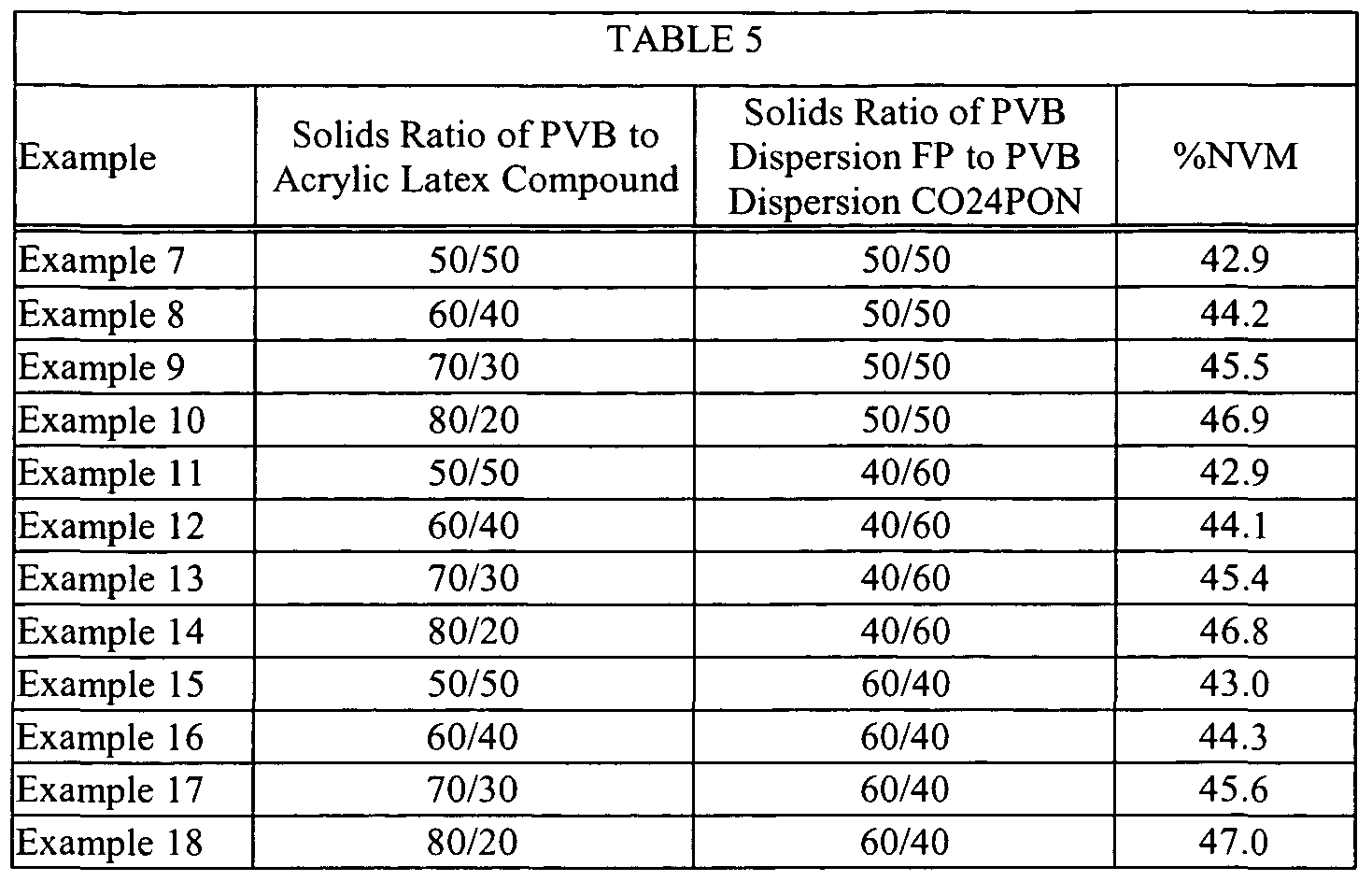
- Peel-coat compositions for Examples 7-18 were prepared pursuant to the procedure discussed above for the peel-coat composition used in the coated articles of Examples 1-3. However, the peel-coat compositions for Examples 7-18 each included propylene glycol at 7.0% by weight, the defoaming agent at 0.1% by weight, the surfactant at 0.1% by weight, and the dimethylolamine at 0.2% by weight.
- the balance of each peel- coat composition include the acrylic emulsion, the PVB dispersion FP, and a second polyvinyl butyral dispersion commercially available under the trademark "BUTVAR PVB Resin Dispersion CO24PON", from Solutia, Inc., St. Louis, MO (referred to as "PVB Dispersion CO24PON.
- Table 5 lists the solids weight ratios of the acrylic latex compound to the polyvinyl butyral, and the solids weight ratios of the PVB resin FB to the PVB resin CO24PON, for each peel-coat composition of Examples 7-18. Table 5 also lists the %NVM for each peel-coat composition of Examples 7-18 (measured pursuant to ASTM D2369-98).
- the solids ratios listed in Table 5 illustrate suitable ratios of the polyvinyl butyral to the acrylic latex compound that may be used to form stable peel-coat compositions.
- the peel-coat compositions of Examples 7-18 are accordingly suitable for forming coated articles pursuant to the procedures discussed above for the coated articles of Examples 1-3
Landscapes
- Chemical & Material Sciences (AREA)
- Life Sciences & Earth Sciences (AREA)
- Engineering & Computer Science (AREA)
- Materials Engineering (AREA)
- Wood Science & Technology (AREA)
- Organic Chemistry (AREA)
- Paints Or Removers (AREA)
- Adhesives Or Adhesive Processes (AREA)
- Laminated Bodies (AREA)
Abstract
Description


Claims
Priority Applications (6)
| Application Number | Priority Date | Filing Date | Title |
|---|---|---|---|
| EP08724514A EP2115076A2 (en) | 2007-02-08 | 2008-01-15 | Peel-coat compositions |
| US12/526,183 US8524825B2 (en) | 2007-02-08 | 2008-01-15 | Peel-coat compositions |
| CN2008800115169A CN101652435B (en) | 2007-02-08 | 2008-01-15 | Peel-coat compositions |
| BRPI0807218-3A BRPI0807218A2 (en) | 2007-02-08 | 2008-01-15 | COATED ARTICLE, COMPOSITION, AND METHOD FOR FORMATION OF A REMOVABLE COATING ON A SUBSTRATE |
| MX2009008354A MX2009008354A (en) | 2007-02-08 | 2008-01-15 | Peel-coat compositions. |
| CA002677350A CA2677350A1 (en) | 2007-02-08 | 2008-01-15 | Peel-coat compositions |
Applications Claiming Priority (2)
| Application Number | Priority Date | Filing Date | Title |
|---|---|---|---|
| US90024007P | 2007-02-08 | 2007-02-08 | |
| US60/900,240 | 2007-02-08 |
Publications (2)
| Publication Number | Publication Date |
|---|---|
| WO2008097415A2 true WO2008097415A2 (en) | 2008-08-14 |
| WO2008097415A3 WO2008097415A3 (en) | 2008-10-02 |
Family
ID=39512636
Family Applications (1)
| Application Number | Title | Priority Date | Filing Date |
|---|---|---|---|
| PCT/US2008/000494 Ceased WO2008097415A2 (en) | 2007-02-08 | 2008-01-15 | Peel-coat compositions |
Country Status (7)
| Country | Link |
|---|---|
| US (1) | US8524825B2 (en) |
| EP (1) | EP2115076A2 (en) |
| CN (1) | CN101652435B (en) |
| BR (1) | BRPI0807218A2 (en) |
| CA (1) | CA2677350A1 (en) |
| MX (1) | MX2009008354A (en) |
| WO (1) | WO2008097415A2 (en) |
Cited By (1)
| Publication number | Priority date | Publication date | Assignee | Title |
|---|---|---|---|---|
| WO2014059963A1 (en) * | 2012-10-16 | 2014-04-24 | Cardip GmbH | Method for coating objects |
Families Citing this family (17)
| Publication number | Priority date | Publication date | Assignee | Title |
|---|---|---|---|---|
| CN104164189A (en) * | 2013-11-19 | 2014-11-26 | 迟春阳 | Coating |
| EP3230062B1 (en) | 2014-12-08 | 2022-08-10 | 3M Innovative Properties Company | Acrylic polyvinyl acetal films |
| EP3393798B1 (en) * | 2015-12-22 | 2021-10-20 | 3M Innovative Properties Company | Films comprising a (meth)acrylic polymer and polyvinyl acetal polymer having a layer of an adhesive composition disposed thereon |
| JP7036507B2 (en) | 2015-12-22 | 2022-03-15 | スリーエム イノベイティブ プロパティズ カンパニー | Acrylic polyvinyl acetal graphic film |
| US11034830B2 (en) | 2015-12-22 | 2021-06-15 | 3M Innovative Properties Company | Acrylic polyvinyl acetal films comprising a second layer |
| US11167523B2 (en) | 2015-12-22 | 2021-11-09 | 3M Innovative Properties Company | Acrylic films comprising a structured layer |
| WO2019036248A1 (en) * | 2017-08-18 | 2019-02-21 | Tru BLOC LLC | Composition for encapsulation and containment of substances |
| TWI654269B (en) * | 2017-12-19 | 2019-03-21 | 財團法人工業技術研究院 | Adhesive composition |
| EP3921376A1 (en) * | 2019-02-08 | 2021-12-15 | PPG Industries Ohio, Inc. | Peelable swatches |
| US11739224B2 (en) | 2020-01-28 | 2023-08-29 | Behr Process Corporation | Water based peelable paint for architecture coatings |
| CN115667434A (en) * | 2020-07-27 | 2023-01-31 | 株式会社海广 | Easy-to-peel coating composition |
| JP2022165453A (en) * | 2021-04-20 | 2022-11-01 | 三菱製紙株式会社 | Composition for forming mold release layer and method for manufacturing release film |
| CN115851055B (en) * | 2022-12-15 | 2024-02-13 | 上海纳米技术及应用国家工程研究中心有限公司 | Water-based strippable coating and preparation method thereof |
| FR3150525A1 (en) * | 2023-06-30 | 2025-01-03 | Saint-Gobain Weber France | Waterproofing composition |
| CN117417469B (en) * | 2023-11-21 | 2024-11-15 | 江西省宏丰塑胶有限公司 | Efficient polyvinyl butyral resin and preparation method thereof |
| FR3157401A1 (en) * | 2023-12-21 | 2025-06-27 | Vinci Construction | Clear binder comprising recycled plasticized polyvinyl butyral (PVB) particles |
| WO2025159751A1 (en) * | 2024-01-25 | 2025-07-31 | Harris David W | Peelable protective composite |
Family Cites Families (11)
| Publication number | Priority date | Publication date | Assignee | Title |
|---|---|---|---|---|
| BE793392A (en) | 1971-12-28 | 1973-04-16 | Kao Corp | EASY DETACHABLE COATING COMPOSITION FOR TEMPORARY SURFACE PROTECTION |
| US4009136A (en) * | 1974-06-05 | 1977-02-22 | Rohm And Haas Company | Multicolor coating compositions |
| DE4201941A1 (en) | 1992-01-24 | 1993-08-12 | Angyal Paul V | Peelable, reprocessable coating system used for painted car body protection - comprises film former consisting of reaction prod. of polyvinyl:butyral and mono:epoxy cpd., film former e.g. polyvinyl formal], ethylcellulose etc., plasticiser, and solvent |
| JPH0975877A (en) * | 1995-09-13 | 1997-03-25 | Kansai Paint Co Ltd | Cleaning method for wall surface of building |
| US6964989B1 (en) * | 1998-07-08 | 2005-11-15 | Ashland Inc. | Peelable coating composition |
| AUPQ641900A0 (en) | 2000-03-23 | 2000-04-15 | Sola International Holdings Ltd | Removable coating for optical substrates |
| US6822012B1 (en) | 2000-03-23 | 2004-11-23 | Ashland Inc | Peelable polymeric coating composition |
| US6464823B1 (en) | 2000-08-30 | 2002-10-15 | Peter Russell Vantyle | Peelable rub-on temporary masking coatings |
| US6762230B2 (en) | 2001-02-22 | 2004-07-13 | Valspar Sourcing, Inc. | Coating compositions containing low VOC compounds |
| US20030072948A1 (en) | 2001-10-03 | 2003-04-17 | 3M Innovative Properties Company | Dry-peelable temporary protective coatings |
| US7012746B2 (en) | 2002-05-20 | 2006-03-14 | Eastman Kodak Company | Polyvinyl butyral films prepared by coating methods |
-
2008
- 2008-01-15 CN CN2008800115169A patent/CN101652435B/en not_active Expired - Fee Related
- 2008-01-15 EP EP08724514A patent/EP2115076A2/en not_active Withdrawn
- 2008-01-15 WO PCT/US2008/000494 patent/WO2008097415A2/en not_active Ceased
- 2008-01-15 CA CA002677350A patent/CA2677350A1/en not_active Abandoned
- 2008-01-15 MX MX2009008354A patent/MX2009008354A/en unknown
- 2008-01-15 US US12/526,183 patent/US8524825B2/en active Active
- 2008-01-15 BR BRPI0807218-3A patent/BRPI0807218A2/en not_active IP Right Cessation
Non-Patent Citations (1)
| Title |
|---|
| None |
Cited By (1)
| Publication number | Priority date | Publication date | Assignee | Title |
|---|---|---|---|---|
| WO2014059963A1 (en) * | 2012-10-16 | 2014-04-24 | Cardip GmbH | Method for coating objects |
Also Published As
| Publication number | Publication date |
|---|---|
| BRPI0807218A2 (en) | 2014-04-29 |
| US8524825B2 (en) | 2013-09-03 |
| CA2677350A1 (en) | 2008-08-14 |
| US20110034618A1 (en) | 2011-02-10 |
| CN101652435B (en) | 2013-08-28 |
| EP2115076A2 (en) | 2009-11-11 |
| WO2008097415A3 (en) | 2008-10-02 |
| MX2009008354A (en) | 2009-09-04 |
| CN101652435A (en) | 2010-02-17 |
Similar Documents
| Publication | Publication Date | Title |
|---|---|---|
| US8524825B2 (en) | Peel-coat compositions | |
| CA2655125C (en) | High performance aqueous coating compositions | |
| US9505922B2 (en) | Self-coalescing latex | |
| JP3151056B2 (en) | Multi-stage polymeric binder for elastomeric paints, caulks and sealants | |
| JP6114238B2 (en) | Compositions, films and related methods | |
| JP2002012816A (en) | Aqueous paint composition | |
| US7807739B2 (en) | Aqueous emulsion polymer | |
| KR102705728B1 (en) | Anti-scuffing and anti-chipping construction composition | |
| CA3086113A1 (en) | High performance aqueous coating compositions | |
| EP3328949A1 (en) | Coating compositions | |
| EP0446848A1 (en) | Fluororesin based coating composition applicable to plastic surfaces | |
| JP2002194266A (en) | Coating composition | |
| JPH107866A (en) | Vinylidene fluoride copolymer composition | |
| KR20230062276A (en) | Washable temporary protective paint composition for offshore structure and processing method of coating | |
| CN113396193A (en) | Peelable sample | |
| TW202442819A (en) | Pvdf dispersion compositions | |
| JP2024064267A (en) | Aqueous coating material and method for producing the same | |
| CN120958088A (en) | Architectural Coating Composition | |
| KR20240063431A (en) | Aqueous acryl copolymer and aqueous coating composition comprising the same | |
| EP3990554A1 (en) | Removable floor care composition with resistance to alcohol | |
| JPH0782522A (en) | Coating resin composition | |
| JPH06287334A (en) | Plasticized vinyl chloride resin molding covered with protective film | |
| JPH02299838A (en) | Hard vinyl chloride sheet | |
| JP2001016998A (en) | Agricultural vinyl chloride resin film | |
| JPH07186343A (en) | Vinyl chloride resin film for agriculture |
Legal Events
| Date | Code | Title | Description |
|---|---|---|---|
| WWE | Wipo information: entry into national phase |
Ref document number: 200880011516.9 Country of ref document: CN |
|
| 121 | Ep: the epo has been informed by wipo that ep was designated in this application |
Ref document number: 08724514 Country of ref document: EP Kind code of ref document: A2 |
|
| WWE | Wipo information: entry into national phase |
Ref document number: 2677350 Country of ref document: CA |
|
| WWE | Wipo information: entry into national phase |
Ref document number: MX/A/2009/008354 Country of ref document: MX |
|
| NENP | Non-entry into the national phase |
Ref country code: DE |
|
| WWE | Wipo information: entry into national phase |
Ref document number: 2008724514 Country of ref document: EP |
|
| WWE | Wipo information: entry into national phase |
Ref document number: 12526183 Country of ref document: US |
|
| ENP | Entry into the national phase |
Ref document number: PI0807218 Country of ref document: BR Kind code of ref document: A2 Effective date: 20090807 |