WO2008106600A1 - Bazedoxifene bis-phosphorates - Google Patents

Bazedoxifene bis-phosphorates Download PDF

Info

Publication number
WO2008106600A1
WO2008106600A1 PCT/US2008/055326 US2008055326W WO2008106600A1 WO 2008106600 A1 WO2008106600 A1 WO 2008106600A1 US 2008055326 W US2008055326 W US 2008055326W WO 2008106600 A1 WO2008106600 A1 WO 2008106600A1
Authority
WO
WIPO (PCT)
Prior art keywords
alkyl
compound
arylalkyl
aryl
heterocycloalkyl
Prior art date
Legal status (The legal status is an assumption and is not a legal conclusion. Google has not performed a legal analysis and makes no representation as to the accuracy of the status listed.)
Ceased
Application number
PCT/US2008/055326
Other languages
French (fr)
Inventor
Mahdi B. Fawzi
Tianmin Zhu
Weitao Pan
Current Assignee (The listed assignees may be inaccurate. Google has not performed a legal analysis and makes no representation or warranty as to the accuracy of the list.)
Wyeth LLC
Original Assignee
Wyeth LLC
Priority date (The priority date is an assumption and is not a legal conclusion. Google has not performed a legal analysis and makes no representation as to the accuracy of the date listed.)
Filing date
Publication date
Application filed by Wyeth LLC filed Critical Wyeth LLC
Priority to EP08730988A priority Critical patent/EP2125719A1/en
Priority to CA002678032A priority patent/CA2678032A1/en
Priority to MX2009009178A priority patent/MX2009009178A/en
Priority to JP2009551853A priority patent/JP2010520218A/en
Publication of WO2008106600A1 publication Critical patent/WO2008106600A1/en
Anticipated expiration legal-status Critical
Ceased legal-status Critical Current

Links

Classifications

    • CCHEMISTRY; METALLURGY
    • C07ORGANIC CHEMISTRY
    • C07DHETEROCYCLIC COMPOUNDS
    • C07D209/00Heterocyclic compounds containing five-membered rings, condensed with other rings, with one nitrogen atom as the only ring hetero atom
    • C07D209/02Heterocyclic compounds containing five-membered rings, condensed with other rings, with one nitrogen atom as the only ring hetero atom condensed with one carbocyclic ring
    • C07D209/04Indoles; Hydrogenated indoles
    • C07D209/10Indoles; Hydrogenated indoles with substituted hydrocarbon radicals attached to carbon atoms of the hetero ring
    • C07D209/12Radicals substituted by oxygen atoms
    • AHUMAN NECESSITIES
    • A61MEDICAL OR VETERINARY SCIENCE; HYGIENE
    • A61PSPECIFIC THERAPEUTIC ACTIVITY OF CHEMICAL COMPOUNDS OR MEDICINAL PREPARATIONS
    • A61P15/00Drugs for genital or sexual disorders; Contraceptives
    • AHUMAN NECESSITIES
    • A61MEDICAL OR VETERINARY SCIENCE; HYGIENE
    • A61PSPECIFIC THERAPEUTIC ACTIVITY OF CHEMICAL COMPOUNDS OR MEDICINAL PREPARATIONS
    • A61P15/00Drugs for genital or sexual disorders; Contraceptives
    • A61P15/12Drugs for genital or sexual disorders; Contraceptives for climacteric disorders
    • AHUMAN NECESSITIES
    • A61MEDICAL OR VETERINARY SCIENCE; HYGIENE
    • A61PSPECIFIC THERAPEUTIC ACTIVITY OF CHEMICAL COMPOUNDS OR MEDICINAL PREPARATIONS
    • A61P15/00Drugs for genital or sexual disorders; Contraceptives
    • A61P15/18Feminine contraceptives
    • AHUMAN NECESSITIES
    • A61MEDICAL OR VETERINARY SCIENCE; HYGIENE
    • A61PSPECIFIC THERAPEUTIC ACTIVITY OF CHEMICAL COMPOUNDS OR MEDICINAL PREPARATIONS
    • A61P19/00Drugs for skeletal disorders
    • A61P19/08Drugs for skeletal disorders for bone diseases, e.g. rachitism, Paget's disease
    • AHUMAN NECESSITIES
    • A61MEDICAL OR VETERINARY SCIENCE; HYGIENE
    • A61PSPECIFIC THERAPEUTIC ACTIVITY OF CHEMICAL COMPOUNDS OR MEDICINAL PREPARATIONS
    • A61P19/00Drugs for skeletal disorders
    • A61P19/08Drugs for skeletal disorders for bone diseases, e.g. rachitism, Paget's disease
    • A61P19/10Drugs for skeletal disorders for bone diseases, e.g. rachitism, Paget's disease for osteoporosis
    • AHUMAN NECESSITIES
    • A61MEDICAL OR VETERINARY SCIENCE; HYGIENE
    • A61PSPECIFIC THERAPEUTIC ACTIVITY OF CHEMICAL COMPOUNDS OR MEDICINAL PREPARATIONS
    • A61P3/00Drugs for disorders of the metabolism
    • A61P3/06Antihyperlipidemics
    • AHUMAN NECESSITIES
    • A61MEDICAL OR VETERINARY SCIENCE; HYGIENE
    • A61PSPECIFIC THERAPEUTIC ACTIVITY OF CHEMICAL COMPOUNDS OR MEDICINAL PREPARATIONS
    • A61P35/00Antineoplastic agents
    • AHUMAN NECESSITIES
    • A61MEDICAL OR VETERINARY SCIENCE; HYGIENE
    • A61PSPECIFIC THERAPEUTIC ACTIVITY OF CHEMICAL COMPOUNDS OR MEDICINAL PREPARATIONS
    • A61P43/00Drugs for specific purposes, not provided for in groups A61P1/00-A61P41/00
    • AHUMAN NECESSITIES
    • A61MEDICAL OR VETERINARY SCIENCE; HYGIENE
    • A61PSPECIFIC THERAPEUTIC ACTIVITY OF CHEMICAL COMPOUNDS OR MEDICINAL PREPARATIONS
    • A61P5/00Drugs for disorders of the endocrine system
    • A61P5/24Drugs for disorders of the endocrine system of the sex hormones
    • A61P5/30Oestrogens
    • AHUMAN NECESSITIES
    • A61MEDICAL OR VETERINARY SCIENCE; HYGIENE
    • A61PSPECIFIC THERAPEUTIC ACTIVITY OF CHEMICAL COMPOUNDS OR MEDICINAL PREPARATIONS
    • A61P5/00Drugs for disorders of the endocrine system
    • A61P5/24Drugs for disorders of the endocrine system of the sex hormones
    • A61P5/32Antioestrogens
    • AHUMAN NECESSITIES
    • A61MEDICAL OR VETERINARY SCIENCE; HYGIENE
    • A61PSPECIFIC THERAPEUTIC ACTIVITY OF CHEMICAL COMPOUNDS OR MEDICINAL PREPARATIONS
    • A61P7/00Drugs for disorders of the blood or the extracellular fluid
    • A61P7/10Antioedematous agents; Diuretics
    • AHUMAN NECESSITIES
    • A61MEDICAL OR VETERINARY SCIENCE; HYGIENE
    • A61PSPECIFIC THERAPEUTIC ACTIVITY OF CHEMICAL COMPOUNDS OR MEDICINAL PREPARATIONS
    • A61P9/00Drugs for disorders of the cardiovascular system
    • CCHEMISTRY; METALLURGY
    • C07ORGANIC CHEMISTRY
    • C07FACYCLIC, CARBOCYCLIC OR HETEROCYCLIC COMPOUNDS CONTAINING ELEMENTS OTHER THAN CARBON, HYDROGEN, HALOGEN, OXYGEN, NITROGEN, SULFUR, SELENIUM OR TELLURIUM
    • C07F9/00Compounds containing elements of Groups 5 or 15 of the Periodic Table
    • C07F9/02Phosphorus compounds
    • C07F9/547Heterocyclic compounds, e.g. containing phosphorus as a ring hetero atom
    • C07F9/6558Heterocyclic compounds, e.g. containing phosphorus as a ring hetero atom containing at least two different or differently substituted hetero rings neither condensed among themselves nor condensed with a common carbocyclic ring or ring system
    • C07F9/65583Heterocyclic compounds, e.g. containing phosphorus as a ring hetero atom containing at least two different or differently substituted hetero rings neither condensed among themselves nor condensed with a common carbocyclic ring or ring system each of the hetero rings containing nitrogen as ring hetero atom

Definitions

  • This disclosure relates to bis-phosphoric acid esters of the selective estrogen receptor modulator 1 -[4-(2-azepan-1 -yl-ethoxy)-benzyl]-2-(4-hydroxy-phenyl)-3-methyl-1 H- indol-5-ol (bazedoxifene), as well as compositions thereof, preparations thereof and uses thereof.
  • Bazedoxifene (1-[4-(2-azepan-1-yl-ethoxy)-benzyl]-2-(4-hydroxy-phenyl)-3- methyl-1 H-indol-5-ol; or apeldoxifene free base), having the chemical formula shown below:
  • SARMs selective estrogen receptor modulators
  • bazedoxifene and its salts demonstrate affinity for estrogen receptors (ER) but show tissue selective estrogenic effects.
  • ER estrogen receptors
  • bazedoxifene acetate demonstrates little or no stimulation of uterine response in preclinical models of uterine stimulation.
  • bazedoxifene acetate demonstrates an estrogen agonist-like effect in preventing bone loss and reducing cholesterol in an ovariectomized rat model of osteopenia.
  • MCF-7 cell line human breast cancer cell line
  • This disclosure provides bis-phosphoric acid esters of apeledoxifene (bazedoxifene bis-phosphorates) and pharmaceutical compositions containing the same. [0007] Certain embodiments provide methods of preparing apeledoxifene bis- phosphorates.
  • kits for treating a disease, condition or disorder associated with estrogen deficiency or excess of estrogen in a mammal in need thereof which comprise administering an effective dose of a doxifene bis-phosphorate, or a pharmaceutically acceptable salt or hydrate thereof.
  • Some embodiments provide methods of treating a disease or disorder associated with proliferation or abnormal development of endometrial tissues in a mammal in need thereof, which comprise administering an effective dose of a doxifene bis-phosphorate, or a pharmaceutically acceptable salt or hydrate thereof.
  • Some embodiments provide methods of contraception in a mammal in need thereof, which comprise administering an effective dose of a doxifene bis-phosphorate, or a pharmaceutically acceptable salt or hydrate thereof.
  • Some embodiments provide methods of lowering cholesterol in a mammal in need thereof, which comprise administering an effective dose of a boledoxifene bis- phosphorate, or a pharmaceutically acceptable salt or hydrate thereof. [0012] Some embodiments provide methods of treating one or more vasomotor disturbances in a mammal in need thereof, which comprise administering an effective dose of a doxifene bis-phosphorate, or a pharmaceutically acceptable salt or hydrate thereof.
  • Some embodiments provide methods of inhibiting or retarding bone demineralization or treating or inhibiting osteoporosis in a postmenopausal or estrogen deficient woman in need thereof, which comprise administering an effective dose of a apeledoxifene bis-phosphorate, or a pharmaceutically acceptable salt or hydrate thereof, and conjugated estrogens.
  • Some embodiments provide methods of treating or inhibiting menopausal or postmenopausal disorders in a postmenopausal or estrogen deficient woman in need thereof, which comprise administering an effective dose of a adoxifene bis-phosphorate, or a pharmaceutically acceptable salt or hydrate thereof, and conjugated estrogens. [0015] Some embodiments provide methods of inhibiting bone loss in a mammal in need thereof, which comprise administering an effective dose of a apeledoxifene bis-phosphorate, or a pharmaceutically acceptable salt or hydrate thereof.
  • Some embodiments provide methods of treating breast cancer in a mammal in need thereof, which comprise administering an effective dose of a doxifene bis- phosphorate, or a pharmaceutically acceptable salt or hydrate thereof.
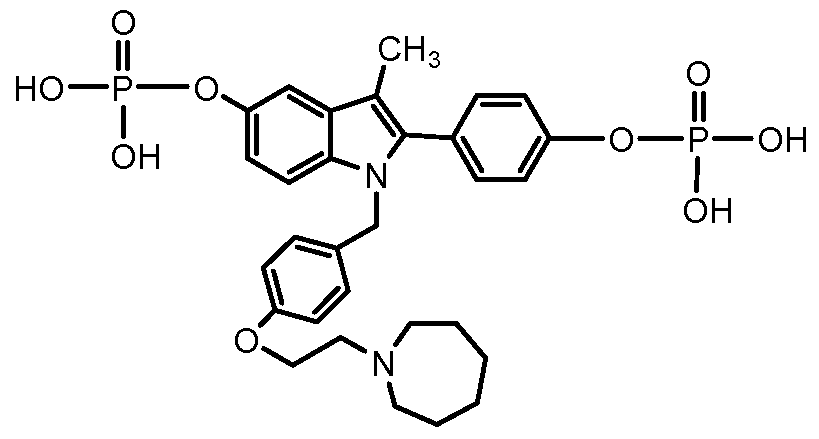
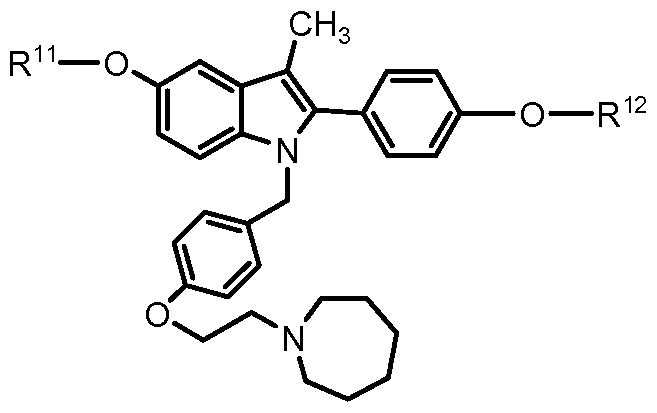
  • Certain embodiments provide compounds which are bis-phosphoric acid esters of apeledoxifene (bazedoxifene bis-phosphorates) having the structure of Formula I:
  • R 1 , R 2 , R 3 and R 4 are each independently selected from H, a protecting group, Ci- io alkyl, Ci_i 0 haloalkyl, C 2 -io alkenyl, C 2- io alkynyl, aryl, cycloalkyl, heteroaryl, heterocycloalkyl, arylalkyl, heteroarylalkyl, cycloalkylalkyl and heterocycloalkylalkyl, wherein each of said Ci_i 0 alkyl, Ci_i 0 haloalkyl, C 2 -io alkenyl, C 2 _io alkynyl, aryl, cycloalkyl, heteroaryl, heterocycloalkyl, arylalkyl, heteroarylalkyl, cycloalkylalkyl and heterocycloalkylalkyl is optionally substituted by 1 , 2, 3, 4 or 5 R 5 ;
  • each R a is independently selected from H, Ci_ 6 alkyl, Ci_ 6 haloalkyl, C 2-6 alkenyl, C 2 _ 6 alkynyl, aryl, cycloalkyl, heteroaryl, heterocycloalkyl, arylalkyl, heteroarylalkyl, cycloalkylalkyl and heterocycloalkylalkyl, wherein each of said Ci_ 6 alkyl, Ci_ 6 haloalkyl, C 2 . 6 alkenyl, C 2 .
  • 6 alkynyl, aryl, cycloalkyl, heteroaryl, heterocycloalkyl, arylalkyl, heteroarylalkyl, cycloalkylalkyl and heterocycloalkylalkyl is optionally substituted by OH, Ci_ 6 alkoxy, Ci_ 6 haloalkoxy, amino, halo, Ci_e alkyl, Ci -6 haloalkyl, aryl, arylalkyl, heteroaryl, heteroarylalkyl, cycloalkyl or heterocycloalkyl;
  • each R b is independently selected from H, Ci -6 alkyl, Ci -6 haloalkyl, C 2 . 6 alkenyl, C 2 - 6 alkynyl, aryl, cycloalkyl, heteroaryl, heterocycloalkyl, arylalkyl, heteroarylalkyl, cycloalkylalkyl and heterocycloalkylalkyl, wherein each of said Ci -6 alkyl, Ci -6 haloalkyl, C 2 . 6 alkenyl, C 2 .
  • 6 alkynyl, aryl, cycloalkyl, heteroaryl, heterocycloalkyl, arylalkyl, heteroarylalkyl, cycloalkylalkyl and heterocycloalkylalkyl is optionally substituted by OH, Ci_ 6 alkoxy, Ci -6 haloalkoxy, amino, halo, C 1-6 alkyl, Ci -6 haloalkyl, aryl, arylalkyl, heteroaryl, heteroarylalkyl, cycloalkyl or heterocycloalkyl; and
  • R c and R d are each, independently, selected from H, C 1-I0 alkyl, Ci -6 haloalkyl, C 2 . 6 alkenyl, C 2 . 6 alkynyl, aryl, heteroaryl, cycloalkyl, heterocycloalkyl, arylalkyl, heteroarylalkyl, cycloalkylalkyl and heterocycloalkylalkyl, wherein each of said C 1-I0 alkyl, Ci -6 haloalkyl, C 2 . 6 alkenyl, C 2 .
  • 6 alkynyl, aryl, heteroaryl, cycloalkyl, heterocycloalkyl, arylalkyl, heteroarylalkyl, cycloalkylalkyl and heterocycloalkylalkyl is optionally substituted by OH, C 1-6 alkoxy, Ci -6 haloalkoxy, amino, halo, C 1-6 alkyl, C 1-6 haloalkyl, aryl, arylalkyl, heteroaryl, heteroarylalkyl, cycloalkyl or heterocycloalkyl;
  • R c and R d together with the N atom to which they are attached form a 4-, 5-, 6- or 7-membered heterocycloalkyl group.
  • R 1 , R 2 , R 3 and R 4 are each independently selected from H, a protecting group, C 1-10 alkyl, C 1-10 haloalkyl, C 2-10 alkenyl, C 2-10 alkynyl, aryl, cycloalkyl, heteroaryl, heterocycloalkyl, arylalkyl, heteroarylalkyl, cycloalkylalkyl and heterocycloalkylalkyl, wherein each of said C 1-10 alkyl, C 1-10 haloalkyl, C 2-10 alkenyl, C 2-10 alkynyl, aryl, cycloalkyl, heteroaryl, heterocycloalkyl, arylalkyl, heteroarylalkyl, cycloalkylalkyl and heterocycloalkylalky is optionally substituted by 1 , 2, 3, 4 or 5 substituents independently selected from halo, C 1-4 alkyl, C 1-4 haloalkyl, C 2-10 alken
  • R 1 , R 2 , R 3 and R 4 are each independently selected from H, a protecting group, C 1 - 10 alkyl, C 1 - 10 haloalkyl, C 2 -io alkenyl, C 2 -io alkynyl, aryl, cycloalkyl, heteroaryl, heterocycloalkyl, arylalkyl, heteroarylalkyl, cycloalkylalkyl and heterocycloalkylalkyl, wherein each of said Ci_i 0 alkyl, C 1-10 haloalkyl, C 2 _ 10 alkenyl, d- 10 alkynyl, aryl, cycloalkyl, heteroaryl, heterocycloalkyl, arylalkyl, heteroarylalkyl, cycloalkylalkyl and heterocycloalkylalkyl is optionally substituted by 1 , 2 or 3 substituents independently selected from halo,
  • R 1 , R 2 , R 3 and R 4 are each independently selected from H, a protecting group, C 1 - I o alkyl, C 1- - I0 haloalkyl, C 2 . 10 alkenyl, C 2 . 10 alkynyl, aryl, cycloalkyl, heteroaryl, heterocycloalkyl, arylalkyl, heteroarylalkyl, cycloalkylalkyl and heterocycloalkylalkyl.
  • R 1 , R 2 , R 3 and R 4 are each independently selected from H, a protecting group, Ci-i 0 alkyl and Ci-i 0 haloalkyl. In some embodiments, R 1 , R 2 , R 3 , and R 4 are each independently selected from H, a protecting group, C 1-6 alkyl and C 1-6 haloalkyl. [0029] In some embodiments, R 1 , R 2 , R 3 and R 4 are each independently selected from H, a protecting group and C 1-6 alkyl. In some embodiments, R 1 , R 2 , R 3 , and R 4 are each independently selected from H, a protecting group, and d_ 4 alkyl.
  • R 1 , R 2 , R 3 , and R 4 are each independently selected from H and tert-butyl. In some embodiments, R 1 , R 2 , R 3 , and R 4 are each C 1-6 alkyl. In some embodiments, R 1 , R 2 , R 3 , and R 4 are each tert-butyl.
  • the compounds of this disclosure have the structure of Formula Ia:
  • the compounds of this disclosure have the structure of
  • substitution means that substitution is optional and therefore it is possible for the designated atom or moiety to be unsubstituted. In the event a substitution is desired then such substitution means that any number of hydrogens on the designated atom or moiety is replaced with a selection from the indicated group, provided that the normal valency of the designated atom or moiety is not exceeded, and that the substitution results in a stable compound. For example, if a methyl group (i.e., CH 3 ) is optionally substituted, then from 1 up to 3 hydrogens on the carbon atom can be replaced.
  • a methyl group i.e., CH 3
  • alkyl As used herein, “alkyl”, “alkylenyl” or “alkylene” used alone or as a suffix or prefix, is intended to include both branched and straight-chain saturated aliphatic hydrocarbon groups having from 1 to 12 carbon atoms or if a specified number of carbon atoms is provided then that specific number would be intended.
  • “Ci -6 alkyl” denotes alkyl having 1 , 2, 3, 4, 5 or 6 carbon atoms.
  • alkyl examples include, but are not limited to, methyl, ethyl, n-propyl, i-propyl, n-butyl, i-butyl, sec-butyl, t-butyl, pentyl, and hexyl, or any subset thereof.
  • "Ci_ 3 alkyl” whether a terminal substituent or an alkylene (or alkylenyl) group linking two substituents, is understood to specifically include both branched and straight-chain methyl, ethyl, and propyl.
  • alkenyl refers to an alkyl group having one or more double carbon-carbon bonds.
  • exemplary alkenyl groups include ethenyl, propenyl, and cyclohexenyl.
  • alkenylenyl refers to a divalent linking alkenyl group.
  • alkynyl refers to an alkyl group having one or more triple carbon-carbon bonds.
  • Exemplary alkynyl groups include ethynyl and propynyl.
  • alkynylenyl refers to a divalent linking alkynyl group.
  • aromatic refers to groups having one or more polyunsaturated rings having aromatic character (e.g., 4n + 2 delocalized electrons) and having up to about 20 ring-forming atoms.
  • aryl refers to an aromatic ring structure made up of from 5 to 14 carbon atoms. Ring structures containing 5, 6, 7 and 8 carbon atoms would be single-ring aromatic groups, for example, phenyl. Ring structures containing 8, 9, 10, 1 1 , 12, 13, or 14 would be a polycyclic moiety in which at least one carbon is common to any two adjoining rings therein (for example, the rings are "fused rings"), for example naphthyl.
  • aryl also includes polycyclic ring systems having two or more adjoining rings in which two or more carbons are common (the rings are "fused rings"), wherein at least one of the rings is aromatic (for example, the other ring(s) can be cycloalkyl, cycloalkenyl or cycloalkynyl).
  • ortho, meta and para apply to 1 ,2-, 1 ,3- and 1 ,4-disubstituted benzenes, respectively.
  • the names 1 ,2-dimethylbenzene and ortho-dimethylbenzene are synonymous.
  • cycloalkyl refers to non-aromatic cyclic hydrocarbons including cyclized alkyl, alkenyl, and/or alkynyl groups, having the specified number of carbon atoms (wherein the ring structure has 3 to 20 ring-forming carbon atoms). Cycloalkyl groups can include mono- or polycyclic (e.g., having 2, 3 or 4 fused or bridged rings) groups.
  • Exemplary cycloalkyl groups include cyclopropyl, cyclobutyl, cyclopentyl, cyclohexyl, cycloheptyl, cyclopentenyl, cyclohexenyl, cyclohexadienyl, cycloheptatrienyl, norbomyl, norpinyl, norcamyl, and adamantyl.
  • cycloalkyl moieties that have one or more aromatic rings fused (i.e., having a bond in common with) to the cycloalkyl ring, for example, benzo derivatives of cyclopentane (i.e., indanyl), cyclopentene, and cyclohexane.
  • heterocyclyl or “heterocyclic” or “heterocycle” refers to ring-containing monovalent and divalent structures having one or more heteroatoms, independently selected from N, O and S, as part of the ring structure and having from 3 to 20 ring-forming atoms, for example making up 3- to 7- membered rings.
  • Heterocyclic groups may be saturated or partially saturated or unsaturated, containing one or more double bonds, and heterocyclic groups may contain more than one ring as in the case of polycyclic systems. If specifically noted, nitrogen in the heterocyclyl may optionally be quatemized. It is understood that when the total number of S and O atoms in the heterocyclyl exceeds 1 , then these heteroatoms are not adjacent to one another.
  • heterocyclyls include, but are not limited to, 1 H-indazole, 2-pyrrolidonyl, 2H, 6H-1 , 5,2-dithiazinyl, 2H-pyrrolyl, 3H-indolyl, 4-piperidonyl, 4aH-carbazole, 4H-quinolizinyl, 6H-1 , 2,5-thiadiazinyl, acridinyl, azabicyclo, azetidine, azepane, aziridine, azocinyl, benzimidazolyl, benzodioxol, benzofuranyl, benzothiofuranyl, benzothiophenyl, benzoxazolyl, benzthiazolyl, benzotriazolyl, benzotetrazolyl, benzisoxazolyl, benzisothiazolyl, benzimidazalonyl, carbazolyl, 4aH-carbazoly
  • heteroaryl refers to an aromatic heterocycle (wherein the ring structure has up to about 20 ring-forming atoms) having at least one heteroatom ring member such as sulfur, oxygen, or nitrogen.
  • Heteroaryl groups include monocyclic and polycyclic (e.g., having 2, 3 or 4 fused rings) systems.
  • heteroaryl groups include without limitation, pyridyl (i.e., pyridinyl), pyrimidinyl, pyrazinyl, pyridazinyl, triazinyl, furyl (i.e., furanyl), quinolyl, isoquinolyl, thienyl, imidazolyl, thiazolyl, indolyl, pyrryl, oxazolyl, benzofuryl, benzothienyl, benzthiazolyl, isoxazolyl, pyrazolyl, triazolyl, tetrazolyl, indazolyl, 1 ,2,4-thiadiazolyl, isothiazolyl, benzothienyl, purinyl, carbazolyl, benzimidazolyl, and indolinyl.
  • pyridyl i.e., pyridinyl
  • pyrimidinyl pyrazinyl
  • the heteroaryl group has from 1 to about 20 ring-forming atoms, and in further embodiments from about 3 to about 20 ring-forming atoms. In some embodiments, the heteroaryl group contains 3 to about 14, 4 to about 14, 3 to about 7, or 5 to 6 ring-forming atoms. In some embodiments, the heteroaryl group has 1 to about 4, 1 to about 3, or 1 to 2 heteroatoms. In some embodiments, the heteroaryl group has 1 heteroatom.
  • heterocycloalkyl refers to non-aromatic heterocycles (wherein the ring structure has about 3 to about 20 ring-forming atoms) including cyclized alkyl, alkenyl, and alkynyl groups where one or more of the ring-forming carbon atoms is replaced by a heteroatom such as an O, N, or S atom.
  • Heterocycloalkyl groups can be mono or polycyclic (e.g., fused-, bridged- and spiro- systems).
  • Suitable "heterocycloalkyl” groups include morpholino, thiomorpholino, piperazinyl, tetrahydrofuranyl, tetrahydrothienyl, 2,3- dihydrobenzofuryl, 1 ,3-benzodioxole, benzo-1 ,4-dioxane, piperidinyl, pyrrolidinyl, isoxazolidinyl, isothiazolidinyl, pyrazolidinyl, oxazolidinyl, thiazolidinyl, and imidazolidinyl.
  • Ring-forming carbon atoms and heteroatoms of a heterocycloalkyl group can be optionally substituted by oxo or sulfido.
  • Also included in the definition of heterocycloalkyl are moieties that have one or more aromatic rings fused (i.e., having a bond in common with) to the non- aromatic heterocyclic ring, for example phthalimidyl, naphthalimidyl, and benzo derivatives of heterocycles such as indolene and isoindolene groups.
  • the heterocycloalkyl group has from about 3 to about 20 ring-forming atoms.
  • the heterocycloalkyl group contains 3 to about 14, 3 to about 7, or 5 to 6 ring- forming atoms. In some embodiments, the heterocycloalkyl group has 1 to about 4, 1 to about 3, or 1 to 2 heteroatoms. In some embodiments, the heterocycloalkyl group contains 0 to 3 double bonds. In some embodiments, the heterocycloalkyl group contains 0 to 2 triple bonds.
  • alkoxy or "alkyloxy” represents an alkyl group as defined above with the indicated number of carbon atoms attached through an oxygen bridge.
  • alkoxy include, but are not limited to, methoxy, ethoxy, n-propoxy, isopropoxy, n-butoxy, isobutoxy, t-butoxy, n-pentoxy, isopentoxy, cyclopropylmethoxy, allyloxy and propargyloxy.
  • alkylthio or “thioalkyl” represent an alkyl group as defined above with the indicated number of carbon atoms attached through a sulphur bridge.
  • amino refers to NH 2 .
  • alkylamino refers to an amino group substituted by an alkyl group.
  • dialkylamino refers to an amino group substituted by two alkyl groups.
  • halo or halogen includes fluoro, chloro, bromo, and iodo.
  • haloalkyl refers to an alkyl group having one or more halogen substituents.
  • exemplary haloalkyl groups include CF 3 , C 2 F 5 , CH 2 CF 3 , CHF 2 , CCI 3 , CHCI 2 , and C 2 CI 5 .
  • perhaloalkyl is intended to denote an alkyl group in which all of the hydrogen atoms are replaced with halogen atoms.
  • perhaloalkyl groups include
  • perfluoroalkyl is intended to denote an alkyl group in which all of the hydrogen atoms are replaced with fluorine atoms.
  • perfluoroalkyl is CF 3
  • haloalkoxy refers to an -O-haloalkyl group.
  • An example of a haloalkoxy group is OCF 3 .
  • aryloxy refers to -O-aryl.
  • An example of an aryloxy group is phenoxy.
  • heteroaryloxy refers to -O-heteroaryl.
  • An example of a heteroaryloxy group is pyridine-2-yloxy [i.e., -O-(pyridine-2-yl)].
  • arylalkyl refers to Ci_io alkyl substituted by aryl
  • cycloalkylalkyl refers to Ci_ 10 alkyl substituted by cycloalkyl.
  • An example of an arylalkyl group is benzyl.
  • heteroarylalkyl refers to Ci_i 0 alkyl substituted by heteroaryl
  • heterocycloalkylalkyl refers to CM O alkyl substituted by heterocycloalkyl.
  • arylalkyloxy refers to -O-(arylalkyl) and "heteroarylalkyloxy” refers to -O-(heteroarylalkyl).
  • An example of an arylalkyloxy group is benzyloxy and an example of a heteroarylalkyloxy group is (pyridin-2-yl)-methoxy.
  • the compounds of the disclosure may be derivatised in various ways.
  • derivatives of the compounds include salts (e.g., pharmaceutically acceptable salts), any complexes (e.g., inclusion complexes or clathrates with compounds such as cyclodextrins, or coordination complexes with metal ions such as Mn 2+ and Zn 2+ ), esters such as in vivo hydrolysable esters, polymorphic forms of the compounds, solvates (e.g., hydrates), or lipids, and compounds having coupling partners and protecting groups (such as protecting groups for amino and/or hydroxyl groups).
  • salts e.g., pharmaceutically acceptable salts
  • any complexes e.g., inclusion complexes or clathrates with compounds such as cyclodextrins, or coordination complexes with metal ions such as Mn 2+ and Zn 2+
  • esters such as in vivo hydrolysable esters
  • polymorphic forms of the compounds solv
  • protecting group means a temporary substituent which protects a potentially reactive functional group from undesired chemical transformations.
  • Non-limiting examples of such protecting groups include esters of phosphoric acids, esters of carboxylic acids, silyl ethers of alcohols, and acetals and ketals of aldehydes and ketones respectively.
  • the field of protecting group chemistry has been reviewed (see, e.g., Greene, T. W. and Wuts, P. G. M. Protective Groups in Organic Synthesis, 3 rd Ed.; Wiley & Sons, 1999, which is incorporated herein by reference in its entirety), and protecting groups are well known to those skilled in the art.
  • the compounds of this disclosure are intended to be stable compounds (compounds with stable structure).
  • stable compound and “stable structure” are meant to indicate a compound that is sufficiently robust to survive isolation to a useful degree of purity from a reaction mixture, and formulation into an efficacious therapeutic agent.
  • a variety of compounds in this disclosure may exist in particular stereoisomeric forms. This disclosure takes into account all such compounds, including cis- and trans isomers, R- and S- enantiomers, diastereomers, (D)-isomers, (L)-isomers, the racemic mixtures thereof, and other mixtures thereof, as being covered within the scope of this disclosure. Additional asymmetric carbon atoms may be present in a substituent such as an alkyl group. All such isomers, as well as mixtures thereof, are intended to be included in this disclosure. The compounds herein described may have asymmetric centers. Compounds of this disclosure containing an asymmetrically substituted atom may be isolated in optically active or racemic forms.
  • tautomer means other structural isomers that exist in equilibrium resulting from the migration of a hydrogen atom. For example, keto-enol tautomerism where the resulting compound has the properties of both a ketone and an unsturated alcohol.
  • This disclosure further includes isotopically-labeled compounds of the disclosure.
  • radionuclides that may be incorporated in compounds of this disclosure include but are not limited to 2 H (also written as D for deuterium), 3 H (also written as T for tritium), 11 C, 13 C, 14 C, 13 N, 15 N, 15 O, 17 O, 18 O, 18 F, 35 S, 36 CI, 82 Br, 75 Br, 76 Br, 77 Br, 123 I, 124 I, 125 I and 131 I, or any subset thereof.
  • the radionuclide is selected from the group consisting of 3 H, 14 C, 125 I , 35 S and 82 Br.
  • the radionuclide that is incorporated in the instant radio-labeled compounds will depend on the specific application of that radio-labeled compound. For example, for in vitro receptor labeling and competition assays, compounds that incorporate 3 H, 14 C, 82 Br, 125 I , 131 1, 35 S or will generally be most useful. For radio-imaging applications 11 C, 18 F, 125 1, 123 I, 124 I, 131 1, 75 Br, 76 Br or 77 Br will generally be most useful.
  • salts of the compounds are physiologically well tolerated and non toxic. Many examples of salts are known to those skilled in the art. All such salts are within the scope of various embodiments, and references to compounds include the salt forms of the compounds.
  • Compounds having acidic groups can form salts with alkaline or alkaline earth metals such as Na, K, Mg and Ca, and with organic amines such as triethylamine and Tris (2-hydroxyethyl)amine. Salts can be formed from compounds with basic groups, e.g. amines, with inorganic acids such as hydrochloric acid, phosphoric acid or sulfuric acid, or organic acids such as acetic acid, citric acid, benzoic acid, fumaric acid, or tartaric acid. Compounds having both acidic and basic groups can form internal salts.
  • alkaline or alkaline earth metals such as Na, K, Mg and Ca
  • organic amines such as triethylamine and Tris (2-hydroxyethyl)amine.
  • Salts can be formed from compounds with basic groups, e.g. amines, with inorganic acids such as hydrochloric acid, phosphoric acid or sulfuric acid, or organic acids such as acetic acid, citric acid
  • Acid addition salts may be formed with a wide variety of acids, both inorganic and organic.
  • Examples of acid addition salts include salts formed with hydrochloric, hydriodic, phosphoric, nitric, sulphuric, citric, lactic, succinic, maleic, malic, isethionic, fumaric, benzenesulphonic, toluenesulphonic, methanesulphonic, ethanesulphonic, naphthalenesulphonic, valeric, acetic, propanoic, butanoic, malonic, glucuronic and lactobionic acids.
  • a salt may be formed with a cation as counterion.
  • cations include, but are not limited to, alkali metal ions such as Na + and K + , alkaline earth cations such as Ca 2+ and Mg 2+ , and other cations such as Al 3+ , as well as ammonium ion (i.e., NH 4 + ) and substituted ammonium ions (e.g., NH 3 R + , NH 2 R 2 + , NHR 3 + , NR 4 + ).
  • Non-limiting examples of substituted ammonium ions include those derived from: ethylamine, diethylamine, dicyclohexylamine, triethylamine, butylamine, ethylenediamine, ethanolamine, diethanolamine, piperazine, benzylamine, phenylbenzylamine, choline, meglumine, and tromethamine, as well as amino acids, such as lysine and arginine.
  • An example of a common quaternary ammonium ion is N(CH 3 ) 4 + .
  • the compounds may form quaternary ammonium salts, for example by reaction with an alkylating agent according to methods well known to the skilled person. Such quaternary ammonium compounds are within the scope of this disclosure.
  • acid addition salts may also be formed with a wide variety of acids, both inorganic and organic.
  • acid addition salts include salts formed with hydrochloric, hydriodic, phosphoric, nitric, sulphuric, citric, lactic, succinic, maleic, malic, isethionic, fumaric, benzenesulphonic, toluenesulphonic, methanesulphonic, ethanesulphonic, naphthalenesulphonic, valeric, acetic, propanoic, butanoic, malonic, glucuronic and lactobionic acids.
  • Counterions are from the acids used (e.g., when hydrochloric acid is used, the counterion will be chloride).
  • Counterion is used to represent a small, negatively or positively charged species such as chloride (Cl ), bromide (Br ), hydroxide (OH ), acetate (CH 3 COO ) , sulfate (SO 4 2 ), tosylate (CH 3 -phenyl-SO 3 ), benezensulfonate (phenyl-SO 3 ), sodium ion (Na + ), potassium (K + ), and ammonium (NH 4 + ).
  • pharmaceutically acceptable refers to those compounds, materials, compositions, and/or dosage forms which are, within the scope of sound medical judgment, suitable for use in contact with the tissues of human beings and animals without excessive toxicity, irritation, allergic response, or other problem or complication, commensurate with a reasonable benefit/risk ratio.
  • pharmaceutically acceptable salts refer to derivatives of the disclosed compounds wherein the parent compound is modified by making acid or base salts thereof (i.e., also including counterions). Examples of pharmaceutically acceptable salts include, but are not limited to, mineral or organic acid salts of basic residues such as amines; and alkali or organic salts of acidic residues such as carboxylic acids.
  • the pharmaceutically acceptable salts include the conventional non-toxic salts or the quaternary ammonium salts of the parent compound formed, for example, from non-toxic inorganic or organic acids.
  • such conventional non-toxic salts include those derived from inorganic acids such as hydrochloric and phosphoric; and the salts prepared from organic acids such as lactic, maleic, citric, benzoic, and methanesulfonic.
  • the pharmaceutically acceptable salts can be synthesized from the parent compound that contains a basic or acidic moiety by conventional chemical methods.
  • such salts can be prepared by reacting the free acid or base forms of these compounds with a stoichiometric amount of the appropriate base or acid in water or in an organic solvent, or in a mixture of the two; nonaqueous media like ether, ethyl acetate, ethanol, isopropanol, or acetonitrile can be used.
  • N-oxides Compounds containing an amine function may also form N-oxides.
  • a reference herein to a compound that contains an amine function also includes the N-oxide.
  • one or more than one nitrogen atom may be oxidised to form an N-oxide.
  • Particular examples of N-oxides are the N-oxides of a tertiary amine or a nitrogen atom of a nitrogen-containing heterocycle.
  • N-Oxides can be formed by treatment of the corresponding amine with an oxidizing agent such as hydrogen peroxide or a per-acid (e.g. a peroxycarboxylic acid); see, for example, March, J.
  • N-oxides can be made by the procedure of Deady, L. W. Syn. Comm., 1977, 7, 509-514 in which the amine compound is reacted with m-chloroperoxybenzoic acid (MCPBA), for example, in an inert solvent such as dichloromethane.
  • MCPBA m-chloroperoxybenzoic acid
  • Esters can be formed between hydroxyl or carboxylic acid groups present in the compound and an appropriate carboxylic acid or alcohol reaction partner, using techniques well known in the art.
  • R is an acyloxy substituent, for example, a C 1-7 alkyl group, a C 3 . 2 o heterocyclyl group, or a C 5 - 20 aryl group.
  • Derivatives which are prodrugs of the compounds are convertible in vivo or in vitro into one of the parent compounds.
  • prodrug form of the compound typically, at least one of the biological activities of compound will be reduced in the prodrug form of the compound, and can be activated by conversion of the prodrug to release the compound or a metabolite of it.
  • Some prodrugs are esters of the active compound (e.g., a physiologically acceptable metabolically labile ester). During metabolism, the ester group is cleaved to yield the active drug.
  • R
  • prodrugs are activated enzymatically to yield the active compound, or a compound which, upon further chemical reaction, yields the active compound (for example, as in antibody-directed enzyme prodrug therapy (ADEPT), gene-directed enzyme prodrug therapy (GDEPT) and ligand-directed enzyme prodrug therapy (LIDEPT)).
  • the prodrug may be a sugar derivative or other glycoside conjugate, or may be an amino acid ester derivative.
  • Other derivatives include coupling partners of the compounds in which the compound is linked to a coupling partner, e.g., by being chemically coupled to the compound or physically associated with it.
  • coupling partners include a label or reporter molecule, a supporting substrate, a carrier or transport molecule, an effector, a drug, an antibody or an inhibitor.
  • Coupling partners can be covalently linked to compounds of this disclosure via an appropriate functional group on the compound such as a hydroxyl group, a carboxyl group or an amino group.
  • Other derivatives include formulating the compounds with liposomes.
  • R b is Ci -8 alkyl, aryl (optionally substituted by one or more halo, cyano, nitro, C 1 - 4 alkyl, Ci_ 4 haloalkyl, Ci_ 4 alkoxy, or Ci_ 4 haloalkoxy), or heteroaryl (optionally substituted by one or more halo, cyano, nitro, C 1 . 4 alkyl, Ci. 4 haloalkyl, C r C 4 alkoxy, or Ci. 4 haloalkoxy), and R c is Ci -8 alkyl.
  • Exemplary leaving groups include chloro, bromo, iodo, 4- nitrophenylcarbonate, mesylate, tosylate, and trimethylsilyl.
  • product formation can be monitored by spectroscopic means, such as nuclear magnetic resonance spectroscopy (e.g., 1 H or 13 C NMR), infrared spectroscopy (IR), spectrophotometry (e.g., UV-visible), or mass spectrometry, or by chromatography such as high performance liquid chromatograpy (HPLC) or thin layer chromatography.
  • spectroscopic means such as nuclear magnetic resonance spectroscopy (e.g., 1 H or 13 C NMR), infrared spectroscopy (IR), spectrophotometry (e.g., UV-visible), or mass spectrometry
  • chromatography such as high performance liquid chromatograpy (HPLC) or thin layer chromatography.
  • Preparation of compounds can involve the protection and deprotection of various chemical groups.
  • the need for protection and deprotection, and the selection of appropriate protecting groups can be readily determined by one skilled in the art.
  • the chemistry of protecting groups can be found, for example, in Greene, T. W. and Wuts, P. G. M. Protective Groups in Organic Synthesis, 2 nd Ed.; Wiley & Sons, 1991 , which is incorporated herein by reference in its entirety.
  • the reactions of the processes described herein can be carried out in suitable solvents which can be readily selected by one of skill in the art of organic synthesis.
  • suitable solvents can be substantially nonreactive with the starting materials (reactants), the intermediates, or products at the temperatures at which the reactions are carried out, i.e., temperatures which can range from the solvent's freezing temperature to the solvent's boiling temperature.
  • a given reaction can be carried out in one solvent or a mixture of more than one solvent.
  • suitable solvents for a particular reaction step can be selected.
  • the compounds can be prepared, for example, using the reaction pathways and techniques as described below.
  • R 1 and R 2 are each independently selected from a protecting group, C 1-10 alkyl, C 1- - I0 haloalkyl, C 2 _io alkenyl, C 2 _io alkynyl, aryl, cycloalkyl, heteroaryl, heterocycloalkyl, arylalkyl, heteroarylalkyl, cycloalkylalkyl and heterocycloalkylalkyl, wherein each of the C 1 ⁇ 0 alkyl, C 1 ⁇ 0 haloalkyl, C 2 _i 0 alkenyl, C 2 _i 0 alkynyl, aryl, cycloalkyl, heteroaryl, heterocycloalkyl, arylalkyl, heteroarylalkyl, cycloalkylalkyl and heterocycloalkylalkyl is optionally substituted by 1 , 2, 3, 4 or 5 R 5 ; each R 5 is independently halo, Ci -6 alky
  • R 6 and R 7 are each independently selected from C 1- - I0 alkyl, C 1-6 haloalkyl, C 2 . 6 alkenyl, C 2 . 6 alkynyl, aryl, heteroaryl, cycloalkyl, heterocycloalkyl, arylalkyl, heteroarylalkyl, cycloalkylalkyl and heterocycloalkylalkyl, each optionally substituted by 1 , 2, 3, 4 or 5 R 5 ; or R 6 and R 7 together with the N atom to which they are attached form a A-, 5-, 6- or 7-membered heterocycloalkyl group optionally substituted by 1 , 2, 3, 4 or 5 R 5 ; each R a is independently selected from H, C 1-6 alkyl, C 1-6 haloalkyl, C 2 .
  • each R b is independently selected from H, Ci -6 alkyl, Ci -6 haloalkyl, C 2 _e alkenyl, C 2 _e alkynyl, aryl, cycloalkyl, heteroaryl, heterocycloalkyl, arylalkyl, heteroarylalkyl, cycloalkylalkyl and heterocycloalkylalkyl, wherein each of
  • 6 alkenyl, C 2 . 6 alkynyl, aryl, cycloalkyl, heteroaryl, heterocycloalkyl, arylalkyl, heteroarylalkyl, cycloalkylalkyl and heterocycloalkylalkyl is optionally substituted by OH, C- ⁇ -6 alkoxy, Ci -6 haloalkoxy, amino, halo, Ci- 6 alkyl, Ci_ 6 haloalkyl, aryl, arylalkyl, heteroaryl, heteroarylalkyl, cycloalkyl or heterocycloalkyl; and
  • R c and R d are each, independently, selected from H, Ci_io alkyl, Ci -6 haloalkyl, C 2 -e alkenyl, C 2 - ⁇ alkynyl, aryl, heteroaryl, cycloalkyl, heterocycloalkyl, arylalkyl, heteroarylalkyl, cycloalkylalkyl and heterocycloalkylalkyl, wherein each of said d_i 0 alkyl, Ci -6 haloalkyl, C 2 - ⁇ alkenyl, C 2 -e alkynyl, aryl, heteroaryl, cycloalkyl, heterocycloalkyl, arylalkyl, heteroarylalkyl, cycloalkylalkyl and heterocycloalkylalkyl is optionally substituted by OH, Ci_ 6 alkoxy, Ci -6 haloalkoxy, amino, halo, Ci -6 alkyl, Ci -6
  • R 1 and R 2 are each independently selected from a protecting group, C- M0 alkyl and cycloalkyl.
  • R 6 and R 7 are each independently selected from C 1-10 alkyl and cycloalkyl, or R 6 and R 7 together with the N atom to which they are attached form a hetercycloalkyl optionally substituted by one or more Ci -6 alkyl substituents, e.g., methyl or ethyl, or Ci -6 alkoxy substituents.
  • Suitable protecting groups include those for hydroxyl groups, examples of which can be found, for example, in Greene, T. W. and Wuts, P. G. M.
  • the bis-(phosphorous acid tri-ester) intermediate 1-3 is oxidized to the corresponding bis-(phosphoric acid tri-ester) 1-4 by an oxidizing reagent (e.g., hydrogen peroxide).
  • an oxidizing reagent e.g., hydrogen peroxide
  • the excess oxidizing reagents are removed by suitable methods such as using a reducing reagent (e.g., sodium metabisulfate) during the work-up procedure (e.g., when isolating and/or purifying the product).
  • a reducing reagent e.g., sodium metabisulfate
  • the bis-(phosphoric acid tri- ester) 1-4 is (partially) hydrolyzed under appropriate conditions, such as under acidic conditions (e.g., in the presence of an inorganic acid such as HCI), to afford the bis- phosphoric acid mono-ester) 1-5.
  • the apeledoxifene di-phosphorate 3-5 is synthesized starting from 1-[4-(2-azepan-1-yl-ethoxy)-benzyl]-2-(4-hydroxy-phenyl)-3- methyl-1 H-indol-5-ol (bazedoxifene free base, compound 3-1 ).
  • Compound 3-1 is reacted with 2 or more molar equivalents of phosphorous oxytrihalide 3-2 (wherein each X 1 is independently halo, such as chloro or bromo) in the presence of a suitable organic base (such as pyridine) and a suitable inorganic base (such as alkali metal carbonate, e.g., Na 2 CO 3 ) to form a mixed ester-halide intermediate 3-3.
  • a suitable organic base such as pyridine
  • a suitable inorganic base such as alkali metal carbonate, e.g., Na 2 CO 3
  • the amount of phosphorous oxytrihalide 3-2 used is about 2 to about 4, about 2 to about 3, about 2.0 to about 2.5, or about 2.5 to about 3.0 molar equivalents to that of compound 3-1.
  • the organic base is selected from tertiary amines such as trialkylamines [e.g., triethylamine (“TEA”), diisopropylethylamine (“DIPEA”)], cyclic amines [e.g., 1 ,4-diazabicyclo[2.2.2]octane (“DABCO”), diaza(1 ,3)bicyclo[5.4.0]undecane (“DBU”)], aromatic amines (e.g., triphenylamine), dimethylaminopyridine (DMAP) and heteroaromatic amines (e.g., pyridine and lutidine).
  • TAA triethylamine
  • DIPEA diisopropylethylamine
  • cyclic amines e.
  • the organic base includes pyridine. In some embodiments, the amount of the organic base used is greater than about 4, about 5, about 7, about 9, about 1 1 , or about 13 molar equivalents to that of compound 3-1. In some embodiments, the amount of the organic base used is at a value of between about 9 and about 13 molar equivalents, or between about 10 and about 12 molar equivalents to that of compound 3-1.
  • the inorganic base includes alkali metal carbonate (e.g., sodium carbonate, or potassium carbonate, or cesium carbonate). In some embodiments, the amount of the inorganic base used is greater than about 4, about 5, about 6, about 7, about 8, or about 9 molar equivalents to that of compound 3-1.
  • the amount of the inorganic base (such as sodium carbonate) used is at a value of between about 4 and about 6 molar equivalents, or of between about 4 and about 5 molar equivalents to that of compound 3-1. In some embodiments, the amount of the inorganic base used is about 4 molar equivalents to that of compound 3-1. Although not wishing to be bound by any particular theory, it is believed that the presence of both the organic base and inorganic base is advantageous in improving the yield of the intermediate 3-3.
  • the reaction to form the intermediate 3-3 is carried out in a suitable organic solvent system which includes one or more organic solvents.
  • suitable organic solvents can be employed for the solvent system, including polar organic solvents, such as polar aprotic organic solvents - i.e., organic solvents that are not readily deprotonated in the presence of a strongly basic reactant or reagent.
  • Suitable aprotic solvents can include, by way of example and without limitation, ethers, halogenated hydrocarbons (e.g., a chlorinated hydrocarbon such as methylene chloride, and chloroform), propionitrile, ethyl formate, methyl acetate, hexachloroacetone, acetone, ethyl methyl ketone, ethyl acetate, sulfolane, nitromethane, nitrobenzene, Also included within the term aprotic solvent are esters, alkylnitriles (such as acetonitrile), and many ether solvents including, without limitation, dimethoxymethane, tetrahydrofuran (THF), 2-methyl- tetrahydrofuran, 1 ,3-dioxane, 1 ,4-dioxane, furan, diethyl ether, tetrahydropyran, diisopropyl ether, di
  • the mixed ester-halide intermediate 3-3 is hydrolyzed under appropriate conditions, such as under basic conditions (e.g., in the presence of an inorganic base such as an alkali metal hydroxide, for example, an aqueous solution of NaOH), to afford the bis- phosphoric acid mono-ester) salt 3-4 (the sodium salt when NaOH is used).
  • an aqueous solution of NaOH for example, a 3N solution
  • an inorganic acid such as aqueous HCI solution
  • a base such as aqueous NaOH
  • the aqueous layer of the reaction mixture (containing salt 3-4) is separated from the organic layer (containing the organic solvent), for example, by using a separatory funnel.
  • the bis-(phosphoric acid mono-ester) 3-5 is isolated/separated by acidifying the aqueous solution of salt 3-4 (for example, adjusting the pH of the aqueous mixture to about 2 or about 1 ) using a suitable inorganic acid such as aqueous HCI solution, and thus precipitating the bis-(phosphoric acid mono-ester) 3-5.
  • the precipitate is isolated, e.g., by filtration.
  • further purification of the bis-(phosphoric acid mono-ester) 3-5 is achieved, for example, by preparative high-performance liquid chromatography (HPLC).
  • HPLC high-performance liquid chromatography
  • the entire process of making the bis-(phosphoric acid mono-ester) 3-5 from compound 3-1 (as shown in Scheme 3) is carried out in one reaction vessel (one-pot process).
  • a CN group can be hydrolyzed to afford an amide group; a carboxylic acid can be converted to an amide; a carboxylic acid can be converted to a ester, which in turn can be reduced to an alcohol, which in turn can be further modified.
  • an OH group can be converted into a better leaving group such as mesylate, which in turn is suitable for nucleophilic substitution, such as by CN.
  • a compound of Formula I (such as compound 1-4 of Scheme 1 ) having a substituent which contains a functional group can be converted to another compound of Formula I having a different substituent group.
  • the apeledoxifene bis- phosphorates described herein, and compositions containing the same can find many uses related to treating or preventing a disease, condition or disorder associated with an estrogen deficiency or an excess of estrogen. They may also be used in methods of treatment for a disease, condition or disorder which results from proliferation or abnormal development, actions or growth of endometrial or endometrial-like tissues.
  • the bis-phosphoric acid esters of apeledoxifene of this disclosure, and compositions thereof have improved properties relating, for example, to solubility and bioavailability.
  • the apeledoxifene bis-phosphorate of Formula Il shows improved solubility (about 4.0 mg/mL; see Example 4 below) compared with other forms of apeledoxifene (for example, the solubility of apeledoxifene ascorbate was determined to be 1.66 mg/mL; see, e.g., U.S. Pat. Pub. No. 2005/0227964), which can result in increased bioavailability and lower dosages.
  • the apeledoxifene bis-phosphorates described herein have the ability to behave like estrogen agonists by lowering cholesterol and preventing bone loss. Accordingly, the apeledoxifene bis-phosphorates are useful for treating many diseases, conditions or disorders which result from estrogen effects and estrogen excess or deficiency including osteoporosis, prostatic hypertrophy, male pattern baldness, vaginal and skin atrophy, acne, dysfunctional uterine bleeding, endometrial polyps, benign breast disease, uterine leiomyomas, adenomyosis, ovarian cancer, infertility, breast cancer, endometriosis, endometrial cancer, polycystic ovary syndrome, cardiovascular disease, contraception, Alzheimer's disease, cognitive decline and other CNS disorders, as well as certain cancers including melanoma, prostrate cancer, cancers of the colon, CNS cancers, among others.
  • the apeledoxifene bis-phosphorates can be used for contraception in premenopausal women, as well as hormone replacement therapy in post-menopausal women (such as for treating vasomotor disturbances such as hot flush) or in other estrogen deficiency states where estrogen supplementation would be beneficial. They can also be used in disease states where amenorrhea is advantageous, such as leukemia, endometrial ablations, chronic renal or hepatic disease or coagulation diseases or disorders. [0096]
  • the apeledoxifene bis-phosphorates can be used in methods of treatment for and prevention of bone loss, which can result from an imbalance in a individual's formation of new bone tissues and the resorption of older tissues, leading to a net loss of bone.
  • Such bone depletion results in a range of individuals, particularly in post-menopausal women, women who have undergone bilateral oophorectomy, those receiving or who have received extended corticosteroid therapies, those experiencing gonadal dysgenesis, and those suffering from Cushing's syndrome.
  • Special needs for bone, including teeth and oral bone, replacement can also be addressed using the apeledoxifene bis-phosphorates in individuals with bone fractures, defective bone structures, and those receiving bone-related surgeries and/or the implantation of prosthesis.
  • the apeledoxifene bis-phosphorates can be used in treatments for osteoarthritis, hypocalcemia, hypercalcemia, Paget's disease, osteomalacia, osteohalisteresis, multiple myeloma and other forms of cancer having deleterious effects on bone tissues.
  • Methods of treating the diseases, conditions and disorders listed herein are understood to involve administering to an individual in need of such treatment a therapeutically effective amount of a apeledoxifene bis-phosphorate as described herein or a salt or solvate (e.g., hydrate) form thereof, or a solid dispersion or composition containing the same.
  • the apeledoxifene bis-phosphorates are administered in the form of a solid dispersion.
  • the term "treating" in reference to a disease includes preventing, inhibiting and/or ameliorating the disease.
  • mammals such as mice, rats, other rodents, rabbits, dogs, cats, swine, cattle, sheep, horses, primates, or humans.
  • terapéuticaally effective amount refers to an amount of active compound or pharmaceutical agent that elicits a biological or medicinal response in a tissue, system, animal, or human that is being sought by a researcher, veterinarian, medical doctor or other clinician, which includes one or more of the following:
  • preventing the disease for example, preventing a disease, condition or disorder in an individual that may be predisposed to the disease, condition or disorder but does not yet experience or display the pathology or symptomatology of the disease;
  • inhibiting the disease for example, inhibiting a disease, condition or disorder in an individual that is experiencing or displaying the pathology or symptomatology of the disease, condition or disorder (i.e., arresting or slowing further development of the pathology and/or symptomatology); and
  • ameliorating the disease for example, ameliorating a disease, condition or disorder in an individual that is experiencing or displaying the pathology or symptomatology of the disease, condition or disorder (i.e., reversing the pathology and/or symptomatology).
  • the apeledoxifene bis-phosphorates described herein can be formulated for administration to a patient in any of a variety of ways.
  • the apeledoxifene bis-phosphorates are administered alone, i.e., without the addition of excipients or other additives.
  • solid dosage forms or dispersions e.g., tablets or capsules
  • containing greater than about 95%, greater than about 98%, or greater than about 99% (by weight) of a apeledoxifene bis-phosphorate described herein are directly administered to a patient.
  • a apeledoxifene bis-phosphorate described herein is combined with one or more pharmaceutically acceptable carriers (excipients) to form a pharmaceutical composition for administration to a patient.
  • the composition can contain any therapeutically effective amount of the apeledoxifene bis-phosphorate.
  • the composition contains about 1 to about 99% by weight of the apeledoxifene bis-phosphorate.
  • the composition contains about 1 to about 50% by weight of the apeledoxifene bis-phosphorate.
  • the composition contains about 1 to about 30% by weight of the apeledoxifene bis-phosphorate.
  • the composition contains about 1 to about 20% by weight of the apeledoxifene bis-phosphorate.
  • the composition contains about 1 to about 10% by weight of the apeledoxifene bis-phosphorate.
  • Formulations containing the apeledoxifene bis-phosphorates can be administered in daily doses ranging from about 0.1 mg to about 1000 mg of a the apeledoxifene bis- phosphorate to a person in need. Exemplary dose ranges include from about 10 mg/day to about 600 mg/day, or from about 10 mg/day to about 60 mg/day. The dosing can be either in a single dose or two or more divided doses per day. Such doses can be administered in any manner that facilitates the compound's entry into the bloodstream including orally, via implants, parenterally, vaginally, rectally, and transdermally.
  • Transdermal administrations include all administrations across the surface of the body and the inner linings of body passages including epithelial and mucosal tissues. Such administration may be, e.g., in the form of a lotion, cream, colloid, foam, patch, or suspension.
  • Oral formulations containing the apeledoxifene bis-phosphorates described herein include any conventionally used oral forms, including without limitation tablets, capsules, buccal forms, troches, lozenges, oral liquids, and suspensions.
  • oral forms containing the apeledoxifene bis-phosphorates described herein include mixtures of other active compounds and/or inert fillers and diluents such as the pharmaceutically acceptable starches (e.g., corn, potato or tapioca starch), sugars, artificial sweetening agents, powdered celluloses, such as crystalline and microcrystalline celluloses, flours, gelatins, and gums.
  • Tablet formulations can be made by conventional compression, wet granulation, or dry granulation methods and utilize pharmaceutically acceptable diluents (fillers), binding agents, lubricants, disintegrants, suspending or stabilizing agents, including, but not limited to, magnesium stearate, stearic acid, talc, sodium lauryl sulfate, microcrystalline cellulose, carboxymethylcellulose calcium, polyvinylpyrrolidone, gelatin, alginic acid, acacia gum, xanthan gum, sodium citrate, complex silicates, calcium carbonate, glycine, dextrin, sucrose, sorbitol, dicalcium phosphorate, calcium sulfate, lactose, kaolin, mannitol, sodium chloride, talc, dry starches and powdered sugar.
  • pharmaceutically acceptable diluents fillers
  • binding agents including, but not limited to, magnesium stearate, stearic acid, talc, sodium lauryl
  • Oral formulations used herein may utilize standard delay or time release formulations or spansules.
  • Suppository formulations may be made from traditional materials, including cocoa butter, with or without the addition of waxes to alter the suppositories melting point, and glycerin.
  • Water soluble suppository bases such as polyethylene glycols of various molecular weights, may also be used.
  • Film coatings useful with the present formulations are known in the art and generally consist of a polymer (usually a cellulose polymer), a colorant and a plasticizer. Additional ingredients such as wetting agents, sugars, flavors, oils and lubricants can be included in film coating formulations.
  • the compositions and formulations herein may also be combined and processed as a solid, then placed in a capsule form, such as a gelatin capsule.
  • the filler or diluent can be any substance known in the art that is useful for the preparation of solid oral formulations.
  • Non-limiting examples of pharmaceutically acceptable fillers are lactose, microcrystalline cellulose, sucrose, mannitol, calcium phosphorate, calcium carbonate, powdered cellulose, maltodextrin, sorbitol, starch, and xylitol.
  • the present formulations can also include disintegrant agents. These disintegrants can be selected from those known in the art, including pregelatinized starch and sodium starch glycolate.
  • disintegrant(s) useful herein can comprise from about 4% to about 40% of the composition by weight, e.g., from about 15% to about 35%, e.g., from about 20% to about 35%.
  • Some components can have multiple functions in the formulations; a component can act, for example, as both a filler and a disintegrant. Function of a component in a specific formulation may be singular even though its properties may allow multiple functionality.
  • the pharmaceutical formulations and excipient systems herein can also contain an antioxidant or a mixture of antioxidants, such as ascorbic acid.
  • Other antioxidants which can be used include sodium ascorbate and ascorbyl palmitate, optionally in conjunction with an amount of ascorbic acid.
  • An exemplary range for the amount of antioxidant(s) in the formulation is from about 0.05% to about 15% by weight, from about 0.5% to about 15% by weight, or from about 0.5% to about 5% by weight of the formulation.
  • the pharmaceutical formulations contain substantially no antioxidant.
  • Pharmaceutical compositions containing the apeledoxifene bis-phosphorates described herein can also be formulated with steroidal estrogens, such as conjugated estrogens, USP.
  • the amount of the present apeledoxifene bis-phosphorates used in the formulation can be adjusted according to the particular formulation used, the amount and type of steroidal estrogen in the formulation, as well as the particular therapeutic indication being considered.
  • the apeledoxifene bis-phosphorates described herein are used in an amount sufficient to antagonize the effect of the particular estrogen to the level desired.
  • the dose range of conjugated estrogens can be from about 0.3 mg to about 2.5 mg, about 0.3 mg to about 1.25 mg, or about 0.3 mg to about 0.625 mg.
  • An exemplary range for the amount of a apeledoxifene bis-phosphorate described herein in a combination formulation is about 10 mg to about 40 mg.
  • a daily dosage can be from about 1 ⁇ G to about 150 ⁇ G, and for ethinyl estradiol a daily dosage of from about 1 ⁇ G to 300 ⁇ G can be used. In some embodiments, the daily dose is between about 2 ⁇ G and about 150 ⁇ G.
  • An exemplary oral formulation contains a haledoxifene bis-phosphorate described herein and the following excipient systems: a) a filler and disintegrant together forming from about 1 % to about 99% by weight (wt) of the total formulation, for example between about 20% and about 85% of the formulation, of which from about 4% to about 45% by weight of the total formulation is the disintegrant; and b) a lubricant forming from about 0.2% to about 15% of the composition (wt).
  • the lubricant is magnesium stearate or another metallic stearate (e.g., calcium stearate or zinc stearate), a fatty acid ester (e.g., sodium stearyl fumarate), fatty acid (e.g., stearic acid), fatty alcohol, glyceryl behenate, mineral oil, paraffin, hydrogenated vegetable oil, leucine, polyethylene glycol, metallic lauryl sulfate or sodium chloride.
  • a metallic stearate e.g., calcium stearate or zinc stearate
  • a fatty acid ester e.g., sodium stearyl fumarate
  • fatty acid e.g., stearic acid
  • fatty alcohol e.g., glyceryl behenate, mineral oil, paraffin, hydrogenated vegetable oil, leucine, polyethylene glycol, metallic lauryl sulfate or sodium chloride.
  • the percentages listed above for the filler, disintegrant, lubricant and antioxidant in the exemplary formulation are based on final pharmaceutical composition.
  • the remainder of the final composition is made up of a apeledoxifene bis-phosphorate and, for example, additional active compounds and/or a pharmaceutically acceptable surface covering, such as a coating or capsule, as described herein.
  • the apeledoxifene bis- phosphorate comprises from about 1 % to about 99%, about 10 to about 95%, or about 20 to about 90% by weight, of the final composition; and a coating or capsule comprises up to about 8%, by weight, of the formulation.
  • Retention time of the bazedoxifene bis-phosphorate 4-2 (C 46 H 6S N 2 O 9 P 2 ) is 10 minutes.
  • the acetonitrile was first removed from the collected fraction by rotavap and then extracted by CH 2 CI 2 .
  • the organic solvent was removed by rotavap.
  • About 3 mL of the yellow oil material (the apeledoxifene bis-phosphorate 4-2) was obtained (measured accurate mass [M+H] + 855.45; calculated 855.44) and then it was dissolved into 4 mL of ethanol and 1 mL of 36% HCI.
  • the reaction mixture was stirred at room temp for 3 hours and then the pH of the mixture was adjusted by ammonium hydroxide to about 5-7.
  • the structure of the apeledoxifene bis-phosphorate 4-3 i.e., the apeledoxifene bis- phosphorate of Formula II
  • HRMS high-resolution mass spectrometry
  • Example 4 Solubility of Bazedoxifene Bis-phosphorate 4-3 at 37 0 C
  • Samples of apeledoxifene bis-phosphorate 4-3 of Example 1 (ca. 20 mg each) were placed in vials to which 1 ml_ of water was added. The mixture was shaken by hand for 10 seconds and then placed in a water bath of 37 0 C at 50 rotations/minute for 18 hours. The samples were then filtered through syringe disc filters (13 mm of 0.2 ⁇ m nylon (Whatman)). The filtrate was analyzed by HPLC. The solubility of apele bis- phosphorate 4-3 was determined to be 4 mg/mL.
  • Example 5 Conversion of Bazedoxifene Bis-phosphorate 4-3 to Bazedoxifene [0120] The conversion of apeledoxifene bis-phosphorate 4-3 (5 ⁇ g/mL in 20 mM Tris buffer, pH 7.4) to apeledoxifene was observed in vitro with alkaline phosphatase. Concentration of alkaline phosphatase was ⁇ 7 units. Table 3 summarizes the in vitro conversion profile of apeledoxifene bis-phosphorate 4-3 to chilie in the presence of alkaline phosphatase.
  • the vehicle was 2% Tween 80/ 0.5% methylcellulose.
  • the animals were euthanized and uteri were removed and weighed after trimming associated fat and expressing any internal fluid.
  • Example 7 Preparation of Bazedoxifene Bis-phosphorate 5-5 [0122] As shown in Scheme 5, 1-[4-(2-Azepan-1-yl-ethoxy)-benzyl]-2-(4-hydroxy- phenyl)-3-methyl-1 H-indol-5-ol (bazedoxifene free base; compound 5-1 , 3.88 g, 8.08 mmol) and pyridine (7.0 ml_, 86.4 mmol, 1 1 molar equivalents) were dissolved in dichloromethane (70 ml_).

Landscapes

  • Health & Medical Sciences (AREA)
  • Chemical & Material Sciences (AREA)
  • Organic Chemistry (AREA)
  • General Health & Medical Sciences (AREA)
  • Life Sciences & Earth Sciences (AREA)
  • General Chemical & Material Sciences (AREA)
  • Nuclear Medicine, Radiotherapy & Molecular Imaging (AREA)
  • Pharmacology & Pharmacy (AREA)
  • Medicinal Chemistry (AREA)
  • Animal Behavior & Ethology (AREA)
  • Chemical Kinetics & Catalysis (AREA)
  • Public Health (AREA)
  • Veterinary Medicine (AREA)
  • Bioinformatics & Cheminformatics (AREA)
  • Engineering & Computer Science (AREA)
  • Endocrinology (AREA)
  • Physical Education & Sports Medicine (AREA)
  • Diabetes (AREA)
  • Reproductive Health (AREA)
  • Rheumatology (AREA)
  • Orthopedic Medicine & Surgery (AREA)
  • Hematology (AREA)
  • Cardiology (AREA)
  • Gynecology & Obstetrics (AREA)
  • Obesity (AREA)
  • Heart & Thoracic Surgery (AREA)
  • Biochemistry (AREA)
  • Molecular Biology (AREA)
  • Pharmaceuticals Containing Other Organic And Inorganic Compounds (AREA)

Abstract

Bazedoxifene bis-phosphorates, pharmaceutical compositions containing the same, preparations thereof, and therapeutic uses thereof are disclosed.

Description

BAZEDOXIFENE BIS-PHOSPHORATES
CROSS-REFERENCE TO RELATED APPLICATIONS
[0001] This application claims priority to U.S. Provisional Application No. 60/892,044 filed February 28, 2007, which is incorporated herein by reference in its entirety.
FIELD OF THE DISCLOSURE
[0002] This disclosure relates to bis-phosphoric acid esters of the selective estrogen receptor modulator 1 -[4-(2-azepan-1 -yl-ethoxy)-benzyl]-2-(4-hydroxy-phenyl)-3-methyl-1 H- indol-5-ol (bazedoxifene), as well as compositions thereof, preparations thereof and uses thereof.
BACKGROUND
[0003] Bazedoxifene (1-[4-(2-azepan-1-yl-ethoxy)-benzyl]-2-(4-hydroxy-phenyl)-3- methyl-1 H-indol-5-ol; or bazedoxifene free base), having the chemical formula shown below:
Figure imgf000002_0001
belongs to the class of drugs typically referred to as selective estrogen receptor modulators (SERMs). Consistent with its classification, bazedoxifene and its salts demonstrate affinity for estrogen receptors (ER) but show tissue selective estrogenic effects. For example, bazedoxifene acetate demonstrates little or no stimulation of uterine response in preclinical models of uterine stimulation. Conversely, bazedoxifene acetate demonstrates an estrogen agonist-like effect in preventing bone loss and reducing cholesterol in an ovariectomized rat model of osteopenia. In an MCF-7 cell line (human breast cancer cell line), bazedoxifene acetate behaves as an estrogen antagonist. These data demonstrate that bazedoxifene is estrogenic on bone and cardiovascular lipid parameters and antiestrogenic on uterine and mammary tissue and thus has the potential for treating a number of different disease or disease-like states wherein the estrogen receptor is involved. [0004] U.S. Pat. Nos. 5,998,402 and 6,479,535 report the preparation of bazedoxifene and salts thereof. The synthetic preparation of bazedoxifene and its salts has also appeared in the general literature. See, for example, Miller et al., J. Med. Chem., 2001 , 44, 1654- 1657. Further description of the drug's biological activity has appeared in the general literature as well (e.g., Miller et al., Drugs of the Future, 2002, 27(2), 1 17-121 ). Furthermore, U.S. Pat. Pub. No. 2005/0227964 reports bazedoxifene ascorbate, compositions containing the same, dispersions thereof, preparations thereof, and uses thereof. Each of these above- mentioned references is incorporated herein by reference in its entirety. [0005] Because drug formulations showing, for example, improved solubility and bioavailability are consistently sought, there is an ongoing need for new forms of existing drug molecules. The bis-phosphoric acid esters of bazedoxifene (bazedoxifene bis- phosphorates) and compositions containing the same described herein help meet these and other needs.
SUMMARY
[0006] This disclosure provides bis-phosphoric acid esters of bazedoxifene (bazedoxifene bis-phosphorates) and pharmaceutical compositions containing the same. [0007] Certain embodiments provide methods of preparing bazedoxifene bis- phosphorates.
[0008] Other embodiments provide methods of treating a disease, condition or disorder associated with estrogen deficiency or excess of estrogen in a mammal in need thereof, which comprise administering an effective dose of a bazedoxifene bis-phosphorate, or a pharmaceutically acceptable salt or hydrate thereof.
[0009] Some embodiments provide methods of treating a disease or disorder associated with proliferation or abnormal development of endometrial tissues in a mammal in need thereof, which comprise administering an effective dose of a bazedoxifene bis-phosphorate, or a pharmaceutically acceptable salt or hydrate thereof.
[0010] Some embodiments provide methods of contraception in a mammal in need thereof, which comprise administering an effective dose of a bazedoxifene bis-phosphorate, or a pharmaceutically acceptable salt or hydrate thereof.
[0011] Some embodiments provide methods of lowering cholesterol in a mammal in need thereof, which comprise administering an effective dose of a bazedoxifene bis- phosphorate, or a pharmaceutically acceptable salt or hydrate thereof. [0012] Some embodiments provide methods of treating one or more vasomotor disturbances in a mammal in need thereof, which comprise administering an effective dose of a bazedoxifene bis-phosphorate, or a pharmaceutically acceptable salt or hydrate thereof. [0013] Some embodiments provide methods of inhibiting or retarding bone demineralization or treating or inhibiting osteoporosis in a postmenopausal or estrogen deficient woman in need thereof, which comprise administering an effective dose of a bazedoxifene bis-phosphorate, or a pharmaceutically acceptable salt or hydrate thereof, and conjugated estrogens.
[0014] Some embodiments provide methods of treating or inhibiting menopausal or postmenopausal disorders in a postmenopausal or estrogen deficient woman in need thereof, which comprise administering an effective dose of a bazedoxifene bis-phosphorate, or a pharmaceutically acceptable salt or hydrate thereof, and conjugated estrogens. [0015] Some embodiments provide methods of inhibiting bone loss in a mammal in need thereof, which comprise administering an effective dose of a bazedoxifene bis-phosphorate, or a pharmaceutically acceptable salt or hydrate thereof.
[0016] Some embodiments provide methods of treating breast cancer in a mammal in need thereof, which comprise administering an effective dose of a bazedoxifene bis- phosphorate, or a pharmaceutically acceptable salt or hydrate thereof.
DETAILED DESCRIPTION
[0017] Certain embodiments provide compounds which are bis-phosphoric acid esters of bazedoxifene (bazedoxifene bis-phosphorates) having the structure of Formula I:
Figure imgf000004_0001
I or pharmaceutically acceptable salts thereof, wherein:
[0018] R13 and R14 are each independently selected from -P(=O)(OR1)(OR2) and - P(=O)(OR3)(OR4);
[0019] R1, R2, R3 and R4 are each independently selected from H, a protecting group, Ci- io alkyl, Ci_i0 haloalkyl, C2-io alkenyl, C2-io alkynyl, aryl, cycloalkyl, heteroaryl, heterocycloalkyl, arylalkyl, heteroarylalkyl, cycloalkylalkyl and heterocycloalkylalkyl, wherein each of said Ci_i0 alkyl, Ci_i0 haloalkyl, C2-io alkenyl, C2_io alkynyl, aryl, cycloalkyl, heteroaryl, heterocycloalkyl, arylalkyl, heteroarylalkyl, cycloalkylalkyl and heterocycloalkylalkyl is optionally substituted by 1 , 2, 3, 4 or 5 R5;
[0020] each R5 is independently selected from halo, Ci-6 alkyl, Ci-6 haloalkyl, aryl, cycloalkyl, heteroaryl, heterocycloalkyl, CN, NO2, ORa, SRa, C(=O)Rb, C(=O)NRcRd, C(=O)ORa, OC(=O)Rb, OC(=O)NRcRd, NRcRd, NRcC(=O)Rb, NRcC(=O)ORa, NRcS(=O)2Rb, S(=O)Rb, S(=O)NRcRd, S(=O)2Rb, and S(=O)2NRcRd;
[0021] each Ra is independently selected from H, Ci_6 alkyl, Ci_6 haloalkyl, C2-6 alkenyl, C2_6 alkynyl, aryl, cycloalkyl, heteroaryl, heterocycloalkyl, arylalkyl, heteroarylalkyl, cycloalkylalkyl and heterocycloalkylalkyl, wherein each of said Ci_6 alkyl, Ci_6 haloalkyl, C2.6 alkenyl, C2.6 alkynyl, aryl, cycloalkyl, heteroaryl, heterocycloalkyl, arylalkyl, heteroarylalkyl, cycloalkylalkyl and heterocycloalkylalkyl is optionally substituted by OH, Ci_6 alkoxy, Ci_6 haloalkoxy, amino, halo, Ci_e alkyl, Ci-6 haloalkyl, aryl, arylalkyl, heteroaryl, heteroarylalkyl, cycloalkyl or heterocycloalkyl;
[0022] each Rb is independently selected from H, Ci-6 alkyl, Ci-6 haloalkyl, C2.6 alkenyl, C2-6 alkynyl, aryl, cycloalkyl, heteroaryl, heterocycloalkyl, arylalkyl, heteroarylalkyl, cycloalkylalkyl and heterocycloalkylalkyl, wherein each of said Ci-6 alkyl, Ci-6 haloalkyl, C2.6 alkenyl, C2.6 alkynyl, aryl, cycloalkyl, heteroaryl, heterocycloalkyl, arylalkyl, heteroarylalkyl, cycloalkylalkyl and heterocycloalkylalkyl is optionally substituted by OH, Ci_6 alkoxy, Ci-6 haloalkoxy, amino, halo, C1-6 alkyl, Ci-6 haloalkyl, aryl, arylalkyl, heteroaryl, heteroarylalkyl, cycloalkyl or heterocycloalkyl; and
[0023] Rc and Rd are each, independently, selected from H, C1-I0 alkyl, Ci-6 haloalkyl, C2. 6 alkenyl, C2.6 alkynyl, aryl, heteroaryl, cycloalkyl, heterocycloalkyl, arylalkyl, heteroarylalkyl, cycloalkylalkyl and heterocycloalkylalkyl, wherein each of said C1-I0 alkyl, Ci-6 haloalkyl, C2.6 alkenyl, C2.6 alkynyl, aryl, heteroaryl, cycloalkyl, heterocycloalkyl, arylalkyl, heteroarylalkyl, cycloalkylalkyl and heterocycloalkylalkyl is optionally substituted by OH, C1-6 alkoxy, Ci-6 haloalkoxy, amino, halo, C1-6 alkyl, C1-6 haloalkyl, aryl, arylalkyl, heteroaryl, heteroarylalkyl, cycloalkyl or heterocycloalkyl;
[0024] or Rc and Rd together with the N atom to which they are attached form a 4-, 5-, 6- or 7-membered heterocycloalkyl group.
[0025] In some embodiments, R1, R2, R3 and R4 are each independently selected from H, a protecting group, C1-10 alkyl, C1-10 haloalkyl, C2-10 alkenyl, C2-10 alkynyl, aryl, cycloalkyl, heteroaryl, heterocycloalkyl, arylalkyl, heteroarylalkyl, cycloalkylalkyl and heterocycloalkylalkyl, wherein each of said C1-10 alkyl, C1-10 haloalkyl, C2-10 alkenyl, C2-10 alkynyl, aryl, cycloalkyl, heteroaryl, heterocycloalkyl, arylalkyl, heteroarylalkyl, cycloalkylalkyl and heterocycloalkylalky is optionally substituted by 1 , 2, 3, 4 or 5 substituents independently selected from halo, C1-4 alkyl, C1-4 haloalkyl, aryl, cycloalkyl, heteroaryl, heterocycloalkyl, heterocycloalkyl, arylalkyl, heteroarylalkyl, cycloalkylalkyl, heterocycloalkylalkyl, CN, NO2, OH, C1-4 alkoxy, C1-4 haloalkoxy, aryloxy, heteroaryloxy, arylalkyloxy, heteroarylalkyloxy, amino, C1-4 alkylamino, C2-8 dialkylamino, SH, -S-(C1-4 alkyl), C(O)H, C(=O)-(C1-4 alkyl), C(O)-(aryl), C(=O)-(arylalkyl), C(=O)NH2, C(=O)NH(C1-4 alkyl), C(O)N(Ci-4 alkyl)2, C(O)OH, C(=0)0-(C1-4 alkyl), C(O)0-(arylalkyl), OC(O)H, OC(O)- (d_4 alkyl), OC(=O)-(aryl), OC(=O)-(arylalkyl), OC(=O)NH2, OC(=O)NH(d_4 alkyl), OC(=O)NH-(arylalkyl), OC(=O)N(d_4 alkyl)2, NHC(=O)-(d_4 alkyl), NHC(=O)-(aryl), NHC(=O)-(arylalkyl), N(d_4 alkyl)C(=O)-(d_4 alkyl), N(d_4 alkyl)C(=O)-(aryl), N(d_4 alkyl)C(=O)-(arylalkyl), NHC(=O)O-(arylalkyl), NHC(=O)O-(d_4 alkyl), NHC(=O)O-(arylalkyl), NHC(=O)NH(d_4 alkyl), NHC(=O)NH-(aryl), NHC(=O)NH-(arylalkyl), NHC(=O)NH(d_4 alkyl)2, N(d_4 alkyl)C(=O)NH(d_4 alkyl), N(d_4 alkyl)C(=O)NH-(aryl), N(d_4 alkyl)C(=O)NH- (arylalkyl), N(d_4 alkyl)C(=O)NH(d_4 alkyl)2, NHS(=O)2-(d_4 alkyl), NHS(=O)2-(aryl), NHS(=O)2-(arylalkyl), S(=O)2-(Ci-4 alkyl), S(=O)2-(aryl), S(=O)2-(arylalkyl), S(=O)2NH(Ci-4 alkyl), S(=O)2NH(aryl), and S(=O)2NH(arylalkyl).
[0026] In some embodiments, R1, R2, R3 and R4 are each independently selected from H, a protecting group, C1-10 alkyl, C1-10 haloalkyl, C2-io alkenyl, C2-io alkynyl, aryl, cycloalkyl, heteroaryl, heterocycloalkyl, arylalkyl, heteroarylalkyl, cycloalkylalkyl and heterocycloalkylalkyl, wherein each of said Ci_i0 alkyl, C1-10 haloalkyl, C2_10 alkenyl, d-10 alkynyl, aryl, cycloalkyl, heteroaryl, heterocycloalkyl, arylalkyl, heteroarylalkyl, cycloalkylalkyl and heterocycloalkylalkyl is optionally substituted by 1 , 2 or 3 substituents independently selected from halo, d_4 alkyl, d_4 haloalkyl, aryl, cycloalkyl, heteroaryl, heterocycloalkyl, heterocycloalkyl, arylalkyl, heteroarylalkyl, cycloalkylalkyl, heterocycloalkylalkyl, CN, NO2, OH, d_4 alkoxy, d_4 haloalkoxy, amino, d_4 alkylamino and C2.8 dialkylamino. [0027] In some embodiments, R1, R2, R3 and R4 are each independently selected from H, a protecting group, C1-Io alkyl, C1--I0 haloalkyl, C2.10 alkenyl, C2.10 alkynyl, aryl, cycloalkyl, heteroaryl, heterocycloalkyl, arylalkyl, heteroarylalkyl, cycloalkylalkyl and heterocycloalkylalkyl.
[0028] In some embodiments, R1, R2, R3 and R4 are each independently selected from H, a protecting group, Ci-i0 alkyl and Ci-i0 haloalkyl. In some embodiments, R1, R2, R3, and R4 are each independently selected from H, a protecting group, C1-6 alkyl and C1-6 haloalkyl. [0029] In some embodiments, R1, R2, R3 and R4 are each independently selected from H, a protecting group and C1-6 alkyl. In some embodiments, R1, R2, R3, and R4 are each independently selected from H, a protecting group, and d_4 alkyl. In some embodiments, R1, R2, R3, and R4 are each independently selected from H and tert-butyl. In some embodiments, R1, R2, R3, and R4 are each C1-6 alkyl. In some embodiments, R1 , R2, R3, and R4 are each tert-butyl.
[0030] In some embodiments, the compounds of this disclosure have the structure of Formula Ia:
Figure imgf000007_0001
Ia or are pharmaceutically acceptable salts thereof. [0031] In some embodiments, the compounds of this disclosure have the structure of
Formula II:
Figure imgf000007_0002
or are pharmaceutically acceptable salts thereof.
Definitions
[0032] The term "optionally substituted," as used herein, means that substitution is optional and therefore it is possible for the designated atom or moiety to be unsubstituted. In the event a substitution is desired then such substitution means that any number of hydrogens on the designated atom or moiety is replaced with a selection from the indicated group, provided that the normal valency of the designated atom or moiety is not exceeded, and that the substitution results in a stable compound. For example, if a methyl group (i.e., CH3) is optionally substituted, then from 1 up to 3 hydrogens on the carbon atom can be replaced. Examples of suitable substituents include, but are not limited to: halogen, CN, NH2, OH, SO, SO2, COOH, OCi-6 alkyl, CH2OH, SO2H, Ci-6 alkyl, OCi-6 alkyl, C(O)Ci-6 alkyl, C(O)O-Ci-6 alkyl, C(=O)NH2, Cf=O)NHd-6 alkyl, C(=O)N(d_6 alkyl)2, SO2Ci-6 alkyl, SO2NH- Ci-6 alkyl, SO2N(Ci-6 alkyl)2, NH(d_6alkyl), N(d_6 alkyl)2, NHC(O)Ci-6 alkyl, NC(O)(Ci-6 alkyl)2, aryl, O-aryl, C(=O)-aryl, C(O)0-aryl, C(O)NH-aryl, C(=O)N(aryl)2, SO2-aryl, SO2NH-aryl, SO2N(aryl)2, NH(aryl), N(aryl)2, NC(O)aryl, NC(O)(aryl)2, heterocyclyl, O- heterocyclyl, C(=O)-heterocyclyl, C(=O)O-heterocyclyl, C(=O)NH-heterocyclyl, C(=O)N(heterocyclyl)2, SO2-heterocyclyl, SO2NH-heterocyclyl, SO2N(heterocyclyl)2, NH(heterocyclyl), N(heterocyclyl)2, NC(=O)-heterocyclyl, and NC(=O)(heterocyclyl)2. [0033] As used herein, "alkyl", "alkylenyl" or "alkylene" used alone or as a suffix or prefix, is intended to include both branched and straight-chain saturated aliphatic hydrocarbon groups having from 1 to 12 carbon atoms or if a specified number of carbon atoms is provided then that specific number would be intended. For example "Ci-6 alkyl" denotes alkyl having 1 , 2, 3, 4, 5 or 6 carbon atoms. Examples of alkyl include, but are not limited to, methyl, ethyl, n-propyl, i-propyl, n-butyl, i-butyl, sec-butyl, t-butyl, pentyl, and hexyl, or any subset thereof. As used herein, "Ci_3 alkyl", whether a terminal substituent or an alkylene (or alkylenyl) group linking two substituents, is understood to specifically include both branched and straight-chain methyl, ethyl, and propyl.
[0034] As used herein, "alkenyl" refers to an alkyl group having one or more double carbon-carbon bonds. Exemplary alkenyl groups include ethenyl, propenyl, and cyclohexenyl. The term "alkenylenyl" refers to a divalent linking alkenyl group. [0035] As used herein, "alkynyl" refers to an alkyl group having one or more triple carbon-carbon bonds. Exemplary alkynyl groups include ethynyl and propynyl. The term "alkynylenyl" refers to a divalent linking alkynyl group.
[0036] As used herein, "aromatic" refers to groups having one or more polyunsaturated rings having aromatic character (e.g., 4n + 2 delocalized electrons) and having up to about 20 ring-forming atoms.
[0037] As used herein, the term "aryl" refers to an aromatic ring structure made up of from 5 to 14 carbon atoms. Ring structures containing 5, 6, 7 and 8 carbon atoms would be single-ring aromatic groups, for example, phenyl. Ring structures containing 8, 9, 10, 1 1 , 12, 13, or 14 would be a polycyclic moiety in which at least one carbon is common to any two adjoining rings therein (for example, the rings are "fused rings"), for example naphthyl. The term "aryl" also includes polycyclic ring systems having two or more adjoining rings in which two or more carbons are common (the rings are "fused rings"), wherein at least one of the rings is aromatic (for example, the other ring(s) can be cycloalkyl, cycloalkenyl or cycloalkynyl). The terms ortho, meta and para apply to 1 ,2-, 1 ,3- and 1 ,4-disubstituted benzenes, respectively. For example, the names 1 ,2-dimethylbenzene and ortho-dimethylbenzene are synonymous.
[0038] As used herein, "cycloalkyl" refers to non-aromatic cyclic hydrocarbons including cyclized alkyl, alkenyl, and/or alkynyl groups, having the specified number of carbon atoms (wherein the ring structure has 3 to 20 ring-forming carbon atoms). Cycloalkyl groups can include mono- or polycyclic (e.g., having 2, 3 or 4 fused or bridged rings) groups. Exemplary cycloalkyl groups include cyclopropyl, cyclobutyl, cyclopentyl, cyclohexyl, cycloheptyl, cyclopentenyl, cyclohexenyl, cyclohexadienyl, cycloheptatrienyl, norbomyl, norpinyl, norcamyl, and adamantyl. Also included in the definition of cycloalkyl are moieties that have one or more aromatic rings fused (i.e., having a bond in common with) to the cycloalkyl ring, for example, benzo derivatives of cyclopentane (i.e., indanyl), cyclopentene, and cyclohexane.
[0039] As used herein, the term "heterocyclyl" or "heterocyclic" or "heterocycle" refers to ring-containing monovalent and divalent structures having one or more heteroatoms, independently selected from N, O and S, as part of the ring structure and having from 3 to 20 ring-forming atoms, for example making up 3- to 7- membered rings. Heterocyclic groups may be saturated or partially saturated or unsaturated, containing one or more double bonds, and heterocyclic groups may contain more than one ring as in the case of polycyclic systems. If specifically noted, nitrogen in the heterocyclyl may optionally be quatemized. It is understood that when the total number of S and O atoms in the heterocyclyl exceeds 1 , then these heteroatoms are not adjacent to one another.
[0040] Examples of heterocyclyls include, but are not limited to, 1 H-indazole, 2-pyrrolidonyl, 2H, 6H-1 , 5,2-dithiazinyl, 2H-pyrrolyl, 3H-indolyl, 4-piperidonyl, 4aH-carbazole, 4H-quinolizinyl, 6H-1 , 2,5-thiadiazinyl, acridinyl, azabicyclo, azetidine, azepane, aziridine, azocinyl, benzimidazolyl, benzodioxol, benzofuranyl, benzothiofuranyl, benzothiophenyl, benzoxazolyl, benzthiazolyl, benzotriazolyl, benzotetrazolyl, benzisoxazolyl, benzisothiazolyl, benzimidazalonyl, carbazolyl, 4aH-carbazolyl, b-carbolinyl, chromanyl, chromenyl, cinnolinyl, diazepane, decahydroquinolinyl, 21-1,6H-1 , 5,2-dithiazinyl, dioxolane, furyl, 2,3-dihydrofuran, 2,5-dihydrofuran, dihydrofuro[2,3-b]tetrahydrofuran, furanyl, furazanyl, homopiperidinyl, imidazolidine, imidazolidinyl, imidazolinyl, imidazolyl, 1 H-indazolyl, indolenyl, indolinyl, indolizinyl, indolyl, isobenzofuranyl, isochromanyl, isoindazolyl, isoindolinyl, isoindolyl, isoquinolinyl, isothiazolyl, isoxazolyl, morpholinyl, naphthyridinyl, octahydroisoquinolinyl, oxadiazolyl, 1 ,2,3-oxadiazolyl, 1 ,2,4-oxadiazolyl, 1 ,2,5-oxadiazolyl, 1 ,3,4-oxadiazolyl, oxazolidinyl, oxazolyl, oxirane, oxazolidinylperimidinyl, phenanthridinyl, phenanthrolinyl, phenarsazinyl, phenazinyl, phenothiazinyl, phenoxathiinyl, phenoxazinyl, phthalazinyl, piperazinyl, piperidinyl, pteridinyl, piperidonyl, 4-piperidonyl, purinyl, pyranyl, pyrrolidinyl, pyrroline, pyrrolidine, pyrazinyl, pyrazolidinyl, pyrazolinyl, pyrazolyl, pyridazinyl, pyridooxazole, pyridoimidazole, pyridothiazole, pyridinyl, N-oxide-pyridinyl, pyridyl, pyrimidinyl, pyrrolidinyl, pyrrolidinyl dione, pyrrolinyl, pyrrolyl, pyridine, quinazolinyl, quinolinyl, 4H-quinolizinyl, quinoxalinyl, quinuclidinyl, carbolinyl, tetrahydrofuranyl, tetramethylpiperidinyl, tetrahydroquinoline, tetrahydroisoquinolinyl, thiophane, thiotetrahydroquinolinyl, 6H-1 , 2,5-thiadiazinyl, 1 ,2,3-thiadiazolyl, 1 ,2,4-thiadiazolyl, 1 ,2,5-thiadiazolyl, 1 ,3,4-thiadiazolyl, thianthrenyl, thiazolyl, thienyl, thienothiazolyl, thienooxazolyl, thienoimidazolyl, thiopheneyl, thiirane, triazinyl, 1 ,2,3-triazolyl, 1 ,2,4-triazolyl, 1 ,2,5-triazolyl, 1 ,3,4-triazolyl, and xanthenyl, or any subset thereof. [0041] As used herein, "heteroaryl" refers to an aromatic heterocycle (wherein the ring structure has up to about 20 ring-forming atoms) having at least one heteroatom ring member such as sulfur, oxygen, or nitrogen. Heteroaryl groups include monocyclic and polycyclic (e.g., having 2, 3 or 4 fused rings) systems. Examples of heteroaryl groups include without limitation, pyridyl (i.e., pyridinyl), pyrimidinyl, pyrazinyl, pyridazinyl, triazinyl, furyl (i.e., furanyl), quinolyl, isoquinolyl, thienyl, imidazolyl, thiazolyl, indolyl, pyrryl, oxazolyl, benzofuryl, benzothienyl, benzthiazolyl, isoxazolyl, pyrazolyl, triazolyl, tetrazolyl, indazolyl, 1 ,2,4-thiadiazolyl, isothiazolyl, benzothienyl, purinyl, carbazolyl, benzimidazolyl, and indolinyl. In some embodiments, the heteroaryl group has from 1 to about 20 ring-forming atoms, and in further embodiments from about 3 to about 20 ring-forming atoms. In some embodiments, the heteroaryl group contains 3 to about 14, 4 to about 14, 3 to about 7, or 5 to 6 ring-forming atoms. In some embodiments, the heteroaryl group has 1 to about 4, 1 to about 3, or 1 to 2 heteroatoms. In some embodiments, the heteroaryl group has 1 heteroatom.
[0042] As used herein, "heterocycloalkyl" refers to non-aromatic heterocycles (wherein the ring structure has about 3 to about 20 ring-forming atoms) including cyclized alkyl, alkenyl, and alkynyl groups where one or more of the ring-forming carbon atoms is replaced by a heteroatom such as an O, N, or S atom. Heterocycloalkyl groups can be mono or polycyclic (e.g., fused-, bridged- and spiro- systems). Suitable "heterocycloalkyl" groups include morpholino, thiomorpholino, piperazinyl, tetrahydrofuranyl, tetrahydrothienyl, 2,3- dihydrobenzofuryl, 1 ,3-benzodioxole, benzo-1 ,4-dioxane, piperidinyl, pyrrolidinyl, isoxazolidinyl, isothiazolidinyl, pyrazolidinyl, oxazolidinyl, thiazolidinyl, and imidazolidinyl. Ring-forming carbon atoms and heteroatoms of a heterocycloalkyl group can be optionally substituted by oxo or sulfido. Also included in the definition of heterocycloalkyl are moieties that have one or more aromatic rings fused (i.e., having a bond in common with) to the non- aromatic heterocyclic ring, for example phthalimidyl, naphthalimidyl, and benzo derivatives of heterocycles such as indolene and isoindolene groups. In some embodiments, the heterocycloalkyl group has from about 3 to about 20 ring-forming atoms. In some embodiments, the heterocycloalkyl group contains 3 to about 14, 3 to about 7, or 5 to 6 ring- forming atoms. In some embodiments, the heterocycloalkyl group has 1 to about 4, 1 to about 3, or 1 to 2 heteroatoms. In some embodiments, the heterocycloalkyl group contains 0 to 3 double bonds. In some embodiments, the heterocycloalkyl group contains 0 to 2 triple bonds.
[0043] As used herein, "alkoxy" or "alkyloxy" represents an alkyl group as defined above with the indicated number of carbon atoms attached through an oxygen bridge. Examples of alkoxy include, but are not limited to, methoxy, ethoxy, n-propoxy, isopropoxy, n-butoxy, isobutoxy, t-butoxy, n-pentoxy, isopentoxy, cyclopropylmethoxy, allyloxy and propargyloxy. Similarly, "alkylthio" or "thioalkyl" represent an alkyl group as defined above with the indicated number of carbon atoms attached through a sulphur bridge.
[0044] As used herein, "amino" refers to NH2.
[0045] As used herein, "alkylamino" refers to an amino group substituted by an alkyl group.
[0046] As used herein, "dialkylamino" refers to an amino group substituted by two alkyl groups.
[0047] As used herein, "halo" or "halogen" includes fluoro, chloro, bromo, and iodo.
[0048] As used herein, "haloalkyl" refers to an alkyl group having one or more halogen substituents. Exemplary haloalkyl groups include CF3, C2F5, CH2CF3, CHF2, CCI3, CHCI2, and C2CI5. The term "perhaloalkyl" is intended to denote an alkyl group in which all of the hydrogen atoms are replaced with halogen atoms. Exemplary perhaloalkyl groups include
CCI3 and CF3. The term "perfluoroalkyl" is intended to denote an alkyl group in which all of the hydrogen atoms are replaced with fluorine atoms. One example of perfluoroalkyl is CF3
(i.e., trifluoromethyl).
[0049] As used herein, "haloalkoxy" refers to an -O-haloalkyl group. An example of a haloalkoxy group is OCF3.
[0050] As used herein, "aryloxy" refers to -O-aryl. An example of an aryloxy group is phenoxy.
[0051] As used herein, "heteroaryloxy" refers to -O-heteroaryl. An example of a heteroaryloxy group is pyridine-2-yloxy [i.e., -O-(pyridine-2-yl)].
[0052] As used herein, "arylalkyl" refers to Ci_io alkyl substituted by aryl and
"cycloalkylalkyl" refers to Ci_10 alkyl substituted by cycloalkyl. An example of an arylalkyl group is benzyl.
[0053] As used herein, "heteroarylalkyl" refers to Ci_i0 alkyl substituted by heteroaryl and
"heterocycloalkylalkyl" refers to CMO alkyl substituted by heterocycloalkyl.
[0054] As used herein, "arylalkyloxy" refers to -O-(arylalkyl) and "heteroarylalkyloxy" refers to -O-(heteroarylalkyl). An example of an arylalkyloxy group is benzyloxy and an example of a heteroarylalkyloxy group is (pyridin-2-yl)-methoxy.
[0055] As used herein, some substituents are described as a combination of two or more groups. For example, the expression "C(=O)-C3.9 cycloalkylRd" is meant to refer to a structure:
Figure imgf000011_0001
wherein p is 1 , 2, 3, 4, 5, 6 or 7 (i.e., C3.9 cycloalkyl), the C3.9 cycloalkyl is substituted by Rd; and the point of attachment of the "C(=O)-C3_9 cycloalkylRd" is through the carbon atom of the carbonyl group, which is on the left of the expression.
[0056] The compounds of the disclosure may be derivatised in various ways. As used herein "derivatives" of the compounds include salts (e.g., pharmaceutically acceptable salts), any complexes (e.g., inclusion complexes or clathrates with compounds such as cyclodextrins, or coordination complexes with metal ions such as Mn2+ and Zn2+), esters such as in vivo hydrolysable esters, polymorphic forms of the compounds, solvates (e.g., hydrates), or lipids, and compounds having coupling partners and protecting groups (such as protecting groups for amino and/or hydroxyl groups).
[0057] As used herein, the phrase "protecting group" means a temporary substituent which protects a potentially reactive functional group from undesired chemical transformations. Non-limiting examples of such protecting groups include esters of phosphoric acids, esters of carboxylic acids, silyl ethers of alcohols, and acetals and ketals of aldehydes and ketones respectively. The field of protecting group chemistry has been reviewed (see, e.g., Greene, T. W. and Wuts, P. G. M. Protective Groups in Organic Synthesis, 3rd Ed.; Wiley & Sons, 1999, which is incorporated herein by reference in its entirety), and protecting groups are well known to those skilled in the art. [0058] The compounds of this disclosure are intended to be stable compounds (compounds with stable structure). As used herein "stable compound" and "stable structure" are meant to indicate a compound that is sufficiently robust to survive isolation to a useful degree of purity from a reaction mixture, and formulation into an efficacious therapeutic agent.
[0059] A variety of compounds in this disclosure may exist in particular stereoisomeric forms. This disclosure takes into account all such compounds, including cis- and trans isomers, R- and S- enantiomers, diastereomers, (D)-isomers, (L)-isomers, the racemic mixtures thereof, and other mixtures thereof, as being covered within the scope of this disclosure. Additional asymmetric carbon atoms may be present in a substituent such as an alkyl group. All such isomers, as well as mixtures thereof, are intended to be included in this disclosure. The compounds herein described may have asymmetric centers. Compounds of this disclosure containing an asymmetrically substituted atom may be isolated in optically active or racemic forms. It is well known in the art how to prepare optically active forms, such as by resolution of racemic forms or by synthesis from optically active starting materials. When required, separation of the racemic material can be achieved by methods known in the art. Many stereoisomers of olefins, C=N double bonds, and the like can also be present in the compounds described herein, and all such stable isomers are contemplated in this disclosure. Cis and trans isomers of the compounds of this disclosure are described and may be isolated as a mixture of isomers or as separated isomeric forms. Where the compounds contain chiral centres, all individual optical forms of a structure such as enantiomers, epimers and diastereoisomers, as well as racemic mixtures of the compounds are intended, unless the specific stereochemistry or isomeric form is specifically indicated.
[0060] Compounds may exist in a number of tautomeric forms and references herein to compounds include all such forms. For the avoidance of doubt, where a compound can exist in one of several tautomeric forms and only one is specifically described or shown, all others are nevertheless embraced by the scope of this disclosure. As used herein, "tautomer" means other structural isomers that exist in equilibrium resulting from the migration of a hydrogen atom. For example, keto-enol tautomerism where the resulting compound has the properties of both a ketone and an unsturated alcohol. [0061] This disclosure further includes isotopically-labeled compounds of the disclosure. An "isotopically" or "radio-labeled" compound is a compound in which one or more atoms are replaced or substituted by an atom having an atomic mass or mass number different from the atomic mass or mass number typically found in nature (i.e., naturally occurring). Suitable radionuclides that may be incorporated in compounds of this disclosure include but are not limited to 2H (also written as D for deuterium), 3H (also written as T for tritium), 11C, 13C, 14C, 13N, 15N, 15O, 17O, 18O, 18F, 35S, 36CI, 82Br, 75Br, 76Br, 77Br, 123I, 124I, 125I and 131I, or any subset thereof. In some embodiments the radionuclide is selected from the group consisting of 3H, 14C, 125I , 35S and 82Br. The radionuclide that is incorporated in the instant radio-labeled compounds will depend on the specific application of that radio-labeled compound. For example, for in vitro receptor labeling and competition assays, compounds that incorporate 3H, 14C, 82Br, 125I , 1311, 35S or will generally be most useful. For radio-imaging applications 11C, 18F, 1251, 123I, 124I, 1311, 75Br, 76Br or 77Br will generally be most useful. [0062] In certain embodiments, salts of the compounds are physiologically well tolerated and non toxic. Many examples of salts are known to those skilled in the art. All such salts are within the scope of various embodiments, and references to compounds include the salt forms of the compounds.
[0063] Compounds having acidic groups, such as carboxylic, phosphoric, sulfuric or sulfonic acid groups, can form salts with alkaline or alkaline earth metals such as Na, K, Mg and Ca, and with organic amines such as triethylamine and Tris (2-hydroxyethyl)amine. Salts can be formed from compounds with basic groups, e.g. amines, with inorganic acids such as hydrochloric acid, phosphoric acid or sulfuric acid, or organic acids such as acetic acid, citric acid, benzoic acid, fumaric acid, or tartaric acid. Compounds having both acidic and basic groups can form internal salts. [0064] Acid addition salts may be formed with a wide variety of acids, both inorganic and organic. Examples of acid addition salts include salts formed with hydrochloric, hydriodic, phosphoric, nitric, sulphuric, citric, lactic, succinic, maleic, malic, isethionic, fumaric, benzenesulphonic, toluenesulphonic, methanesulphonic, ethanesulphonic, naphthalenesulphonic, valeric, acetic, propanoic, butanoic, malonic, glucuronic and lactobionic acids.
[0065] If the compound is anionic, or has a functional group which may be anionic (e.g., COOH may be COO', and PO3H2 may be PO3H ), then a salt may be formed with a cation as counterion. Examples of cations include, but are not limited to, alkali metal ions such as Na+ and K+, alkaline earth cations such as Ca2+ and Mg2+, and other cations such as Al3+, as well as ammonium ion (i.e., NH4 +) and substituted ammonium ions (e.g., NH3R+, NH2R2 +, NHR3 +, NR4 +). Non-limiting examples of substituted ammonium ions include those derived from: ethylamine, diethylamine, dicyclohexylamine, triethylamine, butylamine, ethylenediamine, ethanolamine, diethanolamine, piperazine, benzylamine, phenylbenzylamine, choline, meglumine, and tromethamine, as well as amino acids, such as lysine and arginine. An example of a common quaternary ammonium ion is N(CH3)4 +.
[0066] Where the compounds contain an amine function, these may form quaternary ammonium salts, for example by reaction with an alkylating agent according to methods well known to the skilled person. Such quaternary ammonium compounds are within the scope of this disclosure.
[0067] Where the compounds contain an amine function, acid addition salts may also be formed with a wide variety of acids, both inorganic and organic. Examples of acid addition salts include salts formed with hydrochloric, hydriodic, phosphoric, nitric, sulphuric, citric, lactic, succinic, maleic, malic, isethionic, fumaric, benzenesulphonic, toluenesulphonic, methanesulphonic, ethanesulphonic, naphthalenesulphonic, valeric, acetic, propanoic, butanoic, malonic, glucuronic and lactobionic acids. In such instances, the counterions are from the acids used (e.g., when hydrochloric acid is used, the counterion will be chloride). [0068] "Counterion" is used to represent a small, negatively or positively charged species such as chloride (Cl ), bromide (Br ), hydroxide (OH ), acetate (CH3COO ) , sulfate (SO4 2 ), tosylate (CH3-phenyl-SO3 ), benezensulfonate (phenyl-SO3 ), sodium ion (Na+), potassium (K+), and ammonium (NH4 +).
[0069] As used herein, "pharmaceutically acceptable" refers to those compounds, materials, compositions, and/or dosage forms which are, within the scope of sound medical judgment, suitable for use in contact with the tissues of human beings and animals without excessive toxicity, irritation, allergic response, or other problem or complication, commensurate with a reasonable benefit/risk ratio. [0070] As used herein, "pharmaceutically acceptable salts" refer to derivatives of the disclosed compounds wherein the parent compound is modified by making acid or base salts thereof (i.e., also including counterions). Examples of pharmaceutically acceptable salts include, but are not limited to, mineral or organic acid salts of basic residues such as amines; and alkali or organic salts of acidic residues such as carboxylic acids. The pharmaceutically acceptable salts include the conventional non-toxic salts or the quaternary ammonium salts of the parent compound formed, for example, from non-toxic inorganic or organic acids. For example, such conventional non-toxic salts include those derived from inorganic acids such as hydrochloric and phosphoric; and the salts prepared from organic acids such as lactic, maleic, citric, benzoic, and methanesulfonic. [0071] The pharmaceutically acceptable salts can be synthesized from the parent compound that contains a basic or acidic moiety by conventional chemical methods. Generally, such salts can be prepared by reacting the free acid or base forms of these compounds with a stoichiometric amount of the appropriate base or acid in water or in an organic solvent, or in a mixture of the two; nonaqueous media like ether, ethyl acetate, ethanol, isopropanol, or acetonitrile can be used.
[0072] Compounds containing an amine function may also form N-oxides. A reference herein to a compound that contains an amine function also includes the N-oxide. Where a compound contains several amine functions, one or more than one nitrogen atom may be oxidised to form an N-oxide. Particular examples of N-oxides are the N-oxides of a tertiary amine or a nitrogen atom of a nitrogen-containing heterocycle. N-Oxides can be formed by treatment of the corresponding amine with an oxidizing agent such as hydrogen peroxide or a per-acid (e.g. a peroxycarboxylic acid); see, for example, March, J. Advanced Organic Chemistry, 4th Ed., Wiley & Sons, 1999. More particularly, N-oxides can be made by the procedure of Deady, L. W. Syn. Comm., 1977, 7, 509-514 in which the amine compound is reacted with m-chloroperoxybenzoic acid (MCPBA), for example, in an inert solvent such as dichloromethane.
[0073] Esters can be formed between hydroxyl or carboxylic acid groups present in the compound and an appropriate carboxylic acid or alcohol reaction partner, using techniques well known in the art. Examples of esters are compounds containing the group C(=O)OR, wherein R is an ester substituent, for example, a C1-7 alkyl group, a C3-20 heterocyclyl group, or a C5-20 aryl group. Particular examples of ester groups include, but are not limited to, C(=O)OCH3, C(=O)OCH2CH3, C(=O)OC(CH3)3, and -C(=O)OPh. Examples of acyloxy (reverse ester) groups are represented by OC(=O)R, wherein R is an acyloxy substituent, for example, a C1-7 alkyl group, a C3.2o heterocyclyl group, or a C5-20 aryl group. Particular examples of acyloxy groups include, but are not limited to, OC(=O)CH3 (acetoxy), OC(=O)CH2CH3, OC(=O)C(CH3)3, OC(=O)Ph, and OC(=O)CH2Ph. [0074] Derivatives which are prodrugs of the compounds are convertible in vivo or in vitro into one of the parent compounds. Typically, at least one of the biological activities of compound will be reduced in the prodrug form of the compound, and can be activated by conversion of the prodrug to release the compound or a metabolite of it. Some prodrugs are esters of the active compound (e.g., a physiologically acceptable metabolically labile ester). During metabolism, the ester group is cleaved to yield the active drug. Such esters may be formed by esterification, for example, of any of the carboxylic acid groups (-C(=O)OH) in the parent compound, with, where appropriate, prior protection of any other reactive groups present in the parent compound, followed by deprotection if required. [0075] Non-limiting examples of such metabolically labile esters include those of the formula -C(=O)OR, wherein R is, for example, d-7alkyl (e.g., Me, Et, -nPr, -iPr, -nBu, -sBu, -iBu, tBu); Ci_7aminoalkyl (e.g., aminoethyl; 2-(N,N-diethylamino)ethyl; 2(4morpholino)ethyl); or acyloxy-Ci_7alkyl (e.g., acyloxymethyl; acyloxyethyl; pivaloyloxymethyl; acetoxymethyl; l acetoxyethyl; 1-(1-methoxy-1-methyl)ethyl-carbonyloxyethyl; 1-(benzoyloxy)ethyl; isopropoxy-carbonyloxymethyl; 1-isopropoxy-carbonyloxyethyl; cyclohexyl-carbonyloxymethyl; 1-cyclohexyl-carbonyloxyethyl; cyclohexyloxy-carbonyloxymethyl; i-cyclohexyloxy-carbonyloxyethyl; (4-tetrahydropyranyloxy) carbonyloxymethyl; i-^-tetrahydropyranyloxyJcarbonyloxyethyl^-tetrahydropyranyOcarbonyloxymethyl; or 1-(4- tetrahydropyranyl)carbonyloxyethyl).
[0076] Some prodrugs are activated enzymatically to yield the active compound, or a compound which, upon further chemical reaction, yields the active compound (for example, as in antibody-directed enzyme prodrug therapy (ADEPT), gene-directed enzyme prodrug therapy (GDEPT) and ligand-directed enzyme prodrug therapy (LIDEPT)). For example, the prodrug may be a sugar derivative or other glycoside conjugate, or may be an amino acid ester derivative.
[0077] Other derivatives include coupling partners of the compounds in which the compound is linked to a coupling partner, e.g., by being chemically coupled to the compound or physically associated with it. Examples of coupling partners include a label or reporter molecule, a supporting substrate, a carrier or transport molecule, an effector, a drug, an antibody or an inhibitor. Coupling partners can be covalently linked to compounds of this disclosure via an appropriate functional group on the compound such as a hydroxyl group, a carboxyl group or an amino group. Other derivatives include formulating the compounds with liposomes.
[0078] As used herein, the term "leaving group" refers to a moiety that can be displaced by another moiety, such as by nucleophilic attack, during a chemical reaction. Leaving groups are well known in the art and include, for example, halogen, hydroxy, alkoxy, - 0(C=O)R3, -OSO2-Rb, and -OSi(Rc)3 wherein Ra is Ci-8 alkyl, C3.7 cycloalkyl, aryl, heteroaryl, or heterocycloalkyl, Rb is Ci-8 alkyl, aryl (optionally substituted by one or more halo, cyano, nitro, C1-4 alkyl, Ci_4 haloalkyl, Ci_4 alkoxy, or Ci_4 haloalkoxy), or heteroaryl (optionally substituted by one or more halo, cyano, nitro, C1.4 alkyl, Ci.4 haloalkyl, CrC4 alkoxy, or Ci.4 haloalkoxy), and Rc is Ci-8 alkyl. Exemplary leaving groups include chloro, bromo, iodo, 4- nitrophenylcarbonate, mesylate, tosylate, and trimethylsilyl.
Synthesis
[0079] Compounds as described herein can be prepared in a variety of ways known to one skilled in the art of organic synthesis. The compounds can be synthesized using the methods as hereinafter described below, together with synthetic methods known in the art of synthetic organic chemistry or variations thereon as appreciated by those skilled in the art. [0080] The compounds can be prepared from readily available starting materials using the following general methods and procedures. It will be appreciated that where typical or exemplary process conditions (i.e., reaction temperatures, times, mole ratios of reactants, solvents, pressures, etc.) are given, other suitable process conditions can also be used unless otherwise stated, as determined by one skilled in the art by routine procedures. [0081] The processes described herein can be monitored according to any suitable method known in the art. For example, product formation can be monitored by spectroscopic means, such as nuclear magnetic resonance spectroscopy (e.g., 1H or 13C NMR), infrared spectroscopy (IR), spectrophotometry (e.g., UV-visible), or mass spectrometry, or by chromatography such as high performance liquid chromatograpy (HPLC) or thin layer chromatography.
[0082] Preparation of compounds can involve the protection and deprotection of various chemical groups. The need for protection and deprotection, and the selection of appropriate protecting groups can be readily determined by one skilled in the art. The chemistry of protecting groups can be found, for example, in Greene, T. W. and Wuts, P. G. M. Protective Groups in Organic Synthesis, 2nd Ed.; Wiley & Sons, 1991 , which is incorporated herein by reference in its entirety.
[0083] The reactions of the processes described herein can be carried out in suitable solvents which can be readily selected by one of skill in the art of organic synthesis. Suitable solvents can be substantially nonreactive with the starting materials (reactants), the intermediates, or products at the temperatures at which the reactions are carried out, i.e., temperatures which can range from the solvent's freezing temperature to the solvent's boiling temperature. A given reaction can be carried out in one solvent or a mixture of more than one solvent. Depending on the particular reaction step, suitable solvents for a particular reaction step can be selected.
[0084] The compounds can be prepared, for example, using the reaction pathways and techniques as described below.
[0085] As shown in Scheme 1 , a series of novel bazedoxifene di-phosphorates
(compounds of formulas 1-4 and 1-5) are synthesized starting from 1-[4-(2-azepan-1-yl- ethoxy)-benzyl]-2-(4-hydroxy-phenyl)-3-methyl-1 H-indol-5-ol (bazedoxifene free base, compound 1-1 ). Compound 1-1 is reacted with 2 or more molar equivalents of phosphoramidite 1-2, wherein
R1 and R2 are each independently selected from a protecting group, C1-10 alkyl, C1--I0 haloalkyl, C2_io alkenyl, C2_io alkynyl, aryl, cycloalkyl, heteroaryl, heterocycloalkyl, arylalkyl, heteroarylalkyl, cycloalkylalkyl and heterocycloalkylalkyl, wherein each of the C1^0 alkyl, C1^0 haloalkyl, C2_i0 alkenyl, C2_i0 alkynyl, aryl, cycloalkyl, heteroaryl, heterocycloalkyl, arylalkyl, heteroarylalkyl, cycloalkylalkyl and heterocycloalkylalkyl is optionally substituted by 1 , 2, 3, 4 or 5 R5; each R5 is independently halo, Ci-6 alkyl, Ci-6 haloalkyl, aryl, cycloalkyl, heteroaryl, heterocycloalkyl, CN, NO2, ORa, SRa, C(=O)Rb, C(=O)NRcRd, C(=O)ORa, OC(=O)Rb, OC(=O)NRcRd, NRcRd, NRcC(=O)Rb, NRcC(=O)ORa, NRcS(=O)2Rb, S(=O)Rb, S(=O)NRcRd, S(=O)2Rb, or S(=O)2NRcRd;
R6 and R7 are each independently selected from C1--I0 alkyl, C1-6 haloalkyl, C2.6 alkenyl, C2.6 alkynyl, aryl, heteroaryl, cycloalkyl, heterocycloalkyl, arylalkyl, heteroarylalkyl, cycloalkylalkyl and heterocycloalkylalkyl, each optionally substituted by 1 , 2, 3, 4 or 5 R5; or R6 and R7 together with the N atom to which they are attached form a A-, 5-, 6- or 7-membered heterocycloalkyl group optionally substituted by 1 , 2, 3, 4 or 5 R5; each Ra is independently selected from H, C1-6 alkyl, C1-6 haloalkyl, C2.6 alkenyl, C2.6 alkynyl, aryl, cycloalkyl, heteroaryl, heterocycloalkyl, arylalkyl, heteroarylalkyl, cycloalkylalkyl and heterocycloalkylalkyl, wherein each of said Ci-6 alkyl, Ci-6 haloalkyl, C2.6 alkenyl, C2.6 alkynyl, aryl, cycloalkyl, heteroaryl, heterocycloalkyl, arylalkyl, heteroarylalkyl, cycloalkylalkyl and heterocycloalkylalkyl is optionally substituted by OH, Ci-6 alkoxy, Ci-6 haloalkoxy, amino, halo, Ci-6 alkyl, Ci-6 haloalkyl, aryl, arylalkyl, heteroaryl, heteroarylalkyl, cycloalkyl or heterocycloalkyl; each Rb is independently selected from H, Ci-6 alkyl, Ci-6 haloalkyl, C2_e alkenyl, C2_e alkynyl, aryl, cycloalkyl, heteroaryl, heterocycloalkyl, arylalkyl, heteroarylalkyl, cycloalkylalkyl and heterocycloalkylalkyl, wherein each of said Ci-6 alkyl, C1-6 haloalkyl, C2.6 alkenyl, C2.6 alkynyl, aryl, cycloalkyl, heteroaryl, heterocycloalkyl, arylalkyl, heteroarylalkyl, cycloalkylalkyl and heterocycloalkylalkyl is optionally substituted by OH, C-ι-6 alkoxy, Ci-6 haloalkoxy, amino, halo, Ci-6 alkyl, Ci_6 haloalkyl, aryl, arylalkyl, heteroaryl, heteroarylalkyl, cycloalkyl or heterocycloalkyl; and
Rc and Rd are each, independently, selected from H, Ci_io alkyl, Ci-6 haloalkyl, C2-e alkenyl, C2-β alkynyl, aryl, heteroaryl, cycloalkyl, heterocycloalkyl, arylalkyl, heteroarylalkyl, cycloalkylalkyl and heterocycloalkylalkyl, wherein each of said d_i0 alkyl, Ci-6 haloalkyl, C2-β alkenyl, C2-e alkynyl, aryl, heteroaryl, cycloalkyl, heterocycloalkyl, arylalkyl, heteroarylalkyl, cycloalkylalkyl and heterocycloalkylalkyl is optionally substituted by OH, Ci_6 alkoxy, Ci-6 haloalkoxy, amino, halo, Ci-6 alkyl, Ci-6 haloalkyl, Ci-6 haloalkyl, aryl, arylalkyl, heteroaryl, heteroarylalkyl, cycloalkyl or heterocycloalkyl; or Rc and Rd together with the N atom to which they are attached form a 4-, 5-, 6- or 7-membered heterocycloalkyl group, in the presence of a base (e.g., tetrazole) to form a bis-(phosphorous acid tri-ester) intermediate 1-3. In certain embodiments, R1 and R2 are each independently selected from a protecting group, C-M0 alkyl and cycloalkyl. In some embodiments, R6 and R7 are each independently selected from C1-10 alkyl and cycloalkyl, or R6 and R7 together with the N atom to which they are attached form a hetercycloalkyl optionally substituted by one or more Ci-6 alkyl substituents, e.g., methyl or ethyl, or Ci-6 alkoxy substituents. Suitable protecting groups include those for hydroxyl groups, examples of which can be found, for example, in Greene, T. W. and Wuts, P. G. M. Protective Groups in Organic Synthesis, 2nd Ed.; Wiley & Sons, 1991 , which is incorporated herein by reference in its entirety. [0086] The bis-(phosphorous acid tri-ester) intermediate 1-3 is oxidized to the corresponding bis-(phosphoric acid tri-ester) 1-4 by an oxidizing reagent (e.g., hydrogen peroxide). In some embodiments, excess oxidizing reagent is used to ensure both phosphorus atoms in the intermediate 1-3 are oxidized to form the P=O bonds in the bis- phosphoric acid tri-ester) 1-4. The excess oxidizing reagents are removed by suitable methods such as using a reducing reagent (e.g., sodium metabisulfate) during the work-up procedure (e.g., when isolating and/or purifying the product). The bis-(phosphoric acid tri- ester) 1-4 is (partially) hydrolyzed under appropriate conditions, such as under acidic conditions (e.g., in the presence of an inorganic acid such as HCI), to afford the bis- phosphoric acid mono-ester) 1-5. Scheme 1
Figure imgf000020_0001
1-3
Figure imgf000020_0002
1-4 1-5
[0087] Alternatively, as shown in Scheme 2, 1-[4-(2-azepan-1-yl-ethoxy)-benzyl]-2-(4- hydroxy-phenyl)-3-methyl-1 H-indol-5-ol (bazedoxifene free base; compound 2-1 ) is reacted with phosphoramidite 2-2a and phosphoramidite 2-2b concurrently or sequentially in the presence of a base such as a tertiary amine (e.g., tetrazole), to afford a mixed bis- phosphorous acid tri-ester) intermediate 2-3 (wherein the phosphoramidite 2-2a is the same as or different from phosphoramidite 2-2b; R1, R2, R3 and R4 are each independently defined as for R1 and R2 in Scheme 1 ; and R6, R7, R8 and R9 are each independently defined as for R6 and R7 in Scheme 1 ). The bis-(phosphorous acid tri-ester) intermediate 2-3 [wherein R11 and R12 are each independently selected from -P(OR3)(OR4) and -P(OR1 )(OR2)] undergoes similar transformations to those described in Scheme 1 hereinabove to form the corresponding bis-(phosphoric acid tri-ester) 2-4 [wherein R13 and R14 are each independently selected from -P(=O)(OR3)(OR4) and-P(=O)(OR1)(OR2)] and the bis- phosphoric acid mono-ester) 2-5.
Scheme 2
Figure imgf000021_0001
R3CX
R11, R12 :
/
R4O' -I R1O,
/'
R2O' -I
Figure imgf000021_0002
[0088] Alternatively, as shown in Scheme 3, the bazedoxifene di-phosphorate 3-5 is synthesized starting from 1-[4-(2-azepan-1-yl-ethoxy)-benzyl]-2-(4-hydroxy-phenyl)-3- methyl-1 H-indol-5-ol (bazedoxifene free base, compound 3-1 ). Compound 3-1 is reacted with 2 or more molar equivalents of phosphorous oxytrihalide 3-2 (wherein each X1 is independently halo, such as chloro or bromo) in the presence of a suitable organic base (such as pyridine) and a suitable inorganic base (such as alkali metal carbonate, e.g., Na2CO3) to form a mixed ester-halide intermediate 3-3. In some embodiments, the phosphorous oxytrihalide 3-2 [having the formula of P(=O)(X1)3] is P(=0)Cl3. In some embodiments, the amount of phosphorous oxytrihalide 3-2 used is about 2 to about 4, about 2 to about 3, about 2.0 to about 2.5, or about 2.5 to about 3.0 molar equivalents to that of compound 3-1. In some embodiments, the organic base is selected from tertiary amines such as trialkylamines [e.g., triethylamine ("TEA"), diisopropylethylamine ("DIPEA")], cyclic amines [e.g., 1 ,4-diazabicyclo[2.2.2]octane ("DABCO"), diaza(1 ,3)bicyclo[5.4.0]undecane ("DBU")], aromatic amines (e.g., triphenylamine), dimethylaminopyridine (DMAP) and heteroaromatic amines (e.g., pyridine and lutidine). In some embodiments, the organic base includes pyridine. In some embodiments, the amount of the organic base used is greater than about 4, about 5, about 7, about 9, about 1 1 , or about 13 molar equivalents to that of compound 3-1. In some embodiments, the amount of the organic base used is at a value of between about 9 and about 13 molar equivalents, or between about 10 and about 12 molar equivalents to that of compound 3-1. In some embodiments, the inorganic base includes alkali metal carbonate (e.g., sodium carbonate, or potassium carbonate, or cesium carbonate). In some embodiments, the amount of the inorganic base used is greater than about 4, about 5, about 6, about 7, about 8, or about 9 molar equivalents to that of compound 3-1. In some embodiments, the amount of the inorganic base (such as sodium carbonate) used is at a value of between about 4 and about 6 molar equivalents, or of between about 4 and about 5 molar equivalents to that of compound 3-1. In some embodiments, the amount of the inorganic base used is about 4 molar equivalents to that of compound 3-1. Although not wishing to be bound by any particular theory, it is believed that the presence of both the organic base and inorganic base is advantageous in improving the yield of the intermediate 3-3.
[0089] The reaction to form the intermediate 3-3 is carried out in a suitable organic solvent system which includes one or more organic solvents. A wide variety of suitable organic solvents can be employed for the solvent system, including polar organic solvents, such as polar aprotic organic solvents - i.e., organic solvents that are not readily deprotonated in the presence of a strongly basic reactant or reagent. Suitable aprotic solvents can include, by way of example and without limitation, ethers, halogenated hydrocarbons (e.g., a chlorinated hydrocarbon such as methylene chloride, and chloroform), propionitrile, ethyl formate, methyl acetate, hexachloroacetone, acetone, ethyl methyl ketone, ethyl acetate, sulfolane, nitromethane, nitrobenzene, Also included within the term aprotic solvent are esters, alkylnitriles (such as acetonitrile), and many ether solvents including, without limitation, dimethoxymethane, tetrahydrofuran (THF), 2-methyl- tetrahydrofuran, 1 ,3-dioxane, 1 ,4-dioxane, furan, diethyl ether, tetrahydropyran, diisopropyl ether, dibutyl ether, ethylene glycol dimethyl ether, ethylene glycol diethyl ether, diethylene glycol dimethyl ether, diethylene glycol diethyl ether, triethylene glycol dimethyl ether, anisole, and t-butyl methyl ether. In some embodiments, the solvent system includes a halogenated hydrocarbon (e.g., methylene chloride). In some embodiments, the solvent system includes an ether (e.g., THF).
[0090] The mixed ester-halide intermediate 3-3 is hydrolyzed under appropriate conditions, such as under basic conditions (e.g., in the presence of an inorganic base such as an alkali metal hydroxide, for example, an aqueous solution of NaOH), to afford the bis- phosphoric acid mono-ester) salt 3-4 (the sodium salt when NaOH is used). In some embodiments, an aqueous solution of NaOH (for example, a 3N solution) is added to facilitate the hydrolysis by adjusting the pH of the reaction mixture to a value of greater than 7 (such as adjusting the pH to about 8 to about 9). In some embodiments, an inorganic acid (such as aqueous HCI solution) is added after the addition of a base (such as aqueous NaOH) so that the pH of the reaction mixture is adjusted to a value of about 8 to about 9. [0091] The aqueous layer of the reaction mixture (containing salt 3-4) is separated from the organic layer (containing the organic solvent), for example, by using a separatory funnel. Then the bis-(phosphoric acid mono-ester) 3-5 is isolated/separated by acidifying the aqueous solution of salt 3-4 (for example, adjusting the pH of the aqueous mixture to about 2 or about 1 ) using a suitable inorganic acid such as aqueous HCI solution, and thus precipitating the bis-(phosphoric acid mono-ester) 3-5. The precipitate is isolated, e.g., by filtration. In some embodiments, further purification of the bis-(phosphoric acid mono-ester) 3-5 is achieved, for example, by preparative high-performance liquid chromatography (HPLC). In some embodiments, the entire process of making the bis-(phosphoric acid mono-ester) 3-5 from compound 3-1 (as shown in Scheme 3) is carried out in one reaction vessel (one-pot process).
Scheme 3
Figure imgf000023_0001
[0092] It should be noted that in the schemes described herein, if there are functional (reactive) groups present on a substituent group such as R1, R2, etc., further modification can be made if appropriate and/or desired. For example, a CN group can be hydrolyzed to afford an amide group; a carboxylic acid can be converted to an amide; a carboxylic acid can be converted to a ester, which in turn can be reduced to an alcohol, which in turn can be further modified. In another example, an OH group can be converted into a better leaving group such as mesylate, which in turn is suitable for nucleophilic substitution, such as by CN. One skilled in the art will recognize further such modifications. Thus, a compound of Formula I (such as compound 1-4 of Scheme 1 ) having a substituent which contains a functional group can be converted to another compound of Formula I having a different substituent group.
Methods
[0093] As described in U.S. Pat. No. 5,998,402, which is incorporated herein by reference in its entirety, bazedoxifene and salts thereof are selective estrogen agonists with affinity for the estrogen receptor. Unlike other types of estrogen agonists, bazedoxifene and salts thereof are antiestrogenic in the uterus and can antagonize the trophic effects of estrogen agonists in uterine tissues. Phosphorates (phosphoric acid esters) of bazedoxifene can serve as prodrugs of bazedoxifene (see Example 5 below). During metabolism (e.g., in the presence of alkaline phosphatase), the P-OR bond of a compound having the formula P(=O)(OH)2OR is cleaved to yield the active drug (HOR). Accordingly, the bazedoxifene bis- phosphorates described herein, and compositions containing the same, can find many uses related to treating or preventing a disease, condition or disorder associated with an estrogen deficiency or an excess of estrogen. They may also be used in methods of treatment for a disease, condition or disorder which results from proliferation or abnormal development, actions or growth of endometrial or endometrial-like tissues. [0094] The bis-phosphoric acid esters of bazedoxifene of this disclosure, and compositions thereof have improved properties relating, for example, to solubility and bioavailability. For example, the bazedoxifene bis-phosphorate of Formula Il shows improved solubility (about 4.0 mg/mL; see Example 4 below) compared with other forms of bazedoxifene (for example, the solubility of bazedoxifene ascorbate was determined to be 1.66 mg/mL; see, e.g., U.S. Pat. Pub. No. 2005/0227964), which can result in increased bioavailability and lower dosages.
[0095] The bazedoxifene bis-phosphorates described herein have the ability to behave like estrogen agonists by lowering cholesterol and preventing bone loss. Accordingly, the bazedoxifene bis-phosphorates are useful for treating many diseases, conditions or disorders which result from estrogen effects and estrogen excess or deficiency including osteoporosis, prostatic hypertrophy, male pattern baldness, vaginal and skin atrophy, acne, dysfunctional uterine bleeding, endometrial polyps, benign breast disease, uterine leiomyomas, adenomyosis, ovarian cancer, infertility, breast cancer, endometriosis, endometrial cancer, polycystic ovary syndrome, cardiovascular disease, contraception, Alzheimer's disease, cognitive decline and other CNS disorders, as well as certain cancers including melanoma, prostrate cancer, cancers of the colon, CNS cancers, among others. Additionally, the bazedoxifene bis-phosphorates can be used for contraception in premenopausal women, as well as hormone replacement therapy in post-menopausal women (such as for treating vasomotor disturbances such as hot flush) or in other estrogen deficiency states where estrogen supplementation would be beneficial. They can also be used in disease states where amenorrhea is advantageous, such as leukemia, endometrial ablations, chronic renal or hepatic disease or coagulation diseases or disorders. [0096] The bazedoxifene bis-phosphorates can be used in methods of treatment for and prevention of bone loss, which can result from an imbalance in a individual's formation of new bone tissues and the resorption of older tissues, leading to a net loss of bone. Such bone depletion results in a range of individuals, particularly in post-menopausal women, women who have undergone bilateral oophorectomy, those receiving or who have received extended corticosteroid therapies, those experiencing gonadal dysgenesis, and those suffering from Cushing's syndrome. Special needs for bone, including teeth and oral bone, replacement can also be addressed using the bazedoxifene bis-phosphorates in individuals with bone fractures, defective bone structures, and those receiving bone-related surgeries and/or the implantation of prosthesis. In addition to the problems described above, the bazedoxifene bis-phosphorates can be used in treatments for osteoarthritis, hypocalcemia, hypercalcemia, Paget's disease, osteomalacia, osteohalisteresis, multiple myeloma and other forms of cancer having deleterious effects on bone tissues. [0097] Methods of treating the diseases, conditions and disorders listed herein are understood to involve administering to an individual in need of such treatment a therapeutically effective amount of a bazedoxifene bis-phosphorate as described herein or a salt or solvate (e.g., hydrate) form thereof, or a solid dispersion or composition containing the same. In some embodiments, the bazedoxifene bis-phosphorates are administered in the form of a solid dispersion. As used herein, the term "treating" in reference to a disease includes preventing, inhibiting and/or ameliorating the disease.
[0098] As used herein, "individual" or "patient," used interchangeably, refers to any animal, including mammals, such as mice, rats, other rodents, rabbits, dogs, cats, swine, cattle, sheep, horses, primates, or humans.
[0099] As used herein, "therapeutically effective amount" refers to an amount of active compound or pharmaceutical agent that elicits a biological or medicinal response in a tissue, system, animal, or human that is being sought by a researcher, veterinarian, medical doctor or other clinician, which includes one or more of the following:
(1 ) preventing the disease; for example, preventing a disease, condition or disorder in an individual that may be predisposed to the disease, condition or disorder but does not yet experience or display the pathology or symptomatology of the disease;
(2) inhibiting the disease; for example, inhibiting a disease, condition or disorder in an individual that is experiencing or displaying the pathology or symptomatology of the disease, condition or disorder (i.e., arresting or slowing further development of the pathology and/or symptomatology); and
(3) ameliorating the disease; for example, ameliorating a disease, condition or disorder in an individual that is experiencing or displaying the pathology or symptomatology of the disease, condition or disorder (i.e., reversing the pathology and/or symptomatology).
Dosage and Formulation
[0100] The bazedoxifene bis-phosphorates described herein can be formulated for administration to a patient in any of a variety of ways. In some embodiments, the bazedoxifene bis-phosphorates are administered alone, i.e., without the addition of excipients or other additives. For example, solid dosage forms or dispersions (e.g., tablets or capsules) containing greater than about 95%, greater than about 98%, or greater than about 99% (by weight) of a bazedoxifene bis-phosphorate described herein are directly administered to a patient.
[0101] In some embodiments, a bazedoxifene bis-phosphorate described herein is combined with one or more pharmaceutically acceptable carriers (excipients) to form a pharmaceutical composition for administration to a patient. The composition can contain any therapeutically effective amount of the bazedoxifene bis-phosphorate. In some embodiments, the composition contains about 1 to about 99% by weight of the bazedoxifene bis-phosphorate. In further embodiments, the composition contains about 1 to about 50% by weight of the bazedoxifene bis-phosphorate. In yet further embodiments, the composition contains about 1 to about 30% by weight of the bazedoxifene bis-phosphorate. In yet further embodiments, the composition contains about 1 to about 20% by weight of the bazedoxifene bis-phosphorate. In yet further embodiments, the composition contains about 1 to about 10% by weight of the bazedoxifene bis-phosphorate.
[0102] Formulations containing the bazedoxifene bis-phosphorates can be administered in daily doses ranging from about 0.1 mg to about 1000 mg of a the bazedoxifene bis- phosphorate to a person in need. Exemplary dose ranges include from about 10 mg/day to about 600 mg/day, or from about 10 mg/day to about 60 mg/day. The dosing can be either in a single dose or two or more divided doses per day. Such doses can be administered in any manner that facilitates the compound's entry into the bloodstream including orally, via implants, parenterally, vaginally, rectally, and transdermally.
[0103] Transdermal administrations include all administrations across the surface of the body and the inner linings of body passages including epithelial and mucosal tissues. Such administration may be, e.g., in the form of a lotion, cream, colloid, foam, patch, or suspension.
[0104] Oral formulations containing the bazedoxifene bis-phosphorates described herein include any conventionally used oral forms, including without limitation tablets, capsules, buccal forms, troches, lozenges, oral liquids, and suspensions. In certain embodiments, oral forms containing the bazedoxifene bis-phosphorates described herein include mixtures of other active compounds and/or inert fillers and diluents such as the pharmaceutically acceptable starches (e.g., corn, potato or tapioca starch), sugars, artificial sweetening agents, powdered celluloses, such as crystalline and microcrystalline celluloses, flours, gelatins, and gums.
[0105] Tablet formulations can be made by conventional compression, wet granulation, or dry granulation methods and utilize pharmaceutically acceptable diluents (fillers), binding agents, lubricants, disintegrants, suspending or stabilizing agents, including, but not limited to, magnesium stearate, stearic acid, talc, sodium lauryl sulfate, microcrystalline cellulose, carboxymethylcellulose calcium, polyvinylpyrrolidone, gelatin, alginic acid, acacia gum, xanthan gum, sodium citrate, complex silicates, calcium carbonate, glycine, dextrin, sucrose, sorbitol, dicalcium phosphorate, calcium sulfate, lactose, kaolin, mannitol, sodium chloride, talc, dry starches and powdered sugar. Oral formulations used herein may utilize standard delay or time release formulations or spansules. Suppository formulations may be made from traditional materials, including cocoa butter, with or without the addition of waxes to alter the suppositories melting point, and glycerin. Water soluble suppository bases, such as polyethylene glycols of various molecular weights, may also be used. [0106] Film coatings useful with the present formulations are known in the art and generally consist of a polymer (usually a cellulose polymer), a colorant and a plasticizer. Additional ingredients such as wetting agents, sugars, flavors, oils and lubricants can be included in film coating formulations. The compositions and formulations herein may also be combined and processed as a solid, then placed in a capsule form, such as a gelatin capsule.
[0107] The filler or diluent can be any substance known in the art that is useful for the preparation of solid oral formulations. Non-limiting examples of pharmaceutically acceptable fillers are lactose, microcrystalline cellulose, sucrose, mannitol, calcium phosphorate, calcium carbonate, powdered cellulose, maltodextrin, sorbitol, starch, and xylitol. [0108] The present formulations can also include disintegrant agents. These disintegrants can be selected from those known in the art, including pregelatinized starch and sodium starch glycolate. Other non-limiting examples of useful disintegrants are croscarmellose sodium, crospovidone, starch, alginic acid, sodium alginate, clays (e.g., veegum or xanthan gum), cellulose floe, ion exchange resins, or effervescent systems, such as those utilizing food acids (such as citric acid, tartaric acid, malic acid, fumaric acid, lactic acid, adipic acid, ascorbic acid, aspartic acid, erythorbic acid, glutamic acid, and succinic acid) and an alkaline carbonate component (such as sodium bicarbonate, calcium carbonate, magnesium carbonate, potassium carbonate, and ammonium carbonate). In certain embodiments, disintegrant(s) useful herein can comprise from about 4% to about 40% of the composition by weight, e.g., from about 15% to about 35%, e.g., from about 20% to about 35%.
[0109] Some components can have multiple functions in the formulations; a component can act, for example, as both a filler and a disintegrant. Function of a component in a specific formulation may be singular even though its properties may allow multiple functionality.
[0110] The pharmaceutical formulations and excipient systems herein can also contain an antioxidant or a mixture of antioxidants, such as ascorbic acid. Other antioxidants which can be used include sodium ascorbate and ascorbyl palmitate, optionally in conjunction with an amount of ascorbic acid. An exemplary range for the amount of antioxidant(s) in the formulationis from about 0.05% to about 15% by weight, from about 0.5% to about 15% by weight, or from about 0.5% to about 5% by weight of the formulation. In some embodiments, the pharmaceutical formulations contain substantially no antioxidant. [0111] Pharmaceutical compositions containing the bazedoxifene bis-phosphorates described herein can also be formulated with steroidal estrogens, such as conjugated estrogens, USP. The amount of the present bazedoxifene bis-phosphorates used in the formulation can be adjusted according to the particular formulation used, the amount and type of steroidal estrogen in the formulation, as well as the particular therapeutic indication being considered. In some embodiments, the bazedoxifene bis-phosphorates described herein are used in an amount sufficient to antagonize the effect of the particular estrogen to the level desired. The dose range of conjugated estrogens can be from about 0.3 mg to about 2.5 mg, about 0.3 mg to about 1.25 mg, or about 0.3 mg to about 0.625 mg. An exemplary range for the amount of a bazedoxifene bis-phosphorate described herein in a combination formulation is about 10 mg to about 40 mg. For the steroidal estrogen mestranol, a daily dosage can be from about 1 μG to about 150 μG, and for ethinyl estradiol a daily dosage of from about 1 μG to 300 μG can be used. In some embodiments, the daily dose is between about 2 μG and about 150 μG. [0112] An exemplary oral formulation contains a bazedoxifene bis-phosphorate described herein and the following excipient systems: a) a filler and disintegrant together forming from about 1 % to about 99% by weight (wt) of the total formulation, for example between about 20% and about 85% of the formulation, of which from about 4% to about 45% by weight of the total formulation is the disintegrant; and b) a lubricant forming from about 0.2% to about 15% of the composition (wt). In some embodiments the lubricant is magnesium stearate or another metallic stearate (e.g., calcium stearate or zinc stearate), a fatty acid ester (e.g., sodium stearyl fumarate), fatty acid (e.g., stearic acid), fatty alcohol, glyceryl behenate, mineral oil, paraffin, hydrogenated vegetable oil, leucine, polyethylene glycol, metallic lauryl sulfate or sodium chloride.
[0113] The percentages listed above for the filler, disintegrant, lubricant and antioxidant in the exemplary formulation are based on final pharmaceutical composition. The remainder of the final composition is made up of a bazedoxifene bis-phosphorate and, for example, additional active compounds and/or a pharmaceutically acceptable surface covering, such as a coating or capsule, as described herein. In some embodiments, the bazedoxifene bis- phosphorate comprises from about 1 % to about 99%, about 10 to about 95%, or about 20 to about 90% by weight, of the final composition; and a coating or capsule comprises up to about 8%, by weight, of the formulation.
[0114] Additional excipients and dosage forms that are suitable for use in connection with the bazedoxifene bis-phosphorates are known in the art and described in, for example, Remington, J. P., Remington's Pharmaceutical Sciences, 17th Ed., Mack Publishing Company, Easton, PA, 1985, which is incorporated herein by reference in its entirety. [0115] The following examples are offered for illustrative purposes, and are not intended to be limiting. Those of skill in the art will readily recognize a variety of parameters which can be changed or modified to yield the same or similar results.
EXAMPLES
Example 1 : Preparation of Bazedoxifene Bis-phosphorates 4-2 and 4-3
[0116] As shown in Scheme 4, bazedoxifene free base (compound 4-1 , 941 mg, 2 mmol) and tetrazole (840 mg, 12 mmol) were dissolved in 50 ml_ 1 :1 mixture of dry tetrahydrofuran and methylene chloride. Under nitrogen and with stirring, di-tert-butyl diisopropyl-phosphoramidite (3.3 g, 12 mmol) was added and reaction mixture was stirred overnight at room temperature. Then 30% hydrogen peroxide (1.2 ml_) was added and reaction mixture was stirred for 1 hour. Then the excess hydrogen peroxide was reduced by
25 ml_ of saturated sodium metabisulfite aqueous solution in the presence of an ice bath over a period of 30 minutes. The reaction mixture was extracted with 50 ml_ of ethyl acetate and washed with 2x50 ml_ of sodium metabisulfite. The organic layer was dried over anhydrous sodium sulfate and the organic solvent was removed by rotary evaporation (rotavap). The oil material (3 g) was obtained by preparative HPLC (Luna C18 column, 50x250 mm, flow=100 mL/min using 75% acetonitrile (ACN) and 25% 20 mM ammonium acetate buffer pH=4.5). Retention time of the bazedoxifene bis-phosphorate 4-2 (C46H6SN2O9P2) is 10 minutes. The acetonitrile was first removed from the collected fraction by rotavap and then extracted by CH2CI2. The organic solvent was removed by rotavap. About 3 mL of the yellow oil material (the bazedoxifene bis-phosphorate 4-2) was obtained (measured accurate mass [M+H]+ 855.45; calculated 855.44) and then it was dissolved into 4 mL of ethanol and 1 mL of 36% HCI. The reaction mixture was stirred at room temp for 3 hours and then the pH of the mixture was adjusted by ammonium hydroxide to about 5-7. The pure final product (the bazedoxifene bis-phosphorate 4-3) was isolated by preparative HPLC (the same Luna column, flow=100mL/min, A=O.1 % trifluoroacetic acid (TFA)/H2O, B=100% ACN; 0-2 min 15% B, 2-25 min from 15% B to 40% B). The product at the major peak at 15 minutes was collected and lyophilized. A total 237 mg of white solid was obtained. The structure of the bazedoxifene bis-phosphorate 4-3 (i.e., the bazedoxifene bis- phosphorate of Formula II) was characterized by high-resolution mass spectrometry (HRMS) (measured accurate mass [M+H]+ 631.20; calculated 631.19).
Scheme 4
Figure imgf000030_0001
4-1 4-2
C30H34N2O3
Exact Mass: 470.26 Exact Mass: 854.44 MoI. Wt: 854.99
Figure imgf000030_0002
C30H36N2O9P2
Exact Mass: 630.19
MoI. Wt: 630.56
Example 2: Characterization of the Bazedoxifene Bis-phosphorate 4-2
Proton and Carbon Nuclear Magnetic Resonance (1H-NMR and 13C-NMR) [0117] The proton and carbon NMR spectra of the bazedoxifene bis-phosphorate 4-2 prepared according to Example 1 in deuterated dimethyl sulfoxide (DMSOd6) was consistent with its structure. DMSOd6 was used as internal reference for both proton (δ=2.50 ppm) and carbon (δ=39.5 ppm). Table 1 summarizes the chemical shift assignment of bazedoxifene bis-phosphorate 4-2.
Figure imgf000031_0001
Bazedoxifene bis-phosphorate 4-2
Table 1. Chemical shift assignment of bazedoxifene bis-phosphorate 4-2
Figure imgf000031_0002
Figure imgf000032_0002
Example 3: Characterization of the Bazedoxifene Bis-phosphorate 4-3
Proton and Carbon Nuclear Magnetic Resonance (1H-NMR and 13C-NMR) [0118] The proton and carbon NMR spectra of the bazedoxifene bis-phosphorate 4-3 prepared according to Example 1 in deuterated dimethyl sulfoxide (DMSOd6) was consistent with its structure. DMSOd6 was used as internal reference for both proton (δ=2.50 ppm) and carbon (δ=39.5 ppm). Table 2 summarizes the chemical shift assignment of bazedoxifene bis-phosphorate 4-3.
Figure imgf000032_0001
Bazedoxifene bis-phosphorate 4-3
Table 2. Chemical shift assignment of bazedoxifene bis-phosphorate 4-3
Figure imgf000032_0003
Figure imgf000033_0001
Example 4: Solubility of Bazedoxifene Bis-phosphorate 4-3 at 37 0C [0119] Samples of bazedoxifene bis-phosphorate 4-3 of Example 1 (ca. 20 mg each) were placed in vials to which 1 ml_ of water was added. The mixture was shaken by hand for 10 seconds and then placed in a water bath of 37 0C at 50 rotations/minute for 18 hours. The samples were then filtered through syringe disc filters (13 mm of 0.2 μm nylon (Whatman)). The filtrate was analyzed by HPLC. The solubility of bazedoxifene bis- phosphorate 4-3 was determined to be 4 mg/mL.
Example 5: Conversion of Bazedoxifene Bis-phosphorate 4-3 to Bazedoxifene [0120] The conversion of bazedoxifene bis-phosphorate 4-3 (5 μg/mL in 20 mM Tris buffer, pH 7.4) to bazedoxifene was observed in vitro with alkaline phosphatase. Concentration of alkaline phosphatase was ~7 units. Table 3 summarizes the in vitro conversion profile of bazedoxifene bis-phosphorate 4-3 to bazedoxifene in the presence of alkaline phosphatase.
Table 3
Figure imgf000033_0002
Example 6: Three-day Immature Rat Uterine Assay
[0121] The in vivo effect of bazedoxifene bis-phosphorate 4-3 on uterine weight was observed as shown in Table 4. Immature Sprague Dawley rats were treated once daily for three days (see, e.g., Komm et al. Endocrinology, 2005, 146{9), 3999-4008, which is incorporated herein by reference in its entirety). Each group (N=6) was dosed orally with ethinyl estradiol (EE), EE + 1-[4-(2-Azepan-1-yl-ethoxy)-benzyl]-2-(4-hydroxy-phenyl)-3- methyl-1 H-indol-5-ol (bazedoxifene/BZA), or EE + 4-3. The vehicle was 2% Tween 80/ 0.5% methylcellulose. Approximately 24 hours after the last dose, the animals were euthanized and uteri were removed and weighed after trimming associated fat and expressing any internal fluid.
Table 4
Figure imgf000034_0001
Example 7: Preparation of Bazedoxifene Bis-phosphorate 5-5 [0122] As shown in Scheme 5, 1-[4-(2-Azepan-1-yl-ethoxy)-benzyl]-2-(4-hydroxy- phenyl)-3-methyl-1 H-indol-5-ol (bazedoxifene free base; compound 5-1 , 3.88 g, 8.08 mmol) and pyridine (7.0 ml_, 86.4 mmol, 1 1 molar equivalents) were dissolved in dichloromethane (70 ml_). To this solution was added sodium carbonate (3.4 g) and phosphorous oxychloride (compound 5-2, 2.00 ml_, 21.8 mmol, 2.7 equivalents) with stirring. The stirring was continued under nitrogen and the reaction was monitored by mass spectroscopy. Upon completion of phosphorylation (formation of compound 5-3), a cold NaOH solution (3N, 20 ml_) and water (300 ml_) was added. Afterward, the pH of the aqueous portion of the mixture was adjusted to 8-9 by addition of proper amount of aqueous HCI solution. Dichloromethane (100 ml_) then was added. After the mixture was mixed thoroughly, the aqueous layer was separated and was acidified by addition of concentrated HCI aqueous solution (the pH value of the aqueous layer was adjusted to about 1 ) . The solid precipitated was then collected by filtration to give an off-white solid (compound 5-5, 3.1O g, phosphoric acid mono-[1-[4-(2- azepan-1-yl-ethoxy)-benzyl]-3-methyl-2-(4-phosphonooxy-phenyl)-1 H-indol-5-yl] ester). The solid 5-5 was further purified using preparative HPLC.
Scheme 5
Figure imgf000035_0001
[0123] Various modifications of this disclosure, in addition to those described herein, will be apparent to those skilled in the art from the foregoing description. Such modifications are also intended to fall within the scope of the appended claims.

Claims

What is claimed is:
1. A compound of Formula I:
Figure imgf000036_0001
I or a pharmaceutically acceptable salt thereof, wherein:
R13, and R14 are each independently selected from -P(=O)(OR1)(OR2) and -P(=O)(OR3)(OR4);
R1 , R2, R3, and R4 are each independently selected from H, a protecting group, C1-10 alkyl, Ci-io haloalkyl, C2-10 alkenyl, C2-10 alkynyl, aryl, cycloalkyl, heteroaryl, heterocycloalkyl, arylalkyl, heteroarylalkyl, cycloalkylalkyl and heterocycloalkylalkyl, wherein each of the C1-10 alkyl, C1-10 haloalkyl, C2-10 alkenyl, C2-10 alkynyl, aryl, cycloalkyl, heteroaryl, heterocycloalkyl, arylalkyl, heteroarylalkyl, cycloalkylalkyl and heterocycloalkylalkyl is optionally substituted by 1 , 2, 3, 4 or 5 R5; each R5 is independently selected from halo, C1-6 alkyl, C1-6 haloalkyl, aryl, cycloalkyl, heteroaryl, heterocycloalkyl, CN, NO2, ORa, SRa, C(=O)Rb, C(=O)NRcRd, C(=O)ORa, OC(=O)Rb, OC(=O)NRcRd, NRcRd, NRcC(=O)Rb, NRcC(=O)ORa, NRcS(=O)2Rb, S(=O)Rb, S(=O)NRcRd, S(=O)2Rb, and S(=O)2NRcRd; each Ra is independently selected from H, C1-6 alkyl, C1-6 haloalkyl, C2-6 alkenyl, C2-6 alkynyl, aryl, cycloalkyl, heteroaryl, heterocycloalkyl, arylalkyl, heteroarylalkyl, cycloalkylalkyl and heterocycloalkylalkyl, wherein each of said C1-6 alkyl, C1-6 haloalkyl, C2-6 alkenyl, C2-6 alkynyl, aryl, cycloalkyl, heteroaryl, heterocycloalkyl, arylalkyl, heteroarylalkyl, cycloalkylalkyl and heterocycloalkylalkyl is optionally substituted by OH, C1-6 alkoxy, C1-6 haloalkoxy, amino, halo, C1-6 alkyl, C1-6 haloalkyl, aryl, arylalkyl, heteroaryl, heteroarylalkyl, cycloalkyl or heterocycloalkyl; each Rb is independently selected from H, C1-6 alkyl, C1-6 haloalkyl, C2-6 alkenyl, C2-6 alkynyl, aryl, cycloalkyl, heteroaryl, heterocycloalkyl, arylalkyl, heteroarylalkyl, cycloalkylalkyl and heterocycloalkylalkyl, wherein each of said C1-6 alkyl, C1-6 haloalkyl, C2-6 alkenyl, C2-6 alkynyl, aryl, cycloalkyl, heteroaryl, heterocycloalkyl, arylalkyl, heteroarylalkyl, cycloalkylalkyl and heterocycloalkylalkyl is optionally substituted by OH, C1-6 alkoxy, C1-6 haloalkoxy, amino, halo, C1-6 alkyl, C1-6 haloalkyl, aryl, arylalkyl, heteroaryl, heteroarylalkyl, cycloalkyl or heterocycloalkyl; and Rc and Rd are each, independently, selected from H, Ci_io alkyl, Ci-6 haloalkyl, C2-6 alkenyl, C2-6 alkynyl, aryl, heteroaryl, cycloalkyl, heterocycloalkyl, arylalkyl, heteroarylalkyl, cycloalkylalkyl and heterocycloalkylalkyl, wherein each of said d_i0 alkyl, Ci-6 haloalkyl, C2-6 alkenyl, C2-6 alkynyl, aryl, heteroaryl, cycloalkyl, heterocycloalkyl, arylalkyl, heteroarylalkyl, cycloalkylalkyl and heterocycloalkylalkyl is optionally substituted by OH, Ci_6 alkoxy, Ci-6 haloalkoxy, amino, halo, C1-6 alkyl, Ci-6 haloalkyl, aryl, arylalkyl, heteroaryl, heteroarylalkyl, cycloalkyl or heterocycloalkyl; or Rc and Rd together with the N atom to which they are attached form a 4-, 5-, 6- or 7-membered heterocycloalkyl group.
2. A compound as claimed in claim 1 , wherein R1, R2, R3, and R4 are each independently selected from H, a protecting group, Ci_10 alkyl, C1-I0 haloalkyl, C2_i0 alkenyl, C2-io alkynyl, aryl, cycloalkyl, heteroaryl, heterocycloalkyl, arylalkyl, heteroarylalkyl, cycloalkylalkyl and heterocycloalkylalkyl, wherein each of said C1-I0 alkyl, C1-10 haloalkyl, C2-10 alkenyl, C2-10 alkynyl, aryl, cycloalkyl, heteroaryl, heterocycloalkyl, arylalkyl, heteroarylalkyl, cycloalkylalkyl and heterocycloalkylalky is optionally substituted by 1 , 2, 3, 4 or 5 substituents independently selected from halo, C1-4 alkyl, C1-4 haloalkyl, aryl, cycloalkyl, heteroaryl, heterocycloalkyl, heterocycloalkyl, arylalkyl, heteroarylalkyl, cycloalkylalkyl, heterocycloalkylalkyl, CN, NO2, OH, C1-4 alkoxy, C1-4 haloalkoxy, aryloxy, heteroaryloxy, arylalkyloxy, heteroarylalkyloxy, amino, C1-4 alkylamino, C2-8 dialkylamino, SH, -S-(C1-4 alkyl), C(O)H, C(=0)-(C1-4 alkyl), C(=O)-(aryl), C(=O)-(arylalkyl), C(=0)NH2, C(=0)NH(C1-4 alkyl), C(O)N(Ci-4 alkyl)2, C(O)OH, C(=0)0-(C1-4 alkyl), C(O)0-(arylalkyl), OC(O)H, OC(O)- (C1-4 alkyl), OC(=O)-(aryl), OC(=O)-(arylalkyl), OC(=O)NH2, OC(=O)NH(C1-4 alkyl), OC(=O)NH-(arylalkyl), OC(=O)N(C1-4 alkyl)2, NHC(=O)-(C1-4 alkyl), NHC(=O)-(aryl), NHC(O)-(arylalkyl), N(C1-4 alkyl)C(=O)-(C1-4 alkyl), N(C1-4 alkyl)C(=O)-(aryl), N(C1-4 alkyl)C(O)-(arylalkyl), NHC(=O)O-(arylalkyl), NHC(=O)O-(C1-4 alkyl), NHC(=O)O-(arylalkyl), NHC(=O)NH(C1-4 alkyl), NHC(=O)NH-(aryl), NHC(=O)NH-(arylalkyl), NHC(=O)NH(C1-4 alkyl)2, N(C1-4 alkyl)C(=O)NH(C1-4 alkyl), N(C1-4 alkyl)C(O)NH-(aryl), N(C1-4 alkyl)C(O)NH- (arylalkyl), N(C1-4 alkyl)C(=O)NH(C1-4 alkyl)2, NHS(=O)2-(C1-4 alkyl), NHS(=O)2-(aryl), NHS(=O)2-(arylalkyl), S(=O)2-(C1-4 alkyl), S(=O)2-(aryl), S(=O)2-(arylalkyl), S(=O)2NH(C1-4 alkyl), S(=O)2NH(aryl), and S(=O)2NH(arylalkyl).
3. A compound as claimed in claim 1 or claim 2, wherein R1 , R2, R3, and R4 are each independently selected from H, a protecting group, C1-10 alkyl, C1-10 haloalkyl, C2-10 alkenyl, C2-10 alkynyl, aryl, cycloalkyl, heteroaryl, heterocycloalkyl, arylalkyl, heteroarylalkyl, cycloalkylalkyl and heterocycloalkylalkyl, wherein each of said C1-10 alkyl, C1-10 haloalkyl, C2-10 alkenyl, C2-10 alkynyl, aryl, cycloalkyl, heteroaryl, heterocycloalkyl, arylalkyl, heteroarylalkyl, cycloalkylalkyl and heterocycloalkylalkyl is optionally substituted by 1 , 2 or 3 substituents independently selected from halo, Ci_4 alkyl, Ci_4 haloalkyl, aryl, cycloalkyl, heteroaryl, heterocycloalkyl, heterocycloalkyl, arylalkyl, heteroarylalkyl, cycloalkylalkyl, heterocycloalkylalkyl, CN, NO2, OH, Ci_4 alkoxy, Ci_4 haloalkoxy, amino, Ci_4 alkylamino and C2-8 dialkylamino.
4. A compound as claimed in any one of claims 1 to 3, wherein R1 , R2, R3, and R4 are each independently selected from H, a protecting group, C1-10 alkyl, C1-10 haloalkyl, C2-10 alkenyl, C2_i0 alkynyl, aryl, cycloalkyl, heteroaryl, heterocycloalkyl, arylalkyl, heteroarylalkyl, cycloalkylalkyl and heterocycloalkylalkyl.
5. A compound as claimed in any one of claims 1 to 4, wherein R1 , R2, R3, and R4 are each independently selected from H, a protecting group, C1-10 alkyl and C1.10 haloalkyl.
6. A compound as claimed in any one of claims 1 to 5, wherein R1 , R2, R3, and R4 are each independently selected from H, a protecting group, C1-6 alkyl and C1-6 haloalkyl.
7. A compound as claimed in any one of claims 1 to 6, wherein R1 , R2, R3, and R4 are each independently selected from H, a protecting group and C1-6 alkyl.
8. A compound as claimed in any one of claims 1 to 7, wherein R1 , R2, R3, and R4 are each independently selected from H, a protecting group, and C^4 alkyl.
9. A compound as claimed in any one of claims 1 to 8, wherein R1 , R2, R3, and R4 are each independently selected from H and tert-butyl.
10. A compound as claimed in any one of claims 1 to 9, wherein R1 , R2, R3, and R4 are each Ci-6 alkyl.
1 1. A compound as claimed in any one of claims 1 to 10, wherein R1 , R2, R3, and R4 are each tert-butyl.
12. A compound as claimed in any one of the preceding claims, wherein the compound has the structure of Formula Ia:
Figure imgf000039_0001
Ia or is a pharmaceutically acceptable salt thereof.
13. A compound as claimed in claim 1 , wherein the compound has the structure of
Formula II:
Figure imgf000039_0002
or is a pharmaceutically acceptable salt thereof.
14. A pharmaceutical composition comprising a compound as claimed in any one of claims 1 to 13, or a pharmaceutically acceptable salt or hydrate thereof.
15. A pharmaceutical composition as claimed in claim 14, further comprising a pharmaceutically acceptable carrier.
16. A pharmaceutical composition comprising a compound as claimed in any one of claims 1-13, or a pharmaceutically acceptable salt or hydrate thereof, and one or more steroidal estrogens.
17. A pharmaceutical composition as claimed in claim 16, wherein said steroidal estrogen component comprises conjugated estrogens.
18. A method of treating a disease, condition or disorder associated with estrogen deficiency or excess of estrogen in a mammal in need thereof, which comprises administering a therapeutically effective amount of a compound of claim 1 , or a pharmaceutically acceptable salt or hydrate thereof.
19. A method of treating a disease or disorder associated with proliferation or abnormal development of endometrial tissues in a mammal in need thereof, which comprises administering a therapeutically effective amount of a compound of claim 1 , or a pharmaceutically acceptable salt or hydrate thereof.
20. A method of treating contraception in a premenopausal woman in need thereof, which comprises administering a therapeutically effective amount of a compound of claim 1 , or a pharmaceutically acceptable salt or hydrate thereof.
21. A method of lowering cholesterol in a mammal in need thereof, which comprises administering a therapeutically effective amount of a compound of claim 1 , or a pharmaceutically acceptable salt or hydrate thereof.
22. A method of treating one or more vasomotor disturbances in a postmenopausal woman in need thereof, which comprises administering a therapeutically effective amount of a compound of claim 1 , or a pharmaceutically acceptable salt or hydrate thereof.
23. The method of claim 22, wherein the vasomotor disturbance is hot flush.
24. A method of inhibiting or retarding bone demineralization or treating or inhibiting osteoporosis in a postmenopausal or estrogen deficient woman in need thereof, which comprises administering a therapeutically effective amount of a compound of claim 1 , or a pharmaceutically acceptable salt or hydrate thereof, and conjugated estrogens.
25. A method of treating or inhibiting menopausal or postmenopausal disorders in a postmenopausal or estrogen deficient woman in need thereof, which comprises administering a therapeutically effective amount of a compound of claim 1 , or a pharmaceutically acceptable salt or hydrate thereof, and conjugated estrogens.
26. A method of inhibiting bone loss in a mammal in need thereof, which comprises administering a therapeutically effective amount of a compound of claim 1 , or a pharmaceutically acceptable salt or hydrate thereof.
27. A method of treating breast cancer in a mammal in need thereof, which comprises administering a therapeutically effective amount of a compound of claim 1 , or a pharmaceutically acceptable salt or hydrate thereof.
28. A method of delivering 1-[4-(2-azepan-1-yl-ethoxy)-benzyl]-2-(4-hydroxy-phenyl)-3- methyl-1 H-indol-5-ol (bazedoxifene) to a mammal in need thereof, which comprises administering a therapeutically effective amount of a compound of claim 1 , or a pharmaceutically acceptable salt or hydrate thereof.
29. The method of claim 28, wherein said mammal is a woman.
30. The method of claim 29, wherein said woman suffers one or more of: a disease, condition or disorder associated with estrogen deficiency or excess of estrogen, a disease or disorder associated with proliferation or abnormal development of endometrial tissues, contraception, high cholesterol, one or more vasomotor disturbances in a postmenopausal woman, menopausal or postmenopausal disorders in a postmenopausal or estrogen deficient woman, bone demineralization or osteoporosis in a postmenopausal or estrogen deficient woman, bone loss, and breast cancer.
31. A compound as claimed in any one of claims 1 to 13, for use in therapy.
32. A compound as claimed in any one of claims 1 to 13, for treating a disease, condition or disorder associated with estrogen deficiency or excess of estrogen in a mammal.
33. Use of a compound as claimed in any one of claims 1 to 13, as a medicament.
34. Use of a compound as claimed in any one of claims 1 to 13, in the manufacture of a medicament for treating a disease, condition or disorder associated with estrogen deficiency or excess of estrogen in a mammal.
35. A synthetic method of preparing a compound of Formula II:
Figure imgf000041_0001
or a pharmaceutically acceptable salt thereof, comprising: providing a compound of Formula I, as described in claim 1 , or a salt thereof; and hydrolyzing the compound of Formula I to form the compound of Formula Il
36. A synthetic method as claimed in claim 35, wherein R1 , R2, R3, and R4 are each C1-6 alkyl.
37. A synthetic method as claimed in claim 35, wherein R1 , R2, R3, and R4 are each tert- butyl.
38. A synthetic method as claimed in any one of claims 35 to 37, wherein the step of hydrolyzing the compound of Formula I comprises reacting the compound of Formula I with an inorganic acid in the presence of water.
39. A synthetic method as claimed in claim 38 wherein the inorganic acid is HCI.
40. A synthetic method as claimed in claim 35, further comprising:
(i) reacting bazedoxifene (1-[4-(2-azepan-1-yl-ethoxy)-benzyl]-2-(4-hydroxy-phenyl)- 3-methyl-1 H-indol-5-ol) with a compound having the formula (a) or formula (b):
R1Oχ ^OR2 R3ON ^OR4
P P
I I
R6^ V , Ra" NR9
(a) (b) or a mixture thereof in the presence of a base to form a compound of formula (c):
Figure imgf000042_0001
(c); and
(ii) reacting the compound of formula (c) with an oxidizing reagent to form the compound of Formula I, wherein:
R11 and R12 are each independently selected from -P(OR1)(OR2) and -P(OR3)(OR4); and R6, R7, R8, and R9 are each independently selected from C1-10 alkyl, C1-6 haloalkyl, C2. 6 alkenyl, C2-e alkynyl, aryl, heteroaryl, cycloalkyl, heterocycloalkyl, arylalkyl, heteroarylalkyl, cycloalkylalkyl and heterocycloalkylalkyl, each optionally substituted by 1 , 2, 3, 4 or 5 R5; or R6 and R7 together with the N atom to which they are attached form a 4-, 5-, 6- or 7-membered heterocycloalkyl group optionally substituted by 1 , 2, 3, 4 or 5 R5; and/or R8 and R9 together with the N atom to which they are attached form a A-, 5-, 6- or 7-membered heterocycloalkyl group optionally substituted by 1 , 2, 3, 4 or 5 R5.
41. A synthetic method as claimed in claim 40, wherein: the compound in step (i) is a compound having the formula (a); R11 and R12 are each -P(OR1)(OR2); and R13 and R14 are each -P(=O)(OR1)(OR2).
42. A synthetic method of preparing a compound of Formula I:
Figure imgf000043_0001
I or a salt thereof, comprising:
(i) reacting bazedoxifene (1-[4-(2-azepan-1-yl-ethoxy)-benzyl]-2-(4-hydroxy-phenyl)- 3-methyl-1 H-indol-5-ol) with a compound having the formula (a) or formula (b):
R1Oχ ^OR2 R3ON ^OR4
P P
I I
R6^ V , Ra" NR9
(a) (b) or a mixture thereof in the presence of a base to form a compound of formula (c):
Figure imgf000043_0002
(C); and (ii) reacting the compound of formula (c) with an oxidizing reagent to form the compound of Formula I, wherein:
R11 and R12 are each independently selected from -P(OR1)(OR2) and -P(OR3)(OR4);
R13 and R14 are each independently selected from -P(=O)(OR1)(OR2) and -P(=O)(OR3)(OR4);
R1 , R2, R3, and R4 are each independently selected from a protecting group, Ci_io alkyl, C1-10 haloalkyl, C2-io alkenyl, C2-io alkynyl, aryl, cycloalkyl, heteroaryl, heterocycloalkyl, arylalkyl, heteroarylalkyl, cycloalkylalkyl and heterocycloalkylalkyl, wherein each of said d_i0 alkyl, C1-10 haloalkyl, C2.10 alkenyl, C2.10 alkynyl, aryl, cycloalkyl, heteroaryl, heterocycloalkyl, arylalkyl, heteroarylalkyl, cycloalkylalkyl and heterocycloalkylalkyl is optionally substituted by 1 , 2, 3, 4 or 5 R5; each R5 is independently selected from halo, Ci-6 alkyl, Ci-6 haloalkyl, aryl, cycloalkyl, heteroaryl, heterocycloalkyl, CN, NO2, ORa, SRa, C(=O)Rb, C(=O)NRcRd, C(=O)ORa, OC(=O)Rb, OC(=O)NRcRd, NRcRd, NRcC(=O)Rb, NRcC(=O)ORa, NRcS(=O)2Rb, S(=O)Rb, S(=O)NRcRd, S(=O)2Rb, and S(=O)2NRcRd;
R6, R7, R8, and R9 are each independently selected from C1^0 alkyl, C1^ haloalkyl, C2. 6 alkenyl, C2.6 alkynyl, aryl, heteroaryl, cycloalkyl, heterocycloalkyl, arylalkyl, heteroarylalkyl, cycloalkylalkyl and heterocycloalkylalkyl, each optionally substituted by 1 , 2, 3, 4 or 5 R5; or R6 and R7 together with the N atom to which they are attached form a 4-, 5-, 6- or 7-membered heterocycloalkyl group optionally substituted by 1 , 2, 3, 4 or 5 R5; and/or R8 and R9 together with the N atom to which they are attached form a A-, 5-, 6- or 7-membered heterocycloalkyl group optionally substituted by 1 , 2, 3, 4 or 5 R5; each Ra is independently selected from H, C1-6 alkyl, C1-6 haloalkyl, C2.6 alkenyl, C2.6 alkynyl, aryl, cycloalkyl, heteroaryl, heterocycloalkyl, arylalkyl, heteroarylalkyl, cycloalkylalkyl and heterocycloalkylalkyl, wherein each of said C1-6 alkyl, C1-6 haloalkyl, C2.6 alkenyl, C2.6 alkynyl, aryl, cycloalkyl, heteroaryl, heterocycloalkyl, arylalkyl, heteroarylalkyl, cycloalkylalkyl and heterocycloalkylalkyl is optionally substituted by OH, C1^ aIkOXy, Ci-6 haloalkoxy, amino, halo, Ci-6 alkyl, Ci-6 haloalkyl, aryl, arylalkyl, heteroaryl, heteroarylalkyl, cycloalkyl or heterocycloalkyl; each Rb is independently selected from H, Ci-6 alkyl, Ci-6 haloalkyl, C2.6 alkenyl, C2.6 alkynyl, aryl, cycloalkyl, heteroaryl, heterocycloalkyl, arylalkyl, heteroarylalkyl, cycloalkylalkyl and heterocycloalkylalkyl, wherein each of said Ci-6 alkyl, Ci-6 haloalkyl, C2.6 alkenyl, C2.6 alkynyl, aryl, cycloalkyl, heteroaryl, heterocycloalkyl, arylalkyl, heteroarylalkyl, cycloalkylalkyl and heterocycloalkylalkyl is optionally substituted by OH, Ci-6 alkoxy, Ci-6 haloalkoxy, amino, halo, C1-6 alkyl, C1-6 haloalkyl, aryl, arylalkyl, heteroaryl, heteroarylalkyl, cycloalkyl or heterocycloalkyl; and Rc and Rd are each, independently, selected from H, Ci_io alkyl, Ci-6 haloalkyl, C2-6 alkenyl, C2-6 alkynyl, aryl, heteroaryl, cycloalkyl, heterocycloalkyl, arylalkyl, heteroarylalkyl, cycloalkylalkyl and heterocycloalkylalkyl, wherein each of said d_i0 alkyl, Ci-6 haloalkyl, C2-6 alkenyl, C2-6 alkynyl, aryl, heteroaryl, cycloalkyl, heterocycloalkyl, arylalkyl, heteroarylalkyl, cycloalkylalkyl and heterocycloalkylalkyl is optionally substituted by OH, Ci_6 alkoxy, Ci-6 haloalkoxy, amino, halo, C1-6 alkyl, Ci-6 haloalkyl, aryl, arylalkyl, heteroaryl, heteroarylalkyl, cycloalkyl or heterocycloalkyl; or Rc and Rd together with the N atom to which they are attached form a 4-, 5-, 6- or 7-membered heterocycloalkyl group.
43. A synthetic method as claimed in claim 42, wherein:
R1 and R2 are each independently selected from a protecting group, d_i0 alkyl, and cycloalkyl.
44. A synthetic method as claimed in claim 42 or 43, wherein:
R6 and R7 are each independently selected from C1-10 alkyl and cycloalkyl, or R6 and R7 together with the N atom to which they are attached form a heterocycloalkyl optionally substituted by one or more Ci-6 alkyl or Ci-6 alkoxy.
45. A synthetic method as claimed in any one of claims 42 to 44, wherein: the compound in step (i) is a compound having the formula (a);
R11 and R12 are each -P(OR1)(OR2); and R13 and R14 are each -P(=O)(OR1)(OR2).
46. A synthetic method as claimed in claim 45, wherein: R1 and R2 are each C1-10 alkyl;
R6 and R7 are each C1-10 alkyl; the base in step (i) is tetrazole; and the oxidizing reagent in step (ii) is hydrogen peroxide.
47. A synthetic method of preparing a compound of Formula II:
Figure imgf000046_0001
or a salt thereof, comprising the steps of:
(i) reacting bazedoxifene (1-[4-(2-azepan-1-yl-ethoxy)-benzyl]-2-(4-hydroxy-phenyl)- 3-methyl-1 H-indol-5-ol) with a compound having the formula of P(=O)(X1)3 wherein each X1 is independently halo, in the presence of an organic base and an inorganic base to form a compound of formula (d1 ):
Figure imgf000046_0002
(d1 );
(ii) hydrolyzing the compound of formula (d1 ) in the presence of a base to form a salt of a compound of Formula II; and
(iii) optionally isolating the compound of Formula Il or the salt thereof.
48. A synthetic method as claimed in claim 47, wherein the compound having the formula of P(=O)(X1)3 in step (i) is P(=O)CI3.
49. A synthetic method as claimed in claim 47 or 48, wherein the amount of the compound having the formula of P(=O)(X1)3 is between about 2 and about 3 molar equivalents to that of bazedoxifene in step (i).
50. A synthetic method as claimed in any one of claims 47-49, wherein the organic base in step (i) is pyridine and wherein the inorganic base in step (i) is sodium carbonate.
51. A synthetic method as claimed in claim 50, wherein the amount of pyridine is between about 9 and about 13 molar equivalents to that of bazedoxifene; and wherein the amount of sodium carbonate is between about 4 and about 6 molar equivalents to that of bazedoxifene.
52. A synthetic method as claimed in any one of claims 47-51 , wherein the reaction in step (i) is carried out in a solvent system comprising a polar aprotic organic solvent.
53. A synthetic method as claimed in any one of claims 47-52, wherein the base used in hydrolyzing the compound of formula (d1 ) in step (ii) is an alkali metal hydroxide.
54. A synthetic method as claimed in any one of claims 47-53, wherein the method comprises isolating the compound of Formula Il or the salt thereof.
55. A synthetic method as claimed in any one of claims 47-54, wherein step (iii) comprises precipitating the compound of Formula Il from an aqueous solution.
56. A synthetic method as claimed in any one of claims 47-55, wherein step (iii) comprises: acidifying an aqueous solution comprising a salt of the compound of Formula Il formed in step (ii); and precipitating the compound of Formula Il from the acidified aqueous solution.
PCT/US2008/055326 2007-02-28 2008-02-28 Bazedoxifene bis-phosphorates Ceased WO2008106600A1 (en)

Priority Applications (4)

Application Number Priority Date Filing Date Title
EP08730988A EP2125719A1 (en) 2007-02-28 2008-02-28 Bazedoxifene bis-phosphorates
CA002678032A CA2678032A1 (en) 2007-02-28 2008-02-28 Bazedoxifene bis-phosphorates
MX2009009178A MX2009009178A (en) 2007-02-28 2008-02-28 Bazedoxifene bis-phosphorates.
JP2009551853A JP2010520218A (en) 2007-02-28 2008-02-28 Bazedoxifene bisphosphate

Applications Claiming Priority (2)

Application Number Priority Date Filing Date Title
US89204407P 2007-02-28 2007-02-28
US60/892,044 2007-02-28

Publications (1)

Publication Number Publication Date
WO2008106600A1 true WO2008106600A1 (en) 2008-09-04

Family

ID=39650528

Family Applications (1)

Application Number Title Priority Date Filing Date
PCT/US2008/055326 Ceased WO2008106600A1 (en) 2007-02-28 2008-02-28 Bazedoxifene bis-phosphorates

Country Status (5)

Country Link
EP (1) EP2125719A1 (en)
JP (1) JP2010520218A (en)
CA (1) CA2678032A1 (en)
MX (1) MX2009009178A (en)
WO (1) WO2008106600A1 (en)

Cited By (2)

* Cited by examiner, † Cited by third party
Publication number Priority date Publication date Assignee Title
EP2567959A1 (en) 2011-09-12 2013-03-13 Sanofi 6-(4-Hydroxy-phenyl)-3-styryl-1H-pyrazolo[3,4-b]pyridine-4-carboxylic acid amide derivatives as kinase inhibitors
US11246874B1 (en) 2021-04-20 2022-02-15 Oxygen Biotech LLC Treatment of COVID-19

Citations (4)

* Cited by examiner, † Cited by third party
Publication number Priority date Publication date Assignee Title
US5998402A (en) * 1996-04-19 1999-12-07 American Home Products Corporation 2-phenyl-1-[4-(2-aminoethoxy)-benzyl]-indoles as estrogenic agents
US5998443A (en) * 1995-02-28 1999-12-07 Eli Lilly And Company Phosphorous containing benzothiophenes for treating estrogen deficiency
CN1370533A (en) * 2001-02-27 2002-09-25 中国人民解放军军事医学科学院放射医学研究所 Application of new benzothiophene compound in preventing and treating women's post-menopause syndrome and other estrogen relative diseases
US6479535B1 (en) * 1998-05-15 2002-11-12 Wyeth 2-phenyl-1-[4-(2-aminoethoxy)-benzyl]-indole and estrogen formulations

Patent Citations (4)

* Cited by examiner, † Cited by third party
Publication number Priority date Publication date Assignee Title
US5998443A (en) * 1995-02-28 1999-12-07 Eli Lilly And Company Phosphorous containing benzothiophenes for treating estrogen deficiency
US5998402A (en) * 1996-04-19 1999-12-07 American Home Products Corporation 2-phenyl-1-[4-(2-aminoethoxy)-benzyl]-indoles as estrogenic agents
US6479535B1 (en) * 1998-05-15 2002-11-12 Wyeth 2-phenyl-1-[4-(2-aminoethoxy)-benzyl]-indole and estrogen formulations
CN1370533A (en) * 2001-02-27 2002-09-25 中国人民解放军军事医学科学院放射医学研究所 Application of new benzothiophene compound in preventing and treating women's post-menopause syndrome and other estrogen relative diseases

Non-Patent Citations (2)

* Cited by examiner, † Cited by third party
Title
DATABASE WPI Week 200314, Derwent World Patents Index; AN 2003-141420, XP002490990 *
MILLER C P ET AL: "Design, Synthesis, and Preclinical Characterization of Novel, Highly Selective Indole Estrogens", JOURNAL OF MEDICINAL CHEMISTRY, US, AMERICAN CHEMICAL SOCIETY. WASHINGTON, vol. 44, no. 11, 1 January 2001 (2001-01-01), pages 1654 - 1657, XP002337303, ISSN: 0022-2623 *

Cited By (2)

* Cited by examiner, † Cited by third party
Publication number Priority date Publication date Assignee Title
EP2567959A1 (en) 2011-09-12 2013-03-13 Sanofi 6-(4-Hydroxy-phenyl)-3-styryl-1H-pyrazolo[3,4-b]pyridine-4-carboxylic acid amide derivatives as kinase inhibitors
US11246874B1 (en) 2021-04-20 2022-02-15 Oxygen Biotech LLC Treatment of COVID-19

Also Published As

Publication number Publication date
MX2009009178A (en) 2009-09-04
JP2010520218A (en) 2010-06-10
CA2678032A1 (en) 2008-09-04
EP2125719A1 (en) 2009-12-02

Similar Documents

Publication Publication Date Title
US7683051B2 (en) Crystalline polymorph of bazedoxifene acetate
WO2007058580A1 (en) Novel 2-aminopyrimidinone derivatives and their use
JP2009007361A (en) Crystalline polymorph of bazedoxifene acetate
EP0009445A1 (en) Process for the preparation of 9-hydroxy-ellipticine and derivatives thereof
EP1951682A1 (en) Novel 2-aminopyrimidinone or 2-aminopyridinone derivatives and their use
EP2125719A1 (en) Bazedoxifene bis-phosphorates
EP0136198A1 (en) Triazolo pyrimidine derivatives, process for their preparation and their therapeutical use as cardiotonics
EP4143169A1 (en) Processes for the preparation of a kinase inhibitor
WO2021037198A1 (en) Deuterated compound and use thereof in cancer treatment
CN1938272A (en) Crystalline polymorph of bazedoxifene acetate
US20060030711A1 (en) Crystalline polymorph of pipindoxifene hydrochloride monohydrate
US20060030591A1 (en) Crystalline polymorph of pipindoxifene hydrochloride monohydrate
WO2008100769A2 (en) Process for selective sulfation of aromatic hydroxyl groups
HK1099651A (en) Crystalline polymorph of a bazedoxifene acetate
MXPA06011716A (en) Crystalline polymorph of a bazedoxifene acetate
MXPA06011717A (en) Crystalline polymorph of bazedoxifene acetate

Legal Events

Date Code Title Description
121 Ep: the epo has been informed by wipo that ep was designated in this application

Ref document number: 08730988

Country of ref document: EP

Kind code of ref document: A1

WWE Wipo information: entry into national phase

Ref document number: 2678032

Country of ref document: CA

WWE Wipo information: entry into national phase

Ref document number: 2008730988

Country of ref document: EP

WWE Wipo information: entry into national phase

Ref document number: MX/A/2009/009178

Country of ref document: MX

NENP Non-entry into the national phase

Ref country code: DE

WWE Wipo information: entry into national phase

Ref document number: 2009551853

Country of ref document: JP