WO2008119238A1 - Composés hétérocycliques substitués à cinq éléments, leur méthode de préparation et leur utilisation en médecine - Google Patents
Composés hétérocycliques substitués à cinq éléments, leur méthode de préparation et leur utilisation en médecine Download PDFInfo
- Publication number
- WO2008119238A1 WO2008119238A1 PCT/CN2008/000513 CN2008000513W WO2008119238A1 WO 2008119238 A1 WO2008119238 A1 WO 2008119238A1 CN 2008000513 W CN2008000513 W CN 2008000513W WO 2008119238 A1 WO2008119238 A1 WO 2008119238A1
- Authority
- WO
- WIPO (PCT)
- Prior art keywords
- group
- alkoxy
- alkyl
- halogen atom
- hydroxy
- Prior art date
- Legal status (The legal status is an assumption and is not a legal conclusion. Google has not performed a legal analysis and makes no representation as to the accuracy of the status listed.)
- Ceased
Links
Classifications
-
- C—CHEMISTRY; METALLURGY
- C07—ORGANIC CHEMISTRY
- C07D—HETEROCYCLIC COMPOUNDS
- C07D233/00—Heterocyclic compounds containing 1,3-diazole or hydrogenated 1,3-diazole rings, not condensed with other rings
- C07D233/96—Heterocyclic compounds containing 1,3-diazole or hydrogenated 1,3-diazole rings, not condensed with other rings having three double bonds between ring members or between ring members and non-ring members
-
- A—HUMAN NECESSITIES
- A61—MEDICAL OR VETERINARY SCIENCE; HYGIENE
- A61P—SPECIFIC THERAPEUTIC ACTIVITY OF CHEMICAL COMPOUNDS OR MEDICINAL PREPARATIONS
- A61P25/00—Drugs for disorders of the nervous system
-
- A—HUMAN NECESSITIES
- A61—MEDICAL OR VETERINARY SCIENCE; HYGIENE
- A61P—SPECIFIC THERAPEUTIC ACTIVITY OF CHEMICAL COMPOUNDS OR MEDICINAL PREPARATIONS
- A61P25/00—Drugs for disorders of the nervous system
- A61P25/28—Drugs for disorders of the nervous system for treating neurodegenerative disorders of the central nervous system, e.g. nootropic agents, cognition enhancers, drugs for treating Alzheimer's disease or other forms of dementia
-
- A—HUMAN NECESSITIES
- A61—MEDICAL OR VETERINARY SCIENCE; HYGIENE
- A61P—SPECIFIC THERAPEUTIC ACTIVITY OF CHEMICAL COMPOUNDS OR MEDICINAL PREPARATIONS
- A61P3/00—Drugs for disorders of the metabolism
-
- A—HUMAN NECESSITIES
- A61—MEDICAL OR VETERINARY SCIENCE; HYGIENE
- A61P—SPECIFIC THERAPEUTIC ACTIVITY OF CHEMICAL COMPOUNDS OR MEDICINAL PREPARATIONS
- A61P3/00—Drugs for disorders of the metabolism
- A61P3/04—Anorexiants; Antiobesity agents
-
- A—HUMAN NECESSITIES
- A61—MEDICAL OR VETERINARY SCIENCE; HYGIENE
- A61P—SPECIFIC THERAPEUTIC ACTIVITY OF CHEMICAL COMPOUNDS OR MEDICINAL PREPARATIONS
- A61P3/00—Drugs for disorders of the metabolism
- A61P3/08—Drugs for disorders of the metabolism for glucose homeostasis
- A61P3/10—Drugs for disorders of the metabolism for glucose homeostasis for hyperglycaemia, e.g. antidiabetics
-
- A—HUMAN NECESSITIES
- A61—MEDICAL OR VETERINARY SCIENCE; HYGIENE
- A61P—SPECIFIC THERAPEUTIC ACTIVITY OF CHEMICAL COMPOUNDS OR MEDICINAL PREPARATIONS
- A61P9/00—Drugs for disorders of the cardiovascular system
-
- C—CHEMISTRY; METALLURGY
- C07—ORGANIC CHEMISTRY
- C07D—HETEROCYCLIC COMPOUNDS
- C07D263/00—Heterocyclic compounds containing 1,3-oxazole or hydrogenated 1,3-oxazole rings
- C07D263/02—Heterocyclic compounds containing 1,3-oxazole or hydrogenated 1,3-oxazole rings not condensed with other rings
- C07D263/30—Heterocyclic compounds containing 1,3-oxazole or hydrogenated 1,3-oxazole rings not condensed with other rings having two or three double bonds between ring members or between ring members and non-ring members
- C07D263/34—Heterocyclic compounds containing 1,3-oxazole or hydrogenated 1,3-oxazole rings not condensed with other rings having two or three double bonds between ring members or between ring members and non-ring members with hetero atoms or with carbon atoms having three bonds to hetero atoms with at the most one bond to halogen, e.g. ester or nitrile radicals, directly attached to ring carbon atoms
- C07D263/36—One oxygen atom
- C07D263/40—One oxygen atom attached in position 4
-
- C—CHEMISTRY; METALLURGY
- C07—ORGANIC CHEMISTRY
- C07D—HETEROCYCLIC COMPOUNDS
- C07D263/00—Heterocyclic compounds containing 1,3-oxazole or hydrogenated 1,3-oxazole rings
- C07D263/02—Heterocyclic compounds containing 1,3-oxazole or hydrogenated 1,3-oxazole rings not condensed with other rings
- C07D263/30—Heterocyclic compounds containing 1,3-oxazole or hydrogenated 1,3-oxazole rings not condensed with other rings having two or three double bonds between ring members or between ring members and non-ring members
- C07D263/34—Heterocyclic compounds containing 1,3-oxazole or hydrogenated 1,3-oxazole rings not condensed with other rings having two or three double bonds between ring members or between ring members and non-ring members with hetero atoms or with carbon atoms having three bonds to hetero atoms with at the most one bond to halogen, e.g. ester or nitrile radicals, directly attached to ring carbon atoms
- C07D263/46—Sulfur atoms
-
- C—CHEMISTRY; METALLURGY
- C07—ORGANIC CHEMISTRY
- C07D—HETEROCYCLIC COMPOUNDS
- C07D263/00—Heterocyclic compounds containing 1,3-oxazole or hydrogenated 1,3-oxazole rings
- C07D263/02—Heterocyclic compounds containing 1,3-oxazole or hydrogenated 1,3-oxazole rings not condensed with other rings
- C07D263/30—Heterocyclic compounds containing 1,3-oxazole or hydrogenated 1,3-oxazole rings not condensed with other rings having two or three double bonds between ring members or between ring members and non-ring members
- C07D263/34—Heterocyclic compounds containing 1,3-oxazole or hydrogenated 1,3-oxazole rings not condensed with other rings having two or three double bonds between ring members or between ring members and non-ring members with hetero atoms or with carbon atoms having three bonds to hetero atoms with at the most one bond to halogen, e.g. ester or nitrile radicals, directly attached to ring carbon atoms
- C07D263/48—Nitrogen atoms not forming part of a nitro radical
-
- C—CHEMISTRY; METALLURGY
- C07—ORGANIC CHEMISTRY
- C07D—HETEROCYCLIC COMPOUNDS
- C07D277/00—Heterocyclic compounds containing 1,3-thiazole or hydrogenated 1,3-thiazole rings
- C07D277/02—Heterocyclic compounds containing 1,3-thiazole or hydrogenated 1,3-thiazole rings not condensed with other rings
- C07D277/20—Heterocyclic compounds containing 1,3-thiazole or hydrogenated 1,3-thiazole rings not condensed with other rings having two or three double bonds between ring members or between ring members and non-ring members
- C07D277/32—Heterocyclic compounds containing 1,3-thiazole or hydrogenated 1,3-thiazole rings not condensed with other rings having two or three double bonds between ring members or between ring members and non-ring members with hetero atoms or with carbon atoms having three bonds to hetero atoms with at the most one bond to halogen, e.g. ester or nitrile radicals, directly attached to ring carbon atoms
- C07D277/34—Oxygen atoms
-
- C—CHEMISTRY; METALLURGY
- C07—ORGANIC CHEMISTRY
- C07D—HETEROCYCLIC COMPOUNDS
- C07D277/00—Heterocyclic compounds containing 1,3-thiazole or hydrogenated 1,3-thiazole rings
- C07D277/02—Heterocyclic compounds containing 1,3-thiazole or hydrogenated 1,3-thiazole rings not condensed with other rings
- C07D277/20—Heterocyclic compounds containing 1,3-thiazole or hydrogenated 1,3-thiazole rings not condensed with other rings having two or three double bonds between ring members or between ring members and non-ring members
- C07D277/32—Heterocyclic compounds containing 1,3-thiazole or hydrogenated 1,3-thiazole rings not condensed with other rings having two or three double bonds between ring members or between ring members and non-ring members with hetero atoms or with carbon atoms having three bonds to hetero atoms with at the most one bond to halogen, e.g. ester or nitrile radicals, directly attached to ring carbon atoms
- C07D277/36—Sulfur atoms
-
- C—CHEMISTRY; METALLURGY
- C07—ORGANIC CHEMISTRY
- C07D—HETEROCYCLIC COMPOUNDS
- C07D277/00—Heterocyclic compounds containing 1,3-thiazole or hydrogenated 1,3-thiazole rings
- C07D277/02—Heterocyclic compounds containing 1,3-thiazole or hydrogenated 1,3-thiazole rings not condensed with other rings
- C07D277/20—Heterocyclic compounds containing 1,3-thiazole or hydrogenated 1,3-thiazole rings not condensed with other rings having two or three double bonds between ring members or between ring members and non-ring members
- C07D277/32—Heterocyclic compounds containing 1,3-thiazole or hydrogenated 1,3-thiazole rings not condensed with other rings having two or three double bonds between ring members or between ring members and non-ring members with hetero atoms or with carbon atoms having three bonds to hetero atoms with at the most one bond to halogen, e.g. ester or nitrile radicals, directly attached to ring carbon atoms
- C07D277/38—Nitrogen atoms
-
- C—CHEMISTRY; METALLURGY
- C07—ORGANIC CHEMISTRY
- C07D—HETEROCYCLIC COMPOUNDS
- C07D277/00—Heterocyclic compounds containing 1,3-thiazole or hydrogenated 1,3-thiazole rings
- C07D277/02—Heterocyclic compounds containing 1,3-thiazole or hydrogenated 1,3-thiazole rings not condensed with other rings
- C07D277/20—Heterocyclic compounds containing 1,3-thiazole or hydrogenated 1,3-thiazole rings not condensed with other rings having two or three double bonds between ring members or between ring members and non-ring members
- C07D277/32—Heterocyclic compounds containing 1,3-thiazole or hydrogenated 1,3-thiazole rings not condensed with other rings having two or three double bonds between ring members or between ring members and non-ring members with hetero atoms or with carbon atoms having three bonds to hetero atoms with at the most one bond to halogen, e.g. ester or nitrile radicals, directly attached to ring carbon atoms
- C07D277/38—Nitrogen atoms
- C07D277/42—Amino or imino radicals substituted by hydrocarbon or substituted hydrocarbon radicals
-
- C—CHEMISTRY; METALLURGY
- C07—ORGANIC CHEMISTRY
- C07D—HETEROCYCLIC COMPOUNDS
- C07D277/00—Heterocyclic compounds containing 1,3-thiazole or hydrogenated 1,3-thiazole rings
- C07D277/02—Heterocyclic compounds containing 1,3-thiazole or hydrogenated 1,3-thiazole rings not condensed with other rings
- C07D277/20—Heterocyclic compounds containing 1,3-thiazole or hydrogenated 1,3-thiazole rings not condensed with other rings having two or three double bonds between ring members or between ring members and non-ring members
- C07D277/32—Heterocyclic compounds containing 1,3-thiazole or hydrogenated 1,3-thiazole rings not condensed with other rings having two or three double bonds between ring members or between ring members and non-ring members with hetero atoms or with carbon atoms having three bonds to hetero atoms with at the most one bond to halogen, e.g. ester or nitrile radicals, directly attached to ring carbon atoms
- C07D277/54—Nitrogen and either oxygen or sulfur atoms
Definitions
- the present invention relates to a class of substituted five-membered heterocyclic compounds and as a modulator of Glucagon-like peptide-1 receptor (GLP-1R) for the prevention and/or treatment of metabolic diseases ( Including but not limited to diabetes, insulin resistance and obesity), cardiovascular diseases and neurodegenerative diseases [such as "Alzheimer's Disease” (AD), also known as Alzheimer's dementia] Medical use. BACKGROUND OF THE INVENTION Disorders of glucose metabolism, especially diabetes, have become a major disease that threatens human health and life in modern society. It is predicted that diabetes patients worldwide are increasing at a rate of 6% per year. By the end of 2006, there were 320 million patients (60 million in China, ranking second).
- Diabetes is a group of clinical syndromes caused by the interaction of genetic and environmental factors. It is mainly divided into type 1 and type 2.
- the basic pathophysiology of type 1 diabetes is absolute insulin secretion, and clinical treatment is mainly supplemented with insulin. It is also known as insulin-dependent diabetes.
- Type 2 diabetes accounts for more than 95% of the diseased population. Clinical studies have found that most patients with type 2 diabetes can synthesize normal or even excess insulin, but the sensitivity of target cells to insulin is reduced (also known as "insulin resistance”), resulting in Relatively insufficient insulin, also known as non-insulin dependent diabetes. Insulin resistance is a key factor in the development and progression of type 2 diabetes.
- Therapeutic drugs for type 2 diabetes include sulfonylureas, biguanides, other insulin sensitizers, and ancillary measures.
- sulfonylurea hypoglycemic agent binds to the receptor of the pancreatic ⁇ -cell membrane, the potassium channel is blocked, and the potassium ion efflux is blocked, which leads to depolarization of the cell membrane, promotes the opening of the Ca 2+ channel, and causes extracellular calcium influx, intracellular.
- the calcium ion concentration is increased, the release of insulin is triggered.
- the biguanide hypoglycemic agent can suppress appetite, increase the binding of insulin to the receptor, promote the anaerobic glycolysis of glucose, inhibit tissue respiration, and inhibit hepatic gluconeogenesis. Mainly there are metformin, phenformin and butyl bismuth.
- Other hypoglycemic agents mainly include thiazolidinediones
- glucagon-like peptide-1 receptor belongs to the g-type coupled G protein-coupled receptor (GPCR).
- GLP-1 gutagon-like peptide-1
- the gutagon-like peptide-1 (GLP-1) released by the enteroendocrine cells is activated by highly specific binding to GLP-1R. It stimulates insulin secretion, inhibits the production of glucagon, and lowers postprandial blood glucose and maintains it at a constant level. Under physiological conditions, the effect of GLP-1 on insulin secretion is dependent on blood glucose concentration, and hypoglycemia does not occur due to sustained secretion. GLP-1 also promotes the proliferation and differentiation of beta cells, as well as neuromodulation, delays gastric emptying, and reduces appetite. In vitro, GLP-1 promotes the differentiation of embryonic stem cells into beta-like cells with insulin secretion (J Endocrinol.
- GLP-1 acts on the central nervous system to promote cell survival and reduce apoptosis, reduce the neurotoxicity of ⁇ -amyloid peptide, inhibit the progression of neurodegenerative diseases, and promote learning and memory. Therefore, GLP-1 has recently been proposed for Alzheimer's disease. Treatment ( Ann N YAcad Sci, 2004, 1035: 290-315; Nat Med, 2003, 9: 1173-1179; Curr Alzheimer Res, 2005, 2: 377-385; J Pharmacol Exp Ther, 2002, 302: 881- 888). In addition, GLP-1 also plays an important role in the cardiovascular system. It has the effect of lowering blood pressure and dilating blood vessels.
- GLP-1 can improve left ventricular systolic function in cardiac hypertrophy experiments. It also reduces myocardial cell damage in the presence of myocardial ischemia and reperfusion (J. Hypertens, 2003, 21: 1125-1135; Am J Physiol Endocrinol Metab, 2004, 287: E1209-E1215; Circulation, 2004, 110: 955-961; Diabetes, 2005, 54: 146-151). Due to the above-mentioned clear physiological effects, since the discovery of this target in the mid-1980s, the search for small molecule agonists of GLP-1R has been a research hotspot of many new drug development institutions in the world.
- GLP-1 drugs such as the GLP-1 derivative developed by Danovo Nordisk, Denmark (trade name Liraglutide; entering Phase III clinical trials) and Amylin Pharmaceuticals and Eli Lilly and Company
- GLP-1 analogue Exendin-4 trade name Exenatide; was approved for marketing in April 2005.
- GLP-1 and its peptide analogs there are no reports of successful use of non-peptide small molecule GLP-1R agonists for clinical treatment. Due to the inconvenient oral administration of peptide drugs, the search for non-peptide GLP-1R modulators and the development of new anti-diabetic drugs with independent intellectual property rights are the common concerns of many new drug research institutions.
- the object of the present invention is to provide a substituted five-membered heterocyclic compound represented by the following general formula and a pharmaceutically acceptable salt, ester, solvate, metal complex thereof or prodrug having the same pharmacological action
- Another object of the present invention is to provide a pharmaceutical composition comprising a compound represented by the following formula or a pharmaceutically acceptable salt, ester, solvate or metal complex thereof;
- metabolic diseases including but not Limited to diabetes, insulin resistance and obesity
- cardiovascular disease and neurodegenerative diseases such as "Alzheimer's Disease (AD), also known as Alzheimer's dementia].
- the present invention provides a glucagon-like peptide-1 receptor modulator, which increases the prevention and/or treatment of metabolic diseases (including but not limited to diabetes, insulin resistance and obesity), cardiovascular diseases and neurodegenerative diseases [eg Alzheimer's Disease (AD), also known as Alzheimer's dementia, is a member of the drug.
- the present invention relates to a substituted five-membered heterocyclic compound represented by the following formula, or a pharmaceutically acceptable salt, ester, solvate, metal complex thereof or prodrug having the same pharmacological action:
- the compounds include all geometric isomers thereof.
- Z is CH, N
- dC 6 alkyl include a halogen atom-containing, c r c 6 alkoxy or hydroxy, including any one, two or three substituents of c r c 6 alkyl; c 3 -c 6 cycloalkyl group; a halogen atom include containing, c r c 6 alkyl, c r c 6 alkoxy or hydroxy, including any one, two or three substituents of C 3 -C 6 cycloalkyl group; a phenyl group; comprising include a halogen atom, dC 6 alkyl, alkoxy or hydroxy dC 6 including any one, two or three substituted phenyl; benzyl;
- R 2 , R 3 are a substituted or unsubstituted phenyl group; a substituted or unsubstituted pyridyl group; a substituted or unsubstituted furyl group; a substituted or unsubstituted pyranyl group; a substituted or unsubstituted thienyl group; Substituted pyrrolyl; substituted or unsubstituted indenyl; or substituted or unsubstituted naphthyl;
- R 4 is any of the following substituent groups: H; a cyano group; sulfonylamino group; a hydroxyl group; a mercapto group; a halogen; acid; carboxylate; dC 6 alkyl; include a halogen atom-containing, dC 1-6 alkoxy group any hydroxy or including one, two or three substituents of C r C 6 alkyl group; a C r C 1-6 alkoxy group; a halogen atom-containing include, dC 6 alkyl group, an alkoxy group having 6 or dC a hydroxyl group, including any one, two or three alkoxy substituted dC 6; dC 6 alkylmercapto; contain any halogen atoms include, dc 6 alkyl, alkoxy or hydroxy dC including 6 One, two or three substituted ( ⁇ -0; alkylalkyl; C 2 -C 6 alkenyl; containing an alkyl
- R 13 and R 14 are any one of the following substituents: H; cyano; sulfonylamino; hydroxy; fluorenyl; halogen; carboxylic acid; carboxylic acid ester; dC 6 alkyl; containing halogen atom, C r C any of the 6 alkoxy or hydroxy, including one, two or three substituents of C r C 6 alkyl group; a C r C 1-6 alkoxy group; a halogen atom-containing include, dC alkyl, C r 6 of any C 6 alkoxy or hydroxy, including one, two or three alkoxy substituted dC 6; dC 6 alkylmercapto; include a halogen atom-containing, dC 6 alkyl, C 6 R & lt C Any one, two or three substituted dC 6 alkyl fluorenyl groups such as alkoxy or hydroxy; C 2 -C 6 alkenyl; alkoxy group
- R 15 and R 16 are each independently a substituent of any of the following: H; cyano; sulfonylamino; hydroxy; fluorenyl; halogen; carboxylic acid; carboxylic acid ester; dC 6 alkyl; containing halogen atom, dC any of the 6 alkoxy or hydroxy, including one, two or three substituents of C r C 6 alkyl; dC 1-6 alkoxy group; a halogen atom include alkyl containing, dC 6 alkyl, dC 6 alkoxy or hydroxy, including any one, two or three substituents dC 6 alkoxy; dC 6 alkylmercapto; include a halogen atom-containing, dC 6 alkyl, C r C 1-6 alkoxy group or Any one, two or three substituted dC 6 alkyl fluorenyl groups such as a hydroxyl group; a C 2 -C 6 alkenyl group
- a C 2 -C 6 alkenyloxy group any one or two containing a halogen atom, a carboxyl group, a carboxylate group, a cyano group, an alkyl group of dC 6 , an alkoxy group of c r c 6 or a hydroxyl group; substituted three c 2 -c 6 alkenyl group; a C 2 -C 6 alkynyl group; the alkyl group include a halogen atom-containing, carboxyl, carboxylic ester group, a cyano group, 6 dC, dC 6 alkoxy Any one, two or three substituted c 2 -c 6 alkynyloxy groups including a hydroxy group; a benzyloxy group; an alkoxy group having a halogen atom, dC 6 , an alkoxy group or a hydroxyl group of dC 6 Any one, two or three substituted benzyloxy groups; phenoxy group;
- R 4 is any of the following substituent groups: H; a cyano group; sulfonylamino group; a hydroxyl group; a mercapto group; a halogen; acid; carboxylate; dC 6 alkyl; include a halogen atom-containing, dC 1-6 alkoxy group any hydroxy or including one, two or three substituents of C r C 6 alkyl group; a C r C 1-6 alkoxy group; a halogen atom-containing include, dC 6 alkyl group, an alkoxy group having 6 or dC a hydroxyl
- R 3 is: Wherein R 8 , R 9 and R 10 are any one of the following substituents: H; cyano; sulfonylamino; nitro; hydroxy; fluorenyl; halogen; dC 6 alkyl; containing halogen atom, C r C 6 any alkoxy or hydroxy, including one, two or three substituents of C r C 6 alkyl group; a C r C 1-6 alkoxy group; a halogen atom-containing comprising, a carboxyl group, a carboxylic acid ester group, a cyano group any dC alkyl, C r C 6 alkoxy or hydroxy 6 including one, two or three substituents of C r C 1-6 alkoxy group; a mercapto group C r C 6 alkyl; include halogen-containing atom, a carboxyl group, a carboxylic acid ester group, a cyano group, dC 6 alkyl, alk
- R 2 is: Wherein R 13 and R 14 are any one of the following substituents: H; cyano; sulfonylamino; hydroxy; fluorenyl; halogen; carboxylic acid; carboxylic acid ester; dC 6 alkyl; containing halogen atom, C r C any of the 6 alkoxy or hydroxy, including one, two or three substituents of C r C 6 alkyl group; a C r C 1-6 alkoxy group; a halogen atom-containing include, dC alkyl, C r 6 of any C 6 alkoxy or hydroxy, including one, two or three alkoxy substituted dC 6; dC 6 alkylmercapto; include a halogen atom-containing, dC 6 alkyl, C 6 R & lt C alkoxy or hydroxy, including any one, two or three substituents of dC 6 alkylmercapto; dC 6 alkanoyloxy
- R 3 is: Wherein R 8 , R 9 and R 10 are any one of the following substituents: H; cyano; sulfonylamino; nitro; hydroxy; fluorenyl; halogen; dC 6 alkyl; containing halogen atom, C r C 6 any alkoxy or hydroxy, including one, two or three substituents of C r C 6 alkyl group; a C r C 1-6 alkoxy group; a halogen atom-containing comprising, a carboxyl group, a carboxylic acid ester group, a cyano group any dC alkyl, C r C 6 alkoxy or hydroxy 6 including one, two or three substituents of C r C 1-6 alkoxy group; a mercapto group C r C 6 alkyl; include halogen-containing atom, a carboxyl group, a carboxylic acid ester group, a cyano group, dC 6 alkyl, alk
- such a compound or a pharmaceutically acceptable salt thereof is provided in the form of a pharmaceutical composition, either alone or in combination with a pharmaceutically acceptable carrier or excipient.
- the invention also provides a medicament comprising the above compound for preventing and/or treating metabolic diseases (including but not limited to diabetes, insulin resistance and obesity), cardiovascular diseases and neurodegenerative diseases [eg "Alzheimer's Disease, AD", also known as Alzheimer's disease (Alzheimer's dementia)].
- the invention relates to the prevention and/or treatment of metabolic diseases (including but not limited to diabetes, insulin resistance and obesity), cardiovascular diseases and neurodegenerative diseases [eg "Alzheimer's disease,”(Alzheimer's) Disease, AD), also known as Alzheimer's dementia, etc.
- This method involves administering an effective amount of a selective, glucagon-like peptide to a subject in need or willingness to receive treatment or prevention.
- a compound of a receptor or a pharmaceutically acceptable salt thereof for preventing or treating the above-mentioned diseases or symptoms.
- the above-mentioned metabolic disorder disease including but not limited to diabetes, insulin resistance and obesity
- cardiovascular diseases and neurodegenerative diseases eg "Alzheimer's disease,"(Alzheimer's) Disease, AD
- a compound of a receptor or a pharmaceutically acceptable salt thereof for preventing or treating the above-mentioned diseases or symptoms.
- the above-mentioned metabolic disorder disease including but not limited to diabetes, insulin resistance and obesity
- Alzheimer's disease including but not limited to diabetes, insulin resistance and obesity, cardiovascular disease and neurodegenerative diseases [eg "Alzheimer's Disease” (Alzheimer's Disease, AD), also known as Alzheimer's disease
- the compounds include all geometric isomers thereof.
- Z is CH, N
- dC 6 alkyl include a halogen atom-containing, c r c 6 alkoxy or hydroxy, including any one, two or three substituents of c r c 6 alkyl; c 3 -c 6 cycloalkyl group; a halogen atom include containing, c r c 6 alkyl, c r c 6 alkoxy or hydroxy, including any one, two or three substituents of C 3 -C 6 cycloalkyl group; a phenyl group; comprising include a halogen atom, dC 6 alkyl, alkoxy or hydroxy dC 6 including any one, two or three substituted phenyl; benzyl; R 2 , R 3 are a substituted or unsubstituted phenyl group; a substituted or unsubstituted pyridyl group; a substituted or unsubstituted furyl group; a substituted or unsubsti
- the present invention relates to a combination preparation comprising a compound having a selective modulation of a glucagon-like peptide-1 receptor, particularly a function of activating the receptor, or a pharmaceutically acceptable salt thereof Or alone or in combination with a pharmaceutically acceptable carrier or excipient.
- This compound has the structure of the following general formula:
- a pharmacological prodrug, an ester thereof, a solvate thereof or a metal complex thereof where X is 0, S or NH;
- Z is CH, N
- dC 6 alkyl include a halogen atom-containing, c r c 6 alkoxy or hydroxy, including any one, two or three substituents of c r c 6 alkyl; c 3 -c 6 cycloalkyl group; a halogen atom include containing, c r c 6 alkyl, c r c 6 alkoxy or hydroxy, including any one, two or three substituents of C 3 -C 6 cycloalkyl group; a phenyl group; comprising include a halogen atom, dC 6 alkyl, alkoxy or hydroxy dC 6 including any one, two or three substituted phenyl; benzyl;
- R 2 , R 3 are a substituted or unsubstituted phenyl group; a substituted or unsubstituted pyridyl group; a substituted or unsubstituted furyl group; a substituted or unsubstituted pyranyl group; a substituted or unsubstituted thienyl group; Substituted pyrrolyl; substituted or unsubstituted indenyl; or substituted or unsubstituted naphthyl.
- the present invention provides a kit comprising the above combined preparation.
- the invention further provides an application
- the above combined preparations are useful for the prevention and/or treatment of metabolic diseases including but not limited to diabetes, insulin 4 and obesity, cardiovascular diseases and neurodegenerative diseases such as "Alzheimer's disease"
- AD Alzheimer's Disease
- AD also known as Alzheimer's dementia, etc.
- metabolic disease refers to a related symptom and/or disease caused by metabolic disorders such as sugar, fat or protein caused by various causes.
- diabetes refers to a multi-pathogenic metabolic disease characterized by chronic hyperglycemia accompanied by disorders of sugar, fat and protein metabolism caused by defects in insulin secretion and/or function.
- insulin resistance refers to a decrease in the sensitivity of the surrounding tissues to insulin, and target tissues such as muscles and fats are resistant to insulin-induced glucose uptake. Insulin resistance is prevalent in type 2 diabetes, accounting for more than 90%, and is one of the main factors in the pathogenesis of type 2 diabetes.
- obesity refers to an excess of body fat, a man weighing more than 25% of the ideal body weight or a woman weighing more than 30% of the ideal body weight. Genetic factors, hypothalamic disease, endocrine disorders, overeating and too little activity are all causes of obesity.
- Alzheimer's Disease, AD also known as Alzheimer's dementia
- cardiac loss As used herein, “cardiovascular disease” includes heart disease, pulmonary heart disease, hypertension, and hyperlipidemia. It has the characteristics of "high incidence, high mortality, high disability rate, high recurrence rate” and “more complications”.
- an “effective amount” of a compound for treating a particular disease refers to an amount sufficient to ameliorate or to some extent alleviate the symptoms associated with the disease.
- This dose can be administered in a single dose or in accordance with a therapeutic regimen. This dose cures the disease, but is typically administered to improve the condition. Repeated administration to improve symptoms may be desirable.
- pharmaceutically acceptable salts, esters or other derivatives include any salt, ester or derivative which is readily prepared by those skilled in the art by known methods.
- the compounds thus derived and produced can be administered to animals and humans without toxic effects.
- the compound is either pharmaceutically active or a prodrug.
- treatment means that the disease and symptoms are improved in any way, or other beneficial changes.
- Treatment also includes the use of the compounds of the invention in medicine.
- administration of a particular pharmaceutical composition to "improve" the symptoms of a particular disease means any reduction, whether permanent, temporary, prolonged, transient, can be attributed to or associated with the pharmaceutical composition.
- Relevant application As used herein, “substantially pure” means sufficiently uniform that no impurities can be detected by standard analytical methods used by those skilled in the art to evaluate purity, such as thin layer chromatography.
- substantially chemically pure compounds for purification are well known to those skilled in the art. However, a substantially chemically pure compound can be a stereoisomer or a mixture of isomers. In this case, further purification may increase the specific activity of the compound.
- prodrug refers to a compound that is administered in vivo and which can be metabolized or converted to a biologically, pharmaceutically or therapeutically active form.
- the pharmaceutically active compound will be modified to reproduce the active compound by metabolic processes.
- Prodrugs can be designed to alter their metabolic stability, or precursors of transport properties, to mask their side effects or toxicity, to improve the taste of the drug, or to alter other properties.
- composition refers to any mixture. It can be a solution, suspension, liquid, powder, ointment, aqueous, non-aqueous or any combination thereof.
- joint refers to any combination between two or more.
- object includes humans and animals, for example, dogs, cats, cows, pigs, rodents, etc. Experienced practitioners should understand that the subject is suitable and willing to be metabolically ill (including but not limited For diabetes, insulin resistance and obesity), cardiovascular disease and neurodegenerative diseases
- AD Alzheimer's Disease
- IUPAC-IUB committee promulgate biochemical nomenclature unless otherwise stated.
- the present invention provides a modulator of glucagon-like peptide-1 receptor function, which increases the prevention and/or treatment of metabolic diseases including but not limited to diabetes, insulin Resistance and obesity), cardiovascular disease and neurodegenerative diseases [such as "Alzheimer's Disease” (AD), also known as Alzheimer's dementia].
- the present invention relates to a compound having a substituted five-membered heterocyclic structure represented by the following formula, or a pharmaceutically acceptable salt, ester, solvate, metal complex thereof or prodrug having the same pharmacological action:
- the compounds include all geometric isomers thereof.
- Z is CH, N
- R 2 , R 3 are a substituted or unsubstituted phenyl group; a substituted or unsubstituted pyridyl group; a substituted or unsubstituted furyl group; a substituted or unsubstituted pyranyl group; a substituted or unsubstituted thienyl group; Substituted pyrrolyl; substituted or unsubstituted indenyl; or substituted or unsubstituted naphthyl.
- This compound was prepared by the synthetic method cited in Section F below. Further preferably, the compound or a pharmaceutically acceptable salt thereof is provided in the form of a pharmaceutical composition, either alone or in combination with a pharmaceutically acceptable carrier or excipient.
- the compounds of the invention may be prepared in the form of their pharmaceutically acceptable salts with any suitable acid.
- inorganic acids such as hydrochloric acid, hydrobromic acid, nitric acid, sulfuric acid, phosphoric acid, etc.
- organic acids such as formic acid, acetic acid, propionic acid, benzoic acid, maleic acid, fumaric acid, succinic acid, tartaric acid, citric acid, etc.
- a sulfonic acid such as methanesulfonic acid or ethylsulfonic acid
- an arylsulfonic acid such as benzenesulfonic acid or p-toluenesulfonic acid can be used.
- the present invention relates to the prevention and/or treatment of metabolic diseases (including but not limited to diabetes, insulin resistance and obesity), cardiovascular diseases and neurodegenerative diseases [eg "Alzheimer's disease”)
- metabolic diseases including but not limited to diabetes, insulin resistance and obesity
- cardiovascular diseases including but not limited to diabetes, insulin resistance and obesity
- neurodegenerative diseases eg "Alzheimer's disease”
- the method comprises administering to a subject in need or willing to receive treatment or prevention an effective amount of a compound that selectively agonizes the glucagon-like peptide-1 receptor or a pharmaceutically acceptable salt thereof for treating or preventing the above-mentioned diseases Or symptoms.
- the above-mentioned disease is by administering an effective amount of a compound having a substituted five-membered heterocyclic structure represented by the following formula, or a pharmaceutically acceptable salt, ester, solvate, metal complex thereof or having the same pharmacological action.
- Prodrugs to treat or prevent The compounds include all geometric isomers thereof.
- ⁇ 0, S
- ⁇ is CH, N;
- dC 6 alkyl include a halogen atom-containing, c r c 6 alkoxy or hydroxy, including any one, two or three substituents of c r c 6 alkyl; c 3 -c 6 cycloalkyl group; a halogen atom include containing, c r c 6 alkyl, c r c 6 alkoxy or hydroxy, including any one, two or three substituents of C 3 -C 6 cycloalkyl group; a phenyl group; comprising include a halogen atom, dC 6 alkyl, alkoxy or hydroxy dC 6 including any one, two or three substituted phenyl; benzyl;
- R 2 , R 3 are a substituted or unsubstituted phenyl group; a substituted or unsubstituted pyridyl group; a substituted or unsubstituted furyl group; a substituted or unsubstituted pyranyl group; a substituted or unsubstituted thienyl group; Substituted pyrrolyl; substituted or unsubstituted indenyl; or substituted or unsubstituted naphthyl. Any subject can be controlled by this method, preferably a mammal, more preferably a human.
- the method can be used to prevent metabolic diseases (including but not limited to diabetes, insulin resistance and obesity), cardiovascular diseases and neurodegenerative diseases [such as "Alzheimer's Disease” (AD), also known as premature 't'Alzheimer's dementia], etc.
- the preferred disease or condition is any disease or condition caused or accompanied by insulin secretion and/or dysfunction.
- the invention may be used alone or in combination with other diabetes therapeutic agents already on the market or to be marketed, including insulin sensitizers. Compound. Any suitable metabolic disease (including but not limited to diabetes, insulin resistance, and obesity) therapeutic agents can be used in combination with the compounds of the present invention.
- typical insulin sensitizers include rosiglitazone and pioglitazone.
- the above insulin sensitizer is not administered when the compound of the invention is used. More preferably, the compound of the present invention is used to treat or prevent a disease or symptom caused by the use of the above-mentioned diabetes therapeutic agents (including insulin sensitizers) which have been marketed or will be marketed to produce drug resistance or side effects.
- Diabetes treatments include a combination of insulin sensitizers.
- it can be administered by intracavitary injection, subcutaneous injection, intravenous injection, intramuscular injection, intradermal injection, orally or topically with the compound of the present invention, or with a pharmaceutically acceptable salt thereof.
- the method further comprises performing a diagnosis and prognostic assessment of the disease or condition of the subject to whom it is administered. Any suitable method can be used to diagnose and assess the relevant disease or condition and its prognosis.
- Diagnosis and prognosis can be based on detecting and/or identifying any or all of the in vivo substances, such as glycated hemoglobin, enzymes, antigens, antibodies, nucleic acids or other pathological and clinical markers, and related symptoms.
- a diagnostic or prognostic method disclosed in International Patent Publication No. WO 01/44815 and U.S. Patent No. 5,571,674 can be used.
- the present invention also relates to a combination preparation comprising a compound which selectively modulates the function of the glucagon-like peptide-1 receptor, or a pharmacologically Acceptable salts, and therapeutic agents for one or more metabolic diseases include insulin sensitizers.
- a combination comprises a compound of the present invention or a pharmaceutically acceptable salt thereof and one or more therapeutic agents for metabolic diseases including an insulin sensitizer, the compound being represented by the following formula: And all of its geometric isomers, or prodrugs having the same pharmacological effects, esters thereof, solvates thereof or metal complexes thereof.
- Z is CH, N
- dC 6 alkyl include a halogen atom-containing, c r c 6 alkoxy or hydroxy, including any one, two or three substituents of c r c 6 alkyl; c 3 -c 6 cycloalkyl group; a halogen atom include containing, c r c 6 alkyl, c r c 6 alkoxy or hydroxy, including any one, two or three substituents of C 3 -C 6 cycloalkyl group; a phenyl group; comprising include a halogen atom, dC 6 alkyl, alkoxy or hydroxy dC 6 including any one, two or three substituted phenyl; benzyl;
- R 2 , R 3 are a substituted or unsubstituted phenyl group; a substituted or unsubstituted pyridyl group; a substituted or unsubstituted furyl group; a substituted or unsubstituted pyranyl group; a substituted or unsubstituted thienyl group; Substituted pyrrolyl; substituted or unsubstituted indenyl; or substituted or unsubstituted naphthyl. Any suitable therapeutic agent for diabetes, including insulin sensitizers, can be used in the combination formulations of the invention.
- one or more of the above-described diabetes therapeutic agents including insulin sensitizers may be included in the combined preparation of the present invention.
- a method of treating or preventing a disease or condition caused or accompanied by insulin secretion and/or dysfunction is provided, the method comprising the need and acceptance
- the subject to be treated or prevented is administered an effective amount of the above combined preparation, or a pharmaceutically acceptable salt thereof, to treat or prevent the above-mentioned diseases or symptoms.
- kits comprising a compound of the present invention or a pharmaceutically acceptable salt thereof, and the use of the above compound or a pharmaceutically acceptable salt thereof for controlling secretion and/or secretion by insulin Instructions for the use of a disease or condition caused by or associated with a dysfunction.
- a kit comprising the combination described above and instructions for using the combination to treat or prevent a disease or condition caused or accompanied by insulin secretion and/or dysfunction.
- the compounds of the invention are formulated for any suitable route of administration, for example, intraluminal, subcutaneous, intravenous, intramuscular Injection, intradermal injection, oral or topical medication.
- the method can be administered by injection, in a single dose, in an ampoule, or in a multi-dose container with an additional buffer.
- the formulations may take such forms as suspensions, solutions or emulsions in oily or aqueous vehicles.
- the formulations may contain formulating agents such as suspending, stabilizing and/or dispersing agents.
- the active ingredient may be in the form of a powder in the form of a suitable carrier, sterile non-pyrogenic water or other solvent.
- the topical medicament of the present invention may be a foam, a gel, an ointment, an ointment, a transdermal patch, or a paste.
- Pharmaceutical compositions and methods for administration which may be used in the present invention include, but are not limited to, those described in U.S. Patent Nos. 5,736,154, 6,197, 801 B1, 5,741, 511, 5, 886, 039, 5, 941, 868, 6, 258, 374 B1 and 5, 686, content.
- the size of the dose to be treated or prevented will vary depending on the severity of the condition and the route of administration.
- Dosage forms include tablets, troches, soy gums, dispersing agents, suspending agents, solutions, capsules, films and the like.
- the compounds of the invention may be in accordance with conventional pharmaceutical mixing techniques with pharmaceutical carriers or excipients such as beta-cyclodextrin and 2-hydroxypropyl-beta-cyclodextrin. Tightly mixed.
- a special carrier a local or parenteral route, may be employed.
- parenteral dosage forms such as compositions for intravenous injection or infusion
- similar pharmaceutical vehicles can be employed, water, glycols, oils, buffers, sugars, preservatives, liposomes, etc., which are well known to those skilled in the art. .
- parenteral compositions include, but are not limited to, 5% w/v dextrose, physiological saline or other solutions.
- the total dose of the compound of the present invention, alone or in combination with other preparations, can be administered in vial vials in a volume of from about 1 ml to about 2000 ml.
- the amount of diluent will vary depending on the total dose administered.
- the invention also provides a kit for achieving a therapeutic regimen.
- the kit comprises an effective amount of a compound of the invention in a pharmaceutically acceptable form, alone or in combination with other agents, in one or more containers.
- a preferred pharmaceutical form is in combination with sterile saline, dextrose solution, buffered solution, or other pharmaceutically acceptable sterile liquid.
- the composition may be lyophilized or dried; in this case, the kit optionally further comprises a pharmaceutically acceptable solution, preferably a sterile solution, in a container to reconstitute the complex A solution for injection purposes is formed.
- a pharmaceutically acceptable solution are physiological saline and dextrose solutions.
- the kit of the invention further comprises a needle or syringe and/or a packaged alcohol pad for injection of the composition, preferably in sterile form.
- F Preparation method When X is S, Y is 0, and Z is N, it is prepared by the following method:
- alkyl group of H is an alkyl group of H; dC 6 ; an alkyl group containing one, two or three substituted C r C 6 including a halogen atom, an alkoxy group of dC 6 or a hydroxyl group; C 3 -C 6 naphthenic group; include a halogen atom-containing, dC 6 alkyl, alkoxy or hydroxy dC 6 including any one, two or three substituents of C 3 -C 6 cycloalkyl group; a phenyl group; a halogen atom-containing comprising, dC 6 alkyl, alkoxy or hydroxy dC 6 including any one, two or three substituted phenyl; benzyl;
- R 2 , R 3 are a substituted or unsubstituted phenyl group; a substituted or unsubstituted pyridyl group; a substituted or unsubstituted furyl group; a substituted or unsubstituted pyranyl group; a substituted or unsubstituted thienyl group; Substituted pyrrolyl; substituted or unsubstituted indenyl; or substituted or unsubstituted naphthyl.
- the final product ( ⁇ ) was tested by NMR. BRIEF DESCRIPTION OF THE DRAWINGS Figure 1. Reporter gene method detects the agonistic effect of the compounds of the invention on GLP-1R.
- the GLP-1 concentration gradient was 10, 1, 0.1, 0.01, 0.001, 0.0001 ⁇ , and the luciferase activity induced by hydrazine was 100%, and the EC 50 value of GLP-1 was determined to be 0.07 ⁇ .
- the concentration gradient of the compound mwwl018 (SH17249) was 0, 0.3, 1, 3, 10, 30, 100, 300 ⁇ .
- the concentration gradient of the compound mwwl018 (SH17249) was 0, 0.001, 0.01, 0.1, 1, 10, 100 ⁇ .
- the results showed that the compound mwwl018 ( SH17249 ) specifically binds to the [ 125 1]-labeled GLP-1 and binds to the receptor in a dose-dependent manner. At the highest concentration of 100 ⁇ , it is equivalent to the [ 125 1] GLP.
- the binding inhibition ratio of -1 was 43.2%.
- GLP-1R is a G protein-coupled receptor.
- GLP-1R binds to an agonist, the Ga subunit of G protein is activated to stimulate adenylate cyclase, resulting in elevated intracellular cAMP levels. Since the cAMP response element exists in the promoter region of the proinsulin gene, cAMP binds to the response element to initiate transcription of the pre-insulin gene, thereby stimulating insulin expression and secretion (Diabetes 2000, vol. 49: 1156-1164).
- This experiment used a human embryonic kidney cell line (HEK 293) stably transfected with a GLP-1R receptor gene expression vector and a luciferase reporter gene expression vector regulated by a cAMP response element to detect its response to a test compound (Cell). Biology, 1992, 89:8641-8645; Proc. Natl. Acad. Sci. USA 1987, 84:3434-3438). A sample that induces expression of a luciferase reporter gene when screened for a compound is considered to have GLP-1R agonistic activity.
- HEK293/GLP1R+Luc cells were incubated at 20,000/100 ⁇ /well into 96-well culture plates at 37 in DMEM medium containing 10% fetal calf serum and 500 ⁇ M ⁇ G418. C was cultured overnight. The GLP-1 standard and the compound mwwl018 (SHI 7249) and the like were diluted to a certain concentration gradient, and then added to the above 96-well microplate at 1 ⁇ M/well. At 37. C, cultured for 6 hours under 5% C0 2 conditions. Press Steady-Glo TM Luciferase Assay System kit instructions detected luciferase activity, Victor 2 plate reader was read.
- Receptor binding activity test In order to determine the binding ability of the active compound to the receptor, a large amount of cells expressing GLP-1R were prepared, and [ 125 1]-labeled GLP-1 was used as a ligand, and the compound to be detected was simultaneously added. When the test compound is competitively bound to the 125 1 standard GLP-1, the isotope labeling on the cell membrane is reduced. The affinity of the compound for the receptor can be assessed accordingly (J Mol Endocrinol. 2000, 25:321-35; J Biomol Screen. 2000, 5:377-84). 2.1 Test materials and instruments:
- HEK 293/GLP1R+Luc cell line self-built by the National New Drug Screening Center
- Ii 4 conjugate [ 125 1] GLP-1 (Amersham Biosciences)
Landscapes
- Chemical & Material Sciences (AREA)
- Organic Chemistry (AREA)
- Health & Medical Sciences (AREA)
- Engineering & Computer Science (AREA)
- Bioinformatics & Cheminformatics (AREA)
- Life Sciences & Earth Sciences (AREA)
- Animal Behavior & Ethology (AREA)
- Veterinary Medicine (AREA)
- Chemical Kinetics & Catalysis (AREA)
- General Chemical & Material Sciences (AREA)
- Medicinal Chemistry (AREA)
- Nuclear Medicine, Radiotherapy & Molecular Imaging (AREA)
- Public Health (AREA)
- Pharmacology & Pharmacy (AREA)
- General Health & Medical Sciences (AREA)
- Diabetes (AREA)
- Biomedical Technology (AREA)
- Obesity (AREA)
- Hematology (AREA)
- Neurosurgery (AREA)
- Neurology (AREA)
- Hospice & Palliative Care (AREA)
- Child & Adolescent Psychology (AREA)
- Heart & Thoracic Surgery (AREA)
- Cardiology (AREA)
- Psychiatry (AREA)
- Emergency Medicine (AREA)
- Endocrinology (AREA)
- Cephalosporin Compounds (AREA)
- Pharmaceuticals Containing Other Organic And Inorganic Compounds (AREA)
Description
一类取代五元杂环化合物, 其制备方法和医学用途
技术领域: 本发明涉及一类取代五元杂环化合物及其作为胰高血糖样肽 - 1 受体 ( Glucagon-like peptide- 1 receptor, GLP-1R )调节剂预防和 /或治疗代谢性疾 病(包括但不局限于糖尿病、 胰岛素抵抗和肥胖症)、 心血管疾病和神经退 行性疾病 [如 "阿尔茨海默病" (Alzheimer's Disease, AD ), 又称早老性痴 呆 ( Alzheimer's dementia ) ]等的医学用途。 背景技术: 糖代谢紊乱, 特别是糖尿病, 已成为现代社会严重威胁人类健康与生 命的主要疾病。 据预测, 全世界糖尿病患者正以每年 6%的速度递增, 到 2006年末已有 3.2亿患者 (我国为 6000万人, 占居第二位)。 糖尿病是一 组由遗传和环境因素相互作用而引起的临床综合症,主要分为 1型和 2型, 其中 1型糖尿病的基本病理生理为绝对性胰岛素分泌不足, 临床治疗以补 充胰岛素为主, 故又称为胰岛素依赖型糖尿病。 2 型糖尿病占患病群体的 95%以上, 临床研究发现绝大多数 2型糖尿病患者可合成正常甚至过量的 胰岛素, 但因靶细胞对胰岛素的敏感性降低(也称 "胰岛素抵抗"), 导致胰 岛素相对不足, 又称为非胰岛素依赖型糖尿病。 胰岛素抵抗是 2型糖尿病 发生和发展过程中的关键因素。 2 型糖尿病的治疗药物包括磺脲类、 双胍 类、其他胰岛素增敏剂及辅助措施等。磺脲类降糖药物与胰腺 β细胞膜的受 体结合后, 关闭钾离子通道, 阻断钾离子外流, 导致细胞膜去极化, 促使 Ca2+通道开放, 造成胞外钙离子内流, 胞内钙离子浓度增加后, 触发胰岛 素的释放。 按其问世先后分为两代, 第一代如甲苯磺丙脲, 第二代包括格 列本脲(优降糖)、 格列齐特(达美康), 格列吡嗪(美吡哒)和格列喹酮
(糖适平)等。 双胍类降糖药物能抑制食欲, 增加胰岛素与受体的结合, 促进细胞对葡萄糖的无氧酵解, 抑制组织呼吸, 抑制肝糖元异生。 主要有 二甲双胍、 苯乙双胍和丁双胍等。 其他降糖药主要包括噻唑烷二酮类
( Thiazolidinediones )药物(例如曲格列酮、 罗格列酮、 吡格列酮等)、 β3- 肾上腺素受体调节剂、 胰高血糖素受体拮抗剂、 脂肪酸代谢干扰药、 α-糖 苷酶抑制药 (例如阿卡波糖、 伏格列波糖、 米格列醇等) 以及酸糖还原酶 抑制剂等。 胰高血糖素样肽 -1受体(GLP-1R )属于 Β类型的 G蛋白偶联受体(G protein-coupled receptor, GPCR )。 当机体摄入营养物质时, 肠内分泌细胞 释放的肠肽激素 一胰高血糖素样肽 -1 ( Glucagon like peptide- 1 , GLP-1 ), 通过与 GLP-1R高度特异性地结合使其活化, 刺激胰岛素分泌, 抑制胰高 血糖素的产生, 使餐后血糖降低并维持在恒定水平。 生理条件下, GLP-1 刺激胰岛素分泌的作用依赖于血糖浓度, 不会因持续分泌而发生低血糖。 GLP-1还具有促进 β细胞的增殖和分化, 以及神经调节功能, 延迟胃排空, 降低食欲。 在体外, GLP-1 能促进胚胎干细胞分化为具有胰岛素分泌功能 的类 β细胞 (J Endocrinol. 2005, 186:343-52)。 GLP-1作用于中枢能促进细胞 存活而减少凋亡, 降低 β-淀粉样肽的神经毒, 抑制神经退行性病变的进程 以及促进学习和记忆,所以最近有人提出将 GLP-1用于 Alzheimer's病的治 疗( Ann N YAcad Sci, 2004, 1035:290-315; Nat Med, 2003, 9:1173-1179; Curr Alzheimer Res, 2005, 2:377-385; J Pharmacol Exp Ther, 2002, 302:881-888 )。 另外, GLP-1 在心血管系统中也有重要作用。 它具有降低血压和扩张血管 的作用, 急性注射 GLP-1 能在心肌肥大实验中改善左心室的收缩功能。 它 还能在心肌缺血后再灌注的情况下减轻心肌细胞的损伤 (J. Hypertens , 2003, 21 :1125-1135; Am J Physiol Endocrinol Metab, 2004, 287:E1209-E1215;
Circulation, 2004, 110:955-961 ; Diabetes, 2005, 54:146—151)。 由于上述明确 的生理效应, 自 80年代中期发现该靶点以来, 寻找 GLP-1R的小分子激动 剂乃是国际许多新药开发机构的研究热点。 多家国际著名跨国医药公司均在开发 GLP-1类创新药物,如丹麦 Novo Nordisk公司开发的 GLP-1衍生物(商品名为 Liraglutide; 进入三期临床试 验)和美国 Amylin医药公司和礼来公司联合开发的 GLP-1类似物 Exendin-4 (商品名 Exenatide; 已于 2005年 4月份批准上市)。 目前除了 GLP-1及其多 肽类似物外, 尚无任何有关非肽类小分子 GLP-1R激动剂成功用于临床治 疗的报道。 由于多肽药物不便口服, 寻找非肽类 GLP-1R调节剂, 开发具 有自主知识产权的新型抗糖尿病药物是目前许多新药研究机构所共同关注 的方向。 发明内容: 本发明的目的在于提供了一类由以下通式表示的取代五元杂环化合物 及其药学上可以接受的盐、 酯、 溶剂化物、 金属配合物、 或者具有相同药 理作用的前药; 本发明的另一目的在于提供了一种含有由以下通式表示的化合物或其 药学上可以接受的盐、 酯、 溶剂化物或金属配合物的药物组合物; 本发明的又一目的在于提供了由以下通式表示的化合物或其药学上可 以接受的盐、 酯、 溶剂化物或金属配合物作为胰高血糖样肽 -1 受体调节剂 在预防和 /或治疗代谢性疾病 (包括但不局限于糖尿病、 胰岛素抵抗和肥胖 症)、 心血管疾病和神经退行性疾病 【如 "阿尔茨海默病" (Alzheimer's Disease , AD ), 又称早老性痴呆 ( Alzheimer's dementia )】等的医学用途。
本发明提供胰高血糖样肽 - 1 受体调节剂, 增加了预防和 /或治疗代谢 性疾病(包括但不局限于糖尿病、 胰岛素抵抗和肥胖症)、 心血管疾病和神 经退行性疾病 [如 "阿尔茨海默病" ( Alzheimer's Disease, AD ), 又称早老 性痴呆(Alzheimer's dementia ) ]等药物的成员。 本发明涉及由以下通式表 示的取代五元杂环化合物, 或其药物学上可接受的盐、 酯、 溶剂化物、 金 属配合物或者具有相同药理作用的前药:
 所述化合物包括其所有的几何异构体。
其中 X为 0、 S或者 NH;
Y为 0、 S;
Z为 CH、 N;
为11 ; d-C6的烷基; 含有包括卤素原子、 crc6的烷氧基或羟基在 内任意一个、 两个或者三个取代的 crc6烷基; c3-c6环烷基; 含有包括卤 素原子、 crc6的烷基、 crc6的烷氧基或羟基在内任意一个、 两个或者三 个取代的 C3-C6环烷基; 苯基; 含有包括卤素原子、 d-C6的烷基、 d-C6 的烷氧基或羟基在内任意一个、 两个或者三个取代的苯基; 苄基;
R2, R3为取代或未取代的苯基;取代或未取代的吡啶基;取代或未取代 的呋喃基; 取代或未取代的吡喃基; 取代或未取代的噻吩基; 取代或未取 代的吡咯基; 取代或未取代的吲哚基; 或者取代或未取代的萘基;
优选地, 对于上述通式的化合物, 其特征在于:
X为 0、 S或者 NH; Y为 0、 S; Z为 CH、 N; 为 H; d-C6的烷 基; 含有包括卤素原子、 d-C6的烷基、 crc6的烷氧基或羟基在内任意一
个、 两个或者三个取代的 crc6烷基; c3-c6环烷基; 含有包括卤素原子、 d-c6的烷基、 d-C6的烷氧基或羟基在内任意一个、 两个或者三个取代的 C3-C6环烷基; 苯基; 含有包括卤素原子、 d-C6的烷基、 d-C6的烷氧基或 羟基在内任意一个、 两个或者三个取代的苯基; 苄基;


C2-C6的烯氧基; 含有包括卤素原子、 羧基、 羧酸酯基、 氰基、 d-C6的烷 基、 crc6的烷氧基或羟基在内的任意一个、 两个或者三个取代的 c2-c6的 烯氧基; C2-C6的炔氧基;含有包括卤素原子、羧基、羧酸酯基、氰基、 d-C6 的烷基、 d-C6的烷氧基或羟基在内的任意一个、两个或者三个取代的 c2-c6 的炔氧基; 苄氧基; 含有包括卤素原子、 d-C6的烷基、 d-C6的烷氧基或 羟基在内的任意一个、两个或者三个取代的苄氧基;苯氧基;苯巯基; d-C6 的烷酰氧基; 含有包括卤素原子、 d-C6的烷基、 d-C6的烷氧基或羟基在 内的任意一个、两个或者三个取代的 crc6的烷酰氧基; c3-c6的环烷酰氧
基; 含有包括卤素原子、 d-C6的烷基、 d-C6的烷氧基或羟基在内的任意 一个、 两个或者三个取代的 c3-c6的环烷酰氧基; 芳酰氧基; 含有包括卤 素原子、 d-C6的烷基、 crc6的烷氧基或羟基在内的任意一个、 两个或者 三个取代的芳酰氧基; 或者 R3为:
 其中 R8、 R9、 R1()各自独立为下列任意一种取代基: H; 氰基; 磺酰氨 基; 硝基; 羟基; 巯基; 卤素; d-C6的烷基; 含有包括卤素原子、 d-C6的 烷氧基或羟基在内的任意一个、 两个或者三个取代的 d-C6的烷基; d-C6 的烷氧基;含有包括卤素原子、羧基、羧酸酯基、氰基、 d-C6的烷基、 d-C6 的烷氧基或羟基在内的任意一个、 两个或者三个取代的 CrC6的烷氧基; d-C6的烷巯基; 含有包括卤素原子、 羧基、 羧酸酯基、 氰基、 d-C6的烷 基、 CrC6的烷氧基或羟基在内的任意一个、 两个或者三个取代的 CrC6的 烷巯基; C2-C6的烯基; 含有包括卤素原子、 羧基、 羧酸酯基、 氰基、 Ci-C6 的烷基、 d-C6的烷氧基或羟基在内的任意一个、两个或者三个取代的 C2-C6 的烯基; C2-C6的炔基; 含有包括卤素原子、 羧基、 羧酸酯基、 氰基、 Ci-C6 的烷基、 d-C6的烷氧基或羟基在内的任意一个、两个或者三个取代的 C2-C6 的炔基; C2-C6的烯氧基;含有包括卤素原子、羧基、羧酸酯基、氰基、 d-C6 的烷基、 d-C6的烷氧基或羟基在内的任意一个、两个或者三个取代的 c2-c6 的烯氧基; c2-c6的炔氧基; 含有包括卤素原子、 羧基、 羧酸酯基、 氰基、 d-c6的烷基、 d-C6的烷氧基或羟基在内的任意一个、 两个或者三个取代 的 C2-C6的炔氧基; 苄氧基; 含有包括卤素原子、 d-C6的烷基、 crc6的烷 氧基或羟基在内的任意一个、 两个或者三个取代的苄氧基; 苯氧基; 苯巯
基; d-C6的烷酰氧基; 含有包括卤素原子、 d-C6的烷基、 d-C6的烷氧基 或羟基在内的任意一个、 两个或者三个取代的 crc6的烷酰氧基; c3-c6 的环烷酰氧基; 含有包括卤素原子、 d-C6的烷基、 d-C6的烷氧基或羟基 在内的任意一个、 两个或者三个取代的 c3-c6的环烷酰氧基; 芳酰氧基; 含有包括卤素原子、 d-C6的烷基、 d-C6的烷氧基或羟基在内的任意一个、 两个或者三个取代的芳酰氧基。 上述化合物进一步优选, 当 X为 S时, Y为 0, Z为N。 本发明进一步优选, 当 X为 S, Y为 0, Z为 N; 为 H; Ci-C6的烷 基; 含有包括卤素原子、 CrC6的烷氧基或羟基在内任意一个、 两个或者三 个取代的 CrC6烷基;
其中 R8、 R9、 R1()各自独立为下列任意一种取代基: H; 氰基; 磺酰氨 基; 硝基; 羟基; 巯基; 卤素; d-C6的烷基; 含有包括卤素原子、 d-C6的 烷氧基或羟基在内的任意一个、 两个或者三个取代的 d-C6的烷基; d-C6 的烷氧基;含有包括卤素原子、羧基、羧酸酯基、氰基、 d-C6的烷基、 d-C6 的烷氧基或羟基在内的任意一个、 两个或者三个取代的 CrC6的烷氧基; d-C6的烷巯基; 含有包括卤素原子、 羧基、 羧酸酯基、 氰基、 d-C6的烷 基、 CrC6的烷氧基或羟基在内的任意一个、 两个或者三个取代的 CrC6的 烷巯基; C2-C6的烯基; 含有包括卤素原子、 羧基、 羧酸酯基、 氰基、 Ci-C6 的烷基、 d-C6的烷氧基或羟基在内的任意一个、两个或者三个取代的 C2-C6 的烯基; C2-C6的炔基; 含有包括卤素原子、 羧基、 羧酸酯基、 氰基、 Ci-C6 的烷基、 d-C6的烷氧基或羟基在内的任意一个、两个或者三个取代的 C2-C6 的炔基; C2-C6的烯氧基;含有包括卤素原子、羧基、羧酸酯基、氰基、 d-C6 的烷基、 d-C6的烷氧基或羟基在内的任意一个、两个或者三个取代的 c2-c6 的烯氧基; c2-c6的炔氧基; 含有包括卤素原子、 羧基、 羧酸酯基、 氰基、 d-c6的烷基、 d-C6的烷氧基或羟基在内的任意一个、 两个或者三个取代 的 C2-C6的炔氧基; 苄氧基; 含有包括卤素原子、 d-C6的烷基、 crc6的烷 氧基或羟基在内的任意一个、 两个或者三个取代的苄氧基; 苯氧基; 苯巯
基; d-C6的烷酰氧基; 含有包括卤素原子、 d-C6的烷基、 d-C6的烷氧基 或羟基在内的任意一个、 两个或者三个取代的 crc6的烷酰氧基; c3-c6 的环烷酰氧基; 含有包括卤素原子、 d-C6的烷基、 d-C6的烷氧基或羟基 在内的任意一个、 两个或者三个取代的 c3-c6的环烷酰氧基; 芳酰氧基; 含有包括卤素原子、 d-C6的烷基、 d-C6的烷氧基或羟基在内的任意一个、 两个或者三个取代的芳酰氧基。 上述化合物进一步优选, 当 X为 S时, Y为 0, Z为N。 本发明进一步优选, 当 X为 S, Y为 0, Z为 N; 为 H; Ci-C6的烷 基; 含有包括卤素原子、 CrC6的烷氧基或羟基在内任意一个、 两个或者三 个取代的 CrC6烷基;
 其中 R4为下列任意一种取代基: H; 氰基; 磺酰氨基; 羟基; 巯基; 卤 素; 羧酸; 羧酸酯; d-C6的烷基; 含有包括卤素原子、 d-C6的烷氧基或 羟基在内的任意一个、两个或者三个取代的 CrC6的烷基; CrC6的烷氧基; 含有包括卤素原子、 d-C6的烷基、 d-C6的烷氧基或羟基在内的任意一个、 两个或者三个取代的 d-C6的烷氧基; d-C6的烷巯基;含有包括卤素原子、 d-C6的烷基、 d-C6的烷氧基或羟基在内的任意一个、 两个或者三个取代 的<^-0;的烷巯基; d-C6的烷酰氧基; 含有包括卤素原子、 d-C6的烷基、 crc6的烷氧基或羟基在内的任意一个、 两个或者三个取代的 crc6的烷酰 氧基; d-C6的烷酰氨基; 含有包括卤素原子、 d-C6的烷基、 d-C6的烷氧 基或羟基在内的任意一个、 两个或者三个取代的 crc6的烷酰氨基时;
 其中 R5为下列任意一种取代基: H; 氰基; 磺酰氨基; 硝基; 羟基; 巯 基; 卤素; d-C6的烷基; 含有包括卤素原子、 CrC6的烷氧基或羟基在内的 任意一个、 两个或者三个取代的 d-C6的烷基; d-C6的烷氧基; 含有包括 卤素原子、 羧基、 羧酸酯基、 氰基、 d-C6的烷基、 d-C6的烷氧基或羟基 在内的任意一个、 两个或者三个取代的 CrC6的烷氧基; CrC6的烷巯基; 含有包括卤素原子、 羧基、 羧酸酯基、 氰基、 d-C6的烷基、 CrC6的烷氧 基或羟基在内的任意一个、 两个或者三个取代的 CrC6的烷巯基; 苄氧基; 含有包括卤素原子、 d-C6的烷基、 d-C6的烷氧基或羟基在内的任意一个、 两个或者三个取代的苄氧基; 苯氧基; 苯巯基; d-C6的烷酰氧基; 含有包 括卤素原子、 d-C6的烷基、 CrC6的烷氧基或羟基在内的任意一个、 两个 或者三个取代的 CrC6的烷酰氧基; C3-C6的环烷酰氧基;含有包括面素原 子、 crc6的烷基、 crc6的烷氧基或羟基在内的任意一个、 两个或者三个 取代的 C3-C6的环烷酰氧基; 芳酰氧基; 含有包括卤素原子、 d-C6的烷基、 crc6的烷氧基或羟基在内的任意一个、 两个或者三个取代的芳酰氧基;
 其中 R6、 R7各自独立为下列任意一种取代基: H; 氰基; 磺酰氨基; 硝基; 羟基; 巯基; 卤素; d-C6的烷基; 含有包括卤素原子、 CrC6的烷氧 基或羟基在内的任意一个、 两个或者三个取代的 CrC6的烷基; CrC6的烷 氧基; 含有包括卤素原子、 羧基、 羧酸酯基、 氰基、 d-C6的烷基、 d-C6 的烷氧基或羟基在内的任意一个、 两个或者三个取代的 CrC6的烷氧基; d-C6的烷巯基; 含有包括卤素原子、 羧基、 羧酸酯基、 氰基、 d-C6的烷
基、 crc6的烷氧基或羟基在内的任意一个、 两个或者三个取代的 crc6的 烷巯基; 苄氧基; 含有包括卤素原子、 d-C6的烷基、 d-C6的烷氧基或羟 基在内的任意一个、 两个或者三个取代的苄氧基; 苯氧基; 苯巯基; d-C6 的烷酰氧基; 含有包括卤素原子、 d-C6的烷基、 d-C6的烷氧基或羟基在 内的任意一个、两个或者三个取代的 crc6的烷酰氧基; c3-c6的环烷酰氧 基; 含有包括卤素原子、 d-C6的烷基、 d-C6的烷氧基或羟基在内的任意 一个、 两个或者三个取代的 c3-c6的环烷酰氧基; 芳酰氧基; 含有包括卤 素原子、 d-C6的烷基、 crc6的烷氧基或羟基在内的任意一个、 两个或者 三个取代的芳酰氧基;
其中 R6、 R7各自独立为下列任意一种取代基: H; 氰基; 磺酰氨基; 硝基; 羟基; 巯基; 卤素; d-C6的烷基; 含有包括卤素原子、 CrC6的烷氧 基或羟基在内的任意一个、 两个或者三个取代的 CrC6的烷基; CrC6的烷 氧基; 含有包括卤素原子、 羧基、 羧酸酯基、 氰基、 d-C6的烷基、 d-C6 的烷氧基或羟基在内的任意一个、 两个或者三个取代的 CrC6的烷氧基; d-C6的烷巯基; 含有包括卤素原子、 羧基、 羧酸酯基、 氰基、 d-C6的烷
基、 crc6的烷氧基或羟基在内的任意一个、 两个或者三个取代的 crc6的 烷巯基; 苄氧基; 含有包括卤素原子、 d-C6的烷基、 d-C6的烷氧基或羟 基在内的任意一个、 两个或者三个取代的苄氧基; 苯氧基; 苯巯基; d-C6 的烷酰氧基; 含有包括卤素原子、 d-C6的烷基、 d-C6的烷氧基或羟基在 内的任意一个、两个或者三个取代的 crc6的烷酰氧基; c3-c6的环烷酰氧 基; 含有包括卤素原子、 d-C6的烷基、 d-C6的烷氧基或羟基在内的任意 一个、 两个或者三个取代的 c3-c6的环烷酰氧基; 芳酰氧基; 含有包括卤 素原子、 d-C6的烷基、 crc6的烷氧基或羟基在内的任意一个、 两个或者 三个取代的芳酰氧基;
或者 R3为:
 其中 R8、 R9、 R10为下列任意一种取代基: H; 氰基; 磺酰氨基; 硝基; 羟基; 巯基; 卤素; d-C6的烷基; 含有包括卤素原子、 CrC6的烷氧基或羟 基在内的任意一个、 两个或者三个取代的 CrC6的烷基; CrC6的烷氧基; 含有包括卤素原子、 羧基、 羧酸酯基、 氰基、 d-C6的烷基、 CrC6的烷氧 基或羟基在内的任意一个、 两个或者三个取代的 CrC6的烷氧基; CrC6的 烷巯基; 含有包括卤素原子、 羧基、 羧酸酯基、 氰基、 d-C6的烷基、 d-C6 的烷氧基或羟基在内的任意一个、 两个或者三个取代的 CrC6的烷巯基; 苄氧基; 含有包括卤素原子、 d-C6的烷基、 crc6的烷氧基或羟基在内的 任意一个、 两个或者三个取代的苄氧基; 苯氧基; 苯巯基; crc6的烷酰氧 基; 含有包括卤素原子、 d-C6的烷基、 d-C6的烷氧基或羟基在内的任意 一个、 两个或者三个取代的 crc6的烷酰氧基; c3-c6的环烷酰氧基; 含有 包括卤素原子、 d-C6的烷基、 crc6的烷氧基或羟基在内的任意一个、 两 个或者三个取代的 c3-c6的环烷酰氧基; 芳酰氧基; 含有包括面素原子、
d-c6的烷基、 d-C6的烷氧基或羟基在内的任意一个、 两个或者三个取代 的芳酰氧基;
其中 R8、 R9、 R10为下列任意一种取代基: H; 氰基; 磺酰氨基; 硝基; 羟基; 巯基; 卤素; d-C6的烷基; 含有包括卤素原子、 CrC6的烷氧基或羟 基在内的任意一个、 两个或者三个取代的 CrC6的烷基; CrC6的烷氧基; 含有包括卤素原子、 羧基、 羧酸酯基、 氰基、 d-C6的烷基、 CrC6的烷氧 基或羟基在内的任意一个、 两个或者三个取代的 CrC6的烷氧基; CrC6的 烷巯基; 含有包括卤素原子、 羧基、 羧酸酯基、 氰基、 d-C6的烷基、 d-C6 的烷氧基或羟基在内的任意一个、 两个或者三个取代的 CrC6的烷巯基; 苄氧基; 含有包括卤素原子、 d-C6的烷基、 crc6的烷氧基或羟基在内的 任意一个、 两个或者三个取代的苄氧基; 苯氧基; 苯巯基; crc6的烷酰氧 基; 含有包括卤素原子、 d-C6的烷基、 d-C6的烷氧基或羟基在内的任意 一个、 两个或者三个取代的 crc6的烷酰氧基; c3-c6的环烷酰氧基; 含有 包括卤素原子、 d-C6的烷基、 crc6的烷氧基或羟基在内的任意一个、 两 个或者三个取代的 c3-c6的环烷酰氧基; 芳酰氧基; 含有包括面素原子、
d-c6的烷基、 d-C6的烷氧基或羟基在内的任意一个、 两个或者三个取代 的芳酰氧基;
或者, R2为:
 其中 R13、 R14为下列任意一种取代基: H; 氰基; 磺酰氨基; 羟基; 巯 基; 卤素; 羧酸; 羧酸酯; d-C6的烷基; 含有包括卤素原子、 CrC6的烷氧 基或羟基在内的任意一个、 两个或者三个取代的 CrC6的烷基; CrC6的烷 氧基; 含有包括卤素原子、 d-C6的烷基、 CrC6的烷氧基或羟基在内的任 意一个、 两个或者三个取代的 d-C6的烷氧基; d-C6的烷巯基; 含有包括 卤素原子、 d-C6的烷基、 CrC6的烷氧基或羟基在内的任意一个、 两个或 者三个取代的 d-C6的烷巯基; d-C6的烷酰氧基;含有包括卤素原子、 d-C6 的烷基、 d-C6的烷氧基或羟基在内的任意一个、两个或者三个取代的 d-C6 的烷酰氧基; d-C6的烷酰氨基; 含有包括卤素原子、 d-C6的烷基、 Ci-C6 的烷氧基或羟基在内的任意一个、 两个或者三个取代的 CrC6的烷酰氨基 时;
 其中 R5为下列任意一种取代基: H; 氰基; 磺酰氨基; 硝基; 羟基; 巯 基; 卤素; d-C6的烷基; 含有包括卤素原子、 CrC6的烷氧基或羟基在内的 任意一个、 两个或者三个取代的 d-C6的烷基; d-C6的烷氧基; 含有包括 卤素原子、 羧基、 羧酸酯基、 氰基、 d-C6的烷基、 d-C6的烷氧基或羟基 在内的任意一个、 两个或者三个取代的 CrC6的烷氧基; CrC6的烷巯基;
含有包括卤素原子、 羧基、 羧酸酯基、 氰基、 d-C6的烷基、 crc6的烷氧 基或羟基在内的任意一个、 两个或者三个取代的 crc6的烷巯基; 苄氧基; 含有包括卤素原子、 d-C6的烷基、 d-C6的烷氧基或羟基在内的任意一个、 两个或者三个取代的苄氧基; 苯氧基; 苯巯基; d-C6的烷酰氧基; 含有包 括卤素原子、 d-C6的烷基、 crc6的烷氧基或羟基在内的任意一个、 两个 或者三个取代的 crc6的烷酰氧基; c3-c6的环烷酰氧基;含有包括面素原 子、 crc6的烷基、 crc6的烷氧基或羟基在内的任意一个、 两个或者三个 取代的 C3-C6的环烷酰氧基; 芳酰氧基; 含有包括卤素原子、 d-C6的烷基、 crc6的烷氧基或羟基在内的任意一个、 两个或者三个取代的芳酰氧基;
其中 R5为下列任意一种取代基: H; 氰基; 磺酰氨基; 硝基; 羟基; 巯 基; 卤素; d-C6的烷基; 含有包括卤素原子、 CrC6的烷氧基或羟基在内的 任意一个、 两个或者三个取代的 d-C6的烷基; d-C6的烷氧基; 含有包括 卤素原子、 羧基、 羧酸酯基、 氰基、 d-C6的烷基、 d-C6的烷氧基或羟基 在内的任意一个、 两个或者三个取代的 CrC6的烷氧基; CrC6的烷巯基;
含有包括卤素原子、 羧基、 羧酸酯基、 氰基、 d-C6的烷基、 crc6的烷氧 基或羟基在内的任意一个、 两个或者三个取代的 crc6的烷巯基; 苄氧基; 含有包括卤素原子、 d-C6的烷基、 d-C6的烷氧基或羟基在内的任意一个、 两个或者三个取代的苄氧基; 苯氧基; 苯巯基; d-C6的烷酰氧基; 含有包 括卤素原子、 d-C6的烷基、 crc6的烷氧基或羟基在内的任意一个、 两个 或者三个取代的 crc6的烷酰氧基; c3-c6的环烷酰氧基;含有包括面素原 子、 crc6的烷基、 crc6的烷氧基或羟基在内的任意一个、 两个或者三个 取代的 C3-C6的环烷酰氧基; 芳酰氧基; 含有包括卤素原子、 d-C6的烷基、 crc6的烷氧基或羟基在内的任意一个、 两个或者三个取代的芳酰氧基;
 其中 R6、 R7各自独立为下列任意一种取代基: H; 氰基; 磺酰氨基; 硝基; 羟基; 巯基; 卤素; d-C6的烷基; 含有包括卤素原子、 CrC6的烷氧 基或羟基在内的任意一个、 两个或者三个取代的 CrC6的烷基; CrC6的烷 氧基; 含有包括卤素原子、 羧基、 羧酸酯基、 氰基、 d-C6的烷基、 d-C6 的烷氧基或羟基在内的任意一个、 两个或者三个取代的 CrC6的烷氧基; d-c6的烷巯基; 含有包括卤素原子、 羧基、 羧酸酯基、 氰基、 d-C6的烷 基、 crc6的烷氧基或羟基在内的任意一个、 两个或者三个取代的 crc6的 烷巯基; 苄氧基; 含有包括卤素原子、 d-C6的烷基、 d-C6的烷氧基或羟 基在内的任意一个、 两个或者三个取代的苄氧基; 苯氧基; 苯巯基; d-C6 的烷酰氧基; 含有包括卤素原子、 d-C6的烷基、 d-C6的烷氧基或羟基在 内的任意一个、两个或者三个取代的 crc6的烷酰氧基; c3-c6的环烷酰氧 基; 含有包括卤素原子、 d-C6的烷基、 d-C6的烷氧基或羟基在内的任意 一个、 两个或者三个取代的 c3-c6的环烷酰氧基; 芳酰氧基; 含有包括卤
素原子、 d-C6的烷基、 crc6的烷氧基或羟基在内的任意一个、 两个或者 三个取代的芳酰氧基;
其中 R6、 R7各自独立为下列任意一种取代基: H; 氰基; 磺酰氨基; 硝基; 羟基; 巯基; 卤素; d-C6的烷基; 含有包括卤素原子、 CrC6的烷氧 基或羟基在内的任意一个、 两个或者三个取代的 CrC6的烷基; CrC6的烷 氧基; 含有包括卤素原子、 羧基、 羧酸酯基、 氰基、 d-C6的烷基、 d-C6 的烷氧基或羟基在内的任意一个、 两个或者三个取代的 CrC6的烷氧基; d-c6的烷巯基; 含有包括卤素原子、 羧基、 羧酸酯基、 氰基、 d-C6的烷 基、 crc6的烷氧基或羟基在内的任意一个、 两个或者三个取代的 crc6的 烷巯基; 苄氧基; 含有包括卤素原子、 d-C6的烷基、 d-C6的烷氧基或羟 基在内的任意一个、 两个或者三个取代的苄氧基; 苯氧基; 苯巯基; d-C6 的烷酰氧基; 含有包括卤素原子、 d-C6的烷基、 d-C6的烷氧基或羟基在 内的任意一个、两个或者三个取代的 crc6的烷酰氧基; c3-c6的环烷酰氧 基; 含有包括卤素原子、 d-C6的烷基、 d-C6的烷氧基或羟基在内的任意 一个、 两个或者三个取代的 c3-c6的环烷酰氧基; 芳酰氧基; 含有包括卤
素原子、 d-C6的烷基、 crc6的烷氧基或羟基在内的任意一个、 两个或者 三个取代的芳酰氧基;
或者 R3为:
 其中 R8、 R9、 R10为下列任意一种取代基: H; 氰基; 磺酰氨基; 硝基; 羟基; 巯基; 卤素; d-C6的烷基; 含有包括卤素原子、 CrC6的烷氧基或羟 基在内的任意一个、 两个或者三个取代的 CrC6的烷基; CrC6的烷氧基; 含有包括卤素原子、 羧基、 羧酸酯基、 氰基、 d-C6的烷基、 CrC6的烷氧 基或羟基在内的任意一个、 两个或者三个取代的 CrC6的烷氧基; CrC6的 烷巯基; 含有包括卤素原子、 羧基、 羧酸酯基、 氰基、 d-C6的烷基、 d-C6 的烷氧基或羟基在内的任意一个、 两个或者三个取代的 CrC6的烷巯基; 苄氧基; 含有包括卤素原子、 d-C6的烷基、 CrC6的烷氧基或羟基在内的 任意一个、 两个或者三个取代的苄氧基; 苯氧基; 苯巯基; CrC6的烷酰氧 基; 含有包括卤素原子、 d-C6的烷基、 d-C6的烷氧基或羟基在内的任意 一个、 两个或者三个取代的 CrC6的烷酰氧基; C3-C6的环烷酰氧基; 含有 包括卤素原子、 d-C6的烷基、 CrC6的烷氧基或羟基在内的任意一个、 两 个或者三个取代的 C3-C6的环烷酰氧基; 芳酰氧基; 含有包括面素原子、 d-c6的烷基、 d-C6的烷氧基或羟基在内的任意一个、 两个或者三个取代 的芳酰氧基。 另外优选地, 该类化合物或其在药物学上可接受的盐是以药物组合物 的形式, 或单独, 或与药物学上可接受的载体或赋形剂联合提供。 本发明 还提供了包括上述化合物的药物, 用于预防和 /或治疗代谢性疾病 (包括但 不局限于糖尿病、胰岛素抵抗和肥胖症)、心血管疾病和神经退行性疾病 [如
"阿尔茨海,默病" ( Alzheimer's Disease, AD ),又称早老' )·生痴呆( Alzheimer's dementia ) ]等。 再一方面, 本发明涉及预防和 /或治疗代谢性疾病 (包括但不局限于糖 尿病、 胰岛素抵抗和肥胖症)、 心血管疾病和神经退行性疾病 [如 "阿尔茨 海默病,,( Alzheimer's Disease, AD ),又称早老性疼呆 ( Alzheimer's dementia )] 等的方法。 该方法包括对需要或愿意接受治疗或预防的对象, 给予有效量 的、 选择性地调节胰高血糖素样肽 - 1 受体的化合物或其药物学上可接受 的盐, 以预防或治疗上述疾病或症状。 优选地, 患有上述代谢紊乱性疾病
其中 R8、 R9、 R10为下列任意一种取代基: H; 氰基; 磺酰氨基; 硝基; 羟基; 巯基; 卤素; d-C6的烷基; 含有包括卤素原子、 CrC6的烷氧基或羟 基在内的任意一个、 两个或者三个取代的 CrC6的烷基; CrC6的烷氧基; 含有包括卤素原子、 羧基、 羧酸酯基、 氰基、 d-C6的烷基、 CrC6的烷氧 基或羟基在内的任意一个、 两个或者三个取代的 CrC6的烷氧基; CrC6的 烷巯基; 含有包括卤素原子、 羧基、 羧酸酯基、 氰基、 d-C6的烷基、 d-C6 的烷氧基或羟基在内的任意一个、 两个或者三个取代的 CrC6的烷巯基; 苄氧基; 含有包括卤素原子、 d-C6的烷基、 CrC6的烷氧基或羟基在内的 任意一个、 两个或者三个取代的苄氧基; 苯氧基; 苯巯基; CrC6的烷酰氧 基; 含有包括卤素原子、 d-C6的烷基、 d-C6的烷氧基或羟基在内的任意 一个、 两个或者三个取代的 CrC6的烷酰氧基; C3-C6的环烷酰氧基; 含有 包括卤素原子、 d-C6的烷基、 CrC6的烷氧基或羟基在内的任意一个、 两 个或者三个取代的 C3-C6的环烷酰氧基; 芳酰氧基; 含有包括面素原子、 d-c6的烷基、 d-C6的烷氧基或羟基在内的任意一个、 两个或者三个取代 的芳酰氧基。 另外优选地, 该类化合物或其在药物学上可接受的盐是以药物组合物 的形式, 或单独, 或与药物学上可接受的载体或赋形剂联合提供。 本发明 还提供了包括上述化合物的药物, 用于预防和 /或治疗代谢性疾病 (包括但 不局限于糖尿病、胰岛素抵抗和肥胖症)、心血管疾病和神经退行性疾病 [如
"阿尔茨海,默病" ( Alzheimer's Disease, AD ),又称早老' )·生痴呆( Alzheimer's dementia ) ]等。 再一方面, 本发明涉及预防和 /或治疗代谢性疾病 (包括但不局限于糖 尿病、 胰岛素抵抗和肥胖症)、 心血管疾病和神经退行性疾病 [如 "阿尔茨 海默病,,( Alzheimer's Disease, AD ),又称早老性疼呆 ( Alzheimer's dementia )] 等的方法。 该方法包括对需要或愿意接受治疗或预防的对象, 给予有效量 的、 选择性地调节胰高血糖素样肽 - 1 受体的化合物或其药物学上可接受 的盐, 以预防或治疗上述疾病或症状。 优选地, 患有上述代谢紊乱性疾病
(包括但不局限于糖尿病、胰岛素抵抗和肥胖症)、 心血管疾病和神经退行 性疾病 [如 "阿尔茨海默病" (Alzheimer's Disease, AD ), 又称早老性痴呆
( Alzheimer's dementia ) ]等的任何对象通过给予有效量的由以下通式表示 的具有取代五元杂环结构的化合物、 或其药物学上可接受的盐、 酯、 溶剂 化物、 金属配合物或者具有相同药理作用的前药进行预防或治疗:
 所述化合物包括其所有的几何异构体。
其中 X为 0、 S或者 NH;
Y为 0、 S;
Z为 CH、 N;
为11 ; d-C6的烷基; 含有包括卤素原子、 crc6的烷氧基或羟基在 内任意一个、 两个或者三个取代的 crc6烷基; c3-c6环烷基; 含有包括卤 素原子、 crc6的烷基、 crc6的烷氧基或羟基在内任意一个、 两个或者三 个取代的 C3-C6环烷基; 苯基; 含有包括卤素原子、 d-C6的烷基、 d-C6 的烷氧基或羟基在内任意一个、 两个或者三个取代的苯基; 苄基;
R2, R3为取代或未取代的苯基;取代或未取代的吡啶基;取代或未取代 的呋喃基; 取代或未取代的吡喃基; 取代或未取代的噻吩基; 取代或未取 代的吡咯基; 取代或未取代的吲哚基; 或者, 取代或未取代的萘基。 另一方面, 本发明涉及联合制剂, 该联合制剂包括一种具有选择性调 节胰高血糖素样肽 - 1 受体, 尤其是激活该受体功能的化合物, 或其药物 学上可接受的盐, 或单独, 或与药物学上可接受的载体或赋形剂组合存在。 该化合物具有以下通式的结构:

Y为 0、 S;
Z为 CH、 N;
为11 ; d-C6的烷基; 含有包括卤素原子、 crc6的烷氧基或羟基在 内任意一个、 两个或者三个取代的 crc6烷基; c3-c6环烷基; 含有包括卤 素原子、 crc6的烷基、 crc6的烷氧基或羟基在内任意一个、 两个或者三 个取代的 C3-C6环烷基; 苯基; 含有包括卤素原子、 d-C6的烷基、 d-C6 的烷氧基或羟基在内任意一个、 两个或者三个取代的苯基; 苄基;
R2, R3为取代或未取代的苯基;取代或未取代的吡啶基;取代或未取代 的呋喃基; 取代或未取代的吡喃基; 取代或未取代的噻吩基; 取代或未取 代的吡咯基; 取代或未取代的吲哚基; 或者, 取代或未取代的萘基。 本发明提供了包括上述联合制剂的药盒。 本发明还进一步提供了应用
上述联合制剂用于预防和 /或治疗代谢性疾病 (包括但不局限于糖尿病、 胰 岛素 4氏抗和肥胖症)、 心血管疾病和神经退行性疾病 [如"阿尔茨海默病"
( Alzheimer's Disease, AD ), 又称早老性疼呆 ( Alzheimer's dementia ) ]等, 达到选择性地激动胰高血糖素样肽 - 1 受体的药效, 改善患者的症状和生 命质量。 为了阐明发明内容且不受其局限, 对发明分成以下几个小节进行详细 描述。
A定义 除非另有定义, 本发明所用的技术和科学上的术语, 与本发明所属领 域的通用技术的一般理解具有相同意义。 本处提到的来源于基因库和其他 数据库的所有专利, 申请, 公布的申请和其他出版物和序列被全面收入引 用作为参考。 如果本节阐明的定义与本专利参用的来源于基因库和其他数 据库的所有专利, 申请, 公布的申请和其他出版物和序列被收入和引用的 定义阐述相反, 或不一致时, 以本节阐明的定义为准。 本文所用, "一"或"一个"指"至少一个"或"一个或多个"。 本文所用, "代谢性疾病"系指由各种原因造成的糖、 脂肪或蛋白质等 代谢失调而引起的相关症状和 /或疾病。 本文所用, "糖尿病"指一种多病因的代谢性疾病, 特点是慢性高血糖, 伴随因胰岛素分泌及 /或作用缺陷引起的糖、 脂肪和蛋白质代谢紊乱。 随着 糖尿病得病时间的延长, 身体内的代谢紊乱如得不到很好地控制, 可导致 眼、 肾、 神经、 血管和心脏等组织等器官的慢性并发症, 以致最终发生失 明、 下肢坏疽、 尿毒症、 脑中风或心肌梗死, 甚至危及生命。
本文所用, "胰岛素抵抗 "是指体内周围组织对胰岛素的敏感性降低, 肌肉、 脂肪等靶组织对胰岛素促进葡萄糖摄取的作用发生了抵抗。 胰岛素 抵抗普遍存在于 2型糖尿病中, 几乎占 90%以上, 是 2型糖尿病的发病主 要因素之一。 本文所用, "肥胖症"是指体内脂肪的量过多, 男人体重超过理想体重 的 25%或女人体重超过理想体重的 30%的现象。 遗传因素、 下丘脑病患、 内分泌紊乱、 饮食过量和活动太少都是产生肥胖症的原因。 本文所用, "阿尔茨海默病" [Alzheimer's Disease, AD, 又称早老性痴 呆( Alzheimer's dementia ) ]是一种神经系统的进行性蜕变性疾病, 临床上 表现为智力水平的慢性削弱及记忆的慢性丟失。 本文所用, "心血管疾病" 包括心脏病、肺心病、 高血压和高脂血症等。 具有 "发病率高, 死亡率高, 致残率高, 复发率高" 以及 "并发症多" 的 特点。 本文所用的用于治疗某一特定疾病的化合物的"有效量" 指足够改善 或在某种程度上减轻与此病相伴的症状的量。这一剂量可以单一剂量给药, 也可按照治疗方案给药。 这一剂量可治愈疾病, 但典型的是为了改善该症 状而给药。 为改善症状重复给药可能是需要的。 本文所用, "药物学上可接受的盐、 酯或其他衍生物" 包括领域技术人 员用已知方法易于制备的任何盐, 酯或衍生物。 这样衍生和生成的化合物 可对动物和人给药, 不具有毒性作用。 该化合物或是具有药物活性, 或是 药物前体。 本文所用, "治疗 "指疾病和症状用任何方式得以改善, 或其他有益的 改变。 治疗也包括本发明化合物在药物上的应用。
本文所用, 给予某一特定药物组合物"改善" 某一特定疾病的症状是指 任何减轻, 无论永久的, 临时的, 长时期的, 短暂的, 都能归因于或与该 药物组合物的施用有关。 本文所用, "基本上纯" 是指足够均匀, 通过本领域技术人员为评价纯 度使用的标准分析方法探测不出杂质, 所述标准分析方法有如薄层层析法
( TLC ), 凝胶电泳和高效液相色谱法(HPLC )。 或者足够纯也指即使进一 步纯化也不能改变该物质可探测到的理化特性, 例如酶活性和生物活性。 用于纯化化合物制得基本上化学纯的方法, 是本领域技术人员所公知的。 然而基本上化学纯的化合物可以是立体异构体或同分异构体的混合物。 在 这种情况下, 进一步纯化也许会增加化合物的比活性。 本文所用, "药物前体"是指一种体内给药的化合物, 该化合物可被代 谢, 或转化为生物学上、 药物学上或治疗学上的活性形式。 为了制造药物 前体, 药物活性化合物将被修饰, 使该活性化合物通过代谢过程再产生。 药物前体可被设计成改变其代谢稳定性, 或运输特性的前体, 以掩盖其副 作用或毒性, 改良药物的味觉, 或改变其他特性。 凭借药代动力学及药物 体内代谢的知识, 一旦药物学上活性化合物为已知, 本领域技术人员就可 以设计出该化合物的药物前体。 [参见 Medicinal Chemistry A Biochemical Approach, Oxford University Press, New York, 1985, pages 388-392]。 术语"基本上 "相同或均勾或相似, 按照本领域技术人员对相关技术的 理解可在上下文中有所改变, 并且一般为至少 70% , 优选为至少 80% , 更 优为至少 90%, 最优为至少 95%相同。 这里所用的"组合物 "指任何混合物。 可以是溶液、 混悬液、 液体、 粉 末、 油膏、 水性的、 非水性的或它们的任何组合。
这里所用的 "联合 "指两种或多种之间的任何联合。 这里使用的术语"对象,,包括人和动物, 例如, 狗, 猫, 牛, 猪, 啮齿 动物等。 有经验的实施者应可理解对象为适于并愿意对代谢性疾病 (包括 但不局限于糖尿病、胰岛素抵抗和肥胖症)、 心血管疾病和神经退行性疾病
[如 "阿尔茨海默病,, ( Alzheimer's Disease , AD ) , 又称早老性痴呆 ( Alzheimer's dementia ) ]等进行治疗和预防。 这里使用的任何保护性基团, 氨基酸和其他化合物的缩写, 与它们通 用的、公认的缩写或 IUPAC-IUB委员会颁布生化命名一致,除非特别说明。
B胰高血糖素样肽 - 1受体调节剂 本发明提供胰高血糖素样肽 _ 1 受体功能的调节剂, 增加了预防和 /或 治疗代谢性疾病(包括但不局限于糖尿病、 胰岛素抵抗和肥胖症)、 心血管 疾病和神经退行性疾病 [如 "阿尔茨海默病" (Alzheimer's Disease, AD ), 又称早老性痴呆(Alzheimer's dementia ) ]等药物的成员。 本发明涉及由以 下通式表示的具有取代五元杂环结构的化合物,或其药物学上可接受的盐、 酯、 溶剂化物、 金属配合物或者具有相同药理作用的前药:
 所述化合物包括其所有的几何异构体。
其中 X为 0、 S或者 NH;
Y为 0、 S;
Z为 CH、 N;
为11 ; d-C6的烷基; 含有包括卤素原子、 crc6的烷氧基或羟基在
内任意一个、 两个或者三个取代的 crc6烷基; c3-c6环烷基; 含有包括卤 素原子、 crc6的烷基、 crc6的烷氧基或羟基在内任意一个、 两个或者三 个取代的 C3-C6环烷基; 苯基; 含有包括卤素原子、 d-C6的烷基、 d-C6 的烷氧基或羟基在内任意一个、 两个或者三个取代的苯基; 苄基;
R2, R3为取代或未取代的苯基;取代或未取代的吡啶基;取代或未取代 的呋喃基; 取代或未取代的吡喃基; 取代或未取代的噻吩基; 取代或未取 代的吡咯基; 取代或未取代的吲哚基; 或者, 取代或未取代的萘基。
下面 F节中引证的合成法制备该化合物。 另外优选地, 该化合物或其药物学上可接受的盐以药物组合物的形式 提供, 或者单独, 或者与一种药物学上可接受的载体或赋形剂结合。 本发明的化合物可用任何合适的酸以其药物学上可接受的盐的形式来 制备。 例如, 无机酸如盐酸、 氢溴酸、 硝酸、 硫酸、 磷酸等; 有机酸诸如 甲酸、 乙酸、 丙酸、 苯甲酸、 马来酸、 富马酸、 琥珀酸、 酒石酸、 柠檬酸 等; 烷基磺酸如甲基磺酸、 乙基磺酸等; 芳基磺酸如苯磺酸、 对甲苯磺酸 等均可使用。
C治疗和预防方法 本发明涉及用于预防和 /或治疗代谢性疾病 (包括但不局限于糖尿病、 胰岛素抵抗和肥胖症)、 心血管疾病和神经退行性疾病 [如 "阿尔茨海默病"
( Alzheimer's Disease, AD ), 又称早老性疼呆 ( Alzheimer's dementia ) ]等 的方法。 该方法包括对需要或愿意接受治疗或预防的对象, 给予有效量的、 选择性地激动胰高血糖素样肽 - 1 受体的化合物或其药物学上可接受的盐 来治疗或预防上述疾病或症状。
优选地, 上述疾病通过给予有效量的由以下通式表示的具有取代五元 杂环结构的化合物、 或其药物学上可接受的盐、 酯、 溶剂化物、 金属配合 物或者具有相同药理作用的前药来治疗或预防:
 所述化合物包括其所有的几何异构体。
其中 X为 0、 S或者 ΝΗ;
Υ为 0、 S;
Ζ为 CH、 N;
为11 ; d-C6的烷基; 含有包括卤素原子、 crc6的烷氧基或羟基在 内任意一个、 两个或者三个取代的 crc6烷基; c3-c6环烷基; 含有包括卤 素原子、 crc6的烷基、 crc6的烷氧基或羟基在内任意一个、 两个或者三 个取代的 C3-C6环烷基; 苯基; 含有包括卤素原子、 d-C6的烷基、 d-C6 的烷氧基或羟基在内任意一个、 两个或者三个取代的苯基; 苄基;
R2, R3为取代或未取代的苯基;取代或未取代的吡啶基;取代或未取代 的呋喃基; 取代或未取代的吡喃基; 取代或未取代的噻吩基; 取代或未取 代的吡咯基; 取代或未取代的吲哚基; 或者, 取代或未取代的萘基。 可以用本方法防治任何对象, 优选哺乳动物, 更优选人。 本方法可用来防治代谢性疾病 (包括但不局限于糖尿病、 胰岛素抵抗 和肥胖症)、心血管疾病和神经退行性疾病 [如 "阿尔茨海默病" ( Alzheimer's Disease, AD ), 又称早老' t"生疼呆( Alzheimer's dementia ) ]等。 优选的疾病 或症状是任何由胰岛素分泌和 /或功能障碍引起或伴随的疾病或症状。
在预防和 /或治疗代谢性疾病 (包括但不局限于糖尿病、 胰岛素抵抗和 肥胖症) 时, 可单独使用或与其他已经上市或将要上市的糖尿病治疗药物 包括胰岛素增敏剂联合使用本发明的化合物。 任何合适的代谢性疾病 (包 括但不局限于糖尿病、 胰岛素抵抗和肥胖症) 治疗药物均可与本发明的化 合物联合使用。 其中, 典型的胰岛素增敏剂包括罗格列酮和吡格列酮等。 在本发明的优选实施方案中, 使用本发明化合物时不给予上述胰岛素 增敏剂。 更优选地, 用本发明的化合物治疗或预防因使用上述已经上市或 将要上市的糖尿病治疗药物 (包括胰岛素增敏剂) 而产生抗药性或毒副反 应所引起的疾病或症状。
的糖尿病治疗药物包括胰岛素增敏剂联合使用。 例如, 可以通过腔内注射, 皮下注射, 静脉内注射, 肌内注射, 真皮内注射, 口服或局部以本发明的 化合物给药, 或以其药物学上可接受的盐给药。 在具体实施方案中, 本方法进一步包括对给药对象的疾病或症状进行 诊断和预后评估。 可以使用任何适合的方法用于诊断和评估相关疾病或症 状及其预后。 诊断和预后可以基于检测和 /或鉴定任何或所有的体内物质, 例如糖化血红蛋白、 酶、 抗原、 抗体、 核酸或其他病理性和临床标记物等 以及相关症状。例如,可以使用国际专利 WO 01/44815和美国专利 5,571 ,674 揭示的诊断或预后方法。
D联合制剂, 药盒和联合用药的方法 另一方面, 本发明也涉及联合制剂, 这种联合包括一种选择性调节胰 高血糖素样肽 - 1 受体功能的化合物, 或其药物学上可接受的盐, 和一种 或多种代谢性疾病治疗药物包括胰岛素增敏剂。
优选地, 这种联合用药包括本发明化合物或其药物学上可接受的盐和 一种或多种代谢性疾病治疗药物包括胰岛素增敏剂, 该化合物由以下通式 表示:
 及其所有的几何异构体, 或者与其具有相同药理作用的前药、 其酯、 其溶剂化物或其金属配合物。
其中 X为 0、 S或者 NH;
Y为 0、 S;
Z为 CH、 N;
为11 ; d-C6的烷基; 含有包括卤素原子、 crc6的烷氧基或羟基在 内任意一个、 两个或者三个取代的 crc6烷基; c3-c6环烷基; 含有包括卤 素原子、 crc6的烷基、 crc6的烷氧基或羟基在内任意一个、 两个或者三 个取代的 C3-C6环烷基; 苯基; 含有包括卤素原子、 d-C6的烷基、 d-C6 的烷氧基或羟基在内任意一个、 两个或者三个取代的苯基; 苄基;
R2, R3为取代或未取代的苯基;取代或未取代的吡啶基;取代或未取代 的呋喃基; 取代或未取代的吡喃基; 取代或未取代的噻吩基; 取代或未取 代的吡咯基; 取代或未取代的吲哚基; 或者, 取代或未取代的萘基。 在本发明的联合制剂中可以使用任何合适的糖尿病治疗药物包括胰岛 素增敏剂。 在一个特定实施方案中, 用于本发明联合制剂中可以包括上述 糖尿病治疗药物包括胰岛素增敏剂中的一种或多种。 在另一个特定实施方案中, 提供了一种治疗或预防由胰岛素分泌和 /或 功能障碍引起或伴随的疾病或症状的方法, 该方法包括对需要和愿意接受
治疗或预防的对象给予有效量的上述联合制剂,或其药物学上可接受的盐, 从而治疗或预防上述疾病或症状。 在另一个特定实施方案中, 提供了一个药盒, 其中包括本发明的化合 物或其药物学上可接受的盐以及使用上述化合物或其药物学上可接受的盐 来防治由胰岛素分泌和 /或功能紊乱引起或伴随的疾病或症状的使用说明。 在再一个实施方案中, 提供了一个药盒, 包括上述联合制剂及使用所 述联合制剂治疗或预防由胰岛素分泌和 /或功能紊乱引起或伴随的疾病或 症状的使用说明。
E配方和剂量 根据本发明, 本发明的化合物, 单独或与其它药剂, 载体或赋形剂联 合, 为任何合适的给药途径制定制剂, 例如腔内注射、 皮下注射、 静脉内 注射、 肌内注射、 真皮内注射、 口服或局部用药。 本方法可以使用注射给 药制剂, 以单剂量的形式在安瓿, 或多剂量容器中与添加的緩冲剂注射给 药。 制剂可采取以下形式如混悬液、 溶液或在油性或水性媒介中的乳液。 制剂可以含有配方试剂如混悬剂、 稳定剂和 /或分散剂。 此外, 使用前, 活 性成分可以粉末形式与合适的载体, 无菌无热源水或其他溶剂构成剂型。 本发明的局部用药可采用泡沫, 凝胶, 软膏, 油膏, 转皮膜片, 或膏状物。 本发明中可以使用的用于给药的药用组合物和方法包括,但不局限于, 美国专利 5,736, 154、 6, 197,801 B1、 5,741,511、 5,886,039、 5,941,868、 6,258,374B1和 5,686, 102所阐述的内容。 治疗或预防的剂量大小会因病情的严重性和给药途径而有所变化。 剂 量和用药频度会因年龄、 体重、 健康状况和病人个体反应不同而不同。
需要指出的是(诊治医生也应知道), 根据毒性和副反应, 必须采取必 要措施终止、 中断或降低治疗剂量。 相反, 如果临床反应不明显(排除毒 性和副反应), 医生应适当调整治疗方案, 提高剂量。 任何合适的给药途径均可被采用。 剂型包括片剂, 锭剂, 豆状胶嚢, 分散剂, 悬浮剂, 溶液, 胶嚢, 膜片及类似物等。 在实际应用中, 本发明的化合物, 单独或与其他制剂联合, 可以按照 一般药物学混合技术与药物载体或赋形剂,例如 β -环糊精和 2 -羟丙基 - β -环糊精紧密混和。 根据投药的需要, 可采用通用载体、 局部或非肠道途 径的特殊载体。 制备非肠道剂型, 例如静脉内注射或灌输的组合物, 可采 用类似的药物媒质, 本领域技术人员所公知的水, 乙二醇, 油, 緩冲剂, 糖,防腐剂,脂质体等。这种非肠道组合物的例子包括,但不限制于 5%W/V 的右旋糖, 生理盐水或其他溶液。 本发明的化合物的总剂量, 单独或和其 他制剂联合给药, 可用小瓶静脉注射液给药, 体积大约从 1毫升到 2000毫 升。 根据给药的总剂量, 稀释液量也会不同。 本发明还提供了实现治疗方案的药盒。 该药盒将有效剂量的本发明化 合物以药物学上可接受的形式单独或与其他试剂联合, 包含在一个或多个 容器中。 优选的药物形式是与无菌盐水, 右旋糖溶液, 緩冲溶液, 或其他 药物学上可接受的无菌液体合用。 或者, 组合物可被冻干或干燥; 在这种 情况下, 药盒任选地进一步将一种药物学上可接受的溶液, 优选无菌的溶 液包含在一个容器中, 以重新组成复合物形成用于注射目的的溶液。 典型 的药物学上可接受的溶液是生理盐水和右旋糖溶液。 在另一个实施方案中, 本发明的药盒进一步包含用于注射组合物的优 选以无菌形式包装的针或针筒和 /或包装的酒精垫。 可任选地包括供医生或
患者使用的说明书。 F制备方法 当 X为 S, Y为 0, Z为 N时, 采用以下的方法制备:

R2, R3为取代或未取代的苯基;取代或未取代的吡啶基;取代或未取代 的呋喃基; 取代或未取代的吡喃基; 取代或未取代的噻吩基; 取代或未取 代的吡咯基; 取代或未取代的吲哚基; 或者, 取代或未取代的萘基。 在反应瓶中加入 l eq取代硫脲(IV ), 3 eq氯乙酸, 3 eq 醋酸钠, 少 量 TEBA, 适量无水乙醇。 加热回流, 得中间体(1 )。 中间体(I )和醛(Π ) 在冰醋酸或乙醇中与醋酸钠或哌啶回流得到取代五元杂环化合物(111 )。反 应时间根据具体反应物而定。 通常用 TLC来跟踪测定反应的完成程度, 反 应完毕后一般采用的后处理方法包括抽滤、 浓缩反应液除尽溶剂、 萃取、 柱层析分离等。 最终产物 ( ΠΙ )用 NMR来检测证明。
附图说明 图 1. 报告基因方法检测本发明化合物对 GLP-1R的激动作用。 GLP-1 浓度梯度为 10, 1, 0.1, 0.01, 0.001, 0.0001 ΉΜ, 以 ΙΟΉΜ所诱导的萤光 素酶活性为 100%, 测得 GLP-1的 EC50值为 0.07 ΉΜ。 化合物 mwwl018 ( SH17249 ) 的浓度梯度为 0, 0.3, 1, 3, 10, 30, 100, 300 μΜ 。 结果 表明 , 化合物 mwwl018 ( SH17249 ) 可剂 量依赖性地诱导 HEK293/GLP1R+Luc细胞内萤光素酶的表达, 为 GLP-1R激动剂, 在最高 浓度为 300 μΜ时, 其激动活性为 GLP-1 ( 10 ΉΜ ) 的 32.3 %。 图 2. 受体竟争性结合试验方法检测 GLP-1 对受体的亲和力。 GLP-1 浓度梯度为 1000, 200, 40, 8, 1.6, 0.32, 0.064, OnM。 GLP-1可特异性 地与 [1251]标记的 GLP-1竟争性结合 GLP-1R, 其 IC5。值为 0.66 ΉΜ。 化合物 mwwl018(SH17249) 的浓度梯度为 0, 0.001, 0.01, 0.1, 1, 10, 100 μΜ。 结果表明, 化合物 mwwl018 ( SH17249 ) 能特异性地与 [1251]标记的 GLP-1 竟争性结合受体且呈剂量依赖效应, 在最高浓度为 100 μΜ时, 其对 [1251] 标的 GLP-1的结合抑制率为 43.2%。 具体实施方式 实验仪器及试剂
HP1100HPLC系统,具备二元梯度泵、在线真空脱气机、 自动进样器、 柱温箱和光电二极管阵列检测器。 色谱柱为 ZORBAX SB-C18 (2.1 χ 150 mm, 3.5 μιη), 流动相为乙腈 /水 65:35, 流速为 0.2 ml/min, 检测波长为 254 nm。熔点采用 IA6304型熔点仪测定; NMR由 Varian Mercury-300和 Varian Mercury Plus 400型核磁共振仪测得(溶剂为 CDC13, CD3OD或 DMSO-d6 );
ESI-MS由 AB Mariner型质谱仪测得, EI由 Finnigan MAT95型质谱仪测得。 合成中所用原料除特别指明来源外均为市售产品。 下面的具体实施例对本发明作进一步阐述, 但不限制本发明。 实施例 1、 2- (对甲苯基亚氨基) -噻唑- 4-酮的制备
NMR 定标: δ H/C 7.26/77.0 ppm ( CDC13 ); δ H/C 2.50/39.51 ppm ( DMSO-d6 )。

在 500 ml的三口瓶(带有恒压漏斗、 冷凝管) 中加入 17 g ( 0.22 mol ) NH4SCN溶于 100 ml丙酮中, 室温搅拌, 慢慢滴入 28.2 g ( 0.2 mol )苯甲 酰氯, 出现白色固体, 溶液逐渐变黄, 变厚稠。 滴加结束后, 回流半小时。 慢慢滴加 21.43 g ( 0.2 mol )对甲苯胺的丙酮( 50 ml )溶液, 滴加速度应使 溶液微沸。 滴加完后, 继续回流半小时, 冷却。 将反应液倒入 1.5 L水中, 搅拌, 析出黄色固体。 抽滤, 将固体溶于 30 g NaOH水溶液( 270 ml ) 中, 煮沸 5分钟, 冷却, 抽滤, 得固体 26.6 g (收率 80% ) . 在 500 ml三口瓶中加入 9.021 g ( 0.054 mol ) N- (对甲苯基 )硫脲, 15.4 g ( 0.162 mol )氯乙酸, 13.3 g ( 0.162 mol )醋酸钠, 少量 TEBA, 300 ml无水乙醇。 加热回流 2小时。 反应结束后, 趁热过滤。 滤饼用少量无水 乙醇洗两次。 合并滤液, 减压浓缩至小体积。 冷却, 析晶, 抽滤, 烘干,
得: 7.527 g浅黄色固体, 收率(67.7% )。 ifiNMR (300MHz, DMSO - d6) δ 2.28 (s, 3H), 3.37 (br, IH), 3.87 (s, IH), 4.03 (s, IH), 6.82 - 6.85 (d, J=8.4Hz, 2H ), 7.15 -7.18 (d, J=8.1Hz, 2H)。 同样用上述方法合成以下化合物:
2- (吡啶 -2-亚氨基 ) -噻唑 -4-酮

!HNMR (300MHz, DMSO - d6) δ 3.35 (br, IH), 3.72-3.77 (d, J=14.4Hz, 2H), 7.07-7.11 (m, 2H ), 7.75 - 7.80 (t, J=7.6Hz, IH), 8.35-8.36 (d, J=3.9Hz, 1H)。
2- (对氯苯基亚氨基) -噻唑 -4-酮

ifiNMR (300MHz, CDC13) δ 2.78 (bs, NH), 3.89 (s, 2H), 7.07 (d, J=8.4Hz, 2H) 7.33 (d, J=8.4Hz, 2H)。
实施例 2、 N-甲基 -2- (对甲苯基亚 J -噻唑 -4-酮的制备
NMR 定标: δ H/C 7.26/77.0 ppm ( CDC13 ); δ H/C 2.50/39.51 ppm ( DMSO-d6 )。

在 50 ml的三口瓶 (带有冷凝管 )中加入 1.4 g ( 0.0191 mol ) CH3NCS , 2 g ( 0.0187mol )对甲苯胺, 8 ml无水乙醇, 加热回流 4小时, 冷却, 析 晶, 抽滤, 得到 2.92g固体(收率 87% )。
在 100 ml三口瓶中加入 2.92 g ( 0.0162 mol ) N1- (对甲苯基) -N2-甲 基硫脲, 4.60 g ( 0.0486 mol )氯乙酸, 4 g ( 0.0486 mol )醋酸钠,少量 TEBA, 100 ml无水乙醇。 加热回流过夜, 趁热过滤。 滤饼用少量无水乙醇洗两次。 合并滤液, 减压浓缩至小体积。 冷却, 析晶, 抽滤, 烘干, 得 1.088 g白黄 色固体(收率 30.5% )。 ifiNMR (300MHz, CDC13) δ 2.35 (s, 3Η), 3.31 (s, 3H), 3.82 (s, 2H), 6.88 (m, 2H), 7.16 (m, 2H)。 同样用上述方法合成以下化合物:
N-甲基 -2- (对乙酰氨基苯基亚氨基) -噻唑 -4-酮

'HNMR (300MHz, CDC13) 6 2.19 (s, 3H), 3.32 (s, 3H), 3.83 (s, 2H), 6.94 (d J=8.7Hz, 2H), 7.48 (d, J=8.7Hz, 2H)。
N-甲基 -2- ( 2-乙基苯基亚氨基) -噻唑 -4-酮

'HNMR (300MHz, CDC13) δ 1.14 (t, J=7.2Hz, 3H), 2.53 (q, J=7.2Hz, 2H) .35 (s, 3H), 3.83 (s, 2H), 6.85 (d, J=7.2Hz, 1H), 7.11-7.24 (m, 3H)。
N-甲基 -2- (对丁酰氨基苯基亚氨基) -噻唑 -4-酮

'HNMR (300MHz, CDC13) δ 1.00 (t, J=7.2Hz, 3H), 1.74 (q, J=7.2Hz, 2H), 2.32 (t, J=7.5Hz, 2H), 3.32 (s, 3H), 3.83 (s, 2H), 6.94 (d, J=9Hz, 2H), 7.50 (d,
J=8.4Hz, 2H)。
N-甲基 -2- (对异丁酰氨基苯基亚氨基) -噻唑 -4-酮

HNMR (300MHz, CDC13) δ 1.27 (d, J=6.6Hz, 6H), 2.49 (m, 1H), 3.32 (s, 3H) 3.83 (s, 2H), 6.94 (d, J=8.7Hz, 2H), 7.52 (d, J=8.7Hz, 2H)。
N-甲基 -2- (对叔丁氧甲酰氨基苯基亚氨基) -噻唑 -4-酮

'HNMR (300MHz, CDC13) 6 1.43 (s, 9H), 3.24 (s, 3H), 3.75 (s, 2H), 6.41 (s 1H), 6.84 (d, J=8.1Hz, 2H), 7.17 (d, J=7.5Hz, 1H)。
实施例 3、 2- (对甲苯基亚 J -5- ( 2, 4-二甲 苯基亚甲基) -噻唑 -4- 酮的制备

在 100 ml单口瓶中加入 1 g ( 4.85 mmol ) 2- (对甲苯基亚氨基 ) -噻 唑 -4-酮, 2.4 g ( 14.55 mmol ) 2,4-二甲氧基苯甲醛, 1.2 g ( 14.55 mmol )醋 酸钠, 40 ml冰醋酸, 加热至回流。 反应液颜色逐渐加深, 回流 4小时后, 冷却析晶。 抽滤, 滤饼用乙酸乙酯洗一次, 烘干, 得 0.8 g橘黄色固体(收 率 46.6% )。 ifiNMR (300MHz, DMSO-d6) δ 2.30 (s, 3Η), 3.34 (s, NH), 3.80 (s, 3H), 3.87 (s:
3H), 6.65-6.73 (m, 2H), 6.93-6.96 (d, J=8.1Hz, 1H), 7.19-7.24 (t, J=8.1Hz, 3H) 7.39 (d, 1H), 7.65 (d, J=8.1Hz, 1H)。
同样用上述方法合成以下化合物:
2- (对甲苯基亚氨基) -5- (对 -Ν,Ν-二甲氨基苯基亚甲基) -噻唑 -4-酮

mwwl006 iHNMRpOOMHz, DMSO-d6) δ 2.68 (s, 3Η), 3.19 (s, NH), 3.52 (s, 6H), 6.90 -7.84 (m, 9H)。
2- (吡啶 -2-基亚氨基) -5- (对羟基苯基亚甲基) -噻唑 -4-酮

!HNMRPOOMHZ, DMSO-d6) δ 3.34 (s, NH), 6.92-6.95 (d, J=8.4Hz, 2H), 7.18 (s, 2H), 7.51-7.56 (m, 2H), 7.85 (t, 1H), 8.51 (s, 1H), 10.25 (s, 1H )。

CT S-AVUXAV 7 -AVIUM 9?0"ΜιιχΜ

CTS000/800ZN3/X3d 8CZ6ll/800Z OAV


98 - UI


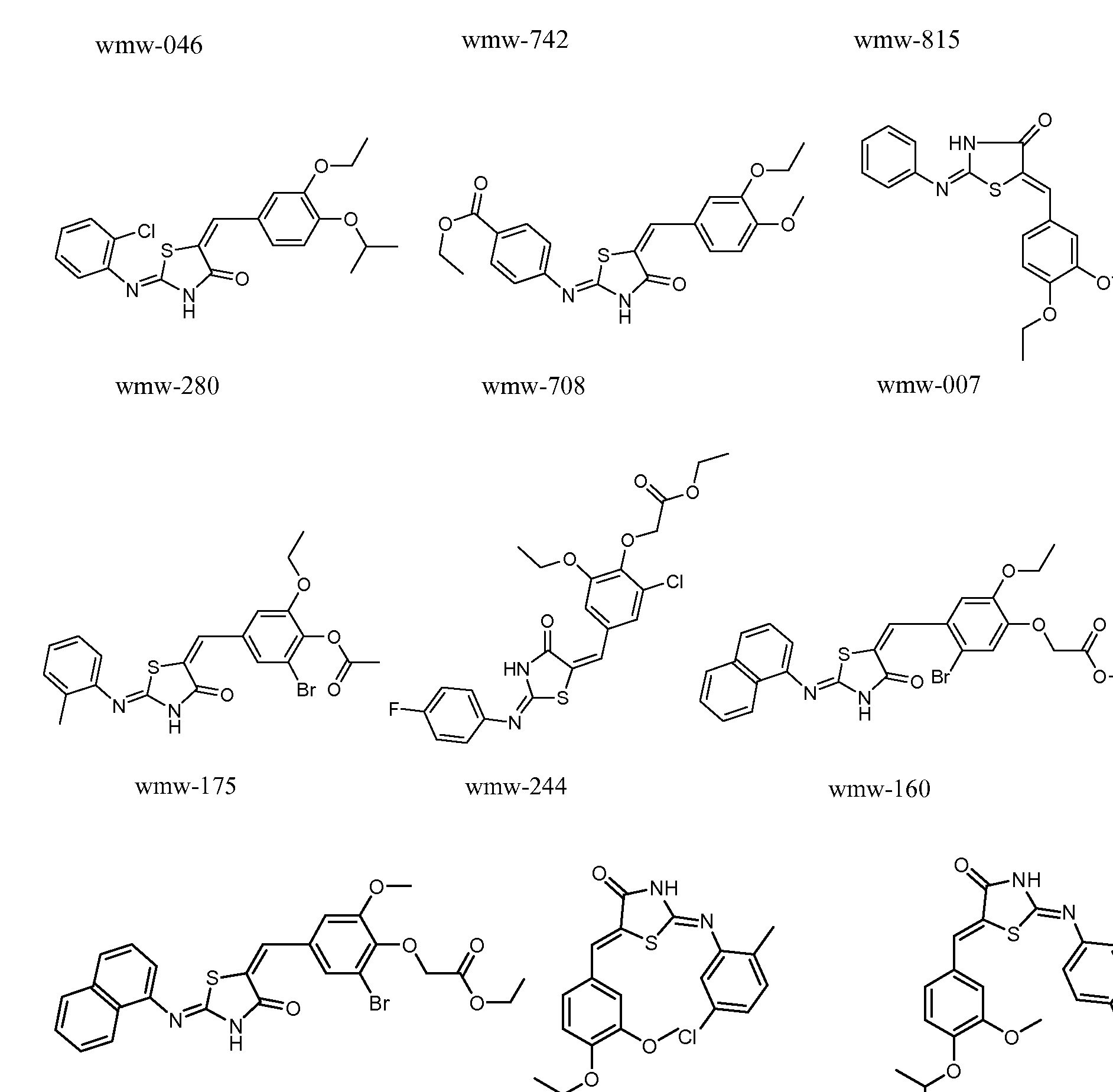
wmw-602 wmw-031 wmw-041
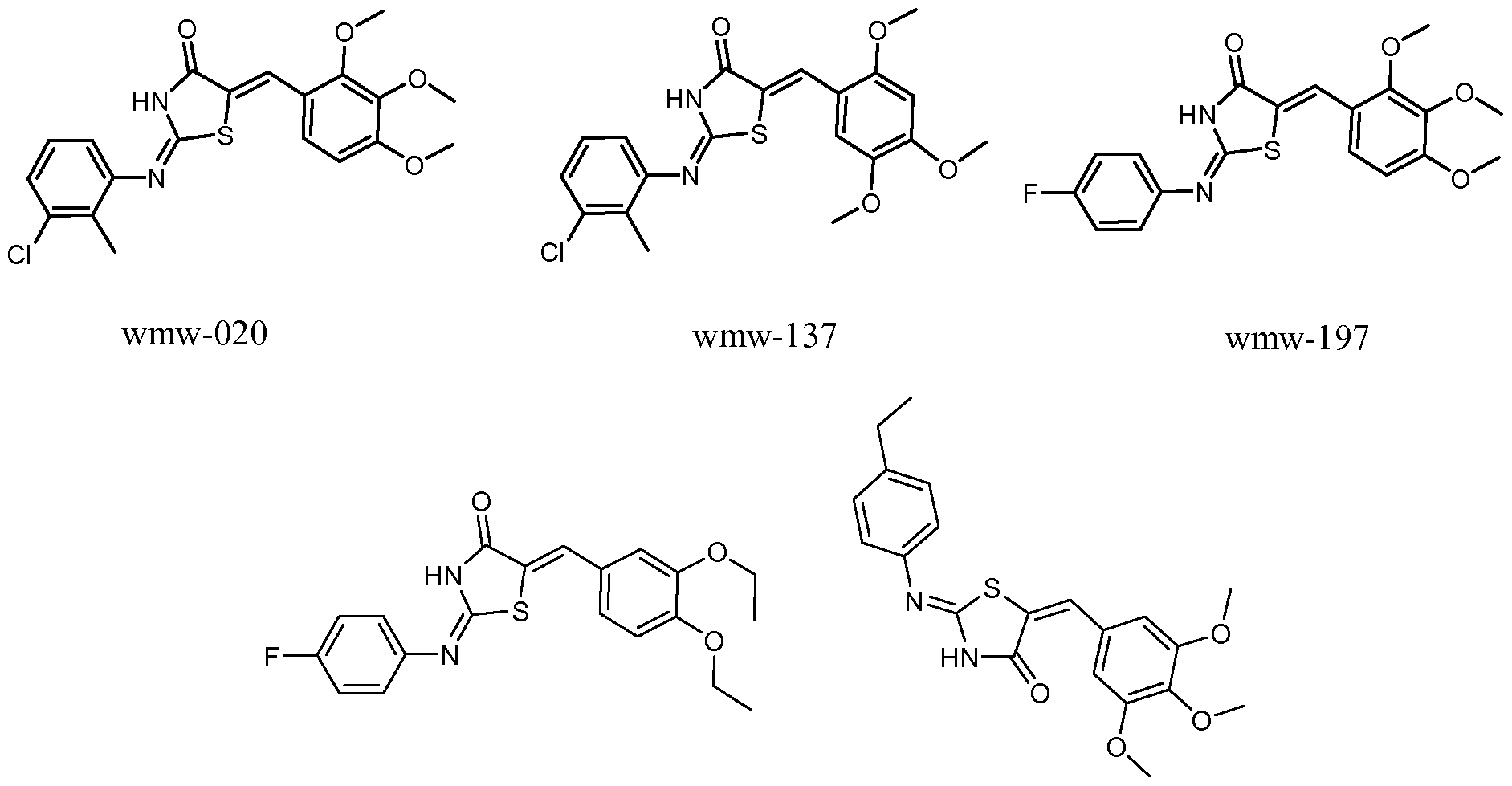
wmw-702 wmw-864
实施例 4、 2- (对甲苯基亚氣基) -N-甲基噻唑 -4-酮 -5-亚甲基苯氧乙酰胺的 制备

mww1016
在 50 ml三口瓶中加入 0.176 g ( 0.8 mmol ) N-甲基 -2- (对甲苯基亚氨 基) -噻唑 -4-酮, 0.143 g ( 0.8 mmol )对甲酰基苯氧乙酰胺, 1 ml哌啶, 20 ml无水乙醇, 加热回流 5小时。 冷却反应液, 析出黄色晶体, 抽滤, 烘干。 得 0.053 g黄色固体(收率 17.4% )。 ifiNMR (300MHz, DMSO-d6) δ 2.32 (s, 3Η), 3.32 (s, 3H), 4.48 (s, 2H), 6.91 (d
OS
's) 170ΌΪ UZ 'm) OfL - 09· ΧϊΙΖ to) Si'L - PZ'L X 'm) eO"A - 96·9 '(HZ 'S) 6VP \ΉΖ 'ΖΗ6"9=Γ ςο' '(He s) £-£ '(He 's) ςοτ Xm 'ΖΗ9"9=Γ ¾ ee-i Q(9P-OS VQ 'zH ooe) ¾ NHT


°(Ηΐ 's) S8"6 '(Ηΐ 's) 69·
'(HI 's) v'L '(Η9 'm) 8 Α - 68·9 '(ικ 's) ^ 'toe 's) e8-e 'toe 's) ie-e '(HZ 'ζΗζ£ = r ιςτ '(He 'ZHS' = r Ί) osn Q (αοεα 'zH ooe) ¾ NHT

^卞 ^ ^ -N- ( ^ 玄 -^-«^-e) -s- ( w¾r¾¾- -z ) -τ
°(Ηΐ 's) 66·6 '(Ηΐ 's) ILL
'(Ηΐ 'ΖΗ ·8 = Γ 'Ρ) Z9'L - 6ζ'ί '(HZ Si'L - ζΖ'ί '(H UXL - 96·9 '(HZ
's) LVP '(He 's) 6f£ m 's) ee-e '(He 's) ςο Q (9P-OS VQ 'zH ooe) ¾ NHT

^r ^丄、 Ο令^^? f丁 ¾r#
(Ηΐ 's) O L '(HI 's) 09·
(HZ 'm) ΐς·/τΐΐ· '(IK
 'Ρ) O'L '(Ηΐ
CTS000/800ZN3/X3d 8CZ6ll/800Z OAV
IS
'm) IL'L - 19· L '(He 'm) WL - L L '(He 90"A - 96·9 '(HZ 's) A17 '(He 's) 6L'£ '(He 's) "e '(HI 'm) '(H9 's) ^Γΐ Q (9P"OS VQ 'zH OOe) ¾ NHT

^卞 ^ ^ -N- Cftk^-f^ (ftikf ik' ) - -ftik-ί) -S- (« 玄«^丄 ^) -Z
°(Ηΐ 's) £6'6 ΧΐίΖ ' m) IL'L - WL ' (U£ ' m) OVL - LZ'L '(He eo-A - 96·9 X '^)LVP '(He 's) 6 £ '(He 's) e-e X 'ZHSO' = r Ί) βτζ Xuz
'ZHSO' = Γ ΐ9·ΐ '(He ' 9£'L = Γ Ί) £6'0 Q (9P"OS VQ 'zH OOe) ¾ NHT
9e01AMin
 玄 - -f' ik-i) -s- 玄 丄^) -ζ
°(Ηΐ 's) ΐ6·6 UZ 'm) \L'L - WL '(He
TO) ovL - 9Π '(He 'm) eo-A - 96·9 '(HZ 's) LVP m 's) 6f£ m 's) ee-e Xm
ZHSO' = Γ Z£'Z '(He ' 99'L = Γ Ί) 60· ΐ Q (9P"OS VQ 'zH OOe) ¾ NHT

°(Ηΐ 's) L£O\ \ 'ui) 6"A
- O'L X 's) 8i '(He 's) 6L'i '(He 's) se-e Q (9P-OS VQ 'zH ooe) ¾ NHT
\Z0\fAfAm

CTS000/800ZN3/X3d 8CZ6ll/800Z OAV
2H), 9.88 (s, 1H)。
2- (对叔丁氧甲酰氨基苯基亚氨基) -5- ( 3-甲氧基 -4- (氨甲酰基甲氧 基)苯基亚甲基) -N-甲基 -噻唑 -4-酮

mwwl041
'HNMR (300MHz, DMSO-d6) δ 1.49 (s, 9H), 3.32(s, 3H), 3.79 (s, 3H), 4.47 (s: 2H), 6.86 - 7.06 (m, 3H), 7.27 - 7.49 (m, 4H), 7.71 (s, 1H), 9.40 (s, 1H)。

wmw-152 wmw-377 wmw-147


53


CTS000/800ZN3/X3d 8CZ6ll/800Z OAV


实施例 5、 2- (对甲苯基亚 J -5- (噻吩 -2-甲酰氧基苯基亚甲基) -N- 甲基 -噻唑 -4-酮的制备

mww101 1 在 50 ml单口瓶中加入 0.176 g ( 0.8 mmol ) N-甲基 -2- (对甲苯基亚氨 基 ) -噻唑 -4-酮, 0.185 g ( 0.8 mmol )对(噻吩 -2-甲酰氧基 )苯甲醛, 1 ml 哌啶, 20 ml无水乙醇,加热回流 5小时。冷却反应液,减压浓缩至小体积, 加水稀释, 析出黄色固体, 抽滤, 烘干。 得 0.1 g黄色固体(收率: 28.8% )。 ifiNMR (300MHz, DMSO-d6) δ 2.32 (s, 3Η), 3.33 (s, 3H), 6.85 - 6.93 (m, 7H),
95
ΟΖθΐΜ

°(Ηΐ 's) ^ ΐ '(HI 's) W6 '(Ηΐΐ 'm) L6'L - ςς· L '(Ηΐ 's) \ L im 'm) ςο - 88"9 '(He 's) LL' '(He 's) £-£ Q (9P-0S VQ 'zH OOe) ¾ NHT

°(H17 'ui) g9'L - 9ς· L '(HA ZO'L -£S'9 \ΉΖ 'ΖΗ6"9=Γ 90
(He 's) ov£ '(He 's) ΐ7ΐ '(He ' L=£ ¾ o^i Q (QO£QD 'zH ooe) ¾ NHT
 玄 (
玄 (
 ) -z
) -z
°(Ηΐ 's) 86"6 '(HI 's) Z^6 89"A - 6^L '(HA ΟΓ '66·9
- 88"9 '(He 's) LL'I '(He 's) ee-e '(He 's) ςο Q (9P-OS VQ 'zH ooe) ¾ NHT
 玄 ( tk
 ) - -f' tk-i)
^r ^丄、 O令^^? f丁 ¾r#
'(Ηΐ 's) S9'L
 'Ρ) OVL-Li'L Xm ' VS =Γ 'Ρ) iZ'L - ΟΓ
CTS000/800ZN3/X3d 8CZ6ll/800Z OAV
'HNMR (300MHz,CD3OD) δ 1.16 (t, J = 7.65, 3H), 2.58 (q, J = 7.35 Hz, 2H), 3.44 (s, 3H), 3.83 (s, 3H), 6.83 - 7.36 (9H), 7.63 - 7.67 (2H)。
2- (对丙酰氨基苯基亚氨基) -5- ( 3-甲氧基 -4- (噻吩 -2-甲酰氧基)苯 基亚甲基) -N-甲基 -噻唑 -4-酮

mwwl035
'HNMR (300MHz, DMSO-d6) δ 1.08 (t, J = 7.35Hz, 3H), 2.30 (q, J = 7.2Hz, 2H), 3.28 (s, 3H), 3.72 (s, 3H), 6.73 - 7.07 (m, 7H), 7.58 - 7.61 (d, J = 9Hz, 4H): 9.90 (s, 1H)。
2- (对丁酰氨基苯基亚氨基) -5- ( 3-甲氧基 -4- (噻吩 -2-甲酰氧基)苯 基亚甲基) -N-甲基 -噻唑 -4-酮

mwwl037
'HNMR (300MHz, DMSO-d6) δ 0.92 (t, J = 7.2Hz, 3H), 1.62 (q, J = 7.2Hz, 2H) 2.28 (t, J = 6.9Hz, 2H), 3.33 (s, 3H), 3.76 (s, 3H), 6.87 - 6.98 (m, 6H), 7.20 (s, 1H), 7.61 - 7.67 (m, 4H), 9.91 (s, 1H)。
2- (对异丁酰氨基苯基亚氨基) -5- ( 3-甲氧基 -4- (噻吩 -2-甲酰氧基) 苯基亚甲基) -N-甲基 -噻唑 -4-酮

'HNMR (300MHz, DMSO-d6) δ 1.12 (s, 6H), 2.61 (m, 1H), 3.33 (s, 3H), 3.77 (s, 3H), 6.87 - 6.98 (m, 6H), 7.20 (s, 1H), 7.62 - 7.67 (m, 4H), 9.88 (s, 1H)。
2- (对叔丁氧甲酰氨基苯基亚氨基) -5- ( 3-甲氧基 -4- (噻吩 -2-甲酰氧 基)苯基亚甲基) -N-甲基 -噻唑 -4-酮

mwwl040
'HNMR (300MHz, DMSO-d6) δ 1.49 (s, 9H), 3.34(s, 3H), 3.77(s, 3H), 6.87 - 6.96 (m, 4H), 7.20 (s, 1H), 7.38 (m, 1H), 7.46 - 7.49 (d, J= 8.4Hz, 3H), 7.67 (s, 2H), 9.40 (s, 1H)。 实施例 6、 体外药效学试验
1.报告基因表达检测
GLP-1R为 G蛋白偶联受体,当 GLP-1R与激动剂结合后, G蛋白的 Ga 亚单位被活化, 刺激腺苷酸环化酶, 导致细胞内 cAMP水平升高。 因前胰 岛素基因的启动子区域存在 cAMP反应元件, cAMP与该反应元件结合后, 启动前胰岛素基因的转录,从而刺激胰岛素的表达和分泌(Diabetes 2000, vol. 49:1156-1164 )。 本实验方法采用稳定转染 GLP-1R受体基因表达载体 和受 cAMP反应元件调节的荧光素酶报告基因表达载体的人胚肾细胞株 ( HEK 293 ) , 检测其对被测化合物的反应 ( Cell Biology, 1992, 89:8641-8645; Proc. Natl. Acad. Sci. U.S.A. 1987, 84:3434-3438 )。 在对化合 物进行筛选时, 可诱导荧光素酶报告基因表达的样品, 视为具有 GLP-1R 激动活性。
1.1 试验材料与仪器 细胞株: GLP-1R和荧光素酶稳定表达的 HEK293/GLP-1R+Luc细胞株
(国家新药筛选中心自建) 胎牛血清( GIBCO公司 ) DMEM培养基 ( GIBCO公司)
Steady-GloTM荧光素酶分析系统(Promega公司)
GLP-1标准品 (Sigma公司 )
G418 ( Invitrogen公司)
Forma二氧化碳培养箱 ( Forma公司 )
Victor2读板机(Wallac公司 )
1.2 试全方法
HEK293/GLP1R+Luc细胞以 20,000个 /100 μΐ/孔接入 96孔培养板, 以 含 10%胎牛血清和 500 μ^ιηΐ G418的 DMEM培养基于 37。C培养过夜。将 GLP-1标准品和化合物 mwwl018 ( SHI 7249 )等稀释至一定浓度梯度, 然 后以 1 μΐ/孔加入上述 96孔微量培养板中。 在 37。C , 5%C02条件下培养 6 小时。 按 Steady-GloTM荧光素酶分析系统试剂盒说明检测荧光素酶活性, Victor2读板机进行读数。
1.3 试验结果
研究结果表明(图 1 ), GLP-1的 EC50值为 0.07 ΉΜ, 化合物 mwwl018 ( SH17249 )对 HEK293/GLP1R+Luc细胞的萤光素酶活性呈激动效应, 且 具剂量依赖性, 在最高浓度为 300 μΜ时, 其激动活性为 GLP-1 ( 10 ΉΜ ) 的 32.3 %。
2、 受体结合活力测试 为确定活性化合物对受体的结合能力, 制备大量表达 GLP - 1R 的细 胞, 以 [1251]标记的 GLP - 1作为配基, 同时加入待检测化合物。 当待测化 合物与 1251标 GLP - 1进行竟争性结合时, 细胞膜上的同位素标记减少。据 此可评估化合物对受体的的亲和力 (J Mol Endocrinol. 2000, 25:321-35; J
Biomol Screen. 2000, 5:377-84 )。 2.1试验材料与仪器:
HEK 293/GLPlR+Luc细胞株(国家新药筛选中心自建) 标 i己 4匕合物: [1251]标 i己的 GLP-1 ( Amersham Biosciences公司)
Wallac MicroBata工作站 ( PerkinElmer公司)
TomTech细胞收集器( TomTec公司 ) 闪烁液(Wallac公司 ) 2.2试全方法
取 105对数生长期的 HEK 293/GLP1R+Luc细胞, 于 25。C条件下, 200 μΐ测试緩冲液中, 与 [1251]标记的 GLP-1阳性肽(终浓度 40 ρΜ )共孵育 4 小时, 同时加入非标记阳性肽或化合物 mwwl018 ( SH17249 )等。 使用细 胞收集器, 用洗涤溶液洗涤细胞三次。 加入闪烁液, 在 MicroBata计数器 上读出每孔读数。
2.3试验结果 化合物 mwwl018 ( SHI 7249 )和 GLP-1均能特异性地与 1251标 GLP-1 竟争性结合受体且呈剂量效应 (图 2 )。 GLP-1的 IC5Q值为 0.66 ΉΜ, 化合 物 mwwl018 ( SH17249 )在最高浓度为 100 μΜ时对 [1251]标记的 GLP-1的
表 1.部分化合物的体外活性检测结果
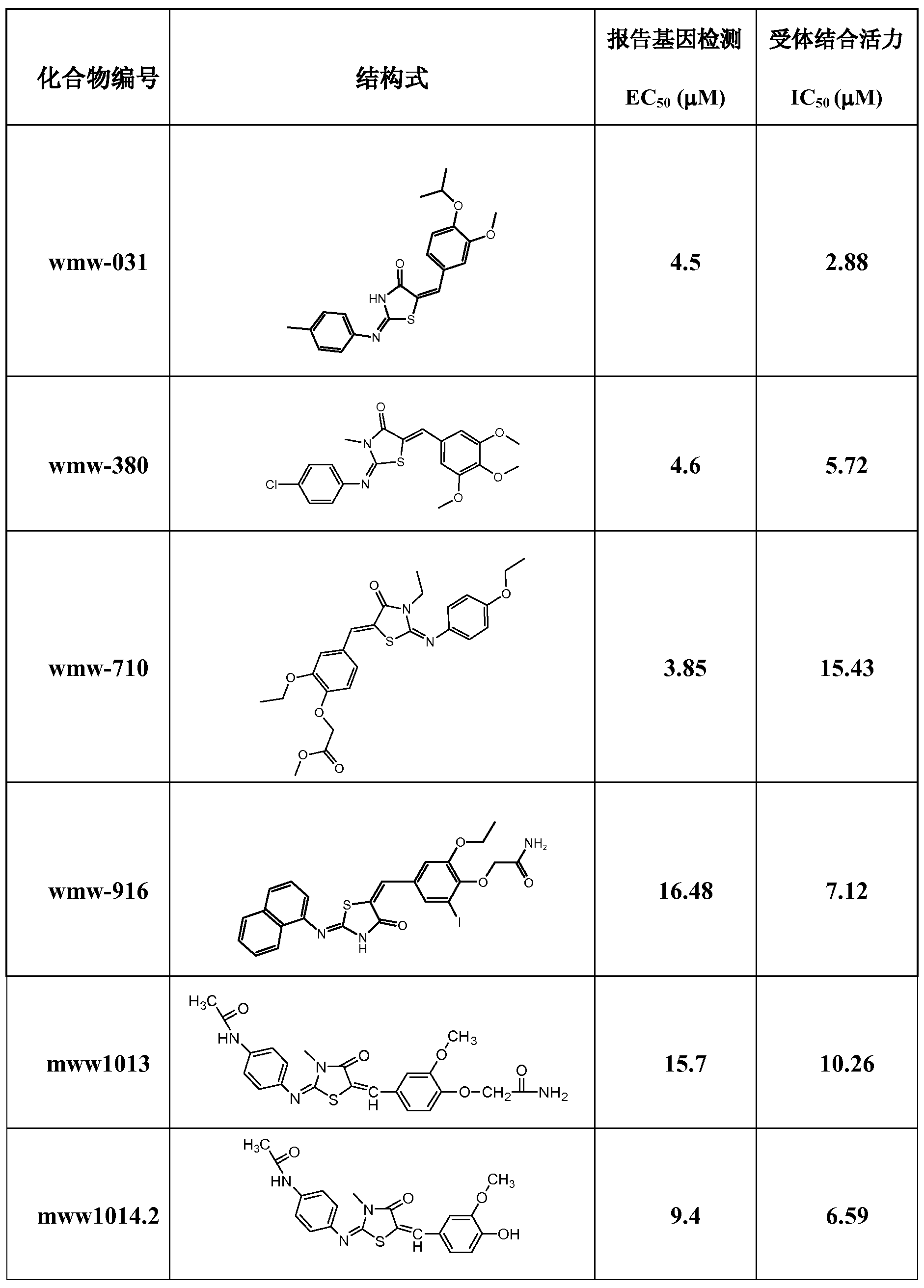

Claims
1、由以下通式表示的一类取代五元杂环化合物或其药物学上可接' 酯、 溶剂化物、 金属配合物、 或者与其具有相同药理作用的前药:

X为 0、 S或者 NH;
Y为 0、 S;
Z为 CH、 N;
为11 ; d-C6的烷基; 含有包括卤素原子、 crc6的烷氧基或羟基在 内任意一个、 两个或者三个取代的 crc6的烷基; c3-c6环烷基; 含有包括 卤素原子、 crc6的烷基、 crc6的烷氧基或羟基在内任意一个、 两个或者 三个取代的 C3-C6环烷基; 苯基; 含有包括卤素原子、 d-C6的烷基、 d-C6 的烷氧基或羟基在内任意一个、 两个或者三个取代的苯基; 苄基;
R2, R3为取代或未取代的苯基;取代或未取代的吡啶基;取代或未取代 的呋喃基; 取代或未取代的吡喃基; 取代或未取代的噻吩基; 取代或未取 代的吡咯基; 取代或未取代的吲哚基; 或者, 取代或未取代的萘基。
2、根据权利要求 1所述的一类取代五元杂环化合物或其药物学上可接 受的盐、 酯、 溶剂化物、 金属配合物、 或者与其具有相同药理作用的前药, 其特征在于:
X为 0、 S或者 NH; Y为 0、 S; Z为 CH、 N; 为 H; d-C6的烷 基; 含有包括卤素原子、 CrC6的烷氧基或羟基在内任意一个、 两个或者三 个取代的 d-C6烷基; C3-C6环烷基; 含有包括卤素原子、 d-C6的烷基、 d-c6的烷氧基或羟基在内任意一个、 两个或者三个取代的 c3-c6环烷基;
芳基; 含有包括卤素原子、 d-C6的烷基、 d-C6的烷氧基或羟基在内任意 一个、 两个或者三个取代的苯基; 苄基;
 其中 R4为下列任意一种取代基: H; 氰基; 磺酰氨基; 羟基; 巯基; 卤 素; 羧酸; 羧酸酯; d-C6的烷基; 含有包括卤素原子、 d-C6的烷氧基或 羟基在内的任意一个、两个或者三个取代的 CrC6的烷基; CrC6的烷氧基; 含有包括卤素原子、 d-C6的烷基、 d-C6的烷氧基或羟基在内的任意一个、 两个或者三个取代的 d-C6的烷氧基; d-C6的烷巯基;含有包括卤素原子、 d-C6的烷基、 d-C6的烷氧基或羟基在内的任意一个、 两个或者三个取代 的(^-0;的烷巯基; C2-C6的烯基; 含有包括卤素原子、 d-C6的烷基、 Ci-C6 的烷氧基或羟基在内的任意一个、两个或者三个取代的 c2-c6的烯基; c2-c6 的炔基; 含有包括卤素原子、 d-C6的烷基、 crc6的烷氧基或羟基在内的 任意一个、 两个或者三个取代的 c2-c6的炔基; crc6的烷酰氧基; 含有包 括卤素原子、 d-C6的烷基、 crc6的烷氧基或羟基在内的任意一个、 两个 或者三个取代的 d-c6的烷酰氧基; crc6的烷酰氨基;含有包括卤素原子、 d-c6的烷基、 d-C6的烷氧基或羟基在内的任意一个、 两个或者三个取代 的 d-C6的烷酰氨基时;
 其中 R5为下列任意一种取代基: H; 氰基; 磺酰氨基; 硝基; 羟基; 巯 基; 卤素; d-C6的烷基; 含有包括卤素原子、 CrC6的烷氧基或羟基在内的 任意一个、 两个或者三个取代的 d-C6的烷基; d-C6的烷氧基; 含有包括
卤素原子、 羧基、 羧酸酯基、 氰基、 d-C6的烷基、 d-C6的烷氧基或羟基 在内的任意一个、 两个或者三个取代的 crc6的烷氧基; crc6的烷巯基; 含有包括卤素原子、 羧基、 羧酸酯基、 氰基、 d-C6的烷基、 crc6的烷氧 基或羟基在内的任意一个、 两个或者三个取代的 crc6的烷巯基; c2-c6的 烯基; 含有包括卤素原子、 羧基、 羧酸酯基、 氰基、 d-C6的烷基、 d-C6 的烷氧基或羟基在内的任意一个、两个或者三个取代的 c2-c6的烯基; c2-c6 的炔基; 含有包括卤素原子、 羧基、 羧酸酯基、 氰基、 d-C6的烷基、 d-C6 的烷氧基或羟基在内的任意一个、两个或者三个取代的 c2-c6的炔基; c2-c6 的烯氧基;含有包括卤素原子、羧基、羧酸酯基、氰基、 d-C6的烷基、 d-C6 的烷氧基或羟基在内的任意一个、 两个或者三个取代的 c2-c6的烯氧基; c2-c6的炔氧基; 含有包括卤素原子、 羧基、 羧酸酯基、 氰基、 crc6的烷 基、 crc6的烷氧基或羟基在内的任意一个、 两个或者三个取代的 c2-c6的 炔氧基; 苄氧基; 含有包括卤素原子、 d-C6的烷基、 d-C6的烷氧基或羟 基在内的任意一个、 两个或者三个取代的苄氧基; 苯氧基; 苯巯基; d-C6 的烷酰氧基; 含有包括卤素原子、 d-C6的烷基、 d-C6的烷氧基或羟基在 内的任意一个、两个或者三个取代的 crc6的烷酰氧基; c3-c6的环烷酰氧 基; 含有包括卤素原子、 d-C6的烷基、 d-C6的烷氧基或羟基在内的任意 一个、 两个或者三个取代的 c3-c6的环烷酰氧基; 芳酰氧基; 含有包括卤 素原子、 d-C6的烷基、 crc6的烷氧基或羟基在内的任意一个、 两个或者 三个取代的芳酰氧基;
其中 R5为下列任意一种取代基: H; 氰基; 磺酰氨基; 硝基; 羟基; 巯 基; 卤素; d-C6的烷基; 含有包括卤素原子、 CrC6的烷氧基或羟基在内的 任意一个、 两个或者三个取代的 d-C6的烷基; d-C6的烷氧基; 含有包括
卤素原子、 羧基、 羧酸酯基、 氰基、 d-C6的烷基、 d-C6的烷氧基或羟基 在内的任意一个、 两个或者三个取代的 crc6的烷氧基; crc6的烷巯基; 含有包括卤素原子、 羧基、 羧酸酯基、 氰基、 d-C6的烷基、 crc6的烷氧 基或羟基在内的任意一个、 两个或者三个取代的 crc6的烷巯基; c2-c6的 烯基; 含有包括卤素原子、 羧基、 羧酸酯基、 氰基、 d-C6的烷基、 d-C6 的烷氧基或羟基在内的任意一个、两个或者三个取代的 c2-c6的烯基; c2-c6 的炔基; 含有包括卤素原子、 羧基、 羧酸酯基、 氰基、 d-C6的烷基、 d-C6 的烷氧基或羟基在内的任意一个、两个或者三个取代的 c2-c6的炔基; c2-c6 的烯氧基;含有包括卤素原子、羧基、羧酸酯基、氰基、 d-C6的烷基、 d-C6 的烷氧基或羟基在内的任意一个、 两个或者三个取代的 c2-c6的烯氧基; c2-c6的炔氧基; 含有包括卤素原子、 羧基、 羧酸酯基、 氰基、 crc6的烷 基、 crc6的烷氧基或羟基在内的任意一个、 两个或者三个取代的 c2-c6的 炔氧基; 苄氧基; 含有包括卤素原子、 d-C6的烷基、 d-C6的烷氧基或羟 基在内的任意一个、 两个或者三个取代的苄氧基; 苯氧基; 苯巯基; d-C6 的烷酰氧基; 含有包括卤素原子、 d-C6的烷基、 d-C6的烷氧基或羟基在 内的任意一个、两个或者三个取代的 crc6的烷酰氧基; c3-c6的环烷酰氧 基; 含有包括卤素原子、 d-C6的烷基、 d-C6的烷氧基或羟基在内的任意 一个、 两个或者三个取代的 c3-c6的环烷酰氧基; 芳酰氧基; 含有包括卤 素原子、 d-C6的烷基、 crc6的烷氧基或羟基在内的任意一个、 两个或者 三个取代的芳酰氧基;
 其中 R6、 R7各自独立为下列任意一种取代基: H; 氰基; 磺酰氨基; 硝基; 羟基; 巯基; 卤素; d-C6的烷基; 含有包括卤素原子、 crc6的烷氧
基或羟基在内的任意一个、 两个或者三个取代的 crc6的烷基; crc6的烷 氧基; 含有包括卤素原子、 羧基、 羧酸酯基、 氰基、 d-C6的烷基、 d-C6 的烷氧基或羟基在内的任意一个、 两个或者三个取代的 crc6的烷氧基; d-c6的烷巯基; 含有包括卤素原子、 羧基、 羧酸酯基、 氰基、 d-C6的烷 基、 crc6的烷氧基或羟基在内的任意一个、 两个或者三个取代的 crc6的 烷巯基; C2-C6的烯基; 含有包括卤素原子、 羧基、 羧酸酯基、 氰基、 Ci-C6 的烷基、 d-C6的烷氧基或羟基在内的任意一个、两个或者三个取代的 c2-c6 的烯基; C2-C6的炔基; 含有包括卤素原子、 羧基、 羧酸酯基、 氰基、 Ci-C6 的烷基、 d-C6的烷氧基或羟基在内的任意一个、两个或者三个取代的 c2-c6 的炔基; C2-C6的烯氧基;含有包括卤素原子、羧基、酯基、羧酸酯基、 d-C6 的烷基、 d-C6的烷氧基或羟基在内的任意一个、两个或者三个取代的 c2-c6 的烯氧基; C2-C6的炔氧基; 含有包括卤素原子、 羧基、 酯基、 氰基、 d-C6 的烷基、 d-C6的烷氧基或羟基在内的任意一个、两个或者三个取代的 c2-c6 的炔氧基; 苄氧基; 含有包括卤素原子、 d-C6的烷基、 d-C6的烷氧基或 羟基在内的任意一个、两个或者三个取代的苄氧基;苯氧基;苯巯基; d-C6 的烷酰氧基; 含有包括卤素原子、 d-C6的烷基、 d-C6的烷氧基或羟基在 内的任意一个、两个或者三个取代的 crc6的烷酰氧基; c3-c6的环烷酰氧 基; 含有包括卤素原子、 d-C6的烷基、 d-C6的烷氧基或羟基在内的任意 一个、 两个或者三个取代的 c3-c6的环烷酰氧基; 芳酰氧基; 含有包括卤 素原子、 d-C6的烷基、 crc6的烷氧基或羟基在内的任意一个、 两个或者 三个取代的芳酰氧基;
其中 R6、 R7各自独立为下列任意一种取代基: H; 氰基; 磺酰氨基; 硝基; 羟基; 巯基; 卤素; d-C6的烷基; 含有包括卤素原子、 crc6的烷氧
基或羟基在内的任意一个、 两个或者三个取代的 crc6的烷基; crc6的烷 氧基; 含有包括卤素原子、 羧基、 羧酸酯基、 氰基、 d-C6的烷基、 d-C6 的烷氧基或羟基在内的任意一个、 两个或者三个取代的 crc6的烷氧基; d-c6的烷巯基; 含有包括卤素原子、 羧基、 羧酸酯基、 氰基、 d-C6的烷 基、 crc6的烷氧基或羟基在内的任意一个、 两个或者三个取代的 crc6的 烷巯基; C2-C6的烯基; 含有包括卤素原子、 羧基、 羧酸酯基、 氰基、 Ci-C6 的烷基、 d-C6的烷氧基或羟基在内的任意一个、两个或者三个取代的 c2-c6 的烯基; C2-C6的炔基; 含有包括卤素原子、 羧基、 羧酸酯基、 氰基、 Ci-C6 的烷基、 d-C6的烷氧基或羟基在内的任意一个、两个或者三个取代的 c2-c6 的炔基; C2-C6的烯氧基;含有包括卤素原子、羧基、酯基、羧酸酯基、 d-C6 的烷基、 d-C6的烷氧基或羟基在内的任意一个、两个或者三个取代的 c2-c6 的烯氧基; C2-C6的炔氧基; 含有包括卤素原子、 羧基、 酯基、 氰基、 d-C6 的烷基、 d-C6的烷氧基或羟基在内的任意一个、两个或者三个取代的 c2-c6 的炔氧基; 苄氧基; 含有包括卤素原子、 d-C6的烷基、 d-C6的烷氧基或 羟基在内的任意一个、两个或者三个取代的苄氧基;苯氧基;苯巯基; d-C6 的烷酰氧基; 含有包括卤素原子、 d-C6的烷基、 d-C6的烷氧基或羟基在 内的任意一个、两个或者三个取代的 crc6的烷酰氧基; c3-c6的环烷酰氧 基; 含有包括卤素原子、 d-C6的烷基、 d-C6的烷氧基或羟基在内的任意 一个、 两个或者三个取代的 c3-c6的环烷酰氧基; 芳酰氧基; 含有包括卤 素原子、 d-C6的烷基、 crc6的烷氧基或羟基在内的任意一个、 两个或者 三个取代的芳酰氧基;
或者 R3为:
 其中 R8、 R9、 R10为下列任意一种取代基: H; 氰基; 磺酰氨基; 硝基;
羟基; 巯基; 卤素; d-C6的烷基; 含有包括卤素原子、 crc6的烷氧基或羟 基在内的任意一个、 两个或者三个取代的 crc6的烷基; crc6的烷氧基; 含有包括卤素原子、 羧基、 羧酸酯基、 氰基、 d-C6的烷基、 crc6的烷氧 基或羟基在内的任意一个、 两个或者三个取代的 crc6的烷氧基; crc6的 烷巯基; 含有包括卤素原子、 羧基、 羧酸酯基、 氰基、 d-C6的烷基、 d-C6 的烷氧基或羟基在内的任意一个、 两个或者三个取代的 crc6的烷巯基;
其中 R8、 R9、 R10为下列任意一种取代基: H; 氰基; 磺酰氨基; 硝基;
羟基; 巯基; 卤素; d-C6的烷基; 含有包括卤素原子、 crc6的烷氧基或羟 基在内的任意一个、 两个或者三个取代的 crc6的烷基; crc6的烷氧基; 含有包括卤素原子、 羧基、 羧酸酯基、 氰基、 d-C6的烷基、 crc6的烷氧 基或羟基在内的任意一个、 两个或者三个取代的 crc6的烷氧基; crc6的 烷巯基; 含有包括卤素原子、 羧基、 羧酸酯基、 氰基、 d-C6的烷基、 d-C6 的烷氧基或羟基在内的任意一个、 两个或者三个取代的 crc6的烷巯基;
C2-C6的烯基; 含有包括卤素原子、 羧基、 羧酸酯基、 氰基、 d-C6的烷基、 d-c6的烷氧基或羟基在内的任意一个、两个或者三个取代的 c2-c6的烯基;
C2-C6的炔基; 含有包括卤素原子、 羧基、 羧酸酯基、 氰基、 d-C6的烷基、 d-c6的烷氧基或羟基在内的任意一个、两个或者三个取代的 c2-c6的炔基;
C2-C6的烯氧基; 含有包括卤素原子、 羧基、 羧酸酯基、 氰基、 d-C6的烷 基、 crc6的烷氧基或羟基在内的任意一个、 两个或者三个取代的 c2-c6的 烯氧基; C2-C6的炔氧基;含有包括卤素原子、羧基、羧酸酯基、氰基、 d-C6 的烷基、 d-C6的烷氧基或羟基在内的任意一个、两个或者三个取代的 c2-c6 的炔氧基; 苄氧基; 含有包括卤素原子、 d-C6的烷基、 d-C6的烷氧基或 羟基在内的任意一个、两个或者三个取代的苄氧基;苯氧基;苯巯基; d-C6 的烷酰氧基; 含有包括卤素原子、 d-C6的烷基、 d-C6的烷氧基或羟基在 内的任意一个、两个或者三个取代的 crc6的烷酰氧基; c3-c6的环烷酰氧 基; 含有包括卤素原子、 d-C6的烷基、 d-C6的烷氧基或羟基在内的任意 一个、 两个或者三个取代的 c3-c6的环烷酰氧基; 芳酰氧基; 含有包括卤 素原子、 d-C6的烷基、 crc6的烷氧基或羟基在内的任意一个、 两个或者 三个取代的芳酰氧基;
或者, 当 R2为:
 其中 Ru、 R12各自独立为下列任意一种取代基: H; 氰基; 磺酰氨基; 羟基; 巯基; 卤素; 羧酸; 羧酸酯; d-C6的烷基;含有包括卤素原子、 d-C6 的烷氧基或羟基在内的任意一个、两个或者三个取代的 CrC6的烷基; d-C6 的烷氧基; 含有包括卤素原子、 d-C6的烷基、 d-C6的烷氧基或羟基在内 的任意一个、 两个或者三个取代的 d-C6的烷氧基; d-C6的烷巯基; 含有 包括卤素原子、 d-C6的烷基、 CrC6的烷氧基或羟基在内的任意一个、 两 个或者三个取代的 d-C6的烷巯基; C2-C6的烯基;含有包括卤素原子、 的烷基、 d-C6的烷氧基或羟基在内的任意一个、两个或者三个取代的 C2-C6 的烯基; C2-C6的炔基; 含有包括卤素原子、 d-C6的烷基、 CrC6的烷氧基 或羟基在内的任意一个、两个或者三个取代的 c2-c6的炔基; crc6的烷酰 氧基; 含有包括卤素原子、 d-C6的烷基、 crc6的烷氧基或羟基在内的任 意一个、 两个或者三个取代的 crc6的烷酰氧基; crc6的烷酰氨基; 含有 包括卤素原子、 d-C6的烷基、 crc6的烷氧基或羟基在内的任意一个、 两 个或者三个取代的 d-C6的烷酰氨基时;
 其中 R5为下列任意一种取代基: H; 氰基; 磺酰氨基; 硝基; 羟基; 巯 基; 卤素; d-C6的烷基; 含有包括卤素原子、 CrC6的烷氧基或羟基在内的 任意一个、 两个或者三个取代的 d-C6的烷基; d-C6的烷氧基; 含有包括 卤素原子、 羧基、 羧酸酯基、 氰基、 d-C6的烷基、 d-C6的烷氧基或羟基 在内的任意一个、 两个或者三个取代的 crc6的烷氧基; crc6的烷巯基; 含有包括卤素原子、 羧基、 羧酸酯基、 氰基、 d-C6的烷基、 crc6的烷氧 基或羟基在内的任意一个、 两个或者三个取代的 crc6的烷巯基; c2-c6的 烯基; 含有包括卤素原子、 羧基、 羧酸酯基、 氰基、 d-C6的烷基、 d-C6
的烷氧基或羟基在内的任意一个、两个或者三个取代的 c2-c6的烯基; c2-c6 的炔基; 含有包括卤素原子、 羧基、 羧酸酯基、 氰基、 d-C6的烷基、 d-C6 的烷氧基或羟基在内的任意一个、两个或者三个取代的 c2-c6的炔基; c2-c6 的烯氧基;含有包括卤素原子、羧基、羧酸酯基、氰基、 d-C6的烷基、 d-C6 的烷氧基或羟基在内的任意一个、 两个或者三个取代的 c2-c6的烯氧基; c2-c6的炔氧基; 含有包括卤素原子、 羧基、 羧酸酯基、 氰基、 crc6的烷 基、 crc6的烷氧基或羟基在内的任意一个、 两个或者三个取代的 c2-c6的 炔氧基; 苄氧基; 含有包括卤素原子、 d-C6的烷基、 d-C6的烷氧基或羟 基在内的任意一个、 两个或者三个取代的苄氧基; 苯氧基; 苯巯基; d-C6 的烷酰氧基; 含有包括卤素原子、 d-C6的烷基、 d-C6的烷氧基或羟基在 内的任意一个、两个或者三个取代的 crc6的烷酰氧基; c3-c6的环烷酰氧 基; 含有包括卤素原子、 d-C6的烷基、 d-C6的烷氧基或羟基在内的任意 一个、 两个或者三个取代的 c3-c6的环烷酰氧基; 芳酰氧基; 含有包括卤 素原子、 d-C6的烷基、 crc6的烷氧基或羟基在内的任意一个、 两个或者 三个取代的芳酰氧基;
其中 R5为下列任意一种取代基: H; 氰基; 磺酰氨基; 硝基; 羟基; 巯 基; 卤素; d-C6的烷基; 含有包括卤素原子、 CrC6的烷氧基或羟基在内的 任意一个、 两个或者三个取代的 d-C6的烷基; d-C6的烷氧基; 含有包括 卤素原子、 羧基、 羧酸酯基、 氰基、 d-C6的烷基、 d-C6的烷氧基或羟基 在内的任意一个、 两个或者三个取代的 crc6的烷氧基; crc6的烷巯基; 含有包括卤素原子、 羧基、 羧酸酯基、 氰基、 d-C6的烷基、 crc6的烷氧 基或羟基在内的任意一个、 两个或者三个取代的 crc6的烷巯基; c2-c6的 烯基; 含有包括卤素原子、 羧基、 羧酸酯基、 氰基、 d-C6的烷基、 d-C6
的烷氧基或羟基在内的任意一个、两个或者三个取代的 c2-c6的烯基; c2-c6 的炔基; 含有包括卤素原子、 羧基、 羧酸酯基、 氰基、 d-C6的烷基、 d-C6 的烷氧基或羟基在内的任意一个、两个或者三个取代的 c2-c6的炔基; c2-c6 的烯氧基;含有包括卤素原子、羧基、羧酸酯基、氰基、 d-C6的烷基、 d-C6 的烷氧基或羟基在内的任意一个、 两个或者三个取代的 c2-c6的烯氧基; c2-c6的炔氧基; 含有包括卤素原子、 羧基、 羧酸酯基、 氰基、 crc6的烷 基、 crc6的烷氧基或羟基在内的任意一个、 两个或者三个取代的 c2-c6的 炔氧基; 苄氧基; 含有包括卤素原子、 d-C6的烷基、 d-C6的烷氧基或羟 基在内的任意一个、 两个或者三个取代的苄氧基; 苯氧基; 苯巯基; d-C6 的烷酰氧基; 含有包括卤素原子、 d-C6的烷基、 d-C6的烷氧基或羟基在 内的任意一个、两个或者三个取代的 crc6的烷酰氧基; c3-c6的环烷酰氧 基; 含有包括卤素原子、 d-C6的烷基、 d-C6的烷氧基或羟基在内的任意 一个、 两个或者三个取代的 c3-c6的环烷酰氧基; 芳酰氧基; 含有包括卤 素原子、 d-C6的烷基、 crc6的烷氧基或羟基在内的任意一个、 两个或者 三个取代的芳酰氧基;
 其中 R6、 R7各自独立为下列任意一种取代基: H; 氰基; 磺酰氨基; 硝基; 羟基; 巯基; 卤素; d-C6的烷基; 含有包括卤素原子、 crc6的烷氧 基或羟基在内的任意一个、 两个或者三个取代的 crc6的烷基; crc6的烷 氧基; 含有包括卤素原子、 羧基、 羧酸酯基、 氰基、 d-C6的烷基、 d-C6 的烷氧基或羟基在内的任意一个、 两个或者三个取代的 crc6的烷氧基; d-c6的烷巯基; 含有包括卤素原子、 羧基、 羧酸酯基、 氰基、 d-C6的烷 基、 crc6的烷氧基或羟基在内的任意一个、 两个或者三个取代的 crc6的
烷巯基; C2-C6的烯基; 含有包括卤素原子、 羧基、 羧酸酯基、 氰基、 Ci-C6 的烷基、 d-C6的烷氧基或羟基在内的任意一个、两个或者三个取代的 c2-c6 的烯基; C2-C6的炔基; 含有包括卤素原子、 羧基、 羧酸酯基、 氰基、 Ci-C6 的烷基、 d-C6的烷氧基或羟基在内的任意一个、两个或者三个取代的 c2-c6 的炔基; C2-C6的烯氧基;含有包括卤素原子、羧基、羧酸酯基、氰基、 d-C6 的烷基、 d-C6的烷氧基或羟基在内的任意一个、两个或者三个取代的 c2-c6 的烯氧基; c2-c6的炔氧基; 含有包括卤素原子、 羧基、 羧酸酯基、 氰基、 d-c6的烷基、 d-C6的烷氧基或羟基在内的任意一个、 两个或者三个取代 的 C2-C6的炔氧基; 苄氧基; 含有包括卤素原子、 d-C6的烷基、 crc6的烷 氧基或羟基在内的任意一个、 两个或者三个取代的苄氧基; 苯氧基; 苯巯 基; d-C6的烷酰氧基; 含有包括卤素原子、 d-C6的烷基、 d-C6的烷氧基 或羟基在内的任意一个、 两个或者三个取代的 crc6的烷酰氧基; c3-c6 的环烷酰氧基; 含有包括卤素原子、 d-C6的烷基、 d-C6的烷氧基或羟基 在内的任意一个、 两个或者三个取代的 c3-c6的环烷酰氧基; 芳酰氧基; 含有包括卤素原子、 d-C6的烷基、 d-C6的烷氧基或羟基在内的任意一个、 两个或者三个取代的芳酰氧基;
其中 R6、 R7各自独立为下列任意一种取代基: H; 氰基; 磺酰氨基; 硝基; 羟基; 巯基; 卤素; d-C6的烷基; 含有包括卤素原子、 crc6的烷氧 基或羟基在内的任意一个、 两个或者三个取代的 crc6的烷基; crc6的烷 氧基; 含有包括卤素原子、 羧基、 羧酸酯基、 氰基、 d-C6的烷基、 d-C6 的烷氧基或羟基在内的任意一个、 两个或者三个取代的 crc6的烷氧基; d-c6的烷巯基; 含有包括卤素原子、 羧基、 羧酸酯基、 氰基、 d-C6的烷 基、 crc6的烷氧基或羟基在内的任意一个、 两个或者三个取代的 crc6的
烷巯基; C2-C6的烯基; 含有包括卤素原子、 羧基、 羧酸酯基、 氰基、 Ci-C6 的烷基、 d-C6的烷氧基或羟基在内的任意一个、两个或者三个取代的 c2-c6 的烯基; C2-C6的炔基; 含有包括卤素原子、 羧基、 羧酸酯基、 氰基、 Ci-C6 的烷基、 d-C6的烷氧基或羟基在内的任意一个、两个或者三个取代的 c2-c6 的炔基; C2-C6的烯氧基;含有包括卤素原子、羧基、羧酸酯基、氰基、 d-C6 的烷基、 d-C6的烷氧基或羟基在内的任意一个、两个或者三个取代的 c2-c6 的烯氧基; c2-c6的炔氧基; 含有包括卤素原子、 羧基、 羧酸酯基、 氰基、 d-c6的烷基、 d-C6的烷氧基或羟基在内的任意一个、 两个或者三个取代 的 C2-C6的炔氧基; 苄氧基; 含有包括卤素原子、 d-C6的烷基、 crc6的烷 氧基或羟基在内的任意一个、 两个或者三个取代的苄氧基; 苯氧基; 苯巯 基; d-C6的烷酰氧基; 含有包括卤素原子、 d-C6的烷基、 d-C6的烷氧基 或羟基在内的任意一个、 两个或者三个取代的 crc6的烷酰氧基; c3-c6 的环烷酰氧基; 含有包括卤素原子、 d-C6的烷基、 d-C6的烷氧基或羟基 在内的任意一个、 两个或者三个取代的 c3-c6的环烷酰氧基; 芳酰氧基; 含有包括卤素原子、 d-C6的烷基、 d-C6的烷氧基或羟基在内的任意一个、 两个或者三个取代的芳酰氧基;
或者 R3为:
 其中 R8、 R9、 R10为下列任意一种取代基: H; 氰基; 磺酰氨基; 硝基; 羟基; 巯基; 卤素; d-C6的烷基; 含有包括卤素原子、 CrC6的烷氧基或羟 基在内的任意一个、 两个或者三个取代的 CrC6的烷基; CrC6的烷氧基; 含有包括卤素原子、 羧基、 羧酸酯基、 氰基、 d-C6的烷基、 crc6的烷氧 基或羟基在内的任意一个、 两个或者三个取代的 crc6的烷氧基; crc6的 烷巯基; 含有包括卤素原子、 羧基、 羧酸酯基、 氰基、 d-C6的烷基、 d-C6
的烷氧基或羟基在内的任意一个、 两个或者三个取代的 crc6的烷巯基;
其中 R8、 R9、 R10为下列任意一种取代基: H; 氰基; 磺酰氨基; 硝基; 羟基; 巯基; 卤素; d-C6的烷基; 含有包括卤素原子、 CrC6的烷氧基或羟 基在内的任意一个、 两个或者三个取代的 CrC6的烷基; CrC6的烷氧基; 含有包括卤素原子、 羧基、 羧酸酯基、 氰基、 d-C6的烷基、 crc6的烷氧 基或羟基在内的任意一个、 两个或者三个取代的 crc6的烷氧基; crc6的 烷巯基; 含有包括卤素原子、 羧基、 羧酸酯基、 氰基、 d-C6的烷基、 d-C6
的烷氧基或羟基在内的任意一个、 两个或者三个取代的 crc6的烷巯基;
C2-C6的烯基; 含有包括卤素原子、 羧基、 羧酸酯基、 氰基、 d-C6的烷基、 d-c6的烷氧基或羟基在内的任意一个、两个或者三个取代的 c2-c6的烯基;
C2-C6的炔基; 含有包括卤素原子、 羧基、 羧酸酯基、 氰基、 d-C6的烷基、 d-c6的烷氧基或羟基在内的任意一个、两个或者三个取代的 c2-c6的炔基;
C2-C6的烯氧基; 含有包括卤素原子、 羧基、 羧酸酯基、 氰基、 d-C6的烷 基、 crc6的烷氧基或羟基在内的任意一个、 两个或者三个取代的 c2-c6的 烯氧基; C2-C6的炔氧基;含有包括卤素原子、羧基、羧酸酯基、氰基、 d-C6 的烷基、 d-C6的烷氧基或羟基在内的任意一个、两个或者三个取代的 c2-c6 的炔氧基; 苄氧基; 含有包括卤素原子、 d-C6的烷基、 d-C6的烷氧基或 羟基在内的任意一个、两个或者三个取代的苄氧基;苯氧基;苯巯基; d-C6 的烷酰氧基; 含有包括卤素原子、 d-C6的烷基、 d-C6的烷氧基或羟基在 内的任意一个、两个或者三个取代的 crc6的烷酰氧基; c3-c6的环烷酰氧 基; 含有包括卤素原子、 d-C6的烷基、 d-C6的烷氧基或羟基在内的任意 一个、 两个或者三个取代的 c3-c6的环烷酰氧基; 芳酰氧基; 含有包括卤 素原子、 d-C6的烷基、 crc6的烷氧基或羟基在内的任意一个、 两个或者 三个取代的芳酰氧基;
或者, 当 R2为:
 其中 R13、 R14为下列任意一种取代基: H; 氰基; 磺酰氨基; 羟基; 巯 基; 卤素; 羧酸; 羧酸酯; d-C6的烷基; 含有包括卤素原子、 crc6的烷氧 基或羟基在内的任意一个、 两个或者三个取代的 crc6的烷基; crc6的烷 氧基; 含有包括卤素原子、 d-C6的烷基、 crc6的烷氧基或羟基在内的任
意一个、 两个或者三个取代的 d-C6的烷氧基; d-C6的烷巯基; 含有包括 卤素原子、 d-C6的烷基、 crc6的烷氧基或羟基在内的任意一个、 两个或 者三个取代的 d-C6的烷巯基; C2-C6的烯基; 含有包括卤素原子、 d-C6 的烷基、 d-C6的烷氧基或羟基在内的任意一个、两个或者三个取代的 c2-c6 的烯基; C2-C6的炔基; 含有包括卤素原子、 d-C6的烷基、 crc6的烷氧基 或羟基在内的任意一个、两个或者三个取代的 c2-c6的炔基; crc6的烷酰 氧基; 含有包括卤素原子、 d-C6的烷基、 crc6的烷氧基或羟基在内的任 意一个、 两个或者三个取代的 crc6的烷酰氧基; crc6的烷酰氨基; 含有 包括卤素原子、 d-C6的烷基、 crc6的烷氧基或羟基在内的任意一个、 两 个或者三个取代的 d-C6的烷酰氨基时;
其中 R13、 R14为下列任意一种取代基: H; 氰基; 磺酰氨基; 羟基; 巯 基; 卤素; 羧酸; 羧酸酯; d-C6的烷基; 含有包括卤素原子、 crc6的烷氧 基或羟基在内的任意一个、 两个或者三个取代的 crc6的烷基; crc6的烷 氧基; 含有包括卤素原子、 d-C6的烷基、 crc6的烷氧基或羟基在内的任
意一个、 两个或者三个取代的 d-C6的烷氧基; d-C6的烷巯基; 含有包括 卤素原子、 d-C6的烷基、 crc6的烷氧基或羟基在内的任意一个、 两个或 者三个取代的 d-C6的烷巯基; C2-C6的烯基; 含有包括卤素原子、 d-C6 的烷基、 d-C6的烷氧基或羟基在内的任意一个、两个或者三个取代的 c2-c6 的烯基; C2-C6的炔基; 含有包括卤素原子、 d-C6的烷基、 crc6的烷氧基 或羟基在内的任意一个、两个或者三个取代的 c2-c6的炔基; crc6的烷酰 氧基; 含有包括卤素原子、 d-C6的烷基、 crc6的烷氧基或羟基在内的任 意一个、 两个或者三个取代的 crc6的烷酰氧基; crc6的烷酰氨基; 含有 包括卤素原子、 d-C6的烷基、 crc6的烷氧基或羟基在内的任意一个、 两 个或者三个取代的 d-C6的烷酰氨基时;
 其中 R5为下列任意一种取代基: H; 氰基; 磺酰氨基; 硝基; 羟基; 巯 基; 卤素; d-C6的烷基; 含有包括卤素原子、 crc6的烷氧基或羟基在内的 任意一个、 两个或者三个取代的 d-C6的烷基; d-C6的烷氧基; 含有包括 卤素原子、 羧基、 羧酸酯基、 氰基、 d-C6的烷基、 d-C6的烷氧基或羟基 在内的任意一个、 两个或者三个取代的 crc6的烷氧基; crc6的烷巯基; 含有包括卤素原子、 羧基、 羧酸酯基、 氰基、 d-C6的烷基、 crc6的烷氧 基或羟基在内的任意一个、 两个或者三个取代的 crc6的烷巯基; c2-c6的 烯基; 含有包括卤素原子、 羧基、 羧酸酯基基、 氰基、 d-C6的烷基、 d-C6 的烷氧基或羟基在内的任意一个、两个或者三个取代的 c2-c6的烯基; c2-c6 的炔基; 含有包括卤素原子、 羧基、 羧酸酯基、 氰基、 d-C6的烷基、 d-C6 的烷氧基或羟基在内的任意一个、两个或者三个取代的 c2-c6的炔基; c2-c6 的烯氧基;含有包括卤素原子、羧基、羧酸酯基、氰基、 d-C6的烷基、 d-C6
的烷氧基或羟基在内的任意一个、 两个或者三个取代的 c2-c6的烯氧基; c2-c6的炔氧基; 含有包括卤素原子、 羧基、 羧酸酯基、 氰基、 crc6的烷 基、 crc6的烷氧基或羟基在内的任意一个、 两个或者三个取代的 c2-c6的 炔氧基; 苄氧基; 含有包括卤素原子、 d-C6的烷基、 d-C6的烷氧基或羟 基在内的任意一个、 两个或者三个取代的苄氧基; 苯氧基; 苯巯基; d-C6 的烷酰氧基; 含有包括卤素原子、 d-C6的烷基、 d-C6的烷氧基或羟基在 内的任意一个、两个或者三个取代的 crc6的烷酰氧基; c3-c6的环烷酰氧 基; 含有包括卤素原子、 d-C6的烷基、 d-C6的烷氧基或羟基在内的任意 一个、 两个或者三个取代的 c3-c6的环烷酰氧基; 芳酰氧基; 含有包括卤 素原子、 d-C6的烷基、 crc6的烷氧基或羟基在内的任意一个、 两个或者 三个取代的芳酰氧基;
其中 R5为下列任意一种取代基: H; 氰基; 磺酰氨基; 硝基; 羟基; 巯 基; 卤素; d-C6的烷基; 含有包括卤素原子、 crc6的烷氧基或羟基在内的 任意一个、 两个或者三个取代的 d-C6的烷基; d-C6的烷氧基; 含有包括 卤素原子、 羧基、 羧酸酯基、 氰基、 d-C6的烷基、 d-C6的烷氧基或羟基 在内的任意一个、 两个或者三个取代的 crc6的烷氧基; crc6的烷巯基; 含有包括卤素原子、 羧基、 羧酸酯基、 氰基、 d-C6的烷基、 crc6的烷氧 基或羟基在内的任意一个、 两个或者三个取代的 crc6的烷巯基; c2-c6的 烯基; 含有包括卤素原子、 羧基、 羧酸酯基基、 氰基、 d-C6的烷基、 d-C6 的烷氧基或羟基在内的任意一个、两个或者三个取代的 c2-c6的烯基; c2-c6 的炔基; 含有包括卤素原子、 羧基、 羧酸酯基、 氰基、 d-C6的烷基、 d-C6 的烷氧基或羟基在内的任意一个、两个或者三个取代的 c2-c6的炔基; c2-c6 的烯氧基;含有包括卤素原子、羧基、羧酸酯基、氰基、 d-C6的烷基、 d-C6
的烷氧基或羟基在内的任意一个、 两个或者三个取代的 c2-c6的烯氧基; c2-c6的炔氧基; 含有包括卤素原子、 羧基、 羧酸酯基、 氰基、 crc6的烷 基、 crc6的烷氧基或羟基在内的任意一个、 两个或者三个取代的 c2-c6的 炔氧基; 苄氧基; 含有包括卤素原子、 d-C6的烷基、 d-C6的烷氧基或羟 基在内的任意一个、 两个或者三个取代的苄氧基; 苯氧基; 苯巯基; d-C6 的烷酰氧基; 含有包括卤素原子、 d-C6的烷基、 d-C6的烷氧基或羟基在 内的任意一个、两个或者三个取代的 crc6的烷酰氧基; c3-c6的环烷酰氧 基; 含有包括卤素原子、 d-C6的烷基、 d-C6的烷氧基或羟基在内的任意 一个、 两个或者三个取代的 c3-c6的环烷酰氧基; 芳酰氧基; 含有包括卤 素原子、 d-C6的烷基、 crc6的烷氧基或羟基在内的任意一个、 两个或者 三个取代的芳酰氧基;
 其中 R6、 R7各自独立为下列任意一种取代基: H; 氰基; 磺酰氨基; 硝基; 羟基; 巯基; 卤素; d-C6的烷基; 含有包括卤素原子、 CrC6的烷氧 基或羟基在内的任意一个、 两个或者三个取代的 CrC6的烷基; CrC6的烷 氧基; 含有包括卤素原子、 羧基、 羧酸酯基、 氰基、 d-C6的烷基、 d-C6 的烷氧基或羟基在内的任意一个、 两个或者三个取代的 crc6的烷氧基; d-c6的烷巯基; 含有包括卤素原子、 羧基、 羧酸酯基、 氰基、 d-C6的烷 基、 crc6的烷氧基或羟基在内的任意一个、 两个或者三个取代的 crc6的 烷巯基; C2-C6的烯基; 含有包括卤素原子、 羧基、 羧酸酯基、 氰基、 Ci-C6 的烷基、 d-C6的烷氧基或羟基在内的任意一个、两个或者三个取代的 c2-c6 的烯基; C2-C6的炔基; 含有包括卤素原子、 羧基、 羧酸酯基、 氰基、 Ci-C6 的烷基、 d-C6的烷氧基或羟基在内的任意一个、两个或者三个取代的 c2-c6
的炔基; C2-C6的烯氧基;含有包括卤素原子、羧基、羧酸酯基、氰基、 d-C6 的烷基、 d-C6的烷氧基或羟基在内的任意一个、两个或者三个取代的 c2-c6 的烯氧基; c2-c6的炔氧基; 含有包括卤素原子、 羧基、 羧酸酯基、 氰基、 d-c6的烷基、 d-C6的烷氧基或羟基在内的任意一个、 两个或者三个取代 的 C2-C6的炔氧基; 苄氧基; 含有包括卤素原子、 d-C6的烷基、 crc6的烷 氧基或羟基在内的任意一个、 两个或者三个取代的苄氧基; 苯氧基; 苯巯 基; d-C6的烷酰氧基; 含有包括卤素原子、 d-C6的烷基、 d-C6的烷氧基 或羟基在内的任意一个、 两个或者三个取代的 crc6的烷酰氧基; c3-c6 的环烷酰氧基; 含有包括卤素原子、 d-C6的烷基、 d-C6的烷氧基或羟基 在内的任意一个、 两个或者三个取代的 c3-c6的环烷酰氧基; 芳酰氧基; 含有包括卤素原子、 d-C6的烷基、 d-C6的烷氧基或羟基在内的任意一个、 两个或者三个取代的芳酰氧基;
其中 R6、 R7各自独立为下列任意一种取代基: H; 氰基; 磺酰氨基; 硝基; 羟基; 巯基; 卤素; d-C6的烷基; 含有包括卤素原子、 CrC6的烷氧 基或羟基在内的任意一个、 两个或者三个取代的 CrC6的烷基; CrC6的烷 氧基; 含有包括卤素原子、 羧基、 羧酸酯基、 氰基、 d-C6的烷基、 d-C6 的烷氧基或羟基在内的任意一个、 两个或者三个取代的 crc6的烷氧基; d-c6的烷巯基; 含有包括卤素原子、 羧基、 羧酸酯基、 氰基、 d-C6的烷 基、 crc6的烷氧基或羟基在内的任意一个、 两个或者三个取代的 crc6的 烷巯基; C2-C6的烯基; 含有包括卤素原子、 羧基、 羧酸酯基、 氰基、 Ci-C6 的烷基、 d-C6的烷氧基或羟基在内的任意一个、两个或者三个取代的 c2-c6 的烯基; C2-C6的炔基; 含有包括卤素原子、 羧基、 羧酸酯基、 氰基、 Ci-C6 的烷基、 d-C6的烷氧基或羟基在内的任意一个、两个或者三个取代的 c2-c6
的炔基; C2-C6的烯氧基;含有包括卤素原子、羧基、羧酸酯基、氰基、 d-C6 的烷基、 d-C6的烷氧基或羟基在内的任意一个、两个或者三个取代的 c2-c6 的烯氧基; c2-c6的炔氧基; 含有包括卤素原子、 羧基、 羧酸酯基、 氰基、 d-c6的烷基、 d-C6的烷氧基或羟基在内的任意一个、 两个或者三个取代 的 C2-C6的炔氧基; 苄氧基; 含有包括卤素原子、 d-C6的烷基、 crc6的烷 氧基或羟基在内的任意一个、 两个或者三个取代的苄氧基; 苯氧基; 苯巯 基; d-C6的烷酰氧基; 含有包括卤素原子、 d-C6的烷基、 d-C6的烷氧基 或羟基在内的任意一个、 两个或者三个取代的 crc6的烷酰氧基; c3-c6 的环烷酰氧基; 含有包括卤素原子、 d-C6的烷基、 d-C6的烷氧基或羟基 在内的任意一个、 两个或者三个取代的 c3-c6的环烷酰氧基; 芳酰氧基; 含有包括卤素原子、 d-C6的烷基、 d-C6的烷氧基或羟基在内的任意一个、 两个或者三个取代的芳酰氧基;
或者 R3为:
 其中 R8、 R9、 R10为下列任意一种取代基: H; 氰基; 磺酰氨基; 硝基; 羟基; 巯基; 卤素; d-C6的烷基; 含有包括卤素原子、 CrC6的烷氧基或羟 基在内的任意一个、 两个或者三个取代的 CrC6的烷基; CrC6的烷氧基; 含有包括卤素原子、 羧基、 羧酸酯基、 氰基、 d-C6的烷基、 CrC6的烷氧 基或羟基在内的任意一个、 两个或者三个取代的 CrC6的烷氧基; CrC6的 烷巯基; 含有包括卤素原子、 羧基、 羧酸酯基、 氰基、 d-C6的烷基、 d-C6 的烷氧基或羟基在内的任意一个、 两个或者三个取代的 crc6的烷巯基;
C2-C6的烯基; 含有包括卤素原子、 羧基、 羧酸酯基、 氰基、 d-C6的烷基、 d-c6的烷氧基或羟基在内的任意一个、两个或者三个取代的 c2-c6的烯基;
C2-C6的炔基; 含有包括卤素原子、 羧基、 羧酸酯基、 氰基、 d-C6的烷基、
d-c6的烷氧基或羟基在内的任意一个、两个或者三个取代的 c2-c6的炔基;
C2-C6的烯氧基; 含有包括卤素原子、 羧基、 羧酸酯基、 氰基、 d-C6的烷 基、 crc6的烷氧基或羟基在内的任意一个、 两个或者三个取代的 c2-c6的 烯氧基; C2-C6的炔氧基;含有包括卤素原子、羧基、羧酸酯基、氰基、 d-C6 的烷基、 d-C6的烷氧基或羟基在内的任意一个、两个或者三个取代的 c2-c6 的炔氧基; 苄氧基; 含有包括卤素原子、 d-C6的烷基、 d-C6的烷氧基或 羟基在内的任意一个、两个或者三个取代的苄氧基;苯氧基;苯巯基; d-C6 的烷酰氧基; 含有包括卤素原子、 d-C6的烷基、 d-C6的烷氧基或羟基在 内的任意一个、两个或者三个取代的 crc6的烷酰氧基; c3-c6的环烷酰氧 基; 含有包括卤素原子、 d-C6的烷基、 d-C6的烷氧基或羟基在内的任意 一个、 两个或者三个取代的 c3-c6的环烷酰氧基; 芳酰氧基; 含有包括卤 素原子、 d-C6的烷基、 crc6的烷氧基或羟基在内的任意一个、 两个或者 三个取代的芳酰氧基;
或者, 当 R2为:
 其中 R15、 R16各自独立为下列任意一种取代基: H; 氰基; 磺酰氨基; 羟基; 巯基; 卤素; 羧酸; 羧酸酯; d-C6的烷基;含有包括卤素原子、 d-C6 的烷氧基或羟基在内的任意一个、两个或者三个取代的 CrC6的烷基; d-C6 的烷氧基; 含有包括卤素原子、 d-C6的烷基、 d-C6的烷氧基或羟基在内 的任意一个、 两个或者三个取代的 d-C6的烷氧基; d-C6的烷巯基; 含有 包括卤素原子、 d-C6的烷基、 crc6的烷氧基或羟基在内的任意一个、 两 个或者三个取代的 d-C6的烷巯基; C2-C6的烯基;含有包括卤素原子、 C C6 的烷基、 d-C6的烷氧基或羟基在内的任意一个、两个或者三个取代的 C2-C6
的烯基; C2-C6的炔基; 含有包括卤素原子、 d-C6的烷基、 crc6的烷氧基 或羟基在内的任意一个、两个或者三个取代的 c2-c6的炔基; crc6的烷酰 氧基; 含有包括卤素原子、 d-C6的烷基、 crc6的烷氧基或羟基在内的任 意一个、 两个或者三个取代的 crc6的烷酰氧基; crc6的烷酰氨基; 含有 包括卤素原子、 d-C6的烷基、 crc6的烷氧基或羟基在内的任意一个、 两 个或者三个取代的 d-C6的烷酰氨基时;
其中 R15、 R16各自独立为下列任意一种取代基: H; 氰基; 磺酰氨基; 羟基; 巯基; 卤素; 羧酸; 羧酸酯; d-C6的烷基;含有包括卤素原子、 d-C6 的烷氧基或羟基在内的任意一个、两个或者三个取代的 CrC6的烷基; d-C6 的烷氧基; 含有包括卤素原子、 d-C6的烷基、 d-C6的烷氧基或羟基在内 的任意一个、 两个或者三个取代的 d-C6的烷氧基; d-C6的烷巯基; 含有 包括卤素原子、 d-C6的烷基、 crc6的烷氧基或羟基在内的任意一个、 两 个或者三个取代的 d-C6的烷巯基; C2-C6的烯基;含有包括卤素原子、 C C6 的烷基、 d-C6的烷氧基或羟基在内的任意一个、两个或者三个取代的 C2-C6
的烯基; C2-C6的炔基; 含有包括卤素原子、 d-C6的烷基、 crc6的烷氧基 或羟基在内的任意一个、两个或者三个取代的 c2-c6的炔基; crc6的烷酰 氧基; 含有包括卤素原子、 d-C6的烷基、 crc6的烷氧基或羟基在内的任 意一个、 两个或者三个取代的 crc6的烷酰氧基; crc6的烷酰氨基; 含有 包括卤素原子、 d-C6的烷基、 crc6的烷氧基或羟基在内的任意一个、 两 个或者三个取代的 d-C6的烷酰氨基时;
 其中 R5为下列任意一种取代基: H; 氰基; 磺酰氨基; 硝基; 羟基; 巯 基; 卤素; d-C6的烷基; 含有包括卤素原子、 CrC6的烷氧基或羟基在内的 任意一个、 两个或者三个取代的 d-C6的烷基; d-C6的烷氧基; 含有包括 卤素原子、 羧基、 羧酸酯基、 氰基、 d-C6的烷基、 d-C6的烷氧基或羟基 在内的任意一个、 两个或者三个取代的 crc6的烷氧基; crc6的烷巯基; 含有包括卤素原子、 羧基、 羧酸酯基、 氰基、 d-C6的烷基、 crc6的烷氧 基或羟基在内的任意一个、 两个或者三个取代的 crc6的烷巯基; c2-c6的 烯基; 含有包括卤素原子、 羧基、 羧酸酯基、 氰基、 d-C6的烷基、 d-C6 的烷氧基或羟基在内的任意一个、两个或者三个取代的 c2-c6的烯基; c2-c6 的炔基; 含有包括卤素原子、 羧基、 羧酸酯基、 氰基、 d-C6的烷基、 d-C6 的烷氧基或羟基在内的任意一个、两个或者三个取代的 c2-c6的炔基; c2-c6 的烯氧基;含有包括卤素原子、羧基、羧酸酯基、氰基、 d-C6的烷基、 d-C6 的烷氧基或羟基在内的任意一个、 两个或者三个取代的 c2-c6的烯氧基; c2-c6的炔氧基; 含有包括卤素原子、 羧基、 羧酸酯基、 氰基、 crc6的烷 基、 crc6的烷氧基或羟基在内的任意一个、 两个或者三个取代的 c2-c6的 炔氧基; 苄氧基; 含有包括卤素原子、 d-C6的烷基、 d-C6的烷氧基或羟
基在内的任意一个、 两个或者三个取代的苄氧基; 苯氧基; 苯巯基; d-C6 的烷酰氧基; 含有包括卤素原子、 d-C6的烷基、 d-C6的烷氧基或羟基在 内的任意一个、两个或者三个取代的 crc6的烷酰氧基; c3-c6的环烷酰氧 基; 含有包括卤素原子、 d-C6的烷基、 d-C6的烷氧基或羟基在内的任意 一个、 两个或者三个取代的 c3-c6的环烷酰氧基; 芳酰氧基; 含有包括卤 素原子、 d-C6的烷基、 crc6的烷氧基或羟基在内的任意一个、 两个或者 三个取代的芳酰氧基;
其中 R5为下列任意一种取代基: H; 氰基; 磺酰氨基; 硝基; 羟基; 巯 基; 卤素; d-C6的烷基; 含有包括卤素原子、 CrC6的烷氧基或羟基在内的 任意一个、 两个或者三个取代的 d-C6的烷基; d-C6的烷氧基; 含有包括 卤素原子、 羧基、 羧酸酯基、 氰基、 d-C6的烷基、 d-C6的烷氧基或羟基 在内的任意一个、 两个或者三个取代的 crc6的烷氧基; crc6的烷巯基; 含有包括卤素原子、 羧基、 羧酸酯基、 氰基、 d-C6的烷基、 crc6的烷氧 基或羟基在内的任意一个、 两个或者三个取代的 crc6的烷巯基; c2-c6的 烯基; 含有包括卤素原子、 羧基、 羧酸酯基、 氰基、 d-C6的烷基、 d-C6 的烷氧基或羟基在内的任意一个、两个或者三个取代的 c2-c6的烯基; c2-c6 的炔基; 含有包括卤素原子、 羧基、 羧酸酯基、 氰基、 d-C6的烷基、 d-C6 的烷氧基或羟基在内的任意一个、两个或者三个取代的 c2-c6的炔基; c2-c6 的烯氧基;含有包括卤素原子、羧基、羧酸酯基、氰基、 d-C6的烷基、 d-C6 的烷氧基或羟基在内的任意一个、 两个或者三个取代的 c2-c6的烯氧基; c2-c6的炔氧基; 含有包括卤素原子、 羧基、 羧酸酯基、 氰基、 crc6的烷 基、 crc6的烷氧基或羟基在内的任意一个、 两个或者三个取代的 c2-c6的 炔氧基; 苄氧基; 含有包括卤素原子、 d-C6的烷基、 d-C6的烷氧基或羟
基在内的任意一个、 两个或者三个取代的苄氧基; 苯氧基; 苯巯基; d-C6 的烷酰氧基; 含有包括卤素原子、 d-C6的烷基、 d-C6的烷氧基或羟基在 内的任意一个、两个或者三个取代的 crc6的烷酰氧基; c3-c6的环烷酰氧 基; 含有包括卤素原子、 d-C6的烷基、 d-C6的烷氧基或羟基在内的任意 一个、 两个或者三个取代的 c3-c6的环烷酰氧基; 芳酰氧基; 含有包括卤 素原子、 d-C6的烷基、 crc6的烷氧基或羟基在内的任意一个、 两个或者 三个取代的芳酰氧基;
 其中 R6、 R7各自独立为下列任意一种取代基: H; 氰基; 磺酰氨基; 硝基; 羟基; 巯基; 卤素; d-C6的烷基; 含有包括卤素原子、 CrC6的烷氧 基或羟基在内的任意一个、 两个或者三个取代的 CrC6的烷基; CrC6的烷 氧基; 含有包括卤素原子、 羧基、 羧酸酯基、 氰基、 d-C6的烷基、 d-C6 的烷氧基或羟基在内的任意一个、 两个或者三个取代的 CrC6的烷氧基; d-C6的烷巯基; 含有包括卤素原子、 羧基、 羧酸酯基、 氰基、 d-C6的烷 基、 CrC6的烷氧基或羟基在内的任意一个、 两个或者三个取代的 CrC6的 烷巯基; C2-C6的烯基; 含有包括卤素原子、 羧基、 羧酸酯基、 氰基、 Ci-C6 的烷基、 d-C6的烷氧基或羟基在内的任意一个、两个或者三个取代的 c2-c6 的烯基; C2-C6的炔基; 含有包括卤素原子、 羧基、 羧酸酯基、 氰基、 Ci-C6 的烷基、 d-C6的烷氧基或羟基在内的任意一个、两个或者三个取代的 c2-c6 的炔基; C2-C6的烯氧基;含有包括卤素原子、羧基、羧酸酯基、氰基、 d-C6 的烷基、 d-C6的烷氧基或羟基在内的任意一个、两个或者三个取代的 c2-c6 的烯氧基; c2-c6的炔氧基; 含有包括卤素原子、 羧基、 羧酸酯基、 氰基、 d-c6的烷基、 d-C6的烷氧基或羟基在内的任意一个、 两个或者三个取代
的 C2-C6的炔氧基; 苄氧基; 含有包括卤素原子、 d-C6的烷基、 crc6的烷 氧基或羟基在内的任意一个、 两个或者三个取代的苄氧基; 苯氧基; 苯巯 基; d-C6的烷酰氧基; 含有包括卤素原子、 d-C6的烷基、 d-C6的烷氧基 或羟基在内的任意一个、 两个或者三个取代的 crc6的烷酰氧基; c3-c6 的环烷酰氧基; 含有包括卤素原子、 d-C6的烷基、 d-C6的烷氧基或羟基 在内的任意一个、 两个或者三个取代的 c3-c6的环烷酰氧基; 芳酰氧基; 含有包括卤素原子、 d-C6的烷基、 d-C6的烷氧基或羟基在内的任意一个、 两个或者三个取代的芳酰氧基;
其中 R6、 R7各自独立为下列任意一种取代基: H; 氰基; 磺酰氨基; 硝基; 羟基; 巯基; 卤素; d-C6的烷基; 含有包括卤素原子、 CrC6的烷氧 基或羟基在内的任意一个、 两个或者三个取代的 CrC6的烷基; CrC6的烷 氧基; 含有包括卤素原子、 羧基、 羧酸酯基、 氰基、 d-C6的烷基、 d-C6 的烷氧基或羟基在内的任意一个、 两个或者三个取代的 CrC6的烷氧基; d-C6的烷巯基; 含有包括卤素原子、 羧基、 羧酸酯基、 氰基、 d-C6的烷 基、 CrC6的烷氧基或羟基在内的任意一个、 两个或者三个取代的 CrC6的 烷巯基; C2-C6的烯基; 含有包括卤素原子、 羧基、 羧酸酯基、 氰基、 Ci-C6 的烷基、 d-C6的烷氧基或羟基在内的任意一个、两个或者三个取代的 c2-c6 的烯基; C2-C6的炔基; 含有包括卤素原子、 羧基、 羧酸酯基、 氰基、 Ci-C6 的烷基、 d-C6的烷氧基或羟基在内的任意一个、两个或者三个取代的 c2-c6 的炔基; C2-C6的烯氧基;含有包括卤素原子、羧基、羧酸酯基、氰基、 d-C6 的烷基、 d-C6的烷氧基或羟基在内的任意一个、两个或者三个取代的 c2-c6 的烯氧基; c2-c6的炔氧基; 含有包括卤素原子、 羧基、 羧酸酯基、 氰基、 d-c6的烷基、 d-C6的烷氧基或羟基在内的任意一个、 两个或者三个取代
的 C2-C6的炔氧基; 苄氧基; 含有包括卤素原子、 d-C6的烷基、 crc6的烷 氧基或羟基在内的任意一个、 两个或者三个取代的苄氧基; 苯氧基; 苯巯 基; d-C6的烷酰氧基; 含有包括卤素原子、 d-C6的烷基、 d-C6的烷氧基 或羟基在内的任意一个、 两个或者三个取代的 crc6的烷酰氧基; c3-c6 的环烷酰氧基; 含有包括卤素原子、 d-C6的烷基、 d-C6的烷氧基或羟基 在内的任意一个、 两个或者三个取代的 c3-c6的环烷酰氧基; 芳酰氧基; 含有包括卤素原子、 d-C6的烷基、 d-C6的烷氧基或羟基在内的任意一个、 两个或者三个取代的芳酰氧基;
或者 R3为:
 其中 R8、 R9、 R10为下列任意一种取代基: H; 氰基; 磺酰氨基; 硝基; 羟基; 巯基; 卤素; d-C6的烷基; 含有包括卤素原子、 CrC6的烷氧基或羟 基在内的任意一个、 两个或者三个取代的 CrC6的烷基; CrC6的烷氧基; 含有包括卤素原子、 羧基、 羧酸酯基、 氰基、 d-C6的烷基、 CrC6的烷氧 基或羟基在内的任意一个、 两个或者三个取代的 CrC6的烷氧基; CrC6的 烷巯基; 含有包括卤素原子、 羧基、 羧酸酯基、 氰基、 d-C6的烷基、 d-C6 的烷氧基或羟基在内的任意一个、 两个或者三个取代的 CrC6的烷巯基; C2-C6的烯基; 含有包括卤素原子、 羧基、 羧酸酯基、 氰基、 d-C6的烷基、 d-c6的烷氧基或羟基在内的任意一个、两个或者三个取代的 c2-c6的烯基;
C2-C6的炔基; 含有包括卤素原子、 羧基、 羧酸酯基、 氰基、 d-C6的烷基、 d-c6的烷氧基或羟基在内的任意一个、两个或者三个取代的 c2-c6的炔基;
C2-C6的烯氧基; 含有包括卤素原子、 羧基、 羧酸酯基、 氰基、 d-C6的烷 基、 crc6的烷氧基或羟基在内的任意一个、 两个或者三个取代的 c2-c6的 烯氧基; C2-C6的炔氧基;含有包括卤素原子、羧基、羧酸酯基、氰基、 d-C6
的烷基、 d-C6的烷氧基或羟基在内的任意一个、两个或者三个取代的 c2-c6 的炔氧基; 苄氧基; 含有包括卤素原子、 d-C6的烷基、 d-C6的烷氧基或 羟基在内的任意一个、两个或者三个取代的苄氧基;苯氧基;苯巯基; d-C6 的烷酰氧基; 含有包括卤素原子、 d-C6的烷基、 d-C6的烷氧基或羟基在 内的任意一个、两个或者三个取代的 crc6的烷酰氧基; c3-c6的环烷酰氧 基; 含有包括卤素原子、 d-C6的烷基、 d-C6的烷氧基或羟基在内的任意 一个、 两个或者三个取代的 c3-c6的环烷酰氧基; 芳酰氧基; 含有包括卤 素原子、 d-C6的烷基、 crc6的烷氧基或羟基在内的任意一个、 两个或者 三个取代的芳酰氧基。
3、根据权利要求 1或 2任意一项所述的一类取代五元杂环化合物或其 药物学上可接受的盐、 酯、 溶剂化物、 金属配合物、 或者与其具有相同药 理作用的前药, 其特征在于, 当 X为 S时, Y为 0, Z为N。
4、根据权利要求 3所述的一类取代五元杂环化合物或其药物学上可接 受的盐、 酯、 溶剂化物、 金属配合物、 或者与其具有相同药理作用的前药, 其特征在于: 当 为 d-C6的烷基; 含有包括卤素原子、 CrC6的烷氧 基或羟基在内任意一个、 两个或者三个取代的 CrC6烷基;
 其中 R4为下列任意一种取代基: H; 氰基; 磺酰氨基; 羟基; 巯基; 卤 素; 羧酸; 羧酸酯; d-C6的烷基; 含有包括卤素原子、 d-C6的烷氧基或 羟基在内的任意一个、两个或者三个取代的 CrC6的烷基; CrC6的烷氧基; 含有包括卤素原子、 d-C6的烷基、 d-C6的烷氧基或羟基在内的任意一个、 两个或者三个取代的 d-C6的烷氧基; d-C6的烷巯基;含有包括卤素原子、
d-c6的烷基、 d-C6的烷氧基或羟基在内的任意一个、 两个或者三个取代 的<^-0;的烷巯基; d-C6的烷酰氧基; 含有包括卤素原子、 d-C6的烷基、 crc6的烷氧基或羟基在内的任意一个、 两个或者三个取代的 crc6的烷酰 氧基; d-C6的烷酰氨基; 含有包括卤素原子、 d-C6的烷基、 d-C6的烷氧 基或羟基在内的任意一个、 两个或者三个取代的 crc6的烷酰氨基时;
其中 R4为下列任意一种取代基: H; 氰基; 磺酰氨基; 羟基; 巯基; 卤 素; 羧酸; 羧酸酯; d-C6的烷基; 含有包括卤素原子、 d-C6的烷氧基或 羟基在内的任意一个、两个或者三个取代的 CrC6的烷基; CrC6的烷氧基; 含有包括卤素原子、 d-C6的烷基、 d-C6的烷氧基或羟基在内的任意一个、 两个或者三个取代的 d-C6的烷氧基; d-C6的烷巯基;含有包括卤素原子、
d-c6的烷基、 d-C6的烷氧基或羟基在内的任意一个、 两个或者三个取代 的<^-0;的烷巯基; d-C6的烷酰氧基; 含有包括卤素原子、 d-C6的烷基、 crc6的烷氧基或羟基在内的任意一个、 两个或者三个取代的 crc6的烷酰 氧基; d-C6的烷酰氨基; 含有包括卤素原子、 d-C6的烷基、 d-C6的烷氧 基或羟基在内的任意一个、 两个或者三个取代的 crc6的烷酰氨基时;
 其中 R5为下列任意一种取代基: H; 氰基; 磺酰氨基; 硝基; 羟基; 巯 基; 卤素; d-C6的烷基; 含有包括卤素原子、 CrC6的烷氧基或羟基在内的 任意一个、 两个或者三个取代的 d-C6的烷基; d-C6的烷氧基; 含有包括 卤素原子、 羧基、 羧酸酯基、 氰基、 d-C6的烷基、 d-C6的烷氧基或羟基 在内的任意一个、 两个或者三个取代的 crc6的烷氧基; crc6的烷巯基; 含有包括卤素原子、 羧基、 羧酸酯基、 氰基、 d-C6的烷基、 crc6的烷氧 基或羟基在内的任意一个、 两个或者三个取代的 crc6的烷巯基; 苄氧基; 含有包括卤素原子、 d-C6的烷基、 d-C6的烷氧基或羟基在内的任意一个、 两个或者三个取代的苄氧基; 苯氧基; 苯巯基; d-C6的烷酰氧基; 含有包 括卤素原子、 d-C6的烷基、 crc6的烷氧基或羟基在内的任意一个、 两个 或者三个取代的 crc6的烷酰氧基; c3-c6的环烷酰氧基;含有包括面素原 子、 crc6的烷基、 crc6的烷氧基或羟基在内的任意一个、 两个或者三个 取代的 C3-C6的环烷酰氧基; 芳酰氧基; 含有包括卤素原子、 d-C6的烷基、 crc6的烷氧基或羟基在内的任意一个、 两个或者三个取代的芳酰氧基;
 其中 R6、 R7各自独立为下列任意一种取代基: H; 氰基; 磺酰氨基; 硝基; 羟基; 巯基; 卤素; d-C6的烷基; 含有包括卤素原子、 CrC6的烷氧 基或羟基在内的任意一个、 两个或者三个取代的 CrC6的烷基; CrC6的烷 氧基; 含有包括卤素原子、 羧基、 羧酸酯基、 氰基、 d-C6的烷基、 d-C6 的烷氧基或羟基在内的任意一个、 两个或者三个取代的 CrC6的烷氧基; d-C6的烷巯基; 含有包括卤素原子、 羧基、 羧酸酯基、 氰基、 d-C6的烷 基、 CrC6的烷氧基或羟基在内的任意一个、 两个或者三个取代的 CrC6的 烷巯基; 苄氧基; 含有包括卤素原子、 d-C6的烷基、 d-C6的烷氧基或羟 基在内的任意一个、 两个或者三个取代的苄氧基; 苯氧基; 苯巯基; d-C6 的烷酰氧基; 含有包括卤素原子、 d-C6的烷基、 d-C6的烷氧基或羟基在 内的任意一个、两个或者三个取代的 CrC6的烷酰氧基; C3-C6的环烷酰氧 基; 含有包括卤素原子、 d-C6的烷基、 d-C6的烷氧基或羟基在内的任意 一个、 两个或者三个取代的 c3-c6的环烷酰氧基; 芳酰氧基; 含有包括卤 素原子、 d-C6的烷基、 crc6的烷氧基或羟基在内的任意一个、 两个或者 三个取代的芳酰氧基;
或者 R3为:
 其中 R8、 R9、 R10为下列任意一种取代基: H; 氰基; 磺酰氨基; 硝基; 羟基; 巯基; 卤素; d-C6的烷基; 含有包括卤素原子、 CrC6的烷氧基或羟 基在内的任意一个、 两个或者三个取代的 CrC6的烷基; CrC6的烷氧基; 含有包括卤素原子、 羧基、 羧酸酯基、 氰基、 d-C6的烷基、 CrC6的烷氧 基或羟基在内的任意一个、 两个或者三个取代的 CrC6的烷氧基; CrC6的 烷巯基; 含有包括卤素原子、 羧基、 羧酸酯基、 氰基、 d-C6的烷基、 d-C6 的烷氧基或羟基在内的任意一个、 两个或者三个取代的 CrC6的烷巯基;
苄氧基; 含有包括卤素原子、 d-C6的烷基、 crc6的烷氧基或羟基在内的 任意一个、 两个或者三个取代的苄氧基; 苯氧基; 苯巯基; crc6的烷酰氧 基; 含有包括卤素原子、 d-C6的烷基、 d-C6的烷氧基或羟基在内的任意 一个、 两个或者三个取代的 crc6的烷酰氧基; c3-c6的环烷酰氧基; 含有 包括卤素原子、 d-C6的烷基、 crc6的烷氧基或羟基在内的任意一个、 两 个或者三个取代的 c3-c6的环烷酰氧基; 芳酰氧基; 含有包括面素原子、 d-c6的烷基、 d-C6的烷氧基或羟基在内的任意一个、 两个或者三个取代 的芳酰氧基;
其中 R8、 R9、 R10为下列任意一种取代基: H; 氰基; 磺酰氨基; 硝基; 羟基; 巯基; 卤素; d-C6的烷基; 含有包括卤素原子、 CrC6的烷氧基或羟 基在内的任意一个、 两个或者三个取代的 CrC6的烷基; CrC6的烷氧基; 含有包括卤素原子、 羧基、 羧酸酯基、 氰基、 d-C6的烷基、 CrC6的烷氧 基或羟基在内的任意一个、 两个或者三个取代的 CrC6的烷氧基; CrC6的 烷巯基; 含有包括卤素原子、 羧基、 羧酸酯基、 氰基、 d-C6的烷基、 d-C6 的烷氧基或羟基在内的任意一个、 两个或者三个取代的 CrC6的烷巯基;
苄氧基; 含有包括卤素原子、 d-C6的烷基、 crc6的烷氧基或羟基在内的 任意一个、 两个或者三个取代的苄氧基; 苯氧基; 苯巯基; crc6的烷酰氧 基; 含有包括卤素原子、 d-C6的烷基、 d-C6的烷氧基或羟基在内的任意 一个、 两个或者三个取代的 crc6的烷酰氧基; c3-c6的环烷酰氧基; 含有 包括卤素原子、 d-C6的烷基、 crc6的烷氧基或羟基在内的任意一个、 两 个或者三个取代的 c3-c6的环烷酰氧基; 芳酰氧基; 含有包括面素原子、 d-c6的烷基、 d-C6的烷氧基或羟基在内的任意一个、 两个或者三个取代 的芳酰氧基;
或者, R2为:
 其中 R13、 R14为下列任意一种取代基: H; 氰基; 磺酰氨基; 羟基; 巯 基; 卤素; 羧酸; 羧酸酯; d-C6的烷基; 含有包括卤素原子、 CrC6的烷氧 基或羟基在内的任意一个、 两个或者三个取代的 CrC6的烷基; CrC6的烷 氧基; 含有包括卤素原子、 d-C6的烷基、 CrC6的烷氧基或羟基在内的任 意一个、 两个或者三个取代的 d-C6的烷氧基; d-C6的烷巯基; 含有包括 卤素原子、 d-C6的烷基、 CrC6的烷氧基或羟基在内的任意一个、 两个或 者三个取代的 d-C6的烷巯基; d-C6的烷酰氧基;含有包括卤素原子、 d-C6 的烷基、 d-C6的烷氧基或羟基在内的任意一个、两个或者三个取代的 d-C6 的烷酰氧基; d-C6的烷酰氨基; 含有包括卤素原子、 d-C6的烷基、 Ci-C6 的烷氧基或羟基在内的任意一个、 两个或者三个取代的 crc6的烷酰氨基 时;
 其中 R5为下列任意一种取代基: H; 氰基; 磺酰氨基; 硝基; 羟基; 巯 基; 卤素; d-C6的烷基; 含有包括卤素原子、 CrC6的烷氧基或羟基在内的 任意一个、 两个或者三个取代的 d-C6的烷基; d-C6的烷氧基; 含有包括 卤素原子、 羧基、 羧酸酯基、 氰基、 d-C6的烷基、 d-C6的烷氧基或羟基 在内的任意一个、 两个或者三个取代的 CrC6的烷氧基; CrC6的烷巯基; 含有包括卤素原子、 羧基、 羧酸酯基、 氰基、 d-C6的烷基、 CrC6的烷氧 基或羟基在内的任意一个、 两个或者三个取代的 CrC6的烷巯基; 苄氧基; 含有包括卤素原子、 d-C6的烷基、 d-C6的烷氧基或羟基在内的任意一个、 两个或者三个取代的苄氧基; 苯氧基; 苯巯基; d-C6的烷酰氧基; 含有包 括卤素原子、 d-C6的烷基、 CrC6的烷氧基或羟基在内的任意一个、 两个 或者三个取代的 CrC6的烷酰氧基; C3-C6的环烷酰氧基;含有包括面素原 子、 crc6的烷基、 crc6的烷氧基或羟基在内的任意一个、 两个或者三个 取代的 C3-C6的环烷酰氧基; 芳酰氧基; 含有包括卤素原子、 d-C6的烷基、 crc6的烷氧基或羟基在内的任意一个、 两个或者三个取代的芳酰氧基;
 其中 R6、 R7各自独立为下列任意一种取代基: H; 氰基; 磺酰氨基; 硝基; 羟基; 巯基; 卤素; d-C6的烷基; 含有包括卤素原子、 CrC6的烷氧 基或羟基在内的任意一个、 两个或者三个取代的 CrC6的烷基; CrC6的烷 氧基; 含有包括卤素原子、 羧基、 羧酸酯基、 氰基、 d-C6的烷基、 d-C6 的烷氧基或羟基在内的任意一个、 两个或者三个取代的 CrC6的烷氧基; d-C6的烷巯基; 含有包括卤素原子、 羧基、 羧酸酯基、 氰基、 d-C6的烷 基、 crc6的烷氧基或羟基在内的任意一个、 两个或者三个取代的 crc6的 烷巯基; 苄氧基; 含有包括卤素原子、 d-C6的烷基、 d-C6的烷氧基或羟
基在内的任意一个、 两个或者三个取代的苄氧基; 苯氧基; 苯巯基; d-C6 的烷酰氧基; 含有包括卤素原子、 d-C6的烷基、 d-C6的烷氧基或羟基在 内的任意一个、两个或者三个取代的 crc6的烷酰氧基; c3-c6的环烷酰氧 基; 含有包括卤素原子、 d-C6的烷基、 d-C6的烷氧基或羟基在内的任意 一个、 两个或者三个取代的 c3-c6的环烷酰氧基; 芳酰氧基; 含有包括卤 素原子、 d-C6的烷基、 crc6的烷氧基或羟基在内的任意一个、 两个或者 三个取代的芳酰氧基;
其中 R6、 R7各自独立为下列任意一种取代基: H; 氰基; 磺酰氨基; 硝基; 羟基; 巯基; 卤素; d-C6的烷基; 含有包括卤素原子、 CrC6的烷氧 基或羟基在内的任意一个、 两个或者三个取代的 CrC6的烷基; CrC6的烷 氧基; 含有包括卤素原子、 羧基、 羧酸酯基、 氰基、 d-C6的烷基、 d-C6 的烷氧基或羟基在内的任意一个、 两个或者三个取代的 CrC6的烷氧基; d-C6的烷巯基; 含有包括卤素原子、 羧基、 羧酸酯基、 氰基、 d-C6的烷 基、 crc6的烷氧基或羟基在内的任意一个、 两个或者三个取代的 crc6的 烷巯基; 苄氧基; 含有包括卤素原子、 d-C6的烷基、 d-C6的烷氧基或羟
基在内的任意一个、 两个或者三个取代的苄氧基; 苯氧基; 苯巯基; d-C6 的烷酰氧基; 含有包括卤素原子、 d-C6的烷基、 d-C6的烷氧基或羟基在 内的任意一个、两个或者三个取代的 crc6的烷酰氧基; c3-c6的环烷酰氧 基; 含有包括卤素原子、 d-C6的烷基、 d-C6的烷氧基或羟基在内的任意 一个、 两个或者三个取代的 c3-c6的环烷酰氧基; 芳酰氧基; 含有包括卤 素原子、 d-C6的烷基、 crc6的烷氧基或羟基在内的任意一个、 两个或者 三个取代的芳酰氧基;
或者 R3为:
 其中 R8、 R9、 R10为下列任意一种取代基: H; 氰基; 磺酰氨基; 硝基; 羟基; 巯基; 卤素; d-C6的烷基; 含有包括卤素原子、 CrC6的烷氧基或羟 基在内的任意一个、 两个或者三个取代的 CrC6的烷基; CrC6的烷氧基; 含有包括卤素原子、 羧基、 羧酸酯基、 氰基、 d-C6的烷基、 CrC6的烷氧 基或羟基在内的任意一个、 两个或者三个取代的 CrC6的烷氧基; CrC6的 烷巯基; 含有包括卤素原子、 羧基、 羧酸酯基、 氰基、 d-C6的烷基、 d-C6 的烷氧基或羟基在内的任意一个、 两个或者三个取代的 CrC6的烷巯基; 苄氧基; 含有包括卤素原子、 d-C6的烷基、 CrC6的烷氧基或羟基在内的 任意一个、 两个或者三个取代的苄氧基; 苯氧基; 苯巯基; CrC6的烷酰氧 基; 含有包括卤素原子、 d-C6的烷基、 d-C6的烷氧基或羟基在内的任意 一个、 两个或者三个取代的 crc6的烷酰氧基; c3-c6的环烷酰氧基; 含有 包括卤素原子、 d-C6的烷基、 crc6的烷氧基或羟基在内的任意一个、 两 个或者三个取代的 c3-c6的环烷酰氧基; 芳酰氧基; 含有包括面素原子、 d-c6的烷基、 d-C6的烷氧基或羟基在内的任意一个、 两个或者三个取代 的芳酰氧基。
5、根据权利要求 1至 4任意一项所述的一类取代五元杂环化合物或其 药物学上可接受的盐、 酯、 溶剂化物、 金属配合物、 或者与其具有相同药 理作用的前药, 其特征在于, 当分子中存在几何异构体时, 所述化合物为 各种单独的几何异构体或者其混合物。
6、根据权利要求 3所述的一类取代五元杂环化合物或其药物学上可接

R2, R3为取代或未取代的苯基;取代或未取代的吡啶基;取代或未取代 的呋喃基; 取代或未取代的吡喃基; 取代或未取代的噻吩基; 取代或未取 代的吡咯基; 取代或未取代的吲哚基; 或者, 取代或未取代的萘基; 在反应瓶中加入 1 eq取代硫脲(IV ), 3 eq氯乙酸, 3 eq醋酸钠, 少 量 TEBA, 适量无水乙醇; 加热回流, 得中间体(I ); 中间体(I )和醛(Π ) 在冰醋酸或乙醇中与醋酸钠或哌啶回流得到取代五元杂环化合物产物
( III )。
7、根据权利要求 1至 5中任意一项所述一类取代五元杂环化合物或其 药物学上可接受的盐、 酯、 溶剂化物、 金属配合物、 或者与其具有相同药 理作用的前药用于制备预防和 /或治疗代谢性疾病、 心血管疾病和神经退行 性疾病的药物的用途。
8、 根据权利要 7所述的用途, 其中所述代谢性疾病为糖尿病、 胰岛素 氐抗和肥胖症, 所述神经退行性疾病为阿尔茨海默病。
9、根据权利要求 7所述的用途, 其特征在于所述疾病可以因对已经上 市的治疗药物产生耐药性或毒副反应而引起。
10、 一种用于预防和 /或治疗代谢性疾病、 心血管疾病和神经退行性疾 病的药物组合物, 该组合物为作为活性成分的权利要求 1至 5中任一项所 述的化合物或其药物学上可接受的盐与其它分子或载体的连结物。
11、根据权利要求 10所述的药物组合物, 其特征在于进一步含有药物 学上可接受的载体和 /或赋形剂。
12、 一种联合制剂, 包括如权利要求 1至 5中任意一项所述化合物或 其药物学上可接受的盐和其他治疗药物。
13、 一种药盒, 其包括权利要求 1至 5中任意一项所述的化合物或其 药物学上可接受的盐, 以及使用所述化合物或其药物学上可接受的盐预防 和 /或治疗代谢性疾病、 心血管疾病和神经退行性疾病的说明。
14、 一种药盒, 其包括权利要求 12所述的联合制剂, 和使用所述联合制剂 预防和 /或治疗代谢性疾病、 心血管疾病和神经退行性疾病的说明。
Applications Claiming Priority (2)
| Application Number | Priority Date | Filing Date | Title |
|---|---|---|---|
| CN200710038847.9 | 2007-03-30 | ||
| CNA2007100388479A CN101274918A (zh) | 2007-03-30 | 2007-03-30 | 一类取代五元杂环化合物,其制备方法和医学用途 |
Publications (1)
| Publication Number | Publication Date |
|---|---|
| WO2008119238A1 true WO2008119238A1 (fr) | 2008-10-09 |
Family
ID=39807795
Family Applications (1)
| Application Number | Title | Priority Date | Filing Date |
|---|---|---|---|
| PCT/CN2008/000513 Ceased WO2008119238A1 (fr) | 2007-03-30 | 2008-03-14 | Composés hétérocycliques substitués à cinq éléments, leur méthode de préparation et leur utilisation en médecine |
Country Status (2)
| Country | Link |
|---|---|
| CN (1) | CN101274918A (zh) |
| WO (1) | WO2008119238A1 (zh) |
Cited By (15)
| Publication number | Priority date | Publication date | Assignee | Title |
|---|---|---|---|---|
| WO2009109998A1 (en) * | 2008-03-03 | 2009-09-11 | Lupin Limited | Novel protein tyrosine phosphatase - ib inhibitors |
| WO2011107494A1 (de) | 2010-03-03 | 2011-09-09 | Sanofi | Neue aromatische glykosidderivate, diese verbindungen enthaltende arzneimittel und deren verwendung |
| DE102010015123A1 (de) | 2010-04-16 | 2011-10-20 | Sanofi-Aventis Deutschland Gmbh | Benzylamidische Diphenylazetidinone, diese Verbindungen enthaltende Arzneimittel und deren Verwendung |
| WO2011157827A1 (de) | 2010-06-18 | 2011-12-22 | Sanofi | Azolopyridin-3-on-derivate als inhibitoren von lipasen und phospholipasen |
| WO2011161030A1 (de) | 2010-06-21 | 2011-12-29 | Sanofi | Heterocyclisch substituierte methoxyphenylderivate mit oxogruppe, verfahren zu ihrer herstellung und ihre verwendung als gpr40 rezeptor modulatoren |
| WO2012004269A1 (de) | 2010-07-05 | 2012-01-12 | Sanofi | ( 2 -aryloxy -acetylamino) - phenyl - propionsäurederivate, verfahren zu ihrer herstellung und ihre verwendung als arzneimittel |
| WO2012004270A1 (de) | 2010-07-05 | 2012-01-12 | Sanofi | Spirocyclisch substituierte 1,3-propandioxidderivate, verfahren zu ihrer herstellung und ihre verwendung als arzneimittel |
| WO2012010413A1 (de) | 2010-07-05 | 2012-01-26 | Sanofi | Aryloxy-alkylen-substituierte hydroxy-phenyl-hexinsäuren, verfahren zu ihrer herstellung und ihre verwendung als arzneimittel |
| EP2567959A1 (en) | 2011-09-12 | 2013-03-13 | Sanofi | 6-(4-Hydroxy-phenyl)-3-styryl-1H-pyrazolo[3,4-b]pyridine-4-carboxylic acid amide derivatives as kinase inhibitors |
| WO2013037390A1 (en) | 2011-09-12 | 2013-03-21 | Sanofi | 6-(4-hydroxy-phenyl)-3-styryl-1h-pyrazolo[3,4-b]pyridine-4-carboxylic acid amide derivatives as kinase inhibitors |
| WO2013045413A1 (en) | 2011-09-27 | 2013-04-04 | Sanofi | 6-(4-hydroxy-phenyl)-3-alkyl-1h-pyrazolo[3,4-b]pyridine-4-carboxylic acid amide derivatives as kinase inhibitors |
| WO2014064215A1 (en) | 2012-10-24 | 2014-05-01 | INSERM (Institut National de la Santé et de la Recherche Médicale) | TPL2 KINASE INHIBITORS FOR PREVENTING OR TREATING DIABETES AND FOR PROMOTING β-CELL SURVIVAL |
| WO2016151018A1 (en) | 2015-03-24 | 2016-09-29 | INSERM (Institut National de la Santé et de la Recherche Médicale) | Method and pharmaceutical composition for use in the treatment of diabetes |
| WO2021162665A1 (en) * | 2020-02-11 | 2021-08-19 | Bahcesehir Universitesi | Physics-driven discovery of novel small therapeutic compounds for use as a bcl-2 inhibitor |
| KR102705553B1 (ko) * | 2018-08-23 | 2024-09-10 | 서울대학교 산학협력단 | 티아졸리딘 기반의 신규 화합물 및 그의 용도 |
Families Citing this family (3)
| Publication number | Priority date | Publication date | Assignee | Title |
|---|---|---|---|---|
| CN101565408A (zh) * | 2008-04-25 | 2009-10-28 | 国家新药筛选中心 | 一类受体信号转导增效剂,其制备方法和用途 |
| DK3148541T3 (da) | 2014-05-28 | 2020-12-07 | Univ Bern | Thiazolidinoner som cellulære anandamidoptagelseshæmmere og anvendelse deraf i behandling af psykiatriske eller neurologiske forstyrrelser og inflammation, navnlig neuroinflammation |
| EP2952188A1 (en) * | 2014-06-03 | 2015-12-09 | Universität Bern | Thiazolidinones as cellular anandamide uptake inhibitors and their use in the treatment of psychiatric or neurological disorders and inflammation, in particular neuroinflammation |
Citations (8)
| Publication number | Priority date | Publication date | Assignee | Title |
|---|---|---|---|---|
| US20040171073A1 (en) * | 2002-10-08 | 2004-09-02 | Massachusetts Institute Of Technology | Compounds for modulation of cholesterol transport |
| CN1657529A (zh) * | 2004-02-20 | 2005-08-24 | 中国科学院上海药物研究所 | 2-取代亚胺噻唑烷衍生物,其制备工艺及药物组合物 |
| WO2005082363A1 (en) * | 2004-02-20 | 2005-09-09 | Board Of Regents, The University Of Texas System | Thiazolone compounds for treatment of cancer |
| CN1699354A (zh) * | 2004-05-17 | 2005-11-23 | 中国科学院上海药物研究所 | 一类2,3,5-三取代-4-噻唑烷酮化合物及其药理用途 |
| WO2006020680A2 (en) * | 2004-08-10 | 2006-02-23 | Exelixis, Inc. | Heterocyclic compounds as pharmaceutical agents |
| CN1742010A (zh) * | 2002-11-22 | 2006-03-01 | 史密丝克莱恩比彻姆公司 | 新的化学化合物 |
| WO2007010281A2 (en) * | 2005-07-21 | 2007-01-25 | Betagenon Ab | Use of thiazole derivatives and analogues in disorders caused by free fatty acids |
| WO2007032028A1 (en) * | 2005-09-16 | 2007-03-22 | Torrent Pharmaceuticals Ltd. | Thiazolinones and oxazolinones and their use as ptp1b inhibitors |
-
2007
- 2007-03-30 CN CNA2007100388479A patent/CN101274918A/zh active Pending
-
2008
- 2008-03-14 WO PCT/CN2008/000513 patent/WO2008119238A1/zh not_active Ceased
Patent Citations (8)
| Publication number | Priority date | Publication date | Assignee | Title |
|---|---|---|---|---|
| US20040171073A1 (en) * | 2002-10-08 | 2004-09-02 | Massachusetts Institute Of Technology | Compounds for modulation of cholesterol transport |
| CN1742010A (zh) * | 2002-11-22 | 2006-03-01 | 史密丝克莱恩比彻姆公司 | 新的化学化合物 |
| CN1657529A (zh) * | 2004-02-20 | 2005-08-24 | 中国科学院上海药物研究所 | 2-取代亚胺噻唑烷衍生物,其制备工艺及药物组合物 |
| WO2005082363A1 (en) * | 2004-02-20 | 2005-09-09 | Board Of Regents, The University Of Texas System | Thiazolone compounds for treatment of cancer |
| CN1699354A (zh) * | 2004-05-17 | 2005-11-23 | 中国科学院上海药物研究所 | 一类2,3,5-三取代-4-噻唑烷酮化合物及其药理用途 |
| WO2006020680A2 (en) * | 2004-08-10 | 2006-02-23 | Exelixis, Inc. | Heterocyclic compounds as pharmaceutical agents |
| WO2007010281A2 (en) * | 2005-07-21 | 2007-01-25 | Betagenon Ab | Use of thiazole derivatives and analogues in disorders caused by free fatty acids |
| WO2007032028A1 (en) * | 2005-09-16 | 2007-03-22 | Torrent Pharmaceuticals Ltd. | Thiazolinones and oxazolinones and their use as ptp1b inhibitors |
Cited By (16)
| Publication number | Priority date | Publication date | Assignee | Title |
|---|---|---|---|---|
| WO2009109998A1 (en) * | 2008-03-03 | 2009-09-11 | Lupin Limited | Novel protein tyrosine phosphatase - ib inhibitors |
| WO2011107494A1 (de) | 2010-03-03 | 2011-09-09 | Sanofi | Neue aromatische glykosidderivate, diese verbindungen enthaltende arzneimittel und deren verwendung |
| DE102010015123A1 (de) | 2010-04-16 | 2011-10-20 | Sanofi-Aventis Deutschland Gmbh | Benzylamidische Diphenylazetidinone, diese Verbindungen enthaltende Arzneimittel und deren Verwendung |
| WO2011157827A1 (de) | 2010-06-18 | 2011-12-22 | Sanofi | Azolopyridin-3-on-derivate als inhibitoren von lipasen und phospholipasen |
| WO2011161030A1 (de) | 2010-06-21 | 2011-12-29 | Sanofi | Heterocyclisch substituierte methoxyphenylderivate mit oxogruppe, verfahren zu ihrer herstellung und ihre verwendung als gpr40 rezeptor modulatoren |
| WO2012004269A1 (de) | 2010-07-05 | 2012-01-12 | Sanofi | ( 2 -aryloxy -acetylamino) - phenyl - propionsäurederivate, verfahren zu ihrer herstellung und ihre verwendung als arzneimittel |
| WO2012004270A1 (de) | 2010-07-05 | 2012-01-12 | Sanofi | Spirocyclisch substituierte 1,3-propandioxidderivate, verfahren zu ihrer herstellung und ihre verwendung als arzneimittel |
| WO2012010413A1 (de) | 2010-07-05 | 2012-01-26 | Sanofi | Aryloxy-alkylen-substituierte hydroxy-phenyl-hexinsäuren, verfahren zu ihrer herstellung und ihre verwendung als arzneimittel |
| EP2567959A1 (en) | 2011-09-12 | 2013-03-13 | Sanofi | 6-(4-Hydroxy-phenyl)-3-styryl-1H-pyrazolo[3,4-b]pyridine-4-carboxylic acid amide derivatives as kinase inhibitors |
| WO2013037390A1 (en) | 2011-09-12 | 2013-03-21 | Sanofi | 6-(4-hydroxy-phenyl)-3-styryl-1h-pyrazolo[3,4-b]pyridine-4-carboxylic acid amide derivatives as kinase inhibitors |
| WO2013045413A1 (en) | 2011-09-27 | 2013-04-04 | Sanofi | 6-(4-hydroxy-phenyl)-3-alkyl-1h-pyrazolo[3,4-b]pyridine-4-carboxylic acid amide derivatives as kinase inhibitors |
| WO2014064215A1 (en) | 2012-10-24 | 2014-05-01 | INSERM (Institut National de la Santé et de la Recherche Médicale) | TPL2 KINASE INHIBITORS FOR PREVENTING OR TREATING DIABETES AND FOR PROMOTING β-CELL SURVIVAL |
| WO2016151018A1 (en) | 2015-03-24 | 2016-09-29 | INSERM (Institut National de la Santé et de la Recherche Médicale) | Method and pharmaceutical composition for use in the treatment of diabetes |
| KR102705553B1 (ko) * | 2018-08-23 | 2024-09-10 | 서울대학교 산학협력단 | 티아졸리딘 기반의 신규 화합물 및 그의 용도 |
| WO2021162665A1 (en) * | 2020-02-11 | 2021-08-19 | Bahcesehir Universitesi | Physics-driven discovery of novel small therapeutic compounds for use as a bcl-2 inhibitor |
| US12318368B2 (en) | 2020-02-11 | 2025-06-03 | Bahcesehir Universitesi | Physics-driven discovery of novel small therapeutic compounds for use as a BCL-2 inhibitor |
Also Published As
| Publication number | Publication date |
|---|---|
| CN101274918A (zh) | 2008-10-01 |
Similar Documents
| Publication | Publication Date | Title |
|---|---|---|
| CN101274918A (zh) | 一类取代五元杂环化合物,其制备方法和医学用途 | |
| WO2009129696A1 (zh) | 一类受体信号转导增效剂,其制备方法和用途 | |
| CN102186825A (zh) | 芳基gpr120受体激动剂和其用途 | |
| JPWO2008139879A1 (ja) | G蛋白質共役型レセプター抑制剤および医薬 | |
| JP2016504282A (ja) | ジヒドロピラゾールgpr40モジュレーター | |
| US10508090B2 (en) | Sulfonamides as GPR40- and GPR120-agonists | |
| CN100453533C (zh) | 一类胰高血糖样肽-1受体激动剂及其制备方法和用途 | |
| US7902237B2 (en) | Heterocyclic compounds as pharmaceutical agents | |
| IL188199A (en) | Substituted cyclobutane compound, its preparation process and its medical use | |
| WO2008067709A1 (en) | Substituted cyclobutane compounds, preparation methods and pharmaceutical uses thereof | |
| WO2009128360A1 (ja) | 糖尿病治療剤 | |
| WO2008067712A1 (fr) | Composés à structure de cyclopentane, procédé de préparation et utilisations médicales de ceux-ci | |
| WO2008067713A1 (fr) | Composés à structure de cyclopentane, leurs procédés de préparation et leurs utilisations médicales | |
| WO2014117292A1 (zh) | 酰胺类化合物及其制备方法、药物组合物和用途 | |
| WO2010050422A1 (ja) | 糖尿病治療剤 | |
| WO2008067711A1 (fr) | Composés à structure du cycle à 4 éléments substitués et leurs utilisations en tant que médicament | |
| WO2008067710A1 (en) | Substituted cyclohexane compounds, preparation methods and medicine uses thereof | |
| EP3027605B1 (en) | Novel indazole compounds and a process for the preparation thereof | |
| JP2005529160A (ja) | 糖尿病及び糖尿病−関連障害の処置のための化合物及び組成物 | |
| WO2007009353A1 (en) | Substituted thiazol-4-one compounds, preparation methods and use thereof | |
| CN104649944A (zh) | 一类甲氧苯磺酰肼类gpr119激动剂、制备方法及其用途 |
Legal Events
| Date | Code | Title | Description |
|---|---|---|---|
| 121 | Ep: the epo has been informed by wipo that ep was designated in this application |
Ref document number: 08714966 Country of ref document: EP Kind code of ref document: A1 |
|
| NENP | Non-entry into the national phase |
Ref country code: DE |
|
| 122 | Ep: pct application non-entry in european phase |
Ref document number: 08714966 Country of ref document: EP Kind code of ref document: A1 |