WO2008130136A1 - Acrylic pressure-sensitive adhesive compositions - Google Patents

Acrylic pressure-sensitive adhesive compositions Download PDF

Info

Publication number
WO2008130136A1
WO2008130136A1 PCT/KR2008/002170 KR2008002170W WO2008130136A1 WO 2008130136 A1 WO2008130136 A1 WO 2008130136A1 KR 2008002170 W KR2008002170 W KR 2008002170W WO 2008130136 A1 WO2008130136 A1 WO 2008130136A1
Authority
WO
WIPO (PCT)
Prior art keywords
group
sensitive adhesive
carbon atoms
adhesive composition
compound
Prior art date
Legal status (The legal status is an assumption and is not a legal conclusion. Google has not performed a legal analysis and makes no representation as to the accuracy of the status listed.)
Ceased
Application number
PCT/KR2008/002170
Other languages
French (fr)
Inventor
Se Ra Kim
In Cheon Han
Suk Ky Chang
Ji Yeon Seong
Current Assignee (The listed assignees may be inaccurate. Google has not performed a legal analysis and makes no representation or warranty as to the accuracy of the list.)
LG Chem Ltd
Original Assignee
LG Chem Ltd
Priority date (The priority date is an assumption and is not a legal conclusion. Google has not performed a legal analysis and makes no representation as to the accuracy of the date listed.)
Filing date
Publication date
Application filed by LG Chem Ltd filed Critical LG Chem Ltd
Priority to US12/450,894 priority Critical patent/US9499725B2/en
Priority to CN2008800125654A priority patent/CN101663370B/en
Priority to JP2010503973A priority patent/JP5704531B2/en
Priority to EP08741415.7A priority patent/EP2147072B1/en
Publication of WO2008130136A1 publication Critical patent/WO2008130136A1/en
Anticipated expiration legal-status Critical
Ceased legal-status Critical Current

Links

Classifications

    • CCHEMISTRY; METALLURGY
    • C09DYES; PAINTS; POLISHES; NATURAL RESINS; ADHESIVES; COMPOSITIONS NOT OTHERWISE PROVIDED FOR; APPLICATIONS OF MATERIALS NOT OTHERWISE PROVIDED FOR
    • C09JADHESIVES; NON-MECHANICAL ASPECTS OF ADHESIVE PROCESSES IN GENERAL; ADHESIVE PROCESSES NOT PROVIDED FOR ELSEWHERE; USE OF MATERIALS AS ADHESIVES
    • C09J133/00Adhesives based on homopolymers or copolymers of compounds having one or more unsaturated aliphatic radicals, each having only one carbon-to-carbon double bond, and at least one being terminated by only one carboxyl radical, or of salts, anhydrides, esters, amides, imides, or nitriles thereof; Adhesives based on derivatives of such polymers
    • C09J133/04Homopolymers or copolymers of esters
    • C09J133/06Homopolymers or copolymers of esters of esters containing only carbon, hydrogen and oxygen, the oxygen atom being present only as part of the carboxyl radical
    • C09J133/08Homopolymers or copolymers of acrylic acid esters
    • CCHEMISTRY; METALLURGY
    • C09DYES; PAINTS; POLISHES; NATURAL RESINS; ADHESIVES; COMPOSITIONS NOT OTHERWISE PROVIDED FOR; APPLICATIONS OF MATERIALS NOT OTHERWISE PROVIDED FOR
    • C09JADHESIVES; NON-MECHANICAL ASPECTS OF ADHESIVE PROCESSES IN GENERAL; ADHESIVE PROCESSES NOT PROVIDED FOR ELSEWHERE; USE OF MATERIALS AS ADHESIVES
    • C09J133/00Adhesives based on homopolymers or copolymers of compounds having one or more unsaturated aliphatic radicals, each having only one carbon-to-carbon double bond, and at least one being terminated by only one carboxyl radical, or of salts, anhydrides, esters, amides, imides, or nitriles thereof; Adhesives based on derivatives of such polymers
    • C09J133/04Homopolymers or copolymers of esters
    • C09J133/06Homopolymers or copolymers of esters of esters containing only carbon, hydrogen and oxygen, the oxygen atom being present only as part of the carboxyl radical
    • CCHEMISTRY; METALLURGY
    • C09DYES; PAINTS; POLISHES; NATURAL RESINS; ADHESIVES; COMPOSITIONS NOT OTHERWISE PROVIDED FOR; APPLICATIONS OF MATERIALS NOT OTHERWISE PROVIDED FOR
    • C09JADHESIVES; NON-MECHANICAL ASPECTS OF ADHESIVE PROCESSES IN GENERAL; ADHESIVE PROCESSES NOT PROVIDED FOR ELSEWHERE; USE OF MATERIALS AS ADHESIVES
    • C09J9/00Adhesives characterised by their physical nature or the effects produced, e.g. glue sticks
    • C09J9/02Electrically-conducting adhesives
    • GPHYSICS
    • G02OPTICS
    • G02FOPTICAL DEVICES OR ARRANGEMENTS FOR THE CONTROL OF LIGHT BY MODIFICATION OF THE OPTICAL PROPERTIES OF THE MEDIA OF THE ELEMENTS INVOLVED THEREIN; NON-LINEAR OPTICS; FREQUENCY-CHANGING OF LIGHT; OPTICAL LOGIC ELEMENTS; OPTICAL ANALOGUE/DIGITAL CONVERTERS
    • G02F1/00Devices or arrangements for the control of the intensity, colour, phase, polarisation or direction of light arriving from an independent light source, e.g. switching, gating or modulating; Non-linear optics
    • G02F1/01Devices or arrangements for the control of the intensity, colour, phase, polarisation or direction of light arriving from an independent light source, e.g. switching, gating or modulating; Non-linear optics for the control of the intensity, phase, polarisation or colour 
    • G02F1/13Devices or arrangements for the control of the intensity, colour, phase, polarisation or direction of light arriving from an independent light source, e.g. switching, gating or modulating; Non-linear optics for the control of the intensity, phase, polarisation or colour  based on liquid crystals, e.g. single liquid crystal display cells
    • G02F1/133Constructional arrangements; Operation of liquid crystal cells; Circuit arrangements
    • G02F1/1333Constructional arrangements; Manufacturing methods
    • G02F1/1335Structural association of cells with optical devices, e.g. polarisers or reflectors
    • CCHEMISTRY; METALLURGY
    • C08ORGANIC MACROMOLECULAR COMPOUNDS; THEIR PREPARATION OR CHEMICAL WORKING-UP; COMPOSITIONS BASED THEREON
    • C08KUse of inorganic or non-macromolecular organic substances as compounding ingredients
    • C08K5/00Use of organic ingredients
    • C08K5/0008Organic ingredients according to more than one of the "one dot" groups of C08K5/01 - C08K5/59
    • C08K5/0075Antistatics
    • CCHEMISTRY; METALLURGY
    • C08ORGANIC MACROMOLECULAR COMPOUNDS; THEIR PREPARATION OR CHEMICAL WORKING-UP; COMPOSITIONS BASED THEREON
    • C08KUse of inorganic or non-macromolecular organic substances as compounding ingredients
    • C08K5/00Use of organic ingredients
    • C08K5/0091Complexes with metal-heteroatom-bonds
    • CCHEMISTRY; METALLURGY
    • C08ORGANIC MACROMOLECULAR COMPOUNDS; THEIR PREPARATION OR CHEMICAL WORKING-UP; COMPOSITIONS BASED THEREON
    • C08KUse of inorganic or non-macromolecular organic substances as compounding ingredients
    • C08K5/00Use of organic ingredients
    • C08K5/16Nitrogen-containing compounds
    • C08K5/17Amines; Quaternary ammonium compounds
    • C08K5/19Quaternary ammonium compounds
    • CCHEMISTRY; METALLURGY
    • C09DYES; PAINTS; POLISHES; NATURAL RESINS; ADHESIVES; COMPOSITIONS NOT OTHERWISE PROVIDED FOR; APPLICATIONS OF MATERIALS NOT OTHERWISE PROVIDED FOR
    • C09JADHESIVES; NON-MECHANICAL ASPECTS OF ADHESIVE PROCESSES IN GENERAL; ADHESIVE PROCESSES NOT PROVIDED FOR ELSEWHERE; USE OF MATERIALS AS ADHESIVES
    • C09J2301/00Additional features of adhesives in the form of films or foils
    • C09J2301/30Additional features of adhesives in the form of films or foils characterized by the chemical, physicochemical or physical properties of the adhesive or the carrier
    • C09J2301/302Additional features of adhesives in the form of films or foils characterized by the chemical, physicochemical or physical properties of the adhesive or the carrier the adhesive being pressure-sensitive, i.e. tacky at temperatures inferior to 30°C
    • CCHEMISTRY; METALLURGY
    • C09DYES; PAINTS; POLISHES; NATURAL RESINS; ADHESIVES; COMPOSITIONS NOT OTHERWISE PROVIDED FOR; APPLICATIONS OF MATERIALS NOT OTHERWISE PROVIDED FOR
    • C09KMATERIALS FOR MISCELLANEOUS APPLICATIONS, NOT PROVIDED FOR ELSEWHERE
    • C09K2323/00Functional layers of liquid crystal optical display excluding electroactive liquid crystal layer characterised by chemical composition
    • CCHEMISTRY; METALLURGY
    • C09DYES; PAINTS; POLISHES; NATURAL RESINS; ADHESIVES; COMPOSITIONS NOT OTHERWISE PROVIDED FOR; APPLICATIONS OF MATERIALS NOT OTHERWISE PROVIDED FOR
    • C09KMATERIALS FOR MISCELLANEOUS APPLICATIONS, NOT PROVIDED FOR ELSEWHERE
    • C09K2323/00Functional layers of liquid crystal optical display excluding electroactive liquid crystal layer characterised by chemical composition
    • C09K2323/03Viewing layer characterised by chemical composition
    • C09K2323/031Polarizer or dye
    • CCHEMISTRY; METALLURGY
    • C09DYES; PAINTS; POLISHES; NATURAL RESINS; ADHESIVES; COMPOSITIONS NOT OTHERWISE PROVIDED FOR; APPLICATIONS OF MATERIALS NOT OTHERWISE PROVIDED FOR
    • C09KMATERIALS FOR MISCELLANEOUS APPLICATIONS, NOT PROVIDED FOR ELSEWHERE
    • C09K2323/00Functional layers of liquid crystal optical display excluding electroactive liquid crystal layer characterised by chemical composition
    • C09K2323/05Bonding or intermediate layer characterised by chemical composition, e.g. sealant or spacer
    • YGENERAL TAGGING OF NEW TECHNOLOGICAL DEVELOPMENTS; GENERAL TAGGING OF CROSS-SECTIONAL TECHNOLOGIES SPANNING OVER SEVERAL SECTIONS OF THE IPC; TECHNICAL SUBJECTS COVERED BY FORMER USPC CROSS-REFERENCE ART COLLECTIONS [XRACs] AND DIGESTS
    • Y10TECHNICAL SUBJECTS COVERED BY FORMER USPC
    • Y10TTECHNICAL SUBJECTS COVERED BY FORMER US CLASSIFICATION
    • Y10T428/00Stock material or miscellaneous articles
    • Y10T428/28Web or sheet containing structurally defined element or component and having an adhesive outermost layer
    • Y10T428/2852Adhesive compositions
    • Y10T428/2878Adhesive compositions including addition polymer from unsaturated monomer
    • Y10T428/2891Adhesive compositions including addition polymer from unsaturated monomer including addition polymer from alpha-beta unsaturated carboxylic acid [e.g., acrylic acid, methacrylic acid, etc.] Or derivative thereof

Definitions

  • the present invention relates to an acrylic pressure-sensitive adhesive composition, and more particularly, to an acrylic pressure-sensitive adhesive composition, which comprises (a) 100 weight parts of an acrylic copolymer, (b) 0.001 to 30 weight parts of an antistatic agent; and (c) 0.01 to 10 weight parts of a corrosion inhibitor, thereby being optically transparent, causing durability and reliability not to change, and simultaneously improving antistatic performance and preventing generation of corrosion although the adhesive composition comes into contact with a metal surface.
  • static electricity causes various problems in electronic components.
  • static electricity includes triboelectrification generated when rubbing two different objects together, and release electrification generated when objects in close contact with each other are released from each other.
  • the static electricity can cause suction of foreign materials svch as dust, electrostatic breakdown of devices, misoperation of measuring instruments, or fires. Further, it is very likely that contemporary electronic devices are temporarily or permanently damaged by static electricity.
  • static electricity is generated when a release film is peeled off from a pressure-sensitive adhesive layer to bond a polarizer to a liquid crystal cell during the fabrication of a liquid crystal display. Svch generated static electricity affects alignment of liquid crystal within the liquid crystal display to cause defects.
  • IC devices oxurs to result in defects of a liquid crystal display panel by static electricity that has not been generated in an existing process when a polarizer protective film is peeled off.
  • the pressure-sensitive adhesive is excellent in static electricity-preventing performance when an ionic antistatic agent is added to the pressure-sensitive adhesive to impart antistatic performance thereto, there has been a problem in that the metal surface is corroded when the pressure-sensitive adhesive comes into contact with a metal surface. Undoubtedly, a pressure-sensitive adhesive that requires antistatic properties is generally used in insulating material products from which static electricity is generated easily.
  • the pressure-sensitive adhesive requiring antistatic properties is useful in a case where antistatic properties as well as corrosion resistance are required since the possibility that the pressure-sensitive adhesive is partially brought into contact with the metal surface cannot be excluded,
  • a protective film for a polarizer in which a metallic material called a bezel is fixed to an outer surface of the polarizer with which a pressure-sensitive adhesive of the protective film has come into contact, there has been a problem in that the bezel is deteriorated by corrosion.
  • Methods for imparting antistatic function to a pressure-sensitive adhesive include a method for adding conductive metal powder or carbon particles to a pressure-sensitive adhesive, and a method for adding an ionic material such as a surfactant to a pressure- sensitive adhesive.
  • the method for adding conductive metal powder or carbon particles to a pressure-sensitive adhesive has problems in that a large amount of conductive metal powder or carbon particles are used so as to exhibit antistatic properties and transparency of the pressure-sensitive adhesive is deteriorated accordingly.
  • the method for adding surfactant has problems in that the pressure-sensitive adhesive is easily influenced by humidity, and adhesive properties of the pressure-sensitive adhesive are deteriorated due to migration of the surfactant to the surface of the pressure-sensitive adhesive.
  • Japanese Patent Laid-open Publication N discloses a method for suppressing the generation of static electricity by adding an ethylene oxide-modified dioctyl phthalate plasticizer to a pressure-sensitive adhesive such that the pressure- sensitive adhesive is flexible.
  • Japanese Patent Laid-open Publication No. 2004-287199 discloses a method for imparting antistatic performance to a pressure- sensitive adhesive by adding an ion conductive polymer with a hydroxyl group to a pressure-sensitive adhesive.
  • An object of the present invention is to provide an acrylic pressure-sensitive adhesive composition which is optically transparent, causes durability and reliability not to change, and simultaneously improves antistatic performance and prevents generation of corrosion although the acrylic pressure-sensitive adhesive composition comes into contact with a metal surface.
  • Another object of the present invention is to provide a protective film and a polarizer comprising an adhesive layer containing an acrylic pressure-sensitive adhesive composition having the aforementioned excellent physical properties.
  • a further object of the present invention is to provide a liquid crystal display device comprising the polarizer.
  • an acrylic pressure-sensitive adhesive composition which comprises (a) an acrylic copolymer, (b) an antistatic agent, and (c) a corrosion inhibitor.
  • the present invention provides a protective film, which comprises a substrate, and a pressure-sensitive adhesive layer formed on one or both surfaces of the substrate and containing the acrylic pressure-sensitive adhesive composition according to the present invention.
  • a polarizer which comprises a polarizing film or polarizing device, and a pressure-sensitive adhesive layer containing the acrylic pressure-sensitive adhesive composition according to the present invention.
  • the present invention also provides a liquid crystal display device, which comprises a liquid crystal display panel in which the aforementioned polarizer is bonded to one or both surfaces of a liquid crystal cell.
  • the present inventors confirmed that the problem that a metal surface is corroded when a pressure-sensitive adhesive comes into contact therewith although static electricity preventing performance thereof is superior can be improved by adding an antistatic agent into the pressure-sensitive adhesive.
  • the present inventors have found out that addition of a corrosion inhibitor does not deteriorate the antistatic performance, but further improves the antistatic performance and prevents corrosion of the metal surface at the same time due to the synergistic effect. That is, the corrosion inhibitor has a structure with a large dipole moment in its structural characteristics. Accordingly, the present invention has been completed by finding out that the corrosion inhibitor can maximize the effect of the antistatic agent since the corrosion inhibitor increases dissociation force of an ionic antistatic agent.
  • the present invention comprises an antistatic agent as well as a corrosion inhibitor in an acrylic pressure-sensitive adhesive composition.
  • the acrylic copolymer used in the present invention is not particularly limited if the acrylic copolymer is used as a general pressure-sensitive adhesive in the art, it is preferable that the acrylic copolymer comprise (i) 90 to 99.9 weight parts of a (meth)acrylate ester monomer with an alkyl group having 1 to 12 carbon atoms, and (ii) 0.1 to 10 weight parts of a vinyl-based monomer and/or an acryl-based monomer having a cross-linkable functional group.
  • the (meth)acrylate ester monomer with an alkyl group having 1 to 12 carbon atoms of (i) is methyl(meth)acrylate, ethyl(meth)acrylate, n-propyl(meth)acrylate, isopropyl(meth)acrylate, n-butyl(meth)acrylate, t-butyl(meth)acrylate, sec- butyl(meth)acrylate, pentyl(meth)acrylate, 2-ethylbutyl(meth)acrylate, 2-ethylhexyl(meth)acrylate, n-octyl(meth)acrylate, isooctyl(meth)acrylate, isononyl(meth)acrylate, or a mixture of two or more thereof.
  • the (meth)acrylate ester monomer with an alkyl group having 1 to 12 carbon atoms is preferable contained in the content of 90 to 99.9 weight parts, wherein the initial adhesion is deteriorated if the content of the (meth)acrylate ester monomer is less than 90 weight parts, and a durability problem can be generated due to the deterioration of cohesion if the content of the (meth)acrylate ester monomer exceeds 99.9 weight parts.
  • the vinyl-based monomer and/or an acryl-based monomer with a cross-linkable functional group of (ii) reacts with a cross-linking agent thereby serving to impart cohesion or adhesion caused by chemical bonding to the pressure-sensitive adhesive sirh that cohesion of a pressure-sensitive adhesive is not broken at high temperature or high humidity.
  • the vinyl-based monomer and/or the acryl-based monomer with a cross-linkable functional group may include a monomer containing a hydroxyl group such as 2-hydroxyethyl(meth)acrylate, 2-hydroxypropyl(meth)acrylate, 4-hydroxybutyl(meth)acrylate, 6-hydroxyhexyl(meth)acrylate,
  • 0.1 to 10 weight parts of the vinyl-based monomer and/or the acryl-based monomer with a cross-linkable functional group is preferably contained in the acrylic copolymer. If the content of the vinyl-based monomer and/or the acryl-based monomer is less than 0.1 weight part, there is a problem in that the vinyl-based monomer and/or the acryl- based monomer with a cross-linkable functional group is easily subjected to cohesion failure at high temperature and high humidity; and if the content of the vinyl-based monomer and/or the acryl-based monomer exceeds 10 weight parts, there are problems in that its compatibility is reduced to cause severe surface migration thereof, rheological properties are reduced, and stress relaxation property is deteriorated due to increase in cohesion thereof.
  • the acrylic copolymer of the present invention comprises a comonomer as an optional component in order to control glass transition temperature of the pressure-sensitive adhesive or impart other functionalities thereto when preparing the acrylic copolymer of the present invention.
  • a vinyl-based monomer of the following Formula 1 is preferably used as the comonomer.
  • R denotes hydrogen or alkyl
  • R denotes cyano, alkyl substituted or non-
  • the functional monomers are not limited thereto, and the monomers may be used solely or in the form of a mixture of at least two thereof.
  • An acrylic copolymer comprising the aforementioned components may be prepared by general methods including a solution polymerization process, a photopoly- merization process, a bulk polymerization process, a suspension polymerization process, or an emulsion polymerization process, and particularly, the acrylic copolymer is preferably prepared by the solution polymerization process.
  • the polymerization temperature be 50 to 140 0 C and an initiator be mixed with the monomers uniformly mixed.
  • any ionic antistatic agent may be used if it is excellent in compatibility with the pressure-sensitive adhesive, does not affect transparency, durability and reliability, and can suppress the generation of static electricity through dissociation of ions.
  • the antistatic agent is contained in the content of 0.001 to 30 weight parts with respect to 100 weight parts of an acrylic copolymer.
  • the antistatic agent has a problem in that antistatic performance is deteriorated if the content is less than 0.001 weight part, while the antistatic agent has a problem of poor durability and reliability due to low cohesion if the content exceeds 30 weight parts.
  • the antistatic agent be at least one selected from the group consisting of:
  • the anion of the inorganic or organic salt is selected from the group consisting of iodide (I ), chloride (Cl ), bromide (Br ), nitrate (NO ), sulfonate (SO ),
  • the anion of the inorganic salt or the organic salt is not limited thereto. Imide-based anions are more preferable since anions performing an electron withdrawing function well and substituted with fluorine having good hydrophobicity increase ion stability.
  • the metal cation includes alkaline metal cation or alkaline earth metal cation.
  • the metal cation is preferably selected from the group consisting of lithium (Li ), sodium (Na ), potassium (K ), rubidium (Rb ), cesium (Cs ), beryllium (Be ),
  • 2+ 2+ 2+ 2+ magnesium (Mg ), calcium (Ca ), strontium (Sr ) and barium (Ba ), is more preferably selected from lithium (Li ), sodium (Na ), potassium (K ), cesium (Cs ), 2+ 2+ 2+ 2+ beryllium (Be ), magnesium (Mg ), calcium (Ca ), and barium (Ba ), and is most preferably lithium (Li ) which has high ion stability and moves in an adhesive more easily.
  • nitrogen onium cation, phosphorus onium cation, or sulfur onium cation is preferably used as the onium cation.
  • the term "onium” means plus- charged ions comprising at least some of electric charges which are maldistributed on at least a nitrogen, phosphorus, or sulfur atom.
  • the onium cation may be an acyclic cation or a cyclic cation in which atom(s) forms a cycle.
  • the cyclic cation may be an aromatic saturated or unsaturated cation.
  • the cyclic cation may contain at least one heterocyclic atom, e.g., oxygen and sulfur, in addition to nitrogen, phosphorus, or sulfur, and be optionally substituted by a substituent such as hydrogen, halogen, alkyl, and aryl.
  • the acyclic cation may retain an organic substituent or an R group to which at least one (preferably at least four) nitrogen is bonded, and the residual substituent is hydrogen.
  • the R group may be a cyclic or acyclic group, a substituted or non-substituted group, or an aromatic or non- aromatic group, and contain at least one heteroatom such as nitrogen, oxygen, sulfur, phosphorus, and halogen.
  • the nitrogen onium cation is preferably at least one selected from the group consisting of acyclic quaternary ammonium, and an aromatic ammonium salt selected from pyridinium, pyridazinium, pyrimidinium, pyrazinium, imidazolium, pyrazolium, thiazolium, oxazolium, and triazolium.
  • an inorganic salt comprised of metal cation and anion is used as an antistatic agent
  • the chelate agent usable in the present invention is a compound having a functional group capable of forming a bond with metal ions in the molecular structure, and forms a stabilized chelate complex compound by bonding with the cation of a metal salt dissociated into cation and anion. Therefore, the anion concentration of the metal salt increases in a pressure-sensitive adhesive, so that ionic conductivity is retained in a pressure-sensitive adhesive composition.
  • the ionic conductivity lowers release electrification by imparting conductivity to the pressure-sensitive adhesive composition, thereby redudng static electricity generated when a release film for protecting a pressure-sensitive adhesive layer is peeled off and when the protective film is peeled off after a protective film adheres to an adherent.
  • the chelate agent is preferable if it is dissolved into general organic solvents sirh as ethylacetate, toluene, methylethylketone, acetone and alcohols at a high solubility and has excellent compatibility with an acrylic pressure-sensitive adhesive.
  • the chelate agent includes a compound having an oxalate group, a compound having a diamine group, a compound having a polyfunctional carboxyl group, a compound having ⁇ -ketone group, a compound having an oxime group, or a mixture of at least two thereof.
  • the compound having an oxalate group is preferably used.
  • the compound having an oxalate group is a compound represented by the following Formula 2:
  • R and R are each independently hydrogen, halogen, a linear or branched
  • 1 2 alkyl group with 1 to 20 carbon atoms a linear or branched alkoxy group with 1 to 20 carbon atoms, a linear or branched alkenyl group with 2 to 20 carbon atoms, an aryl group with 6 to 30 carbon atoms, an arylalkyl group with 6 to 30 carbon atoms, an aryloxy group with 6 to 30 carbon atoms, or a cjcloalkyl group with 5 to 20 carbon atoms.
  • a specific example of the compound represented by Formula 2 includes di- ethyloxalate, dimethyloxalate, dibutyloxalate, di-tert-butyloxalate, and bis(4-methylbenzyl)oxalate.
  • the compound having a diamine group is a compound represented by the following Formula 3: [72]
  • R is a linear or branched alkylene group with 1 to 10 carbon atoms, or a linear or branched alkenylene group with 2 to 10 carbon atoms.
  • a specific example of the compound represented by Formula 3 includes ethylenediamine, 1,2-diaminopropane, or diaminobutane.
  • the compound having a polyfunctional carboxyl group is preferably a compound comprising a functional group represented by the following Formula 4a, 4b, or 4c as a compound with poljcarboxylic add or carboxylate group:
  • Formula 4a or 4b includes ethylenediamine-N,N,NN-tetraacetic acid (EDTA),
  • DTPA N,N,NN'N'-diethylenetriaminepentaacetic acid
  • DOTA 1,4,7, 10-tetraazac ⁇ clododecane-N,NN'N"-tetraacetic acid
  • DO3A 1,4,7, 10-tetraazac ⁇ clododecane-N,NN'-triace tic acid
  • trans(l,2)-c ⁇ clohexano diethylenetriaminepentaacetic add or N,N-biscarboxymethylglydne.
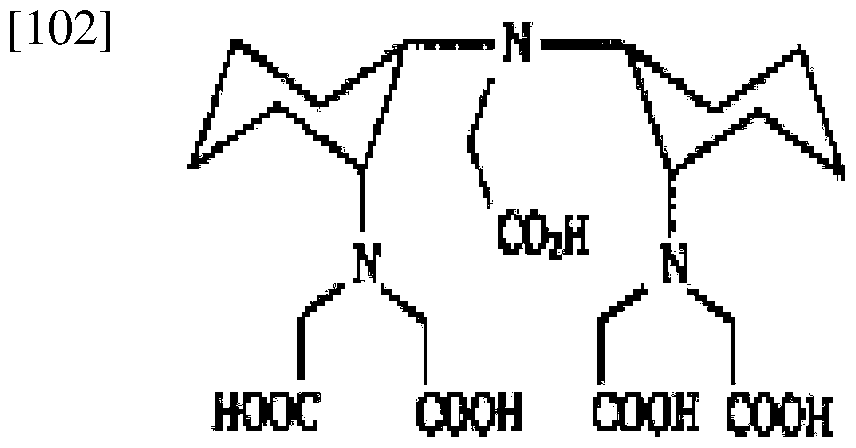
  • a specific example of the compound comprising a functional group represented by Formula 4c includes the following Formulae 4c- 1 to 4c- 5:
  • the compound having ⁇ -ketone group is preferably a compound represented by the following Formula 5:
  • R and R are each independently a linear or branched alkyl group with 1 to 20
  • R is hydrogen, a linear or branched alkyl group with 1 to 20 carbon atoms, a linear
  • a specific example of the compound represented by Formula 5 includes 2,4-pentadion, 1-benzoylacetone, or ethyl acetoacetate.
  • the chelate agent capable of forming a bond with the metal ions is preferably contained in a content of 0.1 to 10 weight parts with respect to 1 weight part of the inorganic salt. If the content is less than 0.1 weight part, there is a problem in that antistatic performance is deteriorated since the chelate agent is not sufficiently bonded with the inorganic salt; while if the content exceeds 10 weight parts, there is a problem in that the cohesion is lowered to make durability and reliability weak.
  • the aforementioned compound having at least one ether bond in the molecule used in the present invention serves to improve antistatic performance by forming an ether bond, an inorganic salt and a complex in the molecule, thereby providing ionic conductivity and a stable structure.
  • the compound having at least one ether bond in a molecule is a compound represented by the following Formula 6:
  • R and R are each independently an alkyl group having 1 to 20 carbon atoms or aryl group, preferably an alkyl group with 4 to 12 carbon atoms, or an aryl group with 6 to 12 carbon atoms sirh as a phenyl group or a naphthyl group;
  • R is hydrogen or a methyl group
  • n is an integer of 2 to 20, preferably 2 to 17.
  • a specific example of Formula 6 includes diethyleneglyj ⁇ ldi-2-ethylhexonate, tetraethyleneglyx>ldi-2-ethylhexonate, poryethyleneglyx>ldi-2-ethylhexonate, tri- ethyleneglyjoldiethylbutyrate, polyethyleneglyjoldiethylbutyrate, polypropylenegly- coldiethylhexonate, triethyleneglyjoldibenzonate, tetraethyleneglyjol dibenzonate, polyethyleneglyx>ldibenzonate, polypropylenegljcoldibenzonate, polyethyleneglyjol- 2-ethylhexonatebenzonate, or a mixture of at least two thereof.
  • an inorganic salt mixed with the compound represented by Formula 6 to form a mixture is a conjugate base of superacid, and is preferably a metal salt represented by the following Formula 7 consisting of a perfluoroalkyl group- containing anion and an alkaline metal cation.
  • M is an alkali metal, preferably lithium, sodium or potassium;
  • R is a perfluoroalkyl group with 1 to 4 carbon atoms
  • Y is carbon or sulfur
  • X is nitrogen or carbon
  • m is 1 or 2
  • n is 2 or 3
  • the alkali metal salt is excellent in compatibility with a pressure-sensitive adhesive and optically transparent under damp-heat resistant conditions due to low coordinate bonding and high hydrophobic properties to metal cations due to a resonance stricture of anions and high electronegativity of fluorine atoms.
  • the alkali metal salt represented by Formula 7 can impart an effect of antistatic properties even though the alkali metal salt is added alone.
  • the alkali metal salt is used together with an ester-based plastidzer having at least one ether bond in the molecule, so that antistatic properties can be more effectively provided.
  • the anion in the alkali metal salt represented by Formula 7 includes bis(trifluoromethanesulfonyl)imide, bis(pentafluoroethanesulfonyl)imide, bis (pentafluoroethanecarbonyl)imide, bis (perfluorobutanesulfonyl)imide, bis (perfluorobutanecarbonyl)imide, tris (trifluoromethanesulfonyl)methide, or tris(trifluoromethanecarbonyl)methide.
  • the ester-based compound having at least one ether bond in the molecule is contained in a content of 0.1 to 10 weight parts with respect to 1 weight part of the inorganic salt. If the content is less than 0.1 weight part, the ester-based compound has a problem in that antistatic performance is deteriorated since the ester-based compound does not react with the alkali metal salt sufficiently to form a complex, while if the content exceeds 10 weight parts, the ester-based compound has a problem in that durability of the pressure-sensitive adhesion is weakened due to low cohesion.
  • the corrosion inhibitor used in the present invention serves to perform a metal corrosion preventing action of a pressure-sensitive adhesive comprising an ionic antistatic agent to thereby prevent discoloration of the pressure-sensitive adhesive. Additionally, the addition of the corrosion inhibitor further improves antistatic performance of the pressure-sensitive adhesive by the synergistic effect.
  • the corrosion inhibitor includes a compound which contains at least one atom such as phosphorus, sulfur, nitrogen or oxygen well adsorbed onto a substrate, and can have low reactivity with other additives and prevent access of oxygen or water due to structural steric hindrance.
  • the corrosion inhibitor includes at least one selected from the group consisting of a (benzo)triazole-based compound; a (benzo)thiazole-based compound; a (benzyl)imidazole-based compound; an im- idazoline-based compound; a quinoline-, pyridine-, or pyrimidine-based compound; an indole-based compound or its derivative; an amine-based compound; a urea-based compound; sodiumbenzoate; benzylmercapto; di-sec-butylsulfide; and diphenyl- sulfoxide.
  • the corrosion inhibitor is not limited thereto.
  • a specific example of the corrosion inhibitor includes (benzo)triazole-based compounds such as benzotriazole, phenyl triazole, or tolytriazole; (benzo)thiazole-based compounds such as 2-mercaptobenzothiazole, 2-amino-3-mercapto- 1 ,3,4-thiadiazole, or 1 ,3,4-thiadiazole-2,5-dithiol; (benzyl)imidazole-based compounds sirh as 5,6-dimethylbenzylimidazole, 2-mercaptobenzylimidazole, imidazole, 1 -phenyl-4-methylimidazole, 4-methylimidazole, 4-bromoimidazole, ethyl-4-methyl-5-imidazole carboxylate, 5-hydroxy methyl-4-methylimidazole, or 4-methyl-5-imidazole carboxylic add; im- idazoline-based compounds sirh as imidazoline, or l-ethylamin
  • the corrosion inhibitor is preferably contained in the content of 0.01 to 10 weight parts. There is a problem in that a metal corrosion preventing effect is insufficient if the content is less than 0.01 weight part while durability and reliability is weakened due to low adhesion properties and cohesion if the content exceeds 10 weight parts.
  • the acrylic pressure-sensitive adhesive composition of the present invention comprising the aforementioned components may further comprise a polyfunctional cross-linking agent if necessary.
  • the polyfunctional cross-linking agent serves to increase cohesion of an adhesive by reacting with a carboxylic group, a hydroxyl group and the like.
  • isocyanate-based compounds epoxy- based compounds, aziridine -based compounds, metal chelate-based compounds and the like may be used, and particularly, an isocyanate-based cross-linking agent is preferably used.
  • the isocyanate-based compound includes toluene diisocyanate, xylene diisocyanate, diphenylmethane diisocyanate, hexamethylene diisocyanate, isoform diisocyanate, tetramethylxylene diisocyanate, naphthalene diisocyanate, or reactants thereof with polyols sirh as trimethylolpropane or the like.
  • the epoxy-based compound includes ethylene glycol diglyddyl ether, trigljddyl ether, trimethylolpropane trigljddyl ether, N,N,N ,N -tetraglyddylethylenediamine, or gljcerindiglyddylether.
  • the aziridine-based compound includes N,N-toluene-2,4-bis(l-aziridinecarboxide), N,N-diphenylmethane-4,4'-bis(l-aziridinecarboxide), triethylene melamine, or tris( 1 -aziridinyl)phosphine oxide.
  • the metal chelate-based compound includes compounds in which polyvalent metals sirh as aluminum, iron, zin ⁇ tin, titanium, antimony, magnesium and vanadium are coordinated with acetylacetone or ethyl acetoacetate.
  • the aforementioned polyfunctional cross-linking agent can be subjected to a uniform coating process only when a cross-linking reaction of a functional group of the cross- linking agent hardly occurs in a blending process carried out to form an adhesion layer.
  • the coating process is completed and then drying and aging processes are performed to thereby form a cross-linking structure, so that an adhesive layer with elasticity and strong cohesion can be obtained.
  • Cutting properties and pressure-sensitive adhesive properties such as durability and reliability in pressure-sensitive adhesive products are improved by the strong cohesion of the pressure-sensitive adhesive.
  • the aforementioned polyfunctional cross-linking agent is preferably contained in a content range of 0.01 to 10 weight parts with respect to 100 weight parts of the acrylic copolymer. If the polyfunctional cross-linking agent is contained in the content range, the pressure-sensitive adhesive is excellent in cohesion and has excellent durability and reliability since the problems in pressure-sensitive adhesive durability such as bubbling and peeling are not generated, and a rising phenomenon and the like does not oxur.
  • the acrylic pressure-sensitive adhesive composition of the present invention comprising the aforementioned components can further comprise a silane-based coupling agent or an adhesion imparting resin if necessary.
  • the silane-based coupling agent improves adhesion stability when an acrylic pressure-sensitive adhesive adheres to a glass plate, thereby serving to further improve heat resistance and humidity resistance. Particularly, the silane-based coupling agent facilitates to improve adhesion reliability when the acrylic pressure-sensitive adhesive is left alone under high temperature and high humidity conditions for a long time.
  • the silane-based coupling agent includes
  • the silane-based coupling agent is preferably contained in a content range of 0.005 to 5 weight parts with respect to 100 weight parts of the acrylic copolymer. If the silane-based coupling agent is contained in the content range, adhesion stability and adhesion reliability of the silane-based coupling agent are improved under high temperature and high humidity conditions. [171] Meanwhile, the adhesion imparting resin serves to adjust adhesion performance of the acrylic pressure- sensitive adhesive.
  • the adhesion imparting resin includes a hydrogenated hydrocarbon resin, a hy- drogenated rosin resin, a hydrogenated rosin ester resin, a hydrogenated terpene resin, a hydrogenated terpene phenolic resin, a polymerized rosin resin, a polymerized rosin ester resin, or a mixture of at least two thereof.
  • the adhesion imparting resin is preferably contained in a content range of 1 to 100 weight parts with respect to 100 weight parts of the acrylic copolymer. If the adhesion imparting resin is contained in the content range, compatibility and cohesion of the pressure-sensitive adhesive is improved.
  • the acrylic pressure-sensitive adhesive composition of the present invention may further comprise, if necessary, additives such as an acrylic oligomer, an epoxy resin, a hardener, a ultraviolet stabilizer, an antioxidant, a toning agent, a reinforcing agent, a filler, a defoaming agent, a surfactant, and a plastidzer.
  • additives such as an acrylic oligomer, an epoxy resin, a hardener, a ultraviolet stabilizer, an antioxidant, a toning agent, a reinforcing agent, a filler, a defoaming agent, a surfactant, and a plastidzer.
  • the acrylic pressure-sensitive adhesive composition of the present invention comprising the aforementioned components may be prepared by general processes, and specifically a thermal curing process, a photo curing process, or the like.
  • the aforementioned acrylic pressure-sensitive adhesive composition of the present invention has a cross-linking density of 5 to 95%.
  • a pressure-sensitive adhesive has low cohesion and problems in pressure-sensitive adhesive durability such as bubbling and peeling if the cross-linking density is less than 5% while problems sirh as a rising phenomenon and the like are generated to thereby weakening durability and reliability if the cross-linking density exceeds 95%.
  • the present invention is also directed to a protective film, which comprises a substrate, and an adhesive layer formed on one or both surfaces of the substrate and containing the acrylic pressure-sensitive adhesive composition according to the present invention.
  • the protective film which is a layer for protecting an optical film, preferably a surface of a polarizer, comprises a substrate and a pressure-sensitive adhesive layer.
  • the substrate is not particularly limited, but includes polyester-based films sirh as cellulose, poljcarbonate and polyethylene terephthalate having transparency; polyester-based films such as poly ethersulf one; and polyolefin-based films sirh as polyethylene, polypropylene, polyolefin with a cyclic or norbornene stricture, or ethylene propylene copolymer.
  • the transparent substrate film may be formed to have a single-layered or two- or-more-layered stricture, and thickness of the substrate film can be properly selected according to applications of the substrate film.
  • the thickness of the substrate film is preferably 5 to 500 ⁇ m, more preferably 10 to 100 ⁇ m.
  • one or both surfaces of the transparent substrate film may be subjected to a surface treatment process or a primer treatment process, and an antistatic layer or an anti-smudge layer may be formed thereon.
  • a method for forming a pressure-sensitive adhesive layer on the substrate film is not particularly limited. For instance, it is possible to use a method for drying a pressure- sensitive adhesive applied to a surface of the substrate film directly using a bar coater or the like, or a method for applying a pressure-sensitive adhesive to a surface of a releasable substrate, drying it, transferring the pressure-sensitive adhesive layer formed on the surface of the releasable substrate to a surface of a substrate film, and aging it.
  • the thickness of the pressure-sensitive adhesive layer is preferably in a range of 2 to 100 ⁇ m, more preferably in a range of 5 to 50 ⁇ m. If the pressure-sensitive adhesive layer is deviated from the thickness range, it is hard to obtain a uniform pressure- sensitive adhesive layer, to thereby result in non-uniform physical properties of a pressure sensitive adhesive film.
  • the present invention is also directed to a polarizer comprising a polarizing film or polarizing device, and a pressure-sensitive adhesive layer containing the acrylic pressure-sensitive adhesive composition according to the present invention.
  • the polarizing film or polarizing device of the polarizer is not particularly limited.
  • the polarizing film includes a film manufactured by stretching a film of a polyvinyl alcohol-based resin in which polarizing components sich as iodine, dichroic dye, and the like are contained.
  • the thickness of the polarizing film is also not particularly limited, and the polarizing film may be formed to have a general thickness.
  • the polyvinyl alcohol-based resin includes polyvinyl alcohol, polyvinyl formal, polyvinyl acetal, and hydrolysates of ethylene- vinyl acetate copolymer.
  • a multilayered film may be formed by laminating protective films including cellulose-based films sich as triacetyl cellulose; poljcarbonate films, or polyester- based films sich as polyethylene terephthalate; polyethersulfone-based films; or polyolefin-based films sich as polyethylene, polypropylene, polyolefin having cyclic or norbonene stricture and ethylene-propylene copolymer; on both surfaces of the polarizing film.
  • the thickness of the protective film is not particularly limited, and may be formed to have a general thickness.
  • a method for forming a pressure-sensitive adhesive layer on the polarizing film is not particularly limited.
  • a method for drying a pressure-sensitive adhesive applied to a surface of the polarizing film directly using a bar coater or the like or a method for applying a pressure-sensitive adhesive to a surface of a releasable substrate, drying it, transferring the pressure-sensitive adhesive layer formed on the surface of the releasable substrate to a surface of a polarizing film, and aging it.
  • At least one layer for providing additional functions including a protective layer, a reflective layer, an anti-glare layer, a retardation plate, a wide- viewing-angle compensation film, and a brightness enhancing film may be laminated on the polarizer of the present invention, and the pressure-sensitive adhesive layer according to the present invention may also be formed on the functional layer.
  • the present invention is also directed to a liquid crystal display device comprising a liquid crystal display panel in which a polarizer is bonded to one or both surfaces of a liquid crystal cell.
  • a polarizer to which the pressure-sensitive adhesive of the present invention is applied is applicable to all of general liquid crystal display devices, and types of liquid crystal display panels are not particularly limited.
  • the aforementioned acrylic pressure-sensitive adhesive composition of the present invention may be applied to industrial sheets, particularly protective films, reflective sheets, adhesive sheets for strictures, adhesive sheets for photographs, adhesive sheets for marking of traffic lanes, adhesive articles for optics, and adhesive for electronic components. Additionally, the acrylic pressure-sensitive adhesive composition may also be applied to multilayered laminate products, i.e., application fields with the same operating concept including general commercial adhesive sheets, medical patches, heat activated pressure-sensitive adhesives, and the like.
  • EAc ethyl acetate
  • n-BA n-butylacrylate
  • AA acrylic acid
  • 2-HEMA hydroxy ethylmethacrylate
  • AIBN azobisisobutyronitrile
  • a uniform pressure-sensitive adhesive layer with a thickness of 25 ⁇ m was prepared by injecting 100 weight parts of the prepared acrylic copolymer, 0.5 weight part of toluene diisocyanate addirt (TDI-I) of isocyanate-based trimethylolpropane as a cross-linking agent, 5.2 weight parts of lithium bis(trifluoromethanesulfonyl)imide (A-I) as an antistatic agent, and 8.0 weight parts of 2-mercaptobenzothiazole (B-I) as a corrosion inhibitor into a reactor, diluting the acrylic copolymer to a proper concentration, uniformly mixing the diluted material, coating a releasing paper with the mixture, and drying it.
  • TDI-I toluene diisocyanate addirt
  • A-I lithium bis(trifluoromethanesulfonyl)imide
  • B-I 2-mercaptobenzothiazole
  • the prepared adhesive layer was laminated to an iodine-based polarizer with a thickness of 185 ⁇ m.
  • Iblarizers were manufactured in the same manner as in Example 1 except that components and composition represented by the following Table 1 were used in Example 1.
  • the unit used in Table 1 is weight part.
  • Examples 1 to 4 adhered to both surfaces of glass substrates (110 mmx90mmx0.7mm) in a state where optical absorption axes crossed.
  • a pressure of 5 kg/cm was applied in order to prevent bubbles or foreign materials from being generated.
  • the samples were observed to check if bubbling or releasing was generated after leaving the samples alone under a temperature of 60 0 C and a relative humidity of 90% for 1000 hours in order to grasp damp heat resistance of the samples. After leaving the samples alone at room temperature for 24 hours, the durability and reliability were checked on the samples just before evaluating the states of the samples, wherein evaluation references include O: no bubbling or peeling phenomenon, ⁇ : more or less of bubbling or peeling phenomenon, and x: bubbling or peeling phenomenon.
  • Examples 1 to 4 to have a dimension of 50mm x50mm, the cut polarizers adhered to surfaces of metal such as copper or aluminum. After leaving the samples for measurement alone under a temperature of 60 0 C and a relative humidity of 90% for 1000 hours, corrosion degrees of the samples were observed, wherein evaluation references include O: no discoloration on metal surfaces due to no corrosion, ⁇ : par tial discoloration of metal surfaces due to slight corrosion, and x: discoloration of metal surfaces due to corrosion.
  • An acrylic pressure-sensitive adhesive according to the present invention is optically transparent, causes durability and reliability not to change, and simultaneously improves antistatic performance and prevents generation of corrosion although the acrylic pressure-sensitive adhesive composition comes into contact with a metal surface.

Landscapes

  • Chemical & Material Sciences (AREA)
  • Organic Chemistry (AREA)
  • Physics & Mathematics (AREA)
  • Nonlinear Science (AREA)
  • Mathematical Physics (AREA)
  • Crystallography & Structural Chemistry (AREA)
  • General Physics & Mathematics (AREA)
  • Optics & Photonics (AREA)
  • Adhesives Or Adhesive Processes (AREA)
  • Polarising Elements (AREA)
  • Adhesive Tapes (AREA)

Abstract

The present invention relates to an acrylic pressure-sensitive adhesive composition, and more particularly, to an acrylic pressure-sensitive adhesive composition, which comprises (a) 100 weight parts of an acrylic copolymer, (b) 0.001 to 30 weight parts of an antistatic agent; and (c) 0.01 to 10 weight parts of a corrosion inhibitor, thereby being optically transparent, causing durability and reliability not to change, and simultaneously improving antistatic performance and preventing generation of corrosion although the adhesive composition comes into contact with a metal surface.

Description

Description
ACRYLIC PRESSURE-SENSITIVE ADHESIVE COMPOSITIONS
Technical Field
[1] The present invention relates to an acrylic pressure-sensitive adhesive composition, and more particularly, to an acrylic pressure-sensitive adhesive composition, which comprises (a) 100 weight parts of an acrylic copolymer, (b) 0.001 to 30 weight parts of an antistatic agent; and (c) 0.01 to 10 weight parts of a corrosion inhibitor, thereby being optically transparent, causing durability and reliability not to change, and simultaneously improving antistatic performance and preventing generation of corrosion although the adhesive composition comes into contact with a metal surface.
[2]
Background Art
[3] In entry into information industry, static electricity causes various problems in electronic components. In general, static electricity includes triboelectrification generated when rubbing two different objects together, and release electrification generated when objects in close contact with each other are released from each other. The static electricity can cause suction of foreign materials svch as dust, electrostatic breakdown of devices, misoperation of measuring instruments, or fires. Further, it is very likely that contemporary electronic devices are temporarily or permanently damaged by static electricity.
[4] For instance, static electricity is generated when a release film is peeled off from a pressure-sensitive adhesive layer to bond a polarizer to a liquid crystal cell during the fabrication of a liquid crystal display. Svch generated static electricity affects alignment of liquid crystal within the liquid crystal display to cause defects.
[5] Further, as polarizers are fabricated at high speeds, a breaking phenomenon of TFT
IC devices oxurs to result in defects of a liquid crystal display panel by static electricity that has not been generated in an existing process when a polarizer protective film is peeled off.
[6] Although there is a method for forming an antistatic layer on an outer surface of a polarizer in order to suppress the generation of static electricity, there is a problem in that the generation of static electricity has not been fundamentally prevented since an effect of the method is insignificant. Therefore, it is necessary to impart antistatic performance to a pressure-sensitive adhesive in order to fundamentally suppress the generation of static electricity.
[7] Although the pressure-sensitive adhesive is excellent in static electricity-preventing performance when an ionic antistatic agent is added to the pressure-sensitive adhesive to impart antistatic performance thereto, there has been a problem in that the metal surface is corroded when the pressure-sensitive adhesive comes into contact with a metal surface. Undoubtedly, a pressure-sensitive adhesive that requires antistatic properties is generally used in insulating material products from which static electricity is generated easily. However, the pressure- sensitive adhesive requiring antistatic properties is useful in a case where antistatic properties as well as corrosion resistance are required since the possibility that the pressure-sensitive adhesive is partially brought into contact with the metal surface cannot be excluded, For instance, in case of a protective film for a polarizer, in which a metallic material called a bezel is fixed to an outer surface of the polarizer with which a pressure-sensitive adhesive of the protective film has come into contact, there has been a problem in that the bezel is deteriorated by corrosion.
[8] Methods for imparting antistatic function to a pressure-sensitive adhesive include a method for adding conductive metal powder or carbon particles to a pressure-sensitive adhesive, and a method for adding an ionic material such as a surfactant to a pressure- sensitive adhesive. However, the method for adding conductive metal powder or carbon particles to a pressure-sensitive adhesive has problems in that a large amount of conductive metal powder or carbon particles are used so as to exhibit antistatic properties and transparency of the pressure-sensitive adhesive is deteriorated accordingly. Furthermore, the method for adding surfactant has problems in that the pressure-sensitive adhesive is easily influenced by humidity, and adhesive properties of the pressure-sensitive adhesive are deteriorated due to migration of the surfactant to the surface of the pressure-sensitive adhesive.
[9] As a method for imparting antistatic performance to a pressure-sensitive adhesive,
Japanese Patent Laid-open Publication N). H5-140519 discloses a method for suppressing the generation of static electricity by adding an ethylene oxide-modified dioctyl phthalate plasticizer to a pressure-sensitive adhesive such that the pressure- sensitive adhesive is flexible. Further, Japanese Patent Laid-open Publication No. 2004-287199 discloses a method for imparting antistatic performance to a pressure- sensitive adhesive by adding an ion conductive polymer with a hydroxyl group to a pressure-sensitive adhesive.
[10] However, these methods have problems in that the pressure-sensitive adhesive is transferred to a surface of a polarizer, adhesion properties and rheological properties are changed, and corrosion prevention cannot be controlled.
[11] In the meantime, several methods for preparing a pressure-sensitive adhesive that does not corrode a metal layer have been suggested. Japanese Patent Laid-open Publication N). 2005-325250 discloses only a method in which components of a carboxyl group-containing copolymer pressure-sensitive adhesive is not used.
[12] Therefore, it is necessary to further study a pressure-sensitive adhesive which is optically transparent, causes durability and reliability not to change, and simultaneously improves antistatic performance and prevents generation of corrosion although the acrylic pressure-sensitive adhesive comes into contact with a metal surface.
[13]
Disclosure of Invention Technical Problem
[14] The present invention is conceived to solve the aforementioned problems in the prior art. An object of the present invention is to provide an acrylic pressure-sensitive adhesive composition which is optically transparent, causes durability and reliability not to change, and simultaneously improves antistatic performance and prevents generation of corrosion although the acrylic pressure-sensitive adhesive composition comes into contact with a metal surface.
[15] Another object of the present invention is to provide a protective film and a polarizer comprising an adhesive layer containing an acrylic pressure-sensitive adhesive composition having the aforementioned excellent physical properties.
[16] A further object of the present invention is to provide a liquid crystal display device comprising the polarizer.
[17]
Technical Solution
[18] According to the present invention for achieving the objects, there is provided an acrylic pressure-sensitive adhesive composition, which comprises (a) an acrylic copolymer, (b) an antistatic agent, and (c) a corrosion inhibitor.
[19] In addition, the present invention provides a protective film, which comprises a substrate, and a pressure-sensitive adhesive layer formed on one or both surfaces of the substrate and containing the acrylic pressure-sensitive adhesive composition according to the present invention. [20] Further, the present invention provides a polarizer, which comprises a polarizing film or polarizing device, and a pressure-sensitive adhesive layer containing the acrylic pressure-sensitive adhesive composition according to the present invention.
[21] The present invention also provides a liquid crystal display device, which comprises a liquid crystal display panel in which the aforementioned polarizer is bonded to one or both surfaces of a liquid crystal cell.
[22]
Best Mode for Carrying Out the Invention
[23] Hereinafter, the present invention will be described in detail.
[24] The present inventors confirmed that the problem that a metal surface is corroded when a pressure-sensitive adhesive comes into contact therewith although static electricity preventing performance thereof is superior can be improved by adding an antistatic agent into the pressure-sensitive adhesive.
[25] Furthermore, the present inventors have found out that addition of a corrosion inhibitor does not deteriorate the antistatic performance, but further improves the antistatic performance and prevents corrosion of the metal surface at the same time due to the synergistic effect. That is, the corrosion inhibitor has a structure with a large dipole moment in its structural characteristics. Accordingly, the present invention has been completed by finding out that the corrosion inhibitor can maximize the effect of the antistatic agent since the corrosion inhibitor increases dissociation force of an ionic antistatic agent.
[26] Therefore, it is characterized in that the present invention comprises an antistatic agent as well as a corrosion inhibitor in an acrylic pressure-sensitive adhesive composition.
[27] In a pressure-sensitive adhesive composition according to the present invention, respective components are implemented as follows.
[28]
[29] (a) Acrylic copolymer
[30] Although the acrylic copolymer used in the present invention is not particularly limited if the acrylic copolymer is used as a general pressure-sensitive adhesive in the art, it is preferable that the acrylic copolymer comprise (i) 90 to 99.9 weight parts of a (meth)acrylate ester monomer with an alkyl group having 1 to 12 carbon atoms, and (ii) 0.1 to 10 weight parts of a vinyl-based monomer and/or an acryl-based monomer having a cross-linkable functional group.
[31] The (meth)acrylate ester monomer with an alkyl group having 1 to 12 carbon atoms of (i) is methyl(meth)acrylate, ethyl(meth)acrylate, n-propyl(meth)acrylate, isopropyl(meth)acrylate, n-butyl(meth)acrylate, t-butyl(meth)acrylate, sec- butyl(meth)acrylate, pentyl(meth)acrylate, 2-ethylbutyl(meth)acrylate, 2-ethylhexyl(meth)acrylate, n-octyl(meth)acrylate, isooctyl(meth)acrylate, isononyl(meth)acrylate, or a mixture of two or more thereof.
[32] The (meth)acrylate ester monomer with an alkyl group having 1 to 12 carbon atoms is preferable contained in the content of 90 to 99.9 weight parts, wherein the initial adhesion is deteriorated if the content of the (meth)acrylate ester monomer is less than 90 weight parts, and a durability problem can be generated due to the deterioration of cohesion if the content of the (meth)acrylate ester monomer exceeds 99.9 weight parts.
[33] The vinyl-based monomer and/or an acryl-based monomer with a cross-linkable functional group of (ii) reacts with a cross-linking agent thereby serving to impart cohesion or adhesion caused by chemical bonding to the pressure-sensitive adhesive sirh that cohesion of a pressure-sensitive adhesive is not broken at high temperature or high humidity.
[34] The vinyl-based monomer and/or the acryl-based monomer with a cross-linkable functional group may include a monomer containing a hydroxyl group such as 2-hydroxyethyl(meth)acrylate, 2-hydroxypropyl(meth)acrylate, 4-hydroxybutyl(meth)acrylate, 6-hydroxyhexyl(meth)acrylate,
2-hydroxyethyleneglyx>l(meth)acrylate, or 2-hydroxypropyleneglyx>l(meth)acrylate; a monomer containing a carboxyl group sirh as (meth)acrylic add, acrylic add dimer, itaconic add, maleic add, maleic anhydride, or fumaric add; a monomer containing nitrogen sirh as acryl amide, N- vinyl pyrrolidone, or N-vinyl caprolactam; or a mixture of two or more thereof.
[35] 0.1 to 10 weight parts of the vinyl-based monomer and/or the acryl-based monomer with a cross-linkable functional group is preferably contained in the acrylic copolymer. If the content of the vinyl-based monomer and/or the acryl-based monomer is less than 0.1 weight part, there is a problem in that the vinyl-based monomer and/or the acryl- based monomer with a cross-linkable functional group is easily subjected to cohesion failure at high temperature and high humidity; and if the content of the vinyl-based monomer and/or the acryl-based monomer exceeds 10 weight parts, there are problems in that its compatibility is reduced to cause severe surface migration thereof, rheological properties are reduced, and stress relaxation property is deteriorated due to increase in cohesion thereof.
[36] Further, it is preferable that the acrylic copolymer of the present invention comprises a comonomer as an optional component in order to control glass transition temperature of the pressure-sensitive adhesive or impart other functionalities thereto when preparing the acrylic copolymer of the present invention.
[37] Although any acrylic adhesive resins with a glass transition temperature of -130 to 50
0C in a non-cross linked state as general monomers having copolymerizable vinyl groups may be used as the comonomer, a vinyl-based monomer of the following Formula 1 is preferably used as the comonomer.
[38]
[39] [Formula 1]
Figure imgf000007_0001
[41]
[42] where R denotes hydrogen or alkyl, and R denotes cyano, alkyl substituted or non-
4 3 substituted phenyl, acetyloxy, or COR , wherein R denotes alkyl substituted or non- substituted amino or glyddyloxy.
[43] Although preferable examples of the functional monomers include acrylonitrile,
(meth)acrylamide, N-methylacrylamide, styrene, methylstyrene, glyddyl(meth)acrylate, and vinylacetate, the functional monomers are not limited thereto, and the monomers may be used solely or in the form of a mixture of at least two thereof.
[44] An acrylic copolymer comprising the aforementioned components may be prepared by general methods including a solution polymerization process, a photopoly- merization process, a bulk polymerization process, a suspension polymerization process, or an emulsion polymerization process, and particularly, the acrylic copolymer is preferably prepared by the solution polymerization process. At this time, it is preferable that the polymerization temperature be 50 to 140 0C and an initiator be mixed with the monomers uniformly mixed.
[45]
[46] (b) Antistatic agent
[47] As the antistatic agent used in the present invention, any ionic antistatic agent may be used if it is excellent in compatibility with the pressure-sensitive adhesive, does not affect transparency, durability and reliability, and can suppress the generation of static electricity through dissociation of ions. [48] Preferably, the antistatic agent is contained in the content of 0.001 to 30 weight parts with respect to 100 weight parts of an acrylic copolymer. The antistatic agent has a problem in that antistatic performance is deteriorated if the content is less than 0.001 weight part, while the antistatic agent has a problem of poor durability and reliability due to low cohesion if the content exceeds 30 weight parts. [49] Specifically, it is preferable that the antistatic agent be at least one selected from the group consisting of:
[50] (i) an inorganic salt comprised of metal cation and anion;
[51] (ii) an organic salt comprised of onium cation and anion;
[52] (iii) a mixture of the inorganic salt and a chelate agent capable of forming a bond with the metal ions of the inorganic salt; [53] (iv) a mixture of the inorganic salt and a compound having at least one ether bond in a molecule. [54] Preferably, the anion of the inorganic or organic salt is selected from the group consisting of iodide (I ), chloride (Cl ), bromide (Br ), nitrate (NO ), sulfonate (SO ),
3 4 methylbenzenesulfonate (CH (C H )SO "), carboxybenzenesulfonate (COOH(C H
3 6 4 3 6 4
)SO "), benzonate (C H COO"), perchlorate (ClO "), hydroxide (OH"), trifluoroεcetate
3 6 5 4
(CF COO"), trifluoromethanesulfonate (CF SO "), tetrafluoroborate (BF "), tetraben-
3 3 2 4 zylborate (B(C H ) ), hexafluorophosphate (PF ), bis(trifluoromethanesulfonyl)imide (N(SO CF ) "), bis(pentafluoroethanesulfonyl)imide (N(SOC F ) "),
2 3 2 2 5 2 bis(pentafluoroethanecarbonyl)imide (N(COC F ) ), bis(perfluorobutanesulfonyl)imide (N(SO C F ) ), bis(perfluorobutanecarbonyl)imide (N(COC F ) "), tris(trifluoromethanesulfonyl)methide (C(SO CF ) "), and
4 9 2 2 3 3 tris(trifluoromethanecarbonyl)methide (C(SO CF ) ). However, the anion of the inorganic salt or the organic salt is not limited thereto. Imide-based anions are more preferable since anions performing an electron withdrawing function well and substituted with fluorine having good hydrophobicity increase ion stability. [55] Further, the metal cation includes alkaline metal cation or alkaline earth metal cation.
The metal cation is preferably selected from the group consisting of lithium (Li ), sodium (Na ), potassium (K ), rubidium (Rb ), cesium (Cs ), beryllium (Be ),
2+ 2+ 2+ 2+ magnesium (Mg ), calcium (Ca ), strontium (Sr ) and barium (Ba ), is more preferably selected from lithium (Li ), sodium (Na ), potassium (K ), cesium (Cs ), 2+ 2+ 2+ 2+ beryllium (Be ), magnesium (Mg ), calcium (Ca ), and barium (Ba ), and is most preferably lithium (Li ) which has high ion stability and moves in an adhesive more easily.
[56] Furthermore, nitrogen onium cation, phosphorus onium cation, or sulfur onium cation is preferably used as the onium cation. Here, the term "onium" means plus- charged ions comprising at least some of electric charges which are maldistributed on at least a nitrogen, phosphorus, or sulfur atom.
[57] In addition, the onium cation may be an acyclic cation or a cyclic cation in which atom(s) forms a cycle. The cyclic cation may be an aromatic saturated or unsaturated cation. The cyclic cation may contain at least one heterocyclic atom, e.g., oxygen and sulfur, in addition to nitrogen, phosphorus, or sulfur, and be optionally substituted by a substituent such as hydrogen, halogen, alkyl, and aryl. The acyclic cation may retain an organic substituent or an R group to which at least one (preferably at least four) nitrogen is bonded, and the residual substituent is hydrogen. The R group may be a cyclic or acyclic group, a substituted or non-substituted group, or an aromatic or non- aromatic group, and contain at least one heteroatom such as nitrogen, oxygen, sulfur, phosphorus, and halogen.
[58] Particularly, the nitrogen onium cation is preferably at least one selected from the group consisting of acyclic quaternary ammonium, and an aromatic ammonium salt selected from pyridinium, pyridazinium, pyrimidinium, pyrazinium, imidazolium, pyrazolium, thiazolium, oxazolium, and triazolium.
[59] Most preferably, the nitrogen onium cation is at least one selected from the group consisting of tetraalkylammonium [N+(C H ) : n = 1 ~ 8]; N-alkylpyridinium [N-C H -cyc-N +C H : n = 4 ~ 16]; 1,3-alkylmethylimidazolium [CH -cyc-(N +C H
2n+l 5 5 3 2 2
NCH)CnH : n = 2 ~ 10]; and l,2-dimethyl-3-alkylimidazolium [CH -cyc-(N +C H
2n+l 3 2 2
NC(CH ))C H : n = 2 ~ 10].
3 n 2n+l
[60] In the meantime, in a case where an inorganic salt comprised of metal cation and anion is used as an antistatic agent, it is preferable to use (iii) a mixture of the inorganic salt and a chelate agent capable of forming a bond with the metal ions of the inorganic salt; or (iv) a mixture of the inorganic salt and a compound having at least one ether bond in a molecule.
[61] The chelate agent usable in the present invention is a compound having a functional group capable of forming a bond with metal ions in the molecular structure, and forms a stabilized chelate complex compound by bonding with the cation of a metal salt dissociated into cation and anion. Therefore, the anion concentration of the metal salt increases in a pressure-sensitive adhesive, so that ionic conductivity is retained in a pressure-sensitive adhesive composition. The ionic conductivity lowers release electrification by imparting conductivity to the pressure-sensitive adhesive composition, thereby redudng static electricity generated when a release film for protecting a pressure-sensitive adhesive layer is peeled off and when the protective film is peeled off after a protective film adheres to an adherent.
[62] The chelate agent is preferable if it is dissolved into general organic solvents sirh as ethylacetate, toluene, methylethylketone, acetone and alcohols at a high solubility and has excellent compatibility with an acrylic pressure-sensitive adhesive. Specifically, the chelate agent includes a compound having an oxalate group, a compound having a diamine group, a compound having a polyfunctional carboxyl group, a compound having β-ketone group, a compound having an oxime group, or a mixture of at least two thereof. Particularly, the compound having an oxalate group is preferably used.
[63] Preferably, the compound having an oxalate group is a compound represented by the following Formula 2:
[64]
[65]
[66] [Formula 2]
Figure imgf000010_0001
[68]
[69] where R and R are each independently hydrogen, halogen, a linear or branched
1 2 alkyl group with 1 to 20 carbon atoms, a linear or branched alkoxy group with 1 to 20 carbon atoms, a linear or branched alkenyl group with 2 to 20 carbon atoms, an aryl group with 6 to 30 carbon atoms, an arylalkyl group with 6 to 30 carbon atoms, an aryloxy group with 6 to 30 carbon atoms, or a cjcloalkyl group with 5 to 20 carbon atoms.
[70] A specific example of the compound represented by Formula 2 includes di- ethyloxalate, dimethyloxalate, dibutyloxalate, di-tert-butyloxalate, and bis(4-methylbenzyl)oxalate.
[71] Preferably, the compound having a diamine group is a compound represented by the following Formula 3: [72]
[73] [formula 3]
[74] NH2
R3 X NH2
[75]
[76] where R is a linear or branched alkylene group with 1 to 10 carbon atoms, or a linear or branched alkenylene group with 2 to 10 carbon atoms. [77] A specific example of the compound represented by Formula 3 includes ethylenediamine, 1,2-diaminopropane, or diaminobutane. [78] Further, the compound having a polyfunctional carboxyl group is preferably a compound comprising a functional group represented by the following Formula 4a, 4b, or 4c as a compound with poljcarboxylic add or carboxylate group:
[79]
[80] [Formula 4a]
[81]
X N- CH 2COOH
/
[82]
[83] [Formula 4b]
[84] ^ CH , COOH x CH 2 COOH
[85]
[86] [Formula 4c]
[87] s COOH
N COOH
[88]
[89] A specific example of tl
Formula 4a or 4b includes ethylenediamine-N,N,NN-tetraacetic acid (EDTA),
N,N,NN'N'-diethylenetriaminepentaacetic acid (DTPA),
1,4,7, 10-tetraazac}clododecane-N,NN'N"-tetraacetic acid (DOTA), 1,4,7, 10-tetraazac}clododecane-N,NN'-triace tic acid (DO3A), trans(l,2)-c}clohexano diethylenetriaminepentaacetic add, or N,N-biscarboxymethylglydne.
[90] A specific example of the compound comprising a functional group represented by Formula 4c includes the following Formulae 4c- 1 to 4c- 5:
[91]
[92] [Formula 4c- 1]
Figure imgf000012_0001
[94]
[95] [Formula 4c-2]
[96]
COiH OQiH OQiH CO3H
[97]
[98] [Formula 4c- 3]
Figure imgf000012_0002
[100] [101] [formula 4c-4]
Figure imgf000013_0001
[103] [104] [formula 4c- 5]
Figure imgf000013_0002
[106] [107] Meanwhile, the compound having β-ketone group is preferably a compound represented by the following Formula 5:
[108] [109] [Formula 5] [HO] n n
Figure imgf000013_0003
[111] [112] where R and R are each independently a linear or branched alkyl group with 1 to 20
7 8 carbon atoms, a linear or branched alkoxy group with 1 to 20 carbon atoms, a linear or branched alkenyl group with 2 to 20 carbon atoms, an aryl group with 6 to 30 carbon atoms, an arylalkyl group with 6 to 30 carbon atoms, an aryloxy group with 6 to 30 carbon atoms, or a cjcloalkyl group with 5 to 20 carbon atoms; and
[113] R is hydrogen, a linear or branched alkyl group with 1 to 20 carbon atoms, a linear
9 or branched alkoxy group with 1 to 20 carbon atoms, a linear or branched alkenyl group with 2 to 20 carbon atoms, an aryl group with 6 to 30 carbon atoms, an arylalkyl group with 6 to 30 carbon atoms, an aryloxy group with 6 to 30 carbon atoms, or a cjcloalkyl group with 5 to 20 carbon atoms.
[114] A specific example of the compound represented by Formula 5 includes 2,4-pentadion, 1-benzoylacetone, or ethyl acetoacetate.
[115] The chelate agent capable of forming a bond with the metal ions is preferably contained in a content of 0.1 to 10 weight parts with respect to 1 weight part of the inorganic salt. If the content is less than 0.1 weight part, there is a problem in that antistatic performance is deteriorated since the chelate agent is not sufficiently bonded with the inorganic salt; while if the content exceeds 10 weight parts, there is a problem in that the cohesion is lowered to make durability and reliability weak.
[116] Further, the aforementioned compound having at least one ether bond in the molecule used in the present invention serves to improve antistatic performance by forming an ether bond, an inorganic salt and a complex in the molecule, thereby providing ionic conductivity and a stable structure.
[117] Preferably, the compound having at least one ether bond in a molecule is a compound represented by the following Formula 6:
[118] [119] [Formula 6]
Figure imgf000014_0001
[121] [122] where R and R are each independently an alkyl group having 1 to 20 carbon atoms or aryl group, preferably an alkyl group with 4 to 12 carbon atoms, or an aryl group with 6 to 12 carbon atoms sirh as a phenyl group or a naphthyl group;
[123] R is hydrogen or a methyl group; and [124] n is an integer of 2 to 20, preferably 2 to 17. [125] A specific example of Formula 6 includes diethyleneglyjθldi-2-ethylhexonate, tetraethyleneglyx>ldi-2-ethylhexonate, poryethyleneglyx>ldi-2-ethylhexonate, tri- ethyleneglyjoldiethylbutyrate, polyethyleneglyjoldiethylbutyrate, polypropylenegly- coldiethylhexonate, triethyleneglyjoldibenzonate, tetraethyleneglyjol dibenzonate, polyethyleneglyx>ldibenzonate, polypropylenegljcoldibenzonate, polyethyleneglyjol- 2-ethylhexonatebenzonate, or a mixture of at least two thereof.
[126] Further, an inorganic salt mixed with the compound represented by Formula 6 to form a mixture is a conjugate base of superacid, and is preferably a metal salt represented by the following Formula 7 consisting of a perfluoroalkyl group- containing anion and an alkaline metal cation.
[127]
[128] [Formula 7]
[129]
Figure imgf000015_0001
[130] where M is an alkali metal, preferably lithium, sodium or potassium;
[131] R is a perfluoroalkyl group with 1 to 4 carbon atoms; and
[132] Y is carbon or sulfur, X is nitrogen or carbon, m is 1 or 2, and n is 2 or 3,
[133] wherein m=l if Y is carbon, m=2 if Y is sulfur, n=2 if X is nitrogen, and n=3 if X is carbon.
[134] The alkali metal salt is excellent in compatibility with a pressure-sensitive adhesive and optically transparent under damp-heat resistant conditions due to low coordinate bonding and high hydrophobic properties to metal cations due to a resonance stricture of anions and high electronegativity of fluorine atoms.
[135] The alkali metal salt represented by Formula 7 can impart an effect of antistatic properties even though the alkali metal salt is added alone. However, the alkali metal salt is used together with an ester-based plastidzer having at least one ether bond in the molecule, so that antistatic properties can be more effectively provided. At the same time, there is an effect that ionic conductivity is enhanced.
[136] The anion in the alkali metal salt represented by Formula 7 includes bis(trifluoromethanesulfonyl)imide, bis(pentafluoroethanesulfonyl)imide, bis (pentafluoroethanecarbonyl)imide, bis (perfluorobutanesulfonyl)imide, bis (perfluorobutanecarbonyl)imide, tris (trifluoromethanesulfonyl)methide, or tris(trifluoromethanecarbonyl)methide.
[137] Preferably, the ester-based compound having at least one ether bond in the molecule is contained in a content of 0.1 to 10 weight parts with respect to 1 weight part of the inorganic salt. If the content is less than 0.1 weight part, the ester-based compound has a problem in that antistatic performance is deteriorated since the ester-based compound does not react with the alkali metal salt sufficiently to form a complex, while if the content exceeds 10 weight parts, the ester-based compound has a problem in that durability of the pressure-sensitive adhesion is weakened due to low cohesion.
[138]
[139] (c) Corrosion inhibitor
[140] The corrosion inhibitor used in the present invention serves to perform a metal corrosion preventing action of a pressure-sensitive adhesive comprising an ionic antistatic agent to thereby prevent discoloration of the pressure-sensitive adhesive. Additionally, the addition of the corrosion inhibitor further improves antistatic performance of the pressure-sensitive adhesive by the synergistic effect.
[141] Preferably, the corrosion inhibitor includes a compound which contains at least one atom such as phosphorus, sulfur, nitrogen or oxygen well adsorbed onto a substrate, and can have low reactivity with other additives and prevent access of oxygen or water due to structural steric hindrance. Preferably, the corrosion inhibitor includes at least one selected from the group consisting of a (benzo)triazole-based compound; a (benzo)thiazole-based compound; a (benzyl)imidazole-based compound; an im- idazoline-based compound; a quinoline-, pyridine-, or pyrimidine-based compound; an indole-based compound or its derivative; an amine-based compound; a urea-based compound; sodiumbenzoate; benzylmercapto; di-sec-butylsulfide; and diphenyl- sulfoxide. However, the corrosion inhibitor is not limited thereto.
[142] A specific example of the corrosion inhibitor includes (benzo)triazole-based compounds such as benzotriazole, phenyl triazole, or tolytriazole; (benzo)thiazole-based compounds such as 2-mercaptobenzothiazole, 2-amino-3-mercapto- 1 ,3,4-thiadiazole, or 1 ,3,4-thiadiazole-2,5-dithiol; (benzyl)imidazole-based compounds sirh as 5,6-dimethylbenzylimidazole, 2-mercaptobenzylimidazole, imidazole, 1 -phenyl-4-methylimidazole, 4-methylimidazole, 4-bromoimidazole, ethyl-4-methyl-5-imidazole carboxylate, 5-hydroxy methyl-4-methylimidazole, or 4-methyl-5-imidazole carboxylic add; im- idazoline-based compounds sirh as imidazoline, or l-ethylamino-2-octadecylimidazoline; pyrimidine-based compounds sirh as 2-mercaptopyrimidine, or 2,4-dimercaptopyrimidine; indole-based compounds such as indole, isatin, 3-amino-lH-isoindole or indazole, and derivatives thereof; amine-based compounds such as methylamine, diethylamine, n-decylamine, morpholine, or arylamine; and urea-based compounds sirh as phenylthiourea or urea. These compounds may be used solely or in the form of a mixture of at least two thereof.
[143] The corrosion inhibitor is preferably contained in the content of 0.01 to 10 weight parts. There is a problem in that a metal corrosion preventing effect is insufficient if the content is less than 0.01 weight part while durability and reliability is weakened due to low adhesion properties and cohesion if the content exceeds 10 weight parts.
[144]
[145] (d) Cross-linking agent
[146] The acrylic pressure-sensitive adhesive composition of the present invention comprising the aforementioned components may further comprise a polyfunctional cross-linking agent if necessary.
[147] The polyfunctional cross-linking agent serves to increase cohesion of an adhesive by reacting with a carboxylic group, a hydroxyl group and the like.
[148] As the polyfunctional cross-linking agent, isocyanate-based compounds, epoxy- based compounds, aziridine -based compounds, metal chelate-based compounds and the like may be used, and particularly, an isocyanate-based cross-linking agent is preferably used.
[149] The isocyanate-based compound includes toluene diisocyanate, xylene diisocyanate, diphenylmethane diisocyanate, hexamethylene diisocyanate, isoform diisocyanate, tetramethylxylene diisocyanate, naphthalene diisocyanate, or reactants thereof with polyols sirh as trimethylolpropane or the like.
[150] The epoxy-based compound includes ethylene glycol diglyddyl ether, trigljddyl ether, trimethylolpropane trigljddyl ether, N,N,N ,N -tetraglyddylethylenediamine, or gljcerindiglyddylether.
[151] The aziridine-based compound includes N,N-toluene-2,4-bis(l-aziridinecarboxide), N,N-diphenylmethane-4,4'-bis(l-aziridinecarboxide), triethylene melamine, or tris( 1 -aziridinyl)phosphine oxide.
[152] In addition, the metal chelate-based compound includes compounds in which polyvalent metals sirh as aluminum, iron, zinς tin, titanium, antimony, magnesium and vanadium are coordinated with acetylacetone or ethyl acetoacetate.
[153] The aforementioned polyfunctional cross-linking agent can be subjected to a uniform coating process only when a cross-linking reaction of a functional group of the cross- linking agent hardly occurs in a blending process carried out to form an adhesion layer. The coating process is completed and then drying and aging processes are performed to thereby form a cross-linking structure, so that an adhesive layer with elasticity and strong cohesion can be obtained. Cutting properties and pressure-sensitive adhesive properties such as durability and reliability in pressure-sensitive adhesive products are improved by the strong cohesion of the pressure-sensitive adhesive.
[154] The aforementioned polyfunctional cross-linking agent is preferably contained in a content range of 0.01 to 10 weight parts with respect to 100 weight parts of the acrylic copolymer. If the polyfunctional cross-linking agent is contained in the content range, the pressure-sensitive adhesive is excellent in cohesion and has excellent durability and reliability since the problems in pressure-sensitive adhesive durability such as bubbling and peeling are not generated, and a rising phenomenon and the like does not oxur.
[155]
[156] Additive
[157] The acrylic pressure-sensitive adhesive composition of the present invention comprising the aforementioned components can further comprise a silane-based coupling agent or an adhesion imparting resin if necessary.
[158] The silane-based coupling agent improves adhesion stability when an acrylic pressure-sensitive adhesive adheres to a glass plate, thereby serving to further improve heat resistance and humidity resistance. Particularly, the silane-based coupling agent facilitates to improve adhesion reliability when the acrylic pressure-sensitive adhesive is left alone under high temperature and high humidity conditions for a long time.
[159] The silane-based coupling agent includes
[ 160] γ-glyddoxypropyltrimethoxysilane,
[161] γ-glyddoxypropylmethyldiethoxysilane,
[ 162] γ-glyddoxypropyltriethoxysilane,
[ 163] 3-mercaptopropyltrimethoxysilane,
[164] vinyltrimethoxysilane, vinyltriethoxysilane,
[ 165] γ-methacryloxypropyltrimethoxysilane,
[ 166] γ-methacryloxypropyltriethoxysilane,
[ 167] γ-aminopropyltrimethoxysilane, γ-aminopropyltriethoxysilane,
[168] 3-isocyanatepropyltriethoxysilane,
[169] γ-acetoacetatepropyltrimethoxysilane, or a mixture of at least two thereof.
[170] The silane-based coupling agent is preferably contained in a content range of 0.005 to 5 weight parts with respect to 100 weight parts of the acrylic copolymer. If the silane-based coupling agent is contained in the content range, adhesion stability and adhesion reliability of the silane-based coupling agent are improved under high temperature and high humidity conditions. [171] Meanwhile, the adhesion imparting resin serves to adjust adhesion performance of the acrylic pressure- sensitive adhesive.
[172] The adhesion imparting resin includes a hydrogenated hydrocarbon resin, a hy- drogenated rosin resin, a hydrogenated rosin ester resin, a hydrogenated terpene resin, a hydrogenated terpene phenolic resin, a polymerized rosin resin, a polymerized rosin ester resin, or a mixture of at least two thereof.
[173] The adhesion imparting resin is preferably contained in a content range of 1 to 100 weight parts with respect to 100 weight parts of the acrylic copolymer. If the adhesion imparting resin is contained in the content range, compatibility and cohesion of the pressure-sensitive adhesive is improved.
[174] Further, the acrylic pressure-sensitive adhesive composition of the present invention may further comprise, if necessary, additives such as an acrylic oligomer, an epoxy resin, a hardener, a ultraviolet stabilizer, an antioxidant, a toning agent, a reinforcing agent, a filler, a defoaming agent, a surfactant, and a plastidzer.
[175] The acrylic pressure-sensitive adhesive composition of the present invention comprising the aforementioned components may be prepared by general processes, and specifically a thermal curing process, a photo curing process, or the like.
[176] Preferably, the aforementioned acrylic pressure-sensitive adhesive composition of the present invention has a cross-linking density of 5 to 95%. A pressure-sensitive adhesive has low cohesion and problems in pressure-sensitive adhesive durability such as bubbling and peeling if the cross-linking density is less than 5% while problems sirh as a rising phenomenon and the like are generated to thereby weakening durability and reliability if the cross-linking density exceeds 95%.
[177] The present invention is also directed to a protective film, which comprises a substrate, and an adhesive layer formed on one or both surfaces of the substrate and containing the acrylic pressure-sensitive adhesive composition according to the present invention.
[178] The protective film, which is a layer for protecting an optical film, preferably a surface of a polarizer, comprises a substrate and a pressure-sensitive adhesive layer.
[179] The substrate is not particularly limited, but includes polyester-based films sirh as cellulose, poljcarbonate and polyethylene terephthalate having transparency; polyester-based films such as poly ethersulf one; and polyolefin-based films sirh as polyethylene, polypropylene, polyolefin with a cyclic or norbornene stricture, or ethylene propylene copolymer.
[180] The transparent substrate film may be formed to have a single-layered or two- or-more-layered stricture, and thickness of the substrate film can be properly selected according to applications of the substrate film. Particularly, the thickness of the substrate film is preferably 5 to 500 μm, more preferably 10 to 100 μm.
[181] Further, in order to improve close adhesion of the substrate with a pressure-sensitive adhesive, one or both surfaces of the transparent substrate film may be subjected to a surface treatment process or a primer treatment process, and an antistatic layer or an anti-smudge layer may be formed thereon.
[182] A method for forming a pressure-sensitive adhesive layer on the substrate film is not particularly limited. For instance, it is possible to use a method for drying a pressure- sensitive adhesive applied to a surface of the substrate film directly using a bar coater or the like, or a method for applying a pressure-sensitive adhesive to a surface of a releasable substrate, drying it, transferring the pressure-sensitive adhesive layer formed on the surface of the releasable substrate to a surface of a substrate film, and aging it. Here, the thickness of the pressure-sensitive adhesive layer is preferably in a range of 2 to 100 μm, more preferably in a range of 5 to 50 μm. If the pressure-sensitive adhesive layer is deviated from the thickness range, it is hard to obtain a uniform pressure- sensitive adhesive layer, to thereby result in non-uniform physical properties of a pressure sensitive adhesive film.
[183] The present invention is also directed to a polarizer comprising a polarizing film or polarizing device, and a pressure-sensitive adhesive layer containing the acrylic pressure-sensitive adhesive composition according to the present invention.
[184] The polarizing film or polarizing device of the polarizer is not particularly limited.
For instance, the polarizing film includes a film manufactured by stretching a film of a polyvinyl alcohol-based resin in which polarizing components sich as iodine, dichroic dye, and the like are contained. The thickness of the polarizing film is also not particularly limited, and the polarizing film may be formed to have a general thickness. The polyvinyl alcohol-based resin includes polyvinyl alcohol, polyvinyl formal, polyvinyl acetal, and hydrolysates of ethylene- vinyl acetate copolymer.
[185] A multilayered film may be formed by laminating protective films including cellulose-based films sich as triacetyl cellulose; poljcarbonate films, or polyester- based films sich as polyethylene terephthalate; polyethersulfone-based films; or polyolefin-based films sich as polyethylene, polypropylene, polyolefin having cyclic or norbonene stricture and ethylene-propylene copolymer; on both surfaces of the polarizing film. The thickness of the protective film is not particularly limited, and may be formed to have a general thickness. [186] A method for forming a pressure-sensitive adhesive layer on the polarizing film is not particularly limited. For instance, it is possible to use a method for drying a pressure-sensitive adhesive applied to a surface of the polarizing film directly using a bar coater or the like, or a method for applying a pressure-sensitive adhesive to a surface of a releasable substrate, drying it, transferring the pressure-sensitive adhesive layer formed on the surface of the releasable substrate to a surface of a polarizing film, and aging it.
[187] In addition, at least one layer for providing additional functions, including a protective layer, a reflective layer, an anti-glare layer, a retardation plate, a wide- viewing-angle compensation film, and a brightness enhancing film may be laminated on the polarizer of the present invention, and the pressure-sensitive adhesive layer according to the present invention may also be formed on the functional layer.
[188] The present invention is also directed to a liquid crystal display device comprising a liquid crystal display panel in which a polarizer is bonded to one or both surfaces of a liquid crystal cell. A polarizer to which the pressure-sensitive adhesive of the present invention is applied is applicable to all of general liquid crystal display devices, and types of liquid crystal display panels are not particularly limited. Preferably, it is possible to implement a liquid crystal display device comprising a liquid crystal display panel in which the polarizer to which the pressure-sensitive adhesive is applied is bonded to one or both surfaces of a liquid crystal cell.
[189] The aforementioned acrylic pressure-sensitive adhesive composition of the present invention may be applied to industrial sheets, particularly protective films, reflective sheets, adhesive sheets for strictures, adhesive sheets for photographs, adhesive sheets for marking of traffic lanes, adhesive articles for optics, and adhesive for electronic components. Additionally, the acrylic pressure-sensitive adhesive composition may also be applied to multilayered laminate products, i.e., application fields with the same operating concept including general commercial adhesive sheets, medical patches, heat activated pressure-sensitive adhesives, and the like.
[190] Hereinafter, preferred examples are shown in order to help understand the present invention. However, the following examples are only for illustrative purposes, and the present invention is not limited to the following examples.
[191]
[192] Example 1
[193] (Preparation of acrylic copolymer)
[194] 100 weight parts of ethyl acetate (EAc) was injected into a reactor after injecting a monomer mixture comprising 94.9 weight parts of n-butylacrylate (n-BA), 4.5 weight parts of acrylic acid (AA), and 0.6 weight part of hydroxy ethylmethacrylate (2-HEMA) into the reactor with a volume of 1 L having a cooler installed thereto to make a reflux of nitrogen gas and easily control temperature of the reactor. Then, temperature of the mixture was maintained at 620C after purging the nitrogen gas for one hour so as to remove oxygen. After uniformly maintaining the mixture, 0.03 weight part of azobisisobutyronitrile (AIBN), which had been diluted to a concentration of 50% into ethyl acetate, as a reaction initiator, was injected, and the resulting material reacted for 8 hours to prepare an acrylic copolymer.
[195] (Mixing process)
[196] A uniform pressure-sensitive adhesive layer with a thickness of 25 μm was prepared by injecting 100 weight parts of the prepared acrylic copolymer, 0.5 weight part of toluene diisocyanate addirt (TDI-I) of isocyanate-based trimethylolpropane as a cross-linking agent, 5.2 weight parts of lithium bis(trifluoromethanesulfonyl)imide (A-I) as an antistatic agent, and 8.0 weight parts of 2-mercaptobenzothiazole (B-I) as a corrosion inhibitor into a reactor, diluting the acrylic copolymer to a proper concentration, uniformly mixing the diluted material, coating a releasing paper with the mixture, and drying it.
[197] (Laminating process)
[198] The prepared adhesive layer was laminated to an iodine-based polarizer with a thickness of 185 μm.
[199]
[200] Examples 2 to 4 and Comparative Examples 1 to 4
[201] Iblarizers were manufactured in the same manner as in Example 1 except that components and composition represented by the following Table 1 were used in Example 1. The unit used in Table 1 is weight part.
[202]
[203] Durability and reliability, surface resistance, occurrence or not of corrosion were measured by the following methods for the polarizers manufactured in Examples 1 to 4 and Comparative Examples 1 to 4. The measuring results are shown on the following Table 2.
[204]
[205] (A) Durability and reliability
[206] The polarizers (90mmx70mm) manufactured in Examples 1 to 4 and Comparative
Examples 1 to 4 adhered to both surfaces of glass substrates (110 mmx90mmx0.7mm) in a state where optical absorption axes crossed. Here, a pressure of 5 kg/cm was applied in order to prevent bubbles or foreign materials from being generated. The samples were observed to check if bubbling or releasing was generated after leaving the samples alone under a temperature of 60 0C and a relative humidity of 90% for 1000 hours in order to grasp damp heat resistance of the samples. After leaving the samples alone at room temperature for 24 hours, the durability and reliability were checked on the samples just before evaluating the states of the samples, wherein evaluation references include O: no bubbling or peeling phenomenon, Δ: more or less of bubbling or peeling phenomenon, and x: bubbling or peeling phenomenon.
[207]
[208] (B) Surface resistance
[209] After removing release films from the polarizers manufactured in Examples 1 to 4 and Comparative Examples 1 to 4, surface resistance of pressure-sensitive adhesive surfaces of the polarizers were measured. Here, the measured surface resistance was observed after applying a voltage of 500 V to the polarizers under a temperature of 23 0C and a relative humidity of 50% for one minute. It was generally considered to be no antistatic performance when the surface resistance was at least 10 Ω/D.
[210]
[211] (C) Corrosion resistance
[212] After cutting the polarizers manufactured in Examples 1 to 4 and Comparative
Examples 1 to 4 to have a dimension of 50mm x50mm, the cut polarizers adhered to surfaces of metal such as copper or aluminum. After leaving the samples for measurement alone under a temperature of 60 0C and a relative humidity of 90% for 1000 hours, corrosion degrees of the samples were observed, wherein evaluation references include O: no discoloration on metal surfaces due to no corrosion, Δ: par tial discoloration of metal surfaces due to slight corrosion, and x: discoloration of metal surfaces due to corrosion.
[213]
[214] Table 1 [Table 1] [Table ]
Figure imgf000024_0001
[215] [216] Table 2 [Table 2] [Table ]
Figure imgf000025_0001
[217] [218] As shown in Table 2, it can be seen that the polarizers of Examples 1 to 4 comprising the acrylic pressure- sensitive adhesive composition containing the antistatic agent and the corrosion inhibitor according to the present invention do not generate corrosion and are excellent in durability and reliability and antistatic performance as compared with Comparative Examples 1 to 4.
[219] [220] Advantageous Effects [221] An acrylic pressure-sensitive adhesive according to the present invention is optically transparent, causes durability and reliability not to change, and simultaneously improves antistatic performance and prevents generation of corrosion although the acrylic pressure-sensitive adhesive composition comes into contact with a metal surface.
[222] Although the present invention has been explained in detail in connection with the specific embodiments descried herein, it will be apparent to those skilled in the art that various modifications and changes can be made thereto within the scope of the present invention. It will also be apparent that sirh modifications and changes are within the appended claims.
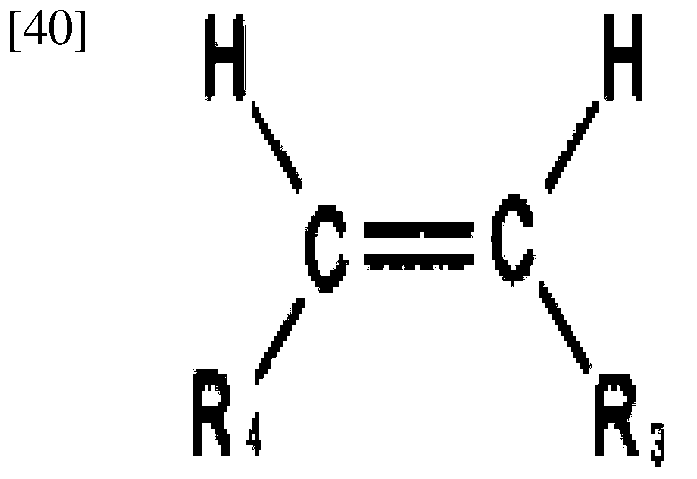
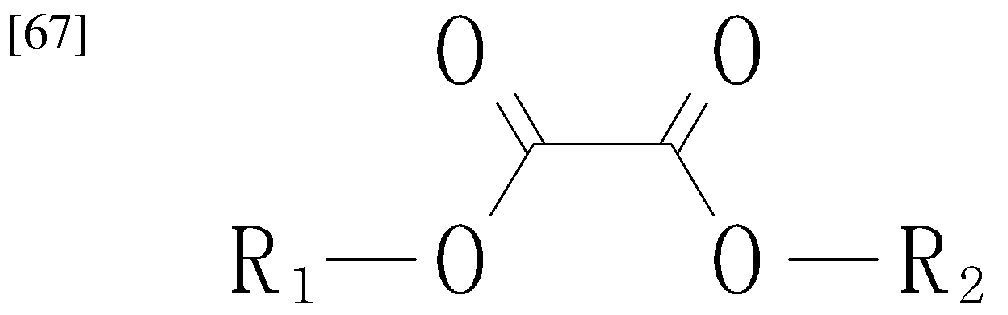
Claims

Claims
[1] An acrylic pressure-sensitive adhesive composition, comprising:
(a) 100 weight parts of an acrylic copolymer;
(b) 0.001 to 30 weight parts of an antistatic agent; and
(c) 0.01 to 10 weight parts of a corrosion inhibitor.
[2] The acrylic pressure-sensitive adhesive composition as claimed in claim 1, wherein the acrylic copolymer comprises:
(i) 90 to 99.9 weight parts of a (meth)acrylate ester monomer with an alkyl group having 1 to 12 carbon atoms; and
(ii) 0.1 to 10 weight parts of a monomer having a cross-linkable functional group. [3] The acrylic pressure-sensitive adhesive composition as claimed in claim 1, wherein the antistatic agent is at least one selected from the group consisting of:
(i) an inorganic salt comprised of metal cation and anion;
(ii) an organic salt comprised of onium cation and anion;
(iii) a mixture of the inorganic salt and a chelate agent capable of forming a bond with the metal ions of the inorganic salt;
(iv) a mixture of the inorganic salt and a compound having at least one ether bond in a molecule. [4] The acrylic pressure-sensitive adhesive composition as claimed in claim 3, wherein the anion of the inorganic or organic salt is selected from the group consisting of iodide (I ), chloride (Cl ), bromide (Br ), nitrate (NO ), sulfonate
3
(SO ), methylbenzenesulfonate (CH (C H )SO ), carboxybenzenesulfonate
4 3 6 4 3
(COOH(C H )SO "), benzonate (C H COO"), perchlorate (ClO "), hydroxide
6 4 3 6 5 4
(OH"), trifluoroacetate (CF COO"), trifluoromethanesulfonate (CF SO "),
3 3 2 tetrafluoroborate (BF ), tetrabenzylborate (B(C H ) ), hexafluorophosphate (PF
4 6 5 4
"), bis(trifluoromethanesulfonyl)imide (N(SO CF ) "),
6 2 3 2 bis(pentafluoroethanesulfonyl)imide (N(SOC F ) ), bis(pentafluoroethanecarbonyl)imide (N(COC F ) ), bis(perfluorobutanesulfonyl)imide (N(SO C F ) ), bis(perfluorobutanecarbonyl)imide (N(COC F ) ), tris(trifluoromethanesulfonyl)methide (C(SO CF ) ), and tris(trifluoromethanecarbonyl)methide (C(SO CF ) ). [5] The acrylic pressure-sensitive adhesive composition as claimed in claim 3, wherein the metal cation is selected from the group consisting of lithium (Li ), sodium (Na ), potassium (K ), rubidium (Rb ), cesium (Cs ), beryllium (Be ), magnesium (Mg +), calcium (Ca +), strontium (Sr +), and barium (Ba +).
[6] The acrylic pressure-sensitive adhesive composition as claimed in claim 3, wherein the onium cation is nitrogen onium cation, phosphorus onium cation, or sulfur onium cation.
[7] The acrylic pressure-sensitive adhesive composition as claimed in claim 6, wherein the nitrogen onium cation is at least one selected from the group consisting of acjclic quaternary ammonium; and an aromatic ammonium salt selected from pyridinium, pyridazinium, pyrimidinium, pyrazinium, im- idazolium, pyrazolium, thiazolium, oxazolium, and triazolium.
[8] The acrylic pressure-sensitive adhesive composition as claimed in claim 7, wherein the nitrogen onium cation is at least one selected from the group consisting of tetraalkylammonium [N+(C H ) : n = 1 ~ 8]; N-alkylpyridinium [N-C H -cjc-N +C H : n = 4 ~ 16]; 1,3-alkylmethylimidazolium [CH <ΛO-(N + n 2n+l 5 5 3
C H NCH)C H : n = 2 ~ 10]; and l,2-dimethyl-3-alkylimidazolium [CH -
2 2 n 2n+l 3
OC-(N +C H NC(CH ))C H : n = 2 ~ 10].
2 2 3 n 2n+l
[9] The acrylic pressure-sensitive adhesive composition as claimed in claim 3, wherein the chelate agent capable of forming a bond with the metal ions is at least one selected from the group consisting of a compound having an oxalate group, a compound having a diamine group, a compound having a poly- functional carboxyl group, a compound having β-ketone group, and a compound having an oxime group.
[10] The acrylic pressure-sensitive adhesive composition as claimed in claim 9, wherein the compound having an oxalate group is a compound represented by the following Formula 2: [Formula 2]
Figure imgf000028_0001
where R and R are each independently hydrogen, halogen, a linear or branched alkyl group having 1 to 20 carbon atoms, a linear or branched alkoxy group having 1 to 20 carbon atoms, a linear or branched alkenyl group having 2 to 20 carbon atoms, an aryl group having 6 to 30 carbon atoms, an arylalkyl group having 6 to 30 carbon atoms, an aryloxy group having 6 to 30 carbon atoms, or a cjcloalkyl group having 5 to 20 carbon atoms.
[11] The acrylic pressure-sensitive adhesive composition as claimed in claim 9, wherein the compound having a diamine group is a compound represented by the following Formula 3: [Formula 3]
Figure imgf000029_0001
NH where R is a linear or branched alkylene group having 1 to 10 carbon atoms, or a linear or branched alkenylene group having 2 to 10 carbon atoms.
[12] The acrylic pressure-sensitive adhesive composition as claimed in claim 9, wherein the compound having a polyfunctional carboxyl group is a compound comprising a functional group represented by the following Formula 4a, 4b, or 4c: [Formula 4a]
V N - CH , COOH
/
[Formula 4b]
. Oh COOH x CH2 COOH [Formula 4c] s COOH
— N :
^ COOH
[13] The acrylic pressure-sensitive adhesive composition as claimed in claim 9, wherein the compound having β-ketone group is a compound represented by the following Formula 5: [Formula 5]
Figure imgf000030_0001
where R and R are each independently a linear or branched alkyl group having
7 8
1 to 20 carbon atoms, a linear or branched alkoxy group having 1 to 20 carbon atoms, a linear or branched alkenyl group having 2 to 20 carbon atoms, an aryl group having 6 to 30 carbon atoms, an arylalkyl group having 6 to 30 carbon atoms, an aryloxy group having 6 to 30 carbon atoms, or a cjcloalkyl group having 5 to 20 carbon atoms, and R is hydrogen, a linear or branched alkyl group having 1 to 20 carbon atoms, a linear or branched alkoxy group having 1 to 20 carbon atoms, a linear or branched alkenyl group having 2 to 20 carbon atoms, an aryl group having 6 to 30 carbon atoms, an arylalkyl group having 6 to 30 carbon atoms, an aryloxy group having 6 to 30 carbon atoms, or a cjcloalkyl group having 5 to 20 carbon atoms.
[14] The acrylic pressure-sensitive adhesive composition as claimed in claim 3, wherein the compound having at least one ether bond in a molecule is a compound represented by the following Formula 6: [Formula 6]
Figure imgf000030_0002
where R and R are each independently an alkyl group having 1 to 20 carbon atoms, or an aryl group, R is hydrogen or a methyl group, and n is an integer of 2 to 20.
[15] The acrylic pressure-sensitive adhesive composition as claimed in claim 1, wherein the corrosion inhibitor is at least one selected from the group consisting of a (benzo)triazole-based compound; a (benzo)thiazole -based compound; a (benzyl)imidazole-based compound; an imidazoline-based compound; a quinoline-, pyridine-, or pyrimidine-based compound; an indole-based compound or its derivative; an amine -based compound; a urea-based compound; sodiumbenzoate; benzylmercapto; di-sec-butylsulfide; and diphenylsulfoxide. [16] The acrylic pressure-sensitive adhesive composition as claimed in claim 1, further comprising 0.01 to 10 weight parts of a polyfunctional cross-linking agent with respect to 100 weight parts of the acrylic copolymer. [17] A protective film, comprising: a substrate; and a pressure-sensitive adhesive layer formed on one or both surfaces of the substrate and containing the acrylic pressure- sensitive adhesive composition according to any one of claims 1 to 16. [18] A polarizer, comprising : a polarizing film or polarizing device; and a pressure-sensitive adhesive layer containing the acrylic pressure-sensitive adhesive composition according to any one of claims 1 to 16. [19] The polarizer as claimed in claim 18, further comprising at least one layer selected from the group consisting of a protective layer, a reflective layer, an anti-glare layer, a retardation plate, a wide-viewing-angle compensation film, and a brightness enhancing film. [20] A liquid crystal display device comprising a liquid crystal display panel, wherein the polarizer according to claim 18 is bonded to one or both surfaces of a liquid crystal cell.
PCT/KR2008/002170 2007-04-19 2008-04-17 Acrylic pressure-sensitive adhesive compositions Ceased WO2008130136A1 (en)

Priority Applications (4)

Application Number Priority Date Filing Date Title
US12/450,894 US9499725B2 (en) 2007-04-19 2008-04-17 Acrylic pressure-sensitive adhesive compositions
CN2008800125654A CN101663370B (en) 2007-04-19 2008-04-17 Acrylic pressure sensitive adhesive composition
JP2010503973A JP5704531B2 (en) 2007-04-19 2008-04-17 Acrylic adhesive composition
EP08741415.7A EP2147072B1 (en) 2007-04-19 2008-04-17 Polarizer and liquid crystal display comprising acrylic pressure-sensitive adhesive compositions

Applications Claiming Priority (2)

Application Number Priority Date Filing Date Title
KR10-2007-0038506 2007-04-19
KR1020070038506A KR101047925B1 (en) 2007-04-19 2007-04-19 Acrylic pressure-sensitive adhesive composition and a polarizing plate comprising the same

Publications (1)

Publication Number Publication Date
WO2008130136A1 true WO2008130136A1 (en) 2008-10-30

Family

ID=39875627

Family Applications (1)

Application Number Title Priority Date Filing Date
PCT/KR2008/002170 Ceased WO2008130136A1 (en) 2007-04-19 2008-04-17 Acrylic pressure-sensitive adhesive compositions

Country Status (7)

Country Link
US (1) US9499725B2 (en)
EP (1) EP2147072B1 (en)
JP (2) JP5704531B2 (en)
KR (1) KR101047925B1 (en)
CN (1) CN101663370B (en)
TW (1) TWI440680B (en)
WO (1) WO2008130136A1 (en)

Cited By (3)

* Cited by examiner, † Cited by third party
Publication number Priority date Publication date Assignee Title
JP2010150396A (en) * 2008-12-25 2010-07-08 Cheil Industries Inc Adhesive composition and optical member using the same
US20130201145A1 (en) * 2010-10-20 2013-08-08 Lg Chem, Ltd. PRESSURE SENSITIVE ADHESIVE COMPOSITION FOR TOUCH PANEL (As Amended)
WO2015038848A1 (en) * 2013-09-16 2015-03-19 3M Innovative Properties Company Adhesive articles containing light shielding film substrates, method of making thereof and articles therefrom

Families Citing this family (61)

* Cited by examiner, † Cited by third party
Publication number Priority date Publication date Assignee Title
KR101082450B1 (en) * 2008-01-14 2011-11-11 주식회사 엘지화학 Acrylic pressure-sensitive adhesive compositions
CN102650058B (en) * 2009-06-26 2015-04-15 中国石油化工股份有限公司 Composite corrosion inhibitor for butyl rubber chloromethane glycol dehydration and regeneration system
CN102650057B (en) * 2009-06-26 2015-04-15 中国石油化工股份有限公司 Composite corrosion inhibitor for butyl rubber chloromethane glycol dehydration and regeneration system
CN102650060B (en) * 2009-06-26 2015-04-15 中国石油化工股份有限公司 Composite corrosion inhibitor for butyl rubber chloromethane glycol dehydration and regeneration system
KR101327684B1 (en) * 2009-07-03 2013-11-08 (주)엘지하우시스 Resin composition for touchscreen, pressure-sensitive adhesive film and touchscreen
KR101191123B1 (en) 2009-10-28 2012-10-15 주식회사 엘지화학 Pressure-sensitive adhesive composition, polarizer and liquid crystal display
CN102311344B (en) * 2010-06-25 2014-05-28 锦湖石油化学株式会社 Compound, polymer comprising the same and resist protective film composition comprising the polymer
JP5715406B2 (en) * 2010-12-16 2015-05-07 三菱マテリアル株式会社 Adhesive composition
JP5912833B2 (en) * 2011-05-26 2016-04-27 日東電工株式会社 Optical film pressure-sensitive adhesive composition, optical film pressure-sensitive adhesive layer, optical film with pressure-sensitive adhesive layer, and image display device
JP5636339B2 (en) * 2011-06-28 2014-12-03 リンテック株式会社 Adhesive and adhesive sheet
JP5613108B2 (en) * 2011-06-28 2014-10-22 リンテック株式会社 Adhesive composition, adhesive and adhesive sheet
WO2014035117A1 (en) * 2012-08-27 2014-03-06 주식회사 엘지화학 Polarizing plate
JP5860673B2 (en) 2011-11-07 2016-02-16 日東電工株式会社 Adhesive composition, adhesive layer, polarizing plate with adhesive layer, and image forming apparatus
JP5896692B2 (en) * 2011-11-16 2016-03-30 日東電工株式会社 Input display device
JP6195707B2 (en) * 2011-11-24 2017-09-13 日東電工株式会社 Adhesive composition, adhesive layer, polarizing film with adhesive layer, and image forming apparatus
JP5875106B2 (en) 2011-11-24 2016-03-02 日東電工株式会社 Adhesive composition, adhesive layer, polarizing plate with adhesive layer, and image forming apparatus
JP5425258B2 (en) 2012-04-16 2014-02-26 日東電工株式会社 Adhesive composition, adhesive layer, polarizing film with adhesive layer, and image forming apparatus
KR101887570B1 (en) * 2012-09-04 2018-08-10 동우 화인켐 주식회사 Adhesive composition
KR101301089B1 (en) * 2013-01-08 2013-08-27 동우 화인켐 주식회사 Pressure-sensitive adhesive composition
JP6407527B2 (en) * 2013-02-14 2018-10-17 日東電工株式会社 Optical pressure-sensitive adhesive layer, pressure-sensitive adhesive sheet, optical member, and touch panel
CN105121487B (en) * 2013-05-02 2017-12-19 株式会社Lg化学 multi-block copolymer
JP2016027354A (en) * 2013-07-19 2016-02-18 富士フイルム株式会社 Laminated body for polarizing plate, polarizing plate including the same, and liquid crystal display device
KR102066921B1 (en) * 2014-03-19 2020-01-16 동우 화인켐 주식회사 Adhesive Composition and Polarizing Plate Comprising the Same
KR101828644B1 (en) * 2014-03-25 2018-02-14 주식회사 엘지화학 Adhesive composition for heat radiation adhesive tape and heat radiation adhesive tape
KR20150115431A (en) * 2014-04-04 2015-10-14 동우 화인켐 주식회사 Adhesive composition containing ionic antistatic agent
KR20150125370A (en) * 2014-04-30 2015-11-09 동우 화인켐 주식회사 Adhesive composition
JP6508204B2 (en) * 2014-06-18 2019-05-08 王子ホールディングス株式会社 Pressure-sensitive adhesive composition for polarizer and pressure-sensitive adhesive sheet for polarizer
CN106489086B (en) * 2014-06-18 2021-02-02 住友化学株式会社 Polarizing plate, polarizing plate with adhesive, and image display device
KR101958679B1 (en) * 2014-06-18 2019-03-15 오지 홀딩스 가부시키가이샤 Adhesive agent composition for polarizers and adhesive sheet for polarizers
KR101716545B1 (en) 2014-06-30 2017-03-15 제일모직주식회사 Adhesive composition for optical member, optical member comprising the same and optical display comprising the same
KR101878527B1 (en) * 2014-08-25 2018-07-16 주식회사 엘지화학 Composition for optical adhesive and bonding film and adhesive and bonding film
US20160244633A1 (en) * 2014-12-13 2016-08-25 Mitsubishi Plastics, Inc. Coated film
CN106019447B (en) * 2015-03-31 2019-08-02 住友化学株式会社 Optical laminate and liquid crystal display device
KR102408598B1 (en) * 2015-03-31 2022-06-14 스미또모 가가꾸 가부시키가이샤 Optical film with adhesive layer and liquid crystal display device
TWI741978B (en) * 2015-03-31 2021-10-11 日商住友化學股份有限公司 Optical laminate and liquid crystal display device
KR101780547B1 (en) * 2015-07-31 2017-09-22 삼성에스디아이 주식회사 Adhesive film for polarizing plate, polarizing plate comprising the same and optical display apparatus comprising the same
WO2017154226A1 (en) 2016-03-09 2017-09-14 三菱樹脂株式会社 Adhesive film and method for producing same
CN105891933A (en) * 2016-06-21 2016-08-24 佛山纬达光电材料有限公司 Energy-saving and environmentally-friendly polaroid and preparation method thereof
JP6205081B1 (en) * 2016-08-10 2017-09-27 日東電工株式会社 Adhesive sheet
TWI731142B (en) * 2016-08-17 2021-06-21 日商三菱化學股份有限公司 Acrylic adhesive composition, adhesive formed by using the acrylic adhesive composition, adhesive for polarizing plate, and image display device
KR102024256B1 (en) 2016-09-23 2019-11-04 주식회사 엘지화학 Pressure sensitive adhsive composition
WO2018056743A1 (en) * 2016-09-23 2018-03-29 주식회사 엘지화학 Adhesive composition
JP6580540B2 (en) * 2016-09-28 2019-09-25 藤森工業株式会社 Adhesive composition and adhesive film
US20190218427A1 (en) * 2016-09-30 2019-07-18 Nitto Denko Corporation Adhesive composition, adhesive layer, polarizing film coated with adhesive layer, liquid crystal panel, and image display device
KR20180099045A (en) 2017-02-28 2018-09-05 동우 화인켐 주식회사 Touch sensor
KR102477734B1 (en) * 2017-03-03 2022-12-14 닛토덴코 가부시키가이샤 Pressure-sensitive adhesive composition for electrical peeling, pressure-sensitive adhesive sheet, and bonded body
KR102159513B1 (en) * 2017-12-15 2020-09-25 주식회사 엘지화학 Crosslinkable Composition
CN111183246B (en) * 2018-02-16 2021-01-01 株式会社日本触媒 Metal corrosion inhibitor
KR102236532B1 (en) 2018-04-25 2021-04-06 주식회사 엘지화학 Crosslinkable Composition
JP7162068B2 (en) * 2018-09-12 2022-10-27 富士フイルム株式会社 Liquid crystal film, polarizing plate, circularly polarizing plate and image display device
CN113226748A (en) * 2018-12-27 2021-08-06 日东电工株式会社 Adhesive sheet
EP3904084A4 (en) * 2018-12-27 2022-08-31 Nitto Denko Corporation Protective sheet
KR102436311B1 (en) * 2019-01-04 2022-08-24 주식회사 엘지화학 Adhesive composition, adhesive layer comprising same and foldable display comprising same
CN113597371B (en) 2019-03-28 2023-11-24 三井金属矿业株式会社 Resin composition and resin-coated copper foil
KR102642819B1 (en) 2020-01-03 2024-03-05 주식회사 엘지화학 Water-based acrylic pressure sensitive adhesive compositno, method for preparing the same, and pressure sensitive adhesive sheet comprising the composition
WO2021137531A1 (en) * 2020-01-03 2021-07-08 (주) 엘지화학 Water-soluble acrylic adhesive composition, production method thereof, and adhesive sheet containing same
CN114402052B (en) * 2020-03-25 2023-12-22 株式会社Lg化学 Adhesive composition for protective film, adhesive containing same and adhesive sheet using same
JP7036880B2 (en) * 2020-10-07 2022-03-15 住友化学株式会社 A polarizing plate with a pressure-sensitive adhesive layer and a method for manufacturing the same, an active energy ray-curable polymer composition used for the manufacture thereof, and a liquid crystal display device.
WO2024241809A1 (en) * 2023-05-23 2024-11-28 リンテック株式会社 Adhesive composition, adhesive, adhesive sheet, and optical member with adhesive layer
KR20240178144A (en) * 2023-06-21 2024-12-30 삼성에스디아이 주식회사 Adhesive film and optical display apparatus comprising the same
KR20250122271A (en) * 2024-02-06 2025-08-13 동우 화인켐 주식회사 Adhesive composition for optical members, adhesive sheet, and display comprising the same

Citations (5)

* Cited by examiner, † Cited by third party
Publication number Priority date Publication date Assignee Title
US20050197450A1 (en) * 2004-03-08 2005-09-08 Tatsumi Amano Pressure-sensitive adhesive composition, pressure-sensitive adhesive sheets and surface protecting film
KR20060047584A (en) * 2004-04-30 2006-05-18 닛토덴코 가부시키가이샤 Pressure-sensitive adhesive composition and pressure-sensitive adhesive sheet
KR20060100261A (en) * 2005-03-16 2006-09-20 닛토덴코 가부시키가이샤 Adhesive composition, adhesive sheets, and surface protection film
KR20060128659A (en) * 2005-06-08 2006-12-14 주식회사 엘지화학 Acrylic pressure-sensitive adhesive composition
WO2007029681A1 (en) * 2005-09-05 2007-03-15 Nitto Denko Corporation Adhesive composition, adhesive sheet, and surface protective film

Family Cites Families (18)

* Cited by examiner, † Cited by third party
Publication number Priority date Publication date Assignee Title
JP3190743B2 (en) * 1992-10-14 2001-07-23 日東電工株式会社 Adhesive tape or sheet
DE69507609T2 (en) * 1994-05-06 1999-09-30 Minnesota Mining And Mfg. Co., Saint Paul HIGH TEMPERATURE RESISTANT, ANTISTATIC, PRESSURE SENSITIVE TAPE
US5885708A (en) 1997-02-14 1999-03-23 Minnesota Mining And Manufacturing Company Antistatic latex adhesives
KR100429115B1 (en) * 2000-09-29 2004-04-29 가부시끼가이샤 도시바 Batteries with Anode Comprising Aluminum
EP1354316A2 (en) * 2000-11-13 2003-10-22 DSM IP Assets B.V. Radiation-curable compositions for optical media
US6706835B2 (en) * 2002-07-19 2004-03-16 National Starch And Chemical Investment Holding Corporation Curable compositions containing thiazole functionality
JP2004175960A (en) 2002-11-28 2004-06-24 Nitto Denko Corp Heat-peelable pressure-sensitive adhesive sheet and electronic components
JP2005108678A (en) 2003-09-30 2005-04-21 Optrex Corp Organic EL light emitting device and method for manufacturing the same
JP2005314476A (en) 2004-04-27 2005-11-10 Nitto Denko Corp Adhesive composition, adhesive sheet and surface protective film
JP2006040735A (en) * 2004-07-27 2006-02-09 Japan Carlit Co Ltd:The Conductivity imparting agent and conductive resin composition
JP5299804B2 (en) 2004-08-03 2013-09-25 綜研化学株式会社 Adhesive sheet for attaching metal
KR100694445B1 (en) * 2004-08-24 2007-03-12 주식회사 엘지화학 Acrylic pressure-sensitive adhesive composition having antistatic performance
JP4799900B2 (en) 2004-10-28 2011-10-26 日東電工株式会社 Adhesive composition, adhesive sheet and surface protective film
JP4682296B2 (en) * 2005-01-21 2011-05-11 綜研化学株式会社 Adhesive sheet
KR100784991B1 (en) * 2005-06-10 2007-12-11 주식회사 엘지화학 Acrylic pressure-sensitive adhesive compositions
MX2008002395A (en) * 2005-08-19 2008-03-18 Neose Technologies Inc FACTOR VII AND FACTOR VIIA GLICOPEGILADOS.
FR2913146B1 (en) 2007-02-23 2009-05-01 Saint Gobain DISCONTINUOUS ELECTRODE, ORGANIC ELECTROLUMINESCENCE DEVICE INCORPORATING THE SAME, AND THEIR MANUFACTURING
KR101094298B1 (en) 2009-08-18 2011-12-19 삼성모바일디스플레이주식회사 Organic light emitting display

Patent Citations (5)

* Cited by examiner, † Cited by third party
Publication number Priority date Publication date Assignee Title
US20050197450A1 (en) * 2004-03-08 2005-09-08 Tatsumi Amano Pressure-sensitive adhesive composition, pressure-sensitive adhesive sheets and surface protecting film
KR20060047584A (en) * 2004-04-30 2006-05-18 닛토덴코 가부시키가이샤 Pressure-sensitive adhesive composition and pressure-sensitive adhesive sheet
KR20060100261A (en) * 2005-03-16 2006-09-20 닛토덴코 가부시키가이샤 Adhesive composition, adhesive sheets, and surface protection film
KR20060128659A (en) * 2005-06-08 2006-12-14 주식회사 엘지화학 Acrylic pressure-sensitive adhesive composition
WO2007029681A1 (en) * 2005-09-05 2007-03-15 Nitto Denko Corporation Adhesive composition, adhesive sheet, and surface protective film

Cited By (6)

* Cited by examiner, † Cited by third party
Publication number Priority date Publication date Assignee Title
JP2010150396A (en) * 2008-12-25 2010-07-08 Cheil Industries Inc Adhesive composition and optical member using the same
CN102216408A (en) * 2008-12-25 2011-10-12 第一毛织株式会社 Adhesive composition and optical element using same
CN102216408B (en) * 2008-12-25 2014-07-23 第一毛织株式会社 Adhesive composition and optical element using same
US20130201145A1 (en) * 2010-10-20 2013-08-08 Lg Chem, Ltd. PRESSURE SENSITIVE ADHESIVE COMPOSITION FOR TOUCH PANEL (As Amended)
US9556364B2 (en) * 2010-10-20 2017-01-31 Lg Chem, Ltd. Pressure sensitive adhesive composition for touch panel
WO2015038848A1 (en) * 2013-09-16 2015-03-19 3M Innovative Properties Company Adhesive articles containing light shielding film substrates, method of making thereof and articles therefrom

Also Published As

Publication number Publication date
TW200907000A (en) 2009-02-16
CN101663370A (en) 2010-03-03
US20100188620A1 (en) 2010-07-29
EP2147072A4 (en) 2011-07-27
TWI440680B (en) 2014-06-11
KR101047925B1 (en) 2011-07-08
KR20080094282A (en) 2008-10-23
EP2147072A1 (en) 2010-01-27
JP2015014011A (en) 2015-01-22
JP5704531B2 (en) 2015-04-22
JP6073846B2 (en) 2017-02-01
US9499725B2 (en) 2016-11-22
CN101663370B (en) 2013-12-04
JP2010525098A (en) 2010-07-22
EP2147072B1 (en) 2014-01-01

Similar Documents

Publication Publication Date Title
EP2147072B1 (en) Polarizer and liquid crystal display comprising acrylic pressure-sensitive adhesive compositions
JP5492784B2 (en) Adhesive composition for surface protective film, and surface protective sheet
JP5800405B2 (en) Adhesive composition
CN101910346B (en) Pressure-sensitive adhesive composition, protective film, polarizer and liquid crystal display comprising same
KR101127103B1 (en) Adhesive composition and optical member using the same
US7655285B2 (en) Acrylic pressure sensitive adhesive compositions
CN104011162B (en) Binder composition
TWI402320B (en) Acrylic pressure sensitive adhesive composition, protection film including the same, polarizer and liquid crystal display
JP6286703B2 (en) Optical member pressure-sensitive adhesive composition, optical member pressure-sensitive adhesive film and surface protective film
TWI491692B (en) Adhesive composition, adhesive film and surface protective film
CN105778831A (en) Adhesive composition and adhesive film
TWI674309B (en) Optical laminate and display device using the same
KR20170061007A (en) Pressure sensitive adhesive composition
KR101191123B1 (en) Pressure-sensitive adhesive composition, polarizer and liquid crystal display
JP2020063422A (en) Adhesive composition and adhesive film

Legal Events

Date Code Title Description
WWE Wipo information: entry into national phase

Ref document number: 200880012565.4

Country of ref document: CN

121 Ep: the epo has been informed by wipo that ep was designated in this application

Ref document number: 08741415

Country of ref document: EP

Kind code of ref document: A1

ENP Entry into the national phase

Ref document number: 2010503973

Country of ref document: JP

Kind code of ref document: A

NENP Non-entry into the national phase

Ref country code: DE

WWE Wipo information: entry into national phase

Ref document number: 2008741415

Country of ref document: EP

WWE Wipo information: entry into national phase

Ref document number: 12450894

Country of ref document: US