WO2008136770A1 - Poly-n-heterocyclic carbene transition metal complexes and n-heterocyclic carbene transition metal complexes for carbon-sulfur and carbon-oxygen coupling reactions - Google Patents
Poly-n-heterocyclic carbene transition metal complexes and n-heterocyclic carbene transition metal complexes for carbon-sulfur and carbon-oxygen coupling reactions Download PDFInfo
- Publication number
- WO2008136770A1 WO2008136770A1 PCT/SG2008/000157 SG2008000157W WO2008136770A1 WO 2008136770 A1 WO2008136770 A1 WO 2008136770A1 SG 2008000157 W SG2008000157 W SG 2008000157W WO 2008136770 A1 WO2008136770 A1 WO 2008136770A1
- Authority
- WO
- WIPO (PCT)
- Prior art keywords
- transition metal
- formula
- hydrogen
- metal complex
- double bond
- Prior art date
- Legal status (The legal status is an assumption and is not a legal conclusion. Google has not performed a legal analysis and makes no representation as to the accuracy of the status listed.)
- Ceased
Links
- LRAJQYYVYBOZCU-UHFFFAOYSA-N CC(C(C)(N)N)N Chemical compound CC(C(C)(N)N)N LRAJQYYVYBOZCU-UHFFFAOYSA-N 0.000 description 1
Classifications
-
- C—CHEMISTRY; METALLURGY
- C07—ORGANIC CHEMISTRY
- C07F—ACYCLIC, CARBOCYCLIC OR HETEROCYCLIC COMPOUNDS CONTAINING ELEMENTS OTHER THAN CARBON, HYDROGEN, HALOGEN, OXYGEN, NITROGEN, SULFUR, SELENIUM OR TELLURIUM
- C07F15/00—Compounds containing elements of Groups 8, 9, 10 or 18 of the Periodic Table
- C07F15/04—Nickel compounds
-
- C—CHEMISTRY; METALLURGY
- C07—ORGANIC CHEMISTRY
- C07B—GENERAL METHODS OF ORGANIC CHEMISTRY; APPARATUS THEREFOR
- C07B41/00—Formation or introduction of functional groups containing oxygen
- C07B41/04—Formation or introduction of functional groups containing oxygen of ether, acetal or ketal groups
-
- C—CHEMISTRY; METALLURGY
- C07—ORGANIC CHEMISTRY
- C07B—GENERAL METHODS OF ORGANIC CHEMISTRY; APPARATUS THEREFOR
- C07B45/00—Formation or introduction of functional groups containing sulfur
- C07B45/06—Formation or introduction of functional groups containing sulfur of mercapto or sulfide groups
-
- Y—GENERAL TAGGING OF NEW TECHNOLOGICAL DEVELOPMENTS; GENERAL TAGGING OF CROSS-SECTIONAL TECHNOLOGIES SPANNING OVER SEVERAL SECTIONS OF THE IPC; TECHNICAL SUBJECTS COVERED BY FORMER USPC CROSS-REFERENCE ART COLLECTIONS [XRACs] AND DIGESTS
- Y02—TECHNOLOGIES OR APPLICATIONS FOR MITIGATION OR ADAPTATION AGAINST CLIMATE CHANGE
- Y02P—CLIMATE CHANGE MITIGATION TECHNOLOGIES IN THE PRODUCTION OR PROCESSING OF GOODS
- Y02P20/00—Technologies relating to chemical industry
- Y02P20/50—Improvements relating to the production of bulk chemicals
- Y02P20/582—Recycling of unreacted starting or intermediate materials
Definitions
- This invention relates to a poly-iNT-heterocyclic carbene (p-NHC) transition metal complex and a N- heterocyclic carbene (NHC) transition metal complex for carbon-sulfur (C-S) and carbon-oxygen (C-O) coupling reactions.
- This invention further relates to a p-NHC nickel complex and a NHC nickel complex, which may be used for C-S and C-O coupling reactions.
- jW-heterocyclic carbenes have been reported as a class of ligands which can be used for transition metal catalysis in view of their similarity to electron-rich organophosphanes, and the ⁇ -donating properties of HHCs.
- p-NHC is a polymer material with free carbene units in its main chain, and has been reported to be easy to synthesize. p-NHC has also been reported as having versatile properties in coordination with different transition metals and can support metals to generate heterogeneous organometallic catalysts.
- Ni-NHC complexes demonstrated efficient carbon-fluorine and carbon-carbon bond activation. Ni-NHC catalyzed hydrothiolation of alkynes has also been reported. Ni complexes have been reported to catalyze C-S coupling. However, it has been reported that good activities were only achieved with aryl iodides .
- a method for carbon-sulfur (C-S) or carbon-oxygen (C-O) coupling comprising: a) mixing, in any order, a thiol- containing compound, an aryl l ⁇ alide and a transition metal complex to obtain C-S coupling; or b) mixing, in any order, an alkoxide or aryloxide, an aryl halide and a transition metal complex to obtain C-O coupling, wherein the transition metal complex comprises a heterocyclic carbene ligand ⁇ omplexed with a transition metal other than palladium.
- a method for carbon-sulfur (C-S) or carbon-oxygen (C-O) coupling comprising: a) mixing, in any order, a thiol- ⁇ ontaining compound, an aryl halide and a transition metal complex to obtain C-S coupling; or b) mixing, in any order, an alkoxide or aryloxide, an aryl halide and a transition metal complex to obtain C-O coupling, wherein the transition metal complex comprises a heterocyclic carbene ligand complexed with nickel .
- a transition metal complex comprising a poly-N- heterocyclic carbene complexed with nickel.
- transition metal complex comprising a N- heterocylic carbene complexed with nickel.
- Figure 1 displays the structures of a poly-imidazolium salt 1, a poly-imidazolidene carbene 2 and a poly-imidazolidene carbene metal complex 3.
- Figure 2 displays synthesis of a Ni-p-NHC catalyst B from a p-NHC A.
- the present invention relates to methods for C-S and C-O coupling using a transition metal complex.
- the transition metal complex may comprise, for example, and without limitation, heterocyclic groups.
- the transition metal complex may comprise a heterocylic carbene ligand complexed with a transition metal .
- the heterocyclic carbene ligand may be, for example, and without limitation, a poly-JJT- heterocycli ⁇ carbene.
- the transition metal complex may comprise one or more monomer units comprising two heterocyclic groups joined by a linker group.
- the transition metal complex may comprise, for example, and without limitation, one or more monomer units represented by the formula (I) .
- each of R x and R 2 is a linker group.
- Each of Ri and R 2 may be independently a rigid linker group, a non-rigid linker group or a semi-rigid linker group. Ri and R 2 may be the same or different.
- Suitable rigid linker groups would be understood to and can be determined by those of ordinary skill in the art, and may include, for example, and without limitation, aromatic groups, heteroaromatic groups, ⁇ ycloaliphatic groups, suitably rigid alkenes and suitably rigid alkynes.
- Suitable rigid linker groups may include, for example, optionally substituted ethenyl ⁇ e.g. ethenediyl, propen-1,2- diyl, 2-butene-2,3-diyl, etc.), ethynyl (e.g.
- aryl (1,3- phenylene, 1,4-phenylene, 1,3-naphthylene, 1,4-naphthylene, 1,5-naphthylene, 1, 6-naphthylene / 1,7-naphthylene,
- heteroaryl e.g. 2, 6-pyridinediyl, 2,6-pyrandiyl, 2, 5-pyrrolediyl, etc.
- cycloalkyl e.g. 1,3-cyclohexanediyl, 1,4-cyclohexanediyl, 1,3- cyclopentanediyl , 1,3-cyclobutanediyl, etc. linker groups.
- Suitable non-rigid and semi-rigid linker groups would be understood to and can be determined by those of ordinary skill in the art, and may include, for example, and without limitation, an alkyl, alkenyl (other than ethenyl) , alkylaryl and other suitable linker groups.
- Suitable non- rigid or semi-rigid linker groups may include, for example, -(CH 2 ) T1 -, where u is between 1 and about 10, and which non- rigid or semi-rigid linker groups may be optionally substituted and/or branched (e.g.
- linker groups may be optionally substituted (e.g. by an alkyl group, an aryl group, a halide or some other substituent) or may comprise a heteroatom such as 0, S, N (e.g.
- R 1 or R 2 may independently be -CH 2 OCH 2 -, -CH 2 OCH 2 CH 2 -, -CH 2 OCH(CH 3 )-, - (CH 2 OCH 2 ) p - (where p is between 1 and about 100), -CH 2 NHCH 2 - , CH 2 N(CH 3 ) CH 2 - , -CH 2 K (Ph) CH 2 - , -CH 2 SCH 2 -, etc.) .
- the heteroatom may be disposed so that it is also capable of complexing or bonding to the transition metal .
- Ri may be a rigid linker group and R 2 may be a non-rigid or semi-rigid linker group.
- M is a transition metal and the symbol * indicates an end of the monomer unit .
- X x " is a counterion.
- Xi " may be, for example, and without limitation, a halide, such as, for example, bromide, chloride or iodide.
- Other suitable X ⁇ " may be, for example, acetate, nitrate, trifluoroacetate, etc.
- Xi " may be coordinated with the transition metal.
- the formulae described throughout this entire specification representing the monomer unit(s) of the transition metal complex may be represented with a m+ charge on M as shown above, or the formulae may be represented as having bonds linking the Xi " s to M.
- the transition metal M may be doubly coordinated as represented in the formula above, or the transition metal M may be coordinated differently, for example, and without limitation, the transition metal M may be singly or triply coordinated.
- the transition metal may be M m+ , where m is an integer of 1, 2, 3, 4, 5, 6 or 7, although typically m will be l, 2 or 3.
- the number of X 1 " groups will then generally be TnX 1 " groups, where m is defined as above. While each X 1 " might be the same or different, generally each Xi " is selected to be the same counterion.
- n is the degree of polymerisation.
- n may be, for example, and without limitation, a value where the transition metal complex is insoluble in solvents used for the coupling reactions
- n may be, for example, and without limitation, greater than about 5, or greater than about 10, 15, 20, 30, 40, 50, 60, 70, 80, 90, 100, 200, 300, 400, 500, 600, 70O 7 800, 900 or 1000, or may be between about 5 and 1000, 10 and 1000, 50 and 1000, 100 and 1000, 200 and 1000, 500 and 1000, 5 and 500, 5 and 200, 5 and 100, 5 and 50, 5 and 20, 5 and 10, 10 and 50, 50 and 500, 50 and 200, 50 and 100 or 100 and 300, and including any specific value within these ranges, such as, for example, and without limitation, about 5, 6, 7, 8, 9, 10, 15, 20, 30, 40, 50, 60, 70, 80, 90, 100, 150, 200, 250, 300, 350, 400, 450, 500, 600, 700, 800, 900 or 1000.
- each of A, B, C and D, and, if present, E, F, G and H may independently be, for example, and without limitation, hydrogen or a substituent which is not hydrogen.
- Each of A, B, C 1 D, E, F, G and H may independently be, for example and without limitation, hydrogen, alkyl (e.g. straight chain, branched chain, ⁇ ycloalkyl, etc.), aryl (e.g. phenyl, naphthyl, etc. ⁇ , halide (e.g.
- heteroaryl e.g pyridyl, pyrrolyl, furanyl, furanylmethyl, thiofuranyl, imidazolyl, etc.
- alkenyl e.g. ethenyl, 1-, or 2-propenyl, etc.
- alkynyl e.g. ethynyl, 1- or 3-propynyl, 1-, 3- or A- but-l-ynyl, 1- or 4-but-2-ynyl, etc.
- A, B, C and D and, if present, E, F, G and H may be all the same, or some or all may be different.
- the alkyl group may have, for example, and without limitation, between about 1 and 20 carbon atoms (provided that cyclic or branched alkyl groups have at least 3 carbon atoms), or between about 1 and 12, 1 and 10, 1 and 6, 1 and 3, 3 and 20, 6 and 20, 12 and 20, 3 and 12 or 3 and 6, including any specific number within these ranges.
- the alkyl group may be, methyl, ethyl, 1- or 2-propyl, isopropyl, 1- or 2-butyl, isobutyl, tert-butyl, cyclopentyl, cyclopentylmethyl, cyclohexyl, cyclohexylmethyl, methylcyclohexyl, etc.
- the substituents may be optionally substituted
- the substituent may be methoxymethyl, methoxyethyl , ethoxymethyl , polyoxyethyl, thiomethoxymethyl, methylaminomethyl, dimethylaminomethyl, etc.).
- Each of A, B, C and D, and, if present, E, F, G and H may independently be chiral or achiral.
- any two of A, B, C and D, and, if present, E, F, G and H may be joined to form a cyclic structure.
- at least one heterocyclic ring of formula (I) may have fused or spiro-joined rings.
- r—-- represents a single bond
- any pair of substituents A, B, C, D, E, F, G and H attached to the same carbon atom may be joined to form, for example, a cyclopentyl, cyclohexyl or some other ring.
- a and E form a cyclopentyl ring
- a 1,3- diazaspiro [4.4]nonane structure may be formed.
- any pair of substituents A, B, C, D, E 7 F, G and H attached to adjacent carbon atoms may be joined to form, for example, a cyclopentyl, cyclohexyl or some other ring.
- a and B form a cyclopentyl ring
- a 1,3- diazabicyclo [3.3.0] octane structure may be formed.
- any pair of substituents A, B, C, D, E, F, G and H attached to the same carbon atom may represent a single substituent attached to the carbon atom by a double bond.
- the monomer unit(s) may be represented by, for example, and without limitation, the formula (Ia) , (Ib)
- At least one heterocyclic ring of formula (I) when represents a double, at least one heterocyclic ring of formula (I) , may be, for example, and without limitation, fused with an aromatic or heteroaromatic ring.
- the monomer unit(s) may be represented by, for example, and without limitation, the formula
- Ri, R 2 , M, *, Xi " , m and n may be defined as anywhere above .
- the heterocyclic carbene ligand may be, for example, and without limitation, a N-heterocyclic carbene copolymer.
- the copolymer may comprise two or more different monomer units. In an embodiment, one, some or all of the different monomer units may be represented by the formulae as described anywhere above.
- the copolymer may be an alternating copolymer .
- the transition metal complex may be, for example, nickel poly-imidazolidene (Ni-pl ⁇ i) or nickel poly-benzoimidazolidene (Hi-pBIm) .
- the carbene centres of the p-MEHC as described anywhere above may be in the main chain of the polymer.
- the transition metal complex may be, for example, and without limitation, in the form of one or more particles.
- the transition metal complex may be, for example, in the form of amorphous particles, spherical particles or mi ⁇ ro ⁇ rystalline particles.
- the particles may be, for example, and without limitation, colloidal particles.
- the particles may be, for example, and without limitation, micron-sized or nanometer-sized colloidal particles.
- the particles may be, for example, and without limitation, between about 100 nm to about 10 microns in diameter.
- the particles may have, for example, and without limitation, a diameter between about 100 nm and 1 micron, 100 and 500 nm, 500 nm and 10 microns, 1 and 10 microns, or 100 nm and 1 micron, and including any specific value within these ranges, such as, for example, and without limitation, about 100, 200, 300, 400, 500, 600, 700, 800 or 900 nm, or about 1, 1.5, 2, 2.5, 3, 3.5, 4, 4.5, 5, 6, 7, 8, 9 or 10 microns.
- the size and shape of the particles may depend on the nature of the monomer unit (s) used, and the conditions of synthesis of the polymer, particularly the solvent used in the polymerisation process.
- the heterocyclic carbene ligand may be, for example, and without limitation, a N-heterocyclic carbene.
- the NHC ligand of the transition metal complex may be represented by, for example, and without limitation, the formula (III).
- each of X 1 -, A, B and, if present, E and F may be defined as anywhere above.
- Each of R 3 and K 4 represents a substituent which is not hydrogen including those defined for A to H anywhere above. represents a single bond or a double bond, wherein when represents a double bond, E and F are not present.
- any two of A, B and, if present, E and F may be joined to form a cyclic structure including those described for formula (I) above.
- any pair of substituents A, B, E and F attached to the same carbon atom may represent a single substituent attached to the carbon atom by a double bond.
- the NHC ligand may be represented by, for example, and without limitation, the formula (IlIa), (IIIb) or (Illc):
- each of X 1 -, A, B, E, F, R 3 , R 4 , J and K may be as defined anywhere above.
- the heterocyclic ring of formula (III) when is a double bond, may be, for example, and without limitation, fused with an aromatic or heteroaromatic ring.
- the NHC ligand may be represented by, for example, and without limitation, the formula (IV) :
- the NHC ligand may be, for example, and without limitation, a bridged bidentate ligand.
- the MHC ligand may be represented by, for example, and without limitation, the formula (V) or (VI) :
- R 5 may be, for example, and without limitation, a linker group including those described for R x and R 2 above.
- the transition metal complex may have, for example, and without limitation, a NHC ligand/transition metal ratio of from 1 to 5 including any specific value within this range, such as, for example, and without limitation, 1, 2, or 3. In an embodiment, the NHC ligand/transition metal ratio may be, for example, 2. Transition metals are understood as falling within Groups IHB, IVB, VB, VIB, VIIB, VIIIB, IB and HB in the Periodic Table of the Elements. In an embodiment of the invention, the transition metal of the transition metal complex may be, for example, and without limitation, a transition metal capable of complexing with one, two or three carbene (-C:-) centres, and also optionally with a heteroatom, wherein the transition metal is not palladium. In one embodiment, the transition metal may be, for example, and without limitation, a Group VIIIB metal. In an exemplary embodiment, the transition metal may be, for exampIe, nickel.
- the transition metal complexes may be prepared from the corresponding free heterocyclic carbenes and/or the corresponding heterocyclic salts (see, for example, WO 2007/114,793).
- a poly-imidazolium salt 1 a free poly- imidazolidene carbene 2 and a poly-imidazolidene carbene metal complex 3 are shown in Figure 1, wherein M represents a transition metal as described anywhere above and L represents a ligand, including, for example, and without limitation, ⁇ yclooctadiene (COD) .
- Figure 2 shows the synthesis of nickel poly- imidazolidene (Ni-plm) catalyst B from poly-imidazolidene free carbene polymer particles A and Ni(COD) 2 .
- transition metal complexes as described anywhere above may be used to catalyse C-S or C-O coupling reactions.
- the C-S coupling reaction may involve an aryl halide substrate and a thiol-containing compound.
- Suitable aryl halides for the C-S coupling reactions would be understood to or can be determined by those of ordinary skill in the art, and may include, for example, and without limitation, aryl iodides, aryl bromides and aryl chlorides.
- the aryl group of the aryl halide may be optionally substituted with a substituent which is not hydrogen including those defined for A to H anywhere above .
- the aryl group of the aryl halide may be fused with an aromatic or heterocyclic ring.
- the aryl halide may be activated, non-activated or deactivated.
- Suitable thiol-containing compounds for the C-S coupling reactions would be understood to or can be determined by those of ordinary skill in the art, and may include, for example, and without limitation, aryl thiols and alkyl thiols.
- the aryl and alkyl moieties of the aryl and alkyl thiols may include the aryl and alkyl groups as defined anywhere above.
- An embodiment of the present invention may be represented by, for example, and without limitation, the following scheme:
- R of the aryl halide represents hydrogen or a substituent which is not hydrogen as described anywhere above
- R' of the thiol represents aryl or alkyl as described anywhere above.
- Ni-WHC catalysts are undergoing the same oxidative addition and reductive elimination cycle, as represented in the following scheme:
- R and X are as defined anywhere above . While sterically hindered ligands are generally good in the reductive elimination step they would generally slow down the oxidative addition process. On the other hand, strong electron-donating ligands may help the oxidative addition of aryl halides but are generally not good in reductive elimination. It is believed that tuning the steric hindrance and electron-donating properties of ligands may be a consideration in catalyst development.
- the C-O coupling reaction may involve an aryl halide and an alkoxide or aryloxide.
- Suitable aryl halides for the C-O coupling reactions would be understood to or can be determined by those of ordinary skill in the art, and may include those aryl halides defined for the C-S coupling above.
- Suitable alkoxides and aryloxides for the C-O coupling reactions would be understood to and can be determined by those of ordinary skill in the art.
- the alkyl and aryl moieties of the alkoxides and aryloxides may include the alkyl and aryl groups as defined anywhere above.
- Suitable alkoxides may include, for example, and without limitation, primary, secondary and tertiary alkoxides.
- the alkoxides and aryloxides may be substituted with a substituent which is not hydrogen including those defined for A to H anywhere above .
- An embodiment of the present invention may be represented by, for example, and without limitation, the following scheme:
- R of the aryl halide is as defined anywhere above and R" represents an alkyl or aryl group as defined anywhere above .
- the transition metal complex, the thiol-containing compound and the aryl halide for the C-S coupling, or the transition metal complex, the alkoxide or aryloxide and the aryl halide for the C-O coupling may be mixed in any order.
- the transition metal complex may be first mixed with any one of the thiol-containing compound and the aryl halide, or the thiol-containing compound and the aryl halide may be first mixed together before mixing with the transition metal complex.
- the transition metal complex may be first mixed with any one of the alkoxide or aryloxide and the aryl halide, or the alkoxide or aryloxide and the aryl halide may be first mixed together before mixing with the transition metal complex.
- the reaction conditions of the C-S and C-O coupling reactions would be understood to and can be determined by those of ordinary skill in the art.
- the coupling reactions may be carried out in the presence of a solvent .
- Suitable solvents would be understood to and can be determined by those of ordinary skill in the art, and may include, for example, and without limitation, N,N- dimethylformamide (DMP), tetrahydrofuran (THP) or toluene.
- the transition metal complex may be insoluble in the solvent, i.e. the transition metal complex may function as a heterogeneous catalyst.
- the transition metal complex may be soluble or at least partially soluble in the solvent, i.e. the transition metal complex may function as a homogeneous catalyst.
- Suitable reaction temperatures would be understood to and can be determined by those of ordinary skill in the art, and may include, for example, and without limitation, from about 80 to 120oC, and including any specific value within this range, such as, for example, 100 or 110oC.
- the amount of transition metal complex used would be understood to and can be determined by those of ordinary skill in the art, and may include from less than about 5 mol%, between about 0.1 to 3 mol%, and including any specific value within these ranges, for example, 0.1 mol%, 1.5 mol%, 3 mol% or 4 mol%.
- Suitable amounts of the aryl halide and thiol-containing compound in the C-S coupling reactions and the aryl halide and aryloxide or alkyloxide in the C-O coupling reactions would be understood to and can be determined by those of ordinary skill in the art .
- the coupling reagents may be used in accordance with their stoichiometric ratios.
- the C-S coupling reaction may be carried out in the presence of a suitable base.
- suitable bases may include KO 11 Bu, Cs 2 CO 3 , Na 2 CO 3 and NaO 11 Bu.
- the transition metal complex may be recycled to catalyse one or more subsequent reactions.
- the method may optionally comprise separating the product from the reaction mixture, for example, and without limitation, by filtration, chromatographic separation, recrystallization or other suitable separation processes .
- Nickel poly-benzoimidazolidene (Ni-pBIm) D (0.3 mmol/g) was prepared from poly- benzoimidazolidene (pBIm) C by using the same procedure as the synthesis of Ni-plm B.
- Ni-plm B (10 mg, 0.003 mmol of Ni), KO fc Bu (0.25 mmol), 4-chlorobenzenetrifluoride (0.2 mmol) were mixed with 2 ml of DMF in a reaction vial. The vial was capped, and the reaction mixture was stirred at 100oC for 16 h. After completion of the reaction, the reaction mixture was centrifuged, and the solution was removed. This procedure was repeated at least thrice using dry DMF as the washing solvent. The combined liquid was collected for yield measurement . The recovered catalyst was used directly for the next run.
- Nl-pl ⁇ n catalyst B The catalytic activity of Nl-pl ⁇ n catalyst B was investigated in C-S coupling of aryl halides. Several solvents and bases were examined for the reaction of 4-chlorobenzotrifluoride and thiophenol over Ni-plm catalyst B (1.5 mol%) . Sulfide products were obtained in excellent yields (94%) in DMF/potassium terfc-butoxide (KO fc Bu) system, but moderate or low yields were obtained in other solvents (toluene or THF) .
- KO fc Bu DMF/potassium terfc-butoxide
- Ni-plm catalyst also demonstrated excellent reusability. No deactivation was observed for the recycled catalyst (see Table 1) .
- the Hl-plm catalyst was observed to maintain excellent catalytic activity over multiple runs.
- Catalyst B was observed to provide C-S coupling activity similar to or lower than the expensive homogeneous Pd ⁇ dba) 2 /CyPF ⁇ fc-Bu catalyst developed by Hartwig. Similar activities as catalyst B in the C-S coupling reactions were observed for catalyst D.
- Nickel 1,3-dibenzylimidazolidene ((C) 2 -Ni(O)) catalyst was synthesized by adding 82.5 mg of KTi(COD) 2
- reaction conditions are 0.2 mraol of aryl halides, 0.22 mmol of thiols and Ni catalyst in 1 mL of DMF, 100 oC, IS h.
- GC yields [b] Reaction run using 0.24 mmol of potassium tert-butoxide (KO b Bu) . Ed] Reaction run using 0.25 mmol of KO 11 Bu.
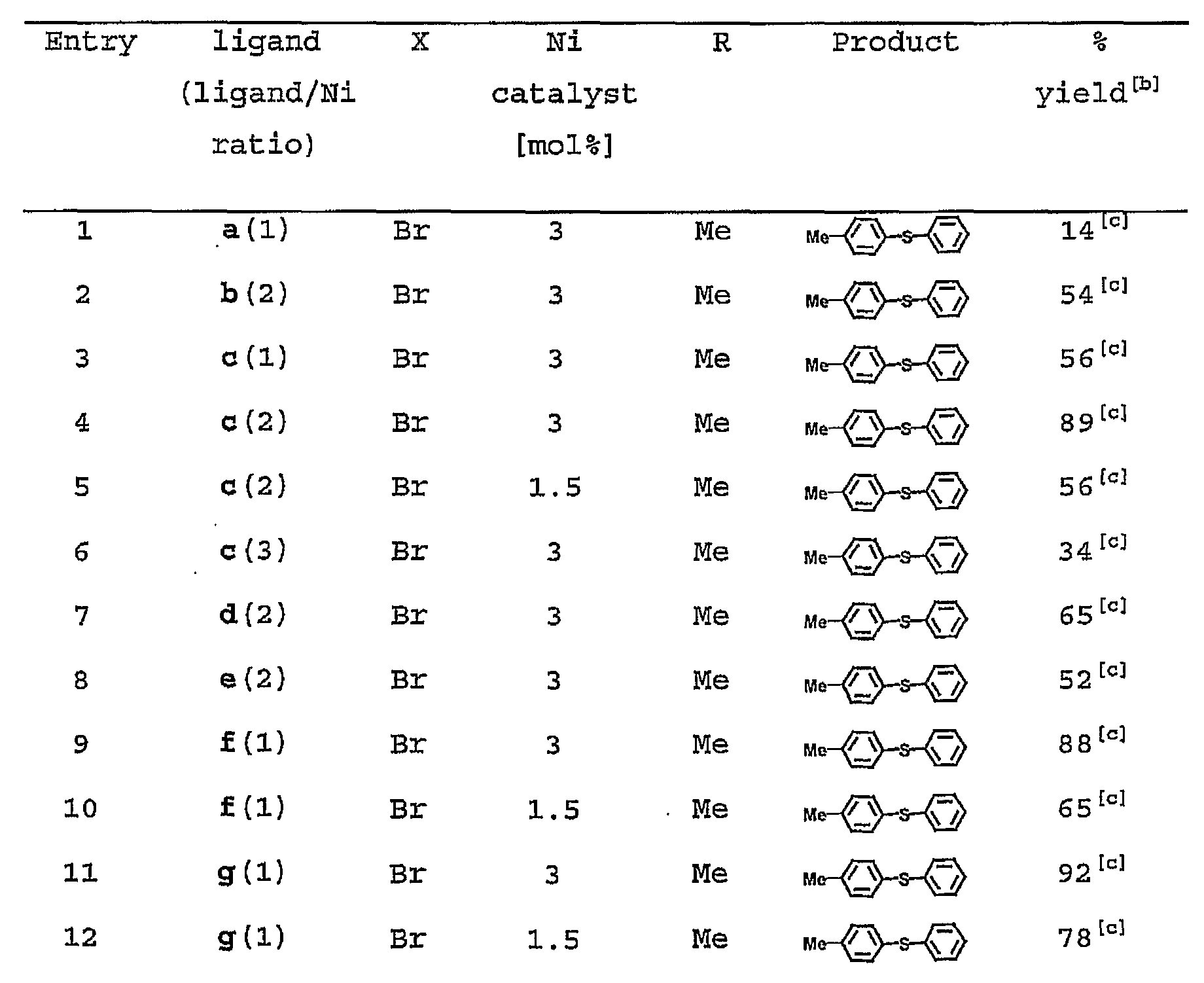
- NHC ligands a-i and different NHC/Ni ratios in the coupling of different aryl halides with thiophenol were investigated (Table 3) .
- the different types of Ni-NHC catalysts investigated were observed to be all active in this coupling reaction. Strong electron-donating NHC generated from c was observed generally to show the highest activity among WHCs a-e (Table 3) .
- the catalytic activity was observed to be optimized at a NHC/Ni ratio of 2 (Table 3) .
- the bidentate catalysts did not show significant increase in activity, they demonstrated greater stability compared to the monodentate catalysts, when more ligands were introduced in the reaction system, for instance, (C) 3 -Ni or (h+c)-Ni, the catalytic activities were observed to decrease substantially. It is believed that steric hindrance from overcrowding or saturated coordination sphere of nickel center resulted in lower activities, and that further modification of the steric and electronic properties of NHC ligand to balance the catalyst stability and activity may be a consideration toward developing superior catalytic systems.
- the bidentate ligands would form more stable Ni complexes with a longer catalytic lifetime and prevent the formation of anionic or briding thiolate complexes (which might undergo slow reductive elimination as demonstrated in Pd-PR 3 systems) .
- reaction conditions are 1 mraol of aryl halides, 1.05 mmol of thiols, 1.1 mmol of KO 11 Bu in 5 mli of DMF, 16 h.
- Isolated yields [b] Deactivated aryl halide was used as the substrate.
- Non- activated aryl halide was used as the substrate.
- reaction conditions are 1 mmol of aryl halides, 1.05 mmol of thiols, 1.1 mmol of KO 11 Bu in 5 mli of DMF. [t>] Isolated yields, [c] No catalyst was used in entries 2-6, 8-14. [d] Comparative catalyst ⁇ see Itoh / T, Mase, T. Oxg. Lett. 2004, 6, 4587) .
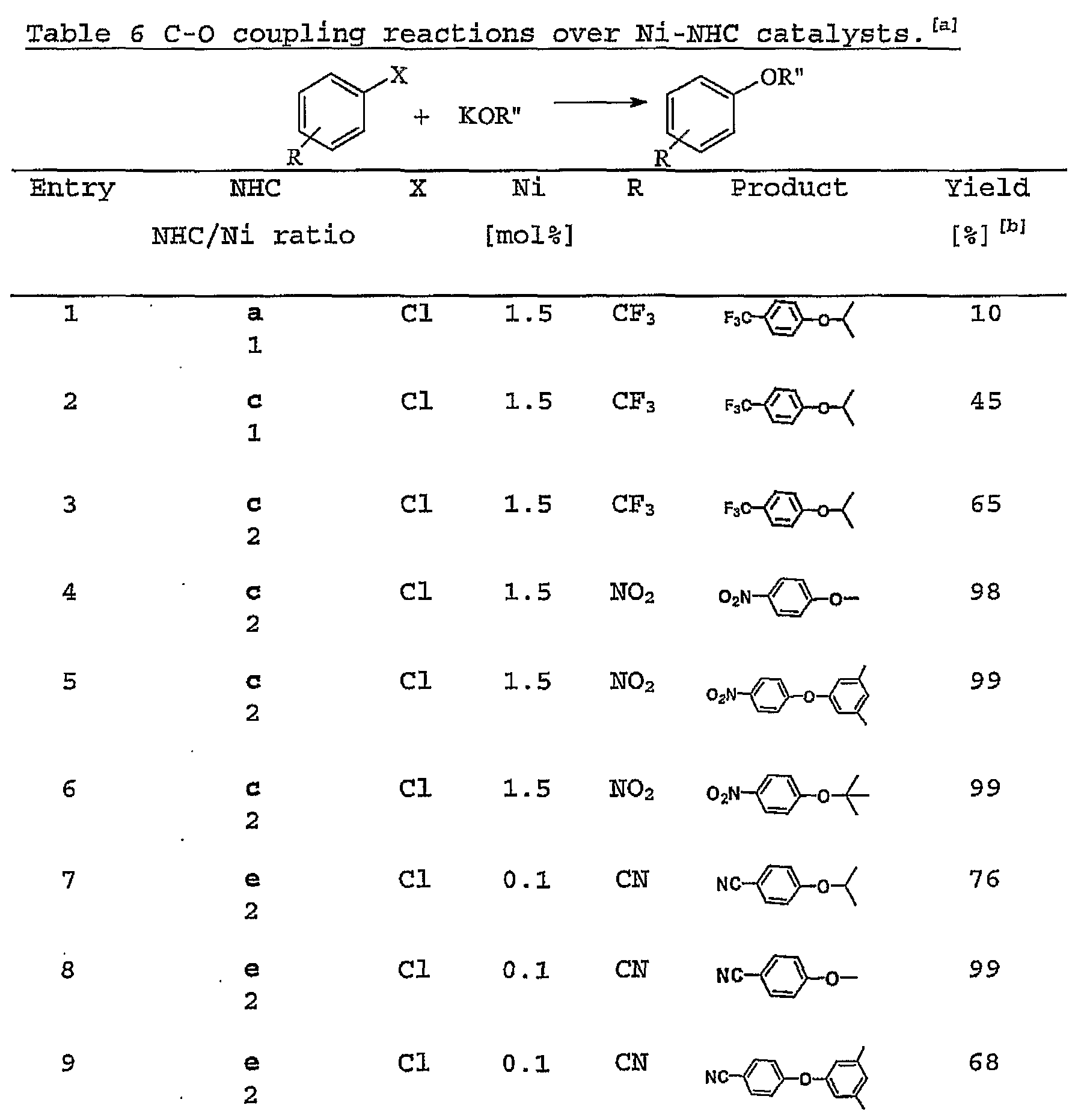
- Ni- (c) 2 and Ni- (e) 2 showed excellent activities towards the coupling of aryl halides with alkoxides and aryloxides .
- the present invention includes isomers such as geometrical isomers, optical isomers based on asymmetric carbon, stereoisomers and tautomers and is not limited by the description of the formula illustrated for the sake of convenience .
Landscapes
- Chemical & Material Sciences (AREA)
- Organic Chemistry (AREA)
- Catalysts (AREA)
- Organic Low-Molecular-Weight Compounds And Preparation Thereof (AREA)
- Low-Molecular Organic Synthesis Reactions Using Catalysts (AREA)
- Pyridine Compounds (AREA)
Abstract
Description




Claims





Priority Applications (4)
| Application Number | Priority Date | Filing Date | Title |
|---|---|---|---|
| CN200880021904A CN101687723A (en) | 2007-05-02 | 2008-05-02 | Poly-N-heterocyclic carbene transition metal complexes and N-heterocyclic carbene transition metal complexes for carbon-sulfur and carbon-oxygen coupling reactions |
| US12/598,413 US20100137608A1 (en) | 2007-05-02 | 2008-05-02 | Poly-n-heterocyclic carbene transition metal complexes and n-heterocyclic carbene transition metal complexes for carbon-sulfur and carbon-oxygen coupling reactions |
| EP08741962A EP2152648A4 (en) | 2007-05-02 | 2008-05-02 | COMPLEXES OF TRANSITION METALS AND POLY-N-HETEROCYCLIC CARBENS AND COMPLEXES OF TRANSITION METALS AND N-HETEROCYCLIC CARBENS FOR CARBON-SULFUR AND CARBON-OXYGEN COUPLING |
| JP2010506145A JP2010526063A (en) | 2007-05-02 | 2008-05-02 | Poly-N-heterocyclic carbene transition metal complexes and N-heterocyclic carbene transition metal complexes for carbon-sulfur and carbon-oxygen coupling reactions |
Applications Claiming Priority (2)
| Application Number | Priority Date | Filing Date | Title |
|---|---|---|---|
| US92416407P | 2007-05-02 | 2007-05-02 | |
| US60/924,164 | 2007-05-02 |
Publications (2)
| Publication Number | Publication Date |
|---|---|
| WO2008136770A1 true WO2008136770A1 (en) | 2008-11-13 |
| WO2008136770A8 WO2008136770A8 (en) | 2009-02-12 |
Family
ID=39943775
Family Applications (1)
| Application Number | Title | Priority Date | Filing Date |
|---|---|---|---|
| PCT/SG2008/000157 Ceased WO2008136770A1 (en) | 2007-05-02 | 2008-05-02 | Poly-n-heterocyclic carbene transition metal complexes and n-heterocyclic carbene transition metal complexes for carbon-sulfur and carbon-oxygen coupling reactions |
Country Status (5)
| Country | Link |
|---|---|
| US (1) | US20100137608A1 (en) |
| EP (1) | EP2152648A4 (en) |
| JP (1) | JP2010526063A (en) |
| CN (1) | CN101687723A (en) |
| WO (1) | WO2008136770A1 (en) |
Cited By (2)
| Publication number | Priority date | Publication date | Assignee | Title |
|---|---|---|---|---|
| DE102014007527A1 (en) | 2014-05-23 | 2015-12-17 | Alzchem Ag | Process for the preparation of alkoxybenzonitriles |
| CN106588669A (en) * | 2017-01-13 | 2017-04-26 | 南京工业大学 | Method for continuously preparing nitrobenzyl ether by using microchannel reaction system |
Families Citing this family (4)
| Publication number | Priority date | Publication date | Assignee | Title |
|---|---|---|---|---|
| WO2007114792A1 (en) * | 2006-04-05 | 2007-10-11 | Agency For Science, Technology And Research | Polymeric salts and polymeric metal complexes |
| CN102276655A (en) * | 2011-06-20 | 2011-12-14 | 徐州师范大学 | Dinitrogen heterocyclic carbene dipalladium coordination compound and preparation method thereof |
| CN104549504B (en) * | 2013-10-09 | 2017-01-04 | 中国石油化工股份有限公司 | A kind of NHC-metal-glyoxaline structure type catalyst and preparation method thereof |
| CN114163353B (en) * | 2021-12-14 | 2024-05-28 | 郑州大学 | A kind of preparation method of anise nitrile |
Citations (1)
| Publication number | Priority date | Publication date | Assignee | Title |
|---|---|---|---|---|
| US20070073055A1 (en) * | 2005-08-24 | 2007-03-29 | Total Synthesis, Ltd. | Transition metal complexes of N-heterocyclic carbenes, method of preparation and use in transition metal catalyzed organic transformations |
-
2008
- 2008-05-02 WO PCT/SG2008/000157 patent/WO2008136770A1/en not_active Ceased
- 2008-05-02 US US12/598,413 patent/US20100137608A1/en not_active Abandoned
- 2008-05-02 EP EP08741962A patent/EP2152648A4/en not_active Withdrawn
- 2008-05-02 JP JP2010506145A patent/JP2010526063A/en not_active Withdrawn
- 2008-05-02 CN CN200880021904A patent/CN101687723A/en active Pending
Patent Citations (1)
| Publication number | Priority date | Publication date | Assignee | Title |
|---|---|---|---|---|
| US20070073055A1 (en) * | 2005-08-24 | 2007-03-29 | Total Synthesis, Ltd. | Transition metal complexes of N-heterocyclic carbenes, method of preparation and use in transition metal catalyzed organic transformations |
Non-Patent Citations (13)
| Title |
|---|
| BOYDSTON A.J. ET AL.: "Synthesis and Study of Bidentate Benzimidazolylidene-Group 10 Metal Complexes and Related Main-Chain Organometallic Polymers", ORGANOMETALLICS, vol. 25, no. 26, 2006, pages 6087 - 6098, XP002511108 * |
| CLAVIER H. ET AL.: "N-Heterocyclic carbenes: advances in transition metal-mediated transformations and organocatalysis", ANNUAL REPORTS ON THE PROGRESS OF CHEMISTRY, SECTION B: ORGANIC CHEMISTRY, vol. 103, 2007, pages 193 - 222, XP008123710 * |
| DESMARETS C. ET AL.: "Nickel(0)/Imidazolium Chloride Catalyzed Reduction of Aryl Halides", ORGANOMETALLICS, vol. 21, no. 8, 2002, pages 1554 - 1559, XP001103868 * |
| HU D. ET AL.: "Synthesis and crystal structure of an indenylnickel(II) NHC complex (Ind)NiBr(1,3-bisbenzylimidazol-2-ylidene)", JIEGOU HUAXUE, vol. 25, no. 10, 2006, pages 1255 - 1259, XP008123711 * |
| HUYNH H.V. ET AL.: "Anagostic Interactions and Catalytic Activities of Sterically Bulky Benzannualted N-Heterocyclic Carbene Complexes of Nickel(II)", ORGANOMETALLICS, vol. 27, no. 10, 2008, pages 2231 - 2237, XP008123684 * |
| MALSHEV D.A. ET AL.: "Homogeneous Nickel Catalyts for the Selective Transfer of a Single Arylthio Group in the Catalytic Hydrothiolation of Alkynes", ORGANOMETALLICS, vol. 25, no. 19, 2006, pages 4462 - 4470, XP008123682 * |
| MIGATA T. ET AL.: "The Palladium Catalysed Nucleophilic Substitution of Aryl Halides by Thiolate Anions", BULLETIN OF THE CHEMICAL SOCIETY OF JAPAN, vol. 53, 1980, pages 1385 - 1389, XP008123688 * |
| MURATA M. ET AL.: "A general and efficient method for the palladium-catalysed cross-coupling of thiols and secondary phopshines", TETRAHEDRON, vol. 60, 2004, pages 7397 - 7403, XP004523379 * |
| NG S. ET AL.: "Nickel-catalyzed coupling of terminal allenes, aldehydes, and silanes", TETRAHEDRON, vol. 62, no. 49, 2006, pages 11350 - 11359, XP005838935 * |
| See also references of EP2152648A4 * |
| TEKAVEC T.N. ET AL.: "An in situ approach for nickel-catalyzed cycloaddition", JOURNAL OF ORGANIC CHEMISTRY, vol. 71, no. 15, 2006, pages 5834 - 5836, XP008123689 * |
| XI Z. ET AL.: "Synthesis and Structural Characterization of Nickel(II) Complexes Supported by Pyridine-Functionalized N-Heterocyclic Carbene Ligands and Their Catalytic Activities for Suzuki Coupling", ORGANOMETALLICS, vol. 26, no. 26, 2007, pages 6636 - 6642, XP008123686 * |
| ZHANG Y. ET AL.: "The first N-heterocyclic carbene-based nickel catalyst for C-S coupling", ORGANIC LETTERS, vol. 9, no. 18, 2007, pages 3495 - 3498, XP008123681 * |
Cited By (3)
| Publication number | Priority date | Publication date | Assignee | Title |
|---|---|---|---|---|
| DE102014007527A1 (en) | 2014-05-23 | 2015-12-17 | Alzchem Ag | Process for the preparation of alkoxybenzonitriles |
| CN106588669A (en) * | 2017-01-13 | 2017-04-26 | 南京工业大学 | Method for continuously preparing nitrobenzyl ether by using microchannel reaction system |
| CN106588669B (en) * | 2017-01-13 | 2018-09-11 | 南京工业大学 | Method for continuously preparing nitrobenzyl ether by using microchannel reaction system |
Also Published As
| Publication number | Publication date |
|---|---|
| US20100137608A1 (en) | 2010-06-03 |
| EP2152648A1 (en) | 2010-02-17 |
| CN101687723A (en) | 2010-03-31 |
| JP2010526063A (en) | 2010-07-29 |
| EP2152648A4 (en) | 2011-11-09 |
| WO2008136770A8 (en) | 2009-02-12 |
Similar Documents
| Publication | Publication Date | Title |
|---|---|---|
| Lan et al. | Flexible steric bulky bis (imino) acenaphthene (BIAN)-supported N-heterocyclic carbene palladium precatalysts: catalytic application in Buchwald–Hartwig amination in air | |
| JP4531253B2 (en) | Ruthenium alkylidene complexes containing N-heterocyclic carbene ligands; use as highly active selective catalysts for olefin metathesis | |
| US11577232B2 (en) | Ruthenium-based metathesis catalysts, precursors for their preparation and their use | |
| US7250510B2 (en) | Transition metal complexes of N-heterocyclic carbenes, method of preparation and use in transition metal catalyzed organic transformations | |
| RU2586213C1 (en) | New ruthenium complexes, their use in the metathesis reaction and modalities for the metathesis reaction | |
| EP3122707B1 (en) | Method for coupling a first aromatic compound to a second aromatic compound | |
| Kreuzahler et al. | 1, 3-Chlorine Shift to a vinyl cation: a combined experimental and theoretical investigation of the E-selective gold (I)-catalyzed dimerization of chloroacetylenes | |
| Delaude et al. | Synthesis and catalytic evaluation of ruthenium− arene complexes generated using imidazol (in) ium-2-carboxylates and dithiocarboxylates | |
| WO2008136770A1 (en) | Poly-n-heterocyclic carbene transition metal complexes and n-heterocyclic carbene transition metal complexes for carbon-sulfur and carbon-oxygen coupling reactions | |
| Zhou et al. | Well-defined, air-and moisture-stable palladium–imidazo [1, 5-a] pyridin-3-ylidene complexes: a versatile catalyst platform for cross-coupling reactions by L-shaped NHC ligands | |
| Malan et al. | Facile Suzuki-Miyaura coupling of activated aryl halides using new CpNiBr (NHC) complexes | |
| Rendón-Nava et al. | Hydroxyl-functionalized triazolylidene-based PEPPSI complexes: metallacycle formation effect on the Suzuki coupling reaction | |
| Chen et al. | Camphyl-based α-diimine palladium complexes: highly efficient precatalysts for direct arylation of thiazoles in open-air | |
| Patricio-Rangel et al. | Mercaptopyridine-functionalized MIC-Pd (II)-PEPPSI complexes: Synthesis and hemilability effect in catalytic applications | |
| US20200369697A1 (en) | Molybdenum oxo alkylidene compounds, methods of making the same and use thereof in metathesis reactions | |
| CN114539097B (en) | A kind of multi-substituted alkenyl cyanide and its synthetic method | |
| Sánchez et al. | Bis (imidate) palladium (II) complexes with labile ligands. Mimics of classical precursors? | |
| Elser et al. | Isomers of Molybdenum Imido Alkylidene N-Heterocyclic Carbene Complexes | |
| KR102051920B1 (en) | Catalyst comprising Diimine-Transitional Metal Complex for Carbon-Hydrogen Arylation and Carbon-Carbon Coupling | |
| CN121085728B (en) | Migration C (sp 2) -H/C (sp 3) -H cross coupling method realized by metal/photo-redox catalysis | |
| Mayr et al. | Unsaturated alkylidyne ligands bearing a terminal isocyanide functionality and intervening ethynylbenzene groups | |
| Matos et al. | Palladium complexes based on tridentate pyrazolyl-ligands: Synthesis, structures and use in Suzuki cross-coupling reactions | |
| CN107108419A (en) | Process for producing chlorofluoroolefins | |
| Yu et al. | Commercial Nickel-catalyzed Cross-coupling of Organolithium Reagents with 2-arylbenzothiazoles | |
| CN121930062A (en) | Deuterated aromatic (heterocyclic) compound and preparation method thereof |
Legal Events
| Date | Code | Title | Description |
|---|---|---|---|
| WWE | Wipo information: entry into national phase |
Ref document number: 200880021904.5 Country of ref document: CN |
|
| 121 | Ep: the epo has been informed by wipo that ep was designated in this application |
Ref document number: 08741962 Country of ref document: EP Kind code of ref document: A1 |
|
| DPE2 | Request for preliminary examination filed before expiration of 19th month from priority date (pct application filed from 20040101) | ||
| WWE | Wipo information: entry into national phase |
Ref document number: 12598413 Country of ref document: US |
|
| WWE | Wipo information: entry into national phase |
Ref document number: 2010506145 Country of ref document: JP |
|
| NENP | Non-entry into the national phase |
Ref country code: DE |
|
| WWE | Wipo information: entry into national phase |
Ref document number: 7167/DELNP/2009 Country of ref document: IN |
|
| WWE | Wipo information: entry into national phase |
Ref document number: 2008741962 Country of ref document: EP |