WO2008155507A1 - Procede de traitement de la surface d'un substrat a base de polymere soufre destine a etre recouvert par un revetement - Google Patents

Procede de traitement de la surface d'un substrat a base de polymere soufre destine a etre recouvert par un revetement Download PDF

Info

Publication number
WO2008155507A1
WO2008155507A1 PCT/FR2008/051052 FR2008051052W WO2008155507A1 WO 2008155507 A1 WO2008155507 A1 WO 2008155507A1 FR 2008051052 W FR2008051052 W FR 2008051052W WO 2008155507 A1 WO2008155507 A1 WO 2008155507A1
Authority
WO
WIPO (PCT)
Prior art keywords
substrate
coating
acid
thioglycolate
diisocyanate
Prior art date
Legal status (The legal status is an assumption and is not a legal conclusion. Google has not performed a legal analysis and makes no representation as to the accuracy of the status listed.)
Ceased
Application number
PCT/FR2008/051052
Other languages
English (en)
Inventor
Pierre-Jean Calba
Joseph Martin
Current Assignee (The listed assignees may be inaccurate. Google has not performed a legal analysis and makes no representation or warranty as to the accuracy of the list.)
EssilorLuxottica SA
Original Assignee
Essilor International Compagnie Generale dOptique SA
Priority date (The priority date is an assumption and is not a legal conclusion. Google has not performed a legal analysis and makes no representation as to the accuracy of the date listed.)
Filing date
Publication date
Application filed by Essilor International Compagnie Generale dOptique SA filed Critical Essilor International Compagnie Generale dOptique SA
Priority to EP08805987.8A priority Critical patent/EP2155808B1/fr
Priority to JP2010511706A priority patent/JP5524048B2/ja
Priority to US12/664,308 priority patent/US9110223B2/en
Publication of WO2008155507A1 publication Critical patent/WO2008155507A1/fr
Anticipated expiration legal-status Critical
Ceased legal-status Critical Current

Links

Classifications

    • G—PHYSICS
    • G02—OPTICS
    • G02B—OPTICAL ELEMENTS, SYSTEMS OR APPARATUS
    • G02B1/00—Optical elements characterised by the material of which they are made; Optical coatings for optical elements
    • G02B1/10—Optical coatings produced by application to, or surface treatment of, optical elements
    • G02B1/12—Optical coatings produced by application to, or surface treatment of, optical elements by surface treatment, e.g. by irradiation
    • C—CHEMISTRY; METALLURGY
    • C08—ORGANIC MACROMOLECULAR COMPOUNDS; THEIR PREPARATION OR CHEMICAL WORKING-UP; COMPOSITIONS BASED THEREON
    • C08J—WORKING-UP; GENERAL PROCESSES OF COMPOUNDING; AFTER-TREATMENT NOT COVERED BY SUBCLASSES C08B, C08C, C08F, C08G or C08H
    • C08J7/00—Chemical treatment or coating of shaped articles made of macromolecular substances
    • C08J7/12—Chemical modification
    • G—PHYSICS
    • G02—OPTICS
    • G02B—OPTICAL ELEMENTS, SYSTEMS OR APPARATUS
    • G02B1/00—Optical elements characterised by the material of which they are made; Optical coatings for optical elements
    • G02B1/10—Optical coatings produced by application to, or surface treatment of, optical elements
    • B—PERFORMING OPERATIONS; TRANSPORTING
    • B05—SPRAYING OR ATOMISING IN GENERAL; APPLYING FLUENT MATERIALS TO SURFACES, IN GENERAL
    • B05D—PROCESSES FOR APPLYING FLUENT MATERIALS TO SURFACES, IN GENERAL
    • B05D5/00—Processes for applying liquids or other fluent materials to surfaces to obtain special surface effects, finishes or structures
    • B05D5/10—Processes for applying liquids or other fluent materials to surfaces to obtain special surface effects, finishes or structures to obtain an adhesive surface
    • C—CHEMISTRY; METALLURGY
    • C08—ORGANIC MACROMOLECULAR COMPOUNDS; THEIR PREPARATION OR CHEMICAL WORKING-UP; COMPOSITIONS BASED THEREON
    • C08J—WORKING-UP; GENERAL PROCESSES OF COMPOUNDING; AFTER-TREATMENT NOT COVERED BY SUBCLASSES C08B, C08C, C08F, C08G or C08H
    • C08J2333/00—Characterised by the use of homopolymers or copolymers of compounds having one or more unsaturated aliphatic radicals, each having only one carbon-to-carbon double bond, and only one being terminated by only one carboxyl radical, or of salts, anhydrides, esters, amides, imides, or nitriles thereof; Derivatives of such polymers
    • C08J2333/04—Characterised by the use of homopolymers or copolymers of compounds having one or more unsaturated aliphatic radicals, each having only one carbon-to-carbon double bond, and only one being terminated by only one carboxyl radical, or of salts, anhydrides, esters, amides, imides, or nitriles thereof; Derivatives of such polymers esters
    • C08J2333/14—Characterised by the use of homopolymers or copolymers of compounds having one or more unsaturated aliphatic radicals, each having only one carbon-to-carbon double bond, and only one being terminated by only one carboxyl radical, or of salts, anhydrides, esters, amides, imides, or nitriles thereof; Derivatives of such polymers esters of esters containing halogen, nitrogen, sulfur, or oxygen atoms in addition to the carboxy oxygen
    • C—CHEMISTRY; METALLURGY
    • C08—ORGANIC MACROMOLECULAR COMPOUNDS; THEIR PREPARATION OR CHEMICAL WORKING-UP; COMPOSITIONS BASED THEREON
    • C08J—WORKING-UP; GENERAL PROCESSES OF COMPOUNDING; AFTER-TREATMENT NOT COVERED BY SUBCLASSES C08B, C08C, C08F, C08G or C08H
    • C08J2341/00—Characterised by the use of homopolymers or copolymers of compounds having one or more unsaturated aliphatic radicals, each having only one carbon-to-carbon double bond, and at least one being terminated by a bond to sulfur or by a heterocyclic ring containing sulfur; Derivatives of such polymers
    • C—CHEMISTRY; METALLURGY
    • C08—ORGANIC MACROMOLECULAR COMPOUNDS; THEIR PREPARATION OR CHEMICAL WORKING-UP; COMPOSITIONS BASED THEREON
    • C08J—WORKING-UP; GENERAL PROCESSES OF COMPOUNDING; AFTER-TREATMENT NOT COVERED BY SUBCLASSES C08B, C08C, C08F, C08G or C08H
    • C08J2375/00—Characterised by the use of polyureas or polyurethanes; Derivatives of such polymers
    • C08J2375/04—Polyurethanes
    • G—PHYSICS
    • G02—OPTICS
    • G02B—OPTICAL ELEMENTS, SYSTEMS OR APPARATUS
    • G02B1/00—Optical elements characterised by the material of which they are made; Optical coatings for optical elements
    • G02B1/04—Optical elements characterised by the material of which they are made; Optical coatings for optical elements made of organic materials, e.g. plastics
    • G—PHYSICS
    • G02—OPTICS
    • G02B—OPTICAL ELEMENTS, SYSTEMS OR APPARATUS
    • G02B1/00—Optical elements characterised by the material of which they are made; Optical coatings for optical elements
    • G02B1/04—Optical elements characterised by the material of which they are made; Optical coatings for optical elements made of organic materials, e.g. plastics
    • G02B1/041—Lenses

Definitions

  • a method of treating the surface of a sulfur-polymer-based substrate to be coated with a coating is provided.
  • the invention relates to a method for treating at least one surface of a sulfur-polymer-based substrate to be coated with a coating, said process improving adhesion of the coating to the substrate.
  • an organic glass substrate such as an ophthalmic lens made of organic glass, for example a spectacle lens
  • coatings such as hard anti-scratch coatings. abrasion, to improve the resistance of the ophthalmic lens obtained to scratches and shocks.
  • a problem associated with these coated organic glass substrates is the adhesion of the coating to the substrate.
  • Document EP 1 053 279 also discloses a method of coating the surface of an organic glass substrate comprising, prior to depositing the coating on the surface of the substrate, bringing the surface of the substrate into contact with an aqueous solution of treatment containing a surfactant and having an acidic pH.
  • a first cause of the fragility of the adhesion of the anti-abrasion coating on the substrate lies in the fact that the interface substrate / abrasion-resistant coating can generally be described as a well-individualized interface of a monolayer stack on monolayer. This is due to the lack of diffusion of the anti-abrasion coating in the substrate, to a surface preparation generally not conducive to the creation of covalent bonds and extremely low surface roughness of the substrate.
  • the low-energy chemical bonds (hydrogen bonds from sulfur or oxygen) predominate over covalent bonds. They therefore participate more actively than the covalent bonds to the adhesion mechanisms of the abrasion-resistant coating on the substrate.
  • the thioether functions for example the thioether functions of a polythiourethane, present at the interface, are degraded by cleavage of the polymer chain in the vicinity of the chain ends. pending, to give degradation products that are small organic molecules. These degradation products are conveyed by migration and diffusion mechanisms in all the interstices of the material where they will be able to create real wells of corrosion thus crossing the entire thickness of the anti-abrasion coating. As these degradation products accumulate in the substrate, mineralization of the substrate is observed.
  • the extreme photosensitivity to UV-A radiation of certain polymeric substrates contributes to weakening the adhesion forces present on the substrate / abrasion-resistant coating interface.
  • the thioether units of the first layers of the substrate are photocyclized, leading to the breaking of the weak bonds present at the interface, as shown in FIG.
  • Cyclization is particularly favored when the sulfur and nitrogen are in position 1, 6 with respect to each other.
  • FIG1 A first figure.
  • R1 and R2 represent the chains of the polymeric network to which the group represented is linked.
  • the subject of the invention is therefore a process for treating at least one surface of a substrate based on sulfur-containing polymer intended to be covered by a coating, said process comprising, prior to the deposition of the coating on the surface of the substrate, a step of contacting the surface of the substrate with a treatment composition comprising at least one reducing agent.
  • the reducing agent decreases the photoreactivity of the thioether functions of the substrate, that is to say that it makes it possible to functionalize the polymer of the substrate by the creation of SH bonds, that it limits the degradation of the thioether functions into degradation products under the action of UV-A radiation, or that it prevents the cyclization of the sulfur chains, in particular thioether units, of the first layers of the substrate under the effect of UV-A radiation.
  • the reducing agent (s) that may be used in the process according to the invention may be any type of reducing agent conventionally used to reduce the C-S, S-S, CON (amide) bonds, the salts, preferably the C-S and S-S bonds.
  • the reducing agent (s) are generally chosen from thioacids and their salts.
  • reducing agents which may be used in the process according to the invention, mention may be made in particular of thioglycolic acid, potassium thioglycolate, sodium thioglycolate, calcium thioglycolate, magnesium thioglycolate and glycerol monothioglycolate.
  • ammonium thioglycolate amine thioglycolates such as monoethanolamine thioglycolate, diammonium dithioglycolate, thiolactic acid, ammonium thiolactate, guanidine thioglycolate, thiomalic acid, 2-mercaptopropionic acid , 3-mercaptopropionic acid, lipoic acid, dihydrolipoic acid, thiosalicylic acid, dithioerythritol, thioglycerol, thioglycol, dithioerythritol, dithiothreitol, 1,3-dithiopropanol, thioxanthine, cysteine , homocysteine, N-acetyl-L-cysteine, cysteamine, N-acetyl-cysteamine, N-propionyl-cysteamine, pantheatin, NaHSO 3 , LiS, Na 2 S,
  • the preferred reducing agents are thioacids or their salts, and are preferably selected from sodium thioglycolate, potassium thioglycolate, ammonium thioglycolate and amine thioglycolates.
  • the or SH functions are preferably in the S-form ", and the one or more carboxyl functional groups are preferably in the form COO".
  • the pH of the treatment composition is greater than 10, more preferably greater than 12.
  • the pH of the treatment composition according to the invention can be obtained and / or adjusted conventionally by addition of alkaline agents, such as, for example, ammonia, monoethanolamine, diethanolamine, thethanolamine, isopropanolamine, propanediamine. 1, 3, an alkaline or ammonium carbonate or bicarbonate, an organic carbonate such as guanidine carbonate, or alternatively an alkali metal hydroxide, such as potassium hydroxide, or an alkaline earth metal hydroxide, such as calcium hydroxide, all these compounds can of course be taken alone or in mixture.
  • alkaline agents such as, for example, ammonia, monoethanolamine, diethanolamine, thethanolamine, isopropanolamine, propanediamine. 1, 3, an alkaline or ammonium carbonate or bicarbonate, an organic carbonate such as guanidine carbonate, or alternatively an alkali metal hydroxide, such as potassium hydroxide, or an alkaline earth metal hydroxide, such as calcium hydroxide, all
  • the treatment composition generally comprises from 2 to 30%, preferably from 2 to 15%, better still from 5 to 10% by weight, relative to the total weight of the composition, of said reducing agent (s).
  • the treatment composition comprises at least one metal sulphide.
  • the treatment composition comprises urea.
  • the urea is generally present in a content of between 0.1% and 20% by weight, preferably 0.5% and 10% by weight, relative to the total weight of the treatment composition.
  • the treatment composition comprising the reducing agent (s) comprises a solvent.
  • a solvent for a usable solvent, mention may be made of water, C 1 -C 6 alcohols, preferably alkanols such as ethanol, propanol and isopropanol, alkanediols such as ethylene glycol, propylene glycol and pentanediol. , benzyl alcohol, alkanes, C 5 -C 0, acetone, methylethylketone, methyl acetate, ethyl acetate, butyl acetate, dimethoxyethane, diethoxyethane and mixtures thereof.
  • Treatment compositions comprising one or more reducing agents for use in the process according to the invention are described as depilatory compositions in GB 2 413 074.
  • Depilatory compositions available commercially can be used.
  • the treatment time with the composition according to the invention preferably varies from 1 to 30 minutes, better from 1 to 15 minutes, and more preferably from 5 to 10 minutes.
  • the treatment temperature preferably varies from 5 to 30 ° C., better still from 5 to
  • the treatment is carried out at room temperature.
  • the treatment is preferably carried out by dipping the substrate in a bath of composition according to the invention.
  • the treatment with the reducing agent may be repeated several times in succession, preferably up to five times in succession, preferably from 1 to 3 times in succession.
  • the method according to the invention comprises a step of contacting the surface of the substrate with a treatment composition comprising at least one reducing agent.
  • a treatment composition comprising at least one reducing agent.
  • ultrasonic energy is applied to the treatment composition when in contact with the surface of the substrate.
  • the method according to the invention does not comprise a subsequent step of applying a soda solution to the substrate.
  • the process according to the invention makes it possible to reduce the CS and / or SS bonds of the sulfur-containing polymer forming the substrate, which leads to the functionalization of the polymer by the creation of SH bonds at the surface, generally to a thickness of less than 1 ⁇ m. .
  • the method according to the invention also makes it possible to limit the production of degradation products during exposure of the substrate to UV-A radiation.
  • the method comprises at least one additional step of treatment by contacting the substrate with an oxidizing composition comprising at least one oxidizing agent.
  • This or these additional step (s) treatment by means of an oxidizing composition can be performed before and / or after the treatment step with the reducing agent.
  • these oxidizing agents reduce the photoreactivity of the thioether functions of the substrate and in particular prevent the photocyclization under the effect of the UV-A radiation of the sulfur chains of the substrate by oxidizing the sulfur close to the substrate.
  • nitrogen in particular the sulfur at the 6-position of the nitrogen, (as shown in FIG. 1) which is then no longer available to react in the cyclization reaction.
  • the oxidizing agent would prevent the cycloaddition 1, 6 thioether units by the chemical adsorption of elements provided by the oxidizing agent, filling all the vacant atomic orbitals of the outer electron layer of sulfur. Chemical adsorption also makes it possible to enhance the molecular interactions of the substrate with the coating when it is deposited, in particular by creating polar sites.
  • the oxidizing agent or agents are generally chosen from hydrogen peroxide, alkaline bromates, polythionates and persalts, such as perborates, percarbonates, persulfates and permanganates.
  • the oxidizing agent (s) is (are) chosen from H 2 O 2 or KMnO 4 .
  • the oxidizing agent (s) are included in the oxidizing composition at a content of between 2 and 15%, preferably 5 and 10% by weight, relative to the total weight of the oxidizing composition.
  • the pH of the oxidizing composition containing said oxidizing agent (s) is less than 7.
  • the oxidizing composition comprising the oxidizing agent (s) comprises a solvent.
  • a solvent As a usable solvent, mention may be made of water, alcohols in d-C 6 , preferably alkanols such as ethanol, propanol and isopropanol, alkanediols such as ethylene glycol, propylene glycol and the like. pentanediol, benzyl alcohol, alkanes, C 5 -C 0, acetone, methylethylketone, methyl acetate, ethyl acetate, butyl acetate, dimethoxyethane, diethoxyethane and their mixtures.
  • the method comprises at least one additional treatment step by contacting the substrate with a phosphorylation composition comprising at least one phosphorylation agent.
  • This or these additional step (s) of treatment by means of a phosphorylation composition can be carried out before and / or after the treatment step with the reducing agent.
  • phosphorylation agent means an agent which makes it possible to introduce a phosphorus or a phosphate into an organic combination.
  • the phosphorylation agent or agents are generally chosen from trialkylphosphites, phosphonic acid and phosphinic acid.
  • the phosphorylation agent makes it possible to prevent the cycloaddition 1, 6 of the thioether units by the chemical adsorption of this agent on the sulfur atoms of the thioether functions. This gives the substrate many opportunities for chemical interactions with the coating when it is deposited.
  • the phosphorylation agent (s) are included in the phosphorylation composition at a content of between 2% and 15%, preferably between 5 and 10%, by weight relative to the total weight of the phosphorylation composition.
  • the pH of the composition comprising the phosphorylating agent is less than 7.
  • the composition comprising the phosphorylation agent (s) comprises a solvent.
  • a solvent for a usable solvent, mention may be made of water, alcohols in d-C 6 , preferably alkanols such as ethanol, propanol and isopropanol, alkanediols such as ethylene glycol, propylene glycol and the like. pentanediol, benzyl alcohol, alkanes, C 5 -C 0, acetone, methylethylketone, methyl acetate, ethyl acetate, butyl acetate, dimethoxyethane, diethoxyethane and their mixtures.
  • the process according to the invention does not comprise any additional step of treatment with an oxidizing or phosphorylation composition.
  • the substrate is based on sulfur polymer.
  • the sulfur-containing polymer of the substrate is chosen from polythio (meth) acrylates, polythiourethanes, polythiouretourea and polyepisulfides.
  • the polythio (meth) acrylates that can be used as substrate in the process according to the invention can be chosen from all the polythio (meth) acrylates conventionally used in ophthalmic optics, in particular in the preparation of ophthalmic lenses.
  • Precursor monomers of the polythio (meth) acrylates that can be used in the composition according to the invention are described in particular in US Pat. No. 5,741,831.
  • the sulfur-containing polymer is a polythiourethane resulting from the polymerization of at least one polyisocyanate monomer and / or a prepolymer thereof and at least one polythiol monomer and / or a prepolymer thereof .
  • Polythiol monomers suitable for the compositions according to the present invention are well known in the art and may be represented by the formula R '(SH), y, wherein n' is an integer of 2 or more, preferably 2 to 5 and R 'is an aliphatic, aromatic or heterocyclic radical. Polythiols are described inter alia in EP 394 495.
  • trithiols mention may be made of 1,2,3-propaneththiol, 1,2,4-butaneththiol, trimethylolpropanetrithiol glycolate, trimethylopropane tris (3-mercaptopropionate), pentaerythritol trithioglycolate and pentaerythritol tris (3-mercaptopropionate). 1,3,5-benzeneththiol and 2,4,6-mesityleneththiol.
  • polythiols useful in the present invention mention may be made of neopentane tetrathiol, 2,2'-bis (mercaptomethyl) -1,3-propanedithiol, pentaerythritol tetrakis (3-mercaptopropionate), 1,3,5- benzenetitrithiol, 2,4,6-tolueneththiol, 2,4,6-methylenetrithiol, and the polythiols corresponding to the formulas:
  • a preferred polythiol is the compound of the following formula:
  • polyisocyanate compounds that may be used according to the invention may all be polyisocyanates generally used to formulate polyurethanes.
  • (isocyanatomethyl) napthalene bis (isocyanatomethyl) -diphenyl ether, bis (isocyanatoethyl) phthalate, mesitylylene triisocyanate and 2,6-di (isocyanatomethyl) furan; alicyclic polyisocyanates such as isophorone diisocyanate, bis (isocyanatomethyl) cyclohexane, dicyclohexylmethane diisocyanate, cyclohexane diisocyanate, methylcyclohexane diisocyanate, dicyclohexyl-dimethylmethane diisocyanate, 2,2'-dimethyldicyclohexylmethane diisocyanate, bis (4-isocyanato-n-butylidene) -pentaerythritol, dimer acid diisocyanate, 2-isocyanatomethyl-3- (3-isocyanatopropyl
  • a preferred polyisocyanate is the compound of formula C 6 H 4 (CH 2 NCO) 2 .
  • the sulfur-containing polymer of the substrate may be chosen from polythiourethane-urea.
  • the sulfur-containing polymer of the substrate may also be chosen from polyepisulfides.
  • the polymerizable monomers having at least one episulfide functionality are compounds having one or more episulfide structures represented by the formula below in a molecule:
  • R 3 represents a hydrocarbon group having 1 to 10 carbon atoms
  • R 4 , R 5 and R 6 each represent a hydrogen atom or a hydrocarbon group having 1 to 10 carbon atoms
  • X represents S or O with the proviso that in the molecule the average number of S represented by X is preferably about 50% or more of the total number of S and O constituting the 3-membered ring.
  • a preferred class of polymerizable episulfide monomers is represented by the compounds of formula:
  • R 7 , R 8 , R 9 , R 10 , R 11 and R 12 each represents a hydrogen atom or a hydrocarbon group having 1 to 10 carbon atoms;
  • X represents S or O with the proviso that in the molecule the average number of S represented by X is about 50% or more of the total number of S and O constituting the 3-membered rings, p represents an integer of 0 to 6 and q represents an integer of 0 to 4.
  • R 3 represents a methylene or ethylene group and R 4 , R 5 and R 6 and R 7 , R 8 , R 9 , R 10 , R 11 and R 12 each preferably represent a hydrogen atom, a group methyl. More preferably, R 3 represents a methylene group and R 4 , R 5 , R 6 , R 7 , R 8 , R 9 , R 10 , R 11 and R 12 each represent a hydrogen atom.
  • the average number of S is 50% or more, preferably 90% or more, more preferably 95% or more ideally 100% of the total number of S and O constituting the 3-membered rings.
  • linear organic compounds such as bis ( ⁇ -epithiopropylthio) methane, 1,2-bis ( ⁇ -epithiopropylthio) ethane, 1,3-bis ( ⁇ -epithiopropylthio) propane, 1,2-bis ( ⁇ -epithiopropylthio) propane, 1- ( ⁇ -epithiopropylthio) -2- ( ⁇ -epithiopropylthiomethyl) propane, 1,4-bis ( ⁇ -epithiopropylthio) butane, 1,3-bis ( ⁇ -epithiopropylthio) butane, 1 - ( ⁇ -epithiopropylthio) -3- ( ⁇ -epithiopropylthiomethyl) butane, 1,5-bis ( ⁇ -epithiopropylthio) pentane, 1 - ( ⁇ -epithiopropylthio) -4- ( ⁇ -epithio
  • a preferred episulfide compound is bis ( ⁇ -epithiopropyl) sulfide of the formula:
  • mold release agents are described in EP 271 839.
  • the preferred mold release agents are acid phosphates such as dibutyl phosphate.
  • Zelec UN from Stepan which is a mixture of equal parts of the two following compounds: O
  • the presence of the internal mold release agent results in a decrease in the adhesion of the treatments, in particular coatings subsequently deposited on the substrate.
  • the invention is therefore of particular interest in the case of substrates containing such demoulding agents.
  • the substrate may for example be an ophthalmic lens, especially a spectacle lens.
  • the invention can be used for substrates having a very low roughness Ra (average deviation of the roughness profile from the mean line), typically Ra ⁇ 1 nm.
  • the roughness can come from a molding whose mold surfaces are not perfect. It can also come from a chemical treatment, for example by a suitable alkaline treatment (potash, soda).
  • a suitable alkaline treatment potash, soda
  • Ra For the determination of Ra, it is possible to use measuring devices such as a micromap device or an FTS device according to the protocol described in the patent application EP1218439.
  • the substrate treated by the process according to the invention is intended to be covered by a coating.
  • the coating is an anti-abrasion polymeric coating.
  • the anti-abrasion coating is obtained from a silane hydrolyzate composition, in particular epoxyalkoxysilane hydrolyzate, preferably epoxydialkoxysilane hydrolyzate or epoxytrialkoxysilane.
  • Epoxyalkoxysilanes usable are described in documents FR 2 702 486, WO 94/10230, US 4 211 823 and US 5 015 523.
  • a preferred anti-abrasion coating composition comprises a hydrolyzate of epoxyalkoxysilane or epoxydialkoxysilane or epoxythalcoxysilane, a colloidal filler and a catalytic amount of aluminum acetylacetonate, the remainder consisting essentially of solvents conventionally used for formulation such compositions.
  • the hydrolyzate used is a glycidoxypropyltrimethoxysilane hydrolyzate (GLYMO).
  • GLYMO glycidoxypropyltrimethoxysilane hydrolyzate
  • the hydrolyzate represents 50 to 60% by weight of dry extract of the total weight of the anti-abrasion coating composition.
  • the colloidal filler may be chosen for example from SiO 2 , ZrO 2 , TiO 2 and mixtures thereof.
  • the thickness of the coating ranges from 1 to 10 ⁇ m, preferably from 2 to 6 ⁇ m, more preferably from 3 to 5 ⁇ m.
  • Anti-abrasion coatings are generally deposited by dip coating or by centrifugation.
  • the subject of the invention is also a process for coating at least one surface of a substrate based on sulfur-containing polymer, characterized in that it comprises, prior to the deposition of the coating on the surface of the substrate, a treatment step of said surface by the treatment method as defined above.
  • the purpose of this example is to compare the adhesion of an anti-abrasion coating to 3 identical substrates which have been the subject of various surface preparations.
  • the substrates used are substrates based on a polythiourethane polymer resulting from the polymerization of the polyisocyanate monomer of formula C 6 H 4 (CH 2 NCO) 2 with the polythiol monomer of formula
  • the properties of the substrates are as follows: refractive index: 1, 67
  • the glass is in its definitive form, its two main faces being surfaced or molded to the required geometry
  • Each substrate is subjected, prior to the deposition of the coating, to a different surface treatment.
  • the first substrate is quenched for a few minutes in an acidic aqueous solution containing a surfactant, sodium lauryl ether sulfate, and maintained at a temperature of 50 ° C. Then the substrate is rinsed by soaking in a deionized water bath, then treated successively in a 5% sodium hydroxide bath, and in a deionized water bath, and then cleaned in an alcohol bath.
  • a surfactant sodium lauryl ether sulfate
  • the second substrate is quenched for a few minutes in a 20% sodium hydroxide solution at a temperature of 50 ° C. Then the substrate is rinsed by soaking in a deionized water bath, then treated successively in a 5% sodium hydroxide bath, and in a deionized water bath, and then cleaned in an alcohol bath.
  • the third substrate is dipped in a 5% sodium thioglycolate composition in a basic medium (pH greater than 12), then in a deionized water bath and then cleaned in an alcohol bath.
  • a basic medium pH greater than 12
  • the anti-abrasion coating is obtained by polymerization of a composition comprising, in dry extract, 55% by weight of dry matter obtained by hydrolysis and condensation of GLYMO and 45% by weight of a mixed TiO 2 (anatase) / ZrO colloid. 2 / SiO 2 dispersed at 20% by mass in methanol.
  • the composition is applied to the substrates by dip coating, and the coated substrates are then prebaked for 15 minutes at 60 ° C and baked at 110 ° C for 3 hours.
  • the substrates coated with the abrasion-resistant coating are then recovered, which are then subjected to irradiation in a Suntest apparatus such as an XLS + apparatus.
  • This device delivers a power of 280 W / cm 2 (60000 Lux in the center of the tray).
  • the hydrometry is 40%.
  • the air temperature is 29 ° C.
  • the temperature of the sample is 23 ° C.
  • the substrates are irradiated for 20 hours. During the irradiation, the adhesion of the coatings to the substrates was measured.
  • the dry adhesion of the coating was measured according to ASTM D3359-93, by incising the coating by means of a razor to form a series of 5 lines spaced 1 mm apart, followed by a series of 5 spaced apart lines. 1 mm, made in the same way and positioned at right angles to the first set of lines, the assembly forming a grid of 25 squares.
  • a cellophane adhesive tape (3M SCOTCH ® # 600) is applied and pressed firmly onto the network, then quickly removed by pulling in a direction perpendicular to the surface of the coating. This procedure is repeated twice with a new adhesive tape identical to the one already used.
  • the lens is then examined.
  • the purpose of this example is to compare the adhesion of an anti-abrasion coating to substrates which have been the subject of different surface preparations.
  • the substrates used are substrates based on a polythiourethane polymer identical to that described in Example 1.
  • Each substrate is subjected, prior to the deposition of the coating, to a different surface treatment.
  • the first substrate is quenched for a few minutes in an acidic aqueous solution containing a surfactant, sodium lauryl ether sulfate, and maintained at a temperature of 50 ° C. Then the substrate is rinsed by soaking in a deionized water bath, then treated successively in a 5% sodium hydroxide bath, and in a deionized water bath, and then cleaned in an alcohol bath.
  • a surfactant sodium lauryl ether sulfate
  • the second substrate is quenched for a few minutes in a 20% sodium hydroxide solution at a temperature of 50 ° C. Then the substrate is rinsed by soaking in a deionized water bath, then treated successively in a 5% sodium hydroxide bath, and in a deionized water bath, and then cleaned in an alcohol bath.
  • the third substrate is soaked in a treatment composition according to the invention 5% sodium thioglycolate composition in a basic medium (pH greater than 12), then in a deionized water bath, and then cleaned in an alcohol bath.
  • a treatment composition according to the invention 5% sodium thioglycolate composition in a basic medium (pH greater than 12), then in a deionized water bath, and then cleaned in an alcohol bath.
  • each substrate is subjected to irradiation in a Suntest device such as an XLS + device.
  • a Suntest device such as an XLS + device.
  • This device delivers a power of 280 W / cm 2 (60000 Lux in the center of the tray).
  • the hydrometry is 40%.
  • the air temperature is 29 ° C.
  • the temperature of the sample is 23 ° C.
  • the substrates are irradiated for 10 h.
  • the anti-abrasion coating composition is identical to that described in Example 1.
  • the coating composition is applied to the substrates by dip coating, and the coated substrates are then subjected to a pre-firing of 15 minutes at 60 ° C. and a 1-hour bake. 10 9 C for 3 hours.
  • the substrates coated with the anti-abrasion coating are then recovered, which are then subjected to adhesion tests.
  • the adhesion of the coatings to the substrates was measured according to the adhesion test described above.
  • the measurement of the adhesion is made immediately after the deposition and hardening of the anti-abrasion coating at t 0 .
  • the object of this example is to measure the resistance to the yellowing phenomenon when the substrate has been subjected to a surface treatment according to the invention.
  • the substrates tested are substrates based on a polythiourethane polymer identical to that described in Example 1.
  • Colorimetric measurements of the tint angle h * and Chroma C * are made with a spectrophotometer and calculated in the CIE system (L * , a * , b * ).
  • the yellowness index Yi of the lenses is measured before the test and at the end of the test after 200 hours.
  • the yellow index is determined spectroscopically in accordance with ASTM D-1325-63.
  • the colorimetric measurements are performed on a first bare substrate, that is to say not having been subjected to a surface treatment, at 0 ° and then 20 ° after irradiation with a Suntest apparatus as described in US Pat.
  • Example 1
  • the colorimetric measurements are also carried out on a second substrate which has been surface-treated on both sides with the aid of a composition comprising sodium thioglycolate in a basic medium (pH greater than
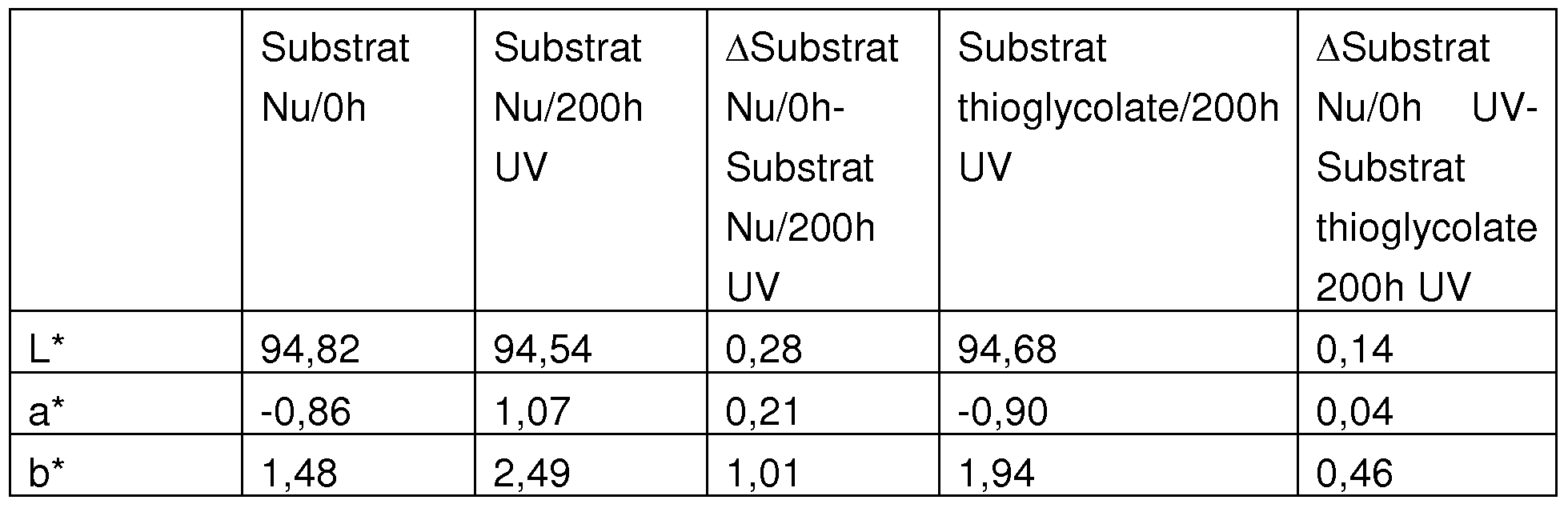
  • the colorimetric coordinates L * , a * and b * of the first substrate were measured before irradiation (Oh) and then after 20Oh, as well as the second substrate treated according to the invention (thioglycolate substrate) after 20 hours of irradiation.
  • the variations of these colorimetric coordinates were then calculated for the first bare substrate before and after irradiation, as well as between the first bare substrate before irradiation and the second substrate treated after irradiation.
  • Polythiourethane ophthalmic lenses obtained by polymerization of bis (isocyanomethyl) norbomane, pentaerythritol tetrakis (mercaptopropionate) PETMP) and 4-Mercaptomethyl-3,6-dithia-1,8-octanedithiol and having a surface roughness Ra of 10 nm are treated with a treatment composition according to the invention identical to that of the third substrate of Example 1. It is deposited an anti-abrasion coating identical to that of Example 1. 100% of the glasses have a ++ adhesion after 250 hours of suntest
  • the surface roughness Ra is measured by means of a Micromap 512 apparatus.

Landscapes

  • Chemical & Material Sciences (AREA)
  • Physics & Mathematics (AREA)
  • General Physics & Mathematics (AREA)
  • Optics & Photonics (AREA)
  • Chemical Kinetics & Catalysis (AREA)
  • Health & Medical Sciences (AREA)
  • General Chemical & Material Sciences (AREA)
  • Medicinal Chemistry (AREA)
  • Polymers & Plastics (AREA)
  • Organic Chemistry (AREA)
  • Polyurethanes Or Polyureas (AREA)
  • Laminated Bodies (AREA)
  • Application Of Or Painting With Fluid Materials (AREA)
  • Coating Of Shaped Articles Made Of Macromolecular Substances (AREA)
  • Treatments Of Macromolecular Shaped Articles (AREA)

Abstract

L'invention concerne un procédé de traitement d'au moins une surface d'un substrat à base de polymère soufré destiné à être recouvert par un revêtement, ledit procédé comprenant, préalablement au dépôt du revêtement sur la surface du substrat, une étape de mise en contact de la surface du substrat avec une composition de traitement comprenant au moins un agent réducteur.

Description

Procédé de traitement de la surface d'un substrat à base de polymère soufré destiné à être recouvert par un revêtement.
L'invention se rapporte à un procédé de traitement d'au moins une surface d'un substrat à base de polymère soufré destiné à être recouvert par un revêtement, ledit procédé améliorant l'adhésion du revêtement au substrat.
Il est classique, dans le domaine de l'optique ophtalmique, de revêtir les surfaces d'un substrat en verre organique telle qu'une lentille ophtalmique en verre organique, par exemple un verre de lunette, avec des revêtements tels que des revêtements durs anti-abrasion, pour améliorer la résistance de la lentille ophtalmique obtenue aux rayures et aux chocs.
Un problème associé à ces substrats en verre organique revêtus concerne l'adhésion du revêtement au substrat.
Il est connu de traiter la surface des substrats en verre organique préalablement au dépôt du revêtement sur la surface, par une solution aqueuse de soude. On connaît également du document EP 1 053 279 un procédé de revêtement de la surface d'un substrat en verre organique comprenant, préalablement au dépôt du revêtement sur la surface du substrat, la mise en contact de la surface du substrat avec une solution aqueuse de traitement contenant un agent tensioactif et ayant un pH acide.
Cependant, ces procédés de l'art antérieur, même s'ils conduisent à des résultats corrects, ne donnent pas entièrement satisfaction. On constate, dans un certain nombre de cas, un problème de décollement du revêtement anti-abrasion.
Sans vouloir être lié par une quelconque théorie, la demanderesse a identifié différentes causes qui pourraient être responsables du décollement de la couche antiabrasion. Une première cause de la fragilité de l'adhésion du revêtement anti-abrasion sur le substrat réside dans le fait que l'interface substrat/revêtement anti-abrasion peut généralement être décrite comme une interface bien individualisée d'un empilement monocouche sur monocouche. Ceci est du à l'absence de diffusion du revêtement antiabrasion dans le substrat, à une préparation de surface en général peu propice à la création de liaisons covalentes et à une rugosité de surface extrêmement faible du substrat.
De ce fait, les liaisons chimiques de faible énergie (liaisons hydrogènes à partir du soufre ou de l'oxygène) sont majoritaires par rapport aux liaisons covalentes. Elles participent donc plus activement que les liaisons covalentes aux mécanismes d'adhésion du revêtement anti-abrasion sur le substrat.
En outre, sous l'action du rayonnement UV-A, les fonctions thioéthers, par exemples les fonctions thioéthers d'un polythiouréthane, présentes au niveau de l'interface, sont dégradées, par coupure de la chaîne polymérique au voisinage des extrémités de chaînes pendantes, pour donner des produits de dégradation qui sont des petites molécules organiques. Ces produits de dégradation sont acheminés par des mécanismes de migration et de diffusion dans tous les interstices du matériau où ils vont pouvoir créer de véritables puits de corrosion traversant ainsi la totalité de l'épaisseur du revêtement anti-abrasion. Ces produits de dégradation s'accumulant dans le substrat, on assiste à une minéralisation du substrat.
Enfin, la photosensibilité extrême au rayonnement UV-A de certains substrats polymériques, en particulier soufrés, et plus spécialement de certains polythiouréthanes, contribue à affaiblir les forces d'adhésion présentes sur l'interface substrat/revêtement anti-abrasion. Pour certains substrats, sous l'effet du rayonnement UV-A, on assiste à une photocyclisation des motifs thioéthers des premières couches du substrat conduisant à la rupture des liaisons faibles présentes à l'interface, comme cela est représenté sur la figure 1.
La cyclisation est particulièrement favorisée lorsque le soufre et l'azote se trouvent en position 1 ,6 l'un par rapport à l'autre.
Revêtement anti-abrasion Revêtement anti-abrasion
SiO-H SiO-H SiO-H SiO-H SiO-H SiO-H
Figure imgf000003_0001
Réarrangement
Rupture des liaisons faibles
ulfoxyde
Figure imgf000003_0002
Sulfone
Figure imgf000003_0003
(Sulfonamides)
FIG1
R1 et R2 représentent les chaines du réseau polymérique auquel le groupement représenté est lié.
Il existe donc un besoin de résoudre les problèmes de l'art antérieur et de disposer d'un procédé de traitement de la surface d'un substrat à base de polymère soufré destiné à être recouvert par un revêtement, qui augmente l'adhésion du revêtement sur le substrat et qui ralentisse le phénomène de jaunissement du substrat du à la photooxydation.
La demanderesse a découvert que cela pouvait être obtenu par un procédé comprenant une étape de mise en contact de la surface du substrat avec un agent qui diminue la photoréactivité des fonctions thioéther du substrat.
L'invention a donc pour objet un procédé de traitement d'au moins une surface d'un substrat à base de polymère soufré destiné à être recouvert par un revêtement, ledit procédé comprenant, préalablement au dépôt du revêtement sur la surface du substrat, une étape de mise en contact de la surface du substrat avec une composition de traitement comprenant au moins un agent réducteur.
Sans vouloir être lié par une quelconque théorie, les inventeurs pensent que l'agent réducteur diminue la photoréactivité des fonctions thioéther du substrat, c'est-à- dire qu'il permet de fonctionnaliser le polymère du substrat par la création de liaisons SH, qu'il limite la dégradation des fonctions thioéther en des produits de dégradation sous l'action du rayonnement UV-A, ou qu'il empêche la cyclisation des chaînes soufrées, en particulier des motifs thioéthers, des premières couches du substrat sous l'effet du rayonnement UV-A.
Le ou les agents réducteurs utilisables dans le procédé selon l'invention peuvent être tous types d'agents réducteurs classiquement utilisés pour réduire les liaisons C-S, S-S, CON (amide), les sels, préférentiellement les liaisons C-S et S-S.
Le ou les agents réducteurs sont généralement choisis parmi les thioacides et leurs sels.
A titre d'agents réducteurs utilisables dans le procédé selon l'invention, on peut citer en particulier l'acide thioglycolique, le thioglycolate de potassium, le thioglycolate de sodium, le thioglycolate de calcium, le thioglycolate de magnésium, le monothioglycolate de glycérol, le thioglycolate d'ammonium, les thioglycolates d'aminés tel que le thioglycolate de monoéthanolamine, le dithioglycolate de diammonium, l'acide thiolactique, le thiolactate d'ammonium, le thioglycolate de guanidine, l'acide thiomalique, l'acide 2-mercaptoproprionique, l'acide 3-mercaptoproprionique, l'acide lipoïque, l'acide dihydrolipoïque, l'acide thiosalicylique, le dithioérythritol, le thioglycérol, le thioglycol, le dithioérythritol, le dithiothréitol, le 1 ,3-dithiopropanol, la thioxanthine, la cystéine, l'homocystéine, la N-acétyl-L-cystéine, la cystéamine, la N-acétyl-cystéamine, la N-propionyl-cystéamine, la panthétéine, NaHSO3, LiS, Na2S, K2S, MgS, CaS, SrS, BaS, (NH4)2S, le sodium dihydrolipoate 6,8-dithiooctanoate, le sodium 6,8- dithiooctanoate, les sels de l'acide sulfhydhque tel que NaSH et KSH, le thioglycolamide, la glutathione, le thioglycolhydrazide, la kératinase, le sulfate d'hydrazine, le disulfate d'hydrazine, le triisocyanate, l'acide 2,3-dimercaptosuccinique, les N-(mercaptoalkyl)-ω-hydroxyalkylamides, les N-mono ou N,N-dialkylmercapto-4- butyramides, les aminomercapto-alkylamides, les dérivés des acides N- (mercaptoalkyl)succinamiques et des N-(mercaptoalkyl)succinimides, les alkylamino mercaptoalkylamides, le mélange azéotrope de thioglyconate de 2-hydroxypropyle et de thioglycolate de (2-hydroxy-1 -méthyl)éthyle, les mercaptoalkylaminoamides, les N- mercapto-alkylalcanediamides et les dérivés d'acide formamidine sulfinique, les sulfites, les bisulfites, et leurs sels.
Les agents réducteurs préférés sont des thioacides ou leurs sels, et sont préférentiellement choisis parmi le thioglycolate de sodium, le thioglycolate de potassium, le thioglycolate d'ammonium et les thioglycolates d'aminés.
Lorsque le ou les agents réducteurs sont des thioacides, la ou les fonctions SH sont de préférence sous la forme S", et la ou les fonctions carboxyles sont de préférence sous la forme COO".
Ainsi, de préférence, le pH de la composition de traitement est supérieur à 10, mieux supérieur e 12.
Le pH de la composition de traitement selon l'invention peut être obtenu et/ou ajusté classiquement par ajout d'agents alcalins, tels que par exemple l'ammoniaque, la monoéthanolamine, la diéthanolamine, la théthanolamine, l'isopropanolamine, la propanediamine-1 ,3, un carbonate ou bicarbonate alcalin ou d'ammonium, un carbonate organique tel que le carbonate de guanidine, ou bien encore un hydroxyde de métal alcalin, tel que l'hydroxyde de potassium, ou un hydroxyde de métal alcalino- terreux, tel que l'hydroxyde de calcium, tous ces composés pouvant bien entendu être pris seuls ou en mélange.
La composition de traitement comprend généralement de 2 à 30%, de préférence de 2 à 15%, mieux de 5 à 10% en poids, par rapport au poids total de la composition, du ou desdits agents réducteurs. Avantageusement, la composition de traitement comprend au moins un sulfure métallique.
Avantageusement, la composition de traitement comprend de l'urée. Dans ce cas, l'urée est généralement présente à une teneur comprise entre 0,1 % et 20% en poids, de préférence 0,5% et 10% en poids, par rapport au poids total de la composition de traitement.
Généralement, la composition de traitement comprenant le ou les agents réducteurs comprend un solvant. A titre de solvant utilisable, on peut citer l'eau, les alcools en CrC6, de préférence les alcanols tels que l'éthanol, le propanol et l'isopropanol, les alcanediols tels que l'éthylèneglycol, le propylène glycol et le pentanediol, l'alcool benzylique, les alcanes en C5-Ci0, l'acétone, la méthyléthylcétone, l'acétate de méthyle, l'acétate d'éthyle, l'acétate de butyle, le diméthoxyéthane, le diéthoxyéthane et leurs mélanges.
Des compositions de traitement comprenant un ou plusieurs agents réducteurs utilisables dans le procédé selon l'invention sont décrites à titre de composition dépilatoire dans le brevet GB 2 413 074. Des compositions dépilatoires disponibles commercialement peuvent être utilisées. A titre d'exemple, on peut citer la crème dépilatoire Veet.
Le temps de traitement par la composition selon l'invention varie de préférence de 1 à 30 minutes, mieux de 1 à 15 minutes, et mieux encore de 5 à 10 minutes. La température de traitement varie préférentiellement de 5 à 30 °C, mieux de 5 à
15 °C. Dans un mode optimal de réalisation de l'invention, le traitement est effectué à température ambiante.
Le traitement est de préférence effectué en trempant le substrat dans un bain de composition selon l'invention. Le traitement avec l'agent réducteur peut être répété plusieurs fois de suite, préférentiellement jusqu'à cinq fois de suite, préférentiellement de 1 à 3 fois de suite.
Comme expliqué précédemment, le procédé selon l'invention comprend une étape de mise en contact de la surface du substrat avec une composition de traitement comprenant au moins un agent réducteur. Avantageusement, de l'énergie ultrasons est appliquée à la composition de traitement lorsqu'elle est en contact avec la surface du substrat.
De préférence, le procédé selon l'invention ne comprend pas d'étape subséquente d'application sur le substrat d'une solution de soude.
Ainsi, le procédé selon l'invention permet de réduire les liaisons C-S et/ou S-S du polymère soufré formant le substrat, ce qui conduit à la fonctionnalisation du polymère par la création de liaisons SH en surface, généralement sur une épaisseur inférieure à 1 μm.
Le procédé selon l'invention permet aussi de limiter la production de produits de dégradation lors de l'exposition du substrat au rayonnement UV-A. Selon un mode particulier de mise en œuvre de l'invention, le procédé comprend au moins une étape additionnelle de traitement par mise en contact du substrat avec une composition oxydante comprenant au moins un agent oxydant.
Ce ou ces étape(s) additionnelles de traitement au moyen d'une composition oxydante peuvent être effectuées avant et/ou après l'étape de traitement par l'agent réducteur.
Sans vouloir être lié par une quelconque théorie, on pense que ces agents oxydants diminuent la photoréactivité des fonctions thioéther du substrat et en particulier empêchent la photocyclisation sous l'effet du rayonnement UV-A des chaînes soufrées du substrat en oxydant le soufre proche de l'azote, en particulier le soufre situé en position 6 de l'azote, (comme représenté en figure 1 ) qui n'est alors plus disponible pour réagir dans la réaction de cyclisation. L'agent oxydant permettrait d'empêcher la cycloaddition 1 ,6 des motifs thioéthers par l'adsorption chimique d'éléments apportés par l'agent oxydant, comblant toutes les orbitales atomiques vacantes de la couche électronique externe du soufre. L'adsorption chimique permet également de renforcer les interactions moléculaires du substrat avec le revêtement lorsque celui-ci sera déposé, notamment par la création de sites polaires.
Le ou les agents oxydants sont généralement choisis parmi l'eau oxygénée, les bromates alcalins, les polythionates et les persels, tels que les perborates, les percarbonates, les persulfates et les permanganates.
De préférence, le ou les agents oxydants sont choisis parmi H2O2 ou KMnO4.
Généralement, le ou les agents oxydants sont compris dans la composition oxydante à une teneur comprise entre 2 et 15%, de préférence 5 et 10% en poids, par rapport au poids total de la composition oxydante.
De préférence, le pH de la composition oxydante contenant le ou lesdits agents oxydants est inférieur à 7.
Généralement, la composition oxydante comprenant le ou les agents oxydants comprend un solvant. A titre de solvant utilisable, on peut citer l'eau, les alcools en d- C6, de préférence les alcanols tels que l'éthanol, le propanol et l'isopropanol, les alcanediols tels que l'éthylèneglycol, le propylène glycol et le pentanediol, l'alcool benzylique, les alcanes en C5-Ci0, l'acétone, la méthyléthylcétone, l'acétate de méthyle, l'acétate d'éthyle, l'acétate de butyle, le diméthoxyéthane, le diéthoxyéthane et leurs mélanges. Selon un autre mode particulier de réalisation de l'invention, le procédé comprend au moins une étape additionnelle de traitement par mise en contact du substrat avec une composition de phosphorylation comprenant au moins un agent de phosphorylation.
Ce ou ces étape(s) additionnelles de traitement au moyen d'une composition de phosphorylation peuvent être effectuées avant et/ou après l'étape de traitement par l'agent réducteur.
Par agent de phosphorylation, on entend au sens de la présente invention un agent qui permet d'introduire un phosphore ou un phosphate dans une combinaison organique. Le ou les agents de phosphorylation sont généralement choisis parmi les trialkylphosphites, l'acide phosphonique et l'acide phosphinique.
L'agent de phosphorylation permet d'empêcher la cycloaddition 1 ,6 des motifs thioéthers par l'adsorption chimique de cet agent sur les atomes de soufre des fonctions thioéthers. Cela offre au substrat de nombreuses possibilités d'interactions chimiques avec le revêtement lorsque celui-ci sera déposé.
Généralement, le ou les agents de phosphorylation sont compris dans la composition de phosphorylation à une teneur comprise entre 2% et 15%, de préférence entre 5 et 10%, en poids par rapport au poids total de la composition de phosphorylation. De préférence, le pH de la composition comprenant l'agent de phosphorylation est inférieur à 7.
Généralement, la composition comprenant le ou les agents de phosphorylation comprend un solvant. A titre de solvant utilisable, on peut citer l'eau, les alcools en d- C6, de préférence les alcanols tels que l'éthanol, le propanol et l'isopropanol, les alcanediols tels que l'éthylèneglycol, le propylène glycol et le pentanediol, l'alcool benzylique, les alcanes en C5-Ci0, l'acétone, la méthyléthylcétone, l'acétate de méthyle, l'acétate d'éthyle, l'acétate de butyle, le diméthoxyéthane, le diéthoxyéthane et leurs mélanges. Préférentiellement, le procédé selon l'invention ne comprend pas d'étape additionnelle de traitement par une composition oxydante ou de phosphorylation.
Comme expliqué précédemment, le substrat est à base de polymère soufré.
Généralement, le polymère soufré du substrat est choisi parmi les polythio(méth)acrylates, les polythiouréthanes, les polythiouréthane-urée et les polyépisulfures.
Les polythio(méth)acrylates utilisables comme substrat dans le procédé selon l'invention peuvent être choisis parmi tous les polythio(méth)acrylates classiquement utilisés dans l'optique ophtalmique, en particulier dans la préparation de lentilles ophtalmiques. Des monomères précurseurs des polythio(méth)acrylates utilisables dans la composition selon l'invention sont décrits notamment dans le brevet US 5 741 831.
Selon un mode de réalisation préféré, le polymère soufré est un polythiouréthane résultant de la polymérisation d'au moins un monomère polyisocyanate et/ou un prépolymère de celui-ci et d'au moins un monomère polythiol et/ou un prépolymère de celui-ci.
Les monomères polythiols convenant pour les compositions selon la présente invention sont bien connus dans la technique et peuvent être représentés par la formule R'(SH),y, dans laquelle n' est un entier de 2 ou plus, de préférence de 2 à 5, et R' un radical aliphatique, aromatique ou hétérocyclique. Les polythiols sont décrits entre autre dans le document EP 394 495.
Parmi les polythiols utilisables selon l'invention, on peut citer le 9,10- anthracènediméthanethiol, le 1 ,1 1 -undécanedithiol, le 4-éthyl-benzène-1 ,3-dithiol, le
1 ,2-éthanedithiol, le 1 ,8-octanedithiol, le 1 ,18-octadécanedithiol, le 2,5- dichlorobenzène-1 ,3-dithiol, le 1 ,3-(4-chlorophényl)propane-2,2-dithiol, le 1 ,1 - cyclohexanedithiol, le 1 ,2-cyclohexanedithiol, le 1 ,4-cyclohexanedithiol, le 1 ,1 - cycloheptanedithiol, le 1 ,1 -cyclopentanedithiol, le 4,8-dithioundécane-1 ,1 1 -dithiol, le dithiopentaérythritol, le dithiothréitol, le 1 ,3 diphénylpropane-2,2-dithiol, le 1 ,3- dihydroxy-2-propyl-2',3'-dimercaptopropyléther, le 2,3-dihydroxypropyl-2',3'- dimercaptopropyléther, le 2,6-diméthyloctane-2,6-dithiol, le 2,6-diméthyloctane-3,7- dithiol, le 2,4-diméthylbenzène-1 ,3-dithiol, le 4,5-diméthylbenzène-1 ,3-dithiol, le 3,3- diméthylbutane-2,2-dithiol, le 2,2-diméthylpropane-1 ,3-dithiol! le 1 ,3-di(4- méthoxyphényl)propane-2,2-dithiol, le 3,4-diméthoxybutane-1 ,2-dithiol, l'acide 10,1 1 - dimercaptoundécanoïque, l'acide 6,8-dimercapto-octanoïque, le 2,5-dimercapto-1 ,3,4- thiadiazole, le 2,2'-dimercapto-biphényle, le 4,4'-dimercaptobiphényle, le 4,4'- dimercaptobibenzyle, le 3,4-dimercaptobutanol, le 3,4-dimercaptobutylacétate, le 2,3- dimercapto-1 -propanol, le 1 ,2-dimercapto-1 ,3-butanediol, l'acide 2,3- dimercaptopropionique, le 1 ,2-dimercaptopropyl-méthyléther, le 2,3-dimercaptopropyl- 2',3'-diméthoxypropyélther, le 3,4-thiophènedithiol, le 1 ,10-décanedithiol, le 1 ,12- docécanedithiol, le 3,5,5-triméthylhexane-1 ,1 -dithiol, le 2,5-toluènedithiol, le 3,4- toluènedithiol, le 1 ,4-naptalènedithiol, le 1 ,5-naphtalènedithiol, le 2,6-naphtalènedithiol, le 1 ,9-nonanedithiol, le norbornène-2,3-dithiol, le bis(2-mercaptoisopropyl)éther, le bis(1 1 -mercaptoundécyl)sulfure, le bis(2-mercaptoéthyl)éther, le bis(2- mercaptoéthyl)sulfure, le bis(18-mercaptooctadécyl)sulfure, le bis(8- mercaptooctyl)sulfure, le bis(12-mercapto-décyl)sulfure, le bis(9-mercaptononyl)sulfure, le bis(4-mercaptobutyl)sulfure, le bis(3-mercaptopropyl)éther, le bis(3- mercaptopropyl)sulfure, le bis(6-mercaptohexyl)sulfure, le bis(7-mercaptoheptyl)sulfure, le bis(5-mercaptopentyl)sulfure, l'acide 2,2'-bis(mercaptométhyl)acétique, le 1 ,1 - bis(mercaptométhyl)cyclohexane, le bis (mercaptométhyl)durène, le phénylméthane- 1 ,1 -dithiol, le 1 ,2-butanedithiol, le 1 ,4-butanedithiol, le 2,3-butanedithiol, le 2,2- butanedithiol, le 1 ,2-propanedithiol, le 1 ,3-propanedithiol, le 2,2-propanedithiol, le 1 ,2- hexanedithiol, le 1 ,6-hexanedithiol, le 2,5-hexanedithiol, le 1 ,7-heptanedithiol, le 2,6- heptanedithiol, le 1 ,5-pentanedithiol, le 2,4-pentanedithiol, le 3,3-pentanedithiol, le 7,8- heptadécanedithiol, le 1 ,2-benzènedithiol, le 1 ,3-benzènedithiol, le 1 ,4-benzènedithiol, le 2-méthylcyclohexane-1 ,1 -dithiol, le 2-méthylbutane-2,3-dithiol, l'éthylène glycol dithioglycolate, l'éthylène glycol bis(3mercaptopropionate). Parmi les trithiols, on peut citer le 1 ,2,3-propaneththiol, le 1 ,2,4-butaneththiol, le triméthylolpropanetrithiol glycolate, le triméthylopropane tris(3-mercaptopropionate), le pentaérythritol trithioglycolate, le pentaérythritol tris(3-mercaptopropionate), le 1 ,3,5-benzèneththiol, et le 2,4,6-mésitylèneththiol. On peut encore citer parmi les polythiols utiles dans la présente invention, le néopentane tétrathiol, le 2,2'-bis(mercaptométhyl)-1 ,3-propanedithiol, le pentaérythritol tétrakis(3-mercaptopropionate), le 1 ,3,5-benzènetrithiol, le 2,4,6-toluèneththiol, le 2,4,6- méthylènetrithiol, et les polythiols correspondant aux formules :
Figure imgf000010_0001
Figure imgf000010_0002
(HSCH2CH2COOCH2)3CC2H5 (TTMP), et le 4-mercaptométhyl-3,6-dithia-1 ,8-octanedithiol.
Un polythiol préféré est le composé de formule suivante :
H2C SH
HC S CH2CH2-SH
H2O o O H 2 O H 2 "^~o H
Les composés polyisocyanates utilisables selon l'invention peuvent être tous polyisocyanates généralement utilisés pour formuler des polyuréthanes.
On peut citer en particulier des composés aliphatiques tels que éthylène diisocyanate, triméthylène diisocyanate, tétraméthylène diisocyanate, hexaméthylène diisocyanate, octaméthylène diisocyanate, nonaméthylène diisocyanate, 2,2'- diméthylpentane diisocyanate, 2,2,4-thméthylhexane diisocyanate, décaméthylène diisocyanate, butène diisocyanate, 1 ,3-butadiène-1 ,4-diisocyanate, 2,4,4- triméthylhexaméthylène diisocyanate, 1 ,6,1 1 -undécane triisocyanate, 1 ,3,6- héxaméthylène triisocyanate, 1 ,8-diisocyanato-4-isocyanatométhylotane, 2,5,7- thméthyl-1 ,8-diisocyanato-5-isocyanatométhyloctane, bis(isocyanatoéthyl)carbonate, bis(isocyanatoéthyl)éther,1 ,4-butylèneglycol dipropyléther-ω,ω'-diisocyanate, lysine diisocyanatométhyl ester, lysine triisocyanate, 2- isocyanatoéthyl-,2,6-diisocyanato hexanoate, 2-isocyanatopropyl-2,6-diisocyanato hexanoate, xylylène diisocyanate, bis(isocyanatoéthyl)benzène, bis-(isocyanatopropyl)benzène, a, a, a',a'- tetraméthylxylylène diisocyanate, bis(isocyanatobutyl)benzène, bis-
(isocyanatométhyl)napthalène, bis(isocyanatométhyl)-diphényl éther, bis (isocyanatoéthyl)phthalate, mésitylylène triisocyanate et 2,6- di(isocyanatométhyl)furane ; alicyclic polyisocyanates tels que isophorone diisocyanate, bis(isocyanatométhyl)cyclohexane, dicyclohexylméthane diisocyanate, cyclohexane diisocyanate, méthylcyclohexane diisocyanate, dicyclohexyl-diméthylméthane diisocyanate, 2,2'-diméthyldicyclohexylméthane diisocyanate, bis(4-isocyanato-n- butylidène)-pentaerythritol, dimer acid diisocyanate, 2-isocyanatométhyl-3-(3- isocyanatopropyl)-5-isocyanato-méthyl-bicyclo-(2,2, 1 )-heptane, 2-isocyanatométhyl-2- (3-isocyanatopropyl)-6-isocyanatométhyl-bicyclo-(2,2, 1 )-heptane, 2-isocyanatométhyl-2- (3-isocyanatopropyl)-5-isocyanatométhyl-bicyclo-(2,2, 1 )-heptane, 2-isocyanatométhyl-3- (3-isocyanatopropyl)-6-isocyanatométhyl-bicyclo-(2,2, 1 )-heptane, 2-isocyanatométhyl-3- (3-isocyanatopropyl)-5-(2-isocyanatométhyl)-bicyclo-(2,2, 1 )-heptane, 2- isocyanatométhyl-3-(3-isocyanatopropyl)-6-(2-isocyanatoéthyl)-bicyclo-(2,2,1 )-heptane, 2-isocyanatométhyl-2-(3-isocyanatopropyl)-5-(2-isocyanatoéthyl)-bicyclo-(2,2,1 )- heptane et 2-isocyanatométhyl-2-(3-isocyanatopropyl)-6-(2-isocyanatoéthyl)-bicyclo- (2,2,1 )-heptane et les composés aromatiques tels que le phénylène diisocyanate, tolylène diisocyanate, éthylphénylène diisocyanate, isopropylphénylène diisocyanate, diméthylphénylène diisocyanate, diéthylphénylène diisocyanate, diisopropylphénylène diisocyanate, triméthylbenzène triisocyanate, benzène triisocyanate, naphthalène diisocyanate, méthylnaphthalène diisocyanate, biphényl diisocyanate, tolidine diisocyanate, 4,4'-diphénylméthane diisocyanate, 3,3'-diméthoxybiphényl-4,4'- diisocyanate, triphénylméthane triisocyanate, MDI polymérique, naphthalène triisocyanate, diphénylméthane-2,4,4'-triisocyante, 3-méthyldiphénylméthane-4,6,4'- thisocyanate, 4-méthyldiphénylméthane-3,5,2',4',6'-pentaisocyanate, phénylisocyanatométhyl isocyanate, phénylisocyanatoéthyl isocyanate, tétrahydronaphthylène diisocyanate, hexahydrobénène diisocyanate, hexahydrodiphénylméthane-4,4'-diisocyanate, diphényl éther diisocyanate, éthylène glycol diphényl éther diisocyanate, 1 ,3-propylène glycol diphényl éther diisocyanate, benzophénone diisocyanate, diéthylène glycol diphényl éther diisocyanate, dibenzofurane diisocyanate, carbazole diisocyanate, éthylcarbazole diisocyanate et dichlorocarbazole diisocyanate ; sulfure contenant des polyisocyanates aliphatiques tels que thiodiéthyl diisocyanate, thiodipropyl diisocyanate, thiodihéxyl diisocyanate, diméthyl sulfone diisocyanate, dithiodiméthyl diisocyanate, dithiodiéthyl diisocyanate, et dithiodipropyl diisocyanate ; des polyisocyanates aromatiques soufrés tels que diphénylsulfure-2,7'-diisocyanate, diphénylsulfure-4,4'-diisocyanate, 3,3'-diméthoxy- 4,4,-diisocyanatodibenzylthioéther, bis(4-isocyanatométhylphényl)sulfure, et 4,4- méthoxyphénylthioéthylèneglycol-3,3'-diisocyanate, diphényldisulfure-4,4'-diisocyanate, 2,2'-diméthyldiphényldisulfure-5,5'-diisocyanate, 3,3'-diméthyldiphénylsulfure-6,6'- diisocyanate, 4,4'-diméthylphényldisulfure-5,5'-diisocyanate, 3,3'- diméthoxydiphényldisulfure-4,4'diisocyanate, et 4,4'-diméthoxy-diphényldisulfure-3,3'- diisocyanate ; diphénylsulfone-4,4'-diisocyanate, diphénylsulfone-3,3'-diisocyanate, benzi-dinesulfone-4,4'-diisocyanate, diphénylméthanesulfone-4,4'-diisocyanate, 4- méthyldiphénylsulfone-2,4'-diisocyanate, 4,4'-diméhtoxydiphénylsulfone-
3,3'diisocyanate, 3,3'-diméthoxy-4,4'-diisocyanatodibenzyl sulfone, 4,4'- diméthyldiphénylsulfone-3,3'diisocyanate, 4,4'-ditert-butyldiphénylsulfone-3,3'- diisocyanate, 4,4'-méthoxyphényléthylènedisulfone-3,3'-diisocyanate ; 4-méthyl-3- isocyanato-phénylsulfonyl-4'-isocyanatophénol ester et 4-méthoxy-3- isocyanatophénylsulfonyl-4'-isocyanatophényl ester ; des polyisocyanates aromatiques contenant un groupe sulfonamide tels que 4-méthyl-3-isocyanatophénylsulfonylanilide- 3'-méthyl-4'-isocyanate, diphénylsulfonyl-éthylènediamine-4,4'-diisocyanate, 4,4'- méthoxyphénylsulfonyléthylène-diamine-3,3'-diisocyanate, et 4-méthyl-3- isocyanatophénylsulfonylanilide-4-méthyl-3'-isocyanate des composés hétérocycliques contenant du soufre tels que thiophène-2,5-diisocyanate ; et 1 ,4-dithian-2,5- diisocyanate.
Un polyisocyanate préféré est le composé de formule C6H4(CH2NCO)2.
Des compositions polymérisables à base de polythiols et de polyisocyanates utilisables selon l'invention sont décrites notamment dans les brevets US 5 087 758, US 5 191 055 et US 4 775 733, US 4 689 387, US 5 837 797 et US 5 608 115.
Comme expliqué précédemment, le polymère soufré du substrat peut être choisi parmi les polythiouréthane-urée.
Des compositions polymérisables conduisant à des substrats à base de polythiouréthane-urée sont décrites notamment dans la demande internationale WO 03/042270.
Comme expliqué précédemment, le polymère soufré du substrat peut être également être choisi parmi les polyépisulfures.
Des compositions polymérisables de monomères épisulfures sont décrites entre autres dans les documents EP 874 016 et EP 0 942 027.
De préférence, les monomères polymérisables ayant au moins une fonctionnalité épisulfure sont des composés ayant une ou plusieurs structures épisulfure représentées par la formule ci-dessous dans une molécule :
Figure imgf000012_0001
dans laquelle R3 représente un groupe hydrocarboné ayant 1 à 10 atomes de carbone, R4, R5 et R6 représentent chacun un atome hydrogène ou un groupe hydrocarboné ayant 1 à 10 atomes de carbone, X représente S ou O à la condition que dans la molécule le nombre moyen de S représenté par X soit de préférence d'environ 50% ou plus du nombre total de S et O constituant le cycle à 3 chaînons.
Une classe préférée de monomères épisulfure polymérisables est représentée par les composés de formule :
Figure imgf000013_0001
dans laquelle R7, R8, R9, R10, R11 et R12 représente chacun un atome d'hydrogène ou un groupe hydrocarboné ayant 1 à 10 atomes de carbone ; X représente S ou O à la condition que dans la molécule le nombre moyen de S représenté par X soit d'environ 50 % ou plus du nombre total de S et O constituant les cycles à 3 chaînons, p représente un entier de 0 à 6 et q représente un entier de 0 à 4.
De préférence, R3 représente un groupe méthylène ou éthylène et R4, R5 et R6 et R7, R8, R9, R10, R11 et R12 représentent de préférence chacun un atome d'hydrogène, un groupe méthyle. De préférence encore, R3 représente un groupe méthylène et R4, R5, R6, R7, R8, R9, R10, R11 et R12 représentent chacun un atome d'hydrogène. Le nombre moyen de S est 50% ou plus, de préférence 90% ou plus, mieux 95% ou plus idéalement 100% du nombre total de S et O constituant les cycles à 3 chaînons.
Des exemples de ces composés incluant des composés organiques linéaires tels que bis(β-épithiopropylthio)méthane, 1 ,2-bis(β-épithiopropylthio)éthane, 1 ,3-bis(β- épithiopropylthio)propane, 1 ,2-bis(β-épithiopropylthio)propane, 1 -(β- épithio propylthio)- 2-(β-épithiopropylthiométhyl)propane, 1 ,4-bis(β-épithiopropyl thio)butane, 1 ,3-bis(β- épithiopropylthio)butane, 1 -(β-épithiopropylthio)-3-(β- épithiopropylthioméhtyl)butane, 1 ,5-bis(β-épithiopropylthio)pentane, 1 -(β- épithiopropylthio)-4-(β-épithiopropylthiométhyl)pentane, 1 ,6-bis(β-épithio propylthio)hexane, 1 -(β-épithiopropylthio)-5-(β-épithiopropylthiométhyl) hexane, 1 -(β- épithiopropylthio)-2-[(2-β-épithiopropylthioéthyl) thio] éthane et 1 -(β-épithiopropylthio)-2-[[2-(2-β-épithiopropylthioéthyl)thioéthyl] thio]éthane ; des composés organiques ramifiés tels que tétrakis(β-épithio propylthiométhyl)méthane, 1 ,1 ,1 -tris(β-épithiopropylthiométhyl)propane, 1 ,5-bis(β- épithiopropylthio)-2-(β-épithiopropylthiométhyl)-3-thiapentane, 1 ,5-bis(β- épithiopropylthio)-2,4-bis(β-épithiopropylthiométhyl)-3-thiapentane, 1 -(β- épithiopropylthio)-2,2-bis(β-épithiopropylthiométhyl)-4-thiahexane, 1 ,5,6-ths(β- épithiopropylthio)-4-(β-épithiopropylthiométhyl)-3-thiahexane, 1 ,8-bis(β- épithiopropylthio)-4-(β-épithiopropylthiométhyl)-3,6-dithiaoctane, 1 ,8-bis(β- épithiopropylthio)-4,5-bis(β-épithiopropylthiométhyl)-3,6-dithiaoctane, 1 ,8-bis(β- épithiopropylthio)-4,4-bis(β-épithiopropylthiométhyl)-3,6-dithiaoctane, 1 ,8-bis(β- épithiopropylthio)-2,4,5-tris(β-épithiopropylthiométhyl)-3,6-dithiaoctane, 1 ,8-bis(β- épithiopropylthio)-2,5-bis(β-épithiopropylthiométhyl)-3,6-dithiaoctane, 1 ,9-bis(β- épithiopropylthio)-5-(β-épithiopropylthiométhyl)-5-[(2-β- épithiopropylthioéthyl)thiométhyl]-3-7-dithianonane, 1 ,10 bis (β-épithiopropylthio)-5,6- bis[2-β-épithiopropylthioéthyl)thio]-3,6,9-trithiadécane, 1 ,1 1 -bis(β-épithiopropylthio)-4,8- bis(β-épithiopropylthiométhyl)-3,6,9-trithiaundécane, 1 ,1 1 -bis(β-épithiopropylthio)-5,7- bis(β-épithiopropylthio méthyl)-3,6,9-trithiaundécane, 1 ,1 1 -bis(β-épithiopropylthio)-5,7- [(2-β-épithiopropylthio)thiométhyl]-3,6,9-trithiaundécane et 1 ,1 1 -bis(β-épithiopropylthio)- 4,7-bis(β-épithiopropylthiométhyl)-3,6,9-trithiaundécane ; et des composés obtenus par substitution d'au moins un atome d'hydrogène du groupe épisulfure par un groupe méthyl, des composés oragniques cycloaliphatiques tels que 1 ,3- et 1 ,4-bis(β- épithiopropylthio)cyclohexanes, 1 ,3-et 1 ,4-bis(β- épithiopropylthiométhyl)cyclohexanes, bis[4-(β-épithiopropylthio) cyclohexyl]méthane, 2,2-bis[4-(β-épithiopropylthio)cyclohexyl]propane, bis[4-(β- épithiopropylthio)cyclohexyl] sulfure, 2,5-bis(β-épithiopropylthiométhyl)- 1 ,4-dithiane et 2,5-bis(β-épithiopropylthioéthylthiométhyl)-1 ,4-dithiane ; et les composés obtenus en substituant au moins un atome d'hydrogène du groupe épisulfure par un groupe méthyl.
Un composé épisulfure préféré est le bis(β-épithiopropyl)sulfure de formule :
Figure imgf000014_0001
Pour faciliter le démoulage de tels substrats, il est possible d'incorporer des agents de démoulage internes. De tels agents sont décrits dans le brevet EP 271 839. Les agents de démoulage préférés sont des phosphates acides tels que le dibutyl phosphate. On peut également citer le Zelec UN de la société Stepan qui est un mélange à parts égales des deux composés suivants : O
H-(H2C)3 — O P O (CH2)3-H
O (CH2CH2)n-H
O
H-(H2C)n-O P O (CH2)m-H
OH
La présence de l'agent de démoulage interne a pour conséquence une diminution de l'adhérence des traitements, en particulier des revêtements, déposés ultérieurement sur le substrat.
L'invention trouve donc un intérêt particulier dans le cas de substrats contenant de tels agents de démoulage.
Le substrat peut être par exemple une lentille ophtalmique, notamment un verre de lunette.
L'invention peut être utilisée pour des substrats présentant une très faible rugosité Ra (moyenne des écarts du profil de rugosité par rapport à la ligne moyenne), typiquement Ra<1 nm.
Toutefois, il est préférable d'utiliser des substrats présentant une rugosité comprise entre 1 et 4 nm, ou mieux supérieure à 4 nm, préférentiellement entre 5 et 30 nm.
La rugosité peut provenir d'un moulage dont les surfaces du moule ne sont pas parfaites. Elle peut aussi provenir d'un traitement chimique, par exemple par un traitement alcalin adapté (potasse, soude). La présence d'une rugosité permet, en combinaison avec le traitement réducteur selon l'invention, d'obtenir d'excellents résultats d'adhésion pour les revêtements déposés sur le substrat.
Pour la détermination de Ra, on peut utiliser des appareils de mesure tels qu'un appareil de type micromap ou un appareil FTS selon le protocole décrit dans la demande de brevet EP1218439.
Comme expliqué précédemment, le substrat traité par le procédé selon l'invention est destiné à être recouvert par un revêtement.
De préférence, le revêtement est un revêtement polymérique anti-abrasion. Généralement, le revêtement anti-abrasion est obtenu à partir d'une composition d'hydrolysat de silane, en particulier d'hydrolysat d'époxyalcoxysilane, de préférence d'hydrolysat d'époxydialcoxysilane ou d'époxytrialcoxysilane. Des époxyalcoxysilanes utilisables sont décrits dans les documents FR 2 702 486, WO 94/10230, US 4 211 823 et US 5 015 523.
Une composition pour revêtement anti-abrasion préférée comprend un hydrolysat d'époxyalcoxysilane ou d'époxydialcoxysilane ou d'époxythalcoxysilane, une charge colloïdale et une quantité catalytique d'acétylacétonate d'aluminium, le reste étant essentiellement constitué par des solvants classiquement utilisés pour la formulation de telles compositions.
Préférentiellement, l'hydrolysat utilisé est un hydrolysat de glycidoxypropyltriméthoxysilane (GLYMO). Généralement, l'hydrolysat représente 50 à 60% en poids d'extrait sec du poids total de la composition pour revêtement anti-abrasion.
La charge colloïdale peut être choisie par exemple parmi SiO2, ZrO2, TiO2 et leurs mélanges.
Généralement, l'épaisseur du revêtement varie de 1 à 10 μm, de préférence de 2 à 6 μm, mieux de 3 à 5 μm.
Les revêtements anti-abrasion sont généralement déposés par dépôt au trempé ou par centrifugation.
L'invention a encore pour objet un procédé de revêtement d'au moins une surface d'un substrat à base de polymère soufré caractérisé en ce qu'il comprend, préalablement au dépôt du revêtement sur la surface du substrat, une étape de traitement de ladite surface par le procédé de traitement tel que défini précédemment.
L'invention est illustrée par les exemples qui suivent.
Exemples
Exemple 1
L'objet de cet exemple est de comparer l'adhésion d'un revêtement anti-abrasion sur 3 substrats identiques mais ayant fait l'objet de différentes préparations de surface.
Les substrats utilisés sont des substrats à base d'un polymère polythiouréthane résultant de la polymérisation du monomère polyisocyanate de formule C6H4(CH2NCO)2 avec le monomère polythiol de formule
H2C SH
HC S CH2CH2-SH H2C S CH2CH2-SH
Les propriétés des substrats sont les suivantes : - indice de réfraction : 1 ,67
- verre fini (le verre est dans sa forme définitive, ses deux faces principales étant surfacées ou moulées à la géométrie requise)
- géométrie des verres : +0,00 - résultats confirmés sur des verres : -2,00 & -4,00
Chaque substrat est soumis, préalablement au dépôt du revêtement, à un traitement de surface différent.
Le premier substrat est trempé pendant quelques minutes dans une solution aqueuse acide contenant un agent tensioactif, le lauryl éther sulfate de sodium, et maintenue à une température de 50 °C. Puis le substrat est rincé par trempage dans un bain d'eau désionisée, puis traité successivement dans un bain de soude à 5%, et dans un bain d'eau désionisée, puis nettoyé dans un bain d'alcool.
Le deuxième substrat est trempé pendant quelques minutes dans une solution de soude à 20%, à une température de 50°C. Puis le substrat est rincé par trempage dans un bain d'eau désionisée, puis traité successivement dans un bain de soude à 5%, et dans un bain d'eau désionisée, puis nettoyé dans un bain d'alcool.
Le troisième substrat est trempé dans une composition de thioglycolate de sodium à 5% en milieu basique (pH supérieur à 12), puis dans un bain d'eau désionisée, puis nettoyé dans un bain d'alcool.
Tous les substrats sont ensuite revêtus d'une composition de revêtement antiabrasion.
Le revêtement anti-abrasion est obtenu par polymérisation d'une composition comprenant, en extrait sec, 55% en poids de matière sèche obtenue par hydrolyse et condensation du GLYMO et 45% en poids d'un colloïde mixte TiO2(anatase)/ZrO2/SiO2 dispersé à 20% en masse dans le méthanol.
La composition est appliquée sur les substrats par revêtement au trempé (dip coating), et les substrats revêtus sont ensuite soumis à une précuisson de 15 minutes à 60 °C et à un étuvage à 1 10°C pendant 3 heures. On récupère alors les substrats revêtus du revêtement anti-abrasion qui sont alors soumis à une irradiation dans un appareil Suntest tel qu'un appareil XLS+. Cet appareil délivre une puissance de 280 W/cm2 (60000 Lux au centre du plateau). L'hydrométrie est de 40%. La température de l'air est de 29 °C. La température de l'échantillon est de 23 °C. Les substrats sont irradiés pendant 20Oh. Au cours de l'irradiation, on a mesuré l'adhésion des revêtements sur les substrats.
L'adhésion à sec du revêtement a été mesurée selon la norme ASTM D3359-93, en incisant le revêtement au moyen d'un rasoir pour former une série de 5 lignes espacées de 1 mm, suivie d'une série de 5 lignes espacées de 1 mm, réalisées de la même façon et positionnées à angle droit par rapport à la première série de lignes, l'ensemble formant un grille de 25 carrés. Après soufflage à l'air comprimé de façon à éliminer toute poussière formée lors des rayures, un ruban adhésif en cellophane (3M SCOTCH® n° 600) est appliqué et pressé fermement sur le réseau, puis rapidement enlevé en tirant dans une direction perpendiculaire à la surface du revêtement. Cette procédure est renouvelée deux fois avec un nouveau ruban adhésif identique à celui déjà utilisé.
La lentille est alors examinée.
L'adhésion est notée de la façon suivante:
Tableau 1
Figure imgf000018_0001
Les résultats sont donnés dans le tableau 2.
Tableau 2
Figure imgf000018_0002
++ : très bonne adhérence, aucun point de décollement observé (correspond à la note 0)
+ : adhérence moyenne, quelques points de vernis constatés (correspond à la note 1 à
2)
- : perte d'adhérence vernis (note 3 à 5).
On constate une nette amélioration de l'adhésion du revêtement anti-abrasion dans les cas où le substrat a été traité avec une composition selon l'invention. Exemple 2
L'objet de cet exemple est de comparer l'adhésion d'un revêtement anti-abrasion sur des substrats ayant fait l'objet de différentes préparations de surface. Les substrats utilisés sont des substrats à base d'un polymère polythiouréthane identique à celui décrit dans l'exemple 1.
Chaque substrat est soumis, préalablement au dépôt du revêtement, à un traitement de surface différent.
Le premier substrat est trempé pendant quelques minutes dans une solution aqueuse acide contenant un agent tensioactif, le lauryl éther sulfate de sodium, et maintenue à une température de 50 °C. Puis le substrat est rincé par trempage dans un bain d'eau désionisée, puis traité successivement dans un bain de soude à 5%, et dans un bain d'eau désionisée, puis nettoyé dans un bain d'alcool.
Le deuxième substrat est trempé pendant quelques minutes dans une solution de soude à 20%, à une température de 50°C. Puis le substrat est rincé par trempage dans un bain d'eau désionisée, puis traité successivement dans un bain de soude à 5%, et dans un bain d'eau désionisée, puis nettoyé dans un bain d'alcool.
Le troisième substrat est trempé dans une composition de traitement selon l'invention composition de thioglycolate de sodium à 5% en milieu basique (pH supérieur à 12), puis dans un bain d'eau désionisée, puis nettoyé dans un bain d'alcool.
Puis, toujours préalablement au dépôt du revêtement, chaque substrat est soumis à une irradiation dans un appareil Suntest tel qu'un appareil XLS+. Cet appareil délivre une puissance de 280 W/cm2 (60000 Lux au centre du plateau). L'hydrométrie est de 40%. La température de l'air est de 29 °C. La température de l'échantillon est de 23 °C. Les substrats sont irradiés pendant 10Oh.
Tous les substrats sont ensuite revêtus d'une composition de revêtement antiabrasion. La composition de revêtement anti-abrasion est identique à celle décrite dans l'exemple 1.
De même que dans l'exemple 1 , la composition de revêtement est appliquée sur les substrats par revêtement au trempé (dip coating), et les substrats revêtus sont ensuite soumis à une précuisson de 15 minutes à 60°C et à un étuvage à 1 109C pendant 3 heures.
On récupère alors les substrats revêtus du revêtement anti-abrasion qui sont alors soumis à des essais d'adhésion. On a mesuré l'adhésion des revêtements sur les substrats suivant le test d'adhésion décrit précédemment.
La mesure de l'adhésion est faîte immédiatement après le dépôt et le durcissement du revêtement antiabrasion à t0.
Les résultats sont donnés dans le tableau 3. Tableau 3
Figure imgf000020_0001
++ : très bonne adhérence, aucun point de décollement observé - : perte d'adhérence vernis
On constate que l'action d'une composition de traitement selon l'invention permet l'adhésion à to du revêtement anti-abrasion sur le substrat.
Exemple 3
L'objet de cet exemple est de mesurer la résistance au phénomène de jaunissement lorsque le substrat a fait l'objet d'un traitement de surface selon l'invention. Les substrats testés sont des substrats à base d'un polymère polythiouréthane identique à celui décrit dans l'exemple 1.
On effectue des mesures colorimétriques de l'angle de teinte h* et de la Chroma C* avec un spectrophotomètre et calculées dans le système CIE (L*, a*, b*).
L'indice de jaune (Yellowness index ) Yi des lentilles est mesuré avant le test et à la fin du test après 200 heures.
L'indice de jaune est déterminé par voie spectroscopique conformément à la norme ASTM D- 1325-63.
Yi= (128X-106 Z)/Y formule dans laquelle X, Y, Z sont les coordonnées trichromatiques de l'échantillon mesurées en utilisant un spectrophotomètre UV visible actif dans le spectre de 380 à 780 nm.
Les mesures colorimétriques sont effectuées sur un premier substrat nu, c'est-à- dire n'ayant pas fait l'objet d'un traitement de surface, à Oh puis après 20Oh d'irradiation avec un appareil Suntest tel que décrit dans l'exemple 1.
Les mesures colorimétriques sont également effectuées sur un second substrat ayant fait l'objet d'un traitement de surface sur ses deux faces à l'aide d'une composition comprenant du thioglycolate de sodium en milieu basique (pH supérieur à
12) selon l'invention, puis irradié pendant 20Oh avec un appareil Suntest tel que décrit dans l'exemple 1.
Les résultats sont donnés dans les tableaux 4 et 5. Tableau 4
Figure imgf000021_0002
Tableau 5
Figure imgf000021_0003
Dans le tableau 4, on a mesuré les coordonnées colorimétriques L*, a* et b* du premier substrat (substrat Nu) avant irradiation (Oh) puis après 20Oh, ainsi que du second substrat traité selon l'invention (substrat thioglycolate) après 20Oh d'irradiation. On a alors calculé les variations de ces coordonnées colorimétriques pour le premier substrat nu avant et après irradiation, ainsi qu'entre le premier substrat nu avant irradiation et le second substrat traité après irradiation.
La variation de la coloration est donnée par la formule suivante :
Figure imgf000021_0001
On obtient :
ΔE Substrat Nu/OhUV-Substrat Nu/200hUV > 1
ΔE Substrat Nu/OhUV-Substrat thioglycolate/200hUV < 1
On constate donc que la variation de la couleur lorsque le substrat a fait l'objet d'un traitement de surface au thioglycolate de sodium selon l'invention est très faible par rapport au cas où le substrat n'a pas fait l'objet d'un traitement de surface préalable. Exemple 4 : Effet combiné d'un traitement à base d'un agent réducteur et de la rugosité de la surface
Des lentilles ophtalmiques en polythiouréthane obtenues par polymérisation de bis(isocyanomethyl) norbomane, de pentaerythritol tetrakis(mercaptopropionate) PETMP ) et de 4-Mercaptomethyl-3,6-dithia-1 ,8-octanedithiol et présentant une rugosité de surface Ra de 10 nm sont traitées par une composition de traitement selon l'invention identique à celle du troisième substrat de l'exemple 1. On dépose un revêtement antiabrasion identique à celui de l'exemple 1. 100% des verres présentent une adhésion ++ après 250 heures de Suntest
(appareil et conditions identiques à celles de l'exemple 1 )
La rugosité de surface Ra est mesurée au moyen d'un appareil Micromap 512.

Claims

REVENDICATIONS
1. Procédé de traitement d'au moins une surface d'un substrat à base de polymère soufré destiné à être recouvert par un revêtement, ledit procédé comprenant, préalablement au dépôt du revêtement sur la surface du substrat, une étape de mise en contact de la surface du substrat avec une composition de traitement comprenant au moins un agent réducteur.
2. Procédé selon la revendication 1 caractérisé en ce que le ou les agents réducteurs sont des thioacides ou leurs sels.
3. Procédé selon la revendication 1 caractérisé en ce que le ou les agents réducteurs sont choisis parmi l'acide thioglycolique, le thioglycolate de potassium, le thioglycolate de sodium, le thioglycolate de calcium, le thioglycolate de magnésium, le monothioglycolate de glycérol, le thioglycolate d'ammonium, les thioglycolates d'aminés tel que le thioglycolate de monoéthanolamine, le dithioglycolate de diammonium, l'acide thiolactique, le thiolactate d'ammonium, le thioglycolate de guanidine, l'acide thiomalique, l'acide 2-mercaptoproprionique, l'acide 3-mercaptoproprionique, l'acide lipoïque, l'acide dihydrolipoïque, l'acide thiosalicylique, le dithioérythritol, le thioglycérol, le thioglycol, le dithioérythritol, le dithiothréitol, le 1 ,3-dithiopropanol, la thioxanthine, la cystéine, l'homocystéine, la N-acétyl-L-cystéine, la cystéamine, la N-acétyl-cystéamine, la N-propionyl-cystéamine, la panthétéine, NaHSO3, LiS, Na2S, K2S, MgS, CaS, SrS, BaS, (NH4)2S, le sodium dihydrolipoate 6,8-dithiooctanoate, le sodium 6,8- dithiooctanoate, les sels de l'acide sulfhydhque tel que NaSH et KSH, le thioglycolamide, la glutathione, le thioglycolhydrazide, la kératinase, le sulfate d'hydrazine, le disulfate d'hydrazine, le triisocyanate, l'acide 2,3-dimercaptosuccinique, les N-(mercaptoalkyl)-ω-hydroxyalkylamides, les N-mono ou N,N-dialkylmercapto-4- butyramides, les aminomercapto-alkylamides, les dérivés des acides N- (mercaptoalkyl)succinamiques et des N-(mercaptoalkyl)succinimides, les alkylamino mercaptoalkylamides, le mélange azéotrope de thioglyconate de 2-hydroxypropyle et de thioglycolate de (2-hydroxy-1 -méthyl)éthyle, les mercaptoalkylaminoamides, les N- mercapto-alkylalcanediamides et les dérivés d'acide formamidine sulfinique, les sulfites, les bisulfites, et leurs sels.
4. Procédé selon la revendication 3 caractérisé en ce que le ou les agents réducteurs sont choisis parmi le thioglycolate de sodium, le thioglycolate de potassium, le thioglycolate d'ammonium et les thioglycolates d'aminés.
5. Procédé selon l'une quelconque des revendications 1 à 4 caractérisé en ce que le pH de la composition de traitement est supérieur à 10, de préférence supérieur à 12.
6. Procédé selon l'une quelconque des revendications 1 à 5 caractérisé en ce que la composition de traitement comprend 2 à 30% en poids, de préférence 2 à 15%, mieux de préférence 5 à 10% en poids, par rapport au poids total de la composition, du ou desdits agents réducteurs.
7. Procédé selon l'une quelconque des revendications 1 à 6 caractérisé en ce que la composition de traitement comprend au moins un sulfure métallique.
8. Procédé selon l'une quelconque des revendications 1 à 7 caractérisé en ce qu'il ne comprend pas d'étape subséquente d'application sur le substrat d'une solution de soude.
9. Procédé selon l'une quelconque des revendications précédentes caractérisé en ce qu'il comprend une étape additionnelle de traitement avec une composition oxydante comprenant au moins un agent oxydant.
10. Procédé selon la revendication 9, caractérisé en ce que le ou les agents oxydants sont choisis parmi l'eau oxygénée, les bromates alcalins, les polythionates et les persels, tels que les perborates, les percarbonates, les persulfates et les permanganates.
1 1. Procédé selon la revendication 10 caractérisé en ce que le ou les agents oxydants sont choisis parmi H2O2 et KMnO4.
12. Procédé selon l'une quelconque des revendications 9 à 1 1 caractérisé en ce que la composition oxydante comprend 2 à 15%, de préférence 5 à 10% en poids, par rapport au poids total de la composition, du ou desdits agents oxydants.
13. Procédé selon l'une quelconque des revendications 1 à 12, caractérisé en ce qu'il comprend une étape additionnelle de traitement avec une composition de phosphorylation comprenant au moins un agent de phosphorylation.
14. Procédé selon la revendication 13 caractérisé en ce que le ou les agents de phosphorylation sont choisis parmi les trialkylphosphites, l'acide phosphonique et l'acide phosphinique.
15. Procédé selon l'une quelconque des revendications 13 à 14 caractérisé en ce que la composition de phosphorylation comprend 2 à 15%, de préférence 5 à 10% en poids, par rapport au poids total de la composition, du ou desdits agents de phosphorylation.
16. Procédé selon l'une quelconque des revendications précédentes caractérisé en ce que le polymère soufré du substrat est choisi parmi les polythio(méth)acrylates, les polythiouréthanes, les polythiouréthane-urée et les polyépisulfures.
17. Procédé selon la revendication 16 caractérisé en ce que le polymère soufré est un polythiouréthane résultant de la polymérisation d'au moins un monomère polyisocyanate et d'au moins un monomère polythiol.
18. Procédé selon la revendication 17 caractérisé en ce que le monomère polyisocyanate est le composé de formule C6H4(CH2NCO)2 et le monomère polythiol est le composé de formule C(CH2OC(O)CH2CH2SH)4.
19. Procédé selon la revendication 17 caractérisé en ce que le monomère polyisocyanate est le composé de formule C6H4(CH2NCO)2 ou le Bis(isocyanomethyl) norbomane et le monomère polythiol est le composé de formule
H2C SH
HC S CH2CH2-SH
C H2O o Oπ2θπ2"^~oH
20. Procédé selon l'une quelconque des revendications précédentes caractérisé en ce que le substrat présente une rugosité Ra inférieure à 4 nm, de préférence entre 1 et 4 nm. 0
21. Procédé selon l'une quelconque des revendications 1 à 19 caractérisé en ce que le substrat présente une rugosité Ra supérieure à 4 nm, de préférence comprise entre 5 et 30 nm .
22. Procédé selon l'une quelconque des revendications précédentes caractérisé en ce que le substrat est une lentille ophtalmique. 5
23. Procédé selon la revendication 22 caractérisé en ce que la lentille ophtalmique est un verre de lunette.
24. Procédé selon l'une quelconque des revendications caractérisé en ce que le revêtement est un revêtement polymérique anti-abrasion.
25. Procédé selon la revendication 24 caractérisé en ce que le revêtement0 polymérique est un revêtement à base d'un hydrolysat d'époxyalcoxysilane, de préférence d'époxydialcoxysilane ou d'époxythalcoxysilane.
26. Procédé selon la revendication 24 ou 25 caractérisé en ce que l'épaisseur du revêtement varie de 1 à 10 μm, de préférence de 2 à 6 μm, mieux de 3 à 5 μm.
27. Procédé de revêtement d'au moins une surface d'un substrat à base de5 polymère soufré caractérisé en ce qu'il comprend, préalablement au dépôt du revêtement sur la surface du substrat, une étape de traitement de ladite surface par le procédé de traitement selon l'une quelconque des revendications précédentes.
PCT/FR2008/051052 2007-06-13 2008-06-12 Procede de traitement de la surface d'un substrat a base de polymere soufre destine a etre recouvert par un revetement Ceased WO2008155507A1 (fr)

Priority Applications (3)

Application Number Priority Date Filing Date Title
EP08805987.8A EP2155808B1 (fr) 2007-06-13 2008-06-12 Procede de traitement de la surface d'un substrat a base de polymere soufre destine a etre recouvert par un revetement
JP2010511706A JP5524048B2 (ja) 2007-06-13 2008-06-12 皮膜で被覆される硫黄ポリマー系基材の表面を処理する方法
US12/664,308 US9110223B2 (en) 2007-06-13 2008-06-12 Method for treating the surface of a substrate based on sulphur polymer, intended to be covered with a coating

Applications Claiming Priority (2)

Application Number Priority Date Filing Date Title
FR0755744A FR2917416B1 (fr) 2007-06-13 2007-06-13 Procede de traitement de la surface d'un substrat a base de polymere soufre destine a etre recouvert par un revetement
FR0755744 2007-06-13

Publications (1)

Publication Number Publication Date
WO2008155507A1 true WO2008155507A1 (fr) 2008-12-24

Family

ID=39870201

Family Applications (1)

Application Number Title Priority Date Filing Date
PCT/FR2008/051052 Ceased WO2008155507A1 (fr) 2007-06-13 2008-06-12 Procede de traitement de la surface d'un substrat a base de polymere soufre destine a etre recouvert par un revetement

Country Status (5)

Country Link
US (1) US9110223B2 (fr)
EP (1) EP2155808B1 (fr)
JP (1) JP5524048B2 (fr)
FR (1) FR2917416B1 (fr)
WO (1) WO2008155507A1 (fr)

Families Citing this family (5)

* Cited by examiner, † Cited by third party
Publication number Priority date Publication date Assignee Title
US8481355B2 (en) * 2009-12-15 2013-07-09 Primestar Solar, Inc. Modular system and process for continuous deposition of a thin film layer on a substrate
US20140363903A1 (en) * 2013-06-10 2014-12-11 Tokyo Ohta Kogyo Co., Ltd. Substrate treating apparatus and method of treating substrate
US20150344698A1 (en) * 2014-06-03 2015-12-03 Corning Incorporated Adhesion primer for glass and ceramics
CN112574376B (zh) * 2020-11-16 2022-09-16 万华化学集团股份有限公司 一种抗菌聚氨酯树脂及其制备方法
CN115491164B (zh) * 2022-09-30 2024-02-02 韦尔通科技股份有限公司 一种丙烯酸酯改性反应型聚氨酯热熔胶及其制备方法和应用以及使用方法

Citations (3)

* Cited by examiner, † Cited by third party
Publication number Priority date Publication date Assignee Title
EP0745620A1 (fr) * 1995-05-31 1996-12-04 Essilor International Compagnie Generale D'optique Compositions polymérisables à base de monomères thio(méth)acrylates, polymères à faible indice de jaune obtenus à partir de telles compositions et lentilles ophtalmiques correspondantes
EP1053279A1 (fr) * 1998-02-10 2000-11-22 Essilor International Compagnie Generale D'optique Procede de revetement d'un substrat en verre organique et solution de traitement
EP1273639A1 (fr) * 2000-05-18 2003-01-08 Itoh Optical Industrial Co., Ltd. Element optique

Family Cites Families (21)

* Cited by examiner, † Cited by third party
Publication number Priority date Publication date Assignee Title
JPS5639652B2 (fr) * 1973-12-21 1981-09-14
JPS60199016A (ja) * 1984-03-23 1985-10-08 Mitsui Toatsu Chem Inc チオカルバミン酸s―アルキルエステル系レンズ用樹脂の製造方法
DE3761564D1 (de) * 1986-03-01 1990-03-08 Mitsui Toatsu Chemicals Harze mit einem hohen brechungsindex fuer linsen aus kunststoff.
CA1324539C (fr) * 1987-02-13 1993-11-23 Takashi Taniguchi Element optique antireflet et procede de fabrication connexe
AU616064B2 (en) 1988-10-20 1991-10-17 Sumitomo Seika Chemicals Co., Ltd. 4,4'-bis(methacryloylthio)diphenyl sulfide and curable composition containing same
US5053256A (en) * 1988-11-03 1991-10-01 Hercules Incorporated Sodium hypochlorite surface treatment to improve the adhesion of paints to polydicyclopentadiene
US5191055A (en) * 1988-12-22 1993-03-02 Mitsui Toatsu Chemicals, Inc. Mercapto compound, a high refractive index resin and lens and a process for preparing them
US5087758A (en) * 1988-12-22 1992-02-11 Mitsui Toatsu Chemicals, Inc. Mercapto compound, a high refractive index resin and lens and a process for preparing them
US5608115A (en) * 1994-01-26 1997-03-04 Mitsui Toatsu Chemicals, Inc. Polythiol useful for preparing sulfur-containing urethane-based resin and process for producing the same
US5718849A (en) * 1995-09-25 1998-02-17 Galic Maus Ventures Method and apparatus for injection-compression molding & ejecting paired thermoplastic spectacle lens suited for fully automated dip hardcoating
WO1999011746A1 (fr) * 1997-08-29 1999-03-11 The Procter & Gamble Company Compositions detergentes liquides epaissies de lavage de vaisselle contenant des diamines organiques
FR2771185B1 (fr) * 1997-11-18 2000-01-07 Essilor Int Lentille ophtalmique en verre organique a intercouche anti-chocs et son procede de fabrication
FR2773162B1 (fr) * 1997-12-29 2000-02-11 Essilor Int Composition photopolymerisable a base de monomeres polyiso (thio)cyanates et de monomeres a proton labile, comprenant un agent photoamorceur et un agent d'activation de la photopolymerisation et artciles d'optique obtenus
JP4735787B2 (ja) * 1999-03-30 2011-07-27 三菱瓦斯化学株式会社 光学材料用樹脂の染色方法
US6558586B1 (en) * 2000-03-06 2003-05-06 Essilor International (Compagnie Generale D'optique) Process for fabricating a surface of an ophthalmic lens, installation for implementing the process and ophthalmic lens obtained by the process
FR2811322B1 (fr) * 2000-07-07 2002-10-18 Essilor Int Procede de preparation d'un latex de polyurethane photochromique et application a l'optique ophtalmique
DE10133870A1 (de) * 2001-07-12 2003-02-06 Chris P Lohmann Ophthalmisches Mittel, Verwendung von EGF zur Behandlung von Dry Eye-Syndrom und Insert zur Verabreichung von EGF am Auge
US20050118202A1 (en) * 2001-12-19 2005-06-02 Akio Yamashita Solid compositions containing compounds unstable to oxygen and method for stabilization thereof
JP2003246999A (ja) * 2002-02-26 2003-09-05 Nof Corp 水性ハードコート前処理剤、前処理方法及びプラスチックレンズ
JP2003315501A (ja) * 2002-04-22 2003-11-06 Pentax Corp プラスチックレンズ
US7553514B2 (en) * 2006-08-28 2009-06-30 3M Innovative Properties Company Antireflective article

Patent Citations (3)

* Cited by examiner, † Cited by third party
Publication number Priority date Publication date Assignee Title
EP0745620A1 (fr) * 1995-05-31 1996-12-04 Essilor International Compagnie Generale D'optique Compositions polymérisables à base de monomères thio(méth)acrylates, polymères à faible indice de jaune obtenus à partir de telles compositions et lentilles ophtalmiques correspondantes
EP1053279A1 (fr) * 1998-02-10 2000-11-22 Essilor International Compagnie Generale D'optique Procede de revetement d'un substrat en verre organique et solution de traitement
EP1273639A1 (fr) * 2000-05-18 2003-01-08 Itoh Optical Industrial Co., Ltd. Element optique

Also Published As

Publication number Publication date
EP2155808A1 (fr) 2010-02-24
US20100189889A1 (en) 2010-07-29
JP2010529275A (ja) 2010-08-26
JP5524048B2 (ja) 2014-06-18
US9110223B2 (en) 2015-08-18
EP2155808B1 (fr) 2016-12-14
FR2917416B1 (fr) 2012-08-10
FR2917416A1 (fr) 2008-12-19

Similar Documents

Publication Publication Date Title
EP2155808B1 (fr) Procede de traitement de la surface d&#39;un substrat a base de polymere soufre destine a etre recouvert par un revetement
BR112016022846B1 (pt) Composição para materiais ópticos, métodos para produzir um material óptico e uma matéria-prima para materiais ópticos, material óptico, e, lentes ópticas
EP3492501B1 (fr) Composition de résine
RU2004128234A (ru) Способ изготовления пластиковой линзы и пластиковая линза
JPWO2020129933A1 (ja) 光学材料用組成物および光学材料
EP3257876B1 (fr) Composition polymérisable et nouveau composé alcyne
CN109843958A (zh) 光学构件用树脂的制造方法、光学构件用树脂、眼镜镜片及眼镜
JP2011231185A (ja) 光学レンズ成形用プレポリマーの製造方法及び光学レンズの製造方法
JP2018172381A (ja) 長期保存安定性が改善されたポリチオール組成物及びその製造方法、並びにこれを用いた光学材料
EP1771489B1 (fr) Composition polymerisable comprenant un agent de masquage des odeurs et un parfum, lentille optique obtenue et procede de fabrication
EP0986590B1 (fr) Composition polymerisable pour la fabrication de lentille optique a haut indice de refraction et haut nombre d&#39;abbe, et lentille obtenue
JP4268516B2 (ja) 速重合性/硬化性エピスルフィド系組成物、重合/硬化方法、およびそれから得られた光学製品
EP0994907B1 (fr) Nouvelles compositions polymerisables et lentilles optiques a haut indice de refraction obtenues a partir de ces compositions
EP1137681B1 (fr) Compositions polymerisables pour la fabrication de substrats polymeres transparents, substrats polymeres transparents obtenus et leurs applications dans l&#39;optique
KR102202261B1 (ko) 광학재료용 조성물 및 이것을 이용한 광학재료
JP6851763B2 (ja) 光学材料用ポリチオール化合物の製造方法
TWI656139B (zh) Composition for optical materials and optical materials using the same
CN108350135A (zh) 固化性组合物、粘合剂、具有涂层的物品、纤维增强复合材料以及固化性组合物套件
JP2007269649A (ja) 有機ゲルマニウム化合物およびその製造方法
WO2020196847A1 (fr) Composition de résine destinée à des éléments optiques, élément optique et lentille
JP2008015465A (ja) 光学製品の製造方法
JP2021084981A (ja) 含ヨウ素ポリマー

Legal Events

Date Code Title Description
121 Ep: the epo has been informed by wipo that ep was designated in this application

Ref document number: 08805987

Country of ref document: EP

Kind code of ref document: A1

REEP Request for entry into the european phase

Ref document number: 2008805987

Country of ref document: EP

WWE Wipo information: entry into national phase

Ref document number: 2008805987

Country of ref document: EP

WWE Wipo information: entry into national phase

Ref document number: 2010511706

Country of ref document: JP

NENP Non-entry into the national phase

Ref country code: DE

WWE Wipo information: entry into national phase

Ref document number: 12664308

Country of ref document: US