WO2009007762A1 - Metronidazole containing extended release floating pharmaceutical composition - Google Patents
Metronidazole containing extended release floating pharmaceutical composition Download PDFInfo
- Publication number
- WO2009007762A1 WO2009007762A1 PCT/HU2008/000081 HU2008000081W WO2009007762A1 WO 2009007762 A1 WO2009007762 A1 WO 2009007762A1 HU 2008000081 W HU2008000081 W HU 2008000081W WO 2009007762 A1 WO2009007762 A1 WO 2009007762A1
- Authority
- WO
- WIPO (PCT)
- Prior art keywords
- pharmaceutical composition
- composition according
- metronidazole
- excipients
- low density
- Prior art date
- Legal status (The legal status is an assumption and is not a legal conclusion. Google has not performed a legal analysis and makes no representation as to the accuracy of the status listed.)
- Ceased
Links
Classifications
-
- A—HUMAN NECESSITIES
- A61—MEDICAL OR VETERINARY SCIENCE; HYGIENE
- A61K—PREPARATIONS FOR MEDICAL, DENTAL OR TOILETRY PURPOSES
- A61K9/00—Medicinal preparations characterised by special physical form
- A61K9/0012—Galenical forms characterised by the site of application
- A61K9/0053—Mouth and digestive tract, i.e. intraoral and peroral administration
- A61K9/0065—Forms with gastric retention, e.g. floating on gastric juice, adhering to gastric mucosa, expanding to prevent passage through the pylorus
-
- A—HUMAN NECESSITIES
- A61—MEDICAL OR VETERINARY SCIENCE; HYGIENE
- A61K—PREPARATIONS FOR MEDICAL, DENTAL OR TOILETRY PURPOSES
- A61K9/00—Medicinal preparations characterised by special physical form
- A61K9/0002—Galenical forms characterised by the drug release technique; Application systems commanded by energy
- A61K9/0007—Effervescent
Definitions
- the so called floating systems have low density and are able to float on the surface of the gastric juice as they are far from the pylorus so that they can avoid evacuation from the stomach.
- High density systems can also avoid evacuation as they are located the bottom of the stomach under the pylorus.
- the dosage form can be fixed with an incorporated and an outer magnet. hi our case the floating dosage form with bioadhesive character seems to be the most advantageous solution. Because in the case of using the high density systems gastric contractions can make the dosage form get into the small intestine, using the bulking and modified shape systems increase the risk of obstruction and using an outer magnet makes the administration difficult.
- US 5360793 relates to an antacid composition capable of forming a floating gelatinous mass when contacted with aqueous acid. It comprises xanthan gum, hexitol stabilized aluminium hydroxide and a gas generating material (alkaline or alkaline earth metal carbonate or bicarbonate salt) capable of producing a non-toxic gas when contacted with gastric juice.
- xanthan gum hexitol stabilized aluminium hydroxide
- a gas generating material alkaline or alkaline earth metal carbonate or bicarbonate salt
- the dosage form can be powder, tablet or suspension.
- Metronidazole is an antibiotic against anaerobe bacteria. It is effective against
- Helicobacter pylori so that an extended release form would be useful in the local therapy of gastric ulcer.
- the doses are 250-400 mg 3 times a day.
- the dose can be reduced.
- the possibility to reduce the dose and the number of administrations is advantageous considering the side effects and the co-operation of the patients.
- Sriamornsak et al. prepared metronidazole-loaded emulsion gel beads of calcium pectinate. The preparation of the beads is time-consuming because it contains long drying phases. (Sriamornsak P, Thirawong N, Puttipipatkhachorn S: Eur. J. Pharm. Sci. 24(4):363- 373, 2005).
- Hongquin et al. produced gastroretentive tablets comprising metronidazole.
- the base ingredients of the tablets are polyvinyl pirrolidon, carbopol, microcrystalline cellulose.
- the composition contains less metronidazole than its single dose which results a better floating character but it is unbeneficial for the therapeutic effect especially in the case of the extended release form.
- the pharmaceutical composition according to the present invention could further comprise a weak organic acid beside gas generating excipients.
- the weak organic acid is tartaric acid or citric acid.
- Figure 4 illustrates the dissolution profile of metronidazole from the capsule prepared according to the Example 4
- Figure 5 illustrates the dissolution profile of metronidazole from the capsule prepared according to the Example 5
- Figure 8 illustrates the dissolution profile of metronidazole from the tablet prepared according to the Example 8.
- the above described pharmaceutical composition is a capsule.
- the listed ingredients were homogenized then filled into a hard gelatine capsule.
- the incorporated carbonates generate carbon dioxide on contact with gastric acid.
- the expanding gas stays in the polymer matrix and results the low density of the extended release floating capsule.
- the dissolution of metronidazole from the capsule is shown in Figure 4.
- Example 5 1000 capsules:
- the above described pharmaceutical composition is a capsule.
- the listed ingredients were homogenized then filled into a hard gelatine capsule.
- the incorporated carbonates generate carbon dioxide on contact with gastric acid.
- the expanding gas stays in the polymer matrix and results the low density of the extended release floating capsule.
- Example 6 1000 capsules:
- the above described pharmaceutical composition is a capsule.
- the listed ingredients were homogenized then filled into a hard gelatine capsule.
- the incorporated carbonates generate carbon dioxide on contact with gastric acid.
- the expanding gas stays in the polymer matrix and results the low density of the extended release floating capsule.
- the above listed ingredients were homogenized then tablets were produced by direct compression thereof.
- the low density of the extended release floating tablet is provided by the spongy structure polypropylene foam powder.
- HPMC based matrix effects two phase in the dissolution profile. It means that with using
- HPMC in the first hour of drug release the quantity of the dissolved drug compared to polyethylene oxide containing dosage forms can be increased.
Landscapes
- Health & Medical Sciences (AREA)
- Animal Behavior & Ethology (AREA)
- Veterinary Medicine (AREA)
- Chemical & Material Sciences (AREA)
- Medicinal Chemistry (AREA)
- Pharmacology & Pharmacy (AREA)
- Epidemiology (AREA)
- Public Health (AREA)
- General Health & Medical Sciences (AREA)
- Life Sciences & Earth Sciences (AREA)
- Physiology (AREA)
- Nutrition Science (AREA)
- Engineering & Computer Science (AREA)
- Bioinformatics & Cheminformatics (AREA)
- Pharmaceuticals Containing Other Organic And Inorganic Compounds (AREA)
- Medicinal Preparation (AREA)
Abstract
The present invention relates to a sustained release pharmaceutical composition comprising metronidazole wherein the sustained release form is provided with gas generating excipients and/or a low density foam powder. The pharmaceutical composition also comprises other pharmaceutically acceptable excipients. Furthermore the invention is related to a process for the manufacture of said pharmaceutical composition.
Description
METRONIDAZOLE CONTAINING EXTENDED RELEASE FLOATING PHARMACEUTICAL COMPOSITION
Technical field of the invention The present invention relates to a metronidazole containing gastroretentive, extended release, floating dosage form which comprises a matrix-forming polymer, gas generating excipients and/or low density foam powder and other pharmaceutically acceptable excipients. The dosage form according to the present invention contains all components as a homogeneous mixture tableting by direct compression or filling into a capsule.
Background art
Gastroretentive dosage forms are drug delivery systems which remain in the stomach for an extended period of time, and allow both spatial and time control of drug liberation. Their application can be advantageous in the case of drugs that are absorbed better from the stomach or the upper part of the gastrointestinal tract than from the distal intestinal regions. This selective absorption can be arisen from the existence of a local selective transporter or from the better solubility of the active ingredients in the gastric juice. Such pharmaceutical compositions can be employed in the administration of drugs which are unstable in distal intestinal regions or are harmful. They can also be used beneficially in the local therapy of the stomach. The continuous release of the active ingredient results a higher local concentration for a longer period of time so that the dose to be administered and/or the number of administration can be reduced, the side effects are better avoided and the therapeutic effect is increased. These can result a better compliance of the patients.
There are many solutions for the preparation of the gastroretentive dosage form. The so called floating systems have low density and are able to float on the surface of the gastric juice as they are far from the pylorus so that they can avoid evacuation from the stomach.
High density systems can also avoid evacuation as they are located the bottom of the stomach under the pylorus.
Expandable systems are able to grow by bulking or unfolding so that they can't get through the pylorus until becoming smaller because of the erosion. Besides the size of the dosage form the special shape of it can also hinder getting through the pylorus.
There are other possibilities to extend the residence time of the drugs. Bioadhesive systems are also gastroretentive as they can stick to the gastric wall.
The dosage form can be fixed with an incorporated and an outer magnet. hi our case the floating dosage form with bioadhesive character seems to be the most advantageous solution. Because in the case of using the high density systems gastric contractions can make the dosage form get into the small intestine, using the bulking and modified shape systems increase the risk of obstruction and using an outer magnet makes the administration difficult.
There are two solutions to provide the low density in floating dosage forms: adding gas generating excipients to the pharmaceutical composition or using low density components in said composition.
EP 307904 discloses a covered, solid retard form which in the case of oral administration remains in the stomach ensuring continuous release. One layer of the dosage form expands on contact with body fluid as it comprises gas (CO2, N2) generating excipients and hydrophilic bulkable polymer (cellulose ether, vinyl alcohol etc.) beside the active ingredients. This layer is covered by a hydrophilic membrane which is permeable to gastric juice. The form is film-coated tablet or capsule which disintegrates in the stomach immediately.
US 5360793 relates to an antacid composition capable of forming a floating gelatinous mass when contacted with aqueous acid. It comprises xanthan gum, hexitol stabilized aluminium hydroxide and a gas generating material (alkaline or alkaline earth metal carbonate or bicarbonate salt) capable of producing a non-toxic gas when contacted with gastric juice.
The dosage form can be powder, tablet or suspension.
WO 98/47506 describes floating pharmaceutical compositions (capsule, granule, tablet) comprise benzamide derivatives. The bioavailability of the active ingredients is improved by formulating them in the form of a floating system because this system let the active ingredients release in the upper part of the small intestine. The low density of the composition is provided by a gas generating excipient which comprises sodium bicarbonate or calcium carbonate and weak, organic acid or salt thereof. The addition of the acid provides the immediate lift of the dosage form and avoids the problems caused by pH-changing in the stomach. A polymer keeps the generated gas in the composition; in the working example this polymer is hydroxypropyl methyl cellulose.
The dosage forms further comprise other pharmaceutical excipients e. g. magnesium stearate, polyethylene glycol.
EP 1014952 discloses pellets or tablets where the SiO2 core is covered by the active ingredients then it is coated by a gas generating and a barrier layer which encloses the generated gas.
Other solutions using gas generation are described in US 1998/0152932, WO 01/10417, WO 02/102415, WO 03/097018, WO 03/026555, WO 03/037301, WO 03/101431, US 2004/166161, WO 06/040779, WO 06/089215.
US 1990/0629918 describes an extended release capsule comprises non compressed, two-layer systems. One layer provides the release of the active ingredients and the other one provides the floating of the system. The system remains in the stomach until almost all of the active ingredients release. Its diameter is big compared to its size; its beginning density is under 1 g/cm3. Both layers contain bulkable polymer (hydroxypropyl methyl cellulose) which provide low density and extended release in the composition. The system is able to float for about 13 hours.
EP 1138320 presents an excipient-system. The dosage form made of it is able to float in the stomach without adding any gas generating excipients or low density wax or fat. The appropriate ratio of polyvinyl acetate and polyvinyl pirrolidon provides proper stability of the composition and at the same time the tablet remains enough porous to be able to float even applying quite low compressing pressure.
Other floating systems without using gas generating excipients are described in WO 89/06956, WO 02/085332, WO 03/053417, WO 02/062321, WO 04/002445, CN 1524582, CN 1486686, CN 1565427, CN 1589775, US20050170014, US 2005/037081, US 2004/115259, US 2006/013876, WO 06/063858. Metronidazole is an antibiotic against anaerobe bacteria. It is effective against
Helicobacter pylori so that an extended release form would be useful in the local therapy of gastric ulcer. In the usual treatment eradicating Helicobacter pylori the doses are 250-400 mg 3 times a day. In the case of a higher local concentration of the active ingredient the dose can be reduced. The possibility to reduce the dose and the number of administrations is advantageous considering the side effects and the co-operation of the patients.
Mandal et al. developed an extended release composition for the administration of metronidazole which comprises ethyl cellulose and polyvinyl chloride. They did not mention
any gastroretentive character of the composition although it is a very important criterion of the local action. (Mandal TK, Das SK, Gupta BK, Bandyopadhyay, AK: Indian Drugs 23(7):400-3, 1986).
Another extended release dosage form containing three layers was presented by Yang et al. The first layer comprises metronidazole, tetracycline and release-controller polymers, the second layer comprises gas generating excipients which provide the low density, and the third layer comprises bismuth salts. The disadvantage of the system is that the preparation of a three-layer composition is quite difficult. (Yang L, Eshragi J, Fassihi R: J. Con. ReI. 57:215- 222, 1999). Metronidazole was incorporated into alginate gel beads by Murata et al. They prepared two types of alginate gel beads. The first type contains vegetable oil in order to provide low density; the second type containing citosan can stick to gastric mucosa. (Murata Y, Sasaki N, Miyamoto E, Kawashima S: Eur. J. Pharm. Biopharm. 50: 221-226, 2000).
Sriamornsak et al. prepared metronidazole-loaded emulsion gel beads of calcium pectinate. The preparation of the beads is time-consuming because it contains long drying phases. (Sriamornsak P, Thirawong N, Puttipipatkhachorn S: Eur. J. Pharm. Sci. 24(4):363- 373, 2005).
Hongquin et al. produced gastroretentive tablets comprising metronidazole. The base ingredients of the tablets are polyvinyl pirrolidon, carbopol, microcrystalline cellulose. The composition contains less metronidazole than its single dose which results a better floating character but it is unbeneficial for the therapeutic effect especially in the case of the extended release form. (Hongquin L, Yanfang Y, Bailang X: Chinese Journal of Pharmaceuticals 33(5):229-230, 2002).
CN 2005/1009758 discloses an extended release dosage form comprising an antibacterial component (gentamicin, clarithromycin, metronidazole or tinidazol) used in the treatment of chronic gastritis, gastric ulcer and intestinal infections. Beside the active ingredients it also comprises extended release providing excipients, floating excipients and bioadhesive component. Extended release providing excipients can be stearyl alcohol, glycerine monostearate, carbomer, glycerine behenate or a mixture thereof. Bioadhesive components are dextrin, microcrystalline cellulose polyethylene glycol or a mixture thereof. Using additional excipients to provide bioadhesive character is disadvantageous as there are many matrix-forming and extended release providing polymer having such character.
Applying as few excipients as possible is one of the most important principles of the drug formulation.
Cedillo-Ramirez et al. prepared matrix tablets containing metronidazole using methocel K4M, carbopol and sodium bicarbonate; however these compositions comprise only 150 mg of the active ingredients which is less than the single dose. It can be misleading evaluating the hydrodynamic properties of the tablets. (Cedillo-Ramirez E, Villafuerte-Robles
L, Hernandez-Leon A: Drug Dev. Ind. Pharm. 32:955-965, 2006)
Description of the invention Considering the above our aim was to provide an extended release pharmaceutical composition which remains in the stomach (gastroretentive) for a long period of time and releases the metronidazole close to the bacteria. It contains sufficient quantity of metronidazole for extended release as well and contains as few excipients as possible and its preparation is simple. As the single dose of the metronidazole is quite high, the amounts of further excipients are limited so providing the appropriate hydrodynamic features is difficult (especially in single dose) as these features are determined by the properties of active ingredient. hi the course of our experiments we have surprisingly found that if we set our pharmaceutical form according to this invention into the diluents it started to float within 30 minutes on the diluents' surface and its floating feature remains the same for 8 hours at least. Nevertheless its preparation is simple as all components are homogenized and tableted by direct compression or filled into a capsule.
Accordingly object of the invention is a sustained release pharmaceutical composition comprising metronidazole which comprises matrix-forming polymer, gas-generating excipients, low density foam powder, pharmaceutically acceptable excipients. Preferably, in a pharmaceutical composition according to the present invention the matrix-forming polymer can be a cellulose derivative (ethyl cellulose, hydroxyethylcellulose, carboxymethyl cellulose sodium, methylcellulose), xanthan gum, polyacrylic acid derivative, polyvinyl derivative, polyethylene oxide. Preferably, in a pharmaceutical composition according to the present invention the gas generating excipients are metal-ion carbonate salts and/or hydrogen carbonate salts.
Preferably, in a pharmaceutical composition according to the present invention the low density foam powder is spongy structure polypropylene.
The pharmaceutical composition according to the present invention could further comprise a weak organic acid beside gas generating excipients. Preferably, in a pharmaceutical composition according to the present invention the weak organic acid is tartaric acid or citric acid.
The pharmaceutical composition according to the present invention contains the components as a homogeneous mixture compressing into a tablet form or filling into a capsule. The advantage of the dosage form according to the invention is that this form provides the extended dissolution of metronidazole by almost zeroth-order kinetics. The release of metronidazole during 1 hour is 5-15 %, during 2 hours is 15-25%, during 3 hours is 25-35%, during 4 hours is 35-45 %, during 5 hours is 45-55 %, during 6 hours is 55-65 %, during 7 hours is 65-75 %, and during 8 hours is 75-85 %. Further advantage of the pharmaceutical composition according to the invention is that the time-controlled drug release is associated with a local specific dissolution due to the extended residence of the dosage form in the stomach which is caused by form's low density. The low density of the pharmaceutical composition is provided by the developed CO2 in the polymer-matrix. The CO2 is generated from foam powder or gas generating excipients on contact with gastric acid.
In the course of our experiments the dissolution tests were performed in Erweka DT6RE equipment, using the following experimental conditions: temperature: 37 ± I0C volume of dissolution medium: 500 ml pH of dissolution medium: 1,2 rpm of stirring: 50
The active ingredient content was measured by spectrophotometry on 278 ± 1 nm at stated time.
Brief description of the drawings
Figure 1 illustrates the dissolution profile of metronidazole from the tablet prepared according to the Example 1
Figure 2 illustrates the dissolution profile of metronidazole from the tablet prepared according to the Example 2
Figure 3 illustrates the dissolution profile of metronidazole from the tablet prepared according to the Example 3
Figure 4 illustrates the dissolution profile of metronidazole from the capsule prepared according to the Example 4
Figure 5 illustrates the dissolution profile of metronidazole from the capsule prepared according to the Example 5
Figure 6 illustrates the dissolution profile of metronidazole from the capsule prepared according to the Example 6
Figure 7 illustrates the dissolution profile of metronidazole from the tablet prepared according to the Example 7
Figure 8 illustrates the dissolution profile of metronidazole from the tablet prepared according to the Example 8
Figure 9 illustrates the dissolution profile of metronidazole from the tablet prepared according to the Example 9
Examples
The examples which follow are intended to illustrate the present invention.
Example 1(1000 tablets):

The dissolution of metronidazole from the tablet is shown in Figure 1. The kinetics of the drug release is approximately linear (R2=0,9444).
Example 2 (1000 tablets):

The above listed ingredients were homogenized then tablets were produced by direct compression thereof. The incorporated carbonates generate carbon dioxide on contact with gastric acid. The expanding gas stays in the polymer matrix and results the low density of the extended release floating tablet. Addition of polyethylene oxide with a larger molecular weight the speed of the drug release can be reduced.
The dissolution of metronidazole from the tablet is shown in Figure 2. The kinetics of the drug release is approximately linear (R =0,9444).
Example 3 (1000 tablets):

The above listed ingredients were homogenized then tablets were produced by direct compression thereof. The incorporated carbonates generate carbon dioxide on contact with gastric acid. The expanding gas stays in the polymer matrix and results the low density of the extended release floating tablet. Addition of polyethylene oxide with a larger molecular weight the speed of the drug release can be reduced.
The dissolution of metronidazole from the tablet is shown in Figure 3. The kinetics of the drug release is approximately linear (R2=0,9444).
Example 4 (1000 capsules):

The above described pharmaceutical composition is a capsule. The listed ingredients were homogenized then filled into a hard gelatine capsule. The incorporated carbonates generate carbon dioxide on contact with gastric acid. The expanding gas stays in the polymer matrix and results the low density of the extended release floating capsule.
The dissolution of metronidazole from the capsule is shown in Figure 4. The kinetics of the drug release is approximately linear (R2=0,9940).
Example 5 (1000 capsules):

The above described pharmaceutical composition is a capsule. The listed ingredients were homogenized then filled into a hard gelatine capsule. The incorporated carbonates generate carbon dioxide on contact with gastric acid. The expanding gas stays in the polymer matrix and results the low density of the extended release floating capsule.
The dissolution of metronidazole from the capsule is shown in Figure 5. The kinetics of the drug release is approximately linear (R2=0,9663).
Example 6 (1000 capsules):

The dissolution of metronidazole from the capsule is shown in Figure 6. The kinetics of the drug release is approximately linear (R2=0,9762).
Example 7 (1000 tablet):
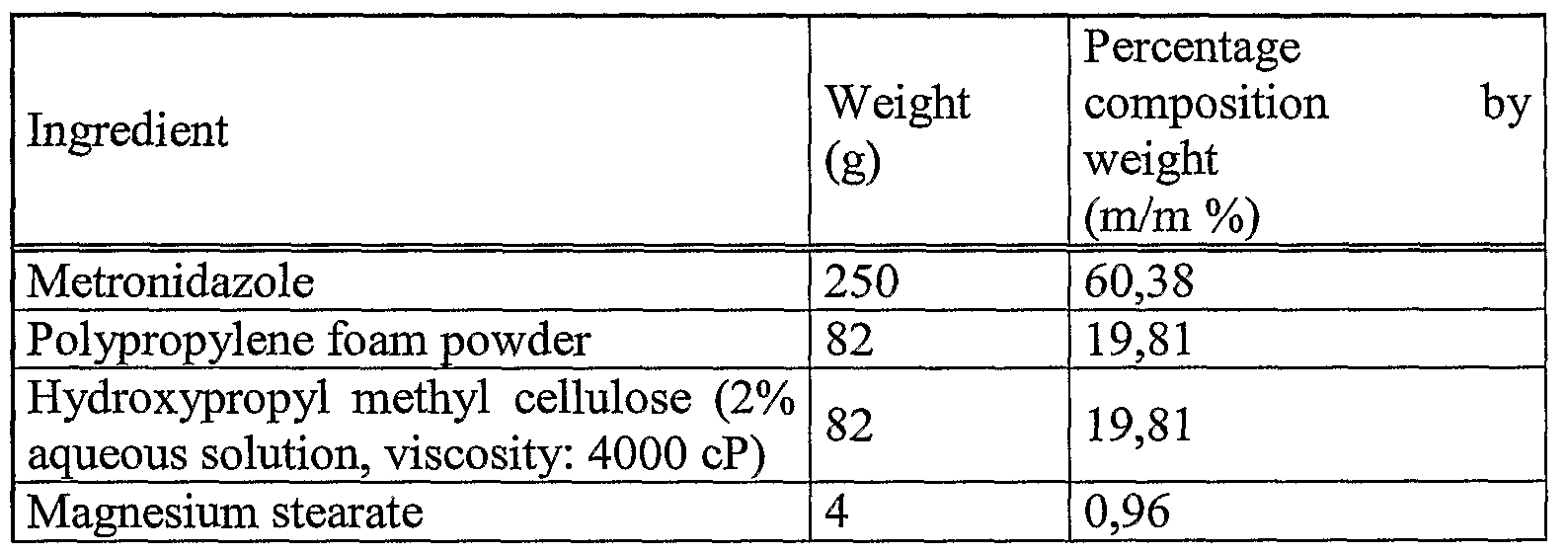
The above listed ingredients were homogenized then tablets were produced by direct compression thereof. The low density of the extended release floating tablet is provided by the spongy structure polypropylene foam powder. HPMC based matrix effects two phase in the dissolution profile. It means that with using HPMC in the first hour of drug release the quantity of the dissolved drug compared to polyethylene oxide containing dosage forms can be increased. The dissolution of metronidazole from the tablet is shown in Figure 7.
Example 8 (1000 tablets):

The above listed ingredients were homogenized then tablets were produced by direct compression thereof. The low density of the extended release floating tablet is provided by the spongy structure polypropylene foam powder.
HPMC based matrix effects two phase in the dissolution profile. It means that with using
HPMC in the first hour of drug release the quantity of the dissolved drug compared to polyethylene oxide containing dosage forms can be increased.
The dissolution of metronidazole from the tablet is shown in Figure 8.
Example 9 (1000 tablets):

The above listed ingredients were homogenized then tablets were produced by direct compression thereof. The low density of the extended release floating tablet is provided by the spongy structure polypropylene foam powder.
HPMC based matrix effects two phase in the dissolution profile. It means that with using HPMC in the first hour of drug release the quantity of the dissolved drug compared to polyethylene oxide containing dosage forms can be increased. The dissolution of metronidazole from the tablet is shown in Figure 9.
Claims
1. A sustained release pharmaceutical composition comprising metronidazole characterized in that it comprises matrix-forming polymer, gas-generating excipients, low density foam powder, pharmaceutically acceptable excipients.
2. Pharmaceutical composition according to claim 1 characterized in that the matrix-forming polymer is a cellulose derivate (ethyl cellulose, hydroxyethylcellulose, carboxymethyl cellulose sodium, methylcellulose), xanthan gum, polyacrylic acid derivative, polyvynil derivative, polyethylene oxide.
3. Pharmaceutical composition according to claim 2 characterized in that the matrix-forming polymer is hydroxypropyl methyl cellulose or polyethylene oxide.
4. Pharmaceutical composition according to any of claims 1 to 3 characterized in that the gas generating excipients are metal-ion carbonate salts and/or hydrogencarbonate salts.
5. Pharmaceutical composition according to claim 4 characterized in that the gas generating excipients are calcium carbonate or sodium hydrogencarbonate.
6. Pharmaceutical composition according to any of claims 1 to 5 characterized in that the low density foam powder is spongy structure polypropylene.
7. Pharmaceutical composition according to any of claims 1 to 6 characterized in that it could comprise a weak organic acid beside gas generating excipients.
8. Pharmaceutical composition according to claim 7 characterized in that the weak organic acid is tartaric acid or citric acid.
9. Pharmaceutical composition according to any of claims 1 to 8 characterized in that the components of the dosage are homogenized and tableted by direct compression into a tablet form or filled into a capsule.
Priority Applications (2)
| Application Number | Priority Date | Filing Date | Title |
|---|---|---|---|
| EP08776247A EP2173320A1 (en) | 2007-07-09 | 2008-07-09 | Metronidazole containing extended release floating pharmaceutical composition |
| EA201070106A EA201070106A1 (en) | 2007-07-09 | 2008-07-09 | FLOTATION PHARMACEUTICAL COMPOSITION OF PROLONGED FREEZING CONTAINING METRONIDAZOL |
Applications Claiming Priority (2)
| Application Number | Priority Date | Filing Date | Title |
|---|---|---|---|
| HU0700469A HUP0700469A2 (en) | 2007-07-09 | 2007-07-09 | Floating pharmaceutical composition of sustained release containing metronidazol |
| HUP0700469 | 2007-07-09 |
Publications (1)
| Publication Number | Publication Date |
|---|---|
| WO2009007762A1 true WO2009007762A1 (en) | 2009-01-15 |
Family
ID=89987633
Family Applications (1)
| Application Number | Title | Priority Date | Filing Date |
|---|---|---|---|
| PCT/HU2008/000081 Ceased WO2009007762A1 (en) | 2007-07-09 | 2008-07-09 | Metronidazole containing extended release floating pharmaceutical composition |
Country Status (4)
| Country | Link |
|---|---|
| EP (1) | EP2173320A1 (en) |
| EA (1) | EA201070106A1 (en) |
| HU (1) | HUP0700469A2 (en) |
| WO (1) | WO2009007762A1 (en) |
Cited By (2)
| Publication number | Priority date | Publication date | Assignee | Title |
|---|---|---|---|---|
| CN103191432A (en) * | 2013-04-27 | 2013-07-10 | 中国药科大学 | Water-soluble medicine framework sustained release tablet and preparation method thereof |
| WO2019069108A1 (en) * | 2017-10-04 | 2019-04-11 | Debreceni Egyetem | Prolonged-release, gastroretentive, moulded, solid dosage form and process for the preparation thereof |
Citations (2)
| Publication number | Priority date | Publication date | Assignee | Title |
|---|---|---|---|---|
| WO1999001112A1 (en) * | 1997-07-01 | 1999-01-14 | Astra Aktiebolag (Publ) | Multiple unit effervescent dosage form |
| US20040180088A1 (en) * | 2001-07-04 | 2004-09-16 | Dudhara Kamlesh Mohanlal | Gastric retention controlled drug delivery system |
-
2007
- 2007-07-09 HU HU0700469A patent/HUP0700469A2/en unknown
-
2008
- 2008-07-09 EA EA201070106A patent/EA201070106A1/en unknown
- 2008-07-09 WO PCT/HU2008/000081 patent/WO2009007762A1/en not_active Ceased
- 2008-07-09 EP EP08776247A patent/EP2173320A1/en not_active Withdrawn
Patent Citations (2)
| Publication number | Priority date | Publication date | Assignee | Title |
|---|---|---|---|---|
| WO1999001112A1 (en) * | 1997-07-01 | 1999-01-14 | Astra Aktiebolag (Publ) | Multiple unit effervescent dosage form |
| US20040180088A1 (en) * | 2001-07-04 | 2004-09-16 | Dudhara Kamlesh Mohanlal | Gastric retention controlled drug delivery system |
Non-Patent Citations (2)
| Title |
|---|
| BARDONNET P L ET AL: "Gastroretentive dosage forms: Overview and special case of Helicobacter pylori", JOURNAL OF CONTROLLED RELEASE 20060310 NL, vol. 111, no. 1-2, 10 March 2006 (2006-03-10), pages 1 - 18, XP002499224, ISSN: 0168-3659 * |
| STREUBEL A ET AL: "Floating matrix tablets based on low density foam powder: Effects of formulation and processing parameters on drug release", EUROPEAN JOURNAL OF PHARMACEUTICAL SCIENCES 200301 NL, vol. 18, no. 1, January 2003 (2003-01-01), pages 37 - 45, XP002499223, ISSN: 0928-0987 * |
Cited By (2)
| Publication number | Priority date | Publication date | Assignee | Title |
|---|---|---|---|---|
| CN103191432A (en) * | 2013-04-27 | 2013-07-10 | 中国药科大学 | Water-soluble medicine framework sustained release tablet and preparation method thereof |
| WO2019069108A1 (en) * | 2017-10-04 | 2019-04-11 | Debreceni Egyetem | Prolonged-release, gastroretentive, moulded, solid dosage form and process for the preparation thereof |
Also Published As
| Publication number | Publication date |
|---|---|
| HUP0700469A2 (en) | 2009-04-28 |
| EA201070106A1 (en) | 2010-06-30 |
| HU0700469D0 (en) | 2007-08-28 |
| EP2173320A1 (en) | 2010-04-14 |
Similar Documents
| Publication | Publication Date | Title |
|---|---|---|
| CA2409999C (en) | Optical polymer mixtures for gastric retentive tablets | |
| ES2219709T3 (en) | A CHARACTERIZED PHARMACEUTICAL TABLET BECAUSE IT PRESENTS A GREAT INCREASE IN VOLUME WHEN IT COMES IN CONTACT WITH BIOLOGICAL FLUIDS. | |
| ES2260253T3 (en) | ORAL PHARMACEUTICAL COMPOSITION OF CONTROLLED RELEASE AND PROLONGED ABSORPTION. | |
| CN101636152B (en) | Controlled-release preparation containing cilostazol and process for the preparation thereof | |
| CA2395231C (en) | Hydrogel-driven layered drug dosage form | |
| JP2012500230A (en) | Gastric retention drug release system and method and use thereof | |
| AU2002337974A1 (en) | Optimal polymer mixtures for gastric retentive tablets | |
| KR20060092083A (en) | Single Matrix Tablets Controlled in the Gastrointestinal tract | |
| US20020119192A1 (en) | Controlled release formulations for oral administration | |
| KR101277021B1 (en) | Oral controlled release double-layered rebamipide-contained formulation using gastro-retentive drug delivery system and process for the preparation thereof | |
| CN101371822B (en) | Gastric retention sustained and controlled release drug release system and preparation method | |
| KR20140131205A (en) | Pharmaceutical composition containing highly water-soluble drug for sustained release | |
| EP2386302A1 (en) | A controlled release pharmaceutical dosage form of trimetazidine and processes for the preparation thereof | |
| EP2173320A1 (en) | Metronidazole containing extended release floating pharmaceutical composition | |
| Kumar Giri et al. | Prospective and new findings of hydroxypropyl methylcellulose (HPMC) as a potential carrier for gastrorententive drug delivery systems | |
| EP3331502B1 (en) | Controlled release propiverine formulations | |
| EP2528593A2 (en) | Effervescent formulations comprising cefprozil as active agent | |
| KR20170086053A (en) | Pharmaceutical matrix formulations comprising dimethyl fumarate | |
| WO2022200971A1 (en) | A method for the production of gastroretentive compact matrices for the controlled release of active substances and compact matrices thus obtained | |
| WO2003075919A1 (en) | Tablet containing pilsicainide hydrochloride (dry) | |
| WO2017009754A1 (en) | Orally administrable film dosage form containing fingolimod | |
| Kishorebabu et al. | A review on floating drug delivery system | |
| US20080206338A1 (en) | Controlled release formulations of an alpha-adrenergic receptor antagonist | |
| JP2024004706A (en) | Pharmaceutical compositions and pharmaceutical formulations | |
| WO2010123440A1 (en) | Pharmaceutical composition comprising 4-amino-8-(2-fluoro-6-methoxy-phenyl)-n- propylcinnoline-3-carboxamide hydrogen sulphate and rate-controlling polymer |
Legal Events
| Date | Code | Title | Description |
|---|---|---|---|
| 121 | Ep: the epo has been informed by wipo that ep was designated in this application |
Ref document number: 08776247 Country of ref document: EP Kind code of ref document: A1 |
|
| WWE | Wipo information: entry into national phase |
Ref document number: 2008776247 Country of ref document: EP |
|
| NENP | Non-entry into the national phase |
Ref country code: DE |
|
| WWE | Wipo information: entry into national phase |
Ref document number: 201070106 Country of ref document: EA |