WO2009007946A1 - Process for producing cisatracurium and associated intermediates - Google Patents
Process for producing cisatracurium and associated intermediates Download PDFInfo
- Publication number
- WO2009007946A1 WO2009007946A1 PCT/IL2008/000590 IL2008000590W WO2009007946A1 WO 2009007946 A1 WO2009007946 A1 WO 2009007946A1 IL 2008000590 W IL2008000590 W IL 2008000590W WO 2009007946 A1 WO2009007946 A1 WO 2009007946A1
- Authority
- WO
- WIPO (PCT)
- Prior art keywords
- besylate
- cisatracurium
- compound
- mixture
- organic solvent
- Prior art date
- Legal status (The legal status is an assumption and is not a legal conclusion. Google has not performed a legal analysis and makes no representation as to the accuracy of the status listed.)
- Ceased
Links
Classifications
-
- C—CHEMISTRY; METALLURGY
- C07—ORGANIC CHEMISTRY
- C07D—HETEROCYCLIC COMPOUNDS
- C07D217/00—Heterocyclic compounds containing isoquinoline or hydrogenated isoquinoline ring systems
- C07D217/02—Heterocyclic compounds containing isoquinoline or hydrogenated isoquinoline ring systems with only hydrogen atoms or radicals containing only carbon and hydrogen atoms, directly attached to carbon atoms of the nitrogen-containing ring; Alkylene-bis-isoquinolines
- C07D217/10—Quaternary compounds
Definitions
- the present invention relates to organic chemistry and more particularly to preparation of novel isoquinolinium compounds and their use in the synthesis of cisatracurium compounds.
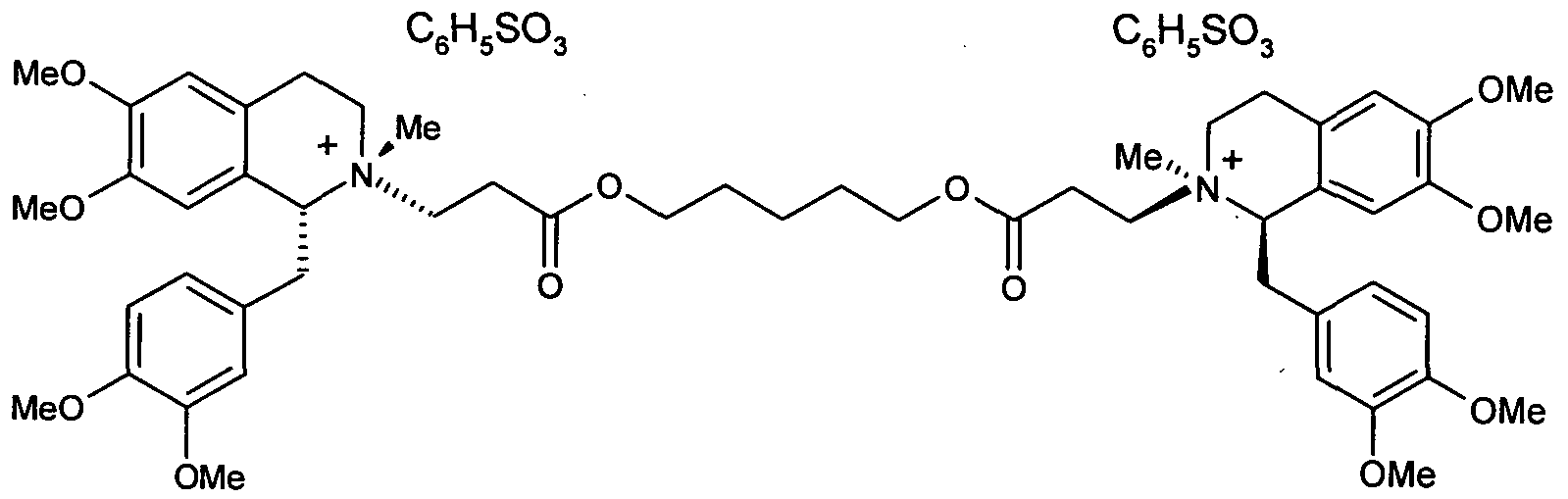
- Cisatracurium besylate has the chemical name (lR,l'R,2R,2'R)-2,2'-[l,5- pentanediylbisfoxyCS-oxo-SJ-propanediyOllbisfl-fCS ⁇ -dimethoxyphenyOmethylJ-l ⁇ - tetrahydro-6,7-dimethoxy-2-methyl-isoquinolinium dibenzenesulfonate and is represented by the structural formula (I) below:
- Cisatracurium besylate is the dibenzenesulfonate salt of lR-cis,l'R-cis isomer of atracurium besylate.
- the atracurium compound has four chiral centers, which should theoretically allow for 16 possible isomers. Due to the symmetry of the molecule the number of possible isomers is reduced to 10. See, e.g., J.B. Stenlake et al. in "Biodegradable neuromuscular blocking agents," Eur. J. Med. Chem. - Chem. Ther., vol. 19, issue 5, pp. 441-450 (1984).
- Cisatracurium besylate is a nondepolarizing neuromuscular blocking agent indicated for inpatients and outpatients as an adjunct to general anesthesia, to facilitate tracheal intubation, and to provide skeletal muscle relaxation during surgery or mechanical ventilation in the Intensive Care Unit (ICU).
- Cisatracurium besylate possesses an activity that is superior to atracurium besylate, with significantly less side effects.
- Cisatracurium besylate is marketed in the United States, Europe and other countries by GSK and Abbott Laboratories under the trade name Nimbex ® .
- Nimbex ® is a sterile, non-pyrogenic aqueous solution that is adjusted to pH 3.25 to 3.65 with benzenesulfonic acid.
- the drug is provided in 2.5 ml, 5 ml and 10 ml ampules having a strength of 2 mg/ml cisatracurium besylate.
- a 30 ml vial containing 5 mg/ml cisatracurium besylate is also available.
- Nimbex ® slowly loses potency with time at a rate of approximately 5% per year under refrigeration (5°C). Nimbex should be refrigerated at 2° to 8° C (36° to 46°F) to preserve potency. The rate of loss in potency increases to approximately 5% per month at 25°C (77° F).
- Atracurium besylate also known as 2,2'-[l,5-pentanediylbis[oxy(3-oxo-3, 1- propanediyl)]]bis[l-[(3,4-dimethoxyphenyl)methyl]-l,2,3,4-tetrahydro-6,7-dimethoxy-2- methyl-isoquinolinium dibenzenesulfonate (it is a mixture of isomers), is disclosed in U.S. Patent No. 4,179,507 (hereinafter U.S. '507).
- U.S. '507 describes a series of bis veratryl isoquinolinium quaternary ammonium salts, including Atracurium besylate.
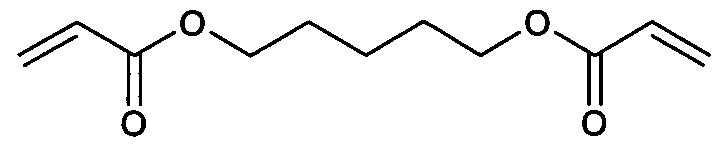
- U.S. '507 describes synthesizing atracurium besylate by a process that involves coupling ( ⁇ )- tetrahydro-papaverine base (compound II) with 1 ,5-pentamethylene diacrylate (compound III) and treating the resulting tertiary amine base with oxalic acid to produce N 5 N 1 -4,10- dioxa-3,1 l-dioxotridecylene-l,13-bis-tetrahydropapaverine dioxalate (compound IV).
- This salt is converted to the free base (compound V), which is treated with methyl benzenesulfonate.
- the resulting product, atracurium besylate (compound VI) is precipitated and isolated.
- the process is illustrated below in Scheme 1.
- European application No. 0219616 discloses the synthesis of atracurium chloride.
- E.P. '616 describes a process that involves coupling 1- [(3,4-dimethoxyphenyl)methyl]-3,4-dihydro-6,7-dimethoxy-2(lH)-isoquinolinepropanoic acid (compound VII) with 1,5-pentanediol in the presence of an acid to afford the diester (compound IX).
- the resulting diester is quaternized with methyl iodide to form atracurium iodide, which is then converted into atracurium chloride by means of anion exchange.
- the process is illustrated in below Scheme 2.
- Cisatracurium besylate is disclosed in U.S. Patent No. 5,453,510 (hereinafter U.S. '510).
- U.S. '510 describes the formation of (R)-tetrahydropapaverine (compound HA) by converting compound (II) into a mixture of the R and S diastereoisomeric salts with the chiral amino acid N-acetyl-L-leucine and crystallizing from acetone to afford 97% (R)- tetrahydropapaverine-N-acetyl-L-leucinate and 3% (S)-tetrahydropapaverine-N-acetyl-L- leucinate, which is converted into (R)-tetrahydropapaverine base.
- the (R)-tetrahydro- papaverine is subsequently reacted with 1,5-pentamethylene diacrylate followed by oxalic acid to afford the dioxalate salt of (lR,l'R)-2,2'-(3,l l-dioxo-4,10-dioxatridecamethylene)- bis-(l,2,3,4-tetrahydro-6,7-dimethoxy-l-veratrylisoquinoline) (i.e., an isomer of compound IV).
- Lyophilization results in a pale yellow solid that includes a mixture of three isomers, namely, lR-cis,l'R-cis; lR-cis,l'R-trans; lR-trans,rR-trans (hereinafter referred to as the "atracurium besylate mixture”) in a ratio of about 58:34:6 respectively.
- the atracurium besylate mixture is subjected to preparative HPLC column chromatography on silica using a mixture of dichloromethane, methanol and benzenesulfonic acid in the ratio of 4000:500:0.25 as the eluent.
- the fractions containing the required isomer are collected and further processed to afford cisatracurium besylate possessing an isomeric purity of about 99%.
- the above procedure suffers from several disadvantages.
- a major problem in the procedure is attributable to the HPLC purification step.
- the need for HPLC purification is undesirable in a large-scale operation because only relatively small amounts of product can be purified at a time.
- the method is expensive, time-consuming and generates large quantities of waste solvents, which raises considerations with regard to safe disposal of the accumulated wastes.
- Another disadvantage of the above procedures is that cisatracurium besylate may be unstable in the eluent mixture used in the HPLC separation and, thus, can lead to the formation of decomposition products.
- the present invention provides a process for preparing cisatracurium salt e.g., cisatracurium besylate (I).
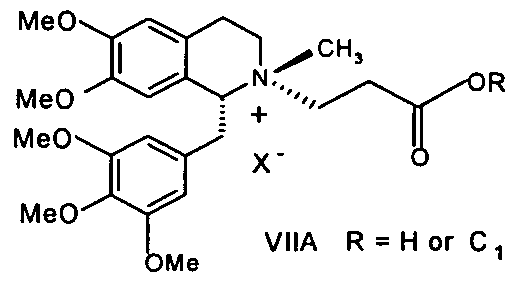
- the process of the present invention includes: (a) reacting a compound of formula (VIIA):
- the reaction can be carried out by direct acylation, that is, by refluxing Compound VIIA with 1,5-pentanediol in an organic solvent, e.g., dichloromethane or toluene, in the presence of an acid catalyst such as sulfuric acid or benzenesulfonic acid and by removal of water, e.g., by azeotropic distillation, using e.g., Dean-Stark apparatus, or by using molecular sieve.
- an organic solvent e.g., dichloromethane or toluene
- an acid catalyst such as sulfuric acid or benzenesulfonic acid
- removal of water e.g., by azeotropic distillation, using e.g., Dean-Stark apparatus, or by using molecular sieve.
- step (a) includes: (i) reacting compound (VIIA), wherein R is H, with an activating agent, optionally in an organic solvent, to form a compound of the formula VIIB comprising an activated carboxylic group:
- Step (b) can include contacting the cisatracurium salt with an ion exchange resin, e.g., an ion exchange resin carrying benzenesulfonate anions, to form cisatracurium besylate.
- an ion exchange resin e.g., an ion exchange resin carrying benzenesulfonate anions
- the isolation and purification steps can be carried out by any suitable separation or purification procedure such as, e.g., filtration, extraction, precipitation, crystallization, slurrying or any suitable combination of these procedures.
- the process of the present invention preferably produces the cisatracurium salt, e.g., cisatracurium besylate, in at least about 95% purity, more preferably in at least about 98% purity, and most preferably in at least about 99.5% purity, as measured by HPLC.
- the process of the present invention preferably produces the cisatracurium salt, e.g., cisatracurium besylate, in an isomeric purity of at least about 97%, more preferably in an isomeric purity of at least about 99% and most preferably in an isomeric purity of at least about 99.5%, as measured by HPLC.
- cisatracurium salt e.g., cisatracurium besylate
- isomeric purity refers to the area percent of the peak corresponding to the (lR-cis,l'R-cis) cisatracurium isomer relative to the total area percent of the (lR-cis,l'R-cis), (lR-cis,l'R-trans) and (lR-trans,l'R-trans) isomers as measured by HPLC.
- the present invention provides a process for preparing cisatracurium besylate (I).
- the process of the present invention includes: (a) reacting a compound of formula (VIIA):
- X " is iodide or besylate anion and R is H or a C 1 -C 6 alkyl (methyl, ethyl, n-propyl, isopropyl, butyl, isobutyl, sec-butyl, tert-butyl, pentyl or hexyl), with 1 ,5-pentanediol to form a cisatracurium salt, or reacting a compound of formula (VIIA) with 1,5-pentanediol to form an intermediate compound of formula (VIII):
- the anion X " of formula (VIIA) is iodide or besylate, and R is methyl, ethyl, propyl, isopropyl, butyl, isobutyl, sec-butyl, tert-butyl, pentyl or hexyl.
- the reaction can be carried out by direct acylation, that is, by refluxing Compound VIIA with 1,5-pentanediol in an organic solvent, e.g., dichloromethane or toluene, in the presence of an acid catalyst such as benzenesulfonic acid or sulfuric acid and by removal of water, e.g., by azeotropic distillation using, e.g., a Dean-Stark apparatus or by using a drying agent such as molecular sieve, sodium sulfate, magnesium sulfate, calcium sulfate, and calcium chloride.
- an organic solvent e.g., dichloromethane or toluene
- an acid catalyst such as benzenesulfonic acid or sulfuric acid
- removal of water e.g., by azeotropic distillation using, e.g., a Dean-Stark apparatus or by using a drying agent such as molecular sieve, sodium sulfate, magnesium
- step (a) includes:
- Y is halogen, OR 1, or OCOR 1; (e.g., wherein R 1 is C 1 -C 6 alkyl, e.g., methyl, ethyl, propyl, isopropyl, butyl, isobutyl, sec-butyl, tert-butyl, pentyl or hexyl); and
- the activating agent can include, e.g., a chlorinating agent, an esterifying agent or an acid anhydride forming agent.
- the activating agent is a chlorinating agent such as, for example, phosphorus oxychloride, thionyl chloride, phosphorous pentachloride or oxalyl chloride.
- Preferred chlorinating agents include oxalyl chloride and thionyl chloride.
- the organic solvent used in the activation step can include, e.g., a chlorinated hydrocarbon or an aromatic hydrocarbon.
- the carboxylic acid is activated in an organic solvent, which can include, e.g., dichloromethane, chloroform, 1,2- dichloroethane, xylenes, toluene or a mixture thereof.
- a preferred organic solvent for performing the activation step is dichloromethane.
- the activation of the carboxylic group of compound (VIIA) is preferably performed at a reduced temperature, e.g., less than about 2O 0 C.
- the chlorinating agent is added gradually (e.g., dropwise or in portions, depending on various factors such as, e.g., reaction scale) to the solution of compound (VIIA) at a reduced temperature, e.g., less than about 2O 0 C, over a period of about 30 minutes.
- the amount of chlorinating agent used in the activation step is preferably in the range of from about 1.0 to 2.0 equivalents relative to compound (VIIA).
- the amount of chlorinating agent used in the activation step is in the range of about 1.0 to 1.2 equivalents relative to compound (VIIA).
- the activation step involves using about 1.1 equivalents of chlorinating agent relative to compound (VIIA).
- 1,5-pentanediol is added to the activated compound gradually at a temperature of less than about 20°C over a period of about 30 minutes.
- the amount of 1 ,5-pentanediol used in the coupling reaction is preferably in the range of from about 0.5 equivalents to about 1.0 equivalents relative to compound (VIIA). In a preferred embodiment, the amount of 1,5-pentanediol used in the coupling reaction is in the range of from about equivalents
- the coupling step (a) can include reacting compound (VIIB) with 1,5-pentanediol optionally in the presence of a catalyst, optionally in an organic solvent, to form the cisatracurium salt.
- Suitable catalysts include acidic catalysts such as, e.g., CaSO 4 /benzenesulfonic acid, NaHSO 4 SiO 2 , Amberlyst 15 (a sulfonic acid resin based on cross linked styrene-divinylbenzene copolymers) or a mixture of benzenesulfonic acid and silica gel of pH 3.0-5.0.
- NaHSO 4 SiO 2 is a heterogeneous acidic catalyst that includes sodium hydrogen sulfate supported on silica gel.
- Preferred acidic catalysts include CaSO 4 /benzenesulfonic acid and NaHSO 4 SiO 2 .
- Organic solvents that can be used in the coupling reaction can include one or more chlorinated hydrocarbons, one or more aromatic hydrocarbons and mixtures thereof.
- Preferred organic solvents for performing the coupling reaction include dichloromethane, chloroform, 1,2-dichloroethane, xylenes, toluene and mixtures thereof. In one embodiment, the coupling reaction is performed using dichloromethane as an organic solvent.
- step (b) includes removing the solvent, e.g., under reduced pressure at ambient temperature, and optionally substituting the counter-ion by contacting with an ion exchange resin.
- the besylate anion can be introduced by contacting with an ion exchange resin containing besylate anions, e.g., by dissolving the cisatracurium salt (wherein an anion (X ' ) is other than besylate), e.g., in an organic solvent comprising an aliphatic alcohol, ketone or nitrile and contacting the ion exchange resin with the resulting solution.
- Suitable organic solvents that can be used in the ion exchange process include, e.g., methanol, ethanol, isopropanol, acetone, methyl ethyl ketone, acetonitrile and mixtures thereof.
- a preferred organic solvent for performing the ion exchange is methanol.
- a solution containing the cisatracurium salt is applied to an ion exchange column carrying benzenesulfonate (besylate) anions, and cisatracurium besylate is removed from the column by eluting with an organic solvent.
- Suitable organic solvents that can be used for eluting cisatracurium besylate from such an ion exchange column include methanol, ethanol, isopropanol, acetone, methyl ethyl ketone, acetonitrile or a mixture thereof.
- a preferred elution solvent is methanol.
- the purification process can be performed using any suitable purification method, e.g., filtration, extraction, precipitation, crystallization, slurrying or any suitable combination of these procedures.
- the cisatracurium salt e.g., cisatracurium besylate
- the cisatracurium salt is selectively precipitated by mixing the cisatracurium salt with a first solvent and adding a second organic solvent, or mixture of solvents, in which the cisatracurium salt is sparingly soluble to precipitate the cisatracurium salt as a purified product.
- the first solvent that can be used for precipitating cisatracurium besylate includes methanol, ethanol, n-propanol, isopropanol, acetone, methyl ethyl ketone, ethyl acetate, tetrahydrofuran, dichloromethane, chloroform or a mixture thereof.
- a particularly preferred first organic solvent for precipitating cisatracurium besylate is dichloromethane.
- Exemplary second organic solvents in which cisatracurium besylate is sparingly soluble include diethyl ether, isopropyl ether, tert-butyl methyl ether, toluene, 2-methyl- tetrahydrofuran (2 -Me-THF), and C 5 to C 8 saturated hydrocarbons, such as, n-hexane, n- heptane, cyclohexane, and the like, and mixtures thereof.
- Preferred second organic solvents include mixtures of toluene and 2-Me-THF.
- cisatracurium salts e.g., cisatracurium besylate
- cisatracurium salts also can be purified by slurrying in an organic solvent, optionally at an elevated temperature, and collecting cisatracurium besylate as a purified product.
- Exemplary organic solvents that can be used for purifying cisatracurium besylate by slurrying include ethyl acetate, toluene, tert-butyl methyl ether, diethyl ether, n-pentane, and mixtures thereof.
- a particularly preferred organic solvent for purifying cisatracurium besylate by slurrying is n-pentane.
- the removal of residual solvents from the cisatracurium besylate can be carried out by extracting with an organic solvent selected from saturated hydrocarbons such as, e.g., n-pentane, n-hexane, cyclohexane, n-heptane, petroleum ether and the like, and mixtures thereof, preferably n-pentane, n-heptane and mixtures thereof.
- an organic solvent selected from saturated hydrocarbons such as, e.g., n-pentane, n-hexane, cyclohexane, n-heptane, petroleum ether and the like, and mixtures thereof, preferably n-pentane, n-heptane and mixtures thereof.
- the removal of residual solvents from the cisatracurium besylate can also be carried out by lyophilizing an aqueous acidic solution of the cisatracurium which contains t- butanol. As the results presented in Table 4 show, the content of residual solvents such as dichloromethane can be significantly reduced after the lyophilization.
- the process of the present invention produces cisatracurium salts, e.g., cisatracurium besylate, in at least about 95% purity, preferably in at least about 98% purity, and more preferably in at least about 99.5% purity, as measured by HPLC.
- the process of the present invention produces cisatracurium salts, e.g., cisatracurium besylate, in an isomeric purity of at least about 97%, preferably in an isomeric purity of at least about 99% and more preferably in an isomeric purity of at least about 99.5%.
- cisatracurium salts e.g., cisatracurium besylate
- compounds (VIIA), (VIIB) and VIII can be used to synthesize cisatracurium besylate (I) without having to resort to a difficult and expensive HPLC purification or other conventional procedures, e.g., as described in U.S. '510.
- benzenesulfonic acid 0.05 g
- CaSO 4 0.8 g
- the product contained: 89.2% of cisatracurium besylate, 3.2% of monoester besylate (Compound VIII) and 7.6% of cis-acid besylate.
- CaSO 4 was then collected by filtration and the filtrate was washed with water (3 x 15 ml).
- This example describes the preparation of cisatracurium besylate.
- This example describes the preparation of cisatracurium besylate.
- This example describes the preparation of cisatracurium besylate.
- the cis-acid besylate (0.53 g, 0.902 mmmol) was dissolved in dichloromethane (10 ml). The solution was cooled to 0°C and oxalyl chloride (0.086 ml, 0.992 mmol) was added in portions at 0°C. The temperature was allowed to reach room temperature and the reaction mixture was stirred at this temperature for 2 hours. The reaction mixture was then cooled to 0°C and 1,5-pentanediol (0.050 ml, 0.473 mmol) was added in portions.
- This example describes the preparation of cisatracurium iodide.
- “Acid iodide,” that is Compound VIIA wherein R is H, iodide (0.50 g, 0.917 mmol) was dissolved in dichloromethane (15 ml). The solution was cooled to 0°C and thionyl chloride (0.10 ml, 1.376 mmol) was added in portions at 0°C. The reaction mixture was allowed to reach room temperature and stirred at room temperature for 2 hours. The mixture was cooled to 0°C and 1,5-pentanediol (0.05 ml, 0.481 mmol) was added in portions.
- This example describes the preparation of cisatracurium besylate from the cis- ester besylate using the acidic catalyst NaHSO 4 -SiO 2 .
- the reaction mixture contained 2.9% of cisatracurium besylate, 14.0% monoester besylate, 6.7% cis-acid besylate and 76.4% of the cis-ester besylate. Subsequently, an additional amount of NaHSO 4 SiO 2 (0.15 g, 0.82 mmoles, 0.52 eq.) was added and the mixture was stirred under reflux for further 18 hours.
- the mixture contained 32.0% of cisatracurium besylate, 17.5% of monoester besylate, 12.8% of cis-acid besylate and 37.3% of cis-ester besylate.
- This example describes the preparation of cisatracurium besylate from the cis- ester besylate using the acidic catalyst Amberlyst ® 15 hydrogen form.
- the reaction mixture contained 3.2% of cisatracurium besylate, 6.1% of monoester besylate, 24.2% of cis-acid besylate and 66.6% of cis-ester besylate. Subsequently, the reaction mixture was stirred at ambient temperature for 7 days. A sample of the reaction mixture that was withdrawn and injected to the HPLC contained 21.9% of cisatracurium besylate, 10.0% of monoester besylate, 33.8% of cis-acid besylate and 34.4% of cis-ester besylate.
- This example describes the preparation of cisatracurium besylate from the cis- acid besylate using the acidic catalyst NaHSO 4 SiO 2 .
- Method A A mixture of cis-acid besylate (0.6 g, 1.02 mmoles), anhydrous 1,5- pentanediol (0.049 g, 0.51 mmoles, 0.5 eq.) and NaHSO 4 -SiO 2 (0.13 g, 0.71 mmoles, 0.7 eq.) was stirred in dichloromethane (10 ml) at ambient temperature for 2 days. According to the HPLC analysis, the reaction mixture contained 30.2% of cisatracurium besylate, 37.0% of monoester besylate, and 32.8% of cis-acid besylate. Subsequently, the reaction mixture was stirred under reflux for 6 hours.
- the mixture contained 49.8% of cisatracurium besylate, 34.7% of monoester besylate, and 15.5% of cis-acid besylate.
- the mixture was allowed to cool to ambient temperature and additional amount of NaHSO 4 -SiO 2 (0.13 g, 0.71 mmoles, 0.7 eq.) was added.
- the reaction mixture was stirred at ambient temperature for about 16 hours.
- the mixture contained 55.0% of cisatracurium besylate, 32.4% of monoester besylate and 12.6% of cis-acid besylate. The mixture was stirred under reflux for an additional 4 hours.
- the mixture contained 62.4% of cisatracurium besylate, 30.8% of monoester besylate, and 6.8% of cis-acid besylate.
- Method B A mixture of cis-acid besylate (0.5 g, 0.85 mmoles), anhydrous 1,5- pentanediol (0.041 g, 0.425 mmoles, 0.5 eq.), NaHSO 4 SiO 2 (0.34 g, 1.85 mmoles, 2.18 eq.) and magnesium sulfate (0.25 g) was stirred in dichloromethane (10 ml) at ambient temperature for 24 hours. According to the HPLC analysis, the mixture contained 40.1% of cisatracurium besylate, 12.1% of monoester besylate and 47.5% of the cis-acid besylate.
- Method C A mixture of cis-acid besylate (0.6 g, 1.02 mmoles), anhydrous 1,5- pentanediol (0.049 g, 0.51 mmoles, 0.5 eq.), NaHSO 4 SiO 2 (0.34 g, 1.85 mmoles, 1.81 eq.) was stirred in dichloromethane (10 ml) under reflux for 3 hours. According to the HPLC analysis, the mixture contained 23.7% of cisatracurium besylate, 9.5% of monoester besylate and 66.7% of cis-acid besylate. Subsequently, the mixture was stirred overnight at ambient temperature.
- the mixture contained 47.6% of cisatracurium besylate, 6.6% of monoester besylate and 46.0% of cis-acid besylate.
- the reaction was then stirred under reflux for 7 hours to afford a mixture which according to the HPLC analysis contained 54.9% of cisatracurium besylate, 2.0% of monoester besylate and 43.0 % of cis-acid besylate.
- This example describes the preparation of cisatracurium besylate from the cis- acid besylate using the acidic catalyst Amberlyst ® 15 hydrogen form.
- the reaction mixture contained 19.3% of cisatracurium besylate, 2.1% of monoester besylate and 78.6% of the cis-acid besylate. The mixture was stirred at ambient temperature for about 16 hours.
- the mixture contained 21.4% of cisatracurium besylate, 2.2% of monoester besylate and 76.4% of cis- acid besylate.
- An additional portion of Amberlyst ® 15 hydrogen form (0.25 g) and anhydrous magnesium sulfate (0.2 g) were added and the reaction mixture was stirred at ambient temperature for 20 hours.
- the mixture contained 36.8% of cisatracurium besylate, 2.0% of monoester besylate and 61.1% of cis- acid besylate.
- This example describes the preparation of cisatracurium besylate from the cis- acid besylate using benzenesulfonic acid and silica gel (pH 3.0-5.0).
- the mixture contained 14.4% of cisatracurium besylate, 4.8% of monoester besylate and 80.8% of cis-acid besylate. Subsequently, anhydrous magnesium sulfate (0.25 g) was added and the reaction mixture was stirred at ambient temperature for 50 hours. According to a second HPLC analysis, the mixture contained 47.9% of cisatracurium besylate, 3.9% of monoester besylate and 48.2% of cis-acid besylate.
- This example describes the preparation of cisatracurium besylate from the cis- acid besylate in presence of benzenesulfonic acid in dichloromethane and purification of the obtained cisatracurium besylate by precipitation.
- the cisatracurium besylate content at the end of the reaction was 95.2%.
- the solution, containing the product, was evaporated to a reduced volume of 68 ml, and toluene was added (100 ml). Stirring was maintained at 25°C for 30 minutes and 2- MeTHF was added (200 ml). Stirring was maintained at 25 °C for 45 minutes during which time a solid was formed. The solvents were removed by decantation and the thus obtained residue was dissolved in dichloromethane (30 ml).
- the dichloromethane solution was evaporated in vacuum at a temperature of about 30°C to obtain 9.2 g cisatracurium besylate in 92% yield, having purity of 97.6%. Repeating the precipitation process afforded a product having purity of 98.2%.
- 1,5- pentanediol (578 ⁇ L, 5.502 mmoles, 6 eq.) was added dropwise at 0°C and the mixture was stirred at 25 °C for 14 hours. Then, the reaction mixture was concentrated under reduced pressure to afford an oil. The oil was dissolved in dichloromethane (100 ml) and a pH 4 buffer, consisting of citric acid, sodium hydroxide and sodium chloride, was added (15 ml) followed by addition of an aqueous saturated solution of sodium thiosulfate (5 ml) to afford a two phase system.
- a pH 4 buffer consisting of citric acid, sodium hydroxide and sodium chloride
- This example describes the preparation of cisatracurium besylate from Compound VIII.
- This example describes purification of cisatracurium besylate by extraction of the residual solvents with pentane or heptane.
- This example describes the purification of the cisatracurium besylate from residual solvents by lyophilization with t-butanol and water.
- Table 4 details the content of residual solvents in the cisatracurium besylate before and after lyophilization with t-butanol.
Landscapes
- Chemical & Material Sciences (AREA)
- Organic Chemistry (AREA)
- Organic Low-Molecular-Weight Compounds And Preparation Thereof (AREA)
- Pharmaceuticals Containing Other Organic And Inorganic Compounds (AREA)
Abstract
Description




Claims


Priority Applications (6)
| Application Number | Priority Date | Filing Date | Title |
|---|---|---|---|
| AU2008273724A AU2008273724B2 (en) | 2007-05-01 | 2008-05-01 | Process for Producing Cisatracurium and Associated Intermediates |
| CA 2692636 CA2692636A1 (en) | 2007-07-09 | 2008-05-01 | Process for producing cisatracurium and associated intermediates |
| EP08738291A EP2176227A1 (en) | 2007-07-09 | 2008-05-01 | Process for producing cisatracurium and associated intermediates |
| US12/667,634 US20100256381A1 (en) | 2007-07-09 | 2008-05-01 | Process for producing cisatracurium and associated intermediates |
| BRPI0812625A BRPI0812625A2 (en) | 2007-07-09 | 2008-05-01 | process for preparing a cis-atracurium salt |
| US13/648,830 US20130041154A1 (en) | 2007-07-09 | 2012-10-10 | Process for producing cisatracurium and associated intermediates |
Applications Claiming Priority (2)
| Application Number | Priority Date | Filing Date | Title |
|---|---|---|---|
| US94862107P | 2007-07-09 | 2007-07-09 | |
| US60/948,621 | 2007-07-09 |
Related Child Applications (1)
| Application Number | Title | Priority Date | Filing Date |
|---|---|---|---|
| US13/648,830 Continuation US20130041154A1 (en) | 2007-07-09 | 2012-10-10 | Process for producing cisatracurium and associated intermediates |
Publications (1)
| Publication Number | Publication Date |
|---|---|
| WO2009007946A1 true WO2009007946A1 (en) | 2009-01-15 |
Family
ID=39673234
Family Applications (1)
| Application Number | Title | Priority Date | Filing Date |
|---|---|---|---|
| PCT/IL2008/000590 Ceased WO2009007946A1 (en) | 2007-05-01 | 2008-05-01 | Process for producing cisatracurium and associated intermediates |
Country Status (5)
| Country | Link |
|---|---|
| US (2) | US20100256381A1 (en) |
| EP (1) | EP2176227A1 (en) |
| BR (1) | BRPI0812625A2 (en) |
| CA (1) | CA2692636A1 (en) |
| WO (1) | WO2009007946A1 (en) |
Cited By (10)
| Publication number | Priority date | Publication date | Assignee | Title |
|---|---|---|---|---|
| US8293912B2 (en) | 2007-05-01 | 2012-10-23 | Chemagis Ltd. | Process for producing cisatracurium compounds and associated intermediates |
| US8354537B2 (en) | 2007-10-29 | 2013-01-15 | Chemagis Ltd. | R,R1-atracurium salts |
| US8357805B2 (en) | 2007-06-18 | 2013-01-22 | Chemagis Ltd. | (1R,1′R)-atracurium salts separation process |
| US8357807B2 (en) | 2007-05-01 | 2013-01-22 | Chemagis Ltd. | Isoquinolinium compounds useful in the preparation of cisatracurium and associated intermediates |
| WO2010128518A3 (en) * | 2009-05-04 | 2013-02-28 | Gland Pharma Limited | Novel process for the preparation of cisatracurium besylate |
| US8461338B2 (en) | 2007-03-08 | 2013-06-11 | Chemagis Ltd. | (1R, 1′R)-atracurium salts separation process |
| CN104557703A (en) * | 2015-01-27 | 2015-04-29 | 江苏嘉逸医药有限公司 | Cisatracurium besilate refining method |
| CN112047883A (en) * | 2019-06-06 | 2020-12-08 | 上海特化医药科技有限公司 | The preparation method of atracurium cissulfonate |
| CN113372271A (en) * | 2020-12-24 | 2021-09-10 | 上海药坦药物研究开发有限公司 | Preparation method of cisatracurium besylate |
| CN115947685A (en) * | 2023-02-07 | 2023-04-11 | 山东铂源药业股份有限公司 | Preparation method of chiral isomer impurity of cisatracurium besylate |
Families Citing this family (4)
| Publication number | Priority date | Publication date | Assignee | Title |
|---|---|---|---|---|
| WO2008117271A1 (en) * | 2007-03-26 | 2008-10-02 | Chemagis Ltd. | (1r,1'r)-atracurium salts separation process |
| BRPI0907656A2 (en) * | 2008-05-01 | 2019-08-27 | Chemagis Ltd | cisatracurium purity test compound, method for testing the purity of a cisatracurium besylate sample, use of a cisatracurium purity test compound and process for preparing cisatracurium purity test compounds |
| CN111777554A (en) * | 2019-04-04 | 2020-10-16 | 山东瑞安药业有限公司 | Method for synthesizing cisatracurium besilate |
| WO2023086696A2 (en) * | 2021-11-10 | 2023-05-19 | ODH IP Corp. | Apparatus and methods for continuous flow synthesis of cisatracurium |
Citations (2)
| Publication number | Priority date | Publication date | Assignee | Title |
|---|---|---|---|---|
| EP0219616A1 (en) * | 1985-07-19 | 1987-04-29 | S O "Pharmachim" | N,N'-dimethyl-N,N'-4,10-dioxa-3,11-dioxo-1,13-tridecylene-bis-tetrahydropapaverinium dichloride |
| US5453510A (en) * | 1990-07-13 | 1995-09-26 | Burroughs Wellcome Co. | Neuromuscular blocking agents |
Family Cites Families (18)
| Publication number | Priority date | Publication date | Assignee | Title |
|---|---|---|---|---|
| AU506657B2 (en) * | 1975-12-10 | 1980-01-17 | Wellcome Foundation Limited, The | Isoquinoline derivatives |
| US4491665A (en) * | 1979-10-19 | 1985-01-01 | Burroughs Wellcome Co. | Method of preparing isomers of bis isoquinolinium compounds |
| US4701460A (en) * | 1980-12-17 | 1987-10-20 | Burroughs Wellcome Co. | Long duration neuromuscular blocking agents |
| GB8418303D0 (en) * | 1984-07-18 | 1984-08-22 | Wellcome Found | Compounds |
| JPS62265266A (en) * | 1986-05-13 | 1987-11-18 | Takasago Corp | Production of n-acyl-tetrahydroisoquinoline compound |
| US4988815A (en) * | 1989-10-26 | 1991-01-29 | Riker Laboratories, Inc. | 3-Amino or 3-nitro quinoline compounds which are intermediates in preparing 1H-imidazo[4,5-c]quinolines |
| US5240939A (en) * | 1991-10-31 | 1993-08-31 | Anaquest, Inc. | Nitrogen bridge tetrahydroisoquinolines |
| DE19535762A1 (en) * | 1995-09-26 | 1997-03-27 | Basf Ag | Racemate resolution process |
| US5684154A (en) * | 1996-02-16 | 1997-11-04 | Abbott Laboratories | Process for the preparation and isolation of atracurium besylate |
| DE69830157T2 (en) * | 1997-03-25 | 2006-05-11 | Avera Pharmaceuticals, Inc., San Diego | SUBSTITUTED ISOCHINOLINE AS ULTRA SHORT ACTING NEUROMUSCULAR BLOCKER |
| JP4782334B2 (en) * | 1999-08-13 | 2011-09-28 | ナームローゼ・フエンノートチヤツプ・オルガノン | Use of chemical chelators as antagonists for drug-induced neuromuscular blockade |
| WO2002054062A2 (en) * | 2000-12-29 | 2002-07-11 | Pfizer Limited | Reference standards and processes for determining the purity or stability of amlodipine maleate |
| US20060009485A1 (en) * | 2005-06-23 | 2006-01-12 | Chemagis Ltd | Method of reprocessing quaternary ammonium-containing neuromuscular blocking agents |
| JP5213137B2 (en) * | 2006-12-06 | 2013-06-19 | コーネル リサーチ ファウンデーション, インコーポレイテッド | Medium duration neuromuscular blockers and antagonists thereof |
| AU2008222298A1 (en) * | 2007-03-08 | 2008-09-12 | Chemagis Ltd. | (1R,1'R)-atracurium salts separation process |
| WO2008132748A1 (en) * | 2007-05-01 | 2008-11-06 | Chemagis Ltd. | Process for producing cisatracurium compounds and associated intermediates |
| AU2008273724B2 (en) * | 2007-05-01 | 2013-05-23 | Chemagis Ltd. | Process for Producing Cisatracurium and Associated Intermediates |
| WO2009057086A1 (en) * | 2007-10-29 | 2009-05-07 | Chemagis Ltd. | Novel r,r'-atracurium salts |
-
2008
- 2008-05-01 WO PCT/IL2008/000590 patent/WO2009007946A1/en not_active Ceased
- 2008-05-01 CA CA 2692636 patent/CA2692636A1/en not_active Abandoned
- 2008-05-01 EP EP08738291A patent/EP2176227A1/en not_active Withdrawn
- 2008-05-01 US US12/667,634 patent/US20100256381A1/en not_active Abandoned
- 2008-05-01 BR BRPI0812625A patent/BRPI0812625A2/en not_active IP Right Cessation
-
2012
- 2012-10-10 US US13/648,830 patent/US20130041154A1/en not_active Abandoned
Patent Citations (2)
| Publication number | Priority date | Publication date | Assignee | Title |
|---|---|---|---|---|
| EP0219616A1 (en) * | 1985-07-19 | 1987-04-29 | S O "Pharmachim" | N,N'-dimethyl-N,N'-4,10-dioxa-3,11-dioxo-1,13-tridecylene-bis-tetrahydropapaverinium dichloride |
| US5453510A (en) * | 1990-07-13 | 1995-09-26 | Burroughs Wellcome Co. | Neuromuscular blocking agents |
Non-Patent Citations (1)
| Title |
|---|
| See also references of EP2176227A1 * |
Cited By (12)
| Publication number | Priority date | Publication date | Assignee | Title |
|---|---|---|---|---|
| US8461338B2 (en) | 2007-03-08 | 2013-06-11 | Chemagis Ltd. | (1R, 1′R)-atracurium salts separation process |
| US8293912B2 (en) | 2007-05-01 | 2012-10-23 | Chemagis Ltd. | Process for producing cisatracurium compounds and associated intermediates |
| US8357807B2 (en) | 2007-05-01 | 2013-01-22 | Chemagis Ltd. | Isoquinolinium compounds useful in the preparation of cisatracurium and associated intermediates |
| US8357805B2 (en) | 2007-06-18 | 2013-01-22 | Chemagis Ltd. | (1R,1′R)-atracurium salts separation process |
| US8354537B2 (en) | 2007-10-29 | 2013-01-15 | Chemagis Ltd. | R,R1-atracurium salts |
| WO2010128518A3 (en) * | 2009-05-04 | 2013-02-28 | Gland Pharma Limited | Novel process for the preparation of cisatracurium besylate |
| CN104557703A (en) * | 2015-01-27 | 2015-04-29 | 江苏嘉逸医药有限公司 | Cisatracurium besilate refining method |
| CN104557703B (en) * | 2015-01-27 | 2018-01-16 | 江苏嘉逸医药有限公司 | A kind of method for refining cisatracurium besylate |
| CN112047883A (en) * | 2019-06-06 | 2020-12-08 | 上海特化医药科技有限公司 | The preparation method of atracurium cissulfonate |
| CN112047883B (en) * | 2019-06-06 | 2024-04-19 | 上海特化医药科技有限公司 | Preparation method of atracurium besylate |
| CN113372271A (en) * | 2020-12-24 | 2021-09-10 | 上海药坦药物研究开发有限公司 | Preparation method of cisatracurium besylate |
| CN115947685A (en) * | 2023-02-07 | 2023-04-11 | 山东铂源药业股份有限公司 | Preparation method of chiral isomer impurity of cisatracurium besylate |
Also Published As
| Publication number | Publication date |
|---|---|
| US20130041154A1 (en) | 2013-02-14 |
| CA2692636A1 (en) | 2009-01-15 |
| US20100256381A1 (en) | 2010-10-07 |
| EP2176227A1 (en) | 2010-04-21 |
| BRPI0812625A2 (en) | 2019-02-19 |
Similar Documents
| Publication | Publication Date | Title |
|---|---|---|
| AU2008273724B2 (en) | Process for Producing Cisatracurium and Associated Intermediates | |
| EP2176227A1 (en) | Process for producing cisatracurium and associated intermediates | |
| EP2155684B1 (en) | Process for producing cisatracurium compounds and associated intermediates | |
| US8354537B2 (en) | R,R1-atracurium salts | |
| DK149751B (en) | ANALOGY PROCEDURE FOR PREPARING A SALT OF A BISTETRAHYDROISOQUINOLINIUM DERIVATIVE AND THE INTERMEDIATE RELATION TO EXERCISE THE PROCEDURE | |
| EP2283005A2 (en) | Cisatracurium derivatives, preparation and uses thereof | |
| CA3030551A1 (en) | Processes for the preparation of 4-alkoxy-3-(acyl or alkyl)oxypicolinamides | |
| WO2008107887A2 (en) | (1r,1'r)-atracurium salts separation process | |
| CZ224098A3 (en) | The quinolin-2- (1H) -one derivative, a process for its preparation, and a pharmaceutical composition comprising the same | |
| FI84913C (en) | PROCEDURE FOR FRAMSTATION OF AV 2-ALCOXY-N- (1-AZABICYCLO / 2.2.2. / OCTAN-3-YL) AMINOBENSAMIDER. | |
| GB2076403A (en) | 1-(4-chlorobenzhydryl)-4-(2,3-bishydroxypropyl)- piperazine | |
| KR920002295B1 (en) | Method for preparing prolidinone derivative | |
| Chupp et al. | Heterocycles from substituted amides. VI. A new carbostyril synthesis from alpha‐substituted acetamides and the vilsmeier reagent | |
| US4537895A (en) | Isoquinoline derivatives | |
| Iorio et al. | Synthesis, stereochemistry, and biological activity of the 1-(1-phenyl-2-methylcyclohexyl) piperidines and the 1-(1-phenyl-4-methylcyclohexyl) piperidines. Absolute configuration of the potent trans-(-)-1-(1-phenyl-2-methylcyclohexyl) piperidine | |
| US4661625A (en) | Synthesis and purification of d-propoxyphene hydrochloride | |
| BRPI0807348A2 (en) | Method for the preparation of halogenated amines | |
| JPH07330732A (en) | Optically active 3-amino-1-benzylpiperidine derivative | |
| NZ201938A (en) | Anthranilic acid esters,and pharmaceutical compositions containing such | |
| AU2005305210A1 (en) | Opiate intermediates and methods of synthesis | |
| Marais et al. | Sodium dichloroisocyanurate oxidation of a sterically hindered tetrahydro-9 (10H)-acridinone | |
| MC961A1 (en) | Process for the preparation of N- (1-ethyl-2-pyrolidylmethyl) -2-methoxy-5-ethylsulfonyl-benzamide and its addition salts | |
| KR820001835B1 (en) | Process for preparing 4-aminozpiperidonoquina-zoline derivatives | |
| KR800000852B1 (en) | Process for preparing 4-(4-chlorophenyl)-4-hydroxy-n,n-dimethyl-aa-diphenyl-1-piperidin butane amide and its salts |
Legal Events
| Date | Code | Title | Description |
|---|---|---|---|
| 121 | Ep: the epo has been informed by wipo that ep was designated in this application |
Ref document number: 08738291 Country of ref document: EP Kind code of ref document: A1 |
|
| WWE | Wipo information: entry into national phase |
Ref document number: 2008273724 Country of ref document: AU |
|
| WWE | Wipo information: entry into national phase |
Ref document number: 2692636 Country of ref document: CA |
|
| NENP | Non-entry into the national phase |
Ref country code: DE |
|
| ENP | Entry into the national phase |
Ref document number: 2008273724 Country of ref document: AU Date of ref document: 20080501 Kind code of ref document: A |
|
| WWE | Wipo information: entry into national phase |
Ref document number: 2008738291 Country of ref document: EP |
|
| WWE | Wipo information: entry into national phase |
Ref document number: 12667634 Country of ref document: US |
|
| ENP | Entry into the national phase |
Ref document number: PI0812625 Country of ref document: BR Kind code of ref document: A2 Effective date: 20100105 |