WO2009010416A2 - Inhibitors of 11b-hydroxysteroid dehydrogenase - Google Patents

Inhibitors of 11b-hydroxysteroid dehydrogenase Download PDF

Info

Publication number
WO2009010416A2
WO2009010416A2 PCT/EP2008/058804 EP2008058804W WO2009010416A2 WO 2009010416 A2 WO2009010416 A2 WO 2009010416A2 EP 2008058804 W EP2008058804 W EP 2008058804W WO 2009010416 A2 WO2009010416 A2 WO 2009010416A2
Authority
WO
WIPO (PCT)
Prior art keywords
phenyl
pyrazole
carboxylic acid
ylamide
acid adamantan
Prior art date
Legal status (The legal status is an assumption and is not a legal conclusion. Google has not performed a legal analysis and makes no representation as to the accuracy of the status listed.)
Ceased
Application number
PCT/EP2008/058804
Other languages
French (fr)
Other versions
WO2009010416A3 (en
Inventor
Paul Gillespie
Kevin Richard Guertin
Lida Qi
Qiang Zhang
Current Assignee (The listed assignees may be inaccurate. Google has not performed a legal analysis and makes no representation or warranty as to the accuracy of the list.)
F Hoffmann La Roche AG
Original Assignee
F Hoffmann La Roche AG
Priority date (The priority date is an assumption and is not a legal conclusion. Google has not performed a legal analysis and makes no representation as to the accuracy of the date listed.)
Filing date
Publication date
Application filed by F Hoffmann La Roche AG filed Critical F Hoffmann La Roche AG
Priority to CN2008800247172A priority Critical patent/CN101743226B/en
Priority to EP08774850.5A priority patent/EP2178845B1/en
Priority to CA2693457A priority patent/CA2693457C/en
Priority to BRPI0814825-2A2A priority patent/BRPI0814825A2/en
Priority to AU2008277783A priority patent/AU2008277783B2/en
Priority to ES08774850T priority patent/ES2423181T3/en
Priority to JP2010516456A priority patent/JP5189165B2/en
Priority to KR1020107003122A priority patent/KR101158191B1/en
Publication of WO2009010416A2 publication Critical patent/WO2009010416A2/en
Publication of WO2009010416A3 publication Critical patent/WO2009010416A3/en
Anticipated expiration legal-status Critical
Ceased legal-status Critical Current

Links

Classifications

    • CCHEMISTRY; METALLURGY
    • C07ORGANIC CHEMISTRY
    • C07DHETEROCYCLIC COMPOUNDS
    • C07D231/00Heterocyclic compounds containing 1,2-diazole or hydrogenated 1,2-diazole rings
    • C07D231/02Heterocyclic compounds containing 1,2-diazole or hydrogenated 1,2-diazole rings not condensed with other rings
    • C07D231/10Heterocyclic compounds containing 1,2-diazole or hydrogenated 1,2-diazole rings not condensed with other rings having two or three double bonds between ring members or between ring members and non-ring members
    • C07D231/14Heterocyclic compounds containing 1,2-diazole or hydrogenated 1,2-diazole rings not condensed with other rings having two or three double bonds between ring members or between ring members and non-ring members with hetero atoms or with carbon atoms having three bonds to hetero atoms with at the most one bond to halogen, e.g. ester or nitrile radicals, directly attached to ring carbon atoms
    • C07D231/38Nitrogen atoms
    • AHUMAN NECESSITIES
    • A61MEDICAL OR VETERINARY SCIENCE; HYGIENE
    • A61PSPECIFIC THERAPEUTIC ACTIVITY OF CHEMICAL COMPOUNDS OR MEDICINAL PREPARATIONS
    • A61P3/00Drugs for disorders of the metabolism
    • AHUMAN NECESSITIES
    • A61MEDICAL OR VETERINARY SCIENCE; HYGIENE
    • A61PSPECIFIC THERAPEUTIC ACTIVITY OF CHEMICAL COMPOUNDS OR MEDICINAL PREPARATIONS
    • A61P3/00Drugs for disorders of the metabolism
    • A61P3/04Anorexiants; Antiobesity agents
    • AHUMAN NECESSITIES
    • A61MEDICAL OR VETERINARY SCIENCE; HYGIENE
    • A61PSPECIFIC THERAPEUTIC ACTIVITY OF CHEMICAL COMPOUNDS OR MEDICINAL PREPARATIONS
    • A61P3/00Drugs for disorders of the metabolism
    • A61P3/06Antihyperlipidemics
    • AHUMAN NECESSITIES
    • A61MEDICAL OR VETERINARY SCIENCE; HYGIENE
    • A61PSPECIFIC THERAPEUTIC ACTIVITY OF CHEMICAL COMPOUNDS OR MEDICINAL PREPARATIONS
    • A61P3/00Drugs for disorders of the metabolism
    • A61P3/08Drugs for disorders of the metabolism for glucose homeostasis
    • A61P3/10Drugs for disorders of the metabolism for glucose homeostasis for hyperglycaemia, e.g. antidiabetics
    • AHUMAN NECESSITIES
    • A61MEDICAL OR VETERINARY SCIENCE; HYGIENE
    • A61PSPECIFIC THERAPEUTIC ACTIVITY OF CHEMICAL COMPOUNDS OR MEDICINAL PREPARATIONS
    • A61P43/00Drugs for specific purposes, not provided for in groups A61P1/00-A61P41/00

Definitions

  • the invention relates to inhibitors of 11 ⁇ -hydroxysteroid dehydrogenase.
  • the inhibitors include, for example, amino- l-aryl-pyrazole-3-carboxylic acid adamantan-2-yl amides, and derivatives thereof, and are useful for the treatment of diseases such as type II diabetes mellitus and metabolic syndrome.
  • the invention relates to a compound of formula (I):
  • Ri is hydrogen or lower alkyl
  • R 2 is lower alkyl, -(CH 2 ) n -cycloalkyl, -(CH 2 ) n -heterocycloalkyl, -(CH 2 ) n -aryl, -(CH 2 ) n -heteroaryl, -(CH 2 ) n OH, -(CH 2 ) n CH(CH 3 )OH or -(CH 2 ) n OCH 3;
  • Ri and R 2 together with the N atom to which they are attached, form a 5- to 7- membered monocyclic ring, which contains the N atom to which Ri and R 2 are attached, and optionally another hetero atom which is selected from O and S, wherein the 5- to 7-membered monocyclic ring is unsubstituted or mono- or bi- substituted with substituents independently selected from hydroxy, lower alkyl and -(CH 2 ) n OH;
  • R 3 is one or more substituents independently selected from H, halogen, lower alkyl and lower alkoxy;
  • n 1, 2, 3 or 4; and pharmaceutically acceptable salts thereof.
  • Diabetes mellitus is a serious illness that affects an increasing number of people across the world.
  • a recent press release by the International Diabetes Federation suggests that by 2025, there will be a total of 380 million people worldwide suffering from diabetes.
  • the incidence of diabetes in many countries is escalating in parallel with an upward trend in obesity.
  • Serious consequences of diabetes include increased risk of stroke, heart disease, kidney damage, blindness, and amputation.
  • Cardiovascular diseases are the cause of death of more than 70% of patients with Type 2 diabetes mellitus (T2DM) [B. Pourcet et al. Expert Opin. Emerging Drugs 2006, 11, 379-401.]
  • Diabetes is characterized by decreased insulin secretion and/or an impaired ability of peripheral tissues to respond to insulin, resulting in increased plasma glucose levels.
  • diabetes There are two forms of diabetes: insulin-dependent and non-insulin-dependent, with the great majority of diabetics suffering from the non-insulin-dependent form of the disease, known as type 2 diabetes or non-insulin-dependent diabetes mellitus (NIDDM). Because of the serious consequences, there is an urgent need to control diabetes.
  • NIDDM non-insulin-dependent diabetes mellitus
  • the metabolic syndrome is a condition where patients exhibit more than two of the following symptoms: obesity, hypertriglyceridemia, low levels of HDL-cholesterol, high blood pressure, and elevated fasting glucose levels [R. H. Eckel Proc. Nutr. Soc. 2007, 66, 82-95; J.-P. despres and I. Lemieux Nature 2006, 444, 881-887; E. Ratto et al. /. Am. Soc. Nephrol. 2006, 17, S120-S122; A. M. McNeill et al. Diabetes Care 2005, 28, 385-390].
  • This syndrome is often a precursor of type 2 diabetes, and has high prevalence in the United States, estimated at 24% [E. S. Ford et al. JAMA 2002, 287, 356].
  • a therapeutic agent that ameliorates the metabolic syndrome would be useful in potentially slowing or stopping the progression to type 2 diabetes.
  • HbAi c test tests for the levels of glycosylated hemoglobin in the red blood cells [D. R. McCane et al. BMJ 1994, 308, 1323-1328; R. J. McCarter et al. Diabetes Care 2006, 29, 352-355].
  • Red blood cells have a normal life-span of 120 days in the body, and they contain hemoglobin which becomes progressively glycosylated, with the level of glycosylation correlating with the average levels of blood glucose.
  • the HbAi c levels give an indication of the average levels of blood glucose over the preceding 3-4 months, and they do not fluctuate during the course of the day.
  • the level of HbAi c in normal blood is approximately 5%, and the level in poorly controlled diabetic patients is 8% or above.
  • the current guideline from the American Diabetes Association is to maintain the HbAi c level below 7%. This level corresponds to a mean plasma glucose level of approximately 170 mg/dL [D. E. Goldstein et al. Diabetes Care 2004, 27, 1761-1773].
  • NIDDM NIDDM-induced diabetes fibrosis .
  • Treatment of NIDDM generally starts with weight loss, a healthy diet and an exercise program. These factors are especially important in addressing the increased cardiovascular risks associated with diabetes, but they are generally ineffective in controlling the disease itself.
  • drug treatments available including insulin, metformin, sulfonylureas, acarbose, thiazolidinediones, GLP-I analogues, and DPP IV inhibitors.
  • these treatments have disadvantages, and there is an ongoing need for new drugs to treat diabetes.
  • metformin is an effective agent that reduces fasting plasma glucose levels and enhances the insulin sensitivity of peripheral tissue.
  • Metformin has a number of effects in vivo, including an increase in the synthesis of glycogen, the polymeric form in which glucose is stored [R. A. De Fronzo Drugs 1999, 58 Suppl. 1, 29].
  • Metformin also has beneficial effects on lipid profile, with favorable results on cardiovascular health. Treatment with metformin leads to reductions in the levels of LDL cholesterol and triglycerides [S. E. Inzucchi/ ⁇ M ⁇ 2002, 287, 360].
  • metformin loses its effectiveness [R. C. Turner et al. JAMA 1999, 281, 2005] and there is consequently a need for new treatments for diabetes.
  • Thiazolidinediones are activators of the nuclear receptor peroxisome-proliferator activated receptor- gamma (PPAR ⁇ ). They are effective in reducing blood glucose levels, and their efficacy has been attributed primarily to decreasing insulin resistance in skeletal muscle [M. Tadayyon and S. A. Smith Expert Opin. Investig. Drugs 2003, 12, 307]. Three thiazolidinediones have been approved for use in the United States for the treatment of diabetes but one was subsequently withdrawn because of hepato toxicity issues. The two currently approved drugs, pioglitazone and rosiglitazone, are effective in reducing blood sugar and HbAi c levels in diabetic patients [G. Boden and M. Zhang Expert Opin.
  • PPAR ⁇ nuclear receptor peroxisome-proliferator activated receptor- gamma
  • Sulfonylureas bind to the sulfonylurea receptor on pancreatic beta cells, stimulate insulin secretion, and consequently reduce blood glucose levels. Weight gain is also associated with the use of sulfonylureas [S. E. Inzucchi JAMA 2002, 287, 360] and, like metformin, they lose efficacy over time [R. C. Turner et al. JAMA 1999, 281, 2005].
  • a further problem - A - often encountered in patients treated with sulfonylureas is hypoglycemia [M. Salas J. J. and Caro Adv. Drug React. Tox. Rev. 2002, 21, 205-217].
  • Acarbose is an inhibitor of the enzyme alpha- glucosidase, which breaks down disaccharides and complex carbohydrates in the intestine. It has lower efficacy than metformin or the sulfonylureas, and it causes intestinal discomfort and diarrhea which often lead to the discontinuation of its use [S. E. Inzucchi/ ⁇ M ⁇ 2002, 287, 360]
  • 1 l ⁇ -hydroxysteroid dehydrogenase type I 1 l ⁇ -HSDl
  • 1 l ⁇ -HSDl is an enzyme that catalyzes the reduction of cortisone to Cortisol (or dehydrocorticosterone to corticosterone in rodents).
  • Cortisol is a corticosteroid hormone produced in the adrenal gland, and it has been shown to increase levels of glucose production, mostly by increasing gluconeogenesis [S. Khani and J. A. Tayek Clinical. ScL 2001, 101, 739-747].
  • a second enzyme, 1 l ⁇ -hydroxysteroid dehydrogenase type II (l l ⁇ -HSD2) is responsible for the oxidation of Cortisol to cortisone.
  • the enzymes have low homology and are expressed in different tissues.
  • 1 l ⁇ -HSDl is highly expressed in a number of tissues including liver, adipose tissue, and brain, while 1 l ⁇ -HSD2 is highly expressed in mineralocorticoid target tissues, such as kidney and colon.
  • 1 l ⁇ -HSD2 prevents the binding of Cortisol to the mineralocorticoid receptor, and defects in this enzyme have been found to be associated with the syndrome of apparent mineralocorticoid excess (AME).
  • mice demonstrate that modulation of the activity of 1 l ⁇ -HSDl could have beneficial therapeutic effects in diabetes and in the metabolic syndrome.
  • 1 l ⁇ -HSDl gene when the 1 l ⁇ -HSDl gene is knocked out in mice, fasting does not lead to the normal increase in levels of G6Pase and PEPCK, and the animals are not susceptible to stress- or obesity-related hyperglycemia.
  • knockout animals which are rendered obese on a high-fat diet have significantly lower fasting glucose levels than weight- matched controls (Y. Kotolevtsev et al. Proc. Natl. Acad. Sd. USA 1997, 94, 14924).
  • mice have also been found to have improved lipid profile, insulin sensitivity, and glucose tolerance (N. M. Morton et al. /. Biol. Chem. 2001, 276, 41293).
  • the effect of overexpressing the 1 l ⁇ -HSDl gene in mice has also been studied.
  • These transgenic mice displayed increased 1 l ⁇ -HSDl activity in adipose tissue, and they also exhibit visceral obesity which is associated with the metabolic syndrome. Levels of the corticosterone were increased in adipose tissue, but not in serum, and the mice had increased levels of obesity, especially when on a high-fat diet. Mice fed on low- fat diets were hyperglycemic and hyperinsulinemic, and also showed glucose intolerance and insulin resistance (H. Masuzaki et al. Science, 2001, 294, 2166).
  • carbenoxolone was found to lead to an increase in whole body insulin sensitivity, and this increase was attributed to a decrease in hepatic glucose production (B. R. Walker et al. /. Clin. Endocrinol. Metab. 1995, 80, 3155).
  • carbenoxolone was found to improve cognitive function in healthy elderly men and also in type 2 diabetics (T. C. Sandeep et al. Proc. Natl. Acad. Sci USA 2004, 101, 6734).
  • a number of non-specific inhibitors of 1 l ⁇ -HSDl and 1 l ⁇ -HSD2 have been identified, including glycyrrhetinic acid, abietic acid, and carbenoxolone.
  • a number of selective inhibitors of 1 l ⁇ -HSDl have been found, including chenodeoxycholic acid, flavanone and 2'-hydroxyflavanone (S. Diederich et al. Eur. J. Endocrinol. 2000, 142, 200 and R. A. S. Schweizer et al. MoI. Cell. Endocrinol. 2003, 212, Al).
  • 1 l ⁇ -HSDl inhibitors that have efficacy for the treatment of diseases such as, for example, type II diabetes mellitus and metabolic syndrome. Further, a need exists in the art for 1 l ⁇ -HSDl inhibitors having IC50 values less than about 1 ⁇ M.
  • a pharmaceutical composition comprising a therapeutically effective amount of a compound according to formula (I), or a pharmaceutically acceptable salt thereof, and a pharmaceutically acceptable carrier.
  • a method for treating diabetes comprising the step of administering a therapeutically effective amount of a compound according to formula (I), or a pharmaceutically acceptable salt thereof, to a patient in need thereof.
  • the present invention is directed to inhibitors of ll ⁇ -HSDl.
  • the invention provides for pharmaceutical compositions comprising compounds of the formula (I) as well as pharmaceutically acceptable salts thereof, that are useful as inhibitors of l l ⁇ -HSDl .
  • alkyl means, for example, a branched or unbranched, cyclic ("cycloalkyl") or acyclic, saturated or unsaturated (e.g. alkenyl or alkynyl) hydrocarbyl radical which may be substituted or unsubstituted.
  • cyclic the alkyl group is preferably C3 to C12, more preferably C4 to C10, more preferably C4 to C7.
  • the alkyl group is preferably Ci to C10, more preferably Ci to Ce, more preferably methyl, ethyl, propyl (n-propyl or isopropyl), butyl (n-butyl, isobutyl or tertiary-butyl) or pentyl ( including n-pentyl and isopentyl), more preferably methyl.
  • alkyl as used herein includes alkyl (branched or unbranched), substituted alkyl (branched or unbranched), alkenyl (branched or unbranched), substituted alkenyl (branched or unbranched), alkynyl (branched or unbranched), substituted alkynyl (branched or unbranched), cycloalkyl, substituted cycloalkyl, cycloalkenyl, substituted cycloalkenyl, cycloalkynyl and substituted cycloalkynyl.
  • a preferred example of cycloalkyl includes cycloalkenyl.
  • the "cycloalkyl" moieties can optionally be substituted with one, two, three or four substituents, wherein each substituent is independently, for example, hydroxy, alkyl, alkoxy, halogen or amino, unless otherwise specifically indicated.
  • substituents include, but are not limited to, optionally substituted cyclopropyl, optionally substituted cyclobutyl, optionally substituted cyclopentyl, optionally substituted cyclopentenyl, optionally substituted cyclohexyl, optionally substituted cyclohexylenyl, optionally substituted cycloheptyl, and the like or those which are specifically exemplified herein.
  • Preferred cycloalkyl are cyclopropyl, cyclobutyl, cyclopentyl and cyclohexyl. Further preferred cycloalkyl are cyclopropyl, cyclobutyl and cyclohexyl.
  • heterocycloalkyl denotes a cyclic alkyl ring, wherein one, two or three of the carbon ring atoms are replaced by a heteroatom such as N, O or S.
  • heterocycloalkyl groups include, but are not limited to, morpholinyl, thiomorpholinyl, piperazinyl, piperidinyl, pyrrolidinyl, azepanyl, tetrahydrofuranyl and the like.
  • the heterocycloalkyl groups may be unsubstituted or substituted with one, two or three substituents independently selected from methyl, hydroxyl and hydroymethyl.
  • Preferred heterocycloalkyl groups are morpholinyl, piperidinyl, pyrrolidinyl, azepanyl and tetrahydrofuranyl, optionally substituted with one, two or three substituents independently selected from methyl, hydroxyl and hydroymethyl.
  • Further preferred heterocycloalkyl are morpholinyl, dimethylmorpholinyl, methylpiperidinyl, hydroxypiperidinyl, hydroxymethylpiperidinyl, pyrrolidinyl, methylpyrrolidinyl, dimethylpyrrolidinyl, hydroxymethylpyrrolidinyl, azepanyl and tetrahydrofuranyl.
  • lower alkyl means, for example, a branched or unbranched, cyclic or acyclic, saturated or unsaturated (e.g. alkenyl or alkynyl) hydrocarbyl radical wherein said cyclic lower alkyl group is C3, Q, C5, Ce or C7, and wherein said acyclic lower alkyl group is C 1 , C 2 , C3 or Q, and is preferably selected from methyl, ethyl, propyl (n-propyl or isopropyl) or butyl (n-butyl, isobutyl or tertiary-butyl).
  • lower alkyl as used herein includes, for example, lower alkyl (branched or unbranched), lower alkenyl (branched or unbranched), lower alkynyl (branched or unbranched), cycloloweralkyl, cycloloweralkenyl and cycloloweralkynyl.
  • the lower alkyl can optionally be substituted with hydroxy.
  • Particularly preferred examples of lower alkyl are methyl, isopropyl, hydroxymethyl, hydroxyethyl, hydroxypropyl and hydroxybutyl.
  • aryl means, for example, a substituted or unsubstituted carbocyclic aromatic group.
  • aryl groups are phenyl, naphthyl and the like.
  • a preferred aryl groups is phenyl.
  • heteroaryl alone or in combination with other groups, means a monocyclic or bicyclic radical of 5 to 12 ring atoms having at least one aromatic ring having one, two, or three ring heteroatoms selected from N, O, and S, the remaining ring atoms being C.
  • One or two ring carbon atoms of the heteroaryl group may be replaced with a carbonyl group.
  • the heteroaryl group described above may be substituted independently with one, two, or three substituents, preferably one or two substituents such as, for example, halogen, hydroxy, C 1 ⁇ alkyl, halo C 1 ⁇ alkyl, d-6 alkoxy, C 1 ⁇ alkyl sulfonyl, C 1 ⁇ alkyl sulfinyl, d-6 alkylthio, amino, amino Ci-6 alkyl, mono- or di-substituted amino-Ci-6 alkyl, nitro, cyano, acyl, carbamoyl, mono- or di-substituted amino, aminocarbonyl, mono- or di-substituted amino-carbonyl, aminocarbonyl Ci-6 alkoxy, mono- or di- substituted amino-carbonyl-Ci-6 alkoxy, hydroxy- C 1 ⁇ alkyl, carboxyl, C 1 ⁇ alkoxy carbonyl, aryl d-6 alkoxy, hetero
  • heteroaryl examples include thienyl, furanyl, pyrrolyl, imidazolyl, pyrazolyl, thiazolyl, isothiazolyl, oxazolyl, oxadiazolyl, thiadiazolyl, aziridinyl, azetidinyl, pyrrolidinyl, pyrrolinyl, imidazolidinyl, imidazolinyl, pyrazolidinyl, tetrahydrofuranyl, pyranyl, pyronyl, pyridyl, pyrazinyl, pyridazinyl, piperidyl, hexahydroazepinyl, piperazinyl, morpholinyl, thianaphthyl, benzofuranyl, isobenzofuranyl, indolyl, oxyindolyl, isoindolyl, indazolyl, indolinyl, 7-
  • alkyl and aryl groups may be substituted or unsubstituted. Where substituted, there will generally be, for example, 1 to 3 substituents present, preferably 1 substituent.
  • Substituents may include, for example: carbon-containing groups such as alkyl, aryl, arylalkyl (e.g. substituted and unsubstituted phenyl, substituted and unsubstituted benzyl); halogen atoms and halogen-containing groups such as haloalkyl (e.g. trifluoromethyl); oxygen-containing groups such as alcohols (e.g. hydroxyl, hydroxyalkyl, aryl(hydroxyl)alkyl), ethers (e.g.
  • aminocarbonyl mono- or di-alkylaminocarbonyl, aminocarbonylalkyl, mono-or di-alkylaminocarbonylalkyl, arylaminocarbonyl
  • carbamates e.g. alkoxycarbonylamino, arloxycarbonylamino, aminocarbonyloxy, mono- or di-alkylaminocarbonyloxy, arylminocarbonloxy
  • ureas e.g. mono- or di- alkylaminocarbonylamino or arylaminocarbonylamino
  • nitrogen-containing groups such as amines (e.g.
  • the lower alkyl groups may be substituted or unsubstituted. Where substituted, there will generally be, for example, 1 to 3 substitutents present, preferably 1 substituent.
  • alkoxy means, for example, alkyl-O- and "alkoyl” means, for example, alkyl-CO-.
  • Alkoxy substituent groups or alkoxy- containing substituent groups may be substituted by, for example, one or more alkyl groups.
  • Preferred alkoxy substituents are methoxy, ethoxy, propyloxy and butyloxy. Particularly preferred is methoxy.
  • halogen means, for example, a fluorine, chlorine, bromine or iodine radical, preferably a fluorine, chlorine or bromine radical, and more preferably a fluorine or chlorine radical.
  • Pharmaceutically acceptable salt refers to conventional acid-addition salts or base- addition salts that retain the biological effectiveness and properties of the compounds of formula (I) and are formed from suitable organic or inorganic acids or organic or inorganic bases.
  • Sample acid-addition salts include those derived from inorganic acids such as hydrochloric acid, hydrobromic acid, hydroiodic acid, sulfuric acid, sulfamic acid, phosphoric acid and nitric acid, and those derived from organic acids such as p- toluenesulfonic acid, salicylic acid, methanesulfonic acid, oxalic acid, succinic acid, citric acid, malic acid, lactic acid, fumaric acid, and the like.
  • Sample base-addition salts include those derived from ammonium, potassium, sodium and, quaternary ammonium hydroxides, such as for example, tetramethylammonium hydroxide.
  • “Pharmaceutically acceptable ester” refers to a conventionally esterified compound of formula I having a carboxyl group, which esters retain the biological effectiveness and properties of the compounds of formula I and are cleaved in vivo (in the organism) to the corresponding active carboxylic acid.
  • ester groups which are cleaved (in this case hydrolyzed) in vivo to the corresponding carboxylic acids are those in which the hydrogen is replaced with lower alkyl which is optionally substituted, e.g., with heterocycle, cycloalkyl, etc.
  • substituted lower alkyl esters are those in which lower alkyl is substituted with pyrrolidine, piperidine, morpholine, N-methylpiperazine, etc.
  • the group which is cleaved in vivo may be, for example, ethyl, morpholino ethyl, and diethylamino ethyl.
  • -CONH 2 is also considered an ester, as the -NH 2 may be cleaved in vivo and replaced with a hydroxy group, to form the corresponding carboxylic acid.
  • Preferred is a compound of formula (I), wherein Ri is methyl.
  • a compound of formula (I) wherein Ri and R 2 , together with the N atom to which they are attached, form an unsubstituted 5- to 7-membered monocyclic ring, which contains the N atom to which Ri and R 2 are attached.
  • a compound of formula (I) wherein Ri and R 2 , together with the N atom to which they are attached, form piperidinyl, pyrrolidinyl or azepanyl.
  • a compound of formula (I) wherein Ri and R 2 , together with the N atom to which they are attached, form an unsubstituted 5- to 7-membered monocyclic ring, which contains the N atom to which Ri and R 2 are attached and another hetero atom which is selected from O and S.
  • a compound of formula (I) wherein Ri and R 2 , together with the N atom to which they are attached, form morpholinyl.
  • Ri and R 2 together with the N atom to which they are attached, form methylpiperidinyl, hydroxypiperidinyl, hydroxymethylpiperidinyl, ethylpyrrolidinyl, dimethylpyrrolidinyl or hydroxymethylpyrrolidinyl.
  • a compound of formula (I) wherein Ri and R 2 , together with the N atom to which they are attached, form a 5- to 7-membered monocyclic ring, which contains the N atom to which Ri and R 2 are attached, and another hetero atom which is selected from O and S, wherein the 5- to 7-membered monocyclic ring is mono- or bi- substituted with hydroxy, lower alkyl or -(CH 2 ) n OH.
  • Particularly preferred is a compound of formula (I), wherein Ri and R 2 , together with the N atom to which they are attached, form dimethylmorpholinyl.
  • R3 can represent one to five substituents, preferably three, more preferably two and more preferably one.
  • Preferred is a compound of formula (I), wherein R 3 is hydrogen or halogen and particularly preferred is a compound of formula (I), wherein R 3 is hydrogen.
  • Preferred is a compound of formula (I), wherein R 4 is hydrogen, -OH, or -NHC( O)CH 3 and particularly preferred is a compound of formula (I), wherein R 4 is hydrogen.
  • the present invention also relates to a process for the preparation of a compound of formula (I) comprising the reaction of a compound according to formula (II)
  • R 1 , R 2 , R3 and R4 are as defined above.
  • the present invention also relates to a compound of formula (I) for use as therapeutically active substance.
  • the present invention also relates to a compound of formula (I) for the preparation of medicaments for the prophylaxis or therapy of illnesses which are caused by disorders associated with the enzyme 1 lbeta-hydroxysteroid dehydrogenase 1.
  • the present invention also relates to a pharmaceutical composition
  • a pharmaceutical composition comprising a compound of formula (I) and a therapeutically inert carrier.
  • the present invention also relates to the use of a compound of formula (I) for the preparation of medicaments for the treatment or prophylaxis of diabetes, obesity, eating disorders or dyslipidemia.
  • the present invention also relates to a compound according of formula (I) for use as medicament for the treatment or prophylaxis of diabetes, obesity, eating disorders or dyslipidemia.
  • the present invention also relates to the use of a compound of formula (I) for the preparation of medicaments for the treatment or prophylaxis of diabetes Type II.
  • the present invention also relates to a compound of formula (I) for use as medicament for the treatment or prophylaxis of diabetes Type II.
  • the present invention also relates to the use of a compound of formula (I), when manufactured according to a process according to the present invention.
  • the present invention also relates to a method for the treatment and prophylaxis of diabetes, obesity, eating disorders, or dyslipidemia, which method comprises administering an effective amount of a compound of formula (I).
  • the present invention also relates to a method for the treatment or prophylaxis of diabetes Type II, which method comprises administering an effective amount of a compound of formula (I).
  • an effective amount of any one of the compounds of this invention or a combination of any of the compounds of this invention or a pharmaceutically acceptable salt or ester thereof is administered via any of the usual and acceptable methods known in the art, either singly or in combination.
  • the compounds or compositions can thus be administered orally (e.g., buccal cavity), sublingually, parenterally (e.g., intramuscularly, intravenously, or subcutaneously), rectally (e.g., by suppositories or washings), transdermally (e.g., skin electroporation) or by inhalation (e.g., by aerosol), and in the form or solid, liquid or gaseous dosages, including tablets and suspensions.
  • buccal cavity e.g., buccal cavity
  • parenterally e.g., intramuscularly, intravenously, or subcutaneously
  • rectally e.g., by suppositories or washings
  • transdermally e.g., skin electroporation
  • the administration can be conducted in a single unit dosage form with continuous therapy or in a single dose therapy ad libitum.
  • the therapeutic composition can also be in the form of an oil emulsion or dispersion in conjunction with a lipophilic salt such as pamoic acid, or in the form of a biodegradable sustained- release composition for subcutaneous or intramuscular administration.
  • Useful pharmaceutical carriers for the preparation of the compositions hereof can be solids, liquids or gases; thus, the compositions can take the form of tablets, pills, capsules, suppositories, powders, enterically coated or other protected formulations (e.g. binding on ion-exchange resins or packaging in lipid-protein vesicles), sustained release formulations, solutions, suspensions, elixirs, aerosols, and the like.
  • the carrier can be selected from the various oils including those of petroleum, animal, vegetable or synthetic origin, e.g., peanut oil, soybean oil, mineral oil, sesame oil, and the like.
  • formulations for intravenous administration comprise sterile aqueous solutions of the active ingredient(s) which are prepared by dissolving solid active ingredient(s) in water to produce an aqueous solution, and rendering the solution sterile.
  • suitable pharmaceutical excipients include starch, cellulose, glucose, lactose, talc, gelatin, malt, rice, flour, chalk, silica, magnesium stearate, sodium stearate, glycerol monostearate, sodium chloride, dried skim milk, glycerol, propylene glycol, water, ethanol, and the like.
  • compositions may be subjected to conventional pharmaceutical additives such as preservatives, stabilizing agents, wetting or emulsifying agents, salts for adjusting osmotic pressure, buffers and the like.
  • suitable pharmaceutical carriers and their formulation are described in Remington's Pharmaceutical Sciences by E. W. Martin. Such compositions will, in any event, contain an effective amount of the active compound together with a suitable carrier so as to prepare the proper dosage form for proper administration to the recipient.
  • the pharmaceutical preparations can also contain preserving agents, solubilizing agents, stabilizing agents, wetting agents, emulsifying agents, sweetening agents, coloring agents, flavoring agents, salts for varying the osmotic pressure, buffers, coating agents or antioxidants. They can also contain other therapeutically valuable substances, including additional active ingredients other than those of formula I.
  • the "therapeutically effective amount” or “dosage” of a compound according to this invention can vary within wide limits and may be determined in a manner known in the art. Such dosage will be adjusted to the individual requirements in each particular case including the specific compound(s) being administered, the route of administration, the condition being treated, as well as the patient being treated. In general, in the case of oral or parenteral administration to adult humans weighing approximately 70 kg, a daily dosage of from about 0.01 mg/kg to about 50 mg/kg should be appropriate, although the upper limit may be exceeded when indicated. The dosage is preferably from about 0.3 mg/kg to about 10 mg/kg per day. A preferred dosage may be from about 0.70 mg/kg to about 3.5 mg/kg per day. The daily dosage can be administered as a single dose or in divided doses, or for parenteral administration it may be given as continuous infusion.
  • the compounds of the present invention can be prepared by any conventional manner. Suitable processes for synthesizing these compounds are provided in the examples.
  • a l-aryl-5-(substituted amino) -pyrazole-4-carboxamide derivative of formula 1 can be prepared starting from ethyl (ethoxymethylene)cyanoacetate of formula 2 (which is available from Aldrich) by the following sequence of reactions:
  • the first reaction in the sequence can be conveniently carried out by treating ethyl (ethoxymethylene)cyanoacetate of formula 2 with a hydrazine of formula ArNHNH 2 in an inert solvent such as ethanol at the reflux temperature.
  • Conditions suitable for this reaction can be found in the literature, for example in A. Costanzo et al. /. Heterocycl. Chem. 1994, 31, 1369-1376; in M. Kopp et al. /. Heterocycl. Chem. 2001, 38, 1045-1050; A. Costanzo et al. /. Heterocycl. Chem. 1992, 29, 1499-1505; in N. P. Peet et al. /. Med. Chem.
  • the Sandmeyer-type reaction of the intermediate of formula 3 involves diazotization of the amino group in the presence of a chlorinating agent such as copper(I) chloride, or copper(II) chloride, or nitrosyl chloride.
  • a chlorinating agent such as copper(I) chloride, or copper(II) chloride, or nitrosyl chloride.
  • the reaction is conveniently carried out by treating the compound of formula 3 with an alkyl nitrite such as tert-butyl nitrite or isoamyl nitrite in an inert solvent such as acetonitrile or a halogenated hydrocarbon (for example, carbon tetrachloride) at a temperature between about 50 degrees and about 65 degrees, in the presence of a chlorine source such as copper(I) chloride.
  • the reaction can be carried out by treating the compound of formula 3 with sodium nitrite in the presence of aqueous hydrochloric acid and a chlorinating agent such as copper(II) chloride initially at a temperature preferably below 10 degrees and most preferably at about 0 degrees, and then at about 40 degrees.
  • the conversion of the amino-pyrazole of formula 3 to the chloro- pyrazole of formula 4 may be carried out by treating a solution of the compound of formula 3 in an inert solvent such as a chlorinated hydrocarbon (e.g., chloroform) with hydrogen chloride, and then with liquid nitrosyl chloride at a temperature below about 10 degrees and then at about room temperature.
  • an inert solvent such as a chlorinated hydrocarbon (e.g., chloroform)
  • the cleavage of a compound of formula 4 to the corresponding carboxylic acid of formula 5 is carried out using reaction conditions that are well known in the field of organic synthesis, many of which are outlined in "Protective Groups in Organic Synthesis" [T. W. Greene and P. G. M. Wuts, 2nd Edition, John Wiley & Sons, N.Y. 1991].
  • the reaction can be conveniently effected by treating the compound of formula 4 with one equivalent of an alkali metal hydroxide, such as potassium hydroxide, sodium hydroxide, or lithium hydroxide, preferably lithium hydroxide, in a suitable solvent, such as a mixture of tetrahydrofuran, methanol, and water.
  • an alkali metal hydroxide such as potassium hydroxide, sodium hydroxide, or lithium hydroxide, preferably lithium hydroxide
  • the reaction can be carried out at a temperature between about 0 0 C and about room temperature, preferably at about room temperature.
  • the ester may be treated with a strong inorganic acid, for example a hydrohalic acid such as hydrogen chloride or hydrogen bromide, in aqueous solution, preferably at the reflux temperature.
  • the carboxylic acid of formula 5 can be converted conveniently to the amide of formula 7 by treating the carboxylic acid of structure 5 with the hydrochloride of the adamantane derivative of formula 6 in the presence of an appropriate base, such as diisopropylethylamine, a coupling agent such as O-(benzotriazol-l-yl)-l, 1,3,3- tetramethyluronium hexafluorophosphate, and in the optional additional presence of a substance that increases the rate of the reaction, such as 1-hydroxybenzotriazole or 1- hydroxy-7-azabenzotriazole, in an inert solvent, such as a chlorinated hydrocarbon (e.g., dichloromethane) or N,N-dimethylformamide or N-methylpyrrolidinone, at a temperature between about 0 degrees and about room temperature, preferably at about room temperature.
  • an appropriate base such as diisopropylethylamine
  • a coupling agent such as O-(benzo
  • reaction can be carried out by converting the carboxylic acid of formula 5 to an activated ester derivative, such as the N-hydroxysuccinimide ester, and subsequently reacting this with the adamantane derivative of formula 6 or a corresponding acid addition salt.
  • an activated ester derivative such as the N-hydroxysuccinimide ester
  • This reaction sequence can be carried out by reacting the carboxylic acid of formula 5 with N- hydroxysuccinimide in the presence of a coupling agent such as N,N'-dicyclohexyl- carbodiimide in an inert solvent such as tetrahydrofuran at a temperature between about 0 degrees and about room temperature.
  • a coupling agent such as N,N'-dicyclohexyl- carbodiimide
  • an inert solvent such as tetrahydrofuran
  • N-hydroxysuccinimide ester is then treated with the adamantane derivative of formula 6 or a corresponding acid addition salt, in the presence of a base, such as an organic base (e.g., triethylamine or diisopropylethylamine or the like) in a suitable inert solvent such as N,N- dimethylformamide at around room temperature to give the l-aryl-5-chloro-pyrazole-4- carboxamide of formula 7.
  • a base such as an organic base (e.g., triethylamine or diisopropylethylamine or the like) in a suitable inert solvent such as N,N- dimethylformamide at around room temperature to give the l-aryl-5-chloro-pyrazole-4- carboxamide of formula 7.
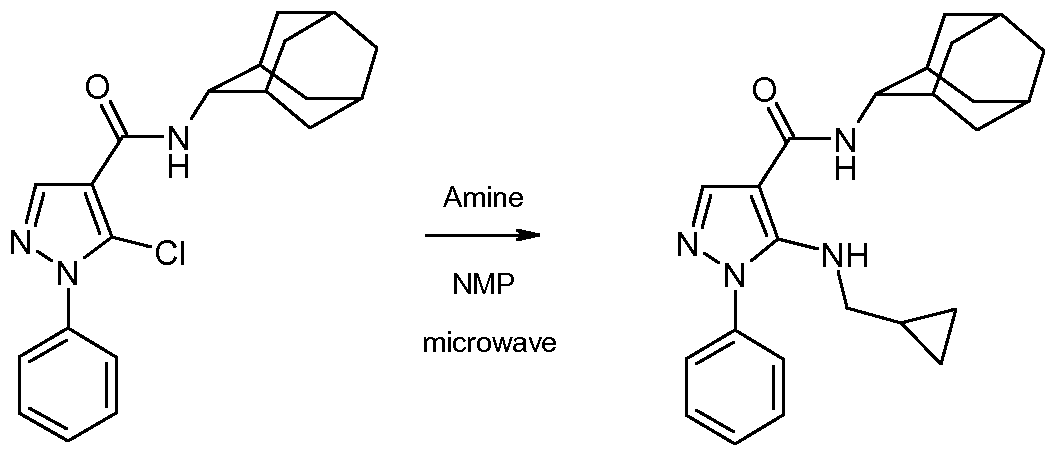
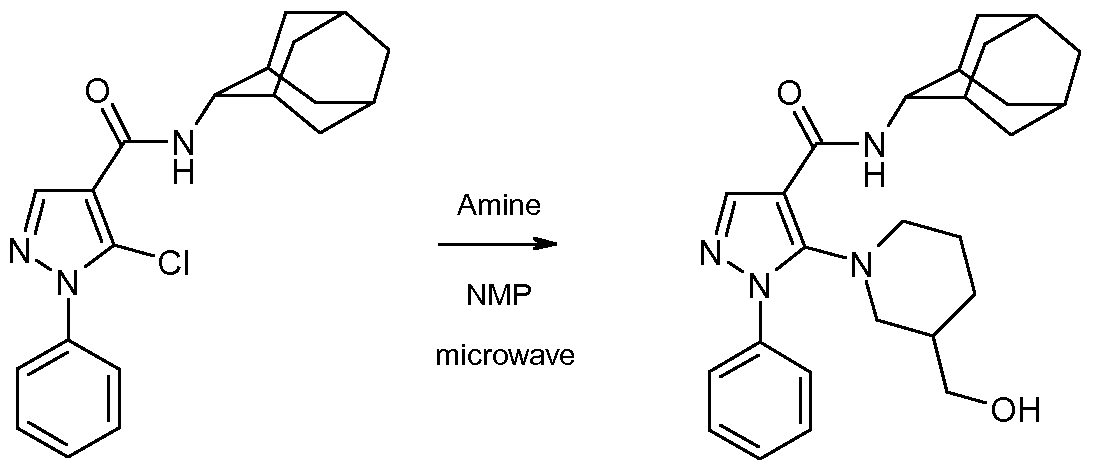
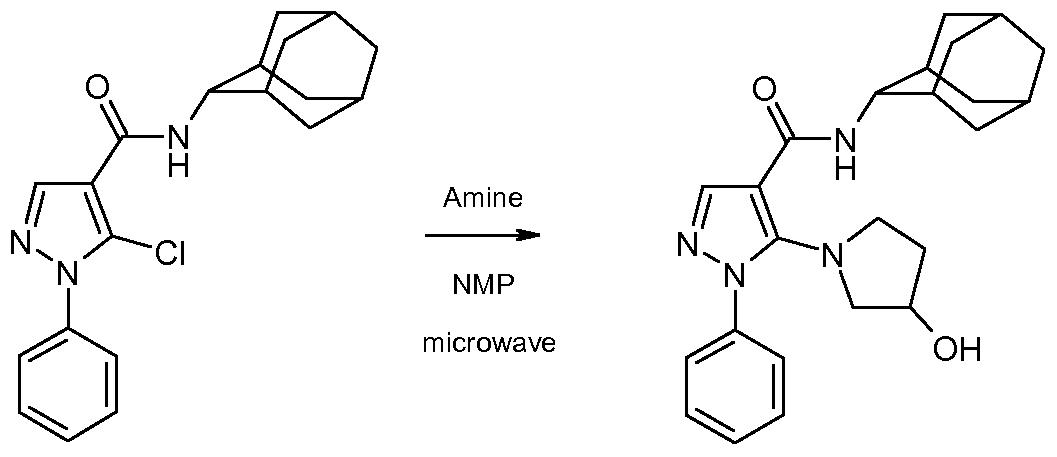
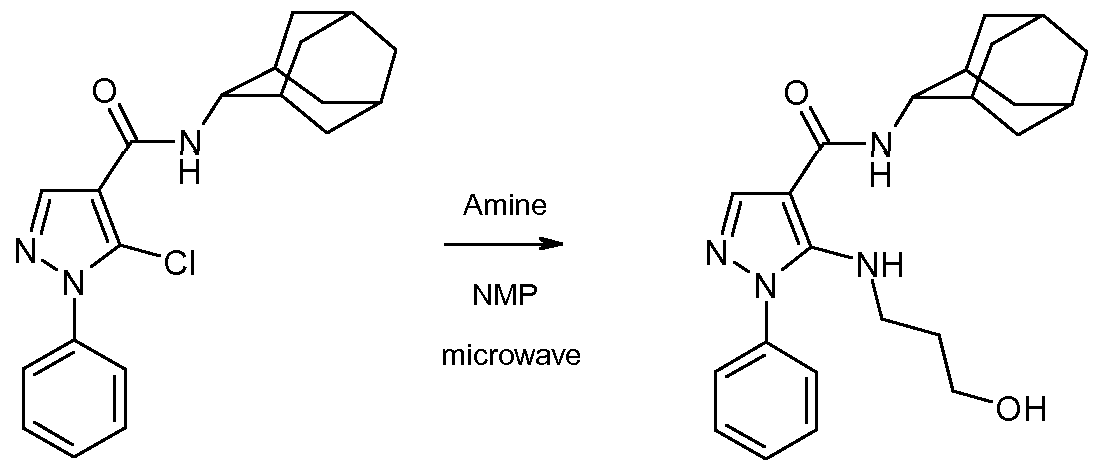
  • the l-aryl-5-chloro-pyrazole-4-carboxamide of formula 7 can then be converted to the compound of the invention of formula 1 by heating it with an amine of formula HRiR 2 in an inert solvent such as N-methylpyrrolidinone at a temperature about 250 degrees, under microwave irradiation.
  • an inert solvent such as N-methylpyrrolidinone
  • a second alternative procedure for the preparation of compounds of formula 4 is shown in Scheme 3.
  • the reaction of commercially available diethyl ethoxymethylenemalonate of formula 9 with an arylhydrazine of formula ArNHNH 2 can be carried out under a variety of conditions.
  • the compound of formula 9 can be reacted with an arylhydrazine or the acid addition salt of an arylhydrazine in an inert solvent such as an alcohol (for example, ethanol).
  • an acid addition salt of the arylhydrazine is used, then the reaction is carried out in the additional presence of a base such as a tertiary alkylamine (for example, triethylamine or diisopropylethylamine).
  • a base such as a tertiary alkylamine (for example, triethylamine or diisopropylethylamine).
  • the reaction is conveniently carried out at a temperature between about -20 degrees and about 80 degrees. Examples of conditions for this reaction can be found in the literature, for example, in R. Gehring et al. US 4,804,398; in W. Holzer and E. Schmid/. Heterocycl. Chem. 1995, 32, 1341-1349.
  • the intermediate of formula 10 is then heated to approximately 170 degrees with the evolved ethanol being removed by distillation. This process gives the 5-hydroxy-pyrazole of formula 11.
  • Conditions for this reaction can be found in the literature, for example in R. Gehring et al. US 4,804,398.
  • the intermediate of formula 10 can be heated at reflux in ethanol in the presence of a base such as potassium carbonate to give the 5-hydroxy- pyrazole of formula 11.
  • the 5- hydroxy-pyrazole of formula 11 can then be converted into the chloro-pyrazole of formula 4 through a chlorination reaction.
  • the reaction can conveniently be carried out by heating the 5-hydroxy-pyrazole of formula 11 with a chlorinating agent such as phosphorus oxychloride in the absence of additional solvents at a temperature about 100 degrees.
  • a chlorinating agent such as phosphorus oxychloride
  • Precise conditions for such a reaction can be found in the literature, for example in W. Holzer and K. Hahn /. Heterocycl. Chem. 2003, 40, 303-308; in H. A. DeWaId et al. /. Med. Chem. 1981, 24, 982-987.
  • the N-arylglycine derivative of formula 13 is then nitrosated to give the N-nitroso derivative of formula 14 by treatment with sodium nitrite in aqueous hydrochloric acid at a temperature about 0 degrees (for details, see D. L. Hammick and D. J. Voaden /. Chem. Soc. 1961, 3303-3308 or F. Dumitra ⁇ cu et al. ARKIVOC 2002, 80-86).
  • the compound of formula 14 is then treated with acetic acid and pyridine to give the sydnone of formula 15.
  • the sydnone is then chlorinated to give the chloro-sydnone of formula 16.
  • the chlorination reaction can be carried out by treating the sydnone of formula 15 with chlorine in a mixture of sodium acetate and acetic acid at a temperature about room temperature (see F. Dumitra ⁇ cu et al. ARKIVOC 2002, 80-86); by treating the sydnone of formula 15 with iodobenzene dichloride in a mixture of triethylamine and dichloromethane (see S. Ito and K. Turnbull Synth. Commun. 1996, 26, 1441-1446); or by treating the sydnone of formula 15 with N- chlorosuccinimide in an inert solvent such as dimethylformamide at a temperature about room temperature (see K. Turnbull et al. /.
  • the chloro-sydnone of formula 16 can then be treated with excess dimethyl acetylenedicarboxylate in ethylene glycol at 120 degrees to give the [3+2] dipolar cycloaddition product 17.
  • the compound of formula 17 can then be treated with 20% aqueous hydrochloric acid at reflux to effect hydrolysis to the dicarboxylate which undergoes selective decarboxylation upon heating to about 250 degrees (bath temperature) to give the monocarboxylic acid of formula 5.
  • Specific conditions for the reactions that lead from the chloro-sydnone of formula 16 to the monocarboxylic acid of formula 5 can be found in the literature, for example in H. Dickopp Chem. Ber. 1974, 107, 3036-3042.
  • a compound of the invention where R2 represents hydrogen can be prepared in four steps from the l-aryl-5-amino-pyrazole-4-carboxylate ester of formula 3 by converting the amino substituent to a carbamate which can then be alkylated to give the intermediate of formula 19. Deprotection of the carbamate and ethyl ester then gives intermediate 21 which can be coupled with an adamantanamine of formula 6 to give the product of formula 1.
  • the conversion of the amine of formula 3 to the carbamate of formula 18 can be effected through any conventional means, several of which will be apparent to one of average skill in the art of organic synthesis.
  • the amine may be treated with a loweralkyl chloroformate (such as ethyl chloroformate) in the presence of a base such as sodium hydride in an inert solvent such as dimethylformamide or tetrahydrofuran.
  • a base such as sodium hydride
  • an inert solvent such as dimethylformamide or tetrahydrofuran.
  • the amine of formula 3 can be treated with an excess of phenyl chloroformate in the presence of a base such as sodium hydride in an inert solvent such as dimethylformamide to give the bis(phenoxycarbonyl) amino derivative, as described in L. R. Hatton et al.
  • the reaction can also be carried out using pyridine as base and chloroform as solvent. In this case, the reaction is preferably carried out at low temperature such as at about 0 degrees.
  • Conditions for this transformation can be found in the literature, for example in L. R. Hatton et al. US 4,629,495.
  • This bis(phenoxycarbonyl) amino derivative can then be treated with ferf-butanol at the reflux temperature to give the intermediate of formula 18 where R' represents tert-butyl.
  • Conditions for this transformation can be found in the literature, for example in L. R. Hatton et al. US 4,629,495.
  • the alkylation of the carbamate of formula 18 with an alkylating agent of formula RiX can be effected using a variety of different procedures which are well known.
  • the leaving group X can be a halogen (e.g., bromine or iodine) or it can be a sulfonate ester (e.g., mesylate, tosylate, or nosylate) etc.
  • the reaction is conveniently effected by treatment of the carbamate with a base such as sodium hydride in an inert solvent such as tetrahydrofuran at a temperature between about room temperature and the reflux temperature of the solvent, depending on the reactivity of the alkylating agent.
  • the carbamate protective group is then removed from the carbamate of formula 19 to give the amine of formula 20 using conditions well known in the art for this transformation, which may be specific to the nature of the R' group. Many examples of appropriate conditions are outlined in the book "Protective Groups in Organic Synthesis” [T. W. Greene and P. G. M. Wuts, 2nd Edition, John Wiley & Sons, N.Y. 1991].
  • the protective group may be removed by treating the compound of formula 20 with an acid such as tifluoroacetic acid in an inert solvent such as a halogenated hydrocarbon (e.g., dichloromethane) at about room temperature.
  • the protective group may be removed by heating the compound of formula 19 with potassium hydroxide in ethylene glycol at about 100 degrees. Conditions for this reaction may be found in the literature, for example in K. Matsushita et al. EP 885890.
  • the ethyl ester in the compound of formula 20 can then be removed hydrolytically under conditions well known in the field of organic synthesis.
  • the compound of formula 20 may be treated with one equivalent of an alkali metal hydroxide, such as potassium hydroxide, sodium hydroxide, or lithium hydroxide, preferably lithium hydroxide, in a suitable solvent, such as a mixture of tetrahydrofuran, methanol, and water.
  • an alkali metal hydroxide such as potassium hydroxide, sodium hydroxide, or lithium hydroxide, preferably lithium hydroxide
  • a suitable solvent such as a mixture of tetrahydrofuran, methanol, and water.
  • the reaction can be carried out at a temperature between about 0 degrees and about room temperature, preferably at about room temperature.
  • the carbamate and ester may be removed in one process from the compound of formula 19 by subjecting the compound of formula 19 to acidic conditions, for example by heating in dilute aqueous hydrochloric acid at the reflux temperature.
  • the compound of the invention of formula 1 can then be prepared by reaction of the carboxylic acid of structure 21 or of an appropriate derivative thereof such as an activated ester, with an adamantane derivative of formula 6 or a corresponding acid addition salt (e.g., the hydrochloride salt) in the presence, if necessary, of a coupling agent, many examples of which are well known per se in peptide chemistry.
  • the reaction is conveniently carried out by treating the carboxylic acid of structure 21 with the hydrochloride of the adamantane derivative of formula 6 in the presence of an appropriate base, such as diisopropylethylamine, a coupling agent such as O- (benzotriazol-l-yl)-l,l,3,3-tetramethyluronium hexafluorophosphate, and in the optional additional presence of a substance that increases the rate of the reaction, such as 1-hydroxybenzotriazole or l-hydroxy-7-azabenzotriazole, in an inert solvent, such as a chlorinated hydrocarbon (e.g., dichloromethane) or N,N-dimethylformamide or N- methylpyrrolidinone, at a temperature between about 0 degrees and about room temperature, preferably at about room temperature.
  • an appropriate base such as diisopropylethylamine
  • a coupling agent such as O- (benzotriazol-l-yl)-l
  • reaction can be carried out by converting the carboxylic acid of formula 21 to an activated ester derivative, such as the N-hydroxysuccinimide ester, and subsequently reacting this with the adamantane derivative of formula 6 or a corresponding acid addition salt.
  • This reaction sequence can be carried out by reacting the carboxylic acid of formula 21 with N-hydroxysuccinimide in the presence of a coupling agent such as N,N'- dicyclohexylcarbodiimide in an inert solvent such as tetrahydrofuran at a temperature between about 0 degrees and about room temperature.
  • N- hydroxysuccinimide ester is then treated with the adamantane derivative of formula 6 or a corresponding acid addition salt, in the presence of a base, such as an organic base (e.g., triethylamine or diisopropylethylamine or the like) in a suitable inert solvent such as N,N-dimethylformamide at around room temperature.
  • a base such as an organic base (e.g., triethylamine or diisopropylethylamine or the like) in a suitable inert solvent such as N,N-dimethylformamide at around room temperature.
  • Examples of processes useful for the preparation of aryl-hydrazines include diazotization of an aniline followed by reduction of the diazonium salt (P. Barraja et al. Bioorg. Med.
  • 2-Adamantanamine hydrochloride is available from Aldrich.
  • 2-Amino-5-hydroxy-adamantane (formula 22) can be prepared by hydrogenation of the imine derived from 5-hydroxy-2-adamantanone and 1-S- ⁇ -methylbenzylamine according to the procedure described in L. Jaraskova et al. Tetrahedron Lett. 2006, 47, 8063-8067.
  • 2-amino-5-acetamido-adamantane (of formula 25) can be prepared starting from 2-amino-5-hydroxy-adamantane (22).
  • the Cbz-protected compound of formula 23 is prepared conveniently from 2-amino-5-hydroxy-adamantane by treatment with benzyl chloroformate in the presence of a base such as triethylamine in an inert solvent such as dichloromethane at about room temperature.
  • the alcohol of formula 23 is then treated with an inorganic acid such as sulfuric acid in acetonitrile at room temperature in a reaction known as the Ritter reaction. Conditions for this reaction may be found in L. Jaroskova et al. WO 2006024627; in B.
  • the carbobenzyloxy protective group is then removed from the compound of formula 24 using hydrogenation under noble metal catalysis to give the amine of formula 25.
  • the compound of formula 24 may be hydrogenated at approximately 50 psi in the presence of a catalytic amount of 5% palladium-on-carbon in an alcoholic solvent (such as ethanol) at room temperature.
  • the alcohol of formula 23 can be subjected to Ritter reaction conditions with chloroacetonitrile, in the presence of sulfuric acid at about room temperature, to give the chloroacetyl derivative of formula 26.
  • This compound then undergoes reaction with thiourea in the presence of acetic acid in ethanol at a temperature between about 50 degrees and about 120 degrees to give the amine of formula 27.
  • Conditions for the Ritter reaction and the deprotection of the chloroacetamide can be found in the literature, for example in I. R. Gladwell WO 2007010356; in B. Gopalan et al. WO2006090244; and in A. Jirgensons et al. Synthesis 2000, 1709-1712.
  • the amine of formula 27 can then be treated with methanesulfonyl chloride in the presence of a base such as triethylamine or diisopropylethylamine in an inert solvent such as dichloromethane at about room temperature to give the sulfonamide of formula 28.
  • a base such as triethylamine or diisopropylethylamine in an inert solvent such as dichloromethane at about room temperature
  • the carbobenzyloxy protective group is then removed from the compound of formula 28 using hydrogenation under noble metal catalysis to give the amine of formula 29.
  • the compound of formula 28 may be hydrogenated at approximately 50 psi in the presence of a catalytic amount of 5% palladium-on-carbon in an alcholic solvent (such as ethanol) at room temperature.
  • a l-aryl-pyrazole-4-carboxylate ester of formula 11 can be conveniently prepared by the reaction of (ethoxycarbonyl)-malondialdehyde with an arylhydrazine.
  • the synthesis of (ethoxycarbonyl)-malondialdehyde is described in two steps from ethyl propiolate in S. H. Bertz et al. /. Org. Chem. 1982, 47, 2216-2217.
  • the compound of formula 11 is conveniently prepared by treating (ethoxycarbonyl)- malondialdehyde with an arylhydrazine in an inert solvent such as a lower alcohol (e.g., ethanol) at room temperature. Conditions suitable for this reaction can be found in the literature, for example in W. Holzer and G. Seringer /. Heterocycl. Chem. 1993, 30, 865- 872.
  • a l-aryl-pyrazole-4-carboxylate ester of formula 11 can be conveniently prepared in two steps from the commercially available l,3-dimethyluracil-5- carboxaldehyde (of formula 30).
  • the aldehyde is treated with an arylhydrazine of formula ArNHNH 2 in water in the presence of acetic acid at about 100 degrees to give the hydrazone of formula 31.
  • This is then heated in the presence of sodium methoxide in methanol at the reflux temperature to give the l-aryl-pyrazole-4-carboxylate ester of formula 11.
  • Conditions suitable for this reaction can be found in the literature, for example in K. Hirota et al. /. Chem. Soc. Perkin Trans. 1 1983, 1293-1297.
  • a l-aryl-pyrazole-4-carboxylate ester of formula 11 can be isolated as the minor product of a [3+2] dipolar cycloaddition reaction of a sydnone of formula 15 (prepared as described above) with a loweralkyl propiolate (e.g., methyl propiolate).
  • the reaction is conveniently carried out by treating the sydnone of formula 15 with methyl propiolate in an inert solvent such as 1,2-dichlorobenzene, isobutyl alcohol, p-xylene, or dimethylformamide at the reflux temperature.
  • an inert solvent such as 1,2-dichlorobenzene, isobutyl alcohol, p-xylene, or dimethylformamide
  • reaction mixture was stirred at room temperature for 1 hour then at 65 0 C for 1 hour. Following complete consumption of starting material (monitored by TLC), the reaction mixture was poured into 6N hydrochloric acid (200 mL) and extracted with dichloromethane (3 x 300 mL). The combined organic layers were dried over magnesium sulfate and purified by column chromatography (eluting with heptane then 20% ethyl acetate in heptane) to give 5-chloro-l-phenyl-lH-pyrazole-4-carboxylic acid ethyl ester (7.3 g, 66%), which NMR and HPLC analysis indicated was 78% pure. This material was used directly in the next step without further purification.
  • reaction mixture was stirred at 70 0 C for ⁇ 2 hours (reaction progress monitored by TLC and LCMS).
  • the reaction mixture was dissolved in dichloromethane (300 mL), washed with IN hydrochloric acid (2 x 200 mL), and brine (200 mL), then dried over magnesium sulfate, filtered, evaporated, and purified by column chromatography (eluting with 20% ethyl acetate in heptane) to give 5-chloro-l-phenyl-lH-pyrazole-4-carboxylic acid adamantan-2-ylamide (4.2 g, 11.8 mmol, 45%), which HPLC analysis indicated was 90% pure. This material was used directly in the next step without further purification.
  • the compounds were purified by chromatography, eluting with the following solvent sequence: heptane; 10% ethyl acetate in heptane; 20% ethyl acetate in heptane; and 50% ethyl acetate in heptane.
  • Example 17 5- ( (S) -2-Hydroxymethyl-pyrrolidin- 1 -yl) - 1 -phenyl- lH-pyrazole-4- carboxylic acid adamantan-2-ylamide
  • Example 25 l-Phenyl-5-[(tetrahydro-furan-2-ylmethyl)-amino]-lH-pyrazole-4- carboxylic acid adamantan-2-ylamide
  • H4IIE cells stably transfected with full-length human 1 lbetaHSDl cDNA were propagated and expanded in DMEM high glucose media (Invitrogen Cat# 11995-065), supplemented with 10% FCS (Invitrogen Cat# 10082-147), 100 units/mL and 100 ⁇ g/mL pen/ strep (Invitrogen Cat#15140-122), and geneticin (800 ⁇ g/mL).
  • FCS Invitrogen Cat# 10082-147
  • pen/ strep Invitrogen Cat#15140-122
  • geneticin 800 ⁇ g/mL

Landscapes

  • Health & Medical Sciences (AREA)
  • Organic Chemistry (AREA)
  • Chemical & Material Sciences (AREA)
  • Diabetes (AREA)
  • Veterinary Medicine (AREA)
  • Animal Behavior & Ethology (AREA)
  • Public Health (AREA)
  • Bioinformatics & Cheminformatics (AREA)
  • Chemical Kinetics & Catalysis (AREA)
  • General Chemical & Material Sciences (AREA)
  • Medicinal Chemistry (AREA)
  • Nuclear Medicine, Radiotherapy & Molecular Imaging (AREA)
  • Engineering & Computer Science (AREA)
  • Pharmacology & Pharmacy (AREA)
  • Life Sciences & Earth Sciences (AREA)
  • General Health & Medical Sciences (AREA)
  • Hematology (AREA)
  • Obesity (AREA)
  • Child & Adolescent Psychology (AREA)
  • Emergency Medicine (AREA)
  • Endocrinology (AREA)
  • Pharmaceuticals Containing Other Organic And Inorganic Compounds (AREA)
  • Plural Heterocyclic Compounds (AREA)
  • Acyclic And Carbocyclic Compounds In Medicinal Compositions (AREA)
  • Medicines That Contain Protein Lipid Enzymes And Other Medicines (AREA)

Abstract

Provided herein are compounds of the formula (I): as well as pharmaceutically acceptable salts thereof, wherein the substituents are as those disclosed in the specification. These compounds, and the pharmaceutical compositions containing them, are useful for the treatment of diseases such as, for example, type II diabetes mellitus and metabolic syndrome.

Description

INHIBITORS OF 11 B-HYDROXYSTEROID DEHYDROGENASE
The invention relates to inhibitors of 11 β-hydroxysteroid dehydrogenase. The inhibitors include, for example, amino- l-aryl-pyrazole-3-carboxylic acid adamantan-2-yl amides, and derivatives thereof, and are useful for the treatment of diseases such as type II diabetes mellitus and metabolic syndrome.
The invention relates to a compound of formula (I):
Figure imgf000002_0001
wherein:
Ri is hydrogen or lower alkyl;
R2 is lower alkyl, -(CH2)n-cycloalkyl, -(CH2)n-heterocycloalkyl, -(CH2)n-aryl, -(CH2)n-heteroaryl, -(CH2)nOH, -(CH2)nCH(CH3)OH or -(CH2)nOCH3;
or
Ri and R2, together with the N atom to which they are attached, form a 5- to 7- membered monocyclic ring, which contains the N atom to which Ri and R2 are attached, and optionally another hetero atom which is selected from O and S, wherein the 5- to 7-membered monocyclic ring is unsubstituted or mono- or bi- substituted with substituents independently selected from hydroxy, lower alkyl and -(CH2)nOH;
R3 is one or more substituents independently selected from H, halogen, lower alkyl and lower alkoxy;
R4 is hydrogen, -OH, -NHC(=O)CH3 or -NHS(=O)(=O)CH3;
n is 1, 2, 3 or 4; and pharmaceutically acceptable salts thereof.
Diabetes mellitus is a serious illness that affects an increasing number of people across the world. A recent press release by the International Diabetes Federation suggests that by 2025, there will be a total of 380 million people worldwide suffering from diabetes. The incidence of diabetes in many countries is escalating in parallel with an upward trend in obesity. Serious consequences of diabetes include increased risk of stroke, heart disease, kidney damage, blindness, and amputation. Cardiovascular diseases are the cause of death of more than 70% of patients with Type 2 diabetes mellitus (T2DM) [B. Pourcet et al. Expert Opin. Emerging Drugs 2006, 11, 379-401.]
Diabetes is characterized by decreased insulin secretion and/or an impaired ability of peripheral tissues to respond to insulin, resulting in increased plasma glucose levels. There are two forms of diabetes: insulin-dependent and non-insulin-dependent, with the great majority of diabetics suffering from the non-insulin-dependent form of the disease, known as type 2 diabetes or non-insulin-dependent diabetes mellitus (NIDDM). Because of the serious consequences, there is an urgent need to control diabetes.
The metabolic syndrome is a condition where patients exhibit more than two of the following symptoms: obesity, hypertriglyceridemia, low levels of HDL-cholesterol, high blood pressure, and elevated fasting glucose levels [R. H. Eckel Proc. Nutr. Soc. 2007, 66, 82-95; J.-P. Despres and I. Lemieux Nature 2006, 444, 881-887; E. Ratto et al. /. Am. Soc. Nephrol. 2006, 17, S120-S122; A. M. McNeill et al. Diabetes Care 2005, 28, 385-390]. This syndrome is often a precursor of type 2 diabetes, and has high prevalence in the United States, estimated at 24% [E. S. Ford et al. JAMA 2002, 287, 356]. A therapeutic agent that ameliorates the metabolic syndrome would be useful in potentially slowing or stopping the progression to type 2 diabetes.
A number of tests are used to assess diabetic patients. Fasting blood glucose levels and glucose tolerance tests are used to measure directly the amount of glucose in the blood and the ability of the body to respond to a glucose challenge. However, the level of variability of blood glucose levels is relatively high, particularly in diabetic patients, and so alternative tests are also used. One of the most common alternatives is the HbAic test, which tests for the levels of glycosylated hemoglobin in the red blood cells [D. R. McCane et al. BMJ 1994, 308, 1323-1328; R. J. McCarter et al. Diabetes Care 2006, 29, 352-355]. Red blood cells have a normal life-span of 120 days in the body, and they contain hemoglobin which becomes progressively glycosylated, with the level of glycosylation correlating with the average levels of blood glucose. As a result, the HbAic levels give an indication of the average levels of blood glucose over the preceding 3-4 months, and they do not fluctuate during the course of the day. The level of HbAic in normal blood is approximately 5%, and the level in poorly controlled diabetic patients is 8% or above. The current guideline from the American Diabetes Association is to maintain the HbAic level below 7%. This level corresponds to a mean plasma glucose level of approximately 170 mg/dL [D. E. Goldstein et al. Diabetes Care 2004, 27, 1761-1773].
Treatment of NIDDM generally starts with weight loss, a healthy diet and an exercise program. These factors are especially important in addressing the increased cardiovascular risks associated with diabetes, but they are generally ineffective in controlling the disease itself. There are a number of drug treatments available, including insulin, metformin, sulfonylureas, acarbose, thiazolidinediones, GLP-I analogues, and DPP IV inhibitors. However, several of these treatments have disadvantages, and there is an ongoing need for new drugs to treat diabetes.
For example, metformin is an effective agent that reduces fasting plasma glucose levels and enhances the insulin sensitivity of peripheral tissue. Metformin has a number of effects in vivo, including an increase in the synthesis of glycogen, the polymeric form in which glucose is stored [R. A. De Fronzo Drugs 1999, 58 Suppl. 1, 29]. Metformin also has beneficial effects on lipid profile, with favorable results on cardiovascular health. Treatment with metformin leads to reductions in the levels of LDL cholesterol and triglycerides [S. E. Inzucchi/ΛMΛ 2002, 287, 360]. However, over a period of years, metformin loses its effectiveness [R. C. Turner et al. JAMA 1999, 281, 2005] and there is consequently a need for new treatments for diabetes.
Thiazolidinediones are activators of the nuclear receptor peroxisome-proliferator activated receptor- gamma (PPARγ). They are effective in reducing blood glucose levels, and their efficacy has been attributed primarily to decreasing insulin resistance in skeletal muscle [M. Tadayyon and S. A. Smith Expert Opin. Investig. Drugs 2003, 12, 307]. Three thiazolidinediones have been approved for use in the United States for the treatment of diabetes but one was subsequently withdrawn because of hepato toxicity issues. The two currently approved drugs, pioglitazone and rosiglitazone, are effective in reducing blood sugar and HbAic levels in diabetic patients [G. Boden and M. Zhang Expert Opin. Investig. Drugs 2006, 15, 243-250; B. Pourcet et al. Expert Opin. Emerging Drugs 2006, 11, 379- 401 ] . However, a period of 3-4 months is required before full efficacy is seen [G. Boden and M. Zhang Op. Gt], and one disadvantage associated with the use of thiazolidinediones is weight gain.
Sulfonylureas bind to the sulfonylurea receptor on pancreatic beta cells, stimulate insulin secretion, and consequently reduce blood glucose levels. Weight gain is also associated with the use of sulfonylureas [S. E. Inzucchi JAMA 2002, 287, 360] and, like metformin, they lose efficacy over time [R. C. Turner et al. JAMA 1999, 281, 2005]. A further problem - A - often encountered in patients treated with sulfonylureas is hypoglycemia [M. Salas J. J. and Caro Adv. Drug React. Tox. Rev. 2002, 21, 205-217].
Acarbose is an inhibitor of the enzyme alpha- glucosidase, which breaks down disaccharides and complex carbohydrates in the intestine. It has lower efficacy than metformin or the sulfonylureas, and it causes intestinal discomfort and diarrhea which often lead to the discontinuation of its use [S. E. Inzucchi/ΛMΛ 2002, 287, 360]
Although drugs have been approved for the treatment of diabetes using a number of different mechanisms, and many other drugs are being evaluated clinically, there remains a need to invent new compounds for the treatment of diabetes. It has recently been disclosed that the results of the United Kingdom Prospective Study indicate that over time, a decline is seen in the beta cell function of diabetic patients irrespective of whether they were being treated with diet, sulfonylureas, metformin, or insulin [R. R. Holman Metabolism 2006, 55, S2-S5].
One possible target for the treatment of diabetes which has received much attention recently is 1 lβ-hydroxysteroid dehydrogenase type I ( 1 lβ-HSDl) [see for example M. Wang Curr. Opin. Invest. Drugs 2006, 7, 319-323]. 1 lβ-HSDl is an enzyme that catalyzes the reduction of cortisone to Cortisol (or dehydrocorticosterone to corticosterone in rodents). Cortisol is a corticosteroid hormone produced in the adrenal gland, and it has been shown to increase levels of glucose production, mostly by increasing gluconeogenesis [S. Khani and J. A. Tayek Clinical. ScL 2001, 101, 739-747]. A second enzyme, 1 lβ-hydroxysteroid dehydrogenase type II (l lβ-HSD2) is responsible for the oxidation of Cortisol to cortisone. The enzymes have low homology and are expressed in different tissues. 1 lβ-HSDl is highly expressed in a number of tissues including liver, adipose tissue, and brain, while 1 lβ-HSD2 is highly expressed in mineralocorticoid target tissues, such as kidney and colon. 1 lβ-HSD2 prevents the binding of Cortisol to the mineralocorticoid receptor, and defects in this enzyme have been found to be associated with the syndrome of apparent mineralocorticoid excess (AME).
There is evidence from transgenic mice, and also from small clinical studies in humans, that confirm the therapeutic potential of the inhibition of 1 lβ-HSDl for the treatment of Type 2 Diabetes mellitus.
Experiments with transgenic mice indicate that modulation of the activity of 1 lβ-HSDl could have beneficial therapeutic effects in diabetes and in the metabolic syndrome. For example, when the 1 lβ-HSDl gene is knocked out in mice, fasting does not lead to the normal increase in levels of G6Pase and PEPCK, and the animals are not susceptible to stress- or obesity-related hyperglycemia. Moreover, knockout animals which are rendered obese on a high-fat diet have significantly lower fasting glucose levels than weight- matched controls (Y. Kotolevtsev et al. Proc. Natl. Acad. Sd. USA 1997, 94, 14924). l lβ- HSDl knockout mice have also been found to have improved lipid profile, insulin sensitivity, and glucose tolerance (N. M. Morton et al. /. Biol. Chem. 2001, 276, 41293). The effect of overexpressing the 1 lβ-HSDl gene in mice has also been studied. These transgenic mice displayed increased 1 lβ-HSDl activity in adipose tissue, and they also exhibit visceral obesity which is associated with the metabolic syndrome. Levels of the corticosterone were increased in adipose tissue, but not in serum, and the mice had increased levels of obesity, especially when on a high-fat diet. Mice fed on low- fat diets were hyperglycemic and hyperinsulinemic, and also showed glucose intolerance and insulin resistance (H. Masuzaki et al. Science, 2001, 294, 2166).
The effects of the non-selective l lβ-hydroxysteroid dehydrogenase inhibitor carbenoxolone have been studied in a number of small trials in humans. In one study, carbenoxolone was found to lead to an increase in whole body insulin sensitivity, and this increase was attributed to a decrease in hepatic glucose production (B. R. Walker et al. /. Clin. Endocrinol. Metab. 1995, 80, 3155). In another study, decreased glucose production and glycogenolysis in response to glucagon challenge were observed in diabetic but not healthy subjects (R. C. Andrews et al. /. Clin. Enocrinol. Metab. 2003, 88, 285). Finally, carbenoxolone was found to improve cognitive function in healthy elderly men and also in type 2 diabetics (T. C. Sandeep et al. Proc. Natl. Acad. Sci USA 2004, 101, 6734).
A number of non-specific inhibitors of 1 lβ-HSDl and 1 lβ-HSD2 have been identified, including glycyrrhetinic acid, abietic acid, and carbenoxolone. In addition, a number of selective inhibitors of 1 lβ-HSDl have been found, including chenodeoxycholic acid, flavanone and 2'-hydroxyflavanone (S. Diederich et al. Eur. J. Endocrinol. 2000, 142, 200 and R. A. S. Schweizer et al. MoI. Cell. Endocrinol. 2003, 212, Al).
A need exists in the art, therefore, for 1 lβ-HSDl inhibitors that have efficacy for the treatment of diseases such as, for example, type II diabetes mellitus and metabolic syndrome. Further, a need exists in the art for 1 lβ-HSDl inhibitors having IC50 values less than about 1 μM.
In another embodiment of the present invention, provided is a pharmaceutical composition, comprising a therapeutically effective amount of a compound according to formula (I), or a pharmaceutically acceptable salt thereof, and a pharmaceutically acceptable carrier.
In a further embodiment of the present invention, provided is a method for treating diabetes, comprising the step of administering a therapeutically effective amount of a compound according to formula (I), or a pharmaceutically acceptable salt thereof, to a patient in need thereof.
The present invention is directed to inhibitors of llβ-HSDl. In a preferred embodiment, the invention provides for pharmaceutical compositions comprising compounds of the formula (I) as well as pharmaceutically acceptable salts thereof, that are useful as inhibitors of l lβ-HSDl .
It is to be understood that the terminology employed herein is for the purpose of describing particular embodiments, and is not intended to be limiting. Further, although any methods, devices and materials similar or equivalent to those described herein can be used in the practice or testing of the invention, the preferred methods, devices and materials are now described.
It is preferred that, in the compound of formula (I), the substitutent R4 and the substituent
Figure imgf000007_0001
are trans to each other on the adamantly ring.
In a preferred way, the compound of the invention can be represented by formula (Ia)
Figure imgf000007_0002
wherein Ri, R2, R3 and R4 are as defined above.
As used herein, the term "alkyl" means, for example, a branched or unbranched, cyclic ("cycloalkyl") or acyclic, saturated or unsaturated (e.g. alkenyl or alkynyl) hydrocarbyl radical which may be substituted or unsubstituted. Where cyclic, the alkyl group is preferably C3 to C12, more preferably C4 to C10, more preferably C4 to C7. Where acyclic, the alkyl group is preferably Ci to C10, more preferably Ci to Ce, more preferably methyl, ethyl, propyl (n-propyl or isopropyl), butyl (n-butyl, isobutyl or tertiary-butyl) or pentyl ( including n-pentyl and isopentyl), more preferably methyl. It will be appreciated therefore that the term "alkyl" as used herein includes alkyl (branched or unbranched), substituted alkyl (branched or unbranched), alkenyl (branched or unbranched), substituted alkenyl (branched or unbranched), alkynyl (branched or unbranched), substituted alkynyl (branched or unbranched), cycloalkyl, substituted cycloalkyl, cycloalkenyl, substituted cycloalkenyl, cycloalkynyl and substituted cycloalkynyl. A preferred example of cycloalkyl includes cycloalkenyl.
In a preferred embodiment, the "cycloalkyl" moieties can optionally be substituted with one, two, three or four substituents, wherein each substituent is independently, for example, hydroxy, alkyl, alkoxy, halogen or amino, unless otherwise specifically indicated. Examples of cycloalkyl moieties include, but are not limited to, optionally substituted cyclopropyl, optionally substituted cyclobutyl, optionally substituted cyclopentyl, optionally substituted cyclopentenyl, optionally substituted cyclohexyl, optionally substituted cyclohexylenyl, optionally substituted cycloheptyl, and the like or those which are specifically exemplified herein. Preferred cycloalkyl are cyclopropyl, cyclobutyl, cyclopentyl and cyclohexyl. Further preferred cycloalkyl are cyclopropyl, cyclobutyl and cyclohexyl.
The term "heterocycloalkyl" denotes a cyclic alkyl ring, wherein one, two or three of the carbon ring atoms are replaced by a heteroatom such as N, O or S. Examples of heterocycloalkyl groups include, but are not limited to, morpholinyl, thiomorpholinyl, piperazinyl, piperidinyl, pyrrolidinyl, azepanyl, tetrahydrofuranyl and the like. The heterocycloalkyl groups may be unsubstituted or substituted with one, two or three substituents independently selected from methyl, hydroxyl and hydroymethyl. Preferred heterocycloalkyl groups are morpholinyl, piperidinyl, pyrrolidinyl, azepanyl and tetrahydrofuranyl, optionally substituted with one, two or three substituents independently selected from methyl, hydroxyl and hydroymethyl. Further preferred heterocycloalkyl are morpholinyl, dimethylmorpholinyl, methylpiperidinyl, hydroxypiperidinyl, hydroxymethylpiperidinyl, pyrrolidinyl, methylpyrrolidinyl, dimethylpyrrolidinyl, hydroxymethylpyrrolidinyl, azepanyl and tetrahydrofuranyl.
As used herein, the term "lower alkyl" means, for example, a branched or unbranched, cyclic or acyclic, saturated or unsaturated (e.g. alkenyl or alkynyl) hydrocarbyl radical wherein said cyclic lower alkyl group is C3, Q, C5, Ce or C7, and wherein said acyclic lower alkyl group is C1, C2, C3 or Q, and is preferably selected from methyl, ethyl, propyl (n-propyl or isopropyl) or butyl (n-butyl, isobutyl or tertiary-butyl). It will be appreciated therefore that the term "lower alkyl" as used herein includes, for example, lower alkyl (branched or unbranched), lower alkenyl (branched or unbranched), lower alkynyl (branched or unbranched), cycloloweralkyl, cycloloweralkenyl and cycloloweralkynyl. The lower alkyl can optionally be substituted with hydroxy. Particularly preferred examples of lower alkyl are methyl, isopropyl, hydroxymethyl, hydroxyethyl, hydroxypropyl and hydroxybutyl.
As used herein, the term "aryl" means, for example, a substituted or unsubstituted carbocyclic aromatic group. Examples of aryl groups are phenyl, naphthyl and the like. A preferred aryl groups is phenyl.
The term "heteroaryl", alone or in combination with other groups, means a monocyclic or bicyclic radical of 5 to 12 ring atoms having at least one aromatic ring having one, two, or three ring heteroatoms selected from N, O, and S, the remaining ring atoms being C. One or two ring carbon atoms of the heteroaryl group may be replaced with a carbonyl group. The heteroaryl group described above may be substituted independently with one, two, or three substituents, preferably one or two substituents such as, for example, halogen, hydroxy, C1^ alkyl, halo C1^ alkyl, d-6 alkoxy, C1^ alkyl sulfonyl, C1^ alkyl sulfinyl, d-6 alkylthio, amino, amino Ci-6 alkyl, mono- or di-substituted amino-Ci-6 alkyl, nitro, cyano, acyl, carbamoyl, mono- or di-substituted amino, aminocarbonyl, mono- or di-substituted amino-carbonyl, aminocarbonyl Ci-6 alkoxy, mono- or di- substituted amino-carbonyl-Ci-6 alkoxy, hydroxy- C1^ alkyl, carboxyl, C1^ alkoxy carbonyl, aryl d-6 alkoxy, heteroaryl C1^ alkoxy, heterocyclyl C1^ alkoxy, C1^ alkoxycarbonyl C1^ alkoxy, carbamoyl C1^ alkoxy and carboxyl C1^ alkoxy, preferably halogen, hydroxy, C1^ alkyl, halo C1^ alkyl, C1^ alkoxy, C1^ alkyl sulfonyl, C1^ alkyl sulfinyl, Ci-6 alkylthio, amino, mono-Ci-6 alkyl substituted amino, di-Q-6 alkyl substituted amino, amino Ci-6 alkyl, mono-Ci-6 alkyl substituted amino-Ci-6 alkyl, di-Ci-6 alkyl substituted amino-Ci-6 alkyl, nitro, carbamoyl, mono- or di-substituted aminocarbonyl, hydroxy- Q-6 alkyl, carboxyl, C1^ alkoxy carbonyl and cyano. Examples of heteroaryl are thienyl, furanyl, pyrrolyl, imidazolyl, pyrazolyl, thiazolyl, isothiazolyl, oxazolyl, oxadiazolyl, thiadiazolyl, aziridinyl, azetidinyl, pyrrolidinyl, pyrrolinyl, imidazolidinyl, imidazolinyl, pyrazolidinyl, tetrahydrofuranyl, pyranyl, pyronyl, pyridyl, pyrazinyl, pyridazinyl, piperidyl, hexahydroazepinyl, piperazinyl, morpholinyl, thianaphthyl, benzofuranyl, isobenzofuranyl, indolyl, oxyindolyl, isoindolyl, indazolyl, indolinyl, 7-azaindolyl, benzopyranyl, coumarinyl, isocoumarinyl, quinolinyl, isoquinolinyl, naphthridinyl, cinnolinyl, quinazolinyl, pyridopyridyl, benzoxazinyl, quinoxalinyl, chromenyl, chromanyl, isochromanyl, phthalazinyl and carbolinyl. A preferred heteroaryl is pyridyl.
The alkyl and aryl groups may be substituted or unsubstituted. Where substituted, there will generally be, for example, 1 to 3 substituents present, preferably 1 substituent. Substituents may include, for example: carbon-containing groups such as alkyl, aryl, arylalkyl (e.g. substituted and unsubstituted phenyl, substituted and unsubstituted benzyl); halogen atoms and halogen-containing groups such as haloalkyl (e.g. trifluoromethyl); oxygen-containing groups such as alcohols (e.g. hydroxyl, hydroxyalkyl, aryl(hydroxyl)alkyl), ethers (e.g. alkoxy, aryloxy, alkoxyalkyl, aryloxyalkyl), aldehydes (e.g. carboxaldehyde), ketones (e.g. alkylcarbonyl, alkylcarbonylalkyl, arylcarbonyl, arylalkylcarbonyl, arylcarbonylalkyl), acids (e.g. carboxy, carboxyalkyl), acid derivatives such as esters(e.g. alkoxycarbonyl, alkoxycarbonylalkyl, alkylcarbonyloxy, alkylcarbonyloxyalkyl), amides (e.g. aminocarbonyl, mono- or di-alkylaminocarbonyl, aminocarbonylalkyl, mono-or di-alkylaminocarbonylalkyl, arylaminocarbonyl), carbamates (e.g. alkoxycarbonylamino, arloxycarbonylamino, aminocarbonyloxy, mono- or di-alkylaminocarbonyloxy, arylminocarbonloxy) and ureas (e.g. mono- or di- alkylaminocarbonylamino or arylaminocarbonylamino); nitrogen-containing groups such as amines (e.g. amino, mono- or di-alkylamino, aminoalkyl, mono- or di- alkylaminoalkyl), azides, nitriles (e.g. cyano, cyanoalkyl), nitro; sulfur- containing groups such as thiols, thioethers, sulfoxides and sulfones (e.g. alkylthio, alkylsulfinyl, alkylsulfonyl, alkylthioalkyl, alkylsulfinylalkyl, alkylsulfonylalkyl, arylthio, arysulfinyl, arysulfonyl, arythioalkyl, arylsulfinylalkyl, arylsulfonylalkyl); and heterocyclic groups containing one or more, preferably one, heteroatom, (e.g. thienyl, furanyl, pyrrolyl, imidazolyl, pyrazolyl, thiazolyl, isothiazolyl, oxazolyl, oxadiazolyl, thiadiazolyl, aziridinyl, azetidinyl, pyrrolidinyl, pyrrolinyl, imidazolidinyl, imidazolinyl, pyrazolidinyl, tetrahydrofuranyl, pyranyl, pyronyl, pyridyl, pyrazinyl, pyridazinyl, piperidyl, hexahydroazepinyl, piperazinyl, morpholinyl, thianaphthyl, benzofuranyl, isobenzofuranyl, indolyl, oxyindolyl, isoindolyl, indazolyl, indolinyl, 7-azaindolyl, benzopyranyl, coumarinyl, isocoumarinyl, quinolinyl, isoquinolinyl, naphthridinyl, cinnolinyl, quinazolinyl, pyridopyridyl, benzoxazinyl, quinoxalinyl, chromenyl, chromanyl, isochromanyl, phthalazinyl and carbolinyl).
The lower alkyl groups may be substituted or unsubstituted. Where substituted, there will generally be, for example, 1 to 3 substitutents present, preferably 1 substituent.
As used herein, the term "alkoxy" means, for example, alkyl-O- and "alkoyl" means, for example, alkyl-CO-. Alkoxy substituent groups or alkoxy- containing substituent groups may be substituted by, for example, one or more alkyl groups. Preferred alkoxy substituents are methoxy, ethoxy, propyloxy and butyloxy. Particularly preferred is methoxy.
As used herein, the term "halogen" means, for example, a fluorine, chlorine, bromine or iodine radical, preferably a fluorine, chlorine or bromine radical, and more preferably a fluorine or chlorine radical. " Pharmaceutically acceptable salt" refers to conventional acid-addition salts or base- addition salts that retain the biological effectiveness and properties of the compounds of formula (I) and are formed from suitable organic or inorganic acids or organic or inorganic bases. Sample acid-addition salts include those derived from inorganic acids such as hydrochloric acid, hydrobromic acid, hydroiodic acid, sulfuric acid, sulfamic acid, phosphoric acid and nitric acid, and those derived from organic acids such as p- toluenesulfonic acid, salicylic acid, methanesulfonic acid, oxalic acid, succinic acid, citric acid, malic acid, lactic acid, fumaric acid, and the like. Sample base-addition salts include those derived from ammonium, potassium, sodium and, quaternary ammonium hydroxides, such as for example, tetramethylammonium hydroxide. The chemical modification of a pharmaceutical compound (i.e. drug) into a salt is a well known technique which is used in attempting to improve properties involving physical or chemical stability, e.g., hygroscopicity, flowability or solubility of compounds. See, e.g., H. Ansel et. al., Pharmaceutical Dosage Forms and Drug Delivery Systems (6th Ed. 1995) at pp. 196 and 1456-1457.
"Pharmaceutically acceptable ester" refers to a conventionally esterified compound of formula I having a carboxyl group, which esters retain the biological effectiveness and properties of the compounds of formula I and are cleaved in vivo (in the organism) to the corresponding active carboxylic acid. Examples of ester groups which are cleaved (in this case hydrolyzed) in vivo to the corresponding carboxylic acids are those in which the hydrogen is replaced with lower alkyl which is optionally substituted, e.g., with heterocycle, cycloalkyl, etc. Examples of substituted lower alkyl esters are those in which lower alkyl is substituted with pyrrolidine, piperidine, morpholine, N-methylpiperazine, etc. The group which is cleaved in vivo may be, for example, ethyl, morpholino ethyl, and diethylamino ethyl. In connection with the present invention, -CONH2 is also considered an ester, as the -NH2 may be cleaved in vivo and replaced with a hydroxy group, to form the corresponding carboxylic acid.
Further information concerning examples of and the use of esters for the delivery of pharmaceutical compounds is available in Design of Prodrugs. Bundgaard H. ed. (Elsevier, 1985). See also, H. Ansel et al., Pharmaceutical Dosage Forms and Drug
Delivery Systems (6th Ed. 1995) at pp. 108-109; Krogsgaard-Larsen, et. al., Textbook of Drug Design and Development (2d Ed. 1996) at pp. 152-191.
Preferred is a compound of formula (I), wherein Ri is hydrogen and R2 is lower alkyl, -(CH2)n-cycloalkyl, -(CH2)n-heterocycloalkyl, -(CH2)n-aryl, -(CH2)n-heteroaryl, -(CH2)nOH, -(CH2)nCH(CH3)OH or -(CH2)nOCH3. Preferred is a compound of formula (I), wherein Ri is lower alkyl and R2 is lower alkyl, -(CH2)n-cycloalkyl, -(CH2)n-heterocycloalkyl, -(CH2)n-aryl, -(CH2)n-heteroaryl, -(CH2)nOH, -(CH2)nCH(CH3)OH or -(CH2)nOCH3.
Preferred is a compound of formula (I), wherein Ri is methyl.
Also preferred is a compound of formula (I), wherein Ri is hydrogen.
Preferred is a compound of formula (I), wherein Ri and R2, together with the N atom to which they are attached, form an unsubstituted 5- to 7-membered monocyclic ring, which contains the N atom to which Ri and R2 are attached. Particularly preferred is a compound of formula (I), wherein Ri and R2, together with the N atom to which they are attached, form piperidinyl, pyrrolidinyl or azepanyl.
Preferred is a compound of formula (I), wherein Ri and R2, together with the N atom to which they are attached, form an unsubstituted 5- to 7-membered monocyclic ring, which contains the N atom to which Ri and R2 are attached and another hetero atom which is selected from O and S. Particularly preferred is a compound of formula (I), wherein Ri and R2, together with the N atom to which they are attached, form morpholinyl.
Preferred is a compound of formula (I), wherein Ri and R2, together with the N atom to which they are attached, form a 5- to 7-membered monocyclic ring, which contains the N atom to which Ri and R2 are attached, wherein the 5- to 7-membered monocyclic ring is mono- or bi- substituted with hydroxy, lower alkyl or -(CH2)nOH. Particularly preferred is a compound of formula (I), wherein Ri and R2, together with the N atom to which they are attached, form methylpiperidinyl, hydroxypiperidinyl, hydroxymethylpiperidinyl, ethylpyrrolidinyl, dimethylpyrrolidinyl or hydroxymethylpyrrolidinyl.
Preferred is a compound of formula (I), wherein Ri and R2, together with the N atom to which they are attached, form a 5- to 7-membered monocyclic ring, which contains the N atom to which Ri and R2 are attached, and another hetero atom which is selected from O and S, wherein the 5- to 7-membered monocyclic ring is mono- or bi- substituted with hydroxy, lower alkyl or -(CH2)nOH. Particularly preferred is a compound of formula (I), wherein Ri and R2, together with the N atom to which they are attached, form dimethylmorpholinyl.
Preferred is a compound of formula (I), wherein R2 is isopropyl, -CH2-phenyl, -CH2-pyridinyl, -CH2-cyclopropyl, cyclohexyl, cyclobutyl, -CH2CH2-phenyl, hydroxypropyl, hydroxyethyl, hydroxybutyl, -CH2-tetrahydrofuranyl or methoxypropyl. Preferred is a compound of formula (I), wherein -NRiR2 is pyrrolidinyl, dimethylpyrrolidinyl, methylpyrrolidinyl, methylpiperidinyl, morpholinyl, dimethylmorpholinyl, azepanyl, hydroxymethylpiperidinyl, hydroxymethylpyrrolidinyl, hydroxypiperidinyl or hydroxypyrrolidinyl.
R3 can represent one to five substituents, preferably three, more preferably two and more preferably one.
Preferred is a compound of formula (I), wherein R3 is hydrogen or halogen and particularly preferred is a compound of formula (I), wherein R3 is hydrogen.
Preferred is a compound of formula (I), wherein R4 is hydrogen, -OH, or -NHC(=O)CH3 and particularly preferred is a compound of formula (I), wherein R4 is hydrogen.
Preferred is a compound of formula (I) selected from:
5-Isopropylamino-l -phenyl- lH-pyrazole-4-carboxylic acid adamantan-2-ylamide;
5-Benzylamino-l -phenyl- lH-pyrazole-4-carboxylic acid adamantan-2-ylamide; l-Phenyl-5-[(pyridin-3-ylmethyl) -amino] -lH-pyrazole-4-carboxylic acid adamantan-2- ylamide;
S-CCyclopropylmethyl-amino)-! -phenyl- lH-pyrazole-4-carboxylic acid adamantan-2- ylamide;
5-Cyclohexylamino- 1 -phenyl- 1 H-pyrazole-4-carboxylic acid adamantan-2-ylamide;
5-Cyclobutylamino-l -phenyl- lH-pyrazole-4-carboxylic acid adamantan-2-ylamide; 5-(2,5-Dimethyl-pyrrolidin-l-yl)-l-phenyl-lH-pyrazole-4-carboxylic acid adamantan-2- ylamide;
5-(2-Methyl-pyrrolidin-l-yl)-l -phenyl- 1 H-pyrazole-4-carboxylic acid adamantan-2- ylamide;
5-(3-Methyl-piperidin-l-yl)-l -phenyl- 1 H-pyrazole-4-carboxylic acid adamantan-2- ylamide;
5-(Benzyl-methyl-amino)-l -phenyl- 1 H-pyrazole-4-carboxylic acid adamantan-2- ylamide;
5- (Methyl-phenethyl-amino) - 1 -phenyl- 1 H-pyrazole-4-carboxylic acid adamantan-2- ylamide; 5-(2,6-Dimethyl-morpholin-4-yl)-l -phenyl- lH-pyrazole-4-carboxylic acid adamantan- 2-ylamide;
l-Phenyl-5-pyrrolidin-l-yl-lH-pyrazole-4-carboxylic acid adamantan-2-ylamide;
5-Azepan- 1 -yl- 1 -phenyl- 1 H-pyrazole-4-carboxylic acid adamantan-2-ylamide;
5-Morpholin-4-yl-l-phenyl-lH-pyrazole-4-carboxylic acid adamantan-2-ylamide;
5-(3-Hydroxymethyl-piperidin- 1 -yl) - 1 -phenyl- 1 H-pyrazole-4-carboxylic acid adamantan-2-ylamide;
5- ( (S) -2-Hydroxymethyl-pyrrolidin- 1 -yl) - 1 -phenyl- 1 H-pyrazole-4-carboxylic acid adamantan-2-ylamide;
5-(4-Hydroxy-piperidin-l-yl)-l-phenyl-lH-pyrazole-4-carboxylic acid adamantan-2- ylamide;
5-(3-Hydroxy-piperidin-l-yl)-l -phenyl- 1 H-pyrazole-4-carboxylic acid adamantan-2- ylamide;
5-(3-Hydroxy-pyrrolidin-l-yl)-l -phenyl- 1 H-pyrazole-4-carboxylic acid adamantan-2- ylamide;
5-(2-Hydroxy-propylamino)-l -phenyl- 1 H-pyrazole-4-carboxylic acid adamantan-2- ylamide;
5-(2-Hydroxy-ethylamino) - 1 -phenyl- 1 H-pyrazole-4-carboxylic acid adamantan-2- ylamide;
5-(3-Hydroxy-propylamino)-l-phenyl-lH-pyrazole-4-carboxylic acid adamantan-2- ylamide;
5-(4-Hydroxy-butylamino)-l -phenyl- 1 H-pyrazole-4-carboxylic acid adamantan-2- ylamide;
1 -Phenyl-5- [ (tetrahydro-furan-2-ylmethyl) -amino] - 1 H-pyrazole-4-carboxylic acid adamantan-2-ylamide;
5- [ (2-Hydroxy-ethyl) -methyl-amino] - 1 -phenyl- 1 H-pyrazole-4-carboxylic acid adamantan-2-ylamide; and
5-(3-Methoxy-propylamino)-l -phenyl- 1 H-pyrazole-4-carboxylic acid adamantan-2- ylamide. Preferred is a compound of formula (I) selected from:
5-Isopropylamino-l -phenyl- lH-pyrazole-4-carboxylic acid adamantan-2-ylamide;
5-(Cyclopropylmethyl-amino)-l -phenyl- lH-pyrazole-4-carboxylic acid adamantan-2- ylamide;
5-(2-Methyl-pyrrolidin-l-yl)-l-phenyl-lH-pyrazole-4-carboxylic acid adamantan-2- ylamide;
5-(3-Methyl-piperidin-l-yl)-l -phenyl- lH-pyrazole-4-carboxylic acid adamantan-2- ylamide;
5- (Methyl-phenethyl-amino) - 1 -phenyl- 1 H-pyrazole-4-carboxylic acid adamantan-2- ylamide;
5-(2,6-Dimethyl-morpholin-4-yl)-l -phenyl- 1 H-pyrazole-4-carboxylic acid adamantan- 2-ylamide;
l-Phenyl-5-pyrrolidin-l-yl-lH-pyrazole-4-carboxylic acid adamantan-2-ylamide;
5-Azepan- 1 -yl- 1 -phenyl- 1 H-pyrazole-4-carboxylic acid adamantan-2-ylamide;
5-Morpholin-4-yl-l-phenyl-lH-pyrazole-4-carboxylic acid adamantan-2-ylamide;
5-(4-Hydroxy-piperidin-l-yl)-l -phenyl- 1 H-pyrazole-4-carboxylic acid adamantan-2- ylamide;
1 -Phenyl-5- [ (tetrahydro-furan-2-ylmethyl) -amino] - 1 H-pyrazole-4-carboxylic acid adamantan-2-ylamide; and
5-(3-Methoxy-propylamino)-l-phenyl-lH-pyrazole-4-carboxylic acid adamantan-2- ylamide.
The present invention also relates to a process for the preparation of a compound of formula (I) comprising the reaction of a compound according to formula (II)
Figure imgf000015_0001
(ID with a compound of formula HNRiR -;2» or the reaction of a compound according to formula (III)
Figure imgf000016_0001
with a compound according to formula (IV)
Figure imgf000016_0002
NH.
(IV)
wherein R1, R2, R3 and R4 are as defined above.
The present invention also relates to a compound of formula (I) for use as therapeutically active substance.
The present invention also relates to a compound of formula (I) for the preparation of medicaments for the prophylaxis or therapy of illnesses which are caused by disorders associated with the enzyme 1 lbeta-hydroxysteroid dehydrogenase 1.
The present invention also relates to a pharmaceutical composition comprising a compound of formula (I) and a therapeutically inert carrier.
The present invention also relates to the use of a compound of formula (I) for the preparation of medicaments for the treatment or prophylaxis of diabetes, obesity, eating disorders or dyslipidemia.
The present invention also relates to a compound according of formula (I) for use as medicament for the treatment or prophylaxis of diabetes, obesity, eating disorders or dyslipidemia. The present invention also relates to the use of a compound of formula (I) for the preparation of medicaments for the treatment or prophylaxis of diabetes Type II.
The present invention also relates to a compound of formula (I) for use as medicament for the treatment or prophylaxis of diabetes Type II.
The present invention also relates to the use of a compound of formula (I), when manufactured according to a process according to the present invention.
The present invention also relates to a method for the treatment and prophylaxis of diabetes, obesity, eating disorders, or dyslipidemia, which method comprises administering an effective amount of a compound of formula (I).
The present invention also relates to a method for the treatment or prophylaxis of diabetes Type II, which method comprises administering an effective amount of a compound of formula (I).
In the practice of the method of the present invention, an effective amount of any one of the compounds of this invention or a combination of any of the compounds of this invention or a pharmaceutically acceptable salt or ester thereof, is administered via any of the usual and acceptable methods known in the art, either singly or in combination. The compounds or compositions can thus be administered orally (e.g., buccal cavity), sublingually, parenterally (e.g., intramuscularly, intravenously, or subcutaneously), rectally (e.g., by suppositories or washings), transdermally (e.g., skin electroporation) or by inhalation (e.g., by aerosol), and in the form or solid, liquid or gaseous dosages, including tablets and suspensions. The administration can be conducted in a single unit dosage form with continuous therapy or in a single dose therapy ad libitum. The therapeutic composition can also be in the form of an oil emulsion or dispersion in conjunction with a lipophilic salt such as pamoic acid, or in the form of a biodegradable sustained- release composition for subcutaneous or intramuscular administration.
Useful pharmaceutical carriers for the preparation of the compositions hereof, can be solids, liquids or gases; thus, the compositions can take the form of tablets, pills, capsules, suppositories, powders, enterically coated or other protected formulations (e.g. binding on ion-exchange resins or packaging in lipid-protein vesicles), sustained release formulations, solutions, suspensions, elixirs, aerosols, and the like. The carrier can be selected from the various oils including those of petroleum, animal, vegetable or synthetic origin, e.g., peanut oil, soybean oil, mineral oil, sesame oil, and the like. Water, saline, aqueous dextrose, and glycols are preferred liquid carriers, particularly (when isotonic with the blood) for injectable solutions. For example, formulations for intravenous administration comprise sterile aqueous solutions of the active ingredient(s) which are prepared by dissolving solid active ingredient(s) in water to produce an aqueous solution, and rendering the solution sterile. Suitable pharmaceutical excipients include starch, cellulose, glucose, lactose, talc, gelatin, malt, rice, flour, chalk, silica, magnesium stearate, sodium stearate, glycerol monostearate, sodium chloride, dried skim milk, glycerol, propylene glycol, water, ethanol, and the like. The compositions may be subjected to conventional pharmaceutical additives such as preservatives, stabilizing agents, wetting or emulsifying agents, salts for adjusting osmotic pressure, buffers and the like. Suitable pharmaceutical carriers and their formulation are described in Remington's Pharmaceutical Sciences by E. W. Martin. Such compositions will, in any event, contain an effective amount of the active compound together with a suitable carrier so as to prepare the proper dosage form for proper administration to the recipient.
The pharmaceutical preparations can also contain preserving agents, solubilizing agents, stabilizing agents, wetting agents, emulsifying agents, sweetening agents, coloring agents, flavoring agents, salts for varying the osmotic pressure, buffers, coating agents or antioxidants. They can also contain other therapeutically valuable substances, including additional active ingredients other than those of formula I.
The "therapeutically effective amount" or "dosage" of a compound according to this invention can vary within wide limits and may be determined in a manner known in the art. Such dosage will be adjusted to the individual requirements in each particular case including the specific compound(s) being administered, the route of administration, the condition being treated, as well as the patient being treated. In general, in the case of oral or parenteral administration to adult humans weighing approximately 70 kg, a daily dosage of from about 0.01 mg/kg to about 50 mg/kg should be appropriate, although the upper limit may be exceeded when indicated. The dosage is preferably from about 0.3 mg/kg to about 10 mg/kg per day. A preferred dosage may be from about 0.70 mg/kg to about 3.5 mg/kg per day. The daily dosage can be administered as a single dose or in divided doses, or for parenteral administration it may be given as continuous infusion.
The compounds of the present invention can be prepared by any conventional manner. Suitable processes for synthesizing these compounds are provided in the examples.
Generally, compounds of formula I can be prepared according to the Schemes described below. The sources of the starting materials for these reactions are also described.
Figure imgf000019_0001
Figure imgf000019_0002
6 7 1
Scheme 1
As shown in Scheme 1, a l-aryl-5-(substituted amino) -pyrazole-4-carboxamide derivative of formula 1 can be prepared starting from ethyl (ethoxymethylene)cyanoacetate of formula 2 (which is available from Aldrich) by the following sequence of reactions:
reaction with an arylhydrazine to form the aminopyrazole of formula 3;
a Sandmeyer-type reaction of the aminopyrazole derivative to give the chloropyrazole of formula 4;
hydrolysis of the ethyl ester in the chloropyrazole of formula 4 to give the carboxylic acid of formula 5;
coupling of the carboxylic acid of formula 5 with an aminoadamantane derivative of formula 6 to give the l-aryl-5-chloro-pyrazole-4-carboxamide of formula 7; and
displacement of the chlorine in the l-aryl-5-chloro-pyrazole-4-carboxamide of formula 7 to give the substituted 5 -aminopyrazole of formula 1.
The first reaction in the sequence can be conveniently carried out by treating ethyl (ethoxymethylene)cyanoacetate of formula 2 with a hydrazine of formula ArNHNH2 in an inert solvent such as ethanol at the reflux temperature. Conditions suitable for this reaction can be found in the literature, for example in A. Costanzo et al. /. Heterocycl. Chem. 1994, 31, 1369-1376; in M. Kopp et al. /. Heterocycl. Chem. 2001, 38, 1045-1050; A. Costanzo et al. /. Heterocycl. Chem. 1992, 29, 1499-1505; in N. P. Peet et al. /. Med. Chem. 1992, 35, 3263-3269; and in J. R. Beck US 4,631,343. The Sandmeyer-type reaction of the intermediate of formula 3 involves diazotization of the amino group in the presence of a chlorinating agent such as copper(I) chloride, or copper(II) chloride, or nitrosyl chloride. The reaction is conveniently carried out by treating the compound of formula 3 with an alkyl nitrite such as tert-butyl nitrite or isoamyl nitrite in an inert solvent such as acetonitrile or a halogenated hydrocarbon (for example, carbon tetrachloride) at a temperature between about 50 degrees and about 65 degrees, in the presence of a chlorine source such as copper(I) chloride. Alternatively, the reaction can be carried out by treating the compound of formula 3 with sodium nitrite in the presence of aqueous hydrochloric acid and a chlorinating agent such as copper(II) chloride initially at a temperature preferably below 10 degrees and most preferably at about 0 degrees, and then at about 40 degrees. Conditions appropriate for this reaction can be found in the literature, for example in J. -J. Liu et al. US 2006079511; in S. Yamamoto et al. /. Heterocycl. Chem. 1991, 28, 1545-1547; and in I. Aoki et al. EP 220695. As a final example, the conversion of the amino-pyrazole of formula 3 to the chloro- pyrazole of formula 4 may be carried out by treating a solution of the compound of formula 3 in an inert solvent such as a chlorinated hydrocarbon (e.g., chloroform) with hydrogen chloride, and then with liquid nitrosyl chloride at a temperature below about 10 degrees and then at about room temperature. Conditions appropriate for this reaction can be found in the literature, for example in J. R. Beck et al. /. Heterocycl. Chem. 1988, 25, 955-958 or J. R. Beck et al. /. Heterocycl. Chem. 1987, 24, 267-270.
The cleavage of a compound of formula 4 to the corresponding carboxylic acid of formula 5 is carried out using reaction conditions that are well known in the field of organic synthesis, many of which are outlined in "Protective Groups in Organic Synthesis" [T. W. Greene and P. G. M. Wuts, 2nd Edition, John Wiley & Sons, N.Y. 1991]. For example, the reaction can be conveniently effected by treating the compound of formula 4 with one equivalent of an alkali metal hydroxide, such as potassium hydroxide, sodium hydroxide, or lithium hydroxide, preferably lithium hydroxide, in a suitable solvent, such as a mixture of tetrahydrofuran, methanol, and water. The reaction can be carried out at a temperature between about 0 0C and about room temperature, preferably at about room temperature. As another example, the ester may be treated with a strong inorganic acid, for example a hydrohalic acid such as hydrogen chloride or hydrogen bromide, in aqueous solution, preferably at the reflux temperature.
The carboxylic acid of formula 5 can be converted conveniently to the amide of formula 7 by treating the carboxylic acid of structure 5 with the hydrochloride of the adamantane derivative of formula 6 in the presence of an appropriate base, such as diisopropylethylamine, a coupling agent such as O-(benzotriazol-l-yl)-l, 1,3,3- tetramethyluronium hexafluorophosphate, and in the optional additional presence of a substance that increases the rate of the reaction, such as 1-hydroxybenzotriazole or 1- hydroxy-7-azabenzotriazole, in an inert solvent, such as a chlorinated hydrocarbon (e.g., dichloromethane) or N,N-dimethylformamide or N-methylpyrrolidinone, at a temperature between about 0 degrees and about room temperature, preferably at about room temperature. Many other choices of coupling agent are known to one of skill in the art of organic synthesis, and a discussion of many of these has been published [S. -Y. Han and Y. -A. Kim Tetrahedron 2004, 60, 2447-2467]. Alternatively, the reaction can be carried out by converting the carboxylic acid of formula 5 to an activated ester derivative, such as the N-hydroxysuccinimide ester, and subsequently reacting this with the adamantane derivative of formula 6 or a corresponding acid addition salt. This reaction sequence can be carried out by reacting the carboxylic acid of formula 5 with N- hydroxysuccinimide in the presence of a coupling agent such as N,N'-dicyclohexyl- carbodiimide in an inert solvent such as tetrahydrofuran at a temperature between about 0 degrees and about room temperature. The resulting N-hydroxysuccinimide ester is then treated with the adamantane derivative of formula 6 or a corresponding acid addition salt, in the presence of a base, such as an organic base (e.g., triethylamine or diisopropylethylamine or the like) in a suitable inert solvent such as N,N- dimethylformamide at around room temperature to give the l-aryl-5-chloro-pyrazole-4- carboxamide of formula 7.
The l-aryl-5-chloro-pyrazole-4-carboxamide of formula 7 can then be converted to the compound of the invention of formula 1 by heating it with an amine of formula HRiR2 in an inert solvent such as N-methylpyrrolidinone at a temperature about 250 degrees, under microwave irradiation.
Figure imgf000021_0001
8 4
Scheme 2
An alterative preparation of the intermediate of formula 4 is shown in Scheme 2, starting from a pyrazole-4-carboxylate ester of formula 8 by treatment with a chlorinating agent. The reaction is conveniently carried out by treating the compound of formula 8 with N- chlorosuccinimide in the absence of solvent at a temperature about 120 degrees. Precise conditions for such a reaction can be found in the literature, for example in K. Morimoto et al. /. Heterocycl. Chem. 1997, 34, 537-540. Procedures useful for the preparation of compounds of formula 8 are outlined below.
Figure imgf000022_0001
Scheme 3
A second alternative procedure for the preparation of compounds of formula 4 is shown in Scheme 3. According to this process, the reaction of commercially available diethyl ethoxymethylenemalonate of formula 9 with an arylhydrazine of formula ArNHNH2 can be carried out under a variety of conditions. For example, the compound of formula 9 can be reacted with an arylhydrazine or the acid addition salt of an arylhydrazine in an inert solvent such as an alcohol (for example, ethanol). In the case where an acid addition salt of the arylhydrazine is used, then the reaction is carried out in the additional presence of a base such as a tertiary alkylamine (for example, triethylamine or diisopropylethylamine). The reaction is conveniently carried out at a temperature between about -20 degrees and about 80 degrees. Examples of conditions for this reaction can be found in the literature, for example, in R. Gehring et al. US 4,804,398; in W. Holzer and E. Schmid/. Heterocycl. Chem. 1995, 32, 1341-1349. The intermediate of formula 10 is then heated to approximately 170 degrees with the evolved ethanol being removed by distillation. This process gives the 5-hydroxy-pyrazole of formula 11. Conditions for this reaction can be found in the literature, for example in R. Gehring et al. US 4,804,398. Alternatively, the intermediate of formula 10 can be heated at reflux in ethanol in the presence of a base such as potassium carbonate to give the 5-hydroxy- pyrazole of formula 11. Conditions for this reaction can be found in the literature, for example in W. Holzer and E. Schmid/. Heterocycl. Chem. 1995, 32, 1341-1349. The 5- hydroxy-pyrazole of formula 11 can then be converted into the chloro-pyrazole of formula 4 through a chlorination reaction. The reaction can conveniently be carried out by heating the 5-hydroxy-pyrazole of formula 11 with a chlorinating agent such as phosphorus oxychloride in the absence of additional solvents at a temperature about 100 degrees. Precise conditions for such a reaction can be found in the literature, for example in W. Holzer and K. Hahn /. Heterocycl. Chem. 2003, 40, 303-308; in H. A. DeWaId et al. /. Med. Chem. 1981, 24, 982-987.
Figure imgf000023_0001
12 13 14 15
Figure imgf000023_0002
17
16
Scheme 4
An alterative preparation of the intermediate of formula 5 is shown in Scheme 4, in which a sydnone of formula 16 undergoes a [3+2] dipolar cycloaddition reaction with dimethyl acetylenedicarboxylate followed by selective decarboxylation of the intermediate diester of formula 17. This reaction sequence starts with an aniline of formula 12 where Ar represents an aromatic group, many examples of which are commercially available. The aniline of formula 12 is converted to the N-arylglycine derivative of formula 13 by heating with chloroacetic acid in water at reflux (for details, see D. L. Hammick and D. J. Voaden /. Chem. Soc. 1961, 3303-3308). The N-arylglycine derivative of formula 13 is then nitrosated to give the N-nitroso derivative of formula 14 by treatment with sodium nitrite in aqueous hydrochloric acid at a temperature about 0 degrees (for details, see D. L. Hammick and D. J. Voaden /. Chem. Soc. 1961, 3303-3308 or F. Dumitra§cu et al. ARKIVOC 2002, 80-86). The compound of formula 14 is then treated with acetic acid and pyridine to give the sydnone of formula 15. The sydnone is then chlorinated to give the chloro-sydnone of formula 16. The chlorination reaction can be carried out by treating the sydnone of formula 15 with chlorine in a mixture of sodium acetate and acetic acid at a temperature about room temperature (see F. Dumitra§cu et al. ARKIVOC 2002, 80-86); by treating the sydnone of formula 15 with iodobenzene dichloride in a mixture of triethylamine and dichloromethane (see S. Ito and K. Turnbull Synth. Commun. 1996, 26, 1441-1446); or by treating the sydnone of formula 15 with N- chlorosuccinimide in an inert solvent such as dimethylformamide at a temperature about room temperature (see K. Turnbull et al. /. Heterocyd. Chem. 1994, 31, 1631-1636). The chloro-sydnone of formula 16 can then be treated with excess dimethyl acetylenedicarboxylate in ethylene glycol at 120 degrees to give the [3+2] dipolar cycloaddition product 17. The compound of formula 17 can then be treated with 20% aqueous hydrochloric acid at reflux to effect hydrolysis to the dicarboxylate which undergoes selective decarboxylation upon heating to about 250 degrees (bath temperature) to give the monocarboxylic acid of formula 5. Specific conditions for the reactions that lead from the chloro-sydnone of formula 16 to the monocarboxylic acid of formula 5 can be found in the literature, for example in H. Dickopp Chem. Ber. 1974, 107, 3036-3042.
Figure imgf000024_0001
3 18 19
Figure imgf000024_0002
20 21 6 1
Scheme 5
As shown in Scheme 5, a compound of the invention where R2 represents hydrogen can be prepared in four steps from the l-aryl-5-amino-pyrazole-4-carboxylate ester of formula 3 by converting the amino substituent to a carbamate which can then be alkylated to give the intermediate of formula 19. Deprotection of the carbamate and ethyl ester then gives intermediate 21 which can be coupled with an adamantanamine of formula 6 to give the product of formula 1.
The conversion of the amine of formula 3 to the carbamate of formula 18 can be effected through any conventional means, several of which will be apparent to one of average skill in the art of organic synthesis. For example, the amine may be treated with a loweralkyl chloroformate (such as ethyl chloroformate) in the presence of a base such as sodium hydride in an inert solvent such as dimethylformamide or tetrahydrofuran. Alternatively, the amine of formula 3 can be treated with an excess of phenyl chloroformate in the presence of a base such as sodium hydride in an inert solvent such as dimethylformamide to give the bis(phenoxycarbonyl) amino derivative, as described in L. R. Hatton et al. GB 2,101,999. The reaction can also be carried out using pyridine as base and chloroform as solvent. In this case, the reaction is preferably carried out at low temperature such as at about 0 degrees. Conditions for this transformation can be found in the literature, for example in L. R. Hatton et al. US 4,629,495. This bis(phenoxycarbonyl) amino derivative can then be treated with ferf-butanol at the reflux temperature to give the intermediate of formula 18 where R' represents tert-butyl. Conditions for this transformation can be found in the literature, for example in L. R. Hatton et al. US 4,629,495.
The alkylation of the carbamate of formula 18 with an alkylating agent of formula RiX can be effected using a variety of different procedures which are well known. The leaving group X can be a halogen (e.g., bromine or iodine) or it can be a sulfonate ester (e.g., mesylate, tosylate, or nosylate) etc. The reaction is conveniently effected by treatment of the carbamate with a base such as sodium hydride in an inert solvent such as tetrahydrofuran at a temperature between about room temperature and the reflux temperature of the solvent, depending on the reactivity of the alkylating agent.
The carbamate protective group is then removed from the carbamate of formula 19 to give the amine of formula 20 using conditions well known in the art for this transformation, which may be specific to the nature of the R' group. Many examples of appropriate conditions are outlined in the book "Protective Groups in Organic Synthesis" [T. W. Greene and P. G. M. Wuts, 2nd Edition, John Wiley & Sons, N.Y. 1991]. For example, in the case of the compound of formula 19 where R' represents tert-butγ\, the protective group may be removed by treating the compound of formula 20 with an acid such as tifluoroacetic acid in an inert solvent such as a halogenated hydrocarbon (e.g., dichloromethane) at about room temperature. In the case of the compound of formula 19 where R' represents methyl or ethyl, the protective group may be removed by heating the compound of formula 19 with potassium hydroxide in ethylene glycol at about 100 degrees. Conditions for this reaction may be found in the literature, for example in K. Matsushita et al. EP 885890.
The ethyl ester in the compound of formula 20 can then be removed hydrolytically under conditions well known in the field of organic synthesis. For example, the compound of formula 20 may be treated with one equivalent of an alkali metal hydroxide, such as potassium hydroxide, sodium hydroxide, or lithium hydroxide, preferably lithium hydroxide, in a suitable solvent, such as a mixture of tetrahydrofuran, methanol, and water. The reaction can be carried out at a temperature between about 0 degrees and about room temperature, preferably at about room temperature.
As an alternative, the carbamate and ester may be removed in one process from the compound of formula 19 by subjecting the compound of formula 19 to acidic conditions, for example by heating in dilute aqueous hydrochloric acid at the reflux temperature. The compound of the invention of formula 1 can then be prepared by reaction of the carboxylic acid of structure 21 or of an appropriate derivative thereof such as an activated ester, with an adamantane derivative of formula 6 or a corresponding acid addition salt (e.g., the hydrochloride salt) in the presence, if necessary, of a coupling agent, many examples of which are well known per se in peptide chemistry. The reaction is conveniently carried out by treating the carboxylic acid of structure 21 with the hydrochloride of the adamantane derivative of formula 6 in the presence of an appropriate base, such as diisopropylethylamine, a coupling agent such as O- (benzotriazol-l-yl)-l,l,3,3-tetramethyluronium hexafluorophosphate, and in the optional additional presence of a substance that increases the rate of the reaction, such as 1-hydroxybenzotriazole or l-hydroxy-7-azabenzotriazole, in an inert solvent, such as a chlorinated hydrocarbon (e.g., dichloromethane) or N,N-dimethylformamide or N- methylpyrrolidinone, at a temperature between about 0 degrees and about room temperature, preferably at about room temperature. Alternatively, the reaction can be carried out by converting the carboxylic acid of formula 21 to an activated ester derivative, such as the N-hydroxysuccinimide ester, and subsequently reacting this with the adamantane derivative of formula 6 or a corresponding acid addition salt. This reaction sequence can be carried out by reacting the carboxylic acid of formula 21 with N-hydroxysuccinimide in the presence of a coupling agent such as N,N'- dicyclohexylcarbodiimide in an inert solvent such as tetrahydrofuran at a temperature between about 0 degrees and about room temperature. The resulting N- hydroxysuccinimide ester is then treated with the adamantane derivative of formula 6 or a corresponding acid addition salt, in the presence of a base, such as an organic base (e.g., triethylamine or diisopropylethylamine or the like) in a suitable inert solvent such as N,N-dimethylformamide at around room temperature.
A variety of methods are known for the preparation of hydrazines and these have been reviewed in "The Chemistry of the Hydrazo, Azo, and Azoxy Groups. Part 1" [J.
Timberlake and J. Stowell; S. Patai Ed.; John Wiley & Sons, Ltd. London 1975, 69-107].
Examples of processes useful for the preparation of aryl-hydrazines include diazotization of an aniline followed by reduction of the diazonium salt (P. Barraja et al. Bioorg. Med.
Chem. 2006, 14, 8712-8728; R. V. Bonnert et al. WO 2005019171; J.-Y. Winum et al. /.
Med. Chem. 2005, 48, 2121-2125; P. Y. S. Lam et al. /. Med. Chem. 2003, 46, 4405-4418); displacement of a leaving group from an alectron- deficient aryl ring (M. R. Barbachyn et al. /. Med. Chem. 2003, 46, 284-302; M. Pal et al. /. Med. Chem. 2003, 46, 3975-3984; N. Pommery et al. /. Med. Chem. 2004, 47, 6195-6206); amination of an aniline using O- mesitylenesulfonylhydroxylamine (D. W. Brown et al. Tetrahedron 1993, 49, 8919-8932).
By far the most commonly used method is diazotization of an aniline followed by reduction of the diazonium salt. In addition, more than a hundred substituted or unsubstituted aryl-hydrazines are listed as commercially available in the Available Chemicals Directory.
2-Adamantanamine hydrochloride is available from Aldrich.
2-Amino-5-hydroxy-adamantane (formula 22) can be prepared by hydrogenation of the imine derived from 5-hydroxy-2-adamantanone and 1-S-α-methylbenzylamine according to the procedure described in L. Jaraskova et al. Tetrahedron Lett. 2006, 47, 8063-8067.
Figure imgf000027_0001
22 23
Figure imgf000027_0002
24 25
Scheme 6
As shown in Scheme 6, 2-amino-5-acetamido-adamantane (of formula 25) can be prepared starting from 2-amino-5-hydroxy-adamantane (22). The Cbz-protected compound of formula 23 is prepared conveniently from 2-amino-5-hydroxy-adamantane by treatment with benzyl chloroformate in the presence of a base such as triethylamine in an inert solvent such as dichloromethane at about room temperature. The alcohol of formula 23 is then treated with an inorganic acid such as sulfuric acid in acetonitrile at room temperature in a reaction known as the Ritter reaction. Conditions for this reaction may be found in L. Jaroskova et al. WO 2006024627; in B. Gopalan et al. WO2006090244; and in R. K. Hill/. Am. Chem. Soc. 1965, 87, 5646-5651. The carbobenzyloxy protective group is then removed from the compound of formula 24 using hydrogenation under noble metal catalysis to give the amine of formula 25. For example, the compound of formula 24 may be hydrogenated at approximately 50 psi in the presence of a catalytic amount of 5% palladium-on-carbon in an alcoholic solvent (such as ethanol) at room temperature.
Figure imgf000028_0001
23 26
Figure imgf000028_0002
27 28 29
Scheme 7
As shown in Scheme 7, the alcohol of formula 23 can be subjected to Ritter reaction conditions with chloroacetonitrile, in the presence of sulfuric acid at about room temperature, to give the chloroacetyl derivative of formula 26. This compound then undergoes reaction with thiourea in the presence of acetic acid in ethanol at a temperature between about 50 degrees and about 120 degrees to give the amine of formula 27. Conditions for the Ritter reaction and the deprotection of the chloroacetamide can be found in the literature, for example in I. R. Gladwell WO 2007010356; in B. Gopalan et al. WO2006090244; and in A. Jirgensons et al. Synthesis 2000, 1709-1712. The amine of formula 27 can then be treated with methanesulfonyl chloride in the presence of a base such as triethylamine or diisopropylethylamine in an inert solvent such as dichloromethane at about room temperature to give the sulfonamide of formula 28. The carbobenzyloxy protective group is then removed from the compound of formula 28 using hydrogenation under noble metal catalysis to give the amine of formula 29. For example, the compound of formula 28 may be hydrogenated at approximately 50 psi in the presence of a catalytic amount of 5% palladium-on-carbon in an alcholic solvent (such as ethanol) at room temperature.
ArNHNH2
Figure imgf000028_0003
Figure imgf000028_0004
11
Scheme 8
As shown in Scheme 8, a l-aryl-pyrazole-4-carboxylate ester of formula 11 can be conveniently prepared by the reaction of (ethoxycarbonyl)-malondialdehyde with an arylhydrazine. The synthesis of (ethoxycarbonyl)-malondialdehyde is described in two steps from ethyl propiolate in S. H. Bertz et al. /. Org. Chem. 1982, 47, 2216-2217. The compound of formula 11 is conveniently prepared by treating (ethoxycarbonyl)- malondialdehyde with an arylhydrazine in an inert solvent such as a lower alcohol (e.g., ethanol) at room temperature. Conditions suitable for this reaction can be found in the literature, for example in W. Holzer and G. Seringer /. Heterocycl. Chem. 1993, 30, 865- 872.
Figure imgf000029_0001
30 31 11
Scheme 9
As shown in Scheme 9, a l-aryl-pyrazole-4-carboxylate ester of formula 11 can be conveniently prepared in two steps from the commercially available l,3-dimethyluracil-5- carboxaldehyde (of formula 30). Thus, the aldehyde is treated with an arylhydrazine of formula ArNHNH2 in water in the presence of acetic acid at about 100 degrees to give the hydrazone of formula 31. This is then heated in the presence of sodium methoxide in methanol at the reflux temperature to give the l-aryl-pyrazole-4-carboxylate ester of formula 11. Conditions suitable for this reaction can be found in the literature, for example in K. Hirota et al. /. Chem. Soc. Perkin Trans. 1 1983, 1293-1297.
Figure imgf000029_0002
15 11
Scheme 10
As shown in Scheme 10, a l-aryl-pyrazole-4-carboxylate ester of formula 11 can be isolated as the minor product of a [3+2] dipolar cycloaddition reaction of a sydnone of formula 15 (prepared as described above) with a loweralkyl propiolate (e.g., methyl propiolate). The reaction is conveniently carried out by treating the sydnone of formula 15 with methyl propiolate in an inert solvent such as 1,2-dichlorobenzene, isobutyl alcohol, p-xylene, or dimethylformamide at the reflux temperature. Conditions suitable for this reaction can be found in the literature, for example in E.-M. Chang et al. Heterocycles 2006, 68, 1007-1015. The invention will now be further described in the Examples which follow, which are intended as an illustration only and do not limit the scope of the invention.
EXAMPLES
Reagents were purchased from Aldrich, Sigma, Bachem Biosciences, Advanced ChemTech, Lancaster and Argonaut Argogel and used without further purification. Unless otherwise indicated, all reagents were obtained from commercial sources. LC/MS (liquid chromatography/mass spectroscopy) spectra were recorded using the following system. For measurement of mass spectra the system was configured with a Micromass Platform II: API Ionization in positive electrospray (mass range: 150 -1200 amu). The simultaneous chromatographic separation was achieved with the following HPLC system: Column, ES Industries Chromegabond WR C- 18 3u 12θA (3.2 x 30mm) Cartridge; Mobile Phase A: Water (0.02% TFA) and Phase B: Acetonitrile (0.02% TFA); gradient 10% B to 90% B in 3 minutes; equilibration time, 1 minute; flow rate of 2 mL /minute.
Compounds were purified using various methods of chromatography including flash column chromatography using silica gel and eluting with ethyl acetate and hexane solvent mixtures or other appropriate solvents. Certain compounds were also purified by reversed phased HPLC, using methods well known to those skilled in the art.
Intermediate 1: 5-Chloro-l-phenyl-lH-pyrazole-4-carboxylic acid ethyl ester
Figure imgf000031_0001
C12H13N3O2 C12H11CIN2O2
231.26 250.69
To a suspension of copper (I) chloride (5.1 g, 51.5 mmol, 1.2 equivalents) in acetonitrile (100 mL) at 0 0C was added dropwise tert-butyl nitrite (7.6 mL, 63.9 mmol, 1.5 equivalents). The reaction mixture was stirred at 00C for 10 minutes. A solution of 5- amino-1 -phenyl- lH-pyrazole-4-carboxylic acid ethyl ester (available from Aldrich; 10.0 g, 43.2 mmol, 1 equivalent) in acetonitrile (30 mL) was added dropwise at 0 0C over 15 minutes. The reaction mixture was stirred at room temperature for 1 hour then at 65 0C for 1 hour. Following complete consumption of starting material (monitored by TLC), the reaction mixture was poured into 6N hydrochloric acid (200 mL) and extracted with dichloromethane (3 x 300 mL). The combined organic layers were dried over magnesium sulfate and purified by column chromatography (eluting with heptane then 20% ethyl acetate in heptane) to give 5-chloro-l-phenyl-lH-pyrazole-4-carboxylic acid ethyl ester (7.3 g, 66%), which NMR and HPLC analysis indicated was 78% pure. This material was used directly in the next step without further purification.
Intermediate 2: 5-Chloro-l-phenyl-lH-pyrazole-4-carboxylic acid
Figure imgf000032_0001
C12H11ClN2O2 C10H7CIN2O2
250.69 222.63
To a solution of 5-chloro-l-phenyl-lH-pyrazole-4-carboxylic acid ethyl ester
(Intermediate 1; 7.3 g, 29.1 mmol) in tetrahydrofuran (70 mL) was added a solution of lithium hydroxide in water (7.3 g, 305 mmol) in water (70 mL). Methanol (-10 mL) was added dropwise to the reaction mixture until only one layer was visible. The reaction mixture was stirred at 70 0C for 1 hour (reaction progress monitored by TLC). The reaction mixture was acidified to pH 3 with IN hydrochloric acid and washed with dichloromethane (3 x 200 mL). The organic layer was dried over magnesium sulfate and evaporated to give 5-chloro-l-phenyl-lH-pyrazole-4-carboxylic acid (5.8 g, 91%), which HPLC analysis indicated was 85% pure. This material was used directly in the next step without further purification.
Intermediate 3: 5-Chloro-l-phenyl-lH-pyrazole-4-carboxylic acid adamantan-2- ylamide
Figure imgf000032_0002
C10H7CIN2O2 C10H17N C20H22CIN3O
222 63 151 25 355 87
To a solution of 5-chloro-l-phenyl-lH-pyrazole-4-carboxylic acid (Intermediate 2; 5.8 g, 26.1 mmol) in tetrahydrofuran (70 mL) was added 2-adamantamine hydrochloride (available from Aldrich; 6.0 g, 32.0 mmol, 1.2 equivalents) and diisopropylethylamine (5.7 mL, 32.7 mmol, 1.2 equivalents). l-(3-Dimethylaminopropyl)-3-ethylcarbodiimide hydrochloride (EDC; 7.5 g, 39.1 mmol, 1.5 equivalents) was added portionwise with stirring. Following complete addition of the EDC, the reaction mixture was stirred at 70 0C for ~2 hours (reaction progress monitored by TLC and LCMS). The reaction mixture was dissolved in dichloromethane (300 mL), washed with IN hydrochloric acid (2 x 200 mL), and brine (200 mL), then dried over magnesium sulfate, filtered, evaporated, and purified by column chromatography (eluting with 20% ethyl acetate in heptane) to give 5-chloro-l-phenyl-lH-pyrazole-4-carboxylic acid adamantan-2-ylamide (4.2 g, 11.8 mmol, 45%), which HPLC analysis indicated was 90% pure. This material was used directly in the next step without further purification.
Procedure A
Figure imgf000033_0001
C20H22CIN3O 355.87
To a solution of 5-chloro-l-phenyl-lH-pyrazole-4-carboxylic acid adamantan-2-ylamide (Intermediate 3; 1 equivalent) in N-methylpyrrolidinone ( 10 volumes) was added the amine (R1R2NH; 20 equivalents). The reaction mixture was heated under microwave conditions (250 0C, 150W) for 20 minutes. Multiple pulses were required (generally 2-3 gave complete consumption of starting material; reactions monitored by LCMS). The compounds were purified by chromatography, eluting with the following solvent sequence: heptane; 10% ethyl acetate in heptane; 20% ethyl acetate in heptane; and 50% ethyl acetate in heptane.
Example 1: 5-Isopropylamino-l-phenyl-lH-pyrazole-4-carboxylic acid adamantan-2-ylamide Amine
Figure imgf000034_0003
Figure imgf000034_0001
Figure imgf000034_0002
C20H22ClN3O C23H30N4O 35587 37852
5-Isopropylamino-l-phenyl-lH-pyrazole-4-carboxylic acid adamantan-2-ylamide was prepared using Procedure A from 5-chloro-l-phenyl-lH-pyrazole-4-carboxylic acid adamantan-2-ylamide (Intermediate 3) and isopropylamine. Mass spectrum (ES) MH+ = 379.
Example 2: 5-Benzylamino-l-phenyl-lH-pyrazole-4-carboxylic acid adamantan-2- ylamide
Amine
Figure imgf000034_0006
Figure imgf000034_0004
Figure imgf000034_0005
C20H22CIN3O C27H30N4O 355 87 426 56
5-Benzylamino-l-phenyl-lH-pyrazole-4-carboxylic acid adamantan-2-ylamide was prepared using Procedure A from 5-chloro-l-phenyl-lH-pyrazole-4-carboxylic acid adamantan-2-ylamide (Intermediate 3) and benzylamine. Mass spectrum (ES) MH+ = 427.
Example 3: l-Phenyl-5-[(pyridin-3-ylmethyl)-amino]-lH-pyrazole-4-carboxylic acid adamantan-2-ylamide
Figure imgf000035_0001
C20H22ClN3O C26H29N5O
355 87 427 55
Phenyl-5-[(pyridin-3-ylmethyl) -amino] -lH-pyrazole-4-carboxylic acid adamantan-2- ylamide was prepared using Procedure A from 5-chloro-l-phenyl-lH-pyrazole-4- carboxylic acid adamantan-2-ylamide (Intermediate 3) and 3-(aminomethyl)pyridine. Mass spectrum (ES) MH+ = 428.
Example 4: 5-(Cyclopropylmethyl-amino)-l-phenyl-lH-pyrazole-4-carboxylic acid adamantan-2-ylamide
Figure imgf000035_0002
C20H22CIN3O C24H30N4O
35587 39053
5-(Cyclopropylmethyl-amino)-l -phenyl- lH-pyrazole-4-carboxylic acid adamantan-2- ylamide was prepared using Procedure A from 5-chloro-l-phenyl-lH-pyrazole-4- carboxylic acid adamantan-2-ylamide (Intermediate 3) and cyclopropanemethylamine. Mass spectrum (ES) MH+ = 391.
Example 5: 5-Cyclohexylamino-l-phenyl-lH-pyrazole-4-carboxylic acid adamantan-2-ylamide
Figure imgf000036_0001
C20H22CIN3O C26H34N4O
355.87 418.58
5-Cyclohexylamino-l -phenyl- lH-pyrazole-4-carboxylic acid adamantan-2-ylamide was prepared using Procedure A from 5-chloro-l-phenyl-lH-pyrazole-4-carboxylic acid adamantan-2-ylamide (Intermediate 3) and cyclohexylamine. Mass spectrum (ES) MH+ = 419.
Example 6: 5-Cyclobutylamino-l-phenyl-lH-pyrazole-4-carboxylic acid adamantan-2-ylamide
Figure imgf000036_0002
C20H22CIN3O C24H30N4O
355.87 390.53
5-Cyclobutylamino-l-phenyl-lH-pyrazole-4-carboxylic acid adamantan-2-ylamide was prepared using Procedure A from 5-chloro-l-phenyl-lH-pyrazole-4-carboxylic acid adamantan-2-ylamide (Intermediate 3) and cyclobutylamine. Mass spectrum (ES) MH+ = 391.
Example 7: 5-(2,5-Dimethyl-pyrrolidin-l-yl)-l-phenyl-lH-pyrazole-4-carboxylic acid adamantan-2-ylamide
Figure imgf000037_0001
C20H22ClN3O C26H34N4O
35587 41858
5-(2,5-Dimethyl-pyrrolidin-l-yl)-l -phenyl- lH-pyrazole-4-carboxylic acid adamantan-2- ylamide was prepared using Procedure A from 5-chloro-l-phenyl-lH-pyrazole-4- carboxylic acid adamantan-2-ylamide (Intermediate 3) and 2,5-dimethylpyrrolidine. Mass spectrum (ES) MH+ = 419.
Example 8: 5-(2-Methyl-pyrrolidin-l-yl)-l-phenyl-lH-pyrazole-4-carboxylic acid adamantan-2-ylamide
Figure imgf000037_0002
C20H22CIN3O C25H32N4O
355.87 404.56
5-(2-Methyl-pyrrolidin-l-yl)-l -phenyl- lH-pyrazole-4-carboxylic acid adamantan-2- ylamide was prepared using Procedure A from 5-chloro-l-phenyl-lH-pyrazole-4- carboxylic acid adamantan-2-ylamide (Intermediate 3) and 2-methylpyrrolidine. Mass spectrum (ES) MH+ = 405.
Example 9: 5-(3-Methyl-piperidin-l-yl)-l-phenyl-lH-pyrazole-4-carboxylic acid adamantan-2-ylamide
Figure imgf000038_0001
C20H22CIN3O C26H34N4O 355.87 418.58
5-(3-Methyl-piperidin-l-yl)-l -phenyl- lH-pyrazole-4-carboxylic acid adamantan-2- ylamide was prepared using Procedure A from 5-chloro-l-phenyl-lH-pyrazole-4- carboxylic acid adamantan-2-ylamide (Intermediate 3) and 3-methylpiperidine. Mass spectrum (ES) MH+ = 419.
Example 10: 5-(Benzyl-methyl-amino)-l-phenyl-lH-pyrazole-4-carboxylic acid adamantan-2-ylamide
Figure imgf000038_0002
C20H22CIN3O C28H32N4O 355 87 440 59
5-(Benzyl-methyl-amino)-l -phenyl- lH-pyrazole-4-carboxylic acid adamantan-2- ylamide was prepared using Procedure A from 5-chloro-l-phenyl-lH-pyrazole-4- carboxylic acid adamantan-2-ylamide (Intermediate 3) and N-methylbenzylamine. Mass spectrum (ES) MH+ = 441.
Example 11: 5-(Methyl-phenethyl-amino)-l-phenyl-lH-pyrazole-4-carboxylic acid adamantan-2-ylamide
Figure imgf000039_0001
C20H22CIN3O C29H34N4O 355 87 454 62
5- (Methyl-phenethyl-amino) - 1 -phenyl- 1 H-pyrazole-4-carboxylic acid adamantan-2- ylamide was prepared using Procedure A from 5-chloro-l-phenyl-lH-pyrazole-4- carboxylic acid adamantan-2-ylamide (Intermediate 3) and N-methylphenethylamine. Mass spectrum (ES) MH+ = 455.
Example 12: 5-(2,6-Dimethyl-morpholin-4-yl)-l-phenyl-lH-pyrazole-4-carboxylic acid adamantan-2-ylamide
Figure imgf000039_0002
C20H22CIN3O C26H34N4O2 355 87 434 58
5-(2,6-Dimethyl-morpholin-4-yl)-l -phenyl- 1 H-pyrazole-4-carboxylic acid adamantan- 2-ylamide was prepared using Procedure A from 5-chloro-l-phenyl-lH-pyrazole-4- carboxylic acid adamantan-2-ylamide (Intermediate 3) and 2,6-dimethylmorpholine. Mass spectrum (ES) MH+ = 435.
Example 13: l-Phenyl-5-pyrrolidin-l-yl-lH-pyrazole-4-carboxylic acid adamantan-2-ylamide
Figure imgf000040_0001
C20H22CIN3O C24H30N4O
35587 39053
Phenyl-5-pyrrolidin-l-yl-lH-pyrazole-4-carboxylic acid adamantan-2-ylamide was prepared using Procedure A from 5-chloro-l-phenyl-lH-pyrazole-4-carboxylic acid adamantan-2-ylamide (Intermediate 3) and pyrrolidine. Mass spectrum (ES) MH+ = 391.
Example 14: 5-Azepan-l-yl-l-phenyl-lH-pyrazole-4-carboxylic acid adamantan-2- ylamide
Amine
Figure imgf000040_0004
Figure imgf000040_0002
Figure imgf000040_0003
C20H22CIN3O C26H34N4O
355 87 418 58
5-Azepan-l-yl-l-phenyl-lH-pyrazole-4-carboxylic acid adamantan-2-ylamide was prepared using Procedure A from 5-chloro-l-phenyl-lH-pyrazole-4-carboxylic acid adamantan-2-ylamide (Intermediate 3) and hexamethyleneimine. Mass spectrum (ES) MH+ = 419.
Example 15: 5-Morpholin-4-yl-l-phenyl-lH-pyrazole-4-carboxylic acid adamantan-2-ylamide
Figure imgf000041_0001
C20H22CIN3O C24H30N4O2
355.87 406.53
5-Morpholin-4-yl-l-phenyl-lH-pyrazole-4-carboxylic acid adamantan-2-ylamide was prepared using Procedure A from 5-chloro-l-phenyl-lH-pyrazole-4-carboxylic acid adamantan-2-ylamide (Intermediate 3) and morpholine. Mass spectrum (ES) MH+ = 407.
Example 16: 5-(3-Hydroxymethyl-piperidin-l-yl)-l-phenyl-lH-pyrazole-4- carboxylic acid adamantan-2-ylamide
Figure imgf000041_0002
C20H22CIN3O C26H34N4O2
355.87 434.58
5-(3-Hydroxymethyl-piperidin- 1 -yl) - 1 -phenyl- 1 H-pyrazole-4-carboxylic acid adamantan-2-ylamide was prepared using Procedure A from 5-chloro-l-phenyl-lH- pyrazole-4-carboxylic acid adamantan-2-ylamide (Intermediate 3) and 3- piperidinemethanol. Mass spectrum (ES) MH+ = 435.
Example 17: 5- ( (S) -2-Hydroxymethyl-pyrrolidin- 1 -yl) - 1 -phenyl- lH-pyrazole-4- carboxylic acid adamantan-2-ylamide
Figure imgf000042_0001
C20H22CIN3O C25H32N4O2
355.87 420.55
5- ( (S) -2-Hydroxymethyl-pyrrolidin- 1 -yl) - 1 -phenyl- 1 H-pyrazole-4-carboxylic acid adamantan-2-ylamide was prepared using Procedure A from 5-chloro-l-phenyl-lH- pyrazole-4-carboxylic acid adamantan-2-ylamide (Intermediate 3) and L-prolinol. Mass spectrum (ES) MH+ = 421.
Example 18: 5-(4-Hydroxy-piperidin-l-yl)-l-phenyl-lH-pyrazole-4-carboxylic acid adamantan-2-ylamide
Figure imgf000042_0002
C20H22CIN3O C25H32N4O2
355 87 420 55
5-(4-Hydroxy-piperidin-l-yl)-l -phenyl- 1 H-pyrazole-4-carboxylic acid adamantan-2- ylamide was prepared using Procedure A from 5-chloro-l-phenyl-lH-pyrazole-4- carboxylic acid adamantan-2-ylamide (Intermediate 3) and 4-hydroxypiperidine. Mass spectrum (ES) MH+ = 421.
Example 19: 5-(3-Hydroxy-piperidin-l-yl)-l-phenyl-lH-pyrazole-4-carboxylic acid adamantan-2-ylamide
Figure imgf000043_0001
C20H22CIN3O C25H32N4O2
355.87 420.55
5-(3-Hydroxy-piperidin-l-yl)-l -phenyl- lH-pyrazole-4-carboxylic acid adamantan-2- ylamide was prepared using Procedure A from 5-chloro-l-phenyl-lH-pyrazole-4- carboxylic acid adamantan-2-ylamide (Intermediate 3) and 3-hydroxypiperidine. Mass spectrum (ES) MH+ = 421.
Example 20: 5-(3-Hydroxy-pyrrolidin-l-yl)-l-phenyl-lH-pyrazole-4-carboxylic acid adamantan-2-ylamide
Figure imgf000043_0002
C20H22CIN3O C24H30N4O2
355 87 406 53
5-(3-Hydroxy-pyrrolidin-l-yl)-l -phenyl- lH-pyrazole-4-carboxylic acid adamantan-2- ylamide was prepared using Procedure A from 5-chloro-l-phenyl-lH-pyrazole-4- carboxylic acid adamantan-2-ylamide (Intermediate 3) and DL-3-pyrrolidinol. Mass spectrum (ES) MH+ = 407.
Example 21: 5-(2-Hydroxy-propylamino)-l-phenyl-lH-pyrazole-4-carboxylic acid adamantan-2-ylamide
Figure imgf000044_0001
C20H22CIN3O C23H30N4O2
355.87 394.52
5-(2-Hydroxy-propylamino)-l -phenyl- lH-pyrazole-4-carboxylic acid adamantan-2- ylamide was prepared using Procedure A from 5-chloro-l-phenyl-lH-pyrazole-4- carboxylic acid adamantan-2-ylamide (Intermediate 3) and l-amino-2-propanol. Mass spectrum (ES) MH+ = 395.
Example 22: 5-(2-Hydroxy-ethylamino)-l-phenyl-lH-pyrazole-4-carboxylic acid adamantan-2-ylamide
Figure imgf000044_0002
C20H22CIN3O C22H28N4O2
355 87 380 49
5-(2-Hydroxy-ethylamino) - 1 -phenyl- 1 H-pyrazole-4-carboxylic acid adamantan-2- ylamide was prepared using Procedure A from 5-chloro-l-phenyl-lH-pyrazole-4- carboxylic acid adamantan-2-ylamide (Intermediate 3) and ethanolamine. Mass spectrum (ES) MH+ = 381.
Example 23: 5-(3-Hydroxy-propylamino)-l-phenyl-lH-pyrazole-4-carboxylic acid adamantan-2-ylamide
Figure imgf000045_0001
C20H22CIN3O C23H30N4O2 355.87 394.52
5-(3-Hydroxy-propylamino)-l -phenyl- lH-pyrazole-4-carboxylic acid adamantan-2- ylamide was prepared using Procedure A from 5-chloro-l-phenyl-lH-pyrazole-4- carboxylic acid adamantan-2-ylamide (Intermediate 3) and 3-amino-l-propanol. Mass spectrum (ES) MH+ = 395.
Example 24: 5-(4-Hydroxy-butylamino)-l-phenyl-lH-pyrazole-4-carboxylic acid adamantan-2-ylamide
Figure imgf000045_0002
C20H22CIN3O C24H32N4O2 355.87 408.54
5-(4-Hydroxy-butylamino)-l -phenyl- lH-pyrazole-4-carboxylic acid adamantan-2- ylamide was prepared using Procedure A from 5-chloro-l-phenyl-lH-pyrazole-4- carboxylic acid adamantan-2-ylamide (Intermediate 3) and 4-amino-l-butanol. Mass spectrum (ES) MH+ = 409.
Example 25: l-Phenyl-5-[(tetrahydro-furan-2-ylmethyl)-amino]-lH-pyrazole-4- carboxylic acid adamantan-2-ylamide
Figure imgf000046_0001
C20H22CIN3O C25H32N4O2
355.87 420.55
Phenyl-5- [(tetrahydro-furan-2-ylmethyl) -amino] - lH-pyrazole-4-carboxylic acid adamantan-2-ylamide was prepared using Procedure A from 5-chloro-l-phenyl-lH- pyrazole-4-carboxylic acid adamantan-2-ylamide (Intermediate 3) and tetrahydrofurfurylamine. Mass spectrum (ES) MH+ = 421.
Example 26: 5-[(2-Hydroxy-ethyl)-methyl-amino]-l-phenyl-lH-pyrazole-4- carboxylic acid adamantan-2-ylamide
Figure imgf000046_0002
C20H22CIN3O C23H30N4O2
355.87 394.52
5- [ (2-Hydroxy-ethyl) -methyl-amino] - 1 -phenyl- 1 H-pyrazole-4-carboxylic acid adamantan-2-ylamide was prepared using Procedure A from 5-chloro-l-phenyl-lH- pyrazole-4-carboxylic acid adamantan-2-ylamide (Intermediate 3) and 2- (methylamino)ethanol. Mass spectrum (ES) MH+ = 396.
Example 27: 5-(3-Methoxy-propylamino)-l-phenyl-lH-pyrazole-4-carboxylic acid adamantan-2-ylamide
Figure imgf000047_0001
C20H22CIN3O C24H32N4O2
355.87 408.54
5-(3-Methoxy-propylamino)-l -phenyl- lH-pyrazole-4-carboxylic acid adamantan-2- ylamide was prepared using Procedure A from 5-chloro-l-phenyl-lH-pyrazole-4- carboxylic acid adamantan-2-ylamide (Intermediate 3) and 3-methoxypropylamine. Mass spectrum (ES) MH+ = 409.
Example 28: Testing of Compounds of the Invention in vitro
The in vitro inhibition of 1 lβ-HSDl by compounds of the present invention were demonstrated by means of the following test:
H4IIE cells stably transfected with full-length human 1 lbetaHSDl cDNA were propagated and expanded in DMEM high glucose media (Invitrogen Cat# 11995-065), supplemented with 10% FCS (Invitrogen Cat# 10082-147), 100 units/mL and 100 μg/mL pen/ strep (Invitrogen Cat#15140-122), and geneticin (800μg/mL). One day prior to assay, cells were released from flasks using trypsin/EDTA, centrifuged, and washed with plating media (DMEM high glucose, without phenol red; Invitrogen Cat# 21063-029, supplemented with 2% charcoal stripped FCS; Gemini Cat# 100-119). From a 500,000 cells/mL suspension in plating media, 200 μL of cells were seeded into each well of a 96- well coated plate (BioCoat Cat#356461) and cultured overnight at 37 0C. The following day, serially diluted 1 lbetaHSDl inhibitor compounds dissolved in DMSO were added to DMEM with BSA (2 mg/mL final). The final DMSO concentration was 1%. Media was aspirated from plates, and compounds in media were added to each well. The plates were incubated at 37 0C for 1 hour to allow for cellular uptake of compounds. 10 μL of substrate (cortisone) was then added to each well (200 nM final concentration) and incubated for 2 hours at 37 0C. Plates were then transferred to ice and 80 μL of media transferred to a 96-well plate and stored at -30 0C.
Quantitation of Cortisol in cell media was performed by competitive ELISA using ELISA- Light (Tropix Cat# T10206/EL100S4), anti-cortisol EIA antibody (Assay Designs, Inc. Cat#80-1148), and cortisol-enzyme conjugate (Assay Designs, Inc. Cat# 80-1147). 384- well plates (Falcon Cat#353988) were precoated with anti-mouse IgG (Sigma Cat# M- 1397) suspended in 0.9% NaCl (5 mg/mL), 50 μL per well, overnight at 4 0C. Plates were washed with PBS, 0.1% Tween-20, then washed with PBS alone. Plates were blocked with Blocking Buffer (Tropix Cat# AI075) for 2 hours at room temperature. The plates were then washed as previously described. Assay samples were thawed, diluted 1:8 in DMEM, 2 mg/mL BSA, 1% DMSO, and 24 μL was transferred to wells of a pre-coated 384-well plate, as well as varying amounts of Cortisol standard. To each well, 12 μL of cortisol- conjugate and 12 μL of anti-cortisol EIA antibody were added and incubated 2 hrs at room temperature on a orbital plate shaker. The wells were then emptied by inversion, then washed three times with 100 μL of PBS, 0.05% Tween-20, and then 2 times with 100 μL of Assay Buffer (Tropix). 60 μL of CDP-STAR (Tropix) was added to each well and incubated 10 minutes at room temperature. Chemiluminescence was measured using a Victor V Reader (Perkin Elmer). Cortisol in each sample was interpolated from a standard curve generated with known amounts of Cortisol. IC50 values were calculated using the curve fitting software XLFit4 (IDBS).
The results of the in vitro inhibition of 1 lβ-HSDl by representative compounds of the present invention are shown in the following Table.
Figure imgf000048_0001
Figure imgf000049_0001
Figure imgf000050_0001
It is to be understood that the invention is not limited to the particular embodiments of the invention described above, as variations of the particular embodiments may be made and still fall within the scope of the appended claims.

Claims

Claims
1. A compound of formula (I) :
Figure imgf000051_0001
wherein:
Ri is hydrogen or lower alkyl;
R2 is lower alkyl, -(CH2)n-cycloalkyl, -(CH2)n-heterocycloalkyl, -(CH2)n-aryl, -(CH2)n-heteroaryl, -(CH2)nOH, -(CH2)nCH(CH3)OH or -(CH2)nOCH3;
or
Ri and R2, together with the N atom to which they are attached, form a 5- to 7- membered monocyclic ring, which contains the N atom to which Ri and R2 are attached, and optionally another hetero atom which is selected from O and S, wherein the 5- to 7-membered monocyclic ring is unsubstituted or mono- or bi- substituted with substituents independently selected from hydroxy, lower alkyl and -(CH2)nOH;
R3 is one or more substituents independently selected from hydrogen, halogen, lower alkyl and lower alkoxy;
R4 is hydrogen, -OH, -NHC(=O)CH3 or -NHS(=O)(=O)CH3; n is 1, 2, 3 or 4;
and pharmaceutically acceptable salts thereof.
2. A compound according to claim 1, wherein Ri is hydrogen and R2 is lower alkyl, -(CH2)n-cycloalkyl, -(CH2)n-heterocycloalkyl, -(CH2)n-aryl, -(CH2)n-heteroaryl, -(CH2)nOH, -(CH2)nCH(CH3)OH or -(CH2)nOCH3.
3. A compound according to any one of claims 1 to 2, wherein Ri is lower alkyl and R2 is lower alkyl, -(CH2)n-cycloalkyl, -(CH2)n-heterocycloalkyl, -(CH2)n-aryl, -(CH2)n-heteroaryl, -(CH2)nOH, -(CH2)nCH(CH3)OH or -(CH2)nOCH3.
4. A compound according to any one of claims 1 to 3, wherein Ri is methyl.
5. A compound according to any one of claims 1 to 4, wherein R2 is isopropyl, -CH2-phenyl, -CH2-pyridinyl, -CH2-cyclopropyl, cyclohexyl, cyclobutyl, -CH2CH2-phenyl, hydroxypropyl, hydroxyethyl, hydroxybutyl, -CH2-tetrahydrofuranyl or methoxypropyl.
6. A compound according to claim 1, wherein Ri and R2, together with the N atom to which they are attached, form an unsubstituted 5- to 7-membered monocyclic ring, which contains the N atom to which Ri and R2 are attached.
7. A compound according to claim 1, wherein Ri and R2, together with the N atom to which they are attached, form an unsubstituted 5- to 7-membered monocyclic ring, which contains the N atom to which Ri and R2 are attached and another hetero atom which is selected from O and S.
8. A compound according to claim 1, wherein Ri and R2, together with the N atom to which they are attached, form a 5- to 7-membered monocyclic ring, which contains the N atom to which Ri and R2 are attached, wherein the 5- to 7-membered monocyclic ring is mono- or bi- substituted with hydroxy, lower alkyl or -(CH2)nOH.
9. A compound according to claim 1, wherein Ri and R2, together with the N atom to which they are attached, form a 5- to 7-membered monocyclic ring, which contains the N atom to which Ri and R2 are attached, and another hetero atom which is selected from O and S, wherein the 5- to 7-membered monocyclic ring is mono- or bi- substituted with hydroxy, lower alkyl or -(CH2)nOH.
10. A compound according to anyone of claims 1 and claims 6 to 9, wherein -NRiR2 is pyrrolidinyl, dimethylpyrrolidinyl, methylpyrrolidinyl, methylpiperidinyl, morpholinyl, dimethylmorpholinyl, azepanyl, hydroxymethylpiperidinyl, hydroxymethylpyrrolidinyl, hydroxypiperidinyl or hydroxypyrrolidinyl.
11. A compound according to any one of claims 1 to 10, wherein R3 is hydrogen or halogen.
12. A compound according to any one of claims 1 to 11, wherein R3 is hydrogen
13. A compound according to any one of claims 1 to 12, wherein R4 is hydrogen, -OH, or -NHC(=O)CH3.
14. A compound according to any one of claims 1 to 13, wherein R4 is hydrogen.
15. A compound according to any one of claims 1 to 14 selected from:
5-Isopropylamino-l -phenyl- lH-pyrazole-4-carboxylic acid adamantan-2-ylamide;
5-Benzylamino-l -phenyl- lH-pyrazole-4-carboxylic acid adamantan-2-ylamide;
l-Phenyl-5-[(pyridin-3-ylmethyl) -amino] -lH-pyrazole-4-carboxylic acid adamantan-2-ylamide;
S-CCyclopropylmethyl-amino)-! -phenyl- lH-pyrazole-4-carboxylic acid adamantan-2-ylamide;
5-Cyclohexylamino- 1 -phenyl- 1 H-pyrazole-4-carboxylic acid adamantan-2- ylamide;
5-Cyclobutylamino-l-phenyl-lH-pyrazole-4-carboxylic acid adamantan-2- ylamide;
5-(2,5-Dimethyl-pyrrolidin-l-yl)-l -phenyl- 1 H-pyrazole-4-carboxylic acid adamantan-2-ylamide;
5-(2-Methyl-pyrrolidin-l-yl)-l -phenyl- 1 H-pyrazole-4-carboxylic acid adamantan- 2-ylamide;
5-(3-Methyl-piperidin-l-yl)-l -phenyl- 1 H-pyrazole-4-carboxylic acid adamantan- 2-ylamide;
5-(Benzyl-methyl-amino)-l -phenyl- 1 H-pyrazole-4-carboxylic acid adamantan-2- ylamide;
5-(Methyl-phenethyl-amino)-l-phenyl-lH-pyrazole-4-carboxylic acid adamantan-
2-ylamide;
5-(2,6-Dimethyl-morpholin-4-yl)-l -phenyl- 1 H-pyrazole-4-carboxylic acid adamantan-2-ylamide;
l-Phenyl-5-pyrrolidin-l-yl-lH-pyrazole-4-carboxylic acid adamantan-2-ylamide;
5-Azepan-l-yl-l-phenyl-lH-pyrazole-4-carboxylic acid adamantan-2-ylamide;
5-Morpholin-4-yl-l -phenyl- 1 H-pyrazole-4-carboxylic acid adamantan-2-ylamide;
5-(3-Hydroxymethyl-piperidin- 1 -yl) - 1 -phenyl- 1 H-pyrazole-4-carboxylic acid adamantan-2-ylamide; 5- ( (S) -2-Hydroxymethyl-pyrrolidin- 1 -yl) - 1 -phenyl- 1 H-pyrazole-4-carboxylic acid adamantan-2-ylamide;
5-(4-Hydroxy-piperidin-l-yl)-l -phenyl- 1 H-pyrazole-4-carboxylic acid adamantan- 2-ylamide;
5-(3-Hydroxy-piperidin-l-yl)-l-phenyl-lH-pyrazole-4-carboxylic acid adamantan-
2-ylamide;
5-(3-Hydroxy-pyrrolidin-l-yl)-l -phenyl- 1 H-pyrazole-4-carboxylic acid adamantan-2-ylamide;
5-(2-Hydroxy-propylamino)-l -phenyl- 1 H-pyrazole-4-carboxylic acid adamantan- 2-ylamide;
5-(2-Hydroxy-ethylamino) - 1 -phenyl- 1 H-pyrazole-4-carboxylic acid adamantan-2- ylamide;
5-(3-Hydroxy-propylamino)-l -phenyl- 1 H-pyrazole-4-carboxylic acid adamantan- 2-ylamide;
5-(4-Hydroxy-butylamino)-l-phenyl-lH-pyrazole-4-carboxylic acid adamantan-2- ylamide;
1 -Phenyl-5- [ (tetrahydro-furan-2-ylmethyl) -amino] - 1 H-pyrazole-4-carboxylic acid adamantan-2-ylamide;
5- [ (2-Hydroxy-ethyl) -methyl-amino] - 1 -phenyl- 1 H-pyrazole-4-carboxylic acid adamantan-2-ylamide; and
5-(3-Methoxy-propylamino)-l -phenyl- 1 H-pyrazole-4-carboxylic acid adamantan- 2-ylamide.
16. A compound according to any one of claims 1 to 15 selected from:
5-Isopropylamino-l -phenyl- 1 H-pyrazole-4-carboxylic acid adamantan-2-ylamide;
S-CCyclopropylmethyl-amino)-! -phenyl- 1 H-pyrazole-4-carboxylic acid adamantan-2-ylamide;
5-(2-Methyl-pyrrolidin-l-yl)-l -phenyl- 1 H-pyrazole-4-carboxylic acid adamantan- 2-ylamide; 5-(3-Methyl-piperidin-l-yl)-l -phenyl- lH-pyrazole-4-carboxylic acid adamantan- 2-ylamide;
5- (Methyl-phenethyl-amino) - 1 -phenyl- 1 H-pyrazole-4-carboxylic acid adamantan- 2-ylamide; 5-(2,6-Dimethyl-morpholin-4-yl)-l -phenyl- 1 H-pyrazole-4-carboxylic acid adamantan-2-ylamide;
l-Phenyl-5-pyrrolidin-l-yl-lH-pyrazole-4-carboxylic acid adamantan-2-ylamide;
5-Azepan- 1 -yl- 1 -phenyl- 1 H-pyrazole-4-carboxylic acid adamantan-2-ylamide;
5-Morpholin-4-yl-l -phenyl- 1 H-pyrazole-4-carboxylic acid adamantan-2-ylamide;
5-(4-Hydroxy-piperidin-l-yl)-l-phenyl-lH-pyrazole-4-carboxylic acid adamantan-
2-ylamide;
1 -Phenyl-5- [ (tetrahydro-furan-2-ylmethyl) -amino] - 1 H-pyrazole-4-carboxylic acid adamantan-2-ylamide; and
5-(3-Methoxy-propylamino)-l -phenyl- 1 H-pyrazole-4-carboxylic acid adamantan- 2-ylamide.
17. A process for the preparation of a compound according to any one of claims 1 to 16 comprising the reaction of a compound according to formula (II)
Figure imgf000055_0001
with a compound of formula HNRiR2; or the reaction of a compound according to formula (III)
Figure imgf000056_0001
with a compound according to formula (IV)
Figure imgf000056_0002
(IV)
wherein R1, R2, R3 and R4 are as defined in any one of claims 1 to 12.
18. A compound according to any one of claims 1 to 16 for use as therapeutically active substance.
19. A compound according to any one of claims 1 to 16 for the preparation of medicaments for the prophylaxis or therapy of illnesses which are caused by disorders associated with the enzyme 1 lbeta-hydroxysteroid dehydrogenase 1.
20. A pharmaceutical composition comprising a compound according to any one of claims 1 to 16 and a therapeutically inert carrier.
21. The use of a compound according to any one of claims 1 to 16 for the preparation of medicaments for the treatment or prophylaxis of diabetes, obesity, eating disorders or dyslipidemia.
22. A compound according to any one of claims 1 to 16 for use as medicament for the treatment or prophylaxis of diabetes, obesity, eating disorders or dyslipidemia.
23. The use of a compound according to any one of claims 1 to 16 for the preparation of medicaments for the treatment or prophylaxis of diabetes Type II.
24. A compound according to any one of claims 1 to 16 for use as medicament for the treatment or prophylaxis of diabetes Type II.
25. A compound according to any one of claims 1 to 16, when manufactured according to a process of claim 17.
26. A method for the treatment or prophylaxis of diabetes, obesity, eating disorders, or dyslipidemia, which method comprises administering an effective amount of a compound as defined in any one of claims 1 to 16.
27. A method for the treatment and prophylaxis of diabetes Type II, which method comprises administering an effective amount of a compound as defined in any one of claims 1 to 16.
28. The invention as hereinbefore described.
PCT/EP2008/058804 2007-07-17 2008-07-07 Inhibitors of 11b-hydroxysteroid dehydrogenase Ceased WO2009010416A2 (en)

Priority Applications (8)

Application Number Priority Date Filing Date Title
CN2008800247172A CN101743226B (en) 2007-07-17 2008-07-07 Inhibitors of 11beta-hydroxysteroid dehydrogenase
EP08774850.5A EP2178845B1 (en) 2007-07-17 2008-07-07 Inhibitors of 11b-hydroxysteroid dehydrogenase
CA2693457A CA2693457C (en) 2007-07-17 2008-07-07 Inhibitors of 11b-hydroxysteroid dehydrogenase
BRPI0814825-2A2A BRPI0814825A2 (en) 2007-07-17 2008-07-07 COMPOUND, PROCESS FOR THE PREPARATION OF COMPOUND, PHARMACEUTICAL COMPOSITION UNDERSTANDING ITS USE AND METHODS FOR TREATMENT OR PROPHYLAXY OF DIABETES, OBESITY, DISORDERS OF FOOD OR DISLIPIMEDIA AND TYPE II DIABETES
AU2008277783A AU2008277783B2 (en) 2007-07-17 2008-07-07 Inhibitors of 11beta-hydroxysteroid dehydrogenase
ES08774850T ES2423181T3 (en) 2007-07-17 2008-07-07 11ß-hydroxysteroid dehydrogenase inhibitors
JP2010516456A JP5189165B2 (en) 2007-07-17 2008-07-07 Inhibitors of 11β-hydroxysteroid dehydrogenase
KR1020107003122A KR101158191B1 (en) 2007-07-17 2008-07-07 Inhibitors of 11b-hydroxysteroid dehydrogenase

Applications Claiming Priority (2)

Application Number Priority Date Filing Date Title
US95016807P 2007-07-17 2007-07-17
US60/950,168 2007-07-17

Publications (2)

Publication Number Publication Date
WO2009010416A2 true WO2009010416A2 (en) 2009-01-22
WO2009010416A3 WO2009010416A3 (en) 2009-03-05

Family

ID=40019292

Family Applications (1)

Application Number Title Priority Date Filing Date
PCT/EP2008/058804 Ceased WO2009010416A2 (en) 2007-07-17 2008-07-07 Inhibitors of 11b-hydroxysteroid dehydrogenase

Country Status (16)

Country Link
US (1) US7790711B2 (en)
EP (1) EP2178845B1 (en)
JP (1) JP5189165B2 (en)
KR (1) KR101158191B1 (en)
CN (1) CN101743226B (en)
AR (1) AR067538A1 (en)
AU (1) AU2008277783B2 (en)
BR (1) BRPI0814825A2 (en)
CA (1) CA2693457C (en)
CL (1) CL2008002052A1 (en)
ES (1) ES2423181T3 (en)
PE (1) PE20090813A1 (en)
RU (1) RU2440989C2 (en)
TW (1) TWI372623B (en)
WO (1) WO2009010416A2 (en)
ZA (1) ZA201000318B (en)

Cited By (12)

* Cited by examiner, † Cited by third party
Publication number Priority date Publication date Assignee Title
US7816391B2 (en) 2007-02-12 2010-10-19 Astrazeneca Ab Chemical compounds
US7951833B2 (en) 2008-02-04 2011-05-31 Astrazeneca Ab Crystalline forms of 4-[4-(2-adamantylcarbamoyl)-5-tert-butyl-pyrazol-1-yl]Benzoic acid 471
US7964618B2 (en) 2006-11-03 2011-06-21 Astrazeneca Ab Chemical compounds
WO2011107494A1 (en) 2010-03-03 2011-09-09 Sanofi Novel aromatic glycoside derivatives, medicaments containing said compounds, and the use thereof
WO2011161030A1 (en) 2010-06-21 2011-12-29 Sanofi Heterocyclic substituted methoxyphenyl derivatives having an oxo group, method for producing same, and use thereof as gpr40 receptor modulators
WO2012004270A1 (en) 2010-07-05 2012-01-12 Sanofi Spirocyclically substituted 1,3-propane dioxide derivatives, methods for the production thereof and use of the same as medicament
WO2012004269A1 (en) 2010-07-05 2012-01-12 Sanofi (2-aryloxy-acetylamino)-phenyl-propionic acid derivatives, method for producing same and use thereof as pharmaceuticals
WO2012010413A1 (en) 2010-07-05 2012-01-26 Sanofi Aryloxy-alkylene substituted hydroxyphenyl hexynoic acids, methods for the production thereof and use of the same as medicament
US8324265B2 (en) 2005-11-21 2012-12-04 Shionogi & Co., Ltd. Heterocyclic compounds having type I 11β hydroxysteroid dehydrogenase inhibitory activity
US8383622B2 (en) 2007-05-18 2013-02-26 Shionogi & Co., Ltd. Nitrogen-containing heterocyclic derivative having 11β-hydroxysteroid dehydrogenase type I inhibitory activity
WO2013037390A1 (en) 2011-09-12 2013-03-21 Sanofi 6-(4-hydroxy-phenyl)-3-styryl-1h-pyrazolo[3,4-b]pyridine-4-carboxylic acid amide derivatives as kinase inhibitors
WO2013045413A1 (en) 2011-09-27 2013-04-04 Sanofi 6-(4-hydroxy-phenyl)-3-alkyl-1h-pyrazolo[3,4-b]pyridine-4-carboxylic acid amide derivatives as kinase inhibitors

Families Citing this family (38)

* Cited by examiner, † Cited by third party
Publication number Priority date Publication date Assignee Title
EP2604591A4 (en) * 2010-08-09 2015-07-22 Shionogi & Co Process for preparing aminoadamantyl carbamate derivatives
CN103649066B (en) * 2011-06-10 2016-08-17 爱思开生物制药株式会社 5-carbamyl-diamantane (obsolete)-2-yl amide derivatives, its pharmaceutically acceptable salt and preparation method thereof
ES2643403T3 (en) 2011-12-28 2017-11-22 Global Blood Therapeutics, Inc. Substituted benzaldehyde compounds and methods for use in increasing tissue oxygenation
HK1203412A1 (en) 2011-12-28 2015-10-30 Global Blood Therapeutics, Inc. Substituted heteroaryl aldehyde compounds and methods for their use in increasing tissue oxygenation
MX379235B (en) 2013-03-15 2025-03-11 Global Blood Therapeutics Inc COMPOUNDS AND THEIR USES TO MODULATE HEMOGLOBIN.
WO2014150258A1 (en) * 2013-03-15 2014-09-25 Global Blood Therapeutics, Inc. Compounds and uses thereof for the modulation of hemoglobin
US9802900B2 (en) 2013-03-15 2017-10-31 Global Blood Therapeutics, Inc. Bicyclic heteroaryl compounds and uses thereof for the modulation of hemoglobin
US9422279B2 (en) 2013-03-15 2016-08-23 Global Blood Therapeutics, Inc. Compounds and uses thereof for the modulation of hemoglobin
US10100043B2 (en) 2013-03-15 2018-10-16 Global Blood Therapeutics, Inc. Substituted aldehyde compounds and methods for their use in increasing tissue oxygenation
US9604999B2 (en) 2013-03-15 2017-03-28 Global Blood Therapeutics, Inc. Compounds and uses thereof for the modulation of hemoglobin
US8952171B2 (en) 2013-03-15 2015-02-10 Global Blood Therapeutics, Inc. Compounds and uses thereof for the modulation of hemoglobin
US10266551B2 (en) 2013-03-15 2019-04-23 Global Blood Therapeutics, Inc. Compounds and uses thereof for the modulation of hemoglobin
CN105073728A (en) 2013-03-15 2015-11-18 全球血液疗法股份有限公司 Compounds and their use for regulating hemoglobin
US9458139B2 (en) 2013-03-15 2016-10-04 Global Blood Therapeutics, Inc. Compounds and uses thereof for the modulation of hemoglobin
CA2926095A1 (en) 2013-10-17 2015-04-23 Dow Agrosciences Llc Processes for the preparation of pesticidal compounds
CA2925953C (en) 2013-10-17 2021-11-02 Dow Agrosciences Llc Processes for the preparation of pesticidal compounds
US9029554B1 (en) 2013-10-17 2015-05-12 Dow Agrosciences Llc Processes for the preparation of pesticidal compounds
CA2925952A1 (en) 2013-10-17 2015-04-23 Dow Agrosciences Llc Processes for the preparation of pesticidal compounds
MX2016004941A (en) 2013-10-17 2016-06-28 Dow Agrosciences Llc Processes for the preparation of pesticidal compounds.
EP3057429A4 (en) 2013-10-17 2017-08-09 Dow AgroSciences LLC Processes for the preparation of pesticidal compounds
JP2016539092A (en) 2013-10-17 2016-12-15 ダウ アグロサイエンシィズ エルエルシー Method for producing pest control compound
EA201992707A1 (en) 2013-11-18 2020-06-30 Глобал Блад Терапьютикс, Инк. COMPOUNDS AND THEIR APPLICATIONS FOR HEMOGLOBIN MODULATION
CN114181195A (en) 2014-02-07 2022-03-15 全球血液疗法股份有限公司 Crystalline polymorph of a compound
JP2017523168A (en) 2014-07-31 2017-08-17 ダウ アグロサイエンシィズ エルエルシー Method for producing 3- (3-chloro-1H-pyrazol-1-yl) pyridine
BR112017000293A2 (en) 2014-07-31 2017-10-31 Dow Agrosciences Llc Process for the preparation of 3- (3-chloro-1h-pyrazol-1-yl) pyridine
US9249122B1 (en) 2014-07-31 2016-02-02 Dow Agrosciences Llc Process for the preparation of 3-(3-chloro-1H-pyrazol-1-yl)pyridine
JP2017525703A (en) 2014-08-19 2017-09-07 ダウ アグロサイエンシィズ エルエルシー Method for preparing 3- (3-chloro-1H-pyrazol-1-yl) pyridine
AR098113A1 (en) 2014-09-12 2016-05-04 Dow Agrosciences Llc PROCESS FOR THE PREPARATION OF 3- (3-CHLORINE-1H-PIRAZOL-1-IL) PIRIDINE
KR101759874B1 (en) 2015-08-07 2017-07-21 코스맥스 주식회사 Skin external composition or Cosmetics composition for anti-wrinkle comprising compound of 11β-hydroxysteroid dehydrogenase type 1 inhibitor
US10324166B2 (en) * 2015-09-28 2019-06-18 Rockwell Collins, Inc. Affordable combined pulsed/FMCW radar AESA
SG11201804647TA (en) 2015-12-04 2018-06-28 Global Blood Therapeutics Inc Dosing regimens for 2-hydroxy-6-((2-(1-isopropyl-1h-pyrazol-5-yl)pyridin-3-yl)methoxy)benzaldehyde
TWI663160B (en) 2016-05-12 2019-06-21 全球血液治療公司 Process for synthesizing 2-hydroxy-6-((2-(1-isopropyl-1h-pyrazol-5-yl)-pyridin-3-yl)methoxy)benzaldehyde
EP3258288B1 (en) * 2016-06-14 2024-07-31 Rohde & Schwarz GmbH & Co. KG Method for testing the transmission and reflection properties of an automotive radome body as well as apparatus for testing the transmission and reflection properties of an automotive radome body
TW202332423A (en) 2016-10-12 2023-08-16 美商全球血液治療公司 Tablets comprising 2-hydroxy-6-((2-(1-isopropyl-1h-pyrazol-5-yl)pyridin-3-yl)methoxy)benzaldehyde
JP2020503336A (en) 2016-12-29 2020-01-30 ダウ アグロサイエンシィズ エルエルシー Method for preparing pesticidal compounds
CN110325036B (en) 2016-12-29 2021-10-26 美国陶氏益农公司 Process for preparing pesticidal compounds
US11014884B2 (en) 2018-10-01 2021-05-25 Global Blood Therapeutics, Inc. Modulators of hemoglobin
US12479816B2 (en) 2019-02-08 2025-11-25 University of Pittsburgh—of the Commonwealth System of Higher Education 20-HETE formation inhibitors

Family Cites Families (32)

* Cited by examiner, † Cited by third party
Publication number Priority date Publication date Assignee Title
FR2732967B1 (en) * 1995-04-11 1997-07-04 Sanofi Sa 1-PHENYLPYRAZOLE-3-CARBOXAMIDES SUBSTITUTED, ACTIVE IN NEUROTENSIN, THEIR PREPARATION, THE PHARMACEUTICAL COMPOSITIONS CONTAINING IT
EP0979228A4 (en) * 1997-03-18 2000-05-03 Smithkline Beecham Corp Novel cannabinoid receptor agonists
WO2004056744A1 (en) 2002-12-23 2004-07-08 Janssen Pharmaceutica N.V. Adamantyl acetamides as hydroxysteroid dehydrogenase inhibitors
ATE467616T1 (en) 2003-04-11 2010-05-15 High Point Pharmaceuticals Llc COMPOUNDS WITH ACTIVITY AT 11BETA-HYDROXASTEROID DEHYDROGENASE
JP2006522750A (en) 2003-04-11 2006-10-05 ノボ ノルディスク アクティーゼルスカブ Combination therapy using 11β-hydroxysteroid dehydrogenase type 1 inhibitors and antihypertensive agents to treat metabolic syndrome and related diseases and disorders
EP1615667A2 (en) 2003-04-11 2006-01-18 Novo Nordisk A/S Combinations of an 11-beta-hydroxysteroid dehydrogenase type 1 inhibitor and a glucocorticoid receptor agonist
DK1618092T3 (en) 2003-05-01 2011-01-31 Bristol Myers Squibb Co Aryl-substituted pyrazole-amide compounds useful as kinase inhibitors
US7659408B2 (en) 2003-08-07 2010-02-09 Merck Sharp & Dhome Corp. Pyrazole carboxamides as inhibitors of 11-β-hydroxysteroid dehydrogenase-1
US7880001B2 (en) 2004-04-29 2011-02-01 Abbott Laboratories Inhibitors of the 11-beta-hydroxysteroid dehydrogenase Type 1 enzyme
US20050261302A1 (en) 2004-04-29 2005-11-24 Hoff Ethan D Inhibitors of the 11-beta-hydroxysteroid dehydrogenase Type 1 enzyme and their therapeutic application
US20050245533A1 (en) 2004-04-29 2005-11-03 Hoff Ethan D Inhibitors of the 11-beta-hydroxysteroid dehydrogenaseType 1 enzyme and their therapeutic application
US20050245534A1 (en) 2004-04-29 2005-11-03 Link James T Inhibitors of the 11-beta-hydroxysteroid dehydrogenase Type 1 enzyme
US20050245532A1 (en) 2004-04-29 2005-11-03 Hoff Ethan D Inhibitors of the 11-beta-hydroxysteroid dehydrogenase Type 1 enzyme and their therapeutic application
CA2565843A1 (en) 2004-05-06 2005-11-17 Pfizer Inc. Novel compounds of proline and morpholine derivatives
NZ551076A (en) 2004-05-07 2009-05-31 Janssen Pharmaceutica Nv Adamantyl pyrrolidin-2-one derivatives as 11-beta hydroxysteroid dehydrogenase inhibitors
CN1993320A (en) 2004-08-06 2007-07-04 默克公司 Sulfonyl compounds as inhibitors of 11-beta-hydroxysteroid dehydrogenase-1
BRPI0515121A (en) 2004-08-30 2008-07-08 Janssen Pharmaceutica Nv n-2 adamantyl-2-phenoxy acetamide derivatives as 11-beta hydroxysteroid dehydrogenase inhibitors
MY141198A (en) 2004-08-30 2010-03-31 Janssen Pharmaceutica Nv Tricyclic adamantylamide derivatives as 11-beta hydroxysteroid dehydrogenase inhibitors
US7713979B2 (en) 2004-10-29 2010-05-11 Eli Lilly And Company Cycloalkyl lactam derivatives as inhibitors of 11-beta-hydroxysteroid dehydrogenase 1
JP2008518903A (en) 2004-11-02 2008-06-05 ファイザー・インク New compounds of substituted and unsubstituted adamantylamides
EP1659113A1 (en) 2004-11-08 2006-05-24 Evotec AG Inhibitors of 11beta-hydroxy steroid dehydrogenase type 1 (11beta-HSD1)
US20060148871A1 (en) 2005-01-05 2006-07-06 Rohde Jeffrey J Metabolic stabilization of substituted adamantane
JP5133702B2 (en) 2005-01-05 2013-01-30 アボット・ラボラトリーズ Inhibitors of 11-β-hydroxysteroid dehydrogenase type 1 enzyme
WO2006074244A2 (en) 2005-01-05 2006-07-13 Abbott Laboratories Adamantyl derivatives as inhibitors of the 11-beta-hydroxysteroid dehydrogenase type 1 enzyme
JP2008537939A (en) 2005-03-31 2008-10-02 エクソンモービル・ケミカル・パテンツ・インク Production of multi-phase alkyl aromatics
US20090264650A1 (en) 2005-03-31 2009-10-22 Nobuo Cho Prophylactic/Therapeutic Agent for Diabetes
DK1928840T3 (en) * 2005-04-05 2011-09-12 Hoffmann La Roche 1H-pyrazole-4-carboxamides, their preparation and their use as 11-beta-hydroxysteroid dehydrogenase inhibitors
EP1894919B1 (en) * 2005-06-07 2012-03-28 Shionogi & Co., Ltd. Heterocyclic compound having type i 11 beta hydroxysteroid dehydrogenase inhibitory activity
US8324265B2 (en) * 2005-11-21 2012-12-04 Shionogi & Co., Ltd. Heterocyclic compounds having type I 11β hydroxysteroid dehydrogenase inhibitory activity
EP1999114B1 (en) * 2006-03-22 2015-07-22 F. Hoffmann-La Roche AG Pyrazoles as 11-beta-hsd-1
TW200836719A (en) 2007-02-12 2008-09-16 Astrazeneca Ab Chemical compounds
WO2011068927A2 (en) * 2009-12-04 2011-06-09 Abbott Laboratories 11-β-HYDROXYSTEROID DEHYDROGENASE TYPE 1 (11B-HSD1) INHIBITORS AND USES THEREOF

Cited By (14)

* Cited by examiner, † Cited by third party
Publication number Priority date Publication date Assignee Title
US8324265B2 (en) 2005-11-21 2012-12-04 Shionogi & Co., Ltd. Heterocyclic compounds having type I 11β hydroxysteroid dehydrogenase inhibitory activity
US7964618B2 (en) 2006-11-03 2011-06-21 Astrazeneca Ab Chemical compounds
US8673938B2 (en) 2006-11-03 2014-03-18 Astrazeneca Ab Chemical compounds
US7816391B2 (en) 2007-02-12 2010-10-19 Astrazeneca Ab Chemical compounds
US8344016B2 (en) 2007-02-12 2013-01-01 Astrazeneca Ab Pyrazole derivatives as 11-beta-HSD1 inhibitors
US8383622B2 (en) 2007-05-18 2013-02-26 Shionogi & Co., Ltd. Nitrogen-containing heterocyclic derivative having 11β-hydroxysteroid dehydrogenase type I inhibitory activity
US7951833B2 (en) 2008-02-04 2011-05-31 Astrazeneca Ab Crystalline forms of 4-[4-(2-adamantylcarbamoyl)-5-tert-butyl-pyrazol-1-yl]Benzoic acid 471
WO2011107494A1 (en) 2010-03-03 2011-09-09 Sanofi Novel aromatic glycoside derivatives, medicaments containing said compounds, and the use thereof
WO2011161030A1 (en) 2010-06-21 2011-12-29 Sanofi Heterocyclic substituted methoxyphenyl derivatives having an oxo group, method for producing same, and use thereof as gpr40 receptor modulators
WO2012010413A1 (en) 2010-07-05 2012-01-26 Sanofi Aryloxy-alkylene substituted hydroxyphenyl hexynoic acids, methods for the production thereof and use of the same as medicament
WO2012004269A1 (en) 2010-07-05 2012-01-12 Sanofi (2-aryloxy-acetylamino)-phenyl-propionic acid derivatives, method for producing same and use thereof as pharmaceuticals
WO2012004270A1 (en) 2010-07-05 2012-01-12 Sanofi Spirocyclically substituted 1,3-propane dioxide derivatives, methods for the production thereof and use of the same as medicament
WO2013037390A1 (en) 2011-09-12 2013-03-21 Sanofi 6-(4-hydroxy-phenyl)-3-styryl-1h-pyrazolo[3,4-b]pyridine-4-carboxylic acid amide derivatives as kinase inhibitors
WO2013045413A1 (en) 2011-09-27 2013-04-04 Sanofi 6-(4-hydroxy-phenyl)-3-alkyl-1h-pyrazolo[3,4-b]pyridine-4-carboxylic acid amide derivatives as kinase inhibitors

Also Published As

Publication number Publication date
RU2440989C2 (en) 2012-01-27
CN101743226A (en) 2010-06-16
CN101743226B (en) 2012-10-10
ES2423181T3 (en) 2013-09-18
BRPI0814825A2 (en) 2015-02-03
AR067538A1 (en) 2009-10-14
AU2008277783A1 (en) 2009-01-22
TW200913992A (en) 2009-04-01
US7790711B2 (en) 2010-09-07
TWI372623B (en) 2012-09-21
WO2009010416A3 (en) 2009-03-05
JP5189165B2 (en) 2013-04-24
JP2010533670A (en) 2010-10-28
CA2693457A1 (en) 2009-01-22
CA2693457C (en) 2012-10-23
PE20090813A1 (en) 2009-06-27
ZA201000318B (en) 2010-10-27
CL2008002052A1 (en) 2009-05-22
EP2178845A2 (en) 2010-04-28
RU2010105299A (en) 2011-08-27
AU2008277783B2 (en) 2012-09-20
US20090023709A1 (en) 2009-01-22
KR101158191B1 (en) 2012-06-19
KR20100034763A (en) 2010-04-01
EP2178845B1 (en) 2013-06-19

Similar Documents

Publication Publication Date Title
EP2178845B1 (en) Inhibitors of 11b-hydroxysteroid dehydrogenase
AU2007228887B2 (en) Pyrazoles as 11-beta-HSD-1
EP1928840B1 (en) 1H-Pyrazole-4-carboxamides, their preparation and their use as 11-beta-hydroxysteroid dehydrogenase inhibitors
EP1924563B1 (en) 11-beta-hydroxysteroid dehydrogenase-1-inhibitor-diabetes-type 2-1
US9840470B2 (en) Targeting GLI proteins in human cancer by small molecules

Legal Events

Date Code Title Description
WWE Wipo information: entry into national phase

Ref document number: 200880024717.2

Country of ref document: CN

121 Ep: the epo has been informed by wipo that ep was designated in this application

Ref document number: 08774850

Country of ref document: EP

Kind code of ref document: A2

WWE Wipo information: entry into national phase

Ref document number: 2008774850

Country of ref document: EP

WWE Wipo information: entry into national phase

Ref document number: 2693457

Country of ref document: CA

Ref document number: 2008277783

Country of ref document: AU

WWE Wipo information: entry into national phase

Ref document number: 12010500084

Country of ref document: PH

WWE Wipo information: entry into national phase

Ref document number: 2010516456

Country of ref document: JP

Ref document number: MX/A/2010/000639

Country of ref document: MX

WWE Wipo information: entry into national phase

Ref document number: 325/DELNP/2010

Country of ref document: IN

NENP Non-entry into the national phase

Ref country code: DE

ENP Entry into the national phase

Ref document number: 2008277783

Country of ref document: AU

Date of ref document: 20080707

Kind code of ref document: A

ENP Entry into the national phase

Ref document number: 20107003122

Country of ref document: KR

Kind code of ref document: A

WWE Wipo information: entry into national phase

Ref document number: 2010105299

Country of ref document: RU

ENP Entry into the national phase

Ref document number: PI0814825

Country of ref document: BR

Kind code of ref document: A2

Effective date: 20100114