WO2009016181A2 - Optical imaging agents - Google Patents
Optical imaging agents Download PDFInfo
- Publication number
- WO2009016181A2 WO2009016181A2 PCT/EP2008/059942 EP2008059942W WO2009016181A2 WO 2009016181 A2 WO2009016181 A2 WO 2009016181A2 EP 2008059942 W EP2008059942 W EP 2008059942W WO 2009016181 A2 WO2009016181 A2 WO 2009016181A2
- Authority
- WO
- WIPO (PCT)
- Prior art keywords
- wheie
- composition
- btm
- bzp
- peptide
- Prior art date
- Legal status (The legal status is an assumption and is not a legal conclusion. Google has not performed a legal analysis and makes no representation as to the accuracy of the status listed.)
- Ceased
Links
- 0 *C(*)(C=C1*)N(*)c2c1c(*)c(C(C(*)=C(*)O1)=C)c1c2* Chemical compound *C(*)(C=C1*)N(*)c2c1c(*)c(C(C(*)=C(*)O1)=C)c1c2* 0.000 description 1
Classifications
-
- A—HUMAN NECESSITIES
- A61—MEDICAL OR VETERINARY SCIENCE; HYGIENE
- A61K—PREPARATIONS FOR MEDICAL, DENTAL OR TOILETRY PURPOSES
- A61K49/00—Preparations for testing in vivo
-
- C—CHEMISTRY; METALLURGY
- C09—DYES; PAINTS; POLISHES; NATURAL RESINS; ADHESIVES; COMPOSITIONS NOT OTHERWISE PROVIDED FOR; APPLICATIONS OF MATERIALS NOT OTHERWISE PROVIDED FOR
- C09B—ORGANIC DYES OR CLOSELY-RELATED COMPOUNDS FOR PRODUCING DYES, e.g. PIGMENTS; MORDANTS; LAKES
- C09B23/00—Methine or polymethine dyes, e.g. cyanine dyes
- C09B23/02—Methine or polymethine dyes, e.g. cyanine dyes the polymethine chain containing an odd number of >CH- or >C[alkyl]- groups
- C09B23/06—Methine or polymethine dyes, e.g. cyanine dyes the polymethine chain containing an odd number of >CH- or >C[alkyl]- groups three >CH- groups, e.g. carbocyanines
-
- A—HUMAN NECESSITIES
- A61—MEDICAL OR VETERINARY SCIENCE; HYGIENE
- A61K—PREPARATIONS FOR MEDICAL, DENTAL OR TOILETRY PURPOSES
- A61K47/00—Medicinal preparations characterised by the non-active ingredients used, e.g. carriers or inert additives; Targeting or modifying agents chemically bound to the active ingredient
- A61K47/50—Medicinal preparations characterised by the non-active ingredients used, e.g. carriers or inert additives; Targeting or modifying agents chemically bound to the active ingredient the non-active ingredient being chemically bound to the active ingredient, e.g. polymer-drug conjugates
-
- A—HUMAN NECESSITIES
- A61—MEDICAL OR VETERINARY SCIENCE; HYGIENE
- A61K—PREPARATIONS FOR MEDICAL, DENTAL OR TOILETRY PURPOSES
- A61K49/00—Preparations for testing in vivo
- A61K49/001—Preparation for luminescence or biological staining
- A61K49/0013—Luminescence
- A61K49/0017—Fluorescence in vivo
- A61K49/0019—Fluorescence in vivo characterised by the fluorescent group, e.g. oligomeric, polymeric or dendritic molecules
- A61K49/0021—Fluorescence in vivo characterised by the fluorescent group, e.g. oligomeric, polymeric or dendritic molecules the fluorescent group being a small organic molecule
- A61K49/0032—Methine dyes, e.g. cyanine dyes
-
- A—HUMAN NECESSITIES
- A61—MEDICAL OR VETERINARY SCIENCE; HYGIENE
- A61K—PREPARATIONS FOR MEDICAL, DENTAL OR TOILETRY PURPOSES
- A61K49/00—Preparations for testing in vivo
- A61K49/001—Preparation for luminescence or biological staining
- A61K49/0013—Luminescence
- A61K49/0017—Fluorescence in vivo
- A61K49/005—Fluorescence in vivo characterised by the carrier molecule carrying the fluorescent agent
- A61K49/0056—Peptides, proteins, polyamino acids
-
- C—CHEMISTRY; METALLURGY
- C09—DYES; PAINTS; POLISHES; NATURAL RESINS; ADHESIVES; COMPOSITIONS NOT OTHERWISE PROVIDED FOR; APPLICATIONS OF MATERIALS NOT OTHERWISE PROVIDED FOR
- C09B—ORGANIC DYES OR CLOSELY-RELATED COMPOUNDS FOR PRODUCING DYES, e.g. PIGMENTS; MORDANTS; LAKES
- C09B23/00—Methine or polymethine dyes, e.g. cyanine dyes
- C09B23/02—Methine or polymethine dyes, e.g. cyanine dyes the polymethine chain containing an odd number of >CH- or >C[alkyl]- groups
-
- A—HUMAN NECESSITIES
- A61—MEDICAL OR VETERINARY SCIENCE; HYGIENE
- A61B—DIAGNOSIS; SURGERY; IDENTIFICATION
- A61B5/00—Measuring for diagnostic purposes; Identification of persons
- A61B5/0059—Measuring for diagnostic purposes; Identification of persons using light, e.g. diagnosis by transillumination, diascopy, fluorescence
- A61B5/0071—Measuring for diagnostic purposes; Identification of persons using light, e.g. diagnosis by transillumination, diascopy, fluorescence by measuring fluorescence emission
-
- A—HUMAN NECESSITIES
- A61—MEDICAL OR VETERINARY SCIENCE; HYGIENE
- A61B—DIAGNOSIS; SURGERY; IDENTIFICATION
- A61B5/00—Measuring for diagnostic purposes; Identification of persons
- A61B5/48—Other medical applications
- A61B5/4842—Monitoring progression or stage of a disease
Definitions
- the piesent invention ielates to imaging agents suitable foi /// vn o optical imaging, which compiise conjugates of benzopyiyhum dyes with biological taigetmg moieties, such as peptides Also disclosed aie pharmaceutical compositions and kits, as well as m vn o imaging methods
- I S whet ci n n is 1 , 2 or 3,
- nitiogen atoms oi a sulfur atom oi a sulfui and a nitiogen atom oi ie present an ammo function, having a nitiogen atom to which thete is bound, H oi at least one substituent having up to 8 caibon atoms, said substituent selected fiom the gioup consisting of C, H and up to two sulfonic acid gioups
- Such gioups aie said to include cyclodext ⁇ n, sugai, SCh , PCh 2 , CO 2 oi NR-, + US 6750346 teaches that the dyes, as well as systems denved fiom them (conjugates) can be used in optical, especially in fluoiescence optical qualitative and quantitative deteimmation methods foi the diagnosis of cell piopeities, in biosensois (pomt-of-caie measuiements), exploiation of the genome and in mimatuiisation technology Typical such applications being in the fields of cytometiy, cell soiling, fluoiescence coiielation spcctioscopy (FCS), ultia-high thioughput scieening (UHTS),
- R ! -R 9 aie the same oi diffeient and may be H, alkyl-, tei t-alkyl, aryl-, caiboxyatyl-, dicaiboxyaiyl, hetcioaiyl-, cycloalkyl-, heteiocycloalkyl-, alkyloxy-, alkylmeicapto- (with "alkyl” and “cycloalkyl” also including olefin linkage lesidues), aryloxy-, aiylmeicapto-, heteioatyloxy-, heteroaiylmercapto-, hydioxy-, nitio- oi cyano iesidues and R 1 and R 2 , R 2 and R 3 , R ⁇ and R 4 , R ⁇ and R 7 can form one oi moie aliphatic, heteioali
- At least one of the R ! -R 9 substituents of US 6924372 may optionally be a solubihsmg oi ionising substituent (eg SO 3 , POr , CO 2 H, OH, NR-, " , cyclodextnn 01 sugai), 01 may optionally be a leactive gioup (eg isothiocyanate, hydiazine, active estei, maleimide 01 lodacetamide) permitting covalent linkage of the dye to anothei molecule
- the dyes of formulae D and E aie said to be useful in diagnosing cell chaiacteiistics 01 biosensois, typically cytometiy and cell sorting
- the Dyomics GmbH website (w w v, d ⁇ omics com) includes an image couitesy of I Hilgei (FSU lena) entitled "Visualisation of Aith ⁇ tis m a Rat by Accumulation of DY-676 m loints" No fuithei details aie to m 1 ven
- WO 2007/139815 discloses imaging and theiapeutic methods involving piogemtoi cells Conjugates of the fomuila shown aie disclosed A B -X
- a B comp ⁇ ses a vitamin oi analog that binds to CD 133 Flkl endothelial piogemtoi cells
- X is a quantifiable maikei
- the quantifiable maikei can be eg a ladioactive piobe oi a fluoiescent piobe Suitable fluoiescent ptobes aie stated to be fluoiescein, lhodamine, Texas Red, phycoeiyth ⁇ n, Oicgon Green, Alcxa Fluor 488 , Cy3, Cy5, Cy7, and the like
- Example 30 of WO 2007/139815 discloses a single benzopyiylium dye (DyLight I M 680) conjugated to folate via a 5-mei peptide hnkei (Asp-Aig-Asp-Asp-Cys)
- BTM biological taigetmg moiety
- the piesent invcntois have identified sulfonated benzopyiylium dyes which aie suitable foi /// vivo optical imaging applications as pait of such covalently-bonded BTM conjugates
- the benzopyi ylium dyes (Bzp M ) of the piesent invention possess a combination of piopeities which make them useful foi in vivo optical imaging applications (i) capability of conjugation to biological taigetmg molecules (BTM),
- the present invention provides a pharmaceutical composition which comprises an imaging agent suitable for /;/ vivo optical imaging of the mammalian body, together with a biocompatible carrier, said composition being in a form suitable for mammalian administration, wherein said imaging agent comprises a conjugate of Formula I:
- BTM is a biological targeting moiety
- n is an integer of value 0 or 1 ;
- each R is independently chosen from H, C K4 alkyl, C 2 - 4 alkenyl, C 2 . 4 alkynyl, Ci -4 alkoxyalkyl or Ci -4 hydroxyalkyl;
- Bzp M is a benzopyrylium dye of Formula II:
- Y 1 is a group of Formula Y a or Y b
- R' -R 4 and R 9 -R ⁇ aie independently selected fiom H, -SO 1 M 1 , Hal, R a 01 Ci 12 atyl, wheie each M 1 is independently H 01 B c , and B c is a biocompatible cation
- R ⁇ is H, Ci 4 alkyl, Ci 6 caiboxyalkyl, C 3 p aiylsulfonyl, Cl, 01 R 3 togethei with one of R 1 , R , R 5 01 R 6 may optionally form a 5- 01 6- membeicd unsatuiated aliphatic, unsatuiated heteioaliphatic 01 aiomatic ling, R 6 and R 16 aie independently R 1 gioups,
- R 7 and R 8 aie independently Ci 4 alkyl, C] 4 sulfoalkyl 01 Ci 6 hydioxyalkyl 01 optionally togethei with one 01 both of R 9 and/01 R 10 may form a 5- 01 6- membeied N-containing heteiocychc ot hcteioaiyl ⁇ ng,
- R a is Ci 4 alkyl, Ci 4 sulfoalkyl, Ci (1 caiboxyalkyl 01 Ci 6 hydioxyalkyl, W IS 1 Ol 2,
- J is a biocompatible anion, with the pi oviso that Bzp lVI comp ⁇ ses at least one sulfonic acid substituent chosen fiom the R 1 to R 16 gioups
- imaging agent a compound suitable foi optical imaging of a region of mteiest of the whole (ie intact) mammalian body in vivo
- the mammal is a human subject
- the imaging may be invasive (eg mtia-opeiative 01 endoscopic) 01 non-mvasive
- the imaging may optionally be used to facilitate biopsy (eg ⁇ ia a biopsy channel m an endoscope mstiument), 01 tumoiu i esection (eg duimg mtia-opeiative pioceduies via tumoui maigin identification)
- optical imaging is meant any method that foims an image foi detection, staging 01 diagnosis of disease, follow up of disease development 01 foi follow up of disease tieatment based on intei action with light m the gieen to neai-infiaied legion (wavelength 500- 1200 nm)
- Optical imaging fuithei includes all methods fiom diiect visualization without use of any device and involving use of devices such as ⁇ a ⁇ ous scopes, cathetcis and optical imaging equipment, eg computei -assisted haidwai c foi tomogiaphic piesentations
- the modalities and measui ement techniques include, but ⁇ ai e not limited to luminescence imaging, endoscopy, fluoiescence endoscopy, optical coheience tomography, tiansmittance imaging, time lesolved tiansmittance imaging, confocal imaging, nonhneai macoscopy, photoa
- the gieen to neai-infi aied iegion light is suitably of wavelength 500-1200 nm, piefei ably of wavelength 550- 1000 nm, most piefeiably 600-800 nm
- the optical 0 imaging method is piefeiably fluoi escence endoscopy
- the mammalian body of the sixth aspect is piefeiably the human body Piefe ⁇ ed embodiments of the imaging agent are as desciibed foi the fust aspect (above) In paiticulai, it is piefe ⁇ ed that the Bzp M dye employed is fluoiesccnt S
- biocompatible cai ⁇ ei is meant a fluid, especially a liquid, m which the imaging agent can be suspended oi dissolved, such that the composition is physiologically toleiable, ie can be admmisteied to the mammalian body without toxicity oi undue discomfoit
- conjugate is meant that the BTM, (L) n gioup and B?p M dye aie linked by covalent bonds
- the conjugate of Formula I is suitable foi in vivo imaging, it may also have in viti o applications (eg assays quantifying the BTM m biological samples 01 visualisation of BTM m tissue samples) Piefeiably, the imaging agent is used foi in vivo imaging
- sulfonic acid substituent is meant a substituent of formula -SChM 1 , wheie M 1 is H oi B ⁇ and B L is a biocompatible cation
- the -SChM 1 , substituent is covalently bonded to a caibon atom, and the caibon atom may be ai yl (ie sulfoaiyl such as when R 1 oi R 2 is -SO 1 M 1 ), oi alkyl (ie a sulfoalkyl gioup)
- biocompatible cation B c
- B c is meant a positively chaiged counte ⁇ on which forms a salt with an ionised, negatively chaiged gioup (in this case a sulfonate gioup), wheie said positively chaiged countenon is also non-toxic and hence suitable foi admimstiation to the mammalian body, especially the
- biocompatible anion By the teim "biocompatible anion” (J) is meant a negatively chaiged countenon which forms a salt with an ionised, positively chaiged gioup (m this case an mdohnium gioup), wheie said negatively chaiged countenon is also non-toxic and hence suitable foi admimstiation to the mammalian body, especially the human body
- the countenon (J ) iepiesents an anion which is piesent in a molai equivalent amount, thus balancing the positive chaige on the Bzp M dye
- the anion (J) is suitably smgly- ot multiply-chaiged, as long as a chai ge-balancing amount is piesent
- the anion is suitably denved ftom an moiganic oi oiganic acid
- suitable anions include hahde ions such as chloiide oi biomide, sulf
- peptide is meant a compound compiising two oi moie ammo acids, as defined below, linked by a peptide bond (ic an amide bond linking the amine of one ammo acid to the caiboxyl of anothei)
- peptide mimetic oi "mimetic” iefeis to biologically active compounds that mimic the biological activity of a peptide oi a piotein but aie no longei peptidic in chemical natuie, that is, they no longei contain any peptide bonds (that is, amide bonds between amino acids) Heie, the teim peptide mimetic is used m a broadei sense to include molecules that aie no longei completely peptidic in natuie, such as pseudo-peptides, semi-peptides and peptoids
- peptide analogue iefeis to peptides compiising one ot
- teim “ammo acid” is meant an L- oi Z)-amino acid, ammo acid analogue (eg naphthylalanine) oi ammo acid mimetic which may be natuially occunmg oi of potely synthetic oiigin, and may be optically memee, i e a single enantiomei and hence chnal, oi a mixtuie of enantiomei s Conventional 3-lettei oi single lettei abbreviations foi ammo acids are used heiein Piefeiably the ammo acids of the piesent invention aie optically pure
- teim “ammo acid mimetic” synthetic analogues of natuially occunmg amino acids which aie isosteies, i e have been designed to mimic the steiic and electiomc strategycture of the natui
- the benzopyiylmm dye (Bzp M ) of Formula II is a fluorescent dye oi chromophorc which is capable of detection either directly or indiiectly in an optical imaging procedure using light of gieen to near-mfrared wavelength (500-1200 nm, prefei ably 550- 1000 nm, moie preferably 600-800 nm)
- the Bzp M has fluorescent properties
- linker gioup -(A) 111 - of Formula 1 is to distance the Bzp M fiom the binding site of the BTM This is particularly important because the Bzp' is l elatively bulky, so adverse steric interactions are possible This can be achieved by a combination of flexibility (eg simple alkyl chains), so that the Bzp M has the freedom to position itself away from the binding site and/oi rigidity such as a cycloalkyl or aryl spacer which orientate the Bzp 1 away from the binding site
- the nature of the linkci group can also be used to modify the biodist ⁇ bution of the imaging agent
- the linker gioup may function to modify the pharmacokinetics and blood
- sucrose is meant a mono-, di- or t ⁇ - saccharide Suitable sugars include glucose, galactose, maltose, mannose, and lactose
- the sugai may be functionalised to permit facile coupling to ammo acids
- a glucosamine de ⁇ vative of an ammo acid can be conjugated to othei amino acids via peptide bonds
- the glucosamine de ⁇ vative of aspaiagme is one example of this
- Formula I denotes that the -(L) n [Bzp M ] moiety can be attached at any suitable position of the BTM Suitable such positions foi the -(L),,[Bzp M ] moiety aie chosen to be at positions away fiom that part of the BTM which is iesponsible foi binding to the active site in ⁇ ⁇ vo
- the [BTM]-(L) n - moiety of Formula I may be attached at any suitable position of the Bzp M of Formula II
- the [BTM]-(L) n - moiety eithei takes the place of an existing substituent (eg one of the R 1 to R 16 gioups), oi is covalently attached to the existing substituent of the Bzp M
- the [BTM]-(L) n - moiety is piefeiably attached via a caiboxyalkyl substituent of the Bzp M
- Suitable imaging agents of the invention aie those wheicin the Bzp M is of Formula Ha oi lib
- R ⁇ togethei with one of RVR -R 6 foims a 5- oi 6- membeied unsatuialed aliphatic, unsatuiated heteioaliphatic oi aiomatic ⁇ ng
- suitable such aiomatic imgs include phenyl, fuian, thiazolc, py ⁇ dyl, py ⁇ ole oi pyiazole ⁇ ngs
- suitable such ⁇ ngs include thiazole, py ⁇ dyl, pynole ot pyi azole nngs oi paitially hydiogenated veisions theieof piefeiably pyndyl oi ciihydiopyi idyl
- the dyes of Foi inula lib may optionally be chosen such that at least one of R 1 to R 4 is F oi (CF->) t -F, wheie f is an mtegci of value 1 to 4
- the phaimaccutical composition is supplied in suitable vials oi vessels which compiise a sealed containei which permits maintenance of stenle mteg ⁇ ty, plus optionally an meit headspace gas (eg nitiogen oi aigon), whilst permitting addition and withdiawal of solutions by syiinge oi cannula
- a piefe ⁇ ed such containei is a septum-scaled vial, wheiein the gas tight closuie is ciimped on with an oveiseal (typically of aluminium)
- the closuie is suitable foi single oi multiple punctuimg with a hypodeimic needle (e g a ci imped on septum seal closuie) whilst maintaining stenle integiity
- Such containei s have the additional advantage that the closuie can withstand vacuum if desned (eg to change
- the pharmaceutical composition may optionally contain additional excipients such as an antimiciobial piescivative, pH-adj listing agent, fillei, stabilise! oi osmolality adjusting agent
- an antimiciobial piescivative an agent which inhibits the growth of potentially harmful mi ⁇ o-oigamsms such as bactena, yeasts oi moulds
- the antimiciobialshingivative may also exhibit some bacteiicidal piopeities, depending on the dosage employed
- the mam iole of the antimiciobial pi eseivative(s) of the piesent invention is to inhibit the giowth of any such maco-otgamsm in the pharmaceutical composition
- the antimiciobialommeivative may, howevei, also optionally be used to inhibit the giowth of potentially harmful maco-oiganisms in one oi moie components of kits used to piepaie said composition p ⁇ oi to admm
- pH-adjustmg agent means a compound oi mixtuie of compounds useful to ensuie that the pH of the composition is within acceptable limits (appioximately pH 4 0 to 10 5) foi human ot mammalian admmistiation Suitable such pH-adjustmg agents include pharmaceutically acceptable buffeis, such as tncme, phosphate oi TRIS [ie fm(hydioxymethyl)aminomethane], and pharmaceutically acceptable bases such as sodium caibonate, sodium bicaibonate oi mixtui es theieof
- the pH adjusting agent may optionally be piovided in a sepai ate vial oi contamei , so that the usei of the kit can adjust the pH as pait of a multi-step pioceduie
- the term “fillet” is meant a pharmaceutically acceptable bulking agent which may facilitate material handling during production
- the pharmaceutical compositions of the first aspect may be piepared under aseptic manufacture (ie clean room) conditions to give the desired sterile, non-pyrogenic product
- the key components, especially the associated reagents plus those parts of the apparatus which come into contact with the imaging agent (eg vials) aie sterile can be sterilised by methods known in the art, including sterile filtration, terminal sterilisation using e g gamma-irradiation, autoclavmg, dry heat or chemical treatment (e g with ethylene oxide)
- sterilise some components in advance so that the minimum number of manipulations needs to be carried out
- the pharmaceutical composition of the first aspect is piefcrably prepared from a kit, as described for the second aspect below
- the molecular weight of the imaging agent is suitably up to 30,000 Daltons
- the molecular weight is in the range 1 ,000 to 20,000 Daltons, most prefeiably 2000 to 18,000 Daltons, with 2,500 to 16,000 Daltons being especially preferred.
- the BTM may be of synthetic or natuial oiigm, but is prefeiably synthetic
- synthetic has its conventional meaning, ie man-made as opposed to being isolated from natural sources eg from the mammalian body Such compounds have the advantage that their manufacture and impurity profile can be fully controlled. Monoclonal antibodies and fragments thereof of natural origin are therefore outside the scope of the term 'synthetic' as used herein
- the BTM is preferably chosen from a 3-100 mer peptide, enzyme substrate, enzyme antagonist 01 enzyme mhibitoi BTM is most piefeiably a 3- 100 mei peptide or peptide analogue When the BTM is a peptide, it is piefeiably a 4-30 mei peptide, and most pi efeiably a 5 to 28-mei peptide
- the benzopyi yhum dye (Bzp ) piefei ably has at least 2 sulfonic acid substituents, moie piefei ably 2 to 6 sulfonic acid substituents, most piefeiably 2 to 4 sulfonic acid substituents Piefeiably, at least one of the sulfonic acid substituents is a Ci 4 sulfoalkyl gioup Such sulfoalkyl gioups aie piefeiably located at positions R 6 , R 7 , R 8 ,
- w is piefeiably 1 R ⁇ is piefeiably H 01 C
- the dyes of Foimula III have a Ci 6 caiboxyalkyl substituent to peraiit facile covalent attachment to the BTM
- each X 1 is independently H oi C
- Ci 4 alkyl or Ci 4 sulfoalkyl most preferably ethyl or Cv 4 sulfoalkyl
- the open chain form (1) is most preferred.
- Especially preferred dyes of Formula III are of Formula IHc, IHd or IHe-
- R 1 7 and R 18 are independently chosen from Ci -4 alkyl or Ci -4 sulfoalkyl;
- R 19 is H or Ci -4 alkyl
- R 20 is Ci -4 alkyl, Ci -4 sulfoalkyl or Ci -6 carboxyalkyl;
- R 21 is C]_ 4 sulfoalkyl or Ci -6 carboxyalkyl
- R 22 is C
- X 2 , X 3 and X 4 are independently H or Ci -4 alkyl.
- the dyes of Formulae IHd, HIe and IHf are preferably chosen such that one or more of R 20 -R 22 is C M sulfoalkyl.
- Preferred specific dyes of Formula IHd are DY-631 and DY-633:
- a preferred specific dye of Formula HIe is DY-652:
- DY-652 Piefened specific dyes ate DY-631 and DY-652, with DY-652 being most piefened
- the BTM is a peptide
- piefened such peptides include somatostatin, octieotide and analogues, peptides which bind to the ST leccptoi, w heie ST iefeis to the heat-stable toxin pioduced by E coli and othei maco-oiganisms,
- N-formyl peptides foi taigetmg sites of leucocyte accumulation, Platelet factoi 4 (PF4) and fiagments theieof, RGD (Aig-Gly-Asp)-contammg peptides, which may eg taiget l -i angiogenesis [R Pasquahni et al , Nat Biotechnol 1997 Jun, 15(6) 542-6],
- the BTM is a peptide
- M IG metabolic inhibiting group
- a biocompatible gioup which inhibits oi suppi esses enzyme, especially peptidase such as caiboxypeptidase, metabolism of the BTM peptide at eithei the ammo terminus oi caiboxy teiminus
- peptidase such as caiboxypeptidase
- Such gioups ate paiticulaily impoitant foi /// vivo applications, and aie well known to those skilled in the art and ai e suitably chosen fiom, foi the peptide
- C , io aiyl gioups oi composes a polyethyleneglycol (PEG) building block Suitable PEG gioups ai e desci ibed foi the hnkei gioup (L), below Piefened such PEG gi oups ai e the biomodifiei s of Formulae Bio l oi Bio2 (below) Pi efen ed 0 such amino terminus M IG gtoups ai e acetyl, benzyloxycatbonyl oi t ⁇ fluoi oacetyl, most pi efei ably acetyl
- Suitable metabolism inhibiting gioups fot the peptide caiboxyl terminus include caiboxamide, tei /-butyl estei, benzyl ester, cyclohexyl estei , ammo alcohol oi a 1 polyethyleneglycol (PEG) building block
- a suitable M 10 gioup foi the caiboxy terminal ammo acid iesidue of the BTM peptide is wheie the teimmal amine of the ammo acid iesidue is N-alkylated with a Ci 4 alkyl gioup, pi efei ably a methyl gi oup Pi efei red such M IG gioups aie caiboxamide 01 PEG, most prefe ⁇ ed such gioups aie caiboxamide 0
- the -(L) n [Bzp M ] moiety may optionally be attached to the M 10 gi oup Pi efei ably, at least one peptide terminus has no M l( l gi oup, so that attachment of the -(L) n [Bzp M ] moiety at that position gives compounds of Formulae IVa 01 IVb l espectively ??
- Z 2 is attached to the C-terminus of the BTM peptide and is OH, OB C , ot M 10 , wheie B c is a biocompatible cation (as defined above)
- the BTM peptide may optionally comp ⁇ se at least one additional ammo acid iesidue which possesses a side chain suitable foi facile conjugation of the Bzp NI , and forms pait of the A iesidues of the lmkei gioup (L) Suitable such ammo acid iesidues include Asp oi GIu iesidues foi conjugation with amme-functionahsed Bzp M dyes, oi a Lys iesidue foi conjugation with a caiboxy- oi active estei- functionalised Bzp M dye
- amino acid iesidue foi conjugation is a Lys iesidue
- Bio2 where p is as defined for Formula Biol and q is an integer from 3 to 15 In Formula Bio2, p is piefcrably 1 or 2, and q is prefeiably 5 to 12
- prefericd L groups have a backbone chain of linked atoms which make up the -(A) n -,- moiety of 2 to 10 atoms, most preferably 2 to 5 atoms, with 2 or 3 atoms being especially piefe ⁇ ed
- a minimum hnkei gioup backbone chain of 2 atoms confers the advantage that the Bzp M is well-sepaiated so that any undesirable interaction is minimised
- BTM peptides which are not commercially available can be synthesised by solid phase peptide synthesis as described m P Lloyd- Williams, F Albe ⁇ cio and E Girald, Chemical Approaches to the Sy nthesis of Peptides and Pi otems, CRC Press, 1997.
- the imaging agents can be prepared as follows
- the Bzp v ⁇ suitably has attached thereto a reactiv e functional group (Q' 1 )
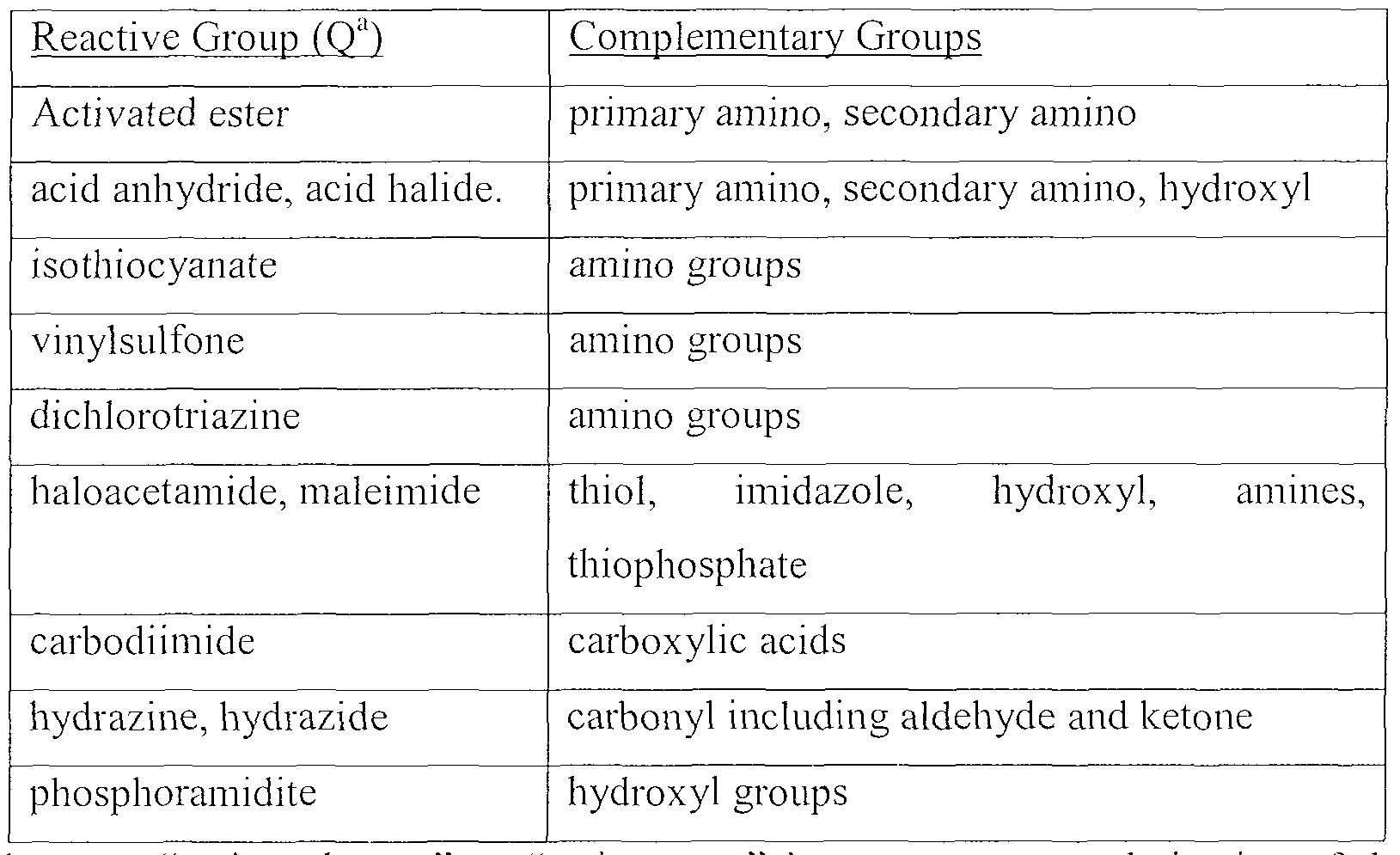
- the Q a group is designed to react with a complementary functional gioup of the BTM, thus forming a covalent linkage between the Bzp M and the BTM
- the complementaiy functional gioup of the BTM may be an mtimsic pait of the BTM, oi may be intioduced by use of dem atisation with a bifunctional gioup as is known in the art Table 1 shows examples of leactive gioups and then complementaiy counterparts
- activated estei oi "active estei” is meant an estei denvative of the caiboxyhc acid which is designed to be a bettei leaving gtoup, and hence permit moie facile ieaction with nucleophile, such as amines
- suitable active esteis N-hydioxysuccmimide (NHS), pentafluoiophenol, pentafluoiothiophenol, pai a- nitiophenol and hydioxybcnzot ⁇ azole Piefened active esteis aie N- hydioxysuccimmide or pentafluoiophenol estets
- Examples of functional gioups piesent in BTM such as piotems, peptides, nucleic acids caibohydiates and the like, include hydioxy, ammo, sulfydiyl, caibonyl (including aldehyde and ketone) and thiophosphate
- Suitable Q' 1 gioups may be selected fiom caiboxyl, activated esteis, isothiocyanate, maleimide, haloacetamide, hydiazide, vmylsulfone, dichloiotiiazine and phosphoiamidite Piefeiably, Q 1 is an activated estei of a caiboxyhc acid, an isothiocyanate, a maleimide oi a haloacetamide
- Q a is piefeiably an activated estei, with piefened such esteis as desciibed above
- a piefened such substituent on the Bzp is the activated estei of a 5-caibo ⁇ ypentyl gioup
- Q a is piefeiably a maleimide 01 iodoacetamide gioup
- J is a caiboxyhc acid, activated ester, isothiocyanate oi thiocyanate gioup,
- J is an amine gioup
- 5 J ' is a maleimide gioup
- J " is piefeiably a p ⁇ mai y oi secondaiy amine gioup, most piefeiably a pnmaiy amine gioup
- the thiol gioup of the BTM is piefeiably fiom a cysteine i csiduc
- the BTM may optionally have othei functional gioups which could potentially ieact with the Bzp M denvative, piotected with suitable piotectmg gioups so that chemical ieaction occuis selectn ely at the desned site only
- piotectmg gioup is meant a gioup which inhibits oi suppiesses undesnable chemical icactions, but which is designed to be sufficiently teact ⁇ e that it may be cleaved fiom the functional gioup m question undei mild enough conditions that do not modify the iest of the molecule
- Aftei depiotection the desned pioduct is obtained Amine piotectmg gioups aie well known to those skilled in the ait and aie s suitably chosen fiom Boc (whcie Boc is teit-butyloxycai
- the present invention piovides a kit foi the piepaiation of the pharmaceutical composition of the fust aspect, wheiein said kit compiises the conjugate of Formula I in stenle, solid form such that, upon ieconstitution with a stenle supply of the biocompatible carat, dissolution occuis to give the desned pharmaceutical composition
- Foi the kit, the conjugate, plus othei optional excipients as desciibed above, may be piouded as a lyophilised powdei in a suitable vial 01 containei
- the powdei is then designed to be ieconstituted with the desited biocompatible camel to give the pharmaceutical composition in a ste ⁇ le, apyiogenic foi ⁇ n which is ieady foi mammalian admmisti ation
- a ptefe ⁇ ed stenle, solid form of the conjugate is a lyophilised solid
- the stenle, solid form is piefeiably supplied in a pharmaceutical giade containei, as described foi the phaimaceutical composition (above)
- the formulation may optionally comprise a ciyopiotectant chosen from a saccharide, piefeiably mannrtol, 10 maltose oi tiicme
- the present invention piovides a conjugate of Formula I l ⁇ (I) where L and n are as defined foi the fust aspect, and Bzp M is of Formula II as defined above, BTM' is a BTM as defined in the fust aspect, which is synthetic and is chosen fi om
- optical imaging is as defined in the fust aspect (above)
- the imaging agent pharmaceutical composition has piefeiably been pieviously admimsteied to said mammalian body
- pieviously admmisteied is meant that the step involving the clinician, wheiein the imaging agent is given to the patient eg as an mtiavenous injection, has aheady been earned out piwi to imaging
- This embodiment includes the use of the conjugate as defined in the fust aspect in the manufactuie of a diagnostic agent foi optical imaging in vivo of disease states of the mammalian body whei e the BTM is implicated
- a piefe ⁇ ed optical imaging method of the fouith aspect is Fluoiescence Reflectance Imaging (FRI)
- FRI Fluoiescence Reflectance Imaging
- the imaging agent of the pi esent invention is admmisteied to a subject to be diagnosed, and subsequently a tissue suiface of the subject is illuminated with an excitation light - usually continuous wave (CW) excitation
- the light excites the Bzp M dye of the imaging agent
- Fluoiescence fiom the imaging agent, which is geneiated by the excitation light, is detected using a fluoiescence detectoi
- the ietuming light is piefeiably filteied to sepaiate out the fluoiescence component (solely oi partially)
- An image is formed fiom the fluoiescent light
- minimal piocessmg is pei formed (no piocessoi to compute optical paiameteis such as lifetime, quantum yield etc ) and the image maps the fluoiescence intensity
- the appaiatus foi geneiating the excitation light may be a conventional excitation light souicc such as a lasei (e g , ion lasei, dye lasei oi semiconductoi lasei), halogen light soi ⁇ ce oi xenon light souice Vanous optical filteis may optionally be used to obtain the optimal excitation wavelength
- a piefened FRI method composes the steps as follows
- a tissue suiface of mteiest withm the mammalian body is illuminated with an excitation light
- fluoiescence fiom the imaging agent, which is generated by excitation of the Bzp M is detected using a fluoiescence detectoi
- step (i) the excitation light is piefeiably continuous wave (CW) in natuie
- step (in) the light detected is piefeiably filteied
- An especially piefened FRI method is fluoiescence endoscopy
- An alternative imaging method of the sixth aspect uses FDPM (fiequency-domain photon migiation) This has advantages ovei contmuous-w ave (CW) methods wheie gieatei depth of detection of the dye within tissue is impoitant [Sevick-Muiaca et al, Cu ⁇ Opm Chem Biol , 6, 642-650 (2002)] Foi such fiequency/time domain imaging, it is advantageous if the Bzp M has fluoiescent piopeities which can be modulated depending on the tissue depth of the lesion to be imaged, and the type of mstiumentation employed
- the FDPM method is as follows
- step (b) detecting a multiply-scatteied light emission fiom the tissue in iesponse to said exposing, (c) quantifying a fluoiescence chaiacte ⁇ stic thioughout the tissue fiom the emission by establishing a numbei of values with a piocessoi, the values each co ⁇ esponding to a level of the fluoiescence chaiacte ⁇ stic at a diffeient position within the tissue, the level of the fluoi escence chaiacte ⁇ stic varying with heteiogeneous composition of the tissue, and (d) geneiating an image of the tissue by mapping the heteiogeneous composition of the tissue m accordance with the values of step (c)
- the fluoiescence chaiacte ⁇ stic of step (c) preferably conesponds to uptake of the imaging agent and preferably furthei compiises mapping a number of quantities co ⁇ esponding to adsorption and scattering coefficients of the tissue before administration of the imaging agent
- the fluorescence characteristic of step (c) preferably corresponds to at least one of fluorescence lifetime, fluorescence quantum efficiency, fluoiescence yield and imaging agent uptake
- the fluorescence characteiistic is preferably independent of the intensity of the emission and independent of imaging agent concentration
- the quantifying of step (c) preferably comprises (i) establishing an estimate of the values, ( ⁇ ) determining a calculated emission as a function of the estimate, (in) comparing the calculated emission to the emission of said detecting to determine an en oi, (iv) providing a modified estimate of the fluoiescence characteristic as a function of the error
- the quantifying piefeiably compiises determining the ⁇ alues from a mathematical relationship modelling multiple hght-scatteimg behaviour of the tissue
- the method of the first option piefeiably furthei compiises monitoring a metabolic property of the tissue in vivo by detecting variation of said fluoiescence chaiacteiistic
- the optical imaging of the fourth aspect is preferably used to help facilitate the management of a disease state of the mammalian body.
- management is meant use in the detection, staging, diagnosis, monitoiing of disease progression or the monitoring of treatment
- the disease state is suitably one in which the BTM of the imaging agent is implicated
- Imaging applications preferably include camera-based sui face imaging, endoscopy and surgical guidance Further details of suitable optical imaging methods have been reviewed by Sevick-Muraca et al [Cun Opm Chem Biol , 6, 642-650 (2002)].
- the present invention provides a method of detection, staging, diagnosis, monitoring of disease piogression or monitoring of tr eatment of a disease state of the mammalian body which compiises the in ⁇ ⁇ vo optical imaging method of the fouith aspect
- Example 1 piovides the synthesis of a biological taigeting peptide (Peptide 1), which binds to cMet
- Example 2 piovides methods of conjugating Bzp M dyes of the invention to peptides, m particulai Peptide 1
- Example 3 piovides data demonstiatmg that the peptide conjugates of Peptide 1 of the invention ietam affinity foi cMet, i e that the conjugated dye does not mteifeie with the biological binding and selectivity Appiopnate low binding to human seium albumin and high stability in plasma weie demonsti ated
- Example 4 shows that the peptide conjugates of the invention exhibit useful tumoui backgiound iatios in an animal model of coloiectal cancel
- Example 5 desciibes the use of pasictive softwaie foi the dyes of the invention, and demonstiates that the dyes
- R d is -(CII-.) SO H
- R e is -(CH.) CO.H and R 1 is -(CH.)XO.H
- Example 2 S>nthesis of Peptide Conjugates of Benzopyrylium Dyes.
- Example 3 In Vitro Fluorescence polarisation assay.
- Fluoicscence pola ⁇ sation assay was used to examine the affinity binding ol the imaging agent towaids the cMet taiget as well as the binding piopeities telated to plasma pioteins
- the piinciple of the fluoiescence polaiisation method can bnefly be desciibed as follows Monochiomatic light passes thiough a honzontal polaiizing filtei and excites fluotescent molecules m the sample Only those molecules that o ⁇ ented piopeily in the vertically polanzed plane adsoib light, become excited, and subsequently emit light The emitted light is mcasuied m both honzontal and vertical planes
- the amsotiopy value (A) is the iatio between the light intensities following the equation
- rafo is the observed anisotropy.
- rjree is the anisotropy of the free peptide.
- rhoimd is the anisotropy of the bound peptide
- K d is the dissociation constant
- cMet is the total c-Met concentration
- P is the total dye-labelled peptide concentration.
- the change of the polarization value was used to assess the binding of the Compound to human serum albumin as a low change of polarisation value is associated to low binding being appropriate for in-vivo use.
- the plasma protein binding (PPB) was confirmed w ith Biacore measurements.
- the stability of the imaging agent in plasma was confirmed by measuring the amount of the Compound left after incubation in mouse plasma for 2 hours at 37 0 C.
- Example 4 //; Vivo testing of Compounds 2 to 6.
- mice Female BALB c/A nude (Bom) mice weie used in the study The use of the animals was approved by the local ethics committee
- BALB c/A nude is an inbred immunocompromised mouse strain with a high take rate for human tumours as compared to other nude mice strains
- the mice were 8 weeks old upon anival and with a body weight of appiox 20 giams at the start of the study
- the animals were housed in individually ventilated cages (IVC, Scanbui BK) with HEPA filtered air
- the animals had ad libitum access to "Rat and Mouse nr 3 Breeding" diet (Scanbur BK) and tap water acidified by addition of HCl to a molai concentration of 1 niM (pH 3 0)
- the colon cancer cell HT-29 is derived from human colon carcinomas and is reported to expiess c-Met according to Zeng et al [Clin Exp Metastasis, 2J_, 409-417 (2004)] The cell line was proven to be tumo ⁇ genic when inoculated subcutaneously into nude mice [Flatmark et al, Eur J Cancer 40,1593-1598 (2004)]
- HT-29 cells were grown in McCoy's 5a medium (Sigma # M8403) supplemented with 10% fetal bovine serum and penicillin/streptomycin Stocks were made at passage number four (P4) and frozen down for storage m liquid nitrogen at 10 7 cells/vial in the respective culture media containing 5% DMSO.
- test substances were reconstituted with PBS fiom freeze-dned powder A small stack of white printer paper was imaged to obtain a flat field image which was used to co ⁇ ect foi illumination inhomogeneities
- the animals were anaesthetized in a coaxial open mask to light surgical level anaesthesia with 19
- Isofluiane typically 1 3-2%), using oxygen as the camel gas
- a small piece of skin 3-5mm was lemoved ovei paits of the tumoui and adjacent muscle using a suigical foiceps and fine scissois while the animal was anaesthetized This was done to measuie the signal fiom tumoui and muscle without inteifeience fiom the ovei lying skin tissue
- the wound was coveied by applying a liquid, non-fluoiescent bandage spiay (3M, MN, USA)
- the iespnation and body tempeiatuie of the animal was monitoied with a BioVet system (m2m Imaging Corp, NJ, USA) using a pneumatic sensoi underneath the animal and a iectal tempeiatui e piobe
- the BioVet system also supplied external heating using a heating mat set to 40 0 C to sustain normal body tempeiatuie foi the duiation of the imaging piocedui e (2 houis)
- a Venflon cathetei was placed m the tail vein foi contiast agent admmistiation Each animal was given one contiast agent injection
- the injected volume was 0 ImI of test compound followed immediately by a 0 2ml saline flush Fluoiescence images weie acquned just p ⁇ oi to injection and then eveiy 30 seconds foi 2 houis
- Imaging was pei formed thiough a clinical lapaioscope adapted to use a light souice to excite the iepoiter and a filte ⁇ ng system to extiact the fluoiescence component
- a 635nm lasei was used foi excitation of the iepoitei molecule
- a Hamamatsu ORCA ERG CCD camera was used as the detectoi
- the camei a was opeiated in 2x2 binning mode with 0 gam Standaid exposuie time foi colon imaging was 4s
- the intensity distiibution m the image was collected foi illumination inhomogeneities thiough system calibiation data
- a taiget to backgiound iatio was computed fiom legions of mteiest placed ovei the exposed tumoui and normal muscle backgiound
- test Compounds had the following aveiage tumoui muscle iatios (Table 5) Table 5 turnout muscle iatios of Compounds 2 to 6
Landscapes
- Health & Medical Sciences (AREA)
- Life Sciences & Earth Sciences (AREA)
- Epidemiology (AREA)
- Veterinary Medicine (AREA)
- Public Health (AREA)
- General Health & Medical Sciences (AREA)
- Animal Behavior & Ethology (AREA)
- Engineering & Computer Science (AREA)
- Chemical & Material Sciences (AREA)
- Biomedical Technology (AREA)
- Organic Chemistry (AREA)
- Proteomics, Peptides & Aminoacids (AREA)
- Pharmacology & Pharmacy (AREA)
- Medicinal Chemistry (AREA)
- Bioinformatics & Cheminformatics (AREA)
- Medicines Containing Antibodies Or Antigens For Use As Internal Diagnostic Agents (AREA)
- Medicinal Preparation (AREA)
- Endoscopes (AREA)
- Investigating, Analyzing Materials By Fluorescence Or Luminescence (AREA)
- Medicines That Contain Protein Lipid Enzymes And Other Medicines (AREA)
- Peptides Or Proteins (AREA)
Abstract
Description






Claims


Priority Applications (9)
| Application Number | Priority Date | Filing Date | Title |
|---|---|---|---|
| JP2010518652A JP2010534712A (en) | 2007-07-31 | 2008-07-29 | Optical imaging agent |
| CN200880110475.9A CN101952369A (en) | 2007-07-31 | 2008-07-29 | Optical imaging agents |
| CA2694102A CA2694102A1 (en) | 2007-07-31 | 2008-07-29 | Optical imaging agents |
| EP08786578A EP2190931A2 (en) | 2007-07-31 | 2008-07-29 | Optical imaging agents |
| AU2008281818A AU2008281818A1 (en) | 2007-07-31 | 2008-07-29 | Optical imaging agents |
| RU2010101931/05A RU2484111C9 (en) | 2007-07-31 | 2008-07-29 | Optical visualisation agents |
| MX2010001247A MX2010001247A (en) | 2007-07-31 | 2008-07-29 | Optical imaging agents. |
| BRPI0814339A BRPI0814339A2 (en) | 2007-07-31 | 2008-07-29 | pharmaceutical composition, kit for the preparation of the pharmaceutical composition, conjugate and methods for in vivo optical imaging of the mammalian body, and for the detection, stabilization, diagnosis, monitoring of disease progress or monitoring of the treatment of a disease state. mammal body |
| US12/671,036 US20100196282A1 (en) | 2007-09-28 | 2008-07-29 | Optical imaging agents |
Applications Claiming Priority (6)
| Application Number | Priority Date | Filing Date | Title |
|---|---|---|---|
| PCT/GB2007/002907 WO2008015415A2 (en) | 2006-07-31 | 2007-07-31 | Asymmetric fluoro-substituted polymethine dyes |
| GBPCT/GB2007/002907 | 2007-07-31 | ||
| GBGB0718957.4A GB0718957D0 (en) | 2007-09-28 | 2007-09-28 | Optical imaging agents |
| GB0718957.4 | 2007-09-28 | ||
| US97681707P | 2007-10-02 | 2007-10-02 | |
| US60/976,817 | 2007-10-02 |
Publications (2)
| Publication Number | Publication Date |
|---|---|
| WO2009016181A2 true WO2009016181A2 (en) | 2009-02-05 |
| WO2009016181A3 WO2009016181A3 (en) | 2010-02-25 |
Family
ID=38701832
Family Applications (1)
| Application Number | Title | Priority Date | Filing Date |
|---|---|---|---|
| PCT/EP2008/059942 Ceased WO2009016181A2 (en) | 2007-07-31 | 2008-07-29 | Optical imaging agents |
Country Status (12)
| Country | Link |
|---|---|
| US (1) | US20100196282A1 (en) |
| EP (1) | EP2190931A2 (en) |
| JP (1) | JP2010534712A (en) |
| KR (1) | KR20100051640A (en) |
| CN (1) | CN101952369A (en) |
| AU (1) | AU2008281818A1 (en) |
| BR (1) | BRPI0814339A2 (en) |
| CA (1) | CA2694102A1 (en) |
| GB (1) | GB0718957D0 (en) |
| MX (1) | MX2010001247A (en) |
| RU (1) | RU2484111C9 (en) |
| WO (1) | WO2009016181A2 (en) |
Cited By (12)
| Publication number | Priority date | Publication date | Assignee | Title |
|---|---|---|---|---|
| WO2012013247A1 (en) * | 2010-07-30 | 2012-02-02 | Pulsion Medical Systems Ag | Measurement method for determining an organ function |
| CN102985494A (en) * | 2010-06-29 | 2013-03-20 | 通用电气医疗集团股份有限公司 | Dye Composition and Dye Synthesis |
| JP2013540702A (en) * | 2010-08-18 | 2013-11-07 | ジーイー・ヘルスケア・リミテッド | Peptide radiotracer composition |
| US8889884B1 (en) | 2011-07-14 | 2014-11-18 | Pierce Biotechnology, Inc. | Phosphine derivatives of fluorescent compounds |
| EP2850078A4 (en) * | 2012-08-28 | 2016-01-27 | Pierce Biotechnology Inc | BENZOPYRYLIUM COMPOUNDS |
| US9249307B2 (en) | 2011-08-16 | 2016-02-02 | Pierce Biotechnology, Inc. | Benzocyanine compounds |
| JP2016156804A (en) * | 2015-12-25 | 2016-09-01 | ユニヴェルシテッツクリニクム イエーナ | Measuring method for determining organ function |
| US9751868B2 (en) | 2012-02-28 | 2017-09-05 | Pierce Biotechnology, Inc. | Benzocyanine compounds |
| US10000467B2 (en) | 2012-03-02 | 2018-06-19 | Pierce Biotechnology, Inc. | Cyanine compounds |
| US10053447B2 (en) | 2010-12-21 | 2018-08-21 | Pierce Biotechnology, Inc | Fluorescent compounds |
| US10300156B2 (en) | 2013-12-18 | 2019-05-28 | Ge Healthcare Limited | Radiotracer compositions and methods |
| US10548995B2 (en) | 2013-08-21 | 2020-02-04 | Ge Healthcare Limited | Radiolabelling method |
Families Citing this family (2)
| Publication number | Priority date | Publication date | Assignee | Title |
|---|---|---|---|---|
| GB0718967D0 (en) * | 2007-09-28 | 2007-11-07 | Ge Healthcare Ltd | Peptide imaging agents |
| CN103052690A (en) * | 2010-06-29 | 2013-04-17 | 通用电气医疗集团股份有限公司 | Dye compositions and dye syntheses |
Family Cites Families (20)
| Publication number | Priority date | Publication date | Assignee | Title |
|---|---|---|---|---|
| ATE264694T1 (en) * | 1995-01-30 | 2004-05-15 | Daiichi Pure Chemicals Co Ltd | DIAGNOSTIC MARKER |
| DE19534177A1 (en) * | 1995-09-15 | 1997-03-20 | Merck Patent Gmbh | Cyclic adhesion inhibitors |
| DE19917713A1 (en) * | 1999-04-09 | 2000-10-19 | Diagnostikforschung Inst | Short-chain peptide-dye conjugates as contrast agents for optical diagnostics |
| EP1283855B1 (en) * | 2000-05-23 | 2005-11-02 | Dyomics GmbH | Stable near-infrared (nir) marker dyes based on benzopyrylium-polymethines |
| GB0018528D0 (en) * | 2000-07-27 | 2000-09-13 | Photocure Asa | Compounds |
| DE10038237A1 (en) * | 2000-08-04 | 2002-02-14 | Aventis Res & Tech Gmbh & Co | Procedure for the detection of mutations in nucleotide sequences |
| BRPI0210886B8 (en) * | 2001-07-10 | 2021-05-25 | Amersham Health As | compound, pharmaceutical composition, use of a compound, and, methods of imaging, monitoring the effect of treating a human or animal body with a drug to combat a condition associated with cancer and treating cancer or a related disease in a human or animal body |
| EP1281767A3 (en) * | 2001-07-31 | 2003-05-28 | Aladar A. Szalay | Light emitting microorganisms and cells for diagnosis and therapy of tumors |
| RU2297409C2 (en) * | 2001-09-14 | 2007-04-20 | Эмджен Инк. | Diaryl compounds with bridge bond |
| JP2003261464A (en) * | 2002-03-07 | 2003-09-16 | Fuji Photo Film Co Ltd | Near infrared fluorescent contrast agent and fluorescent contrast radiography |
| DE10258150A1 (en) * | 2002-12-10 | 2004-07-08 | Dyomics Gmbh | Hydrophilic markers based on benzopyrylo-polymethines |
| ES2396368T3 (en) * | 2003-03-03 | 2013-02-21 | Dyax Corporation | Peptides that specifically bind to the HGF receptor (CMET) and uses thereof |
| GB0327494D0 (en) * | 2003-11-26 | 2003-12-31 | Amersham Plc | Novel imaging agents |
| RU2393167C2 (en) * | 2004-06-16 | 2010-06-27 | Джи-И Хелткер АС | Peptide compounds |
| EP1796733A2 (en) * | 2004-09-29 | 2007-06-20 | GE Healthcare AS | Urokinase plasminogen activator receptor targeted contrast agents |
| EP1674478A1 (en) * | 2004-12-22 | 2006-06-28 | GSF-Forschungszentrum für Umwelt und Gesundheit GmbH | Fusion proteins and method for determining protein-protein-interactions in living cells and cell lysates, nucleic acids encoding these fusion proteins, as well as vectors and kits containing these |
| WO2007074722A1 (en) * | 2005-12-27 | 2007-07-05 | The Furukawa Electric Co., Ltd. | Fluorescent silica nano-particle, fluorescent nano-material, biochip using the material, and assay method |
| US20100226967A1 (en) * | 2006-05-23 | 2010-09-09 | Purdue Research Foundation | Imaging and therapeutic method using progenitor cells |
| GB0615211D0 (en) * | 2006-07-31 | 2006-09-06 | Ge Healthcare Uk Ltd | Asymmetric flouro-substituted polymethine dyes |
| GB0718967D0 (en) * | 2007-09-28 | 2007-11-07 | Ge Healthcare Ltd | Peptide imaging agents |
-
2007
- 2007-09-28 GB GBGB0718957.4A patent/GB0718957D0/en not_active Ceased
-
2008
- 2008-07-29 RU RU2010101931/05A patent/RU2484111C9/en not_active IP Right Cessation
- 2008-07-29 EP EP08786578A patent/EP2190931A2/en not_active Withdrawn
- 2008-07-29 CA CA2694102A patent/CA2694102A1/en not_active Abandoned
- 2008-07-29 BR BRPI0814339A patent/BRPI0814339A2/en not_active IP Right Cessation
- 2008-07-29 US US12/671,036 patent/US20100196282A1/en not_active Abandoned
- 2008-07-29 JP JP2010518652A patent/JP2010534712A/en not_active Withdrawn
- 2008-07-29 KR KR1020107002106A patent/KR20100051640A/en not_active Ceased
- 2008-07-29 MX MX2010001247A patent/MX2010001247A/en unknown
- 2008-07-29 CN CN200880110475.9A patent/CN101952369A/en active Pending
- 2008-07-29 AU AU2008281818A patent/AU2008281818A1/en not_active Abandoned
- 2008-07-29 WO PCT/EP2008/059942 patent/WO2009016181A2/en not_active Ceased
Cited By (25)
| Publication number | Priority date | Publication date | Assignee | Title |
|---|---|---|---|---|
| CN102985494A (en) * | 2010-06-29 | 2013-03-20 | 通用电气医疗集团股份有限公司 | Dye Composition and Dye Synthesis |
| JP2013535679A (en) * | 2010-07-30 | 2013-09-12 | プルシオン メディカル システムズ アーゲー | Measuring method for determining organ function |
| WO2012013247A1 (en) * | 2010-07-30 | 2012-02-02 | Pulsion Medical Systems Ag | Measurement method for determining an organ function |
| US9671340B2 (en) | 2010-07-30 | 2017-06-06 | Smartdyelivery Gmbh | Measurement method for determining an organ function |
| JP2013540702A (en) * | 2010-08-18 | 2013-11-07 | ジーイー・ヘルスケア・リミテッド | Peptide radiotracer composition |
| US9533059B2 (en) | 2010-08-18 | 2017-01-03 | Ge Healthcare Limited | Peptide radiotracer compositions |
| US10053447B2 (en) | 2010-12-21 | 2018-08-21 | Pierce Biotechnology, Inc | Fluorescent compounds |
| US11053222B2 (en) | 2010-12-21 | 2021-07-06 | Pierce Biotechnology, Inc. | Fluorescent compounds |
| US10351551B2 (en) | 2010-12-21 | 2019-07-16 | Pierce Biotechnology, Inc. | Fluorescent compounds |
| US8889884B1 (en) | 2011-07-14 | 2014-11-18 | Pierce Biotechnology, Inc. | Phosphine derivatives of fluorescent compounds |
| US9365598B2 (en) | 2011-07-14 | 2016-06-14 | Pierce Biotechnology, Inc. | Phosphine derivatives of fluorescent compounds |
| US9249307B2 (en) | 2011-08-16 | 2016-02-02 | Pierce Biotechnology, Inc. | Benzocyanine compounds |
| US10730857B2 (en) | 2011-08-16 | 2020-08-04 | Pierce Biotechnology, Inc. | Benzocyanine compounds |
| US10125120B2 (en) | 2011-08-16 | 2018-11-13 | Pierce Biotechnology, Inc. | Benzocyanine compounds |
| US10526317B2 (en) | 2012-02-28 | 2020-01-07 | Pierce Biotechnology, Inc. | Benzocyanine compounds |
| US9751868B2 (en) | 2012-02-28 | 2017-09-05 | Pierce Biotechnology, Inc. | Benzocyanine compounds |
| US10696653B2 (en) | 2012-03-02 | 2020-06-30 | Pierce Biotechnology, Inc. | Cyanine compounds |
| US10000467B2 (en) | 2012-03-02 | 2018-06-19 | Pierce Biotechnology, Inc. | Cyanine compounds |
| US10174045B2 (en) | 2012-08-28 | 2019-01-08 | Pierce Biotechnology, Inc. | Benzopyrylium compounds |
| US9676787B2 (en) | 2012-08-28 | 2017-06-13 | Pierce Biotechnology, Inc. | Benzopyrylium compounds |
| EP2850078A4 (en) * | 2012-08-28 | 2016-01-27 | Pierce Biotechnology Inc | BENZOPYRYLIUM COMPOUNDS |
| US10548995B2 (en) | 2013-08-21 | 2020-02-04 | Ge Healthcare Limited | Radiolabelling method |
| US10300156B2 (en) | 2013-12-18 | 2019-05-28 | Ge Healthcare Limited | Radiotracer compositions and methods |
| US11311636B2 (en) | 2013-12-18 | 2022-04-26 | Ge Healthcare Limited | Radiotracer compositions and methods |
| JP2016156804A (en) * | 2015-12-25 | 2016-09-01 | ユニヴェルシテッツクリニクム イエーナ | Measuring method for determining organ function |
Also Published As
| Publication number | Publication date |
|---|---|
| AU2008281818A1 (en) | 2009-02-05 |
| RU2484111C9 (en) | 2013-09-20 |
| CN101952369A (en) | 2011-01-19 |
| MX2010001247A (en) | 2010-03-01 |
| GB0718957D0 (en) | 2007-11-07 |
| BRPI0814339A2 (en) | 2017-10-24 |
| EP2190931A2 (en) | 2010-06-02 |
| JP2010534712A (en) | 2010-11-11 |
| KR20100051640A (en) | 2010-05-17 |
| WO2009016181A3 (en) | 2010-02-25 |
| RU2484111C2 (en) | 2013-06-10 |
| CA2694102A1 (en) | 2009-02-05 |
| RU2010101931A (en) | 2011-09-10 |
| US20100196282A1 (en) | 2010-08-05 |
Similar Documents
| Publication | Publication Date | Title |
|---|---|---|
| EP2190931A2 (en) | Optical imaging agents | |
| EP2190930A2 (en) | Peptide imaging agents | |
| EP2146749B1 (en) | Labelled hgf binding peptides for imaging | |
| US20090252687A1 (en) | Asymmetric fluoro-substituted polymethine dyes | |
| US20100303727A1 (en) | Optical imaging agents | |
| US20110268660A1 (en) | Method for detecting dysplasia | |
| US20110280806A1 (en) | Dye conjugate imaging agents | |
| HK1145140A (en) | Optical imaging agents |
Legal Events
| Date | Code | Title | Description |
|---|---|---|---|
| WWE | Wipo information: entry into national phase |
Ref document number: 200880110475.9 Country of ref document: CN |
|
| 121 | Ep: the epo has been informed by wipo that ep was designated in this application |
Ref document number: 08786578 Country of ref document: EP Kind code of ref document: A2 |
|
| WWE | Wipo information: entry into national phase |
Ref document number: 2008281818 Country of ref document: AU |
|
| WWE | Wipo information: entry into national phase |
Ref document number: 2694102 Country of ref document: CA |
|
| WWE | Wipo information: entry into national phase |
Ref document number: 2010518652 Country of ref document: JP |
|
| WWE | Wipo information: entry into national phase |
Ref document number: 585/DELNP/2010 Country of ref document: IN |
|
| WWE | Wipo information: entry into national phase |
Ref document number: 12671036 Country of ref document: US Ref document number: 2008786578 Country of ref document: EP |
|
| ENP | Entry into the national phase |
Ref document number: 20107002106 Country of ref document: KR Kind code of ref document: A |
|
| WWE | Wipo information: entry into national phase |
Ref document number: MX/A/2010/001247 Country of ref document: MX |
|
| NENP | Non-entry into the national phase |
Ref country code: DE |
|
| ENP | Entry into the national phase |
Ref document number: 2008281818 Country of ref document: AU Date of ref document: 20080729 Kind code of ref document: A |
|
| WWE | Wipo information: entry into national phase |
Ref document number: 2010101931 Country of ref document: RU |
|
| REG | Reference to national code |
Ref country code: BR Ref legal event code: B01E Ref document number: PI0814339 Country of ref document: BR |
|
| ENP | Entry into the national phase |
Ref document number: PI0814339 Country of ref document: BR Kind code of ref document: A2 Effective date: 20100128 |