WO2009022040A1 - Procedimiento para aumentar las prestaciones de un sistema de comunicaciones sobre un medio formado por múltiples conductores - Google Patents
Procedimiento para aumentar las prestaciones de un sistema de comunicaciones sobre un medio formado por múltiples conductores Download PDFInfo
- Publication number
- WO2009022040A1 WO2009022040A1 PCT/ES2008/000496 ES2008000496W WO2009022040A1 WO 2009022040 A1 WO2009022040 A1 WO 2009022040A1 ES 2008000496 W ES2008000496 W ES 2008000496W WO 2009022040 A1 WO2009022040 A1 WO 2009022040A1
- Authority
- WO
- WIPO (PCT)
- Prior art keywords
- injection
- communications system
- performance
- modes
- procedure
- Prior art date
- Legal status (The legal status is an assumption and is not a legal conclusion. Google has not performed a legal analysis and makes no representation as to the accuracy of the status listed.)
- Ceased
Links
Classifications
-
- H—ELECTRICITY
- H04—ELECTRIC COMMUNICATION TECHNIQUE
- H04B—TRANSMISSION
- H04B3/00—Line transmission systems
- H04B3/54—Systems for transmission via power distribution lines
-
- H—ELECTRICITY
- H04—ELECTRIC COMMUNICATION TECHNIQUE
- H04B—TRANSMISSION
- H04B3/00—Line transmission systems
-
- H—ELECTRICITY
- H04—ELECTRIC COMMUNICATION TECHNIQUE
- H04B—TRANSMISSION
- H04B3/00—Line transmission systems
- H04B3/02—Details
- H04B3/32—Reducing cross-talk, e.g. by compensating
-
- H—ELECTRICITY
- H04—ELECTRIC COMMUNICATION TECHNIQUE
- H04L—TRANSMISSION OF DIGITAL INFORMATION, e.g. TELEGRAPHIC COMMUNICATION
- H04L25/00—Baseband systems
- H04L25/02—Details ; arrangements for supplying electrical power along data transmission lines
- H04L25/0264—Arrangements for coupling to transmission lines
- H04L25/0272—Arrangements for coupling to multiple lines, e.g. for differential transmission
-
- H—ELECTRICITY
- H04—ELECTRIC COMMUNICATION TECHNIQUE
- H04L—TRANSMISSION OF DIGITAL INFORMATION, e.g. TELEGRAPHIC COMMUNICATION
- H04L25/00—Baseband systems
- H04L25/02—Details ; arrangements for supplying electrical power along data transmission lines
- H04L25/0264—Arrangements for coupling to transmission lines
- H04L25/0272—Arrangements for coupling to multiple lines, e.g. for differential transmission
- H04L25/0276—Arrangements for coupling common mode signals
-
- H—ELECTRICITY
- H04—ELECTRIC COMMUNICATION TECHNIQUE
- H04L—TRANSMISSION OF DIGITAL INFORMATION, e.g. TELEGRAPHIC COMMUNICATION
- H04L5/00—Arrangements affording multiple use of the transmission path
- H04L5/14—Two-way operation using the same type of signal, i.e. duplex
- H04L5/143—Two-way operation using the same type of signal, i.e. duplex for modulated signals
-
- H—ELECTRICITY
- H04—ELECTRIC COMMUNICATION TECHNIQUE
- H04L—TRANSMISSION OF DIGITAL INFORMATION, e.g. TELEGRAPHIC COMMUNICATION
- H04L5/00—Arrangements affording multiple use of the transmission path
- H04L5/20—Arrangements affording multiple use of the transmission path using different combinations of lines, e.g. phantom working
-
- H—ELECTRICITY
- H04—ELECTRIC COMMUNICATION TECHNIQUE
- H04J—MULTIPLEX COMMUNICATION
- H04J13/00—Code division multiplex systems
- H04J13/0007—Code type
- H04J13/004—Orthogonal
-
- H—ELECTRICITY
- H04—ELECTRIC COMMUNICATION TECHNIQUE
- H04L—TRANSMISSION OF DIGITAL INFORMATION, e.g. TELEGRAPHIC COMMUNICATION
- H04L5/00—Arrangements affording multiple use of the transmission path
- H04L5/0001—Arrangements for dividing the transmission path
- H04L5/0003—Two-dimensional division
- H04L5/0005—Time-frequency
- H04L5/0007—Time-frequency the frequencies being orthogonal, e.g. OFDM(A) or DMT
Definitions
- the present invention refers to a method for increasing the performance of a communications system on a medium formed by multiple conductors.
- any communication system we try to take full advantage of the characteristics of the communication medium to achieve maximum transmission capacity, reliability, coverage, etc.
- the communications medium is formed by multiple conductors, it is possible to use said conductors to achieve one or more of these objectives.
- the method described in the present invention is used in a medium formed by multiple conductors both to improve the performance of the communication, and to increase the reuse of frequencies used, or to improve the repetition, among other applications.
- Injection modes are divided into common mode, differential modes and pseudo-differential modes.
- the common mode is that which causes current flow through the reference plane.
- the differential modes consist of the injection by one conductor and the return taking by another, while the pseudo-differential modes consist of the injection of voltage or current between one or more conductors and the return by one or more conductors different from those used. for the injection, the number of conductors used in this case being more than two.
- Yamada, Kawasaki, Mrai, Matsuyam and Suzuli (IEEE 1-4244-1090-8 / 07) describe how to characterize the electrical network of the cables of a cargo ship, where the wiring is two-wire with a ground screen.
- the same signal is injected in a common and differential way (dual mode transmission), and is received differentially, which takes advantage of the conversion of signals by coupling (crosstalk) to achieve a lower attenuation with respect to the use of only the differential transmission. That is, from a multi-wire system, this publication seeks to have a single communications channel.
- the present invention uses orthogonal injection modes in N cables seeking to achieve up to N independent communication channels, taking advantage of said orthogonality to increase the performance of a communication system avoiding crosstalk instead of enhancing it, which is not anticipated or evident for a average expert in the field from this publication.
- the publication “Vectored Transmission for Digital Subscriber Line Systems” (George Ginis, John M. Cioffi, IEEE Journal On Selected Areas in Communications, VoI. 20, No. 5, June) can also be found in the state of the art prior to this patent. 2002) in which the way of increasing the transmission speed in a mallet of twisted pairs is described, where the injection in said twisted pairs is done differentially, coordinating transmissions and using multiple input and output (MIMO) techniques to Cancel the crosstalk.
- MIMO multiple input and output
- the invention consists of a method for increasing the performance of a communication system on a medium formed by multiple conductors and a reference plane, where the number of conductors it will be in general N.
- Said procedure is characterized in that communication signals are injected in up to N modes, a mode being the injection of voltage or current over a selective combination between conductors, reference plane or both; so that these modes are orthogonal to each other.
- up to N modes can be used, there is a mode that causes current flow through the reference plane. This mode is the so-called common mode. In specific cases, for example when you want to minimize radiation, you can avoid using the injection that causes the transmission in common mode, by what only differential, pseudo-differential modes and their combinations will be used.
- the procedure is suitable for any medium with multiple conductors, one of those means being the power grid.
- An application of the procedure is that the transmitting equipment simultaneously injects in up to N modes between the differentials, pseudo-differentials and common mode in the communication process, so that the transmission capacity in the communications system is multiplied without using processed extra digital
- the transmitting equipment simultaneously injects signal over the same bandwidth or frequency range to achieve the multiplication of the transmission capacity.
- Another possible application of the method of the invention is to increase the attenuation between communication networks and improve the coexistence of said networks in the same medium.
- each of the coexisting communication networks in the same physical medium will use a different set of injection modes, among the possible N, such that the sets of injection modes selected by the different communication networks are disjoint.
- repeaters are frequency repeaters, that is, they communicate with a group of nodes using a frequency band and repeat the signal for another group of nodes using another different frequency band.
- These types of repeaters often use coexistence filters to cancel out the interference between the different frequency bands used to repeat. Applying the process of the invention can be done that said repeaters use injection modes other than among the possible N; so that the specifications of the filters needed to reduce the interference between the different frequency bands used by the repeater are relaxed, or even the need for such filters is eliminated.
- Another case of interference when using frequency repeaters occurs when the equipment that forms the communications system reuses the same frequencies on remote links.
- interference will occur between equipment that uses the same frequencies, unless the equipment is so far apart (in terms of attenuation) that the signals sent by one of the equipment cannot be distinguished from the noise ground captured by the other equipment.
- the method of the invention can be used to improve this case, for which the equipment that forms the communication system will reuse the same frequencies without causing interference with each other, by using different injection modes in the communication equipment of the remote links ; so that greater flexibility is allowed in the reuse of frequency ranges in the planning of communications networks.
- the procedure can also be used to improve the reliability of the communication, for which multiple versions of the communications signal will be transmitted in the injection modes used to subsequently combine them in reception.
- MIMO digital input and multiple output
- One of the applicable MIMO techniques is space-time coding.
- the procedure is applied together with space-time coding techniques consisting of distributing the communications signal between the injection modes used; so that diversity and coding gain are exploited at the same time.
- transmission techniques are applied through the channel eigenmode transmission (transmission) and reception, to allow the receiver to decode the received signals through each of the injection modes used .
- a third possibility is that the procedure includes digital processing techniques, which allow the cancellation of interference or coupling (crosstalk) between the injection modes used to be received; so that the signal-to-noise ratio (SNR) detected in each of said injection modes increases, and thereby the performance of communications.
- digital processing techniques which allow the cancellation of interference or coupling (crosstalk) between the injection modes used to be received; so that the signal-to-noise ratio (SNR) detected in each of said injection modes increases, and thereby the performance of communications.
- Another application of the procedure is to obtain bidirectional communications.
- the communication system consists of two teams
- these teams communicate bidirectionally at the same time (full-duplex communication) for which a first team uses a set of injection modes among the N possible to transmit to the second equipment and another set of different injection modes to receive the signals from the second equipment, while the second equipment uses the first set to receive and the second to transmit, where said sets are disjoint.
- the procedure is characterized in that one device simultaneously transmits to other devices using a set of injection modes for transmission to each of the receiving equipment, where said sets are disjoint.
- a device simultaneously receives from other equipment using a set of injection modes for reception from each of the transmitting equipment, where said sets are disjoint.
- the transmissions made by different injection modes suffer in different ways the characteristics of the channel: attenuation, interference, noise floor, etc.
- Some examples of the communication characteristics that allow to select the injection modes are: the noise present in the injection mode, the interference present in the injection mode, the stability of the channel in the injection mode, the radiation caused by the injection mode, channel attenuation in injection mode or a combination of the above.
- the communication system uses OFDM modulation and orthogonal multi-injection
- different digital processing techniques, different injection modes or a combination of digital processing techniques and injection modes can be used, in groups formed by one or several carriers of OFDM modulation.
- Figure 1. Shows the propagation modes by the transmission medium formed by two parallel conductors, using orthogonal injection modes.
- Figure 2. Shows the propagation modes by the transmission medium formed by three parallel conductors, using orthogonal injection modes.
- Figure 3 Represents the acceptable orthogonal injection modes in a medium consisting of twelve parallel conductors.
- Figure 4. Shows a general scheme, transmitter-transmission medium-receiver, where N orthogonal injection modes are used simultaneously on a point-to-point link.
- Figure 5. Represents a typical case of interference between two networks that share the same physical medium where they must coexist.
- Figure 6. Shows a scheme of interferences between links in a network with frequency division and the spectral position of the signals and the transfer functions of the coexistence filters necessary to avoid interference.
- Figure 7. Shows a generic scheme of full-duplex communication between two teams.
- Figure 8. Represents a full-duplex communication scheme on medium-voltage overhead power line with three phases, in which the orthogonal mutation injection procedure is used.
- FIG. 9 Shows the general scheme, transmitter-transmission medium-receiver, in which MIMO processing is used in transmission and reception.
- Figure 10. Shows the general scheme, transmitter-transmission medium-receiver, in which the same signal is orthogonally injected into the multiconductor medium and as many signals are received as those injected, propagated by different modes
- Figure 11. Represents the particularization of the generic scheme of the previous figure when space-time coding techniques are used.
- Figure 12. represents the particularization of the generic scheme of Figure 10 when transmission techniques are used through the channel autovectors.
- Figure 13 Represents the particularization of the generic scheme of Figure 10 when trying to minimize the coupling between the multi-injection channels.
- FIG. 14 Shows the general scheme, transmitter-transmission medium-receiver, in which the receiver selects which injection is more suitable for communication from the received signal.
- Figure 15. Presents an example of grouping of carriers of an OFDM modulation for the orthogonal multi-injection procedure. DESCRIPTION OF VARIOUS EXAMPLES OF REALIZATION OF THE
- the problem that the process of the invention wants to solve, from a theoretical point of view, is how to use the property that the transmission medium is formed by multiple conductors to maximize the performance of a communications system using said means of communication. transmission.
- the multiconductor medium Before presenting various examples of realization of communication systems using the method of the invention, the multiconductor medium will be analyzed theoretically, which allows to justify the validity of the process of the invention. From a point of view Theoretically, it is possible to describe mathematically a multiconductor medium with N parallel conductors referred to a reference plane that carry signals between a source and a load using the theory of MTL (multi-conductor transmission line). The dominant mode of propagation of these signals is the transverse electromagnetic mode (TEM or Transverse ElectroMagnetic Mode), where both the electric and magnetic fields propagate orthogonally in the plane perpendicular to the axis of the conductors.
- TEM Transverse ElectroMagnetic Mode
- These structures can propagate signals from continuous (zero frequency) to frequencies of wavelength comparable to the cross-sectional dimension of the conductor.
- the MTL theory for parallel conductors can be used for modeling more reliably the more TEM modes are dominant. At the time that the frequency rises, modes of a higher order than the TEM will begin to be contributory and, therefore, the approximations made by the MTL theory will no longer be valid.
- the TEM mode is dominant, in reality the medium is not homogeneous and its spatial geometry or intrinsic characteristics are not maintained, which makes us talk about quasi-TEM modes, whose propagation and isolation characteristics between injections worsens. In any case, the MTL theory is used to describe the basis on which the process of the invention is sustained.
- the signals that are injected into the different conductors of the medium generate an electromagnetic field that produces signal coupling between conductors, generating the so-called coupling or crosstalk.
- One of the main purposes of the MTL theory is to predict such crosstalk.
- the MTL theory in the simplest case of two conductors, is reduced to having two modes of spatial propagation of the signal, the common mode and the differential mode.
- the differential mode used to transport the energy of the data signals that are transmitted in real applications (for example, communications through the power grid).
- the common mode is injected into both conductors and the return is done by the reference plane or ground, while the differential mode consists of injecting by one conductor and taking the return by the other.
- the common mode has greater losses and the added inconvenience of radiating more than the differential mode, which makes its use more limited at the level of compliance with emission regulation standards. Even trying to avoid the common mode, any differential signal that propagates through a channel will have a conversion factor to common mode, due to asymmetries and unbalances of the channel.
- the system that relates the currents by the conductors to the currents of each mode is orthogonal, that is, it is an independent linear system and also the current vectors of each mode are orthogonal.
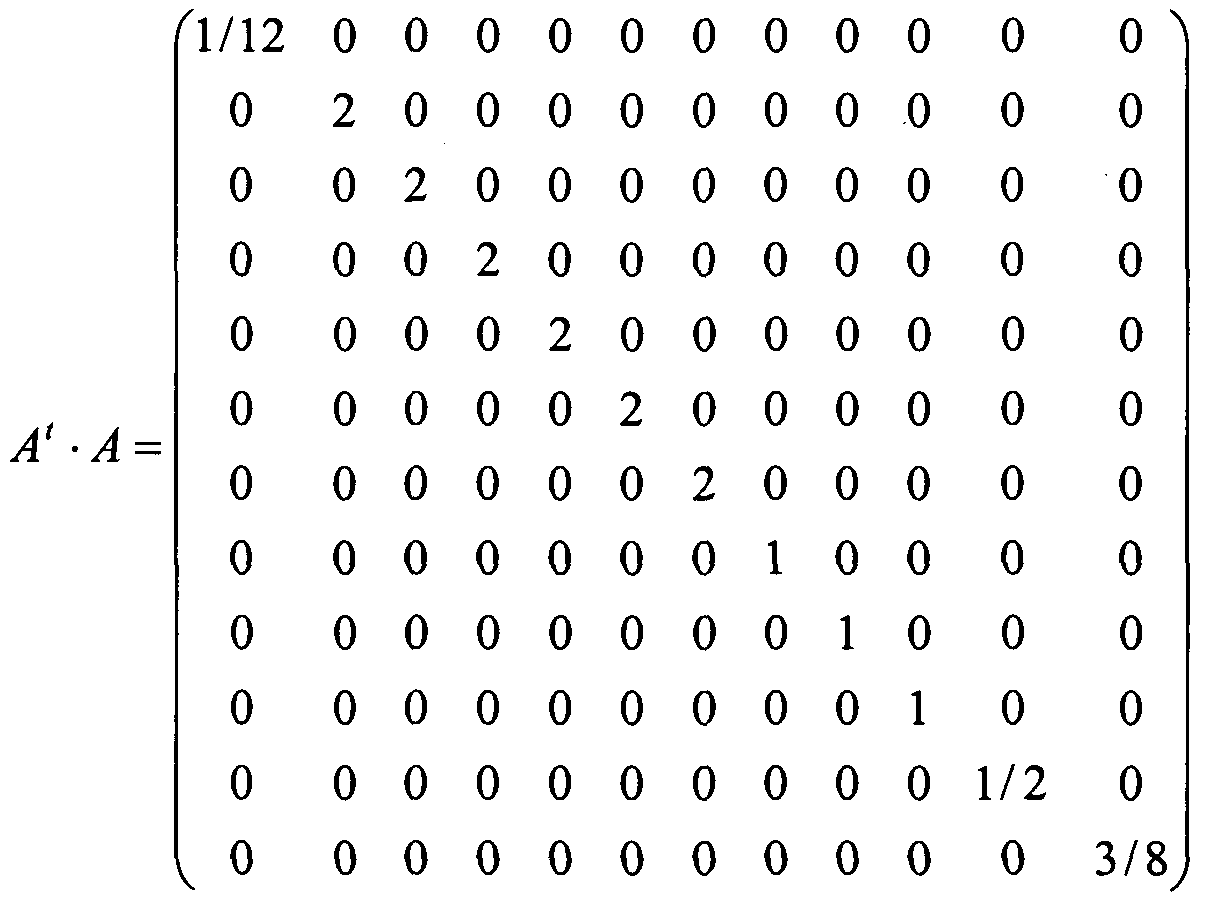
- the range of matrix A is equal to N; while being the orthogonal modes the product of matrix A transposed by A is a diagonal matrix.
- Figure 1 shows an example of the propagation modes that exist on the specific case of the electricity grid when injecting in common mode (1) and in differential mode (2), when the network is formed by only two conductors (3 ) and the reference plane or ground circuit (4).
- the common mode current Ic is distributed by the multiple conductors and returns through the reference plane, while the differential current is injected by one conductor and returns by the other.
- the propagation modes will be the same as with two conductors, plus a mode we will call a pseudo-differential mode, where the current flows through two of the conductors and returns through the third.
- the pseudo-differential mode like the differential, has optimal characteristics for signal propagation, at have low attenuation in the channel, and as can be demonstrated mathematically it is orthogonal to the other two.
- Figure 2 shows the orthogonal injection modes for the case of the electrical network formed by three conductors (3) together with the reference plane (4).
- the injection can be performed in a pseudo-differential manner (5).
- This system is linear independent (since the range of A is equal to twelve), and the product of the transposition (A t ) of A by the matrix A is diagonal, so that the injections chosen are orthogonal.
- the invention method allows, among other applications, to maintain a sufficient useful signal level to take advantage of the possibility of having the bandwidth of the medium multiplied by a factor of up to NI (without using the mode common), without increasing the frequency spectrum used, that is, injecting different signals by taking advantage of the same bandwidth in the channel and improving by NI the number of signals between a transmitter and a receiver or between a transmitter and several receivers.
- An immediate application of the method of the invention is a communication system in which the transmitter simultaneously injects up to N different modes than possible (differential, pseudo-differential and common mode) to multiply the transmission capacity of the system with the advantage of Do not need any extra digital processing without expanding the frequency range.
- FIG. 4 An example of simultaneous orthogonal multi-transmission in a point-to-point link such as the one just described can be found in Figure 4, where there is a transmitting node (11) and a receiving node (12) that communicate by means of transmission (10) formed by N conductors over a bandwidth limited by the frequencies fi and f 2 .
- the crosstalk or coupling is also represented in this figure by dashed lines (30).
- the output of the transmitter modulator / demodulator (6) consists of N different signals that are converted digitally to analog (DACi to DAC N ). Each signal is amplified in analogue form (AFE module) (7) (If a S N ) and injected (TXi to TX N ) orthogonally in the middle
- the signal on the transmitter medium is a signal formed by N signals on the same bandwidth (9).
- the opposite process is done, taking the signals with the coupler
- RXi to RX N amplifying them with an AFE module (7).
- the signals are then passed to the digital domain (ADCi to ADC N ), and finally introduced into the modulator / demodulator (6) to retrieve the transmitted information.
- Another embodiment of the process of the invention improves the coexistence of networks that share the same transmission medium.
- Every communication system has a maximum operating range, in terms of maximum distance attainable due to attenuation of the medium, interference from nodes of other networks and noise present in the medium, among other degradations. Beyond this range, communication between nodes cannot be performed.
- the element that limits the operating range of a node is the presence of another node's signal that belongs to another communications network that shares the medium, the signal will experience a degradation of its performance due to this interference.
- Said nodes must coexist in the same medium, and it would be desirable for such coexistence to be carried out with the least possible loss of benefits.
- the use of the method of the invention allows two nodes within the communication range to operate independently without subtracting benefits for interference between them.
- Figure 5 shows two networks, each of which has to cover a zone, Network 1 (13) covers Zone 1 (14), while Network 2 (15) covers the area. Zone 2 (16).
- Both networks share the physical environment (10) and, in general, will have an area of action larger than the area they should cover. This is a determining factor when it comes to interference between networks. The greater the power transmitted by a network, the greater its coverage or range of action and the more likely it is to interfere with other networks. In this case an interference zone (17) appears where the signals of both networks are mixed. The fact of reducing the transmitted power by the network it would improve coexistence with other networks but, in most cases, it would worsen the benefits in its own coverage area, which in reality is not a feasible solution. In this case, if we use orthogonal injection modes between the different networks that must coexist, we will be able to increase the attenuation between the nodes that belong to each network, so that the interference between them is reduced without the need to reduce the transmitted power.
- the method of the invention can also be applied to increase the performance of the systems.
- a communications network consisting of multi-conductors
- repeaters use time division (TDD) or frequency (FDD) techniques.
- TDD time division
- FDD frequency division
- the main problem of the FDD is that many times the reuse of frequency bands is necessary, which implies having links that use the same frequencies on the same medium, which makes it possible for the equipment of these links to interfere .
- the multi-injection described in the invention can be used to increase the attenuation between these remote links and thereby decrease the possible interference.
- Using orthogonal injection modes between remote links reduces interference between them and with this the performance of the links individually and of the network in general is improved.
- Another application of the method of the invention is the ability to achieve full-duplex communication between devices, that is to transmit and receive information simultaneously between the devices, using orthogonal multi-injection.
- An example can be a medium voltage line of the power grid with broadband communication equipment, as can be seen in Figure 8. If the network is three-phase, a multi-injection can be done on three conductors where a mode is injected differential (2) and a pseudo-differential mode (5), thereby achieving a full-duplex channel using the same frequency band on the same communication channel between the devices (23).
- the method of the invention can be applied together with MIMO (multiple-input, multiple-output) techniques to improve the performance of the communications system using said techniques.
- MIMO multiple-input, multiple-output
- a means of multi-wire communication is equivalent to MIMO schemes
- FIG. 9 shows an exemplary embodiment in which the system uses MIMO digital processing and the process of the invention. This example follows the general scheme of the communications system presented in previous figures and it includes a digital processing module with multiple input signals (ai ... to N ) and multiple output signals (29).
- the coupling or interference between the injected signals (30) that can be exploited or reduced using MIMO digital processing has been marked in the figure.
- diversity techniques in the field of telecommunications refer to an improvement in the reliability of a signal that travels through a medium, using two or more communication channels with different characteristics. These techniques exploit the different characteristics of the N communication channels to increase the robustness of the receiver, avoid chain bit errors and combat signal fading.
- the method consists of transmitting multiple signal versions that are combined in the receiver to improve the reliability of the communication. Error correction techniques can be incorporated in the different signals transmitted in different parts of each message of each channel.
- a system is shown in which the method of the invention is used together with the transmission of multiple versions.
- Figure 10 shows this example, in which the symbol to be transmitted (27) is digitally processed (6) is passed to the analog domain and conveniently amplified (7) and finally coupled (8) by introducing the same signal with each one of the orthogonal injection modes. In reception, the opposite procedure is performed, taking the signal of each orthogonal injection, amplifying it and finally making a combination (28) of the obtained signals.
- This combination consists of multiplying each signal by a weight (dependent, in this example of embodiment, on the signal to noise ratio perceived in the channel formed by the orthogonal injection) and adding the results to try to obtain the symbol sent.
- the replica of the transmitted signal and its combination in reception allows to increase the reliability of the communication even in scenarios very degraded by noise or interference.
- the multi-injection method is applicable to spatial diversity, where the signal is transmitted by different paths of the same medium.
- Diversity combination techniques can be used before signal processing, selecting the most powerful signal that reaches the receiver, changing the channel when the signal does not have a minimum of performance; or adding all the receptions in a coherent way, using MRC (maximal-ratio combining) where weights are applied to the received signals according to the signal-to-noise ratio (SNR) of each one, before adding the receptions.
- SNR signal-to-noise ratio
- a specific embodiment of the MIMO processing will consist of transmission techniques through the channel's autovectors that linearly combine the signals to be transmitted in each of the injection modes (through products and sums of the signals obtained from digital processing) and the signals received in each of the injection modes.
- Figure 12 shows this embodiment, where N symbols (31) are introduced in the digital processing (6) and the outputs are linearly combined by multipliers (41) and adders (42) with weights (generally different for the transmitter (43) and (44) and for the receiver (45) and (46)) whose value is calculated depending on the specific transmission medium of the application. At reception the processing is identical to the one carried out in transmission.
- MIMO processing can also be used to reduce and even eliminate coupling between channels (30).
- the scheme shown in the example of Figure 13 can be used where the receiver includes a crosstalk canceller (34) that reduces the interference of the other injection modes on each of the injection modes due to the coupling.
- Another embodiment of the invention consists in applying the method of the invention in a communication system in such a way that the same signal is transmitted by the N conductors using the orthogonal injection modes, and in reception only the injection modes are used. that present better characteristics for communication.
- those injection modes that have lower noise, higher SNR, lower interference, etc. are selected as suitable.
- This selection is made through a module (35) in reception that analyzes the chosen characteristic of the signals that arrive through the different injection modes and with it selects which coupler (8) will be activated in reception.
- This module can also send a control signal to the transmitter (11) so that only orthogonal multi-injection is performed on the channels selected by the selector block (35), which communicates to the coupler (8) of the transmitter (11).
- a pseudo-differential injection mode is used in a first group (24), and no extra signal processing is used.
- the second group (25) it is injected simultaneously in differential and pseudo-differential mode and no extra signal processing is also used, the isolation provided by the injection between the orthogonal modes being sufficient to separate the signals in reception.
- the carriers of the third group are not consecutive in frequency.
- a pseudo-differential injection mode is used in a first group (24), and no extra signal processing is used.
- the second group (25) it is injected simultaneously in differential and pseudo-differential mode and no extra signal processing is also used, the isolation provided by the injection between the orthogonal modes being sufficient to separate the signals in reception.
- (26) is injected simultaneously in differential and pseudo-differential mode, and MIMO techniques are applied.
- the assignment of the different carriers to each of the groups (24), (25) or (26) is based on the characteristics of the channel in the frequency of each carrier or based on other criteria depending on the application.
Landscapes
- Engineering & Computer Science (AREA)
- Signal Processing (AREA)
- Computer Networks & Wireless Communication (AREA)
- Power Engineering (AREA)
- Cable Transmission Systems, Equalization Of Radio And Reduction Of Echo (AREA)
- Radio Transmission System (AREA)
Abstract
Description


Claims
Priority Applications (7)
| Application Number | Priority Date | Filing Date | Title |
|---|---|---|---|
| US12/672,863 US8587159B2 (en) | 2007-08-09 | 2008-07-14 | Method for increasing the performance of a communications system on a medium formed by multiple conductors |
| EP08805326.9A EP2200184B1 (en) | 2007-08-09 | 2008-07-14 | Method for increasing the performance of a communications system on a medium formed by multiple conductors |
| KR1020107003989A KR101531359B1 (ko) | 2007-08-09 | 2008-07-14 | 복수의 도체에 의해 형성된 매체 상에 통신 시스템의 성능을 증가시키는 방법 |
| JP2010519480A JP5339218B2 (ja) | 2007-08-09 | 2008-07-14 | 複数の導体によって形成される伝送媒体により通信する通信システムを動作させる方法 |
| CN200880111462.3A CN101821958B (zh) | 2007-08-09 | 2008-07-14 | 用于提高由多个导体形成的介质上的通信系统的性能的方法 |
| IL203848A IL203848A (en) | 2007-08-09 | 2010-02-09 | A method to increase the performance of a communication system in a medium produced from multiple conductors |
| US14/083,737 US8957550B2 (en) | 2007-08-09 | 2013-11-19 | Signal injection through electric network using different modes |
Applications Claiming Priority (2)
| Application Number | Priority Date | Filing Date | Title |
|---|---|---|---|
| ESP200702256 | 2007-08-09 | ||
| ES200702256A ES2334190B1 (es) | 2007-08-09 | 2007-08-09 | Procedimiento para aumentar las prestaciones de un sistema de comunicaciones sobre un medio formado por multiples conductores. |
Related Child Applications (2)
| Application Number | Title | Priority Date | Filing Date |
|---|---|---|---|
| US12/672,863 A-371-Of-International US8587159B2 (en) | 2007-08-09 | 2008-07-14 | Method for increasing the performance of a communications system on a medium formed by multiple conductors |
| US14/083,737 Continuation US8957550B2 (en) | 2007-08-09 | 2013-11-19 | Signal injection through electric network using different modes |
Publications (2)
| Publication Number | Publication Date |
|---|---|
| WO2009022040A1 true WO2009022040A1 (es) | 2009-02-19 |
| WO2009022040A8 WO2009022040A8 (es) | 2009-06-04 |
Family
ID=40350420
Family Applications (1)
| Application Number | Title | Priority Date | Filing Date |
|---|---|---|---|
| PCT/ES2008/000496 Ceased WO2009022040A1 (es) | 2007-08-09 | 2008-07-14 | Procedimiento para aumentar las prestaciones de un sistema de comunicaciones sobre un medio formado por múltiples conductores |
Country Status (9)
| Country | Link |
|---|---|
| US (2) | US8587159B2 (es) |
| EP (1) | EP2200184B1 (es) |
| JP (1) | JP5339218B2 (es) |
| KR (1) | KR101531359B1 (es) |
| CN (1) | CN101821958B (es) |
| ES (1) | ES2334190B1 (es) |
| IL (1) | IL203848A (es) |
| TW (1) | TWI478518B (es) |
| WO (1) | WO2009022040A1 (es) |
Families Citing this family (12)
| Publication number | Priority date | Publication date | Assignee | Title |
|---|---|---|---|---|
| JP3154335B2 (ja) | 1991-08-13 | 2001-04-09 | ソニー株式会社 | 画質制御装置 |
| US10141984B2 (en) | 2008-07-14 | 2018-11-27 | Marvell World Trade Ltd. | Multi-band transmission system |
| EP2909951B1 (en) | 2012-10-12 | 2021-12-01 | Sony Group Corporation | Communications device and method for transmitting at least two parallel transmit signals |
| US9350315B1 (en) * | 2013-08-06 | 2016-05-24 | Marvell International Ltd. | Power line communication filter for multiple conductors |
| US9865783B2 (en) | 2013-09-09 | 2018-01-09 | Luminus, Inc. | Distributed Bragg reflector on an aluminum package for an LED |
| US9137004B2 (en) | 2013-12-12 | 2015-09-15 | Qualcomm Incorporated | Neighbor network channel reuse with MIMO capable stations |
| WO2016128048A1 (en) * | 2015-02-12 | 2016-08-18 | Huawei Technologies Co., Ltd. | Full duplex radio with adaptive reception power reduction |
| US11116072B2 (en) * | 2017-07-05 | 2021-09-07 | Intel Corporation | Discrete circuit having cross-talk noise cancellation circuitry and method thereof |
| US11166222B2 (en) * | 2019-08-02 | 2021-11-02 | AR & NS Investment, LLC | Communication by a repeater system including a network of radio frequency (RF) repeater devices |
| EP4313356A4 (en) | 2021-04-16 | 2025-02-19 | Repligen Corporation | Filtration system and method |
| US11880320B1 (en) * | 2021-06-18 | 2024-01-23 | Peraton Labs Inc. | Common-mode signaling and coupler bypass in legacy busses |
| EP4374497A2 (en) * | 2021-07-22 | 2024-05-29 | Continental Automotive Technologies GmbH | Method of joint user activity detection and channel information estimation in extra-large mimo (xl-mimo) systems with non-stationarities |
Citations (4)
| Publication number | Priority date | Publication date | Assignee | Title |
|---|---|---|---|---|
| EP0352869A2 (en) * | 1988-07-29 | 1990-01-31 | Shell Internationale Researchmaatschappij B.V. | Modal transmission method and apparatus for multi-conductor wireline cables |
| US5553097A (en) * | 1994-06-01 | 1996-09-03 | International Business Machines Corporation | System and method for transporting high-bandwidth signals over electrically conducting transmission lines |
| US6226330B1 (en) * | 1998-07-16 | 2001-05-01 | Silicon Graphics, Inc. | Eigen-mode encoding of signals in a data group |
| US20060268966A1 (en) | 2005-05-09 | 2006-11-30 | Adaptive Spectrum And Signal Alignment, Inc. | Phantom use in DSL systems |
Family Cites Families (5)
| Publication number | Priority date | Publication date | Assignee | Title |
|---|---|---|---|---|
| US5412689A (en) * | 1992-12-23 | 1995-05-02 | International Business Machines Corporation | Modal propagation of information through a defined transmission medium |
| DE60135067D1 (de) | 2000-06-28 | 2008-09-11 | Agere Syst Guardian Corp | Induktive Kopplung für Silizium-Datenzugriffsanordnung |
| FR2852168B1 (fr) * | 2003-03-06 | 2005-04-29 | Excem | Procede et dispositif numeriques pour la transmission avec une faible diaphonie |
| CN1286277C (zh) * | 2003-11-20 | 2006-11-22 | 中兴通讯股份有限公司 | 网络处理器中核心处理器与微引擎之间的通信方法 |
| US20060187971A1 (en) | 2005-02-18 | 2006-08-24 | Lum Richard K K | Method and apparatus for concurrently transmitting a digital control signal and an analog signal from a sending circuit to a receiving circuit |
-
2007
- 2007-08-09 ES ES200702256A patent/ES2334190B1/es not_active Expired - Fee Related
-
2008
- 2008-07-14 JP JP2010519480A patent/JP5339218B2/ja not_active Expired - Fee Related
- 2008-07-14 US US12/672,863 patent/US8587159B2/en not_active Expired - Fee Related
- 2008-07-14 EP EP08805326.9A patent/EP2200184B1/en active Active
- 2008-07-14 KR KR1020107003989A patent/KR101531359B1/ko not_active Expired - Fee Related
- 2008-07-14 WO PCT/ES2008/000496 patent/WO2009022040A1/es not_active Ceased
- 2008-07-14 CN CN200880111462.3A patent/CN101821958B/zh active Active
- 2008-08-08 TW TW097130399A patent/TWI478518B/zh not_active IP Right Cessation
-
2010
- 2010-02-09 IL IL203848A patent/IL203848A/en not_active IP Right Cessation
-
2013
- 2013-11-19 US US14/083,737 patent/US8957550B2/en active Active
Patent Citations (4)
| Publication number | Priority date | Publication date | Assignee | Title |
|---|---|---|---|---|
| EP0352869A2 (en) * | 1988-07-29 | 1990-01-31 | Shell Internationale Researchmaatschappij B.V. | Modal transmission method and apparatus for multi-conductor wireline cables |
| US5553097A (en) * | 1994-06-01 | 1996-09-03 | International Business Machines Corporation | System and method for transporting high-bandwidth signals over electrically conducting transmission lines |
| US6226330B1 (en) * | 1998-07-16 | 2001-05-01 | Silicon Graphics, Inc. | Eigen-mode encoding of signals in a data group |
| US20060268966A1 (en) | 2005-05-09 | 2006-11-30 | Adaptive Spectrum And Signal Alignment, Inc. | Phantom use in DSL systems |
Non-Patent Citations (7)
| Title |
|---|
| "A novel approach to the modeling of the indoor power line channel Part 11: Transfer function and channel properties", IEEE TRANS. POWER DEL., vol. 20, no. 3, July 2005 (2005-07-01) |
| "A novel approach to the modeling of the indoor power line channel Part I: Circuit analysis and companion model", IEEE TRANS. POWER DEL., vol. 20, no. 2, April 2005 (2005-04-01), pages 655 - 663 |
| "High-Frequency characteristics of overhead multi-conductor power lines for broadband communication", IEEE JOUR. COMMUNICATIONS, vol. 24, no. 7, July 2006 (2006-07-01) |
| GEORGE GINIS; JOHN M. CIOFFI: "Vectored Transmission for Digital Subscriber Line Systems", IEEE JOURNAL ON SELECTED AREAS IN COMMUNICATIONS, vol. 20, no. 5, June 2002 (2002-06-01) |
| J. CIOFFI ET AL.: "Submission to Working Group T1 E1.4", GDSL, GIGABIT DSL |
| See also references of EP2200184A4 |
| TSUZUKI; YOSHIDA; YAMADA; KAWASAKI; MRAI; MATSUYAM; SUZULI: "Characteristics of power line channels in cargo ships", IEEE, vol. 1-4244, pages 1090 - 8,07 |
Also Published As
| Publication number | Publication date |
|---|---|
| CN101821958A (zh) | 2010-09-01 |
| TWI478518B (zh) | 2015-03-21 |
| US20110293024A1 (en) | 2011-12-01 |
| ES2334190B1 (es) | 2011-01-17 |
| JP5339218B2 (ja) | 2013-11-13 |
| KR101531359B1 (ko) | 2015-06-24 |
| EP2200184B1 (en) | 2017-09-20 |
| US20140079143A1 (en) | 2014-03-20 |
| ES2334190A1 (es) | 2010-03-05 |
| US8587159B2 (en) | 2013-11-19 |
| CN101821958B (zh) | 2013-04-24 |
| JP2010536218A (ja) | 2010-11-25 |
| EP2200184A1 (en) | 2010-06-23 |
| IL203848A (en) | 2015-05-31 |
| EP2200184A4 (en) | 2014-07-30 |
| WO2009022040A8 (es) | 2009-06-04 |
| US8957550B2 (en) | 2015-02-17 |
| TW200924408A (en) | 2009-06-01 |
| KR20100042286A (ko) | 2010-04-23 |
Similar Documents
| Publication | Publication Date | Title |
|---|---|---|
| ES2334190B1 (es) | Procedimiento para aumentar las prestaciones de un sistema de comunicaciones sobre un medio formado por multiples conductores. | |
| US11025468B1 (en) | Single carrier frequency division multiple access baseband signal generation | |
| US11025312B2 (en) | Blind-adaptive decoding of radio signals | |
| ES2393890B1 (es) | Nodo de comunicación en varios medios de transmisión. | |
| KR100908063B1 (ko) | 이동 통신 시스템에서 확산신호를 송신하는 방법 | |
| US20080095121A1 (en) | Carrier interferometry networks | |
| KR101666043B1 (ko) | 직교 주파수 분할 다중시스템에서 전송 다이버시티 스킴들 | |
| JP2012080564A (ja) | 多重アンテナ送信ダイバシティ方式 | |
| US11804882B1 (en) | Single carrier frequency division multiple access baseband signal generation | |
| Jin et al. | Full-duplex delay diversity relay transmission using bit-interleaved coded OFDM | |
| Hassan | Multi user MIMO‐OFDM‐based power line communication structure with hardware impairments and crosstalk | |
| Bint Saleem et al. | Full-duplex quadrature spatial modulation for multi-antenna systems | |
| Yu et al. | Design and prototype development of MIMO-OFDM for next generation wireless LAN | |
| Rahman et al. | Mm-wave STSK-aided single carrier block transmission for broadband networking | |
| CN100557988C (zh) | 降低频率复用率的无线通信系统 | |
| Rajesh et al. | Cancellation techniques for co-channel interference in MIMO-OFDM systems and evaluating their performance | |
| Adebisi et al. | Multi-emitting/multi-receiving points MMFSK for power-line communications | |
| de Campos et al. | MISO single-carrier system with feedback channel information for narrowband PLC applications | |
| Safatly et al. | LTE multi-antenna techniques based on Alamouti SFBC with correlated channels | |
| Mansour et al. | Fifth Generation promising integrated full loaded MIMO space‐time spreading‐aided‐orthogonal frequency code division multiple access system | |
| ES2436359T3 (es) | Procedimiento y aparato de comunicación de línea de alimentación | |
| JP2004289661A (ja) | 電力線通信システムおよび方法、ならびに電力線通信用受信機および電力線通信用送信機 | |
| Liao et al. | Relay selection in multiuser two-way cooperative relaying systems | |
| Faizur Rahman et al. | Mm-Wave STSK-aided single carrier block transmission for broadband networking | |
| Li et al. | Transmission schemes for two-user linear multi-access relay networks |
Legal Events
| Date | Code | Title | Description |
|---|---|---|---|
| WWE | Wipo information: entry into national phase |
Ref document number: 200880111462.3 Country of ref document: CN |
|
| 121 | Ep: the epo has been informed by wipo that ep was designated in this application |
Ref document number: 08805326 Country of ref document: EP Kind code of ref document: A1 |
|
| DPE2 | Request for preliminary examination filed before expiration of 19th month from priority date (pct application filed from 20040101) | ||
| WWE | Wipo information: entry into national phase |
Ref document number: 2010519480 Country of ref document: JP Ref document number: 203848 Country of ref document: IL |
|
| NENP | Non-entry into the national phase |
Ref country code: DE |
|
| ENP | Entry into the national phase |
Ref document number: 20107003989 Country of ref document: KR Kind code of ref document: A |
|
| REEP | Request for entry into the european phase |
Ref document number: 2008805326 Country of ref document: EP |
|
| WWE | Wipo information: entry into national phase |
Ref document number: 2008805326 Country of ref document: EP |
|
| WWE | Wipo information: entry into national phase |
Ref document number: 12672863 Country of ref document: US |