WO2009026652A1 - Wrought magnesium alloy - Google Patents

Wrought magnesium alloy Download PDF

Info

Publication number
WO2009026652A1
WO2009026652A1 PCT/AU2008/001285 AU2008001285W WO2009026652A1 WO 2009026652 A1 WO2009026652 A1 WO 2009026652A1 AU 2008001285 W AU2008001285 W AU 2008001285W WO 2009026652 A1 WO2009026652 A1 WO 2009026652A1
Authority
WO
WIPO (PCT)
Prior art keywords
alloy
magnesium
based alloy
lanthanum
content
Prior art date
Legal status (The legal status is an assumption and is not a legal conclusion. Google has not performed a legal analysis and makes no representation as to the accuracy of the status listed.)
Ceased
Application number
PCT/AU2008/001285
Other languages
French (fr)
Inventor
Matthew Robert Barnett
Christopher Huw John Davies
Aiden Graeme Beer
Current Assignee (The listed assignees may be inaccurate. Google has not performed a legal analysis and makes no representation or warranty as to the accuracy of the list.)
Cast CRC Ltd
Original Assignee
Cast CRC Ltd
Priority date (The priority date is an assumption and is not a legal conclusion. Google has not performed a legal analysis and makes no representation as to the accuracy of the date listed.)
Filing date
Publication date
Priority claimed from AU2007904722A external-priority patent/AU2007904722A0/en
Application filed by Cast CRC Ltd filed Critical Cast CRC Ltd
Priority to EP08783030.3A priority Critical patent/EP2183399B1/en
Priority to US12/674,120 priority patent/US20110272069A1/en
Priority to CN200880104238A priority patent/CN101815801A/en
Priority to JP2010522132A priority patent/JP5525444B2/en
Publication of WO2009026652A1 publication Critical patent/WO2009026652A1/en
Anticipated expiration legal-status Critical
Priority to US14/613,234 priority patent/US9745647B2/en
Ceased legal-status Critical Current

Links

Classifications

    • CCHEMISTRY; METALLURGY
    • C22METALLURGY; FERROUS OR NON-FERROUS ALLOYS; TREATMENT OF ALLOYS OR NON-FERROUS METALS
    • C22CALLOYS
    • C22C23/00Alloys based on magnesium
    • BPERFORMING OPERATIONS; TRANSPORTING
    • B21MECHANICAL METAL-WORKING WITHOUT ESSENTIALLY REMOVING MATERIAL; PUNCHING METAL
    • B21CMANUFACTURE OF METAL SHEETS, WIRE, RODS, TUBES, PROFILES OR LIKE SEMI-MANUFACTURED PRODUCTS OTHERWISE THAN BY ROLLING; AUXILIARY OPERATIONS USED IN CONNECTION WITH METAL-WORKING WITHOUT ESSENTIALLY REMOVING MATERIAL
    • B21C23/00Extruding metal; Impact extrusion
    • B21C23/005Continuous extrusion starting from solid state material
    • CCHEMISTRY; METALLURGY
    • C22METALLURGY; FERROUS OR NON-FERROUS ALLOYS; TREATMENT OF ALLOYS OR NON-FERROUS METALS
    • C22CALLOYS
    • C22C23/00Alloys based on magnesium
    • C22C23/02Alloys based on magnesium with aluminium as the next major constituent
    • CCHEMISTRY; METALLURGY
    • C22METALLURGY; FERROUS OR NON-FERROUS ALLOYS; TREATMENT OF ALLOYS OR NON-FERROUS METALS
    • C22CALLOYS
    • C22C23/00Alloys based on magnesium
    • C22C23/04Alloys based on magnesium with zinc or cadmium as the next major constituent
    • CCHEMISTRY; METALLURGY
    • C22METALLURGY; FERROUS OR NON-FERROUS ALLOYS; TREATMENT OF ALLOYS OR NON-FERROUS METALS
    • C22FCHANGING THE PHYSICAL STRUCTURE OF NON-FERROUS METALS AND NON-FERROUS ALLOYS
    • C22F1/00Changing the physical structure of non-ferrous metals or alloys by heat treatment or by hot or cold working
    • C22F1/06Changing the physical structure of non-ferrous metals or alloys by heat treatment or by hot or cold working of magnesium or alloys based thereon

Definitions

  • the present invention relates to a magnesium alloy, in particular to a wrought magnesium alloy.
  • a wrought alloy is an alloy which has the potential to be worked into a shape or condition after casting.
  • the present invention also relates to a method of manufacturing a wrought magnesium alloy article.
  • a magnesium-based alloy consisting of, by weight:
  • strontium 0 to 0.1% strontium the balance being magnesium except for incidental impurities .
  • a magnesium-based alloy consisting of, by weight:
  • rare earth of which more than 70% is lanthanum, 0 to 1.5% zinc and
  • strontium 0 to 0.1% strontium, the balance being magnesium except for incidental impurities .
  • the rare earth content is lanthanum, more preferably more than 90%.
  • the rare earth content may be 100% lanthanum, less any incidental impurities.
  • the rare earth content is at least 0.1, more preferably at least 0.2%, preferably no more than 0.4%, preferably no more than 0.3%.
  • the rare earth content may be greater than 0.25%.
  • the rare earth content may be added as a "misch metal" which is understood to comprise an amount of at least two of the rare earth elements .
  • rare earth and “rare earth elements” is understood to mean any of the elements with atomic numbers 57 (lanthanum) through 71 (lutetium) ,
  • the rare earth content may also comprise cerium.
  • the cerium content is less than the lanthanum content.
  • the rare earth content may also comprise praseodymium and/or neodymium, typically only in small amounts ( ⁇ 5% of the total rare earth content) .
  • the lanthanum content of the alloy is 0.05 to 0.5%, more preferably at least 0.09%, more preferably at least 0.1%, more preferably at least 0.15%, preferably no more than 0.4%, more preferably no more than 0.3%.
  • the lanthanum content of the alloy may be greater than 0.25%.
  • the manganese content is greater than 0.6%, more preferably less than 1.3%, more preferably 0.7 to 1.2%, and most preferably about 1%.
  • Zinc is an optional component of the alloy, which may be added to strengthen the alloy.
  • the zinc content is preferably less than 1.3%, more preferably 0.2 to 1.3%, more preferably 0.2 to 1.1%, more preferably 0.4 to 1.1%, and most preferably 0.5 to 1.0%.
  • Incidental impurities may comprise aluminium and silicon.
  • the weight of aluminium in the alloy is preferably no greater than 0.03%.
  • the weight of silicon in the alloy is preferably no greater than 0.03%.
  • Strontium is an optional component of the alloy, which may be added to strengthen the alloy.
  • the strontium content is preferably greater than 0.01%, preferably no more than 0.1%, more preferably about 0.02%.
  • a wrought magnesium alloy article comprising the steps of:
  • Step (c) may comprise extruding, forging or any other type of working of the casting.
  • the method may also comprise the step of : (d) ageing the casting at a second temperature for a second period of time, after step (b) and prior to step (c) .
  • the first temperature is 450°C - 650°C, more preferably 540°C - 580°C.
  • the first period of time is 0.5 - 6 hours, more preferably 1 - 5 hours.
  • the second temperature is 300°C - 400°C, more preferably 325°C - 375 0 C.
  • the second period of time is 2 - 24 hours, more preferably 5 - 16 hours.
  • a method of manufacturing a wrought magnesium alloy article comprising the steps of: (a) heating a worked casting of a magnesium- based alloy at a first temperature for a first period of time;
  • Step (c) may comprise extruding, forging or any other type of working of the casting.
  • the method may also comprise the step of:
  • step (d) ageing the worked casting at a second temperature for a second period of time, after step (b) and prior to step (c) .
  • the first temperature is 450°C-650°C, more preferably 540°C-580°C.
  • the first period of time is 6-20 hours, more preferably 8-14 hours, most preferably 12 hours .
  • the second temperature is 300 0 C-
  • the second period of time is 2-24 hours, preferably 5-16 hours.
  • the magnesium-based alloy may be any magnesium-based alloy which is amenable to precipitation.
  • the magnesium-based alloy may be the alloy according to the first or second aspect of the present invention.
  • the magnesium-based alloy consists of, by weight:
  • strontium 0 to 0.1% strontium the balance being magnesium except for incidental impurities.
  • the rare earth content is 0.1 to 0.5%, more preferably 0.2 to 0.5%, more preferably, 0.3 to
  • the rare earth content is provided by a "misch metal" .
  • the rare earth content comprises at least lanthanum.
  • the rare earth content also comprises cerium.
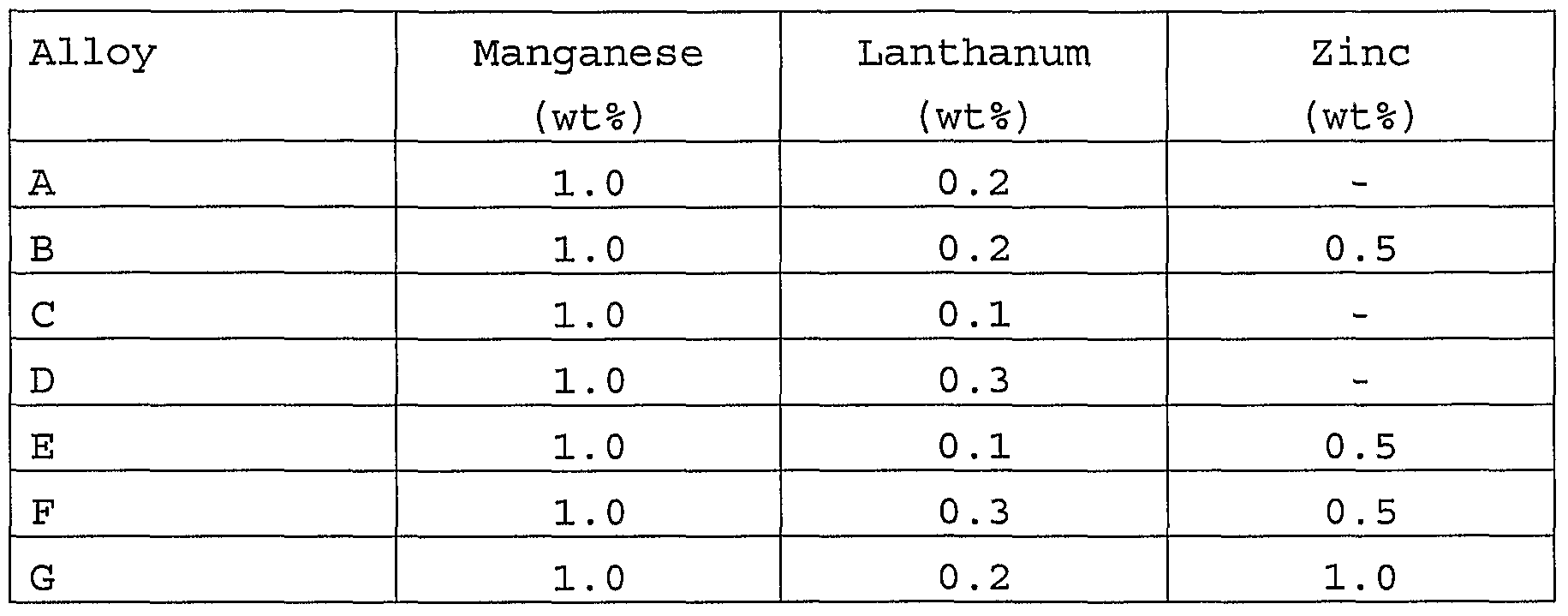
  • a number of alloys according to embodiments of the present invention were cast as 2kg billets by gravity casting. It is noted however, that other suitable casting methods such as direct chill casting may be employed. Table 1 below sets out the contents of the magnesium alloys prepared.
  • magnesium constituted the balance except for incidental impurities .
  • impurities were found to comprise approximately 0.01 wt% aluminium and less than 0.002 wt% iron in all of the alloys.
  • Figures IA and IB show the microstructure of alloys A and B as cast.
  • Alloy B which contains 0.5 wt% zinc has smaller grains than alloy A, which contains no zinc but the same amounts of manganese and lanthanum.
  • Samples of alloys A and B were subsequently extruded after being subjected to a solutionising pre- treatment in which the samples were heated at approximately 580 0 C for approximately 1 hour. The samples were extruded at different billet temperatures and ram speeds (ie. the speed, at which the alloy is extruded in mm/sec) to establish the extrusion limits of these alloys. Extrusion limits of an alloy are understood to be the limits of the speed and temperature at which the alloy can be satisfactorily extruded.
  • Figures 2A and 2B are extrusion limit diagrams of alloys A and B. It is noted that alloy A has wider extrusion limits than alloy B. It would therefore appear that adding the 0.5% zinc (alloy B) narrows the extrusion limits of the alloy. For all alloys A and B, however, Figures 2A and 2B demonstrate that they may be satisfactorily extruded at high speeds and high temperatures.
  • alloys A and B compares favourably with the industry alloys, in particular AZ31, which is the most commonly used.
  • Alloy A at least, was found to have a proof stress in tension of approximately 160-200 MPa and a proof stress in compression of 110 MPa, which may be improved by ageing of the alloy. It is noted that the proof stress in tension is dependent on the solutionising temperature and the grain size of the alloy.
  • alloys A and B were also measured following extrusion (the alloys having been subjected to a solutionising treatment prior to extrusion) at a ram speed of 15mm/sec for different billet temperatures. It was found that a lower grain size was achieved at lower extruding temperatures .
  • Sample Castings of alloys A to F were also extruded at a ram speed of 15mm/sec and 375°C following a pre-treatment of the cast billets. Different pre- treatments were carried out and the grain size of the extruded alloys measured. Each pre-treatment first involved a solutionising step in which the casting was heated at a temperature of 500 to 580 0 C.
  • Some pre- treatments further involved an ageing step in which, after quenching the heated casting, further heating of the casting at a lower temperature (approximately 35O 0 C) .
  • Table 3 below provides details of the pre-treatments carried out, and the resulting grain size of the extruded alloys . TABLE 3 - Grain Size of Extruded Alloys having undergone
  • alloys A and B that a longer homogenisation time (ie. time spent at the solutionising temperature) appears to result in finer grain sizes being obtained in the extruded alloy. It is also noted that the addition of zinc (alloy B) appears to render the alloy sensitive to aging prior to extrusion, such that finer grain sizes may be obtained by ageing magnesium-manganese-lanthanum alloys also containing zinc.
  • Figure 5 shows the stability of the microstructure of alloy A against AZ31 after compression at 350°C at a strain of 1.5, followed by annealing at the same temperature. As can be seen in Figure 5, after a 1000 seconds of annealing, the grain size of AZ31 increases from 6 microns to 25 microns, while the grain size of alloy A remains generally unchanged during this time.
  • alloy A to maintain a fine grain size is due to the lanthanum addition as the lanthanum restricts the mobility of grain boundaries during recrystalisation.
  • the stability of the grain size of the alloy means that when it is worked (ie. extruded or forged) at elevated temperatures, a small grain size is maintained during slow cooling and/or subsequent annealing.
  • solution treatment at 580 0 C did yield a slightly smaller grain size relative to the untreated billet (when the heating time was 1 hour) .
  • solution treatment at 460 0 C resulted in larger extruding grain sizes. Without wishing to be bound by theory, it is believed that this is due to particle precipitation occurring at 460°C leaving less lanthanum in solid solution to inhibit grain coarsening. It is also noted that solution treatment at 580°C enhanced the tensile ductility of the untreated alloy whereas treatment at 460°C had little or no effect on the ductility.
  • Alloys were also prepared to determine the effect of the addition of strontium to the alloy. Alloys were prepared containing (by weight) 1.0% manganese, 0.2% lanthanum and either 0.02% or 0.04% strontium with the balance magnesium except for incidental impurities. These alloys were extruded at 375°C and 15mm/s and the grain size and mechanical properties of the extruded alloys were measured. Table 6 below sets out these properties as compared to Alloy A (having 1.0% manganese, 0.2% lanthanum, 0% strontium, balance magnesium) .
  • aluminium and silicon were found to have a deleterious effect on the grain size and ductility of the alloy. Without wishing to be bound by theory, it is understood that the deleterious effect caused by aluminium and silicon is due to both aluminium and silicon readily forming Mg-Al-La and Mn-Si- La particles respectively, which are at least partially responsible for the increase in grain size because some of the lanthanum content is used up in these particles.
  • an additional benefit of a strontium addition to the alloy is that is suppresses the detrimental effect of aluminium.
  • an alloy containing (by weight) 1.0% manganese, 0.2% lanthanum, 0.5% aluminium, 0.04% strontium, with the balance magnesium except for incidental impurities was prepared and extruded at 375°C and 15mm/s. This alloy was found to have a grain size of 7.4 ⁇ m, a uniform elongation of 12.1% and a total elongation of 19.6%. This compares favourably to the alloy containing 0.5% aluminium and 0% strontium, the properties for which are set out in Table 8 above .

Landscapes

  • Chemical & Material Sciences (AREA)
  • Engineering & Computer Science (AREA)
  • Mechanical Engineering (AREA)
  • Materials Engineering (AREA)
  • Metallurgy (AREA)
  • Organic Chemistry (AREA)
  • Physics & Mathematics (AREA)
  • Thermal Sciences (AREA)
  • Crystallography & Structural Chemistry (AREA)
  • Extrusion Of Metal (AREA)
  • Forging (AREA)

Abstract

A magnesium-based alloy consisting of, by weight: 0.5 to 1.5% manganese, 0.05 to 0.5% rare earth of which more than 70% is lanthanum, 0 to 1.5% zinc and 0 to 0.1% strontium, the balance being magnesium except for incidental impurities.

Description

Field of the Invention
The present invention relates to a magnesium alloy, in particular to a wrought magnesium alloy. A wrought alloy is an alloy which has the potential to be worked into a shape or condition after casting. The present invention also relates to a method of manufacturing a wrought magnesium alloy article.
Summary of the Invention According to a first aspect of the present invention, there is provided a magnesium-based alloy consisting of, by weight:
0.5 to 1.5% manganese, 0.05 to 0.5% lanthanum, 0 to 1.5% zinc, and
0 to 0.1% strontium the balance being magnesium except for incidental impurities .
According to a second aspect of the present invention, there is provided a magnesium-based alloy consisting of, by weight:
0.5 to 1.5% manganese,
0.05 to 0.5% rare earth of which more than 70% is lanthanum, 0 to 1.5% zinc and
0 to 0.1% strontium, the balance being magnesium except for incidental impurities .
Preferably more than 80% of the rare earth content is lanthanum, more preferably more than 90%. The rare earth content may be 100% lanthanum, less any incidental impurities.
Preferably the rare earth content is at least 0.1, more preferably at least 0.2%, preferably no more than 0.4%, preferably no more than 0.3%. The rare earth content may be greater than 0.25%.
The rare earth content may be added as a "misch metal" which is understood to comprise an amount of at least two of the rare earth elements .
Throughout the specification, "rare earth" and "rare earth elements" is understood to mean any of the elements with atomic numbers 57 (lanthanum) through 71 (lutetium) ,
In addition to lanthanum, the rare earth content may also comprise cerium. The cerium content is less than the lanthanum content. The rare earth content may also comprise praseodymium and/or neodymium, typically only in small amounts (<5% of the total rare earth content) .
Preferably, the lanthanum content of the alloy is 0.05 to 0.5%, more preferably at least 0.09%, more preferably at least 0.1%, more preferably at least 0.15%, preferably no more than 0.4%, more preferably no more than 0.3%. The lanthanum content of the alloy may be greater than 0.25%.
Preferably, the manganese content is greater than 0.6%, more preferably less than 1.3%, more preferably 0.7 to 1.2%, and most preferably about 1%.
Zinc is an optional component of the alloy, which may be added to strengthen the alloy. When present, the zinc content is preferably less than 1.3%, more preferably 0.2 to 1.3%, more preferably 0.2 to 1.1%, more preferably 0.4 to 1.1%, and most preferably 0.5 to 1.0%.
Incidental impurities may comprise aluminium and silicon. The weight of aluminium in the alloy is preferably no greater than 0.03%. The weight of silicon in the alloy is preferably no greater than 0.03%.
Strontium is an optional component of the alloy, which may be added to strengthen the alloy. When present, the strontium content is preferably greater than 0.01%, preferably no more than 0.1%, more preferably about 0.02%. According to a third aspect of the present invention, there is provided a wrought magnesium alloy article comprising an amount of an alloy according to the first or second aspect of the present invention which has been worked into a shape or condition.
According to a fourth aspect of the present invention, there is provided a method of manufacturing a wrought magnesium alloy article, the method comprising the steps of:
(a) heating a casting of a magnesium-based alloy at a first temperature for a first period of time,
(b) cooling the casting, and (c) working the casting into a shape or condition.
Step (c) may comprise extruding, forging or any other type of working of the casting.
The method may also comprise the step of : (d) ageing the casting at a second temperature for a second period of time, after step (b) and prior to step (c) .
Preferably, the first temperature is 450°C - 650°C, more preferably 540°C - 580°C. Preferably, the first period of time is 0.5 - 6 hours, more preferably 1 - 5 hours.
Preferably, the second temperature is 300°C - 400°C, more preferably 325°C - 3750C.
Preferably, the second period of time is 2 - 24 hours, more preferably 5 - 16 hours.
According to a fifth aspect of the present invention, there is provided a method of manufacturing a wrought magnesium alloy article, the method comprising the steps of: (a) heating a worked casting of a magnesium- based alloy at a first temperature for a first period of time;
(b) cooling the worked casting,- and
(c) re-working the casting into a shape or condition.
Step (c) may comprise extruding, forging or any other type of working of the casting. - A -
The method may also comprise the step of:
(d) ageing the worked casting at a second temperature for a second period of time, after step (b) and prior to step (c) . Preferably the first temperature is 450°C-650°C, more preferably 540°C-580°C.
Preferably, the first period of time is 6-20 hours, more preferably 8-14 hours, most preferably 12 hours . Preferably, the second temperature is 3000C-
400°C, more preferably 325°C-375°C.
Preferably, the second period of time is 2-24 hours, preferably 5-16 hours.
The following embodiments may be incorporated into the fourth or fifth aspects of the present invention:
Preferably, the magnesium-based alloy may be any magnesium-based alloy which is amenable to precipitation.
In an embodiment, the magnesium-based alloy may be the alloy according to the first or second aspect of the present invention.
In another embodiment, the magnesium-based alloy consists of, by weight:
0.5 to 1.5% manganese,
0.05 to 0.5% rare earths, 0 to 1.5% zinc, and
0 to 0.1% strontium the balance being magnesium except for incidental impurities.
Preferably, the rare earth content is 0.1 to 0.5%, more preferably 0.2 to 0.5%, more preferably, 0.3 to
0.5%, most preferably about 0.4%.
In an embodiment, the rare earth content is provided by a "misch metal" .
Preferably, the rare earth content comprises at least lanthanum.
Preferably, the rare earth content also comprises cerium. Detailed Description of Preferred Embodiments
A number of alloys according to embodiments of the present invention were cast as 2kg billets by gravity casting. It is noted however, that other suitable casting methods such as direct chill casting may be employed. Table 1 below sets out the contents of the magnesium alloys prepared.
TABLE 1 - Alloys Prepared
Figure imgf000006_0001
In each of alloys A to G, magnesium constituted the balance except for incidental impurities . Upon chemical analysis, impurities were found to comprise approximately 0.01 wt% aluminium and less than 0.002 wt% iron in all of the alloys.
Figures IA and IB show the microstructure of alloys A and B as cast. Alloy B, which contains 0.5 wt% zinc has smaller grains than alloy A, which contains no zinc but the same amounts of manganese and lanthanum. v Samples of alloys A and B were subsequently extruded after being subjected to a solutionising pre- treatment in which the samples were heated at approximately 5800C for approximately 1 hour. The samples were extruded at different billet temperatures and ram speeds (ie. the speed, at which the alloy is extruded in mm/sec) to establish the extrusion limits of these alloys. Extrusion limits of an alloy are understood to be the limits of the speed and temperature at which the alloy can be satisfactorily extruded. At high billet temperatures, cracking may occur in the extruded alloy if the ram speed is too high. Furthermore, at low temperatures, the maximum ram speed at which the alloy may be extruded is limited by the load capacity of the extrusion press, such that at a certain low temperature, the alloy is not extrudable at all.
Figures 2A and 2B are extrusion limit diagrams of alloys A and B. It is noted that alloy A has wider extrusion limits than alloy B. It would therefore appear that adding the 0.5% zinc (alloy B) narrows the extrusion limits of the alloy. For all alloys A and B, however, Figures 2A and 2B demonstrate that they may be satisfactorily extruded at high speeds and high temperatures. Figure 3, for example, shows the extrusion limit windows for a number of industry common alloys, AZ31, ZK60, AZβl and ZM21 which have the following nominal compositions :
Table 2
Figure imgf000007_0001
It can be seen from Figure 3 that alloys A and B compares favourably with the industry alloys, in particular AZ31, which is the most commonly used.
The effect of the lanthanum addition on the extrudability on the alloy was also considered by preparation and extruding alloy H which contained (by weight) 1% manganese, 0.2% rare earth as a misch metal (consisting of 0.13% cerium and 0.07% lanthanum), with the balance magnesium except for incidental impurities. Figure 4 provides an extrusion limit diagram which compares alloy H to alloy A. Figure 4 demonstrates that alloy A has improved extrudability over alloy H. Without wishing to be bound by theory it is believed that the improved extrudability of alloy A (over alloy H) is due to the lanthanum addition not lowering the solidus temperature nor increasing the hot working flow stress as much as the misch metal addition consisting predominantly of cerium.
Alloy A, at least, was found to have a proof stress in tension of approximately 160-200 MPa and a proof stress in compression of 110 MPa, which may be improved by ageing of the alloy. It is noted that the proof stress in tension is dependent on the solutionising temperature and the grain size of the alloy.
The grain size of alloys A and B was also measured following extrusion (the alloys having been subjected to a solutionising treatment prior to extrusion) at a ram speed of 15mm/sec for different billet temperatures. It was found that a lower grain size was achieved at lower extruding temperatures . Sample Castings of alloys A to F were also extruded at a ram speed of 15mm/sec and 375°C following a pre-treatment of the cast billets. Different pre- treatments were carried out and the grain size of the extruded alloys measured. Each pre-treatment first involved a solutionising step in which the casting was heated at a temperature of 500 to 5800C. Some pre- treatments further involved an ageing step in which, after quenching the heated casting, further heating of the casting at a lower temperature (approximately 35O0C) . Table 3 below provides details of the pre-treatments carried out, and the resulting grain size of the extruded alloys . TABLE 3 - Grain Size of Extruded Alloys having undergone
Pre-treatment
Figure imgf000009_0001
Referring to Table 3, it is notable for alloys A and B that a longer homogenisation time (ie. time spent at the solutionising temperature) appears to result in finer grain sizes being obtained in the extruded alloy. It is also noted that the addition of zinc (alloy B) appears to render the alloy sensitive to aging prior to extrusion, such that finer grain sizes may be obtained by ageing magnesium-manganese-lanthanum alloys also containing zinc.
The deformation and annealing behaviour of alloy A was further assessed. Samples were machined from extrudates of alloy A which had been subjected to a pre- treatment prior to extrusion involving solutionising and ageing or just solutionising. Compression testing was conducted at a temperature of 35O0C and at a strain rate of 0. Is"1. The samples were deformed to an equivalent strain of 1.5, after which the samples were held at the deformation temperature for times ranging from 1 s to 1000 s prior to being water quenched.
No substantial change in the grain size was observed in the alloy following the deformation and annealing conditions employed. Average grain sizes of approximately 6-7μm were found in all samples, regardless of the pre-treatment undergone by the alloy prior to extrusion. By way of comparison, Figure 5 shows the stability of the microstructure of alloy A against AZ31 after compression at 350°C at a strain of 1.5, followed by annealing at the same temperature. As can be seen in Figure 5, after a 1000 seconds of annealing, the grain size of AZ31 increases from 6 microns to 25 microns, while the grain size of alloy A remains generally unchanged during this time. Without wishing to be bound by theory, it is understood that the ability of alloy A to maintain a fine grain size is due to the lanthanum addition as the lanthanum restricts the mobility of grain boundaries during recrystalisation. The stability of the grain size of the alloy means that when it is worked (ie. extruded or forged) at elevated temperatures, a small grain size is maintained during slow cooling and/or subsequent annealing. By comparison, when alloy A and AZ31 were both extruded under the same conditions (billet temperature of 370°C, extrusion speed of 6m/min) , the average grain size developed in AZ31 was three times greater than that of alloy A (23 microns compared to 7 microns) .This can also be seen in the microstuctures shown in the comparative micrographs of Figure 6. In general, however, it is shown that advantageously, lanthanum reduces the grain size of the alloy.
The effect of pretreatment of alloy A was further studied by measuring the electrical resistivity of the alloy during heat treatments of increasing time and at temperatures ranging from 4600C to 5800C. Generally, it is understood that resistivity will decrease during precipitation (at lower temperatures) and will increase as precipitates are dissolved (at higher temperatures) . Figure 7 shows the change in resistivity for the increase in heat treatment times at the various temperatures . It can be seen from Figure 7 that the resistivity remains fairly constant at intermediate temperatures, but increases at 5800C possibly due to the dissolving of precipitates and decreases at 46O0C possibly due to precipitation and/or to the coarsening of precipitates already present in the alloy from casting.
To determine whether these results for the resistivity indicated an important microstructural change in the alloy, billets of alloy A were heat treated at 58O0C and 4600C for times of 1 and 4 hours, and then extruded at 3750C and 15mm/s. Table 4 below sets out the resultant grain sizes and tensile elongations (both uniform and total) in comparison to an as-cast billet which was extruded under the same conditions (i.e. did not undergo heat treatment) .
TABLE 4
Figure imgf000011_0001
As indicated in Table 4, the solution treatment at 5800C did yield a slightly smaller grain size relative to the untreated billet (when the heating time was 1 hour) . However, solution treatment at 4600C resulted in larger extruding grain sizes. Without wishing to be bound by theory, it is believed that this is due to particle precipitation occurring at 460°C leaving less lanthanum in solid solution to inhibit grain coarsening. It is also noted that solution treatment at 580°C enhanced the tensile ductility of the untreated alloy whereas treatment at 460°C had little or no effect on the ductility.
The effect of solution treatment on extruded alloys (as opposed to as cast alloys) followed by a second extrusion step was also conducted. Electrical resistivity measurements were taken on wrought billets of alloy A after they had been subjected to solution treatment at 58O0C for increasing times. Billets were machined from industrial scale extruded rods of alloy A. Figure 8 shows the change of electrical resistivity for increasing solution treatment times . As indicated by Figure 8 , the electrical resistivity increased for solution treating times of up to 12 hours, after which it was substantially constant. It therefore appears that a longer solution treatment time is required for alloy which has already been extruded compared to as cast alloys . The solution treated billets were subsequently extruded at 375°C at 15mm/s. Table 5 below sets out the grain sizes for the billets.
TABLE 5
Figure imgf000012_0001
It can be seen from Table 5 that with increasing solution treatment time, the extruded grain size is reduced. Alloys were also prepared to determine the effect of the addition of strontium to the alloy. Alloys were prepared containing (by weight) 1.0% manganese, 0.2% lanthanum and either 0.02% or 0.04% strontium with the balance magnesium except for incidental impurities. These alloys were extruded at 375°C and 15mm/s and the grain size and mechanical properties of the extruded alloys were measured. Table 6 below sets out these properties as compared to Alloy A (having 1.0% manganese, 0.2% lanthanum, 0% strontium, balance magnesium) .
TABLE 6
Figure imgf000013_0001
As shown in Table 6, a strengthening effect was observed for the 0.02% strontium addition but not for the 0.04% strontium addition.
Pre-treatment of other magnesium-based alloys prior to extrusion was also trialled. In one trial, samples of a magnesium-manganese-rare earth alloy (Alloy I) were pretreated using various solutionising and ageing processes. Alloy I contained 1 wt % manganese, 0.27 wt % cerium and 0.13 wt % lanthanum, with the balance magnesium except for incidental impurities. The cerium and lanthanum were added to Alloy I as a "misch-metal" . It was found that both solutionising and solutionising and ageing this alloy prior to extruding resulted in an extruded alloy which had finer grain sizes. Table 6 shows the results of this trial below. TABLE 7 - Grain Size of Extruded Alloy having undergone
Pre-treatment
Figure imgf000014_0001
Trials were also conducted to study the effects of aluminium and silicon on wrought magnesium alloys. Aluminium and silicon are incidental impurities in any such alloys. Magnesium based alloys consisting of 1.0% manganese and 0.2% lanthanum were prepared with differing amounts of aluminium and silicon as set out in Table 8 below, and extruded at 375°C and 15 mm/s.
TABLE 8
Figure imgf000014_0002
As can be seen from Table 8 , aluminium and silicon were found to have a deleterious effect on the grain size and ductility of the alloy. Without wishing to be bound by theory, it is understood that the deleterious effect caused by aluminium and silicon is due to both aluminium and silicon readily forming Mg-Al-La and Mn-Si- La particles respectively, which are at least partially responsible for the increase in grain size because some of the lanthanum content is used up in these particles.
It has been found that an additional benefit of a strontium addition to the alloy is that is suppresses the detrimental effect of aluminium. By way of example, an alloy containing (by weight) 1.0% manganese, 0.2% lanthanum, 0.5% aluminium, 0.04% strontium, with the balance magnesium except for incidental impurities was prepared and extruded at 375°C and 15mm/s. This alloy was found to have a grain size of 7.4μm, a uniform elongation of 12.1% and a total elongation of 19.6%. This compares favourably to the alloy containing 0.5% aluminium and 0% strontium, the properties for which are set out in Table 8 above .
In the claims which follow and in the preceding description of the invention, except where the context requires otherwise due to express language or necessary implication, the word "comprise" or variations such as
"comprises" or "comprising" is used in an inclusive sense, ie . to specify the presence of the stated features but not to preclude the presence or addition of further features in various embodiments of the invention.
Claims

1. A magnesium-based alloy consisting of, by weight: 0.5 to 1.5% manganese , 0.05 to 0.5% rare earth of which more than 70% is lanthanum,
0 to 1.5% zinc and 0 to 0.1% strontium, the balance being magnesium except for incidental impurities.
2. A magnesium based alloy as claimed in claim 1, wherein more than 80% of the rare earth content is lanthanum.
3. A magnesium based alloy as claimed in claim 1, wherein more than 90% of the rare earth content is lanthanum.
4. A magnesium based alloy as claimed in claim 1, wherein 100% of the rare earth content is lanthanum, less any incidental impurities.
5. A magnesium based alloy as claimed in any one of the preceding claims, wherein the alloy consists of 0.1 -
0.3% rare earth.
6. A magnesium based alloy as claimed in any one of the preceding claims, wherein the alloy consists of greater than 0.25% rare earth.
7. A magnesium based alloy as claimed in any one of the preceding claims, wherein the lanthanum content of the alloy is at least 0.09%.
8. A magnesium based alloy as claimed in any one of the preceding claims, wherein the lanthanum content of the alloy is 0 . 1 - 0 . 3 % .
9. A magnesium based alloy as claimed in any one of the preceding claims, wherein the lanthanum content of the alloy is greater than 0.25%.
10. A magnesium based alloy as claimed in any one of the preceding claims, wherein the manganese content is greater than 0.6% and less than 1.3%.
11. A magnesium based alloy as claimed in any one of the preceding claims, wherein the zinc content is 0.2 to 1.3%.
12. A magnesium based alloy as claimed in any one of the preceding claims, wherein the strontium content is greater than 0.01%.
13. A magnesium based alloy as claimed in any one of the preceding claims, wherein the strontium content is approximately 0.02%.
14. A magnesium based alloy as claimed in any one of the preceding claims, wherein the incidental impurities comprise aluminium at no greater than 0.03% of the alloy.
15. A magnesium based alloy as claimed in any one of the preceding claims, wherein the incidental impurities comprise silicon at no greater than 0.03% of the alloy.
16. A magnesium-based alloy consisting of, by weight: 0.5 to 1.5% manganese,
0.05 to 0.5% lanthanum, 0 to 1.5% zinc, and 0 to 0.1% strontium the balance being magnesium except for incidental impurities .
17. A magnesium-based alloy consisting of, by weight: 0.5 to 1.5% manganese,
0.05 to 0.5% rare earth of which more than 70% is lanthanum,
0 to 1.5% zinc, 0 to 0.1% strontium, no greater than 0.03% aluminium, and no greater than 0.03% silicon, the balance being magnesium except for incidental impurities .
18. A wrought magnesium alloy article comprising an amount of an alloy as claimed in any one of the preceding claims, which has been worked into a shape or condition.
19. A method of manufacturing a wrought magnesium alloy article, the method comprising the steps of:
(a) heating a casting of a magnesium-based alloy at a first temperature for a first period of time,
(b) cooling the casting, and
(c) working the casting into a shape or condition.
20. A method of manufacturing a wrought magnesium alloy article, the method comprising the steps of:
(a) heating a worked casting of a magnesium- based alloy at a first temperature for a first period of time; (b) cooling the worked casting; and
(c) re-working the casting into a shape or condition.
21. A method as claimed in either claim 19 or 20, wherein the method also comprises the step of:
(d) ageing the casting at a second temperature for a second period of time, after step (b) and prior to step (c) .
22. A method as claimed in any one of claims 19-21, wherein the first temperature is 450°C - 6500C.
23. A method as claimed in any one of claims 19-21, wherein the first temperature is 54O0C - 58O0C.
24. A method as claimed in claim 19, wherein the first period of time is 0.5 - 6 hours.
25. A method as claimed in claim 20, wherein the first period of time is 6 - 20 hours.
26. A method as claimed in claim 21, wherein, the second temperature is 3000C - 4000C.
27. A method as claimed in either claim 21 or 26, wherein the second period of time is 2 - 24 hours .
28. A method as claimed in any one of claims 19-27, wherein the magnesium-based alloy is any magnesium-based alloy which is amenable to precipitation.
29. A method as claimed in any one of claims 19-27, wherein the magnesium-based alloy is the alloy as claimed in any one of claims 1-17.
30. A method as claimed in any one of claims 19-27, wherein the magnesium-based alloy consists of, by weight: 0.5 to 1.5% manganese, 0.05 to 0.5% rare earths, 0 to 1.5% zinc, and 0 to 0.1% strontium the balance being magnesium except for incidental impurities .
PCT/AU2008/001285 2007-08-31 2008-08-29 Wrought magnesium alloy Ceased WO2009026652A1 (en)

Priority Applications (5)

Application Number Priority Date Filing Date Title
EP08783030.3A EP2183399B1 (en) 2007-08-31 2008-08-29 Wrought magnesium alloy
US12/674,120 US20110272069A1 (en) 2007-08-31 2008-08-29 Wrought magnesium alloy
CN200880104238A CN101815801A (en) 2007-08-31 2008-08-29 wrought magnesium alloy
JP2010522132A JP5525444B2 (en) 2007-08-31 2008-08-29 Magnesium-based alloy and method for producing the same
US14/613,234 US9745647B2 (en) 2007-08-31 2015-02-03 Wrought magnesium alloy

Applications Claiming Priority (2)

Application Number Priority Date Filing Date Title
AU2007904722 2007-08-31
AU2007904722A AU2007904722A0 (en) 2007-08-31 Wrought magnesium alloy

Related Child Applications (2)

Application Number Title Priority Date Filing Date
US12/674,120 A-371-Of-International US20110272069A1 (en) 2007-08-31 2008-08-29 Wrought magnesium alloy
US14/613,234 Continuation US9745647B2 (en) 2007-08-31 2015-02-03 Wrought magnesium alloy

Publications (1)

Publication Number Publication Date
WO2009026652A1 true WO2009026652A1 (en) 2009-03-05

Family

ID=40386583

Family Applications (1)

Application Number Title Priority Date Filing Date
PCT/AU2008/001285 Ceased WO2009026652A1 (en) 2007-08-31 2008-08-29 Wrought magnesium alloy

Country Status (5)

Country Link
US (2) US20110272069A1 (en)
EP (1) EP2183399B1 (en)
JP (1) JP5525444B2 (en)
CN (2) CN104694804A (en)
WO (1) WO2009026652A1 (en)

Cited By (3)

* Cited by examiner, † Cited by third party
Publication number Priority date Publication date Assignee Title
JP2011042847A (en) * 2009-08-24 2011-03-03 Peter Stolfig Magnesium alloy
US20120143318A1 (en) * 2009-06-19 2012-06-07 Manfred Gulcher Implant made of a metallic material which can be resorbed by the body
CN113293329A (en) * 2020-02-21 2021-08-24 宝山钢铁股份有限公司 Low-cost high-strength high-heat-conductivity magnesium alloy material and manufacturing method thereof

Families Citing this family (3)

* Cited by examiner, † Cited by third party
Publication number Priority date Publication date Assignee Title
CN105525172A (en) 2014-11-13 2016-04-27 比亚迪股份有限公司 Magnesium alloy as well as preparation method thereof and application thereof
JP6607464B2 (en) * 2015-04-08 2019-11-20 バオシャン アイアン アンド スティール カンパニー リミテッド Formable magnesium-type wrought alloy
CN108677073A (en) * 2018-09-03 2018-10-19 重庆大学 A kind of high-strength wrought magnesium alloys and preparation method thereof

Citations (4)

* Cited by examiner, † Cited by third party
Publication number Priority date Publication date Assignee Title
US2270190A (en) * 1940-06-15 1942-01-13 Dow Chemical Co Magnesium base alloy
GB858200A (en) * 1958-07-24 1961-01-11 Magnesium Elektron Ltd Improvements in or relating to magnesium base alloys containing manganese
US3157496A (en) * 1962-09-13 1964-11-17 Dow Chemical Co Magnesium base alloy containing small amounts of rare earth metal
GB1463609A (en) * 1974-12-30 1977-02-02 Magnesium Elektron Ltd Magnesium alloys

Family Cites Families (5)

* Cited by examiner, † Cited by third party
Publication number Priority date Publication date Assignee Title
US2221254A (en) * 1939-11-13 1940-11-12 Dow Chemical Co Magnesium base alloy
JP3509163B2 (en) * 1993-02-12 2004-03-22 マツダ株式会社 Manufacturing method of magnesium alloy member
DE19915276A1 (en) * 1999-04-03 2000-10-05 Volkswagen Ag Production of a magnesium alloy used e.g. in the manufacture of gear housing comprises extruding the alloy with a specified deforming degree
AUPS311202A0 (en) * 2002-06-21 2002-07-18 Cast Centre Pty Ltd Creep resistant magnesium alloy
JP4433916B2 (en) * 2004-07-13 2010-03-17 株式会社豊田中央研究所 Magnesium alloy and magnesium alloy member for plastic working

Patent Citations (4)

* Cited by examiner, † Cited by third party
Publication number Priority date Publication date Assignee Title
US2270190A (en) * 1940-06-15 1942-01-13 Dow Chemical Co Magnesium base alloy
GB858200A (en) * 1958-07-24 1961-01-11 Magnesium Elektron Ltd Improvements in or relating to magnesium base alloys containing manganese
US3157496A (en) * 1962-09-13 1964-11-17 Dow Chemical Co Magnesium base alloy containing small amounts of rare earth metal
GB1463609A (en) * 1974-12-30 1977-02-02 Magnesium Elektron Ltd Magnesium alloys

Non-Patent Citations (2)

* Cited by examiner, † Cited by third party
Title
AMERICAN SOCIETY FOR METALS, METALS HANDBOOK: V. 4 HEAT TREATMENT, 1981, pages 744 - 754, ISBN: 0-87170-010-7 *
See also references of EP2183399A4 *

Cited By (4)

* Cited by examiner, † Cited by third party
Publication number Priority date Publication date Assignee Title
US20120143318A1 (en) * 2009-06-19 2012-06-07 Manfred Gulcher Implant made of a metallic material which can be resorbed by the body
US8888842B2 (en) * 2009-06-19 2014-11-18 Qualimed Innovative Medizin-Produkte Gmbh Implant made of a metallic material which can be resorbed by the body
JP2011042847A (en) * 2009-08-24 2011-03-03 Peter Stolfig Magnesium alloy
CN113293329A (en) * 2020-02-21 2021-08-24 宝山钢铁股份有限公司 Low-cost high-strength high-heat-conductivity magnesium alloy material and manufacturing method thereof

Also Published As

Publication number Publication date
US20150218680A1 (en) 2015-08-06
EP2183399A1 (en) 2010-05-12
US20110272069A1 (en) 2011-11-10
CN104694804A (en) 2015-06-10
US9745647B2 (en) 2017-08-29
EP2183399A4 (en) 2011-09-07
JP5525444B2 (en) 2014-06-18
JP2010537052A (en) 2010-12-02
CN101815801A (en) 2010-08-25
EP2183399B1 (en) 2013-04-10

Similar Documents

Publication Publication Date Title
Liu et al. Effects of ageing treatment on microstructures and properties of Mg–Gd–Y–Zr alloys with and without Zn additions
Mandal et al. Influence of micro-alloying with silver on microstructure and mechanical properties of Al-Cu alloy
CN102011037B (en) Rare earth Er microalloyed Al-Zn-Mg-Cu alloy and preparation method thereof
WO2016161566A1 (en) Strain-induced age strengthening in dilute magnesium alloy sheets
US20170107599A1 (en) New high pressure die casting aluminum alloy for high temperature and corrosive applications
US9745647B2 (en) Wrought magnesium alloy
WO2016161565A1 (en) Formable magnesium based wrought alloys
US20100224289A1 (en) Methods of enhancing mechanical properties of aluminum alloy high pressure die castings
EP2714954A2 (en) Aluminum alloys
EP3656884B1 (en) Magnesium-based alloy wrought product and method for producing same
EP4141136A1 (en) Magnesium alloy, magnesium alloy plate, magnesium alloy rod, methods for producing these, and magnesium alloy member
WO2013073575A1 (en) Aluminum alloy wire for use in bolts, bolt, and manufacturing method of these.
EP3548643A1 (en) Ecae materials for high strength aluminum alloys
US9677158B2 (en) Aluminum alloy suitable for high pressure die casting
JPWO2019013226A1 (en) Magnesium-based alloy wrought material and method for producing the same
JP6489576B2 (en) Method for producing a magnesium-based alloy extension material
Ji et al. Microstructural characteristics and paint-bake response of Al-Mg-Si-Cu alloy
CN103889746B (en) Casting
JP2016017183A (en) Magnesium-based alloy malleable material and manufacturing method therefor
Neh et al. Substitution of rare earth elements in hot rolled magnesium alloys with improved mechanical properties
US11186899B2 (en) Magnesium-zinc-manganese-tin-yttrium alloy and method for making the same
RU2581953C1 (en) HIGH-STRENGTH ALUMINIUM-BASED DEFORMABLE ALLOY OF Al-Zn-Mg-Cu SYSTEM WITH LOW DENSITY AND ARTICLE MADE THEREFROM
JP2022506542A (en) 2XXX Aluminum Lithium Alloy
WO2023041557A1 (en) Heat treatable aluminium alloy with improved mechanical properties and method for producing it
RU2497971C1 (en) MODIFYING ALLOYING BAR Al-Sc-Zr

Legal Events

Date Code Title Description
WWE Wipo information: entry into national phase

Ref document number: 200880104238.1

Country of ref document: CN

121 Ep: the epo has been informed by wipo that ep was designated in this application

Ref document number: 08783030

Country of ref document: EP

Kind code of ref document: A1

ENP Entry into the national phase

Ref document number: 2010522132

Country of ref document: JP

Kind code of ref document: A

WWE Wipo information: entry into national phase

Ref document number: 2008783030

Country of ref document: EP

NENP Non-entry into the national phase

Ref country code: DE