WO2009030747A1 - Derivatives of n-phenylacetamide, inhibitors of the enzyme soat-1, and pharmaceutical and cosmetic compositions containing them - Google Patents

Derivatives of n-phenylacetamide, inhibitors of the enzyme soat-1, and pharmaceutical and cosmetic compositions containing them Download PDF

Info

Publication number
WO2009030747A1
WO2009030747A1 PCT/EP2008/061773 EP2008061773W WO2009030747A1 WO 2009030747 A1 WO2009030747 A1 WO 2009030747A1 EP 2008061773 W EP2008061773 W EP 2008061773W WO 2009030747 A1 WO2009030747 A1 WO 2009030747A1
Authority
WO
WIPO (PCT)
Prior art keywords
dioxo
acetamide
diazaspiro
dec
diisopropylphenyl
Prior art date
Legal status (The legal status is an assumption and is not a legal conclusion. Google has not performed a legal analysis and makes no representation as to the accuracy of the status listed.)
Ceased
Application number
PCT/EP2008/061773
Other languages
French (fr)
Inventor
Thibaud Portal
Laurence Dumais
Jérôme AUBERT
Laurent Lamy
Current Assignee (The listed assignees may be inaccurate. Google has not performed a legal analysis and makes no representation or warranty as to the accuracy of the list.)
Galderma Research and Development SNC
Original Assignee
Galderma Research and Development SNC
Priority date (The priority date is an assumption and is not a legal conclusion. Google has not performed a legal analysis and makes no representation as to the accuracy of the date listed.)
Filing date
Publication date
Application filed by Galderma Research and Development SNC filed Critical Galderma Research and Development SNC
Priority to JP2010523511A priority Critical patent/JP2010538045A/en
Priority to EP08803742.9A priority patent/EP2197850B1/en
Priority to CA2698299A priority patent/CA2698299A1/en
Priority to BRPI0815455A priority patent/BRPI0815455C1/en
Priority to ES08803742T priority patent/ES2424659T3/en
Publication of WO2009030747A1 publication Critical patent/WO2009030747A1/en
Priority to US12/718,239 priority patent/US8044082B2/en
Anticipated expiration legal-status Critical
Ceased legal-status Critical Current

Links

Classifications

    • CCHEMISTRY; METALLURGY
    • C07ORGANIC CHEMISTRY
    • C07DHETEROCYCLIC COMPOUNDS
    • C07D235/00Heterocyclic compounds containing 1,3-diazole or hydrogenated 1,3-diazole rings, condensed with other rings
    • C07D235/02Heterocyclic compounds containing 1,3-diazole or hydrogenated 1,3-diazole rings, condensed with other rings condensed with carbocyclic rings or ring systems
    • AHUMAN NECESSITIES
    • A61MEDICAL OR VETERINARY SCIENCE; HYGIENE
    • A61KPREPARATIONS FOR MEDICAL, DENTAL OR TOILETRY PURPOSES
    • A61K8/00Cosmetics or similar toiletry preparations
    • A61K8/18Cosmetics or similar toiletry preparations characterised by the composition
    • A61K8/30Cosmetics or similar toiletry preparations characterised by the composition containing organic compounds
    • A61K8/49Cosmetics or similar toiletry preparations characterised by the composition containing organic compounds containing heterocyclic compounds
    • A61K8/494Cosmetics or similar toiletry preparations characterised by the composition containing organic compounds containing heterocyclic compounds with more than one nitrogen as the only hetero atom
    • A61K8/4946Imidazoles or their condensed derivatives, e.g. benzimidazoles
    • AHUMAN NECESSITIES
    • A61MEDICAL OR VETERINARY SCIENCE; HYGIENE
    • A61PSPECIFIC THERAPEUTIC ACTIVITY OF CHEMICAL COMPOUNDS OR MEDICINAL PREPARATIONS
    • A61P17/00Drugs for dermatological disorders
    • AHUMAN NECESSITIES
    • A61MEDICAL OR VETERINARY SCIENCE; HYGIENE
    • A61PSPECIFIC THERAPEUTIC ACTIVITY OF CHEMICAL COMPOUNDS OR MEDICINAL PREPARATIONS
    • A61P17/00Drugs for dermatological disorders
    • A61P17/04Antipruritics
    • AHUMAN NECESSITIES
    • A61MEDICAL OR VETERINARY SCIENCE; HYGIENE
    • A61PSPECIFIC THERAPEUTIC ACTIVITY OF CHEMICAL COMPOUNDS OR MEDICINAL PREPARATIONS
    • A61P17/00Drugs for dermatological disorders
    • A61P17/08Antiseborrheics
    • AHUMAN NECESSITIES
    • A61MEDICAL OR VETERINARY SCIENCE; HYGIENE
    • A61PSPECIFIC THERAPEUTIC ACTIVITY OF CHEMICAL COMPOUNDS OR MEDICINAL PREPARATIONS
    • A61P17/00Drugs for dermatological disorders
    • A61P17/10Anti-acne agents
    • AHUMAN NECESSITIES
    • A61MEDICAL OR VETERINARY SCIENCE; HYGIENE
    • A61PSPECIFIC THERAPEUTIC ACTIVITY OF CHEMICAL COMPOUNDS OR MEDICINAL PREPARATIONS
    • A61P25/00Drugs for disorders of the nervous system
    • A61P25/28Drugs for disorders of the nervous system for treating neurodegenerative disorders of the central nervous system, e.g. nootropic agents, cognition enhancers, drugs for treating Alzheimer's disease or other forms of dementia
    • AHUMAN NECESSITIES
    • A61MEDICAL OR VETERINARY SCIENCE; HYGIENE
    • A61PSPECIFIC THERAPEUTIC ACTIVITY OF CHEMICAL COMPOUNDS OR MEDICINAL PREPARATIONS
    • A61P27/00Drugs for disorders of the senses
    • A61P27/02Ophthalmic agents
    • AHUMAN NECESSITIES
    • A61MEDICAL OR VETERINARY SCIENCE; HYGIENE
    • A61PSPECIFIC THERAPEUTIC ACTIVITY OF CHEMICAL COMPOUNDS OR MEDICINAL PREPARATIONS
    • A61P3/00Drugs for disorders of the metabolism
    • A61P3/06Antihyperlipidemics
    • AHUMAN NECESSITIES
    • A61MEDICAL OR VETERINARY SCIENCE; HYGIENE
    • A61PSPECIFIC THERAPEUTIC ACTIVITY OF CHEMICAL COMPOUNDS OR MEDICINAL PREPARATIONS
    • A61P43/00Drugs for specific purposes, not provided for in groups A61P1/00-A61P41/00
    • AHUMAN NECESSITIES
    • A61MEDICAL OR VETERINARY SCIENCE; HYGIENE
    • A61PSPECIFIC THERAPEUTIC ACTIVITY OF CHEMICAL COMPOUNDS OR MEDICINAL PREPARATIONS
    • A61P9/00Drugs for disorders of the cardiovascular system
    • A61P9/10Drugs for disorders of the cardiovascular system for treating ischaemic or atherosclerotic diseases, e.g. antianginal drugs, coronary vasodilators, drugs for myocardial infarction, retinopathy, cerebrovascula insufficiency, renal arteriosclerosis
    • AHUMAN NECESSITIES
    • A61MEDICAL OR VETERINARY SCIENCE; HYGIENE
    • A61QSPECIFIC USE OF COSMETICS OR SIMILAR TOILETRY PREPARATIONS
    • A61Q19/00Preparations for care of the skin
    • AHUMAN NECESSITIES
    • A61MEDICAL OR VETERINARY SCIENCE; HYGIENE
    • A61QSPECIFIC USE OF COSMETICS OR SIMILAR TOILETRY PREPARATIONS
    • A61Q5/00Preparations for care of the hair
    • A61Q5/02Preparations for cleaning the hair
    • CCHEMISTRY; METALLURGY
    • C07ORGANIC CHEMISTRY
    • C07DHETEROCYCLIC COMPOUNDS
    • C07D233/00Heterocyclic compounds containing 1,3-diazole or hydrogenated 1,3-diazole rings, not condensed with other rings
    • C07D233/54Heterocyclic compounds containing 1,3-diazole or hydrogenated 1,3-diazole rings, not condensed with other rings having two double bonds between ring members or between ring members and non-ring members
    • C07D233/66Heterocyclic compounds containing 1,3-diazole or hydrogenated 1,3-diazole rings, not condensed with other rings having two double bonds between ring members or between ring members and non-ring members with hetero atoms or with carbon atoms having three bonds to hetero atoms with at the most one bond to halogen, e.g. ester or nitrile radicals, directly attached to ring carbon atoms
    • C07D233/72Two oxygen atoms, e.g. hydantoin
    • C07D233/76Two oxygen atoms, e.g. hydantoin with substituted hydrocarbon radicals attached to the third ring carbon atom
    • C07D233/78Radicals substituted by oxygen atoms
    • AHUMAN NECESSITIES
    • A61MEDICAL OR VETERINARY SCIENCE; HYGIENE
    • A61KPREPARATIONS FOR MEDICAL, DENTAL OR TOILETRY PURPOSES
    • A61K9/00Medicinal preparations characterised by special physical form
    • A61K9/0012Galenical forms characterised by the site of application
    • A61K9/0014Skin, i.e. galenical aspects of topical compositions
    • AHUMAN NECESSITIES
    • A61MEDICAL OR VETERINARY SCIENCE; HYGIENE
    • A61KPREPARATIONS FOR MEDICAL, DENTAL OR TOILETRY PURPOSES
    • A61K9/00Medicinal preparations characterised by special physical form
    • A61K9/0087Galenical forms not covered by A61K9/02 - A61K9/7023
    • A61K9/0095Drinks; Beverages; Syrups; Compositions for reconstitution thereof, e.g. powders or tablets to be dispersed in a glass of water; Veterinary drenches
    • AHUMAN NECESSITIES
    • A61MEDICAL OR VETERINARY SCIENCE; HYGIENE
    • A61KPREPARATIONS FOR MEDICAL, DENTAL OR TOILETRY PURPOSES
    • A61K9/00Medicinal preparations characterised by special physical form
    • A61K9/20Pills, tablets, discs, rods
    • A61K9/2004Excipients; Inactive ingredients
    • A61K9/2022Organic macromolecular compounds
    • A61K9/205Polysaccharides, e.g. alginate, gums; Cyclodextrin
    • A61K9/2059Starch, including chemically or physically modified derivatives; Amylose; Amylopectin; Dextrin

Definitions

  • the invention relates to novel derivatives of N- phenylacetamide, inhibitors of the enzyme SOAT-I
  • the hyperproduction of sebum is, most often, associated with a skin or a scalp of greasy appearance, a cause of discomfort and a degraded appearance.
  • the hyperproduction of sebum can breed seborrhoeic dermatitis and is associated with an increased incidence or severity of acne.
  • the esters of cholesterol produced in the sebaceous gland by SOAT-I are one of the components of sebum, among several classes of lipids including the triglycerides, the esters of waxes and the squalenes, as described by Nikkari, T., in J Invest Derm 1974, 62, 257.
  • the inhibition of this enzyme or other acyltransferases can thus allow the production of sebum to be inhibited.
  • the patent US6133326 describes, in particular, the inhibition of the sebum by inhibitors of ACAT-I
  • the subject of the invention is novel derivatives of N- phenylacetamide, inhibitors of the enzyme SOAT-I, which correspond to the following general formula (I) :
  • R 1 represents a (Ci-C 6 ) alkyl group
  • R 2 represents a hydrogen, chlorine, fluorine or bromine atom, or a (Ci-C 6 ) alkyl group
  • R 3 represents a hydrogen atom, a (Ci-C 6 ) alkyl group, or a -WNR 6 R 7 group with W representing C(O), C(S) or CH 2 , R 6 representing a hydrogen atom or a (Ci-C 6 ) alkyl group and R 7 representing a hydrogen atom, a cycloalkyl group or a phenyl group,
  • R 4 and R' 4 are identical and represent a (Ci-C 6 ) alkyl group or else R 4 and R' 4 are bonded to one another and form, with the carbon atom to which they are bonded, a cycloalkyl group, - R 5 represents a group chosen from amongst:
  • Alkyl group is understood as meaning a saturated, linear or branched hydrocarbon chain. (Ci-Ci 2 ) alkyl is understood as meaning an alkyl chain comprising from 1 to 12 carbon atoms.
  • (Ci-C 6 ) alkyl is understood as meaning an alkyl chain comprising from 1 to 6 carbon atoms.
  • (Ci-C 6 ) alkyl mention may be made of the groups methyl, ethyl, n-propyl, isopropyl, n-butyl, tert- butyl, sec-butyl, pentyl, hexyl .
  • (Ci-C 4 ) alkyl is understood as meaning an alkyl chain comprising from 1 to 4 carbon atoms.
  • (Ci-C 4 ) alkyl mention may be made of the groups methyl, ethyl, n-propyl, isopropyl, n-butyl, tert-butyl and sec-butyl .
  • (Ci-C 6 ) alkoxy designates an -O- (Ci-C 6 ) alkyl group.
  • Phenoxy designates an -O-phenyl group.
  • Cycloalkyl group designates a cyclic, saturated hydrocarbon chain, comprising from 3 to 7 carbon atoms.
  • a cycloalkyl group mention may be made of the groups cyclopropyl, cyclobutyl, cyclopentyl, cyclohexyl and cycloheptyl.
  • Preferred compounds of formula (I) defined above are those in which:
  • R 1 represents a (Ci-C 4 ) alkyl group
  • R 2 represents a hydrogen, fluorine, chlorine or bromine atom or a (Ci-C 4 ) alkyl group
  • R 3 represents a hydrogen atom, a (Ci-C 4 ) alkyl group, or a -WNR 6 R 7 group with W representing C(O), C(S) or CH 2 , R 6 representing a hydrogen atom or a (Ci-C 4 ) alkyl group and R 7 representing a cycloalkyl group comprising 5, 6 or 7 carbon atoms or a phenyl group,
  • R 4 and R' 4 are identical and represent a (Ci-C 4 ) alkyl group or else R 4 and R' 4 are bonded to one another and form, with the carbon atom to which they are bonded, a cycloalkyl group comprising 5, 6 or 7 carbon atoms
  • - R 5 represents a group chosen from amongst: an unsubstituted phenyl group or phenyl substituted by one, two or three identical or different substituents chosen from amongst the atoms fluorine, chlorine and bromine and the groups (Ci-C 4 ) alkyl, trifluoromethyl, hydroxymethyl, mono-, di- and trifluoromethoxy, (Ci-C 4 ) alkoxy, phenoxy, benzyloxy, phenyl, 2-pyridyl, 3-pyridyl and 4- pyridyl,
  • n is equal to 1, 2 or 3 and Ar represents an unsubstituted phenyl group or phenyl monosubstituted by a (Ci- C 4 ) alkyl, trifluoromethyl or (Ci-C 4 ) alkoxy group, or a fluorine, chlorine or bromine atom, as well as their pharmaceutically acceptable salts, solvates or hydrates and their conformers or rotamers .
  • particularly preferred compounds are those which have one or a combination of the following characteristics: - Ri represents a methyl, ethyl or isopropyl group,
  • R 2 represents a chlorine or bromine atom or a methyl, ethyl, isopropyl or tert-butyl group
  • R 3 represents a hydrogen atom, a methyl group or a -WNR 6 R 7 group with W representing C (O) , R 6 representing a methyl group and R 7 representing a cyclohexyl group or a phenyl group,
  • R 4 and R' 4 are identical and represent an ethyl or n- propyl group, or else R 4 and R' 4 are bonded to one another and form, with the carbon atom to which they are bonded, a cyclopentyl, cyclohexyl or cycloheptyl group,
  • R 5 represents a group chosen from amongst: an unsubstituted phenyl group or phenyl substituted by one, two or three identical or different substituents chosen from amongst the atoms chlorine and fluorine, and the groups methyl, ethyl, n-butyl, trifluoromethyl, hydroxymethyl, di- and trifluoromethoxy, methoxy, phenoxy and benzyloxy, - a sec-butyl, n-propyl, n-butyl, n-pentyl, 2,2- dimethylpropyl, n-hexyl, n-heptyl, n-octyl, n- nonyl, an n-butyl group substituted in position 4 by three fluorine atoms, an n-propyl group substituted in position 3 by three fluorine atoms, an n-butyl group substituted in position 4 by a hydroxyl group, or an n-
  • R 4 and R' 4 are bonded to one another and form, with the carbon atom to which they are bonded, a cyclopentyl or cyclohexyl group;
  • R 5 represents an unsubstituted phenyl group or phenyl substituted, in the meta or para position, by a chlorine or fluorine atom, or by a methyl or methoxy group;
  • the salts of the compounds according to the invention are prepared according to techniques well known to the person skilled in the art.
  • the salts of the compounds of formula (I) according to the present invention comprise those with inorganic or organic acids which allow a suitable separation or a crystallization of the compounds of formula (I), as well as pharmaceutically acceptable salts.
  • picric acid As an appropriate acid, it is possible to mention: picric acid, oxalic acid or an optically active acid, for example a tartaric acid, a dibenzoyltartaric acid, a mandelic acid or a camphorsulphonic acid, and those which form physiologically acceptable salts, such as the hydrochloride, the hydrobromide, the sulphate, the hydrogensulphate, the dihydrogenphosphate, the maleate, the fumarate, the 2-naphthalenesulphonate and the para- toluenesulphonate, the hydrochloride being preferred.
  • an optically active acid for example a tartaric acid, a dibenzoyltartaric acid, a mandelic acid or a camphorsulphonic acid
  • physiologically acceptable salts such as the hydrochloride, the hydrobromide, the sulphate, the hydrogensulphate, the dihydrogenphosphate, the maleate, the fumarate, the 2-naphthalenesul
  • the solvates or hydrates may be obtained directly at the end of the synthesis process, the compound (I) being isolated in the form of a hydrate, for example a mono- or hemihydrate or a solvate of the reaction or purification solvent.
  • the compounds of formula (I) can be purified according to any conventional purification technique, for example by crystallization or purification by column chromatography .
  • the optical isomers of this compound are integral parts of the invention.
  • the compound of formula (I) can thus be found in the form of a pure isomer or of a mixture of isomers in any proportion.
  • Conformers are understood as meaning an element of a set of conformational stereoiomers of which each is characterized by a conformation corresponding to a distinct minimum potential energy of the molecular entity.
  • Rotamer is understood as meaning an element of an assembly of conformers resulting from a restricted rotation around a single bond.
  • the compounds of formula (I) can be prepared by addition of the imidazolidinones or imidazolidinediones of formula (1) to the chloroacetamides of formula (2) in the presence of a base, as SCHEME 1 describes and by analogy, for example, with the reactions described in Dunbar, B. et al . , Pharmazie 2005, 51 [I), 438, Pinza, M. et al., J Med Chem 1993, 36 (26), 4214, Coudert, P. et al., Pharm Acta HeIv. 1991, 66 (5-6), 155 or Usifoh, C. 0.; Arch Pharm, 2001, 334 (11), 366.
  • imidazolidinones or imidazolidinediones of general formula 1 can be prepared according to SCHEME 2 below, in which Y, R 4 , R' 4 and R 5 are as defined for the compounds of formula (I) :
  • the compounds of formula (1) are obtained starting from ketones of formula (3) .
  • the latter are first reacted with the amines or anilines of formula (4) in the presence of trimethylsilyl cyanide, in order to give the nitrile compounds of formula (5) , according, for example, to the conditions described in Matsumoto, K. et al., HeIv ChIm Acta 2005, 88 [I) , 1734-1753 or Nieto, M. J. et al . , J Comb Chem 2005, 7 (2), 258-263.
  • the hydrolysis of the nitrile function in the presence of acid for example, under the conditions described in Beths R. L. et al., J. Chem.
  • Soc, 1921, 1310 allows the primary amides of the formula (6) to be obtained.
  • the chloroacetamides of general formula (2) can be prepared according to an amidification reaction starting from anilines of formula (7) in the presence of a base and chloroacetyl chloride, for example, as described in Davion, Y. et al . , Heterocycles 2004, 63 (5), 1093 or Juaristy, E. et al., J Org Chem 1999, 64 (8), 2914, as illustrated in SCHEME 3 below in which R 1 , R 2 and R 3 are such as defined for the compounds of formula (I) :
  • anilines (7) are commercial compounds or are prepared according to techniques well known to the person skilled in the art.
  • the functional groups optionally present in the reaction intermediates used in the process can be protected, either in a permanent manner or in a temporary manner, by protective groups which ensure an unequivocal synthesis of the expected compounds.
  • the protection and deprotection reactions are carried out according to techniques well known to the person skilled in the art.
  • a temporary protective group of amines, of alcohols or of carboxylic acids is understood as meaning the protective groups such as those described in "Protective Groups in Organic Chemistry", ed McOmie J. W. F., Plenum Press, 1973, in “Protective Groups in Organic Synthesis” 2nd edition, Greene T. W. and Wuts P. G. M., ed John Wiley and Sons, 1991 and in “Protecting Groups", Kocienski P. J., 1994, Georg Thieme Verlag.
  • the compounds (I) according to the invention as well as their pharmaceutically acceptable salts, solvates and/or hydrates, have inhibitory properties on the enzyme SOAT-I. This inhibitory activity on the enzyme
  • SOAT-I is measured according to a primary enzymatic test HepG2, as described in Example 64.
  • the preferred compounds according to the present invention have a concentration allowing 50% of the response of the enzyme (IC 50 ) to be inhibited at less than or equal to
  • nM 1000 nM, preferably at less than or equal to 300 nM, advantageously at less than or equal to 100 nM, or even at 50 nM.
  • a subject of the present invention is likewise, by way of medicament, the compounds of formula (I) such as described above, as well as their pharmaceutically acceptable salts, pharmaceutically acceptable solvates and/or hydrates.
  • a subject of the present invention is the use of at least one compound of formula (I), and also its salts, pharmaceutically acceptable solvates and/or hydrates, for the manufacture of a medicament in order to prevent and/or to treat the disorders of the sebaceous gland such as hyperseborrhoea, acne, seborrheic dermatitis, atopic dermatitis or rosacea, ocular pathologies such as ocular rosacea, disorders of the meibomian gland, such as blepharitis, meibomitis, chalazion, dry eye, conjunctivitis or keratoconjunctivitis, or even pathologies such as hypercholesterolemia, arteriosclerosis or Alzheimer's disease.
  • the compounds according to the invention are particularly suited to the manufacture of a pharmaceutical composition intended for the treatment of acne.
  • the compounds according to the invention are thus suitable for use in the treatment of the pathologies listed above.
  • a subject of the present invention is likewise a pharmaceutical or cosmetic composition
  • a pharmaceutical or cosmetic composition comprising, in a physiologically acceptable carrier, at least one compound of formula (I) such as defined above, or one of its salts, pharmaceutically acceptable solvates and/or hydrates.
  • the compositions according to the invention thus comprise a physiologically acceptable carrier or at least one physiologically or pharmaceutically acceptable excipient, chosen according to the cosmetic or pharmaceutical form desired and the chosen mode of administration.
  • Carrier or physiologically acceptable medium is understood as meaning a carrier compatible with the skin, the mucosa and/or the skin appendages.
  • composition according to the invention can be effected by the enteral, parenteral, rectal, topical or ocular route.
  • pharmaceutical composition is packaged in a form suitable for application by the topical route.
  • the composition By the enteral route, the composition, more particularly the pharmaceutical composition, can be present in the form of tablets, of capsules, of coated tablets, of syrups, of suspensions, of powders, of granules, of emulsions, of microspheres or nanospheres or lipid or polymeric vesicles allowing controlled liberation.
  • the composition By the parenteral route, the composition can be present in the form of solutions or suspensions for perfusion or for injection.
  • the compounds according to the invention contain a compound according to the invention in sufficient quantity to obtain the therapeutic, prophylactic or cosmetic effects desired.
  • the compounds according to the invention are generally administered in a daily dose of approximately 0.001 mg/kg to 100 mg/kg of body weight, in 1 to 3 doses.
  • the compounds are used by the systemic route at a concentration generally between 0.001 and 10% by weight, preferably between 0.01 and 2% by weight, with respect to the weight of the composition.
  • the pharmaceutical composition according to the invention is more particularly intended for the treatment of the skin and of the mucosa and can be present in the form of ointments, of creams, of milks, of pomades, of powders, of impregnated swabs, of syndets, of solutions, of gels, of sprays, of foams, of suspensions, of lotions, of sticks, of shampoos, or of washing bases. It can likewise be present in the form of suspensions of microspheres or nanospheres or lipid or polymeric vesicles or polymeric patches and hydrogels allowing controlled liberation.
  • This composition by the topical route can be present in anhydrous form, in aqueous form - A l - or in the form of an emulsion.
  • the compounds are used by the topical route in a concentration generally of between 0.001 and 10% by weight, preferably between 0.01 and 2% by weight, with respect to the total weight of the composition.
  • the compounds of formula (I) according to the invention as well as their salts, pharmaceutically acceptable solvates and/or hydrates, likewise find application in the cosmetic field, in particular in body and hair hygiene and more particularly in order to combat or to prevent greasy skin or greasy hair or a greasy scalp.
  • a subject of the invention is thus likewise the cosmetic use of a composition
  • a composition comprising, in a physiologically acceptable carrier, at least one of the compounds of formula (I), optionally in the form of a salt, pharmaceutically acceptable solvate and/or hydrate, for body or hair hygiene.
  • the cosmetic composition according to the invention containing, in a cosmetically acceptable carrier, at least one compound of formula (I) or one of its salts, pharmaceutically acceptable solvates and/or hydrates, can be present especially in the form of a cream, of a milk, of a lotion, of a gel, of an ointment, of a pomade, of suspensions of microspheres or nanospheres or lipid or polymeric vesicles, of impregnated swabs, of solutions, of sprays, of foams, of sticks, of soaps, of shampoos or of washing bases.
  • the concentration of compound of formula (I) in the cosmetic composition is between 0.001 and 3% by weight, with respect to the total weight of the composition.
  • compositions such as previously described can moreover contain inert, or even pharmacodynamically active, additives as far as the pharmaceutical compositions are concerned, or combinations of these additives, and especially:
  • antioxidants such as ⁇ -tocopherol, butylhydroxyanisole or butylhydroxy-toluene, superoxide dismutase, ubiquinol or certain metal chelating agents;
  • - emollients hydrating agents such as glycerol, PEG 400, thiamorpholinone, and its derivatives or urea; - carotenoids and, especially, ⁇ -carotene;
  • ⁇ - ⁇ -hydroxy acids and ⁇ -ketoacids or their derivatives such as lactic, maleic, citric, glycolic, mandelic, tartaric, glyceric and ascorbic acids, and their salts, amides or esters or ⁇ -hydroxy acids or their derivatives, such as salicylic acid as well as its salts, amides or esters.
  • Examples 2 to 4 and 6 to 63 The synthesis of Examples 2 to 4 and 6 to 63 is described by the tables below.
  • the compounds are synthesized following the same procedure, replacing the starting products 1, 2 and 3 of steps a and b of Example 1 by the products mentioned in the table below.
  • the yields of these syntheses are homogeneous for the family of compounds considered.
  • Example 64 Biological tests
  • NBD-cholesterol an analogue of cholesterol whose fluorescence depends on its environment. When this is present in a polar environment, it is weakly fluorescent although in a nonpolar environment it is strongly fluorescent. Free NBD-cholesterol locates itself in the cell membranes and is weakly fluorescent in this polar environment. When the NBD-cholesterol is esterified by ACAT, the ester of NBD-cholesterol locates itself in the nonpolar lipid droplets and is in that case strongly fluorescent.
  • the method below is applied: The HepG2 cells are incubated in the presence of NBD-cholesterol (1 ⁇ g/ml) and of the compound of formula (I) to be tested in black 96-well plates with a transparent base at a rate of 30 000 cells per well. After incubation for 6 h at 37°C, under 5% CO 2 , the medium is eliminated by turning over and the cells are washed with 2 times 100 ⁇ l of PBS. After addition of 50 ⁇ l of lysis buffer (NaPO 4 10 mM, Igepal 1%) , the plates are stirred for 5 min and read in fluorescence (excitation 490 nm, emission 540 nm) on a FUSION apparatus (Perkin-Elmer) .
  • an IC 50 of 3.2 nM is obtained for the compound (I.I)
  • an IC 50 of 0.8 nM is obtained for the compound (1.7)
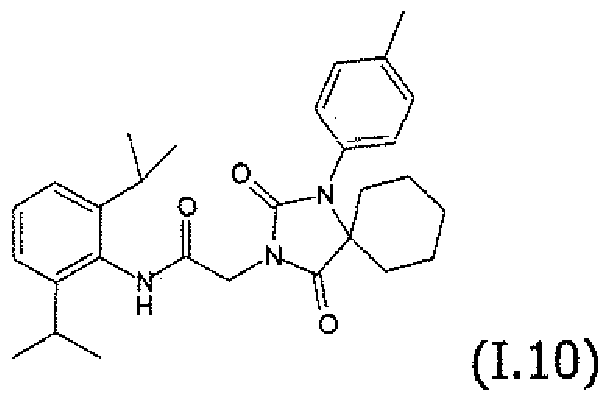
  • an IC 50 of 0.2 nM is obtained for the compound (1.10)
  • an IC 50 of 4.8 nM is obtained for the compound (1.14)
  • an IC 50 of 5.6 nM is obtained for the compound 1.23
  • an IC 50 of 2.5 nM is obtained for the compound 1.26
  • an IC 50 of 0.7 nM is obtained for the compound 1.39
  • an IC 50 of 5.1 nM is obtained for the compound 1.46)
  • Example 65 Formulations Various actual formulations based on compounds according to the invention are given below.

Landscapes

  • Health & Medical Sciences (AREA)
  • Organic Chemistry (AREA)
  • Chemical & Material Sciences (AREA)
  • Life Sciences & Earth Sciences (AREA)
  • Veterinary Medicine (AREA)
  • Public Health (AREA)
  • General Health & Medical Sciences (AREA)
  • Animal Behavior & Ethology (AREA)
  • Engineering & Computer Science (AREA)
  • Bioinformatics & Cheminformatics (AREA)
  • Chemical Kinetics & Catalysis (AREA)
  • Nuclear Medicine, Radiotherapy & Molecular Imaging (AREA)
  • Medicinal Chemistry (AREA)
  • Pharmacology & Pharmacy (AREA)
  • General Chemical & Material Sciences (AREA)
  • Dermatology (AREA)
  • Epidemiology (AREA)
  • Birds (AREA)
  • Neurosurgery (AREA)
  • Neurology (AREA)
  • Biomedical Technology (AREA)
  • Obesity (AREA)
  • Hematology (AREA)
  • Hospice & Palliative Care (AREA)
  • Diabetes (AREA)
  • Urology & Nephrology (AREA)
  • Psychiatry (AREA)
  • Ophthalmology & Optometry (AREA)
  • Vascular Medicine (AREA)
  • Cardiology (AREA)
  • Heart & Thoracic Surgery (AREA)
  • Pharmaceuticals Containing Other Organic And Inorganic Compounds (AREA)
  • Cosmetics (AREA)

Abstract

The present invention relates to compounds of Formula (I) : as well as the cosmetic and pharmaceutical compositions containing such a compound.

Description

DERIVATIVES OF N-PHENYLACETAMIDE, INHIBITORS OF THE ENZYME SOAT-1, AND PHARMACEUTICAL AND COSMETIC COMPOSITIONS CONTAINING THEM
The invention relates to novel derivatives of N- phenylacetamide, inhibitors of the enzyme SOAT-I
(Sterol-O-Acyl Transferase-1) , likewise named ACAT-I
(Acylcoenzyme A Cholesterol Acyl Transferase) . It
5 likewise relates to their use in pharmaceutical compositions intended for use in human or veterinary medicine, or else additionally in cosmetic compositions and, likewise, their non-therapeutic use.
10 The compounds having an activity of the type inhibiting SOAT-I are widely described in the literature as having activities in the regulation of biological processes involving cholesterol and its derivatives. These properties confer to this class of compounds a great
15 potential m the treatment or the prevention of numerous pathologies, and more particularly m dermatology and in cardiovascular diseases or complaints of the central nervous system. The majority of the biological effects of the inhibitors of SOAT-I
20 are mediated by the prevention of the synthesis of esters of cholesterol by the enzyme SOAT-I. Among the documents of the prior art describing molecules inhibiting SOAT-I, it is possible to mention, for example, WO96/10559, EP0370740, EP0424194, US4623663,
25 EP0557171, US5003106, EP0293880, EP0433662 and US5106873, which describe the compounds allowing arteriosclerosis or hypercholesterolemia to be treated. The therapeutic potential of inhibitors of SOAT-I m the treatment of cardiovascular diseases and,
30 in particular, of hypercholesterolemia and of arteriosclerosis is likewise described by Kharbanda R. K. et al., m Circulation, 2005, 11, 804. The potential of inhibitors of SOAT-I for the treatment of AlzheimeR's disease has likewise been reported in the
35 literature, for example, by Puglielli, L. et al., m Nature Neurosciences 2003, 6 (4), 345.
The patents US613326, US6271268 and WO2005034931 describe, with respect thereto, compounds which are inhibitors of SOAT-I allowing the production of sebum to be inhibited. In the field of dermatology in particular, it is particularly advantageous to prevent the excessive production of sebum and all the associated conditions. Sebum is produced by the sebaceous gland. The greater concentration of sebaceous glands is situated on the face, the shoulders, the back and the scalp. The sebum is secreted on the surface of the skin, where it plays a major physiological role, linked to the maintenance of the cutaneous barrier and of a microenvironment allowing the regulation of the bacterial flora and cutaneous fungus.
The hyperproduction of sebum is, most often, associated with a skin or a scalp of greasy appearance, a cause of discomfort and a degraded appearance. In addition, the hyperproduction of sebum can breed seborrhoeic dermatitis and is associated with an increased incidence or severity of acne. The esters of cholesterol produced in the sebaceous gland by SOAT-I are one of the components of sebum, among several classes of lipids including the triglycerides, the esters of waxes and the squalenes, as described by Nikkari, T., in J Invest Derm 1974, 62, 257. The inhibition of this enzyme or other acyltransferases can thus allow the production of sebum to be inhibited. The patent US6133326 describes, in particular, the inhibition of the sebum by inhibitors of ACAT-I
(likewise named SOAT-I) . Nevertheless, to date, no treatment employing such inhibitors is available commercially. The only treatments allowing the disorders linked to hyperseborrhoea to be remedied or relieved are systemic hormonal treatments or systemic treatment with 13-cis-retinoic acid, treatments whose secondary effects considerably limit their field of application. There thus exists a clear cosmetic and medical need for the treatment of complaints and pathologies linked to the hyperproduction of sebum. In this context, the present invention intends to provide novel derivatives of N-phenylacetamide which are powerful inhibitors of the enzyme SOAT-I.
The subject of the invention is novel derivatives of N- phenylacetamide, inhibitors of the enzyme SOAT-I, which correspond to the following general formula (I) :
Figure imgf000004_0001
in which:
- Y represents C(O) or CH2,
- R1 represents a (Ci-C6) alkyl group,
R2 represents a hydrogen, chlorine, fluorine or bromine atom, or a (Ci-C6) alkyl group,
- R3 represents a hydrogen atom, a (Ci-C6) alkyl group, or a -WNR6R7 group with W representing C(O), C(S) or CH2, R6 representing a hydrogen atom or a (Ci-C6) alkyl group and R7 representing a hydrogen atom, a cycloalkyl group or a phenyl group,
- R4 and R' 4 are identical and represent a (Ci-C6) alkyl group or else R4 and R' 4 are bonded to one another and form, with the carbon atom to which they are bonded, a cycloalkyl group, - R5 represents a group chosen from amongst:
- an unsubstituted phenyl group or a phenyl group substituted by one to three identical or different substituents chosen from amongst the atoms fluorine, chlorine, iodine or bromine, and the groups (Ci-C6) alkyl, hydroxymethyl, mono-, di- or trifluoromethyl, hydroxyl, phenyl, 2-pyridyl, 3- pyridyl or 4-pyridyl, (Ci-C6) alkoxy, phenoxy, benzyloxy, mono-, di- or trifluoromethoxy,
- a (Ci-Ci2) alkyl group, optionally substituted by one or more hydroxyl groups, or fluorine, chlorine, iodine or bromine atoms,
- a cycloalkyl group or a - (CH2) m-cycloalkyl group in which m is equal to 1, 2 or 3,
- an aralkyl group - (CH2) n~Ar with n equal to 1, 2 or 3 and Ar representing an unsubstituted phenyl group, unsubstituted naphthyl, or a phenyl group substituted by one to three identical or different substituents chosen from amongst the atoms fluorine, chlorine, iodine or bromine, and the groups (Ci-C6) alkyl, hydroxymethyl, mono-, di- or trifluoromethyl, hydroxyl, phenyl, 2-pyridyl, 3- pyridyl or 4-pyridyl, (Ci-C6) alkoxy, phenoxy, benzyloxy, mono-, di- or trifluoromethoxy, as well as their pharmaceutically acceptable salts, solvates or hydrates and their conformers or rotamers .
Alkyl group is understood as meaning a saturated, linear or branched hydrocarbon chain. (Ci-Ci2) alkyl is understood as meaning an alkyl chain comprising from 1 to 12 carbon atoms.
(Ci-C6) alkyl is understood as meaning an alkyl chain comprising from 1 to 6 carbon atoms. By way of example of (Ci-C6) alkyl, mention may be made of the groups methyl, ethyl, n-propyl, isopropyl, n-butyl, tert- butyl, sec-butyl, pentyl, hexyl .
(Ci-C4) alkyl is understood as meaning an alkyl chain comprising from 1 to 4 carbon atoms. By way of example of (Ci-C4) alkyl, mention may be made of the groups methyl, ethyl, n-propyl, isopropyl, n-butyl, tert-butyl and sec-butyl .
(Ci-C6) alkoxy designates an -O- (Ci-C6) alkyl group.
Phenoxy designates an -O-phenyl group.
Cycloalkyl group designates a cyclic, saturated hydrocarbon chain, comprising from 3 to 7 carbon atoms. By way of example of a cycloalkyl group, mention may be made of the groups cyclopropyl, cyclobutyl, cyclopentyl, cyclohexyl and cycloheptyl.
Preferred compounds of formula (I) defined above are those in which:
- Y represents C(O) or CH2,
- R1 represents a (Ci-C4) alkyl group,
R2 represents a hydrogen, fluorine, chlorine or bromine atom or a (Ci-C4) alkyl group,
- R3 represents a hydrogen atom, a (Ci-C4) alkyl group, or a -WNR6R7 group with W representing C(O), C(S) or CH2, R6 representing a hydrogen atom or a (Ci-C4) alkyl group and R7 representing a cycloalkyl group comprising 5, 6 or 7 carbon atoms or a phenyl group,
- R4 and R' 4 are identical and represent a (Ci-C4) alkyl group or else R4 and R' 4 are bonded to one another and form, with the carbon atom to which they are bonded, a cycloalkyl group comprising 5, 6 or 7 carbon atoms, - R5 represents a group chosen from amongst: an unsubstituted phenyl group or phenyl substituted by one, two or three identical or different substituents chosen from amongst the atoms fluorine, chlorine and bromine and the groups (Ci-C4) alkyl, trifluoromethyl, hydroxymethyl, mono-, di- and trifluoromethoxy, (Ci-C4) alkoxy, phenoxy, benzyloxy, phenyl, 2-pyridyl, 3-pyridyl and 4- pyridyl,
- a (C2-Ci2) alkyl group, optionally substituted by one or more hydroxyl groups or fluorine atoms,
- a cycloalkyl group or a -CH2-cycloalkyl group,
- an aralkyl group - (CH2) n-Ar in which n is equal to 1, 2 or 3 and Ar represents an unsubstituted phenyl group or phenyl monosubstituted by a (Ci- C4) alkyl, trifluoromethyl or (Ci-C4) alkoxy group, or a fluorine, chlorine or bromine atom, as well as their pharmaceutically acceptable salts, solvates or hydrates and their conformers or rotamers . According to the present invention, amongst the compounds of formula (I) such as defined above, particularly preferred compounds are those which have one or a combination of the following characteristics: - Ri represents a methyl, ethyl or isopropyl group,
- R2 represents a chlorine or bromine atom or a methyl, ethyl, isopropyl or tert-butyl group,
- R3 represents a hydrogen atom, a methyl group or a -WNR6R7 group with W representing C (O) , R6 representing a methyl group and R7 representing a cyclohexyl group or a phenyl group,
- R4 and R' 4 are identical and represent an ethyl or n- propyl group, or else R4 and R' 4 are bonded to one another and form, with the carbon atom to which they are bonded, a cyclopentyl, cyclohexyl or cycloheptyl group,
- R5 represents a group chosen from amongst: an unsubstituted phenyl group or phenyl substituted by one, two or three identical or different substituents chosen from amongst the atoms chlorine and fluorine, and the groups methyl, ethyl, n-butyl, trifluoromethyl, hydroxymethyl, di- and trifluoromethoxy, methoxy, phenoxy and benzyloxy, - a sec-butyl, n-propyl, n-butyl, n-pentyl, 2,2- dimethylpropyl, n-hexyl, n-heptyl, n-octyl, n- nonyl, an n-butyl group substituted in position 4 by three fluorine atoms, an n-propyl group substituted in position 3 by three fluorine atoms, an n-butyl group substituted in position 4 by a hydroxyl group, or an n-propyl group substituted in position 3 by a hydroxyl group, a -CH2-cyclopropyl, -CH2-cyclohexyl, cyclopentyl, cyclohexyl or cycloheptyl group, - a group - (CH2) n-Ar with n equal to 1 or 2 and Ar representing an unsubstituted phenyl group or phenyl monosubstituted, preferably in the meta or para position, by a methyl, trifluoromethyl or methoxy group or a fluorine atom. According to the present invention, amongst the compounds of formula (I) such as defined above, more particularly preferred compounds are those which have one or a combination of the following characteristics, when one does not exclude the other: Ri = R2 = iPr, R3 = H;
- R1 = R2 = Et, R3 = H;
R4 and R' 4 are bonded to one another and form, with the carbon atom to which they are bonded, a cyclopentyl or cyclohexyl group;
- R5 represents an unsubstituted phenyl group or phenyl substituted, in the meta or para position, by a chlorine or fluorine atom, or by a methyl or methoxy group;
- Y = C (O) .
The compounds below, as well as their pharmaceutically acceptable salts, solvates and hydrates and their conformers or rotamers are particularly preferred:
- N- (2, 6-Diisopropylphenyl) -2- (2, 4-dioxo-l-phenyl-l, 3- diazaspiro [4.4 ] non-3-yl) acetamide, compound (I.I) With Y = C(O); R1 = R2 = iPr; R3 = H; R4 and R' 4 are bonded to one another to form a cyclopentyl; R5 = Ph
Figure imgf000008_0001
- N- (2, 6-Diisopropylphenyl) -2- (2, 4-dioxo-l-phenyl-l, 3- diazaspiro [4.5] dec-3-yl) acetamide, compound (1.2) With Y = C(O); R1 = R2 = iPr; R3 = H; R4 and R' 4 are bonded to one another to form a cyclohexyl; R5 = Ph
Figure imgf000009_0001
- N- (Cyclohexyl) -4- [2- (2, 4-dioxo-l-phenyl-l, 3- diazaspiro[4.5]dec-3-yl] -acetylamino] -3, 5, N- trimethylbenzamide, compound (1.3)
With Y = C (O) ; R1 = R2 = Me; R3 = WNR6R7; R4 and R' 4 are bonded to one another to form a cyclohexyl; R5 = Ph; R6 = Me; R7 = cyclohexyl; W = C (O)
Figure imgf000009_0002
- 4- [2- (2, 4-Dioxo-l-phenyl-l, 3-diazaspiro [4.5] dec-3- y] acetylamino] -3, 5, N-trimethyl-N-phenylbenzamide, compound (1.4)
With Y = C (O) ; R1 = R2 = Me; R3 = WNR6R7; R4 and R' 4 are bonded to one another to form a cyclohexyl; R5 = Ph, R6 = Me; R7 = Ph; W = C (0)
Figure imgf000009_0003
- N- (2, 6-Diisopropylphenyl) -2- (4-oxo-l-phenyl-l, 3- diazaspiro [4.5] dec-3-yl) -acetamide, compound (1.5) With Y = CH2; Ri = R2 = iPr; R3 = H; R4 and R' 4 are bonded to one another to form a cyclohexyl; R5 = Ph
Figure imgf000010_0001
- 2- [1- (4-Chlorophenyl) -2, 4-dioxo-l, 3- diazaspiro[4.5]dec-3-yl]-N-(2,6-di- isopropylphenyl) acetamide, compound (1.6)
With Y = C(O); Ri = R2 = iPr; R3 = H; R4 and R' 4 are bonded to one another to form a cyclohexyl; R5 = 4-Cl-Ph
Figure imgf000010_0002
-N- (2, 6-Diisopropylphenyl) -2- [1- (4-fluorophenyl) -2, 4- dioxo-l,3-diazaspiro-[4.5]dec-3-yl] acetamide, compound (1.7)
With Y = C(O); Rx = R2 = iPr; R3 = H; R4 and R' 4 are bonded to one another to form a cyclohexyl; R5 = 4-F-Ph
Figure imgf000010_0003
- N- (2, 6-Diisopropylphenyl) -2- [1- (4-methoxyphenyl) -2, 4- dioxo-l, 3-diazaspiro [4.5]dec-3-yl] ace t amide, compound (1.8)
With Y = C (O) ; R1 = R2 = iPr; R3 = H; R4 and R' 4 are bonded to one another to form a cyclohexyl; R5 = 4-MeO- Ph
Figure imgf000011_0001
- N- (2, 6-Diisopropylphenyl) -2- (2, 4-dioxo-l-phenyl-l, 3- diazaspiro [4.6] undec-3-yl) acetamide, compound (1.9)
With Y = C(O); R1 = R2 = iPr; R3 = H; R4 and R' 4 are bonded to one another to form a cycloheptyl; R5 = Ph
Figure imgf000011_0002
- N- (2, 6-Diisopropylphenyl) -2- (2, 4-dioxo-l-p-tolyl-l, 3- diazaspiro [4.5] dec-3-yl) acetamide, compound (1.10) With Y = C(O); R1 = R2 = iPr; R3 = H R4 and R' 4 are bonded to one another to form a cycloheptyl; R5 = 4-Me- Ph
Figure imgf000011_0003
- N- (2, 6-Diisopropylphenyl) -2- [1- (3-fluorophenyl) -2, 4- dioxo-l, 3-diazaspiro [4.5]dec-3-yl] ace t amide, compound
(I. H)
With Y = C (O) ; R1 = R2 = iPr; R3 = H; R4 and R' 4 are bonded to one another to form a cyclohexyl; R5 = 3-F-Ph
Figure imgf000012_0001
- 2- [1- (3-Chlorophenyl) -2, 4-dioxo-l, 3- diazaspiro[4.5]dec-3-yl]-N-(2,6-di- isopropylphenyl) acetamide, compound (1.12) With Y = C(O); R1 = R2 = iPr; R3 = H; R4 and R' 4 are bonded to one another to form a cyclohexyl; R5 = 3-C1- Ph
Figure imgf000012_0002
- 2- (l-Cyclopentyl-2, 4-dioxo-l,3-diazaspiro[4.5]dec-3- yl) -N- (2, 6-diisopropyl-phenyl) acetamide, compound (1.13)
With Y = C(O); R1 = R2 = iPr; R3 = H; R4 and R' 4 are bonded to one another to form a cyclohexyl; R5 = cyclopentyl
Figure imgf000013_0001
- 2- [ l-Cyclohexyl-2, 4-dioxo-l,3-diazaspiro[4.5]dec-3- yl) -N- (2, 6-diisopropyl-phenyl) acetamide, compound (1.14)
With Y = C(O); Ri = R2 = iPr; R3 = H; R4 and R' 4 are bonded to one another to form a cyclohexyl; R5 = cyclohexyl
Figure imgf000013_0002
- 2- [ 1- (Cycloheptyl-2, 4-dioxo-l,3-diazaspiro[4.5]dec-3- yl) -N- (2, 6-di-isopropylphenyl) acetamide, compound (1.15) With Y = C(O); Ri = R2 = iPr; R3 = H; R4 and R' 4 are bonded to one another to form a cyclohexyl; R5 = cycloheptyl
Figure imgf000013_0003
- N- (2, 6-Diisopropylphenyl) -2- (2, 4-dioxo-l-m-tolyl-l, 3- diazaspiro [4.5] dec-3-yl) acetamide, compound (1.16) With Y = C(O); Ri = R2 = iPr; R3 = H; R4 and R' 4 are bonded to one another to form a cyclohexyl; R5 = 3-Me- Ph
Figure imgf000014_0001
- N- (2, 6-Diisopropylphenyl) -2- [1- (4-fluorophenyl) -2, 4- dioxo-l,3-diazaspiro[4.4]non-3-yl] acetamide, compound (1.17)
With Y = C(O); Ri = R2 = iPr; R3 = H; R4 and R' 4 are bonded to one another to form a cyclopentyl; R5 = 4-F- Ph
Figure imgf000014_0002
- N- (2, 6-Diisopropylphenyl) -2- [1- (3-methoxyphenyl) -2, 4- dioxo-l,3-diazaspiro[4.5]dec-3-yl] acetamide, compound (1.18)
With Y = C(O); Ri = R2 = iPr; R3 = H; R4 and R' 4 are bonded to one another to form a cyclohexyl; R5 = 3-MeO- Ph
Figure imgf000014_0003
- N- (2, 6-Diisopropylphenyl) -2- [1- (2-fluorophenyl-2, 4- dioxo-l,3-diazaspiro[4.5]dec-3-yl] acetamide, compound (1.19) With Y = C(O); Ri = R2 = iPr; R3 = H; R4 and R' 4 are bonded to one another to form a cyclohexyl; R5 = 2-F-Ph
Figure imgf000015_0001
- 2- [1- (2-Chlorophenyl) -2, 4-dioxo-l, 3- diazaspiro[4.5]dec-3-yl]-N-(2,6-di- isopropylphenyl) acetamide, compound (1.20)
With Y = C(O); Ri = R2 = iPr; R3 = H; R4 and R' 4 are bonded to one another to form a cyclohexyl; R5 = 2- Cl-
Ph
Figure imgf000015_0002
- N- (2, 6-Diisopropylphenyl) -2- (2, 4-dioxo-l-o-tolyl-l, 3- diazaspiro [4.5] dec-3-yl) acetamide, compound (1.21) With Y = C(O); Ri = R2 = iPr; R = H; R4 and R' 4 are bonded to one another to form a cyclohexyl; R5 = 2-Me-Ph
Figure imgf000015_0003
- 2- (1 -Benzyl-2, 4-dioxo-l, 3-diazaspiro [4.5] dec-3-yl) -N- (2, 6-diisopropyl-phenyl) acetamide, compound (1.22) With Y = C(O); Ri = R2 = iPr; R3 = H; R4 and R' 4 are bonded to one another to form a cyclohexyl; R5 = (CH2) n- Ar; n = 1; Ar = Ph
Figure imgf000016_0001
- N- (2, 6-Diisopropylphenyl) -2- (2, 4-dioxo-l-phenethyl- 1, 3-diazaspiro [4.5] dec-3-yl) acetamide, compound (1.23) With Y = C(O); Ri = R2 = iPr; R3 = H; R4 and R' 4 are bonded to one another to form a cyclohexyl; R5 = (CH2) n~ Ar; n = 1; Ar = Ph
Figure imgf000016_0002
- 2- [1- (4-Chlorophenyl) -2, 4-dioxo-l, 3- diazaspiro[4.4]non-3-yl]-N-(2,6-di- isopropylphenyl) acetamide, compound (1.24)
With Y = C(O); Ri = R2 = iPr; R3 = H; R4 and R' 4 are bonded to one another to form a cyclopentyl; R5 = 4-C1-
Ph
Figure imgf000016_0003
- N- (2, 6-Diisopropylphenyl) -2- (2, 4-dioxo-l-propyl-l, 3- diazaspiro [4.5] dec-3-yl) acetamide, compound (1.25) With Y = C(O); Ri = R2 = iPr; R3 = H; R4 and R' 4 are bonded to one another to form a cyclohexyl; R5 = n-Pr
Figure imgf000017_0001
- 2- (1 -Butyl-2, 4-dioxo-l, 3-diazaspiro [4.5] dec-3-yl) -N- (2, 6-diisopropyl-phenyl) acetamide, compound (1.26) With Y = C(O); R1 = R2 = iPr; R3 = H; R4 and R' 4 are bonded to one another to form a cyclohexyl; R5 = n-Bu
Figure imgf000017_0002
- 2- (l-Cyclohexylmethyl-2, 4-dioxo-l, 3- diazaspiro[4.5]dec-3-yl)-N-(2,6-di- isopropylphenyl) acetamide, compound (1.27) With Y = C(O); Ri = R2 = iPr; R3 = H; R4 and R' 4 are bonded to one another to form a cyclohexyl; R5 = CH2- cyclohexyl
Figure imgf000017_0003
- N- (2, 6-Diisopropylphenyl) -2- (l-isobutyl-2, 4-dioxo- 1, 3-diazaspiro [4.5] dec-3-yl) acetamide, compound (1.28)
With Y = C(O); Ri = R2 = iPr; R3 = H; R4 and R' 4 are bonded to one another to form a cyclohexyl; R5 = 2-Me- Pr
Figure imgf000018_0001
- N- (2, 6-Diisopropylphenyl) -2- (2, 4-dioxo-l-pentyl-l, 3- diazaspiro [4.5] dec-3-yl) acetamide, compound (1.29) With Y = C(O); R1 = R2 = iPr; R3 = H; R4 and R' 4 are bonded to one another to form a cyclohexyl; R5 = n- pentyl
Figure imgf000018_0002
- N- (2, 6-Diisopropylphenyl) -2- (l-heptyl-2, 4-dioxo-l, 3- diazaspiro [4.5] dec-3-yl) acetamide, compound (1.30) With Y = C(O); R1 = R2 = iPr; R3 = H; R4 and R' 4 are bonded to one another to form a cyclohexyl; R5 = n- heptyl
Figure imgf000018_0003
- 2- (l-Cyclopropylmethyl-2, 4-dioxo-l, 3- diazaspiro[4.5]dec-3-yl)-N-(2,6-di- isopropylphenyl) acetamide, compound (1.31)
With Y = C(O); R1 = R2 = iPr; R3 = H; R4 and R' 4 are bonded to one another to form a cyclohexyl; R5 = CH2- cyclopropyl
Figure imgf000019_0001
- N- (2, 6-Diisopropylphenyl) -2- [1- (2, 2-dimethylpropyl) -
2,4-dioxo-l,3-diazaspiro[4.5]dec-3-yl] acetamide, compound (1.32)
With Y = C(O); Ri = R2 = iPr; R3 = H; R4 and R' 4 are bonded to one another to form a cyclohexyl; R5 = 2,2- dimethylpropyl
Figure imgf000019_0002
- N- (2, 6-Diisopropylphenyl) -2- [1- (2-methoxyphenyl) -2, 4- dioxo-1, 3-diazaspiro [4.5] dec-3-yl ] acetamide, compound (1.33)
With Y = C(O); Ri = R2 = iPr; R3 = H; R4 and R' 4 are bonded to one another to form a cyclohexyl; R5 = 2-MeO- Ph
Figure imgf000019_0003
- N- (2, 6-Diisopropylphenyl) - 2- (2, 4-dioxo-l-p-tolyl- 1 , 3-diazaspiro [ 4.4 ] non-3-yl) acetamide, compound (1.34) With Y = C(O); Ri = R2 = iPr; R3 = H; R4 and R' 4 are bonded to one another to form a cyclopentyl; R5 = 4-Me- Ph
Figure imgf000020_0001
- N- (2, 6-Diisopropylphenyl) -2- (l-hexyl-2, 4-dioxo-l, 3- diazaspiro [4.5] dec-3-yl) acetamide, compound (1.35) With Y = C(O); R1 = R2 = iPr; R3 = H; R4 and R' 4 are bonded to one another to form a cyclohexyl; R5 = n- hexyl
Figure imgf000020_0002
- N- (2, 6-Diisopropylphenyl) -2- [1- (4-ethylphenyl) -2, 4- dioxo-1, 3-diazaspiro[ 4.5] dec-3-yl] acetamide, compound (1.36)
With Y = C(O); R1 = R2 = iPr; R3 = H; R4 and R' 4 are bonded to one another to form a cyclohexyl; R5 = 4-Et- Ph
Figure imgf000020_0003
- N- (2, 6-Diisopropylphenyl) -2- [1- (4-ethylphenyl) -2, 4- dioxo-l,3-diazaspiro[4.4]non-3-yl] acetamide, compound (1.37) With Y = C(O); R1 = R2 = iPr; R3 = H; R4 and R' 4 are bonded to one another to form a cyclopentyl; R5 = 4-Et- Ph
Figure imgf000021_0001
- 2- [1- (4-Butylphenyl) -2, 4-dioxo-l, 3- diazaspiro[4.5]dec-3-yl]-N-(2,6-di- isopropylphenyl) acetamide, compound (1.38)
With Y = C(O); Ri = R2 = iPr; R3 = H; R4 and R' 4 are bonded to one another to form a cyclohexyl; R5 = 4-Bu-
Ph
Figure imgf000021_0002
-2- (4, 4-Diethyl-2, 5-dioxo-3-p-tolylimidazolidin-l-yl) - N- (2, 6-diisopropyl-phenyl) acetamide, compound (1.39) With Y = C(O); Ri = R2 = iPr; R3 = H; R4 = R' 4 = Et; R5 4-Me-Ph
Figure imgf000021_0003
- 2- [1- (4-Butylphenyl) -2, 4-dioxo-l, 3- diazaspiro[4.4]non-3-yl]-N-(2,6-di- isopropylphenyl) acetamide, compound (1.40)
With Y = C(O); Ri = R2 = iPr; R3 = H; R4 and R' 4 are bonded to one another to form a cyclopentyl; R5 = 4-Bu- Ph
Figure imgf000022_0001
- 2- [1- (4-Benzyloxyphenyl) -2, 4-dioxo-l, 3- diazaspiro [4.4]non-3-yl] -N- (2, 6-di- isopropylphenyl) acetamide, compound (1.41)
With Y = C(O); Ri = R2 = iPr; R3 = H; R4 and R' 4 are bonded to one another to form a cyclopentyl; R5 = 4-
BnO-Ph
Figure imgf000022_0002
- N- (2, 6-Diisopropylphenyl) -2- [1- (4- hydroxymethylphenyl) -2, 4-dioxo-l, 3-diazaspiro[ 4.5] dec-
3-yl] acetamide, compound (1.42)
With Y = C(O); Ri = R2 = iPr; R3 = H; R4 and R' 4 are bonded to one another to form a cyclohexyl; R5 = 4- hydroxymethyl-Ph
Figure imgf000022_0003
- N- (2, 6-Diisopropylphenyl) -2- (l-nonyl-2, 4-dioxo-l, 3- diazaspiro [4.5] dec-3-yl) acetamide, compound (1.43) With Y = C (O) ; Ri = R2 = iPr; R3 = H; R4 and R' 4 are bonded to one another to form a cyclohexyl; R5 = n- nonyl
Figure imgf000023_0001
- N- (2, 6-Diisopropylphenyl) -2- (l-octyl-2, 4-dioxo-l, 3- diazaspiro [4.5] dec-3-yl) acetamide, compound (1.44) With Y = C(O); Ri = R2 = iPr; R3 = H; R4 and R' 4 are bonded to one another to form a cyclohexyl; R5 = n- octyl
Figure imgf000023_0002
- 2-(2, 4-Dioxo-l-p-tolyl-1,3-diazaspiro[4.5] dec-3-yl )- N- (2, 4, 6-trimethyl-phenyl) acetamide, compound (1.45) With Y = C(O); Ri = R2 = R3 = Me; R4 and R' 4 are bonded to one another to form a cyclohexyl; R5 = 4-Me-Ph
Figure imgf000023_0003
- N- (2-Chloro-6-methylphenyl) -2- (2, 4-dioxo-l-p-tolyl- 1, 3-diazaspiro [4.5] dec-3-yl) acetamide, compound (1.46) With Y = C(O); Ri = Me; = R2 = Cl; R3 = H; R4 and R' 4 are bonded to one another to form a cyclohexyl; R5 = 4-Me-Ph
Figure imgf000024_0001
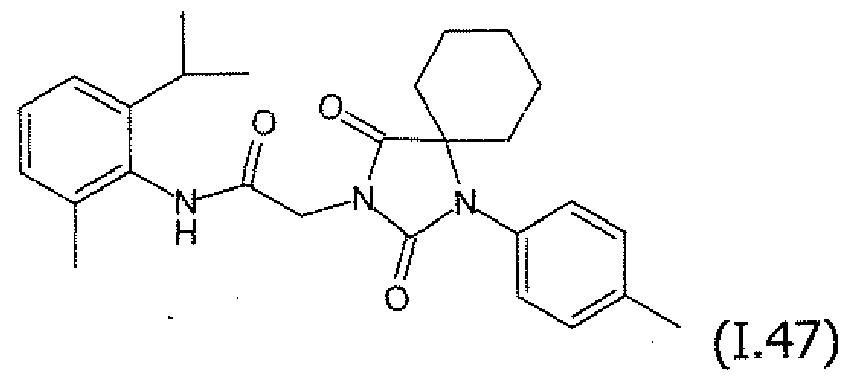
- 2- (2, 4-Dioxo-l-p-tolyl-l, 3-diazaspiro [4.5] dec-3-yl) - N- (2-isopropyl-6-methylphenyl) acetamide, compound (1.47)
With Y = C(O); Ri = Me; R2 = iPr; R3 = H; R4 and R' 4 are bonded to one another to form a cyclohexyl; R5 = 4-Me- Ph
Figure imgf000024_0002
- N- (2, 6-Diethylphenyl) -2- (2, 4-dioxo-l-p-tolyl-l, 3- diazaspiro [4.5] dec-3-yl) -acetamide, compound (1.48) With Y = C(O); R1 = R2 = Et; R3 = H; R4 and R' 4 are bonded to one another to form a cyclohexyl; R5 = 4-Me- Ph
Figure imgf000024_0003
- N- (2, 6-Diethyl-4-methylphenyl) -2- (2, 4-dioxo-l-p- tolyl-l, 3-diazaspiro [4.5] dec-3-yl) acetamide, compound (1.49)
With Y = C(O); R1 = R2 = Et; R3 = Me; R4 and R' 4 are bonded to one another to form a cyclohexyl; R5 = 4-Me- Ph
Figure imgf000025_0001
- N- (2-Chloro-4, 6-dimethylphenyl) -2- (2, 4-dioxo-l-p- tolyl-l,3-diazaspiro[4.5]dec-3-yl) acetamide, compound (1.50)
With Y = C(O); R1 = Me; R2 = Cl; R3 = Me; R4 and R' 4 are bonded to one another to form a cyclohexyl; R5 = 4-Me- Ph
Figure imgf000025_0002
- N- (2, 6-Diethylphenyl) -2- (2, 4-dioxo-l-phenethyl-l, 3- diazaspiro [4.5] dec-3-yl) acetamide, compound (1.51) With Y = C(O); R1 = R2 = Et; R3 = H; R4 and R' 4 are bonded to one another to form a cyclohexyl; R5 = (CH2) n- Ar; n = 2; Ar = Ph
- N- (2-Bromo-4, 6-dimethylphenyl) -2- (2, 4-dioxo-l-p- tolyl-1, 3-diazaspiro[4.5] dec-3-yl) acetamide, compound (1.52)
With Y = C(O); R1 = Me; R2 = Br; R3 = Me; R4 and R' 4 are bonded to one another to form a cyclohexyl; R5 = 4-Me- Ph
Figure imgf000026_0001
- N- (2-tert-Butyl-6-methylphenyl) -2- (2, 4-dioxo-l-p- tolyl-1, 3-diazaspiro [4.5] dec-3-yl) acetamide, compound (1.53)
With Y = C(O); Ri = Me; R2 = tBu; R3 = H; R4 and R' 4 are bonded to one another to form a cyclohexyl; R5 = 4-Me- Ph
Figure imgf000026_0002
- N- (2, 6-Diethylphenyl) -2- [1- (4-ethylphenyl) -2, 4-dioxo- 1, 3-diazaspiro [4.5] dec-3-yl] acetamide, compound (1.54) With Y = C(O); Ri = R2 = Et; R3 = H; R4 and R' 4 are bonded to one another to form a cyclohexyl; R5 = 4-Et- Ph
Figure imgf000026_0003
- N- (2, 6-Diethylphenyl) -2- (2, 4-dioxo-l-propyl-l, 3- diazaspiro [4.5] dec-3-yl) acetamide, compound (1.55) With Y = C(O); Ri = R2 = Et; R3 = H; R4 and R' 4 are bonded to one another to form a cyclohexyl; R5 = n-Pr
Figure imgf000027_0001
- 2- [1- (4-Butylphenyl) -2, 4-dioxo-l,3- diazaspiro[4.5]dec-3-yl]-N-(2, 6-diethy1- phenyl) acetamide, compound (1.56)
With Y = C(O); R1 = R2 = Et; R3 = H; R4 and R' 4 are bonded to one another to form a cyclohexyl; R5 = 4-Bu- Ph
Figure imgf000027_0002
- N- (2, 6-Diethylphenyl) -2- [1- (4-ethylphenyl) -2, 4-dioxo- 1, 3-diazaspiro [4.4 ] non-3-yl] acetamide, compound (1.57) With Y = C(O); Ri = R2 = Et; R3 = H; R4 and R' 4 are bonded to one another to form a cyclopentyl; R5 = 4-Et- Ph
Figure imgf000027_0003
- N- (2, 6-Diethylphenyl) -2- (l-heptyl-2, 4-dioxo-l, 3- diazaspiro [4.5] dec-3-yl) acetamide, compound (1.58) With Y = C(O); R1 = R2 = Et; R3 = H; R4 and R' 4 are bonded to one another to form a cyclohexyl; R5 = n- heptyl
Figure imgf000028_0001
- N- (2, 6-Diethylphenyl) -2- (l-isobutyl-2, 4-dioxo-l, 3- diazaspiro [4.5] dec-3-yl) acetamide, compound (1.59)
With Y = C(O); Ri = R2 = Et; R3 = H; R4 and R' 4 are bonded to one another to form a cyclohexyl; R5 = 2-Me- Pr
Figure imgf000028_0002
- 2- [1- (4-Benzyloxyphenyl) -2, 4-dioxo-l, 3- diazaspiro[4.5]dec-3-yl]-N-(2,6-di- isopropylphenyl) acetamide, compound (1.60) With Y = C(O); Ri = R2 = iPr; R3 = H; R4 and R' 4 are bonded to one another to form a cyclohexyl; R5 = 4-BnO- Ph
Figure imgf000028_0003
- 2- [1- (4-Chlorophenyl) -2, 4-dioxo-l, 3- diazaspiro [4.4] non-3-yl] -N- (2, 6-di- ethylphenyl) acetamide, compound (1.61)
With Y = C(O); R1 = R2 = Et; R3 = H; R4 and R' 4 are bonded to one another to form a cyclopentyl; R5 = 4-C1- Ph
Figure imgf000029_0001
- 2- [ 1- (4-Benzyloxyphenyl) -2 , 4-dioxo-l , 3- diazaspiro[4.5]dec-3-yl]-N-(2,6-di- ethylphenyl) acetamide, compound (1.62)
With Y = C(O); Ri = R2 = Et; R3 = H; R4 and R' 4 are bonded to one another to form a cyclohexyl; R5 = 4-BnO- Ph
Figure imgf000029_0002
- 2- (1 -Benzyl-2, 4-dioxo-l, 3-diazaspiro [4.5] dec-3-yl) -N- (2, 6-diethylphenyl) -acetamide, compound (1.63)
With Y = C(O); Ri = R2 = Et; R3 = H; R4 and R' 4 are bonded to one another to form a cyclohexyl; R5 = (CH2) n- Ar; n = 1; Ar = Ph
Figure imgf000029_0003
- N- (2, 6-Diisopropylphenyl) -2- [2, 4-dioxo-l- (4- trifluoromethylphenyl) -1, 3-diazaspiro [4.5] dec-3- yl] acetamide, compound (1.64) With Y = C(O); Ri = R2 = iPr; R3 = H; R4 and R' 4 are bonded to one another to form a cyclohexyl; R5 = 4-CF3- Ph
Figure imgf000030_0001
- N- (2, 6-Diisopropylphenyl) -2- [2, 4-dioxo-l- (3- trifluoromethylphenyl) -l,3-diazaspiro[4.5]dec-3- yl] acetamide, compound (1.65)
With Y = C(O); R1 = R2 = iPr; R3 = H; R4 and R' 4 are bonded to one another to form a cyclohexyl; R5 = 3-CF3- Ph
Figure imgf000030_0002
- N- (2 , 6-Diisopropylphenyl) -2- [2 , 4-dioxo-l- (2- trifluoromethylphenyl) -l,3-diazaspiro[4.5]dec-3- yl] acetamide, compound (1.66)
With Y = C(O); Ri = R2 = iPr; R3 = H; R4 and R' 4 are bonded to one another to form a cyclohexyl; R5 = 2-CF3- Ph
Figure imgf000030_0003
- 2- [1- (4-Difluoromethoxyphenyl) -2, 4-dioxo-l, 3- diazaspiro [4.5] dec-3-yl] -N- (2,6- diisopropylphenyl) acetamide, compound (1.67)
With Y = C(O) ; Ri = R2 = iPr; R3 = H; R4 and R' 4 are bonded to one another to form a cyclohexyl; R5 = 4-
CHF2O-Ph
Figure imgf000031_0001
- 2- [1- (4-Trifluoromethoxyphenyl) -2, 4-dioxo-l, 3- diazaspiro [4.5] dec-3-yl] -N- (2, 6-diisopropyl- phenyl) acetamide, compound (1.68)
With Y = C(O); Ri = R2 = iPr; R3 = H; R4 and R' 4 are bonded to one another to form a cyclohexyl; R5 = 4-CF3O- Ph
Figure imgf000031_0002
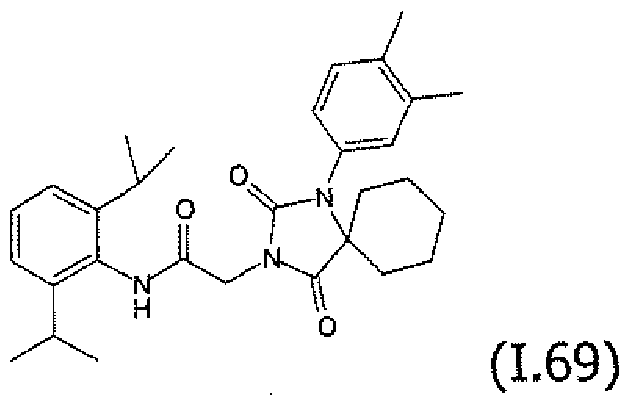
- N- (2, 6-Diisopropylphenyl) -2- [1- (3, 4-dimethylphenyl) - 2,4-dioxo-l,3-diazaspiro[4.5]dec-3-yl] acetamide, compound (1.69) With Y = C (O) ; Ri = R2 = iPr; R3 = H; R4 and R' 4 are bonded to one another to form a cyclohexyl; R5 = 3, 4- diMe-Ph
Figure imgf000031_0003
- N- (2, 6-Diisopropylphenyl) -2- [1- (2, 4-dimethylphenyl) - 2,4-dioxo-l,3-diazaspiro[4.5]dec-3-yl] acetamide, compound (1.70)
With Y = C (O) ; Ri = R2 = iPr; R3 = H; R4 and R' 4 are bonded to one another to form a cyclohexyl; R5 = 2, 4- diMe-Ph
Figure imgf000032_0001
- N- (2, 6-Diisopropylphenyl) -2- [1- (3-fluoro-4- methylphenyl) -2,4-dioxo-l,3-diazaspiro[4.5]dec-3- yl] acetamide, compound (1.71)
With Y = C (O) ; R1 = R2 = iPr; R3 = H; R4 and R' 4 are bonded to one another to form a cyclohexyl; R5 = 3-F-4- Me-Ph
Figure imgf000032_0002
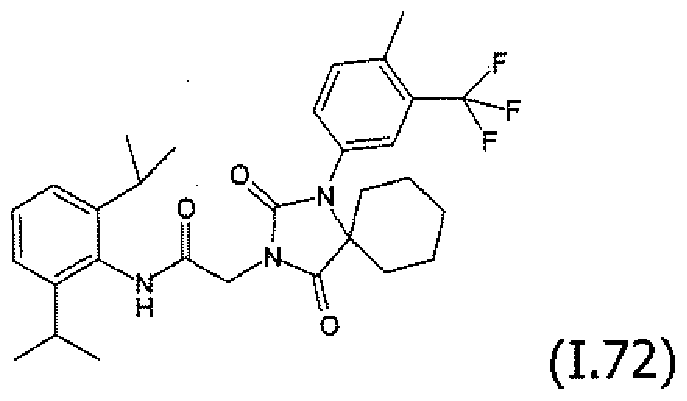
- N- (2, 6-Diisopropylphenyl) -2- [1- (4-methyl-3- trifluoromethylphenyl) -2, 4-dioxo-l, 3- diazaspiro [4.5] dec-3-yl] acetamide, compound (1.72) With Y = C(O); Ri = R2 = iPr; R3 = H; R4 and R' 4 are bonded to one another to form a cyclohexyl; R5 = 4-Me- 3-CF3-Ph
Figure imgf000033_0001
- N- (2, 6-Diisopropylphenyl) -2- [1- (3, 5-difluoro-4- methylphenyl) -2,4-dioxo-l,3-diazaspiro[4.5]dec-3- yl] acetamide, compound (1.73)
With Y = C(O); R1 = R2 = iPr; R3 = H; R4 and R' 4 are bonded to one another to form a cyclohexyl; R5 = 3,5- diF-4-Me-Ph
Figure imgf000033_0002
- N- (2, 6-Diisopropylphenyl) -2- [1- (2-fluoro-4- methylphenyl) -2,4-dioxo-l,3-diazaspiro[4.5]dec-3- yl] acetamide, compound (1.74)
With Y = C(O); R1 = R2 = iPr; R3 = H; R4 and R' 4 are bonded to one another to form a cyclohexyl; R5 = 2-F-4-
Me-Ph
Figure imgf000033_0003
- N- (2, 6-Diisopropylphenyl) -2- [1- (4-fluoro-3- methylphenyl) -2,4-dioxo-l,3-diazaspiro[4.5]dec-3- yl] acetamide, compound (1.75)
With Y = C(O); R1 = R2 = iPr; R3 = H; R4 and R' 4 are bonded to one another to form a cyclohexyl; R5 = 4-F-3- Me- Ph
Figure imgf000034_0001
- N- (2, 6-Diisopropylphenyl) -2- [1- (4-chloro-3- methylphenyl) -2,4-dioxo-l,3-diazaspiro[4.5]dec-3- yl] acetamide, compound (1.76)
With Y = C(O); Ri = R2 = iPr; R3 = H; R4 and R' 4 are bonded to one another to form a cyclohexyl; R5 = 4-C1-
3-Me-Ph
Figure imgf000034_0002
- N- (2, 6-Diisopropylphenyl) -2- [2, 4-dioxo-l- (3- phenoxyphenyl) -l,3-diazaspiro[4.5]dec-3-yl] acetamide, compound (1.77)
With Y = C(O); Ri = R2 = iPr; R3 = H; R4 and R' 4 are bonded to one another to form a cyclohexyl; R5 = 4-
PhO-Ph
Figure imgf000034_0003
- N- (2, 6-Diisopropylphenyl) -2- (2, 5-dioxo-4, 4-dipropyl- 3-p-tolylimidazolidin-l-yl) acetamide, compound (1.78) With Y = C(O); Ri = R2 = iPr; R3 = H; R4 = R' 4 = nPr; R5 4-Me-Ph
Figure imgf000035_0001
- 2- (4, 4-Dibutyl-2, 5-dioxo-3-p-tolylimidazolidin-l-yl) N- (2, 6-diisopropyl-phenyl) acetamide, compound (1.79) With Y = C(O); Ri = R2 = iPr; R3 = H; R4 = R' 4 = nBu; R5 4-Me-Ph
Figure imgf000035_0002
- N- (2, 6-Diisopropylphenyl) -2- [2, 4-dioxo-l- (4, 4, 4- trifluorobutyl) -l,3-diazaspiro[4.5]dec-3-yl] acetamide, compound (1.80)
With Y = C(O); Ri = R2 = iPr; R3 = H; R4 and R' 4 are bonded to one another to form a cyclohexyl; R5 = 4,4,4- FFF-nBu
Figure imgf000035_0003
- N- (2, 6-Diisopropylphenyl) -2- [2, 4-dioxo-l- (4,4,4- trifluoropropyl)-l,3-diazaspiro[4.5]dec-3-yl] acetamide, compound (1.81)
With Y = C (O) ; Ri = R2 = iPr ; R3 = H; R4 and R' 4 are bonded to one another to form a cyclohexyl ; R5 = 3 , 3 , 3-
FFF-nPr
Figure imgf000036_0001
- N- (2, 6-Diisopropylphenyl) -2- [1- (3-hydroxypropyl) -2, 4- dioxo-l,3-diazaspiro[4.5]dec-3-yl] acetamide, compound (1.82)
With Y = C(O); R1 = R2 = iPr; R3 = H; R4 and R' 4 are bonded to one another to form a cyclohexyl; R5 = 3-0H- nPr
Figure imgf000036_0002
- N- (2, 6-Diisopropylphenyl) -2- [1- (3-hydroxybutyl) -2, 4- dioxo-l,3-diazaspiro[4.5]dec-3-yl] acetamide, compound (1.83)
With Y = C(O); R1 = R2 = iPr; R3 = H; R4 and R' 4 are bonded to one another to form a cyclohexyl; R5 = 4-0H- nBu
Figure imgf000036_0003
- N- (2, 6-Diisopropylphenyl) -2- [1- (4-fluorobenzyl) -2, 4- dioxo-l,3-diazaspiro[4.5]dec-3-yl] acetamide, compound (1.84)
With Y = C(O); R1 = R2 = iPr; R3 = H; R4 and R' 4 are bonded to one another to form a cyclohexyl; R5 = (CH2) n- Ar; n = 1; Ar = 4F-Ph
Figure imgf000037_0001
(1.84)
- N- (2, 6-Diisopropylphenyl) -2- [1- (4-methylbenzyl) -2, 4- dioxo-l,3-diazaspiro[4.5]dec-3-yl] acetamide, compound (1.85)
With Y = C(O); Ri = R2 = iPr; R3 = H; R4 and R' 4 are bonded to one another to form a cyclohexyl; R5 = (CH2) n~ Ar; n = 1; Ar = 4Me-Ph
Figure imgf000037_0002
- N- (2, 6-Diisopropylphenyl) -2- [2, 4-dioxo-l- (4- trifluoromethylbenzyl) -l,3-diazaspiro[4.5]dec-3- yl] acetamide, compound (1.86)
With Y = C (O) ; Ri = R2 = iPr ; R3 = H; R4 and R' 4 are bonded to one another to form a cyclohexyl ; R5 = (CH2 ) n-
Ar ; n = 1 ; 4CF3-Ph
Figure imgf000038_0001
- N- (2, 6-Diisopropylphenyl) -2- [1- (3-methylbenzyl) -2, 4- dioxo-l,3-diazaspiro[4.5]dec-3-yl] acetamide, compound (1.87)
With Y = C(O); Ri = R2 = iPr; R3 = H; R4 and R' 4 are bonded to one another to form a cyclohexyl; R5 = (CH2) n~ Ar; n = 1; Ar = 3Me-Ph
Figure imgf000038_0002
- N- (2, 6-Diisopropylphenyl) -2- [1- (3-fluorobenzyl) -2, 4- dioxo-l,3-diazaspiro[4.5]dec-3-yl] acetamide, compound (1.88)
With Y = C(O); Ri = R2 = iPr; R3 = H; R4 and R' 4 are bonded to one another to form a cyclohexyl; R5 = (CH2) n- Ar; n = 1; Ar = 3F-Ph
Figure imgf000039_0001
- N- (2, 6-Diisopropylphenyl) -2- [1- (3-methoxybenzyl) -2, 4- dioxo-l,3-diazaspiro[4.5]dec-3-yl] acetamide, compound (1.89)
With Y = C(O); R1 = R2 = iPr; R3 = H; R4 and R' 4 are bonded to one another to form a cyclohexyl; R5 = (CH2) n- Ar; n = 1; Ar = 3MeO-Ph
Figure imgf000039_0002
- N- (2, 6-Diisopropylphenyl) -2- [2, 4-dioxo-l- (3- trifluoromethylbenzyl) -l,3-diazaspiro[4.5]dec-3- yl] acetamide, compound (1.90)
With Y = C (O) ; Ri = R2 = iPr ; R3 = H; R4 and R' 4 are bonded to one another to form a cyclohexyl ; R5 = (CH2 ) n-
Ar ; n = 1 ; Ar = 3CF3-Ph
Figure imgf000040_0001
- N- (2, 6-Diisopropylphenyl) -2- [1- (2-methylbenzyl) -2, 4- dioxo-l,3-diazaspiro[4.5]dec-3-yl] acetamide, compound (1.91)
With Y = C(O); Ri = R2 = iPr; R3 = H; R4 and R' 4 are bonded to one another to form a cyclohexyl; R5 = (CH2) n~ Ar; n = 1; Ar = 2-Me-Ph
Figure imgf000040_0002
- N- (2, 6-Diisopropylphenyl) -2- [1- (2-fluorobenzyl) -2, 4- dioxo-l,3-diazaspiro[4.5]dec-3-yl] acetamide, compound (1.92)
With Y = C(O); Ri = R2 = iPr; R3 = H; R4 and R' 4 are bonded to one another to form a cyclohexyl; R5 = (CH2) n- Ar; n = 1; Ar = 2F-Ph
Figure imgf000041_0001
- N- (2, 6-Diisopropylphenyl) -2- [2, 4-dioxo-l- (2- trifluoromethylbenzyl) -l,3-diazaspiro[4.5]dec-3- yl]acetamide compound (1.93)
With Y = C(O); Ri = R2 = iPr; R3 = H; R4 and R' 4 are bonded to one another to form a cyclohexyl; R5 = (CH2) n~
Ar; n = 1; Ar = 3CF3-Ph
Figure imgf000041_0002
The salts of the compounds according to the invention are prepared according to techniques well known to the person skilled in the art. The salts of the compounds of formula (I) according to the present invention comprise those with inorganic or organic acids which allow a suitable separation or a crystallization of the compounds of formula (I), as well as pharmaceutically acceptable salts. As an appropriate acid, it is possible to mention: picric acid, oxalic acid or an optically active acid, for example a tartaric acid, a dibenzoyltartaric acid, a mandelic acid or a camphorsulphonic acid, and those which form physiologically acceptable salts, such as the hydrochloride, the hydrobromide, the sulphate, the hydrogensulphate, the dihydrogenphosphate, the maleate, the fumarate, the 2-naphthalenesulphonate and the para- toluenesulphonate, the hydrochloride being preferred.
The solvates or hydrates may be obtained directly at the end of the synthesis process, the compound (I) being isolated in the form of a hydrate, for example a mono- or hemihydrate or a solvate of the reaction or purification solvent.
The compounds of formula (I) can be purified according to any conventional purification technique, for example by crystallization or purification by column chromatography .
When a compound of formula (I) according to the invention has one or more asymmetric carbons, the optical isomers of this compound are integral parts of the invention. The compound of formula (I) can thus be found in the form of a pure isomer or of a mixture of isomers in any proportion.
Conformers are understood as meaning an element of a set of conformational stereoiomers of which each is characterized by a conformation corresponding to a distinct minimum potential energy of the molecular entity.
Rotamer is understood as meaning an element of an assembly of conformers resulting from a restricted rotation around a single bond.
The compounds of formula (I) according to the invention can be prepared according to SCHEME 1 below, in which Y, Ri, R2, R3, R4, R4' and R5 are as defined for the compounds of formula (I) : SCHEME 1
Figure imgf000043_0001
The compounds of formula (I) can be prepared by addition of the imidazolidinones or imidazolidinediones of formula (1) to the chloroacetamides of formula (2) in the presence of a base, as SCHEME 1 describes and by analogy, for example, with the reactions described in Dunbar, B. et al . , Pharmazie 2005, 51 [I), 438, Pinza, M. et al., J Med Chem 1993, 36 (26), 4214, Coudert, P. et al., Pharm Acta HeIv. 1991, 66 (5-6), 155 or Usifoh, C. 0.; Arch Pharm, 2001, 334 (11), 366.
The imidazolidinones or imidazolidinediones of general formula 1 can be prepared according to SCHEME 2 below, in which Y, R4, R' 4 and R5 are as defined for the compounds of formula (I) :
SCHEME 2
Figure imgf000043_0002
The compounds of formula (1) are obtained starting from ketones of formula (3) . The latter are first reacted with the amines or anilines of formula (4) in the presence of trimethylsilyl cyanide, in order to give the nitrile compounds of formula (5) , according, for example, to the conditions described in Matsumoto, K. et al., HeIv ChIm Acta 2005, 88 [I) , 1734-1753 or Nieto, M. J. et al . , J Comb Chem 2005, 7 (2), 258-263. The hydrolysis of the nitrile function in the presence of acid, for example, under the conditions described in Beths R. L. et al., J. Chem. Soc, 1921, 1310 allows the primary amides of the formula (6) to be obtained. The cyclization, either in the presence of formaldehyde as described in Fueloep, F et al . Pharmazie 1992, 41 (3), 168 or Chen, F. -L.; Sung, K.; J Heterocycl Chem 2004, 41 (5), 697 in the case where Y = CH2, either in the presence of an appropriate aryl isocyanate as described in Papadopoulos, E. P.; J Org Chem 1977, 42, 3925 for the case where Y = C(O) allows the imidazolidinones or the imidazolidinediones respectively of formula (1) to be obtained.
The chloroacetamides of general formula (2) can be prepared according to an amidification reaction starting from anilines of formula (7) in the presence of a base and chloroacetyl chloride, for example, as described in Davion, Y. et al . , Heterocycles 2004, 63 (5), 1093 or Juaristy, E. et al., J Org Chem 1999, 64 (8), 2914, as illustrated in SCHEME 3 below in which R1, R2 and R3 are such as defined for the compounds of formula (I) :
SCHEME 3
Figure imgf000044_0001
- A A -
The anilines (7) are commercial compounds or are prepared according to techniques well known to the person skilled in the art.
The functional groups optionally present in the reaction intermediates used in the process can be protected, either in a permanent manner or in a temporary manner, by protective groups which ensure an unequivocal synthesis of the expected compounds. The protection and deprotection reactions are carried out according to techniques well known to the person skilled in the art. A temporary protective group of amines, of alcohols or of carboxylic acids is understood as meaning the protective groups such as those described in "Protective Groups in Organic Chemistry", ed McOmie J. W. F., Plenum Press, 1973, in "Protective Groups in Organic Synthesis" 2nd edition, Greene T. W. and Wuts P. G. M., ed John Wiley and Sons, 1991 and in "Protecting Groups", Kocienski P. J., 1994, Georg Thieme Verlag.
The compounds (I) according to the invention, as well as their pharmaceutically acceptable salts, solvates and/or hydrates, have inhibitory properties on the enzyme SOAT-I. This inhibitory activity on the enzyme
SOAT-I is measured according to a primary enzymatic test HepG2, as described in Example 64. The preferred compounds according to the present invention have a concentration allowing 50% of the response of the enzyme (IC50) to be inhibited at less than or equal to
1000 nM, preferably at less than or equal to 300 nM, advantageously at less than or equal to 100 nM, or even at 50 nM.
A subject of the present invention is likewise, by way of medicament, the compounds of formula (I) such as described above, as well as their pharmaceutically acceptable salts, pharmaceutically acceptable solvates and/or hydrates.
A subject of the present invention is the use of at least one compound of formula (I), and also its salts, pharmaceutically acceptable solvates and/or hydrates, for the manufacture of a medicament in order to prevent and/or to treat the disorders of the sebaceous gland such as hyperseborrhoea, acne, seborrheic dermatitis, atopic dermatitis or rosacea, ocular pathologies such as ocular rosacea, disorders of the meibomian gland, such as blepharitis, meibomitis, chalazion, dry eye, conjunctivitis or keratoconjunctivitis, or even pathologies such as hypercholesterolemia, arteriosclerosis or Alzheimer's disease. The compounds according to the invention are particularly suited to the manufacture of a pharmaceutical composition intended for the treatment of acne. The compounds according to the invention are thus suitable for use in the treatment of the pathologies listed above.
A subject of the present invention is likewise a pharmaceutical or cosmetic composition comprising, in a physiologically acceptable carrier, at least one compound of formula (I) such as defined above, or one of its salts, pharmaceutically acceptable solvates and/or hydrates. The compositions according to the invention thus comprise a physiologically acceptable carrier or at least one physiologically or pharmaceutically acceptable excipient, chosen according to the cosmetic or pharmaceutical form desired and the chosen mode of administration.
Carrier or physiologically acceptable medium is understood as meaning a carrier compatible with the skin, the mucosa and/or the skin appendages.
The administration of the composition according to the invention can be effected by the enteral, parenteral, rectal, topical or ocular route. Preferably, the pharmaceutical composition is packaged in a form suitable for application by the topical route.
By the enteral route, the composition, more particularly the pharmaceutical composition, can be present in the form of tablets, of capsules, of coated tablets, of syrups, of suspensions, of powders, of granules, of emulsions, of microspheres or nanospheres or lipid or polymeric vesicles allowing controlled liberation. By the parenteral route, the composition can be present in the form of solutions or suspensions for perfusion or for injection.
The compounds according to the invention contain a compound according to the invention in sufficient quantity to obtain the therapeutic, prophylactic or cosmetic effects desired. The compounds according to the invention are generally administered in a daily dose of approximately 0.001 mg/kg to 100 mg/kg of body weight, in 1 to 3 doses. The compounds are used by the systemic route at a concentration generally between 0.001 and 10% by weight, preferably between 0.01 and 2% by weight, with respect to the weight of the composition.
By the topical route, the pharmaceutical composition according to the invention is more particularly intended for the treatment of the skin and of the mucosa and can be present in the form of ointments, of creams, of milks, of pomades, of powders, of impregnated swabs, of syndets, of solutions, of gels, of sprays, of foams, of suspensions, of lotions, of sticks, of shampoos, or of washing bases. It can likewise be present in the form of suspensions of microspheres or nanospheres or lipid or polymeric vesicles or polymeric patches and hydrogels allowing controlled liberation. This composition by the topical route can be present in anhydrous form, in aqueous form - A l - or in the form of an emulsion.
The compounds are used by the topical route in a concentration generally of between 0.001 and 10% by weight, preferably between 0.01 and 2% by weight, with respect to the total weight of the composition.
The compounds of formula (I) according to the invention, as well as their salts, pharmaceutically acceptable solvates and/or hydrates, likewise find application in the cosmetic field, in particular in body and hair hygiene and more particularly in order to combat or to prevent greasy skin or greasy hair or a greasy scalp.
A subject of the invention is thus likewise the cosmetic use of a composition comprising, in a physiologically acceptable carrier, at least one of the compounds of formula (I), optionally in the form of a salt, pharmaceutically acceptable solvate and/or hydrate, for body or hair hygiene.
The cosmetic composition according to the invention containing, in a cosmetically acceptable carrier, at least one compound of formula (I) or one of its salts, pharmaceutically acceptable solvates and/or hydrates, can be present especially in the form of a cream, of a milk, of a lotion, of a gel, of an ointment, of a pomade, of suspensions of microspheres or nanospheres or lipid or polymeric vesicles, of impregnated swabs, of solutions, of sprays, of foams, of sticks, of soaps, of shampoos or of washing bases.
The concentration of compound of formula (I) in the cosmetic composition is between 0.001 and 3% by weight, with respect to the total weight of the composition.
The pharmaceutical and cosmetic compositions such as previously described can moreover contain inert, or even pharmacodynamically active, additives as far as the pharmaceutical compositions are concerned, or combinations of these additives, and especially:
- wetting agents; - taste-improving agents; preservative agents such as the esters of parahydroxybenzoic acid;
- stabilizing agents;
- humidity-regulating agents; - pH-regulating agents;
- osmotic pressure-modifying agents;
- emulsifying agents;
- UV-A and UV-B filters; antioxidants, such as α-tocopherol, butylhydroxyanisole or butylhydroxy-toluene, superoxide dismutase, ubiquinol or certain metal chelating agents;
- emollients; hydrating agents such as glycerol, PEG 400, thiamorpholinone, and its derivatives or urea; - carotenoids and, especially, β-carotene;
- α-hydroxy acids and α-ketoacids or their derivatives, such as lactic, maleic, citric, glycolic, mandelic, tartaric, glyceric and ascorbic acids, and their salts, amides or esters or β-hydroxy acids or their derivatives, such as salicylic acid as well as its salts, amides or esters.
Of course, the person skilled in the art will look to choose the possible compound (s) to add to these compositions in such a way that the properties advantageously attached intrinsically to the present invention are not, or not substantially, altered by the envisaged addition.
Furthermore, generally, the same preferences as those indicated above for the compounds of formula (I) apply mutatis mutandis to the medicaments, cosmetic, pharmaceutical and use compositions employing the compounds of the invention. By way of illustration and without any limiting character, several examples of preparation of active compounds of formula (I) according to the invention are given below, as well as results of biological activity of such compounds.
The following abbreviations are used:
Ph = phenyl; Bn = benzyl; Me = methyl; Et = ethyl; Pr = propyl; iPr = isopropyl; tBu = tert-butyl; n-Pr = n- propyl; n-Bu = n-butyl; n-Pent = n-pentyl; n-Hex = n- hexyl; n-Hept = n-heptyl; n-Oct = n-octyl; n-Non = n- nonyl; m.p. = melting point
PROCEDURES
Example 1
N- (2, 6-Diisopropylphenyl) -2- (2, 4-dioxo-l-phenyl-l, 3- diazaspiro [4.4 ] non-3-yl) acetamide, compound (I.I) With Y = C(O); R1 = R2 = iPr; R3 = H; R4 and R' 4 are bonded to one another to form a cyclohexyl; R5 = Ph
Figure imgf000050_0001
a. 2-Chloro-N- (2, 6-diisopropylphenyl) acetamide
222 ml (1.59 mol) of triethylamine are added to a solution of 300 ml (1.59 mol) of 2,6- diisopropylphenylamine (starting product 1) in 1 1 of dichloromethane . The reaction mixture is cooled to 00C and then 127 ml (1.59 mol) of chloroacetyl chloride are added, drop by drop. Once the addition is finished, the ice bath is removed and the medium is stirred for 20 min. It is then poured into water and extracted with dichloromethane. The organic phases are collected and washed with water. They are dried over sodium sulphate. The solvents are evaporated. The residue is filtered on a silica cake (eluent: dichloromethane) . The filtrate is evaporated and then triturated in heptane. 345 g of 2-chloro-N- (2, 6-diisopropylphenyl) acetamide are obtained in the form of a white solid. Yield = 85%. M. p. = 146-8°C.
b . l-Phenylaminocyclopentanecarbonitrile . 2.9 ml (31.8 mmol) of aniline (starting product 2) are added to a solution of 2.6 ml (29.4 mmol) of cyclopentanone (starting product 3) in 30 ml of acetic acid at 00C. The solution is stirred for 15 minutes and
4 ml (30 mmol) of trimethylsilyl cyanide are added. The reaction medium is stirred for one night at room temperature and then gently poured into an ice-cold ammonium hydroxide solution while keeping the pH basic and extracted with dichloromethane. The organic phases are collected and washed with water. They are dried over sodium sulphate. The solvents are evaporated and then the residue is chromatographed on silica gel
(heptane/ethyl acetate 90/10, v/v) . 5 g of 1- phenylaminocyclopentanecarbonitrile are obtained in the form of a clear brown oil. Yield = 91%.
c . l-Phenylaminocyclopentanecarboxylamide .
5 g (26.8 mmol) of 1-phenylaminocyclopentane- carbonitrile are dissolved in 40 ml of concentrated sulphuric acid. The reaction medium is stirred at room temperature for 48 h and then gently poured into ice and the pH is brought to 7-8 with sodium hydroxide and the mixture is extracted with ethyl acetate. The organic phases are collected and washed with water. They are dried over sodium sulphate. The solvents are evaporated and the residue is precipitated in dichloromethane and heptane. It is then filtered and dried. 4.6 g of 1-phenylaminocyclopentanecarboxylamide are obtained in the form of a white solid. Yield = 84%. M . p . = 159- 61 ° C .
d. 1-Phenyl-1 , 3-diazaspiro [4.4 ] nonane-2 , 4-dione .
360 μl (1.76 mmol) of 2, 6-diisopropylphenyl isocyanate are added to a solution of 300 mg (1.47 mmol) of 1- phenylaminocyclopentane-carboxylamide in 5 ml of toluene. The reaction medium is stirred at 2000C for 80 min under microwave irradiation in a sealed reactor. The toluene is evaporated and the residue is purified on silica gel (heptane and then with an increasing percentage of ethyl acetate) . 130 mg of 1-phenyl-l, 3- diazaspiro [ 4.4 ] nonane-2 , 4-dione are obtained in the form of a beige solid. Yield = 38%.
e . N- (2, 6-Diisopropylphenyl) -2- (2, 4 -dioxo- 1-phenyl-l, 3- diazaspiro[4.4]non-3-yl) acetamide
80 mg (0.57 mmol) of potassium carbonate are added to a solution of 120 mg (0.52 mmol) of 1-phenyl-l, 3- diazaspiro [ 4.4 ] nonane-2 , 4-dione and 145 mg (0.57 mmol) of 2-chloro-N- (2, 6-diisopropylphenyl) acetamide in 20 ml of dimethylformamide . The reaction medium is stirred at room temperature for 24 hours. It is then poured into water and extracted with ethyl acetate. The organic phases are collected, washed with water and dried over sodium sulphate. The solvents are evaporated. The residue is chromatographed on silica gel (heptane and then heptane/ethyl acetate 80/20, v/v) . 120 mg of N- (2, 6-diisopropylphenyl) -2- (2, 4-dioxo-l-phenyl-l, 3- diazaspiro [4.4 ] non-3-yl) acetamide are obtained in the form of a white solid. Yield = 51%, m.p. = 275-7°C. HPLC: 96.8%; Mass = 447. 1H NMR (CDCl3; 400 Mz) : 1.21 (s, 6H); 1.23 (s, 6H); 1.55 (m, 2H); 1.85 (m, 2H); 2.03-2.08 (m, 2H); 2.22-2.26 (m, 2H); 3.06-3.12 (m, 2H); 4.50 (s, 2H); 7.18-7.21 (m, 2H); 7.28-7.31 (m, 3H); 7.41-7.49 (m, 3H) . Examples 2 to 4 and 6 to 63
The synthesis of Examples 2 to 4 and 6 to 63 is described by the tables below. The compounds are synthesized following the same procedure, replacing the starting products 1, 2 and 3 of steps a and b of Example 1 by the products mentioned in the table below. The yields of these syntheses are homogeneous for the family of compounds considered.
Figure imgf000054_0001
Figure imgf000055_0001
Figure imgf000056_0001
Figure imgf000057_0001
- 57 -
Figure imgf000058_0001
- 58 -
Figure imgf000059_0001
Figure imgf000060_0001
Figure imgf000061_0002
Example 5
N- (2, 6-Diisopropylphenyl) -2- (4-oxo-l-phenyl-l, 3- diazaspiro [4.5] dec-3-yl) acetamide, compound (1.5) With Y = CH2 ; Ri = R2 = iPr; R3 = H ; R4 and R' < are bonded to one another to form a cyclohexyl; R5 = Ph
Figure imgf000061_0001
a/ l-Phenylaminocyclohexanecarbonitrile .
1.4 ml (15.3 mmol) of aniline are added to a solution of 1.3 ml (12.5 mmol) of cyclohexanone in 20 ml of acetic acid at 00C. The solution is stirred for 10 minutes and 1.9 ml (14.2 mmol) of trimethylsilyl cyanide are added. The reaction medium is stirred overnight at room temperature. It is then gently poured into a solution of ice-cold ammonium hydroxide, while keeping the pH basic, and extracted with dichloromethane . The organic phases are collected and washed with water. They are dried over sodium sulphate. The residue is precipitated in dichloromethane and heptane. The solid is filtered and dried. 2.2 g of 1- phenylaminocyclohexanecarbonitrile are obtained in the form of whitish crystals. Yield = 88%, m.p. = 67-9°C.
b/ l-Phenylaminocyclohexanecarboxylamide . 5 g (25 mmol) of l-phenylaminocyclohexanecarbonitrile are dissolved in 30 ml of concentrated sulphuric acid. The reaction medium is stirred at room temperature for 48 h. It is then gently poured into ice and the pH is brought to 7-8 with sodium hydroxide and the mixture is extracted with ethyl acetate. The organic phases are collected and washed with water. They are dried over sodium sulphate. The solvents are evaporated and the residue is precipitated in dichloromethane and heptane. It is then filtered and dried. 5.13 g of 1- phenylaminocyclohexanecarboxylamide are obtained in the form of a white solid. Yield = 94%, m.p. = 145-7°C.
c/ 1 -Phenyl- 1, 3-diazaspiro[4.5]decan-4-one.
300 mg (1.37 mmol) of 1- phenylaminocyclohexanecarboxylamide are dissolved in 10 ml of methanol. 3 ml of formaldehyde and a catalytic quantity of APTS are added. The reaction medium is heated at 1000C with microwaves for 30 min. The solvent is evaporated, and the residue is taken up with dichloromethane and washed with water. The organic phases are collected and then dried over sodium sulphate. The solvents are evaporated. The residue is chromatographed on silica gel (heptane/ethyl acetate 80/20, v/v) . 50 mg of 1-phenyl-l, 3-diaza- spiro [4.5] decan-4-one are obtained in the form of a white solid. Yield = 18%, m.p. = 193-5°C.
d/ N- (2, 6-Diisopropylphenyl) -2- (4-oxo-l-phenyl-l, 3- diazaspiro[4.5]dec-3-yl) acetamide .
72 mg (0.52 mmol) of potassium carbonate are added to a solution of 120 mg (0.52 mmol) of 1-phenyl-l, 3- diazaspiro [4.5] decan-4-one and 132 mg (0.52 mmol) of 2- chloro-N- (2, 6-diisopropylphenyl) acetamide (described in Example Ia) in 20 ml of methyl ethyl ketone. The reaction medium is stirred at room temperature for 12 hours and then for 6 h at reflux. The medium is then filtered and then the residue is chromatographed on silica gel (heptane then heptane/ethyl acetate 50/50, v/v) . 135 mg of N- (2, 6-diisopropylphenyl) -2- (4-oxo-l- phenyl-l, 3-diazaspiro[4.5]dec-3-yl) acetamide are obtained in the form of a white solid. Yield = 58%, m.p. = 251-3°C. HPLC: 98.7%; mass: 446. 1H NMR (CDCl3, 400 Mz) : 1.20 (s, 12H); 1.36-1.37 (m, IH); 1.71-1.74 (m, 2H); 1.81-1.84 (m, 2H); 2.09-2.14 (m, 2H); 2.25-2.28 (m, 2H); 3.03-3.05 (m, 2H); 4.26- 4.27 (d, 2H); 4.90-4.91 (d, 2H); 6.97 (s, 3H); 7.19- 7.20 (m, 2H); 7.33 (m, 3H); 7.84 (s, IH) .
Example 64 : Biological tests
The compounds of formula (I) according to the invention have been subjected to a test allowing their inhibitory action with respect to the enzyme ACAT-I to be evaluated inspired by the following publication:
"Identification of ACATl- and ACAT2-specific inhibitors using a novel, cell-based fluorescence assay: individual ACAT uniqueness", J. Lipid Res. (2004) vol 45, pages 378-386.
The principle of this test is based on the employment of NBD-cholesterol, an analogue of cholesterol whose fluorescence depends on its environment. When this is present in a polar environment, it is weakly fluorescent although in a nonpolar environment it is strongly fluorescent. Free NBD-cholesterol locates itself in the cell membranes and is weakly fluorescent in this polar environment. When the NBD-cholesterol is esterified by ACAT, the ester of NBD-cholesterol locates itself in the nonpolar lipid droplets and is in that case strongly fluorescent.
The method below is applied: The HepG2 cells are incubated in the presence of NBD-cholesterol (1 μg/ml) and of the compound of formula (I) to be tested in black 96-well plates with a transparent base at a rate of 30 000 cells per well. After incubation for 6 h at 37°C, under 5% CO2, the medium is eliminated by turning over and the cells are washed with 2 times 100 μl of PBS. After addition of 50 μl of lysis buffer (NaPO4 10 mM, Igepal 1%) , the plates are stirred for 5 min and read in fluorescence (excitation 490 nm, emission 540 nm) on a FUSION apparatus (Perkin-Elmer) . By way of illustration, an IC50 of 3.2 nM is obtained for the compound (I.I), an IC50 of 0.8 nM is obtained for the compound (1.7), an IC50 of 0.2 nM is obtained for the compound (1.10), an IC50 of 4.8 nM is obtained for the compound (1.14), an IC50 of 5.6 nM is obtained for the compound 1.23), an IC50 of 2.5 nM is obtained for the compound 1.26), an IC50 of 0.7 nM is obtained for the compound 1.39), an IC50 of 5.1 nM is obtained for the compound 1.46), an IC50 of 5.3 nM is obtained for the compound (1.52 and an IC50 of 2.7 nM is obtained for the compound (1.61'
Example 65 : Formulations Various actual formulations based on compounds according to the invention are given below.
A-ORAL ROUTE
(a) 0.2 g tablet
-Compound (1.3) 0.01 g
-Starch 0.114 g
-Dicalcium phosphate 0.020 g
-Silica 0.020 g -Lactose 0.030 g
-Talc 0.010 g
-Magnesium stearate 0.005 g
(b) Drinkable suspension in 5 ml ampoules -Compound (I.I) 0.001 g
-Glycerol 0.500 g
-70% sorbitol 0.500 g
-Sodium saccharinate 0.010 g
-Methyl para-hydroxybenzoate 0.040 g -Flavour qs
-Purified water qsp 5 ml
B-TOPICAL ROUTE
(a) Ointment
-Compound (1.2) 0.300 g
-White petroleum jelly codex qsp 100 g ( d) Lot i on
-Compound (1.4) 0.100 g
-Polyethylene glycol (PEG 400) 69.900 g
-95% ethanol 30.000 g
(e) Hydrophobic ointment
-Compound (I.I) 0.300 g
-Isopropyl myristate 36.400 g -Silicone oil ("Rhodorsil 47 V 300") 36.400 g -Beeswax 13.600 g
-Silicone oil ("Abil 300.000 cst") qsp 100 g
(f) Non-ionic oil-in-water cream
-Compound (1.2) 1.000 g -Cetyl alcohol 4.000 g
-Glycerol monostearate 2.500 g
-PEG 50 stearate 2.500 g
-Shea butter 9.200 g
-Propylene glycol 2.000 g -Methyl para-hydroxybenzoate 0.075 g
-Propyl para-hydroxybenzoate 0.075 g
-Sterile demineralized water qsp 100 g

Claims

1. Compounds of formula (I) :
Figure imgf000067_0001
in which:
- Y represents C(O) or CH2,
- R1 represents a (Ci-C6) alkyl group,
- R2 represents a hydrogen, chlorine, fluorine or bromine atom, or a (Ci-C6) alkyl group,
- R3 represents a hydrogen atom, a (Ci-C6) alkyl group, or a -WNR6R7 group with W representing C(O), C(S) or CH2, R6 representing a hydrogen atom or a (Ci-C6) alkyl group and R7 representing a hydrogen atom, a cycloalkyl group or a phenyl group,
- R4 and R' 4 are identical and represent a (Ci-C6) alkyl group or else R4 and R' 4 are bonded to one another and form, with the carbon atom to which they are bonded, a cycloalkyl group,
- R5 represents a group chosen from amongst:
- an unsubstituted phenyl group or a phenyl group substituted by one to three identical or different substituents chosen from amongst the atoms fluorine, chlorine, iodine or bromine, and the groups (Ci-C6) alkyl, hydroxymethyl, mono-, di- or trifluoromethyl, hydroxyl, phenyl, 2-pyridyl, 3- pyridyl or 4-pyridyl, (Ci-C6) alkoxy, phenoxy, benzyloxy, mono-, di- or trifluoromethoxy,
- a (Ci-Ci2) alkyl group, optionally substituted by one or more hydroxyl groups, or fluorine, chlorine, iodine or bromine atoms,
- a cycloalkyl group or a - (CH2) m-cycloalkyl group in which m is equal to 1, 2 or 3,
- an aralkyl group - (CH2) n~Ar with n equal to 1, 2 or 3 and Ar representing an unsubstituted phenyl group, unsubstituted naphthyl, or a phenyl group substituted by one to three identical or different substituents chosen from amongst the atoms fluorine, chlorine, iodine and bromine, and the groups (Ci-C6) alkyl, hydroxymethyl, mono-, di- or trifluoromethyl, hydroxyl, phenyl, 2-pyridyl, 3- pyridyl or 4-pyridyl, (Ci-C6) alkoxy, phenoxy, benzyloxy, mono-, di- or trifluoromethoxy, as well as their pharmaceutically acceptable salts, solvates or hydrates and their conformers or rotamers .
2. Compounds according to Claim 1, characterized in that:
- Y represents C(O) or CH2, - Ri represents a (Ci-C4) alkyl group,
- R2 represents a hydrogen, fluorine, chlorine or bromine atom or a (Ci-C4) alkyl group,
- R3 represents a hydrogen atom, a (Ci-C4) alkyl group, or a -WNR6R7 group with W representing C(O), C(S) or CH2, R6 representing a hydrogen atom or a (Ci-C4) alkyl group and R7 representing a cycloalkyl group comprising 5, 6 or 7 carbon atoms or a phenyl group,
- R4 and R' 4 are identical and represent a (Ci-C4) alkyl group or else R4 and R' 4 are bonded to one another and form, with the carbon atom to which they are bonded, a cycloalkyl group comprising 5, 6 or 7 carbon atoms,
- R5 represents a group chosen from amongst:
- an unsubstituted phenyl group or phenyl substituted by one, two or three identical or different substituents chosen from amongst the atoms fluorine, chlorine and bromine and the groups
(Ci-C4) alkyl, trifluoromethyl, hydroxymethyl, mono-, di- and trifluoromethoxy, (Ci-C4) alkoxy, phenoxy, benzyloxy, phenyl, 2-pyridyl, 3-pyridyl and 4- pyridyl ,
- a (C2-Ci2) alkyl group, optionally substituted by one or more hydroxyl groups or fluorine atoms,
- a cycloalkyl group or a -CH2-cycloalkyl group, - an aralkyl group - (CH2) n-Ar in which n is equal to 1, 2 or 3 and Ar represents an unsubstituted phenyl group or phenyl monosubstituted by a (Ci- C4) alkyl, trifluoromethyl or (Ci-C4) alkoxy group, or a fluorine, chlorine or bromine atom.
3. Compounds according to Claim 1 or 2, characterized in that Ri represents a methyl, ethyl or isopropyl group .
4. Compounds according to one of Claims 1 to 3, characterized in that R2 represents a chlorine or bromine atom or a methyl, ethyl, isopropyl or tert- butyl group.
5. Compounds according to one of Claims 1 to 4, characterized in that R3 represents a hydrogen atom, a methyl group or a -WNR6R? group with W representing C (O) , R6 representing a methyl group and R7 representing a cyclohexyl group or a phenyl group.
6. Compounds according to one of Claims 1 to 5, characterized in that R4 and R' 4 are identical and represent an ethyl or n-propyl group, or else R4 and R' 4 are bonded to one another and form, with the carbon atom to which they are bonded, a cyclopentyl, cyclohexyl or cycloheptyl group.
7. Compounds according to one of Claims 1 to 6, characterized in that R5 represents a group chosen from amongst:
- an unsubstituted phenyl group or phenyl substituted by one, two or three identical or different substituents chosen from amongst the chlorine or fluorine atoms, and the groups methyl, ethyl, n-butyl, trifluoromethyl, hydroxymethyl, di- andd trifluoromethoxy, methoxy, phenoxy and benzyloxy,
- a sec-butyl, n-propyl, n-butyl, n-pentyl, 2,2- dimethylpropyl, n-hexyl, n-heptyl, n-octyl, n-nonyl group, an n-butyl group substituted in position 4 by three fluorine atoms, an n-propyl group substituted in position 3 by three fluorine atoms, an n-butyl group substituted in position 4 by a hydroxyl group, or an n-propyl group substituted in position 3 by a hydroxyl group,
- a -CH2-cyclopropyl, -CH2-cyclohexyl, cyclopentyl, cyclohexyl or cycloheptyl group,
- a group - (CH2) n~Ar with n equal to 1 or 2 and Ar representing an unsubstituted phenyl group or phenyl monosubstituted, preferably in the meta or para position, by a methyl, trifluoromethyl or methoxy group, or a fluorine atom.
8. Compounds according to one of Claims 1 to 7, characterized in that Ri and R2 are identical and represent an isopropyl radical and R3 is a hydrogen atom.
9. Compounds according to one of Claims 1 to 7, characterized in that Ri and R2 are identical and represent an ethyl radical, and R3 is a hydrogen atom.
10. Compounds according to one of Claims 1 to 9, characterized in that R4 and R' 4 are bonded to one another and form, with the carbon atom to which they are bonded, a cyclopentyl or cyclohexyl group.
11. Compounds according to one of Claims 1 to 10, characterized in that R5 represents an unsubstituted phenyl group or phenyl substituted, in the meta or para position, by a chlorine or fluorine atom, or by a methyl or methoxy group.
12. Compounds according to one of Claims 1 to 11, characterized in that Y represents C(O) .
13. Compounds according to Claim 1 chosen from amongst the compounds below, their pharmaceutically acceptable salts, solvates, hydrates, conformers and rotamers :
-N- (2, 6-Diisopropylphenyl) -2- (2, 4-dioxo-l-phenyl-l, 3- diazaspiro[4.4]non-3-yl) acetamide,
-N- (2, 6-Diisopropylphenyl) -2- (2, 4-dioxo-l-phenyl-l, 3- diazaspiro[4.5]dec-3-yl) acetamide,
-N-Cyclohexyl-4- [2- (2, 4-dioxo-l-phenyl-l, 3- diazaspiro[4.5]dec-3-yl) acetylamino] -3, 5, N- trimethylbenzamide,
-4- [2- (2, 4 -Dioxo-1 -phenyl- 1, 3-diazaspiro [4.5] dec-3- yl) acetylamino] -3, 5, N-trimethyl-N-phenylbenzamide,
-N- (2, 6-Diisopropylphenyl) -2- (4-oxo-l-phenyl-l, 3- diazaspiro[4.5]dec-3-yl) acetamide,
-2- [1- (4-Chlorophenyl) -2, 4-dioxo-l, 3- diazaspiro[4.5]dec-3-yl]-N-(2,6-di- isopropylphenyl) acetamide,
-N- (2, 6-Diisopropylphenyl) -2- [1- (4-fluorophenyl) -2, 4- dioxo-l,3-diazaspiro[4.5]dec-3-yl] acetamide,
-N- (2, 6-Diisopropylphenyl) -2- [1- (4-methoxyphenyl) -2, 4- dioxo-l,3-diazaspiro[4.5]dec-3-yl] acetamide, -N- (2, 6-Diisopropylphenyl) -2- (2, 4-dioxo-l-phenyl-l, 3- diazaspiro[4.6] undec-3-yl) acetamide,
-N- (2, 6-Diisopropylphenyl) -2- (2, 4-dioxo-l-p-tolyl-l, 3- diazaspiro[4.5]dec-3-yl) acetamide,
-N- (2, 6-Diisopropylphenyl) -2- [1- (3-fluorophenyl) -2, 4- dioxo-l,3-diazaspiro[4.5]dec-3-yl] acetamide,
-2- [1- (3-Chlorophenyl) -2, 4-dioxo-l, 3- diazaspiro[4.5]dec-3-yl]-N-(2,6-di- isopropylphenyl) acetamide,
-2- (l-Cyclopentyl-2, 4-dioxo-1, 3-diazaspiro [4.5] dec-3- yl) -N- (2, 6-diisopropylphenyl) acetamide,
-2- (l-Cyclohexyl-2, 4-dioxo-1, 3-diazaspiro [4.5] dec-3- yl) -N- (2, 6-diisopropylphenyl) acetamide,
-2- (l-Cycloheptyl-2, 4-dioxo-1, 3-diazaspiro [4.5] dec-3- yl) -N- (2, 6-diisopropylphenyl) acetamide, -N- (2, 6-Diisopropylphenyl) -2- (2, 4-dioxo-l-m-tolyl-l, 3- diazaspiro[4.5]dec-3-yl) acetamide,
-N- (2, 6-Diisopropylphenyl) -2- [1- (4-fluorophenyl) -2, 4- dioxo-l,3-diazaspiro[4.4]non-3-yl] acetamide, -N- (2, 6-Diisopropylphenyl) -2- [1- (3-methoxyphenyl) -2, 4- dioxo-l,3-diazaspiro[4.5]dec-3-yl] acetamide,
-N- (2, 6-Diisopropylphenyl) -2- [1- (2-fluorophenyl) -2, 4- dioxo-l,3-diazaspiro[4.5]dec-3-yl] acetamide,
-2- [1- (2-Chlorophenyl) -2, 4-dioxo-l, 3- diazaspiro [4.5] dec-3-yl] -N- (2, 6-di- isopropylphenyl) acetamide,
-N- (2, 6-Diisopropylphenyl) -2- (2, 4-dioxo-l-o-tolyl-l, 3- diazaspiro[ 4.5] dec-3-yl) acetamide,
-2- (1 -Benzyl-2, 4-dioxo-l, 3-diazaspiro [4.5] dec-3-yl) -N- (2, 6-diisopropylphenyl) acetamide,
-N- (2, 6-Diisopropylphenyl) -2- (2, 4-dioxo-l-phenethyl-
1,3-diazaspiro [4.5] dec-3-yl) acetamide,
-2- [1- (4-Chlorophenyl) -2, 4-dioxo-l, 3- diazaspiro[4.4]non-3-yl]-N-(2,6- diisopropylphenyl) acetamide,
-N- (2, 6-Diisopropylphenyl) -2- (2, 4-dioxo-l-propyl-l, 3- diazaspiro[ 4.5] dec-3-yl) acetamide,
-2- (1 -Butyl-2, 4-dioxo-l, 3-diazaspiro [4.5] dec-3-yl) -N-
(2, 6-diisopropylphenyl) acetamide, -2- (l-Cyclohexylmethyl-2, 4-dioxo-l, 3- diazaspiro[4.5]dec-3-yl)-N-(2, 6-diisopropylphenyl) - acetamide,
-N- (2, 6-Diisopropylphenyl) -2- (l-isobutyl-2, 4-dioxo-l, 3- diazaspiro[ 4.5] dec-3-yl) acetamide, -N- (2, 6-Diisopropylphenyl) -2- (2, 4-dioxo-l-pentyl-l, 3- diazaspiro[ 4.5] dec-3-yl) acetamide,
-N- (2, 6-Diisopropylphenyl) -2- (l-heptyl-2, 4-dioxo-l, 3- diazaspiro[ 4.5] dec-3-yl) acetamide,
-2- (l-Cyclopropylmethyl-2, 4-dioxo-l, 3- diazaspiro[4.5] dec-3-yl )-N-(2, 6-diisopropylphenyl) acetamide,
-N- (2 , 6-Diisopropylphenyl) -2- [1- (2 , 2-dimethylpropyl) -
2, 4-dioxo-l, 3-diazaspiro [4.5] dec-3-yl] acetamide,
-N- (2, 6-Diisopropylphenyl) -2- [1- (2-methoxyphenyl) -2, 4- dioxo-l,3-diazaspiro[4.5]dec-3-yl] acetamide, -N- (2, 6-Diisopropylphenyl) -2- (2, 4-dioxo-l-p-tolyl-l, 3- diazaspiro[4.4]non-3-yl) acetamide,
-N- (2, 6-Diisopropylphenyl) -2- (l-hexyl-2, 4-dioxo-l, 3- diazaspiro[4.5]dec-3-yl) acetamide,
-N- (2, 6-Diisopropylphenyl) -2- [1- (4-ethylphenyl) -2, 4- dioxo-l,3-diazaspiro[4.5]dec-3-yl] acetamide, -N- (2, 6-Diisopropylphenyl) -2- [1- (4-ethylphenyl) -2, 4- dioxo-l,3-diazaspiro[4.4]non-3-yl] acetamide, -2- [1- (4-Butylphenyl) -2, 4-dioxo-l, 3-diazaspiro [4.5]dec- 3-yl] -N- (2, 6-diisopropylphenyl) acetamide,
-2- (4, 4-Diethyl-2, 5-dioxo-3-p-tolylimidazolidin-l-yl) - N- (2, 6-diisopropylphenyl) acetamide,
-2- [1- (4-Butylphenyl) -2, 4-dioxo-l, 3-diazaspiro [4.4] non- 3-yl] -N- (2, 6-diisopropylphenyl) acetamide, -2- [1- (4-Benzyloxyphenyl) -2, 4-dioxo-l, 3- diazaspiro [4.4] non-3-yl] -N- (2, 6-diisopropylphenyl) acetamide, -N- (2, 6-Diisopropylphenyl) -2- [1- (4- hydroxymethylphenyl) -2, 4-dioxo-l, 3-diazaspiro [4.5] dec-
3-yl] acetamide,
-N- (2, 6-Diisopropylphenyl) -2- (l-nonyl-2, 4-dioxo-l, 3- diazaspiro[4.5]dec-3-yl) acetamide,
-N- (2, 6-Diisopropylphenyl) -2- (l-octyl-2, 4-dioxo-l, 3- diazaspiro[4.5]dec-3-yl) acetamide,
-2- (2, 4-Dioxo-l-p-tolyl-l, 3-diazaspiro [4.5] dec-3-yl) -N- (2,4, 6-trimethylphenyl) acetamide,
-N- (2-Chloro-6-methylphenyl) -2- (2, 4-dioxo-l-p-tolyl- l,3-diazaspiro[4.5]dec-3-yl) acetamide, -2- (2, 4-Dioxo-l-p-tolyl-l, 3-diazaspiro [4.5] dec-3-yl) -N-
(2-isopropyl-6-methylphenyl) acetamide, -N- (2, 6-Diethylphenyl) -2- (2, 4-dioxo-l-p-tolyl-l, 3- diazaspiro[4.5]dec-3-yl) -acetamide,
-N- (2, 6-Diethyl-4-methylphenyl) -2- (2, 4-dioxo-l-p-tolyl- l,3-diazaspiro[4.5]dec-3-yl) acetamide,
-N- (2-Chloro-4, 6-dimethylphenyl) -2- (2, 4-dioxo-l-p- tolyl-l, 3-diazaspiro [4.5] dec-3-yl) acetamide, -N- (2, 6-Diethylphenyl) -2- (2, 4-dioxo-l-phenethyl-l, 3- diazaspiro[4.5]dec-3-yl) acetamide, -N- (2-Bromo-4, 6-dimethylphenyl) -2- (2, 4-dioxo-l-p-tolyl- l,3-diazaspiro[4.5]dec-3-yl) acetamide,
-N- (2-tert-Butyl-6-methylphenyl) -2- (2, 4-dioxo-l-p- tolyl-l,3-diazaspiro[4.5]dec-3-yl) acetamide, -N- (2, 6-Diethylphenyl) -2- [1- (4-ethylphenyl) -2, 4-dioxo- l,3-diazaspiro[4.5]dec-3-yl] acetamide,
-N- (2, 6-Diethylphenyl) -2- (2, 4-dioxo-l-propyl-l, 3- diazaspiro[4.5]dec-3-yl) acetamide,
-2- [1- (4-Butylphenyl) -2, 4-dioxo-l, 3-diazaspiro [4.5] dec- 3-yl] -N- (2, 6-diethylphenyl) acetamide,
-N- (2, 6-Diethylphenyl) -2- [1- (4-ethylphenyl) -2, 4-dioxo- l,3-diazaspiro[4.4]non-3-yl] acetamide,
-N- (2, 6-Diethylphenyl) -2- (l-heptyl-2, 4-dioxo-l, 3- diazaspiro[4.5]dec-3-yl) -acetamide, -N- (2, 6-Diethylphenyl) -2- (l-isobutyl-2, 4-dioxo-l, 3- diazaspiro[4.5]dec-3-yl) -acetamide,
-2- [1- (4-Benzyloxyphenyl) -2, 4-dioxo-l, 3- diazaspiro[4.5]dec-3-yl]-N-(2,6-di- isopropylphenyl) acetamide, -2- [1- (4-Chlorophenyl) -2, 4-dioxo-l, 3- diazaspiro [4.4] non-3-yl] -N- (2, 6-diethylphenyl) acetamide,
-2- [1- (4-Benzyloxyphenyl) -2, 4-dioxo-l, 3- diazaspiro[4.5]dec-3-yl]-N-(2,6-di- ethylphenyl) acetamide,
-2- (1 -Benzyl-2, 4-dioxo-l, 3-diazaspiro [4.5] dec-3-yl) -N-
(2, 6-diethylphenyl) acetamide,
-N- (2, 6-Diisopropylphenyl) -2- [2, 4-dioxo-l- (4- trifluoromethylphenyl) -1, 3-diazaspiro [4.5] dec-3- yl] acetamide,
-N- (2, 6-Diisopropylphenyl) -2- [2, 4-dioxo-l- (3- trifluoromethylphenyl) -1, 3-diazaspiro [4.5] dec-3- yl] acetamide,
-N- (2, 6-Diisopropylphenyl) -2- [2, 4-dioxo-l- (2- trifluoromethylphenyl) -1, 3-diazaspiro [4.5] dec-3- yl] acetamide,
-2- [1- (4-Difluoromethoxyphenyl) -2, 4-dioxo-l, 3- diazaspiro[4.5]dec-3-yl]-N-(2,6- diisopropylphenyl) acetamide, - I A -
-2- [1- (4-Trifluoromethoxyphenyl) -2, 4-dioxo-l, 3- diazaspiro[4.5]dec-3-yl]-N-(2,6- diisopropylphenyl) acetamide,
-N- (2, 6-Diisopropylphenyl) -2- [1- (3, 4-dimethylphenyl) - 2,4-dioxo-l,3-diazaspiro[4.5]dec-3-yl] acetamide,
-N- (2, 6-Diisopropylphenyl) -2- [1- (2, 4-dimethylphenyl) - 2,4-dioxo-l,3-diazaspiro[4.5]dec-3-yl] acetamide, -N- (2, 6-Diisopropylphenyl) -2- [1- (3-fluoro-4- methylphenyl) -2, 4-dioxo-l, 3-diazaspiro[ 4.5] dec-3- yl] acetamide,
-N- (2, 6-Diisopropylphenyl) -2- [1- (4-methyl-3- trifluoromethylphenyl) -2, 4-dioxo-l, 3- diazaspiro[4.5]dec-3-yl] acetamide, -N- (2, 6-Diisopropylphenyl) -2- [1- (3, 5-difluoro-4- methylphenyl) -2, 4-dioxo-l, 3-diazaspiro[ 4.5] dec-3- yl] acetamide,
-N- (2, 6-Diisopropylphenyl) -2- [1- (2-fluoro-4- methylphenyl) -2, 4-dioxo-l, 3-diazaspiro[ 4.5] dec-3- yl] acetamide, -N- (2, 6-Diisopropylphenyl) -2- [1- (4-fluoro-3- methylphenyl) -2, 4-dioxo-l, 3-diazaspiro[ 4.5] dec-3- yl] acetamide,
-N- (2, 6-Diisopropylphenyl) -2- [1- (4-chloro-3- methylphenyl) -2, 4-dioxo-l, 3-diazaspiro[ 4.5] dec-3- yl] acetamide,
-N- (2, 6-Diisopropylphenyl) -2- [2, 4-dioxo-l- (3- phenoxyphenyl) -l,3-diazaspiro[4.5]dec-3-yl] acetamide, -N- (2, 6-Diisopropylphenyl) -2- (2, 5-dioxo-4, 4-dipropyl-3- p-tolylimidazolidin-1-yl) acetamide, -2- (4, 4-Dibutyl-2, 5-dioxo-3-p-tolylimidazolidin-l-yl) - N- (2, 6-diisopropylphenyl) acetamide, -N- (2, 6-Diisopropylphenyl) -2- [2, 4-dioxo-l- (4,4,4- trifluorobutyl) -l,3-diazaspiro[4.5]dec-3-yl] acetamide, -N- (2, 6-Diisopropylphenyl) -2- [2, 4-dioxo-l- (4,4,4- trifluoropropyl)-l,3-diazaspiro[4.5]dec-3-yl] acetamide, -N- (2, 6-Diisopropylphenyl) -2- [1- (3-hydroxypropyl) -2, 4- dioxo-l,3-diazaspiro[4.5]dec-3-yl] acetamide, -N- (2, 6-Diisopropylphenyl) -2- [1- (3-hydroxybutyl) -2, 4- dioxo-l,3-diazaspiro[4.5]dec-3-yl] acetamide, -N- (2, 6-Diisopropylphenyl) -2- [1- (4-fluorobenzyl) -2, 4- dioxo-l,3-diazaspiro[4.5]dec-3-yl] acetamide, -N- (2, 6-Diisopropylphenyl) -2- [1- (4-methylbenzyl) -2, 4- dioxo-l,3-diazaspiro[4.5]dec-3-yl] acetamide, -N- (2, 6-Diisopropylphenyl) -2- [2, 4-dioxo-l- (4- trifluoromethylbenzyl) -l,3-diazaspiro[4.5]dec-3- yl] acetamide,
-N- (2, 6-Diisopropylphenyl) -2- [1- (3-methylbenzyl) -2, 4- dioxo-l,3-diazaspiro[4.5]dec-3-yl] acetamide, -N- (2, 6-Diisopropylphenyl) -2- [1- (3-fluorobenzyl) -2, 4- dioxo-l,3-diazaspiro[4.5]dec-3-yl] acetamide, -N- (2, 6-Diisopropylphenyl) -2- [1- (3-methoxybenzyl) -2, 4- dioxo-l,3-diazaspiro[4.5]dec-3-yl] acetamide, -N- (2, 6-Diisopropylphenyl) -2- [2, 4-dioxo-l- (3- trifluoromethylbenzyl) -l,3-diazaspiro[4.5]dec-3- yl] acetamide,
-N- (2, 6-Diisopropylphenyl) -2- [1- (2-methylbenzyl) -2, 4- dioxo-l,3-diazaspiro[4.5]dec-3-yl] acetamide, -N- (2, 6-Diisopropylphenyl) -2- [1- (2-fluorobenzyl) -2, 4- dioxo-l,3-diazaspiro[4.5]dec-3-yl] acetamide, -N- (2, 6-Diisopropylphenyl) -2- [2, 4-dioxo-l- (2- trifluoromethylbenzyl) -l,3-diazaspiro[4.5]dec-3- yl] acetamide .
14. Compounds according to one of the preceding claims, as medicaments.
15. Pharmaceutical composition comprising, in a physiologically acceptable carrier, at least one compound according to one of Claims 1 to 13.
16. Composition according to Claim 15, characterized in that the concentration of compound (s) according to any one of Claims 1 to 13 is between 0.001 and 10% by weight with respect to the total weight of the composition .
17. Composition according to Claim 16, characterized in that the concentration of compound (s) according to any one of Claims 1 to 13 is between 0.01 and 2% by weight with respect to the total weight of the composition.
18. Cosmetic composition, characterized in that it comprises, in a physiologically acceptable carrier, at least one compound according to any one of Claims 1 to 13.
19. Composition according to Claim 18, characterized in that the concentration of compound (s) according to any one of Claims 1 to 13 is between 0.001 and 3% by weight with respect to the total weight of the composition.
20. Composition according to one of Claims 15 to 19, characterized in that it is present in a form suitable for topical application.
21. Composition according to Claim 20, characterized in that it is present in the form of a cream, of a milk, of a lotion, of a gel, of an ointment, of a pomade, of suspensions of microspheres or nanospheres or lipid or polymeric vesicles, of impregnated swabs, of solutions, of sprays, of foams, of sticks, of soaps, of shampoos or of washing bases.
22. Cosmetic use of a composition as defined in any one of Claims 18 or 19 for body or hair hygiene.
23. Use of a compound according to any one of Claims 1 to 9 in the manufacture of a medicament to prevent and/or treat disorders of the sebaceous gland such as hyperseborrhoea, acne, seborrhoeic dermatitis, atopic dermatitis, rosacea, ocular rosacea, blepharitis, meibomitis, chalazion, dry eye, conjunctivitis, keratoconjunctivitis, hypercholesterolemia, arteriosclerosis and Alzheimer's disease.
24. Use of a compound according to any one of Claims 1 to 13 for the manufacture of a medicament to treat acne.
PCT/EP2008/061773 2007-09-06 2008-09-05 Derivatives of n-phenylacetamide, inhibitors of the enzyme soat-1, and pharmaceutical and cosmetic compositions containing them Ceased WO2009030747A1 (en)

Priority Applications (6)

Application Number Priority Date Filing Date Title
JP2010523511A JP2010538045A (en) 2007-09-06 2008-09-05 N-phenylacetamide derivatives, inhibitors of the enzyme SOAT-1, and pharmaceutical and cosmetic compositions containing them
EP08803742.9A EP2197850B1 (en) 2007-09-06 2008-09-05 Derivatives of n-phenylacetamide, inhibitors of the enzyme soat-1, and pharmaceutical and cosmetic compositions containing them
CA2698299A CA2698299A1 (en) 2007-09-06 2008-09-05 Derivatives of n-phenylacetamide, inhibitors of the enzyme soat-1, and pharmaceutical and cosmetic compositions containing them
BRPI0815455A BRPI0815455C1 (en) 2007-09-06 2008-09-05 n-phenylacetamide derivative compounds, pharmaceutical composition, cosmetic composition, cosmetic use of a composition, and uses of a compound thereof
ES08803742T ES2424659T3 (en) 2007-09-06 2008-09-05 N-phenylacetamide derivatives, SOAT-1 enzyme inhibitors, and pharmaceutical and cosmetic compositions containing them
US12/718,239 US8044082B2 (en) 2007-09-06 2010-03-05 N-phenylacetamide inhibitors of the enzyme SOAT-1 and pharmaceutical/cosmetic compositions comprised thereof

Applications Claiming Priority (4)

Application Number Priority Date Filing Date Title
FR0757394A FR2920774B1 (en) 2007-09-06 2007-09-06 NOVEL N-PHENUL ACATAMIDE DERIVATIVES, ENZYME INHIBITORS SOAT-1, PHARMACEUTICAL AND COSMETIC COMPOSITIONS CONTAINING THE SAME
FR0757394 2007-09-06
US96009707P 2007-09-14 2007-09-14
US60/960,097 2007-09-14

Related Child Applications (1)

Application Number Title Priority Date Filing Date
US12/718,239 Continuation US8044082B2 (en) 2007-09-06 2010-03-05 N-phenylacetamide inhibitors of the enzyme SOAT-1 and pharmaceutical/cosmetic compositions comprised thereof

Publications (1)

Publication Number Publication Date
WO2009030747A1 true WO2009030747A1 (en) 2009-03-12

Family

ID=39363894

Family Applications (1)

Application Number Title Priority Date Filing Date
PCT/EP2008/061773 Ceased WO2009030747A1 (en) 2007-09-06 2008-09-05 Derivatives of n-phenylacetamide, inhibitors of the enzyme soat-1, and pharmaceutical and cosmetic compositions containing them

Country Status (9)

Country Link
US (1) US8044082B2 (en)
EP (1) EP2197850B1 (en)
JP (1) JP2010538045A (en)
AR (1) AR068373A1 (en)
BR (1) BRPI0815455C1 (en)
CA (1) CA2698299A1 (en)
ES (1) ES2424659T3 (en)
FR (1) FR2920774B1 (en)
WO (1) WO2009030747A1 (en)

Cited By (5)

* Cited by examiner, † Cited by third party
Publication number Priority date Publication date Assignee Title
WO2010097468A1 (en) * 2009-02-26 2010-09-02 Galderma Research & Development Novel dioxo-imidazolidine derivatives, which inhibit the enzyme soat-1, pharmaceutical and cosmetic compositions containing them
WO2010097464A1 (en) * 2009-02-26 2010-09-02 Galderma Research & Development Novel n-phenylacetamide derivatives, which inhibit the enzyme soat-1, and pharmaceutical and cosmetic compositions containing them
WO2010097467A1 (en) * 2009-02-26 2010-09-02 Galderma Research & Development N-phenylacetamide derivatives, which inhibit the enzyme soat-1 and pharmaceutical and cosmetic compositions containing them
WO2010097465A1 (en) * 2009-02-26 2010-09-02 Galderma Research & Development Dioxo-imidazolidine derivatives, which inhibit the enzyme soat-1, and pharmaceutical and cosmetic compositions containing them
EP2567959A1 (en) 2011-09-12 2013-03-13 Sanofi 6-(4-Hydroxy-phenyl)-3-styryl-1H-pyrazolo[3,4-b]pyridine-4-carboxylic acid amide derivatives as kinase inhibitors

Families Citing this family (2)

* Cited by examiner, † Cited by third party
Publication number Priority date Publication date Assignee Title
FR2946346B1 (en) * 2009-06-05 2011-05-20 Galderma Res & Dev NOVEL DIOXO-IMIDAZOLIDINE DERIVATIVES, ENZYME INHIBITORS SOAT-1, PHARMACEUTICAL AND COSMETIC COMPOSITIONS CONTAINING SAME
AU2013214693B2 (en) * 2012-02-02 2017-02-23 Kenneth Gek-Jin OOI Improvements in tear film stability

Citations (6)

* Cited by examiner, † Cited by third party
Publication number Priority date Publication date Assignee Title
EP0987254A1 (en) * 1997-05-26 2000-03-22 Kowa Co., Ltd. Novel cyclic diamine compounds and medicine containing the same
EP1431294A1 (en) * 2001-08-22 2004-06-23 Kowa Company Ltd. Vascular wall-selective acat inhibitor
WO2005082879A1 (en) * 2004-03-02 2005-09-09 Takeda Pharmaceutical Company Limited Coumarin derivative and use thereof
WO2007061880A1 (en) * 2005-11-23 2007-05-31 Merck & Co., Inc. Spirocyclic compounds as hdac inhibitors
JP2007176809A (en) * 2005-12-27 2007-07-12 Hideaki Natsukari Heterocyclic ring-substituted amide compound, method for preparing same, and pharmaceutical composition
US20070197617A1 (en) * 2006-02-22 2007-08-23 Shaoqing Chen Substituted hydantoins

Family Cites Families (5)

* Cited by examiner, † Cited by third party
Publication number Priority date Publication date Assignee Title
JPH08151364A (en) * 1994-02-18 1996-06-11 Nissan Chem Ind Ltd Nitrogen-containing cyclic compound and herbicide
JP4333939B2 (en) 2001-08-27 2009-09-16 ロード・コーポレーション Trolley wire suspension system
US7409865B2 (en) * 2005-09-30 2008-08-12 General Electric Company Diaphragm structure
KR100662615B1 (en) * 2006-01-13 2007-01-02 삼성전자주식회사 Signal converter, driving method of RDF tag and RDF tag having same
CA2709784A1 (en) * 2007-12-21 2009-07-09 University Of Rochester Method for altering the lifespan of eukaryotic organisms

Patent Citations (6)

* Cited by examiner, † Cited by third party
Publication number Priority date Publication date Assignee Title
EP0987254A1 (en) * 1997-05-26 2000-03-22 Kowa Co., Ltd. Novel cyclic diamine compounds and medicine containing the same
EP1431294A1 (en) * 2001-08-22 2004-06-23 Kowa Company Ltd. Vascular wall-selective acat inhibitor
WO2005082879A1 (en) * 2004-03-02 2005-09-09 Takeda Pharmaceutical Company Limited Coumarin derivative and use thereof
WO2007061880A1 (en) * 2005-11-23 2007-05-31 Merck & Co., Inc. Spirocyclic compounds as hdac inhibitors
JP2007176809A (en) * 2005-12-27 2007-07-12 Hideaki Natsukari Heterocyclic ring-substituted amide compound, method for preparing same, and pharmaceutical composition
US20070197617A1 (en) * 2006-02-22 2007-08-23 Shaoqing Chen Substituted hydantoins

Non-Patent Citations (6)

* Cited by examiner, † Cited by third party
Title
AUGELLI-SZAFRAN, CORINNE E. ET AL: "Imidazolidinones and pyrazolones as novel ACAT inhibitors: chemistry and biological activity", BIOORGANIC & MEDICINAL CHEMISTRY LETTERS , 4(9), 1095-100 CODEN: BMCLE8; ISSN: 0960-894X, 1994, XP002480542 *
BELLEMIN R ET AL: "New indole derivatives as ACAT inhibitors: synthesis and structure-activity relationships", EUROPEAN JOURNAL OF MEDICINAL CHEMISTRY, EDITIONS SCIENTIFIQUE ELSEVIER, PARIS, FR, vol. 31, no. 2, 1 January 1996 (1996-01-01), pages 123 - 132, XP004040099, ISSN: 0223-5234 *
O'BRIEN P M ET AL: "Inhibitors of acyl-CoA:cholesterol O-acyl transferase (ACAT) as hypocholesterolemic agents. 8. Incorporation of amide or amine functionalities into a series of disubstituted ureas and carbamates. Effects on ACAT inhibition in vitro and efficacy in vivo", JOURNAL OF MEDICINAL CHEMISTRY, AMERICAN CHEMICAL SOCIETY. WASHINGTON, vol. 37, no. 12, 1 January 1994 (1994-01-01), pages 1810 - 1822, XP002082610, ISSN: 0022-2623 *
O'BRIEN, PATRICK M. ET AL: "Inhibitors of Acyl-CoA:Cholesterol O-Acyltransferase. Synthesis and Pharmacological Activity of (.+-.)-2-Dodecyl-.alpha.-phenyl-N-(2,4,6- trimethoxyphenyl)-2H-tetrazole-5-acetamide and Structurally Related Tetrazole Amide Derivatives", JOURNAL OF MEDICINAL CHEMISTRY, vol. 39, no. 12, 1996, pages 2354 - 2366, XP002505322 *
TRIVEDI B K ET AL: "INHIBITORS OF ACYL-COA:CHOLESTEROL ACYLTRANSFERASE. 4. A NOVEL SERIES OF UREA ACAT INHIBITORS AS POTENTIAL HYPOCHOLESTEROLEMIC AGENTS", JOURNAL OF MEDICINAL CHEMISTRY, AMERICAN CHEMICAL SOCIETY. WASHINGTON, vol. 36, no. 22, 1 January 1993 (1993-01-01), pages 3300 - 3307, XP000617639, ISSN: 0022-2623 *
WHITE, ANDREW D. ET AL: "Heterocyclic Amides: Inhibitors of Acyl-CoA:Cholesterol O-Acyl Transferase with Hypocholesterolemic Activity in Several Species and Antiatherosclerotic Activity in the Rabbit", JOURNAL OF MEDICINAL CHEMISTRY, vol. 4439, no. 20, 1996, pages 3908 - 3919, XP002137544 *

Cited By (18)

* Cited by examiner, † Cited by third party
Publication number Priority date Publication date Assignee Title
JP2012518675A (en) * 2009-02-26 2012-08-16 ガルデルマ・リサーチ・アンド・デヴェロップメント Novel N-phenylacetamide derivatives inhibiting the enzyme SOAT-1 and pharmaceutical and cosmetic compositions containing them
JP2012518676A (en) * 2009-02-26 2012-08-16 ガルデルマ・リサーチ・アンド・デヴェロップメント Novel dioxo-imidazolidine derivatives that inhibit the enzyme SOAT-1 and pharmaceutical and cosmetic compositions containing them
WO2010097467A1 (en) * 2009-02-26 2010-09-02 Galderma Research & Development N-phenylacetamide derivatives, which inhibit the enzyme soat-1 and pharmaceutical and cosmetic compositions containing them
WO2010097465A1 (en) * 2009-02-26 2010-09-02 Galderma Research & Development Dioxo-imidazolidine derivatives, which inhibit the enzyme soat-1, and pharmaceutical and cosmetic compositions containing them
US8445523B2 (en) 2009-02-26 2013-05-21 Galderma Research & Development Dioxo-imidazolidine derivatives, which inhibit the enzyme SOAT-1, and pharmaceutical and cosmetic compositions containing them
US8420682B2 (en) 2009-02-26 2013-04-16 Galderma Research & Development N-phenylacetamide derivatives, which inhibit the enzyme SOAT-1, and pharmaceutical and cosmetic compositions containing them
US8420681B2 (en) 2009-02-26 2013-04-16 Galderma Research & Development Dioxo-imidazolidine derivatives, which inhibit the enzyme SOAT-1, and pharmaceutical and cosmetic compositions containing them
US20120021017A1 (en) * 2009-02-26 2012-01-26 Galderma Research & Development N-phenylacetamide derivatives, which inhibit the enzyme soat-1, and pharmaceutical and cosmetic compositions containing them
WO2010097464A1 (en) * 2009-02-26 2010-09-02 Galderma Research & Development Novel n-phenylacetamide derivatives, which inhibit the enzyme soat-1, and pharmaceutical and cosmetic compositions containing them
US20120052096A1 (en) * 2009-02-26 2012-03-01 Galderma Research & Development Novel dioxo-imidazolidine derivatives, which inhibit the enzyme soat-1, and pharmaceutical and cosmetic compositions containing them
US20120021016A1 (en) * 2009-02-26 2012-01-26 Galderma Research & Development Novel dioxo-imidazolidine derivatives, which inhibit the enzyme soat-1, and pharmaceutical and cosmetic compositions containing them
JP2012518677A (en) * 2009-02-26 2012-08-16 ガルデルマ・リサーチ・アンド・デヴェロップメント Novel N-phenylamide derivatives that inhibit the enzyme SOAT-1 and pharmaceutical and cosmetic compositions containing them
WO2010097468A1 (en) * 2009-02-26 2010-09-02 Galderma Research & Development Novel dioxo-imidazolidine derivatives, which inhibit the enzyme soat-1, pharmaceutical and cosmetic compositions containing them
FR2946342A1 (en) * 2009-06-05 2010-12-10 Galderma Res & Dev NOVEL DIOXO-IMIDAZOLIDINE DERIVATIVES, ENZYME INHIBITORS SOAT-1, PHARMACEUTICAL AND COSMETIC COMPOSITIONS CONTAINING SAME
FR2946341A1 (en) * 2009-06-05 2010-12-10 Galderma Res & Dev NOVEL N-PHENYL ACETAMIDE DERIVATIVES, ENZYME INHIBITORS SOAT-1, PHARMACEUTICAL AND COSMETIC COMPOSITIONS CONTAINING SAME
FR2946340A1 (en) * 2009-06-05 2010-12-10 Galderma Res & Dev NOVEL N-PHENYL ACETAMIA, INHIBITORS OF ENZYME SOAT-1, PHARMACEUTICAL AND COSMETIC COMPOSITIONS CONTAINING SAME
FR2946345A1 (en) * 2009-06-05 2010-12-10 Galderma Res & Dev NOVEL DIOXO-IMIDAZOLIDINE DERIVATIVES, ENZYME INHIBITORS SOAT-1, PHARMACEUTICAL AND COSMETIC COMPOSITIONS CONTAINING SAME
EP2567959A1 (en) 2011-09-12 2013-03-13 Sanofi 6-(4-Hydroxy-phenyl)-3-styryl-1H-pyrazolo[3,4-b]pyridine-4-carboxylic acid amide derivatives as kinase inhibitors

Also Published As

Publication number Publication date
BRPI0815455B1 (en) 2020-11-10
BRPI0815455A8 (en) 2018-02-06
EP2197850B1 (en) 2013-06-26
AR068373A1 (en) 2009-11-11
FR2920774A1 (en) 2009-03-13
EP2197850A1 (en) 2010-06-23
CA2698299A1 (en) 2009-03-12
US20100247583A1 (en) 2010-09-30
JP2010538045A (en) 2010-12-09
BRPI0815455B8 (en) 2020-12-01
ES2424659T3 (en) 2013-10-07
FR2920774B1 (en) 2009-10-30
US8044082B2 (en) 2011-10-25
BRPI0815455A2 (en) 2017-06-27
BRPI0815455C1 (en) 2021-05-25

Similar Documents

Publication Publication Date Title
EP2197850A1 (en) Derivatives of n-phenylacetamide, inhibitors of the enzyme soat-1, and pharmaceutical and cosmetic compositions containing them
EP2197851B1 (en) Derivatives of n-phenylacetamide as inhibitors of the enzyme soat1 for pharmaceutical and cosmetic use
CA2751296A1 (en) Novel n-phenylacetamide derivatives, which inhibit the enzyme soat-1, and pharmaceutical and cosmetic compositions containing them
US8420682B2 (en) N-phenylacetamide derivatives, which inhibit the enzyme SOAT-1, and pharmaceutical and cosmetic compositions containing them
EP2401266B1 (en) Novel dioxo-imidazolidine derivatives, which inhibit the soat-1 enzyme, pharmaceutical and cosmetic compositions containing them
US8420681B2 (en) Dioxo-imidazolidine derivatives, which inhibit the enzyme SOAT-1, and pharmaceutical and cosmetic compositions containing them
CA2751299A1 (en) Novel dioxo-imidazolidine derivatives, which inhibit the enzyme soat-1, and pharmaceutical and cosmetic compositions containing them
JP2010538047A (en) SOAT-1 enzyme inhibitors which are novel derivatives of phenylurea and pharmaceutical and cosmetic compositions containing them

Legal Events

Date Code Title Description
121 Ep: the epo has been informed by wipo that ep was designated in this application

Ref document number: 08803742

Country of ref document: EP

Kind code of ref document: A1

WWE Wipo information: entry into national phase

Ref document number: 2008803742

Country of ref document: EP

WWE Wipo information: entry into national phase

Ref document number: 2698299

Country of ref document: CA

ENP Entry into the national phase

Ref document number: 2010523511

Country of ref document: JP

Kind code of ref document: A

NENP Non-entry into the national phase

Ref country code: DE

REG Reference to national code

Ref country code: BR

Ref legal event code: B01E

Ref document number: PI0815455

Country of ref document: BR

ENP Entry into the national phase

Ref document number: PI0815455

Country of ref document: BR

Kind code of ref document: A2

Effective date: 20100304