WO2009036953A1 - Al-cu-li alloy product suitable for aerospace application - Google Patents
Al-cu-li alloy product suitable for aerospace application Download PDFInfo
- Publication number
- WO2009036953A1 WO2009036953A1 PCT/EP2008/007731 EP2008007731W WO2009036953A1 WO 2009036953 A1 WO2009036953 A1 WO 2009036953A1 EP 2008007731 W EP2008007731 W EP 2008007731W WO 2009036953 A1 WO2009036953 A1 WO 2009036953A1
- Authority
- WO
- WIPO (PCT)
- Prior art keywords
- aluminium alloy
- range
- alloy product
- product
- stock
- Prior art date
- Legal status (The legal status is an assumption and is not a legal conclusion. Google has not performed a legal analysis and makes no representation as to the accuracy of the status listed.)
- Ceased
Links
Classifications
-
- C—CHEMISTRY; METALLURGY
- C22—METALLURGY; FERROUS OR NON-FERROUS ALLOYS; TREATMENT OF ALLOYS OR NON-FERROUS METALS
- C22C—ALLOYS
- C22C21/00—Alloys based on aluminium
- C22C21/12—Alloys based on aluminium with copper as the next major constituent
- C22C21/16—Alloys based on aluminium with copper as the next major constituent with magnesium
-
- C—CHEMISTRY; METALLURGY
- C22—METALLURGY; FERROUS OR NON-FERROUS ALLOYS; TREATMENT OF ALLOYS OR NON-FERROUS METALS
- C22C—ALLOYS
- C22C21/00—Alloys based on aluminium
- C22C21/12—Alloys based on aluminium with copper as the next major constituent
- C22C21/18—Alloys based on aluminium with copper as the next major constituent with zinc
-
- C—CHEMISTRY; METALLURGY
- C22—METALLURGY; FERROUS OR NON-FERROUS ALLOYS; TREATMENT OF ALLOYS OR NON-FERROUS METALS
- C22C—ALLOYS
- C22C21/00—Alloys based on aluminium
- C22C21/12—Alloys based on aluminium with copper as the next major constituent
-
- C—CHEMISTRY; METALLURGY
- C22—METALLURGY; FERROUS OR NON-FERROUS ALLOYS; TREATMENT OF ALLOYS OR NON-FERROUS METALS
- C22F—CHANGING THE PHYSICAL STRUCTURE OF NON-FERROUS METALS AND NON-FERROUS ALLOYS
- C22F1/00—Changing the physical structure of non-ferrous metals or alloys by heat treatment or by hot or cold working
- C22F1/04—Changing the physical structure of non-ferrous metals or alloys by heat treatment or by hot or cold working of aluminium or alloys based thereon
- C22F1/057—Changing the physical structure of non-ferrous metals or alloys by heat treatment or by hot or cold working of aluminium or alloys based thereon of alloys with copper as the next major constituent
Definitions
- the invention relates to an aluminium alloy, in particular an Al-Cu-Li type alloy product, more in particular an Al-Cu-Li-Mg-Ag-Mn alloy product, for structural members, the aluminium alloy product combining a high strength with high toughness.
- Products made from this aluminium alloy product are very suitable for aerospace applications, but not limited to that.
- the alloy can be processed to various product forms, e.g. sheet, thin plate, thick plate, extruded or forged products.
- alloy designations and temper designations refer to the Aluminum Association designations in Aluminum Standards and Data and the Registration Records, as published by the Aluminum Association in 2007.
- the term "about" when used to describe a compositional range or amount of an alloying addition means that the actual amount of the alloying addition may vary from the nominal intended amount due to factors such as standard processing variations as understood by those skilled in the art.
- substantially free means having no significant amount of that component purposely added to the alloy composition, it being understood that trace amounts of incidental elements and/or impurities may find their way into a desired end product.
- Aluminum Association alloys such as AA2090 and AA2091 contain about 2.0 wt.% lithium, which translates into about a 7% weight savings over alloys containing no lithium.
- Aluminum alloys AA2094 and AA095 contain about 1.2 wt.% lithium.
- Another aluminium alloy, AA8090 contains about 2.5 wt.% lithium, which translates into an almost 10% weight savings over alloys without lithium.
- casting of such conventional alloys containing relatively high amounts of lithium is difficult.
- US-2004/0071586 discloses a broad ranges for an aluminium alloy comprising, in wt.%, 3 to 5% of Cu, 0.5 to 2% of Mg, and 0.01 to 0.9% of Li. It is disclosed that the Li content should remain at a low level in combination with having controlled amounts of Cu and Mg to provide the desired levels of fracture toughness and strength. Preferably the Cu and Mg are present in the alloy in a total amount below a solubility limit of the alloy.
- WO-2004/106570 discloses another Al-Cu-Li-Mg-Ag-Mn-Zr alloy for use as a structural member.
- the alloy comprises, in wt.%, 2.5 to 5.5% Cu, 0.1 to 2.5% Li, 0.2 to 1% Mg, 0.2 to 0.8% Ag, 0.2 to 0.8% Mn, and up to 0.3% Zr, balance aluminium.
- US-2007/0181229 discloses an alumunium alloy comprising, in wt.%, 2.1 to 2.8% Cu, 1.1 to 1.7% Li, 0.1 to 0.8% Ag, 0.2 to 0.6% Mg, 0.2 to 0.6% Mn, a content of Fe and Si less or equal to 0.1% each, balance impurities and aluminium, and wherein the alloy is substantially zirconium free.
- the low Zr content is reported to increase the toughness.
- AICuLi-type alloy product ideally for structural members, having a balance of high strength and high toughness. It is yet another object of the present invention to provide a method of manufacturing such an aluminium alloy product.
- an aluminium alloy product for structural members having a chemical composition comprising, in wt.%: Cu 3.4 to 5.0, Li 0.9 to
- Mg about 0.2 to 0.8, Ag about 0.1 to 0.8, Mn about 0.1 to 0.9, Zn maximum 1.5, one or more elements selected from the group consisting of: (Zr about 0.05 to 0.3, Cr about 0.05 to 0.3, Ti about 0.03 to 0.3, Sc about 0.05 to 0.4, Hf about 0.05 to 0.4), Fe ⁇ 0.15, Si ⁇ 0.5, normal and unavoidable impurities and balance aluminium.
- the alloy product can contain normal and/or inevitable elements and impurities, typically each ⁇ 0.05% and the total ⁇ 0.2%, and the balance is made by aluminium.
- the alloy product may contain 0 to 1 %, and preferably 0 to 0.1%, of a grain refiner elements selected from the group consisting of B, TiB 2 , Ce, Nb, Er, and V.
- Copper is one of the main alloying elements in the alloy products and is added to increase the strength of the alloy product. Care must be taken, however, to not add too much copper since the corrosion resistance can be reduced. Also, copper additions beyond maximum solubility will lead to low fracture toughness and low damage tolerance.
- a preferred upper-limit for the Cu-content is for that reason about 4.4%, and more preferably about 4.2%.
- a preferred lower-limit is about 3.6%, and more preferably about 3.75%, and most preferably about 3.9%.
- Magnesium is another main alloying element in the alloy product and is added to increase strength and reduce density. Care should be taken, however, to not add too much magnesium in combination with copper since additions beyond maximum solubility will lead to low fracture toughness and low damage tolerance.
- a more preferred lower-limit for the Mg addition is 0.3%, and a more preferred upper-limit is 0.65%. It has been found that at a level of above about 0.8% the further addition of Mg may result in a decrease in toughness of the alloy product.
- Lithium is another important alloying element in the product of this invention and to added together with the copper to obtain an improved combination of fracture toughness and strength.
- the present alloy either posses higher fracture toughness and equivalent or higher strength, or possess higher strength and equivalent or higher fracture toughness, in at least one temper in comparison with similar alloys having no lithium or greater amounts of lithium.
- a preferred lower-limit for the Li addition is 1.0%.
- a preferred upper-limit for the Li addition is about 1.4%, and more preferably 1.25%.
- a too high Li content has adverse effect on the damage tolerance properties of the alloy product in particular with the relatively high Cu levels in the alloy product of this invention.
- the silver addition is to further increase strength and should not exceed about 0.8%, and a preferred lower limit is about 0.1%.
- a preferred range for the Ag addition is about 0.2 to 0.6%, and more preferably of about 0.25 to 0.50%.
- the manganese addition is to control the grain structure by providing a more uniform distribution of the main precipitating phases and thereby further increases strength in particular.
- the Mn addition should not exceed about 0.9% and should be at least about 0.1%.
- a preferred lower-limit for the manganese addition is at least about 0.2%, and more preferably at least about 0.3%, and more preferably at least 0.35%.
- a preferred upper-limit for the Mn addition is about 0.7%.
- the alloy of the present invention contains at least one element selected from the group of Zr, Cr, Ti, Sc, Hf.
- zirconium should be present in a range of 0.05 to 0.3%, and preferably in a range of 0.07 to 0.2%.
- a too low Zr addition has an adverse on the unit propagation energy of the alloy product.
- the Cr addition can be made to increase in particular the unit propagation energy (UPE) of the alloy product.
- UPE unit propagation energy
- the UPE is typically measured in the Kahn-tear test and is the energy needed for crack growth. It is commonly believed that the higher the UPE, the more difficult to grow the crack, which is a desired feature of the material.
- the Cr addition should be in a range of 0.05 to 0.3%, and preferably in a range of 0.05 to 0.16%.
- the purposive addition of Cr to lithium containing aluminium alloy products has been reported previously as having adverse effect on engineering properties.
- the effect of the Cr addition on the UPE is significantly enhanced with a combined addition of Cr and Ti.
- the Ti should be in a range of 0.05 to 0.3% also, and preferably in a range of 0.05 to 0.16%.
- the combined addition of Cr and Ti has also a positive effect of the intergranular corrosion resistance of the alloy product.
- the scandium addition can be made to significantly increase in particular the unit propagation energy (UPE) of the alloy product.
- the Sc addition should be in a range of 0.05 to 0.4%, and preferably in a range of 0.05 to 0.25%.
- the scandium can be replaced in part or in whole by the addition of hafnium.
- the Hf addition should be made in similar compositional ranges as the scandium.
- the Si content in the alloy product should be less than 0.5% and can be present as a purposive alloying element.
- silicon is present as an impurity element and should be present at the lower-end of this range, e.g. less than about 0.10%, and more preferably less than 0.07%, to maintain fracture toughness properties at desired levels.
- the Fe content in the alloy product should be less than 0.15%.
- the lower-end of this range is preferred, e.g. less than about 0.1%, and more preferably less than about 0.07% to maintain in particular the toughness at a sufficiently high level.
- the alloy product is used for commercial applications, such as tooling plate, a higher Fe content can be tolerated.
- the zinc is present as an impurity element which can be tolerated to a level of at most 0.1%, and preferably at most about 0.05%, e.g. at about 0.02% or less.
- the alloy product may be substantially free from Zn.
- the zinc is purposively added to improve strength and it has a small effect on the damage tolerance properties of the alloy product.
- the zinc is typically present in a range of about 0.1 to 1.5%, and more preferably in a range of about 0.2 to 1.0%. As a particular example, zinc in an amount of about 0.5% is being added.
- the alloy product having the purposive addition of zinc also one or more alloying elements selected from the group consisting of (Zr, Cr, Ti, Sc, Hf) is added.
- the alloy product may contain Ti in a range of 0.03 to 0.3%, whereas it is substantially free from each of Zr, Cr, Sc, and Hf.
- the alloy product may contain Zr in a range of 0.05 to 0.3%, preferably in a range of 0.05 to 0.25%, whereas it is further substantially free from each of Cr, Ti, Sc, and Hf.
- the alloy product may contain Cr in a range of 0.05 to 0.3%, whereas it is further substantially free from each of Zr, Ti, Sc, and Hf.
- the product is in the form of a rolled, extruded or forged product, and more preferably the product is in the form of a sheet, plate, forging or extrusion as part of an aircraft structural part. In a more preferred embodiment the alloy product is provided in the form of an extruded product.
- the part When used as part of an aircraft structural part the part can be for example a fuselage sheet, upper wing plate, lower wing plate, thick plate for machined parts, forging or thin sheet for stringers.
- the sheet and light gauge plate may also be clad, with preferred cladding thickness of from about 1% to about 8% of the thickness of the sheet or plate.
- the cladding is typically a low composition aluminium alloy.
- it relates to a method of manufacturing a wrought aluminium alloy product of an Al-Cu-Li alloy, the method comprising the steps of: a. casting stock of an ingot of an AICuLi-alloy according to this invention, b. preheating and/or homogenizing the cast stock; c.
- hot working the stock by one or more methods selected from the group consisting of rolling, extrusion, and forging; d. optionally cold working the hot worked stock; e. solution heat treating ("SHT") of the hot worked and/or optionally cold worked stock, the SHT is carried out at a temperature and time sufficient to place into solid solution the soluble constituents in the aluminium alloy; f. cooling the SHT stock, preferably by one of spray quenching or immersion quenching in water or other quenching media; g. optionally stretching or compressing the cooled SHT stock or otherwise cold working the cooled SHT stock to relieve stresses, for example levelling or drawing or cold rolling of the cooled SHT stock; and h. ageing, preferably artificial ageing, of the cooled and optionally stretched or compressed or otherwise cold worked SHT stock to achieve a desired temper.
- SHT solution heat treating
- the aluminium alloy can be provided as an ingot or slab or billet for fabrication into a suitable wrought product by casting techniques regular in the art for cast products, e.g. DC-casting, EMC-casting, EMS-casting.
- Grain refiners such as those containing titanium and boron, or titanium and carbon, may also be used as is known in the art.
- the ingot is commonly scalped to remove segregation zones near the cast surface of the ingot.
- Homogenisation treatment is typically carried out in one or multiple steps, each step having a temperature in the range of about 475°C to 535 0 C.
- the pre-heat temperature involves heating the hot working stock to the hot-working entry temperature, which is typically in a temperature range of about 440 0 C to 49O 0 C.
- the stock can be hot worked by one or more methods selected from the group consisting of rolling, extrusion, and forging, preferably using regular industry practice.
- the method of hot rolling is preferred for the present invention.
- the hot working, and hot rolling in particular, may be performed to a final gauge, e.g. 3 mm or less or alternatively thick gauge products.
- the hot working step can be performed to provide stock at intermediate gauge, typical sheet or thin plate.
- this stock at intermediate gauge can be cold worked, e.g. by means of rolling, to a final gauge.
- an intermediate anneal may be used before or during the cold working operation.
- Solution heat-treatment is typically carried out within the same temperature range as used for homogenisation, although the soaking times that are chosen can be somewhat shorter.
- a typical SHT is carried out at a temperature of 480 0 C to 525 0 C for 15 min to about 5 hours. Lower SHT temperatures generally favour high fracture toughness.
- the stock is rapidly cooled or quenched, preferably by one of spray quenching or immersion quenching in water or other quenching media.
- the SHT and quenched stock may be further cold worked, for example, by stretching in the range of about 0.5 to '15% of its original length to relieve residual stresses therein and to improve the flatness of the product.
- the stretching is in the range of about 0.5 to 6%, more preferably of about 0.5 to 5%.
- the stock After cooling the stock is aged, typically at ambient temperatures, and/or alternatively the stock can be artificially aged.
- the alloy product according to this invention is preferably provided in a slightly under-aged T8 condition to provide the best balance in strength and damage tolerance properties.
- a desired structural shape is then machined from these heat treated plate sections, more often generally after artificial ageing, for example, an integral wing spar.
- SHT, quench, optional stress relief operations and artificial ageing are also followed in the manufacture of thick sections made by extrusion and/or forged processing steps.
- the ageing step can be divided into two steps: a pre-ageing step prior to a welding operation, and a final heat treatment to form a welded structural member.
- the AICuLi-alloy product according to this invention can be used amongst others as in the thickness range of at most 0.5 inch (12.5 mm) the properties will be excellent for fuselage sheet. In the thin plate thickness range of 0.7 to 3 inch (17.7 to 76 mm) the properties will be excellent for wing plate, e.g. lower wing plate.
- the thin plate thickness range can be used also for stringers or to form an integral wing panel and stringer for use in an aircraft wing structure.
- excellent properties have been obtained for integral part machined from plates, or to form an integral spar for use in an aircraft wing structure, or in the form of a rib for use in an aircraft wing structure.
- the thicker gauge products can be used also as tooling plate, e.g. moulds for manufacturing formed plastic products, for example via die-casting or injection moulding.
- the alloy products according to the invention can also be provided in the form of a stepped extrusion or extruded spar or extruded stiffeners for use in an aircraft structure, or in the form of a forged spar for use in an aircraft wing structure.
- the yield strength or proof strength of the product When applied in the form of a sheet product the yield strength or proof strength of the product should be at least 460 MPa, and preferably at least 480 MPa. When applied in the form of an extruded product, e.g. as a stringer, or in the form of a plate product the yield strength or proof strength of the product should be at least 480 MPa, and more preferably at least 500 MPa. These strength levels can be obtained by a selecting the alloy composition within the claimed ranges, and preferably within the preferred narrower ranges, in combination with the artificial ageing practice.
- the rolling ingots were pre-heated for about 4 hours at 450 ⁇ 5°C and hot rolled to a gauge of 8 mm and subsequently cold rolled to a final gauge of 2 mm.
- the hot-rolled product were solution heat treated (SHT) for 30 min at 520 ⁇ 5°C and quenched in water.
- the quenched products were cold stretched for about 1.5%.
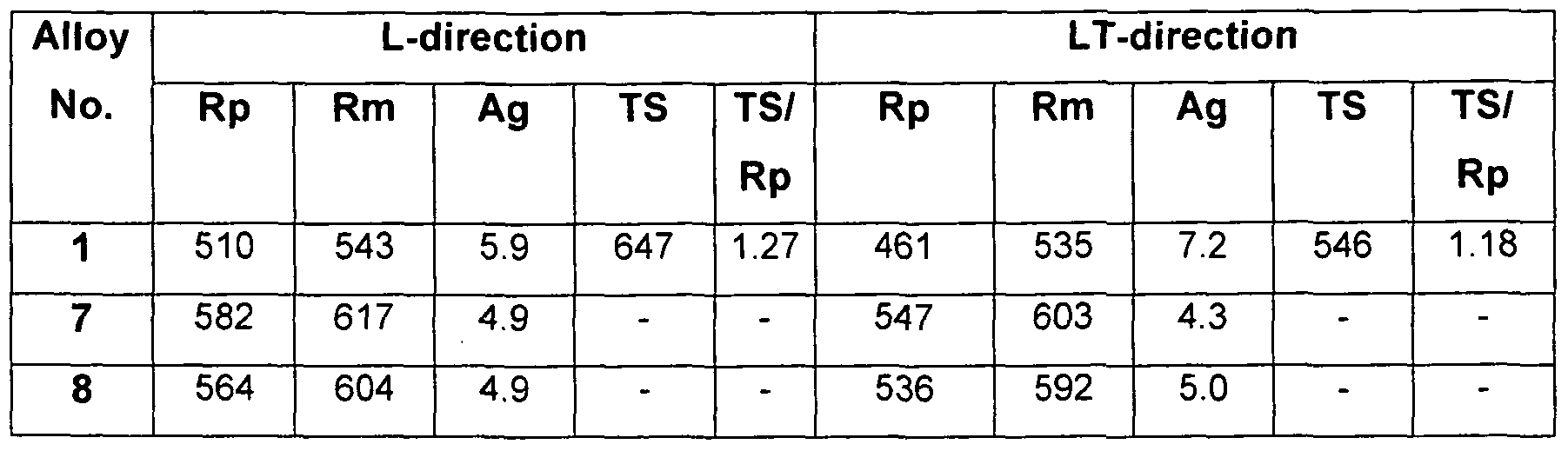
- SHT and quenched sheet two ageing practices were carried out: (1) an under-aged condition by ageing for 20 hours at 17O 0 C, and only for alloys 1 , 7, and 8: (2) a peak-aged condition by ageing for 48 hours at 17O 0 C.
- Table 1 Chemical composition of the aluminium alloys tested. All alloying additions are by wt.%, the balance is made by unavoidable impurities and aluminium. For all alloys Fe 0.03%, Si 0.03%.
- the Li-content should not exceed 1.7%, and preferable not more than 1.4%, and more preferably should not exceed 1.25%.
Landscapes
- Chemical & Material Sciences (AREA)
- Engineering & Computer Science (AREA)
- Materials Engineering (AREA)
- Mechanical Engineering (AREA)
- Metallurgy (AREA)
- Organic Chemistry (AREA)
- Physics & Mathematics (AREA)
- Thermal Sciences (AREA)
- Crystallography & Structural Chemistry (AREA)
- Extrusion Of Metal (AREA)
- Forging (AREA)
- Metal Rolling (AREA)
Abstract
Description

Claims
Priority Applications (4)
| Application Number | Priority Date | Filing Date | Title |
|---|---|---|---|
| DE112008002522T DE112008002522T5 (en) | 2007-09-21 | 2008-09-16 | Al-Cu-Li alloy product suitable for aircraft application |
| CN200880107556.3A CN101855376B (en) | 2007-09-21 | 2008-09-16 | Al-Cu-Li alloy products suitable for aerospace applications |
| CA2700250A CA2700250C (en) | 2007-09-21 | 2008-09-16 | Al-cu-li alloy product suitable for aerospace application |
| RU2010110350/02A RU2481412C2 (en) | 2007-09-21 | 2008-09-16 | PRODUCT FROM Al-Cu-Li-ALLOY SUITABLE FOR USE IN AIRCRAFT AND AEROSPACE ENGINEERING |
Applications Claiming Priority (2)
| Application Number | Priority Date | Filing Date | Title |
|---|---|---|---|
| EP07018595.4 | 2007-09-21 | ||
| EP07018595 | 2007-09-21 |
Publications (1)
| Publication Number | Publication Date |
|---|---|
| WO2009036953A1 true WO2009036953A1 (en) | 2009-03-26 |
Family
ID=38754771
Family Applications (1)
| Application Number | Title | Priority Date | Filing Date |
|---|---|---|---|
| PCT/EP2008/007731 Ceased WO2009036953A1 (en) | 2007-09-21 | 2008-09-16 | Al-cu-li alloy product suitable for aerospace application |
Country Status (5)
| Country | Link |
|---|---|
| CN (2) | CN101855376B (en) |
| CA (1) | CA2700250C (en) |
| DE (2) | DE202008018370U1 (en) |
| RU (2) | RU2481412C2 (en) |
| WO (1) | WO2009036953A1 (en) |
Cited By (34)
| Publication number | Priority date | Publication date | Assignee | Title |
|---|---|---|---|---|
| WO2010149873A1 (en) * | 2009-06-25 | 2010-12-29 | Alcan Rhenalu | Aluminium-copper-lithium alloy having improved mechanical strength and improved toughness |
| US8118950B2 (en) | 2007-12-04 | 2012-02-21 | Alcoa Inc. | Aluminum-copper-lithium alloys |
| AU2011226797B2 (en) * | 2010-09-08 | 2012-04-19 | Alcoa Inc. | Improved aluminum-lithium alloys, and methods for producing the same |
| US20120152415A1 (en) * | 2010-12-20 | 2012-06-21 | Constellium France | Aluminum copper lithium alloy with improved resistance under compression and fracture toughness |
| EP2558564A1 (en) | 2010-04-12 | 2013-02-20 | Alcoa Inc. | 2xxx series aluminum lithium alloys having low strength differential |
| WO2013153292A1 (en) | 2012-04-11 | 2013-10-17 | Constellium France | Aluminium copper lithium alloy with improved impact strength |
| WO2013169901A1 (en) * | 2012-05-09 | 2013-11-14 | Alcoa Inc. | 2xxx series aluminum lithium alloys |
| KR20140010074A (en) * | 2011-02-17 | 2014-01-23 | 알코아 인코포레이티드 | 2xxx series aluminum lithium alloys |
| KR20160040464A (en) * | 2013-06-21 | 2016-04-14 | 콩스텔리움 이수와르 | Extrados structural element made from an aluminium copper lithium alloy |
| EP2937435A4 (en) * | 2012-12-21 | 2016-09-07 | Kawasaki Heavy Ind Ltd | METHOD FOR MANUFACTURING AN ALUMINUM ALLOY SHAPED COMPONENT FOR AN AIRCRAFT AND SHAPED COMPONENT FOR AN AIRCRAFT |
| US9587298B2 (en) | 2013-02-19 | 2017-03-07 | Arconic Inc. | Heat treatable aluminum alloys having magnesium and zinc and methods for producing the same |
| CN106795595A (en) * | 2014-10-03 | 2017-05-31 | 伊苏瓦尔肯联铝业 | Isotropism aluminum bronze lithium alloy plate for manufacturing airframe |
| CN106884129A (en) * | 2017-03-14 | 2017-06-23 | 广州金邦液态模锻技术有限公司 | A kind of Technology for Heating Processing for extrusion casint aluminium alloy knuckle |
| CN106893911A (en) * | 2017-02-27 | 2017-06-27 | 广东省材料与加工研究所 | A kind of high-strength temperature-resistant Al Cu line aluminium alloys and preparation method thereof |
| EP3072984B1 (en) | 2015-03-27 | 2017-07-05 | Otto Fuchs KG | Al-cu-mg-li alloy and alloy product produced from same |
| EP2981632B1 (en) | 2013-04-03 | 2017-08-02 | Constellium Issoire | Thin sheets made of an aluminium-copper-lithium alloy for producing airplane fuselages |
| WO2017137260A1 (en) * | 2016-02-09 | 2017-08-17 | Aleris Rolled Products Germany Gmbh | Al-Cu-Li-Mg-Mn-Zn ALLOY WROUGHT PRODUCT |
| US9926620B2 (en) | 2012-03-07 | 2018-03-27 | Arconic Inc. | 2xxx aluminum alloys, and methods for producing the same |
| DE202017100517U1 (en) | 2017-01-31 | 2018-05-03 | Aleris Rolled Products Germany Gmbh | Al-Cu-Li-Mg-Mn-Zn wrought alloy product |
| CN108118271A (en) * | 2017-12-08 | 2018-06-05 | 北京星航机电装备有限公司 | A kind of allotype aluminum alloy bay section method for controlling heat treatment deformation |
| WO2019211546A1 (en) | 2018-05-02 | 2019-11-07 | Constellium Issoire | Method for manufacturing an aluminum-copper-lithium alloy with improved compressive strength and improved toughness |
| WO2019211547A1 (en) | 2018-05-02 | 2019-11-07 | Constellium Issoire | Aluminium-copper-lithium alloy having improved compressive strength and improved toughness |
| RU2716722C2 (en) * | 2014-10-26 | 2020-03-16 | КАЙЗЕР АЛЮМИНУМ ФАБРИКЕЙТЕД ПРОДАКТС, ЭлЭлСи | Aluminum-lithium alloys with high strength, high deformability and low cost |
| EP3411508B1 (en) | 2016-02-03 | 2020-04-08 | Constellium Issoire | Thick al - cu - li - alloy sheets having improved fatigue properties |
| CN111020425A (en) * | 2019-12-25 | 2020-04-17 | 辽宁忠旺集团有限公司 | 2-series aluminum alloy heat treatment process |
| WO2020097169A1 (en) * | 2018-11-07 | 2020-05-14 | Arconic Inc. | 2xxx aluminum lithium alloys |
| WO2020102441A3 (en) * | 2018-11-14 | 2020-08-20 | Arconic Inc. | Improved 7xxx aluminum alloys |
| US20210262065A1 (en) * | 2018-11-16 | 2021-08-26 | Arconic Technologies Llc | 2xxx aluminum alloys |
| CN113981280A (en) * | 2021-11-01 | 2022-01-28 | 北京理工大学 | Low-density high-strength high-elasticity-modulus aluminum-lithium alloy and preparation method thereof |
| US20220195561A1 (en) * | 2020-12-21 | 2022-06-23 | Divergent Technologies, Inc. | 3-d printable alloys |
| CN115584403A (en) * | 2015-12-18 | 2023-01-10 | 诺维尔里斯公司 | High-strength 6XXX aluminum alloy and its preparation method |
| US11920229B2 (en) | 2015-12-18 | 2024-03-05 | Novelis Inc. | High strength 6XXX aluminum alloys and methods of making the same |
| US12378643B2 (en) | 2019-01-18 | 2025-08-05 | Divergent Technologies, Inc. | Aluminum alloys |
| CN121992321A (en) * | 2026-04-10 | 2026-05-08 | 湖南卓创精材科技股份有限公司 | Preparation method of high-performance aluminum alloy |
Families Citing this family (20)
| Publication number | Priority date | Publication date | Assignee | Title |
|---|---|---|---|---|
| CN101967588B (en) * | 2010-10-27 | 2012-08-29 | 中国航空工业集团公司北京航空材料研究院 | Damage-resistant aluminum-lithium alloy and preparation method thereof |
| CN102021457B (en) * | 2010-10-27 | 2012-06-27 | 中国航空工业集团公司北京航空材料研究院 | High-toughness aluminum lithium alloy and preparation method thereof |
| CN101967589B (en) * | 2010-10-27 | 2013-02-20 | 中国航空工业集团公司北京航空材料研究院 | Medium-strength high-toughness aluminum lithium alloy and preparation method thereof |
| FR2975403B1 (en) * | 2011-05-20 | 2018-11-02 | Constellium Issoire | MAGNESIUM LITHIUM ALUMINUM ALLOY WITH IMPROVED TENACITY |
| CN102634706A (en) * | 2012-04-28 | 2012-08-15 | 中南大学 | High-strength high-toughness corrosion-resistant Al-Cu-Mg aluminum alloy |
| US20140050936A1 (en) * | 2012-08-17 | 2014-02-20 | Alcoa Inc. | 2xxx series aluminum lithium alloys |
| CN103352146B (en) * | 2013-08-02 | 2015-04-08 | 贵州合润铝业高新科技发展有限公司 | Aluminum alloy |
| CN103397229B (en) * | 2013-08-02 | 2015-04-08 | 贵州合润铝业高新科技发展有限公司 | Preparation method of aluminium alloy |
| CN104018043B (en) * | 2014-06-19 | 2016-08-24 | 芜湖市泰美机械设备有限公司 | A kind of high intensity Aeronautical Cast makes aluminium alloy and heat treatment method thereof |
| US20180305795A1 (en) * | 2015-11-25 | 2018-10-25 | Otto Fuchs Kommanditgesellschaft | Tube for Use in Conjunction with a Deep Drilled Hole |
| CN106131719B (en) * | 2016-08-30 | 2019-02-05 | 宁波泊人艾电子有限公司 | A kind of portable sound box |
| CN106358115A (en) * | 2016-08-30 | 2017-01-25 | 宁波大诚和电子有限公司 | Loudspeaking control unit of multifunctional portable loudspeaker box |
| CN106131720B (en) * | 2016-08-30 | 2019-02-05 | 宁波泊人艾电子有限公司 | A kind of multifunctional portable speaker |
| CN106591649A (en) * | 2016-12-14 | 2017-04-26 | 沈阳工业大学 | High-strength Al-Cu-Mg-Mn-Er wrought aluminum alloy and preparation method thereof |
| CN110423927A (en) * | 2019-07-17 | 2019-11-08 | 中南大学 | A kind of Ultrahigh strength aluminum lithium alloy and preparation method thereof |
| CN111575561B (en) * | 2020-05-25 | 2022-02-08 | 江苏豪然喷射成形合金有限公司 | Aluminum-lithium alloy for large-depth pressure-bearing shell and preparation method thereof |
| CN114214548A (en) * | 2021-12-17 | 2022-03-22 | 中南大学 | High-strength high-hardenability aluminum-lithium alloy and preparation method thereof |
| CN115386818A (en) * | 2022-08-25 | 2022-11-25 | 中南大学 | A kind of deformation heat treatment method of Al-Cu-Li series alloy hot-rolled slab |
| CN115505807B (en) * | 2022-09-21 | 2023-06-27 | 郑州轻研合金科技有限公司 | High-specific-strength aluminum lithium alloy and preparation method and application thereof |
| CN115710662B (en) * | 2022-11-21 | 2024-02-06 | 郑州轻研合金科技有限公司 | High-strength high-toughness aluminum lithium alloy plate and production process thereof |
Citations (11)
| Publication number | Priority date | Publication date | Assignee | Title |
|---|---|---|---|---|
| WO1989001531A1 (en) * | 1987-08-10 | 1989-02-23 | Martin Marietta Corporation | Ultra high strength weldable aluminum-lithium alloys |
| JPH03107440A (en) * | 1989-09-20 | 1991-05-07 | Showa Alum Corp | Aluminum alloy for load cell |
| WO1992020830A1 (en) * | 1991-05-14 | 1992-11-26 | Reynolds Metals Company | LOW DENSITY HIGH STRENGTH Al-Li ALLOY |
| US5211910A (en) * | 1990-01-26 | 1993-05-18 | Martin Marietta Corporation | Ultra high strength aluminum-base alloys |
| US5389165A (en) * | 1991-05-14 | 1995-02-14 | Reynolds Metals Company | Low density, high strength Al-Li alloy having high toughness at elevated temperatures |
| US5393357A (en) * | 1992-10-06 | 1995-02-28 | Reynolds Metals Company | Method of minimizing strength anisotropy in aluminum-lithium alloy wrought product by cold rolling, stretching and aging |
| WO2002063059A1 (en) * | 2000-10-20 | 2002-08-15 | Pechiney Rolled Products, Llc | High strenght aluminum alloy |
| US20040071586A1 (en) * | 1998-06-24 | 2004-04-15 | Rioja Roberto J. | Aluminum-copper-magnesium alloys having ancillary additions of lithium |
| RU2237098C1 (en) * | 2003-07-24 | 2004-09-27 | Федеральное государственное унитарное предприятие "Всероссийский научно-исследовательский институт авиационных материалов" | Aluminium-based alloy and product made from the same |
| WO2004106570A1 (en) * | 2003-05-28 | 2004-12-09 | Pechiney Rolled Products | New al-cu-li-mg-ag-mn-zr alloy for use as stractural members requiring high strength and high fracture toughness |
| US20070181229A1 (en) * | 2005-12-20 | 2007-08-09 | Bernard Bes | High fracture toughness aluminum-copper-lithium sheet or light-gauge plates suitable for fuselage panels |
Family Cites Families (1)
| Publication number | Priority date | Publication date | Assignee | Title |
|---|---|---|---|---|
| CA2519390C (en) * | 2003-04-10 | 2015-06-02 | Corus Aluminium Walzprodukte Gmbh | An al-zn-mg-cu alloy |
-
2008
- 2008-09-16 DE DE202008018370U patent/DE202008018370U1/en not_active Expired - Lifetime
- 2008-09-16 WO PCT/EP2008/007731 patent/WO2009036953A1/en not_active Ceased
- 2008-09-16 CN CN200880107556.3A patent/CN101855376B/en not_active Expired - Fee Related
- 2008-09-16 DE DE112008002522T patent/DE112008002522T5/en not_active Withdrawn
- 2008-09-16 CA CA2700250A patent/CA2700250C/en not_active Expired - Fee Related
- 2008-09-16 CN CN201310124663.XA patent/CN103266246B/en not_active Expired - Fee Related
- 2008-09-16 RU RU2010110350/02A patent/RU2481412C2/en not_active IP Right Cessation
-
2013
- 2013-01-18 RU RU2013102512A patent/RU2627085C2/en not_active IP Right Cessation
Patent Citations (11)
| Publication number | Priority date | Publication date | Assignee | Title |
|---|---|---|---|---|
| WO1989001531A1 (en) * | 1987-08-10 | 1989-02-23 | Martin Marietta Corporation | Ultra high strength weldable aluminum-lithium alloys |
| JPH03107440A (en) * | 1989-09-20 | 1991-05-07 | Showa Alum Corp | Aluminum alloy for load cell |
| US5211910A (en) * | 1990-01-26 | 1993-05-18 | Martin Marietta Corporation | Ultra high strength aluminum-base alloys |
| WO1992020830A1 (en) * | 1991-05-14 | 1992-11-26 | Reynolds Metals Company | LOW DENSITY HIGH STRENGTH Al-Li ALLOY |
| US5389165A (en) * | 1991-05-14 | 1995-02-14 | Reynolds Metals Company | Low density, high strength Al-Li alloy having high toughness at elevated temperatures |
| US5393357A (en) * | 1992-10-06 | 1995-02-28 | Reynolds Metals Company | Method of minimizing strength anisotropy in aluminum-lithium alloy wrought product by cold rolling, stretching and aging |
| US20040071586A1 (en) * | 1998-06-24 | 2004-04-15 | Rioja Roberto J. | Aluminum-copper-magnesium alloys having ancillary additions of lithium |
| WO2002063059A1 (en) * | 2000-10-20 | 2002-08-15 | Pechiney Rolled Products, Llc | High strenght aluminum alloy |
| WO2004106570A1 (en) * | 2003-05-28 | 2004-12-09 | Pechiney Rolled Products | New al-cu-li-mg-ag-mn-zr alloy for use as stractural members requiring high strength and high fracture toughness |
| RU2237098C1 (en) * | 2003-07-24 | 2004-09-27 | Федеральное государственное унитарное предприятие "Всероссийский научно-исследовательский институт авиационных материалов" | Aluminium-based alloy and product made from the same |
| US20070181229A1 (en) * | 2005-12-20 | 2007-08-09 | Bernard Bes | High fracture toughness aluminum-copper-lithium sheet or light-gauge plates suitable for fuselage panels |
Non-Patent Citations (1)
| Title |
|---|
| DATABASE WPI Derwent World Patents Index; AN 2004-755565, XP002461605 * |
Cited By (77)
| Publication number | Priority date | Publication date | Assignee | Title |
|---|---|---|---|---|
| US8118950B2 (en) | 2007-12-04 | 2012-02-21 | Alcoa Inc. | Aluminum-copper-lithium alloys |
| AU2013257457B2 (en) * | 2007-12-04 | 2016-03-31 | Arconic Inc. | Improved aluminum-copper-lithium alloys |
| US9587294B2 (en) | 2007-12-04 | 2017-03-07 | Arconic Inc. | Aluminum-copper-lithium alloys |
| EP2449142B1 (en) | 2009-06-25 | 2017-05-03 | Constellium Issoire | Aluminium-copper-lithium alloy with improved mechanical resistance and toughness |
| WO2010149873A1 (en) * | 2009-06-25 | 2010-12-29 | Alcan Rhenalu | Aluminium-copper-lithium alloy having improved mechanical strength and improved toughness |
| CN102459671A (en) * | 2009-06-25 | 2012-05-16 | 法国肯联铝业 | Aluminum-copper-lithium alloys with improved mechanical strength and toughness |
| US20110209801A2 (en) * | 2009-06-25 | 2011-09-01 | Alcan Rhenalu | Aluminum-Copper-Lithium Alloy With Improved Mechanical Strength and Toughness |
| US11111562B2 (en) | 2009-06-25 | 2021-09-07 | Constellium Issoire | Aluminum-copper-lithium alloy with improved mechanical strength and toughness |
| FR2947282A1 (en) * | 2009-06-25 | 2010-12-31 | Alcan Rhenalu | LITHIUM COPPER ALUMINUM ALLOY WITH IMPROVED MECHANICAL RESISTANCE AND TENACITY |
| EP3404123A1 (en) * | 2010-04-12 | 2018-11-21 | Arconic Inc. | 2xxx series aluminum lithium alloys having low strength differential |
| US10435774B2 (en) * | 2010-04-12 | 2019-10-08 | Arconic Inc. | 2XXX series aluminum lithium alloys having low strength differential |
| US20150000799A1 (en) * | 2010-04-12 | 2015-01-01 | Alcoa Inc. | 2xxx series aluminum lithium alloys having low strength differential |
| EP2558564A1 (en) | 2010-04-12 | 2013-02-20 | Alcoa Inc. | 2xxx series aluminum lithium alloys having low strength differential |
| RU2598423C2 (en) * | 2010-04-12 | 2016-09-27 | Алкоа Инк. | Aluminium-lithium alloys of 2xxx series with low difference in strength |
| EP2558564A4 (en) * | 2010-04-12 | 2015-07-15 | Alcoa Inc | 2XXX SERIES LITHIUM ALUMINUM ALLOYS WITH LOW RESISTANCE DIFFERENTIAL |
| US8845827B2 (en) | 2010-04-12 | 2014-09-30 | Alcoa Inc. | 2XXX series aluminum lithium alloys having low strength differential |
| US9194028B2 (en) | 2010-09-08 | 2015-11-24 | Alcoa Inc. | 2xxx aluminum alloys, and methods for producing the same |
| US9359660B2 (en) | 2010-09-08 | 2016-06-07 | Alcoa Inc. | 6XXX aluminum alloys, and methods for producing the same |
| US8999079B2 (en) | 2010-09-08 | 2015-04-07 | Alcoa, Inc. | 6xxx aluminum alloys, and methods for producing the same |
| AU2011226797B2 (en) * | 2010-09-08 | 2012-04-19 | Alcoa Inc. | Improved aluminum-lithium alloys, and methods for producing the same |
| US9249484B2 (en) | 2010-09-08 | 2016-02-02 | Alcoa Inc. | 7XXX aluminum alloys, and methods for producing the same |
| CN103168110A (en) * | 2010-09-08 | 2013-06-19 | 美铝公司 | Improved aluminum-lithium alloy and production method thereof |
| US20120152415A1 (en) * | 2010-12-20 | 2012-06-21 | Constellium France | Aluminum copper lithium alloy with improved resistance under compression and fracture toughness |
| FR2969177A1 (en) * | 2010-12-20 | 2012-06-22 | Alcan Rhenalu | LITHIUM COPPER ALUMINUM ALLOY WITH ENHANCED COMPRESSION RESISTANCE AND TENACITY |
| WO2012085359A3 (en) * | 2010-12-20 | 2012-09-13 | Constellium France | Aluminium-copper-lithium alloy with improved compressive strength and toughness |
| KR102003569B1 (en) | 2011-02-17 | 2019-07-24 | 아르코닉 인코포레이티드 | 2xxx series aluminum lithium alloys |
| US12565695B2 (en) | 2011-02-17 | 2026-03-03 | Arconic Technologies Llc | 2XXX series aluminum lithium alloys |
| KR20140010074A (en) * | 2011-02-17 | 2014-01-23 | 알코아 인코포레이티드 | 2xxx series aluminum lithium alloys |
| EP3187603A1 (en) * | 2011-02-17 | 2017-07-05 | Arconic Inc. | 2xxx series aluminum lithium alloys |
| EP2675933B1 (en) | 2011-02-17 | 2017-02-08 | Alcoa Inc. | 2xxx series aluminum lithium alloys |
| EP2675933A4 (en) * | 2011-02-17 | 2014-10-22 | Alcoa Inc | ALUMINUM-LITHIUM ALLOYS 2XXX SERIES |
| US9926620B2 (en) | 2012-03-07 | 2018-03-27 | Arconic Inc. | 2xxx aluminum alloys, and methods for producing the same |
| FR2989387A1 (en) * | 2012-04-11 | 2013-10-18 | Constellium France | LITHIUM COPPER ALUMINUM ALLOY WITH IMPROVED SHOCK RESISTANCE |
| WO2013153292A1 (en) | 2012-04-11 | 2013-10-17 | Constellium France | Aluminium copper lithium alloy with improved impact strength |
| US9945010B2 (en) | 2012-04-11 | 2018-04-17 | Constellium Issoire | Aluminum-copper-lithium alloy with improved impact resistance |
| WO2013169901A1 (en) * | 2012-05-09 | 2013-11-14 | Alcoa Inc. | 2xxx series aluminum lithium alloys |
| EP2847361B1 (en) | 2012-05-09 | 2017-01-11 | Alcoa Inc. | 2xxx series aluminum lithium alloys |
| RU2659529C2 (en) * | 2012-05-09 | 2018-07-02 | Арконик Инк. | 2xxx series aluminum lithium alloys |
| US9458528B2 (en) | 2012-05-09 | 2016-10-04 | Alcoa Inc. | 2xxx series aluminum lithium alloys |
| EP2937435A4 (en) * | 2012-12-21 | 2016-09-07 | Kawasaki Heavy Ind Ltd | METHOD FOR MANUFACTURING AN ALUMINUM ALLOY SHAPED COMPONENT FOR AN AIRCRAFT AND SHAPED COMPONENT FOR AN AIRCRAFT |
| US9587298B2 (en) | 2013-02-19 | 2017-03-07 | Arconic Inc. | Heat treatable aluminum alloys having magnesium and zinc and methods for producing the same |
| EP2981632B1 (en) | 2013-04-03 | 2017-08-02 | Constellium Issoire | Thin sheets made of an aluminium-copper-lithium alloy for producing airplane fuselages |
| US10501835B2 (en) | 2013-04-03 | 2019-12-10 | Constellium Issoire | Thin sheets made of an aluminium-copper-lithium alloy for producing airplane fuselages |
| US11472532B2 (en) | 2013-06-21 | 2022-10-18 | Constellium Issoire | Extrados structural element made from an aluminium copper lithium alloy |
| KR102260797B1 (en) * | 2013-06-21 | 2021-06-07 | 콩스텔리움 이수와르 | Extrados structural element made from an aluminium copper lithium alloy |
| US20160144946A1 (en) * | 2013-06-21 | 2016-05-26 | Constellium Issoire | Extrados structural element made from an aluminium copper lithium alloy |
| KR20160040464A (en) * | 2013-06-21 | 2016-04-14 | 콩스텔리움 이수와르 | Extrados structural element made from an aluminium copper lithium alloy |
| CN106795595A (en) * | 2014-10-03 | 2017-05-31 | 伊苏瓦尔肯联铝业 | Isotropism aluminum bronze lithium alloy plate for manufacturing airframe |
| RU2716722C2 (en) * | 2014-10-26 | 2020-03-16 | КАЙЗЕР АЛЮМИНУМ ФАБРИКЕЙТЕД ПРОДАКТС, ЭлЭлСи | Aluminum-lithium alloys with high strength, high deformability and low cost |
| EP3072984B1 (en) | 2015-03-27 | 2017-07-05 | Otto Fuchs KG | Al-cu-mg-li alloy and alloy product produced from same |
| EP3072984B2 (en) † | 2015-03-27 | 2020-05-06 | Otto Fuchs KG | Al-cu-mg-li alloy and alloy product produced from same |
| US12043887B2 (en) | 2015-12-18 | 2024-07-23 | Novelis Inc. | High strength 6xxx aluminum alloys and methods of making the same |
| US11920229B2 (en) | 2015-12-18 | 2024-03-05 | Novelis Inc. | High strength 6XXX aluminum alloys and methods of making the same |
| CN115584403A (en) * | 2015-12-18 | 2023-01-10 | 诺维尔里斯公司 | High-strength 6XXX aluminum alloy and its preparation method |
| EP3411508B1 (en) | 2016-02-03 | 2020-04-08 | Constellium Issoire | Thick al - cu - li - alloy sheets having improved fatigue properties |
| EP3414352B1 (en) | 2016-02-09 | 2019-12-04 | Aleris Rolled Products Germany GmbH | Al-cu-li-mg-mn-zn alloy wrought product |
| WO2017137260A1 (en) * | 2016-02-09 | 2017-08-17 | Aleris Rolled Products Germany Gmbh | Al-Cu-Li-Mg-Mn-Zn ALLOY WROUGHT PRODUCT |
| DE202017100517U1 (en) | 2017-01-31 | 2018-05-03 | Aleris Rolled Products Germany Gmbh | Al-Cu-Li-Mg-Mn-Zn wrought alloy product |
| CN106893911A (en) * | 2017-02-27 | 2017-06-27 | 广东省材料与加工研究所 | A kind of high-strength temperature-resistant Al Cu line aluminium alloys and preparation method thereof |
| CN106884129A (en) * | 2017-03-14 | 2017-06-23 | 广州金邦液态模锻技术有限公司 | A kind of Technology for Heating Processing for extrusion casint aluminium alloy knuckle |
| CN108118271B (en) * | 2017-12-08 | 2019-08-06 | 北京星航机电装备有限公司 | A kind of allotype aluminum alloy bay section method for controlling heat treatment deformation |
| CN108118271A (en) * | 2017-12-08 | 2018-06-05 | 北京星航机电装备有限公司 | A kind of allotype aluminum alloy bay section method for controlling heat treatment deformation |
| WO2019211546A1 (en) | 2018-05-02 | 2019-11-07 | Constellium Issoire | Method for manufacturing an aluminum-copper-lithium alloy with improved compressive strength and improved toughness |
| WO2019211547A1 (en) | 2018-05-02 | 2019-11-07 | Constellium Issoire | Aluminium-copper-lithium alloy having improved compressive strength and improved toughness |
| US20210310108A1 (en) * | 2018-05-02 | 2021-10-07 | Constellium Issoire | Aluminum-copper-lithium alloy having improved compressive strength and improved toughness |
| EP3877562B1 (en) | 2018-11-07 | 2025-04-02 | Arconic Technologies LLC | 2xxx aluminum lithium alloys |
| WO2020097169A1 (en) * | 2018-11-07 | 2020-05-14 | Arconic Inc. | 2xxx aluminum lithium alloys |
| US12194529B2 (en) | 2018-11-07 | 2025-01-14 | Arconic Technologies Llc | 2XXX aluminum lithium alloys |
| WO2020102441A3 (en) * | 2018-11-14 | 2020-08-20 | Arconic Inc. | Improved 7xxx aluminum alloys |
| US12649961B2 (en) * | 2018-11-16 | 2026-06-09 | Arconic Technologies Llc | 2XXX aluminum alloys |
| US20210262065A1 (en) * | 2018-11-16 | 2021-08-26 | Arconic Technologies Llc | 2xxx aluminum alloys |
| US12378643B2 (en) | 2019-01-18 | 2025-08-05 | Divergent Technologies, Inc. | Aluminum alloys |
| CN111020425A (en) * | 2019-12-25 | 2020-04-17 | 辽宁忠旺集团有限公司 | 2-series aluminum alloy heat treatment process |
| US20220195561A1 (en) * | 2020-12-21 | 2022-06-23 | Divergent Technologies, Inc. | 3-d printable alloys |
| CN113981280A (en) * | 2021-11-01 | 2022-01-28 | 北京理工大学 | Low-density high-strength high-elasticity-modulus aluminum-lithium alloy and preparation method thereof |
| CN121992321A (en) * | 2026-04-10 | 2026-05-08 | 湖南卓创精材科技股份有限公司 | Preparation method of high-performance aluminum alloy |
| CN121992321B (en) * | 2026-04-10 | 2026-07-21 | 湖南卓创精材科技股份有限公司 | Preparation method of high-performance aluminum alloy |
Also Published As
| Publication number | Publication date |
|---|---|
| CN103266246A (en) | 2013-08-28 |
| DE202008018370U1 (en) | 2013-04-30 |
| DE112008002522T5 (en) | 2010-08-26 |
| CN101855376A (en) | 2010-10-06 |
| CA2700250C (en) | 2016-06-28 |
| CA2700250A1 (en) | 2009-03-26 |
| RU2481412C2 (en) | 2013-05-10 |
| RU2010110350A (en) | 2011-09-27 |
| RU2013102512A (en) | 2014-07-27 |
| RU2627085C2 (en) | 2017-08-03 |
| CN101855376B (en) | 2013-06-05 |
| CN103266246B (en) | 2016-09-21 |
Similar Documents
| Publication | Publication Date | Title |
|---|---|---|
| CA2700250C (en) | Al-cu-li alloy product suitable for aerospace application | |
| EP3911777B1 (en) | 7xxx-series aluminium alloy product | |
| US8002913B2 (en) | AA7000-series aluminum alloy products and a method of manufacturing thereof | |
| EP2121997B1 (en) | Ai-cu alloy product suitable for aerospace application | |
| US8608876B2 (en) | AA7000-series aluminum alloy products and a method of manufacturing thereof | |
| EP2288738B1 (en) | Al-zn-mg alloy product with reduced quench sensitivity | |
| KR102580143B1 (en) | 7XXX-Series Aluminum Alloy Products | |
| JP4535731B2 (en) | AL-ZN-MG-CU alloy product with improved harmony between static mechanical properties and damage resistance | |
| US7666267B2 (en) | Al-Zn-Mg-Cu alloy with improved damage tolerance-strength combination properties | |
| EP3414352B1 (en) | Al-cu-li-mg-mn-zn alloy wrought product | |
| EP4247991B1 (en) | Method of manufacturing 2xxx-series aluminum alloy products | |
| RU2826059C1 (en) | Method of manufacturing articles from aluminum alloy of 2xxx series |
Legal Events
| Date | Code | Title | Description |
|---|---|---|---|
| WWE | Wipo information: entry into national phase |
Ref document number: 200880107556.3 Country of ref document: CN |
|
| 121 | Ep: the epo has been informed by wipo that ep was designated in this application |
Ref document number: 08802260 Country of ref document: EP Kind code of ref document: A1 |
|
| WWE | Wipo information: entry into national phase |
Ref document number: 2010110350 Country of ref document: RU |
|
| WWE | Wipo information: entry into national phase |
Ref document number: 2700250 Country of ref document: CA Ref document number: 1573/CHENP/2010 Country of ref document: IN |
|
| WWE | Wipo information: entry into national phase |
Ref document number: 1120080025223 Country of ref document: DE |
|
| RET | De translation (de og part 6b) |
Ref document number: 112008002522 Country of ref document: DE Date of ref document: 20100826 Kind code of ref document: P |
|
| 122 | Ep: pct application non-entry in european phase |
Ref document number: 08802260 Country of ref document: EP Kind code of ref document: A1 |