WO2009065281A1 - A method for transparent transmitting 10ge ethernet signal through the optical transport network - Google Patents
A method for transparent transmitting 10ge ethernet signal through the optical transport network Download PDFInfo
- Publication number
- WO2009065281A1 WO2009065281A1 PCT/CN2008/000240 CN2008000240W WO2009065281A1 WO 2009065281 A1 WO2009065281 A1 WO 2009065281A1 CN 2008000240 W CN2008000240 W CN 2008000240W WO 2009065281 A1 WO2009065281 A1 WO 2009065281A1
- Authority
- WO
- WIPO (PCT)
- Prior art keywords
- byte
- asynchronous mapping
- optical channel
- adjustment
- bytes
- Prior art date
- Legal status (The legal status is an assumption and is not a legal conclusion. Google has not performed a legal analysis and makes no representation as to the accuracy of the status listed.)
- Ceased
Links
Classifications
-
- H—ELECTRICITY
- H04—ELECTRIC COMMUNICATION TECHNIQUE
- H04J—MULTIPLEX COMMUNICATION
- H04J3/00—Time-division multiplex systems
- H04J3/16—Time-division multiplex systems in which the time allocation to individual channels within a transmission cycle is variable, e.g. to accommodate varying complexity of signals, to vary number of channels transmitted
- H04J3/1605—Fixed allocated frame structures
- H04J3/1652—Optical Transport Network [OTN]
- H04J3/1658—Optical Transport Network [OTN] carrying packets or ATM cells
-
- H—ELECTRICITY
- H04—ELECTRIC COMMUNICATION TECHNIQUE
- H04J—MULTIPLEX COMMUNICATION
- H04J3/00—Time-division multiplex systems
- H04J3/02—Details
- H04J3/06—Synchronising arrangements
- H04J3/07—Synchronising arrangements using pulse stuffing for systems with different or fluctuating information rates or bit rates
-
- H—ELECTRICITY
- H04—ELECTRIC COMMUNICATION TECHNIQUE
- H04J—MULTIPLEX COMMUNICATION
- H04J2203/00—Aspects of optical multiplex systems other than those covered by H04J14/05 and H04J14/07
- H04J2203/0001—Provisions for broadband connections in integrated services digital network using frames of the Optical Transport Network [OTN] or using synchronous transfer mode [STM], e.g. SONET, SDH
- H04J2203/0073—Services, e.g. multimedia, GOS, QOS
- H04J2203/0082—Interaction of SDH with non-ATM protocols
- H04J2203/0085—Support of Ethernet
Definitions
- the present invention relates to the transmission of Ethernet services over an Optical Transport Network (OTN), and more particularly to a 10 Gigabit Ethernet (10GELAN) 10GE LAN, also known as 10GE Ethernet), is a method of transparent transmission in the OPU2 payload area of an optical channel transport unit of an optical transport network.
- OTN Optical Transport Network
- the details are detailed in the ITU-T G.709 optical transport network standard. The definition is shown in Table 1.
- Table 1 Rate grades for OTUk.
- the OTUk nominal rate is approximately: 2 666 057.143 kbit/s (OTU1), 10 709 225.316 kbit/s (OTU2) and 43 018 413.559 kbit/s (OTU3).
- OTU1 2 666 057.143 kbit/s
- OFTU2 10 709 225.316 kbit/s
- OFTU3 43 018 413.559 kbit/s
- each layer has corresponding overhead bytes to monitor and manage the information of the client layer.
- OTN uses GFP encapsulation, asynchronous mapping, synchronous mapping and many other methods, ⁇ ! The client traffic is mapped to the same frame structure for transmission.
- the OTN network has the advantages of large cross-grain, transparent transmission to services, and high packaging efficiency.
- Ethernet series developed by the IEEE ( Institute of Electrical and Electronics Engineers).
- the standard is adapted, resulting in a series rate of Ethernet services that cannot be transmitted well within the OTN frame.
- the payload rate of the OTN transport system and the interface speed of the Ethernet such as OPU payload rate Ethernet interface rate
- Table 2 OPU Payload Rate vs. Ethernet Interface Rate Table.
- the GE interface is carried by the OPU1, which causes a waste of bandwidth.
- the rate is slightly higher than the payload bandwidth of the OPU2.
- the bandwidth is insufficient when the standard OPU2 is used for transmission, and the bandwidth is even more wasteful when transmitted by the OPU3. Therefore, how to effectively transmit Ethernet signals through the OTN network, especially the transparent transmission of 10GELAN signals, needs to be solved, resulting in various private mapping methods.
- ITU-T has created an informative document Sup43 for each solution proposed by the parties.
- the various possible solutions are compared.
- the main methods, advantages and disadvantages are shown in Table 3.
- Table 3 10GELAN transmission mode in OPU2.
- the standard mapping method in Table 3 and the transmission method using the undefined overhead to increase the bandwidth cannot meet the requirements, and the 10GELAN bandwidth is large.
- the standard OPU2 bandwidth results in the need to use overclocked OPU2 (corresponding to a higher OTU2 rate;), this technique is called Overclock (overclocking;), which can be subdivided into two methods, OPU2e and OPUle.
- the former method retains ODU2 maps STM-64 with 2 columns of fixed padding bytes.
- the latter method does not have these two columns fixed padding, so the line rate can be reduced. But even the other two mapping methods in the table have drawbacks when delivering 10GELAN services.
- the overclocking mode still uses a mapping method similar to CBR (Constant Bit Rate) service, and only one byte is arranged for +/-0/-adjustment.
- this mapping method can only adapt to ⁇ 65ppm. Frequency difference. Considering that the OPUk itself has a frequency difference of 20 PPM, the tolerable customer signal is ⁇ 45 ppm, and the 10GELAN service has a frequency offset of ⁇ 100 ppm, so asynchronous mapping cannot be performed.
- the undefined overhead byte can be used to indicate the actual transmission byte
- the frequency difference problem can be better adapted, but the location of the specific padding byte cannot be indicated, and the payload cannot be used.
- the area is evenly allocated padding bytes, which requires a larger buffer area to accommodate the maximum frequency difference between the 10GELAN and OPU2 payload areas.
- the technical problem to be solved by the present invention is how to use an asynchronous mapping method to provide a method for transparent transmission of a 10 Gigabit Ethernet signal in an optical transport network, so that 10GELAN services can be completely transparently transmitted in an optical transport network, and adapted. Customer's frequency deviation.
- a method for transparently transmitting a 10 Gigabit Ethernet signal in an optical transport network which transparently transmits a 10 Gigabit Ethernet signal by using a first asynchronous mapping manner; wherein, the first asynchronous mapping manner is constructed
- the method includes the following steps: Al, using a reserved value that is identified by any payload structure, indicating the first asynchronous mapping manner; A2, constructing an optical channel transmission unit frame of the first asynchronous mapping manner, in the adjustment control byte thereof , using at least 3 bits to pre-define the padding state of the positive and negative adjustment bytes, and add a negative adjustment byte in the optical channel payload unit overhead area, and add a positive adjustment byte in the payload structure; A3, using a reference
- the clock which constructs the over-the-range optical channel transmission unit frame, has a frequency of 11.0491 Gbit/s ⁇ 20 ppm.
- the determining step is further performed: determining whether the first asynchronous mapping mode is available.
- step A2 at least five types of padding of the positive and negative adjustment bytes are predefined: ⁇ .
- the frequency of the overclocked optical channel transmission unit frame is 11.0591 Gbit/s.
- the method wherein the remaining five undefined bits of the adjustment control byte are used as identification bits, and the majority of the decision principle is used to determine whether the received adjustment control byte is correct.
- the method wherein the frequency of the reference clock is 690.5688 Mbit/s or 172.6422 Mbit/s.
- the method wherein the reference clock is a clock that is heterogeneous to a 10 Gigabit Ethernet signal.
- the method, wherein the reference clock is a system clock or an independent self-oscillation clock.
- FIG. 1 is a schematic diagram of a frame structure of a prior art OTN
- FIG. 2 is a schematic diagram of an overhead definition of an OPU of the prior art
- FIG. 3 is a schematic diagram of an overhead definition of an OPU of the present invention
- Process flow chart DETAILED DESCRIPTION OF THE INVENTION The present invention will be described in detail below with reference to the accompanying drawings and specific embodiments.
- the frame structure of OTN consists of 4 rows and 4080 columns.
- a total of 4 x 4080 16320 bytes, of which columns from 1st to 16th are overhead areas, and columns 17 to 3824 are payload areas.
- 3825 to 4080 are listed as FEC (Forward Error Correction Code) areas.
- the overhead area within the frame structure can be further divided into that the first to sixth bytes of the first line are frame indication areas, the first byte is a multiframe indication MFAS, and 256 multiframes are allowed.
- the 8th to 14th are OTU overheads
- the 1st to 14th rows of the 2nd to 4th rows are ODU overheads
- the 16th and 17th columns of the 1st to 4th rows are OPU overhead areas.
- the invention provides a method for transparent transmission of a 10 Gigabit Ethernet signal (10GELAN) through an optical channel transmission unit (OTU2) in an optical transmission network, which transparently transmits a 10 Gigabit Ethernet signal by using a first asynchronous mapping manner; Before the transparent transmission of the 10 Gigabit Ethernet signal by using the first asynchronous mapping manner, the determining step is further performed: determining whether the first asynchronous mapping mode is available, and transmitting the 10 Gigabit Ethernet signal transparently by using the first asynchronous mapping mode when available .
- the construction of the first asynchronous mapping method will be described in detail.
- the content of the PSI byte when the multiframe is 0 is as shown in Table 4.
- the present invention adopts a custom asynchronous mapping manner, which is different from the requirements of the specification. Therefore, it is necessary to newly define a code to represent the asynchronous mapping manner of the present invention. For example, setting the value of PSI[0] to 0X12 can also be set to other reserved values, and the present invention has no limitation on this.
- the OTN frame structure is basically as described above, but in its adjustment control byte, at least 3 bits are used to pre-define the filling state of the positive and negative adjustment bytes. And adding a negative adjustment byte in the overhead area of the optical channel payload unit, and adding a positive adjustment byte in the payload structure.
- the padding state of the positive and negative adjustment bytes is predefined by three bits.
- the adjustment control byte can take 3 bits, and the five types of padding states of the positive adjustment byte PJO and the negative adjustment byte NJO are predefined, as described below.
- the JC byte definition of the G709 specification is as shown in Table 5.
- the JC byte uses 3 bits to represent 5 different padding states, so it is necessary to extend the definition JC byte, as shown in Table 6.
- Table 6 Extended defined JC values.
- the first column of Table 6 represents various combinations of JC bytes 6, 7, and 8 bits, the other columns indicate the padding status of the adjustment bytes corresponding to these JC values, and the "adjustment byte" indicates that the byte is filled. Is the padding information, "data byte” indicates that the byte is filled with customer information. More preferably, when the 10 Gigabit Ethernet signal is transparently transmitted by using the first asynchronous mapping manner, the remaining 5 undefined bits of the adjustment control byte may be used as the identification bit, and the majority decision principle is used to determine the received The adjustment control byte is correct.
- the judgment principle is similar to the I and D bit inversion of the SDH pointer value, and the majority judgment principle is used to determine whether the received JC value is Correctly, when the new JC value is accompanied by the reversal of most I bits, it means that a new padding state does occur, otherwise it is considered that the JC value is transmitted with a bit error. And, as shown in FIG.
- a negative adjustment byte is added in the optical channel payload unit overhead area of the optical channel transmission unit frame, and a positive adjustment byte is added in the payload structure; for example, the The byte of the 16th column and the 3rd line of the optical channel transfer unit frame is set to the negative adjustment byte, and the byte of the 8th column of the 18th column is set to the positive adjustment byte.
- the above extended adjustment byte as shown in FIG. 3, can redefine the OPU overhead area byte of the third row of the 16th column into a negative adjustment byte, and redefine the OPU payload area byte of the 18th column and the 4th line.
- the nominal frequency of OPU2 must be increased, and the higher rate reference clock is used to construct 11.0491 Gbit/s.
- OTU2 frame to load 10.3125 Gbit/s 10GELAN signal.
- the frequency of the overclocked optical channel transmission unit frame is 11.0491 Gbit/s.
- the reference clock is a clock that is heterogeneous to the 10GELAN signal.
- the reference clock is a system clock or an independent self-oscillation 4f, that is, the reference clock may be from a system clock, or an independent self-oscillation clock and the like, which is heterogeneous to the 10GELAN signal.
- the reference clock can be divided by 16 or 64
- the detailed working process of the method of the present invention will be described below with reference to FIG.
- the method for transparently transmitting a 10GELAN signal according to the present invention is mainly based on three parts in a specific implementation: providing an over-frequency frame, an extended definition of an extended adjustment byte and an OPU overhead.
- the source of the reference clock is not limited, and can be a system clock, a self-oscillation clock, and the like. In the example of the present invention, there is no fixed filling column in the OPU2 payload area as an example.
- the application of supporting the fixed filling column can be realized by the single-inference, and only the line rate needs to be appropriately increased, and the fixed column is increased. Just fill in the bytes.
- the use of a fixed padding column can be determined according to the actual application, and the present invention will not be described herein.
- the negative adjustment byte can be arbitrarily selected from the 7 bytes except the PSI byte in the OPU overhead area.
- the third line and the fourth line of the 16th column in the OTU frame structure are used as negative adjustment words.
- the byte of the 4th line of the 17th and 18th columns is used as the positive adjustment byte.
- Extended definition of overhead bytes The present invention needs to extend the definition of the bytes of the OPU overhead area. The definition of the new mapping type is added to the PSI value when the OTN multiframe indication is 0, and the value of the normal PSI[0] shown in Table 4 is increased by 0X12 to indicate the mapping mode of the present invention.
- the three JC bytes used for asynchronous mapping are extended to Figure 3, and the JC judgment byte is increased to 3 bits to accommodate the five different padding conditions of the asynchronous mapping.
- the remaining 5 of the JC bytes The use of multiple flips to identify whether a new adjustment opportunity has occurred or is caused by a bit error, 2 sets of JC bytes can further reduce the occurrence of adjustment errors.
- the original one JC byte becomes the negative adjustment byte NJ01.
- the definition of the JC judgment bit is as shown in Table 6, and will not be described here.
- the other overhead bytes of the OPU such as lines 1, 2, and 3 of the 15th column, remain in the Reserved state, and can be extended in the future, for example, when the OPU needs to perform virtual concatenation, it is defined as VCPOH overhead.
- the present invention provides a method for transparently transmitting 10GELAN services in the optical transport network OTU2, adopting an asynchronous mapping manner to fully adapt the frequency offset of the client, completely transparently transmitting 10GELAN services in the OTU2, and solving the mapping of the prior art. Insufficient solutions; also has the following advantages:
- the asynchronous mapping method can make the ODU rate and the client rate different, which facilitates the cross-device to perform ODU-level cross-scheduling on the service; (3)
- the extended adjustment byte scheme can fully adapt to the customer signal ⁇ lOOppm Frequency offset
Landscapes
- Engineering & Computer Science (AREA)
- Computer Networks & Wireless Communication (AREA)
- Signal Processing (AREA)
- Time-Division Multiplex Systems (AREA)
Description
一种万兆以太网信号在光传送网络中透明传送的方法 技术领域 本发明涉及通过光传送网络( OTN )进行以太网业务的传送, 尤其涉及 的是, 一种万兆以太网 ( 10GELAN, 即 10GE LAN, 也称 10GE以太网)信 号, 在光传送网络的光信道传送单元的 OPU2净荷区中透明传送的方法。 背景技术 光传送网络( OTN, Optical Transport Network )是 ITU-T制定的一种光 传送规范。 它主要由 OPUk ( optical channel payload unit, 光信道净荷单元 ), ODUk ( optical channel data unit, 光信道数据单元 )和 OTUk ( optical channel transport unit, 光信道传送单元)等不同层面的封装构成, 其中 k = 1、 2或 3 , 代表不同的速率等级,这 3种 OTU速率分别对应各自的 ODU和 OPU速率, 具体情况在 ITU-T的 G.709光传送网标准有详细说明, OTUk各速率等级定 义如表 1所示。
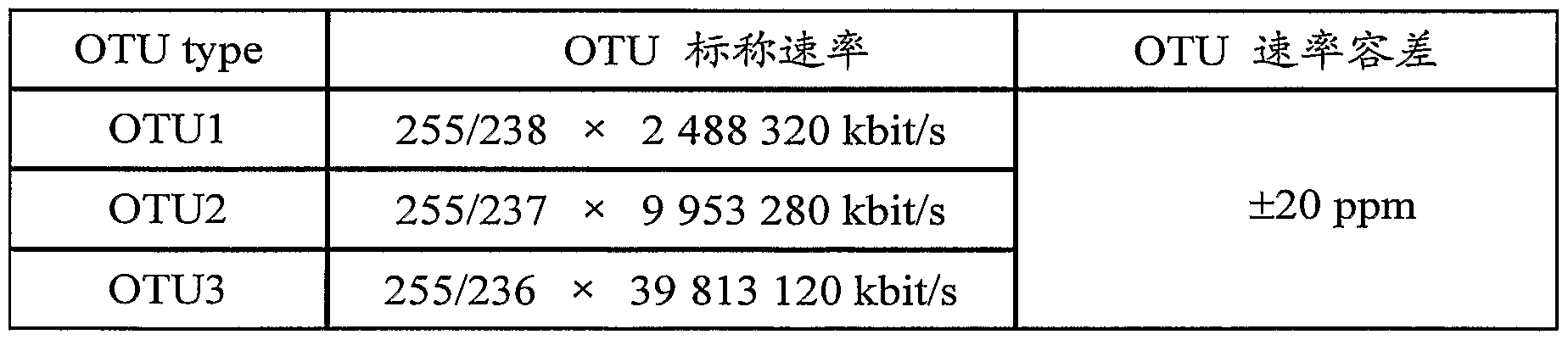
表 1 : OTUk的速率等级。其中, OTUk标称速率近似为: 2 666 057.143 kbit/s (OTU1), 10 709 225.316 kbit/s (OTU2)和 43 018 413.559 kbit/s (OTU3)。 类似 SDH ( Synchronos Digital Hierarchy, 同步数字传送体制) 中的段 层和通道层的概念, 每一层都有相应的开销字节, 对客户层的信息进行监控 和管理。 OTN采用 GFP封装、 异步映射、 同步映射等多种方法, ^!夺客户业 务映射到相同的帧结构中进行传输。跟传统的同步传送体制 SDH相比, OTN 网络具有交叉颗粒大、 对业务透明传输、 封装效率高等优点。 但由于该规范 制定的比较早, 没有预料到现在以太网业务的高速增长, 尤其是没有与 IEEE ( Institute of Electrical and Electronics Engineers, 电气电子工程 ]^帀十办会 )标准 组织制定的以太网系列标准相适应, 导致以太网业务的系列速率不能 好的 在 OTN的帧内进行传输。 OTN传送体制的净荷速率与以太网的接口速率如
OPU净荷速率 以太网接口速率
kbit/s kbit/s
OTU1 GE
2 488 320 1250Gbit/s
10GE
OTU2
10312.5 ( LAN口) 9 953 280
9953.280 ( WAN口 )
OTU3
39 813 120 待定(尚未标准化) 表 2: OPU净荷速率与以太网接口速率对应表。 由表 2可以看出,以太网目前最常用的 2个接口速率, GE接口和 10GE LAN接口, 都没有合适的 OTN等级来进行适配。 GE接口用 OPU1来承载, 会造成带宽的浪费, 而对 10GE LAN, 速率略高于 OPU2的净荷带宽, 用标 准的 OPU2来传则带宽不足, 而用 OPU3来传则更浪费带宽。 因此, 如何利 用 OTN网络有效传递以太网信号,尤其是透明传送 10GELAN信号亟待解决, 从而导致各种私有映射方式的产生。
ITU - T 针对各方提出的解决方案, 专门建立了一个资料性的文档 Sup43 , 对各种可能的解决方案进行了比较, 主要方式和优缺点如表 3所示。

表 3: 10GELAN在 OPU2中的传输方式。 考虑到客户信号的 "完全透明传递" 的实际需求, 表 3中的标准映射方 式和利用未定义开销增加带宽的传递方式不能满足要求, 10GELAN 带宽大
于标准的 OPU2带宽导致必须采用超频的 OPU2(对应着更高的 OTU2速率;), 这种技术叫 Overclock (超频;), 可再细分成 OPU2e和 OPUle两种方法, 前 一种方法保留了 ODU2映射 STM - 64时的 2列固定填充字节, 后一种方法 没有这两列固定填充 , 因此线路速率可以降低。 但即使是表格中的其余两种映射方式在传递 10GELAN 业务时也有缺 点。 超频方式仍然采用类似 CBR ( Constant Bit Rate, 固定比特率)业务的映 射方式, 只安排一个字节来进行 + /0/ -调整, 根据 G.709标准, 这种映射方 式只能适应 ± 65ppm的频差。 考虑到 OPUk本身有 20PPM的频差, 所以可 以容忍的客户信号为 ± 45ppm, 而 10GELAN业务的频偏达 ± lOOppm, 所以 无法进行异步映射。 如果采用同步映射, 即 OPU2时钟锁定到 10GELAN业务, 可以忽略频 偏问题, 但扩展性比较差, 只能适用与点对点连接, 或者在中间节点进行异 步交叉, 而无法支持同步交叉。 因此, 这种适配后的速率无法进入交叉网络 进行同步交叉, 因为同步交叉网络要求采用相同的 ODU时钟, 而同步映射 的 ODU时钟来源于 10GELAN , 而且这些 10GELAN往往是异源的。 对于比特未知 (Agnostic ) 的 CBR映射方式, 虽然可以利用未定义开 销字节指示实际的传输字节, 可以较好的适应频差问题, 但无法指示具体的 填充字节的位置, 无法在净荷区均匀分配填充字节, 这样需要一个较大的緩 存区, 以适应 10GELAN与 OPU2净荷区的最大频差。 另外, 由于 OPU2净荷区的字节数为 3808 x 4 = 15232字节, 大概需要
13比特来指示其填充状况, 当有其他级联应用时, 需要更多的比特, 这就需 要占据较多的 OPU 开销位。 由于不同的应用场景需要不同的开销字节来进 行监控、 管理; 例如在虚级联时, 需要 OTU帧结构中第 15列第 1、 2、 3行 的 3个开销来进行指示, 因此, 占用较多的 OPU开销的映射方法也是不能 接受的。 因此, 现有技术存在缺陷, 需要改进。 发明内容 本发明所要解决的技术问题是如何采用异步映射方式,提供一种万兆以 太网信号在光传送网络中透明传送的方法, 使 10GELAN业务在光传送网内 能够完全透明的传递, 适配客户的频偏。
本发明的技术方案如下: 一种万兆以太网信号在光传送网络中透明传送的方法,其采用第一异步 映射方式透明传输万兆以太网信号; 其中, 所述第一异步映射方式的构建包 括以下步驟: Al、 采用任一净荷结构标识的保留值, 指示所述第一异步映射 方式; A2、 构建所述第一异步映射方式的光信道传送单元帧, 在其调整控 制字节中, 采用至少 3个比特预定义正负调整字节的填充状态, 并且在其光 信道净荷单元开销区增设一个负调整字节, 在净荷结构内增加一个正调整字 节; A3、 采用参考时钟, 构造超频的所述光信道传送单元帧, 其频率为 11.0491Gbit/s ± 20ppm。 所述的方法, 其中,在采用第一异步映射方式透明传输万兆以太网信号 之前, 还执行判断步骤: 判断所述第一异步映射方式是否可用。 所述的方法, 其中, 在步骤 A2中, 至少预定义正负调整字节的 5种填 充^)犬态: ^下表所示。

所述的方法, 其中, 在步骤 A3中, 超频的所述光信道传送单元帧的频 率为 11.0491Gbit/s。 所述的方法, 其中, 采用所述调整控制字节的其余 5个未定义比特作为 标识比特, 并采用多数判决原则判定收到的所述调整控制字节是否正确。 所述的方法, 其中, 所述参考时钟的频率为 690.5688Mbit/s 或 172.6422Mbit/s。 所述的方法, 其中, 所述参考时钟是与万兆以太网信号异源的时钟。 所述的方法, 其中, 所述参考时钟是系统时钟或独立自振时钟。 采用上述方案, 本发明就能够以异步映射的方式, 透月传送完整的 10GELAN信号, 从而使 ODU的速率与客户速率异源, 便于交叉设备对业务 进行 ODU级的交叉调度; 并且通过扩展的调整字节方案, 完全适应了客户
信号的频偏; 并且仅† PSI ( Pay load Structure Identifier, 净荷结构标 ¾ )和 JC ( Justification Control, 调整控制)字节的未定义比特进行扩展, 避免了占 用过多的 OPU开销, 可扩展性强 , 更适用于将来多种可能的混合应用方式。 附图说明 图 1是现有技术的 OTN的帧结构示意图; 图 2是现有技术的 OPU的开销定义示意图; 图 3是本发明的 OPU的开销定义示意图; 图 4是本发明的 10GELAN的封装处理流程图。 具体实旅方式 以下结合附图和具体实施例, 对本发明进行详细说明。
ITU-T标准组织制定的 G.709规范对 OTN的特性进行了定义和规范。 如图 1所示, OTN的帧结构由 4行、 4080列组成' 共有 4 x 4080 = 16320个 字节, 其中从第 1到第 16列为开销区, 第 17到第 3824列为净荷区, 3825 到 4080列为 FEC (前向纠错码 ) 区。 帧结构内的开销区可以进一步划分为, 第一行的第 1到第 6字节为帧指示区, 第 Ί字节是复帧指示 MFAS , 允许有 256个复帧。 第 8到第 14为 OTU开销, 第 2行到第 4行的 1到 14列均为 ODU开销, 第 1到第 4行的第 16、 17列为 OPU开销区。 本发明采用相同的帧结构, OPU净荷区速率变成 10GELAN的速率, 则相应的 OTU速率为: 255/238 x 10.3125 = 11.0491Gbit/s。 本发明提供了一 种万兆以太网信号( 10GELAN )在光传送网络中通过光信道传送单元( OTU2 ) 透明传送的方法, 其采用第一异步映射方式透明传输万兆以太网信号; 更好 的 , 在采用第一异步映射方式透明传输万兆以太网信号之前, 还执行判断 步驟: 判断所述第一异步映射方式是否可用, 当可用时则采用第一异步映射 方式透明传输万兆以太网信号。 以下, 对所述第一异步映射方式的构建进行详细说明。
Al、采用任一净荷结构标识的保留值 PSI[0] ,指示所述第一异步映射方 式; G. 709规定的 CBR映射方式, 如图 2所示, 分别由 PSI字节和 JC字
节来定义具体的映射方式。 其中 PSI字节在复帧为 0时的内容如表 4所示, 本发明采用自定义异步映射方式, 与规范的要求有所不同, 因此需要新定义 一种代码来代表本发明的异步映射方式, 例如, 将 PSI[0]的值设为 0X12, 也 可以设置成其他保留值, 本发明对此没有任何限制。

表 4: G709规范的 PSI[0]值。
A2、 构建所述第一异步映射方式的光信道传送单元帧; OTN帧结构基 本如前所述, 但是在其调整控制字节中, 采用至少 3个比特预定义正负调整 字节的填充状态, 并且在其光信道净荷单元开销区增设一个负调整字节, 在 净荷结构内增设一个正调整字节。 例如,具体地说, 在所述第一异步映射方式对应的光信道传送单元帧的 调整控制字节中, 采用 3个比特预定义正负调整字节的填充状态。 例如, 所 述调整控制字节可以采用 3 个比特, 预定义正调整字节 PJO和负调整字节 NJO的 5种填充 态, 具体说明如下。
G709规范的 JC字节定义如表 5所示, 在本发明中, 需要扩展原有的 JC字节定义, 将原有的 3个 JC字节中的 2比特值多数判决方法, 改成每个 JC字节采用 3个比特来表示 5种不同的填充状态, 从而需要扩展定义 JC字 节, 具体 ^表 6所示。
JC bits 7 8 NJO PJO
0 0 调整字节 数据字节
0 1 数据字节 数据字节
1 0 (不产生此值, 可能是
调整字节 数据字节 接收有错误 )
1 1 调整字节 调整字节 表 5: G709规范的 JC值

表 6: 扩展定义的 JC值。 其中, 表 6的第 1列表示 JC字节 6、 7、 8比特的各种组合值, 其他列 表示这些 JC值对应的调整字节的填充状态, "调整字节" 表示该字节填充的 是填充信息, "数据字节"表示该字节填充的是客户信息。 更好的是, 在采用 所述第一异步映射方式透明传输万兆以太网信号时, 可以采用所述调整控制 字节的其余 5个未定义比特作为标识比特, 并采用多数判决原则判定收到的 所述调整控制字节是否正确。 即, 还可以将 JC字节中的 5个未定义比特定 义为标识比特 I, 其判断原理跟 SDH指针值的 I、 D比特反转类似, 采用多 数判决的原则来确定收到的 JC值是否正确, 当新的 JC值伴随多数 I比特的 反转则表示确实有新的填充状态发生, 否则认为 JC值的传递出现了误码。 并且,如图 3所示,在所述光信道传送单元帧的光信道净荷单元开销区 , 增设一个负调整字节和在净荷结构内增设一个正调整字节; 例如, 可以将所 述光信道传送单元帧的第 16列第 3行的字节设置为所述负调整字节、 第 18 列第 4行的字节设置为正调整字节。 上述扩展调整字节,如图 3所示,可以将第 16列第 3行的 OPU开销区 字节重新定义为负调整字节, 和第 18列第 4行的 OPU净荷区字节重新定义 为正调整字节, 利用 OPU开销中的未定义字节将原有的 + /0/ -调整扩展为 - 2/-1/0/+1/+2调整, 即正调整增加到 2个字节, 负调整也增加到 2个字节 , 以适配士 lOOppm的客户信号频偏。
A3、 采用参考时钟, 构造超频的所迷光信道传送单元帧, 其频率为 11.0491Gbit/s ± 20ppm; 参考 G.709规范, OPU2的净荷速率, 在不计算填充 固定填充列的情况下, 为 9.953280Gbit/s ± 20ppm , 而 802.3ae 规范的 10GELAN信号为 10.3125Gbit/s ± lOOppm,要完全透明传输 10GELAN信号, 必须提升 OPU2的标称频率, 利用更高速率的参考时钟构造 11.0491Gbit/s的 OTU2帧, 以装载 10.3125Gbit/s的 10GELAN信号。 例如, 所述超频光信道传送单元帧的频率为 11.0491 Gbit/s。 其中, 所述 参考时钟是与 10GELAN信号异源的时钟。 例如, 所述参考时钟是系统时钟 或独立自振时 4f , 即该参考时钟可以来自系统时钟, 或独立自振时钟等与 10GELAN信号异源的时钟。 考虑到所述参考时钟可以采用 16分频或 64分频, 因此, 一个例子是, 所述参考时 4中的频率为 11.0491Gbit/s ÷ 16 = 690.56875Mbit/s; 或者为 11.0491Gbit/s ÷ 64 = 172.64219Mbit/s。 以下再结合图 4说明本发明方法详细的工作过程。如图 4所示, 本发明 所述的透传 10GELAN信号的方法, 在具体实现上主要基于 3个部分: 提供 超频帧, 扩展调整字节和 OPU开销的扩展定义。
1、 提供超频帧。 利用比标准 OTU2更高速的参考时钟,采用与原有的 OTU、 ODU、 OPU 完全相同的帧结构来构造超频的 OTU2帧, 帧频比原有的标准速率 255/237 X 9.953280=10.709 Gbit/s要高 , 使 OTU2的线路速率达到 11.0491Gbit/s, 该 参考钟的来源不受限制, 可以是系统时钟、 自振时钟等等。 本发明实例中以 OPU2 净荷区内无固定填充列为例, 实际应用中, 可以通过筒单推理, 实现 支持固定填充列的应用情况, 只需要再适当提高线路速率, 并且在固定的列 增加填充字节即可。 是否采用固定填充列可以根据实际应用情况来决定, 本 发明在此不再赘述。
2、 扩展调整字节: 主要是要适配客户信号较大的频偏。 如图 3所示, 本发明增加 2个调整字节, 加上原有的 2个调整字节, 分 别定义为 NJO1 , NJO2, PJO1 , PJO2, 可调整的字节占 OPU净荷的比例为 21 ( 4 x 3824 ) = 130ppm, 因此最大可以适应 ± 130ppm 的频偏, 除掉 ODU 本身的 ± 20ppm的频偏,可以满足土 l lOppm的客户频偏, 而 10GELAN的频
偏为 ± lOOppm, 可以异步映射到 OPU2结构中。 负调整字节可以在 OPU开 销区中除 PSI字节外的 7个字节中任意选取, 本实施例中以 OTU帧结构中 第 16列的第 3行、 第 4行字节作为负调整字节, 以第 17、 18列第 4行的字 节作为正调整字节。 3、开销字节的扩展定义: 本发明需要对 OPU开销区的字节进行扩展定 义。 对 OTN复帧指示为 0时的 PSI值增加新的映射类型的定义, 在表 4所 示的正常的 PSI[0]的值增加 0X12表示本发明的映射方式。 对异步映射采用的 3个 JC字节, 如图 2所示, 扩展到图 3所示, JC判 断字节增加到 3比特, 以适应异步映射的 5种不同填充情况, JC字节剩余的 5 个比特用多数翻转来识别新的调整机会是确实发生了还是误码导致, 2 套 JC字节可以进一步降低调整误动作的发生。 原有的一个 JC字节变成负调整 字节 NJ01。
JC判断比特的定义如表 6所示, 在此不再赘述。 OPU的其他开销字节, 如第 15列的第 1、 2、 3行继续保持 Reserved 状态, 可以在将来进行扩展应用, 例如当 OPU 需要进行虚级联时定义为 VCPOH开销。 本发明提供了一种在光传送网 OTU2 内透明传输 10GELAN业务的方 法, 采用异步映射方式完全适配客户的频偏, 使 10GELAN业务在 OTU2内 的完全透明的传递, 并解决现有技术的映射方案的不足; 还具有以下优点:
( 1 )透明传送完整的 10GELAN信号, 包括前导码、 客户帧、 帧间隙、 分界符等信息;
( 2 )采用异步映射的方式, 可以使 ODU 的速率与客户速率异源, 便 于交叉设备对业务进行 ODU级的交叉调度; ( 3 )扩展的调整字节方案, 可以完全适应客户信号 ± lOOppm的频偏;
( 4 )不需要更改 OTU、 ODU等开销字节, 仅对 PSI和 JC字节的未定 义比特进行扩展, 不占用过多的 OPU 开销, 更适用于将来多种可能的混合 应用方式。
特别需要指出的是, 本领域技术人员可以采用本发明的理念和方法, 应 用到万兆或以上的以太网与光传输网的无缝对接业务中。 应当理解的是, 对本领域普通技术人员来说,可以 居上述说明加以改 进或变换,而所有这些改进和变换都应属于本发明所附权利要求的保护范围。
Claims
1. 一种万兆以太网信号在光传送网络中透明传送的方法, 其特征在于: 采用第一异步映射方式透明传输万兆以太网信号; 其中, 所述第一异 步映射方式的构建包括以下步驟:
Al、采用任一净荷结构标识的保留值,指示所述第一异步映射方 式;
A2、构建所述第一异步映射方式的光信道传送单元帧,在其调整 控制字节中, 采用至少 3个比特预定义正负调整字节的填充状态, 并 且在其光信道净荷单元开销区增设一个负调整字节, 在净荷结构内增 设一个正调整字节;
A3、 采用参考时钟, 构造超频的所述光信道传送单元帧, 其频率 为 11.0491Gbit/s ± 20ppm。
2. 根据权利要求 1所述的方法, 其特征在于, 在采用第一异步映射方式 透明传输万兆以太网信号之前, 还执行判断步骤: 判断所述第一异步 映射方式是否可用。
3. 根据权利要求 1所述的方法, 其特征在于, 在步驟 A2中, 至少预定义正 负调整字节的 5种填充状态如下表所示。

4. 根据权利要求 1所述的方法, 其特征在于, 在步 A3 中, 超频的所 述光信道传送单元帧的频率为 11.0491Gbit/s。 根据权利要求 1所述的方法, 其特征在于, 采用所述调整控制字节的 其余 5个未定义比特作为标识比特, 并采用多数判决原则判定收到的 所迷调整控制字节是否正确。
根据权利要求 1 所述的方法, 其特征在于, 所述参考时钟的频率为 690.5688Mbit/s或 172.6422Mbit/s。 根据权利要求 1所述的方法, 其特征在于, 所述参考时钟是与所述万 兆以太网信号异源的时钟。
根据权利要求 7所述的方法, 其特征在于, 所述参考时钟是系统 时钟或独立自振时钟。
Priority Applications (1)
| Application Number | Priority Date | Filing Date | Title |
|---|---|---|---|
| EP08700759.7A EP2234293B1 (en) | 2007-11-22 | 2008-01-30 | A method for transparent transmitting 10ge ethernet signal through the optical transport network |
Applications Claiming Priority (2)
| Application Number | Priority Date | Filing Date | Title |
|---|---|---|---|
| CN200710077425.2 | 2007-11-22 | ||
| CN200710077425A CN101170550B (zh) | 2007-11-22 | 2007-11-22 | 一种万兆以太网信号在光传送网络中透明传送的方法 |
Publications (1)
| Publication Number | Publication Date |
|---|---|
| WO2009065281A1 true WO2009065281A1 (en) | 2009-05-28 |
Family
ID=39391016
Family Applications (1)
| Application Number | Title | Priority Date | Filing Date |
|---|---|---|---|
| PCT/CN2008/000240 Ceased WO2009065281A1 (en) | 2007-11-22 | 2008-01-30 | A method for transparent transmitting 10ge ethernet signal through the optical transport network |
Country Status (3)
| Country | Link |
|---|---|
| EP (1) | EP2234293B1 (zh) |
| CN (1) | CN101170550B (zh) |
| WO (1) | WO2009065281A1 (zh) |
Cited By (1)
| Publication number | Priority date | Publication date | Assignee | Title |
|---|---|---|---|---|
| CN101702637A (zh) * | 2009-10-30 | 2010-05-05 | 中兴通讯股份有限公司 | 时隙交叉方法和系统 |
Families Citing this family (6)
| Publication number | Priority date | Publication date | Assignee | Title |
|---|---|---|---|---|
| CN102480415B (zh) * | 2010-11-26 | 2015-10-21 | 中兴通讯股份有限公司 | 一种通过基准时钟恢复光传送网时钟的方法及装置 |
| CN102811171B (zh) * | 2012-07-25 | 2015-08-19 | 华为技术有限公司 | 一种透传方法、装置及系统 |
| US9825696B2 (en) | 2016-01-13 | 2017-11-21 | Ciena Corporation | Ethernet link state signaling for packet flows mapped into optical transport network with generic framing procedure |
| US20200295844A1 (en) * | 2016-03-31 | 2020-09-17 | Nec Corporation | Optical receiver, optical transmission system, submarine optical cable system, and optical signal receiving method |
| CN107968699A (zh) * | 2017-12-11 | 2018-04-27 | 国网浙江省电力有限公司 | 一种OTN网络中2Mbit/s低速信号的传输方法 |
| CN112165434B (zh) * | 2020-06-30 | 2021-12-07 | 中兴通讯股份有限公司 | 在分组交换系统中透传cbr信号的方法和系统 |
Citations (4)
| Publication number | Priority date | Publication date | Assignee | Title |
|---|---|---|---|---|
| US20050141569A1 (en) * | 2000-04-19 | 2005-06-30 | Ciena Corporation | Semi-transparent time division multiplexer/demultiplexer |
| CN1773898A (zh) * | 2004-11-12 | 2006-05-17 | 阿尔卡特公司 | 在光传输网络上传输客户层信号的方法及设备 |
| CN1852215A (zh) * | 2005-12-31 | 2006-10-25 | 华为技术有限公司 | 局域网信号在光传送网中传输的实现方法和装置 |
| WO2006113021A2 (en) * | 2005-04-19 | 2006-10-26 | Cisco Technology Inc. | Ethernet encapsulation over optical transport network |
Family Cites Families (1)
| Publication number | Priority date | Publication date | Assignee | Title |
|---|---|---|---|---|
| CN101627566A (zh) * | 2007-02-16 | 2010-01-13 | 华为技术有限公司 | 光传送网传送以太网数据的方法和系统 |
-
2007
- 2007-11-22 CN CN200710077425A patent/CN101170550B/zh not_active Expired - Fee Related
-
2008
- 2008-01-30 WO PCT/CN2008/000240 patent/WO2009065281A1/zh not_active Ceased
- 2008-01-30 EP EP08700759.7A patent/EP2234293B1/en not_active Not-in-force
Patent Citations (4)
| Publication number | Priority date | Publication date | Assignee | Title |
|---|---|---|---|---|
| US20050141569A1 (en) * | 2000-04-19 | 2005-06-30 | Ciena Corporation | Semi-transparent time division multiplexer/demultiplexer |
| CN1773898A (zh) * | 2004-11-12 | 2006-05-17 | 阿尔卡特公司 | 在光传输网络上传输客户层信号的方法及设备 |
| WO2006113021A2 (en) * | 2005-04-19 | 2006-10-26 | Cisco Technology Inc. | Ethernet encapsulation over optical transport network |
| CN1852215A (zh) * | 2005-12-31 | 2006-10-25 | 华为技术有限公司 | 局域网信号在光传送网中传输的实现方法和装置 |
Cited By (1)
| Publication number | Priority date | Publication date | Assignee | Title |
|---|---|---|---|---|
| CN101702637A (zh) * | 2009-10-30 | 2010-05-05 | 中兴通讯股份有限公司 | 时隙交叉方法和系统 |
Also Published As
| Publication number | Publication date |
|---|---|
| CN101170550B (zh) | 2010-05-26 |
| CN101170550A (zh) | 2008-04-30 |
| EP2234293B1 (en) | 2018-08-08 |
| EP2234293A4 (en) | 2013-02-27 |
| EP2234293A1 (en) | 2010-09-29 |
Similar Documents
| Publication | Publication Date | Title |
|---|---|---|
| US8693480B2 (en) | Method, apparatus and system for transmitting and receiving client signals | |
| CN101051879B (zh) | 低速业务复用及解复用的方法和装置 | |
| US10425177B2 (en) | Flexible ethernet switching systems and methods | |
| EP1826926B1 (en) | An implement method of short rate traffic signal transmitted in optical transport network | |
| US9312982B2 (en) | Method and apparatus for mapping and de-mapping in an optical transport network | |
| CN1791278B (zh) | 光传送网络调度系统及其方法 | |
| CN110830858B (zh) | 客户业务数据传送方法、装置、光传送网设备及存储介质 | |
| EP2107705B1 (en) | A method for transporting multiple channels ethernet data, the device and the system thereof | |
| WO2019213901A1 (zh) | 光传送网中低速业务数据的处理方法、装置和系统 | |
| EP4443779B1 (en) | Data transmission method and apparatus | |
| US8180224B2 (en) | Method, apparatus and system for transmitting Ethernet signals in optical transport network | |
| CN102318238B (zh) | 光传输网中的数据传送方法、系统及设备 | |
| CN101873517A (zh) | 光传送网的信号传送方法、设备及通信系统 | |
| WO2009065281A1 (en) | A method for transparent transmitting 10ge ethernet signal through the optical transport network | |
| US20220103283A1 (en) | Method and apparatus for transmitting configuration information, storage medium, and system | |
| US20110170866A1 (en) | Transporting Optical Data Units In An Optical Transport Network | |
| CN101827285B (zh) | 传输业务的方法和装置 | |
| WO2008074180A1 (fr) | Procédé de transfert d'un signal stm/sts à faible vitesse | |
| van Helvoort et al. | Multiplex Structures of the Optical Transport Network: Evolution: voice to data transport and voice over data transport |
Legal Events
| Date | Code | Title | Description |
|---|---|---|---|
| 121 | Ep: the epo has been informed by wipo that ep was designated in this application |
Ref document number: 08700759 Country of ref document: EP Kind code of ref document: A1 |
|
| NENP | Non-entry into the national phase |
Ref country code: DE |
|
| WWE | Wipo information: entry into national phase |
Ref document number: 2008700759 Country of ref document: EP |