WO2009066808A1 - Aromatic electroluminescent compounds with high efficiency and electroluminescent device using the same - Google Patents

Aromatic electroluminescent compounds with high efficiency and electroluminescent device using the same Download PDF

Info

Publication number
WO2009066808A1
WO2009066808A1 PCT/KR2007/005911 KR2007005911W WO2009066808A1 WO 2009066808 A1 WO2009066808 A1 WO 2009066808A1 KR 2007005911 W KR2007005911 W KR 2007005911W WO 2009066808 A1 WO2009066808 A1 WO 2009066808A1
Authority
WO
WIPO (PCT)
Prior art keywords
group
formula
mmol
organic electroluminescent
electroluminescent
Prior art date
Legal status (The legal status is an assumption and is not a legal conclusion. Google has not performed a legal analysis and makes no representation as to the accuracy of the status listed.)
Ceased
Application number
PCT/KR2007/005911
Other languages
French (fr)
Inventor
Sung-Min Kim
Bong-Ok Kim
Mi-Young Kwak
Seung-Soo Yoon
Hyuck-Joo Kwon
Current Assignee (The listed assignees may be inaccurate. Google has not performed a legal analysis and makes no representation or warranty as to the accuracy of the list.)
Gracel Display Inc
Original Assignee
Gracel Display Inc
Priority date (The priority date is an assumption and is not a legal conclusion. Google has not performed a legal analysis and makes no representation as to the accuracy of the date listed.)
Filing date
Publication date
Application filed by Gracel Display Inc filed Critical Gracel Display Inc
Priority to JP2010534858A priority Critical patent/JP2011504536A/en
Priority to EP07851139A priority patent/EP2212399A4/en
Priority to CN200780101752.5A priority patent/CN101874095B/en
Priority to PCT/KR2007/005911 priority patent/WO2009066808A1/en
Priority to US12/743,190 priority patent/US20110042655A1/en
Publication of WO2009066808A1 publication Critical patent/WO2009066808A1/en
Anticipated expiration legal-status Critical
Ceased legal-status Critical Current

Links

Classifications

    • CCHEMISTRY; METALLURGY
    • C09DYES; PAINTS; POLISHES; NATURAL RESINS; ADHESIVES; COMPOSITIONS NOT OTHERWISE PROVIDED FOR; APPLICATIONS OF MATERIALS NOT OTHERWISE PROVIDED FOR
    • C09KMATERIALS FOR MISCELLANEOUS APPLICATIONS, NOT PROVIDED FOR ELSEWHERE
    • C09K11/00Luminescent materials, e.g. electroluminescent or chemiluminescent
    • C09K11/06Luminescent materials, e.g. electroluminescent or chemiluminescent containing organic luminescent materials
    • CCHEMISTRY; METALLURGY
    • C07ORGANIC CHEMISTRY
    • C07CACYCLIC OR CARBOCYCLIC COMPOUNDS
    • C07C13/00Cyclic hydrocarbons containing rings other than, or in addition to, six-membered aromatic rings
    • C07C13/28Polycyclic hydrocarbons or acyclic hydrocarbon derivatives thereof
    • C07C13/32Polycyclic hydrocarbons or acyclic hydrocarbon derivatives thereof with condensed rings
    • C07C13/62Polycyclic hydrocarbons or acyclic hydrocarbon derivatives thereof with condensed rings with more than three condensed rings
    • C07C13/66Polycyclic hydrocarbons or acyclic hydrocarbon derivatives thereof with condensed rings with more than three condensed rings the condensed ring system contains only four rings
    • CCHEMISTRY; METALLURGY
    • C07ORGANIC CHEMISTRY
    • C07CACYCLIC OR CARBOCYCLIC COMPOUNDS
    • C07C15/00Cyclic hydrocarbons containing only six-membered aromatic rings as cyclic parts
    • C07C15/20Polycyclic condensed hydrocarbons
    • CCHEMISTRY; METALLURGY
    • C07ORGANIC CHEMISTRY
    • C07CACYCLIC OR CARBOCYCLIC COMPOUNDS
    • C07C15/00Cyclic hydrocarbons containing only six-membered aromatic rings as cyclic parts
    • C07C15/20Polycyclic condensed hydrocarbons
    • C07C15/38Polycyclic condensed hydrocarbons containing four rings
    • HELECTRICITY
    • H05ELECTRIC TECHNIQUES NOT OTHERWISE PROVIDED FOR
    • H05BELECTRIC HEATING; ELECTRIC LIGHT SOURCES NOT OTHERWISE PROVIDED FOR; CIRCUIT ARRANGEMENTS FOR ELECTRIC LIGHT SOURCES, IN GENERAL
    • H05B33/00Electroluminescent light sources
    • H05B33/12Light sources with substantially two-dimensional [2D] radiating surfaces
    • H05B33/14Light sources with substantially two-dimensional [2D] radiating surfaces characterised by the chemical or physical composition or the arrangement of the electroluminescent material, or by the simultaneous addition of the electroluminescent material in or onto the light source
    • HELECTRICITY
    • H10SEMICONDUCTOR DEVICES; ELECTRIC SOLID-STATE DEVICES NOT OTHERWISE PROVIDED FOR
    • H10KORGANIC ELECTRIC SOLID-STATE DEVICES
    • H10K85/00Organic materials used in the body or electrodes of devices covered by this subclass
    • H10K85/60Organic compounds having low molecular weight
    • H10K85/615Polycyclic condensed aromatic hydrocarbons, e.g. anthracene
    • H10K85/626Polycyclic condensed aromatic hydrocarbons, e.g. anthracene containing more than one polycyclic condensed aromatic rings, e.g. bis-anthracene
    • CCHEMISTRY; METALLURGY
    • C09DYES; PAINTS; POLISHES; NATURAL RESINS; ADHESIVES; COMPOSITIONS NOT OTHERWISE PROVIDED FOR; APPLICATIONS OF MATERIALS NOT OTHERWISE PROVIDED FOR
    • C09KMATERIALS FOR MISCELLANEOUS APPLICATIONS, NOT PROVIDED FOR ELSEWHERE
    • C09K2211/00Chemical nature of organic luminescent or tenebrescent compounds
    • C09K2211/10Non-macromolecular compounds
    • C09K2211/1003Carbocyclic compounds
    • C09K2211/1011Condensed systems
    • HELECTRICITY
    • H10SEMICONDUCTOR DEVICES; ELECTRIC SOLID-STATE DEVICES NOT OTHERWISE PROVIDED FOR
    • H10KORGANIC ELECTRIC SOLID-STATE DEVICES
    • H10K2102/00Constructional details relating to the organic devices covered by this subclass
    • H10K2102/10Transparent electrodes, e.g. using graphene
    • H10K2102/101Transparent electrodes, e.g. using graphene comprising transparent conductive oxides [TCO]
    • H10K2102/103Transparent electrodes, e.g. using graphene comprising transparent conductive oxides [TCO] comprising indium oxides, e.g. ITO
    • HELECTRICITY
    • H10SEMICONDUCTOR DEVICES; ELECTRIC SOLID-STATE DEVICES NOT OTHERWISE PROVIDED FOR
    • H10KORGANIC ELECTRIC SOLID-STATE DEVICES
    • H10K50/00Organic light-emitting devices
    • H10K50/10OLEDs or polymer light-emitting diodes [PLED]
    • H10K50/11OLEDs or polymer light-emitting diodes [PLED] characterised by the electroluminescent [EL] layers
    • HELECTRICITY
    • H10SEMICONDUCTOR DEVICES; ELECTRIC SOLID-STATE DEVICES NOT OTHERWISE PROVIDED FOR
    • H10KORGANIC ELECTRIC SOLID-STATE DEVICES
    • H10K85/00Organic materials used in the body or electrodes of devices covered by this subclass
    • H10K85/30Coordination compounds
    • H10K85/321Metal complexes comprising a group IIIA element, e.g. Tris (8-hydroxyquinoline) gallium [Gaq3]
    • H10K85/324Metal complexes comprising a group IIIA element, e.g. Tris (8-hydroxyquinoline) gallium [Gaq3] comprising aluminium, e.g. Alq3
    • HELECTRICITY
    • H10SEMICONDUCTOR DEVICES; ELECTRIC SOLID-STATE DEVICES NOT OTHERWISE PROVIDED FOR
    • H10KORGANIC ELECTRIC SOLID-STATE DEVICES
    • H10K85/00Organic materials used in the body or electrodes of devices covered by this subclass
    • H10K85/60Organic compounds having low molecular weight
    • H10K85/615Polycyclic condensed aromatic hydrocarbons, e.g. anthracene
    • H10K85/622Polycyclic condensed aromatic hydrocarbons, e.g. anthracene containing four rings, e.g. pyrene
    • HELECTRICITY
    • H10SEMICONDUCTOR DEVICES; ELECTRIC SOLID-STATE DEVICES NOT OTHERWISE PROVIDED FOR
    • H10KORGANIC ELECTRIC SOLID-STATE DEVICES
    • H10K85/00Organic materials used in the body or electrodes of devices covered by this subclass
    • H10K85/60Organic compounds having low molecular weight
    • H10K85/615Polycyclic condensed aromatic hydrocarbons, e.g. anthracene
    • H10K85/623Polycyclic condensed aromatic hydrocarbons, e.g. anthracene containing five rings, e.g. pentacene

Definitions

  • the present invention relates to electroluminescent compounds including a fusion ring and electroluminescent device using the same
  • OLED organic light emitting device
  • the OLED device is generally includes a thin layer of various organic compounds between a cathode and an anode which are made of metal, electrons and holes injected through the cathode and the anode are transported respectively through an electron injection layer and an electron transport layer, and a hole injection layer and a hole transport layer to an electroluminescent layer to form an exciton, and the formed exciton is disintegratedin stable state to emit light.
  • the properties of the OLED device is highly dependent upon properties of the used organic luminescent compound, studies for luminescent materials are actively carried
  • the luminescent materials can be divided in a functional aspect into a host material and a dopant material and a device structure with the most superior electroluminescent property has been generally known that its electroluminescent layer is manufactured by doping a dopant into a host.
  • EL organic electroluminescent
  • development of an organic electroluminescent (EL) device with high efficiency and long life is urgently required and development of a material which is much superior to existing electroluminescent material is urgently required particularly in consideration of an EL property level required from a medium or large size OLED panel.
  • development of a host material is one of the important problems to solve.
  • the host material which serves as a transporter of energy and a solvent in a solid state in an organic EL device should have desirable properties that its degree of purity is high and it has proper molecular weight so as to permit a vapor deposition.
  • it should have a high glass transition temperature and a high thermal decomposition temperature so as to obtain thermal stability it is required to have high electrochemical stability for long life it should be easy to form an amorphous thin filmand it should have a superior adhesive force to materials in other adjacent layers whereas an interlayer movement should not occur.
  • DPVBi diphenylvinyl-biphenyl
  • DNA dinaphthyl anthracene
  • the DPVBi has a problem of a thermal stability as it has a glass transition temperature of below 100°Cand, in order to improve the problem, DPVPAN and DPVPBAN, in which anthracene and dianthracene are respectively introduced inside the biphenyl of the DPVBi, have been developed to increase the glass transition temperature to more than 105°Cthereby improving the thermal stability, however the color purity and a luminescent efficiency have not reached to a satisfactory level.
  • the present invention relates to an organic electroluminescent compound including a fusion ring represented by the following formula 1 and an organic light emitting diode (OLED) using the same as an electroluminescent material.
  • the organic electroluminescent compound of the present invention also is used as other layers as well as luminescent layer.
  • wwhheerreeiinn, . aa rr iin Tg A is a fused aryl group in which at least two rings are fused;
  • Ari and Ar 2 are independently a C6-C30 aryl group Ri to R 4 are independently a hydrogen, a CrC 20 straight or branched chain alkyl group or alkoxy group and a C 6 -C 30 aryl or heteroaryl group and a halogen group! and the fused aryl group, the aryl group, heteroaryl group, the alkyl group and the alkoxy group are optionally substituted by a Ci-C 2 O straight or branched chain alkyl group, a aryl group and halogen group.
  • the organic electroluminescent compound according to the present invention is characterized in that, in the formula 1, the ring A forms at least two fusion rings, and can be specifically represented by following formula 2 to formula 7: ⁇ 18> Formula 2
  • Formula 6 ⁇ 28> Formula 7 ⁇ 29> ⁇ 30> wherein, in the formula 2 to formula 7, Ari, Ar 2 , R 1 , R 2 , R3 and R 4 are the same as those defined in the formula 1 and Rn to R13 are independently a hydrogen, a C 1 -C 20 straight or branched chain alkyl group or alkoxy group and a C 6 -C 3 O aryl or heteroaryl group and a halogen group; n is 1 to 3; and the alkyl group and thealkoxy group, the aryl group and heteroaryl group are optionally substituted by a C1-C20 straight or branched chain alkyl group, a aryl group and halogen group.
  • the Ar 1 and Ar 2 may be independently phenyl, tolyl, biphenyl, naphthyl , anthryl and fluorenyl
  • the R 1 to R 4 and R 11 to R 13 include independently hydrogen, methyl, ethyl, propyl, isopropyl, butyl, isobutyl, pentyl , hexyl , ethylhexyl , heptyl , octyl , isooctyl, nonyl , decyl , dodecyl, hexadecyl, cyclopentyl, cyclohexyl , phenyl, tolyl, byphenyl , benzyl, naphthyl, anthryl and fluorenyl.
  • the organic electroluminescent compound according to the present invention may be, but not limited to, the following compounds:
  • a thin film of a transparent electrode indium-tin oxide(ITO) (15 ⁇ / D) obtained from a glass for OLED was used after cleaned with ultrasonic wave using sequentially trichloroethylene, acetone, ethanol and distilled water and the put into isopropanol to store.
  • ITO indium-tin oxide
  • the ITO substrate was loaded on a substrate folder of a vapor deposition equipment and 4,4' ,4"-tris(N,N-(2-naphthyl)- phenylamino)triphenylamine (2-TNATA) having the following structure was put into a cell of the vapor deposition equipment and exhaustion was carried out
  • NBP ⁇ -bis( ⁇ -naphthyl)-N,N' -diphenyl-4,4' -diamine
  • an electroluminescent layer was vapor deposited thereon as follows.
  • a compound (for example, the compound CYHDNA) according to the present invention was put into one cell of the vapor deposition equipment and a dopant electroluminescent material having the following structure was put into the othercell of the vapor deposition equipment, and then the electroluminescentlayer having a thickness of 35nm was vapor deposited at a deposition speed of 100:1 on the hole transport layer.
  • Comparative Example 1 were measured at 500 cd/m and 2,000 cd/m respectively and shown in following Table 1. Particularly in an electroluminescent material for blue color, the measurement was carried out on a basis of
  • organic electroluminescent compounds of the present invention there is an advantage that an OLED device with a much superior driving life can be manufactured as it has a good electroluminescent efficiency and a superior life property of material.
  • the organic electroluminescent compound of the present invention also is characterized by upgradedexcellent EL property when it is used as other layers as well as luminescent layer.

Landscapes

  • Chemical & Material Sciences (AREA)
  • Organic Chemistry (AREA)
  • Engineering & Computer Science (AREA)
  • Materials Engineering (AREA)
  • Physics & Mathematics (AREA)
  • Spectroscopy & Molecular Physics (AREA)
  • Electroluminescent Light Sources (AREA)

Abstract

The present invention relates to an organic electroluminescent compound including a fusion ring and an organic electroluminescent including the same. The organic electroluminescent according to the presentinvention has an advantage of exhibiting an EL properties superior to existing electroluminescent materials as it has a good thin film stability due to a low crystallization and a satisfactory color purity.

Description

[DESCRIPTION]
[Invention Title]
AROMATIC ELECTROLUMINESCENT COMPOUNDS WITH HIGH EFFICIENCY AND ELECTROLUMINESCENT DEVICE USING THE SAME
[Technical Field]
<i> The present invention relates to electroluminescent compounds including a fusion ring and electroluminescent device using the same
[Background Art]
<2> Recently, the rapid coming of the information age has increased an importance of a display which serves as an interface between human beings and electronic information devices. An organic light emitting device (OLED) has been actively studied in the world as a new flat panel display technology, and this is because the OLED is of a self-luminous type, has a superior display property and can be easily manufactured as it has a simple device structure and it is possible to manufacture an ultrathin and ultralight display using it.The OLED device is generally includes a thin layer of various organic compounds between a cathode and an anode which are made of metal, electrons and holes injected through the cathode and the anode are transported respectively through an electron injection layer and an electron transport layer, and a hole injection layer and a hole transport layer to an electroluminescent layer to form an exciton, and the formed exciton is disintegratedin stable state to emit light. At this time, as the properties of the OLED device is highly dependent upon properties of the used organic luminescent compound, studies for luminescent materials are actively carried out.
<3> The luminescent materials can be divided in a functional aspect into a host material and a dopant material and a device structure with the most superior electroluminescent property has been generally known that its electroluminescent layer is manufactured by doping a dopant into a host. Recently, development of an organic electroluminescent (EL) device with high efficiency and long life is urgently required and development of a material which is much superior to existing electroluminescent material is urgently required particularly in consideration of an EL property level required from a medium or large size OLED panel. In this aspect, development of a host material is one of the important problems to solve. At this time, the host material which serves as a transporter of energy and a solvent in a solid state in an organic EL device should have desirable properties that its degree of purity is high and it has proper molecular weight so as to permit a vapor deposition. In addition, it should have a high glass transition temperature and a high thermal decomposition temperature so as to obtain thermal stability it is required to have high electrochemical stability for long life it should be easy to form an amorphous thin filmand it should have a superior adhesive force to materials in other adjacent layers whereas an interlayer movement should not occur.
<4> A variety of host materials have been presented and a typical examples include diphenylvinyl-biphenyl (DPVBi) available from Idemitsu Kosan Co., Ltd. and dinaphthyl anthracene (DNA) available from Eastman Kodak Company, however there is much room for improvement in an efficiency, a life and a color purity.
Figure imgf000003_0001
DPVBi
Figure imgf000003_0002
<5>
<6> The DPVBi has a problem of a thermal stability as it has a glass transition temperature of below 100°Cand, in order to improve the problem, DPVPAN and DPVPBAN, in which anthracene and dianthracene are respectively introduced inside the biphenyl of the DPVBi, have been developed to increase the glass transition temperature to more than 105°Cthereby improving the thermal stability, however the color purity and a luminescent efficiency have not reached to a satisfactory level.
Figure imgf000004_0001
DPVPBAN
<7> <8> In addition, in the DNA has found a phenomenon that it has low thin film stability thus is easily crystallized from the result of observing the thin film formed on an ITO through a vapor deposition using a scanning probe microscopy. The phenomenon has been known to have a bad influence on the life of the device and in order to improve this shortcoming of the DNA, mDNA and tBDNA, in which methyl group or t-butyl group are introduced into a second position of the DNA, have been developed to destroy the symmetry of a molecule thereby improving the film stability, however the color purity and the electroluminescent efficiency have not reached to a satisfactory level, too.
Figure imgf000004_0002
<9> mDNA tBDNA
[Disclosure] [Technical Problem]
<io> Itis an object of the present invention to provide an organic electroluminescent compound with a superior skeleton, which has a luminescent efficiency superior to existing host materials and a proper color coordinates and to provide an organic electroluminescent compound having good thin film stability due to a low crystallization. It is another object of the present invention to provide an electroluminescent device using the above organic electroluminescent compound. [Technical Solution]
<ii> Hereinafter, the present invention is described in detail.
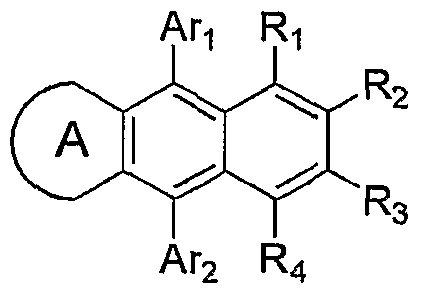
<12> The present invention relates to an organic electroluminescent compound including a fusion ring represented by the following formula 1 and an organic light emitting diode (OLED) using the same as an electroluminescent material. The organic electroluminescent compound of the present inventionalso is used as other layers as well as luminescent layer.
<13>
<14> Formula 1
Figure imgf000005_0001
<16> wwhheerreeiinn, . aa rr iin Tg A is a fused aryl group in which at least two rings are fused; Ari and Ar2are independently a C6-C30 aryl group Ri to R4 are independently a hydrogen, a CrC20 straight or branched chain alkyl group or alkoxy group and a C6-C30 aryl or heteroaryl group and a halogen group! and the fused aryl group, the aryl group, heteroaryl group, the alkyl group and the alkoxy group are optionally substituted by a Ci-C2O straight or branched chain alkyl group, a aryl group and halogen group.
<17> The organic electroluminescent compound according to the present inventionis characterized in that, in the formula 1, the ring A forms at least two fusion rings, and can be specifically represented by following formula 2 to formula 7: <18> Formula 2
Figure imgf000006_0001
<20> Formula 3
Figure imgf000006_0002
<22> Formula 4
Figure imgf000006_0003
<24> Formula 5
Figure imgf000006_0004
<26> Formula 6
Figure imgf000006_0005
<28> Formula 7 <29>
Figure imgf000007_0001
<30> wherein, in the formula 2 to formula 7, Ari, Ar2, R1, R2, R3 and R4 are the same as those defined in the formula 1 and Rn to R13 are independently a hydrogen, a C1-C20 straight or branched chain alkyl group or alkoxy group and a C6-C3O aryl or heteroaryl group and a halogen group; n is 1 to 3; and the alkyl group and thealkoxy group, the aryl group and heteroaryl group are optionally substituted by a C1-C20 straight or branched chain alkyl group, a aryl group and halogen group.
<31> In the above formula 1 to formula 7, the Ar1 and Ar2 may be independently phenyl, tolyl, biphenyl, naphthyl , anthryl and fluorenyl, and the R1 to R4 and R11 to R13include independently hydrogen, methyl, ethyl, propyl, isopropyl, butyl, isobutyl, pentyl , hexyl , ethylhexyl , heptyl , octyl , isooctyl, nonyl , decyl , dodecyl, hexadecyl, cyclopentyl, cyclohexyl , phenyl, tolyl, byphenyl , benzyl, naphthyl, anthryl and fluorenyl.
<32> The organic electroluminescent compound according to the present invention may be, but not limited to, the following compounds:
Figure imgf000007_0002
CYHDNA PHDNN
<33>
Figure imgf000008_0001
NDNN PDNDBA
<34>
Figure imgf000008_0002
NDNDBA
<35>
[Mode for Invention]
<37> Preparation Example 1 <38> Preparation of CYHDNA
Figure imgf000009_0001
<40> Into a round bottom flask were put 70ml of dichloromethane and 15.8 g(118.8 mraol) of aluminum chloride and then 8.0 g(54.0 ramol) of isobenzofuran-1,3- dione and 8.8 raL(64.8 mmol) of 1,2,3,4-tetrahydronaphthalene were dissolved in 800 mL of dichloromethane and added slowly to the flask filled with the aluminum chloride. After stirring at 25°C for 24 hours, the reaction mixture were added slowly to mixture solution of 30 mL of 35% hydrochloric acid and 150 mL of ice water and further stirred for 20 minutes. The reaction mixture was extracted using 200 mL of ethylacetate, recrystallized and then dried thereby obtaining 10.6 g(37.8 mmol) of a compound [1-1].
<41> 10.6 g(37.8 mmol) of the compound [1-1], 50.4 g(378.1 mmol) of aluminum chloride and 11.1 g(189.0 mmol) of sodium chloride were put and reflux stirred at 130°C for 4hours. The reaction product were cooled to 25°Cand then added with and dissolved in 60 mL of tetrahydrofuran and added with 30ml of water, thereby completing the reaction. After the reaction was completed, the reaction product was extracted with 100 mL of dichloromethane and dried under reduced pressure thereby obtaining 3 g(11.4 mmol) of a compound [1-2].
<42> After dissolving 8.5 g(40.9 mmol) of 2-bromo naphthalene in 50 mL of tetrahydrofuran, 4.3 mL(45.7 mmol) of n-buthyllithium(2.5 M solution in n- Hexane) was added slowly to 50 mL of the tetrahydrofuran dissolved with the 2-bromonaphthalene at -72°Cand then stirred for 2hours and then 3.0 g(11.4 mraol) of the compound [1-2] was added thereto and stirred at a room temperature for 24hours. After completing reaction by adding slowly 50 mL of distilled water, the reaction mixture was extracted with 250 mL of tetrahydrofuran and dried under reduced pressure thereby obtaining 3.5 g(6.8 mmol) of a compound [1-3].
<43> 3.5 g(6.8mmol) of the compound [1-3], 4.5 g(27.1 mmol) of potassium iodide and 5.8 g(54.6 mmol) of sodium hydrophosphinate were dissolved in a mixture solution of 30 mL of acetic acid and 10ml of dichloromethane and reflux stirred for 24 hours. After completing reaction by cooling the reaction product to 25°C and adding slowly 20 mL of water thereto, the reaction product was extracted with 200 mL of dichloromethane, recrystallized and dried thereby obtaining 2.8 g(5.8 mmol) of a compound CYHDNA with a total yield of 11%.
<44> 1H NMR(200MHz, CDCl3): δ=1.60(m, 4H), 2.85(m, 4H), 7.32(m, 6H), 7.40(t, 2H),
7.54(d, 2H), 7.67-7.73(m, 8H), 7.89(d, 2H)
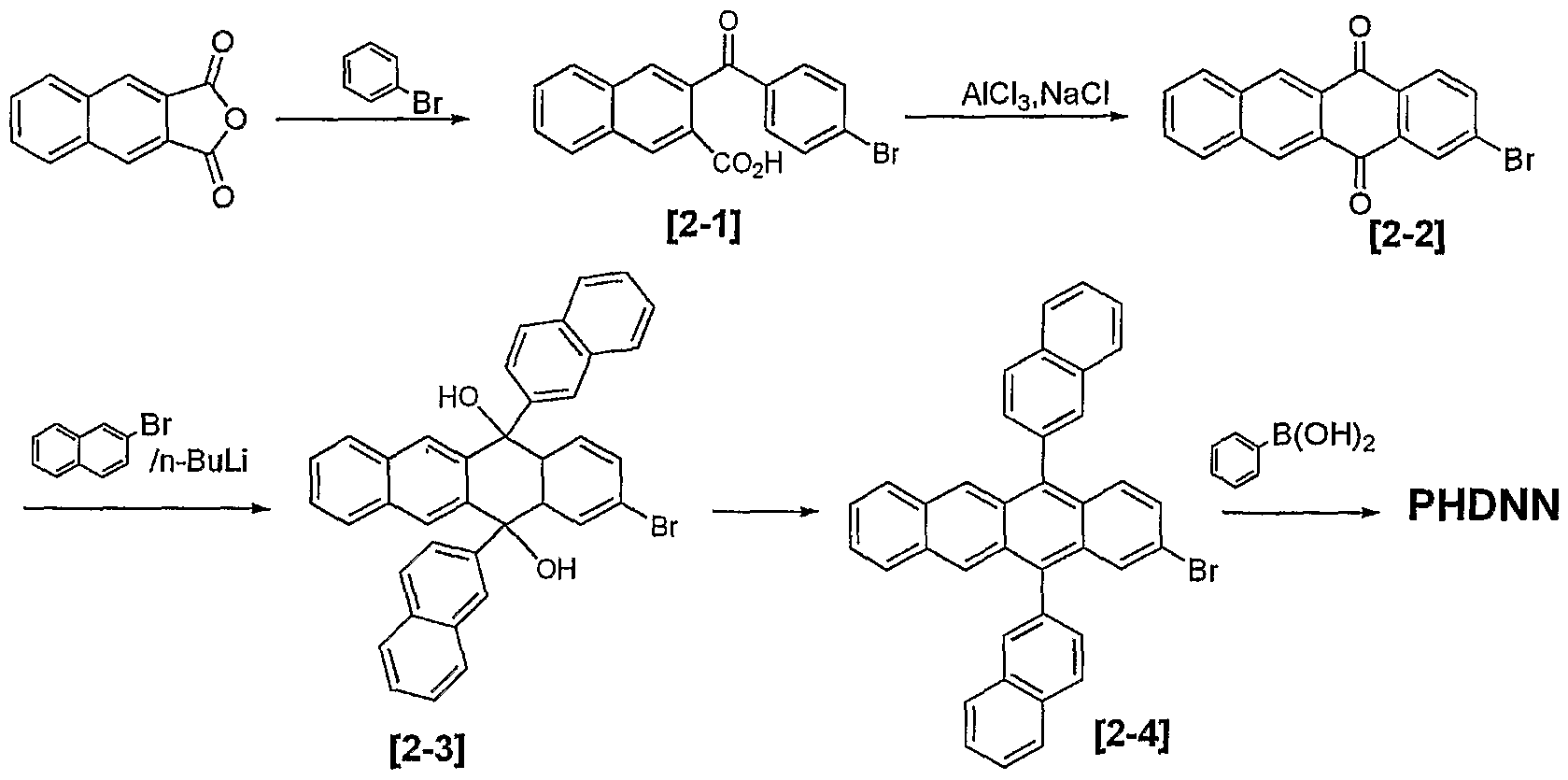
<45> MS/FAB: 484.22(found), 484.63(calculated) <46> <47> Preparation Example 2 <48> Preparation of PHDNN
<49>
Figure imgf000010_0001
<50> Using 10 g(50.5 mmol) of naphtho(2,3-C)furan-ll3-dione and 9.5 g(60.5 mmol) of 1-broraobenzene, 12.5 g(35.2 mmol) of a compound [2-1] was obtained by a manner similar to the Preparation Example 1.
<5i> Using 12.5 g(35.2 mmol) of the compound [2-1], 46.9 g(351.9 mmol) of aluminum chloride and 10.3 g(175.9 mmol) of sodium chloride, 3.6 g(10.6 mmol) of a compound [2-2] was obtained by the same manner as inthe Preparation Example 1
<52> Using 8.0 g(38.6 mmol) of 2-bromonaphthalene, 3.9 mL(42.7 mmol) of n- butyllithium (2.5 M solution in n-hexane) and 3.6 g(10.6 mmol) of the compound [2-2], 3.8 g(6.4 mmol) of a compound [2-3] was obtained by a manner similar to the Preparation Example 1.
<53> Using 3.8 g(6.4 mmol) of the compound [2-3], 4.2 g(25.3 mmol) of potassium iodide and 5.4 g(50.9 mmol) of sodium hydrophosphinate, 2.9 g(5.2 mmol) of a compound [2-4] wasobtained by the manner of Preparation Example 1.
<54> 2.9 g(5.2 mmol) of the compound [2-4] and 0.7 g(6.0 mmol) of phenylboronic acid were dissolved in a mixture solution of 30 mL of toluene and 15ml of ethanol and added with 0.2 g(1.7 mmol) of tetrakis(triphenylphosphine) palladium(O) [Pd(PPlIs)4] and 2.3 mL of 2 M sodium carbonate aqueous solution and then reflux stirred for δhours. After completing reaction by cooling the reaction product to a room temperature and adding slowly 15 mL of water thereto, the reaction mixture was extracted with 300 mL of dichloromethane and dried under reduced pressure thereby obtaining 2.6 g(4.7 mmol) of a compound PHDNN with a total yield of 9%.
<55> 1H NMR(200MHz, CDCl3): 5=7.22-7.32(m, 9H), 7.48(d, 2H), 7.54(d, 3H), 7.67-
7.73(m, HH), 7.89(d, 3H) <56> MS/FAB: 556.22(found), 556.69(calculated)
<57>
<58> Preparation Example 3
<59> Preparation of NDNN
<6o> 3.0 g(4.9 mmol) of a compound NDNN was obtained with a total yield of 9% by the same manner as in the Preparation Example 2 except for using 2.9 g(5.2 mmol) of the compound [2-4] and 1.1 g(6.4 mmol) of naphthaleneboronic acid.
<6i> 1H NMR(200MHz, CDCl3): δ=7.32(m, 8H), 7.54(d, 4H), 7.67-7.73(m, 14H), 7.89(d,
4H)
<62> MS/FAB: 606.23 (found), 606.75 (calculated) <63> <64> Preparation Example 4 <65> Preparation of PDNBA
Figure imgf000012_0001
<67> Into a round bottom flask (100ml) was put 1.7 g(70.1 mmol) of Mg turning and then were put small amount of I2 pieces and 10ml of tetrahydrofuran. 11 g(42.5 mmol) of 9-bromophenanthrene was dissolved in 10 mL of tetrahydrofuran and added slowly to the flask filled with the magnesium of 0°Cand then stirred at 25°Cfor 30 minutes. 9.9 g(43.4 mmol) of 5-bromoisobenzofuran-l,3- dione and 12.7 g(95.6 mmol) of aluminum chloride were put into the flask and stirred for 24 hours. After adding the reaction solution slowly to 150 mL of IN hydrochloric acid aqueous solution and stirring for 30 minutes, the reaction solution was extracted with 200 mL of dichloromethane and dried under reduced pressure, thereby obtaining 11.4 g(28.2 mmol) of a compound [4- I]. <68> Using 11.4 g(28.2 mmol) of the compound [4-1], 37.9 g(284.4 mmol) of aluminum chloride and 8.3 g(142.2 mmol) of sodium chloride, 2.6 g(6.8 mmol) of a compound [4-2] was obtained by the manner of the Preparation Example 2.
<69> Using 5.1 g(24.6 mmol) of 2-bromonaphthalene, 2.5 mL(27.3 mmol) of n- butyllithium (2.5 M solution in n-hexane) and 2.6 g(6.8 mmol) of the compound [4-2], 2.2 g(3.7 mmol) of a dihydroxy compound was obtained by the manner of the Preparation Example 2. Using 2.2 g(3.7 mmol) of the dihydroxy compound, 2.5 g(14.8 mmol) of potassium iodide and 3.1 g(29.6 mmol) of sodium hydrophosphinate, 1.95 g(3.2 mmol) of a compound [4-3] was obtained by the manner of the Preparation Example 3.
<70> Using 1.95 g(3.2 mmol) of the compound [4-3], 470.7 mg(3.9 mmol) of phenylboronic acid, 0.2 g(1.7 mmol) of tetrakis(triphenylphosphine)palladium(0) [Pd(PPh3)4] and 2.3 niL of 2 M sodium carbonate aqueous solution, 1.16 g(2.3 mmol) of a compound PDNBA was obtained with a total yield of 5% by the same manner as in the Preparation Example 3.
<7i> 1H NMR(200MHz, CDCl3): δ=7.22-7.32(m, 9H), 7.48-7.54(m, 7H)1 7.73(d, IH),
7.82-7.89(d, 2H), 8.93(d, 2H) <72> MS/FAB: 506.2 (found), 506.63 (calculated)
<73>
<74> Preparation Example 5 <75> Preparation of NDNDBA
<76>
<77> using 1.95 g(3.2 mmol) of the compound [4-3] prepared in the Preparation Example 4, 0.664 g(3.9 mmol) of naphthaleneboronic acid, 0.2g(1.7mmol) of tetrakis(triphenylphosphine)palladium(0) [Pd(PPh3)4] , 2.3ml of 2 M sodium carbonate aqueous solution and a mixture solution of 30 mL of toluene and 15 mL of ethanol , 1.2 g(2.2 mmol) of a compound NDNDBA was obtained with a total yield of 5% by the same manner as in the Preparation Example 2.
<78> 1H NMR(200MHz, CDCl3) : δ=7.22-7.32(m, 8H), 7.48-7.54(m, 6H), 7.67-7.89(m, 10H) , 8.12(d, 2H) , 8.93(d, 2H) <79> MS/FAB : 556.22 ( found) , 556.69 (calculated)
<80>
<8i> Example 1
<82> Manufacture of OLED device using the compound according to the present invention
<83>
<84> An OLED device with a structure using the electroluminescent material of the present invention was manufactured.
<85> Firstly, a thin film of a transparent electrode indium-tin oxide(ITO) (15Ω/ D) obtained from a glass for OLED was used after cleaned with ultrasonic wave using sequentially trichloroethylene, acetone, ethanol and distilled water and the put into isopropanol to store.
<86> Next, The ITO substrate was loaded on a substrate folder of a vapor deposition equipment and 4,4' ,4"-tris(N,N-(2-naphthyl)- phenylamino)triphenylamine (2-TNATA) having the following structure was put into a cell of the vapor deposition equipment and exhaustion was carried out
-6 until the degree of vacuum in a chamber reaches to 10 torr and then current was applied to the cell to vaporize 2-TNATA, thereby vapor depositing a hole injection layer having a thickness of 60nm on the ITO substrate.
Figure imgf000014_0001
<87> 2-TNATA
<88> Subsequently, ,N' -bis( α-naphthyl)-N,N' -diphenyl-4,4' -diamine (NPB) having the following structure was put into the other cell in the vapor deposition equipment and then current was applied to the cell to vaporize NBP, thereby vapor depositing a hole transport layer having a thickness of 20nm on the hole injection layer.
Figure imgf000015_0001
<89> NPB <90> After forming the hole injection layer and the hole transport layer, an electroluminescent layer was vapor deposited thereon as follows. A compound (for example, the compound CYHDNA) according to the present invention was put into one cell of the vapor deposition equipment and a dopant electroluminescent material having the following structure was put into the othercell of the vapor deposition equipment, and then the electroluminescentlayer having a thickness of 35nm was vapor deposited at a deposition speed of 100:1 on the hole transport layer.
Figure imgf000015_0002
<91> CYHDNA perylene <92> Subsequently, tris(8-hydroxyquinoline)aluminum(III) (AIq) having the following structure was deposited in a thickness of 20nm as an electron transport layer, and then lithium quinolate (Liq) having the following structure was deposited in a thickness of 1 to 2 nm as an electron injection layer, and after that Al cathode was deposited in a thickness of 150 nm using another vapor deposition equipment, thereby manufacturing an OLED.
Figure imgf000016_0001
<93> Al" Li£l
<94> Each of the material used in the OLED device was purified by vacuum
-6 sublimation under 10 torr and then used as the electroluminescent material.
<95>
<96> Comparative Example 1
<97> Manufacture of an OLED device using conventional electroluminescent material
<98>
<99> After forming the hole injection layer and the hole transport layer by the same manner as in the Example 1, dinaphthylanthracene (DNA) which is an electroluminescent for blue color was put into one cell of the vapor deposition equipment and perylene, which is another electroluminescent for blue color and has the following structure,was put into the other cell of the vapor deposition equipment, and then the electroluminescent layer having a thickness of 35 nm was vapor deposited at a deposition speed of 100:1 on the hole transport layer.
Figure imgf000016_0002
<ioo> DNA
<ioi> Subsequently, the electron transport layer and the electron injection layer were deposited by the same manner as in the Example 1 and then Al cathode was deposited in a thickness of 150 nm using another vapor deposition equipment, thereby manufacturing an OLED. <102> <103> Example 2 <104> Electroluminescent property of the manufactured OLED device <105> <106> Electroluminescent efficiencies of OLED devices including the organic electroluminescent compound according to the present inventionand conventional electroluminescentcompound manufactured in the Example 1 and the
2 2
Comparative Example 1 were measured at 500 cd/m and 2,000 cd/m respectively and shown in following Table 1. Particularly in an electroluminescent material for blue color, the measurement was carried out on a basis of
2 luminance data in about 2,000 cd/m since electroluminescent properties in a low luminance area and a luminance which is applied in a panel are very important.
<107> [Table 1]
Figure imgf000017_0001
As shown in Table 1, using as a reference "Electroluminescent Efficiency/Y" value which exhibits a tendency similar to the quantum efficiency, when comparing the Comparative Example 1, which is an OLED device including a conventional well known electroluminescent material DNA÷perylene, with the OLED device using organic electroluminescent compounds according to the present invention, the OLED device using organic electroluminescent compounds according to the present invention was exhibited the higher "Electroluminescent Efficiency/Y" value. [Industrial Applicability]
<i09> In accordance with the organic electroluminescent compounds of the present invention, there is an advantage that an OLED device with a much superior driving life can be manufactured as it has a good electroluminescent efficiency and a superior life property of material. The organic electroluminescent compound of the present invention also is characterized by upgradedexcellent EL property when it is used as other layers as well as luminescent layer.
<no>
<ni> Those skilled in the art will appreciate that the conceptions and specific embodiments disclosed in the foregoing description may be readily utilized as a basis for modifying or designing other embodiments for carrying out the same purposes of the present invention. Those skilled in the art will also appreciate that such equivalent embodiments do not depart from the spirit and scope of the invention as set forth in the appended claims.

Claims

[CLAIMS]
[Claim 1]
<ii3> An organic electroluminescent compound represented by formula 1 : <ii4> Formula 1
<115>
Figure imgf000019_0001
<ii6> wherein, a r ing A is a fused aryl group in which at least two r ings are fused", <i i7> Ari and Ar 2 are independent ly a C6-C30 aryl group ;
<ii8> Ri to R4 are independent ly a hydrogen, a C1-C2Q straight or branched chain alkyl group or alkoxy group and a C6-C3oaryl or heteroaryl group and a halogen group ; and
<ii9> the fused aryl group, the aryl group, heteroaryl group, the alkyl group and the alkoxy group are optionally substituted by a Ci-C20 straight or branched chain alkyl group, a aryl group and halogen group.
[Claim 2] <i20> The organic electroluminescent compound as set forth in claim 1, which is selected from formula 2 to formula T- <i2i> Formula 2
Figure imgf000019_0002
Formula 3
<124>
Figure imgf000019_0003
<125> Formula 4
Figure imgf000020_0001
<127> Formula 5
Figure imgf000020_0002
<129> Formula 6
Figure imgf000020_0003
<131> Formula 7
Figure imgf000020_0004
<133> wherein, in the formula 2 to formula 7, Ari, Ar2, R1, R2, R3 and R4 are the same as those defined in the formula 1 and Rn to R13 are independently a hydrogen, a C1-C20 straight or branched chain alkyl group or alkoxy group and a C6-C30 aryl or heteroaryl group and a halogen group; n is 1 to 3; and the alkyl group and the alkoxy group, the aryl group and heteroaryl group are optionally substituted by a C1-C2O straight or branched chain alkyl group, a aryl group and halogen group.
[Claim 3]
<134> The organic electroluminescent compound as set forth in claim 1, wherein the Ari and Ar2 are independently selected from phenyl, tolyl, biphenyl , naphthyl , anthryl and fluorenyl.
[Claim 4]
<135> The organic electroluminescent compound as set forth in claim 2, wherein the Ri to R4 and Rn to R^are independently selected from hydrogen, methyl, ethyl, propyl, isopropyl, butyl, isobutyl, pentyl , hexyl , ethylhexyl , heptyl , octyl , isooctyl, nonyl, decyl , dodecyl , hexadecyl , cyclopentyl, cyclohexyl, phenyl, tolyl, byphenyl, benzyl, naphthyl, anthryl and fluorenyl.
[Claim 5]
<136> The organic electroluminescent compound as set forth in claim 1, which is selected from following compounds:
Figure imgf000021_0001
Figure imgf000022_0001
<140>
[Claim 6]
<141> An electroluminescent device compr i sing the organic electroluminescent compound according to any one of claims 1 to 5.
[Claim 7]
<142> An electroluminescent device containing the organic electroluminescent compounds between cathode and anode according to any one of claims 1 to 5.
PCT/KR2007/005911 2007-11-22 2007-11-22 Aromatic electroluminescent compounds with high efficiency and electroluminescent device using the same Ceased WO2009066808A1 (en)

Priority Applications (5)

Application Number Priority Date Filing Date Title
JP2010534858A JP2011504536A (en) 2007-11-22 2007-11-22 High efficiency aromatic electroluminescent compound and electroluminescent device using the same
EP07851139A EP2212399A4 (en) 2007-11-22 2007-11-22 Aromatic electroluminescent compounds with high efficiency and electroluminescent device using the same
CN200780101752.5A CN101874095B (en) 2007-11-22 2007-11-22 Aromatic electroluminescent compounds with high efficiency and electroluminescent device using the same
PCT/KR2007/005911 WO2009066808A1 (en) 2007-11-22 2007-11-22 Aromatic electroluminescent compounds with high efficiency and electroluminescent device using the same
US12/743,190 US20110042655A1 (en) 2007-11-22 2007-11-22 Aromatic electroluminescent compounds with high efficiency and electroluminescent device using the same

Applications Claiming Priority (1)

Application Number Priority Date Filing Date Title
PCT/KR2007/005911 WO2009066808A1 (en) 2007-11-22 2007-11-22 Aromatic electroluminescent compounds with high efficiency and electroluminescent device using the same

Publications (1)

Publication Number Publication Date
WO2009066808A1 true WO2009066808A1 (en) 2009-05-28

Family

ID=40667622

Family Applications (1)

Application Number Title Priority Date Filing Date
PCT/KR2007/005911 Ceased WO2009066808A1 (en) 2007-11-22 2007-11-22 Aromatic electroluminescent compounds with high efficiency and electroluminescent device using the same

Country Status (5)

Country Link
US (1) US20110042655A1 (en)
EP (1) EP2212399A4 (en)
JP (1) JP2011504536A (en)
CN (1) CN101874095B (en)
WO (1) WO2009066808A1 (en)

Cited By (4)

* Cited by examiner, † Cited by third party
Publication number Priority date Publication date Assignee Title
KR20100106026A (en) * 2009-03-23 2010-10-01 다우어드밴스드디스플레이머티리얼 유한회사 Electroluminescent device using the electroluminescent compounds
CN101602895B (en) * 2009-07-09 2012-12-05 浙江百合化工控股集团有限公司 Metal complex pigment taking pyrrolo-pyrrole-dione as ligand and preparation method
JP2016128413A (en) * 2010-09-08 2016-07-14 株式会社半導体エネルギー研究所 Organic compounds
EP3078721A1 (en) * 2015-04-07 2016-10-12 Samsung Display Co., Ltd. Compound and organic light-emitting device including the same

Families Citing this family (2)

* Cited by examiner, † Cited by third party
Publication number Priority date Publication date Assignee Title
US20120286251A1 (en) * 2011-05-09 2012-11-15 Soo-Jin Park Novel compound and organic light-emitting device including the same
KR102830953B1 (en) * 2020-10-08 2025-07-08 삼성디스플레이 주식회사 Light emitting device and electronic apparatus comprising same

Citations (2)

* Cited by examiner, † Cited by third party
Publication number Priority date Publication date Assignee Title
KR20010099713A (en) * 2000-04-21 2001-11-09 사토 히로시 Organic Electroluminescent Device
KR20070112665A (en) * 2006-05-22 2007-11-27 (주)그라쎌 High efficiency aromatic light emitting compound and light emitting device employing the same

Family Cites Families (17)

* Cited by examiner, † Cited by third party
Publication number Priority date Publication date Assignee Title
JP3196230B2 (en) * 1991-05-13 2001-08-06 三菱化学株式会社 Organic electroluminescent device
JPH06330032A (en) * 1993-05-18 1994-11-29 Mitsubishi Kasei Corp Organic electroluminescent device
JP3712760B2 (en) * 1995-05-17 2005-11-02 Tdk株式会社 Organic EL device
JPH1036832A (en) * 1996-07-30 1998-02-10 Mitsubishi Chem Corp Organic electroluminescent device
JP2000178548A (en) * 1998-12-16 2000-06-27 Toppan Printing Co Ltd Luminescent material
JP3993333B2 (en) * 1999-03-19 2007-10-17 Tdk株式会社 Organic EL device
JP3969941B2 (en) * 2000-09-01 2007-09-05 三洋電機株式会社 Organic light emitting device
JP2002097465A (en) * 2000-09-25 2002-04-02 Toyo Ink Mfg Co Ltd Organic electroluminescent device material and organic electroluminescent device using the same
JP4036682B2 (en) * 2001-06-06 2008-01-23 三洋電機株式会社 Organic electroluminescence device and light emitting material
US20050058853A1 (en) * 2003-09-15 2005-03-17 Eastman Kodak Company Green organic light-emitting diodes
JP2005302667A (en) * 2004-04-15 2005-10-27 Idemitsu Kosan Co Ltd Organic electroluminescence device
KR100788254B1 (en) * 2005-08-16 2007-12-27 (주)그라쎌 Green electroluminescent compounds and organic electroluminescent device using the same
US8298683B2 (en) * 2005-09-15 2012-10-30 Lg Chem, Ltd. Organic compound and organic light emitting device using the same
JP4029897B2 (en) * 2005-10-19 2008-01-09 ソニー株式会社 Dibenzoanthracene derivative, organic electroluminescent element, and display device
WO2007105448A1 (en) * 2006-02-28 2007-09-20 Idemitsu Kosan Co., Ltd. Naphthacene derivative and organic electroluminescent device using same
JP5317414B2 (en) * 2006-04-20 2013-10-16 キヤノン株式会社 Dibenzoanthracene compound and organic light-emitting device having the same
EP2049616A4 (en) * 2006-08-04 2012-10-17 Canon Kk Organic luminescent device and benzo[k]fluoranthene compound

Patent Citations (2)

* Cited by examiner, † Cited by third party
Publication number Priority date Publication date Assignee Title
KR20010099713A (en) * 2000-04-21 2001-11-09 사토 히로시 Organic Electroluminescent Device
KR20070112665A (en) * 2006-05-22 2007-11-27 (주)그라쎌 High efficiency aromatic light emitting compound and light emitting device employing the same

Non-Patent Citations (1)

* Cited by examiner, † Cited by third party
Title
See also references of EP2212399A4 *

Cited By (8)

* Cited by examiner, † Cited by third party
Publication number Priority date Publication date Assignee Title
KR20100106026A (en) * 2009-03-23 2010-10-01 다우어드밴스드디스플레이머티리얼 유한회사 Electroluminescent device using the electroluminescent compounds
KR101645949B1 (en) 2009-03-23 2016-08-05 롬엔드하스전자재료코리아유한회사 Electroluminescent device using the electroluminescent compounds
CN101602895B (en) * 2009-07-09 2012-12-05 浙江百合化工控股集团有限公司 Metal complex pigment taking pyrrolo-pyrrole-dione as ligand and preparation method
JP2016128413A (en) * 2010-09-08 2016-07-14 株式会社半導体エネルギー研究所 Organic compounds
US9564597B2 (en) 2010-09-08 2017-02-07 Semiconductor Energy Laboratory Co., Ltd. Fluorene compound, light-emitting element, light-emitting device, electronic device, lighting device, and organic compound
KR20190017850A (en) * 2010-09-08 2019-02-20 가부시키가이샤 한도오따이 에네루기 켄큐쇼 Organic compound
KR102076488B1 (en) * 2010-09-08 2020-02-12 가부시키가이샤 한도오따이 에네루기 켄큐쇼 Organic compound
EP3078721A1 (en) * 2015-04-07 2016-10-12 Samsung Display Co., Ltd. Compound and organic light-emitting device including the same

Also Published As

Publication number Publication date
CN101874095A (en) 2010-10-27
EP2212399A1 (en) 2010-08-04
JP2011504536A (en) 2011-02-10
US20110042655A1 (en) 2011-02-24
EP2212399A4 (en) 2011-04-20
CN101874095B (en) 2014-02-19

Similar Documents

Publication Publication Date Title
CN110407829B (en) Arylamine compound and organic light-emitting device thereof
CN107880056B (en) Organic electroluminescent compounds and organic electroluminescent device using the same
US20090009073A1 (en) Oligoarylene Derivatives and Organic Electroluminescent Devices Made By Using The Same
KR101732969B1 (en) Phosphine oxide derivative compound and organic electroluminescent device using the same
CN102449110A (en) Novel organic electroluminescent compounds and organic electroluminescent device using the same
KR100828173B1 (en) Organic Electroluminescent Compounds and Display Device using The Same
JP5378397B2 (en) Highly efficient blue electroluminescent compound and display device using the same
KR101720079B1 (en) Quinoxaline derivative compound and organic electroluminescent device using the same
JP5357872B2 (en) Organic light emitting material and organic light emitting device using the same
CN110330472A (en) A kind of blue light material and its preparation method and application
WO2009066808A1 (en) Aromatic electroluminescent compounds with high efficiency and electroluminescent device using the same
KR101779915B1 (en) Fused arylamine compound and organic electroluminescent devices comprising the same
CN101918511A (en) Light-emitting compound and electroluminescent device using the same
TW201323379A (en) 1,1&#39;-binaphthyl-4,4&#39;-diamine derivatives for luminescence of organic electroluminescent device and organic electroluminescent device using them
CN120842135A (en) A substituted carbazole compound and its application
JP2008308449A (en) Fused ring aromatic compound and organic light emitting device using the same
KR20130133518A (en) Organic light emitting material and organic light emitting diode having the same
KR101502811B1 (en) Novel anthracene derivatives and organic electroluminescent device using the same
JP2011504493A (en) Organic electroluminescent compound and display device including the same
KR100835986B1 (en) High efficiency aromatic light emitting compound and light emitting device employing the same
KR20080003304A (en) High efficiency aromatic light emitting compound and light emitting device employing the same
KR100812173B1 (en) Organic light emitting compound and display device comprising the same
KR100471367B1 (en) Blue color emitting compounds for organic electroluminescent device, process for preparing them and organic electroluminescent device using them
KR20070112631A (en) High performance blue light emitting compound and display device containing the same
CN115745962A (en) Condensed heterocyclic compound, application thereof and organic electroluminescent device containing compound

Legal Events

Date Code Title Description
WWE Wipo information: entry into national phase

Ref document number: 200780101752.5

Country of ref document: CN

121 Ep: the epo has been informed by wipo that ep was designated in this application

Ref document number: 07851139

Country of ref document: EP

Kind code of ref document: A1

WWE Wipo information: entry into national phase

Ref document number: 2010534858

Country of ref document: JP

Ref document number: 2007851139

Country of ref document: EP

NENP Non-entry into the national phase

Ref country code: DE

WWE Wipo information: entry into national phase

Ref document number: 12743190

Country of ref document: US