WO2009071709A1 - Procedimiento para la obtención de compuestos aromáticos mono-alquilados de alta linealidad e isomería ajustable - Google Patents
Procedimiento para la obtención de compuestos aromáticos mono-alquilados de alta linealidad e isomería ajustable Download PDFInfo
- Publication number
- WO2009071709A1 WO2009071709A1 PCT/ES2007/000711 ES2007000711W WO2009071709A1 WO 2009071709 A1 WO2009071709 A1 WO 2009071709A1 ES 2007000711 W ES2007000711 W ES 2007000711W WO 2009071709 A1 WO2009071709 A1 WO 2009071709A1
- Authority
- WO
- WIPO (PCT)
- Prior art keywords
- weight
- mono
- linear
- obtaining
- catalyst
- Prior art date
- Legal status (The legal status is an assumption and is not a legal conclusion. Google has not performed a legal analysis and makes no representation as to the accuracy of the status listed.)
- Ceased
Links
Classifications
-
- C—CHEMISTRY; METALLURGY
- C11—ANIMAL OR VEGETABLE OILS, FATS, FATTY SUBSTANCES OR WAXES; FATTY ACIDS THEREFROM; DETERGENTS; CANDLES
- C11D—DETERGENT COMPOSITIONS; USE OF SINGLE SUBSTANCES AS DETERGENTS; SOAP OR SOAP-MAKING; RESIN SOAPS; RECOVERY OF GLYCEROL
- C11D11/00—Special methods for preparing compositions containing mixtures of detergents
- C11D11/04—Special methods for preparing compositions containing mixtures of detergents by chemical means, e.g. by sulfonating in the presence of other compounding ingredients followed by neutralising
-
- B—PERFORMING OPERATIONS; TRANSPORTING
- B01—PHYSICAL OR CHEMICAL PROCESSES OR APPARATUS IN GENERAL
- B01J—CHEMICAL OR PHYSICAL PROCESSES, e.g. CATALYSIS OR COLLOID CHEMISTRY; THEIR RELEVANT APPARATUS
- B01J29/00—Catalysts comprising molecular sieves
- B01J29/04—Catalysts comprising molecular sieves having base-exchange properties, e.g. crystalline zeolites
- B01J29/06—Crystalline aluminosilicate zeolites; Isomorphous compounds thereof
- B01J29/08—Crystalline aluminosilicate zeolites; Isomorphous compounds thereof of the faujasite type, e.g. type X or Y
- B01J29/085—Crystalline aluminosilicate zeolites; Isomorphous compounds thereof of the faujasite type, e.g. type X or Y containing rare earth elements, titanium, zirconium, hafnium, zinc, cadmium, mercury, gallium, indium, thallium, tin or lead
-
- B—PERFORMING OPERATIONS; TRANSPORTING
- B01—PHYSICAL OR CHEMICAL PROCESSES OR APPARATUS IN GENERAL
- B01J—CHEMICAL OR PHYSICAL PROCESSES, e.g. CATALYSIS OR COLLOID CHEMISTRY; THEIR RELEVANT APPARATUS
- B01J29/00—Catalysts comprising molecular sieves
- B01J29/04—Catalysts comprising molecular sieves having base-exchange properties, e.g. crystalline zeolites
- B01J29/06—Crystalline aluminosilicate zeolites; Isomorphous compounds thereof
- B01J29/08—Crystalline aluminosilicate zeolites; Isomorphous compounds thereof of the faujasite type, e.g. type X or Y
- B01J29/085—Crystalline aluminosilicate zeolites; Isomorphous compounds thereof of the faujasite type, e.g. type X or Y containing rare earth elements, titanium, zirconium, hafnium, zinc, cadmium, mercury, gallium, indium, thallium, tin or lead
- B01J29/088—Y-type faujasite
-
- B—PERFORMING OPERATIONS; TRANSPORTING
- B01—PHYSICAL OR CHEMICAL PROCESSES OR APPARATUS IN GENERAL
- B01J—CHEMICAL OR PHYSICAL PROCESSES, e.g. CATALYSIS OR COLLOID CHEMISTRY; THEIR RELEVANT APPARATUS
- B01J29/00—Catalysts comprising molecular sieves
- B01J29/04—Catalysts comprising molecular sieves having base-exchange properties, e.g. crystalline zeolites
- B01J29/06—Crystalline aluminosilicate zeolites; Isomorphous compounds thereof
- B01J29/18—Crystalline aluminosilicate zeolites; Isomorphous compounds thereof of the mordenite type
- B01J29/185—Crystalline aluminosilicate zeolites; Isomorphous compounds thereof of the mordenite type containing rare earth elements, titanium, zirconium, hafnium, zinc, cadmium, mercury, gallium, indium, thallium, tin or lead
-
- B—PERFORMING OPERATIONS; TRANSPORTING
- B01—PHYSICAL OR CHEMICAL PROCESSES OR APPARATUS IN GENERAL
- B01J—CHEMICAL OR PHYSICAL PROCESSES, e.g. CATALYSIS OR COLLOID CHEMISTRY; THEIR RELEVANT APPARATUS
- B01J29/00—Catalysts comprising molecular sieves
- B01J29/04—Catalysts comprising molecular sieves having base-exchange properties, e.g. crystalline zeolites
- B01J29/06—Crystalline aluminosilicate zeolites; Isomorphous compounds thereof
- B01J29/70—Crystalline aluminosilicate zeolites; Isomorphous compounds thereof of types characterised by their specific structure not provided for in groups B01J29/08 - B01J29/65
- B01J29/7049—Crystalline aluminosilicate zeolites; Isomorphous compounds thereof of types characterised by their specific structure not provided for in groups B01J29/08 - B01J29/65 containing rare earth elements, titanium, zirconium, hafnium, zinc, cadmium, mercury, gallium, indium, thallium, tin or lead
- B01J29/7069—EMT-type, e.g. EMC-2, ECR-30, CSZ-1, ZSM-3 or ZSM-20
-
- B—PERFORMING OPERATIONS; TRANSPORTING
- B01—PHYSICAL OR CHEMICAL PROCESSES OR APPARATUS IN GENERAL
- B01J—CHEMICAL OR PHYSICAL PROCESSES, e.g. CATALYSIS OR COLLOID CHEMISTRY; THEIR RELEVANT APPARATUS
- B01J29/00—Catalysts comprising molecular sieves
- B01J29/90—Regeneration or reactivation
-
- B—PERFORMING OPERATIONS; TRANSPORTING
- B01—PHYSICAL OR CHEMICAL PROCESSES OR APPARATUS IN GENERAL
- B01J—CHEMICAL OR PHYSICAL PROCESSES, e.g. CATALYSIS OR COLLOID CHEMISTRY; THEIR RELEVANT APPARATUS
- B01J38/00—Regeneration or reactivation of catalysts, in general
- B01J38/48—Liquid treating or treating in liquid phase, e.g. dissolved or suspended
- B01J38/50—Liquid treating or treating in liquid phase, e.g. dissolved or suspended using organic liquids
- B01J38/56—Hydrocarbons
-
- C—CHEMISTRY; METALLURGY
- C07—ORGANIC CHEMISTRY
- C07C—ACYCLIC OR CARBOCYCLIC COMPOUNDS
- C07C2/00—Preparation of hydrocarbons from hydrocarbons containing a smaller number of carbon atoms
- C07C2/54—Preparation of hydrocarbons from hydrocarbons containing a smaller number of carbon atoms by addition of unsaturated hydrocarbons to saturated hydrocarbons or to hydrocarbons containing a six-membered aromatic ring with no unsaturation outside the aromatic ring
- C07C2/64—Addition to a carbon atom of a six-membered aromatic ring
- C07C2/66—Catalytic processes
-
- C—CHEMISTRY; METALLURGY
- C07—ORGANIC CHEMISTRY
- C07C—ACYCLIC OR CARBOCYCLIC COMPOUNDS
- C07C303/00—Preparation of esters or amides of sulfuric acids; Preparation of sulfonic acids or of their esters, halides, anhydrides or amides
- C07C303/02—Preparation of esters or amides of sulfuric acids; Preparation of sulfonic acids or of their esters, halides, anhydrides or amides of sulfonic acids or halides thereof
- C07C303/04—Preparation of esters or amides of sulfuric acids; Preparation of sulfonic acids or of their esters, halides, anhydrides or amides of sulfonic acids or halides thereof by substitution of hydrogen atoms by sulfo or halosulfonyl groups
- C07C303/06—Preparation of esters or amides of sulfuric acids; Preparation of sulfonic acids or of their esters, halides, anhydrides or amides of sulfonic acids or halides thereof by substitution of hydrogen atoms by sulfo or halosulfonyl groups by reaction with sulfuric acid or sulfur trioxide
-
- C—CHEMISTRY; METALLURGY
- C11—ANIMAL OR VEGETABLE OILS, FATS, FATTY SUBSTANCES OR WAXES; FATTY ACIDS THEREFROM; DETERGENTS; CANDLES
- C11D—DETERGENT COMPOSITIONS; USE OF SINGLE SUBSTANCES AS DETERGENTS; SOAP OR SOAP-MAKING; RESIN SOAPS; RECOVERY OF GLYCEROL
- C11D1/00—Detergent compositions based essentially on surface-active compounds; Use of these compounds as a detergent
- C11D1/02—Anionic compounds
- C11D1/12—Sulfonic acids or sulfuric acid esters; Salts thereof
- C11D1/22—Sulfonic acids or sulfuric acid esters; Salts thereof derived from aromatic compounds
-
- C—CHEMISTRY; METALLURGY
- C07—ORGANIC CHEMISTRY
- C07C—ACYCLIC OR CARBOCYCLIC COMPOUNDS
- C07C2523/00—Catalysts comprising metals or metal oxides or hydroxides, not provided for in group C07C2521/00
- C07C2523/10—Catalysts comprising metals or metal oxides or hydroxides, not provided for in group C07C2521/00 of rare earths
-
- C—CHEMISTRY; METALLURGY
- C07—ORGANIC CHEMISTRY
- C07C—ACYCLIC OR CARBOCYCLIC COMPOUNDS
- C07C2529/00—Catalysts comprising molecular sieves
- C07C2529/04—Catalysts comprising molecular sieves having base-exchange properties, e.g. crystalline zeolites, pillared clays
- C07C2529/06—Crystalline aluminosilicate zeolites; Isomorphous compounds thereof
- C07C2529/08—Crystalline aluminosilicate zeolites; Isomorphous compounds thereof of the faujasite type, e.g. type X or Y
-
- Y—GENERAL TAGGING OF NEW TECHNOLOGICAL DEVELOPMENTS; GENERAL TAGGING OF CROSS-SECTIONAL TECHNOLOGIES SPANNING OVER SEVERAL SECTIONS OF THE IPC; TECHNICAL SUBJECTS COVERED BY FORMER USPC CROSS-REFERENCE ART COLLECTIONS [XRACs] AND DIGESTS
- Y02—TECHNOLOGIES OR APPLICATIONS FOR MITIGATION OR ADAPTATION AGAINST CLIMATE CHANGE
- Y02P—CLIMATE CHANGE MITIGATION TECHNOLOGIES IN THE PRODUCTION OR PROCESSING OF GOODS
- Y02P20/00—Technologies relating to chemical industry
- Y02P20/50—Improvements relating to the production of bulk chemicals
- Y02P20/584—Recycling of catalysts
Definitions
- the present invention relates generally to the catalytic alkylation reactions of aromatic compounds and in particular to the zeolite type catalysts used in said reactions.
- Alkylaromatic compounds are an important family of substances that are used, as raw materials in numerous industrial fields 3, such as plasticizers, polymeric materials, insecticides, in agriculture to prevent fertilizer agglomeration, in textile manufacturing and fibers, in the leather and fur industry, herbicides, industrial cleaning processes, in the photography industry, in the manufacture of adhesives and in fire-fighting products such as humidifying agents, in electrochemical processes for removal of dirt and grease from the surface of a substrate, and in biodegradable detergents, in the case of linear mono-alkylaromatic compounds (Surfactants in Consumers Products, Theory, Technology, and Application, Edited by J. Falbe, Springer Verlag, 1987).
- linear mono-alkylaromatic compounds especially for detergent applications
- LAB Linear alkylbenzene
- Linear Alkylbenzene Sulfonate ⁇ linear alkylsuphonate ", LAS) is the product used in final detergent formulations.
- This LAS is produced by sulfonation of the LAB and subsequent neutralization of the corresponding Sulfonic Acids (HLAS) with aqueous solutions of alkaline hydroxides or alkaline terrestrial, according to the usual procedures of the state of the art.
- the linear olefins used in the process have between nine and sixteen carbon atoms.
- the alkylation stage occurs in the liquid phase, in the presence of Friedel-Craft type catalysts, for example, hydrofluoric acid.
- the HF process is well known and used commercially (it produces around 75% of the 3.3 million metric tons produced annually from LAB), producing a high yield (> 92% by weight) in LAB with a selectivity towards isomers Relatively low 2-phenyl, less than 20%.
- the alkylation reaction can be characterized with the following indices: conversion, selectivity to mono-alkylbenzene and distribution of isomers:
- NA O is the number of moles of olefin at the inlet of the reactor and NA is the moles of the same reagent at the outlet of the reactor.
- W mon o-aiquiiatus is the weight of the mono-alkylated (mono-alkylaromatic) aromatic compound of interest produced
- Wii ger os is the weight of all lighter by-products than the lightest mono-alkylaromatic interest
- the heavy alkylate group comprises the total chemical species with molecular weights greater than the mono-alkylaromatic compound. It is generally composed of poly-alkylaromatics (mainly di-alkylaromatics), di-phenyl alloys, oligomerized olefins and alkylates of these oligomerized olefins formed during the alkylation stage. These products are mainly generated during the alkylation reaction. Di-alkylaromatics are generated by alkylation of a mono-alkylaromatic, previously formed, with an olefin. Di-phenylalkanes are formed by alkylation of benzene with a di-olefin that has been dehydrocycized.
- poly-alkylaromatics mainly di-alkylaromatics
- di-phenyl alloys oligomerized olefins
- alkylates of these oligomerized olefins formed during the alkylation stage.
- this class of heavy by-products in the process of obtaining mono-alkylaromatic compound is undesirable, since these by-products have no detersive power (detergent capacity) in the washing process due to their high lipophilic character.
- detersive power detergent capacity
- they must be separated from the mono-alkylaromatic compound so as not to affect the surfactant power of the final LAS, and are marketed as emulsifiers of lower added value.
- alkyl-polyaromatics generated by alkylation with mono-olefins of polyaromatic compounds generated in the dehydrogenation stage.
- alkyl-polyaromatics generated by alkylation with mono-olefins of polyaromatic compounds generated in the dehydrogenation stage.
- the distribution of isomers can be defined as the percentage by weight of each type of isomer produced, such as 2-phenyl, 3-phenyl ... 6-phenyl isomers, and also branched alkylate.
- the distribution of isomers plays a very important role in the solubility and stability of final detergents, especially liquid formulations, as well as in their surface activity and in their biodegradation rate.
- the 2-phenyl isomers are those alkylated molecules that have the aromatic ring attached to the alkyl chain at position 2 of the alkyl chain.
- the 2-phenyl isomer content is defined as the percentage by weight of the 2-phenyl isomer in a mixture of LAB or LAS, and is calculated from the following formula:
- branched alkylaromatic compounds can be defined as those of alkylaromatic compounds in the that the alkyl chain that links with the aromatic ring is not a linear or normal alkyl group, but branched.
- These non-normal alkyl groups have radicals such as methyl, ethyl, propyl, isopropyl, butyl, isobutyl, tere-butyl, and various variants of hexyl, heptyl, octyl linked anywhere in the alkyl chain except at the ends of the chain.
- Branched alkylates are generated by alkylation with branched olefins derived from those branched paraphmas that are present in the fresh starting paraffins, or by alkyl transposition processes that occur during the dehydrogenation and alkylation stages.
- alkylates having one of the carbon atoms of the aliphatic alkyl group in a quaternary carbon position.
- the átnr ⁇ n of. quaternary carbon in. the defined as a carbon that .. is attached to four other carbon atoms and one of these may be linked to a carbon atom of the phenyl group, forming a quaternary alkyl-phenylalkane. If the quaternary carbon is the second carbon atom of the alkyl chain, the quaternary carbon present in the resulting 2-alkyl-2-phenylalkane can be called "terminal quaternary carbon".
- the catalysts contemplated in the international patent application WO2007 / 104805 allow to increase the duration of the reaction cycles with respect to the heterogeneous catalysts currently used in the DETAL process (60 hours, compared to 24 hours with heterogeneous technology current), it is important at industrial level to be able to increase this duration even more. In this way, the frequency and number of catalyst wash cycles can be reduced. This results in a decrease in the operation costs of the installation (greater net operating time of the reactors and decrease in the costs inherent to the catalyst regeneration stage), as well as a lower energy consumption (pumping and heating of the agent regeneration) and of pollutant emissions associated with said process.
- the present invention provides a process for obtaining mono-alkylaromatic compounds of high linearity (they will be called linear mono-alkylaromatic although they may contain minimum amounts of branched alkylate), minimum content of heavy alkylate and minimum color, and with adjustable contents of isomers 2 -phenyl, which uses a new low 2-phenyl catalyst that can be more selective, active and stable than those contemplated in the state of the art. Due to its greater selectivity towards mono-alkylaromatic compounds, this new catalyst can produce a final product with a lower heavy alkylate content than that provided by the current technique, which increases the economic efficiency of the process by increasing the use of raw materials. , while improving its quality due to the reduction of the sulfonation color of the resulting LAS.
- the catalyst is more stable against deactivation than those contemplated in the state of the art, which allows for longer reaction cycles and less frequent washing cycles while maintaining a higher activity, which enables a reduction in the operating costs
- This process incorporates a process of using the impurities of the intermediate streams to generate a hydrotrope which, suitably added when the content of 2-fer ⁇ lo isomers in the mono-alkylaromatic compound is greater than 60% by weight, allows to obtain a product with a greater solubility than when adding other hydrotropes common in the state of the art.
- the new catalyst more stable against deactivation by fouling, it is possible to increase the duration of the reaction cycles and decrease the frequency of the washing cycles. This allows longer production cycles and a reduction in the energy consumption associated with the regeneration stage by washing (pumping and heating of the washing agent).
- a first aspect of the invention relates to a process for obtaining a linear mono-alkylaromatic compound with an isomeric content.
- 2-phenyl of between 18% and 70% by weight by catalytic alkylation of an aromatic compound with a purified alkylating agent comprising the following steps: i) catalytically dehydrogenating a linear paraffin feed, producing linear mono-olefms, unconverted paraffins and a certain amount of by-products such as diolefins and non-linear compounds. ii) treating the effluent from step i) to selectively hydrogenate the diolefins produced as a byproduct in step i) to mono-olefmas, thus obtaining a crude alkylating agent comprising linear mono-olefins, unconverted paraffins and non-linear compounds .
- iii) purifying the crude alkylating agent by separating the non-linear products contained in the effluent from step ii), thus obtaining a purified alkylating agent composed of mono-olefins and paraffins.
- iv) treat the non-linear products extracted in step iii) to form the hydrotropic precursor v) rent the aromatic hydrocarbon with the mono-olefins present in the purified alkylating agent, by combining two alkylation processes based on: a) an alkylation process with a catalyst that produces a linear alkylaromatic compound with a maximum 2-phenyl isomer content of 20% by weight b) an alkylation process with a catalyst that produces a linear alkylaromatic compound with a minimum content of isomers 2-phenyl of 20% by weight comprising a MOR type zeolite, between 0.01% -0.20% by weight of at least one of the metals selected from the group consisting of: Li, Na, K 3 Mg
- the catalyst that produces a maximum of 20% by weight of 2-phenyl isomers comprises a FAU-type zeolite, between 0.5% -2% by weight of at least one of the metals selected from the group consisting of: Li, Na, K, Mg or Ca and between 8% -16.5% by weight of at least one of the rare earth metals selected from the group consisting of La, Ce, Pr, Nd, Pm, Sm or Eu;
- FAU we refer to the group of zeolites of isotypic structures corresponding to the structural type FAU, such as: zeolite Y, zeolite Na-X, zeolite Na-Y siliceous, zeolite linde X, zeolite linde Y, zeolite ZSM-3 and zeolite ZSM-20 , preferably a Linde Y zeolite or a Y zeolite.
- the catalyst that produces a maximum of 20% of 2-phenyl isomers comprises an amount of 0.9% by weight of Na.
- the catalyst that produces a maximum of 20% of 2-phenyl isomers comprises between 4.5-10% by weight of La 5 between 1.2-4% by weight of Ce, between 0, 5-1.5% by weight of Pr and between 2-3% by weight of Nd.
- the catalyst that produces a maximum of 20% of 2-phenyl isomers comprises: a) a powder X-ray diffraction pattern characterized in that the most intense diffraction peak appears at the corresponding angle 2 theta at 6.2 °, and the rest of the main peaks appear at 2 theta diffraction angles corresponding to 23.6 °, 20.3 °, 21.6 °, 27.0 °, 31.3 °, ordered from greater to lower intensity of the associated peaks, b) a total silicon / aluminum molar ratio between 0.5: 1.0 and 3.0: 1.0 preferably between 0.5: 1.0 and 2.0: 1.0 c) a silicon / aluminum molar ratio of structural network between 1.5: 1.0 and 2.5: 1.0 preferably between 2, 1: 1, 0 and 2.3: 1, 0 d) a specific area total (BET) between 500-1000 m 2 / g, preferably between 600 and 700 m2 / ge) a micropore area between 500-
- BET specific area total
- the paraffins of step i) comprise straight chain alloys comprising between 8-30 atoms of carbon, preferably between 10-16 carbon atoms, more preferably comprise between 10-14 carbon atoms.
- These paraffins can be dehydrogenated and purified by any process described in the state of the art.
- the aromatic hydrocarbon is the aromatic hydrocarbon is selected from the group: toluene, xylene, benzene or mixtures thereof, preferably it is benzene.
- the aromatic hydrocarbon and olefins are mixed prior to the alkylation reaction of step v) in a molar ratio aromatic hydrocarbon: olefin comprised between 5: 1-70: 1, preferably between 10: 1-30: 1, more preferably between 10: 1-15: 1.
- the mixture of the aromatic hydrocarbon and the purified alkylating agent comprises a maximum of 0.3% by weight of non-linear compounds.
- the mixture of the aromatic hydrocarbon and the purified alkylating agent further comprises between 0-0.1% by weight of water.
- step v) the alkylation reactions of step v) are carried out simultaneously.
- the alkylation reaction of step v) is carried out in a reactor with a catalyst arrangement selected from the group consisting of: a fixed bed with a single catalyst, a fixed bed with two catalysts different completely mixed, at least two different fixed beds with the same catalyst each, at least two different fixed beds with a different catalyst each, a fluidized bed with one or more different catalysts, a slurry reactor with one or more different catalysts.
- a catalyst arrangement selected from the group consisting of: a fixed bed with a single catalyst, a fixed bed with two catalysts different completely mixed, at least two different fixed beds with the same catalyst each, at least two different fixed beds with a different catalyst each, a fluidized bed with one or more different catalysts, a slurry reactor with one or more different catalysts.
- the alkylation reaction of step v) is carried out in a reactor configuration comprising at least one of the reactor configurations selected from the group consisting of: an independent reactor, at least two reactors in parallel, at least two reactors in series and combinations of said configurations.
- the process of purification of the crude alkylation agent of step iii) is carried out by means of separation techniques of non-linear impurities known to a person skilled in the art such as hydrogenation, fractionation and adsorption.
- the adsorbent bed is composed of at least one of the materials selected from the group consisting of: zeolites, silica, silica gel, macroporous magnesium silicate, activated alumina, alumina silica, clays, sieves molecular, cellulose acetate, macroporous polystyrene gel, activated carbon and organoselective polymeric membranes
- the treatment to form the hydrotropic precursor in stage iv) comprises: a) fractionating the non-linear compounds obtained in stage ii) by distillation at atmospheric pressure, the distillation range of the fraction being of interest between 195 0 C and 259 0 C. b) selectively hydrogenate the poly-aromatic species contained in the fraction of interest distilled in the previous step.
- the hydrotropic precursor obtained in step iv) comprises:
- alkylaromatic compounds having one or more alkyl groups having a total of 4 carbon atoms.
- alkylaromatic compounds having one or more alkyl groups having a total of 5 carbon atoms -5 to 40% by weight of alkylaromatic compounds having one or more alkyl groups having a total of 5 carbon atoms. -15 to 30% by weight of alkylaromatic compounds having one or more alkyl groups having a total of 6 carbon atoms.
- alkylaromatic compounds having one or more alkyl groups having a total of 9 carbon atoms.
- alkylaromatic compounds having one or more alkyl groups having a total of 10 carbon atoms.
- hydrotrope hydrotropic agent
- the purification process of step vü) is carried out by means of removal and / or separation techniques of poly-aromatic and poly-alkylaromatic impurities known to a person skilled in the art such as, for example, bidrogenation, fractionation and adsorption.
- the purification process of step vii) is carried out by selective adsorption by means of a selective adsorbent of the clay type comprising: a) a total molar ratio of silicon: aluminum between 3: 1 and 5: 1, preferably between 4, 1: 1.0 b) between 1% -4% by weight of Fe 2 O 3 , preferably 2.9% by weight c) between 0.5% -2% by weight of K 2 O, preferably 1, 4% by weight d) between 0.2% -2% by weight of MgO, preferably 1.2% by weight e) between 0.1-1.0% by weight of TiO 2 , preferably 0.45% by weight f) between 1800 and 2500 ppm of Na, preferably 2200 ppm by weight g) a specific area expressed as a BET area, comprised between 150-500 m 2 / g, preferably 260 m 2 / g; h) a cumulative pore volume between 0.1-2.0 ml / g, preferably 0.42
- the hydrotropic precursor obtained in step iv) is added to the stream of the linear mono-alkylaromatic compound when the phenyl 2 isomer content of the linear mono-alkylaromatic compounds is greater than or equal to 60% by weight, being added before the purification of step vii).
- the hydrotropic precursor obtained in step iv) is added to the stream of the linear mono-alkylaromatic compound when the phenyl 2 isomer content of the linear mono-alkylaromatic compounds is greater than or equal to 60% by weight, being added after the purification of step vii).
- the neutralization process of step ix) is carried out by an alkaline substance comprising one or more cations selected from the group: Na, K 5 NH 4+ , Mg 5 Ca, Ba or by alkalis of Ammonium substituted.
- the olefins are ⁇ -olefins, and comprise between 9-30 carbon atoms.
- the reaction temperature is between 20-400 0 C
- the space velocity is between 1 h '1 and 5 h "1
- the process described in the present invention comprises an additional step viii) of sulfonation and neutralization of the compound obtained in step vii).
- the hydrotropic precursor obtained in stage iv) is sulfonated and neutralized individually and subsequently added to the product obtained in stage viii)
- Another aspect of the present invention relates to a sulfonated and neutralized linear mono-alkylaromatic compound obtained by the process described in the present invention.
- Another aspect of the present invention relates to a process for obtaining a linear mono-alkylaromatic compound with a 2-phenyl isomer content of at least 18% by weight by catalytic alkylation of an aromatic compound with an alkylating agent as described. described above, where stages i), ii), iii) and iv), are optional.
- cleaning compositions suitable for preparations for: dishwashing, hard surface cleaners, liquid washing products, washing powder products, paste-shaped cleaning preparations, gels and washing bars which they comprise: a) between 1-99% by weight of a compound obtained from step viii) b) between 99-1% by weight of other detergent ingredients selected from the group consisting of: derivatives of fatty alcohols, fatty acids, alkyl sulfates, ethanolamines, amine oxides, alkali carbonates, ethanol, isopropanol, water, pine oil, sodium chloride, sodium silicate, polymers, alcohol alcohols, perborate salts, zeolites, alkali sulfates, enzymes, hydrotropes, dyes, fragrances, preservatives , brighteners, polyacrylates, essential oils, alkali hydroxides, ether sulfonates, water-soluble branched alkylbenzene sulfonates, d-alkoxylates and al
- Figure 1 shows a schematic of the process that constitutes the present invention in the form of a current diagram.
- Figure 2 shows a scheme of the process that constitutes the present invention in the form of a current diagram, in which the sulfonation and neutralization steps are included.
- Figure 3 shows a scheme of the reaction of the present invention in the form of a current diagram when the steps of catalytic dehydrogenation of paraffins, hydrogenation of di-olefins, purification of the crude alkylating agent and isolation are omitted. , purification and addition of the hydropic precursor.
- FIG. 1 represents a non-limiting scheme for the practice of this invention.
- Stream 15 is the feed of linear paraffins to the dehydrogenation unit, and comprises the mixing of fresh linear paraffins, stream 10, with the unconverted linear paraffins separated in the crude alkylate purification unit, unit 350, and recirculated to through stream 170.
- Dehydrogenation unit 300 converts the feed of linear paraffins into a mixture of linear mono-olefins, unreacted paraffins and various by-products such as di-olefins and non-linear compounds.
- crude alkylate is understood as the mixture of mono-alkylbenzenes, unreacted benzene, paraffins and light and heavy by-products that constitute the effluent of the alkylation stage.
- the olefin purification unit, unit 310 is fed with the effluent from the dehydrogenation unit through stream 20, increasing the net content of mono-olefins by converting some of the by-products generated in the dehydrogenation unit, mainly the di-olefins, in mono-olefins, by a selective hydrogenation reaction.
- the resulting stream, stream 30, is processed in unit 320, which contains a selective adsorbent to remove nonlinear compounds produced in the dehydrogenation process.
- Fresh benzene is pumped into the process through stream 50, and it is mixed with unreacted recycled benzene (stream 160) that comes from the raw alkyl purification unit, unit 350.
- the mixture of. form the benzene feed (stream 55), which is mixed with the effluent (stream 40) of the selective adsorption unit 320 to form stream 60, composed of mono-olefins, benzene and paraffins, which feeds to the rental units.
- Stream 60 is divided into two identical streams (in composition, not necessarily in flow), 60a and 60b, which feed two different alkylation reactors, units 330 and 340 respectively;
- the alkylation reactor 330 uses a catalyst that produces an effluent (stream 70) with a crude alkyl whose mono-alkylbenzenes have a maximum 2-phenyl isomer content of 20% by weight
- the alkylation reactor 340 uses a catalyst that produces an effluent (stream 80) with a crude alkyl whose mono-alkylbenzenes have a 2-phenyl isomer content of at least 20% by weight.
- Streams 70 and 80 are mixed to generate a stream, stream 90, consisting of a crude alkyl whose mono-alkylbenzenes have a variable content of 2-phenyl isomers (according to the flow rates of streams 60a and 60b), unreacted benzene, paraffins and light and heavy by-products.
- Stream 90 feeds the raw alkyl purification unit, unit 350, where the benzene that has not reacted, the lightest and heaviest paraffins and by-products that the mono-alkylbenzenes are distilled in order to obtain a linear mono-alkylbenzene ( stream 100) relatively pure. Paraffins are recirculated to the process by stream 170, while benzene is recirculated by stream 160.
- stream 100 feeds the final purification step of the linear mono-alkylbenzene, unit 360, which contains a selective adsorbent to remove aromatic compounds that, even in small amounts, are present in the relatively pure mono-alkylbenzene due to that its distillation temperature range is overlapped with that of the linear mono-alkylbenzene of interest.
- the non-linear compounds extracted in unit 320 are pumped to the specific treatment unit 380 through stream 180.
- This unit 380 comprises fractionation and hydrogenation steps to isolate and purify respectively the fraction of non-linear impurities of interest, which constitute the hydrotropic precursor (stream 190).
- the current 190 can be conducted through the streams 190a or 190b, or may not be used if the 2-phenyl isomer content of the linear mono-alkylbenzene of stream 100 is less than 60% by weight.
- streams 190a and 190b can be dispensed with when the content of 2-phenyl isomers in the linear alkylbenzene of stream 100 is less than 60% by weight.
- the relatively pure linear alkylbenzene of the stream 100-110 is purified (unit 360) individually, the effluent of the unit 360 (stream 120) comprising the purified linear mono-alkylbenzene.
- the process can be carried out in two alternative ways.
- the relatively pure linear mono-alkylbenzene stream, stream 100, and the hydrotropic precursor stream 190a can be mixed to form stream 110, which feeds unit 360 to be purified.
- the effluent from unit 360 contains the final linear alkyl aromatic compound.
- stream 190a can be dispensed with, so that the relatively pure linear alkylbenzene that comes from unit 350, stream 100-110, it is purified separately in unit 360, and once purified (stream 120) it is mixed with the hydrotropic precursor contributed by the current 190b, generating the current 130, which comprises the final linear mono-alkylaromatic compound.
- Figure 2 represents a non-limiting scheme for the practice of this invention, which includes the sulfonation and neutralization steps.
- Stream 15 is the feed of paraffins to the dehydrogenation unit, and comprises mixing the fresh paraffins, stream 10, with the unconverted paraffins separated in the purification unit of the crude alkylate, unit 350, and recirculated through the stream 170.
- Dehydrogenation unit 300 converts the feed of paraffins into a mixture of mono-olefins, unreacted paraffins and various by-products such as di-olefins and non-linear compounds.
- Crude alkylate is understood as the mixture of mono-alkylbenzenes, unreacted benzene, paraffins and light and heavy by-products that constitute the effluent of the alkylation stage.
- the olefin purification unit, unit 310 is fed with the effluent from the dehydrogenation unit through stream 20, increasing the net content of mono-olefins by converting some of the by-products generated in the dehydrogenation unit, mainly the di-olefins, in mono-olefins, by a selective hydrogenation reaction.
- the resulting stream, stream 30, is processed in unit 320, which contains a selective adsorbent to remove nonlinear compounds produced in the dehydrogenation process.
- Fresh benzene is pumped into the process through stream 50, and mixed with unreacted recycled benzene (stream 160) that comes from the crude alkylate purification unit, unit 350.
- the mixture of these two streams forms the feed of benzene (stream 55), which is mixed with the effluent (stream 40) of the selective adsorption unit 320 to form stream 60, consisting of mono-olefins, benzene and paraffins, which feeds the alkylation units.
- Stream 60 is divided into two identical streams (in composition, not necessarily in flow), 60a and 60b, which feed two different alkylation reactors, units 330 and 340 respectively;
- the alkylation reactor 330 uses a catalyst that produces an effluent (stream 70) with a crude alkylate whose mono-alkylbenzenes have a maximum 2-phenyl isomer content of 20% by weight
- the alkylation reactor 340 uses a catalyst that produces an effluent (stream 80) with a crude alkylate whose mono-alkylbenzenes have a 2-phenyl isomer content of at least 20% by weight.
- Streams 70 and 80 are mixed to generate a stream, stream 90, consisting of a crude alkylate whose mono-alkylbenzenes have a variable content of 2-phenyl isomers (according to the flows of streams 60a and 60b), unreacted benzene, paraffins and light and heavy by-products.
- Stream 90 feeds the crude alkylate purification unit, unit 350, where the benzene that has not reacted, the lightest and heaviest paraffins and by-products that the mono-alkylbenzenes are fractionated in order to obtain a linear mono-alkylbenzene ( stream 100) relatively pure.
- stream 100 feeds the final purification stage of the linear mono-alkylbenzene, unit 360, which contains a selective absorbent for Eliminate aromatic compounds that, even in small amounts, are present in the relatively pure mono-alkylbenzene because their distillation temperature range overlaps that of the linear mono-alkylbenzene of interest.
- the non-linear compounds extracted in the unit 320 are pumped to the specific treatment unit 380 through the current 180.
- This unit 380 comprises fractionation and hydrogenation steps to separate and purify respectively the fraction of non-linear impurities of interest, which constitute the hydrorropic precursor (stream 190).
- the current 190 can be conducted through the streams 190a or 190b, or may not be used if the 2-phenyl isomer content of the linear mono-alkylbenzene of stream 100 is less than 60% by weight.
- the relatively pure linear mono-alkylbenzene stream, stream 100, and the hydrotropic precursor stream 190a can be mixed to form stream 110, purified together in stream unit 360 and then, through streams 120 and 130, are sent to unit 370, where they are sulfonated / neutralized together, generating the final stream, stream 140-150.
- the stream 190a can also be dispensed with, so that the relatively pure linear alkylbenzene that comes from the unit 350, stream 100-110, is purified separately in the unit 360, and once purified (stream 120) is mixed with the precursor hydrotropic contributed by currents 190b and 191a, generating current 130, being sulphonated and neutralized together in unit 370, thus generating the final current, current 140-150.
- the currents 190a and 191a can also be dispensed with, so that the relatively pure alkylbenzene of the stream 100 is purified (unit 360), sulphonated and neutralized (unit 370) independently.
- stream 140 The effluent from unit 370 (stream 140) is then mixed with stream 192, corresponding to the sulfonated hydrotropic precursor and neutralized individually.
- This stream 192 is obtained by sulfonating and neutralizing separately in unit 390 the hydrotropic precursor from unit 380 (through streams 190, 190b and 191b). By mixing streams 140 and 192, the final stream 150 is obtained.
- streams 190a and 190b are dispensed with, and the linear alkylbenzene is purified in isolation in unit 360, driven by streams 120-130 to the sulfonation and neutralization unit (unit 370), whose effluent (stream 140-150) is the final stream of this embodiment.
- Figure 3 represents another non-limiting scheme for the practice of the invention, when steps i), ii), iii), and iv) are optional.
- Stream 10 is the feed of fresh olefins to the process.
- Stream 20 is the fresh feed of the aromatic compound, such as benzene, to the process.
- Stream 20 is mixed with stream 60, which constitutes the recycling of excess aromatic compound once separated from alkylation products in distillation column, unit 120.
- stream 30 is generated, which is the feed of aromatic compound.
- This stream 30 is mixed in the mixing unit 100 with the stream 10, in order to obtain a mixture of the aromatic compound and the olefmas with the desired aromatic mole ratio to olefin, stream 40.
- This stream is fed to the alkylation unit, unit 110, consisting of two fixed-bed reactors operating in parallel, where one reactor is charged with the catalyst that produces a crude alkylate whose alkylbenzenes contain less than 20% 2-phenyl isomers and the other reactor is charged with the catalyst which produces a crude alkylate whose alkylbenzenes contain more than 20% of 2-phenyl isomers,
- the feed stream (stream 40) is divided into two (of equal composition and not necessarily the same flow rate) to feed both reactors, where it is produced the alkylation of the aromatic compound by the olefmas
- the effluents- of both reactors are joined, generating the effluent stream of the alkylation unit, stream 50, which e It is formed by the unreacted aromatic compound and the alkylaromatic compound generated during alkylation.
- the comment 50 is divided into a distillation column, unit 120, in order to separate the aromatic that has not reacted at its top, stream 60, and the alkylaromatic compound from the bottom, stream 70.
- Stream 60 is recirculated to the process, as mentioned above, while stream 70 is sulphonated in a downstream film reactor with gaseous SO 3 , unit 130.
- the sulfonated product, stream 80 is composed of high purity linear alkylsulfonic acid, with a determined content of the 2-phenyl isomer.
- This product can then be neutralized in unit 140 with alkaline salts of calcium, barium, sodium, magnesium and ammonium, in the presence of a highly ionizable compound, such as phenol, in order to obtain a highly pure alkylaromatic sulfonate, both neutral and preferably super-basic, depending on the amount of base used in the neutralization.
- alkaline salts of calcium, barium, sodium, magnesium and ammonium in the presence of a highly ionizable compound, such as phenol, in order to obtain a highly pure alkylaromatic sulfonate, both neutral and preferably super-basic, depending on the amount of base used in the neutralization.
- This example illustrates the procedure for obtaining the purified alkylating agent, as well as the procedure for obtaining the hydrotropic precursor from the impurities extracted in the purification of said alkylating agent.
- the effluent from the dehydrogenation stage may contain up to 0.1% by weight of di-olefins, which are undesirable by-products of the dehydrogenation stage. Therefore, the effluent from the dehydrogenation stage is subjected to a purification process. In this purification process, the effluent from the stage of Dehydrogenation is subjected to a selective hydrogenation process, to transform undesirable di-olefins into mono-olefins of interest. For this a commercial catalyst of the Ni-Mo type is used. The conditions of selective hydrogenation are summarized in Table 3:
- LHSV liquid loading ratio to catalytic bed volume
- the purification step of the alkylating agent is carried out using an adsorbent bed, where a certain amount of a certain molecular sieve is placed.
- the selected molecular sieve is a 13 X type zeolite, widely used in processes for the selective removal of non-linear components from a mixture of olefins and paraffins.
- the mixture of olefins and paraffins is passed through the bed to achieve selective adsorption of the non-linear compounds, which come from the previous dehydrogenation step (or are present in the fresh feed of paraffins and / or recycle of paraffins ).
- the composition of the purified alkylating agent by adsorption of non-linear compounds in the 13 X zeolite is summarized in Table 5:
- the non-linear compounds separated in the purification stage of the alkylating agent constitute the raw material for obtaining the hydrotropic precursor.
- the procedure for transforming said impurities into the hydrotropic precursor is described below.
- the non-linear, desorbed impurities of the 13X zeolite by washing with benzene after purification of the alkylating agent are subjected to an atmospheric fractionation step.
- the objective of this fractionation stage is to separate the benzene used for desorption (which will be recirculated to the desorption cycle of zeolite 13X) and impurities without hydrotropic potential (poly-aromatic species of high molecular weight), from the species fraction with hydrotropic potential.
- the fraction of species with hydrotropic potential (those that provide hydrotropic effect when sulfonated and neutralized) for the LAS object of this patent, is the one that distills in the temperature range of 195 ° C to 259 ° C. Once this fraction is isolated by Atmospheric distillation, is subjected to a hydrogenation process in order to eliminate those components that can form colored species when sulfonated.
- the hydrogenation conditions are shown in table 6:
- This example illustrates the advantages of using a catalyst based on a zeolite Y, with a high content of rare earths (such as La, Ce, Nd and Pd) and sodium, in relation to a catalyst based on a zeolite Y, with a low content of rare earths (such as La, Ce, Nd and Pd) and sodium, in the alkylation process of benzene with a purified mixture of olefins / paraffins of detergent range.
- two catalysts are used as a comparison.
- a catalyst (catalyst A) based on a zeolite Y with a total rare earth metal content of 7% and low sodium content (0.1% by weight), and on the other hand, a catalyst (catalyst B) based on a zeolite Y with a rare earth content 71% higher (12% by weight of rare earth metals) and a sodium content 90% higher (0.9% by weight).
- This mixture of purified paraffins and olefins (purified alkylating agent, see example 1) is mixed with dry benzene until the desired molar ratio of benzene.
- Catalyst evaluations were carried out in four different sequences of reaction cycles. Once each reaction cycle was developed, the alkylation effluent (crude alkylate, comprising the alkylbenzene formed, the unreacted benzene, the paraffins and the heavy alkylate) was distilled in three stages using three consecutive distillation columns (operating the first of them at atmospheric pressure, while the other two operated under vacuum). The first column operated at atmospheric pressure, and separated the unreacted benzene from its head, while the compounds present at its bottom were fed to the second column.
- the second column separated paraffins by its head, while the compounds present at its bottom fed the third column.
- the third column separated the mono-alkylbenzenes at the top, and the heavy alkylate at the bottom.
- the analyzes (performed by GC-FID) refer to the compounds fed to the third column.
- the reference chromatographic method U 698 is used in all the examples contemplated in this patent.
- both catalysts (A and B) were independently tested, using the same operating conditions.
- the evaluation sequence comprised seven reaction cycles, which were carried out with a LHSV of 11 h "1 at temperatures of 130 and 140 0 C, followed by three cycles at 115 0 C with a LHSV of 4 h " 1 .
- 2-phenyl corresponds to internal isomers (3, 4, 5 and 6-phenyl).
- the third sequence of reaction cycles comprised six reaction cycles, which were performed with LHSV, temperatures and benzene molar ratio to variable olefmas, in order to analyze the effect of the last variable on the conversion and selectivity of the reaction. All conditions and results are summarized in table 12:
- the activity of catalyst B is equivalent to that of catalyst A in all 24-hour reaction cycle sequences, since, like catalyst A, catalyst B provides degrees of conversion of between 99 , 9 and 100% for the entire duration of the cycles at "high" temperature (from 115 0 C to 140 0 C). In terms of conversion, it can be seen that also in the "low" temperature cycles (100 0 C, table 11), said catalyst B is capable of providing an activity of 99.9%, equivalent to catalyst A.
- both catalysts also provide 100% conversion rates by varying the conditions of LHSV, temperature and benzene-olefin molar ratio in the industrial operating ranges.
- catalyst B in terms of catalytic activity is that it provides a short-term activity rate (24-hour cycles) equivalent to that of catalyst A, but it is also capable of maintaining integral conversion rates (greater than 99.5 %) for much longer (30% more) in the absence of intermediate wash cycles, as observed in the forced deactivation tests shown in Table 13.
- This greater stability of catalyst B versus deactivation by fouling allows extending the duration of their reaction cycles and reduce the number of their regeneration cycles necessary to operate with integral conversion rates with respect to catalyst A.
- Catalyst B in addition to equivalent activity and greater stability against deactivation than catalyst A, provides greater selectivity towards linear mono-alkylated products of interest.
- catalyst B produces on average between 30 and 35% less branched alkylate, and between 10 and 18% of heavy rent (mainly di-alkylbenzenes) than catalyst A.
- the reduction of both undesirable by-products entails two operational advantages over catalyst A.
- the main advantage of catalyst B is related to the decrease in the production of branched alkyl and, therefore, the proportional reduction of the content of "internal quaternary carbons".
- the second advantage associated with catalyst B over A is its lower production of heavy rent.
- the quality of the final product is substantially improved, since said heavy renting does not behave as well in the washing process as that of mono-alkylated species, and in addition - usually intervenes in the formation of chromophores by-products during the final sulfonation stage, so, as seen in example 6, allows to produce a LAB with a lower sulfonation color (around 3 units on the Klett-Summerson scale).
- Example 3 This example illustrates the advantages of using a purified alkylating agent (purified mixture of definas and paraffins, according to example 1) in the alkylation step.
- a purified alkylating agent purified mixture of definas and paraffins, according to example 1
- the advantages of employing a catalyst based on a zeolite Y doped with high loads of rare earth metals 12% by weight of rare metals in the final catalyst, catalyst B of example2
- zeolite Y doped with low loads of rare earth metals 7% by weight of rare metals in the final catalyst, catalyst A of example2
- the alkylation reaction was carried out with catalysts A and B indicated in example 2.
- purified and unpurified alkylating agents were used for each catalyst to see the difference in behavior of the catalysts.
- the alkylating agent was purified (removal of aromatics greater than 95%), the mixture of olefins and paraffins was mixed with dry benzene to obtain the selected molar ratio. Then, this mixture was used as feed in the alkylation stage.
- the operating conditions for the alkylation stage are summarized in table 14.
- This example illustrates the greater stability against deactivation of the zeolite-based catalyst Y added with high loads of rare earth metals (12% by weight of rare metals in the final catalyst, catalyst B of example 2) compared to the zeolite-based catalyst Y added with low loads of rare earth metals (7% by weight of rare metals in the final catalyst, catalyst A of example 2), when used as a catalyst in the alkylation of benzene with an alkylating agent purified.
- a long sequence of reaction cycles has been executed for the two catalysts A and B, in order to analyze their deactivation rate.
- This example illustrates the advantages of using the catalyst based on a zeolite Y containing high loads of rare earth and sodium metals (catalyst B of example 2) in relation to the use of the catalyst based on a zeolite Y containing low metal charges of rare earths and sodium (catalyst A of example 2), when operating with two fixed-bed reactors parallel isotherms to produce alkylate with adjustable content of 2-phenyl isomers.
- One of the reactors is loaded with one of the catalysts A or B, and the other with a commercial non-fluorinated crystalline mordenite, called catalyst C, adjusting the distribution of the previously purified feed (according to example 1) between the two reactors and mixing the resulting effluents in order to obtain an adjustable content of 2-phenyl isomer in the resulting effluent.
- catalyst C a commercial non-fluorinated crystalline mordenite
- a certain amount of catalyst A was placed in one of the fixed bed reactors (called bed 1), while the other bed (called bed 2), was loaded with a certain amount of commercial non-fluorinated crystalline mordenite (catalyst C).
- the composition of the feed was the same for both reactors.
- the feed stream was generated by mixing a purified mixture of olefins and paraphmas (mixing composition as specified in table 5, example 1) with an appropriate amount of dry benzene to obtain the desired benzene to olefin molar ratio. Said starting current was always maintained at a constant flow. After this, the current was divided into two sub-currents through a three-way valve.
- Each stream fed a reactor (after a preheating stage), in order to dose a variable flow to each reactor by controlling the valve (but keeping the total flow constant).
- the effluent that emerged from each reactor (crude alkylate) was mixed, thus generating the final effluent, which was analyzed (after separating benzene, paraffins and heavy alkylate from mono-alkylbenzene by a distillation process, as indicated in Example 2) by GC-FID.
- both the feed composition and the reaction pressure were kept constant for both reactors, while the reaction temperature was different in each reactor (the zeolites Y being more active than the mordenite), and the flow rate of Feed to each reactor was varied in order to modify the final content of 2-phenyl isomer.
- LHSV hourly liquid space velocity
- the variation of the flow that feeds each reactor implies a variation in the final content of the 2-phenyl isomer in the mono-alkylbenzene, from 18% by weight (obtained when all the initial feed passes through from bed 1) up to 70% by weight (obtained when all initial feeding passes through the mordenite bed). It is checked how the process configuration in which catalyst B is used in bed 1 provides a slightly higher net conversion than when catalyst A is used, due to the greater activity of catalyst B at low temperatures. Regarding the formation of 2-phenyl isomers, we see that there are no substantial differences between the results provided when using catalysts A or B.
- catalyst B the same range of 2-phenyl isomers can be achieved as with catalyst A, under improved conditions of conversion and selectivity, while significantly reducing (up to 60%) the amount of branched alkylates in the final product (average content of 3.1%), not exceeding in any case 3.8%.
- the percentage of branched alkylate produced by the BC catalytic system is in the same range as that produced by the existing HF and DETAL technologies which, as indicated in the prior art, produce LABs that are rapidly and totally biodegradable in the environment .
- This example illustrates the advantages of purifying the mono-alkylbenzene, from the alkylation and purification stage of the crude alkylate (described in example 5), before the sulfonation stage, in order to minimize the sulfonation color of the sulfonic acid final.
- the advantage of using the catalyst based on a zeolite Y containing high loads of rare earth and sodium metals is illustrated in relation to the use of the catalyst based on a zeolite Y containing low rare earth and sodium metal charges
- the alkylation was carried out through two isothermal parallel fixed bed reactors, as in example 5. In one of beds (bed 1) the catalyst A or the B was loaded, and in the other the catalyst C indicated in the Example 4.
- the operating conditions in the alkylation stage were exactly the same as in Example 5 (Table 17). Be selected a feed dosage of 50% of the initial current for each reactor, both in the configuration in which the bed 1 was charged with catalyst A and with catalyst B.
- the crude alkylate formed by the mixture of the effluents from the beds 1 and 2 was purified by fractionation to isolate the mono-alkylbenzenes. But the distillation (purification) of the crude alkylate was slightly different compared to that used in previous examples. In this example, four distillation columns were used. The first column operated at atmospheric pressure, and separated the benzene that had not reacted through its head, while the compounds present at the bottom of the column were fed to the second column. The second column, which operated under vacuum, separated the paraffins by its head, while the compounds present at the bottom of the column were fed to the third column. The third column, which operated under vacuum, separated the mono-alkylbenzene by its head, and the heavy alkylate by its bottom.
- the purification step was carried out by treating the mono-alkylbenzene (obtained from the fractionation of the crude alkylate) in a fixed bed purifier (reactor), where a certain amount of a certain commercial acid clay.
- This Clay was previously activated by passing a stream of hot inert gas in order to remove adsorbed water. The activation and operation conditions are summarized in table 19.
- the final sulfonation color of the linear alkylbenzene (LAS) sulfonates obtained (called LAS AC if the mono-alkylbenzene comes from alkylation with the combination of AC and LAS BC catalysts if the mono-alkylbenzene comes from alkylation with the combination of BC catalysts) was analyzed using a Klett-Summerson colorimeter.
- LAS AC linear alkylbenzene
- the purification of the mono-alkylbenzene through the acid clay used allows a very significant reduction in the sulfonation color of the purified mono-alkylbenzene alkylate LAS with respect to the unpurified mono-alkylbenzene LAS (at least 70-80% lower, since below a sulfonation color of 7, the Klett-Sumerson scale is not sensitive). It is important to note that the. LAS sample of. Unpurified mono-alkylbenzene derived from the combination of B-C catalysts has a significantly lower sulfonation color (17% less) than that obtained by combining A-C catalysts.
- catalyst B produces a lower amount of chromophores precursors than catalyst A.
- the quality of the neutralized final product is increased, especially when used in liquid detergent formulations, since it can interfere with the visual effect of the dyes incorporated into the detergent formulation.
- This example illustrates the advantages of adding the hydrotropic precursor (obtained as described in example 1), to the mono-alkylbenzene (obtained by fractionation of the crude alkylate) before the purification step of said alkylbenzene (discussed in example 6) , after which the resulting alkylate is separated and sulfonated.
- the hydrotrope as such is formed by sulfonating (and subsequently neutralizing) the hydrotropic precursor in the sulfonation stage, either in isolation or mixed with the linear mono-alkylbenzene.
- the hydrotropic effect in LAS obtained by combining AC and BC catalysts is compared.
- the second conclusion refers to the fact that the capacity of the hydrotrope contemplated in this patent to reduce the cooling cloud temperature is much higher than that of the SXS, especially for samples with very low (18%) or very high (70%) 2-phenyl isomer content, both for products of the AC and BC catalytic system. Therefore, it can be concluded that the product of the BC system is practically as soluble as that of the AB system (in fact, equal to high concentrations of 2-phenyl isomers), and that the addition of the hydrotrope contemplated in this patent reduces the CCP of the product derived from the AC and BC catalytic systems to equivalent levels, and much lower than those obtained by using a commercial hydrotrope such as SXS.
- Example 8 This example illustrates the advantages of using the catalyst based on a zeolite Y containing high loads of rare earth and sodium metals (catalyst B of example 2) in relation to the use of the catalyst based on a zeolite Y containing low charges of rare earth and sodium metals (catalyst A of example 2), when carrying out the alkylation of benzene with linear long-chain alpha-olefins (range C 2O to C 22 ), compared to the results obtained when HF is used , a catalyst widely used on an industrial scale for this same process.
- the benzene was dried with a molecular sieve in order to minimize the addition of water, and was then mixed with a mixture of long-chain linear alpha-olefins.
- Alkylation tests in the pilot plant, in the case of the solid catalyst, were carried out in a fixed bed isothermal reactor, with 24-hour reaction cycles, followed by wash cycles with benzene during the same period.
- a standard cycle comprises a 24-hour reaction cycle, with a 50: 1 molar ratio of benzene to olefins, followed by a benzene wash cycle for the same period of time.
- Table 24 The operating conditions are summarized in table 24:
- the alkylation with HF was carried out in a batch-cooled reactor and with continuous stirring, since the alkylation is an exothermic reaction and it is necessary to extract heat from the reactor in order to keep the desired reaction temperature constant, being typical of the state of the art .
- the operating conditions of the alkylation reaction with HF are summarized in the table. 26:
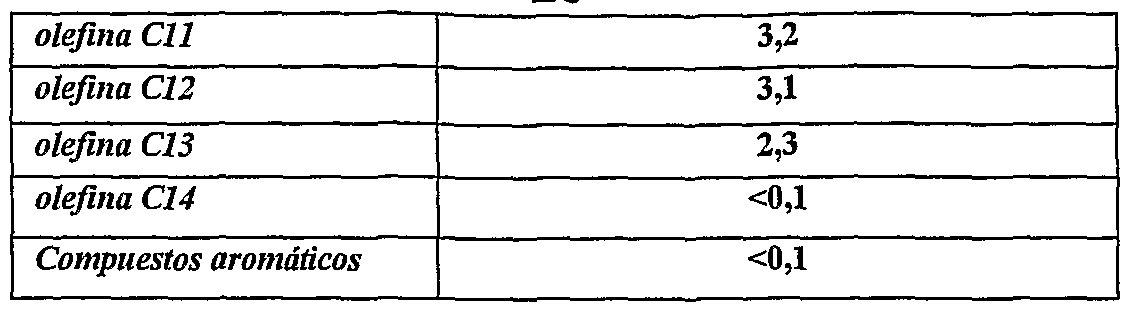
- Table 27 corresponds to the average product distribution (mono-alkylbenzenes and by-products, which encompasses both light by-products and heavy by-products, once the unreacted benzene is separated) from those cycles that use the solid catalysts A and B with different LHSV and temperature conditions (called cycles 1, 2 and 3).
- the results corresponding to HF technology are placed in the lower part of Table 22 to compare the yields of HF and the solid catalyst.
- catalyst B is a catalyst equivalent to HF in the alkylation process of benzene with pure alpha-olefins (in terms of conversion, selectivity to mono-alkylate and alkylates), and in addition the complex handling is avoided. of an acid as corrosive as HF. In addition, catalyst B improves the behavior of catalyst A in this process by significantly reducing (25%) the production of branched alkylates.
Landscapes
- Chemical & Material Sciences (AREA)
- Organic Chemistry (AREA)
- Chemical Kinetics & Catalysis (AREA)
- Engineering & Computer Science (AREA)
- Materials Engineering (AREA)
- Crystallography & Structural Chemistry (AREA)
- Life Sciences & Earth Sciences (AREA)
- Oil, Petroleum & Natural Gas (AREA)
- Wood Science & Technology (AREA)
- Organic Low-Molecular-Weight Compounds And Preparation Thereof (AREA)
- Low-Molecular Organic Synthesis Reactions Using Catalysts (AREA)
Abstract
Description







Claims
Priority Applications (6)
| Application Number | Priority Date | Filing Date | Title |
|---|---|---|---|
| CA2708018A CA2708018C (en) | 2007-12-04 | 2007-12-04 | Process for obtention of highly-lineal, adjustable-isomery monoalkylated aromatic compounds |
| CN2007801022881A CN101970388A (zh) | 2007-12-04 | 2007-12-04 | 获得具有高线性和可调节的同分异构性的单烷基化芳族化合物的方法 |
| PCT/ES2007/000711 WO2009071709A1 (es) | 2007-12-04 | 2007-12-04 | Procedimiento para la obtención de compuestos aromáticos mono-alquilados de alta linealidad e isomería ajustable |
| US12/746,485 US8237001B2 (en) | 2007-12-04 | 2007-12-04 | Process for obtention of highly-lineal, adjustable-isomery monoalkylated aromatic compounds |
| BRPI0722249-1A2A BRPI0722249A2 (pt) | 2007-12-04 | 2007-12-04 | Procedimento para a obtenção de compostos aromáticos mono-alquilados, de alta linearidade e isomeria ajustável |
| EP07866341.6A EP2233461A4 (en) | 2007-12-04 | 2007-12-04 | METHOD FOR OBTAINING MONOALKYLATED AROMATIC COMPOUNDS WITH HIGH LINEARITY AND ADJUSTABLE ISOMERISM |
Applications Claiming Priority (1)
| Application Number | Priority Date | Filing Date | Title |
|---|---|---|---|
| PCT/ES2007/000711 WO2009071709A1 (es) | 2007-12-04 | 2007-12-04 | Procedimiento para la obtención de compuestos aromáticos mono-alquilados de alta linealidad e isomería ajustable |
Publications (1)
| Publication Number | Publication Date |
|---|---|
| WO2009071709A1 true WO2009071709A1 (es) | 2009-06-11 |
Family
ID=40717324
Family Applications (1)
| Application Number | Title | Priority Date | Filing Date |
|---|---|---|---|
| PCT/ES2007/000711 Ceased WO2009071709A1 (es) | 2007-12-04 | 2007-12-04 | Procedimiento para la obtención de compuestos aromáticos mono-alquilados de alta linealidad e isomería ajustable |
Country Status (6)
| Country | Link |
|---|---|
| US (1) | US8237001B2 (es) |
| EP (1) | EP2233461A4 (es) |
| CN (1) | CN101970388A (es) |
| BR (1) | BRPI0722249A2 (es) |
| CA (1) | CA2708018C (es) |
| WO (1) | WO2009071709A1 (es) |
Cited By (7)
| Publication number | Priority date | Publication date | Assignee | Title |
|---|---|---|---|---|
| US7973206B1 (en) | 2009-12-16 | 2011-07-05 | Uop Llc | Alkylation process using catalysts with low olefin skeletal isomerization activity |
| US8470726B2 (en) | 2009-12-16 | 2013-06-25 | Uop Llc | Alkylation catalysts with low olefin skeletal isomerization activity |
| US8940677B2 (en) | 2009-09-14 | 2015-01-27 | The Procter & Gamble Company | Compact fluid laundry detergent composition |
| US9126184B2 (en) | 2009-12-16 | 2015-09-08 | Uop Llc | Detergent alkylation using a rare earth exchanged catalyst |
| US9758747B2 (en) | 2009-09-14 | 2017-09-12 | The Procter & Gamble Company | External structuring system for liquid laundry detergent composition |
| WO2022128561A1 (en) | 2020-12-16 | 2022-06-23 | Unilever Ip Holdings B.V. | Detergent compositions |
| WO2025022141A1 (en) | 2023-07-25 | 2025-01-30 | Cepsa Química, S.A. | Process for the monoalkylation of aromatic compounds |
Families Citing this family (10)
| Publication number | Priority date | Publication date | Assignee | Title |
|---|---|---|---|---|
| US8389786B2 (en) | 2010-12-10 | 2013-03-05 | Uop Llc | Method to adjust 2-phenyl content of an alkylation process for the production of linear alkyl benzene |
| US9127237B2 (en) | 2011-06-28 | 2015-09-08 | Sasol Germany Gmbh | Surfactant compositions |
| EP2557145A1 (en) * | 2011-06-28 | 2013-02-13 | SASOL Germany GmbH | Surfactant compositions |
| US8389787B1 (en) | 2012-03-21 | 2013-03-05 | Uop Llc | Control of 2-phenyl content in alkylbenzenes during production |
| US20130253239A1 (en) * | 2012-03-23 | 2013-09-26 | Uop Llc | Heavy Alkylbenzene Production Through Oligomerization |
| CN105283430A (zh) * | 2013-04-19 | 2016-01-27 | 吉坤日矿日石能源株式会社 | 烷基苯组合物和烷基苯磺化物的制造方法 |
| US11078431B2 (en) | 2019-12-16 | 2021-08-03 | Saudi Arabian Oil Company | Modified ultra-stable Y (USY) zeolite catalyst for deolefinization of hydrocarbon streams |
| US11098256B2 (en) | 2020-01-08 | 2021-08-24 | Saudi Arabian Oil Company | Modified ultra-stable Y (USY) zeolite catalyst for improving cold flow properties of distillates |
| US11484869B2 (en) | 2020-12-09 | 2022-11-01 | Saudi Arabian Oil Company | Modified ultra-stable Y (USY) zeolite catalyst for dealkylation of aromatics |
| US12533664B2 (en) | 2022-12-19 | 2026-01-27 | Saudi Arabian Oil Company | Type II hydrotreating catalyst for hydrocarbon oil and method for hydrotreating hydrocarbon oil |
Citations (5)
| Publication number | Priority date | Publication date | Assignee | Title |
|---|---|---|---|---|
| ES2007545A6 (es) | 1988-08-03 | 1989-06-16 | Petroquimica Espanola S A Petr | Proceso de alquilacion catalitica en lecho fijo de hidrocarburos aromaticos. |
| US5276231A (en) | 1992-07-27 | 1994-01-04 | Uop | Alkylaromatic process with removal of aromatic by-products |
| US20030166481A1 (en) * | 1996-02-08 | 2003-09-04 | Huntsman Petrochemical Corporation | Alkylbenzene detergents with high 2-isomer content |
| WO2006108883A1 (es) * | 2005-04-12 | 2006-10-19 | Petroquímica Española S.A. Petresa | Proceso para obtener un alquilbenceno lineal altamente soluble |
| WO2007104805A1 (es) | 2006-03-16 | 2007-09-20 | Petroquímica Española, S.A. (Petresa) | Procedimiento para la obtención de sulfonatos de alquilbenceno lineales altamente solubles |
-
2007
- 2007-12-04 CA CA2708018A patent/CA2708018C/en active Active
- 2007-12-04 US US12/746,485 patent/US8237001B2/en active Active
- 2007-12-04 WO PCT/ES2007/000711 patent/WO2009071709A1/es not_active Ceased
- 2007-12-04 CN CN2007801022881A patent/CN101970388A/zh active Pending
- 2007-12-04 BR BRPI0722249-1A2A patent/BRPI0722249A2/pt not_active Application Discontinuation
- 2007-12-04 EP EP07866341.6A patent/EP2233461A4/en not_active Withdrawn
Patent Citations (6)
| Publication number | Priority date | Publication date | Assignee | Title |
|---|---|---|---|---|
| ES2007545A6 (es) | 1988-08-03 | 1989-06-16 | Petroquimica Espanola S A Petr | Proceso de alquilacion catalitica en lecho fijo de hidrocarburos aromaticos. |
| US5146026A (en) | 1988-08-03 | 1992-09-08 | Petroquimica Espanola, S.A. Petresa | Alkylation of aromatic hydrocarbons in fixed bed catalytic process |
| US5276231A (en) | 1992-07-27 | 1994-01-04 | Uop | Alkylaromatic process with removal of aromatic by-products |
| US20030166481A1 (en) * | 1996-02-08 | 2003-09-04 | Huntsman Petrochemical Corporation | Alkylbenzene detergents with high 2-isomer content |
| WO2006108883A1 (es) * | 2005-04-12 | 2006-10-19 | Petroquímica Española S.A. Petresa | Proceso para obtener un alquilbenceno lineal altamente soluble |
| WO2007104805A1 (es) | 2006-03-16 | 2007-09-20 | Petroquímica Española, S.A. (Petresa) | Procedimiento para la obtención de sulfonatos de alquilbenceno lineales altamente solubles |
Non-Patent Citations (5)
| Title |
|---|
| A. M. NIELSEN; L. N. BRITTON; L. CAVALLI; J. L. BERNA: "Biodegradation of co-products of commercial LAS", THE CLER REVIEW, vol. 2, no. 1, 1996, pages 14 - 27 |
| B. THOMAS ET AL.: "Towards a green synthesis of LAB's: Effect of rare earth metal ions on the benzene alkylation with 1-dodecene osee NaFAU-Y zeolites", J. MATER. SCI., vol. 41, no. 5, 2006, pages 1611 - 1616, XP002581055 * |
| BEMA,J.L. ET AL., TENSIDE SURFACTANTS DETERGENTS, vol. 26, 1989, pages 2 |
| L. CAVALLI; G. CASSANI; M. LAZZARIN; C. MARASCHIN; G. NUZZI; J. L. BERNA; J. BRAVO; J. FERRER; A. MASNO: "Iso-branching of LAS biodegradation study of two model compounds", TOXICOLOGY & ENVIRONMENTAL CHEMISTRY, vol. 54, 1966, pages 167 - 186 |
| See also references of EP2233461A4 |
Cited By (7)
| Publication number | Priority date | Publication date | Assignee | Title |
|---|---|---|---|---|
| US8940677B2 (en) | 2009-09-14 | 2015-01-27 | The Procter & Gamble Company | Compact fluid laundry detergent composition |
| US9758747B2 (en) | 2009-09-14 | 2017-09-12 | The Procter & Gamble Company | External structuring system for liquid laundry detergent composition |
| US7973206B1 (en) | 2009-12-16 | 2011-07-05 | Uop Llc | Alkylation process using catalysts with low olefin skeletal isomerization activity |
| US8470726B2 (en) | 2009-12-16 | 2013-06-25 | Uop Llc | Alkylation catalysts with low olefin skeletal isomerization activity |
| US9126184B2 (en) | 2009-12-16 | 2015-09-08 | Uop Llc | Detergent alkylation using a rare earth exchanged catalyst |
| WO2022128561A1 (en) | 2020-12-16 | 2022-06-23 | Unilever Ip Holdings B.V. | Detergent compositions |
| WO2025022141A1 (en) | 2023-07-25 | 2025-01-30 | Cepsa Química, S.A. | Process for the monoalkylation of aromatic compounds |
Also Published As
| Publication number | Publication date |
|---|---|
| CN101970388A (zh) | 2011-02-09 |
| EP2233461A4 (en) | 2013-09-18 |
| US20100305373A1 (en) | 2010-12-02 |
| CA2708018C (en) | 2015-10-27 |
| US8237001B2 (en) | 2012-08-07 |
| CA2708018A1 (en) | 2009-06-11 |
| EP2233461A1 (en) | 2010-09-29 |
| BRPI0722249A2 (pt) | 2014-05-13 |
Similar Documents
| Publication | Publication Date | Title |
|---|---|---|
| WO2009071709A1 (es) | Procedimiento para la obtención de compuestos aromáticos mono-alquilados de alta linealidad e isomería ajustable | |
| TWI301478B (en) | Process for the preparation of alkylaryl compounds and sulfonates thereof | |
| CN101528644B (zh) | 制备具有期望的2-苯基含量的苯基链烷的方法 | |
| WO2007104805A1 (es) | Procedimiento para la obtención de sulfonatos de alquilbenceno lineales altamente solubles | |
| CZ2002218A3 (cs) | Detergentní prostředky s obsahem modifikovaných alkylarylsulfonátových povrchově aktivních činidel | |
| CA2523705A1 (en) | Structured liquids made using lab sulfonates of varied 2-isomer content | |
| WO2006108883A1 (es) | Proceso para obtener un alquilbenceno lineal altamente soluble | |
| ES2283873T3 (es) | Procedimiento para la obtencion de alquilarilsulfonatos por medio de olefinas modificadas dimerizadas. | |
| ES2601981T3 (es) | Procedimiento para la preparación de compuestos de alquilarilo y sus sulfonatos | |
| CA2810836C (en) | Method for controlling 2-phenyl isomer content of linear alkylbenzene and catalyst used in the method | |
| KR20040002842A (ko) | 알킬 톨루엔 술포네이트 세정제 | |
| CN1325445C (zh) | 制备烷基芳族化合物的方法 | |
| TW200530147A (en) | Process for the preparation of alkylaryl compounds | |
| RU2460715C2 (ru) | Способ получения моноалкилированных ароматических соединений с высокой линейностью и регулируемой изомерией | |
| WO2007128842A1 (es) | Transalquilación catalítica de dialquilbencenos | |
| ES2281784T3 (es) | Metodo para preparar hidrocarburos alquilo ramificado-aromaticos usando una corriente de proceso proveniente de una unidad de isomerizacion. | |
| ES2363029T3 (es) | Procedimiento para la purificación de compuestos alquilaromáticos. |
Legal Events
| Date | Code | Title | Description |
|---|---|---|---|
| WWE | Wipo information: entry into national phase |
Ref document number: 200780102288.1 Country of ref document: CN |
|
| 121 | Ep: the epo has been informed by wipo that ep was designated in this application |
Ref document number: 07866341 Country of ref document: EP Kind code of ref document: A1 |
|
| WWE | Wipo information: entry into national phase |
Ref document number: 2708018 Country of ref document: CA |
|
| NENP | Non-entry into the national phase |
Ref country code: DE |
|
| WWE | Wipo information: entry into national phase |
Ref document number: 4124/CHENP/2010 Country of ref document: IN Ref document number: 2007866341 Country of ref document: EP |
|
| WWE | Wipo information: entry into national phase |
Ref document number: 2010128322 Country of ref document: RU |
|
| WWE | Wipo information: entry into national phase |
Ref document number: 12746485 Country of ref document: US |
|
| ENP | Entry into the national phase |
Ref document number: PI0722249 Country of ref document: BR Kind code of ref document: A2 Effective date: 20100604 |