WO2009072663A1 - 溶接熱影響部のctod特性が優れた鋼およびその製造方法 - Google Patents
溶接熱影響部のctod特性が優れた鋼およびその製造方法 Download PDFInfo
- Publication number
- WO2009072663A1 WO2009072663A1 PCT/JP2008/072461 JP2008072461W WO2009072663A1 WO 2009072663 A1 WO2009072663 A1 WO 2009072663A1 JP 2008072461 W JP2008072461 W JP 2008072461W WO 2009072663 A1 WO2009072663 A1 WO 2009072663A1
- Authority
- WO
- WIPO (PCT)
- Prior art keywords
- less
- steel
- ctod
- toughness
- value
- Prior art date
- Legal status (The legal status is an assumption and is not a legal conclusion. Google has not performed a legal analysis and makes no representation as to the accuracy of the status listed.)
- Ceased
Links
Classifications
-
- C—CHEMISTRY; METALLURGY
- C22—METALLURGY; FERROUS OR NON-FERROUS ALLOYS; TREATMENT OF ALLOYS OR NON-FERROUS METALS
- C22C—ALLOYS
- C22C38/00—Ferrous alloys, e.g. steel alloys
- C22C38/16—Ferrous alloys, e.g. steel alloys containing copper
-
- C—CHEMISTRY; METALLURGY
- C22—METALLURGY; FERROUS OR NON-FERROUS ALLOYS; TREATMENT OF ALLOYS OR NON-FERROUS METALS
- C22C—ALLOYS
- C22C38/00—Ferrous alloys, e.g. steel alloys
- C22C38/18—Ferrous alloys, e.g. steel alloys containing chromium
- C22C38/40—Ferrous alloys, e.g. steel alloys containing chromium with nickel
- C22C38/50—Ferrous alloys, e.g. steel alloys containing chromium with nickel with titanium or zirconium
-
- B—PERFORMING OPERATIONS; TRANSPORTING
- B23—MACHINE TOOLS; METAL-WORKING NOT OTHERWISE PROVIDED FOR
- B23K—SOLDERING OR UNSOLDERING; WELDING; CLADDING OR PLATING BY SOLDERING OR WELDING; CUTTING BY APPLYING HEAT LOCALLY, e.g. FLAME CUTTING; WORKING BY LASER BEAM
- B23K9/00—Arc welding or cutting
- B23K9/18—Submerged-arc welding
-
- B—PERFORMING OPERATIONS; TRANSPORTING
- B23—MACHINE TOOLS; METAL-WORKING NOT OTHERWISE PROVIDED FOR
- B23K—SOLDERING OR UNSOLDERING; WELDING; CLADDING OR PLATING BY SOLDERING OR WELDING; CUTTING BY APPLYING HEAT LOCALLY, e.g. FLAME CUTTING; WORKING BY LASER BEAM
- B23K9/00—Arc welding or cutting
- B23K9/23—Arc welding or cutting taking account of the properties of the materials to be welded
-
- C—CHEMISTRY; METALLURGY
- C21—METALLURGY OF IRON
- C21D—MODIFYING THE PHYSICAL STRUCTURE OF FERROUS METALS; GENERAL DEVICES FOR HEAT TREATMENT OF FERROUS OR NON-FERROUS METALS OR ALLOYS; MAKING METAL MALLEABLE, e.g. BY DECARBURISATION OR TEMPERING
- C21D9/00—Heat treatment, e.g. annealing, hardening, quenching or tempering, adapted for particular articles; Furnaces therefor
- C21D9/50—Heat treatment, e.g. annealing, hardening, quenching or tempering, adapted for particular articles; Furnaces therefor for welded joints
-
- C—CHEMISTRY; METALLURGY
- C22—METALLURGY; FERROUS OR NON-FERROUS ALLOYS; TREATMENT OF ALLOYS OR NON-FERROUS METALS
- C22C—ALLOYS
- C22C38/00—Ferrous alloys, e.g. steel alloys
- C22C38/001—Ferrous alloys, e.g. steel alloys containing N
-
- C—CHEMISTRY; METALLURGY
- C22—METALLURGY; FERROUS OR NON-FERROUS ALLOYS; TREATMENT OF ALLOYS OR NON-FERROUS METALS
- C22C—ALLOYS
- C22C38/00—Ferrous alloys, e.g. steel alloys
- C22C38/02—Ferrous alloys, e.g. steel alloys containing silicon
-
- C—CHEMISTRY; METALLURGY
- C22—METALLURGY; FERROUS OR NON-FERROUS ALLOYS; TREATMENT OF ALLOYS OR NON-FERROUS METALS
- C22C—ALLOYS
- C22C38/00—Ferrous alloys, e.g. steel alloys
- C22C38/04—Ferrous alloys, e.g. steel alloys containing manganese
-
- C—CHEMISTRY; METALLURGY
- C22—METALLURGY; FERROUS OR NON-FERROUS ALLOYS; TREATMENT OF ALLOYS OR NON-FERROUS METALS
- C22C—ALLOYS
- C22C38/00—Ferrous alloys, e.g. steel alloys
- C22C38/06—Ferrous alloys, e.g. steel alloys containing aluminium
-
- C—CHEMISTRY; METALLURGY
- C22—METALLURGY; FERROUS OR NON-FERROUS ALLOYS; TREATMENT OF ALLOYS OR NON-FERROUS METALS
- C22C—ALLOYS
- C22C38/00—Ferrous alloys, e.g. steel alloys
- C22C38/08—Ferrous alloys, e.g. steel alloys containing nickel
-
- C—CHEMISTRY; METALLURGY
- C22—METALLURGY; FERROUS OR NON-FERROUS ALLOYS; TREATMENT OF ALLOYS OR NON-FERROUS METALS
- C22C—ALLOYS
- C22C38/00—Ferrous alloys, e.g. steel alloys
- C22C38/14—Ferrous alloys, e.g. steel alloys containing titanium or zirconium
-
- C—CHEMISTRY; METALLURGY
- C22—METALLURGY; FERROUS OR NON-FERROUS ALLOYS; TREATMENT OF ALLOYS OR NON-FERROUS METALS
- C22C—ALLOYS
- C22C38/00—Ferrous alloys, e.g. steel alloys
- C22C38/18—Ferrous alloys, e.g. steel alloys containing chromium
- C22C38/40—Ferrous alloys, e.g. steel alloys containing chromium with nickel
- C22C38/48—Ferrous alloys, e.g. steel alloys containing chromium with nickel with niobium or tantalum
-
- C—CHEMISTRY; METALLURGY
- C22—METALLURGY; FERROUS OR NON-FERROUS ALLOYS; TREATMENT OF ALLOYS OR NON-FERROUS METALS
- C22C—ALLOYS
- C22C38/00—Ferrous alloys, e.g. steel alloys
- C22C38/18—Ferrous alloys, e.g. steel alloys containing chromium
- C22C38/40—Ferrous alloys, e.g. steel alloys containing chromium with nickel
- C22C38/58—Ferrous alloys, e.g. steel alloys containing chromium with nickel with more than 1.5% by weight of manganese
-
- B—PERFORMING OPERATIONS; TRANSPORTING
- B23—MACHINE TOOLS; METAL-WORKING NOT OTHERWISE PROVIDED FOR
- B23K—SOLDERING OR UNSOLDERING; WELDING; CLADDING OR PLATING BY SOLDERING OR WELDING; CUTTING BY APPLYING HEAT LOCALLY, e.g. FLAME CUTTING; WORKING BY LASER BEAM
- B23K2103/00—Materials to be soldered, welded or cut
- B23K2103/02—Iron or ferrous alloys
- B23K2103/04—Steel or steel alloys
Definitions
- the present invention relates to a steel having excellent CT OD characteristics of a weld heat-affected zone (HA Z) from small heat input welding to medium heat input welding, and its manufacturing method.
- the present invention relates to a steel having excellent CTOD characteristics of a welded heat shield part exhibiting excellent toughness with extremely good CTOD characteristics of FL part and IC part where toughness deteriorates, and a manufacturing method thereof.
- HA Z weld heat affected zone
- FL boundary between WM (welded metal) and HA Z (weld heat affected zone)
- IC (Intercritica 1 HA Z: HA Z and BM ( Evaluation was made at two positions (notches) on the boundary with the base material), but until now only the FL section was targeted.
- the present invention provides a temperature of 160 ° C. in multi-layer welding with small to medium heat input.
- the C ⁇ ⁇ D characteristics of the IC part are also satisfied. It is an object to provide a high-strength and excellent manufacturing method with excellent CT OD (fracture toughness) characteristics. 0
- CT OD fracture toughness
- the reduction of non-metallic inclusions is the most important for improving the CTOD characteristics of both the FL part and the IC part. For this reason, it is essential to reduce ⁇ (oxygen in steel). Since intragranular transformation ferrite (IGF) decreases, it is necessary to reduce the alloy elements that degrade the C TO D characteristics of the FL section, and the CTOD characteristics of the IC section can only be improved by reducing oxygen in steel. Then, it was difficult to find that the reduction of hardness was effective, and the present invention was completed 7 times.
- IGF intragranular transformation ferrite
- the gist of the present invention is as follows.
- N b 0 • 0 0 5% or less
- a steel with excellent C TD characteristics of the welded heat shield characterized by the balance being iron and inevitable impurities.
- N b 0.0 0 5% or less
- V 0.0 0 5 to 0.0 2 0%
- PCT o D is less than 0.0 6 5 and C e cl H is less than 0.2 3 5 and the balance is composed of iron and unavoidable impurities. Excellent steel.
- a welded thermal shadow part characterized in that the steel, the balance of which consists of iron and inevitable impurities, is made into a slab by a continuous forging method, and then reheated to a temperature of 95.000 to 110.degree.
- PCTOD C + -F + — Cw + —
- the steel produced according to the present invention exhibits excellent toughness with extremely good C T OD characteristics in the FL and I C parts where the toughness deteriorates most during welding, such as multi-layer welding with low to medium heat input. This made it possible to manufacture high-strength steel materials used in harsh environments such as offshore structures and earthquake-resistant buildings.
- Figure 1 shows the relationship between P CTOD and CT OD characteristics in FL equivalent thermal cycle tests.
- Figure 2 shows the relationship between the hardness of HA Z and the C TO D characteristics in the I C HA Z equivalent reproduction thermal cycle test.
- Fig. 3 is a graph showing the relationship between C e q H and the hardness of HA Z in the I C HA Z equivalent reproduction thermal cycle test.
- non-metallic inclusions such as Ti oxides are used for intragranular transformation ferrite (IGF: Intragranular Ferrite).
- IGF Intragranular Ferrite
- O intragranular transformation ferrite
- Figure 1 shows the relationship between the CTOD characteristics of FL equivalent reproduction HAZ and P c To D.
- P c ⁇ o D as a parameter of steel composition is the equivalent of FL Z in many laboratory melting steels, and the ZOD (T., c 0. , (FL )) This is an empirical formula derived from prayer.
- the target level of ⁇ ⁇ co, ( FL ) ⁇ -1 1 0 is the knowledge obtained in many experiments, and the thickness of the plate is from 50 to 10 This is the necessary value to obtain a stable CTOD value of 0.25 mm or more at an actual joint FL notch of O mm steel plate at 160.
- the steel component parameter P c ⁇ o D is controlled to 0.0 6 5% or less. I understand that it is necessary.
- T sco .it FL means the temperature () at which the minimum of the three CTOD ( ⁇ 5 c) values carried out at each test temperature exceeds 0.1 mm.
- T 5 c 0 In consideration of the plate thickness effect in the CTOD test, in order to obtain a stable CTOD value of 0.25 mm or more with an actual joint FL notch of a steel plate with a thickness of 50 to 100 mm, it is ⁇ 60.
- T 5 c 0 Empirically, T 5 c 0 .
- Fig. 2 shows the relationship between CTOD characteristics of specimens subjected to reproducible thermal cycles equivalent to Intercritica 1 HAZ (ICHAZ), which will be described later, and the hardness of ICHAZ equivalent HA Z.
- Fig. 3 shows the hardness of steel component parameters C e QH And IC HA Z equivalent HAZ hardness relationship is shown.
- the target level that 1- c 0. I (, c HA z ) of the reproduction HA Z (cross section 10 mm x 2 0111111) equivalent to IC HA Z shown in Fig. 2 is -1 1 0 or less is This is a knowledge obtained through numerous experiments, and it is necessary to obtain a CT ⁇ D value of about 0.25 mm at 60 ° of the IC notch of the actual joint of a steel plate with a thickness of 50 to 100 mm. Required value.
- X (ic HA z) to be single 1 1 0 or less, the hardness H v 1 7 6 or less, the steel composition hardness parameter C eq It turns out that it is necessary to control H below 0.2 3 5. In order to lower the hardness, it is desirable that the value is 0.225 or less.
- IC HA Z equivalent Reproduction thermal cycle conditions are 1 st: PT 9 5 0 X: (8 0 0 to 5 0 0 t:: 2 0 sec), 2 nd : 7 70 t: (77 0 to 5 0 0:: 2 2 sec), 3 rd: 4 5 0 (4 5 0 to 3 0 00 t:: 6 5 sec).
- the limited ranges and reasons for steel components are described below.
- The% described here means mass%.
- C must have a strength of 0.015% or more in order to obtain strength, but if it exceeds 0.045%, it degrades the properties of welded HA Z and cannot satisfy the CT OD characteristics of 60. 0 4 5% is the upper limit.
- S i is preferably less in order to obtain good HAZ toughness, but in the invention steel, since A 1 is not added, 0.05% or more is necessary for deoxidation. However, if it exceeds 0.2%, the HAZ toughness is impaired, so 0.2% is made the upper limit. In order to obtain better HA Z toughness, 0.15% or less is desirable.
- M n 1.5 to 2.0%, preferably 1.8% or less
- M n is an inexpensive element that has a great effect on optimizing the microstructure and is less likely to damage the HAZ toughness. If over 0%, the hardness of ICHAZ increases and the toughness deteriorates, so 2.0% was made the upper limit. Also, since the effect is small at less than 1.5%, the lower limit was set at 1.5%. In order to further improve HA Z toughness, 1.8% or less is desirable.
- P and S are contained as unavoidable impurities, and it is better that both are low in base metal toughness and HA Z toughness. did. In order to obtain better HA Z toughness, it is desirable that P is not more than 0.05% and S is not more than 0.03%.
- a 1 0.0 0 4% or less
- a 1 is preferably less because it generates Ti oxide, but there are restrictions on industrial production, and the upper limit is 0.0 0 4%.
- T i 0.0 0 5 to 0.0 1 5%, preferably 0.0 13% or less
- T i is a force that generates T i oxide and refines the microstructure. In order to reduce the HA Z toughness. In order to further improve the HA Z toughness, 0.013% or less is desirable.
- O is required to be at least 0.005% because of the oxide formation as the IGF formation nucleus in the FL part of T i, however, if too much O, the size and number of oxides will be excessive. Therefore, in order to degrade the CTOD characteristics of the IC part, the range of 0.0 0 1 5 to 0.0 0 3 5% was set as the limit range.
- the content is preferably 0.0 0 30% or less, more preferably 0.0 0 28% or less.
- N 0.0 0 2 to 0.0 0 6%, preferably 0.0 0 5% or less N is necessary for Ti nitride formation, but less than 0.0 2% is less effective. If it exceeds 0.06%, surface flaws occur during the production of steel slabs, so the upper limit was set to 0.06%. In order to obtain better HA Z toughness, 0.005% or less is desirable.
- V the purpose of adding V to the basic component is to improve the strength of the base metal. In order to exert this effect, it is necessary to set the content to 0.005% or more. On the other hand, if added over 0.02%, the HA Z toughness is harmed. Therefore, the upper limit of V is set to 0.02% or less, so that the HAZ toughness is not significantly harmed.
- N 1 0.7 to 1.5%, preferably 0.9% or more
- Cu and Ni are effective because they have little effect on HAZ toughness, increase the strength of the base metal, and are effective with little increase in the hardness of ICHAZ.
- the limit ranges were u: 0.25 to 0.5% and Ni: 0.7 to 1.5.
- N i 0.9 to 1.5% is desirable to improve HA Z toughness.
- N b 0.0 0 5% or less
- Nb is beneficial from the standpoint of base metal strength and toughness, but is detrimental to HAZ toughness. For this reason, it is possible to add up to 0.005%, which is a range in which the HA Z toughness is not significantly reduced. However, in order to further improve HA Z toughness, it is more desirable to limit it to 0.0 0 1% or less. Even if the steel components are limited as described above, the intended effect cannot be achieved unless the production method is appropriate. For this reason, it is necessary to limit the manufacturing conditions.
- the steel of the present invention is industrially required to be produced by a continuous forging method.
- the reason is that the solidification cooling rate of the molten steel is fast, and a large amount of fine Ti oxide and Ti nitride can be generated in the slab.
- the reheating temperature When rolling slabs, the reheating temperature must be between 9500 and 1100. This is because when the reheating temperature exceeds 1100, the T 1 nitride becomes large, and the toughness deterioration of the base metal and the HAZ toughness improvement effect cannot be expected.
- the heat treatment is essential for the manufacturing method after reheating.
- the heat treatment is a process in which the rolling temperature is controlled within a narrow range suitable for the steel components, followed by water cooling, etc., if necessary. This is a manufacturing method that can improve the strength and toughness of steel.
- thermomechanical treatment method include 1) controlled rolling, 2) controlled rolling and accelerated cooling, and 3) direct quenching and tempering after rolling.
- the preferred method is controlled rolling and accelerated cooling. Even if this steel is manufactured and then reheated to a temperature below the Ar 3 transformation point for the purpose of dehydrogenation, the features of the present invention are not impaired.
- Welding is generally used as a test welding.
- Method welding heat input was 4.5 to 5.
- the CT OD test was performed with a size of t (plate thickness) X 2 t and a notch with 50% fatigue crack, and the notch position was FL (boundary of WM and HA Z) and IC (HA Z and BM). 5 tests were performed at 1 60 at 2 locations. .
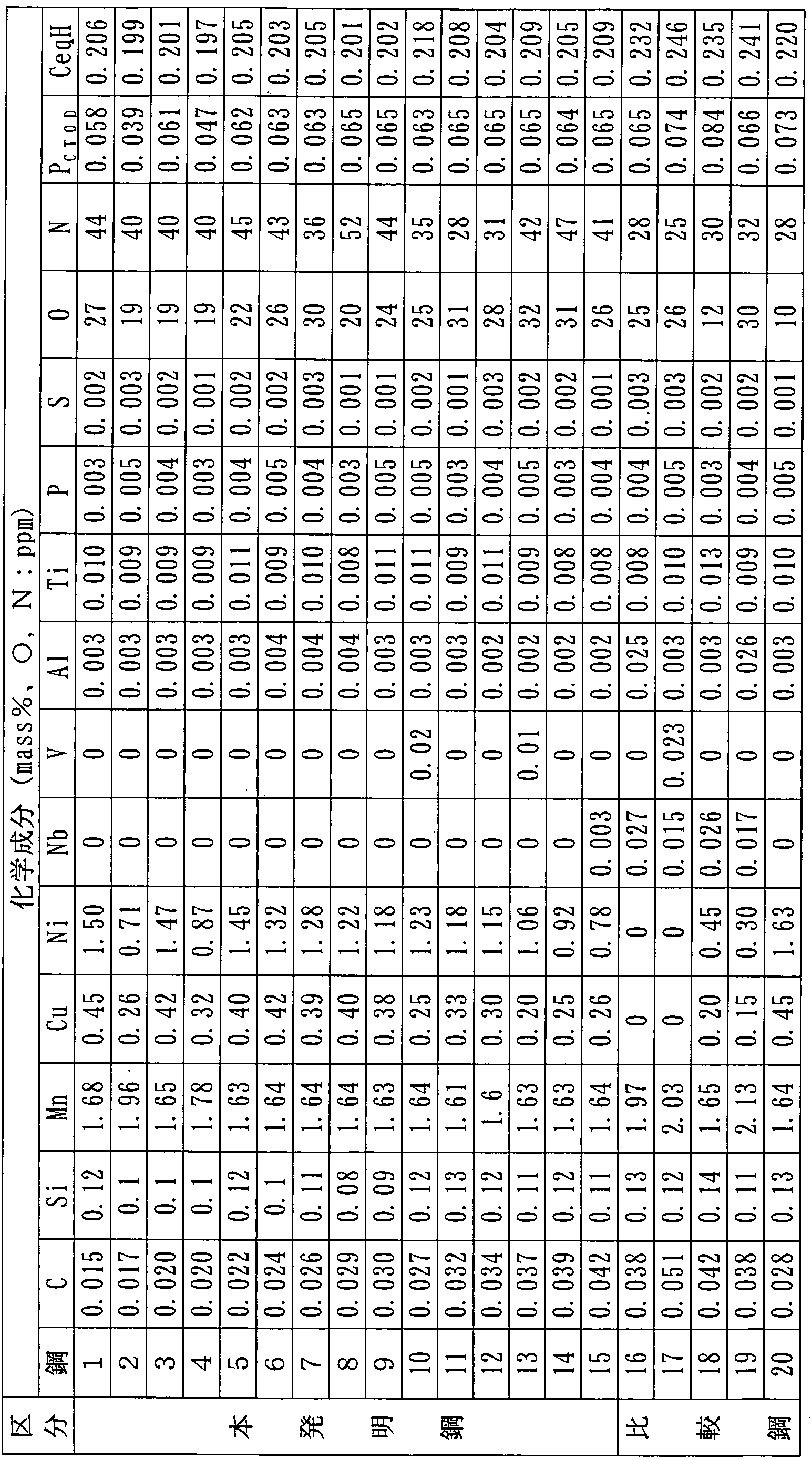
- Table 1 shows the chemical composition of steel, and Table 2 shows the manufacturing conditions, base metal (BM), and welded joint characteristics.
- a C C Accelerated cooling (40 O t for controlled rolling: cooling to water after cooling to a temperature range of ⁇ 60 O t :)
- the steel plate manufactured in accordance with the present invention (invention steel) has a yield strength (YS) force of 4 2 3 NZmm 2 or higher, a tensile strength of 5 0 1 NZmm 2 or higher, and a CT 0 D value of 1600 is FL notch.
- Good fracture toughness 0.35 mm or more at the minimum value (min) of ⁇ 5 c and 0.53 mm or more at the zero value of 1 notch (111 1 11).
- the comparative steel is equivalent in strength to the invented steel, but the CTOD value is inferior, making it unsuitable for use in harsh environments.
- the comparative steel 16 had a P c To D value within the limits of the steel of the present invention, but A 1 and Nb were added, so the CT 0 D value of the FL notch was low.
- Comparative steel 17 has too much C and M n, and b is added, so the P c ⁇ o value and C eq H value are outside the limits of the steel of the present invention.
- the comparative steel 18 has a low C T ⁇ D value of the FL L notch because ⁇ is too low and Nb is also added.
- the comparative steel 20 had a low CTOD value for the FL notch because ⁇ was too low.
Landscapes
- Chemical & Material Sciences (AREA)
- Engineering & Computer Science (AREA)
- Mechanical Engineering (AREA)
- Materials Engineering (AREA)
- Metallurgy (AREA)
- Organic Chemistry (AREA)
- Physics & Mathematics (AREA)
- Plasma & Fusion (AREA)
- Thermal Sciences (AREA)
- Crystallography & Structural Chemistry (AREA)
- Heat Treatment Of Steel (AREA)
Abstract
Description


Claims

Priority Applications (7)
| Application Number | Priority Date | Filing Date | Title |
|---|---|---|---|
| KR1020097012022A KR101142185B1 (ko) | 2007-12-07 | 2008-12-04 | 용접열 영향부의 ctod 특성이 우수한 강 및 그 제조 방법 |
| CN2008800015654A CN101578384B (zh) | 2007-12-07 | 2008-12-04 | 焊接热影响区的ctod特性优异的钢及其制造方法 |
| BRPI0808457A BRPI0808457B1 (pt) | 2007-12-07 | 2008-12-04 | aços superiores em propriedades ctod da zona afetada pelo calor |
| CA2674197A CA2674197C (en) | 2007-12-07 | 2008-12-04 | Steel plate superior in ctod properties of weld heat-affected zone and method of production of same |
| US12/448,582 US8361248B2 (en) | 2007-12-07 | 2008-12-04 | Steel superior in CTOD properties of weld heat-affected zone and method of production of same |
| EP08856343A EP2218800B1 (en) | 2007-12-07 | 2008-12-04 | Steel with weld heat-affected zone having excellent ctod properties and process for producing the steel |
| JP2009507260A JP4547037B2 (ja) | 2007-12-07 | 2008-12-04 | 溶接熱影響部のctod特性が優れた鋼およびその製造方法 |
Applications Claiming Priority (4)
| Application Number | Priority Date | Filing Date | Title |
|---|---|---|---|
| JP2007-317317 | 2007-12-07 | ||
| JP2007317317 | 2007-12-07 | ||
| JP2008306336 | 2008-12-01 | ||
| JP2008-306336 | 2008-12-01 |
Publications (1)
| Publication Number | Publication Date |
|---|---|
| WO2009072663A1 true WO2009072663A1 (ja) | 2009-06-11 |
Family
ID=40717837
Family Applications (1)
| Application Number | Title | Priority Date | Filing Date |
|---|---|---|---|
| PCT/JP2008/072461 Ceased WO2009072663A1 (ja) | 2007-12-07 | 2008-12-04 | 溶接熱影響部のctod特性が優れた鋼およびその製造方法 |
Country Status (9)
| Country | Link |
|---|---|
| US (1) | US8361248B2 (ja) |
| EP (1) | EP2218800B1 (ja) |
| JP (1) | JP4547037B2 (ja) |
| KR (2) | KR20110125277A (ja) |
| CN (1) | CN101578384B (ja) |
| BR (1) | BRPI0808457B1 (ja) |
| CA (1) | CA2674197C (ja) |
| TW (1) | TW200932924A (ja) |
| WO (1) | WO2009072663A1 (ja) |
Cited By (5)
| Publication number | Priority date | Publication date | Assignee | Title |
|---|---|---|---|---|
| WO2011081349A3 (ko) * | 2009-12-28 | 2011-11-10 | 주식회사 포스코 | 취성 균열 발생 저항성이 우수한 고강도 강판 및 그 제조방법 |
| US20120144199A1 (en) * | 2010-12-07 | 2012-06-07 | Canon Kabushiki Kaisha | Communication apparatus, control method for communication apparatus, and program |
| EP2385149A4 (en) * | 2009-05-19 | 2012-07-18 | Nippon Steel Corp | Steel material for welding and method for producing same |
| US8920713B2 (en) | 2009-05-21 | 2014-12-30 | Nippon Steel & Sumitomo Metal Corporation | Steel for welded structure and producing method thereof |
| US9403242B2 (en) | 2011-03-24 | 2016-08-02 | Nippon Steel & Sumitomo Metal Corporation | Steel for welding |
Families Citing this family (6)
| Publication number | Priority date | Publication date | Assignee | Title |
|---|---|---|---|---|
| JP2011246805A (ja) * | 2010-04-30 | 2011-12-08 | Nippon Steel Corp | 電子ビーム溶接継手及び電子ビーム溶接用鋼材とその製造方法 |
| JP2011246804A (ja) | 2010-04-30 | 2011-12-08 | Nippon Steel Corp | 電子ビーム溶接継手及び電子ビーム溶接用鋼材とその製造方法 |
| US9024229B2 (en) * | 2011-09-30 | 2015-05-05 | Lincoln Global, Inc. | Method for optimizing weld performance |
| US10023946B2 (en) | 2013-03-12 | 2018-07-17 | Jfe Steel Corporation | Thick steel sheet having excellent CTOD properties in multilayer welded joints, and manufacturing method for thick steel sheet |
| CN104964863A (zh) * | 2015-06-30 | 2015-10-07 | 招商局重工(江苏)有限公司 | 大厚板焊接返修接头的ctod工艺试验方法 |
| KR101988768B1 (ko) * | 2017-12-22 | 2019-06-12 | 주식회사 포스코 | 저온인성이 우수한 대입열 해양구조용 강재 |
Citations (5)
| Publication number | Priority date | Publication date | Assignee | Title |
|---|---|---|---|---|
| JPS62240747A (ja) * | 1986-04-11 | 1987-10-21 | Nippon Steel Corp | 冷間加工性及び溶接性にすぐれた加工、析出硬化型高張力鋼材およびその製造方法 |
| JPH01159356A (ja) * | 1987-12-16 | 1989-06-22 | Nippon Steel Corp | 溶接熱影響部靭性の優れた高張力鋼 |
| JPH04103742A (ja) * | 1990-08-22 | 1992-04-06 | Nippon Steel Corp | 溶接用低温高靭性鋼 |
| JPH07278653A (ja) * | 1994-04-14 | 1995-10-24 | Nippon Steel Corp | 溶接熱影響部の低温靱性が優れた鋼の製造法 |
| JP2007002271A (ja) | 2005-06-21 | 2007-01-11 | Nippon Steel Corp | 溶接熱影響部の破壊靭性に優れた鋼及びその製造方法 |
Family Cites Families (24)
| Publication number | Priority date | Publication date | Assignee | Title |
|---|---|---|---|---|
| JPS54131522A (en) | 1978-04-03 | 1979-10-12 | Nippon Steel Corp | Steel highly resistant against hydrogen induced blister and cracking |
| JPS6123715A (ja) * | 1984-07-10 | 1986-02-01 | Nippon Steel Corp | 高張力高靭性鋼板の製造法 |
| JP3256118B2 (ja) | 1995-12-06 | 2002-02-12 | 新日本製鐵株式会社 | 超大入熱溶接熱影響部の靱性に優れた溶接用高張力鋼 |
| JP3408385B2 (ja) * | 1996-04-17 | 2003-05-19 | 新日本製鐵株式会社 | 溶接熱影響部靭性の優れた鋼 |
| CA2231985C (en) | 1997-03-26 | 2004-05-25 | Sumitomo Metal Industries, Ltd. | Welded high-strength steel structures and methods of manufacturing the same |
| DZ2535A1 (fr) | 1997-06-20 | 2003-01-08 | Exxon Production Research Co | Procédé perfectionné pour la liquéfaction de gaz naturel. |
| RU2198771C2 (ru) | 1998-05-14 | 2003-02-20 | ЭксонМобил Апстрим Ресерч Компани | Сверхвысокопрочные криогенные сварные соединения |
| JP3898842B2 (ja) | 1998-09-25 | 2007-03-28 | 新日本製鐵株式会社 | 溶接熱影響部の低温靭性に優れた鋼板 |
| WO2000061829A1 (fr) * | 1999-04-08 | 2000-10-19 | Kawasaki Steel Corporation | Produit en acier resistant a la corrosion atmospherique |
| JP3802810B2 (ja) * | 1999-10-12 | 2006-07-26 | 新日本製鐵株式会社 | Haz靱性の入熱依存性がない溶接構造物用鋼とその製造方法 |
| CN1144893C (zh) * | 2000-02-28 | 2004-04-07 | 新日本制铁株式会社 | 成形性优良的钢管及制造这种钢管的方法 |
| JP3699657B2 (ja) | 2000-05-09 | 2005-09-28 | 新日本製鐵株式会社 | 溶接熱影響部のCTOD特性に優れた460MPa以上の降伏強度を有する厚鋼板 |
| EP1221493B1 (en) * | 2000-05-09 | 2005-01-12 | Nippon Steel Corporation | THICK STEEL PLATE BEING EXCELLENT IN CTOD CHARACTERISTIC IN WELDING HEAT AFFECTED ZONE AND HAVING YIELD STRENGTH OF 460 Mpa OR MORE |
| JP3820079B2 (ja) | 2000-05-16 | 2006-09-13 | 新日本製鐵株式会社 | 溶接熱影響部の低温靭性に優れた高強度鋼板 |
| JP3968011B2 (ja) | 2002-05-27 | 2007-08-29 | 新日本製鐵株式会社 | 低温靱性および溶接熱影響部靱性に優れた高強度鋼とその製造方法および高強度鋼管の製造方法 |
| JP4528089B2 (ja) * | 2003-10-22 | 2010-08-18 | 新日本製鐵株式会社 | 耐脆性破壊発生特性を有する船体用大入熱突合せ溶接継手 |
| WO2005052205A1 (ja) * | 2003-11-27 | 2005-06-09 | Sumitomo Metal Industries, Ltd. | 溶接部靭性に優れた高張力鋼および海洋構造物 |
| JP4660250B2 (ja) * | 2004-04-07 | 2011-03-30 | 新日本製鐵株式会社 | 大入熱溶接による溶接熱影響部の低温靭性に優れた厚手高強度鋼板 |
| CN1946862B (zh) * | 2004-04-07 | 2012-08-29 | 新日本制铁株式会社 | 大线能量焊接的焊接热影响区的低温韧性优异的厚高强度钢板 |
| EP1746175A4 (en) * | 2004-05-11 | 2007-07-04 | Sumitomo Metal Ind | SUPER HIGH-RESISTANT UOE STEEL TUBE AND MANUFACTURING METHOD THEREFOR |
| JP5076658B2 (ja) | 2006-12-06 | 2012-11-21 | Jfeスチール株式会社 | 大入熱溶接用鋼材 |
| EP2060643B1 (en) | 2006-12-20 | 2012-04-18 | Nippon Steel Corporation | Steel excelling in toughness at region affected by welding heat |
| JP4751341B2 (ja) | 2007-01-11 | 2011-08-17 | 新日本製鐵株式会社 | 溶接熱影響部のctodが優れた鋼およびその製造方法 |
| KR101160790B1 (ko) * | 2009-05-19 | 2012-06-27 | 신닛뽄세이테쯔 카부시키카이샤 | 용접용 강재 및 그 제조 방법 |
-
2008
- 2008-12-04 KR KR1020117025988A patent/KR20110125277A/ko not_active Withdrawn
- 2008-12-04 WO PCT/JP2008/072461 patent/WO2009072663A1/ja not_active Ceased
- 2008-12-04 EP EP08856343A patent/EP2218800B1/en active Active
- 2008-12-04 BR BRPI0808457A patent/BRPI0808457B1/pt active IP Right Grant
- 2008-12-04 KR KR1020097012022A patent/KR101142185B1/ko active Active
- 2008-12-04 CN CN2008800015654A patent/CN101578384B/zh active Active
- 2008-12-04 US US12/448,582 patent/US8361248B2/en active Active
- 2008-12-04 CA CA2674197A patent/CA2674197C/en active Active
- 2008-12-04 JP JP2009507260A patent/JP4547037B2/ja active Active
- 2008-12-05 TW TW097147455A patent/TW200932924A/zh not_active IP Right Cessation
Patent Citations (5)
| Publication number | Priority date | Publication date | Assignee | Title |
|---|---|---|---|---|
| JPS62240747A (ja) * | 1986-04-11 | 1987-10-21 | Nippon Steel Corp | 冷間加工性及び溶接性にすぐれた加工、析出硬化型高張力鋼材およびその製造方法 |
| JPH01159356A (ja) * | 1987-12-16 | 1989-06-22 | Nippon Steel Corp | 溶接熱影響部靭性の優れた高張力鋼 |
| JPH04103742A (ja) * | 1990-08-22 | 1992-04-06 | Nippon Steel Corp | 溶接用低温高靭性鋼 |
| JPH07278653A (ja) * | 1994-04-14 | 1995-10-24 | Nippon Steel Corp | 溶接熱影響部の低温靱性が優れた鋼の製造法 |
| JP2007002271A (ja) | 2005-06-21 | 2007-01-11 | Nippon Steel Corp | 溶接熱影響部の破壊靭性に優れた鋼及びその製造方法 |
Non-Patent Citations (1)
| Title |
|---|
| See also references of EP2218800A4 |
Cited By (8)
| Publication number | Priority date | Publication date | Assignee | Title |
|---|---|---|---|---|
| EP2385149A4 (en) * | 2009-05-19 | 2012-07-18 | Nippon Steel Corp | Steel material for welding and method for producing same |
| US8668784B2 (en) | 2009-05-19 | 2014-03-11 | Nippon Steel & Sumitomo Metal Corporation | Steel for welded structure and producing method thereof |
| US8920713B2 (en) | 2009-05-21 | 2014-12-30 | Nippon Steel & Sumitomo Metal Corporation | Steel for welded structure and producing method thereof |
| WO2011081349A3 (ko) * | 2009-12-28 | 2011-11-10 | 주식회사 포스코 | 취성 균열 발생 저항성이 우수한 고강도 강판 및 그 제조방법 |
| CN102753719A (zh) * | 2009-12-28 | 2012-10-24 | Posco公司 | 具有优良抗脆裂性的高强度钢板及其制造方法 |
| CN102753719B (zh) * | 2009-12-28 | 2015-08-19 | Posco公司 | 具有优良抗脆裂性的高强度钢板及其制造方法 |
| US20120144199A1 (en) * | 2010-12-07 | 2012-06-07 | Canon Kabushiki Kaisha | Communication apparatus, control method for communication apparatus, and program |
| US9403242B2 (en) | 2011-03-24 | 2016-08-02 | Nippon Steel & Sumitomo Metal Corporation | Steel for welding |
Also Published As
| Publication number | Publication date |
|---|---|
| JPWO2009072663A1 (ja) | 2011-04-28 |
| EP2218800A4 (en) | 2011-07-27 |
| KR20110125277A (ko) | 2011-11-18 |
| TW200932924A (en) | 2009-08-01 |
| TWI342894B (ja) | 2011-06-01 |
| BRPI0808457A2 (pt) | 2015-05-26 |
| CN101578384A (zh) | 2009-11-11 |
| JP4547037B2 (ja) | 2010-09-22 |
| EP2218800A1 (en) | 2010-08-18 |
| CA2674197C (en) | 2014-06-10 |
| US20100008815A1 (en) | 2010-01-14 |
| KR20090087059A (ko) | 2009-08-14 |
| KR101142185B1 (ko) | 2012-05-04 |
| CA2674197A1 (en) | 2009-06-11 |
| CN101578384B (zh) | 2011-06-15 |
| US8361248B2 (en) | 2013-01-29 |
| BRPI0808457B1 (pt) | 2018-09-11 |
| EP2218800B1 (en) | 2012-05-16 |
Similar Documents
| Publication | Publication Date | Title |
|---|---|---|
| WO2009072663A1 (ja) | 溶接熱影響部のctod特性が優れた鋼およびその製造方法 | |
| JP5162382B2 (ja) | 低降伏比高靭性厚鋼板 | |
| CN107406946B (zh) | 结构管用厚壁钢板、结构管用厚壁钢板的制造方法和结构管 | |
| JPWO2018199145A1 (ja) | 高Mn鋼およびその製造方法 | |
| KR101679498B1 (ko) | 용접용 초고장력 강판 | |
| JP4700769B2 (ja) | 溶接用鋼材およびその製造方法 | |
| JP4705696B2 (ja) | 溶接用鋼材およびその製造方法 | |
| JP5195413B2 (ja) | 曲げ加工性及び靭性の異方性に優れた高強度熱延鋼板及びその製造方法 | |
| CN111433381A (zh) | 高Mn钢及其制造方法 | |
| CN105750760B (zh) | 焊接用钢材 | |
| JP5293370B2 (ja) | 溶接熱影響部のctod特性が優れた鋼およびその製造方法 | |
| JP2013129885A (ja) | 脆性亀裂伝播停止特性に優れた高強度厚鋼板の製造方法 | |
| JP2011208213A (ja) | 耐溶接割れ性と溶接熱影響部靭性に優れた低降伏比高張力厚鋼板 | |
| WO2011043287A1 (ja) | 強度、延性の良好なラインパイプ用鋼およびその製造方法 | |
| WO2008075443A1 (ja) | 溶接熱影響部の靭性に優れた鋼 | |
| KR20040004137A (ko) | 구조용 Fe-Cr계 강판과 그 제조방법 및 구조용 형강 | |
| KR101820526B1 (ko) | 굽힘 가공성이 우수한 린 듀플렉스 스테인리스강 | |
| JP5126790B2 (ja) | 耐疲労亀裂進展特性に優れた鋼材およびその製造方法 | |
| JP5445061B2 (ja) | 溶接熱影響部のctod特性が優れた鋼の製造法 |
Legal Events
| Date | Code | Title | Description |
|---|---|---|---|
| WWE | Wipo information: entry into national phase |
Ref document number: 200880001565.4 Country of ref document: CN |
|
| ENP | Entry into the national phase |
Ref document number: 2009507260 Country of ref document: JP Kind code of ref document: A |
|
| WWE | Wipo information: entry into national phase |
Ref document number: 1020097012022 Country of ref document: KR |
|
| WWE | Wipo information: entry into national phase |
Ref document number: 12448582 Country of ref document: US |
|
| WWE | Wipo information: entry into national phase |
Ref document number: 2008856343 Country of ref document: EP |
|
| WWE | Wipo information: entry into national phase |
Ref document number: 2674197 Country of ref document: CA |
|
| 121 | Ep: the epo has been informed by wipo that ep was designated in this application |
Ref document number: 08856343 Country of ref document: EP Kind code of ref document: A1 |
|
| NENP | Non-entry into the national phase |
Ref country code: DE |
|
| WWE | Wipo information: entry into national phase |
Ref document number: 1020117025988 Country of ref document: KR |
|
| ENP | Entry into the national phase |
Ref document number: PI0808457 Country of ref document: BR Kind code of ref document: A2 Effective date: 20090630 |