WO2009079921A1 - Saponines triterpénoïdes de cucurbitane, composition pharmaceutique de celles-ci, leur préparation et leur utilisation - Google Patents
Saponines triterpénoïdes de cucurbitane, composition pharmaceutique de celles-ci, leur préparation et leur utilisation Download PDFInfo
- Publication number
- WO2009079921A1 WO2009079921A1 PCT/CN2008/001955 CN2008001955W WO2009079921A1 WO 2009079921 A1 WO2009079921 A1 WO 2009079921A1 CN 2008001955 W CN2008001955 W CN 2008001955W WO 2009079921 A1 WO2009079921 A1 WO 2009079921A1
- Authority
- WO
- WIPO (PCT)
- Prior art keywords
- compound
- hydrogen
- methanol
- hydroxyl group
- glucopyranosyl
- Prior art date
- Legal status (The legal status is an assumption and is not a legal conclusion. Google has not performed a legal analysis and makes no representation as to the accuracy of the status listed.)
- Ceased
Links
Classifications
-
- C—CHEMISTRY; METALLURGY
- C07—ORGANIC CHEMISTRY
- C07J—STEROIDS
- C07J9/00—Normal steroids containing carbon, hydrogen, halogen or oxygen substituted in position 17 beta by a chain of more than two carbon atoms, e.g. cholane, cholestane, coprostane
-
- A—HUMAN NECESSITIES
- A61—MEDICAL OR VETERINARY SCIENCE; HYGIENE
- A61K—PREPARATIONS FOR MEDICAL, DENTAL OR TOILETRY PURPOSES
- A61K36/00—Medicinal preparations of undetermined constitution containing material from algae, lichens, fungi or plants, or derivatives thereof, e.g. traditional herbal medicines
- A61K36/18—Magnoliophyta (angiosperms)
- A61K36/185—Magnoliopsida (dicotyledons)
- A61K36/42—Cucurbitaceae (Cucumber family)
-
- A—HUMAN NECESSITIES
- A61—MEDICAL OR VETERINARY SCIENCE; HYGIENE
- A61P—SPECIFIC THERAPEUTIC ACTIVITY OF CHEMICAL COMPOUNDS OR MEDICINAL PREPARATIONS
- A61P3/00—Drugs for disorders of the metabolism
- A61P3/04—Anorexiants; Antiobesity agents
-
- A—HUMAN NECESSITIES
- A61—MEDICAL OR VETERINARY SCIENCE; HYGIENE
- A61P—SPECIFIC THERAPEUTIC ACTIVITY OF CHEMICAL COMPOUNDS OR MEDICINAL PREPARATIONS
- A61P3/00—Drugs for disorders of the metabolism
- A61P3/06—Antihyperlipidemics
-
- A—HUMAN NECESSITIES
- A61—MEDICAL OR VETERINARY SCIENCE; HYGIENE
- A61P—SPECIFIC THERAPEUTIC ACTIVITY OF CHEMICAL COMPOUNDS OR MEDICINAL PREPARATIONS
- A61P3/00—Drugs for disorders of the metabolism
- A61P3/08—Drugs for disorders of the metabolism for glucose homeostasis
- A61P3/10—Drugs for disorders of the metabolism for glucose homeostasis for hyperglycaemia, e.g. antidiabetics
Definitions
- the invention belongs to the field of medicinal chemistry, and more particularly to a cucurbitane-type triterpenoid saponin compound extracted from bitter gourd, a pharmaceutical composition thereof, a preparation method thereof and application thereof in preventing/treating diabetes, obesity and hyperlipemia .
- T2D type II diabetes patients
- insulin sensitizers which are drugs for treating diabetes by improving insulin resistance
- AMPK adenosine monophosphate-activated protein kinase activators
- T2D type II diabetes patients
- PPARs peroxisome proliferator-activated receptors
- AMPK adenosine monophosphate-activated protein kinase activators
- the two commonly used drugs are thiazolidinediones (TZDs) and biguanides.
- weight-loss drugs approved for long-term use on the market: one is orlistat, which is a specific gastrointestinal lipase inhibitor, but it has a very common gastrointestinal side reaction; the second is Xibuqu An inhibitor of monoamine reuptake, but Will raise blood pressure and speed up heart rate. Therefore, finding safe and effective weight-loss drugs is an urgent problem to be solved.
- Momorafca L. is a cucurbitaceae plant of the genus Cucurbitaceae.
- folks in China have been widely used in the treatment of diseases such as heat-clearing and detoxification, eyesight and detoxification, stomach and thirst, laxation, and deworming.
- the chemical constituents of bitter gourd include triterpenoid saponins, cerebral glycosides, proteins and the like. The report on the hypoglycemic effect of bitter gourd is very extensive.
- Chinese patent application CN1520838A "Bitter melon extract plant insulin; new use of bitter melon saponin” is complicated in the production process, and the obtained extract has many components, and the composition of the extract is not clear.
- Chinese patent CN1209155C "Preparation of bitter melon products containing hypoglycemic active ingredients” described in the bitter melon products made of bitter gourd juice, the composition of which is extremely complex, and the polyphenol oxidase and protein electrophoresis detection provided by the patent Methods such as thin layer chromatography are not sufficient to explain the active ingredients and to perform corresponding quality control.
- It is still another object of the present invention to provide a pharmaceutical composition comprising a therapeutically effective amount of the above-described triterpenoid saponin compound.
- Still another object of the present invention is to provide a process for the preparation and separation of the above-mentioned trisaponin compound and its pharmaceutical composition from bitter gourd.
- a further object of the present invention is to provide a use of the above triterpenoid saponin compound and a pharmaceutical composition thereof for the preparation of a medicament for preventing/treating diabetes, obesity and hyperlipemia.
- the above-mentioned cucurane-type triterpenoid saponin compound is a muscle and fat cell glucose uptake promoter, an insulin sensitizer, a glucose transporter 4 (GLUT4) film promoter, a monophosphate in the preparation of a medicament for preventing and treating diabetes.
- GLUT4 glucose transporter 4
- the above-mentioned cucurane-type triterpenoid saponin compound is an adenosine monophosphate-activated protein kinase activator or a fatty acid oxidative metabolism promoter in the preparation of a medicament for preventing and treating obesity.
- the above-mentioned cucurane-type triterpenoid saponin compound is a lipid triglyceride and free fatty acid level lowering agent or a lipid tolerance improving agent in a state of disorder of lipid metabolism in the preparation of a medicament for preventing and treating hyperlipemia.
- the present invention provides a class of triterpenoid saponins extracted from bitter gourd having the activity of preventing/treating diabetes, obesity and hyperlipidemia, which has the structure shown in the following structural formula I:
- R 2 is a hydroxyl group, hydrogen or ⁇ -D-glucopyranooxy group
- R 3 is a hydroxyl group or hydrogen
- R 4 is hydroxy, hydrogen, ⁇ -D-glucopyranosyloxy or ⁇ -D-allopyranosyloxy; R 5 is hydroxy or hydrogen;
- R 6 is hydroxy, ⁇ -D-glucopyranoxy or hydrogen
- R 7 is a methyl group or an aldehyde group
- C5 and C6, C6 and C7, C22 and C23, C23 and C24, C24 and C25, C25 and C27 form a double bond
- R 3 , R 4 , and R 5 are a hydroxyl group, the chirality of C22, C23, and C24 is S, S, and configuration;
- R 4 and R 5 are a hydroxyl group and R 3 is hydrogen
- the chirality of C23 and C24 is 8, S configuration; when R 3 is a hydroxyl group and R 4 is a ⁇ -D-glucopyranoseoxy group.
- C22 and C23 are in the S, S configuration;
- C5 and C19 may be linked by an oxygen bridge
- R 2 and R 6 are a hydroxyl group
- R 3 , R 4 , and R 5 are hydrogen
- C 5 and C 6 , C 23 and C 24 form a double bond
- R 7 is not an aldehyde group
- R 2 , R 5 , R 6 are hydrogen
- R 3 is a hydroxyl group
- R 7 is a methyl group
- C6 and C7, C24 and C25 form a double bond
- R 4 is not a ⁇ -D-allopyranosyloxy group.
- the present invention provides a pharmaceutical composition for preventing/treating diabetes, obesity and hyperlipemia, which comprises a therapeutically effective amount of one or more of triterpenoid saponins isolated from bitter gourd represented by the above formula I.
- the composition may further comprise the known compound soy-cerebroside I, momor-cerebroside, tris, 3, 7,25-tris:-decorane-5,23 (E -diene- 19-aldehyde, 22 (S), 23 (R), 24 (R), 25-tetrahydroxy cucurbit-5- ling, triammonium momordicoside A, momordicoside B, momordicoside M or momordicoside N ( One or more of Magnetic Resonance In Chemistry, 2007, 63, 615-621), their specific structural formulas are:
- the present invention provides the above-mentioned pharmaceutical composition for preventing/treating diabetes, obesity and hyperlipemia, wherein the compound is derived from an extract of an active part of bitter gourd, and the extract is obtained by the following steps (preparation flow chart is shown in Fig. 1):
- the above triterpenoid saponins are used for preparing glucose uptake in muscle and fat cells, promoting membrane transport of glucose transporter 4 (GLUT4), increasing adenosine monophosphate-activated protein kinase (AMPK) activity, promoting fatty acid oxidative metabolism, and improving insulin resistance. Glucose tolerance, lowering plasma triglyceride and free fatty acid levels or improving the use of lipid tolerance drugs in disorders of lipid metabolism.
- the above triterpenoid saponins have a function of promoting glucose uptake and insulin sensitization in muscle and fat cells, have stable hypoglycemic activity in both type I and type II diabetes, and are capable of preventing/treating obesity and hyperlipidemia.
- the above-described cucurane-type triterpenoid saponin compound of the present invention and a pharmaceutical composition thereof are a muscle and fat cell glucose uptake promoter, a membrane agonist for promoting glucose transporter 4 (GLUT4), and adenosine monophosphate-activating protein kinase (AMPK) Activator, a drug that promotes oxidative metabolism of fatty acids, improves glucose tolerance under insulin resistance, lowers plasma triglyceride and free fatty acid levels, and improves lipid tolerance in a state of disorder of lipid metabolism.
- a muscle and fat cell glucose uptake promoter a membrane agonist for promoting glucose transporter 4 (GLUT4)
- AMPK adenosine monophosphate-activating protein kinase
- KG8 stimulated glucose uptake in both short-term and long-term fat cells, indicating that KG8 can increase insulin sensitivity.
- type 1 diabetes model alloxan-induced diabetic mice, KG8 had a significant hypoglycemic effect at the 25 mg/kg administration level.
- Ob/Ob mouse diabetes model KG8 can stably reduce blood glucose in mice for a long time.
- the experiment proves that KG8 has obvious insulin sensitization effect and has good hypoglycemic effect on type I and type II diabetes.
- KG8 and Compound F significantly improved glucose intolerance in a mouse glucose tolerance test in an insulin resistant state.
- the compound significantly promoted the membrane of glucose transporter 4 (GLUT4) in muscle and fat cells.
- AMPK adenosine monophosphate-activated protein kinase
- compounds A and F significantly enhanced AMPK kinase activity.
- Compound F significantly promoted glucose utilization in mice.
- the compound of the present invention has an activity of promoting glucose uptake and insulin sensitization of muscle and fat cells to lower blood sugar.
- KG8 and Compound F can significantly promote the acute fatty acid oxidative metabolism and overall energy consumption in mice and have the effect of treating obesity.
- KG8 can significantly improve the lipid tolerance of DIO mice and reduce plasma triglyceride and free fatty acid levels.
- KG8 has a therapeutic effect on diabetes in Ob/Ob mice, and KG8 can significantly reduce plasma and liver triglyceride levels in mice.
- the composition of the compound of the present invention is capable of treating hyperlipidemia by lowering the levels of triglycerides and free fatty acids.
- Figure 1 is a flow chart for the preparation of KG8.
- Figure 2 is a flow chart for the separation of compounds A - I.
- Figure 3 is a graph showing the effect of KG8 on glucose uptake in 3T3 - L1 cells.
- Figure 4 is a graph showing the effect of KG8 on plasma triglycerides in Ob/Ob mice.
- Figure 5 is a graph showing the effect of KG8 on hepatic triglyceride in Ob/Ob mice.
- Figure 6 is an experimental diagram of KG8 improving glucose tolerance in insulin resistance.
- Figure 7 is a graph showing the effect of KG8 on fatty acid oxidation metabolism in HF mice.
- Figure 8 is a graph showing the effect of KG8 on lipid tolerance in DIO mice.
- Figure 9 is a graph showing the effect of KG8 on plasma triglycerides in DIO mice.
- Figure 10 is a graph showing the effect of KG8 on plasma free fatty acids in DIO mice.
- Figure 11 is a graph of the effect of KG8 on oral glucose tolerance in DIO mice (plasma glucose concentration).
- Figure 12 is a graph of the effect of KG8 on oral glucose tolerance in DIO mice (plasma insulin concentration).
- Figure 13 is a graph of the effect of KG8 on insulin tolerance in DIO mice (plasma glucose concentration).
- Figure 14 is a graph of the effect of KG8 on insulin tolerance in DIO mice (percentage of blood glucose reduction).
- Figure 15 is a graph showing the membrane activity test of the compound on glucose transporter 4 (GLUT4).
- Figure 16 is a graph showing the activity of adenosine monophosphate-activated protein kinase (AMPK) of compounds A and F.
- Figure 17 is a graph showing the acute effect of Compound F on energy expenditure and fatty acid oxidation metabolism in mice.
- AMPK adenosine monophosphate-activated protein kinase
- Figure 18 is a graph showing the utilization of Compound F against glucose in mice.
- the present invention provides a triterpenoid saponin compound isolated from bitter gourd and a pharmaceutical composition thereof, a preparation method thereof, and use in the prevention and treatment of diabetes, obesity and hyperlipemia.
- the prevention/treatment of diabetes, obesity and hyperlipidemia means promoting glucose absorption, resistance and reduction of fasting and postprandial hyperglycemia, insulin-like action and insulin sensitization of muscle and fat cells, Promotes the membrane of glucose transporter 4 ( GLUT4 ), increases adenosine monophosphate-activated protein kinase (AMPK ) activity, promotes fatty acid oxidative metabolism, improves glucose tolerance under insulin resistance, lowers plasma triglyceride and free fatty acid levels, and Improve lipid tolerance in a state of lipid metabolism disorder.
- GLUT4 glucose transporter 4
- AMPK adenosine monophosphate-activated protein kinase
- the present invention provides a class of triterpenoid saponins which are extracted from bitter gourd and which have preventive/treating diabetes, obesity and hyperlipemia activity. It will be readily understood by those skilled in the art that the present invention relates to compounds having asymmetric carbon atoms (chiral centers) or double bonds, as well as racemates containing these compounds, diastereomers, enantiomers, geometries of these compounds isomer.
- the triterpenoid saponin compound of the present invention has a structure represented by the following structural formula I:
- ⁇ -D-glucopyranosyl is hydrogen, ⁇ -D-glucopyranosyl, ⁇ -D-allopyranosyl, ⁇ -D-glucopyranosyl (1 ⁇ 6) _ ⁇ -D-glucopyranosyl or ⁇ -D-xylopyranosyl ( 1 ⁇ 4) - [ ⁇ -D-glucopyranosyl ( 1 ⁇ 6) ] - ⁇ -D-glucopyranosyl;
- R 2 is a hydroxyl group, hydrogen or ⁇ -D-glucopyranooxy group
- R 3 is hydroxy or hydrogen
- R 4 is hydroxy, hydrogen, ⁇ -D-glucopyranosyloxy or ⁇ -D-allopyranosyloxy; R 5 is hydroxy or hydrogen;
- R 6 is hydroxy, ⁇ -D-glucopyranoxy or hydrogen
- R 7 is a methyl group or an aldehyde group
- C5 and C6, C6 and C7, C22 and C23, C23 and C24, C24 and C25, C25 and C27 form a double bond
- R 3 , R 4 , and R 5 are hydroxyl groups, the chirality of C22, C23, and C24 is the S, S, and R configurations;
- R 4 and R 5 are a hydroxyl group and R 3 is hydrogen
- the chirality of C23 and C24 is 8, S configuration; when R 3 is a hydroxyl group and R 4 is a ⁇ -D-glucopyranoseoxy group.
- C22 and C23 are in the S, S configuration;
- C5 and C19 can be linked by an oxygen bridge
- R 2 and R 6 are a hydroxyl group
- R 3 , R 4 , and R 5 are hydrogen
- C 5 and C 6 , C 23 and C 24 form a double bond
- R 7 is not an aldehyde group
- R 2 , R 5 , R 6 are hydrogen
- R 3 is a hydroxyl group
- R 7 is a methyl group
- C6 and C7, C24 and C25 form a double bond
- R 4 is not a ⁇ -D-allopyranosyloxy group.
- the compound of the present invention is a natural product.
- the compound of formula I is a compound having the formula la:
- Ri is ⁇ -D-glucopyranosyl or ⁇ -D-allopyranosyl or hydrogen;
- R 3 is a hydroxyl group or hydrogen
- R 4 is hydroxy, hydrogen, ⁇ -D-glucopyranosyloxy or ⁇ -D-allopyranosyloxy;
- R 5 is a hydroxyl group or hydrogen
- R 6 is hydroxy, ⁇ - D - glucopyranosyloxy or hydrogen
- C22 and C23, C23 and C24, C24 and C25, C25 and C27 form a double bond; and in the case where R 3 , R 4 and R 5 are hydroxyl groups, the chirality of C22, C23, C24 is S , S, R configuration; in the case where R 4 and R 5 are hydroxyl groups and R 3 is hydrogen, the chirality of C23 and C24 is 8, S configuration; and when it is ⁇ -D-glucopyranosyl or ⁇ -D-allopyranosyl, R 5 and R 6 are hydrogen, R 3 is a hydroxyl group, and when C24 and C25 form a double bond, R 4 is not ⁇ -D-allopyranosyloxy.
- the compound of formula I is a compound having the formula lb:
- R 2 is hydroxy, hydrogen or a ⁇ -D- glucopyranosyl group
- R 3 is a hydroxyl group or hydrogen
- R 4 is hydroxy, hydrogen or ⁇ -D-glucopyranoseoxy
- R 5 is a hydroxyl group or hydrogen
- R 6 is hydroxy, ⁇ -D-glucopyranoxy or hydrogen
- R 7 is a methyl group or an aldehyde group
- C22 and C23, C23 and C24, C24 and C25, C25 and C27 form a double bond; and in the case where R 3 , R 4 and R 5 are hydroxyl groups, the chirality of C22, C23, C24 is S , S, R configuration; and in the case where R 3 is a hydroxyl group and R 4 is a ⁇ -D-glucopyranoseoxy group, C22 and C23 are in the S, S configuration;
- Ri is hydrogen, ⁇ -D-glucopyranosyl (1 ⁇ 6)- ⁇ -D-glucopyranosyl or ⁇ -D-xylopanosyl (1 ⁇ 4)-[ ⁇ -D - glucopyranosyl ( 1 ⁇ 6 ) ] - ⁇ - D - glucopyranosyl
- R 2 is hydrogen, and R 3 , R 4 , R 5 , and R 6 are hydroxy groups, and R 7 is not a methyl group;
- R 2 and R 6 are a hydroxyl group
- R 3 , R 4 and R 5 are hydrogen
- C23 and C24 form a double bond
- R 7 is not an aldehyde group
- R is ⁇ - D -xypyranosyl ( 1 ⁇ 4 ) - [ ⁇ - D - Portuguese
- R 2 is hydrogen
- R 6 is hydrogen
- R 7 is a sulfhydryl group
- the active site extract KG8 was subjected to column chromatography using 100-200 mesh silica gel, followed by chloroform:methanol in a volume ratio of 40:3:1, 20:3:1, 10:3:1 and 65:35:10:
- the lower layer of water is eluted by TLC plate.
- the volume ratio of the developing agent to the volume ratio of 10:1, 6:1, 4:1 of chloroform:methanol is 10:3:1, 65:35: 10 chloroform: methanol: water lower layer liquid, 5% sulfuric acid-vanillin color development, according to the TLC plate, the similar components were combined and concentrated, according to the Rf value between 0.6 and 0.2 from large to small 1- 9 nine components;
- the fraction 3 was subjected to silica gel column chromatography, eluted with chloroform:methanol in a volume ratio of 10:1, and detected by a TLC plate.
- the developing solvent was chloroform: methanol, 5% sulfuric acid-vanillaldehyde in a volume ratio of 8:1. Coloring, the eluate according to the spot on the TLC plate showing Rf value of about 0.4 is combined and concentrated to obtain the compound I;
- the fraction 4 was chromatographed on a MCI column in a volume ratio of 50:50 to 90:10 methanol:water eluent, and the obtained 70:30 methanol:water eluent fraction was subjected to silica gel column chromatography.
- the elution was carried out by using a volume ratio of 9:1 chloroform:methanol, and the developing agent was a chloroform:methanol with a volume ratio of 5:1, and 5% sulfuric acid-vanillin was developed, and the Rf value was displayed according to the TLC plate. Speckles approximately equal to 0.3 and 0.4 respectively
- the eluate is combined and concentrated to obtain Compound A and Compound B;
- Fraction 6 was chromatographed on a MCI column using a methanol:water eluent gradient of 30:70 to 80:20 to give a 60:40 methanol:water eluent fraction for RP _ 18 column. Chromatography, volume ratio
- Fraction 7 was chromatographed on a MCI column using a methanol:water eluent gradient of 30:70 to 80:20 to give a 50:50 methanol:water eluent fraction and a RP-18 column. Chromatography, volume ratio
- Fraction 8 was chromatographed on a MCI column using a methanol:water eluent gradient of 30:70 to 70:30 to give a 40:60 methanol:water eluent fraction and a RP-18 column. Chromatography, volume ratio
- Fraction 9 was chromatographed on a MCI column, eluting with a methanol:water eluent gradient of 20:80 to 60:40.
- the 40:60 methanol:water eluent fraction was subjected to silica gel column chromatography. , chloroform with a volume ratio of 10:3:1: methanol: liquid eluted in the underwater layer, detected by TLC plate, the developing agent is a chloroform: 65:45:1 by volume: methanol: underwater liquid, 5% sulfuric acid - pandan
- the aldehyde color will be displayed according to the TLC plate.
- the present invention provides a pharmaceutical composition for preventing/treating diabetes, obesity and hyperlipidemia, which comprises a therapeutically effective amount of one or more of the triterpenoid saponin compounds isolated from bitter gourd represented by the above structural formula I .
- the composition may further comprise a known compound, soya-cerebroside I, momor-cerebroside, three, which is extracted from bitter gourd.
- composition may further comprise pharmaceutically conventional excipients such as various solvents which are commonly used in pharmacy.
- the composition can be prepared by a pharmaceutically conventional preparation method.
- the present invention provides the pharmaceutical composition for preventing/treating diabetes, obesity and hyperlipidemia as described above, wherein the compound is derived from an extract of the active part of Momordica charantia.
- the bitter gourd plant is a Cucurbitaceae Momordica plant, or more specifically a Momordica charantia.
- the bitter gourd active site extract may comprise a natural product of triterpenoid saponin, such as a compound of formula Ia, lb, soy-cerebroside I, momordica
- momor-cerebroside triterpenoid 3,7,25-trihydroxy cucurbitane-5,23 ( )-dien-19-aldehyde, 22 ( S ) , 23 ( R ) , 24 ( R ) , 25-four a mixture of any one or more of hydroxy valerane-5-ene, saponin momordicoside A, momordicoside B, momordicoside M and momordicoside N, more specifically any one or more of the compounds described in Table 1. mixture.
- TLC Thin layer chromatography
- the ratio of solvents involved is a volume ratio.
- aqueous solution was then liquid-liquid partitioned with n-butanol (20 L) to obtain 800 g of n-butanol.
- 800 g of the n-butanol fraction was mixed with 500 g of AB _ 8 macroporous resin (from Tianjin Bone Glue Factory), and the sample-mixed resin was placed on a chromatography column containing 3 kg of AB-8 resin.
- the fractions were respectively eluted with 12 L of pure water, 30:70 alcohol/pure water (volume ratio), and 95:5 alcohol/pure water (volume ratio) to obtain KG6 600g, KG7 60g, and KG8 80g, respectively.
- Example 2 Example 2
- Figure 2 illustrates the separation of compound A _ I by chromatography.
- Example 1 80 g of the active site extract KG8 obtained in the above Example 1 was subjected to column chromatography using 2 kg of 100-200 mesh silica gel, and the volume ratios were 40:3:1, 20:3:1, 10:3:1 and 65: 35: 10 chloroform: methanol: The lower layer of water is eluted with 10L of water, and the concentration per 500ml is one minute.
- the volume of the liquid or volume ratio of chloroform:methanol can be 10:1, 6:1, 4:1 by the TLC plate.
- the fraction 3 was subjected to silica gel column chromatography and eluted with a volume ratio of 10:1 of chloroform:methanol 1 L, and the concentration per 20 ml was one minute, and the developing solvent was a chlorine ratio of 8:1 by a TLC plate.
- methanol, 5% sulfuric acid-vanillin coloring the eluate according to the spot on the TLC plate showing Rf value of about 0.4 is combined and concentrated to obtain a compound I 9mg;
- Fraction 4 was chromatographed on a MCI column in a volume ratio of 50:50 to 90:10 methanol: 1 L of water eluent, and the obtained 70:30 methanol: water eluent component was further subjected to silica gel column chromatography.
- Fraction 5 was eluted by MCI column chromatography with a volume ratio of 30:70 to 80:20 in methanol:water eluent, 1 L gradient, and the obtained 60:40 methanol:water eluent fraction was subjected to silica gel column. Chromatography, volume ratio of 20:3:1 chloroform:methanol: 1.5L of aqueous layer liquid elution, one cent per 20ml concentration, detected by TLC plate, the developing agent is chloroform with a volume ratio of 4:1: Methanol, 5% sulfuric acid-vanillin coloring, the eluate according to the spot on the TLC plate showing Rf value of about 0.3, respectively, is combined and concentrated to obtain the compound momordicoside M 230mg;
- Fraction 6 was chromatographed on a MCI column in a volume ratio of 30:70 to 80:20 in methanol:water eluent to a gradient of 1 L each, and the resulting 60:40 methanol:water eluent fraction was subjected to RP- 18 column chromatography, volume ratio of 40:60-60:40 methanol: water 500ml gradient elution, by TLC plate detection, the developer is a volume ratio of 10:3:1 chloroform: methanol: underwater layer liquid, 5% sulfuric acid-vanillin color development, will be based on TLC board An eluate showing spots with an Rf value of approximately 0.4 was combined and concentrated to obtain a compound momordicoside N 21 mg;
- Fraction 7 was chromatographed on a MCI column in a volume gradient of 30:70 to 80:20 in a 1 L gradient of methanol:water eluent.
- the 50:50 methanol:water eluent fraction was then subjected to RP- 18 column chromatography, volume ratio of 40:60 ⁇ 60:40 methanol: water gradient of 500ml each, a concentration of 20ml per 20ml, detected by TLC plate, the volume ratio of the developer is 8:3:1
- Chloroform: methanol: aqueous layer liquid, 5% sulfuric acid-vanillin coloring the eluate according to the spot on the TLC plate showing Rf value of about 0.4 is combined and concentrated to obtain compound C 25mg;
- Fraction 8 was chromatographed on a MCI column in a volume gradient of 30:70 to 70:30 in a 1 L gradient of methanol:water eluent.
- the 40:60 methanol:water eluent fraction was then subjected to RP- 18 column chromatography, volume ratio of 30:70 ⁇ 60:40 methanol: water gradient of 500ml each, a concentration of 20ml per 20ml, detected by TLC plate, the volume ratio of the developer is 8:3:1
- Chloroform: methanol: aqueous layer liquid, 5% sulfuric acid-vanillin coloring the eluate according to the spot on the TLC plate showing Rf value of about 0.3 is combined and concentrated to obtain compound H 30mg;
- Fraction 9 was chromatographed on a MCI column in a volume ratio of 20:80 to 60:40 in methanol:water eluent to a gradient of 1 L each, and the resulting 40:60 methanol:water eluent fraction was passed through a silica gel column.
- the compound A was hydrolyzed in a 0.5 M aqueous solution of hydrochloric acid at room temperature for 7 days, and the obtained reactant was subjected to preparative thin layer chromatography, and the developing solvent was chloroform:methanol 6:1, and the Rf value of 0.5-0.6 was collected and washed with chloroform:methanol 8:2. Deprotection and concentration gave compound D 10 mg.
- VU VU nn VU VU nn .
- 3T3-L1 cells were completely differentiated into adipocytes, they were cultured for 16 hours in serum-free DMEM containing 0.5% BSA, and then added to KG8 (final concentration 2 ( ⁇ g/ml) for 4 days.
- the blank control group was added with an equal volume of DMS0.
- the cells were washed twice with I xPBS pre-warmed at 37 ° C, and added Krebs buffer containing no or insulin-containing 0.5% BSA (NaCl 140 mM, KC1 5 mM, MgS0 4 2.5 mM, CaCl 2 I mM, HEPES 20 mM, pH 7.4), after incubation at 37 ° C for 40 minutes, add 2 - [1,2-3H(N )]-deoxy-D-glucose solution (final concentration 0.5 ⁇ / ⁇ 1), and act at 37 °C for 5 minutes.
- BSA NaCl 140 mM, KC1 5 mM, MgS0 4 2.5 mM, CaCl 2 I mM, HEPES 20 mM, pH 7.4
- the reaction was terminated by washing 3 times with ice bath in I xPBS, and then 0.15 ml of 0.1% Triton lysed cells were added, and the cells were flash-counted, and the CPM value was corrected by the amount of protein to calculate the glucose uptake of 3T3-L1 cells.
- mice ICR male mice (30-35 g) were injected into the prepared alloxan solution 60 mg/kg via the tail vein. After 7 days, fasting for 6 hours, blood was taken from the eyelids, and plasma was separated and determined by glucose oxidase method. blood sugar. Mice with predicted blood glucose levels of l l. l-30.0 mmol/L were selected as experimental diabetic mice. The selected diabetic mice were fasted for 6 hours and fasting blood glucose was measured, 8 in each group. The mice in the administration group were orally administered with 25 mg/kg of KG8, the positive control group was given 150 mg/kg of metformin hydrochloride, and the blank control group was given 1% CMC. Each group of mice was continuously administered for 21 days, and the fasting blood glucose of the mice was measured on the 7th, 14th, and 21st days after administration.
- Ob/Ob mice showed a significant decrease in blood glucose levels after administration of 50 mg/kg KG8 compared with before administration; after 21 days of administration, mouse plasma (Fig. 4) and liver (Fig. 5) triglyceride levels were compared with the control group. Compared to the significant drop.
- Dosage Pre-dose blood glucose Post-dose blood glucose (mmol/1) mg/kg (mmol/1) 7 days 14 days 21 days
- KG8 improves glucose tolerance in insulin resistance (Fig. 6) C57BL/6J male mice (8-10 weeks old), fed with high fat diet for 8 weeks, induced insulin resistance in mice (expressed glucose intolerance) ). In the last two weeks, high-fat diets were added to KG8 (100 mg/kg daily) or the hypoglycemic agent metformin (Met, 200 mg/kg daily). By measuring fasting 5-7 small Glucose tolerance (intraperitoneal injection of 2.0 g/kg glucose) was used to evaluate insulin sensitivity.
- Normal control group Glucose-tolerant normal mice fed with normal diet (sensitive to insulin).
- High-fat model group Control mice with impaired glucose tolerance with high-fat diet (no drug added).
- High-fat metformin group Mice with high-fat diet added with metformin.
- High-fat KG8 group High-fat diet mice added to KG8.
- Test Example 5
- KG8 in high-fat diet mice can affect fatty acid oxidative metabolism in mice by reducing respiratory exchange rate (RER).
- RER respiratory exchange rate
- the mice were placed in metabolic cages for 24 hours starting at 10 am.
- KG8 100 mg/kg was added to the food 2 weeks before the measurement.
- the food itself is used as a solvent control (Veh).
- DIO mice were divided into 4 groups according to body weight and blood glucose, and KG8 (50, 100 mg/kg), metformin (Met, 250 mg/kg) or model control (1% CMC) were administered daily for 32 days.
- KG8 50, 100 mg/kg
- metformin Metal, 250 mg/kg
- model control 1% CMC
- mice were orally administered with a lipid tolerance test (oral long-chain fatty acid 10 ml/kg); 32 days after the administration, the plasma triglyceride and free fatty acid levels were measured after 6 hours of fasting.
- lipid tolerance test oral long-chain fatty acid 10 ml/kg
- the insulin tolerance test (intraperitoneal injection of 0.5 U/kg) was performed for 6 hours after fasting; on the 28th day after administration, the mice were orally administered for 6 hours after the glucose tolerance test (orally 2.5). g/kg glucose), in order to evaluate the improvement of KG8 on insulin resistance.
- Compound F is used for glucose in mice (Fig. 18)
- mice The acute effect of Compound F on blood glucose in normal diet mice.
- the mice were intraperitoneally injected with Compound F or physiological saline (control group) for 60 minutes, then the mice were injected with glucose, and then blood glucose was measured at a given time.
- compound F can significantly promote glucose utilization in glucose-tolerant mice.
Landscapes
- Health & Medical Sciences (AREA)
- Chemical & Material Sciences (AREA)
- Diabetes (AREA)
- General Health & Medical Sciences (AREA)
- Life Sciences & Earth Sciences (AREA)
- Organic Chemistry (AREA)
- Natural Medicines & Medicinal Plants (AREA)
- Pharmacology & Pharmacy (AREA)
- Veterinary Medicine (AREA)
- Public Health (AREA)
- Animal Behavior & Ethology (AREA)
- Medicinal Chemistry (AREA)
- Engineering & Computer Science (AREA)
- Bioinformatics & Cheminformatics (AREA)
- Hematology (AREA)
- Nuclear Medicine, Radiotherapy & Molecular Imaging (AREA)
- General Chemical & Material Sciences (AREA)
- Obesity (AREA)
- Chemical Kinetics & Catalysis (AREA)
- Alternative & Traditional Medicine (AREA)
- Child & Adolescent Psychology (AREA)
- Emergency Medicine (AREA)
- Endocrinology (AREA)
- Biotechnology (AREA)
- Botany (AREA)
- Medical Informatics (AREA)
- Microbiology (AREA)
- Mycology (AREA)
- Epidemiology (AREA)
- Steroid Compounds (AREA)
- Pharmaceuticals Containing Other Organic And Inorganic Compounds (AREA)
Description
葫芦烷型三萜皂苷化合物、 其药物组合物
及其制备方法和用途
技术领域
本发明属于药物化学领域, 更具体而言, 涉及一类从苦瓜中提取的葫芦 烷型三萜皂苷化合物、 其药物组合物及其制备方法和在预防 /治疗糖尿病、 肥 胖和高血脂中的应用。
背景技术
世界上糖尿病患者已超过 1.5亿, 预计到 2025年将达 3亿。 而其中主要 为 II型糖尿病患者( T2D )。 由于 II型糖尿病的主要代谢异常表现为胰岛素抵 抗, 因此, 胰岛素增敏剂, 即通过改善胰岛素抵抗而达到治疗糖尿病药物, 是目前糖尿病药物研究的热点之一。 现有两条药理学途径可以改善胰岛素抵 抗: 一是通过过氧化物酶体增生物激活受体(PPARs ), 或者通过一磷酸腺苷 激活蛋白激酶激活剂( AMPK )。 目前常用的两类药物为噻唑烷二酮类( TZDs ) 和双胍类药物。 噻唑烷二酮类虽被广泛使用但是有许多不良反应, 如肥胖、 液体渚留和心衰等。 双胍类的二甲双胍不引起肥胖,但因其主要作用于肝脏, 而不是肌肉, 所以它并不是一个令人满意的治疗糖尿病的方法。 寻找更理想 的胰岛素增敏剂是当前世界上糖尿病药物研究的热点。
目前, 世界上有超过 10亿的成人超重, 其中的 3亿人为肥胖患者, 而且 呈急剧上升的趋势, 同时也导致肥胖相关疾病 (如 II型糖尿病、 心脏病、 中 风和高血压等)发病率的不断升高。 造成超重和肥胖的主要原因是高脂高热 饮食、 缺乏运动和城市化进程地加快。 目前市场上只有两个批准上市可长期 使用的减肥药物: 一是奥利司他, 为特异性胃肠道脂肪酶抑制剂, 但其具有 非常普遍的胃肠道不良反应; 二是西布曲明, 为单胺再摄取的抑制剂, 但其
会升高血压和加快心率。 因此, 寻找安全和有效的减肥药物是当前迫切需要 解决的问题。
苦瓜(Moworafca L. ) 为葫芦科苦瓜属植物。 长期以来, 我国 民间将苦瓜广泛应用于清热解毒、 明目解毒、 健胃消渴、 緩泻、 驱虫等疾病。 苦瓜中化学成分包括三萜皂苷、 脑苷、 蛋白质等。 关于苦瓜降血糖作用的报 道非常广泛。
国际专利申请 WO0061619报道了苦瓜多肽 K具有降低血糖、 降低血脂、 緩解疼痛和炎症、 降低血压以及增加免疫力的作用。 W09843484报道了苦瓜 多肽 MC6及其衍生物具有口服降糖作用。它们报道的均是苦瓜中所含多肽化 合物的活性。
中国专利 CN1069534C《天然苦瓜素降糖药及其制备方法》 中没有说明 天然苦瓜素降糖药的化学成分, 并且没有明确其胰岛素增敏作用; CN1098858C《苦瓜素的提取工艺》中没有确定苦瓜素的结构, 并且没有明确 其对于 I、 II型糖尿病的活性。 中国专利申请 CN1528785A《一种苦瓜降血糖 提取物(KGE )的树脂制备方法》中所获得的提取物 KGE成分复杂, 而没有 阐明其化学成分。 中国专利申请 CN1520838A《苦瓜提取物植物胰岛素; 苦 瓜皂甙的新用途》 中所述制作工艺复杂, 并且所获得的提取物成分多而杂, 同时也没有明确该提取物的组成。 中国专利 CN1209155C《含降血糖活性成 分的苦瓜制品的制备》 中所述用苦瓜汁做成的不同剂型的苦瓜制品, 其所含 成分极为复杂, 同时专利中提供的多酚氧化酶、 蛋白质电泳检测、 薄层层析 等方法也不足以说明其活性成分以及进行相应的质量控制。
综上所述, 在现有技术中都没有涉及具有预防 /治疗糖尿病、 肥胖和高血 脂生物活性的从苦瓜中提取的葫芦烷型三萜皂苷具体化合物、 其化学结构及 其药理学数据。
发明内容
针对上述现有技术中存在的缺陷, 本发明的一个目的是提供一类从苦瓜 中提取的具有预防 /治疗糖尿病、 肥胖和高血脂活性的葫芦烷型三萜皂苷化合 物。
本发明的又一目的是提供一种含有治疗有效量的上述三萜皂苷类化合物 的药物组合物。
本发明的还一目的是提供一种从苦瓜中提取和分离上述三 皂苷类化合 物及其药物组合物的制备方法。
本发明的再一目的是提供上述三萜皂苷类化合物及其药物组合物在制备 预防 /治疗糖尿病、 肥胖和高血脂药物中的应用。
上述的葫芦烷型三萜皂苷类化合物在制备预防和治疗糖尿病药物的应用 中为肌肉和脂肪细胞葡萄糖摄取促进剂、 胰岛素增敏剂、 葡萄糖转运蛋白 4 ( GLUT4 )上膜促进剂、 一磷酸腺苷激活蛋白激酶激活剂、 脂肪酸氧化代谢 促进剂或胰岛素抵抗状态下的葡萄糖耐受性改善剂。
上述的葫芦烷型三萜皂苷类化合物在制备预防和治疗肥胖药物的应用中 为一磷酸腺苷激活蛋白激酶激活剂或脂肪酸氧化代谢促进剂。
上述的葫芦烷型三萜皂苷类化合物在制备预防和治疗高血脂药物的应用 中为血浆甘油三酯和游离脂肪酸水平降低剂或脂代谢紊乱状态下的脂耐量改 善剂。
本发明提供的一类具有预防 /治疗糖尿病、 肥胖和高血脂活性的从苦瓜中 提取的三萜皂苷类化合物, 其具有如下结构式 I所示的结构:

R2为羟基、 氢或 β-D-葡萄吡喃糖氧基;
R3为羟基或氢;
R4为羟基、 氢、 β-D-葡萄吡喃糖氧基或 β- D-阿洛吡喃糖氧基; R5为羟基或氢;
R6为羟基、 β-D-葡萄吡喃糖氧基或氢;
R7为甲基或醛基;
或可选择地, C5和 C6、 C6和 C7、 C22和 C23、 C23和 C24、 C24和 C25、 C25和 C27形成双键;
且在 R3、 R4、 R5为羟基的情况下, C22、 C23、 C24的手性为 S、 S、 构型;
在 R4、 R5为羟基以及 R3为氢的情况下, C23、 C24的手性为 8、 S构型; 在 R3为羟基, R4为 β- D-葡萄吡喃糖氧基情况下, C22和 C23为 S, S 构型;
在 R7为甲基的情况下, C5和 C19可以由氧桥相连;
且当 为氢、 β- D-葡萄吡喃糖基( 1→6) - β- D-葡萄吡喃糖基或 β- D-木吡喃糖基( 1→4) - [β- D -葡萄吡喃糖基( 1→6) ] - β- D -葡萄 吡喃糖基, R2为氢, R3、 R4、 R5、 R6为羟基, C5和 C6形成双键时, R7不为
甲基;
当 R2、 R6为羟基, 、 R3、 R4、 R5为氢, 且 C5和 C6、 C23和 C24形 成双键时, R7不为醛基;
当 为 β - D -葡萄吡喃糖基或 β - D -阿洛吡喃糖基, R2、 R5、 R6为氢, R3为羟基, R7为甲基, 且 C6和 C7、 C24和 C25形成双键, C5和 C19由氧 桥相连时, R4不为 β - D -阿洛吡喃糖氧基。
本发明提供的一种预防 /治疗糖尿病、 肥胖和高血脂的药物组合物, 该组 合物包含治疗有效量的上述结构式 I所示的从苦瓜中分离得到的三萜皂苷化 合物中的一种或多种。 此外, 该组合物可进一步包含已知化合物大豆脑苷 I ( soya-cerebroside I )、 苦瓜脑苷 ( momor-cerebroside )、 三 3, 7,25-三^:基葫 芦烷 -5,23 ( E ) -二烯 - 19-醛、 22 ( S ) ,23 ( R ) ,24 ( R ) ,25-四羟基葫芦烷 -5- 玲、 三 急苷 momordicoside A、 momordicoside B、 momordicoside M 或 momordicoside N ( Magnetic Resonance In Chemistry, 2007, 63, 615-621 ) 中的 一种或多种, 它们的具体结构式分别为:

大豆脑苷 I 苦瓜脑苷

3,7,25-三羟基葫芦烷 -5,23 ( E ) -二烯 -19-酪

22 ( S) ,23 (R ) ,24 (R ) ,25-四羟基葫芦烷 -5-烯 苷 momordicoside B

momordicoside M momordicoside N。 本发明提供的上述预防 /治疗糖尿病、 肥胖和高血脂的药物组合物, 所述 的化合物来自苦瓜活性部位的提取物, 该提取物通过如下步骤制得(制备流 程图如图 1所示):
(a)用醇、 水或其混合物浸泡苦瓜样品, 过滤后得到提取液; 其中所述 的醇为甲醇或乙醇;
(b)将得到的提取液中的溶剂蒸发形成浆状物;
(c)将水加入到该浆状物中, 得到总提取物的水混悬液;
(d)用氯仿、 二氯甲烷或其混合物对上述混悬液进行液液萃取, 得到氯 仿、 二氯甲烷或其混合物的萃取物; 然后, 进一步用正丁醇进行萃取, 得到 正丁醇萃取物;
(e)将正丁醇萃取物浓缩后, 进行大孔树脂层析, 分别用纯水、 体积比 为 30:70醇 /纯水混合物、体积比为 95:5醇 /纯水混合物进行洗脱; 其中所述的 醇为甲醇或乙醇;
(f)将体积比为 95:5醇 /纯水混合物洗脱得到的洗脱液蒸发至干, 即得 活性部位提取物 KG8。
上述得到的苦瓜活性部位提取物 KG8, 经过层析分离后, 可以制得本发 明的三萜皂苷类化合物。
上述三萜皂苷类化合物在制备肌肉和脂肪细胞葡萄糖摄取、 促进葡萄糖 转运蛋白 4 ( GLUT4 )上膜、 增加一磷酸腺苷激活蛋白激酶(AMPK )活性、 促进脂肪酸氧化代谢、 改善胰岛素抵抗状态下的葡萄糖耐受性、 降低血浆甘 油三酯和游离脂肪酸水平或改善脂代谢紊乱状态下脂耐量药物中的应用。 上 述三萜皂苷类化合物具有促进肌肉和脂肪细胞葡萄糖摄取和胰岛素增敏作 用, 对于 I型和 II型糖尿病均具有稳定的降血糖活性, 并能够预防 /治疗肥胖 和高血脂。 因此, 本发明的上述的葫芦烷型三萜皂苷化合物及其药物组合物 为肌肉和脂肪细胞葡萄糖摄取促进剂、 促进葡萄糖转运蛋白 4 ( GLUT4 )上 膜激动剂、 一磷酸腺苷激活蛋白激酶(AMPK ) 激活剂、 促进脂肪酸氧化代 谢、 改善胰岛素抵抗状态下的葡萄糖耐受性、 降低血浆甘油三酯和游离脂肪 酸水平、 改善脂代谢紊乱状态下脂耐量的药物。
3T3-L1脂肪细胞实验中, KG8对脂肪细胞短期和长期都有刺激葡萄糖摄 取的作用, 说明 KG8能够增加胰岛素的敏感性。在 I型糖尿病模型四氧嘧啶 诱导糖尿病小鼠中, KG8在 25mg/kg的给药水平即有明显的降血糖效果。 在 Ob/Ob小鼠糖尿病模型中, KG8能长期稳定的降低小鼠血糖。 实验证明 KG8 具有明显的胰岛素增敏的作用, 并且对 I型和 II型糖尿病均有较好的降血糖 作用。 在胰岛素抵抗状态下的小鼠葡萄糖耐受性实验中, KG8和化合物 F能 明显改善葡萄糖不耐受。 在化合物对葡萄糖转运蛋白 4 ( GLUT4 )上膜活性 测试实验中, 化合物能显著促进肌肉和脂肪细胞内葡萄糖转运蛋白 4 ( GLUT4 )上膜。 在一磷酸腺苷激活蛋白激酶(AMPK ) 活性实验中, 化合 物 A和 F能显著增强 AMPK激酶活性。在小鼠葡萄糖利用实验中,化合物 F 能显著促进小鼠葡萄糖利用。 本发明的化合物具有促进肌肉和脂肪细胞葡萄 糖摄取和胰岛素增敏作用而降低血糖的活性。
在小鼠能量消耗和脂肪酸氧化代谢急性影响中, KG8和化合物 F能显著 促进小鼠急性脂肪酸氧化代谢和整体能量消耗而具有治疗肥胖的效果。
对高脂饮食诱导肥胖(DIO )小鼠胰岛素敏感性和脂代谢的影响实验中, KG8能明显改善 DIO小鼠的脂耐量, 降低血浆甘油三酯、 游离脂肪酸水平。 KG8对 Ob/Ob小鼠的糖尿病治疗作用, KG8能够显著降低小鼠血浆和肝脏 甘油三酯水平。 本发明化合物的组合物能够通过降低甘油三酯、 游离脂肪酸 水平从而治疗高脂血症。
附图说明
图 1是 KG8的制备流程图。
图 2是化合物 A - I的分离流程图。
图 3是 KG8对 3T3 - L1细胞葡萄糖摄取的影响图。
图 4是 KG8对 Ob/Ob小鼠血浆甘油三酯的影响图。
图 5是 KG8对 Ob/Ob小鼠肝脏甘油三脂的影响图。
图 6 是 KG8改善胰岛素抵抗状态下的葡萄糖耐受性实验图。
图 7 是 KG8 对 HF小鼠脂肪酸氧化代谢影响图。
图 8是 KG8对 DIO小鼠脂耐量的影响图。
图 9是 KG8对 DIO小鼠血浆甘油三酯的影响图。
图 10是 KG8对 DIO小鼠血浆游离脂肪酸的影响图。
图 11是 KG8对 DIO小鼠口服糖耐量的影响图 (血浆葡萄糖浓度)。 图 12是 KG8对 DIO小鼠口服糖耐量的影响图 (血浆胰岛素浓度)。 图 13是 KG8对 DIO小鼠胰岛素耐量的影响图 (血浆葡萄糖浓度)。 图 14是 KG8对 DIO小鼠胰岛素耐量的影响图 (血糖下降百分率)。 图 15是化合物对葡萄糖转运蛋白 4 ( GLUT4 )上膜活性测试图。
图 16是化合物 A、 F对一磷酸腺苷激活蛋白激酶( AMPK )活性测试图。 图 17是化合物 F对小鼠能量消耗和脂肪酸氧化代谢急性影响图。
图 18是化合物 F对小鼠葡萄糖利用图。
具体实施方式
下面结合附图和具体实施例对本发明作进一步详细描述, 但不作为对本 发明的限定。
I、 概要
本发明提供从苦瓜中分离获得的三萜皂苷类化合物及其药物组合物, 其 制备方法以及在糖尿病、 肥胖和高血脂的预防和治疗中的应用。
本发明所述的预防 /治疗糖尿病、肥胖和高血脂活性指的是能够促进肌肉 及脂肪细胞葡萄糖吸收、 抵抗及降低空腹和餐后高血糖浓度、 具有胰岛素类 似物样作用以及胰岛素增敏作用、 促进葡萄糖转运蛋白 4 ( GLUT4 )上膜、 增加一磷酸腺苷激活蛋白激酶(AMPK ) 活性、 促进脂肪酸氧化代谢、 改善 胰岛素抵抗状态下的葡萄糖耐受性、 降低血浆甘油三酯和游离脂肪酸水平和 改善脂代谢紊乱状态下脂耐量。
Π、 化合物
本发明提供一类从苦瓜中提取的具有预防 /治疗糖尿病、 肥胖和高血脂活 性的三萜皂苷类化合物。 本领域技术人员不难理解, 本发明涉及拥有不对称 碳原子 (手性中心)或双键的一些化合物, 以及含有这些化合物的消旋物, 这些化合物的非对映体、 对映体、 几何异构体。
本发明的三萜皂苷类化合物具有如下结构式 I所示的结构:

R2为羟基、 氢或 β-D-葡萄吡喃糖氧基;
R3为羟基或氢;
R4为羟基、 氢、 β-D-葡萄吡喃糖氧基或 β- D-阿洛吡喃糖氧基; R5为羟基或氢;
R6为羟基、 β-D-葡萄吡喃糖氧基或氢;
R7为甲基或醛基;
或可选择地, C5和 C6、 C6和 C7、 C22和 C23、 C23和 C24、 C24和 C25、 C25和 C27形成双键;
且在 R3、 R4、 R5为羟基的情况下, C22、 C23、 C24的手性为 S、 S、 R 构型;
在 R4、 R5为羟基以及 R3为氢的情况下, C23、 C24的手性为 8、 S构型; 在 R3为羟基, R4为 β- D-葡萄吡喃糖氧基情况下, C22和 C23为 S, S 构型;
在 R7为甲基的情况下, C5和 C19可以由氧桥相连;
且当 为氢、 β- D-葡萄吡喃糖基( 1→6) - β- D-葡萄吡喃糖基或 β- D-木吡喃糖基(1→4) - [β- D-葡萄吡喃糖基(1→6) ]- β- D-葡萄 吡喃糖基, R2为氢, R3、 R4、 R5、 R6为羟基, C5和 C6形成双键时, R7不为
甲基;
当 R2、 R6为羟基, 、 R3、 R4、 R5为氢, 且 C5和 C6、 C23和 C24形 成双键时, R7不为醛基;
当 为 β - D -葡萄吡喃糖基或 β - D -阿洛吡喃糖基, R2、 R5、 R6为氢, R3为羟基, R7为甲基, 且 C6和 C7、 C24和 C25形成双键, C5和 C19由氧 桥相连时, R4不为 β - D -阿洛吡喃糖氧基。
本发明的化合物为天然产物, 在一个优选的实施方案中, 通式 I的化合 物为具有如下结构式 la的化合物:

其中, Ri为 β - D -葡萄吡喃糖基或 β - D -阿洛吡喃糖基或氢;
R3为羟基或氢;
R4为羟基、 氢、 β - D -葡萄吡喃糖氧基或 β - D -阿洛吡喃糖氧基;
R5为羟基或氢;
R6为羟基、 β - D -葡萄吡喃糖氧基或氢;
或可选择地, C22和 C23、 C23和 C24、 C24和 C25、 C25和 C27形成双键; 且在 R3、 R4、 R5为羟基的情况下, C22、 C23、 C24的手性为 S、 S、 R构型; 在 R4、 R5为羟基以及 R3为氢的情况下, C23、 C24的手性为 8、 S构型; 且当 为 β - D -葡萄吡喃糖基或 β - D -阿洛吡喃糖基, R5、 R6为氢, R3 为羟基, 且 C24和 C25形成双键时, R4不为 β - D -阿洛吡喃糖氧基。
在本发明又一优选的实施方案中, 通式 I的化合物为具有如下结构式 lb 的化合物:

其中, 为氢、 β- D-葡萄吡喃糖基、 β- D-阿洛吡喃糖基、 β- D-葡萄 吡喃糖基 ( 1→6 ) - β - D -葡萄吡喃糖基或 β - D -木吡喃糖基 ( 1→4 ) - [β - D -葡萄吡喃糖基 ( 1→6) ]- β- D -葡萄吡喃糖基;
R2为羟基、 氢或 β-D-葡萄吡喃糖氧基;
R3为羟基或氢;
R4为羟基、 氢或 β-D-葡萄吡喃糖氧基;
R5为羟基或氢;
R6为羟基、 β-D-葡萄吡喃糖氧基或氢;
R7为甲基或醛基;
或可选择地, C22和 C23、 C23和 C24、 C24和 C25、 C25和 C27形成双键; 且在 R3、 R4、 R5为羟基的情况下, C22、 C23、 C24的手性为 S、 S、 R构型; 且在 R3为羟基, R4为 β - D -葡萄吡喃糖氧基的情况下, C22和 C23为 S, S 构型;
且当 Ri为氢、 β- D -葡萄吡喃糖基 ( 1→6 ) - β - D -葡萄吡喃糖基或 β - D -木吡喃糖基 ( 1→4 ) - [β - D -葡萄吡喃糖基 ( 1→6 ) ] - β - D -葡萄吡喃 糖基, R2为氢, R3、 R4、 R5、 R6为羟基时, R7不为甲基;
当 R2、 R6为羟基, 、 R3、 R4、 R5为氢, 且 C23和 C24形成双键时, R7不 为醛基。
下述的表 1中列出了本发明最优选的具体化合物, 即化合物 、 B、 C、 D、 F、 G、 H、 I。
表 1 化合物 A、 B、 C、 D、 F、 G、 H、 I结构式
合化物
结 构 结 构 式
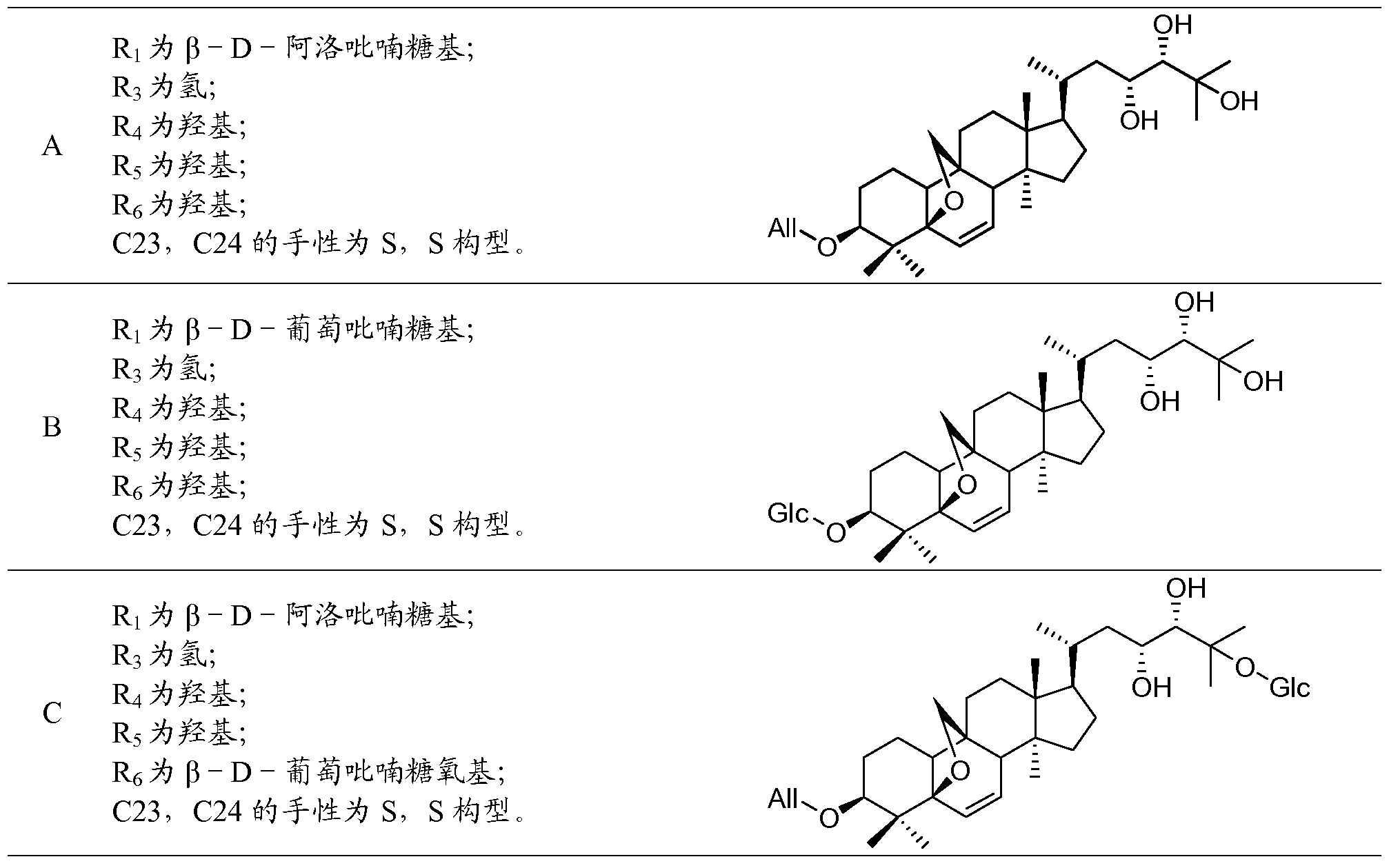

萄吡喃糖基( 1→6 ) ] - β - D -葡萄吡喃糖基;
R2为氢;
为羟基;
为 β - D -葡萄吡喃糖氧基;
为氢;
R6为氢;
R7为曱基;


下面具体地描述本发明上述化合物的制备方法, 由上述得到的苦瓜活性 部位提取物 KG8 , 经过层析分离后, 可以制得上述化合物 A、 B、 C、 D、 F、 G、 H、 I和化合物 momordicoside M、 momordicoside N , 该方法包括:
将活性部位提取物 KG8用 100-200目硅胶进行柱层析, 依次用体积比为 40:3:1、 20:3:1、 10:3:1和 65:35: 10的氯仿:甲醇:水的下层液体洗脱, 通过 TLC 板检测, 展开剂可用体积比为 10: 1、 6: 1、 4: 1的氯仿:甲醇的下层液体或者体 积比为 10:3: 1、 65:35: 10的氯仿:甲醇:水的下层液体, 5%硫酸-香兰醛显色, 根据 TLC板显示, 将相似组分合并并浓缩, 根据 Rf值在 0.6~0.2之间从大到 小获得 1-9九个组分;
将组分 3进行硅胶柱层析,用体积比为 10:1的氯仿:甲醇洗脱,通过 TLC 板检测, 展开剂为体积比为 8:1的氯仿:甲醇, 5%硫酸-香兰醛显色, 将根据 TLC板显示 Rf值约等于 0.4的斑点的洗脱液合并并浓缩, 得化合物 I;
将组分 4用 MCI柱层析, 体积比为 50:50~90: 10甲醇:水洗脱剂进行梯度 洗脱, 所得 70:30甲醇:水洗脱液组分再进行硅胶柱层析, 用体积比为 9:1氯 仿:甲醇进行洗脱, 通过 TLC板检测, 展开剂为体积比为 5:1的氯仿:甲醇, 5%硫酸-香兰醛显色, 将根据 TLC板显示 Rf值分别约等于 0.3、 0.4的斑点
的洗脱液合并并浓缩, 得化合物 A 以及化合物 B;
将组分 5用 MCI柱层析, 体积比为 30:70~80:20的甲醇:水洗脱剂梯度洗 脱, 所得 60:40的甲醇:水洗脱液组分再进行硅胶柱层析, 体积比为 20:3: 1的 氯仿:甲醇:水下层液体洗脱, 通过 TLC板检测, 展开剂为体积比为 4:1的氯 仿:甲醇, 5%硫酸-香兰醛显色, 将根据 TLC板显示 Rf值分别约等于 0.3的 斑点的洗脱液合并并浓缩, 得化合物 momordicoside M;
将组分 6用 MCI柱层析, 体积比为 30:70~80:20的甲醇:水洗脱剂梯度洗 脱, 所得 60:40的甲醇:水洗脱液组分再进行 RP _ 18柱层析, 体积比为
40:60-60:40的甲醇:水梯度洗脱,通过 TLC板检测,展开剂为体积比为 10:3:1 的氯仿:甲醇:水下层液体, 5%硫酸-香兰醛显色, 将根据 TLC板显示 Rf值 约等于 0.4的斑点的洗脱液合并并浓缩, 得化合物 momordicoside N;
将组分 7用 MCI柱层析, 体积比为 30:70~80:20的甲醇:水洗脱剂梯度洗 脱, 所得 50:50的甲醇:水洗脱液组分再进行 RP - 18柱层析, 体积比为
40:60~60:40的甲醇:水梯度洗脱, 通过 TLC板检测, 展开剂为体积比为 8:3: 1 的氯仿:甲醇:水下层液体, 5%硫酸-香兰醛显色, 将根据 TLC板显示 Rf值 约等于 0.4的斑点的洗脱液合并并浓缩, 得化合物 C;
将组分 8用 MCI柱层析, 体积比为 30:70~70:30的甲醇:水洗脱剂梯度洗 脱, 所得 40:60的甲醇:水洗脱液组分再进行 RP - 18柱层析, 体积比为
30:70~60:40的甲醇:水梯度洗脱, 通过 TLC板检测, 展开剂为体积比为 8:3: 1 的氯仿:甲醇:水下层液体, 5%硫酸-香兰醛显色, 将根据 TLC板显示 Rf值 约等于 0.3的斑点的洗脱液合并并浓缩, 得化合物 H;
将组分 9用 MCI柱层析, 体积比为 20:80~60:40的甲醇:水洗脱剂梯度洗 脱, 所得 40:60的甲醇:水洗脱液组分再进行硅胶柱层析, 体积比为 10:3: 1的 氯仿:甲醇:水下层液体洗脱, 通过 TLC板检测,展开剂为体积比 65:45:1的氯 仿:甲醇:水下层液体, 5%硫酸-香兰醛显色, 将根据 TLC板显示 Rf值分别
约等于 0.3、 0.4的斑点的洗脱液合并并浓缩, 得化合物 F以及化合物 G; 将化合物 A在室温 0.5M盐酸水溶液下水解 7天, 将所得反应物进行制 备薄层层析, 展开剂为氯仿:甲醇 6: 1 , 收集 Rf值 0.5-0.6部分并用氯仿:甲醇 8:2洗脱、 浓缩即为化合物 D。
III、 药物组合物
本发明提供一种预防 /治疗糖尿病、 肥胖和高血脂的药物组合物, 该组合 物包含治疗有效量的上述结构式 I所示的从苦瓜中分离得到的三萜皂苷化合 物中的一种或多种。 另外, 该组合物可进一步包含从苦瓜中提取的已知化合 物大豆脑苷 I ( soya-cerebroside I )、 苦瓜脑苷 ( momor-cerebroside )、 三
3,7,25-三羟基葫芦烷 -5,23 ( E ) -二烯 -19-醛、 22 ( S ) ,23 ( R ) ,24 ( R ) ,25- 四^:基葫声烷 -5-婦、 三 急苷 momordicoside A、 momordicoside B、
momordicoside M或 momordicoside N中的一种或多种。 此夕卜 , 该组合物还可 包含药学上常规的辅料, 例如药学上常用的各种溶剂。 所述的组合物可采用 药学上常规的制备方法制得。
在本发明的一个实施方案中, 本发明提供的上述预防 /治疗糖尿病、 肥胖 和高血脂的药物组合物, 所述的化合物来自苦瓜活性部位的提取物。 在上述 制备方法中, 所述的苦瓜植物为葫芦科 ( Cucurbitaceae )苦瓜属( Momordica ) 植物, 或者更具体的说为葫芦科苦瓜属植物苦瓜 ( Momordica charantia )。
所述苦瓜活性部位提取物可包括三萜皂苷的天然产物, 例如具有结构式 Ia、 lb的化合物、 大豆脑苷 I ( soya-cerebroside I )、 苦瓜脑苷
( momor-cerebroside )、 三萜 3,7,25-三羟基葫芦烷 -5,23 ( ) -二烯 -19-醛、 22 ( S ) ,23 ( R ) ,24 ( R ) ,25-四羟基葫芦烷 -5-烯、 三萜皂苷 momordicoside A、 momordicoside B、 momordicoside M和 momordicoside N中任意一个或多个化 合物的混合物, 更具体的, 是表 1中描述的化合物中任意一个或多个化合物 的混合物。
具体实施例
使用仪器: 样品在甲醇溶液中的旋光度用 Perkin-Elmer 341旋光计测定。 ESI-MS (电喷雾质谱 )用 Finnegan LCQ-DECA仪器测定。 和 13C NMR核 磁共振(在氘代吡啶中测量 ) 由 Varian INOVA 500型和 Bruker AM-400型核 磁共振仪测定。 化学位移 δ ( ppm ) 以 TMS为内标, 耦合常数(J ) 以 Hz给 出。
薄层层析(TLC )硅胶板及柱层析用硅胶( 200 ~ 300目 ) 由青岛海洋化 工厂生产; 薄层层析斑点用硫酸香兰醛乙醇溶液喷雾显色。
在本文中, 除非特别说明, 涉及溶剂比例均为体积比。 实施例 1
如图 1所示, 取鲜苦瓜 850kg, 低温冷冻干燥后称重得 85kg, 粉碎, 用 体积比为 90%乙醇水溶液常温下浸泡三次, 每次 3天, 乙醇水溶液用量为生 药重的 10倍。将三次所得乙醇溶液合并后减压蒸镏,浓缩,获得乙醇总提物。 将乙醇总提物加水(50L )稀释后与二氯甲烷(20L )液液分配, 得二氯甲烷 部位和水溶液。 再将其水溶液与正丁醇(20L )进行液液分配, 得正丁醇部位 800g。 将 800g正丁醇部位与 500g AB _ 8型大孔树脂 (来自天津骨胶厂 )拌 样,将拌有样品的树脂加入装有 3kg AB-8树脂的层析柱上。分别用 12L纯水、 30:70醇 /纯水(体积比)、 95:5醇 /纯水(体积比)洗脱,分别得到部位 KG6 600g, KG7 60g, KG8 80g。 实施例 2
图 2说明了采用层析分离化合物 A _ I。
将上述实施例 1得到的活性部位提取物 KG8 80g用 2kg 100-200目硅胶 进行柱层析,依次用体积比为 40:3:1、 20:3: 1、 10:3:1和 65:35: 10的氯仿:甲醇:
水的下层液体 10L洗脱, 每 500ml浓集为一镏分, 通过 TLC板检测, 展开剂 可用体积比为 10: 1、 6: 1、 4:1的氯仿:甲醇的下层液体或者体积比为 10:3: 1、 65:35: 10的氯仿:甲醇:水的下层液体, 5%硫酸-香兰醛显色, 根据 TLC板显 示, 将相似组分合并并浓缩, 根据 Rf值在 0.6~0.2之间从大到小获得 1-9九 个组分;
将组分 3进行硅胶柱层析,用体积比为 10:1的氯仿:甲醇 1L洗脱,每 20ml 浓集为一镏分, 通过 TLC板检测, 展开剂为体积比为 8:1的氯仿:甲醇, 5% 硫酸 -香兰醛显色,将根据 TLC板显示 Rf值约等于 0.4的斑点的洗脱液合并 并浓缩, 得化合物 I 9mg;
将组分 4用 MCI柱层析, 体积比为 50:50~90: 10甲醇:水洗脱剂各 1L进 行梯度洗脱, 所得 70:30甲醇:水洗脱液组分再进行硅胶柱层析, 用体积比为 9:1氯仿:甲醇进行洗脱, 每 10ml浓集为一镏分, 通过 TLC板检测, 展开剂 为体积比为 5:1的氯仿:甲醇, 5%硫酸-香兰醛显色, 将根据 TLC板显示 Rf 值分别约等于 0.3、 0.4的斑点的洗脱液合并并浓缩, 得化合物 A 180mg以及 化合物 B 90mg;
将组分 5用 MCI柱层析, 体积比为 30:70~80:20的甲醇:水洗脱剂各 1L 梯度洗脱, 所得 60:40的甲醇:水洗脱液组分再进行硅胶柱层析, 体积比为 20:3:1的氯仿:甲醇:水下层液体 1.5L洗脱, 每 20ml浓集为一镏分, 通过 TLC 板检测, 展开剂为体积比为 4:1的氯仿: 甲醇, 5%硫酸-香兰醛显色, 将根 据 TLC板显示 Rf值分别约等于 0.3的斑点的洗脱液合并并浓缩, 得化合物 momordicoside M 230mg;
将组分 6用 MCI柱层析, 体积比为 30:70~80:20的甲醇:水洗脱剂各 1L 梯度洗脱, 所得 60:40的甲醇:水洗脱液组分再进行 RP - 18柱层析,体积比为 40:60-60:40的甲醇:水各 500ml梯度洗脱, 通过 TLC板检测, 展开剂为体积 比为 10:3:1的氯仿:甲醇:水下层液体, 5%硫酸-香兰醛显色, 将根据 TLC板
显示 Rf值约等于 0.4的斑点的洗脱液合并并浓缩,得化合物 momordicoside N 21mg;
将组分 7用 MCI柱层析, 体积比为 30:70~80:20的甲醇:水洗脱剂各 1L 梯度洗脱, 所得 50:50的甲醇:水洗脱液组分再进行 RP - 18柱层析,体积比为 40:60~60:40的甲醇:水各 500ml梯度洗脱, 每 20ml浓集为一镏分, 通过 TLC 板检测, 展开剂为体积比为 8:3:1的氯仿:甲醇:水下层液体, 5%硫酸-香兰醛 显色,将根据 TLC板显示 Rf值约等于 0.4的斑点的洗脱液合并并浓缩,得化 合物 C 25mg;
将组分 8用 MCI柱层析, 体积比为 30:70~70:30的甲醇:水洗脱剂各 1L 梯度洗脱, 所得 40:60的甲醇:水洗脱液组分再进行 RP - 18柱层析,体积比为 30:70~60:40的甲醇:水各 500ml梯度洗脱, 每 20ml浓集为一镏分, 通过 TLC 板检测, 展开剂为体积比为 8:3:1的氯仿:甲醇:水下层液体, 5%硫酸-香兰醛 显色,将根据 TLC板显示 Rf值约等于 0.3的斑点的洗脱液合并并浓缩,得化 合物 H 30mg;
将组分 9用 MCI柱层析,体积比为 20:80~60:40的甲醇:水洗脱剂各 1L梯 度洗脱, 所得 40:60的甲醇:水洗脱液组分再进行硅胶柱层析,体积比为 10:3: 1 的氯仿:甲醇:水下层液体 500ml洗脱,每 20ml浓集为一镏分,通过 TLC板检 测,展开剂为体积比 65 :45: 1的氯仿:甲醇:水下层液体, 5%硫酸 -香兰醛显色, 将根据 TLC板显示 Rf值分别约等于 0.3、 0.4的斑点的洗脱液合并并浓缩, 得化合物 F 60mg以及化合物 G HOmg;
将化合物 A在室温 0.5M盐酸水溶液下水解 7天, 将所得反应物进行制 备薄层层析, 展开剂为氯仿:甲醇 6: 1 , 收集 Rf值 0.5-0.6部分并用氯仿:甲醇 8:2洗脱、 浓缩即得化合物 D 10mg。
化合物 A、 B、 C、 D、 F、 G、 H、 I的特性如下:
化合物 A无定形粉末; = -75 ( c 0.094, MeOH ); IR vmax ( KBr ) 3421,
2949, 2873, 1637, 1470, 1377, 1153, 1086, 1032 cm"1; ^NMR和 13C NMR数 据见表 2 和表 3; HRESIMS m/z 675.4064 (计算值 C36H6。01()Na [M+Na]+, 675.4084 )。
化合物 B 无定形粉末; =-76 (c 0.1600, MeOH ); IR vmax ( KBr ) 3396, 3165, 2935, 2783, 1612, 1514, 1454, 1417, 1277, 1263, 1223, 1165, 1122, 1039, 814, 689 cm"1; lR NMR和 13C NMR数据见表 2和表 3; HRESIMS m/z 675.4113 (计算值 C36H6。01()Na [M+Na]+, 675· 4084 )。
化合物 C 无定形粉末; [α] = -64 ( c 0.188, MeOH ); IR vmax ( KBr ) 3415, 2928, 2874, 1643, 1466, 1377, 1155, 1082, 1032 cm"1; !H NMR和 13C NMR数据见表 2 和表 3; HRESIMS m/z 6837.4632 (计算值 C42H7。015Na [M+Na] +, 837.4612)。
化合物 D 无定形粉末; NMR 和 13C NMR 数据见表 2 和表 3; LRESIMS m/z 513 ( [M+Na]+ )。
化合物 F 无定形粉末; [α] = -8 (c 0.2245, MeOH) ; IR vmax (KBr) 3406, 2933, 2873, 1646, 1551, 1452, 1383, 1306, 1076, 1038, 534 cm"1; ^ NMR 和 13C NMR 数据见表 2 和表 3; HRESIMS m/z 1001.5253 (计算值 C48H8202oNa [M+Na]+, 1001.5297 )»
化合物 G 无定形粉末; [α] = -1 ( c 0.1385, MeOH ); IR vmax ( KBr ) 3408, 2931, 2857, 1639, 1468, 1381, 1308, 1163, 1076, 1039 cm"1; ifiNMR和 13C NMR数据见表 2 和表 3; HRESIMS m/z 1113.6025 (计算值 C54H94023Na [M+Na] +, 1113.6048)。
化合物 H无定形粉末; = -5.0 ( c 0.3425, MeOH ); IR vmax ( KBr ) 3415, 2931, 2874, 1637, 1551, 1460, 1381, 1306, 1163, 1076, 1040, 534 cm"1; {U NMR和 13C NMR数据见表 2和表 3; HRESIMS m/z 1099.5618 (计算值 C53H88022Na [M+Na]+, 1099.5665 )»
化合物 I无定形粉末; = +39.8 ( c 0.3425, MeOH ); IR vmax ( KBr ) 3404, 2928, 2875, 1709, 1662, 1454, 1385, 1306, 1076, 1041, 966, 534 cm"1; ιΥί NMR和 13C NMR数据见表 2和表 3。 HRESIMS m/z 639.3816 (计算值
C36H5608Na [M+Na]+, 639.3873 )»
表 2 本发明化合物的 13C NMR谱( C5D5N , ppm )
A B C D F G H I
1 18.9 18.9 18.5 18.9 22.6 22.5 22.7 21.8
2 27.5 27.6 27.2 27.5 29.1 29.0 28.9 29.8
3 85.1 85.4 85.2 75.6 87.3 87.3 87.5 75.5
4 38.9 39.1 38.6 38.9 41.6 41.6 41.7 41.9
5 85.9 85.8 85.8 85.9 143.2 143.1 143.1 147.6
6 134.1 134.2 133.8 134.1 118.6 118.7 118.8 122.2
7 130.0 130.0 130.1 130.0 24.5 24.5 24.6 71.6
8 52.2 52.3 51.9 52.2 43.7 43.7 43.8 45.0
9 45.3 45.3 44.9 45.3 34.6 34.6 34.7 50.3
10 40.1 40.1 39.7 40.1 38.4 38.3 38.4 36.7
11 23.8 23.9 23.5 23.8 32.4 32.4 32.5 22.6
12 31.2 31.2 30.7 31.2 30.7 30.6 30.8 29.2
13 45.6 45.6 45.2 45.6 46.7 47.3 46.6 45.7
14 48.9 48.9 48.6 48.9 49.0 49.1 49.2 48.1
15 33.3 33.3 32.9 33.3 35.2 35.2 35.2 34.9
16 28.5 28.5 28.1 28.5 27.6 27.7 28.0 27.7
17 51.6 51.6 51.2 51.6 47.8 47.7 46.6 50.5
18 15.0 15.0 14.6 15.0 15.4 15.3 15.1 14.6
19 80.1 80.1 79.8 80.1 28.1 28.0 28.1 207.4
20 32.7 32.7 32.3 32.7 42.8 42.8 40.8 36.8
21 18.9 18.9 18.5 18.9 14.9 14.9 15.0 19.0
22 43.2 43.3 42.3 43.2 71.3 71.3 76.9 40.0
23 67.7 67.7 66.6 67.7 71.4 71.3 81.5 129.8
24 79.8 79.9 79.7 79.8 74.1 74.1 124.5 135.0
25 73.6 73.6 81.0 73.6 81.5 81.5 135.4 142.5
26 28.5 28.0 23.0 28.5 23.2 23.3 18.7 114.7
27 26.9 27.0 24.6 26.9 24.0 24.1 26.2 18.9
28 21.1 21.1 20.5 21.1 25.8 25.7 25.8 27.3
29 25.6 25.6 25.2 25.6 28.4 28.4 28.2 26.2
30 20.2 20.2 19.8 20.2 18.1 18.0 17.9 18.2
1' 103.8 106.7 104.0 106.9 106.8 106.9 101.7
2, 73.1 75.8 72.7 75.2 76.2 75.9 75.0
3' 72.4 78.3 72.3 78.4 74.8 74.9 78.8
4, 69.2 71.9 68.9 71.5 80.0 80.1 71.8
5, 76.1 78.4 75.8 77.3 75.0 75.1 78.7
6, 63.2 63.1 62.9 70.1 68.4 68.5 62.9
1" 98.5 105.1 105.1 105.2
2" 75.0 75.2 75.0 74.9
zz
ZO'V ινν ZVV Ζ6'ί ZO'V ε6·ε ζ
(8· (8· (8·" (8· (8· ( ΐ·8) (")
Λ
POO'S PZL'P PIL'P ρ ς^ ςβ'
s LL'O s WO s W0 s £8'0 s £8Ό s £6·0 s £8Ό οε
^ Vl s乙 0·ΐ s εο·ΐ s 00'ΐ s 8Ό S98O 6Ζ
^ Vl s £Vl s ςρ-\ s ςρ-\ s ςρ-\ 8乙 s 061 s 09' ΐ s IL'l s OL'l SWT s £L'l s Α9·ΐ SWT LZ s Ο'ξ 's 86 s 88'ΐ s乙 8·ΐ s ΐ8·ΐ s Ζ9Ί s 59' ΐ s乙 9'ΐ 9Ζ
P ΐ£'9 s jq ζς·ς 9£ ^ ζς'ί ΐ9·ε 9 Ζ ςί'ς iL'P Ρ Ρ 8ΐ 6S ίΖ
LO'P 99'P ζζ
(Vi) Ρ £6·0 ΡΟΓΐ V LV\ Ρ8£'ΐ ΡΟΐ'ΐ Ρ90'ΐ Ρ ·ΐ ΡΟΐ'ΐ ιζ

Ρ iL'i P £ ρ Α·ε Ρ iL'i s ς·οι S 98'0 s Ϊ8Ό s 08Ό 61
'ρ^'ε 'Ρ9 'ρ"·ε 'ρ^'ε
S98O s 08Ό s £8'0 s乙 8·0 s ςνο s LL'O s ςνο 8ΐ ίξ'Ι Ζ6Ί 00T ςβ'ΐ LVI PVI LVI LI
Ζ6Ί ' ίΊ Ζ6Ί '9£'ΐ 88'ΐ '8£·ΐ 98'ΐ '9£'ΐ 乙 6·ΐ'8£·ΐ 88'ΐ '8£·ΐ 91
Ζ9Ί ' ξ'Ι 8ΐ·ΐ '90' ΐ Ζ Ι 'ZVl PVI 'ΜΠ £ΐ'ΐ '60' ΐ '60' ΐ •ΐ'ΟΓΐ £ΐ'ΐ '60' ΐ ς\

8?'ΐ ' ίΊ 9?'ΐ ' ίΊ ζς'ΐ '8Γΐ 9?'ΐ Όε'ΐ 8?'ΐ '6Γΐ 8?'ΐ'0£'ΐ 9ξ'\ Όε'ΐ π ξ9'Ζ ί Ζ Ζ Ζ 9VZ 9 Ζ ½Τ ςζτ Οΐ s ςςτ Ζ9Ί 99' ΐ 8?'ΐ 9 Ζ ςζτ 8 s jq g-p £Γ^'89'ΐ 8ΐΤ¾9'ΐ ΡΡ ρρ ς·ς ΡΡ ρρ ζς~ς L
( Ο'ξ ) ? LV9 Ρ"·9 ΡΡ 9 Ρ ΪΓ9 ? LV9 9 s-tq08'£ s-tq99'£ s -tq ίς'ί s-tq08'£ ε
8£Τ'0Γΐ OST'06'ΐ 9£Τ'9 'ΐ ζ
ZL'l Wl 'LVl 8 'ΐ '9^'ΐ 9L'\ 'ιε'ΐ ^'ΐ 'τε'ΐ 8 'ΐ Όε'ΐ 9L'l 'ΐ£·ΐ ΐ
I H Ο a D a V
( idd 'NSQSD ) 腦 NH

8'8 U ααζ

VU VU nn .
6· ξί
Γ90Ϊ 9'L6 I
9Τ9 ",9
Z'L9 VL9 L' L "S
6'0L 8Ό VIL
i' VU VU
0· ViL
νςοι ΐ'?0ΐ 9'L6 '"ΐ
L'Z9 9Ύ9 9Ύ9 ς'Ζ9 "9
VU i' 0'8
9'IL VIL
VU VU S'8
SS6T00/800ZN3/X3d ΪΖ66.0/600Ζ OAV
3' 4.68 4.03 4.67 3.89 3.81 3.88 4.06
4' 4.19 4.25 4.14 4.05 4.28 4.30 4.26
5' 4.46 4.026 4.44 4.02 4.00 4.00 4.28
& 4.39, 4.52 4.45,4.58 4.32, 4.50 4.24, 4.76 4.62, 4.84 4.63, 4.80 4.42, 4.64
5.21 d 5.29 d 5.34 d
1"
( 7.8 ) ( 6.6 ) ( 7.8 )
2" 3.96 3.98 4.00 3.79
3" 4.22 3.90 3.96 3.94
4" 4.16 4.18 4.14 4.18
5" 3.93 4.18 4.18 4.20
6" 4.32, 4.52 4.30, 4.47 4.34, 4.54 4.30,4.46
5.09 d 5.30 d 5.37 d
V"
( 7.3 ) ( 7.2 ) ( 7.8 )
2'" 4.00 3.94 4.38
^fff 3.79 4.24 4.22
4"' 3.91 4.16 4.13
5'" 4.10 3.85, 4.17 3.84, 4.16
4.2 ^0, 4.40
i "" 5.21 d
、
( 7.8 )
4.00 4.06
^ 3.84 3.88
4"" 4.14 4.22
5"" 4.16 4.22
6"" 4.28, 4.46 4.32, 4.46 试验实施例
试验实施例 1
测试 KG8对 3T3 - L1细胞葡萄糖摄取的影响 (图 3 )
3T3-L1细胞完全分化为脂肪细胞后, 换以含 0.5%BSA的无血清 DMEM 培养 16小时后, 加入 KG8 (终浓度 2(^g/ml )处理 4天, 空白对照组加入等 体积的 DMS0, 然后用 37°C预温的 I xPBS清洗细胞两遍, 加入不含或含胰 岛素的 0.5%BSA的 Krebs緩冲液(NaCl 140mM, KC1 5mM, MgS04 2.5mM, CaCl2 ImM, HEPES 20mM, pH7.4 ), 37°C孵育 40分钟后,加入 2 - [1,2-3H( N )]- 脱氧 -D-葡萄糖溶液(终浓度为 0.5μα/ιη1 ), 37°C作用 5分钟,用冰浴的 I xPBS 洗 3遍终止反应, 之后加入 0.15ml 0.1%Triton裂解细胞, 液闪计数, 用蛋白 量校正 CPM值后计算 3T3-L1细胞的葡萄糖摄取量。
结果显示: KG8对 3T3 - L1细胞处理 4天后(图 3 ), 可使细胞在基础水
平和 InM及 ΙΟΟηΜ胰岛素刺激的葡萄糖摄取明显增加。 数据表示为平均值士 标准误(X士 SE )( n=3 )。与相应条件下的空白对照组比较: *P<0.05 , **P<0.01 ; 与各自基础水平下的葡萄糖摄取比较: †P<0.05 , ††P<0.01 , 忖†P<0.001。
试验实施例 2
KG8对四氧嘧啶诱导糖尿病小鼠空腹血糖的影响 (表 4 )
将 ICR 雄性小鼠 ( 30-35 克) 经尾静脉注射现配制的四氧嘧啶溶液 60mg/kg, 于 7天后, 禁食 6小时, 眼眦取血, 分离血浆, 采用葡萄糖氧化酶 法测定其血糖。 选取预测血糖值在 l l. l-30.0mmol/L 的小鼠为实验糖尿病小 鼠。 将选出的糖尿病小鼠禁食 6小时后测空腹血糖, 每组 8只。 给药组小鼠 口服给予 25mg/kg的 KG8, 阳性对照组给予 150mg/kg盐酸二甲双胍, 空白 对照组给予 1%CMC。 各组小鼠连续给药 21天, 于给药后第 7天、 14天和 21天测定小鼠空腹血糖。
结果显示: ICR 小鼠在四氧嘧啶注射后, 小鼠空腹血糖值显著升高, 说 明造模成功。 KG8组的空腹血糖值较模型对照组都明显下降,说明 KG8有降 低四氧嘧啶小鼠模型血糖的作用。
表 4 KG8对四氧嘧啶诱导糖尿病小鼠空腹血糖的影响
组别 剂量 给药前血糖 给药后血糖 ( mmol/1 )
mg/kg ( mmol/1 ) 第 7天 第 14天 第 21天 空白对照 一 4.61±1.63*** 4.72±0.30*** 4.83±0.19*** 4.72±0.16*** 才莫型对月 —— 28.20±1.70 26.67±0.68 30.84±1.63 30.54±0.95 二甲双胍 150 27.90±1.82 17.45±1.61 ** 18.86±1.91 *** 18.98±1.52**
KG8 25 27.90±0.34 21.20±1.60** 27.39±1.66 21.74±1.37* 注:数据以平均值士标准误( X±SE )表示( n=8 )。与空白对照组比较: *Ρ<0.05 , **Ρ<0.01 ,
*** Ρ<0.001。
试验实施例 3
KG8对 Ob/Ob小鼠的糖尿病治疗作用 (表 5 , 图 4、 5 )。 Ob/Ob小鼠适应性喂养二周后, 称体重并测随机血糖, 禁食 5小时后测 空腹血糖。 同时考虑随机血糖的标准, 将 Ob/Ob小鼠分为 3组, 每组 8只, 雌雄各半, 分别给予 50mg/kg KG8、 1 %CMC和 150mg/kg二甲双胍。 同时以 同窝的 C57小鼠作为正常对照。 各组小鼠连续给药 21天, 于给药后第 7、 14 和 21天测定空腹血糖。 于给药后最后一天, 取血测定血浆甘油三酯和肝脏甘 油三酯含量。 与 Ob/Ob小鼠比较, *P<0.05 , **P<0.01 , ***P<0.001。
结果显示: Ob/Ob小鼠在给予 50mg/kg KG8后, 血糖水平较给药前明显 下降; 给药 21天后, 小鼠血浆(图 4 )和肝脏(图 5 )甘油三酯水平与对照 组相比显著下降。 剂量 给药前血糖 给药后血糖(mmol/1 ) mg/kg ( mmol/1 ) 7天 14天 21天
C57对照 4.96±0.30 5.70±0.45 5.40±0.21 Ob/Ob对照 9.06±1.63 9.80±0.88 8.14±1.38 Ob/Ob-二甲双胍 6.38±0.48*** 6.40±0.31 *** 6.34±0.36*** 0b/0b-KG8 8.13±0.87 7.03±0.34*** 6.93±0.50*** 注: 数据以平均值 ±标准误(X±SE ) ( n=8 )表示。 与给药前血糖水平比较, *P<0.05,
**P<0.01 , ***P<0.001 , 试验实施例 4
KG8改善胰岛素抵抗状态下的葡萄糖耐受性实验(图 6 ) C57BL/6J雄性小鼠(8-10周龄), 高脂饲料喂养 8周, 使小鼠产生胰岛 素抵抗(表现出葡萄糖不耐受)。 最后二周, 将高脂饲料加入 KG8 (每日 100 mg/kg )或者降糖药二甲双胍(Met, 每日 200 mg/kg )。 通过测定禁食 5-7小
时后的葡萄糖耐量(腹腔注射 2.0 g/kg葡萄糖) 来评价胰岛素敏感性。 正常 对照组: 普通饲料喂食的葡萄糖耐量正常小鼠(对胰岛素敏感)。 高脂模型组: 高脂饲料喂食(未加药物)的葡萄糖耐量受损的对照小鼠。 高脂二甲双胍组: 加入二甲双胍的高脂饮食小鼠。 高脂 KG8组: 加入 KG8的高脂饮食小鼠。 数据以平均值士标准误(X士 SE )表示(n=6-9只 /组), *Ρ<0.05 , **Ρ<0·01。 实 验结果显示: KG8能明显改善葡萄糖不耐受, 进而可以治疗糖尿病。 试验实施例 5
KG8 对 HF小鼠脂肪酸氧化代谢影响 (图 7 )。
高脂饮食( HF )小鼠长期口服 KG8后能通过减少呼吸交换率( RER ) 来 影响小鼠脂肪酸氧化代谢。 从上午 10点整开始, 将小鼠放置在代谢笼中 24 小时。 测定前的 2个星期, 将 KG8 ( 100mg/kg )加入食物中。 食物本身作为 溶剂对照 (Veh )。 数据以平均值 ±标准误(X±SE ) ( n=5-6 )表示。 与 KG8溶 剂故对照: *P<0.05 , **P<0.01。
实验结果: 图 A表明 KG8能显著促进小鼠脂肪酸氧化代谢; 图 B表明 KG8在白天( 10点至 18点) 能显著促进小鼠脂肪酸氧化代谢。 实验表明: KG8可以治疗肥胖疾病。 试验实施例 6
KG8对高脂饮食诱导肥胖(DIO ) 小鼠胰岛素敏感性和脂代谢的影响。 (图 8, 9, 10, 11 , 12 , 13 , 14 )
C57BL/6J雄性小鼠 (3 - 4周龄), 高脂饲料喂养 12-16周后, 形成饮食 诱导肥胖(DIO ) 小鼠模型, 该模型同时呈现明显胰岛素抵抗和脂代谢紊乱 状态。 DIO小鼠根据体重和血糖分为 4组,分别每日给予 KG8( 50、 100 mg/kg )、 二甲双胍(Met, 250 mg/kg )或模型对照 ( 1%CMC ), 连续给药 32天。 给药
后第 20 天, 进行禁食过夜后小鼠口服脂耐量试验 (口服中长链脂肪酸 10ml/kg); 给药后 32天, 测定小鼠禁食 6小时后的血浆甘油三酯、 游离脂肪 酸水平, 以此评价 KG8对脂代谢的调节作用。 给药后第 24天, 进行禁食 6 小时后小鼠胰岛素耐量试验(腹腔注射胰岛素 0.5U/kg); 给药后第 28天, 进 行禁食 6小时后小鼠口服糖耐量试验(口服 2.5g/kg葡萄糖), 以此评价 KG8 对胰岛素抵抗的改善作用。
实验结果显示: KG8能明显改善 DIO小鼠的脂耐量(图 8), 降低血浆 甘油三酯(图 9)、 游离脂肪酸水平(图 10)。 KG8能明显改善 DIO小鼠的口 服糖耐量(图 11, 12)和胰岛素耐量(图 13, 14), 提示其对 DIO小鼠的胰 岛素抵抗状态有明显的改善作用, 进而可以治疗糖尿病。数据以平均值士标准 误( X士 SE )表示( n=9 )。 与模型对照比较: *Ρ<0.05, ** Ρ<0.01, ***Ρ<0·001。 试验实施例 7
化合物对葡萄糖转运子 GLUT4转位活性测试(图 15)
化合物对 GLUT4从细胞浆到细胞膜( ΡΜ )转位的影响。 图 15A表示对 L6肌肉细胞的影响 ( η=3 ); 图 15B表示对 3T3-L脂肪细胞的影响 ( η=3 )。 胰岛素组: ΙΟΟΉΜ的胰岛素 (阳性对照)。 各化合物 ΙΟμΜ 处理细胞 2小时。 未标示标准误时, 标准误在柱状图内。 数据以平均值士标准误( X±SE )表示 (n=3)。 与溶剂对照组比较: *Ρ<0.05, **Ρ<0·01。
实验表明: 化合物能够促进葡萄糖转运蛋白 4 ( GLUT4 )转移到细胞膜 上, 从而使葡萄糖被细胞摄取。 试验实施例 8
化合物 A、 F对一磷酸腺苷激活蛋白激酶(ΑΜΡΚ)活性测试(图 16)。 化合物对 ΑΜΡΚ通路的影响。 3T3-L1 脂肪细胞在 ΙΟμΜ化合物 A、 F, ImM
5—氨基 -4-咪唑甲酰胺核苷酸( AICAR, 阳性对照)或 DMSO溶剂对照( Veh ) 条件下孵浴 60min, ΙΟΟηΜ 胰岛素处理 2min或 25min, 然后通过相应的抗 体来测定细胞裂解液中的蛋白 pAS160, pACC和 pAMPK。 用 14-3-3总蛋白 量作为上样量质控。 结果显示: 化合物 A和 F能明显激活 AMPK信号通路, 进一步对糖尿病和肥胖有治疗作用。 试验实施例 9
化合物 F对小鼠能量消耗和脂肪酸氧化代谢急性影响(图 17 )。化合物 F 对普通饮食老鼠急性作用后, 可影响机体能量消耗(V02 )和脂肪氧化(可 由减少呼吸交换率 RER测定)。 小鼠在上午九点整放置在代谢笼中, 两小时 后, 分别给小鼠皮下注射化合物 F ( 100mg/kg )、 5-氨基 -4-咪唑甲酰胺核苷酸 ( AICAR ) ( 250mg/kg, 阳性对照药)和生理盐水溶剂对照组。 数据以平均值 士标准误( X士 SE )表示 ( n=6-8 )。 与溶剂对照组比较: * Ρ<0· 05 , ** Ρ<0.01 ; F与溶剂对照组比较: †P<0.05 , ††P<0.01。
实验表明: 化合物 F通过促进小鼠急性脂肪酸氧化代谢和机体能量消耗 而具有治疗肥胖的效果。 试验实施例 10
化合物 F对小鼠葡萄糖利用 (图 18 )
化合物 F对正常饮食小鼠血糖的急性影响。 小鼠腹腔注射化合物 F或者 生理盐水(对照组) 60分钟后, 再给小鼠注入葡萄糖, 然后在给定时间测定 血糖。 数据以平均值士标准误(X±SE )表示 (n=6 )。 * P<0.05 , ** P<0.01。 实验表明: 化合物 F能显著促进糖耐量小鼠的葡萄糖利用。
Claims
1、 一类葫芦烷型三萜皂苷类化合物, 其具有如下结构式 I所示的结构:

R2为羟基、 氢或 β-D-葡萄吡喃糖氧基;
R3为羟基或氢;
R4为羟基、 氢、 β- D-葡萄吡喃糖氧基或 β- D-阿洛吡喃糖氧基; R5为羟基或氢;
R6为羟基、 β-D-葡萄吡喃糖氧基或氢;
R7为甲基或醛基;
或可选择地, C5和 C6、 C6和 C7、 C22和 C23、 C23和 C24、 C24和 C25、 C25和 C27形成双键;
且在 R3、 R4、 R5为羟基的情况下, C22、 C23、 C24的手性为 S、 S、 R 构型;
在 R4、 R5为羟基以及 R3为氢的情况下, C23、 C24的手性为 8、 S构型; 在 R3为羟基, R4为 β- D -葡萄吡喃糖氧基情况下, C22和 C23为 S、 S构型;
在 R7为甲基的情况下, C5和 C19可以由氧桥相连;
且当 为氢、 β- D-葡萄吡喃糖基( 1→6) - β- D-葡萄吡喃糖基或 β-D-木吡喃糖基 ( 1→4 ) - [β - D -葡萄吡喃糖基 ( 1→6 ) ] - β - D -葡萄 吡喃糖基, R2为氢, R3、 R4、 R5、 R6为羟基, C5和 C6形成双键时, R7不为 甲基;
当 R2、 R6为羟基, 、 R3、 R4、 R5为氢, 且 C5和 C6、 C23和 C24形 成双键时, R7不为醛基;
当 为 β - D -葡萄吡喃糖基或 β - D -阿洛吡喃糖基, R2、 R5、 R6为氢, R3为羟基, R7为甲基, 且 C6和 C7、 C24和 C25形成双键, C5和 C19由氧 桥相连时, R4不为 β - D -阿洛吡喃糖氧基。
2、 根据权利要求 1所述的化合物, 其特征是, 所述的化合物具有如下结 构式 I a所示的结构:

其中, Ri为 β - D -葡萄吡喃糖基或 β - D -阿洛吡喃糖基或氢;
R3为羟基或氢;
R4为羟基、 氢、 β- D-葡萄吡喃糖氧基或 β- D-阿洛吡喃糖氧基;
R5为羟基或氢;
R6为羟基、 β-D-葡萄吡喃糖氧基或氢;
或可选择地, C22和 C23、 C23和 C24、 C24和 C25、 C25和 C27形成双键; 且在 R3、 R4、 R5为羟基的情况下, C22、 C23、 C24的手性为 S、 S、 R构型; 在 R4、 R5为羟基以及 R3为氢的情况下, C23、 C24的手性为 8、 S构型。
3、 根据权利要求 2所述的化合物, 其特征是, 所述的化合物为具有如下
取代基和构型的化合物 A:
为 β - D -阿洛吡喃糖基;
R3为氢;
R4为羟基;
为羟基;
R6为羟基;
C23, C24的手性为 S, S构型;
或所述的化合物为具有如下取代基和构型的化合物 B: 为 β- D -葡萄吡喃糖基;
R3为氢;
R4为羟基;
为羟基;
R6为羟基;
C23, C24的手性为 S, S构型;
或所述的化合物为具有如下取代基和构型的化合物 C: 为 β - D -阿洛吡喃糖基;
R3为氢;
R4为羟基;
为羟基;
R6为 β- D -葡萄吡喃糖氧基;
C23, C24的手性为 S, S构型;
或所述的化合物为具有如下取代基和构型的化合物 D: 为氢;
R3为氢;
R4为羟基;
为羟基;
R6为羟基;
C23, C24的手性为 S, S构型。
4、 根据权利要求 1所述的化合物, 其特征是, 所述的化合物具有如下结 构式 lb所示的结构:

其中, 为氢、 β- D-葡萄吡喃糖基、 β- D-阿洛吡喃糖基、 β- D-葡萄 吡喃糖基 ( 1→6 ) - β - D -葡萄吡喃糖基或 β - D -木吡喃糖基 ( 1→4 ) - [β - D -葡萄吡喃糖基 ( 1→6) ]- β- D -葡萄吡喃糖基;
R2为羟基、 氢或 β-D-葡萄吡喃糖氧基;
R3为羟基或氢;
R4为羟基、 氢或 β-D-葡萄吡喃糖氧基;
R5为羟基或氢;
R6为羟基、 β-D-葡萄吡喃糖氧基或氢;
R7为甲基或醛基;
或可选择地, C22和 C23、 C23和 C24、 C24和 C25、 C25和 C27形成双键; 且在 R3、 R4、 R5为羟基的情况下, C22、 C23、 C24的手性为 S、 S、 R构型; 在 R3为羟基, R4为 β - D -葡萄吡喃糖氧基情况下, C22和 C23为 S, S构 型。
5、 根据权利要求 4所述的化合物, 其特征是, 所述的化合物为具有如下 取代基和构型的化合物 F:
为 β - D -葡萄吡喃糖基 ( 1→6 ) - β - D -葡萄吡喃糖基;
R2为氢;
R3为羟基;
R4为羟基;
为羟基;
R6为 β- D -葡萄吡喃糖氧基;
R7为甲基;
C22, C23, C24的手性为 S, S, R构型;
或所述的化合物为具有如下取代基和构型的化合物 G:
为 β - D -木吡喃糖基 ( 1→4 ) - [β - D -葡萄吡喃糖基 ( 1→6 ) ] - β - D -葡萄吡喃糖基;
R2为氢;
为羟基;
R4为羟基;
为羟基;
R6为 β- D -葡萄吡喃糖氧基;
R7为甲基;
C22, C23, C24的手性为 S, S, R构型;
或所述的化合物为具有如下取代基、 双键和构型的化合物 H:
为 β - D -木吡喃糖基 ( 1→4 ) - [β - D -葡萄吡喃糖基 ( 1→6 ) ] - β - D -葡萄吡喃糖基;
R2为氢;
为羟基;
R4为 β- D -葡萄吡喃糖氧基;
R5为氢;
R6为氢;
R7为甲基;
C24和 C25形成双键;
C22和 C23为 S, S构型;
或所述的化合物为具有如下取代基和双键的化合物 I:
为氢;
R2为 β - D -葡萄吡喃糖氧基;
R3为氢;
R4为氢;
R5为氢;
R6为氢;
R7为醛基;
C23和 C24, C25和 C27之间形成双键。
6、一种权利要求 3或 5所述化合物的制备方法,其特征是,该方法包括: 用醇、 水或其混合物浸泡苦瓜样品, 过滤后得到提取液, 其中所述的醇 为甲醇或乙醇; 将得到的提取液中的溶剂蒸发形成浆状物; 将水加入到该浆 状物中, 得到总提取物的水混悬液; 用氯仿、 二氯甲烷或其混合物对上述混 悬液进行液液萃取, 得到氯仿、 二氯甲烷或其混合物的萃取物; 然后, 进一 步用正丁醇进行萃取, 得到正丁醇萃取物; 将正丁醇萃取物浓缩后, 进行大 孔树脂层析, 分别用纯水、 体积比为 30:70醇 /纯水混合物、 体积比为 95:5醇 /纯水混合物进行洗脱, 其中所述的醇为甲醇或乙醇; 将体积比为 95:5 醇 /纯 水混合物洗脱得到的洗脱液蒸发至干, 得活性部位提取物 KG8;
将活性部位提取物 KG8用 100-200目硅胶进行柱层析, 依次用体积比为 40:3:1、 20:3:1、 10:3:1和 65:35: 10的氯仿:甲醇:水的下层液体洗脱, 通过 TLC 板检测, 展开剂可用体积比为 10: 1、 6: 1、 4: 1的氯仿:甲醇的下层液体或者体 积比为 10:3: 1、 65:35: 10的氯仿:甲醇:水的下层液体, 5%^£酸-香兰醛显色,
根据 TLC板显示, 将相似组分合并并浓缩, 根据 Rf值在 0.6~0.2之间从大到 小获得 1-9九个组分;
将组分 3进行硅胶柱层析,用体积比为 10:1的氯仿:甲醇洗脱,通过 TLC 板检测, 展开剂为体积比为 8:1的氯仿:甲醇, 5%硫酸-香兰醛显色, 将根据 TLC板显示 Rf值约等于 0.4的斑点的洗脱液合并并浓缩, 得化合物 I;
将组分 4用 MCI柱层析, 体积比为 50:50~90: 10甲醇:水洗脱剂进行梯度 洗脱, 所得 70:30甲醇:水洗脱液组分再进行硅胶柱层析, 用体积比为 9:1氯 仿:甲醇进行洗脱, 通过 TLC板检测, 展开剂为体积比为 5:1的氯仿:甲醇, 5%硫酸-香兰醛显色, 将根据 TLC板显示 Rf值分别约等于 0.3、 0.4的斑点 的洗脱液合并并浓缩, 得化合物 A 以及化合物 B;
将组分 7用 MCI柱层析, 体积比为 30:70~80:20的甲醇:水洗脱剂梯度洗 脱, 所得 50:50的甲醇:水洗脱液组分再进行 RP - 18柱层析, 体积比为
40:60~60:40的甲醇:水梯度洗脱, 通过 TLC板检测, 展开剂为体积比为 8:3: 1 的氯仿:甲醇:水下层液体, 5%硫酸-香兰醛显色, 将根据 TLC板显示 Rf值 约等于 0.4的斑点的洗脱液合并并浓缩, 得化合物 C;
将组分 8用 MCI柱层析, 体积比为 30:70~70:30的甲醇:水洗脱剂梯度洗 脱, 所得 40:60的甲醇:水洗脱液组分再进行 RP - 18柱层析, 体积比为
30:70~60:40的甲醇:水梯度洗脱, 通过 TLC板检测, 展开剂为体积比为 8:3: 1 的氯仿:甲醇:水下层液体, 5%硫酸-香兰醛显色, 将根据 TLC板显示 Rf值 约等于 0.3的斑点的洗脱液合并并浓缩, 得化合物 H;
将组分 9用 MCI柱层析,体积比为 20:80~60:40的甲醇:水洗脱剂梯度洗 脱, 所得 40:60的甲醇:水洗脱液组分再进行硅胶柱层析, 体积比为 10:3: 1的 氯仿:甲醇:水下层液体洗脱,通过 TLC板检测,展开剂为体积比 65:45: 1的氯 仿:甲醇:水下层液体, 5%硫酸-香兰醛显色, 将根据 TLC板显示 Rf值分别 约等于 0.3、 0.4的斑点的洗脱液合并并浓缩, 得化合物 F以及化合物 G;
将化合物 A在室温 0.5M盐酸水溶液下水解, 将所得反应物进行制备薄 层层析, 展开剂为氯仿:甲醇 6:1, 收集 Rf值 0.5-0.6部分并用氯仿:甲醇 8:2 洗脱、 浓缩即得化合物0。
7、 一种具有预防 /治疗糖尿病、 肥胖和高血脂活性的药物组合物, 其特 征是, 所述的组合物包含治疗有效量的权利要求 1至 5中任意一项所述的化 合物中的一种或多种。
8、 根据权利要求 7所述的具有预防 /治疗糖尿病、 肥胖和高血脂活性的 药物组合物, 其特征是, 所述的化合物来自苦瓜活性部位提取物, 该提取物 通过如下步骤制得:
(a)用醇、 水或其混合物浸泡苦瓜样品, 过滤后得到提取液; 其中所述 的醇为甲醇或乙醇;
(b )将得到的提取液中的溶剂蒸发形成浆状物;
( c )将水加入到该浆状物中, 得到总提取物的水混悬液;
( d)用氯仿、 二氯甲烷或其混合物对上述混悬液进行液液萃取, 得到氯 仿、 二氯甲烷或其混合物的萃取物; 然后, 进一步用正丁醇进行萃取, 得到 正丁醇萃取物;
(e)将正丁醇萃取物浓缩后, 进行大孔树脂层析, 分别用纯水、 体积比 为 30:70醇 /纯水混合物、体积比为 95:5醇 /纯水混合物进行洗脱; 其中所述的 醇为甲醇或乙醇;
(f)将体积比为 95:5醇 /纯水混合物洗脱得到的洗脱液蒸发至干, 即得 活性部位提取物 KG8。
9、 根据权利要求 8所述的具有预防 /治疗糖尿病、 肥胖和高血脂活性的 药物组合物, 其特征是, 所述的苦瓜为葫芦科苦瓜属植物苦瓜( wwriZca charantia )。
10、 权利要求 1至 5中任意一项所述的葫芦烷型三萜皂苷类化合物在制
备预防 /治疗糖尿病、 肥胖和高血脂药物中的应用。
11、 根据权利要求 10所述的应用, 其特征是, 所述的葫芦烷型三萜皂苷 类化合物在制备预防和治疗糖尿病药物的应用中为肌肉和脂肪细胞葡萄糖摄 取促进剂、 胰岛素增敏剂、 葡萄糖转运蛋白 4上膜促进剂、 一磷酸腺苷激活 蛋白激酶激活剂、 脂肪酸氧化代谢促进剂或胰岛素抵抗状态下的葡萄糖耐受 性改善剂。
12、 根据权利要求 10所述的应用, 其特征是, 所述的葫芦烷型三萜皂苷 类化合物在制备预防和治疗肥胖药物的应用中为一磷酸腺苷激活蛋白激酶激 活剂或脂肪酸氧化代谢促进剂。
13、 根据权利要求 10所述的应用, 其特征是, 所述的葫芦烷型三萜皂苷类化 合物在制备预防和治疗高血脂药物的应用中为血浆甘油三酯和游离脂肪酸水 平降低剂或脂代谢紊乱状态下的脂耐量改善剂。
Applications Claiming Priority (2)
| Application Number | Priority Date | Filing Date | Title |
|---|---|---|---|
| CN200710171486.5 | 2007-11-30 | ||
| CN2007101714865A CN101450963B (zh) | 2007-11-30 | 2007-11-30 | 葫芦烷型三萜皂苷化合物、其药物组合物及其制备方法和用途 |
Publications (1)
| Publication Number | Publication Date |
|---|---|
| WO2009079921A1 true WO2009079921A1 (fr) | 2009-07-02 |
Family
ID=40733464
Family Applications (1)
| Application Number | Title | Priority Date | Filing Date |
|---|---|---|---|
| PCT/CN2008/001955 Ceased WO2009079921A1 (fr) | 2007-11-30 | 2008-12-01 | Saponines triterpénoïdes de cucurbitane, composition pharmaceutique de celles-ci, leur préparation et leur utilisation |
Country Status (2)
| Country | Link |
|---|---|
| CN (1) | CN101450963B (zh) |
| WO (1) | WO2009079921A1 (zh) |
Cited By (8)
| Publication number | Priority date | Publication date | Assignee | Title |
|---|---|---|---|---|
| WO2011107494A1 (de) | 2010-03-03 | 2011-09-09 | Sanofi | Neue aromatische glykosidderivate, diese verbindungen enthaltende arzneimittel und deren verwendung |
| WO2011161030A1 (de) | 2010-06-21 | 2011-12-29 | Sanofi | Heterocyclisch substituierte methoxyphenylderivate mit oxogruppe, verfahren zu ihrer herstellung und ihre verwendung als gpr40 rezeptor modulatoren |
| WO2012004269A1 (de) | 2010-07-05 | 2012-01-12 | Sanofi | ( 2 -aryloxy -acetylamino) - phenyl - propionsäurederivate, verfahren zu ihrer herstellung und ihre verwendung als arzneimittel |
| WO2012004270A1 (de) | 2010-07-05 | 2012-01-12 | Sanofi | Spirocyclisch substituierte 1,3-propandioxidderivate, verfahren zu ihrer herstellung und ihre verwendung als arzneimittel |
| WO2012010413A1 (de) | 2010-07-05 | 2012-01-26 | Sanofi | Aryloxy-alkylen-substituierte hydroxy-phenyl-hexinsäuren, verfahren zu ihrer herstellung und ihre verwendung als arzneimittel |
| WO2013037390A1 (en) | 2011-09-12 | 2013-03-21 | Sanofi | 6-(4-hydroxy-phenyl)-3-styryl-1h-pyrazolo[3,4-b]pyridine-4-carboxylic acid amide derivatives as kinase inhibitors |
| WO2013045413A1 (en) | 2011-09-27 | 2013-04-04 | Sanofi | 6-(4-hydroxy-phenyl)-3-alkyl-1h-pyrazolo[3,4-b]pyridine-4-carboxylic acid amide derivatives as kinase inhibitors |
| CN115724900A (zh) * | 2022-12-14 | 2023-03-03 | 广西师范大学 | 达玛烷型三萜皂苷类化合物及其制备方法和在制备降血糖药物中的应用 |
Families Citing this family (7)
| Publication number | Priority date | Publication date | Assignee | Title |
|---|---|---|---|---|
| CN105037480B (zh) * | 2015-06-24 | 2017-04-12 | 中国海洋大学 | 呋甾皂苷及其作为α‑糖苷酶抑制剂在抗糖尿病药物中的应用 |
| CN110551166B (zh) * | 2018-05-31 | 2022-06-21 | 华东师范大学 | 一种胆酸衍生物及其制备方法和应用 |
| CN109265510A (zh) * | 2018-11-06 | 2019-01-25 | 广东省生物工程研究所(广州甘蔗糖业研究所) | 一种四环三萜类化合物及其制备方法 |
| CN110256518B (zh) * | 2019-07-25 | 2020-10-16 | 河北省农林科学院经济作物研究所 | 苦瓜中提取的降血糖化合物 |
| CN112321666B (zh) * | 2020-11-16 | 2022-02-22 | 中国药科大学 | 一种降低肝细胞分泌pcsk9的天然药物及其应用 |
| CN115888179B (zh) * | 2022-11-17 | 2025-10-10 | 中国药科大学 | 一种采用离子液体液-液萃取分离鲁斯可皂苷元差向异构体的方法 |
| CN118459527B (zh) * | 2024-07-10 | 2024-10-15 | 江西中医药大学 | 一种葫芦烷型三萜衍生物及其提取方法与抗肝损伤用途 |
Citations (2)
| Publication number | Priority date | Publication date | Assignee | Title |
|---|---|---|---|---|
| CN1528785A (zh) * | 2003-09-26 | 2004-09-15 | 辽宁中医学院 | 一种苦瓜降血糖提取物(kge)的树脂制备方法 |
| JP2007145782A (ja) * | 2005-11-30 | 2007-06-14 | Meiji Milk Prod Co Ltd | ニガウリ抽出物を主成分とする血糖値降下剤、および食品・医薬品組成物 |
-
2007
- 2007-11-30 CN CN2007101714865A patent/CN101450963B/zh active Active
-
2008
- 2008-12-01 WO PCT/CN2008/001955 patent/WO2009079921A1/zh not_active Ceased
Patent Citations (2)
| Publication number | Priority date | Publication date | Assignee | Title |
|---|---|---|---|---|
| CN1528785A (zh) * | 2003-09-26 | 2004-09-15 | 辽宁中医学院 | 一种苦瓜降血糖提取物(kge)的树脂制备方法 |
| JP2007145782A (ja) * | 2005-11-30 | 2007-06-14 | Meiji Milk Prod Co Ltd | ニガウリ抽出物を主成分とする血糖値降下剤、および食品・医薬品組成物 |
Non-Patent Citations (7)
Cited By (9)
| Publication number | Priority date | Publication date | Assignee | Title |
|---|---|---|---|---|
| WO2011107494A1 (de) | 2010-03-03 | 2011-09-09 | Sanofi | Neue aromatische glykosidderivate, diese verbindungen enthaltende arzneimittel und deren verwendung |
| WO2011161030A1 (de) | 2010-06-21 | 2011-12-29 | Sanofi | Heterocyclisch substituierte methoxyphenylderivate mit oxogruppe, verfahren zu ihrer herstellung und ihre verwendung als gpr40 rezeptor modulatoren |
| WO2012004269A1 (de) | 2010-07-05 | 2012-01-12 | Sanofi | ( 2 -aryloxy -acetylamino) - phenyl - propionsäurederivate, verfahren zu ihrer herstellung und ihre verwendung als arzneimittel |
| WO2012004270A1 (de) | 2010-07-05 | 2012-01-12 | Sanofi | Spirocyclisch substituierte 1,3-propandioxidderivate, verfahren zu ihrer herstellung und ihre verwendung als arzneimittel |
| WO2012010413A1 (de) | 2010-07-05 | 2012-01-26 | Sanofi | Aryloxy-alkylen-substituierte hydroxy-phenyl-hexinsäuren, verfahren zu ihrer herstellung und ihre verwendung als arzneimittel |
| WO2013037390A1 (en) | 2011-09-12 | 2013-03-21 | Sanofi | 6-(4-hydroxy-phenyl)-3-styryl-1h-pyrazolo[3,4-b]pyridine-4-carboxylic acid amide derivatives as kinase inhibitors |
| WO2013045413A1 (en) | 2011-09-27 | 2013-04-04 | Sanofi | 6-(4-hydroxy-phenyl)-3-alkyl-1h-pyrazolo[3,4-b]pyridine-4-carboxylic acid amide derivatives as kinase inhibitors |
| CN115724900A (zh) * | 2022-12-14 | 2023-03-03 | 广西师范大学 | 达玛烷型三萜皂苷类化合物及其制备方法和在制备降血糖药物中的应用 |
| CN115724900B (zh) * | 2022-12-14 | 2024-06-07 | 广西师范大学 | 达玛烷型三萜皂苷类化合物及其制备方法和在制备降血糖药物中的应用 |
Also Published As
| Publication number | Publication date |
|---|---|
| CN101450963B (zh) | 2012-03-14 |
| CN101450963A (zh) | 2009-06-10 |
Similar Documents
| Publication | Publication Date | Title |
|---|---|---|
| WO2009079921A1 (fr) | Saponines triterpénoïdes de cucurbitane, composition pharmaceutique de celles-ci, leur préparation et leur utilisation | |
| CN101496806B (zh) | 苦瓜中提取的化合物在制备预防和治疗糖尿病和肥胖的药物中的用途 | |
| CN101422450B (zh) | 一种具有降血糖和减肥作用的菧类天然药物 | |
| US8829167B2 (en) | Foliamangiferosides, preparation method and use thereof | |
| Zhang et al. | Effects and mechanisms of Polygonati Rhizoma polysaccharide on potassium oxonate and hypoxanthine-induced hyperuricemia in mice | |
| Ahmed et al. | Novel pentacyclic triterpene isolated from seeds of Euryale Ferox Salisb. ameliorates diabetes in streptozotocin induced diabetic rats. | |
| Campus | Efficacy of Tinospora cordifolia (Willd.) extracts on blood lipid profile in streptozotocin diabetic rats. Is it beneficial to the heart? | |
| WO2004039759A1 (fr) | Compose naturel servant dans le traitement de diabetes, sa preparation et son utilisation | |
| EP2431041A1 (en) | Pharmaceutical composition for treating cardiovascular disorder and use thereof | |
| CN106074676B (zh) | 一种用于治疗ii型糖尿病及其并发症的药物组合 | |
| CN105640971A (zh) | 未成熟罗汉果提取物中的总皂苷在制备辅助降血糖药物方面的应用 | |
| CN118084649B (zh) | 华泽兰中炔类成分的制备及其抗糖尿病的应用 | |
| CN106692125B (zh) | 一种含野菊花提取物的抗糖尿病药物 | |
| CN106061477B (zh) | 连钱草提取物、制备方法及其用于降糖减肥降脂的用途 | |
| CN115068486A (zh) | 乳香酸类化合物作为ltb4受体抑制剂的用途 | |
| CN113425730B (zh) | 三萜及其二聚体类化合物在制备治疗蛋白酪氨酸磷酸酶1b所介导疾病的药物中的用途 | |
| CN105837592B (zh) | 间苯三酚骈松香烷二萜类化合物及其制备方法和药物用途 | |
| CN114031585A (zh) | Diethyl lithospermate的制备及其在治疗糖尿病中的应用 | |
| CN114262294A (zh) | 一种苯基异喹啉生物碱化合物及其制备方法与应用 | |
| CN112451558A (zh) | 牛大力醇提物在制备降糖或降脂药物、保健品中的应用 | |
| CN112538100A (zh) | 一种从黄柏中提取的具有抗炎活性的异喹啉生物碱苷类化合物及其制备方法与应用 | |
| CN119529004B (zh) | 华泽兰中一种新的糖苷类成分的制备方法及其应用 | |
| CN110872306B (zh) | 一种从藤构中提取的化合物及其在制药中的用途 | |
| CN106333981B (zh) | 一种含野菊花提取物的抗肥胖药物 | |
| CN110575449B (zh) | 一种从林芝杜鹃中提取的化合物在制药中的用途 |
Legal Events
| Date | Code | Title | Description |
|---|---|---|---|
| 121 | Ep: the epo has been informed by wipo that ep was designated in this application |
Ref document number: 08864107 Country of ref document: EP Kind code of ref document: A1 |
|
| NENP | Non-entry into the national phase |
Ref country code: DE |
|
| 122 | Ep: pct application non-entry in european phase |
Ref document number: 08864107 Country of ref document: EP Kind code of ref document: A1 |