WO2009087867A1 - 情報処理装置およびプログラム - Google Patents
情報処理装置およびプログラム Download PDFInfo
- Publication number
- WO2009087867A1 WO2009087867A1 PCT/JP2008/072852 JP2008072852W WO2009087867A1 WO 2009087867 A1 WO2009087867 A1 WO 2009087867A1 JP 2008072852 W JP2008072852 W JP 2008072852W WO 2009087867 A1 WO2009087867 A1 WO 2009087867A1
- Authority
- WO
- WIPO (PCT)
- Prior art keywords
- size
- window
- server
- acquisition source
- application program
- Prior art date
- Legal status (The legal status is an assumption and is not a legal conclusion. Google has not performed a legal analysis and makes no representation as to the accuracy of the status listed.)
- Ceased
Links
Images

Classifications
-
- G—PHYSICS
- G09—EDUCATION; CRYPTOGRAPHY; DISPLAY; ADVERTISING; SEALS
- G09G—ARRANGEMENTS OR CIRCUITS FOR CONTROL OF INDICATING DEVICES USING STATIC MEANS TO PRESENT VARIABLE INFORMATION
- G09G5/00—Control arrangements or circuits for visual indicators common to cathode-ray tube indicators and other visual indicators
- G09G5/14—Display of multiple viewports
-
- H—ELECTRICITY
- H04—ELECTRIC COMMUNICATION TECHNIQUE
- H04L—TRANSMISSION OF DIGITAL INFORMATION, e.g. TELEGRAPHIC COMMUNICATION
- H04L67/00—Network arrangements or protocols for supporting network services or applications
- H04L67/01—Protocols
- H04L67/04—Protocols specially adapted for terminals or networks with limited capabilities; specially adapted for terminal portability
-
- H—ELECTRICITY
- H04—ELECTRIC COMMUNICATION TECHNIQUE
- H04L—TRANSMISSION OF DIGITAL INFORMATION, e.g. TELEGRAPHIC COMMUNICATION
- H04L67/00—Network arrangements or protocols for supporting network services or applications
- H04L67/2866—Architectures; Arrangements
- H04L67/30—Profiles
- H04L67/303—Terminal profiles
-
- H—ELECTRICITY
- H04—ELECTRIC COMMUNICATION TECHNIQUE
- H04L—TRANSMISSION OF DIGITAL INFORMATION, e.g. TELEGRAPHIC COMMUNICATION
- H04L67/00—Network arrangements or protocols for supporting network services or applications
- H04L67/50—Network services
- H04L67/60—Scheduling or organising the servicing of application requests, e.g. requests for application data transmissions using the analysis and optimisation of the required network resources
- H04L67/61—Scheduling or organising the servicing of application requests, e.g. requests for application data transmissions using the analysis and optimisation of the required network resources taking into account QoS or priority requirements
-
- G—PHYSICS
- G09—EDUCATION; CRYPTOGRAPHY; DISPLAY; ADVERTISING; SEALS
- G09G—ARRANGEMENTS OR CIRCUITS FOR CONTROL OF INDICATING DEVICES USING STATIC MEANS TO PRESENT VARIABLE INFORMATION
- G09G2320/00—Control of display operating conditions
- G09G2320/06—Adjustment of display parameters
- G09G2320/0613—The adjustment depending on the type of the information to be displayed
Definitions
- the present invention relates to a graphical user interface (GUI).
- GUI graphical user interface
- Patent Documents 1-3 disclose a technique for changing the display mode of a window according to the window size.
- Patent Document 1 discloses a technique for notifying a video distribution device of the size of a window on the screen and changing the bit rate of transmission data in accordance with the window size.
- Patent Document 2 when a plurality of video windows are displayed, the video of the window specified by the user is normally displayed, and the video of other windows is not displayed, frame drop-down display, mosaic display, monochrome display, and brightness.
- a technique for reducing the display is disclosed.
- Japanese Patent Application Laid-Open No. 2004-228561 discloses a technique in which when a plurality of windows are displayed, windows other than the window of interest are displayed with reduced brightness and frame drop display.
- Changing the size of the window means changing the amount of information that can be displayed.
- the data acquisition source is not changed.
- the present invention provides a technique for changing the data acquisition source in accordance with the change in the window size.
- the present invention provides an execution means for executing an application program including a process of receiving data from the acquisition source using a server on the network as an acquisition source, and data from the acquisition source according to the execution.
- Receiving means display control means for displaying on the display means a window for displaying an image according to the execution, detection means for detecting a change in the size of the window, and the size of the window by the detection means.
- an information processing apparatus is provided that includes a changing unit that changes the acquisition source server in accordance with the changed size. According to this information processing apparatus, the data acquisition source is changed in accordance with the change in the window size.
- the information processing apparatus includes a program storage unit that stores a plurality of application programs, and a correspondence storage unit that stores a window size and a server correspondence for each application program, and the execution unit includes: , Executing at least one application program among the plurality of application programs, and the changing unit determines, as the acquisition source, a server corresponding to the changed size among the correspondence relationship stored in the correspondence relationship storage unit. May be. According to this information processing apparatus, a server corresponding to the changed size among the correspondence relationships stored in the correspondence relationship storage unit is determined as the acquisition source.
- the application program may include a process of changing a size of a window corresponding to the application program, and the detection unit may detect a change in size made by executing the application program.
- the data acquisition source is determined in accordance with the size change made by executing the application program.
- the application program includes information indicating a correspondence relationship between a window size and a server, and the changing unit selects a server corresponding to a changed size among the correspondence relationships included in the information. You may determine as an acquisition source. According to this information processing apparatus, the server corresponding to the changed size is determined as the acquisition source among the correspondences included in the application program.
- the data includes information indicating a correspondence relationship between a window size and a server
- the changing unit obtains the server corresponding to the changed size among the correspondence relationships included in the information.
- the original may be determined.
- the server corresponding to the changed size is determined as the acquisition source among the correspondences included in the data acquired from the acquisition source.
- the information processing apparatus includes an input unit that outputs a signal according to a user instruction, and the detection unit determines that the signal satisfies a specific condition. May be detected as a change.
- the data acquisition source is changed in accordance with the window size change made in response to a user instruction.
- the network may include a plurality of servers having different processing capabilities, and the changing unit may determine, as the acquisition source, a server having a lower processing capability when the window size increases. .
- the changing unit may determine, as the acquisition source, a server having a lower processing capability when the window size increases.
- a server having a lower processing capability is determined as the acquisition source.
- the network includes a plurality of servers having different data transfer rates, and the changing unit determines, as the acquisition source, a server having a higher transfer rate when the window size increases. Also good. According to this information processing apparatus, as the window size increases, a server having a higher transfer rate is determined as an acquisition source.
- the network includes a plurality of servers having different data transfer amounts, and the changing unit determines, as the acquisition source, a server having a larger transfer amount when the window size increases. Also good. According to this information processing apparatus, as the window size increases, a server having a larger transfer amount is determined as an acquisition source.
- the network may include a plurality of servers, and the changing unit may determine more servers as the acquisition source when the size of the window increases. According to this information processing apparatus, as the window size increases, more servers are determined as acquisition sources.
- the execution means executes execution of the application program including processing for receiving data from the acquisition source using the server on the network as the acquisition source.
- Receiving data from the acquisition source according to the execution displaying a window for displaying an image according to the execution on a display means, detecting detecting a change in the size of the window,
- a program for executing a step of changing the server as the acquisition source according to the changed size is provided. According to this program, the data acquisition source is changed according to the change of the window size.
- FIG. 1 is an external view of a mobile phone 1 according to an embodiment of the present invention.
- FIG. 2 is a diagram illustrating a functional configuration of the mobile phone 1.
- FIG. 3 is a diagram illustrating a hardware configuration of the mobile phone 1.
- FIG. 4 is a diagram showing a Java execution environment.
- FIG. 5 is a flowchart showing the operation of the mobile phone 1.
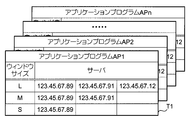
- FIG. 6 is a diagram illustrating the correspondence table T1.
- communication unit 109 ... bus, 111 ... OS, 112 ... application, 113 ... application, 114 ... Java execution Environment, 115 ... first storage, 116 ... second storage, 117 ... class library, 118 ... JVM, 119 ... JAM
- FIG. 1 is an external view of a mobile phone 1 according to an embodiment of the present invention.
- the mobile phone 1 is an example of an information processing apparatus according to the present invention.
- the mobile phone 1 has a housing 9A and a housing 9B.
- the housing 9 ⁇ / b> A and the housing 9 ⁇ / b> B are connected via the hinge 3.
- the mobile phone 1 is a so-called foldable mobile phone.
- the user of the mobile phone 1 performs voice communication and data communication with the housing 9A and the housing 9B opened as shown in FIG.
- the housing 9A includes a speaker 6, an antenna 7, and a display device 8.
- the speaker 6 outputs voice of a call, operation sound, music sound, and the like.
- the antenna 7 performs wireless communication with the wireless base station.
- the display device 8 displays characters and images.
- the housing 9 ⁇ / b> B has a keypad 4 and a microphone 5.
- the keypad 4 outputs a signal corresponding to a user operation.
- the microphone 5 converts the input sound into an electric signal and outputs it.
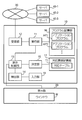
- FIG. 2 is a diagram showing a functional configuration of the mobile phone 1.
- the mobile phone 1 is an information processing apparatus that changes the data acquisition source according to the size of the window.
- the execution unit 11 executes an application program including a process of receiving data from the acquisition source.
- the data acquisition source is the server 40 on the network 30.
- the network 30 includes a plurality of servers, in this example, three servers 40-1 to 40-3. When it is necessary to distinguish each of the plurality of servers in this way, they are described using subscripts such as the server 40-1. When it is not necessary to distinguish each of the plurality of servers, they are simply expressed as servers 40.
- the receiving unit 12 receives data from the acquisition source according to the function realized by the execution unit 11 executing the application program.
- the display control unit 13 causes the display unit 20 to display a window W that displays an image according to the data received by the receiving unit 12.
- the detection unit 14 detects that the size of the window W changes.
- the determination unit 15 determines a server as an acquisition source according to the changed size.
- the program storage unit 16 stores a plurality of application programs, in this example, application programs AP1, AP2,.
- the correspondence storage unit 17 stores information indicating the correspondence between the window size and the server for each application program, in this example, the correspondence table T1.
- the execution unit 11 executes at least one application program among the plurality of application programs.
- the determination unit 15 determines a server corresponding to the changed size among the correspondence relationships stored in the correspondence relationship storage unit 17 as an acquisition source. In this example, the determination unit 15 performs a process of determining an acquisition source as an initial state after the application program is started, and a process of changing the acquisition source, that is, a new server other than the already determined acquisition source. Both processes of the process determined as the original are performed.
- the input unit 18 outputs a signal according to a user instruction.
- a specific condition for example, when a specific operation is performed in a state where a specific image is displayed, an instruction to change the size of the window is input. That is, it detects that the size has changed.
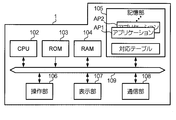
- FIG. 3 is a diagram illustrating a hardware configuration of the mobile phone 1.
- a CPU (Central Processing Unit) 102 is a control device that controls each component of the mobile phone 1.
- a ROM (Read Only Memory) 103 is a storage device that stores programs and data necessary for the basic operation of the mobile phone 1.
- the ROM 103 stores, for example, an IPL (Initial Program Loader), an OS (Operating System) program, and a Java (registered trademark) platform program.
- the IPL is a program that reads a program that is executed first when the power of the mobile phone 1 is turned on. In this embodiment, the IPL reads the OS program.
- the OS program is a program for realizing data input / output, access to a storage device, execution of various programs, voice communication, data communication, and other basic functions of the mobile phone 1.
- the Java platform program is a program for realizing a Java execution environment on the OS. The Java execution environment will be described later.
- a RAM (Random Access Memory) 104 is a storage device that functions as a work area when the CPU 102 executes a program.
- the storage unit 105 is a storage device that stores application programs and data.
- the storage unit 105 has a nonvolatile memory. In the present embodiment, the storage unit 105 stores a plurality of application programs AP1, AP2,.
- the operation unit 106 outputs a signal corresponding to a user operation.
- the operation unit 106 has an input device such as a keypad (keypad 4 in FIG. 1) including a numeric keypad, a call key, a call end key, a clear key, a cursor key, a power key, and other keys for performing input. .
- the user inputs an instruction to the mobile phone 1 by operating the keypad.
- the display unit 107 displays characters and images.
- the display unit 107 includes a display device (display device 8 in FIG. 1) such as a liquid crystal display.
- the display unit 107 displays a window corresponding to the application program being executed.
- the display unit 107 includes a display body such as an LCD (liquid crystal display) and a drive circuit that drives the display body.
- the communication unit 108 performs voice communication or data communication via a radio base station via an antenna (antenna 7 in FIG. 1).
- the bus 109 is a transmission path for transmitting signals and data exchanged between components. The above components are connected via a bus 109.
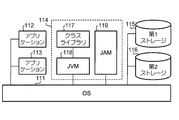
- FIG. 4 is a diagram showing the Java execution environment.
- the Java execution environment 114 shown in FIG. 4 is realized on the OS 111.
- the Java execution environment 114 includes a class library 117, a JVM (Java Virtual Machine) 118, and a JAM (Java Application Manager) 119.
- the class library 117 is a group of program modules (classes) having specific functions combined into one file.
- the JVM 118 has a function of interpreting and executing bytecode provided as a Java application program.
- the JAM 119 has a function of managing download, installation, activation, termination, and other operations of the Java application program.
- the first storage 115 is an area for storing Java application programs (Jar file and ADF (Application Descriptive File)) downloaded under the management of the JAM 119.
- the second storage 116 is an area for storing data generated when the Java application program is executed after the end. In the second storage 116, a separate storage area is allocated for each installed Java application program. The data in the storage area allocated to a certain Java application program can be rewritten only while the Java application program is being executed, and another Java application program cannot be rewritten.
- the OS 111 has a multitasking function that simultaneously performs a plurality of processes.
- a plurality of applications such as the application 112 and the application 113 are realized on the OS 111.
- the display unit 107 displays a window corresponding to each application.
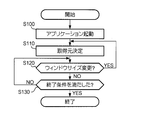
- FIG. 5 is a flowchart showing the operation of the mobile phone 1.
- the user performs a specific operation (for example, an operation for selecting a certain application) on the operation unit 106 in a state where a specific image (for example, a menu screen) is displayed on the display unit 107. It is started as a trigger.
- a specific operation for example, an operation for selecting a certain application
- a specific image for example, a menu screen
- step S100 the CPU 102 starts an application program. Details are as follows.
- the application program to be activated is specified by a user instruction or another application program that is already being executed. Now, a case where the application program AP1 is designated will be described as an example.
- the CPU 102 reads the designated application program from the storage unit 105 and executes it.
- the application program to be started includes a process of receiving data from the acquisition source using the server 40 on the network 30 as the acquisition source.
- the phrase “including a process” means that the program includes a group of instructions that, when executed, cause the apparatus to execute the process.
- the CPU 102 controls the display unit 107 to display a window corresponding to the application program.
- the “window” refers to an area in which information related to an application program such as the processing status of the application program, information to be processed, and processing results are displayed.
- a window is distinguished from an area other than the window by a boundary line.
- Geometric parameters such as the position, size, and shape of the window on the display surface of the display unit 107 are designated or changed by a user instruction, an OS function, a function of another application program that is already being executed, or the like.
- Initial values such as the position and size of the window, that is, the position and size of the window when the application is activated are stored in the storage unit 105. That is, when the application program is activated, the CPU 102 reads the geometric parameter of the window from the storage unit 105 and displays the window according to the parameter. The CPU 102 stores the size of the window to be displayed in the RAM 104.
- step S110 the CPU 102 determines a data acquisition source. Details are as follows. First, the CPU 102 reads the correspondence table T1 from the storage unit 105.
- FIG. 6 is a diagram illustrating the correspondence table T1.
- the correspondence table T1 has a sub-table for each application program.
- the sub-table includes a window size and an identifier for specifying a server corresponding to the window size.
- a value that can be taken by the window size is determined to be any one of L size, M size, and S size. That is, the window size is switched discretely such as L size, M size, and S size in descending order.
- an IP (Internet Protocol) address is used as the server identifier.
- the IP address “123.45.67.89”, “123.45.67.91”, and “123.45.67.12” correspond to the L size.
- the M size corresponds to two IP addresses “123.45.67.89” and “123.45.67.91”.
- the IP address “123.45.67.89” corresponds to the S size.
- the processing for reading the correspondence table T1 from the storage unit 105 is specifically as follows.
- the CPU 102 reads the IP address of the server corresponding to the current window size from the subtable corresponding to the application program activated in step S100.
- the window size is L size will be described as an example.
- three IP addresses “123.45.67.89”, “123.45.67.91”, and “123.45.67.12” are read out as the IP addresses of the server corresponding to the window size. It is.
- the CPU 102 acquires data using these three servers as acquisition sources.
- these three servers transmit different types of data.
- the server specified by the IP address “123.45.67.89” is a server that transmits character information.
- the server specified by the IP address “123.45.67.91” is a server that transmits image data such as a photograph.
- the server specified by the IP address “123.45.67.12” is a server that transmits audio data such as music.
- characters and images are displayed in the window and music is output from the speaker 6 by the function of the application program AP1.
- step S120 the CPU 102 determines whether the window size has been changed.
- the CPU 102 determines whether or not a window size change instruction has been input. That is, the CPU 102 determines that the window size has been changed when a window size change instruction is input.
- the window size change instruction is input by the user operating the operation unit 106.
- the CPU 102 shifts the process to step S110 again.
- the servers corresponding to the M size are the two servers specified by the IP addresses “123.45.67.89” and “123.45.67.91”.
- the CPU 102 acquires data using these two servers as acquisition sources.
- step S130 If it is determined that the window size has not been changed (S120: NO), the CPU 102 shifts the process to step S130.
- step S130 the CPU 102 determines whether the end condition is satisfied.
- the end condition is, for example, a condition that a predetermined operation has been performed on the operation unit 106.
- the CPU 102 shifts the process to step S120 again.
- the CPU 102 ends the process shown in FIG.
- the data acquisition source at the time of application execution is changed according to the window size.
- the event that triggers the change of the window size is not limited to the user performing a predetermined operation on the operation unit 106.
- the window size may be changed in response to processing according to the application program.
- the application program being executed itself includes a process for changing the window size.
- the CPU 102 detects that the window size changes when processing for changing the window size is performed according to the application program.
- the cellular phone 1 may not store in advance the correspondence table T1, that is, information indicating the correspondence between the window size and the server for each application program.
- the application program includes information indicating the correspondence between the window size and the server as internal data.
- the CPU 102 refers to internal data included in the application program and determines a server corresponding to the changed window size as an acquisition source.
- Modification 3 When the mobile phone 1 does not store in advance information indicating the correspondence between the window size and the server, the correspondence may be included in data acquired from the acquisition source.
- the CPU 102 refers to the data acquired from the acquisition source and determines a server corresponding to the changed window size as a new acquisition source.
- the correspondence relationship between the window size and the server is not limited to that shown in the above embodiment.
- the number of acquisition source servers increases as the window size increases.
- the number of acquisition source servers may not change depending on the window size.
- the correspondence between the window size and the server may be as follows.
- the network 30 has a plurality of servers each having a different processing capability.
- the CPU 102 determines a server having a lower processing capability as an acquisition source. Since the increase in the window means that the user is paying more attention to the application program, a large part of the processing capability of the mobile phone 1 is assigned to the application program.
- the correspondence between the window size and the server may be as follows.
- the network 30 includes a plurality of servers each having a different data transfer rate.
- the CPU 102 determines a server having a higher transfer rate as an acquisition source as the window size increases. Since the larger window means that the user is paying more attention to the application program, the application program is configured to increase the amount of data processed per unit time.
- the aspect of the window size change is not limited to that described in the above embodiment.
- the number of sizes that the window can take is not limited to three.
- the window size does not change discretely but may change continuously.
- the “window” may include a so-called “icon” state. For example, when the window size is reduced, the window is switched to an icon when a certain threshold value is exceeded. At this time, the above-described application program may be operating even in a state where the icon is displayed.
- the information processing apparatus may be a personal computer, PDA (Personal Data Assistants), electronic notebook, wireless communication terminal, wired communication terminal, or any other form of apparatus.
- the hardware configuration of the information processing apparatus is not limited to that shown in FIG. One or more of the elements shown in FIG. 2 may be omitted.
- the information processing apparatus may not have a display unit.
- the information processing apparatus is connected to a display device different from the information processing apparatus.
- the information processing device outputs data or a signal for controlling display to the display device.
- the information processing apparatus may be any type of apparatus as long as it has a necessary functional configuration, and may have any hardware configuration.
- the language in which the application program is described is not limited to Java.
- the application program may be described using any programming language other than Java.
- the OS has a function of displaying a window corresponding to an application, but a program other than the OS may have this function.
- this program may be downloaded via a network.
- this program may be provided by a storage medium such as a CD-ROM (Compact, Disc, Read, Only, Memory).
Landscapes
- Engineering & Computer Science (AREA)
- Computer Networks & Wireless Communication (AREA)
- Signal Processing (AREA)
- Physics & Mathematics (AREA)
- Computer Hardware Design (AREA)
- General Physics & Mathematics (AREA)
- Theoretical Computer Science (AREA)
- Digital Computer Display Output (AREA)
- User Interface Of Digital Computer (AREA)
- Information Transfer Between Computers (AREA)
Abstract
Description
この情報処理装置によれば、ウインドウサイズの変更に応じてデータの取得元が変更される。
この情報処理装置によれば、対応関係記憶手段に記憶された対応関係のうち変化後のサイズに対応するサーバが前記取得元として決定される。
この情報処理装置によれば、アプリケーションプログラムの実行により行われたサイズの変更に応じてデータの取得元が決定される。
この情報処理装置によれば、アプリケーションプログラムに含まれる対応関係のうち変化後のサイズに対応するサーバが取得元として決定される。
この情報処理装置によれば、取得元から取得したデータに含まれる対応関係のうち変化後のサイズに対応するサーバが取得元として決定される。
この情報処理装置によれば、ユーザの指示に応じて行われたウインドウサイズの変更に応じてデータの取得元が変更される。
この情報処理装置によれば、ウインドウのサイズが大きくなるにつれ処理能力がより低いサーバが取得元として決定される。
この情報処理装置によれば、ウインドウのサイズが大きくなるにつれ転送速度がより高いサーバが取得元として決定される。
この情報処理装置によれば、ウインドウのサイズが大きくなるにつれ転送量がより多いサーバが取得元として決定される。
この情報処理装置によれば、ウインドウのサイズが大きくなるにつれより多くのサーバが取得元として決定される。
このプログラムによれば、ウインドウサイズの変更に応じてデータの取得元が変更される。
図1は、本発明の一実施形態に係る携帯電話機1の外観図である。携帯電話機1は、本発明に係る情報処理装置の一例である。携帯電話機1は、筐体9Aおよび筐体9Bを有する。筐体9Aと筐体9Bとは、ヒンジ3を介して連結されている。携帯電話機1は、いわゆる折り畳み型の携帯電話機である。携帯電話機1のユーザは、図1に示されるように筐体9Aおよび筐体9Bを開いた状態で音声通信やデータ通信を行う。
図5は、携帯電話機1の動作を示すフローチャートである。図5のフローは、例えば、表示部107に特定の画像(例えばメニュー画面)が表示されている状態で、ユーザが操作部106に対し特定の操作(例えばあるアプリケーションを選択する操作)をしたことを契機として開始される。
本発明は上述の実施形態に限定されるものではなく、種々の変形実施が可能である。以下、変形例をいくつか説明する。変形例において上述の実施形態と共通する要素は、共通の参照符号を用いて説明される。以下の変形例のうち2つ以上のものが組み合わせて用いられてもよい。
ウインドウサイズの変更の契機となるイベントは、ユーザが操作部106に対して所定の操作を行ったことに限定されない。アプリケーションプログラムに従った処理を契機としてウインドウサイズが変更されてもよい。この場合、実行されているアプリケーションプログラム自身が、ウインドウサイズを変更する処理を含んでいる。図5のステップS120において、CPU102は、アプリケーションプログラムに従ってウインドウサイズを変更する処理が行われたときに、ウインドウサイズが変化することを検出する。
携帯電話機1は、対応テーブルT1、すなわちアプリケーションプログラム毎にウインドウサイズとサーバの対応関係を示す情報をあらかじめ記憶していなくてもよい。この場合、アプリケーションプログラムが、ウインドウサイズとサーバの対応関係を示す情報を内部データとして含んでいる。CPU102は、アプリケーションプログラムに含まれる内部データを参照して、変更後のウインドウサイズに対応するサーバを取得元として決定する。
携帯電話機1がウインドウサイズとサーバの対応関係を示す情報をあらかじめ記憶していない場合において、対応関係は、取得元から取得されるデータに含まれていてもよい。この場合、CPU102は、取得元から取得したデータを参照して、変更後のウインドウサイズに対応するサーバを新たな取得元として決定する。
ウインドウサイズとサーバの対応関係は、上述の実施形態で示したものに限定されない。実施形態においては、ウインドウサイズが大きくなるにつれ取得元となるサーバの数が増える例について説明したが、取得元となるサーバの数はウインドウサイズによって変化しなくてもよい。この場合において、ウインドウサイズとサーバの対応関係は以下のとおりであってもよい。ネットワーク30は各々処理能力が異なる複数のサーバを有する。CPU102は、ウインドウサイズが大きくなるにつれより処理能力がより低いサーバを取得元として決定する。ウインドウが大きくなるということはユーザがよりそのアプリケーションプログラムに注目しているということなので、携帯電話機1が有する処理能力のうち多くの部分をそのアプリケーションプログラムに割り当てるように構成したものである。
別の例において、ウインドウサイズとサーバの対応関係は以下のとおりであってもよい。ネットワーク30は各々データの転送速度が異なる複数のサーバを有する。CPU102は、ウインドウサイズが大きくなるにつれより転送速度がより高いサーバを取得元として決定する。ウインドウが大きくなるということはユーザがよりそのアプリケーションプログラムに注目しているということなので、そのアプリケーションプログラムが単位時間あたりに処理するデータ量を増やすように構成したものである。
ウインドウサイズの変化の態様は上述の実施形態で説明したものに限定されない。ウインドウが取りうるサイズの数は3つに限定されない。また、ウインドウサイズは離散的に変化するのではなく、連続的に変化してもよい。さらに、この例で「ウインドウ」は、いわゆる「アイコン」化した状態を含んでもよい。例えば、ウインドウサイズが小さくされていった場合に、あるしきい値を超えたところでウインドウはアイコンに切り替わる。このとき、表示がアイコン化した状態においても、上述のアプリケーションプログラムは動作していてもよい。
上述の実施形態において、最初(初期値)の取得元を決定する処理と取得元を変更する処理とは同じアルゴリズムで行われたが、これらの処理は異なるアルゴリズムで行われてもよい。例えば、取得元の初期値はウインドウサイズとは無関係に決定されてもよい。
本発明が適用される情報処理装置は、携帯電話機に限定されない。情報処理装置は、パーソナルコンピュータ、PDA(Personal Data Assistants)、電子手帳、無線通信端末、有線通信端末、その他いかなる形態の装置でもよい。また、情報処理装置のハードウェア構成は、図2に示されるものに限定されない。図2に示される要素のうち1以上のものが省略されてもよい。例えば、情報処理装置は表示部を有していなくてもよい。この場合、情報処理装置は、情報処理装置とは別の表示装置に接続される。情報処理装置は、表示装置に対し、表示を制御するデータまたは信号を出力する。要は、情報処理装置は、必要な機能構成を有するものであればどのような形態の装置でもよいし、どのようなハードウェア構成を有していてもよい。また、アプリケーションプログラムが記述される言語はJavaに限定されない。アプリケーションプログラムは、Java以外のいかなるプログラム言語を用いて記述されてもよい。
Claims (11)
- ネットワーク上のサーバを取得元として、前記取得元からデータを受信する処理を含むアプリケーションプログラムの実行をする実行手段と、
前記実行に従って前記取得元からデータを受信する受信手段と、
前記実行に従って画像を表示するウインドウを、表示手段に表示させる表示制御手段と、
前記ウインドウのサイズが変化することを検出する検出手段と、
前記検出手段によりウインドウのサイズが変化することが検出されると、変化後のサイズに応じて前記取得元となるサーバを変更する変更手段と
を有する情報処理装置。 - 複数のアプリケーションプログラムを記憶するプログラム記憶手段と、
アプリケーションプログラム毎にウインドウのサイズとサーバの対応関係を記憶した対応関係記憶手段と
を有し、
前記実行手段が、前記複数のアプリケーションプログラムのうち少なくとも1つのアプリケーションプログラムを実行し、
前記変更手段が、前記対応関係記憶手段に記憶された対応関係のうち変化後のサイズに対応するサーバを前記取得元として決定する
ことを特徴とする請求項1に記載の情報処理装置。 - 前記アプリケーションプログラムが、自身に対応するウインドウのサイズを変更する処理を含み、
前記検出手段が、前記アプリケーションプログラムの実行により行われたサイズの変更を検出する
ことを特徴とする請求項1に記載の情報処理装置。 - 前記アプリケーションプログラムが、ウインドウのサイズとサーバの対応関係を示す情報を含み、
前記変更手段が、前記情報に含まれる対応関係のうち変化後のサイズに対応するサーバを前記取得元として決定する
ことを特徴とする請求項1に記載の情報処理装置。 - 前記データが、ウインドウのサイズとサーバの対応関係を示す情報を含み、
前記変更手段が、前記情報に含まれる対応関係のうち変化後のサイズに対応するサーバを前記取得元として決定する
ことを特徴とする請求項1に記載の情報処理装置。 - ユーザの指示に応じた信号を出力する入力手段を有し、
前記検出手段が、前記信号が特定の条件を満たしたことを、前記ウインドウのサイズが変化することとして検出する
ことを特徴とする請求項1に記載の情報処理装置。 - 前記ネットワークが、処理能力が異なる複数のサーバを有し、
前記変更手段が、前記ウインドウのサイズが大きくなると処理能力がより低いサーバを前記取得元として決定する
ことを特徴とする請求項1に記載の情報処理装置。 - 前記ネットワークが、データの転送速度が異なる複数のサーバを有し、
前記変更手段が、前記ウインドウのサイズが大きくなると転送速度がより高いサーバを前記取得元として決定する
ことを特徴とする請求項1に記載の情報処理装置。 - 前記ネットワークが、データの転送量が異なる複数のサーバを有し、
前記変更手段が、前記ウインドウのサイズが大きくなると転送量がより多いサーバを前記取得元として決定する
ことを特徴とする請求項1に記載の情報処理装置。 - 前記ネットワークが複数のサーバを有し、
前記変更手段が、前記ウインドウのサイズが大きくなるとより多くのサーバを前記取得元として決定する
ことを特徴とする請求項1に記載の情報処理装置。 - プログラムの実行をする実行手段を有するとコンピュータ装置に、
前記実行手段が、ネットワーク上のサーバを取得元として、前記取得元からデータを受信する処理を含むアプリケーションプログラムの実行をするステップと、
前記実行に従って前記取得元からデータを受信するステップと、
前記実行に従って画像を表示するウインドウを、表示手段に表示させるステップと、
前記ウインドウのサイズが変化することを検出するステップと、
前記ウインドウのサイズが変化することが検出されると、変化後のサイズに応じて前記取得元となるサーバを変更するステップと
を実行させるためのプログラム。
Priority Applications (3)
| Application Number | Priority Date | Filing Date | Title |
|---|---|---|---|
| EP08870236.0A EP2234012B1 (en) | 2008-01-08 | 2008-12-16 | Information-processing apparatus and program |
| CN200880124328.7A CN101911003B (zh) | 2008-01-08 | 2008-12-16 | 信息处理设备和程序 |
| US12/811,544 US20100287497A1 (en) | 2008-01-08 | 2008-12-16 | Information-processing device and program |
Applications Claiming Priority (2)
| Application Number | Priority Date | Filing Date | Title |
|---|---|---|---|
| JP2008001536A JP4794581B2 (ja) | 2008-01-08 | 2008-01-08 | 情報処理装置およびプログラム |
| JP2008-001536 | 2008-01-08 |
Publications (1)
| Publication Number | Publication Date |
|---|---|
| WO2009087867A1 true WO2009087867A1 (ja) | 2009-07-16 |
Family
ID=40852992
Family Applications (1)
| Application Number | Title | Priority Date | Filing Date |
|---|---|---|---|
| PCT/JP2008/072852 Ceased WO2009087867A1 (ja) | 2008-01-08 | 2008-12-16 | 情報処理装置およびプログラム |
Country Status (5)
| Country | Link |
|---|---|
| US (1) | US20100287497A1 (ja) |
| EP (1) | EP2234012B1 (ja) |
| JP (1) | JP4794581B2 (ja) |
| CN (1) | CN101911003B (ja) |
| WO (1) | WO2009087867A1 (ja) |
Families Citing this family (2)
| Publication number | Priority date | Publication date | Assignee | Title |
|---|---|---|---|---|
| US20130067331A1 (en) * | 2011-09-09 | 2013-03-14 | Screenovate Technologies Ltd. | Method and System of Simultaneous Display of Multiple Screens on a Target Display |
| US8902325B2 (en) * | 2012-10-19 | 2014-12-02 | Facebook, Inc. | Camera preview via video tag |
Citations (5)
| Publication number | Priority date | Publication date | Assignee | Title |
|---|---|---|---|---|
| JPH0644029A (ja) | 1992-07-24 | 1994-02-18 | Fujitsu Ltd | アクティブ動画ウィンドウ表示方式 |
| JP2001175239A (ja) | 1999-12-21 | 2001-06-29 | Canon Inc | マルチ画面表示装置、マルチ画面表示システム、マルチ画面表示方法、及び記憶媒体 |
| JP2002259259A (ja) * | 2001-02-27 | 2002-09-13 | Canon Inc | 画像データ通信システム、画像データ通信方法および記憶媒体 |
| JP2005191949A (ja) | 2003-12-25 | 2005-07-14 | Fujitsu Ltd | 映像配信装置及び映像閲覧装置 |
| JP2007233659A (ja) * | 2006-02-28 | 2007-09-13 | Nifty Corp | ネットワークサービスにおける情報配信システム |
Family Cites Families (14)
| Publication number | Priority date | Publication date | Assignee | Title |
|---|---|---|---|---|
| JP3634556B2 (ja) * | 1997-05-12 | 2005-03-30 | キヤノン株式会社 | 画像処理方法及びそのシステム |
| US6006264A (en) * | 1997-08-01 | 1999-12-21 | Arrowpoint Communications, Inc. | Method and system for directing a flow between a client and a server |
| US6281874B1 (en) * | 1998-08-27 | 2001-08-28 | International Business Machines Corporation | Method and system for downloading graphic images on the internet |
| US7191462B1 (en) * | 1999-11-08 | 2007-03-13 | Kendyl A. Román | System for transmitting video images over a computer network to a remote receiver |
| JP4681786B2 (ja) * | 1999-12-16 | 2011-05-11 | イーストマン コダック カンパニー | ビデオ編集ワークフロー方法及びその装置 |
| US6601101B1 (en) * | 2000-03-15 | 2003-07-29 | 3Com Corporation | Transparent access to network attached devices |
| US7653706B2 (en) * | 2000-07-19 | 2010-01-26 | Akamai Technologies, Inc. | Dynamic image delivery system |
| US7240111B2 (en) * | 2005-04-12 | 2007-07-03 | Belkin Corporation | Apparatus and system for managing multiple computers |
| JP2007011700A (ja) * | 2005-06-30 | 2007-01-18 | Brother Ind Ltd | 情報処理装置、通信システム、管理装置、及び、プログラム |
| JP4926601B2 (ja) * | 2005-10-28 | 2012-05-09 | キヤノン株式会社 | 映像配信システム、クライアント端末及びその制御方法 |
| US9106649B2 (en) * | 2006-05-25 | 2015-08-11 | Apptou Technologies Ltd | Method and system for efficient remote application provision |
| US20090044128A1 (en) * | 2007-08-06 | 2009-02-12 | Apple Computer, Inc. | Adaptive publishing of content |
| EP2460061A4 (en) * | 2009-07-31 | 2013-09-25 | Citizenglobal Inc | SYSTEMS AND METHODS FOR RECEIVING, PROCESSING AND ORGANIZING CONTENT COMPRISING A VIDEO |
| US20110197123A1 (en) * | 2010-02-10 | 2011-08-11 | Holden Caine | System and Method for Linking Images Between Websites to Provide High-Resolution Images From Low-Resolution Websites |
-
2008
- 2008-01-08 JP JP2008001536A patent/JP4794581B2/ja active Active
- 2008-12-16 CN CN200880124328.7A patent/CN101911003B/zh not_active Expired - Fee Related
- 2008-12-16 EP EP08870236.0A patent/EP2234012B1/en not_active Not-in-force
- 2008-12-16 WO PCT/JP2008/072852 patent/WO2009087867A1/ja not_active Ceased
- 2008-12-16 US US12/811,544 patent/US20100287497A1/en not_active Abandoned
Patent Citations (5)
| Publication number | Priority date | Publication date | Assignee | Title |
|---|---|---|---|---|
| JPH0644029A (ja) | 1992-07-24 | 1994-02-18 | Fujitsu Ltd | アクティブ動画ウィンドウ表示方式 |
| JP2001175239A (ja) | 1999-12-21 | 2001-06-29 | Canon Inc | マルチ画面表示装置、マルチ画面表示システム、マルチ画面表示方法、及び記憶媒体 |
| JP2002259259A (ja) * | 2001-02-27 | 2002-09-13 | Canon Inc | 画像データ通信システム、画像データ通信方法および記憶媒体 |
| JP2005191949A (ja) | 2003-12-25 | 2005-07-14 | Fujitsu Ltd | 映像配信装置及び映像閲覧装置 |
| JP2007233659A (ja) * | 2006-02-28 | 2007-09-13 | Nifty Corp | ネットワークサービスにおける情報配信システム |
Non-Patent Citations (1)
| Title |
|---|
| See also references of EP2234012A4 |
Also Published As
| Publication number | Publication date |
|---|---|
| CN101911003B (zh) | 2011-11-30 |
| US20100287497A1 (en) | 2010-11-11 |
| JP4794581B2 (ja) | 2011-10-19 |
| CN101911003A (zh) | 2010-12-08 |
| EP2234012B1 (en) | 2016-07-20 |
| EP2234012A4 (en) | 2012-11-28 |
| EP2234012A1 (en) | 2010-09-29 |
| JP2009163568A (ja) | 2009-07-23 |
Similar Documents
| Publication | Publication Date | Title |
|---|---|---|
| CN104243671B (zh) | 音量调节方法、装置及电子设备 | |
| US20210255746A1 (en) | Application control method and electronic device | |
| CN107256129A (zh) | 在分屏模式下切换应用的方法、装置及其相关设备 | |
| AU2010327452A1 (en) | Mobile device and control method thereof | |
| CN103019551A (zh) | 用于在便携式终端中执行快捷功能的装置和方法 | |
| CN108549519A (zh) | 分屏处理方法、装置、存储介质和电子设备 | |
| US11150913B2 (en) | Method, device, and terminal for accelerating startup of application | |
| CN107168609A (zh) | 状态栏显示方法、装置及终端 | |
| CN106936516B (zh) | 显示屏显示状态控制方法、存储介质及终端 | |
| CN112199005A (zh) | 内容显示方法、装置、存储介质及移动终端 | |
| CN107272985B (zh) | 通知消息处理方法及相关产品 | |
| CN106201682A (zh) | 一种应用控制方法及装置 | |
| KR101516508B1 (ko) | 무선 핸드헬드 컴퓨팅 디바이스의 메모리 리소스(들)를 관리하기 위한 시스템 및 방법 | |
| JP4794581B2 (ja) | 情報処理装置およびプログラム | |
| JP5448344B2 (ja) | 情報処理装置およびプログラム | |
| US20120131492A1 (en) | Apparatus and method for providing electronic book function in portable terminal | |
| US8972533B1 (en) | Activating touch-sensitive keys utilizing configuration settings | |
| CN112114988B (zh) | 客户端启动方法、装置、终端及存储介质 | |
| CN109739641B (zh) | 一种自适应cpu调频加速方法及装置、移动终端及存储介质 | |
| CN106445491A (zh) | 一种图片切换方法及终端设备 | |
| JP6685538B2 (ja) | アプリケーション加速方法およびデバイス | |
| CN106776041B (zh) | 一种数据处理方法及装置 | |
| CN109189734A (zh) | 一种文件打开方法及移动终端 | |
| CN109922044B (zh) | 应用的标记、下载方法、电子设备及存储介质 | |
| CN111308303A (zh) | 一种移动终端射频功率放大器检测方法及装置 |
Legal Events
| Date | Code | Title | Description |
|---|---|---|---|
| WWE | Wipo information: entry into national phase |
Ref document number: 200880124328.7 Country of ref document: CN |
|
| 121 | Ep: the epo has been informed by wipo that ep was designated in this application |
Ref document number: 08870236 Country of ref document: EP Kind code of ref document: A1 |
|
| WWE | Wipo information: entry into national phase |
Ref document number: 12811544 Country of ref document: US |
|
| NENP | Non-entry into the national phase |
Ref country code: DE |
|
| REEP | Request for entry into the european phase |
Ref document number: 2008870236 Country of ref document: EP |
|
| WWE | Wipo information: entry into national phase |
Ref document number: 2008870236 Country of ref document: EP |