WO2009091231A2 - 유기발광소자 및 이의 제조 방법 - Google Patents
유기발광소자 및 이의 제조 방법 Download PDFInfo
- Publication number
- WO2009091231A2 WO2009091231A2 PCT/KR2009/000283 KR2009000283W WO2009091231A2 WO 2009091231 A2 WO2009091231 A2 WO 2009091231A2 KR 2009000283 W KR2009000283 W KR 2009000283W WO 2009091231 A2 WO2009091231 A2 WO 2009091231A2
- Authority
- WO
- WIPO (PCT)
- Prior art keywords
- layer
- electrode
- light emitting
- organic compound
- type
- Prior art date
- Legal status (The legal status is an assumption and is not a legal conclusion. Google has not performed a legal analysis and makes no representation as to the accuracy of the status listed.)
- Ceased
Links
- 0 *c(cc1)cc2c1c(*)c(cc(cc1)[Al]C(*3)=Nc4c3cccc4)c1c2* Chemical compound *c(cc1)cc2c1c(*)c(cc(cc1)[Al]C(*3)=Nc4c3cccc4)c1c2* 0.000 description 3
Images







Classifications
-
- H—ELECTRICITY
- H10—SEMICONDUCTOR DEVICES; ELECTRIC SOLID-STATE DEVICES NOT OTHERWISE PROVIDED FOR
- H10K—ORGANIC ELECTRIC SOLID-STATE DEVICES
- H10K50/00—Organic light-emitting devices
- H10K50/10—OLEDs or polymer light-emitting diodes [PLED]
- H10K50/14—Carrier transporting layers
- H10K50/16—Electron transporting layers
- H10K50/167—Electron transporting layers between the light-emitting layer and the anode
-
- H—ELECTRICITY
- H10—SEMICONDUCTOR DEVICES; ELECTRIC SOLID-STATE DEVICES NOT OTHERWISE PROVIDED FOR
- H10K—ORGANIC ELECTRIC SOLID-STATE DEVICES
- H10K50/00—Organic light-emitting devices
- H10K50/10—OLEDs or polymer light-emitting diodes [PLED]
- H10K50/11—OLEDs or polymer light-emitting diodes [PLED] characterised by the electroluminescent [EL] layers
-
- H—ELECTRICITY
- H05—ELECTRIC TECHNIQUES NOT OTHERWISE PROVIDED FOR
- H05B—ELECTRIC HEATING; ELECTRIC LIGHT SOURCES NOT OTHERWISE PROVIDED FOR; CIRCUIT ARRANGEMENTS FOR ELECTRIC LIGHT SOURCES, IN GENERAL
- H05B33/00—Electroluminescent light sources
- H05B33/12—Light sources with substantially two-dimensional [2D] radiating surfaces
- H05B33/14—Light sources with substantially two-dimensional [2D] radiating surfaces characterised by the chemical or physical composition or the arrangement of the electroluminescent material, or by the simultaneous addition of the electroluminescent material in or onto the light source
-
- C—CHEMISTRY; METALLURGY
- C09—DYES; PAINTS; POLISHES; NATURAL RESINS; ADHESIVES; COMPOSITIONS NOT OTHERWISE PROVIDED FOR; APPLICATIONS OF MATERIALS NOT OTHERWISE PROVIDED FOR
- C09K—MATERIALS FOR MISCELLANEOUS APPLICATIONS, NOT PROVIDED FOR ELSEWHERE
- C09K11/00—Luminescent materials, e.g. electroluminescent or chemiluminescent
- C09K11/06—Luminescent materials, e.g. electroluminescent or chemiluminescent containing organic luminescent materials
-
- H—ELECTRICITY
- H05—ELECTRIC TECHNIQUES NOT OTHERWISE PROVIDED FOR
- H05B—ELECTRIC HEATING; ELECTRIC LIGHT SOURCES NOT OTHERWISE PROVIDED FOR; CIRCUIT ARRANGEMENTS FOR ELECTRIC LIGHT SOURCES, IN GENERAL
- H05B33/00—Electroluminescent light sources
- H05B33/12—Light sources with substantially two-dimensional [2D] radiating surfaces
- H05B33/18—Light sources with substantially two-dimensional [2D] radiating surfaces characterised by the nature or concentration of the activator
-
- H—ELECTRICITY
- H10—SEMICONDUCTOR DEVICES; ELECTRIC SOLID-STATE DEVICES NOT OTHERWISE PROVIDED FOR
- H10K—ORGANIC ELECTRIC SOLID-STATE DEVICES
- H10K50/00—Organic light-emitting devices
-
- H—ELECTRICITY
- H10—SEMICONDUCTOR DEVICES; ELECTRIC SOLID-STATE DEVICES NOT OTHERWISE PROVIDED FOR
- H10K—ORGANIC ELECTRIC SOLID-STATE DEVICES
- H10K50/00—Organic light-emitting devices
- H10K50/10—OLEDs or polymer light-emitting diodes [PLED]
- H10K50/14—Carrier transporting layers
- H10K50/16—Electron transporting layers
- H10K50/165—Electron transporting layers comprising dopants
-
- H—ELECTRICITY
- H10—SEMICONDUCTOR DEVICES; ELECTRIC SOLID-STATE DEVICES NOT OTHERWISE PROVIDED FOR
- H10K—ORGANIC ELECTRIC SOLID-STATE DEVICES
- H10K50/00—Organic light-emitting devices
- H10K50/10—OLEDs or polymer light-emitting diodes [PLED]
- H10K50/17—Carrier injection layers
- H10K50/171—Electron injection layers
-
- C—CHEMISTRY; METALLURGY
- C09—DYES; PAINTS; POLISHES; NATURAL RESINS; ADHESIVES; COMPOSITIONS NOT OTHERWISE PROVIDED FOR; APPLICATIONS OF MATERIALS NOT OTHERWISE PROVIDED FOR
- C09K—MATERIALS FOR MISCELLANEOUS APPLICATIONS, NOT PROVIDED FOR ELSEWHERE
- C09K2211/00—Chemical nature of organic luminescent or tenebrescent compounds
- C09K2211/10—Non-macromolecular compounds
- C09K2211/1018—Heterocyclic compounds
- C09K2211/1025—Heterocyclic compounds characterised by ligands
- C09K2211/1029—Heterocyclic compounds characterised by ligands containing one nitrogen atom as the heteroatom
- C09K2211/1033—Heterocyclic compounds characterised by ligands containing one nitrogen atom as the heteroatom with oxygen
-
- C—CHEMISTRY; METALLURGY
- C09—DYES; PAINTS; POLISHES; NATURAL RESINS; ADHESIVES; COMPOSITIONS NOT OTHERWISE PROVIDED FOR; APPLICATIONS OF MATERIALS NOT OTHERWISE PROVIDED FOR
- C09K—MATERIALS FOR MISCELLANEOUS APPLICATIONS, NOT PROVIDED FOR ELSEWHERE
- C09K2211/00—Chemical nature of organic luminescent or tenebrescent compounds
- C09K2211/10—Non-macromolecular compounds
- C09K2211/1018—Heterocyclic compounds
- C09K2211/1025—Heterocyclic compounds characterised by ligands
- C09K2211/1029—Heterocyclic compounds characterised by ligands containing one nitrogen atom as the heteroatom
- C09K2211/1037—Heterocyclic compounds characterised by ligands containing one nitrogen atom as the heteroatom with sulfur
-
- H—ELECTRICITY
- H10—SEMICONDUCTOR DEVICES; ELECTRIC SOLID-STATE DEVICES NOT OTHERWISE PROVIDED FOR
- H10K—ORGANIC ELECTRIC SOLID-STATE DEVICES
- H10K2101/00—Properties of the organic materials covered by group H10K85/00
- H10K2101/30—Highest occupied molecular orbital [HOMO], lowest unoccupied molecular orbital [LUMO] or Fermi energy values
-
- H—ELECTRICITY
- H10—SEMICONDUCTOR DEVICES; ELECTRIC SOLID-STATE DEVICES NOT OTHERWISE PROVIDED FOR
- H10K—ORGANIC ELECTRIC SOLID-STATE DEVICES
- H10K2101/00—Properties of the organic materials covered by group H10K85/00
- H10K2101/40—Interrelation of parameters between multiple constituent active layers or sublayers, e.g. HOMO values in adjacent layers
Definitions
- the present invention relates to an organic light emitting device having a low driving voltage, high efficiency and high brightness by lowering an energy barrier for charge injection from an electrode to an organic material layer, and a method of manufacturing the same.
- the organic light emitting device usually includes two electrodes and an organic material layer interposed between the electrodes.
- the organic light emitting diode converts current into visible light by injecting electrons and holes into the organic material layer from two electrodes.
- the organic light emitting diode may further include an electron / hole injection layer or an electron / hole transport layer in addition to the organic material layer for converting current into visible light.
- the interface between the electrode made of metal, metal oxide or conductive polymer and the organic material layer is unstable. Therefore, heat applied from the outside, heat generated internally, or an electric field applied to the device may adversely affect the performance of the device.
- the driving voltage for the device operation may be increased due to the difference in the conductive energy level between the electron / hole injection layer or the electron / hole transport layer and other organic material layers adjacent thereto. Therefore, it is very easy not only to stabilize the interface between the electron / hole injection layer or the electron / hole transport layer and other organic material layers, but also to make the injection of electrons / holes easy by minimizing the energy barrier for injecting electrons / holes from the electrode to the organic material layer. It is important.
- Organic light emitting devices have been developed to control energy level differences between two or more electrodes and organic material layers positioned between the electrodes.
- the anode electrode may be adjusted to have a Fermi energy level similar to the highest occupied molecular orbital (HOMO) energy level of the hole injection layer, or the HOMO energy level similar to the Fermi energy level of the anode electrode may be adjusted for the hole injection layer.
- HOMO occupied molecular orbital
- the hole injection layer should be selected in consideration of the Fermi energy level of the anode electrode as well as the HOMO energy level of the hole transport layer or the light emitting layer in contact with the hole injection layer, there is a limitation in selecting a material for the hole injection layer.
- the material for the anode electrode is limited to a material having a high Fermi energy level with a Fermi energy level of 5.0 to 5.5 eV.
- Materials include ITO, IZO, Au, Ni and Mo.
- the cathode electrode is also selected by matching the LUMO energy level and Fermi energy level of the electron transport layer, which is responsible for transporting electrons.
- the LUMO level of the electron transport layer used has a region of about 3.0 eV.
- a material having a Fermi energy level lower than 3.0 eV may be used as the material for the cathode electrode.
- These materials include lithium (Li), calcium (Ca) and magnesium (Mg), but most of them are unstable, so electron injection is performed using relatively high Fermi energy levels such as aluminum (Al) and silver (Ag).
- An electron injection layer is used between the electrode and the electron transport layer to smooth the.
- materials such as LiF, NaF, KF, etc. are used as the electron injection layer, and these materials are known to lower the electron injection energy barrier to the electron transport layer.
- the electrode material is limited to being used as the anode electrode and the cathode electrode according to the Fermi energy level of the electrode material in order to facilitate charge injection into the organic material.
- Transparent electrode materials such as ITO and IZO having a high Fermi energy level are used as the anode electrode, while materials such as Al and Ag having a low Fermi level and high reflectivity are used as the cathode electrode. Due to the limitation of the electrode material selection, most organic light emitting diodes have a structure of extracting light toward the transparent anode electrode.
- a cathode electrode having good reflectivity and a cathode material having excellent transmittance, and also excellent light transmittance in the development of a transparent organic light emitting device that extracts light in two directions of cathode and anode The need for a negative electrode material having increased further.
- a transparent cathode material a material having a translucent property by thinly depositing materials such as Mg, Ag, MgAg, Ca, and CaAg having a low Fermi energy level is used.
- This semi-transparent negative electrode material has a problem that the electrical conductivity is lowered due to the use of a thinner electrode in order to improve the transparency.
- the present invention in order to solve the above problems of the prior art, lowers the driving voltage of the organic light emitting device by lowering the energy barrier for the charge injection from the electrode to the organic material, various electrode materials can be used for the anode and cathode electrodes without limitation
- An object of the present invention is to provide an organic light emitting device having excellent performance and a simplified manufacturing process.
- the present invention is a.
- An organic light emitting device comprising a first electrode, two or more organic material layers, and a second electrode,
- the first electrode includes a conductive layer and an n-type organic compound layer in contact with the conductive layer, wherein one layer of the organic material layer positioned between the n-type organic compound layer of the first electrode and the second electrode is n of the first electrode. It is a p- type organic compound layer which forms NP junction with-type organic compound layer, The energy level of the said layer satisfy
- At least one layer of the organic material layer positioned between the p-type organic material layer and the second electrode provides an organic light emitting device, characterized in that the n- type doped with alkaline earth metal.
- E F1 is the Fermi energy level of the conductive layer of the first electrode
- E nL is the lower unoccupied molecular orbital (LUMO) energy level of the n-type organic compound layer of the first electrode
- E pH is the highest occupied molecular orbital (HOMO) energy level of the p- type organic compound layer forming an NP junction with the n- type organic compound layer of the first electrode.
- an organic light emitting device comprising a first electrode, two or more organic material layers and a second electrode
- Forming a first electrode by forming an n-type organic compound layer on the conductive layer to contact the conductive layer,
- E F1 is the Fermi energy level of the conductive layer of the first electrode
- E nL is the lower unoccupied molecular orbital (LUMO) energy level of the n-type organic compound layer of the first electrode
- E pH is the highest occupied molecular orbital (HOMO) energy level of the p- type organic compound layer forming an NP junction with the n- type organic compound layer of the first electrode.
- an organic light emitting device comprising a second electrode, two or more organic material layers and the first electrode
- E F1 is the Fermi energy level of the conductive layer of the first electrode
- E nL is the lower unoccupied molecular orbital (LUMO) energy level of the n-type organic compound layer of the first electrode
- E pH is the highest occupied molecular orbital (HOMO) energy level of the p- type organic compound layer forming an NP junction with the n- type organic compound layer of the first electrode.
- the present invention also provides a repeating unit including a first electrode, two or more organic material layers, and a second electrode, wherein the first electrode includes a conductive layer and an n-type organic material layer in contact with the conductive layer.
- One layer of the organic material layer positioned between the n-type organic material layer and the second electrode is a p-type organic material layer forming an NP junction with the n-type organic material layer of the first electrode, and the energy level of the layers is represented by the following formula (1) And (2), wherein at least one layer of the organic material layer positioned between the p-type organic material layer and the second electrode includes two or more repeating units which are n-type doped by alkaline earth metal,
- the second electrode of the repeating unit of provides a stacked organic light emitting device, characterized in that connected to the first electrode of the adjacent repeating unit connected in series.
- E F1 is the Fermi energy level of the conductive layer of the first electrode
- E nL is the lower unoccupied molecular orbital (LUMO) energy level of the n-type organic compound layer of the first electrode
- E pH is the highest occupied molecular orbital (HOMO) energy level of the p- type organic compound layer forming an NP junction with the n- type organic compound layer of the first electrode.
- the present invention provides a stacked organic light emitting device comprising a first electrode and a second electrode, at least two light emitting units disposed between the first electrode and the second electrode and an intermediate electrode layer disposed between the light emitting units.
- the first electrode includes a conductive layer and an n-type organic compound layer in contact with the conductive layer,
- the intermediate electrode layer includes a conductive layer and an n-type organic compound layer in contact with the conductive layer,
- the light emitting unit includes a p-type organic compound layer forming an NP junction with an n-type organic compound layer of the first electrode or the intermediate electrode layer, respectively, and the energy level of the layers satisfies Equations (1) and (2) below.
- the light emitting unit provides a stacked organic light emitting device, characterized in that each further comprises an organic layer n-type doped with an alkaline earth metal:
- E F1 is a Fermi energy level of the conductive layer of the first electrode or the intermediate electrode layer
- E nL is a low unoccupied LUN of the n-type organic compound layer of the first electrode or the intermediate electrode layer.
- a molecular orbital energy level, E pH is the highest occupied molecular orbital (HOMO) energy level of the p-type organic compound layer forming an NP junction with the n-type organic compound layer of the first electrode or intermediate electrode layer.
- the organic light emitting device not only has a low energy barrier for charge injection, but also has excellent charge transport capability of the charge transport organic material layer, and thus has excellent device performance such as efficiency, brightness, and driving voltage.
- the device fabrication process can be simplified, and since the anode and the cathode can be formed of the same material, a laminated organic light emitting device having high brightness can be obtained.
- ITO and IZO electrodes having high Fermi energy levels can be used as the cathode and intermediate electrodes, thereby making it possible to manufacture high-brightness organic light emitting devices, and transparent ITO and IZO electrodes are used for both the anode and cathode electrodes.
- the light emitting device can be manufactured.
- FIG. 2 is a view illustrating an n-type organic compound layer and a p-type organic compound layer of a first electrode for hole injection in an organic light emitting device according to an exemplary embodiment of the present invention. It shows the NP junction formed between.
- FIG 3 is a schematic cross-sectional view showing a structured organic light emitting diode according to an exemplary embodiment of the present invention.
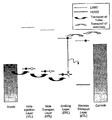
- Figure 4 shows the energy level of the organic light emitting device according to the prior art.
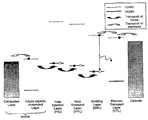
- FIG 5 shows an energy level of an organic light emitting device according to an exemplary embodiment of the present invention.
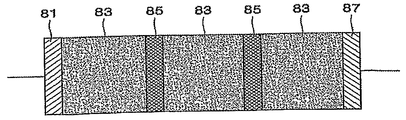
- 6 and 7 are schematic cross-sectional views showing stacked organic light emitting diodes according to one exemplary embodiment of the present invention, respectively.
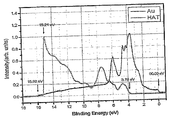
- FIG. 8 is a graph showing UPS (Ultraviolet Photoelectron Spectrum) data of a gold film and a HAT film positioned on the gold film.
- UPS Ultraviolet Photoelectron Spectrum
- FIG. 9 is a schematic cross-sectional view showing an inverse structure organic light emitting device according to an exemplary embodiment of the present invention.
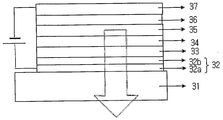
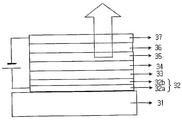
- FIG. 10 is a schematic cross-sectional view showing a positive structure top emission organic light emitting device using a reflective cathode electrode and a transparent anode electrode according to an exemplary embodiment of the present invention.
- FIG. 11 is a schematic cross-sectional view illustrating a back structure organic light emitting diode having a regular structure using a reflective anode electrode and a transparent cathode electrode according to an exemplary embodiment of the present invention.
- FIG. 12 is a schematic cross-sectional view showing an inverted top-emitting organic light emitting diode using a reflective anode electrode and a transparent cathode electrode according to an exemplary embodiment of the present invention.
- FIG. 13 is a schematic cross-sectional view illustrating an inverted back-emitting organic light emitting diode using a reflective cathode electrode and a transparent anode electrode according to an exemplary embodiment of the present invention.
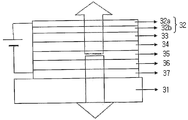
- FIG. 14 is a schematic cross-sectional view of a positive structure double-sided organic light emitting diode using a transparent anode electrode and a transparent cathode electrode according to an exemplary embodiment of the present invention.
- FIG. 15 is a schematic cross-sectional view illustrating an inverted double-sided organic light emitting diode using a transparent anode electrode and a transparent cathode electrode according to an exemplary embodiment of the present invention.
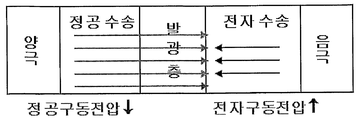
- 16 is a diagram illustrating the movement of electrons and holes of an organic light emitting device using only NP junction among NP junction and n-type doped organic material application techniques.
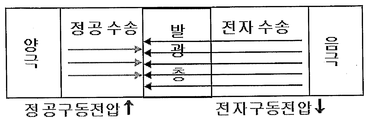
- FIG. 17 is a diagram illustrating electron and hole movement of an organic light emitting diode to which only n-type doped organic material is applied among NP junction and n-type doped organic material application technologies.
- 18 is a diagram illustrating the movement of electrons and holes in an organic light emitting device to which both NP junction and n-type doped organic material application are applied.
- An organic light emitting diode is an organic material layer having a p-type semiconductor characteristic positioned between the first electrode, the second electrode, and the first electrode and the second electrode (hereinafter "p-").
- Type organic compound layer includes a hole injection layer, a hole transport layer, or a light emitting layer.
- the organic light emitting device further includes at least one organic material layer between the p-type organic material layer and the second electrode, wherein at least one of the organic material layers is n-doped with an alkaline earth metal.
- the organic material layers may be formed of the same material or different materials.
- the first electrode includes a conductive layer and an organic material layer (hereinafter, “n-type organic material layer”) having n-type semiconductor characteristics in contact with the conductive layer. Since the conductive layer is in contact with the n-type organic material layer, more various materials may be used than the material that can be used as a conventional electrode material. For example, materials including a metal, a metal oxide, or a conductive polymer may be used as the conductive layer.
- the conductive polymer may include an electrically conductive polymer.
- the conductive layer of the first electrode may be formed of the same material as the second electrode.
- the n-type organic compound layer has a predetermined LUMO energy level with respect to the Fermi energy level of the conductive layer and the HOMO energy level of the p-type organic compound layer.
- the n-type organic compound layer of the first electrode is an energy difference between the LUMO energy level of the n-type organic compound layer of the first electrode and the Fermi energy level of the conductive layer of the first electrode, and the HOMO energy level of the p-type organic compound layer. And the energy difference between the LUMO energy levels of the n-type organic compound layer is reduced. Therefore, holes are easily injected into the HOMO energy level of the p-type organic compound layer through the LUMO energy level of the n-type organic compound layer of the first electrode.
- the energy difference between the LUMO energy level of the n-type organic compound layer of the first electrode and the Fermi energy level of the conductive layer of the first electrode is preferably more than 0 eV and 4 eV or less. It may be more preferable that this energy difference is about 0.01-4 eV from the viewpoint of material selection.
- the energy difference between the HOMO energy level of the p-type organic compound layer and the LUMO energy level of the n-type organic compound layer of the first electrode is preferably 1 eV or less, and more preferably about 0.5 eV or less (0 eV is not included). This energy difference is preferably -1 eV or more and 1 eV or less, and more preferably about 0.01-1 eV from the viewpoint of material selection.
- the energy difference between the LUMO energy level of the n-type organic compound layer of the first electrode and the Fermi energy level of the conductive layer of the first electrode is greater than 4 eV, a surface dipole or gap state for the energy barrier of hole injection is obtained. the effect of the state is reduced.
- the energy difference between the HOMO energy level of the p-type organic compound layer and the LUMO energy level of the n-type organic compound layer is greater than 1 eV, NP bonding between the p-type organic compound layer and the n-type organic compound layer of the first electrode does not occur easily. As a result, the driving voltage for the hole injection increases. That is, in the present invention, the NP junction is not only physically in contact with the n-type organic compound layer and the p-type organic compound layer, but also must satisfy the above-described energy relationship.
- the Fermi level of the conductive layer, the LUMO level of the n-type organic compound layer, and the HOMO level of the p-type organic compound layer forming an interface with the n-type organic compound layer play a very important role.
- n-type organic material and p-type organic material are formed by using an n-type organic material having a high LUMO level in the electrode. NP junction was formed and charge generation was caused by this NP junction. In addition, the charge transfer between the conductive layer used as an electrode and the n-type organic compound layer was moved to the LUMO level of the n-type organic compound.
- the vacuum level (VL) shift due to dipole influences about NP at about 1 eV
- the HOMO level of the p-type organic matter is lower than that of the n-type organic matter under the condition that spontaneous charge can be generated. It is limited to energy levels of 1 eV or greater.
- the Fermi level of the conductive layer and the LUMO level of the n-type organic material should have a value such that the electrons generated at the NP junction and the electrons of the n-type LUMO level among the holes can move to the conductive layer.
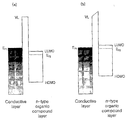
- the charge transfer is caused by the change of vacuum level (VL), gap state or dipole formation as the free electrons of the conductive layer move to the LUMO level of the n-type organic material at the interface between the conductive layer and the n-type organic compound layer. It becomes possible.
- the condition that the LUMO level of the n-type organic material should have a value of 4eV larger than the Fermi of the conductive layer is that the organic light emission using the Ca conductive layer (Fermi level 2.6eV) and the n-type organic HAT (LUMO level ⁇ 5.7V) This value is based on the experimental results of the device.
- the conductive layer has a Fermi energy level E F1 lower than the LUMO energy level F nL ⁇ of the n-type organic compound layer.
- the vacuum level (VL) represents an energy level for extracting electrons into the air from the conductive layer and the n-type organic compound layer.
- the conductive layer is in contact with the n-type organic compound layer.
- the electrons move from the conductive layer to the n-type organic compound layer, so the Fermi energy levels E F1 and 2 of the two layers are the same.
- a surface dipole is formed at the interface between the conductive layer and the n-type organic compound layer, and the vacuum level, Fermi energy level, HOMO energy level, and LUMO energy level are changed as shown in FIG. 1 (b).
- the energy barrier for hole injection can be reduced by contacting the conductive layer and the n-type organic compound layer.
- the conductive layer has a Fermi energy level lower than the LUMO energy level of the n-type organic compound layer, electrons move from the conductive layer to the n-type organic compound layer to form a gap state at the interface between the conductive layer and the n-type organic compound layer. Form.
- the energy barrier for electron transport is minimized.
- the n-type organic compound layer is, but is not limited to, 2,3,5,6-tetrafluoro-7,7,8,8-tetracyanoquinomimethane (F4TCNQ) having an LUMO energy level of about 5.24 eV. ), Fluorine-substituted 3,4,9,10-perylenetetracarboxylic dianhydride (PTCDA), cyano-substituted PTCDA, naphthalenetetracarboxylic dianhydride (NTCDA), fluorine-substituted NTCDA, cyano-substituted NTCDA, or hexanitrile hexaazatriphenylene (HAT).
- F4TCNQ 2,3,5,6-tetrafluoro-7,7,8,8-tetracyanoquinomimethane
- F4TCNQ 2,3,5,6-tetrafluoro-7,7,8,8-tetracyanoquinomimethane
- the organic light emitting device includes a p-type organic compound layer in contact with the n-type organic compound layer of the first electrode for injecting holes.
- an NP junction is formed in the device. 2 illustrates an NP junction formed between an n-type organic compound layer and a p-type organic compound layer of the first electrode.
- the energy level difference between the LUMO level of the n-type organic compound layer of the first electrode and the HOMO level of the p-type organic compound layer is reduced. Therefore, holes or electrons are easily formed by an external voltage or a light source. That is, holes are easily formed in the p-type organic compound layer and electrons are easily formed in the n-type organic compound layer of the first electrode by NP junction. Since holes and electrons are simultaneously generated in the NP junction, electrons are transported to the conductive layer of the first electrode through the n-type organic compound layer of the first electrode and holes are transported to the p-type organic compound layer.
- the energy level difference between the LUMO level of the n-type organic compound layer of the first electrode and the HOMO level of the p-type organic compound layer may be at a predetermined level. That is, the energy level difference between the HOMO level of the p-type organic compound layer and the LUMO level of the n-type organic compound layer of the first electrode is preferably about 1 eV or less, and more preferably about 0.5 eV or less.
- the p-type organic compound layer may be a hole injection layer, a hole transport layer, or a light emitting layer.
- At least one organic light emitting diode according to the present invention is between the p-type organic compound layer and the n-type doped layer by the alkaline earth metal or between the n-type doped layer by the alkaline earth metal and the second electrode. It may further include an organic material layer.
- the organic light emitting device is characterized in that at least one layer of the organic material layer positioned between the above-described p-type organic material layer and the second electrode is n-doped with alkaline earth metal.
- the organic compound layer n-doped with alkaline earth metal is preferably an electron injection layer, an electron transport layer or an electron transport and injection layer.
- the organic material layer n-doped with the alkaline earth metal is preferably a layer in contact with the second electrode.
- the first electrode including the conductive layer and the n-type organic compound layer, and the p-type organic compound layer forming the NP junction with the n-type organic compound layer of the first electrode from the first electrode to the organic material layer.
- the energy barrier for hole injection can be significantly lowered.
- hole injection and transport from the first electrode to the light emitting region of the organic light emitting diode can be efficiently performed.
- an alkaline earth metal is n-type in an organic material layer positioned between the p-type organic material layer and the second electrode, for example, an organic material layer that serves as electron injection and / or transport.
- balancing in the light emitting area can be achieved.
- balancing means recombination in the emission region to make the density of the holes and electrons participating in the emission maximized and the same.
- the organic light emitting device according to the present invention can exhibit much better low voltage, high brightness and high efficiency characteristics.
- FIG. 16 is a diagram illustrating the movement of electrons and holes of an organic light emitting diode using only NP junction among NP junction and n-type doped organic material application techniques.
- the organic light emitting device using only the NP junction improves only the hole injection and transport characteristics, so that the concentration of holes in the light emitting layer is relatively higher than that of electrons. Will be lowered.
- the driving voltage decreases due to the improvement of the hole injection and transport characteristics, but the emission luminance decreases. Therefore, the increase in the emission efficiency, which is a watt ratio expressed by the product of the current voltage to the emission luminance, can be expected. none.
- FIG. 17 is a diagram illustrating electron and hole movement of an organic light emitting diode to which only n-type doped organic material is applied among NP junction and n-type doped organic material application technologies.
- the organic light emitting device using only n-type organic material doping among NP junction and n-type doped organic material application technology only electron injection and transport characteristics are improved, so the concentration of electrons in the light emitting layer is relatively higher than that of holes. Balancing is reduced.
- the driving voltage decreases due to the improvement of electron injection and transport characteristics, but the emission luminance decreases. Therefore, the increase in the emission efficiency, which is a watt ratio expressed by the product of the current voltage to the emission luminance, is expected. Can't.
- FIG. 18 is a diagram illustrating the movement of electrons and holes in an organic light emitting device to which both NP junction and n-type doped organic material application are applied.
- the NP junction and the n-type doped organic material are used at the same time, the hole injection and transport characteristics of the NP junction and the electron injection and transport characteristics of the n-type doping are improved.
- the concentration of the holes is balanced, a large driving voltage is reduced due to the improvement of the charge injection and transport characteristics of the charge, and the brightness is improved by the balancing of the electrons and the holes. Therefore, it is possible to fabricate an organic light emitting device having high luminous efficiency, which is a Watt ratio expressed by the product of the current voltage to the luminous brightness.
- At least one selected from the group consisting of calcium (Ca), strontium (Sr), barium (Ba), radium (Ra), beryllium (Be) and magnesium (Mg) as the alkaline earth metal doping the organic material layer May be used, but is not limited thereto.
- the organic material layer to be doped is not particularly limited, but an electron injection or transport material may be used.
- an electron injection or transport material may be used.
- a compound having a functional group selected from imidazole group, oxazole group, thiazole group, quinoline and phenanthrosine group can be used.
- the compound having a functional group selected from the imidazole group, the oxazole group and the thiazole group include compounds of the compound of formula 1 or 2 below:
- R 1 to R 4 may be the same or different from each other, and each independently a hydrogen atom; Halogen atom, amino group, nitrile group, nitro group, C 1 ⁇ C 30 alkyl group, C 2 ⁇ C 30 alkenyl group, C 1 ⁇ C 30 alkoxy group, C 3 ⁇ C 30 cycloalkyl group, C 3 ⁇ C A C 1 -C 30 alkyl group substituted or unsubstituted with one or more groups selected from the group consisting of 30 heterocycloalkyl groups, C 5 -C 30 aryl groups and C 2 -C 30 heteroaryl groups; Halogen atom, amino group, nitrile group, nitro group, C 1 ⁇ C 30 alkyl group, C 2 ⁇ C 30 alkenyl group, C 1 ⁇ C 30 alkoxy group, C 3 ⁇ C 30 cycloalkyl group, C 3 ⁇ C A C 3 -C 30 cycloalkyl group substituted or unsubstitute
- X is O, S, NR b or a C 1 -C 7 divalent hydrocarbon group
- A, D and R b are each substituted with a hydrogen atom, a nitrile group (-CN), a nitro group (-NO 2 ), an alkyl of C 1 -C 24 , an aromatic ring of C 5 -C 20 or a hetero atom
- Alkylene comprising an alkylene or hetero atom capable of forming a fused ring with an aromatic ring, a halogen, or an adjacent ring
- a and D may be joined to form an aromatic or heteroaromatic ring
- B is a substituted or unsubstituted alkylene or arylene that connects a plurality of hetero rings to be conjugated or unconjugated as n is 2 or more, and when n is 1, substituted or unsubstituted alkyl or aryl; n is an integer from 1 to 8.
- Examples of the compound of Formula 1 include compounds known from Korean Patent Publication No. 2003-0067773, and examples of the compound of Formula 2 include compounds described in US Pat. No. 5,645,948 and compounds described in WO05 / 097756. Include. The above documents are all incorporated herein by reference.
- the compound of Formula 1 also includes a compound of Formula 3:
- R 5 to R 7 are the same as or different from each other, and are each independently a hydrogen atom, an aliphatic hydrocarbon of C 1 -C 20 , an aromatic ring, an aromatic hetero ring, or an aliphatic or aromatic condensed ring;
- Ar is a direct bond, an aromatic ring or an aromatic hetero ring;
- X is O, S or NR a ;
- R a is a hydrogen atom, an aliphatic hydrocarbon of C 1 -C 7 , an aromatic ring or an aromatic hetero ring; Except where R 5 and R 6 are hydrogen at the same time.
- the compound of Formula 2 also includes a compound of Formula 4:
- Z is O, S or NR b ;
- R 8 and R b may form a fused ring with a hydrogen atom, a C 1 -C 24 alkyl, a C 5 -C 20 aromatic ring or a substituted aromatic ring containing a hetero atom, a halogen, or a benzazole ring Alkylene or alkylene containing hetero atoms;
- B is an alkylene, arylene, substituted alkylene, or substituted arylene that connects a plurality of benzazoles to be conjugated or non-conjugated as a connecting unit when n is 2 or more, and when n is 1, substituted or unsubstituted Alkyl or aryl;
- n is an integer from 1 to 8.
- Preferred compounds having imidazole groups include compounds of the following structure:
- Examples of the compound having a quinoline group include compounds represented by the following Chemical Formulas 5 to 11.
- n is an integer from 0 to 9
- m is an integer of 2 or more
- R 9 is an alkyl group such as hydrogen, a methyl group, an ethyl group, a cycloalkyl group such as cyclohexyl, norbornyl, an aralkyl group such as benzyl group, an alkenyl group such as vinyl group, allyl group, cyclopentadienyl group, cyclohexenyl group, etc.
- Alkoxy groups such as cycloalkenyl groups and methoxy groups
- Alkylthio groups in which the oxygen atom of the ether bond of an alkoxy group is substituted by the sulfur atom
- Aryl ether groups such as the phenoxy group, and aryl in which the oxygen atom of the ether bond of the arylether group is substituted by the sulfur atom
- Heterocyclic groups such as aryl groups, such as a thioether group, a phenyl group, a naphthyl group, and a biphenyl group, a furyl group, a thienyl group, an oxazolyl group, a pyridyl group, a quinolyl group, and a carbazolyl group, a halogen, a cyano group, an aldehyde group, and a carbonyl group , Silyl groups such as carboxyl group, ester group, carbamoyl group, amino group,
- Y is a divalent or higher group of the groups of R 9 .
- Examples of the compound having a phenanthrosine group include compounds represented by the following Chemical Formulas 12 to 22, but are not limited thereto.
- n + p is 8 or less
- R ⁇ 10> and R ⁇ 11> are hydrogen, methyl, alkyl groups, such as an ethyl group, cycloalkyl groups, such as cyclohexyl and norbornyl, aralkyl groups, such as benzyl, alkenyl groups, such as a vinyl group and an allyl group, and cyclo Alkyl groups, such as cycloalkenyl groups, such as a pentadienyl group and a cyclohexenyl group, and a methoxy group, Alkylthio group, such as the arylether group, and the arylether group in which the oxygen atom of the ether bond of the alkoxy group was substituted by the sulfur atom, etc.
- Heterocyclic groups such as the aryl group which the oxygen atom of a bond substituted by the sulfur atom, the aryl group, such as a phenyl group, a naphthyl group, and a biphenyl group, a furyl group, a thienyl group, an oxazolyl group, a pyridyl group, a quinolyl group, and a carbazolyl group , Silyl group such as halogen, cyano group, aldehyde group, carbonyl group, carboxyl group, ester group, carbamoyl group, amino group, nitro group and trimethylsilyl group, siloxanyl group which is a group having silicon through ether bond And a ring structure that is formed of a group;
- R 10 is a direct bond or a divalent or more group of the aforementioned groups, and R 11 is the same as when m is 1,
- the substituents may be unsubstituted or substituted, and when n or p is 2 or more, the substituents may be the same or different from each other.
- R 1a to R 8a and R 1b to R 10b each represent a hydrogen atom, a substituted or unsubstituted aryl group having 5 to 60 nuclear atoms, a substituted or unsubstituted pyridyl group, a substituted or unsubstituted qui Nolyl group, substituted or unsubstituted 1-50 alkyl group, bicyclic or unsubstituted cycloalkyl group having 3-50 carbon atoms, substituted or unsubstituted aralkyl group having 6-50 nuclear atoms, substituted or unsubstituted alkoxy group having 1-50 carbon atoms , Substituted or unsubstituted aryloxy group having 5-50 nuclear atoms, substituted or unsubstituted arylthio group having 5-50 nuclear atoms, substituted or unsubstituted alkoxycarbonyl group having 1-50 carbon atoms, substituted or unsubstitute
- d 1 , d 3 to d 10 and g 1 are each a hydrogen or an aromatic or aliphatic hydrocarbon group, m and n are integers of 0 to 2, and p is an integer of 0 to 3.
- the compounds of Formulas 20 and 21 are described in US Patent Publication 2007/0122656, which is incorporated herein by reference in its entirety.
- R 1c to R 6c each represent a hydrogen atom, a substituted or unsubstituted alkyl group, a substituted or unsubstituted aralkyl group, a substituted or unsubstituted aryl group, a substituted or unsubstituted heterocyclic group or a halogen atom, and Ar 1c and Ar 2c is each selected from the following structural formula.
- R 17 to R 23 in the above structural formulas each represent a hydrogen atom, a substituted or unsubstituted alkyl group, a substituted or unsubstituted aralkyl group, a substituted or unsubstituted aryl group, a substituted or unsubstituted heterocyclic group or a halogen atom.
- the compound of formula 22 is described in Japanese Patent Laid-Open No. 2004-107263, which is incorporated by reference in its entirety.
- the formation of the n-type doped organic material layer by alkaline earth metal may be made using a method known in the art, and the scope of the present invention is not limited by a specific method.
- the concentration of the n-type doped organic material layer by the alkaline earth metal is 0.02 to 50% by volume, which is effective to improve the electron injection efficiency.
- the organic compound layer n-doped with alkaline earth metal may be an electron injection layer, an electron transport layer, or an electron transport and injection layer.
- the organic light emitting device comprises at least one organic material layer between the p- type organic compound layer and the n- type doped layer by the alkaline earth metal or between the n-type doped layer by the alkaline earth metal and the second electrode. It may further include.
- Figure 3 shows an organic light emitting device according to an exemplary embodiment of the present invention.
- the organic light emitting diode is positioned on the substrate 31, on the anode 32 on the substrate 31, on the anode 32, and receives a hole from the anode 32. 33), a hole transport layer (HTL) 34 positioned on the hole injection layer 33 and transferring holes to the light emitting layer 35, and a light emitting layer (EML) emitting light using holes and electrons located on the hole transport layer 34. 35, an electron transport layer (ETL) 36 positioned on the light emitting layer 35 and transporting electrons from the cathode 37 to the light emitting layer 35, and a cathode 37 located on the electron transport layer 36. Can be.
- the hole transport layer 34, the light emitting layer 35, and the electron transport layer 36 may be formed of the same organic material or different organic materials.
- the anode 32 transports holes to the hole injection layer 33, the hole transport layer 34, or the light emitting layer 35, and transfers the conductive layer 32a and the n-type organic compound layer 32b.
- the conductive layer 32a is formed of a metal, a metal oxide, or a conductive polymer.
- the energy difference between the LUMO energy level of the n-type organic compound layer 32b and the Fermi energy level of the conductive layer 32a is about 4 eV or less.
- the energy difference between the HOMO energy level of the p-type hole injection layer 33 and the LUMO energy level of the n-type organic compound layer 32b is about 1 eV or less, preferably about 0.5 eV or less.
- An NP junction is formed between the n-type organic compound layer 32b of the anode 32 and the p-type hole injection layer 33.
- the organic light emitting device has a substrate 31, an anode 32 positioned on the substrate 31, a p-type hole transport layer 34 located on the anode 32, a hole transport layer
- the light emitting layer 35 positioned on the 34, the electron transport layer 36 positioned on the light emitting layer 35, and the cathode 37 positioned on the electron transport layer 36 may be included.
- the emission layer 35 and the electron transport layer 36 may be formed of the same organic material or different organic materials.
- the organic light emitting device is a substrate 31, the anode 32 on the substrate 31, the p- type light emitting layer 35 positioned on the anode 32, the light emitting layer 35 It may include an electron transport layer 36 positioned above and a cathode 37 positioned on the electron transport layer 36.
- the electron transport layer 36 may be formed of an organic material.
- the hole transport layer 34 or the light emitting layer 35 when the hole transport layer 34 or the light emitting layer 35 is formed of a p-type organic material, the HOMO energy level of the p-type hole transport layer 34 or the light emitting layer 35 and n ⁇
- the energy difference of the LUMO energy level of the type organic compound layer 32b is about 1 eV or less, preferably about 0.5 eV or less.
- An NP junction is formed between the n-type organic compound layer 32b of the anode 32 and the p-type hole transport layer 34 or the p-type light emitting layer 35.
- the energy difference between the LUMO energy level of the n-type organic compound layer 32b and the Fermi energy level of the conductive layer 32a is greater than about 4 eV, the surface dipole for the energy barrier for hole injection into the p-type hole injection layer 33 Or the effect of the gap state is reduced. If the energy difference between the LUMO energy level of the n-type organic compound layer 32b and the HOMO energy level of the p-type hole injection layer 33 is greater than about 1 eV, the p-type hole injection layer 33 or the n-type organic compound layer ( In 32b), holes or electrons are not easily generated, respectively, and a driving voltage for hole injection is increased.
- FIG. 3 illustrates an exemplary embodiment in which a first electrode, an organic material layer, and a second electrode including a conductive layer and an n-type organic material layer are sequentially stacked on a substrate, but the present invention provides a second electrode, an organic material layer, and n on a substrate.
- An inverted structure includes a first electrode including a -type organic material layer and a conductive layer sequentially stacked.
- FIG. 4 shows an ideal energy level of a conventional organic light emitting device. At this energy level, energy losses for injecting holes and electrons from the anode and cathode, respectively, are minimized.
- 5 shows an energy level of an organic light emitting device according to an exemplary embodiment of the present invention.
- an organic light emitting diode includes an anode having a conductive layer and an n-type organic compound layer (see FIG. 3), a p-type hole injection layer (HIL), and a hole transport layer (HTL). ), A light emitting layer (EML), an electron transport layer (ETL) and a cathode.
- the energy difference between the LUMO energy level of the n-type organic compound layer of the anode and the Fermi energy level of the conductive layer of the anode is about 4 eV or less, and the HOMO energy level of the p-type hole injection layer and the LUMO energy of the n-type organic compound layer of the anode The energy difference of the level is about 1 eV or less. Since the energy barrier for the hole / electron injection is lowered by the n-type organic compound layer of the anode, the hole is determined using the LUMO energy level of the n-type organic compound layer of the anode and the HOMO energy level of the p-type hole injection layer. It is easily transported from the anode to the light emitting layer.
- the conductive layer of the anode may be formed of various conductive materials.
- the conductive layer may be formed of the same material as the cathode.
- a conductive material may be manufactured such as an organic light emitting device having a low work function.
- the hole and electron transporting ability can be improved by the above-described configuration, so that the balancing of holes and electrons can be achieved.
- the electron injection layer made of a material such as LiF is not provided, an electron injection like the LiF layer can be achieved. Better device performance can be achieved than with layers.
- the organic material layer n-doped with alkaline earth metal may contact the second electrode.
- the electron injection layer not including the electron injection layer in the scope of the present invention.
- the present invention can provide a stack type organic light emitting device having high efficiency and high brightness on the same principle as described above.
- the organic light emitting diode since the luminance increases in proportion to the number of organic light emitting diode units stacked under the same driving voltage, the organic light emitting diode may be stacked to obtain a high luminance organic light emitting diode.
- An exemplary embodiment of the present invention is a repeating unit including a first electrode, two or more organic material layers, and a second electrode, wherein the first electrode includes a conductive layer and an n-type organic material layer in contact with the conductive layer.
- One layer of the organic layer positioned between the n-type organic compound layer and the second electrode of the electrode is a p-type organic compound layer forming an NP junction with the n-type organic compound layer of the first electrode, the energy level of the layers is Satisfies 1) and (2), and at least one of the organic layers positioned between the p-type organic layer and the second electrode includes two or more repeating units which are n-type doped with alkaline earth metals.
- the second electrode of one repeating unit is connected to the first electrode of adjacent repeating units connected in series.
- E F1 is the Fermi energy level of the conductive layer of the first electrode
- E nL is the lower unoccupied molecular orbital (LUMO) energy level of the n-type organic compound layer of the first electrode
- E pH is the highest occupied molecular orbital (HOMO) energy level of the p- type organic compound layer forming an NP junction with the n- type organic compound layer of the first electrode.
- the anode 71 includes a conductive layer and an n-type organic compound layer.
- Another embodiment of the present invention is a stack type including a first electrode and a second electrode, at least two light emitting units disposed between the first electrode and the second electrode, and an intermediate electrode layer disposed between the light emitting units.
- a stack type including a first electrode and a second electrode, at least two light emitting units disposed between the first electrode and the second electrode, and an intermediate electrode layer disposed between the light emitting units.
- the first electrode includes a conductive layer and an n-type organic compound layer in contact with the conductive layer
- the intermediate electrode layer includes a conductive layer and an n-type organic compound layer in contact with the conductive layer
- each of the light emitting units includes the first electrode.
- a p-type organic compound layer forming an NP junction with an n-type organic compound layer of the intermediate electrode layer, wherein the energy levels of the layers satisfy the following formulas (1) and (2), and the light emitting units are respectively formed of alkaline earth metals. It provides a stacked organic light emitting device characterized in that it further comprises an n- type doped organic material layer.
- E F1 is a Fermi energy level of the conductive layer of the first electrode or the intermediate electrode layer
- E nL is a low unoccupied LUN of the n-type organic compound layer of the first electrode or the intermediate electrode layer.
- a molecular orbital energy level, E pH is the highest occupied molecular orbital (HOMO) energy level of the p-type organic compound layer forming an NP junction with the n-type organic compound layer of the first electrode or intermediate electrode layer.
- the cathode and the anode may be formed of the same material as described above, the stacked organic light emitting device shown in FIG. 7 having an equivalent structure to that of FIG. 6 may be obtained.
- the stacked organic light emitting diode according to the present invention has a structure in which a plurality of repeating units of the organic material layer 83 and the intermediate electrode layer 85 are stacked between the anode 81 and the cathode 87.
- the anode 81 and the intermediate electrode layer 85 include a conductive layer and an n-type organic compound layer.
- the conductive layer is preferably formed of a transparent material having a work function similar to that of the material of the cathode 87 and having a visible light transmittance of 50% or more. If an opaque metal is used as the conductive layer, the thickness of the conductive layer should be thin enough to be transparent. Specific examples of the opaque metal include Al, Ag, Cu, Ca, Mg, MgAg, CaAg and the like. In particular, when the conductive layer of the intermediate electrode layer 85 is formed using Al metal, the conductive layer may have a thickness of, for example, about 5 to 10 nm, but is not limited thereto.
- the conductive layer included in the intermediate electrode layer of the stacked organic light emitting device according to the present invention may be used as a very thin layer, such as 5 kPa to 1,000 kPa, preferably 10 kPa to 900 kPa.
- the description of the electrode and each organic material layer is the same as described above with the organic light emitting device having the single layer.
- each layer constituting the organic light emitting device will be described in detail.
- the materials of each layer described below may be a single material or a mixture of two or more materials.
- the anode injects holes into a p-type organic compound layer such as a hole injection layer, a hole transport layer or a light emitting layer.
- the anode includes a conductive layer and an n-type organic compound layer.
- the conductive layer comprises a metal, a metal oxide or a conductive polymer.
- the conductive polymer may include an electrically conductive polymer.
- the conductive layer may be formed of various conductive materials.
- the conductive layer has a Fermi energy level of about 2 to 5.5 eV.
- materials having a Fermi energy level of 5 to 6 eV can be used as the anode, but in the present invention, materials having a Fermi energy level of 2 to 5 eV, particularly 2 to 4 eV, may be used.
- Examples of exemplary conductive materials include carbon, cesium, potassium, lithium, calcium, sodium, magnesium, nironium, indium, aluminum, silver, tantalum, vanadium, chromium, copper, zinc, iron, tungsten, molybdenum, nickel, gold, Other metals and alloys thereof; Zinc oxide, indium oxide, tin oxide, indium tin oxide (ITO), indium zinc oxide and other similar metal oxides; And mixtures of oxides and metals such as ZnO: Al and SnO 2 : Sb.
- the organic light emitting device is a top emission type, not only a transparent material but also an opaque material having excellent light reflectance may be used as the conductive layer.
- the back light-emitting organic light emitting device it should be a transparent material as the conductive layer, and if an opaque material is used, it should be formed into a thin film so as to be transparent.
- the surface of the conductive layer may be treated with nitrogen plasma or oxygen plasma.
- the Fermi level of the conductive layer due to the plasma treatment is increased during the oxygen plasma treatment, and lowered in the nitrogen plasma treatment.
- the conductivity of the conductive layer can be increased, and nitride can be formed on the surface while lowering the surface oxygen concentration, thereby increasing the life of the device.
- the Fermi level of the conductive layer is lowered, which makes it difficult to inject holes, thereby increasing the driving voltage.
- the n-type organic compound layer is positioned between the conductive layer and the p-type organic compound layer, and injects holes into the p-type organic compound layer in a low electric field.
- the energy difference between the LUMO energy level of the n-type organic compound layer of the anode and the Fermi energy level of the conductive layer of the anode is about 4 eV or less
- the HOMO energy level of the p-type organic compound layer and the n-type organic compound layer The energy difference of the LUMO energy level is chosen to be about 1 eV or less.
- the n-type organic compound layer has a LUMO energy level of about 4-7 eV and about 10 -8 cm 2 / Vs-1 cm 2 / Vs, preferably about 10 -6 cm 2 / Vs -10 -2 cm It has an electron mobility of 2 / Vs. If the electron mobility is less than about 10 ⁇ 8 cm 2 / Vs, holes may not be easily injected from the n-type organic compound layer to the p-type organic compound layer. If the electron mobility exceeds 1 cm 2 / Vs, the hole injection becomes more efficient, but such a material is typically a crystalline organic material, so it is difficult to apply to an organic light emitting device using an amorphous organic material.
- the n-type organic compound layer may be formed of a material that can be vacuum deposited or a material that can be thin-film formed by a solution process.
- Specific examples of the n-type organics include, but are not limited to, 2,3,5,6-tetrafluoro-7,7,8,8-tetracyanoquinomethane (F4TCNQ), fluorine-substituted 3,4 , 9,10-perylenetetracarboxylic dianhydride (PTCDA), cyano-substituted PTCDA, naphthalenetetracarboxylic dianhydride (NTCDA), fluorine-substituted NTCDA, cyano-substituted NTCDA or Hexanitrile hexaazatriphenylene (HAT).
- F4TCNQ 2,3,5,6-tetrafluoro-7,7,8,8-tetracyanoquinomethane
- PTCDA fluorine-substituted 3,
- HIL Hole injection layer
- HTL hole transport layer
- the hole injection layer or the hole transport layer may be formed of a p-type organic compound layer positioned between the anode and the cathode. Since the p-type hole injection layer or the p-type hole transport layer and the n-type organic compound layer form an NP junction, holes formed in the NP junction are transferred to the light emitting layer through the p-type hole injection layer or the p-type hole transport layer. Are transported.
- the HOMO energy level of the p-type hole injection layer or the p-type hole transport layer has an energy difference of about 1 eV or less, preferably about 0.5 eV, with respect to the LUMO energy level of the n-type organic compound layer.
- the p-type hole injection layer or the p-type hole transport layer may include, but is not limited to, an arylamine-based compound, a conductive polymer, or a block copolymer having a conjugated portion and a non-conjugated portion.
- Emission Layer Emission Layer
- the light emitting layer since hole and electron transfer occur at the same time, the light emitting layer may have both n-type and p-type characteristics.
- the electron transport may be defined as an n-type light emitting layer faster than the hole transport, and the hole transport may be defined as a p-type light emitting layer faster than the electron transport.
- the n-type light emitting layer includes, but is not limited to, aluminum tris (8-hydroxyquinoline) (Alq 3 ); 8-hydroxyquinoline beryllium (BAlq); Benzoxazole compound, benzthiazole compound or benzimidazole compound; Polyfluorene-based compounds; Silacyclopentadiene (silole) compounds and the like.
- the hole transport is faster than the electron transport, light emission occurs near the interface between the electron transport layer and the light emitting layer. Therefore, when the HOMO level of the electron transport layer is lower than the HOMO level of the light emitting layer, it may exhibit better light emission efficiency.
- the effect of increasing the luminous efficiency due to the change in the LUMO level of the hole transport layer is smaller than in the case of using the n-type light emitting layer. Therefore, when the p-type light emitting layer is used, an organic light emitting device having an NP junction structure between the n-type organic compound layer and the p-type light emitting layer can be manufactured without using the hole injection layer and the hole transport layer.
- the p-type light emitting layer is not limited thereto, but includes a carbazole compound; Anthracene-based compounds; Polyphenylenevinylene (PPV) -based polymers; Or spiro compounds and the like.
- ETL Electron Transport Layer
- the electron transport layer material a material having a high electron mobility is preferable so that electrons can be well injected from the cathode and transported well to the light emitting layer.
- the electron transport layer is not limited thereto, but may include aluminum tris (8-hydroxyquinoline) (Alq 3); Organic compounds containing Alq 3 structures; Hydroxyflavone-metal complex compounds or silacyclopentadiene (silole) compounds.
- the negative electrode material a material having a small work function is usually preferred so that electron injection is easily performed into an organic material layer such as an electron transport layer. If the electron transport layer doped with alkaline earth metal is used, materials up to 6.0 eV of work function (Fermi level) can be used.
- the negative electrode includes, but is not limited to, metals such as magnesium, calcium, sodium, potassium, titanium, indium, yttrium, lithium, gadolinium, aluminum, silver, tin, nickel, gold, molybdenum, iron and lead or alloys thereof; Multilayer structure materials such as LiF / Al or LiO 2 / Al and metal oxide materials such as ITO, IZO and the like.
- the cathode may be formed of the same material as the conductive layer of the anode. Alternatively, the conductive layer of the cathode or the anode may include a transparent material.
- Hexanitrile hexaazatriphenylene was used as an organic material of n-type semiconductor properties.
- Ultraviolet photoelectron spectroscopy (UPS) was used to measure the HOMO level of the HAT. This method analyzes the kinetic energy of electrons from the sample when the sample is irradiated with vacuum UV rays (21.20 eV) from the He lamp under ultra-vacuum ( ⁇ 10 -8 Torr). In this case, the ionization energy, that is, the HOMO level and the Fermi energy level can be determined.
- the kinetic energy of the electrons emitted from the sample is the difference between the vacuum UV energy 21.2 eV and the electron binding energy of the sample to be measured. Therefore, by analyzing the kinetic energy distribution of electrons emitted from the sample it is possible to know the distribution of intramolecular binding energy of the material in the sample. At this time, when the maximum energy value of the kinetic energy of the electron has a minimum binding energy of the sample. This can be used to determine the work function (Fermi energy level) and HOMO level of the sample.
- the work function of gold was measured using a gold film
- the HOMO level of the HAT was measured by analyzing the kinetic energy of electrons emitted from the HAT material while depositing the HAT material on the gold film.
- 8 shows UPS data coming out of the gold film and the HAT film having a thickness of 20 nm thereon. The following description is made using terms used in H. Ishii, et al., Advanced Materials, 11, 605-625 (1999).
- the binding energy (eV) of the x-axis is a value calculated based on the work function measured in the gold film. That is, in this measurement, the work function of gold was measured as 5.28 eV, which is the value of irradiated light energy (21.20 eV) minus the maximum value of the binding energy (15.92 eV).
- the HAT defined by subtracting the difference between the maximum value (15.21 eV) and the minimum value (3.79 eV) of the binding energy from the light energy irradiated on the HAT deposited on the gold film has a HOMO level of 9.78 eV and a Fermi energy level of 6.02 V to be.
- IZO indium zinc oxide
- HAT represented by Formula 2-1 was vacuum-heat-deposited on the IZO with a thickness of about 500 ⁇ .
- a transparent anode having an organic material layer was formed.
- HOHAT energy level of HAT was about 9.78eV.
- the NPB represented by Chemical Formula 2-2 was vacuum-heat-deposited to a thickness of about 400 kPa to form a p-type hole transport layer.
- Mg of 30% by volume of the compound represented by the formula (2-5) as the electron transport layer on the light emitting layer was vacuum thermal vapor deposition to a thickness of 200 ⁇ .
- the organic light emitting device was completed by forming a cathode by sequentially vacuum-depositing 1000 ⁇ thick aluminum on the doped electron transport layer.
- the deposition rate of the organic material was maintained at about 0.4 ⁇ 0.7 ⁇ / sec
- the aluminum was maintained at a deposition rate of about 2 ⁇ / sec.
- the degree of vacuum in the deposition chamber was maintained at about 2 ⁇ 10 ⁇ 7 to 5 ⁇ 10 ⁇ 8 torr.
- An organic light-emitting device was manufactured in the same manner as in Example 2, except that the electron transport layer was doped with Ca at 10% by volume instead of Mg, and vacuum thermal evaporated to a thickness of 200 ⁇ s.
- the HAT represented by Formula 2-1 on the aluminum was vacuum-heat deposited to a thickness of about 500 ⁇ to have an aluminum conductive layer and an n-type organic compound layer. A reflective anode was formed. Subsequently, NPB represented by Chemical Formula 2-2 was vacuum-heat-deposited to a thickness of about 400 kPa to form a p-type hole transport layer.
- the organic light emitting device was completed by forming a semi-transparent cathode by sequentially depositing 150 ⁇ thick Ca on the doped electron transport layer.
- the deposition rate of the organic material was maintained at about 0.4 ⁇ 0.7 ⁇ / sec
- the aluminum was maintained at a deposition rate of about 2 ⁇ / sec.
- the degree of vacuum in the deposition chamber was maintained at about 2 ⁇ 10 ⁇ 7 to 5 ⁇ 10 ⁇ 8 torr.
- the Ag conductive layer having a thickness of 1000 ⁇ was formed on the glass substrate by using a thermal lamination method
- the Ag conductive layer and the n-type organic compound layer were formed by vacuum thermal evaporation of the HAT represented by Formula 2-1 to about 500 ⁇ on the Ag conductive layer.
- An organic light emitting device was manufactured in the same manner as in Example 4, except that a reflective anode having was formed.
- the Ca conductive layer having a thickness of 1000 ⁇ was formed on the glass substrate by using a thermal lamination method
- the Ca conductive layer and the n-type organic compound layer were formed by vacuum thermal evaporation of the HAT represented by Formula 2-1 to about 500 ⁇ on the Ca conductive layer.
- An organic light emitting diode was manufactured according to the same method as Example 4 except for forming the reflective anode having the same.
- IZO indium zinc oxide
- a 10 vol.% Ca of the compound represented by Formula 2-5 was doped with an electron transport layer on the IZO to vacuum about 200 ⁇ thick.
- the light emitting layer was formed by doping a C545T dopant represented by Chemical Formula 2-4 to 6 vol% on Alq 3 represented by Chemical Formula 2-3 on the electron transport layer by vacuum thermal deposition to a thickness of about 300 kPa.
- the NPB represented by Chemical Formula 2-2 was vacuum-heat-deposited to a thickness of about 400 GPa on the emission layer to form a p-type hole transport layer.
- IZO and HAT n-type organic compound layers were deposited on the p-type hole transport layer by vacuum thermal evaporation of the HAT represented by Chemical Formula 2-1 to a thickness of about 700 GPa, and a IZO conductive layer was deposited to a thickness of about 1750 GPa using a sputter thereon. A transparent anode with was formed. HOHAT energy level of HAT was about 9.78eV.
- the deposition rate of the organic material was maintained at about 0.4 ⁇ 0.7 ⁇ / sec, the IZO maintained a deposition rate of about 0.5 ⁇ / sec.
- the degree of vacuum in the deposition chamber was maintained at about 2 ⁇ 10 ⁇ 7 to 5 ⁇ 10 ⁇ 8 torr.
- IZO indium zinc oxide
- a 10 vol.% Ca of the compound represented by Formula 2-5 was doped with an electron transport layer on the IZO to vacuum about 200 ⁇ thick.
- the light emitting layer was formed by doping a C545T dopant represented by Chemical Formula 2-4 to 6 vol% on Alq 3 represented by Chemical Formula 2-3 on the electron transport layer by vacuum thermal deposition to a thickness of about 300 kPa.
- the NPB represented by Chemical Formula 2-2 was vacuum-heat-deposited to a thickness of about 400 GPa on the emission layer to form a p-type hole transport layer.
- the deposition rate of the organic material was maintained at about 0.4 ⁇ 0.7 ⁇ / sec, the IZO maintained a deposition rate of about 0.5 ⁇ / sec.
- the degree of vacuum in the deposition chamber was maintained at about 2 ⁇ 10 ⁇ 7 to 5 ⁇ 10 ⁇ 8 torr.
- IZO indium zinc oxide
- a 10 vol.% Ca of the compound represented by Formula 2-5 was doped with an electron transport layer on the IZO to vacuum about 200 ⁇ thick.
- the light emitting layer was formed by doping a C545T dopant represented by Chemical Formula 2-4 to 6 vol% on Alq 3 represented by Chemical Formula 2-3 on the electron transport layer by vacuum thermal deposition to a thickness of about 300 kPa.
- the NPB represented by Chemical Formula 2-2 was vacuum-heat-deposited to a thickness of about 400 GPa on the emission layer to form a p-type hole transport layer.
- An anode was formed.
- the deposition rate of the organic material was maintained at about 0.4 ⁇ 0.7 ⁇ / sec
- the IZO maintained a deposition rate of about 0.5 ⁇ / sec.
- the degree of vacuum in the deposition chamber was maintained at about 2 ⁇ 10 ⁇ 7 to 5 ⁇ 10 ⁇ 8 torr.
- IZO indium zinc oxide
- a 10 vol.% Ca of the compound represented by Formula 2-5 was doped with an electron transport layer on the IZO to vacuum about 200 ⁇ thick.
- the light emitting layer was formed by doping a C545T dopant represented by Chemical Formula 2-4 to 6 vol% on Alq 3 represented by Chemical Formula 2-3 on the electron transport layer by vacuum thermal deposition to a thickness of about 300 kPa.
- the NPB represented by Chemical Formula 2-2 was vacuum-heat-deposited to a thickness of about 400 GPa on the emission layer to form a p-type hole transport layer.
- An anode was formed.
- the deposition rate of the organic material was maintained at about 0.4 ⁇ 0.7 ⁇ / sec
- the IZO maintained a deposition rate of about 0.5 ⁇ / sec.
- the degree of vacuum in the deposition chamber was maintained at about 2 ⁇ 10 ⁇ 7 to 5 ⁇ 10 ⁇ 8 torr.
- An organic light-emitting device was manufactured in the same manner as in Example 7, except that a reflective cathode having a thickness of 1000 ⁇ was formed on the glass substrate by using a thermal deposition equipment.
- IZO indium zinc oxide
- a 10 vol.% Ca of the compound represented by Formula 2-5 was doped with an electron transport layer on the IZO to vacuum about 200 ⁇ thick.
- the light emitting layer was formed by doping a C545T dopant represented by Chemical Formula 2-4 to 6 vol% on Alq 3 represented by Chemical Formula 2-3 on the electron transport layer by vacuum thermal deposition to a thickness of about 300 kPa.
- the NPB represented by Chemical Formula 2-2 was vacuum-heat-deposited to a thickness of about 400 GPa on the emission layer to form a p-type hole transport layer.
- a transparent intermediate electrode layer was formed. 10 vol.% Of Ca was doped into the compound represented by Formula 2-5 as an electron transport layer on the intermediate electrode layer, and vacuum thermal deposition was performed at a thickness of about 200 ⁇ s.
- the light emitting layer was formed by doping a C545T dopant represented by Chemical Formula 2-4 to 6 vol% on Alq 3 represented by Chemical Formula 2-3 on the electron transport layer by vacuum thermal deposition to a thickness of about 300 kPa.
- the NPB represented by Chemical Formula 2-2 was vacuum-heat-deposited to a thickness of about 400 GPa on the emission layer to form a p-type hole transport layer.
- IZO and HAT n-type organic compound layer was deposited on the p-type hole transport layer by vacuum thermal evaporation of the HAT represented by Chemical Formula 2-1 to a thickness of about 700 mW and a IZO conductive layer was deposited to about 1000 mW using a sputter thereon.
- HOHAT energy level of HAT was about 9.78eV.
- the deposition rate of the organic material was maintained at about 0.4 ⁇ 0.7 ⁇ / sec, the IZO maintained a deposition rate of about 0.5 ⁇ / sec.
- the degree of vacuum in the deposition chamber was maintained at about 2 ⁇ 10 ⁇ 7 to 5 ⁇ 10 ⁇ 8 torr.
- An organic light emitting diode was manufactured according to the same method as Example 2 except for forming a cathode by vacuum-depositing aluminum having a thickness sequentially. In the process, the deposition rate of the organic material was maintained at about 0.4 ⁇ 0.7 ⁇ / sec, LiF was about 0.3 ⁇ / sec, the aluminum was maintained at a deposition rate of about 2 ⁇ / sec. During deposition, the degree of vacuum in the deposition chamber was maintained at about 2 ⁇ 10 ⁇ 7 to 5 ⁇ 10 ⁇ 8 torr.
- NPB indium zinc oxide
- IZO indium zinc oxide
- NPB indium zinc oxide
- NPB indium zinc oxide
- the organic light emitting device was completed by forming a cathode by sequentially vacuum-depositing aluminum having a thickness of 1000 ⁇ on the doped electron transport layer.
- the deposition rate of the organic material was maintained at about 0.4 ⁇ 0.7 ⁇ / sec
- the aluminum was maintained at a deposition rate of about 2 ⁇ / sec.
- the degree of vacuum in the deposition chamber was maintained at about 2 ⁇ 10 ⁇ 7 to 5 ⁇ 10 ⁇ 8 torr.
- the reflective light emitting element having a low Fermi level was used as the material of the conductive layer of the anode electrode in the positive structure light emitting device, and the rear light emitting device was used.
- Low drive voltage It can be seen that a low Fermi level material can be used as the anode conductive layer when NP junction is used using n-type organic material. It can be seen that the luminance of the device of the present embodiment is relatively low due to absorption by the Ca electrode using a translucent Ca electrode as a cathode.
- Example 7 an inverse structure transparent organic light emitting diode was manufactured by doping alkaline earth metal in an NP bond structure and an electron transport layer using an n-type organic compound layer. Both the positive electrode and the negative electrode were manufactured using IZO which is a transparent electrode. When the electron transport layer is doped with 10% by volume of alkaline earth metal Ca, it can be seen that electron injection from the IZO cathode electrode to the electron transport layer is smooth.
- an inverted front light emitting device was fabricated by doping 10 vol% of an alkaline earth metal Ca in an NP bonding structure using an n-type organic compound layer and an electron transport layer, and having a low Fermi level as an anode electrode. (4.2 eV), Ag (4.2 eV), and Ca (2.6 eV) metal.
- IZO 5.0eV
- the light emission characteristics were observed at a low driving voltage, and the light emission luminance was also observed to be higher than 900 cd / m 2. have.
- a metal electrode having a low Fermi level can be used as an anode when implementing an NP junction device using an n-type organic material.
- Example 11 it can be seen that the reverse light emitting device using Al as the cathode electrode and transparent IZO as the anode electrode shows low driving voltage and high luminance characteristics.
- Example 12 is an example of an inverse structure transparent stacked organic light emitting device using an IZO transparent cathode, a semi-transparent Ca intermediate electrode and an IZO transparent anode conductive layer.
- the driving voltage is increased by 2 times compared to the single layer device, it can be seen that the emission luminance is also increased by more than 2 times compared to the single transparent device.
- the Ca electrode used as the intermediate electrode works well as a conductive layer between the cathode and the anode in the stacked device.
- the Fermi level of the anode and cathode electrodes is relaxed to the Fermi level.
- a material such as Ca, Al, Ag, Mg, which is a material of the level, can be used as the anode material, and a material having a high Fermi level such as IZO, ITO, etc. can also be used as the cathode material.
Landscapes
- Physics & Mathematics (AREA)
- Optics & Photonics (AREA)
- Chemical & Material Sciences (AREA)
- Engineering & Computer Science (AREA)
- Materials Engineering (AREA)
- Organic Chemistry (AREA)
- Electroluminescent Light Sources (AREA)
Abstract
Description


Claims (28)
- 제1 전극, 2층 이상의 유기물층 및 제2 전극을 포함하는 유기발광소자로서,상기 제1 전극은 도전층 및 상기 도전층과 접하는 n-형 유기물층을 포함하고, 상기 제1 전극의 n-형 유기물층과 상기 제2 전극 사이에 위치하는 유기물층 중 1층은 상기 제1 전극의 n-형 유기물층과 NP 접합을 형성하는 p-형 유기물층이고, 상기 층들의 에너지 준위가 하기 식 (1) 및 (2)를 만족하는 것을 특징으로 하고, 상기 p-형 유기물층과 상기 제2 전극 사이에 위치하는 유기물층 중 1층 이상은 알칼리 토금속에 의하여 n-형 도핑된 것을 특징으로 하는 유기발광소자:0eV < EnL - EF1 ≤ 4eV (1)EpH - EnL ≤ 1eV (2)상기 식 (1) 및 (2)에서, EF1은 상기 제1 전극의 도전층의 페르미 에너지 준위이고, EnL은 상기 제1 전극의 n-형 유기물층의 LUMO(lowest unoccupied molecular orbital) 에너지 준위이며, EpH는 상기 제1 전극의 n-형 유기물층과 NP접합을 형성하는 p-형 유기물층의 HOMO(highest occupied molecular orbital) 에너지 준위이다.
- 청구항 1에 있어서, 상기 알칼리 토금속에 의하여 n-형 도핑된 유기물층은 전자주입층, 전자수송층 또는 전자수송 및 주입층인 것을 특징으로 하는 유기발광소자.
- 청구항 1에 있어서, 상기 알칼리 토금속에 의하여 n-형 도핑된 유기물층은 제2 전극과 접하는 것을 특징으로 하는 유기발광소자.
- 청구항 1에 있어서, 상기 유기발광소자는 기판상에 제1 전극, 유기물층 및 제2 전극이 아래부터 순차적으로 적층된 구조인 것을 특징으로 하는 유기발광소자.
- 청구항 1에 있어서, 상기 유기발광소자는 기판상에 제2 전극, 유기물층 및 제1 전극이 아래부터 순차적으로 적층된 구조인 것을 특징으로 하는 유기발광소자.
- 청구항 1에 있어서, 상기 p-형 유기물층은 정공주입층, 정공수송층, 또는 발광층인 것을 특징으로 하는 유기발광소자.
- 청구항 1에 있어서, 상기 p-형 유기물층과 상기 알칼리 토금속에 의하여 n-형 도핑된 층 사이 또는 상기 알칼리 토금속에 의하여 n-형 도핑된 층과 상기 제2 전극의 사이에 적어도 하나의 유기물층을 더 포함하는 것을 특징으로 하는 유기발광소자.
- 청구항 1에 있어서, 상기 제1 전극의 n-형 유기물층은 2,3,5,6-테트라플루오로-7,7,8,8-테트라시아노퀴노디메탄(F4TCNQ), 불소-치환된 3,4,9,10-페릴렌테트라카르복실릭 디안하이드라이드(PTCDA), 시아노-치환된 PTCDA, 나프탈렌테트라카르복실릭 디안하이드라이드(NTCDA), 불소-치환된 NTCDA, 시아노-치환된 NTCDA, 및 헥사니트릴 헥사아자트리페닐렌(HAT)로 이루어진 군에서 선택되는 유기물을 포함하는 것을 특징으로 하는 유기발광소자.
- 청구항 1에 있어서, 상기 제1 전극의 도전층은 금속, 금속 산화물 및 도전성 폴리머로 이루어진 군에서 선택되는 물질로 이루어진 것을 특징으로 하는 유기발광소자.
- 청구항 1에 있어서, 상기 제1 전극의 도전층과 상기 제2 전극은 동일한 물질로 형성된 것을 특징으로 하는 유기발광소자.
- 청구항 1에 있어서, 상기 제1 전극의 도전층 및 상기 제2 전극 중 적어도 하나는 투명 물질을 포함하는 것을 특징으로 하는 유기발광소자.
- 청구항 1에 있어서, 상기 n-형 유기물층은 약 4 내지 7 eV의 LUMO 에너지 준위 및 약 10-8cm2/Vs 내지 1 cm2/Vs의 전자이동도를 갖는 것을 특징으로 하는 유기발광소자.
- 청구항 1에 있어서, 상기 알칼리 토금속은 칼슘(Ca), 스트론튬(Sr), 바륨(Ba), 라듐(Ra), 베릴륨(Be) 및 마그네슘(Mg)으로 이루어진 군으로부터 선택된 1종 이상을 포함하는 것을 특징으로 하는 유기발광소자.
- 청구항 1에 있어서, 상기 알칼리 토금속에 의하여 n-형 도핑된 유기물층은 도핑 농도가 0.02 내지 50 부피%인 것을 특징으로 하는 유기발광소자.
- 제1 전극, 2층 이상의 유기물층 및 제2 전극을 포함하는 유기발광소자의 제조방법으로서,도전층 상에 상기 도전층과 접하도록 n-형 유기물층을 형성하여 제1 전극을 형성하는 단계,상기 제1 전극의 n-형 유기물층 상에 상기 n-형 유기물층과 접하도록 p-형 유기물층을 형성하는 단계,상기 p-형 유기물층 위에(over) 알칼리 토금속을 이용하여 n-형 도핑하면서 유기물층을 형성하는 단계, 및상기 알칼리 토금속에 의하여 n-형 도핑된 유기물층 상에 상기 알칼리 토금속을 이용하여 n-형 도핑된 유기물층과 접하도록 제2 전극을 형성하는 단계를 포함하고, 상기 층들의 에너지 준위가 하기 식 (1) 및 (2)를 만족하는 것을 특징으로 하는 유기발광소자의 제조방법.0eV < EnL - EF1 ≤ 4eV (1)EpH - EnL ≤ 1eV (2)상기 식 (1) 및 (2)에서, EF1은 상기 제1 전극의 도전층의 페르미 에너지 준위이고, EnL은 상기 제1 전극의 n-형 유기물층의 LUMO(lowest unoccupied molecular orbital) 에너지 준위이며, EpH는 상기 제1 전극의 n-형 유기물층과 NP접합을 형성하는 p-형 유기물층의 HOMO(highest occupied molecular orbital) 에너지 준위이다.
- 청구항 15에 있어서, 상기 p-형 유기물층을 형성하는 단계와 상기 알칼리 토금속에 의하여 n-형 도핑된 유기물층을 형성하는 단계 사이에 유기물층을 형성하는 단계를 추가로 포함하는 것을 특징으로 하는 유기발광소자의 제조방법.
- 제2 전극, 2층 이상의 유기물층 및 제1 전극을 포함하는 유기발광소자의 제조방법으로서,제2 전극을 형성하는 단계,상기 제2 전극 상에 상기 제2 전극과 접하도록 알칼리 토금속을 이용하여 n-형 도핑하면서 유기물층을 형성하는 단계,상기 n-형 도핑된 유기물층 위에(over) p-형 유기물층을 형성하는 단계, 및상기 p-형 유기물층 상에 상기 p-형 유기물층과 접하도록 n-형 유기물층을 형성하고, 상기 n-형 유기물층 상에 상기 n-유기물층과 접하도록 도전층을 형성하여 제1 전극을 형성하는 단계를 포함하고, 상기 층들의 에너지 준위가 하기 식 (1) 및 (2)를 만족하는 것을 특징으로 하는 유기발광소자의 제조방법:0eV < EnL - EF1 ≤ 4eV (1)EpH - EnL ≤ 1eV (2)상기 식 (1) 및 (2)에서, EF1은 상기 제1 전극의 도전층의 페르미 에너지 준위이고, EnL은 상기 제1 전극의 n-형 유기물층의 LUMO(lowest unoccupied molecular orbital) 에너지 준위이며, EpH는 상기 제1 전극의 n-형 유기물층과 NP접합을 형성하는 p-형 유기물층의 HOMO(highest occupied molecular orbital) 에너지 준위이다.
- 청구항 17에 있어서, 상기 알칼리 토금속에 의하여 n-형 도핑된 유기물층을 형성하는 단계와 상기 p-형 유기물층을 형성하는 단계 사이에 유기물층을 형성하는 단계를 추가로 포함하는 것을 특징으로 하는 유기발광소자의 제조방법.
- 제1 전극, 2층 이상의 유기물층 및 제2 전극을 포함하는 반복단위로서, 상기 제1 전극은 도전층 및 상기 도전층과 접하는 n-형 유기물층을 포함하고, 상기 제1 전극의 n-형 유기물층과 상기 제2 전극 사이에 위치하는 유기물층 중 1층은 상기 제1 전극의 n-형 유기물층과 NP 접합을 형성하는 p-형 유기물층이고, 상기 층들의 에너지 준위가 하기 식 (1) 및 (2)를 만족하고, 상기 p-형 유기물층과 상기 제2 전극 사이에 위치하는 유기물층 중 1층 이상은 알칼리 토금속에 의하여 n-형 도핑된 것을 특징으로 하는 반복단위를 2 이상 포함하고, 하나의 반복단위의 상기 제2 전극은 직렬로 연결된 이웃한 반복단위의 상기 제1 전극에 연결된 것을 특징으로 하는 스택형 유기발광소자.0eV < EnL - EF1 ≤ 4eV (1)EpH - EnL ≤ 1eV (2)상기 식 (1) 및 (2)에서, EF1은 상기 제1 전극 또는 중간전극층의 도전층의 페르미 에너지 준위이고, EnL은 상기 제1 전극 또는 중간전극층의 n-형 유기물층의 LUMO(lowest unoccupied molecular orbital) 에너지 준위이며, EpH는 상기 제1 전극 또는 중간전극층의 n-형 유기물층과 NP접합을 형성하는 p-형 유기물층의 HOMO(highest occupied molecular orbital) 에너지 준위이다.
- 청구항 19에 있어서, 상기 알칼리 토금속에 의하여 n-형 도핑된 유기물층은 전자주입층, 전자수송층 또는 전자수송 및 주입층인 것을 특징으로 하는 스택형 유기발광소자.
- 청구항 19에 있어서, 상기 알칼리 토금속에 의하여 n-형 도핑된 유기물층은 제2 전극과 접하는 것을 특징으로 하는 스택형 유기발광소자.
- 청구항 19에 있어서, 상기 제1 전극의 n-형 유기물층은 2,3,5,6-테트라플루오로-7,7,8,8-테트라시아노퀴노디메탄(F4TCNQ), 불소-치환된 3,4,9,10-페릴렌테트라카르복실릭 디안하이드라이드(PTCDA), 시아노-치환된 PTCDA, 나프탈렌테트라카르복실릭 디안하이드라이드(NTCDA), 불소-치환된 NTCDA, 시아노-치환된 NTCDA, 및 헥사니트릴 헥사아자트리페닐렌(HAT)로 이루어진 군에서 선택되는 유기물을 포함하는 것을 특징으로 하는 스택형 유기발광소자.
- 청구항 19에 있어서, 상기 알칼리 토금속은 칼슘(Ca), 스트론튬(Sr), 바륨(Ba), 라듐(Ra), 베릴륨(Be) 및 마그네슘(Mg)으로 이루어진 군으로부터 선택된 1종 이상을 포함하는 것을 특징으로 하는 스택형 유기발광소자.
- 제1 전극 및 제2 전극과, 상기 제1 전극과 제2 전극 사이에 배치된 2 이상의 발광 단위 및 상기 발광 단위들 사이에 배치된 중간전극층을 포함하는 스택형 유기발광소자로서,상기 제1 전극은 도전층 및 상기 도전층과 접하는 n-형 유기물층을 포함하고, 상기 중간전극층은 도전층 및 상기 도전층과 접하는 n-형 유기물층을 포함하고, 상기 발광 단위는 각각 상기 제1 전극 또는 상기 중간전극층의 n-형 유기물층과 NP 접합을 형성하는 p-형 유기물층을 포함하며, 상기 층들의 에너지 준위가 하기 식 (1) 및 (2)를 만족하고, 상기 발광 단위는 각각 알칼리 토금속에 의하여 n-형 도핑된 유기물층을 추가로 포함하는 것을 특징으로 하는 스택형 유기발광소자:0eV < EnL - EF1 ≤ 4eV (1)EpH - EnL ≤ 1eV (2)상기 식 (1) 및 (2)에서, EF1은 상기 제1 전극 또는 중간전극층의 도전층의 페르미 에너지 준위이고, EnL은 상기 제1 전극 또는 중간전극층의 n-형 유기물층의 LUMO(lowest unoccupied molecular orbital) 에너지 준위이며, EpH는 상기 제1 전극 또는 중간전극층의 n-형 유기물층과 NP접합을 형성하는 p-형 유기물층의 HOMO(highest occupied molecular orbital) 에너지 준위이다.
- 청구항 24에 있어서, 상기 알칼리 토금속에 의하여 n-형 도핑된 유기물층은 상기 중간전극층 또는 상기 제2 전극과 접하는 것을 특징으로 하는 스택형 유기발광소자.
- 청구항 24에 있어서, 상기 알칼리 토금속에 의하여 n-형 도핑된 유기물층은 전자주입층, 전자수송층 또는 전자수송 및 주입층인 것을 특징으로 하는 스택형 유기발광소자.
- 청구항 24에 있어서, 상기 제1 전극의 n-형 유기물층은 2,3,5,6-테트라플루오로-7,7,8,8-테트라시아노퀴노디메탄(F4TCNQ), 불소-치환된 3,4,9,10-페릴렌테트라카르복실릭 디안하이드라이드(PTCDA), 시아노-치환된 PTCDA, 나프탈렌테트라카르복실릭 디안하이드라이드(NTCDA), 불소-치환된 NTCDA, 시아노-치환된 NTCDA, 및 헥사니트릴 헥사아자트리페닐렌(HAT)로 이루어진 군에서 선택되는 유기물을 포함하는 것을 특징으로 하는 스택형 유기발광소자.
- 청구항 24에 있어서, 상기 알칼리 토금속은 칼슘(Ca), 스트론튬(Sr), 바륨(Ba), 라듐(Ra), 베릴륨(Be) 및 마그네슘(Mg)으로 이루어진 군으로부터 선택된 1종 이상을 포함하는 것을 특징으로 하는 스택형 유기발광소자.
Priority Applications (4)
| Application Number | Priority Date | Filing Date | Title |
|---|---|---|---|
| US12/863,370 US8686403B2 (en) | 2008-01-18 | 2009-01-19 | Organic luminescent device including a first electrode, two or more organic layers and a second electrode and a production method for the same |
| CN200980102508XA CN101919310A (zh) | 2008-01-18 | 2009-01-19 | 有机发光器件及其制备方法 |
| JP2010543066A JP2011510450A (ja) | 2008-01-18 | 2009-01-19 | 有機発光素子およびその製造方法 |
| EP09703049.8A EP2247163B1 (en) | 2008-01-18 | 2009-01-19 | Organic luminescent device and a production method for the same |
Applications Claiming Priority (2)
| Application Number | Priority Date | Filing Date | Title |
|---|---|---|---|
| KR20080005812 | 2008-01-18 | ||
| KR10-2008-0005812 | 2008-01-18 |
Publications (2)
| Publication Number | Publication Date |
|---|---|
| WO2009091231A2 true WO2009091231A2 (ko) | 2009-07-23 |
| WO2009091231A3 WO2009091231A3 (ko) | 2009-10-29 |
Family
ID=40885825
Family Applications (1)
| Application Number | Title | Priority Date | Filing Date |
|---|---|---|---|
| PCT/KR2009/000283 Ceased WO2009091231A2 (ko) | 2008-01-18 | 2009-01-19 | 유기발광소자 및 이의 제조 방법 |
Country Status (7)
| Country | Link |
|---|---|
| US (1) | US8686403B2 (ko) |
| EP (1) | EP2247163B1 (ko) |
| JP (2) | JP2011510450A (ko) |
| KR (1) | KR101003267B1 (ko) |
| CN (2) | CN101919310A (ko) |
| TW (1) | TWI479947B (ko) |
| WO (1) | WO2009091231A2 (ko) |
Cited By (3)
| Publication number | Priority date | Publication date | Assignee | Title |
|---|---|---|---|---|
| JP2011210703A (ja) * | 2010-03-29 | 2011-10-20 | Samsung Mobile Display Co Ltd | 有機発光素子 |
| WO2013180540A1 (ko) * | 2012-05-31 | 2013-12-05 | 주식회사 엘지화학 | 유기전계발광소자 |
| EP2372805A3 (en) * | 2010-04-01 | 2014-05-07 | Samsung Display Co., Ltd. | Organic light emitting diode device |
Families Citing this family (29)
| Publication number | Priority date | Publication date | Assignee | Title |
|---|---|---|---|---|
| DE102009047883A1 (de) * | 2009-09-30 | 2011-03-31 | Osram Opto Semiconductors Gmbh | Optoelektronisches organisches Bauelement und Verfahren zu dessen Herstellung |
| KR101084263B1 (ko) * | 2009-12-14 | 2011-11-16 | 삼성모바일디스플레이주식회사 | 유기 발광 표시 장치 |
| DE112013007882B4 (de) * | 2012-04-20 | 2025-10-02 | Semiconductor Energy Laboratory Co., Ltd. | Lichtemittierende Vorrichtung |
| KR101527275B1 (ko) | 2012-05-31 | 2015-06-09 | 주식회사 엘지화학 | 유기전계발광소자 |
| KR101689680B1 (ko) * | 2012-05-31 | 2016-12-26 | 엘지디스플레이 주식회사 | 유기전계발광소자 |
| KR101512229B1 (ko) | 2012-05-31 | 2015-04-16 | 주식회사 엘지화학 | 적층형 유기전계발광소자 |
| KR101649473B1 (ko) * | 2012-05-31 | 2016-08-19 | 엘지디스플레이 주식회사 | 유기전계발광소자 |
| US9508950B2 (en) | 2012-05-31 | 2016-11-29 | Lg Display Co., Ltd. | Organic light emitting diode |
| KR101677918B1 (ko) * | 2012-05-31 | 2016-11-21 | 엘지디스플레이 주식회사 | 유기전계발광소자 |
| KR101993170B1 (ko) * | 2013-02-19 | 2019-06-27 | 삼성디스플레이 주식회사 | 유기발광 표시 장치 및 그 제조 방법 |
| JP6136890B2 (ja) * | 2013-11-26 | 2017-05-31 | ソニー株式会社 | 表示装置、表示装置の製造方法および電子機器 |
| EP2887416B1 (en) * | 2013-12-23 | 2018-02-21 | Novaled GmbH | N-doped semiconducting material comprising phosphine oxide matrix and metal dopant |
| TW201537802A (zh) | 2014-03-26 | 2015-10-01 | Innolux Corp | 有機發光二極體及使用其之顯示面板 |
| KR101705406B1 (ko) * | 2014-09-11 | 2017-02-10 | 경희대학교 산학협력단 | 갈륨을 포함하는 p형 산화물 반도체를 이용한 유기 발광 다이오드 및 이의 제조 방법 |
| KR102291895B1 (ko) * | 2014-11-27 | 2021-08-20 | 엘지디스플레이 주식회사 | 인덴 카보나이트릴 화합물 및 이를 포함하는 유기전계발광소자 |
| US10749115B2 (en) | 2015-06-23 | 2020-08-18 | Novaled Gmbh | N-doped semiconducting material comprising polar matrix and metal dopant |
| JP6340616B2 (ja) * | 2015-07-28 | 2018-06-13 | 株式会社Joled | 有機el素子、および有機el表示パネル |
| CN105140413B (zh) * | 2015-09-11 | 2018-09-25 | 上海天马有机发光显示技术有限公司 | 显示面板、有机发光器件及其制备方法 |
| US10886491B2 (en) | 2015-11-10 | 2021-01-05 | Novaled Gmbh | Process for making a metal containing layer |
| EP3168886B8 (en) * | 2015-11-10 | 2023-07-26 | Novaled GmbH | Metallic layer comprising alkali metal and second metal |
| EP3168894B8 (en) * | 2015-11-10 | 2023-07-26 | Novaled GmbH | N-doped semiconducting material comprising two metal dopants |
| CN105374853A (zh) * | 2015-12-10 | 2016-03-02 | 深圳市华星光电技术有限公司 | Oled显示面板及显示装置 |
| KR102044601B1 (ko) * | 2017-01-26 | 2019-11-13 | 경희대학교 산학협력단 | 갈륨을 포함하는 p형 산화물 반도체를 이용한 유기 발광 다이오드 및 이의 제조 방법 |
| KR101884130B1 (ko) * | 2017-08-29 | 2018-07-31 | 주식회사 두산 | 유기 전계 발광 소자 |
| JP7178215B2 (ja) * | 2018-08-30 | 2022-11-25 | エルジー ディスプレイ カンパニー リミテッド | 無機発光素子 |
| US11508928B2 (en) | 2019-11-29 | 2022-11-22 | Joled Inc. | Self-luminous element and self-luminous display panel |
| CN111740022A (zh) * | 2020-06-30 | 2020-10-02 | 合肥维信诺科技有限公司 | 显示面板及显示装置 |
| CN112164753B (zh) * | 2020-09-28 | 2022-01-11 | 京东方科技集团股份有限公司 | Oled器件及其制备方法、显示基板及显示装置 |
| CN113421985A (zh) * | 2021-06-23 | 2021-09-21 | 上海晶合光电科技有限公司 | 一种串联oled器件及其制备方法 |
Citations (8)
| Publication number | Priority date | Publication date | Assignee | Title |
|---|---|---|---|---|
| US5645948A (en) | 1996-08-20 | 1997-07-08 | Eastman Kodak Company | Blue organic electroluminescent devices |
| KR20030067773A (ko) | 2002-01-18 | 2003-08-19 | 주식회사 엘지화학 | 새로운 전자 수송용 물질 및 이를 이용한 유기 발광 소자 |
| JP2004107263A (ja) | 2002-09-19 | 2004-04-08 | Canon Inc | フェナントロリン化合物及びそれを用いた有機発光素子 |
| WO2005097756A1 (ja) | 2004-04-07 | 2005-10-20 | Idemitsu Kosan Co., Ltd. | 含窒素複素環誘導体およびそれを用いた有機エレクトロルミネッセンス素子 |
| JP2007039405A (ja) | 2005-08-05 | 2007-02-15 | Idemitsu Kosan Co Ltd | 含窒素複素環誘導体及びそれを用いた有機エレクトロルミネッセンス素子 |
| KR20070052764A (ko) | 2004-08-23 | 2007-05-22 | 도레이 가부시끼가이샤 | 발광 소자용 재료 및 발광 소자 |
| US20070122656A1 (en) | 2005-11-30 | 2007-05-31 | Eastman Kodak Company | Electroluminescent device containing an anthracene derivative |
| KR20070118711A (ko) | 2000-11-24 | 2007-12-17 | 도레이 가부시끼가이샤 | 발광 소자 재료 및 이를 이용한 발광 소자 |
Family Cites Families (21)
| Publication number | Priority date | Publication date | Assignee | Title |
|---|---|---|---|---|
| US6337492B1 (en) | 1997-07-11 | 2002-01-08 | Emagin Corporation | Serially-connected organic light emitting diode stack having conductors sandwiching each light emitting layer |
| KR100721656B1 (ko) * | 2005-11-01 | 2007-05-23 | 주식회사 엘지화학 | 유기 전기 소자 |
| US7560175B2 (en) * | 1999-12-31 | 2009-07-14 | Lg Chem, Ltd. | Electroluminescent devices with low work function anode |
| JP2002141173A (ja) * | 2000-08-22 | 2002-05-17 | Semiconductor Energy Lab Co Ltd | 発光装置 |
| US6872472B2 (en) | 2002-02-15 | 2005-03-29 | Eastman Kodak Company | Providing an organic electroluminescent device having stacked electroluminescent units |
| JP3819792B2 (ja) * | 2002-03-15 | 2006-09-13 | 三洋電機株式会社 | 発光素子およびアクティブマトリクス型表示装置 |
| JP2004207064A (ja) * | 2002-12-25 | 2004-07-22 | Hiroshi Sumitomo | 液体中用照明具 |
| US6936961B2 (en) | 2003-05-13 | 2005-08-30 | Eastman Kodak Company | Cascaded organic electroluminescent device having connecting units with N-type and P-type organic layers |
| US7070867B2 (en) | 2003-12-05 | 2006-07-04 | The University Of Southern California | OLEDs having n-type doping |
| EP1722602A1 (en) * | 2004-03-05 | 2006-11-15 | Idemitsu Kosan Co., Ltd. | Organic electroluminescent device and organic electroluminescent display |
| CN103441218A (zh) * | 2004-06-02 | 2013-12-11 | 汤姆森特许公司 | 包括掺杂有机层的有机发光二极管 |
| JP2006012552A (ja) * | 2004-06-24 | 2006-01-12 | Dainippon Printing Co Ltd | 有機光電変換素子の製造方法 |
| JP4797361B2 (ja) * | 2004-11-05 | 2011-10-19 | 富士電機株式会社 | 有機el素子 |
| CN100433402C (zh) * | 2005-05-31 | 2008-11-12 | 友达光电股份有限公司 | 有机发光二极管 |
| TWI321968B (en) * | 2005-07-15 | 2010-03-11 | Lg Chemical Ltd | Organic light meitting device and method for manufacturing the same |
| KR20070012205A (ko) | 2005-07-22 | 2007-01-25 | 주식회사종근당 | 경시 안정성을 갖는 톨테로딘을 함유하는 제어방출형 펠렛 |
| JP5087837B2 (ja) * | 2005-12-15 | 2012-12-05 | 大日本印刷株式会社 | 有機エレクトロルミネッセンス素子用カラーフィルタ |
| CN100508242C (zh) * | 2006-02-06 | 2009-07-01 | 友达光电股份有限公司 | 有机电致发光器件 |
| JP5207645B2 (ja) * | 2006-03-29 | 2013-06-12 | キヤノン株式会社 | 多色有機発光装置 |
| JP4904903B2 (ja) * | 2006-04-20 | 2012-03-28 | 大日本印刷株式会社 | 有機エレクトロルミネッセンス素子の製造方法 |
| US7914908B2 (en) * | 2007-11-02 | 2011-03-29 | Global Oled Technology Llc | Organic electroluminescent device having an azatriphenylene derivative |
-
2009
- 2009-01-19 CN CN200980102508XA patent/CN101919310A/zh active Pending
- 2009-01-19 CN CN201510092214.0A patent/CN104752616A/zh active Pending
- 2009-01-19 WO PCT/KR2009/000283 patent/WO2009091231A2/ko not_active Ceased
- 2009-01-19 US US12/863,370 patent/US8686403B2/en active Active
- 2009-01-19 JP JP2010543066A patent/JP2011510450A/ja active Pending
- 2009-01-19 KR KR1020090004299A patent/KR101003267B1/ko active Active
- 2009-01-19 TW TW098101977A patent/TWI479947B/zh active
- 2009-01-19 EP EP09703049.8A patent/EP2247163B1/en active Active
-
2013
- 2013-07-19 JP JP2013150781A patent/JP5710704B2/ja active Active
Patent Citations (8)
| Publication number | Priority date | Publication date | Assignee | Title |
|---|---|---|---|---|
| US5645948A (en) | 1996-08-20 | 1997-07-08 | Eastman Kodak Company | Blue organic electroluminescent devices |
| KR20070118711A (ko) | 2000-11-24 | 2007-12-17 | 도레이 가부시끼가이샤 | 발광 소자 재료 및 이를 이용한 발광 소자 |
| KR20030067773A (ko) | 2002-01-18 | 2003-08-19 | 주식회사 엘지화학 | 새로운 전자 수송용 물질 및 이를 이용한 유기 발광 소자 |
| JP2004107263A (ja) | 2002-09-19 | 2004-04-08 | Canon Inc | フェナントロリン化合物及びそれを用いた有機発光素子 |
| WO2005097756A1 (ja) | 2004-04-07 | 2005-10-20 | Idemitsu Kosan Co., Ltd. | 含窒素複素環誘導体およびそれを用いた有機エレクトロルミネッセンス素子 |
| KR20070052764A (ko) | 2004-08-23 | 2007-05-22 | 도레이 가부시끼가이샤 | 발광 소자용 재료 및 발광 소자 |
| JP2007039405A (ja) | 2005-08-05 | 2007-02-15 | Idemitsu Kosan Co Ltd | 含窒素複素環誘導体及びそれを用いた有機エレクトロルミネッセンス素子 |
| US20070122656A1 (en) | 2005-11-30 | 2007-05-31 | Eastman Kodak Company | Electroluminescent device containing an anthracene derivative |
Non-Patent Citations (2)
| Title |
|---|
| H. ISHII ET AL., ADVANCED MATERIALS, vol. 11, 1999, pages 605 - 625 |
| See also references of EP2247163A4 |
Cited By (6)
| Publication number | Priority date | Publication date | Assignee | Title |
|---|---|---|---|---|
| JP2011210703A (ja) * | 2010-03-29 | 2011-10-20 | Samsung Mobile Display Co Ltd | 有機発光素子 |
| US9159947B2 (en) | 2010-03-29 | 2015-10-13 | Samsung Display Co., Ltd. | Organic light-emitting device |
| EP2372805A3 (en) * | 2010-04-01 | 2014-05-07 | Samsung Display Co., Ltd. | Organic light emitting diode device |
| US9368744B2 (en) | 2010-04-01 | 2016-06-14 | Samsung Display Co., Ltd. | Organic light emitting diode device including multiple hole injection layers |
| WO2013180540A1 (ko) * | 2012-05-31 | 2013-12-05 | 주식회사 엘지화학 | 유기전계발광소자 |
| US9281490B2 (en) | 2012-05-31 | 2016-03-08 | Lg Chem, Ltd. | Organic electroluminescent device |
Also Published As
| Publication number | Publication date |
|---|---|
| KR101003267B1 (ko) | 2010-12-21 |
| EP2247163B1 (en) | 2014-09-24 |
| EP2247163A2 (en) | 2010-11-03 |
| JP5710704B2 (ja) | 2015-04-30 |
| KR20090079846A (ko) | 2009-07-22 |
| TW200952546A (en) | 2009-12-16 |
| US20110057176A1 (en) | 2011-03-10 |
| WO2009091231A3 (ko) | 2009-10-29 |
| US8686403B2 (en) | 2014-04-01 |
| CN101919310A (zh) | 2010-12-15 |
| CN104752616A (zh) | 2015-07-01 |
| EP2247163A4 (en) | 2012-01-18 |
| TWI479947B (zh) | 2015-04-01 |
| JP2013235846A (ja) | 2013-11-21 |
| JP2011510450A (ja) | 2011-03-31 |
Similar Documents
| Publication | Publication Date | Title |
|---|---|---|
| WO2009091231A2 (ko) | 유기발광소자 및 이의 제조 방법 | |
| WO2009139607A2 (ko) | 적층형 유기발광소자 | |
| WO2010074422A1 (en) | Novel compound for organic photoelectric device and organic photoelectric device including the same | |
| WO2016068585A1 (ko) | 유기 전계 발광 소자 | |
| WO2018097666A2 (ko) | 이온성 화합물, 이를 포함하는 코팅 조성물 및 유기 발광 소자 | |
| WO2021066370A1 (en) | Organic light emitting diode and organic light emitting device having the same | |
| WO2013051875A2 (ko) | 유기 발광 소자 및 이의 제조방법 | |
| WO2016080622A1 (ko) | 유기 발광 소자 | |
| WO2017209538A1 (ko) | 유기 발광 소자 | |
| WO2010131930A2 (ko) | 유기광전소자용 화합물 및 이를 포함하는 유기광전소자 | |
| WO2013036043A2 (ko) | 유기 발광 소자 재료 및 이를 이용한 유기 발광 소자 | |
| WO2010039009A2 (ko) | 유기발광소자 및 이의 제조방법 | |
| WO2021230451A1 (ko) | 유기 전계 발광 소자 | |
| WO2011074770A2 (ko) | 유기광전소자용 화합물 및 이를 포함하는 유기광전소자 | |
| WO2015099481A1 (ko) | 유기 전계 발광 소자 | |
| WO2013180540A1 (ko) | 유기전계발광소자 | |
| WO2013180539A1 (ko) | 유기전계발광소자 | |
| WO2017052225A1 (ko) | 유기 발광 소자 | |
| WO2013055138A2 (ko) | 단순화된 유기 발광 소자 및 이의 제조 방법 | |
| WO2016064102A1 (ko) | 유기 전계 발광 소자 | |
| WO2014123369A1 (ko) | 신규한 화합물 및 이를 이용한 유기 전자 소자 | |
| WO2021054640A1 (ko) | 유기 전계 발광 소자 | |
| WO2016148382A1 (ko) | 유기 발광 소자 | |
| WO2021025519A1 (ko) | 페로브스카이트 광전소자 및 이의 제조방법 | |
| WO2019143223A9 (ko) | 다환 화합물 및 이를 포함하는 유기 발광 소자 |
Legal Events
| Date | Code | Title | Description |
|---|---|---|---|
| WWE | Wipo information: entry into national phase |
Ref document number: 200980102508.X Country of ref document: CN |
|
| 121 | Ep: the epo has been informed by wipo that ep was designated in this application |
Ref document number: 09703049 Country of ref document: EP Kind code of ref document: A2 |
|
| WWE | Wipo information: entry into national phase |
Ref document number: 2010543066 Country of ref document: JP Ref document number: 12863370 Country of ref document: US |
|
| NENP | Non-entry into the national phase |
Ref country code: DE |
|
| WWE | Wipo information: entry into national phase |
Ref document number: 2009703049 Country of ref document: EP |