WO2009095647A2 - Coated confectionery product - Google Patents
Coated confectionery product Download PDFInfo
- Publication number
- WO2009095647A2 WO2009095647A2 PCT/GB2009/000198 GB2009000198W WO2009095647A2 WO 2009095647 A2 WO2009095647 A2 WO 2009095647A2 GB 2009000198 W GB2009000198 W GB 2009000198W WO 2009095647 A2 WO2009095647 A2 WO 2009095647A2
- Authority
- WO
- WIPO (PCT)
- Prior art keywords
- starch
- centre
- coating
- process according
- coated
- Prior art date
- Legal status (The legal status is an assumption and is not a legal conclusion. Google has not performed a legal analysis and makes no representation as to the accuracy of the status listed.)
- Ceased
Links
Classifications
-
- A—HUMAN NECESSITIES
- A23—FOODS OR FOODSTUFFS; TREATMENT THEREOF, NOT COVERED BY OTHER CLASSES
- A23G—COCOA; COCOA PRODUCTS, e.g. CHOCOLATE; SUBSTITUTES FOR COCOA OR COCOA PRODUCTS; CONFECTIONERY; CHEWING GUM; ICE-CREAM; PREPARATION THEREOF
- A23G3/00—Sweetmeats; Confectionery; Marzipan; Coated or filled products
- A23G3/34—Sweetmeats, confectionery or marzipan; Processes for the preparation thereof
- A23G3/50—Sweetmeats, confectionery or marzipan; Processes for the preparation thereof characterised by shape, structure or physical form, e.g. products with supported structure
- A23G3/54—Composite products, e.g. layered, coated, filled
-
- A—HUMAN NECESSITIES
- A23—FOODS OR FOODSTUFFS; TREATMENT THEREOF, NOT COVERED BY OTHER CLASSES
- A23G—COCOA; COCOA PRODUCTS, e.g. CHOCOLATE; SUBSTITUTES FOR COCOA OR COCOA PRODUCTS; CONFECTIONERY; CHEWING GUM; ICE-CREAM; PREPARATION THEREOF
- A23G1/00—Cocoa; Cocoa products, e.g. chocolate; Substitutes therefor
- A23G1/30—Cocoa products, e.g. chocolate; Substitutes therefor
- A23G1/305—Products for covering, coating, finishing or decorating
-
- A—HUMAN NECESSITIES
- A23—FOODS OR FOODSTUFFS; TREATMENT THEREOF, NOT COVERED BY OTHER CLASSES
- A23G—COCOA; COCOA PRODUCTS, e.g. CHOCOLATE; SUBSTITUTES FOR COCOA OR COCOA PRODUCTS; CONFECTIONERY; CHEWING GUM; ICE-CREAM; PREPARATION THEREOF
- A23G1/00—Cocoa; Cocoa products, e.g. chocolate; Substitutes therefor
- A23G1/30—Cocoa products, e.g. chocolate; Substitutes therefor
- A23G1/50—Cocoa products, e.g. chocolate; Substitutes therefor characterised by shape, structure or physical form, e.g. products with an inedible support
- A23G1/54—Composite products, e.g. layered, laminated, coated or filled
-
- A—HUMAN NECESSITIES
- A23—FOODS OR FOODSTUFFS; TREATMENT THEREOF, NOT COVERED BY OTHER CLASSES
- A23G—COCOA; COCOA PRODUCTS, e.g. CHOCOLATE; SUBSTITUTES FOR COCOA OR COCOA PRODUCTS; CONFECTIONERY; CHEWING GUM; ICE-CREAM; PREPARATION THEREOF
- A23G3/00—Sweetmeats; Confectionery; Marzipan; Coated or filled products
- A23G3/34—Sweetmeats, confectionery or marzipan; Processes for the preparation thereof
- A23G3/343—Products for covering, coating, finishing, decorating
-
- A—HUMAN NECESSITIES
- A23—FOODS OR FOODSTUFFS; TREATMENT THEREOF, NOT COVERED BY OTHER CLASSES
- A23L—FOODS, FOODSTUFFS OR NON-ALCOHOLIC BEVERAGES, NOT OTHERWISE PROVIDED FOR; PREPARATION OR TREATMENT THEREOF
- A23L19/00—Products from fruits or vegetables; Preparation or treatment thereof
- A23L19/03—Products from fruits or vegetables; Preparation or treatment thereof consisting of whole pieces or fragments without mashing the original pieces
- A23L19/05—Stuffed or cored products; Multilayered or coated products; Binding or compressing of original pieces
-
- A—HUMAN NECESSITIES
- A23—FOODS OR FOODSTUFFS; TREATMENT THEREOF, NOT COVERED BY OTHER CLASSES
- A23L—FOODS, FOODSTUFFS OR NON-ALCOHOLIC BEVERAGES, NOT OTHERWISE PROVIDED FOR; PREPARATION OR TREATMENT THEREOF
- A23L25/00—Food consisting mainly of nutmeat or seeds; Preparation or treatment thereof
- A23L25/20—Food consisting mainly of nutmeat or seeds; Preparation or treatment thereof consisting of whole seeds or seed fragments
- A23L25/25—Food consisting mainly of nutmeat or seeds; Preparation or treatment thereof consisting of whole seeds or seed fragments coated with a layer
-
- A—HUMAN NECESSITIES
- A23—FOODS OR FOODSTUFFS; TREATMENT THEREOF, NOT COVERED BY OTHER CLASSES
- A23G—COCOA; COCOA PRODUCTS, e.g. CHOCOLATE; SUBSTITUTES FOR COCOA OR COCOA PRODUCTS; CONFECTIONERY; CHEWING GUM; ICE-CREAM; PREPARATION THEREOF
- A23G2200/00—COCOA; COCOA PRODUCTS, e.g. CHOCOLATE; SUBSTITUTES FOR COCOA OR COCOA PRODUCTS; CONFECTIONERY; CHEWING GUM; ICE-CREAM; PREPARATION THEREOF containing organic compounds, e.g. synthetic flavouring agents
- A23G2200/06—COCOA; COCOA PRODUCTS, e.g. CHOCOLATE; SUBSTITUTES FOR COCOA OR COCOA PRODUCTS; CONFECTIONERY; CHEWING GUM; ICE-CREAM; PREPARATION THEREOF containing organic compounds, e.g. synthetic flavouring agents containing beet sugar or cane sugar if specifically mentioned or containing other carbohydrates, e.g. starches, gums, alcohol sugar, polysaccharides, dextrin or containing high or low amount of carbohydrate
-
- A—HUMAN NECESSITIES
- A23—FOODS OR FOODSTUFFS; TREATMENT THEREOF, NOT COVERED BY OTHER CLASSES
- A23G—COCOA; COCOA PRODUCTS, e.g. CHOCOLATE; SUBSTITUTES FOR COCOA OR COCOA PRODUCTS; CONFECTIONERY; CHEWING GUM; ICE-CREAM; PREPARATION THEREOF
- A23G2220/00—Products with special structure
- A23G2220/02—Foamed, gas-expanded or cellular products
Definitions
- the present invention relates to a coated confectionery product and a process for making a coated confectionery product.
- chocolate-coated confectionery products for example, by enrobing or panning centres such as nuts, dried fruit, or toffee. It is also known to prepare sugar-shelled confectionery products such as sugared almonds and Mini-eggs ® (Cadbury Limited) by sugar panning a centre. There is a desire for new types of coated confectionery products, especially for those that offer different textures, flavours and mouthfeel.
- the object of the present invention is to provide a new type of confectionery product based on a confectionery centre and an expanded starch coating, and a process for making such a confectionery product.
- a process for the preparation of a starch-coated confectionery product comprising the following steps: (i) providing a centre; (ii) wetting the centre;
- a confectionery product comprising a centre and an expanded starch coating producible by the process of the first aspect.
- a confectionery product comprising a heat-sensitive centre enclosed successively within a protective coating and an expanded starch coating.
- step (ii) wetting is carried out such that the starch-based powder will adhere to the centre when step (iii) is carried out.
- the centre is substantially coated with a wetting solution in order to wet it.
- Step (ii) followed by step (iii) results in the formation of one layer of coating.
- Steps (ii) and (iii) may be repeated as desired in order to build up layers of coating prior to carrying out expansion step (iv).
- steps (ii) and (iii) are repeated at least three times in order to build up at least three layers of coating prior to carrying out expansion step (iv).
- steps (ii) and (iii) are repeated at least five times, at least seven times, at least ten times or at least fifteen times in order to build up at least five, at least seven, at least ten or at least fifteen layers of coating respectively.
- steps (ii) and (iii) are repeated ten times in order to build up ten layers of coating.
- composition of the wetting solution in each step (ii) and/or the starch-based powder in each step (iii) may be varied for some or all of the layers or the same wetting solution and starch-based powder may be used throughout.
- the first starch-based powder (for the first layer) may be different from or the same as the second starch-based powder (for the second layer) and the same as or different from subsequent starch-based powders (for subsequent layers) and the same as or different from the final starch-based powder (for the outermost layer).
- Steps (ii) and (iii) may, for example, be carried out by enrobing or panning the centres. Conveniently, the process of steps (ii) and (iii) are carried out by panning the centre in a panning drum.
- the centre may be heated whilst steps (ii) and (iii) are being carried out.
- the starch-based powder may be expanded by heating the coated centre to the required expansion temperature.
- the method of heating will depend on the required temperature, but heating will in general be carried out in an oven or in oil. Suitable heating temperatures are about the conventional temperatures for expanding starch materials. In the case of heating in an oven (baking), temperatures are likely to be from 175 0 C to 25O 0 C. For frying in oil, temperatures are likely to be about 16O 0 C.
- the process may comprise an additional step after step (iv) in which the starch-coated confectionery product is coated with a confectionery coating.
- the starch-coated confectionery product may be enrobed with a chocolate composition.
- the centre may comprise any foodstuff.
- the centre may comprise fruit, nuts, chocolate, or confectionery.
- Suitable fruits include fresh fruit and dried fruits such as dried apricots, sultanas, raisins, currants, and banana chips.
- Suitable nuts include almonds, Brazil nuts, cashews, hazelnuts, peanuts and pistachios.
- Suitable chocolate centres include dark chocolate, milk chocolate and white chocolate.
- Suitable confectionery centres include toffee, caramel, nougat, and marshmallow, as well as ready- made confectionery products such as M&Ms ® , Bonibon ® , Smarties ® , or Mini Eggs ® .
- the wetting solution comprises an edible material in water.
- the wetting solution may in one series of embodiments have a dry solids (D. S.) content of from 20 to 80wt%, from 33 to 66wt% or from 45 to 55wt% .
- the wetting solution may have a dry solids content of about 50wt% .
- the wetting solution may comprise a sweetener and/or a hydrocolloid (both edible materials) since these have adhesive properties.
- suitable sweeteners include sugars (e.g. sucrose, dextrose, glucose, fructose, lactose, trehalose and maltose and any combination thereof including honey), sugar-substitutes or combinations thereof.
- Suitable sugar substitutes include sugar alcohols (e.g. sorbitol, xylitol, mannitol, lactitol, isomalt, maltitol and in a particular embodiment sorbitol and/or xylitol), and intense sweeteners (e.g.
- Suitable hydrocolloids include gum arabic, gelatin, carageenan, agar and pectin.
- the wetting solution comprises sucrose and/or glucose.
- Starch is a mixture of two complex carbohydrates, amylose (a linear polymer of glucose) and amylopectin (a highly branched polymer of glucose). Starches with high amylopectin content are associated with high expansion properties. Some starches, such as waxy maize flour and cassava flour, have a naturally high amylopectin content and are highly expandable. Modified starches may also have a high amylopectin content and may be highly expandable. For example, pregelatinized starches such as pregelatinized waxy maize flour and pregelatinized sticky rice flour, have high amylopectin contents and expand more on baking than most native (unmodified) starches.
- the starch-based powder comprises a starch that has a high amylopectin content i.e. an amylopectin to amylose ratio of at least 85: 15, or at least 90: 10 or at least 95:5.
- the starch-based powder may also comprise a relatively low amylopectin content starch (i.e. a starch having an amylopectin to amylose ratio of less than 85: 15).
- the starch-based powder comprises both a high amylopectin content starch and a relatively low amylopectin content starch.
- the starch-based powder may comprise a starch derived from wheat, maize (corn), potato, rice, arracacha, buckwheat, banana, barley, cassava, kudzu, peas, oca, sago, sorghum, sweet potato, taro and yams, or any combination thereof.
- the starch-based powder comprises a wheat starch, a maize (corn) starch, a potato starch, a rice starch or any combination thereof.
- Suitable modified starches include pre-gelatinized starches such as pre- gelatinized waxy maize flour and pre-gelatinized sticky rice flour.
- the ratio of high amylopectin content starch to relatively low amylopectin starch may be in one embodiment from 10:90 to 90: 10, in another embodiment from 25:75 to 75:25, in a further embodiment from 33:67 to 33:67, in a yet further embodiment from 40:60 to 60:40 and a yet further embodiment 50:50. In a particular embodiment, the ratio of high amylopectin content starch to relatively low amylopectin starch is around 50:50.
- the relatively low amylopectin content starch will be less expandable than the high amylopectin content starch and by controlling the ratio of the two starches in the starch-based powder the overall extent of the expansion of the starch-based powder may be controlled.
- the centre is a heat sensitive centre such as chocolate
- one or more protective coatings may be provided around the heat sensitive centre.
- the process may comprise an additional step prior to the first coating with starch-based powder of providing the centre with a protective coating.
- starch-based powders that do not expand or expand very little are suitable for protecting the heat-sensitive centre.
- the protective coating is a relatively low amylopectin content starch.
- Suitable starch-based powders include native starches such as wheat starch or potato starch.
- a protective coating it may be necessary to wet the centre prior to applying the protective coating (for example, where a relatively low amylopectin content starch is used as the protective coating). It will be understood that reference to wetting the centre in step (ii) is to wetting the protective coating in the case where such a coating is provided.
- an additional step is carried out prior to the expansion of the starch-based powder in which the starch-coated centre is provided with a less expandable outer coat of starch-based powder.
- the underlying starch layer or layers will expand more than the outermost less expanding starch layer thereby causing an attractive cracking effect in the outermost layer.
- the outer coat of less expandable starch-based powder comprises a native starch.
- the outer coat of less expandable starch-based powder comprises at least 70wt%, at least 80wt%, or at least 90wt% native starch.
- the starch-based powder may comprise further ingredients in addition to starch.
- the starch-based powder may comprise at least one sweetener, at least one flavour ingredient, at least one dietary fibre, at least one protein (e.g. gluten), at least one food colouring, at last one leavening agent (e.g. baking powder), at least one vitamin or mineral supplement or any combination thereof.
- Suitable sweeteners include sugars (e.g. sucrose, dextrose, glucose syrup solids, fructose, lactose, trehalose and maltose and any combination thereof), sugar alcohols (e.g. sorbitol, xylitol, mannitol, lactitol, isomalt, maltitol, or any combination thereof), intense sweeteners (e.g.
- aspartame aspartame, acesulfame-K, cyclamates, saccharin, sucralose, neohesperidin, dihydrochalone, alitame, stena sweeteners, glycyrrhizin, or any combination thereof) and any combination of sugars, sugar alcohols and intense sweeteners.
- Suitable flavour ingredients include those in solid form, for example, a powder.
- Suitable flavour ingredients include cocoa powder and spray dried flavoured powders such as spray dried fruit powder.
- the flavour ingredient is encapsulated in order to protect it from degradation on heating.
- spray dried fruit powders are often encapsulated by spray drying fruit juice onto a maltodextrin base.
- one or more food colourings may be employed in different layers in order to emphasise the layered structure of the confectionery product.
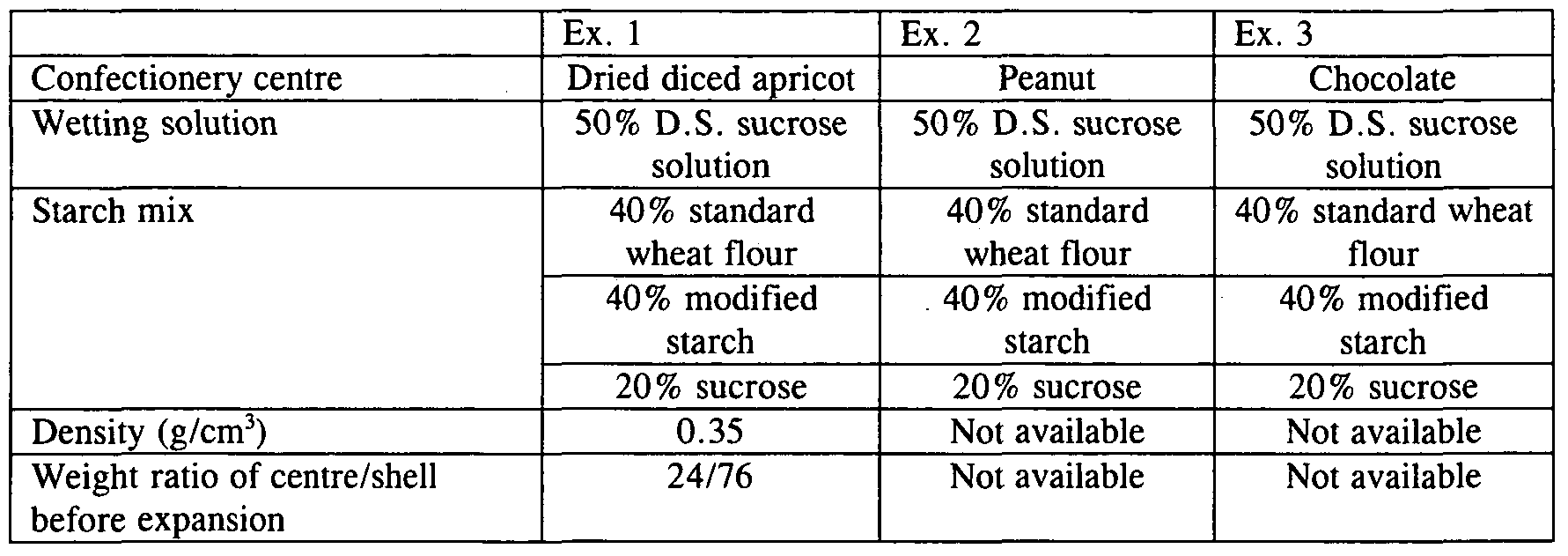
- a panning drum (capacity of 0.5 to 2kg) was rotated at approximately 200rpm and heated to approximately 30 0 C by applying a hair dryer to the outside of the drum.
- the confectionery centres were weighed and then added to the panning drum.
- Sufficient wetting solution was added to the confectionery centres in the panning drum to just cover (wet) the surfaces of the centres (approximately 0.3 g wetting solution per gram of confectionery centres).
- Powdered starch mix was then added to the wetted centres until all of the centres were lightly coated with the starch mix (approximately 1.3g starch mix per gram of wetting solution). Once the confectionery centres had one layer of wetting solution/starch mix coating, the process was repeated to build up additional layers.
- each confectionery centre was coated with 10 layers of wetting solution/ starch mix such that the weight ratio of centre to shell (wetting solution and starch mix) was from 20- 25 % centre to 75-80% shell. The coated confectionery centres were then transferred to an oven and baked for 10 to 15 minutes at 200 0 C.
- the apricot and peanut products (Ex. 1 and Ex. 2) are successful.
- the coating expands to provide an attractive baked product.
- the chocolate centre (Ex. 3) is heat sensitive and leaked out of the coating when heated in the oven at 200 0 C.
- Confectionery products were prepared using a starch mix comprising wheat flour and modified starch.
- the ratio of wheat flour to modified starch affected the expansion of the coating.
- Ex. 7 contains more modified starch than Ex. 6 and had greater and more homogeneous expansion than Ex. 6.
- Ex. 7 therefore has a lower density than Ex. 6.
- Ex. 8 expanded even more than Ex. 7 but the expansion was not homogeneous. A gap formed around the confectionery centre providing an interesting hollow effect. Ex. 8 had a density of just 0.19g/cm 3 . Ex. 9 was additionally enrobed with a dark compound coating. Ex. 10 was coated with an outer coat of standard wheat flour prior to expansion. The outer coat of standard wheat flour did not expand as much as the underlying layers that comprised modified starch thereby resulting in an attractive cracked effect in the final product.
Landscapes
- Life Sciences & Earth Sciences (AREA)
- Chemical & Material Sciences (AREA)
- Engineering & Computer Science (AREA)
- Food Science & Technology (AREA)
- Polymers & Plastics (AREA)
- Health & Medical Sciences (AREA)
- Nutrition Science (AREA)
- Confectionery (AREA)
Abstract
Description



Claims
Priority Applications (5)
| Application Number | Priority Date | Filing Date | Title |
|---|---|---|---|
| US12/865,141 US20110200714A1 (en) | 2008-01-30 | 2009-01-23 | Coated confectionery product |
| AU2009208850A AU2009208850B2 (en) | 2008-01-30 | 2009-01-23 | Coated confectionery product |
| PL09706653T PL2247193T3 (en) | 2008-01-30 | 2009-01-23 | Coated confectionery product |
| EP09706653.4A EP2247193B1 (en) | 2008-01-30 | 2009-01-23 | Coated confectionery product |
| ZA2010/05371A ZA201005371B (en) | 2008-01-30 | 2010-07-28 | Coated confectionery product |
Applications Claiming Priority (2)
| Application Number | Priority Date | Filing Date | Title |
|---|---|---|---|
| GBGB0801676.8A GB0801676D0 (en) | 2008-01-30 | 2008-01-30 | Coated confectionery composition |
| GB0801676.8 | 2008-01-30 |
Publications (2)
| Publication Number | Publication Date |
|---|---|
| WO2009095647A2 true WO2009095647A2 (en) | 2009-08-06 |
| WO2009095647A3 WO2009095647A3 (en) | 2009-10-15 |
Family
ID=39186571
Family Applications (1)
| Application Number | Title | Priority Date | Filing Date |
|---|---|---|---|
| PCT/GB2009/000198 Ceased WO2009095647A2 (en) | 2008-01-30 | 2009-01-23 | Coated confectionery product |
Country Status (7)
| Country | Link |
|---|---|
| US (1) | US20110200714A1 (en) |
| EP (1) | EP2247193B1 (en) |
| AU (1) | AU2009208850B2 (en) |
| GB (1) | GB0801676D0 (en) |
| PL (1) | PL2247193T3 (en) |
| WO (1) | WO2009095647A2 (en) |
| ZA (1) | ZA201005371B (en) |
Cited By (3)
| Publication number | Priority date | Publication date | Assignee | Title |
|---|---|---|---|---|
| NL2007111C2 (en) * | 2011-07-14 | 2013-01-15 | Qingdao Benecity Foods Co Ltd | Dried fruit product and method for preparing such a product. |
| US20150342215A1 (en) * | 2013-10-18 | 2015-12-03 | The Hershey Company | Dual textured confectionery product and method of making a dual textured confectionery product |
| WO2018067373A1 (en) | 2016-10-03 | 2018-04-12 | Mars, Incorporated | Legume-coated food products |
Families Citing this family (2)
| Publication number | Priority date | Publication date | Assignee | Title |
|---|---|---|---|---|
| MX2020004236A (en) * | 2020-04-23 | 2022-01-14 | Heat Control Inc | Method for preparing a multilayer-coated edible appetizer product. |
| CN118266567A (en) * | 2024-04-16 | 2024-07-02 | 洽洽食品股份有限公司 | Double-puffing-layer coated nut kernel and preparation method thereof |
Family Cites Families (11)
| Publication number | Priority date | Publication date | Assignee | Title |
|---|---|---|---|---|
| US3527646A (en) * | 1966-09-12 | 1970-09-08 | American Maize Prod Co | Method of coating foods with pregelatinized starch |
| JPS5320584B2 (en) * | 1973-11-13 | 1978-06-27 | ||
| US4161545A (en) * | 1978-05-16 | 1979-07-17 | Green William M | Honey coated roasted nut product and method for making same |
| JPS5851845A (en) * | 1981-08-26 | 1983-03-26 | Meiji Seika Kaisha Ltd | Preparation of expanded hollow cake |
| US4663175A (en) * | 1985-05-23 | 1987-05-05 | Seaboard Deluxe, Inc. | Method for making a flavored nut product |
| US4769248A (en) * | 1986-11-10 | 1988-09-06 | Nabisco Brands, Inc. | Coated, dry-roasted nuts and process |
| US5258187A (en) * | 1990-09-24 | 1993-11-02 | Seinosuke Shimada | Food coatingstuff |
| US5571546A (en) * | 1991-09-13 | 1996-11-05 | Ciracor Limited | Food product and method of making same |
| NL9300160A (en) * | 1993-01-27 | 1994-08-16 | Sara Lee De Nv | Process for the preparation of coated, expanded snack products. |
| US5433961A (en) * | 1993-02-16 | 1995-07-18 | The Procter & Gamble Company | Continuous preparation of non-aggregated edible cores with crisp farinaceous coatings |
| US7867537B2 (en) * | 2002-10-04 | 2011-01-11 | Kraft Foods Global Brands Llc | Production of snacks having an expanded, crispy, chip-like textured coating |
-
2008
- 2008-01-30 GB GBGB0801676.8A patent/GB0801676D0/en not_active Ceased
-
2009
- 2009-01-23 US US12/865,141 patent/US20110200714A1/en not_active Abandoned
- 2009-01-23 WO PCT/GB2009/000198 patent/WO2009095647A2/en not_active Ceased
- 2009-01-23 EP EP09706653.4A patent/EP2247193B1/en not_active Not-in-force
- 2009-01-23 PL PL09706653T patent/PL2247193T3/en unknown
- 2009-01-23 AU AU2009208850A patent/AU2009208850B2/en not_active Ceased
-
2010
- 2010-07-28 ZA ZA2010/05371A patent/ZA201005371B/en unknown
Non-Patent Citations (1)
| Title |
|---|
| None |
Cited By (8)
| Publication number | Priority date | Publication date | Assignee | Title |
|---|---|---|---|---|
| NL2007111C2 (en) * | 2011-07-14 | 2013-01-15 | Qingdao Benecity Foods Co Ltd | Dried fruit product and method for preparing such a product. |
| WO2013009176A1 (en) * | 2011-07-14 | 2013-01-17 | Qingdao Benecity Foods Co., Ltd. | Dried fruit product and method for preparing such a product |
| US20150342215A1 (en) * | 2013-10-18 | 2015-12-03 | The Hershey Company | Dual textured confectionery product and method of making a dual textured confectionery product |
| CN105658077A (en) * | 2013-10-18 | 2016-06-08 | 好时公司 | Dual textured confectionery product and method of making a dual textured confectionery product |
| WO2018067373A1 (en) | 2016-10-03 | 2018-04-12 | Mars, Incorporated | Legume-coated food products |
| CN110022683A (en) * | 2016-10-03 | 2019-07-16 | 马斯公司 | The food of beans coating |
| EP3518680A4 (en) * | 2016-10-03 | 2020-05-27 | Mars, Incorporated | FOOD PRODUCTS COATED WITH LEGUMES |
| EP4342302A3 (en) * | 2016-10-03 | 2024-04-24 | Mars Incorporated | Legume-coated food products |
Also Published As
| Publication number | Publication date |
|---|---|
| ZA201005371B (en) | 2011-04-28 |
| WO2009095647A3 (en) | 2009-10-15 |
| AU2009208850A1 (en) | 2009-08-06 |
| US20110200714A1 (en) | 2011-08-18 |
| EP2247193A2 (en) | 2010-11-10 |
| EP2247193B1 (en) | 2014-10-15 |
| AU2009208850B2 (en) | 2011-04-21 |
| GB0801676D0 (en) | 2008-03-05 |
| PL2247193T3 (en) | 2015-03-31 |
Similar Documents
| Publication | Publication Date | Title |
|---|---|---|
| AU745462B2 (en) | Coated confectionery having a crispy starch based center and method of preparation | |
| AU2011272861B2 (en) | Reduced sucrose sugar coatings for cereals and methods of preparation | |
| AU2004281528B2 (en) | Coated fat-based confectionery products | |
| EP1143809B1 (en) | Rte cereals coated with d-tagatose | |
| US10433574B2 (en) | Reduced sugar pre-sweetened breakfast cereals comprising tri- and tetra saccharides and methods of preparation | |
| AU2009208850B2 (en) | Coated confectionery product | |
| US20180242629A1 (en) | Protein-coated product and method of making protein-coated product | |
| EP2943074B1 (en) | Caramel, confection comprising the caramel and method of making the confection | |
| US20080213435A1 (en) | Soft sugar coating for a panning process | |
| JP4285413B2 (en) | Gummy candy | |
| CN117881290A (en) | Chocolate Products | |
| EP4646115A1 (en) | Food mix comprising at least two coated ingredients and its method of preparation | |
| EP4637389A1 (en) | Heat and humidity resistant aggregate food product | |
| US20120225165A1 (en) | Method for binding particulates to a snack base | |
| CN120548111A (en) | chocolate products | |
| MXPA01007097A (en) | Rte cereals and other foods presweetened with d tagatose |
Legal Events
| Date | Code | Title | Description |
|---|---|---|---|
| 121 | Ep: the epo has been informed by wipo that ep was designated in this application |
Ref document number: 09706653 Country of ref document: EP Kind code of ref document: A2 |
|
| WWE | Wipo information: entry into national phase |
Ref document number: 2708/KOLNP/2010 Country of ref document: IN |
|
| WWE | Wipo information: entry into national phase |
Ref document number: 2009208850 Country of ref document: AU |
|
| NENP | Non-entry into the national phase |
Ref country code: DE |
|
| ENP | Entry into the national phase |
Ref document number: 2009208850 Country of ref document: AU Date of ref document: 20090123 Kind code of ref document: A |
|
| WWE | Wipo information: entry into national phase |
Ref document number: 2009706653 Country of ref document: EP |
|
| WWE | Wipo information: entry into national phase |
Ref document number: 12865141 Country of ref document: US |