WO2009096375A1 - ポリオレフィン系グラフト共重合体を含有する水系分散体 - Google Patents
ポリオレフィン系グラフト共重合体を含有する水系分散体 Download PDFInfo
- Publication number
- WO2009096375A1 WO2009096375A1 PCT/JP2009/051242 JP2009051242W WO2009096375A1 WO 2009096375 A1 WO2009096375 A1 WO 2009096375A1 JP 2009051242 W JP2009051242 W JP 2009051242W WO 2009096375 A1 WO2009096375 A1 WO 2009096375A1
- Authority
- WO
- WIPO (PCT)
- Prior art keywords
- group
- aqueous dispersion
- graft copolymer
- carbon atoms
- mass
- Prior art date
- Legal status (The legal status is an assumption and is not a legal conclusion. Google has not performed a legal analysis and makes no representation as to the accuracy of the status listed.)
- Ceased
Links
Classifications
-
- C—CHEMISTRY; METALLURGY
- C08—ORGANIC MACROMOLECULAR COMPOUNDS; THEIR PREPARATION OR CHEMICAL WORKING-UP; COMPOSITIONS BASED THEREON
- C08F—MACROMOLECULAR COMPOUNDS OBTAINED BY REACTIONS ONLY INVOLVING CARBON-TO-CARBON UNSATURATED BONDS
- C08F2/00—Processes of polymerisation
- C08F2/12—Polymerisation in non-solvents
- C08F2/16—Aqueous medium
- C08F2/18—Suspension polymerisation
-
- C—CHEMISTRY; METALLURGY
- C08—ORGANIC MACROMOLECULAR COMPOUNDS; THEIR PREPARATION OR CHEMICAL WORKING-UP; COMPOSITIONS BASED THEREON
- C08F—MACROMOLECULAR COMPOUNDS OBTAINED BY REACTIONS ONLY INVOLVING CARBON-TO-CARBON UNSATURATED BONDS
- C08F110/00—Homopolymers of unsaturated aliphatic hydrocarbons having only one carbon-to-carbon double bond
- C08F110/04—Monomers containing three or four carbon atoms
- C08F110/06—Propene
-
- C—CHEMISTRY; METALLURGY
- C08—ORGANIC MACROMOLECULAR COMPOUNDS; THEIR PREPARATION OR CHEMICAL WORKING-UP; COMPOSITIONS BASED THEREON
- C08F—MACROMOLECULAR COMPOUNDS OBTAINED BY REACTIONS ONLY INVOLVING CARBON-TO-CARBON UNSATURATED BONDS
- C08F255/00—Macromolecular compounds obtained by polymerising monomers on to polymers of hydrocarbons as defined in group C08F10/00
- C08F255/02—Macromolecular compounds obtained by polymerising monomers on to polymers of hydrocarbons as defined in group C08F10/00 on to polymers of olefins having two or three carbon atoms
-
- C—CHEMISTRY; METALLURGY
- C09—DYES; PAINTS; POLISHES; NATURAL RESINS; ADHESIVES; COMPOSITIONS NOT OTHERWISE PROVIDED FOR; APPLICATIONS OF MATERIALS NOT OTHERWISE PROVIDED FOR
- C09D—COATING COMPOSITIONS, e.g. PAINTS, VARNISHES OR LACQUERS; FILLING PASTES; CHEMICAL PAINT OR INK REMOVERS; INKS; CORRECTING FLUIDS; WOODSTAINS; PASTES OR SOLIDS FOR COLOURING OR PRINTING; USE OF MATERIALS THEREFOR
- C09D11/00—Inks
- C09D11/02—Printing inks
- C09D11/03—Printing inks characterised by features other than the chemical nature of the binder
-
- C—CHEMISTRY; METALLURGY
- C09—DYES; PAINTS; POLISHES; NATURAL RESINS; ADHESIVES; COMPOSITIONS NOT OTHERWISE PROVIDED FOR; APPLICATIONS OF MATERIALS NOT OTHERWISE PROVIDED FOR
- C09D—COATING COMPOSITIONS, e.g. PAINTS, VARNISHES OR LACQUERS; FILLING PASTES; CHEMICAL PAINT OR INK REMOVERS; INKS; CORRECTING FLUIDS; WOODSTAINS; PASTES OR SOLIDS FOR COLOURING OR PRINTING; USE OF MATERIALS THEREFOR
- C09D151/00—Coating compositions based on graft polymers in which the grafted component is obtained by reactions only involving carbon-to-carbon unsaturated bonds; Coating compositions based on derivatives of such polymers
- C09D151/06—Coating compositions based on graft polymers in which the grafted component is obtained by reactions only involving carbon-to-carbon unsaturated bonds; Coating compositions based on derivatives of such polymers grafted on to homopolymers or copolymers of aliphatic hydrocarbons containing only one carbon-to-carbon double bond
-
- C—CHEMISTRY; METALLURGY
- C09—DYES; PAINTS; POLISHES; NATURAL RESINS; ADHESIVES; COMPOSITIONS NOT OTHERWISE PROVIDED FOR; APPLICATIONS OF MATERIALS NOT OTHERWISE PROVIDED FOR
- C09D—COATING COMPOSITIONS, e.g. PAINTS, VARNISHES OR LACQUERS; FILLING PASTES; CHEMICAL PAINT OR INK REMOVERS; INKS; CORRECTING FLUIDS; WOODSTAINS; PASTES OR SOLIDS FOR COLOURING OR PRINTING; USE OF MATERIALS THEREFOR
- C09D7/00—Features of coating compositions, not provided for in group C09D5/00; Processes for incorporating ingredients in coating compositions
- C09D7/40—Additives
- C09D7/45—Anti-settling agents
-
- C—CHEMISTRY; METALLURGY
- C09—DYES; PAINTS; POLISHES; NATURAL RESINS; ADHESIVES; COMPOSITIONS NOT OTHERWISE PROVIDED FOR; APPLICATIONS OF MATERIALS NOT OTHERWISE PROVIDED FOR
- C09J—ADHESIVES; NON-MECHANICAL ASPECTS OF ADHESIVE PROCESSES IN GENERAL; ADHESIVE PROCESSES NOT PROVIDED FOR ELSEWHERE; USE OF MATERIALS AS ADHESIVES
- C09J151/00—Adhesives based on graft polymers in which the grafted component is obtained by reactions only involving carbon-to-carbon unsaturated bonds; Adhesives based on derivatives of such polymers
- C09J151/06—Adhesives based on graft polymers in which the grafted component is obtained by reactions only involving carbon-to-carbon unsaturated bonds; Adhesives based on derivatives of such polymers grafted on to homopolymers or copolymers of aliphatic hydrocarbons containing only one carbon-to-carbon double bond
-
- C—CHEMISTRY; METALLURGY
- C08—ORGANIC MACROMOLECULAR COMPOUNDS; THEIR PREPARATION OR CHEMICAL WORKING-UP; COMPOSITIONS BASED THEREON
- C08F—MACROMOLECULAR COMPOUNDS OBTAINED BY REACTIONS ONLY INVOLVING CARBON-TO-CARBON UNSATURATED BONDS
- C08F210/00—Copolymers of unsaturated aliphatic hydrocarbons having only one carbon-to-carbon double bond
- C08F210/04—Monomers containing three or four carbon atoms
- C08F210/06—Propene
-
- C—CHEMISTRY; METALLURGY
- C08—ORGANIC MACROMOLECULAR COMPOUNDS; THEIR PREPARATION OR CHEMICAL WORKING-UP; COMPOSITIONS BASED THEREON
- C08F—MACROMOLECULAR COMPOUNDS OBTAINED BY REACTIONS ONLY INVOLVING CARBON-TO-CARBON UNSATURATED BONDS
- C08F2438/00—Living radical polymerisation
- C08F2438/03—Use of a di- or tri-thiocarbonylthio compound, e.g. di- or tri-thioester, di- or tri-thiocarbamate, or a xanthate as chain transfer agent, e.g . Reversible Addition Fragmentation chain Transfer [RAFT] or Macromolecular Design via Interchange of Xanthates [MADIX]
-
- C—CHEMISTRY; METALLURGY
- C08—ORGANIC MACROMOLECULAR COMPOUNDS; THEIR PREPARATION OR CHEMICAL WORKING-UP; COMPOSITIONS BASED THEREON
- C08F—MACROMOLECULAR COMPOUNDS OBTAINED BY REACTIONS ONLY INVOLVING CARBON-TO-CARBON UNSATURATED BONDS
- C08F4/00—Polymerisation catalysts
- C08F4/42—Metals; Metal hydrides; Metallo-organic compounds; Use thereof as catalyst precursors
- C08F4/44—Metals; Metal hydrides; Metallo-organic compounds; Use thereof as catalyst precursors selected from light metals, zinc, cadmium, mercury, copper, silver, gold, boron, gallium, indium, thallium, rare earths or actinides
- C08F4/60—Metals; Metal hydrides; Metallo-organic compounds; Use thereof as catalyst precursors selected from light metals, zinc, cadmium, mercury, copper, silver, gold, boron, gallium, indium, thallium, rare earths or actinides together with refractory metals, iron group metals, platinum group metals, manganese, rhenium technetium or compounds thereof
- C08F4/62—Refractory metals or compounds thereof
- C08F4/64—Titanium, zirconium, hafnium or compounds thereof
- C08F4/659—Component covered by group C08F4/64 containing a transition metal-carbon bond
- C08F4/65908—Component covered by group C08F4/64 containing a transition metal-carbon bond in combination with an ionising compound other than alumoxane, e.g. (C6F5)4B-X+
-
- C—CHEMISTRY; METALLURGY
- C08—ORGANIC MACROMOLECULAR COMPOUNDS; THEIR PREPARATION OR CHEMICAL WORKING-UP; COMPOSITIONS BASED THEREON
- C08F—MACROMOLECULAR COMPOUNDS OBTAINED BY REACTIONS ONLY INVOLVING CARBON-TO-CARBON UNSATURATED BONDS
- C08F4/00—Polymerisation catalysts
- C08F4/42—Metals; Metal hydrides; Metallo-organic compounds; Use thereof as catalyst precursors
- C08F4/44—Metals; Metal hydrides; Metallo-organic compounds; Use thereof as catalyst precursors selected from light metals, zinc, cadmium, mercury, copper, silver, gold, boron, gallium, indium, thallium, rare earths or actinides
- C08F4/60—Metals; Metal hydrides; Metallo-organic compounds; Use thereof as catalyst precursors selected from light metals, zinc, cadmium, mercury, copper, silver, gold, boron, gallium, indium, thallium, rare earths or actinides together with refractory metals, iron group metals, platinum group metals, manganese, rhenium technetium or compounds thereof
- C08F4/62—Refractory metals or compounds thereof
- C08F4/64—Titanium, zirconium, hafnium or compounds thereof
- C08F4/659—Component covered by group C08F4/64 containing a transition metal-carbon bond
- C08F4/65912—Component covered by group C08F4/64 containing a transition metal-carbon bond in combination with an organoaluminium compound
-
- Y—GENERAL TAGGING OF NEW TECHNOLOGICAL DEVELOPMENTS; GENERAL TAGGING OF CROSS-SECTIONAL TECHNOLOGIES SPANNING OVER SEVERAL SECTIONS OF THE IPC; TECHNICAL SUBJECTS COVERED BY FORMER USPC CROSS-REFERENCE ART COLLECTIONS [XRACs] AND DIGESTS
- Y10—TECHNICAL SUBJECTS COVERED BY FORMER USPC
- Y10T—TECHNICAL SUBJECTS COVERED BY FORMER US CLASSIFICATION
- Y10T428/00—Stock material or miscellaneous articles
- Y10T428/31504—Composite [nonstructural laminate]
- Y10T428/31551—Of polyamidoester [polyurethane, polyisocyanate, polycarbamate, etc.]
- Y10T428/31616—Next to polyester [e.g., alkyd]
-
- Y—GENERAL TAGGING OF NEW TECHNOLOGICAL DEVELOPMENTS; GENERAL TAGGING OF CROSS-SECTIONAL TECHNOLOGIES SPANNING OVER SEVERAL SECTIONS OF THE IPC; TECHNICAL SUBJECTS COVERED BY FORMER USPC CROSS-REFERENCE ART COLLECTIONS [XRACs] AND DIGESTS
- Y10—TECHNICAL SUBJECTS COVERED BY FORMER USPC
- Y10T—TECHNICAL SUBJECTS COVERED BY FORMER US CLASSIFICATION
- Y10T428/00—Stock material or miscellaneous articles
- Y10T428/31504—Composite [nonstructural laminate]
- Y10T428/31678—Of metal
- Y10T428/31681—Next to polyester, polyamide or polyimide [e.g., alkyd, glue, or nylon, etc.]
-
- Y—GENERAL TAGGING OF NEW TECHNOLOGICAL DEVELOPMENTS; GENERAL TAGGING OF CROSS-SECTIONAL TECHNOLOGIES SPANNING OVER SEVERAL SECTIONS OF THE IPC; TECHNICAL SUBJECTS COVERED BY FORMER USPC CROSS-REFERENCE ART COLLECTIONS [XRACs] AND DIGESTS
- Y10—TECHNICAL SUBJECTS COVERED BY FORMER USPC
- Y10T—TECHNICAL SUBJECTS COVERED BY FORMER US CLASSIFICATION
- Y10T428/00—Stock material or miscellaneous articles
- Y10T428/31504—Composite [nonstructural laminate]
- Y10T428/31855—Of addition polymer from unsaturated monomers
- Y10T428/31938—Polymer of monoethylenically unsaturated hydrocarbon
-
- Y—GENERAL TAGGING OF NEW TECHNOLOGICAL DEVELOPMENTS; GENERAL TAGGING OF CROSS-SECTIONAL TECHNOLOGIES SPANNING OVER SEVERAL SECTIONS OF THE IPC; TECHNICAL SUBJECTS COVERED BY FORMER USPC CROSS-REFERENCE ART COLLECTIONS [XRACs] AND DIGESTS
- Y10—TECHNICAL SUBJECTS COVERED BY FORMER USPC
- Y10T—TECHNICAL SUBJECTS COVERED BY FORMER US CLASSIFICATION
- Y10T428/00—Stock material or miscellaneous articles
- Y10T428/31504—Composite [nonstructural laminate]
- Y10T428/31971—Of carbohydrate
- Y10T428/31989—Of wood
Definitions
- the present invention relates to an aqueous dispersion, and more particularly, to an aqueous dispersion containing a specific polyolefin graft copolymer.
- Polyolefins such as propylene-based resins are widely used in industrial parts because they have various excellent performances.
- the design property and added value are improved by giving the surface the coating or forming other resin layers.
- polyolefin has a drawback that it does not have a polar group in the molecule and therefore has a low polarity and low adhesion to a coating film or another resin layer.
- the surface of the molded body is chemically treated, or the surface is oxidized using techniques such as corona discharge treatment, plasma treatment, flame treatment, etc., to improve paintability and adhesion performance Has been tried.
- these methods require not only special equipment, but also the effect of improving paintability and adhesion performance.
- the surface of the molded body is treated with a primer or the like.
- a method was used.
- many of the conventional primers and paints use an organic solvent, causing problems in terms of environment and safety. For this reason, the primer or paint is required to be changed from an organic solvent system to an aqueous system, and the development of an aqueous dispersion is important.
- Patent Document 1 discloses an aqueous dispersion composition obtained by dispersing a uniform kneaded material composed of crystalline polypropylene, a dispersant, and water in water.
- Patent Document 2 discloses an emulsion containing a high molecular weight polyolefin modified with an acid group, a fatty acid, a base, a surfactant, and water.
- Patent Document 3 discloses a method for producing an emulsion of a specific polyolefin, which uses a styrene-maleic anhydride copolymer or the like as a polymer dispersant.
- Patent Document 4 discloses a sizing agent for inorganic fibers composed of an aqueous emulsion containing a polypropylene resin modified with an unsaturated dicarboxylic acid or a salt thereof as an essential component.
- Patent Document 5 discloses an aqueous dispersion containing an acid-modified polyolefin resin having specific properties.
- Patent Document 6 discloses an aqueous resin dispersion containing particles containing a specific propylene polymer and particles made of a specific resin.
- Patent Documents 7 and 8 disclose aqueous dispersions containing a propylene polymer or a modified propylene polymer having a specific stereoregularity.
- aqueous dispersions As described above, various technologies have been developed for aqueous dispersions so far, but considering the recent increase in performance required for aqueous dispersions, further performance enhancement is required.
- it is important that the aqueous dispersion is excellent in performance relating to the aqueous dispersion such as stability and dispersibility, and at the same time, in each application such as a paint and an adhesive.
- the present invention was made in such a situation, shows excellent water dispersibility even in a state where the surfactant is reduced, and has excellent affinity with a binder resin, pigment, etc., such as a paint, an adhesive, etc.
- An object of the present invention is to develop a graft copolymer satisfying the required performance and to provide an aqueous dispersion containing the graft copolymer.
- a graft copolymer in which the main chain is a polymer chain containing a monomer unit having a hydrophilic group and the side chain is a specific polyolefin chain has a polyolefin chain Since it is sufficiently long, it has a high affinity with polyolefin as a base material, and since it has a high hydrophilic group content, it has a characteristic of high affinity with polar substances, and contains the graft copolymer and water. It has been found that the above object can be achieved by the aqueous dispersion.
- the present invention has been completed based on such knowledge. That is, the present invention provides the following aqueous dispersions.
- the side chain is a single homopolymer chain selected from ⁇ -olefins having 3 to 28 carbon atoms, or two or more kinds A copolymer chain or a copolymer chain consisting of an ethylene unit and an ⁇ -olefin unit having 3 to 28 carbon atoms and having an ethylene unit of 50% by mass or less and a mesopentad fraction [mmmm] of 30 to 80 mol% Polymer chain
- the graft copolymer is formed by a copolymerization reaction between a reactive polyolefin satisfying the
- E 1 and E 2 represent a cyclopentadienyl group, a substituted cyclopentadienyl group, an indenyl group, a substituted indenyl group, a heterocyclopenta, respectively.
- a ligand selected from a dienyl group, a substituted heterocyclopentadienyl group, an amide group, a phosphine group, a hydrocarbon group, and a silicon-containing group is shown, and a crosslinked structure is formed through A 1 and A 2. ing.
- E 1 and E 2 may be the same or different from each other, and at least one of E 1 and E 2 is a cyclopentadienyl group, a substituted cyclopentadienyl group, an indenyl group or a substituted indenyl group. is there.
- X represents a ⁇ -bonding ligand, and when there are a plurality of Xs, the plurality of Xs may be the same or different, and may be cross-linked with other X, E 1 , E 2 or Y.
- Y represents a Lewis base, and when there are a plurality of Ys, the plurality of Ys may be the same or different, and may be cross-linked with other Y, E 1 , E 2 or X.
- a 1 and A 2 are divalent bridging groups for linking two ligands, which are a hydrocarbon group having 1 to 20 carbon atoms, a halogen-containing hydrocarbon group having 1 to 20 carbon atoms, a silicon-containing group, germanium -Containing group, tin-containing group, -O-, -CO-, -S-, -SO 2- , -Se-, -NR 1- , -PR 1- , -P (O) R 1- , -BR 1 — Or —AlR 1 —, wherein R 1 represents a hydrogen atom, a halogen atom, a hydrocarbon group having 1 to 20 carbon atoms or a halogen-containing hydrocarbon group having 1 to 20 carbon atoms, which are the same or different from each other.
- q represents an integer of 1 to 5 and represents [(M valence) -2], and r represents an integer of 0 to 3.
- the hydrophilic group is a substituent selected from an acid anhydride residue, a carboxyl group, a hydroxyl group, an amide group, an amino group, a pyridyl group, and a group having a polyalkylene glycol structure, according to (1) above.
- Aqueous dispersions (6)
- the monomer unit having a hydrophilic group in the main chain of the graft copolymer is [I] acrylic acid and its derivative, [II] methacrylic acid and its derivative, [III] vinyl ester and its derivative
- a monomer unit having a hydrophilic group in the main chain of the graft copolymer derived from one or more monomers selected from the following group A and one or more monomers selected from the following group B
- the main chain is a polymer chain containing a monomer unit having a hydrophilic group
- the side chain is a specific polyolefin chain
- the polyolefin chain is sufficiently
- a long graft copolymer having a large hydrophilic group content and an aqueous dispersion containing the graft copolymer and water are obtained.
- the aqueous dispersion has a small dispersed particle size and high storage stability. Moreover, even if the amount of the surfactant is reduced, it has sufficient water dispersibility, so that it is possible to avoid performance degradation in adhesives, paints and the like.
- the dispersibility of the binder resin, the pigment and the filler can be improved, and the coating film performance (adhesive force, appearance, smoothness, color unevenness, etc.) when polypropylene or the like is used as a base material can be improved.
- the aqueous dispersion of the present invention is an aqueous dispersion containing a graft copolymer in which the main chain contains a monomer unit having a hydrophilic group and the side chain is a specific polyolefin chain and water. It is.
- the graft copolymer can be obtained by performing a graft copolymerization reaction using a specific reactive polyolefin.
- reactive polyolefin refers to a polyolefin that efficiently forms a graft copolymer with a radical initiator, specifically, 0.5 terminal unsaturated groups per molecule. It refers to the polyolefin having the above.
- the main chain of the graft copolymer contains a monomer unit having a hydrophilic group.
- the hydrophilic group include an acid anhydride residue, a carboxyl group (in this specification, “carboxyl group” includes a deprotonated carboxylate ion), a hydroxyl group, an amide group, an amino group, a pyridyl group, And a group having a polyalkylene glycol structure.
- the amount of monomer units having a hydrophilic group relative to the total amount of monomer units in the main chain is preferably 40 mol% or more, more preferably 50 mol% or more. By being 40 mol% or more, water dispersibility is improved, and when an aqueous dispersion is used as an adhesive or a paint component, affinity for a polar substance is improved.
- the side chain of the graft copolymer is a single homopolymer chain selected from ⁇ -olefins having 3 to 28 carbon atoms, or two or more copolymer chains, or an ethylene unit of 50% by mass or less and 3 to 3 carbon atoms. It is a copolymer chain composed of 28 ⁇ -olefin units and ethylene units.
- Examples of the ⁇ -olefin having 3 to 28 carbon atoms include propylene, 1-butene, 1-pentene, 4-methylpentene-1, 1-hexene, 1-octene, 1-decene, 1-undecene, 1-dodecene, -Tridecene, 1-tetradecene, 1-pentadecene, 1-hexadecene, 1-heptadecene, 1-octadecene, 1-nonadecene, 1-icocene and the like.
- the side chain of the graft copolymer is a polymer chain having a mesopentad fraction [mmmm] of 30 to 80 mol%.
- the mesopentad fraction [mmmm] is preferably 30 to 75 mol%, more preferably 32 to 70 mol%.
- the mesopentad fraction of the side chain of the graft copolymer can be known from the stereoregularity of the reactive polyolefin used in the production.
- stereoregularity of the methyl group, methine group, and methylene group derived from the reactive polyolefin of the graft copolymer can be determined by NMR analysis described later. Further, after the graft copolymer is thermally decomposed in a nitrogen atmosphere, the fragments forming the side chains are collected and measured by NMR.
- the graft ratio of the graft copolymer is 1 to 150% by mass, preferably 2 to 130% by mass, more preferably 5 to 100% by mass.
- the graft ratio of the graft copolymer is measured as follows. Used as a raw material with the mass (W2) of the monomer polymer forming the main chain that did not participate in the graft copolymerization reaction with the solvent, and the insoluble graft copolymer component dissolved and removed from the soluble polymer component.
- the graft copolymer has a weight average molecular weight of 500 to 400,000.
- the lower limit is preferably 1000, more preferably 2000, still more preferably 5000, most preferably 10,000, and the upper limit is preferably 350,000, more preferably 300,000, still more preferably 250,000, and most preferably 2000000. If the weight average molecular weight is less than 500, the adhesive strength is lowered, causing problems in use in adhesives, paints, and the like. This causes problems during heat fusion.
- the molecular weight distribution (Mw / Mn) of the graft copolymer is 1.5 to 4, preferably 1.55 to 3, and more preferably 1.6 to 2.5.
- a gel permeation chromatography (GPC) method can be used as follows.
- the molecular weight distribution (Mw / Mn) can be determined by measuring the weight average molecular weight (Mw) and the number average molecular weight (Mn) by the GPC method with the following apparatus and conditions.
- GPC measuring device Detector RI detector for liquid chromatography Waters 150C Column: TOSO GMHHR-H (S) HT Measurement conditions
- Solvent 1,2,4-trichlorobenzene Measurement temperature: 145 ° C
- Flow rate 1.0 ml / min
- Sample concentration 0.3% by mass
- the weight average molecular weight (Mw) and the number average molecular weight (Mn) were determined by the Universal Calibration method using the constants K and ⁇ of the Mark-Houwink-Sakurada equation in order to convert the polystyrene-equivalent molecular weight into the molecular weight of the corresponding polymer.
- the graft copolymer preferably has an intrinsic viscosity [ ⁇ ] measured at 135 ° C. in decalin of 0.01 to 2.5 dl / g, more preferably 0.02 to 2.2, and even more preferably 0.05 to 2.0.
- the intrinsic viscosity [ ⁇ ] is 0.01 dl / g or more, functions such as resin compatibilization are improved, and when it is 2.5 dl / g or less, dispersibility in the resin is improved.
- the graft copolymer does not contain a gel component.
- Reduction of the gel component is a reactive polyolefin with a high amount of terminal unsaturated groups, which uses a reactive polyolefin that does not substantially contain molecules having unsaturated groups at both ends, and efficiently performs a graft polymerization reaction. Achieved. (Method for measuring gel components) Using a solvent that dissolves both the main chain and side chain components of the graft copolymer, the graft is made of a stainless steel 400 mesh (opening 0.034 mm) net in a glass separable flask equipped with a stirrer. Add 50 mg of copolymer and fix to a stirring blade.
- a solvent containing 0.1% by mass of an antioxidant (BHT) is added and dissolved with stirring at the boiling point for 4 hours. After dissolution, the collected soot is sufficiently dried in vacuum, and the insoluble part is determined by weighing.
- the gel component defined as the insoluble part is calculated by the following formula. [Remaining amount in mesh (g) / Amount of charged sample (g)] ⁇ 100 (unit:%)
- the solvent include paraxylene and toluene. Usually, in the above formula, it is defined that the gel component is not included with a range of 0 to 1.5 mass%.
- the graft copolymer can be produced by polymerization using a monomer that forms a main chain with a specific reactive polyolefin.
- the reactive polyolefin used in the present invention is a homopolymer or two or more copolymers selected from ⁇ -olefins having 3 to 28 carbon atoms, or ethylene having 50% by mass or less and 3 to 3 carbon atoms. It is a copolymer of ethylene with at least one monomer selected from 28 ⁇ -olefins, having a mesopentad fraction [mmmm] of 30 to 80 mol%, and the amount of terminal unsaturated groups per molecule is 0.
- the reactive polyolefin is 5 to 1.0.
- the mesopentad fraction [mmmm] is preferably 30 to 75 mol%, more preferably 32 to 70 mol%.
- stereoregularity is determined as follows.
- the mesopentad fraction [mmmm], the racemic pentad fraction [rrrr] and the racemic mesoracemi meso fraction [rmrm] described below are described in “Macromolecules, 6, 925 (1973)” by A. Zambelli and others.
- the meso fraction, the racemic fraction and the racemic meso-racemic meso fraction in the pentad unit in the polypropylene molecular chain measured by the methyl group signal of the 13 C-NMR spectrum in accordance with the method proposed in (1).
- the mesopentad fraction [mmmm] increases, the stereoregularity increases.
- the 13 C-NMR spectrum can be measured by the following apparatus and conditions in accordance with the assignment of the peak proposed in “Macromolecules, 8, 687 (1975)” by A. Zambelli and the like. it can. Further, the mesotriad fraction [mm], the racemic triad fraction [rr] and the mesoracemi fraction [mr] described later were also calculated by the above method.
- Apparatus JNM-EX400 type 13 C-NMR apparatus manufactured by JEOL Ltd.
- Method Proton complete decoupling method Concentration: 220 mg / ml
- Solvent 90:10 (volume ratio) mixed solvent of 1,2,4-trichlorobenzene and heavy benzene Temperature: 130 ° C Pulse width: 45 ° Pulse repetition time: 4 seconds Integration: 10,000 times
- stereoregularity is determined as follows.
- the mesopentad fraction (mmmm) and abnormal insertion content (1,4 insertion fraction) were reported in “Polymer Journal, 16, 717 (1984)”, J. Asakura et al. “Macromol. Chem. Phys., C29, 201 (1989)” reported by Randall et al. It was determined according to the method proposed in “Macromol. Chem. Phys., 198, 1257 (1997)” reported by Busico et al.
- the signals of methylene group and methine group were measured using 13 C nuclear magnetic resonance spectrum to determine the mesopentad fraction and abnormal insertion content in the poly (1-butene) molecule.
- the 13 C nuclear magnetic resonance spectrum was measured using the apparatus and conditions described above.
- the stereoregularity index ⁇ (mmmm) / (mmrr + rmmr) ⁇ was calculated from the values obtained by measuring (mmmm), (mmrr) and (rmmr) by the above method.
- the racemic triad fraction (rr) can also be calculated by the above method.
- the 1-butene homopolymer and copolymer have a stereoregularity index ⁇ (mmmm) / (mmrr + rmmr) ⁇ of 20 or less, preferably 18 or less, more preferably 15 or less. When the stereoregularity index exceeds 20, the flexibility is lowered.
- stereoregularity is determined as follows.
- This stereoregularity index value M 2 is equal to T.P. Asakura, M .; Demura, Y .; It was determined in accordance with the method proposed in “Macromolecules, 24, 2334 (1991)” reported by Nishiyama. That is, M 2 can be obtained by utilizing the fact that the CH 2 carbon at the ⁇ -position of the side chain derived from the higher ⁇ -olefin is split and observed in the 13 C NMR spectrum, reflecting the difference in stereoregularity. it can.
- This M 2 can be replaced with the mesopentad fraction [mmmm] in the present invention.
- the reactive polyolefin has 0.5 to 1.0, preferably 0.6 to 1.0, more preferably 0.7 to 1.0, more preferably, terminal unsaturated groups per molecule. 0.8 to 1.0, more preferably 0.82 to 1.0, still more preferably 0.85 to 1.0, and most preferably 0.90 to 1.0.
- the terminal unsaturated group is preferably a vinylidene group, and the vinylidene group occupying the terminal unsaturated group is usually 50 to 100 mol%, preferably 60 to 100 mol%, more preferably 70 to 100 mol%, still more preferably. 80 to 100 mol%.
- the reactive polyolefin used in the present invention contains substantially no component having two or more unsaturated groups per molecule, for example, a component containing unsaturated groups at both ends.
- a component having two or more unsaturated groups per molecule acts as a so-called cross-linking agent, and therefore is not preferable because a cross-linked structure (H type) is formed during graft polymerization and a gel component is by-produced. Therefore, unsaturated polypropylene produced by pyrolysis cannot be used.
- the terminal unsaturated group is measured by an infrared absorption spectrum method, a nuclear magnetic resonance spectrum method, a bromination method, or the like, and can be measured by any method.
- the infrared absorption spectrum method can be performed in accordance with the method described in “New Edition Polymer Analysis Handbook, Japan Analytical Chemistry Society, Polymer Analysis Research Council”. According to it, in the method for quantifying terminal unsaturated group by infrared absorption spectrum method, a vinyl group, a vinylidene group, unsaturated group, such as trans (vinylene) group, respectively, of the infrared absorption spectrum 910 cm -1, 888 cm -1 , From the absorption at 963 cm ⁇ 1 .
- the quantitative determination of vinylidene unsaturated groups by nuclear magnetic resonance spectroscopy is performed as follows.
- the number when the terminal unsaturated group is a vinylidene group can be determined by 1 H-NMR measurement according to a conventional method. Based on the vinylidene group appearing at ⁇ 4.8 to 4.6 (2H) obtained from 1 H-NMR measurement, the content (C) (mol%) of vinylidene group is calculated by a conventional method. Furthermore, the number of vinylidene groups per molecule is calculated from the number average molecular weight (Mn) and monomer molecular weight (M) determined by gel permeation chromatography (GPC) according to the following formula.
- Terminal vinylidene groups per molecule (pieces) (Mn / M) ⁇ (C / 100)
- Terminal vinylidene group amount (A) ([2] / 2) / [([3] + 4 ⁇ [1] / 2 + 3 ⁇ [2] / 2) / 6] ⁇ 100 Unit: mol%
- Terminal vinyl group amount (B) ([1] / 2) / [([3] + 4 ⁇ [1] / 2 + 3 ⁇ [2] / 2) / 6] ⁇ 100 Unit: mol% (Analysis of terminal fraction by 13 C-NMR)
- the propylene polymer of the present application is [5] terminal methyl group (near 14.5 ppm) of n-propyl terminal, [6] terminal methyl group (near 14.0 ppm) of n-butyl terminal, [4] methine of iso-butyl terminal Groups (around 25.9 ppm), [7] methylene groups at the vinylidene terminal (around 111.7 ppm) are observed.
- the total concentration (T) of the end groups is expressed as follows.
- the number of terminal vinylidene groups per molecule is 2 ⁇ (C) / 100 units: pieces / molecule.
- the reactive polyolefin has a molecular weight distribution (Mw / Mn) of preferably 4 or less, more preferably 3.5 or less, more preferably 3 or less, and still more preferably 2.5 or less.
- the molecular weight distribution is preferably as narrow as possible. This is because the reactive polyolefin forms a chain in the graft copolymer used in the present invention, so that there is little variation in the side chain length (chain length) and the structure of the graft copolymer is controlled. This is because a polymer is formed.
- the molecular weight distribution can be measured using the method described in the production of the graft copolymer.
- the reactive polyolefin has an intrinsic viscosity [ ⁇ ] measured at 135 ° C. in decalin of 0.01 to 2.5 dl / g, preferably 0.05 to 2.5, more preferably 0.05 to 2.0. More preferably, it is 0.1 to 2.0, and most preferably 0.15 to 1.8 dl / g.
- the intrinsic viscosity [ ⁇ ] is within the above range, the polyolefin side chain length (chain length) of the graft copolymer is sufficient, and functions such as compatibilization are sufficiently exhibited.
- the concentration of terminal unsaturated groups is high during graft polymerization, radical polymerizability increases.
- the intrinsic viscosity [ ⁇ ] is calculated by measuring the reduced viscosity ( ⁇ SP / c) in decalin at 135 ° C. with an Ubbelohde viscometer and using the following general formula (Haggins formula).
- the reactive polyolefin preferably satisfies the following formula. Racemic meso racemic meso fraction [rmrm]> 2.5 mol% When the racemic meso racemic meso fraction [rmrm] of the reactive polyolefin exceeds 2.5 mol%, the randomness increases and the transparency is further improved.
- the melting point (Tm, unit: ° C.) and [mmmm] observed by a differential scanning calorimeter (DSC) satisfy the following relationship. 1.76 [mmmm] -25.0 ⁇ Tm ⁇ 1.76 [mmmm] +5.0
- the above relational expression of the melting point (Tm, unit: ° C.) and [mmmm] observed with a differential scanning calorimeter (DSC) represents the uniformity of the mesopentad fraction of the reactive polyolefin.
- the stereoregularity of the reactive polyolefin is high, that is, when the stereoregularity distribution is narrow, this indicates that the uniformity of the side chain of the graft copolymer is high and the compatibility with the polypropylene resin and the like is high.
- compatibility with a polypropylene resin or the like is lowered, which is not preferable.
- the above [mmmm] is measured as an average value, and it is not possible to clearly distinguish between a case where the stereoregularity distribution is wide and a case where the stereoregularity distribution is narrow, but as described above, the relationship with the melting point (Tm) is specified.
- Tm melting point
- a preferable highly uniform reactive propylene-based copolymer can be defined.
- the melting point (Tm) is determined by DSC measurement. 10 mg of a sample was heated from 25 ° C. to 220 ° C. at 320 ° C./min in a nitrogen atmosphere, held at 220 ° C. for 5 minutes, then cooled to 25 ° C. at 320 ° C./min, and held at 25 ° C. for 50 minutes. And it heated up from 25 degreeC to 220 degreeC at 10 degree-C / min. The peak top of the endothermic peak observed on the highest temperature side of the melting heat absorption curve detected during the temperature rising process was defined as the melting point (Tm).
- the reactive polyolefin further satisfies the following regulations.
- stickiness is suppressed.
- [Mm] ⁇ [rr] / [mr] 2 is preferably in the range of 1.8 to 0.5, more preferably 1.5 to 0.5. 20 ⁇ component amount eluting at 25 ° C.
- the component amount (W25) of the reactive polyolefin eluted at 25 ° C. or lower in the temperature rising chromatography is preferably 30 to 100% by mass, more preferably 50 to 100% by mass.
- W25 is an index indicating whether or not the reactive polyolefin is soft, and when this value is small, a component having a high elastic modulus is increased or the nonuniformity of the mesopentad fraction [mmmm] is widened.
- flexibility is maintained as W25 is 20 mass% or more. Note that W25 is not adsorbed by the packing material at a column temperature of 25 ° C. of TREF (temperature rising elution fractionation) in an elution curve obtained by measurement by temperature rising chromatography with the following operation method, apparatus configuration and measurement conditions. Is the amount (% by mass) of the component eluted at
- the reactive polyolefin of the present invention is preferably produced by a metallocene catalyst.
- the metallocene catalyst includes (A) a transition metal compound comprising a metal element of 3 to 10 in the periodic table having a cyclopentadienyl group, a substituted cyclopentadienyl group, an indenyl group, a substituted indenyl group, and the like, and (B) a transition metal compound.
- the catalyst include a compound that can react with a metal compound to form an ionic complex and can generate a terminal unsaturated group.
- transition metal compound examples include compounds composed of biscyclopentadienyl ligands such as zirconocene chloride and pentamethylcyclopentadienylzirconium dichloride, ethylenebisindenylzirconium dichloride, dimethylsilylene-bis- [2-methyl-4- Compound consisting of a bridged indenyl ligand such as phenylindenyl] zirconium dichloride, dimethylsilylene-bis- [2-methyl-4,5-benzoindenyl] zirconium dichloride, pentamethylcyclopentadienyltrimethoxytitanium, pentamethyl A compound comprising a monocyclopentadienyl ligand such as cyclopentadienyltrichlorotitanium, dichloro [dimethylsilylene (cyclopentadienyl) (2,4-dimethyl-4H-1-azurenyl)] Funium, dichloro [dimethyl
- M represents a metal element of Groups 3 to 10 of the periodic table, and specific examples include titanium, zirconium, hafnium, yttrium, vanadium, chromium, manganese, nickel, cobalt, palladium, and lanthanoid series. A metal etc. are mentioned. Among these, titanium, zirconium and hafnium are preferable from the viewpoint of olefin polymerization activity and the like, and zirconium is most preferable from the viewpoint of yield of terminal vinylidene group and catalytic activity.
- E 1 and E 2 are respectively substituted cyclopentadienyl group, indenyl group, substituted indenyl group, heterocyclopentadienyl group, substituted heterocyclopentadienyl group, amide group (—N ⁇ ), phosphine group (—P ⁇ ), Hydrocarbon group [>CR-,> C ⁇ ] and silicon-containing group [>SiR-,> Si ⁇ ] (where R is hydrogen, a hydrocarbon group having 1 to 20 carbon atoms, or a heteroatom-containing group)
- a ligand selected from among (A) A ligand selected from among (A), and a crosslinked structure is formed via A 1 and A 2 .
- E 1 and E 2 may be the same or different from each other.
- a cyclopentadienyl group, a substituted cyclopentadienyl group, an indenyl group and a substituted indenyl group are preferable, and at least one of E 1 and E 2 is a cyclopentadienyl group, A substituted cyclopentadienyl group, an indenyl group or a substituted indenyl group;
- X represents a ⁇ -bonding ligand, and when there are a plurality of Xs, the plurality of Xs may be the same or different, and may be cross-linked with other X, E 1 , E 2 or Y.
- X include a halogen atom, a hydrocarbon group having 1 to 20 carbon atoms, an alkoxy group having 1 to 20 carbon atoms, an aryloxy group having 6 to 20 carbon atoms, an amide group having 1 to 20 carbon atoms, carbon Examples thereof include a silicon-containing group having 1 to 20 carbon atoms, a phosphide group having 1 to 20 carbon atoms, a sulfide group having 1 to 20 carbon atoms, and an acyl group having 1 to 20 carbon atoms.
- the halogen atom include a chlorine atom, a fluorine atom, a bromine atom, and an iodine atom.
- hydrocarbon group having 1 to 20 carbon atoms include alkyl groups such as methyl group, ethyl group, propyl group, butyl group, hexyl group, cyclohexyl group, octyl group; vinyl group, propenyl group, cyclohexenyl group, etc.
- An arylalkyl group such as benzyl group, phenylethyl group, phenylpropyl group; phenyl group, tolyl group, dimethylphenyl group, trimethylphenyl group, ethylphenyl group, propylphenyl group, biphenyl group, naphthyl group, methylnaphthyl group Group, anthracenyl group, aryl group such as phenanthonyl group, and the like.
- alkyl groups such as methyl group, ethyl group, and propyl group
- aryl groups such as phenyl group are preferable.
- alkoxy group having 1 to 20 carbon atoms examples include alkoxy groups such as methoxy group, ethoxy group, propoxy group, and butoxy group, phenylmethoxy group, and phenylethoxy group.
- aryloxy group having 6 to 20 carbon atoms examples include phenoxy group, methylphenoxy group, and dimethylphenoxy group.
- amide group having 1 to 20 carbon atoms include dimethylamide group, diethylamide group, dipropylamide group, dibutylamide group, dicyclohexylamide group, methylethylamide group, and other alkylamide groups, divinylamide group, and dipropenylamide group.
- alkenylamide groups such as dicyclohexenylamide group; arylalkylamide groups such as dibenzylamide group, phenylethylamide group and phenylpropylamide group; arylamide groups such as diphenylamide group and dinaphthylamide group.
- Examples of the silicon-containing group having 1 to 20 carbon atoms include monohydrocarbon-substituted silyl groups such as methylsilyl group and phenylsilyl group; dihydrocarbon-substituted silyl groups such as dimethylsilyl group and diphenylsilyl group; trimethylsilyl group, triethylsilyl group, Trihydrocarbon-substituted silyl groups such as tripropylsilyl group, tricyclohexylsilyl group, triphenylsilyl group, dimethylphenylsilyl group, methyldiphenylsilyl group, tolylsilylsilyl group and trinaphthylsilyl group; hydrocarbons such as trimethylsilyl ether group Examples thereof include substituted silyl ether groups; silicon-substituted alkyl groups such as trimethylsilylmethyl group; silicon-substituted aryl groups such as trimethylsilylpheny
- Examples of the phosphide group having 1 to 20 carbon atoms include dialkyl phosphide groups, diethyl phosphide groups, dipropyl phosphide groups, dibutyl phosphide groups, dihexyl phosphide groups, dicyclohexyl phosphide groups, and dioctyl phosphide groups.
- a diaryl phosphide group such as a dibenzyl phosphide group, a diphenyl phosphide group, and a dinaphthyl phosphide group.
- Examples of the sulfide group having 1 to 20 carbon atoms include alkyl sulfide groups such as methyl sulfide group, ethyl sulfide group, propyl sulfide group, butyl sulfide group, hexyl sulfide group, cyclohexyl sulfide group, octyl sulfide group; vinyl sulfide group, propenyl sulfide Group, alkenyl sulfide group such as cyclohexenyl sulfide group; arylalkyl sulfide group such as benzyl sulfide group, phenylethyl sulfide group, phenylpropyl sulfide group; phenyl sulfide group, tolyl sulfide group, dimethylphenyl sulfide group, trimethylphenyl sulfide group, E
- acyl group having 1 to 20 carbon atoms examples include formyl group, acetyl group, propionyl group, butyryl group, valeryl group, palmitoyl group, thearoyl group, oleoyl group and other alkyl acyl groups, benzoyl group, toluoyl group, salicyloyl group, Examples thereof include arylacyl groups such as cinnamoyl group, naphthoyl group and phthaloyl group, and oxalyl group, malonyl group and succinyl group respectively derived from dicarboxylic acid such as oxalic acid, malonic acid and succinic acid.
- Y represents a Lewis base, and when there are a plurality of Y, the plurality of Y may be the same or different, and may be cross-linked with other Y, E 1 , E 2 or X.
- Specific examples of the Lewis base of Y include amines, ethers, phosphines, thioethers and the like.
- Examples of the amines include amines having 1 to 20 carbon atoms, specifically, methylamine, ethylamine, propylamine, butylamine, cyclohexylamine, methylethylamine, dimethylamine, diethylamine, dipropylamine, dibutylamine, dicyclohexyl.
- Alkylamines such as amine and methylethylamine; alkenylamines such as vinylamine, propenylamine, cyclohexenylamine, divinylamine, dipropenylamine, dicyclohexenylamine; arylalkylamines such as phenylamine, phenylethylamine, and phenylpropylamine; diphenylamine; Arylamines such as dinaphthylamine are mentioned.
- ethers include aliphatic single ether compounds such as methyl ether, ethyl ether, propyl ether, isopropyl ether, butyl ether, isobutyl ether, n-amyl ether, isoamyl ether; methyl ethyl ether, methyl propyl ether, methyl isopropyl ether, Aliphatic hybrid ether compounds such as methyl-n-amyl ether, methyl isoamyl ether, ethyl propyl ether, ethyl isopropyl ether, ethyl butyl ether, ethyl isobutyl ether, ethyl-n-amyl ether, ethyl isoamyl ether; vinyl ether, allyl ether, methyl Aliphatic unsaturated ether compounds such as vinyl ether, methyl allyl ether, ethyl vinyl ether, ethyl
- phosphines include phosphines having 1 to 20 carbon atoms. Specifically, monohydrocarbon substituted phosphines such as methylphosphine, ethylphosphine, propylphosphine, butylphosphine, hexylphosphine, cyclohexylphosphine, octylphosphine; dimethylphosphine, diethylphosphine, dipropylphosphine, dibutylphosphine, dihexylphosphine, dicyclohexyl Dihydrocarbon-substituted phosphines such as phosphine and dioctylphosphine; alkylphosphines such as trihydrocarbon-substituted phosphines such as trimethylphosphine, triethylphosphine, tripropylphosphine, tributylphosphin
- a 1 and A 2 are divalent bridging groups for bonding two ligands, which are a hydrocarbon group having 1 to 20 carbon atoms, a halogen-containing hydrocarbon group having 1 to 20 carbon atoms, and a silicon-containing group.
- R 1 represents a hydrogen atom, a halogen atom, a hydrocarbon group having 1 to 20 carbon atoms or a halogen-containing hydrocarbon group having 1 to 20 carbon atoms, May be different.
- q represents an integer of 1 to 5 and represents [(M valence) -2], and r represents an integer of 0 to 3.
- at least one is preferably a crosslinking group composed of a hydrocarbon group having 1 or more carbon atoms.
- a crosslinking group for example, the general formula (a)
- R 2 and R 3 are each a hydrogen atom or a hydrocarbon group having 1 to 20 carbon atoms, and they are the same as each other. However, they may be different from each other, and may be bonded to each other to form a ring structure.
- an ethylene group, an isopropylidene group, and a dimethylsilylene group are preferable.
- the double-bridged transition metal compound represented by the general formula (I) include (1,2′-dimethylsilylene) (2,1′-dimethylsilylene) (3-methylcyclopentadienyl) (3 '-Methylcyclopentadienyl) zirconium dichloride, (1,2'-dimethylsilylene) (2,1'-isopropylidene) (3-methylcyclopentadienyl) (3'-methylcyclopentadienyl) zirconium dichloride , (1,2'-dimethylsilylene) (2,1'-ethylene) (3-methylcyclopentadienyl) (3'-methylcyclopentadienyl) zirconium dichloride, (1,2'-ethylene) (2 , 1′-methylene) (3-methylcyclopentadienyl) (3′-methylcyclopentadienyl) zirconium dichloride, (1,2′-iso
- analogous compound of the metal element of another group may be sufficient.
- a transition metal compound belonging to Group 4 of the periodic table is preferred, and a zirconium compound is particularly preferred.
- the transition metal compounds represented by the general formula (I) is preferable.
- M represents a metal element of Groups 3 to 10 of the periodic table
- a 1a and A 2a are respectively a bridging group represented by the general formula (a) in the above general formula (I).
- CH 2 , CH 2 CH 2 , (CH 3 ) 2 C, (CH 3 ) 2 C (CH 3 ) 2 C, (CH 3 ) 2 Si and (C 6 H 5 ) 2 Si are preferred.
- a 1a and A 2a may be the same as or different from each other.
- R 4 to R 13 each represent a hydrogen atom, a halogen atom, a hydrocarbon group having 1 to 20 carbon atoms, a halogen-containing hydrocarbon group having 1 to 20 carbon atoms, a silicon-containing group, or a heteroatom-containing group.
- halogen atom the hydrocarbon group having 1 to 20 carbon atoms, and the silicon-containing group are the same as those described in the general formula (I).
- halogen-containing hydrocarbon group having 1 to 20 carbon atoms examples include p-fluorophenyl group, 3,5-difluorophenyl group, 3,4,5-trifluorophenyl group, pentafluorophenyl group, 3,5-bis ( (Trifluoro) phenyl group, fluorobutyl group and the like.
- heteroatom-containing group examples include C1-C20 heteroatom-containing groups. Specific examples include nitrogen-containing groups such as a dimethylamino group, a diethylamino group, and a diphenylamino group; a phenylsulfide group, a methylsulfide group, and the like.
- Sulfur-containing groups of: phosphorus-containing groups such as dimethylphosphino groups and diphenylphosphino groups; oxygen-containing groups such as methoxy groups, ethoxy groups, and phenoxy groups.
- R 4 and R 5 groups containing heteroatoms such as halogen, oxygen, and silicon are preferable because of high polymerization activity.
- R 6 to R 13 are preferably a hydrogen atom or a hydrocarbon group having 1 to 20 carbon atoms.
- X and Y are the same as in general formula (I).
- q represents an integer of 1 to 5 and represents [(M valence) -2], and r represents an integer of 0 to 3.
- the transition metal compound of Group 4 of the periodic table includes (1,2'-dimethylsilylene) ) (2,1′-dimethylsilylene) bis (indenyl) zirconium dichloride, (1,2′-dimethylsilylene) (2,1′-dimethylsilylene) bis (3-methylindenyl) zirconium dichloride, (1,2 '-Dimethylsilylene) (2,1'-dimethylsilylene) bis (3-ethylindenyl) zirconium dichloride, (1,2'-dimethylsilylene) (2,1'-dimethylsilylene) bis (3-isopropylindenyl) ) Zirconium dichloride, (1,2'-dimethylsilylene) (2,1'-dimethylsilylene) bis (3-trimethylsilylme) Luindenyl)
- the transition metal compound of Group 4 of the periodic table is ( 1,2′-dimethylsilylene) (2,1′-dimethylsilylene) (indenyl) (3-trimethylsilylmethylindenyl) zirconium dichloride, (1,2′-dimethylsilylene) (2,1′-dimethylsilylene) ( Indenyl) (3-methylindenyl) zirconium dichloride, (1,2'-dimethylsilylene) (2,1'-dimethylsilylene) (indenyl) (3-trimethylsilylindenyl) zirconium dichloride (1,2'-dimethylsilylene) ) (2,1′-dimethylsilylene) (indenyl) (3-phenylindenyl) zirconium dichloride, (1,2′-dimethylsilylene) ) (2,1′-dimethylsilylene) (indenyl) (3-phenylindenyl) zirconium dichloride
- borate compounds include triethylammonium tetraphenylborate, tri-n-butylammonium tetraphenylborate, trimethylammonium tetraphenylborate, tetraethylammonium tetraphenylborate, and methyl (tri-n-butyl) ammonium tetraphenylborate.
- the catalyst used in the production method of the present invention may be a combination of the component (A) and the component (B).
- an organoaluminum compound is used as the component (C).
- organoaluminum compound (C) trimethylaluminum, triethylaluminum, triisopropylaluminum, triisobutylaluminum, trinormal hexylaluminum, trinormaloctylaluminum, dimethylaluminum chloride, diethylaluminum chloride, methylaluminum dichloride, ethylaluminum dichloride.
- Dimethylaluminum fluoride, diisobutylaluminum hydride, diethylaluminum hydride and ethylaluminum sesquichloride These organoaluminum compounds may be used alone or in combination of two or more.
- trialkylaluminum such as trimethylaluminum, triethylaluminum, triisopropylaluminum, triisobutylaluminum, trinormalhexylaluminum and trinormaloctylaluminum is preferable, and triisobutylaluminum, trinormalhexylaluminum and trimethylaluminum Normal octyl aluminum is more preferred.
- the amount of component (A) used is usually 0.1 ⁇ 10 ⁇ 6 to 1.5 ⁇ 10 ⁇ 5 mol / L, preferably 0.15 ⁇ 10 ⁇ 6 to 1.3 ⁇ 10 ⁇ 5 mol / L, More preferably, it is 0.2 ⁇ 10 ⁇ 6 to 1.2 ⁇ 10 ⁇ 5 mol / L, and particularly preferably 0.3 ⁇ 10 ⁇ 6 to 1.0 ⁇ 10 ⁇ 5 mol / L.
- the amount of component (A) used is 0.1 ⁇ 10 ⁇ 6 mol / L or more, the catalytic activity is sufficiently expressed, and when it is 1.5 ⁇ 10 ⁇ 5 mol / L or less, the heat of polymerization is easy Can be removed.
- the use ratio (A) / (B) of the component (A) and the component (B) is preferably 10/1 to 1/100, more preferably 2/1 to 1/10 in terms of molar ratio.
- (A) / (B) is in the range of 10/1 to 1/100, an effect as a catalyst can be obtained and the catalyst cost per unit mass polymer can be suppressed. Further, there is no fear that a large amount of boron exists in the target reactive polyolefin.
- the use ratio (A) / (C) of the component (A) and the component (C) is preferably 1/1 to 1/10000, more preferably 1/5 to 1/2000, and even more preferably 1 in terms of molar ratio. / 10 to 1/1000.
- the preliminary contact may be performed using the above-described component (A) and component (B), or component (A), component (B) and component (C).
- the preliminary contact can be performed by bringing the component (A) into contact with, for example, the component (B).
- the method is not particularly limited, and a known method can be used. Such preliminary contact is effective in reducing the catalyst cost, such as improving the catalyst activity and reducing the proportion of the component (B) used as the cocatalyst.
- the reactive polyolefin of the present invention preferably has a small amount of the catalyst residue.
- the transition metal content is 5 mass ppm or less
- the aluminum content is 300 mass ppm or less
- the boron content is 5 mass ppm or less.
- the transition metal include titanium, zirconium and hafnium, and the total amount thereof is 5 ppm by mass or less.
- the content of aluminum is preferably 280 mass ppm or less.
- the main chain of the graft copolymer used in the present invention contains a monomer unit having a hydrophilic group.
- the main chain can be formed by performing a polymerization reaction using a monomer having a hydrophilic group.
- a monomer having a functional group such as a hydrophilic group has different reactivity depending on the type of the functional group. Accordingly, in order to produce a main chain graft copolymer having desired properties and lengths in the present invention, it is preferable to use an appropriate combination of monomers.
- a dibasic acid compound such as maleic acid is used as a monomer and the case where it is not used will be described separately.
- monomers represented by the following compounds [I] to [III] are preferred as monomers having a hydrophilic group.
- Acrylic acid and derivatives thereof (1) Acrylic acid (2) Long-chain polyalkylene glycols having a hydroxyl group of 30000 or less, such as polyethylene glycol monoacrylate, polyethylene glycol polypropylene glycol acrylate, poly (ethylene glycol-n -Tetramethylene glycol) monoacrylate, propylene glycol polybutylene glycol monoacrylate, polypropylene glycol monoacrylate, polyethylene glycol monomethacrylate, polypropylene glycol monomethacrylate, poly (ethylene glycol propylene glycol) monomethacrylate, poly (ethylene glycol Tetramethylene glycol) monomethacrylate, poly (propylene glycol) Tetramethylene glycol) monomethacrylate, propylene glycol / polybutylene glycol monomethacrylate (3) Acrylic acid metal salt composed of acrylic acid and typical metal elements such as sodium acrylate, potassium acrylate, magnesium acrylate, calcium acrylate (4) Acrylic acid esters having a hydroxyl group, such as 2-hydroxye
- [II] ⁇ -alkyl substituted methacrylic acid and acrylic acid (hereinafter, these may be collectively abbreviated as “methacrylic acids”) and their derivatives ⁇ of the monomer of [I] above Monomer having an alkyl group such as a methyl group (preferably an alkyl group having 6 or less carbon atoms) at the position
- Vinyl esters and derivatives thereof for example, vinyl esters such as vinyl acetate, vinyl propionate, vinyl isolacrate, vinyl pivalate, vinyl undecanoate, vinyl palmitate (partially saponified products of polymers using the vinyl ester) A completely saponified product is preferred.)
- nitrogen-containing vinyl compounds such as [IV] vinylpyridine and vinylpyrrolidone can be mentioned as preferred monomers.
- the amount of monomer units having a hydrophilic group in the main chain is preferably 40 mol% or more, more preferably 50 mol. % Or more.
- the main chain of the graft copolymer of the present invention may be formed by copolymerization using another monomer in addition to the monomer having a hydrophilic group.
- the other monomers include monomers selected from styrenes and acrylates, and the use of these monomers for copolymerization makes the main chain hydrophilic.
- the hydrophobicity can be adjusted, the water dispersibility of the graft copolymer can be controlled, and the compatibility with the dispersion component such as pigment can be controlled, so that the dispersion stability is improved.
- the reactivity of the monomer which is generally difficult to increase can be increased, and the amount of the monomer unit can be increased.
- Styrene monomers include styrene, ⁇ -methyl styrene, p-methyl styrene, p-ethyl styrene, p-propyl styrene, p-isopropyl styrene, p-butyl styrene, p-tert-butyl styrene.
- acrylic ester monomers examples include methyl (meth) acrylate, ethyl (meth) acrylate, butyl (meth) acrylate, normal octyl (meth) acrylate, and 2-ethylhexyl (meth) acrylate.
- acrylic acid esters and methacrylic acid esters examples include acrylic acid esters and methacrylic acid esters.
- the monomer having a hydrophilic group is one or more monomers selected from the following group A and one or more monomers selected from the following group B: It is preferable to use the body together.
- the monomer of group A include [V] Maleic anhydride, such as maleic anhydride, methyl maleic anhydride, dimethyl maleic anhydride, phenyl maleic anhydride, diphenyl maleic anhydride, and its substitutes [VI] Maleic acid, such as maleic acid, methyl maleic acid, and the like Substituted compounds, and ester compounds thereof having a hydrophilic group [VII] Maleimides such as maleimide, N-alkyl-substituted maleimide, N-methylmaleimide, N-ethylmaleimide, N-phenylmaleimide, and substituted products thereof Is mentioned. Of these, maleic anhydride is preferred.
- Illustrative compounds of Group B monomers [I] to [III] include the compounds described above.
- the monomer of group A is a monomer in which the same type of monomers are difficult to polymerize because of the low electron density of double bonds. Therefore, in the present invention, the content of the monomer of the A group is improved by polymerization in combination with the monomer of the B group. Moreover, in this invention, since the reactivity of reactive polyolefin can be improved by using the monomer of A group, the effect that a graft copolymer can be manufactured efficiently is also acquired.
- the combination of the compound of group A and the compound of group B is such that the compound of group A / the compound of group B (molar ratio) is usually about 0.1 to 2, preferably 0.5 to 1.5, more preferably The range is 0.8 to 1.2, more preferably 0.9 to 1.1.
- the molar ratio is 0.1 or more, the amount of graft polymerization of the group A compound increases, and when it is 2 or less, a copolymer of the group A compound / group B compound not involved in the graft polymerization is by-produced. Not preferred.
- the monomer unit amount having a hydrophilic group in the main chain is preferably 40 mol% or more, More preferably, it is 50 mol% or more.
- the main chain-forming monomers include the styrenes and acrylates described above.
- ⁇ - Olefins may be used. Examples of ⁇ -olefins include ethylene, propylene, 1-butene, 1-hexene, 1-heptene, 1-octene, 1-decene, 1-undecene, 1-dodecene, 1-tridecene, 1-tetradecene.
- ⁇ -olefins having 2 to 28 carbon atoms such as 1-pentadecene, 1-hexadecene, 1-heptadecene, 1-octadecene, 1-nonadecene, 1-eicosene and the like.
- the radical initiator used in the graft copolymerization of the present invention is not particularly limited and can be appropriately selected from conventionally known radical initiators such as various organic peroxides and azo compounds. Both compounds are suitable radical initiators.
- organic peroxides include dibenzoyl peroxide, di-8,5,5-trimethylhexanoyl peroxide, dilauroyl peroxide, didecanoyl peroxide, and di (2,4-dichlorobenzoyl) peroxide.
- Diacyl peroxides t-butyl hydroperoxide, cumene hydroperoxide, diisopropylbenzene hydroperoxide, hydroperoxides such as 2,5-dimethylhexane-2,5-dihydroperoxide, di-t-butyl Peroxide, dicumyl peroxide, 2,5-dimethyl-2,5-di (t-butylperoxy) hexane, 2,5-dimethyl-2,5-di (t-butylperoxy) hexyne-3, Dialkyls such as ⁇ , ⁇ 'bis (t-butylperoxy) diisopropylbenzene Peroxides, peroxyketals such as 1,1-bis-t-butylperoxy-3,3,5-trimethylcyclohexane, 2,2-bis (t-butylperoxy) butane, t-butylperoxyoct , Alkyl peresters such as t-but
- the radical initiator is used in the range of 0.001 to 10 parts by mass, preferably 0.005 to 5 parts by mass, with respect to 100 parts by mass of the reactive polyolefin.
- the amount of the monomer used to form the main chain can be appropriately determined according to the purpose, but is selected in the range of 0.2 to 200 parts by mass with respect to 100 parts by mass of the reactive polyolefin.
- the amount used is preferably in the range of 0.3 to 150 parts by mass, more preferably 0.4 to 130 parts by mass, and still more preferably 1 to 100 parts by mass.
- the amount used is 0.2 parts by mass or more, the amount of monomers to be copolymerized in the graft polymer increases, and functions such as compatibilization are likely to be exhibited.
- the coalescence is preferable because no by-product is formed.
- the graft polymerization method is not particularly limited. Graft copolymers can be produced.
- the reaction conditions include a temperature of 60 to 140 ° C. and 0.01 to 0.5 hours.
- hydrocarbon solvents such as butane, pentane, hexane, cyclohexane and toluene, halogenated hydrocarbon solvents such as chlorobenzene, dichlorobenzene and trichlorobenzene, and appropriate organic solvents such as liquefied ⁇ -olefin, or solvent-free
- a graft copolymer can be produced.
- the reaction conditions include 40 to 140 ° C., preferably 50 to 140 ° C. and 0.1 to 10 hours.
- the graft copolymerization of the present invention may be performed in the presence of a Lewis acid
- a Lewis acid examples include the following compounds.
- Group 2-4 group element halides chlorine, bromine, fluorine, iodine
- alkylates hydrocarbon groups having 1 to 20 carbon atoms
- alkyl halides (2) aluminum, boron, Lewis acids consisting of zinc, tin, magnesium, calcium atoms
- Lewis acids include magnesium chloride, calcium chloride, zinc chloride, boron trichloride, aluminum trichloride, gallium trichloride, silicon tetrachloride, silicon tetrachloride, and Compound in which chlorine atom is converted to bromine atom or fluorine atom, butylethylmagnesium, diethylzinc, trimethylaluminum, triethylaluminum, triisobutylaluminum, trinormalhexylaluminum, trimethylboron, triethy
- the amount of Lewis acid used in the graft polymerization reaction is such that Lewis acid / monomer (mol / mol) is 0.01 to 1, preferably 0.05 to 1, more preferably 0.1 to 0.5. .
- the Lewis acid / monomer (mole / mole) is 0.01 or more, the graft ratio is high, and when it is 1 or less, the removal of the Lewis acid residue by deashing is unnecessary, and thus there is no coloring. Is preferable.
- the Lewis acid is added before the radical initiator is added, and a graft polymerization reaction is performed, or the graft polymerization reaction is performed by using a monomer and a Lewis acid previously brought into contact with each other.
- the aqueous dispersion of the present invention is a dispersion of the above graft copolymer in water.
- the dispersed particle size is not particularly limited and can be appropriately determined according to the purpose, but is usually 0.01 to 200 ⁇ m.
- the dispersed particle size is usually preferably 0.01 to 200 ⁇ m, more preferably 0.01 to 100 ⁇ m, still more preferably 0.01 to 50 ⁇ m. Most preferably, the thickness is 0.01 to 10 ⁇ m. If it is in the said range, since a uniform surface treatment can be performed, it is preferable.
- the dispersed particle size is usually preferably 0.01 to 1 ⁇ m, more preferably 0.01 to 0.5 ⁇ m, more preferably 0.01 to 0.3 ⁇ m. More preferably, the thickness is 0.01 to 0.2 ⁇ m, and most preferably 0.01 to 0.1 ⁇ m. If it is in the said range, it is preferable at the surface of the uniformity and external appearance of a coating film.
- the dispersed particle size is preferably small, the dispersed particle size of the graft copolymer is smaller than the particle size of the water-dispersed resin, An excellent coating film appearance can be obtained while exhibiting adhesion to a polyolefin substrate.
- the aqueous dispersion of the present invention can reduce the dispersed particle size as described above, has high stability, and is less likely to aggregate and separate during storage and storage. Moreover, stability can be further improved by using together a small amount of surfactant so that it may mention later.
- the dispersed particle size can be measured using water as a dispersion medium by laser diffraction and scattering methods.
- the dispersed particle diameter is a value determined as a volume-based average particle diameter (50% particle diameter).
- the first production method is a method in which the graft copolymer is dissolved in a solvent other than water and then water is added to produce an aqueous dispersion.
- the second production method is a method in which the graft copolymer melts. This is a method for producing an aqueous dispersion by contacting with water at a temperature or higher and stirring. In the case of reducing the dispersed particle size of the aqueous dispersion, the first production method is preferred. Below, each manufacturing method is demonstrated.
- the conditions for dissolving the graft copolymer in the solvent are as follows: the temperature is 20 to 150 ° C., and the concentration is 10 to 100 parts by mass with respect to 100 parts by mass of the solvent. Is preferred.
- the conditions for adding water are such that the temperature is 20 to 100 ° C., preferably 20 to 80 ° C., and the addition amount is preferably 50 to 1000 parts by mass with respect to 100 parts by mass of the solvent.
- the water addition rate is preferably such that the solvent replacement rate is 0.1 to 5% by mass / min, and the stirring rate is preferably 100 to 10,000 rpm.
- the solvent After adding water, the solvent is removed under reduced pressure at a temperature equal to or higher than the boiling point of the solvent or in the temperature range of 30 to 95 ° C.
- the amount of residual solvent is 20 mass% or less with respect to water, Preferably it is 10 mass% or less, More preferably, it is 5 mass% or less.
- the solvent examples include aromatic hydrocarbons such as toluene and xylene, aliphatic hydrocarbons such as hexane, octane and decane, alicyclic aliphatic hydrocarbons such as cyclohexane and methylcyclohexane, methylene chloride, and tetrachloride.
- Halogenated hydrocarbons such as carbon and chlorobenzene, esters such as methyl acetate, ethyl acetate, propyl acetate and butyl acetate, ketones such as acetone, methyl ethyl ketone, methyl propyl ketone, methyl isobutyl ketone and cyclohexanone, methanol, ethanol, n Alcohols such as propanol, isopropanol, n-butanol, 2-butanol, isobutanol, t-butanol, cyclohexanol, ethylene glycol, propylene glycol, butanediol, dipropyl ether, dibutyl ether, Ethers such as trahydrofuran, organic solvents having two or more functional groups such as 2-methoxyethanol, 2-ethoxyethanol, 2-butoxyethanol, 2-methoxypropanol, 2-ethoxypropanol, diacetone alcohol
- a solvent that dissolves 1% by mass or more in water is preferable, and a solvent that dissolves 5% by mass or more is more preferable.
- the conditions for bringing the graft copolymer into contact with water are as follows: the temperature is 20 to 170 ° C., and the concentration is 10 to 100 parts by mass with respect to 100 parts by mass of water.
- the stirring speed is preferably 100 to 10,000 rpm, and the time is preferably 10 minutes to 10 hours.
- the temperature exceeds 100 ° C. it is preferable to use a sealed pressure-resistant stirring tank.
- An aqueous dispersion is produced under the above conditions and gradually cooled to room temperature with stirring.
- various devices can be used as a method for promoting dispersion by a mechanical method.
- a mixer such as a dissolver, a homogenizer, or a homomixer or a disperser such as a paint shaker, a ball mill, a sand mill, an attractor, a roll mill, or a kneader is used. it can.
- the aqueous dispersion of the present invention may contain other components according to the purpose.
- the component include surfactants, water-soluble polymer compounds, aqueous resin dispersions, pigments, basic substances, acidic substances, and polyolefins.
- the surfactant contributes to miniaturization and stabilization of the dispersed particle size.
- the surfactant include an anionic surfactant, a nonionic surfactant, a cationic surfactant, a reactive surfactant, and an amphoteric surfactant.
- the surfactant content in the aqueous dispersion is the resin component (“resin component” includes both the graft copolymer and the resin of the aqueous resin dispersion described later. It has the same meaning.) It is usually 10 parts by mass or less, preferably 5 parts by mass or less, more preferably 2 parts by mass or less, and most preferably 1 part by mass or less with respect to 100 parts by mass.
- the graft copolymer used in the aqueous dispersion of the present invention can reduce the surfactant because the polyolefin chain has a specific stereoregularity and the hydrophilic group content is high. By reducing the surfactant, bleeding out can be suppressed when the aqueous dispersion is used as a paint. Moreover, the water resistance and oil resistance (gas hole resistance) of the coating film can be improved. Furthermore, a coated product having an excellent appearance can be obtained. Therefore, according to the present invention, it is possible to form a coating film or an adhesive layer excellent in all of adhesion, water resistance, moisture resistance, oil resistance (gas hole resistance), mechanical strength, and chemical resistance.
- the nonionic surfactant may be included in a slightly larger amount because it is less likely to lower the water resistance compared to the anionic surfactant and the cationic surfactant.
- the surfactant other than the nonionic surfactant should be 5 parts by mass or less with respect to 100 parts by mass of the resin component, the nonionic surfactant can be contained up to about 10 parts by mass.
- anionic surfactants include sodium dodecylbenzene sulfonate, sodium lauryl sulfate, sodium dialkylsulfosuccinate, sodium sulfosuccinate, polyoxyethylene sodium lauryl sulfate ether, polyoxyethylene alkyl ether sodium sulfate, polyoxyethylene alkyl Examples thereof include sodium phenyl ether sulfate, methyl taurate, ether sulfonate, and phosphate ester salt.
- nonionic surfactants include polyoxyethylene alkyl ethers such as polyoxyethylene cetyl ether, polyoxyethylene stearyl ether, and polyoxyethylene lauryl ether; polyoxyethylene nonyl phenyl ether, polyoxyethylene octyl phenyl ether, and the like.
- cationic surfactant examples include stearyl trimethyl ammonium chloride and cetyl trimethyl ammonium bromide.
- the reactive surfactant examples include those having a radical polymerizable functional group among the above surfactants.
- the reactive surfactant When the reactive surfactant is used, the water resistance of the coating film by the aqueous dispersion is improved. it can.
- Specific examples of the reactive surfactant include Eleminol JS-2 (manufactured by Sanyo Kasei Kogyo), Latemul S-180 (manufactured by Kao) and the like.
- amphoteric surfactants include amino acids such as alkylamino fatty acid sodium, betaines such as alkylbetaines, carboxybetaines, sulfobetaines, and phosphobetaines, and amine oxides such as alkylamine oxides.
- the water-soluble polymer compound is used for a protective colloid.
- the water-soluble polymer compound wraps the emulsion particles such as a graft polymer and contributes to the improvement of the storage stability of the aqueous dispersion.
- the content of the water-soluble polymer compound is usually 0.01 to 1 part by mass, preferably 0.01 to 0.6 part by mass, with respect to 100 parts by mass of the resin component. If it is the said range, it is excellent in storage stability and can suppress stickiness of the coating film containing an aqueous dispersion, etc.
- the water-soluble polymer compound examples include poly (meth) acrylate, polyvinyl alcohol, fiber derivatives and the like.
- examples of the poly (meth) acrylate include sodium polyacrylate.
- examples of polyvinyl alcohol include fully saponified polyvinyl alcohol, partially saponified polyvinyl alcohol, and modified polyvinyl alcohol (sulfonic acid-modified polyvinyl alcohol, carboxyl group-modified polyvinyl alcohol, silanol group-modified polyvinyl alcohol, acetoacetylated polyvinyl alcohol) and the like.
- Examples of the fiber derivative include methyl cellulose and hydroxyethyl cellulose.
- an aqueous resin dispersion can be further mixed and used depending on the use of the aqueous dispersion.
- the dispersed particle size of the aqueous resin dispersion is preferably 0.01 to 1.0 ⁇ m, more preferably 0.01 to 0.5 ⁇ m, and still more preferably 0.05 to 0.5 ⁇ m.
- the amount of the aqueous resin dispersion used is preferably 10 to 1000 parts by mass with respect to 100 parts by mass of the graft copolymer.
- the resin of the aqueous resin dispersion include (a) acrylic resin (b) polyurethane resin (c) polyester resin (d) epoxy resin (e) vinyl ester resin.
- the monomer for producing the acrylic resin of the present invention include (meth) acrylic acid and derivatives thereof.
- the derivatives include (meth) acrylic acid ester having an alkyl group having 1 to 12 carbon atoms, (meth) acrylic acid ester having an aryl group or aralkyl group having 6 to 12 carbon atoms, and a hetero atom.
- Examples of the (meth) acrylic acid ester having an alkyl group having 1 to 12 carbon atoms include methyl (meth) acrylate, ethyl (meth) acrylate, n-propyl (meth) acrylate, isopropyl (meth) acrylate, N-butyl (meth) acrylate, isobutyl (meth) acrylate, t-butyl (meth) acrylate, pentyl (meth) acrylate, hexyl (meth) acrylate, cyclohexyl (meth) acrylate, (meth) acryl Examples include octyl acid, 2-ethylhexyl (meth) acrylate, nonyl (meth) acrylate, decyl (meth) acrylate, dodecyl (meth) acrylate, and the like.
- Examples of the (meth) acrylic acid ester having an aryl group or aralkyl group having 6 to 12 carbon atoms include phenyl (meth) acrylate, benzyl (meth) acrylate, and the like.
- Examples of (meth) acrylic acid esters having an alkyl group containing 1 to 20 carbon atoms containing heteroatoms include dimethylaminoethyl (meth) acrylate, diethylaminoethyl (meth) acrylate, 2- (meth) acrylic acid 2- Aminoethyl, glycidyl (meth) acrylate, 2-hydroxyethyl (meth) acrylate, hydroxybutyl (meth) acrylate, 2-methoxyethyl (meth) acrylate, 3-methoxypropyl (meth) acrylate, (meth ) Examples include adducts of acrylic acid and polyethylene oxide.
- Examples of the (meth) acrylic acid esters having a fluorine atom-containing alkyl group having 1 to 20 carbon atoms include trifluoromethyl methyl (meth) acrylate, 2-trifluoromethylethyl (meth) acrylate, (meth And 2-perfluoroethylethyl acrylate.
- Examples of the (meth) acrylamide monomer include (meth) acrylamide and (meth) acryldimethylamide.
- a macromonomer that is a (meth) acrylic polymer having a double bond at the end of the molecule may be used.
- the weight average molecular weight of the macromonomer is preferably 200 to 50,000.
- the macromonomer is preferably used in the range of usually 1 to 80 parts by mass per 100 parts by mass of the above (meth) acrylic acid and / or derivative thereof.
- Caprolactone-modified (meth) acrylic oligomers, terminal hydroxyl group-containing (meth) acrylic oligomers, oligoester (meth) acrylic oligomers, urethane (meth) acrylates, epoxy (meth) acrylates, and the like can also be used as monomers. .
- the polymerization method for producing the acrylic resin is not particularly limited, and for example, a method such as solution polymerization, bulk polymerization, emulsion polymerization, or suspension polymerization can be used.
- a method such as solution polymerization, bulk polymerization, emulsion polymerization, or suspension polymerization can be used.
- To emulsify the acrylic resin obtained by solution polymerization or bulk polymerization into an aqueous emulsion to form an aqueous dispersion emulsification and dispersion are carried out by mechanical force such as colloid mill in the presence or absence of the solution, and then necessary
- the residual solvent may be distilled off under reduced pressure or atmospheric pressure.
- emulsion polymerization or suspension polymerization is used, the polymer can be obtained directly as an aqueous emulsion.
- a preferred form is an aqueous emulsion obtained by emulsion polymerization.
- the number average molecular weight of the acrylic resin of the present invention is preferably 1000 or more, more preferably 20000 or more. However, it is preferably 1000000 or less, more preferably 500000 or less.
- a crosslinkable functional group may be introduced and a crosslinking agent may be used in combination in order to impart water resistance, heat resistance, solvent resistance, and chemical resistance.
- a crosslinking agent may be used in combination in order to impart water resistance, heat resistance, solvent resistance, and chemical resistance.
- a system using a polyfunctional isocyanate as a copolymer using a monomer having a hydroxyl group such as hydroxybutyl (meth) acrylate, or a monomer having a carbonyl group such as diacetone acrylamide or acrolein was used.
- a system using a polyfunctional hydrazine such as adipic acid dihydrazide or sebacic acid dihydrazide can be used as the copolymer.
- a cross-linking system using a carbonyl group and a polyfunctional hydrazine is preferable because it can be stored at one temperature but can be cured at room temperature.
- These crosslinkable functional groups preferably have 0.5 parts by mass or more, more preferably 1 part by mass or more per 100 parts by mass of the acrylic resin. However, it is preferably 20 parts by mass or less, more preferably 10 parts by mass or less, per 100 parts by mass of the acrylic resin. The higher the lower limit value, the easier it is to obtain a sufficient crosslinking effect, and the lower the upper limit value, the higher the storage stability and the like.
- the polyurethane resin used in the present invention is a urethane polymer obtained by reacting a polyisocyanate component (ii) with a component (i) containing an average of two or more active hydrogens in one molecule, It is a urethane polymer obtained by reacting an isocyanate group-containing prepolymer obtained by reacting the component (i) and the component (ii) under an isocyanate group-excess condition with a chain extender such as diol. An acid component (acid residue) may be present in these urethane polymers.
- the chain extension method of the isocyanate group-containing prepolymer may be a known method.
- the chain extender For example, water, a water-soluble polyamine, glycols or the like is used as the chain extender, and the isocyanate group-containing prepolymer and the chain extender component are used. If necessary, the reaction may be performed in the presence of a catalyst.
- component (i) containing an average of 2 or more active hydrogens in one molecule those having a hydroxylic active hydrogen are preferable. For example, the following are mentioned.
- Diol compound Specifically, ethylene glycol, propylene glycol, diethylene glycol, triethylene glycol, 1,2-butylene glycol, 1,3-butylene glycol, 2,3-butylene glycol, 1,4-butylene glycol, 1,5-pentanediol, neopentyl glycol, 1,6-hexane glycol, 2,5-hexanediol, dipropylene glycol, 2,2,4-trimethyl-1,3-pentanediol, tricyclodecane dimethanol, Examples include 1,4-cyclohexanedimethanol.
- Polyether diol An alkylene oxide adduct of the above diol compound, or a ring-opening (co) polymer of alkylene oxide or cyclic ether (tetrahydrofuran), specifically, polyethylene glycol, polypropylene glycol, ethylene Examples include glycol-propylene glycol (block or random) copolymers, glycol, polytetramethylene glycol, polyhexamethylene glycol, polyoctamethylene glycol, and the like.
- ethylene glycol-adipic acid condensate, butanediol-adipic acid condensate, hexamethylene glycol-adipic acid condensate, ethylene glycol-propylene glycol-adipic acid condensate, or lactone is opened using glycol as an initiator.
- examples include ring-polymerized polylactone diols.
- an aliphatic, alicyclic or aromatic compound containing an average of two or more isocyanate groups in one molecule can be used.
- an aliphatic diisocyanate compound an aliphatic diisocyanate having 1 to 12 carbon atoms is preferable, and examples thereof include hexamethylene diisocyanate and 2,2,4-trimethylhexane diisocyanate.
- alicyclic diisocyanate compound alicyclic diisocyanates having 4 to 18 carbon atoms are preferable, and examples thereof include 1,4-cyclohexane diisocyanate and methylcyclohexylene diisocyanate.
- the aromatic isocyanate include tolylene diisocyanate, 4,4'-diphenylmethane diisocyanate, and xylylene diisocyanate.
- the acid residue content is preferably in the range of 25 to 150 (mgKOH / g), preferably 30 to 100 (mgKOH / g) as the acid value of the polyurethane resin.
- mgKOH / g mgKOH / g
- a surfactant is preferably used in combination.
- the acid value is larger than 150, the water resistance and adhesion of the coating film tend to be inferior.
- dimethylolalkanoic acid examples include dimethylolpropionic acid, dimethylolacetic acid, dimethylolbutyric acid, and the like.
- the number average molecular weight of the polyurethane resin of the present invention is preferably 1000 or more, more preferably 20000 or more. However, it is preferably 1000000 or less, more preferably 200000 or less.
- the production method is not particularly limited, but the polyurethane resin can be produced according to the above-described production method of the aqueous dispersion of acrylic resin.
- polyester resin As the polyester resin used in the present invention, dicarboxylic acids such as adipic acid, succinic acid, sebacic acid, glutaric acid, maleic acid, fumaric acid, phthalic acid and / or anhydrides thereof, ethylene glycol, propylene Diol compounds such as glycol, 1,4-butanediol, 1,6-hexanediol, 1,8-octamethylenediol, neopentylglycol, or ether group-containing diols (polyethylene glycol, polypropylene glycol, polytetramethylene glycol, etc.) And the like obtained by polycondensation.
- dicarboxylic acids such as adipic acid, succinic acid, sebacic acid, glutaric acid, maleic acid, fumaric acid, phthalic acid and / or anhydrides thereof
- ethylene glycol propylene Diol compounds
- ethylene glycol-adipic acid condensate, butanediol-adipic acid condensate, hexamethylene glycol-succinic acid condensate, ethylene glycol-propylene glycol-phthalic acid condensate, polyethylene glycol-adipic acid condensate, etc. is there.
- An aqueous dispersion of the polyester resin is obtained by making the polyester resin into an aqueous emulsion in the presence or absence of a surfactant.
- the manufacturing method is not specifically limited, it can manufacture according to the manufacturing method of the aqueous dispersion of the above-mentioned acrylic resin.
- the polyester resin of the present invention preferably has a number average molecular weight of 1000 or more, more preferably 5000 or more. However, it is preferably 500,000 or less, more preferably 100,000 or less.
- Epoxy resin used in the present invention can be used without particular limitation as long as it is a polymer having one or more epoxy groups in one molecule.
- polyhydric glycidyl ethers of phenols obtained by reacting polyhydric phenols with epichlorohydrin in the presence of alkali and epoxy groups obtained by reacting polyhydric glycidyl ethers of these phenols with the above polyhydric phenols A polymer etc. are mentioned.
- the polyhydric phenol include bis (4-hydroxyphenyl) -2,2-propane, 4,4′-dihydroxybenzophenone, bis (4-hydroxyphenyl) -1,1-ethane, and bis (4-hydroxyphenyl).
- polyhydric alcohol examples include ethylene glycol, diethylene glycol, triethylene glycol, 1,2-propylene glycol, 1,4-propylene glycol, 1,5-pentanediol, 1,2,6-hexanetriol, and glycerol.
- An aqueous dispersion of the epoxy resin can be obtained by emulsifying the above epoxy resin in the presence or absence of a surfactant.
- the manufacturing method is not specifically limited, it can manufacture according to the manufacturing method of the aqueous dispersion of the above-mentioned acrylic resin.
- the number average molecular weight of the epoxy resin is preferably 1000 or more, more preferably 20000 or more. However, it is preferably 1000000 or less, more preferably 200000 or less.
- the vinyl ester-based resin is a copolymer including a polymer of vinyl ester alone or a polymer of a vinyl ester monomer and another radical polymerizable monomer.
- examples of other radical polymerizable monomers include ethylene, (meth) acrylic acid ester, aromatic vinyl, unsaturated nitrile, acrylamides, (meth) acrylic acid, ⁇ , ⁇ -unsaturated dicarboxylic acids and the like.
- the vinyl ester monomer include vinyl acetate, vinyl propionate, vinyl pivalate, alkyl acid vinyl esters such as vinyl esters of tertiary carboxylic acids having 8 to 10 carbon atoms, and vinyl acetate is preferred.
- a homopolymer of vinyl acetate or an ethylene-vinyl acetate copolymer is particularly preferable.
- the mass ratio between the ethylene unit and the vinyl ester unit in the copolymer is preferably in the range of 5 to 70 parts by mass of the ethylene unit contained in the polymer when the vinyl ester unit is 100 parts by mass. 10 to 50 parts by mass is more preferable.
- the ethylene unit is less than 5 parts by mass, the initial adhesiveness and water resistance are lowered, and when it is more than 70 parts by mass, the adhesive strength tends to be lowered.
- the copolymer emulsion can be usually produced by emulsion polymerization of the monomers constituting the ethylene units and vinyl ester units.
- the emulsifier used in the emulsion polymerization include water-soluble polymer compounds such as hydroxymethyl cellulose and carboxymethyl cellulose, and protective colloids such as partially or fully saponified polyvinyl acetate emulsifiers.
- the vinyl ester resin preferably has a molecular weight of about 100 to 3000 and an average degree of saponification of 80 to 98 mol%.
- the aqueous dispersion of the present invention can be used as a paint by containing a pigment.
- the pigment include inorganic pigments such as titanium oxide, carbon black, iron oxide, chromium oxide, bitumen, bengara, yellow lead, yellow iron oxide, azo pigments, anthracene pigments, perinone pigments, perylene pigments, Color pigments such as organic pigments such as quinacridone pigments, isoindolinone pigments, indigo pigments, phthalocyanine pigments; extender pigments such as talc, calcium carbonate, clay, kaolin, silica, precipitated barium sulfate; conductive carbon, antimony Examples include conductive pigments such as whiskers coated with doped tin oxide; non-colored or colored metallic luster such as metals or alloys such as aluminum, copper, zinc, nickel, tin, and aluminum oxide.
- a pigment dispersant may be used.
- an aqueous acrylic resin such as Jonkrill Resin manufactured by Johnson Polymer Co .
- an acidic block copolymer such as BYK-190 manufactured by Big Chemie
- a styrene-maleic acid copolymer Surfynol T324 manufactured by Air Products Co., Ltd.
- Acetylene diol derivatives water-soluble carboxymethyl acetate butyrate such as CMCAB-641-0.5 manufactured by Eastman Chemical Co., etc.
- a method for dispersing the pigment a known method can be used.
- a pigment base is prepared by previously mixing a pigment with water, other pigment dispersant, thickener, antifoaming agent, etc.
- the base and the aqueous resin dispersion may be mixed.
- a freeze / thaw stabilizer, a film-forming aid, a preservative, a fungicide, and the like may be blended.
- you may mix a pigment, water, an aqueous resin dispersion, and the said other additive simultaneously.
- a mixer such as a dissolver, homogenizer, and homomixer, or a disperser such as a paint shaker, a ball mill, a sand mill, an attractor, a roll mill, and a kneader can be used.
- the amount of the pigment in the aqueous dispersion is preferably 10 parts by mass or more with respect to 100 parts by mass of the resin component. More preferably, it is 50 parts by mass or more. However, 400 mass parts or less are preferable, More preferably, it is 200 mass parts or less. As the addition amount is larger than the lower limit value, the color developability and the hiding property tend to be higher, and as the addition amount is smaller than the upper limit value, the adhesion, moisture resistance and oil resistance tend to be higher.
- Basic substance In the aqueous dispersion of the present invention, a basic substance can be present in order to enhance the dispersion stability of the dispersed particles.
- Basic substances include inorganic basics such as sodium hydroxide, potassium hydroxide, sodium carbonate, ammonia and methylamine, dimethylamine, trimethylamine, diethylamine, ethanolamine, diethylethanolamine, triethanolamine, 2-ethyl- Examples include amines such as 2-aminopropanol, among which amines are preferable.
- the basic substance is used in an amount of 0.01 to 10 parts by weight, preferably 0.1 to 5 parts by weight, based on 100 parts by weight of the graft copolymer.
- an acidic substance in the aqueous dispersion of the present invention, an acidic substance can be added as necessary.
- the acidic substance include inorganic acids such as hydrochloric acid and sulfuric acid, and organic acids such as acetic acid.
- the acidic substance is used in an amount of 0.01 to 10 parts by weight, preferably 0.1 to 5 parts by weight, based on 100 parts by weight of the graft copolymer.
- polyolefin The graft copolymer of the present invention can be used to promote dispersion of polyolefin.
- polyolefins include high-pressure ethylene copolymers such as high-pressure polyethylene, ethylene vinyl acetate copolymer, ethylene ethyl acrylate copolymer, and ethylene methyl methacrylate; polypropylenes such as polypropylene, random polypropylene, and block polypropylene Polymers: poly-4-methylpentene-1, polybutene-1, polyoctene-1, and polyalphaolefin polymers such as polymers or copolymers of alpha olefins having 10 to 28 carbon atoms.
- a polypropylene polymer or a polymer of polybutene-1 is preferable.
- a polyolefin having a stereoregularity [mmmm] in the range of 30 to 99 mol% is preferable, and [mmmm] is more preferably in the range of 30 to 80 mol%.
- a polypropylene polymer having [mmmm] in the range of 30 to 80 mol% is most preferable.
- the amount of polyolefin used is preferably 10 to 1000 parts by mass of polyolefin with respect to 100 parts by mass of the graft copolymer.
- the method for dispersing the polyolefin the above-described methods (a) and (b) described in the method for dispersing the graft copolymer can be used. by.
- 100 to 1000 parts by mass of water is preferable with respect to 100 parts by mass of polyolefin.
- additives may be included as required within a range that does not significantly impair the effect.
- various stabilizers such as ultraviolet absorbers, antioxidants, weathering stabilizers, heat resistance inhibitors, etc .
- conductivity imparting agents such as carbon black and ferrite, dyes, pigment dispersants, leveling agents, antifoaming agents, thickeners
- additives such as preservatives, fungicides, rust inhibitors and wetting agents may be used in combination.
- a crosslinking agent in order to further improve various coating film performances such as water resistance and solvent resistance, 0.01 to 100 parts by mass of a crosslinking agent can be added to 100 parts by mass of the resin component in the aqueous dispersion.
- a crosslinking agent having self-crosslinking property a compound having a plurality of functional groups that react with a carboxyl group in the molecule, a metal complex having a polyvalent coordination site, etc.
- an isocyanate compound, Melamine compounds, urea compounds, epoxy compounds, carbodiimide compounds, oxazoline group-containing compounds, zirconium salt compounds, silane coupling agents and the like are preferable.
- a hydrophilic organic solvent other than water can be blended for the purpose of increasing the drying speed or obtaining a surface with a good finish.
- the hydrophilic organic solvent include alcohols such as methanol and ethanol, ketones such as acetone, glycols such as ethylene glycol and propylene glycol, and ethers thereof, N-methylpyrrolidone and the like.
- Preferred are isopropanol, ethanol, propylene glycol monomethyl ether, ethylene glycol monobutyl ether, and N-methylpyrrolidone. These contents are usually 20% by mass or less, preferably 10% by mass or less, more preferably 5% by mass or less, based on the total amount of water and the hydrophilic organic solvent.
- the aqueous dispersion of the present invention can be preferably used in a coating agent, paint, ink, or adhesive.
- the aqueous dispersion of the present invention is applied on a base material, and a resin layer is formed on the base material by a drying treatment or the like to obtain a multilayer body.
- the base material include resins, metals, ceramics, wood, and glass.
- any resin of crystalline polypropylene, crystalline block polypropylene, and crystalline propylene random copolymer is preferable. Since the side chain of the graft copolymer used in the present invention has a specific stereoregularity and is a long polyolefin chain, it has a high affinity for these resins and provides excellent adhesion and strength. It is done.
- the preferred coating amount is 0.1 to 10% by mass.
- Production Example 4 [Production of Graft Copolymer]
- 30 g of the reactive polypropylene synthesized in Production Example 1 and 20 ml of dehydrated toluene were charged under a nitrogen atmosphere. It melt
- 19 mg of ⁇ , ⁇ ′-azobisisobutyronitrile (AIBN) was added, and 5.0 g of acrylic acid was added over 45 minutes.
- 19 mg of ⁇ , ⁇ ′-azobisisobutyronitrile (AIBN) was added, and 5.0 g of acrylic acid was added over 60 minutes. Then, it reacted for 4 hours.
- the product was received by a Teflon (registered trademark) -coated bat and air-dried, followed by vacuum drying at 90 ° C. for 24 hours.
- Mw weight average molecular weight
- Mw / Mn molecular weight distribution
- the graft ratio was determined as follows. That is, 1.0 gram of the dried polymer was dissolved in 8 ml of toluene and charged into 50 ml of ethanol to obtain a dispersion. This was subjected to solid-liquid separation with a centrifuge (21000 rpm, 30 minutes) to recover the solid part.
- the solid part was dispersed in ethanol, extracted at room temperature for 2 hours, and then centrifuged in the same manner to recover the solid part. This was dried to recover the polymer.
- the NMR measurement of the polymer contained in a liquid part was implemented, since the chain
- Production Example 5 [Production of Graft Copolymer]
- a graft copolymer was produced in the same manner except that the reactive polypropylene of Production Example 2 was used. The results are shown in Table 2.
- Production Example 6 [Production of Graft Copolymer]
- a graft copolymer was produced in the same manner except that the reactive polypropylene of Production Example 3 was used. The results are shown in Table 2.
- Production Example 7 [Production of Graft Copolymer]
- 30 g of the reactive polypropylene synthesized in Production Example 3 and 37 ml of dehydrated toluene were charged in a nitrogen atmosphere. While stirring, it was dissolved at a temperature of 70 ° C.
- 4.7 g of maleic anhydride and 6.93 g of 1-decene were added and dissolved.
- 0.31 g of ⁇ , ⁇ ′-azobisisobutyronitrile (AIBN) dissolved in 15 ml of dehydrated toluene was added over 1 hour. After the addition, it reacted for 6 hours.
- AIBN ⁇ , ⁇ ′-azobisisobutyronitrile
- the solvent toluene was removed under reduced pressure, followed by drying under reduced pressure at 100 ° C. for 24 hours.
- the weight average molecular weight (Mw) and molecular weight distribution (Mw / Mn) were measured by the GPC method described above.
- the graft ratio was determined as follows. That is, the dried polymer was finely dispersed in methyl ethyl ketone, stirred and extracted at room temperature for 2 hours, and then the liquid part was recovered with a centrifuge (21000 rpm, 15 minutes). The solid portion was further extracted and separated twice and dried to recover the polymer.
- Production Example 8 [Production of Graft Copolymer] The same procedure as in Production Example 7 was carried out except that 4.3 g of vinyl acetate was used instead of 1-decene. The results are shown in Table 3.
- Production Example 9 [Production of Graft Copolymer] The same procedure as in Production Example 7 was carried out except that 3.6 g of acrylic acid was used instead of 1-decene. The results are shown in Table 3.
- Production Example 10 [Production of Graft Copolymer]
- 30 g of the reactive polypropylene synthesized in Production Example 1 and 130 ml of dehydrated toluene were charged in a nitrogen atmosphere. It melt
- 5.0 g of acrylic acid and 7.0 g of polyethylene glycol monoacrylate (n ⁇ 10) are added, and 15 ml of a toluene solution of 0.5 g of ⁇ , ⁇ ′-azobisisobutyronitrile (AIBN) is added over 1 hour. It was dripped. Then, it reacted for 8 hours.
- AIBN a toluene solution of 0.5 g of ⁇ , ⁇ ′-azobisisobutyronitrile
- Production Example 11 [Production of Graft Copolymer]
- 41.2 g of a graft copolymer was obtained in the same manner as in Production Example 10 except that 7 g of polypropylene glycol monoacrylate (n ⁇ 9) was used instead of polyethylene glycol monoacrylate (n ⁇ 10).
- Acrylic acid content 10.1 wt%
- Polypropylene glycol monoacrylate content 17.0 wt%
- Weight average molecular weight (Mw) 41000
- Molecular weight distribution (Mw / Mn) 2.10
- Graft rate 36.0% Met.
- Production Example 12 [Production of Graft Copolymer]
- Acrylic acid content 12.0 wt%
- methoxyethylene glycol methacrylate content 16.8 wt%
- weight average molecular weight (Mw) 41200
- Mw / Mn 2.00
- graft ratio 42% there were.
- Comparative production example 2 In Production Example 4, instead of the reactive polypropylene synthesized in Production Example 1, production of acrylic acid-modified polypropylene was attempted in the same manner except that 30 g of polypropylene of Comparative Production Example 1 was used. Ethanol washing was performed and insoluble matter was collected. As a result, it was almost raw material polypropylene, the graft reaction hardly proceeded, and the reaction mixture was a mixture of raw material polypropylene and polyacrylic acid.
- Example 1 80 g of THF was added to 20 g of the graft copolymer of Production Example 4 and completely dissolved at 65 ° C. 100 g of pure water was added dropwise at the same temperature over 1 hour. This was cooled to 40 ° C., and the pressure reduction degree was gradually reduced from 0.03 MPa to 0.0045 MPa, and THF and water were distilled off under reduced pressure until the concentration became 25% by mass to obtain an aqueous dispersion. As a result of measuring the dispersed particle size, the 50% particle size was 0.13 ⁇ m. The molecular particle diameter was determined by using Mastersizer 2000 manufactured by MALVERN as a measuring instrument, with the refractive index of the dispersed particles being 1.59 and the refractive index of the dispersion medium being 1.33.
- Example 2 An aqueous dispersion was prepared in the same manner as in Example 1, except that the graft copolymer of Production Example 5 was used instead of the graft copolymer of Production Example 4. As a result of measuring the dispersed particle size, the 50% particle size was 0.14 ⁇ m.
- Example 3 In Example 1, an aqueous dispersion was prepared in the same manner except that the graft copolymer of Production Example 6 was used instead of the graft copolymer of Production Example 4. As a result of measuring the dispersed particle size, the 50% particle size was 0.11 ⁇ m.
- Example 4 In Example 1, an aqueous dispersion was prepared in the same manner except that the graft copolymer of Production Example 7 was used instead of the graft copolymer of Production Example 4. As a result of measuring the dispersed particle size, the 50% particle size was 0.23 ⁇ m.
- Example 5 An aqueous dispersion was prepared in the same manner as in Example 1, except that the graft copolymer of Production Example 8 was used instead of the graft copolymer of Production Example 4. As a result of measuring the dispersed particle size, the 50% particle size was 0.19 ⁇ m.
- Example 6 An aqueous dispersion was prepared in the same manner as in Example 1, except that the graft copolymer of Production Example 9 was used instead of the graft copolymer of Production Example 4. As a result of measuring the dispersed particle size, the 50% particle size was 0.15 ⁇ m.
- Example 7 80 g of THF was added to 10 g of the graft copolymer of Production Example 4 and 10 g of the polypropylene synthesized in Comparative Production Example 1, and completely dissolved at 65 ° C. 100 g of pure water was added dropwise at the same temperature over 1 hour. This was cooled to 40 ° C., and the pressure reduction degree was gradually reduced from 0.03 MPa to 0.0045 MPa, and THF and water were distilled off under reduced pressure until the concentration became 25% by mass to obtain an aqueous dispersion. As a result of measuring the dispersed particle system, the 50% particle size was 3.3 ⁇ m.
- Example 8 In Example 7, an aqueous dispersion was produced in the same manner except that 18 g of the graft copolymer of Production Example 4 and 2 g of the polypropylene synthesized in Comparative Production Example 1 were used. As a result of measuring the dispersed particle system, the 50% particle size was 0.17 ⁇ m.
- Example 9 An aqueous dispersion was produced in the same manner as in Example 1 except that the graft copolymer of Production Example 4 was changed to the graft copolymer of Production Example 10. The aqueous dispersion was translucent and the dispersed particle system was measured. As a result, the 50% particle size was 0.095 ⁇ m.
- Example 10 An aqueous dispersion was produced in the same manner as in Example 1 except that the graft copolymer of Production Example 4 was changed to the graft copolymer of Production Example 11. The aqueous dispersion was translucent and the dispersed particle system was measured. As a result, the 50% particle size was 0.085 ⁇ m.
- Comparative Example 2 An aqueous dispersion was produced in the same manner as in Example 1, except that the reaction mixture of Comparative Production Example 2 was used instead of the graft copolymer of Production Example 4. Aggregates were formed in the pure water addition stage and aggregated on the top of the dispersion.
- Example 11 [Treatment of glass fiber] A glass fiber (E-glass fiber) having a diameter of 17 ⁇ m pretreated with a silane coupling agent (3-aminopropyltriethoxysilane) (specific gravity 2.55 g / cm 3 ) was added to the aqueous dispersion produced in Example 4 at room temperature. After dipping for 60 seconds, the glass fiber was surface-treated by heating and drying. As a result of obtaining the treatment amount of the modifier from the weight of the glass fiber before and after the treatment, it was 0.5 wt% of the glass fiber.
- a silane coupling agent 3-aminopropyltriethoxysilane
- Example 12 [Treatment of Cellulose Fiber] 0.4 g (0.1 g graft copolymer) of the aqueous dispersion of Example 4 was added to 10 g of cut fiber (1.7 dtex, 0.3 mm) of dried cellulose fiber (trade name Tencel) manufactured by Accord, The mixture was stirred and dispersed at room temperature for 1 hour. This was dried under a nitrogen stream at 80 ° C., and then vacuum-dried for 5 hours to produce surface-treated cellulose fibers.
- cut fiber 1.7 dtex, 0.3 mm
- dried cellulose fiber trade name Tencel
- Example 13 Evaluation of adhesion performance
- aqueous dispersion of Example 5 As an adhesive, an adhesion test between polypropylene and an aluminum plate was performed. The adhesion test was performed according to the following method, and the results are shown in Table 4.
- Adhesive base material polypropylene sheet Idemitsu Unitech Co., Ltd. Super Pure Array SG-140TC Thickness 0.3mm
- Aluminum plate A commercially available product having a thickness of 0.1 mm washed with acetone.
- Preparation of test piece The adhesive substrate was cut into a width of 25 mm and a length of 100 mm.
- a polypropylene sheet was coated with 0.04 g / 7.5 cm 2 of the aqueous dispersion of Example 5 as a solid component and sufficiently dried.
- the coated surface and the aluminum plate were combined and fused at 130 ° C. and a pressure of 0.5 Mpa for 50 seconds using a hot press. Next, it was lightly sandwiched between 25 ° C. cooling presses and cooled to room temperature.
- (3) Measurement of adhesive strength A T peel test was conducted at a tensile speed of 50 mm / min. For the measurement, an autograph DSC-200 manufactured by Shimadzu Corporation was used, and the peel adhesive strength was determined from the maximum stress. Moreover, the average of the measured value of 3 test pieces was used for the measured value.
- Example 14 The same adhesion test as in Example 13 was performed except that the aqueous dispersion of Example 6 was used instead of the aqueous dispersion of Example 5. The results are shown in Table 4.
- Comparative Example 3 The reaction mixture obtained in Comparative Production Example 2 was hot-pressed to prepare a sheet having a thickness of 0.1 mm, which was cut into 2.5 cm ⁇ 3 cm. The sheet was sandwiched between a polypropylene sheet and an aluminum plate shown in Example 13 (1), and an adhesive test piece was prepared by performing a hot press treatment under the conditions described in Example 13 (2), and the adhesive strength was measured. . The results are shown in Table 4. Comparative Example 4 The adhesive strength was measured in the same manner as in Comparative Example 3 using the commercially available modified polypropylene used in Comparative Example 1. The results are shown in Table 4.
- Example 15 In Example 1, an aqueous dispersion was produced in the same manner except that the graft copolymer of Production Example 4 was changed to the graft copolymer of Production Example 12. As a result, the 50% particle size was 0.090 ⁇ m.
- Example 16 An aqueous dispersion was produced according to Example 1 using the terminal saturated polypropylene of Comparative Production Example 1 and the graft copolymer of Production Example 9 in the amount ratio shown in Table 5. Using this aqueous dispersion, the adhesive strength between polypropylene and aluminum was measured according to the method shown in Example 13. The results are shown in Table 5.
- an aqueous dispersion containing a graft copolymer which exhibits excellent water dispersibility even in a state where the surfactant is reduced and which is excellent in affinity with a binder resin, a pigment and the like.
- the aqueous dispersion of the present invention is useful as a component for paints and adhesives.
Landscapes
- Chemical & Material Sciences (AREA)
- Organic Chemistry (AREA)
- Chemical Kinetics & Catalysis (AREA)
- Engineering & Computer Science (AREA)
- Wood Science & Technology (AREA)
- Medicinal Chemistry (AREA)
- Polymers & Plastics (AREA)
- Life Sciences & Earth Sciences (AREA)
- Health & Medical Sciences (AREA)
- Materials Engineering (AREA)
- General Chemical & Material Sciences (AREA)
- Compositions Of Macromolecular Compounds (AREA)
- Graft Or Block Polymers (AREA)
- Addition Polymer Or Copolymer, Post-Treatments, Or Chemical Modifications (AREA)
- Laminated Bodies (AREA)
- Paints Or Removers (AREA)
- Inks, Pencil-Leads, Or Crayons (AREA)
- Adhesives Or Adhesive Processes (AREA)
- Transition And Organic Metals Composition Catalysts For Addition Polymerization (AREA)
Abstract
本発明は、以下の(a)~(e)を満たすグラフト共重合体と水を含有する水系分散体であって、界面活性剤を低減化した状態においても優れた水分散性を示し、かつバインダー樹脂や顔料等との親和性に優れるグラフト共重合体を含有する水系分散体である。 (a)グラフト率が1~150質量% (b)GPCで測定した重量平均分子量が500~400000 (c)分子量分布(Mw/Mn)が1.5~4 (d)主鎖が、親水性基を有する単量体単位を含有する重合鎖 (e)側鎖が、炭素数3~28のα-オレフィンから選ばれる一種の単独重合鎖若しくは二種以上の共重合鎖、またはエチレン単位が50質量%以下である、炭素数3~28のα-オレフィン単位およびエチレン単位からなる共重合鎖であり、かつメソペンタッド分率〔mmmm〕が30~80モル%の重合鎖
Description
本発明は水系分散体に関し、より詳しくは、特定のポリオレフィン系グラフト共重合体を含有する水系分散体に関する。
プロピレン系樹脂等のポリオレフィンは、種々の優れた性能を有することから工業部品等において幅広く使用されている。通常、ポリオレフィンからなる成形体においては、その表面に塗装を施したり、他の樹脂層を形成したりすることで、その意匠性、付加価値を高めることが行われている。しかしながら、一般にポリオレフィンは、分子中に極性基を有しないために極性に乏しく、塗膜や他の樹脂層との密着性が低いという欠点を有している。
ポリオレフィンに関する上記欠点を改善するために、成形体表面を化学的に処理したり、コロナ放電処理、プラズマ処理、火炎処理などの手法を用いて表面を酸化処理し、塗装性や接着性能を高める方法が試みられてきた。しかし、これらの方法においては特殊な装置が必要であるばかりでなく、塗装性や接着性能の改良効果に関しても十分とはいえず、一般的には、成形体の表面をプライマー等で処理することで塗装性や接着性能を改良する方法が用いられていた。しかしながら、従来のプライマーや塗料は有機溶剤を使用するものが多く、環境面や安全面で問題があった。このため、プライマーや塗料において、有機溶剤系から水系への変更が求められており、水系分散体の開発が重要になっている。
このような背景の下、これまでに以下のように水系分散体に関する技術が知られている。
例えば特許文献1は、結晶質ポリプロピレン、分散剤および水からなる均一混練物を水中に分散してなる水性分散液組成物を開示する。特許文献2は、酸基で修飾された高分子量ポリオレフィン、脂肪酸、塩基、界面活性剤および水を含むエマルジョンを開示する。特許文献3は、スチレン-無水マレイン酸共重合体等を高分子分散剤として使用することを特徴とする、特定のポリオレフィンのエマルジョンの製造方法を開示する。特許文献4は、不飽和ジカルボン酸類で変性されたポリプロピレン系樹脂またはその塩を必須成分とする水性エマルションからなる無機繊維用集束剤を開示する。特許文献5は、特定の性状を有する酸変性ポリオレフィン系樹脂を含む水性分散体を開示する。特許文献6は、特定のプロピレン系重合体を含む粒子と特定の樹脂からなる粒子を含む水性樹脂分散体を開示する。特許文献7、8は、特定の立体規則性を有するプロピレン系重合体または変性プロピレン系重合体を含む水性分散体を開示する。
例えば特許文献1は、結晶質ポリプロピレン、分散剤および水からなる均一混練物を水中に分散してなる水性分散液組成物を開示する。特許文献2は、酸基で修飾された高分子量ポリオレフィン、脂肪酸、塩基、界面活性剤および水を含むエマルジョンを開示する。特許文献3は、スチレン-無水マレイン酸共重合体等を高分子分散剤として使用することを特徴とする、特定のポリオレフィンのエマルジョンの製造方法を開示する。特許文献4は、不飽和ジカルボン酸類で変性されたポリプロピレン系樹脂またはその塩を必須成分とする水性エマルションからなる無機繊維用集束剤を開示する。特許文献5は、特定の性状を有する酸変性ポリオレフィン系樹脂を含む水性分散体を開示する。特許文献6は、特定のプロピレン系重合体を含む粒子と特定の樹脂からなる粒子を含む水性樹脂分散体を開示する。特許文献7、8は、特定の立体規則性を有するプロピレン系重合体または変性プロピレン系重合体を含む水性分散体を開示する。
上記のように、これまでに水系分散体に関して種々の技術開発がされているが、近年の水系分散体に対する要求性能の高まりを考慮すると、さらなる高性能化が必要な状況にある。特に、水系分散体は、その安定性、分散性等の水系分散体に関する性能に優れると同時に、塗料や接着剤等の各用途における性能に優れることが重要である。
本発明はこのような状況でなされたもので、界面活性剤を低減化した状態においても優れた水分散性を示し、かつバインダー樹脂や顔料等との親和性に優れ、塗料や接着剤等の要求性能を満たすグラフト共重合体を開発し、当該グラフト共重合体を含有する水系分散体を提供することを目的とするものである。
本発明者らは鋭意研究の結果、主鎖が、親水性基を有する単量体単位を含有する重合鎖であり、側鎖が、特定のポリオレフィン連鎖であるグラフト共重合体は、ポリオレフィン連鎖が十分に長いため、基材であるポリオレフィン等との親和性が高く、さらに親水性基含有量が多いため、極性物質との親和性が高いという特徴があり、当該グラフト共重合体と水を含有する水系分散体によれば、上記目的が達成されることを見出した。本発明はかかる知見に基いて完成したものである。すなわち、本発明は以下の水系分散体を提供するものである。
(1) 以下の(a)~(e)を満たすグラフト共重合体と水を含有する水系分散体、
(a)グラフト率が1~150質量%
(b)GPCで測定した重量平均分子量が500~400000
(c)分子量分布(Mw/Mn)が1.5~4
(d)主鎖が、親水性基を有する単量体単位を含有する重合鎖
(e)側鎖が、炭素数3~28のα-オレフィンから選ばれる一種の単独重合鎖若しくは二種以上の共重合鎖、またはエチレン単位が50質量%以下である、炭素数3~28のα-オレフィン単位およびエチレン単位からなる共重合鎖であり、かつメソペンタッド分率〔mmmm〕が30~80モル%の重合鎖
(2) グラフト共重合体が、以下の(A)~(C)を満たす反応性ポリオレフィンと、グラフト共重合体の主鎖を形成する単量体との共重合反応によって形成されたものである、上記(1)に記載の水系分散体、
(A)一分子あたりの末端不飽和基量が0.5~1.0個
(B)メソペンタッド分率〔mmmm〕が30~80モル%
(C)炭素数3~28のα-オレフィンから選ばれる一種の単独重合体若しくは二種以上の共重合体、またはエチレンが50質量%以下である、炭素数3~28のα-オレフィンから選ばれる一種以上の単量体とエチレンの共重合体
(3) 反応性ポリオレフィンがメタロセン触媒によって製造されたものである、上記(2)に記載の水系分散体、
(4) メタロセン触媒が一般式(I)
(1) 以下の(a)~(e)を満たすグラフト共重合体と水を含有する水系分散体、
(a)グラフト率が1~150質量%
(b)GPCで測定した重量平均分子量が500~400000
(c)分子量分布(Mw/Mn)が1.5~4
(d)主鎖が、親水性基を有する単量体単位を含有する重合鎖
(e)側鎖が、炭素数3~28のα-オレフィンから選ばれる一種の単独重合鎖若しくは二種以上の共重合鎖、またはエチレン単位が50質量%以下である、炭素数3~28のα-オレフィン単位およびエチレン単位からなる共重合鎖であり、かつメソペンタッド分率〔mmmm〕が30~80モル%の重合鎖
(2) グラフト共重合体が、以下の(A)~(C)を満たす反応性ポリオレフィンと、グラフト共重合体の主鎖を形成する単量体との共重合反応によって形成されたものである、上記(1)に記載の水系分散体、
(A)一分子あたりの末端不飽和基量が0.5~1.0個
(B)メソペンタッド分率〔mmmm〕が30~80モル%
(C)炭素数3~28のα-オレフィンから選ばれる一種の単独重合体若しくは二種以上の共重合体、またはエチレンが50質量%以下である、炭素数3~28のα-オレフィンから選ばれる一種以上の単量体とエチレンの共重合体
(3) 反応性ポリオレフィンがメタロセン触媒によって製造されたものである、上記(2)に記載の水系分散体、
(4) メタロセン触媒が一般式(I)
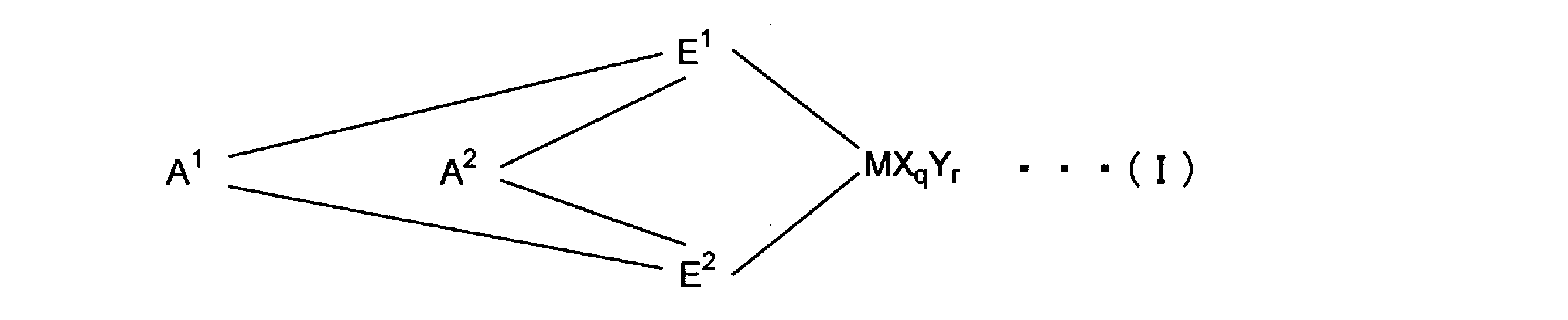
〔式中、Mは周期律表第3~10族の金属元素を示し、E1及びE2はそれぞれシクロペンタジエニル基,置換シクロペンタジエニル基,インデニル基,置換インデニル基,ヘテロシクロペンタジエニル基,置換ヘテロシクロペンタジエニル基,アミド基,ホスフィン基,炭化水素基及びケイ素含有基の中から選ばれた配位子を示し、A1及びA2を介して架橋構造を形成している。E1及びE2は互いに同一でも異なっていてもよく、また、E1及びE2のうちの少なくとも一つは、シクロペンタジエニル基、置換シクロペンタジエニル基、インデニル基又は置換インデニル基である。Xはσ結合性の配位子を示し、Xが複数ある場合、複数のXは同じでも異なっていてもよく、他のX,E1,E2又はYと架橋していてもよい。Yはルイス塩基を示し、Yが複数ある場合、複数のYは同じでも異なっていてもよく、他のY,E1,E2又はXと架橋していてもよい。A1及びA2は二つの配位子を結合する二価の架橋基であって、炭素数1~20の炭化水素基、炭素数1~20のハロゲン含有炭化水素基、ケイ素含有基、ゲルマニウム含有基、スズ含有基、-O-、-CO-、-S-、-SO2-、-Se-、-NR1-、-PR1-、-P(O)R1-、-BR1-又は-AlR1-を示し、R1は水素原子、ハロゲン原子、炭素数1~20の炭化水素基又は炭素数1~20のハロゲン含有炭化水素基を示し、それらは互いに同一でも異なっていてもよい。qは1~5の整数で〔(Mの原子価)-2〕を示し、rは0~3の整数を示す。〕
で表される二架橋錯体である、上記(3)に記載の水系分散体、
(5) 親水性基が、酸無水物残基、カルボキシル基、水酸基、アミド基、アミノ基、ピリジル基、ポリアルキレングリコール構造を有する基から選ばれる置換基である、上記(1)に記載の水系分散体、
(6) グラフト共重合体の主鎖の、親水性基を有する単量体単位が、[I]アクリル酸及びその誘導体、[II]メタアクリル酸類及びその誘導体、[III]ビニルエステル及びその誘導体から選ばれる一種以上の単量体に由来するものである、上記(1)に記載の水系分散体、
(7) グラフト共重合体の主鎖の、親水性基を有する単量体単位が、下記A群から選択される一種以上と下記B群から選択される一種以上の単量体に由来するものである、上記(1)に記載の水系分散体、
A群;[V]無水マレイン酸及びその置換体、[VI]マレイン酸及びそのエステル、[VII]マレイミド及びその置換体
B群;[I]アクリル酸及びその誘導体、[II]メタアクリル酸類及びその誘導体、[III]ビニルエステル及びその誘導体
(8) 上記(1)に記載の水系分散体を含有する、コーティング剤、塗料、インキまたは接着剤、
(9) 基材上に、上記(1)に記載の水系分散体が塗布されて形成した樹脂層を有する複層体、
(10) 基材が、樹脂、金属、セラミックス、木材、ガラスのいずれかである上記(9)に記載の複層体、
(11) 基材が、結晶性ポリプロピレン、結晶性ブロックポリプロピレン、結晶性プロピレンランダム共重合体のいずれかである上記(9)に記載の複層体。
で表される二架橋錯体である、上記(3)に記載の水系分散体、
(5) 親水性基が、酸無水物残基、カルボキシル基、水酸基、アミド基、アミノ基、ピリジル基、ポリアルキレングリコール構造を有する基から選ばれる置換基である、上記(1)に記載の水系分散体、
(6) グラフト共重合体の主鎖の、親水性基を有する単量体単位が、[I]アクリル酸及びその誘導体、[II]メタアクリル酸類及びその誘導体、[III]ビニルエステル及びその誘導体から選ばれる一種以上の単量体に由来するものである、上記(1)に記載の水系分散体、
(7) グラフト共重合体の主鎖の、親水性基を有する単量体単位が、下記A群から選択される一種以上と下記B群から選択される一種以上の単量体に由来するものである、上記(1)に記載の水系分散体、
A群;[V]無水マレイン酸及びその置換体、[VI]マレイン酸及びそのエステル、[VII]マレイミド及びその置換体
B群;[I]アクリル酸及びその誘導体、[II]メタアクリル酸類及びその誘導体、[III]ビニルエステル及びその誘導体
(8) 上記(1)に記載の水系分散体を含有する、コーティング剤、塗料、インキまたは接着剤、
(9) 基材上に、上記(1)に記載の水系分散体が塗布されて形成した樹脂層を有する複層体、
(10) 基材が、樹脂、金属、セラミックス、木材、ガラスのいずれかである上記(9)に記載の複層体、
(11) 基材が、結晶性ポリプロピレン、結晶性ブロックポリプロピレン、結晶性プロピレンランダム共重合体のいずれかである上記(9)に記載の複層体。
本発明によれば、主鎖が、親水性基を有する単量体単位を含有する重合鎖であり、側鎖が、特定のポリオレフィン連鎖であるグラフト共重合体であって、ポリオレフィン連鎖が十分に長く、かつ親水性基含有量が多いグラフト共重合体、および当該グラフト共重合体と水を含む水系分散体が得られる。当該水系分散体は、分散粒子径が小さく、貯蔵安定性が高い。また、界面活性剤の量を低減化させても十分な水分散性を有するため、接着剤や塗料等における性能低下を避けることができる。さらに、バインダー樹脂、顔料、フィラーの分散性を向上させるとともに、ポリプロピレン等を基材とした際の塗膜性能(接着力、外観、平滑性、色むら等)を向上させることができる。
本発明の水系分散体は、主鎖が、親水性基を有する単量体単位を含有する重合鎖であり、側鎖が、特定のポリオレフィン連鎖であるグラフト共重合体と水を含む水系分散体である。上記グラフト共重合体は、特定の反応性ポリオレフィンを用いてグラフト共重合反応を行うことで得られる。
なお、本明細書において、「反応性ポリオレフィン」とは、ラジカル開始剤により効率よくグラフト共重合体を生成させるポリオレフィンのことをいい、具体的には末端不飽和基を一分子あたり0.5個以上有するポリオレフィンのことを指す。
また、当該定義からわかるように、反応性ポリオレフィン中に含まれる全ての分子が末端不飽和基を有し、反応性を有するとは限らない。このためグラフト共重合反応終了時に未反応のポリオレフィンが存在することがあるが、末端不飽和基量の制御や精製過程により未反応のポリオレフィン量を低減化することができる。したがって、本明細書においては、グラフト共重合反応の生成物を「組成物」とは表現せず、「グラフト共重合体」と記載する。
なお、本明細書において、「反応性ポリオレフィン」とは、ラジカル開始剤により効率よくグラフト共重合体を生成させるポリオレフィンのことをいい、具体的には末端不飽和基を一分子あたり0.5個以上有するポリオレフィンのことを指す。
また、当該定義からわかるように、反応性ポリオレフィン中に含まれる全ての分子が末端不飽和基を有し、反応性を有するとは限らない。このためグラフト共重合反応終了時に未反応のポリオレフィンが存在することがあるが、末端不飽和基量の制御や精製過程により未反応のポリオレフィン量を低減化することができる。したがって、本明細書においては、グラフト共重合反応の生成物を「組成物」とは表現せず、「グラフト共重合体」と記載する。
[グラフト共重合体]
グラフト共重合体の主鎖は、親水性基を有する単量体単位を含有する。親水性基としては、酸無水物残基、カルボキシル基(本明細書においては、「カルボキシル基」は脱プロトン化した、カルボン酸イオンを含める。)、水酸基、アミド基、アミノ基、ピリジル基、ポリアルキレングリコール構造を有する基等が挙げられる。
主鎖の単量体単位全量に対する親水性基を有する単量体単位量は、40mol%以上が好ましく、より好ましくは50mol%以上である。40mol%以上であることで、水分散性が向上し、また水系分散体を接着剤や塗料成分として使用した際に、極性物質に対する親和性が向上する。
グラフト共重合体の主鎖は、親水性基を有する単量体単位を含有する。親水性基としては、酸無水物残基、カルボキシル基(本明細書においては、「カルボキシル基」は脱プロトン化した、カルボン酸イオンを含める。)、水酸基、アミド基、アミノ基、ピリジル基、ポリアルキレングリコール構造を有する基等が挙げられる。
主鎖の単量体単位全量に対する親水性基を有する単量体単位量は、40mol%以上が好ましく、より好ましくは50mol%以上である。40mol%以上であることで、水分散性が向上し、また水系分散体を接着剤や塗料成分として使用した際に、極性物質に対する親和性が向上する。
グラフト共重合体の側鎖は、炭素数3~28のα-オレフィンから選ばれる一種の単独重合鎖若しくは二種以上の共重合鎖、またはエチレン単位が50質量%以下である、炭素数3~28のα-オレフィン単位およびエチレン単位からなる共重合鎖である。
炭素数3~28のα-オレフィンとしては、プロピレン、1-ブテン、1-ペンテン、4-メチルペンテン-1、1-ヘキセン、1-オクテン、1-デセン、1-ウンデセン、1-ドデセン、1-トリデセン、1-テトラデセン、1-ペンタデセン、1-ヘキサデセン、1-ヘプタデセン、1-オクタデセン、1-ノナデセン及び1-イコセンなどが挙げられる。
炭素数3~28のα-オレフィンとしては、プロピレン、1-ブテン、1-ペンテン、4-メチルペンテン-1、1-ヘキセン、1-オクテン、1-デセン、1-ウンデセン、1-ドデセン、1-トリデセン、1-テトラデセン、1-ペンタデセン、1-ヘキサデセン、1-ヘプタデセン、1-オクタデセン、1-ノナデセン及び1-イコセンなどが挙げられる。
グラフト共重合体の側鎖は、メソペンタッド分率〔mmmm〕が30~80モル%の重合鎖である。上記メソペンタッド分率〔mmmm〕は、好ましくは30~75モル%、より好ましくは32~70モル%である。
メソペンタッド分率が30モル%を下回ると、耐熱性、機械物性が低下し、80モル%を超えると、接着性、塗膜の衝撃強度が低下する。なお、グラフト共重合体の側鎖のメソペンタッド分率は、その製造時に用いた反応性ポリオレフィンの立体規則性から知ることができる。また、グラフト共重合体の反応性ポリオレフィンに由来するメチル基、メチン基、メチレン基の立体規則性を後述するNMR解析により決定することができる。さらに、グラフト共重合体を窒素雰囲気下、熱分解した後、側鎖を形成していた断片を集めてNMRを測定することによっても調べることができる。
メソペンタッド分率が30モル%を下回ると、耐熱性、機械物性が低下し、80モル%を超えると、接着性、塗膜の衝撃強度が低下する。なお、グラフト共重合体の側鎖のメソペンタッド分率は、その製造時に用いた反応性ポリオレフィンの立体規則性から知ることができる。また、グラフト共重合体の反応性ポリオレフィンに由来するメチル基、メチン基、メチレン基の立体規則性を後述するNMR解析により決定することができる。さらに、グラフト共重合体を窒素雰囲気下、熱分解した後、側鎖を形成していた断片を集めてNMRを測定することによっても調べることができる。
グラフト共重合体のグラフト率は、1~150質量%であり、好ましくは2~130質量%、より好ましくは5~100質量%である。グラフト率が1質量%未満であると、極性物質や水との親和性が低下し、水分散性が劣りやすく、150質量%を越えると、接着強度が低下しやすい。
グラフト共重合体のグラフト率は、以下のようにして測定する。
溶媒によりグラフト共重合反応に関与しなかった主鎖を形成する単量体の重合物、および可溶性の重合体成分を溶解除去した不溶のグラフト共重合体成分の質量(W2)と原料として用いた反応性ポリオレフィンの質量(W1)から以下のようにして算出する。
グラフト率(質量%)=(W2-W1)/W1×100
また、使用する溶媒は溶解条件下で、主鎖を形成する単量体からなる単独重合体または共重合体を溶解することが必要である。さらに使用する溶媒は反応性ポリオレフィンに対しては前述と同じ溶解条件下で、溶解性を示さないことが同時に必要である。溶解性を示さないとは1質量%以下の溶解量を示すことを言い、溶解するとは溶液の目視観察により不溶物が認められないことを言う。
グラフト共重合体のグラフト率は、以下のようにして測定する。
溶媒によりグラフト共重合反応に関与しなかった主鎖を形成する単量体の重合物、および可溶性の重合体成分を溶解除去した不溶のグラフト共重合体成分の質量(W2)と原料として用いた反応性ポリオレフィンの質量(W1)から以下のようにして算出する。
グラフト率(質量%)=(W2-W1)/W1×100
また、使用する溶媒は溶解条件下で、主鎖を形成する単量体からなる単独重合体または共重合体を溶解することが必要である。さらに使用する溶媒は反応性ポリオレフィンに対しては前述と同じ溶解条件下で、溶解性を示さないことが同時に必要である。溶解性を示さないとは1質量%以下の溶解量を示すことを言い、溶解するとは溶液の目視観察により不溶物が認められないことを言う。
グラフト共重合体は、重量平均分子量が500~400000である。下限は、好ましくは1000、より好ましくは2000、さらに好ましくは5000、最も好ましくは10000であり、上限は、好ましくは350000、より好ましくは300000、さらに好ましくは250000、最も好ましくは2000000である。重量平均分子量が500未満では、接着強度が低下し、接着剤、塗料等への利用に問題が生じ、400000を越えると、グラフト共重合体の溶融粘度が高く、流れが低下するためにヒートシールなどの熱融着の際に問題を生じる。
グラフト共重合体の分子量分布(Mw/Mn)は、1.5~4であり、好ましくは1.55~3、より好ましくは1.6~2.5である。分子量分布が1.5を下回ると溶融流動性が低下し、また4を越えると、べたつき成分が発生することがある。
なお、グラフト共重合体の重量平均分子量および分子量分布を求める場合においては、以下のようにゲルパーミエイションクロマトグラフィー(GPC)法を用いることができる。
グラフト共重合体の分子量分布(Mw/Mn)は、1.5~4であり、好ましくは1.55~3、より好ましくは1.6~2.5である。分子量分布が1.5を下回ると溶融流動性が低下し、また4を越えると、べたつき成分が発生することがある。
なお、グラフト共重合体の重量平均分子量および分子量分布を求める場合においては、以下のようにゲルパーミエイションクロマトグラフィー(GPC)法を用いることができる。
分子量分布(Mw/Mn)は、GPC法により、下記の装置及び条件で、重量平均分子量(Mw)及び数平均分子量(Mn)測定することにより求めることができる。
GPC測定装置
検出器 :液体クロマトグラフィー用RI検出器 ウオーターズ 150C
カラム :TOSO GMHHR-H(S)HT
測定条件
溶媒 :1,2,4-トリクロロベンゼン
測定温度 :145℃
流速 :1.0ml/分
試料濃度 :0.3質量%
重量平均分子量(Mw)、数平均分子量(Mn)はポリスチレン換算分子量を対応するポリマーの分子量に換算するため、Mark-Houwink-桜田の式の定数K及びαを用いてUniversal Calibration法により求めた。
具体的には、「サイズ排除クロマトグラフィー、森定雄著、P67~69、1992年、共立出版」に記載の方法によって決定した。
なお、K及びαは、「Polymer Handbook、John Wiley&Sons,Inc.」に記載されている。
また、新たに算出する絶対分子量に対する極限粘度の関係から定法によって決定することができる。
GPC測定装置
検出器 :液体クロマトグラフィー用RI検出器 ウオーターズ 150C
カラム :TOSO GMHHR-H(S)HT
測定条件
溶媒 :1,2,4-トリクロロベンゼン
測定温度 :145℃
流速 :1.0ml/分
試料濃度 :0.3質量%
重量平均分子量(Mw)、数平均分子量(Mn)はポリスチレン換算分子量を対応するポリマーの分子量に換算するため、Mark-Houwink-桜田の式の定数K及びαを用いてUniversal Calibration法により求めた。
具体的には、「サイズ排除クロマトグラフィー、森定雄著、P67~69、1992年、共立出版」に記載の方法によって決定した。
なお、K及びαは、「Polymer Handbook、John Wiley&Sons,Inc.」に記載されている。
また、新たに算出する絶対分子量に対する極限粘度の関係から定法によって決定することができる。
グラフト共重合体は、デカリン中、135℃において測定した極限粘度〔η〕が0.01~2.5dl/gが好ましく、より好ましくは0.02~2.2、さらに好ましくは0.05~2.0である。
極限粘度〔η〕が0.01dl/g以上であると、樹脂相溶化などの機能が上昇し、2.5dl/g以下であると樹脂への分散性が向上し好ましい。
極限粘度〔η〕が0.01dl/g以上であると、樹脂相溶化などの機能が上昇し、2.5dl/g以下であると樹脂への分散性が向上し好ましい。
更に、グラフト共重合体は、ゲル成分を含まないことが好ましい。ゲル成分の低減化は末端不飽和基量が高い反応性ポリオレフィンであって、両末端に不飽和基を有する分子を実質上含まない反応性ポリオレフィンを使用し、効率よくグラフト重合反応を行うことで達成される。
(ゲル成分の測定方法)
グラフト共重合体の主鎖成分、側鎖成分の両者を溶解する溶媒を用い、攪拌装置付きガラス製セパラブルフラスコのステンレス製400メッシュ(目開き0.034mm)の網でできた籠に、グラフト共重合体50mgを入れ、攪拌翼に固定する。
酸化防止剤(BHT)0.1質量%を含む溶媒を投入し、沸点下で4時間攪拌しながら溶解する。
溶解後、回収した籠を十分真空乾燥し、秤量により不溶部を求める。
不溶部として定義するゲル成分は以下の式で算出する。
[メッシュ内残量(g)/仕込試料量(g)]×100(単位:%)
溶媒としては、パラキシレン、トルエンなどが挙げられる。
通常、上記式において、0~1.5質量%の範囲を持ってゲル成分を含まないと規定する。
(ゲル成分の測定方法)
グラフト共重合体の主鎖成分、側鎖成分の両者を溶解する溶媒を用い、攪拌装置付きガラス製セパラブルフラスコのステンレス製400メッシュ(目開き0.034mm)の網でできた籠に、グラフト共重合体50mgを入れ、攪拌翼に固定する。
酸化防止剤(BHT)0.1質量%を含む溶媒を投入し、沸点下で4時間攪拌しながら溶解する。
溶解後、回収した籠を十分真空乾燥し、秤量により不溶部を求める。
不溶部として定義するゲル成分は以下の式で算出する。
[メッシュ内残量(g)/仕込試料量(g)]×100(単位:%)
溶媒としては、パラキシレン、トルエンなどが挙げられる。
通常、上記式において、0~1.5質量%の範囲を持ってゲル成分を含まないと規定する。
[グラフト共重合体の製造方法]
グラフト共重合体は特定の反応性ポリオレフィンと主鎖を形成する単量体を用いて重合させることで製造することができる。
グラフト共重合体は特定の反応性ポリオレフィンと主鎖を形成する単量体を用いて重合させることで製造することができる。
(側鎖用反応性ポリオレフィン)
本発明で使用する反応性ポリオレフィンは、炭素数3~28のα-オレフィンから選ばれる一種の単独重合体若しくは二種以上の共重合体、またはエチレンが50質量%以下である、炭素数3~28のα-オレフィンから選ばれる一種以上の単量体とエチレンの共重合体であって、メソペンタッド分率〔mmmm〕が30~80モル%であり、一分子あたりの末端不飽和基量が0.5~1.0個である反応性ポリオレフィンであることが好ましい。上記条件をみたすことで、本発明で使用するグラフト共重合体を製造することができる。
本発明で使用する反応性ポリオレフィンは、炭素数3~28のα-オレフィンから選ばれる一種の単独重合体若しくは二種以上の共重合体、またはエチレンが50質量%以下である、炭素数3~28のα-オレフィンから選ばれる一種以上の単量体とエチレンの共重合体であって、メソペンタッド分率〔mmmm〕が30~80モル%であり、一分子あたりの末端不飽和基量が0.5~1.0個である反応性ポリオレフィンであることが好ましい。上記条件をみたすことで、本発明で使用するグラフト共重合体を製造することができる。
上記メソペンタッド分率〔mmmm〕は、好ましくは30~75モル%、より好ましくは32~70モル%である。
ポリプロピレンを主成分とする重合体の場合、以下のようにして立体規則性を決定する。
上記メソペンタッド分率〔mmmm〕、後述するラセミペンタッド分率〔rrrr〕及びラセミメソラセミメソ分率〔rmrm〕は、エイ・ザンベリ(A.Zambelli)などにより「Macromolecules,6,925(1973)」で提案された方法に準拠し、13C-NMRスペクトルのメチル基のシグナルにより測定されるポリプロピレン分子鎖中のペンタッド単位でのメソ分率、ラセミ分率及びラセミメソラセミメソ分率である。
メソペンタッド分率〔mmmm〕が大きくなると、立体規則性が高くなる。
なお、13C-NMRスペクトルの測定は、エイ・ザンベリ(A.Zambelli)などにより「Macromolecules,8,687(1975)」で提案されたピークの帰属に従い、下記の装置及び条件にて行うことができる。
また、後述するメソトリアッド分率〔mm〕、ラセミトリアッド分率〔rr〕及びメソラセミ分率[mr]も上記方法により算出した。
上記メソペンタッド分率〔mmmm〕、後述するラセミペンタッド分率〔rrrr〕及びラセミメソラセミメソ分率〔rmrm〕は、エイ・ザンベリ(A.Zambelli)などにより「Macromolecules,6,925(1973)」で提案された方法に準拠し、13C-NMRスペクトルのメチル基のシグナルにより測定されるポリプロピレン分子鎖中のペンタッド単位でのメソ分率、ラセミ分率及びラセミメソラセミメソ分率である。
メソペンタッド分率〔mmmm〕が大きくなると、立体規則性が高くなる。
なお、13C-NMRスペクトルの測定は、エイ・ザンベリ(A.Zambelli)などにより「Macromolecules,8,687(1975)」で提案されたピークの帰属に従い、下記の装置及び条件にて行うことができる。
また、後述するメソトリアッド分率〔mm〕、ラセミトリアッド分率〔rr〕及びメソラセミ分率[mr]も上記方法により算出した。
装置:日本電子(株)製JNM-EX400型13C-NMR装置
方法:プロトン完全デカップリング法
濃度:220mg/ml
溶媒:1,2,4-トリクロロベンゼンと重ベンゼンの90:10(容量比)混合溶媒
温度:130℃
パルス幅:45°
パルス繰り返し時間:4秒
積算:10000回
方法:プロトン完全デカップリング法
濃度:220mg/ml
溶媒:1,2,4-トリクロロベンゼンと重ベンゼンの90:10(容量比)混合溶媒
温度:130℃
パルス幅:45°
パルス繰り返し時間:4秒
積算:10000回
<計算式>
M=(m/S)×100
R=(γ/S)×100
S=Pββ+Pαβ+Pαγ
S:全プロピレン単位の側鎖メチル炭素原子のシグナル強度
Pββ:19.8~22.5ppm
Pαβ:18.0~17.5ppm
Pαγ:17.5~17.1ppm
γ:ラセミペンタッド連鎖:20.7~20.3ppm
m:メソペンタッド連鎖 :21.7~22.5ppm
M=(m/S)×100
R=(γ/S)×100
S=Pββ+Pαβ+Pαγ
S:全プロピレン単位の側鎖メチル炭素原子のシグナル強度
Pββ:19.8~22.5ppm
Pαβ:18.0~17.5ppm
Pαγ:17.5~17.1ppm
γ:ラセミペンタッド連鎖:20.7~20.3ppm
m:メソペンタッド連鎖 :21.7~22.5ppm
ポリブテンを主成分とする重合体の場合、以下のようにして立体規則性を決定する。
メソペンタッド分率(mmmm)及び異常挿入含有量(1,4挿入分率)は、朝倉らにより報告された「Polymer Journal,16,717(1984)」、J.Randallらにより報告された「Macromol.Chem.Phys.,C29,201(1989)」及びV.Busicoらにより報告された「Macromol.Chem.Phys.,198,1257(1997)」で提案された方法に準拠して求めた。
すなわち、13C核磁気共鳴スペクトルを用いてメチレン基、メチン基のシグナルを測定し、ポリ(1-ブテン)分子中のメソペンタッド分率及び異常挿入含有量を求めた。
13C核磁気共鳴スペクトルの測定は、前述の装置及び条件にて行った。
立体規則性指数{(mmmm)/(mmrr+rmmr)}は、上記方法により、(mmmm)、(mmrr)及び(rmmr)を測定した値から算出した。
また、ラセミトリアッド分率(rr)も上記方法により算出できる。
1-ブテン単独及び共重合体は、立体規則性指数{(mmmm)/(mmrr+rmmr)}が20以下であり、好ましくは18以下、より好ましくは15以下である。
立体規則性指数が20を超えると、柔軟性の低下が起こる。
メソペンタッド分率(mmmm)及び異常挿入含有量(1,4挿入分率)は、朝倉らにより報告された「Polymer Journal,16,717(1984)」、J.Randallらにより報告された「Macromol.Chem.Phys.,C29,201(1989)」及びV.Busicoらにより報告された「Macromol.Chem.Phys.,198,1257(1997)」で提案された方法に準拠して求めた。
すなわち、13C核磁気共鳴スペクトルを用いてメチレン基、メチン基のシグナルを測定し、ポリ(1-ブテン)分子中のメソペンタッド分率及び異常挿入含有量を求めた。
13C核磁気共鳴スペクトルの測定は、前述の装置及び条件にて行った。
立体規則性指数{(mmmm)/(mmrr+rmmr)}は、上記方法により、(mmmm)、(mmrr)及び(rmmr)を測定した値から算出した。
また、ラセミトリアッド分率(rr)も上記方法により算出できる。
1-ブテン単独及び共重合体は、立体規則性指数{(mmmm)/(mmrr+rmmr)}が20以下であり、好ましくは18以下、より好ましくは15以下である。
立体規則性指数が20を超えると、柔軟性の低下が起こる。
炭素数5以上のα-オレフィンを主成分とする重合体の場合は、以下のようにして立体規則性を決定する。
この立体規則性指標値M2は、T.Asakura,M.Demura,Y.Nishiyamaにより報告された「Macromolecules,24,2334(1991)」で提案された方法に準拠して求めた。
すなわち、13CNMRスペクトルで、高級α-オレフィンに由来する、側鎖α位のCH2炭素が立体規則性の違いを反映して分裂して観測されることを利用してM2を求めることができる。
このM2は本願発明においては、上記メソペンタッド分率〔mmmm〕に置き換えることができる。
この値が大きいほど、アイソタクティシティーが高いことを示す。
尚、13C核磁気共鳴スペクトルの測定装置、条件は上記と同じであり、以下のようにして立体規則性指標値M2を求める。
混合溶媒に基づく大きな吸収ピークが、127~135ppmに6本見られる。このピークのうち、低磁場側から4本目のピーク値を131.1ppmとし、化学シフトの基準とする。
このとき側鎖α位のCH2炭素に基づく吸収ピークが34~37ppm付近に観測される。
このとき、以下の式を用いてM2(モル%)を求める。
M2=〔(36.2~35.3ppmの積分強度)/(36.2~34.5ppmの積分強度)〕×100
この立体規則性指標値M2は、T.Asakura,M.Demura,Y.Nishiyamaにより報告された「Macromolecules,24,2334(1991)」で提案された方法に準拠して求めた。
すなわち、13CNMRスペクトルで、高級α-オレフィンに由来する、側鎖α位のCH2炭素が立体規則性の違いを反映して分裂して観測されることを利用してM2を求めることができる。
このM2は本願発明においては、上記メソペンタッド分率〔mmmm〕に置き換えることができる。
この値が大きいほど、アイソタクティシティーが高いことを示す。
尚、13C核磁気共鳴スペクトルの測定装置、条件は上記と同じであり、以下のようにして立体規則性指標値M2を求める。
混合溶媒に基づく大きな吸収ピークが、127~135ppmに6本見られる。このピークのうち、低磁場側から4本目のピーク値を131.1ppmとし、化学シフトの基準とする。
このとき側鎖α位のCH2炭素に基づく吸収ピークが34~37ppm付近に観測される。
このとき、以下の式を用いてM2(モル%)を求める。
M2=〔(36.2~35.3ppmの積分強度)/(36.2~34.5ppmの積分強度)〕×100
上記反応性ポリオレフィンは、末端不飽和基を一分子当たり、0.5~1.0個、好ましくは0.6~1.0個、より好ましくは0.7~1.0個、より好ましくは0.8~1.0個、より好ましくは0.82~1.0個、さらに好ましくは0.85~1.0個、最も好ましくは0.90~1.0個有する。
末端不飽和基が0.5個以上では不飽和基の濃度が高く、グラフト共重合体の生成効率が上昇する。
末端不飽和基としては、ビニリデン基が好ましく、末端不飽和基に占めるビニリデン基は、通常、50~100モル%、好ましくは60~100モル%、より好ましくは70~100モル%、更に好ましくは80~100モル%である。
本発明に用いる反応性ポリオレフィンは、一分子当たり2個以上の不飽和基を有する成分、例えば両末端に不飽和基を含有するような成分を実質的に含有しないものである。
一分子当たり2個以上の不飽和基を有する成分は、所謂架橋剤として作用するため、グラフト重合時に架橋構造(H型)を形成し、ゲル成分が副生するため好ましくない。
従って、熱分解によって製造された不飽和ポリプロピレンなどは使用することができない。
末端不飽和基が0.5個以上では不飽和基の濃度が高く、グラフト共重合体の生成効率が上昇する。
末端不飽和基としては、ビニリデン基が好ましく、末端不飽和基に占めるビニリデン基は、通常、50~100モル%、好ましくは60~100モル%、より好ましくは70~100モル%、更に好ましくは80~100モル%である。
本発明に用いる反応性ポリオレフィンは、一分子当たり2個以上の不飽和基を有する成分、例えば両末端に不飽和基を含有するような成分を実質的に含有しないものである。
一分子当たり2個以上の不飽和基を有する成分は、所謂架橋剤として作用するため、グラフト重合時に架橋構造(H型)を形成し、ゲル成分が副生するため好ましくない。
従って、熱分解によって製造された不飽和ポリプロピレンなどは使用することができない。
上記末端不飽和基の測定は、一般的には、赤外線吸収スペクトル法、核磁気共鳴スペクトル法、臭素化法などが用いられ、何れの方法によっても測定することができる。
赤外線吸収スペクトル法は、「新版 高分子分析ハンドブック、日本分析化学会、高分子分析研究懇談会編」に記載された方法に準拠して行うことができる。
それによれば、赤外線吸収スペクトル法による末端不飽和基の定量方法においては、ビニル基、ビニリデン基、トランス(ビニレン)基などの不飽和基は、それぞれ、赤外線吸収スペクトルの910cm-1、888cm-1、963cm-1の吸収から定量することができる。
また、核磁気共鳴スペクトル法によるビニリデン不飽和基の定量は、次のようにして行う。
末端不飽和基がビニリデン基である場合の個数は、常法に従った1H-NMRの測定により求められる。
1H-NMR測定から得られたδ4.8~4.6(2H)に出現するビニリデン基に基づいて、定法によりビニリデン基の含有量(C)(モル%)を算出する。
更に、ゲルパーミエイションクロマトグラフィー(GPC)より求めた数平均分子量(Mn)とモノマー分子量(M)から、次式によって一分子当たりのビニリデン基の個数を算出する。
一分子当たりの末端ビニリデン基(個)=(Mn/M)×(C/100)
また、核磁気共鳴スペクトル法による方法の例としては、末端基の定量に基づく方法がある。具体的には1H-NMRと13C-NMRで重合反応により、生じた末端基とその存在量を測定し、全末端基量に対する末端ビニリデン基の存在割合から一分子当たりの末端ビニリデン基数を算出する方法である。
プロピレン重合体の場合を例示する。
(1H-NMRによる不飽和末端量の分析)
プロピレン重合体には〔2〕ビニリデン基のメチレン基(4.8~4.6ppm)、〔1〕ビニル基のメチレン基(5.10~4.90ppm)が観測される。全プロピレン重合体に対する割合は次式で計算できる。また、〔3〕はプロピレン連鎖(0.6~2.3ppm)のメチン、メチレン、メチル基に相当するピーク強度に対応する。
末端ビニリデン基量(A)=(〔2〕/2)/[(〔3〕+4×〔1〕/2+3×〔2〕/2)/6]×100 単位:mol%
末端ビニル基量(B)=(〔1〕/2)/[(〔3〕+4×〔1〕/2+3×〔2〕/2)/6]×100 単位:mol%
(13C-NMRによる末端分率の分析)
本願プロピレン重合体は〔5〕n-プロピル末端の末端メチル基(14.5ppm付近)、〔6〕n-ブチル末端の末端メチル基(14.0ppm付近)、〔4〕iso-ブチル末端のメチン基(25.9ppm付近)、〔7〕ビニリデン末端のメチレン基(111.7ppm付近)が観察される。13C-NMRでの末端ビニル基量のピーク強度は1H-NMRスペクトルで求めた(A)(B)を用いて以下のようにして算出した。
13C-NMRの末端ビニル基量ピーク強度=(B)/(A)×〔7〕
ここで末端基の全濃度(T)は以下のように表わされる。
T=(B)/(A)×〔7〕+〔4〕+〔5〕+〔6〕+〔7〕
従って、各末端の割合は
(C)末端ビニリデン基=〔7〕/T ×100 単位:mol%
(D)末端ビニル基=(B)/(A) ×〔7〕×100
(E)n-プロピル末端=〔5〕/T ×100
(F)n-ブチル末端=〔6〕/T ×100
(G)iso-ブチル末端=〔4〕/T ×100
となる。
一分子当たりの末端ビニリデン基の個数は2×(C) /100 単位: 個/分子
となる。
赤外線吸収スペクトル法は、「新版 高分子分析ハンドブック、日本分析化学会、高分子分析研究懇談会編」に記載された方法に準拠して行うことができる。
それによれば、赤外線吸収スペクトル法による末端不飽和基の定量方法においては、ビニル基、ビニリデン基、トランス(ビニレン)基などの不飽和基は、それぞれ、赤外線吸収スペクトルの910cm-1、888cm-1、963cm-1の吸収から定量することができる。
また、核磁気共鳴スペクトル法によるビニリデン不飽和基の定量は、次のようにして行う。
末端不飽和基がビニリデン基である場合の個数は、常法に従った1H-NMRの測定により求められる。
1H-NMR測定から得られたδ4.8~4.6(2H)に出現するビニリデン基に基づいて、定法によりビニリデン基の含有量(C)(モル%)を算出する。
更に、ゲルパーミエイションクロマトグラフィー(GPC)より求めた数平均分子量(Mn)とモノマー分子量(M)から、次式によって一分子当たりのビニリデン基の個数を算出する。
一分子当たりの末端ビニリデン基(個)=(Mn/M)×(C/100)
また、核磁気共鳴スペクトル法による方法の例としては、末端基の定量に基づく方法がある。具体的には1H-NMRと13C-NMRで重合反応により、生じた末端基とその存在量を測定し、全末端基量に対する末端ビニリデン基の存在割合から一分子当たりの末端ビニリデン基数を算出する方法である。
プロピレン重合体の場合を例示する。
(1H-NMRによる不飽和末端量の分析)
プロピレン重合体には〔2〕ビニリデン基のメチレン基(4.8~4.6ppm)、〔1〕ビニル基のメチレン基(5.10~4.90ppm)が観測される。全プロピレン重合体に対する割合は次式で計算できる。また、〔3〕はプロピレン連鎖(0.6~2.3ppm)のメチン、メチレン、メチル基に相当するピーク強度に対応する。
末端ビニリデン基量(A)=(〔2〕/2)/[(〔3〕+4×〔1〕/2+3×〔2〕/2)/6]×100 単位:mol%
末端ビニル基量(B)=(〔1〕/2)/[(〔3〕+4×〔1〕/2+3×〔2〕/2)/6]×100 単位:mol%
(13C-NMRによる末端分率の分析)
本願プロピレン重合体は〔5〕n-プロピル末端の末端メチル基(14.5ppm付近)、〔6〕n-ブチル末端の末端メチル基(14.0ppm付近)、〔4〕iso-ブチル末端のメチン基(25.9ppm付近)、〔7〕ビニリデン末端のメチレン基(111.7ppm付近)が観察される。13C-NMRでの末端ビニル基量のピーク強度は1H-NMRスペクトルで求めた(A)(B)を用いて以下のようにして算出した。
13C-NMRの末端ビニル基量ピーク強度=(B)/(A)×〔7〕
ここで末端基の全濃度(T)は以下のように表わされる。
T=(B)/(A)×〔7〕+〔4〕+〔5〕+〔6〕+〔7〕
従って、各末端の割合は
(C)末端ビニリデン基=〔7〕/T ×100 単位:mol%
(D)末端ビニル基=(B)/(A) ×〔7〕×100
(E)n-プロピル末端=〔5〕/T ×100
(F)n-ブチル末端=〔6〕/T ×100
(G)iso-ブチル末端=〔4〕/T ×100
となる。
一分子当たりの末端ビニリデン基の個数は2×(C) /100 単位: 個/分子
となる。
上記反応性ポリオレフィンは、分子量分布(Mw/Mn)が、好ましくは4以下、より好ましくは3.5以下、より好ましくは3以下、更に好ましくは2.5以下である。
分子量分布は狭いほど好ましく、これは、本発明で使用するグラフト共重合体において、反応性ポリオレフィンが連鎖を形成するため、側鎖長(連鎖長)にばらつきが少なく、構造が制御されたグラフト共重合体が生成するからである。なお、分子量分布の測定は上述のグラフト共重合体の製造で説明した方法を利用することができる。
分子量分布は狭いほど好ましく、これは、本発明で使用するグラフト共重合体において、反応性ポリオレフィンが連鎖を形成するため、側鎖長(連鎖長)にばらつきが少なく、構造が制御されたグラフト共重合体が生成するからである。なお、分子量分布の測定は上述のグラフト共重合体の製造で説明した方法を利用することができる。
上記反応性ポリオレフィンは、デカリン中、135℃において測定した極限粘度〔η〕が0.01~2.5dl/g、好ましくは0.05~2.5、より好ましくは0.05~2.0、更に好ましくは0.1~2.0、最も好ましく0.15~1.8dl/gである。
極限粘度〔η〕が上記範囲内であると、グラフト共重合体のポリオレフィン側鎖長(連鎖長)が十分であり、相溶化などの機能を十分に発揮する。また、グラフト重合の際、末端不飽和基の濃度が高いためラジカル重合性が上昇する。
極限粘度〔η〕が上記範囲内であると、グラフト共重合体のポリオレフィン側鎖長(連鎖長)が十分であり、相溶化などの機能を十分に発揮する。また、グラフト重合の際、末端不飽和基の濃度が高いためラジカル重合性が上昇する。
極限粘度[η]は、135℃のデカリン中、ウベローデ型粘度計で還元粘度(ηSP/c)を測定し、下記一般式(ハギンスの式)を用いて算出する。
ηSP/c=[η]+K[η]2c
ηSP/c(dl/g):還元粘度
[η](dl/g):極限粘度
c(g/dl):ポリマー濃度
K=0.35(ハギンス定数)
ηSP/c=[η]+K[η]2c
ηSP/c(dl/g):還元粘度
[η](dl/g):極限粘度
c(g/dl):ポリマー濃度
K=0.35(ハギンス定数)
反応性ポリオレフィンは、下記の式を満たすことが好ましい。
ラセミメソラセミメソ分率〔rmrm〕>2.5モル%
反応性ポリオレフィンのラセミメソラセミメソ分率〔rmrm〕が2.5モル%を超えると、ランダム性が増加し、透明性が更に向上する。
ラセミメソラセミメソ分率〔rmrm〕>2.5モル%
反応性ポリオレフィンのラセミメソラセミメソ分率〔rmrm〕が2.5モル%を超えると、ランダム性が増加し、透明性が更に向上する。
反応性ポリオレフィンは、示差走査型熱量計(DSC)で観測される融点(Tm、単位:℃)と〔mmmm〕とが下記の関係を満たすことが好ましい。
1.76〔mmmm〕-25.0≦Tm≦1.76〔mmmm〕+5.0
示差走査型熱量計(DSC)で観測される融点(Tm、単位:℃)と〔mmmm〕との上記関係式は、反応性ポリオレフィンのメソペンタッド分率の均一性を表すものである。
反応性ポリオレフィンの立体規則性の均一性が高い場合、すなわち、立体規則性分布が狭い場合は、グラフト共重合体の側鎖の均一性が高いことを示し、ポリプロピレン系樹脂などとの相溶性が上昇する。メソペンタッド分率の高いものと低いものが混在した場合やブロック結合した場合、すなわち、立体規則性分布が広い場合は、ポリプロピレン系樹脂などへの相溶性が低下し、好ましくない。上記〔mmmm〕は、平均値として測定されるものであり、立体規則性分布が広い場合と狭い場合とでは明確に区別することはできないが、上記のように融点(Tm)との関係を特定範囲に限定することによって、好ましい均一性の高い反応性のプロピレン系共重合体を規定することができる。
融点(Tm)が(1.76〔mmmm〕+5.0)を超える場合は、部分的に高い立体規則性部位と、立体規則性を持たない部位が存在することを示す。
また、融点(Tm)が(1.76〔mmmm〕-25.0)に達しない場合、耐熱性が十分ではないおそれがある。
上記観点から、好ましくは
1.76〔mmmm〕-20.0≦Tm≦1.76〔mmmm〕+3.0
より好ましくは
1.76〔mmmm〕-15.0≦Tm≦1.76〔mmmm〕+2.0
である。
上記融点(Tm)は、DSC測定により求める。
試料10mgを窒素雰囲気下、320℃/分で25℃から220℃に昇温し、220℃で5分間保持した後、320℃/分で25℃まで降温し、25℃で50分間保持した。そして、10℃/分で25℃から220℃まで昇温した。この昇温過程で検出される融解熱吸収カーブの最も高温側に観測される吸熱ピークのピークトップを融点(Tm)とした。
1.76〔mmmm〕-25.0≦Tm≦1.76〔mmmm〕+5.0
示差走査型熱量計(DSC)で観測される融点(Tm、単位:℃)と〔mmmm〕との上記関係式は、反応性ポリオレフィンのメソペンタッド分率の均一性を表すものである。
反応性ポリオレフィンの立体規則性の均一性が高い場合、すなわち、立体規則性分布が狭い場合は、グラフト共重合体の側鎖の均一性が高いことを示し、ポリプロピレン系樹脂などとの相溶性が上昇する。メソペンタッド分率の高いものと低いものが混在した場合やブロック結合した場合、すなわち、立体規則性分布が広い場合は、ポリプロピレン系樹脂などへの相溶性が低下し、好ましくない。上記〔mmmm〕は、平均値として測定されるものであり、立体規則性分布が広い場合と狭い場合とでは明確に区別することはできないが、上記のように融点(Tm)との関係を特定範囲に限定することによって、好ましい均一性の高い反応性のプロピレン系共重合体を規定することができる。
融点(Tm)が(1.76〔mmmm〕+5.0)を超える場合は、部分的に高い立体規則性部位と、立体規則性を持たない部位が存在することを示す。
また、融点(Tm)が(1.76〔mmmm〕-25.0)に達しない場合、耐熱性が十分ではないおそれがある。
上記観点から、好ましくは
1.76〔mmmm〕-20.0≦Tm≦1.76〔mmmm〕+3.0
より好ましくは
1.76〔mmmm〕-15.0≦Tm≦1.76〔mmmm〕+2.0
である。
上記融点(Tm)は、DSC測定により求める。
試料10mgを窒素雰囲気下、320℃/分で25℃から220℃に昇温し、220℃で5分間保持した後、320℃/分で25℃まで降温し、25℃で50分間保持した。そして、10℃/分で25℃から220℃まで昇温した。この昇温過程で検出される融解熱吸収カーブの最も高温側に観測される吸熱ピークのピークトップを融点(Tm)とした。
反応性ポリオレフィンは、更に、下記の規定を満たすことが好ましい。
〔rrrr〕/(1-〔mmmm〕)≦0.1
上記関係を満足すると、べたつきが抑制される。
〔mm〕×〔rr]/〔mr〕2≦2.0
上記〔mm〕×〔rr〕/〔mr〕2の値が2.0以下であると、透明性の低下が抑制され、柔軟性と弾性回復率のバランスが良好となる。〔mm〕×〔rr]/〔mr〕2は、好ましくは1.8~0.5、より好ましくは1.5~0.5の範囲である。
20≦昇温クロマトグラフィーにおける25℃以下で溶出する成分量(W25)≦100(質量%)
上記昇温クロマトグラフィーにおける25℃以下で溶出する反応性ポリオレフィンの成分量(W25)は、好ましくは30~100質量%、より好ましくは50~100質量%である。
W25は、反応性ポリオレフィンが軟質であるか否かを表す指標であり、この値が小さくなると、弾性率の高い成分が多くなったり、メソペンタッド分率〔mmmm〕の不均一さが広がる。
上記反応性ポリオレフィンにおいては、W25が20質量%以上であると、柔軟性が保たれる。
なお、W25とは、以下のような操作法、装置構成及び測定条件の昇温クロマトグラフィーにより測定して求めた溶出曲線におけるTREF(昇温溶出分別)のカラム温度25℃において充填剤に吸着されないで溶出する成分の量(質量%)である。
〔rrrr〕/(1-〔mmmm〕)≦0.1
上記関係を満足すると、べたつきが抑制される。
〔mm〕×〔rr]/〔mr〕2≦2.0
上記〔mm〕×〔rr〕/〔mr〕2の値が2.0以下であると、透明性の低下が抑制され、柔軟性と弾性回復率のバランスが良好となる。〔mm〕×〔rr]/〔mr〕2は、好ましくは1.8~0.5、より好ましくは1.5~0.5の範囲である。
20≦昇温クロマトグラフィーにおける25℃以下で溶出する成分量(W25)≦100(質量%)
上記昇温クロマトグラフィーにおける25℃以下で溶出する反応性ポリオレフィンの成分量(W25)は、好ましくは30~100質量%、より好ましくは50~100質量%である。
W25は、反応性ポリオレフィンが軟質であるか否かを表す指標であり、この値が小さくなると、弾性率の高い成分が多くなったり、メソペンタッド分率〔mmmm〕の不均一さが広がる。
上記反応性ポリオレフィンにおいては、W25が20質量%以上であると、柔軟性が保たれる。
なお、W25とは、以下のような操作法、装置構成及び測定条件の昇温クロマトグラフィーにより測定して求めた溶出曲線におけるTREF(昇温溶出分別)のカラム温度25℃において充填剤に吸着されないで溶出する成分の量(質量%)である。
(1)操作法
試料溶液を温度135℃に調節したTREFカラムに導入し、次いで降温速度5℃/時間にて徐々に0℃まで降温し、30分間ホールドし、試料を充填剤表面に結晶化させる。
その後、昇温速度40℃/時間にてカラムを135℃まで昇温し、溶出曲線を得る。
(2)装置構成
TREFカラム :GLサイエンス社製 シリカゲルカラム(4.6φ×150mm)
フローセル :GLサイエンス社製 光路長1mm KBrセル
送液ポンプ :センシュウ科学社製 SSC-3100ポンプ
バルブオーブン :GLサイエンス社製 MODEL554オーブン(高温型)
TREFオーブン:GLサイエンス社製
二系列温調器 :理学工業社製 REX-C100温調器
検出器 :液体クロマトグラフィー用赤外検出器 FOXBORO社製 MIRAN 1A CVF
10方バルブ :バルコ社製 電動バルブ
ループ :バルコ社製 500μlループ
(3)測定条件
溶媒 :o-ジクロロベンゼン
試料濃度 :7.5g/L
注入量 :500μl
ポンプ流量 :2.0ml/分
検出波数 :3.41μm
カラム充填剤 :クロモソルブP(30~60メッシュ)
カラム温度分布 :±0.2℃以内
試料溶液を温度135℃に調節したTREFカラムに導入し、次いで降温速度5℃/時間にて徐々に0℃まで降温し、30分間ホールドし、試料を充填剤表面に結晶化させる。
その後、昇温速度40℃/時間にてカラムを135℃まで昇温し、溶出曲線を得る。
(2)装置構成
TREFカラム :GLサイエンス社製 シリカゲルカラム(4.6φ×150mm)
フローセル :GLサイエンス社製 光路長1mm KBrセル
送液ポンプ :センシュウ科学社製 SSC-3100ポンプ
バルブオーブン :GLサイエンス社製 MODEL554オーブン(高温型)
TREFオーブン:GLサイエンス社製
二系列温調器 :理学工業社製 REX-C100温調器
検出器 :液体クロマトグラフィー用赤外検出器 FOXBORO社製 MIRAN 1A CVF
10方バルブ :バルコ社製 電動バルブ
ループ :バルコ社製 500μlループ
(3)測定条件
溶媒 :o-ジクロロベンゼン
試料濃度 :7.5g/L
注入量 :500μl
ポンプ流量 :2.0ml/分
検出波数 :3.41μm
カラム充填剤 :クロモソルブP(30~60メッシュ)
カラム温度分布 :±0.2℃以内
本発明の反応性ポリオレフィンは、メタロセン触媒により製造されるものが好ましい。
メタロセン触媒としては、(A)シクロペンタジエニル基、置換シクロペンタジエニル基、インデニル基、置換インデニル基などを有する周期律表第3~10の金属元素からなる遷移金属化合物と(B)遷移金属化合物と反応してイオン性の錯体を形成しうる化合物を含む触媒であって、末端不飽和基を生成することのできる触媒が挙げられる。
遷移金属化合物としては、ジルコノセンクロリド、ペンタメチルシクロペンタジエニルジルコニウムジクロリドなどのビスシクロペンタジエニル配位子からなる化合物、エチレンビスインデニルジルコニウムジクロリド、ジメチルシリレン-ビス-[2-メチル-4-フェニルインデニル]ジルコニウムジクロリド、ジメチルシリレン-ビス-[2-メチル-4,5-ベンゾインデニル]ジルコニウムジクロリドなどの架橋インデニル配位子からなる化合物、ペンタメチルシクロペンタジエニルトリメトキシチタニウム、ペンタメチルシクロペンタジエニルトリクロルチタニウムなどのモノシクロペンタジエニル配位子からなる化合物、ジクロロ[ジメチルシリレン(シクロペンタジエニル)(2,4-ジメチル-4H-1-アズレニル)]ハフニウム、ジクロロ[ジメチルゲルミレン(シクロペンタジエニル)(2,4-ジメチル-4H-1-アズレニル)]ハフニウム、ジクロロ[ジメチルシリレン(2-メチル-1-インデニル)(2,4-ジメチル-4H-1-アズレニル)]ハフニウムなどのアズレニウム配位子からなる化合物が挙げられる。
メタロセン触媒としては、(A)シクロペンタジエニル基、置換シクロペンタジエニル基、インデニル基、置換インデニル基などを有する周期律表第3~10の金属元素からなる遷移金属化合物と(B)遷移金属化合物と反応してイオン性の錯体を形成しうる化合物を含む触媒であって、末端不飽和基を生成することのできる触媒が挙げられる。
遷移金属化合物としては、ジルコノセンクロリド、ペンタメチルシクロペンタジエニルジルコニウムジクロリドなどのビスシクロペンタジエニル配位子からなる化合物、エチレンビスインデニルジルコニウムジクロリド、ジメチルシリレン-ビス-[2-メチル-4-フェニルインデニル]ジルコニウムジクロリド、ジメチルシリレン-ビス-[2-メチル-4,5-ベンゾインデニル]ジルコニウムジクロリドなどの架橋インデニル配位子からなる化合物、ペンタメチルシクロペンタジエニルトリメトキシチタニウム、ペンタメチルシクロペンタジエニルトリクロルチタニウムなどのモノシクロペンタジエニル配位子からなる化合物、ジクロロ[ジメチルシリレン(シクロペンタジエニル)(2,4-ジメチル-4H-1-アズレニル)]ハフニウム、ジクロロ[ジメチルゲルミレン(シクロペンタジエニル)(2,4-ジメチル-4H-1-アズレニル)]ハフニウム、ジクロロ[ジメチルシリレン(2-メチル-1-インデニル)(2,4-ジメチル-4H-1-アズレニル)]ハフニウムなどのアズレニウム配位子からなる化合物が挙げられる。
更に、下記一般式(I)で表される二重架橋遷移金属化合物が挙げられる。

上記一般式(I)において、Mは周期律表第3~10族の金属元素を示し、具体例としてはチタン,ジルコニウム,ハフニウム,イットリウム,バナジウム,クロム,マンガン,ニッケル,コバルト,パラジウム及びランタノイド系金属などが挙げられる。
これらの中ではオレフィン重合活性などの点からチタン,ジルコニウム及びハフニウムが好適であり、末端ビニリデン基の収率及び触媒活性の点から、ジルコニウムが最も好適である。
E1及びE2はそれぞれ、置換シクロペンタジエニル基,インデニル基,置換インデニル基,ヘテロシクロペンタジエニル基,置換ヘテロシクロペンタジエニル基,アミド基(-N<),ホスフィン基(-P<),炭化水素基〔>CR-,>C<〕及びケイ素含有基〔>SiR-,>Si<〕(但し、Rは水素又は炭素数1~20の炭化水素基あるいはヘテロ原子含有基である)の中から選ばれた配位子を示し、A1及びA2を介して架橋構造を形成している。E1及びE2は互いに同一でも異なっていてもよい。
このE1及びE2としては、シクロペンタジエニル基、置換シクロペンタジエニル基,インデニル基及び置換インデニル基が好ましく、E1及びE2のうちの少なくとも一つは、シクロペンタジエニル基、置換シクロペンタジエニル基、インデニル基又は置換インデニル基である。
Xはσ結合性の配位子を示し、Xが複数ある場合、複数のXは同じでも異なっていてもよく、他のX,E1,E2又はYと架橋していてもよい。
このXの具体例としては、ハロゲン原子,炭素数1~20の炭化水素基,炭素数1~20のアルコキシ基,炭素数6~20のアリールオキシ基,炭素数1~20のアミド基,炭素数1~20のケイ素含有基,炭素数1~20のホスフィド基,炭素数1~20のスルフィド基,炭素数1~20のアシル基などが挙げられる。
ハロゲン原子としては、塩素原子、フッ素原子、臭素原子、ヨウ素原子が挙げられる。
炭素数1~20の炭化水素基として具体的には、メチル基、エチル基、プロピル基、ブチル基、ヘキシル基、シクロヘキシル基、オクチル基などのアルキル基;ビニル基、プロペニル基、シクロヘキセニル基などのアルケニル基;ベンジル基、フェニルエチル基、フェニルプロピル基などのアリールアルキル基;フェニル基、トリル基、ジメチルフェニル基、トリメチルフェニル基、エチルフェニル基、プロピルフェニル基、ビフェニル基、ナフチル基、メチルナフチル基、アントラセニル基、フェナントニル基などのアリール基などが挙げられる。
なかでもメチル基、エチル基、プロピル基などのアルキル基やフェニル基などのアリール基が好ましい。
これらの中ではオレフィン重合活性などの点からチタン,ジルコニウム及びハフニウムが好適であり、末端ビニリデン基の収率及び触媒活性の点から、ジルコニウムが最も好適である。
E1及びE2はそれぞれ、置換シクロペンタジエニル基,インデニル基,置換インデニル基,ヘテロシクロペンタジエニル基,置換ヘテロシクロペンタジエニル基,アミド基(-N<),ホスフィン基(-P<),炭化水素基〔>CR-,>C<〕及びケイ素含有基〔>SiR-,>Si<〕(但し、Rは水素又は炭素数1~20の炭化水素基あるいはヘテロ原子含有基である)の中から選ばれた配位子を示し、A1及びA2を介して架橋構造を形成している。E1及びE2は互いに同一でも異なっていてもよい。
このE1及びE2としては、シクロペンタジエニル基、置換シクロペンタジエニル基,インデニル基及び置換インデニル基が好ましく、E1及びE2のうちの少なくとも一つは、シクロペンタジエニル基、置換シクロペンタジエニル基、インデニル基又は置換インデニル基である。
Xはσ結合性の配位子を示し、Xが複数ある場合、複数のXは同じでも異なっていてもよく、他のX,E1,E2又はYと架橋していてもよい。
このXの具体例としては、ハロゲン原子,炭素数1~20の炭化水素基,炭素数1~20のアルコキシ基,炭素数6~20のアリールオキシ基,炭素数1~20のアミド基,炭素数1~20のケイ素含有基,炭素数1~20のホスフィド基,炭素数1~20のスルフィド基,炭素数1~20のアシル基などが挙げられる。
ハロゲン原子としては、塩素原子、フッ素原子、臭素原子、ヨウ素原子が挙げられる。
炭素数1~20の炭化水素基として具体的には、メチル基、エチル基、プロピル基、ブチル基、ヘキシル基、シクロヘキシル基、オクチル基などのアルキル基;ビニル基、プロペニル基、シクロヘキセニル基などのアルケニル基;ベンジル基、フェニルエチル基、フェニルプロピル基などのアリールアルキル基;フェニル基、トリル基、ジメチルフェニル基、トリメチルフェニル基、エチルフェニル基、プロピルフェニル基、ビフェニル基、ナフチル基、メチルナフチル基、アントラセニル基、フェナントニル基などのアリール基などが挙げられる。
なかでもメチル基、エチル基、プロピル基などのアルキル基やフェニル基などのアリール基が好ましい。
炭素数1~20のアルコキシ基としては、メトキシ基、エトキシ基、プロポキシ基、ブトキシ基などのアルコキシ基、フェニルメトキシ基、フェニルエトキシ基などが挙げられる。
炭素数6~20のアリールオキシ基としては、フェノキシ基、メチルフェノキシ基、ジメチルフェノキシ基などが挙げられる。
炭素数1~20のアミド基としては、ジメチルアミド基、ジエチルアミド基、ジプロピルアミド基、ジブチルアミド基、ジシクロヘキシルアミド基、メチルエチルアミド基などのアルキルアミド基や、ジビニルアミド基、ジプロペニルアミド基、ジシクロヘキセニルアミド基などのアルケニルアミド基;ジベンジルアミド基、フェニルエチルアミド基、フェニルプロピルアミド基などのアリールアルキルアミド基;ジフェニルアミド基、ジナフチルアミド基などのアリールアミド基が挙げられる。
炭素数1~20のケイ素含有基としては、メチルシリル基、フェニルシリル基などのモノ炭化水素置換シリル基;ジメチルシリル基、ジフェニルシリル基などのジ炭化水素置換シリル基;トリメチルシリル基、トリエチルシリル基、トリプロピルシリル基、トリシクロヘキシルシリル基、トリフェニルシリル基、ジメチルフェニルシリル基、メチルジフェニルシリル基、トリトリルシリル基、トリナフチルシリル基などのトリ炭化水素置換シリル基;トリメチルシリルエーテル基などの炭化水素置換シリルエーテル基;トリメチルシリルメチル基などのケイ素置換アルキル基;トリメチルシリルフェニル基などのケイ素置換アリール基などが挙げられる。
なかでも、トリメチルシリルメチル基、フェニルジメチルシリルエチル基などが好ましい。
炭素数6~20のアリールオキシ基としては、フェノキシ基、メチルフェノキシ基、ジメチルフェノキシ基などが挙げられる。
炭素数1~20のアミド基としては、ジメチルアミド基、ジエチルアミド基、ジプロピルアミド基、ジブチルアミド基、ジシクロヘキシルアミド基、メチルエチルアミド基などのアルキルアミド基や、ジビニルアミド基、ジプロペニルアミド基、ジシクロヘキセニルアミド基などのアルケニルアミド基;ジベンジルアミド基、フェニルエチルアミド基、フェニルプロピルアミド基などのアリールアルキルアミド基;ジフェニルアミド基、ジナフチルアミド基などのアリールアミド基が挙げられる。
炭素数1~20のケイ素含有基としては、メチルシリル基、フェニルシリル基などのモノ炭化水素置換シリル基;ジメチルシリル基、ジフェニルシリル基などのジ炭化水素置換シリル基;トリメチルシリル基、トリエチルシリル基、トリプロピルシリル基、トリシクロヘキシルシリル基、トリフェニルシリル基、ジメチルフェニルシリル基、メチルジフェニルシリル基、トリトリルシリル基、トリナフチルシリル基などのトリ炭化水素置換シリル基;トリメチルシリルエーテル基などの炭化水素置換シリルエーテル基;トリメチルシリルメチル基などのケイ素置換アルキル基;トリメチルシリルフェニル基などのケイ素置換アリール基などが挙げられる。
なかでも、トリメチルシリルメチル基、フェニルジメチルシリルエチル基などが好ましい。
炭素数1~20のホスフィド基としては、ジメチルホスフィド基、ジエチルホスフィド基、ジプロピルホスフィド基、ジブチルホスフィド基、ジヘキシルホスフィド基、ジシクロヘキシルホスフィド基、ジオクチルホスフィド基などのジアルキルホスフィド基;ジベンジルホスフィド基、ジフェニルホスフィド基、ジナフチルホスフィド基などのジアリールホスフィド基が挙げられる。
炭素数1~20のスルフィド基としては、メチルスルフィド基、エチルスルフィド基、プロピルスルフィド基、ブチルスルフィド基、ヘキシルスルフィド基、シクロヘキシルスルフィド基、オクチルスルフィド基などのアルキルスルフィド基;ビニルスルフィド基、プロペニルスルフィド基、シクロヘキセニルスルフィド基などのアルケニルスルフィド基;ベンジルスルフィド基、フェニルエチルスルフィド基、フェニルプロピルスルフィド基などのアリールアルキルスルフィド基;フェニルスルフィド基、トリルスルフィド基、ジメチルフェニルスルフィド基、トリメチルフェニルスルフィド基、エチルフェニルスルフィド基、プロピルフェニルスルフィド基、ビフェニルスルフィド基、ナフチルスルフィド基、メチルナフチルスルフィド基、アントラセニルスルフィド基、フェナントニルスルフィド基などのアリールスルフィド基が挙げられる。
炭素数1~20のアシル基としては、ホルミル基、アセチル基、プロピオニル基、ブチリル基、バレリル基、パルミトイル基、テアロイル基、オレオイル基などのアルキルアシル基、ベンゾイル基、トルオイル基、サリチロイル基、シンナモイル基、ナフトイル基、フタロイル基などのアリールアシル基、シュウ酸、マロン酸、コハク酸などのジカルボン酸からそれぞれ誘導されるオキサリル基、マロニル基、スクシニル基などが挙げられる。
炭素数1~20のアシル基としては、ホルミル基、アセチル基、プロピオニル基、ブチリル基、バレリル基、パルミトイル基、テアロイル基、オレオイル基などのアルキルアシル基、ベンゾイル基、トルオイル基、サリチロイル基、シンナモイル基、ナフトイル基、フタロイル基などのアリールアシル基、シュウ酸、マロン酸、コハク酸などのジカルボン酸からそれぞれ誘導されるオキサリル基、マロニル基、スクシニル基などが挙げられる。
一方、Yはルイス塩基を示し、Yが複数ある場合、複数のYは同じでも異なっていてもよく、他のYやE1,E2又はXと架橋していてもよい。
このYのルイス塩基の具体例としては、アミン類,エーテル類,ホスフィン類,チオエーテル類などを挙げることができる。
アミン類としては、炭素数1~20のアミンが挙げられ、具体的には、メチルアミン、エチルアミン、プロピルアミン、ブチルアミン、シクロヘキシルアミン、メチルエチルアミン、ジメチルアミン、ジエチルアミン、ジプロピルアミン、ジブチルアミン、ジシクロヘキシルアミン、メチルエチルアミンなどのアルキルアミン;ビニルアミン、プロペニルアミン、シクロヘキセニルアミン、ジビニルアミン、ジプロペニルアミン、ジシクロヘキセニルアミンなどのアルケニルアミン;フェニルアミン、フェニルエチルアミン、フェニルプロピルアミンなどのアリールアルキルアミン;ジフェニルアミン、ジナフチルアミンなどのアリールアミンが挙げられる。
このYのルイス塩基の具体例としては、アミン類,エーテル類,ホスフィン類,チオエーテル類などを挙げることができる。
アミン類としては、炭素数1~20のアミンが挙げられ、具体的には、メチルアミン、エチルアミン、プロピルアミン、ブチルアミン、シクロヘキシルアミン、メチルエチルアミン、ジメチルアミン、ジエチルアミン、ジプロピルアミン、ジブチルアミン、ジシクロヘキシルアミン、メチルエチルアミンなどのアルキルアミン;ビニルアミン、プロペニルアミン、シクロヘキセニルアミン、ジビニルアミン、ジプロペニルアミン、ジシクロヘキセニルアミンなどのアルケニルアミン;フェニルアミン、フェニルエチルアミン、フェニルプロピルアミンなどのアリールアルキルアミン;ジフェニルアミン、ジナフチルアミンなどのアリールアミンが挙げられる。
エーテル類としては、メチルエーテル、エチルエーテル、プロピルエーテル、イソプロピルエーテル、ブチルエーテル、イソブチルエーテル、n-アミルエーテル、イソアミルエーテルなどの脂肪族単一エーテル化合物;メチルエチルエーテル、メチルプロピルエーテル、メチルイソプロピルエーテル、メチル-n-アミルエーテル、メチルイソアミルエーテル、エチルプロピルエーテル、エチルイソプロピルエーテル、エチルブチルエーテル、エチルイソブチルエーテル、エチル-n-アミルエーテル、エチルイソアミルエーテルなどの脂肪族混成エーテル化合物;ビニルエーテル、アリルエーテル、メチルビニルエーテル、メチルアリルエーテル、エチルビニルエーテル、エチルアリルエーテルなどの脂肪族不飽和エーテル化合物;アニソール、フェネトール、フェニルエーテル、ベンジルエーテル、フェニルベンジルエーテル、α-ナフチルエーテル、β-ナフチルエーテルなどの芳香族エーテル化合物、酸化エチレン、酸化プロピレン、酸化トリメチレン、テトラヒドロフラン、テトラヒドロピラン、ジオキサンなどの環式エーテル化合物が挙げられる。
ホスフィン類としては、炭素数1~20のホスフィンが挙げられる。
具体的には、メチルホスフィン、エチルホスフィン、プロピルホスフィン、ブチルホスフィン、ヘキシルホスフィン、シクロヘキシルホスフィン、オクチルホスフィンなどのモノ炭化水素置換ホスフィン;ジメチルホスフィン、ジエチルホスフィン、ジプロピルホスフィン、ジブチルホスフィン、ジヘキシルホスフィン、ジシクロヘキシルホスフィン、ジオクチルホスフィンなどのジ炭化水素置換ホスフィン;トリメチルホスフィン、トリエチルホスフィン、トリプロピルホスフィン、トリブチルホスフィン、トリヘキシルホスフィン、トリシクロヘキシルホスフィン、トリオクチルホスフィンなどのトリ炭化水素置換ホスフィンなどのアルキルホスフィンや、ビニルホスフィン、プロペニルホスフィン、シクロヘキセニルホスフィンなどのモノアルケニルホスフィンやホスフィンの水素原子をアルケニルが2個置換したジアルケニルホスフィン;ホスフィンの水素原子をアルケニルが3個置換したトリアルケニルホスフィン;ベンジルホスフィン、フェニルエチルホスフィン、フェニルプロピルホスフィンなどのアリールアルキルホスフィン;ホスフィンの水素原子をアリール又はアルケニルが3個置換したジアリールアルキルホスフィン又はアリールジアルキルホスフィン;フェニルホスフィン、トリルホスフィン、ジメチルフェニルホスフィン、トリメチルフェニルホスフィン、エチルフェニルホスフィン、プロピルフェニルホスフィン、ビフェニルホスフィン、ナフチルホスフィン、メチルナフチルホスフィン、アントラセニルホスフィン、フェナントニルホスフィン;ホスフィンの水素原子をアルキルアリールが2個置換したジ(アルキルアリール)ホスフィン;ホスフィンの水素原子をアルキルアリールが3個置換したトリ(アルキルアリール)ホスフィンなどのアリールホスフィンが挙げられる。チオエーテル類としては、上記のスルフィドが挙げられる。
具体的には、メチルホスフィン、エチルホスフィン、プロピルホスフィン、ブチルホスフィン、ヘキシルホスフィン、シクロヘキシルホスフィン、オクチルホスフィンなどのモノ炭化水素置換ホスフィン;ジメチルホスフィン、ジエチルホスフィン、ジプロピルホスフィン、ジブチルホスフィン、ジヘキシルホスフィン、ジシクロヘキシルホスフィン、ジオクチルホスフィンなどのジ炭化水素置換ホスフィン;トリメチルホスフィン、トリエチルホスフィン、トリプロピルホスフィン、トリブチルホスフィン、トリヘキシルホスフィン、トリシクロヘキシルホスフィン、トリオクチルホスフィンなどのトリ炭化水素置換ホスフィンなどのアルキルホスフィンや、ビニルホスフィン、プロペニルホスフィン、シクロヘキセニルホスフィンなどのモノアルケニルホスフィンやホスフィンの水素原子をアルケニルが2個置換したジアルケニルホスフィン;ホスフィンの水素原子をアルケニルが3個置換したトリアルケニルホスフィン;ベンジルホスフィン、フェニルエチルホスフィン、フェニルプロピルホスフィンなどのアリールアルキルホスフィン;ホスフィンの水素原子をアリール又はアルケニルが3個置換したジアリールアルキルホスフィン又はアリールジアルキルホスフィン;フェニルホスフィン、トリルホスフィン、ジメチルフェニルホスフィン、トリメチルフェニルホスフィン、エチルフェニルホスフィン、プロピルフェニルホスフィン、ビフェニルホスフィン、ナフチルホスフィン、メチルナフチルホスフィン、アントラセニルホスフィン、フェナントニルホスフィン;ホスフィンの水素原子をアルキルアリールが2個置換したジ(アルキルアリール)ホスフィン;ホスフィンの水素原子をアルキルアリールが3個置換したトリ(アルキルアリール)ホスフィンなどのアリールホスフィンが挙げられる。チオエーテル類としては、上記のスルフィドが挙げられる。
次に、A1及びA2は二つの配位子を結合する二価の架橋基であって、炭素数1~20の炭化水素基、炭素数1~20のハロゲン含有炭化水素基、ケイ素含有基、ゲルマニウム含有基、スズ含有基、-O-、-CO-、-S-、-SO2-、-Se-、-NR1-、-PR1-、-P(O)R1-、-BR1-又は-AlR1-を示し、R1は水素原子、ハロゲン原子、炭素数1~20の炭化水素基又は炭素数1~20のハロゲン含有炭化水素基を示し、それらは互いに同一でも異なっていてもよい。qは1~5の整数で〔(Mの原子価)-2〕を示し、rは0~3の整数を示す。
このような架橋基のうち、少なくとも一つは炭素数1以上の炭化水素基からなる架橋基であることが好ましい。
このような架橋基としては、例えば一般式(a)
このような架橋基のうち、少なくとも一つは炭素数1以上の炭化水素基からなる架橋基であることが好ましい。
このような架橋基としては、例えば一般式(a)
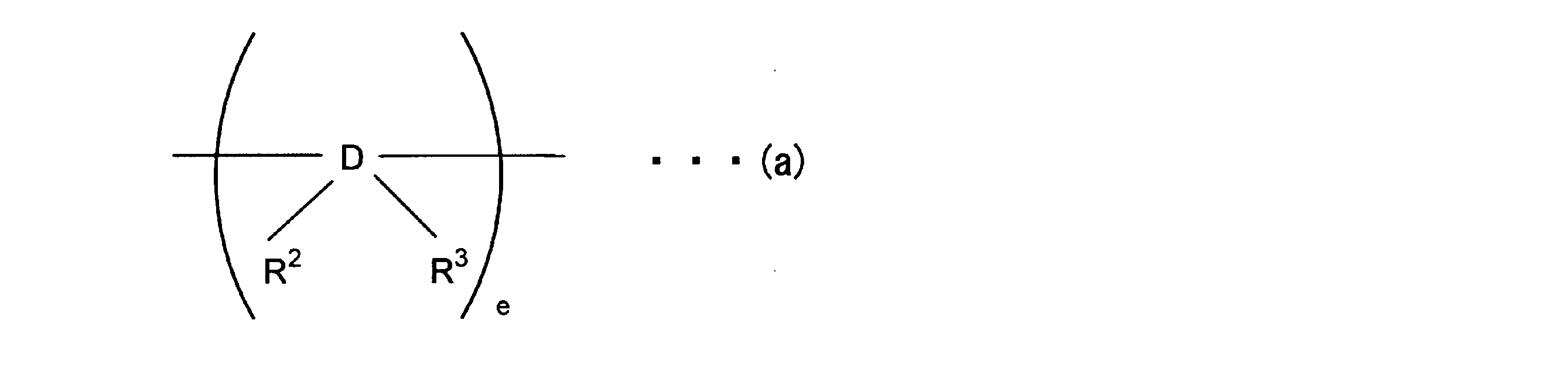
(Dは周期律表第14族元素であり、例えば炭素,ケイ素,ゲルマニウム及びスズが挙げられる。R2及びR3はそれぞれ水素原子又は炭素数1~20の炭化水素基で、それらは互いに同一でも異なっていてもよく、また互いに結合して環構造を形成していてもよい。eは1~4の整数を示す。)
で表されるものが挙げられ、その具体例としては、メチレン基,エチレン基,エチリデン基,プロピリデン基,イソプロピリデン基,シクロヘキシリデン基,1,2-シクロヘキシレン基,ビニリデン基(CH2=C=),ジメチルシリレン基,ジフェニルシリレン基,メチルフェニルシリレン基,ジメチルゲルミレン基,ジメチルスタニレン基,テトラメチルジシリレン基,ジフェニルジシリレン基などを挙げることができる。これらの中で、エチレン基,イソプロピリデン基及びジメチルシリレン基が好適である。
一般式(I)で表される二重架橋遷移金属化合物の具体例としては、(1,2'-ジメチルシリレン)(2,1'-ジメチルシリレン)(3-メチルシクロペンタジエニル)(3'-メチルシクロペンタジエニル)ジルコニウムジクロリド,(1,2'-ジメチルシリレン)(2,1'-イソプロピリデン)(3-メチルシクロペンタジエニル)(3'-メチルシクロペンタジエニル)ジルコニウムジクロリド,(1,2'-ジメチルシリレン)(2,1'-エチレン)(3-メチルシクロペンタジエニル)(3'-メチルシクロペンタジエニル)ジルコニウムジクロリド,(1,2'-エチレン)(2,1'-メチレン)(3-メチルシクロペンタジエニル)(3'-メチルシクロペンタジエニル)ジルコニウムジクロリド,(1,2'-エチレン)(2,1'-イソプロピリデン)(3-メチルシクロペンタジエニル)(3'-メチルシクロペンタジエニル)ジルコニウムジクロリド,(1,2'-メチレン)(2,1'-メチレン)(3-メチルシクロペンタジエニル)(3'-メチルシクロペンタジエニル)ジルコニウムジクロリド,(1,2'-メチレン)(2,1'-イソプロピリデン)(3-メチルシクロペンタジエニル)(3'-メチルシクロペンタジエニル)ジルコニウムジクロリド,(1,2'-イソプロピリデン)(2,1'-イソプロピリデン)(3-メチルシクロペンタジエニル)(3'-メチルシクロペンタジエニル)ジルコニウムジクロリド,(1,2'-ジメチルシリレン)(2,1'-ジメチルシリレン)(3,4-ジメチルシクロペンタジエニル)(3',4'-ジメチルシクロペンタジエニル)ジルコニウムジクロリド,(1,2'-ジメチルシリレン)(2,1'-イソプロピリデン)(3,4-ジメチルシクロペンタジエニル)(3',4'-ジメチルシクロペンタジエニル)ジルコニウムジクロリド,(1,2'-ジメチルシリレン)(2,1'-エチレン)(3,4-ジメチルシクロペンタジエニル)(3',4'-ジメチルシクロペンタジエニル)ジルコニウムジクロリド,
(1,2'-エチレン)(2,1'-メチレン)(3,4-ジメチルシクロペンタジエニル)(3',4'-ジメチルシクロペンタジエニル)ジルコニウムジクロリド,(1,2'-エチレン)(2,1'-イソプロピリデン)(3,4-ジメチルシクロペンタジエニル)(3',4'-ジメチルシクロペンタジエニル)ジルコニウムジクロリド,(1,2'-メチレン)(2,1'-メチレン)(3,4-ジメチルシクロペンタジエニル)(3',4'-ジメチルシクロペンタジエニル)ジルコニウムジクロリド,(1,2'-メチレン)(2,1'-イソプロピリデン)(3,4-ジメチルシクロペンタジエニル)(3',4'-ジメチルシクロペンタジエニル)ジルコニウムジクロリド,(1,2'-イソプロピリデン)(2,1'-イソプロピリデン)(3,4-ジメチルシクロペンタジエニル)(3',4'-ジメチルシクロペンタジエニル)ジルコニウムジクロリド,(1,2'-ジメチルシリレン)(2,1'-ジメチルシリレン)(3-メチル-5-エチルシクロペンタジエニル)(3'-メチル-5'-エチルシクロペンタジエニル)ジルコニウムジクロリド,(1,2'-ジメチルシリレン)(2,1'-ジメチルシリレン)(3-メチル-5-エチルシクロペンタジエニル)(3'-メチル-5'-エチルシクロペンタジエニル)ジルコニウムジクロリド,(1,2'-ジメチルシリレン)(2,1'-ジメチルシリレン)(3-メチル-5-イソプロピルシクロペンタジエニル)(3'-メチル-5'-イソプロピルシクロペンタジエニル)ジルコニウムジクロリド、(1,2'-ジメチルシリレン)(2,1'-ジメチルシリレン)(3-メチル-5-n-ブチルシクロペンタジエニル)(3'-メチル-5'-n-ブチルシクロペンタジエニル)ジルコニウムジクロリド,(1,2'-ジメチルシリレン)(2,1'-ジメチルシリレン)(3-メチル-5-フェニルシクロペンジエニル)(3'-メチル-5'-フェニルシクロペンタジエニル)ジルコニウムジクロリド,
(1,2'-ジメチルシリレン)(2,1'-イソプロピリデン)(3-メチル-5-エチルシクロペンタジエニル)(3'-メチル-5'-エチルシクロペンタジエニル)ジルコニウムジクロリド,(1,2'-ジメチルシリレン)(2,1'-イソプロピリデン)(3-メチル-5-イソプロピルシクロペンタジエニル)(3'-メチル-5'-イソプロピルシクロペンタジエニル)ジルコニウムジクロリド,(1,2'-ジメチルシリレン)(2,1'-イソプロピリデン)(3-メチル-5-n-ブチルシクロペンタジエニル)(3'-メチル-5'-n-ブチルシクロペンタジエニル)ジルコニウムジクロリド,(1,2'-ジメチルシリレン)(2,1'-イソプロピリデン)(3-メチル-5-フェニルシクロペンタジエニル)(3'-メチル-5'-フェニルシクロペンジエニル)ジルコニウムジクロリド,(1,2'-ジメチルシリレン)(2,1'-エチレン)(3-メチル-5-エチルシクロペンタジエニル)(3'-メチル-5'-エチルシクロペンタジエニル)ジルコニウムジクロリド,(1,2'-ジメチルシリレン)(2,1'-エチレン)(3-メチル-5-イソプロピルシクロペンタジエニル)(3'-メチル-5'-イソプロピルシクロペンタジエニル)ジルコニウムジクロリド,(1,2'-ジメチルシリレン)(2,1'-エチレン)(3-メチル-5-n-ブチルシクロペンタジエニル)(3'-メチル-5'-n-ブチルシクロペンタジエニル)ジルコニウムジクロリド,(1,2'-ジメチルシリレン)(2,1'-エチレン)(3-メチル-5-フェニルシクロペンタジエニル)(3'-メチル-5'-フェニルシクロペンタジエニル)ジルコニウムジクロリド,(1,2'-ジメチルシリレン)(2,1'-メチレン)(3-メチル-5-エチルシクロペンタジエニル)(3'-メチル-5'-エチルシクロペンジエニル)ジルコニウムジクロリド,
(1,2'-ジメチルシリレン)(2,1'-メチレン)(3-メチル-5-イソプロピルシクロペンタジエニル)(3'-メチル-5'-イソプロピルシクロペンタジエニル)ジルコニウムジクロリド,(1,2'-ジメチルシリレン)(2,1'-メチレン)(3-メチル-5-n-ブチルシクロペンタジエニル)(3'-メチル-5'-n-ブチルシクロペンタジエニル)ジルコニウムジクロリド,(1,2'-ジメチルシリレン)(2,1'-メチレン)(3-メチル-5-フェニルシクロペンタジエニル)(3'-メチル-5'-フェニルシクロペンタジエニル)ジルコニウムジクロリド,(1,2'-エチレン)(2,1'-メチレン)(3-メチル-5-イソプロピルシクロペンタジエニル)(3'-メチル-5'-イソプロピルシクロペンタジエニル)ジルコニウムジクロリド,(1,2'-エチレン)(2,1'-イソプロピリデン)(3-メチル-5-イソプロピルシクロペンタジエニル)(3'-メチル-5'-イソプロピルシクロペンタジエニル)ジルコニウムジクロリド,(1,2'-メチレン)(2,1'-メチレン)(3-メチル-5-イソプロピルシクロペンタジエニル)(3'-メチル-5'-イソプロピルシクロペンタジエニル)ジルコニウムジクロリド,(1,2'-メチレン)(2,1'-イソプロピリデン)(3-メチル-5-イソプロピルシクロペンタジエニル)(3'-メチル-5'-イソプロピルシクロペンタジエニル)ジルコニウムジクロリドなど及びこれらの化合物におけるジルコニウムをチタン又はハフニウムに置換したもの、及び後述する一般式(II)で表される化合物を挙げることができる。
また、他の族の金属元素の類似化合物であってもよい。
好ましくは周期律表第4族の遷移金属化合物であり、中でもジルコニウムの化合物が好ましい。
上記一般式(I)で表される遷移金属化合物の中では、一般式(II)で表される化合物が好ましい。
また、他の族の金属元素の類似化合物であってもよい。
好ましくは周期律表第4族の遷移金属化合物であり、中でもジルコニウムの化合物が好ましい。
上記一般式(I)で表される遷移金属化合物の中では、一般式(II)で表される化合物が好ましい。

上記一般式(II)において、Mは周期律表第3~10族の金属元素を示し、A1a及びA2aは、それぞれ上記一般式(I)における一般式(a)で表される架橋基を示し、CH2,CH2CH2,(CH3)2C,(CH3)2C(CH3)2C,(CH3)2Si及び(C6H5)2Siが好ましい。
A1a及びA2aは、互いに同一でも異なっていてもよい。
R4~R13はそれぞれ水素原子、ハロゲン原子、炭素数1~20の炭化水素基、炭素数1~20のハロゲン含有炭化水素基、ケイ素含有基又はヘテロ原子含有基を示す。
ハロゲン原子、炭素数1~20の炭化水素基及びケイ素含有基としては、上記一般式(I)において説明したものと同様のものが挙げられる。
炭素数1~20のハロゲン含有炭化水素基としては、p-フルオロフェニル基、3,5-ジフルオロフェニル基、3,4,5-トリフルオロフェニル基、ペンタフルオロフェニル基、3,5-ビス(トリフルオロ)フェニル基、フルオロブチル基などが挙げられる。
ヘテロ原子含有基としては、炭素数1~20のヘテロ原子含有基が挙げられ、具体的には、ジメチルアミノ基、ジエチルアミノ基、ジフェニルアミノ基などの窒素含有基;フェニルスルフィド基、メチルスルフィド基などの硫黄含有基;ジメチルホスフィノ基、ジフェニルホスフィノ基などの燐含有基;メトキシ基、エトキシ基、フェノキシ基などの酸素含有基などが挙げられる。
なかでも、R4及びR5としてはハロゲン、酸素、ケイ素などのヘテロ原子を含有する基が、重合活性が高く好ましい。
R6~R13としては、水素原子又は炭素数1~20の炭化水素基が好ましい。
X及びYは一般式(I)と同じである。qは1~5の整数で〔(Mの原子価)-2〕を示し、rは0~3の整数を示す。
A1a及びA2aは、互いに同一でも異なっていてもよい。
R4~R13はそれぞれ水素原子、ハロゲン原子、炭素数1~20の炭化水素基、炭素数1~20のハロゲン含有炭化水素基、ケイ素含有基又はヘテロ原子含有基を示す。
ハロゲン原子、炭素数1~20の炭化水素基及びケイ素含有基としては、上記一般式(I)において説明したものと同様のものが挙げられる。
炭素数1~20のハロゲン含有炭化水素基としては、p-フルオロフェニル基、3,5-ジフルオロフェニル基、3,4,5-トリフルオロフェニル基、ペンタフルオロフェニル基、3,5-ビス(トリフルオロ)フェニル基、フルオロブチル基などが挙げられる。
ヘテロ原子含有基としては、炭素数1~20のヘテロ原子含有基が挙げられ、具体的には、ジメチルアミノ基、ジエチルアミノ基、ジフェニルアミノ基などの窒素含有基;フェニルスルフィド基、メチルスルフィド基などの硫黄含有基;ジメチルホスフィノ基、ジフェニルホスフィノ基などの燐含有基;メトキシ基、エトキシ基、フェノキシ基などの酸素含有基などが挙げられる。
なかでも、R4及びR5としてはハロゲン、酸素、ケイ素などのヘテロ原子を含有する基が、重合活性が高く好ましい。
R6~R13としては、水素原子又は炭素数1~20の炭化水素基が好ましい。
X及びYは一般式(I)と同じである。qは1~5の整数で〔(Mの原子価)-2〕を示し、rは0~3の整数を示す。
上記一般式(II)で表される二重架橋遷移金属化合物のうち、両方のインデニル基が同一である場合、周期律表第4族の遷移金属化合物としては、(1,2’-ジメチルシリレン)(2,1’-ジメチルシリレン)ビス(インデニル)ジルコニウムジクロリド、(1,2’-ジメチルシリレン)(2,1’-ジメチルシリレン)ビス(3-メチルインデニル)ジルコニウムジクロリド、(1,2’-ジメチルシリレン)(2,1’-ジメチルシリレン)ビス(3-エチルインデニル)ジルコニウムジクロリド、(1,2’-ジメチルシリレン)(2,1’-ジメチルシリレン)ビス(3-イソプロピルインデニル)ジルコニウムジクロリド、(1,2’-ジメチルシリレン)(2,1’-ジメチルシリレン)ビス(3-トリメチルシリルメチルインデニル)ジルコニウムジクロリド、(1,2’-ジメチルシリレン)(2,1’-ジメチルシリレン)ビス(3-ブチルインデニル)ジルコニウムジクロリド、(1,2’-ジメチルシリレン)(2,1’-ジメチルシリレン)ビス(4-メチルインデニル)ジルコニウムジクロリド、(1,2’-ジメチルシリレン)(2,1’-ジメチルシリレン)ビス(4,7-ジメチルインデニル)ジルコニウムジクロリド、(1,2’-ジメチルシリレン)(2,1’-ジメチルシリレン)ビス(5,6-ジメチルインデニル)ジルコニウムジクロリド、(1,2’-ジメチルシリレン)(2,1’-ジメチルシリレン)ビス(3-エトキシメチルインデニル)ジルコニウムジクロリド、(1,2’-ジメチルシリレン)(2,1’-ジメチルシリレン)ビス(3-エトキシエチルインデニル)ジルコニウムジクロリド、
(1,2’-ジメチルシリレン)(2,1’-ジメチルシリレン)ビス(3-メトキシメチルインデニル)ジルコニウムジクロリド、(1,2’-ジメチルシリレン)(2,1’-ジメチルシリレン)ビス(3-メトキシエチルインデニル)ジルコニウムジクロリド、(1,2’-フェニルメチルシリレン)(2,1’-フェニルメチルシリレン)ビス(インデニル)ジルコニウムジクロリド、(1,2’-フェニルメチルシリレン)(2,1’-フェニルメチルシリレン)ビス(3-メチルインデニル)ジルコニウムジクロリド、(1,2’-ジメチルシリレン)(2,1’-イソプロピリデン)ビス(インデニル)ジルコニウムジクロリド、(1,2’-ジメチルシリレン)(2,1’-イソプロピリデン)ビス(3-メチルインデニル)ジルコニウムジクロリド、(1,2’-ジメチルシリレン)(2,1’-イソプロピリデン)ビス(3-イソプロピルインデニル)ジルコニウムジクロリド、(1,2’-ジメチルシリレン)(2,1’-イソプロピリデン)ビス(3-n-ブチルインデニル)ジルコニウムジクロリド、(1,2’-ジメチルシリレン)(2,1’-イソプロピリデン)ビス(3-トリメチルシリルメチルインデニル)ジルコニウムジクロリド、(1,2’-ジメチルシリレン)(2,1’-イソプロピリデン)ビス(3-トリメチルシリルインデニル)ジルコニウムジクロリド、(1,2’-ジメチルシリレン)(2,1’-イソプロピリデン)ビス(3-フェニルインデニル)ジルコニウムジクロリド、(1,2’-ジメチルシリレン)(2,1’-メチレン)ビス(インデニル)ジルコニウムジクロリド、
(1,2’-ジメチルシリレン)(2,1’-メチレン)ビス(3-メチルインデニル)ジルコニウムジクロリド、(1,2’-ジメチルシリレン)(2,1’-メチレン)ビス(3-イソプロピルインデニル)ジルコニウムジクロリド、(1,2’-ジメチルシリレン)(2,1’-メチレン)ビス(3-n-ブチルインデニル)ジルコニウムジクロリド、(1,2’-ジメチルシリレン)(2,1’-メチレン)ビス(3-トリメチルシリルメチルインデニル)ジルコニウムジクロリド、(1,2’-ジメチルシリレン)(2,1’-メチレン)ビス(3-トリメチルシリルインデニル)ジルコニウムジクロリド、(1,2’-ジフェニルシリレン)(2,1’-メチレン)ビス(インデニル)ジルコニウムジクロリド、(1,2’-ジフェニルシリレン)(2,1’-メチレン)ビス(3-メチルインデニル)ジルコニウムジクロリド、(1,2’-ジフェニルシリレン)(2,1’-メチレン)ビス(3-n-ブチルインデニル)ジルコニウムジクロリド、(1,2’-ジフェニルシリレン)(2,1’-メチレン)ビス(3-トリメチルシリルメチルインデニル)ジルコニウムジクロリド、(1,2’-ジフェニルシリレン)(2,1’-メチレン)ビス(3-トリメチルシリルインデニル)ジルコニウムジクロリドなど、及びこれらの化合物におけるジルコニウムをチタン又はハフニウムに置換したものを挙げることができるがこれらに限定されるものではない。
また、第4族以外の他の族の金属元素の類似化合物であってもよい。
好ましくは周期律表第4族の遷移金属化合物であり、中でもジルコニウムの化合物が好ましい。
また、第4族以外の他の族の金属元素の類似化合物であってもよい。
好ましくは周期律表第4族の遷移金属化合物であり、中でもジルコニウムの化合物が好ましい。
一方、上記一般式(II)で表される二重架橋遷移金属化合物のうち、R5が水素原子で、R4が水素原子でない場合、周期律表第4族の遷移金属化合物としては、(1,2’-ジメチルシリレン)(2,1’-ジメチルシリレン)(インデニル)(3-トリメチルシリルメチルインデニル)ジルコニウムジクロリド、(1,2’-ジメチルシリレン)(2,1’-ジメチルシリレン)(インデニル)(3-メチルインデニル)ジルコニウムジクロリド、(1,2’-ジメチルシリレン)(2,1’-ジメチルシリレン)(インデニル)(3-トリメチルシリルインデニル)ジルコニウムジクロリド(1,2’-ジメチルシリレン)(2,1’-ジメチルシリレン)(インデニル)(3-フェニルインデニル)ジルコニウムジクロリド、(1,2’-ジメチルシリレン)(2,1’-ジメチルシリレン)(インデニル)(3-ベンジルインデニル)ジルコニウムジクロリド、(1,2’-ジメチルシリレン)(2,1’-ジメチルシリレン)(インデニル)(3-ネオペンチルインデニル)ジルコニウムジクロリド、(1,2’-ジメチルシリレン)(2,1’-ジメチルシリレン)(インデニル)(3-フェネチルインデニル)ジルコニウムジクロリド、(1,2’-エチレン)(2,1’-エチレン)(インデニル)(3-トリメチルシリルメチルインデニル)ジルコニウムジクロリド、(1,2’-エチレン)(2,1’-エチレン)(インデニル)(3-メチルインデニル)ジルコニウムジクロリド、(1,2’-エチレン)(2,1’-エチレン)(インデニル)(3-トリメチルシリルインデニル)ジルコニウムジクロリド、(1,2’-エチレン)(2,1’-エチレン)(インデニル)(3-フェニルインデニル)ジルコニウムジクロリド、(1,2’-エチレン)(2,1’-エチレン)(インデニル)(3-ベンジルインデニル)ジルコニウムジクロリド、(1,2’-エチレン)(2,1’-エチレン)(インデニル)(3-ネオペンチルインデニル)ジルコニウムジクロリド、(1,2’-エチレン)(2,1’-エチレン)(インデニル)(3-フェネチルインデニル)ジルコニウムジクロリドなど、及びこれらの化合物におけるジルコニウムをチタン又はハフニウムに置換したものを挙げることができるがこれらに限定されるものではない。
また、第4族以外の他の族の金属元素の類似化合物であってもよい。
好ましくは周期律表第4族の遷移金属化合物であり、中でもジルコニウムの化合物が好ましい。
また、第4族以外の他の族の金属元素の類似化合物であってもよい。
好ましくは周期律表第4族の遷移金属化合物であり、中でもジルコニウムの化合物が好ましい。
本発明で用いる触媒を構成する(B)遷移金属化合物と反応してイオン性の錯体を形成しうる化合物としては、比較的低分子量の高純度末端不飽和オレフィン系重合体が得られる点、及び触媒高活性の点でボレート化合物が好ましい。
ボレート化合物としては、テトラフェニルホウ酸トリエチルアンモニウム,テトラフェニルホウ酸トリ-n-ブチルアンモニウム,テトラフェニルホウ酸トリメチルアンモニウム,テトラフェニルホウ酸テトラエチルアンモニウム,テトラフェニルホウ酸メチル(トリ-n-ブチル)アンモニウム,テトラフェニルホウ酸ベンジル(トリ-n-ブチル)アンモニウム,テトラフェニルホウ酸ジメチルジフェニルアンモニウム,テトラフェニルホウ酸トリフェニル(メチル)アンモニウム,テトラフェニルホウ酸トリメチルアニリニウム,テトラフェニルホウ酸メチルピリジニウム,テトラフェニルホウ酸ベンジルピリジニウム,テトラフェニルホウ酸メチル(2-シアノピリジニウム),テトラキス(ペンタフルオロフェニル)ホウ酸トリエチルアンモニウム,テトラキス(ペンタフルオロフェニル)ホウ酸トリ-n-ブチルアンモニウム,テトラキス(ペンタフルオロフェニル)ホウ酸トリフェニルアンモニウム,テトラキス(ペンタフルオロフェニル)ホウ酸テトラ-n-ブチルアンモニウム,テトラキス(ペンタフルオロフェニル)ホウ酸テトラエチルアンモニウム,テトラキス(ペンタフルオロフェニル)ホウ酸ベンジル(トリ-n-ブチル)アンモニウム,テトラキス(ペンタフルオロフェニル)ホウ酸メチルジフェニルアンモニウム,テトラキス(ペンタフルオロフェニル)ホウ酸トリフェニル(メチル)アンモニウム,テトラキス(ペンタフルオロフェニル)ホウ酸メチルアニリニウム,テトラキス(ペンタフルオロフェニル)ホウ酸ジメチルアニリニウム,テトラキス(ペンタフルオロフェニル)ホウ酸トリメチルアニリニウム,
ボレート化合物としては、テトラフェニルホウ酸トリエチルアンモニウム,テトラフェニルホウ酸トリ-n-ブチルアンモニウム,テトラフェニルホウ酸トリメチルアンモニウム,テトラフェニルホウ酸テトラエチルアンモニウム,テトラフェニルホウ酸メチル(トリ-n-ブチル)アンモニウム,テトラフェニルホウ酸ベンジル(トリ-n-ブチル)アンモニウム,テトラフェニルホウ酸ジメチルジフェニルアンモニウム,テトラフェニルホウ酸トリフェニル(メチル)アンモニウム,テトラフェニルホウ酸トリメチルアニリニウム,テトラフェニルホウ酸メチルピリジニウム,テトラフェニルホウ酸ベンジルピリジニウム,テトラフェニルホウ酸メチル(2-シアノピリジニウム),テトラキス(ペンタフルオロフェニル)ホウ酸トリエチルアンモニウム,テトラキス(ペンタフルオロフェニル)ホウ酸トリ-n-ブチルアンモニウム,テトラキス(ペンタフルオロフェニル)ホウ酸トリフェニルアンモニウム,テトラキス(ペンタフルオロフェニル)ホウ酸テトラ-n-ブチルアンモニウム,テトラキス(ペンタフルオロフェニル)ホウ酸テトラエチルアンモニウム,テトラキス(ペンタフルオロフェニル)ホウ酸ベンジル(トリ-n-ブチル)アンモニウム,テトラキス(ペンタフルオロフェニル)ホウ酸メチルジフェニルアンモニウム,テトラキス(ペンタフルオロフェニル)ホウ酸トリフェニル(メチル)アンモニウム,テトラキス(ペンタフルオロフェニル)ホウ酸メチルアニリニウム,テトラキス(ペンタフルオロフェニル)ホウ酸ジメチルアニリニウム,テトラキス(ペンタフルオロフェニル)ホウ酸トリメチルアニリニウム,
テトラキス(ペンタフルオロフェニル)ホウ酸メチルピリジニウム,テトラキス(ペンタフルオロフェニル)ホウ酸ベンジルピリジニウム,テトラキス(ペンタフルオロフェニル)ホウ酸メチル(2-シアノピリジニウム),テトラキス(ペンタフルオロフェニル)ホウ酸ベンジル(2-シアノピリジニウム),テトラキス(ペンタフルオロフェニル)ホウ酸メチル(4-シアノピリジニウム) ,テトラキス(ペンタフルオロフェニル)ホウ酸トリフェニルホスホニウム,テトラキス[ビス(3,5-ジトリフルオロメチル)フェニル]ホウ酸ジメチルアニリニウム,テトラフェニルホウ酸フェロセニウム,テトラフェニルホウ酸銀,テトラフェニルホウ酸トリチル,テトラフェニルホウ酸テトラフェニルポルフィリンマンガン,テトラキス(ペンタフルオロフェニル)ホウ酸トリフェニルカルベニウム,テトラキス(パーフルオロフェニル)ホウ酸メチルアニリニウム,テトラキス(ペンタフルオロフェニル)ホウ酸フェロセニウム,テトラキス(ペンタフルオロフェニル)ホウ酸(1,1'-ジメチルフェロセニウム),テトラキス(ペンタフルオロフェニル)ホウ酸デカメチルフェロセニウム,テトラキス(ペンタフルオロフェニル)ホウ酸銀、テトラキス(ペンタフルオロフェニル)ホウ酸トリチル,テトラキス(ペンタフルオロフェニル)ホウ酸リチウム,テトラキス(ペンタフルオロフェニル)ホウ酸ナトリウム,テトラキス(ペンタフルオロフェニル)ホウ酸テトラフェニルポルフィリンマンガン,テトラフルオロホウ酸銀などを挙げることができる。これらは一種を単独で又は二種以上を組み合わせて用いることができる。後述する水素と遷移金属化合物とのモル比(水素/遷移金属化合物)が0である場合、テトラキス(ペンタフルオロフェニル)ホウ酸ジメチルアニリニウム、テトラキス(ペンタフルオロフェニル)ホウ酸トリフェニルカルベニウム及びテトラキス(パーフルオロフェニル)ホウ酸メチルアニリニウムなどが好ましい。
本発明の製造方法で用いる触媒は、上記(A)成分と(B)成分との組み合わせでもよく、上記(A)成分及び(B)成分に加えて(C)成分として有機アルミニウム化合物を用いてもよい。
(C)成分の有機アルミニウム化合物としては、トリメチルアルミニウム、トリエチルアルミニウム、トリイソプロピルアルミニウム、トリイソブチルアルミニウム、トリノルマルへキシルアルミニウム、トリノルマルオクチルアルミニウム、ジメチルアルミニウムクロリド、ジエチルアルミニウムクロリド、メチルアルミニウムジクロリド、エチルアルミニウムジクロリド、ジメチルアルミニウムフルオリド、ジイソブチルアルミニウムヒドリド、ジエチルアルミニウムヒドリド及びエチルアルミニウムセスキクロリドなどが挙げられる。
これらの有機アルミニウム化合物は一種用いてもよく、二種以上を組み合わせて用いてもよい。
これらのうち、本発明においては、トリメチルアルミニウム、トリエチルアルミニウム、トリイソプロピルアルミニウム、トリイソブチルアルミニウム、トリノルマルへキシルアルミニウム及びトリノルマルオクチルアルミニウムなどのトリアルキルアルミニウムが好ましく、トリイソブチルアルミニウム、トリノルマルへキシルアルミニウム及びトリノルマルオクチルアルミニウムがより好ましい。
(C)成分の有機アルミニウム化合物としては、トリメチルアルミニウム、トリエチルアルミニウム、トリイソプロピルアルミニウム、トリイソブチルアルミニウム、トリノルマルへキシルアルミニウム、トリノルマルオクチルアルミニウム、ジメチルアルミニウムクロリド、ジエチルアルミニウムクロリド、メチルアルミニウムジクロリド、エチルアルミニウムジクロリド、ジメチルアルミニウムフルオリド、ジイソブチルアルミニウムヒドリド、ジエチルアルミニウムヒドリド及びエチルアルミニウムセスキクロリドなどが挙げられる。
これらの有機アルミニウム化合物は一種用いてもよく、二種以上を組み合わせて用いてもよい。
これらのうち、本発明においては、トリメチルアルミニウム、トリエチルアルミニウム、トリイソプロピルアルミニウム、トリイソブチルアルミニウム、トリノルマルへキシルアルミニウム及びトリノルマルオクチルアルミニウムなどのトリアルキルアルミニウムが好ましく、トリイソブチルアルミニウム、トリノルマルへキシルアルミニウム及びトリノルマルオクチルアルミニウムがより好ましい。
(A)成分の使用量は、通常0.1×10⁻⁶~1.5×10⁻⁵モル/L、好ましくは0.15×10-6~1.3×10-5モル/L、より好ましくは0.2×10-6~1.2×10-5モル/L、特に好ましくは0.3×10-6~1.0×10-5モル/Lである。
(A)成分の使用量が0.1×10⁻⁶モル/L以上であると、触媒活性が十分に発現され、1.5×10-5モル/L以下であると、重合熱を容易に除去することができる。
(A)成分と(B)成分との使用割合(A)/(B)は、モル比で好ましくは10/1~1/100、より好ましくは2/1~1/10である。
(A)/(B)が10/1~1/100の範囲にあると、触媒としての効果が得られると共に、単位質量ポリマー当たりの触媒コストを抑えることができる。
また、目的とする反応性ポリオレフィン中にホウ素が多量に存在するおそれがない。
(A)成分と(C)成分との使用割合(A)/(C)は、モル比で好ましくは1/1~1/10000、より好ましくは1/5~1/2000、さらに好ましくは1/10~1/1000である。
(C)成分を用いることにより、遷移金属当たりの重合活性を向上させることができる。(A)/(C)が1/1~1/10000の範囲にあると、(C)成分の添加効果と経済性のバランスが良好であり、また、目的とする反応性ポリオレフィン中にアルミニウムが多量に存在するおそれがない。
本発明の製造方法においては、上述した(A)成分及び(B)成分、あるいは(A)成分、(B)成分及び(C)成分を用いて予備接触を行うこともできる。
予備接触は、(A)成分に、例えば(B)成分を接触させることにより行うことができるが、その方法に特に制限はなく、公知の方法を用いることができる。
このような予備接触により触媒活性の向上や、助触媒である(B)成分の使用割合の低減など、触媒コストの低減に効果的である。
(A)成分の使用量が0.1×10⁻⁶モル/L以上であると、触媒活性が十分に発現され、1.5×10-5モル/L以下であると、重合熱を容易に除去することができる。
(A)成分と(B)成分との使用割合(A)/(B)は、モル比で好ましくは10/1~1/100、より好ましくは2/1~1/10である。
(A)/(B)が10/1~1/100の範囲にあると、触媒としての効果が得られると共に、単位質量ポリマー当たりの触媒コストを抑えることができる。
また、目的とする反応性ポリオレフィン中にホウ素が多量に存在するおそれがない。
(A)成分と(C)成分との使用割合(A)/(C)は、モル比で好ましくは1/1~1/10000、より好ましくは1/5~1/2000、さらに好ましくは1/10~1/1000である。
(C)成分を用いることにより、遷移金属当たりの重合活性を向上させることができる。(A)/(C)が1/1~1/10000の範囲にあると、(C)成分の添加効果と経済性のバランスが良好であり、また、目的とする反応性ポリオレフィン中にアルミニウムが多量に存在するおそれがない。
本発明の製造方法においては、上述した(A)成分及び(B)成分、あるいは(A)成分、(B)成分及び(C)成分を用いて予備接触を行うこともできる。
予備接触は、(A)成分に、例えば(B)成分を接触させることにより行うことができるが、その方法に特に制限はなく、公知の方法を用いることができる。
このような予備接触により触媒活性の向上や、助触媒である(B)成分の使用割合の低減など、触媒コストの低減に効果的である。
本発明の反応性ポリオレフィンは、上記触媒残渣が少ないものが好ましい。
特に、遷移金属の含有量が5質量ppm以下、アルミニウムの含有量が300質量ppm以下、ホウ素の含有量が5質量ppm以下のものである。
遷移金属としては、チタン、ジルコニウム及びハフニウムなどが挙げられ、これらの合計量が5質量ppm以下である。
アルミニウムの含有量は、好ましくは280質量ppm以下である。
これらの金属成分は、ICP(高周波誘導結合プラズマ分光分析)測定装置により測定することができる。
触媒残渣が少ない反応性ポリオレフィンを用いると、得られるグラフト共重合体が高純度であり、好ましい。
特に、遷移金属の含有量が5質量ppm以下、アルミニウムの含有量が300質量ppm以下、ホウ素の含有量が5質量ppm以下のものである。
遷移金属としては、チタン、ジルコニウム及びハフニウムなどが挙げられ、これらの合計量が5質量ppm以下である。
アルミニウムの含有量は、好ましくは280質量ppm以下である。
これらの金属成分は、ICP(高周波誘導結合プラズマ分光分析)測定装置により測定することができる。
触媒残渣が少ない反応性ポリオレフィンを用いると、得られるグラフト共重合体が高純度であり、好ましい。
(主鎖用単量体)
上記のように本発明で使用するグラフト共重合体の主鎖は、親水性基を有する単量体単位を含有する。当該主鎖は、親水性基を有する単量体を用いて重合反応を行うことで形成することができる。
一般に親水性基等の官能基を有する単量体は、その官能基の種類により反応性が異なる。したがって、本発明において所望の性質、長さを有する主鎖のグラフト共重合体を製造するためには適切な単量体の組み合わせを用いることが好ましい。以下において、マレイン酸等の二塩基酸化合物を単量体として使用する場合と使用しない場合とに分けて説明する。
上記のように本発明で使用するグラフト共重合体の主鎖は、親水性基を有する単量体単位を含有する。当該主鎖は、親水性基を有する単量体を用いて重合反応を行うことで形成することができる。
一般に親水性基等の官能基を有する単量体は、その官能基の種類により反応性が異なる。したがって、本発明において所望の性質、長さを有する主鎖のグラフト共重合体を製造するためには適切な単量体の組み合わせを用いることが好ましい。以下において、マレイン酸等の二塩基酸化合物を単量体として使用する場合と使用しない場合とに分けて説明する。
主鎖用単量体として、二塩基酸化合物を使用しない場合は、以下の化合物[I]~[III]で表される単量体が親水性基を有する単量体として好ましい。
[I]アクリル酸及びその誘導体
(1)アクリル酸
(2)水酸基を有する分子量30000以下の長鎖ポリアルキレン型グリコール類、例えば、ポリエチレングリコールモノアクリレート、ポリエチレングリコールポリプロピレングリコールアクリレート、ポリ(エチレングリコール-n-テトラメチレングリコール)モノアクリレート、プロピレングリコールポリブチレングリコールモノアクリレート、ポリプロピレングリコールモノアクリレート、ポリエチレングリコールモノメタアクリレート、ポリプロピレングリコールモノメタアクリレート、ポリ(エチレングリコール・プロピレングリコール)モノメタアクリレート、ポリ(エチレングリコール・テトラメチレングリコール)モノメタアクリレート、ポリ(プロピレングリコール・テトラメチレングリコール)モノメタアクリレート、プロピレングリコール・ポリブチレングリコールモノメタアクリレート
(3)アクリル酸と典型金属元素からなるアクリル酸金属塩、例えば、アクリル酸ナトリウム、アクリル酸カリウム、アクリル酸マグネシウム、アクリル酸カルシウム
(4)水酸基を有するアクリル酸エステル類、例えば、アクリル酸2-ヒドロキシエチル、アクリル酸2-ヒドロキシプロピル、2-ヒドロキシ-3-フェノキシプロピルアクリレート、4-ヒドロキシブチルアクリレート、2-ヒドロキシエチルメタアクリレート、ヒドロキシプロピルメタアクリレート
(5)アクリルアミドおよびN-置換アクリルアミド類、例えば、N-メチルアクリルアミド、N-エチルアクリルアミド、N-イソプロピルアクリルアミド、N-シクロへキシルアクリルアミド、N,N-ジメチルアクリルアミド、N,N-ジエチルアクリルアミド、N,N-ジブチルアクリルアミド、N,N-ジシクロへキシルアクリルアミド、N-(2-ヒドロキシエチル)-アクリルアミド、N-(2-ヒドロキシプロピル)-アクリルアミド、N,N-ジメチルアミノエチルアクリアミド、N-メチロールアクリルアミド
(6)分子量30000以下のアルキル基末端またはアリール基末端ポリアルキレン型グリコール類、例えば、メトキシエチレングリコールアクリレート、ラウロキシポリエチレングリコールアクリレート、フェノキシポリエチレングリコールアクリレート、メトキシエチレングリコールメタアクリレート、ラウロキシポリエチレングリコールメタアクリレート、フェノキシポリエチレングリコールメタアクリレート、フェノキシポリエチレングリコール・ポリプロピレングリコールメタアクリレート
(1)アクリル酸
(2)水酸基を有する分子量30000以下の長鎖ポリアルキレン型グリコール類、例えば、ポリエチレングリコールモノアクリレート、ポリエチレングリコールポリプロピレングリコールアクリレート、ポリ(エチレングリコール-n-テトラメチレングリコール)モノアクリレート、プロピレングリコールポリブチレングリコールモノアクリレート、ポリプロピレングリコールモノアクリレート、ポリエチレングリコールモノメタアクリレート、ポリプロピレングリコールモノメタアクリレート、ポリ(エチレングリコール・プロピレングリコール)モノメタアクリレート、ポリ(エチレングリコール・テトラメチレングリコール)モノメタアクリレート、ポリ(プロピレングリコール・テトラメチレングリコール)モノメタアクリレート、プロピレングリコール・ポリブチレングリコールモノメタアクリレート
(3)アクリル酸と典型金属元素からなるアクリル酸金属塩、例えば、アクリル酸ナトリウム、アクリル酸カリウム、アクリル酸マグネシウム、アクリル酸カルシウム
(4)水酸基を有するアクリル酸エステル類、例えば、アクリル酸2-ヒドロキシエチル、アクリル酸2-ヒドロキシプロピル、2-ヒドロキシ-3-フェノキシプロピルアクリレート、4-ヒドロキシブチルアクリレート、2-ヒドロキシエチルメタアクリレート、ヒドロキシプロピルメタアクリレート
(5)アクリルアミドおよびN-置換アクリルアミド類、例えば、N-メチルアクリルアミド、N-エチルアクリルアミド、N-イソプロピルアクリルアミド、N-シクロへキシルアクリルアミド、N,N-ジメチルアクリルアミド、N,N-ジエチルアクリルアミド、N,N-ジブチルアクリルアミド、N,N-ジシクロへキシルアクリルアミド、N-(2-ヒドロキシエチル)-アクリルアミド、N-(2-ヒドロキシプロピル)-アクリルアミド、N,N-ジメチルアミノエチルアクリアミド、N-メチロールアクリルアミド
(6)分子量30000以下のアルキル基末端またはアリール基末端ポリアルキレン型グリコール類、例えば、メトキシエチレングリコールアクリレート、ラウロキシポリエチレングリコールアクリレート、フェノキシポリエチレングリコールアクリレート、メトキシエチレングリコールメタアクリレート、ラウロキシポリエチレングリコールメタアクリレート、フェノキシポリエチレングリコールメタアクリレート、フェノキシポリエチレングリコール・ポリプロピレングリコールメタアクリレート
[II]メタアクリル酸及びアクリル酸のα-アルキル置換体(以下、これらを合わせて「メタアクリル酸類」と省略する場合がある。)、並びにそれらの誘導体
上記[I]の単量体のα位にメチル基などのアルキル基(好ましくは、炭素数6以下のアルキル基)を有する単量体
上記[I]の単量体のα位にメチル基などのアルキル基(好ましくは、炭素数6以下のアルキル基)を有する単量体
[III]ビニルエステル及びその誘導体、例えば、酢酸ビニル、プロピオン酸ビニル、イソラク酸ビニル、ピバリン酸ビニル、ウンデカン酸ビニル、パルミチン酸ビニルなどのビニルエステル(当該ビニルエステルを用いた重合体の部分ケン化物、完全ケン化物が好ましい。)
上記単量体[I]~[III]の他に、[IV]ビニルピリジン、ビニルピロリドン等の窒素含有ビニル化合物を好ましい単量体として挙げることができる。これらの親水性基を有する単量体を使用して重合反応を行う場合において、主鎖中の親水性基を有する単量体単位量が、40mol%以上となることが好ましく、より好ましくは50mol%以上である。
本発明のグラフト共重合体の主鎖は、親水性基を有する単量体に加えて、他の単量体を用いて共重合することで形成してもよい。当該他の単量体としては、スチレン類、アクリル酸エステル類、から選ばれる単量体が好ましいものとして挙げられ、これらの単量体を用いて共重合を行うことで、主鎖の親水性および疎水性を調整することができ、グラフト共重合体の水分散性の制御や顔料等の分散体成分との相溶性の制御が可能になり、分散安定性が向上する。また、一般に高含量化が困難な単量体の反応性を高め、当該単量体単位量を増加させることができる。
スチレン類の単量体としては、スチレン、更には、α-メチルスチレン、p-メチルスチレン、p-エチルスチレン、p-プロピルスチレン、p-イソプロピルスチレン、p-ブチルスチレン、p-tert-ブチルスチレン、p-フェニルスチレン、o-メチルスチレン、o-エチルスチレン、o-プロピルスチレン、o-イソプロピルスチレン、m-メチルスチレン、m-エチルスチレン、m-イソプロピルスチレン、m-ブチルスチレン、メシチルスチレン、2,4-ジメチルスチレン、2,5-ジメチルスチレン、3,5-ジメチルスチレンなどのアルキルスチレン類;p-メトキシスチレン、o-メトキシスチレン、m-メトキシスチレンなどのアルコキシスチレン類;p-クロロスチレン、m-クロロスチレン、o-ブロモスチレン、p-フルオロスチレン、m-フルオロスチレン、o-フルオロスチレン、o-メチル-p-フルオロスチレンなどのハロゲン化スチレン類;トリメチルシリルスチレン、ビニル安息香酸などのスチレン及びその誘導体が挙げられる。
アクリル酸エステル類の単量体としては、(メタ)アクリル酸メチル,(メタ)アクリル酸エチル,(メタ)アクリル酸ブチル,(メタ)アクリル酸ノルマルオクチル、(メタ)アクリル酸2-エチルヘキシルなどのアクリル酸エステルやメタアクリル酸エステルが挙げられる。
主鎖用単量体として、二塩基酸化合物を使用する場合は、親水性基を有する単量体として、下記A群から選択される一種以上と下記B群から選択される一種以上の単量体を併用することが好ましい。
A群
[V]無水マレイン酸及びその置換体
[VI]マレイン酸及びそのエステル
[VII]マレイミド及びその置換体
B群
[I]アクリル酸及びその誘導体
[II]メタアクリル酸類及びその誘導体
[III]ビニルエステル及びその誘導体
[V]無水マレイン酸及びその置換体
[VI]マレイン酸及びそのエステル
[VII]マレイミド及びその置換体
B群
[I]アクリル酸及びその誘導体
[II]メタアクリル酸類及びその誘導体
[III]ビニルエステル及びその誘導体
A群の単量体の具体例としては、
[V]無水マレイン酸、メチル無水マレイン酸、ジメチル無水マレイン酸、フェニル無水マレイン酸、ジフェニル無水マレイン酸などの無水マレイン酸及びその置換体
[VI]マレイン酸、メチルマレイン酸などのマレイン酸およびその置換体、並びにこれらのエステル化合物であって、親水性基を有するもの
[VII]マレイミド、N-アルキル置換マレイミド、N-メチルマレイミド、N-エチルマレイミド、N-フェニルマレイミドなどのマレイミド及びその置換体
が挙げられる。
これらの中で、無水マレイン酸が好ましい。
B群の単量体[I]~[III]の例示化合物としては、前記した化合物が挙げられる。
[V]無水マレイン酸、メチル無水マレイン酸、ジメチル無水マレイン酸、フェニル無水マレイン酸、ジフェニル無水マレイン酸などの無水マレイン酸及びその置換体
[VI]マレイン酸、メチルマレイン酸などのマレイン酸およびその置換体、並びにこれらのエステル化合物であって、親水性基を有するもの
[VII]マレイミド、N-アルキル置換マレイミド、N-メチルマレイミド、N-エチルマレイミド、N-フェニルマレイミドなどのマレイミド及びその置換体
が挙げられる。
これらの中で、無水マレイン酸が好ましい。
B群の単量体[I]~[III]の例示化合物としては、前記した化合物が挙げられる。
上記A群の単量体は二重結合の電子密度が小さいため、同種の単量体同士が重合しにくい単量体である。したがって、本発明においてはB群の単量体と併用して重合することで、A群の単量体の含有量を向上させる。また、本発明においては、A群の単量体を使用することで、反応性ポリオレフィンの反応性を高めることができるため、効率よくグラフト共重合体を製造できるという効果も得られる。
A群の化合物とB群の化合物の組合せは、A群の化合物/B群の化合物(モル比)は、通常、0.1~2程度、好ましくは0.5~1.5、より好ましくは0.8~1.2、更に好ましくは0.9~1.1の範囲である。
モル比が0.1以上であると、A群の化合物のグラフト重合量が上昇し、2以下であるとグラフト重合に関与しないA群の化合物/B群の化合物からなる共重合体が副生せず、好ましい。
モル比が0.1以上であると、A群の化合物のグラフト重合量が上昇し、2以下であるとグラフト重合に関与しないA群の化合物/B群の化合物からなる共重合体が副生せず、好ましい。
上記A群の単量体とB群の単量体を併用して重合反応を行う場合において、主鎖中の親水性基を有する単量体単位量が、40mol%以上となることが好ましく、より好ましくは50mol%以上である。
なお、A群の単量体とB群の単量体以外に使用する、主鎖を形成する単量体としては、上述のスチレン類やアクリル酸エステル類が挙げられ、これらの他にα-オレフィン類を使用してもよい。α-オレフィン類の例示化合物としては、エチレン、プロピレン、1-ブテン、1-へキセン、1-ヘプテン、1-オクテン、1-デセン、1-ウンデセン、1-ドデセン、1-トリデセン、1-テトラデセン、1-ペンタデセン、1-ヘキサデセン、1-ヘプタデセン、1-オクタデセン、1-ノナデセン、1-エイコセンなどの炭素数2~28のα-オレフィンが挙げられる。これらの単量体を用いることで、前述のように主鎖の親水性および疎水性を調整することができ、また反応しにくい単量体単位量を増加させることができる。
本発明のグラフト共重合に用いられるラジカル開始剤としては、特に制限はなく、従来公知のラジカル開始剤、例えば、各種有機過酸化物、アゾ系化合物などの中から適宜選択して用いることができ、両化合物はともに好適なラジカル開始剤である。
有機過酸化物としては、例えば、ジベンゾイルパーオキシド,ジ-8,5,5-トリメチルヘキサノイルパーオキシド,ジラウロイルパーオキシド,ジデカノイルパーオキシド,ジ(2,4-ジクロロベンゾイル)パーオキシドなどのジアシルパーオキシド類、t-ブチルヒドロパーオキシド,キュメンヒドロパーオキシド,ジイソプロピルベンゼンヒドロパーオキシド,2,5-ジメチルヘキサン-2,5-ジヒドロパーオキシドなどのヒドロパーオキシド類、ジ-t-ブチルパーオキシド,ジクミルパーオキシド,2,5-ジメチル-2,5-ジ(t-ブチルパーオキシ)ヘキサン,2,5-ジメチル-2,5-ジ(t-ブチルパーオキシ)ヘキシン-3、α,α’ビス(t-ブチルパーオキシ)ジイソプロピルベンゼンなどのジアルキルパーオキシド類、1,1-ビス-t-ブチルパーオキシ-3,3,5-トリメチルシクロヘキサン,2,2-ビス(t-ブチルパーオキシ)ブタンなどのパーオキシケタール類、t-ブチルパーオキシオクトエート,t-ブチルパーオキシピバレート,t-ブチルパーオキシネオデカノエート,t-ブチルパーオキシベンゾエートなどのアルキルパーエステル類、ジ-2-エチルヘキシルパーオキシジカーボネート,ジイソプロピルパーオキシジカーボネート,ジ-sec-ブチルパーオキシジカーボネート,t-ブチルパーオキシイソプロピルカーボネートなどのパーオキシカーボネート類などが挙げられ、これらの中で、ジアルキルパーオキシド類が好ましい。
アゾ系化合物としては、アゾビスイソブチロニトリル、アゾビスイソバレロニトリルなどが挙げられる。
ラジカル開始剤は、一種を単独で用いてもよく、二種以上を組み合わせて用いてもよい。
有機過酸化物としては、例えば、ジベンゾイルパーオキシド,ジ-8,5,5-トリメチルヘキサノイルパーオキシド,ジラウロイルパーオキシド,ジデカノイルパーオキシド,ジ(2,4-ジクロロベンゾイル)パーオキシドなどのジアシルパーオキシド類、t-ブチルヒドロパーオキシド,キュメンヒドロパーオキシド,ジイソプロピルベンゼンヒドロパーオキシド,2,5-ジメチルヘキサン-2,5-ジヒドロパーオキシドなどのヒドロパーオキシド類、ジ-t-ブチルパーオキシド,ジクミルパーオキシド,2,5-ジメチル-2,5-ジ(t-ブチルパーオキシ)ヘキサン,2,5-ジメチル-2,5-ジ(t-ブチルパーオキシ)ヘキシン-3、α,α’ビス(t-ブチルパーオキシ)ジイソプロピルベンゼンなどのジアルキルパーオキシド類、1,1-ビス-t-ブチルパーオキシ-3,3,5-トリメチルシクロヘキサン,2,2-ビス(t-ブチルパーオキシ)ブタンなどのパーオキシケタール類、t-ブチルパーオキシオクトエート,t-ブチルパーオキシピバレート,t-ブチルパーオキシネオデカノエート,t-ブチルパーオキシベンゾエートなどのアルキルパーエステル類、ジ-2-エチルヘキシルパーオキシジカーボネート,ジイソプロピルパーオキシジカーボネート,ジ-sec-ブチルパーオキシジカーボネート,t-ブチルパーオキシイソプロピルカーボネートなどのパーオキシカーボネート類などが挙げられ、これらの中で、ジアルキルパーオキシド類が好ましい。
アゾ系化合物としては、アゾビスイソブチロニトリル、アゾビスイソバレロニトリルなどが挙げられる。
ラジカル開始剤は、一種を単独で用いてもよく、二種以上を組み合わせて用いてもよい。
グラフト共重合反応におけるラジカル開始剤の使用量としては、特に制限はなく、グラフト共重合体の所望物性に応じて適宜選定される。
ラジカル開始剤は、反応性ポリオレフィン100質量部に対し、0.001~10質量部、好ましくは0.005~5質量部の範囲で用いられる。
ラジカル開始剤は、反応性ポリオレフィン100質量部に対し、0.001~10質量部、好ましくは0.005~5質量部の範囲で用いられる。
上記の主鎖を形成するための単量体の使用量は目的に合わせて適宜決定することができるが、反応性ポリオレフィン100質量部に対して、0.2~200質量部の範囲で選定される。その使用量は、好ましくは0.3~150質量部、より好ましくは0.4~130質量部、更に好ましくは1~100質量部の範囲である。使用量が0.2質量部以上であると、グラフト重合体における共重合する単量体量が上昇し、相溶化などの機能を発現し易く、200質量以下であるとグラフト反応に関与しない重合体が副生せず好ましい。
グラフト重合方法としては、特に制限はないが、例えば、反応性ポリオレフィン、上記の単量体及びラジカル開始剤とを、ロールミル、バンバリーミキサー、押出機などを用いて溶融混練して反応させることにより、グラフト共重合体を製造することができる。反応条件としては、60~140℃の温度で、0.01~0.5時間が挙げられる。
また、ブタン、ペンタン、ヘキサン、シクロヘキサン、トルエンなどの炭化水素系溶剤、クロロベンゼン、ジクロロベンゼン、トリクロロベンゼンなどのハロゲン化炭化水素系溶剤、液化α-オレフィンなどの適当な有機溶媒中、あるいは無溶媒の条件で、グラフト共重合体を製造することもできる。反応条件としては、40~140℃、好ましくは50~140℃の温度で、0.1~10時間が挙げられる。
通常用いられる高温条件でグラフト重合を行った場合、反応性ポリオレフィンの分解による分子量や粘度の低下や、架橋反応などによるゲルの発生が生じ易い。しかしながら、上記条件は、比較的低温であり、分子量や粘度の低下がなく、架橋反応などの副反応も抑制される。
また、ブタン、ペンタン、ヘキサン、シクロヘキサン、トルエンなどの炭化水素系溶剤、クロロベンゼン、ジクロロベンゼン、トリクロロベンゼンなどのハロゲン化炭化水素系溶剤、液化α-オレフィンなどの適当な有機溶媒中、あるいは無溶媒の条件で、グラフト共重合体を製造することもできる。反応条件としては、40~140℃、好ましくは50~140℃の温度で、0.1~10時間が挙げられる。
通常用いられる高温条件でグラフト重合を行った場合、反応性ポリオレフィンの分解による分子量や粘度の低下や、架橋反応などによるゲルの発生が生じ易い。しかしながら、上記条件は、比較的低温であり、分子量や粘度の低下がなく、架橋反応などの副反応も抑制される。
本発明のグラフト共重合はルイス酸存在下で行ってもよく、ルイス酸としては、下記の化合物が挙げられる。
(1)周期律表2族~4族元素のハロゲン化物(塩素、臭素、フッ素、ヨウ素)、アルキル化物(炭素数1~20の炭化水素基)、ハロゲン化アルキル物
(2)アルミニウム、硼素、亜鉛、スズ、マグネシウム、カルシウム原子からなるルイス酸
ルイス酸の具体例としては、塩化マグネシウム、塩化カルシウム、塩化亜鉛、三塩化硼素、三塩化アルミニウム、三塩化ガリウム、四塩化珪素、四塩化珪素、及び塩素原子を臭素原子、フッ素原子に変換した化合物、ブチルエチルマグネシウム、ジエチル亜鉛、トリメチルアルミニウム、トリエチルアルミニウム、トリイソブチルアルミニウム、トリノルマルへキシルアルミニウム、トリメチル硼素、トリエチル硼素、トリエチルガリウム、トリメチルガリウム、ジエチルアルミニウムモノクロリド、エチルアルミニウムジクロリド、エチルアルミニウムセスキクロリドが挙げられ、中でも亜鉛化合物、アルミニウム化合物、硼素化合物が好ましい。
(1)周期律表2族~4族元素のハロゲン化物(塩素、臭素、フッ素、ヨウ素)、アルキル化物(炭素数1~20の炭化水素基)、ハロゲン化アルキル物
(2)アルミニウム、硼素、亜鉛、スズ、マグネシウム、カルシウム原子からなるルイス酸
ルイス酸の具体例としては、塩化マグネシウム、塩化カルシウム、塩化亜鉛、三塩化硼素、三塩化アルミニウム、三塩化ガリウム、四塩化珪素、四塩化珪素、及び塩素原子を臭素原子、フッ素原子に変換した化合物、ブチルエチルマグネシウム、ジエチル亜鉛、トリメチルアルミニウム、トリエチルアルミニウム、トリイソブチルアルミニウム、トリノルマルへキシルアルミニウム、トリメチル硼素、トリエチル硼素、トリエチルガリウム、トリメチルガリウム、ジエチルアルミニウムモノクロリド、エチルアルミニウムジクロリド、エチルアルミニウムセスキクロリドが挙げられ、中でも亜鉛化合物、アルミニウム化合物、硼素化合物が好ましい。
グラフト重合反応におけるルイス酸の使用量としては、ルイス酸/単量体(モル/モル)が0.01~1、好ましくは0.05~1、より好ましくは0.1~0.5である。ルイス酸/単量体(モル/モル)が0.01以上であると、グラフト率が高く、1以下であると脱灰によるルイス酸残渣の除去が不必要なため、着色がないなどの理由で好ましい。
ルイス酸は、ラジカル開始剤を添加する前に添加し、グラフト重合反応を行うか、予め単量体とルイス酸を接触させたものを用いることによりグラフト重合反応を行う。
ルイス酸は、ラジカル開始剤を添加する前に添加し、グラフト重合反応を行うか、予め単量体とルイス酸を接触させたものを用いることによりグラフト重合反応を行う。
[水系分散体およびその製造方法]
本発明の水系分散体は、上記グラフト共重合体が水に分散したものである。分散粒子径に特に制限はなく目的に合わせて適宜決定できるが、通常0.01~200μmである。
本発明の水系分散体は、上記グラフト共重合体が水に分散したものである。分散粒子径に特に制限はなく目的に合わせて適宜決定できるが、通常0.01~200μmである。
水系分散体を、接着剤やフィラー、繊維の処理剤として使用する場合は、分散粒子径は通常0.01~200μmが好ましく、より好ましくは0.01~100μm、さらに好ましくは0.01~50μm、最も好ましくは0.01~10μmである。上記範囲内であれば、均一な表面処理ができるため好ましい。
水系分散体を、塗料、インクの成分として使用する場合は、分散粒子径は通常0.01~1μmが好ましく、より好ましくは0.01~0.5μm、より好ましくは0.01~0.3μm、さらに好ましくは0.01~0.2μm、最も好ましくは0.01~0.1μmである。上記範囲内であれば、塗膜の均一性、外観の面で好ましい。また、後述するように他の水分散樹脂と混合して用いる場合には、分散粒子径は小さいことが好ましく、グラフト共重合体の分散粒子径が該水分散樹脂の粒子径より小さいことで、ポリオレフィン基材への接着性を発現しつつ、優れた塗膜外観が得られる。
本発明の水系分散体は、上記のように分散粒子径を小さくすることが可能であり、安定性が高く、保存や貯蔵の際に凝集や分離が発生しにくい。また、後述するように少量の界面活性剤を併用することでさらに安定性を向上させることができる。
なお、分散粒子径はレーザー回折、散乱法により水を分散媒体として測定することができる。また、上記分散粒子径は体積基準平均粒子径(50%粒子径)として求めた値である。
本発明の水系分散体を製造する方法としては2つの方法が挙げられる。第1の製造方法は、グラフト共重合体を水以外の溶媒に溶解させた後に水を添加して水系分散体を製造する方法であり、第2の製造方法は、グラフト共重合体が溶融する温度以上で水と接触させ、攪拌して水系分散体を製造する方法である。水系分散体の分散粒子径を小さくする場合は、第1の製造方法が好ましい。以下に、それぞれの製造方法を説明する。
水系分散体の第1の製造方法において、グラフト共重合体を溶媒に溶解する条件は、温度が、20~150℃、濃度が、溶媒100質量部に対してグラフト共重合体10~100質量部が好ましい。
また、水を添加する条件は、温度が、20~100℃、好ましくは20~80℃であり、添加量は溶媒100質量部に対して、水50~1000質量部が好ましい。水の添加速度は溶媒の置換速度が0.1~5質量%/分となる条件が好ましく、攪拌速度は100~10000rpmが好ましい。
水を添加した後に、溶媒の沸点以上の温度又は、温度30~95℃の範囲で減圧しながら溶媒を除去する。残留溶媒量は、水に対して20質量%以下、好ましくは10質量%以下、より好ましくは5質量%以下である。
また、水を添加する条件は、温度が、20~100℃、好ましくは20~80℃であり、添加量は溶媒100質量部に対して、水50~1000質量部が好ましい。水の添加速度は溶媒の置換速度が0.1~5質量%/分となる条件が好ましく、攪拌速度は100~10000rpmが好ましい。
水を添加した後に、溶媒の沸点以上の温度又は、温度30~95℃の範囲で減圧しながら溶媒を除去する。残留溶媒量は、水に対して20質量%以下、好ましくは10質量%以下、より好ましくは5質量%以下である。
溶媒としては、例えば、トルエン、キシレン等の芳香族系炭化水素、ヘキサン、オクタン、デカン等の脂肪族系炭化水素、シクロヘキサン、メチルシクロヘキサン等の脂環式脂肪族系炭化水素、塩化メチレン、四塩化炭素、クロルベンゼン等のハロゲン化炭化水素、酢酸メチル、酢酸エチル、酢酸プロピル、酢酸ブチル等のエステル類、アセトン、メチルエチルケトン、メチルプロピルケトン、メチルイソブチルケトン、シクロヘキサノン等のケトン類、メタノール、エタノール、n-プロパノール、イソプロパノール、n-ブタノール、2-ブタノール、イソブタノール、t-ブタノール、シクロヘキサノール、エチレングリコール、プロピレングリコール、ブタンジオール等のアルコール類、ジプロピルエーテル、ジブチルエーテル、テトラヒドロフラン等のエーテル類、2-メトキシエタノール、2-エトキシエタノール、2-ブトキシエタノール、2-メトキシプロパノール、2-エトキシプロパノール、ジアセトンアルコール等の2以上の官能基を持つ有機溶媒、ジメチルホルムアミド、ジメチルスルホキシド等の極性溶媒類などが挙げられる。
上記溶媒の中で、水に1質量%以上溶解する溶媒が好ましく、さらに好ましくは5質量%以上溶解するものである。具体的には、メチルエチルケトン、メチルプロピルケトン、シクロヘキサノン、n-プロパノール、イソプロパノール、n-ブタノール、2-ブタノール、イソブタノール、t-ブタノール、シクロヘキサノール、テトラヒドロフラン、2-メトキシエタノール、2-エトキシエタノール、2-ブトキシエタノール、2-メトキシプロパノール、2-エトキシプロパノール、ジアセトンアルコールが挙げられる。
水系分散体の第2の製造方法において、グラフト共重合体と水を接触させる条件は、温度が、20~170℃、濃度が、水100質量部に対してグラフト共重合体が10~100質量部、攪拌速度が、100~10000rpm、時間が、10分~10時間が好ましい。温度が100℃を超える場合は密閉式の耐圧攪拌槽を用いることが好ましい。
上記条件で水系分散体を製造し、攪拌しながら徐々に室温まで冷却する。また、機械的方法により分散を促進する方法として各種機器が使用でき、例えばディゾルバー、ホモジナイザー、ホモミキサー等の混合機またはペイントシェイカーやボールミル、サンドミル、アトラクター、ロールミル、ニーダー等の分散機等が使用できる。
上記条件で水系分散体を製造し、攪拌しながら徐々に室温まで冷却する。また、機械的方法により分散を促進する方法として各種機器が使用でき、例えばディゾルバー、ホモジナイザー、ホモミキサー等の混合機またはペイントシェイカーやボールミル、サンドミル、アトラクター、ロールミル、ニーダー等の分散機等が使用できる。
本発明の水系分散体は、目的に合わせてその他の成分を含有してもよい。当該成分としては、界面活性剤、水溶性高分子化合物、水性樹脂分散体、顔料、塩基性物質、酸性物質、ポリオレフィンが挙げられる。
本発明において、界面活性剤は分散粒子径の微細化や安定化に寄与する。界面活性剤としては、アニオン性界面活性剤、ノニオン性界面活性剤、カチオン性界面活性剤、反応性界面活性剤、両性界面活性剤が挙げられる。水系分散体中の界面活性剤の含有量は、樹脂成分(なお、「樹脂成分」には、グラフト共重合体と後述する水性樹脂分散体の樹脂の両方が含まれ、この後の説明においても同じ意味を有する。)100質量部に対して通常10質量部以下であり、好ましくは5質量部以下、更に好ましくは2質量部以下、最も好ましくは1質量部以下である。本発明の水系分散体に使用するグラフト共重合体は、ポリオレフィン鎖が特定の立体規則性を有し、かつ親水性基含有量が高いため、界面活性剤を低減化することができる。界面活性剤を低減化することで、水系分散体を塗料として用いたときに、ブリードアウトを抑制できる。また、塗膜の耐水性や耐油性(耐ガスホール性)を向上させることができる。さらに外観に優れた塗装品が得られる。したがって、本発明によれば密着性、耐水性、耐湿性、耐油性(耐ガスホール性)、機械的強度、耐薬品性のいずれにも優れる塗膜や接着層を形成することができる。
なお、ノニオン性界面活性剤は、アニオン界面活性剤、カチオン界面活性剤に比べて耐水性を低下させにくいため、多少多めに含んでもよい。例えば樹脂成分100質量部に対してノニオン性界面活性剤以外の界面活性剤は5質量部以下とすべき場合、ノニオン性界面活性剤は10質量部程度まで含有できる。
なお、ノニオン性界面活性剤は、アニオン界面活性剤、カチオン界面活性剤に比べて耐水性を低下させにくいため、多少多めに含んでもよい。例えば樹脂成分100質量部に対してノニオン性界面活性剤以外の界面活性剤は5質量部以下とすべき場合、ノニオン性界面活性剤は10質量部程度まで含有できる。
アニオン性界面活性剤の具体例としては、ドデシルベンゼンスルホン酸ナトリウム、ラウリル硫酸ナトリウム、ジアルキルスルホコハク酸ナトリウム、スルホコハク酸ナトリウム、ポリオキシエチレンラウリル硫酸エーテルナトリウム、ポリオキシエチレンアルキルエーテル硫酸ナトリウム、ポリオキシエチレンアルキルフェニルエーテル硫酸ナトリウム、メチルタウリン酸塩、エーテルスルホン酸塩、リン酸エステル塩などが挙げられる。
ノニオン性界面活性の具体例としては、ポリオキシエチレンセチルエーテル、ポリオキシエチレンステアリルエーテル、ポリオキシエチレンラウリルエーテルなどのポリオキシエチレンアルキルエーテル;ポリオキシエチレンノニルフェニルエーテル、ポリオキシエチレンオクチルフェニルエーテルなどのポリオキシエチレンアルキルフェニルエーテル;ポリオキシエチレンソルビタンモノラウレート、ポリオキシエチレンソルビタンモノオレートなどのポリオキシエチレンソルビタン脂肪酸エステル;エチレンオキサイドの付加量が10~80質量%のポリオキシエチレンポリオキシプロピレンブロックコポリマー等が挙げられる。
カチオン性界面活性剤としては、塩化ステアリルトリメチルアンモニウム、臭化セチルトリメチルアンモニウムなどが挙げられる。
反応性界面活性剤としては、上記界面活性剤の中でラジカル重合性官能基を有するものが挙げられ、反応性界面活性剤を用いた場合は、水系分散体による塗膜等の耐水性を向上できる。反応性界面活性剤の具体例としては、エレミノールJS-2(三洋化成工業製)、ラテムルS-180(花王製)などが挙げられる。
両性界面活性剤としては、アルキルアミノ脂肪酸ナトリウムなどのアミノ酸系、アルキルベタイン、カルボキシベタイン、スルフォベタイン、フォスフォ・ベタインなどのベタイン系、アルキルアミンオキシドなどのアミンオキシド系等が挙げられる。
(水溶性高分子化合物)
本発明において、水溶性高分子化合物は保護コロイド用に用いられる。水溶性高分子化合物は、グラフト重合体等のエマルジョン粒子を包み、水系分散体の保存安定性の向上に寄与する。水溶性高分子化合物の含有量は、樹脂成分100質量部に対して、通常0.01~1質量部であり、好ましくは0.01~0.6質量部である。上記範囲であれば、保存安定性に優れ、水系分散体を含む塗膜等のべたつきを抑えることができる。
本発明において、水溶性高分子化合物は保護コロイド用に用いられる。水溶性高分子化合物は、グラフト重合体等のエマルジョン粒子を包み、水系分散体の保存安定性の向上に寄与する。水溶性高分子化合物の含有量は、樹脂成分100質量部に対して、通常0.01~1質量部であり、好ましくは0.01~0.6質量部である。上記範囲であれば、保存安定性に優れ、水系分散体を含む塗膜等のべたつきを抑えることができる。
水溶性高分子化合物の具体例としては、ポリ(メタ)アクリル酸塩、ポリビニルアルコール、繊維系誘導体などが挙げられる。ポリ(メタ)アクリル酸塩としては、ポリアクリル酸ナトリウムなどが挙げられる。ポリビニルアルコールとしては、完全ケン化ポリビニルアルコール、部分ケン化ポリビニルアルコール、及び変性タイプのポリビニルアルコール(スルホン酸変性ポリビニルアルコール、カルボキシル基変性ポリビニルアルコール、シラノール基変性ポリビニルアルコール、アセトアセチル化ポリビニルアルコール)などが挙げられる。繊維系誘導体としては、メチルセルロース、ヒドロキシエチルセルロースなどが挙げられる。
(水性樹脂分散体)
本発明において、水系分散体の用途に応じてさらに水性樹脂分散体を混合して用いることが出来る。水性樹脂分散体の分散粒子径は0.01~1.0μmが好ましく、より好ましくは0.01~0.5μmであり、更に好ましくは0.05~0.5μmである。水性樹脂分散体の使用量は、グラフト共重合体100質量部に対して水性樹脂分散体10~1000質量部が好ましい。水性樹脂分散体の樹脂としては、(a)アクリル樹脂(b)ポリウレタン樹脂(c)ポリエステル樹脂(d)エポキシ樹脂(e)ビニルエステル系樹脂が挙げられる。
本発明において、水系分散体の用途に応じてさらに水性樹脂分散体を混合して用いることが出来る。水性樹脂分散体の分散粒子径は0.01~1.0μmが好ましく、より好ましくは0.01~0.5μmであり、更に好ましくは0.05~0.5μmである。水性樹脂分散体の使用量は、グラフト共重合体100質量部に対して水性樹脂分散体10~1000質量部が好ましい。水性樹脂分散体の樹脂としては、(a)アクリル樹脂(b)ポリウレタン樹脂(c)ポリエステル樹脂(d)エポキシ樹脂(e)ビニルエステル系樹脂が挙げられる。
(a)アクリル樹脂
本発明のアクリル樹脂製造用のモノマーとしては、(メタ)アクリル酸やその誘導体が挙げられる。当該誘導体としては、炭素原子数1~12のアルキル基を有する(メタ)アクリル酸エステル、炭素原子数6~12のアリ-ル基またはアラルキル基を有する(メタ)アクリル酸エステル、ヘテロ原子を含有する炭素原子数1~20のアルキル基を有する(メタ)アクリル酸エステル類、フッ素原子を含有する炭素原子数1~20のアルキル基を有する(メタ)アクリル酸エステル類、(メタ)アクリルアミド系モノマーが挙げられる。
炭素原子数1~12のアルキル基を有する(メタ)アクリル酸エステルとしては、(メタ)アクリル酸メチル、(メタ)アクリル酸エチル、(メタ)アクリル酸n-プロピル、(メタ)アクリル酸イソプロピル、(メタ)アクリル酸n-ブチル、(メタ)アクリル酸イソブチル、(メタ)アクリル酸t-ブチル、(メタ)アクリル酸ペンチル、(メタ)アクリル酸ヘキシル、(メタ)アクリル酸シクロヘキシル、(メタ)アクリル酸オクチル、(メタ)アクリル酸2-エチルヘキシル、(メタ)アクリル酸ノニル、(メタ)アクリル酸デシル、(メタ)アクリル酸ドデシル等が挙げられる。
炭素原子数6~12のアリ-ル基またはアラルキル基を有する(メタ)アクリル酸エステルとしては、(メタ)アクリル酸フェニル、(メタ)アクリル酸ベンジル等が挙げられる。
ヘテロ原子を含有する炭素原子数1~20のアルキル基を有する(メタ)アクリル酸エステル類としては、(メタ)アクリル酸ジメチルアミノエチル、(メタ)アクリル酸ジエチルアミノエチル、(メタ)アクリル酸2-アミノエチル、(メタ)アクリル酸グリシジル、(メタ)アクリル酸2-ヒドロキシエチル、(メタ)アクリル酸ヒドロキシブチル、(メタ)アクリル酸2-メトキシエチル、(メタ)アクリル酸3-メトキシプロピル、(メタ)アクリル酸とポリエチレンオキサイドの付加物等が挙げられる。
フッ素原子を含有する炭素原子数1~20のアルキル基を有する(メタ)アクリル酸エステル類としては、(メタ)アクリル酸トリフルオロメチルメチル、(メタ)アクリル酸2-トリフルオロメチルエチル、(メタ)アクリル酸2-パ-フルオロエチルエチル等が挙げられる。
(メタ)アクリルアミド系モノマーとしては、(メタ)アクリルアミド、(メタ)アクリルジメチルアミド等が挙げられる。
本発明のアクリル樹脂製造用のモノマーとしては、(メタ)アクリル酸やその誘導体が挙げられる。当該誘導体としては、炭素原子数1~12のアルキル基を有する(メタ)アクリル酸エステル、炭素原子数6~12のアリ-ル基またはアラルキル基を有する(メタ)アクリル酸エステル、ヘテロ原子を含有する炭素原子数1~20のアルキル基を有する(メタ)アクリル酸エステル類、フッ素原子を含有する炭素原子数1~20のアルキル基を有する(メタ)アクリル酸エステル類、(メタ)アクリルアミド系モノマーが挙げられる。
炭素原子数1~12のアルキル基を有する(メタ)アクリル酸エステルとしては、(メタ)アクリル酸メチル、(メタ)アクリル酸エチル、(メタ)アクリル酸n-プロピル、(メタ)アクリル酸イソプロピル、(メタ)アクリル酸n-ブチル、(メタ)アクリル酸イソブチル、(メタ)アクリル酸t-ブチル、(メタ)アクリル酸ペンチル、(メタ)アクリル酸ヘキシル、(メタ)アクリル酸シクロヘキシル、(メタ)アクリル酸オクチル、(メタ)アクリル酸2-エチルヘキシル、(メタ)アクリル酸ノニル、(メタ)アクリル酸デシル、(メタ)アクリル酸ドデシル等が挙げられる。
炭素原子数6~12のアリ-ル基またはアラルキル基を有する(メタ)アクリル酸エステルとしては、(メタ)アクリル酸フェニル、(メタ)アクリル酸ベンジル等が挙げられる。
ヘテロ原子を含有する炭素原子数1~20のアルキル基を有する(メタ)アクリル酸エステル類としては、(メタ)アクリル酸ジメチルアミノエチル、(メタ)アクリル酸ジエチルアミノエチル、(メタ)アクリル酸2-アミノエチル、(メタ)アクリル酸グリシジル、(メタ)アクリル酸2-ヒドロキシエチル、(メタ)アクリル酸ヒドロキシブチル、(メタ)アクリル酸2-メトキシエチル、(メタ)アクリル酸3-メトキシプロピル、(メタ)アクリル酸とポリエチレンオキサイドの付加物等が挙げられる。
フッ素原子を含有する炭素原子数1~20のアルキル基を有する(メタ)アクリル酸エステル類としては、(メタ)アクリル酸トリフルオロメチルメチル、(メタ)アクリル酸2-トリフルオロメチルエチル、(メタ)アクリル酸2-パ-フルオロエチルエチル等が挙げられる。
(メタ)アクリルアミド系モノマーとしては、(メタ)アクリルアミド、(メタ)アクリルジメチルアミド等が挙げられる。
上記以外のモノマーとして、分子の末端に二重結合を有する(メタ)アクリル系のポリマーであるマクロモノマーを使用してもよい。マクロモノマーの重量平均分子量は、200~50000が好ましい。マクロモノマーは上記の(メタ)アクリル酸及び/又はその誘導体100質量部あたり、通常1~80質量部の範囲で使用することが好ましい。
また、カプロラクトン変性(メタ)アクリル系オリゴマー、末端水酸基含有(メタ)アクリル系オリゴマー、オリゴエステル(メタ)アクリル系オリゴマー、ウレタン(メタ)アクリレート、エポキシ(メタ)アクリレートなどをモノマーとして使用することもできる。
また、カプロラクトン変性(メタ)アクリル系オリゴマー、末端水酸基含有(メタ)アクリル系オリゴマー、オリゴエステル(メタ)アクリル系オリゴマー、ウレタン(メタ)アクリレート、エポキシ(メタ)アクリレートなどをモノマーとして使用することもできる。
アクリル樹脂を製造するための重合方法としては、特に限定されないが、例えば溶液重合、バルク重合、乳化重合、もしくは懸濁重合等の方法を用いることができる。溶液重合、バルク重合で得られたアクリル樹脂を水性エマルション化し水分散体とするためには溶液の存在下もしくは不存在下で、コロイドミルなどの機械力により、乳化・分散を行い、その後に必要に応じて残留溶剤を減圧下もしくは大気圧下で留去すればよい。乳化重合又は懸濁重合を用いれば直接水性エマルションとしてポリマーが得ることができる。好ましい形態は乳化重合によって得られる水性エマルションである。
本発明のアクリル樹脂は、数平均分子量が、1000以上が好ましく、より好ましくは20000以上である。但し1000000以下が好ましく、より好ましくは500000以下である。
アクリル樹脂を使用する場合には、耐水性、耐熱性、耐溶剤性、耐薬品性を付与するために、架橋性官能基を導入し、さらに架橋剤を併用してもよい。例えば、(メタ)アクリル酸グリシジルのようなエポキシ基を有する単量体を使用した共重合体に多官能カルボン酸または多官能アミンを架橋剤として用いる系、(メタ)アクリル酸2-ヒドロキシエチル、(メタ)アクリル酸ヒドロキシブチルのような水酸基を有する単量体を使用した共重合体に多官能イソシアネートを用いる系、または、ジアセトンアクリルアミド、アクロレインのようなカルボニル基を有する単量体を使用した共重合体にアジピン酸ジヒドラジド、セバシン酸ジヒドラジドのような多官能ヒドラジンを用いる系を用いることができる。なかでも、カルボニル基と多官能ヒドラジンによる架橋系は、一液で保存が可能でありながら、常温でも硬化が可能であるため好ましい。これらの架橋性官能基はアクリル樹脂100質量部あたり0.5質量部以上有するのが好ましく、より好ましくは1質量部以上である。ただしアクリル樹脂100質量部あたり20質量部以下有するのが好ましく、より好ましくは10質量部以下である。下限値より高いほど十分な架橋効果が得られやすく、上限値より低いほど保存安定性等が高まる傾向がある。
(b)ポリウレタン樹脂
本発明で用いるポリウレタン樹脂は、一分子中に平均2個以上の活性水素を含有する成分(i)と多価イソシアネート成分(ii)とを反応させて得られるウレタンポリマーや、上記(i)成分及び(ii)成分をイソシアネート基過剰の条件下で反応させて得られるイソシアネート基含有プレポリマーとジオール等の鎖伸長剤とを反応させて得られるウレタンポリマーなどである。これらのウレタンポリマー中には酸成分(酸残基)が存在してもよい。イソシアネート基含有プレポリマーの鎖伸長方法は公知の方法によればよく、例えば、鎖伸長剤として、水、水溶性ポリアミン、グリコール類などを使用し、イソシアネート基含有プレポリマーと鎖伸長剤成分とを、必要に応じて触媒の存在下で反応させればよい。
本発明で用いるポリウレタン樹脂は、一分子中に平均2個以上の活性水素を含有する成分(i)と多価イソシアネート成分(ii)とを反応させて得られるウレタンポリマーや、上記(i)成分及び(ii)成分をイソシアネート基過剰の条件下で反応させて得られるイソシアネート基含有プレポリマーとジオール等の鎖伸長剤とを反応させて得られるウレタンポリマーなどである。これらのウレタンポリマー中には酸成分(酸残基)が存在してもよい。イソシアネート基含有プレポリマーの鎖伸長方法は公知の方法によればよく、例えば、鎖伸長剤として、水、水溶性ポリアミン、グリコール類などを使用し、イソシアネート基含有プレポリマーと鎖伸長剤成分とを、必要に応じて触媒の存在下で反応させればよい。
前記、一分子中に平均2個以上の活性水素を含有する成分(i)としては、水酸基性の活性水素を有するものが好ましい。例えば以下のものが挙げられる。
(1)ジオール化合物
具体的には、エチレングリコール、プロピレングリコール、ジエチレングリコール、トリエチレングリコール、1,2-ブチレングリコール、1,3-ブチレングリコール、2,3-ブチレングリコール、1,4-ブチレングリコール、1,5-ペンタンジオール、ネオペンチルグリコール、1,6-ヘキサングリコール、2,5-ヘキサンジオール、ジプロピレングリコール、2,2,4-トリメチル-1,3-ペンタンジオール、トリシクロデカンジメタノール、1,4-シクロヘキサンジメタノール等が挙げられる。
具体的には、エチレングリコール、プロピレングリコール、ジエチレングリコール、トリエチレングリコール、1,2-ブチレングリコール、1,3-ブチレングリコール、2,3-ブチレングリコール、1,4-ブチレングリコール、1,5-ペンタンジオール、ネオペンチルグリコール、1,6-ヘキサングリコール、2,5-ヘキサンジオール、ジプロピレングリコール、2,2,4-トリメチル-1,3-ペンタンジオール、トリシクロデカンジメタノール、1,4-シクロヘキサンジメタノール等が挙げられる。
(2)ポリエーテルジオール
前記のジオール化合物のアルキレンオキシド付加物、またはアルキレンオキシドや環状エーテル(テトラヒドロフランなど)の開環(共)重合体であって、具体的には、ポリエチレングリコール、ポリプロピレングリコール、エチレングリコール-プロピレングリコールの(ブロックまたはランダム)共重合体、グリコール、ポリテトラメチレングリコール、ポリヘキサメチレングリコール、ポリオクタメチレングリコール等が挙げられる。
前記のジオール化合物のアルキレンオキシド付加物、またはアルキレンオキシドや環状エーテル(テトラヒドロフランなど)の開環(共)重合体であって、具体的には、ポリエチレングリコール、ポリプロピレングリコール、エチレングリコール-プロピレングリコールの(ブロックまたはランダム)共重合体、グリコール、ポリテトラメチレングリコール、ポリヘキサメチレングリコール、ポリオクタメチレングリコール等が挙げられる。
(3)ポリエステルジオール
アジピン酸、コハク酸、セバシン酸、グルタル酸、マレイン酸、フマル酸、フタル酸等のジカルボン酸(または無水物)と上記(1)で挙げたエチレングリコール、プロピレングリコール、1,4-ブタンジオール、1,6-ヘキサンジオール、1,8-オクタメチレンジオール、ネオペンチルグリコール等のジオール化合物とを水酸基過剰の条件で重縮合させて得られたものが挙げられる。
具体的には、エチレングリコール-アジピン酸縮合物、ブタンジオール-アジピン酸縮合物、ヘキサメチレングリコール-アジピン酸縮合物、エチレングリコール-プロピレングリコール-アジピン酸縮合物、或いはグリコールを開始剤としてラクトンを開環重合させたポリラクトンジオール等が挙げられる。
アジピン酸、コハク酸、セバシン酸、グルタル酸、マレイン酸、フマル酸、フタル酸等のジカルボン酸(または無水物)と上記(1)で挙げたエチレングリコール、プロピレングリコール、1,4-ブタンジオール、1,6-ヘキサンジオール、1,8-オクタメチレンジオール、ネオペンチルグリコール等のジオール化合物とを水酸基過剰の条件で重縮合させて得られたものが挙げられる。
具体的には、エチレングリコール-アジピン酸縮合物、ブタンジオール-アジピン酸縮合物、ヘキサメチレングリコール-アジピン酸縮合物、エチレングリコール-プロピレングリコール-アジピン酸縮合物、或いはグリコールを開始剤としてラクトンを開環重合させたポリラクトンジオール等が挙げられる。
(4)ポリエーテルエステルジオール
エーテル基含有ジオール(前記(2)のポリエーテルジオールやジエチレングリコール等)または、これと他のグリコールとの混合物を上記(3)で例示したようなジカルボン酸(または無水物)に加えてアルキレンオキシドを反応させてなるもの、例えば、ポリテトラメチレングリコール-アジピン酸縮合物等が挙げられる。
エーテル基含有ジオール(前記(2)のポリエーテルジオールやジエチレングリコール等)または、これと他のグリコールとの混合物を上記(3)で例示したようなジカルボン酸(または無水物)に加えてアルキレンオキシドを反応させてなるもの、例えば、ポリテトラメチレングリコール-アジピン酸縮合物等が挙げられる。
(5)ポリカーボネートジオール
一般式HO-R-(O-C(O)-O-R)x-OH(式中、Rは炭素原子数1~12の飽和脂肪酸ジオール残基、xは分子の繰り返し単位の数を示し、通常5~50の整数である。)で示される化合物等が挙げられる。これらは、飽和脂肪族ジオールと置換カーボネート(炭酸ジエチル、ジフェニルカーボネートなど)とを水酸基が過剰となる条件で反応させるエステル交換法、前記飽和脂肪族ジオールとホスゲンを反応させるか、または必要に応じて、その後さらに飽和脂肪族ジオールを反応させる方法などで得られる。
一般式HO-R-(O-C(O)-O-R)x-OH(式中、Rは炭素原子数1~12の飽和脂肪酸ジオール残基、xは分子の繰り返し単位の数を示し、通常5~50の整数である。)で示される化合物等が挙げられる。これらは、飽和脂肪族ジオールと置換カーボネート(炭酸ジエチル、ジフェニルカーボネートなど)とを水酸基が過剰となる条件で反応させるエステル交換法、前記飽和脂肪族ジオールとホスゲンを反応させるか、または必要に応じて、その後さらに飽和脂肪族ジオールを反応させる方法などで得られる。
上記の(1)から(5)に例示したような化合物は、1種又は2種以上を組み合わせて使用することができる。
前記(i)成分と反応させる(ii)多価イソシアネート成分としては、1分子中に平均2個以上のイソシアネート基を含有する脂肪族、脂環族または芳香族の化合物が使用できる。脂肪族ジイソシアネート化合物としては、炭素原子数1~12の脂肪族ジイソシアネートが好ましく、例えばヘキサメチレンジイソシアネート、2,2,4-トリメチルヘキサンジイソシアネートなどが挙げられる。脂環式ジイソシアネート化合物としては、炭素原子数4~18の脂環式ジイソシアネートが好ましく、例えば、1,4-シクロヘキサンジイソシアネート、メチルシクロヘキシレンジイソシアネートなどが挙げられる。芳香族イソシアネートとしては、トリレンジイソシアネート、4,4’-ジフェニルメタンジイソシアネート、キシリレンジイソシアネートなどが挙げられる。
酸残基を含むポリウレタン樹脂は、界面活性剤を使用せずに、またはその量が少なくても水分散させることが可能となるため、塗膜の耐水性が良好となる。酸残基の含有量としては、ポリウレタン樹脂の酸価として、25~150(mgKOH/g)、好ましくは、30~100(mgKOH/g)の範囲であるのが好適である。酸価が25未満では水分散性が低下するため、界面活性剤の併用が好ましい。一方酸価が150より大きいと塗膜の耐水性や接着性が劣る傾向がある。
ポリウレタン樹脂に酸基を導入する方法に制限はなく、例えばジメチロールアルカン酸を前記(2)から(4)のグリコール成分の一部もしくは全部と置き換えることによって予めポリエーテルジオール、ポリエステルジオール、ポリエーテルエステルジオールなどにカルボキシル基を導入することができる。ジメチロールアルカン酸の具体例としては、ジメチロールプロピオン酸、ジメチロール酢酸、ジメチロール酪酸などが挙げられる。
本発明のポリウレタン樹脂としては、数平均分子量が、1000以上が好ましく、より好ましくは20000以上である。但し1000000以下が好ましく、より好ましくは200000以下である。ポリウレタン樹脂の水分散体を製造する場合、その製造方法は特に限定されないが、前述のアクリル樹脂の水分散体の製造方法に準じて製造しうる。
(c)ポリエステル樹脂
本発明で用いるポリエステル樹脂としては、アジピン酸、コハク酸、セバシン酸、グルタル酸、マレイン酸、フマル酸、フタル酸等のジカルボン酸及び/又はその無水物と、エチレングリコール、プロピレングリコール、1,4-ブタンジオール、1,6-ヘキサンジオール、1,8-オクタメチレンジオール、ネオペンチルグリコール等のジオール化合物又はエーテル基含有ジオール(ポリエチレングリコールやポリプロピレングリコール、ポリテトラメチレングリコール等)とを重縮合させて得られたものなどが挙げられる。
具体的には、エチレングリコール-アジピン酸縮合物、ブタンジオール-アジピン酸縮合物、ヘキサメチレングリコール-コハク酸縮合物、エチレングリコール-プロピレングリコール-フタル酸縮合物、ポリエチレングリコール-アジピン酸縮合物などがある。
上記ポリエステル樹脂を界面活性剤の存在下または非存在下で水性エマルション化することによってポリエステル樹脂の水分散体が得られる。その製造方法は特に限定されないが、前述のアクリル樹脂の水分散体の製造方法に準じて製造しうる。
本発明のポリエステル樹脂としては、数平均分子量が、1000以上が好ましく、より好ましくは5000以上である。但し500000以下が好ましく、より好ましくは100000以下である。
本発明で用いるポリエステル樹脂としては、アジピン酸、コハク酸、セバシン酸、グルタル酸、マレイン酸、フマル酸、フタル酸等のジカルボン酸及び/又はその無水物と、エチレングリコール、プロピレングリコール、1,4-ブタンジオール、1,6-ヘキサンジオール、1,8-オクタメチレンジオール、ネオペンチルグリコール等のジオール化合物又はエーテル基含有ジオール(ポリエチレングリコールやポリプロピレングリコール、ポリテトラメチレングリコール等)とを重縮合させて得られたものなどが挙げられる。
具体的には、エチレングリコール-アジピン酸縮合物、ブタンジオール-アジピン酸縮合物、ヘキサメチレングリコール-コハク酸縮合物、エチレングリコール-プロピレングリコール-フタル酸縮合物、ポリエチレングリコール-アジピン酸縮合物などがある。
上記ポリエステル樹脂を界面活性剤の存在下または非存在下で水性エマルション化することによってポリエステル樹脂の水分散体が得られる。その製造方法は特に限定されないが、前述のアクリル樹脂の水分散体の製造方法に準じて製造しうる。
本発明のポリエステル樹脂としては、数平均分子量が、1000以上が好ましく、より好ましくは5000以上である。但し500000以下が好ましく、より好ましくは100000以下である。
(d)エポキシ樹脂
本発明で用いるエポキシ樹脂としては、エポキシ基を1分子中に1個以上有する重合体であれば特に限定なく使用することができる。例えば多価フェノールをアルカリの存在下にエピクロルヒドリンと反応させることにより得られるフェノールの多価グリシジルエーテルや、これらのフェノールの多価グリシジルエーテルと上記の多価フェノールとを反応させて得られるエポキシ基含有重合体などが挙げられる。
上記多価フェノールとしては、例えばビス(4-ヒドロキシフェニル)-2,2-プロパン、4,4’-ジヒドロキシベンゾフェノン、ビス(4-ヒドロキシフェニル)-1,1-エタン、ビス(4-ヒドロキシフェニル)-1,1-イソブタン、ビス(4-ヒドロキシ-t-ブチル-フェニル)-2,2-プロパン、ビス(2-ヒドロキシナフチル)メタン、1,5-ジヒドロキシナフタレン等が挙げられる。また、これらの多価フェノールに代えて、そのフェニル核の二重結合の一部又は全部に対し水素を付加した水添化合物も使用できる。
また、エポキシ樹脂としては、フェノール系ノボラック樹脂のポリグリシジルエーテル及び多価アルコールのポリグリシジルエーテルも用いることができる。上記の多価アルコールとしては、例えば、エチレングリコール、ジエチレングリコール、トリエチレングリコール、1,2-プロピレングリコール、1,4-プロピレングリコール、1,5-ペンタンジオール、1,2,6-ヘキサントリオール、グリセロール、ビス(4-ヒドロキシシクロヘキシル)-2,2-プロパン、ソルビトール等が挙げられる。
本発明で用いるエポキシ樹脂としては、エポキシ基を1分子中に1個以上有する重合体であれば特に限定なく使用することができる。例えば多価フェノールをアルカリの存在下にエピクロルヒドリンと反応させることにより得られるフェノールの多価グリシジルエーテルや、これらのフェノールの多価グリシジルエーテルと上記の多価フェノールとを反応させて得られるエポキシ基含有重合体などが挙げられる。
上記多価フェノールとしては、例えばビス(4-ヒドロキシフェニル)-2,2-プロパン、4,4’-ジヒドロキシベンゾフェノン、ビス(4-ヒドロキシフェニル)-1,1-エタン、ビス(4-ヒドロキシフェニル)-1,1-イソブタン、ビス(4-ヒドロキシ-t-ブチル-フェニル)-2,2-プロパン、ビス(2-ヒドロキシナフチル)メタン、1,5-ジヒドロキシナフタレン等が挙げられる。また、これらの多価フェノールに代えて、そのフェニル核の二重結合の一部又は全部に対し水素を付加した水添化合物も使用できる。
また、エポキシ樹脂としては、フェノール系ノボラック樹脂のポリグリシジルエーテル及び多価アルコールのポリグリシジルエーテルも用いることができる。上記の多価アルコールとしては、例えば、エチレングリコール、ジエチレングリコール、トリエチレングリコール、1,2-プロピレングリコール、1,4-プロピレングリコール、1,5-ペンタンジオール、1,2,6-ヘキサントリオール、グリセロール、ビス(4-ヒドロキシシクロヘキシル)-2,2-プロパン、ソルビトール等が挙げられる。
上記のエポキシ樹脂を界面活性剤の存在下または非存在下で水性エマルション化することによってエポキシ樹脂の水分散体が得られる。その製造方法は特に限定されないが、前述のアクリル樹脂の水分散体の製造方法に準じて製造しうる。
エポキシ樹脂の数平均分子量は、1000以上が好ましく、より好ましくは20000以上である。但し1000000以下が好ましく、より好ましくは200000以下である。
エポキシ樹脂の数平均分子量は、1000以上が好ましく、より好ましくは20000以上である。但し1000000以下が好ましく、より好ましくは200000以下である。
(e)ビニルエステル系樹脂
ビニルエステル系樹脂は、ビニルエステル単独の重合体または、ビニルエステル単量体と他のラジカル重合性単量体との重合体を含む共重合体である。他のラジカル重合性単量体としては、エチレン、(メタ)アクリル酸エステル、芳香族ビニル、不飽和ニトリル、アクリルアミド類、(メタ)アクリル酸、α,β-不飽和ジカルボン酸類等が挙げられる。
ビニルエステル単量体としては、酢酸ビニル、プロピオン酸ビニル、ピバリン酸ビニル、炭素数8~10の3級カルボン酸のビニルエステル等のアルキル酸ビニルエステルなどが挙げられ、酢酸ビニルが好ましい。ビニルエステル系樹脂としては、酢酸ビニルの単独重合体、又はエチレン-酢酸ビニル共重合体が特に好ましい。
ビニルエステル系樹脂は、ビニルエステル単独の重合体または、ビニルエステル単量体と他のラジカル重合性単量体との重合体を含む共重合体である。他のラジカル重合性単量体としては、エチレン、(メタ)アクリル酸エステル、芳香族ビニル、不飽和ニトリル、アクリルアミド類、(メタ)アクリル酸、α,β-不飽和ジカルボン酸類等が挙げられる。
ビニルエステル単量体としては、酢酸ビニル、プロピオン酸ビニル、ピバリン酸ビニル、炭素数8~10の3級カルボン酸のビニルエステル等のアルキル酸ビニルエステルなどが挙げられ、酢酸ビニルが好ましい。ビニルエステル系樹脂としては、酢酸ビニルの単独重合体、又はエチレン-酢酸ビニル共重合体が特に好ましい。
共重合体中のエチレン単位とビニルエステル単位との質量比率は、ビニルエステル単位を100質量部としたとき、この重合体に含まれるエチレン単位が5~70質量部の範囲であることが好ましく、10~50質量部がより好ましい。エチレン単位が5質量部より少ないと初期接着性、耐水性が低下し、70質量部より多いと接着強度が低下する傾向がある。
共重合体のエマルションは、通常、上記のエチレン単位、ビニルエステル単位を構成する単量体を乳化重合することによって製造することができる。上記乳化重合に使用される乳化剤としては、ヒドロキシメチルセルロース、カルボキシメチルセルロース等の水溶性高分子化合物、部分ケン化或いは完全ケン化されたポリ酢酸ビニル系乳化剤等の保護コロイド等が使用できる。
ビニルエステル系樹脂の分子量は平均重合度が100~3000程度、平均ケン化度が80~98モル%の割合のものが好ましい。
ビニルエステル系樹脂の分子量は平均重合度が100~3000程度、平均ケン化度が80~98モル%の割合のものが好ましい。
(顔料)
本発明の水系分散体は顔料を含むことで塗料として使用することができる。顔料の具体例としては、酸化チタン、カーボンブラック、酸化鉄、酸化クロム、紺青、ベンガラ、黄鉛、黄色酸化鉄等の無機顔料やアゾ系顔料、アントラセン系顔料、ペリノン系顔料、ペリレン系顔料、キナクリドン系顔料、イソインドリノン系顔料、インジゴ系顔料、フタロシアニン系顔料等の有機顔料等の着色顔料;タルク、炭酸カルシウム、クレイ、カオリン、シリカ、沈降性硫酸バリウム等の体質顔料;導電カーボン、アンチモンドープの酸化スズをコートしたウイスカー等の導電顔料;アルミニウム、銅、亜鉛、ニッケル、スズ、酸化アルミニウム等の金属または合金等の無着色或いは着色された金属製光輝材などが挙げられる。
本発明の水系分散体は顔料を含むことで塗料として使用することができる。顔料の具体例としては、酸化チタン、カーボンブラック、酸化鉄、酸化クロム、紺青、ベンガラ、黄鉛、黄色酸化鉄等の無機顔料やアゾ系顔料、アントラセン系顔料、ペリノン系顔料、ペリレン系顔料、キナクリドン系顔料、イソインドリノン系顔料、インジゴ系顔料、フタロシアニン系顔料等の有機顔料等の着色顔料;タルク、炭酸カルシウム、クレイ、カオリン、シリカ、沈降性硫酸バリウム等の体質顔料;導電カーボン、アンチモンドープの酸化スズをコートしたウイスカー等の導電顔料;アルミニウム、銅、亜鉛、ニッケル、スズ、酸化アルミニウム等の金属または合金等の無着色或いは着色された金属製光輝材などが挙げられる。
顔料分散に際し、顔料分散剤を用いてもよい。例えば、ジョンソンポリマー社製のジョンクリルレジン等の水性アクリル系樹脂;ビックケミー社製のBYK-190等の酸性ブロック共重合体;スチレン-マレイン酸共重合体;エアープロダクト社製のサーフィノールT324等のアセチレンジオール誘導体;イーストマンケミカル社製のCMCAB-641-0.5等の水溶性カルボキシメチルアセテートブチレート等を挙げることができる。これらの顔料分散剤を用いることで、安定な顔料ペーストを調製することが出来る。
顔料を分散させる方法としては、公知の方法を利用でき、例えば、予め顔料と水、その他顔料分散剤、増粘剤、消泡剤等を混合して顔料ベースを調製しておき、次いでこの顔料ベースと水性樹脂分散体を混合してもよい。必要に応じて凍結融解安定剤、造膜助剤、防腐剤、防カビ剤等を配合してもよい。或いは、顔料、水、水性樹脂分散体、その他の前記添加剤を同時に混合してもよい。混合にはディゾルバー、ホモジナイザー、ホモミキサー等の混合機またはペイントシェイカーやボールミル、サンドミル、アトラクター、ロールミル、ニーダー等の分散機等を用いることができる
水系分散体中の顔料の量は、樹脂成分100質量部に対して、10質量部以上が好ましい。より好ましくは50質量部以上とする。但し400質量部以下が好ましく、より好ましくは200質量部以下である。下限値より添加量が多いほど発色性、隠蔽性が高くなる傾向にあり、上限値より少ないほど密着性、耐湿性、耐油性が高くなる傾向にある。
(塩基性物質)
本発明の水系分散体において、分散粒子の分散安定性を高めるために塩基性物質を存在させることが出来る。塩基性物質としては、水酸化ナトリウム、水酸化カリウム、炭酸ナトリウム等の無機塩基性類、アンモニア及びメチルアミン、ジメチルアミン、トリメチルアミン、ジエチルアミン、エタノールアミン、ジエチルエタノールアミン、トリエタノールアミン、2-エチル-2-アミノプロパノール等のアミン類が挙げられ、中でもアミン類が好ましい。塩基性物質は、グラフト共重合体100質量部に対し0.01~10質量部、好ましくは0.1~5質量部使用される。
本発明の水系分散体において、分散粒子の分散安定性を高めるために塩基性物質を存在させることが出来る。塩基性物質としては、水酸化ナトリウム、水酸化カリウム、炭酸ナトリウム等の無機塩基性類、アンモニア及びメチルアミン、ジメチルアミン、トリメチルアミン、ジエチルアミン、エタノールアミン、ジエチルエタノールアミン、トリエタノールアミン、2-エチル-2-アミノプロパノール等のアミン類が挙げられ、中でもアミン類が好ましい。塩基性物質は、グラフト共重合体100質量部に対し0.01~10質量部、好ましくは0.1~5質量部使用される。
(酸性物質)
本発明の水系分散体において、必要に応じて酸性物質を添加することができる。酸性物質としては例えば塩酸、硫酸などの無機酸、酢酸などの有機酸が挙げられる。酸性物質は、グラフト共重合体100質量部に対し0.01~10質量部、好ましくは0.1~5質量部使用される。
本発明の水系分散体において、必要に応じて酸性物質を添加することができる。酸性物質としては例えば塩酸、硫酸などの無機酸、酢酸などの有機酸が挙げられる。酸性物質は、グラフト共重合体100質量部に対し0.01~10質量部、好ましくは0.1~5質量部使用される。
(ポリオレフィン)
本発明のグラフト共重合体は、ポリオレフィンの分散を促進するために用いることができる。ポリオレフィンの具体例としては、高圧法ポリエチレン、エチレン酢酸ビニル共重合体、エチレンアクリル酸エチル共重合体、エチレンメチルメタクリレートなどの高圧法エチレン系共重合体;ポリプロピレン、ランダムポリプロピレン、ブロックポリプロピレンなどのポリプロピレン系重合体;ポリ-4-メチルペンテン-1、ポリブテン-1、ポリオクテン-1、炭素数10~28のαオレフィンの重合体または共重合体などのポリαオレフィン系重合体が挙げられる。
上記の中で、ポリプロピレン系重合体または、ポリブテン-1の重合体が好ましい。また、立体規則性[mmmm]が30~99モル%の範囲にあるポリオレフィンが好ましく、より好ましくは、[mmmm]が30~80モル%の範囲である。以上のように最も好ましくは、[mmmm]が30~80モル%の範囲のポリプロピレン系重合体である。
本発明のグラフト共重合体は、ポリオレフィンの分散を促進するために用いることができる。ポリオレフィンの具体例としては、高圧法ポリエチレン、エチレン酢酸ビニル共重合体、エチレンアクリル酸エチル共重合体、エチレンメチルメタクリレートなどの高圧法エチレン系共重合体;ポリプロピレン、ランダムポリプロピレン、ブロックポリプロピレンなどのポリプロピレン系重合体;ポリ-4-メチルペンテン-1、ポリブテン-1、ポリオクテン-1、炭素数10~28のαオレフィンの重合体または共重合体などのポリαオレフィン系重合体が挙げられる。
上記の中で、ポリプロピレン系重合体または、ポリブテン-1の重合体が好ましい。また、立体規則性[mmmm]が30~99モル%の範囲にあるポリオレフィンが好ましく、より好ましくは、[mmmm]が30~80モル%の範囲である。以上のように最も好ましくは、[mmmm]が30~80モル%の範囲のポリプロピレン系重合体である。
ポリオレフィンの使用量は、グラフト共重合体100質量部に対してポリオレフィンを10~1000質量部が好ましい。
ポリオレフィンの分散方法としては、グラフト共重合体の分散方法で説明した、前述の(a)法および(b)法が使用できる。による。ただし、ポリオレフィン100質量部に対して水100~1000質量部が好ましい。
ポリオレフィンの分散方法としては、グラフト共重合体の分散方法で説明した、前述の(a)法および(b)法が使用できる。による。ただし、ポリオレフィン100質量部に対して水100~1000質量部が好ましい。
(その他の添加剤)
効果を著しく損なわない範囲で、必要に応じて種々の添加剤を含有させることもできる。例えば、紫外線吸収剤、酸化防止剤、耐候安定剤、耐熱防止剤等の各種安定剤;カーボンブラック、フェライト等の導電性付与剤、染料、顔料分散剤、レベリング剤、消泡剤、増粘剤、防腐剤、防かび剤、防錆剤、濡れ剤等の各種添加剤を配合使用してもよい。
効果を著しく損なわない範囲で、必要に応じて種々の添加剤を含有させることもできる。例えば、紫外線吸収剤、酸化防止剤、耐候安定剤、耐熱防止剤等の各種安定剤;カーボンブラック、フェライト等の導電性付与剤、染料、顔料分散剤、レベリング剤、消泡剤、増粘剤、防腐剤、防かび剤、防錆剤、濡れ剤等の各種添加剤を配合使用してもよい。
また耐水性、耐溶剤性などの各種の塗膜性能をさらに向上させるために、架橋剤を水系分散体中の樹脂成分100質量部に対して0.01~100質量部添加することができる。架橋剤としては自己架橋性を有する架橋剤、カルボキシル基と反応する官能基を分子内に複数固有する化合物、多価の配位座を有する金属錯体等を用いることができ、このうちイソシアネート化合物、メラミン化合物、尿素化合物、エポキシ化合物、カルボジイミド化合物、オキサゾリン基含有化合物、ジルコニウム塩化合物、シランカップリング剤等が好ましい。またこれらの架橋剤を組み合わせて使用してもよい。
本発明の水系分散体をプライマー、塗料等の用途に使用した場合、乾燥速度を上げたり或いは仕上がり感の良好な表面を得る目的で、水以外の親水性有機溶媒を配合することができる。親水性有機溶媒としては、メタノール、エタノール等のアルコール類、アセトン等のケトン類、エチレングリコール、プロピレングリコール等のグリコール類及びそのエーテル類、N-メチルピロリドン等が挙げられる。好ましくはイソプロパノール、エタノール、プロピレングリコールモノメチルエーテル、エチレングリコールモノブチルエーテル、N-メチルピロリドンである。これらの含有量は、水と当該親水性有機溶媒の合計量に対し通常20質量%以下とし、好ましくは10質量%以下とし、更に好ましくは5質量%以下とする。
[水系分散体の用途]
本発明の水系分散体は、コーティング剤、塗料、インキ、又は接着剤において好ましく使用することができる。これらの用途においては、基材上に本発明の水系分散体が塗布され、乾燥処理等により基材上に樹脂層が形成し、複層体が得られる。基材としては、樹脂、金属、セラミックス、木材、ガラスなどが挙げられるが、特に、結晶性ポリプロピレン、結晶性ブロックポリプロピレン、結晶性プロピレンランダム共重合体のいずれかの樹脂が好ましい。本発明で用いるグラフト共重合体の側鎖は、特定の立体規則性を有し、かつ長いポリオレフィン連鎖であるため、これらの樹脂に対して親和性が高く、優れた密着性、強度等が得られる。
本発明の水系分散体は、コーティング剤、塗料、インキ、又は接着剤において好ましく使用することができる。これらの用途においては、基材上に本発明の水系分散体が塗布され、乾燥処理等により基材上に樹脂層が形成し、複層体が得られる。基材としては、樹脂、金属、セラミックス、木材、ガラスなどが挙げられるが、特に、結晶性ポリプロピレン、結晶性ブロックポリプロピレン、結晶性プロピレンランダム共重合体のいずれかの樹脂が好ましい。本発明で用いるグラフト共重合体の側鎖は、特定の立体規則性を有し、かつ長いポリオレフィン連鎖であるため、これらの樹脂に対して親和性が高く、優れた密着性、強度等が得られる。
上記以外の用途としては、ガラス繊維、有機繊維、無機繊維等の収束剤やフィラー、顔料表面、フィルム表面等の表面処理剤として使用できる。これらの用途の場合、好ましい被覆量は0.1~10質量%である。
次に、本発明を実施例により更に詳細に説明するが、本発明はこれらの例によって何ら限定されるものではない。
製造例1[反応性ポリプロピレンの製造]
(1)金属錯体の合成
以下のようにして(1,2’-ジメチルシリレン)(2,1’-ジメチルシリレン)-ビス(3-トリメチルシリルメチルインデニル)ジルコニウムジクロライドを合成した。
シュレンク瓶に(1,2’-ジメチルシリレン)(2,1’-ジメチルシリレン)-ビス(インデン)のリチウム塩3.0g(6.97mmol)をTHF(テトラヒドロフラン)50mlに溶解し-78℃に冷却した。ヨードメチルトリメチルシラン2.1ml(14.2mmol)をゆっくりと滴下し室温で12時間撹拌した。
溶媒を留去し、エーテル50mlを加えて飽和塩化アンモニウム溶液で洗浄した。分液後、有機相を乾燥し溶媒を除去して(1,2’-ジメチルシリレン)(2,1’-ジメチルシリレン)-ビス(3-トリメチルシリルメチルインデン)3.04g(5.88mmol)を得た(収率84%)。
次に、窒素気流下においてシュレンク瓶に上記で得られた(1,2’-ジメチルシリレン)(2,1’-ジメチルシリレン)-ビス(3-トリメチルシリルメチルインデン)3.04g(5.88mmol)とエーテル50mlを入れた。-78℃に冷却し、n-BuLiのヘキサン溶液(1.54M、7.6ml(1.7mmol))を滴下した。室温に上げ12時間撹拌後、エーテルを留去した。得られた固体をヘキサン40mlで洗浄することによりリチウム塩をエーテル付加体として3.06g(5.07mmol)得た(収率73%)。
1H-NMR(90MHz、THF-d8)による測定の結果は、以下のとおりである。
δ:0.04(s,18H,トリメチルシリル),0.48(s,12H,ジメチルシリレン),1.10(t,6H,メチル),2.59(s,4H,メチレン),3.38(q,4H,メチレン),6.2-7.7(m,8H,Ar-H)
窒素気流下で、上記で得られたリチウム塩をトルエン50mlに溶解した。-78℃に冷却し、ここへ予め-78℃に冷却した四塩化ジルコニウム1.2g(5.1mmol)のトルエン(20ml)懸濁液を滴下した。滴下後、室温で6時間撹拌した。その反応溶液の溶媒を留去した。得られた残渣をジクロロメタンにより再結晶化することにより、(1,2’-ジメチルシリレン)(2,1’-ジメチルシリレン)-ビス(3-トリメチルシリルメチルインデニル)ジルコニウムジクロライド0.9g(1.33mmol)を得た(収率26%)。
1H-NMR(90MHz、CDCl3)による測定の結果は、以下のとおりである。
δ:0.0(s,18H,トリメチルシリル),1.02,1.12(s,12H,ジメチルシリレン),2.51(dd,4H,メチレン),7.1-7.6(m,8H,Ar-H)
(2)プロピレンの重合
加熱乾燥した内容積1.4Lのステンレス鋼製オートクレーブに、乾燥ヘプタン0.4L、トリイソブチルアルミニウム1.5mmolのヘプタン溶液1.5mlを加え10分間、攪拌した。次にメチルアニリニウムテトラキス(ペンタフルオロフェニル)ボレート1.5μmolのヘプタンスラリー2mlを加え、ここに、上記(1)で調製した(1,2’-ジメチルシリレン)(2,1’-ジメチルシリレン)-ビス(3-トリメチルシリルメチルインデニル)ジルコニウムジクロライド1.5μmolを含有するヘプタンスラリー0.5mlを投入した。室温(25℃)で水素を100ml計量し、オートクレーブに充填した。
次に、攪拌しながら温度を80℃に昇温し、分圧で0.5MPaまでプロピレンガスを導入した。重合反応中、圧力が一定になるように調圧器によりプロピレンガスを供給して40分間重合し、その後冷却し、未反応プロピレンを脱圧により除去し、内容物を取り出した。内容物を風乾した後、更に80℃で減圧乾燥を8時間行うことによってポリプロピレン189.5gを得た。重合評価結果を第1表に示す。
(1)金属錯体の合成
以下のようにして(1,2’-ジメチルシリレン)(2,1’-ジメチルシリレン)-ビス(3-トリメチルシリルメチルインデニル)ジルコニウムジクロライドを合成した。
シュレンク瓶に(1,2’-ジメチルシリレン)(2,1’-ジメチルシリレン)-ビス(インデン)のリチウム塩3.0g(6.97mmol)をTHF(テトラヒドロフラン)50mlに溶解し-78℃に冷却した。ヨードメチルトリメチルシラン2.1ml(14.2mmol)をゆっくりと滴下し室温で12時間撹拌した。
溶媒を留去し、エーテル50mlを加えて飽和塩化アンモニウム溶液で洗浄した。分液後、有機相を乾燥し溶媒を除去して(1,2’-ジメチルシリレン)(2,1’-ジメチルシリレン)-ビス(3-トリメチルシリルメチルインデン)3.04g(5.88mmol)を得た(収率84%)。
次に、窒素気流下においてシュレンク瓶に上記で得られた(1,2’-ジメチルシリレン)(2,1’-ジメチルシリレン)-ビス(3-トリメチルシリルメチルインデン)3.04g(5.88mmol)とエーテル50mlを入れた。-78℃に冷却し、n-BuLiのヘキサン溶液(1.54M、7.6ml(1.7mmol))を滴下した。室温に上げ12時間撹拌後、エーテルを留去した。得られた固体をヘキサン40mlで洗浄することによりリチウム塩をエーテル付加体として3.06g(5.07mmol)得た(収率73%)。
1H-NMR(90MHz、THF-d8)による測定の結果は、以下のとおりである。
δ:0.04(s,18H,トリメチルシリル),0.48(s,12H,ジメチルシリレン),1.10(t,6H,メチル),2.59(s,4H,メチレン),3.38(q,4H,メチレン),6.2-7.7(m,8H,Ar-H)
窒素気流下で、上記で得られたリチウム塩をトルエン50mlに溶解した。-78℃に冷却し、ここへ予め-78℃に冷却した四塩化ジルコニウム1.2g(5.1mmol)のトルエン(20ml)懸濁液を滴下した。滴下後、室温で6時間撹拌した。その反応溶液の溶媒を留去した。得られた残渣をジクロロメタンにより再結晶化することにより、(1,2’-ジメチルシリレン)(2,1’-ジメチルシリレン)-ビス(3-トリメチルシリルメチルインデニル)ジルコニウムジクロライド0.9g(1.33mmol)を得た(収率26%)。
1H-NMR(90MHz、CDCl3)による測定の結果は、以下のとおりである。
δ:0.0(s,18H,トリメチルシリル),1.02,1.12(s,12H,ジメチルシリレン),2.51(dd,4H,メチレン),7.1-7.6(m,8H,Ar-H)
(2)プロピレンの重合
加熱乾燥した内容積1.4Lのステンレス鋼製オートクレーブに、乾燥ヘプタン0.4L、トリイソブチルアルミニウム1.5mmolのヘプタン溶液1.5mlを加え10分間、攪拌した。次にメチルアニリニウムテトラキス(ペンタフルオロフェニル)ボレート1.5μmolのヘプタンスラリー2mlを加え、ここに、上記(1)で調製した(1,2’-ジメチルシリレン)(2,1’-ジメチルシリレン)-ビス(3-トリメチルシリルメチルインデニル)ジルコニウムジクロライド1.5μmolを含有するヘプタンスラリー0.5mlを投入した。室温(25℃)で水素を100ml計量し、オートクレーブに充填した。
次に、攪拌しながら温度を80℃に昇温し、分圧で0.5MPaまでプロピレンガスを導入した。重合反応中、圧力が一定になるように調圧器によりプロピレンガスを供給して40分間重合し、その後冷却し、未反応プロピレンを脱圧により除去し、内容物を取り出した。内容物を風乾した後、更に80℃で減圧乾燥を8時間行うことによってポリプロピレン189.5gを得た。重合評価結果を第1表に示す。
製造例2[反応性ポリプロピレンの製造]
製造例1のプロピレンの重合において、水素を用いず、温度を70℃、プロピレン分圧0.55MPa、重合時間を47分に変更して同様に実施した。その結果、83.4gのポリプロピレンを得た。重合評価結果を第1表に示す。
製造例1のプロピレンの重合において、水素を用いず、温度を70℃、プロピレン分圧0.55MPa、重合時間を47分に変更して同様に実施した。その結果、83.4gのポリプロピレンを得た。重合評価結果を第1表に示す。
製造例3[反応性ポリプロピレンの製造]
(1)金属錯体の合成
以下のようにして、(1,2’-ジメチルシリレン)(2,1’-ジメチルシリレン)-(3-トリメチルシリルメチルインデニル)(インデニル)ジルコニウムジクロライドを合成した。
窒素気流下、200ミリリットルのシュレンク瓶にエーテル50ミリリットルと(1,2’-ジメチルシリレン)(2,1’-ジメチルシリレン)ビスインデン3.5g(10.2mmol)を加え、ここに-78℃でn-ブチルリチウム(n-BuLi)のヘキサン溶液(1.60モル/リットル、12.8ミリリットル)を滴下した。室温で8時間攪拌した後溶媒を留去し、得られた固体を減圧乾燥することにより白色固体5.0gを得た。この固体をテトラヒドロフラン(THF)50ミリリットルに溶解させ、ここへヨードメチルトリメチルシラン1.4ミリリットルを室温で滴下した。水10ミリリットルで加水分解し、有機相をエーテル50ミリリットルで抽出したのち、有機相を乾燥し溶媒を留去した。ここへエーテル50ミリリットルを加え、-78℃でn-BuLiのヘキサン溶液(1.60モル/リットル、12.4ミリリットル)を滴下したのち、室温に上げ3時間攪拌後、エーテルを留去した。得られた固体をヘキサン30ミリリットルで洗浄した後減圧乾燥した。この白色固体5.11gをトルエン50ミリリットルに懸濁させ、別のシュレンク瓶中でトルエン10ミリリットルに懸濁した四塩化ジルコニウム2.0g(8.60mmol)を添加した。室温で12時間攪拌後溶媒を留去し、残渣をヘキサン50ミリリットルで洗浄した後、残渣をジクロロメタン30ミリリットルから再結晶化させることにより黄色微結晶1.2gを得た(収率25%)。
(2)プロピレンの重合
加熱乾燥した内容積5Lのステンレス鋼製オートクレーブに、乾燥ヘプタン2.5L、トリイソブチルアルミニウム1.4mmolのヘプタン溶液1.4ml、メチルアニリニウムテトラキス(ペンタフルオロフェニル)ボレート15.4μmolのヘプタンスラリー2mlを加え、50℃に制御しながら10分間攪拌した。
更に、上記(1)で調製した遷移金属化合物錯体の(1,2’-ジメチルシリレン)(2,1’-ジメチルシリレン)-(3-トリメチルシリルメチルインデニル)(インデニル)ジルコニウムジクロライドの3.8μmolのヘプタンスラリー6mlを投入した。
更に水素を5ml投入後、攪拌しながら温度を60℃に昇温し、分圧で0.49MPaまでプロピレンガスを導入した。
重合反応中、圧力が一定になるように調圧器によりプロピレンガスを供給して100分間重合し、その後冷却し、未反応プロピレンを脱圧により除去し内容物を取り出した。
内容物を風乾後、更に80℃で減圧乾燥を8時間行なうことによってポリプロピレン1100gを得た。重合評価結果を第1表に示す。
(1)金属錯体の合成
以下のようにして、(1,2’-ジメチルシリレン)(2,1’-ジメチルシリレン)-(3-トリメチルシリルメチルインデニル)(インデニル)ジルコニウムジクロライドを合成した。
窒素気流下、200ミリリットルのシュレンク瓶にエーテル50ミリリットルと(1,2’-ジメチルシリレン)(2,1’-ジメチルシリレン)ビスインデン3.5g(10.2mmol)を加え、ここに-78℃でn-ブチルリチウム(n-BuLi)のヘキサン溶液(1.60モル/リットル、12.8ミリリットル)を滴下した。室温で8時間攪拌した後溶媒を留去し、得られた固体を減圧乾燥することにより白色固体5.0gを得た。この固体をテトラヒドロフラン(THF)50ミリリットルに溶解させ、ここへヨードメチルトリメチルシラン1.4ミリリットルを室温で滴下した。水10ミリリットルで加水分解し、有機相をエーテル50ミリリットルで抽出したのち、有機相を乾燥し溶媒を留去した。ここへエーテル50ミリリットルを加え、-78℃でn-BuLiのヘキサン溶液(1.60モル/リットル、12.4ミリリットル)を滴下したのち、室温に上げ3時間攪拌後、エーテルを留去した。得られた固体をヘキサン30ミリリットルで洗浄した後減圧乾燥した。この白色固体5.11gをトルエン50ミリリットルに懸濁させ、別のシュレンク瓶中でトルエン10ミリリットルに懸濁した四塩化ジルコニウム2.0g(8.60mmol)を添加した。室温で12時間攪拌後溶媒を留去し、残渣をヘキサン50ミリリットルで洗浄した後、残渣をジクロロメタン30ミリリットルから再結晶化させることにより黄色微結晶1.2gを得た(収率25%)。
(2)プロピレンの重合
加熱乾燥した内容積5Lのステンレス鋼製オートクレーブに、乾燥ヘプタン2.5L、トリイソブチルアルミニウム1.4mmolのヘプタン溶液1.4ml、メチルアニリニウムテトラキス(ペンタフルオロフェニル)ボレート15.4μmolのヘプタンスラリー2mlを加え、50℃に制御しながら10分間攪拌した。
更に、上記(1)で調製した遷移金属化合物錯体の(1,2’-ジメチルシリレン)(2,1’-ジメチルシリレン)-(3-トリメチルシリルメチルインデニル)(インデニル)ジルコニウムジクロライドの3.8μmolのヘプタンスラリー6mlを投入した。
更に水素を5ml投入後、攪拌しながら温度を60℃に昇温し、分圧で0.49MPaまでプロピレンガスを導入した。
重合反応中、圧力が一定になるように調圧器によりプロピレンガスを供給して100分間重合し、その後冷却し、未反応プロピレンを脱圧により除去し内容物を取り出した。
内容物を風乾後、更に80℃で減圧乾燥を8時間行なうことによってポリプロピレン1100gを得た。重合評価結果を第1表に示す。
比較製造例1[末端飽和ポリプロピレンの製造]
加熱乾燥した内容積1Lのステンレス鋼製オートクレーブに、窒素雰囲気下、乾燥ヘプタン400ml、メチルアルミノキサン2.0mmolを投入し50℃に制御しながら10分間攪拌した。
更に、製造例3(1)で調製した遷移金属化合物錯体の(1,2’-ジメチルシリレン)(2,1’-ジメチルシリレン)-(3-トリメチルシリルメチルインデニル)(インデニル)ジルコニウムジクロライドの0.6μmolのヘプタンスラリー0.6mlを投入した。更に水素を0.01MPaの圧力で導入した後、攪拌しながら温度を60℃に昇温し、プロピレンを導入し全圧で0.8MPaで60分間重合した。反応終了後、冷却し、未反応プロピレンを脱圧により除去し内容物を取り出した。
内容物を風乾後、更に80℃で減圧乾燥を8時間行なうことによって末端飽和ポリプロピレン83gを得た。結果を第1表に示す。
加熱乾燥した内容積1Lのステンレス鋼製オートクレーブに、窒素雰囲気下、乾燥ヘプタン400ml、メチルアルミノキサン2.0mmolを投入し50℃に制御しながら10分間攪拌した。
更に、製造例3(1)で調製した遷移金属化合物錯体の(1,2’-ジメチルシリレン)(2,1’-ジメチルシリレン)-(3-トリメチルシリルメチルインデニル)(インデニル)ジルコニウムジクロライドの0.6μmolのヘプタンスラリー0.6mlを投入した。更に水素を0.01MPaの圧力で導入した後、攪拌しながら温度を60℃に昇温し、プロピレンを導入し全圧で0.8MPaで60分間重合した。反応終了後、冷却し、未反応プロピレンを脱圧により除去し内容物を取り出した。
内容物を風乾後、更に80℃で減圧乾燥を8時間行なうことによって末端飽和ポリプロピレン83gを得た。結果を第1表に示す。

製造例4[グラフト共重合体の製造]
攪拌装置付セパラブルフラスコに製造例1で合成した反応性ポリプロピレン30g、脱水トルエン20mlを窒素雰囲気下で投入した。攪拌しながら、温度80℃で溶解した。これにα,α’-アゾビスイソブチロニトリル(AIBN)19ミリグラムを投入し、アクリル酸5.0gを45分かけて添加した。添加後1時間反応した後、更にα,α’-アゾビスイソブチロニトリル(AIBN)19ミリグラムを投入し、アクリル酸5.0gを60分かけて添加した。その後、4時間反応した。反応終了後、テフロン(登録商標)コートしたバットに受け、風乾した後、90℃で真空乾燥を24時間実施した。その結果、39.8グラムのグラフト共重合体を得た。
重量平均分子量(Mw)及び分子量分布(Mw/Mn)は前述のGPC法により測定した。
グラフト率は以下のようにして求めた。すなわち、乾燥ポリマー1.0グラムをトルエン8mlに溶解し、エタノール50mlに投入して分散体を得た。これを遠心分離機(21000rpm,30分)で固液分離を実施し固体部を回収した。更に固体部をエタノールに分散し室温で2時間抽出した後、同様にして遠心分離し固体部を回収した。これを乾燥してポリマーを回収した。溶媒不溶のポリマー質量(W2)と原料として用いた反応性ポリプロピレンの質量(W1)から以下のようにしてグラフト率を算出した。
グラフト率(質量%)=(W2-W1)/W1×100
結果を第2表に示した。
また、液部に含まれるポリマーのNMR測定を実施したところ、原料のポリプロピレンに基づく連鎖が検出されることから、可溶部にもグラフト体が存在していることを示していた。
攪拌装置付セパラブルフラスコに製造例1で合成した反応性ポリプロピレン30g、脱水トルエン20mlを窒素雰囲気下で投入した。攪拌しながら、温度80℃で溶解した。これにα,α’-アゾビスイソブチロニトリル(AIBN)19ミリグラムを投入し、アクリル酸5.0gを45分かけて添加した。添加後1時間反応した後、更にα,α’-アゾビスイソブチロニトリル(AIBN)19ミリグラムを投入し、アクリル酸5.0gを60分かけて添加した。その後、4時間反応した。反応終了後、テフロン(登録商標)コートしたバットに受け、風乾した後、90℃で真空乾燥を24時間実施した。その結果、39.8グラムのグラフト共重合体を得た。
重量平均分子量(Mw)及び分子量分布(Mw/Mn)は前述のGPC法により測定した。
グラフト率は以下のようにして求めた。すなわち、乾燥ポリマー1.0グラムをトルエン8mlに溶解し、エタノール50mlに投入して分散体を得た。これを遠心分離機(21000rpm,30分)で固液分離を実施し固体部を回収した。更に固体部をエタノールに分散し室温で2時間抽出した後、同様にして遠心分離し固体部を回収した。これを乾燥してポリマーを回収した。溶媒不溶のポリマー質量(W2)と原料として用いた反応性ポリプロピレンの質量(W1)から以下のようにしてグラフト率を算出した。
グラフト率(質量%)=(W2-W1)/W1×100
結果を第2表に示した。
また、液部に含まれるポリマーのNMR測定を実施したところ、原料のポリプロピレンに基づく連鎖が検出されることから、可溶部にもグラフト体が存在していることを示していた。
製造例5[グラフト共重合体の製造]
製造例4において、製造例2の反応性ポリプロピレンを用いること以外は同様にしてグラフト共重合体を製造した。結果を第2表に示した。
製造例4において、製造例2の反応性ポリプロピレンを用いること以外は同様にしてグラフト共重合体を製造した。結果を第2表に示した。
製造例6[グラフト共重合体の製造]
製造例4において、製造例3の反応性ポリプロピレンを用いること以外は同様にしてグラフト共重合体を製造した。結果を第2表に示した。
製造例4において、製造例3の反応性ポリプロピレンを用いること以外は同様にしてグラフト共重合体を製造した。結果を第2表に示した。

製造例7[グラフト共重合体の製造]
攪拌装置付セパラブルフラスコに製造例3で合成した反応性ポリプロピレン30g、脱水トルエン37mlを窒素雰囲気下で投入した。攪拌しながら、温度70℃で溶解した。これに無水マレイン酸4.7g、1-デセン6.93gを投入し溶解させた。これに、脱水トルエン15mlに溶解したα,α’-アゾビスイソブチロニトリル(AIBN)0.31gを1時間かけて添加した。添加後、6時間反応した。反応終了後、溶媒トルエンを減圧下除去した後、100℃で減圧乾燥を24時間実施した。
重量平均分子量(Mw)及び分子量分布(Mw/Mn)は前述のGPC法により測定した。
グラフト率は以下のようにして求めた。すなわち、乾燥ポリマーをメチルエチルケトンに微分散し、室温で2時間攪拌抽出した後、遠心分離機(21000rpm,15分)で液部を回収した。固体部分は更に抽出分離を2回繰り返し、乾燥してポリマーを回収した。
溶媒不溶のポリマー質量(W2)と原料として用いた反応性ポリプロピレンの質量(W1)から以下のようにしてグラフト率を算出した。
グラフト率(質量%)=(W2-W1)/W1×100
結果を第3表に示した。
また、液部に含まれるポリマーのNMR測定を実施したところ、原料のポリプロピレンに基づく連鎖が検出されることから、可溶部にもグラフト体が存在していることを示していた。
なお、第3表中の1-デセン以外のモノマー単位含量は赤外線吸収スペクトル解析法により、カルボニル基に基づく吸収から算出し、1-デセン単位含量はNMR解析から算出した。
攪拌装置付セパラブルフラスコに製造例3で合成した反応性ポリプロピレン30g、脱水トルエン37mlを窒素雰囲気下で投入した。攪拌しながら、温度70℃で溶解した。これに無水マレイン酸4.7g、1-デセン6.93gを投入し溶解させた。これに、脱水トルエン15mlに溶解したα,α’-アゾビスイソブチロニトリル(AIBN)0.31gを1時間かけて添加した。添加後、6時間反応した。反応終了後、溶媒トルエンを減圧下除去した後、100℃で減圧乾燥を24時間実施した。
重量平均分子量(Mw)及び分子量分布(Mw/Mn)は前述のGPC法により測定した。
グラフト率は以下のようにして求めた。すなわち、乾燥ポリマーをメチルエチルケトンに微分散し、室温で2時間攪拌抽出した後、遠心分離機(21000rpm,15分)で液部を回収した。固体部分は更に抽出分離を2回繰り返し、乾燥してポリマーを回収した。
溶媒不溶のポリマー質量(W2)と原料として用いた反応性ポリプロピレンの質量(W1)から以下のようにしてグラフト率を算出した。
グラフト率(質量%)=(W2-W1)/W1×100
結果を第3表に示した。
また、液部に含まれるポリマーのNMR測定を実施したところ、原料のポリプロピレンに基づく連鎖が検出されることから、可溶部にもグラフト体が存在していることを示していた。
なお、第3表中の1-デセン以外のモノマー単位含量は赤外線吸収スペクトル解析法により、カルボニル基に基づく吸収から算出し、1-デセン単位含量はNMR解析から算出した。
製造例8[グラフト共重合体の製造]
製造例7において、1-デセンに変えて、酢酸ビニル4.3gを用いる以外は同様にして実施した。結果を第3表に示した。
製造例7において、1-デセンに変えて、酢酸ビニル4.3gを用いる以外は同様にして実施した。結果を第3表に示した。
製造例9[グラフト共重合体の製造]
製造例7において、1-デセンに変えて、アクリル酸3.6gを用いる以外は同様にして実施した。結果を第3表に示した。
製造例7において、1-デセンに変えて、アクリル酸3.6gを用いる以外は同様にして実施した。結果を第3表に示した。
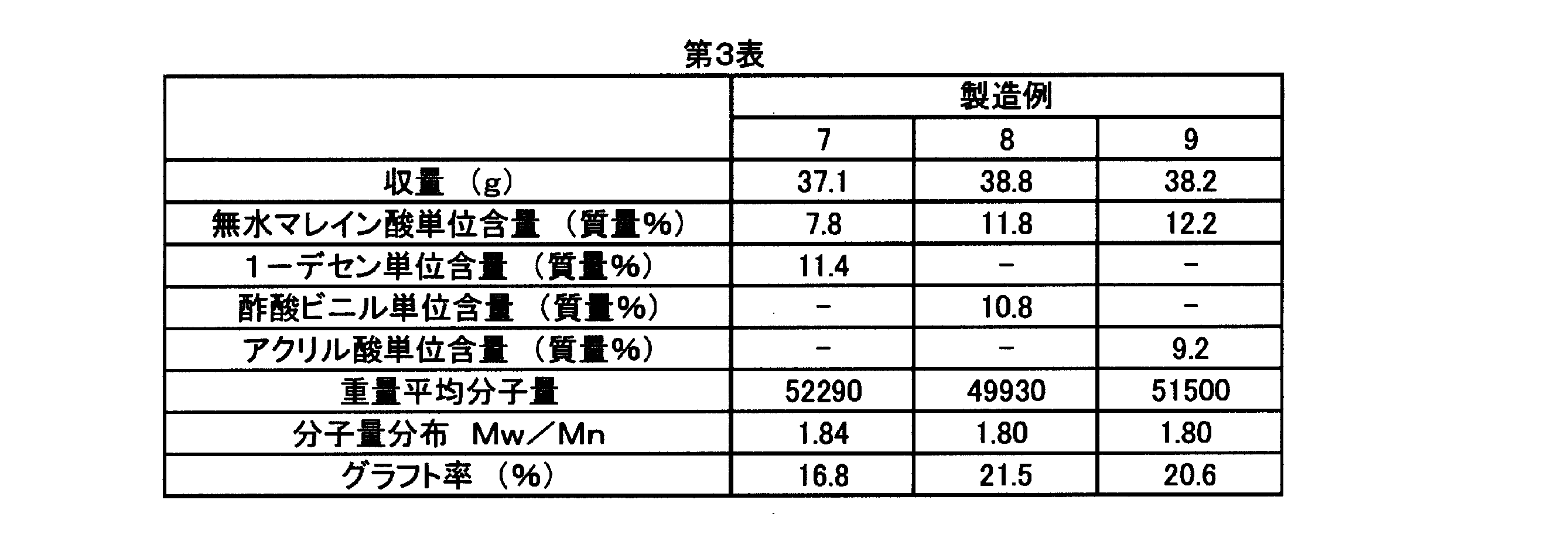
製造例10[グラフト共重合体の製造]
攪拌装置付セパラブルフラスコに製造例1で合成した反応性ポリプロピレン30g、脱水トルエン130mlを窒素雰囲気下で投入した。攪拌しながら、温度80℃で溶解した。これにアクリル酸5.0g、ポリエチレングリコールモノアクリレート(n≒10)7.0gを投入し、α,α’-アゾビスイソブチロニトリル(AIBN)0.5gのトルエン溶液15mlを1時間かけて滴下した。その後、8時間反応した。反応終了後、テフロン(登録商標)コートしたバットに受け、風乾した後、90℃で真空乾燥を24時間実施した。その結果、41.8グラムのグラフト共重合体を得た。アクリル酸含有量=11.7wt%、ポリエチレングリコールモノアクリレート含有量=16.4wt%、重量平均分子量(Mw)=40500、分子量分布(Mw/Mn)=2.02、グラフト率=37.5%であった。
攪拌装置付セパラブルフラスコに製造例1で合成した反応性ポリプロピレン30g、脱水トルエン130mlを窒素雰囲気下で投入した。攪拌しながら、温度80℃で溶解した。これにアクリル酸5.0g、ポリエチレングリコールモノアクリレート(n≒10)7.0gを投入し、α,α’-アゾビスイソブチロニトリル(AIBN)0.5gのトルエン溶液15mlを1時間かけて滴下した。その後、8時間反応した。反応終了後、テフロン(登録商標)コートしたバットに受け、風乾した後、90℃で真空乾燥を24時間実施した。その結果、41.8グラムのグラフト共重合体を得た。アクリル酸含有量=11.7wt%、ポリエチレングリコールモノアクリレート含有量=16.4wt%、重量平均分子量(Mw)=40500、分子量分布(Mw/Mn)=2.02、グラフト率=37.5%であった。
製造例11[グラフト共重合体の製造]
製造例10において、ポリエチレングリコールモノアクリレート(n≒10)に変えてポリプロピレングリコールモノアクリレート(n≒9)7gを用いる以外は製造例10と同様にしてグラフト共重合体41.2グラムを得た。アクリル酸含有量=10.1wt%、ポリプロピレングリコールモノアクリレート含有量=17.0wt%、重量平均分子量(Mw)=41000、分子量分布(Mw/Mn)=2.10、グラフト率=36.0%であった。
製造例10において、ポリエチレングリコールモノアクリレート(n≒10)に変えてポリプロピレングリコールモノアクリレート(n≒9)7gを用いる以外は製造例10と同様にしてグラフト共重合体41.2グラムを得た。アクリル酸含有量=10.1wt%、ポリプロピレングリコールモノアクリレート含有量=17.0wt%、重量平均分子量(Mw)=41000、分子量分布(Mw/Mn)=2.10、グラフト率=36.0%であった。
製造例12[グラフト共重合体の製造]
製造例10において、ポリエチレングリコールモノアクリレート(n≒10)に変えてメトキシエチレングリコールメタアクリレート(n=9)を用いる以外は製造例10と同様にしてグラフト共重合体41.7グラムを得た。アクリル酸含有量=12.0wt%、メトキシエチレングリコールメタアクリレート含有量=16.8wt%、重量平均分子量(Mw)=41200、分子量分布(Mw/Mn)=2.00、グラフト率=42%であった。
製造例10において、ポリエチレングリコールモノアクリレート(n≒10)に変えてメトキシエチレングリコールメタアクリレート(n=9)を用いる以外は製造例10と同様にしてグラフト共重合体41.7グラムを得た。アクリル酸含有量=12.0wt%、メトキシエチレングリコールメタアクリレート含有量=16.8wt%、重量平均分子量(Mw)=41200、分子量分布(Mw/Mn)=2.00、グラフト率=42%であった。
比較製造例2
製造例4において、製造例1で合成した反応性ポリプロピレンに代えて、比較製造例1のポリプロピレン30gを用いること以外は同様にしてアクリル酸変性ポリプロピレンの製造を試みた。エタノール洗浄を実施し、不溶物を回収したところほほ原料ポリプロピレンであり、グラフト反応はほとんど進行せず、反応混合物は原料ポリプロピレンとポリアクリル酸の混合物であった。
製造例4において、製造例1で合成した反応性ポリプロピレンに代えて、比較製造例1のポリプロピレン30gを用いること以外は同様にしてアクリル酸変性ポリプロピレンの製造を試みた。エタノール洗浄を実施し、不溶物を回収したところほほ原料ポリプロピレンであり、グラフト反応はほとんど進行せず、反応混合物は原料ポリプロピレンとポリアクリル酸の混合物であった。
実施例1
製造例4のグラフト共重合体20gにTHF80gを加え65℃で完全に溶解させた。純水100gを同温度で1時間かけて滴下した。これを40℃に冷却し、減圧度0.03MPaから0.0045MPaまで徐々に減圧度を下げて濃度25質量%になるまでTHF及び水を減圧留去し、水系分散体を得た。分散粒子径を測定した結果、50%粒子径は0.13μmであった。なお、分子粒子径は、測定機器として、MALVERN社製、Mastersizer2000を使用し、分散粒子の屈折率を1.59、分散媒の屈折率を1.33として求めた。
製造例4のグラフト共重合体20gにTHF80gを加え65℃で完全に溶解させた。純水100gを同温度で1時間かけて滴下した。これを40℃に冷却し、減圧度0.03MPaから0.0045MPaまで徐々に減圧度を下げて濃度25質量%になるまでTHF及び水を減圧留去し、水系分散体を得た。分散粒子径を測定した結果、50%粒子径は0.13μmであった。なお、分子粒子径は、測定機器として、MALVERN社製、Mastersizer2000を使用し、分散粒子の屈折率を1.59、分散媒の屈折率を1.33として求めた。
実施例2
実施例1において、製造例4のグラフト共重合体に変えて製造例5のグラフト共重合体を用いること以外は同様にして水系分散体を調製した。分散粒子径を測定した結果、50%粒子径は0.14μmであった。
実施例1において、製造例4のグラフト共重合体に変えて製造例5のグラフト共重合体を用いること以外は同様にして水系分散体を調製した。分散粒子径を測定した結果、50%粒子径は0.14μmであった。
実施例3
実施例1において、製造例4のグラフト共重合体に変えて製造例6のグラフト共重合体を用いること以外は同様にして水系分散体を調製した。分散粒子径を測定した結果、50%粒子径は0.11μmであった。
実施例1において、製造例4のグラフト共重合体に変えて製造例6のグラフト共重合体を用いること以外は同様にして水系分散体を調製した。分散粒子径を測定した結果、50%粒子径は0.11μmであった。
実施例4
実施例1において、製造例4のグラフト共重合体に変えて製造例7のグラフト共重合体を用いること以外は同様にして水系分散体を調製した。分散粒子径を測定した結果、50%粒子径は0.23μmであった。
実施例1において、製造例4のグラフト共重合体に変えて製造例7のグラフト共重合体を用いること以外は同様にして水系分散体を調製した。分散粒子径を測定した結果、50%粒子径は0.23μmであった。
実施例5
実施例1において、製造例4のグラフト共重合体に変えて製造例8のグラフト共重合体を用いること以外は同様にして水系分散体を調製した。分散粒子径を測定した結果、50%粒子径は0.19μmであった。
実施例1において、製造例4のグラフト共重合体に変えて製造例8のグラフト共重合体を用いること以外は同様にして水系分散体を調製した。分散粒子径を測定した結果、50%粒子径は0.19μmであった。
実施例6
実施例1において、製造例4のグラフト共重合体に変えて製造例9のグラフト共重合体を用いること以外は同様にして水系分散体を調製した。分散粒子径を測定した結果、50%粒子径は0.15μmであった。
実施例1において、製造例4のグラフト共重合体に変えて製造例9のグラフト共重合体を用いること以外は同様にして水系分散体を調製した。分散粒子径を測定した結果、50%粒子径は0.15μmであった。
実施例7
製造例4のグラフト共重合体10g及び比較製造例1で合成したポリプロピレン10gにTHF80gを加え65℃で完全に溶解させた。純水100gを同温度で1時間かけて滴下した。これを40℃に冷却し、減圧度0.03MPaから0.0045MPaまで徐々に減圧度を下げて濃度25質量%になるまでTHF及び水を減圧留去し、水系分散体を得た。分散粒子系を測定した結果、50%粒子径は3.3μmであった。
製造例4のグラフト共重合体10g及び比較製造例1で合成したポリプロピレン10gにTHF80gを加え65℃で完全に溶解させた。純水100gを同温度で1時間かけて滴下した。これを40℃に冷却し、減圧度0.03MPaから0.0045MPaまで徐々に減圧度を下げて濃度25質量%になるまでTHF及び水を減圧留去し、水系分散体を得た。分散粒子系を測定した結果、50%粒子径は3.3μmであった。
実施例8
実施例7において、製造例4のグラフト共重合体18g及び比較製造例1で合成したポリプロピレン2gとすること以外は同様にして水系分散体を製造した。分散粒子系を測定した結果、50%粒子径は0.17μmであった。
実施例7において、製造例4のグラフト共重合体18g及び比較製造例1で合成したポリプロピレン2gとすること以外は同様にして水系分散体を製造した。分散粒子系を測定した結果、50%粒子径は0.17μmであった。
実施例9
実施例1において製造例4のグラフト共重合体を製造例10のグラフト共重合体に変更すること以外は同様にして水分散体を製造した。水分散体は半透明で分散粒子系を測定した結果、50%粒子径は0.095μmであった。
実施例1において製造例4のグラフト共重合体を製造例10のグラフト共重合体に変更すること以外は同様にして水分散体を製造した。水分散体は半透明で分散粒子系を測定した結果、50%粒子径は0.095μmであった。
実施例10
実施例1において製造例4のグラフト共重合体を製造例11のグラフト共重合体に変更すること以外は同様にして水系分散体を製造した。水系分散体は半透明で分散粒子系を測定した結果、50%粒子径は0.085μmであった。
比較例1
市販の、ポリプロピレンの無水マレイン酸ラジカル変性物[無水マレイン酸含有量:4.2wt%、重量平均分子量(Mw):20600、mmmm=84モル%]10gをトルエン40gに65℃で溶解した後、THF/純水(1/1体積比)40gを一時間かけて添加した。滴下を終了した段階で固まりが生成し、分散することはできなかった。
実施例1において製造例4のグラフト共重合体を製造例11のグラフト共重合体に変更すること以外は同様にして水系分散体を製造した。水系分散体は半透明で分散粒子系を測定した結果、50%粒子径は0.085μmであった。
比較例1
市販の、ポリプロピレンの無水マレイン酸ラジカル変性物[無水マレイン酸含有量:4.2wt%、重量平均分子量(Mw):20600、mmmm=84モル%]10gをトルエン40gに65℃で溶解した後、THF/純水(1/1体積比)40gを一時間かけて添加した。滴下を終了した段階で固まりが生成し、分散することはできなかった。
比較例2
実施例1において、製造例4のグラフト共重合体に変え、比較製造例2の反応混合物を用いる以外は同様にして水系分散体を製造した。純水添加段階で凝集体を形成し、分散液上部に凝集した。
実施例1において、製造例4のグラフト共重合体に変え、比較製造例2の反応混合物を用いる以外は同様にして水系分散体を製造した。純水添加段階で凝集体を形成し、分散液上部に凝集した。
実施例11[ガラス繊維の処理]
シランカップリング剤(3-アミノプロピルトリエトキシシラン)で予め処理した直径17μmのガラス繊維(E-ガラス繊維)(比重2.55g/cm3)を実施例4で製造した水系分散体に室温で60秒間浸漬した後、加熱乾燥して表面処理ガラス繊維を製造した。変性剤の処理量を処理前後のガラス繊維の重量から求めた結果、ガラス繊維の0.5wt%であった。
シランカップリング剤(3-アミノプロピルトリエトキシシラン)で予め処理した直径17μmのガラス繊維(E-ガラス繊維)(比重2.55g/cm3)を実施例4で製造した水系分散体に室温で60秒間浸漬した後、加熱乾燥して表面処理ガラス繊維を製造した。変性剤の処理量を処理前後のガラス繊維の重量から求めた結果、ガラス繊維の0.5wt%であった。
実施例12[セルロース繊維の処理]
乾燥したアコーディス社製セルロース繊維(商品名テンセル)のカットファイバー(1.7dtex、0.3mm)10グラムに実施例4の水系分散体0.4g(0.1gグラフト共重合体)を添加し、室温で1時間攪拌分散した。これを80℃の窒素気流下で乾燥した後、真空乾燥を5時間実施して、表面処理セルロース繊維を製造した。
乾燥したアコーディス社製セルロース繊維(商品名テンセル)のカットファイバー(1.7dtex、0.3mm)10グラムに実施例4の水系分散体0.4g(0.1gグラフト共重合体)を添加し、室温で1時間攪拌分散した。これを80℃の窒素気流下で乾燥した後、真空乾燥を5時間実施して、表面処理セルロース繊維を製造した。
実施例13[接着性能の評価]
実施例5の水系分散体を接着剤として用い、ポリプロピレンとアルミニウム板との接着試験を実施した。接着試験は以下の方法に従って行い、その結果を第4表に示した。
(1)接着基材
ポリプロピレンシート:出光ユニテック(株)製スーパーピュアレイ SG-140TC 厚み0.3mm
アルミニウム板:厚み0.1mmの市販品をアセトン洗浄したもの
(2)試験片の作成
接着基材を幅25mm長さ100mmに切り出した。ポリプロピレンシートに実施例5の水系分散体を固体成分として0.04g/7.5cm2を塗布し、十分に乾燥した。この塗布面とアルミニウム板を合わせ、熱プレスを用い130℃で0.5Mpaの圧力で50秒間、融着した。次に25℃の冷却プレスに軽く挟み、室温まで冷却した。
(3)接着強度の測定
引張速度50mm/分でT剥離試験を実施した。測定には株式会社島津製作所製オートグラフ DSC-200 を用い、最大応力から剥離接着強度を求めた。また測定値は3試験片の測定値の平均を用いた。
実施例5の水系分散体を接着剤として用い、ポリプロピレンとアルミニウム板との接着試験を実施した。接着試験は以下の方法に従って行い、その結果を第4表に示した。
(1)接着基材
ポリプロピレンシート:出光ユニテック(株)製スーパーピュアレイ SG-140TC 厚み0.3mm
アルミニウム板:厚み0.1mmの市販品をアセトン洗浄したもの
(2)試験片の作成
接着基材を幅25mm長さ100mmに切り出した。ポリプロピレンシートに実施例5の水系分散体を固体成分として0.04g/7.5cm2を塗布し、十分に乾燥した。この塗布面とアルミニウム板を合わせ、熱プレスを用い130℃で0.5Mpaの圧力で50秒間、融着した。次に25℃の冷却プレスに軽く挟み、室温まで冷却した。
(3)接着強度の測定
引張速度50mm/分でT剥離試験を実施した。測定には株式会社島津製作所製オートグラフ DSC-200 を用い、最大応力から剥離接着強度を求めた。また測定値は3試験片の測定値の平均を用いた。
実施例14
実施例5の水系分散体の代わりに実施例6の水系分散体を使用した他は実施例13と同様の接着試験を実施した。結果を第4表に示す。
実施例5の水系分散体の代わりに実施例6の水系分散体を使用した他は実施例13と同様の接着試験を実施した。結果を第4表に示す。
比較例3
比較製造例2で得られた反応混合物を熱プレス処理することで厚さ0.1mmのシートを作成し、これを2.5cm×3cmに切り出した。当該シートを実施例13(1)に示したポリプロピレンシートとアルミニウム板に挟み込み、実施例13(2)に記載の条件で熱プレス処理を行うことで接着試験片を作成し、接着強度を測定した。結果を第4表に示した。
比較例4
比較例1で用いた市販の変性ポリプロピレンを用い比較例3と同様にして接着強度を測定した。結果を第4表に示した。
比較製造例2で得られた反応混合物を熱プレス処理することで厚さ0.1mmのシートを作成し、これを2.5cm×3cmに切り出した。当該シートを実施例13(1)に示したポリプロピレンシートとアルミニウム板に挟み込み、実施例13(2)に記載の条件で熱プレス処理を行うことで接着試験片を作成し、接着強度を測定した。結果を第4表に示した。
比較例4
比較例1で用いた市販の変性ポリプロピレンを用い比較例3と同様にして接着強度を測定した。結果を第4表に示した。

実施例15
実施例1において、製造例4のグラフト共重合体を製造例12のグラフト共重合体に変更すること以外は同様にして水系分散体を製造した。その結果、50%粒子径は0.090μmであった。
実施例1において、製造例4のグラフト共重合体を製造例12のグラフト共重合体に変更すること以外は同様にして水系分散体を製造した。その結果、50%粒子径は0.090μmであった。
実施例16
比較製造例1の末端飽和ポリプロピレンと製造例9のグラフト共重合体とを第5表に示した量比で用い、実施例1にしたがって水系分散体を製造した。この水系分散体を用い、実施例13に示した方法にしたがってポリプロピレンとアルミニウムとの接着強度を測定した。結果を第5表に示した。
比較製造例1の末端飽和ポリプロピレンと製造例9のグラフト共重合体とを第5表に示した量比で用い、実施例1にしたがって水系分散体を製造した。この水系分散体を用い、実施例13に示した方法にしたがってポリプロピレンとアルミニウムとの接着強度を測定した。結果を第5表に示した。
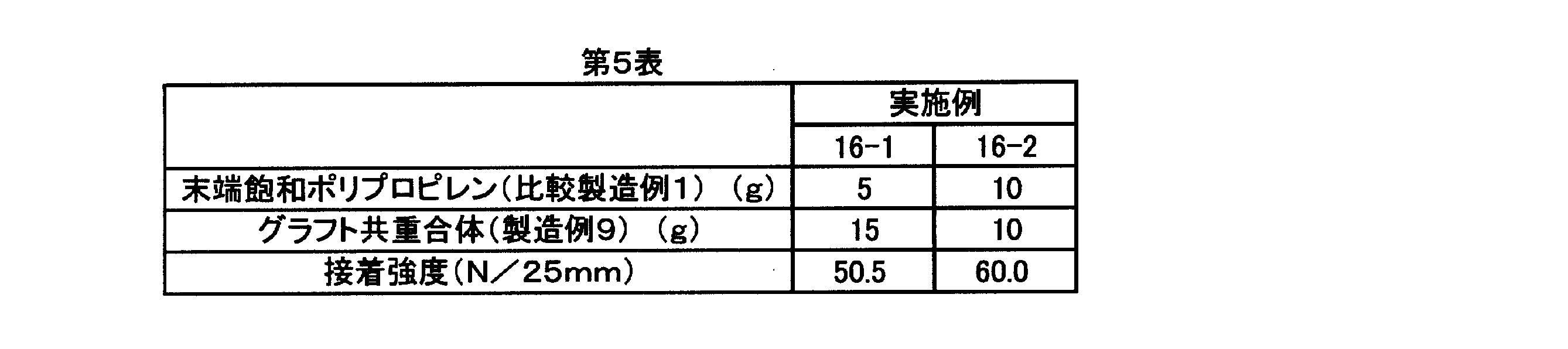
本発明によれば、界面活性剤を低減化した状態においても優れた水分散性を示し、かつバインダー樹脂や顔料等との親和性に優れるグラフト共重合体を含有する水系分散体が提供される。本発明の水系分散体は、塗料や接着剤の成分として有用である。
Claims (11)
- 以下の(a)~(e)を満たすグラフト共重合体と水を含有する水系分散体。
(a)グラフト率が1~150質量%
(b)GPCで測定した重量平均分子量が500~400000
(c)分子量分布(Mw/Mn)が1.5~4
(d)主鎖が、親水性基を有する単量体単位を含有する重合鎖
(e)側鎖が、炭素数3~28のα-オレフィンから選ばれる一種の単独重合鎖若しくは二種以上の共重合鎖、またはエチレン単位が50質量%以下である、炭素数3~28のα-オレフィン単位およびエチレン単位からなる共重合鎖であり、かつメソペンタッド分率〔mmmm〕が30~80モル%の重合鎖 - グラフト共重合体が、以下の(A)~(C)を満たす反応性ポリオレフィンと、グラフト共重合体の主鎖を形成する単量体との共重合反応によって形成されたものである、請求項1に記載の水系分散体。
(A)一分子あたりの末端不飽和基量が0.5~1.0個
(B)メソペンタッド分率〔mmmm〕が30~80モル%
(C)炭素数3~28のα-オレフィンから選ばれる一種の単独重合体若しくは二種以上の共重合体、またはエチレンが50質量%以下である、炭素数3~28のα-オレフィンから選ばれる一種以上の単量体とエチレンの共重合体 - 反応性ポリオレフィンがメタロセン触媒によって製造されたものである、請求項2に記載の水系分散体。
- メタロセン触媒が一般式(I)

で表される二架橋錯体である、請求項3に記載の水系分散体。 - 親水性基が、酸無水物残基、カルボキシル基、水酸基、アミド基、アミノ基、ピリジル基、ポリアルキレングリコール構造を有する基から選ばれる置換基である、請求項1に記載の水系分散体。
- グラフト共重合体の主鎖の、親水性基を有する単量体単位が、[I]アクリル酸及びその誘導体、[II]メタアクリル酸類及びその誘導体、[III]ビニルエステル及びその誘導体から選ばれる一種以上の単量体に由来するものである、請求項1に記載の水系分散体。
- グラフト共重合体の主鎖の、親水性基を有する単量体単位が、下記A群から選択される一種以上と下記B群から選択される一種以上の単量体に由来するものである、請求項1に記載の水系分散体。
A群;[V]無水マレイン酸及びその置換体、[VI]マレイン酸及びそのエステル、[VII]マレイミド及びその置換体
B群;[I]アクリル酸及びその誘導体、[II]メタアクリル酸類及びその誘導体、[III]ビニルエステル及びその誘導体 - 請求項1に記載の水系分散体を含有する、コーティング剤、塗料、インキまたは接着剤。
- 基材上に、請求項1に記載の水系分散体が塗布されて形成した樹脂層を有する複層体。
- 基材が、樹脂、金属、セラミックス、木材、ガラスのいずれかである請求項9に記載の複層体。
- 基材が、結晶性ポリプロピレン、結晶性ブロックポリプロピレン、結晶性プロピレンランダム共重合体のいずれかである請求項9に記載の複層体。
Priority Applications (3)
| Application Number | Priority Date | Filing Date | Title |
|---|---|---|---|
| JP2009551516A JPWO2009096375A1 (ja) | 2008-01-30 | 2009-01-27 | ポリオレフィン系グラフト共重合体を含有する水系分散体 |
| US12/865,337 US8546481B2 (en) | 2008-01-30 | 2009-01-27 | Aqueous dispersion containing polyolefin graft copolymer |
| EP09705437A EP2241582A4 (en) | 2008-01-30 | 2009-01-27 | AQUEOUS DISPERSION USING A POLYOLEFIN-PFROP COPOLYMER |
Applications Claiming Priority (2)
| Application Number | Priority Date | Filing Date | Title |
|---|---|---|---|
| JP2008019326 | 2008-01-30 | ||
| JP2008-019326 | 2008-01-30 |
Publications (1)
| Publication Number | Publication Date |
|---|---|
| WO2009096375A1 true WO2009096375A1 (ja) | 2009-08-06 |
Family
ID=40912728
Family Applications (1)
| Application Number | Title | Priority Date | Filing Date |
|---|---|---|---|
| PCT/JP2009/051242 Ceased WO2009096375A1 (ja) | 2008-01-30 | 2009-01-27 | ポリオレフィン系グラフト共重合体を含有する水系分散体 |
Country Status (4)
| Country | Link |
|---|---|
| US (1) | US8546481B2 (ja) |
| EP (1) | EP2241582A4 (ja) |
| JP (1) | JPWO2009096375A1 (ja) |
| WO (1) | WO2009096375A1 (ja) |
Cited By (2)
| Publication number | Priority date | Publication date | Assignee | Title |
|---|---|---|---|---|
| JP2012012427A (ja) * | 2010-06-29 | 2012-01-19 | Sumitomo Chemical Co Ltd | 新規の遷移金属化合物およびこれを用いたオレフィン重合用触媒 |
| WO2018131670A1 (ja) * | 2017-01-13 | 2018-07-19 | 株式会社日本触媒 | 共重合体および樹脂組成物 |
Families Citing this family (6)
| Publication number | Priority date | Publication date | Assignee | Title |
|---|---|---|---|---|
| JP5555410B2 (ja) | 2008-03-14 | 2014-07-23 | 出光興産株式会社 | ポリオレフィン系グラフト共重合体および接着剤組成物 |
| DE102009027620A1 (de) * | 2009-07-10 | 2011-01-13 | Evonik Röhm Gmbh | Copolymerisation von Silyl-funktionellen Komponenten in wässrigen Polymerisationssystemen |
| US20130222882A1 (en) * | 2012-02-27 | 2013-08-29 | Fujifilm Corporation | Polymer dispersant for image display particles, image display particles, dispersion liquid for image display particles, display medium, and display device |
| JP6597025B2 (ja) * | 2014-08-01 | 2019-10-30 | 三菱ケミカル株式会社 | 水性樹脂分散体、塗料、接着剤及び積層体 |
| US10590309B2 (en) * | 2015-03-06 | 2020-03-17 | Exxonmobil Chemical Patents Inc. | Copolymers |
| CN111051602B (zh) * | 2017-08-29 | 2023-02-17 | 三井化学株式会社 | 纤维收束剂、无机增强材料、树脂组合物及成型体 |
Citations (13)
| Publication number | Priority date | Publication date | Assignee | Title |
|---|---|---|---|---|
| JPS5420057A (en) | 1977-07-15 | 1979-02-15 | Kiyoji Naruse | Aqueous dispersion of crystalline polypropylene and its making method |
| JPH06107442A (ja) | 1991-12-17 | 1994-04-19 | Sanyo Chem Ind Ltd | 無機繊維用集束剤 |
| US6166118A (en) | 1997-06-13 | 2000-12-26 | Eastman Chemical Company | Emulsification process for functionalized polyolefins and emulsions made therefrom |
| WO2003087172A1 (fr) * | 2002-04-12 | 2003-10-23 | Idemitsu Petrochemical Co., Ltd. | Procede de production de polymeres de propylene modifies et polymeres de propylene modifies produits au moyen de ce procede |
| JP2004002842A (ja) | 2002-04-26 | 2004-01-08 | Mitsubishi Chemicals Corp | ポリプロピレン系水性分散体 |
| WO2004074353A1 (ja) | 2003-02-21 | 2004-09-02 | Maruyoshi Chemical Co., Ltd. | 水性エマルジョンの製造方法 |
| JP2005126615A (ja) | 2003-10-24 | 2005-05-19 | Mitsubishi Chemicals Corp | 変性プロピレン系重合体水性分散体及びその用途 |
| WO2005082963A1 (ja) * | 2004-02-26 | 2005-09-09 | Nippon Paper Chemicals Co., Ltd. | 変性ポリオレフィン樹脂 |
| JP2006241623A (ja) | 2005-03-02 | 2006-09-14 | Umg Abs Ltd | 水性分散体およびそれを用いて処理された無機繊維並びにこの無機繊維を含む無機繊維強化熱可塑性樹脂組成物 |
| JP2007039645A (ja) | 2005-07-07 | 2007-02-15 | Mitsubishi Chemicals Corp | 水性樹脂分散体及びその製造方法、塗料、積層体及びその製造方法 |
| WO2007088737A1 (ja) * | 2006-02-03 | 2007-08-09 | Nippon Paper Chemicals Co., Ltd. | 改質プロピレン系重合体の製造方法、その製造方法により得られた改質プロピレン系重合体及び該改質プロピレン系重合体からなる組成物 |
| WO2007091478A1 (ja) * | 2006-02-06 | 2007-08-16 | Idemitsu Kosan Co., Ltd. | 改質プロピレン系重合体の製造方法 |
| WO2008066168A1 (en) * | 2006-12-01 | 2008-06-05 | Idemitsu Kosan Co., Ltd. | Graft copolymer, thermoplastic resin composition comprising the graft copolymer, and those production method |
Family Cites Families (1)
| Publication number | Priority date | Publication date | Assignee | Title |
|---|---|---|---|---|
| WO2007008765A2 (en) * | 2005-07-11 | 2007-01-18 | Dow Global Technologies Inc. | Silane-grafted olefin polymers, compositions and articles prepared therefrom, and methods for making the same |
-
2009
- 2009-01-27 EP EP09705437A patent/EP2241582A4/en not_active Withdrawn
- 2009-01-27 US US12/865,337 patent/US8546481B2/en not_active Expired - Fee Related
- 2009-01-27 WO PCT/JP2009/051242 patent/WO2009096375A1/ja not_active Ceased
- 2009-01-27 JP JP2009551516A patent/JPWO2009096375A1/ja active Pending
Patent Citations (13)
| Publication number | Priority date | Publication date | Assignee | Title |
|---|---|---|---|---|
| JPS5420057A (en) | 1977-07-15 | 1979-02-15 | Kiyoji Naruse | Aqueous dispersion of crystalline polypropylene and its making method |
| JPH06107442A (ja) | 1991-12-17 | 1994-04-19 | Sanyo Chem Ind Ltd | 無機繊維用集束剤 |
| US6166118A (en) | 1997-06-13 | 2000-12-26 | Eastman Chemical Company | Emulsification process for functionalized polyolefins and emulsions made therefrom |
| WO2003087172A1 (fr) * | 2002-04-12 | 2003-10-23 | Idemitsu Petrochemical Co., Ltd. | Procede de production de polymeres de propylene modifies et polymeres de propylene modifies produits au moyen de ce procede |
| JP2004002842A (ja) | 2002-04-26 | 2004-01-08 | Mitsubishi Chemicals Corp | ポリプロピレン系水性分散体 |
| WO2004074353A1 (ja) | 2003-02-21 | 2004-09-02 | Maruyoshi Chemical Co., Ltd. | 水性エマルジョンの製造方法 |
| JP2005126615A (ja) | 2003-10-24 | 2005-05-19 | Mitsubishi Chemicals Corp | 変性プロピレン系重合体水性分散体及びその用途 |
| WO2005082963A1 (ja) * | 2004-02-26 | 2005-09-09 | Nippon Paper Chemicals Co., Ltd. | 変性ポリオレフィン樹脂 |
| JP2006241623A (ja) | 2005-03-02 | 2006-09-14 | Umg Abs Ltd | 水性分散体およびそれを用いて処理された無機繊維並びにこの無機繊維を含む無機繊維強化熱可塑性樹脂組成物 |
| JP2007039645A (ja) | 2005-07-07 | 2007-02-15 | Mitsubishi Chemicals Corp | 水性樹脂分散体及びその製造方法、塗料、積層体及びその製造方法 |
| WO2007088737A1 (ja) * | 2006-02-03 | 2007-08-09 | Nippon Paper Chemicals Co., Ltd. | 改質プロピレン系重合体の製造方法、その製造方法により得られた改質プロピレン系重合体及び該改質プロピレン系重合体からなる組成物 |
| WO2007091478A1 (ja) * | 2006-02-06 | 2007-08-16 | Idemitsu Kosan Co., Ltd. | 改質プロピレン系重合体の製造方法 |
| WO2008066168A1 (en) * | 2006-12-01 | 2008-06-05 | Idemitsu Kosan Co., Ltd. | Graft copolymer, thermoplastic resin composition comprising the graft copolymer, and those production method |
Non-Patent Citations (8)
| Title |
|---|
| A. ZAMBELLI ET AL., MACROMOLECULES, vol. 6, 1973, pages 925 |
| A. ZAMBELLI ET AL., MACROMOLECULES, vol. 8, 1975, pages 687 |
| ASAKURA ET AL., MACROMOL. CHEM. PHYS., vol. C29, 1989, pages 201 |
| J. RANDALL ET AL., MACROMOL. CHEM. PHYS., vol. 198, 1997, pages 1257 |
| POLYMER JOURNAL, vol. 16, 1984, pages 717 |
| S. MORI, SIZE EXCLUSION CHROMATOGRAPHY, 1992, pages 67 - 69 |
| See also references of EP2241582A4 * |
| T. ASAKURA; M. DEMURA; Y. NISHIYAMA, MACROMOLECULES, vol. 24, 1991, pages 2334 |
Cited By (2)
| Publication number | Priority date | Publication date | Assignee | Title |
|---|---|---|---|---|
| JP2012012427A (ja) * | 2010-06-29 | 2012-01-19 | Sumitomo Chemical Co Ltd | 新規の遷移金属化合物およびこれを用いたオレフィン重合用触媒 |
| WO2018131670A1 (ja) * | 2017-01-13 | 2018-07-19 | 株式会社日本触媒 | 共重合体および樹脂組成物 |
Also Published As
| Publication number | Publication date |
|---|---|
| US8546481B2 (en) | 2013-10-01 |
| JPWO2009096375A1 (ja) | 2011-05-26 |
| US20110104503A1 (en) | 2011-05-05 |
| EP2241582A4 (en) | 2011-05-04 |
| EP2241582A1 (en) | 2010-10-20 |
Similar Documents
| Publication | Publication Date | Title |
|---|---|---|
| JP5512973B2 (ja) | グラフト共重合体又は該共重合体を含有する熱可塑性樹脂組成物及びそれらの製造方法 | |
| US8871855B2 (en) | Terminally unsaturated polyolefin and method for producing the same | |
| US8546481B2 (en) | Aqueous dispersion containing polyolefin graft copolymer | |
| CN1232546C (zh) | 改性丙烯系聚合物、含该聚合物的组合物及用途 | |
| JP5555410B2 (ja) | ポリオレフィン系グラフト共重合体および接着剤組成物 | |
| KR20080106229A (ko) | 수지 분산체, 도료, 적층체 및 그 제조 방법 | |
| JPWO2008047860A1 (ja) | 高純度末端不飽和オレフィン系重合体及びその製造方法 | |
| JP6108782B2 (ja) | 添加剤マスターバッチ | |
| JP5374051B2 (ja) | 変性グラフト共重合体 | |
| JP5241294B2 (ja) | ポリオレフィン系グラフト共重合体と付加重合ポリマーを配合してなる樹脂組成物 | |
| US8461261B2 (en) | Engineering plastic resin composition containing graft copolymer | |
| JP3990314B2 (ja) | ポリプロピレン系水性分散体 | |
| WO2014046134A1 (ja) | 官能化α-オレフィン重合体、それを用いた硬化性組成物及び硬化物 | |
| JP2012201821A (ja) | グラフト共重合体の製造方法、及び当該製造方法により得られるグラフト共重合体を含む熱可塑性樹脂組成物 | |
| WO2023080227A1 (ja) | 硬化性樹脂組成物 | |
| JP2009138137A (ja) | ポリオレフィン系樹脂組成物 | |
| JP4076396B2 (ja) | ポリプロピレン系塗装成形体 | |
| JP2014040526A (ja) | 官能化α−オレフィン重合体、それを用いた硬化性組成物及び硬化物 | |
| JP5074013B2 (ja) | ブロック共重合体又は該共重合体を含有する熱可塑性樹脂組成物及びそれらの製造方法 | |
| JP2012201822A (ja) | グラフト共重合体の製造方法、及び当該製造方法により得られるグラフト共重合体を含む熱可塑性樹脂組成物 | |
| WO2005035592A1 (ja) | 極性基含有高級オレフィン重合体及びその製造方法 | |
| JP5466501B2 (ja) | 酸化変性プロピレン系重合体及びその製造方法 | |
| WO2023080226A1 (ja) | 硬化性樹脂組成物 |
Legal Events
| Date | Code | Title | Description |
|---|---|---|---|
| 121 | Ep: the epo has been informed by wipo that ep was designated in this application |
Ref document number: 09705437 Country of ref document: EP Kind code of ref document: A1 |
|
| WWE | Wipo information: entry into national phase |
Ref document number: 2009551516 Country of ref document: JP |
|
| WWE | Wipo information: entry into national phase |
Ref document number: 2009705437 Country of ref document: EP |
|
| NENP | Non-entry into the national phase |
Ref country code: DE |
|
| WWE | Wipo information: entry into national phase |
Ref document number: 12865337 Country of ref document: US |