WO2009099230A1 - 光学ガラス - Google Patents
光学ガラス Download PDFInfo
- Publication number
- WO2009099230A1 WO2009099230A1 PCT/JP2009/052134 JP2009052134W WO2009099230A1 WO 2009099230 A1 WO2009099230 A1 WO 2009099230A1 JP 2009052134 W JP2009052134 W JP 2009052134W WO 2009099230 A1 WO2009099230 A1 WO 2009099230A1
- Authority
- WO
- WIPO (PCT)
- Prior art keywords
- glass
- weight
- refractive index
- optical
- component
- Prior art date
- Legal status (The legal status is an assumption and is not a legal conclusion. Google has not performed a legal analysis and makes no representation as to the accuracy of the status listed.)
- Ceased
Links
Classifications
-
- C—CHEMISTRY; METALLURGY
- C03—GLASS; MINERAL OR SLAG WOOL
- C03C—CHEMICAL COMPOSITION OF GLASSES, GLAZES OR VITREOUS ENAMELS; SURFACE TREATMENT OF GLASS; SURFACE TREATMENT OF FIBRES OR FILAMENTS MADE FROM GLASS, MINERALS OR SLAGS; JOINING GLASS TO GLASS OR OTHER MATERIALS
- C03C3/00—Glass compositions
- C03C3/12—Silica-free oxide glass compositions
- C03C3/16—Silica-free oxide glass compositions containing phosphorus
-
- C—CHEMISTRY; METALLURGY
- C03—GLASS; MINERAL OR SLAG WOOL
- C03C—CHEMICAL COMPOSITION OF GLASSES, GLAZES OR VITREOUS ENAMELS; SURFACE TREATMENT OF GLASS; SURFACE TREATMENT OF FIBRES OR FILAMENTS MADE FROM GLASS, MINERALS OR SLAGS; JOINING GLASS TO GLASS OR OTHER MATERIALS
- C03C3/00—Glass compositions
- C03C3/12—Silica-free oxide glass compositions
- C03C3/16—Silica-free oxide glass compositions containing phosphorus
- C03C3/17—Silica-free oxide glass compositions containing phosphorus containing aluminium or beryllium
-
- C—CHEMISTRY; METALLURGY
- C03—GLASS; MINERAL OR SLAG WOOL
- C03C—CHEMICAL COMPOSITION OF GLASSES, GLAZES OR VITREOUS ENAMELS; SURFACE TREATMENT OF GLASS; SURFACE TREATMENT OF FIBRES OR FILAMENTS MADE FROM GLASS, MINERALS OR SLAGS; JOINING GLASS TO GLASS OR OTHER MATERIALS
- C03C3/00—Glass compositions
- C03C3/12—Silica-free oxide glass compositions
- C03C3/16—Silica-free oxide glass compositions containing phosphorus
- C03C3/19—Silica-free oxide glass compositions containing phosphorus containing boron
-
- C—CHEMISTRY; METALLURGY
- C03—GLASS; MINERAL OR SLAG WOOL
- C03C—CHEMICAL COMPOSITION OF GLASSES, GLAZES OR VITREOUS ENAMELS; SURFACE TREATMENT OF GLASS; SURFACE TREATMENT OF FIBRES OR FILAMENTS MADE FROM GLASS, MINERALS OR SLAGS; JOINING GLASS TO GLASS OR OTHER MATERIALS
- C03C3/00—Glass compositions
- C03C3/12—Silica-free oxide glass compositions
- C03C3/16—Silica-free oxide glass compositions containing phosphorus
- C03C3/21—Silica-free oxide glass compositions containing phosphorus containing titanium, zirconium, vanadium, tungsten or molybdenum
-
- C—CHEMISTRY; METALLURGY
- C03—GLASS; MINERAL OR SLAG WOOL
- C03C—CHEMICAL COMPOSITION OF GLASSES, GLAZES OR VITREOUS ENAMELS; SURFACE TREATMENT OF GLASS; SURFACE TREATMENT OF FIBRES OR FILAMENTS MADE FROM GLASS, MINERALS OR SLAGS; JOINING GLASS TO GLASS OR OTHER MATERIALS
- C03C3/00—Glass compositions
- C03C3/12—Silica-free oxide glass compositions
- C03C3/23—Silica-free oxide glass compositions containing halogen and at least one oxide, e.g. oxide of boron
- C03C3/247—Silica-free oxide glass compositions containing halogen and at least one oxide, e.g. oxide of boron containing fluorine and phosphorus
-
- C—CHEMISTRY; METALLURGY
- C03—GLASS; MINERAL OR SLAG WOOL
- C03C—CHEMICAL COMPOSITION OF GLASSES, GLAZES OR VITREOUS ENAMELS; SURFACE TREATMENT OF GLASS; SURFACE TREATMENT OF FIBRES OR FILAMENTS MADE FROM GLASS, MINERALS OR SLAGS; JOINING GLASS TO GLASS OR OTHER MATERIALS
- C03C3/00—Glass compositions
- C03C3/12—Silica-free oxide glass compositions
- C03C3/253—Silica-free oxide glass compositions containing germanium
-
- G—PHYSICS
- G02—OPTICS
- G02B—OPTICAL ELEMENTS, SYSTEMS OR APPARATUS
- G02B1/00—Optical elements characterised by the material of which they are made; Optical coatings for optical elements
-
- G—PHYSICS
- G02—OPTICS
- G02B—OPTICAL ELEMENTS, SYSTEMS OR APPARATUS
- G02B3/00—Simple or compound lenses
- G02B3/02—Simple or compound lenses with non-spherical faces
- G02B3/04—Simple or compound lenses with non-spherical faces with continuous faces that are rotationally symmetrical but deviate from a true sphere, e.g. so called "aspheric" lenses
Definitions
- the present invention relates to an optical glass, particularly a high refractive index (n d) ⁇ low dispersion and low deformation point (At), and devitrification resistance during molding is improved, which is suitable for transfer of molding and microstructure Optical glass having the
- aspherical lenses are often used. This is because an aspheric lens is easy to correct for ray aberration, and the number of lenses can be reduced to make the device compact.
- the manufacture of an aspheric lens or the like is made by heat-softening a glass preform and precision mold pressing it into a desired shape.
- the method of obtaining a preform is roughly divided into two types, one is a method of cutting out a glass piece from a block or rod of glass and preform processing, and the other is a method of dropping glass melt from the tip of a nozzle to make it spherical
- the optical glass constituting the preform can be molded at a relatively low temperature, and thus has a low glass transition point (Tg) and / or a low deformation point (At).
- Tg glass transition point
- At low deformation point
- glass to be used for a molded lens those having various optical properties are required depending on the application, and among them, those having high refractive index, low dispersion, and low sag point are increasing.
- barium flint type glass As a conventional glass satisfying the above optical properties, it not only contains PbO (lead oxide) harmful to human body, but also the problem that metallic lead is deposited on the surface of the product during precision press molding There is a problem that the glass surface is easily roughened due to the fusion with the mold, which is not preferable. Also, in digital cameras, it is necessary to reduce the surface reflection of the lens as much as possible, and an antireflective coating is used. However, in order to suppress the reflectance and the incident angle dependency and to extend the wavelength range, a very multi-layered coating film is required, and the process is complicated and expensive.
- the microstructure transfer glass is an ultra-precision mold-pressed product in which the concavo-convex shape of a mold of ⁇ m to nm order is transferred to the glass surface.
- replacing a lens having a microstructure with a conventional optical component is advantageous for enhancing the functionality of the device, reducing the size, and reducing the cost.
- the present invention can also be applied to a mold made of Ni and P, which has conventionally been used mainly for lens molding of resin.
- the weather resistance of glass itself is also required.
- P 2 O 5 -R 1 2 O-R 2 O- ( rare earth oxide or the like) type glass where R 1: an alkali metal oxide, R 2: 2 Metal oxides are disclosed.
- the P 2 O 5 -R 1 2 O -BaO-ZnO- ( high-valent oxide) type optical glass is disclosed.
- This optical glass has a refractive index (n d ) of 1.52 to 1.7 and an Abbe number ( ⁇ d ) of 42 to 70 (Patent Document 2).
- the P 2 O 5 -R 1 2 O -R 2 O-Nb 2 O 5 based glass, P 2 O 5 -R 1 2 O-Nb 2 O 5 -WO 3 based glass, P 2 O 5 -R 1 2 An O-Bi 2 O 3 based glass is disclosed.
- These optical glasses have a refractive index (n d ) of 1.57 or more and a sag point (At) of 570 ° C. or less (Patent Documents 3 to 7).
- the P 2 O 5 -B 2 O 3 -R 1 2 O-R 2 O-Gd 2 O 3 based glass, P 2 O 5 -B 2 O 3 -R 1 2 O-BaO-ZnO -based glass is disclosed ing.
- These optical glasses have a refractive index (n d ) of 1.54 or more and an Abbe number ( ⁇ d ) of 57 or more (Patent Documents 8 and 9).
- the P 2 O 5 -R 1 2 O -R 2 O-ZnO-Al 2 O 3 based glass is disclosed.
- This optical glass has a refractive index (n d ) of 1.55 to 1.65, an Abbe number ( d d ) of 55 to 65, and a deformation point of 500 ° C. or less (Patent Documents 10 to 12).
- the optical glasses disclosed in the above Patent Documents 1 and 2 have high refractive index and low dispersion and a low sag point, but have lowered the sag point with an alkali metal oxide, zinc oxide, etc. It is prone to problems. Further, the optical glasses disclosed in the above Patent Documents 3 to 7 have high dispersion ( ⁇ d ⁇ 42), and are not suitable for high refractive index and low dispersion applications. Although the optical glasses disclosed in Patent Documents 8 and 9 have high refractive index and low dispersion, they have a high temperature of 500 ° C. or more, which tends to cause an undesirable problem on the mold surface.
- the optical glass disclosed in the above Patent Documents 10 to 12 has Al 2 O 3 as an essential component to improve the weather resistance, so the melting temperature of the glass rises and the Pt crucible is easily corroded. As a result, there is a problem that the transmittance decreases at the low wavelength side.
- the present invention solves the drawbacks of the above-mentioned conventional phosphate-based optical glass, and high refractive index (particularly preferably refractive index 1.6 or more), low dispersion (Abbe number 42 or more), low deformation point at molding
- An object of the present invention is to provide an optical glass which is improved in devitrification resistance and suitable for mold formation such as precision mold press molding and fine structure transfer.
- the present inventors set the composition to a specific range in glass production, specifically, P 2 O 5 -BaO-ZnO-Nb 2
- the present invention is based on the finding that the above problems can be solved by using an O 5 -based glass, or by combining an alkali metal oxide combination with an appropriate amount of a rare earth oxide and further adding a fluoride. completed.
- the optical glass of the present invention P 2 O 5: 25 ⁇ 50 wt%, BaO: 15 ⁇ 35 wt%, ZnO: 1 ⁇ 25 weight, Nb 2 O 5: P 2 containing 3 to 10 wt%
- the first feature is the O 5 -BaO-ZnO-Nb 2 O 5 -based glass.
- the optical glass of the present invention is characterized in that, in addition to the above first feature, the second feature is that it contains B 2 O 3 : 0.1 to 8% by weight, F: 0.1 to 10% by weight. .
- the optical glass of the present invention in addition to the above first or second feature, GeO 2 : 0 to 8% by weight, Al 2 O 3 : 0 to 1% by weight (excluding 1% by weight), Li 2 O: 0 to 8% by weight, Na 2 O: 0 to 10% by weight, K 2 O: 0 to 8% by weight, CaO: 0 to 10% by weight, SrO: 0 to 15% by weight, MgO: 0 to 5 WO 3 : 0 to 10 wt%, Gd 2 O 3 : 0 to 8 wt%, Ta 2 O 5 : 0 to 8 wt%, Y 2 O 3 : 0 to 5 wt%, ZrO 2 : 0 to At least one of 3 wt%, LiF: 0 to 10 wt%, NaF: 0 to 10 wt%, ZnF 2 : 0 to 15 wt%, BaF 2 : 0 to 15 wt% It is the feature of 3.
- the optical glass of the present invention has the refractive index (n d ) of 1.58 to 1.70 and the Abbe number (v d ) of 42 to 58, in addition to the features described in any of the first to third aspects.
- the fourth feature is that the glass transition point (Tg) is 470 ° C. or less and the glass deformation point (At) is 500 ° C. or less.
- the optical glass of the present invention has a fifth feature that it is used for transferring a fine structure.
- the transfer of the fine structure means that the fine structure of the surface of the mold is transferred to the surface of the optical glass using a mold having a fine structure consisting of a concavo-convex shape having a period of ⁇ m to nm on the surface.
- a precision transfer method called a precision glass molding method or a nanoimprint method.
- the optical glass of the first aspect it is possible to provide an optical glass having characteristics of high refractive index, low dispersion, low glass transition point, and low sag point because of the composition shown therein. became.
- an optical glass suitable for mold formation such as precision mold press molding and transfer of a fine structure, since white turbidity hardly occurs on the surface during molding. Of course, it does not contain lead and is safe.
- B 2 O 3 in addition to the effect by the configuration of the first aspect, B 2 O 3 contains 0.1 to 8% by weight, F: 0.1 to 10% by weight. By doing this, the stabilization of the glass can be increased. Moreover, the meltability of glass and the weather resistance of glass can be improved.
- the high refractive index as the optical property of the glass can be obtained by containing the composition shown therein. n d ), we can advance low dispersion.
- an optical glass suitable for mold formation such as precision mold press molding and transfer of a fine structure at a low yield point and with less occurrence of white turbidity.
- the refractive index (n d ) is 1.58 to 1.70, and the Abbe number ( ⁇ ) d ) 42-58, glass transition point (Tg) ⁇ 470 ° C., and glass deformation point (At) ⁇ 500 ° C., the high refractive index, low dispersion, low glass transition point, low deformation point It is possible to provide one suitable for precision molding and fine structure transfer.
- the optical glass of the fifth aspect in addition to the effect of the configuration according to any one of the first to fifth aspects, for example, by using for the transfer of the fine structure, it has a period smaller than the wavelength of light, for example. It is possible to obtain an optical glass such as a lens in which the microstructure of the two-dimensional uneven structure is accurately transferred to the glass surface. Optical glass of such a surface structure can exhibit very excellent performance in light reflection prevention.
- the component P 2 O 5 is a network structure forming component of glass and is an essential component for providing the glass with a manufacturable stability.
- P 2 O 5 is contained in an amount of 25 to 50% by weight. If it is less than 25% by weight, it becomes difficult to obtain a stable and stable glass. On the other hand, if it exceeds 50% by weight, a sufficiently high refractive index can not be obtained.
- the content of P 2 O 5 is more preferably 28 to 45% by weight in consideration of the stability of the glass, the refractive index, and the like.
- the component BaO is essential to enhance the stability of the glass and to lower the sag point and the liquidus temperature.
- BaO is contained in an amount of 15 to 35% by weight. If the BaO content is less than 15% by weight, the yield point becomes high, which is not preferable in terms of the stability of the glass. If it exceeds 35% by weight, the high refractive index can not be maintained.
- the content of BaO is more preferably 16 to 33% by weight in consideration of the moldability of the glass, the refractive index, and the like.
- the component ZnO is essential to suppress the occurrence of devitrification at the time of glass molding and to improve the formability and stability of the glass.
- ZnO is contained in an amount of 1 to 25% by weight. If it is less than 1% by weight, the effect is insufficient. On the other hand, if it exceeds 25% by weight, the liquidus temperature of the glass is raised, and the glass transition point and the deformation point become high.
- the content of ZnO is more preferably 3 to 23% by weight, and most preferably 3 to 20% by weight, in consideration of glass moldability, stability, glass transition point, and deformation point.
- the component Nb 2 O 5 is essential as the component most contributing to the high refractive index of the glass.
- Nb 2 O 5 is contained in an amount of 3 to 10% by weight. If it is less than 3% by weight, the effect of increasing the refractive index of the glass is insufficient. On the other hand, the content exceeding 10% by weight is not preferable because it impairs the stability of the glass.
- the content of Nb 2 O 5 is more preferably 4 to 8% by weight in consideration of the refractive index and the stability of the glass.
- Component B 2 O 3 is a component for stabilizing the glass by forming a glass network structure. It can be contained at 8 wt% or less as an optional component. If it exceeds 8% by weight, the refractive index is unfavorably lowered.
- the content of B 2 O 3 is preferably 0.1 to 8% by weight, more preferably 0.1 to 7% by weight, and most preferably 0.1 to 6% by weight from the viewpoint of stabilization of the glass and the refractive index. It is good to set it as weight%.
- the component GeO 2 is also a component that forms a glass network structure and stabilizes the glass.
- the addition of GeO 2 has the effect of increasing the refractive index and can satisfy the desired optical constants. It can be contained at 8 wt% or less as an optional component. If it exceeds 8% by weight, the stability of the glass is reduced, which is not preferable.
- the content of GeO 2 is preferably 1 to 7% by weight, and most preferably 1 to 6% by weight, in consideration of high refractive index and glass stability.
- Component Al 2 O 3 is an effective component for suppressing the occurrence of devitrification at the time of molding. It is also effective in weatherability. It can be contained as an optional component at 1% by weight or less (excluding 1% by weight). If it is 1% by weight or more, the liquidus temperature of the glass is increased and the refractive index is lowered, which is not preferable.
- the content of Al 2 O 3 is preferably 0.1 to 0.9% by weight, and most preferably 0.5 to 0.8% by weight in consideration of the devitrification suppressing function and the weather resistance. Good.
- the component Li 2 O is an effective component for maintaining the refractive index well while lowering the glass transition point. It can be contained at 8 wt% or less as an optional component. If it exceeds 8% by weight, the viscosity of the glass is lowered and the stability of the glass is impaired.
- the content of Li 2 O is preferably 0.1 to 8% by weight, and most preferably 1 to 7% by weight, in consideration of the above functions.
- the component Na 2 O is also a component effective for maintaining the refractive index well while lowering the glass transition point. It can be contained at 10 wt% or less as an optional component. If it exceeds 10% by weight, the refractive index of the glass is lowered.
- the content of Na 2 O is preferably 0.1 to 10% by weight, and most preferably 1 to 8% by weight, in consideration of the glass transition point and the refractive index.
- the component K 2 O is also a component effective for maintaining the refractive index well while lowering the glass transition point. It can be contained at 8 wt% or less as an optional component. If it exceeds 8% by weight, the refractive index of the glass is lowered.
- the content of K 2 O is preferably 0.1 to 8% by weight, and most preferably 1 to 7% by weight in consideration of the glass transition point and the refractive index.
- Li 2 O, Na 2 O and K 2 O are preferably used in combination of two or more as alkali metal oxides.
- the mixed alkali effect is effective in lowering the glass transition point and the deformation point while giving the glass a manufacturable stability.
- the total content of any two or three of these three components is preferably 1 to 10% by weight. More preferably, it is 2 to 8% by weight.
- the component CaO improves the stability of the glass and is effective in improving the formability. It can be contained at 10 wt% or less as an optional component. If it exceeds 10% by weight, the refractive index of the glass is lowered.
- the content of CaO is preferably 0.1 to 10% by weight, and most preferably 1 to 8% by weight, in consideration of glass stability, moldability, and refractive index.
- the component SrO enhances the stability of the glass and is effective in improving the formability. It can be contained at 15 wt% or less as an optional component. If it exceeds 15% by weight, the refractive index of the glass is lowered.
- the content of SrO is preferably 0.1 to 15% by weight, and most preferably 1 to 12% by weight, in consideration of glass stability, moldability, and refractive index.
- the component MgO is effective in enhancing the stability of the glass and improving the formability. It can be contained at 5 wt% or less as an optional component. If it exceeds 5% by weight, the refractive index of the glass is lowered.
- the content of MgO is preferably 0.1 to 5% by weight, and most preferably 1 to 4% by weight, in consideration of the glass stability, the formability, and the refractive index.
- Component WO 3 is an effective component to provide glass with a high refractive index and to provide moldability with a low sag point. It can be contained at 10 wt% or less as an optional component. If it exceeds 10% by weight, the stability of the glass is impaired.
- the content of WO 3 is preferably 0.1 to 10% by weight, and most preferably 1 to 8% by weight, in consideration of glass refractive index, moldability, and glass stability.
- the components Gd 2 O 3 , Ta 2 O 5 , Y 2 O 3 and ZrO 2 are effective in increasing the refractive index and Abbe number of the glass.
- Gd 2 O 3 and Ta 2 O 5 can be contained as optional components at 8 wt% or less, respectively. If it exceeds 8% by weight, the stability of the glass is impaired.
- the preferred contents of Gd 2 O 3 and Ta 2 O 5 are each 0.5 to 8% by weight, optimally 1 to 7% by weight.
- Y 2 O 3 can be contained as an optional component at 5% by weight or less. If it exceeds 5% by weight, the stability of the glass is impaired.
- the content of Y 2 O 3 is preferably 0.1 to 5% by weight.
- ZrO 2 is an optional component, it can be contained at 3% by weight or less. If it exceeds 3% by weight, the stability of the glass is impaired.
- the content of ZrO 2 is preferably 0.1 to 2% by weight.
- the components LiF, NaF, ZnF 2 and BaF 2 are effective in enhancing the meltability of the glass and reducing the sag point and the liquidus temperature, and are also effective in improving the weatherability of the glass.
- LiF and NaF can be contained as optional components at 10 wt% or less, respectively. If it exceeds 10% by weight, the stability of the glass is impaired.
- the preferred content of LiF and NaF is 0.5 to 10% by weight, and most preferably 1 to 8% by weight.
- ZnF 2 and BaF 2 can be contained as an optional component at 15 wt% or less. If it exceeds 15% by weight, the stability of the glass is impaired.
- the preferred contents of ZnF 2 and BaF 2 are each 0.5 to 15% by weight, optimally 1 to 13% by weight.
- F contained in the glass is an effective component for enhancing the meltability of the glass and for improving the weather resistance of the glass. It can be added at 10 wt% or less as an optional component. If it exceeds 10% by weight, the stability of the glass is impaired.
- the content of F is preferably 0.1 to 10% by weight, and more preferably 0.1 to 8% by weight, in consideration of the meltability of the glass, the weather resistance of the glass, and the stability of the glass.
- Yb 2 O 3 is preferably not contained because it has a strong absorption band in the range of 950 to 1000 nm.
- Bi 2 O 3 is effective in lowering the sag point of the glass when it is contained, it has a problem that the glass tends to be colored if contained in a large amount.
- the content is 5% by weight or less.
- raw materials for producing optical glass in the embodiment for example, LiPO 3 , NaPO 3 , KPO 3 , Al (PO 3 ) 3 , Ba (PO 3 ) 2 or the like can be used for the component P 2 O 5
- component B 2 O 3 , H 3 BO 3 , B 2 O 3 and the like can be used, and as for other components, optical materials generally used as raw materials such as various oxides, carbonates and nitrates Glass raw materials can be used. The above raw materials are melted at 900 to 1300 ° C.
- the optical glass of the present invention which is colorless, has a high refractive index, a low yield point, is transparent, is homogeneous, and is excellent in processability.
- the following (1), (2), and (3) are specific examples of the highly preferable composition as an optical glass having a high refractive index, low dispersion, and a low sag point that solves the problems of the present invention. . These optical glasses are also excellent in chemical durability.
- B 2 O 3 (2) 0.1 to 3% by weight of B 2 O 3 , 30 to 36% by weight of P 2 O 5 , 1 to 6% by weight of Li 2 O, 1 to 5% by weight of Na 2 O, and 28 of BaO ⁇ 35 wt%, ZnO 10-15 wt%, ZnF 2 0.5-4 wt%, Gd 2 O 3 0.5-5 wt%, Nb 2 O 5 5-10 wt%, Ta 2 Glass consisting of 0.1 to 3% by weight of O 5 and 0.1 to 3% by weight of ZrO 2 .
- the raw materials are prepared and mixed so as to have the component compositions of Examples 1 to 22 and Comparative Examples 1 to 5 shown in Tables 1 to 4, and this is put in a platinum crucible, and 900 ° C. to 1,300 in an electric furnace.
- the optical glass was obtained by melting at ⁇ 0> C, then pouring into a mold and annealing. For each optical glass obtained, the refractive index (n d), Abbe number ([nu d), glass transition point (Tg), was measured deformation point (At). Moreover, the presence or absence of defects, such as white turbidity, was confirmed with the microscope.
- each glass plate was cut and processed into a gauze shape to obtain a plurality of cut pieces having the same dimensions. Further, the molding surfaces of the plurality of cut pieces are mirror-polished, and the washed sample is used as a glass preform for press molding.
- This molding glass preform is charged into a press molding machine provided with an upper core and a lower core provided with a mold release film of a noble metal system, and in a N 2 gas or vacuum atmosphere up to a temperature near the deformation point (At) After heating, it was pressurized and press-molded, and after cooling, it was taken out as a press-formed product. The observation (appearance) on the molding surface of this press-formed product and the observation (core surface) of the core surface in contact with the glass were performed. When the core surface becomes cloudy, this is due to the volatilization of the component from the glass, which indicates that microroughness is generated on the press forming surface.
- Comparative Example 1 has the same composition as the glass described in Example 14 of Patent Document 1.
- Comparative Example 2 has the same composition as the glass described in Example 1-3 of Patent Document 2.
- Comparative Example 3 is of the same structure as the glass described in Example 1 of Patent Document 3.
- Comparative Example 4 has the same composition as the glass described in Example 2 of Patent Document 8.
- Comparative Example 5 has the same composition as the glass described in Example 1 of Patent Document 9.
- the measurement of the refractive index (n d ) and the Abbe number (v d ) was performed using a refractometer (KPR-200 manufactured by Carnew Co., Ltd.).
- the measurement of the glass transition point (Tg) and the deformation point (At) is the elongation of the sample while heating the rod-shaped sample with a length of 15 to 20 mm and a diameter (side) of 3 to 5 mm at a constant rate of 5 ° C per minute.
- the temperature was determined from the thermal expansion curve obtained by measuring the temperature.
- the obtained glass was processed to about 10 ⁇ 10 ⁇ 2 mm in thickness, and 10 ⁇ 10 both sides were mirror-polished.
- the polished glass was kept in a constant temperature and humidity chamber at about 65 ° C. and a humidity of 90%, the surface condition was observed at regular intervals, and the time when cloudiness and spots of the glass surface were observed was evaluated.
- the measurement results are shown in Tables 1 to 4.
- the optical glass of the present invention has a high refractive index, a high Abbe number, a low glass transition temperature and a low deformation point, hardly causes white turbidity during precision mold press molding, has excellent devitrification resistance, and is particularly suitable for molding aspheric lenses It is industrially applicable as an optical glass suitable for mass production.
Landscapes
- Chemical & Material Sciences (AREA)
- Life Sciences & Earth Sciences (AREA)
- Engineering & Computer Science (AREA)
- Chemical Kinetics & Catalysis (AREA)
- General Chemical & Material Sciences (AREA)
- Geochemistry & Mineralogy (AREA)
- Materials Engineering (AREA)
- Organic Chemistry (AREA)
- Glass Compositions (AREA)
Abstract
Description
非球面レンズ等の製造は、ガラスのプリフォームを加熱軟化させ、これを所望形状に精密モールドプレス成形することによってなされている。プリフォームを得る方法は大きく2種類に分けられ、1つはガラスのブロック或いは棒材等からガラス片を切り出してプリフォーム加工する方法、もう1つはガラス融液をノズル先端から滴下して球状のガラスプリフォームを得る方法である。
精密モールド成形によってガラス成形品を得るためには、プリフォームの加圧成形を屈伏点(At)近傍の温度で行うことが必要である。このため、プリフォームの屈伏点(At)が高いほど、これに接する金型が一層の高温に曝されることとなり、金型表面が酸化消耗し、金型のメンテナンスが必要となり、低コストでの大量生産が実現できなくなる。このためプリフォームを構成する光学ガラスは、比較的低温で成形できること、従ってガラス転移点(Tg)及び/又は屈伏点(At)が低いことが望まれている。
一方、モールドレンズに用いられるガラスとしては、その用途に応じて種々の光学特性を有するものが求められており、中でも高屈折率、低分散、且つ低屈伏点を有するものの要求が高まっている。
上記の光学特性を満たす従来のガラスとして、バリウムフリントタイプのガラスがあるが、人体に有害なPbO(酸化鉛)を含有するばかりでなく、精密プレス成形時に金属鉛が製品の表面に析出する問題、金型との融着によりガラス表面の荒れが生じやすい問題があり、好ましくない。
またデジタルカメラでは、レンズの表面反射をできるだけ減らす必要があり、反射防止コーティングが用いられている。しかし反射率や入射角度依存性を抑え、波長域を拡げるためには、非常に多層のコーティング膜が必要となり、工程が複雑で高価なものとなっている。
コーティング膜を必要とせずに低反射率を達成するためには、レンズなどの表面に光の波長よりも小さい微細構造を形成することが知られており、例えば樹脂を用いたナノインプリントによる取り組みがなされている。樹脂などの軟化温度が低い材料は、微細加工された金型での成型が比較的容易であるが、樹脂の屈折率の温度依存性は-1×10⁻⁴(K)程度と、ガラスより2桁程度大きいため、高画質対応になればなるほど屈折率変化が画質へ影響する。そこで、光学部品の高機能化のために微細構造転写用のガラスについて検討されている。微細構造転写ガラスとは、μm~nmオーダーの金型の凹凸形状をガラス表面に転写した超精密モールドプレス品である。例えば従来の光学部品に微細構造を施したレンズを置き換えることで、デバイスの高機能化、小型化、コスト削減に有利である。ガラスに対して要求される特性は、金型の劣化を抑制するために屈伏点が500℃以下であることが極めて重要である。従来は、樹脂のレンズ成型を中心に利用されてきたNiとPからなるモールドにも応用できる。更にレンズとしてコーティング膜を施さないためにガラス自身の耐候性も要求されている。
またP2O5-R1 2O-BaO-ZnO-(高原子価酸化物)系の光学ガラスが開示されている。この光学ガラスは、屈折率(nd)が1.52~1.7、アッベ数(νd)が42~70である(特許文献2)。
またP2O5-R1 2O-R2O-Nb2O5系ガラス、P2O5-R1 2O-Nb2O5-WO3系ガラス、P2O5-R1 2O-Bi2O3系ガラスが開示されている。これらの光学ガラスは、屈折率(nd)が1.57以上、屈伏点(At)が570℃以下である(特許文献3~7)。
またP2O5-B2O3-R1 2O-R2O-Gd2O3系ガラス、P2O5-B2O3-R1 2O-BaO-ZnO系ガラスが開示されている。これらの光学ガラスは、屈折率(nd)が1.54以上、アッベ数(νd)が57以上である(特許文献8、9)。
またP2O5-R1 2O-R2O-ZnO-Al2O3系ガラスが開示されている。この光学ガラスは、屈折率(nd)が1.55~1.65、アッベ数(νd)が55~65、屈伏点が500℃以下である(特許文献10~12)。
また上記特許文献3~7に開示された光学ガラスは、高分散(νd≦42)であり、高屈折率・低分散用途には適さない問題がある。
また上記特許文献8、9に開示された光学ガラスは、高屈折率・低分散ではあるが、屈伏点が500℃以上と高温であるために、金型表面に好ましくない問題が生じやすい。
また上記特許文献10~12に開示された光学ガラスは、耐候性を改良するためにAl2O3を必須成分としているために、ガラスの溶融温度が上昇し、Ptルツボが侵食されやすくなることにより、低波長側で透過率が低下する問題が生じやすい。
即ち、本発明の光学ガラスは、P2O5:25~50重量%、BaO:15~35重量%、ZnO:1~25重量、Nb2O5:3~10重量%を含有するP2O5-BaO-ZnO-Nb2O5系ガラスであることを第1の特徴としている。
また本発明の光学ガラスは、上記第1の特徴に加えて、B2O3:0.1~8重量%、F:0.1~10重量%を含有することを第2の特徴としている。
また本発明の光学ガラスは、上記第1又は第2の特徴に加えて、GeO2:0~8重量%、Al2O3:0~1重量%(ただし、1重量%を除く)、Li2O:0~8重量%、Na2O:0~10重量%、K2O:0~8重量%、CaO:0~10重量%、SrO:0~15重量%、MgO:0~5重量%、WO3:0~10重量%、Gd2O3:0~8重量%、Ta2O5:0~8重量%、Y2O3:0~5重量%、ZrO2:0~3重量%、LiF:0~10重量%、NaF:0~10重量%、ZnF2:0~15重量%、BaF2:0~15重量%のうち、少なくとも1種以上を含有することを第3の特徴としている。
また本発明の光学ガラスは、上記第1~第3の何れかに記載の特徴に加えて、屈折率(nd)が1.58~1.70、アッベ数(νd)が42~58、ガラス転移点(Tg)が470℃以下、ガラス屈伏点(At)が500℃以下であることを第4の特徴としている。
また本発明の光学ガラスは、上記第1~第4の何れかに記載の特徴に加えて、微細構造の転写に用いることを第5の特徴としている。
ここで微細構造の転写とは、μm~nmオーダーの周期をもつ凹凸形状からなる微細構造を表面に構成した金型を用い、この金型の表面の微細構造を、光学ガラスの表面に転写することを言う。精密ガラスモールド法やナノインプリント法と称される精密転写法を用いた微細構造の転写である。
請求項2に記載の光学ガラスによれば、上記請求項1に記載の構成による効果に加えて、B2O3:0.1~8重量%、F:0.1~10重量%を含有することにより、ガラスの安定化を増すことができる。またガラスの溶融性及びガラスの耐候性を高めることができる。
請求項3に記載の光学ガラスによれば、上記請求項1又は請求項2に記載の構成による効果に加えて、そこに示す組成を含有することにより、ガラスの光学特性としての高屈折率(nd)、低分散を進めることができる。また低屈伏点で、且つ白濁が生じ難く、精密モールドプレス成形等のモールド成形及び微細構造の転写に適した光学ガラスとすることができる。
請求項4に記載の光学ガラスによれば、上記請求項1~3の何れかに記載の構成による効果に加えて、屈折率(nd)が1.58~1.70、アッベ数(νd)が42~58、ガラス転移点(Tg)が470℃以下、ガラス屈伏点(At)が500℃以下であることにより、現に高屈折率・低分散、低ガラス転移点、低屈伏点の精密モールド成形、微細構造の転写に適したものを提供することができる。
請求項5に記載の光学ガラスによれば、上記請求項1~5の何れかに記載の構成による効果に加えて、微細構造の転写に用いることにより、例えば光の波長よりも小さい周期をもつ2次元凹凸構造の微細構造を、ガラス表面に正確に転写したレンズ等の光学ガラスを得ることができる。そのような表面構造の光学ガラスは光の反射防止に非常に優れた性能を発揮することができる。
成分P2O5はガラスの網目構造形成成分であり、ガラスに製造可能な安定性をもたせるための必須成分である。
P2O5は25~50重量%含有させる。25重量%未満では安定して良好なガラスを得難くなる。一方、50重量%を超えると屈折率が充分高いものが得られなくなる。
P2O5の含有量は、ガラスの安定性、屈折率等を考慮すると、28~45重量%がより好ましい。
BaOは15~35重量%含有させる。BaOが15重量%未満の場合には、屈伏点が高くなり、ガラスの安定性の点でも好ましくない。また35重量%を超えると、高屈折率を保持できなくなる。
BaOの含有量は、ガラスの成形性、屈折率等を考慮すると、16~33重量%がより好ましい。
ZnOは1~25重量%含有させる。1重量%未満では効果が不十分である。また25重量%を超えるとガラスの液相温度を上げ、ガラス転移点、屈伏点が高くなるので好ましくない。
ZnOの含有量は、ガラス成形性、安定性、ガラス転移点、屈伏点を考慮すると、3~23重量%がより好ましく、最適には3~20重量%がよい。
Nb2O5は3~10重量%含有させる。3重量%未満ではガラスの屈折率を上げる効果が不十分である。一方、10重量%を超える含有はガラスの安定性を損なうので好ましくない。
Nb2O5の含有量は、屈折率、ガラスの安定性を考慮すると、4~8重量%がより好ましい。
B2O3の含有量は、ガラスの安定化、屈折率の観点から、好ましくは0.1~8重量%、より好ましくは0.1~7重量%とし、最適には0.1~6重量%とするのがよい。
GeO2を加えることで、高屈折率化に効果があり、所望の光学恒数を満たすことができる。任意成分として8重量%以下で含有させることができる。8重量%を超えると、ガラスの安定性が低下するので好ましくない。
GeO2の含有量は、高屈折率化、ガラス安定性を考慮して、好ましくは1~7重量%とし、最適には1~6重量%とするのがよい。
Al2O3の含有量は、失透抑制機能、耐候性を考慮して、好ましくは0.1~0.9重量%とし、最適には0.5~0.8重量%とするのがよい。
Li2Oの含有量は、上記各機能を考慮して、好ましくは0.1~8重量%とし、最適には1~7重量%とする。
Na2Oの含有量は、ガラス転移点、屈折率を考慮して、好ましくは0.1~10重量%とし、最適には1~8重量%とする。
K2Oの含有量は、ガラス転移点、屈折率を考慮して、好ましくは0.1~8重量%とし、最適には1~7重量%とする。
併用させる場合、これらの3成分のうちの何れか2成分、若しくは3成分の合計含有量を、1~10重量%とするのがよい。より好ましくは2~8重量%とする。
CaOの含有量は、ガラス安定性、成形性、屈折率を考慮して、好ましくは、0.1~10重量%とし、最適には1~8重量%とする。
SrOの含有量は、ガラス安定性、成形性、屈折率を考慮して、好ましくは0.1~15重量%とし、最適には1~12重量%とする。
MgOの含有量は、ガラス安定性、成形性、屈折率を考慮して、好ましくは0.1~5重量%とし、最適には1~4重量%とする。
WO3の含有量は、ガラス屈折率、成形性、ガラス安定性を考慮して、好ましくは0.1~10重量%とし、最適には1~8重量%とする。
Gd2O3とTa2O5は、任意成分として、それぞれ8重量%以下で含有させることができる。8重量%を超えるとガラスの安定性を損なう。
Gd2O3とTa2O5の好ましい含有量は、それぞれ0.5~8重量%とし、最適には1~7重量%とする。
Y2O3は、任意成分として5重量%以下で含有させることができる。5重量%を超えるとガラスの安定性を損なう。
Y2O3の含有量は、好ましくは0.1~5重量%とする。
ZrO2は任意成分であるが、3重量%以下で含有させることができる。3重量%を超えるとガラスの安定性を損なう。
ZrO2の含有量は、好ましくは0.1~2重量%とする。
LiF、NaFは、任意成分として、それぞれ10重量%以下で含有させることができる。10重量%を超えるとガラスの安定性を損なう。
LiF、NaFの好ましい含有量は、それぞれ0.5~10重量%とし、最適には1~8重量%とする。
ZnF2、BaF2は、任意成分として15重量%以下で含有させることができる。15重量%を超えるとガラスの安定性を損なう。
ZnF2、BaF2の好ましい含有量は、それぞれ0.5~15重量%とし、最適には1~13重量%とする。
Fの含有量は、ガラスの溶融性、ガラスの耐候性、ガラスの安定性を考慮して、0.1~10重量%が好ましく、0.1~8重量%がより好ましい。
またBi2O3は、含有させることでガラスの屈伏点を低下させるのに有効であるが、多く含むとガラスが着色しやすいという問題を有している。Bi2O3を含有させる場合は5重量%以下とする。
上記原料を、既述した成分範囲となるように用いて、900~1300℃で溶融し、清澄(ガス抜き)、攪拌の各工程を経て均質化させた後、金型に流し込み徐冷することにより、無色、高屈折率で低屈伏点、透明で均質、加工性に優れた本発明の光学ガラスを得ることができる。
(1)B2O3が0.1~3重量%、P2O5が30~36重量%、Li2Oが1~6重量%、Na2Oが1~5重量%、BaOが28~35重量%、ZnOが10~15重量%、ZnF2が0.5~4重量%、Gd2O3が0.5~5重量%、Nb2O5が5~10重量%、Ta2O5が0.5~3重量%からなるガラス。
(2)B2O3が0.1~3重量%、P2O5が30~36重量%、Li2Oが1~6重量%、Na2Oが1~5重量%、BaOが28~35重量%、ZnOが10~15重量%、ZnF2が0.5~4重量%、Gd2O3が0.5~5重量%、Nb2O5が5~10重量%、Ta2O5が0.1~3重量%、ZrO2が0.1~3重量%からなるガラス。
(3)B2O3が0.1~3重量%、P2O5が30~36重量%、Li2Oが1~6重量%、Na2Oが1~5重量%、BaOが28~35重量%、ZnOが10~15重量%、ZnF2が0.5~4重量%、Gd2O3が0.5~5重量%、Nb2O5が5~10重量%、ZrO2が0.1~3重量%からなるガラス。
表1~表4に示した実施例1~22、比較例1~5の成分組成となるように、原料を調合、混合し、これを白金ルツボに入れて、電気炉中で900℃~1300℃で溶融し、その後に金型に流し込んで徐冷することで光学ガラスを得た。
得られた各光学ガラスについて、屈折率(nd)、アッベ数(νd)、ガラス転移点(Tg)、屈伏点(At)の測定を行った。また白濁等の欠点の有無を顕微鏡で確認した。
次に各ガラス板を賽の目状に切断加工し、複数個の同一寸法を有するカットピースを得た。更に複数個のカットピースの成形面を鏡面研磨し、洗浄したサンプルをプレス成形用ガラスプリフォームとした。
この成形用ガラスプリフォームを、貴金属系の離型膜の設けられた上コア・下コアを備えたプレス成形機に投入し、N2ガス若しくは真空雰囲気中にて屈伏点(At)近傍温度まで加熱後、加圧してプレス成形し、冷却後、プレス成形品として取り出した。このプレス成形品の成形面上の観察(外観)と、ガラスと接したコア面の観察(コア面)を行った。コア面に曇りが生じた場合には、ガラスからの成分揮発が原因であり、プレス成形面に微小な荒れが生じていることを示すものである。
ガラス転移点(Tg)及び屈伏点(At)の測定は、長さ15~20mm、直径(辺)3~5mmの棒状試料を毎分5℃の一定速度で昇温加熱しつつ、試料の伸びと温度を測定して得られた熱膨張曲線から求めた。
耐候性の評価については、得られたガラスを約10×10×厚み2mmに加工し、10×10の両面を鏡面研磨した。研磨したガラスを約65℃、湿度90%の恒温恒湿機内で保持し、一定時間毎にその表面状態を観察し、ガラス表面の曇り、斑点が観察される時間により評価した。
測定結果を表1~表4に示す。

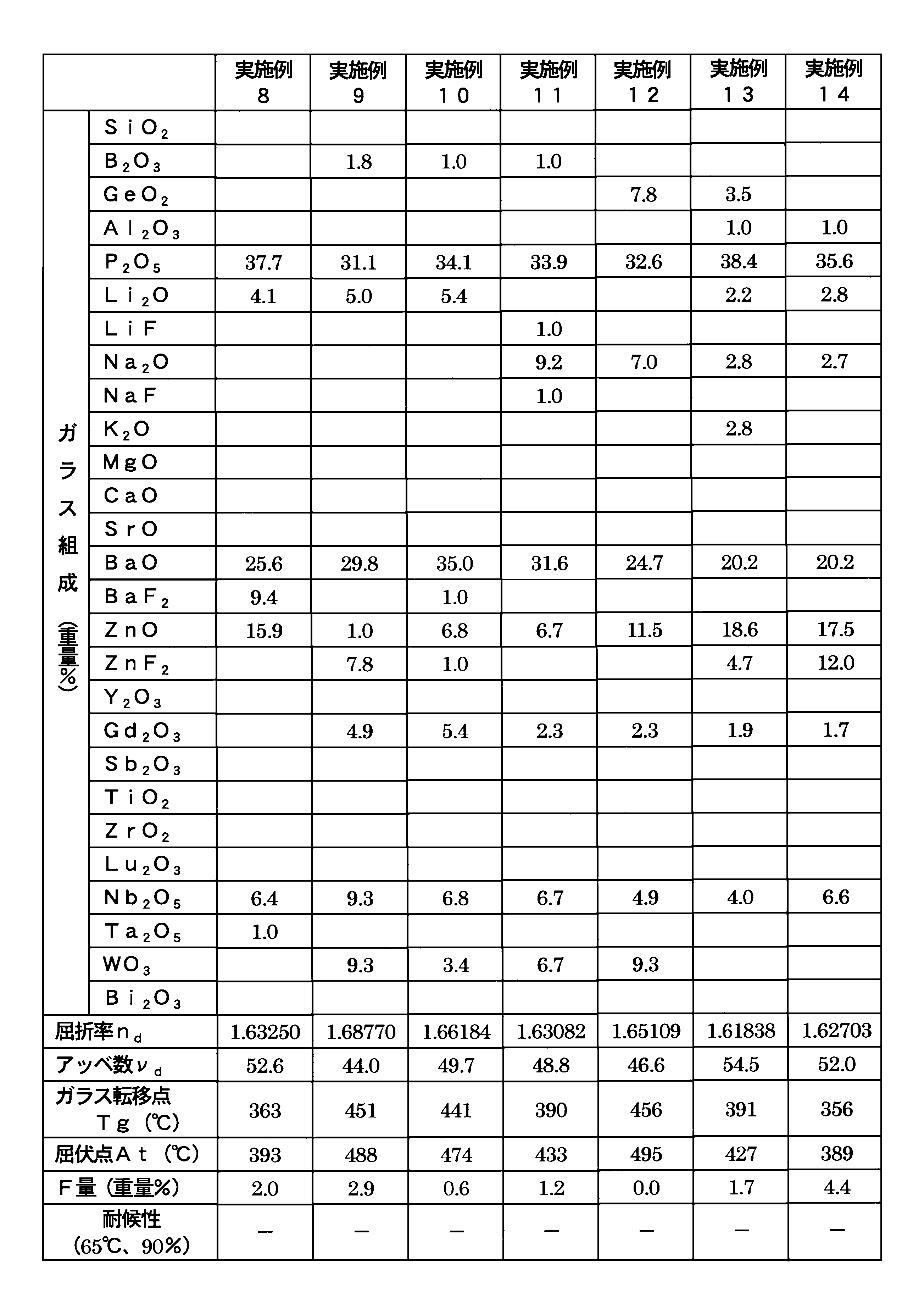


これらの結果は、本発明の光学ガラスが量産を可能にするのに適した性質を備えていることを示している。
また本発明の実施例の何れのガラスも、屈伏点(At)が500℃以下という比較的低い温度範囲内にあるため、成形が容易である。これらのことから、本発明のガラスは、精密モールドプレス成形に好適なガラスであることがわかる。
一方、比較例1、2のガラスは、耐候性テストを実施した結果、50時間以内で表面に曇りが生じ始めた。比較例3~5のガラスは、何れも屈伏点(At)が高く、金型表面の劣化が大きい。
Claims (5)
- P2O5:25~50重量%、BaO:15~35重量%、ZnO:1~25重量、Nb2O5:3~10重量%を含有するP2O5-BaO-ZnO-Nb2O5系ガラスであることを特徴とする光学ガラス。
- B2O3:0.1~8重量%、F:0.1~10重量%を含有することを特徴とする請求項1に記載の光学ガラス。
- GeO2:0~8重量%、Al2O3:0~1重量%(ただし、1重量%を除く)、Li2O:0~8重量%、Na2O:0~10重量%、K2O:0~8重量%、CaO:0~10重量%、SrO:0~15重量%、MgO:0~5重量%、WO3:0~10重量%、Gd2O3:0~8重量%、Ta2O5:0~8重量%、Y2O3:0~5重量%、ZrO2:0~3重量%、LiF:0~10重量%、NaF:0~10重量%、ZnF2:0~15重量%、BaF2:0~15重量%のうち、少なくとも1種以上を含有することを特徴とする請求項1又は2に記載の光学ガラス。
- 屈折率(nd)が1.58~1.70、アッベ数(νd)が42~58、ガラス転移点(Tg)が470℃以下、ガラス屈伏点(At)が500℃以下であることを特徴とする請求項1~3の何れかに記載の光学ガラス。
- 微細構造の転写に用いることを特徴とする請求項1~4の何れかに記載の光学ガラス。
Priority Applications (4)
| Application Number | Priority Date | Filing Date | Title |
|---|---|---|---|
| EP09707758A EP2246311A1 (en) | 2008-02-08 | 2009-02-09 | Optical glass |
| US12/866,559 US8404604B2 (en) | 2008-02-08 | 2009-02-09 | Optical glass |
| CN2009801085343A CN101970368A (zh) | 2008-02-08 | 2009-02-09 | 光学玻璃 |
| JP2009552562A JP5570054B2 (ja) | 2008-02-08 | 2009-02-09 | 光学ガラス |
Applications Claiming Priority (2)
| Application Number | Priority Date | Filing Date | Title |
|---|---|---|---|
| JP2008029537 | 2008-02-08 | ||
| JP2008-029537 | 2008-02-08 |
Publications (1)
| Publication Number | Publication Date |
|---|---|
| WO2009099230A1 true WO2009099230A1 (ja) | 2009-08-13 |
Family
ID=40952295
Family Applications (1)
| Application Number | Title | Priority Date | Filing Date |
|---|---|---|---|
| PCT/JP2009/052134 Ceased WO2009099230A1 (ja) | 2008-02-08 | 2009-02-09 | 光学ガラス |
Country Status (5)
| Country | Link |
|---|---|
| US (1) | US8404604B2 (ja) |
| EP (1) | EP2246311A1 (ja) |
| JP (1) | JP5570054B2 (ja) |
| CN (1) | CN101970368A (ja) |
| WO (1) | WO2009099230A1 (ja) |
Cited By (6)
| Publication number | Priority date | Publication date | Assignee | Title |
|---|---|---|---|---|
| JP2011241128A (ja) * | 2010-05-20 | 2011-12-01 | Sumita Optical Glass Inc | 光学ガラスならびに、モールドプレス成形用プリフォームおよび光学素子 |
| CN102557437A (zh) * | 2010-12-20 | 2012-07-11 | 株式会社小原 | 光学玻璃、光学元件和预成型坯 |
| JP2012136359A (ja) * | 2010-12-24 | 2012-07-19 | Nihon Yamamura Glass Co Ltd | 光学ガラス |
| CN102849945A (zh) * | 2011-06-28 | 2013-01-02 | 联合大学 | 光学玻璃 |
| US10312402B2 (en) | 2010-02-05 | 2019-06-04 | Hitachi Chemical Company, Ltd. | P-type diffusion layer forming composition |
| JP2019199397A (ja) * | 2018-05-10 | 2019-11-21 | Hoya株式会社 | 光学ガラスおよび光学素子 |
Families Citing this family (9)
| Publication number | Priority date | Publication date | Assignee | Title |
|---|---|---|---|---|
| US20110195541A1 (en) * | 2010-02-05 | 2011-08-11 | Hitachi Chemical Company, Ltd. | Composition for forming n-type diffusion layer, method for forming n-type diffusion layer, and method for producing photovoltaic cell |
| CN110040954B (zh) * | 2014-01-23 | 2021-07-27 | 成都光明光电股份有限公司 | 光学玻璃及光学元件 |
| WO2016068124A1 (ja) * | 2014-10-27 | 2016-05-06 | Hoya株式会社 | 光学ガラス、光学素子および光学ガラス素材 |
| CN107148403B (zh) * | 2014-10-27 | 2021-04-27 | Hoya株式会社 | 光学玻璃、光学元件以及光学玻璃原材料 |
| RU2614787C1 (ru) * | 2016-02-29 | 2017-03-29 | Юлия Алексеевна Щепочкина | Оптическое стекло |
| TWI848909B (zh) * | 2017-05-19 | 2024-07-21 | 日商小原股份有限公司 | 光學玻璃、預成形體以及光學元件 |
| CN107151096A (zh) * | 2017-06-20 | 2017-09-12 | 成都光明光电有限责任公司 | 低熔点玻璃 |
| CN112811815B (zh) * | 2021-01-21 | 2022-04-12 | 成都光明光电股份有限公司 | 光学玻璃、玻璃预制件、光学元件和光学仪器 |
| CN115385572B (zh) * | 2022-09-05 | 2023-07-18 | 湖北新华光信息材料有限公司 | 磷酸盐光学玻璃及其制备方法和光学元件 |
Citations (15)
| Publication number | Priority date | Publication date | Assignee | Title |
|---|---|---|---|---|
| JPS60171244A (ja) * | 1984-02-16 | 1985-09-04 | Ohara Inc | 光学ガラス |
| JPH11139845A (ja) | 1997-11-06 | 1999-05-25 | Sumita Optical Glass Inc | 精密プレス成形用光学ガラス |
| JP2002293572A (ja) | 2001-01-29 | 2002-10-09 | Hoya Corp | 光学ガラス |
| JP2003238197A (ja) | 2002-02-18 | 2003-08-27 | Fuji Photo Optical Co Ltd | プレス成形レンズ用光学ガラス |
| WO2003072518A1 (en) | 2002-02-20 | 2003-09-04 | Kabushiki Kaisha Ohara | Optical glass |
| JP2003335549A (ja) | 2002-03-14 | 2003-11-25 | Hoya Corp | 光学ガラス、精密プレス成形用プリフォーム、及び光学素子 |
| JP2004002153A (ja) | 2002-03-14 | 2004-01-08 | Hoya Corp | ガラス光学素子の製造方法 |
| JP2004168593A (ja) | 2002-11-20 | 2004-06-17 | Minolta Co Ltd | 光学ガラス |
| JP2004217513A (ja) | 2002-12-27 | 2004-08-05 | Hoya Corp | 光学ガラス、プレス成形用プリフォームおよび光学素子 |
| JP2004262703A (ja) | 2003-02-28 | 2004-09-24 | Minolta Co Ltd | 光学ガラス及び光学素子 |
| JP2005053749A (ja) | 2003-08-05 | 2005-03-03 | Minolta Co Ltd | 光学ガラス及びこれから作製される光学素子 |
| JP2005247659A (ja) | 2004-03-05 | 2005-09-15 | Hoya Corp | 精密プレス成形用プリフォームの製造方法および光学素子の製造方法 |
| JP2006052119A (ja) | 2004-07-15 | 2006-02-23 | Hoya Corp | リン酸塩光学ガラス、精密プレス成形用プリフォームおよびその製造方法、光学素子およびその製造方法 |
| JP2007070194A (ja) * | 2005-09-09 | 2007-03-22 | Ohara Inc | 光学ガラス |
| JP2009013026A (ja) * | 2007-07-06 | 2009-01-22 | National Institute Of Advanced Industrial & Technology | 光学ガラス |
Family Cites Families (10)
| Publication number | Priority date | Publication date | Assignee | Title |
|---|---|---|---|---|
| JPS5378217A (en) * | 1976-12-22 | 1978-07-11 | Hoya Glass Works Ltd | Phosphate optical glass through which light beam length beeing little dependnt on temperature |
| JPS58130136A (ja) * | 1982-01-25 | 1983-08-03 | Hoya Corp | 光学ガラス |
| JP2002284534A (ja) * | 2001-03-27 | 2002-10-03 | Canon Inc | 光学素子成形用型及びその製造方法 |
| JP4289450B2 (ja) * | 2002-12-04 | 2009-07-01 | 光ガラス株式会社 | 光学ガラス |
| US7157391B2 (en) * | 2002-12-27 | 2007-01-02 | Hoya Corporation | Optical glass, preform for press molding and optical element |
| CN1576252B (zh) * | 2003-06-30 | 2010-04-28 | Hoya株式会社 | 精密加压成形用预成形体、光学元件及各自的制备方法 |
| JP4575787B2 (ja) * | 2005-01-07 | 2010-11-04 | アルプス電気株式会社 | 型の製造方法 |
| JP5616566B2 (ja) * | 2005-11-24 | 2014-10-29 | 株式会社オハラ | 光学ガラス |
| JP5160043B2 (ja) * | 2006-03-31 | 2013-03-13 | Hoya株式会社 | モールドプレス用ガラス素材、及びガラス光学素子の製造方法 |
| JP5056332B2 (ja) * | 2007-10-15 | 2012-10-24 | コニカミノルタアドバンストレイヤー株式会社 | 光学ガラス及び光学素子 |
-
2009
- 2009-02-09 US US12/866,559 patent/US8404604B2/en not_active Expired - Fee Related
- 2009-02-09 WO PCT/JP2009/052134 patent/WO2009099230A1/ja not_active Ceased
- 2009-02-09 JP JP2009552562A patent/JP5570054B2/ja not_active Expired - Fee Related
- 2009-02-09 EP EP09707758A patent/EP2246311A1/en not_active Withdrawn
- 2009-02-09 CN CN2009801085343A patent/CN101970368A/zh active Pending
Patent Citations (15)
| Publication number | Priority date | Publication date | Assignee | Title |
|---|---|---|---|---|
| JPS60171244A (ja) * | 1984-02-16 | 1985-09-04 | Ohara Inc | 光学ガラス |
| JPH11139845A (ja) | 1997-11-06 | 1999-05-25 | Sumita Optical Glass Inc | 精密プレス成形用光学ガラス |
| JP2002293572A (ja) | 2001-01-29 | 2002-10-09 | Hoya Corp | 光学ガラス |
| JP2003238197A (ja) | 2002-02-18 | 2003-08-27 | Fuji Photo Optical Co Ltd | プレス成形レンズ用光学ガラス |
| WO2003072518A1 (en) | 2002-02-20 | 2003-09-04 | Kabushiki Kaisha Ohara | Optical glass |
| JP2003335549A (ja) | 2002-03-14 | 2003-11-25 | Hoya Corp | 光学ガラス、精密プレス成形用プリフォーム、及び光学素子 |
| JP2004002153A (ja) | 2002-03-14 | 2004-01-08 | Hoya Corp | ガラス光学素子の製造方法 |
| JP2004168593A (ja) | 2002-11-20 | 2004-06-17 | Minolta Co Ltd | 光学ガラス |
| JP2004217513A (ja) | 2002-12-27 | 2004-08-05 | Hoya Corp | 光学ガラス、プレス成形用プリフォームおよび光学素子 |
| JP2004262703A (ja) | 2003-02-28 | 2004-09-24 | Minolta Co Ltd | 光学ガラス及び光学素子 |
| JP2005053749A (ja) | 2003-08-05 | 2005-03-03 | Minolta Co Ltd | 光学ガラス及びこれから作製される光学素子 |
| JP2005247659A (ja) | 2004-03-05 | 2005-09-15 | Hoya Corp | 精密プレス成形用プリフォームの製造方法および光学素子の製造方法 |
| JP2006052119A (ja) | 2004-07-15 | 2006-02-23 | Hoya Corp | リン酸塩光学ガラス、精密プレス成形用プリフォームおよびその製造方法、光学素子およびその製造方法 |
| JP2007070194A (ja) * | 2005-09-09 | 2007-03-22 | Ohara Inc | 光学ガラス |
| JP2009013026A (ja) * | 2007-07-06 | 2009-01-22 | National Institute Of Advanced Industrial & Technology | 光学ガラス |
Cited By (8)
| Publication number | Priority date | Publication date | Assignee | Title |
|---|---|---|---|---|
| US10312402B2 (en) | 2010-02-05 | 2019-06-04 | Hitachi Chemical Company, Ltd. | P-type diffusion layer forming composition |
| JP2011241128A (ja) * | 2010-05-20 | 2011-12-01 | Sumita Optical Glass Inc | 光学ガラスならびに、モールドプレス成形用プリフォームおよび光学素子 |
| CN102557437A (zh) * | 2010-12-20 | 2012-07-11 | 株式会社小原 | 光学玻璃、光学元件和预成型坯 |
| CN102557437B (zh) * | 2010-12-20 | 2016-08-17 | 株式会社小原 | 光学玻璃、光学元件和预成型坯 |
| JP2012136359A (ja) * | 2010-12-24 | 2012-07-19 | Nihon Yamamura Glass Co Ltd | 光学ガラス |
| CN102849945A (zh) * | 2011-06-28 | 2013-01-02 | 联合大学 | 光学玻璃 |
| JP2019199397A (ja) * | 2018-05-10 | 2019-11-21 | Hoya株式会社 | 光学ガラスおよび光学素子 |
| JP7132884B2 (ja) | 2018-05-10 | 2022-09-07 | Hoya株式会社 | 光学ガラスおよび光学素子 |
Also Published As
| Publication number | Publication date |
|---|---|
| US8404604B2 (en) | 2013-03-26 |
| JPWO2009099230A1 (ja) | 2011-06-02 |
| US20100317504A1 (en) | 2010-12-16 |
| JP5570054B2 (ja) | 2014-08-13 |
| CN101970368A (zh) | 2011-02-09 |
| EP2246311A1 (en) | 2010-11-03 |
Similar Documents
| Publication | Publication Date | Title |
|---|---|---|
| JP5570054B2 (ja) | 光学ガラス | |
| CN101497494B (zh) | 光学玻璃 | |
| JP6505793B2 (ja) | 光学ガラス、ガラス母材と光学素子 | |
| US10252934B2 (en) | Optical glass, glass preform and optical element | |
| TWI639570B (zh) | Optical glass and optical components | |
| JP7171734B2 (ja) | 光学ガラス、ガラスプリフォーム、光学素子及びこれを有する光学機器 | |
| CN105198206A (zh) | 光学玻璃 | |
| CN110770183B (zh) | 光学玻璃、预成形体以及光学元件 | |
| JP2011037660A (ja) | 光学ガラス、レンズプリフォーム及び光学素子 | |
| JP4810901B2 (ja) | 光学ガラス及び光学素子 | |
| JP5099890B2 (ja) | 光学ガラス | |
| CN102947234A (zh) | 光学玻璃 | |
| JP6672472B2 (ja) | 光学ガラス及び光学素子 | |
| CN105293897A (zh) | 光学玻璃 | |
| JP7134396B2 (ja) | 光学ガラス | |
| WO2013180082A1 (ja) | 光学ガラス | |
| TW201731785A (zh) | 光學玻璃、預成形材及光學元件 | |
| US8298974B2 (en) | Optical glass | |
| CN115974407A (zh) | 光学玻璃 | |
| WO2020067048A1 (ja) | 光学ガラス | |
| JP2024159541A (ja) | 光学ガラスおよび光学素子 | |
| CN105645760A (zh) | 光学玻璃及光学元件 | |
| JP4233832B2 (ja) | モールド成形用光学ガラス | |
| JP5748997B2 (ja) | 光学ガラス | |
| JP2017057121A (ja) | 光学ガラス、プリフォーム及び光学素子 |
Legal Events
| Date | Code | Title | Description |
|---|---|---|---|
| WWE | Wipo information: entry into national phase |
Ref document number: 200980108534.3 Country of ref document: CN |
|
| 121 | Ep: the epo has been informed by wipo that ep was designated in this application |
Ref document number: 09707758 Country of ref document: EP Kind code of ref document: A1 |
|
| WWE | Wipo information: entry into national phase |
Ref document number: 2009552562 Country of ref document: JP |
|
| WWE | Wipo information: entry into national phase |
Ref document number: 2009707758 Country of ref document: EP |
|
| WWE | Wipo information: entry into national phase |
Ref document number: 12866559 Country of ref document: US |
|
| NENP | Non-entry into the national phase |
Ref country code: DE |