WO2009100956A2 - Kontinuierlich betriebenes verfahren zur herstellung von copolymeren - Google Patents

Kontinuierlich betriebenes verfahren zur herstellung von copolymeren Download PDF

Info

Publication number
WO2009100956A2
WO2009100956A2 PCT/EP2009/050260 EP2009050260W WO2009100956A2 WO 2009100956 A2 WO2009100956 A2 WO 2009100956A2 EP 2009050260 W EP2009050260 W EP 2009050260W WO 2009100956 A2 WO2009100956 A2 WO 2009100956A2
Authority
WO
WIPO (PCT)
Prior art keywords
different
represented
same
branched
unbranched
Prior art date
Legal status (The legal status is an assumption and is not a legal conclusion. Google has not performed a legal analysis and makes no representation as to the accuracy of the status listed.)
Ceased
Application number
PCT/EP2009/050260
Other languages
English (en)
French (fr)
Other versions
WO2009100956A3 (de
Inventor
Christian Schwede
Mario Vierle
Timo Mangel
Gerhard Albrecht
Volker Herzog
Klaus Arlt
Current Assignee (The listed assignees may be inaccurate. Google has not performed a legal analysis and makes no representation or warranty as to the accuracy of the list.)
Construction Research and Technology GmbH
Original Assignee
Construction Research and Technology GmbH
Priority date (The priority date is an assumption and is not a legal conclusion. Google has not performed a legal analysis and makes no representation as to the accuracy of the date listed.)
Filing date
Publication date
Application filed by Construction Research and Technology GmbH filed Critical Construction Research and Technology GmbH
Priority to ES09709722T priority Critical patent/ES2696539T3/es
Priority to EP09709722.4A priority patent/EP2242732B1/de
Priority to CN200980104987.9A priority patent/CN102015570B/zh
Priority to CA2715095A priority patent/CA2715095C/en
Priority to JP2010546272A priority patent/JP2011525545A/ja
Priority to AU2009214298A priority patent/AU2009214298B2/en
Priority to US12/866,973 priority patent/US8648158B2/en
Publication of WO2009100956A2 publication Critical patent/WO2009100956A2/de
Publication of WO2009100956A3 publication Critical patent/WO2009100956A3/de
Anticipated expiration legal-status Critical
Ceased legal-status Critical Current

Links

Classifications

    • CCHEMISTRY; METALLURGY
    • C04CEMENTS; CONCRETE; ARTIFICIAL STONE; CERAMICS; REFRACTORIES
    • C04BLIME, MAGNESIA; SLAG; CEMENTS; COMPOSITIONS THEREOF, e.g. MORTARS, CONCRETE OR LIKE BUILDING MATERIALS; ARTIFICIAL STONE; CERAMICS; REFRACTORIES; TREATMENT OF NATURAL STONE
    • C04B24/00Use of organic materials as active ingredients for mortars, concrete or artificial stone, e.g. plasticisers
    • C04B24/24Macromolecular compounds
    • C04B24/26Macromolecular compounds obtained by reactions only involving carbon-to-carbon unsaturated bonds
    • C04B24/2641Polyacrylates; Polymethacrylates
    • C04B24/2647Polyacrylates; Polymethacrylates containing polyether side chains
    • CCHEMISTRY; METALLURGY
    • C04CEMENTS; CONCRETE; ARTIFICIAL STONE; CERAMICS; REFRACTORIES
    • C04BLIME, MAGNESIA; SLAG; CEMENTS; COMPOSITIONS THEREOF, e.g. MORTARS, CONCRETE OR LIKE BUILDING MATERIALS; ARTIFICIAL STONE; CERAMICS; REFRACTORIES; TREATMENT OF NATURAL STONE
    • C04B24/00Use of organic materials as active ingredients for mortars, concrete or artificial stone, e.g. plasticisers
    • C04B24/24Macromolecular compounds
    • C04B24/26Macromolecular compounds obtained by reactions only involving carbon-to-carbon unsaturated bonds
    • C04B24/2664Macromolecular compounds obtained by reactions only involving carbon-to-carbon unsaturated bonds of ethylenically unsaturated dicarboxylic acid polymers, e.g. maleic anhydride copolymers
    • C04B24/267Macromolecular compounds obtained by reactions only involving carbon-to-carbon unsaturated bonds of ethylenically unsaturated dicarboxylic acid polymers, e.g. maleic anhydride copolymers containing polyether side chains
    • CCHEMISTRY; METALLURGY
    • C08ORGANIC MACROMOLECULAR COMPOUNDS; THEIR PREPARATION OR CHEMICAL WORKING-UP; COMPOSITIONS BASED THEREON
    • C08FMACROMOLECULAR COMPOUNDS OBTAINED BY REACTIONS ONLY INVOLVING CARBON-TO-CARBON UNSATURATED BONDS
    • C08F220/00Copolymers of compounds having one or more unsaturated aliphatic radicals, each having only one carbon-to-carbon double bond, and only one being terminated by only one carboxyl radical or a salt, anhydride ester, amide, imide or nitrile thereof
    • C08F220/02Monocarboxylic acids having less than ten carbon atoms; Derivatives thereof
    • C08F220/04Acids; Metal salts or ammonium salts thereof
    • C08F220/06Acrylic acid; Methacrylic acid; Metal salts or ammonium salts thereof
    • CCHEMISTRY; METALLURGY
    • C08ORGANIC MACROMOLECULAR COMPOUNDS; THEIR PREPARATION OR CHEMICAL WORKING-UP; COMPOSITIONS BASED THEREON
    • C08FMACROMOLECULAR COMPOUNDS OBTAINED BY REACTIONS ONLY INVOLVING CARBON-TO-CARBON UNSATURATED BONDS
    • C08F220/00Copolymers of compounds having one or more unsaturated aliphatic radicals, each having only one carbon-to-carbon double bond, and only one being terminated by only one carboxyl radical or a salt, anhydride ester, amide, imide or nitrile thereof
    • C08F220/02Monocarboxylic acids having less than ten carbon atoms; Derivatives thereof
    • C08F220/08Anhydrides
    • CCHEMISTRY; METALLURGY
    • C08ORGANIC MACROMOLECULAR COMPOUNDS; THEIR PREPARATION OR CHEMICAL WORKING-UP; COMPOSITIONS BASED THEREON
    • C08FMACROMOLECULAR COMPOUNDS OBTAINED BY REACTIONS ONLY INVOLVING CARBON-TO-CARBON UNSATURATED BONDS
    • C08F220/00Copolymers of compounds having one or more unsaturated aliphatic radicals, each having only one carbon-to-carbon double bond, and only one being terminated by only one carboxyl radical or a salt, anhydride ester, amide, imide or nitrile thereof
    • C08F220/62Monocarboxylic acids having ten or more carbon atoms; Derivatives thereof
    • C08F220/64Acids; Metal salts or ammonium salts thereof
    • CCHEMISTRY; METALLURGY
    • C08ORGANIC MACROMOLECULAR COMPOUNDS; THEIR PREPARATION OR CHEMICAL WORKING-UP; COMPOSITIONS BASED THEREON
    • C08FMACROMOLECULAR COMPOUNDS OBTAINED BY REACTIONS ONLY INVOLVING CARBON-TO-CARBON UNSATURATED BONDS
    • C08F220/00Copolymers of compounds having one or more unsaturated aliphatic radicals, each having only one carbon-to-carbon double bond, and only one being terminated by only one carboxyl radical or a salt, anhydride ester, amide, imide or nitrile thereof
    • C08F220/62Monocarboxylic acids having ten or more carbon atoms; Derivatives thereof
    • C08F220/66Anhydrides
    • CCHEMISTRY; METALLURGY
    • C08ORGANIC MACROMOLECULAR COMPOUNDS; THEIR PREPARATION OR CHEMICAL WORKING-UP; COMPOSITIONS BASED THEREON
    • C08FMACROMOLECULAR COMPOUNDS OBTAINED BY REACTIONS ONLY INVOLVING CARBON-TO-CARBON UNSATURATED BONDS
    • C08F222/00Copolymers of compounds having one or more unsaturated aliphatic radicals, each having only one carbon-to-carbon double bond, and at least one being terminated by a carboxyl radical and containing at least one other carboxyl radical in the molecule; Salts, anhydrides, esters, amides, imides, or nitriles thereof
    • C08F222/02Acids; Metal salts or ammonium salts thereof, e.g. maleic acid or itaconic acid
    • CCHEMISTRY; METALLURGY
    • C08ORGANIC MACROMOLECULAR COMPOUNDS; THEIR PREPARATION OR CHEMICAL WORKING-UP; COMPOSITIONS BASED THEREON
    • C08FMACROMOLECULAR COMPOUNDS OBTAINED BY REACTIONS ONLY INVOLVING CARBON-TO-CARBON UNSATURATED BONDS
    • C08F222/00Copolymers of compounds having one or more unsaturated aliphatic radicals, each having only one carbon-to-carbon double bond, and at least one being terminated by a carboxyl radical and containing at least one other carboxyl radical in the molecule; Salts, anhydrides, esters, amides, imides, or nitriles thereof
    • C08F222/04Anhydrides, e.g. cyclic anhydrides
    • CCHEMISTRY; METALLURGY
    • C08ORGANIC MACROMOLECULAR COMPOUNDS; THEIR PREPARATION OR CHEMICAL WORKING-UP; COMPOSITIONS BASED THEREON
    • C08FMACROMOLECULAR COMPOUNDS OBTAINED BY REACTIONS ONLY INVOLVING CARBON-TO-CARBON UNSATURATED BONDS
    • C08F222/00Copolymers of compounds having one or more unsaturated aliphatic radicals, each having only one carbon-to-carbon double bond, and at least one being terminated by a carboxyl radical and containing at least one other carboxyl radical in the molecule; Salts, anhydrides, esters, amides, imides, or nitriles thereof
    • C08F222/04Anhydrides, e.g. cyclic anhydrides
    • C08F222/06Maleic anhydride
    • CCHEMISTRY; METALLURGY
    • C08ORGANIC MACROMOLECULAR COMPOUNDS; THEIR PREPARATION OR CHEMICAL WORKING-UP; COMPOSITIONS BASED THEREON
    • C08FMACROMOLECULAR COMPOUNDS OBTAINED BY REACTIONS ONLY INVOLVING CARBON-TO-CARBON UNSATURATED BONDS
    • C08F222/00Copolymers of compounds having one or more unsaturated aliphatic radicals, each having only one carbon-to-carbon double bond, and at least one being terminated by a carboxyl radical and containing at least one other carboxyl radical in the molecule; Salts, anhydrides, esters, amides, imides, or nitriles thereof
    • C08F222/10Esters
    • C08F222/12Esters of phenols or saturated alcohols
    • C08F222/16Esters having free carboxylic acid groups, e.g. monoalkyl maleates or fumarates
    • CCHEMISTRY; METALLURGY
    • C08ORGANIC MACROMOLECULAR COMPOUNDS; THEIR PREPARATION OR CHEMICAL WORKING-UP; COMPOSITIONS BASED THEREON
    • C08LCOMPOSITIONS OF MACROMOLECULAR COMPOUNDS
    • C08L33/00Compositions of homopolymers or copolymers of compounds having one or more unsaturated aliphatic radicals, each having only one carbon-to-carbon double bond, and only one being terminated by only one carboxyl radical, or of salts, anhydrides, esters, amides, imides or nitriles thereof; Compositions of derivatives of such polymers
    • C08L33/02Homopolymers or copolymers of acids; Metal or ammonium salts thereof
    • CCHEMISTRY; METALLURGY
    • C04CEMENTS; CONCRETE; ARTIFICIAL STONE; CERAMICS; REFRACTORIES
    • C04BLIME, MAGNESIA; SLAG; CEMENTS; COMPOSITIONS THEREOF, e.g. MORTARS, CONCRETE OR LIKE BUILDING MATERIALS; ARTIFICIAL STONE; CERAMICS; REFRACTORIES; TREATMENT OF NATURAL STONE
    • C04B2103/00Function or property of ingredients for mortars, concrete or artificial stone
    • C04B2103/40Surface-active agents, dispersants
    • C04B2103/408Dispersants

Definitions

  • the present invention relates to a process for producing a copolymer, the copolymer and the use of the copolymer.
  • aqueous slurries of powdered inorganic or organic substances such as clays, silicate, chalk, carbon black, rock flour and hydraulic binders to improve their processability, d. H. Kneadability, spreadability, sprayability, pumpability or flowability, often added additives in the form of dispersants.
  • Such additives are able to break up solid agglomerates, to disperse the particles formed and thus to improve the processability.
  • This effect is also exploited specifically in the production of building material mixtures containing hydraulic binders such as cement, lime, gypsum or anhydrite.
  • additives generally referred to as water reducers or flow agents are employed.
  • water reducers or flow agents are employed.
  • copolymers are used in practice, which are prepared by free-radical copolymerization of acid monomers with Polyethermakromonomeren. Usually, the copolymerization takes place either in the batch or in the semi-batch mode.
  • EP-B-1 218 427 describes a continuous production process for said copolymers, which are said to perform better as flowability / water reducing agents than corresponding copolymers which have been prepared by the batch or semi-batch operation.
  • a monomer stream is prepared which contains on the one hand an acid monomer and on the other hand a polyether macromonomer. This pre-produced, acid monomer and
  • Polyether macromonomer containing monomer stream is reacted with an initiator in polymerized a reaction zone, wherein finally a polymer stream is withdrawn from the reaction zone.
  • the premix of the acid monomer and the polyether macromonomer used to make the monomer stream has disadvantages. This is based u. a. in that, in the monomer stream, acid monomer and polyether macromonomer undergo undesired side reactions with one another.
  • the object underlying the present invention is therefore to provide an economical process for the preparation of copolymers which show good performance as dispersants for hydraulic binders, especially as flow agents / water reducing agents.
  • the solution to this problem is a process for the preparation of a copolymer in continuous operation in a polymerization, containing a feed lines and a drain having polymerization reactor, wherein introduced by the feed lines radical polymerization initiator and acid monomer and polyether macromonomer as monomeric starting materials in the polymerization in the polymerization reactor -20 to +120 0 C tempered initiator, monomeric starting materials, as well as copolymer-containing reaction composition is present reaction composition containing copolymer is discharged through the discharge from the polymerization reactor, from the acid monomer is carried out with the introduction of the polyether separately into the polymerization reactor in such a way that the polyether macromonomer in the polymerization reactor with the initiator, monomeric starting materials and copolymer containing Christskompositio n is mixed and it gets in contact with the acid monomer for the first time.
  • Acid monomer is to be understood as meaning radically copolymerizable monomers having at least one carbon double bond which contain at least one acid function and react in the aqueous medium as acid. Furthermore, as the acid monomer, radically copolymerizable, at least one carbon double bond-containing monomers are understood which form at least one acid function due to hydrolysis reaction in the aqueous medium and react in the aqueous medium as acid (Example: maleic anhydrite).
  • Polyether macromonomers for the purposes of the present invention are free-radically copolymerizable compounds having at least one
  • a carbon double bond having at least two ether oxygen atoms with the proviso that the polyether macromonomer structural units contained in the copolymer have side chains containing at least two ether oxygen atoms.
  • the acid monomer first comes into contact with the polyether macromonomer in the polymerization reactor, in the presence of the polymerization initiator.
  • the resulting copolymer flow agents which are prepared by the process according to the invention, show good performance as a flow agent / water reducing agent, or as a dispersant for hydraulic binders.
  • Another important advantage of the method according to the invention is that no means for premixing the acid monomer with the polyether macromonomer is required, the provision of which would mean a not inconsiderable economic outlay, especially for the industrial scale.
  • the mixing of the two monomers takes place in the reaction composition, for. B. by means of a stirring device, with which the polymerization reactor is often equipped.
  • the acid monomer is reacted by polymerization and thereby produces a structural unit in the copolymer, which is according to one of the general formulas (Ia), (Ib), (Ic) and / or (Id) (Ia)
  • R 1 is the same or different (ie substituted either identically or differently within the copolymer) and represented by H and / or an unbranched or branched C 1 -C 4 -alkyl group (preferably H or CH 3);
  • n 1, 2, 3 or 4 (preferably NH-C 4 He) and / or a non-existent moiety (ie, -X is absent);
  • R 2 is the same or different and represents CeH 4 -SOsH substituted by OH, SO 3 H, PO 3 H 2, O-PO 3 H 2 and / or para, with the proviso that if X is a non-existent moiety, R 2 is represented by OH;
  • R 3 is identical or different and is represented by H and / or an unbranched or branched C 1 -C 4 -alkyl group (preferably CH 3);
  • n 0,1, 2,3 or 4
  • R 4 is the same or different and represents substituted CeH 4 -SOsH substituted by SO 3 H, PO 3 H 2, O-PO 3 H 2 and / or para;
  • R 5 is identical or different and is represented by H and / or an unbranched or branched C 1 -C 4 -alkyl group (preferably H);
  • Z is identical or different and represented by O and / or NH;
  • R 6 is identical or different and is represented by H and / or an unbranched or branched C 1 -C 4 -alkyl group (preferably H);
  • Q is the same or different and represented by NH and / or O;
  • the acid monomer used is frequently methacrylic acid, acrylic acid, maleic acid, maleic anhydrite, a half ester of maleic acid or a mixture of several of these components.
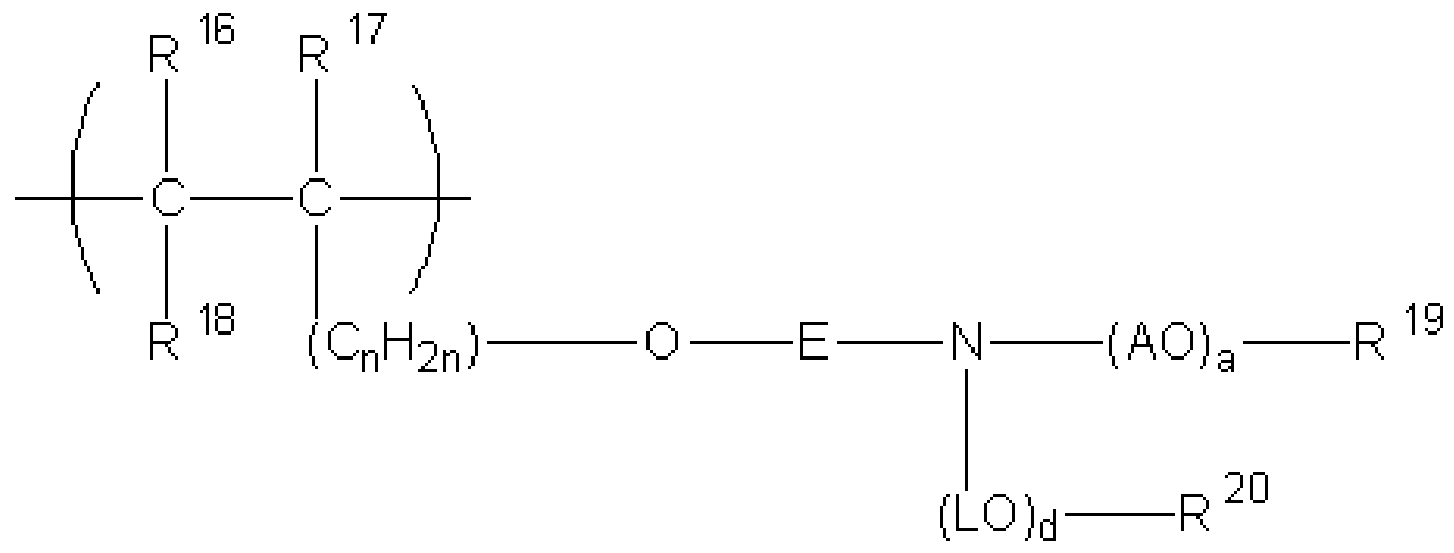
  • the polyether macromonomer is reacted by polymerization, thereby producing a structural unit in the copolymer which is in accordance with any one of general formulas (IIa), (IIb) and / or (Hc)
  • R 10, R 11 and R 12 are each the same or different and are independently represented by H and / or a straight-chain or branched Ci - C 4 alkyl group (preferably H and / or CH3);
  • E is identical or different and represented by an unbranched or branched C 1 -C 6 -alkylene group (C 1, C 2 , C 3 , C 4 , C 5 or C 6 , although typically each, but preferably C 2 and C 4 ), a cyclohexyl group, CH 2 -C 6 H 10, ortho, meta or para substituted CeH 4 present and / or a non-existent moiety (ie, -E is absent);
  • G is the same or different and represented by O, NH and / or CO-NH with the proviso that if E is a non-existent moiety then G is also present as a non-existent moiety (ie, -G is absent);
  • n is the same or different and represented by 0, 1, 2, 3, 4 and / or 5;
  • a is the same or different and represented by an integer from 2 to 350 (preferably 10-200);
  • R 13 are identical or different and are represented by H, a straight or branched Ci - C 4 alkyl group, CO-NH 2, and / or COCH 3 (preferably H, CH3);
  • R 14 is identical or different and is represented by H and / or an unbranched or branched C 1 -C 4 -alkyl group (preferably H);
  • E is the same or different and is represented by an unbranched or branched C 1 -C 6 alkylene group (preferably C 2 H 4 ), a cyclohexyl group, CH 2 -C 6 H 10, ortho, meta or para substituted C ⁇ H 4 and / or a non-existent moiety (ie -E is not present);
  • G is the same or different and represented by a nonexistent moiety, O, NH and / or CO-NH with the proviso that if E is a non-existent moiety then G is also present as a non-existent moiety (ie -G is absent) ;
  • n is the same or different and represented by 0, 1, 2, 3, 4 and / or 5;
  • a is the same or different and represented by an integer from 2 to 350 (preferably 10-200);
  • R 15 are identical or different and are represented by H, a straight or branched Ci - C 4 alkyl group, CO-NH2, and / or COCH 3 (preferably H);
  • R 16, R 17 and R 18 are each the same or different and are independently represented by H and / or a straight-chain or branched Ci - C 4 alkyl group (preferably H and / or CH3);
  • E is identical or different and represented by an unbranched or branched C 1 -C 6 -alkylene group (preferably C 2 H 4 or C 4 He), a cyclohexyl group, CH 2 -C 6 H 10, ortho, meta or para substituted present C 6 H 4 and / or by a non existing unit (ie -E is absent);
  • n is the same or different and represented by 0, 1, 2, 3, 4 and / or 5;
  • d is the same or different and represented by an integer from 1 to 350 (preferably 10-200);
  • R 19 is identical or different and is represented by H and / or an unbranched or branched C 1 -C 4 -alkyl group (preferably H),
  • R 20 is identical or different and is represented by H and / or an unbranched C 1 -C 4 -alkyl group (preferably H).
  • polyalkoxy side chains (AO) a of the polyether macromonomers are usually pure polyethoxy side chains, not infrequently there are also mixed polyalkoxy side chains, in particular those which contain both propoxy and ethoxy groups.
  • alkoxylated isoprenol alkoxylated 3-methyl-3-buten-1-ol
  • alkoxylated hydroxybutyl vinyl ether and / or alkoxylated (meth) allyl alcohol alkoxylated (meth) allyl alcohol
  • Methallylalkohol with normally in each case an arithmetic average number of oxyalkylene groups from 4 to 350 used. Particularly preferred is alkoxylated hydroxybutyl vinyl ether.
  • R 21 is identical or different and is represented by H and / or an unbranched or branched C 1 -C 4 group (preferably H or CH 3);
  • W is the same or different and represented by O and / or NH;
  • R 22 is identical or different and represented by a branched or unbranched C 1 -C 5 -monohydoxyalkyl group (although C 1, C 2 , C 3 , C 4 or C 5 is in each case typical, preference is given to C 2 and / or C 3 );
  • R 23 , R 24 and R 25 are each the same or different and are each independently represented by H and / or an unbranched or branched C 1 -C 4
  • Alkyl group (preferably H and / or CH3)
  • n is the same or different and represented by 0, 1, 2, 3 and / or 4;
  • R 26 is identical or different and represented by (C ⁇ Hs), OH and / or
  • Typical monomers which by polymerization produce the structural units (IIIa) or (IIIb) are, for example, 2-hydroxypropyl acrylate, isoprenol or allyl alcohol. Another typical monomer would be in this context
  • a total of at least 45 mole%, but preferably at least 80 mole%, of all the structural units of the copolymer produced by the process will be polymerized by acid monomer polymerization and
  • Polyether macromonomer produced In a preferred embodiment, as much polyether macromonomer per mole of acid monomer is introduced into the polymerization reactor that in the copolymer formed an arithmetic mean molar ratio of acid monomer structural units to Polyethermakromonomer Modelltechniken from 20: 1 to 1: 1, preferably from 12: 1 to 1.
  • a redox initiator is used as radical polymerization initiator.
  • the H 2 O 2 ZFeSO 4 system is then used as the redox initiator, preferably together with a reducing agent.
  • Suitable reducing agents are sodium sulfite, the disodium salt of 2-hydroxy-2-sulfinatoacetic acid, the
  • Other suitable systems for the redox initiator system e.g. those based on t-butyl hydroperoxide, ammonium or potassium peroxydisulfate.
  • initiator components e.g.
  • the premixed polyether macromonomer is introduced into the polymerization reactor in a stream.
  • Suitable reducing agents are, for example, sodium sulfite, the disodium salt of 2-hydroxy-2-sulfonatoacetic acid, the disodium salt of 2-hydroxy-2-sulfinatoacetic acid, sodium hydroxymethanesulfinate, ascorbic acid, iso-ascorbic acid, amines such as diethanolamine or triethanolamine, hydroxylamine or mixtures thereof. If redox systems or catalysts are used, it is expedient to additionally use water-soluble salts of transition metals, such as iron, cobalt, nickel or silver, preference being given to using iron salts.
  • a chain regulator which is preferably present in dissolved form, is introduced into the polymerization reactor.
  • the monomeric starting materials and / or the initiator can be introduced into the polymerization reactor in the form of their aqueous solutions.
  • the polymerization reactor is preferably in the form of a continuously operated stirred tank. Frequently, the polymerization device also has at least one reactor which is connected downstream of the polymerization reactor and is operated continuously, in which process the copolymer-containing reaction composition is introduced via the outflow of the polymerization reactor. Monomeric starting materials and / or initiator components can then be introduced into the downstream reactor.
  • the invention also relates to copolymer which can be prepared according to the method described above.
  • the copolymer of the invention is normally present as a comb polymer.
  • the invention relates to the use of the copolymer of the invention as a dispersant for hydraulic binders.
  • FIG. 1 shows a schematic system structure for carrying out the method according to the invention
  • Fig. 2 shows a corresponding comparison scheme for carrying out a method which is not according to the invention.
  • the reaction unit consists of two double-walled reactors (1 and 1 a), both equipped with stirring devices (2 and 2a) and motors (3 and 3a).
  • the total volume of the reactors is 0.657 dm 3 (reactor 1) and 0.311 dm 3 (reactor 1 a).
  • the reactors are connected to a pipeline (4).
  • Reactor (1) is connected by feed lines to the storage vessels of the reactants. By means of intermediate pumps, a defined material flow can be adjusted.
  • the plant construction contains the following storage vessels (lockable glass containers with magnetic stirrer): (5) for the vinyl ether component (the polyether macromonomer); (6) for an aqueous base solution for adjusting the pH required in the reaction, (7) for H2O, (8) for the acid monomer, 2-propenoic acid (acrylic acid), (9) for the chain transfer component, (10) for the first Initiator component, (1 1) for the second initiator component and (12) for the third initiator component.
  • the supply pipes of the storage vessels (5.1, 6.1, 7.1, 8.1, 9.1, 10.1, 1.1 and 12.1) lead through the reactor lid in the reactor and the
  • Reaction medium wherein the penetration depth is selected in the reaction medium so that the metering takes place in a zone with high mixing efficiency.
  • a maximum distance of the feed lines 5.1 and 8.1 is selected on the reactor.
  • Reactor (1a) is also connected by feed lines (13.1 and 14.1) with the storage vessels (13) and (14) (volume 5.00 dm 3 each) for reactants.
  • the plant construction contains the following components: (13) for H2O or an aqueous base solution and (14) for the second initiator component.
  • Reactor 1 and 1a each still contain a temperature probe (15 and 15a).
  • Example 1 According to the invention: Preparation of a polymer without premixing of the monomer components
  • the apparatus is rinsed with water at the beginning and the reactors 1 and 1 a are flooded with water.
  • the storage vessel 5 4.478 kg H2O are introduced and with stirring 0.022 kg of an aqueous KOH solution (20 wt .-%) as well as 4.500 kg polyether Vinyloxybutylpoly (ethylene oxide) having a number average molecular weight of 6000 g-1 moh added. The solution is stirred until complete dissolution of the vinyloxybutylpoly (ethylene oxide) s.
  • Storage vessel 6 is filled with 0.100 kg of an aqueous KOH solution (20% by weight), storage vessel 7 with 0.100 kg of deionized water.
  • H2O In reservoir 8, 0.420 kg of H2O are introduced and added with stirring 0.280 kg of the acid monomer 2-propenoic acid (acrylic acid).
  • Storage vessel 9 is filled with 0.500 kg of an 8% solution of 3-MPS (3-mercaptopropanoic acid), storage vessel 10 with a 5% H2O2 solution.
  • 0.235 kg of water are introduced with stirring 0.015 kg Brüggolit ® FF6 M (Brüggolit ® FF6 M is a mixture of sodium sulfite, disodium salt of 2-hydroxy-2-sulfinatoacetic acid and disodium salt of 2-hydroxy-2-sulfinatoacetic, available at Brüggemann Chemical L. Brüggemann KG) was added and stirred until complete dissolution.
  • Storage vessel 12 is filled with 0.150 kg of an aqueous solution of FeSO 4 .H 2 O (1.4% by weight).
  • Storage vessel 13 is filled with 0.100 kg of deionized water, storage vessel 14 with 0.150 kg of a Brüggolit ® FF6 M solution, which was prepared in an analogous manner to the filled in storage vessel 11.
  • the two stirrers and all pumps are started and cooling water jacket temperature adjusted so that the temperature of the reaction medium is constant 15 0 C.
  • the material flows of the reactants from storage vessel 5, 8 and 9 are adjusted accordingly so that the sum of the mean residence times is 20 minutes in reactor 1 and 10 minutes in reactor 1 a.
  • the further material flows are set as follows: KOH solution (storage vessel 6): 0.008 kg-hr 1 ; H 2 O (storage vessel 7): 0.006 kg-hr 1 ; Initiator components 10, 11 and 12: 0.030 kg-hr 1 ; 0.036 kg-hr 1 and 0.020 kg-hr 1 .
  • the material flows of the reactants in reactor 1a are adjusted: H 2 O (storage vessel 13): 0.006 kg-h- 1 and initiator component 2 (storage vessel 14): 0.006 kg-hr 1 It is ensured that the introduction of the polyether macromonomer into the polymerization reactor in the manner separated from that of the acid monomer is that the polyether macromonomer is mixed in the polymerization reactor with the initiator, monomeric starting materials and copolymer-containing reaction composition and thereby gets into contact with the acid monomer for the first time. After adjusting the streams, a sample is taken at intervals corresponding to the sum of the average residence times of the reactors and analyzed by size exclusion chromatography.
  • Size exclusion chromatography analyzed and determined therefrom the molecular weight distribution and their averages and the conversion. At the end of the reaction, all material flows are set to zero and the apparatus is rinsed with water.
  • the vinyloxybutylenepoly (ethylene glycol) solution (vinyloxybutylpoly (ethylene oxide) solution) prepared as described in Example 1 is first prepared, and then, with further stirring, the amount of water and 2-propenoic acid described in Example 1 are mixed into storage vessel 5.
  • the streams are adjusted analogously to those described in Example 1.
  • the experimental procedure is analogous to Example 1. After reaching the steady state of the experiment by a procedure as described in Example 1, a sample is taken
  • Polymer 2 and the molecular weight distribution, their mean and turnover determined by size exclusion chromatography.
  • the laboratory-scale polymerization plant is modified by the incorporation of a premixing unit ( Figure 2).
  • the premixing unit consists of a mixable by means of agitator temperable container (with a volume of 0.55 dm 3 ), with two supply lines for the aqueous solutions to be mixed and a
  • the premixing unit is installed in the supply line 5.1 and additionally the supply line 8.1 to the premixing unit connected, so that the monomer components are mixed together and are metered together by means of a feed line into the reactor.
  • Example 1 The streams are adjusted analogously to those described in Example 1.
  • the experiment is carried out analogously to Example 1, wherein the simulation of the
  • Example 1 and Comparative Examples 1 to 3 are analyzed by means of size exclusion chromatography with respect to average molecular weight and conversion (column combination: Suprema 1000 and Suprema 30 from PSS, Mainz, eluent: aqueous solution of Na 2 HPO 4 (0.03 mol / l) and 0 , 5 g / l sodium azide, injection volume 50 ⁇ l, flow rate 0.8 ml / min).
  • Calibration to determine the average molecular weight was done with linear poly (ethylene oxide) standards.
  • the peak of the copolymer is normalized to a relative height of 1 and the height of the peak of the unreacted macromer / PEG-containing oligomer is used as a measure of the residual monomer content.
  • Polymers 2, 3 and 4 prepared by premixing the monomers show significantly higher levels of non-polymerized macromonomer / polyethyleneglycol (PEG) -containing oligomer than polymer 1 prepared by metering the components into the reactor according to the invention.
  • a premix of the components thus results significantly in a higher degree of hydrolysis and thus in a reduction in sales.
  • Polymers 1 to 4 are tested for their properties as concrete plasticizers in a suitable test system.
  • all polymers are previously adjusted to a pH of 6.5 ⁇ 0.2 with a solution of NaOH in water (20% by weight) and mixed with small amounts of a conventional defoamer to control the air-pore content.
  • the polymer 1 produced according to the invention shows at the same dosage a significantly better liquefaction effect directly after production of the concrete than the polymers 2, 3 and 4 produced by premixing. Furthermore, it has a significantly better consistency retention. Concrete made using polymers 2, 3 and 4 is no longer workable after 30 minutes. Thus, the preparation of the polymers according to the invention leads to polymers with significantly better application properties.

Landscapes

  • Chemical & Material Sciences (AREA)
  • Chemical Kinetics & Catalysis (AREA)
  • Organic Chemistry (AREA)
  • Health & Medical Sciences (AREA)
  • Medicinal Chemistry (AREA)
  • Polymers & Plastics (AREA)
  • Engineering & Computer Science (AREA)
  • Ceramic Engineering (AREA)
  • Materials Engineering (AREA)
  • Structural Engineering (AREA)
  • Macromonomer-Based Addition Polymer (AREA)
  • Polymerisation Methods In General (AREA)
  • Curing Cements, Concrete, And Artificial Stone (AREA)
  • Addition Polymer Or Copolymer, Post-Treatments, Or Chemical Modifications (AREA)

Abstract

Die Erfindung betrifft ein Verfahren zur Herstellung eines Copolymers in kontinuierlicher Betriebsweise in einer Polymerisationseinrichtung, enthaltend einen Zuführungsleitungen sowie einen Abfluss aufweisenden Polymerisationsreaktor, wobei durch die Zuführungsleitungen radikalischer Polymerisationsinitiator sowie Säuremonomer und Polyethermakromonomer als monomere Ausgangsstoffe in den Polymerisationsreaktor eingeleitet werden, in dem Polymerisationsreaktor auf -20 bis +120 °C temperierte Initiator, monomere Ausgangsstoffe, sowie Copolymer enthaltende Reaktionskomposition vorliegt, Copolymer enthaltende Reaktionskomposition durch den Abfluss aus dem Polymerisationsreaktorausgeleitet wird, wobei die Einleitung des Polyethermakromonomers in den Polymerisationsreaktor in der Weise getrennt von der des Säuremonomers erfolgt, dass das Polyethermakromonomer in dem Polymerisationsreaktor mit der Initiator, monomere Ausgangsstoffe sowie Copolymer enthaltenden Reaktionskomposition vermischt wird und dabei erstmals mit dem Säuremonomer in Kontakt gerät.

Description

Kontinuierlich betriebenes Verfahren zur Herstellung von Copolymeren
Beschreibung
Die vorliegende Erfindung betrifft ein Verfahren zur Herstellung eines Copolymers, das Copolymer sowie die Verwendung des Copolymers.
Es ist bekannt, dass man wässrige Aufschlämmungen von pulverförmigen anorganischen oder organischen Substanzen, wie Tonen, Silikatmehl, Kreide, Ruß, Gesteinsmehl und hydraulischen Bindemitteln zur Verbesserung ihrer Verarbeitbarkeit, d. h. Knetbarkeit, Streichfähigkeit, Spritzbarkeit, Pumpbarkeit oder Fließfähigkeit, oft Zusatzmittel in Form von Dispergiermitteln zusetzt. Derartige Zusatzmittel sind in der Lage, Feststoffagglomerate aufzubrechen, die gebildeten Teilchen zu dispergieren und auf diese Weise die Verarbeitbarkeit zu verbessern. Dieser Effekt wird insbesondere auch gezielt bei der Herstellung von Baustoffmischungen, die hydraulische Bindemittel wie Zement, Kalk, Gips oder Anhydrit enthalten, ausgenutzt.
Um diese Baustoffmischungen auf der Basis der genannten Bindemittel in eine gebrauchsfertige, verarbeitbare Form zu überführen, ist in der Regel wesentlich mehr Anmachwasser erforderlich, als für den nachfolgenden Hydratations- bzw. Erhärtungsprozess notwendig wäre. Der durch das überschüssige, später verdunstende Wasser gebildete Hohlraumanteil im Betonkörper führt zu signifikant verschlechterten mechanischen Festigkeiten und Beständigkeiten.
Um diesen überschüssigen Wasseranteil bei einer vorgegebenen
Verarbeitungskonsistenz zu reduzieren und/oder die Verarbeitbarkeit bei einem vorgegebenen Wasser/Bindemittel-Verhältnis zu verbessern, werden Zusatzmittel eingesetzt, die im Allgemeinen als Wasserreduktions- oder Fließmittel bezeichnet werden. Als derartige Mittel werden in der Praxis insbesondere Copolymere eingesetzt, welche durch radikalische Copolymerisation von Säuremonomeren mit Polyethermakromonomeren hergestellt werden. Üblicherweise erfolgt die Copolymerisation entweder in der Batch- oder in der Semi-Batch-Fahrweise.
Die EP-B-1 218 427 beschreibt ein kontinuierliches Herstellungsverfahren für besagte Copolymere, die als Fließmittel/Wasserreduzierungsmittel eine bessere Performance zeigen sollen als entsprechende Copolymere, die mit der Batch- bzw. Semi-Batch- Betriebsweise hergestellt worden sind. Gemäß dem in der EP-B-1 218 427 beschriebenen kontinuierlichen Herstellungsverfahren wird zunächst ein Monomerstrom hergestellt, welcher einerseits ein Säuremonomer und andererseits ein Polyethermakromonomer enthält. Dieser vorab erzeugte, Säuremonomer und
Polyethermakromonomer enthaltende Monomerstrom wird mit einem Initiatorstrom in einer Reaktionszone polymerisiert, wobei schließlich ein Polymerstrom aus der Reaktionszone zurückgezogen wird.
Es konnte festgestellt werden, dass die zur Herstellung des Monomerstroms erfolgte Vormischung des Säuremonomers und des Polyethermakromonomers Nachteile hat. Dies begründet sich u. a. dadurch, dass in dem Monomerstrom Säuremonomer und Polyethermakromonomer miteinander unerwünschte Nebenreaktionen eingehen. Beispielsweise zeigt das Polyethermakromonomer „ ethoxylierter Hydroxyvinylbutylether" zusammen mit dem Säuremonomer „ Acrylsäure" unterhalb von einem pH-Wert von ca. 7 (betrifft die zugrunde liegenden
Polymerisationsbedingungen) erhebliche Hydrolysenebenreaktionen. Es hat sich gezeigt, dass die Nebenreaktionen im Ergebnis die Qualität des erhaltenen Copolymerdispergiermittels deutlich verschlechtern. Weiterhin erfordert die Erzeugung des Monomerenstroms in der großtechnischen Praxis die Bereitstellung einer effektiven Vormischeinrichtung, welche Säuremonomer sowie
Polyethermakromonomer bereits vor der Hinzuführung des Initiators miteinander innig vermischt.
Die der vorliegenden Erfindung zugrunde liegende Aufgabe ist es somit, ein wirtschaftliches Verfahren zur Herstellung von Copolymeren bereit zu stellen, welche als Dispergiermittel für hydraulische Bindemittel, speziell als Fließmittel/Wasserreduktionsmittel, eine gute Performance zeigen.
Die Lösung dieser Aufgabe ist ein Verfahren zur Herstellung eines Copolymers in kontinuierlicher Betriebsweise in einer Polymerisationseinrichtung, enthaltend einen Zuführungsleitungen sowie einen Abfluss aufweisenden Polymerisationsreaktor, wobei durch die Zuführungsleitungen radikalischer Polymerisationsinitiator sowie Säuremonomer und Polyethermakromonomer als monomere Ausgangsstoffe in den Polymerisationsreaktor eingeleitet werden, in dem Polymerisationsreaktor auf -20 bis +120 0C temperierte Initiator, monomere Ausgangsstoffe, sowie Copolymer enthaltende Reaktionskomposition vorliegt, Copolymer enthaltende Reaktionskomposition durch den Abfluss aus dem Polymerisationsreaktor ausgeleitet wird, wobei die Einleitung des Polyethermakromonomers in den Polymerisationsreaktor in der Weise getrennt von der des Säuremonomers erfolgt, dass das Polyethermakromonomer in dem Polymerisationsreaktor mit der Initiator, monomere Ausgangsstoffe sowie Copolymer enthaltenden Reaktionskomposition vermischt wird und dabei erstmals mit dem Säuremonomer in Kontakt gerät.
Als Säuremonomer sollen radikalisch copolymerisierbare, mindestens eine Kohlenstoffdoppelbindung aufweisenden Monomere verstanden werden, welche mindestens eine Säurefunktion enthalten und im wässrigen Medium als Säure reagieren. Weiterhin sollen als Säuremonomer auch radikalisch copolymerisierbare, mindestens eine Kohlenstoffdoppelbindung aufweisenden Monomere verstanden werden, welche aufgrund von Hydrolysereaktion im wässrigen Medium mindestens eine Säurefunktion ausbilden und im wässrigen Medium als Säure reagieren (Beispiel: Maleinsäureanhydrit). Polyethermakromonomere im Sinne der vorliegenden Erfindung sind radikalisch copolymerisierbare Verbindungen mit mindestens einer
Kohlenstoffdoppelbindung, welche mindestens zwei Ether-Sauerstoffatome aufweisen und zwar mit der Maßgabe, dass die in dem Copolymer enthaltenen Polyethermakromonomerstruktureinheiten Seitenketten aufweisen, die mindestens zwei Ether-Sauerstoffatome enthalten.
Wesentlich bei dem vorstehend beschriebenen Verfahren ist, dass das Säuremonomer erst im Polymerisationsreaktor mit dem Polyethermakromonomer in Kontakt gerät, und zwar in Anwesenheit des Polymerisationsinitiators. Dies bedeutet, dass Nebenreaktionen zwischen Säuremonomer und Polyethermakromonomer im Vorfeld der Copolymerisation vermieden werden, da das erstmalige Inkontaktbringen von Säuremonomer und Polyethermakromonomer in Anwesenheit des Polymerisationsinitiators unter Polymerisationsbedingungen erfolgt. Auf diese Weise können vielfach in erheblichem Maße unerwünschte Nebenreaktionen (z.B. Hydrolysereaktionen) zwischen Säuremonomer und Polyethermakromonomer zurückgedrängt werden. Die erhaltenen Copolymer-Fließmittel, welche mit dem erfindungsgemäßen Verfahren hergestellt werden, zeigen eine gute Performance als Fließmittel/Wasserreduktionsmittel, bzw. als Dispergiermittel für hydraulische Bindemittel.
Ein weiterer wesentlicher Vorteil des erfindungsgemäßen Verfahrens begründet sich darin, dass keine Einrichtung zur Vormischung des Säuremonomers mit dem Polyethermakromonomer erforderlich ist, deren Bereitstellung insbesondere für den großtechnischen Maßstab einen nicht unbeträchtlichen wirtschaftlichen Aufwand bedeuten würde. In dem erfindungsgemäßen Verfahren erfolgt die Durchmischung der beiden Monomere hingegen in der Reaktionskomposition, z. B. mit Hilfe einer Rührvorrichtung, mit welcher der Polymerisationsreaktor häufig ausgestattet ist.
In einer bevorzugten Ausführungsform der Erfindung wird das Säuremonomer durch Polymerisation umgesetzt und dadurch eine Struktureinheit im Copolymer erzeugt, die gemäß einer der allgemeinen Formeln (Ia), (Ib), (Ic) und/oder (Id) ist (Ia)
Figure imgf000005_0001
mit
R1 gleich oder verschieden (d.h. innerhalb des Copolymers entweder gleich oder verschieden substituiert) sowie repräsentiert durch H und/ oder eine unverzweigte oder verzweigte Ci - C4 Alkylgruppe (bevorzugt H oder CH3);
X gleich oder verschieden sowie repräsentiert durch NH-(CnH2n) mit n = 1 , 2, 3 oder
4 und/oder O-(CnH2n) mit n = 1 , 2, 3 oder 4 (bevorzugt NH-C4He) und/oder durch eine nicht vorhandene Einheit (d.h., dass -X nicht vorhanden ist);
R2 gleich oder verschieden sowie repräsentiert durch OH, SO3H, PO3H2, O-PO3H2 und/oder para substituiertes CeH4-SOsH, mit der Maßgabe, dass falls X eine nicht vorhandene Einheit ist, R2 durch OH repräsentiert wird;
(Ib)
Figure imgf000005_0002
mit
R3 gleich oder verschieden sowie repräsentiert durch H und/oder eine unverzweigte oder verzweigte Ci - C4 Alkylgruppe (bevorzugt CH3);
n = 0,1 ,2,3 oder 4
R4 gleich oder verschieden sowie repräsentiert durch SO3H, PO3H2, O-PO3H2 und/oder para substituiert vorliegendes CeH4-SOsH;
Figure imgf000006_0001
mit
R5 gleich oder verschieden sowie repräsentiert durch H und/oder eine unverzweigte oder verzweigte Ci - C4 Alkylgruppe (bevorzugt H);
Z gleich oder verschieden sowie repräsentiert durch O und/oder NH;
(Id)
H R
O= :O
Q OH
R7
mit
R6 gleich oder verschieden sowie repräsentiert durch H und/oder eine unverzweigte oder verzweigte Ci - C4 Alkylgruppe (bevorzugt H);
Q gleich oder verschieden sowie repräsentiert durch NH und/oder O;
R7 gleich oder verschieden sowie repräsentiert durch H, (CnH2n)-Sθ3H mit n = 0, 1 , 2, 3 oder 4, (CnH2n)-OH mit n = 0, 1 , 2, 3 oder 4; (CnH2H)-PO3H2 mit n = 0, 1 , 2, 3 oder 4, (CnH2n)-OPO3H2 mit n = 0, 1 , 2, 3 oder 4, (C6H4)-SO3H, (C6H4)-PO3H2, (C6H4)-OPO3H2 und/oder (CmH2m)e-O-(AO)α -R9 mit m = 0, 1 , 2, 3 oder 4, e = 0, 1 , 2, 3 oder 4, A' = Cx H2x mit x' = 2, 3, 4 oder 5 (bevorzugt x' = 2) und/oder CH2C(C6H5)H-, α = eine ganze Zahl von 1 bis 350 (bevorzugt α = 15 - 200) mit R9 gleich oder verschieden sowie repräsentiert durch eine unverzweigte oder verzweigte Ci - C4 Alkylgruppe (bevorzugt CH3). Bezüglich R2, R4 und R7 in den Strukturformeln Ia, Ib und Id ist zu bemerken, dass die entsprechenden Säurefunktionen, insbesondere bei Zugabe von Basen, (im Polymer) deprotoniert vorliegen können (Salzbildung).
Die vorstehend und nachstehend benutzte Ausdrucksweise „ gleich oder verschieden" soll jeweils Konstanz oder Variabilität innerhalb des durch das erfindungsgemäße Verfahren erzeugten Copolymers bedeuten.
In der Praxis wird als Säuremonomer häufig Methacrylsäure, Acrylsäure, Maleinsäure, Maleinsäureanhydrit, ein Halbester der Maleinsäure oder eine Mischung aus mehreren dieser Komponenten eingesetzt.
In einer bevorzugten Ausführungsform der Erfindung wird das Polyethermakromonomer durch Polymerisation umgesetzt und dadurch eine Struktureinheit im Copolymer erzeugt, die gemäß einer der allgemeinen Formeln (IIa), (IIb) und/oder (Hc) ist
(IIa)
Figure imgf000007_0001
mit
R10, R11 sowie R12 jeweils gleich oder verschieden und unabhängig voneinander repräsentiert durch H und/oder eine unverzweigte oder verzweigte Ci - C4 Alkylgruppe (bevorzugt H und/oder CH3);
E gleich oder verschieden sowie repräsentiert durch eine unverzweigte oder verzweigte Ci - Cβ Alkylengruppe (Ci, C2, C3, C4, C5 oder Cβ zwar jeweils typisch, jedoch bevorzugt C2 und C4), eine Cyclohexylgruppe, CH2-C6H10, ortho, meta oder para substituiert vorliegendes CeH4 und/oder eine nicht vorhandene Einheit (d.h., dass -E nicht vorhanden ist);
G gleich oder verschieden sowie repräsentiert durch O, NH und/oder CO-NH mit der Maßgabe, dass falls E eine nicht vorhandene Einheit ist, G auch als eine nicht vorhandene Einheit vorliegt (d.h., dass -G nicht vorhanden ist); A gleich oder verschieden sowie repräsentiert durch CxHbx mit x = 2, 3, 4 und/oder 5 (bevorzugt x = 2) und/oder CH2CH(C6H5);
n gleich oder verschieden sowie repräsentiert durch 0, 1 , 2, 3, 4 und/oder 5;
a gleich oder verschieden sowie repräsentiert durch eine ganze Zahl von 2 bis 350 (bevorzugt 10 - 200);
R13 gleich oder verschieden sowie repräsentiert durch H, eine unverzweigte oder verzweigte Ci - C4 Alkylgruppe, CO-NH2, und/oder COCH3 (bevorzugt H, CH3);
<IIb>
Figure imgf000008_0001
mit
R14 gleich oder verschieden sowie repräsentiert durch H und/oder eine unverzweigte oder verzweigte Ci - C4 Alkylgruppe (bevorzugt H);
E gleich oder verschieden sowie repräsentiert durch eine unverzweigte oder verzweigte Ci - Cβ Alkylengruppe (bevorzugt C2H4), eine Cyclohexylgruppe, CH2-C6H10, ortho, meta oder para substituiert vorliegendes CβH4 und/oder durch eine nichtvorhandene Einheit (d.h. -E ist nicht vorhanden);
G gleich oder verschieden sowie repräsentiert durch eine nicht vorhandene Einheit, O, NH und/oder CO-NH mit der Maßgabe, dass falls E eine nicht vorhandene Einheit ist, G auch als eine nicht vorhandene Einheit (d.h. -G ist nicht vorhanden) vorliegt;
A gleich oder verschieden sowie repräsentiert durch CxH2x mit x = 2, 3, 4 und/oder 5 (bevorzugt x = 2) und/oder CH2CH(C6H5);
n gleich oder verschieden sowie repräsentiert durch 0, 1 , 2, 3, 4 und/oder 5;
a gleich oder verschieden sowie repräsentiert durch eine ganze Zahl von 2 bis 350 (bevorzugt 10 - 200); D gleich oder verschieden sowie repräsentiert durch eine nicht vorhandene Einheit (d.h. -D ist nicht vorhanden), NH und/oder O, mit der Maßgabe, dass falls D eine nicht vorhandene Einheit ist: b = 0, 1 , 2, 3 oder 4 sowie c = 0, 1 , 2, 3 oder 4, wobei b + c = 3 oder 4, und mit der Maßgabe dass wenn D NH und/oder O ist: b = 0, 1 , 2 oder 3, c = 0, 1 , 2 oder 3, wobei b + c = 2 oder 3;
R15 gleich oder verschieden sowie repräsentiert durch H, eine unverzweigte oder verzweigte Ci - C4 Alkylgruppe, CO-NH2, und/oder COCH3 (bevorzugt H);
(Ilc)
Figure imgf000009_0001
mit
R16, R17 sowie R18 jeweils gleich oder verschieden und unabhängig voneinander repräsentiert durch H und/oder eine unverzweigte oder verzweigte Ci - C4 Alkylgruppe (bevorzugt H und/oder CH3);
E gleich oder verschieden sowie repräsentiert durch eine unverzweigte oder verzweigte Ci - C6 Alkylengruppe (bevorzugt C2H4 oder C4He), eine Cyclohexylgruppe, CH2-C6H10, ortho, meta oder para substituiert vorliegendes C6H4 und/oder durch eine nicht vorhandene Einheit (d.h. -E ist nicht vorhanden);
A gleich oder verschieden sowie repräsentiert durch CxH2x mit x = 2, 3, 4 und/oder 5 (bevorzugt x = 2) und/oder CH2CH(C6H5);
n gleich oder verschieden sowie repräsentiert durch 0, 1 , 2, 3, 4 und/oder 5;
L gleich oder verschieden sowie repräsentiert durch CxH2x mit x = 2, 3, 4 und/oder 5 (bevorzugt x = 2) und/oder CH2-CH(C6H5); a gleich oder verschieden sowie repräsentiert durch eine ganze Zahl von 2 bis 350 (bevorzugt 10 - 200);
d gleich oder verschieden sowie repräsentiert durch eine ganze Zahl von 1 bis 350 (bevorzugt 10 - 200);
R19 gleich oder verschieden sowie repräsentiert durch H und/oder eine unverzweigte oder verzweigte Ci - C4 Alkylgruppe (bevorzugt H),
R20 gleich oder verschieden sowie repräsentiert durch H und/oder eine unverzweigte Ci - C4 Alkylgruppe (bevorzugt H).
Allgemein kann gesagt werden, dass die Poly-Alkoxyseitenketten (AO)a der Polyethermakromonomere zwar meist reine Poly-Ethoxyseitenketten sind, wobei jedoch nicht selten auch gemischte Poly-Alkoxyseitenketten, insbesondere solche, die sowohl Propoxy- als auch Ethoxy-Gruppen enthalten, vorliegen.
In der Praxis wird häufig als Polyethermakromonomer alkoxyliertes Isoprenol (alkoxyliertes 3-Methyl-3-buten-1-ol) und/oder alkoxylierter Hydroxybutylvinylether und/oder alkoxylierter (Meth)allylalkohol (Allylalkohol bevorzugt gegenüber
Methallylalkohol) mit normalerweise jeweils einer arithmethisch mittleren Zahl an Oxyalkylengruppen von 4 bis 350 eingesetzt. Besonders bevorzugt ist alkoxylierter Hydroxybutylvinylether.
Neben dem Säuremonomer und dem Polyethermakromonomer können noch weitere Monomertypen zum Einsatz kommen. Dies wird dann in der Regel so in die Praxis umgesetzt, dass als monomerer Ausgangsstoff eine vinylisch ungesättigte Verbindung in den Polymerisationsreaktor eingeleitet wird, welche durch Polymerisation umgesetzt wird und dadurch eine Struktureinheit im Copolymer erzeugt, die gemäß der allgemeinen Formeln (lila) und/oder (HIb) vorliegt
(lila)
Figure imgf000010_0001
mit
R21 gleich oder verschieden sowie repräsentiert durch H und/oder eine unverzweigte oder verzweigte Ci - C4 Gruppe (bevorzugt H oder CH3);
W gleich oder verschieden sowie repräsentiert durch O und/oder NH;
R22 gleich oder verschieden sowie repräsentiert durch eine verzweigte oder unverzweigte Ci - Cs-Monohydoxyalkylgruppe (Ci, C2, C3, C4 oder C5 ist zwar jeweils typisch, bevorzugt ist jedoch C2 und/oder C3);
(HIb)
Figure imgf000011_0001
mit
R23, R24 und R25 jeweils gleich oder verschieden sowie jeweils unabhängig repräsentiert durch H und/oder eine unverzweigte oder verzweigte Ci - C4
Alkylgruppe (bevorzugt H und/oder CH3);
n gleich oder verschieden sowie repräsentiert durch 0, 1 , 2, 3 und/oder 4;
R26 gleich oder verschieden sowie repräsentiert durch (CβHs), OH und/oder
OCOCH3.
Typische Monomere, welche durch Polymerisation die Struktureinheiten (lila) oder (HIb) erzeugen sind beispielsweise 2-Hydroxypropylacrylat, Isoprenol oder Allylalkohol. Als weiteres typisches Monomer wäre in diesem Zusammenhang noch
Hydroxybutylvinylether zu nennen.
Normalerweise werden insgesamt mindestens 45 Mol %, bevorzugt jedoch mindestens 80 Mol % aller Struktureinheiten des durch das Verfahren erzeugten Copolymers durch Polymerisation von Säuremonomer und
Polyethermakromonomer erzeugt. In einer bevorzugten Ausführungsform wird soviel Polyethermakromonomer pro Mol Säuremonomer in den Polymerisationsreaktor eingeleitet, dass sich im gebildeten Copolymer ein arithmetisch mittleres molares Verhältnis von Säuremonomerstruktureinheiten zu Polyethermakromonomerstruktureinheiten von 20 : 1 bis 1 : 1 , bevorzugt von 12 : 1 bis 1 : 1 einstellt.
In der Regel wird als radikalischer Polymerisationsinitiator ein Redoxinitiator eingesetzt. Meist wird dann als Redoxinitiator das System H2O2ZFeSO4 gewählt, bevorzugt zusammen mit einem Reduktionsmittel. Als Reduktionsmittel kommen in Betracht Natriumsulfit, das Dinatriumsalz der 2-Hydroxy-2-sulfinatoessigsäure, das
Dinatriumsalz der 2-Hydroxy-2-sulfonatoessigsäure,
Natriumhydroxymethansulfinat, Ascorbinsäure, Iso-Ascorbinsäure oder Mischungen davon. Als das Redox-Initiatorsystem kommen auch andere Systeme in Frage, z.B. solche die auf t-Butylhydroperoxid, Ammonium- oder Kaliumperoxidisulfat basieren.
In einer weniger bevorzugten Ausführungsform werden Initiatorkomponenten, z.B.
H2O2, und das Polyethermakromonomer in vorgemischter Form in einem Strom in den Polymerisationsreaktor eingeleitet.
Grundsätzlich können jedoch als Initiatoren sämtliche unter
Polymerisationsbedingungen in Radikale zerfallende Verbindungen wie z.B. Peroxide, Hydroperoxide, Persulfate, Azoverbindungen und Perphosphate eingesetzt werden. In Kombination der Radikalbildner mit geeigneten Reduktionsmitteln erhält man bekannte Redoxsysteme bzw. Redoxkatalysatoren. Geeignete Reduktionsmittel sind beispielsweise Natriumsulfit, das Dinatriumsalz der 2-Hydroxy-2-sulfonatoessigsäure, das Dinatriumsalz der 2-Hydroxy-2-sulfinatoessigsäure, Natriumhydroxymethansulfinat, Ascorbinsäure, Iso-Ascorbinsäure, Amine wie Diethanolamin oder Triethanolamin, Hydroxylamin oder Mischungen davon. Zweckmäßigerweise setzt man bei Verwendung von Redoxsystemen bzw. Katalysatoren zusätzlich wasserlösliche Salze von Übergangsmetallen wie Eisen, Kobalt, Nickel oder Silber ein, bevorzugt werden hierbei Eisensalze verwendet.
Meist wird ein Kettenregler, welcher bevorzugt in gelöster Form vorliegt, in den Polymerisationsreaktor eingeleitet.
Die monomeren Ausgangsstoffe und/oder der Initiator können in Form ihrer wässrigen Lösungen in den Polymerisationsreaktor eingeleitet werden.
Bevorzugt liegt der Polymerisationsreaktor als kontinuierlich betriebener Rührkessel vor. Häufig weist die Polymerisationseinrichtung noch mindestens einen dem Polymerisationsreaktor nachgeschalteten, kontinuierlich betriebenen Reaktor auf, in welchem über den Abfluss des Polymerisationsreaktors die Copolymer enthaltende Reaktionskomposition eingeleitet wird. In den nachgeschalteten Reaktor können dann monomere Ausgangsstoffe und/oder Initiatorkomponenten eingeleitet werden.
Die Erfindung betrifft außerdem Copolymer, welches gemäß dem vorstehend beschriebenen Verfahren herstellbar ist. Das erfindungsgemäße Copolymer liegt normalerweise als Kammpolymer vor.
Weiterhin betrifft die Erfindung die Verwendung des erfindungsgemäßen Copolymers als Dispergiermittel für hydraulische Bindemittel.
Im Folgenden soll die Erfindung anhand von Ausführungsbeispielen näher beschrieben werden.
Zur Veranschaulichung der Ausführungsbeispiele zeigt die Zeichnung in Fig. 1 einen schematischen Anlagenaufbau zur Durchführung des erfindungsgemäßen Verfahrens, sowie in Fig. 2 ein entsprechendes Vergleichsschema zur Durchführung eines Verfahrens, welches nicht gemäß der Erfindung ist.
Beschreibung der eingesetzten Polymerisationseinrichtung:
Ein Beispiel einer typischen im Labormaßstab ausgelegten Produktionsanlage für die kontinuierliche Produktion der beschriebenen Copolymere ist in Fig. 1 schematisch dargestellt. Die Reaktionseinheit besteht aus zwei doppelwandigen Reaktoren (1 und 1 a), beide ausgestattet mit Rührvorrichtungen (2 und 2a) und Motoren (3 und 3a). Das Gesamtvolumen der Reaktoren beträgt 0,657 dm3 (Reaktor 1) und 0,311 dm3 (Reaktor 1 a). Die Reaktoren sind mit einer Rohrleitung verbunden (4).
Reaktor (1 ) ist durch Zuleitungen mit den Vorratsgefäßen der Reaktanden verbunden. Mittels zwischengeschalteter Pumpen kann ein definierter Stoffstrom eingestellt werden. Der Anlagenaufbau enthält die folgenden Vorratsgefäße (Verschließbare Glasbehälter mit Magnetrührvorrichtung): (5) für die Vinyletherkomponente (das Polyethermakromonomer); (6) für eine wässrige Basenlösung zur Einstellung des in der Reaktion benötigten pH-Wertes, (7) für H2O, (8) für das Säuremonomer 2-Propensäure (Acrylsäure), (9) für die Kettenübertragungskomponente, (10) für die erste Initiatorkomponente, (1 1) für die zweite Initiatorkomponente und (12) für die dritte Initiatorkomponente. Die Zuleitungsrohre der Vorratsgefäße (5.1 , 6.1 , 7.1 , 8.1 , 9.1 , 10.1 , 1 1.1 und 12.1) führen durch den Reaktordeckel in den Reaktor und das
Reaktionsmedium, wobei die Eindringtiefe in das Reaktionsmedium so gewählt ist, dass die Dosierung in eine Zone mit hoher Durchmischungseffizienz erfolgt. Zur Gewährleistung der Verhinderung einer Vorvermischung von Säuremonomer und Polyethermakromonomer wird ein maximaler Abstand der Zuleitungen 5.1 und 8.1 am Reaktor gewählt. Reaktor (1a) ist ebenfalls durch Zuleitungen (13.1 und 14.1 ) mit den Vorratsgefäßen (13) und (14) (Volumen jeweils 5,00 dm3) für Reaktanden verbunden. Mittels ebenfalls zwischengeschalteter Pumpen kann ein definierter Stoffstrom eingestellt werden. Weiterhin enthält der Anlagenaufbau folgende Komponenten: (13) für H2O oder eine wässrige Basenlösung und (14) für die zweite Initiatorkomponente. Reaktor 1 und 1a enthalten jeweils noch eine Temperatursonde (15 und 15a).
Herstellungsbeispiele:
Beispiel 1 : Gemäß Erfindung: Herstellung eines Polymers ohne Vormischung der Monomerkomponenten
Die Apparatur wird zu Beginn mit Wasser gespült und die Reaktoren 1 und 1 a mit Wasser geflutet. In Vorratsgefäß 5 werden 4,478 kg H2O vorgelegt und unter Rühren 0,022 kg einer wässrigen KOH-Lösung (20 Gew.-%) sowie als Polyethermakromonomer 4,500 kg Vinyloxybutylpoly(ethylenoxid) mit einer zahlenmittleren Molmasse von 6000 g-moh1 zugegeben. Die Lösung wird bis zur vollständigen Auflösung des Vinyloxybutylpoly(ethylenoxid)s gerührt. Vorratsgefäß 6 wird mit 0,100 kg einer wässrigen KOH-Lösung (20 Gew.-%) befüllt, Vorratsgefäß 7 mit 0,100 kg entionisiertem Wasser. In Vorratsgefäß 8 werden 0,420 kg H2O vorgelegt und unter Rühren 0,280 kg des Säuremonomers 2-Propensäure (Acrylsäure) eingetragen. Vorratsgefäß 9 wird mit 0,500 kg einer 8%-igen Lösung von 3-MPS (3-Mercaptopropansäure) befüllt, Vorratsgefäß 10 mit einer 5 %igen H2O2 Lösung. In Vorratsgefäß 11 werden 0,235 kg Wasser vorgelegt, unter Rühren 0,015 kg Brüggolit® FF6 M (Brüggolit® FF6 M ist ein Gemisch aus Natriumsulfit, Dinatriumsalz der 2-Hydroxy-2-sulfinatoessigsäure und Dinatriumsalz der 2-Hydroxy-2-sulfinatoessigsäure, beziehbar bei der BrüggemannChemical L. Brüggemann KG) zugegeben und bis zur vollständigen Auflösung gerührt.
Vorratsgefäß 12 wird mit 0,150 kg einer wässrigen Lösung von FeSO4^H2O (1 ,4 Gew.-%) befüllt. Vorratsgefäß 13 wird mit 0,100 kg entionisiertem Wasser, Vorratsgefäß 14 mit 0,150 kg einer Brüggolit® FF6 M-Lösung befüllt, die in analoger Weise zu der in Vorratsgefäß 11 eingefüllten hergestellt wurde.
Zu Beginn der Reaktion werden die beiden Rührer sowie alle Pumpen gestartet und Kühlwassermanteltemperatur so eingestellt, dass die Temperatur des Reaktionsmediums konstant 15 0C beträgt. Die Stoffströme der Reaktanden aus Vorratsgefäß 5, 8 und 9 werden entsprechend eingestellt, dass die Summe der mittleren Verweilzeiten 20 Minuten in Reaktor 1 und 10 Minuten in Reaktor 1 a betragen. Die weiteren Stoffströme werden wie folgt eingestellt: KOH-Lösung (Vorratsgefäß 6): 0,008 kg-hr1; H2O (Vorratsgefäß 7): 0,006 kg-hr1; Initiatorkomponenten 10, 1 1 und 12: 0,030 kg-hr1; 0,036 kg-hr1 und 0,020 kg-hr1. Als Stoffströme der Reaktanden in Reaktor 1a werden eingestellt: H2O (Vorratsgefäß 13): 0,006 kg-h-1 und Initiatorkomponente 2 (Vorratsgefäß 14): 0,006 kg-hr1 Es ist gewährleistet, dass die Einleitung des Polyethermakromonomers in den Polymerisationsreaktor in der Weise getrennt von der des Säuremonomers erfolgt, dass das Polyethermakromonomer in dem Polymerisationsreaktor mit der Initiator, monomere Ausgangsstoffe sowie Copolymer enthaltenden Reaktionskomposition vermischt wird und dabei erstmals mit dem Säuremonomer in Kontakt gerät. Nach Einstellen der Stoffströme wird in Zeitabständen, die der Summe der mittleren Verweilzeiten der Reaktoren entsprechen jeweils eine Probe entnommen und per Größenausschlusschromatographie analysiert. Der stationäre Zustand des Versuchs ist dann erreicht, wenn sich die Form des Gelchromatographieelutionsdiagramms (GPC-Diagramms) und die ermittelten Molmassenmittelwerte in Abhängigkeit von der Zeit nicht mehr ändern. Nach Erreichen des stationären Zustande wird eine für die Versuchsbedingungen repräsentative Probe entnommen (Polymer 1 ) und per
Größenausschlusschromatographie analysiert und daraus die Molmassenverteilung und deren Mittelwerte sowie der Umsatz ermittelt. Am Ende der Reaktion werden alle Stoffströme auf Null gestellt und die Apparatur mit Wasser gespült.
Vergleichsbeispiel 1 : Herstellung eines Polymers unter Vormischung der Monomerkomponenten in einem Vorratsgefäß sowie Dosierung aus diesem Vorratsgefäß
In Vorratsgefäß 5 wird zunächst die wie in Beispiel 1 beschriebene Vinyloxybutylenpoly(ethylenglykol)-Lösung (Vinyloxybutylpoly(ethylenoxid)-Lösung) hergestellt und anschließend unter weiterem Rühren die in Beispiel 1 beschriebene Menge an Wasser und 2-Propensäure in Vorratsgefäß 5 eingemischt. Die Stoffströme werden analog zu den in Beispiel 1 beschrieben eingestellt. Die Versuchsdurchführung erfolgt analog Beispiel 1. Nach Erreichen des stationären Zustande des Versuchs durch ein, wie in Beispiel 1 beschriebenes Vorgehen, wird eine Probe entnommen
(Polymer 2) und die Molmassenverteilung, deren Mittelwerte sowie der Umsatz mittels Größenausschlusschromatographie bestimmt.
Vergleichsbeispiel 2: Herstellung eines Polymers unter Vormischung der Monomerkomponenten mittels einer Vormischeinheit (temperiert auf 25 0C)
Die Polymerisationsanlage im Labormaßstab wird durch den Einbau einer Vormischeinheit modifiziert (Fig. 2). Die Vormischeinheit besteht aus einem mittels Rührwerk durchmischten temperierbaren Behälter (mit einem Volumen von 0,55 dm3), der mit zwei Zuleitungen für die zu mischenden wässerigen Lösungen und einer
Ableitung für die gemischte Lösung ausgestattet ist. Hierzu wird die Vormischeinheit in die Zuleitung 5.1 eingebaut und zusätzlich die Zuleitung 8.1 an die Vormischeinheit angeschlossen, so dass die Monomerkomponenten miteinander vermischt werden und mittels einer Zuleitung gemeinsam in den Reaktor dosiert werden.
Die Stoffströme werden analog zu denen in Beispiel 1 beschrieben eingestellt. Die Versuchsdurchführung erfolgt analog Beispiel 1 , wobei zur Simulation der
Raumtemperatur eine Temperatur im Vormischer von 25 0C eingestellt wird. Nach Erreichen des stationären Zustande des Versuchs durch ein, wie in Beispiel 1 beschriebenes Vorgehen, wird eine Probe entnommen (Polymer 3) und die Molmassenverteilung, deren Mittelwerte sowie der Umsatz mittels Größenausschlusschromatographie bestimmt.
Vergleichsbeispiel 3: Herstellung eines Polymers unter Vormischung der Monomerkomponenten mittels einer Vormischeinheit (temperiert auf 35 0C)
Anlagenaufbau und Durchführung der Polymerisation analog zu Vergleichsbeispiel 2, wobei die Vormischeinheit auf 35 0C temperiert wurde. Nach Erreichen des stationären Zustande des Versuchs durch ein, wie in Beispiel 1 beschriebenes Vorgehen, wird eine Probe entnommen (Polymer 4) und die Molmassenverteilung, deren Mittelwerte sowie der Umsatz mittels Größenausschlusschromatographie bestimmt.
Analyse der Copolymere aus Beispiel 1 und den Vergleichsbeispielen 1 bis 3:
Die Polymere aus Beispiel 1 und den Vergleichsbeispielen 1 bis 3 werden mittels Größenausschlusschromatographie bezüglich mittlere Molmasse und Umsatz analysiert (Säulenkombination: Suprema 1000 und Suprema 30 der Firma PSS, Mainz; Eluent: wässerige Lösung aus Na2HPO4 (0,03 mol/l) und 0,5 g/l Natriumazid; Injektionsvolumen 50 μl; Flussrate 0,8 ml/min). Die Kalibration zur Bestimmung der mittleren Molmasse erfolgte mit linearen Poly(ethylenoxid)standards. Als Maß für den Umsatz wird der Peak des Copolymers auf eine relative Höhe von 1 normiert und die Höhe des Peaks des nicht umgesetzten Makromomers/PEG-haltigen Oligomers als Maß für den Gehalt an Restmonomer verwendet.
Folgende Werte konnten ermittelt werden:
Figure imgf000017_0001
Die unter Vormischung der Monomere hergestellten Polymere 2, 3 und 4 zeigen deutlich höhere Gehalte an nicht zum Polymer umgesetztes Makromonomer / Polyethylenglycol (PEG) haltigen Oligomers als Polymer 1 , das mittels erfindungsgemäßer Dosierung der Komponenten in den Reaktor hergestellt wurde. Eine Vormischung der Komponenten resultiert also deutlich in einem höheren Hydrolysegrad und somit in einer Umsatzreduzierung.
Anwendungstests
Die Polymere 1 bis 4 werden auf ihre Eigenschaften als Betonverflüssiger in einem geeigneten Testsystem untersucht. Hierzu werden zuvor alle Polymere mit einer Lösung von NaOH in Wasser (20 Gew.-%) auf einen pH-Wert von 6,5 ± 0,2 eingestellt und mit geringen Mengen eines konventionellen Entschäumers zur Steuerung des Luftporengehalts versetzt.
Bei der Durchführung der Tests werden zunächst 6,00 kg eines Zements CEM I 52,5 R; 9,41 kg Quarzsand und 19,17 kg Zuschläge 30 Sekunden lang trocken gemischt; 1 ,05 kg Wasser zugegeben und weitere 90 Sekunden gemischt. Anschließend werden erneut 1 ,05 kg Wasser und jeweils 8,40- 10"3 kg Polymer (basierend auf dem Polymerfeststoffgehalt) zugegeben und weitere 90 Sekunden gemischt (entspricht einem Wasser/Zementverhältnis von 0,35 und einer Polymerdosierung von 0,14 % Feststoff bezogen auf die Zementeinwaage). Anschließend wird das Ausbreitmaß gemäß DIN EN 12350-5 direkt nach der Herstellung sowie nach 10 und 30 Minuten bestimmt. Folgende Werte wurden ermittelt:
Figure imgf000018_0001
Das erfindungsgemäß hergestellte Polymer 1 zeigt bei gleicher Dosierung eine deutlich bessere Verflüssigungswirkung direkt nach Herstellung des Betons als die unter Vormischung hergestellten Polymere 2, 3 und 4. Weiterhin weist es eine deutlich bessere Konsistenzhaltung auf. Beton, der unter Verwendung der Polymere 2, 3 und 4 hergestellt wurde, ist nach 30 Minuten nicht mehr verarbeitbar. Somit führt die erfindungsgemäße Herstellung der Polymere zu Polymeren mit deutlich besseren Anwendungseigenschaften.

Claims

Patentansprüche
1. Verfahren zur Herstellung eines Copolymers in kontinuierlicher Betriebsweise in einer Polymerisationseinrichtung, enthaltend einen Zuführungsleitungen sowie einen Abfluss aufweisenden Polymerisationsreaktor, wobei durch die Zuführungsleitungen radikalischer Polymerisationsinitiator sowie Säuremonomer und Polyethermakromonomer als monomere Ausgangsstoffe in den Polymerisationsreaktor eingeleitet werden, in dem Polymerisationsreaktor auf -20 bis +120 0C temperierte Initiator, monomere Ausgangsstoffe, sowie Copolymer enthaltende Reaktionskomposition vorliegt, Copolymer enthaltende Reaktionskomposition durch den Abfluss aus dem Polymerisationsreaktor ausgeleitet wird, wobei die Einleitung des Polyethermakromonomers in den Polymerisationsreaktor in der Weise getrennt von der des Säuremonomers erfolgt, dass das Polyethermakromonomer in dem Polymerisationsreaktor mit der Initiator, monomere Ausgangsstoffe sowie Copolymer enthaltenden Reaktionskomposition vermischt wird und dabei erstmals mit dem Säuremonomer in Kontakt gerät.
2. Verfahren nach Anspruch 1 , dadurch gekennzeichnet, dass das Säuremonomer durch Polymerisation umgesetzt und dadurch eine Struktureinheit im Copolymer erzeugt wird, die gemäß einer der allgemeinen Formeln (Ia), (Ib), (Ic) und/oder (Id) ist
Figure imgf000019_0001
mit
R1 gleich oder verschieden sowie repräsentiert durch H und/oder eine unverzweigte oder verzweigte Ci - C4 Alkylgruppe;
X gleich oder verschieden sowie repräsentiert durch NH-(CnH2n) mit n = 1 , 2, 3 oder 4 und/oder O-(CnH2n) mit n = 1 , 2, 3 oder 4 und/oder durch eine nicht vorhandene Einheit; R2 gleich oder verschieden sowie repräsentiert durch OH, SO3H, PO3H2, O-PO3H2 und/oder para substituiertes C6H4-SO3H, mit der Maßgabe, dass falls X eine nicht vorhandene Einheit ist, R2 durch OH repräsentiert wird;
Figure imgf000020_0001
mit
R3 gleich oder verschieden sowie repräsentiert durch H und/oder eine unverzweigte oder verzweigte Ci - C4 Alkylgruppe;
n = 0, 1 , 2, 3 oder 4
R4 gleich oder verschieden sowie repräsentiert durch SO3H, PO3H2, O-PO3H2 und/oder para substituiert vorliegendes C6H4-SO3H;
Figure imgf000020_0002
mit
R5 gleich oder verschieden sowie repräsentiert durch H und/oder eine unverzweigte oder verzweigte Ci - C4 Alkylgruppe;
Z gleich oder verschieden sowie repräsentiert durch O und/oder NH; (Id)
H R
O= :O
Q OH
R7
mit
R6 gleich oder verschieden sowie repräsentiert durch H und/oder eine unverzweigte oder verzweigte Ci - C4 Alkylgruppe;
Q gleich oder verschieden sowie repräsentiert durch NH und/oder O;
R7 gleich oder verschieden sowie repräsentiert durch H, (CnH2n)-Sθ3H mit n = 0, 1 , 2, 3 oder 4, (CnH2n)-OH mit n = 0, 1 , 2, 3 oder 4; (CnH2H)-PO3H2 mit n = 0, 1 , 2, 3 oder 4, (CnH2n)-OPO3H2 mit n= 0, 1 , 2, 3 oder 4, (C6H4)-SO3H, (C6H4)-PO3H2, (C6H4)-OPO3H2 und/oder (CmH2m)e-O-(AO)α -R9 mit m = 0, 1 , 2, 3 oder 4, e = 0, 1 , 2, 3 oder 4, A' = Cx H2x mit x' = 2, 3, 4 oder 5 und/oder CH2C(C6H5)H-, α = eine ganze Zahl von 1 bis 350 mit R9 gleich oder verschieden sowie repräsentiert durch eine unverzweigte oder verzweigte Ci - C4 Alkylgruppe.
3. Verfahren nach Anspruch 1 oder 2, dadurch gekennzeichnet, dass als Säuremonomer Methacrylsäure, Acrylsäure, Maleinsäure, Maleinsäureanhydrit, ein Halbester der Maleinsäure oder eine Mischung aus mehreren dieser Komponenten eingesetzt wird.
4. Verfahren nach einem der Ansprüche 1 bis 3, dadurch gekennzeichnet, dass das Polyethermakromonomer durch Polymerisation umgesetzt und dadurch eine Struktureinheit im Copolymer erzeugt wird, die gemäß einer der allgemeinen Formeln (IIa), (IIb) und/oder (Hc) ist
(IIa)
Figure imgf000021_0001
mit
R10, R11 sowie R12 jeweils gleich oder verschieden und unabhängig voneinander repräsentiert durch H und/oder eine unverzweigte oder verzweigte Ci - C4
Alkylgruppe;
E gleich oder verschieden sowie repräsentiert durch eine unverzweigte oder verzweigte Ci - Cβ Alkylengruppe, eine Cyclohexylgruppe, CH2-C6H10, ortho, meta oder para substituiert vorliegendes CeH4 und/oder eine nicht vorhandene Einheit;
G gleich oder verschieden sowie repräsentiert durch O, NH und/oder CO-NH mit der Maßgabe, dass falls E eine nicht vorhandene Einheit ist, G auch als eine nicht vorhandene Einheit vorliegt;
A gleich oder verschieden sowie repräsentiert durch CxH2x mit x = 2, 3, 4 und/oder 5 (bevorzugt x = 2) und/oder CH2CH(C6H5);
n gleich oder verschieden sowie repräsentiert durch 0, 1 , 2, 3, 4 und/oder 5;
a gleich oder verschieden sowie repräsentiert durch eine ganze Zahl von 2 bis 350 (bevorzugt 10 - 200);
R13 gleich oder verschieden sowie repräsentiert durch H, eine unverzweigte oder verzweigte Ci - C4 Alkylgruppe, CO-NH2, und/oder COCH3;
<IIb>
Figure imgf000022_0001
mit
R14 gleich oder verschieden sowie repräsentiert durch H und/oder eine unverzweigte oder verzweigte Ci - C4 Alkylgruppe;
E gleich oder verschieden sowie repräsentiert durch eine unverzweigte oder verzweigte Ci - Cβ Alkylengruppe, eine Cyclohexylgruppe, CH2-CeHiO, ortho, meta oder para substituiert vorliegendes CeH4 und/oder durch eine nichtvorhandene Einheit;
G gleich oder verschieden sowie repräsentiert durch eine nicht vorhandene Einheit, O, NH und/oder CO-NH mit der Maßgabe, dass falls E eine nicht vorhandene Einheit ist, G auch als eine nicht vorhandene Einheit vorliegt;
A gleich oder verschieden sowie repräsentiert durch CxH2x mit x = 2, 3, 4 und/oder 5 und/oder CH2CH(C6H5);
n gleich oder verschieden sowie repräsentiert durch 0, 1 , 2, 3, 4 und/oder 5
a gleich oder verschieden sowie repräsentiert durch eine ganze Zahl von 2 bis 350;
D gleich oder verschieden sowie repräsentiert durch eine nicht vorhandene Einheit, NH und/oder O, mit der Maßgabe, dass falls D eine nicht vorhandene Einheit ist: b = 0, 1 , 2, 3 oder 4 sowie c = 0, 1 , 2, 3 oder 4, wobei b + c = 3 oder 4, und mit der Maßgabe dass wenn D NH und/oder O ist: b = 0, 1 , 2 oder 3, c = 0, 1 , 2 oder 3, wobei b + c = 2 oder 3;
R15 gleich oder verschieden sowie repräsentiert durch H, eine unverzweigte oder verzweigte Ci - C4 Alkylgruppe, CO-N H2, und/oder COCH3;
(Ilc)
Figure imgf000023_0001
mit
R16, R17 sowie R18 jeweils gleich oder verschieden und unabhängig voneinander repräsentiert durch H und/oder eine unverzweigte oder verzweigte Ci - C4 Alkylgruppe; E gleich oder verschieden sowie repräsentiert durch eine unverzweigte oder verzweigte Ci - C6 Alkylengruppe, eine Cyclohexylgruppe, CH2-C6H10, ortho, meta oder para substituiert vorliegendes CeH4 und/oder durch eine nicht vorhandene Einheit;
A gleich oder verschieden sowie repräsentiert durch CxHbx mit x = 2, 3, 4 und/oder 5 und/oder CH2CH(C6H5);
n gleich oder verschieden sowie repräsentiert durch 0, 1 , 2, 3, 4 und/oder 5;
L gleich oder verschieden sowie repräsentiert durch CxH2x mit x = 2, 3, 4 und/oder 5 und/oder CH2-CH(C6H5);
a gleich oder verschieden sowie repräsentiert durch eine ganze Zahl von 2 bis 350;
d gleich oder verschieden sowie repräsentiert durch eine ganze Zahl von 1 bis 350;
R19 gleich oder verschieden sowie repräsentiert durch H und/oder eine unverzweigte oder verzweigte Ci - C4 Alkylgruppe,
R20 gleich oder verschieden sowie repräsentiert durch H und/oder eine unverzweigte Ci - C4 Alkylgruppe.
5. Verfahren nach einem der Ansprüche 1 bis 4, dadurch gekennzeichnet, dass als Polyethermakromonomer alkoxyliertes Isoprenol und/oder alkoxylierter
Hydroxybutylvinylether und/oder alkoxylierter (Meth)allylalkohol mit bevorzugt jeweils einer arithmetisch mittleren Zahl an Oxyalkylengruppen von 4 bis 350 eingesetzt wird.
6. Verfahren nach einem der Ansprüche 1 bis 5, dadurch gekennzeichnet, dass als monomerer Ausgangsstoff eine vinylisch ungesättigte Verbindung in den
Polymerisationsreaktor eingeleitet wird, welche durch Polymerisation umgesetzt wird und dadurch eine Struktureinheit im Copolymer erzeugt wird, die gemäß der allgemeinen Formeln (lila) und/oder (HIb) vorliegt (lila)
Figure imgf000025_0001
mit
R21 gleich oder verschieden sowie repräsentiert durch H und/oder eine unverzweigte oder verzweigte Ci - C4 Gruppe;
W gleich oder verschieden sowie repräsentiert durch O und/oder NH;
R22 gleich oder verschieden sowie repräsentiert durch eine verzweigte oder unverzweigte Ci - Cs-Monohydoxyalkylgruppe;
(HIb)
Figure imgf000025_0002
mit
R23, R24 und R25 jeweils gleich oder verschieden sowie jeweils unabhängig repräsentiert durch H und/oder eine unverzweigte oder verzweigte Ci - C4 Alkylgruppe;
n gleich oder verschieden sowie repräsentiert durch 0, 1 , 2, 3 und/oder 4;
R26 gleich oder verschieden sowie repräsentiert durch (CβHs), OH und/oder -COCH3.
7. Verfahren nach einem der Ansprüche 1 bis 6, dadurch gekennzeichnet, dass als radikalische Polymerisationsinitiator ein Redoxinitiator eingesetzt wird.
8. Verfahren nach Anspruch 7, dadurch gekennzeichnet, dass als Redoxinitiator das System H2O2ZFeSO4 gewählt wird, welches zusammen mit einem Reduktionsmittel eingesetzt wird.
9. Verfahren nach Anspruch 8, dadurch gekennzeichnet, dass als Reduktionsmittel Natriumsulfit, das Dinatriumsalz der 2-Hydroxy-2-sulfinatoessigsäure, das Dinatriumsalz der 2-Hydroxy-2-sulfonatoessigsäure, Natriumhydroxymethansulfinat, Ascorbinsäure, Iso-Ascorbinsäure oder Mischungen davon, eingesetzt werden.
10. Verfahren nach einem der Ansprüche 1 bis 9, dadurch gekennzeichnet, dass soviel Polyethermakromonomer pro Mol Säuremonomer in den Polymerisationsreaktor eingeleitet wird, dass sich im gebildeten Copolymer ein arithmetisch mittleres molares Verhältnis von Säuremonomerstruktureinheiten zu Polyethermakromonomerstruktureinheiten von 20:1 bis 1 :1 , bevorzugt von 12:1 bis 1 :1 einstellt.
1 1. Verfahren nach einem der Ansprüche 1 bis 10, dadurch gekennzeichnet, dass insgesamt mindestens 45 Mol %, bevorzugt jedoch mindestens 80 Mol % aller Struktureinheiten des Copolymers durch Polymerisation von Säuremonomer und Polyethermakromonomer erzeugt werden.
12. Verfahren nach einem der Ansprüche 1 bis 1 1 , dadurch gekennzeichnet, dass ein Kettenregler, welcher bevorzugt in gelöster Form vorliegt, in den Polymerisationsreaktor eingeleitet wird.
13. Verfahren nach einem der Ansprüche 1 bis 12, dadurch gekennzeichnet, dass die monomeren Ausgangsstoffe und/oder der Initiator in Form ihrer wässrigen Lösungen in den Polymerisationsreaktor eingeleitet werden.
14. Verfahren nach einem der Ansprüche 1 bis 13, dadurch gekennzeichnet, dass der Polymerisationsreaktor als kontinuierlich betriebener Rührkessel vorliegt.
15. Verfahren nach einem der Ansprüche 1 bis 14, dadurch gekennzeichnet, dass die Polymerisationseinrichtung noch mindestens einen dem Polymerisationsreaktor nachgeschalteten, kontinuierlich betriebenen Reaktor aufweist, in welchem über den Abfluss des Polymerisationsreaktors die Copolymer enthaltende Reaktionskomposition eingeleitet wird.
16. Verfahren nach Anspruch 15, dadurch gekennzeichnet, dass in den nachgeschalteten Reaktor monomere Ausgangsstoffe und/oder Initiatorkomponenten eingeleitet werden.
17. Copolymer herstellbar gemäß einem Verfahren nach einem der Ansprüche 1 bis 16.
18. Verwendung eines Copolymers gemäß Anspruch 17 als Dispergiermittel für hydraulische Bindemittel.
PCT/EP2009/050260 2008-02-13 2009-01-12 Kontinuierlich betriebenes verfahren zur herstellung von copolymeren Ceased WO2009100956A2 (de)

Priority Applications (7)

Application Number Priority Date Filing Date Title
ES09709722T ES2696539T3 (es) 2008-02-13 2009-01-12 Procedimiento de funcionamiento continuo para la preparación de copolímeros
EP09709722.4A EP2242732B1 (de) 2008-02-13 2009-01-12 Kontinuierlich betriebenes verfahren zur herstellung von copolymeren
CN200980104987.9A CN102015570B (zh) 2008-02-13 2009-01-12 制备共聚物的连续操作方法
CA2715095A CA2715095C (en) 2008-02-13 2009-01-12 Continuously operated process for the preparation of copolymers
JP2010546272A JP2011525545A (ja) 2008-02-13 2009-01-12 コポリマーの連続操作製造法
AU2009214298A AU2009214298B2 (en) 2008-02-13 2009-01-12 Continuously operated method for producing copolymers
US12/866,973 US8648158B2 (en) 2008-02-13 2009-01-12 Continuously operated method for producing copolymers

Applications Claiming Priority (2)

Application Number Priority Date Filing Date Title
EP08101598A EP2090553A1 (de) 2008-02-13 2008-02-13 Kontinuierlich betriebenes Verfahren zur Herstellung von Copolymeren
EP08101598.4 2008-02-13

Publications (2)

Publication Number Publication Date
WO2009100956A2 true WO2009100956A2 (de) 2009-08-20
WO2009100956A3 WO2009100956A3 (de) 2010-04-15

Family

ID=39456574

Family Applications (1)

Application Number Title Priority Date Filing Date
PCT/EP2009/050260 Ceased WO2009100956A2 (de) 2008-02-13 2009-01-12 Kontinuierlich betriebenes verfahren zur herstellung von copolymeren

Country Status (9)

Country Link
US (1) US8648158B2 (de)
EP (2) EP2090553A1 (de)
JP (1) JP2011525545A (de)
CN (1) CN102015570B (de)
AU (1) AU2009214298B2 (de)
CA (1) CA2715095C (de)
ES (1) ES2696539T3 (de)
SA (1) SA109300059B1 (de)
WO (1) WO2009100956A2 (de)

Cited By (4)

* Cited by examiner, † Cited by third party
Publication number Priority date Publication date Assignee Title
EP2742995A1 (de) 2012-12-11 2014-06-18 Construction Research & Technology GmbH Kontinuierliches Verfahren zur Herstellung von Copolymeren
WO2016173874A1 (de) 2015-04-30 2016-11-03 Basf Se Gipshaltige zusammensetzung
WO2016173985A1 (en) 2015-04-30 2016-11-03 Construction Research & Technology Gmbh Accelerator composition
US10323107B2 (en) 2013-10-30 2019-06-18 Basf Se Alkoxylates of S-vinylthioalkanols

Families Citing this family (6)

* Cited by examiner, † Cited by third party
Publication number Priority date Publication date Assignee Title
EP2090596A1 (de) 2008-02-13 2009-08-19 Construction Research and Technology GmbH Copolymer mit Polyetherseitenketten und Hydroxyalkyl- und Säurebausteinen
US7973110B2 (en) 2008-06-16 2011-07-05 Construction Research & Technology Gmbh Copolymer synthesis process
EP2774899A1 (de) * 2013-03-06 2014-09-10 Construction Research & Technology GmbH Polycarboxylatether mit verzweigten Seitenketten
JP2016530351A (ja) * 2013-07-03 2016-09-29 ビーエーエスエフ ソシエタス・ヨーロピアBasf Se ポリエーテル化合物の存在下で酸基を含有するモノマーを重合することによって得られるゲル様ポリマー組成物
CN105778007A (zh) * 2014-12-22 2016-07-20 辽宁奥克化学股份有限公司 一种聚合物、其制备方法及包含该聚合物的减水剂
US20200362070A1 (en) * 2018-01-31 2020-11-19 Basf Se A Process for the Preparation of a Polymer Composition

Family Cites Families (10)

* Cited by examiner, † Cited by third party
Publication number Priority date Publication date Assignee Title
CH510066A (de) * 1967-12-20 1971-07-15 Dynamit Nobel Ag Verfahren zur kontinuierlichen Polymerisation oder Copolymerisation in Emulsion von äthylenisch ungesättigten Verbindungen
JPS57202311A (en) * 1981-06-05 1982-12-11 Nippon Shokubai Kagaku Kogyo Co Ltd Novel block copolymer, its preparation and its use
US6214958B1 (en) * 1999-07-21 2001-04-10 Arco Chemical Technology, L.P. Process for preparing comb-branched polymers
JP2003119059A (ja) * 2001-10-10 2003-04-23 Kenjiro Makino セメント添加剤の製法およびそれに用いる反応装置
JP4486314B2 (ja) * 2003-04-03 2010-06-23 Basfポゾリス株式会社 セメント添加剤
US6869988B2 (en) * 2003-04-16 2005-03-22 Arco Chemical Technology, L.P. Solid supported comb-branched copolymers as an additive for gypsum compositions
DE10337975A1 (de) * 2003-08-19 2005-04-07 Construction Research & Technology Gmbh Statistische Kammpolymere, Verfahren zu ihrer Herstellung und deren Verwendung
TW200517406A (en) * 2003-10-29 2005-06-01 Nippon Catalytic Chem Ind Polymer, process for preparing the same, and use of the same
JP4990524B2 (ja) * 2005-02-14 2012-08-01 株式会社日本触媒 セメント混和剤およびその製造方法
DE102006027035A1 (de) * 2005-06-14 2007-01-11 Basf Construction Polymers Gmbh Polyether-haltiges Copolymer

Cited By (7)

* Cited by examiner, † Cited by third party
Publication number Priority date Publication date Assignee Title
EP2742995A1 (de) 2012-12-11 2014-06-18 Construction Research & Technology GmbH Kontinuierliches Verfahren zur Herstellung von Copolymeren
WO2014090743A1 (en) 2012-12-11 2014-06-19 Construction Research & Technology Gmbh Continuous process for preparing copolymers
US9284395B2 (en) 2012-12-11 2016-03-15 Construction Research & Technology Gmbh Continuous process for preparing copolymers
US10323107B2 (en) 2013-10-30 2019-06-18 Basf Se Alkoxylates of S-vinylthioalkanols
WO2016173874A1 (de) 2015-04-30 2016-11-03 Basf Se Gipshaltige zusammensetzung
WO2016173985A1 (en) 2015-04-30 2016-11-03 Construction Research & Technology Gmbh Accelerator composition
US10065893B2 (en) 2015-04-30 2018-09-04 Basf Se Gypsum-containing composition

Also Published As

Publication number Publication date
EP2090553A1 (de) 2009-08-19
US20110190422A1 (en) 2011-08-04
WO2009100956A3 (de) 2010-04-15
AU2009214298A1 (en) 2009-08-20
CA2715095C (en) 2016-03-15
ES2696539T3 (es) 2019-01-16
US20120059091A9 (en) 2012-03-08
SA109300059B1 (ar) 2012-09-12
EP2242732B1 (de) 2018-08-15
CN102015570B (zh) 2014-03-12
JP2011525545A (ja) 2011-09-22
US8648158B2 (en) 2014-02-11
CA2715095A1 (en) 2009-08-20
CN102015570A (zh) 2011-04-13
EP2242732A2 (de) 2010-10-27
AU2009214298B2 (en) 2013-03-28

Similar Documents

Publication Publication Date Title
EP2242732B1 (de) Kontinuierlich betriebenes verfahren zur herstellung von copolymeren
EP2194078B1 (de) Verfahren zur Herstellung von Copolymeren
EP2257578B1 (de) Semikontinuierlich betriebenes verfahren zur herstellung von copolymeren
EP2373705B1 (de) Säurebausteine und verschiedenartige polyetherbausteine enthaltendes copolymer
EP2193838B1 (de) Semikontinuierlich betriebenes Verfahren zur Herstellung von Copolymeren
EP2742995A1 (de) Kontinuierliches Verfahren zur Herstellung von Copolymeren
WO2010076092A1 (de) Copolymermischung enthaltendes dispergiermittel
EP2373737B1 (de) Copolymermischung enthaltendes dispergiermittel
EP2340274A1 (de) KONTINUIERLICHE HERSTELLUNG VON SICH ALS FLIEßMITTEL EIGNENDEN COPOLYMEREN
EP3940011A1 (de) Verfahren zur herstellung von wohldefinierten kammpolymeren
WO2010066471A1 (de) Semikontinuierlich betriebenes verfahren zur herstellung von copolymeren
EP2194076A1 (de) Semikontinuierlich betriebenes Verfahren zur Herstellung von Copolymeren
WO2010066576A1 (de) Semikontinuierlich betriebenes verfahren zur herstellung von copolymeren
EP2242780A1 (de) Vinylester-maleinsäurederivat-copolymere
WO2005005500A1 (de) Alkoxylierte diallylaminderivate enthaltende wasserlösliche oder in wasser dispergierbare polymerisate
WO2010066469A1 (de) Verfahren zur herstellung von wässrigen copolymerzubereitungen
EP2373709B1 (de) Semikontinuierlich betriebenes verfahren zur herstellung von copolymeren
EP2373738B1 (de) Copolymermischung enthaltendes dispergiermittel
CN112300339A (zh) 改性醚类聚羧酸减水剂及其制备方法

Legal Events

Date Code Title Description
WWE Wipo information: entry into national phase

Ref document number: 200980104987.9

Country of ref document: CN

121 Ep: the epo has been informed by wipo that ep was designated in this application

Ref document number: 09709722

Country of ref document: EP

Kind code of ref document: A2

WWE Wipo information: entry into national phase

Ref document number: 2009709722

Country of ref document: EP

WWE Wipo information: entry into national phase

Ref document number: 2715095

Country of ref document: CA

Ref document number: 2009214298

Country of ref document: AU

WWE Wipo information: entry into national phase

Ref document number: 2010546272

Country of ref document: JP

NENP Non-entry into the national phase

Ref country code: DE

ENP Entry into the national phase

Ref document number: 2009214298

Country of ref document: AU

Date of ref document: 20090112

Kind code of ref document: A

WWE Wipo information: entry into national phase

Ref document number: 5608/CHENP/2010

Country of ref document: IN

WWE Wipo information: entry into national phase

Ref document number: 12866973

Country of ref document: US