WO2009101933A1 - 潤滑油組成物 - Google Patents
潤滑油組成物 Download PDFInfo
- Publication number
- WO2009101933A1 WO2009101933A1 PCT/JP2009/052219 JP2009052219W WO2009101933A1 WO 2009101933 A1 WO2009101933 A1 WO 2009101933A1 JP 2009052219 W JP2009052219 W JP 2009052219W WO 2009101933 A1 WO2009101933 A1 WO 2009101933A1
- Authority
- WO
- WIPO (PCT)
- Prior art keywords
- lubricating oil
- mass
- oil composition
- oils
- sulfur
- Prior art date
- Legal status (The legal status is an assumption and is not a legal conclusion. Google has not performed a legal analysis and makes no representation as to the accuracy of the status listed.)
- Ceased
Links
Classifications
-
- C—CHEMISTRY; METALLURGY
- C10—PETROLEUM, GAS OR COKE INDUSTRIES; TECHNICAL GASES CONTAINING CARBON MONOXIDE; FUELS; LUBRICANTS; PEAT
- C10M—LUBRICATING COMPOSITIONS; USE OF CHEMICAL SUBSTANCES EITHER ALONE OR AS LUBRICATING INGREDIENTS IN A LUBRICATING COMPOSITION
- C10M135/00—Lubricating compositions characterised by the additive being an organic non-macromolecular compound containing sulfur, selenium or tellurium
-
- C—CHEMISTRY; METALLURGY
- C10—PETROLEUM, GAS OR COKE INDUSTRIES; TECHNICAL GASES CONTAINING CARBON MONOXIDE; FUELS; LUBRICANTS; PEAT
- C10M—LUBRICATING COMPOSITIONS; USE OF CHEMICAL SUBSTANCES EITHER ALONE OR AS LUBRICATING INGREDIENTS IN A LUBRICATING COMPOSITION
- C10M163/00—Lubricating compositions characterised by the additive being a mixture of a compound of unknown or incompletely defined constitution and a non-macromolecular compound, each of these compounds being essential
-
- C—CHEMISTRY; METALLURGY
- C10—PETROLEUM, GAS OR COKE INDUSTRIES; TECHNICAL GASES CONTAINING CARBON MONOXIDE; FUELS; LUBRICANTS; PEAT
- C10M—LUBRICATING COMPOSITIONS; USE OF CHEMICAL SUBSTANCES EITHER ALONE OR AS LUBRICATING INGREDIENTS IN A LUBRICATING COMPOSITION
- C10M2203/00—Organic non-macromolecular hydrocarbon compounds and hydrocarbon fractions as ingredients in lubricant compositions
- C10M2203/10—Petroleum or coal fractions, e.g. tars, solvents, bitumen
- C10M2203/102—Aliphatic fractions
- C10M2203/1025—Aliphatic fractions used as base material
-
- C—CHEMISTRY; METALLURGY
- C10—PETROLEUM, GAS OR COKE INDUSTRIES; TECHNICAL GASES CONTAINING CARBON MONOXIDE; FUELS; LUBRICANTS; PEAT
- C10M—LUBRICATING COMPOSITIONS; USE OF CHEMICAL SUBSTANCES EITHER ALONE OR AS LUBRICATING INGREDIENTS IN A LUBRICATING COMPOSITION
- C10M2207/00—Organic non-macromolecular hydrocarbon compounds containing hydrogen, carbon and oxygen as ingredients in lubricant compositions
- C10M2207/02—Hydroxy compounds
- C10M2207/023—Hydroxy compounds having hydroxy groups bound to carbon atoms of six-membered aromatic rings
- C10M2207/026—Hydroxy compounds having hydroxy groups bound to carbon atoms of six-membered aromatic rings with tertiary alkyl groups
-
- C—CHEMISTRY; METALLURGY
- C10—PETROLEUM, GAS OR COKE INDUSTRIES; TECHNICAL GASES CONTAINING CARBON MONOXIDE; FUELS; LUBRICANTS; PEAT
- C10M—LUBRICATING COMPOSITIONS; USE OF CHEMICAL SUBSTANCES EITHER ALONE OR AS LUBRICATING INGREDIENTS IN A LUBRICATING COMPOSITION
- C10M2207/00—Organic non-macromolecular hydrocarbon compounds containing hydrogen, carbon and oxygen as ingredients in lubricant compositions
- C10M2207/26—Overbased carboxylic acid salts
- C10M2207/262—Overbased carboxylic acid salts derived from hydroxy substituted aromatic acids, e.g. salicylates
-
- C—CHEMISTRY; METALLURGY
- C10—PETROLEUM, GAS OR COKE INDUSTRIES; TECHNICAL GASES CONTAINING CARBON MONOXIDE; FUELS; LUBRICANTS; PEAT
- C10M—LUBRICATING COMPOSITIONS; USE OF CHEMICAL SUBSTANCES EITHER ALONE OR AS LUBRICATING INGREDIENTS IN A LUBRICATING COMPOSITION
- C10M2207/00—Organic non-macromolecular hydrocarbon compounds containing hydrogen, carbon and oxygen as ingredients in lubricant compositions
- C10M2207/28—Esters
- C10M2207/281—Esters of (cyclo)aliphatic monocarboxylic acids
- C10M2207/2815—Esters of (cyclo)aliphatic monocarboxylic acids used as base material
-
- C—CHEMISTRY; METALLURGY
- C10—PETROLEUM, GAS OR COKE INDUSTRIES; TECHNICAL GASES CONTAINING CARBON MONOXIDE; FUELS; LUBRICANTS; PEAT
- C10M—LUBRICATING COMPOSITIONS; USE OF CHEMICAL SUBSTANCES EITHER ALONE OR AS LUBRICATING INGREDIENTS IN A LUBRICATING COMPOSITION
- C10M2207/00—Organic non-macromolecular hydrocarbon compounds containing hydrogen, carbon and oxygen as ingredients in lubricant compositions
- C10M2207/40—Fatty vegetable or animal oils
- C10M2207/401—Fatty vegetable or animal oils used as base material
-
- C—CHEMISTRY; METALLURGY
- C10—PETROLEUM, GAS OR COKE INDUSTRIES; TECHNICAL GASES CONTAINING CARBON MONOXIDE; FUELS; LUBRICANTS; PEAT
- C10M—LUBRICATING COMPOSITIONS; USE OF CHEMICAL SUBSTANCES EITHER ALONE OR AS LUBRICATING INGREDIENTS IN A LUBRICATING COMPOSITION
- C10M2209/00—Organic macromolecular compounds containing oxygen as ingredients in lubricant compositions
- C10M2209/02—Macromolecular compounds obtained by reactions only involving carbon-to-carbon unsaturated bonds
- C10M2209/08—Macromolecular compounds obtained by reactions only involving carbon-to-carbon unsaturated bonds containing monomers having an unsaturated radical bound to a carboxyl radical, e.g. acrylate type
- C10M2209/084—Acrylate; Methacrylate
-
- C—CHEMISTRY; METALLURGY
- C10—PETROLEUM, GAS OR COKE INDUSTRIES; TECHNICAL GASES CONTAINING CARBON MONOXIDE; FUELS; LUBRICANTS; PEAT
- C10M—LUBRICATING COMPOSITIONS; USE OF CHEMICAL SUBSTANCES EITHER ALONE OR AS LUBRICATING INGREDIENTS IN A LUBRICATING COMPOSITION
- C10M2215/00—Organic non-macromolecular compounds containing nitrogen as ingredients in lubricant Compositions
- C10M2215/02—Amines, e.g. polyalkylene polyamines; Quaternary amines
- C10M2215/06—Amines, e.g. polyalkylene polyamines; Quaternary amines having amino groups bound to carbon atoms of six-membered aromatic rings
- C10M2215/064—Di- and triaryl amines
-
- C—CHEMISTRY; METALLURGY
- C10—PETROLEUM, GAS OR COKE INDUSTRIES; TECHNICAL GASES CONTAINING CARBON MONOXIDE; FUELS; LUBRICANTS; PEAT
- C10M—LUBRICATING COMPOSITIONS; USE OF CHEMICAL SUBSTANCES EITHER ALONE OR AS LUBRICATING INGREDIENTS IN A LUBRICATING COMPOSITION
- C10M2215/00—Organic non-macromolecular compounds containing nitrogen as ingredients in lubricant Compositions
- C10M2215/086—Imides [having hydrocarbon substituents containing less than thirty carbon atoms]
-
- C—CHEMISTRY; METALLURGY
- C10—PETROLEUM, GAS OR COKE INDUSTRIES; TECHNICAL GASES CONTAINING CARBON MONOXIDE; FUELS; LUBRICANTS; PEAT
- C10M—LUBRICATING COMPOSITIONS; USE OF CHEMICAL SUBSTANCES EITHER ALONE OR AS LUBRICATING INGREDIENTS IN A LUBRICATING COMPOSITION
- C10M2215/00—Organic non-macromolecular compounds containing nitrogen as ingredients in lubricant Compositions
- C10M2215/22—Heterocyclic nitrogen compounds
- C10M2215/223—Five-membered rings containing nitrogen and carbon only
-
- C—CHEMISTRY; METALLURGY
- C10—PETROLEUM, GAS OR COKE INDUSTRIES; TECHNICAL GASES CONTAINING CARBON MONOXIDE; FUELS; LUBRICANTS; PEAT
- C10M—LUBRICATING COMPOSITIONS; USE OF CHEMICAL SUBSTANCES EITHER ALONE OR AS LUBRICATING INGREDIENTS IN A LUBRICATING COMPOSITION
- C10M2215/00—Organic non-macromolecular compounds containing nitrogen as ingredients in lubricant Compositions
- C10M2215/24—Organic non-macromolecular compounds containing nitrogen as ingredients in lubricant Compositions having hydrocarbon substituents containing thirty or more carbon atoms, e.g. nitrogen derivatives of substituted succinic acid
-
- C—CHEMISTRY; METALLURGY
- C10—PETROLEUM, GAS OR COKE INDUSTRIES; TECHNICAL GASES CONTAINING CARBON MONOXIDE; FUELS; LUBRICANTS; PEAT
- C10M—LUBRICATING COMPOSITIONS; USE OF CHEMICAL SUBSTANCES EITHER ALONE OR AS LUBRICATING INGREDIENTS IN A LUBRICATING COMPOSITION
- C10M2215/00—Organic non-macromolecular compounds containing nitrogen as ingredients in lubricant Compositions
- C10M2215/24—Organic non-macromolecular compounds containing nitrogen as ingredients in lubricant Compositions having hydrocarbon substituents containing thirty or more carbon atoms, e.g. nitrogen derivatives of substituted succinic acid
- C10M2215/28—Amides; Imides
-
- C—CHEMISTRY; METALLURGY
- C10—PETROLEUM, GAS OR COKE INDUSTRIES; TECHNICAL GASES CONTAINING CARBON MONOXIDE; FUELS; LUBRICANTS; PEAT
- C10M—LUBRICATING COMPOSITIONS; USE OF CHEMICAL SUBSTANCES EITHER ALONE OR AS LUBRICATING INGREDIENTS IN A LUBRICATING COMPOSITION
- C10M2219/00—Organic non-macromolecular compounds containing sulfur, selenium or tellurium as ingredients in lubricant compositions
- C10M2219/06—Thio-acids; Thiocyanates; Derivatives thereof
-
- C—CHEMISTRY; METALLURGY
- C10—PETROLEUM, GAS OR COKE INDUSTRIES; TECHNICAL GASES CONTAINING CARBON MONOXIDE; FUELS; LUBRICANTS; PEAT
- C10M—LUBRICATING COMPOSITIONS; USE OF CHEMICAL SUBSTANCES EITHER ALONE OR AS LUBRICATING INGREDIENTS IN A LUBRICATING COMPOSITION
- C10M2219/00—Organic non-macromolecular compounds containing sulfur, selenium or tellurium as ingredients in lubricant compositions
- C10M2219/06—Thio-acids; Thiocyanates; Derivatives thereof
- C10M2219/062—Thio-acids; Thiocyanates; Derivatives thereof having carbon-to-sulfur double bonds
- C10M2219/066—Thiocarbamic type compounds
-
- C—CHEMISTRY; METALLURGY
- C10—PETROLEUM, GAS OR COKE INDUSTRIES; TECHNICAL GASES CONTAINING CARBON MONOXIDE; FUELS; LUBRICANTS; PEAT
- C10M—LUBRICATING COMPOSITIONS; USE OF CHEMICAL SUBSTANCES EITHER ALONE OR AS LUBRICATING INGREDIENTS IN A LUBRICATING COMPOSITION
- C10M2219/00—Organic non-macromolecular compounds containing sulfur, selenium or tellurium as ingredients in lubricant compositions
- C10M2219/06—Thio-acids; Thiocyanates; Derivatives thereof
- C10M2219/062—Thio-acids; Thiocyanates; Derivatives thereof having carbon-to-sulfur double bonds
- C10M2219/066—Thiocarbamic type compounds
- C10M2219/068—Thiocarbamate metal salts
-
- C—CHEMISTRY; METALLURGY
- C10—PETROLEUM, GAS OR COKE INDUSTRIES; TECHNICAL GASES CONTAINING CARBON MONOXIDE; FUELS; LUBRICANTS; PEAT
- C10M—LUBRICATING COMPOSITIONS; USE OF CHEMICAL SUBSTANCES EITHER ALONE OR AS LUBRICATING INGREDIENTS IN A LUBRICATING COMPOSITION
- C10M2219/00—Organic non-macromolecular compounds containing sulfur, selenium or tellurium as ingredients in lubricant compositions
- C10M2219/08—Thiols; Sulfides; Polysulfides; Mercaptals
-
- C—CHEMISTRY; METALLURGY
- C10—PETROLEUM, GAS OR COKE INDUSTRIES; TECHNICAL GASES CONTAINING CARBON MONOXIDE; FUELS; LUBRICANTS; PEAT
- C10M—LUBRICATING COMPOSITIONS; USE OF CHEMICAL SUBSTANCES EITHER ALONE OR AS LUBRICATING INGREDIENTS IN A LUBRICATING COMPOSITION
- C10M2219/00—Organic non-macromolecular compounds containing sulfur, selenium or tellurium as ingredients in lubricant compositions
- C10M2219/08—Thiols; Sulfides; Polysulfides; Mercaptals
- C10M2219/082—Thiols; Sulfides; Polysulfides; Mercaptals containing sulfur atoms bound to acyclic or cycloaliphatic carbon atoms
-
- C—CHEMISTRY; METALLURGY
- C10—PETROLEUM, GAS OR COKE INDUSTRIES; TECHNICAL GASES CONTAINING CARBON MONOXIDE; FUELS; LUBRICANTS; PEAT
- C10M—LUBRICATING COMPOSITIONS; USE OF CHEMICAL SUBSTANCES EITHER ALONE OR AS LUBRICATING INGREDIENTS IN A LUBRICATING COMPOSITION
- C10M2223/00—Organic non-macromolecular compounds containing phosphorus as ingredients in lubricant compositions
- C10M2223/02—Organic non-macromolecular compounds containing phosphorus as ingredients in lubricant compositions having no phosphorus-to-carbon bonds
- C10M2223/04—Phosphate esters
- C10M2223/045—Metal containing thio derivatives
-
- C—CHEMISTRY; METALLURGY
- C10—PETROLEUM, GAS OR COKE INDUSTRIES; TECHNICAL GASES CONTAINING CARBON MONOXIDE; FUELS; LUBRICANTS; PEAT
- C10M—LUBRICATING COMPOSITIONS; USE OF CHEMICAL SUBSTANCES EITHER ALONE OR AS LUBRICATING INGREDIENTS IN A LUBRICATING COMPOSITION
- C10M2229/00—Organic macromolecular compounds containing atoms of elements not provided for in groups C10M2205/00, C10M2209/00, C10M2213/00, C10M2217/00, C10M2221/00 or C10M2225/00 as ingredients in lubricant compositions
- C10M2229/02—Unspecified siloxanes; Silicones
-
- C—CHEMISTRY; METALLURGY
- C10—PETROLEUM, GAS OR COKE INDUSTRIES; TECHNICAL GASES CONTAINING CARBON MONOXIDE; FUELS; LUBRICANTS; PEAT
- C10N—INDEXING SCHEME ASSOCIATED WITH SUBCLASS C10M RELATING TO LUBRICATING COMPOSITIONS
- C10N2010/00—Metal present as such or in compounds
- C10N2010/04—Groups 2 or 12
-
- C—CHEMISTRY; METALLURGY
- C10—PETROLEUM, GAS OR COKE INDUSTRIES; TECHNICAL GASES CONTAINING CARBON MONOXIDE; FUELS; LUBRICANTS; PEAT
- C10N—INDEXING SCHEME ASSOCIATED WITH SUBCLASS C10M RELATING TO LUBRICATING COMPOSITIONS
- C10N2030/00—Specified physical or chemical properties which is improved by the additive characterising the lubricating composition, e.g. multifunctional additives
- C10N2030/12—Inhibition of corrosion, e.g. anti-rust agents or anti-corrosives
-
- C—CHEMISTRY; METALLURGY
- C10—PETROLEUM, GAS OR COKE INDUSTRIES; TECHNICAL GASES CONTAINING CARBON MONOXIDE; FUELS; LUBRICANTS; PEAT
- C10N—INDEXING SCHEME ASSOCIATED WITH SUBCLASS C10M RELATING TO LUBRICATING COMPOSITIONS
- C10N2030/00—Specified physical or chemical properties which is improved by the additive characterising the lubricating composition, e.g. multifunctional additives
- C10N2030/40—Low content or no content compositions
- C10N2030/42—Phosphor free or low phosphor content compositions
-
- C—CHEMISTRY; METALLURGY
- C10—PETROLEUM, GAS OR COKE INDUSTRIES; TECHNICAL GASES CONTAINING CARBON MONOXIDE; FUELS; LUBRICANTS; PEAT
- C10N—INDEXING SCHEME ASSOCIATED WITH SUBCLASS C10M RELATING TO LUBRICATING COMPOSITIONS
- C10N2030/00—Specified physical or chemical properties which is improved by the additive characterising the lubricating composition, e.g. multifunctional additives
- C10N2030/40—Low content or no content compositions
- C10N2030/45—Ash-less or low ash content
-
- C—CHEMISTRY; METALLURGY
- C10—PETROLEUM, GAS OR COKE INDUSTRIES; TECHNICAL GASES CONTAINING CARBON MONOXIDE; FUELS; LUBRICANTS; PEAT
- C10N—INDEXING SCHEME ASSOCIATED WITH SUBCLASS C10M RELATING TO LUBRICATING COMPOSITIONS
- C10N2030/00—Specified physical or chemical properties which is improved by the additive characterising the lubricating composition, e.g. multifunctional additives
- C10N2030/78—Fuel contamination
-
- C—CHEMISTRY; METALLURGY
- C10—PETROLEUM, GAS OR COKE INDUSTRIES; TECHNICAL GASES CONTAINING CARBON MONOXIDE; FUELS; LUBRICANTS; PEAT
- C10N—INDEXING SCHEME ASSOCIATED WITH SUBCLASS C10M RELATING TO LUBRICATING COMPOSITIONS
- C10N2040/00—Specified use or application for which the lubricating composition is intended
- C10N2040/25—Internal-combustion engines
- C10N2040/252—Diesel engines
-
- C—CHEMISTRY; METALLURGY
- C10—PETROLEUM, GAS OR COKE INDUSTRIES; TECHNICAL GASES CONTAINING CARBON MONOXIDE; FUELS; LUBRICANTS; PEAT
- C10N—INDEXING SCHEME ASSOCIATED WITH SUBCLASS C10M RELATING TO LUBRICATING COMPOSITIONS
- C10N2060/00—Chemical after-treatment of the constituents of the lubricating composition
- C10N2060/02—Reduction, e.g. hydrogenation
Definitions
- the present invention relates to a lubricating oil composition used for an internal combustion engine using a fuel derived from natural fats and oils.
- Internal combustion engine in particular diesel engines, measures to reduce the environmental pollution caused by particulate matter (PM) and exhaust gas components such as NO X, such as soot has become an important issue.
- an exhaust gas purification device such as a diesel particulate filter (DPF) or an exhaust gas purification catalyst (oxidation or reduction catalyst) on the automobile.
- soot generated in a diesel engine is removed by oxidation and combustion after adhering to the DPF.
- fuel post-injection is generally performed in order to burn the soot accumulated in the filter. This post-injection increases the dilution of fuel into the engine oil and is expected to reduce the engine oil performance.
- biofuel tends to accumulate in engine oil due to its physical properties, and a polar compound is generated when biofuel is degraded and decomposed, so that it has a significant adverse effect on the corrosion of engine parts (pistons, etc.).
- the filter is easily clogged with metal oxides, sulfates, carboxylates and the like generated by combustion.
- the metal content and sulfur content in the lubricating oil be as low as possible. Therefore, it is preferable to reduce the phosphorus content and sulfur content in the lubricating oil from the viewpoint of measures against deterioration of the exhaust gas purification catalyst.
- a main object of the present invention is to provide a lubricating oil composition that is less affected by corrosion on engine parts even when biofuel or a fuel mixed with biofuel is used in an internal combustion engine such as a diesel engine.
- the present invention provides the following lubricating oil composition to solve the above-described problems.
- a fuel containing at least one selected from natural fats and oils, hydrotreated products of natural fats and oils, transesterified products of natural fats and oils, and hydrotreated products of transesterified products of natural fats and oils A lubricating oil composition to be used, wherein a sulfur compound containing at least one —C—S—C— bond is blended with a base oil, and the sulfur contained in the —C—S—C— bond is a composition A lubricating oil composition characterized by being 0.3% by mass or less based on the total amount.
- the lubricating oil composition of the present invention in an internal combustion engine using so-called biofuel made of natural fats and oils, even if biofuel is mixed into engine oil, it shows corrosiveness to engine parts such as pistons. There is almost no.
- the ash remaining in the DPF can be reduced in the lubricating oil composition of the present invention, the performance of the DPF does not deteriorate even when used in a diesel engine with a DPF.
- the natural fats and oils in this invention are not restricted to the thing of plant origin, The thing of animal origin is also included.
- the present invention relates to an internal combustion engine using a fuel containing at least one selected from natural fats and oils, hydrotreated products of natural fats and oils, transesterified products of natural fats and oils, and hydrotreated products of transesterified products of natural fats and oils.
- the lubricating oil composition used in the above used in the above.
- natural fats and oils various animal and vegetable fats and oils widely existing in the natural world can be used, but vegetable oils mainly composed of esters of fatty acids and glycerin, such as safflower oil, soybean oil, rapeseed oil, and palm oil.
- Palm kernel oil, cottonseed oil, coconut oil, rice bran oil, sesame oil, castor oil, linseed oil, olive oil, tung oil, coconut oil, peanut oil, kapok oil, cacao oil, wood wax, sunflower oil, corn oil, etc. are preferably used .
- the hydrotreated product of natural fats and oils is a so-called hydrogenated product of the aforementioned fats and oils in the presence of a suitable hydrogenation catalyst.
- nickel catalyst platinum group (Pt, Pd, Rh, Ru) catalyst, cobalt catalyst, chromium oxide catalyst, copper catalyst, osmium catalyst, iridium catalyst, molybdenum catalyst A catalyst etc. are mentioned. Further, it is also preferable to use a combination of two or more of the above catalysts as the hydrogenation catalyst.
- the transesterified product of natural fats and oils is an ester obtained by subjecting a triglyceride constituting natural fats and oils to a transesterification reaction in the presence of a suitable ester synthesis catalyst.
- the fatty acid ester used as a biofuel is manufactured by transesterifying a lower alcohol and fats and oils in the presence of the ester synthesis catalyst.
- the lower alcohol is used as an esterifying agent, and examples thereof include alcohols having 5 or less carbon atoms such as methanol, ethanol, propanol, butanol, and pentanol. Is preferred.
- Such a lower alcohol is generally used in an amount equal to or greater than that of the oil or fat.
- the hydrotreated product of the transesterified product of natural fats and oils is a product obtained by hydrogenating the transesterified product described above in the presence of an appropriate hydrogenation catalyst.
- Natural oils and fats, hydrotreated products of natural fats and oils, transesterified products of natural fats and oils, and hydrotreated products of transesterified products of natural fats and oils can be added to fuels composed of hydrocarbons such as light oil, and mixed Can also be used suitably.
- the base oil used in the lubricating oil composition of the present invention is not particularly limited, and any one of mineral oils and synthetic oils conventionally used as base oils for internal combustion engine lubricating oils may be appropriately selected.
- mineral oil for example, a lubricating oil fraction obtained by distillation under reduced pressure of atmospheric residual oil obtained by atmospheric distillation of crude oil can be desolvated, solvent extracted, hydrocracked, solvent dewaxed, catalytic dehydrated.
- Mineral oil refined by one or more treatments such as wax, hydrorefining, or the like, or mineral oil produced by isomerizing wax, GTL (Gas-To-Liquid) WAX, and the like.
- examples of the synthetic oil include polybutene, polyolefin [ ⁇ -olefin homopolymer or copolymer (eg, ethylene- ⁇ -olefin copolymer)], various esters (eg, polyol ester, dibasic acid ester). And phosphoric acid esters), various ethers (for example, polyphenyl ether), polyglycols, alkylbenzenes, alkylnaphthalenes, and the like.
- polyolefins and polyol esters are particularly preferable.
- 1 type of the said mineral oil may be used as a base oil, and may be used in combination of 2 or more type.
- the said synthetic oil may be used 1 type and may be used in combination of 2 or more type.
- one or more mineral oils and one or more synthetic oils may be used in combination.
- the viscosity of the base oil is not particularly limited and varies depending on the use of the lubricating oil composition.
- the kinematic viscosity at 100 ° C. is preferably 2 to 30 mm 2 / s, more preferably 3 to 15 mm 2 / s, Particularly preferred is 4 to 10 mm 2 / s.
- the kinematic viscosity at 100 ° C. is 2 mm 2 / s or more, the evaporation loss is small, and when it is 30 mm 2 / s or less, the power loss due to the viscous resistance is suppressed, and the fuel efficiency improvement effect is obtained.
- the base oil those having a% CA of 3 or less by ring analysis and a sulfur content of 50 mass ppm or less are preferably used.
- % CA by ring analysis indicates the ratio (percentage) of the aromatic content calculated by the ring analysis ndM method.
- the sulfur content is a value measured in accordance with JIS (Japanese Industrial Standard, hereinafter the same) K2541.
- a base oil having a% CA of 3 or less and a sulfur content of 50 mass ppm or less exhibits a good oxidation stability, can suppress an increase in acid value and sludge, and has a low corrosiveness to metals. Things can be provided.
- a more preferable sulfur content is 30 ppm by mass or less.
- more preferable% CA is 1 or less, and further preferably 0.5 or less.
- the viscosity index of the base oil is preferably 70 or more, more preferably 100 or more, and still more preferably 120 or more.
- the base oil having a viscosity index of 70 or more has a small change in viscosity due to a change in temperature.
- a sulfur compound containing at least one —C—S—C— bond is blended with the aforementioned base oil.
- a sulfur compound preferably has a property of being dissolved or uniformly dispersed in a lubricating base oil.
- sulfur compounds that are used as so-called sulfur-based antioxidants are suitable.
- sulfurized fats and oils are obtained by reacting sulfur and sulfur-containing compounds with fats and oils (lard oil, whale oil, vegetable oil, fish oil, etc.), and the sulfur content is not particularly limited, but generally 5 to 30 mass. % Is preferred. Specific examples thereof include sulfurized lard, sulfurized rapeseed oil, sulfurized castor oil, sulfurized soybean oil, and sulfurized rice bran oil.
- the sulfurized fatty acid include sulfurized oleic acid
- examples of the sulfurized ester include sulfurized methyl oleate, sulfurized rice bran fatty acid octyl, and ditridecylthiodipropionate.
- Examples of the sulfurized olefin suitably used in the present invention include compounds represented by the following formula (1).
- R 1 represents an alkenyl group having 2 to 15 carbon atoms
- R 2 represents an alkyl group or alkenyl group having 2 to 15 carbon atoms.
- This compound is obtained by reacting an olefin having 2 to 15 carbon atoms or a dimer to tetramer thereof with a sulfurizing agent such as sulfur and sulfur chloride, and propylene, isobutene, diisobutene and the like are preferable.
- dihydrocarbyl monosulfide include compounds represented by the following formula (2).
- each of R 3 and R 4 represents an alkyl group having 1 to 20 carbon atoms or a cyclic alkyl group, an aryl group having 6 to 20 carbon atoms, an alkylaryl group having 7 to 20 carbon atoms, or an aryl having 7 to 20 carbon atoms.
- R 3 and R 4 are alkyl groups, they are also referred to as alkyl sulfides.
- R 3 and R 4 in the above formula (2) are methyl group, ethyl group, n-propyl group, isopropyl group, n-butyl group, isobutyl group, sec-butyl group, tert-butyl group, various pentyl groups, Various hexyl groups, various heptyl groups, various octyl groups, various nonyl groups, various decyl groups, various dodecyl groups, cyclohexyl groups, cyclooctyl groups, phenyl groups, naphthyl groups, tolyl groups, xylyl groups, benzyl groups, phenethyl groups, etc. Can be mentioned.
- dihydrocarbyl monosulfide examples include dibenzyl monosulfide, various dinonyl monosulfides, various didodecyl monosulfides, various dibutyl monosulfides, various dioctyl monosulfides, diphenyl monosulfide, dicyclohexyl monosulfide, and the like. It can.
- thiadiazole compound for example, 1,3,4-thiadiazole, 1,2,4-thiadiazole compound, 1,4,5-thiadiazole represented by the following formulas (3) to (5) are preferably used.
- R 5 and R 6 each independently represent a hydrocarbon group having 1 to 20 carbon atoms.
- the thiadiazole compound include 2,5-bis (n-hexyldithio) -1,3,4-thiadiazole, 2,5-bis (n-octyldithio) -1,3,4-thiadiazole, 5-bis (n-nonyldithio) -1,3,4-thiadiazole, 2,5-bis (1,1,3,3-tetramethylbutyldithio) -1,3,4-thiadiazole, 3,5-bis (N-hexyldithio) -1,2,4-thiadiazole, 3,5-bis (n-octyldithio) -1,2,4-thiadiazole, 3,5-bis (n-nonyldithio) -1,2, 4-thiadiazole, 3,5-bis (1,1,3,3-tetramethylbutyldithio) -1,2,4-
- Examples of the thiophosphate include alkyl trithiophosphate, aryl or alkylaryl thiophosphate, zinc dilauryl dithiophosphate, and lauryl trithiophosphite and triphenyl thiophosphate are particularly preferable.
- Examples of the alkylthiocarbamoyl compound include the following formulas (6) and (7).
- R 7 to R 10 each independently represents an alkyl group having 1 to 20 carbon atoms.
- R 11 represents an alkylene group having 1 to 20 carbon atoms.
- alkylthiocarbamoyl compound include bis (dimethylthiocarbamoyl) monosulfide, bis (dibutylthiocarbamoyl) monosulfide, bis (dimethylthiocarbamoyl) monosulfide, bis (dibutylthiocarbamoyl) monosulfide, and bis (diamilthio).
- Preferable examples include carbamoyl) monosulfide, bis (dioctylthiocarbamoyl) monosulfide, and methylenebis (dibutyldithiocarbamate).
- thiocarbamate compound for example, zinc dialkyldithiocarbamate
- thioterpene compound for example, a reaction product of phosphorus pentasulfide and pinene
- dialkylthiodipropionate compound for example, dilaurylthiodipropionate.
- distearyl thiodipropionate for example, zinc dialkyldithiocarbamate
- the compounding amount of the above-described sulfur compound needs to be 0.3% by mass or less in terms of the total amount of the composition in terms of sulfur contained in the —C—S—C— bond in the compound. If the sulfur conversion amount contained in the -C-S-C- bond exceeds 0.3% by mass, the corrosiveness to engine parts and the like is increased. This sulfur conversion amount is preferably 0.05 to 0.2% by mass. Furthermore, it is preferable that the sulfur compound does not contain a —C—S x —C— bond (x is an integer of 2 or more). Sulfur compounds having a so-called polysulfide structure are not preferable in terms of corrosiveness to engine parts and the like. In particular, in the presence of biofuel, the elution amount of copper and lead increases.
- the lubricating oil composition of the present invention preferably contains an alkaline earth metal detergent.
- the alkaline earth metal detergent include alkaline earth metal sulfonates, alkaline earth metal phenates, alkaline earth metal salicylates, and mixtures of two or more selected from these.
- Alkaline earth metal sulfonates include alkaline earth metal salts of alkylaromatic sulfonic acids obtained by sulfonated alkyl aromatic compounds having a molecular weight of 300 to 1,500, preferably 400 to 700, particularly magnesium salts and / or Or a calcium salt etc. are mentioned, A calcium salt is used preferably especially.
- Alkaline earth metal phenates include alkylphenols, alkylphenol sulfides, alkaline earth metal salts of Mannich reactants of alkylphenols, particularly magnesium salts and / or calcium salts, among which calcium salts are particularly preferred.
- Examples of the alkaline earth metal salicylates include alkaline earth metal salts of alkyl salicylic acid, particularly magnesium salts and / or calcium salts, among which calcium salts are preferably used.
- the alkyl group constituting the alkaline earth metal detergent is preferably an alkyl group having 4 to 30 carbon atoms, more preferably a linear or branched alkyl group having 6 to 18 carbon atoms, which are linear or branched. But you can. These may also be primary alkyl groups, secondary alkyl groups or tertiary alkyl groups.
- alkaline earth metal sulfonate, alkaline earth metal phenate and alkaline earth metal salicylate the above alkyl aromatic sulfonic acid, alkylphenol, alkylphenol sulfide, Mannich reaction product of alkylphenol, alkylsalicylic acid, etc. are directly used as magnesium and / or Or it reacts with alkaline earth metal bases such as alkaline earth metal oxides and hydroxides of calcium, or once replaced with alkaline earth metal salts such as sodium salts and potassium salts, etc.
- the blending amount of the alkaline earth metal detergent is 0.35% by mass or less, preferably 0.01 to 0.35% by mass, more preferably 0, in terms of alkaline earth metal. .1 to 0.35% by mass.
- the blending amount of the alkaline earth metal detergent is 0.01% by mass or more, the lubricating oil composition is excellent in terms of oxidation stability, base number maintenance, and high temperature cleanability.
- the blending amount of the alkaline earth metal detergent exceeds 0.35% by mass, the performance of the catalyst for purifying exhaust gas may be deteriorated.
- the amount of ash adhering to the DPF increases, which may shorten the life of the DPF.
- the lubricating oil composition of the present invention preferably contains a phenol-based antioxidant and / or an amine-based antioxidant as an antioxidant.
- phenolic antioxidants include octadecyl-3- (3,5-di-tert-butyl-4-hydroxyphenyl) propionate, 4,4′-methylenebis (2,6-di-t-butylphenol); 4,4′-bis (2,6-di-t-butylphenol); 4,4′-bis (2-methyl-6-t-butylphenol); 2,2′-methylenebis (4-ethyl-6-t) -Butylphenol); 2,2'-methylenebis (4-methyl-6-t-butylphenol); 4,4'-butylidenebis (3-methyl-6-t-butylphenol); 4,4'-isopropylidenebis (2 , 6-di-t-butylphenol); 2,2′-methylenebis (4-methyl-6-nonylphenol); 2,2′-isobutyliden
- amine antioxidant examples include monooctyl diphenylamine; monoalkyl diphenylamines such as monononyl diphenylamine; 4,4′-dibutyldiphenylamine; 4,4′-dipentyldiphenylamine; 4,4′-dihexyldiphenylamine; 4,4′-diheptyldiphenylamine; 4,4′-dioctyldiphenylamine; dialkyldiphenylamines such as 4,4′-dinonyldiphenylamine; tetrabutyldiphenylamine; tetrahexyldiphenylamine; tetraoctyldiphenylamine; polyalkyldiphenylamine such as tetranonyldiphenylamine And naphthylamine-based, specifically ⁇ -naphthylamine; phenyl- ⁇ -naphthylamine; Examples include ⁇ -n-
- group antioxidant as another antioxidant.
- a hexavalent molybdenum compound specifically, a product obtained by reacting molybdenum trioxide and / or molybdic acid with an amine compound, for example, described in JP-A-2003-252887 A compound obtained by the production method can be used.
- an amine compound made to react with a hexavalent molybdenum compound Specifically, a monoamine, diamine, a polyamine, and an alkanolamine are mentioned.
- alkyl group having 1 to 30 carbon atoms such as methylamine, ethylamine, dimethylamine, diethylamine, methylethylamine, methylpropylamine and the like (these alkyl groups may be linear or branched).
- alkanol groups may be linear or branched
- methylenediamine, ethylenediamine, propylene Amines and alkylenediamines having 1-30 carbon atoms such as butylenediamine
- polyamines such as diethylenetriamine, triethylenetetramine, tetraethylenepentamine, pentaethylenehexamine; undecyldiethylamine, undecyldiethanolamine, dodecyldipropanolamine , Oleyldiethanolamine, oleylpropylenediamine, stearyltetraethylenepentamine and other monoamines, diamines, polyamines having a C8-20 alkyl group or alkenyl group, and heterocyclic compounds such as imidazoline; alkylene oxides of these compounds Additives; and mixtures thereof.
- the amount of the antioxidant described above is 0.3% by mass or more, preferably 0.5% by mass or more, based on the total amount of the composition. On the other hand, if it exceeds 2% by mass, it may become insoluble in the lubricating base oil. Accordingly, the blending amount of the antioxidant is preferably in the range of 0.3 to 2% by mass based on the total amount of the composition.
- a viscosity index improver such as a pour point depressant, an antiwear agent, and an ashless friction reducer
- a rust inhibitor, a metal deactivator, a surfactant, an antifoaming agent, and the like may be blended.
- viscosity index improver examples include polymethacrylate, dispersed polymethacrylate, olefin copolymer (for example, ethylene-propylene copolymer), dispersed olefin copolymer, styrene copolymer (for example, Styrene-diene copolymer, styrene-isoprene copolymer, etc.).
- the blending amount of these viscosity index improvers is about 0.5 to 15% by mass, preferably 1 to 10% by mass, based on the total amount of the composition, from the viewpoint of blending effect.
- pour point depressant examples include polymethacrylate having a mass average molecular weight of about 5000 to 50,000.
- Antiwear agents include sulfur such as zinc dithiophosphate, zinc dithiocarbamate, zinc phosphate, disulfides, sulfurized olefins, sulfurized fats and oils, sulfurized esters, thiocarbonates, and thiocarbamates (eg, Mo-DTC).
- Phosphorous esters, phosphoric esters, phosphonic esters, and phosphorus-containing compounds such as amine salts or metal salts thereof; thiophosphites, thiophosphates (for example, Mo-DTP) ), Thiophosphonic acid esters, and sulfur and phosphorus containing antiwear agents such as amine salts or metal salts thereof.
- thiophosphites, thiophosphates (for example, Mo-DTP) ), Thiophosphonic acid esters, and sulfur and phosphorus containing antiwear agents such as amine salts or metal salts thereof.
- the ashless friction reducing agent examples include mono- or bis-type polybutenyl succinimide and / or its borate, benzylamine, polyalkenylamine, and the like, and polybutenyl having a mass average molecular weight of 700 to 3,500.
- a polybutenyl succinimide having a group is preferred.
- Other examples include fatty acids, aliphatic alcohols, aliphatic ethers, aliphatic esters, aliphatic amines and aliphatic amides having at least one alkyl group or alkenyl group having 6 to 30 carbon atoms in the molecule.
- the content of the ashless dispersant is preferably 0.5 to 10 parts by mass with respect to 100 parts by mass of the base oil.
- rust preventive examples include petroleum sulfonate, alkylbenzene sulfonate, dinonylnaphthalene sulfonate, alkenyl succinate, polyhydric alcohol ester and the like.
- the blending amount of these rust preventives is usually about 0.01 to 1% by mass, preferably 0.05 to 0.5% by mass based on the total amount of the composition from the viewpoint of the blending effect.
- metal deactivator copper corrosion inhibitor
- benzotriazole tolyltriazole, thiadiazole, imidazole, and pyrimidine compounds. Of these, benzotriazole compounds are preferred.
- metal corrosion and oxidative deterioration of engine parts can be suppressed.
- Such a metal deactivator is preferably used in combination with the predetermined sulfur compound.
- the compounding amount of these metal deactivators is preferably 0.01 to 0.1% by mass, more preferably 0.03 to 0.05% by mass, based on the total amount of the composition, from the viewpoint of the compounding effect.
- surfactant examples include polyalkylene glycol nonionic surfactants such as polyoxyethylene alkyl ether, polyoxyethylene alkyl phenyl ether and polyoxyethylene alkyl naphthyl ether.
- antifoaming agent examples include silicone oil, fluorosilicone oil, and fluoroalkyl ether. From the viewpoint of balance between the antifoaming effect and economy, about 0.005 to 0.1% by mass based on the total amount of the composition. It is preferable to mix.
- the sulfur content is preferably 0.5% by mass or less, more preferably 0.3% by mass or less, and further preferably 0.2% by mass based on the total amount of the composition. It is below mass%.
- the sulfur content is 0.5% by mass or less, it is possible to effectively suppress the performance degradation of the catalyst that purifies the exhaust gas.
- the phosphorus content is preferably 0.12% by mass or less, more preferably 0.1% by mass or less, based on the total amount of the composition. When the phosphorus content is 0.12% by mass or less, it is possible to effectively suppress the performance degradation of the catalyst that purifies the exhaust gas.
- the sulfated ash content is preferably 1.1% by mass or less, and more preferably 1% by mass or less.
- the sulfated ash content is 1.1% by mass or less, it is possible to effectively suppress the performance degradation of the catalyst that purifies the exhaust gas.
- the amount of ash deposited on the DPF filter is small, ash clogging of the filter is suppressed, and the life of the DPF is extended.
- the sulfated ash refers to the ash that has been made by adding sulfuric acid to the carbonized residue generated by burning the sample and heating it to make a constant weight. Usually, to know the approximate amount of metallic additives in the lubricating oil composition Used for.
- the NOACK evaporation amount measured in accordance with JPI (Japan Petroleum Institute, hereinafter the same) -5S-41-93 is 15% by mass or less. More preferably, it is 13 mass% or less, More preferably, it is 10 mass% or less.
- Lubricating oil compositions having the composition shown in Table 1 were prepared and subjected to the corrosive test shown below.
- the kind of each component used for preparation of a lubricating oil composition is as follows.
- Base oil hydrorefined base oil, 40 ° C. kinematic viscosity 20.4 mm 2 / s, 100 ° C.
- Viscosity index improver OCP, mass average molecular weight 800,000
- Pour point depressant polyalkyl methacrylate, mass average molecular weight 60,000
- Metal-based detergent overbased calcium salicylate, base number (perchloric acid method) 225 mgKOH / g, calcium content 7.8 mass%, sulfur content 0.3 mass%
- Polybutenyl succinic acid monoimide A polybutenyl group number average molecular weight 1000, nitrogen content 1.2% by mass, boron content 1.3% by mass
- Polybutenyl succinic acid bisimide B number average molecular weight of polybutenyl group 2,000, nitrogen content 1.2% by mass (7)
- Phenol antioxidant octadecyl 3- (3,5-tert-butyl-4-hydroxyphenyl) propionate
- the property measurement and the corrosivity test of each lubricating oil composition were performed as follows. (Calcium content) Measured according to JPI-5S-38-92. (Sulfur content) The measurement was performed according to JIS K2541. (Phosphorus content) Measured according to JPI-5S-38-92. (Sulfate ash) The measurement was performed according to JIS K2272.
- the lubricating oil composition of the present invention can be suitably used for an internal combustion engine using biofuel or a fuel containing biofuel.
Landscapes
- Chemical & Material Sciences (AREA)
- Chemical Kinetics & Catalysis (AREA)
- General Chemical & Material Sciences (AREA)
- Oil, Petroleum & Natural Gas (AREA)
- Organic Chemistry (AREA)
- Lubricants (AREA)
Abstract
Description
一方、地球上に存在する植物は、大気中の二酸化炭素、水および太陽光を吸収して光合成を行い、炭水化物および酸素を生成する。それ故、植物を原料とした植物油から製造されるいわゆるバイオ燃料は、地球温暖化の主要因である二酸化炭素の削減、さらには自動車から排出される大気汚染物質の低減効果などの点で大きく注目されている。また、植物バイオマスの燃焼によって生成される二酸化炭素は、地球温暖化ガスの増加にカウントされないカーボンニュートラルという考え方もあり、今後炭化水素系の燃料へのバイオ燃料の混合比率は増加すると予想される(例えば、非特許文献1参照)。
ここで、ディーゼルエンジンにDPFを装着した場合、フィルターに蓄積した煤を燃焼させるため、一般に燃料のポスト噴射が行われている。このポスト噴射によりエンジン油への燃料希釈が増大し、エンジン油性能の低下が予想される。特にバイオ燃料はその物性からエンジン油に蓄積し易いことと、バイオ燃料が劣化分解した時に極性化合物が生じることから、エンジン部品(ピストン等)の腐食への悪影響が大きい。また、燃焼により生成した金属酸化物や硫酸塩、カルボン酸塩などによってフィルターが目詰りしやすいという問題も生じている。さらに、使用されたエンジン油の一部は燃焼し、排出ガスとして排出されるので、潤滑油中の金属分や硫黄分はできるだけ低くする方が好ましい。それ故、潤滑油中のリン分および硫黄分を減らすことは排出ガス浄化触媒の劣化対策のうえからも好ましい。
しかしながら、これまで、バイオ燃料に十分適した潤滑油は提供されていない。例えば、単純に、潤滑油中の金属分、リン分、あるいは硫黄分などの含有量を少なくするとかえって潤滑性を損なうおそれもある。特にバイオ燃料は、前記したように、燃料自身が劣化分解した時に極性化合物が生じることから、エンジン部品を腐食しやすいという点が極めて問題である。
そこで、本発明の主な目的は、バイオ燃料やバイオ燃料を混合した燃料をディーゼルエンジン等の内燃機関に用いても、エンジン部品に対する腐食の影響が少ない潤滑油組成物を提供することにある。
(1)天然油脂、天然油脂の水素化処理物、天然油脂のエステル交換物、および天然油脂のエステル交換物の水素化処理物の中から選ばれた少なくとも1種を含む燃料を用いる内燃機関で使用される潤滑油組成物であって、基油に、-C-S-C-結合を少なくとも一つ含む硫黄化合物が配合され、前記-C-S-C-結合に含まれる硫黄が組成物全量基準で0.3質量%以下であることを特徴とする潤滑油組成物。
(2)前述した本発明の潤滑油組成物において、前記硫黄化合物が-C-Sx-C-結合を含まないことを特徴とする潤滑油組成物。
(式中、xは2以上の整数である。)
(3)前述した本発明の潤滑油組成物において、アルカリ土類金属系清浄剤が0.35質量%以下配合されていることを特徴とする潤滑油組成物。
(4)前述した本発明の潤滑油組成物において、リン含有量が組成物基準で0.12質量%以下であることを特徴とする潤滑油組成物。
(5)前述した本発明の潤滑油組成物において、硫酸灰分が1.1質量%以下であることを特徴とする潤滑油組成物。
(6)前述した本発明の潤滑油組成物において、フェノール系酸化防止剤および/またはアミン系酸化防止剤を、組成物全量基準で0.3質量%以上配合することを特徴とする潤滑油組成物。
(7)前述した本発明の潤滑油組成物において、硫黄含有量が組成物全量基準で0.5質量%以下であることを特徴とする潤滑油組成物。
なお、本発明における天然油脂には、植物起源のものに限られず、動物起源のものも含まれる。
本発明は、天然油脂、天然油脂の水素化処理物、天然油脂のエステル交換物、および天然油脂のエステル交換物の水素化処理物の中から選ばれた少なくとも1種を含む燃料を用いる内燃機関で使用される潤滑油組成物である。
天然油脂の水素化処理物とは、前記した油脂を適当な水素化触媒の存在下でいわゆる水添したものである。
ここで、水素化触媒としては、ニッケル系触媒、白金族(Pt,Pd,Rh,Ru)系触媒、コバルト系触媒、酸化クロム系触媒、銅系触媒、オスミウム系触媒、イリジウム系触媒、モリブデン系触媒などが挙げられる。また、水素化触媒としては上記触媒を2つ以上組み合わせて使用することも好ましい。
また、天然油脂のエステル交換物の水素化処理物とは、前記したエステル交換物を適当な水素化触媒の存在下で水添したものである。
天然油脂、天然油脂の水素化処理物、天然油脂のエステル交換物、および天然油脂のエステル交換物の水素化処理物は、軽油などの炭化水素で構成される燃料に添加することで、混合燃料としても好適に使用することができる。
鉱油としては、例えば、原油を常圧蒸留して得られる常圧残油を減圧蒸留して得られた潤滑油留分を、溶剤脱れき、溶剤抽出、水素化分解、溶剤脱ろう、接触脱ろう、水素化精製等の1つ以上の処理を行って精製した鉱油、あるいはワックス、GTL(Gas-To-Liquid) WAXを異性化することによって製造される鉱油等が挙げられる。
一方、合成油としては、例えば、ポリブテン、ポリオレフィン[α-オレフィン単独重合体や共重合体(例えばエチレン-α-オレフィン共重合体)など]、各種のエステル(例えば、ポリオールエステル、二塩基酸エステル、リン酸エステルなど)、各種のエーテル(例えば、ポリフェニルエーテルなど)、ポリグリコール、アルキルベンゼン、アルキルナフタレンなどが挙げられる。これらの合成油のうち、特にポリオレフィン、ポリオールエステルが好ましい。
本発明においては、基油として、上記鉱油を1種用いてもよく、2種以上を組み合わせて用いてもよい。また、上記合成油を1種用いてもよく、2種以上を組み合わせて用いてもよい。さらには、鉱油1種以上と合成油1種以上とを組み合わせて用いてもよい。
%CAが3以下で、硫黄分が50質量ppm以下の基油は、良好な酸化安定性を示し、酸価の上昇やスラッジの生成を抑制しうると共に、金属に対する腐食性の少ない潤滑油組成物を提供することができる。より好ましい硫黄分は30質量ppm以下である。また、より好ましい%CAは1以下であり、さらに好ましくは0.5以下である。
さらに、基油の粘度指数は、70以上が好ましく、より好ましくは100以上、さらに好ましくは120以上である。この粘度指数が70以上の基油は、温度の変化による粘度変化が小さい。
このような硫黄化合物は、潤滑油基油に溶解または均一に分散する性質を有することが好ましく、例えば、硫化油脂、硫化脂肪酸、硫化エステル、硫化オレフィン、ジヒドロカルビルモノサルファイド、チアジアゾール化合物、チオリン酸エステル(チオフォスファイト、チオフォスフェート)、アルキルチオカルバモイル化合物、チオカーバメート化合物、チオテルペン化合物、ジアルキルチオジプロピオネート化合物などを挙げることができる。これらの中でも、いわゆる硫黄系酸化防止剤として使用されている硫黄化合物が好適である。
ここで、硫化油脂は硫黄や硫黄含有化合物と油脂(ラード油、鯨油、植物油、魚油等)を反応させて得られるものであり、その硫黄含有量は特に制限はないが、一般に5~30質量%のものが好適である。その具体例としては、硫化ラード、硫化なたね油、硫化ひまし油、硫化大豆油、硫化米ぬか油などを挙げることができる。硫化脂肪酸の例としては、硫化オレイン酸などを、硫化エステルの例としては、硫化オレイン酸メチルや硫化米ぬか脂肪酸オクチル、あるいはジトリデシルチオジプロピオネートなどを挙げることができる。
R1-S-R2 (1)
式中、R1は炭素数2~15のアルケニル基、R2は炭素数2~15のアルキル基またはアルケニル基を示す。
この化合物は、炭素数2~15のオレフィンまたはその二~四量体を、硫黄、塩化硫黄等の硫化剤と反応させることによって得られ、該オレフィンとしては、プロピレン、イソブテン、ジイソブテンなどが好ましい。
ジヒドロカルビルモノサルファイドとしては、下記式(2)で示される化合物を挙げることができる。
R3-S-R4 (2)
式中、R3およびR4は、それぞれ炭素数1~20のアルキル基または環状アルキル基、炭素数6~20のアリール基、炭素数7~20のアルキルアリール基または炭素数7~20のアリールアルキル基を示し、それらは互いに同一でも異なっていてもよい。
ここで、R3およびR4がアルキル基の場合は、硫化アルキルとも称される。
このジヒドロカルビルモノサルファイドとしては、例えば、ジベンジルモノサルファイド、各種ジノニルモノサルファイド、各種ジドデシルモノサルファイド、各種ジブチルモノサルファイド、各種ジオクチルモノサルファイド、ジフェニルモノサルファイド、ジシクロヘキシルモノサルファイドなどを好ましく挙げることができる。
チアジアゾール化合物としては、例えば、下記式(3)~(5)で示される1,3,4-チアジアゾール、1,2,4-チアジアゾール化合物、1,4,5-チアジアゾールなどが好ましく用いられる。
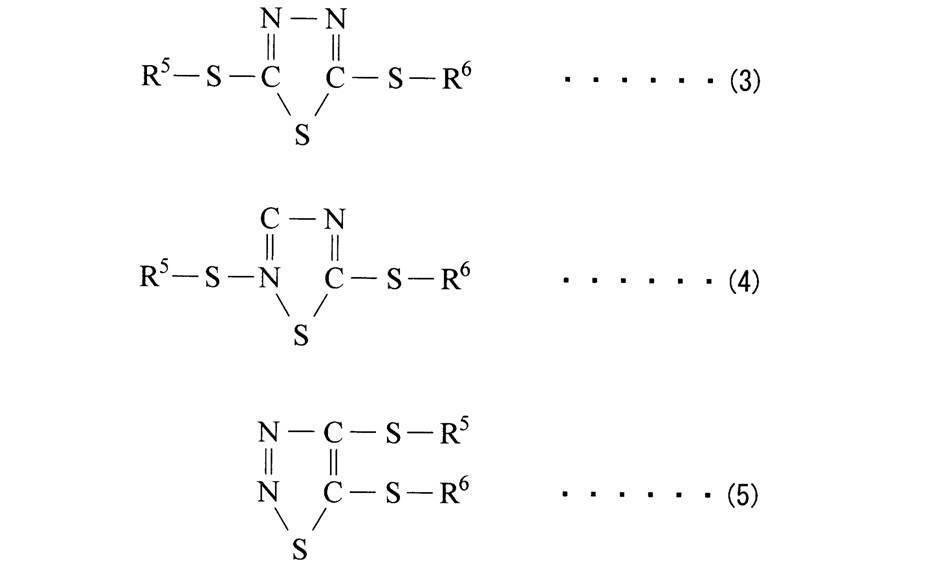
このチアジアゾール化合物としては、例えば、2,5-ビス(n-ヘキシルジチオ)-1,3,4-チアジアゾール、2,5-ビス(n-オクチルジチオ)-1,3,4-チアジアゾール、2,5-ビス(n-ノニルジチオ)-1,3,4-チアジアゾール、2,5-ビス(1,1,3,3-テトラメチルブチルジチオ)-1,3,4-チアジアゾール、3,5-ビス(n-ヘキシルジチオ)-1,2,4-チアジアゾール、3,5-ビス(n-オクチルジチオ)-1,2,4-チアジアゾール、3,5-ビス(n-ノニルジチオ)-1,2,4-チアジアゾール、3,5-ビス(1,1,3,3-テトラメチルブチルジチオ)-1,2,4-チアジアゾール、4,5-ビス(n-ヘキシルジチオ)-1,2,3-チアジアゾール、4,5-ビス(n-オクチルジチオ)-1,2,3-チアジアゾール、4,5-ビス(n-ノニルジチオ)-1,2,3-チアジアゾール、4,5-ビス(1,1,3,3-テトラメチルブチルジチオ)-1,2,3-チアジアゾールなどを好ましく挙げることができる。
チオリン酸エステルとしては、アルキルトリチオフォスファイト、アリールまたはアルキルアリールチオフォスフェート、ジラウリルジチオリン酸亜鉛などが挙げられ、特にラウリルトリチオフォスファイト、トリフェニルチオフォスフェートが好ましい。
アルキルチオカルバモイル化合物としては、例えば、下記式(6)、(7)が挙げられる。

このアルキルチオカルバモイル化合物としては、例えば、ビス(ジメチルチオカルバモイル)モノスルフィド、ビス(ジブチルチオカルバモイル)モノスルフィド、ビス(ジメチルチオカルバモイル)モノスルフィド、ビス(ジブチルチオカルバモイル)モノスルフィド、ビス(ジアミルチオカルバモイル)モノスルフィド、ビス(ジオクチルチオカルバモイル)モノスルフィド、およびメチレンビス(ジブチルジチオカーバメイト)などを好ましく挙げることができる。
ただし、上記した硫黄化合物の配合量は、化合物中の-C-S-C-結合に含まれる硫黄換算量で組成物全量基準において0.3質量%以下であることが必要である。-C-S-C-結合に含まれる硫黄換算量が0.3質量%を超えると、かえって、エンジン部品等への腐食性が増してしまう。この硫黄換算量は、好ましくは0.05~0.2質量%である。
さらにまた、硫黄化合物としては、-C-Sx-C-結合(xは2以上の整数)を含まないことが好ましい。いわゆるポリサルファイド構造を有する硫黄化合物は、エンジン部品等への腐食性の点で好ましくない。特にバイオ燃料の存在下では、銅や鉛の溶出量が増加してしまう。
アルカリ土類金属系清浄剤としては例えば、アルカリ土類金属スルフォネート、アルカリ土類金属フェネート、アルカリ土類金属サリシレートおよびこれらの中から選ばれる2種類以上の混合物が好適に挙げられる。
アルカリ土類金属スルフォネートとしては、分子量300~1,500、好ましくは400~700のアルキル芳香族化合物をスルフォン化することによって得られるアルキル芳香族スルフォン酸のアルカリ土類金属塩、特にマグネシウム塩および/またはカルシウム塩等が挙げられ、中でもカルシウム塩が好ましく用いられる。
アルカリ土類金属フェネートとしては、アルキルフェノール、アルキルフェノールサルファイド、アルキルフェノールのマンニッヒ反応物のアルカリ土類金属塩、特にマグネシウム塩および/またはカルシウム塩等が挙げられ、中でもカルシウム塩が特に好ましく用いられる。
アルカリ土類金属サリシレートとしては、アルキルサリチル酸のアルカリ土類金属塩、特にマグネシウム塩および/またはカルシウム塩等が挙げられ、中でもカルシウム塩が好ましく用いられる。前記アルカリ土類金属系清浄剤を構成するアルキル基としては、炭素数4~30のものが好ましく、より好ましくは6~18の直鎖または分枝アルキル基であり、これらは直鎖でも分枝でもよい。これらはまた1級アルキル基、2級アルキル基または3級アルキル基でもよい。
フェノール系酸化防止剤としては、例えば、オクタデシル-3-(3,5-ジ-tert―ブチル-4-ヒドロキシフェニル)プロピオネート、4,4’-メチレンビス(2,6-ジ-t-ブチルフェノール);4,4’-ビス(2,6-ジ-t-ブチルフェノール);4,4’-ビス(2-メチル-6-t-ブチルフェノール);2,2’-メチレンビス(4-エチル-6-t-ブチルフェノール);2,2’-メチレンビス(4-メチル-6-t-ブチルフェノール);4,4’-ブチリデンビス(3-メチル-6-t-ブチルフェノール);4,4’-イソプロピリデンビス(2,6-ジ-t-ブチルフェノール);2,2’-メチレンビス(4-メチル-6-ノニルフェノール);2,2’-イソブチリデンビス(4,6-ジメチルフェノール);2,2’-メチレンビス(4-メチル-6-シクロヘキシルフェノール);2,6-ジ-t-ブチル-4-メチルフェノール;2,6-ジ-t-ブチル-4-エチルフェノール;2,4-ジメチル-6-t-ブチルフェノール;2,6-ジ-t-アミル-p-クレゾール;2,6-ジ-t-ブチル-4-(N,N’-ジメチルアミノメチルフェノール);4,4’-チオビス(2-メチル-6-t-ブチルフェノール);4,4’-チオビス(3-メチル-6-t-ブチルフェノール);2,2’-チオビス(4-メチル-6-t-ブチルフェノール);ビス(3-メチル-4-ヒドロキシ-5-t-ブチルベンジル)スルフィド;ビス(3,5-ジ-t-ブチル-4-ヒドロキシベンジル)スルフィド;n-オクチル-3-(4-ヒドロキシ-3,5-ジ-t-ブチルフェニル)プロピオネート、n-オクタデシル-3-(4-ヒドロキシ-3,5-ジ-t-ブチルフェニル)プロピオネート;2,2’-チオ[ジエチル-ビス-3-(3,5-ジ-t-ブチル-4-ヒドロキシフェニル)プロピオネート]などが挙げられる。これらの中で、特にビスフェノール系およびエステル基含有フェノール系のものが好適である。
上述した酸化防止剤の配合量は、組成物全量基準で、0.3質量%以上であり、好ましくは0.5質量%以上である。一方、2質量%を越えると、潤滑油基油に不溶となるおそれがある。従って、酸化防止剤の配合量は、組成物全量基準で0.3~2質量%の範囲が好ましい。
耐摩耗剤としては、ジチオリン酸亜鉛、ジチオカルバミン酸亜鉛、リン酸亜鉛、ジスルフィド類、硫化オレフィン類、硫化油脂類、硫化エステル類、チオカーボネート類、チオカーバメート類(例えば、Mo-DTC)等の硫黄含有化合物;亜リン酸エステル類、リン酸エステル類、ホスホン酸エステル類、およびこれらのアミン塩または金属塩等のリン含有化合物;チオ亜リン酸エステル類、チオリン酸エステル類(例えば、Mo-DTP)、チオホスホン酸エステル類、およびこれらのアミン塩または金属塩等の硫黄およびリン含有摩耗防止剤が挙げられる。ただし、これらは、エンジン部品等への腐食性を増すおそれもあることから、本発明における上記硫黄化合物との併用には留意する必要がある。
無灰系分散剤としては、無灰系分散剤の含有割合は、基油100質量部に対して0.5~10質量部が好ましい。
これら金属不活性化剤の配合量は、配合効果の点から、組成物全量基準で、好ましくは0.01~0.1質量%、より好ましくは0.03~0.05質量%である。
本発明の潤滑油組成物においては、リン含有量は組成物全量基準で0.12質量%以下であることが好ましく、より好ましくは0.1質量%以下である。リン含有量が0.12質量%以下であると、排出ガスを浄化する触媒の性能低下を効果的に抑えることができる。
なお、内燃機関において潤滑油の蒸発性の増大は、潤滑油自体の消費量の増加を招き、それによる潤滑油寿命の低下、さらには排気ガス触媒への飛散量増大による触媒能力・寿命の低下を引き起こす。このような観点より、本発明の潤滑油組成物においては、JPI(Japan Petroleum Institute、以下同)-5S-41-93に準拠して測定されるNOACK蒸発量が15質量%以下であることが好ましく、より好ましくは13質量%以下であり、さらに好ましくは10質量%以下である。
表1に示す配合組成を有する潤滑油組成物を調製し、以下に示す腐食性試験を行った。なお、潤滑油組成物の調製に用いた各成分の種類は、次の通りである。
(1)基油:水素化精製基油、40℃動粘度20.4mm2/s、100℃動粘度4.28mm2/s、粘度指数116、%CA0.0、硫黄含有量20質量ppm未満
(2)粘度指数向上剤:OCP、質量平均分子量800,000
(3)流動点降下剤:ポリアルキルメタクリレート、質量平均分子量60,000
(4)金属系清浄剤:過塩基性カルシウムサリシレート、塩基価(過塩素酸法)225mgKOH/g、カルシウム含有量7.8質量%、硫黄含有量0.3質量%
(5)ポリブテニルコハク酸モノイミドA:ポリブテニル基の数平均分子量1000、窒素含有量1.2質量%、ホウ素含有量1.3質量%
(6)ポリブテニルコハク酸ビスイミドB:ポリブテニル基の数平均分子量2,000、窒素含有量1.2質量%
(7)フェノール系酸化防止剤:オクタデシル 3-(3,5-tert-ブチル-4-ヒドロキシフェニル)プロピオネート
(8)アミン系酸化防止剤:ジアルキルジフェニルアミン、窒素含有量4.62質量%
(9)ジアルキルジチオリン酸亜鉛:Zn含有量9.0質量%、リン含有量8.2質量%、硫黄含有量17.1質量%、アルキル基;第2級ブチル基と第2級ヘキシル基の混合物
(10)硫黄系酸化防止剤A:メチレンビス(ジブチルジチオカーバメイト)
(11)硫黄系酸化防止剤B:ジトリデシルチオジプロピオネート
(12)硫黄系酸化防止剤C:ジ-t―ドデシルトリサルファイド
(13)硫黄系酸化防止剤D:MoDTC
(14)銅腐食防止剤:1-[N,N-ビス(2-エチルヘキシル)アミノメチル]メチルベンゾトリアゾール
(15)消泡剤:シリコーン系消泡剤
(カルシウム含有量)
JPI-5S-38-92に準拠して測定した。
(硫黄含有量)
JIS K2541に準拠して測定した。
(リン含有量)
JPI-5S-38-92に準拠して測定した。
(硫酸灰分)
JIS K2272に準拠して測定した。
試験用の潤滑油組成物としては、内燃機関内における燃料と潤滑油との混合割合を想定して、前記した各潤滑油組成物(新油)に対してバイオ燃料(菜種油をメチルアルコールによりエステル交換して得られた燃料)を10質量%配合した混合油を用いた。
腐食性試験は、試料として各100gの混合油をガラス容器(直径40mm×高さ300mm)に充填した後、油温を125℃に保ちながら、空気を88ml/minの条件で168時間吹き込んだ。その後、試料油中に溶出した銅(Cu)と鉛(Pb)の量をプラズマ発光分光分析(ICP)で測定した。
なお、参考例として、バイオ燃料を混合しない潤滑油組成物についても同様に腐食性試験を行った。
各潤滑油組成物の性状および腐食性試験の結果を表1に示す。
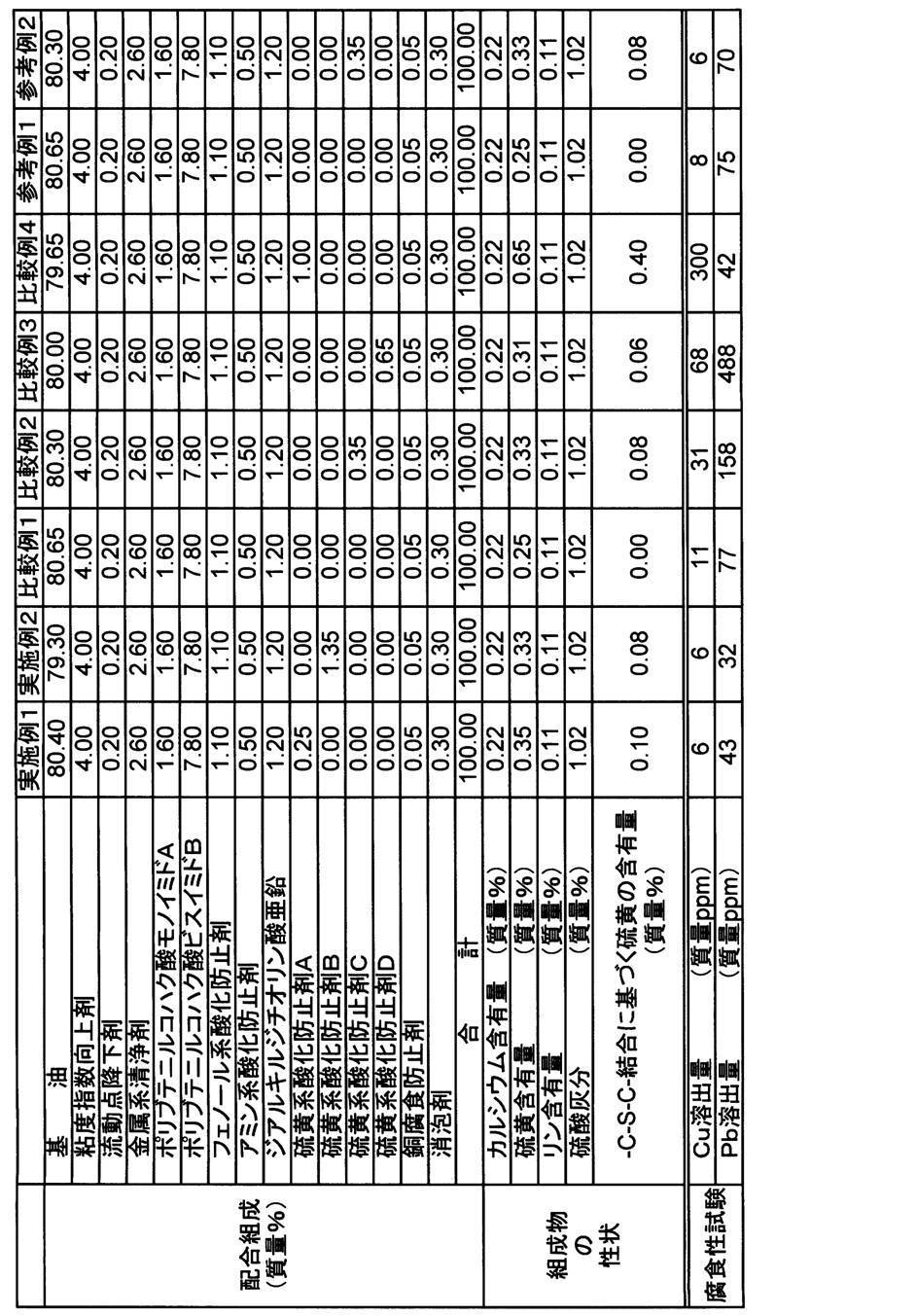
表1の腐食性試験結果からわかるように、本発明の潤滑油組成物を用いた実施例1~2では、バイオ燃料を添加した潤滑油組成物に適用しても、銅(Cu)と鉛(Pb)の溶出量はわずかである。特に、参考例1、2のようにバイオ燃料を添加していない系と比較しても、鉛の溶出量が少ないことは特筆すべきである。
一方、比較例1のように本発明における特定の硫黄化合物が配合されていないと、銅や鉛の溶出量が多くなる。また、硫黄化合物が配合されていても、比較例2、3のようにポリサルファイド等であると、銅や鉛の溶出量はむしろ増加してしまう。
なお、本発明における特定の硫黄化合物が配合されていても、比較例4のようにその量が多すぎると銅の溶出量が増加してしまう。
Claims (7)
- 天然油脂、天然油脂の水素化処理物、天然油脂のエステル交換物、および天然油脂のエステル交換物の水素化処理物の中から選ばれた少なくとも1種を含む燃料を用いる内燃機関で使用される潤滑油組成物であって、
基油に、-C-S-C-結合を少なくとも一つ含む硫黄化合物が配合され、
前記-C-S-C-結合に含まれる硫黄が組成物全量基準で0.3質量%以下であることを特徴とする潤滑油組成物。 - 請求項1に記載の潤滑油組成物において、
前記硫黄化合物が-C-Sx-C-結合を含まないことを特徴とする潤滑油組成物。
(式中、xは2以上の整数である。) - 請求項1または請求項2に記載の潤滑油組成物において、
アルカリ土類金属系清浄剤が0.35質量%以下配合されていることを特徴とする潤滑油組成物。 - 請求項1~請求項3のいずれかに記載の潤滑油組成物において、
リン含有量が組成物基準で0.12質量%以下であることを特徴とする潤滑油組成物。 - 請求項1~請求項4のいずれかに記載の潤滑油組成物において、硫酸灰分が1.1質量%以下であることを特徴とする潤滑油組成物。
- 請求項1~請求項5のいずれかに記載の潤滑油組成物において、
フェノール系酸化防止剤および/またはアミン系酸化防止剤を、組成物全量基準で0.3質量%以上配合することを特徴とする潤滑油組成物。 - 請求項1~請求項6のいずれかに記載の潤滑油組成物において、
硫黄含有量が組成物全量基準で0.5質量%以下であることを特徴とする潤滑油組成物。
Priority Applications (3)
| Application Number | Priority Date | Filing Date | Title |
|---|---|---|---|
| EP09710998.7A EP2248876B1 (en) | 2008-02-14 | 2009-02-10 | Use of a lubricant composition in an engine running on a fuel containing biodiesel |
| US12/867,685 US20110003723A1 (en) | 2008-02-14 | 2009-02-10 | Lubricant composition |
| CN2009801053751A CN101945982A (zh) | 2008-02-14 | 2009-02-10 | 润滑油组合物 |
Applications Claiming Priority (2)
| Application Number | Priority Date | Filing Date | Title |
|---|---|---|---|
| JP2008-033313 | 2008-02-14 | ||
| JP2008033313A JP5571290B2 (ja) | 2008-02-14 | 2008-02-14 | 潤滑油組成物 |
Publications (1)
| Publication Number | Publication Date |
|---|---|
| WO2009101933A1 true WO2009101933A1 (ja) | 2009-08-20 |
Family
ID=40956965
Family Applications (1)
| Application Number | Title | Priority Date | Filing Date |
|---|---|---|---|
| PCT/JP2009/052219 Ceased WO2009101933A1 (ja) | 2008-02-14 | 2009-02-10 | 潤滑油組成物 |
Country Status (7)
| Country | Link |
|---|---|
| US (1) | US20110003723A1 (ja) |
| EP (1) | EP2248876B1 (ja) |
| JP (1) | JP5571290B2 (ja) |
| KR (1) | KR20100124761A (ja) |
| CN (1) | CN101945982A (ja) |
| TW (1) | TWI441914B (ja) |
| WO (1) | WO2009101933A1 (ja) |
Cited By (2)
| Publication number | Priority date | Publication date | Assignee | Title |
|---|---|---|---|---|
| US9309481B2 (en) | 2010-03-12 | 2016-04-12 | Idemitsu Kosan Co., Ltd. | Lubricant composition |
| WO2016159216A1 (ja) * | 2015-03-31 | 2016-10-06 | 出光興産株式会社 | 内燃機関用潤滑油組成物 |
Families Citing this family (7)
| Publication number | Priority date | Publication date | Assignee | Title |
|---|---|---|---|---|
| JP5629587B2 (ja) | 2009-02-02 | 2014-11-19 | 出光興産株式会社 | 自動変速機用潤滑油組成物 |
| CA2834078A1 (en) * | 2011-05-16 | 2012-11-22 | The Lubrizol Corporation | Lubricating compositions for turbine and hydraulic systems with improved antioxidancy |
| EP2692840B1 (en) * | 2012-07-31 | 2014-10-15 | Infineum International Limited | Lubricating oil composition |
| EP2816098A1 (en) | 2013-06-18 | 2014-12-24 | Shell Internationale Research Maatschappij B.V. | Use of a sulfur compound for improving the oxidation stability of a lubricating oil composition |
| CN103695100B (zh) * | 2013-12-02 | 2015-12-02 | 沃太能源南通有限公司 | 一种可降解的发动机润滑油的制备方法 |
| US10704009B2 (en) * | 2018-01-19 | 2020-07-07 | Chevron Oronite Company Llc | Ultra low ash lubricating oil compositions |
| US11459521B2 (en) * | 2018-06-05 | 2022-10-04 | Afton Chemical Coporation | Lubricant composition and dispersants therefor having a beneficial effect on oxidation stability |
Citations (7)
| Publication number | Priority date | Publication date | Assignee | Title |
|---|---|---|---|---|
| JPH0322438B2 (ja) | 1981-04-27 | 1991-03-26 | Chevron Res | |
| JP2000001684A (ja) * | 1999-06-14 | 2000-01-07 | Oronite Japan Ltd | 低リン型エンジン油組成物 |
| JP2003252887A (ja) | 2002-03-04 | 2003-09-10 | Asahi Denka Kogyo Kk | モリブデンアミン化合物の製造方法 |
| JP2004002866A (ja) | 2002-05-31 | 2004-01-08 | Chevron Oronite Co Llc | 色の低減したモリブデン含有組成物およびその製造方法 |
| WO2005090532A1 (ja) * | 2004-03-19 | 2005-09-29 | Nippon Oil Corporation | ディーゼルエンジン用潤滑油組成物 |
| JP2007520618A (ja) * | 2004-02-03 | 2007-07-26 | ケムチュア コーポレイション | 酸化防止剤ブレンドを含む潤滑剤組成物 |
| WO2007119299A1 (ja) * | 2006-03-22 | 2007-10-25 | Nippon Oil Corporation | 低灰エンジン油組成物 |
Family Cites Families (11)
| Publication number | Priority date | Publication date | Assignee | Title |
|---|---|---|---|---|
| US3876550A (en) * | 1974-04-15 | 1975-04-08 | Lubrizol Corp | Lubricant compositions |
| JP3086727B2 (ja) * | 1991-08-09 | 2000-09-11 | オロナイトジャパン株式会社 | 低リンエンジン油製造用の添加剤組成物 |
| JP2001158896A (ja) * | 1999-12-02 | 2001-06-12 | Chevron Oronite Ltd | ガスエンジンの潤滑に特に有効な内燃機関用潤滑油組成物 |
| TWI228540B (en) * | 2001-04-06 | 2005-03-01 | Nippon Mitsubishi Oil Corp | Oil composition for very small amount oil supply type cutting and grinding operation |
| JP4806528B2 (ja) * | 2004-12-22 | 2011-11-02 | 出光興産株式会社 | 内燃機関用潤滑油組成物 |
| JP5114006B2 (ja) * | 2005-02-02 | 2013-01-09 | Jx日鉱日石エネルギー株式会社 | 内燃機関用潤滑油組成物 |
| US8016125B2 (en) * | 2005-05-20 | 2011-09-13 | Lutek, Llc | Materials, filters, and systems for immobilizing combustion by-products and controlling lubricant viscosity |
| KR101325824B1 (ko) * | 2005-10-11 | 2013-11-06 | 더루우브리졸코오포레이션 | 마찰조정제로서 아민과 하이드록시산의 생성물을 포함하는 윤활 조성물을 이용한 변속기의 윤활방법 |
| US7767632B2 (en) * | 2005-12-22 | 2010-08-03 | Afton Chemical Corporation | Additives and lubricant formulations having improved antiwear properties |
| KR101435701B1 (ko) * | 2007-03-28 | 2014-09-01 | 이데미쓰 고산 가부시키가이샤 | 윤활유 조성물 |
| WO2008120599A1 (ja) * | 2007-03-30 | 2008-10-09 | Idemitsu Kosan Co., Ltd. | 潤滑油組成物 |
-
2008
- 2008-02-14 JP JP2008033313A patent/JP5571290B2/ja active Active
-
2009
- 2009-02-10 CN CN2009801053751A patent/CN101945982A/zh active Pending
- 2009-02-10 US US12/867,685 patent/US20110003723A1/en not_active Abandoned
- 2009-02-10 WO PCT/JP2009/052219 patent/WO2009101933A1/ja not_active Ceased
- 2009-02-10 KR KR1020107020361A patent/KR20100124761A/ko not_active Ceased
- 2009-02-10 EP EP09710998.7A patent/EP2248876B1/en not_active Not-in-force
- 2009-02-12 TW TW098104503A patent/TWI441914B/zh not_active IP Right Cessation
Patent Citations (7)
| Publication number | Priority date | Publication date | Assignee | Title |
|---|---|---|---|---|
| JPH0322438B2 (ja) | 1981-04-27 | 1991-03-26 | Chevron Res | |
| JP2000001684A (ja) * | 1999-06-14 | 2000-01-07 | Oronite Japan Ltd | 低リン型エンジン油組成物 |
| JP2003252887A (ja) | 2002-03-04 | 2003-09-10 | Asahi Denka Kogyo Kk | モリブデンアミン化合物の製造方法 |
| JP2004002866A (ja) | 2002-05-31 | 2004-01-08 | Chevron Oronite Co Llc | 色の低減したモリブデン含有組成物およびその製造方法 |
| JP2007520618A (ja) * | 2004-02-03 | 2007-07-26 | ケムチュア コーポレイション | 酸化防止剤ブレンドを含む潤滑剤組成物 |
| WO2005090532A1 (ja) * | 2004-03-19 | 2005-09-29 | Nippon Oil Corporation | ディーゼルエンジン用潤滑油組成物 |
| WO2007119299A1 (ja) * | 2006-03-22 | 2007-10-25 | Nippon Oil Corporation | 低灰エンジン油組成物 |
Non-Patent Citations (2)
| Title |
|---|
| AGARWAL A K: "Experimental investigations of the effect of biodiesel utilization on lubricating oil tribology in diesel engines", PROCEEDINGS OF THE INSTITUTION OF MECHANICAL ENGINEERS PART D, vol. 219, no. D5, May 2005 (2005-05-01), pages 703 - 713, XP008140704 * |
| See also references of EP2248876A4 |
Cited By (5)
| Publication number | Priority date | Publication date | Assignee | Title |
|---|---|---|---|---|
| US9309481B2 (en) | 2010-03-12 | 2016-04-12 | Idemitsu Kosan Co., Ltd. | Lubricant composition |
| EP2546324A4 (en) * | 2010-03-12 | 2016-06-29 | Idemitsu Kosan Co | LUBRICANT COMPOSITION |
| WO2016159216A1 (ja) * | 2015-03-31 | 2016-10-06 | 出光興産株式会社 | 内燃機関用潤滑油組成物 |
| JP2016193996A (ja) * | 2015-03-31 | 2016-11-17 | 出光興産株式会社 | 内燃機関用潤滑油組成物 |
| US10301570B2 (en) | 2015-03-31 | 2019-05-28 | Idemitsu Kosan Co., Ltd. | Lubricating oil composition for internal combustion engine |
Also Published As
| Publication number | Publication date |
|---|---|
| KR20100124761A (ko) | 2010-11-29 |
| EP2248876A4 (en) | 2011-10-12 |
| US20110003723A1 (en) | 2011-01-06 |
| EP2248876B1 (en) | 2014-01-01 |
| JP2009191165A (ja) | 2009-08-27 |
| JP5571290B2 (ja) | 2014-08-13 |
| CN101945982A (zh) | 2011-01-12 |
| EP2248876A1 (en) | 2010-11-10 |
| TW200951213A (en) | 2009-12-16 |
| TWI441914B (zh) | 2014-06-21 |
Similar Documents
| Publication | Publication Date | Title |
|---|---|---|
| JP5313879B2 (ja) | 潤滑油組成物 | |
| JP5198031B2 (ja) | 潤滑油組成物 | |
| JP5806802B2 (ja) | 潤滑油組成物 | |
| JP5571290B2 (ja) | 潤滑油組成物 | |
| RU2447136C2 (ru) | Композиция смазочного масла для двигателя внутреннего сгорания | |
| JP5431947B2 (ja) | 潤滑油組成物 | |
| JP6302458B2 (ja) | 潤滑油組成物 | |
| JP2008106199A (ja) | 潤滑油組成物 | |
| JP2009292998A (ja) | 内燃機関用潤滑油組成物 | |
| JP5377925B2 (ja) | 内燃機関用潤滑油組成物 | |
| WO2017170769A1 (ja) | 内燃機関用潤滑油組成物 | |
| JP2024108867A (ja) | 潤滑油組成物 |
Legal Events
| Date | Code | Title | Description |
|---|---|---|---|
| WWE | Wipo information: entry into national phase |
Ref document number: 200980105375.1 Country of ref document: CN |
|
| 121 | Ep: the epo has been informed by wipo that ep was designated in this application |
Ref document number: 09710998 Country of ref document: EP Kind code of ref document: A1 |
|
| WWE | Wipo information: entry into national phase |
Ref document number: 2956/KOLNP/2010 Country of ref document: IN |
|
| WWE | Wipo information: entry into national phase |
Ref document number: 12867685 Country of ref document: US |
|
| NENP | Non-entry into the national phase |
Ref country code: DE |
|
| WWE | Wipo information: entry into national phase |
Ref document number: 2009710998 Country of ref document: EP |
|
| ENP | Entry into the national phase |
Ref document number: 20107020361 Country of ref document: KR Kind code of ref document: A |