WO2009103053A1 - Fluoroquinolone derivatives for ophthalmic applications - Google Patents
Fluoroquinolone derivatives for ophthalmic applications Download PDFInfo
- Publication number
- WO2009103053A1 WO2009103053A1 PCT/US2009/034219 US2009034219W WO2009103053A1 WO 2009103053 A1 WO2009103053 A1 WO 2009103053A1 US 2009034219 W US2009034219 W US 2009034219W WO 2009103053 A1 WO2009103053 A1 WO 2009103053A1
- Authority
- WO
- WIPO (PCT)
- Prior art keywords
- fluoroquinolone
- compound
- present
- ophthalmic
- compositions
- Prior art date
- Legal status (The legal status is an assumption and is not a legal conclusion. Google has not performed a legal analysis and makes no representation as to the accuracy of the status listed.)
- Ceased
Links
- QKYHBFXUZAFUEH-UHFFFAOYSA-N CN1C(CN(C2)c(c(F)c3)cc(N(C4CC4)C=C4C(O)=O)c3C4=O)C2CCC1 Chemical compound CN1C(CN(C2)c(c(F)c3)cc(N(C4CC4)C=C4C(O)=O)c3C4=O)C2CCC1 QKYHBFXUZAFUEH-UHFFFAOYSA-N 0.000 description 1
- 0 CN1C(CN(C2)c(c(F)c3*)c(*)c(N(C4CC4)C=C4C(O)=O)c3C4=O)C2CCC1 Chemical compound CN1C(CN(C2)c(c(F)c3*)c(*)c(N(C4CC4)C=C4C(O)=O)c3C4=O)C2CCC1 0.000 description 1
- ZYFQZJPFWHFSPY-UHFFFAOYSA-N CN1C(CN(C2)c(c(F)cc3c4N(C5CC5)C=C(C(O)=O)C3=O)c4F)C2CCC1 Chemical compound CN1C(CN(C2)c(c(F)cc3c4N(C5CC5)C=C(C(O)=O)C3=O)c4F)C2CCC1 ZYFQZJPFWHFSPY-UHFFFAOYSA-N 0.000 description 1
- RBOQKHOVSOJSBL-UHFFFAOYSA-N CN1C(CN(C2)c(c(F)cc3c4N(C5CC5)C=C(C(O)=O)C3=O)c4OC)C2CCC1 Chemical compound CN1C(CN(C2)c(c(F)cc3c4N(C5CC5)C=C(C(O)=O)C3=O)c4OC)C2CCC1 RBOQKHOVSOJSBL-UHFFFAOYSA-N 0.000 description 1
Classifications
-
- A—HUMAN NECESSITIES
- A61—MEDICAL OR VETERINARY SCIENCE; HYGIENE
- A61K—PREPARATIONS FOR MEDICAL, DENTAL OR TOILETRY PURPOSES
- A61K31/00—Medicinal preparations containing organic active ingredients
- A61K31/33—Heterocyclic compounds
- A61K31/395—Heterocyclic compounds having nitrogen as a ring hetero atom, e.g. guanethidine or rifamycins
- A61K31/435—Heterocyclic compounds having nitrogen as a ring hetero atom, e.g. guanethidine or rifamycins having six-membered rings with one nitrogen as the only ring hetero atom
- A61K31/47—Quinolines; Isoquinolines
- A61K31/4709—Non-condensed quinolines and containing further heterocyclic rings
-
- A—HUMAN NECESSITIES
- A61—MEDICAL OR VETERINARY SCIENCE; HYGIENE
- A61K—PREPARATIONS FOR MEDICAL, DENTAL OR TOILETRY PURPOSES
- A61K31/00—Medicinal preparations containing organic active ingredients
- A61K31/33—Heterocyclic compounds
- A61K31/395—Heterocyclic compounds having nitrogen as a ring hetero atom, e.g. guanethidine or rifamycins
- A61K31/435—Heterocyclic compounds having nitrogen as a ring hetero atom, e.g. guanethidine or rifamycins having six-membered rings with one nitrogen as the only ring hetero atom
- A61K31/4353—Heterocyclic compounds having nitrogen as a ring hetero atom, e.g. guanethidine or rifamycins having six-membered rings with one nitrogen as the only ring hetero atom ortho- or peri-condensed with heterocyclic ring systems
- A61K31/437—Heterocyclic compounds having nitrogen as a ring hetero atom, e.g. guanethidine or rifamycins having six-membered rings with one nitrogen as the only ring hetero atom ortho- or peri-condensed with heterocyclic ring systems the heterocyclic ring system containing a five-membered ring having nitrogen as a ring hetero atom, e.g. indolizine, beta-carboline
-
- A—HUMAN NECESSITIES
- A61—MEDICAL OR VETERINARY SCIENCE; HYGIENE
- A61K—PREPARATIONS FOR MEDICAL, DENTAL OR TOILETRY PURPOSES
- A61K31/00—Medicinal preparations containing organic active ingredients
- A61K31/56—Compounds containing cyclopenta[a]hydrophenanthrene ring systems; Derivatives thereof, e.g. steroids
-
- A—HUMAN NECESSITIES
- A61—MEDICAL OR VETERINARY SCIENCE; HYGIENE
- A61K—PREPARATIONS FOR MEDICAL, DENTAL OR TOILETRY PURPOSES
- A61K45/00—Medicinal preparations containing active ingredients not provided for in groups A61K31/00 - A61K41/00
- A61K45/06—Mixtures of active ingredients without chemical characterisation, e.g. antiphlogistics and cardiaca
-
- A—HUMAN NECESSITIES
- A61—MEDICAL OR VETERINARY SCIENCE; HYGIENE
- A61K—PREPARATIONS FOR MEDICAL, DENTAL OR TOILETRY PURPOSES
- A61K9/00—Medicinal preparations characterised by special physical form
- A61K9/0012—Galenical forms characterised by the site of application
- A61K9/0048—Eye, e.g. artificial tears
-
- A—HUMAN NECESSITIES
- A61—MEDICAL OR VETERINARY SCIENCE; HYGIENE
- A61P—SPECIFIC THERAPEUTIC ACTIVITY OF CHEMICAL COMPOUNDS OR MEDICINAL PREPARATIONS
- A61P27/00—Drugs for disorders of the senses
- A61P27/02—Ophthalmic agents
-
- A—HUMAN NECESSITIES
- A61—MEDICAL OR VETERINARY SCIENCE; HYGIENE
- A61P—SPECIFIC THERAPEUTIC ACTIVITY OF CHEMICAL COMPOUNDS OR MEDICINAL PREPARATIONS
- A61P29/00—Non-central analgesic, antipyretic or antiinflammatory agents, e.g. antirheumatic agents; Non-steroidal antiinflammatory drugs [NSAID]
-
- A—HUMAN NECESSITIES
- A61—MEDICAL OR VETERINARY SCIENCE; HYGIENE
- A61P—SPECIFIC THERAPEUTIC ACTIVITY OF CHEMICAL COMPOUNDS OR MEDICINAL PREPARATIONS
- A61P31/00—Antiinfectives, i.e. antibiotics, antiseptics, chemotherapeutics
-
- A—HUMAN NECESSITIES
- A61—MEDICAL OR VETERINARY SCIENCE; HYGIENE
- A61P—SPECIFIC THERAPEUTIC ACTIVITY OF CHEMICAL COMPOUNDS OR MEDICINAL PREPARATIONS
- A61P31/00—Antiinfectives, i.e. antibiotics, antiseptics, chemotherapeutics
- A61P31/04—Antibacterial agents
Definitions
- the present invention relates generally to fluoroquinolone derivatives for ophthalmic applications.
- the present invention particularly relates to fluoroquinolone derivatives having improved ocular penetration properties and/or antimicrobial activity.
- fluoroquinolone compounds to treat infections, including ophthalmic infections, is considered a state of the art treatment.
- Alcon Laboratories, Inc. markets a topical ophthalmic composition called VIGAMOX ® ophthalmic solution that contains the fluoroquinolone antibiotic moxifloxacin (0.5%).
- Other commercially available fluoroquinolone antibiotics include gatifloxacin, levofloxacin, ofloxacin, ciprofloxacin, norfloxacin, and lomefloxacin.
- fluoroquinolone therapies currently available, there remains a need for improved antibiotic-based compositions and methods of treatment that are more effective than existing antibiotics against key ophthalmic pathogens.
- an antimicrobial compound it is generally desirable to use the minimum quantity of an antimicrobial compound necessary to achieve desired effects. This is because undesirable side- effects such as toxicity or irritation are more probable when higher concentrations of an antimicrobial are used at a delivery site through the use of, for example, high concentration compositions, more frequent dosing, or longer-duration treatment.
- undesirable side- effects such as toxicity or irritation are more probable when higher concentrations of an antimicrobial are used at a delivery site through the use of, for example, high concentration compositions, more frequent dosing, or longer-duration treatment.
- the use of lower concentrations of antimicrobial compounds generally helps to reduce the potential for undesirable effects, this practice increases the risk that the compounds may not achieve the required level of antimicrobial effect.
- microbial resistance can develop quickly if antimicrobial compounds are not used at a sufficient concentration. Therefore, the use of compounds having good antimicrobial activity is desirable as these compounds may be used at lower concentrations relative to compounds with lower activity, reducing the incidence and risk of undesired side effects and while
- antimicrobial compounds have good permeability characteristics (e.g., they rapidly diffuse into tissue to which they are applied). Antimicrobial compounds that are unable to penetrate tissues are generally not useful as topical agents. Also, the rate of permeation of antimicrobial agents is important, as antimicrobial compounds should possess the ability to both quickly treat the surface and deeper portions of infected tissues.
- U.S. Patent No. 4,990,517 entitled “7-(l-pyrrolidinyl)-3-quinolone- and - naphthyridonecarboxylic acid derivatives as antibacterial agents and feed additives” discloses certain fluoroquinolone compounds that are useful as antimicrobial agents.
- U.S. Patent No. 6,716,830 entitled “Ophthalmic antibiotic compositions containing moxifloxacin” discloses fluoroquinolone compounds that are useful as ophthalmic antibiotics. Neither patent discloses a relationship between the structure of such compounds and their activity and/or permeability.
- the invention relates to fluoroquinolone derivatives, and the use of such derivatives to treat ophthalmic conditions.
- the present inventors have unexpectedly discovered that the fluoroquinolone derivatives of the present invention have improved antimicrobial activity and/or permeability in ocular tissues compared to known fluoroquinolone compounds used for ophthalmic applications.
- One fluoroquinolone derivative of the present invention has a measured permeability in ocular tissue that is approximately three times greater than the well-known ophthalmic anti-infective moxifloxacin.
- the increased antimicrobial activity and/or permeability of the fluoroquinolone derivatives disclosed herein make the compounds well suited for use as ophthalmic anti-infective agents.
- the compounds of the present invention may be used at lower concentrations and at a reduced dosing frequency.
- the compounds of the present invention having good permeability characteristics are also rapid acting and may be used as first-line anti-infective agents in acute infections.
- the fluoroquinolone derivatives of the present invention may be used in various ophthalmic compositions disclosed herein. Such compositions are preferably sterile and have physiologically compatible properties, particularly with ocular tissue. Such ophthalmic compositions may be used in the treatment of ophthalmic infections including, but not limited to, conjunctivitis, keratitis, endophthalmitis, and blepharitis. Corneal ulcers may also be treated by compositions of the present invention.
- compositions of the present invention may optionally comprise in addition to a fluoroquinolone derivative an anti-inflammatory agent.
- Tissue infections frequently present with associated edema and inflammation, and the antimicrobial and anti-inflammatory compositions are useful in treating such infections.
- compositions of the present invention may also be used in the prophylaxis of infection following tissue trauma (including trauma resulting from surgical procedures).
- tissue trauma including trauma resulting from surgical procedures.
- the fluoroquinolone and anti-inflammatory agent compositions are particularly useful in such prophylaxis, as inflammation is especially present following surgery or physical trauma to tissue.
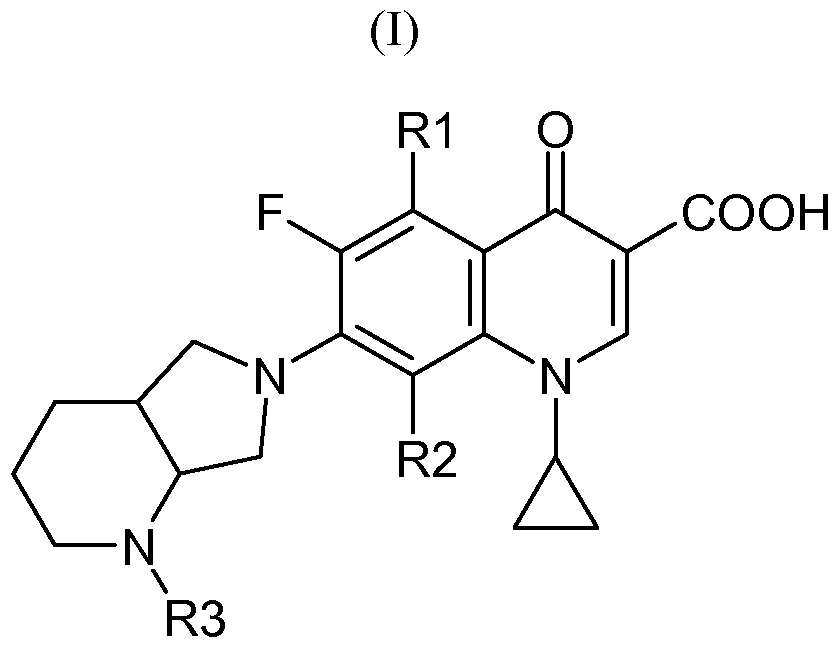
- the fluoroquinolone derivatives of the present invention have the following general formula:
- Rl is H, amino, C1-C4 alkylamino, or C1-C4 dialkylamino
- R2 is F, OCH 3 , or H
- R3 is CH 3 , C2-C4 alkyl, or H; and at least one of Rl and R3 is not H.
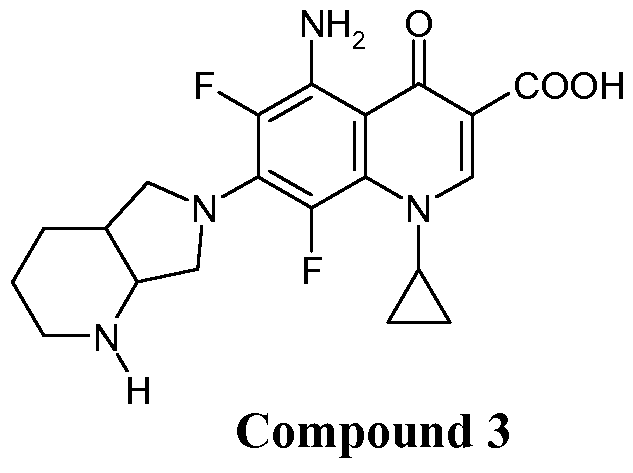
- the present inventors have discovered that the substitution of a methyl or C2- C4 alkyl group at the position denoted by R3 in Formula (I) produces improved permeability characteristics relative to other fluoroquinolones such as moxifloxacin. In a preferred embodiment, this substitution is characterized as a 2-methyl substitution on the diazabicyclo group attached to the fluoroquinolone ring. Further, the inventors have discovered that an amino or substituted amino derivative at the Rl position in Formula (I) results in both improved antimicrobial activity and permeability characteristics relative to other fluoroquinolones. In a preferred embodiment, this substitution is characterized as a 5-amino substitution on the fluoroquinolone ring. Data presented in Examples 3 and 4 for several preferred compounds demonstrate the structure and activity/permeability correlation discovered by the inventors.
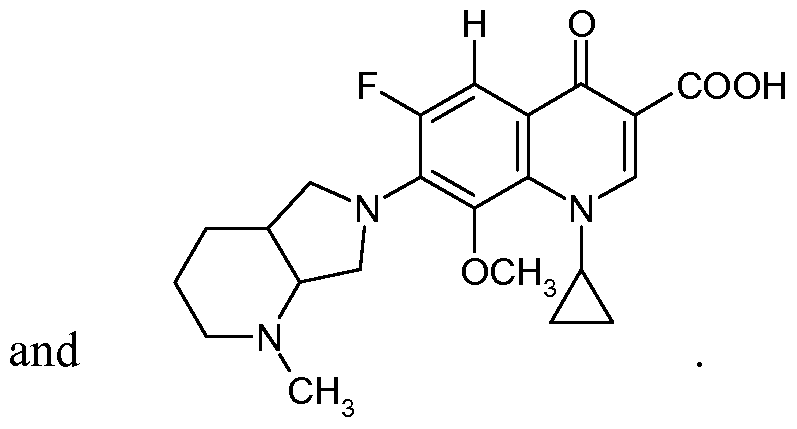
- Preferred fluoroquinolone derivatives of the present invention are of the following two formulas.
- the first formula encompasses compounds that have enhanced permeability relative to known fluoroquinolone compounds and is as follows: wherein:
- Rl is H, amino, C1-C4 alkylamino, or C1-C4 dialkylamino
- R2 is F, OCH 3 , or H.
- the second formula encompasses compounds having enhanced anti-microbial activity relative to known fluoroquinolones:
- R2 is F, OCH 3 , or H
- R3 is CH 3 , C2-C4 alkyl, or H.
- the compounds of the present invention may be used at lower concentrations and at a reduced dosing frequency. It is contemplated that the concentration of the active fluoroquinolone ingredient in the compositions of the present invention can vary, but is preferably 0.05 to 0.8 w/v% and more preferably 0.05-0.5 w/v%. The most preferred concentration range is from 0.05-0.3 w/v% and the most preferred concentration is about 0.3 w/v%.
- a pharmaceutically effective amount of a fluoroquinolone of the present invention is generally that concentration sufficient to produce a desired effect (such as achieving a MIC 90 level relative to the infectious organisms associated with the treated infection) at a reasonable benefit/risk ratio. The pharmaceutically effective amount may vary depending on such factors as the disease or infectious agent being treated, the particular formulation being administered, or the severity of the disease or infectious agent.
- the derivatives described herein can be prepared using methods disclosed in U.S. Patent No. 4,990,517 (Petersen et al.) which is herein incorporated by reference in its entirety, in combination with known synthetic methods available to those of skill in the art.
- the fluoroquinolone derivatives of the present invention comprise the pharmaceutically useful stereoisomers of the derivatives, as well as the pharmaceutically useful hydrates and salts of such derivatives and stereoisomers, and may be formulated with a pharmaceutically acceptable vehicle.
- the invention is particularly directed toward treating mammalian and human subjects having or at risk of having a microbial tissue infection.
- Embodiments of the present invention are particularly useful for treating ophthalmic tissue infections. Infections of the eye can occur in all ocular tissues or fluids, and include diseases of the lid or lid margins (blepharitis), the conjunctiva (conjunctivitis), the cornea (microbial keratitis) and the deeper intraocular fluids or tissues (endophthalmitis). For each of these conditions, the choice of an appropriate topical antibiotic is important - the antibiotic must penetrate at an appropriate level into the affected tissues.
- Embodiments of the present invention may also be used prophylactically to prevent infection of a tissue by an infectious agent.
- a tissue at risk of infection is contacted with a composition of the present invention.
- Such prophylactic use is particularly useful during or following surgical procedures or physical trauma to tissue that create a risk of infection.
- Compositions of the present invention may be utilized in various dosage regimens known to those of skill in the art. Such dosing frequency is maintained for a varying duration of time depending on the therapeutic regimen. The duration of a particular therapeutic regimen may vary from one-time dosing to a regimen that extends for a month or more.
- One of ordinary skill in the art would be familiar with determining a therapeutic regimen for a specific indication.
- Factors involved in this determination include the disease to be treated, particular characteristics of the subject, and the particular antimicrobial composition.
- Preferred dosage regimens of the present invention include, but are not limited to, once a day dosing, twice a day dosing, and three times a day dosing.
- compositions of the present invention may optionally comprise in addition to a fluoroquinolone derivative an anti-inflammatory agent.
- agents include, but are not limited to, steroids such as prednisolone, dexamethasone, hydrocortisone, and rimexolone, and non-steroidal compounds such as nepafenac, naproxen, ibuprofen, aspirin, PDE IV inhibitors (such as cilomilast), cytokine inhibitors, and other antiinflammatory agents known to those of skill in the art.
- compositions of the present invention optionally comprise one or more excipients.
- excipients commonly used in pharmaceutical compositions include, but are not limited to, tonicity agents, preservatives, chelating agents, buffering agents, surfactants and antioxidants.
- Other excipients comprise solubilizing agents, stabilizing agents, comfort-enhancing agents, polymers, emollients, pH-adjusting agents and/or lubricants.
- excipients may be used in compositions of the present invention including water, mixtures of water and water-miscible solvents, such as Cl-C7-alkanols, vegetable oils or mineral oils comprising from 0.5 to 5% non-toxic water-soluble polymers, natural products, such as alginates, pectins, tragacanth, karaya gum, xanthan gum, carrageenin, agar and acacia, starch derivatives, such as starch acetate and hydroxypropyl starch, and also other synthetic products such as polyvinyl alcohol, polyvinylpyrrolidone, polyvinyl methyl ether, polyethylene oxide, preferably cross- linked polyacrylic acid and mixtures of those products.
- concentration of the excipient is, typically, from 1 to 100,000 times the concentration of the fluoroquinolone derivative. In preferred embodiments, excipients are selected on the basis of their inertness towards the fluoroquinolone derivative.
- suitable tonicity-adjusting agents include, but are not limited to, mannitol, sodium chloride, glycerin, sorbitol and the like.
- Suitable buffering agents include, but are not limited to, phosphates, borates, acetates and the like.
- Suitable surfactants include, but are not limited to, include ionic and nonionic surfactants, though nonionic surfactants are preferred, RLM 100, POE 20 cetylstearyl ethers such as Procol ® CS20 and poloxamers such as Pluronic ® F68.
- Suitable antioxidants include, but are not limited to, sulfites, ascorbates, butylated hydroxyanisole (BHA) and butylated hydroxytoluene (BHT).
- compositions set forth herein may comprise one or more preservatives.
- preservatives include p-hydroxybenzoic acid ester, sodium chlorite, parabens such as methylparaben or propylparaben, alcohols such as chlorobutanol, benzyl alcohol or phenyl ethanol, guanidine derivatives such as polyhexamethylene biguanide, sodium perborate, or sorbic acid.
- the composition may be self-preserved that no preservation agent is required.
- a fluoroquinolone derivative of the present invention will be formulated for topical application to the eye in aqueous solution in the form of drops.
- aqueous typically denotes an aqueous composition wherein the composition is >50%, more preferably >75% and in particular >90% by weight water.
- These drops may be delivered from a single dose ampoule which may preferably be sterile and thus render bacteriostatic components of the composition unnecessary.
- the drops may be delivered from a multi-dose bottle which may preferably comprise a device which extracts any preservative from the composition as it is delivered, such devices being known in the art.
- components of the invention may be delivered to the eye as a concentrated gel or a similar vehicle, or as dissolvable inserts that are placed beneath the eyelids.
- components of the invention may be delivered to the eye as ointments, water-in-oil and oil-in-water emulsions, solutions, or suspensions.
- compositions of the present invention are preferably isotonic or slightly hypotonic in order to combat any hypertonicity of tears caused by evaporation and/or disease. This may require a tonicity agent to bring the osmolality of the composition to a level at or near 210-320 milliosmoles per kilogram (m ⁇ sm/kg).
- the pH of the solution may be in an ophthalmic acceptable range of 3.0 to 8.0.
- the compositions of the present invention generally have an osmolality in the range of 220-320 m ⁇ sm/kg, and preferably have an osmolality in the range of 235-300 m ⁇ sm/kg.
- the ophthalmic compositions will generally be formulated as sterile aqueous solutions.
- a fluoroquinolone derivative is formulated in a composition that comprises one or more tear substitutes.
- tear substitutes include, but are not limited to: monomeric polyols, such as, glycerol, propylene glycol, and ethylene glycol; polymeric polyols such as polyethylene glycol; cellulose esters such hydroxypropylmethyl cellulose, carboxy methylcellulose sodium and hydroxy propylcellulose; dextrans such as dextran 70; vinyl polymers, such as polyvinyl alcohol; guars, such as HP-guar and other guar derivatives, and carbomers, such as carbomer 934P, carbomer 941, carbomer 940 and carbomer 974P.
- Certain compositions of the present invention may be used with contact lenses or other ophthalmic products.
- compositions set forth herein have a viscosity of 0.5-100 cps, preferably 0.5-50 cps, and most preferably 1-20 cps. These viscosities insure that the product is comfortable, does not cause blurring, and is easily processed during manufacturing, transfer and filling operations.
- the fluoroquinolone derivatives described herein may be included in various types of compositions having activities in addition to antimicrobial activity.
- examples of such compositions include: ophthalmic pharmaceutical compositions, such as ocular lubricating products, artificial tears, astringents, topical disinfectants (alone or in combination with other antimicrobial agents such as, for example, betadine, etc.) and so on.
- compositions are prepared using a buffering system that maintains the composition at a pH of about 3 to a pH of about 8.0, preferably 5.5-7.5, and most preferably 6.0-7.4.
- Topical compositions are preferred which have a physiological pH matching the tissue to which the composition will be applied or dispensed.
- administration to a subject of a pharmaceutically effective amount of a composition of the present invention may be by various methods known to those of skill in the art, including, but not limited to, topical, subconjunctival, periocular, retrobulbar, subtenon, intraocular, subretinal, posterior juxtascleral, or suprachoroidal administration.
- administration of a composition of the present invention is by topical administration to the ocular surface.
- the permeability of compounds of the present invention and other fluoroquinolones such as moxifloxacin were determined in corneal tissue. The procedure used is summarized below.
- the enucleated rabbit eyes were mounted in the modified perfusion chambers as described by Schoenwald R.N. and Huang H-S., "Corneal Penetration Behavior of ⁇ -Blocking Agents I: Physiochemical Factors," Journal of Pharmaceutical Sciences, 72 (11) (November 1983).
- the exposed cornea of the enucleated eye was carefully placed on a corneal holder, which maintained the cornea curvature and held the eye in place.
- Various tissues of the eye were dissected leaving the cornea, a small ring of scleral tissue, and the palpebral conjunctiva.
- the conjunctival and scleral tissue served as a gasket and permitted the cornea to be suspended within the corneal ring in the center of the perfusion chamber.
- the chamber was jacketed to maintain the cornea and the perfusion solution at 35 0 C.
- the corneal holder and chamber were made from acrylic plastic at the University of Iowa, Iowa City, IA.
- the mounted cornea was clamped between the two cylindrical compartments of the perfusion chamber and 7.5 mis of BSS PLUS® irrigating solution was placed in the receiving (endothelial) side of the chamber with stirring and bubbling of the O 2 /CO 2 (95:5) mixture. Then, 7 mis of the fluoroquinolone dissolved in BSS PLUS ® irrigating solution at a concentration of 100 ⁇ Mole (this is approximately 4 mg/lOOmL) was added to the donor (epithelial) side of the chamber also with stirring and bubbling of the O 2 /CO 2 (95:5) mixture. The difference in volume ensured that the cornea would not buckle during the course of the experiment.
- Samples (150 ⁇ L) were withdrawn from the receiving chamber every 30 minutes over a five hour period, and an equal volume of irrigating solution was immediately added to the receiving chamber to maintain a constant volume.
- concentration of fluoroquinolones in the samples was determined using reverse-phase HPLC.
- the mobile phase (acetonitrile :phosphate buffer v/v) and UV detection wavelengths for each of the fluoroquinolones was determined beforehand. For example, for moxifloxacin 21 :79, 295 nm; levofloxacin 12.6:87.4, 287 nm; and ofloxacin 12.6:87.4, 295 nm.
- the cornea was trimmed of excess scleral tissue and conjunctiva, weighed and dried overnight over phosphorus pentoxide in a vacuum desiccator. It was then reweighed in order to determine the hydration level.
- a normal cornea has a hydration level of 76-80%. If the cornea is damaged in any way the hydration level rises. Data from corneas with hydration levels over 83% are discarded.
- a suspension of each culture was prepared and adjusted to a turbidity equivalent to that of a 0.5 McFarland Standard. (Cultures adjusted to the 0.5 McFarland Standard generally contain approximately 1.0 x 10 8 CFU/mL). The adjusted suspension for each culture was diluted 1 :10 in the appropriate media so that the inoculum concentration approximates 1.0 x 10 7 CFU/mL.
- the antimicrobial agent to be tested was weighed and diluted with a volume of sterile distilled water calculated to yield the necessary starting concentration.
- Serial 1 :2 dilutions of the antimicrobial agent in sterile distilled water were prepared (approximately 10-12 test concentrations comprise a reasonable experimental range).
- a known amount of each antimicrobial dilution was combined with an aliquot of agar medium calculated to yield the desired final antimicrobial test concentration and dispensed onto plates.
- the amount of antimicrobial agent to be weighed was determined using the following equation:
- Weight (mg) assay potency ( ⁇ g/mL)
- Antimicrobial stock solutions were prepared at concentrations 5-10 times the highest concentration to be tested (routinely 1024 ⁇ g/mL). Some antimicrobial agents of limited solubility may require lower concentrations or the addition of a few drops of 0.1 N NaOH (for anionic compounds) or 0.1 N H 2 SO 4 (for cationic compounds) to aid in dissolution.
- the stock solution was diluted to appropriate concentration using sterile water to form a working solution. The working solution was diluted two-fold, in sterile water, until the desired concentration is obtained.
- Mueller Hinton II agar was prepared as described by the manufacturer. Mueller Hinton II agar may be supplemented with 5% def ⁇ brinated sheep blood for testing streptococci. Agar was added to the serially diluted antimicrobial solution in each container. The solutions were mixed thoroughly and poured into petri dishes (about 25 mL/plate). The pH of the agar at 25°C should be between 7.2 and 7.4.
- At least one inocula control plate was inoculated (agar medium without antimicrobial agent) from each seed plate before inoculating test plates. Test plates were inoculated starting at the lowest concentration and proceeding to the highest concentration. After all test plates were inoculated, an additional control plate (agar medium without antimicrobial agent) was inoculated. The plates were incubated in a non-CC> 2 incubator (or CO 2 incubator depending on growth requirements); 18-24 hours at 32-35°C was sufficient for most organisms.
- MICs Minimal Inhibitory Concentrations
Landscapes
- Health & Medical Sciences (AREA)
- General Health & Medical Sciences (AREA)
- Life Sciences & Earth Sciences (AREA)
- Chemical & Material Sciences (AREA)
- Public Health (AREA)
- Medicinal Chemistry (AREA)
- Veterinary Medicine (AREA)
- Animal Behavior & Ethology (AREA)
- Pharmacology & Pharmacy (AREA)
- Epidemiology (AREA)
- Nuclear Medicine, Radiotherapy & Molecular Imaging (AREA)
- General Chemical & Material Sciences (AREA)
- Organic Chemistry (AREA)
- Chemical Kinetics & Catalysis (AREA)
- Ophthalmology & Optometry (AREA)
- Communicable Diseases (AREA)
- Oncology (AREA)
- Pain & Pain Management (AREA)
- Rheumatology (AREA)
- Engineering & Computer Science (AREA)
- Bioinformatics & Cheminformatics (AREA)
- Pharmaceuticals Containing Other Organic And Inorganic Compounds (AREA)
- Medicinal Preparation (AREA)
- Medicines That Contain Protein Lipid Enzymes And Other Medicines (AREA)
- Nitrogen Condensed Heterocyclic Rings (AREA)
Abstract
Description



Claims


Priority Applications (8)
| Application Number | Priority Date | Filing Date | Title |
|---|---|---|---|
| JP2010546952A JP2011512362A (en) | 2008-02-15 | 2009-02-16 | Fluoroquinolone derivatives for ophthalmic applications |
| BRPI0907511-9A BRPI0907511A2 (en) | 2008-02-15 | 2009-02-16 | Topical ophthalmic pharmaceutical composition comprising fluoroquinolone derivatives for ophthalmic applications and use thereof |
| CN2009801096808A CN101977604A (en) | 2008-02-15 | 2009-02-16 | Fluoroquinolone derivatives for ophthalmic applications |
| MX2010008927A MX2010008927A (en) | 2008-02-15 | 2009-02-16 | Fluoroquinolone derivatives for ophthalmic applications. |
| AU2009214461A AU2009214461A1 (en) | 2008-02-15 | 2009-02-16 | Fluoroquinolone derivatives for ophthalmic applications |
| EP09710802A EP2249836A1 (en) | 2008-02-15 | 2009-02-16 | Fluoroquinolone derivatives for ophthalmic applications |
| CA2714580A CA2714580A1 (en) | 2008-02-15 | 2009-02-16 | Fluoroquinolone derivatives for ophthalmic applications |
| ZA2010/05790A ZA201005790B (en) | 2008-02-15 | 2010-08-13 | Fluoroquinolone derivatives for ophthalmic applications |
Applications Claiming Priority (2)
| Application Number | Priority Date | Filing Date | Title |
|---|---|---|---|
| US2918008P | 2008-02-15 | 2008-02-15 | |
| US61/029,180 | 2008-02-15 |
Publications (1)
| Publication Number | Publication Date |
|---|---|
| WO2009103053A1 true WO2009103053A1 (en) | 2009-08-20 |
Family
ID=40551911
Family Applications (1)
| Application Number | Title | Priority Date | Filing Date |
|---|---|---|---|
| PCT/US2009/034219 Ceased WO2009103053A1 (en) | 2008-02-15 | 2009-02-16 | Fluoroquinolone derivatives for ophthalmic applications |
Country Status (11)
| Country | Link |
|---|---|
| US (3) | US20090209574A1 (en) |
| EP (1) | EP2249836A1 (en) |
| JP (1) | JP2011512362A (en) |
| KR (1) | KR20100125318A (en) |
| CN (1) | CN101977604A (en) |
| AU (1) | AU2009214461A1 (en) |
| BR (1) | BRPI0907511A2 (en) |
| CA (1) | CA2714580A1 (en) |
| MX (1) | MX2010008927A (en) |
| WO (1) | WO2009103053A1 (en) |
| ZA (1) | ZA201005790B (en) |
Cited By (1)
| Publication number | Priority date | Publication date | Assignee | Title |
|---|---|---|---|---|
| US9630909B2 (en) | 2013-06-27 | 2017-04-25 | Mylan Laboratories Ltd | Process for the preparation of nepafenac |
Families Citing this family (4)
| Publication number | Priority date | Publication date | Assignee | Title |
|---|---|---|---|---|
| US7220431B2 (en) | 2002-11-27 | 2007-05-22 | Regents Of The University Of Minnesota | Methods and compositions for applying pharmacologic agents to the ear |
| RU2014127492A (en) | 2011-12-06 | 2016-02-10 | Алькон Рисерч, Лтд. | COMPOSITIONS OF CELLULOSE GEL WITH IMPROVED VISCOSITY STABILITY |
| US9504691B2 (en) * | 2012-12-06 | 2016-11-29 | Alcon Research, Ltd. | Finafloxacin suspension compositions |
| WO2017151664A1 (en) * | 2016-02-29 | 2017-09-08 | Belmont University | Pharmaceutical compositions for fluoroquinolone drug delivery |
Citations (2)
| Publication number | Priority date | Publication date | Assignee | Title |
|---|---|---|---|---|
| US4990517A (en) * | 1988-07-15 | 1991-02-05 | Bayer Aktiengesellschaft | 7-(1-pyrrolidinyl)-3-quinolone- and -naphthyridonecarboxylic acid derivatives as antibacterial agents and feed additives |
| US6716830B2 (en) * | 1998-09-30 | 2004-04-06 | Alcon, Inc. | Ophthalmic antibiotic compositions containing moxifloxacin |
Family Cites Families (4)
| Publication number | Priority date | Publication date | Assignee | Title |
|---|---|---|---|---|
| US4880517A (en) * | 1984-10-01 | 1989-11-14 | Eltech Systems Corporation | Catalytic polymer electrode for cathodic protection and cathodic protection system comprising same |
| US6440964B1 (en) * | 1998-09-30 | 2002-08-27 | Alcon Manufacturing, Ltd. | Compositions and methods for treating ophthalmic and otic infections |
| US6740664B2 (en) * | 1998-09-30 | 2004-05-25 | Alcon, Inc. | Methods for treating otic and ophthalmic infections |
| US6509327B1 (en) * | 1998-09-30 | 2003-01-21 | Alcon Manufacturing, Ltd. | Compositions and methods for treating otic, ophthalmic and nasal infections |
-
2009
- 2009-02-16 MX MX2010008927A patent/MX2010008927A/en not_active Application Discontinuation
- 2009-02-16 BR BRPI0907511-9A patent/BRPI0907511A2/en not_active IP Right Cessation
- 2009-02-16 KR KR1020107020529A patent/KR20100125318A/en not_active Withdrawn
- 2009-02-16 CA CA2714580A patent/CA2714580A1/en not_active Abandoned
- 2009-02-16 JP JP2010546952A patent/JP2011512362A/en not_active Withdrawn
- 2009-02-16 WO PCT/US2009/034219 patent/WO2009103053A1/en not_active Ceased
- 2009-02-16 AU AU2009214461A patent/AU2009214461A1/en not_active Abandoned
- 2009-02-16 US US12/371,880 patent/US20090209574A1/en not_active Abandoned
- 2009-02-16 EP EP09710802A patent/EP2249836A1/en not_active Withdrawn
- 2009-02-16 CN CN2009801096808A patent/CN101977604A/en active Pending
-
2010
- 2010-08-13 ZA ZA2010/05790A patent/ZA201005790B/en unknown
-
2011
- 2011-03-08 US US13/043,118 patent/US20110160172A1/en not_active Abandoned
-
2012
- 2012-01-13 US US13/349,688 patent/US20120108557A1/en not_active Abandoned
Patent Citations (3)
| Publication number | Priority date | Publication date | Assignee | Title |
|---|---|---|---|---|
| US4990517A (en) * | 1988-07-15 | 1991-02-05 | Bayer Aktiengesellschaft | 7-(1-pyrrolidinyl)-3-quinolone- and -naphthyridonecarboxylic acid derivatives as antibacterial agents and feed additives |
| US5607942A (en) * | 1988-07-15 | 1997-03-04 | Bayer Aktiengesellschaft | 7-(1-pyrrolidinyl)-3-quinolone- and - naphthyridone-carboxylic acid derivatives as antibacterial agents and feed additives |
| US6716830B2 (en) * | 1998-09-30 | 2004-04-06 | Alcon, Inc. | Ophthalmic antibiotic compositions containing moxifloxacin |
Cited By (1)
| Publication number | Priority date | Publication date | Assignee | Title |
|---|---|---|---|---|
| US9630909B2 (en) | 2013-06-27 | 2017-04-25 | Mylan Laboratories Ltd | Process for the preparation of nepafenac |
Also Published As
| Publication number | Publication date |
|---|---|
| AU2009214461A1 (en) | 2009-08-20 |
| US20090209574A1 (en) | 2009-08-20 |
| CA2714580A1 (en) | 2009-08-20 |
| KR20100125318A (en) | 2010-11-30 |
| JP2011512362A (en) | 2011-04-21 |
| EP2249836A1 (en) | 2010-11-17 |
| ZA201005790B (en) | 2011-10-26 |
| US20120108557A1 (en) | 2012-05-03 |
| CN101977604A (en) | 2011-02-16 |
| MX2010008927A (en) | 2010-09-09 |
| BRPI0907511A2 (en) | 2015-07-21 |
| US20110160172A1 (en) | 2011-06-30 |
Similar Documents
| Publication | Publication Date | Title |
|---|---|---|
| US6492361B1 (en) | Antibiotic compositions and methods for using same | |
| JP2021035984A (en) | Povidone iodine, novel alternative preservative for ophthalmic compositions | |
| JP2003505511A (en) | Ophthalmic compositions containing antibiotics and NSAIDs | |
| EP2316420B1 (en) | Topical ophthalmic composition to reduce pain | |
| US20120108557A1 (en) | Fluoroquinolone derivatives for ophthalmic applications | |
| WO2009151974A1 (en) | Pharmaceutical compositions containing a fluoroquinolone antibiotic drug | |
| US10973758B2 (en) | Methods of eye treatment using therapeutic compositions containing dipyridamole | |
| JP4933897B2 (en) | Intraocular transfer-promoting aqueous eye drops | |
| IL305997A (en) | Laquinimod formulation for ophthalmic use | |
| US20090209599A1 (en) | Eye drop containing roflumilast | |
| CA2824433C (en) | Aqueous liquid bromfenac composition having preservative efficacy | |
| WO2016196989A1 (en) | Topical composition | |
| EP4099986B1 (en) | Xanthan-based ophthalmic topical formulations with a reduced dosage regimen | |
| KR102175743B1 (en) | Finafloxacin suspension compositions | |
| WO2018038102A1 (en) | Ophthalmic pharmaceutical composition with improved preservative effectiveness or light stability | |
| RU2836815C1 (en) | Ophthalmic compositions for topical application on xanthan base with reduced dosage regimen | |
| AU2023316921A1 (en) | Ophthalmic composition for treating non-infectious inflammatory diseases | |
| TW202442233A (en) | An ophthalmic composition for treating non-infectious inflammatory diseases | |
| WO2024135837A1 (en) | Epinastine-containing aqueous composition for improving tissue transferability and preservative effect | |
| WO2019193513A1 (en) | Mucoadhesive drug delivery system for ocular administration of fluoroquinolone antibiotics | |
| WO2007099431A2 (en) | An aqueous liquid pharmaceutical compositions of gatifloxacin |
Legal Events
| Date | Code | Title | Description |
|---|---|---|---|
| WWE | Wipo information: entry into national phase |
Ref document number: 200980109680.8 Country of ref document: CN |
|
| 121 | Ep: the epo has been informed by wipo that ep was designated in this application |
Ref document number: 09710802 Country of ref document: EP Kind code of ref document: A1 |
|
| WWE | Wipo information: entry into national phase |
Ref document number: 2714580 Country of ref document: CA |
|
| WWE | Wipo information: entry into national phase |
Ref document number: 2009710802 Country of ref document: EP |
|
| WWE | Wipo information: entry into national phase |
Ref document number: 2010546952 Country of ref document: JP Ref document number: MX/A/2010/008927 Country of ref document: MX |
|
| NENP | Non-entry into the national phase |
Ref country code: DE |
|
| ENP | Entry into the national phase |
Ref document number: 2009214461 Country of ref document: AU Date of ref document: 20090216 Kind code of ref document: A |
|
| ENP | Entry into the national phase |
Ref document number: 20107020529 Country of ref document: KR Kind code of ref document: A |
|
| ENP | Entry into the national phase |
Ref document number: PI0907511 Country of ref document: BR Kind code of ref document: A2 Effective date: 20100816 |