WO2009104660A1 - 果汁含有アルコール飲料 - Google Patents
果汁含有アルコール飲料 Download PDFInfo
- Publication number
- WO2009104660A1 WO2009104660A1 PCT/JP2009/052842 JP2009052842W WO2009104660A1 WO 2009104660 A1 WO2009104660 A1 WO 2009104660A1 JP 2009052842 W JP2009052842 W JP 2009052842W WO 2009104660 A1 WO2009104660 A1 WO 2009104660A1
- Authority
- WO
- WIPO (PCT)
- Prior art keywords
- juice
- fruit juice
- alcohol
- fruit
- flavor
- Prior art date
- Legal status (The legal status is an assumption and is not a legal conclusion. Google has not performed a legal analysis and makes no representation as to the accuracy of the status listed.)
- Ceased
Links
Classifications
-
- C—CHEMISTRY; METALLURGY
- C12—BIOCHEMISTRY; BEER; SPIRITS; WINE; VINEGAR; MICROBIOLOGY; ENZYMOLOGY; MUTATION OR GENETIC ENGINEERING
- C12G—WINE; PREPARATION THEREOF; ALCOHOLIC BEVERAGES; PREPARATION OF ALCOHOLIC BEVERAGES NOT PROVIDED FOR IN SUBCLASSES C12C OR C12H
- C12G3/00—Preparation of other alcoholic beverages
- C12G3/04—Preparation of other alcoholic beverages by mixing, e.g. for preparation of liqueurs
-
- C—CHEMISTRY; METALLURGY
- C12—BIOCHEMISTRY; BEER; SPIRITS; WINE; VINEGAR; MICROBIOLOGY; ENZYMOLOGY; MUTATION OR GENETIC ENGINEERING
- C12G—WINE; PREPARATION THEREOF; ALCOHOLIC BEVERAGES; PREPARATION OF ALCOHOLIC BEVERAGES NOT PROVIDED FOR IN SUBCLASSES C12C OR C12H
- C12G3/00—Preparation of other alcoholic beverages
- C12G3/04—Preparation of other alcoholic beverages by mixing, e.g. for preparation of liqueurs
- C12G3/06—Preparation of other alcoholic beverages by mixing, e.g. for preparation of liqueurs with flavouring ingredients
Definitions
- the present invention relates to a high alcohol beverage containing apple juice, grapefruit juice, or grape juice.
- the alcohol content is 9 v / v% or more
- the fruit juice is apple juice, it contains a specific amount of chlorogenic acids
- the fruit juice is grapefruit juice, it contains a specific amount of malic acid
- the said fruit juice is grape juice, it is related with the drink containing a specific amount of potassium ion.
- the fruit juice-containing alcoholic beverage of the present invention has reduced irritation peculiar to alcohol (including irritating odor) due to high concentration of alcohol, and when apple juice is used, sweet honey like a mature apple When using grapefruit juice, the fruity flavor of mature grapefruit is enhanced with a refreshing flavor (ester-like flavor). When using grape juice, mature grapes are used.
- the fruity and refreshing flavor (ester-like flavor) is enhanced and has a thick and mellow flavor.
- the fruit juice-containing alcoholic beverage of the present invention has a new, very tasty new flavor, with a fruity and refreshing flavor (sweet honey-like flavor, ester-like flavor) of each mature fruit that is a preferred aroma of alcoholic beverages. It is a beverage.
- Alcoholic beverages are widely drunk as palatable beverages and medicinal liquors. Moreover, since alcohol has bactericidal and antibacterial effects, it may be added to foods and drinks for the purpose of improving storage stability. However, many alcoholic beverages or alcohol-containing beverages (hereinafter also referred to as “alcoholic beverages”) have a strong irritation peculiar to alcohol (sometimes referred to as “alcohol irritation” in this specification). Some people do not like alcoholic beverages because of irritation.
- whiskey is known to be mellow and easy to drink by aging for about 10 to 100 years.
- polyphenols particularly lyoniresinol, synapaldehyde, coniferyl aldehyde, which are solvent extracts of barrel materials used for aging, are added to alcoholic beverages, and alcoholic beverages
- peroxides such as hydrogen peroxide in the oral cavity that are excessively generated by ingestion of alcohol, thereby suppressing irritation derived from alcohol
- the distilled liquor used in the production of fruit liquor has the disadvantage that the flavor of the fruit is impaired by the alcohol-stimulating odor, and in order to solve this, it is obtained by adding and mixing alcohol to wine.
- a wine for producing fruit wine having an alcohol concentration of 20% or more has been proposed (Patent Document 7).
- Patent Document 8 an alcoholic beverage in which alcohol and fruit juice are mixed so that the alcohol content is 6% or less and the fruit juice content is 70% or more has been proposed.
- Grape juice is known to contain tartaric acid in the fruit juice, so that tartar is deposited when concentrated juice.
- a method is known in which straight fruit juice is stored, or grape ion juice is treated with an ion exchange resin so that potassium ions are adsorbed to 100 ppm or less with straight fruit juice to suppress tartar precipitation.
- Non-Patent Document 1 JP 2006-271273 A JP-A-8-224075 JP 2003-289824 A Japanese Patent Laid-Open No. 2003-204779 Japanese Patent Laid-Open No. 10-313849 JP 2005-192473 A Japanese Patent Laid-Open No. 2003-210154 JP 2008-95068 A Juice and fruit beverage encyclopedia, p145, Japan Juice Association, Asakura Shoten, 1997
- the present invention has enhanced the fruity and refreshing mature fruit flavor (mature sweet honey-like taste, ester-like flavor), which is a preferred aroma of alcoholic beverages, in a high alcoholic beverage with reduced alcohol stimulation.
- An object is to provide an alcoholic beverage having an unprecedented excellent fruit feeling and flavor.
- an object of the present invention is to provide an alcoholic beverage that can enjoy the flavor of a mature fruit using apple juice, grapefruit juice, or grape juice.
- the present inventors have found that in the case of a high alcoholic beverage using apple juice, the honey-like taste of a mature apple can be obtained by adding a specific amount of chlorogenic acids to the beverage. I found that it can be given to beverages. Chlorogenic acids are components that are abundant in apple immature fruits, etc., and are known to cause bitterness and astringency, so they can give the sweet nectar taste of mature apples with chlorogenic acids Was amazing.
- the fruit juice is apple juice, it contains 5.0 mg / 100 ml or more of chlorogenic acids
- the fruit juice is grapefruit juice, contains 60 mg / 100 ml or more of malic acid
- the fruit juice is grape juice, it contains 30 mg / 100 ml or more of potassium ions, The alcoholic beverage.
- the irritation peculiar to alcohol when the irritation peculiar to alcohol is reduced or eliminated, and when apple juice is used, it has a new flavor that is a sweet honey-like taste like a mature apple, and when grapefruit juice is used Has an enhanced liquor's preferred ester-like flavor and has an unprecedented mature grapefruit fruit flavor, and when using grape juice, the liquor's preferred ester-like flavor is enhanced.
- a high alcoholic beverage with an unprecedented flavor is obtained with an enhanced liquor flavor (sweet honey-like taste, ester-like flavor) of liquors with no mature grape fruit flavor.
- the present invention is preferable for beverages by blending a combination of a specific fruit juice and a specific component with a beverage containing a high concentration of alcohol (also referred to as “high alcohol beverage” in the present specification). It is characterized by imparting an aroma of mature fruit (ester-like flavor, sweet honey-like taste).
- the content of chlorogenic acids is 5.0 mg / 100 ml or more
- the content of malic acid is 60 mg / 100 ml or more
- the potassium ion content is set to 30 mg / 100 ml or more, it is possible to impart a mature fruit flavor (ester-like flavor, sweet honey-like taste) of each fruit. It also has the effect of being able to.
- high concentration alcohol refers to an alcohol having a concentration at which alcohol stimulation is remarkably felt. Specifically, it is 9 v / v% or more, preferably 12 v / v% or more, more preferably 16 v. / V% or more alcohol.
- the alcoholic beverage of the present invention has reduced irritation (irritating odor) peculiar to high-concentration alcohol, but the upper limit of the amount of alcohol blended is preferably less than 30 v / v%, particularly preferably 24 v / v% or less. .
- the above alcohol-containing beverage When using apple juice, chlorogenic acids, When using grapefruit juice, malic acid When using grape juice, potassium ions,
- the taste of a high alcoholic beverage can be improved by adding each so as to have a predetermined content.
- the content of chlorogenic acids in the beverage is 5.0 mg / 100 ml or more, preferably 5.5 mg / 100 ml or more.
- the content of chlorogenic acids is less than 5.0 mg / 100 ml, the mature apple nectar taste characteristic of the present invention cannot be sufficiently imparted.
- the upper limit of the content of chlorogenic acids may be appropriately set depending on the desired flavor, taste, etc., but since chlorogenic acids are components that are known to cause bitterness and astringency, if the content becomes too high Since the taste of alcoholic beverages may be impaired, the content of chlorogenic acids is usually about 100 mg / 100 ml or less, preferably about 50 mg / 100 ml or less.
- the alcoholic beverage of the present invention does not require heat sterilization because it contains a high concentration of alcohol. Is less likely to decompose. Moreover, the high alcoholic beverage of the present invention has high storage stability and is unlikely to cause quality deterioration such as a change in flavor. That is, the high-alcohol beverage of the present invention can taste the taste and unique taste of apples that have matured over a long period of time.
- the chlorogenic acids used in the present invention may be natural products containing them, particularly those extracted from plants or purified products thereof, or those produced industrially by chemical synthesis, Among them, those extracted from plants are particularly preferable.
- plants containing chlorogenic acids include green coffee beans, southern leaves, and apples.
- purified products extracted from these plants and extracts themselves for example, fruit juice
- apple extract apple juice (especially concentrated fruit juice with increased chlorogenic acid concentration), commercially available apple extract containing high concentration of chlorogenic acid (for example, Nikka Whiskey Co., Ltd. “Applephenon”) or the like is used. be able to.
- chlorogenic acids in the present invention include 3-caffeylquinic acid, 4-caffeylquinic acid, 5-caffeylquinic acid, 3,4-dicaffeylquinic acid, 3,5-dicaffeylquinic acid, 4,5- Dicaffeylquinic acid, 3-ferrylquinic acid, 4-ferrylquinic acid, 5-ferrylquinic acid, 3-ferryl-4-caffeylquinic acid, and the like are included.
- chlorogenic acids can improve water solubility by making it into a salt. In the present invention, any salt that can be used in these foods can be used.
- Examples of such basic substances for salt formation include hydroxides of alkali metals such as lithium hydroxide, sodium hydroxide and potassium hydroxide; hydroxides of alkaline earth metals such as magnesium hydroxide and calcium hydroxide. Ammonia; basic amino acids such as arginine, lysine, histidine, ornithine; organic bases such as monoethanolamine, diethanolamine, and triethanolamine are used, and alkali metal or alkaline earth metal hydroxides are particularly preferable.
- the salt-form chlorogenic acids may be added to the beverage, or the chlorogenic acids and the salt-forming component may be separately added to the beverage. Also good.
- the content of malic acid in the beverage when using grapefruit juice is 60 mg / 100 ml or more, preferably 100 mg / 100 ml or more, more preferably 150 mg / 100 ml or more. If the content of malic acid is less than 60 mg / 100 ml, it is insufficient to improve the flavor of grapefruit, and it may sufficiently enhance the ester-like flavor or the flavor of a mature fruit. Can not.
- the upper limit of the content of malic acid may be appropriately set depending on the desired flavor, taste, etc., but if the acidity in the high alcoholic beverage becomes too high, the sourness and alcohol-specific stimuli may be additively or synergistically.
- malic acid is contained in such a range that the acidity in high alcoholic beverages (weight g converted to citric acid in 100 ml alcoholic beverage) is preferably 10 g or less, more preferably 8 g or less. preferable.
- the amount of malic acid contained in the alcoholic beverage of the present invention was analyzed by adding perchloric acid and water to the sample, filtering, and using a high performance liquid chromatograph.
- the content of potassium ions in the beverage is 30 to 250 mg / 100 ml, preferably 30 to 200 mg / 100 ml, more preferably 30 to 150 mg / 100 ml. If the potassium ion content is less than 30 mg / 100 ml, it is insufficient to improve the flavor of grapes, and it can enhance the ester-like flavor and sufficiently impart a flavor like a mature fruit. Can not. Moreover, when content of a potassium ion exceeds 250 mg / 100 ml, salty taste and a pungent taste will be exhibited and the taste of a high alcoholic beverage may be reduced.
- the potassium ion used in the present invention is one of the essential minerals of the living body and is abundantly contained in vegetables and fruits, and particularly in fruits such as grapefruit, watermelon and melon.
- a potassium salt can be used as the potassium ion in the present invention.
- the potassium salt is not particularly limited as long as it is acceptable under the Food Sanitation Law, and specific examples include potassium chloride, potassium carbonate, potassium citrate, and potassium malate. Two or more kinds can be used in combination.
- the form of potassium ion or potassium salt used in the present invention is not limited at all, and a commercially available refined product may be used, and the above-mentioned plant extract, specifically, fruit juice such as grapefruit or melon or the concentration thereof. It can also be added to the beverage of the present invention as a product.
- the alcoholic beverage of the present invention contains apple juice, grapefruit juice, or grape juice, and is a beverage that can taste the flavor of each fruit. And in the alcoholic beverage of this invention, in addition to these fruit juices, you may use the fragrance
- the alcoholic beverage of the present invention can be prepared using straight fruit juice obtained from each fruit or fruit juice obtained by concentrating or diluting it. From the viewpoint of preparing an alcoholic beverage having a high fruit juice rate, it is preferable to use concentrated fruit juice of each fruit.
- the fruit juice any of transparent fruit juice, cloudy fruit juice and semi-clear fruit juice can be used.
- grape juice such as Neo Muscat and Rosario Bianco, red grape juice such as Delaware, Kaiji Road, Koshu, Pione, Kyoho etc. Black grape juice can be used.
- the total fruit juice rate shall be 80% or more, especially 100% or more.
- fruit juice ratio is a relative concentration when straight fruit juice obtained by squeezing fruit is taken as 100%, and is specific to each fruit shown in the JAS standard (Japanese Agricultural Standard for fruit drinks). Can be converted based on the standard Bx (° Bx) of the refractive index of sugar. For example, according to the JAS standard, the reference Bx for grapefruit juice is 9 °, the reference Bx for grape juice is 11 °, and the reference Bx for apple juice is 10 °. Thus, for example, Bx70 ° apple juice is 7 times concentrated apple juice.
- the amount of fruit juice is often expressed by weight% (that is, the amount of fruit juice per 100 g of beverage (g) (w / w)).
- the following conversion formula is used using the concentrated fruit juice blending amount (g) in 100 ml of the alcoholic beverage of the present invention so as not to be affected by the alcohol concentration in the beverage. Will be used to calculate. Moreover, when calculating the concentration ratio, it conforms to the JAS standard.
- Fruit juice ratio (%) ⁇ concentrated fruit juice content (g) ⁇ concentration ratio> / 100 ml ⁇ 100
- the "fruit juice rate" as used in the field of this invention can also represent amino nitrogen in a drink as a parameter
- the amount of amino nitrogen (mg / 100 ml) is 9 mg for apple (turbidity), 7 mg for (transparent); 23 mg for grape (concord) , (White grape) 3 mg, (Kyoho) 18 mg; grapefruit (turbidity) 29 mg, (semiclear) 23 mg, (transparent) 26 mg. Therefore, for example, when the alcoholic beverage of the present invention using grapefruit transparent fruit juice and alcohol as raw materials is analyzed for amino nitrogen (vans-like method) and found to be 52 mg / 100 ml, the fruit juice rate is 200%. .
- the amount of amino nitrogen is usually represented by the amount per 100 g of beverage (mg / 100 g), but the amount of amino nitrogen in 100 ml of alcoholic beverage is not affected by the alcohol concentration in the beverage. The amount (mg / 100 ml) will be used.
- the amount of fruit juice is 11.5 in terms of the fruit juice ratio in terms of alcohol. It is preferable that the ratio is at least twice because alcohol stimulation of the beverage can be almost eliminated.
- “11.5 times or more in terms of fruit juice rate relative to alcohol” means that the ratio of the fruit juice rate converted per 1 v / v% of alcohol is 11.5 times or more, that is, It means that the value of B / A is 11.5 or more using (A) alcohol concentration (v / v%) and (B) fruit juice ratio (%) in the alcoholic beverage as indices.
- the alcoholic beverage of the present invention contains a high concentration of alcohol, there is no need for heat sterilization, quality deterioration such as a change in flavor caused by heating can be prevented, and the original flavor of the fruit can be tasted. .
- alcoholic beverage of the present invention in addition to various components (chlorogenic acids, malic acid, potassium ions), alcohol and each fruit juice (apple fruit juice, grapefruit fruit juice, grape juice), as long as the above properties are not impaired, ordinary alcohol Contains sugars, acids, flavors, vitamins, pigments, antioxidants, sweeteners, acidulants, emulsifiers, preservatives, seasonings, extracts, pH adjusters, quality stabilizers, etc. can do.
- the alcoholic beverage of the present invention can taste an unprecedented mature fruit flavor, and the sweetness derived from natural fruit without adding a sweetener, sugar, etc., that is, the original sweetness of the fruit Therefore, it is one aspect to taste the sweetness and deliciousness derived from natural fruits without adding sweeteners, sugars and the like. If other ingredients are added, from the viewpoint of tasting the original deliciousness of the fruit, it is preferable to select one that does not change the sugar acidity, or one that does not give off-taste. Specifically, flavors, pigments, It is preferable to select one or more selected from antioxidants and the like.
- the pH of the alcoholic beverage of the present invention is not particularly limited, but is preferably acidic from the viewpoint of containing fruit juice at a high concentration, that is, maintaining the palatability as a fruit-based beverage. 0 to 5.0 is preferable, and pH 3.0 to 4.5 is more preferable.
- the alcoholic beverage of the present invention may be used as it is, or may be used as an alcohol base for a diluted alcoholic beverage that is diluted and used. Further, it can be used as it is as a fruit sauce such as ice cream or yogurt, or as a material (fruit base) for addition to bread or candy. In any form, the irritating sensation peculiar to alcohol is almost eliminated, and a preferable flavor (ester-like flavor, sweet honey-like taste) of a mature fruit can be tasted.
- Reference Example 1 (Apple juice-containing alcoholic beverage) Fruit juice-containing alcoholic beverages (alcohol concentration: 9 v / v%) with fruit juice ratios of 50, 80, and 100% were produced using apple transparent concentrated fruit juice (Bx 70 °; concentrated 7 times) and 59 v / v% alcohol (spirits). About the obtained fruit juice-containing alcohol, the panel feels the tingling sensation of alcohol (stimulation peculiar to alcohol that feels tingling in the mouth) by 4 panelists (4 points: no tingling sensation, 3 points: almost no tingling sensation) 2 points: feel a slight tingling sensation, 1 point: feel a tingling sensation), and the average was obtained.
- apple transparent concentrated fruit juice Bx 70 °; concentrated 7 times
- 59 v / v% alcohol spirits.
- the panel feels the tingling sensation of alcohol (stimulation peculiar to alcohol that feels tingling in the mouth) by 4 panelists (4 points: no tingling sensation, 3 points: almost no tingling sensation)
- the fruit juice ratio is 50%: 1.25 points, the fruit juice ratio is 80%: 3.0 points, the fruit juice ratio is 100%: 3.0 points, and the fruit juice ratio is 80% or higher.
- Reference example 2 (alcoholic beverage containing grapefruit juice) Using grapefruit transparent concentrated fruit juice (Bx63 °) and 59 v / v% alcohol (spirits), fruit juice-containing alcoholic beverages (alcohol concentration: 9 v / v%) having fruit juice ratios of 50, 80 and 100% were produced.
- the panel feels the tingling sensation of alcohol (stimulation peculiar to alcohol that feels tingling in the mouth) by 4 panelists (4 points: no tingling sensation, 3 points: almost no tingling sensation) 2 points: feel a slight tingling sensation, 1 point: feel a tingling sensation), and the average was obtained.
- the fruit juice ratio is 50%: 1.25 points, the fruit juice ratio is 80%: 3.0 points, the fruit juice ratio is 100%: 3.0 points, and the fruit juice ratio is 80% or higher.
- Reference Example 3 (alcoholic beverage containing grape juice) A fruit juice-containing alcoholic beverage (alcohol concentration: 9 v / v%) having a fruit juice ratio of 50, 80 and 100% was produced using white grape transparent concentrated fruit juice (Bx66 °) and 59 v / v% alcohol (spirits). About the obtained fruit juice-containing alcohol, the panel feels the tingling sensation of alcohol (stimulation peculiar to alcohol that feels tingling in the mouth) by 4 panelists (4 points: no tingling sensation, 3 points: almost no tingling sensation) 2 points: feel a slight tingling sensation, 1 point: feel a tingling sensation), and the average was obtained.
- the fruit juice ratio is 50%: 1.25 points, the fruit juice ratio is 80%: 3.0 points, the fruit juice ratio is 100%: 3.0 points, and the fruit juice ratio is 80% or higher.
- Example 1 (alcoholic beverage containing apple juice) Four types of apple fruit juice-containing alcoholic beverages having Brix: 22.7 ° and acidity: 0.565 g / 100 ml were produced using each component and water in the blending amounts shown in Table 1. About the tingling sensation due to alcohol of each obtained beverage, ⁇ : Feeling no tingling sensation, ⁇ : Feeling little tingling sensation, ⁇ : Feeling tingling sensation slightly, ⁇ : Feeling tingling sensation .
- the fruit juice ratio (B) of Comparative Example 1 and the product 1 of the present invention is 100%, the ratio (B / A) to the alcohol (A) is 11.1, and the fruit juice ratio of the products 2 and 3 of the present invention is 210%.
- the ratio to alcohol was 23.3.
- the tingling sensation of the alcohol was felt slightly in Comparative Example 1 and the product 1 of the present invention, but the products 2 and 3 of the present invention were not felt in the tingling sensation.
- Example 2 (alcoholic beverage containing apple juice)
- apple juice concentrated fruit juice and alcohol were mixed and hydrated to a total volume of 1000 ml. This was filled in a sealed container (glass bottle) and stored (stored) at room temperature for 1 day to produce a fruit juice-containing alcoholic beverage having an alcohol concentration of 9 to 30 v / v% and a fruit juice ratio of about 230, 310, 430, and 520%.
- the amount of amino nitrogen and the amount of chlorogenic acid in this alcoholic beverage were determined in the same manner as in Example 1. Moreover, sensory evaluation was performed by drinking this alcoholic beverage.
- the evaluation items were 1) sensory evaluation of the tingling sensation of alcohol and 2) the sweet honey-like taste of mature apples. Evaluation points are based on Comparative Example 1 (fruit juice rate 100%) in Example 1, x: feels a tingling sensation (or does not feel a honey-like taste), ⁇ : comparable to the standard, ⁇ : standard It was evaluated by not feeling a tingling sensation (or feeling a little honey-like taste), ⁇ : not feeling a tingling sensation (or feeling a honey-like taste a lot) than the standard. The results are shown in Table 2 (the sensory evaluation results show that the upper row shows a tingling sensation and the lower row shows a honey-like taste).
- All of the apple juice-containing alcoholic beverages had a chlorogenic acid of 5.0 mg / 100 ml or more, and even a beverage containing a high concentration of alcohol of 9 v / v% or more had a good sweet honey-like taste. .
- the tingling sensation of alcohol can be almost eliminated by a beverage containing 11.5 times or more (B / A ⁇ 11.5) of fruit juice in terms of fruit juice rate, particularly 300% or more in terms of fruit juice percentage.
- B / A ⁇ 19.0 when it is 19.0 times or more (B / A ⁇ 19.0) with respect to the alcohol, no tingling sensation is felt, and a high alcohol having a new flavor in which the sweet nectar taste due to chlorogenic acid is further enhanced It became a drink.
- Example 3 Apple juice-containing alcoholic beverage
- Raw materials were mixed in the following composition to produce an apple juice-containing alcoholic beverage having a fruit juice ratio of about 420% and an alcohol content of 16 v / v%.
- Apple transparent concentrated juice 600g 59v / v% alcohol (spirits) 136ml Lamb (59v / v%) 136ml Adjustment to 1000 ml with water
- the amount of chlorogenic acid in this alcoholic beverage was 29.4 mg / 100 ml.
- This alcoholic beverage containing a high concentration of chlorogenic acid was stored at 23 ° C. for 7 months, but no change in flavor during storage was confirmed, and a sweet honey-like taste was maintained.
- Example 4 (Apple juice-containing alcoholic beverage (dilution))
- the apple juice-containing alcoholic beverage produced in Example 3 was diluted 4 times by volume with water or carbonated water to obtain a diluted alcoholic beverage.
- Both the beverage diluted with water and the beverage diluted with carbonated water, as before dilution, have no alcohol tingling, have a sweet honey-like taste of mature apples and a mildly thick flavor.
- Example 5 (alcoholic beverage containing grapefruit juice) Using each component and water in the blending amounts shown in Table 3, four types of grapefruit juice-containing alcoholic beverages of Brix: 21.0 ° and acidity: 1.89 g / 100 ml, 100 ml each were produced. (Note that the grapefruit juice used contains 2.1 mg of malic acid per gram.)
- ⁇ No tingling sensation
- the evaluation was made on a four-point scale: o: almost no tingling feeling, ⁇ : slightly tingling sensation, x: feeling tingling sensation.
- the fruit juice ratio in the table was calculated by the formula: (concentrated fruit juice blending amount (g) ⁇ concentration magnification) / 100 ml ⁇ 100.
- the fruit juice rate (B) of Comparative Example 2 and the product 4 of the present invention is 100%, the ratio (B / A) to the alcohol (A) is 11.1, and the fruit juice rate of the products 5 and 6 of the present invention is 210%.
- the ratio to alcohol was 23.3.
- the tingling sensation of the alcohol was felt only slightly in Comparative Example 2 and the product 4 of the present invention, but the products 5 and 6 of the present invention were not felt by the tingling sensation.
- the thickness of the beverage increases, the fruitiness and juiciness (wateriness) increases, and in the products 2 and 3 of the present invention, a flavor like a mature grapefruit fruit is felt. It was.
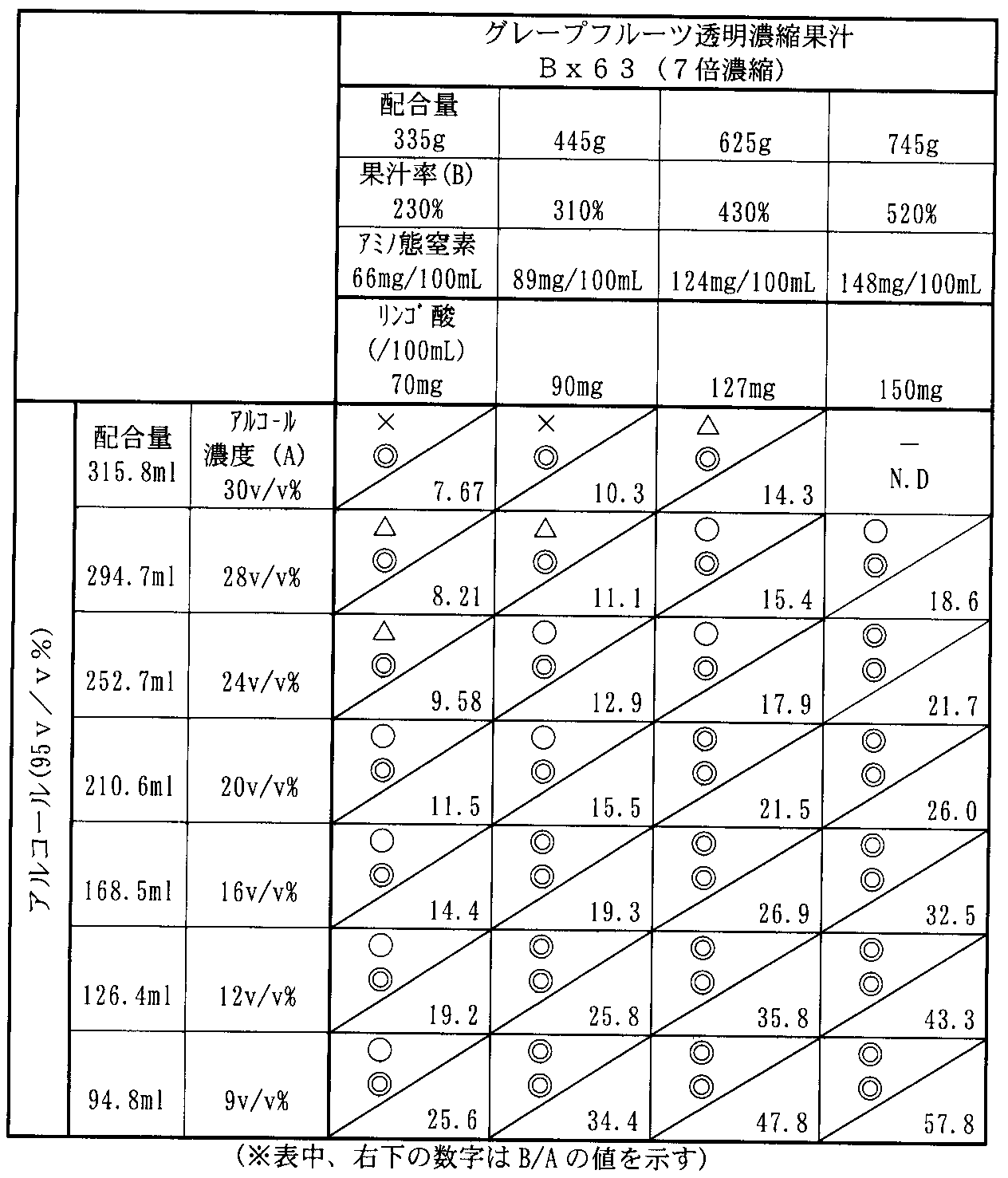
- Example 6 Grapefruit concentrated fruit juice and alcohol were mixed in the blending amounts shown in Table 4 and then added to a total volume of 1000 ml. This was filled in a sealed container (glass bottle) and stored (stored) at room temperature for 1 day to produce a fruit juice-containing alcoholic beverage having an alcohol concentration of 9 to 30 v / v% and a fruit juice ratio of about 230, 310, 430, and 520%.
- the fruit juice ratio in the table was calculated by the formula: (concentrated fruit juice blending amount (g) ⁇ concentration magnification) / 100 ml ⁇ 100.
- the amount of amino nitrogen and malic acid in this alcoholic beverage were determined in the same manner as in Example 5. Moreover, sensory evaluation was performed by drinking this alcoholic beverage. The evaluation items were 1) the tingling sensation of alcohol and 2) the ester-like flavor. Evaluation points are based on Comparative Example 2 in Example 5 (fruit juice rate 100%).
- X Feels a tingling sensation (or does not feel an ester-like flavor)
- ⁇ Same as the standard
- ⁇ From the standard No feeling of tingling (or somewhat feeling of ester-like flavor)
- ⁇ Not feeling of tingling sensation (or feeling of ester-like flavor much greater than the standard).
- Table 4 results are shown in Table 4 (results of sensory evaluation are that the upper row shows a tingling sensation and the lower row shows an ester-like flavor).
- All grapefruit juice-containing alcoholic beverages had malic acid of 60 mg / 100 ml or more, and had a good ester-like flavor in beverages containing a high concentration of alcohol of 9 v / v% or more.
- the tingling sensation of alcohol can be almost eliminated by a beverage containing 11.5 times or more (B / A ⁇ 11.5) of fruit juice in terms of fruit juice rate, particularly 300% or more in terms of fruit juice percentage. And when it is 19.0 times or more (B / A ⁇ 19.0) with respect to the alcohol, the tingling sensation is not felt, and the ester-like flavor due to malic acid is further enhanced, like a thick mature fruit It became a high alcoholic beverage having a flavor.
- Example 7 Grampefruit juice-containing alcoholic beverage (dilution)
- the product 5 of the present invention produced in Example 5 was mixed with water and diluted 2 times to obtain a diluted beverage.
- the diluted beverage was also a grapefruit beverage that exhibited the same properties as before dilution, had an ester-like flavor without the tingling sensation of alcohol, and had a flavor like a thick mature fruit.
- Example 8 (grape juice-containing alcoholic beverage) Using each component and water in the blending amounts shown in Table 5, Brix: 24.6 ° to 25.0 °, acidity (citric acid equivalent): 0.655 g / 100 ml of white grape juice-containing alcoholic beverages, 100 ml each was produced.
- ⁇ feels no tingling sensation
- ⁇ feels little tingling sensation
- ⁇ feels tingling slightly
- x feelings tingling Evaluation was made in 4 stages.
- the fruit juice ratio (B) of Comparative Example 3 and the product 7 of the present invention is 100%, the ratio (B / A) to the alcohol (A) is 11.1, and the fruit juice ratio of the products 8 and 9 of the present invention is 210%.
- the ratio to alcohol was 23.3.
- the tingling sensation of the alcohol was felt slightly in Comparative Example 3 and the product 7 of the present invention, but the tingling sensation of the products 8 and 9 of the present invention and Comparative Example 4 was not felt.
- the ester-like flavor was hardly felt in the case of Comparative Example 3 (total potassium ion amount 15.0 mg / 100 ml), but the sample obtained by adding potassium salt to Comparative Example 3 (present product 7; total potassium ion amount 33) (0.0 mg / 100 ml), it was noticeable. Further, in the sample containing potassium ions derived from white grape juice (Product 8 of the present invention; total potassium ion amount 33 mg / 100 ml), an ester-like flavor similar to that of the product 7 of the present invention was felt.
- the ester-like flavor is slightly weaker than that of the product 8 of the present invention.
- the salty taste and savory taste were strong, which was not preferable in flavor.
- the thickness of the beverage increases and the fruitiness / juiciness (wateriness) increases, and the products 7, 8 and 9 of the present invention have a flavor like a mature grape fruit. I felt it.
- Example 9 (grape juice-containing alcoholic beverage) Except that the fruit juice was red grape concord juice, the same procedure as in Example 8 was used, using the ingredients and water in the amounts shown in Table 6, Brix: 24.6 ° to 25.0 °, acidity (quenched). Acid conversion): 0.94 g / 100 ml of five kinds of grape juice-containing alcoholic beverages and 100 ml each were produced and evaluated in the same manner as in Example 8. The results are shown in Table 6.
- the thickness of the beverage increases and the fruitiness / juiciness (wateriness) increases, and the products 10, 11 and 12 of the present invention have a flavor like a mature grape fruit. I felt it.
- Example 10 (grape juice-containing alcoholic beverage) In the same manner as in Example 8 except that the white grape juice used in Example 8 and the red grape-based Concord fruit juice used in Example 9 were used, each component of the compounding amounts shown in Table 7 and water were used. Brix: 24.6 ° -25.0 °, acidity (citric acid equivalent): 0.80 g / 100 ml of grape juice-containing alcoholic beverages, 100 ml each, were produced and evaluated in the same manner as in Example 8. The results are shown in Table 7.
- the ester-like flavor is slightly weaker than that of the product 13 of the present invention.
- the salty taste and savory taste were strong, which was not preferable in flavor.
- the thickness of the beverage increases and the fruitiness / juiciness (wateriness) increases, and the products 13, 14 and 15 of the present invention have a flavor like a mature grape fruit. I felt it.
- Example 11 (grape juice-containing alcoholic beverage)
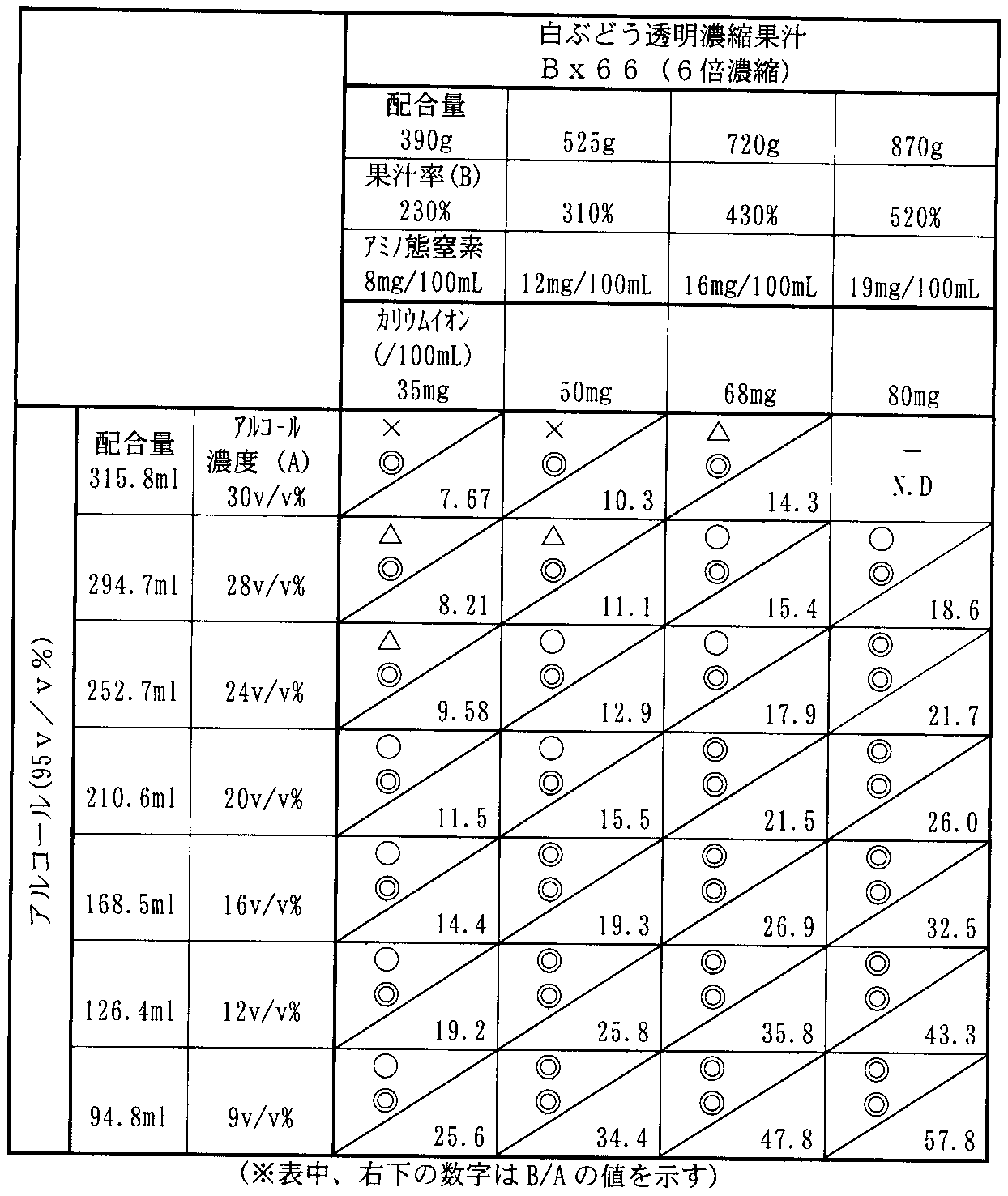
- the white grape transparent concentrated fruit juice and alcohol were mixed in the blending amounts shown in Table 8 and added to a total volume of 1000 ml. This was filled in a sealed container (glass bottle) and stored (stored) at room temperature for one day to produce a grape juice-containing alcoholic beverage with an alcohol concentration of 9-30 v / v% and a fruit juice ratio of about 230, 310, 430, 520%. .
- the amount of amino nitrogen and the amount of potassium ion in this alcoholic beverage were determined in the same manner as in Example 8. Moreover, sensory evaluation was performed by drinking this alcoholic beverage.
- the evaluation items were 1) sensory evaluation of 1) the tingling sensation of alcohol and 2) the ester-like flavor. Evaluation points are based on Comparative Example 3 (fruit juice rate 100%) in Example 8, x: feels a tingling sensation (or does not feel an ester-like flavor), ⁇ : comparable to the standard, ⁇ : from the standard No feeling of tingling (or somewhat feeling of ester-like flavor), ⁇ : Not feeling of tingling sensation (or feeling of ester-like flavor much greater than the standard). The results are shown in Table 8 (the sensory evaluation results show that the upper row shows a tingling sensation and the lower row shows an ester-like flavor).
- All the grape juice-containing alcoholic beverages had a potassium ester of 30 mg / 100 ml or more, and had a good ester-like flavor in beverages containing a high concentration of alcohol of 9 v / v% or more.
- the tingling sensation of alcohol can be almost eliminated by a beverage containing 11.5 times or more (B / A ⁇ 11.5) of fruit juice in terms of fruit juice rate, particularly 300% or more in terms of fruit juice percentage.
- B / A ⁇ 19.0 when it is 19.0 times or more (B / A ⁇ 19.0) with respect to alcohol, the tingling sensation is not felt, the ester-like flavor due to potassium ions is further enhanced, and it is like a thick mature fruit It became a high alcoholic beverage having a flavor.
- Example 12 (grape juice-containing alcoholic beverage)
- the raw materials were mixed in the following composition to produce a grape juice-containing alcoholic beverage having a fruit juice ratio of about 420% and an alcohol concentration of 16 v / v%.
- the amount of potassium ions in this alcoholic beverage was 137 mg / 100 ml.
- This alcoholic beverage containing potassium ions at a high concentration was stored at 23 ° C. for 7 months at room temperature, but no change in flavor was observed during storage, and no precipitation or the like was observed.
- Example 13 350g white grape transparent concentrated fruit juice (6 times concentrated) 350g red grape concentrate (6 times concentrated) 59v / v% alcohol (spirits) 136ml 59v / v% brandy 136ml Fragrance 1000ml in total Example 13 (Grape juice-containing alcoholic beverage (dilution))
- the grape juice-containing alcoholic beverage produced in Example 12 was mixed with a diluent (water or carbonated water) and diluted 4 times to obtain a diluted alcoholic beverage.
- the beverage after dilution shows the same properties as before dilution, has a fruity and refreshing ester-like flavor without the tingling of alcohol, and has a grape-flavored alcoholic beverage with a mellow thickness like a mature grape fruit Met.
Landscapes
- Chemical & Material Sciences (AREA)
- Organic Chemistry (AREA)
- Engineering & Computer Science (AREA)
- Health & Medical Sciences (AREA)
- Biochemistry (AREA)
- Bioinformatics & Cheminformatics (AREA)
- General Engineering & Computer Science (AREA)
- General Health & Medical Sciences (AREA)
- Genetics & Genomics (AREA)
- Life Sciences & Earth Sciences (AREA)
- Wood Science & Technology (AREA)
- Zoology (AREA)
- Non-Alcoholic Beverages (AREA)
- Alcoholic Beverages (AREA)
Abstract
Description
前記果汁がリンゴ果汁である場合には、特定量のクロロゲン酸類を含み、
前記果汁がグレープフルーツ果汁である場合には、特定量のリンゴ酸を含み、
前記果汁がぶどう果汁である場合には、特定量のカリウムイオンを含む飲料に関する。本発明の果汁含有アルコール飲料は、高濃度のアルコールに起因するアルコール特有の刺激(刺激臭を含む)が低減されており、かつリンゴ果汁を用いた場合には、成熟したリンゴのような甘い蜜様の味わいが増強されており、グレープフルーツ果汁を用いた場合には、成熟したグレープフルーツのフルーティーで爽やかな香味(エステル様香味)が増強されており、ぶどう果汁を用いた場合には、成熟したぶどうのフルーティーで爽やかな香味(エステル様香味)が増強されており厚みのあるまろやかな風味を有している。本発明の果汁含有アルコール飲料は、酒類の好ましい芳香である成熟した各果実のフルーティで爽やかな香味(甘い蜜様の味わい、エステル様香味)が増強されている、非常に風味の良い新しい味わいの飲料である。
1. アルコール度数9v/v%以上の果汁含有アルコール飲料であって、前記果汁は、リンゴ果汁、グレープフルーツ果汁、及びぶどう果汁からなる群から選択される1種であり、
(A)前記果汁がリンゴ果汁である場合には、5.0mg/100ml以上のクロロゲン酸類を含み、
(B)前記果汁がグレープフルーツ果汁である場合には、60mg/100ml以上のリンゴ酸を含み、そして、
(C)前記果汁がぶどう果汁である場合には、30mg/100ml以上のカリウムイオンを含む、
前記アルコール飲料。
2. 前記果汁の配合量が、果汁率換算で100%以上である、上記1に記載の果汁含有アルコール飲料。
3. 前記飲料中の(A)アルコール濃度(v/v%)に対する(B)果汁率(%)(B/A)が、11.5以上である、上記1又は2に記載の果汁含有アルコール飲料。
4. 前記果汁が、リンゴ果汁であり、前記クロロゲン酸類が、果汁抽出物又は濃縮物として添加されたものである、上記1~3のいずれか一項に記載の果汁含有アルコール飲料。
5. 前記果汁が、グレープフルーツ果汁であり、前記リンゴ酸が、果汁抽出物又は濃縮物として添加されたものである、上記1~3のいずれか一項に記載の果汁含有アルコール飲料。
6. 前記果汁が、ぶどう果汁であり、前記カリウムイオンが、果汁抽出物又は濃縮物として添加されたものである、上記1~3のいずれか一項に記載の果汁含有アルコール飲料。
7. 上記1~6のいずれか一項に記載のアルコール飲料を、希釈液で希釈して得られる希釈型アルコール飲料。
リンゴ果汁を含有する高アルコール飲料において、クロロゲン酸類の含有量を5.0mg/100ml以上とし、また、
グレープフルーツ果汁を含有する高アルコール飲料ではリンゴ酸の含有量を60mg/100ml以上とし、さらに、
ぶどう果汁を含有する高アルコール飲料ではカリウムイオンの含有量を30mg/100ml以上とする
ことによって、それぞれの果実が有する成熟した果実の香味(エステル様香味、甘い蜜様の味わい)を付与することができるという効果をも奏するものである。
リンゴ果汁を用いる場合には、クロロゲン酸類を、
グレープフルーツ果汁を用いる場合には、リンゴ酸を、
ぶどう果汁を用いる場合には、カリウムイオンを、
それぞれ所定の含有量となるように加えることで、高アルコール飲料の呈味を改善することができる。
リンゴ果汁を用いる場合の飲料中のクロロゲン酸類の含有量は、5.0mg/100ml以上、好ましくは5.5mg/100ml以上である。クロロゲン酸類の含有量が、5.0mg/100ml未満であると、本発明の特徴である成熟したリンゴの蜜様の味わいを十分に付与することができない。クロロゲン酸類の含有量の上限は、所望する風味、嗜好等により適宜設定すればよいが、クロロゲン酸類は苦味や渋味の原因として知られている成分であるから、その含有量が高くなり過ぎると、アルコール飲料の呈味を損なうこともあるので、通常、クロロゲン酸類の含有量は、100mg/100ml以下、好ましくは50mg/100ml以下程度である。
グレープフルーツ果汁を用いる場合の飲料中のリンゴ酸の含有量は、60mg/100ml以上、好ましくは100mg/100ml以上、より好ましくは150mg/100ml以上である。リンゴ酸の含有量が、60mg/100ml未満であると、グレープフルーツの風味を改善するには不十分であり、また、エステル様香味の増強や成熟した果実のような香味を十分に付与することができない。リンゴ酸の含有量の上限は、所望する風味、嗜好等により適宜設定すればよいが、高アルコール飲料中の酸度が高くなり過ぎると、酸味とアルコール特有の刺激とが相加的又は相乗的に作用して高アルコール飲料の呈味を低下させる場合がある。そのため、通常、高アルコール飲料中の酸度(100mlアルコール飲料中の、クエン酸に換算した重量g)が、好ましくは10g以下、より好ましくは8g以下となるような範囲でリンゴ酸を含有させることが好ましい。なお、本発明のアルコール飲料に含有されるリンゴ酸の量は、試料に過塩素酸と水を加え、ろ過し、高速液体クロマトグラフを用いることにより分析した。
ぶどう果汁を用いる場合の飲料中のカリウムイオンの含有量は、30~250mg/100ml、好ましくは30~200mg/100ml、より好ましくは30~150mg/100mlである。カリウムイオンの含有量が、30mg/100ml未満であると、ぶどうの風味を改善するには不十分であり、また、エステル様香味の増強や成熟した果実のような香味を十分に付与することができない。また、カリウムイオンの含有量が、250mg/100mlを超えると、塩味やえぐ味を呈し、高アルコール飲料の呈味を低下させることがある。
なお、本発明でいう「果汁率」は、飲料中のアミノ態窒素を指標として表すこともできる。すなわち、ストレート果汁に含まれるアミノ態窒素量を100%としたときの相対濃度として表すこともできる。濃縮果汁を還元して100%果汁(ストレート果汁)とした場合、そのアミノ態窒素量(mg/100ml)(バンスライク法)は、リンゴ(混濁)9mg、(透明)7mg;ぶどう(コンコード)23mg、(白ぶどう)3mg、(巨峰)18mg;グレープフルーツ(混濁)29mg、(セミクリア)23mg、(透明)26mgであった。したがって、例えば、グレープフルーツ透明果汁とアルコールとを原料とする本発明のアルコール飲料について、アミノ態窒素を分析(バンスライク法)し、52mg/100mlであった場合には、果汁率は200%である。なお、アミノ態窒素量は、通常、飲料100gあたりの量(mg/100g)で表されることが多いが、飲料中のアルコール濃度に影響されないように、100mlのアルコール飲料中のアミノ態窒素の量(mg/100ml)を用いることにする。
リンゴ透明濃縮果汁(Bx70°;7倍濃縮)、59v/v%アルコール(スピリッツ)を用い、果汁率50、80、100%の果汁含有アルコール飲料(アルコール濃度:9v/v%)を製造した。得られた果汁含有アルコールについて、アルコールのピリピリ感(口中でピリピリと感じるアルコール特有の刺激)をパネラー4名で4点法(4点:ピリピリ感を感じない、3点:ピリピリ感をほとんど感じない、2点:ピリピリ感を若干感じる、1点:ピリピリ感を感じる)により評価し、その平均を求めた。
グレープフルーツ透明濃縮果汁(Bx63°)、59v/v%アルコール(スピリッツ)を用い、果汁率50、80、100%の果汁含有アルコール飲料(アルコール濃度:9v/v%)を製造した。得られた果汁含有アルコールについて、アルコールのピリピリ感(口中でピリピリと感じるアルコール特有の刺激)をパネラー4名で4点法(4点:ピリピリ感を感じない、3点:ピリピリ感をほとんど感じない、2点:ピリピリ感を若干感じる、1点:ピリピリ感を感じる)により評価し、その平均を求めた。
白ぶどう透明濃縮果汁(Bx66°)、59v/v%アルコール(スピリッツ)を用い、果汁率50、80、100%の果汁含有アルコール飲料(アルコール濃度:9v/v%)を製造した。得られた果汁含有アルコールについて、アルコールのピリピリ感(口中でピリピリと感じるアルコール特有の刺激)をパネラー4名で4点法(4点:ピリピリ感を感じない、3点:ピリピリ感をほとんど感じない、2点:ピリピリ感を若干感じる、1点:ピリピリ感を感じる)により評価し、その平均を求めた。
表1に示す配合量の各成分及び水を用いて、Brix:22.7°、酸度:0.565g/100mlの4種類のリンゴ果汁含有アルコール飲料を製造した。得られた各飲料のアルコールによるピリピリ感について、◎:ピリピリ感を感じない、○:ピリピリ感をほとんど感じない、△:ピリピリ感を若干感じる、×:ピリピリ感を感じる、の4段階で評価した。また、成熟したリンゴの甘い蜜様の味わいについて、比較例1を基準として、×:比較例1より蜜様の味わいを感じない、△:比較例1と同程度、○:比較例1より蜜様の味わいをやや感じる、◎:比較例1より蜜様の味わいを大きく感じる、の4段階で評価した。また、リンゴ果汁含有アルコール飲料のアミノ態窒素量を、バンスライク法(バンスライクに亜硝酸ナトリウム、酢酸、及び試料溶液を加え、発生する窒素ガス量からアミノ態窒素量を算出する方法)により測定した。さらに、クロロゲン酸類の含有量を、アルコール飲料に過塩素酸と水を加えてろ過した試料を用い、高速液体クロマトグラフ法にて分析たした。結果を表1に示す。
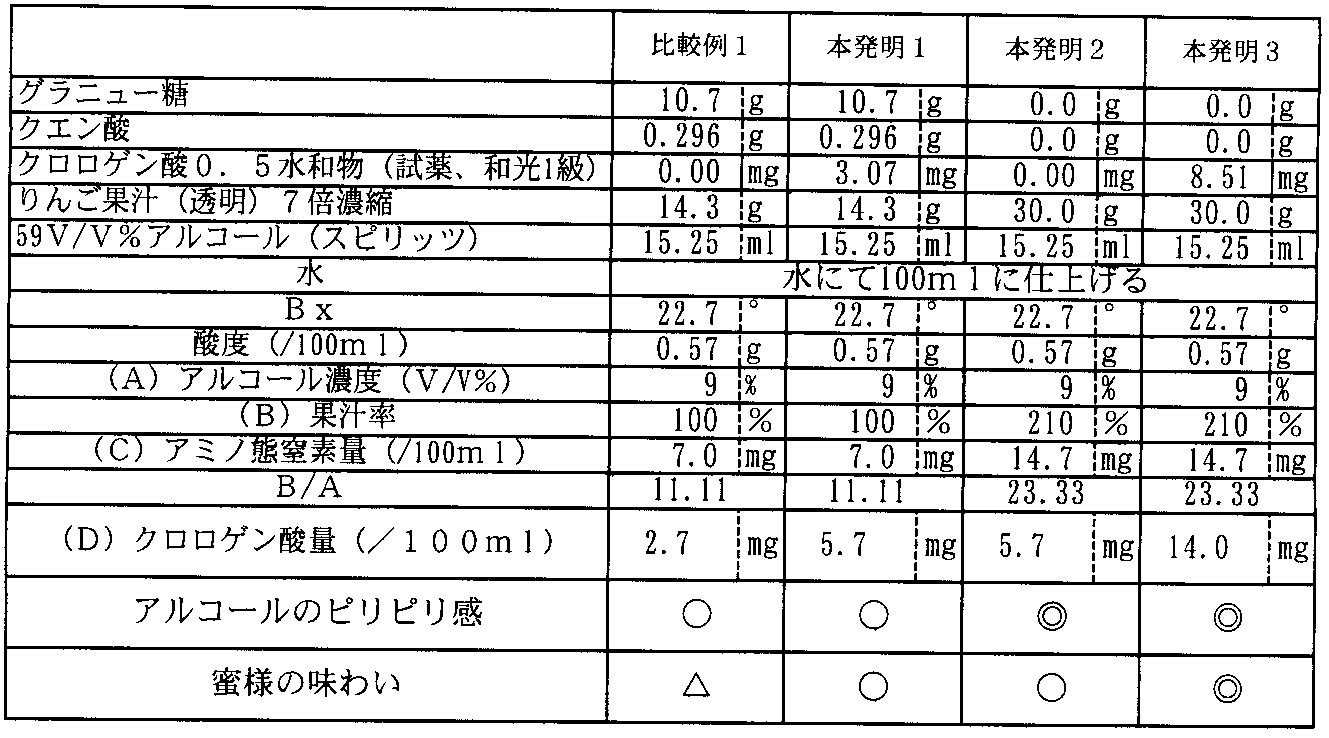
表2に示す配合量で、リンゴ果汁濃縮果汁と、アルコールとを混合し、加水して全量を1000mlにした。これを密封容器(ガラス瓶)に充填して常温で1日保存(貯蔵)し、アルコール濃度9~30v/v%、果汁率約230、310、430、520%の果汁含有アルコール飲料を製造した。

以下に示す配合で原材料を混合し、果汁率約420%、アルコール度数16v/v%のリンゴ果汁含有アルコール飲料を製造した。
59v/v%アルコール(スピリッツ) 136ml
ラム(59v/v%) 136ml
水にて1000mlに調整
このアルコール飲料中のクロロゲン酸量は、29.4mg/100mlであった。この高濃度のクロロゲン酸を含有するアルコール飲料を23℃で7ヶ月間保存したが、保存中の風味の変化は確認されず、甘い蜜様の味わいを維持していた。
実施例3で製造したリンゴ果汁含有アルコール飲料を水又は炭酸水で容量比で4倍に希釈し、希釈型のアルコール飲料を得た。水で希釈した飲料も炭酸水で希釈した飲料も、それぞれ、希釈前と同様に、アルコールのピリピリ感がなく、また、成熟したリンゴの甘い蜜様の味わいとまろやかな厚みのある風味とを有していた。
表3に示す配合量の各成分及び水を用いて、Brix:21.0°、酸度:1.89g/100mlの4種類のグレープフルーツ果汁含有アルコール飲料、各100mlを製造した。(なお、用いたグレープフルーツ果汁には、1g当たり2.1mgのリンゴ酸が含まれている。)参考例2と同様にして、各飲料のアルコールのピリピリ感について、◎:ピリピリ感を感じない、○:ピリピリ感をほとんど感じない、△:ピリピリ感を若干感じる、×:ピリピリ感を感じる、の4段階で評価した。また、エステル様香味について、比較例2を基準として、×:よりエステル様香味を感じない、△:比較例2と同程度、○:比較例2よりエステル様香味をやや感じる、◎:比較例2よりエステル様香味を大きく感じる、の4段階で評価した。また、グレープフルーツ果汁含有アルコール飲料のアミノ態窒素量を、バンスライク法(バンスライクに亜硝酸ナトリウム、酢酸と試料溶液を加え、発生する窒素ガス量からアミノ体窒素量を算出する方法)により測定した。さらに、リンゴ酸の含有量を高速液体クロマトグラフ法にて分析した。試料に過塩素酸と水を加え、ろ過後に高速液体クロマトグラフィーにて測定を行った。結果を表3に示す。
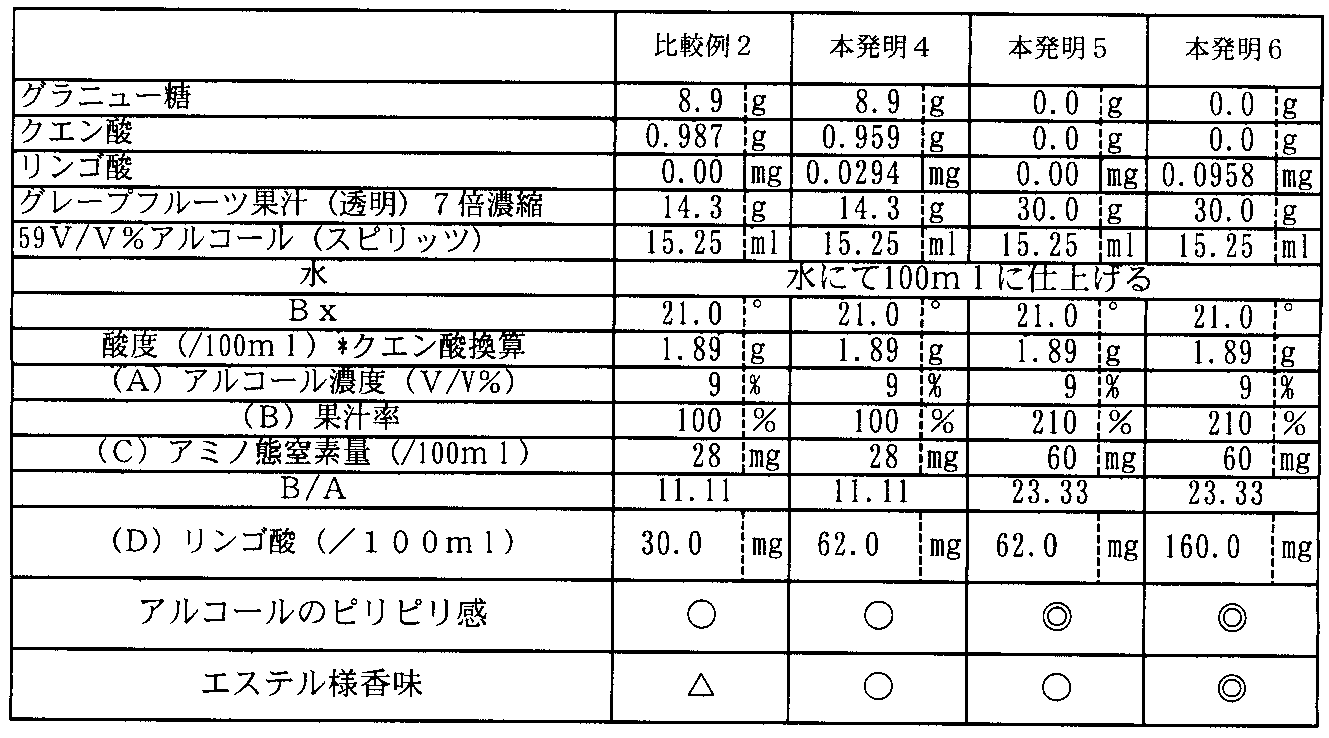
表4に示す配合量で、グレープフルーツ濃縮果汁と、アルコールとを混合し、加水して全量を1000mlにした。これを密封容器(ガラス瓶)に充填して常温で1日保存(貯蔵)し、アルコール濃度9~30v/v%、果汁率約230、310、430、520%の果汁含有アルコール飲料を製造した。表中の果汁率は、式:(濃縮果汁配合量(g)×濃縮倍率)/100ml×100、によって算出した。
実施例5で製造した本発明品5に水を混合して2倍に希釈し、希釈型飲料を得た。希釈後の飲料も、希釈前と同様の性質を示し、アルコールのピリピリ感のない、エステル様香味を有し、厚みのある成熟果実のような香味を有するグレープフルーツ飲料であった。
表5に示す配合量の各成分及び水を用いて、Brix:24.6°~25.0°、酸度(クエン酸換算):0.655g/100mlの5種類の白ぶどう果汁含有アルコール飲料、各100mlを製造した。参考例3と同様にして、各飲料のアルコールのピリピリ感について、◎:ピリピリ感を感じない、○:ピリピリ感をほとんど感じない、△:ピリピリ感を若干感じる、×:ピリピリ感を感じる、の4段階で評価した。また、エステル様香味について、比較例3を基準として、×:比較例3よりエステル様香味を感じない、△:比較例3と同程度、○:比較例3よりエステル様香味をやや感じる、◎:比較例3よりエステル様香味を大きく感じる、の4段階で評価した。また、白ぶどう果汁含有アルコール飲料のアミノ態窒素量を、バンスライク法(バンスライクに亜硝酸ナトリウム、酢酸と試料溶液を加え、発生する窒素ガス量からアミノ体窒素量を算出する方法)により測定した。さらに、カリウムイオンの含有量を、原子吸光度法(塩酸抽出法)にて分析した。結果を表5に示す。

果汁を赤ぶどう系のコンコード果汁にする以外は実施例8と同様にして、表6に示す配合量の各成分及び水を用いて、Brix:24.6°~25.0°、酸度(クエン酸換算):0.94g/100mlの5種類のぶどう果汁含有アルコール飲料、各100mlを製造し、実施例8と同様に評価した。結果を表6に示す。

果汁を実施例8で用いた白ぶどう果汁と実施例9で用いた赤ぶどう系のコンコード果汁を用いる以外は実施例8と同様にして、表7に示す配合量の各成分及び水を用いて、Brix:24.6°~25.0°、酸度(クエン酸換算):0.80g/100mlの5種類のぶどう果汁含有アルコール飲料、各100mlを製造し、実施例8と同様に評価した。結果を表7に示す。
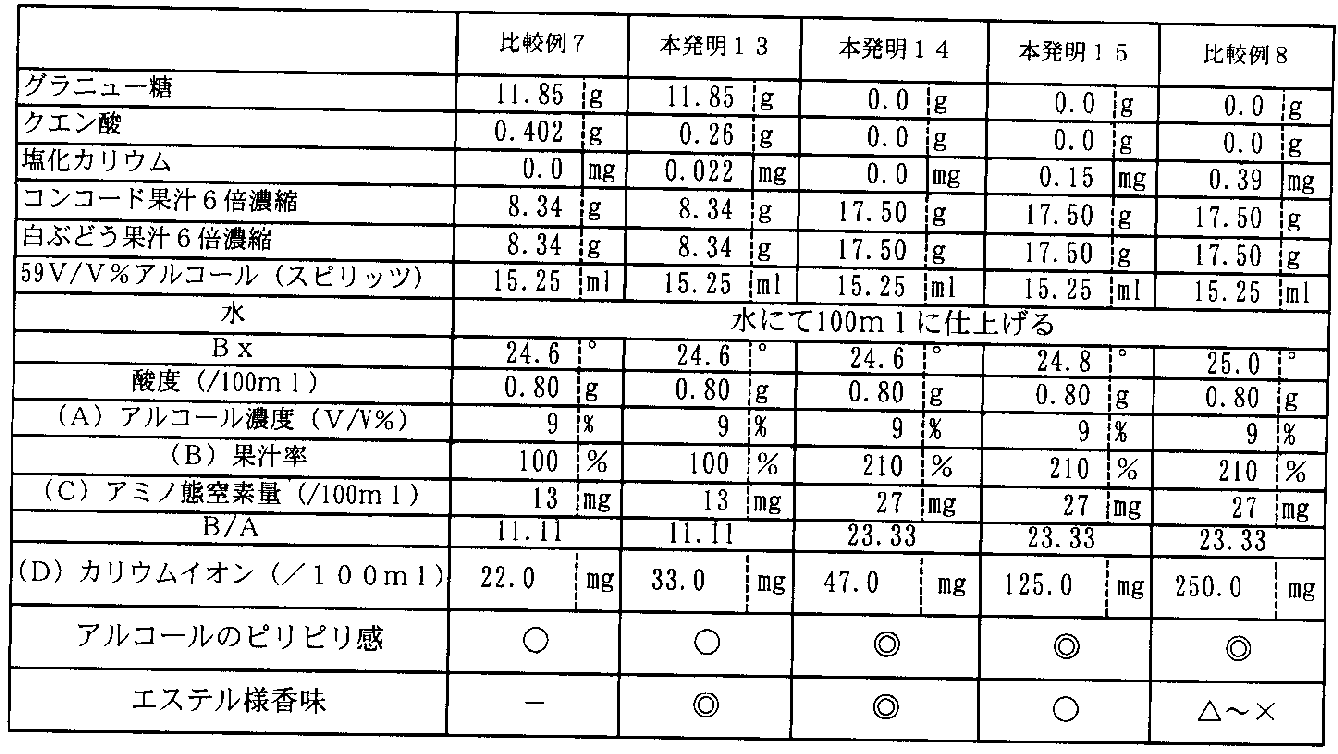
表8に示す配合量で、白ぶどう透明濃縮果汁と、アルコールとを混合し、加水して全量を1000mlにした。これを密封容器(ガラス瓶)に充填して常温で1日保存(貯蔵)し、アルコール濃度9~30v/v%、果汁率約230、310、430、520%のぶどう果汁含有アルコール飲料を製造した。
以下に示す配合で原材料を混合し、果汁率約420%、アルコール濃度16v/v%のぶどう果汁含有アルコール飲料を製造した。このアルコール飲料中のカリウムイオン量は、137mg/100mlであった。この高濃度にカリウムイオンを含有するアルコール飲料を常温で23℃7ヶ月間保存したが、保存中の風味の変化は確認されず、沈殿物等の析出もみられなかった。
赤ぶどう濃縮果汁(6倍濃縮) 350g
59v/v%アルコール(スピリッツ) 136ml
59v/v%ブランデー 136ml
香料
計1000ml
実施例13(ぶどう果汁含有アルコール飲料(希釈))
実施例12で製造したぶどう果汁含有アルコール飲料に、希釈液(水又は炭酸水)を混合して4倍に希釈し、希釈型のアルコール飲料を得た。希釈後の飲料も、希釈前と同様の性質を示し、アルコールのピリピリ感のない、フルーティで爽やかなエステル様香味を有し、成熟したぶどう果実のようなまろやかな厚みを有するぶどう風味のアルコール飲料であった。
Claims (7)
- アルコール度数9v/v%以上の果汁含有アルコール飲料であって、前記果汁は、リンゴ果汁、グレープフルーツ果汁、及びぶどう果汁からなる群から選択される1種であり、
(A)前記果汁がリンゴ果汁である場合には、5.0mg/100ml以上のクロロゲン酸類を含み、
(B)前記果汁がグレープフルーツ果汁である場合には、60mg/100ml以上のリンゴ酸を含み、そして、
(C)前記果汁がぶどう果汁である場合には、30mg/100ml以上のカリウムイオンを含む、
前記アルコール飲料。 - 前記果汁の配合量が、果汁率換算で100%以上である、請求項1に記載の果汁含有アルコール飲料。
- 前記飲料中の(A)アルコール濃度(v/v%)に対する(B)果汁率(%)(B/A)が、11.5以上である、請求項1又は2に記載の果汁含有アルコール飲料。
- 前記果汁が、リンゴ果汁であり、前記クロロゲン酸類が、果汁抽出物又は濃縮物として添加されたものである、請求項1~3のいずれか一項に記載の果汁含有アルコール飲料。
- 前記果汁が、グレープフルーツ果汁であり、前記リンゴ酸が、果汁抽出物又は濃縮物として添加されたものである、請求項1~3のいずれか一項に記載の果汁含有アルコール飲料。
- 前記果汁が、ぶどう果汁であり、前記カリウムイオンが、果汁抽出物又は濃縮物として添加されたものである、請求項1~3のいずれか一項に記載の果汁含有アルコール飲料。
- 請求項1~6のいずれか一項に記載のアルコール飲料を、希釈液で希釈して得られる希釈型アルコール飲料。
Priority Applications (7)
| Application Number | Priority Date | Filing Date | Title |
|---|---|---|---|
| AU2009216261A AU2009216261B2 (en) | 2008-02-19 | 2009-02-19 | Fruit juice - containing alcoholic beverage |
| EP09712658.5A EP2248885A4 (en) | 2008-02-19 | 2009-02-19 | Alcoholic drink containing fruit juice |
| MX2010009068A MX2010009068A (es) | 2008-02-19 | 2009-02-19 | Bebida alcoholica que contiene jugos de frutas. |
| US12/866,168 US20110008516A1 (en) | 2008-02-19 | 2009-02-19 | Fruit juice-containing alcoholic beverage |
| CN2009801051031A CN101952410B (zh) | 2008-02-19 | 2009-02-19 | 含果汁酒精饮料 |
| CA2714022A CA2714022C (en) | 2008-02-19 | 2009-02-19 | Fruit juice-containing alcoholic beverage |
| RU2010138544/10A RU2484128C2 (ru) | 2008-02-19 | 2009-02-19 | Алкогольный напиток, содержащий фруктовый сок |
Applications Claiming Priority (6)
| Application Number | Priority Date | Filing Date | Title |
|---|---|---|---|
| JP2008-038089 | 2008-02-19 | ||
| JP2008038093A JP2009195125A (ja) | 2008-02-19 | 2008-02-19 | ぶどう果汁含有アルコール飲料 |
| JP2008038089A JP2009195123A (ja) | 2008-02-19 | 2008-02-19 | グレープフルーツ果汁含有アルコール飲料 |
| JP2008038084A JP5475242B2 (ja) | 2008-02-19 | 2008-02-19 | リンゴ果汁含有アルコール飲料 |
| JP2008-038093 | 2008-02-19 | ||
| JP2008-038084 | 2008-02-19 |
Publications (1)
| Publication Number | Publication Date |
|---|---|
| WO2009104660A1 true WO2009104660A1 (ja) | 2009-08-27 |
Family
ID=40985538
Family Applications (1)
| Application Number | Title | Priority Date | Filing Date |
|---|---|---|---|
| PCT/JP2009/052842 Ceased WO2009104660A1 (ja) | 2008-02-19 | 2009-02-19 | 果汁含有アルコール飲料 |
Country Status (10)
| Country | Link |
|---|---|
| US (1) | US20110008516A1 (ja) |
| EP (1) | EP2248885A4 (ja) |
| KR (1) | KR101601991B1 (ja) |
| CN (1) | CN101952410B (ja) |
| AU (1) | AU2009216261B2 (ja) |
| CA (1) | CA2714022C (ja) |
| MX (1) | MX2010009068A (ja) |
| RU (1) | RU2484128C2 (ja) |
| TW (1) | TW201009070A (ja) |
| WO (1) | WO2009104660A1 (ja) |
Cited By (7)
| Publication number | Priority date | Publication date | Assignee | Title |
|---|---|---|---|---|
| JP2015204775A (ja) * | 2014-04-18 | 2015-11-19 | サントリーホールディングス株式会社 | チューハイ飲料 |
| JP2015204774A (ja) * | 2014-04-18 | 2015-11-19 | サントリーホールディングス株式会社 | チューハイ飲料 |
| CN105595298A (zh) * | 2010-10-25 | 2016-05-25 | Mc食品科技株式会社 | 风味改良剂 |
| JP2016154488A (ja) * | 2015-02-25 | 2016-09-01 | 国立研究開発法人農業・食品産業技術総合研究機構 | リンゴの蜜様香気を表現する香料組成物および香気付与方法 |
| JP2017169542A (ja) * | 2016-03-25 | 2017-09-28 | サントリーホールディングス株式会社 | クロロゲン酸を含有する飲料 |
| WO2022163483A1 (ja) * | 2021-01-26 | 2022-08-04 | サントリーホールディングス株式会社 | 果汁含有アルコール飲料 |
| WO2022163379A1 (ja) | 2021-01-29 | 2022-08-04 | サントリーホールディングス株式会社 | 果汁含有原酒 |
Families Citing this family (11)
| Publication number | Priority date | Publication date | Assignee | Title |
|---|---|---|---|---|
| JP5909050B2 (ja) * | 2011-04-25 | 2016-04-26 | サントリーホールディングス株式会社 | 果汁含有貯蔵原酒を含むアルコール飲料 |
| CN102433235B (zh) * | 2011-12-13 | 2013-07-24 | 欧声光 | 一种香甜保健型红葡萄金酒及其制备方法 |
| JP5671600B2 (ja) * | 2012-12-28 | 2015-02-18 | 花王株式会社 | ビール風味炭酸飲料 |
| CN103305378B (zh) * | 2013-06-06 | 2014-10-29 | 厦门圣尼诺生物科技有限公司 | 一种柚子酒及其制备方法 |
| RU2597968C1 (ru) * | 2015-10-21 | 2016-09-20 | Александр Вячеславович Соколов | Водка |
| CN106635594A (zh) * | 2016-11-30 | 2017-05-10 | 元谋原生源农业科技有限责任公司 | 一种白兰地酿造工艺 |
| CN111565576A (zh) * | 2018-03-22 | 2020-08-21 | 弗门尼舍有限公司 | 具有降低的pH的已调味制品 |
| KR102333313B1 (ko) * | 2019-09-27 | 2021-12-02 | 씨제이제일제당 (주) | 풍미가 강화된 원물 농축액 및 이의 제조 방법 |
| EP4112711B1 (en) * | 2020-02-28 | 2024-09-11 | Suntory Holdings Limited | Container-packed carbonated alcoholic beverage |
| JP7758498B2 (ja) * | 2021-07-30 | 2025-10-22 | サントリーホールディングス株式会社 | アルコール飲料 |
| KR102866433B1 (ko) * | 2022-11-30 | 2025-09-30 | 대한민국 | 자몽추출물을 이용한 와인의 제조방법 |
Citations (13)
| Publication number | Priority date | Publication date | Assignee | Title |
|---|---|---|---|---|
| JPS55141188A (en) * | 1979-04-21 | 1980-11-04 | Suntory Ltd | Ratafia and its concentrated raw material |
| JPS6352864A (ja) * | 1986-05-07 | 1988-03-07 | ザ、プロクタ−、エンド、ギャンブル、カンパニ− | カルシウムで栄養補給された果汁飲料およびジュ−ス濃縮物 |
| JPH0823939A (ja) * | 1994-07-14 | 1996-01-30 | Sanei Gen F F I Inc | 飲料の香味劣化防止剤および飲料の香味劣化防止方法 |
| JPH08224075A (ja) | 1995-02-20 | 1996-09-03 | Sanei Gen F F I Inc | アルコール飲料の風味向上剤及び風味向上法 |
| JPH10313849A (ja) | 1997-05-15 | 1998-12-02 | Dezainaa Foods Kyokai:Kk | アルコール飲料の呈味改善剤 |
| JP2003204779A (ja) | 2002-01-15 | 2003-07-22 | Nippon Beet Sugar Mfg Co Ltd | アルコール含有食品 |
| JP2003210137A (ja) * | 2002-01-23 | 2003-07-29 | Sanei Gen Ffi Inc | 飲 料 |
| JP2003210154A (ja) | 2002-01-18 | 2003-07-29 | Manns Wine Co Ltd | 果実酒製造用ワイン |
| JP2003289824A (ja) | 2002-04-03 | 2003-10-14 | Nippon Shokuhin Kako Co Ltd | アルコール含有飲食品の味質・風味改善剤、それを含有するアルコール含有食品及び該アルコール含有飲食品の製造方法 |
| JP2004236582A (ja) * | 2003-02-06 | 2004-08-26 | Takara Shuzo Co Ltd | 容器入り果汁含有アルコール飲料及びその製造方法 |
| JP2005192473A (ja) | 2004-01-07 | 2005-07-21 | Takara Shuzo Co Ltd | 果汁含有アルコール飲料 |
| JP2006271273A (ja) | 2005-03-29 | 2006-10-12 | Suntory Ltd | 香味改善組成物 |
| JP2008095068A (ja) | 2006-09-14 | 2008-04-24 | Japan Electric Cable Technology Center Inc | 樹脂系改質剤の製造装置 |
Family Cites Families (13)
| Publication number | Priority date | Publication date | Assignee | Title |
|---|---|---|---|---|
| US2967778A (en) * | 1957-08-20 | 1961-01-10 | Inst Divi Thomae Foundation | Method for making juice concentrates |
| US4244981A (en) * | 1979-05-31 | 1981-01-13 | General Mills, Inc. | Non-dairy, aerated frozen dessert containing citrus juice vesicles |
| US4938971A (en) * | 1988-06-29 | 1990-07-03 | Wm. Wrigley Jr. Company | Fluid fruit juice and edible plasticizer composition having low moisture content |
| RU2044766C1 (ru) * | 1992-10-20 | 1995-09-27 | Акционерное общество "Грот" | Композиция ингредиентов для бальзама "межелик" |
| RU2132866C1 (ru) * | 1996-06-25 | 1999-07-10 | Плитанов Александр Мунирович | Спиртовый напиток "плитанов" |
| JP3148167B2 (ja) * | 1997-10-29 | 2001-03-19 | 株式会社有明のり | 熟成茶材及び飲用茶類の製造法 |
| RU2146102C1 (ru) * | 1999-01-11 | 2000-03-10 | Закрытое акционерное общество "Троя" | Способ получения плодово-ягодных напитков |
| JP2000333666A (ja) * | 1999-05-31 | 2000-12-05 | Taichi Togyo Kk | アルコール飲料及びアルコール飲料の製造方法 |
| RU2196817C2 (ru) * | 2000-02-15 | 2003-01-20 | ОАО ликероводочный завод "Хабаровский" | Настойка сладкая "лимонник на коньяке" |
| JP4101443B2 (ja) | 2000-07-06 | 2008-06-18 | サントリー株式会社 | 果汁含有飲料の製造方法 |
| US20030003212A1 (en) * | 2001-06-13 | 2003-01-02 | Givaudan Sa | Taste modifiers |
| JP2005095068A (ja) * | 2003-09-25 | 2005-04-14 | Choya Umeshu Co Ltd | アルコール飲料 |
| US20100159115A1 (en) * | 2008-12-19 | 2010-06-24 | Niv Ben Yehuda | Flavonoid-rich citrus extract process |
-
2009
- 2009-02-19 TW TW098105288A patent/TW201009070A/zh unknown
- 2009-02-19 MX MX2010009068A patent/MX2010009068A/es not_active Application Discontinuation
- 2009-02-19 AU AU2009216261A patent/AU2009216261B2/en not_active Ceased
- 2009-02-19 CN CN2009801051031A patent/CN101952410B/zh not_active Expired - Fee Related
- 2009-02-19 WO PCT/JP2009/052842 patent/WO2009104660A1/ja not_active Ceased
- 2009-02-19 CA CA2714022A patent/CA2714022C/en not_active Expired - Fee Related
- 2009-02-19 US US12/866,168 patent/US20110008516A1/en not_active Abandoned
- 2009-02-19 EP EP09712658.5A patent/EP2248885A4/en not_active Withdrawn
- 2009-02-19 RU RU2010138544/10A patent/RU2484128C2/ru not_active IP Right Cessation
- 2009-02-19 KR KR1020107017185A patent/KR101601991B1/ko not_active Expired - Fee Related
Patent Citations (13)
| Publication number | Priority date | Publication date | Assignee | Title |
|---|---|---|---|---|
| JPS55141188A (en) * | 1979-04-21 | 1980-11-04 | Suntory Ltd | Ratafia and its concentrated raw material |
| JPS6352864A (ja) * | 1986-05-07 | 1988-03-07 | ザ、プロクタ−、エンド、ギャンブル、カンパニ− | カルシウムで栄養補給された果汁飲料およびジュ−ス濃縮物 |
| JPH0823939A (ja) * | 1994-07-14 | 1996-01-30 | Sanei Gen F F I Inc | 飲料の香味劣化防止剤および飲料の香味劣化防止方法 |
| JPH08224075A (ja) | 1995-02-20 | 1996-09-03 | Sanei Gen F F I Inc | アルコール飲料の風味向上剤及び風味向上法 |
| JPH10313849A (ja) | 1997-05-15 | 1998-12-02 | Dezainaa Foods Kyokai:Kk | アルコール飲料の呈味改善剤 |
| JP2003204779A (ja) | 2002-01-15 | 2003-07-22 | Nippon Beet Sugar Mfg Co Ltd | アルコール含有食品 |
| JP2003210154A (ja) | 2002-01-18 | 2003-07-29 | Manns Wine Co Ltd | 果実酒製造用ワイン |
| JP2003210137A (ja) * | 2002-01-23 | 2003-07-29 | Sanei Gen Ffi Inc | 飲 料 |
| JP2003289824A (ja) | 2002-04-03 | 2003-10-14 | Nippon Shokuhin Kako Co Ltd | アルコール含有飲食品の味質・風味改善剤、それを含有するアルコール含有食品及び該アルコール含有飲食品の製造方法 |
| JP2004236582A (ja) * | 2003-02-06 | 2004-08-26 | Takara Shuzo Co Ltd | 容器入り果汁含有アルコール飲料及びその製造方法 |
| JP2005192473A (ja) | 2004-01-07 | 2005-07-21 | Takara Shuzo Co Ltd | 果汁含有アルコール飲料 |
| JP2006271273A (ja) | 2005-03-29 | 2006-10-12 | Suntory Ltd | 香味改善組成物 |
| JP2008095068A (ja) | 2006-09-14 | 2008-04-24 | Japan Electric Cable Technology Center Inc | 樹脂系改質剤の製造装置 |
Non-Patent Citations (4)
| Title |
|---|
| HIDEAKI OTA ET AL.: "Noshuku Kangen Budo Kaju Chu no Shuyo Yukisan Oyobi Kalium Ganryo", JOURNAL OF THE JAPANESE SOCIETY FOR FOOD SCIENCE AND TECHNOLOGY, vol. 32, no. 11, 1985, pages 811 - 813, XP008138725 * |
| MOZAZ, S.R. ET AL.: "Influence of decantation of viura must on the cation content. Evolution during wine fermentation and stabilization.", FOOD RES.INT., vol. 32, 1999, pages 683 - 689, XP008138726 * |
| SHIN'ICHI SUEMATSU ET AL.: "Kaju Iri Seiryo Inryo no Tosan Hi to Shikosei", THE CANNERS JOURNAL, vol. 72, no. 10, 1993, pages 88 - 93, XP008138727 * |
| SIMS, C.H. ET AL.: "Stability of non- pasteurized, refrigerated Muscadine grape juice.", J.FOOD SCI., vol. 60, no. 3, 1995, pages 506 - 508, XP008138716 * |
Cited By (9)
| Publication number | Priority date | Publication date | Assignee | Title |
|---|---|---|---|---|
| CN105595298A (zh) * | 2010-10-25 | 2016-05-25 | Mc食品科技株式会社 | 风味改良剂 |
| JP2015204775A (ja) * | 2014-04-18 | 2015-11-19 | サントリーホールディングス株式会社 | チューハイ飲料 |
| JP2015204774A (ja) * | 2014-04-18 | 2015-11-19 | サントリーホールディングス株式会社 | チューハイ飲料 |
| JP2016154488A (ja) * | 2015-02-25 | 2016-09-01 | 国立研究開発法人農業・食品産業技術総合研究機構 | リンゴの蜜様香気を表現する香料組成物および香気付与方法 |
| JP2017169542A (ja) * | 2016-03-25 | 2017-09-28 | サントリーホールディングス株式会社 | クロロゲン酸を含有する飲料 |
| WO2022163483A1 (ja) * | 2021-01-26 | 2022-08-04 | サントリーホールディングス株式会社 | 果汁含有アルコール飲料 |
| JP2022113971A (ja) * | 2021-01-26 | 2022-08-05 | サントリーホールディングス株式会社 | 果汁含有アルコール飲料 |
| JP7534233B2 (ja) | 2021-01-26 | 2024-08-14 | サントリーホールディングス株式会社 | 果汁含有アルコール飲料 |
| WO2022163379A1 (ja) | 2021-01-29 | 2022-08-04 | サントリーホールディングス株式会社 | 果汁含有原酒 |
Also Published As
| Publication number | Publication date |
|---|---|
| KR20100119542A (ko) | 2010-11-09 |
| CN101952410B (zh) | 2013-04-17 |
| CN101952410A (zh) | 2011-01-19 |
| TW201009070A (en) | 2010-03-01 |
| CA2714022A1 (en) | 2009-08-27 |
| US20110008516A1 (en) | 2011-01-13 |
| AU2009216261A1 (en) | 2009-08-27 |
| RU2484128C2 (ru) | 2013-06-10 |
| CA2714022C (en) | 2016-06-21 |
| EP2248885A4 (en) | 2017-09-06 |
| AU2009216261B2 (en) | 2014-04-10 |
| EP2248885A1 (en) | 2010-11-10 |
| RU2010138544A (ru) | 2012-03-27 |
| KR101601991B1 (ko) | 2016-03-17 |
| MX2010009068A (es) | 2010-09-28 |
Similar Documents
| Publication | Publication Date | Title |
|---|---|---|
| WO2009104660A1 (ja) | 果汁含有アルコール飲料 | |
| JP5498085B2 (ja) | 長時間加熱果汁含有アルコール飲料 | |
| JP2009195123A (ja) | グレープフルーツ果汁含有アルコール飲料 | |
| JP5475242B2 (ja) | リンゴ果汁含有アルコール飲料 | |
| JP2021073897A (ja) | アルコール飲料、及び、アルコール飲料の香味向上方法 | |
| JP2020048444A (ja) | アルコール飲料、アルコール飲料の製造方法、及び、カド低減方法 | |
| JP7431033B2 (ja) | アルコール飲料、アルコール飲料の製造方法、及び、アルコール飲料の香味向上方法 | |
| JP2025013699A (ja) | アルコール飲料、アルコール飲料の製造方法、及び、アルコール飲料の香味向上方法 | |
| JP7441025B2 (ja) | 柑橘果実様飲料 | |
| JP2009195125A (ja) | ぶどう果汁含有アルコール飲料 | |
| JP2021078389A (ja) | アルコール飲料、及び、アルコール飲料の香味向上方法 | |
| JP7033434B2 (ja) | アルコール飲料、アルコール飲料の製造方法、及び、アルコール感抑制方法 | |
| JP2021078382A (ja) | 柑橘風味飲料、柑橘風味飲料の製造方法、及び、柑橘風味飲料の香味向上方法 | |
| JP2020092636A (ja) | アルコール飲料、アルコール飲料の製造方法、及び、アルコール臭低減方法 | |
| JP2020096551A (ja) | アルコール飲料、アルコール飲料の製造方法、及び、香味向上方法 | |
| JP2024090440A (ja) | 柑橘果実様アルコール飲料 | |
| JP2023160357A (ja) | グレープフルーツ果実様アルコール飲料 | |
| JP7822171B2 (ja) | アルコール飲料 | |
| JP7746029B2 (ja) | アルコール飲料、アルコール飲料の製造方法、及び、アルコール飲料の香味向上方法 | |
| JP7730638B2 (ja) | 梅テイスト飲料 | |
| JPWO2019239793A1 (ja) | 高アルコール飲料、高アルコール飲料の製造方法、及び、高アルコール飲料の香味向上方法 | |
| JP2025005562A (ja) | アルコール飲料 | |
| JP2024093015A (ja) | 柑橘風味飲料および柑橘風味飲料の製造方法 | |
| JP2024090524A (ja) | アルコール飲料 | |
| JP2024089778A (ja) | 飲料 |
Legal Events
| Date | Code | Title | Description |
|---|---|---|---|
| WWE | Wipo information: entry into national phase |
Ref document number: 200980105103.1 Country of ref document: CN |
|
| 121 | Ep: the epo has been informed by wipo that ep was designated in this application |
Ref document number: 09712658 Country of ref document: EP Kind code of ref document: A1 |
|
| WWE | Wipo information: entry into national phase |
Ref document number: 2009216261 Country of ref document: AU |
|
| WWE | Wipo information: entry into national phase |
Ref document number: 2009712658 Country of ref document: EP |
|
| ENP | Entry into the national phase |
Ref document number: 20107017185 Country of ref document: KR Kind code of ref document: A |
|
| WWE | Wipo information: entry into national phase |
Ref document number: 2714022 Country of ref document: CA |
|
| WWE | Wipo information: entry into national phase |
Ref document number: 12866168 Country of ref document: US |
|
| ENP | Entry into the national phase |
Ref document number: 2009216261 Country of ref document: AU Date of ref document: 20090219 Kind code of ref document: A |
|
| WWE | Wipo information: entry into national phase |
Ref document number: MX/A/2010/009068 Country of ref document: MX |
|
| NENP | Non-entry into the national phase |
Ref country code: DE |
|
| WWE | Wipo information: entry into national phase |
Ref document number: 2010138544 Country of ref document: RU |